Marie Spear fell in love with flying as a passenger with her husband, Pete, in his Stearman. Before they were married, their first date was a ride in his Stearman. She was not a pilot at the time but that experience completely piqued her interest.
Even so, Marie and Pete flew many hours together before she decided to work toward becoming a certificated pilot.
“From that moment on, my goal was to be able to fly his Stearman,” Marie said.
In August 1997, after 13 weeks of training in a Cessna 172, “because that’s the only plane the instructor had,” she earned her private pilot certificate. She enjoyed training out of Clow International Airport (1CA) in Bolingbrook, Illinois, but eventually found that flying a 172 became boring. Three years later she purchased a 1946 Cessna 140 to become a proficient tailwheel pilot. A few months after they were married in 2006, they purchased a 1953 Cessna 180, and sold her 140.
Meanwhile, Pete had owned his Navy Stearman, N42S, since 1974. After a few years flying with him in that airplane, and after her husband was certain she wouldn’t “break his baby,” she soloed his Stearman while at the National Stearman Fly-In in Galesburg, Illinois. It was early in the morning on September 9, 2004. “We made sure to get it done early because I didn’t want anyone to watch,” Marie smiled.
But the real story here is that the Spear duo own not just one, but two beautiful Stearmans, both based at Kenosha Regional Airport (KENW).
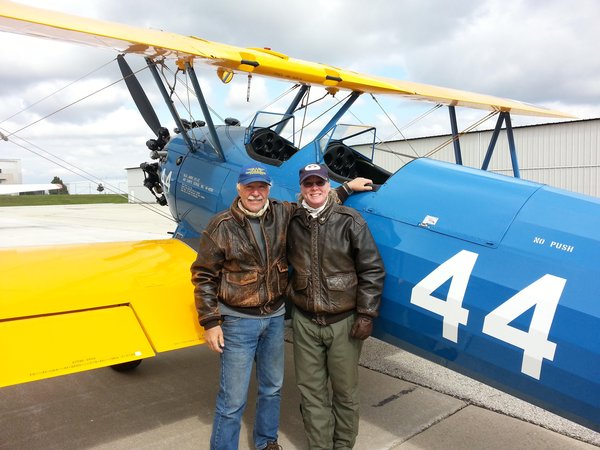
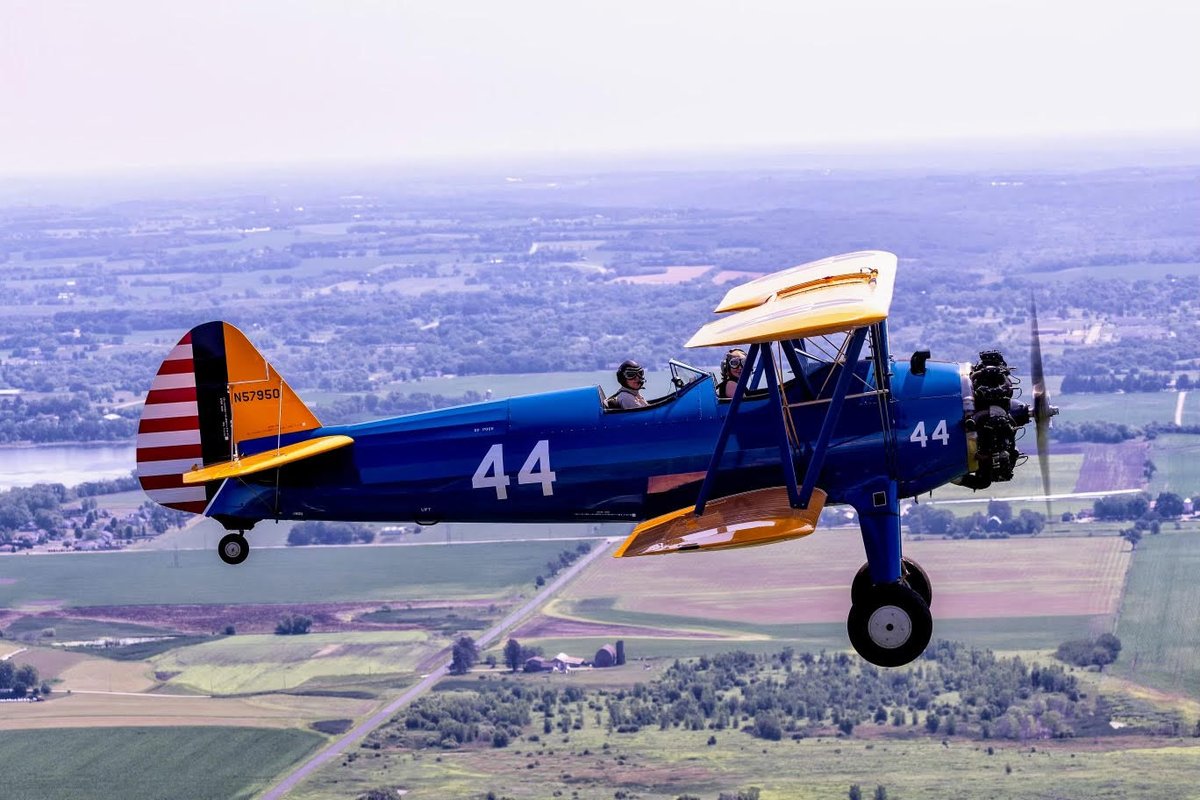
Their first connection with their second Stearman, or as they call it, Army Stearman 44, also known as N57950, came in 1999 when Pete’s best friend Ray Coker asked Pete to go with him to do a pre-purchase inspection on it. Many years later when Ray could no longer fly, Pete helped him look for a buyer. The person who bought it was Glenn Smith from Frisco, Texas. In the following years, Glenn became a close friend of Pete and Marie, through their connection to the Stearman.
“Unfortunately, Glenn lost his life in 2012 during the Quad City Airshow,” Marie explained. “Two years after that, his family reached out and asked if we were interested in purchasing the Stearman. After brief consideration, we made the agreement with Glenn’s family and purchased the Stearman. Suffice it to say, it’s more than just an airplane to us; it’s a very real connection to our friends.”
When Marie and Pete acquired Stearman 44 one of the first things Marie did was send a letter to the Smithsonian Air and Space Museum archives asking about its military history. She learned a lot.
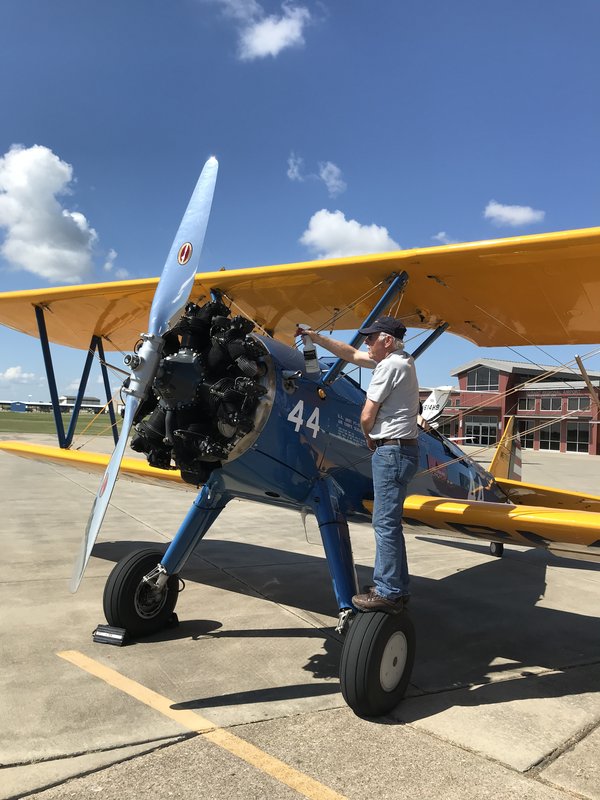
On September 11, 1941, Stearman 44 was received by the US Army at Boeing Field, Wichita, Kansas. Within days, it began its history as a US Army training aircraft. It spent time at Maxwell Field, Carlstrom Field, Door Field, Lafayette School of Aeronautics, Southern Field, Army Air Force Tactical Center, and finally, at the No. 1 British Flying Training School in Terrell, Texas.
“It was a very interesting history in and of itself but the period that most caught my attention was its last duty station at Terrell, Texas,” said Marie.
Stearman 44 arrived in Texas early July 1944 and began its service training British cadets at Terrell Municipal Airport. The training of British flying cadets in the United States was something Marie hadn’t heard of previously, so she decided to do some research. She learned that at one time there were several locations in the US where British pilots had trained. According to the British Flying Training School (BFTS) Museum, thousands of British cadets learned to fly at six civilian training schools across the southern United States during World War II. The first and largest of the schools was in Terrell, Texas. More than 2,200 Royal Air Force and United States Army Air Corps cadets earned their wings between 1941 and 1945 over North Texas.
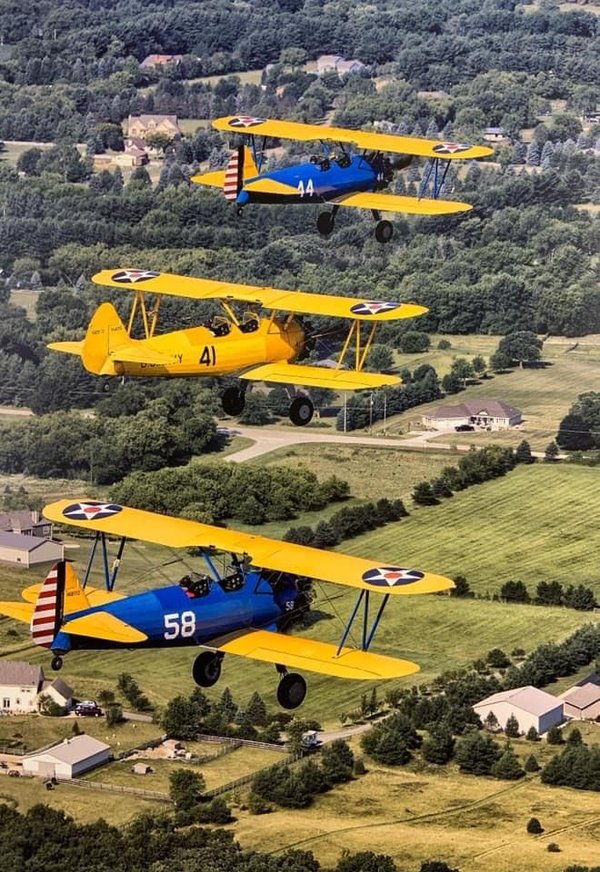
UK officials recognized the need to train aircrews outside its borders before the outbreak of war. With roughly the same landmass as Michigan, the British Isles were limited in size, which meant friendly airspace was in short supply. Not to mention the infamously bad English weather. With the Luftwaffe ready to strike from just across the Channel, pilots-in-training were under the threat of enemy attack. Southern U.S. locales like Terrell offered wide-open, friendly skies over sparsely populated farmland, providing ideal flying conditions for pilot training.
The location in Terrell was the Number 1 British Flying Training School.
“Upon further internet searching, I learned that there is a museum at the Terrell airport dedicated to the British Flying Training School (BFTS)—and I knew I wanted to go there,” she said.
Fate granted that opportunity when Pete and Marie attended a wedding in Dallas. They had spare time and headed over to the BFTS Museum. The No. 1 British Flying Training School Museum in Terrell was started by former cadets to celebrate their friendships and remember the 20 men who died in training. Upon arriving, Pete and Marie met members of the museum board and gave them a copy of the history of their Stearman showing it had spent part of its history there. After viewing the museum and continuing their conversation with the museum staff, they were invited to return over the fourth of July holiday for the Museum’s Freedom Fest, in 2022.
“Pete and I had made trips to west Texas in years past in his Navy Stearman to attend events at the WASP Museum in Sweetwater,” recalled Marie. “We had decided that we were done with making long distance trips in the Stearman, but I knew we had to make this trip.”
Once she convinced Pete to make the trip, the planning began. Pete and Marie went through Stearman 44 just as they would during an annual inspection. “Tip to tail and top to bottom,” she said.
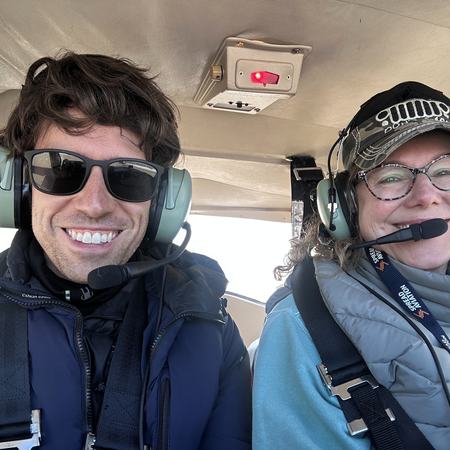
Their friend, Tye Hammerle, had accompanied us Pete and Marie on many trips in his Stearman, so Marie asked him if he was up for making another journey to Texas. “Anyone who has made a long, cross-country trip knows it’s a benefit to have someone along to help do some of the flying,” Marie said. “Jill Mann had flown with both Tye and me in both of our Stearmans, so I asked her if she wanted to be part of this crazy adventure.”
Without hesitation, Jill was on board.
“I was excited when Marie invited me to go along with; I love an adventure!” said Jill. “Trip planning was simple, it consisted of packing very minimally,” she added. “We had extremely limited space available.”
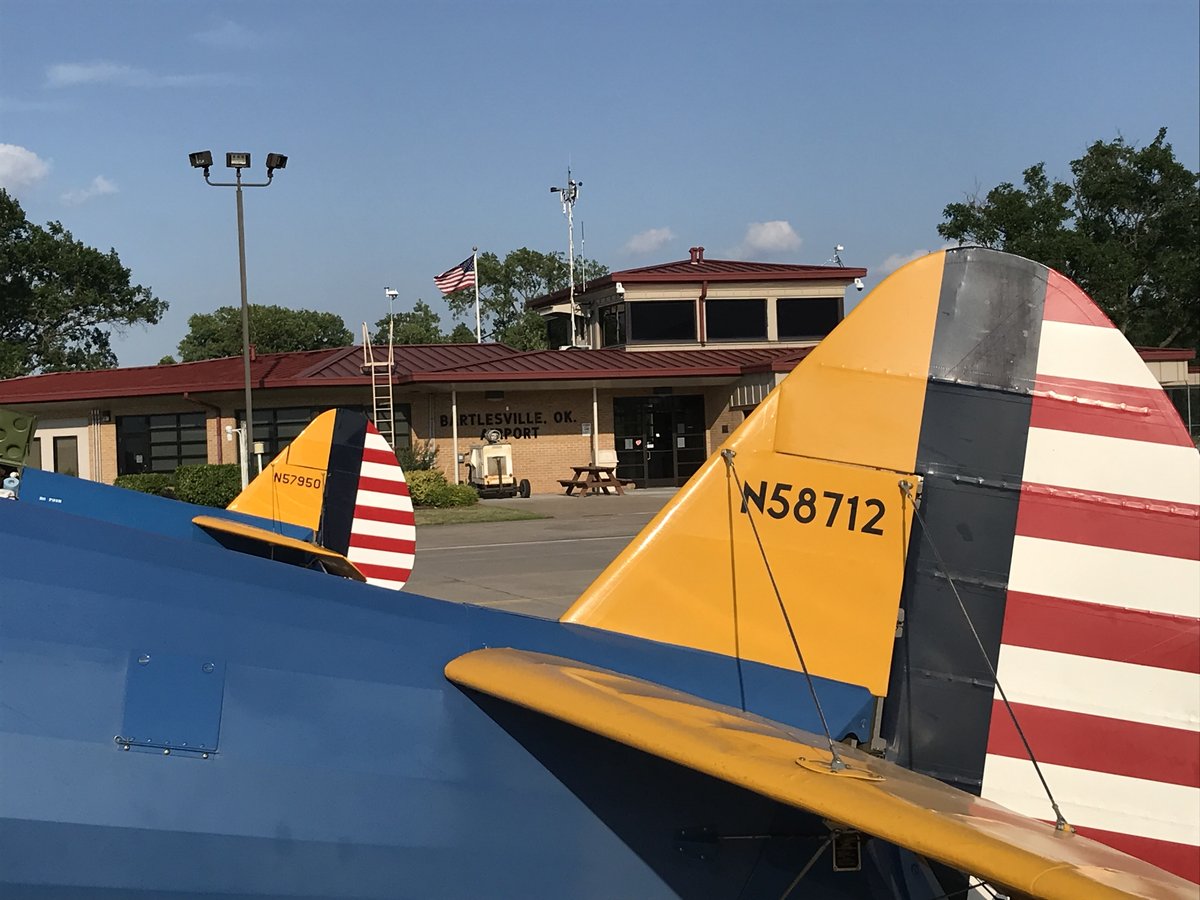
The adventurous travelers started watching the weather and had a flexible plan with several options for fuel, and overnight stays. Marie likes planning long trips because of the excitement and anticipation of everything coming together. The route they chose, for the most part, is one that’s familiar to them, because of their past trips to Sweetwater. They departed Kenosha on July 1, with an overnight planned in Bartlesville, Oklahoma, before arriving in Texas on July 2.
Marie recalls that Stearman 44 had a spark plug issue just before arriving in Bartlesville, Oklahoma, which they easily remedied by switching it out for a new one. However, an unplanned stop came up in Durant, Oklahoma. “The flight from Bartlesville to Durant got interesting,” Marie said. They developed an issue inflight, which they learned upon landing was an electrical issue. “The benefit of traveling with two aircraft mechanics is that after some troubleshooting, we were on our way,” Marie said.
Even with the stop, they arrived in Texas on July 2 as planned. “The people from the BFTS Museum were very excited to see Stearman 44 touch down at Terrell Municipal Airport for the first time since it had been based there during World War II,” Marie said. “They were very welcoming and helpful.”
Their plane, and Tye’s, were on display during the event. “The publics’ interest in the planes, especially Stearman 44, was wonderful,” Marie recalls. “We spent a lot of time answering questions, having fun conversations about our trip to Texas, and even more interesting conversations with people whose family members had a direct connection to the British Training School that was located there before and during the war.”
On July 5, they landed back in Kenosha, after one long day of flying. Jill said that the heat was quite oppressive at 104 degrees, and the open cockpit wind while flying was very tiring. “I equated the trip to riding a motorcycle to Texas and back,” Jill says. But flying at 1000 – 2000 feet AGL, they saw a lot of scenery, and she enjoyed identifying their location from the VFR Sectional. She was grateful to have digital charts, so she didn't have any stories of paper charts escaping in the wind.
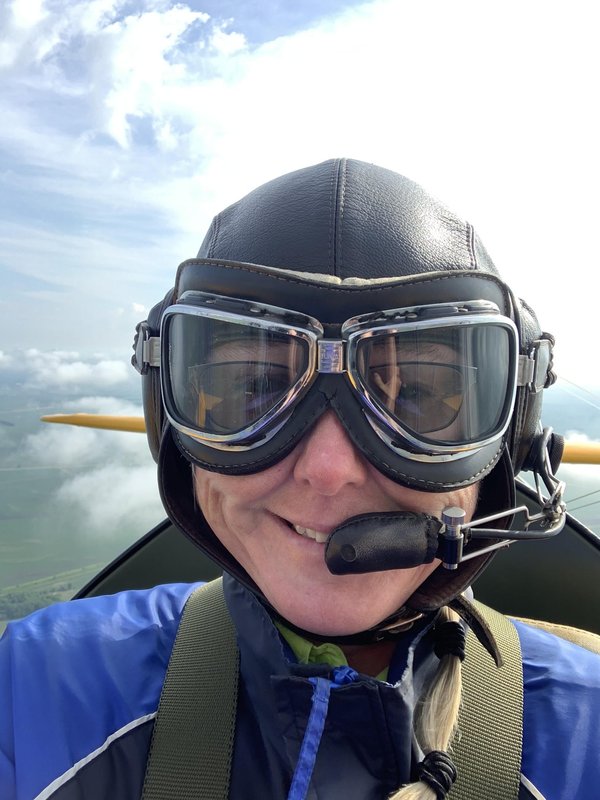
“This was truly a once in a lifetime adventure, and I'm so grateful to have the opportunity to fly with these friends!” Jill said.
It’s a feeling Marie shares. The trip rekindled her love of going to new places, meeting new and interesting people, and the adventure of the journey, especially when she can share it with friends. And it was a great opportunity, she said, to further develop her flying skills along the way.
Her love for Stearmans continues to grow. “Why?” you might ask.
Marie describes it eloquently, “I think it’s the combination of the historical significance of the plane, the incredible feeling of freedom and challenge I have while flying a Stearman, and the obvious connection to the relationship Pete and I share that continually draws me to choose flying a Stearman instead of any other airplane.”
That’s good enough reason for anyone.
For more information about the training of British Cadets in Terrell, Texas, and elsewhere in the United States visit the website of the No. 1 British Flying Training School Museum at: www.bftsmuseum.org