Early on the afternoon of May 5th, 1958, Madison residents living on the north shore of Lake Monona watched as an F-102A Delta Dagger returned from a routine training mission to Madison’s Truax Air Force Base. At the time Truax was part of the Air Force’s Air Defense Command and home to three active duty squadrons of F-102 jet fighters assigned to the 327th Fighter Interceptor Group.
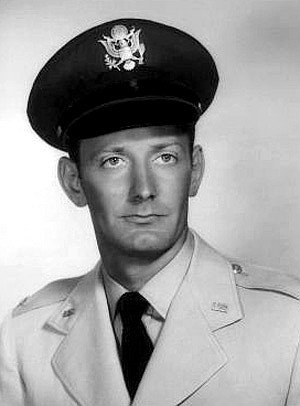
Stull ditches in Lake Monona
First Lieutenant Gerald Stull piloted the single-engine F-102 flying across Lake Monona that day. As the 26-year old Stull crossed Madison and approached Truax AFB from the south to land on runway 36, the J-57 turbojet engine in his F-102 lost power and the airplane started sinking. Unable to get the engine restarted, and realizing that he could never glide the remaining two and one-half miles to a landing at Truax, he chose to ditch his jet fighter into Lake Monona rather than to eject and let the airplane crash into the houses that lined the lake’s north shore. Stull’s jet crashed into the lake at a steep angle and he ejected just prior to the airplane hitting the water. While fighting to control the aircraft, Lieutenant Stull had delayed his ejection decision until too late, and witnesses said his ejection seat had just barely left the jet as the airplane splashed into the water. His parachute and risers became entangled in the airplane’s vertical stabilizer and the sinking airplane dragged Stull under the water. Instead of ejecting while his airplane had sufficient altitude, Lieutenant Gerald Stull had knowingly sacrificed his life to prevent his stricken jet from killing what would have been an untold number of civilians on the ground.
Witnesses to the crash ran to the lakeshore at Hudson Park and found a small rowboat. They jumped in and rowed towards the crash where they could just see the tail of the F-102 sticking out of the water. Upon arriving at the ditched airplane, they could see the tangled shroud lines and started pulling them into their boat. As they pulled Stull up through the water—still wearing his flying helmet and strapped into his parachute harness—it was obvious he was completely limp and could not have survived the crash. The rescuers were unable to pull Stull’s body into their small rowboat, but held his head above water until a rescue helicopter from Truax and a Madison Police Department boat arrived. As the helicopter hovered overhead, the police boat took Stull’s body to shore to a waiting ambulance that carried him to what is now Meriter Hospital where he was pronounced dead. The official cause of death was a skull fracture and severe internal bleeding, and Air Force officials speculated that Stull had likely hit the F-102’s tall vertical stabilizer as the ejection seat rocketed him out of the jet’s narrow cockpit.
It was obvious to everyone who witnessed the crash that Stull had intentionally turned his jet fighter at the last second, choosing to ditch in the lake rather than ejecting from the airplane at a safe altitude and letting it crash into the densely packed neighborhood near Atwood Avenue, Olbrich Gardens, and along the shoreline near Hudson Park.
The F-102 Delta Dagger
The F-102 was one of the early “Century Series” jet fighters, and the first operable U.S. Air Force fighter with a pure delta wing. Delta wings are known for their tricky aerodynamics, unusual stall characteristics, and for their poor gliding qualities with high sink rates. Early production models of the F-102 also had a somewhat checkered history as an accident-prone aircraft. Only two months prior to Stull’s crash, an F-102 had burst into flames while its pilot ran up its engine on the Truax runway, and another Truax jet had crashed near Ashton Corners in northwest Dane County after an engine failure, although its pilot was able to eject successfully.
Had Stull continued on towards Truax, trying to stretch his glide the last two and one-half miles to a landing, his jet would have surely stalled, stopped flying, and dived into the densely packed houses between him and the air base.
Had Stull ejected while still at a safe altitude, his F-102 would have continued on without pilot, out-of-control, until diving to the ground, possibly taking out several houses as debris and burning fuel would have scattered across hundreds of yards.
Stull received a rare peacetime DFC
The Air Force immediately recognized Lieutenant Stull’s heroism, and on August 5th, 1958 awarded the Distinguished Flying Cross posthumously to Stull’s widow Alice and his son Clark who was only three months old when his father crashed into the lake. (The Air Force rarely awards the DFC in peacetime, and then only for the most meritorious and valiant acts. The DFC was created to recognize heroism or extraordinary achievement in aerial flight. Charles Lindbergh was the first DFC recipient when Congress awarded him the medal after his solo flight to Paris in 1927.)
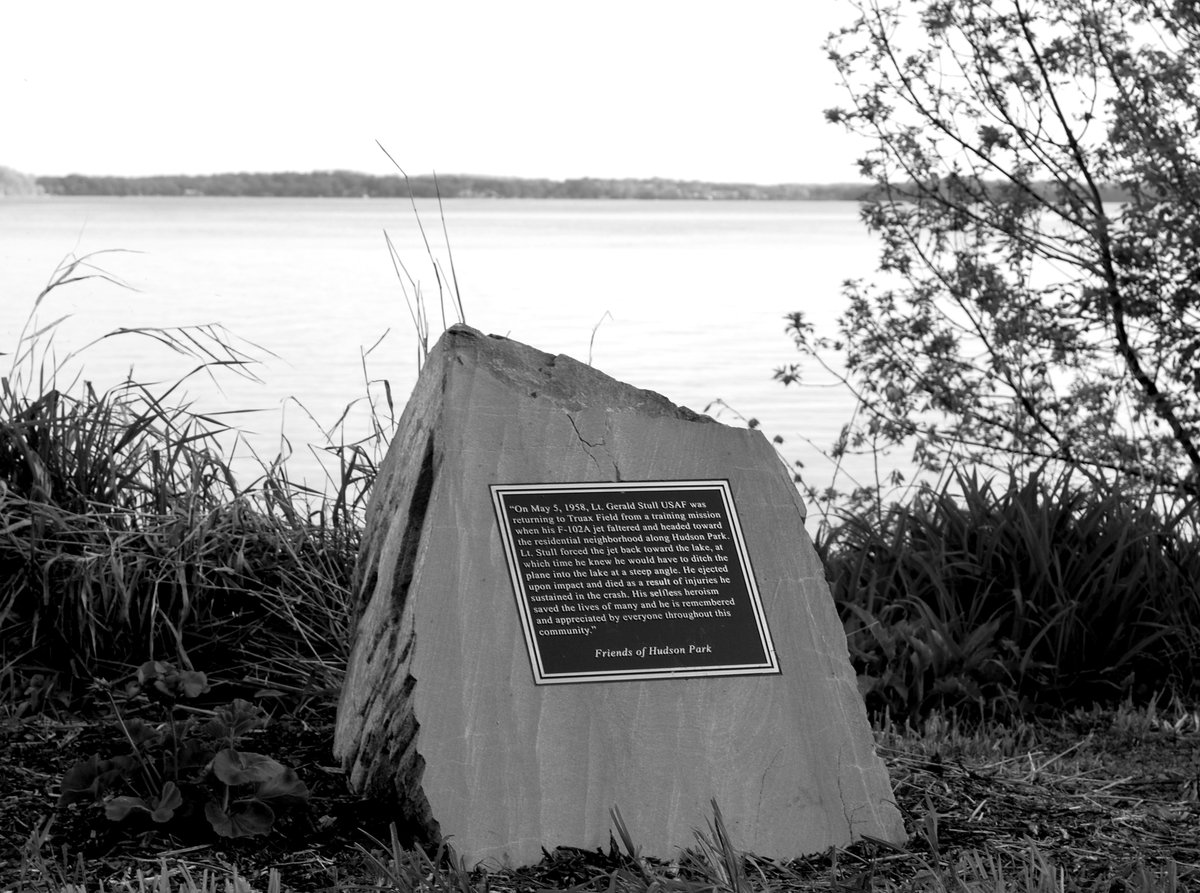
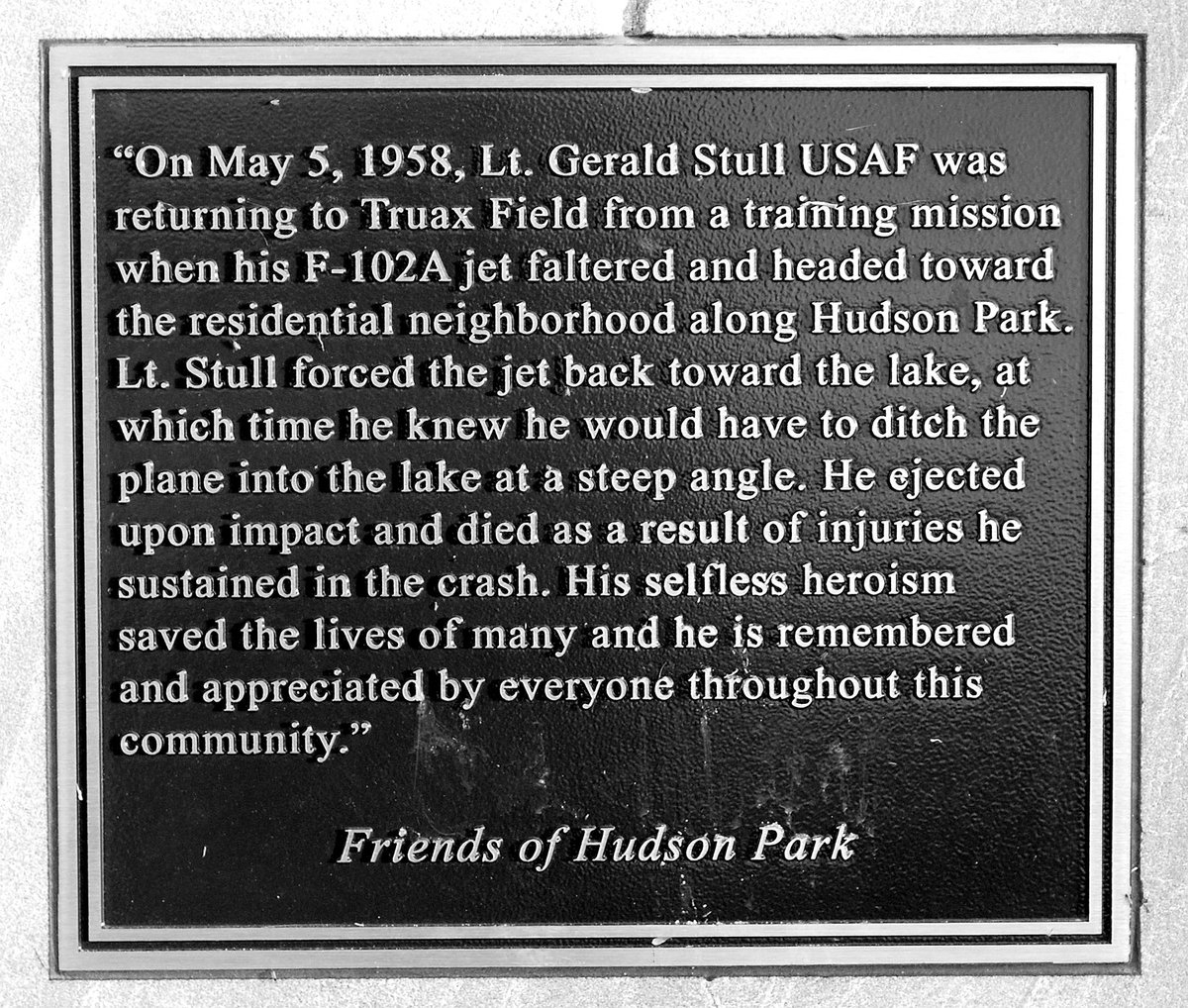
Those living along the north shore of Lake Monona have never forgotten Stull’s sacrifice, but there had been no public monument commemorating his heroic act. That changed in May when a dedicated group of lakeshore residents named the Friends of Hudson Park, guided by Madison attorney William White of the Lakeland Avenue neighborhood, erected a permanent memorial in Stull’s honor. They dedicated that memorial on May 9th, 2009; 51 years after Stull had scarified his life.
If you go
The memorial is made of Baraboo Hills quartzite with a bronze plaque describing Stull’s heroic act, and is located on the Lake Monona shore at Hudson Park. The quickest way to the memorial is to drive down Atwood Avenue, turning south on Hudson Avenue; then five blocks south on Hudson to the lakeshore and the park. As onlookers face the monument, they look across Lake Monona to where Stull ditched his airplane giving his life so that his Madison neighbors could live.