Alert Mission, Detachment (Det) 5,
39th Aerospace Rescue and Recovery Wing (ARRW)
The sun had appeared on the eastern horizon more than an hour ago and had now disappeared behind a high, thin overcast. The southeast winds gusting to 15 knots eased the temperature a bit. But it was late summer on the Florida panhandle and the heat was inevitable. Staff Sergeant Ken Stalzer, who would serve as the crew’s flight mechanic, had reviewed the aircraft’s 781 file and discussed the deferred maintenance items with the aircraft’s crew chief. The rest of the alert crew arrived at the Sikorsky HH-3E “Jolly Green” in the crew truck, bringing their gear. The team included Major Len Knitter, the aircraft commander (AC); 2nd Lieutenant Larry Sheppard, the copilot; and two pararescuemen (PJs), Technical Sergeant Michael Rosler and Staff Sergeant John Franklin. After completing the preflight ritual and securing their equipment, Major Knitter methodically led the crew through the mission briefing. This would be Lieutenant Sheppard’s first Alert mission and possibly his first flight after arriving at the Detachment. Knitter emphasized the potential impact of Hurricane Anita, which was boiling out of the Caribbean and into the Gulf of Mexico about 300 miles southeast of Tyndall AFB. Today’s mission was an all-day alert to protect those using the surrounding airspace.
It is Labor Day weekend, 1977 and Det 5 of the 39th ARRW is at minimum staffing. This wasn’t by accident but by design. Detachment Commander Lieutenant Colonel Thomas Gainer approved leave requests for most of the unit’s flight and rescue crews so they and their families could enjoy the long weekend. Gainer and his deputy, Major Len Knitter, would cover alert duty along with two new co-pilot members of the Detachment along with the requisite crew members.
After “cocking” the aircraft on alert, which prepared the aircraft for a fast response engine start, the crew made their way to Detachment Operations about 100 yards away. By 0845 Knitter was at work at his desk, Sheppard was studying local airspace details, and the enlisted team members were otherwise kept busy. Lunch was completed and it was beginning to feel like a quiet day on alert. Or so it was until 1315, when the Crash Phone rang out loud and long. The klaxon (alarm) could be heard throughout the facility. The alert crew dropped everything as they ran for the door leading to the ramp.
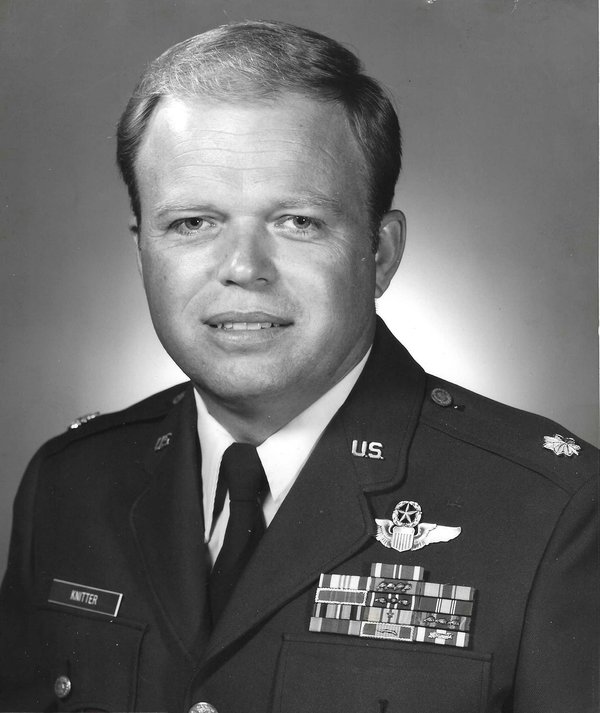
Aircraft Commander, Leonard “Len” Knitter, Major
Len was born in Milwaukee and fell in love with aviation as a kid. He admits, “I can’t remember exactly when it happened, but I was smitten.” No one in his immediate family had an interest in or experience in aviation, but that didn’t deter him from pursuing his dream of becoming a pilot. Knitter decided to enroll at the University of Wisconsin – Madison to take advantage of the Air Force Reserve Officers Training Corps (AFROTC) program offered there—WAHF Inductee Tom Thomas was a classmate. Len began flight training at Morey Field in Middleton where he earned his Private Pilot Certificate.
After earning a degree in Earth Sciences and his commission as a Second Lieutenant Knitter was sent to Undergraduate Pilot Training (UPT) at Vance AFB in Enid, Oklahoma. Flying the Cessna T-37 “Tweet,” Len graduated ninth in his pilot class and choose to the fly the brand-new Lockheed C-141 “Starlifter.” Flying out of Charleston AFB, South Carolina, Knitter conducted numerous flights to Southeast Asia.
The Air Force was facing a dilemma. Even during this ramp-up of the war in Southeast Asia, the branch had plenty of fixed wing (FW) pilots. Its mission, however, was changing and the need for rotary-wing (RW) pilots was increasing at a rapid rate. A logical first step towards resolving the issue was seeking fixed-wing pilots who would voluntarily transfer to RW. Reassignment (non-voluntary transfer) was the second step.
Now Captain Knitter, Len was sent to flight school to become a helicopter pilot. He first flew the Bell UH-1 “Huey” and then the Sikorsky H-3 “Jolly Green.” Early in 1969, Knitter was at Eglin AFB, Florida, for combat training that included tactics, refueling, and communications. From there he attended jungle survival school in the Philippine Islands before arriving at Da Nang Air Base, Vietnam. A member of the 37th ARRS, Len describes air rescue as “from boredom to chaos in minutes.” From Vietnam, Knitter was sent to Osan Air Base, Korea, with Detachment 13, 41st ARRS.
From Osan, Korea, the Air Force sent Len to Elmendorf AFB, Alaska, and a new H-3 squadron. Len would remain in Alaska for five years where he would become Chief of Helicopter Training for the 21st Composite Wing in 1973. In 1977, Major Knitter moved his family to his new assignment, Director for Operations, Det 5, 39th ARRS at Tyndall AFB, Florida.
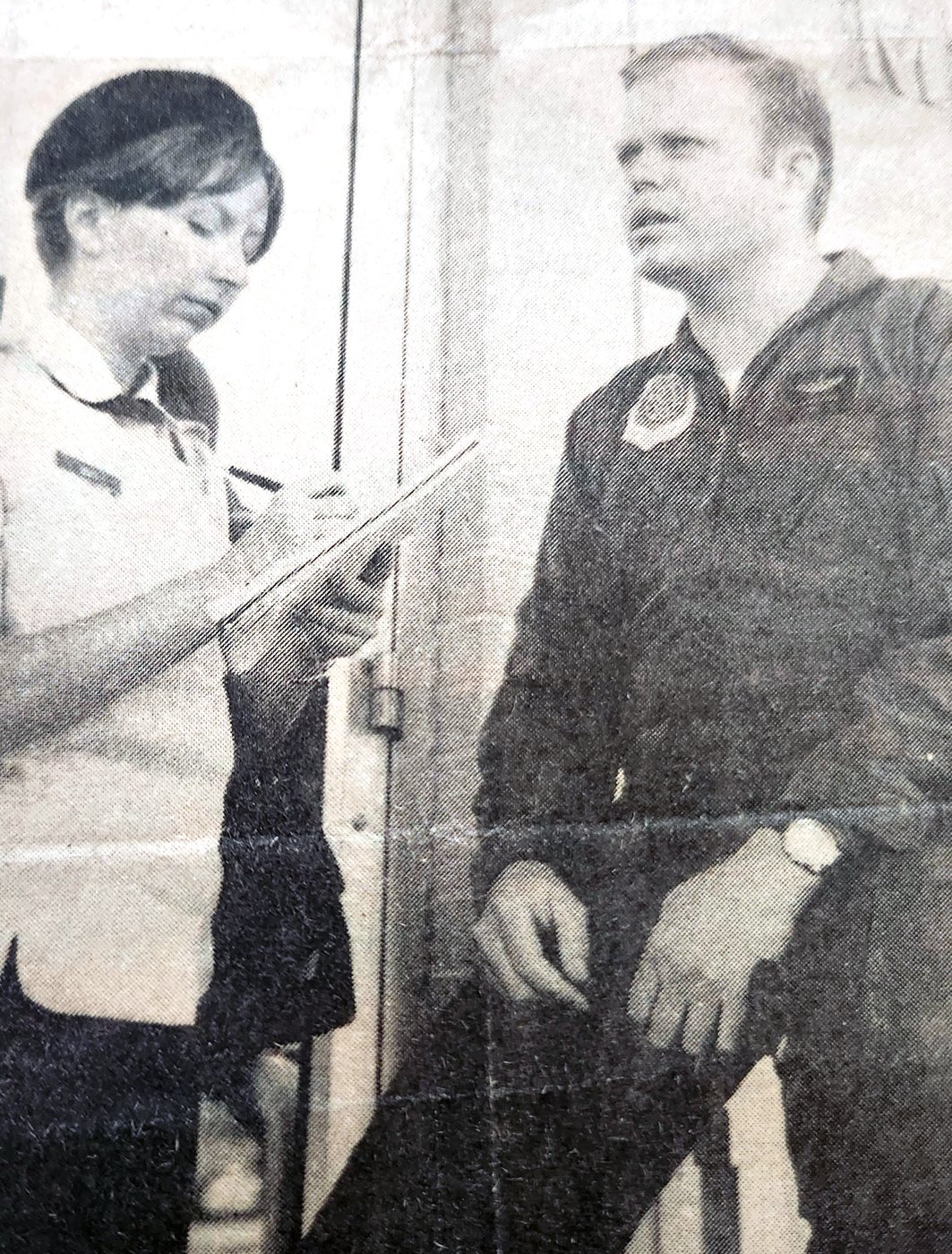
Alert Klaxon
The crew had completed their checklists and advised the tower they were ready for takeoff at 1325, a scant 10 minutes after the crash phone first rang. The RAPCON controller provided additional information as he provided an initial heading. The crew of a McDonnell Douglas F-4 “Phantom II” had punched out of their aircraft about 70 nautical miles southeast of Tyndall. Only one parachute had been observed, a Convair F-106 “Delta Dart” was orbiting the crash scene. Surface winds were from the southeast and blowing at 20 knots. To have the greatest possible groundspeed Knitter maintained an initial cruise altitude of 500 feet until the TACAN signal became intermittent, at which time he climbed to 5,000 feet MSL. The seas were rough, waves about 10 feet with whitecaps. As the crew approached the incident scene, AC Knitter briefed the crew on ditching and swimmer deployment procedures. The crew completed pre-search, smoke drop, and hoist operation checklists. Overhead of the scene the entire crew was looking for evidence of the F-4 pilots. Major Knitter put the aircraft into a descending right-hand turn to aid in visually spotting the downed crewmen.
Passing through 3,000 feet of altitude, flight mechanic Stalzer reported seeing red smoke. Calling for a smoke marker to be dropped, Major Knitter continued the descending turn. No one else had observed the pilot in the water or smoke. As they rolled out of the descending turn at 500 feet, their smoke marker had dissipated, so Knitter ordered another one deployed for reference. He then flew on a southeast heading, slowed to 60 knots indicated airspeed, and eventually spotted the survivor in his life raft about a half-mile away. The black life raft, the pilot’s olive drab flight suit and his white flight helmet on a backdrop of nearly black, wind tossed, whitecapped waves made it all but impossible to maintain visual contact with their target.
The lead PJ was in his wetsuit as Len brought the aircraft to a hover about 15 feet above the crests of the waves. The PJ stepped to the right-hand door and dropped into the water. Len described the recovery operation. “Watching over my right shoulder I waited for the PJ’s signal that he was ready. I then moved the helicopter forward as the hoist was lowered to the survivor. Once the cable was attached, we brought him aboard.” After the downed airman was aboard the process was repeated to bring the PJ aboard. Knitter continued, “While in the hover, picking up this first guy, I had called back to the unit and said, ‘See if you can scrounge up a crew and get another Jolly launched.’ They came back later and said, ‘Okay.’ I didn’t hear whether or not they actually were able to get another good chopper up because we were going in and out of radio contact.”
Back to search mode, Knitter’s crew began a search of the area containing the oil slick using an expanding square pattern. And then the incredible happened. “I don't know, we are maybe one or two turns through the search pattern and I said, ‘I smell smoke back there, guys. What’s going on?’”
Sargeant Stalzer, flight engineer, reported smoke coming from rear of the intermediate gearbox. Moments after that a transmission chip light illuminated on the instrument panel. There was a problem in the intermediate gearbox and it was rapidly becoming a bigger problem. The smoke was getting denser, they are thirty miles off shore, on the edge of a major hurricane, no parachutes, and an imminent transmission failure. Len says, “I got on the horn and asked, ‘Did you ever get the other Jolly launched?’” Tom Gainer, the detachment commander replied, “We are enroute and are about 15 minutes away from you.”
Len turned northbound on a beeline to Apalachicola, Florida. They began deploying smoke markers every 15 seconds. It was at this point that the aircraft began to vibrate, and Len knew he needed to set the aircraft down on the water before losing tail rotor effectiveness and aircraft control. After completing the ditching checklist, Len told the crew he would hold the aircraft off the water and that they should swim clear of the rotor arc. AC Knitter requested the engineer to deploy the sea anchor before he departed the aircraft. The engineer was also tasked with inflating the seven-person life raft after clearing the aircraft. The two PJs, the F-4 pilot, and the flight engineer exited out the rear ramp. The copilot, Lieutenant Larry Sheppard, exited out the left cockpit door.
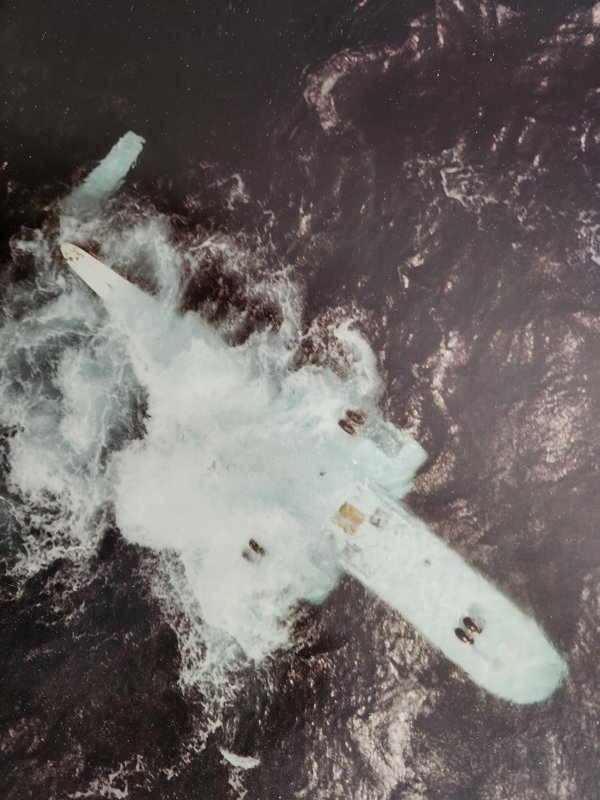
Knitter watched as the crew swam clear of the rotor blades, he then lowered the gear to lower the center of gravity and shut down the engine. Through delicate use of the rotor brake Knitter was able to keep the rotor blades from impacting the water. Len then exited the aircraft and swam for the life raft. One of the PJs jumped into the water, swam to meet the AC, and assisted him into the raft. Soon after leaving the stricken Jolly Green the aircraft rolled over.
The second H-3 “Jolly Green” was on scene less than 11 minutes later. All five crew members of the first H-3 and the rescued F-4 pilot were safely hoisted aboard the second H-3. Moments later Knitter’s aircraft sank in 200 feet of water. Unfortunately, despite an extended search, the second F-4 pilot was never found. Major Knitter and his entire crew were awarded the Air Medal for their action in the rescue.
In 1978, Lieutenant Colonel Knitter attended the Air Command and Staff College at Maxwell AFB, Montgomery, Alabama. He was then stationed at Headquarters Military Airlift Command (MAC) Scott AFB, Illinois, serving as Chief of Pacific War Plans. Following this assignment Len served as air operations officer at the 50th ARRS, Eglin AFB, Florida, beginning in July 1982. He was given responsibility to oversee the Air Force’s incorporation of the UH-60A “Blackhawk” into the Rescue and Special Operations Fleet. Knitter’s last assignment was as USAF liaison to the Wisconsin Wing of the Civil Air Patrol.
Colonel Knitter’s decorations include the Distinguished Flying Cross for heroism in Vietnam, the Defense Meritorious Service Medal, five Air Medals (four from Vietnam), and the Air Force Commendation Medal. He retired from the Air Force in 1989.