Volume 4, Issue 3
🗞️ Download Issue (PDF)
Forward in Aviation - September 2006
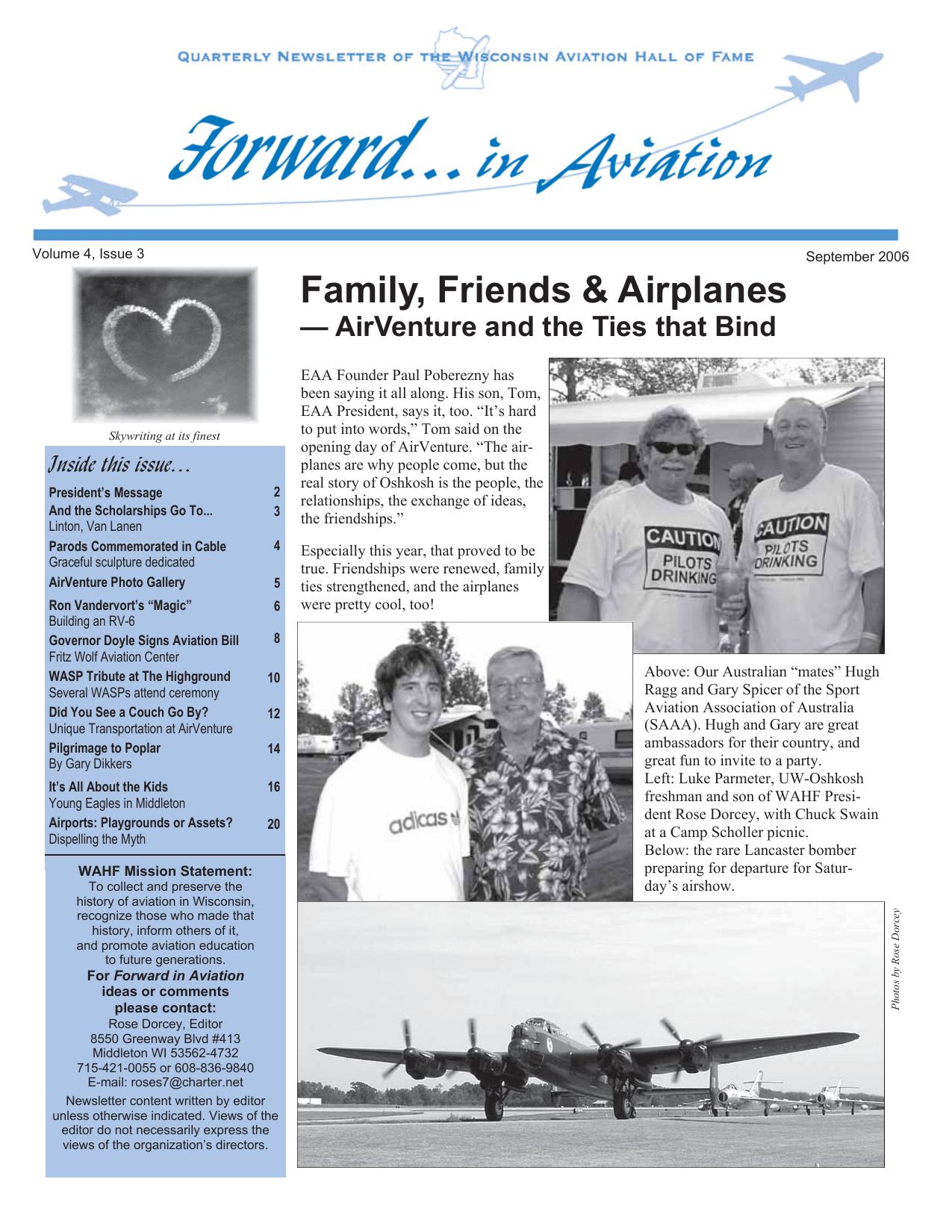
Volume 4, Issue 3 September 2006 Family, Friends & Airplanes — AirVenture and the Ties that Bind Skywriting at its finest Inside this issue… President’s Message And the Scholarships Go To... Linton, Van Lanen Parods Commemorated in Cable Graceful sculpture dedicated AirVenture Photo Gallery 2 3 Ron Vandervort’s “Magic” Building an RV-6 Governor Doyle Signs Aviation Bill Fritz Wolf Aviation Center WASP Tribute at The Highground Several WASPs attend ceremony Did You See a Couch Go By? Unique Transportation at AirVenture Pilgrimage to Poplar By Gary Dikkers 6 5 Especially this year, that proved to be true. Friendships were renewed, family ties strengthened, and the airplanes were pretty cool, too! 8 10 12 14 16 20 WAHF Mission Statement: To collect and preserve the history of aviation in Wisconsin, recognize those who made that history, inform others of it, and promote aviation education to future generations. For Forward in Aviation ideas or comments please contact: Rose Dorcey, Editor 8550 Greenway Blvd #413 Middleton WI 53562-4732 715-421-0055 or 608-836-9840 E-mail: roses7@charter.net Newsletter content written by editor unless otherwise indicated. Views of the editor do not necessarily express the views of the organization’s directors. Above: Our Australian “mates” Hugh Ragg and Gary Spicer of the Sport Aviation Association of Australia (SAAA). Hugh and Gary are great ambassadors for their country, and great fun to invite to a party. Left: Luke Parmeter, UW-Oshkosh freshman and son of WAHF President Rose Dorcey, with Chuck Swain at a Camp Scholler picnic. Below: the rare Lancaster bomber preparing for departure for Saturday’s airshow. Photos by Rose Dorcey It’s All About the Kids Young Eagles in Middleton Airports: Playgrounds or Assets? Dispelling the Myth 4 EAA Founder Paul Poberezny has been saying it all along. His son, Tom, EAA President, says it, too. “It’s hard to put into words,” Tom said on the opening day of AirVenture. “The airplanes are why people come, but the real story of Oshkosh is the people, the relationships, the exchange of ideas, the friendships.”
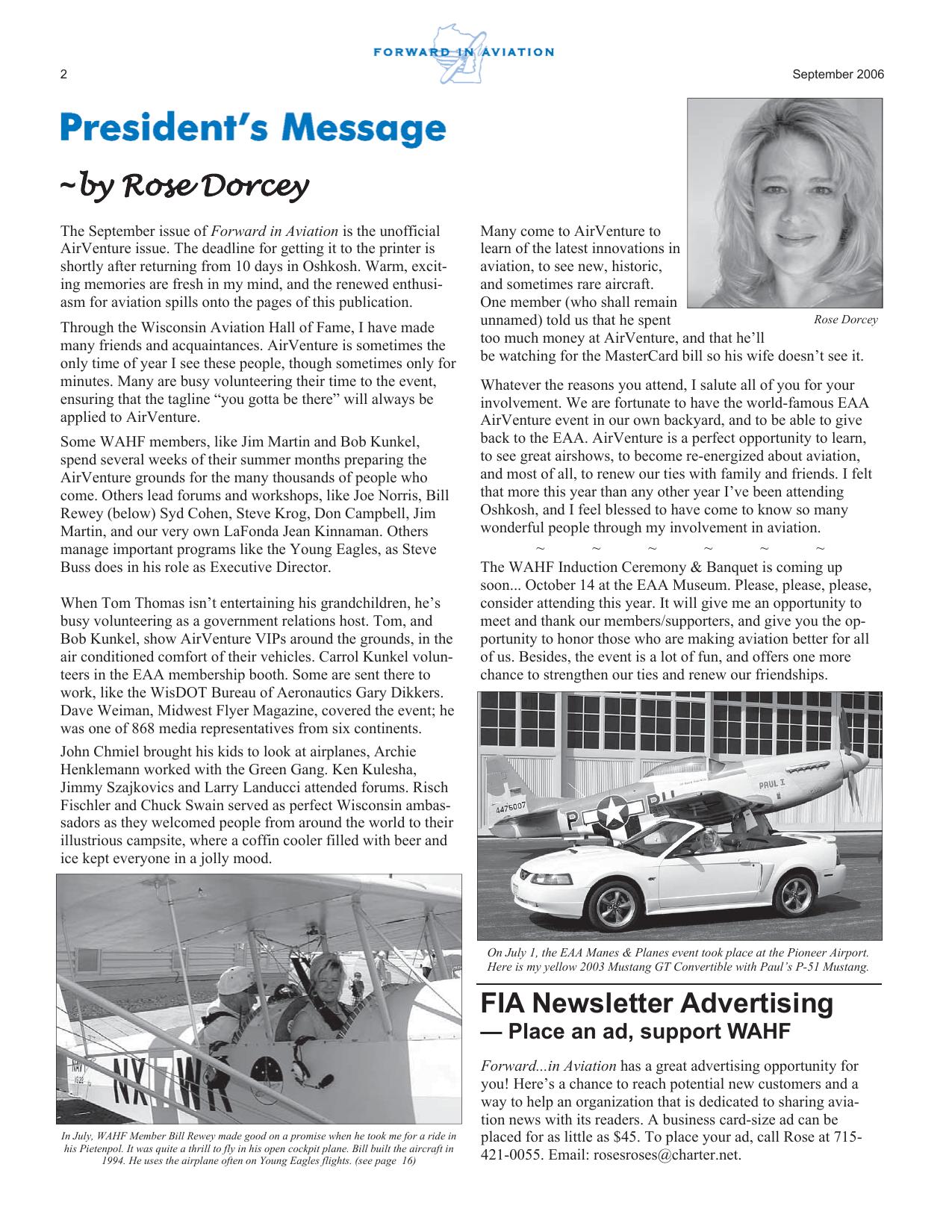
2 September 2006 ~by Rose Dorcey The September issue of Forward in Aviation is the unofficial AirVenture issue. The deadline for getting it to the printer is shortly after returning from 10 days in Oshkosh. Warm, exciting memories are fresh in my mind, and the renewed enthusiasm for aviation spills onto the pages of this publication. Through the Wisconsin Aviation Hall of Fame, I have made many friends and acquaintances. AirVenture is sometimes the only time of year I see these people, though sometimes only for minutes. Many are busy volunteering their time to the event, ensuring that the tagline “you gotta be there” will always be applied to AirVenture. Some WAHF members, like Jim Martin and Bob Kunkel, spend several weeks of their summer months preparing the AirVenture grounds for the many thousands of people who come. Others lead forums and workshops, like Joe Norris, Bill Rewey (below) Syd Cohen, Steve Krog, Don Campbell, Jim Martin, and our very own LaFonda Jean Kinnaman. Others manage important programs like the Young Eagles, as Steve Buss does in his role as Executive Director. When Tom Thomas isn’t entertaining his grandchildren, he’s busy volunteering as a government relations host. Tom, and Bob Kunkel, show AirVenture VIPs around the grounds, in the air conditioned comfort of their vehicles. Carrol Kunkel volunteers in the EAA membership booth. Some are sent there to work, like the WisDOT Bureau of Aeronautics Gary Dikkers. Dave Weiman, Midwest Flyer Magazine, covered the event; he was one of 868 media representatives from six continents. John Chmiel brought his kids to look at airplanes, Archie Henklemann worked with the Green Gang. Ken Kulesha, Jimmy Szajkovics and Larry Landucci attended forums. Risch Fischler and Chuck Swain served as perfect Wisconsin ambassadors as they welcomed people from around the world to their illustrious campsite, where a coffin cooler filled with beer and ice kept everyone in a jolly mood. Many come to AirVenture to learn of the latest innovations in aviation, to see new, historic, and sometimes rare aircraft. One member (who shall remain Rose Dorcey unnamed) told us that he spent too much money at AirVenture, and that he’ll be watching for the MasterCard bill so his wife doesn’t see it. Whatever the reasons you attend, I salute all of you for your involvement. We are fortunate to have the world-famous EAA AirVenture event in our own backyard, and to be able to give back to the EAA. AirVenture is a perfect opportunity to learn, to see great airshows, to become re-energized about aviation, and most of all, to renew our ties with family and friends. I felt that more this year than any other year I’ve been attending Oshkosh, and I feel blessed to have come to know so many wonderful people through my involvement in aviation. ~ ~ ~ ~ ~ ~ The WAHF Induction Ceremony & Banquet is coming up soon... October 14 at the EAA Museum. Please, please, please, consider attending this year. It will give me an opportunity to meet and thank our members/supporters, and give you the opportunity to honor those who are making aviation better for all of us. Besides, the event is a lot of fun, and offers one more chance to strengthen our ties and renew our friendships. On July 1, the EAA Manes & Planes event took place at the Pioneer Airport. Here is my yellow 2003 Mustang GT Convertible with Paul’s P-51 Mustang. FIA Newsletter Advertising — Place an ad, support WAHF In July, WAHF Member Bill Rewey made good on a promise when he took me for a ride in his Pietenpol. It was quite a thrill to fly in his open cockpit plane. Bill built the aircraft in 1994. He uses the airplane often on Young Eagles flights. (see page 16) Forward...in Aviation has a great advertising opportunity for you! Here’s a chance to reach potential new customers and a way to help an organization that is dedicated to sharing aviation news with its readers. A business card-size ad can be placed for as little as $45. To place your ad, call Rose at 715421-0055. Email: rosesroses@charter.net.
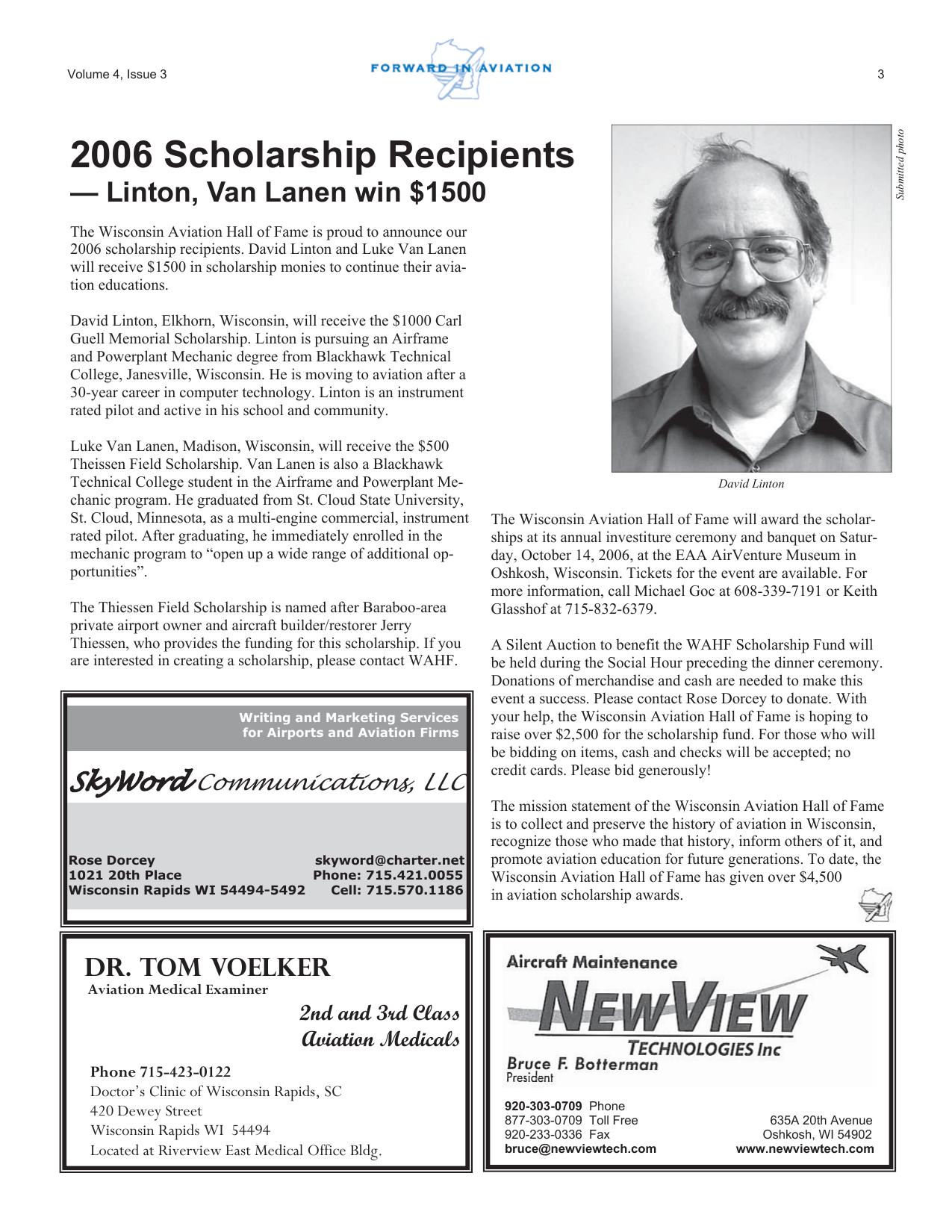
3 Submitted photo Volume 4, Issue 3 2006 Scholarship Recipients — Linton, Van Lanen win $1500 The Wisconsin Aviation Hall of Fame is proud to announce our 2006 scholarship recipients. David Linton and Luke Van Lanen will receive $1500 in scholarship monies to continue their aviation educations. David Linton, Elkhorn, Wisconsin, will receive the $1000 Carl Guell Memorial Scholarship. Linton is pursuing an Airframe and Powerplant Mechanic degree from Blackhawk Technical College, Janesville, Wisconsin. He is moving to aviation after a 30-year career in computer technology. Linton is an instrument rated pilot and active in his school and community. Luke Van Lanen, Madison, Wisconsin, will receive the $500 Theissen Field Scholarship. Van Lanen is also a Blackhawk Technical College student in the Airframe and Powerplant Mechanic program. He graduated from St. Cloud State University, St. Cloud, Minnesota, as a multi-engine commercial, instrument rated pilot. After graduating, he immediately enrolled in the mechanic program to “open up a wide range of additional opportunities”. The Thiessen Field Scholarship is named after Baraboo-area private airport owner and aircraft builder/restorer Jerry Thiessen, who provides the funding for this scholarship. If you are interested in creating a scholarship, please contact WAHF. Writing and Marketing Services for Airports and Aviation Firms SkyWord Communications, LLC Rose Dorcey skyword@charter.net 1021 20th Place Phone: 715.421.0055 Wisconsin Rapids WI 54494-5492 Cell: 715.570.1186 David Linton The Wisconsin Aviation Hall of Fame will award the scholarships at its annual investiture ceremony and banquet on Saturday, October 14, 2006, at the EAA AirVenture Museum in Oshkosh, Wisconsin. Tickets for the event are available. For more information, call Michael Goc at 608-339-7191 or Keith Glasshof at 715-832-6379. A Silent Auction to benefit the WAHF Scholarship Fund will be held during the Social Hour preceding the dinner ceremony. Donations of merchandise and cash are needed to make this event a success. Please contact Rose Dorcey to donate. With your help, the Wisconsin Aviation Hall of Fame is hoping to raise over $2,500 for the scholarship fund. For those who will be bidding on items, cash and checks will be accepted; no credit cards. Please bid generously! The mission statement of the Wisconsin Aviation Hall of Fame is to collect and preserve the history of aviation in Wisconsin, recognize those who made that history, inform others of it, and promote aviation education for future generations. To date, the Wisconsin Aviation Hall of Fame has given over $4,500 in aviation scholarship awards. DR. TOM VOELKER Aviation Medical Examiner 2nd and 3rd Class Aviation Medicals Phone 715-423-0122 Doctor’s Clinic of Wisconsin Rapids, SC 420 Dewey Street Wisconsin Rapids WI 54494 Located at Riverview East Medical Office Bldg. 920-303-0709 Phone 877-303-0709 Toll Free 920-233-0336 Fax bruce@newviewtech.com 635A 20th Avenue Oshkosh, WI 54902 www.newviewtech.com
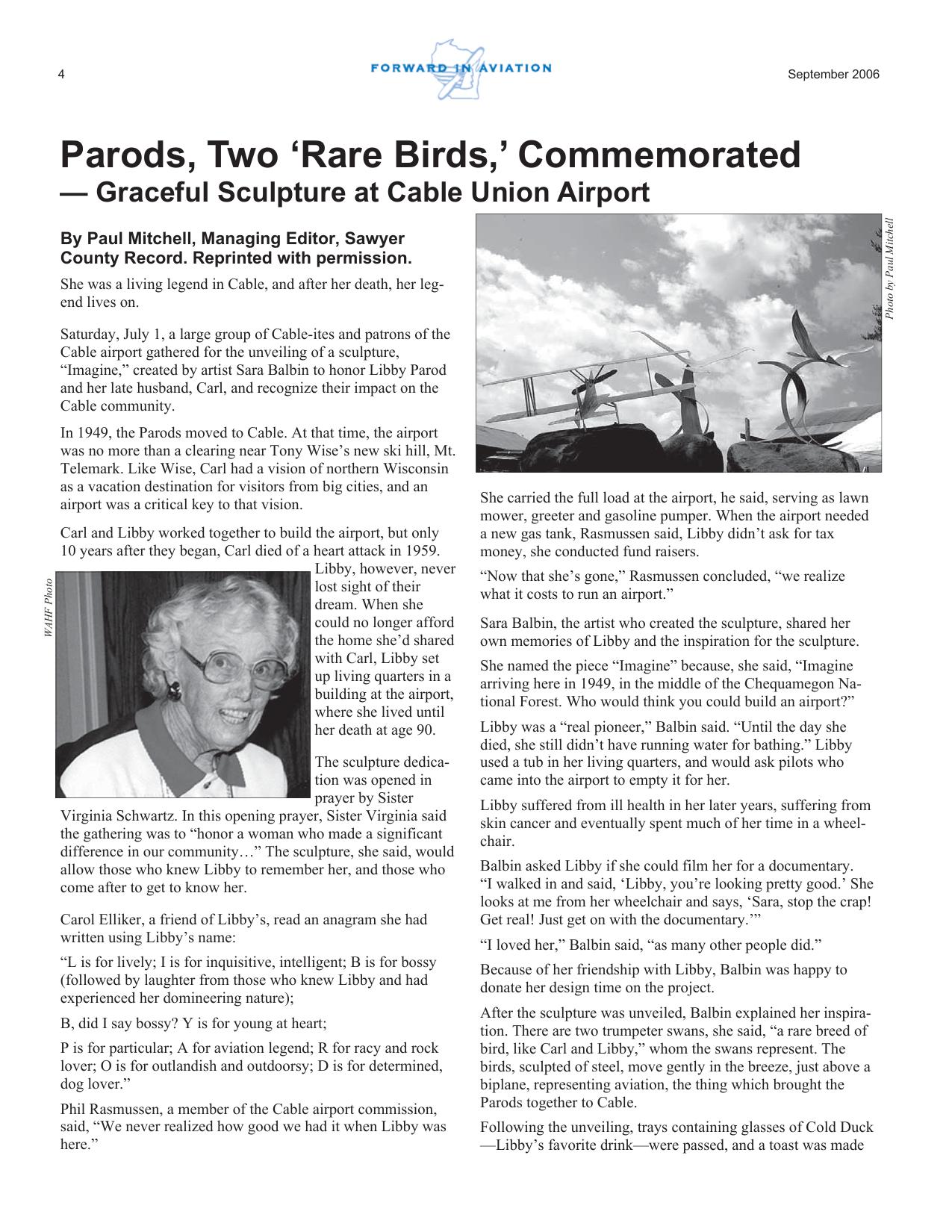
4 September 2006 Parods, Two ‘Rare Birds,’ Commemorated Photo by Paul Mitchell — Graceful Sculpture at Cable Union Airport By Paul Mitchell, Managing Editor, Sawyer County Record. Reprinted with permission. She was a living legend in Cable, and after her death, her legend lives on. Saturday, July 1, a large group of Cable-ites and patrons of the Cable airport gathered for the unveiling of a sculpture, “Imagine,” created by artist Sara Balbin to honor Libby Parod and her late husband, Carl, and recognize their impact on the Cable community. WAHF Photo In 1949, the Parods moved to Cable. At that time, the airport was no more than a clearing near Tony Wise’s new ski hill, Mt. Telemark. Like Wise, Carl had a vision of northern Wisconsin as a vacation destination for visitors from big cities, and an airport was a critical key to that vision. Carl and Libby worked together to build the airport, but only 10 years after they began, Carl died of a heart attack in 1959. Libby, however, never lost sight of their dream. When she could no longer afford the home she’d shared with Carl, Libby set up living quarters in a building at the airport, where she lived until her death at age 90. The sculpture dedication was opened in prayer by Sister Virginia Schwartz. In this opening prayer, Sister Virginia said the gathering was to “honor a woman who made a significant difference in our community…” The sculpture, she said, would allow those who knew Libby to remember her, and those who come after to get to know her. Carol Elliker, a friend of Libby’s, read an anagram she had written using Libby’s name: “L is for lively; I is for inquisitive, intelligent; B is for bossy (followed by laughter from those who knew Libby and had experienced her domineering nature); B, did I say bossy? Y is for young at heart; P is for particular; A for aviation legend; R for racy and rock lover; O is for outlandish and outdoorsy; D is for determined, dog lover.” Phil Rasmussen, a member of the Cable airport commission, said, “We never realized how good we had it when Libby was here.” She carried the full load at the airport, he said, serving as lawn mower, greeter and gasoline pumper. When the airport needed a new gas tank, Rasmussen said, Libby didn’t ask for tax money, she conducted fund raisers. “Now that she’s gone,” Rasmussen concluded, “we realize what it costs to run an airport.” Sara Balbin, the artist who created the sculpture, shared her own memories of Libby and the inspiration for the sculpture. She named the piece “Imagine” because, she said, “Imagine arriving here in 1949, in the middle of the Chequamegon National Forest. Who would think you could build an airport?” Libby was a “real pioneer,” Balbin said. “Until the day she died, she still didn’t have running water for bathing.” Libby used a tub in her living quarters, and would ask pilots who came into the airport to empty it for her. Libby suffered from ill health in her later years, suffering from skin cancer and eventually spent much of her time in a wheelchair. Balbin asked Libby if she could film her for a documentary. “I walked in and said, ‘Libby, you’re looking pretty good.’ She looks at me from her wheelchair and says, ‘Sara, stop the crap! Get real! Just get on with the documentary.’” “I loved her,” Balbin said, “as many other people did.” Because of her friendship with Libby, Balbin was happy to donate her design time on the project. After the sculpture was unveiled, Balbin explained her inspiration. There are two trumpeter swans, she said, “a rare breed of bird, like Carl and Libby,” whom the swans represent. The birds, sculpted of steel, move gently in the breeze, just above a biplane, representing aviation, the thing which brought the Parods together to Cable. Following the unveiling, trays containing glasses of Cold Duck —Libby’s favorite drink—were passed, and a toast was made
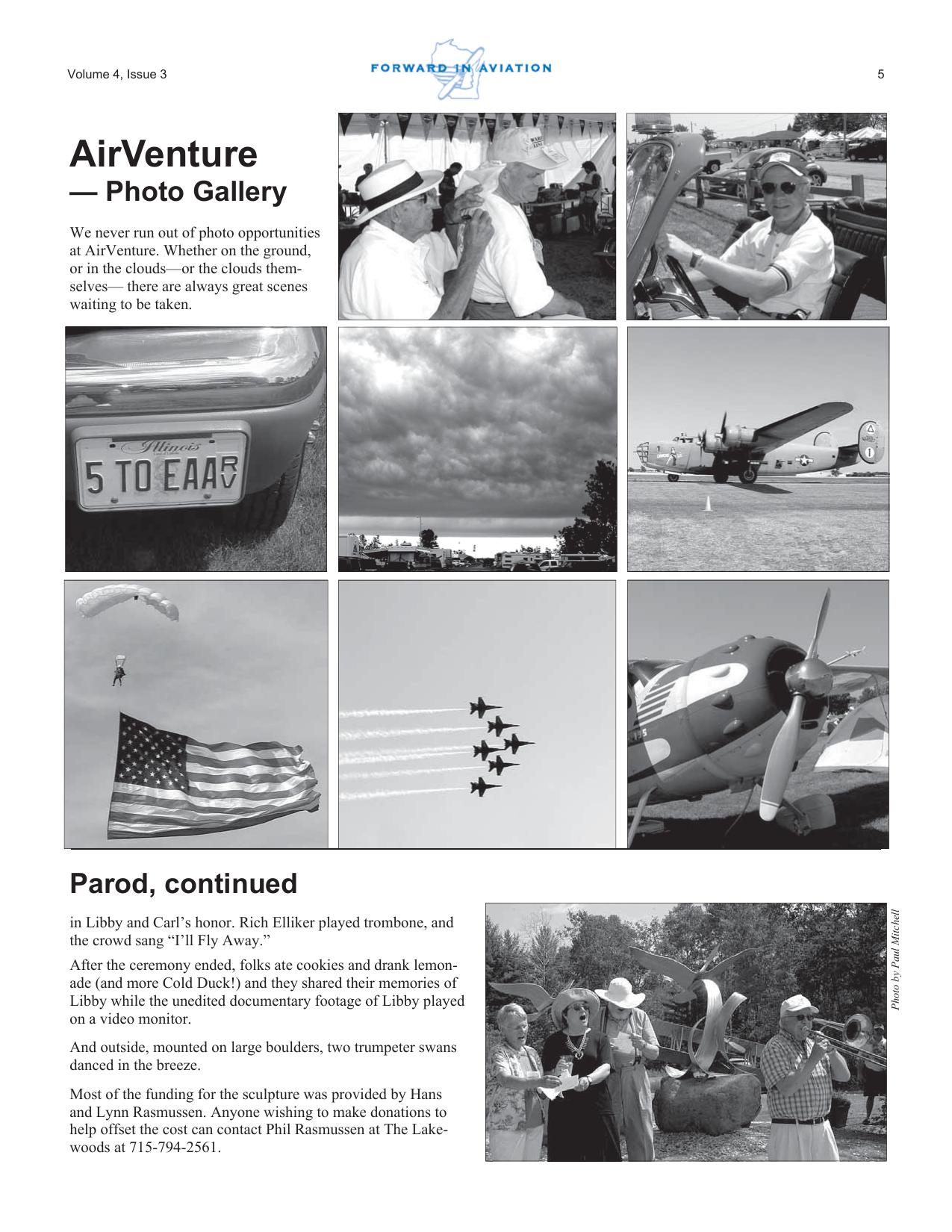
Volume 4, Issue 3 5 AirVenture — Photo Gallery We never run out of photo opportunities at AirVenture. Whether on the ground, or in the clouds—or the clouds themselves— there are always great scenes waiting to be taken. in Libby and Carl’s honor. Rich Elliker played trombone, and the crowd sang “I’ll Fly Away.” After the ceremony ended, folks ate cookies and drank lemonade (and more Cold Duck!) and they shared their memories of Libby while the unedited documentary footage of Libby played on a video monitor. And outside, mounted on large boulders, two trumpeter swans danced in the breeze. Most of the funding for the sculpture was provided by Hans and Lynn Rasmussen. Anyone wishing to make donations to help offset the cost can contact Phil Rasmussen at The Lakewoods at 715-794-2561. Photo by Paul Mitchell Parod, continued
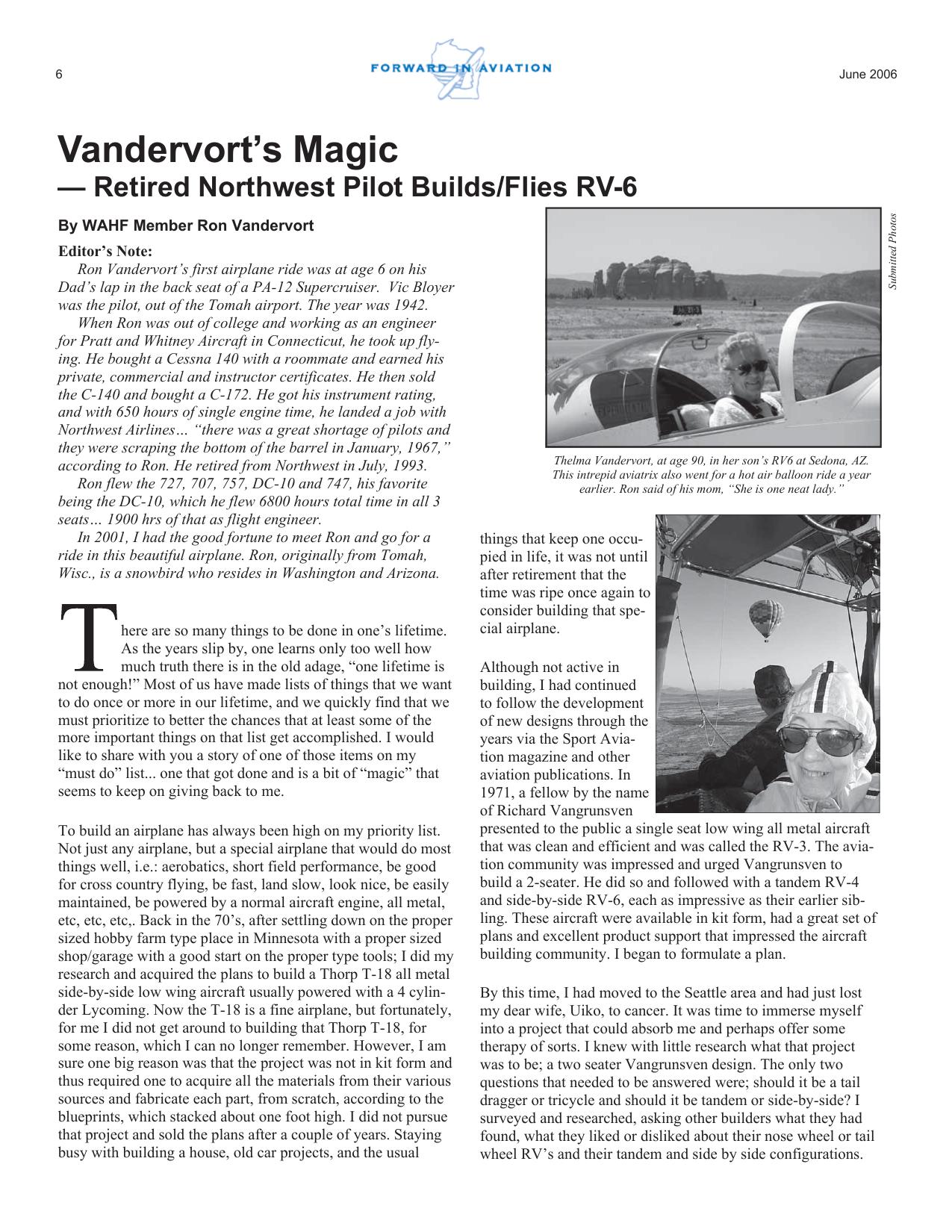
6 June 2006 Vandervort’s Magic Submitted Photos — Retired Northwest Pilot Builds/Flies RV-6 By WAHF Member Ron Vandervort Editor’s Note: Ron Vandervort’s first airplane ride was at age 6 on his Dad’s lap in the back seat of a PA-12 Supercruiser. Vic Bloyer was the pilot, out of the Tomah airport. The year was 1942. When Ron was out of college and working as an engineer for Pratt and Whitney Aircraft in Connecticut, he took up flying. He bought a Cessna 140 with a roommate and earned his private, commercial and instructor certificates. He then sold the C-140 and bought a C-172. He got his instrument rating, and with 650 hours of single engine time, he landed a job with Northwest Airlines… “there was a great shortage of pilots and they were scraping the bottom of the barrel in January, 1967,” according to Ron. He retired from Northwest in July, 1993. Ron flew the 727, 707, 757, DC-10 and 747, his favorite being the DC-10, which he flew 6800 hours total time in all 3 seats… 1900 hrs of that as flight engineer. In 2001, I had the good fortune to meet Ron and go for a ride in this beautiful airplane. Ron, originally from Tomah, Wisc., is a snowbird who resides in Washington and Arizona. here are so many things to be done in one’s lifetime. As the years slip by, one learns only too well how much truth there is in the old adage, “one lifetime is not enough!” Most of us have made lists of things that we want to do once or more in our lifetime, and we quickly find that we must prioritize to better the chances that at least some of the more important things on that list get accomplished. I would like to share with you a story of one of those items on my “must do” list... one that got done and is a bit of “magic” that seems to keep on giving back to me. To build an airplane has always been high on my priority list. Not just any airplane, but a special airplane that would do most things well, i.e.: aerobatics, short field performance, be good for cross country flying, be fast, land slow, look nice, be easily maintained, be powered by a normal aircraft engine, all metal, etc, etc, etc,. Back in the 70’s, after settling down on the proper sized hobby farm type place in Minnesota with a proper sized shop/garage with a good start on the proper type tools; I did my research and acquired the plans to build a Thorp T-18 all metal side-by-side low wing aircraft usually powered with a 4 cylinder Lycoming. Now the T-18 is a fine airplane, but fortunately, for me I did not get around to building that Thorp T-18, for some reason, which I can no longer remember. However, I am sure one big reason was that the project was not in kit form and thus required one to acquire all the materials from their various sources and fabricate each part, from scratch, according to the blueprints, which stacked about one foot high. I did not pursue that project and sold the plans after a couple of years. Staying busy with building a house, old car projects, and the usual Thelma Vandervort, at age 90, in her son’s RV6 at Sedona, AZ. This intrepid aviatrix also went for a hot air balloon ride a year earlier. Ron said of his mom, “She is one neat lady.” things that keep one occupied in life, it was not until after retirement that the time was ripe once again to consider building that special airplane. Although not active in building, I had continued to follow the development of new designs through the years via the Sport Aviation magazine and other aviation publications. In 1971, a fellow by the name of Richard Vangrunsven presented to the public a single seat low wing all metal aircraft that was clean and efficient and was called the RV-3. The aviation community was impressed and urged Vangrunsven to build a 2-seater. He did so and followed with a tandem RV-4 and side-by-side RV-6, each as impressive as their earlier sibling. These aircraft were available in kit form, had a great set of plans and excellent product support that impressed the aircraft building community. I began to formulate a plan. By this time, I had moved to the Seattle area and had just lost my dear wife, Uiko, to cancer. It was time to immerse myself into a project that could absorb me and perhaps offer some therapy of sorts. I knew with little research what that project was to be; a two seater Vangrunsven design. The only two questions that needed to be answered were; should it be a tail dragger or tricycle and should it be tandem or side-by-side? I surveyed and researched, asking other builders what they had found, what they liked or disliked about their nose wheel or tail wheel RV’s and their tandem and side by side configurations.
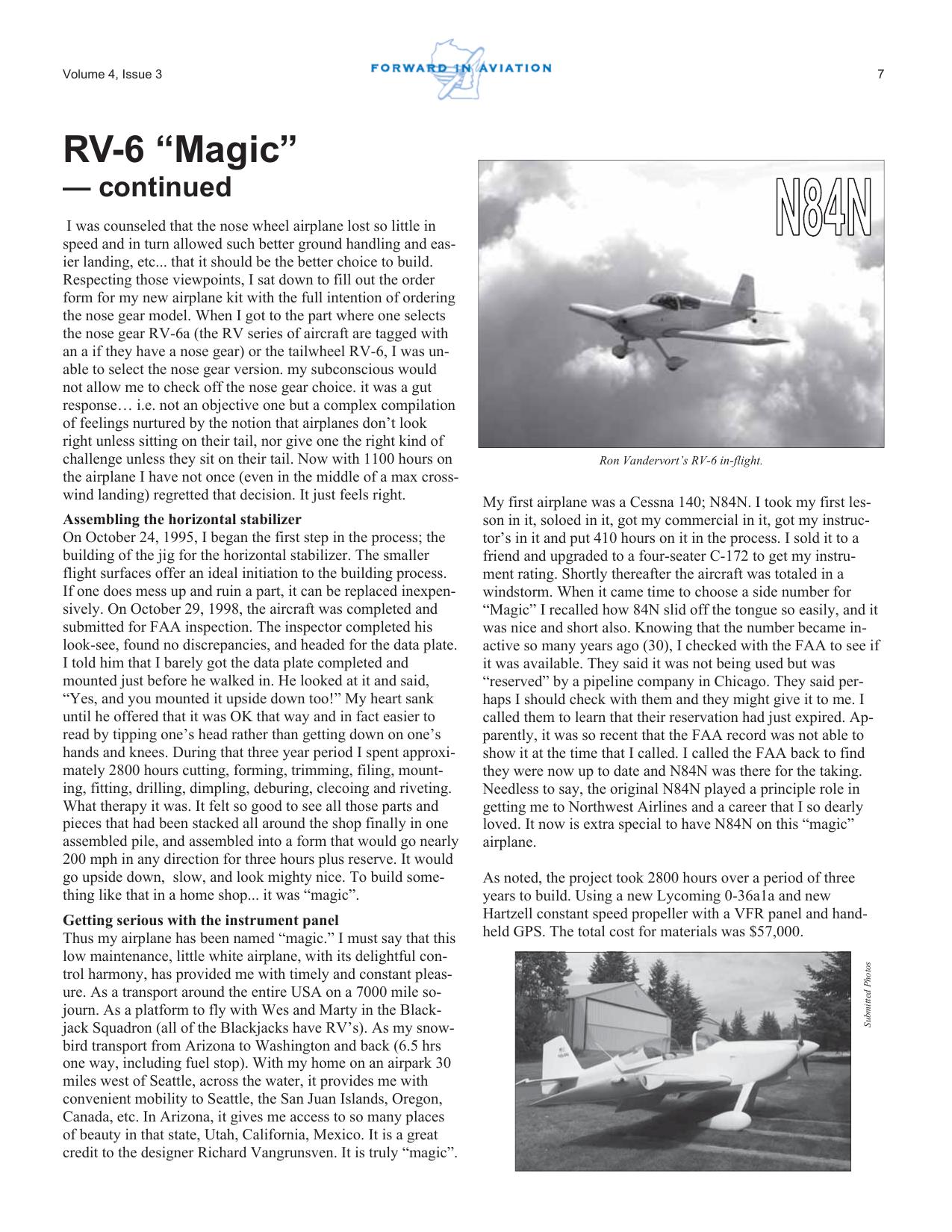
Volume 4, Issue 3 7 RV-6 “Magic” — continued Assembling the horizontal stabilizer On October 24, 1995, I began the first step in the process; the building of the jig for the horizontal stabilizer. The smaller flight surfaces offer an ideal initiation to the building process. If one does mess up and ruin a part, it can be replaced inexpensively. On October 29, 1998, the aircraft was completed and submitted for FAA inspection. The inspector completed his look-see, found no discrepancies, and headed for the data plate. I told him that I barely got the data plate completed and mounted just before he walked in. He looked at it and said, “Yes, and you mounted it upside down too!” My heart sank until he offered that it was OK that way and in fact easier to read by tipping one’s head rather than getting down on one’s hands and knees. During that three year period I spent approximately 2800 hours cutting, forming, trimming, filing, mounting, fitting, drilling, dimpling, deburing, clecoing and riveting. What therapy it was. It felt so good to see all those parts and pieces that had been stacked all around the shop finally in one assembled pile, and assembled into a form that would go nearly 200 mph in any direction for three hours plus reserve. It would go upside down, slow, and look mighty nice. To build something like that in a home shop... it was “magic”. Getting serious with the instrument panel Thus my airplane has been named “magic.” I must say that this low maintenance, little white airplane, with its delightful control harmony, has provided me with timely and constant pleasure. As a transport around the entire USA on a 7000 mile sojourn. As a platform to fly with Wes and Marty in the Blackjack Squadron (all of the Blackjacks have RV’s). As my snowbird transport from Arizona to Washington and back (6.5 hrs one way, including fuel stop). With my home on an airpark 30 miles west of Seattle, across the water, it provides me with convenient mobility to Seattle, the San Juan Islands, Oregon, Canada, etc. In Arizona, it gives me access to so many places of beauty in that state, Utah, California, Mexico. It is a great credit to the designer Richard Vangrunsven. It is truly “magic”. Ron Vandervort’s RV-6 in-flight. My first airplane was a Cessna 140; N84N. I took my first lesson in it, soloed in it, got my commercial in it, got my instructor’s in it and put 410 hours on it in the process. I sold it to a friend and upgraded to a four-seater C-172 to get my instrument rating. Shortly thereafter the aircraft was totaled in a windstorm. When it came time to choose a side number for “Magic” I recalled how 84N slid off the tongue so easily, and it was nice and short also. Knowing that the number became inactive so many years ago (30), I checked with the FAA to see if it was available. They said it was not being used but was “reserved” by a pipeline company in Chicago. They said perhaps I should check with them and they might give it to me. I called them to learn that their reservation had just expired. Apparently, it was so recent that the FAA record was not able to show it at the time that I called. I called the FAA back to find they were now up to date and N84N was there for the taking. Needless to say, the original N84N played a principle role in getting me to Northwest Airlines and a career that I so dearly loved. It now is extra special to have N84N on this “magic” airplane. As noted, the project took 2800 hours over a period of three years to build. Using a new Lycoming 0-36a1a and new Hartzell constant speed propeller with a VFR panel and handheld GPS. The total cost for materials was $57,000. Submitted Photos I was counseled that the nose wheel airplane lost so little in speed and in turn allowed such better ground handling and easier landing, etc... that it should be the better choice to build. Respecting those viewpoints, I sat down to fill out the order form for my new airplane kit with the full intention of ordering the nose gear model. When I got to the part where one selects the nose gear RV-6a (the RV series of aircraft are tagged with an a if they have a nose gear) or the tailwheel RV-6, I was unable to select the nose gear version. my subconscious would not allow me to check off the nose gear choice. it was a gut response… i.e. not an objective one but a complex compilation of feelings nurtured by the notion that airplanes don’t look right unless sitting on their tail, nor give one the right kind of challenge unless they sit on their tail. Now with 1100 hours on the airplane I have not once (even in the middle of a max crosswind landing) regretted that decision. It just feels right.
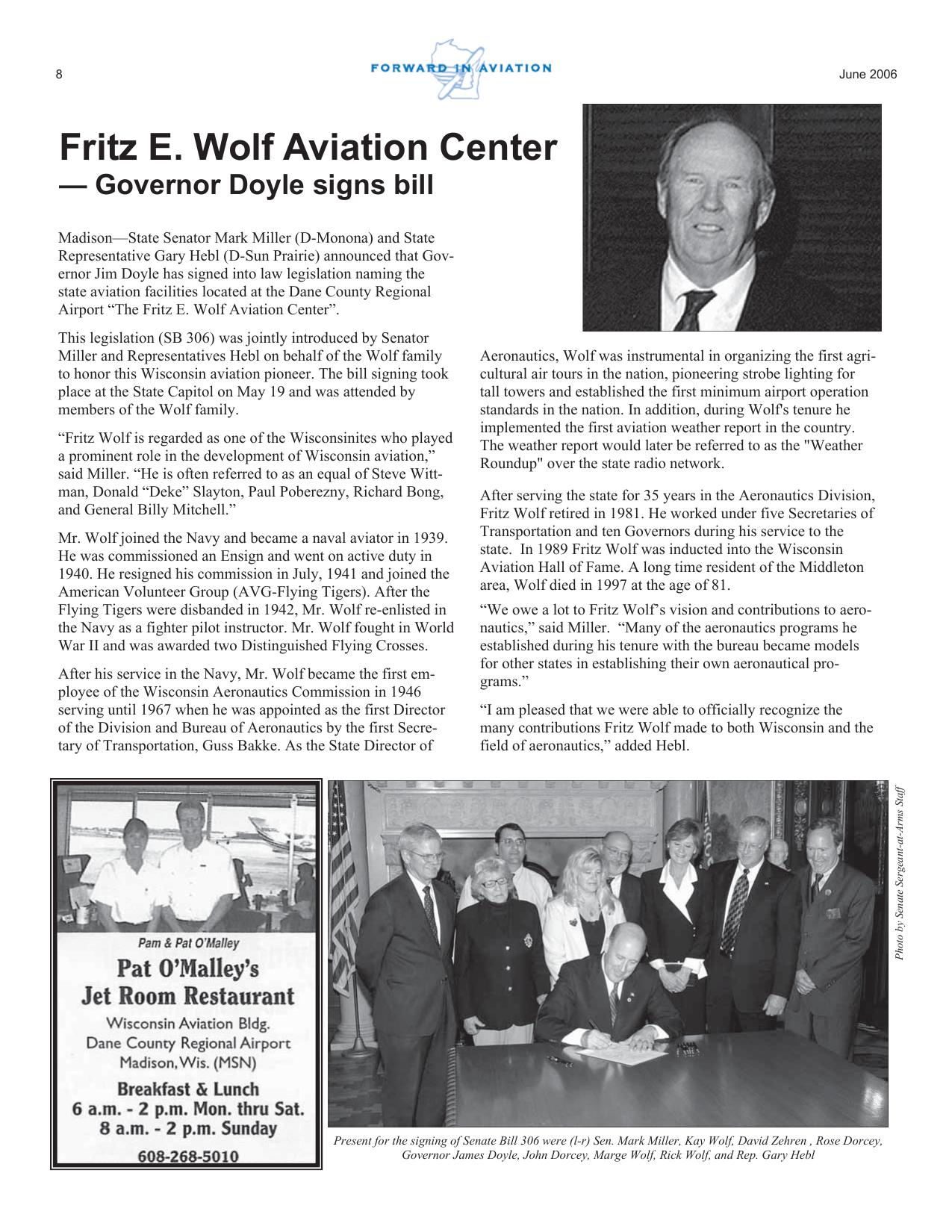
8 June 2006 Fritz E. Wolf Aviation Center — Governor Doyle signs bill Madison—State Senator Mark Miller (D-Monona) and State Representative Gary Hebl (D-Sun Prairie) announced that Governor Jim Doyle has signed into law legislation naming the state aviation facilities located at the Dane County Regional Airport “The Fritz E. Wolf Aviation Center”. This legislation (SB 306) was jointly introduced by Senator Miller and Representatives Hebl on behalf of the Wolf family to honor this Wisconsin aviation pioneer. The bill signing took place at the State Capitol on May 19 and was attended by members of the Wolf family. “Fritz Wolf is regarded as one of the Wisconsinites who played a prominent role in the development of Wisconsin aviation,” said Miller. “He is often referred to as an equal of Steve Wittman, Donald “Deke” Slayton, Paul Poberezny, Richard Bong, and General Billy Mitchell.” Mr. Wolf joined the Navy and became a naval aviator in 1939. He was commissioned an Ensign and went on active duty in 1940. He resigned his commission in July, 1941 and joined the American Volunteer Group (AVG-Flying Tigers). After the Flying Tigers were disbanded in 1942, Mr. Wolf re-enlisted in the Navy as a fighter pilot instructor. Mr. Wolf fought in World War II and was awarded two Distinguished Flying Crosses. After serving the state for 35 years in the Aeronautics Division, Fritz Wolf retired in 1981. He worked under five Secretaries of Transportation and ten Governors during his service to the state. In 1989 Fritz Wolf was inducted into the Wisconsin Aviation Hall of Fame. A long time resident of the Middleton area, Wolf died in 1997 at the age of 81. “We owe a lot to Fritz Wolf’s vision and contributions to aeronautics,” said Miller. “Many of the aeronautics programs he established during his tenure with the bureau became models for other states in establishing their own aeronautical programs.” “I am pleased that we were able to officially recognize the many contributions Fritz Wolf made to both Wisconsin and the field of aeronautics,” added Hebl. Photo by Senate Sergeant-at-Arms Staff After his service in the Navy, Mr. Wolf became the first employee of the Wisconsin Aeronautics Commission in 1946 serving until 1967 when he was appointed as the first Director of the Division and Bureau of Aeronautics by the first Secretary of Transportation, Guss Bakke. As the State Director of Aeronautics, Wolf was instrumental in organizing the first agricultural air tours in the nation, pioneering strobe lighting for tall towers and established the first minimum airport operation standards in the nation. In addition, during Wolf's tenure he implemented the first aviation weather report in the country. The weather report would later be referred to as the "Weather Roundup" over the state radio network. Present for the signing of Senate Bill 306 were (l-r) Sen. Mark Miller, Kay Wolf, David Zehren , Rose Dorcey, Governor James Doyle, John Dorcey, Marge Wolf, Rick Wolf, and Rep. Gary Hebl
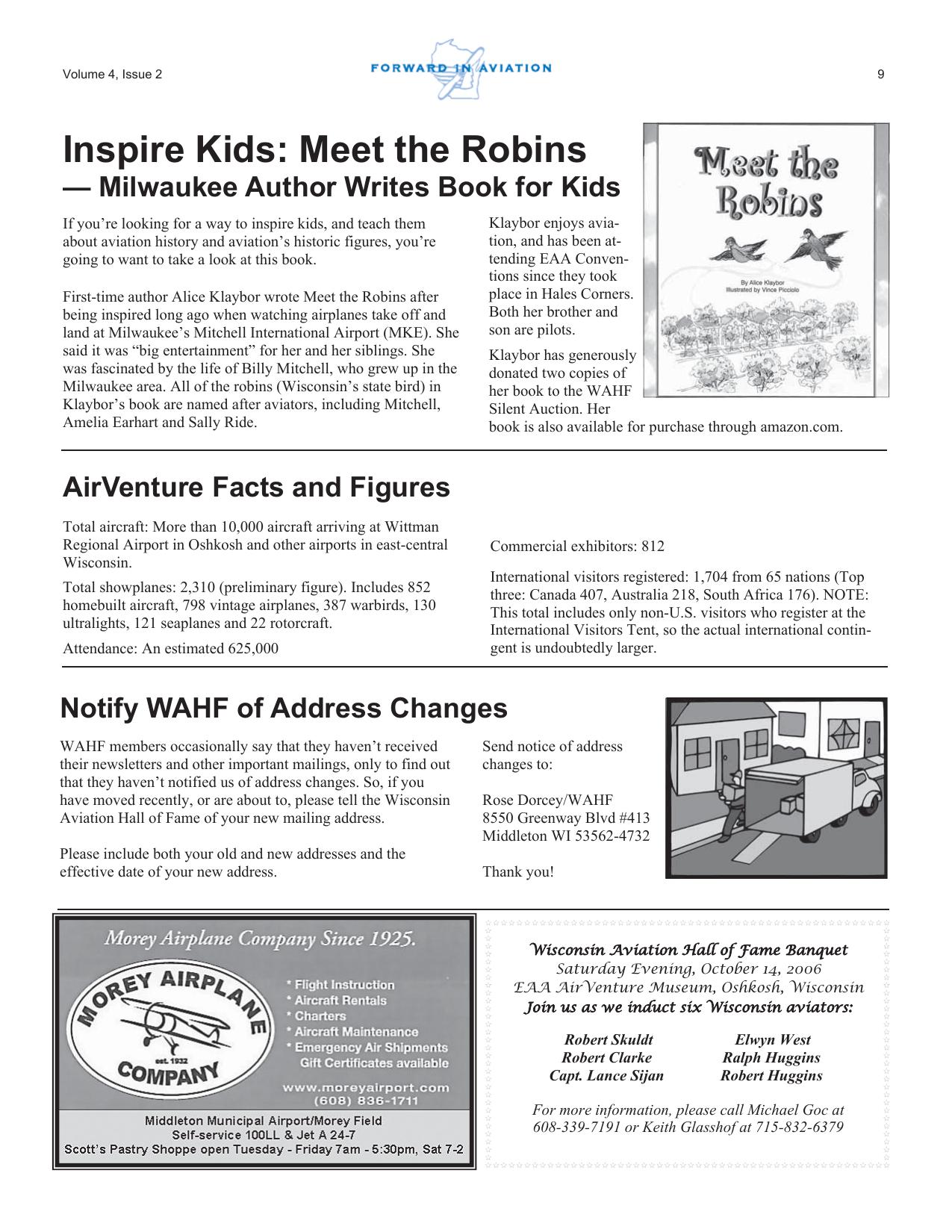
Volume 4, Issue 2 9 Inspire Kids: Meet the Robins — Milwaukee Author Writes Book for Kids If you’re looking for a way to inspire kids, and teach them about aviation history and aviation’s historic figures, you’re going to want to take a look at this book. First-time author Alice Klaybor wrote Meet the Robins after being inspired long ago when watching airplanes take off and land at Milwaukee’s Mitchell International Airport (MKE). She said it was “big entertainment” for her and her siblings. She was fascinated by the life of Billy Mitchell, who grew up in the Milwaukee area. All of the robins (Wisconsin’s state bird) in Klaybor’s book are named after aviators, including Mitchell, Amelia Earhart and Sally Ride. Klaybor enjoys aviation, and has been attending EAA Conventions since they took place in Hales Corners. Both her brother and son are pilots. Klaybor has generously donated two copies of her book to the WAHF Silent Auction. Her book is also available for purchase through amazon.com. AirVenture Facts and Figures Total aircraft: More than 10,000 aircraft arriving at Wittman Regional Airport in Oshkosh and other airports in east-central Wisconsin. Total showplanes: 2,310 (preliminary figure). Includes 852 homebuilt aircraft, 798 vintage airplanes, 387 warbirds, 130 ultralights, 121 seaplanes and 22 rotorcraft. Attendance: An estimated 625,000 Commercial exhibitors: 812 International visitors registered: 1,704 from 65 nations (Top three: Canada 407, Australia 218, South Africa 176). NOTE: This total includes only non-U.S. visitors who register at the International Visitors Tent, so the actual international contingent is undoubtedly larger. Notify WAHF of Address Changes WAHF members occasionally say that they haven’t received their newsletters and other important mailings, only to find out that they haven’t notified us of address changes. So, if you have moved recently, or are about to, please tell the Wisconsin Aviation Hall of Fame of your new mailing address. Please include both your old and new addresses and the effective date of your new address. Send notice of address changes to: Rose Dorcey/WAHF 8550 Greenway Blvd #413 Middleton WI 53562-4732 Thank you! Wisconsin Aviation Hall of Fame Banquet Saturday Evening, October 14, 2006 EAA AirVenture Museum, Oshkosh, Wisconsin Join us as we induct six Wisconsin aviators: Robert Skuldt Robert Clarke Capt. Lance Sijan Elwyn West Ralph Huggins Robert Huggins For more information, please call Michael Goc at 608-339-7191 or Keith Glasshof at 715-832-6379
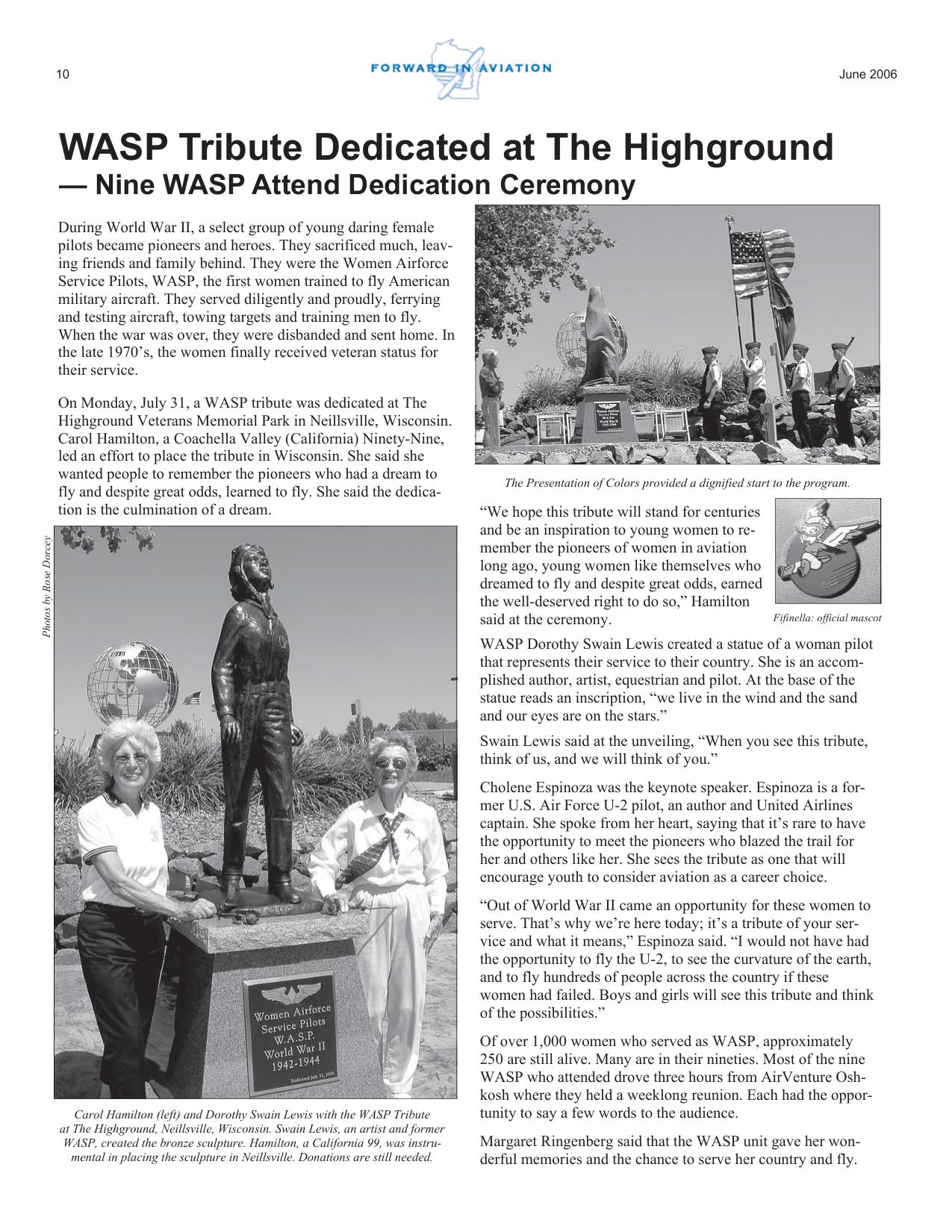
10 June 2006 WASP Tribute Dedicated at The Highground — Nine WASP Attend Dedication Ceremony During World War II, a select group of young daring female pilots became pioneers and heroes. They sacrificed much, leaving friends and family behind. They were the Women Airforce Service Pilots, WASP, the first women trained to fly American military aircraft. They served diligently and proudly, ferrying and testing aircraft, towing targets and training men to fly. When the war was over, they were disbanded and sent home. In the late 1970’s, the women finally received veteran status for their service. Photos by Rose Dorcey On Monday, July 31, a WASP tribute was dedicated at The Highground Veterans Memorial Park in Neillsville, Wisconsin. Carol Hamilton, a Coachella Valley (California) Ninety-Nine, led an effort to place the tribute in Wisconsin. She said she wanted people to remember the pioneers who had a dream to fly and despite great odds, learned to fly. She said the dedication is the culmination of a dream. The Presentation of Colors provided a dignified start to the program. “We hope this tribute will stand for centuries and be an inspiration to young women to remember the pioneers of women in aviation long ago, young women like themselves who dreamed to fly and despite great odds, earned the well-deserved right to do so,” Hamilton Fifinella: official mascot said at the ceremony. WASP Dorothy Swain Lewis created a statue of a woman pilot that represents their service to their country. She is an accomplished author, artist, equestrian and pilot. At the base of the statue reads an inscription, “we live in the wind and the sand and our eyes are on the stars.” Swain Lewis said at the unveiling, “When you see this tribute, think of us, and we will think of you.” Cholene Espinoza was the keynote speaker. Espinoza is a former U.S. Air Force U-2 pilot, an author and United Airlines captain. She spoke from her heart, saying that it’s rare to have the opportunity to meet the pioneers who blazed the trail for her and others like her. She sees the tribute as one that will encourage youth to consider aviation as a career choice. “Out of World War II came an opportunity for these women to serve. That’s why we’re here today; it’s a tribute of your service and what it means,” Espinoza said. “I would not have had the opportunity to fly the U-2, to see the curvature of the earth, and to fly hundreds of people across the country if these women had failed. Boys and girls will see this tribute and think of the possibilities.” Carol Hamilton (left) and Dorothy Swain Lewis with the WASP Tribute at The Highground, Neillsville, Wisconsin. Swain Lewis, an artist and former WASP, created the bronze sculpture. Hamilton, a California 99, was instrumental in placing the sculpture in Neillsville. Donations are still needed. Of over 1,000 women who served as WASP, approximately 250 are still alive. Many are in their nineties. Most of the nine WASP who attended drove three hours from AirVenture Oshkosh where they held a weeklong reunion. Each had the opportunity to say a few words to the audience. Margaret Ringenberg said that the WASP unit gave her wonderful memories and the chance to serve her country and fly.
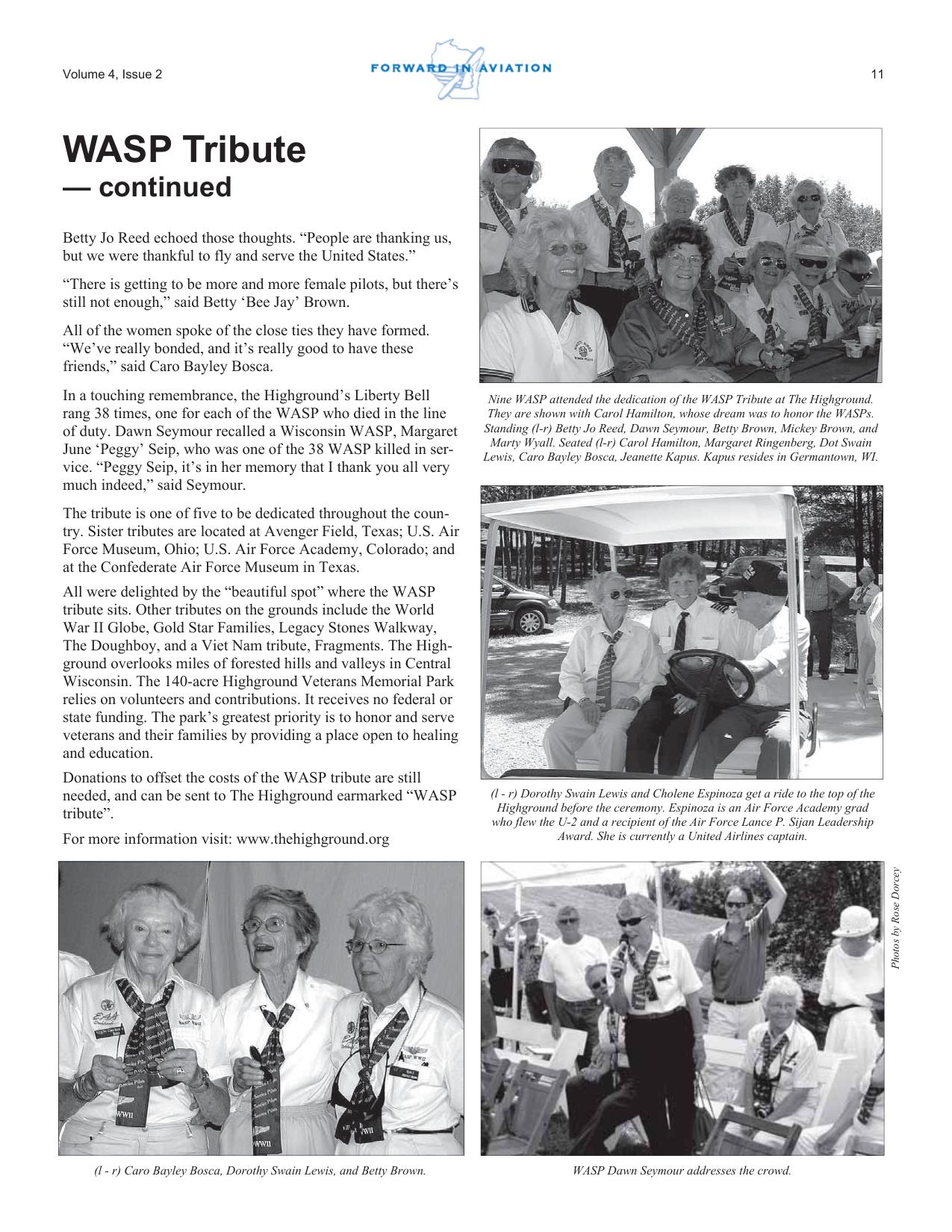
Volume 4, Issue 2 11 WASP Tribute — continued Betty Jo Reed echoed those thoughts. “People are thanking us, but we were thankful to fly and serve the United States.” “There is getting to be more and more female pilots, but there’s still not enough,” said Betty ‘Bee Jay’ Brown. All of the women spoke of the close ties they have formed. “We’ve really bonded, and it’s really good to have these friends,” said Caro Bayley Bosca. In a touching remembrance, the Highground’s Liberty Bell rang 38 times, one for each of the WASP who died in the line of duty. Dawn Seymour recalled a Wisconsin WASP, Margaret June ‘Peggy’ Seip, who was one of the 38 WASP killed in service. “Peggy Seip, it’s in her memory that I thank you all very much indeed,” said Seymour. Nine WASP attended the dedication of the WASP Tribute at The Highground. They are shown with Carol Hamilton, whose dream was to honor the WASPs. Standing (l-r) Betty Jo Reed, Dawn Seymour, Betty Brown, Mickey Brown, and Marty Wyall. Seated (l-r) Carol Hamilton, Margaret Ringenberg, Dot Swain Lewis, Caro Bayley Bosca, Jeanette Kapus. Kapus resides in Germantown, WI. The tribute is one of five to be dedicated throughout the country. Sister tributes are located at Avenger Field, Texas; U.S. Air Force Museum, Ohio; U.S. Air Force Academy, Colorado; and at the Confederate Air Force Museum in Texas. All were delighted by the “beautiful spot” where the WASP tribute sits. Other tributes on the grounds include the World War II Globe, Gold Star Families, Legacy Stones Walkway, The Doughboy, and a Viet Nam tribute, Fragments. The Highground overlooks miles of forested hills and valleys in Central Wisconsin. The 140-acre Highground Veterans Memorial Park relies on volunteers and contributions. It receives no federal or state funding. The park’s greatest priority is to honor and serve veterans and their families by providing a place open to healing and education. Donations to offset the costs of the WASP tribute are still needed, and can be sent to The Highground earmarked “WASP tribute”. Photos by Rose Dorcey For more information visit: www.thehighground.org (l - r) Dorothy Swain Lewis and Cholene Espinoza get a ride to the top of the Highground before the ceremony. Espinoza is an Air Force Academy grad who flew the U-2 and a recipient of the Air Force Lance P. Sijan Leadership Award. She is currently a United Airlines captain. (l - r) Caro Bayley Bosca, Dorothy Swain Lewis, and Betty Brown. WASP Dawn Seymour addresses the crowd.
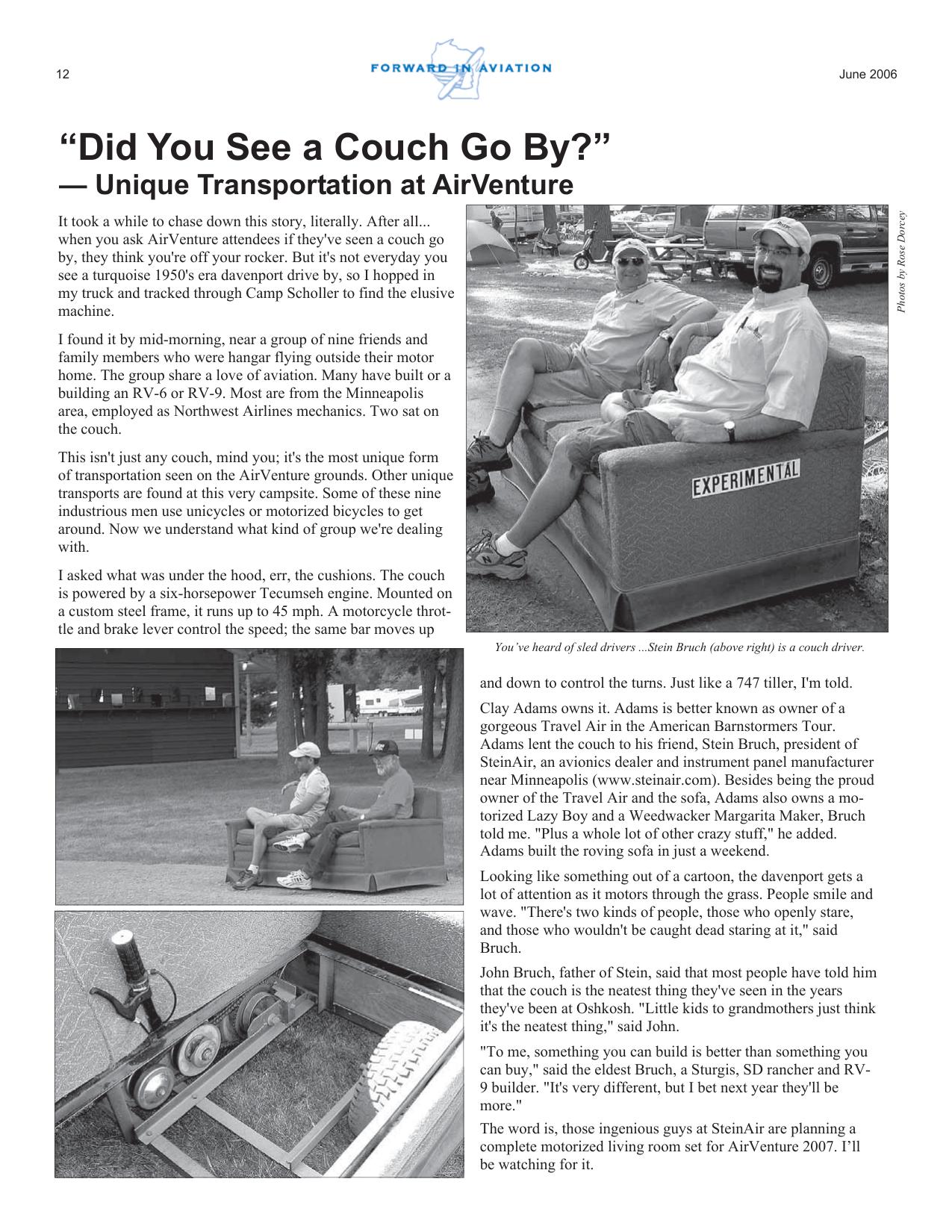
12 June 2006 “Did You See a Couch Go By?” Photos by Rose Dorcey — Unique Transportation at AirVenture It took a while to chase down this story, literally. After all... when you ask AirVenture attendees if they've seen a couch go by, they think you're off your rocker. But it's not everyday you see a turquoise 1950's era davenport drive by, so I hopped in my truck and tracked through Camp Scholler to find the elusive machine. I found it by mid-morning, near a group of nine friends and family members who were hangar flying outside their motor home. The group share a love of aviation. Many have built or a building an RV-6 or RV-9. Most are from the Minneapolis area, employed as Northwest Airlines mechanics. Two sat on the couch. This isn't just any couch, mind you; it's the most unique form of transportation seen on the AirVenture grounds. Other unique transports are found at this very campsite. Some of these nine industrious men use unicycles or motorized bicycles to get around. Now we understand what kind of group we're dealing with. I asked what was under the hood, err, the cushions. The couch is powered by a six-horsepower Tecumseh engine. Mounted on a custom steel frame, it runs up to 45 mph. A motorcycle throttle and brake lever control the speed; the same bar moves up You’ve heard of sled drivers ...Stein Bruch (above right) is a couch driver. and down to control the turns. Just like a 747 tiller, I'm told. Clay Adams owns it. Adams is better known as owner of a gorgeous Travel Air in the American Barnstormers Tour. Adams lent the couch to his friend, Stein Bruch, president of SteinAir, an avionics dealer and instrument panel manufacturer near Minneapolis (www.steinair.com). Besides being the proud owner of the Travel Air and the sofa, Adams also owns a motorized Lazy Boy and a Weedwacker Margarita Maker, Bruch told me. "Plus a whole lot of other crazy stuff," he added. Adams built the roving sofa in just a weekend. Looking like something out of a cartoon, the davenport gets a lot of attention as it motors through the grass. People smile and wave. "There's two kinds of people, those who openly stare, and those who wouldn't be caught dead staring at it," said Bruch. John Bruch, father of Stein, said that most people have told him that the couch is the neatest thing they've seen in the years they've been at Oshkosh. "Little kids to grandmothers just think it's the neatest thing," said John. "To me, something you can build is better than something you can buy," said the eldest Bruch, a Sturgis, SD rancher and RV9 builder. "It's very different, but I bet next year they'll be more." The word is, those ingenious guys at SteinAir are planning a complete motorized living room set for AirVenture 2007. I’ll be watching for it.
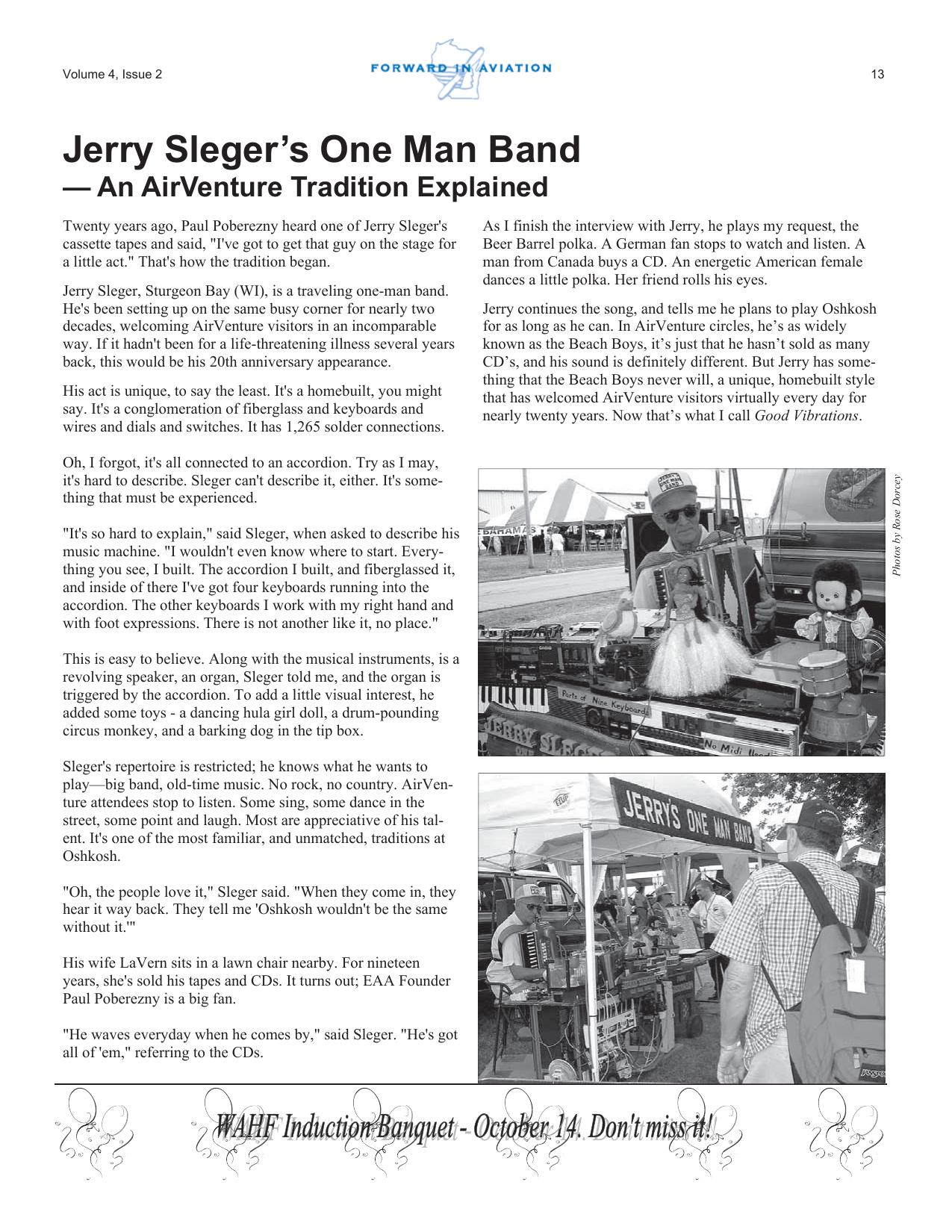
Volume 4, Issue 2 13 Jerry Sleger’s One Man Band — An AirVenture Tradition Explained Jerry Sleger, Sturgeon Bay (WI), is a traveling one-man band. He's been setting up on the same busy corner for nearly two decades, welcoming AirVenture visitors in an incomparable way. If it hadn't been for a life-threatening illness several years back, this would be his 20th anniversary appearance. His act is unique, to say the least. It's a homebuilt, you might say. It's a conglomeration of fiberglass and keyboards and wires and dials and switches. It has 1,265 solder connections. Oh, I forgot, it's all connected to an accordion. Try as I may, it's hard to describe. Sleger can't describe it, either. It's something that must be experienced. "It's so hard to explain," said Sleger, when asked to describe his music machine. "I wouldn't even know where to start. Everything you see, I built. The accordion I built, and fiberglassed it, and inside of there I've got four keyboards running into the accordion. The other keyboards I work with my right hand and with foot expressions. There is not another like it, no place." This is easy to believe. Along with the musical instruments, is a revolving speaker, an organ, Sleger told me, and the organ is triggered by the accordion. To add a little visual interest, he added some toys - a dancing hula girl doll, a drum-pounding circus monkey, and a barking dog in the tip box. Sleger's repertoire is restricted; he knows what he wants to play—big band, old-time music. No rock, no country. AirVenture attendees stop to listen. Some sing, some dance in the street, some point and laugh. Most are appreciative of his talent. It's one of the most familiar, and unmatched, traditions at Oshkosh. "Oh, the people love it," Sleger said. "When they come in, they hear it way back. They tell me 'Oshkosh wouldn't be the same without it.'" His wife LaVern sits in a lawn chair nearby. For nineteen years, she's sold his tapes and CDs. It turns out; EAA Founder Paul Poberezny is a big fan. "He waves everyday when he comes by," said Sleger. "He's got all of 'em," referring to the CDs. As I finish the interview with Jerry, he plays my request, the Beer Barrel polka. A German fan stops to watch and listen. A man from Canada buys a CD. An energetic American female dances a little polka. Her friend rolls his eyes. Jerry continues the song, and tells me he plans to play Oshkosh for as long as he can. In AirVenture circles, he’s as widely known as the Beach Boys, it’s just that he hasn’t sold as many CD’s, and his sound is definitely different. But Jerry has something that the Beach Boys never will, a unique, homebuilt style that has welcomed AirVenture visitors virtually every day for nearly twenty years. Now that’s what I call Good Vibrations. Photos by Rose Dorcey Twenty years ago, Paul Poberezny heard one of Jerry Sleger's cassette tapes and said, "I've got to get that guy on the stage for a little act." That's how the tradition began.
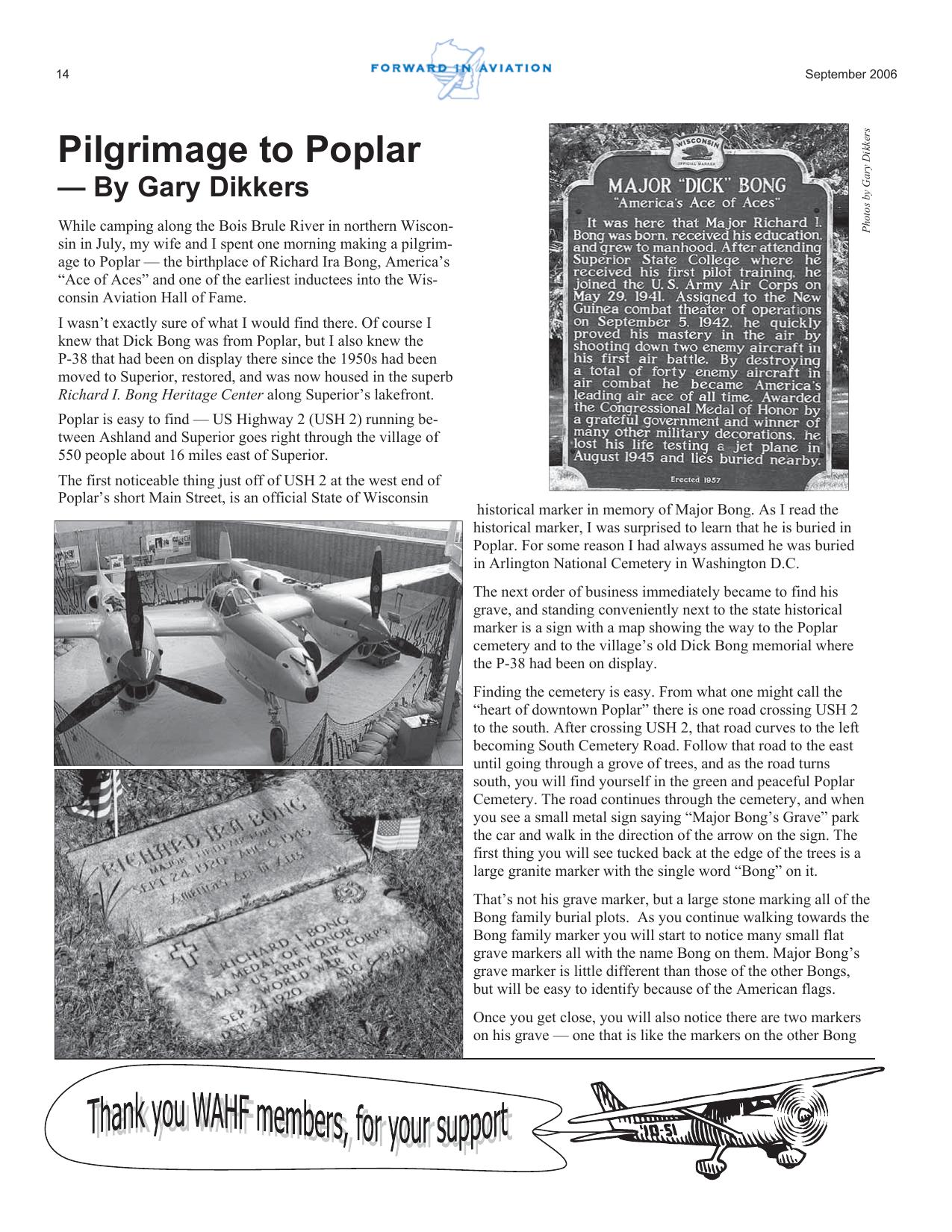
September 2006 Photos by Gary Dikkers 14 Pilgrimage to Poplar — By Gary Dikkers While camping along the Bois Brule River in northern Wisconsin in July, my wife and I spent one morning making a pilgrimage to Poplar — the birthplace of Richard Ira Bong, America’s “Ace of Aces” and one of the earliest inductees into the Wisconsin Aviation Hall of Fame. I wasn’t exactly sure of what I would find there. Of course I knew that Dick Bong was from Poplar, but I also knew the P-38 that had been on display there since the 1950s had been moved to Superior, restored, and was now housed in the superb Richard I. Bong Heritage Center along Superior’s lakefront. Poplar is easy to find — US Highway 2 (USH 2) running between Ashland and Superior goes right through the village of 550 people about 16 miles east of Superior. The first noticeable thing just off of USH 2 at the west end of Poplar’s short Main Street, is an official State of Wisconsin historical marker in memory of Major Bong. As I read the historical marker, I was surprised to learn that he is buried in Poplar. For some reason I had always assumed he was buried in Arlington National Cemetery in Washington D.C. The next order of business immediately became to find his grave, and standing conveniently next to the state historical marker is a sign with a map showing the way to the Poplar cemetery and to the village’s old Dick Bong memorial where the P-38 had been on display. Finding the cemetery is easy. From what one might call the “heart of downtown Poplar” there is one road crossing USH 2 to the south. After crossing USH 2, that road curves to the left becoming South Cemetery Road. Follow that road to the east until going through a grove of trees, and as the road turns south, you will find yourself in the green and peaceful Poplar Cemetery. The road continues through the cemetery, and when you see a small metal sign saying “Major Bong’s Grave” park the car and walk in the direction of the arrow on the sign. The first thing you will see tucked back at the edge of the trees is a large granite marker with the single word “Bong” on it. That’s not his grave marker, but a large stone marking all of the Bong family burial plots. As you continue walking towards the Bong family marker you will start to notice many small flat grave markers all with the name Bong on them. Major Bong’s grave marker is little different than those of the other Bongs, but will be easy to identify because of the American flags. Once you get close, you will also notice there are two markers on his grave — one that is like the markers on the other Bong
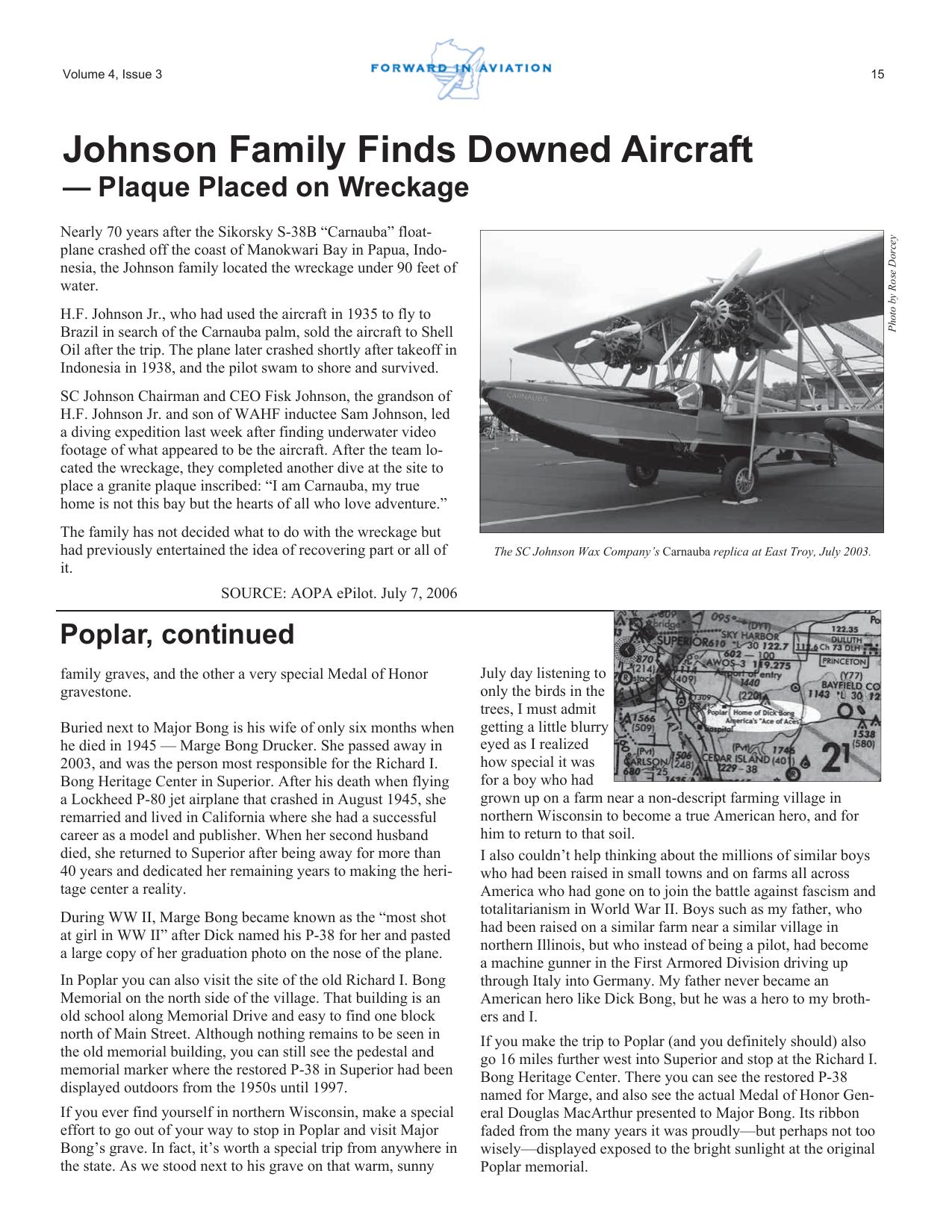
Volume 4, Issue 3 15 Johnson Family Finds Downed Aircraft — Plaque Placed on Wreckage Photo by Rose Dorcey Nearly 70 years after the Sikorsky S-38B “Carnauba” floatplane crashed off the coast of Manokwari Bay in Papua, Indonesia, the Johnson family located the wreckage under 90 feet of water. H.F. Johnson Jr., who had used the aircraft in 1935 to fly to Brazil in search of the Carnauba palm, sold the aircraft to Shell Oil after the trip. The plane later crashed shortly after takeoff in Indonesia in 1938, and the pilot swam to shore and survived. SC Johnson Chairman and CEO Fisk Johnson, the grandson of H.F. Johnson Jr. and son of WAHF inductee Sam Johnson, led a diving expedition last week after finding underwater video footage of what appeared to be the aircraft. After the team located the wreckage, they completed another dive at the site to place a granite plaque inscribed: “I am Carnauba, my true home is not this bay but the hearts of all who love adventure.” The family has not decided what to do with the wreckage but had previously entertained the idea of recovering part or all of it. The SC Johnson Wax Company’s Carnauba replica at East Troy, July 2003. SOURCE: AOPA ePilot. July 7, 2006 Poplar, continued family graves, and the other a very special Medal of Honor gravestone. Buried next to Major Bong is his wife of only six months when he died in 1945 — Marge Bong Drucker. She passed away in 2003, and was the person most responsible for the Richard I. Bong Heritage Center in Superior. After his death when flying a Lockheed P-80 jet airplane that crashed in August 1945, she remarried and lived in California where she had a successful career as a model and publisher. When her second husband died, she returned to Superior after being away for more than 40 years and dedicated her remaining years to making the heritage center a reality. During WW II, Marge Bong became known as the “most shot at girl in WW II” after Dick named his P-38 for her and pasted a large copy of her graduation photo on the nose of the plane. In Poplar you can also visit the site of the old Richard I. Bong Memorial on the north side of the village. That building is an old school along Memorial Drive and easy to find one block north of Main Street. Although nothing remains to be seen in the old memorial building, you can still see the pedestal and memorial marker where the restored P-38 in Superior had been displayed outdoors from the 1950s until 1997. If you ever find yourself in northern Wisconsin, make a special effort to go out of your way to stop in Poplar and visit Major Bong’s grave. In fact, it’s worth a special trip from anywhere in the state. As we stood next to his grave on that warm, sunny July day listening to only the birds in the trees, I must admit getting a little blurry eyed as I realized how special it was for a boy who had grown up on a farm near a non-descript farming village in northern Wisconsin to become a true American hero, and for him to return to that soil. I also couldn’t help thinking about the millions of similar boys who had been raised in small towns and on farms all across America who had gone on to join the battle against fascism and totalitarianism in World War II. Boys such as my father, who had been raised on a similar farm near a similar village in northern Illinois, but who instead of being a pilot, had become a machine gunner in the First Armored Division driving up through Italy into Germany. My father never became an American hero like Dick Bong, but he was a hero to my brothers and I. If you make the trip to Poplar (and you definitely should) also go 16 miles further west into Superior and stop at the Richard I. Bong Heritage Center. There you can see the restored P-38 named for Marge, and also see the actual Medal of Honor General Douglas MacArthur presented to Major Bong. Its ribbon faded from the many years it was proudly—but perhaps not too wisely—displayed exposed to the bright sunlight at the original Poplar memorial.
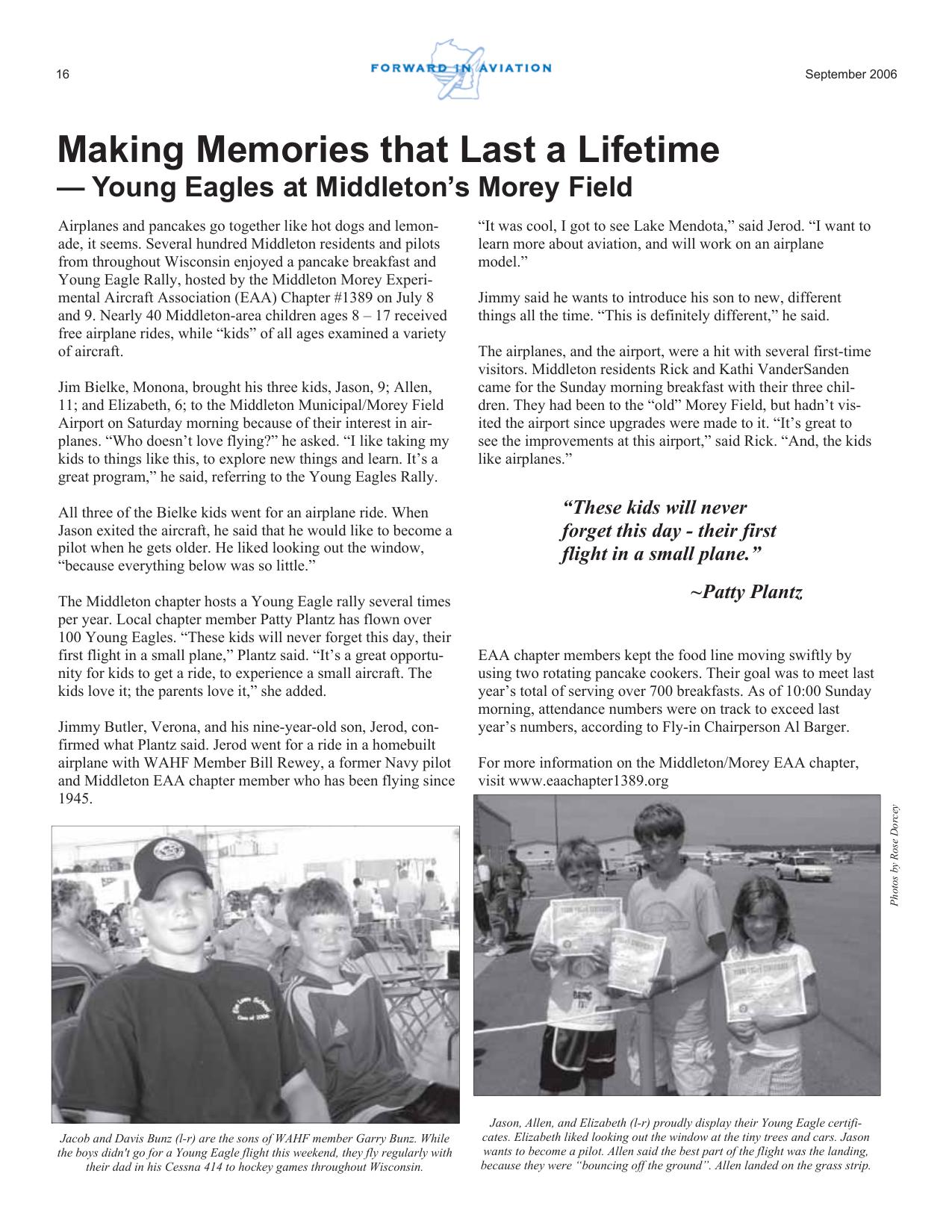
16 September 2006 Making Memories that Last a Lifetime — Young Eagles at Middleton’s Morey Field Jim Bielke, Monona, brought his three kids, Jason, 9; Allen, 11; and Elizabeth, 6; to the Middleton Municipal/Morey Field Airport on Saturday morning because of their interest in airplanes. “Who doesn’t love flying?” he asked. “I like taking my kids to things like this, to explore new things and learn. It’s a great program,” he said, referring to the Young Eagles Rally. All three of the Bielke kids went for an airplane ride. When Jason exited the aircraft, he said that he would like to become a pilot when he gets older. He liked looking out the window, “because everything below was so little.” The Middleton chapter hosts a Young Eagle rally several times per year. Local chapter member Patty Plantz has flown over 100 Young Eagles. “These kids will never forget this day, their first flight in a small plane,” Plantz said. “It’s a great opportunity for kids to get a ride, to experience a small aircraft. The kids love it; the parents love it,” she added. Jimmy Butler, Verona, and his nine-year-old son, Jerod, confirmed what Plantz said. Jerod went for a ride in a homebuilt airplane with WAHF Member Bill Rewey, a former Navy pilot and Middleton EAA chapter member who has been flying since 1945. Jacob and Davis Bunz (l-r) are the sons of WAHF member Garry Bunz. While the boys didn't go for a Young Eagle flight this weekend, they fly regularly with their dad in his Cessna 414 to hockey games throughout Wisconsin. “It was cool, I got to see Lake Mendota,” said Jerod. “I want to learn more about aviation, and will work on an airplane model.” Jimmy said he wants to introduce his son to new, different things all the time. “This is definitely different,” he said. The airplanes, and the airport, were a hit with several first-time visitors. Middleton residents Rick and Kathi VanderSanden came for the Sunday morning breakfast with their three children. They had been to the “old” Morey Field, but hadn’t visited the airport since upgrades were made to it. “It’s great to see the improvements at this airport,” said Rick. “And, the kids like airplanes.” “These kids will never forget this day - their first flight in a small plane.” ~Patty Plantz EAA chapter members kept the food line moving swiftly by using two rotating pancake cookers. Their goal was to meet last year’s total of serving over 700 breakfasts. As of 10:00 Sunday morning, attendance numbers were on track to exceed last year’s numbers, according to Fly-in Chairperson Al Barger. For more information on the Middleton/Morey EAA chapter, visit www.eaachapter1389.org Photos by Rose Dorcey Airplanes and pancakes go together like hot dogs and lemonade, it seems. Several hundred Middleton residents and pilots from throughout Wisconsin enjoyed a pancake breakfast and Young Eagle Rally, hosted by the Middleton Morey Experimental Aircraft Association (EAA) Chapter #1389 on July 8 and 9. Nearly 40 Middleton-area children ages 8 – 17 received free airplane rides, while “kids” of all ages examined a variety of aircraft. Jason, Allen, and Elizabeth (l-r) proudly display their Young Eagle certificates. Elizabeth liked looking out the window at the tiny trees and cars. Jason wants to become a pilot. Allen said the best part of the flight was the landing, because they were “bouncing off the ground”. Allen landed on the grass strip.
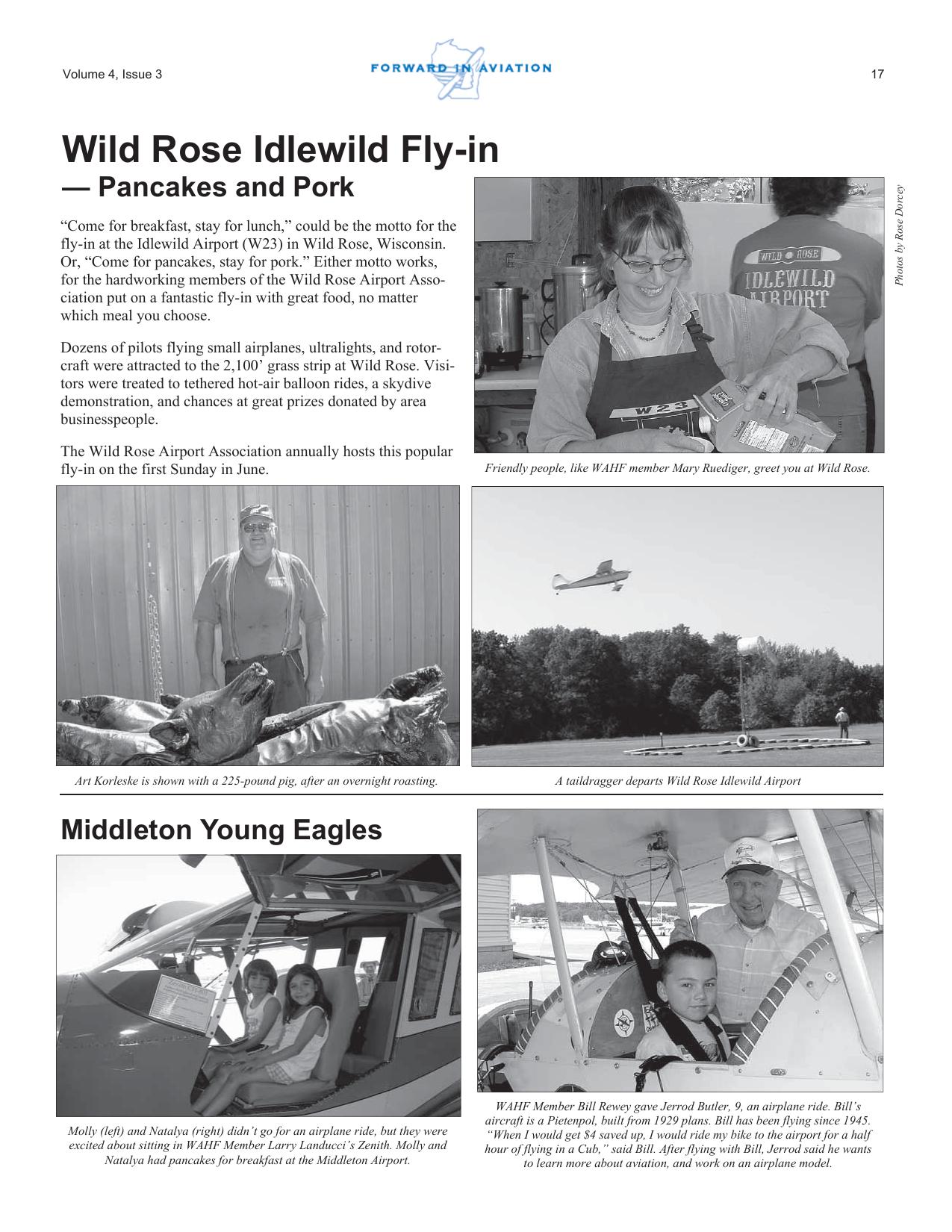
Volume 4, Issue 3 17 Wild Rose Idlewild Fly-in Photos by Rose Dorcey — Pancakes and Pork “Come for breakfast, stay for lunch,” could be the motto for the fly-in at the Idlewild Airport (W23) in Wild Rose, Wisconsin. Or, “Come for pancakes, stay for pork.” Either motto works, for the hardworking members of the Wild Rose Airport Association put on a fantastic fly-in with great food, no matter which meal you choose. Dozens of pilots flying small airplanes, ultralights, and rotorcraft were attracted to the 2,100’ grass strip at Wild Rose. Visitors were treated to tethered hot-air balloon rides, a skydive demonstration, and chances at great prizes donated by area businesspeople. The Wild Rose Airport Association annually hosts this popular fly-in on the first Sunday in June. Friendly people, like WAHF member Mary Ruediger, greet you at Wild Rose. Art Korleske is shown with a 225-pound pig, after an overnight roasting. A taildragger departs Wild Rose Idlewild Airport Middleton Young Eagles Molly (left) and Natalya (right) didn’t go for an airplane ride, but they were excited about sitting in WAHF Member Larry Landucci’s Zenith. Molly and Natalya had pancakes for breakfast at the Middleton Airport. WAHF Member Bill Rewey gave Jerrod Butler, 9, an airplane ride. Bill’s aircraft is a Pietenpol, built from 1929 plans. Bill has been flying since 1945. “When I would get $4 saved up, I would ride my bike to the airport for a half hour of flying in a Cub,” said Bill. After flying with Bill, Jerrod said he wants to learn more about aviation, and work on an airplane model.
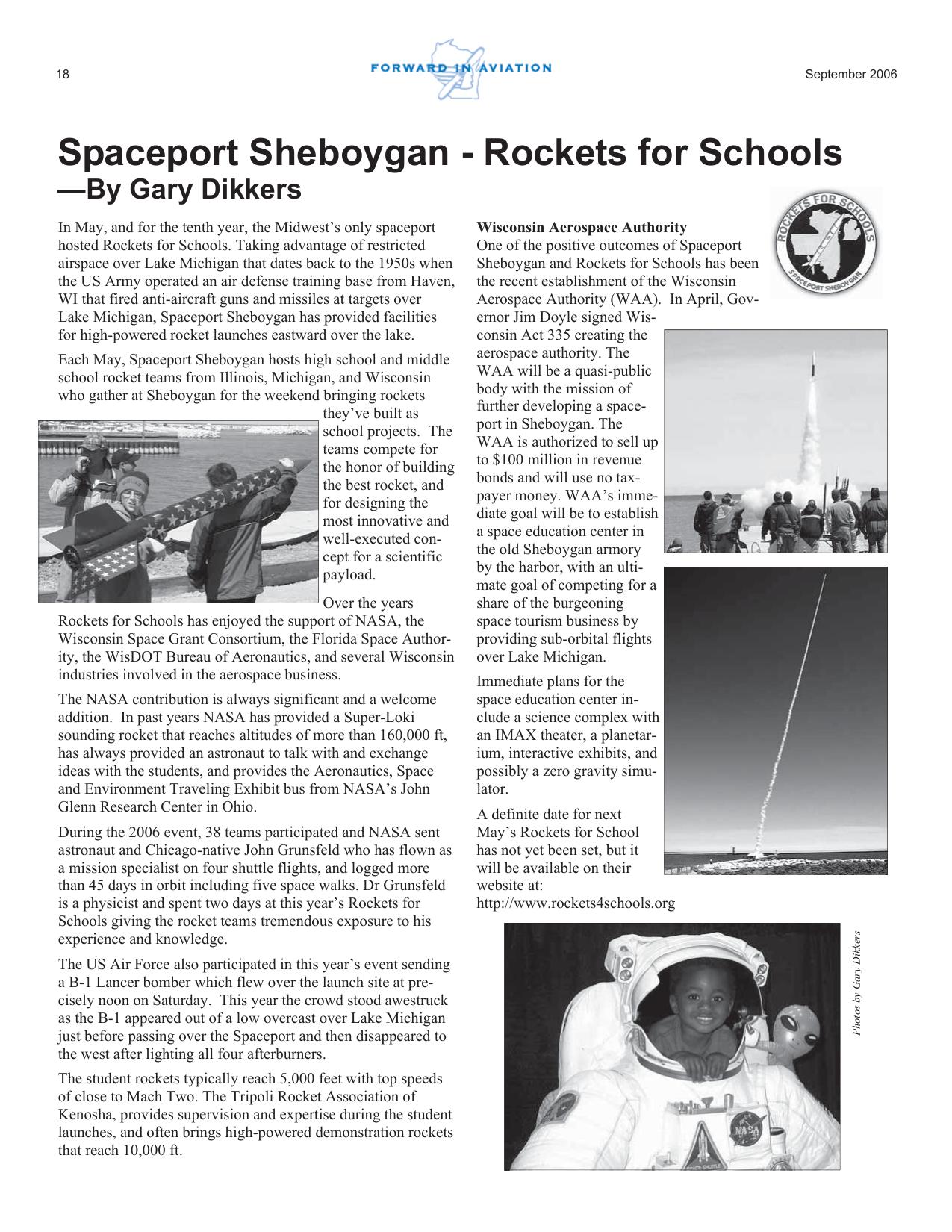
18 September 2006 Spaceport Sheboygan - Rockets for Schools Each May, Spaceport Sheboygan hosts high school and middle school rocket teams from Illinois, Michigan, and Wisconsin who gather at Sheboygan for the weekend bringing rockets they’ve built as school projects. The teams compete for the honor of building the best rocket, and for designing the most innovative and well-executed concept for a scientific payload. Over the years Rockets for Schools has enjoyed the support of NASA, the Wisconsin Space Grant Consortium, the Florida Space Authority, the WisDOT Bureau of Aeronautics, and several Wisconsin industries involved in the aerospace business. The NASA contribution is always significant and a welcome addition. In past years NASA has provided a Super-Loki sounding rocket that reaches altitudes of more than 160,000 ft, has always provided an astronaut to talk with and exchange ideas with the students, and provides the Aeronautics, Space and Environment Traveling Exhibit bus from NASA’s John Glenn Research Center in Ohio. During the 2006 event, 38 teams participated and NASA sent astronaut and Chicago-native John Grunsfeld who has flown as a mission specialist on four shuttle flights, and logged more than 45 days in orbit including five space walks. Dr Grunsfeld is a physicist and spent two days at this year’s Rockets for Schools giving the rocket teams tremendous exposure to his experience and knowledge. The US Air Force also participated in this year’s event sending a B-1 Lancer bomber which flew over the launch site at precisely noon on Saturday. This year the crowd stood awestruck as the B-1 appeared out of a low overcast over Lake Michigan just before passing over the Spaceport and then disappeared to the west after lighting all four afterburners. The student rockets typically reach 5,000 feet with top speeds of close to Mach Two. The Tripoli Rocket Association of Kenosha, provides supervision and expertise during the student launches, and often brings high-powered demonstration rockets that reach 10,000 ft. Wisconsin Aerospace Authority One of the positive outcomes of Spaceport Sheboygan and Rockets for Schools has been the recent establishment of the Wisconsin Aerospace Authority (WAA). In April, Governor Jim Doyle signed Wisconsin Act 335 creating the aerospace authority. The WAA will be a quasi-public body with the mission of further developing a spaceport in Sheboygan. The WAA is authorized to sell up to $100 million in revenue bonds and will use no taxpayer money. WAA’s immediate goal will be to establish a space education center in the old Sheboygan armory by the harbor, with an ultimate goal of competing for a share of the burgeoning space tourism business by providing sub-orbital flights over Lake Michigan. Immediate plans for the space education center include a science complex with an IMAX theater, a planetarium, interactive exhibits, and possibly a zero gravity simulator. A definite date for next May’s Rockets for School has not yet been set, but it will be available on their website at: http://www.rockets4schools.org Photos by Gary Dikkers In May, and for the tenth year, the Midwest’s only spaceport hosted Rockets for Schools. Taking advantage of restricted airspace over Lake Michigan that dates back to the 1950s when the US Army operated an air defense training base from Haven, WI that fired anti-aircraft guns and missiles at targets over Lake Michigan, Spaceport Sheboygan has provided facilities for high-powered rocket launches eastward over the lake. Photo by Rose Dorcey —By Gary Dikkers
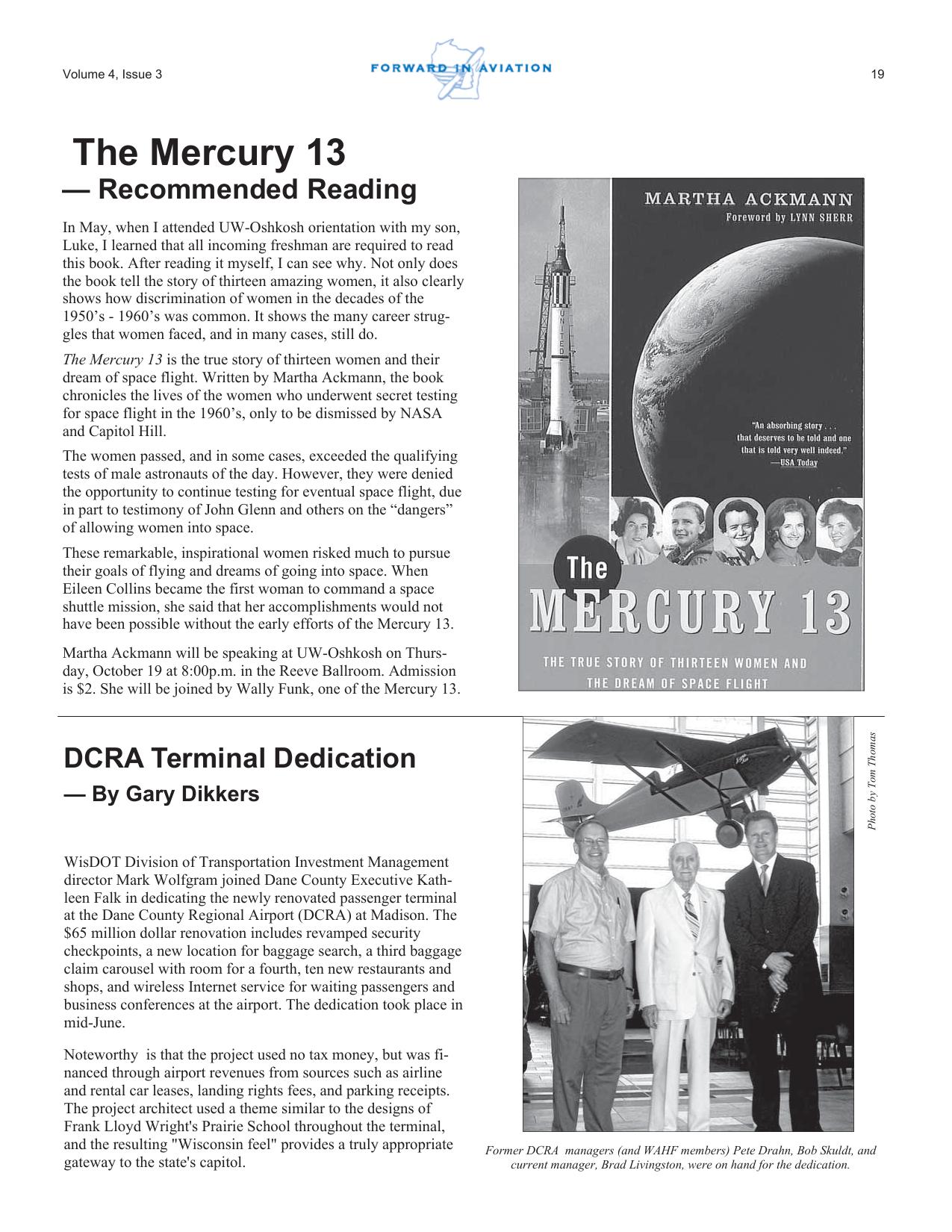
Volume 4, Issue 3 19 The Mercury 13 — Recommended Reading In May, when I attended UW-Oshkosh orientation with my son, Luke, I learned that all incoming freshman are required to read this book. After reading it myself, I can see why. Not only does the book tell the story of thirteen amazing women, it also clearly shows how discrimination of women in the decades of the 1950’s - 1960’s was common. It shows the many career struggles that women faced, and in many cases, still do. The Mercury 13 is the true story of thirteen women and their dream of space flight. Written by Martha Ackmann, the book chronicles the lives of the women who underwent secret testing for space flight in the 1960’s, only to be dismissed by NASA and Capitol Hill. The women passed, and in some cases, exceeded the qualifying tests of male astronauts of the day. However, they were denied the opportunity to continue testing for eventual space flight, due in part to testimony of John Glenn and others on the “dangers” of allowing women into space. These remarkable, inspirational women risked much to pursue their goals of flying and dreams of going into space. When Eileen Collins became the first woman to command a space shuttle mission, she said that her accomplishments would not have been possible without the early efforts of the Mercury 13. DCRA Terminal Dedication — By Gary Dikkers Photo by Tom Thomas Martha Ackmann will be speaking at UW-Oshkosh on Thursday, October 19 at 8:00p.m. in the Reeve Ballroom. Admission is $2. She will be joined by Wally Funk, one of the Mercury 13. WisDOT Division of Transportation Investment Management director Mark Wolfgram joined Dane County Executive Kathleen Falk in dedicating the newly renovated passenger terminal at the Dane County Regional Airport (DCRA) at Madison. The $65 million dollar renovation includes revamped security checkpoints, a new location for baggage search, a third baggage claim carousel with room for a fourth, ten new restaurants and shops, and wireless Internet service for waiting passengers and business conferences at the airport. The dedication took place in mid-June. Noteworthy is that the project used no tax money, but was financed through airport revenues from sources such as airline and rental car leases, landing rights fees, and parking receipts. The project architect used a theme similar to the designs of Frank Lloyd Wright's Prairie School throughout the terminal, and the resulting "Wisconsin feel" provides a truly appropriate gateway to the state's capitol. Former DCRA managers (and WAHF members) Pete Drahn, Bob Skuldt, and current manager, Brad Livingston, were on hand for the dedication.
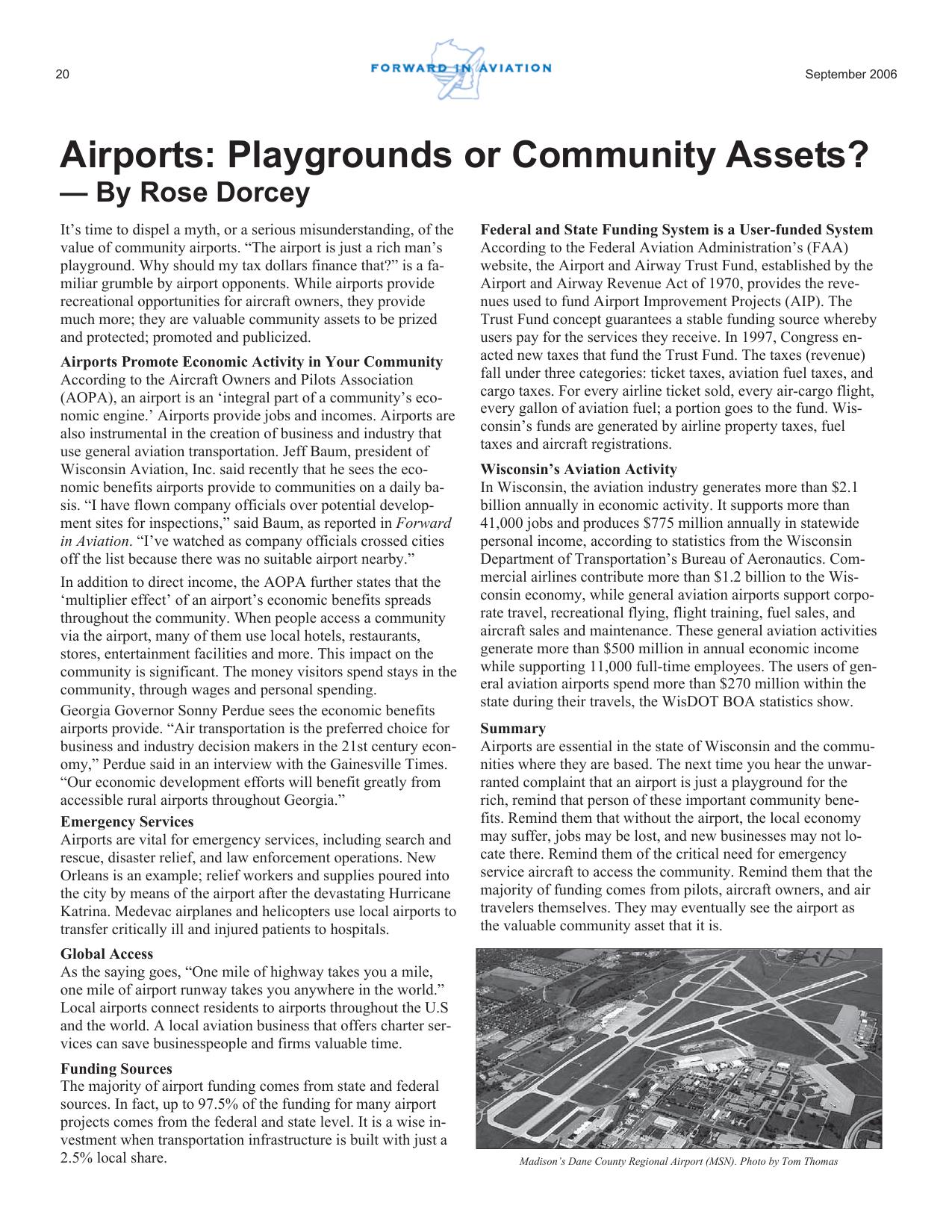
20 September 2006 Airports: Playgrounds or Community Assets? — By Rose Dorcey It’s time to dispel a myth, or a serious misunderstanding, of the value of community airports. “The airport is just a rich man’s playground. Why should my tax dollars finance that?” is a familiar grumble by airport opponents. While airports provide recreational opportunities for aircraft owners, they provide much more; they are valuable community assets to be prized and protected; promoted and publicized. Airports Promote Economic Activity in Your Community According to the Aircraft Owners and Pilots Association (AOPA), an airport is an ‘integral part of a community’s economic engine.’ Airports provide jobs and incomes. Airports are also instrumental in the creation of business and industry that use general aviation transportation. Jeff Baum, president of Wisconsin Aviation, Inc. said recently that he sees the economic benefits airports provide to communities on a daily basis. “I have flown company officials over potential development sites for inspections,” said Baum, as reported in Forward in Aviation. “I’ve watched as company officials crossed cities off the list because there was no suitable airport nearby.” In addition to direct income, the AOPA further states that the ‘multiplier effect’ of an airport’s economic benefits spreads throughout the community. When people access a community via the airport, many of them use local hotels, restaurants, stores, entertainment facilities and more. This impact on the community is significant. The money visitors spend stays in the community, through wages and personal spending. Georgia Governor Sonny Perdue sees the economic benefits airports provide. “Air transportation is the preferred choice for business and industry decision makers in the 21st century economy,” Perdue said in an interview with the Gainesville Times. “Our economic development efforts will benefit greatly from accessible rural airports throughout Georgia.” Emergency Services Airports are vital for emergency services, including search and rescue, disaster relief, and law enforcement operations. New Orleans is an example; relief workers and supplies poured into the city by means of the airport after the devastating Hurricane Katrina. Medevac airplanes and helicopters use local airports to transfer critically ill and injured patients to hospitals. Federal and State Funding System is a User-funded System According to the Federal Aviation Administration’s (FAA) website, the Airport and Airway Trust Fund, established by the Airport and Airway Revenue Act of 1970, provides the revenues used to fund Airport Improvement Projects (AIP). The Trust Fund concept guarantees a stable funding source whereby users pay for the services they receive. In 1997, Congress enacted new taxes that fund the Trust Fund. The taxes (revenue) fall under three categories: ticket taxes, aviation fuel taxes, and cargo taxes. For every airline ticket sold, every air-cargo flight, every gallon of aviation fuel; a portion goes to the fund. Wisconsin’s funds are generated by airline property taxes, fuel taxes and aircraft registrations. Wisconsin’s Aviation Activity In Wisconsin, the aviation industry generates more than $2.1 billion annually in economic activity. It supports more than 41,000 jobs and produces $775 million annually in statewide personal income, according to statistics from the Wisconsin Department of Transportation’s Bureau of Aeronautics. Commercial airlines contribute more than $1.2 billion to the Wisconsin economy, while general aviation airports support corporate travel, recreational flying, flight training, fuel sales, and aircraft sales and maintenance. These general aviation activities generate more than $500 million in annual economic income while supporting 11,000 full-time employees. The users of general aviation airports spend more than $270 million within the state during their travels, the WisDOT BOA statistics show. Summary Airports are essential in the state of Wisconsin and the communities where they are based. The next time you hear the unwarranted complaint that an airport is just a playground for the rich, remind that person of these important community benefits. Remind them that without the airport, the local economy may suffer, jobs may be lost, and new businesses may not locate there. Remind them of the critical need for emergency service aircraft to access the community. Remind them that the majority of funding comes from pilots, aircraft owners, and air travelers themselves. They may eventually see the airport as the valuable community asset that it is. Global Access As the saying goes, “One mile of highway takes you a mile, one mile of airport runway takes you anywhere in the world.” Local airports connect residents to airports throughout the U.S and the world. A local aviation business that offers charter services can save businesspeople and firms valuable time. Funding Sources The majority of airport funding comes from state and federal sources. In fact, up to 97.5% of the funding for many airport projects comes from the federal and state level. It is a wise investment when transportation infrastructure is built with just a 2.5% local share. Madison’s Dane County Regional Airport (MSN). Photo by Tom Thomas
Volume 4, Issue 3 21 64th Doolittle Raiders Reunion — By Chuck Marotske Wright Patterson Air Force Base, Ohio. April 17 - 20th, 2006. Eight men of the Doolittle Raiders came to Wright Patterson Air Force Base (WPAFB) to honor those who flew over Japan on April 18, 1942. Seven Raiders could not attend because of their health. The eight men who attended were Richard Cole, Ed Horton, Dave Thatcher, Frank Kappler, Chase Nielsen, Bill Bower, and Tom Griffin, of Green Bay, Wisconsin. Honorary members present were Tung-Sheng Liu, China; Carroll Glines, historian/ writer; Stan Cohen, writer; John Doolittle, son of James Doolittle; and John Doolittle III, son on John. On April 18, memorial services were held outdoors at the Memorial Park at the WPAFB museum. Over 200 people came to the service. Under sunny skies and 70 degree temperatures, a wreath was laid at the Doolittle Raiders Monument. ROTC cadets sang the Star Spangled Banner, and the Air Force Color Guard was present. The ceremony also included a prayer by an Air Force chaplain, and speeches by the museum director and by Chase Nielsen, the Doolittle Raiders’ spokesperson. The following day, the Commemorative Goblet Ceremony took place. Eighty goblets, each engraved with the name of a Doolittle Raider, honor the men who took part in the raid. Goblets of those who have “gone west” in the previous year have their goblets turned upside down. Sixty-five men of the original eighty have passed away. The goblets were previously on display at the Air Force Academy; now they are on permanent display at the Air Force Museum. On both days, the tired but appreciative Raiders signed autographs, for as long as three hours per day so that each participate could get one. They did it for the people. Over 600 people attended dinner with the Raiders on April 19. The Star Spangled Banner was sung again, along with prayer by an Air Force chaplain. Raiders walked to their tables with their wives. Col. CV Glines, ret., talked about each Raider in attendance. The Air Force band dressed in World War II uniforms and played Glenn Miller music throughout the evening. I had the opportunity to stay at the Hope Hotel on base, and talk with some of the Raiders. I also spoke with Tom Stafford. Tom was with Deke Slayton on Apollo-Soyez missions with the Russians. The 65th Doolittle Raider Reunion will be held in April, 2007 in San Antonio, Texas. Meet Friends, Honor Inductees at WAHF Banquet Invitations will go out soon, and the public is welcome. Please bring a friend! Oshkosh hotels offer discounts; invitations and other information will be sent soon. Volunteer opportunities are available, and donations are needed for the silent auction. Please lend a hand to enhance this event. For more information, call Keith Glasshof at 715-832-6379 or Rose Dorcey at 715-421-0055. Tom Thomas took this photo of a B-17 on the ramp in Madison, WI. A Young Eagle over Madison, WI. Note Badger’s Stadium through the window. Photos by Tom Thomas Make reservations now, and plan to attend the Wisconsin Aviation Hall of Fame induction banquet on October 14. The event is held in the Eagle Hangar of the EAA Museum. It begins with a lively social hour and silent auction, followed by a catered dinner. At 7:00, the honors begin. Two WAHF Scholarships will be awarded, and six aviators will be honored for their achievements. The event usually wraps up by 9:00. Send us your news! Are you a WAHF member who has news to share? Don’t be shy, share it with us. Send press releases and news of your activities, check rides, retirements, flying adventures, etc… to: Rose Dorcey 8550 Greenway Blvd #413 Middleton WI 53562-4732 or send an e-mail to rosesroses@charter.net
22 September 2006 On the Road with WAHF — In Eagle River with the New Northwoods 99s A group of female pilots are hoping that a 99s chapter in Michigan north of the Mackinaw bridge will give Northwoods women pilots in the UP, Canada, and northern Wisconsin the opportunity to build friendships and have fun flying. The Ninety-Nines are the International Organization of Women Pilots. The organization chartered in 1929; Amelia Earhart was the first president. The Ninety-Nines are named in honor of the 99 women who signed its charter. The oldest internationally chartered pilot organization in the world, it has grown to over 6,000 members. THE GOALS OF THE 99s ♦ To promote friendships with other women who fly or want to fly, through flying activities, conventions, and meetings. Lynn Sykes (right) serves as a mentor for student pilot Angela Tomasi. ♦ ♦ To provide scholarships for female flyers. The Amelia Earhart trust has over two million dollars set aside for that purpose. Recipients have used the scholarship for obtaining private pilot certificates all the way up to type ratings for complex aircraft. 99s members also provide aviation education for local communities. To preserve the unique history of women in aviation. The 99s own two museums, in Oklahoma and Kansas. WHY A PILOT ORGANIZATION FOR WOMEN? There are obstacles that are unique to women who fly. This natural part of women sharing with and encouraging women is particularly useful since women fly in what is predominately a man's world. Less than 6% of the total pilot population is female. Female role models and mentors are found in The 99s. Michigan has had a Ninety-Nines Chapter for nearly 75 years, according to Northwoods charter organizer Marcelaine Lewis of Houghton, Michigan. However, most of the activities take place in the Pontiac and thumb areas of the state, she said. “Traveling downstate is time and cost prohibitive, with some meetings a 10 – 12 hour drive. Often weather and the expense will not allow a flight.” “Organizing a Northwoods 99s Chapter will give female flyers in the Upper Peninsula and northern Wisconsin opportunities to associate with other aviatrixes,” said Lewis. “Student pilots, especially, need the support, guidance, and encouragement of other women. Flying activities are the basis of the friendships that they form with experienced female aviators. Being a 99s member guarantees acceptance, regardless of experience level. The Ninety-Nines are the ‘Good Old Girls’ network.” The female pilots of the Northwoods are active in aviation. “Two years ago, Lynn Sykes organized a compass rose painting at Sawyer International Airport (SAW),” Lewis continued. “Last year, we painted one at Houghton. A Northwoods chapter will help the Ninety-Nines grow by expanding membership to those who otherwise would not join.” The first Northwoods Ninety-Nines organizational meeting took place Saturday, May 20 in Houghton. Another organizational meeting took place in Marquette, Michigan on June 17. On July 15, a hot Saturday afternoon, another meeting took place in Eagle River, Wisconsin. Over a dozen Northwoods women attended. Rose Dorcey, president of the Wisconsin Aviation Hall of Fame, was the guest speaker. HOW TO JOIN THE NORTHWOODS 99s Charter members of the Northwoods 99s met recently for an organizational meeting at the Eagle River Inn in Eagle River, Wisconsin. (Back row, left - right) Darlene Basto, Angela Tomasi, Jennifer Nykkonen, Jeffrey Dohrenwend, Kathy Swanson, Cindy Brew. (Front Row, l - r) Pam Trask, Rose Dorcey, Marcelaine Lewis, Lynn Sykes, Eloise Greenlee Future women pilots, those with a student medical certificate, can join. Licensed female pilots can join even if no longer current or without a medical certificate. “Please share this information with female flyers in northern Wisconsin so they can join our Northwoods Charter,” Lewis exclaimed. Contact Marcelaine Lewis in Houghton at 906-487-7180 or Lynn Sykes in Marquette at 906-362-5966.
Volume 4, Issue 3 23 — Very Special Audience at AirVenture John and Rose Dorcey presented the forum, Lance Sijan: An American Hero at AirVenture at 7:00 on Thursday evening. While attendance was low, at just less than a dozen, several WAHF members came, along with one very special individual. Janine Rozina, sister of Lance Sijan, drove from Milwaukee specifically to hear the presentation. John and Rose were honored to meet Janine, to learn more about her life and the life of her brother, and to give a short but informative tour of the AirVenture grounds. WAHF Member Tom Thomas, an EAA Government Relations volunteer, along with the Dorceys and Dave Weiman, showed Janine the aircraft that Lance flew, and other aircraft important in the war effort. They explained many of the AirVenture activities in hopes that she’ll return in 2007. Milwaukee-native Lance Sijan is the only Air Force Academy graduate to receive the Congressional Medal of Honor. Sijan became known for his extraordinary evasion and escape from capture, and heroism in the Hanoi Hilton. He died on January 22, 1968. Senator John McCain has called Lance Sijan his hero. He is a hero to Janine, as well. Sijan will be inducted into the Wisconsin Aviation Hall of Fame on October 14 in Oshkosh. Photo by Tom Thomas Lance Sijan: An American Hero On Wednesday evening, the Dorceys also presented Snapshots of Wisconsin Aviation History, an ongoing presentation that highlights the accomplishments of several Wisconsin aviators. They gave Rose Dorcey, Janine Sijan Rozina, and John Dorcey after the Saturday evening forum Lance two radio presentaSijan: An American Hero. Lance’s Air Force tions on WOSH and Academy photo is shown in the background. EAA Radio, to promote the AirVenture presentations, the organization, and the October 14 induction banquet. UW-PEOPLE Program Four members of the Wisconsin Aviation Hall of Fame recently took part in the UW-Madison's PEOPLE program. In the classroom or in the air, these students learned a lot about aviation. The four WAHF members, all employees of the WisDOT’s Bureau of Aeronautics, provided a series of enrichment classes on aviation. At this summer's sessions BOA Aviation Consultants Jeff Taylor and John Dorcey taught classes on the principles of flight, aviation weather, and the history of aviation, while Airspace Manager Gary Dikkers taught a class on navigation, mapping, and charting. The grand finale of the program were introductory flights by Tom Thomas in a UW Flying Club owned Cessna 172. Editor’s Note: Thanks to Gary Dikkers for providing information for this article. Ask your friends to join the Wisconsin Aviation Hall of Fame! Photos by Gary Dikkers The PEOPLE program, or Pre-College Enrichment Opportunity Program for Learning Excellence, seeks to increase enrollment and graduation by ethnic minority and low-income students in institutions of higher education, particularly at UW-Madison. Middle school students from Milwaukee, Beloit, Racine, and Madison participate in an intensive summer program at UWMadison designed to strengthen basic academic skills in math and reading, but which also offers a number of enrichment activities. Upon graduation, all PEOPLE participants admitted to UW-Madison are eligible for full-tuition scholarships.
24 September 2006 Bird’s Eye View of the World — Wisconsin Rapids Native Flies F-22 at Oshkosh By Deb Cleworth, Wisconsin Rapids Daily Tribune, Aug. 5, 2006. Reprinted with permission. Tom Bergeson wanted to be a surgeon. His career took flight in a different direction. The 1981 Lincoln High School (Wisconsin Rapids) graduate joined the U.S. Air Force and now is one of the few people in the world who fly an F-22 Raptor, a top-of-the-line fighter jet that some say is the future of air-to-air combat. He gave aircraft enthusiasts a thrill by jetting over the recently completed EAA show in Oshkosh. “It's awesome to fly one of these airplanes,” he said, his eyes lighting up Friday during his visit to central Wisconsin. “It's a marvel of technology.” The F-22s weigh in excess of 31,000 pounds, can fly 1,200 miles per hour and produce a g-force of more than nine, or nine times the force of gravity, according to www.f22fighter.com. Bergeson has a couple of master's degrees and currently is a colonel, commanding four squadrons and working under an Air Force wing commander. He met his wife, Pam, at the academy. Pam, a lieutenant colonel with the reserves, works at the Pentagon, and the couple has two children, Kristin, 13, and Erik, 10. The family goes where Bergeson goes and lived in Rome while he was stationed there. Right now, they enjoy living on the base in the United States—not that they didn't appreciate their time overseas. “They know Rome like the back of their hands,” Bergeson said, adding that his children get a view of the world that most people don't. Life in the military is not easy, especially when he's away from his family. “Missing my daughter turning 1, that's hard,” he said. “There's nothing else that compares to it. It's a roller-coaster on steroids,” said Bergeson, whose role is more leadership now, but he still flies about three times a week. And as glamorous as “Top Gun,” the Tom Cruise movie about naval fighter pilots, might seem, Bergeson said his flight is real life, with real risks. More than one of his friends has been killed while in flight. Some might be surprised that Bergeson, 43, took the career path that he did, and he didn't plan to stick with it as long as he has. Duty, honor and country take on a new meaning for those with military experience, Bergeson said. “(Joining the Air Force) was a quest to do something different,” he said. “I never envisioned I'd be doing this for 20 years.” He attributed some of his success to his hometown. “I was just really lucky to have wonderful teachers and coaches,” he said. He still has an interest in the medical profession, but never found the time to go to medical school. Currently stationed at Langley Air Force Base in Virginia, Bergeson was home this week for a family vacation and his 25th class reunion. He is the youngest of four sons; his parents, Hal and Bev, live in the small, central Wisconsin town of Rudolph, Wisconsin. “The flag looks different through the eyes of a guy that's been in combat,” he said. Bergeson said future pilots really need to focus on education, and inspiring young people is the aspect of his job he enjoys most. His advice for future pilots and young people: “Make the most out of your education experience. That will set you up for success, no matter what you endeavor to do.” Bergeson is the only one in his family to make the military a career. After high school, recommendations and exceptional grades got him into the Air Force Academy in Colorado Springs—the Air Force's equivalent to West Point. “From there I went to pilot training in Phoenix,” he said. He attended fighter weapon school, which he described as “the ‘top gun’ school of the Air Force in Las Vegas.” His career has taken him all over the world, including Japan, Turkey, Saudi Arabia and Europe. He attended special NATO classes in Rome, Italy, last year, with 90 students from more than 30 countries. The students traveled to 14 countries to learn about their biggest issues and ways to resolve them. An F-22 Raptor at AirVenture Oshkosh. Photo courtesy EAA
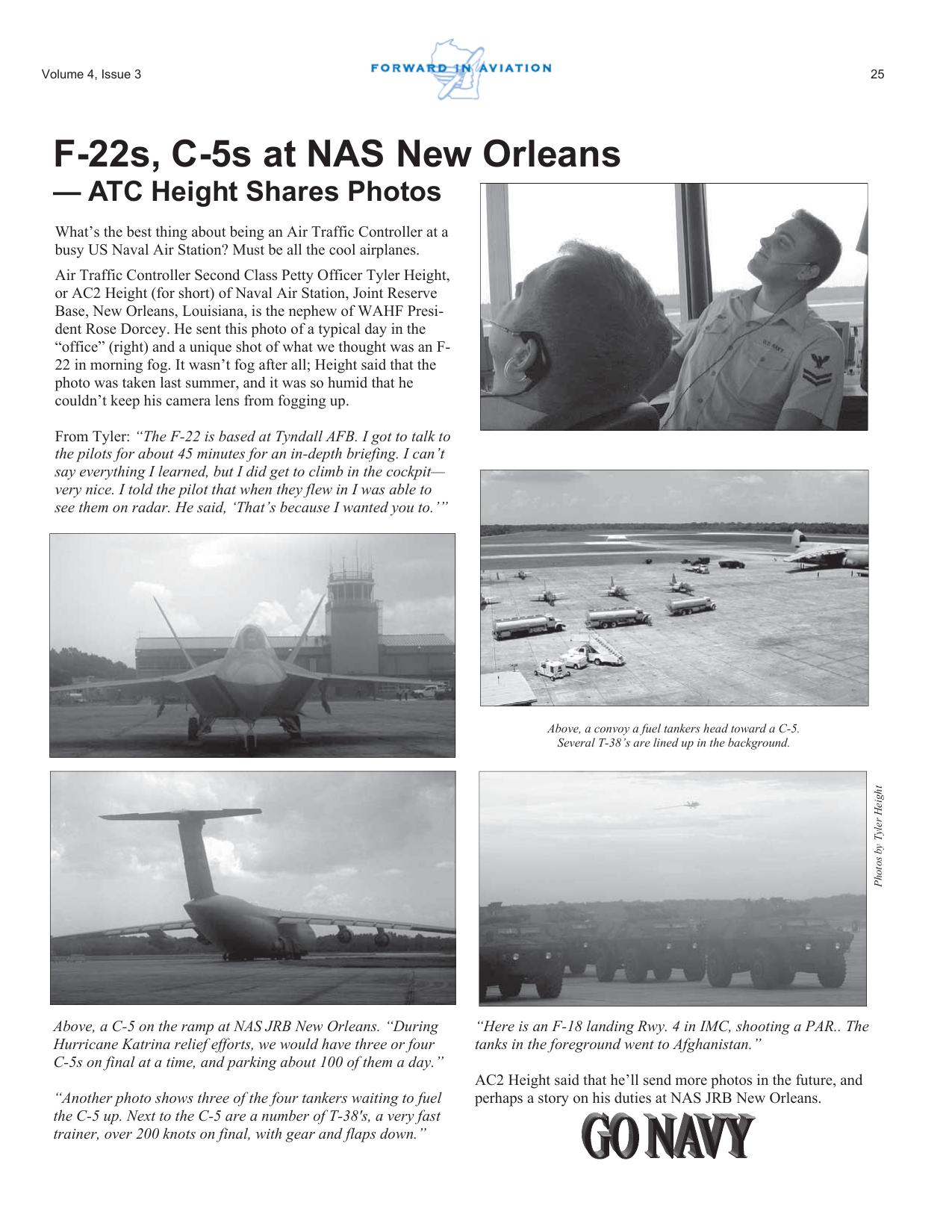
Volume 4, Issue 3 25 F-22s, C-5s at NAS New Orleans — ATC Height Shares Photos What’s the best thing about being an Air Traffic Controller at a busy US Naval Air Station? Must be all the cool airplanes. Air Traffic Controller Second Class Petty Officer Tyler Height, or AC2 Height (for short) of Naval Air Station, Joint Reserve Base, New Orleans, Louisiana, is the nephew of WAHF President Rose Dorcey. He sent this photo of a typical day in the “office” (right) and a unique shot of what we thought was an F22 in morning fog. It wasn’t fog after all; Height said that the photo was taken last summer, and it was so humid that he couldn’t keep his camera lens from fogging up. From Tyler: “The F-22 is based at Tyndall AFB. I got to talk to the pilots for about 45 minutes for an in-depth briefing. I can’t say everything I learned, but I did get to climb in the cockpit— very nice. I told the pilot that when they flew in I was able to see them on radar. He said, ‘That’s because I wanted you to.’” Photos by Tyler Height Above, a convoy a fuel tankers head toward a C-5. Several T-38’s are lined up in the background. Above, a C-5 on the ramp at NAS JRB New Orleans. “During Hurricane Katrina relief efforts, we would have three or four C-5s on final at a time, and parking about 100 of them a day.” “Another photo shows three of the four tankers waiting to fuel the C-5 up. Next to the C-5 are a number of T-38's, a very fast trainer, over 200 knots on final, with gear and flaps down.” “Here is an F-18 landing Rwy. 4 in IMC, shooting a PAR.. The tanks in the foreground went to Afghanistan.” AC2 Height said that he’ll send more photos in the future, and perhaps a story on his duties at NAS JRB New Orleans.
26 September 2006 Former Astronaut a Leader in WI Spaceport — Lee Brings Extensive Connections to Aerospace Authority This article was originally published by the Wisconsin Technology Network (www.wistechnology.com) and is reprinted here with permission. By Chris Fleissner - Wisconsin Technology Network Madison, Wis. - Viroqua native Mark Lee was only a teenager when American innovation put men on the moon. But by the time Apollo 11 mission commander Neil Armstrong and Col. Buzz Aldrin stepped out of the lunar module to trample the scientific aspirations of their Soviet counterparts, Lee's desire to be an astronaut was already deeply ingrained. His dream coalesced around an earlier era of space exploration. Rear Admiral Alan Shepard, Jr. became the first American to journey into space on May 5, 1961 and Lee, a third-grader in a one-room country school, was awed by the prospect of space exploration. "I thought it was just the coolest thing," Lee said. "Launches in those days were national events, and the whole country stopped to watch." Lee, who currently is the flight hardware program manager at the Madison aerospace company Orbital Space Technologies, Corporation, did not remain a spectator for long, and following a long and distinguished career in space Gov. James Doyle recently appointed Lee to the newly-formed Wisconsin Aerospace Authority. The WAA, also known as the Wisconsin "Spaceport," received the state's benediction earlier this year when Doyle signed a bill to create the $15 million space and science project, which was advanced by Sheboygan area businessmen and community leaders and will be developed at the Sheboygan Armory. As a member of the WAA, Lee will help build the aerospace industry in Wisconsin, and he has a compelling retort for anyone who scoffs at that prospect - his career as an astronaut has taught him something about possibilities. The original astros It was the orgin of the nation's space program that first captured his imagination. At that time, Alan Shepard was among seven elite military test pilots selected by the newly-formed National Aeronautics and Space Administration in 1959 for Project Mercury. Joining him was another heroic figure, Wisconsin native Donald "Deke" Slayton from Sparta. The Wisconsinite in a spacesuit further spurred Lee's imagination. It would only be a matter of time before Lee would earn the gold wings awarded to astronauts with completed space missions, and his achievements would put him in a privileged circle of space travelers with ties to Wisconsin. Wisconsin astronauts include Slayton, Capt. Jim Lovell who lived in Milwaukee and studied at the University of Wisconsin - Madison, and the Milwaukee School of Engineering; Capt. USN Dan Brandenstein of Watertown; Col. Brewster Shaw, Jr., who received bachelor and master of science degrees in engineering mechanics from UW-Madison; and Col. Jeffery Williams of Winter, who currently is working as a flight engineer on the International Space Station. In four space missions, Lee would spend a total of 33 days traveling more than 13 million accumulated miles in 517 orbits of the Earth and earn the distinction of being one of only eight people in history to fly untethered in space. Confidence to fly with the best Lee was accepted to the U.S. Air Force Academy shortly after the July 20, 1969 moon landing. "I'll never forget one of the first days there," he said. "They have everyone stand up and they say, `tell us how great you were in high school.'" Accomplished peers spoke of perfect grade records combined with multiple varsity sports achievements. "There was a state champion wrestler from Okalahoma, one guy went to three years of college before going to the academy; you doubt whether you can compete," Lee recounted. But after his first semester, Lee looked at how he fell in the rankings and his confidence grew. Competing with some of most physically and intellectually gifted people in the country taught Lee he could do almost anything. After earning his bachelors degree in civil engineering, he went on to pilot training at Laughlin Air Force Base in Texas and flew F-4 fighters at Luke Air Force Base in Arizona. He then spent two-and-a-half years at Okinawa Air Base in Japan flying in the 25th Tactical Fighter Squadron. Following the assignment, he began studies at Massachusetts Institute of Technology, where he earned a masters degree in mechanical engineering in 1980, specializing in graphite/epoxy advanced composite materials. He applied this knowledge to resolving mechanical and material deficiencies in airborne warning and control system aircraft at Hanscom Air Force Base in Massachusetts and resumed flying with commander responsibilities in 1982 at Hill Air Force Base in Utah. Two years later, Lee was selected as an astronaut candidate. NASA recruitment In his first mission in 1989, the crew of the Atlantis successfully deployed the Magellan Venus-exploration spacecraft, recognized as one of NASA's most important scientific missions. Lee said his most emotional mission was his first because it was only the fourth one after the 1986 Challenger disaster and people still worried about whether everything was fixed. Lee said the same fears exist today, three years after the 2003 Columbia accident. He said that astronauts' family members are never able to relax until they are back on the ground, but a
Volume 4, Issue 3 27 Silent Auction for Aviation Scholarships — Your Help Needed on October 14 A silent auction to benefit the WAHF Scholarship Fund will take place at the 21st Annual Induction Banquet to be held at the EAA AirVenture Museum in Oshkosh. You can help! Board members of the Wisconsin Aviation Hall of Fame are asking those who attend to arrive by 5:00 so that they can take part in the one-hour silent auction. The event provides a great “mixer” while at the same time helping the future of aviation. A $3000 goal has been set. There are two other ways to help: First, we need donations of cash, merchandise, and gift certificates. If you are a business owner, please send a donation. If you know a business owner, please ask if he/she can donate something to this worthwhile cause. The donations do not have to be aviation items, in fact, some of our highest bids are on wine and cheese baskets, signed Wisconsin Badger footballs, male/female gift items, etc… Second, bring a friend and bid generously. Cash and checks will be accepted (sorry, no credit cards). If you cannot attend, please consider sending a check to WAHF, and note “scholarship fund” on the check. Checks should be made out to “Chippewa Valley Technical College Foundation” and mailed to WAHF’s Middleton address (see back cover). Spaceport, continued crew member cannot afford to think about failure. "Pilot mentality is not that you're going to go up and have something go wrong, it's you're going to fly and things are going to be successful," he said. Lee's second mission in 1992 kept him in space for the longest continuous period, almost 11 days. Aboard the Endeavor, Lee served as payload commander on a cooperative mission with Japan involving 44 life science and materials processing experiments. Lee said he truly "experienced space" on his third mission with the Discovery in 1997, when he flew untethered outside the shuttle to test a self-rescue jetpack. "Being your own satellite, flying around with a jetpack - it just doesn't get any better than that. The view, the freedom, the exhilaration are hard to describe. The view is overwhelming," Lee explained. "It made the hairs stand up on the back of my neck and I got goose-bumps. You just think: `I can't believe I'm looking at this, it's just beyond description,'" Lee said. "The freedom and the distances overwhelm you at that point." One of his most rewarding missions was his last. In it, Lee and his crew performed maintenance on the Hubble Space Telescope. Lee said it was gratifying to work on an instrument that has contributed so much to science and society. "You don't feel the pressure until you're out there working on a $2 billion spacecraft. You want to make sure everything goes right." Sheboygan "Spaceport" Lee's initial reaction to the idea of putting a spaceport in Sheboygan was: "It's going to happen," he said. "There are going to be commercial vehicles going to space over the next 20, 30, 50 years and the states that move out front now and get a part of that business are going to benefit." There is no reason Wisconsin can't follow the ambitious projects already underway in New Mexico, California, and Florida to pave the way for the thousands that will want to send rockets up for thrills or experiments, he said. "It's not likely that we'll have anything jutting out like Cape Canaveral," he added, but already players are emerging to invest in Wisconsin's first steps into space. "Wisconsin is seen as a place that can contribute greatly to the research community, and space is just a new frontier," Lee said, pointing out that the WAA is no burden to taxpayers and eventually the programs they will sponsor will help the state support high-tech jobs. Educational programs like Rockets for Schools, [read more page 18] an assortment of Wisconsin finance companies and firms like Rocketplane that develop orbital vehicles will pioneer the efforts, but ultimately, society will follow their lead. "It's like when we first started flying airplanes. Only the wealthy were able to fly," Lee said. "It will be awhile before the cost comes down but I don't think it's going to be a long time. I think within 15 or 20 years it will be fairly affordable for a thrill or ride." Benefits of space flight Some assert, however, that space travel is fruitless. But Lee notes that items like cell phones, radar, digital technology, medical monitoring equipment and miniature computers were a direct result of needs that existed in the infancy of the mission to launch people to the moon. "People that are skeptical really haven't evaluated the benefits we've gotten from the space program," Lee said, pointing out that NASA publishes a book cataloging the thousands of product spin-offs that originated with the space program. "I may not be a fan of auto racing, but by pushing vehicles to the limit…it's made all of our cars better," he said.
FORWARD IN AVIATION WISCONSIN AVIATION HALL OF FAME 8550 GREENWAY BLVD - SUITE 413 MIDDLETON WI 53562-4732 Preserving Wisconsin’s Aviation History Return Service Requested Welcome new WAHF member: Chuck Behnke Thanks for coming onboard. We look forward to seeing you at a WAHF event soon! Thank you to our newsletter advertisers: Morey Airplane Company, NewView Technologies, Pat O’Malley’s Jet Room, and Dr. Tom Voelker, AME. The Highground Veterans Memorial Park recently dedicated a WASP Tribute, created by WASP Dorothy Swain Lewis. Donations are needed to cover the cost of the project. Donations are tax-deductible. Send your donation, earmarked WASP Tribute, to: The Highground W7031 Ridge Road Neillsville WI 54456 Please honor these dynamic women for their service to our country by sending a donation. Every dollar helps. Read more about the WASP Tribute dedication on pages 10-11. Martha Ackmann, author of The Mercury 13, will be speaking at UW-Oshkosh, Reeve Ballroom, on Thursday, October 19 at 8:00p.m. Admission is $2. She will be joined by Wally Funk, one of the Mercury 13. Read more on page 19. The September issue of Forward in Aviation is our largest issue ever, with 28 pages of aviation news, features, announcements, member contributions, photos and more! Thanks for helping us grow. If you have something for the December issue, contact Rose. Thought for the day: “If you have only one smile in you, give it to the people you love. Don’t be surly at home, then go out in the street and start grinning ‘Good Morning’ at total strangers.” ~Maya Angelou ~ ~ ~ ~ ~ ~ ~ ~ Don’t miss the 2006 WAHF Induction Banquet October 14 at the EAA Museum in Oshkosh! ~ ~ Wisconsin Aviation Hall of Fame Officers and Board of Directors Rose Dorcey, President Michael Goc, Vice President John Dorcey, Secretary/Treasurer Duane Esse Keith Glasshof David Greene Charles Swain LaFonda Kinnaman Staber “Bill” Reese Charles Marotske, Honorary Chairman of the Board Wisconsin Aviation Hall of Fame 8550 Greenway Blvd - Suite 413 Middleton WI 53562-4732 Become a supporter today! For information call Rose Dorcey at 715-421-0055 www.aviationhalloffamewisconsin.com flyer@aviationhalloffamewisconsin.com