Volume 21, Issue 3
🗞️ Download Issue (PDF)
Fall 2023 - Forward in Flight

Volume 21, Issue 3 Quarterly Magazine of the Wisconsin Aviation Hall of Fame Fall 2023
Contents Fall 2023 Volume 21 Issue 3 2 GOLDEN AGE Pietenpol and the DIY Spirit of the 1920s By Ami Eckard-Lee 4 TAILDRAGGER TALES Never Stop Flying Like Russ, Bob, and Terry By John Chmiel 6 WE FLY Keep ’em Flying Bouchards’ Four Generations of Flight By Cary Bouchard 8 HISTORY HANGAR Archie Henkelmann His Life in Aviation By David Henkelmann 10 SNAPSHOTS The Ultralight Barn By Skot Weidemann A publication by the Wisconsin Aviation Hall of Fame WAHF Inductee Archie Henkelmann is equally at home while piloting airplanes or motorcycles. 11 EVENT COVERAGE EAA AirVenture Oshkosh 2023 A Spectacular Aviation Marvel By Scott Green and Rose Dorcey 16 TALES OF THE ACES Meet These Badger Aces The skills and exploits that made them an Ace By Mike O’Connor 18 Gift Ideas for Book Lovers - Aviation books, that is 20 Inductee Spotlight: George Cudahy 21 Did You Hear About? By Duane Esse 22 Association News 2023 Ceremony, and more 23 Editor’s Log - Rose Dorcey 24 Member Spotlight: Cindi Pokorny At EAA AirVenture 2023, Women in Aviation set a record for the largest gathering of their annual group photo, this year in front of the Atlas Air-operated Boeing Dreamlifter on Boeing Plaza. More AirVenture highlights in this issue. EAA photo by Chris Miller.
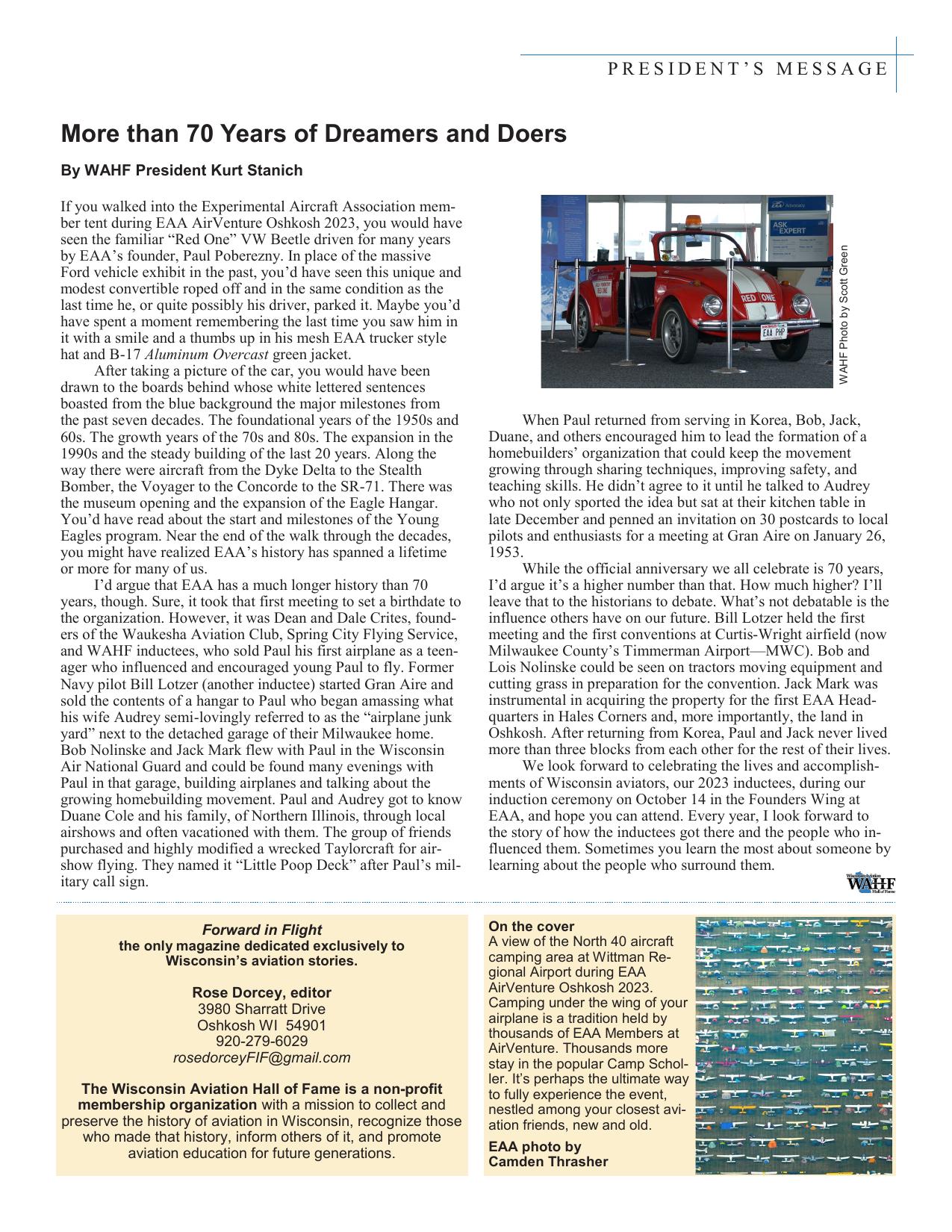
PRESIDENT’S MESSAGE More than 70 Years of Dreamers and Doers If you walked into the Experimental Aircraft Association member tent during EAA AirVenture Oshkosh 2023, you would have seen the familiar “Red One” VW Beetle driven for many years by EAA’s founder, Paul Poberezny. In place of the massive Ford vehicle exhibit in the past, you’d have seen this unique and modest convertible roped off and in the same condition as the last time he, or quite possibly his driver, parked it. Maybe you’d have spent a moment remembering the last time you saw him in it with a smile and a thumbs up in his mesh EAA trucker style hat and B-17 Aluminum Overcast green jacket. After taking a picture of the car, you would have been drawn to the boards behind whose white lettered sentences boasted from the blue background the major milestones from the past seven decades. The foundational years of the 1950s and 60s. The growth years of the 70s and 80s. The expansion in the 1990s and the steady building of the last 20 years. Along the way there were aircraft from the Dyke Delta to the Stealth Bomber, the Voyager to the Concorde to the SR-71. There was the museum opening and the expansion of the Eagle Hangar. You’d have read about the start and milestones of the Young Eagles program. Near the end of the walk through the decades, you might have realized EAA’s history has spanned a lifetime or more for many of us. I’d argue that EAA has a much longer history than 70 years, though. Sure, it took that first meeting to set a birthdate to the organization. However, it was Dean and Dale Crites, founders of the Waukesha Aviation Club, Spring City Flying Service, and WAHF inductees, who sold Paul his first airplane as a teenager who influenced and encouraged young Paul to fly. Former Navy pilot Bill Lotzer (another inductee) started Gran Aire and sold the contents of a hangar to Paul who began amassing what his wife Audrey semi-lovingly referred to as the “airplane junk yard” next to the detached garage of their Milwaukee home. Bob Nolinske and Jack Mark flew with Paul in the Wisconsin Air National Guard and could be found many evenings with Paul in that garage, building airplanes and talking about the growing homebuilding movement. Paul and Audrey got to know Duane Cole and his family, of Northern Illinois, through local airshows and often vacationed with them. The group of friends purchased and highly modified a wrecked Taylorcraft for airshow flying. They named it “Little Poop Deck” after Paul’s military call sign. Forward in Flight the only magazine dedicated exclusively to Wisconsin’s aviation stories. Rose Dorcey, editor 3980 Sharratt Drive Oshkosh WI 54901 920-279-6029 rosedorceyFIF@gmail.com The Wisconsin Aviation Hall of Fame is a non-profit membership organization with a mission to collect and preserve the history of aviation in Wisconsin, recognize those who made that history, inform others of it, and promote aviation education for future generations. WAHF Photo by Scott Green By WAHF President Kurt Stanich When Paul returned from serving in Korea, Bob, Jack, Duane, and others encouraged him to lead the formation of a homebuilders’ organization that could keep the movement growing through sharing techniques, improving safety, and teaching skills. He didn’t agree to it until he talked to Audrey who not only sported the idea but sat at their kitchen table in late December and penned an invitation on 30 postcards to local pilots and enthusiasts for a meeting at Gran Aire on January 26, 1953. While the official anniversary we all celebrate is 70 years, I’d argue it’s a higher number than that. How much higher? I’ll leave that to the historians to debate. What’s not debatable is the influence others have on our future. Bill Lotzer held the first meeting and the first conventions at Curtis-Wright airfield (now Milwaukee County’s Timmerman Airport—MWC). Bob and Lois Nolinske could be seen on tractors moving equipment and cutting grass in preparation for the convention. Jack Mark was instrumental in acquiring the property for the first EAA Headquarters in Hales Corners and, more importantly, the land in Oshkosh. After returning from Korea, Paul and Jack never lived more than three blocks from each other for the rest of their lives. We look forward to celebrating the lives and accomplishments of Wisconsin aviators, our 2023 inductees, during our induction ceremony on October 14 in the Founders Wing at EAA, and hope you can attend. Every year, I look forward to the story of how the inductees got there and the people who influenced them. Sometimes you learn the most about someone by learning about the people who surround them. On the cover A view of the North 40 aircraft camping area at Wittman Regional Airport during EAA AirVenture Oshkosh 2023. Camping under the wing of your airplane is a tradition held by thousands of EAA Members at AirVenture. Thousands more stay in the popular Camp Scholler. It’s perhaps the ultimate way to fully experience the event, nestled among your closest aviation friends, new and old. EAA photo by Camden Thrasher
GOLDEN AGE Pietenpol and the DIY Spirit of the 1920s USA By Ami Eckerd-Lee For many of us, the Midwest in summer means flying season - open cockpit, grass runways, and weekend fly-ins reconnecting with aviation friends. And summer at the Kelch Aviation Museum simply wouldn’t be summer without the annual Brodhead Pietenpol Fly-In. From the DIY energy to the living history of it all, the Pietenpol Fly-In sums up so much of what the museum (and the golden age of aviation) is all about: The sky is the limit! The Midwest is amazing! And aviation is for EVERYONE. The classic Pietenpol Air Camper in our collection at the Kelch Aviation Museum has a story that perfectly illustrates the ups and downs of midwestern grassroots aviation, from its birth in Bernard Pietenpol’s shop in 1937 up until today, as our born-and-bred Brodhead Airport mechanics tinker in preparation for new flights. I’d like to tell you a little about this plane and its story. Bernard Pietenpol: The Original Do-It-Yourselfer Though aircraft kits and home-buildable projects are common today, they had to be invented, and the Grandfather of the Homebuilt is without a doubt Mr Bernard H Pietenpol. I’ve recently been informed there’s no official biography written about him, so if you don’t know the basic facts of his life, here they are. If you do, read it anyway! Born in 1901, Bernard Pietenpol lived most of his life in Cherry Grove, Minnesota, where he became fascinated by aviation. Faced with the economic strife of the rural Midwest entering the great depression, he simply decided to invent and build his own airplane, one that the average American could easily build and affordably operate. In 1929, his Pietenpol Air Camper first hit the skies. An open-cockpit, two place aircraft with a parasol-style wing, the Air Camper broke the mold in aviation in several remarkable ways at once: The fuselage was made of wood, rather than steel tubing, so the previously mentioned “Average American” could construct it using basic tools and average skills at home. Second, and more importantly, the plane was powered not by a fancy, expensive, facto- ry-made aircraft engine, but the rugged, common, somewhat clunky Ford Model A automobile engine. Though some designers had attempted to design an autoengine powered plane before, none had been successful, and Bernard breezed by them all. Aviation for the Average American The blueprints for the Pietenpol design were advertised in Modern Mechanics magazine for the price of $7.50, the average American began buying and building - and ta-da, the homebuilt aircraft movement was born. I personally know of a man who, young and daring in the 1930s, built his own Pietenpol from scratch with no notion of how to fly, and when it was done he simply climbed in and taught himself how, making gradually larger hops across a field until he got the hang of it (he did eventually crash into a fence, and didn’t fly a Pietenpol or indeed any other small aircraft again until the 1960s, but that is beside the point). Back to Bernard: Not one to rest on his laurels, Bernard then invented a single-place version of his design, the Sky Scout, intended to be powered by a Ford Model T engine, and after that (did the guy ever rest?) he began constructing kits. Order a kit, and you’ll get not just the blueprints, but the supplies neatly packaged and pre-arranged. Nifty? Yes! High selling? Nope. It seems the Average American was too broke or too invested in DIY to spring for the more expensive kit while the blueprints were available. Though some kits were sold, some languished in the shop. In 1937, tired of staring at another kit waiting to be sold, Bernard enlisted his father-in-law to simply build the kit with him so they could sell it as a finished aircraft. I suppose this ready-made option appealed to the Average American, because he - or I should say specifically Mr. Lewis Christensen of Hanlontown, Iowa, bought it right away. N18224 was off on an adventure that eventually landed at the Kelch Aviation Museum 80 years later. A Midwest Story To spare us all an unnecessary aging process, I shall skip over those 80 years in a 2 Forward in Flight ~ Quarterly Magazine of the Wisconsin Aviation Hall of Fame summary: The plane hopped and skipped around the Midwest with various owners, even serving as a commuter plane (efficient? No. Cool? Heck yes!) for legendary aviator Martha Lunken in the 1970s in Cincinnati. Bedraggled after decades of flying, it eventually made a three-year pit stop in the Ohio shop of Frank Pavliga for a full restoration. I spoke to Frank the other day, because gosh darn we couldn’t figure out how to fill the tires with air. Frank grew up as an airport kid, hanging around pilots with his dad starting when he was knee-high to a grasshopper. He’s now renowned as a restoration expert, although N18224 was his first full Pietenpol restoration job. Frank never built wheels with concealed air valves again, thank goodness, but we’re still stuck with these. Other than those strange wheels, Frank did a fantastic job on the plane, and then-owner Gary Baglien enjoyed many years of flight around (yes, still the Midwest) northern Wisconsin. I’ve spoken to Gary, too, because in 2020, Gary gave this Pietenpol to the Kelch Aviation Museum. Yeah, he just gave us an airplane. He’s awesome. Brodhead is the Perfect Home Sometimes people ask, why isn’t the annual Pietenpol Fly-in held in Bernard’s hometown of Cherry Grove, Minnesota?* Perhaps it should be - but all the aviation action happens here at the Brodhead Airport. Thanks to a series of coincidences, a few talented antique aviation experts convening here in the 1970s, and the perfect setup of grass runways, Brodhead Airport became an epicenter for vintage aviation. Once that momentum began, nothing could stop it. The youngsters who grew up inhaling dope fumes and tagging along with their machinist or pilot parents naturally inherited interest and skills, and a second (and third) generation of antique aficionados keep the tradition of antique airplane restoration and operation thriving. At the center of this community is the Pietenpol Fly-In each year. The fly-in attracts hundreds of pilots and builders from around the continent and the world, many making cross country flights for Photos courtesy of Kelch Aviation Museum
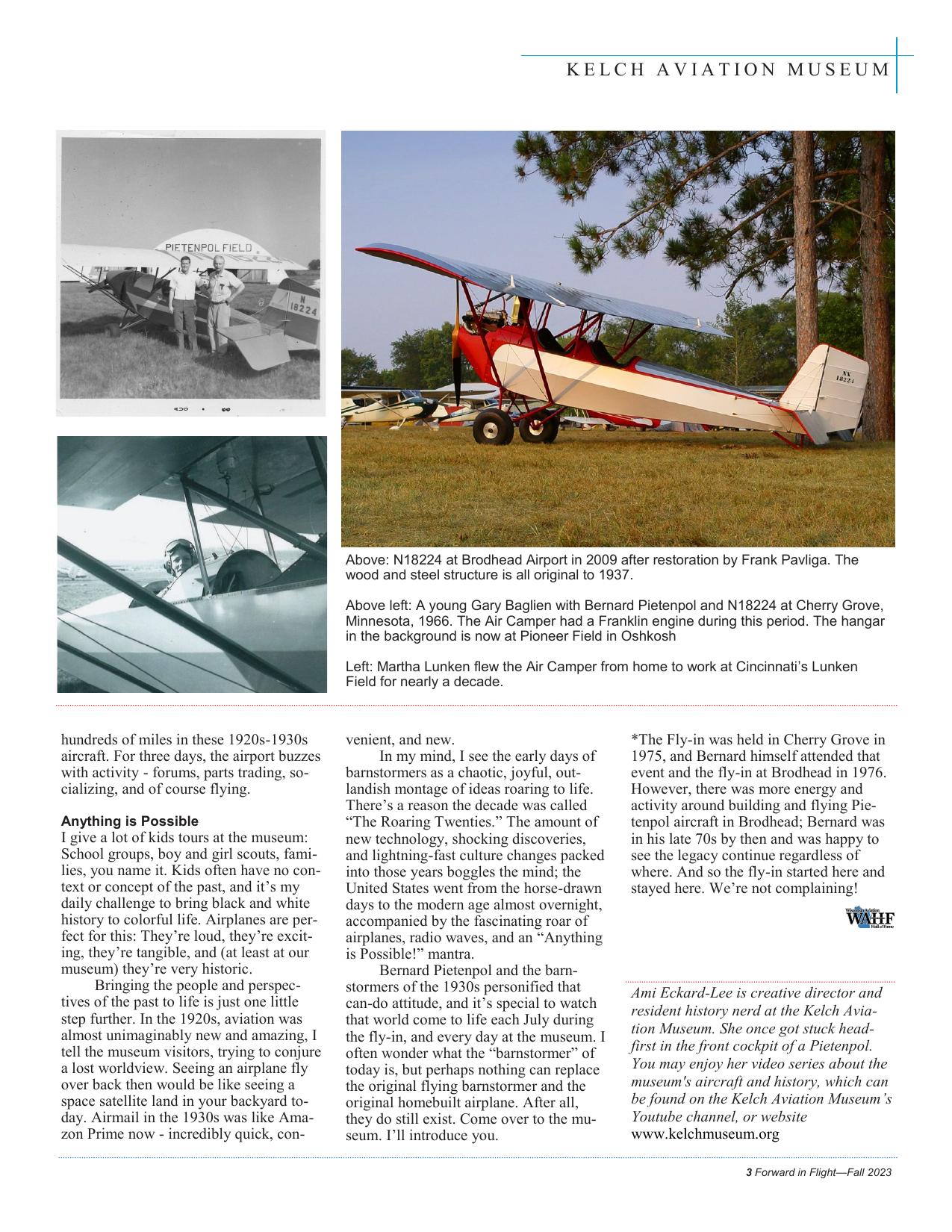
KELCH AVIATION MUSEUM Above: N18224 at Brodhead Airport in 2009 after restoration by Frank Pavliga. The wood and steel structure is all original to 1937. Above left: A young Gary Baglien with Bernard Pietenpol and N18224 at Cherry Grove, Minnesota, 1966. The Air Camper had a Franklin engine during this period. The hangar in the background is now at Pioneer Field in Oshkosh Left: Martha Lunken flew the Air Camper from home to work at Cincinnati’s Lunken Field for nearly a decade. hundreds of miles in these 1920s-1930s aircraft. For three days, the airport buzzes with activity - forums, parts trading, socializing, and of course flying. Anything is Possible I give a lot of kids tours at the museum: School groups, boy and girl scouts, families, you name it. Kids often have no context or concept of the past, and it’s my daily challenge to bring black and white history to colorful life. Airplanes are perfect for this: They’re loud, they’re exciting, they’re tangible, and (at least at our museum) they’re very historic. Bringing the people and perspectives of the past to life is just one little step further. In the 1920s, aviation was almost unimaginably new and amazing, I tell the museum visitors, trying to conjure a lost worldview. Seeing an airplane fly over back then would be like seeing a space satellite land in your backyard today. Airmail in the 1930s was like Amazon Prime now - incredibly quick, con- venient, and new. In my mind, I see the early days of barnstormers as a chaotic, joyful, outlandish montage of ideas roaring to life. There’s a reason the decade was called “The Roaring Twenties.” The amount of new technology, shocking discoveries, and lightning-fast culture changes packed into those years boggles the mind; the United States went from the horse-drawn days to the modern age almost overnight, accompanied by the fascinating roar of airplanes, radio waves, and an “Anything is Possible!” mantra. Bernard Pietenpol and the barnstormers of the 1930s personified that can-do attitude, and it’s special to watch that world come to life each July during the fly-in, and every day at the museum. I often wonder what the “barnstormer” of today is, but perhaps nothing can replace the original flying barnstormer and the original homebuilt airplane. After all, they do still exist. Come over to the museum. I’ll introduce you. *The Fly-in was held in Cherry Grove in 1975, and Bernard himself attended that event and the fly-in at Brodhead in 1976. However, there was more energy and activity around building and flying Pietenpol aircraft in Brodhead; Bernard was in his late 70s by then and was happy to see the legacy continue regardless of where. And so the fly-in started here and stayed here. We’re not complaining! Ami Eckard-Lee is creative director and resident history nerd at the Kelch Aviation Museum. She once got stuck headfirst in the front cockpit of a Pietenpol. You may enjoy her video series about the museum's aircraft and history, which can be found on the Kelch Aviation Museum’s Youtube channel, or website www.kelchmuseum.org 3 Forward in Flight—Fall 2023
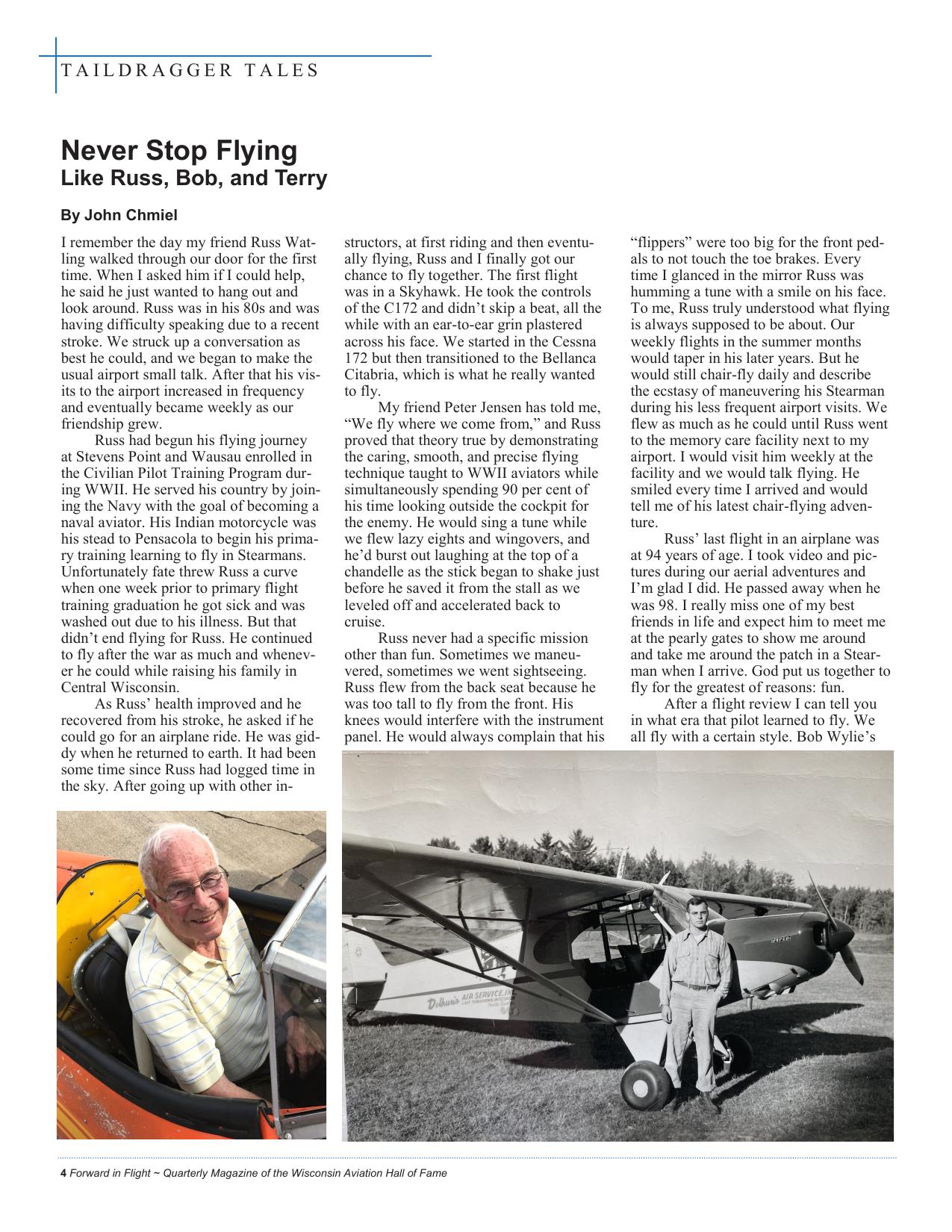
TAILDRAGGER TALES Never Stop Flying Like Russ, Bob, and Terry By John Chmiel I remember the day my friend Russ Watling walked through our door for the first time. When I asked him if I could help, he said he just wanted to hang out and look around. Russ was in his 80s and was having difficulty speaking due to a recent stroke. We struck up a conversation as best he could, and we began to make the usual airport small talk. After that his visits to the airport increased in frequency and eventually became weekly as our friendship grew. Russ had begun his flying journey at Stevens Point and Wausau enrolled in the Civilian Pilot Training Program during WWII. He served his country by joining the Navy with the goal of becoming a naval aviator. His Indian motorcycle was his stead to Pensacola to begin his primary training learning to fly in Stearmans. Unfortunately fate threw Russ a curve when one week prior to primary flight training graduation he got sick and was washed out due to his illness. But that didn’t end flying for Russ. He continued to fly after the war as much and whenever he could while raising his family in Central Wisconsin. As Russ’ health improved and he recovered from his stroke, he asked if he could go for an airplane ride. He was giddy when he returned to earth. It had been some time since Russ had logged time in the sky. After going up with other in- structors, at first riding and then eventually flying, Russ and I finally got our chance to fly together. The first flight was in a Skyhawk. He took the controls of the C172 and didn’t skip a beat, all the while with an ear-to-ear grin plastered across his face. We started in the Cessna 172 but then transitioned to the Bellanca Citabria, which is what he really wanted to fly. My friend Peter Jensen has told me, “We fly where we come from,” and Russ proved that theory true by demonstrating the caring, smooth, and precise flying technique taught to WWII aviators while simultaneously spending 90 per cent of his time looking outside the cockpit for the enemy. He would sing a tune while we flew lazy eights and wingovers, and he’d burst out laughing at the top of a chandelle as the stick began to shake just before he saved it from the stall as we leveled off and accelerated back to cruise. Russ never had a specific mission other than fun. Sometimes we maneuvered, sometimes we went sightseeing. Russ flew from the back seat because he was too tall to fly from the front. His knees would interfere with the instrument panel. He would always complain that his 4 Forward in Flight ~ Quarterly Magazine of the Wisconsin Aviation Hall of Fame “flippers” were too big for the front pedals to not touch the toe brakes. Every time I glanced in the mirror Russ was humming a tune with a smile on his face. To me, Russ truly understood what flying is always supposed to be about. Our weekly flights in the summer months would taper in his later years. But he would still chair-fly daily and describe the ecstasy of maneuvering his Stearman during his less frequent airport visits. We flew as much as he could until Russ went to the memory care facility next to my airport. I would visit him weekly at the facility and we would talk flying. He smiled every time I arrived and would tell me of his latest chair-flying adventure. Russ’ last flight in an airplane was at 94 years of age. I took video and pictures during our aerial adventures and I’m glad I did. He passed away when he was 98. I really miss one of my best friends in life and expect him to meet me at the pearly gates to show me around and take me around the patch in a Stearman when I arrive. God put us together to fly for the greatest of reasons: fun. After a flight review I can tell you in what era that pilot learned to fly. We all fly with a certain style. Bob Wylie’s
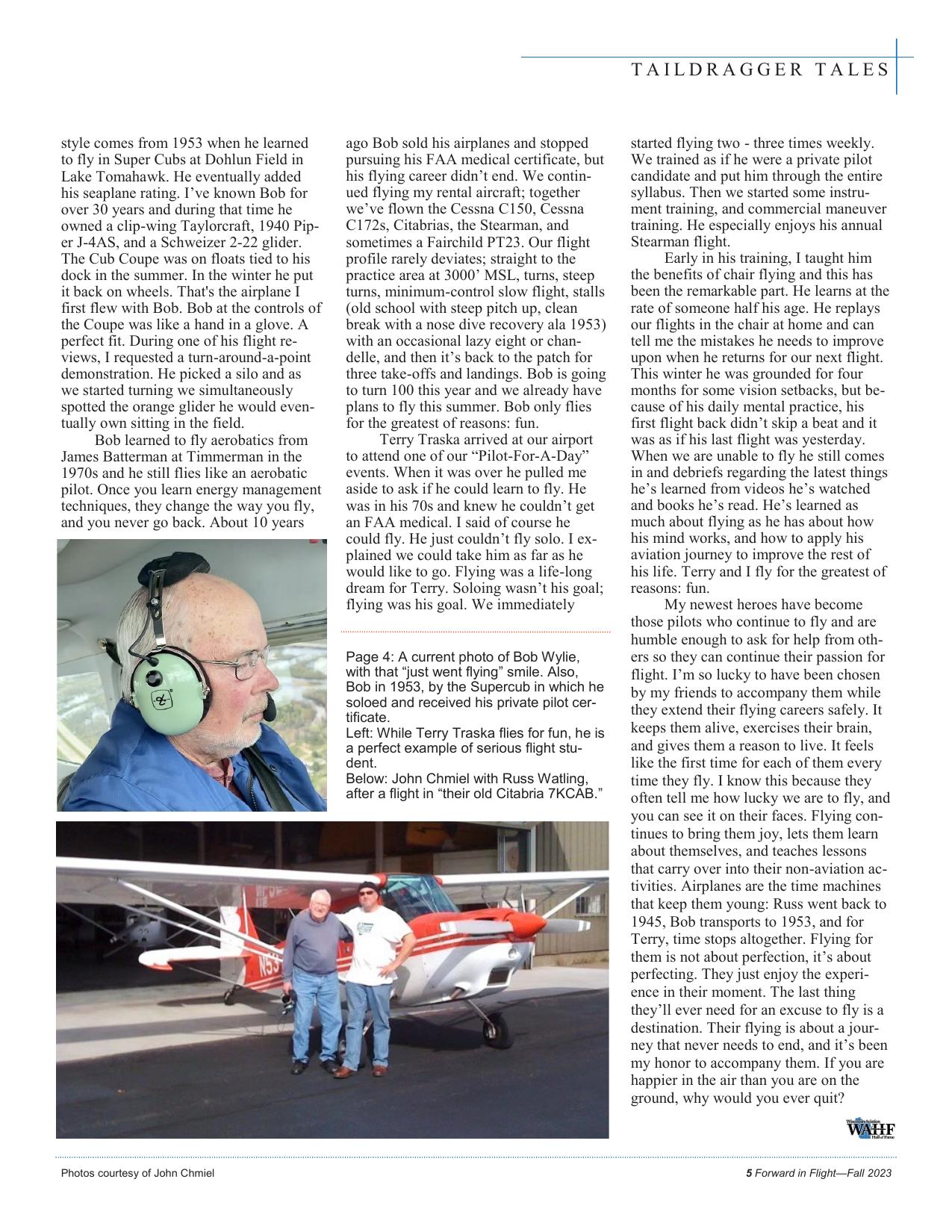
TAILDRAGGER TALES style comes from 1953 when he learned to fly in Super Cubs at Dohlun Field in Lake Tomahawk. He eventually added his seaplane rating. I’ve known Bob for over 30 years and during that time he owned a clip-wing Taylorcraft, 1940 Piper J-4AS, and a Schweizer 2-22 glider. The Cub Coupe was on floats tied to his dock in the summer. In the winter he put it back on wheels. That's the airplane I first flew with Bob. Bob at the controls of the Coupe was like a hand in a glove. A perfect fit. During one of his flight reviews, I requested a turn-around-a-point demonstration. He picked a silo and as we started turning we simultaneously spotted the orange glider he would eventually own sitting in the field. Bob learned to fly aerobatics from James Batterman at Timmerman in the 1970s and he still flies like an aerobatic pilot. Once you learn energy management techniques, they change the way you fly, and you never go back. About 10 years ago Bob sold his airplanes and stopped pursuing his FAA medical certificate, but his flying career didn’t end. We continued flying my rental aircraft; together we’ve flown the Cessna C150, Cessna C172s, Citabrias, the Stearman, and sometimes a Fairchild PT23. Our flight profile rarely deviates; straight to the practice area at 3000’ MSL, turns, steep turns, minimum-control slow flight, stalls (old school with steep pitch up, clean break with a nose dive recovery ala 1953) with an occasional lazy eight or chandelle, and then it’s back to the patch for three take-offs and landings. Bob is going to turn 100 this year and we already have plans to fly this summer. Bob only flies for the greatest of reasons: fun. Terry Traska arrived at our airport to attend one of our “Pilot-For-A-Day” events. When it was over he pulled me aside to ask if he could learn to fly. He was in his 70s and knew he couldn’t get an FAA medical. I said of course he could fly. He just couldn’t fly solo. I explained we could take him as far as he would like to go. Flying was a life-long dream for Terry. Soloing wasn’t his goal; flying was his goal. We immediately Page 4: A current photo of Bob Wylie, with that “just went flying” smile. Also, Bob in 1953, by the Supercub in which he soloed and received his private pilot certificate. Left: While Terry Traska flies for fun, he is a perfect example of serious flight student. Below: John Chmiel with Russ Watling, after a flight in “their old Citabria 7KCAB.” Photos courtesy of John Chmiel started flying two - three times weekly. We trained as if he were a private pilot candidate and put him through the entire syllabus. Then we started some instrument training, and commercial maneuver training. He especially enjoys his annual Stearman flight. Early in his training, I taught him the benefits of chair flying and this has been the remarkable part. He learns at the rate of someone half his age. He replays our flights in the chair at home and can tell me the mistakes he needs to improve upon when he returns for our next flight. This winter he was grounded for four months for some vision setbacks, but because of his daily mental practice, his first flight back didn’t skip a beat and it was as if his last flight was yesterday. When we are unable to fly he still comes in and debriefs regarding the latest things he’s learned from videos he’s watched and books he’s read. He’s learned as much about flying as he has about how his mind works, and how to apply his aviation journey to improve the rest of his life. Terry and I fly for the greatest of reasons: fun. My newest heroes have become those pilots who continue to fly and are humble enough to ask for help from others so they can continue their passion for flight. I’m so lucky to have been chosen by my friends to accompany them while they extend their flying careers safely. It keeps them alive, exercises their brain, and gives them a reason to live. It feels like the first time for each of them every time they fly. I know this because they often tell me how lucky we are to fly, and you can see it on their faces. Flying continues to bring them joy, lets them learn about themselves, and teaches lessons that carry over into their non-aviation activities. Airplanes are the time machines that keep them young: Russ went back to 1945, Bob transports to 1953, and for Terry, time stops altogether. Flying for them is not about perfection, it’s about perfecting. They just enjoy the experience in their moment. The last thing they’ll ever need for an excuse to fly is a destination. Their flying is about a journey that never needs to end, and it’s been my honor to accompany them. If you are happier in the air than you are on the ground, why would you ever quit? 5 Forward in Flight—Fall 2023
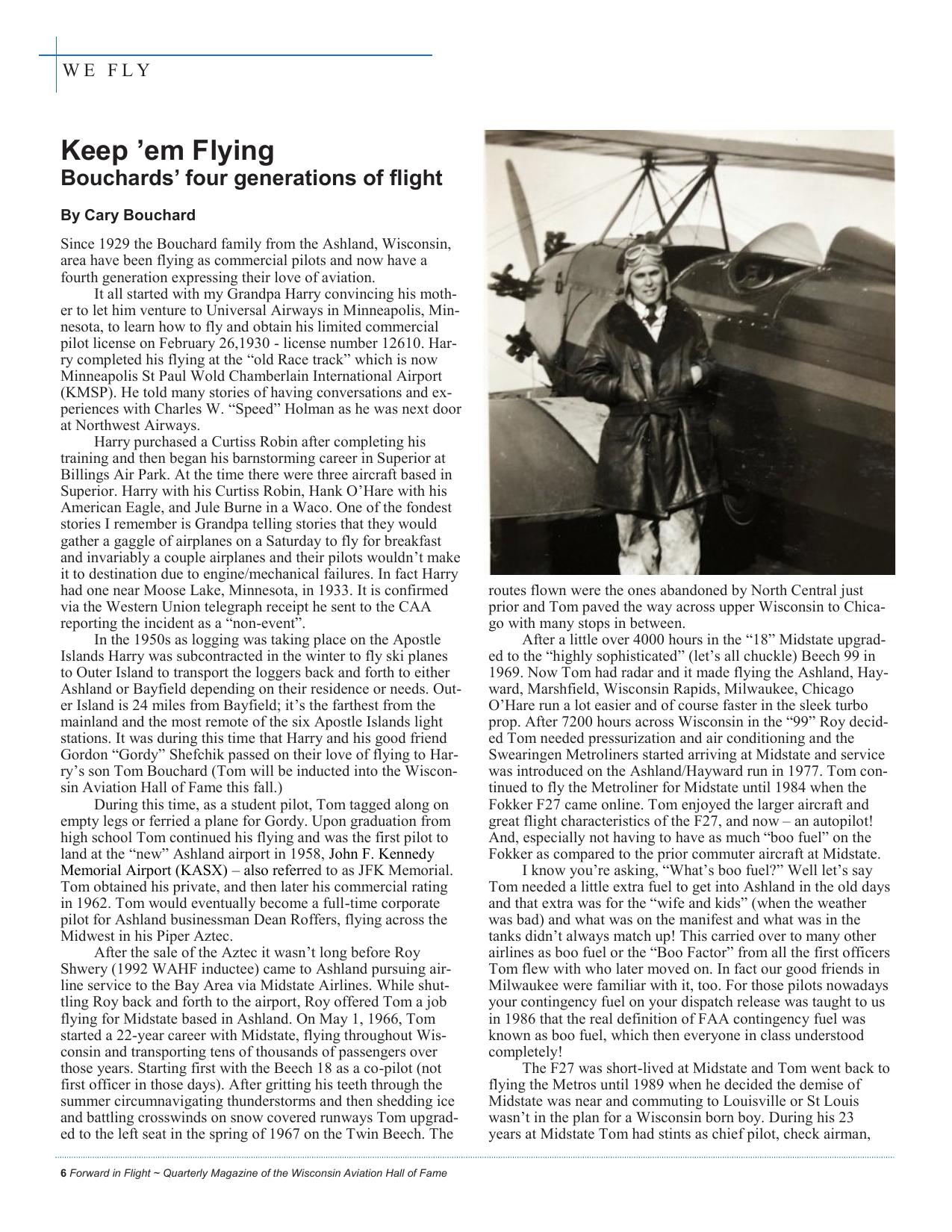
WE FLY Keep ’em Flying Bouchards’ four generations of flight By Cary Bouchard Since 1929 the Bouchard family from the Ashland, Wisconsin, area have been flying as commercial pilots and now have a fourth generation expressing their love of aviation. It all started with my Grandpa Harry convincing his mother to let him venture to Universal Airways in Minneapolis, Minnesota, to learn how to fly and obtain his limited commercial pilot license on February 26,1930 - license number 12610. Harry completed his flying at the “old Race track” which is now Minneapolis St Paul Wold Chamberlain International Airport (KMSP). He told many stories of having conversations and experiences with Charles W. “Speed” Holman as he was next door at Northwest Airways. Harry purchased a Curtiss Robin after completing his training and then began his barnstorming career in Superior at Billings Air Park. At the time there were three aircraft based in Superior. Harry with his Curtiss Robin, Hank O’Hare with his American Eagle, and Jule Burne in a Waco. One of the fondest stories I remember is Grandpa telling stories that they would gather a gaggle of airplanes on a Saturday to fly for breakfast and invariably a couple airplanes and their pilots wouldn’t make it to destination due to engine/mechanical failures. In fact Harry had one near Moose Lake, Minnesota, in 1933. It is confirmed via the Western Union telegraph receipt he sent to the CAA reporting the incident as a “non-event”. In the 1950s as logging was taking place on the Apostle Islands Harry was subcontracted in the winter to fly ski planes to Outer Island to transport the loggers back and forth to either Ashland or Bayfield depending on their residence or needs. Outer Island is 24 miles from Bayfield; it’s the farthest from the mainland and the most remote of the six Apostle Islands light stations. It was during this time that Harry and his good friend Gordon “Gordy” Shefchik passed on their love of flying to Harry’s son Tom Bouchard (Tom will be inducted into the Wisconsin Aviation Hall of Fame this fall.) During this time, as a student pilot, Tom tagged along on empty legs or ferried a plane for Gordy. Upon graduation from high school Tom continued his flying and was the first pilot to land at the “new” Ashland airport in 1958, John F. Kennedy Memorial Airport (KASX) – also referred to as JFK Memorial. Tom obtained his private, and then later his commercial rating in 1962. Tom would eventually become a full-time corporate pilot for Ashland businessman Dean Roffers, flying across the Midwest in his Piper Aztec. After the sale of the Aztec it wasn’t long before Roy Shwery (1992 WAHF inductee) came to Ashland pursuing airline service to the Bay Area via Midstate Airlines. While shuttling Roy back and forth to the airport, Roy offered Tom a job flying for Midstate based in Ashland. On May 1, 1966, Tom started a 22-year career with Midstate, flying throughout Wisconsin and transporting tens of thousands of passengers over those years. Starting first with the Beech 18 as a co-pilot (not first officer in those days). After gritting his teeth through the summer circumnavigating thunderstorms and then shedding ice and battling crosswinds on snow covered runways Tom upgraded to the left seat in the spring of 1967 on the Twin Beech. The 6 Forward in Flight ~ Quarterly Magazine of the Wisconsin Aviation Hall of Fame Photo of HARRY routes flown were the ones abandoned by North Central just prior and Tom paved the way across upper Wisconsin to Chicago with many stops in between. After a little over 4000 hours in the “18” Midstate upgraded to the “highly sophisticated” (let’s all chuckle) Beech 99 in 1969. Now Tom had radar and it made flying the Ashland, Hayward, Marshfield, Wisconsin Rapids, Milwaukee, Chicago O’Hare run a lot easier and of course faster in the sleek turbo prop. After 7200 hours across Wisconsin in the “99” Roy decided Tom needed pressurization and air conditioning and the Swearingen Metroliners started arriving at Midstate and service was introduced on the Ashland/Hayward run in 1977. Tom continued to fly the Metroliner for Midstate until 1984 when the Fokker F27 came online. Tom enjoyed the larger aircraft and great flight characteristics of the F27, and now – an autopilot! And, especially not having to have as much “boo fuel” on the Fokker as compared to the prior commuter aircraft at Midstate. I know you’re asking, “What’s boo fuel?” Well let’s say Tom needed a little extra fuel to get into Ashland in the old days and that extra was for the “wife and kids” (when the weather was bad) and what was on the manifest and what was in the tanks didn’t always match up! This carried over to many other airlines as boo fuel or the “Boo Factor” from all the first officers Tom flew with who later moved on. In fact our good friends in Milwaukee were familiar with it, too. For those pilots nowadays your contingency fuel on your dispatch release was taught to us in 1986 that the real definition of FAA contingency fuel was known as boo fuel, which then everyone in class understood completely! The F27 was short-lived at Midstate and Tom went back to flying the Metros until 1989 when he decided the demise of Midstate was near and commuting to Louisville or St Louis wasn’t in the plan for a Wisconsin born boy. During his 23 years at Midstate Tom had stints as chief pilot, check airman,
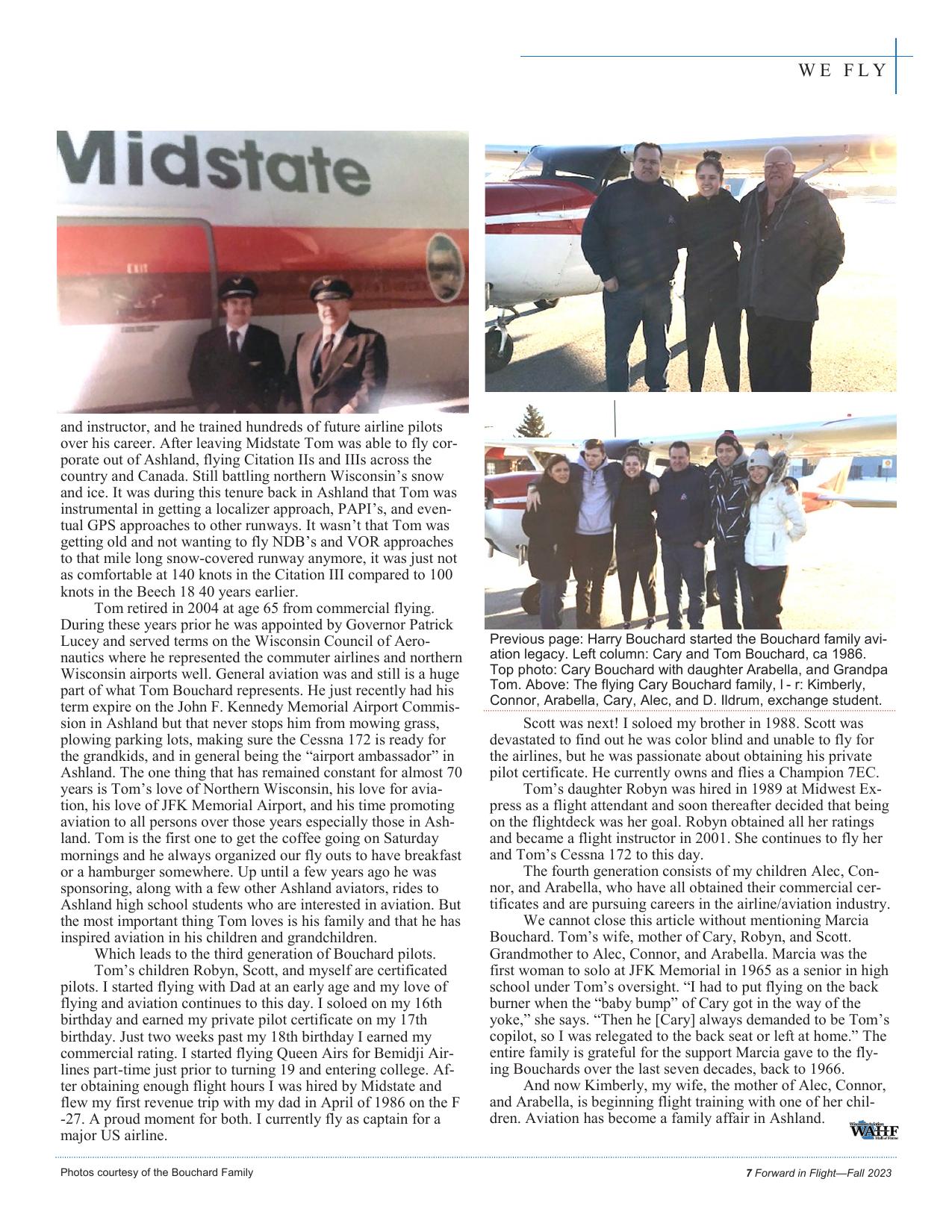
WE FLY and instructor, and he trained hundreds of future airline pilots over his career. After leaving Midstate Tom was able to fly corporate out of Ashland, flying Citation IIs and IIIs across the country and Canada. Still battling northern Wisconsin’s snow and ice. It was during this tenure back in Ashland that Tom was instrumental in getting a localizer approach, PAPI’s, and eventual GPS approaches to other runways. It wasn’t that Tom was getting old and not wanting to fly NDB’s and VOR approaches to that mile long snow-covered runway anymore, it was just not as comfortable at 140 knots in the Citation III compared to 100 knots in the Beech 18 40 years earlier. Tom retired in 2004 at age 65 from commercial flying. During these years prior he was appointed by Governor Patrick Lucey and served terms on the Wisconsin Council of Aeronautics where he represented the commuter airlines and northern Wisconsin airports well. General aviation was and still is a huge part of what Tom Bouchard represents. He just recently had his term expire on the John F. Kennedy Memorial Airport Commission in Ashland but that never stops him from mowing grass, plowing parking lots, making sure the Cessna 172 is ready for the grandkids, and in general being the “airport ambassador” in Ashland. The one thing that has remained constant for almost 70 years is Tom’s love of Northern Wisconsin, his love for aviation, his love of JFK Memorial Airport, and his time promoting aviation to all persons over those years especially those in Ashland. Tom is the first one to get the coffee going on Saturday mornings and he always organized our fly outs to have breakfast or a hamburger somewhere. Up until a few years ago he was sponsoring, along with a few other Ashland aviators, rides to Ashland high school students who are interested in aviation. But the most important thing Tom loves is his family and that he has inspired aviation in his children and grandchildren. Which leads to the third generation of Bouchard pilots. Tom’s children Robyn, Scott, and myself are certificated pilots. I started flying with Dad at an early age and my love of flying and aviation continues to this day. I soloed on my 16th birthday and earned my private pilot certificate on my 17th birthday. Just two weeks past my 18th birthday I earned my commercial rating. I started flying Queen Airs for Bemidji Airlines part-time just prior to turning 19 and entering college. After obtaining enough flight hours I was hired by Midstate and flew my first revenue trip with my dad in April of 1986 on the F -27. A proud moment for both. I currently fly as captain for a major US airline. Photos courtesy of the Bouchard Family Previous page: Harry Bouchard started the Bouchard family aviation legacy. Left column: Cary and Tom Bouchard, ca 1986. Top photo: Cary Bouchard with daughter Arabella, and Grandpa Tom. Above: The flying Cary Bouchard family, l - r: Kimberly, Connor, Arabella, Cary, Alec, and D. Ildrum, exchange student. Scott was next! I soloed my brother in 1988. Scott was devastated to find out he was color blind and unable to fly for the airlines, but he was passionate about obtaining his private pilot certificate. He currently owns and flies a Champion 7EC. Tom’s daughter Robyn was hired in 1989 at Midwest Express as a flight attendant and soon thereafter decided that being on the flightdeck was her goal. Robyn obtained all her ratings and became a flight instructor in 2001. She continues to fly her and Tom’s Cessna 172 to this day. The fourth generation consists of my children Alec, Connor, and Arabella, who have all obtained their commercial certificates and are pursuing careers in the airline/aviation industry. We cannot close this article without mentioning Marcia Bouchard. Tom’s wife, mother of Cary, Robyn, and Scott. Grandmother to Alec, Connor, and Arabella. Marcia was the first woman to solo at JFK Memorial in 1965 as a senior in high school under Tom’s oversight. “I had to put flying on the back burner when the “baby bump” of Cary got in the way of the yoke,” she says. “Then he [Cary] always demanded to be Tom’s copilot, so I was relegated to the back seat or left at home.” The entire family is grateful for the support Marcia gave to the flying Bouchards over the last seven decades, back to 1966. And now Kimberly, my wife, the mother of Alec, Connor, and Arabella, is beginning flight training with one of her children. Aviation has become a family affair in Ashland. 7 Forward in Flight—Fall 2023
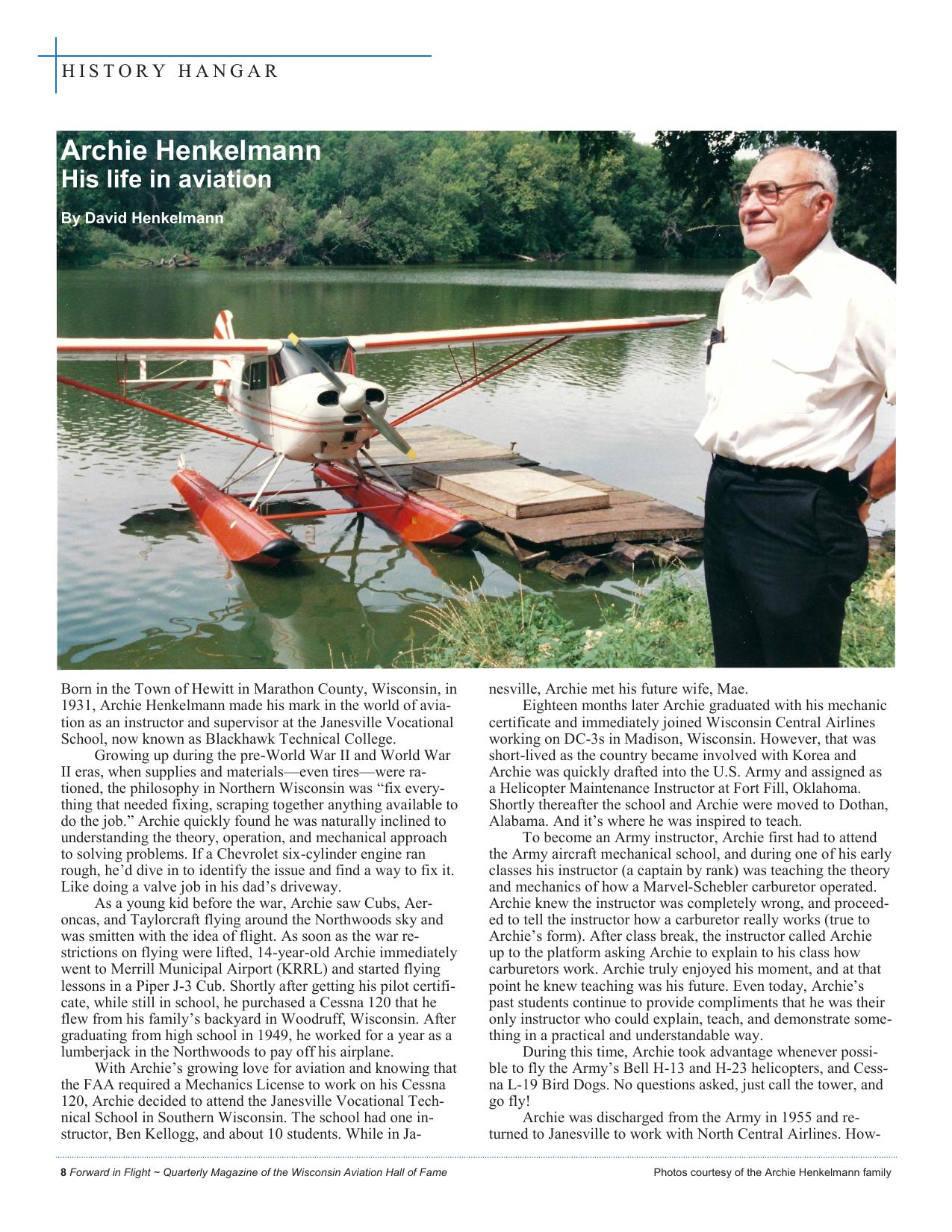
HISTORY HANGAR Archie Henkelmann His life in aviation By David Henkelmann Born in the Town of Hewitt in Marathon County, Wisconsin, in 1931, Archie Henkelmann made his mark in the world of aviation as an instructor and supervisor at the Janesville Vocational School, now known as Blackhawk Technical College. Growing up during the pre-World War II and World War II eras, when supplies and materials—even tires—were rationed, the philosophy in Northern Wisconsin was “fix everything that needed fixing, scraping together anything available to do the job.” Archie quickly found he was naturally inclined to understanding the theory, operation, and mechanical approach to solving problems. If a Chevrolet six-cylinder engine ran rough, he’d dive in to identify the issue and find a way to fix it. Like doing a valve job in his dad’s driveway. As a young kid before the war, Archie saw Cubs, Aeroncas, and Taylorcraft flying around the Northwoods sky and was smitten with the idea of flight. As soon as the war restrictions on flying were lifted, 14-year-old Archie immediately went to Merrill Municipal Airport (KRRL) and started flying lessons in a Piper J-3 Cub. Shortly after getting his pilot certificate, while still in school, he purchased a Cessna 120 that he flew from his family’s backyard in Woodruff, Wisconsin. After graduating from high school in 1949, he worked for a year as a lumberjack in the Northwoods to pay off his airplane. With Archie’s growing love for aviation and knowing that the FAA required a Mechanics License to work on his Cessna 120, Archie decided to attend the Janesville Vocational Technical School in Southern Wisconsin. The school had one instructor, Ben Kellogg, and about 10 students. While in Ja8 Forward in Flight ~ Quarterly Magazine of the Wisconsin Aviation Hall of Fame nesville, Archie met his future wife, Mae. Eighteen months later Archie graduated with his mechanic certificate and immediately joined Wisconsin Central Airlines working on DC-3s in Madison, Wisconsin. However, that was short-lived as the country became involved with Korea and Archie was quickly drafted into the U.S. Army and assigned as a Helicopter Maintenance Instructor at Fort Fill, Oklahoma. Shortly thereafter the school and Archie were moved to Dothan, Alabama. And it’s where he was inspired to teach. To become an Army instructor, Archie first had to attend the Army aircraft mechanical school, and during one of his early classes his instructor (a captain by rank) was teaching the theory and mechanics of how a Marvel-Schebler carburetor operated. Archie knew the instructor was completely wrong, and proceeded to tell the instructor how a carburetor really works (true to Archie’s form). After class break, the instructor called Archie up to the platform asking Archie to explain to his class how carburetors work. Archie truly enjoyed his moment, and at that point he knew teaching was his future. Even today, Archie’s past students continue to provide compliments that he was their only instructor who could explain, teach, and demonstrate something in a practical and understandable way. During this time, Archie took advantage whenever possible to fly the Army’s Bell H-13 and H-23 helicopters, and Cessna L-19 Bird Dogs. No questions asked, just call the tower, and go fly! Archie was discharged from the Army in 1955 and returned to Janesville to work with North Central Airlines. HowPhotos courtesy of the Archie Henkelmann family
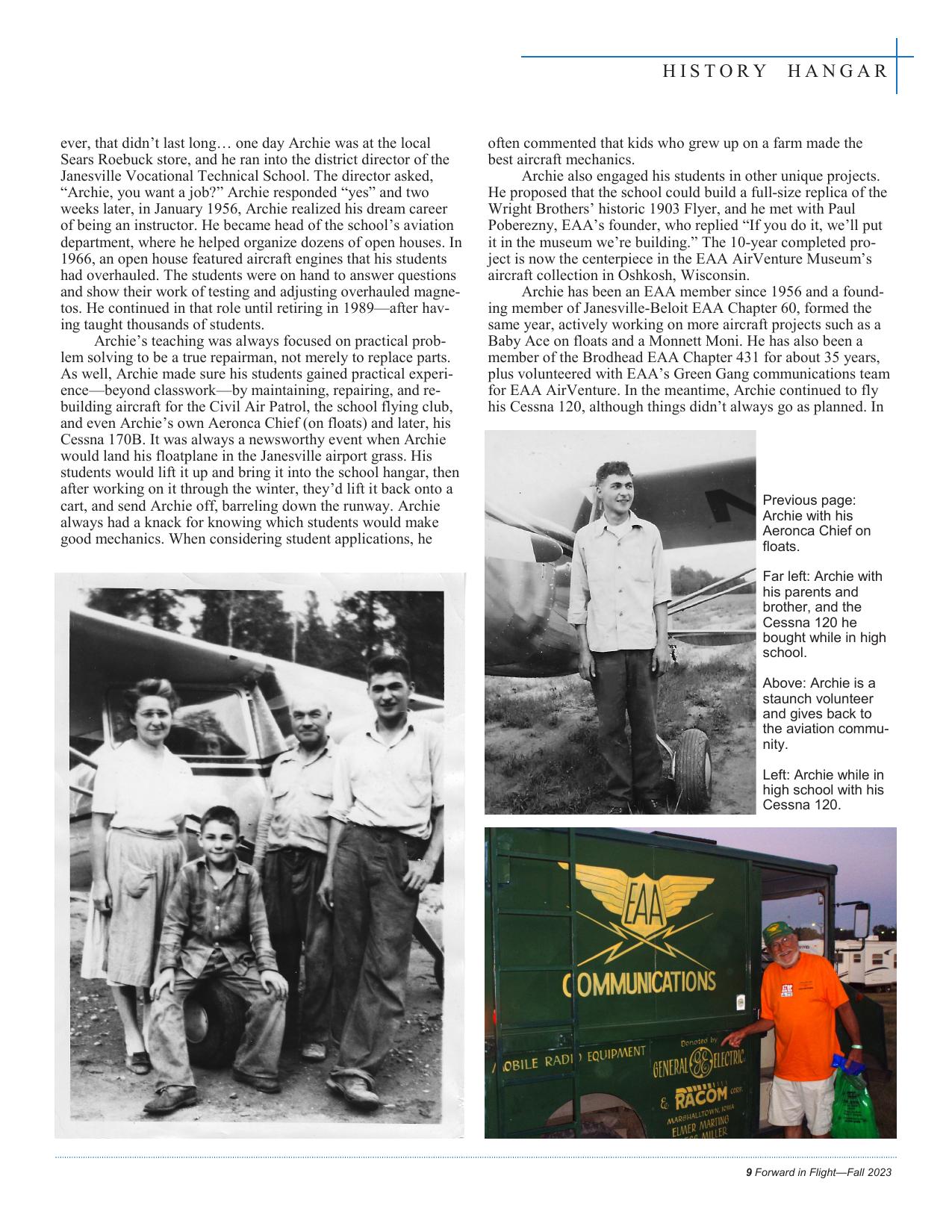
HISTORY ever, that didn’t last long… one day Archie was at the local Sears Roebuck store, and he ran into the district director of the Janesville Vocational Technical School. The director asked, “Archie, you want a job?” Archie responded “yes” and two weeks later, in January 1956, Archie realized his dream career of being an instructor. He became head of the school’s aviation department, where he helped organize dozens of open houses. In 1966, an open house featured aircraft engines that his students had overhauled. The students were on hand to answer questions and show their work of testing and adjusting overhauled magnetos. He continued in that role until retiring in 1989—after having taught thousands of students. Archie’s teaching was always focused on practical problem solving to be a true repairman, not merely to replace parts. As well, Archie made sure his students gained practical experience—beyond classwork—by maintaining, repairing, and rebuilding aircraft for the Civil Air Patrol, the school flying club, and even Archie’s own Aeronca Chief (on floats) and later, his Cessna 170B. It was always a newsworthy event when Archie would land his floatplane in the Janesville airport grass. His students would lift it up and bring it into the school hangar, then after working on it through the winter, they’d lift it back onto a cart, and send Archie off, barreling down the runway. Archie always had a knack for knowing which students would make good mechanics. When considering student applications, he HANGAR often commented that kids who grew up on a farm made the best aircraft mechanics. Archie also engaged his students in other unique projects. He proposed that the school could build a full-size replica of the Wright Brothers’ historic 1903 Flyer, and he met with Paul Poberezny, EAA’s founder, who replied “If you do it, we’ll put it in the museum we’re building.” The 10-year completed project is now the centerpiece in the EAA AirVenture Museum’s aircraft collection in Oshkosh, Wisconsin. Archie has been an EAA member since 1956 and a founding member of Janesville-Beloit EAA Chapter 60, formed the same year, actively working on more aircraft projects such as a Baby Ace on floats and a Monnett Moni. He has also been a member of the Brodhead EAA Chapter 431 for about 35 years, plus volunteered with EAA’s Green Gang communications team for EAA AirVenture. In the meantime, Archie continued to fly his Cessna 120, although things didn’t always go as planned. In Previous page: Archie with his Aeronca Chief on floats. Far left: Archie with his parents and brother, and the Cessna 120 he bought while in high school. Above: Archie is a staunch volunteer and gives back to the aviation community. Left: Archie while in high school with his Cessna 120. 9 Forward in Flight—Fall 2023
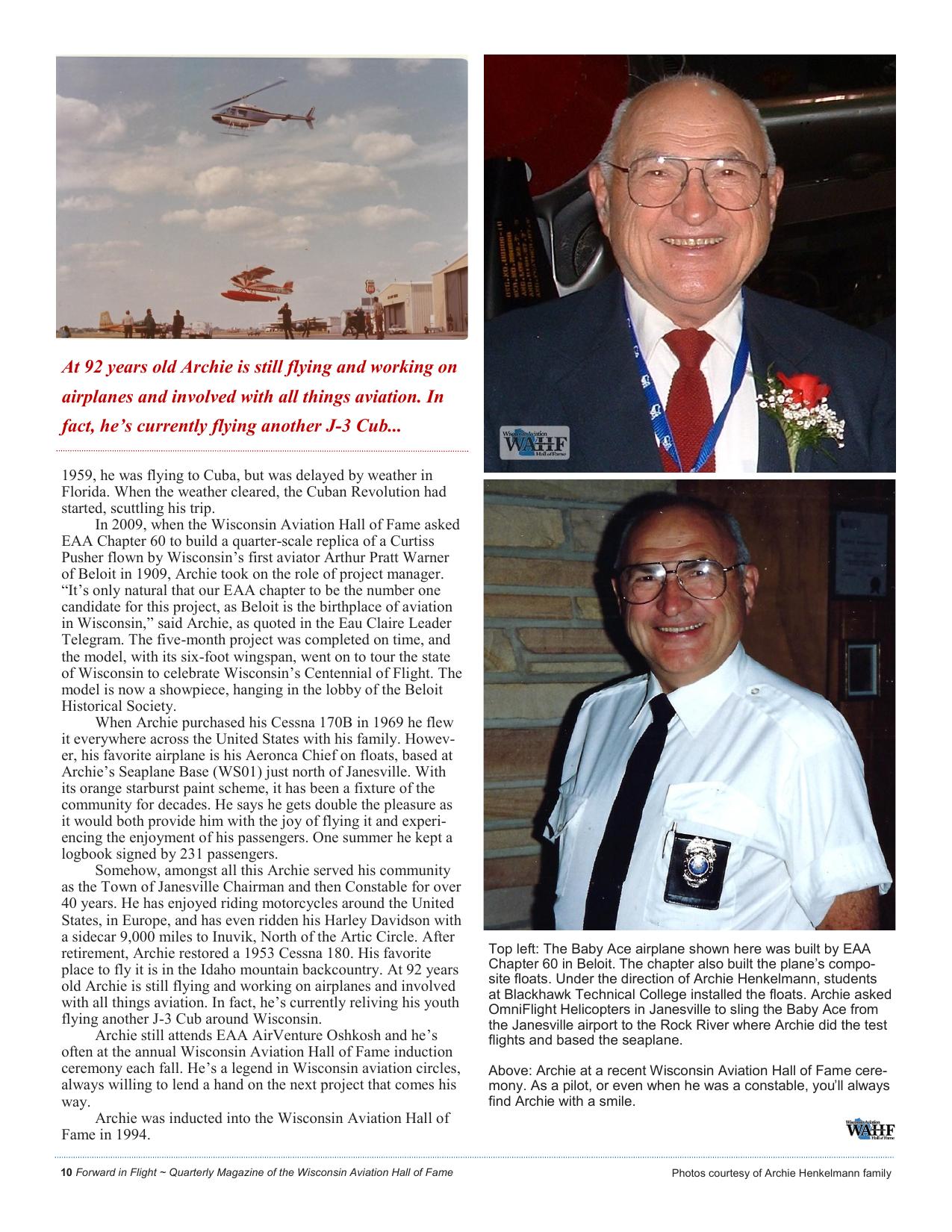
At 92 years old Archie is still flying and working on airplanes and involved with all things aviation. In fact, he’s currently flying another J-3 Cub... 1959, he was flying to Cuba, but was delayed by weather in Florida. When the weather cleared, the Cuban Revolution had started, scuttling his trip. In 2009, when the Wisconsin Aviation Hall of Fame asked EAA Chapter 60 to build a quarter-scale replica of a Curtiss Pusher flown by Wisconsin’s first aviator Arthur Pratt Warner of Beloit in 1909, Archie took on the role of project manager. “It’s only natural that our EAA chapter to be the number one candidate for this project, as Beloit is the birthplace of aviation in Wisconsin,” said Archie, as quoted in the Eau Claire Leader Telegram. The five-month project was completed on time, and the model, with its six-foot wingspan, went on to tour the state of Wisconsin to celebrate Wisconsin’s Centennial of Flight. The model is now a showpiece, hanging in the lobby of the Beloit Historical Society. When Archie purchased his Cessna 170B in 1969 he flew it everywhere across the United States with his family. However, his favorite airplane is his Aeronca Chief on floats, based at Archie’s Seaplane Base (WS01) just north of Janesville. With its orange starburst paint scheme, it has been a fixture of the community for decades. He says he gets double the pleasure as it would both provide him with the joy of flying it and experiencing the enjoyment of his passengers. One summer he kept a logbook signed by 231 passengers. Somehow, amongst all this Archie served his community as the Town of Janesville Chairman and then Constable for over 40 years. He has enjoyed riding motorcycles around the United States, in Europe, and has even ridden his Harley Davidson with a sidecar 9,000 miles to Inuvik, North of the Artic Circle. After retirement, Archie restored a 1953 Cessna 180. His favorite place to fly it is in the Idaho mountain backcountry. At 92 years old Archie is still flying and working on airplanes and involved with all things aviation. In fact, he’s currently reliving his youth flying another J-3 Cub around Wisconsin. Archie still attends EAA AirVenture Oshkosh and he’s often at the annual Wisconsin Aviation Hall of Fame induction ceremony each fall. He’s a legend in Wisconsin aviation circles, always willing to lend a hand on the next project that comes his way. Archie was inducted into the Wisconsin Aviation Hall of Fame in 1994. 10 Forward in Flight ~ Quarterly Magazine of the Wisconsin Aviation Hall of Fame Archie served admirably as an instructor, and also as constable for the Town of Janesville. Top left: The Baby Ace airplane shown here was built by EAA Chapter 60 in Beloit. The chapter also built the plane’s composite floats. Under the direction of Archie Henkelmann, students at Blackhawk Technical College installed the floats. Archie asked OmniFlight Helicopters in Janesville to sling the Baby Ace from the Janesville airport to the Rock River where Archie did the test flights and based the seaplane. Above: Archie at a recent Wisconsin Aviation Hall of Fame ceremony. As a pilot, or even when he was a constable, you’ll always find Archie with a smile. Photos courtesy of Archie Henkelmann family
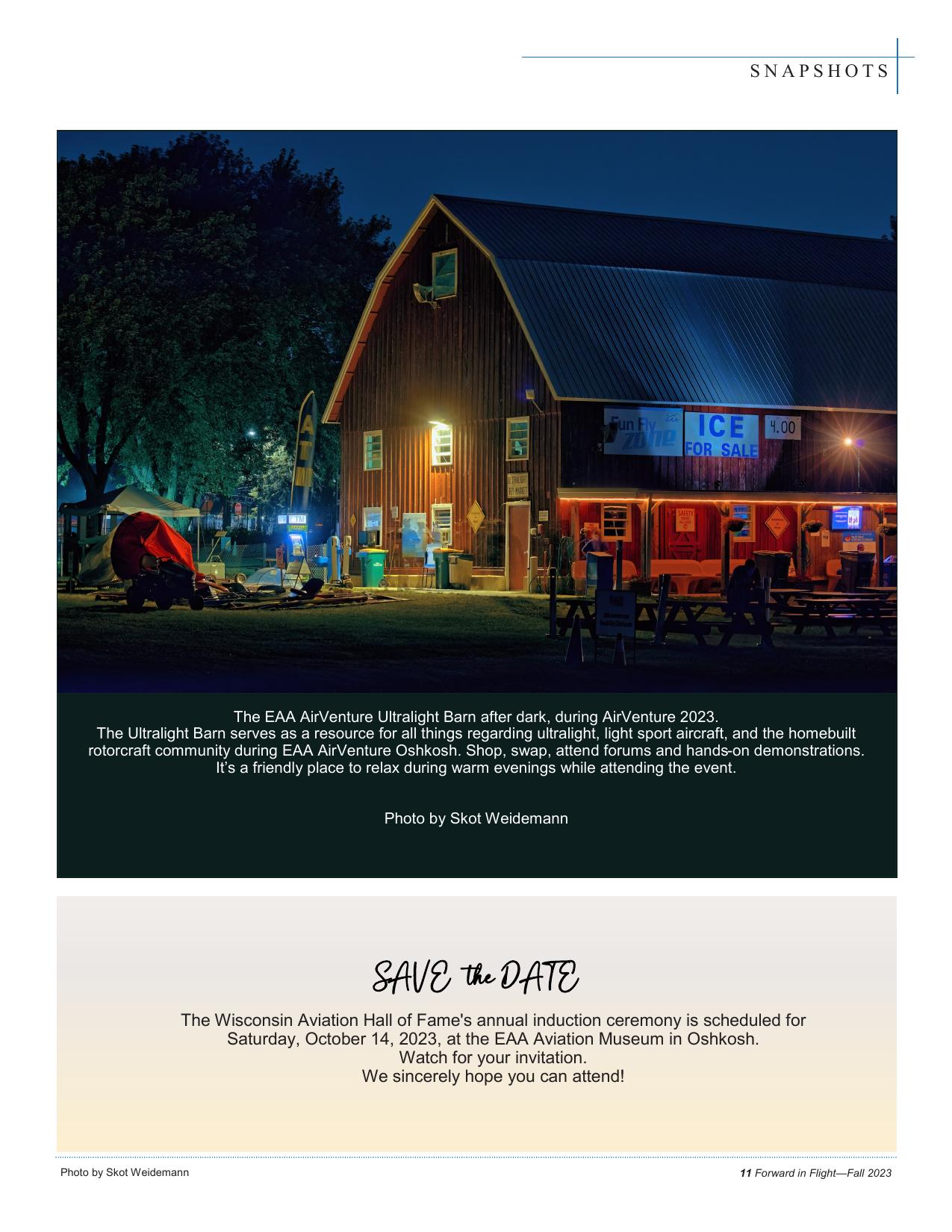
SNAPSHOTS The EAA AirVenture Ultralight Barn after dark, during AirVenture 2023. The Ultralight Barn serves as a resource for all things regarding ultralight, light sport aircraft, and the homebuilt rotorcraft community during EAA AirVenture Oshkosh. Shop, swap, attend forums and hands-on demonstrations. It’s a friendly place to relax during warm evenings while attending the event. Photo by Skot Weidemann SAVE the DATE The Wisconsin Aviation Hall of Fame's annual induction ceremony is scheduled for Saturday, October 14, 2023, at the EAA Aviation Museum in Oshkosh. Watch for your invitation. We sincerely hope you can attend! Photo by Skot Weidemann 11 Forward in Flight—Fall 2023
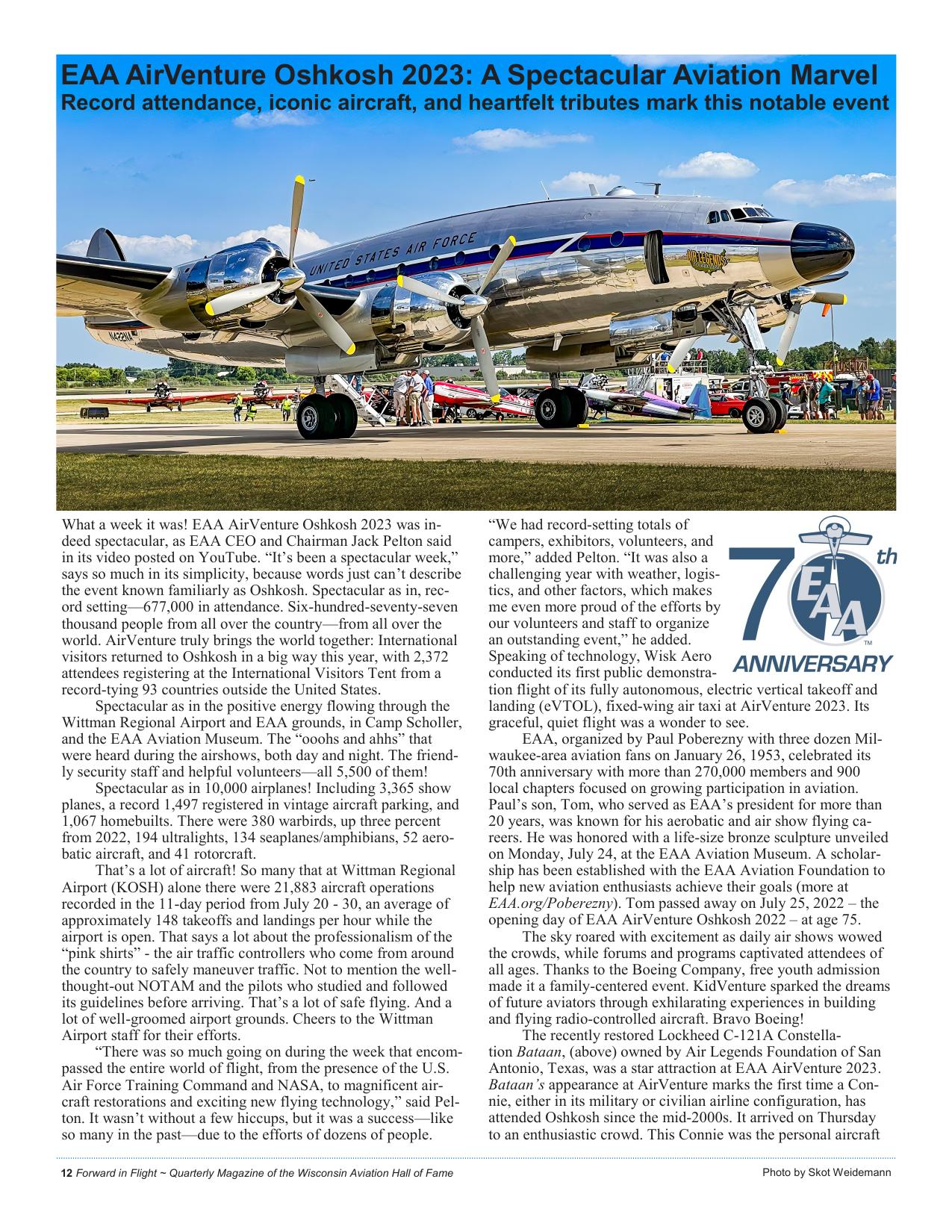
EAA AirVenture Oshkosh 2023: A Spectacular Aviation Marvel Record attendance, iconic aircraft, and heartfelt tributes mark this notable event What a week it was! EAA AirVenture Oshkosh 2023 was indeed spectacular, as EAA CEO and Chairman Jack Pelton said in its video posted on YouTube. “It’s been a spectacular week,” says so much in its simplicity, because words just can’t describe the event known familiarly as Oshkosh. Spectacular as in, record setting—677,000 in attendance. Six-hundred-seventy-seven thousand people from all over the country—from all over the world. AirVenture truly brings the world together: International visitors returned to Oshkosh in a big way this year, with 2,372 attendees registering at the International Visitors Tent from a record-tying 93 countries outside the United States. Spectacular as in the positive energy flowing through the Wittman Regional Airport and EAA grounds, in Camp Scholler, and the EAA Aviation Museum. The “ooohs and ahhs” that were heard during the airshows, both day and night. The friendly security staff and helpful volunteers—all 5,500 of them! Spectacular as in 10,000 airplanes! Including 3,365 show planes, a record 1,497 registered in vintage aircraft parking, and 1,067 homebuilts. There were 380 warbirds, up three percent from 2022, 194 ultralights, 134 seaplanes/amphibians, 52 aerobatic aircraft, and 41 rotorcraft. That’s a lot of aircraft! So many that at Wittman Regional Airport (KOSH) alone there were 21,883 aircraft operations recorded in the 11-day period from July 20 - 30, an average of approximately 148 takeoffs and landings per hour while the airport is open. That says a lot about the professionalism of the “pink shirts” - the air traffic controllers who come from around the country to safely maneuver traffic. Not to mention the wellthought-out NOTAM and the pilots who studied and followed its guidelines before arriving. That’s a lot of safe flying. And a lot of well-groomed airport grounds. Cheers to the Wittman Airport staff for their efforts. “There was so much going on during the week that encompassed the entire world of flight, from the presence of the U.S. Air Force Training Command and NASA, to magnificent aircraft restorations and exciting new flying technology,” said Pelton. It wasn’t without a few hiccups, but it was a success—like so many in the past—due to the efforts of dozens of people. 12 Forward in Flight ~ Quarterly Magazine of the Wisconsin Aviation Hall of Fame “We had record-setting totals of campers, exhibitors, volunteers, and more,” added Pelton. “It was also a challenging year with weather, logistics, and other factors, which makes me even more proud of the efforts by our volunteers and staff to organize an outstanding event,” he added. Speaking of technology, Wisk Aero conducted its first public demonstration flight of its fully autonomous, electric vertical takeoff and landing (eVTOL), fixed-wing air taxi at AirVenture 2023. Its graceful, quiet flight was a wonder to see. EAA, organized by Paul Poberezny with three dozen Milwaukee-area aviation fans on January 26, 1953, celebrated its 70th anniversary with more than 270,000 members and 900 local chapters focused on growing participation in aviation. Paul’s son, Tom, who served as EAA’s president for more than 20 years, was known for his aerobatic and air show flying careers. He was honored with a life-size bronze sculpture unveiled on Monday, July 24, at the EAA Aviation Museum. A scholarship has been established with the EAA Aviation Foundation to help new aviation enthusiasts achieve their goals (more at EAA.org/Poberezny). Tom passed away on July 25, 2022 – the opening day of EAA AirVenture Oshkosh 2022 – at age 75. The sky roared with excitement as daily air shows wowed the crowds, while forums and programs captivated attendees of all ages. Thanks to the Boeing Company, free youth admission made it a family-centered event. KidVenture sparked the dreams of future aviators through exhilarating experiences in building and flying radio-controlled aircraft. Bravo Boeing! The recently restored Lockheed C-121A Constellation Bataan, (above) owned by Air Legends Foundation of San Antonio, Texas, was a star attraction at EAA AirVenture 2023. Bataan’s appearance at AirVenture marks the first time a Connie, either in its military or civilian airline configuration, has attended Oshkosh since the mid-2000s. It arrived on Thursday to an enthusiastic crowd. This Connie was the personal aircraft Photo by Skot Weidemann
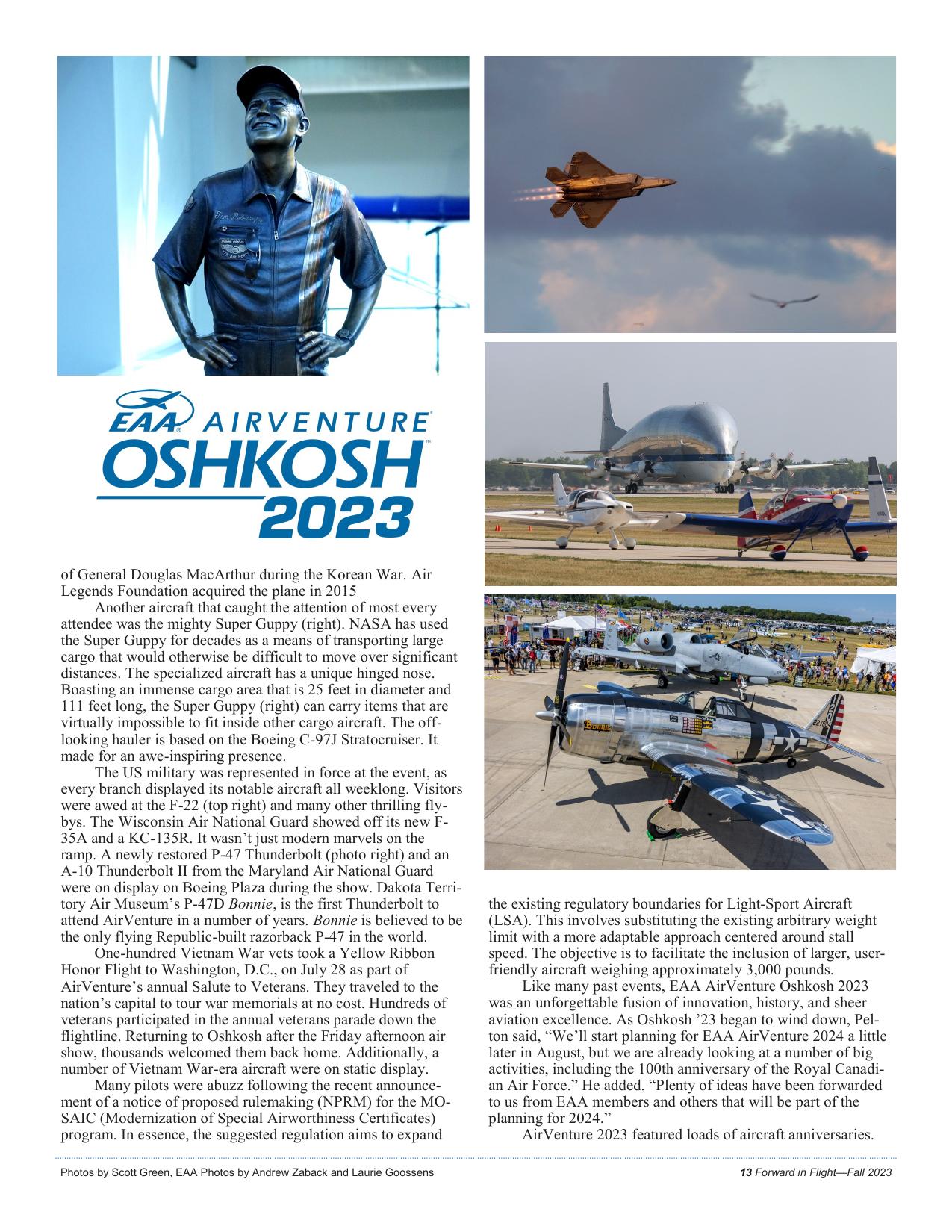
of General Douglas MacArthur during the Korean War. Air Legends Foundation acquired the plane in 2015 Another aircraft that caught the attention of most every attendee was the mighty Super Guppy (right). NASA has used the Super Guppy for decades as a means of transporting large cargo that would otherwise be difficult to move over significant distances. The specialized aircraft has a unique hinged nose. Boasting an immense cargo area that is 25 feet in diameter and 111 feet long, the Super Guppy (right) can carry items that are virtually impossible to fit inside other cargo aircraft. The offlooking hauler is based on the Boeing C-97J Stratocruiser. It made for an awe-inspiring presence. The US military was represented in force at the event, as every branch displayed its notable aircraft all weeklong. Visitors were awed at the F-22 (top right) and many other thrilling flybys. The Wisconsin Air National Guard showed off its new F35A and a KC-135R. It wasn’t just modern marvels on the ramp. A newly restored P-47 Thunderbolt (photo right) and an A-10 Thunderbolt II from the Maryland Air National Guard were on display on Boeing Plaza during the show. Dakota Territory Air Museum’s P-47D Bonnie, is the first Thunderbolt to attend AirVenture in a number of years. Bonnie is believed to be the only flying Republic-built razorback P-47 in the world. One-hundred Vietnam War vets took a Yellow Ribbon Honor Flight to Washington, D.C., on July 28 as part of AirVenture’s annual Salute to Veterans. They traveled to the nation’s capital to tour war memorials at no cost. Hundreds of veterans participated in the annual veterans parade down the flightline. Returning to Oshkosh after the Friday afternoon air show, thousands welcomed them back home. Additionally, a number of Vietnam War-era aircraft were on static display. Many pilots were abuzz following the recent announcement of a notice of proposed rulemaking (NPRM) for the MOSAIC (Modernization of Special Airworthiness Certificates) program. In essence, the suggested regulation aims to expand Photos by Scott Green, EAA Photos by Andrew Zaback and Laurie Goossens the existing regulatory boundaries for Light-Sport Aircraft (LSA). This involves substituting the existing arbitrary weight limit with a more adaptable approach centered around stall speed. The objective is to facilitate the inclusion of larger, userfriendly aircraft weighing approximately 3,000 pounds. Like many past events, EAA AirVenture Oshkosh 2023 was an unforgettable fusion of innovation, history, and sheer aviation excellence. As Oshkosh ’23 began to wind down, Pelton said, “We’ll start planning for EAA AirVenture 2024 a little later in August, but we are already looking at a number of big activities, including the 100th anniversary of the Royal Canadian Air Force.” He added, “Plenty of ideas have been forwarded to us from EAA members and others that will be part of the planning for 2024.” AirVenture 2023 featured loads of aircraft anniversaries. 13 Forward in Flight—Fall 2023
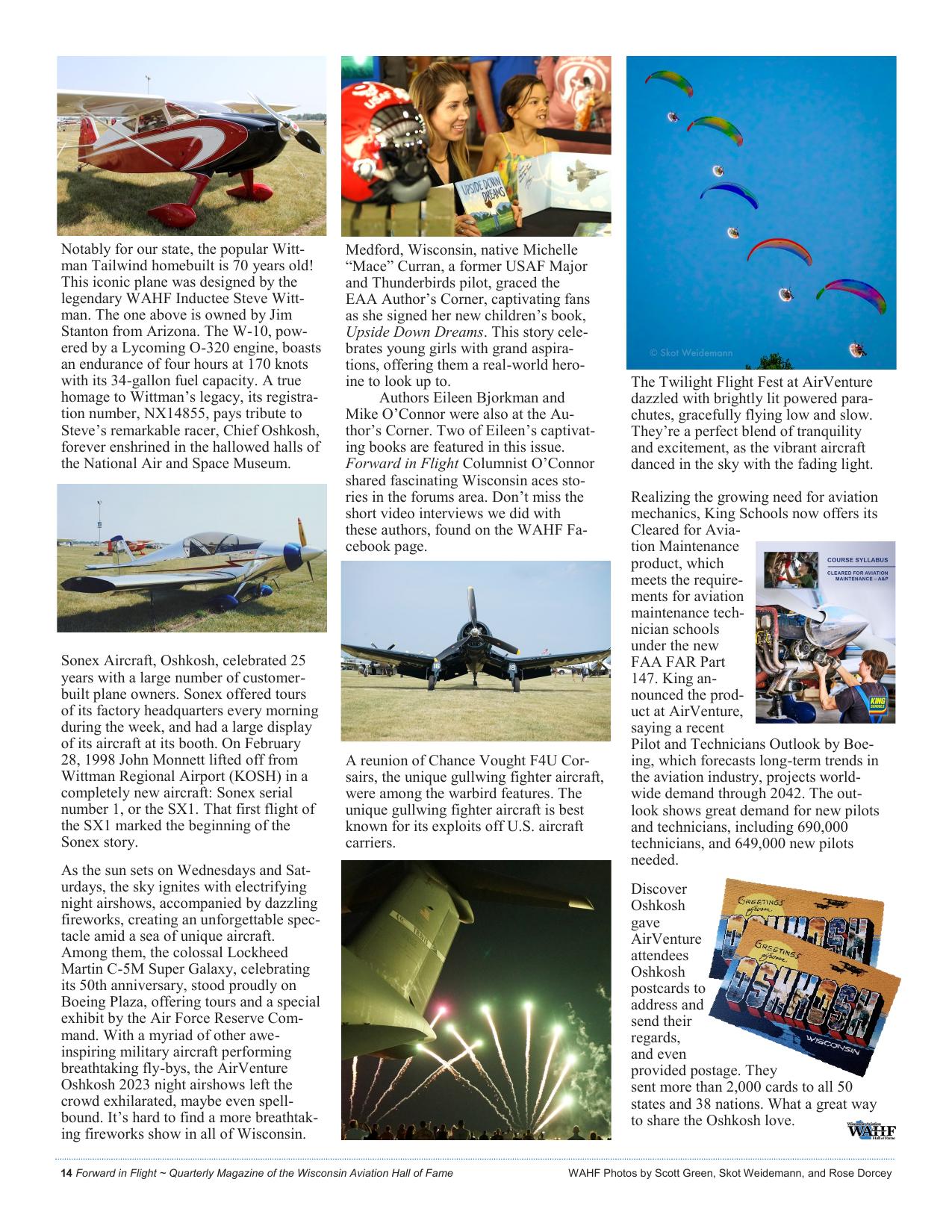
Notably for our state, the popular Wittman Tailwind homebuilt is 70 years old! This iconic plane was designed by the legendary WAHF Inductee Steve Wittman. The one above is owned by Jim Stanton from Arizona. The W-10, powered by a Lycoming O-320 engine, boasts an endurance of four hours at 170 knots with its 34-gallon fuel capacity. A true homage to Wittman’s legacy, its registration number, NX14855, pays tribute to Steve’s remarkable racer, Chief Oshkosh, forever enshrined in the hallowed halls of the National Air and Space Museum. Sonex Aircraft, Oshkosh, celebrated 25 years with a large number of customerbuilt plane owners. Sonex offered tours of its factory headquarters every morning during the week, and had a large display of its aircraft at its booth. On February 28, 1998 John Monnett lifted off from Wittman Regional Airport (KOSH) in a completely new aircraft: Sonex serial number 1, or the SX1. That first flight of the SX1 marked the beginning of the Sonex story. Medford, Wisconsin, native Michelle “Mace” Curran, a former USAF Major and Thunderbirds pilot, graced the EAA Author’s Corner, captivating fans as she signed her new children’s book, Upside Down Dreams. This story celebrates young girls with grand aspirations, offering them a real-world heroine to look up to. Authors Eileen Bjorkman and Mike O’Connor were also at the Author’s Corner. Two of Eileen’s captivating books are featured in this issue. Forward in Flight Columnist O’Connor shared fascinating Wisconsin aces stories in the forums area. Don’t miss the short video interviews we did with these authors, found on the WAHF Facebook page. A reunion of Chance Vought F4U Corsairs, the unique gullwing fighter aircraft, were among the warbird features. The unique gullwing fighter aircraft is best known for its exploits off U.S. aircraft carriers. As the sun sets on Wednesdays and Saturdays, the sky ignites with electrifying night airshows, accompanied by dazzling fireworks, creating an unforgettable spectacle amid a sea of unique aircraft. Among them, the colossal Lockheed Martin C-5M Super Galaxy, celebrating its 50th anniversary, stood proudly on Boeing Plaza, offering tours and a special exhibit by the Air Force Reserve Command. With a myriad of other aweinspiring military aircraft performing breathtaking fly-bys, the AirVenture Oshkosh 2023 night airshows left the crowd exhilarated, maybe even spellbound. It’s hard to find a more breathtaking fireworks show in all of Wisconsin. 14 Forward in Flight ~ Quarterly Magazine of the Wisconsin Aviation Hall of Fame The Twilight Flight Fest at AirVenture dazzled with brightly lit powered parachutes, gracefully flying low and slow. They’re a perfect blend of tranquility and excitement, as the vibrant aircraft danced in the sky with the fading light. Realizing the growing need for aviation mechanics, King Schools now offers its Cleared for Aviation Maintenance product, which meets the requirements for aviation maintenance technician schools under the new FAA FAR Part 147. King announced the product at AirVenture, saying a recent Pilot and Technicians Outlook by Boeing, which forecasts long-term trends in the aviation industry, projects worldwide demand through 2042. The outlook shows great demand for new pilots and technicians, including 690,000 technicians, and 649,000 new pilots needed. Discover Oshkosh gave AirVenture attendees Oshkosh postcards to address and send their regards, and even provided postage. They sent more than 2,000 cards to all 50 states and 38 nations. What a great way to share the Oshkosh love. WAHF Photos by Scott Green, Skot Weidemann, and Rose Dorcey
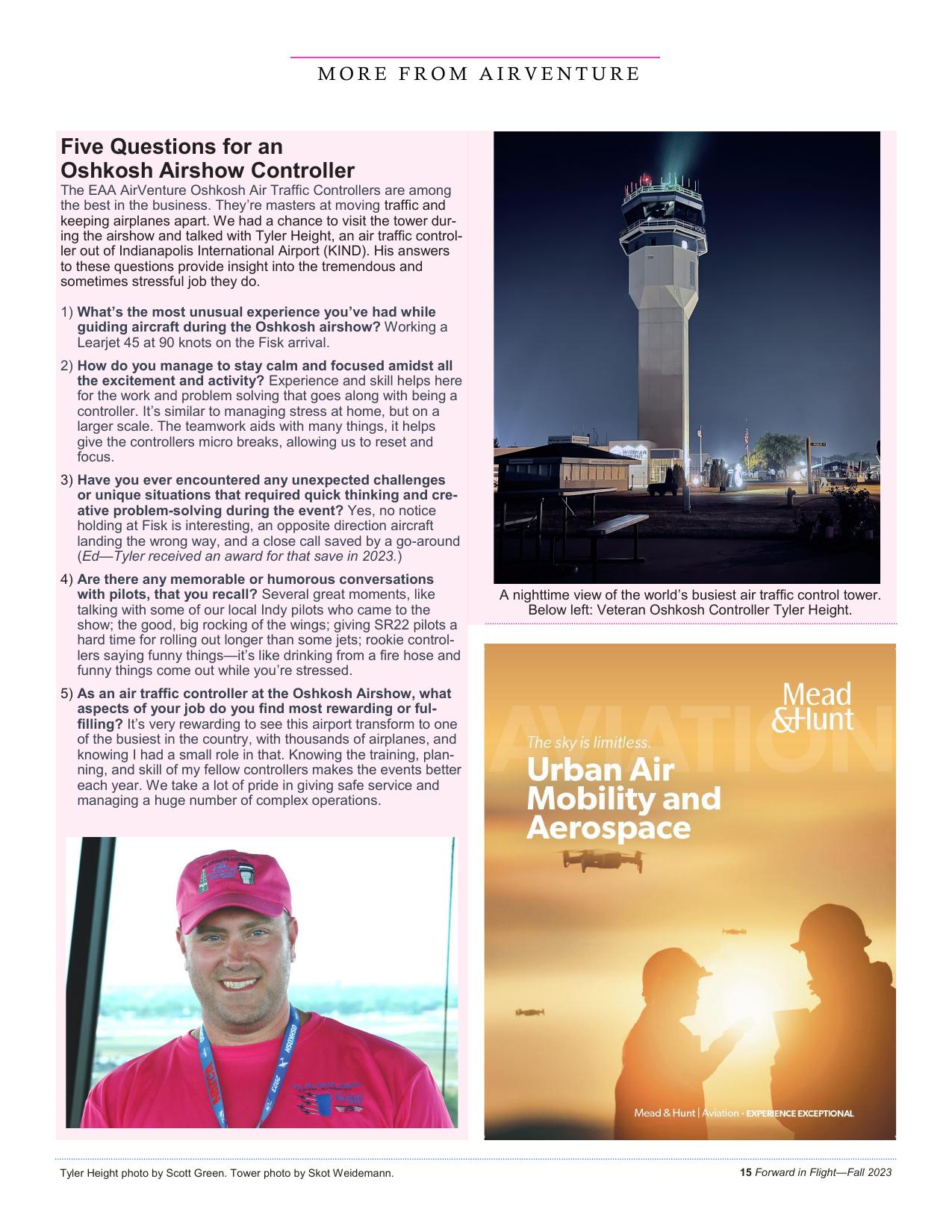
MORE FROM AIRVENTURE Five Questions for an Oshkosh Airshow Controller The EAA AirVenture Oshkosh Air Traffic Controllers are among the best in the business. They’re masters at moving traffic and keeping airplanes apart. We had a chance to visit the tower during the airshow and talked with Tyler Height, an air traffic controller out of Indianapolis International Airport (KIND). His answers to these questions provide insight into the tremendous and sometimes stressful job they do. 1) What’s the most unusual experience you’ve had while guiding aircraft during the Oshkosh airshow? Working a Learjet 45 at 90 knots on the Fisk arrival. 2) How do you manage to stay calm and focused amidst all the excitement and activity? Experience and skill helps here for the work and problem solving that goes along with being a controller. It’s similar to managing stress at home, but on a larger scale. The teamwork aids with many things, it helps give the controllers micro breaks, allowing us to reset and focus. 3) Have you ever encountered any unexpected challenges or unique situations that required quick thinking and creative problem-solving during the event? Yes, no notice holding at Fisk is interesting, an opposite direction aircraft landing the wrong way, and a close call saved by a go-around (Ed—Tyler received an award for that save in 2023.) 4) Are there any memorable or humorous conversations with pilots, that you recall? Several great moments, like talking with some of our local Indy pilots who came to the show; the good, big rocking of the wings; giving SR22 pilots a hard time for rolling out longer than some jets; rookie controllers saying funny things—it’s like drinking from a fire hose and funny things come out while you’re stressed. A nighttime view of the world’s busiest air traffic control tower. Below left: Veteran Oshkosh Controller Tyler Height. 5) As an air traffic controller at the Oshkosh Airshow, what aspects of your job do you find most rewarding or fulfilling? It’s very rewarding to see this airport transform to one of the busiest in the country, with thousands of airplanes, and knowing I had a small role in that. Knowing the training, planning, and skill of my fellow controllers makes the events better each year. We take a lot of pride in giving safe service and managing a huge number of complex operations. Tyler Height photo by Scott Green. Tower photo by Skot Weidemann. 15 Forward in Flight—Fall 2023
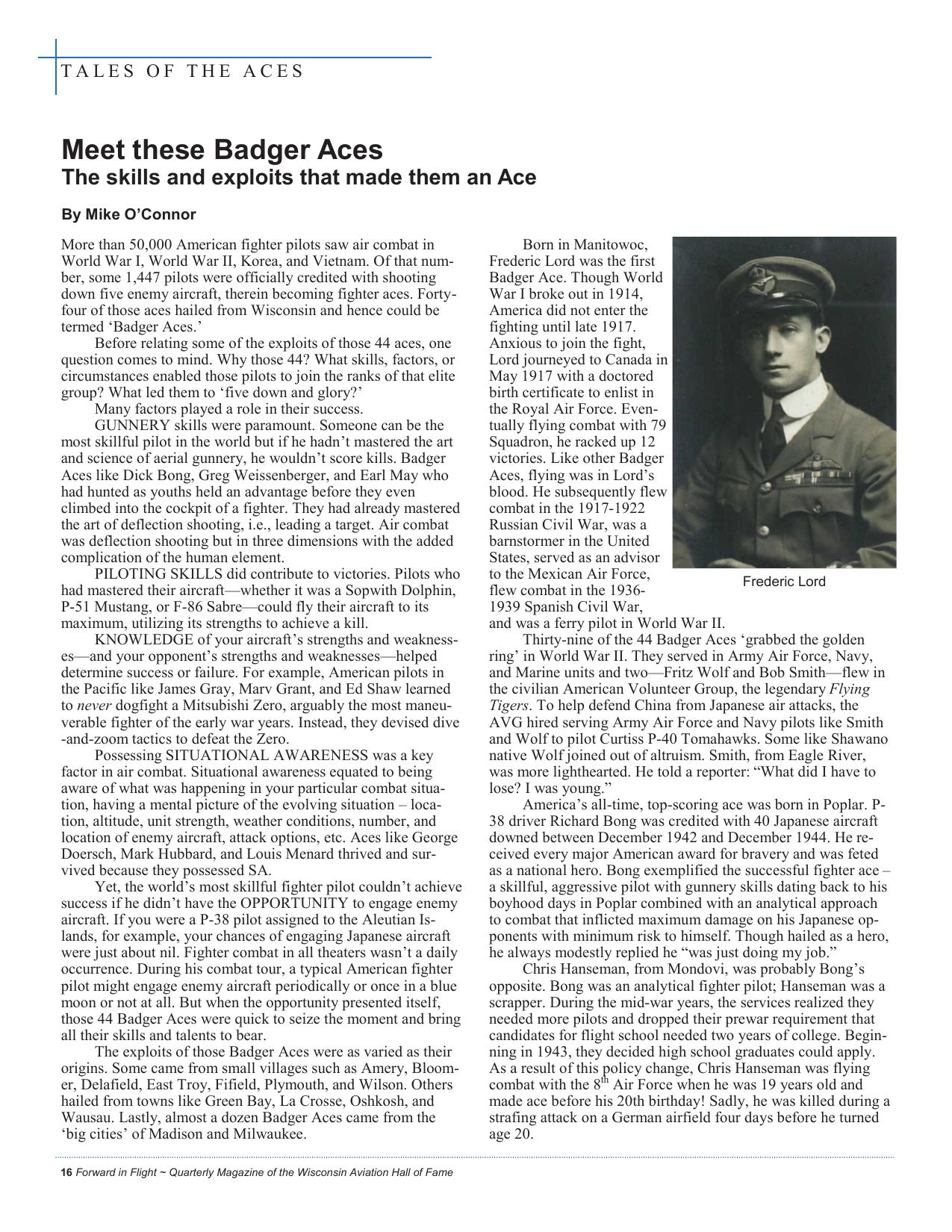
TALES OF THE ACES Meet these Badger Aces The skills and exploits that made them an Ace By Mike O’Connor More than 50,000 American fighter pilots saw air combat in World War I, World War II, Korea, and Vietnam. Of that number, some 1,447 pilots were officially credited with shooting down five enemy aircraft, therein becoming fighter aces. Fortyfour of those aces hailed from Wisconsin and hence could be termed ‘Badger Aces.’ Before relating some of the exploits of those 44 aces, one question comes to mind. Why those 44? What skills, factors, or circumstances enabled those pilots to join the ranks of that elite group? What led them to ‘five down and glory?’ Many factors played a role in their success. GUNNERY skills were paramount. Someone can be the most skillful pilot in the world but if he hadn’t mastered the art and science of aerial gunnery, he wouldn’t score kills. Badger Aces like Dick Bong, Greg Weissenberger, and Earl May who had hunted as youths held an advantage before they even climbed into the cockpit of a fighter. They had already mastered the art of deflection shooting, i.e., leading a target. Air combat was deflection shooting but in three dimensions with the added complication of the human element. PILOTING SKILLS did contribute to victories. Pilots who had mastered their aircraft—whether it was a Sopwith Dolphin, P-51 Mustang, or F-86 Sabre—could fly their aircraft to its maximum, utilizing its strengths to achieve a kill. KNOWLEDGE of your aircraft’s strengths and weaknesses—and your opponent’s strengths and weaknesses—helped determine success or failure. For example, American pilots in the Pacific like James Gray, Marv Grant, and Ed Shaw learned to never dogfight a Mitsubishi Zero, arguably the most maneuverable fighter of the early war years. Instead, they devised dive -and-zoom tactics to defeat the Zero. Possessing SITUATIONAL AWARENESS was a key factor in air combat. Situational awareness equated to being aware of what was happening in your particular combat situation, having a mental picture of the evolving situation – location, altitude, unit strength, weather conditions, number, and location of enemy aircraft, attack options, etc. Aces like George Doersch, Mark Hubbard, and Louis Menard thrived and survived because they possessed SA. Yet, the world’s most skillful fighter pilot couldn’t achieve success if he didn’t have the OPPORTUNITY to engage enemy aircraft. If you were a P-38 pilot assigned to the Aleutian Islands, for example, your chances of engaging Japanese aircraft were just about nil. Fighter combat in all theaters wasn’t a daily occurrence. During his combat tour, a typical American fighter pilot might engage enemy aircraft periodically or once in a blue moon or not at all. But when the opportunity presented itself, those 44 Badger Aces were quick to seize the moment and bring all their skills and talents to bear. The exploits of those Badger Aces were as varied as their origins. Some came from small villages such as Amery, Bloomer, Delafield, East Troy, Fifield, Plymouth, and Wilson. Others hailed from towns like Green Bay, La Crosse, Oshkosh, and Wausau. Lastly, almost a dozen Badger Aces came from the ‘big cities’ of Madison and Milwaukee. 16 Forward in Flight ~ Quarterly Magazine of the Wisconsin Aviation Hall of Fame Born in Manitowoc, Frederic Lord was the first Badger Ace. Though World War I broke out in 1914, America did not enter the fighting until late 1917. Anxious to join the fight, Lord journeyed to Canada in May 1917 with a doctored birth certificate to enlist in the Royal Air Force. Eventually flying combat with 79 Squadron, he racked up 12 victories. Like other Badger Aces, flying was in Lord’s blood. He subsequently flew combat in the 1917-1922 Russian Civil War, was a barnstormer in the United States, served as an advisor to the Mexican Air Force, Frederic Lord flew combat in the 19361939 Spanish Civil War, and was a ferry pilot in World War II. Thirty-nine of the 44 Badger Aces ‘grabbed the golden ring’ in World War II. They served in Army Air Force, Navy, and Marine units and two—Fritz Wolf and Bob Smith—flew in the civilian American Volunteer Group, the legendary Flying Tigers. To help defend China from Japanese air attacks, the AVG hired serving Army Air Force and Navy pilots like Smith and Wolf to pilot Curtiss P-40 Tomahawks. Some like Shawano native Wolf joined out of altruism. Smith, from Eagle River, was more lighthearted. He told a reporter: “What did I have to lose? I was young.” America’s all-time, top-scoring ace was born in Poplar. P38 driver Richard Bong was credited with 40 Japanese aircraft downed between December 1942 and December 1944. He received every major American award for bravery and was feted as a national hero. Bong exemplified the successful fighter ace – a skillful, aggressive pilot with gunnery skills dating back to his boyhood days in Poplar combined with an analytical approach to combat that inflicted maximum damage on his Japanese opponents with minimum risk to himself. Though hailed as a hero, he always modestly replied he “was just doing my job.” Chris Hanseman, from Mondovi, was probably Bong’s opposite. Bong was an analytical fighter pilot; Hanseman was a scrapper. During the mid-war years, the services realized they needed more pilots and dropped their prewar requirement that candidates for flight school needed two years of college. Beginning in 1943, they decided high school graduates could apply. As a result of this policy change, Chris Hanseman was flying combat with the 8th Air Force when he was 19 years old and made ace before his 20th birthday! Sadly, he was killed during a strafing attack on a German airfield four days before he turned age 20.
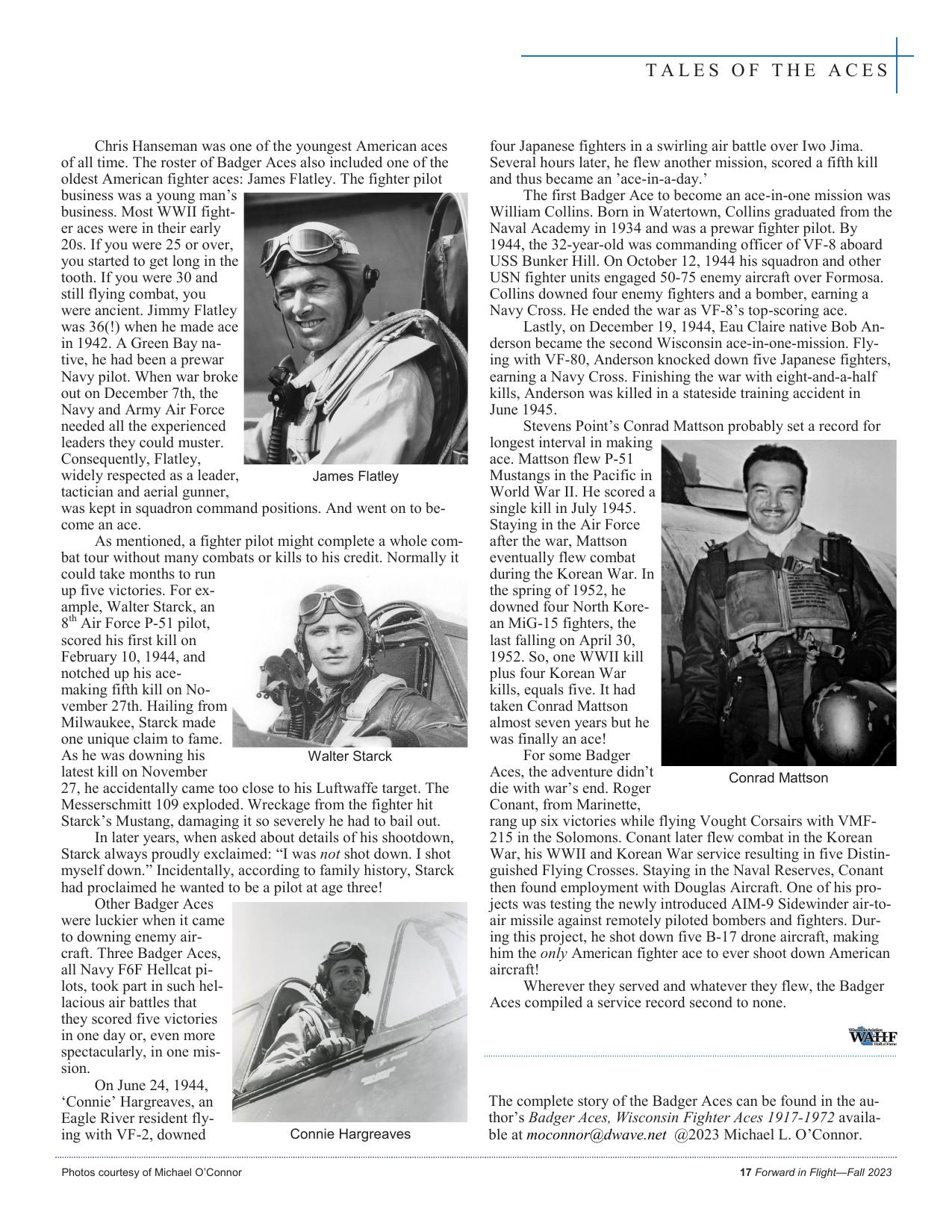
TALES OF THE ACES Chris Hanseman was one of the youngest American aces of all time. The roster of Badger Aces also included one of the oldest American fighter aces: James Flatley. The fighter pilot business was a young man’s business. Most WWII fighter aces were in their early 20s. If you were 25 or over, you started to get long in the tooth. If you were 30 and still flying combat, you were ancient. Jimmy Flatley was 36(!) when he made ace in 1942. A Green Bay native, he had been a prewar Navy pilot. When war broke out on December 7th, the Navy and Army Air Force needed all the experienced leaders they could muster. Consequently, Flatley, widely respected as a leader, James Flatley tactician and aerial gunner, was kept in squadron command positions. And went on to become an ace. As mentioned, a fighter pilot might complete a whole combat tour without many combats or kills to his credit. Normally it could take months to run up five victories. For example, Walter Starck, an 8th Air Force P-51 pilot, scored his first kill on February 10, 1944, and notched up his acemaking fifth kill on November 27th. Hailing from Milwaukee, Starck made one unique claim to fame. As he was downing his Walter Starck latest kill on November 27, he accidentally came too close to his Luftwaffe target. The Messerschmitt 109 exploded. Wreckage from the fighter hit Starck’s Mustang, damaging it so severely he had to bail out. In later years, when asked about details of his shootdown, Starck always proudly exclaimed: “I was not shot down. I shot myself down.” Incidentally, according to family history, Starck had proclaimed he wanted to be a pilot at age three! Other Badger Aces were luckier when it came to downing enemy aircraft. Three Badger Aces, all Navy F6F Hellcat pilots, took part in such hellacious air battles that they scored five victories in one day or, even more spectacularly, in one mission. On June 24, 1944, ‘Connie’ Hargreaves, an Eagle River resident flyConnie Hargreaves ing with VF-2, downed Photos courtesy of Michael O’Connor four Japanese fighters in a swirling air battle over Iwo Jima. Several hours later, he flew another mission, scored a fifth kill and thus became an ’ace-in-a-day.’ The first Badger Ace to become an ace-in-one mission was William Collins. Born in Watertown, Collins graduated from the Naval Academy in 1934 and was a prewar fighter pilot. By 1944, the 32-year-old was commanding officer of VF-8 aboard USS Bunker Hill. On October 12, 1944 his squadron and other USN fighter units engaged 50-75 enemy aircraft over Formosa. Collins downed four enemy fighters and a bomber, earning a Navy Cross. He ended the war as VF-8’s top-scoring ace. Lastly, on December 19, 1944, Eau Claire native Bob Anderson became the second Wisconsin ace-in-one-mission. Flying with VF-80, Anderson knocked down five Japanese fighters, earning a Navy Cross. Finishing the war with eight-and-a-half kills, Anderson was killed in a stateside training accident in June 1945. Stevens Point’s Conrad Mattson probably set a record for longest interval in making ace. Mattson flew P-51 Mustangs in the Pacific in World War II. He scored a single kill in July 1945. Staying in the Air Force after the war, Mattson eventually flew combat during the Korean War. In the spring of 1952, he downed four North Korean MiG-15 fighters, the last falling on April 30, 1952. So, one WWII kill plus four Korean War kills, equals five. It had taken Conrad Mattson almost seven years but he was finally an ace! For some Badger Aces, the adventure didn’t Conrad Mattson die with war’s end. Roger Conant, from Marinette, rang up six victories while flying Vought Corsairs with VMF215 in the Solomons. Conant later flew combat in the Korean War, his WWII and Korean War service resulting in five Distinguished Flying Crosses. Staying in the Naval Reserves, Conant then found employment with Douglas Aircraft. One of his projects was testing the newly introduced AIM-9 Sidewinder air-toair missile against remotely piloted bombers and fighters. During this project, he shot down five B-17 drone aircraft, making him the only American fighter ace to ever shoot down American aircraft! Wherever they served and whatever they flew, the Badger Aces compiled a service record second to none. The complete story of the Badger Aces can be found in the author’s Badger Aces, Wisconsin Fighter Aces 1917-1972 available at moconnor@dwave.net @2023 Michael L. O’Connor. 17 Forward in Flight—Fall 2023
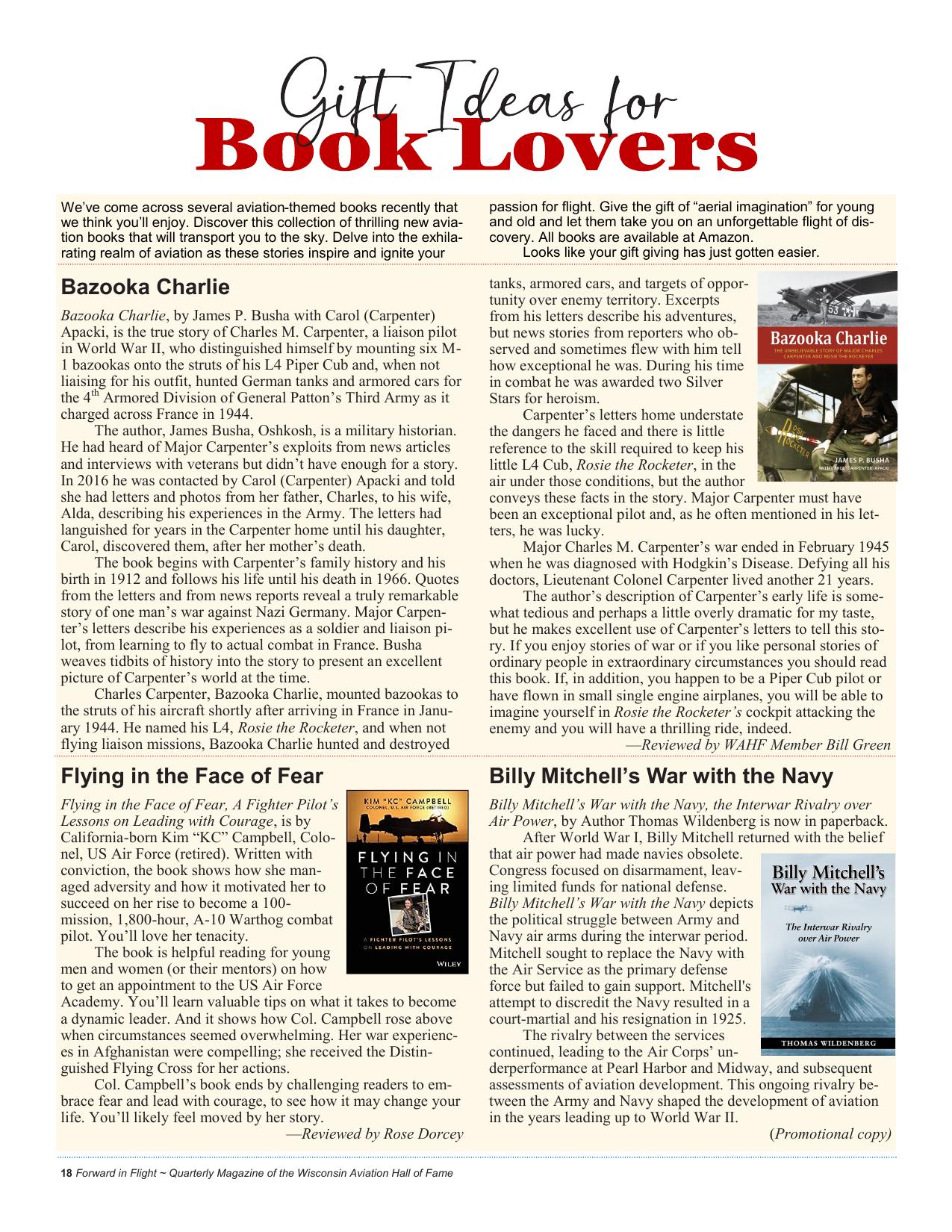
We’ve come across several aviation-themed books recently that we think you’ll enjoy. Discover this collection of thrilling new aviation books that will transport you to the sky. Delve into the exhilarating realm of aviation as these stories inspire and ignite your passion for flight. Give the gift of “aerial imagination” for young and old and let them take you on an unforgettable flight of discovery. All books are available at Amazon. Looks like your gift giving has just gotten easier. Bazooka Charlie Bazooka Charlie, by James P. Busha with Carol (Carpenter) Apacki, is the true story of Charles M. Carpenter, a liaison pilot in World War II, who distinguished himself by mounting six M1 bazookas onto the struts of his L4 Piper Cub and, when not liaising for his outfit, hunted German tanks and armored cars for the 4th Armored Division of General Patton’s Third Army as it charged across France in 1944. The author, James Busha, Oshkosh, is a military historian. He had heard of Major Carpenter’s exploits from news articles and interviews with veterans but didn’t have enough for a story. In 2016 he was contacted by Carol (Carpenter) Apacki and told she had letters and photos from her father, Charles, to his wife, Alda, describing his experiences in the Army. The letters had languished for years in the Carpenter home until his daughter, Carol, discovered them, after her mother’s death. The book begins with Carpenter’s family history and his birth in 1912 and follows his life until his death in 1966. Quotes from the letters and from news reports reveal a truly remarkable story of one man’s war against Nazi Germany. Major Carpenter’s letters describe his experiences as a soldier and liaison pilot, from learning to fly to actual combat in France. Busha weaves tidbits of history into the story to present an excellent picture of Carpenter’s world at the time. Charles Carpenter, Bazooka Charlie, mounted bazookas to the struts of his aircraft shortly after arriving in France in January 1944. He named his L4, Rosie the Rocketer, and when not flying liaison missions, Bazooka Charlie hunted and destroyed tanks, armored cars, and targets of opportunity over enemy territory. Excerpts from his letters describe his adventures, but news stories from reporters who observed and sometimes flew with him tell how exceptional he was. During his time in combat he was awarded two Silver Stars for heroism. Carpenter’s letters home understate the dangers he faced and there is little reference to the skill required to keep his little L4 Cub, Rosie the Rocketer, in the air under those conditions, but the author conveys these facts in the story. Major Carpenter must have been an exceptional pilot and, as he often mentioned in his letters, he was lucky. Major Charles M. Carpenter’s war ended in February 1945 when he was diagnosed with Hodgkin’s Disease. Defying all his doctors, Lieutenant Colonel Carpenter lived another 21 years. The author’s description of Carpenter’s early life is somewhat tedious and perhaps a little overly dramatic for my taste, but he makes excellent use of Carpenter’s letters to tell this story. If you enjoy stories of war or if you like personal stories of ordinary people in extraordinary circumstances you should read this book. If, in addition, you happen to be a Piper Cub pilot or have flown in small single engine airplanes, you will be able to imagine yourself in Rosie the Rocketer’s cockpit attacking the enemy and you will have a thrilling ride, indeed. —Reviewed by WAHF Member Bill Green Flying in the Face of Fear Billy Mitchell’s War with the Navy Flying in the Face of Fear, A Fighter Pilot’s Lessons on Leading with Courage, is by California-born Kim “KC” Campbell, Colonel, US Air Force (retired). Written with conviction, the book shows how she managed adversity and how it motivated her to succeed on her rise to become a 100mission, 1,800-hour, A-10 Warthog combat pilot. You’ll love her tenacity. The book is helpful reading for young men and women (or their mentors) on how to get an appointment to the US Air Force Academy. You’ll learn valuable tips on what it takes to become a dynamic leader. And it shows how Col. Campbell rose above when circumstances seemed overwhelming. Her war experiences in Afghanistan were compelling; she received the Distinguished Flying Cross for her actions. Col. Campbell’s book ends by challenging readers to embrace fear and lead with courage, to see how it may change your life. You’ll likely feel moved by her story. —Reviewed by Rose Dorcey Billy Mitchell’s War with the Navy, the Interwar Rivalry over Air Power, by Author Thomas Wildenberg is now in paperback. After World War I, Billy Mitchell returned with the belief that air power had made navies obsolete. Congress focused on disarmament, leaving limited funds for national defense. Billy Mitchell’s War with the Navy depicts the political struggle between Army and Navy air arms during the interwar period. Mitchell sought to replace the Navy with the Air Service as the primary defense force but failed to gain support. Mitchell's attempt to discredit the Navy resulted in a court-martial and his resignation in 1925. The rivalry between the services continued, leading to the Air Corps’ underperformance at Pearl Harbor and Midway, and subsequent assessments of aviation development. This ongoing rivalry between the Army and Navy shaped the development of aviation in the years leading up to World War II. (Promotional copy) 18 Forward in Flight ~ Quarterly Magazine of the Wisconsin Aviation Hall of Fame
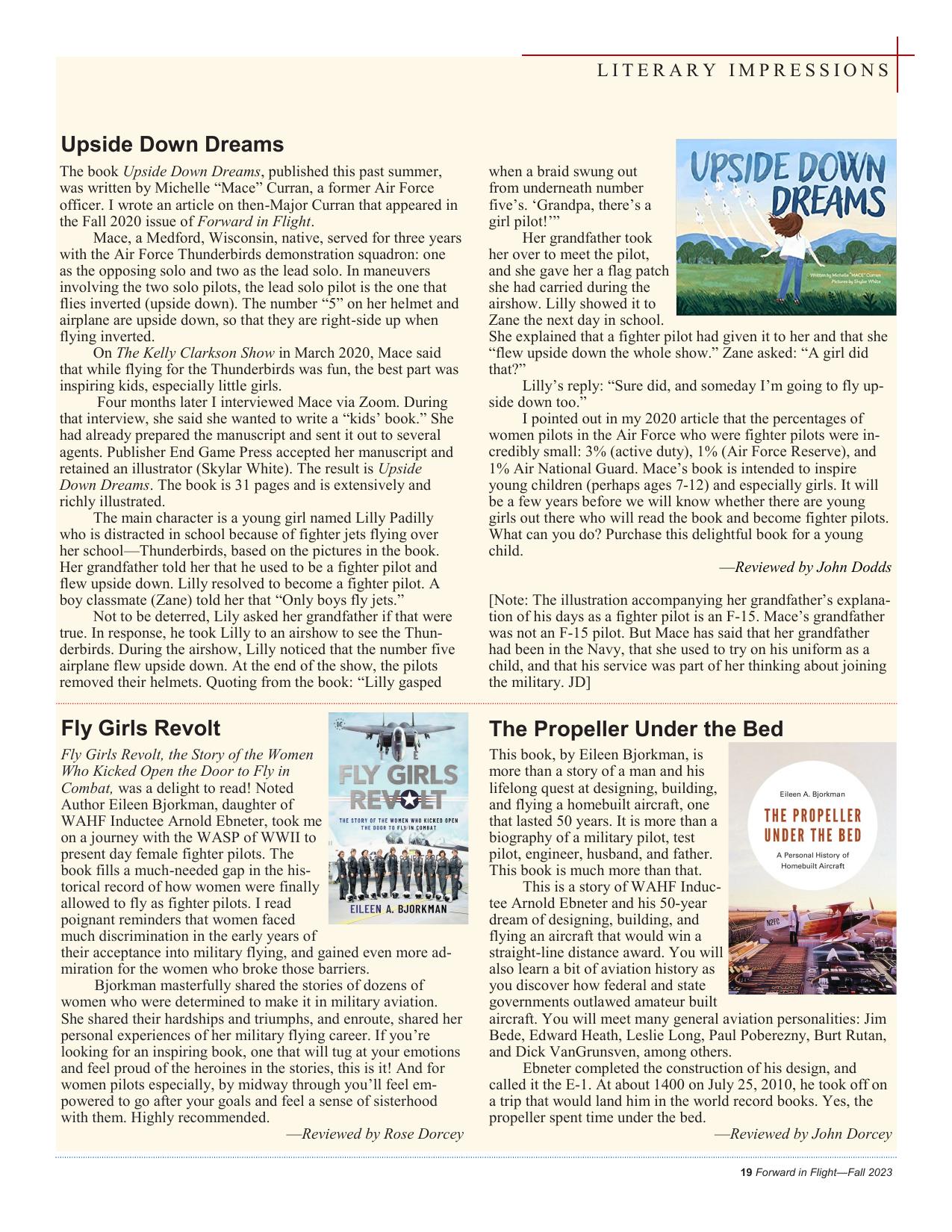
LITERARY IMPRESSIONS Upside Down Dreams The book Upside Down Dreams, published this past summer, was written by Michelle “Mace” Curran, a former Air Force officer. I wrote an article on then-Major Curran that appeared in the Fall 2020 issue of Forward in Flight. Mace, a Medford, Wisconsin, native, served for three years with the Air Force Thunderbirds demonstration squadron: one as the opposing solo and two as the lead solo. In maneuvers involving the two solo pilots, the lead solo pilot is the one that flies inverted (upside down). The number “5” on her helmet and airplane are upside down, so that they are right-side up when flying inverted. On The Kelly Clarkson Show in March 2020, Mace said that while flying for the Thunderbirds was fun, the best part was inspiring kids, especially little girls. Four months later I interviewed Mace via Zoom. During that interview, she said she wanted to write a “kids’ book.” She had already prepared the manuscript and sent it out to several agents. Publisher End Game Press accepted her manuscript and retained an illustrator (Skylar White). The result is Upside Down Dreams. The book is 31 pages and is extensively and richly illustrated. The main character is a young girl named Lilly Padilly who is distracted in school because of fighter jets flying over her school—Thunderbirds, based on the pictures in the book. Her grandfather told her that he used to be a fighter pilot and flew upside down. Lilly resolved to become a fighter pilot. A boy classmate (Zane) told her that “Only boys fly jets.” Not to be deterred, Lily asked her grandfather if that were true. In response, he took Lilly to an airshow to see the Thunderbirds. During the airshow, Lilly noticed that the number five airplane flew upside down. At the end of the show, the pilots removed their helmets. Quoting from the book: “Lilly gasped when a braid swung out from underneath number five’s. ‘Grandpa, there’s a girl pilot!’” Her grandfather took her over to meet the pilot, and she gave her a flag patch she had carried during the airshow. Lilly showed it to Zane the next day in school. She explained that a fighter pilot had given it to her and that she “flew upside down the whole show.” Zane asked: “A girl did that?” Lilly’s reply: “Sure did, and someday I’m going to fly upside down too.” I pointed out in my 2020 article that the percentages of women pilots in the Air Force who were fighter pilots were incredibly small: 3% (active duty), 1% (Air Force Reserve), and 1% Air National Guard. Mace’s book is intended to inspire young children (perhaps ages 7-12) and especially girls. It will be a few years before we will know whether there are young girls out there who will read the book and become fighter pilots. What can you do? Purchase this delightful book for a young child. —Reviewed by John Dodds Fly Girls Revolt The Propeller Under the Bed Fly Girls Revolt, the Story of the Women Who Kicked Open the Door to Fly in Combat, was a delight to read! Noted Author Eileen Bjorkman, daughter of WAHF Inductee Arnold Ebneter, took me on a journey with the WASP of WWII to present day female fighter pilots. The book fills a much-needed gap in the historical record of how women were finally allowed to fly as fighter pilots. I read poignant reminders that women faced much discrimination in the early years of their acceptance into military flying, and gained even more admiration for the women who broke those barriers. Bjorkman masterfully shared the stories of dozens of women who were determined to make it in military aviation. She shared their hardships and triumphs, and enroute, shared her personal experiences of her military flying career. If you’re looking for an inspiring book, one that will tug at your emotions and feel proud of the heroines in the stories, this is it! And for women pilots especially, by midway through you’ll feel empowered to go after your goals and feel a sense of sisterhood with them. Highly recommended. —Reviewed by Rose Dorcey This book, by Eileen Bjorkman, is more than a story of a man and his lifelong quest at designing, building, and flying a homebuilt aircraft, one that lasted 50 years. It is more than a biography of a military pilot, test pilot, engineer, husband, and father. This book is much more than that. This is a story of WAHF Inductee Arnold Ebneter and his 50-year dream of designing, building, and flying an aircraft that would win a straight-line distance award. You will also learn a bit of aviation history as you discover how federal and state governments outlawed amateur built aircraft. You will meet many general aviation personalities: Jim Bede, Edward Heath, Leslie Long, Paul Poberezny, Burt Rutan, and Dick VanGrunsven, among others. Ebneter completed the construction of his design, and called it the E-1. At about 1400 on July 25, 2010, he took off on a trip that would land him in the world record books. Yes, the propeller spent time under the bed. —Reviewed by John Dorcey [Note: The illustration accompanying her grandfather’s explanation of his days as a fighter pilot is an F-15. Mace’s grandfather was not an F-15 pilot. But Mace has said that her grandfather had been in the Navy, that she used to try on his uniform as a child, and that his service was part of her thinking about joining the military. JD] 19 Forward in Flight—Fall 2023
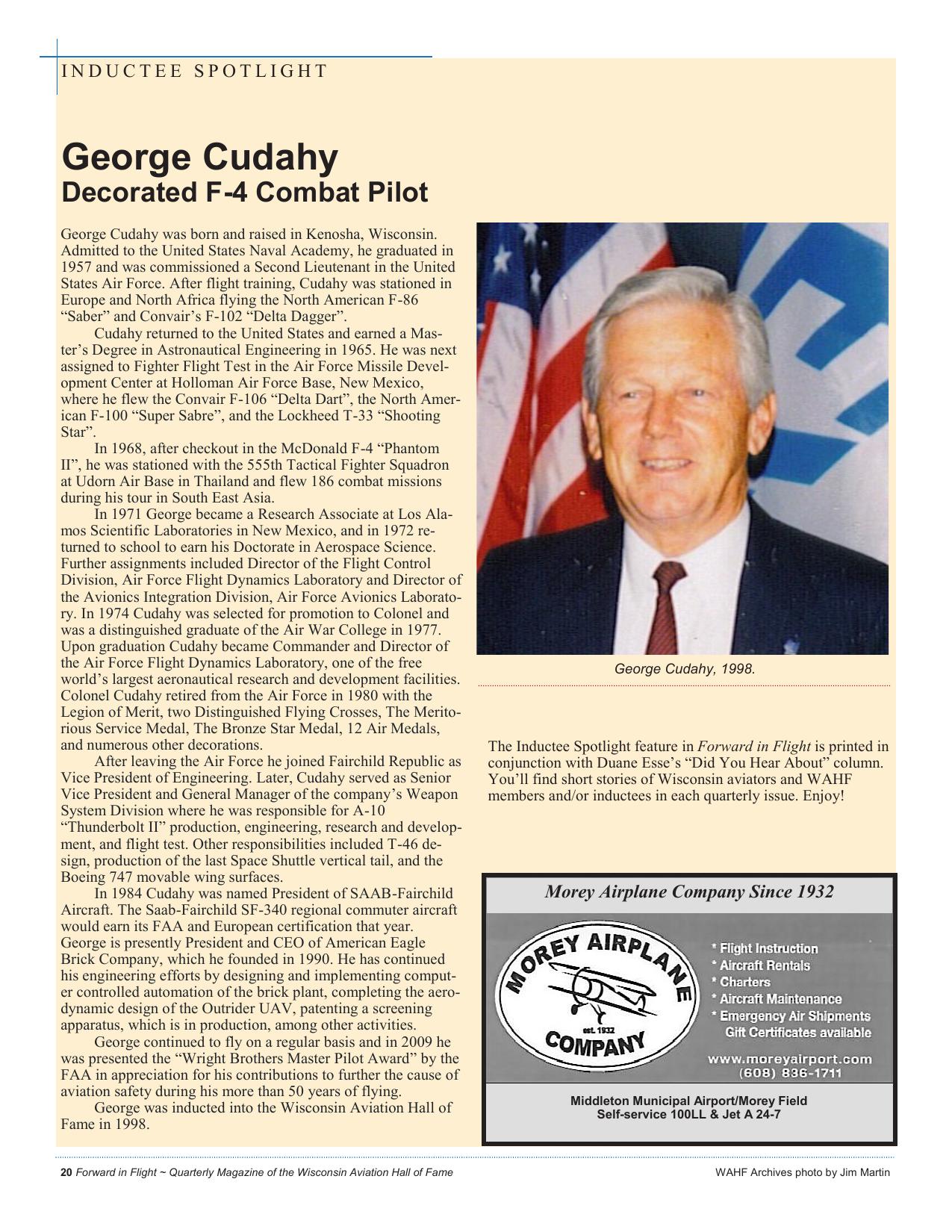
INDUCTEE SPOTLIGHT George Cudahy Decorated F-4 Combat Pilot George Cudahy was born and raised in Kenosha, Wisconsin. Admitted to the United States Naval Academy, he graduated in 1957 and was commissioned a Second Lieutenant in the United States Air Force. After flight training, Cudahy was stationed in Europe and North Africa flying the North American F-86 “Saber” and Convair’s F-102 “Delta Dagger”. Cudahy returned to the United States and earned a Master’s Degree in Astronautical Engineering in 1965. He was next assigned to Fighter Flight Test in the Air Force Missile Development Center at Holloman Air Force Base, New Mexico, where he flew the Convair F-106 “Delta Dart”, the North American F-100 “Super Sabre”, and the Lockheed T-33 “Shooting Star”. In 1968, after checkout in the McDonald F-4 “Phantom II”, he was stationed with the 555th Tactical Fighter Squadron at Udorn Air Base in Thailand and flew 186 combat missions during his tour in South East Asia. In 1971 George became a Research Associate at Los Alamos Scientific Laboratories in New Mexico, and in 1972 returned to school to earn his Doctorate in Aerospace Science. Further assignments included Director of the Flight Control Division, Air Force Flight Dynamics Laboratory and Director of the Avionics Integration Division, Air Force Avionics Laboratory. In 1974 Cudahy was selected for promotion to Colonel and was a distinguished graduate of the Air War College in 1977. Upon graduation Cudahy became Commander and Director of the Air Force Flight Dynamics Laboratory, one of the free world’s largest aeronautical research and development facilities. Colonel Cudahy retired from the Air Force in 1980 with the Legion of Merit, two Distinguished Flying Crosses, The Meritorious Service Medal, The Bronze Star Medal, 12 Air Medals, and numerous other decorations. After leaving the Air Force he joined Fairchild Republic as Vice President of Engineering. Later, Cudahy served as Senior Vice President and General Manager of the company’s Weapon System Division where he was responsible for A-10 “Thunderbolt II” production, engineering, research and development, and flight test. Other responsibilities included T-46 design, production of the last Space Shuttle vertical tail, and the Boeing 747 movable wing surfaces. In 1984 Cudahy was named President of SAAB-Fairchild Aircraft. The Saab-Fairchild SF-340 regional commuter aircraft would earn its FAA and European certification that year. George is presently President and CEO of American Eagle Brick Company, which he founded in 1990. He has continued his engineering efforts by designing and implementing computer controlled automation of the brick plant, completing the aerodynamic design of the Outrider UAV, patenting a screening apparatus, which is in production, among other activities. George continued to fly on a regular basis and in 2009 he was presented the “Wright Brothers Master Pilot Award” by the FAA in appreciation for his contributions to further the cause of aviation safety during his more than 50 years of flying. George was inducted into the Wisconsin Aviation Hall of Fame in 1998. 20 Forward in Flight ~ Quarterly Magazine of the Wisconsin Aviation Hall of Fame George Cudahy, 1998. The Inductee Spotlight feature in Forward in Flight is printed in conjunction with Duane Esse’s “Did You Hear About” column. You’ll find short stories of Wisconsin aviators and WAHF members and/or inductees in each quarterly issue. Enjoy! Morey Airplane Company Since 1932 Middleton Municipal Airport/Morey Field Self-service 100LL & Jet A 24-7 WAHF Archives photo by Jim Martin
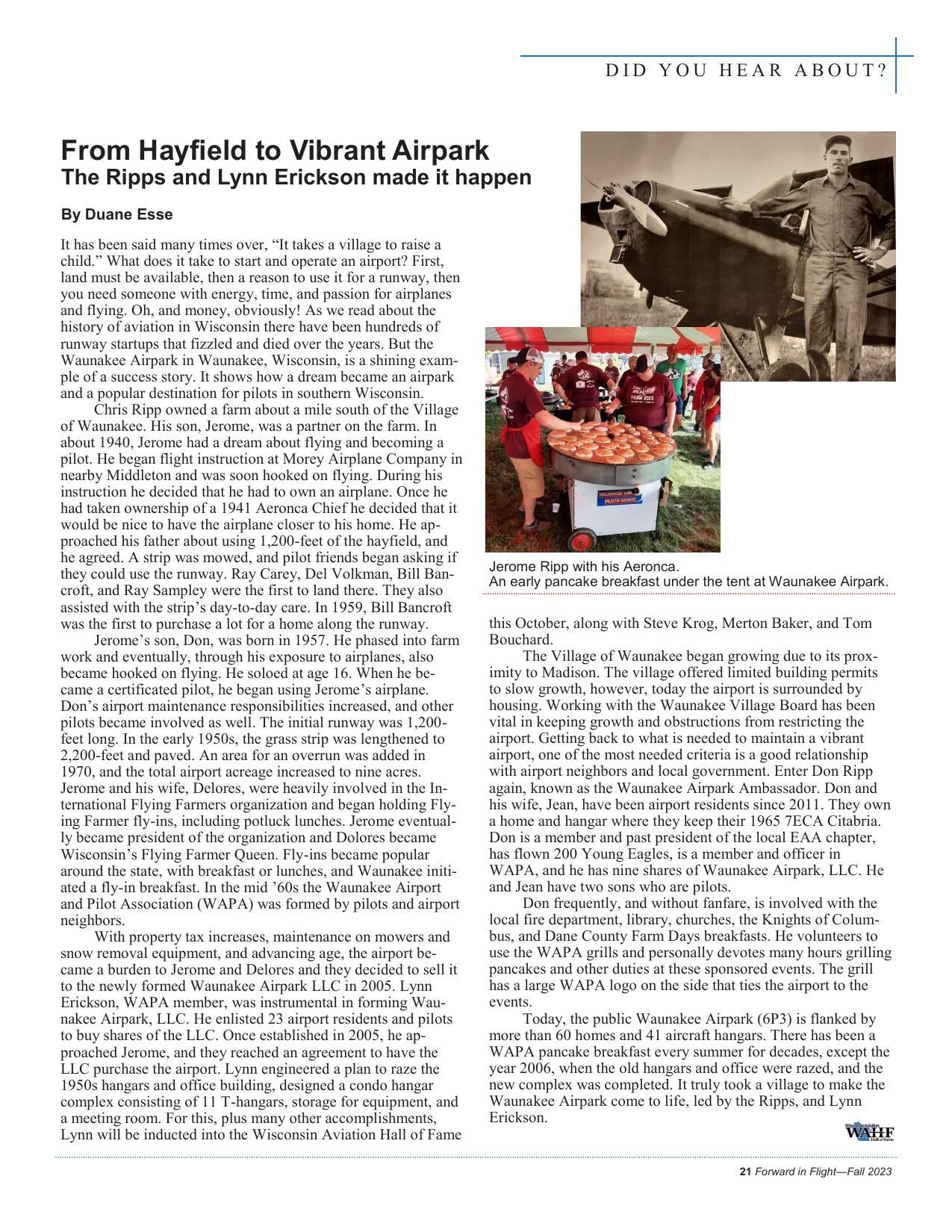
DID YOU HEAR ABOUT? From Hayfield to Vibrant Airpark The Ripps and Lynn Erickson made it happen By Duane Esse It has been said many times over, “It takes a village to raise a child.” What does it take to start and operate an airport? First, land must be available, then a reason to use it for a runway, then you need someone with energy, time, and passion for airplanes and flying. Oh, and money, obviously! As we read about the history of aviation in Wisconsin there have been hundreds of runway startups that fizzled and died over the years. But the Waunakee Airpark in Waunakee, Wisconsin, is a shining example of a success story. It shows how a dream became an airpark and a popular destination for pilots in southern Wisconsin. Chris Ripp owned a farm about a mile south of the Village of Waunakee. His son, Jerome, was a partner on the farm. In about 1940, Jerome had a dream about flying and becoming a pilot. He began flight instruction at Morey Airplane Company in nearby Middleton and was soon hooked on flying. During his instruction he decided that he had to own an airplane. Once he had taken ownership of a 1941 Aeronca Chief he decided that it would be nice to have the airplane closer to his home. He approached his father about using 1,200-feet of the hayfield, and he agreed. A strip was mowed, and pilot friends began asking if they could use the runway. Ray Carey, Del Volkman, Bill Bancroft, and Ray Sampley were the first to land there. They also assisted with the strip’s day-to-day care. In 1959, Bill Bancroft was the first to purchase a lot for a home along the runway. Jerome’s son, Don, was born in 1957. He phased into farm work and eventually, through his exposure to airplanes, also became hooked on flying. He soloed at age 16. When he became a certificated pilot, he began using Jerome’s airplane. Don’s airport maintenance responsibilities increased, and other pilots became involved as well. The initial runway was 1,200feet long. In the early 1950s, the grass strip was lengthened to 2,200-feet and paved. An area for an overrun was added in 1970, and the total airport acreage increased to nine acres. Jerome and his wife, Delores, were heavily involved in the International Flying Farmers organization and began holding Flying Farmer fly-ins, including potluck lunches. Jerome eventually became president of the organization and Dolores became Wisconsin’s Flying Farmer Queen. Fly-ins became popular around the state, with breakfast or lunches, and Waunakee initiated a fly-in breakfast. In the mid ’60s the Waunakee Airport and Pilot Association (WAPA) was formed by pilots and airport neighbors. With property tax increases, maintenance on mowers and snow removal equipment, and advancing age, the airport became a burden to Jerome and Delores and they decided to sell it to the newly formed Waunakee Airpark LLC in 2005. Lynn Erickson, WAPA member, was instrumental in forming Waunakee Airpark, LLC. He enlisted 23 airport residents and pilots to buy shares of the LLC. Once established in 2005, he approached Jerome, and they reached an agreement to have the LLC purchase the airport. Lynn engineered a plan to raze the 1950s hangars and office building, designed a condo hangar complex consisting of 11 T-hangars, storage for equipment, and a meeting room. For this, plus many other accomplishments, Lynn will be inducted into the Wisconsin Aviation Hall of Fame Jerome Ripp with his Aeronca. An early pancake breakfast under the tent at Waunakee Airpark. this October, along with Steve Krog, Merton Baker, and Tom Bouchard. The Village of Waunakee began growing due to its proximity to Madison. The village offered limited building permits to slow growth, however, today the airport is surrounded by housing. Working with the Waunakee Village Board has been vital in keeping growth and obstructions from restricting the airport. Getting back to what is needed to maintain a vibrant airport, one of the most needed criteria is a good relationship with airport neighbors and local government. Enter Don Ripp again, known as the Waunakee Airpark Ambassador. Don and his wife, Jean, have been airport residents since 2011. They own a home and hangar where they keep their 1965 7ECA Citabria. Don is a member and past president of the local EAA chapter, has flown 200 Young Eagles, is a member and officer in WAPA, and he has nine shares of Waunakee Airpark, LLC. He and Jean have two sons who are pilots. Don frequently, and without fanfare, is involved with the local fire department, library, churches, the Knights of Columbus, and Dane County Farm Days breakfasts. He volunteers to use the WAPA grills and personally devotes many hours grilling pancakes and other duties at these sponsored events. The grill has a large WAPA logo on the side that ties the airport to the events. Today, the public Waunakee Airpark (6P3) is flanked by more than 60 homes and 41 aircraft hangars. There has been a WAPA pancake breakfast every summer for decades, except the year 2006, when the old hangars and office were razed, and the new complex was completed. It truly took a village to make the Waunakee Airpark come to life, led by the Ripps, and Lynn Erickson. 21 Forward in Flight—Fall 2023
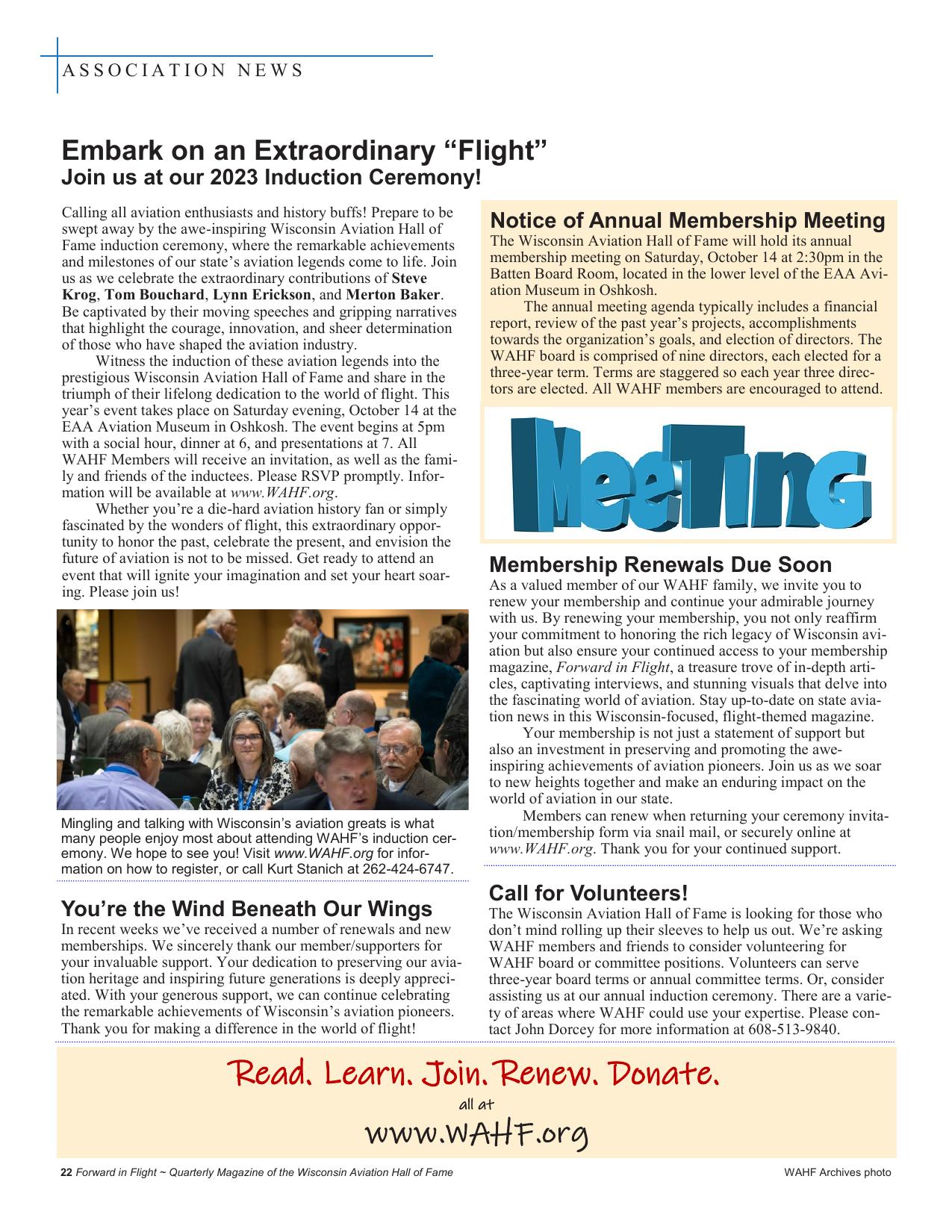
ASSOCIATION NEWS Embark on an Extraordinary “Flight” Join us at our 2023 Induction Ceremony! Calling all aviation enthusiasts and history buffs! Prepare to be swept away by the awe-inspiring Wisconsin Aviation Hall of Fame induction ceremony, where the remarkable achievements and milestones of our state’s aviation legends come to life. Join us as we celebrate the extraordinary contributions of Steve Krog, Tom Bouchard, Lynn Erickson, and Merton Baker. Be captivated by their moving speeches and gripping narratives that highlight the courage, innovation, and sheer determination of those who have shaped the aviation industry. Witness the induction of these aviation legends into the prestigious Wisconsin Aviation Hall of Fame and share in the triumph of their lifelong dedication to the world of flight. This year’s event takes place on Saturday evening, October 14 at the EAA Aviation Museum in Oshkosh. The event begins at 5pm with a social hour, dinner at 6, and presentations at 7. All WAHF Members will receive an invitation, as well as the family and friends of the inductees. Please RSVP promptly. Information will be available at www.WAHF.org. Whether you’re a die-hard aviation history fan or simply fascinated by the wonders of flight, this extraordinary opportunity to honor the past, celebrate the present, and envision the future of aviation is not to be missed. Get ready to attend an event that will ignite your imagination and set your heart soaring. Please join us! Notice of Annual Membership Meeting The Wisconsin Aviation Hall of Fame will hold its annual membership meeting on Saturday, October 14 at 2:30pm in the Batten Board Room, located in the lower level of the EAA Aviation Museum in Oshkosh. The annual meeting agenda typically includes a financial report, review of the past year’s projects, accomplishments towards the organization’s goals, and election of directors. The WAHF board is comprised of nine directors, each elected for a three-year term. Terms are staggered so each year three directors are elected. All WAHF members are encouraged to attend. Membership Renewals Due Soon As a valued member of our WAHF family, we invite you to renew your membership and continue your admirable journey with us. By renewing your membership, you not only reaffirm your commitment to honoring the rich legacy of Wisconsin aviation but also ensure your continued access to your membership magazine, Forward in Flight, a treasure trove of in-depth articles, captivating interviews, and stunning visuals that delve into the fascinating world of aviation. Stay up-to-date on state aviation news in this Wisconsin-focused, flight-themed magazine. Your membership is not just a statement of support but also an investment in preserving and promoting the aweinspiring achievements of aviation pioneers. Join us as we soar to new heights together and make an enduring impact on the world of aviation in our state. Members can renew when returning your ceremony invitation/membership form via snail mail, or securely online at www.WAHF.org. Thank you for your continued support. Mingling and talking with Wisconsin’s aviation greats is what many people enjoy most about attending WAHF’s induction ceremony. We hope to see you! Visit www.WAHF.org for information on how to register, or call Kurt Stanich at 262-424-6747. You’re the Wind Beneath Our Wings Call for Volunteers! In recent weeks we’ve received a number of renewals and new memberships. We sincerely thank our member/supporters for your invaluable support. Your dedication to preserving our aviation heritage and inspiring future generations is deeply appreciated. With your generous support, we can continue celebrating the remarkable achievements of Wisconsin’s aviation pioneers. Thank you for making a difference in the world of flight! The Wisconsin Aviation Hall of Fame is looking for those who don’t mind rolling up their sleeves to help us out. We’re asking WAHF members and friends to consider volunteering for WAHF board or committee positions. Volunteers can serve three-year board terms or annual committee terms. Or, consider assisting us at our annual induction ceremony. There are a variety of areas where WAHF could use your expertise. Please contact John Dorcey for more information at 608-513-9840. Read. Learn. Join. Renew. Donate. all at 22 Forward in Flight ~ Quarterly Magazine of the Wisconsin Aviation Hall of Fame WAHF Archives photo
EDITORS LOG AirVenture Extravaganza A Spectacular Showcase of Aviation and Friendship Yet another AirVenture has come to a close—and boy, what an amazing spectacle it was! The unofficial AirVenture ’23 kickoff for us was when WAHF President Kurt Stanich invited John and me for dinner at their Camp Scholler site, a fortnight before the official start. Sitting by the campfire, engrossed in conversation with Kurt and Druann, and getting acquainted with his family, it reaffirmed that AirVenture transcends mere airplanes and airshows; it’s about the extraordinary individuals you encounter there. We are truly grateful for that! On Thursday the 20th, John and I had a delightful dinner with my sister, Diane, her son Tyler, and his two boys. Tyler, an air traffic controller from Indy, came to town to help manage AirVenture traffic for the entire week. He’s also a pilot, and our shared passion for aviation brought us closer together. Saturday brought us more joy as we welcomed our friends Willy and Phillip to Oshkosh, who flew up from Alabama. On Monday, we eagerly set foot on the grounds amidst all the opening day buzz. Tuesday was another special day as we attended Kurt’s presentation titled “Paul Poberezny, Birth to Flight”; at the EAA Museum. Kurt spoke with such passion about Paul’s life that it brought me to tears. Despite having met Paul and reading his book, I discovered so much more through Kurt’s presentation. I hope you get the chance to experience it too. Additionally, I had the pleasure of attending John’s presentation on TERPS/obstructions on instrument approaches at EAA’s new Pilot Proficiency Center. The many IFR pilots in attendance appreciated the valuable data he shared, and it underscored how much excellent information—over 1,400 presenta- tions/forums—is disseminated during the show. It was also nice to see WAHF’s Henry Peterson volunteering at the PPC. This year, being back in the FIF editor seat rekindled my sense of purpose and excitement over attending AirVenture. I made it my mission to provide comprehensive coverage of the event in Forward in Flight and also through WAHF’s social media channels. A huge thanks goes to WAHF Board Member Scott Green and his brilliant wife, Julie, for their outstanding contributions. The photos and even short video interviews they did, with people like noted authors Eileen Bjorkman and Michelle “Mace” Curran, were outstanding. (Scroll the WAHF Facebook page to see the videos.) Scott and Julie are an exceptional team, and I extend my heartfelt appreciation for their hard work. I also want to say thanks to Skot Weidemann for sharing his captivating photos in Forward in Flight. I must give a shout out to Dick Knapinski, EAA’s director of communications. It’s almost jaw-dropping listening to Dick’s adept handling of countless media inquiries in a cordial and sometimes humorous manner at his many press events. The time he made for WAHF made our goal of providing airshow coverage for you all the more seamless. We are so thankful for that. Jack Pelton and the keen EAA staff and volunteers present a world-class aviation spectacle that resonates with aviators and “civilians” alike. As I read on Facebook, “no other organization in the world does what EAA consistently accomplishes year after year”—and they do it well. We hope you enjoyed the show (and the coverage) as much as we did. —Rose Dorcey 23 Forward in Flight—Fall 2023
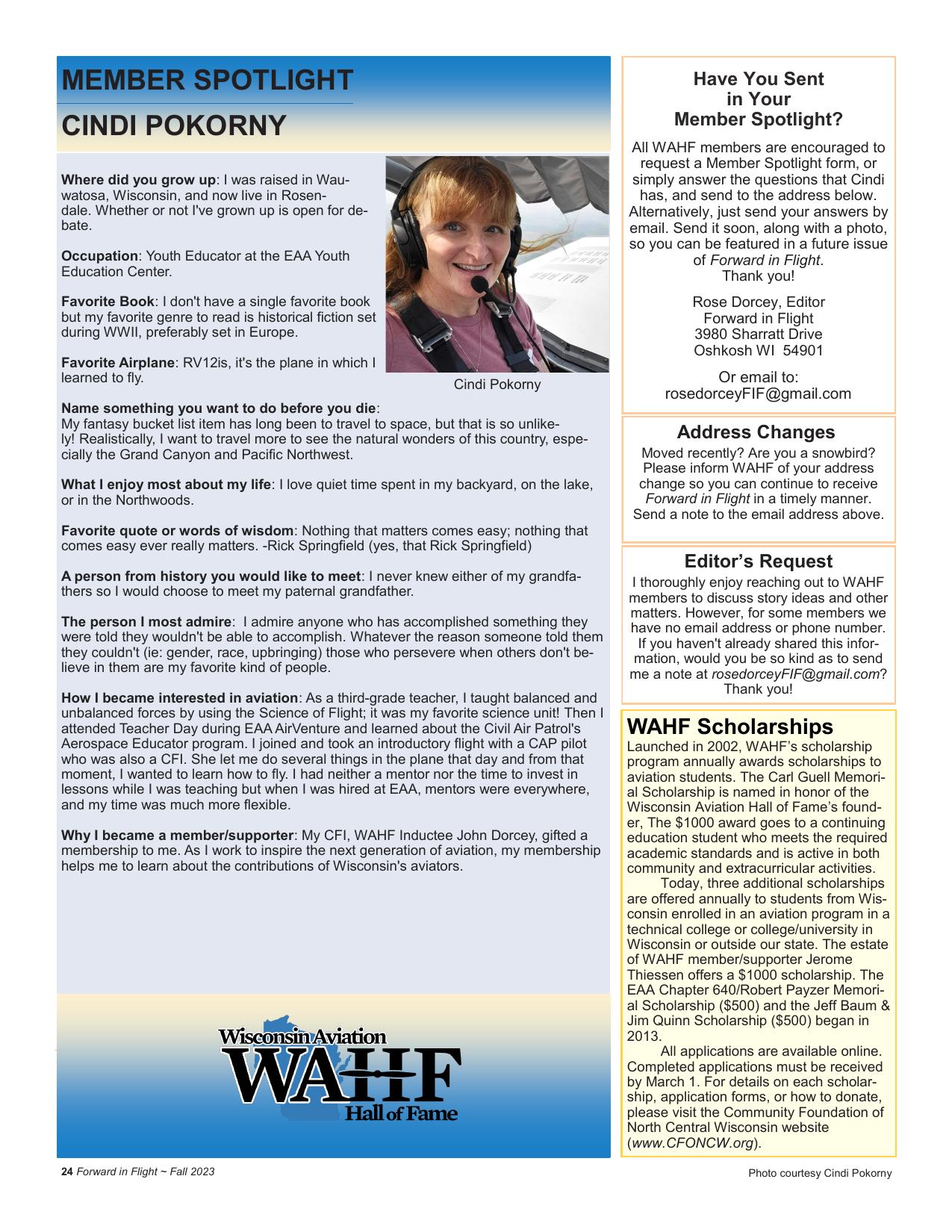
MEMBER SPOTLIGHT Have You Sent in Your Member Spotlight? CINDI POKORNY All WAHF members are encouraged to request a Member Spotlight form, or simply answer the questions that Cindi has, and send to the address below. Alternatively, just send your answers by email. Send it soon, along with a photo, so you can be featured in a future issue of Forward in Flight. Thank you! Where did you grow up: I was raised in Wauwatosa, Wisconsin, and now live in Rosendale. Whether or not I've grown up is open for debate. Occupation: Youth Educator at the EAA Youth Education Center. Favorite Book: I don't have a single favorite book but my favorite genre to read is historical fiction set during WWII, preferably set in Europe. Favorite Airplane: RV12is, it's the plane in which I learned to fly. Rose Dorcey, Editor Forward in Flight 3980 Sharratt Drive Oshkosh WI 54901 Cindi Pokorny Name something you want to do before you die: My fantasy bucket list item has long been to travel to space, but that is so unlikely! Realistically, I want to travel more to see the natural wonders of this country, especially the Grand Canyon and Pacific Northwest. What I enjoy most about my life: I love quiet time spent in my backyard, on the lake, or in the Northwoods. Favorite quote or words of wisdom: Nothing that matters comes easy; nothing that comes easy ever really matters. -Rick Springfield (yes, that Rick Springfield) A person from history you would like to meet: I never knew either of my grandfathers so I would choose to meet my paternal grandfather. The person I most admire: I admire anyone who has accomplished something they were told they wouldn't be able to accomplish. Whatever the reason someone told them they couldn't (ie: gender, race, upbringing) those who persevere when others don't believe in them are my favorite kind of people. How I became interested in aviation: As a third-grade teacher, I taught balanced and unbalanced forces by using the Science of Flight; it was my favorite science unit! Then I attended Teacher Day during EAA AirVenture and learned about the Civil Air Patrol's Aerospace Educator program. I joined and took an introductory flight with a CAP pilot who was also a CFI. She let me do several things in the plane that day and from that moment, I wanted to learn how to fly. I had neither a mentor nor the time to invest in lessons while I was teaching but when I was hired at EAA, mentors were everywhere, and my time was much more flexible. Why I became a member/supporter: My CFI, WAHF Inductee John Dorcey, gifted a membership to me. As I work to inspire the next generation of aviation, my membership helps me to learn about the contributions of Wisconsin's aviators. 24 Forward in Flight ~ Fall 2023 Or email to: rosedorceyFIF@gmail.com Address Changes Moved recently? Are you a snowbird? Please inform WAHF of your address change so you can continue to receive Forward in Flight in a timely manner. Send a note to the email address above. Editor’s Request I thoroughly enjoy reaching out to WAHF members to discuss story ideas and other matters. However, for some members we have no email address or phone number. If you haven't already shared this information, would you be so kind as to send me a note at rosedorceyFIF@gmail.com? Thank you! WAHF Scholarships Launched in 2002, WAHF’s scholarship program annually awards scholarships to aviation students. The Carl Guell Memorial Scholarship is named in honor of the Wisconsin Aviation Hall of Fame’s founder, The $1000 award goes to a continuing education student who meets the required academic standards and is active in both community and extracurricular activities. Today, three additional scholarships are offered annually to students from Wisconsin enrolled in an aviation program in a technical college or college/university in Wisconsin or outside our state. The estate of WAHF member/supporter Jerome Thiessen offers a $1000 scholarship. The EAA Chapter 640/Robert Payzer Memorial Scholarship ($500) and the Jeff Baum & Jim Quinn Scholarship ($500) began in 2013. All applications are available online. Completed applications must be received by March 1. For details on each scholarship, application forms, or how to donate, please visit the Community Foundation of North Central Wisconsin website (www.CFONCW.org). Photo courtesy Cindi Pokorny
Now is the perfect moment to become a member, renew, or give a gift membership to the Wisconsin Aviation Hall of Fame! ANNUAL MEMBERSHIP LEVELS Name________________________________________ _____ Youth (Under age 18) _____ Individual (Annual) _____ Couple (Annual) _____ Lifetime (Individual) _____ Lifetime (Couple) Address______________________________________ $10 $30 $40 $500 $750 City__________________________________________ State, Zip_____________________________________ Phone_______________________________________ TAX DEDUCTIBLE CONTRIBUTIONS Your contributions help ensure Wisconsin’s aviation pioneers and outstanding students in aviation education will continue to be recognized. Your contributions, in any amount, are appreciated. WAHF Supporting Contribution $___________ (General operating/events programming fund) WAHF Scholarship Fund* $___________ *for scholarship donations please make a separate check payable to Community Foundation of North Central Wisconsin or visit www.CFONCW.org. Email________________________________________ Members receive WAHF’s quarterly magazine Forward in Flight! Join or Donate Online! www.WAHF.org Or, mail this form, along with your check payable to: Wisconsin Aviation Hall of Fame, Inc. to: Rose Dorcey/WAHF 3980 Sharratt Drive Oshkosh WI 54901 The Wisconsin Aviation Hall of Fame is a 501(c)(3) organization. 25 Forward in Flight—Fall 2023
PRSRT STD US Postage Paid Wisc Rapids WI Permit 98 Forward in Flight c/o Rose Dorcey 3980 Sharratt Drive Oshkosh WI 54901-1276 The Wisconsin Aviation Hall of Fame is a non-profit membership organization dedicated to preserving the past and fostering the future of flight. New WAHF Member/Supporters Mike & Libby Baker David & Julia Boelter Scott Bouchard Deb & Paul Gangwish Scott & Kyle Guyette Michael Hamilton Phillip Kinard* Mike O’Connor Dan Silvers* Philip Vetuschi Henry Whyte Jr Michelle Wrobleski Thank you for coming onboard! And thanks to all who have recently renewed! *Life Membership Wisconsin Aviation Hall of Fame Officers Kurt Stanich, President James Zuelsdorf, Vice-President Henry Peterson, Secretary Colleen Weber, Treasurer The 2023 WAHF Induction Ceremony is coming up soon! We hope many of our WAHF Members can attend to hear the inspiring stories of our inductees. See page 22 for more info. Board of Directors John Dorcey Scott Green Jill Mann Jim Szajkovics Patrick Weeden Wynne Williams Thank you to WAHF Member Dan Uminski for a generous monetary donation to WAHF’s General Operating Fund. The contribution helps us carry out our mission of preserving and sharing our state’s aviation heritage and is deeply appreciated. Aviation Museum News The EAA Aviation Museum in Oshkosh has two new exhibits to experience. The Telling Gallery in the Eagle Hangar will be the home of AirCorps Aviation’s traveling exhibit tiMembership Chair tled Drafting: The Art of Aircraft Engineering in WWII. The exhibit provides a detailed look at Rose Dorcey the process of drafting aircraft designs during World War II. Original drawings from the Ken 920-279-6029 Jungeberg Collection are displayed across the exhibit showing detailed depictions of some of rose@wahf.org the war’s most iconic aircraft such as the B-25 and P-51. The Telling Gallery is sponsored by Fred and Barbara Telling. Another new exhibit focuses on Mike Melvill and his accomplishments over his career. Become a member/supporter today! Melvill is most well-known for flying Scaled Composites’ SpaceShipOne, an experimental Use form on the inside back cover and spaceplane, on its first flight into space. The flight made Melvill the first commercial astromail it in, or join naut. Included in the exhibit are a pair of “astronaut wings” that were given to him by the U.S. securely online at Department of Transportation, his Robert J. Collier Trophy and Medal, and the horseshoe pin www.WAHF.org that was his good luck charm from his wife, Sally. The exhibit is located in the SpaceShipOne exhibit near the Eagle Hangar entrance. Visit eaa.org for more information. The Amelia Earhart Museum is Now Open! The Amelia Earhart Hangar Museum honors Earhart’s aviation legacy and inspires all generations in the pursuit of flight. The new museum held its grand opening on April 14 at the Amelia Earhart Memorial Airport (K59) in Join the her hometown of Atchison, Kansas. More than 1000 people attended the ribbon cutting event to see Muriel, the world’s last remaining Lockheed Electra 10-E — an aircraft identical to the conversation… plane Earhart flew on her final flight. In addition, 14 interactive STEM exhibits take visitors Like and Follow WAHF through Earhart’s life — from growing up in Atchison, to the height of her worldwide fame — as the first woman to fly solo across the Atlantic Ocean. Visitors can go “above the clouds” to Online! explore celestial navigation, radio waves, and atmospheric conditions through the varied exhibits. For more information visit ameliaearharthangarmuseum.org The National Naval Aviation Museum in Pensacola has reopened! More than 150 aircraft are displayed, plus you just might see the Blue Angels’ practice flights while you’re there. Enter at the west gate on Blue Angel Parkway. More at navalaviation.com