Volume 4, Issue 4
🗞️ Download Issue (PDF)
Forward in Aviation - December 2006
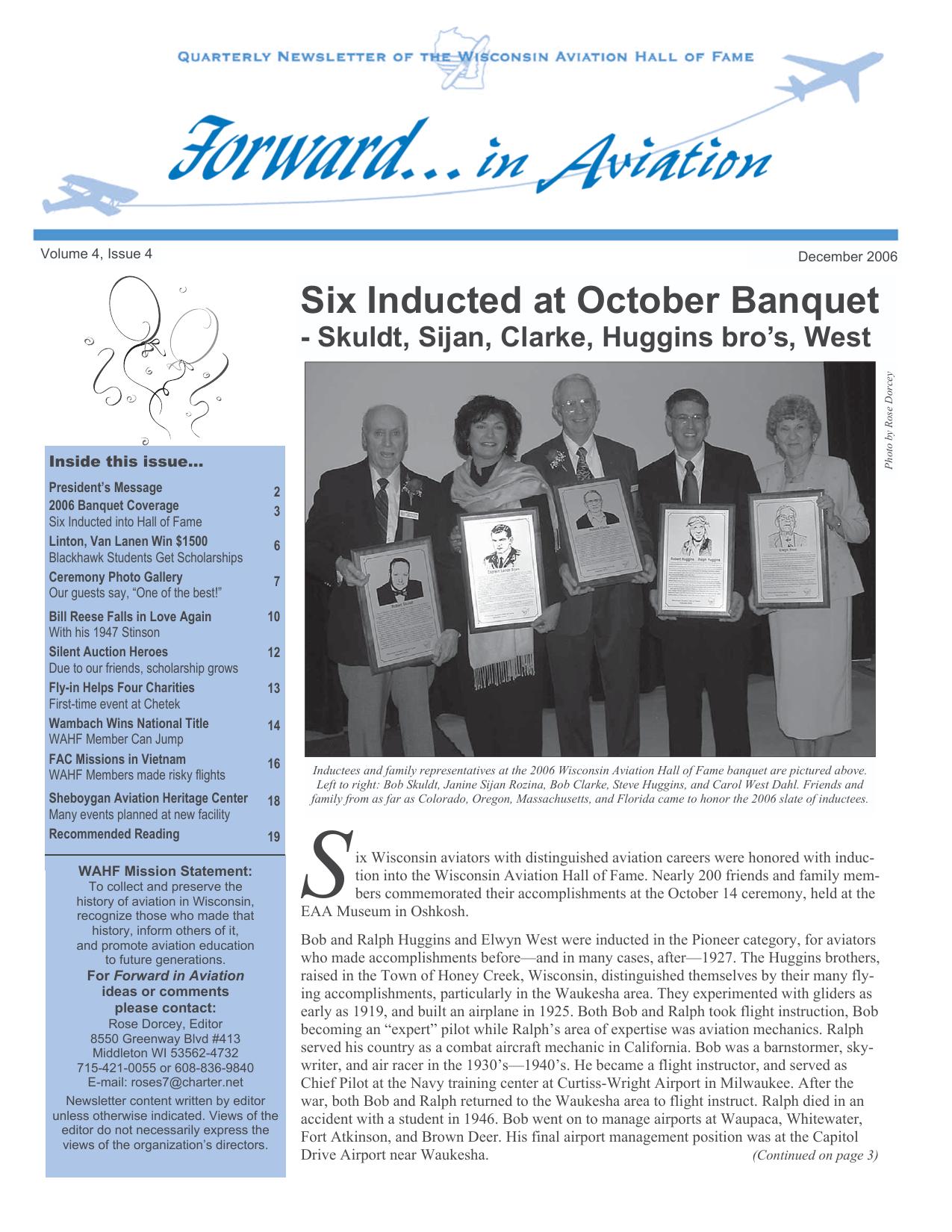
Volume 4, Issue 4 December 2006 Six Inducted at October Banquet Photo by Rose Dorcey - Skuldt, Sijan, Clarke, Huggins bro’s, West Inside this issue… President’s Message 2006 Banquet Coverage Six Inducted into Hall of Fame Linton, Van Lanen Win $1500 Blackhawk Students Get Scholarships Ceremony Photo Gallery Our guests say, “One of the best!” 2 3 Bill Reese Falls in Love Again With his 1947 Stinson Silent Auction Heroes Due to our friends, scholarship grows Fly-in Helps Four Charities First-time event at Chetek Wambach Wins National Title WAHF Member Can Jump FAC Missions in Vietnam WAHF Members made risky flights 10 Sheboygan Aviation Heritage Center Many events planned at new facility Recommended Reading 18 6 7 12 13 14 16 19 WAHF Mission Statement: To collect and preserve the history of aviation in Wisconsin, recognize those who made that history, inform others of it, and promote aviation education to future generations. For Forward in Aviation ideas or comments please contact: Rose Dorcey, Editor 8550 Greenway Blvd #413 Middleton WI 53562-4732 715-421-0055 or 608-836-9840 E-mail: roses7@charter.net Newsletter content written by editor unless otherwise indicated. Views of the editor do not necessarily express the views of the organization’s directors. Inductees and family representatives at the 2006 Wisconsin Aviation Hall of Fame banquet are pictured above. Left to right: Bob Skuldt, Janine Sijan Rozina, Bob Clarke, Steve Huggins, and Carol West Dahl. Friends and family from as far as Colorado, Oregon, Massachusetts, and Florida came to honor the 2006 slate of inductees. S ix Wisconsin aviators with distinguished aviation careers were honored with induction into the Wisconsin Aviation Hall of Fame. Nearly 200 friends and family members commemorated their accomplishments at the October 14 ceremony, held at the EAA Museum in Oshkosh. Bob and Ralph Huggins and Elwyn West were inducted in the Pioneer category, for aviators who made accomplishments before—and in many cases, after—1927. The Huggins brothers, raised in the Town of Honey Creek, Wisconsin, distinguished themselves by their many flying accomplishments, particularly in the Waukesha area. They experimented with gliders as early as 1919, and built an airplane in 1925. Both Bob and Ralph took flight instruction, Bob becoming an “expert” pilot while Ralph’s area of expertise was aviation mechanics. Ralph served his country as a combat aircraft mechanic in California. Bob was a barnstormer, skywriter, and air racer in the 1930’s—1940’s. He became a flight instructor, and served as Chief Pilot at the Navy training center at Curtiss-Wright Airport in Milwaukee. After the war, both Bob and Ralph returned to the Waukesha area to flight instruct. Ralph died in an accident with a student in 1946. Bob went on to manage airports at Waupaca, Whitewater, Fort Atkinson, and Brown Deer. His final airport management position was at the Capitol (Continued on page 3) Drive Airport near Waukesha.
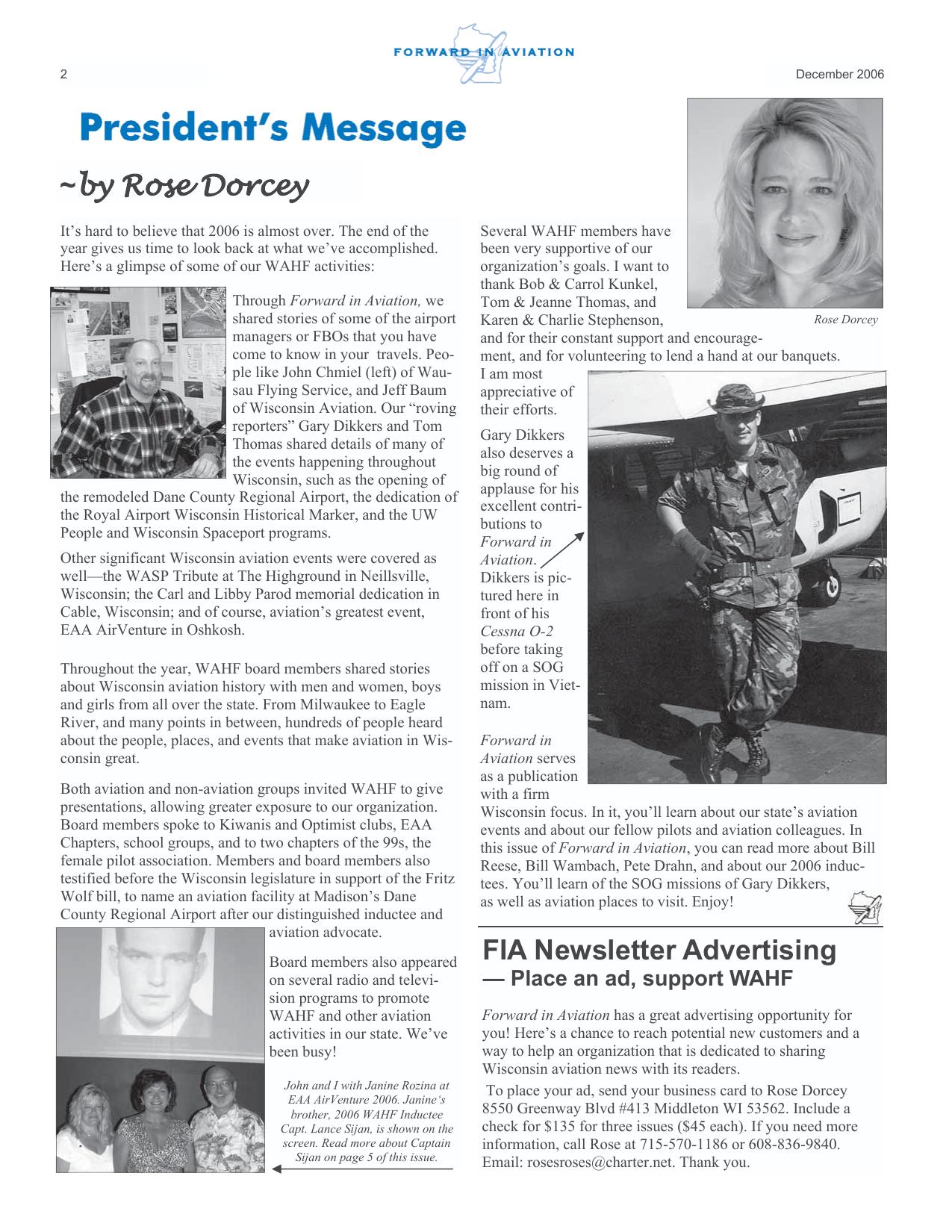
2 December 2006 ~by Rose Dorcey It’s hard to believe that 2006 is almost over. The end of the year gives us time to look back at what we’ve accomplished. Here’s a glimpse of some of our WAHF activities: Through Forward in Aviation, we shared stories of some of the airport managers or FBOs that you have come to know in your travels. People like John Chmiel (left) of Wausau Flying Service, and Jeff Baum of Wisconsin Aviation. Our “roving reporters” Gary Dikkers and Tom Thomas shared details of many of the events happening throughout Wisconsin, such as the opening of the remodeled Dane County Regional Airport, the dedication of the Royal Airport Wisconsin Historical Marker, and the UW People and Wisconsin Spaceport programs. Other significant Wisconsin aviation events were covered as well—the WASP Tribute at The Highground in Neillsville, Wisconsin; the Carl and Libby Parod memorial dedication in Cable, Wisconsin; and of course, aviation’s greatest event, EAA AirVenture in Oshkosh. Throughout the year, WAHF board members shared stories about Wisconsin aviation history with men and women, boys and girls from all over the state. From Milwaukee to Eagle River, and many points in between, hundreds of people heard about the people, places, and events that make aviation in Wisconsin great. Both aviation and non-aviation groups invited WAHF to give presentations, allowing greater exposure to our organization. Board members spoke to Kiwanis and Optimist clubs, EAA Chapters, school groups, and to two chapters of the 99s, the female pilot association. Members and board members also testified before the Wisconsin legislature in support of the Fritz Wolf bill, to name an aviation facility at Madison’s Dane County Regional Airport after our distinguished inductee and aviation advocate. Board members also appeared on several radio and television programs to promote WAHF and other aviation activities in our state. We’ve been busy! John and I with Janine Rozina at EAA AirVenture 2006. Janine‘s brother, 2006 WAHF Inductee Capt. Lance Sijan, is shown on the screen. Read more about Captain Sijan on page 5 of this issue. Several WAHF members have been very supportive of our organization’s goals. I want to thank Bob & Carrol Kunkel, Tom & Jeanne Thomas, and Rose Dorcey Karen & Charlie Stephenson, and for their constant support and encouragement, and for volunteering to lend a hand at our banquets. I am most appreciative of their efforts. Gary Dikkers also deserves a big round of applause for his excellent contributions to Forward in Aviation. Dikkers is pictured here in front of his Cessna O-2 before taking off on a SOG mission in Vietnam. Forward in Aviation serves as a publication with a firm Wisconsin focus. In it, you’ll learn about our state’s aviation events and about our fellow pilots and aviation colleagues. In this issue of Forward in Aviation, you can read more about Bill Reese, Bill Wambach, Pete Drahn, and about our 2006 inductees. You’ll learn of the SOG missions of Gary Dikkers, as well as aviation places to visit. Enjoy! FIA Newsletter Advertising — Place an ad, support WAHF Forward in Aviation has a great advertising opportunity for you! Here’s a chance to reach potential new customers and a way to help an organization that is dedicated to sharing Wisconsin aviation news with its readers. To place your ad, send your business card to Rose Dorcey 8550 Greenway Blvd #413 Middleton WI 53562. Include a check for $135 for three issues ($45 each). If you need more information, call Rose at 715-570-1186 or 608-836-9840. Email: rosesroses@charter.net. Thank you.
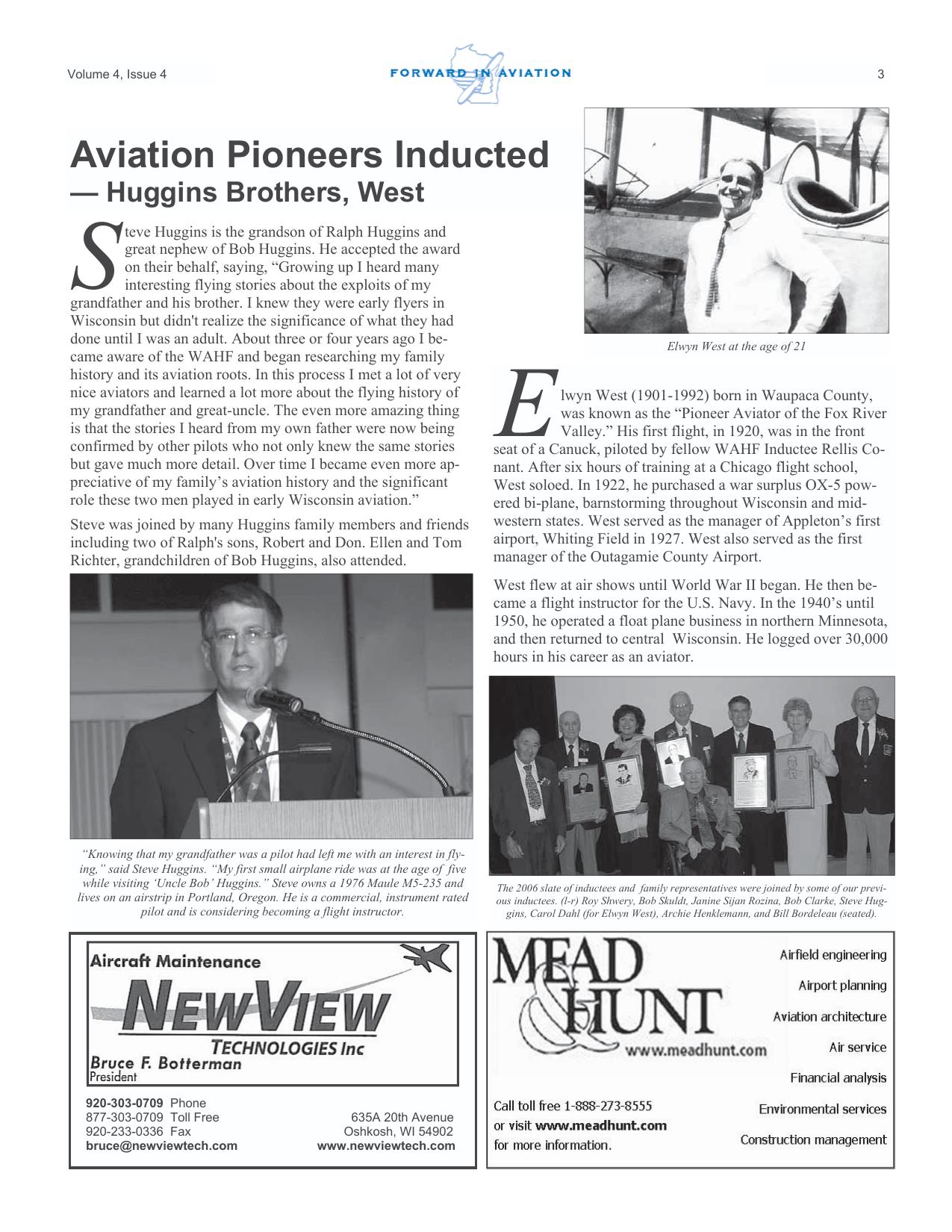
Volume 4, Issue 4 3 Aviation Pioneers Inducted — Huggins Brothers, West S teve Huggins is the grandson of Ralph Huggins and great nephew of Bob Huggins. He accepted the award on their behalf, saying, “Growing up I heard many interesting flying stories about the exploits of my grandfather and his brother. I knew they were early flyers in Wisconsin but didn't realize the significance of what they had done until I was an adult. About three or four years ago I became aware of the WAHF and began researching my family history and its aviation roots. In this process I met a lot of very nice aviators and learned a lot more about the flying history of my grandfather and great-uncle. The even more amazing thing is that the stories I heard from my own father were now being confirmed by other pilots who not only knew the same stories but gave much more detail. Over time I became even more appreciative of my family’s aviation history and the significant role these two men played in early Wisconsin aviation.” Steve was joined by many Huggins family members and friends including two of Ralph's sons, Robert and Don. Ellen and Tom Richter, grandchildren of Bob Huggins, also attended. E Elwyn West at the age of 21 lwyn West (1901-1992) born in Waupaca County, was known as the “Pioneer Aviator of the Fox River Valley.” His first flight, in 1920, was in the front seat of a Canuck, piloted by fellow WAHF Inductee Rellis Conant. After six hours of training at a Chicago flight school, West soloed. In 1922, he purchased a war surplus OX-5 powered bi-plane, barnstorming throughout Wisconsin and midwestern states. West served as the manager of Appleton’s first airport, Whiting Field in 1927. West also served as the first manager of the Outagamie County Airport. West flew at air shows until World War II began. He then became a flight instructor for the U.S. Navy. In the 1940’s until 1950, he operated a float plane business in northern Minnesota, and then returned to central Wisconsin. He logged over 30,000 hours in his career as an aviator. “Knowing that my grandfather was a pilot had left me with an interest in flying,” said Steve Huggins. “My first small airplane ride was at the age of five while visiting ‘Uncle Bob’ Huggins.” Steve owns a 1976 Maule M5-235 and lives on an airstrip in Portland, Oregon. He is a commercial, instrument rated pilot and is considering becoming a flight instructor. 920-303-0709 Phone 877-303-0709 Toll Free 920-233-0336 Fax bruce@newviewtech.com 635A 20th Avenue Oshkosh, WI 54902 www.newviewtech.com The 2006 slate of inductees and family representatives were joined by some of our previous inductees. (l-r) Roy Shwery, Bob Skuldt, Janine Sijan Rozina, Bob Clarke, Steve Huggins, Carol Dahl (for Elwyn West), Archie Henklemann, and Bill Bordeleau (seated).
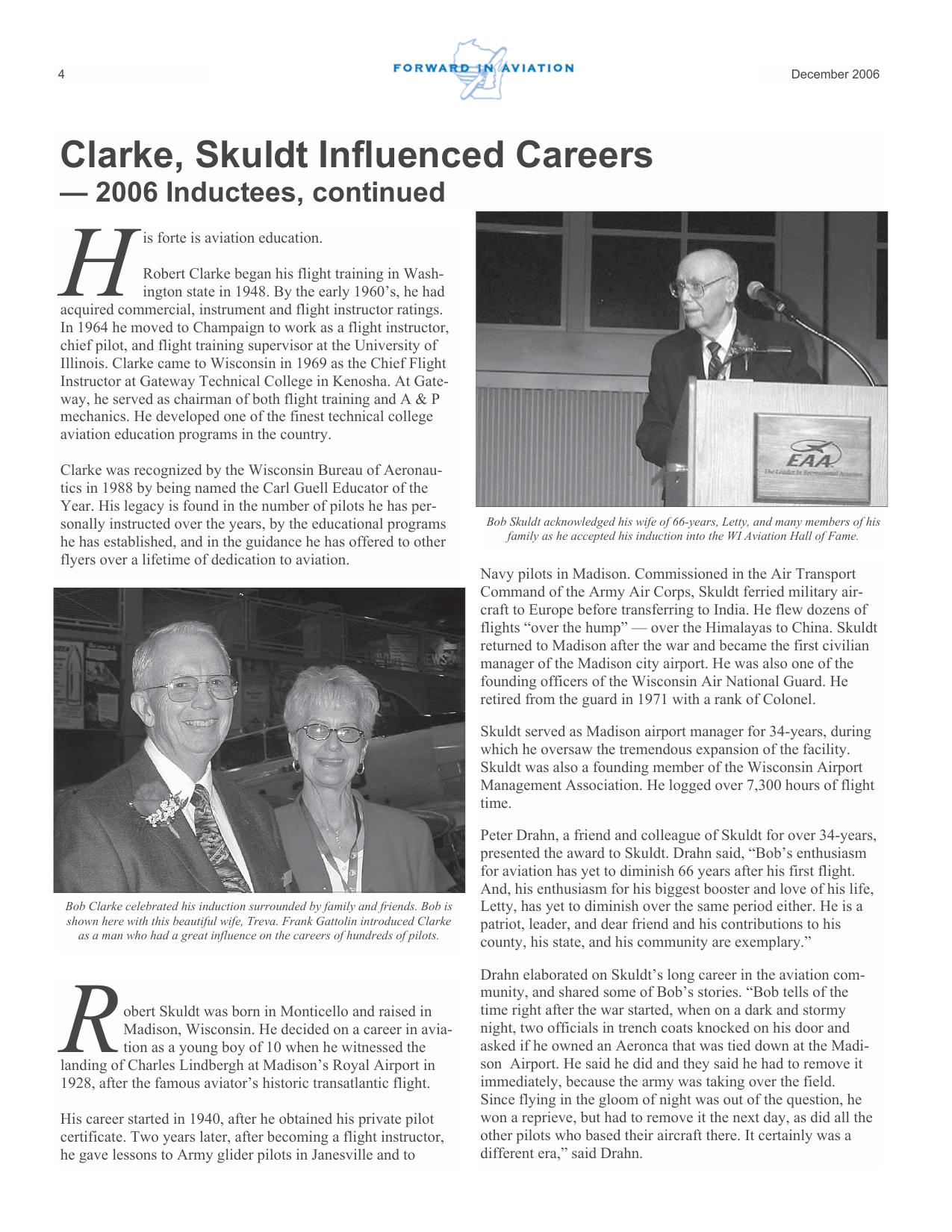
4 December 2006 Clarke, Skuldt Influenced Careers — 2006 Inductees, continued H is forte is aviation education. Robert Clarke began his flight training in Washington state in 1948. By the early 1960’s, he had acquired commercial, instrument and flight instructor ratings. In 1964 he moved to Champaign to work as a flight instructor, chief pilot, and flight training supervisor at the University of Illinois. Clarke came to Wisconsin in 1969 as the Chief Flight Instructor at Gateway Technical College in Kenosha. At Gateway, he served as chairman of both flight training and A & P mechanics. He developed one of the finest technical college aviation education programs in the country. Clarke was recognized by the Wisconsin Bureau of Aeronautics in 1988 by being named the Carl Guell Educator of the Year. His legacy is found in the number of pilots he has personally instructed over the years, by the educational programs he has established, and in the guidance he has offered to other flyers over a lifetime of dedication to aviation. Bob Skuldt acknowledged his wife of 66-years, Letty, and many members of his family as he accepted his induction into the WI Aviation Hall of Fame. Navy pilots in Madison. Commissioned in the Air Transport Command of the Army Air Corps, Skuldt ferried military aircraft to Europe before transferring to India. He flew dozens of flights “over the hump” — over the Himalayas to China. Skuldt returned to Madison after the war and became the first civilian manager of the Madison city airport. He was also one of the founding officers of the Wisconsin Air National Guard. He retired from the guard in 1971 with a rank of Colonel. Skuldt served as Madison airport manager for 34-years, during which he oversaw the tremendous expansion of the facility. Skuldt was also a founding member of the Wisconsin Airport Management Association. He logged over 7,300 hours of flight time. Bob Clarke celebrated his induction surrounded by family and friends. Bob is shown here with this beautiful wife, Treva. Frank Gattolin introduced Clarke as a man who had a great influence on the careers of hundreds of pilots. R obert Skuldt was born in Monticello and raised in Madison, Wisconsin. He decided on a career in aviation as a young boy of 10 when he witnessed the landing of Charles Lindbergh at Madison’s Royal Airport in 1928, after the famous aviator’s historic transatlantic flight. His career started in 1940, after he obtained his private pilot certificate. Two years later, after becoming a flight instructor, he gave lessons to Army glider pilots in Janesville and to Peter Drahn, a friend and colleague of Skuldt for over 34-years, presented the award to Skuldt. Drahn said, “Bob’s enthusiasm for aviation has yet to diminish 66 years after his first flight. And, his enthusiasm for his biggest booster and love of his life, Letty, has yet to diminish over the same period either. He is a patriot, leader, and dear friend and his contributions to his county, his state, and his community are exemplary.” Drahn elaborated on Skuldt’s long career in the aviation community, and shared some of Bob’s stories. “Bob tells of the time right after the war started, when on a dark and stormy night, two officials in trench coats knocked on his door and asked if he owned an Aeronca that was tied down at the Madison Airport. He said he did and they said he had to remove it immediately, because the army was taking over the field. Since flying in the gloom of night was out of the question, he won a reprieve, but had to remove it the next day, as did all the other pilots who based their aircraft there. It certainly was a different era,” said Drahn.
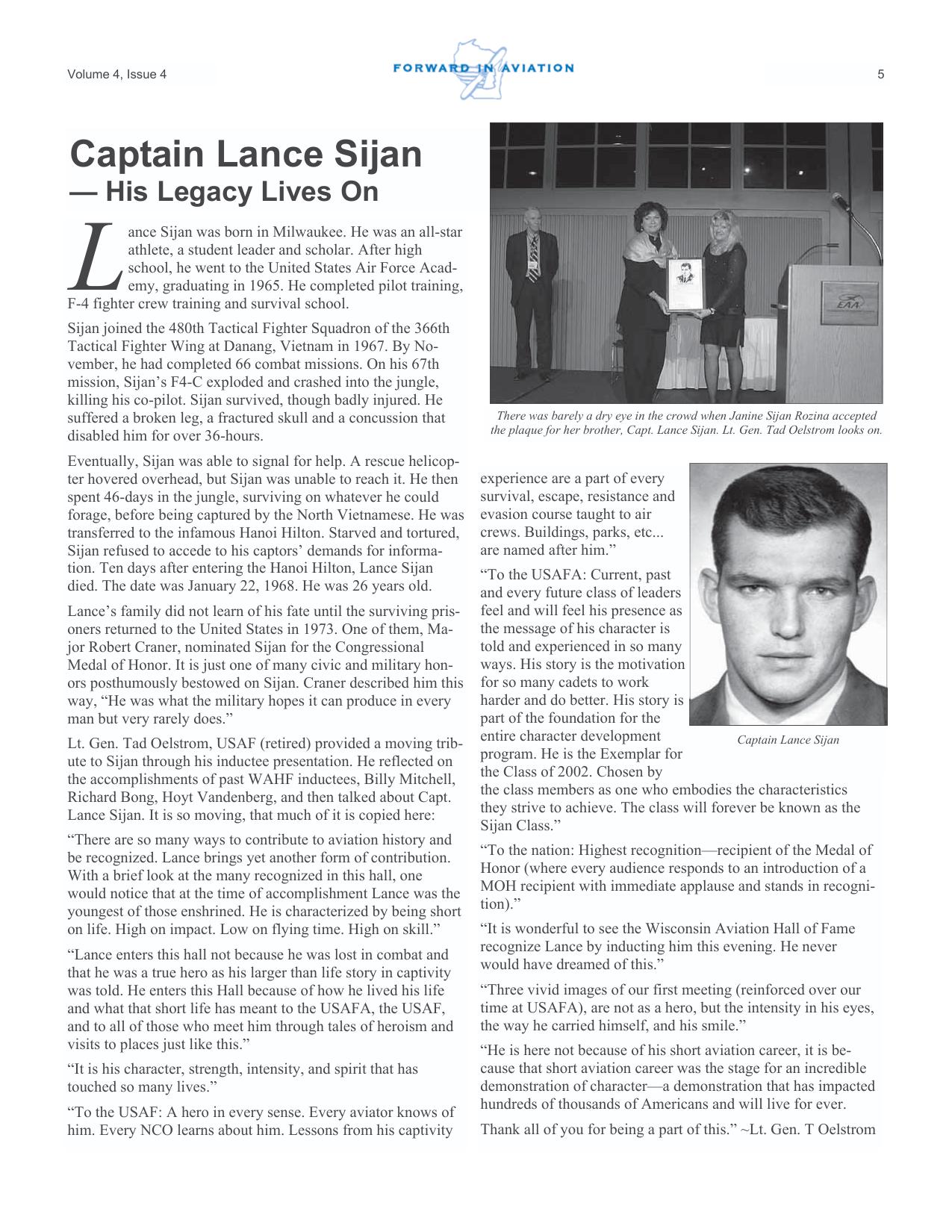
Volume 4, Issue 4 5 Captain Lance Sijan — His Legacy Lives On L ance Sijan was born in Milwaukee. He was an all-star athlete, a student leader and scholar. After high school, he went to the United States Air Force Academy, graduating in 1965. He completed pilot training, F-4 fighter crew training and survival school. Sijan joined the 480th Tactical Fighter Squadron of the 366th Tactical Fighter Wing at Danang, Vietnam in 1967. By November, he had completed 66 combat missions. On his 67th mission, Sijan’s F4-C exploded and crashed into the jungle, killing his co-pilot. Sijan survived, though badly injured. He suffered a broken leg, a fractured skull and a concussion that disabled him for over 36-hours. Eventually, Sijan was able to signal for help. A rescue helicopter hovered overhead, but Sijan was unable to reach it. He then spent 46-days in the jungle, surviving on whatever he could forage, before being captured by the North Vietnamese. He was transferred to the infamous Hanoi Hilton. Starved and tortured, Sijan refused to accede to his captors’ demands for information. Ten days after entering the Hanoi Hilton, Lance Sijan died. The date was January 22, 1968. He was 26 years old. Lance’s family did not learn of his fate until the surviving prisoners returned to the United States in 1973. One of them, Major Robert Craner, nominated Sijan for the Congressional Medal of Honor. It is just one of many civic and military honors posthumously bestowed on Sijan. Craner described him this way, “He was what the military hopes it can produce in every man but very rarely does.” Lt. Gen. Tad Oelstrom, USAF (retired) provided a moving tribute to Sijan through his inductee presentation. He reflected on the accomplishments of past WAHF inductees, Billy Mitchell, Richard Bong, Hoyt Vandenberg, and then talked about Capt. Lance Sijan. It is so moving, that much of it is copied here: “There are so many ways to contribute to aviation history and be recognized. Lance brings yet another form of contribution. With a brief look at the many recognized in this hall, one would notice that at the time of accomplishment Lance was the youngest of those enshrined. He is characterized by being short on life. High on impact. Low on flying time. High on skill.” “Lance enters this hall not because he was lost in combat and that he was a true hero as his larger than life story in captivity was told. He enters this Hall because of how he lived his life and what that short life has meant to the USAFA, the USAF, and to all of those who meet him through tales of heroism and visits to places just like this.” “It is his character, strength, intensity, and spirit that has touched so many lives.” “To the USAF: A hero in every sense. Every aviator knows of him. Every NCO learns about him. Lessons from his captivity There was barely a dry eye in the crowd when Janine Sijan Rozina accepted the plaque for her brother, Capt. Lance Sijan. Lt. Gen. Tad Oelstrom looks on. experience are a part of every survival, escape, resistance and evasion course taught to air crews. Buildings, parks, etc... are named after him.” “To the USAFA: Current, past and every future class of leaders feel and will feel his presence as the message of his character is told and experienced in so many ways. His story is the motivation for so many cadets to work harder and do better. His story is part of the foundation for the entire character development Captain Lance Sijan program. He is the Exemplar for the Class of 2002. Chosen by the class members as one who embodies the characteristics they strive to achieve. The class will forever be known as the Sijan Class.” “To the nation: Highest recognition—recipient of the Medal of Honor (where every audience responds to an introduction of a MOH recipient with immediate applause and stands in recognition).” “It is wonderful to see the Wisconsin Aviation Hall of Fame recognize Lance by inducting him this evening. He never would have dreamed of this.” “Three vivid images of our first meeting (reinforced over our time at USAFA), are not as a hero, but the intensity in his eyes, the way he carried himself, and his smile.” “He is here not because of his short aviation career, it is because that short aviation career was the stage for an incredible demonstration of character—a demonstration that has impacted hundreds of thousands of Americans and will live for ever. Thank all of you for being a part of this.” ~Lt. Gen. T Oelstrom
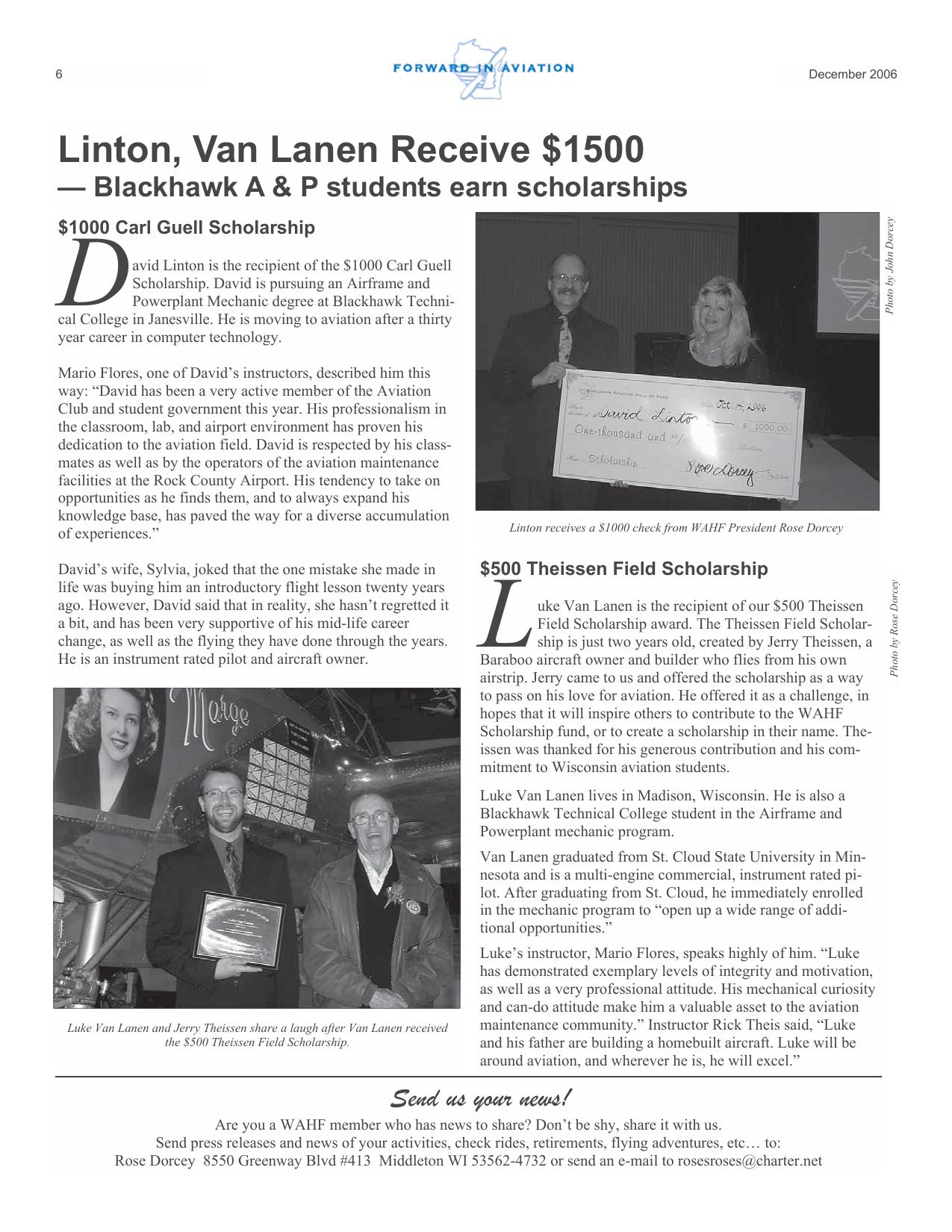
6 December 2006 Linton, Van Lanen Receive $1500 — Blackhawk A & P students earn scholarships Photo by John Dorcey D $1000 Carl Guell Scholarship avid Linton is the recipient of the $1000 Carl Guell Scholarship. David is pursuing an Airframe and Powerplant Mechanic degree at Blackhawk Technical College in Janesville. He is moving to aviation after a thirty year career in computer technology. David’s wife, Sylvia, joked that the one mistake she made in life was buying him an introductory flight lesson twenty years ago. However, David said that in reality, she hasn’t regretted it a bit, and has been very supportive of his mid-life career change, as well as the flying they have done through the years. He is an instrument rated pilot and aircraft owner. Linton receives a $1000 check from WAHF President Rose Dorcey L $500 Theissen Field Scholarship uke Van Lanen is the recipient of our $500 Theissen Field Scholarship award. The Theissen Field Scholarship is just two years old, created by Jerry Theissen, a Baraboo aircraft owner and builder who flies from his own airstrip. Jerry came to us and offered the scholarship as a way to pass on his love for aviation. He offered it as a challenge, in hopes that it will inspire others to contribute to the WAHF Scholarship fund, or to create a scholarship in their name. Theissen was thanked for his generous contribution and his commitment to Wisconsin aviation students. Luke Van Lanen lives in Madison, Wisconsin. He is also a Blackhawk Technical College student in the Airframe and Powerplant mechanic program. Van Lanen graduated from St. Cloud State University in Minnesota and is a multi-engine commercial, instrument rated pilot. After graduating from St. Cloud, he immediately enrolled in the mechanic program to “open up a wide range of additional opportunities.” Luke Van Lanen and Jerry Theissen share a laugh after Van Lanen received the $500 Theissen Field Scholarship. Luke’s instructor, Mario Flores, speaks highly of him. “Luke has demonstrated exemplary levels of integrity and motivation, as well as a very professional attitude. His mechanical curiosity and can-do attitude make him a valuable asset to the aviation maintenance community.” Instructor Rick Theis said, “Luke and his father are building a homebuilt aircraft. Luke will be around aviation, and wherever he is, he will excel.” Send us your news! Are you a WAHF member who has news to share? Don’t be shy, share it with us. Send press releases and news of your activities, check rides, retirements, flying adventures, etc… to: Rose Dorcey 8550 Greenway Blvd #413 Middleton WI 53562-4732 or send an e-mail to rosesroses@charter.net Photo by Rose Dorcey Mario Flores, one of David’s instructors, described him this way: “David has been a very active member of the Aviation Club and student government this year. His professionalism in the classroom, lab, and airport environment has proven his dedication to the aviation field. David is respected by his classmates as well as by the operators of the aviation maintenance facilities at the Rock County Airport. His tendency to take on opportunities as he finds them, and to always expand his knowledge base, has paved the way for a diverse accumulation of experiences.”
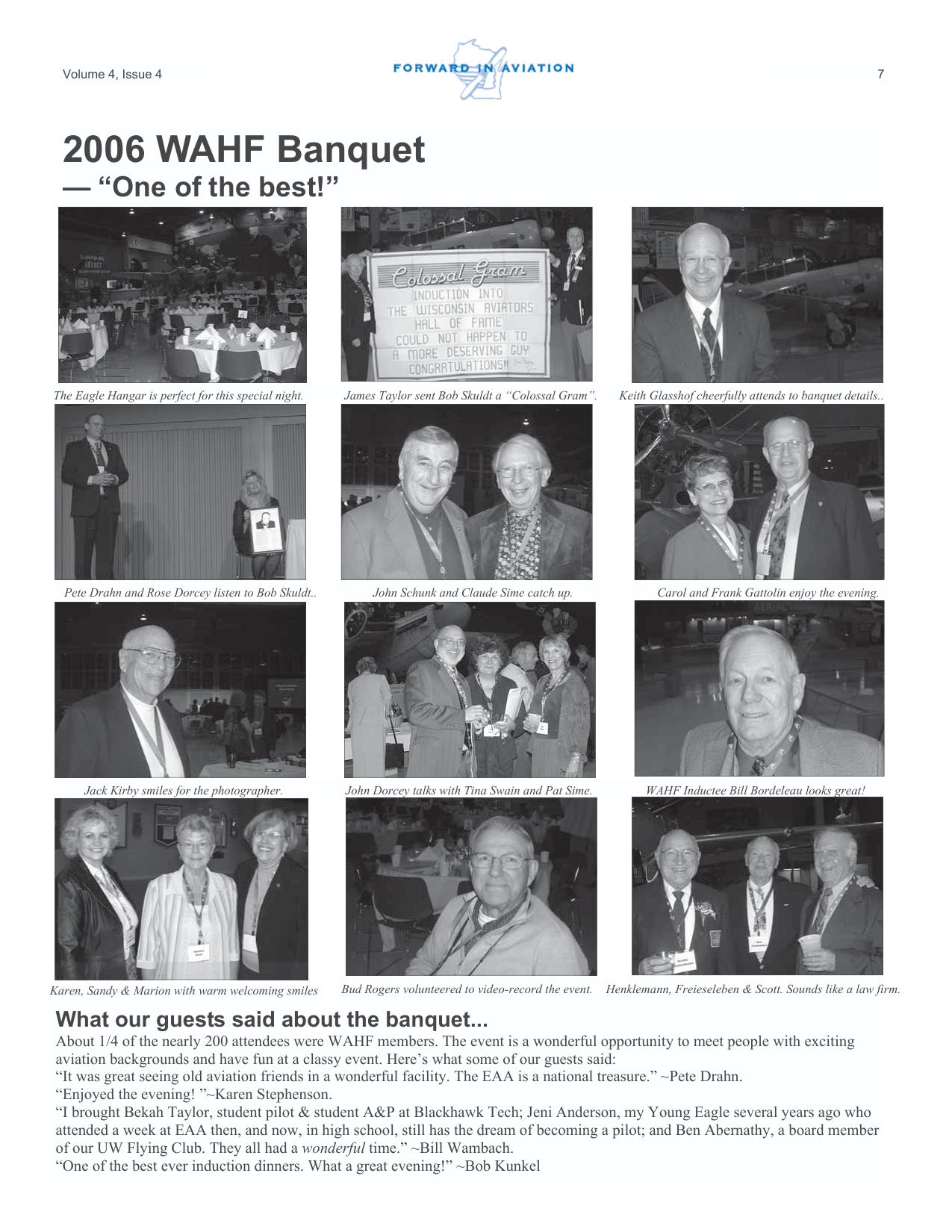
Volume 4, Issue 4 7 2006 WAHF Banquet — “One of the best!” The Eagle Hangar is perfect for this special night. James Taylor sent Bob Skuldt a “Colossal Gram”. Keith Glasshof cheerfully attends to banquet details.. Pete Drahn and Rose Dorcey listen to Bob Skuldt.. John Schunk and Claude Sime catch up. Carol and Frank Gattolin enjoy the evening. Jack Kirby smiles for the photographer. John Dorcey talks with Tina Swain and Pat Sime. WAHF Inductee Bill Bordeleau looks great! Karen, Sandy & Marion with warm welcoming smiles Bud Rogers volunteered to video-record the event. Henklemann, Freieseleben & Scott. Sounds like a law firm. What our guests said about the banquet... About 1/4 of the nearly 200 attendees were WAHF members. The event is a wonderful opportunity to meet people with exciting aviation backgrounds and have fun at a classy event. Here’s what some of our guests said: “It was great seeing old aviation friends in a wonderful facility. The EAA is a national treasure.” ~Pete Drahn. “Enjoyed the evening! ”~Karen Stephenson. “I brought Bekah Taylor, student pilot & student A&P at Blackhawk Tech; Jeni Anderson, my Young Eagle several years ago who attended a week at EAA then, and now, in high school, still has the dream of becoming a pilot; and Ben Abernathy, a board member of our UW Flying Club. They all had a wonderful time.” ~Bill Wambach. “One of the best ever induction dinners. What a great evening!” ~Bob Kunkel
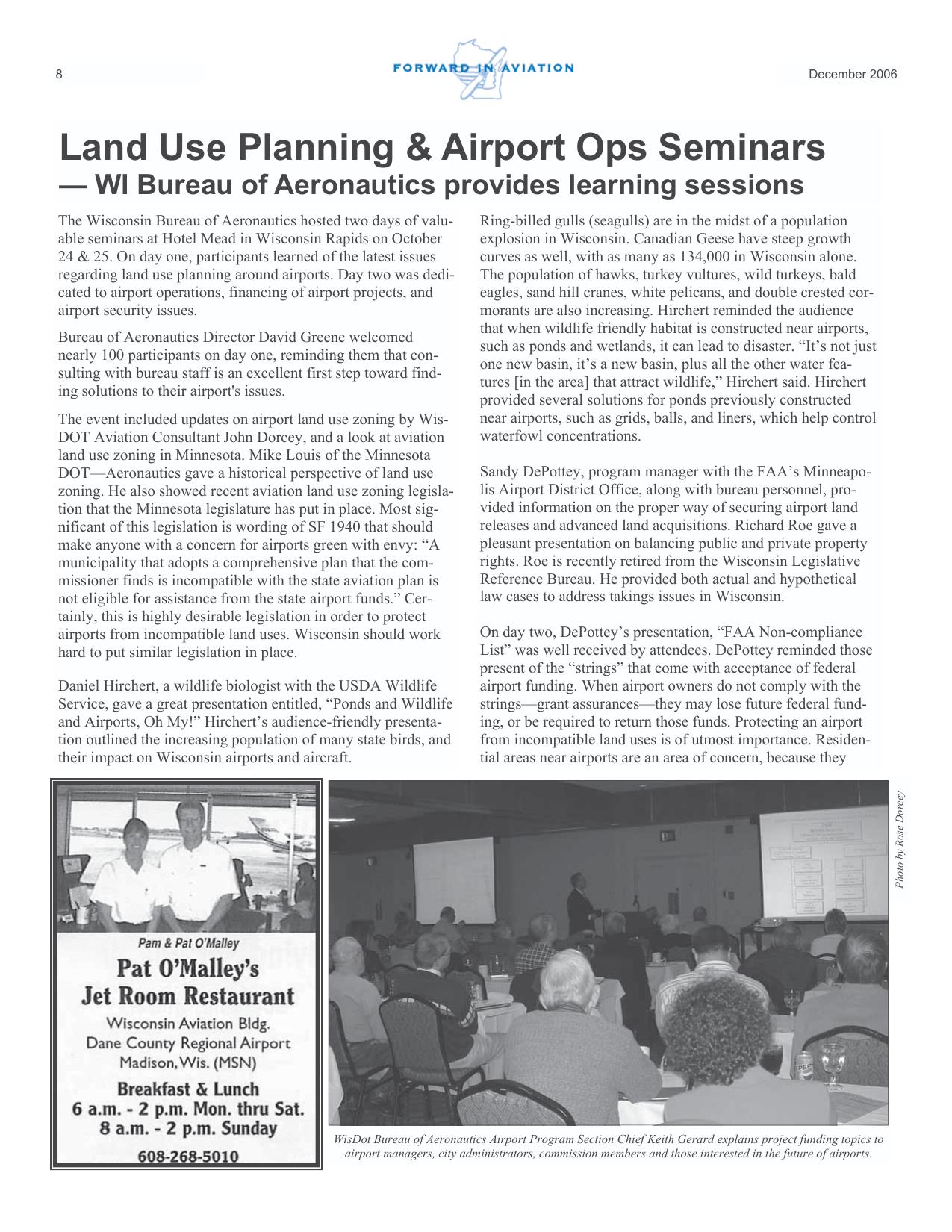
8 December 2006 Land Use Planning & Airport Ops Seminars — WI Bureau of Aeronautics provides learning sessions The Wisconsin Bureau of Aeronautics hosted two days of valuable seminars at Hotel Mead in Wisconsin Rapids on October 24 & 25. On day one, participants learned of the latest issues regarding land use planning around airports. Day two was dedicated to airport operations, financing of airport projects, and airport security issues. Bureau of Aeronautics Director David Greene welcomed nearly 100 participants on day one, reminding them that consulting with bureau staff is an excellent first step toward finding solutions to their airport's issues. The event included updates on airport land use zoning by WisDOT Aviation Consultant John Dorcey, and a look at aviation land use zoning in Minnesota. Mike Louis of the Minnesota DOT—Aeronautics gave a historical perspective of land use zoning. He also showed recent aviation land use zoning legislation that the Minnesota legislature has put in place. Most significant of this legislation is wording of SF 1940 that should make anyone with a concern for airports green with envy: “A municipality that adopts a comprehensive plan that the commissioner finds is incompatible with the state aviation plan is not eligible for assistance from the state airport funds.” Certainly, this is highly desirable legislation in order to protect airports from incompatible land uses. Wisconsin should work hard to put similar legislation in place. Sandy DePottey, program manager with the FAA’s Minneapolis Airport District Office, along with bureau personnel, provided information on the proper way of securing airport land releases and advanced land acquisitions. Richard Roe gave a pleasant presentation on balancing public and private property rights. Roe is recently retired from the Wisconsin Legislative Reference Bureau. He provided both actual and hypothetical law cases to address takings issues in Wisconsin. On day two, DePottey’s presentation, “FAA Non-compliance List” was well received by attendees. DePottey reminded those present of the “strings” that come with acceptance of federal airport funding. When airport owners do not comply with the strings—grant assurances—they may lose future federal funding, or be required to return those funds. Protecting an airport from incompatible land uses is of utmost importance. Residential areas near airports are an area of concern, because they Photo by Rose Dorcey Daniel Hirchert, a wildlife biologist with the USDA Wildlife Service, gave a great presentation entitled, “Ponds and Wildlife and Airports, Oh My!” Hirchert’s audience-friendly presentation outlined the increasing population of many state birds, and their impact on Wisconsin airports and aircraft. Ring-billed gulls (seagulls) are in the midst of a population explosion in Wisconsin. Canadian Geese have steep growth curves as well, with as many as 134,000 in Wisconsin alone. The population of hawks, turkey vultures, wild turkeys, bald eagles, sand hill cranes, white pelicans, and double crested cormorants are also increasing. Hirchert reminded the audience that when wildlife friendly habitat is constructed near airports, such as ponds and wetlands, it can lead to disaster. “It’s not just one new basin, it’s a new basin, plus all the other water features [in the area] that attract wildlife,” Hirchert said. Hirchert provided several solutions for ponds previously constructed near airports, such as grids, balls, and liners, which help control waterfowl concentrations. WisDot Bureau of Aeronautics Airport Program Section Chief Keith Gerard explains project funding topics to airport managers, city administrators, commission members and those interested in the future of airports.
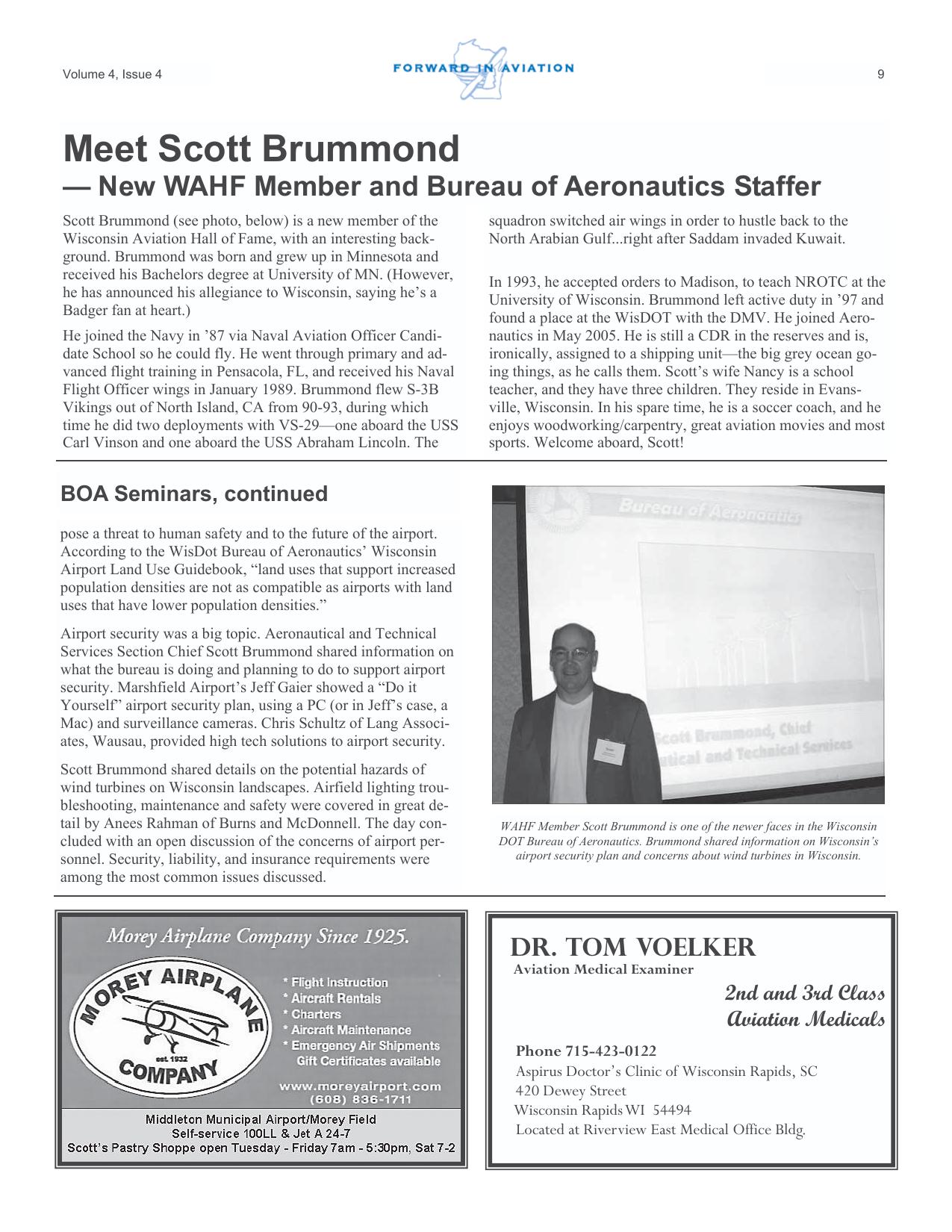
Volume 4, Issue 4 9 Meet Scott Brummond — New WAHF Member and Bureau of Aeronautics Staffer Scott Brummond (see photo, below) is a new member of the Wisconsin Aviation Hall of Fame, with an interesting background. Brummond was born and grew up in Minnesota and received his Bachelors degree at University of MN. (However, he has announced his allegiance to Wisconsin, saying he’s a Badger fan at heart.) He joined the Navy in ’87 via Naval Aviation Officer Candidate School so he could fly. He went through primary and advanced flight training in Pensacola, FL, and received his Naval Flight Officer wings in January 1989. Brummond flew S-3B Vikings out of North Island, CA from 90-93, during which time he did two deployments with VS-29—one aboard the USS Carl Vinson and one aboard the USS Abraham Lincoln. The squadron switched air wings in order to hustle back to the North Arabian Gulf...right after Saddam invaded Kuwait. In 1993, he accepted orders to Madison, to teach NROTC at the University of Wisconsin. Brummond left active duty in ’97 and found a place at the WisDOT with the DMV. He joined Aeronautics in May 2005. He is still a CDR in the reserves and is, ironically, assigned to a shipping unit—the big grey ocean going things, as he calls them. Scott’s wife Nancy is a school teacher, and they have three children. They reside in Evansville, Wisconsin. In his spare time, he is a soccer coach, and he enjoys woodworking/carpentry, great aviation movies and most sports. Welcome aboard, Scott! BOA Seminars, continued pose a threat to human safety and to the future of the airport. According to the WisDot Bureau of Aeronautics’ Wisconsin Airport Land Use Guidebook, “land uses that support increased population densities are not as compatible as airports with land uses that have lower population densities.” Airport security was a big topic. Aeronautical and Technical Services Section Chief Scott Brummond shared information on what the bureau is doing and planning to do to support airport security. Marshfield Airport’s Jeff Gaier showed a “Do it Yourself” airport security plan, using a PC (or in Jeff’s case, a Mac) and surveillance cameras. Chris Schultz of Lang Associates, Wausau, provided high tech solutions to airport security. Scott Brummond shared details on the potential hazards of wind turbines on Wisconsin landscapes. Airfield lighting troubleshooting, maintenance and safety were covered in great detail by Anees Rahman of Burns and McDonnell. The day concluded with an open discussion of the concerns of airport personnel. Security, liability, and insurance requirements were among the most common issues discussed. WAHF Member Scott Brummond is one of the newer faces in the Wisconsin DOT Bureau of Aeronautics. Brummond shared information on Wisconsin’s airport security plan and concerns about wind turbines in Wisconsin. DR. TOM VOELKER Aviation Medical Examiner 2nd and 3rd Class Aviation Medicals Phone 715-423-0122 Aspirus Doctor’s Clinic of Wisconsin Rapids, SC 420 Dewey Street Wisconsin Rapids WI 54494 Located at Riverview East Medical Office Bldg.
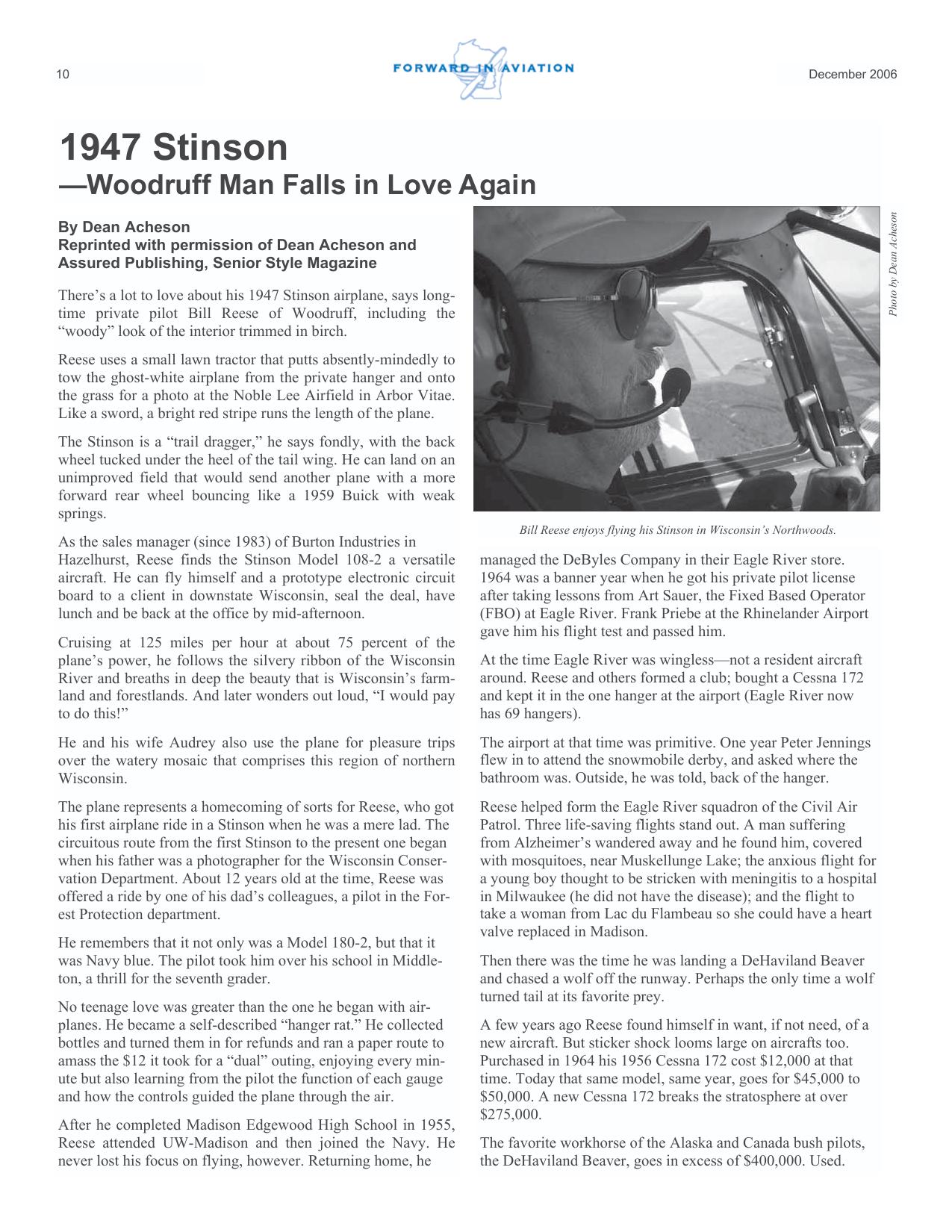
10 December 2006 1947 Stinson Photo by Dean Acheson —Woodruff Man Falls in Love Again By Dean Acheson Reprinted with permission of Dean Acheson and Assured Publishing, Senior Style Magazine There’s a lot to love about his 1947 Stinson airplane, says longtime private pilot Bill Reese of Woodruff, including the “woody” look of the interior trimmed in birch. Reese uses a small lawn tractor that putts absently-mindedly to tow the ghost-white airplane from the private hanger and onto the grass for a photo at the Noble Lee Airfield in Arbor Vitae. Like a sword, a bright red stripe runs the length of the plane. The Stinson is a “trail dragger,” he says fondly, with the back wheel tucked under the heel of the tail wing. He can land on an unimproved field that would send another plane with a more forward rear wheel bouncing like a 1959 Buick with weak springs. As the sales manager (since 1983) of Burton Industries in Hazelhurst, Reese finds the Stinson Model 108-2 a versatile aircraft. He can fly himself and a prototype electronic circuit board to a client in downstate Wisconsin, seal the deal, have lunch and be back at the office by mid-afternoon. Cruising at 125 miles per hour at about 75 percent of the plane’s power, he follows the silvery ribbon of the Wisconsin River and breaths in deep the beauty that is Wisconsin’s farmland and forestlands. And later wonders out loud, “I would pay to do this!” Bill Reese enjoys flying his Stinson in Wisconsin’s Northwoods. managed the DeByles Company in their Eagle River store. 1964 was a banner year when he got his private pilot license after taking lessons from Art Sauer, the Fixed Based Operator (FBO) at Eagle River. Frank Priebe at the Rhinelander Airport gave him his flight test and passed him. At the time Eagle River was wingless—not a resident aircraft around. Reese and others formed a club; bought a Cessna 172 and kept it in the one hanger at the airport (Eagle River now has 69 hangers). He and his wife Audrey also use the plane for pleasure trips over the watery mosaic that comprises this region of northern Wisconsin. The airport at that time was primitive. One year Peter Jennings flew in to attend the snowmobile derby, and asked where the bathroom was. Outside, he was told, back of the hanger. The plane represents a homecoming of sorts for Reese, who got his first airplane ride in a Stinson when he was a mere lad. The circuitous route from the first Stinson to the present one began when his father was a photographer for the Wisconsin Conservation Department. About 12 years old at the time, Reese was offered a ride by one of his dad’s colleagues, a pilot in the Forest Protection department. Reese helped form the Eagle River squadron of the Civil Air Patrol. Three life-saving flights stand out. A man suffering from Alzheimer’s wandered away and he found him, covered with mosquitoes, near Muskellunge Lake; the anxious flight for a young boy thought to be stricken with meningitis to a hospital in Milwaukee (he did not have the disease); and the flight to take a woman from Lac du Flambeau so she could have a heart valve replaced in Madison. He remembers that it not only was a Model 180-2, but that it was Navy blue. The pilot took him over his school in Middleton, a thrill for the seventh grader. No teenage love was greater than the one he began with airplanes. He became a self-described “hanger rat.” He collected bottles and turned them in for refunds and ran a paper route to amass the $12 it took for a “dual” outing, enjoying every minute but also learning from the pilot the function of each gauge and how the controls guided the plane through the air. After he completed Madison Edgewood High School in 1955, Reese attended UW-Madison and then joined the Navy. He never lost his focus on flying, however. Returning home, he Then there was the time he was landing a DeHaviland Beaver and chased a wolf off the runway. Perhaps the only time a wolf turned tail at its favorite prey. A few years ago Reese found himself in want, if not need, of a new aircraft. But sticker shock looms large on aircrafts too. Purchased in 1964 his 1956 Cessna 172 cost $12,000 at that time. Today that same model, same year, goes for $45,000 to $50,000. A new Cessna 172 breaks the stratosphere at over $275,000. The favorite workhorse of the Alaska and Canada bush pilots, the DeHaviland Beaver, goes in excess of $400,000. Used.
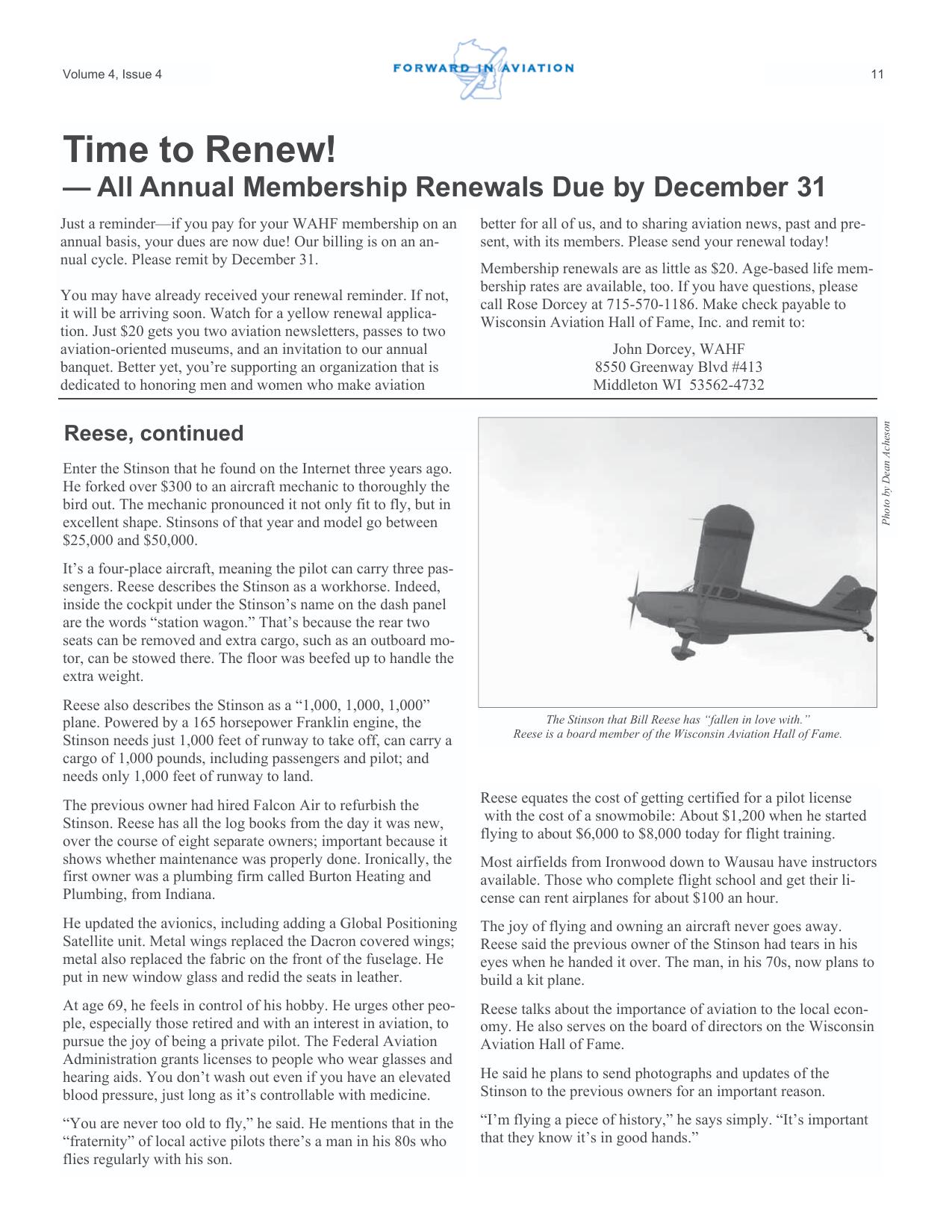
Volume 4, Issue 4 11 Time to Renew! — All Annual Membership Renewals Due by December 31 Just a reminder—if you pay for your WAHF membership on an annual basis, your dues are now due! Our billing is on an annual cycle. Please remit by December 31. You may have already received your renewal reminder. If not, it will be arriving soon. Watch for a yellow renewal application. Just $20 gets you two aviation newsletters, passes to two aviation-oriented museums, and an invitation to our annual banquet. Better yet, you’re supporting an organization that is dedicated to honoring men and women who make aviation better for all of us, and to sharing aviation news, past and present, with its members. Please send your renewal today! Membership renewals are as little as $20. Age-based life membership rates are available, too. If you have questions, please call Rose Dorcey at 715-570-1186. Make check payable to Wisconsin Aviation Hall of Fame, Inc. and remit to: John Dorcey, WAHF 8550 Greenway Blvd #413 Middleton WI 53562-4732 Photo by Dean Acheson Reese, continued Enter the Stinson that he found on the Internet three years ago. He forked over $300 to an aircraft mechanic to thoroughly the bird out. The mechanic pronounced it not only fit to fly, but in excellent shape. Stinsons of that year and model go between $25,000 and $50,000. It’s a four-place aircraft, meaning the pilot can carry three passengers. Reese describes the Stinson as a workhorse. Indeed, inside the cockpit under the Stinson’s name on the dash panel are the words “station wagon.” That’s because the rear two seats can be removed and extra cargo, such as an outboard motor, can be stowed there. The floor was beefed up to handle the extra weight. Reese also describes the Stinson as a “1,000, 1,000, 1,000” plane. Powered by a 165 horsepower Franklin engine, the Stinson needs just 1,000 feet of runway to take off, can carry a cargo of 1,000 pounds, including passengers and pilot; and needs only 1,000 feet of runway to land. The Stinson that Bill Reese has “fallen in love with.” Reese is a board member of the Wisconsin Aviation Hall of Fame. The previous owner had hired Falcon Air to refurbish the Stinson. Reese has all the log books from the day it was new, over the course of eight separate owners; important because it shows whether maintenance was properly done. Ironically, the first owner was a plumbing firm called Burton Heating and Plumbing, from Indiana. Reese equates the cost of getting certified for a pilot license with the cost of a snowmobile: About $1,200 when he started flying to about $6,000 to $8,000 today for flight training. He updated the avionics, including adding a Global Positioning Satellite unit. Metal wings replaced the Dacron covered wings; metal also replaced the fabric on the front of the fuselage. He put in new window glass and redid the seats in leather. The joy of flying and owning an aircraft never goes away. Reese said the previous owner of the Stinson had tears in his eyes when he handed it over. The man, in his 70s, now plans to build a kit plane. At age 69, he feels in control of his hobby. He urges other people, especially those retired and with an interest in aviation, to pursue the joy of being a private pilot. The Federal Aviation Administration grants licenses to people who wear glasses and hearing aids. You don’t wash out even if you have an elevated blood pressure, just long as it’s controllable with medicine. Reese talks about the importance of aviation to the local economy. He also serves on the board of directors on the Wisconsin Aviation Hall of Fame. “You are never too old to fly,” he said. He mentions that in the “fraternity” of local active pilots there’s a man in his 80s who flies regularly with his son. “I’m flying a piece of history,” he says simply. “It’s important that they know it’s in good hands.” Most airfields from Ironwood down to Wausau have instructors available. Those who complete flight school and get their license can rent airplanes for about $100 an hour. He said he plans to send photographs and updates of the Stinson to the previous owners for an important reason.
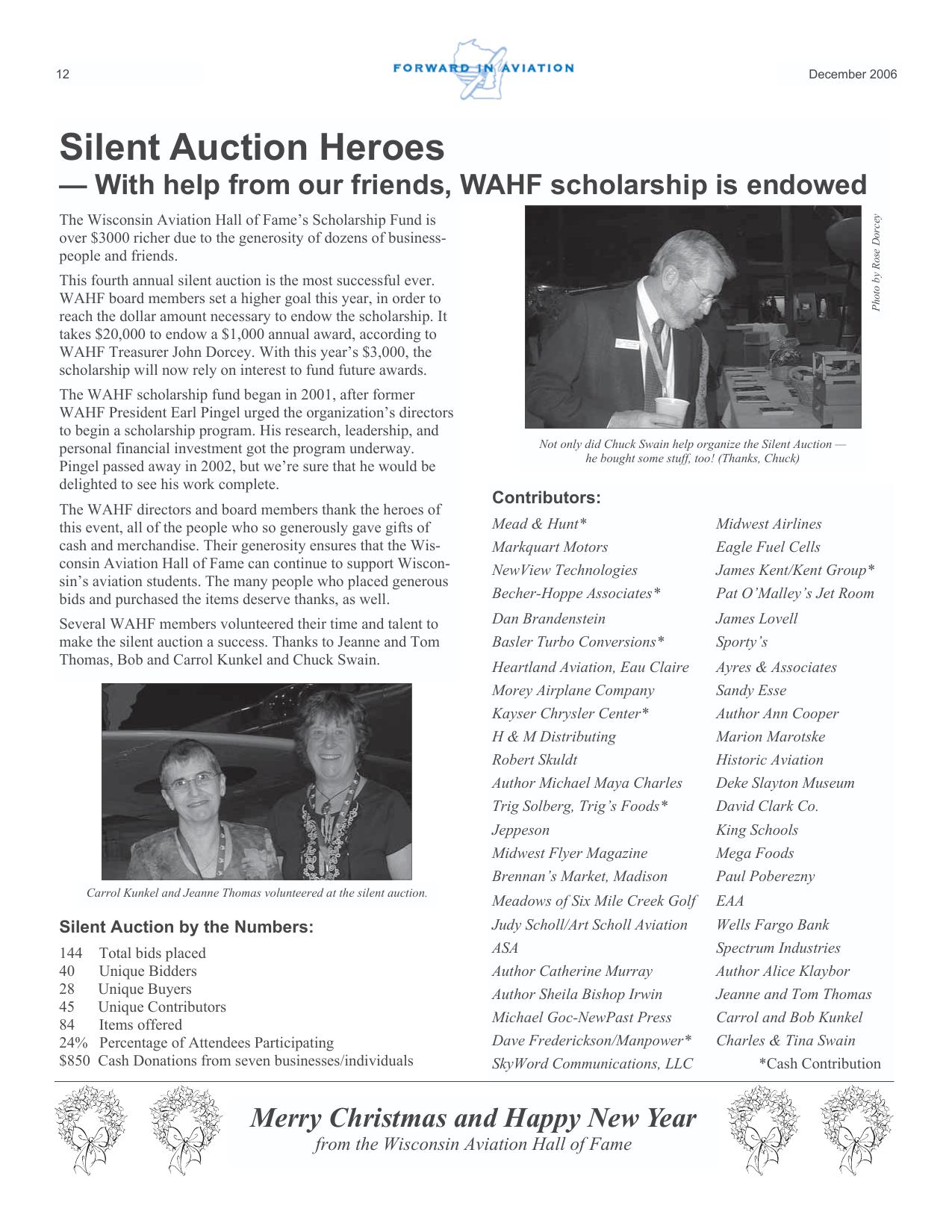
12 December 2006 Silent Auction Heroes — With help from our friends, WAHF scholarship is endowed Photo by Rose Dorcey The Wisconsin Aviation Hall of Fame’s Scholarship Fund is over $3000 richer due to the generosity of dozens of businesspeople and friends. This fourth annual silent auction is the most successful ever. WAHF board members set a higher goal this year, in order to reach the dollar amount necessary to endow the scholarship. It takes $20,000 to endow a $1,000 annual award, according to WAHF Treasurer John Dorcey. With this year’s $3,000, the scholarship will now rely on interest to fund future awards. The WAHF scholarship fund began in 2001, after former WAHF President Earl Pingel urged the organization’s directors to begin a scholarship program. His research, leadership, and personal financial investment got the program underway. Pingel passed away in 2002, but we’re sure that he would be delighted to see his work complete. The WAHF directors and board members thank the heroes of this event, all of the people who so generously gave gifts of cash and merchandise. Their generosity ensures that the Wisconsin Aviation Hall of Fame can continue to support Wisconsin’s aviation students. The many people who placed generous bids and purchased the items deserve thanks, as well. Several WAHF members volunteered their time and talent to make the silent auction a success. Thanks to Jeanne and Tom Thomas, Bob and Carrol Kunkel and Chuck Swain. Carrol Kunkel and Jeanne Thomas volunteered at the silent auction. Silent Auction by the Numbers: 144 Total bids placed 40 Unique Bidders 28 Unique Buyers 45 Unique Contributors 84 Items offered 24% Percentage of Attendees Participating $850 Cash Donations from seven businesses/individuals Not only did Chuck Swain help organize the Silent Auction — he bought some stuff, too! (Thanks, Chuck) Contributors: Mead & Hunt* Markquart Motors NewView Technologies Becher-Hoppe Associates* Midwest Airlines Eagle Fuel Cells James Kent/Kent Group* Pat O’Malley’s Jet Room Dan Brandenstein Basler Turbo Conversions* James Lovell Sporty’s Heartland Aviation, Eau Claire Morey Airplane Company Kayser Chrysler Center* H & M Distributing Robert Skuldt Author Michael Maya Charles Trig Solberg, Trig’s Foods* Jeppeson Midwest Flyer Magazine Brennan’s Market, Madison Ayres & Associates Sandy Esse Author Ann Cooper Marion Marotske Historic Aviation Deke Slayton Museum David Clark Co. King Schools Mega Foods Paul Poberezny Meadows of Six Mile Creek Golf Judy Scholl/Art Scholl Aviation ASA Author Catherine Murray Author Sheila Bishop Irwin Michael Goc-NewPast Press Dave Frederickson/Manpower* SkyWord Communications, LLC EAA Wells Fargo Bank Spectrum Industries Author Alice Klaybor Jeanne and Tom Thomas Carrol and Bob Kunkel Charles & Tina Swain *Cash Contribution Merry Christmas and Happy New Year from the Wisconsin Aviation Hall of Fame
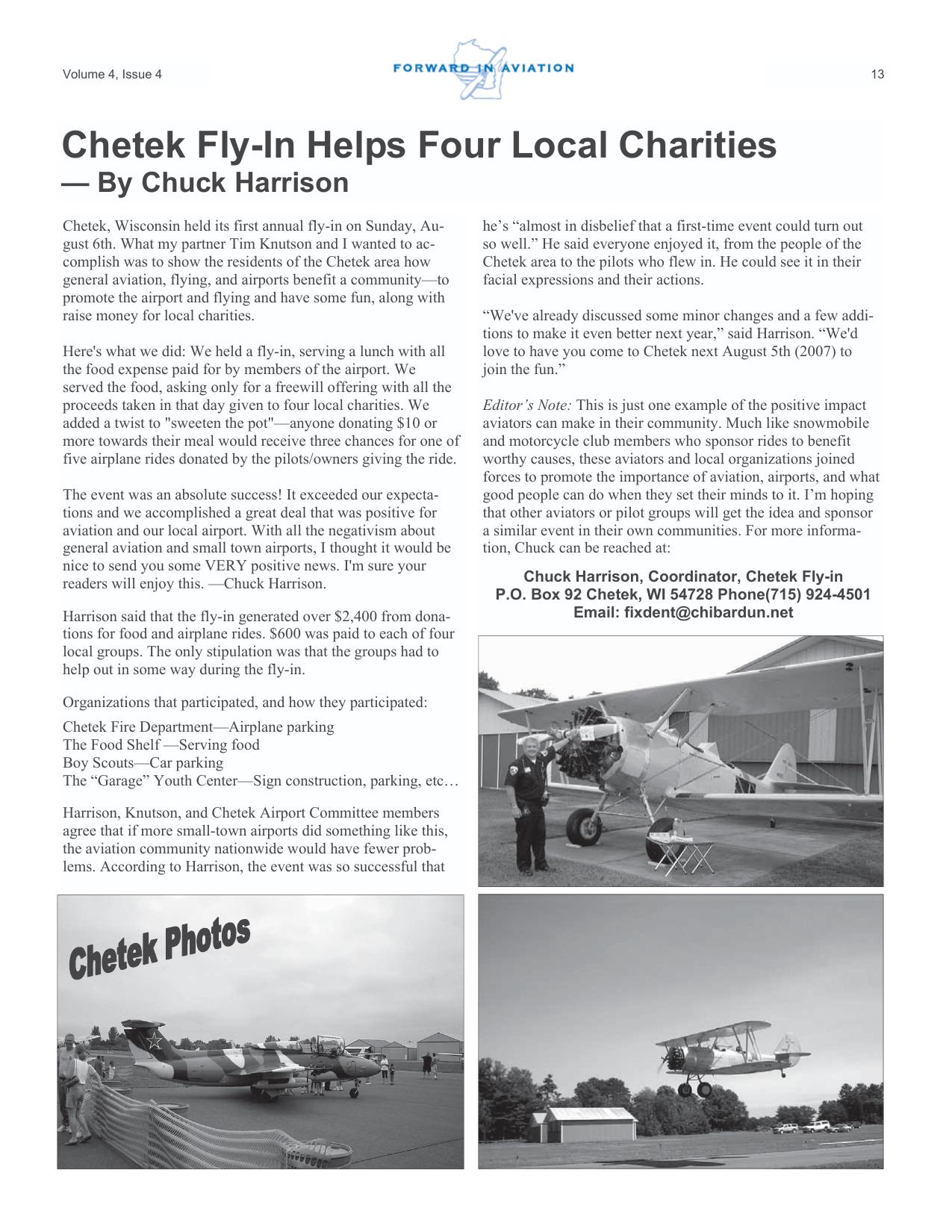
Volume 4, Issue 4 13 Chetek Fly-In Helps Four Local Charities — By Chuck Harrison Chetek, Wisconsin held its first annual fly-in on Sunday, August 6th. What my partner Tim Knutson and I wanted to accomplish was to show the residents of the Chetek area how general aviation, flying, and airports benefit a community—to promote the airport and flying and have some fun, along with raise money for local charities. Here's what we did: We held a fly-in, serving a lunch with all the food expense paid for by members of the airport. We served the food, asking only for a freewill offering with all the proceeds taken in that day given to four local charities. We added a twist to "sweeten the pot"—anyone donating $10 or more towards their meal would receive three chances for one of five airplane rides donated by the pilots/owners giving the ride. The event was an absolute success! It exceeded our expectations and we accomplished a great deal that was positive for aviation and our local airport. With all the negativism about general aviation and small town airports, I thought it would be nice to send you some VERY positive news. I'm sure your readers will enjoy this. —Chuck Harrison. Harrison said that the fly-in generated over $2,400 from donations for food and airplane rides. $600 was paid to each of four local groups. The only stipulation was that the groups had to help out in some way during the fly-in. Organizations that participated, and how they participated: Chetek Fire Department—Airplane parking The Food Shelf —Serving food Boy Scouts—Car parking The “Garage” Youth Center—Sign construction, parking, etc… Harrison, Knutson, and Chetek Airport Committee members agree that if more small-town airports did something like this, the aviation community nationwide would have fewer problems. According to Harrison, the event was so successful that he’s “almost in disbelief that a first-time event could turn out so well.” He said everyone enjoyed it, from the people of the Chetek area to the pilots who flew in. He could see it in their facial expressions and their actions. “We've already discussed some minor changes and a few additions to make it even better next year,” said Harrison. “We'd love to have you come to Chetek next August 5th (2007) to join the fun.” Editor’s Note: This is just one example of the positive impact aviators can make in their community. Much like snowmobile and motorcycle club members who sponsor rides to benefit worthy causes, these aviators and local organizations joined forces to promote the importance of aviation, airports, and what good people can do when they set their minds to it. I’m hoping that other aviators or pilot groups will get the idea and sponsor a similar event in their own communities. For more information, Chuck can be reached at: Chuck Harrison, Coordinator, Chetek Fly-in P.O. Box 92 Chetek, WI 54728 Phone(715) 924-4501 Email: fixdent@chibardun.net
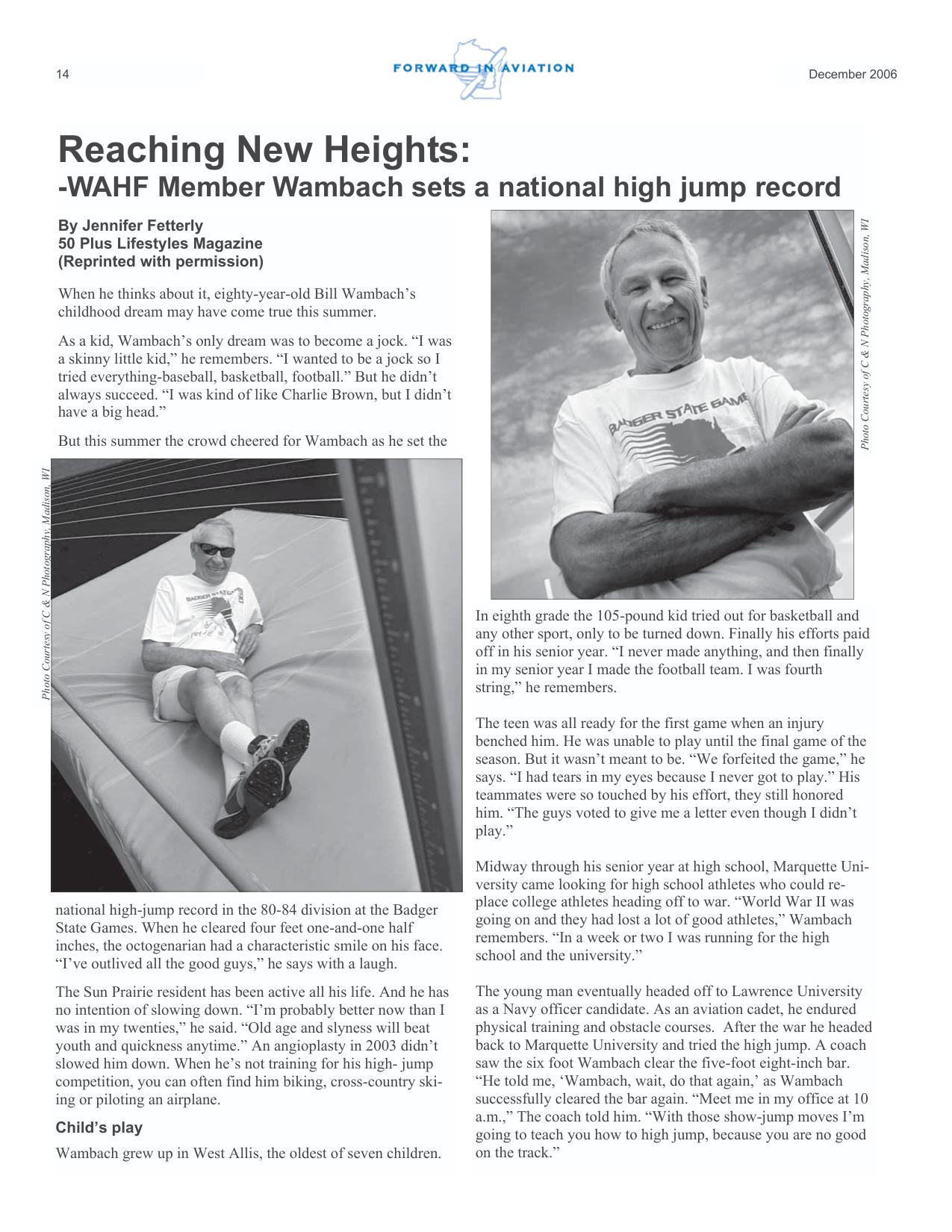
14 December 2006 Reaching New Heights: By Jennifer Fetterly 50 Plus Lifestyles Magazine (Reprinted with permission) When he thinks about it, eighty-year-old Bill Wambach’s childhood dream may have come true this summer. As a kid, Wambach’s only dream was to become a jock. “I was a skinny little kid,” he remembers. “I wanted to be a jock so I tried everything-baseball, basketball, football.” But he didn’t always succeed. “I was kind of like Charlie Brown, but I didn’t have a big head.” Photo Courtesy of C & N Photography, Madison, WI Photo Courtesy of C & N Photography, Madison, WI But this summer the crowd cheered for Wambach as he set the Photo Courtesy of C & N Photography, Madison, WI -WAHF Member Wambach sets a national high jump record In eighth grade the 105-pound kid tried out for basketball and any other sport, only to be turned down. Finally his efforts paid off in his senior year. “I never made anything, and then finally in my senior year I made the football team. I was fourth string,” he remembers. The teen was all ready for the first game when an injury benched him. He was unable to play until the final game of the season. But it wasn’t meant to be. “We forfeited the game,” he says. “I had tears in my eyes because I never got to play.” His teammates were so touched by his effort, they still honored him. “The guys voted to give me a letter even though I didn’t play.” national high-jump record in the 80-84 division at the Badger State Games. When he cleared four feet one-and-one half inches, the octogenarian had a characteristic smile on his face. “I’ve outlived all the good guys,” he says with a laugh. The Sun Prairie resident has been active all his life. And he has no intention of slowing down. “I’m probably better now than I was in my twenties,” he said. “Old age and slyness will beat youth and quickness anytime.” An angioplasty in 2003 didn’t slowed him down. When he’s not training for his high- jump competition, you can often find him biking, cross-country skiing or piloting an airplane. Child’s play Wambach grew up in West Allis, the oldest of seven children. Midway through his senior year at high school, Marquette University came looking for high school athletes who could replace college athletes heading off to war. “World War II was going on and they had lost a lot of good athletes,” Wambach remembers. “In a week or two I was running for the high school and the university.” The young man eventually headed off to Lawrence University as a Navy officer candidate. As an aviation cadet, he endured physical training and obstacle courses. After the war he headed back to Marquette University and tried the high jump. A coach saw the six foot Wambach clear the five-foot eight-inch bar. “He told me, ‘Wambach, wait, do that again,’ as Wambach successfully cleared the bar again. “Meet me in my office at 10 a.m.,” The coach told him. “With those show-jump moves I’m going to teach you how to high jump, because you are no good on the track.”
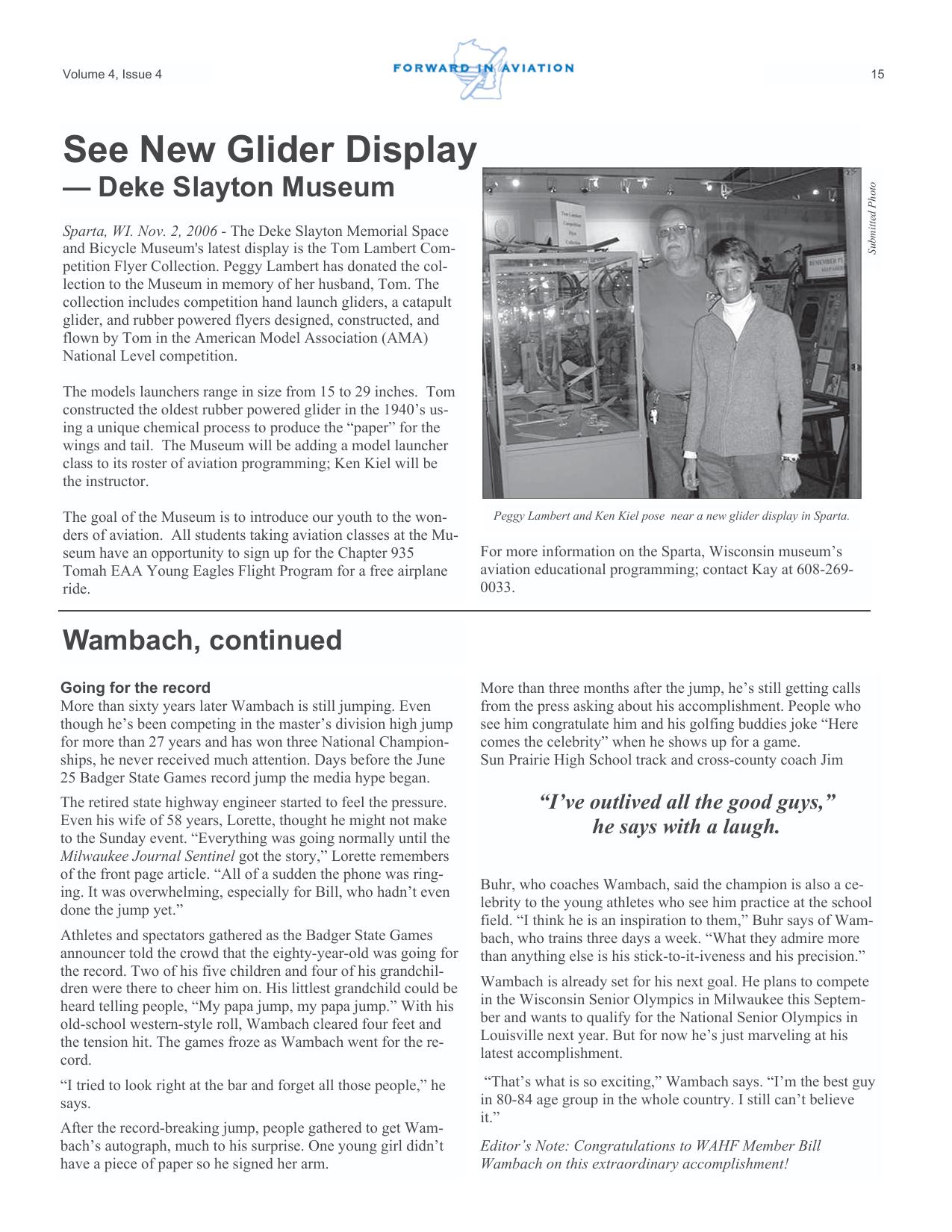
Volume 4, Issue 4 15 See New Glider Display Submitted Photo — Deke Slayton Museum Sparta, WI. Nov. 2, 2006 - The Deke Slayton Memorial Space and Bicycle Museum's latest display is the Tom Lambert Competition Flyer Collection. Peggy Lambert has donated the collection to the Museum in memory of her husband, Tom. The collection includes competition hand launch gliders, a catapult glider, and rubber powered flyers designed, constructed, and flown by Tom in the American Model Association (AMA) National Level competition. The models launchers range in size from 15 to 29 inches. Tom constructed the oldest rubber powered glider in the 1940’s using a unique chemical process to produce the “paper” for the wings and tail. The Museum will be adding a model launcher class to its roster of aviation programming; Ken Kiel will be the instructor. The goal of the Museum is to introduce our youth to the wonders of aviation. All students taking aviation classes at the Museum have an opportunity to sign up for the Chapter 935 Tomah EAA Young Eagles Flight Program for a free airplane ride. Peggy Lambert and Ken Kiel pose near a new glider display in Sparta. For more information on the Sparta, Wisconsin museum’s aviation educational programming; contact Kay at 608-2690033. Wambach, continued Going for the record More than sixty years later Wambach is still jumping. Even though he’s been competing in the master’s division high jump for more than 27 years and has won three National Championships, he never received much attention. Days before the June 25 Badger State Games record jump the media hype began. The retired state highway engineer started to feel the pressure. Even his wife of 58 years, Lorette, thought he might not make to the Sunday event. “Everything was going normally until the Milwaukee Journal Sentinel got the story,” Lorette remembers of the front page article. “All of a sudden the phone was ringing. It was overwhelming, especially for Bill, who hadn’t even done the jump yet.” Athletes and spectators gathered as the Badger State Games announcer told the crowd that the eighty-year-old was going for the record. Two of his five children and four of his grandchildren were there to cheer him on. His littlest grandchild could be heard telling people, “My papa jump, my papa jump.” With his old-school western-style roll, Wambach cleared four feet and the tension hit. The games froze as Wambach went for the record. “I tried to look right at the bar and forget all those people,” he says. After the record-breaking jump, people gathered to get Wambach’s autograph, much to his surprise. One young girl didn’t have a piece of paper so he signed her arm. More than three months after the jump, he’s still getting calls from the press asking about his accomplishment. People who see him congratulate him and his golfing buddies joke “Here comes the celebrity” when he shows up for a game. Sun Prairie High School track and cross-county coach Jim “I’ve outlived all the good guys,” he says with a laugh. Buhr, who coaches Wambach, said the champion is also a celebrity to the young athletes who see him practice at the school field. “I think he is an inspiration to them,” Buhr says of Wambach, who trains three days a week. “What they admire more than anything else is his stick-to-it-iveness and his precision.” Wambach is already set for his next goal. He plans to compete in the Wisconsin Senior Olympics in Milwaukee this September and wants to qualify for the National Senior Olympics in Louisville next year. But for now he’s just marveling at his latest accomplishment. “That’s what is so exciting,” Wambach says. “I’m the best guy in 80-84 age group in the whole country. I still can’t believe it.” Editor’s Note: Congratulations to WAHF Member Bill Wambach on this extraordinary accomplishment!
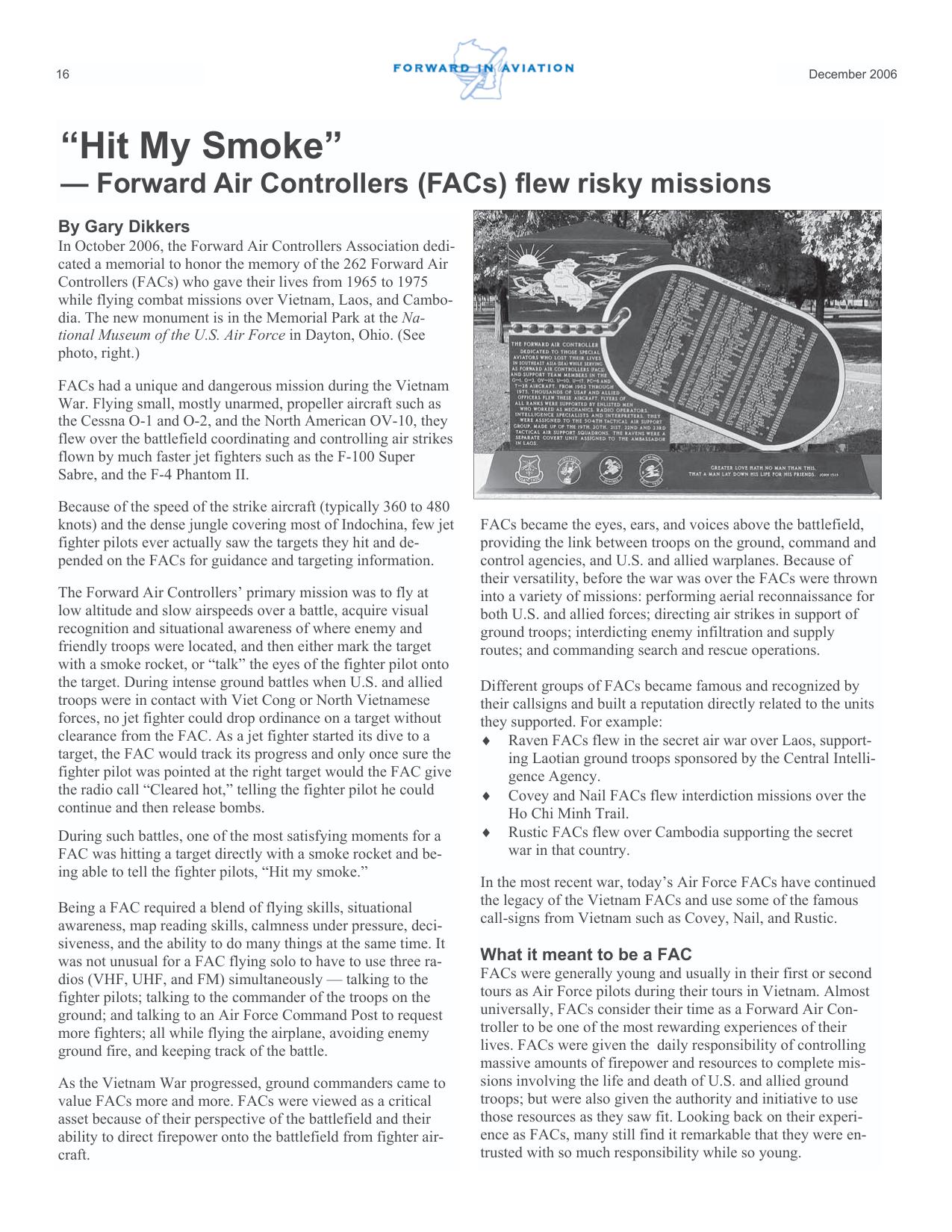
16 December 2006 “Hit My Smoke” — Forward Air Controllers (FACs) flew risky missions By Gary Dikkers In October 2006, the Forward Air Controllers Association dedicated a memorial to honor the memory of the 262 Forward Air Controllers (FACs) who gave their lives from 1965 to 1975 while flying combat missions over Vietnam, Laos, and Cambodia. The new monument is in the Memorial Park at the National Museum of the U.S. Air Force in Dayton, Ohio. (See photo, right.) FACs had a unique and dangerous mission during the Vietnam War. Flying small, mostly unarmed, propeller aircraft such as the Cessna O-1 and O-2, and the North American OV-10, they flew over the battlefield coordinating and controlling air strikes flown by much faster jet fighters such as the F-100 Super Sabre, and the F-4 Phantom II. Because of the speed of the strike aircraft (typically 360 to 480 knots) and the dense jungle covering most of Indochina, few jet fighter pilots ever actually saw the targets they hit and depended on the FACs for guidance and targeting information. The Forward Air Controllers’ primary mission was to fly at low altitude and slow airspeeds over a battle, acquire visual recognition and situational awareness of where enemy and friendly troops were located, and then either mark the target with a smoke rocket, or “talk” the eyes of the fighter pilot onto the target. During intense ground battles when U.S. and allied troops were in contact with Viet Cong or North Vietnamese forces, no jet fighter could drop ordinance on a target without clearance from the FAC. As a jet fighter started its dive to a target, the FAC would track its progress and only once sure the fighter pilot was pointed at the right target would the FAC give the radio call “Cleared hot,” telling the fighter pilot he could continue and then release bombs. During such battles, one of the most satisfying moments for a FAC was hitting a target directly with a smoke rocket and being able to tell the fighter pilots, “Hit my smoke.” Being a FAC required a blend of flying skills, situational awareness, map reading skills, calmness under pressure, decisiveness, and the ability to do many things at the same time. It was not unusual for a FAC flying solo to have to use three radios (VHF, UHF, and FM) simultaneously — talking to the fighter pilots; talking to the commander of the troops on the ground; and talking to an Air Force Command Post to request more fighters; all while flying the airplane, avoiding enemy ground fire, and keeping track of the battle. As the Vietnam War progressed, ground commanders came to value FACs more and more. FACs were viewed as a critical asset because of their perspective of the battlefield and their ability to direct firepower onto the battlefield from fighter aircraft. FACs became the eyes, ears, and voices above the battlefield, providing the link between troops on the ground, command and control agencies, and U.S. and allied warplanes. Because of their versatility, before the war was over the FACs were thrown into a variety of missions: performing aerial reconnaissance for both U.S. and allied forces; directing air strikes in support of ground troops; interdicting enemy infiltration and supply routes; and commanding search and rescue operations. Different groups of FACs became famous and recognized by their callsigns and built a reputation directly related to the units they supported. For example: ♦ Raven FACs flew in the secret air war over Laos, supporting Laotian ground troops sponsored by the Central Intelligence Agency. ♦ Covey and Nail FACs flew interdiction missions over the Ho Chi Minh Trail. ♦ Rustic FACs flew over Cambodia supporting the secret war in that country. In the most recent war, today’s Air Force FACs have continued the legacy of the Vietnam FACs and use some of the famous call-signs from Vietnam such as Covey, Nail, and Rustic. What it meant to be a FAC FACs were generally young and usually in their first or second tours as Air Force pilots during their tours in Vietnam. Almost universally, FACs consider their time as a Forward Air Controller to be one of the most rewarding experiences of their lives. FACs were given the daily responsibility of controlling massive amounts of firepower and resources to complete missions involving the life and death of U.S. and allied ground troops; but were also given the authority and initiative to use those resources as they saw fit. Looking back on their experience as FACs, many still find it remarkable that they were entrusted with so much responsibility while so young.
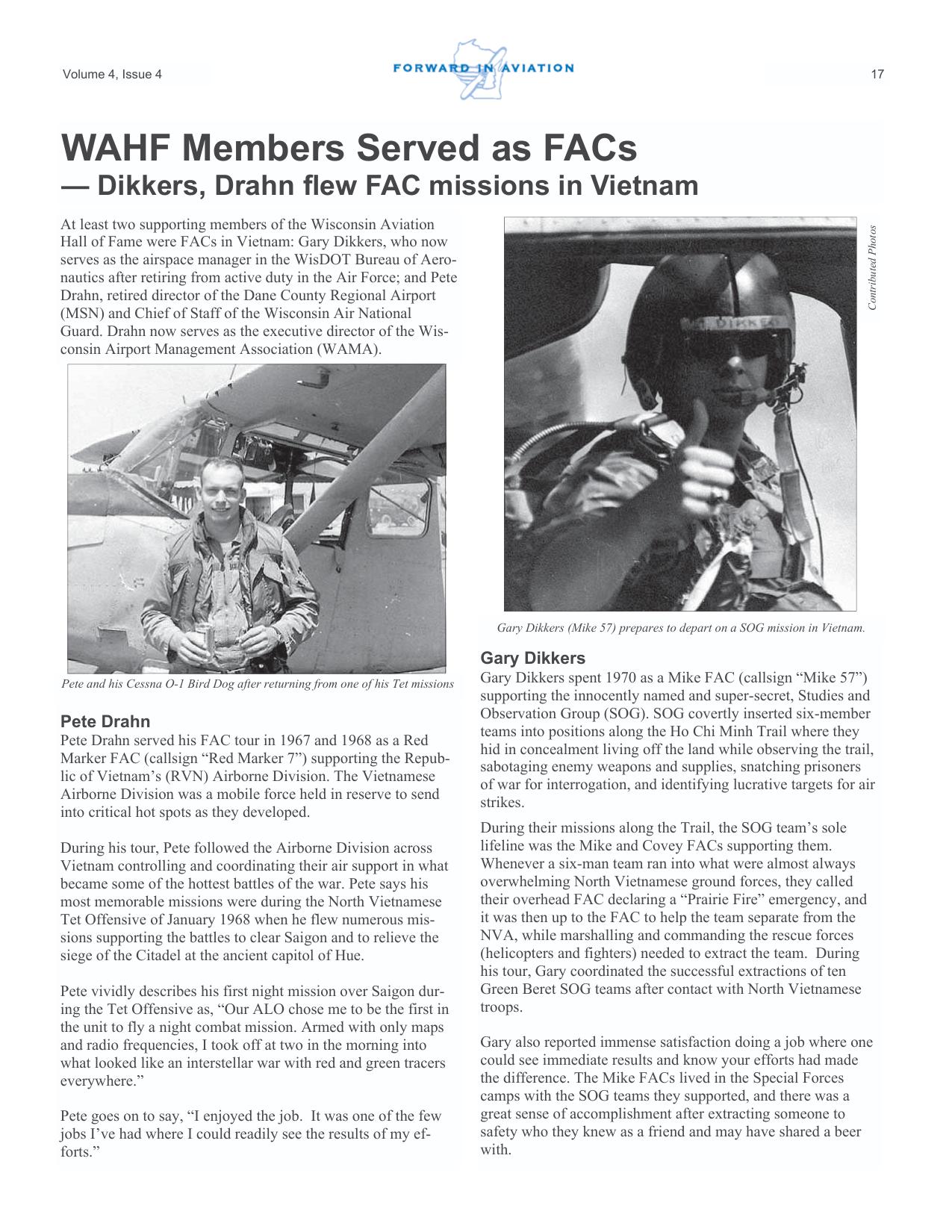
Volume 4, Issue 4 17 WAHF Members Served as FACs — Dikkers, Drahn flew FAC missions in Vietnam Contributed Photos At least two supporting members of the Wisconsin Aviation Hall of Fame were FACs in Vietnam: Gary Dikkers, who now serves as the airspace manager in the WisDOT Bureau of Aeronautics after retiring from active duty in the Air Force; and Pete Drahn, retired director of the Dane County Regional Airport (MSN) and Chief of Staff of the Wisconsin Air National Guard. Drahn now serves as the executive director of the Wisconsin Airport Management Association (WAMA). Gary Dikkers (Mike 57) prepares to depart on a SOG mission in Vietnam. Gary Dikkers Pete and his Cessna O-1 Bird Dog after returning from one of his Tet missions Pete Drahn Pete Drahn served his FAC tour in 1967 and 1968 as a Red Marker FAC (callsign “Red Marker 7”) supporting the Republic of Vietnam’s (RVN) Airborne Division. The Vietnamese Airborne Division was a mobile force held in reserve to send into critical hot spots as they developed. During his tour, Pete followed the Airborne Division across Vietnam controlling and coordinating their air support in what became some of the hottest battles of the war. Pete says his most memorable missions were during the North Vietnamese Tet Offensive of January 1968 when he flew numerous missions supporting the battles to clear Saigon and to relieve the siege of the Citadel at the ancient capitol of Hue. Pete vividly describes his first night mission over Saigon during the Tet Offensive as, “Our ALO chose me to be the first in the unit to fly a night combat mission. Armed with only maps and radio frequencies, I took off at two in the morning into what looked like an interstellar war with red and green tracers everywhere.” Pete goes on to say, “I enjoyed the job. It was one of the few jobs I’ve had where I could readily see the results of my efforts.” Gary Dikkers spent 1970 as a Mike FAC (callsign “Mike 57”) supporting the innocently named and super-secret, Studies and Observation Group (SOG). SOG covertly inserted six-member teams into positions along the Ho Chi Minh Trail where they hid in concealment living off the land while observing the trail, sabotaging enemy weapons and supplies, snatching prisoners of war for interrogation, and identifying lucrative targets for air strikes. During their missions along the Trail, the SOG team’s sole lifeline was the Mike and Covey FACs supporting them. Whenever a six-man team ran into what were almost always overwhelming North Vietnamese ground forces, they called their overhead FAC declaring a “Prairie Fire” emergency, and it was then up to the FAC to help the team separate from the NVA, while marshalling and commanding the rescue forces (helicopters and fighters) needed to extract the team. During his tour, Gary coordinated the successful extractions of ten Green Beret SOG teams after contact with North Vietnamese troops. Gary also reported immense satisfaction doing a job where one could see immediate results and know your efforts had made the difference. The Mike FACs lived in the Special Forces camps with the SOG teams they supported, and there was a great sense of accomplishment after extracting someone to safety who they knew as a friend and may have shared a beer with.
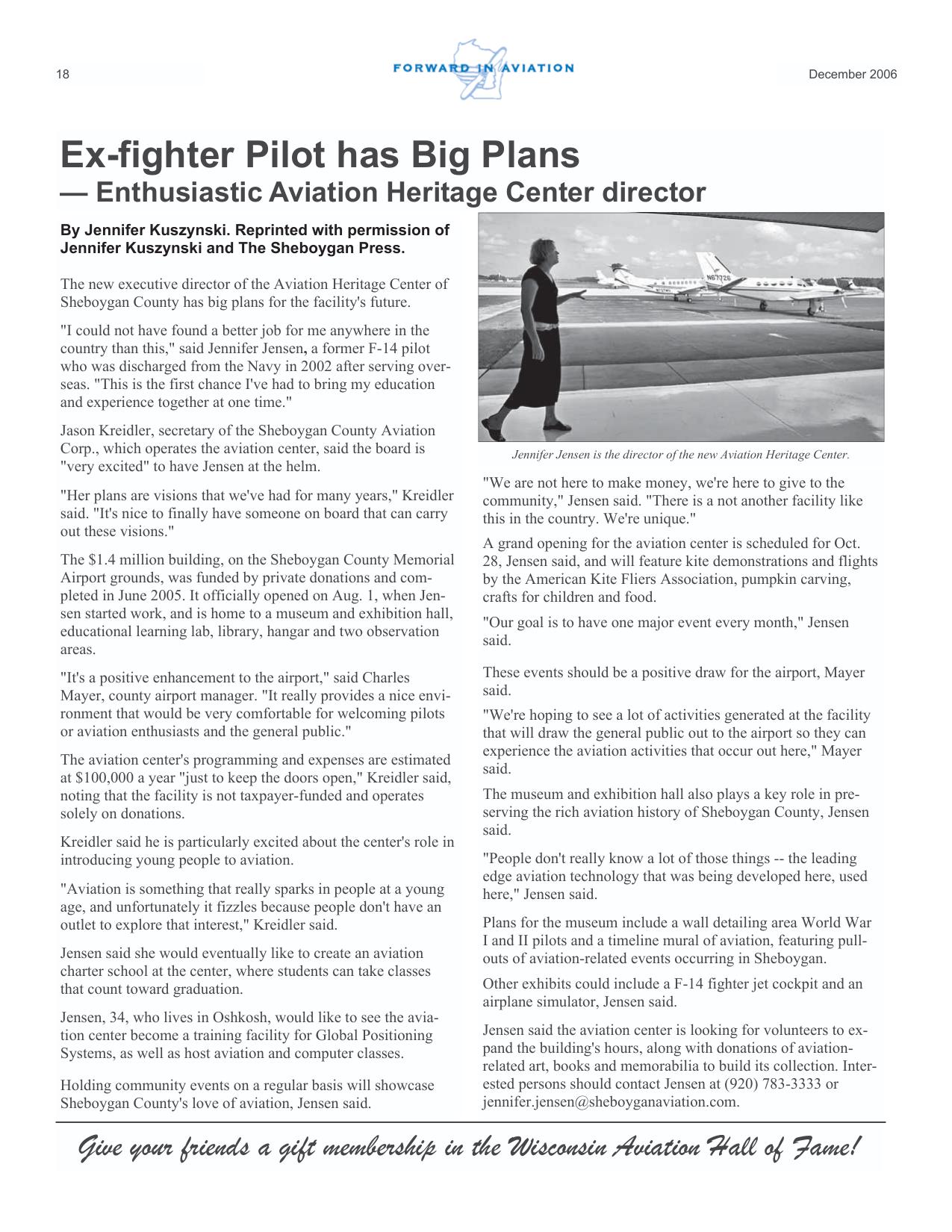
18 December 2006 Ex-fighter Pilot has Big Plans — Enthusiastic Aviation Heritage Center director By Jennifer Kuszynski. Reprinted with permission of Jennifer Kuszynski and The Sheboygan Press. The new executive director of the Aviation Heritage Center of Sheboygan County has big plans for the facility's future. "I could not have found a better job for me anywhere in the country than this," said Jennifer Jensen, a former F-14 pilot who was discharged from the Navy in 2002 after serving overseas. "This is the first chance I've had to bring my education and experience together at one time." Jason Kreidler, secretary of the Sheboygan County Aviation Corp., which operates the aviation center, said the board is "very excited" to have Jensen at the helm. "Her plans are visions that we've had for many years," Kreidler said. "It's nice to finally have someone on board that can carry out these visions." The $1.4 million building, on the Sheboygan County Memorial Airport grounds, was funded by private donations and completed in June 2005. It officially opened on Aug. 1, when Jensen started work, and is home to a museum and exhibition hall, educational learning lab, library, hangar and two observation areas. "It's a positive enhancement to the airport," said Charles Mayer, county airport manager. "It really provides a nice environment that would be very comfortable for welcoming pilots or aviation enthusiasts and the general public." The aviation center's programming and expenses are estimated at $100,000 a year "just to keep the doors open," Kreidler said, noting that the facility is not taxpayer-funded and operates solely on donations. Kreidler said he is particularly excited about the center's role in introducing young people to aviation. "Aviation is something that really sparks in people at a young age, and unfortunately it fizzles because people don't have an outlet to explore that interest," Kreidler said. Jensen said she would eventually like to create an aviation charter school at the center, where students can take classes that count toward graduation. Jensen, 34, who lives in Oshkosh, would like to see the aviation center become a training facility for Global Positioning Systems, as well as host aviation and computer classes. Holding community events on a regular basis will showcase Sheboygan County's love of aviation, Jensen said. Jennifer Jensen is the director of the new Aviation Heritage Center. "We are not here to make money, we're here to give to the community," Jensen said. "There is a not another facility like this in the country. We're unique." A grand opening for the aviation center is scheduled for Oct. 28, Jensen said, and will feature kite demonstrations and flights by the American Kite Fliers Association, pumpkin carving, crafts for children and food. "Our goal is to have one major event every month," Jensen said. These events should be a positive draw for the airport, Mayer said. "We're hoping to see a lot of activities generated at the facility that will draw the general public out to the airport so they can experience the aviation activities that occur out here," Mayer said. The museum and exhibition hall also plays a key role in preserving the rich aviation history of Sheboygan County, Jensen said. "People don't really know a lot of those things -- the leading edge aviation technology that was being developed here, used here," Jensen said. Plans for the museum include a wall detailing area World War I and II pilots and a timeline mural of aviation, featuring pullouts of aviation-related events occurring in Sheboygan. Other exhibits could include a F-14 fighter jet cockpit and an airplane simulator, Jensen said. Jensen said the aviation center is looking for volunteers to expand the building's hours, along with donations of aviationrelated art, books and memorabilia to build its collection. Interested persons should contact Jensen at (920) 783-3333 or jennifer.jensen@sheboyganaviation.com. Give your friends a gift membership in the Wisconsin Aviation Hall of Fame!
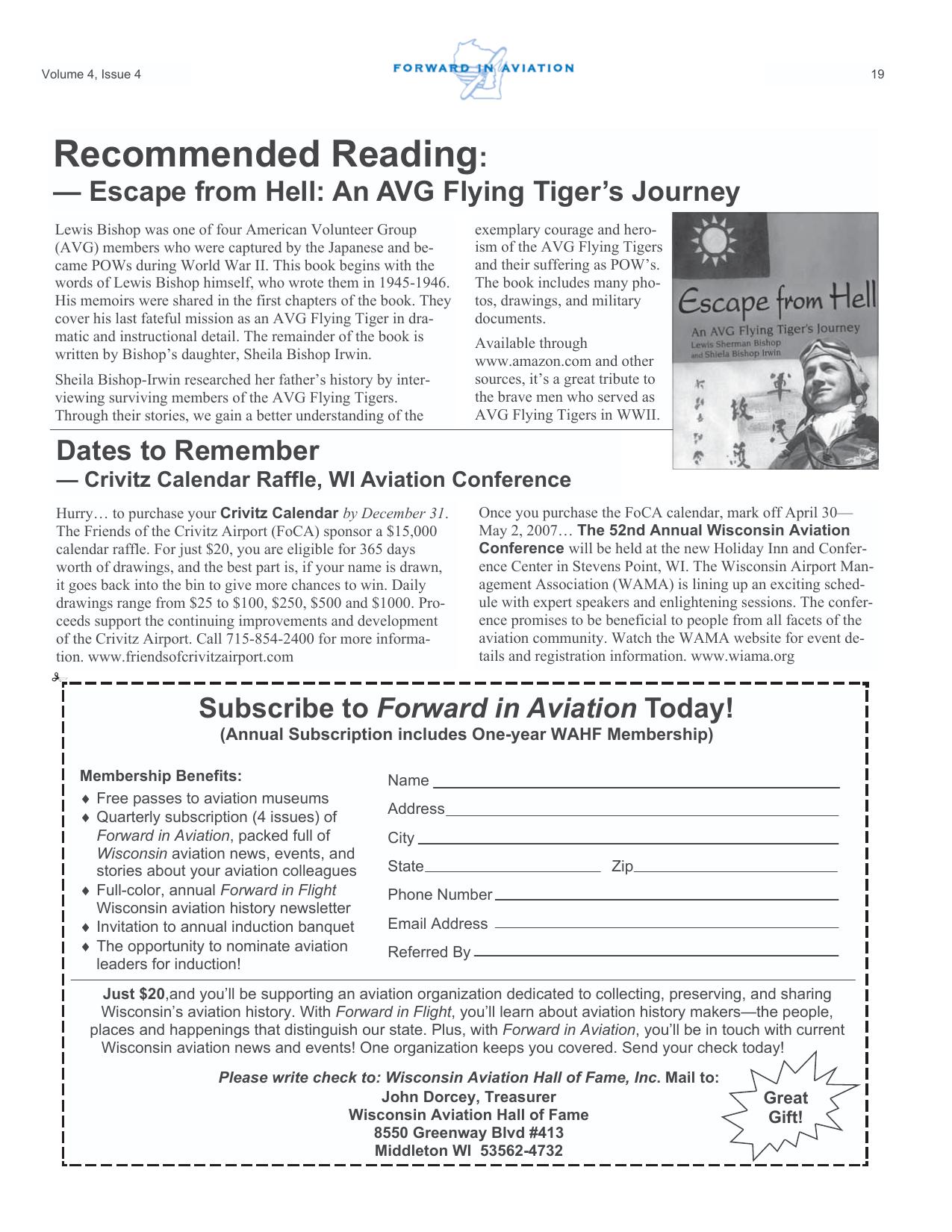
Volume 4, Issue 4 19 Recommended Reading: — Escape from Hell: An AVG Flying Tiger’s Journey Lewis Bishop was one of four American Volunteer Group (AVG) members who were captured by the Japanese and became POWs during World War II. This book begins with the words of Lewis Bishop himself, who wrote them in 1945-1946. His memoirs were shared in the first chapters of the book. They cover his last fateful mission as an AVG Flying Tiger in dramatic and instructional detail. The remainder of the book is written by Bishop’s daughter, Sheila Bishop Irwin. Sheila Bishop-Irwin researched her father’s history by interviewing surviving members of the AVG Flying Tigers. Through their stories, we gain a better understanding of the exemplary courage and heroism of the AVG Flying Tigers and their suffering as POW’s. The book includes many photos, drawings, and military documents. Available through www.amazon.com and other sources, it’s a great tribute to the brave men who served as AVG Flying Tigers in WWII. Dates to Remember — Crivitz Calendar Raffle, WI Aviation Conference Hurry… to purchase your Crivitz Calendar by December 31. The Friends of the Crivitz Airport (FoCA) sponsor a $15,000 calendar raffle. For just $20, you are eligible for 365 days worth of drawings, and the best part is, if your name is drawn, it goes back into the bin to give more chances to win. Daily drawings range from $25 to $100, $250, $500 and $1000. Proceeds support the continuing improvements and development of the Crivitz Airport. Call 715-854-2400 for more information. www.friendsofcrivitzairport.com Once you purchase the FoCA calendar, mark off April 30— May 2, 2007… The 52nd Annual Wisconsin Aviation Conference will be held at the new Holiday Inn and Conference Center in Stevens Point, WI. The Wisconsin Airport Management Association (WAMA) is lining up an exciting schedule with expert speakers and enlightening sessions. The conference promises to be beneficial to people from all facets of the aviation community. Watch the WAMA website for event details and registration information. www.wiama.org Subscribe to Forward in Aviation Today! (Annual Subscription includes One-year WAHF Membership) Membership Benefits: ♦ Free passes to aviation museums ♦ Quarterly subscription (4 issues) of Forward in Aviation, packed full of Wisconsin aviation news, events, and stories about your aviation colleagues ♦ Full-color, annual Forward in Flight Wisconsin aviation history newsletter ♦ Invitation to annual induction banquet ♦ The opportunity to nominate aviation leaders for induction! Name Address City State Zip Phone Number Email Address Referred By Just $20,and you’ll be supporting an aviation organization dedicated to collecting, preserving, and sharing Wisconsin’s aviation history. With Forward in Flight, you’ll learn about aviation history makers—the people, places and happenings that distinguish our state. Plus, with Forward in Aviation, you’ll be in touch with current Wisconsin aviation news and events! One organization keeps you covered. Send your check today! Please write check to: Wisconsin Aviation Hall of Fame, Inc. Mail to: John Dorcey, Treasurer Wisconsin Aviation Hall of Fame 8550 Greenway Blvd #413 Middleton WI 53562-4732 Great Gift!
FORWARD IN AVIATION WISCONSIN AVIATION HALL OF FAME 8550 GREENWAY BLVD - SUITE 413 MIDDLETON WI 53562-4732 Preserving Wisconsin’s Aviation History PRSRT STD US Postage Paid Wisc Rapids WI Permit 98 Return Service Requested Welcome new WAHF members: Don & Carol Wahlin Skot Weidemann Donald Gartland Jerome LeBarron Thanks for coming onboard. We look forward to seeing you at a WAHF event soon! Thank you to our newsletter advertisers: Morey Airplane Company, NewView Technologies, Pat O’Malley’s Jet Room, Dr. Tom Voelker, AME; and our newest supporter, Mead & Hunt. Don’t forget—All annual membership renewals are due by December 31. Please send your renewal today! While you’re writing a check, if you can send an extra dollar or two to help cover our operating expenses, please do so. Every bit helps. Thank you! Great Gift Ideas: WAHF Pin $3. Wisconsin Aviation History Poster $7. Laminated Poster $20. WAHF Hats $18. Blue Sky Moments ~ A Collection of Wisconsin Aviation Memories $7. Better yet... Give a WAHF membership to someone you love this Christmas! For great chili, and a chance to watch ski planes land in the snow, be sure to attend the 2007 Chili Fun Day at Wausau Downtown Airport (AUW) on January 27th. You’re sure to run into old friends at this event! Serving begins at 11:00 a.m. until chili is gone. Call 715-848-6000 or visit www.flywausau.com for more information. Business & Commercial Aviation had a great article in its August 2006 issue entitled, Why Your Community Needs Its Airport, by David Esler. Check it out at their website: http://www.aviationweek.com/bca Thought for the day: “It is not what we do, but also what we do not do, for which we are accountable.” ~Jean-Baptiste Moliere Wisconsin Aviation Hall of Fame Officers and Board of Directors Rose Dorcey, President Michael Goc, Vice President John Dorcey, Secretary/Treasurer Duane Esse Keith Glasshof David Greene Charles Swain LaFonda Jean Kinnaman Staber “Bill” Reese Charles Marotske, Honorary Chairman of the Board Wisconsin Aviation Hall of Fame 8550 Greenway Blvd - Suite 413 Middleton WI 53562-4732 Become a supporter today! For information call Rose Dorcey at 715-421-0055 www.aviationhalloffamewisconsin.com flyer@aviationhalloffamewisconsin.com