Volume 4, Issue 3
🗞️ Download Issue (PDF)
Forward in Aviation - June 2006
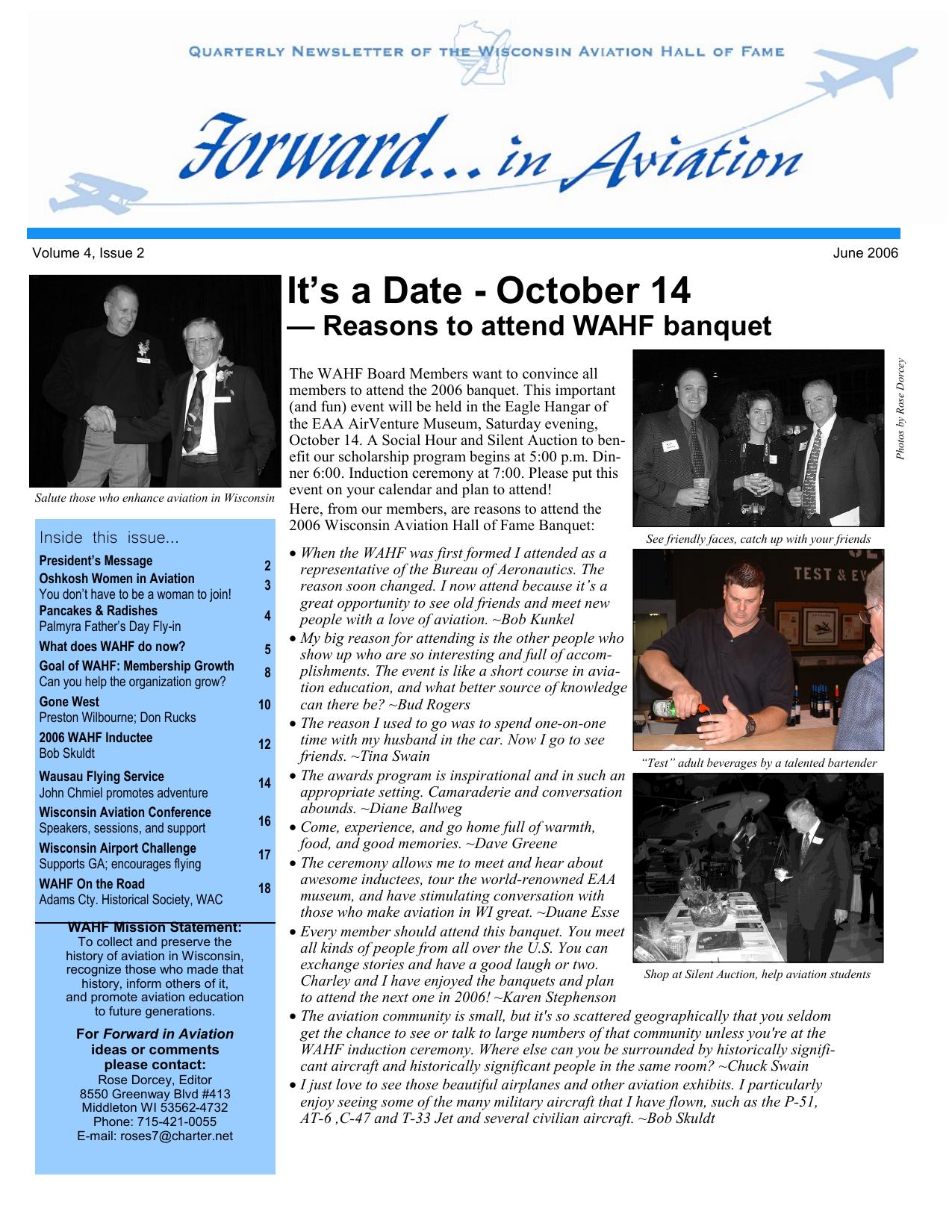
Volume 4, Issue 2 June 2006 It’s a Date - October 14 The WAHF Board Members want to convince all members to attend the 2006 banquet. This important (and fun) event will be held in the Eagle Hangar of the EAA AirVenture Museum, Saturday evening, October 14. A Social Hour and Silent Auction to benefit our scholarship program begins at 5:00 p.m. Dinner 6:00. Induction ceremony at 7:00. Please put this event on your calendar and plan to attend! Salute those who enhance aviation in Wisconsin Here, from our members, are reasons to attend the 2006 Wisconsin Aviation Hall of Fame Banquet: Inside this issue… President’s Message Oshkosh Women in Aviation You don’t have to be a woman to join! Pancakes & Radishes Palmyra Father’s Day Fly-in What does WAHF do now? Goal of WAHF: Membership Growth Can you help the organization grow? Gone West Preston Wilbourne; Don Rucks 2006 WAHF Inductee Bob Skuldt Wausau Flying Service John Chmiel promotes adventure Wisconsin Aviation Conference Speakers, sessions, and support Wisconsin Airport Challenge Supports GA; encourages flying WAHF On the Road Adams Cty. Historical Society, WAC WAHF Mission Statement: To collect and preserve the history of aviation in Wisconsin, recognize those who made that history, inform others of it, and promote aviation education to future generations. For Forward in Aviation ideas or comments please contact: Rose Dorcey, Editor 8550 Greenway Blvd #413 Middleton WI 53562-4732 Phone: 715-421-0055 E-mail: roses7@charter.net 2 3 4 5 8 10 12 14 16 17 18 Photos by Rose Dorcey — Reasons to attend WAHF banquet See friendly faces, catch up with your friends · When the WAHF was first formed I attended as a representative of the Bureau of Aeronautics. The reason soon changed. I now attend because it’s a great opportunity to see old friends and meet new people with a love of aviation. ~Bob Kunkel · My big reason for attending is the other people who show up who are so interesting and full of accomplishments. The event is like a short course in aviation education, and what better source of knowledge can there be? ~Bud Rogers · The reason I used to go was to spend one-on-one time with my husband in the car. Now I go to see friends. ~Tina Swain “Test” adult beverages by a talented bartender · The awards program is inspirational and in such an appropriate setting. Camaraderie and conversation abounds. ~Diane Ballweg · Come, experience, and go home full of warmth, food, and good memories. ~Dave Greene · The ceremony allows me to meet and hear about awesome inductees, tour the world-renowned EAA museum, and have stimulating conversation with those who make aviation in WI great. ~Duane Esse · Every member should attend this banquet. You meet all kinds of people from all over the U.S. You can exchange stories and have a good laugh or two. Shop at Silent Auction, help aviation students Charley and I have enjoyed the banquets and plan to attend the next one in 2006! ~Karen Stephenson · The aviation community is small, but it's so scattered geographically that you seldom get the chance to see or talk to large numbers of that community unless you're at the WAHF induction ceremony. Where else can you be surrounded by historically significant aircraft and historically significant people in the same room? ~Chuck Swain · I just love to see those beautiful airplanes and other aviation exhibits. I particularly enjoy seeing some of the many military aircraft that I have flown, such as the P-51, AT-6 ,C-47 and T-33 Jet and several civilian aircraft. ~Bob Skuldt
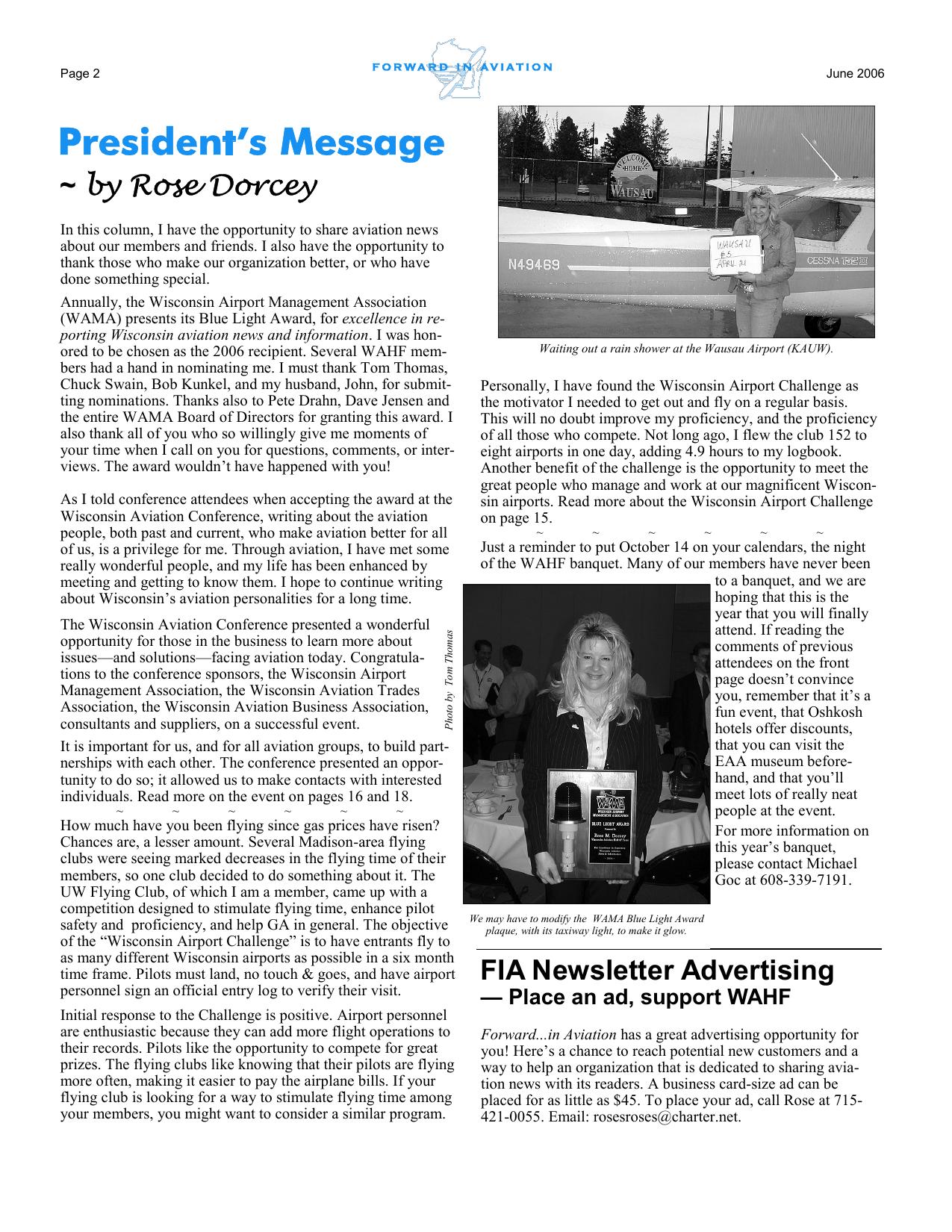
Page 2 June 2006 ~ by Rose Dorcey In this column, I have the opportunity to share aviation news about our members and friends. I also have the opportunity to thank those who make our organization better, or who have done something special. Annually, the Wisconsin Airport Management Association (WAMA) presents its Blue Light Award, for excellence in reporting Wisconsin aviation news and information. I was honored to be chosen as the 2006 recipient. Several WAHF members had a hand in nominating me. I must thank Tom Thomas, Chuck Swain, Bob Kunkel, and my husband, John, for submitting nominations. Thanks also to Pete Drahn, Dave Jensen and the entire WAMA Board of Directors for granting this award. I also thank all of you who so willingly give me moments of your time when I call on you for questions, comments, or interviews. The award wouldn’t have happened with you! As I told conference attendees when accepting the award at the Wisconsin Aviation Conference, writing about the aviation people, both past and current, who make aviation better for all of us, is a privilege for me. Through aviation, I have met some really wonderful people, and my life has been enhanced by meeting and getting to know them. I hope to continue writing about Wisconsin’s aviation personalities for a long time. Photo by Tom Thomas The Wisconsin Aviation Conference presented a wonderful opportunity for those in the business to learn more about issues—and solutions—facing aviation today. Congratulations to the conference sponsors, the Wisconsin Airport Management Association, the Wisconsin Aviation Trades Association, the Wisconsin Aviation Business Association, consultants and suppliers, on a successful event. It is important for us, and for all aviation groups, to build partnerships with each other. The conference presented an opportunity to do so; it allowed us to make contacts with interested individuals. Read more on the event on pages 16 and 18. ~ ~ ~ ~ ~ ~ How much have you been flying since gas prices have risen? Chances are, a lesser amount. Several Madison-area flying clubs were seeing marked decreases in the flying time of their members, so one club decided to do something about it. The UW Flying Club, of which I am a member, came up with a competition designed to stimulate flying time, enhance pilot safety and proficiency, and help GA in general. The objective of the “Wisconsin Airport Challenge” is to have entrants fly to as many different Wisconsin airports as possible in a six month time frame. Pilots must land, no touch & goes, and have airport personnel sign an official entry log to verify their visit. Initial response to the Challenge is positive. Airport personnel are enthusiastic because they can add more flight operations to their records. Pilots like the opportunity to compete for great prizes. The flying clubs like knowing that their pilots are flying more often, making it easier to pay the airplane bills. If your flying club is looking for a way to stimulate flying time among your members, you might want to consider a similar program. Waiting out a rain shower at the Wausau Airport (KAUW). Personally, I have found the Wisconsin Airport Challenge as the motivator I needed to get out and fly on a regular basis. This will no doubt improve my proficiency, and the proficiency of all those who compete. Not long ago, I flew the club 152 to eight airports in one day, adding 4.9 hours to my logbook. Another benefit of the challenge is the opportunity to meet the great people who manage and work at our magnificent Wisconsin airports. Read more about the Wisconsin Airport Challenge on page 15. ~ ~ ~ ~ ~ ~ Just a reminder to put October 14 on your calendars, the night of the WAHF banquet. Many of our members have never been to a banquet, and we are hoping that this is the year that you will finally attend. If reading the comments of previous attendees on the front page doesn’t convince you, remember that it’s a fun event, that Oshkosh hotels offer discounts, that you can visit the EAA museum beforehand, and that you’ll meet lots of really neat people at the event. For more information on this year’s banquet, please contact Michael Goc at 608-339-7191. We may have to modify the WAMA Blue Light Award plaque, with its taxiway light, to make it glow. FIA Newsletter Advertising — Place an ad, support WAHF Forward...in Aviation has a great advertising opportunity for you! Here’s a chance to reach potential new customers and a way to help an organization that is dedicated to sharing aviation news with its readers. A business card-size ad can be placed for as little as $45. To place your ad, call Rose at 715421-0055. Email: rosesroses@charter.net.
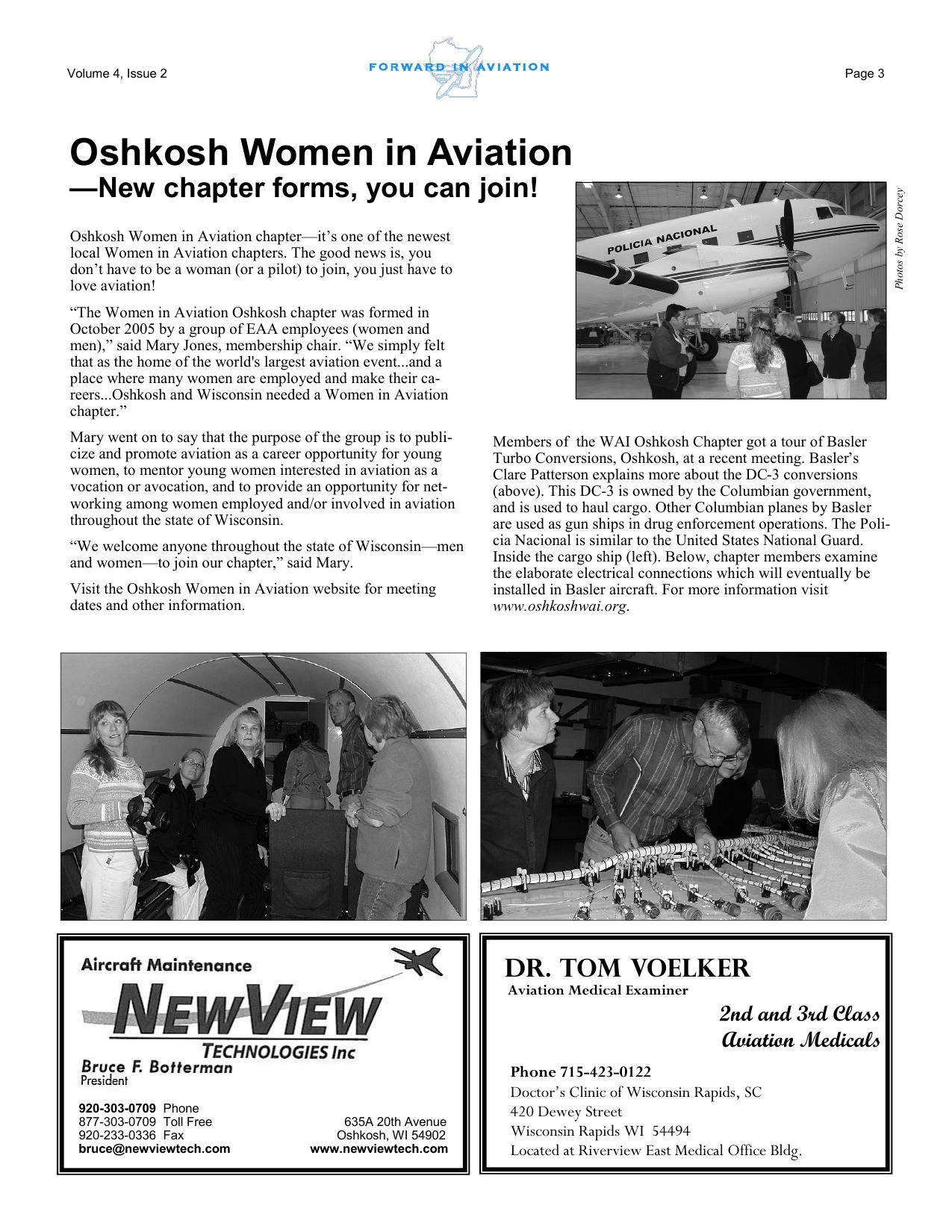
Volume 4, Issue 2 Page 3 Oshkosh Women in Aviation Photos by Rose Dorcey —New chapter forms, you can join! Oshkosh Women in Aviation chapter—it’s one of the newest local Women in Aviation chapters. The good news is, you don’t have to be a woman (or a pilot) to join, you just have to love aviation! “The Women in Aviation Oshkosh chapter was formed in October 2005 by a group of EAA employees (women and men),” said Mary Jones, membership chair. “We simply felt that as the home of the world's largest aviation event...and a place where many women are employed and make their careers...Oshkosh and Wisconsin needed a Women in Aviation chapter.” Mary went on to say that the purpose of the group is to publicize and promote aviation as a career opportunity for young women, to mentor young women interested in aviation as a vocation or avocation, and to provide an opportunity for networking among women employed and/or involved in aviation throughout the state of Wisconsin. “We welcome anyone throughout the state of Wisconsin—men and women—to join our chapter,” said Mary. Visit the Oshkosh Women in Aviation website for meeting dates and other information. Members of the WAI Oshkosh Chapter got a tour of Basler Turbo Conversions, Oshkosh, at a recent meeting. Basler’s Clare Patterson explains more about the DC-3 conversions (above). This DC-3 is owned by the Columbian government, and is used to haul cargo. Other Columbian planes by Basler are used as gun ships in drug enforcement operations. The Policia Nacional is similar to the United States National Guard. Inside the cargo ship (left). Below, chapter members examine the elaborate electrical connections which will eventually be installed in Basler aircraft. For more information visit www.oshkoshwai.org. DR. TOM VOELKER Aviation Medical Examiner 2nd and 3rd Class Aviation Medicals 920-303-0709 Phone 877-303-0709 Toll Free 920-233-0336 Fax bruce@newviewtech.com 635A 20th Avenue Oshkosh, WI 54902 www.newviewtech.com Phone 715-423-0122 Doctor’s Clinic of Wisconsin Rapids, SC 420 Dewey Street Wisconsin Rapids WI 54494 Located at Riverview East Medical Office Bldg.
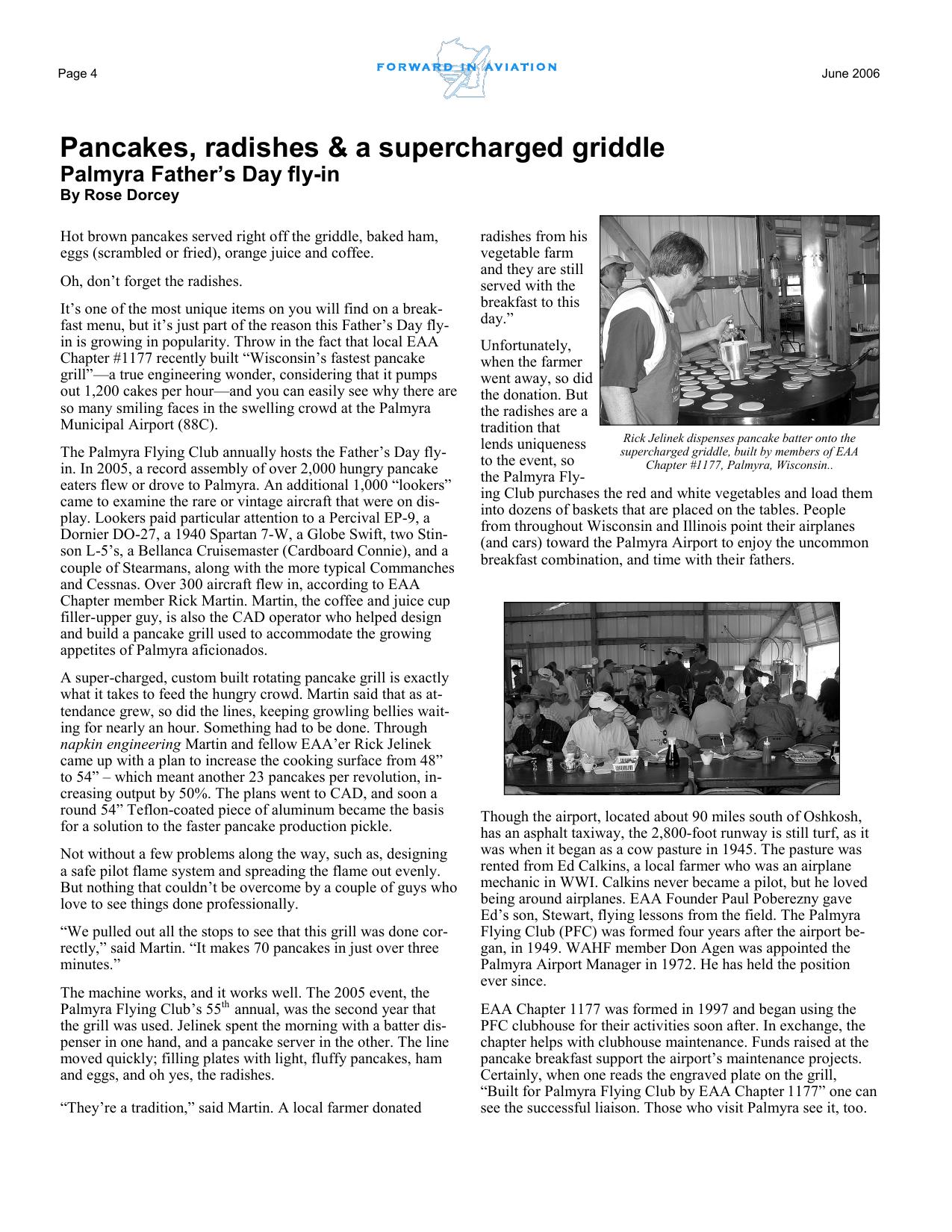
Page 4 June 2006 Pancakes, radishes & a supercharged griddle Palmyra Father’s Day fly-in By Rose Dorcey Hot brown pancakes served right off the griddle, baked ham, eggs (scrambled or fried), orange juice and coffee. Oh, don’t forget the radishes. It’s one of the most unique items on you will find on a breakfast menu, but it’s just part of the reason this Father’s Day flyin is growing in popularity. Throw in the fact that local EAA Chapter #1177 recently built “Wisconsin’s fastest pancake grill”—a true engineering wonder, considering that it pumps out 1,200 cakes per hour—and you can easily see why there are so many smiling faces in the swelling crowd at the Palmyra Municipal Airport (88C). The Palmyra Flying Club annually hosts the Father’s Day flyin. In 2005, a record assembly of over 2,000 hungry pancake eaters flew or drove to Palmyra. An additional 1,000 “lookers” came to examine the rare or vintage aircraft that were on display. Lookers paid particular attention to a Percival EP-9, a Dornier DO-27, a 1940 Spartan 7-W, a Globe Swift, two Stinson L-5’s, a Bellanca Cruisemaster (Cardboard Connie), and a couple of Stearmans, along with the more typical Commanches and Cessnas. Over 300 aircraft flew in, according to EAA Chapter member Rick Martin. Martin, the coffee and juice cup filler-upper guy, is also the CAD operator who helped design and build a pancake grill used to accommodate the growing appetites of Palmyra aficionados. A super-charged, custom built rotating pancake grill is exactly what it takes to feed the hungry crowd. Martin said that as attendance grew, so did the lines, keeping growling bellies waiting for nearly an hour. Something had to be done. Through napkin engineering Martin and fellow EAA’er Rick Jelinek came up with a plan to increase the cooking surface from 48” to 54” – which meant another 23 pancakes per revolution, increasing output by 50%. The plans went to CAD, and soon a round 54” Teflon-coated piece of aluminum became the basis for a solution to the faster pancake production pickle. Not without a few problems along the way, such as, designing a safe pilot flame system and spreading the flame out evenly. But nothing that couldn’t be overcome by a couple of guys who love to see things done professionally. “We pulled out all the stops to see that this grill was done correctly,” said Martin. “It makes 70 pancakes in just over three minutes.” The machine works, and it works well. The 2005 event, the Palmyra Flying Club’s 55th annual, was the second year that the grill was used. Jelinek spent the morning with a batter dispenser in one hand, and a pancake server in the other. The line moved quickly; filling plates with light, fluffy pancakes, ham and eggs, and oh yes, the radishes. “They’re a tradition,” said Martin. A local farmer donated radishes from his vegetable farm and they are still served with the breakfast to this day.” Unfortunately, when the farmer went away, so did the donation. But the radishes are a tradition that Rick Jelinek dispenses pancake batter onto the lends uniqueness supercharged griddle, built by members of EAA to the event, so Chapter #1177, Palmyra, Wisconsin.. the Palmyra Flying Club purchases the red and white vegetables and load them into dozens of baskets that are placed on the tables. People from throughout Wisconsin and Illinois point their airplanes (and cars) toward the Palmyra Airport to enjoy the uncommon breakfast combination, and time with their fathers. Though the airport, located about 90 miles south of Oshkosh, has an asphalt taxiway, the 2,800-foot runway is still turf, as it was when it began as a cow pasture in 1945. The pasture was rented from Ed Calkins, a local farmer who was an airplane mechanic in WWI. Calkins never became a pilot, but he loved being around airplanes. EAA Founder Paul Poberezny gave Ed’s son, Stewart, flying lessons from the field. The Palmyra Flying Club (PFC) was formed four years after the airport began, in 1949. WAHF member Don Agen was appointed the Palmyra Airport Manager in 1972. He has held the position ever since. EAA Chapter 1177 was formed in 1997 and began using the PFC clubhouse for their activities soon after. In exchange, the chapter helps with clubhouse maintenance. Funds raised at the pancake breakfast support the airport’s maintenance projects. Certainly, when one reads the engraved plate on the grill, “Built for Palmyra Flying Club by EAA Chapter 1177” one can see the successful liaison. Those who visit Palmyra see it, too.
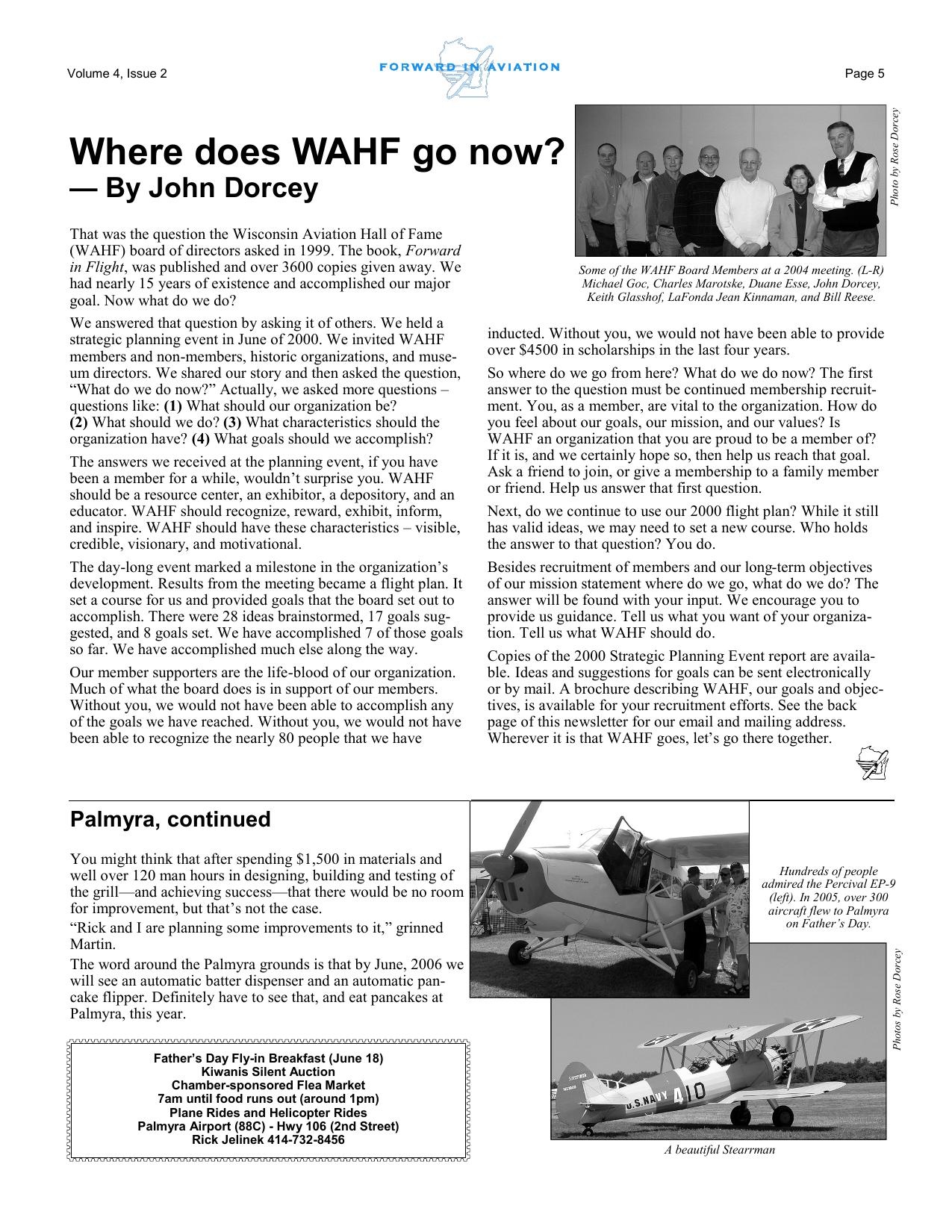
Page 5 Photo by Rose Dorcey Volume 4, Issue 2 Where does WAHF go now? — By John Dorcey That was the question the Wisconsin Aviation Hall of Fame (WAHF) board of directors asked in 1999. The book, Forward in Flight, was published and over 3600 copies given away. We had nearly 15 years of existence and accomplished our major goal. Now what do we do? We answered that question by asking it of others. We held a strategic planning event in June of 2000. We invited WAHF members and non-members, historic organizations, and museum directors. We shared our story and then asked the question, “What do we do now?” Actually, we asked more questions – questions like: (1) What should our organization be? (2) What should we do? (3) What characteristics should the organization have? (4) What goals should we accomplish? The answers we received at the planning event, if you have been a member for a while, wouldn’t surprise you. WAHF should be a resource center, an exhibitor, a depository, and an educator. WAHF should recognize, reward, exhibit, inform, and inspire. WAHF should have these characteristics – visible, credible, visionary, and motivational. The day-long event marked a milestone in the organization’s development. Results from the meeting became a flight plan. It set a course for us and provided goals that the board set out to accomplish. There were 28 ideas brainstormed, 17 goals suggested, and 8 goals set. We have accomplished 7 of those goals so far. We have accomplished much else along the way. Our member supporters are the life-blood of our organization. Much of what the board does is in support of our members. Without you, we would not have been able to accomplish any of the goals we have reached. Without you, we would not have been able to recognize the nearly 80 people that we have Some of the WAHF Board Members at a 2004 meeting. (L-R) Michael Goc, Charles Marotske, Duane Esse, John Dorcey, Keith Glasshof, LaFonda Jean Kinnaman, and Bill Reese. inducted. Without you, we would not have been able to provide over $4500 in scholarships in the last four years. So where do we go from here? What do we do now? The first answer to the question must be continued membership recruitment. You, as a member, are vital to the organization. How do you feel about our goals, our mission, and our values? Is WAHF an organization that you are proud to be a member of? If it is, and we certainly hope so, then help us reach that goal. Ask a friend to join, or give a membership to a family member or friend. Help us answer that first question. Next, do we continue to use our 2000 flight plan? While it still has valid ideas, we may need to set a new course. Who holds the answer to that question? You do. Besides recruitment of members and our long-term objectives of our mission statement where do we go, what do we do? The answer will be found with your input. We encourage you to provide us guidance. Tell us what you want of your organization. Tell us what WAHF should do. Copies of the 2000 Strategic Planning Event report are available. Ideas and suggestions for goals can be sent electronically or by mail. A brochure describing WAHF, our goals and objectives, is available for your recruitment efforts. See the back page of this newsletter for our email and mailing address. Wherever it is that WAHF goes, let’s go there together. Palmyra, continued Father’s Day Fly-in Breakfast (June 18) Kiwanis Silent Auction Chamber-sponsored Flea Market 7am until food runs out (around 1pm) Plane Rides and Helicopter Rides Palmyra Airport (88C) - Hwy 106 (2nd Street) Rick Jelinek 414-732-8456 Hundreds of people admired the Percival EP-9 (left). In 2005, over 300 aircraft flew to Palmyra on Father’s Day. Photos by Rose Dorcey You might think that after spending $1,500 in materials and well over 120 man hours in designing, building and testing of the grill—and achieving success—that there would be no room for improvement, but that’s not the case. “Rick and I are planning some improvements to it,” grinned Martin. The word around the Palmyra grounds is that by June, 2006 we will see an automatic batter dispenser and an automatic pancake flipper. Definitely have to see that, and eat pancakes at Palmyra, this year. A beautiful Stearrman
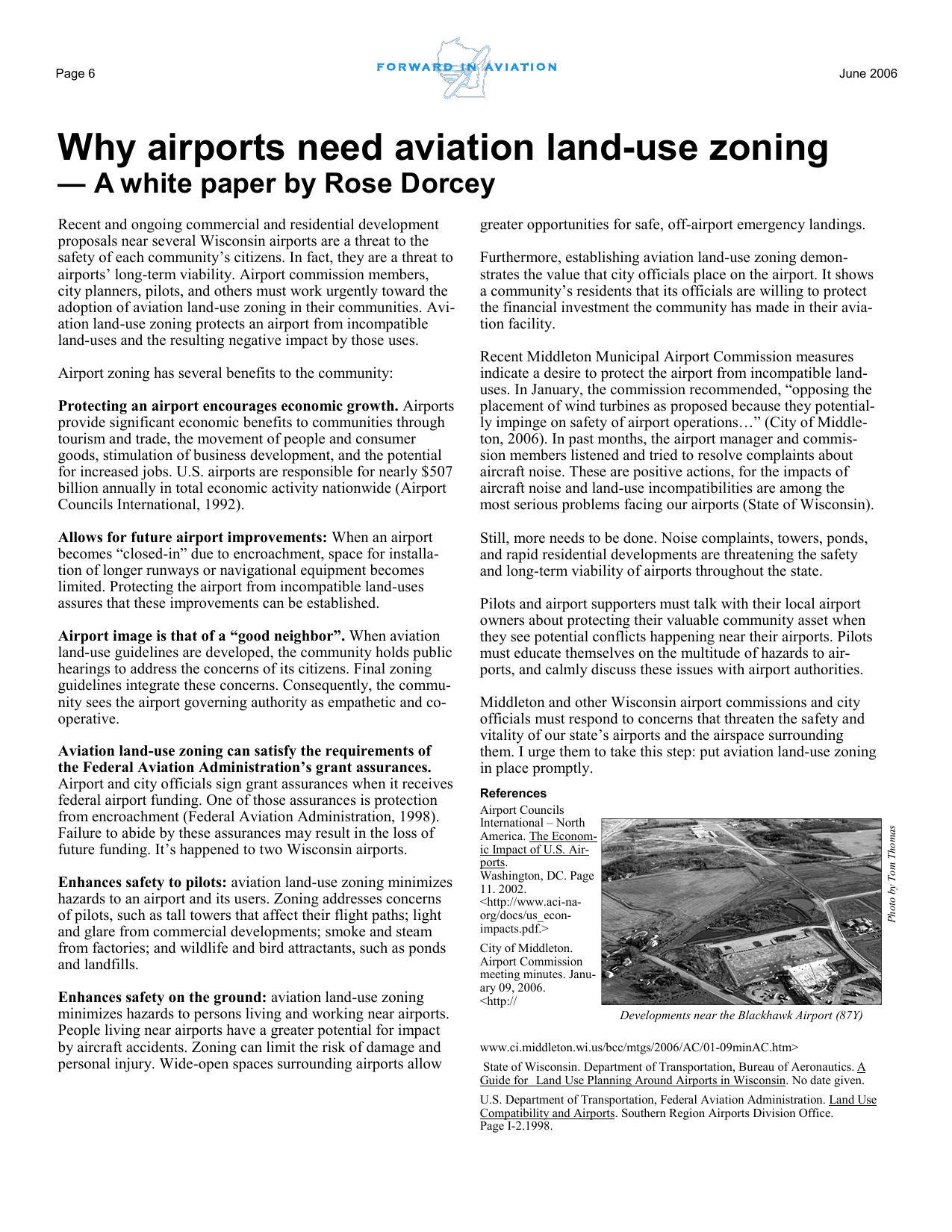
Page 6 June 2006 Why airports need aviation land-use zoning — A white paper by Rose Dorcey Airport zoning has several benefits to the community: Protecting an airport encourages economic growth. Airports provide significant economic benefits to communities through tourism and trade, the movement of people and consumer goods, stimulation of business development, and the potential for increased jobs. U.S. airports are responsible for nearly $507 billion annually in total economic activity nationwide (Airport Councils International, 1992). Allows for future airport improvements: When an airport becomes “closed-in” due to encroachment, space for installation of longer runways or navigational equipment becomes limited. Protecting the airport from incompatible land-uses assures that these improvements can be established. Airport image is that of a “good neighbor”. When aviation land-use guidelines are developed, the community holds public hearings to address the concerns of its citizens. Final zoning guidelines integrate these concerns. Consequently, the community sees the airport governing authority as empathetic and cooperative. Aviation land-use zoning can satisfy the requirements of the Federal Aviation Administration’s grant assurances. Airport and city officials sign grant assurances when it receives federal airport funding. One of those assurances is protection from encroachment (Federal Aviation Administration, 1998). Failure to abide by these assurances may result in the loss of future funding. It’s happened to two Wisconsin airports. Enhances safety to pilots: aviation land-use zoning minimizes hazards to an airport and its users. Zoning addresses concerns of pilots, such as tall towers that affect their flight paths; light and glare from commercial developments; smoke and steam from factories; and wildlife and bird attractants, such as ponds and landfills. Enhances safety on the ground: aviation land-use zoning minimizes hazards to persons living and working near airports. People living near airports have a greater potential for impact by aircraft accidents. Zoning can limit the risk of damage and personal injury. Wide-open spaces surrounding airports allow greater opportunities for safe, off-airport emergency landings. Furthermore, establishing aviation land-use zoning demonstrates the value that city officials place on the airport. It shows a community’s residents that its officials are willing to protect the financial investment the community has made in their aviation facility. Recent Middleton Municipal Airport Commission measures indicate a desire to protect the airport from incompatible landuses. In January, the commission recommended, “opposing the placement of wind turbines as proposed because they potentially impinge on safety of airport operations…” (City of Middleton, 2006). In past months, the airport manager and commission members listened and tried to resolve complaints about aircraft noise. These are positive actions, for the impacts of aircraft noise and land-use incompatibilities are among the most serious problems facing our airports (State of Wisconsin). Still, more needs to be done. Noise complaints, towers, ponds, and rapid residential developments are threatening the safety and long-term viability of airports throughout the state. Pilots and airport supporters must talk with their local airport owners about protecting their valuable community asset when they see potential conflicts happening near their airports. Pilots must educate themselves on the multitude of hazards to airports, and calmly discuss these issues with airport authorities. Middleton and other Wisconsin airport commissions and city officials must respond to concerns that threaten the safety and vitality of our state’s airports and the airspace surrounding them. I urge them to take this step: put aviation land-use zoning in place promptly. References Airport Councils International – North America. The Economic Impact of U.S. Airports. Washington, DC. Page 11. 2002. <http://www.aci-naorg/docs/us_econimpacts.pdf.> Photo by Tom Thomas Recent and ongoing commercial and residential development proposals near several Wisconsin airports are a threat to the safety of each community’s citizens. In fact, they are a threat to airports’ long-term viability. Airport commission members, city planners, pilots, and others must work urgently toward the adoption of aviation land-use zoning in their communities. Aviation land-use zoning protects an airport from incompatible land-uses and the resulting negative impact by those uses. City of Middleton. Airport Commission meeting minutes. January 09, 2006. <http:// Developments near the Blackhawk Airport (87Y) www.ci.middleton.wi.us/bcc/mtgs/2006/AC/01-09minAC.htm> State of Wisconsin. Department of Transportation, Bureau of Aeronautics. A Guide for Land Use Planning Around Airports in Wisconsin. No date given. U.S. Department of Transportation, Federal Aviation Administration. Land Use Compatibility and Airports. Southern Region Airports Division Office. Page I-2.1998.
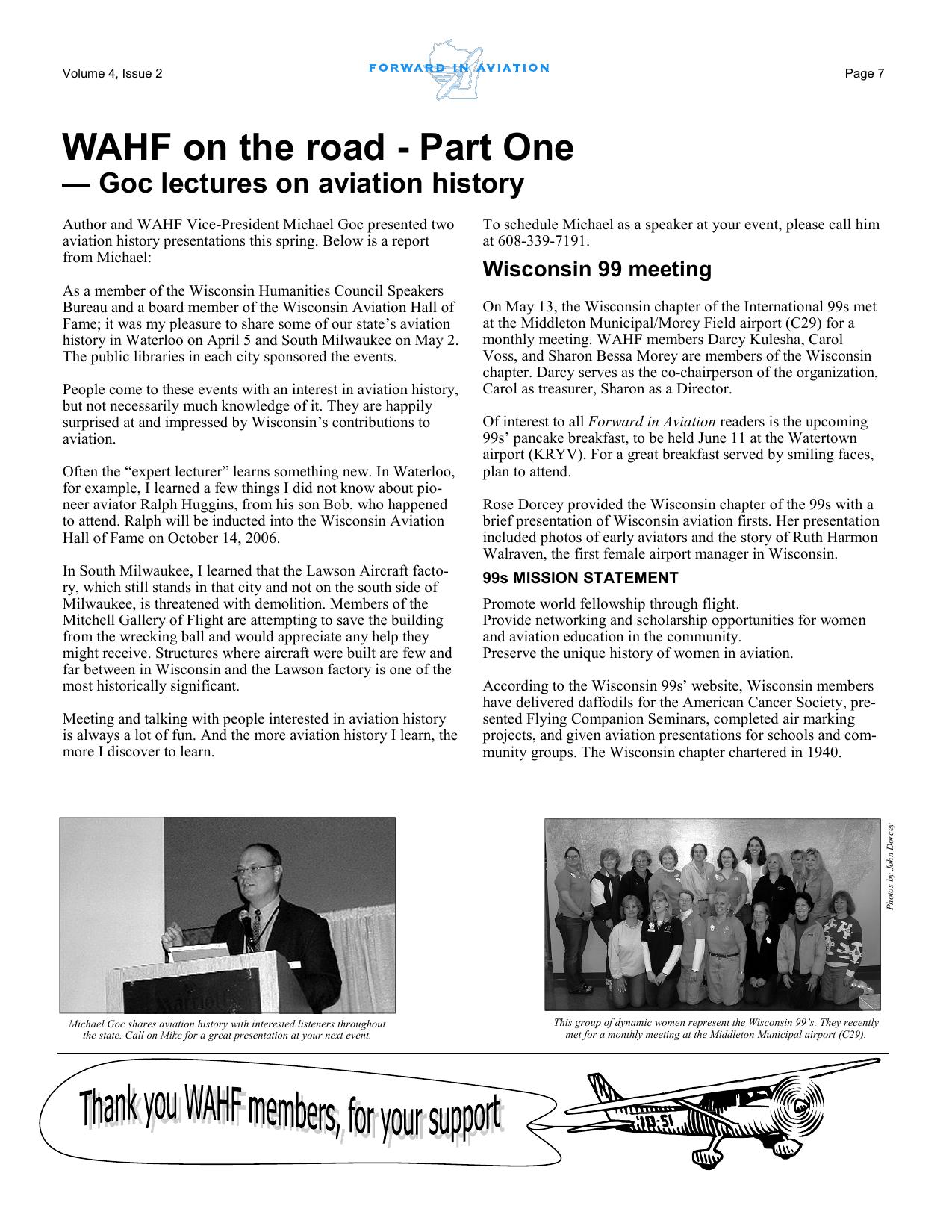
Volume 4, Issue 2 Page 7 WAHF on the road - Part One — Goc lectures on aviation history Author and WAHF Vice-President Michael Goc presented two aviation history presentations this spring. Below is a report from Michael: As a member of the Wisconsin Humanities Council Speakers Bureau and a board member of the Wisconsin Aviation Hall of Fame; it was my pleasure to share some of our state’s aviation history in Waterloo on April 5 and South Milwaukee on May 2. The public libraries in each city sponsored the events. People come to these events with an interest in aviation history, but not necessarily much knowledge of it. They are happily surprised at and impressed by Wisconsin’s contributions to aviation. Often the “expert lecturer” learns something new. In Waterloo, for example, I learned a few things I did not know about pioneer aviator Ralph Huggins, from his son Bob, who happened to attend. Ralph will be inducted into the Wisconsin Aviation Hall of Fame on October 14, 2006. In South Milwaukee, I learned that the Lawson Aircraft factory, which still stands in that city and not on the south side of Milwaukee, is threatened with demolition. Members of the Mitchell Gallery of Flight are attempting to save the building from the wrecking ball and would appreciate any help they might receive. Structures where aircraft were built are few and far between in Wisconsin and the Lawson factory is one of the most historically significant. Wisconsin 99 meeting On May 13, the Wisconsin chapter of the International 99s met at the Middleton Municipal/Morey Field airport (C29) for a monthly meeting. WAHF members Darcy Kulesha, Carol Voss, and Sharon Bessa Morey are members of the Wisconsin chapter. Darcy serves as the co-chairperson of the organization, Carol as treasurer, Sharon as a Director. Of interest to all Forward in Aviation readers is the upcoming 99s’ pancake breakfast, to be held June 11 at the Watertown airport (KRYV). For a great breakfast served by smiling faces, plan to attend. Rose Dorcey provided the Wisconsin chapter of the 99s with a brief presentation of Wisconsin aviation firsts. Her presentation included photos of early aviators and the story of Ruth Harmon Walraven, the first female airport manager in Wisconsin. 99s MISSION STATEMENT Promote world fellowship through flight. Provide networking and scholarship opportunities for women and aviation education in the community. Preserve the unique history of women in aviation. According to the Wisconsin 99s’ website, Wisconsin members have delivered daffodils for the American Cancer Society, presented Flying Companion Seminars, completed air marking projects, and given aviation presentations for schools and community groups. The Wisconsin chapter chartered in 1940. Photos by John Dorcey Meeting and talking with people interested in aviation history is always a lot of fun. And the more aviation history I learn, the more I discover to learn. To schedule Michael as a speaker at your event, please call him at 608-339-7191. Michael Goc shares aviation history with interested listeners throughout the state. Call on Mike for a great presentation at your next event. This group of dynamic women represent the Wisconsin 99’s. They recently met for a monthly meeting at the Middleton Municipal airport (C29).
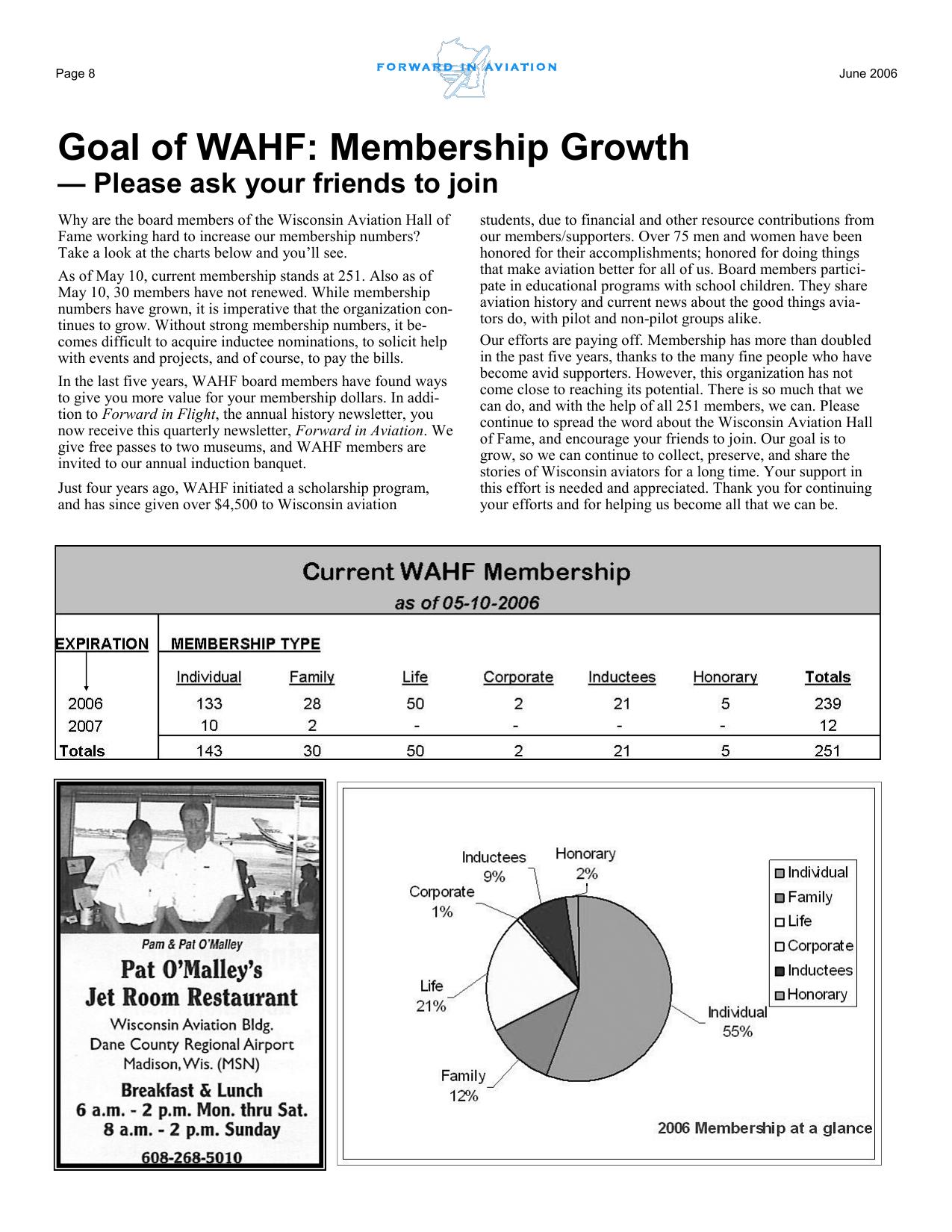
Page 8 June 2006 Goal of WAHF: Membership Growth — Please ask your friends to join Why are the board members of the Wisconsin Aviation Hall of Fame working hard to increase our membership numbers? Take a look at the charts below and you’ll see. As of May 10, current membership stands at 251. Also as of May 10, 30 members have not renewed. While membership numbers have grown, it is imperative that the organization continues to grow. Without strong membership numbers, it becomes difficult to acquire inductee nominations, to solicit help with events and projects, and of course, to pay the bills. In the last five years, WAHF board members have found ways to give you more value for your membership dollars. In addition to Forward in Flight, the annual history newsletter, you now receive this quarterly newsletter, Forward in Aviation. We give free passes to two museums, and WAHF members are invited to our annual induction banquet. Just four years ago, WAHF initiated a scholarship program, and has since given over $4,500 to Wisconsin aviation students, due to financial and other resource contributions from our members/supporters. Over 75 men and women have been honored for their accomplishments; honored for doing things that make aviation better for all of us. Board members participate in educational programs with school children. They share aviation history and current news about the good things aviators do, with pilot and non-pilot groups alike. Our efforts are paying off. Membership has more than doubled in the past five years, thanks to the many fine people who have become avid supporters. However, this organization has not come close to reaching its potential. There is so much that we can do, and with the help of all 251 members, we can. Please continue to spread the word about the Wisconsin Aviation Hall of Fame, and encourage your friends to join. Our goal is to grow, so we can continue to collect, preserve, and share the stories of Wisconsin aviators for a long time. Your support in this effort is needed and appreciated. Thank you for continuing your efforts and for helping us become all that we can be.
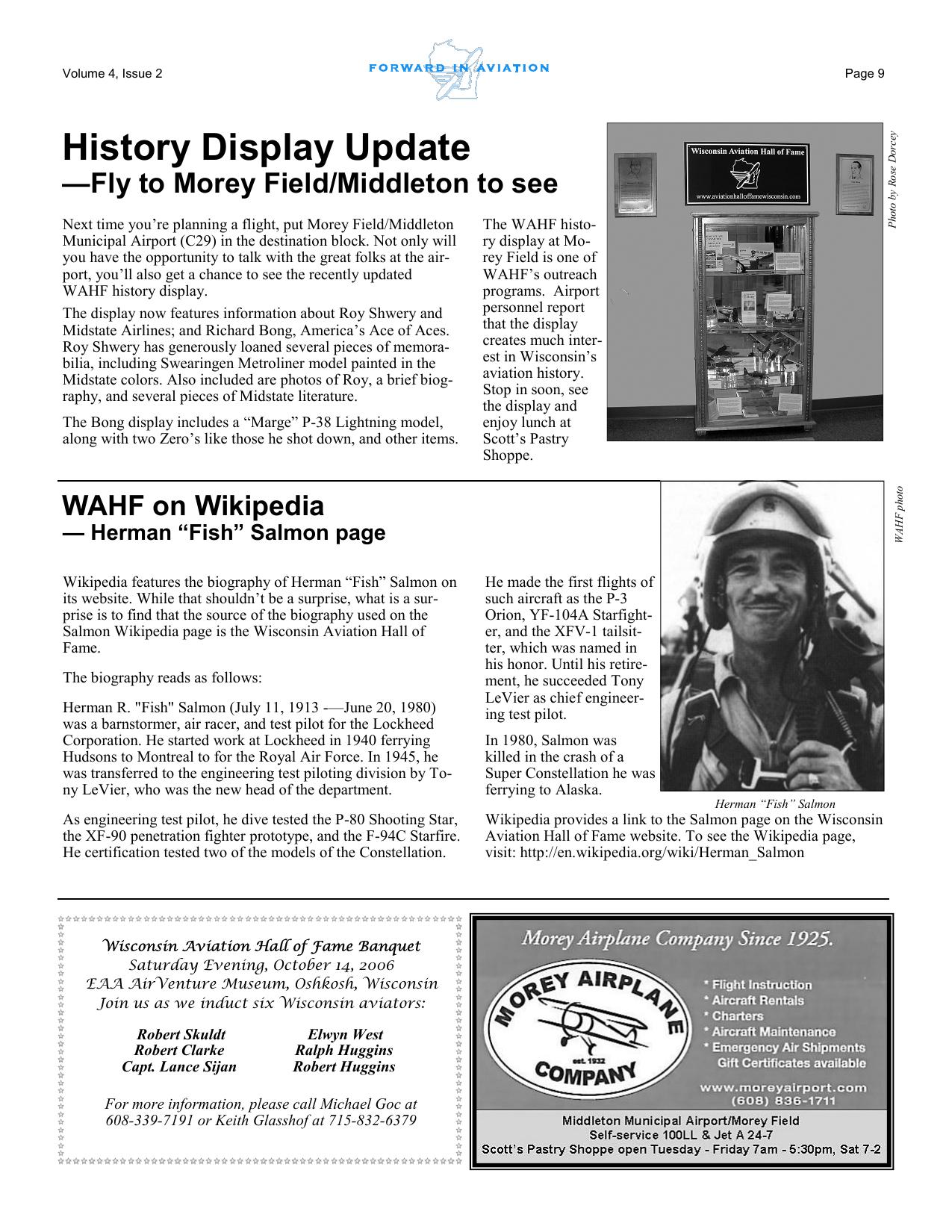
Volume 4, Issue 2 Page 9 Photo by Rose Dorcey History Display Update —Fly to Morey Field/Middleton to see The Bong display includes a “Marge” P-38 Lightning model, along with two Zero’s like those he shot down, and other items. The WAHF history display at Morey Field is one of WAHF’s outreach programs. Airport personnel report that the display creates much interest in Wisconsin’s aviation history. Stop in soon, see the display and enjoy lunch at Scott’s Pastry Shoppe. WAHF photo Next time you’re planning a flight, put Morey Field/Middleton Municipal Airport (C29) in the destination block. Not only will you have the opportunity to talk with the great folks at the airport, you’ll also get a chance to see the recently updated WAHF history display. The display now features information about Roy Shwery and Midstate Airlines; and Richard Bong, America’s Ace of Aces. Roy Shwery has generously loaned several pieces of memorabilia, including Swearingen Metroliner model painted in the Midstate colors. Also included are photos of Roy, a brief biography, and several pieces of Midstate literature. WAHF on Wikipedia — Herman “Fish” Salmon page Wikipedia features the biography of Herman “Fish” Salmon on its website. While that shouldn’t be a surprise, what is a surprise is to find that the source of the biography used on the Salmon Wikipedia page is the Wisconsin Aviation Hall of Fame. The biography reads as follows: Herman R. "Fish" Salmon (July 11, 1913 -—June 20, 1980) was a barnstormer, air racer, and test pilot for the Lockheed Corporation. He started work at Lockheed in 1940 ferrying Hudsons to Montreal to for the Royal Air Force. In 1945, he was transferred to the engineering test piloting division by Tony LeVier, who was the new head of the department. As engineering test pilot, he dive tested the P-80 Shooting Star, the XF-90 penetration fighter prototype, and the F-94C Starfire. He certification tested two of the models of the Constellation. Wisconsin Aviation Hall of Fame Banquet Saturday Evening, October 14, 2006 EAA AirVenture Museum, Oshkosh, Wisconsin Join us as we induct six Wisconsin aviators: Robert Skuldt Robert Clarke Capt. Lance Sijan Elwyn West Ralph Huggins Robert Huggins For more information, please call Michael Goc at 608-339-7191 or Keith Glasshof at 715-832-6379 He made the first flights of such aircraft as the P-3 Orion, YF-104A Starfighter, and the XFV-1 tailsitter, which was named in his honor. Until his retirement, he succeeded Tony LeVier as chief engineering test pilot. In 1980, Salmon was killed in the crash of a Super Constellation he was ferrying to Alaska. Herman “Fish” Salmon Herman “Fish” Salmon Wikipedia provides a link to the Salmon page on the Wisconsin Aviation Hall of Fame website. To see the Wikipedia page, visit: http://en.wikipedia.org/wiki/Herman_Salmon
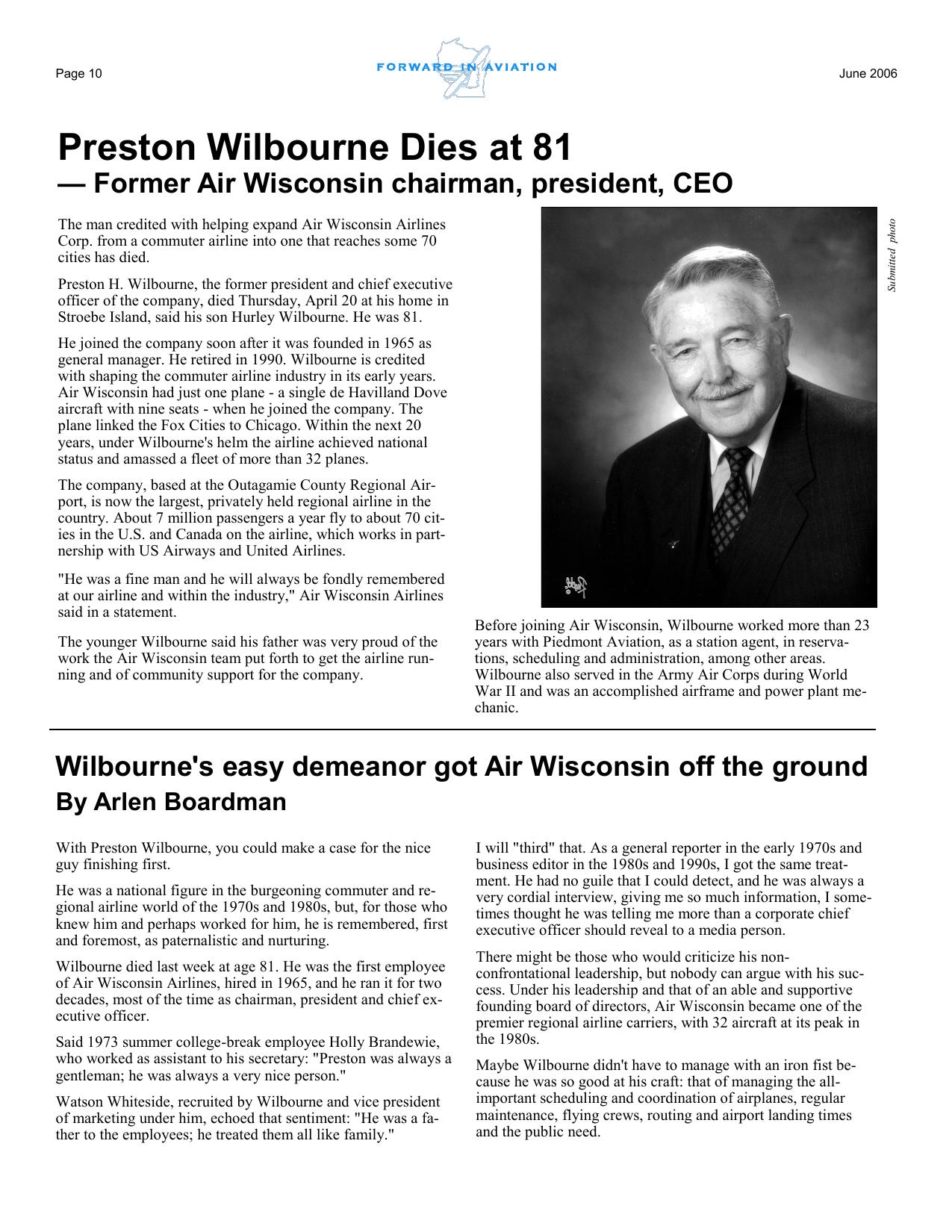
Page 10 June 2006 Preston Wilbourne Dies at 81 — Former Air Wisconsin chairman, president, CEO Submitted photo The man credited with helping expand Air Wisconsin Airlines Corp. from a commuter airline into one that reaches some 70 cities has died. Preston H. Wilbourne, the former president and chief executive officer of the company, died Thursday, April 20 at his home in Stroebe Island, said his son Hurley Wilbourne. He was 81. He joined the company soon after it was founded in 1965 as general manager. He retired in 1990. Wilbourne is credited with shaping the commuter airline industry in its early years. Air Wisconsin had just one plane - a single de Havilland Dove aircraft with nine seats - when he joined the company. The plane linked the Fox Cities to Chicago. Within the next 20 years, under Wilbourne's helm the airline achieved national status and amassed a fleet of more than 32 planes. The company, based at the Outagamie County Regional Airport, is now the largest, privately held regional airline in the country. About 7 million passengers a year fly to about 70 cities in the U.S. and Canada on the airline, which works in partnership with US Airways and United Airlines. "He was a fine man and he will always be fondly remembered at our airline and within the industry," Air Wisconsin Airlines said in a statement. The younger Wilbourne said his father was very proud of the work the Air Wisconsin team put forth to get the airline running and of community support for the company. Before joining Air Wisconsin, Wilbourne worked more than 23 years with Piedmont Aviation, as a station agent, in reservations, scheduling and administration, among other areas. Wilbourne also served in the Army Air Corps during World War II and was an accomplished airframe and power plant mechanic. Wilbourne's easy demeanor got Air Wisconsin off the ground By Arlen Boardman With Preston Wilbourne, you could make a case for the nice guy finishing first. He was a national figure in the burgeoning commuter and regional airline world of the 1970s and 1980s, but, for those who knew him and perhaps worked for him, he is remembered, first and foremost, as paternalistic and nurturing. Wilbourne died last week at age 81. He was the first employee of Air Wisconsin Airlines, hired in 1965, and he ran it for two decades, most of the time as chairman, president and chief executive officer. Said 1973 summer college-break employee Holly Brandewie, who worked as assistant to his secretary: "Preston was always a gentleman; he was always a very nice person." Watson Whiteside, recruited by Wilbourne and vice president of marketing under him, echoed that sentiment: "He was a father to the employees; he treated them all like family." I will "third" that. As a general reporter in the early 1970s and business editor in the 1980s and 1990s, I got the same treatment. He had no guile that I could detect, and he was always a very cordial interview, giving me so much information, I sometimes thought he was telling me more than a corporate chief executive officer should reveal to a media person. There might be those who would criticize his nonconfrontational leadership, but nobody can argue with his success. Under his leadership and that of an able and supportive founding board of directors, Air Wisconsin became one of the premier regional airline carriers, with 32 aircraft at its peak in the 1980s. Maybe Wilbourne didn't have to manage with an iron fist because he was so good at his craft: that of managing the allimportant scheduling and coordination of airplanes, regular maintenance, flying crews, routing and airport landing times and the public need.
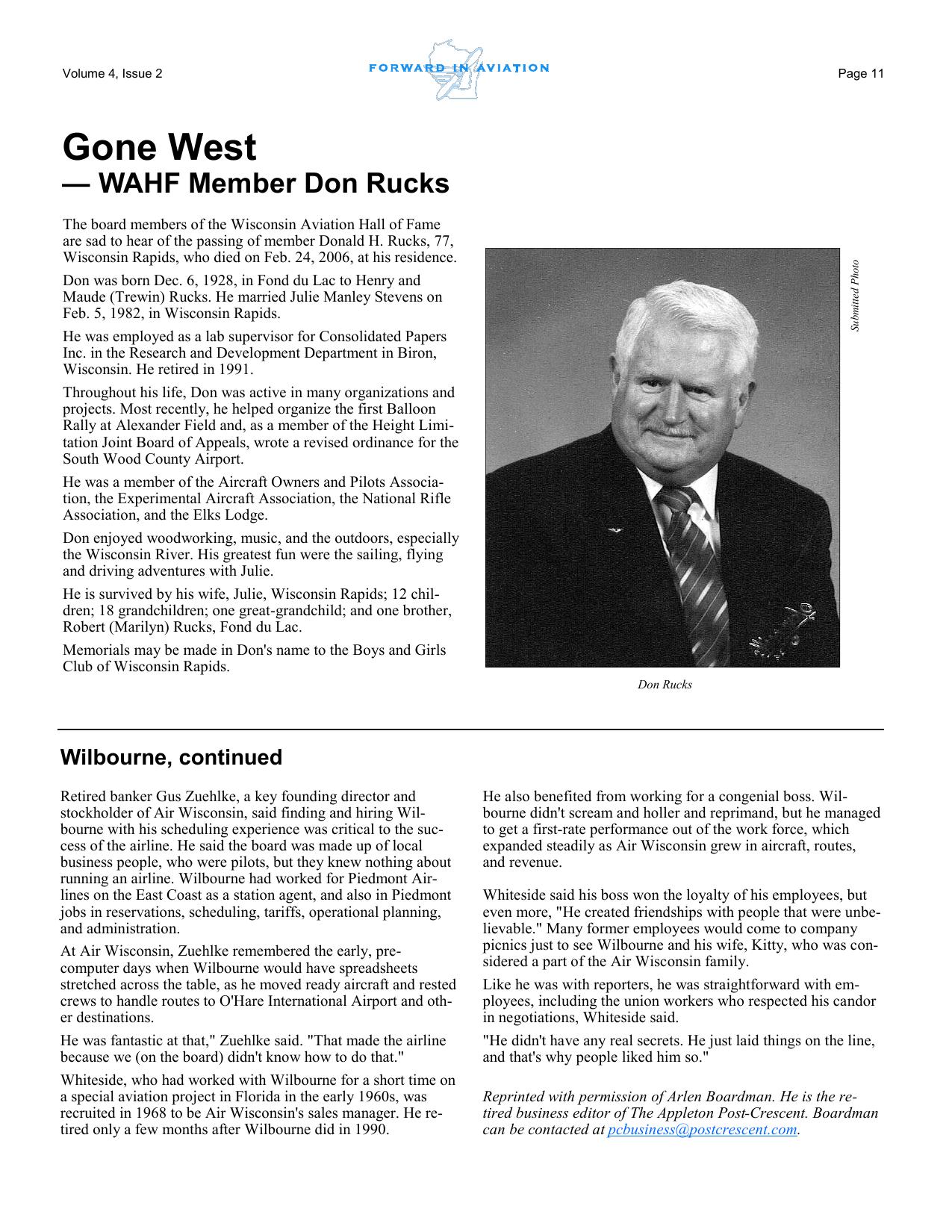
Volume 4, Issue 2 Page 11 Gone West — WAHF Member Don Rucks Submitted Photo The board members of the Wisconsin Aviation Hall of Fame are sad to hear of the passing of member Donald H. Rucks, 77, Wisconsin Rapids, who died on Feb. 24, 2006, at his residence. Don was born Dec. 6, 1928, in Fond du Lac to Henry and Maude (Trewin) Rucks. He married Julie Manley Stevens on Feb. 5, 1982, in Wisconsin Rapids. He was employed as a lab supervisor for Consolidated Papers Inc. in the Research and Development Department in Biron, Wisconsin. He retired in 1991. Throughout his life, Don was active in many organizations and projects. Most recently, he helped organize the first Balloon Rally at Alexander Field and, as a member of the Height Limitation Joint Board of Appeals, wrote a revised ordinance for the South Wood County Airport. He was a member of the Aircraft Owners and Pilots Association, the Experimental Aircraft Association, the National Rifle Association, and the Elks Lodge. Don enjoyed woodworking, music, and the outdoors, especially the Wisconsin River. His greatest fun were the sailing, flying and driving adventures with Julie. He is survived by his wife, Julie, Wisconsin Rapids; 12 children; 18 grandchildren; one great-grandchild; and one brother, Robert (Marilyn) Rucks, Fond du Lac. Memorials may be made in Don's name to the Boys and Girls Club of Wisconsin Rapids. Don Rucks Wilbourne, continued Retired banker Gus Zuehlke, a key founding director and stockholder of Air Wisconsin, said finding and hiring Wilbourne with his scheduling experience was critical to the success of the airline. He said the board was made up of local business people, who were pilots, but they knew nothing about running an airline. Wilbourne had worked for Piedmont Airlines on the East Coast as a station agent, and also in Piedmont jobs in reservations, scheduling, tariffs, operational planning, and administration. At Air Wisconsin, Zuehlke remembered the early, precomputer days when Wilbourne would have spreadsheets stretched across the table, as he moved ready aircraft and rested crews to handle routes to O'Hare International Airport and other destinations. He was fantastic at that," Zuehlke said. "That made the airline because we (on the board) didn't know how to do that." Whiteside, who had worked with Wilbourne for a short time on a special aviation project in Florida in the early 1960s, was recruited in 1968 to be Air Wisconsin's sales manager. He retired only a few months after Wilbourne did in 1990. He also benefited from working for a congenial boss. Wilbourne didn't scream and holler and reprimand, but he managed to get a first-rate performance out of the work force, which expanded steadily as Air Wisconsin grew in aircraft, routes, and revenue. Whiteside said his boss won the loyalty of his employees, but even more, "He created friendships with people that were unbelievable." Many former employees would come to company picnics just to see Wilbourne and his wife, Kitty, who was considered a part of the Air Wisconsin family. Like he was with reporters, he was straightforward with employees, including the union workers who respected his candor in negotiations, Whiteside said. "He didn't have any real secrets. He just laid things on the line, and that's why people liked him so." Reprinted with permission of Arlen Boardman. He is the retired business editor of The Appleton Post-Crescent. Boardman can be contacted at pcbusiness@postcrescent.com.
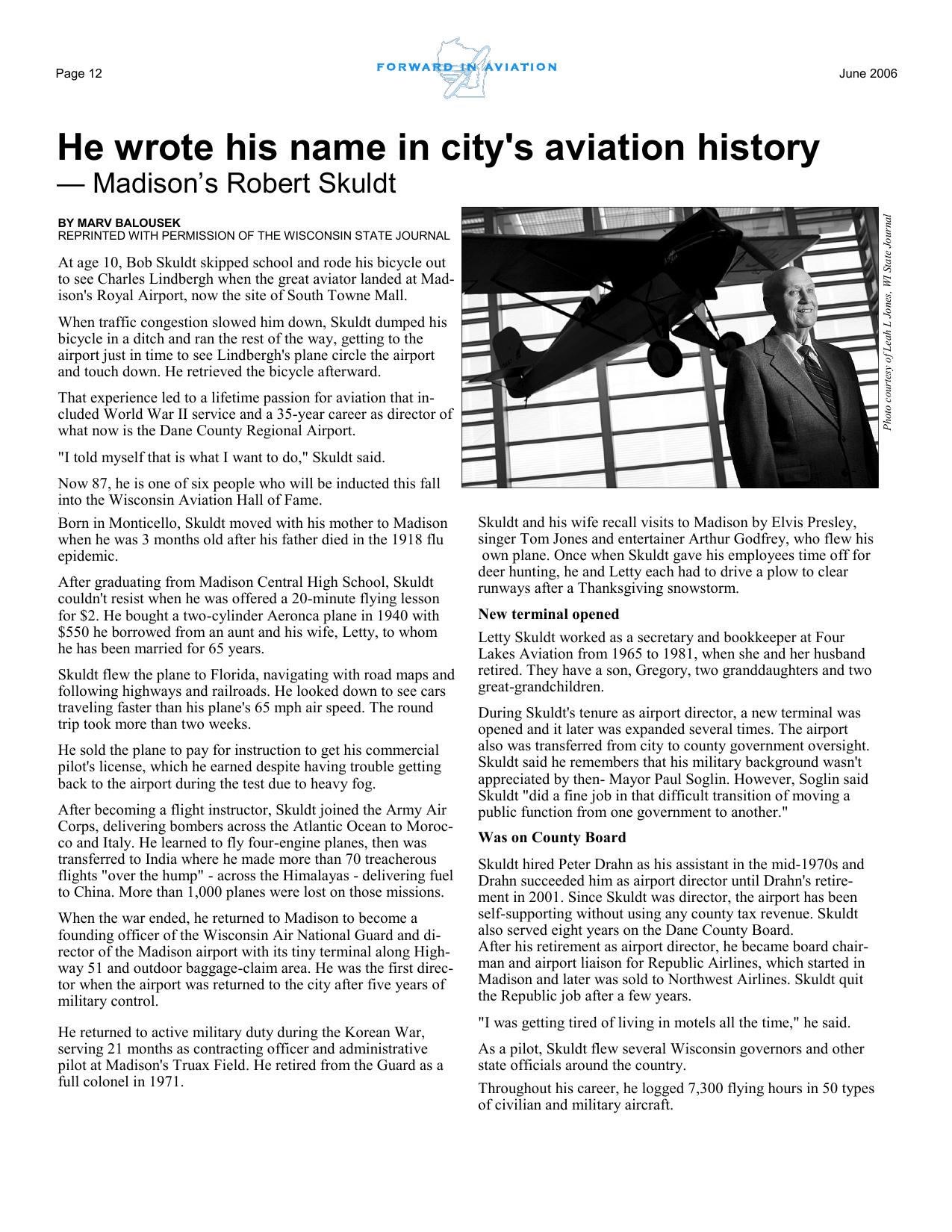
Page 12 June 2006 He wrote his name in city's aviation history Photo courtesy of Leah L Jones, WI State Journal — Madison’s Robert Skuldt BY MARV BALOUSEK REPRINTED WITH PERMISSION OF THE WISCONSIN STATE JOURNAL At age 10, Bob Skuldt skipped school and rode his bicycle out to see Charles Lindbergh when the great aviator landed at Madison's Royal Airport, now the site of South Towne Mall. When traffic congestion slowed him down, Skuldt dumped his bicycle in a ditch and ran the rest of the way, getting to the airport just in time to see Lindbergh's plane circle the airport and touch down. He retrieved the bicycle afterward. That experience led to a lifetime passion for aviation that included World War II service and a 35-year career as director of what now is the Dane County Regional Airport. "I told myself that is what I want to do," Skuldt said. Now 87, he is one of six people who will be inducted this fall into the Wisconsin Aviation Hall of Fame. Born in Monticello, Skuldt moved with his mother to Madison when he was 3 months old after his father died in the 1918 flu epidemic. . After graduating from Madison Central High School, Skuldt couldn't resist when he was offered a 20-minute flying lesson for $2. He bought a two-cylinder Aeronca plane in 1940 with $550 he borrowed from an aunt and his wife, Letty, to whom he has been married for 65 years. Skuldt flew the plane to Florida, navigating with road maps and following highways and railroads. He looked down to see cars traveling faster than his plane's 65 mph air speed. The round trip took more than two weeks. He sold the plane to pay for instruction to get his commercial pilot's license, which he earned despite having trouble getting back to the airport during the test due to heavy fog. After becoming a flight instructor, Skuldt joined the Army Air Corps, delivering bombers across the Atlantic Ocean to Morocco and Italy. He learned to fly four-engine planes, then was transferred to India where he made more than 70 treacherous flights "over the hump" - across the Himalayas - delivering fuel to China. More than 1,000 planes were lost on those missions. When the war ended, he returned to Madison to become a founding officer of the Wisconsin Air National Guard and director of the Madison airport with its tiny terminal along Highway 51 and outdoor baggage-claim area. He was the first director when the airport was returned to the city after five years of military control. He returned to active military duty during the Korean War, serving 21 months as contracting officer and administrative pilot at Madison's Truax Field. He retired from the Guard as a full colonel in 1971. Skuldt and his wife recall visits to Madison by Elvis Presley, singer Tom Jones and entertainer Arthur Godfrey, who flew his own plane. Once when Skuldt gave his employees time off for deer hunting, he and Letty each had to drive a plow to clear runways after a Thanksgiving snowstorm. New terminal opened Letty Skuldt worked as a secretary and bookkeeper at Four Lakes Aviation from 1965 to 1981, when she and her husband retired. They have a son, Gregory, two granddaughters and two great-grandchildren. During Skuldt's tenure as airport director, a new terminal was opened and it later was expanded several times. The airport also was transferred from city to county government oversight. Skuldt said he remembers that his military background wasn't appreciated by then- Mayor Paul Soglin. However, Soglin said Skuldt "did a fine job in that difficult transition of moving a public function from one government to another." Was on County Board Skuldt hired Peter Drahn as his assistant in the mid-1970s and Drahn succeeded him as airport director until Drahn's retirement in 2001. Since Skuldt was director, the airport has been self-supporting without using any county tax revenue. Skuldt also served eight years on the Dane County Board. After his retirement as airport director, he became board chairman and airport liaison for Republic Airlines, which started in Madison and later was sold to Northwest Airlines. Skuldt quit the Republic job after a few years. "I was getting tired of living in motels all the time," he said. As a pilot, Skuldt flew several Wisconsin governors and other state officials around the country. Throughout his career, he logged 7,300 flying hours in 50 types of civilian and military aircraft.
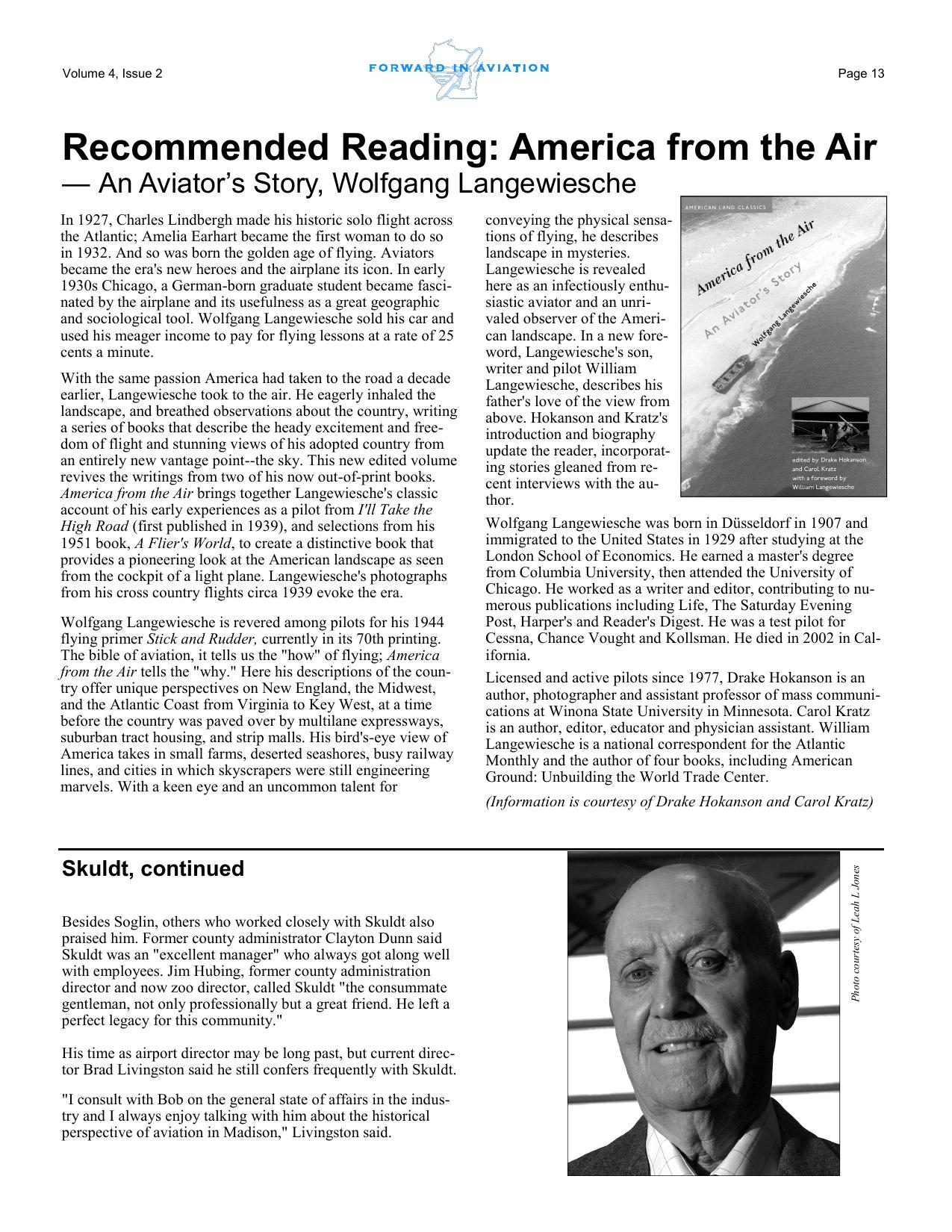
Volume 4, Issue 2 Page 13 Recommended Reading: America from the Air — An Aviator’s Story, Wolfgang Langewiesche With the same passion America had taken to the road a decade earlier, Langewiesche took to the air. He eagerly inhaled the landscape, and breathed observations about the country, writing a series of books that describe the heady excitement and freedom of flight and stunning views of his adopted country from an entirely new vantage point--the sky. This new edited volume revives the writings from two of his now out-of-print books. America from the Air brings together Langewiesche's classic account of his early experiences as a pilot from I'll Take the High Road (first published in 1939), and selections from his 1951 book, A Flier's World, to create a distinctive book that provides a pioneering look at the American landscape as seen from the cockpit of a light plane. Langewiesche's photographs from his cross country flights circa 1939 evoke the era. Wolfgang Langewiesche is revered among pilots for his 1944 flying primer Stick and Rudder, currently in its 70th printing. The bible of aviation, it tells us the "how" of flying; America from the Air tells the "why." Here his descriptions of the country offer unique perspectives on New England, the Midwest, and the Atlantic Coast from Virginia to Key West, at a time before the country was paved over by multilane expressways, suburban tract housing, and strip malls. His bird's-eye view of America takes in small farms, deserted seashores, busy railway lines, and cities in which skyscrapers were still engineering marvels. With a keen eye and an uncommon talent for Skuldt, continued Besides Soglin, others who worked closely with Skuldt also praised him. Former county administrator Clayton Dunn said Skuldt was an "excellent manager" who always got along well with employees. Jim Hubing, former county administration director and now zoo director, called Skuldt "the consummate gentleman, not only professionally but a great friend. He left a perfect legacy for this community." His time as airport director may be long past, but current director Brad Livingston said he still confers frequently with Skuldt. "I consult with Bob on the general state of affairs in the industry and I always enjoy talking with him about the historical perspective of aviation in Madison," Livingston said. conveying the physical sensations of flying, he describes landscape in mysteries. Langewiesche is revealed here as an infectiously enthusiastic aviator and an unrivaled observer of the American landscape. In a new foreword, Langewiesche's son, writer and pilot William Langewiesche, describes his father's love of the view from above. Hokanson and Kratz's introduction and biography update the reader, incorporating stories gleaned from recent interviews with the author. Wolfgang Langewiesche was born in Düsseldorf in 1907 and immigrated to the United States in 1929 after studying at the London School of Economics. He earned a master's degree from Columbia University, then attended the University of Chicago. He worked as a writer and editor, contributing to numerous publications including Life, The Saturday Evening Post, Harper's and Reader's Digest. He was a test pilot for Cessna, Chance Vought and Kollsman. He died in 2002 in California. Licensed and active pilots since 1977, Drake Hokanson is an author, photographer and assistant professor of mass communications at Winona State University in Minnesota. Carol Kratz is an author, editor, educator and physician assistant. William Langewiesche is a national correspondent for the Atlantic Monthly and the author of four books, including American Ground: Unbuilding the World Trade Center. (Information is courtesy of Drake Hokanson and Carol Kratz) Photo courtesy of Leah L Jones In 1927, Charles Lindbergh made his historic solo flight across the Atlantic; Amelia Earhart became the first woman to do so in 1932. And so was born the golden age of flying. Aviators became the era's new heroes and the airplane its icon. In early 1930s Chicago, a German-born graduate student became fascinated by the airplane and its usefulness as a great geographic and sociological tool. Wolfgang Langewiesche sold his car and used his meager income to pay for flying lessons at a rate of 25 cents a minute.
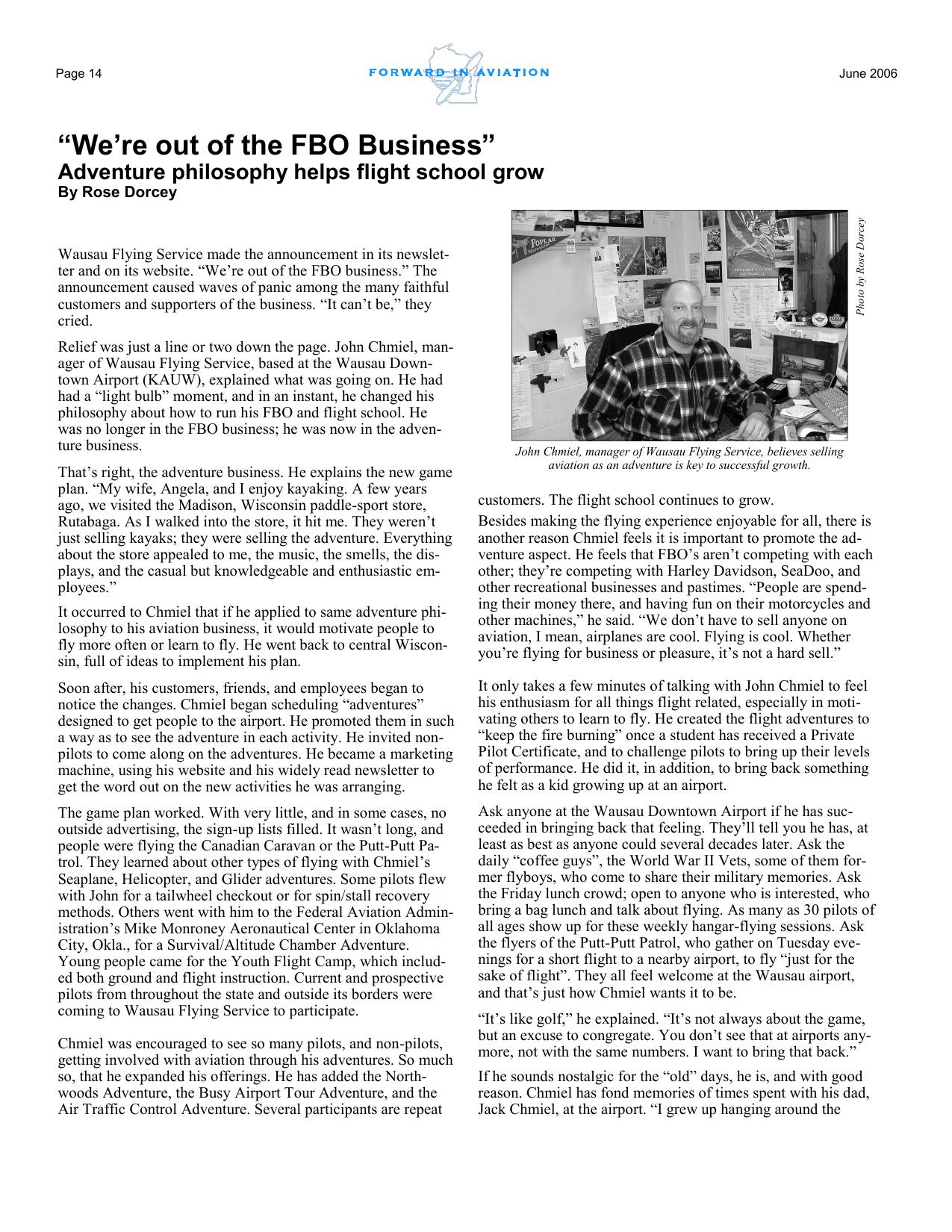
Page 14 June 2006 “We’re out of the FBO Business” Adventure philosophy helps flight school grow Photo by Rose Dorcey By Rose Dorcey Wausau Flying Service made the announcement in its newsletter and on its website. “We’re out of the FBO business.” The announcement caused waves of panic among the many faithful customers and supporters of the business. “It can’t be,” they cried. Relief was just a line or two down the page. John Chmiel, manager of Wausau Flying Service, based at the Wausau Downtown Airport (KAUW), explained what was going on. He had had a “light bulb” moment, and in an instant, he changed his philosophy about how to run his FBO and flight school. He was no longer in the FBO business; he was now in the adventure business. That’s right, the adventure business. He explains the new game plan. “My wife, Angela, and I enjoy kayaking. A few years ago, we visited the Madison, Wisconsin paddle-sport store, Rutabaga. As I walked into the store, it hit me. They weren’t just selling kayaks; they were selling the adventure. Everything about the store appealed to me, the music, the smells, the displays, and the casual but knowledgeable and enthusiastic employees.” It occurred to Chmiel that if he applied to same adventure philosophy to his aviation business, it would motivate people to fly more often or learn to fly. He went back to central Wisconsin, full of ideas to implement his plan. John Chmiel, manager of Wausau Flying Service, believes selling aviation as an adventure is key to successful growth. customers. The flight school continues to grow. Besides making the flying experience enjoyable for all, there is another reason Chmiel feels it is important to promote the adventure aspect. He feels that FBO’s aren’t competing with each other; they’re competing with Harley Davidson, SeaDoo, and other recreational businesses and pastimes. “People are spending their money there, and having fun on their motorcycles and other machines,” he said. “We don’t have to sell anyone on aviation, I mean, airplanes are cool. Flying is cool. Whether you’re flying for business or pleasure, it’s not a hard sell.” Soon after, his customers, friends, and employees began to notice the changes. Chmiel began scheduling “adventures” designed to get people to the airport. He promoted them in such a way as to see the adventure in each activity. He invited nonpilots to come along on the adventures. He became a marketing machine, using his website and his widely read newsletter to get the word out on the new activities he was arranging. It only takes a few minutes of talking with John Chmiel to feel his enthusiasm for all things flight related, especially in motivating others to learn to fly. He created the flight adventures to “keep the fire burning” once a student has received a Private Pilot Certificate, and to challenge pilots to bring up their levels of performance. He did it, in addition, to bring back something he felt as a kid growing up at an airport. The game plan worked. With very little, and in some cases, no outside advertising, the sign-up lists filled. It wasn’t long, and people were flying the Canadian Caravan or the Putt-Putt Patrol. They learned about other types of flying with Chmiel’s Seaplane, Helicopter, and Glider adventures. Some pilots flew with John for a tailwheel checkout or for spin/stall recovery methods. Others went with him to the Federal Aviation Administration’s Mike Monroney Aeronautical Center in Oklahoma City, Okla., for a Survival/Altitude Chamber Adventure. Young people came for the Youth Flight Camp, which included both ground and flight instruction. Current and prospective pilots from throughout the state and outside its borders were coming to Wausau Flying Service to participate. Ask anyone at the Wausau Downtown Airport if he has succeeded in bringing back that feeling. They’ll tell you he has, at least as best as anyone could several decades later. Ask the daily “coffee guys”, the World War II Vets, some of them former flyboys, who come to share their military memories. Ask the Friday lunch crowd; open to anyone who is interested, who bring a bag lunch and talk about flying. As many as 30 pilots of all ages show up for these weekly hangar-flying sessions. Ask the flyers of the Putt-Putt Patrol, who gather on Tuesday evenings for a short flight to a nearby airport, to fly “just for the sake of flight”. They all feel welcome at the Wausau airport, and that’s just how Chmiel wants it to be. Chmiel was encouraged to see so many pilots, and non-pilots, getting involved with aviation through his adventures. So much so, that he expanded his offerings. He has added the Northwoods Adventure, the Busy Airport Tour Adventure, and the Air Traffic Control Adventure. Several participants are repeat “It’s like golf,” he explained. “It’s not always about the game, but an excuse to congregate. You don’t see that at airports anymore, not with the same numbers. I want to bring that back.” If he sounds nostalgic for the “old” days, he is, and with good reason. Chmiel has fond memories of times spent with his dad, Jack Chmiel, at the airport. “I grew up hanging around the
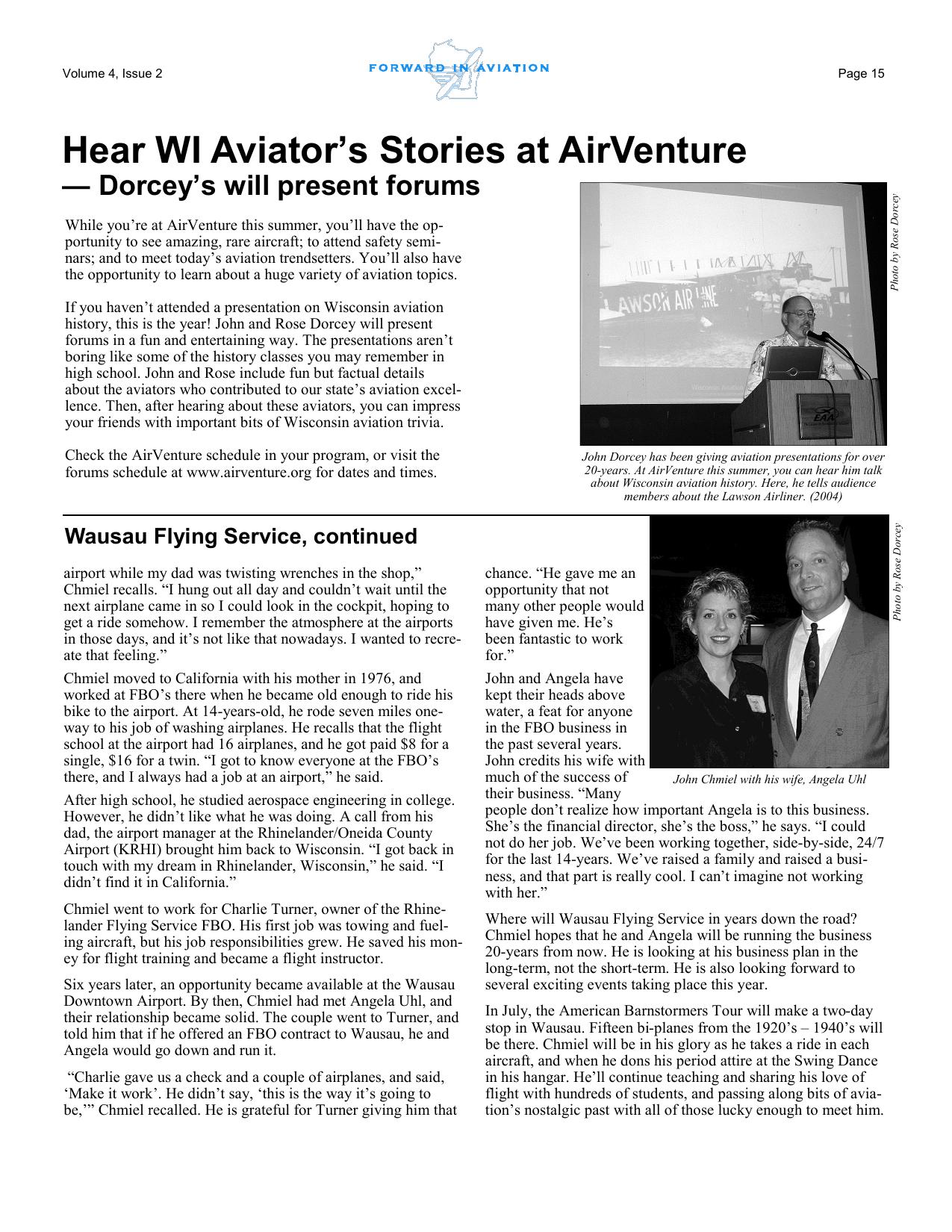
Volume 4, Issue 2 Page 15 Hear WI Aviator’s Stories at AirVenture Photo by Rose Dorcey — Dorcey’s will present forums While you’re at AirVenture this summer, you’ll have the opportunity to see amazing, rare aircraft; to attend safety seminars; and to meet today’s aviation trendsetters. You’ll also have the opportunity to learn about a huge variety of aviation topics. If you haven’t attended a presentation on Wisconsin aviation history, this is the year! John and Rose Dorcey will present forums in a fun and entertaining way. The presentations aren’t boring like some of the history classes you may remember in high school. John and Rose include fun but factual details about the aviators who contributed to our state’s aviation excellence. Then, after hearing about these aviators, you can impress your friends with important bits of Wisconsin aviation trivia. John Dorcey has been giving aviation presentations for over 20-years. At AirVenture this summer, you can hear him talk about Wisconsin aviation history. Here, he tells audience members about the Lawson Airliner. (2004) Wausau Flying Service, continued airport while my dad was twisting wrenches in the shop,” Chmiel recalls. “I hung out all day and couldn’t wait until the next airplane came in so I could look in the cockpit, hoping to get a ride somehow. I remember the atmosphere at the airports in those days, and it’s not like that nowadays. I wanted to recreate that feeling.” Chmiel moved to California with his mother in 1976, and worked at FBO’s there when he became old enough to ride his bike to the airport. At 14-years-old, he rode seven miles oneway to his job of washing airplanes. He recalls that the flight school at the airport had 16 airplanes, and he got paid $8 for a single, $16 for a twin. “I got to know everyone at the FBO’s there, and I always had a job at an airport,” he said. After high school, he studied aerospace engineering in college. However, he didn’t like what he was doing. A call from his dad, the airport manager at the Rhinelander/Oneida County Airport (KRHI) brought him back to Wisconsin. “I got back in touch with my dream in Rhinelander, Wisconsin,” he said. “I didn’t find it in California.” Chmiel went to work for Charlie Turner, owner of the Rhinelander Flying Service FBO. His first job was towing and fueling aircraft, but his job responsibilities grew. He saved his money for flight training and became a flight instructor. Six years later, an opportunity became available at the Wausau Downtown Airport. By then, Chmiel had met Angela Uhl, and their relationship became solid. The couple went to Turner, and told him that if he offered an FBO contract to Wausau, he and Angela would go down and run it. “Charlie gave us a check and a couple of airplanes, and said, ‘Make it work’. He didn’t say, ‘this is the way it’s going to be,’” Chmiel recalled. He is grateful for Turner giving him that chance. “He gave me an opportunity that not many other people would have given me. He’s been fantastic to work for.” John and Angela have kept their heads above water, a feat for anyone in the FBO business in the past several years. John credits his wife with much of the success of John Chmiel with his wife, Angela Uhl their business. “Many people don’t realize how important Angela is to this business. She’s the financial director, she’s the boss,” he says. “I could not do her job. We’ve been working together, side-by-side, 24/7 for the last 14-years. We’ve raised a family and raised a business, and that part is really cool. I can’t imagine not working with her.” Where will Wausau Flying Service in years down the road? Chmiel hopes that he and Angela will be running the business 20-years from now. He is looking at his business plan in the long-term, not the short-term. He is also looking forward to several exciting events taking place this year. In July, the American Barnstormers Tour will make a two-day stop in Wausau. Fifteen bi-planes from the 1920’s – 1940’s will be there. Chmiel will be in his glory as he takes a ride in each aircraft, and when he dons his period attire at the Swing Dance in his hangar. He’ll continue teaching and sharing his love of flight with hundreds of students, and passing along bits of aviation’s nostalgic past with all of those lucky enough to meet him. Photo by Rose Dorcey Check the AirVenture schedule in your program, or visit the forums schedule at www.airventure.org for dates and times.
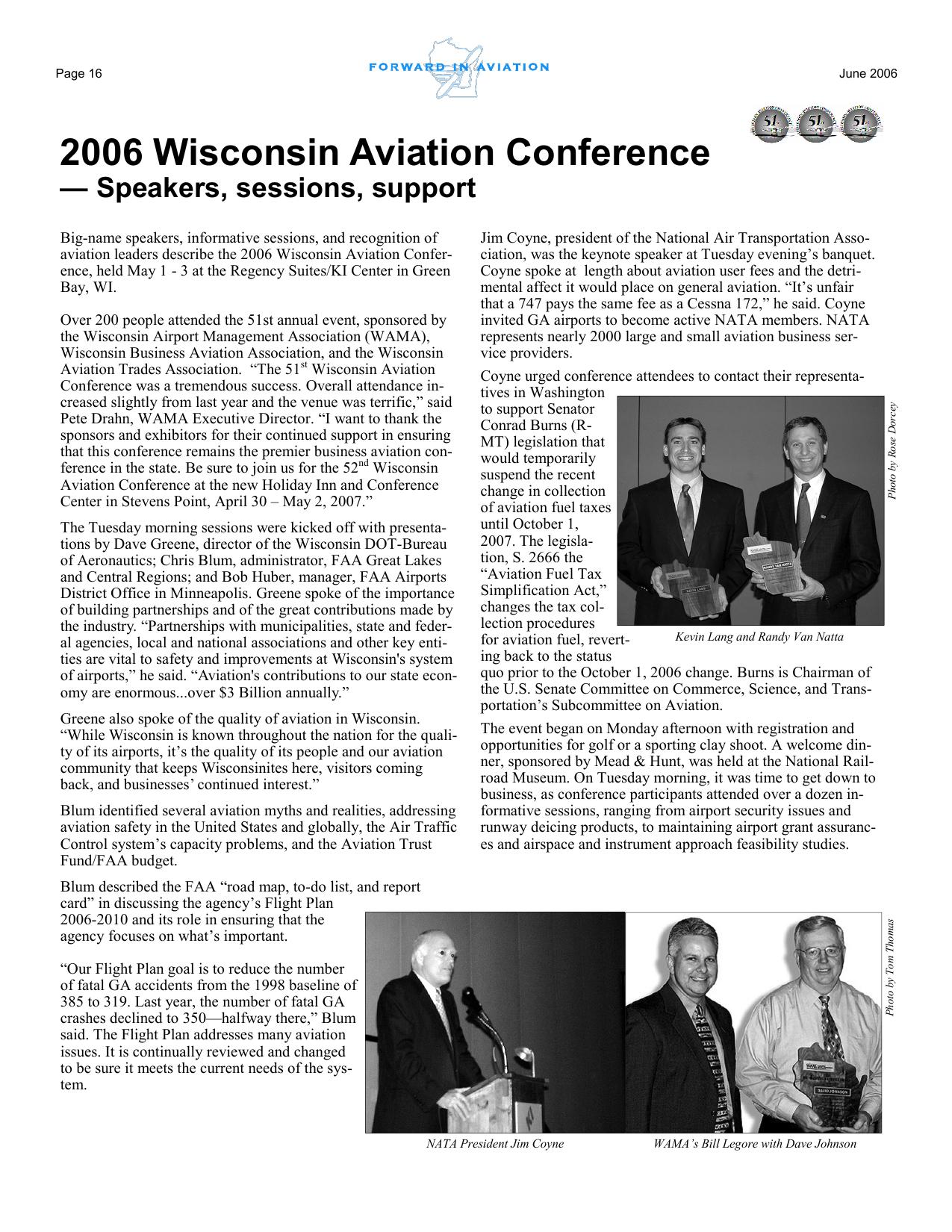
Page 16 June 2006 2006 Wisconsin Aviation Conference Big-name speakers, informative sessions, and recognition of aviation leaders describe the 2006 Wisconsin Aviation Conference, held May 1 - 3 at the Regency Suites/KI Center in Green Bay, WI. Over 200 people attended the 51st annual event, sponsored by the Wisconsin Airport Management Association (WAMA), Wisconsin Business Aviation Association, and the Wisconsin Aviation Trades Association. “The 51st Wisconsin Aviation Conference was a tremendous success. Overall attendance increased slightly from last year and the venue was terrific,” said Pete Drahn, WAMA Executive Director. “I want to thank the sponsors and exhibitors for their continued support in ensuring that this conference remains the premier business aviation conference in the state. Be sure to join us for the 52nd Wisconsin Aviation Conference at the new Holiday Inn and Conference Center in Stevens Point, April 30 – May 2, 2007.” The Tuesday morning sessions were kicked off with presentations by Dave Greene, director of the Wisconsin DOT-Bureau of Aeronautics; Chris Blum, administrator, FAA Great Lakes and Central Regions; and Bob Huber, manager, FAA Airports District Office in Minneapolis. Greene spoke of the importance of building partnerships and of the great contributions made by the industry. “Partnerships with municipalities, state and federal agencies, local and national associations and other key entities are vital to safety and improvements at Wisconsin's system of airports,” he said. “Aviation's contributions to our state economy are enormous...over $3 Billion annually.” Greene also spoke of the quality of aviation in Wisconsin. “While Wisconsin is known throughout the nation for the quality of its airports, it’s the quality of its people and our aviation community that keeps Wisconsinites here, visitors coming back, and businesses’ continued interest.” Blum identified several aviation myths and realities, addressing aviation safety in the United States and globally, the Air Traffic Control system’s capacity problems, and the Aviation Trust Fund/FAA budget. Jim Coyne, president of the National Air Transportation Association, was the keynote speaker at Tuesday evening’s banquet. Coyne spoke at length about aviation user fees and the detrimental affect it would place on general aviation. “It’s unfair that a 747 pays the same fee as a Cessna 172,” he said. Coyne invited GA airports to become active NATA members. NATA represents nearly 2000 large and small aviation business service providers. Coyne urged conference attendees to contact their representatives in Washington to support Senator Conrad Burns (RMT) legislation that would temporarily suspend the recent change in collection of aviation fuel taxes until October 1, 2007. The legislation, S. 2666 the “Aviation Fuel Tax Simplification Act,” changes the tax collection procedures Kevin Lang and Randy Van Natta for aviation fuel, reverting back to the status quo prior to the October 1, 2006 change. Burns is Chairman of the U.S. Senate Committee on Commerce, Science, and Transportation’s Subcommittee on Aviation. The event began on Monday afternoon with registration and opportunities for golf or a sporting clay shoot. A welcome dinner, sponsored by Mead & Hunt, was held at the National Railroad Museum. On Tuesday morning, it was time to get down to business, as conference participants attended over a dozen informative sessions, ranging from airport security issues and runway deicing products, to maintaining airport grant assurances and airspace and instrument approach feasibility studies. Photo by Tom Thomas Blum described the FAA “road map, to-do list, and report card” in discussing the agency’s Flight Plan 2006-2010 and its role in ensuring that the agency focuses on what’s important. Photo by Rose Dorcey — Speakers, sessions, support “Our Flight Plan goal is to reduce the number of fatal GA accidents from the 1998 baseline of 385 to 319. Last year, the number of fatal GA crashes declined to 350—halfway there,” Blum said. The Flight Plan addresses many aviation issues. It is continually reviewed and changed to be sure it meets the current needs of the system. NATA President Jim Coyne WAMA’s Bill Legore with Dave Johnson
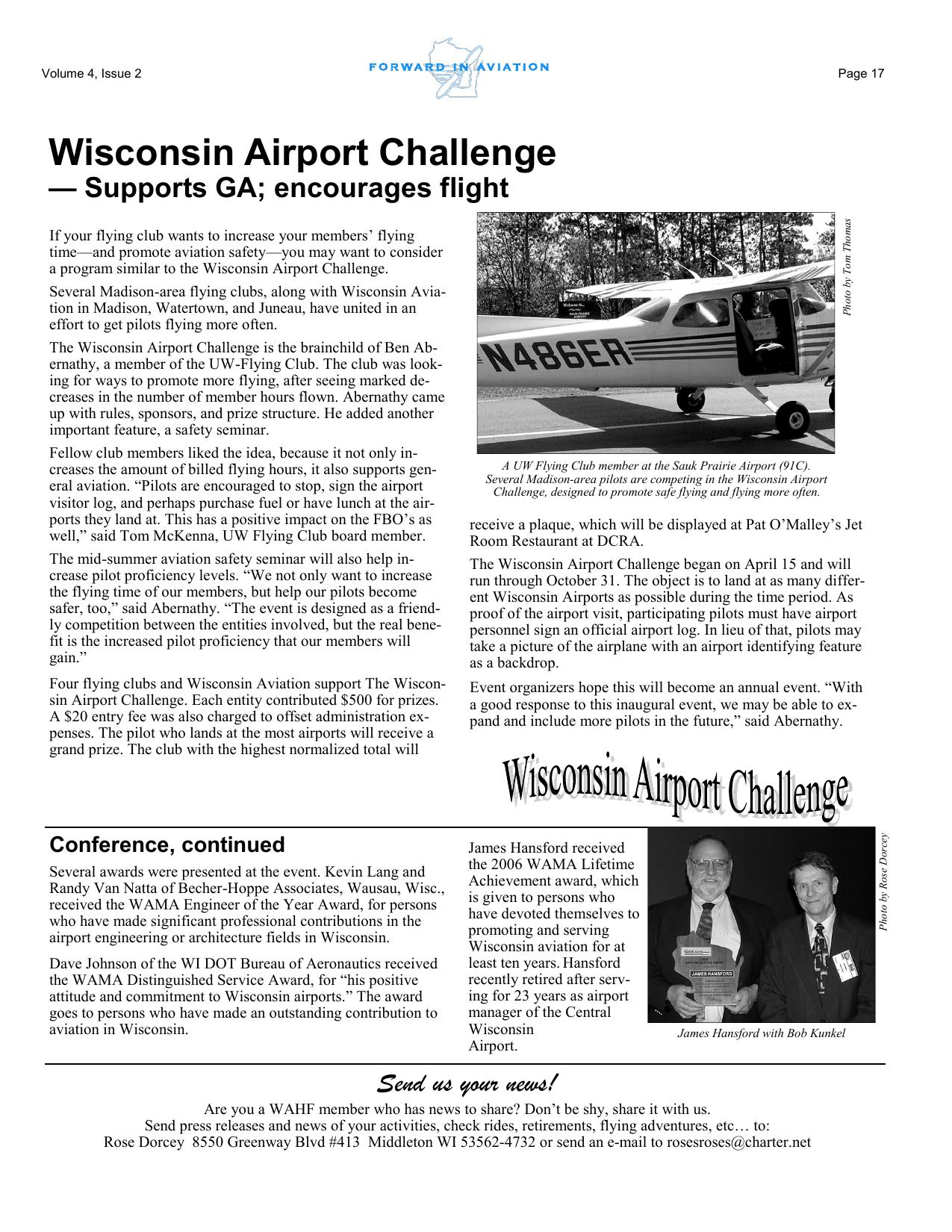
Volume 4, Issue 2 Page 17 Wisconsin Airport Challenge If your flying club wants to increase your members’ flying time—and promote aviation safety—you may want to consider a program similar to the Wisconsin Airport Challenge. Several Madison-area flying clubs, along with Wisconsin Aviation in Madison, Watertown, and Juneau, have united in an effort to get pilots flying more often. The Wisconsin Airport Challenge is the brainchild of Ben Abernathy, a member of the UW-Flying Club. The club was looking for ways to promote more flying, after seeing marked decreases in the number of member hours flown. Abernathy came up with rules, sponsors, and prize structure. He added another important feature, a safety seminar. Fellow club members liked the idea, because it not only increases the amount of billed flying hours, it also supports general aviation. “Pilots are encouraged to stop, sign the airport visitor log, and perhaps purchase fuel or have lunch at the airports they land at. This has a positive impact on the FBO’s as well,” said Tom McKenna, UW Flying Club board member. The mid-summer aviation safety seminar will also help increase pilot proficiency levels. “We not only want to increase the flying time of our members, but help our pilots become safer, too,” said Abernathy. “The event is designed as a friendly competition between the entities involved, but the real benefit is the increased pilot proficiency that our members will gain.” Photo by Tom Thomas — Supports GA; encourages flight A UW Flying Club member at the Sauk Prairie Airport (91C). Several Madison-area pilots are competing in the Wisconsin Airport Challenge, designed to promote safe flying and flying more often. receive a plaque, which will be displayed at Pat O’Malley’s Jet Room Restaurant at DCRA. The Wisconsin Airport Challenge began on April 15 and will run through October 31. The object is to land at as many different Wisconsin Airports as possible during the time period. As proof of the airport visit, participating pilots must have airport personnel sign an official airport log. In lieu of that, pilots may take a picture of the airplane with an airport identifying feature as a backdrop. Event organizers hope this will become an annual event. “With a good response to this inaugural event, we may be able to expand and include more pilots in the future,” said Abernathy. Conference, continued James Hansford received the 2006 WAMA Lifetime Achievement award, which is given to persons who have devoted themselves to promoting and serving Wisconsin aviation for at least ten years. Hansford recently retired after serving for 23 years as airport manager of the Central Wisconsin Airport. Several awards were presented at the event. Kevin Lang and Randy Van Natta of Becher-Hoppe Associates, Wausau, Wisc., received the WAMA Engineer of the Year Award, for persons who have made significant professional contributions in the airport engineering or architecture fields in Wisconsin. Dave Johnson of the WI DOT Bureau of Aeronautics received the WAMA Distinguished Service Award, for “his positive attitude and commitment to Wisconsin airports.” The award goes to persons who have made an outstanding contribution to aviation in Wisconsin. Send us your news! Photo by Rose Dorcey Four flying clubs and Wisconsin Aviation support The Wisconsin Airport Challenge. Each entity contributed $500 for prizes. A $20 entry fee was also charged to offset administration expenses. The pilot who lands at the most airports will receive a grand prize. The club with the highest normalized total will James Hansford with Bob Kunkel Are you a WAHF member who has news to share? Don’t be shy, share it with us. Send press releases and news of your activities, check rides, retirements, flying adventures, etc… to: Rose Dorcey 8550 Greenway Blvd #413 Middleton WI 53562-4732 or send an e-mail to rosesroses@charter.net
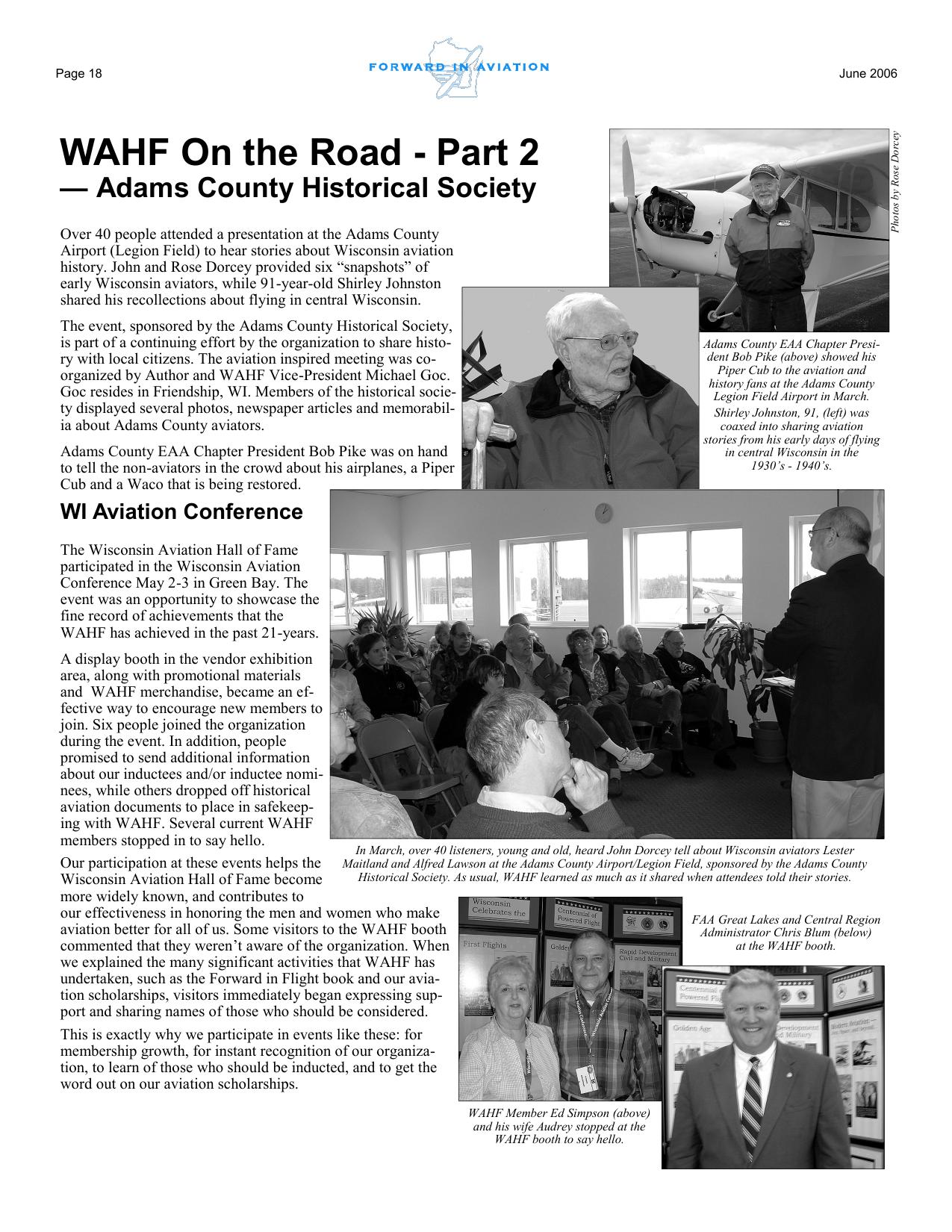
June 2006 Photos by Rose Dorcey Page 18 WAHF On the Road - Part 2 — Adams County Historical Society Over 40 people attended a presentation at the Adams County Airport (Legion Field) to hear stories about Wisconsin aviation history. John and Rose Dorcey provided six “snapshots” of early Wisconsin aviators, while 91-year-old Shirley Johnston shared his recollections about flying in central Wisconsin. The event, sponsored by the Adams County Historical Society, is part of a continuing effort by the organization to share history with local citizens. The aviation inspired meeting was coorganized by Author and WAHF Vice-President Michael Goc. Goc resides in Friendship, WI. Members of the historical society displayed several photos, newspaper articles and memorabilia about Adams County aviators. Adams County EAA Chapter President Bob Pike (above) showed his Piper Cub to the aviation and history fans at the Adams County Legion Field Airport in March. Shirley Johnston, 91, (left) was coaxed into sharing aviation stories from his early days of flying in central Wisconsin in the 1930’s - 1940’s. Adams County EAA Chapter President Bob Pike was on hand to tell the non-aviators in the crowd about his airplanes, a Piper Cub and a Waco that is being restored. WI Aviation Conference The Wisconsin Aviation Hall of Fame participated in the Wisconsin Aviation Conference May 2-3 in Green Bay. The event was an opportunity to showcase the fine record of achievements that the WAHF has achieved in the past 21-years. A display booth in the vendor exhibition area, along with promotional materials and WAHF merchandise, became an effective way to encourage new members to join. Six people joined the organization during the event. In addition, people promised to send additional information about our inductees and/or inductee nominees, while others dropped off historical aviation documents to place in safekeeping with WAHF. Several current WAHF members stopped in to say hello. In March, over 40 listeners, young and old, heard John Dorcey tell about Wisconsin aviators Lester Our participation at these events helps the Maitland and Alfred Lawson at the Adams County Airport/Legion Field, sponsored by the Adams County Historical Society. As usual, WAHF learned as much as it shared when attendees told their stories. Wisconsin Aviation Hall of Fame become more widely known, and contributes to our effectiveness in honoring the men and women who make FAA Great Lakes and Central Region aviation better for all of us. Some visitors to the WAHF booth Administrator Chris Blum (below) at the WAHF booth. commented that they weren’t aware of the organization. When we explained the many significant activities that WAHF has undertaken, such as the Forward in Flight book and our aviation scholarships, visitors immediately began expressing support and sharing names of those who should be considered. This is exactly why we participate in events like these: for membership growth, for instant recognition of our organization, to learn of those who should be inducted, and to get the word out on our aviation scholarships. WAHF Member Ed Simpson (above) and his wife Audrey stopped at the WAHF booth to say hello.
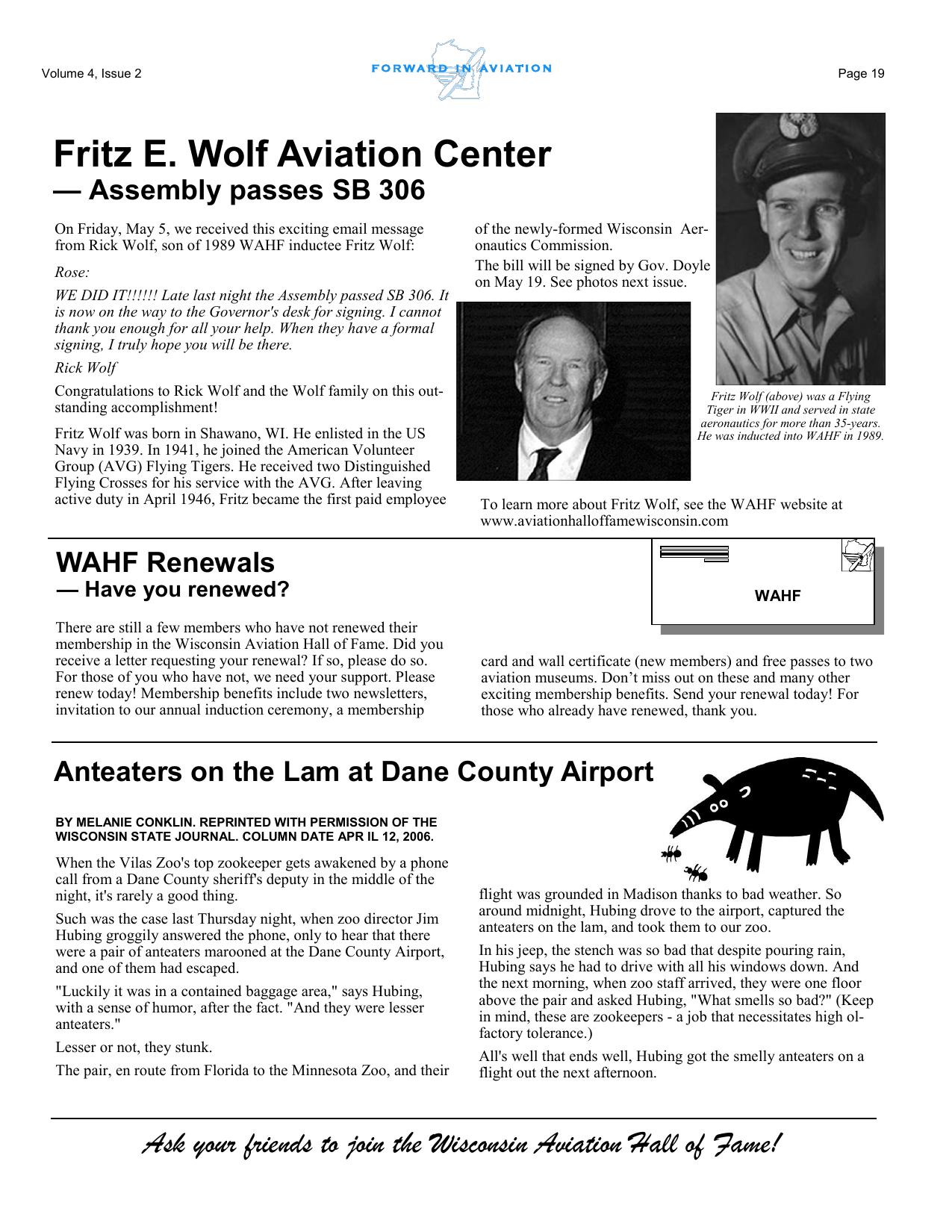
Volume 4, Issue 2 Page 19 Fritz E. Wolf Aviation Center — Assembly passes SB 306 On Friday, May 5, we received this exciting email message from Rick Wolf, son of 1989 WAHF inductee Fritz Wolf: Rose: WE DID IT!!!!!! Late last night the Assembly passed SB 306. It is now on the way to the Governor's desk for signing. I cannot thank you enough for all your help. When they have a formal signing, I truly hope you will be there. Rick Wolf Congratulations to Rick Wolf and the Wolf family on this outstanding accomplishment! Fritz Wolf was born in Shawano, WI. He enlisted in the US Navy in 1939. In 1941, he joined the American Volunteer Group (AVG) Flying Tigers. He received two Distinguished Flying Crosses for his service with the AVG. After leaving active duty in April 1946, Fritz became the first paid employee of the newly-formed Wisconsin Aeronautics Commission. The bill will be signed by Gov. Doyle on May 19. See photos next issue. Fritz Wolf (above) was a Flying Tiger in WWII and served in state aeronautics for more than 35-years. He was inducted into WAHF in 1989. To learn more about Fritz Wolf, see the WAHF website at www.aviationhalloffamewisconsin.com WAHF Renewals — Have you renewed? There are still a few members who have not renewed their membership in the Wisconsin Aviation Hall of Fame. Did you receive a letter requesting your renewal? If so, please do so. For those of you who have not, we need your support. Please renew today! Membership benefits include two newsletters, invitation to our annual induction ceremony, a membership WAHF card and wall certificate (new members) and free passes to two aviation museums. Don’t miss out on these and many other exciting membership benefits. Send your renewal today! For those who already have renewed, thank you. Anteaters on the Lam at Dane County Airport BY MELANIE CONKLIN. REPRINTED WITH PERMISSION OF THE WISCONSIN STATE JOURNAL. COLUMN DATE APR IL 12, 2006. When the Vilas Zoo's top zookeeper gets awakened by a phone call from a Dane County sheriff's deputy in the middle of the night, it's rarely a good thing. Such was the case last Thursday night, when zoo director Jim Hubing groggily answered the phone, only to hear that there were a pair of anteaters marooned at the Dane County Airport, and one of them had escaped. "Luckily it was in a contained baggage area," says Hubing, with a sense of humor, after the fact. "And they were lesser anteaters." Lesser or not, they stunk. The pair, en route from Florida to the Minnesota Zoo, and their flight was grounded in Madison thanks to bad weather. So around midnight, Hubing drove to the airport, captured the anteaters on the lam, and took them to our zoo. In his jeep, the stench was so bad that despite pouring rain, Hubing says he had to drive with all his windows down. And the next morning, when zoo staff arrived, they were one floor above the pair and asked Hubing, "What smells so bad?" (Keep in mind, these are zookeepers - a job that necessitates high olfactory tolerance.) All's well that ends well, Hubing got the smelly anteaters on a flight out the next afternoon. Ask your friends to join the Wisconsin Aviation Hall of Fame!
Return Service Requested Welcome new WAHF members: Joseph Komblevicz Charles Koranda Jesse & Laura Laster Steve & Lorna Mesner Barbara Follett Schweger Scott Brummond Ron Burdick Jim Retzlaff Stuart Durkee Grant Goetsch Dennis Brush Thanks for coming onboard. We look forward to seeing you at a WAHF event soon! The Wisconsin 99s will host a Flying Companion Seminar in the FAA building at EAA AirVenture, Saturday, July 29, 2006, from 2:30-3:45. The Wisconsin 99’s will also host a pancake breakfast at the Watertown Airport (KRYV) on Sunday, June 11. Pancake Breakfast Fly-in. Middleton Airport (C29) Sunday, July 9th, 7:30AM to 12:00 Noon. Rain or Shine. Pancakes, eggs, coffee, milk, juice. Adults $6, Kids 12 and under $3. Sponsored by EAA Morey Chapter #1389. The Wisconsin Rapids Children’s Miracle Network Balloon Rally will be held August 25-27, 2006 at the Wisconsin Rapids Airport. Plan to attend this colorful event—you’ll be helping hundreds of kids throughout Wisconsin. Visit this website for more information: www.cmnballoonrally.com Thank you to our newsletter advertisers: Morey Airplane Company, NewView Technologies, Pat O’Malley’s Jet Room, and Dr. Tom Voelker, AME. Thought for the day: Treat a man as if he were what he ought to be and you help him become what he is capable of being. ~Johann von Goethe ~ ~ ~ ~ ~ ~ ~ ~ Don’t miss the 2006 WAHF Induction Banquet — October 14 at the EAA Museum in Oshkosh! ~ ~ Wisconsin Aviation Hall of Fame Officers and Board of Directors Rose Dorcey, President Michael Goc, Vice President John Dorcey, Secretary/Treasurer Duane Esse Keith Glasshof David Greene Charles Swain LaFonda Kinnaman Staber “Bill” Reese Charles Marotske, Honorary Chairman of the Board Wisconsin Aviation Hall of Fame 8550 Greenway Blvd - Suite 413 Middleton WI 53562-4732 Become a supporter today! For information call Rose Dorcey at 715-421-0055 www.aviationhalloffamewisconsin.com flyer@aviationhalloffamewisconsin.com