Volume 4, Issue 1
🗞️ Download Issue (PDF)
Forward in Aviation - March 2006
March 2006 Photo courtesy of Dr. Steve Huggins Volume 4, Issue 1 Announcing our 2006 Inductees Robert Huggins Inside this issue… President’s Message Wausau Chili Fun Day Dean Crites Aviator danced in the skies General Nathan Twining As remembered by a Cadet WAHF On the Road EAA Chapter 93, Mauston Kiwanis... San Diego Aerospace Museum Warm winter visit Jeff Baum, Building an Empire Wisconsin Aviation Last U.S. Fighter Ace? Wisconsin native, Jeff Feinstein Recommended Reading Warbird Recovery WWII Glider Restoration in Wausau Syd Cohen can use your help 2 3 4 5 6 8 10 12 13 14 WAHF Mission Statement: To collect and preserve the history of aviation in Wisconsin, recognize those who made that history, inform others of it, and promote aviation education to future generations. For Forward in Aviation ideas or comments please contact: Rose Dorcey, Editor 8550 Greenway Blvd #413 Middleton WI 53562-4732 Phone: 715-421-0055 E-mail: roses7@charter.net Newsletter content written by editor unless otherwise indicated. The Wisconsin Aviation Hall of Fame is proud to announce our 2006 slate of inductees. Ralph and Robert Huggins, Elwyn West, Robert Skuldt, Robert Clarke, and Capt. Lance Sijan will be inducted at a ceremony to be held October 14 in Oshkosh. Ralph and Robert Huggins, two brothers who were born in Honey Creek, Wisc., (Waukesha County) began flying together in 1919. In 1930, Bob became a pilot and instructor for Waukesha Aviation Association, which became the Waukesha Flying Club. Ralph worked as a mechanic and pilot with Bob. He instructed many pilots, including Wisconsin aviation legends Dean and Dale Crites. Bob held EAA number 25. Elwyn West was born in Waupaca County in 1901. He took flight instruction at Diggins Flight School in Chicago in 1022. Eight hours and $400 later, West soloed. Bob Skuldt will be honored for his He returned to Central Wisconsin, purchased a surplus contributions to aviation in Wisconsin. OX-5 Canuck and barnstormed in Wisconsin and Michigan. He was manager of the first Appleton Airport. West moved to Ely, Minnesota and ran a flight service with six float planes serving resorts in what became the Boundary Waters Canoe Area until 1953. Capt. Lance Sijan was born in Milwaukee in 1942. He was a graduate of the United States Air Force Academy. He piloted an F4C Phantom and was assigned to the 366th Tactical Wing, Da Nang AFB, Vietnam. He flew 52 missions. On his 53rd mission in November of 1967, he was shot down. Sijan ejected from the plane, and evaded capture for six weeks in the jungle. Shortly after he was captured, he escaped, even while suffering from head injuries and a broken leg. He died in captivity in December, 1968. Sijan was posthumously awarded the Congressional Medal of Honor, the first Air Force Academy graduate so honored. Robert Skuldt grew up in Madison, Wisc. His aviation interest was sparked when he witnessed Charles Lindbergh landing in Madison in 1928. He received his private pilot certificate in 1940, and became a flight instructor by ’42. Skuldt taught U.S. Navy pilot trainees out of Morey Field in Middleton in the early ’40’s. In 1943, Skuldt received a direct commission as a 2nd Lieutenant in the US Army Air Corps. He flew 72 trips “over the hump”. Skuldt returned to Madison after the war and was one of the original officers in the WI Air National Guard. He retired from the Guard in 1971 as a colonel. Skuldt was the manager of the Madison airport for over 34 years, and he remains active in aviation and community affairs today. Robert Clarke has been a Designated Pilot Examiner 35-years. Clarke has accumulated over 13,000 hours of flight time in various aircraft, including the DC-3. He began flight training in 1948 in Washington and became a flight instructor in 1955. Clarke spent nearly 20-years as Chief Flight Instructor and Chairman of the Flight and A&P programs at Gateway Technical College in Kenosha, Wisc. Clarke was also a ground and flight instructor at Fox Valley Technical College in Oshkosh. Clarke has published several magazine articles, and has also worked as a corporate pilot and an A&P mechanic. Photo courtesy of Tom Thomas Clarke, Huggins Bro’s, Skuldt among slate
Page 2 March 2006 ~ by Rose Dorcey In this issue, I need to thank one more person…WAHF Member Rich Hartwig. Rich happened to be sitting in the wrong place at the wrong time (but Rich would say he was in the right place at the right time) when I went looking for someone to take photos of the inductee and scholarship presentations with my camera. Rich happens to own the same camera that I do, so he graciously volunteered to be the unofficial WAHF photographer. Many of the photos that you saw in the last issue were taken by WAHF Member Rich Hartwig knows how to Rich. Rich’s photography operate a Fuji FinePix camera skills are first-rate, and we owe him a big thank you for applying those skills on the night of the banquet. I ran into Rich again at the EAA Chapter 93 Christmas banquet where my husband, John, and I were invited to speak about Wisconsin’s aviation history. Rich is one of about a dozen WAHF members of this particular EAA Chapter, known as the EAA Corbin chapter from Blackhawk Field in Cottage Grove, Wisconsin. Read more about this event on page 6. ~ ~ ~ ~ ~ ~ In mid-December, John and I traveled, via Midwest Airlines, to San Diego, California. We visited the San Diego Aerospace Museum, Gillespie Field, the USS Midway, and we had a beer (or two) at the Kansas City BBQ (where the bar scene from Top Gun was filmed). We liked the USS Midway tour so much, that we had our photo taken in front of a large Christmas tree on the hangar deck and used it for our annual Christmas card photo. It was a great, five-day vacation, and good to get away from the Christmas hustle and bustle for a few days. With perennially mild weather, Southern California is a nice winter escape, and the aviation-inspired tours are more than worthwhile. Read more on page 8. The March 2006 issue of EAA’s Sport Aviation magazine recognized its members for flying ten or more Young Eagles during 2005. Several WAHF members were listed, and I want to congratulate each of you for this outstanding Rose Dorcey accomplishment: Robert Ward, William Wambach, Tom Thomas, Donald Ripp, Bill Rewey, Dan Pawlak, Larry Landucci, Len Knitter, Syd Cohen, Tom Chudy, John Chmiel and Diane Ballweg. Bill Wambach and Tom Thomas have flown several Young Eagle flights this winter. This photo was taken at Dane County Regional Airport on December 7th when they flew a group of home-schooled students. Tom is pictured with two of the kids, giving a happy thumbs up after their rides. Photo courtesy of Tom Thomas In the last issue of Forward...in Aviation I thanked the WAHF board members who worked so hard to make our 2005 banquet a success. Congratulations to all of our WAHF members for your continuing efforts in the EAA Young Eagles program. We’re proud to have you as member/supporters of the Wisconsin Aviation Hall of Fame. Just a reminder to all of our members to please promote the Wisconsin Aviation Hall of Fame. The WAHF Board of Directors recently set membership growth as a prime goal of 2006. Please encourage your friends to become members/supporters of the organization. Your support is vital to the success of our organization. FIA Newsletter Advertising — Place an ad, support WAHF Forward...in Aviation has a great advertising opportunity for you! Here’s a chance to reach potential new customers and a way to help an organization that is dedicated to sharing aviation news with its members and other readers. A business cardsize ad can be placed for as little as $45. To place your ad, call Rose at 715-421-0055. Email: rosesroses@charter.net.
Volume 4, Issue 1 Page 3 Wausau Downtown Airport Chili Fun Day —Chmiel knows chili John Chmiel, Wausau Flying Service, with chili. Over 150 friends came for food, fellowship, and fun. Things wrapped up early for the flyers in the crowd, due to impending rain. For those who made it, driving or flying, the event was quite enjoyable. Chmiel invites everyone to attend the event next year. It is held annually on the final weekend in January. Photos by Rose Dorcey John Chmiel knows something about the importance of customer service, or of treating friends, fliers, and customers right. For the last 12-years, Wausau Flying Service has hosted a Chili Fun Day Fly-in, and the event continues to be met with great enthusiasm by familiar and new faces alike. Not just one, but two kinds of chili are offered, and the friendly people you meet in Wausau make the trip all the more worthwhile. John sent along a brief report of this year’s event: Wausau Downtown Airport Chili Fun Day, January 28, 2006 -- The Chili Fun Day Fly-In has been taking place annually since 1994. Bob Mohr, airport tenant, Wausau Airport Committee member, aircraft owner, chili chef and fly-in organizer, was happy with the results. Bob does all the cooking using 35 pounds of ground chuck, 6 gallons of beans, 3 gallons of tomatoes, and other secret ingredients. This "Chili-by-Bob" recipe produces 40-50 gallons of chili. This year, Chili Fun-Day participants consumed over ninety per cent of the chili. We didn't have any snow this year for ski-planes. The TAF called for rain (in January!) beginning in the Wausau area after 1 p.m., so we planned on a dismal fly-in count. However, 18 airplanes flew in from around the state, including homebuilt RV's, a Lancair, classics like an L19 Bird Dog, a C-170, and the usual Pipers and Cessnas. (l-r) Grace & Bob Wylie, Judy & Lyman Hatz, John Dorcey, Dave Ladick, Mary Ladick and Charlie Stephenson were some of the WAHF members in Wausau. DR. TOM VOELKER Aviation Medical Examiner 2nd and 3rd Class Aviation Medicals 920-303-0709 Phone 877-303-0709 Toll Free 920-233-0336 Fax bruce@newviewtech.com 635A 20th Avenue Oshkosh, WI 54902 www.newviewtech.com Phone 715-423-0122 Doctor’s Clinic of Wisconsin Rapids, SC 420 Dewey Street Wisconsin Rapids WI 54494 Located at Riverview East Medical Office Bldg.
Page 4 March 2006 Aviator danced in the skies -Dean Crites' curiosity piloted unmatched era of innovations Waukesha - With the passing of Dean Crites comes an end to an age of barnstorming aviation innovators that is lost in today's world of commercial airliners, his family recalled Tuesday. In that era, Dean Crites, a child fascinated by aviation, tied linen cloth to his arms and plunged from a loft in his family's barn in an attempt to determine the best material for airplane wings. It also was an era in which Dean Crites and his twin brother, Dale, learned how to build aircraft from their friend Robert Huggins, and constructed them on grassy fields of their family farm in rural Walworth County. The "Flying Twins" flew the planes - and sometimes crashed in a maple tree or berry patch - from the 200-acre farm in Honey Creek and went on to barnstorm towns, instruct eager aviators and help Waukesha County get its first airport. "It's really a passing of an era of early aviation," Dean Crites' son, Gary, of Milwaukee, said Tuesday. Dale Crites died 14 years ago. Dean Crites died of pneumonia late Sunday at Waukesha Memorial Hospital. He was 98. Family members say the humble aerobat avoided promoting himself. Instead, he focused on bringing the world of aviation to all social classes, including small-town people whose first sight of a plane came courtesy of Dean Crites. He was not one to boast," granddaughter Rachel Crites, also of Milwaukee, said. "He and his brother worked to get up in the airplane and bring other people in the airplane with them." Loops and barrel rolls As teenagers, the Crites brothers farmed during the day and then built planes, ordering parts from Chicago and elsewhere, Rachel Crites said. In ensuing years they flew into towns to launch air shows with inside loops and barrel rolls. During their tours, they also taught aviation and offered plane rides, sometimes charging rates based on people's weight, family members said. Aviation enthusiasts say one of the greatest accomplishments of Dean and Dale Crites was helping create the county's first airport. The Crites brothers and other members of the Waukesha Aviation Club, which was formed in 1931, pushed the County Board in 1933 to spend $5,000 for an airport on 136 acres in Waukesha, most of it county-owned swamp. The airport was dedicated two years later at a celebration in which Dean Crites and others launched an air show that included a Goodyear blimp. It was viewed by 6,000 people. The county changed the name of the airport to Crites Field in honor of the twins in the early 1980s. Titled "Wisconsin Aviation Pioneers," a bronze bust of the twins, smiling with goggles atop their heads, stands in a small museum at the airport. There, the Crites brothers started Spring City Flying Service, a flight-training school and charter service. And Dean Crites was the first to send airmail from the county airport. Dean Crites became general manager of a Manitowoc airport, returning to Waukesha years later to work with his brother, who managed the Waukesha airport. Dean Crites appeared to always have his hands in aviation all the time, Gary Crites said. "I think he was really the happiest when he was flying," he said. As an instructor, Dean Crites used a loud voice to teach in an open cockpit, Gary Crites said. In 1941, Dean Crites was instructing a 22-year-old-student when a propeller broke, forcing the engine to rip from the plane 1,000 feet in the air. The student asked Dean Crites whether the engine's cover fell off. "'Hell no, we lost the whole engine,' " Gary Crites said, quoting his father. Dean Crites safely landed the plane. He later wrote that he accomplished the landing using a dive to pick up speed so he could control the plane. "I would hereby advise any student who found himself alone in an airplane in this situation, and if he had sufficient altitude, by all means bail out and not endeavor to land the plane," he wrote. The broken propeller, found by a nearby farmer, now sits in the Crites Field airport. Photo by Rose Dorcey By David Sheeley ©2006 Journal Sentinel Inc., reproduced with permission.
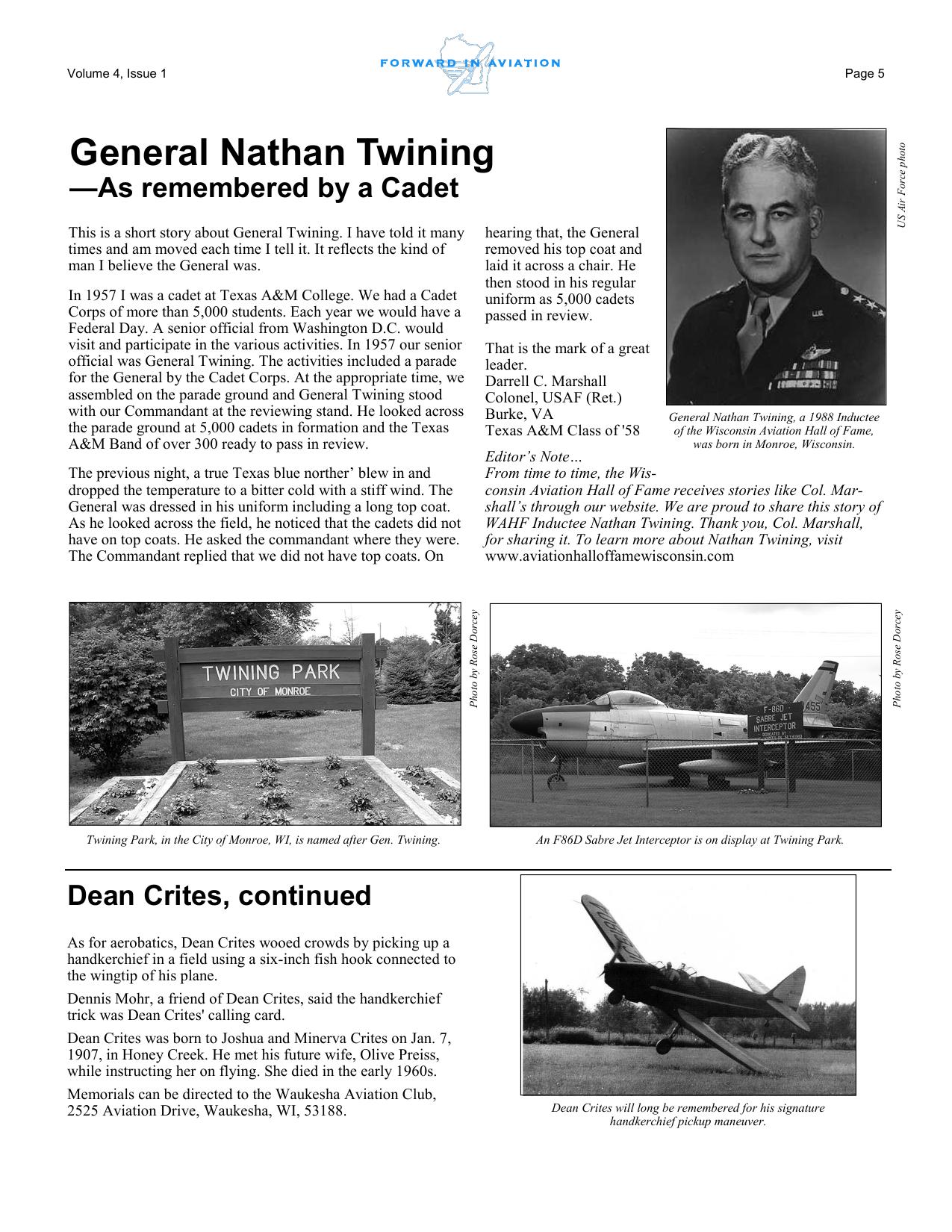
Volume 4, Issue 1 Page 5 US Air Force photo General Nathan Twining —As remembered by a Cadet This is a short story about General Twining. I have told it many times and am moved each time I tell it. It reflects the kind of man I believe the General was. hearing that, the General removed his top coat and laid it across a chair. He then stood in his regular uniform as 5,000 cadets passed in review. In 1957 I was a cadet at Texas A&M College. We had a Cadet Corps of more than 5,000 students. Each year we would have a Federal Day. A senior official from Washington D.C. would visit and participate in the various activities. In 1957 our senior official was General Twining. The activities included a parade for the General by the Cadet Corps. At the appropriate time, we assembled on the parade ground and General Twining stood with our Commandant at the reviewing stand. He looked across the parade ground at 5,000 cadets in formation and the Texas A&M Band of over 300 ready to pass in review. That is the mark of a great leader. Darrell C. Marshall Colonel, USAF (Ret.) Burke, VA Texas A&M Class of '58 General Nathan Twining, a 1988 Inductee of the Wisconsin Aviation Hall of Fame, was born in Monroe, Wisconsin. Photo by Rose Dorcey Twining Park, in the City of Monroe, WI, is named after Gen. Twining. Photo by Rose Dorcey Editor’s Note… From time to time, the Wisconsin Aviation Hall of Fame receives stories like Col. Marshall’s through our website. We are proud to share this story of WAHF Inductee Nathan Twining. Thank you, Col. Marshall, for sharing it. To learn more about Nathan Twining, visit www.aviationhalloffamewisconsin.com The previous night, a true Texas blue norther’ blew in and dropped the temperature to a bitter cold with a stiff wind. The General was dressed in his uniform including a long top coat. As he looked across the field, he noticed that the cadets did not have on top coats. He asked the commandant where they were. The Commandant replied that we did not have top coats. On An F86D Sabre Jet Interceptor is on display at Twining Park. Dean Crites, continued As for aerobatics, Dean Crites wooed crowds by picking up a handkerchief in a field using a six-inch fish hook connected to the wingtip of his plane. Dennis Mohr, a friend of Dean Crites, said the handkerchief trick was Dean Crites' calling card. Dean Crites was born to Joshua and Minerva Crites on Jan. 7, 1907, in Honey Creek. He met his future wife, Olive Preiss, while instructing her on flying. She died in the early 1960s. Memorials can be directed to the Waukesha Aviation Club, 2525 Aviation Drive, Waukesha, WI, 53188. Dean Crites will long be remembered for his signature handkerchief pickup maneuver.
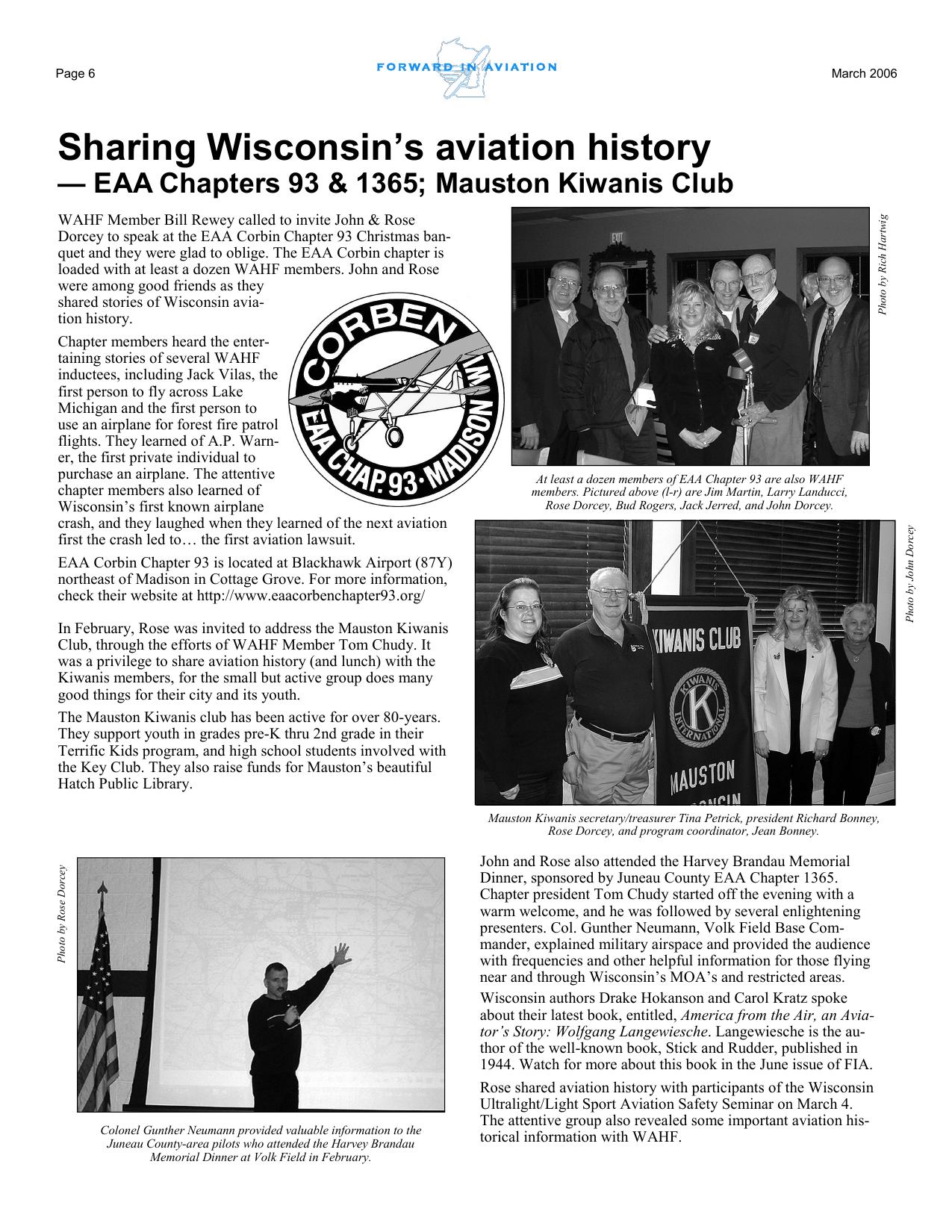
Page 6 March 2006 Sharing Wisconsin’s aviation history At least a dozen members of EAA Chapter 93 are also WAHF members. Pictured above (l-r) are Jim Martin, Larry Landucci, Rose Dorcey, Bud Rogers, Jack Jerred, and John Dorcey. Photo by John Dorcey WAHF Member Bill Rewey called to invite John & Rose Dorcey to speak at the EAA Corbin Chapter 93 Christmas banquet and they were glad to oblige. The EAA Corbin chapter is loaded with at least a dozen WAHF members. John and Rose were among good friends as they shared stories of Wisconsin aviation history. Chapter members heard the entertaining stories of several WAHF inductees, including Jack Vilas, the first person to fly across Lake Michigan and the first person to use an airplane for forest fire patrol flights. They learned of A.P. Warner, the first private individual to purchase an airplane. The attentive chapter members also learned of Wisconsin’s first known airplane crash, and they laughed when they learned of the next aviation first the crash led to… the first aviation lawsuit. EAA Corbin Chapter 93 is located at Blackhawk Airport (87Y) northeast of Madison in Cottage Grove. For more information, check their website at http://www.eaacorbenchapter93.org/ Photo by Rich Hartwig — EAA Chapters 93 & 1365; Mauston Kiwanis Club In February, Rose was invited to address the Mauston Kiwanis Club, through the efforts of WAHF Member Tom Chudy. It was a privilege to share aviation history (and lunch) with the Kiwanis members, for the small but active group does many good things for their city and its youth. The Mauston Kiwanis club has been active for over 80-years. They support youth in grades pre-K thru 2nd grade in their Terrific Kids program, and high school students involved with the Key Club. They also raise funds for Mauston’s beautiful Hatch Public Library. Photo by Rose Dorcey Mauston Kiwanis secretary/treasurer Tina Petrick, president Richard Bonney, Rose Dorcey, and program coordinator, Jean Bonney. Colonel Gunther Neumann provided valuable information to the Juneau County-area pilots who attended the Harvey Brandau Memorial Dinner at Volk Field in February. John and Rose also attended the Harvey Brandau Memorial Dinner, sponsored by Juneau County EAA Chapter 1365. Chapter president Tom Chudy started off the evening with a warm welcome, and he was followed by several enlightening presenters. Col. Gunther Neumann, Volk Field Base Commander, explained military airspace and provided the audience with frequencies and other helpful information for those flying near and through Wisconsin’s MOA’s and restricted areas. Wisconsin authors Drake Hokanson and Carol Kratz spoke about their latest book, entitled, America from the Air, an Aviator’s Story: Wolfgang Langewiesche. Langewiesche is the author of the well-known book, Stick and Rudder, published in 1944. Watch for more about this book in the June issue of FIA. Rose shared aviation history with participants of the Wisconsin Ultralight/Light Sport Aviation Safety Seminar on March 4. The attentive group also revealed some important aviation historical information with WAHF.
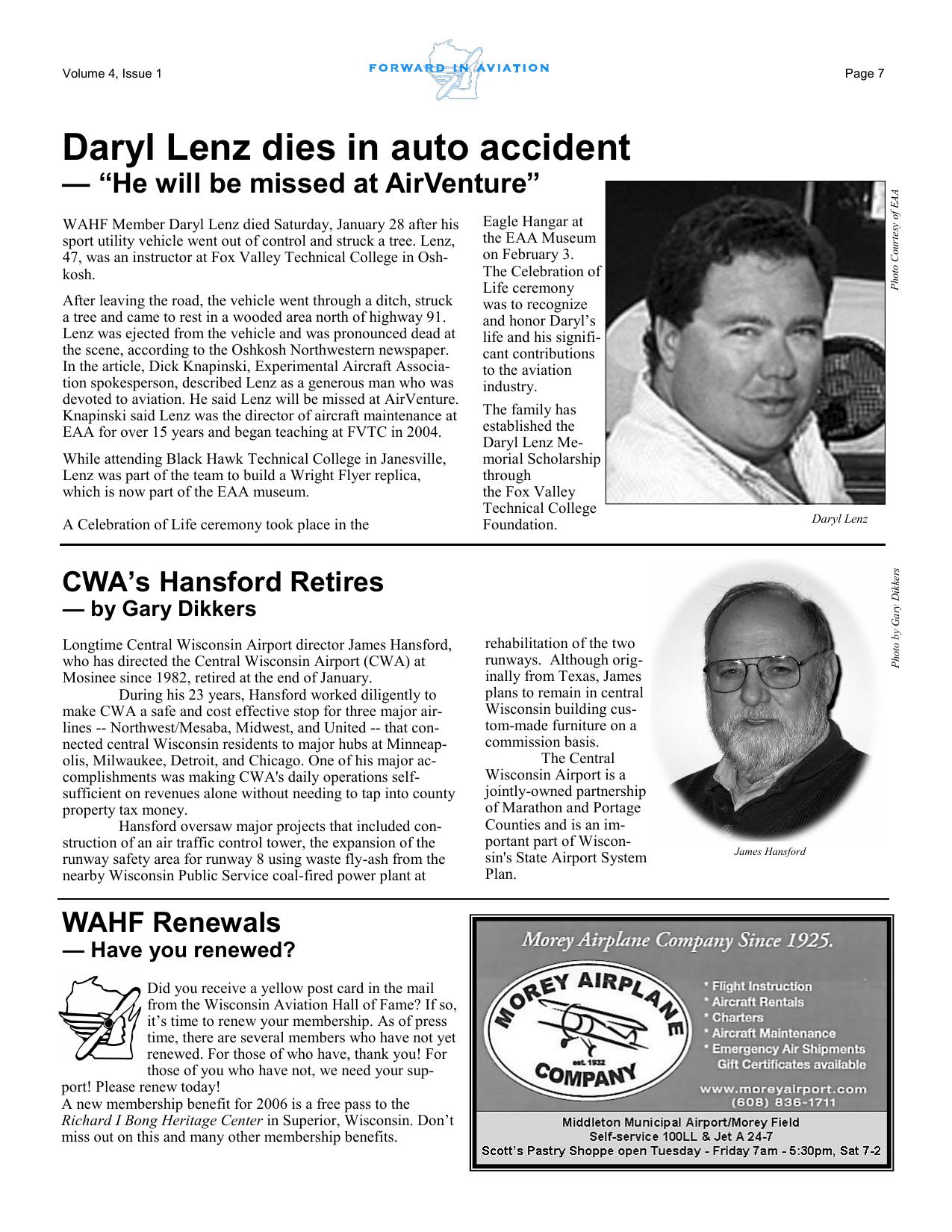
Volume 4, Issue 1 Page 7 Daryl Lenz dies in auto accident WAHF Member Daryl Lenz died Saturday, January 28 after his sport utility vehicle went out of control and struck a tree. Lenz, 47, was an instructor at Fox Valley Technical College in Oshkosh. After leaving the road, the vehicle went through a ditch, struck a tree and came to rest in a wooded area north of highway 91. Lenz was ejected from the vehicle and was pronounced dead at the scene, according to the Oshkosh Northwestern newspaper. In the article, Dick Knapinski, Experimental Aircraft Association spokesperson, described Lenz as a generous man who was devoted to aviation. He said Lenz will be missed at AirVenture. Knapinski said Lenz was the director of aircraft maintenance at EAA for over 15 years and began teaching at FVTC in 2004. While attending Black Hawk Technical College in Janesville, Lenz was part of the team to build a Wright Flyer replica, which is now part of the EAA museum. A Celebration of Life ceremony took place in the Photo Courtesy of EAA — “He will be missed at AirVenture” Eagle Hangar at the EAA Museum on February 3. The Celebration of Life ceremony was to recognize and honor Daryl’s life and his significant contributions to the aviation industry. The family has established the Daryl Lenz Memorial Scholarship through the Fox Valley Technical College Foundation. Daryl Lenz Photo by Gary Dikkers CWA’s Hansford Retires — by Gary Dikkers Longtime Central Wisconsin Airport director James Hansford, who has directed the Central Wisconsin Airport (CWA) at Mosinee since 1982, retired at the end of January. During his 23 years, Hansford worked diligently to make CWA a safe and cost effective stop for three major airlines -- Northwest/Mesaba, Midwest, and United -- that connected central Wisconsin residents to major hubs at Minneapolis, Milwaukee, Detroit, and Chicago. One of his major accomplishments was making CWA's daily operations selfsufficient on revenues alone without needing to tap into county property tax money. Hansford oversaw major projects that included construction of an air traffic control tower, the expansion of the runway safety area for runway 8 using waste fly-ash from the nearby Wisconsin Public Service coal-fired power plant at WAHF Renewals — Have you renewed? Did you receive a yellow post card in the mail from the Wisconsin Aviation Hall of Fame? If so, it’s time to renew your membership. As of press time, there are several members who have not yet renewed. For those of who have, thank you! For those of you who have not, we need your support! Please renew today! A new membership benefit for 2006 is a free pass to the Richard I Bong Heritage Center in Superior, Wisconsin. Don’t miss out on this and many other membership benefits. rehabilitation of the two runways. Although originally from Texas, James plans to remain in central Wisconsin building custom-made furniture on a commission basis. The Central Wisconsin Airport is a jointly-owned partnership of Marathon and Portage Counties and is an important part of Wisconsin's State Airport System Plan. James Hansford
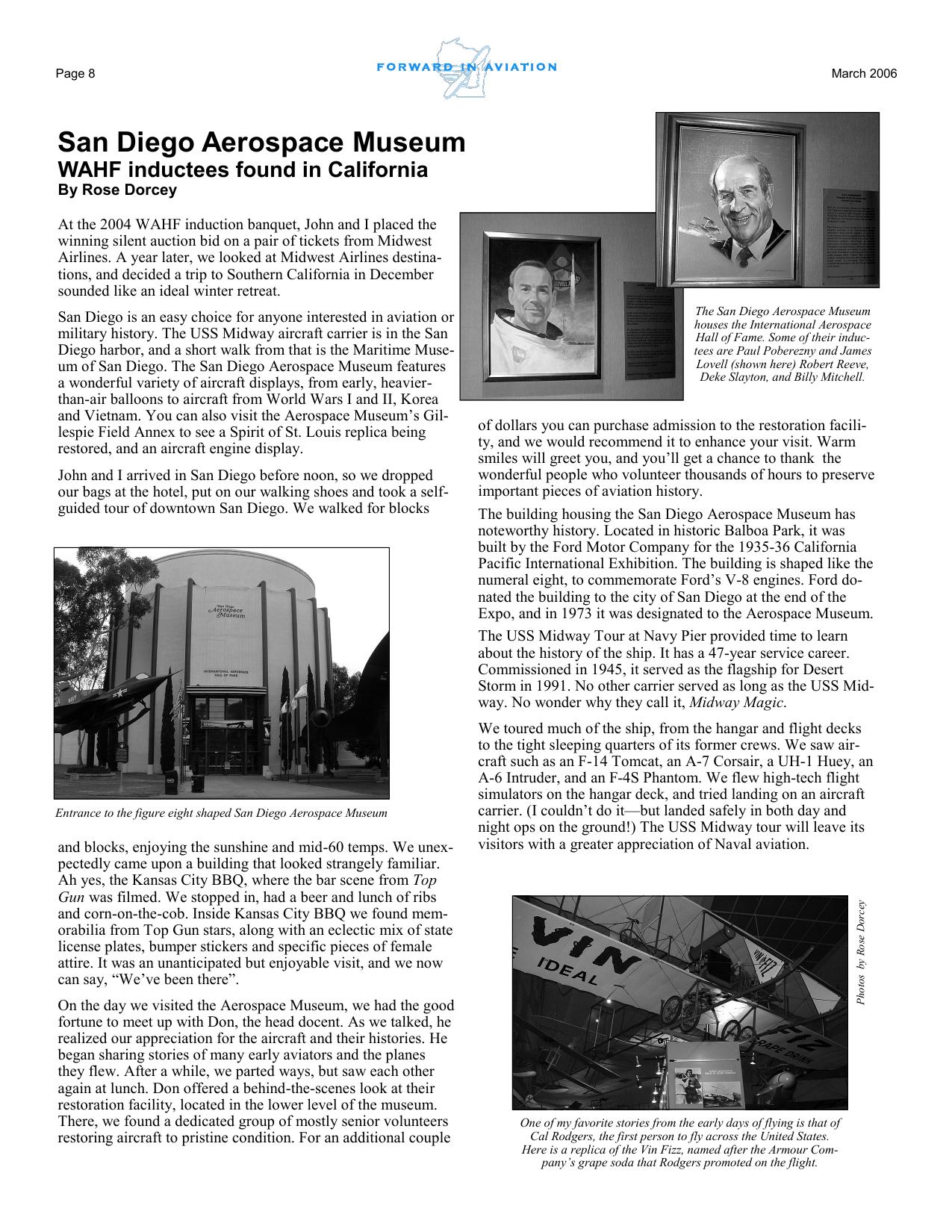
Page 8 March 2006 San Diego Aerospace Museum WAHF inductees found in California By Rose Dorcey At the 2004 WAHF induction banquet, John and I placed the winning silent auction bid on a pair of tickets from Midwest Airlines. A year later, we looked at Midwest Airlines destinations, and decided a trip to Southern California in December sounded like an ideal winter retreat. John and I arrived in San Diego before noon, so we dropped our bags at the hotel, put on our walking shoes and took a selfguided tour of downtown San Diego. We walked for blocks Entrance to the figure eight shaped San Diego Aerospace Museum and blocks, enjoying the sunshine and mid-60 temps. We unexpectedly came upon a building that looked strangely familiar. Ah yes, the Kansas City BBQ, where the bar scene from Top Gun was filmed. We stopped in, had a beer and lunch of ribs and corn-on-the-cob. Inside Kansas City BBQ we found memorabilia from Top Gun stars, along with an eclectic mix of state license plates, bumper stickers and specific pieces of female attire. It was an unanticipated but enjoyable visit, and we now can say, “We’ve been there”. On the day we visited the Aerospace Museum, we had the good fortune to meet up with Don, the head docent. As we talked, he realized our appreciation for the aircraft and their histories. He began sharing stories of many early aviators and the planes they flew. After a while, we parted ways, but saw each other again at lunch. Don offered a behind-the-scenes look at their restoration facility, located in the lower level of the museum. There, we found a dedicated group of mostly senior volunteers restoring aircraft to pristine condition. For an additional couple The San Diego Aerospace Museum houses the International Aerospace Hall of Fame. Some of their inductees are Paul Poberezny and James Lovell (shown here) Robert Reeve, Deke Slayton, and Billy Mitchell. of dollars you can purchase admission to the restoration facility, and we would recommend it to enhance your visit. Warm smiles will greet you, and you’ll get a chance to thank the wonderful people who volunteer thousands of hours to preserve important pieces of aviation history. The building housing the San Diego Aerospace Museum has noteworthy history. Located in historic Balboa Park, it was built by the Ford Motor Company for the 1935-36 California Pacific International Exhibition. The building is shaped like the numeral eight, to commemorate Ford’s V-8 engines. Ford donated the building to the city of San Diego at the end of the Expo, and in 1973 it was designated to the Aerospace Museum. The USS Midway Tour at Navy Pier provided time to learn about the history of the ship. It has a 47-year service career. Commissioned in 1945, it served as the flagship for Desert Storm in 1991. No other carrier served as long as the USS Midway. No wonder why they call it, Midway Magic. We toured much of the ship, from the hangar and flight decks to the tight sleeping quarters of its former crews. We saw aircraft such as an F-14 Tomcat, an A-7 Corsair, a UH-1 Huey, an A-6 Intruder, and an F-4S Phantom. We flew high-tech flight simulators on the hangar deck, and tried landing on an aircraft carrier. (I couldn’t do it—but landed safely in both day and night ops on the ground!) The USS Midway tour will leave its visitors with a greater appreciation of Naval aviation. Photos by Rose Dorcey San Diego is an easy choice for anyone interested in aviation or military history. The USS Midway aircraft carrier is in the San Diego harbor, and a short walk from that is the Maritime Museum of San Diego. The San Diego Aerospace Museum features a wonderful variety of aircraft displays, from early, heavierthan-air balloons to aircraft from World Wars I and II, Korea and Vietnam. You can also visit the Aerospace Museum’s Gillespie Field Annex to see a Spirit of St. Louis replica being restored, and an aircraft engine display. One of my favorite stories from the early days of flying is that of Cal Rodgers, the first person to fly across the United States. Here is a replica of the Vin Fizz, named after the Armour Company’s grape soda that Rodgers promoted on the flight.
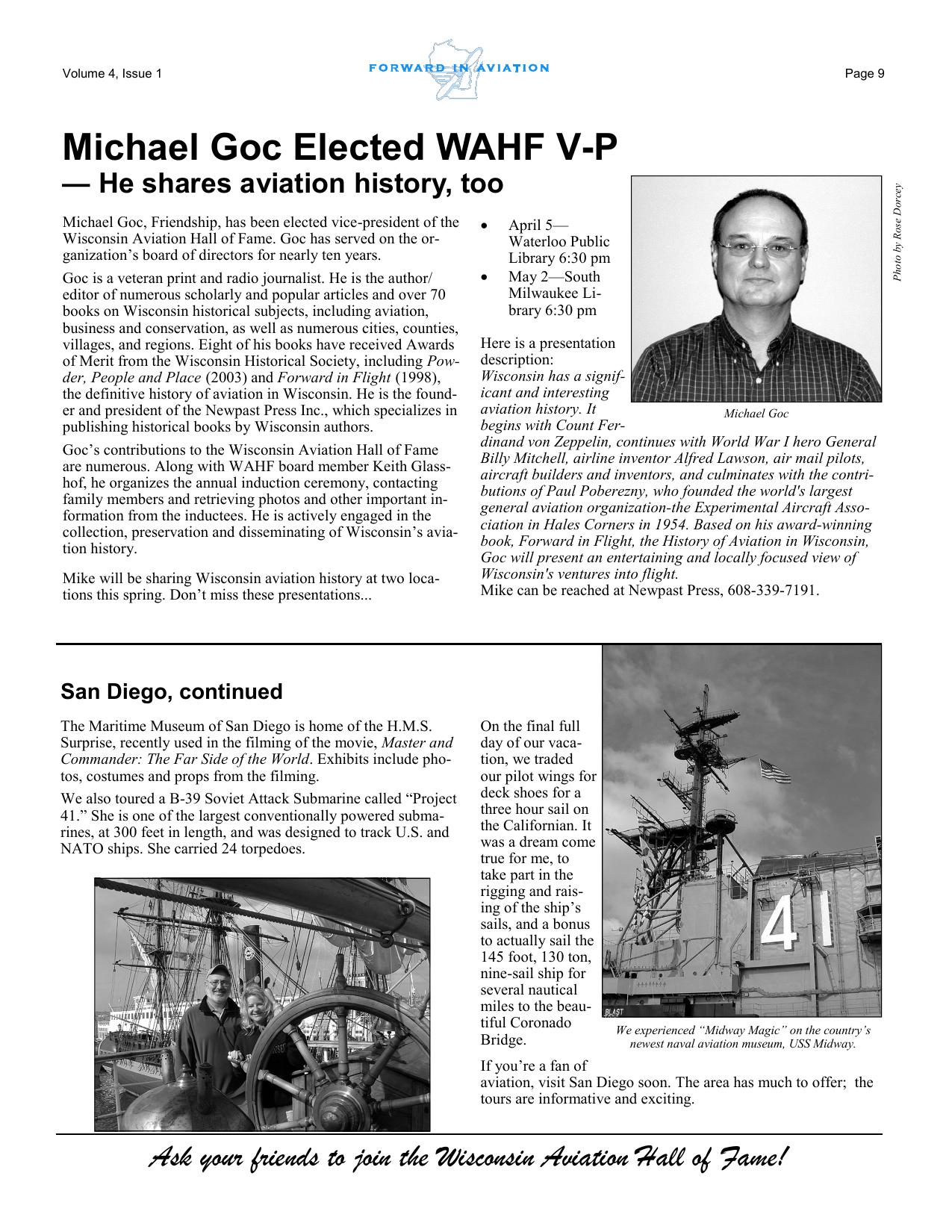
Volume 4, Issue 1 Page 9 Michael Goc Elected WAHF V-P Michael Goc, Friendship, has been elected vice-president of the Wisconsin Aviation Hall of Fame. Goc has served on the organization’s board of directors for nearly ten years. Goc is a veteran print and radio journalist. He is the author/ editor of numerous scholarly and popular articles and over 70 books on Wisconsin historical subjects, including aviation, business and conservation, as well as numerous cities, counties, villages, and regions. Eight of his books have received Awards of Merit from the Wisconsin Historical Society, including Powder, People and Place (2003) and Forward in Flight (1998), the definitive history of aviation in Wisconsin. He is the founder and president of the Newpast Press Inc., which specializes in publishing historical books by Wisconsin authors. Goc’s contributions to the Wisconsin Aviation Hall of Fame are numerous. Along with WAHF board member Keith Glasshof, he organizes the annual induction ceremony, contacting family members and retrieving photos and other important information from the inductees. He is actively engaged in the collection, preservation and disseminating of Wisconsin’s aviation history. Mike will be sharing Wisconsin aviation history at two locations this spring. Don’t miss these presentations... · · Photo by Rose Dorcey — He shares aviation history, too April 5— Waterloo Public Library 6:30 pm May 2—South Milwaukee Library 6:30 pm Here is a presentation description: Wisconsin has a significant and interesting aviation history. It Michael Goc begins with Count Ferdinand von Zeppelin, continues with World War I hero General Billy Mitchell, airline inventor Alfred Lawson, air mail pilots, aircraft builders and inventors, and culminates with the contributions of Paul Poberezny, who founded the world's largest general aviation organization-the Experimental Aircraft Association in Hales Corners in 1954. Based on his award-winning book, Forward in Flight, the History of Aviation in Wisconsin, Goc will present an entertaining and locally focused view of Wisconsin's ventures into flight. Mike can be reached at Newpast Press, 608-339-7191. San Diego, continued The Maritime Museum of San Diego is home of the H.M.S. Surprise, recently used in the filming of the movie, Master and Commander: The Far Side of the World. Exhibits include photos, costumes and props from the filming. We also toured a B-39 Soviet Attack Submarine called “Project 41.” She is one of the largest conventionally powered submarines, at 300 feet in length, and was designed to track U.S. and NATO ships. She carried 24 torpedoes. On the final full day of our vacation, we traded our pilot wings for deck shoes for a three hour sail on the Californian. It was a dream come true for me, to take part in the rigging and raising of the ship’s sails, and a bonus to actually sail the 145 foot, 130 ton, nine-sail ship for several nautical miles to the beautiful Coronado Bridge. We experienced “Midway Magic” on the country’s newest naval aviation museum, USS Midway. If you’re a fan of aviation, visit San Diego soon. The area has much to offer; the tours are informative and exciting. Ask your friends to join the Wisconsin Aviation Hall of Fame!
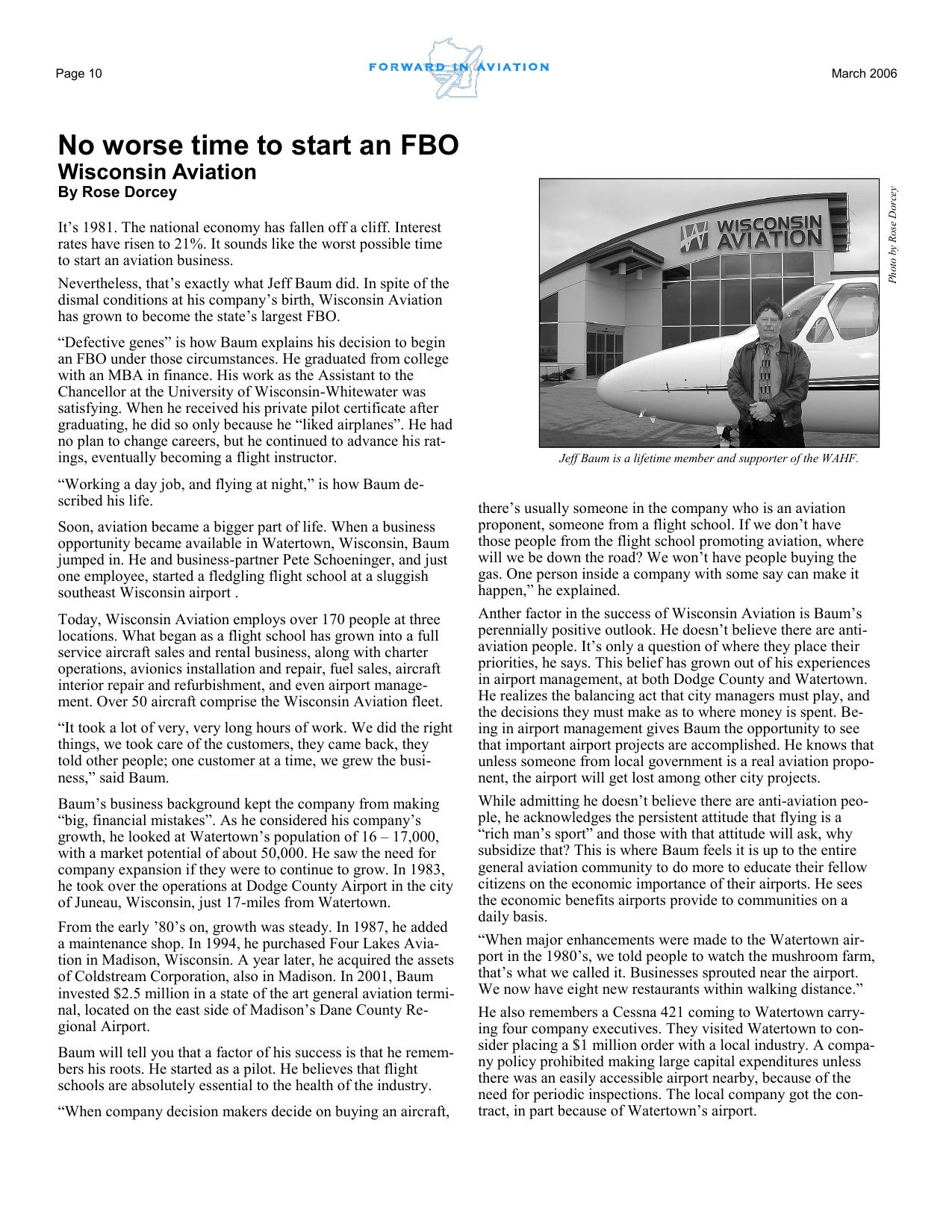
Page 10 March 2006 No worse time to start an FBO Wisconsin Aviation Photo by Rose Dorcey By Rose Dorcey It’s 1981. The national economy has fallen off a cliff. Interest rates have risen to 21%. It sounds like the worst possible time to start an aviation business. Nevertheless, that’s exactly what Jeff Baum did. In spite of the dismal conditions at his company’s birth, Wisconsin Aviation has grown to become the state’s largest FBO. “Defective genes” is how Baum explains his decision to begin an FBO under those circumstances. He graduated from college with an MBA in finance. His work as the Assistant to the Chancellor at the University of Wisconsin-Whitewater was satisfying. When he received his private pilot certificate after graduating, he did so only because he “liked airplanes”. He had no plan to change careers, but he continued to advance his ratings, eventually becoming a flight instructor. “Working a day job, and flying at night,” is how Baum described his life. Soon, aviation became a bigger part of life. When a business opportunity became available in Watertown, Wisconsin, Baum jumped in. He and business-partner Pete Schoeninger, and just one employee, started a fledgling flight school at a sluggish southeast Wisconsin airport . Today, Wisconsin Aviation employs over 170 people at three locations. What began as a flight school has grown into a full service aircraft sales and rental business, along with charter operations, avionics installation and repair, fuel sales, aircraft interior repair and refurbishment, and even airport management. Over 50 aircraft comprise the Wisconsin Aviation fleet. “It took a lot of very, very long hours of work. We did the right things, we took care of the customers, they came back, they told other people; one customer at a time, we grew the business,” said Baum. Baum’s business background kept the company from making “big, financial mistakes”. As he considered his company’s growth, he looked at Watertown’s population of 16 – 17,000, with a market potential of about 50,000. He saw the need for company expansion if they were to continue to grow. In 1983, he took over the operations at Dodge County Airport in the city of Juneau, Wisconsin, just 17-miles from Watertown. From the early ’80’s on, growth was steady. In 1987, he added a maintenance shop. In 1994, he purchased Four Lakes Aviation in Madison, Wisconsin. A year later, he acquired the assets of Coldstream Corporation, also in Madison. In 2001, Baum invested $2.5 million in a state of the art general aviation terminal, located on the east side of Madison’s Dane County Regional Airport. Baum will tell you that a factor of his success is that he remembers his roots. He started as a pilot. He believes that flight schools are absolutely essential to the health of the industry. “When company decision makers decide on buying an aircraft, Jeff Baum is a lifetime member and supporter of the WAHF. there’s usually someone in the company who is an aviation proponent, someone from a flight school. If we don’t have those people from the flight school promoting aviation, where will we be down the road? We won’t have people buying the gas. One person inside a company with some say can make it happen,” he explained. Anther factor in the success of Wisconsin Aviation is Baum’s perennially positive outlook. He doesn’t believe there are antiaviation people. It’s only a question of where they place their priorities, he says. This belief has grown out of his experiences in airport management, at both Dodge County and Watertown. He realizes the balancing act that city managers must play, and the decisions they must make as to where money is spent. Being in airport management gives Baum the opportunity to see that important airport projects are accomplished. He knows that unless someone from local government is a real aviation proponent, the airport will get lost among other city projects. While admitting he doesn’t believe there are anti-aviation people, he acknowledges the persistent attitude that flying is a “rich man’s sport” and those with that attitude will ask, why subsidize that? This is where Baum feels it is up to the entire general aviation community to do more to educate their fellow citizens on the economic importance of their airports. He sees the economic benefits airports provide to communities on a daily basis. “When major enhancements were made to the Watertown airport in the 1980’s, we told people to watch the mushroom farm, that’s what we called it. Businesses sprouted near the airport. We now have eight new restaurants within walking distance.” He also remembers a Cessna 421 coming to Watertown carrying four company executives. They visited Watertown to consider placing a $1 million order with a local industry. A company policy prohibited making large capital expenditures unless there was an easily accessible airport nearby, because of the need for periodic inspections. The local company got the contract, in part because of Watertown’s airport.
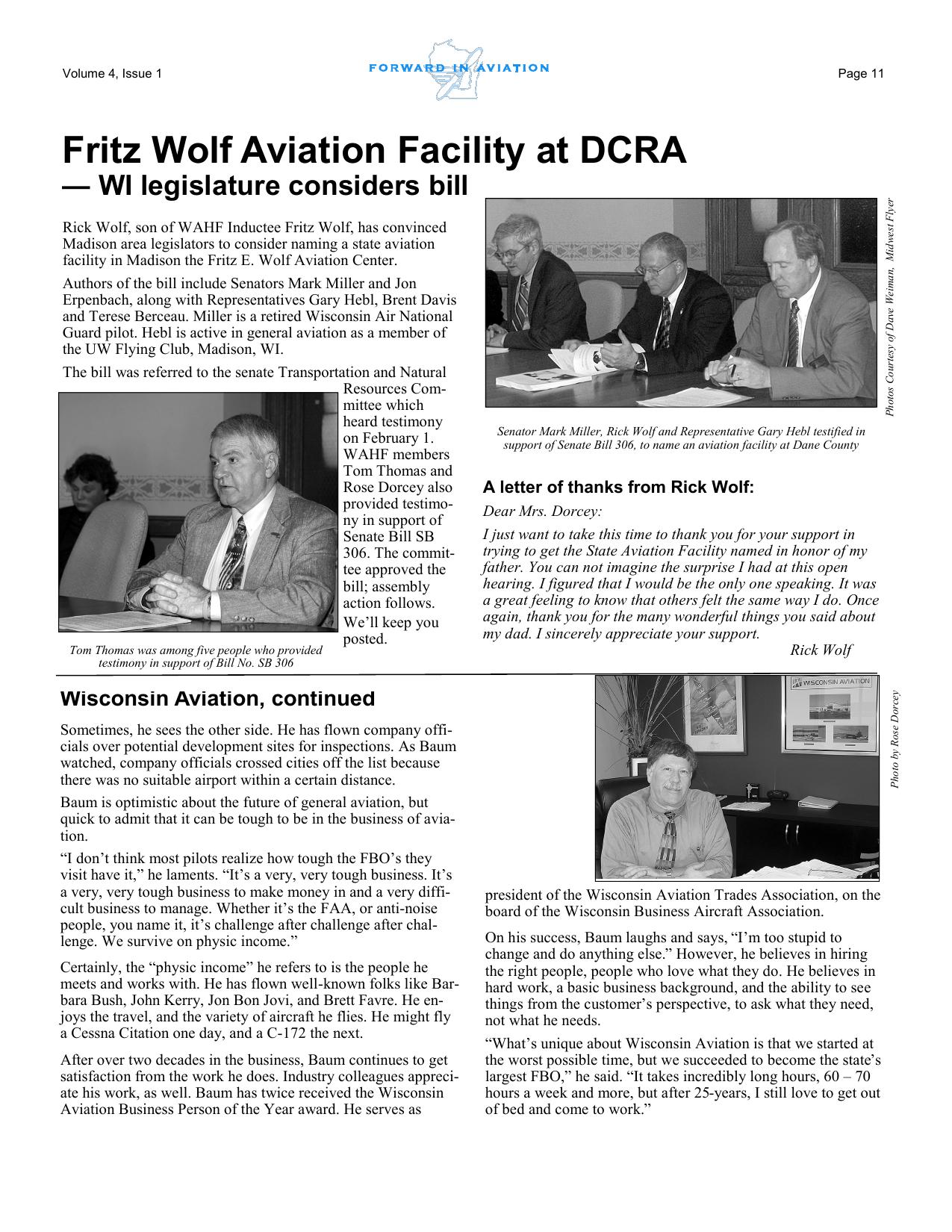
Volume 4, Issue 1 Page 11 Fritz Wolf Aviation Facility at DCRA Rick Wolf, son of WAHF Inductee Fritz Wolf, has convinced Madison area legislators to consider naming a state aviation facility in Madison the Fritz E. Wolf Aviation Center. Authors of the bill include Senators Mark Miller and Jon Erpenbach, along with Representatives Gary Hebl, Brent Davis and Terese Berceau. Miller is a retired Wisconsin Air National Guard pilot. Hebl is active in general aviation as a member of the UW Flying Club, Madison, WI. The bill was referred to the senate Transportation and Natural Resources Committee which heard testimony on February 1. WAHF members Tom Thomas and Rose Dorcey also provided testimony in support of Senate Bill SB 306. The committee approved the bill; assembly action follows. We’ll keep you posted. Tom Thomas was among five people who provided testimony in support of Bill No. SB 306 Photos Courtesy of Dave Weiman, Midwest Flyer — WI legislature considers bill Senator Mark Miller, Rick Wolf and Representative Gary Hebl testified in support of Senate Bill 306, to name an aviation facility at Dane County A letter of thanks from Rick Wolf: Dear Mrs. Dorcey: I just want to take this time to thank you for your support in trying to get the State Aviation Facility named in honor of my father. You can not imagine the surprise I had at this open hearing. I figured that I would be the only one speaking. It was a great feeling to know that others felt the same way I do. Once again, thank you for the many wonderful things you said about my dad. I sincerely appreciate your support. Rick Wolf Sometimes, he sees the other side. He has flown company officials over potential development sites for inspections. As Baum watched, company officials crossed cities off the list because there was no suitable airport within a certain distance. Baum is optimistic about the future of general aviation, but quick to admit that it can be tough to be in the business of aviation. “I don’t think most pilots realize how tough the FBO’s they visit have it,” he laments. “It’s a very, very tough business. It’s a very, very tough business to make money in and a very difficult business to manage. Whether it’s the FAA, or anti-noise people, you name it, it’s challenge after challenge after challenge. We survive on physic income.” Certainly, the “physic income” he refers to is the people he meets and works with. He has flown well-known folks like Barbara Bush, John Kerry, Jon Bon Jovi, and Brett Favre. He enjoys the travel, and the variety of aircraft he flies. He might fly a Cessna Citation one day, and a C-172 the next. After over two decades in the business, Baum continues to get satisfaction from the work he does. Industry colleagues appreciate his work, as well. Baum has twice received the Wisconsin Aviation Business Person of the Year award. He serves as Photo by Rose Dorcey Wisconsin Aviation, continued president of the Wisconsin Aviation Trades Association, on the board of the Wisconsin Business Aircraft Association. On his success, Baum laughs and says, “I’m too stupid to change and do anything else.” However, he believes in hiring the right people, people who love what they do. He believes in hard work, a basic business background, and the ability to see things from the customer’s perspective, to ask what they need, not what he needs. “What’s unique about Wisconsin Aviation is that we started at the worst possible time, but we succeeded to become the state’s largest FBO,” he said. “It takes incredibly long hours, 60 – 70 hours a week and more, but after 25-years, I still love to get out of bed and come to work.”
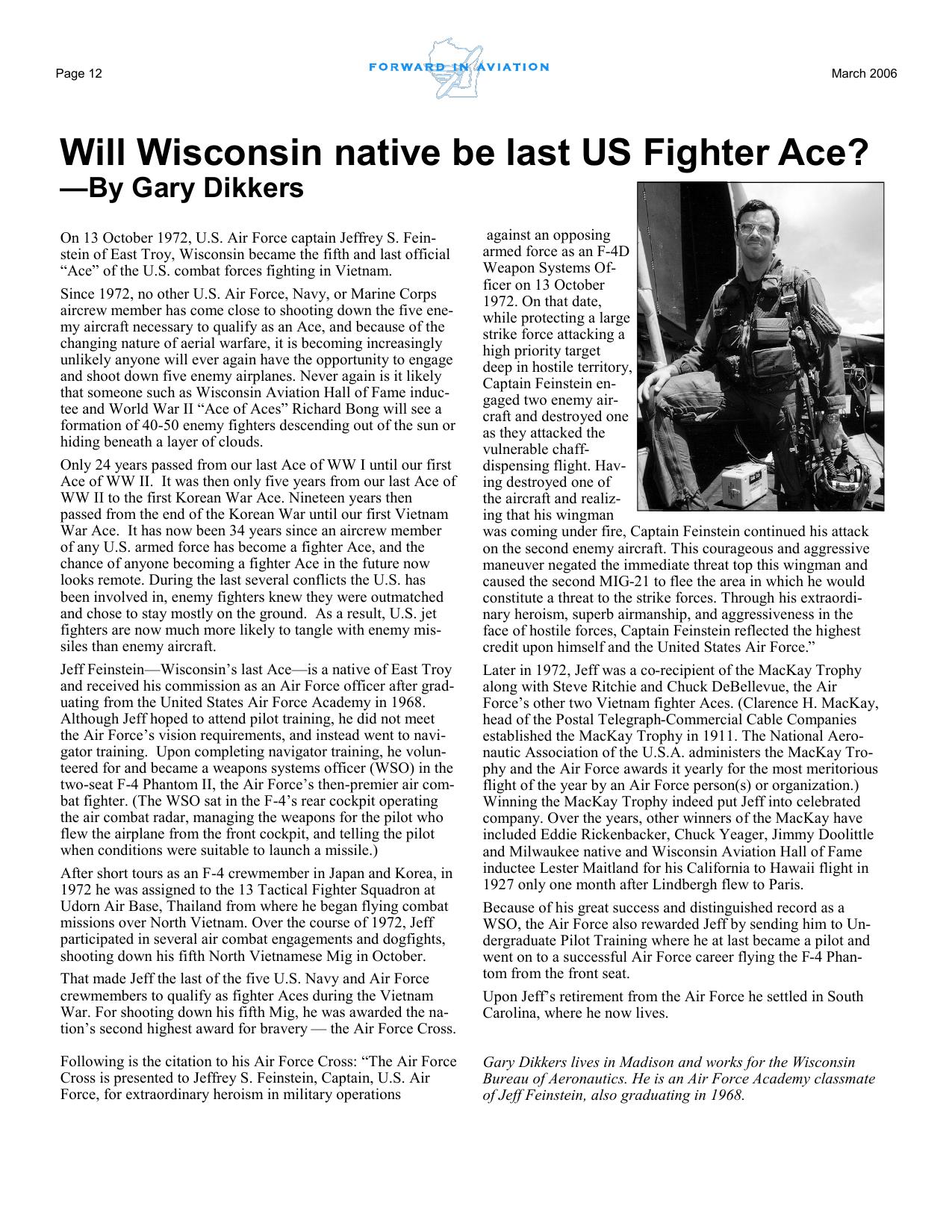
Page 12 March 2006 Will Wisconsin native be last US Fighter Ace? —By Gary Dikkers On 13 October 1972, U.S. Air Force captain Jeffrey S. Feinstein of East Troy, Wisconsin became the fifth and last official “Ace” of the U.S. combat forces fighting in Vietnam. Since 1972, no other U.S. Air Force, Navy, or Marine Corps aircrew member has come close to shooting down the five enemy aircraft necessary to qualify as an Ace, and because of the changing nature of aerial warfare, it is becoming increasingly unlikely anyone will ever again have the opportunity to engage and shoot down five enemy airplanes. Never again is it likely that someone such as Wisconsin Aviation Hall of Fame inductee and World War II “Ace of Aces” Richard Bong will see a formation of 40-50 enemy fighters descending out of the sun or hiding beneath a layer of clouds. Only 24 years passed from our last Ace of WW I until our first Ace of WW II. It was then only five years from our last Ace of WW II to the first Korean War Ace. Nineteen years then passed from the end of the Korean War until our first Vietnam War Ace. It has now been 34 years since an aircrew member of any U.S. armed force has become a fighter Ace, and the chance of anyone becoming a fighter Ace in the future now looks remote. During the last several conflicts the U.S. has been involved in, enemy fighters knew they were outmatched and chose to stay mostly on the ground. As a result, U.S. jet fighters are now much more likely to tangle with enemy missiles than enemy aircraft. Jeff Feinstein—Wisconsin’s last Ace—is a native of East Troy and received his commission as an Air Force officer after graduating from the United States Air Force Academy in 1968. Although Jeff hoped to attend pilot training, he did not meet the Air Force’s vision requirements, and instead went to navigator training. Upon completing navigator training, he volunteered for and became a weapons systems officer (WSO) in the two-seat F-4 Phantom II, the Air Force’s then-premier air combat fighter. (The WSO sat in the F-4’s rear cockpit operating the air combat radar, managing the weapons for the pilot who flew the airplane from the front cockpit, and telling the pilot when conditions were suitable to launch a missile.) After short tours as an F-4 crewmember in Japan and Korea, in 1972 he was assigned to the 13 Tactical Fighter Squadron at Udorn Air Base, Thailand from where he began flying combat missions over North Vietnam. Over the course of 1972, Jeff participated in several air combat engagements and dogfights, shooting down his fifth North Vietnamese Mig in October. That made Jeff the last of the five U.S. Navy and Air Force crewmembers to qualify as fighter Aces during the Vietnam War. For shooting down his fifth Mig, he was awarded the nation’s second highest award for bravery — the Air Force Cross. against an opposing armed force as an F-4D Weapon Systems Officer on 13 October 1972. On that date, while protecting a large strike force attacking a high priority target deep in hostile territory, Captain Feinstein engaged two enemy aircraft and destroyed one as they attacked the vulnerable chaffdispensing flight. Having destroyed one of the aircraft and realizing that his wingman was coming under fire, Captain Feinstein continued his attack on the second enemy aircraft. This courageous and aggressive maneuver negated the immediate threat top this wingman and caused the second MIG-21 to flee the area in which he would constitute a threat to the strike forces. Through his extraordinary heroism, superb airmanship, and aggressiveness in the face of hostile forces, Captain Feinstein reflected the highest credit upon himself and the United States Air Force.” Later in 1972, Jeff was a co-recipient of the MacKay Trophy along with Steve Ritchie and Chuck DeBellevue, the Air Force’s other two Vietnam fighter Aces. (Clarence H. MacKay, head of the Postal Telegraph-Commercial Cable Companies established the MacKay Trophy in 1911. The National Aeronautic Association of the U.S.A. administers the MacKay Trophy and the Air Force awards it yearly for the most meritorious flight of the year by an Air Force person(s) or organization.) Winning the MacKay Trophy indeed put Jeff into celebrated company. Over the years, other winners of the MacKay have included Eddie Rickenbacker, Chuck Yeager, Jimmy Doolittle and Milwaukee native and Wisconsin Aviation Hall of Fame inductee Lester Maitland for his California to Hawaii flight in 1927 only one month after Lindbergh flew to Paris. Because of his great success and distinguished record as a WSO, the Air Force also rewarded Jeff by sending him to Undergraduate Pilot Training where he at last became a pilot and went on to a successful Air Force career flying the F-4 Phantom from the front seat. Upon Jeff’s retirement from the Air Force he settled in South Carolina, where he now lives. Following is the citation to his Air Force Cross: “The Air Force Cross is presented to Jeffrey S. Feinstein, Captain, U.S. Air Force, for extraordinary heroism in military operations Gary Dikkers lives in Madison and works for the Wisconsin Bureau of Aeronautics. He is an Air Force Academy classmate of Jeff Feinstein, also graduating in 1968.
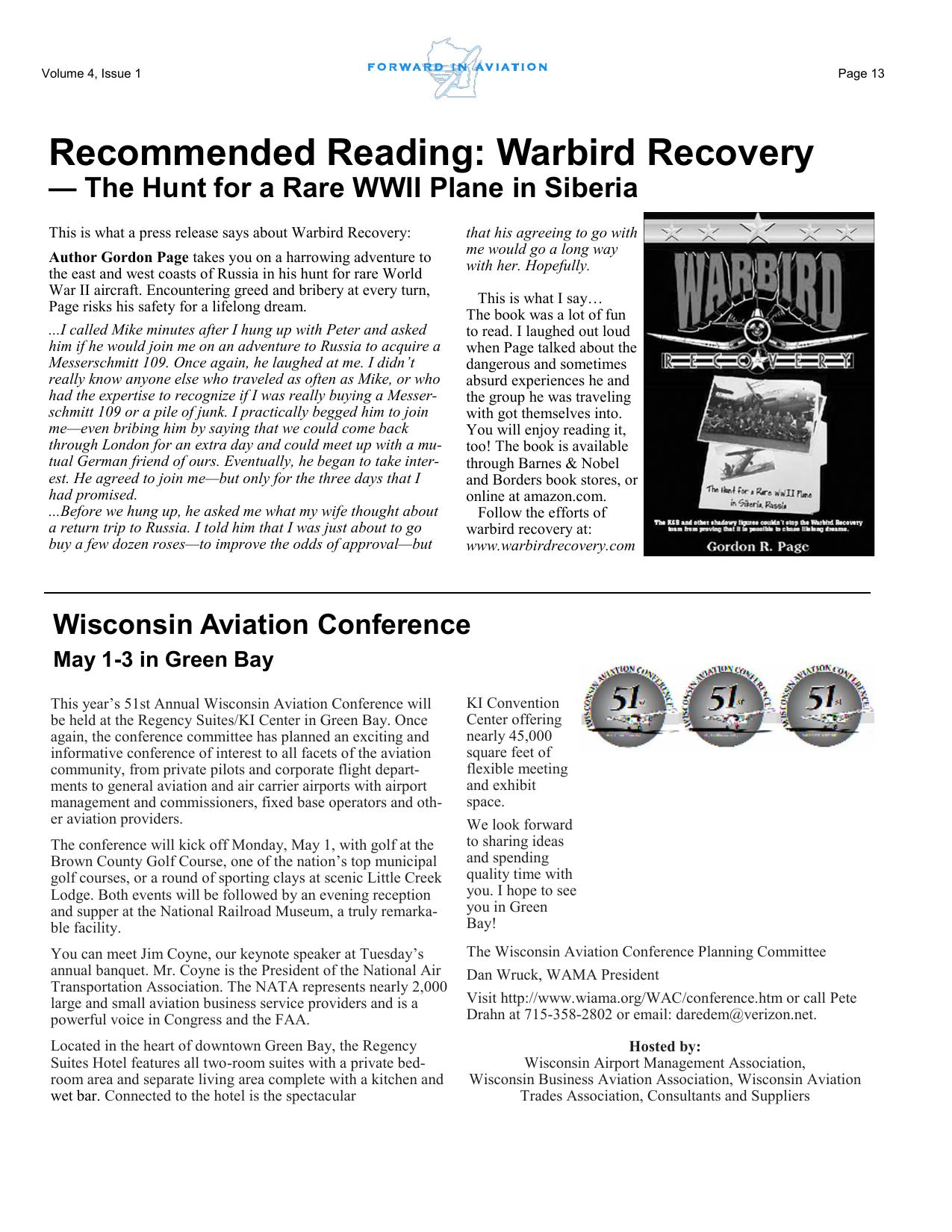
Volume 4, Issue 1 Page 13 Recommended Reading: Warbird Recovery — The Hunt for a Rare WWII Plane in Siberia This is what a press release says about Warbird Recovery: Author Gordon Page takes you on a harrowing adventure to the east and west coasts of Russia in his hunt for rare World War II aircraft. Encountering greed and bribery at every turn, Page risks his safety for a lifelong dream. ...I called Mike minutes after I hung up with Peter and asked him if he would join me on an adventure to Russia to acquire a Messerschmitt 109. Once again, he laughed at me. I didn’t really know anyone else who traveled as often as Mike, or who had the expertise to recognize if I was really buying a Messerschmitt 109 or a pile of junk. I practically begged him to join me—even bribing him by saying that we could come back through London for an extra day and could meet up with a mutual German friend of ours. Eventually, he began to take interest. He agreed to join me—but only for the three days that I had promised. ...Before we hung up, he asked me what my wife thought about a return trip to Russia. I told him that I was just about to go buy a few dozen roses—to improve the odds of approval—but that his agreeing to go with me would go a long way with her. Hopefully. This is what I say… The book was a lot of fun to read. I laughed out loud when Page talked about the dangerous and sometimes absurd experiences he and the group he was traveling with got themselves into. You will enjoy reading it, too! The book is available through Barnes & Nobel and Borders book stores, or online at amazon.com. Follow the efforts of warbird recovery at: www.warbirdrecovery.com Wisconsin Aviation Conference May 1-3 in Green Bay The conference will kick off Monday, May 1, with golf at the Brown County Golf Course, one of the nation’s top municipal golf courses, or a round of sporting clays at scenic Little Creek Lodge. Both events will be followed by an evening reception and supper at the National Railroad Museum, a truly remarkable facility. KI Convention Center offering nearly 45,000 square feet of flexible meeting and exhibit space. We look forward to sharing ideas and spending quality time with you. I hope to see you in Green Bay! You can meet Jim Coyne, our keynote speaker at Tuesday’s annual banquet. Mr. Coyne is the President of the National Air Transportation Association. The NATA represents nearly 2,000 large and small aviation business service providers and is a powerful voice in Congress and the FAA. The Wisconsin Aviation Conference Planning Committee Dan Wruck, WAMA President Visit http://www.wiama.org/WAC/conference.htm or call Pete Drahn at 715-358-2802 or email: daredem@verizon.net. Located in the heart of downtown Green Bay, the Regency Suites Hotel features all two-room suites with a private bedroom area and separate living area complete with a kitchen and wet bar. Connected to the hotel is the spectacular Hosted by: Wisconsin Airport Management Association, Wisconsin Business Aviation Association, Wisconsin Aviation Trades Association, Consultants and Suppliers This year’s 51st Annual Wisconsin Aviation Conference will be held at the Regency Suites/KI Center in Green Bay. Once again, the conference committee has planned an exciting and informative conference of interest to all facets of the aviation community, from private pilots and corporate flight departments to general aviation and air carrier airports with airport management and commissioners, fixed base operators and other aviation providers.
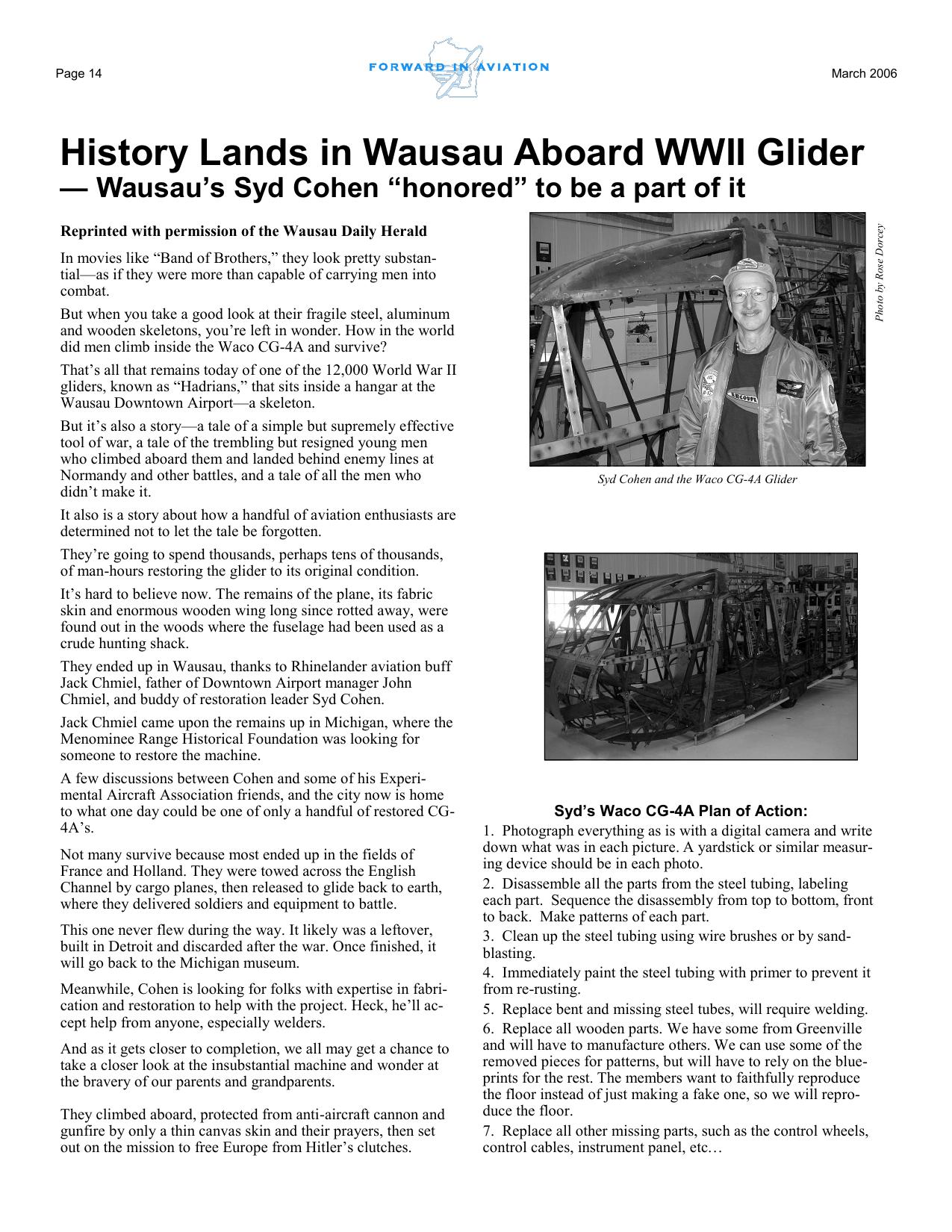
Page 14 March 2006 History Lands in Wausau Aboard WWII Glider — Wausau’s Syd Cohen “honored” to be a part of it In movies like “Band of Brothers,” they look pretty substantial—as if they were more than capable of carrying men into combat. But when you take a good look at their fragile steel, aluminum and wooden skeletons, you’re left in wonder. How in the world did men climb inside the Waco CG-4A and survive? That’s all that remains today of one of the 12,000 World War II gliders, known as “Hadrians,” that sits inside a hangar at the Wausau Downtown Airport—a skeleton. But it’s also a story—a tale of a simple but supremely effective tool of war, a tale of the trembling but resigned young men who climbed aboard them and landed behind enemy lines at Normandy and other battles, and a tale of all the men who didn’t make it. It also is a story about how a handful of aviation enthusiasts are determined not to let the tale be forgotten. They’re going to spend thousands, perhaps tens of thousands, of man-hours restoring the glider to its original condition. It’s hard to believe now. The remains of the plane, its fabric skin and enormous wooden wing long since rotted away, were found out in the woods where the fuselage had been used as a crude hunting shack. They ended up in Wausau, thanks to Rhinelander aviation buff Jack Chmiel, father of Downtown Airport manager John Chmiel, and buddy of restoration leader Syd Cohen. Jack Chmiel came upon the remains up in Michigan, where the Menominee Range Historical Foundation was looking for someone to restore the machine. A few discussions between Cohen and some of his Experimental Aircraft Association friends, and the city now is home to what one day could be one of only a handful of restored CG4A’s. Not many survive because most ended up in the fields of France and Holland. They were towed across the English Channel by cargo planes, then released to glide back to earth, where they delivered soldiers and equipment to battle. This one never flew during the way. It likely was a leftover, built in Detroit and discarded after the war. Once finished, it will go back to the Michigan museum. Meanwhile, Cohen is looking for folks with expertise in fabrication and restoration to help with the project. Heck, he’ll accept help from anyone, especially welders. And as it gets closer to completion, we all may get a chance to take a closer look at the insubstantial machine and wonder at the bravery of our parents and grandparents. They climbed aboard, protected from anti-aircraft cannon and gunfire by only a thin canvas skin and their prayers, then set out on the mission to free Europe from Hitler’s clutches. Photo by Rose Dorcey Reprinted with permission of the Wausau Daily Herald Syd Cohen and the Waco CG-4A Glider Syd’s Waco CG-4A Plan of Action: 1. Photograph everything as is with a digital camera and write down what was in each picture. A yardstick or similar measuring device should be in each photo. 2. Disassemble all the parts from the steel tubing, labeling each part. Sequence the disassembly from top to bottom, front to back. Make patterns of each part. 3. Clean up the steel tubing using wire brushes or by sandblasting. 4. Immediately paint the steel tubing with primer to prevent it from re-rusting. 5. Replace bent and missing steel tubes, will require welding. 6. Replace all wooden parts. We have some from Greenville and will have to manufacture others. We can use some of the removed pieces for patterns, but will have to rely on the blueprints for the rest. The members want to faithfully reproduce the floor instead of just making a fake one, so we will reproduce the floor. 7. Replace all other missing parts, such as the control wheels, control cables, instrument panel, etc…
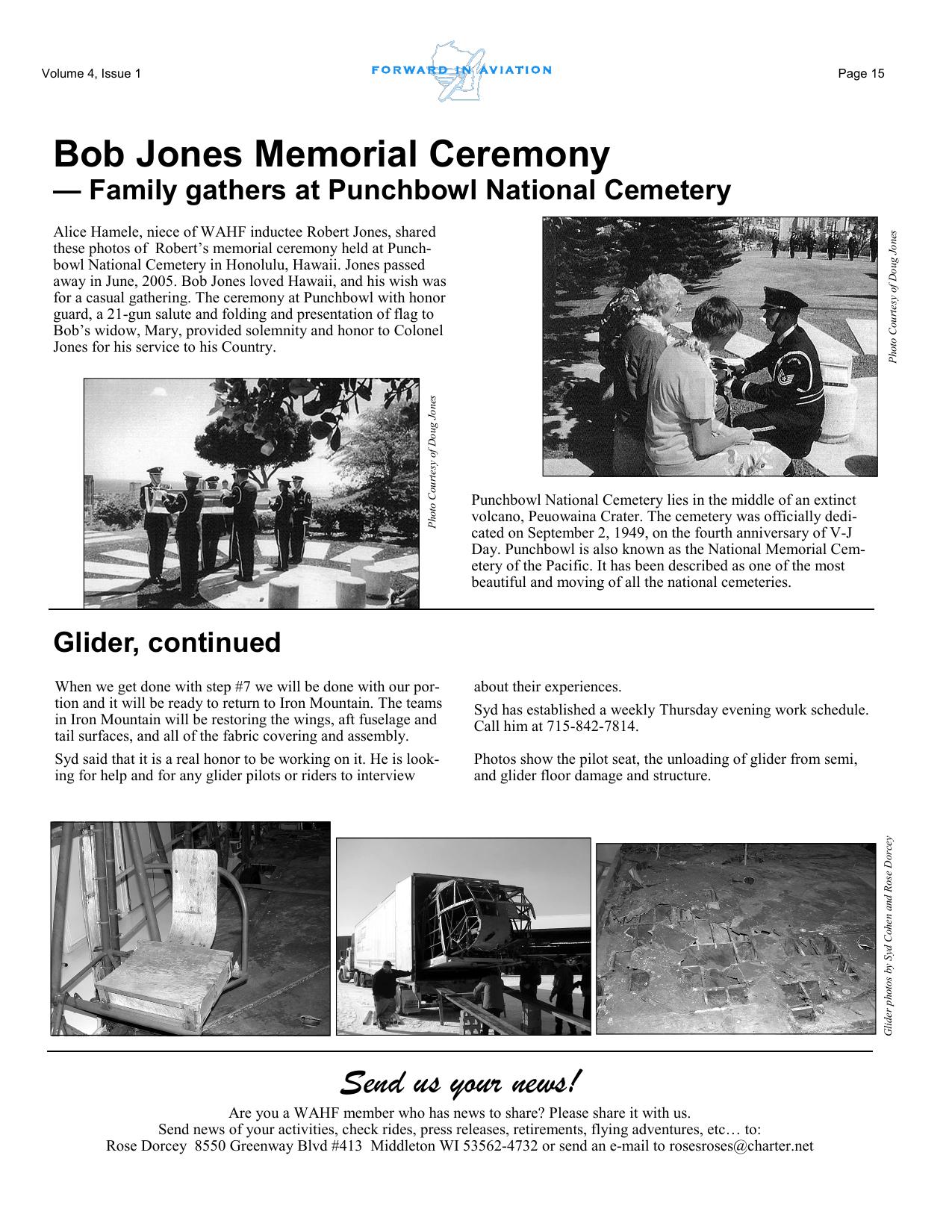
Volume 4, Issue 1 Page 15 Bob Jones Memorial Ceremony — Family gathers at Punchbowl National Cemetery Photo Courtesy of Doug Jones Photo Courtesy of Doug Jones Alice Hamele, niece of WAHF inductee Robert Jones, shared these photos of Robert’s memorial ceremony held at Punchbowl National Cemetery in Honolulu, Hawaii. Jones passed away in June, 2005. Bob Jones loved Hawaii, and his wish was for a casual gathering. The ceremony at Punchbowl with honor guard, a 21-gun salute and folding and presentation of flag to Bob’s widow, Mary, provided solemnity and honor to Colonel Jones for his service to his Country. Punchbowl National Cemetery lies in the middle of an extinct volcano, Peuowaina Crater. The cemetery was officially dedicated on September 2, 1949, on the fourth anniversary of V-J Day. Punchbowl is also known as the National Memorial Cemetery of the Pacific. It has been described as one of the most beautiful and moving of all the national cemeteries. Glider, continued about their experiences. Syd has established a weekly Thursday evening work schedule. Call him at 715-842-7814. Photos show the pilot seat, the unloading of glider from semi, and glider floor damage and structure. Glider photos by Syd Cohen and Rose Dorcey When we get done with step #7 we will be done with our portion and it will be ready to return to Iron Mountain. The teams in Iron Mountain will be restoring the wings, aft fuselage and tail surfaces, and all of the fabric covering and assembly. Syd said that it is a real honor to be working on it. He is looking for help and for any glider pilots or riders to interview Send us your news! Are you a WAHF member who has news to share? Please share it with us. Send news of your activities, check rides, press releases, retirements, flying adventures, etc… to: Rose Dorcey 8550 Greenway Blvd #413 Middleton WI 53562-4732 or send an e-mail to rosesroses@charter.net
Welcome new WAHF members: Howard Rand Chuck & Kathy Pollard Ronald Vandervort Sandy Esse Blackhawk Technical College Aviation Center (Corp. Membership) Frank Baker Thanks for coming on board. We look forward to seeing you at a WAHF event soon! Events: John and Rose Dorcey will give a presentation on Wisconsin’s aviation history at the Adams County Airport on Saturday, March 25 at 1:00. The event is sponsored by the Adams County Historical Society. All are welcome! See page 9 for more events. Women in Aviation Conference, March 23-25, 2006 in Nashville, TN. Look for a report in the June issue of Forward...in Aviation! The Wisconsin Rapids Children’s Miracle Network Balloon Rally will be held August 25-27, 2006 at the Wisconsin Rapids Airport. Plan to attend this colorful event—you’ll be helping hundreds of kids throughout Wisconsin. Visit this website for more information: www.cmnballoonrally.com WAHF Inductee Winter Birthdays: Happy Birthday! to our inductees who celebrate birthdays in the months of January thru March: Duane Esse Preston Wilbourne Jim Lovell Tim Hoeksema George Cudahy Dan Brandenstein * * * * * * * * Don’t miss the 2006 WAHF Induction Banquet — October 14 in Oshkosh! * * Wisconsin Aviation Hall of Fame Officers and Board of Directors Rose Dorcey, President Michael Goc, Vice President John Dorcey, Secretary/Treasurer Keith Glasshof Duane Esse Charles Swain David Greene LaFonda Kinnaman Staber “Bill” Reese Charles Marotske, Honorary Chairman of the Board Wisconsin Aviation Hall of Fame Corporate Headquarters 8550 Greenway Blvd - Suite 413 Middleton WI 53562-4732 Become a supporter today! For information call Rose Dorcey at 715-421-0055 www.aviationhalloffamewisconsin.com flyer@aviationhalloffamewisconsin.com