Volume 5, Issue 1
🗞️ Download Issue (PDF)
Forward in Aviation - March 2007
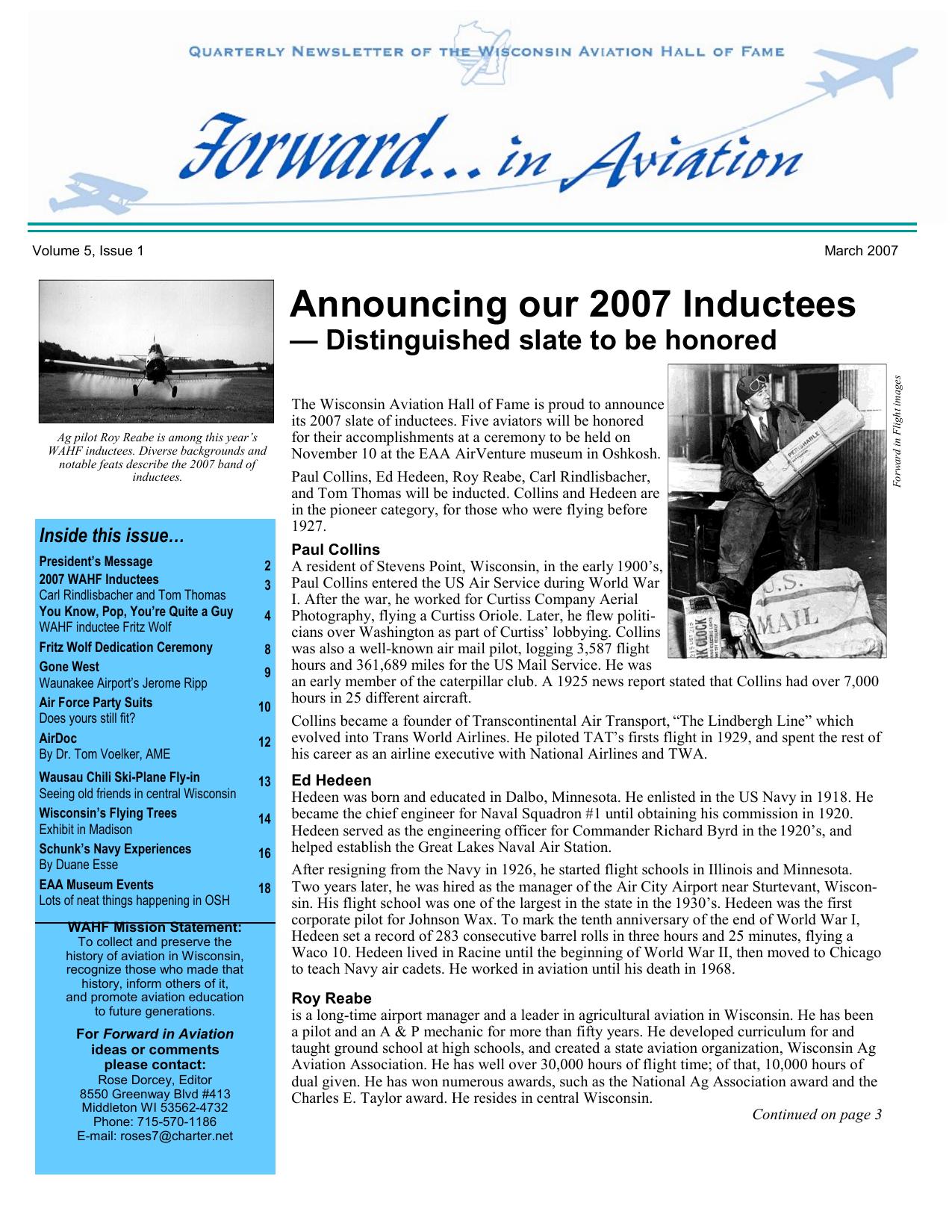
Volume 5, Issue 1 March 2007 Announcing our 2007 Inductees Ag pilot Roy Reabe is among this year’s WAHF inductees. Diverse backgrounds and notable feats describe the 2007 band of inductees. Inside this issue… President’s Message 2007 WAHF Inductees Carl Rindlisbacher and Tom Thomas You Know, Pop, You’re Quite a Guy WAHF inductee Fritz Wolf Fritz Wolf Dedication Ceremony Gone West Waunakee Airport’s Jerome Ripp Air Force Party Suits Does yours still fit? AirDoc By Dr. Tom Voelker, AME Wausau Chili Ski-Plane Fly-in Seeing old friends in central Wisconsin Wisconsin’s Flying Trees Exhibit in Madison Schunk’s Navy Experiences By Duane Esse EAA Museum Events Lots of neat things happening in OSH WAHF Mission Statement: To collect and preserve the history of aviation in Wisconsin, recognize those who made that history, inform others of it, and promote aviation education to future generations. For Forward in Aviation ideas or comments please contact: Rose Dorcey, Editor 8550 Greenway Blvd #413 Middleton WI 53562-4732 Phone: 715-570-1186 E-mail: roses7@charter.net 2 3 4 8 9 10 12 13 14 16 18 The Wisconsin Aviation Hall of Fame is proud to announce its 2007 slate of inductees. Five aviators will be honored for their accomplishments at a ceremony to be held on November 10 at the EAA AirVenture museum in Oshkosh. Paul Collins, Ed Hedeen, Roy Reabe, Carl Rindlisbacher, and Tom Thomas will be inducted. Collins and Hedeen are in the pioneer category, for those who were flying before 1927. Paul Collins A resident of Stevens Point, Wisconsin, in the early 1900’s, Paul Collins entered the US Air Service during World War I. After the war, he worked for Curtiss Company Aerial Photography, flying a Curtiss Oriole. Later, he flew politicians over Washington as part of Curtiss’ lobbying. Collins was also a well-known air mail pilot, logging 3,587 flight hours and 361,689 miles for the US Mail Service. He was an early member of the caterpillar club. A 1925 news report stated that Collins had over 7,000 hours in 25 different aircraft. Collins became a founder of Transcontinental Air Transport, “The Lindbergh Line” which evolved into Trans World Airlines. He piloted TAT’s firsts flight in 1929, and spent the rest of his career as an airline executive with National Airlines and TWA. Ed Hedeen Hedeen was born and educated in Dalbo, Minnesota. He enlisted in the US Navy in 1918. He became the chief engineer for Naval Squadron #1 until obtaining his commission in 1920. Hedeen served as the engineering officer for Commander Richard Byrd in the 1920’s, and helped establish the Great Lakes Naval Air Station. After resigning from the Navy in 1926, he started flight schools in Illinois and Minnesota. Two years later, he was hired as the manager of the Air City Airport near Sturtevant, Wisconsin. His flight school was one of the largest in the state in the 1930’s. Hedeen was the first corporate pilot for Johnson Wax. To mark the tenth anniversary of the end of World War I, Hedeen set a record of 283 consecutive barrel rolls in three hours and 25 minutes, flying a Waco 10. Hedeen lived in Racine until the beginning of World War II, then moved to Chicago to teach Navy air cadets. He worked in aviation until his death in 1968. Roy Reabe is a long-time airport manager and a leader in agricultural aviation in Wisconsin. He has been a pilot and an A & P mechanic for more than fifty years. He developed curriculum for and taught ground school at high schools, and created a state aviation organization, Wisconsin Ag Aviation Association. He has well over 30,000 hours of flight time; of that, 10,000 hours of dual given. He has won numerous awards, such as the National Ag Association award and the Charles E. Taylor award. He resides in central Wisconsin. Continued on page 3 Forward in Flight images — Distinguished slate to be honored
Page 2 March 2007 ~ by Rose Dorcey S pringtime is seen as a time of growth, renewal, of new life being born, and of the cycle of life starting once again. As spring approaches for the Wisconsin Aviation Hall of Fame, I apply those characteristics to us… growth, renewal, and new life for our organization. The color green symbolizes these characteristics. So as we head into 2007, and as our organization strives to grow, we’ve changed the look of Forward in Aviation to remind our readers that growth is the key to our continued success. How can you be a part of our shared success? It starts with your support. If you like what we’re doing, tell your friends, and encourage them to join. If you’re disappointed with our performance, let us know, so we can improve and become an organization that you’re proud to be a part of. If you have ideas on ways to improve the organization, share them with us! Fresh ideas and outlooks can open up new avenues for our organization to take. Your comments, moral support, and enthusiasm are encouraged and appreciated. Don’t hesitate to share them with the WAHF board of directors. We’re happy to hear from you. As “renewal time of year” comes and goes, we inevitably have members who choose not to renew. One of the reasons we hear for this is that they feel we are not honoring the “lesser known” - that we only honor the big names in Wisconsin aviation who have already received many awards. However, as I look through over twenty years of WAHF inductees, I see plenty of names of people who are not nearly as well-known as James Lovell, Paul Poberezny, and Donald “Deke” Slayton. Libby Parod, former long-time airport manager at Cable, Wisconsin, is a great example. So is Richard Knutson, who was honored for being a mentor and aircraft restorer. Robert Clarke is a flight instructor and DPE who makes a difference in the lives of many aspiring pilots, yet you may have never heard his name, or the names of several others, until the Wisconsin Aviation Hall of Fame honored them with induction. A point should be made here: the Wisconsin Aviation Hall of Fame relies on nominations from our members to “find” the people who should be considered for induction. While the board of directors takes its own initiative by researching potential nominees, we can’t find them all. If you know of someone in your community who you feel should be considered, submit a nomination. We’ll even try to answer questions and help you put together a complete nomination package. Another thing we hear is, “What’s in it for me?” I like to turn that question around and ask, “What can you give back?” By becoming active participants in organizations that contribute in positive ways to aviation in our state, and beyond our borders, you become the “keepers of the aviation flame”. My husband, John, wrote a short article for this issue (see pg. 11) on declining pilot numbers. It’s more important now than ever before to get involved with organizations such as the Wisconsin Aviation Hall of Fame; organizations that promote aviation careers through scholarships, that preserve important slices of aviation history, and that work hard to promote the joy and importance of aviation and airports. Ironically, that should also answer, “What’s in it for me?” If you’re involved, you’re not just helping your fellow aviators, you’re helping yourself, too. A s this publication grows in popularity, we’re adding new regular features that are sure to be of interest to our readers. I’m proud to announce that WAHF life member and Forward in Aviation supporter Dr. Tom Voelker, an aviation medical examiner in central Wisconsin, will begin a series of articles on aviation medical issues entitled AirDoc. His friendly, informative writing style will help you understand the complexities of aviation medical issues, and help find ways to keep your medical current. Tom welcomes questions and comments from his readers. I hope that you will contact him. Gary Dikkers has provided several features in the past, and he indicated that becoming a regular columnist in FIA is a likely possibility, as long as he can continue to find things to write about. That’s good news for our readers, since Gary’s vast experiences and knowledge, along with his intense aviation interest will lead to a variety of writing subjects. Duane Esse and John Dorcey have several writing projects in the “incubator”. You’ll see them “hatch” throughout 2007. Back to my main point. Springtime is a time of growth. WAHF board members set membership and FIA readership growth as prime goals in 2007. With your support, we can reach our target. As springtime unfolds, we look for new growth, new life in our organization. And remember, as the color green symbolizes in this newsletter, it’s to remind you of our need for growth, and you are the seed that helps us grow.
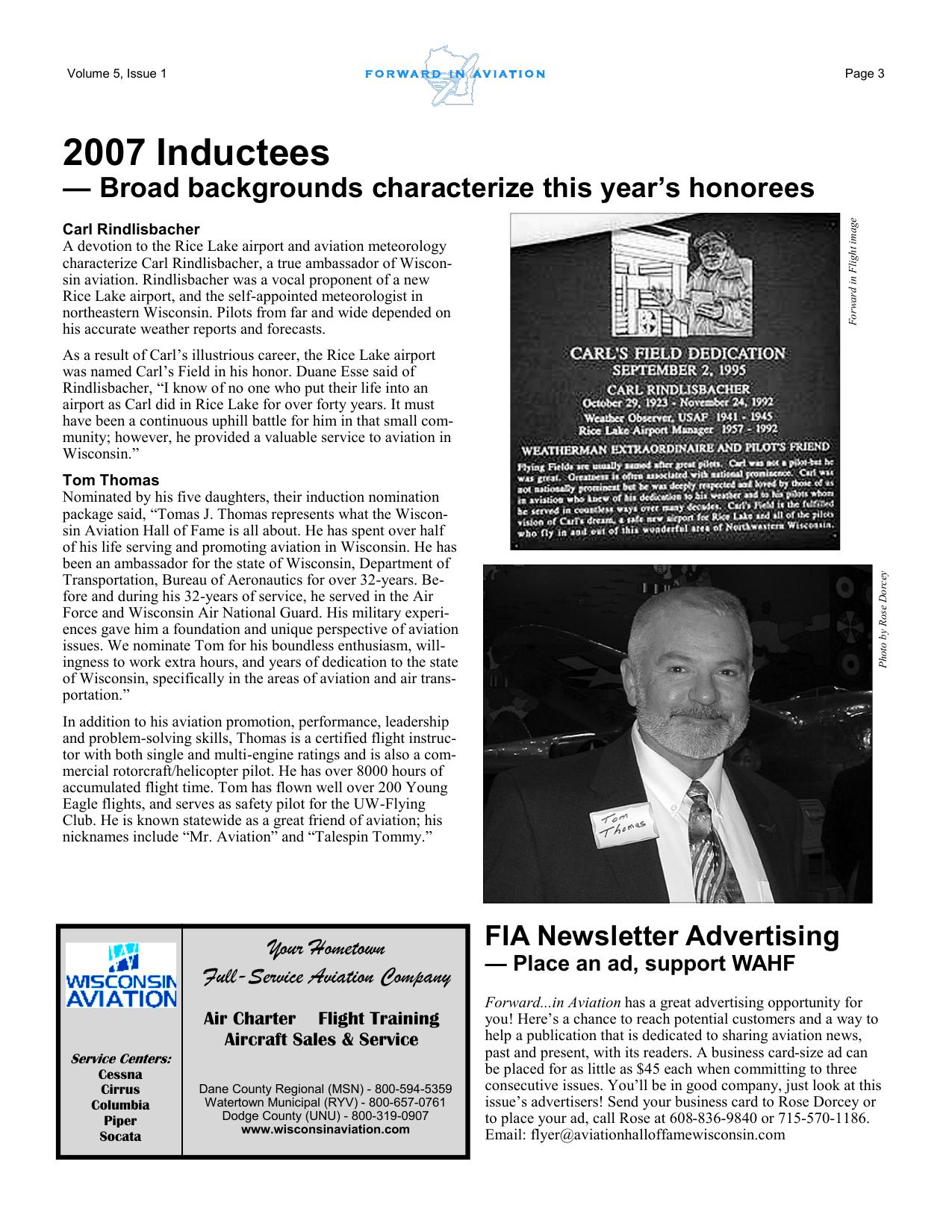
Volume 5, Issue 1 Page 3 2007 Inductees Forward in Flight image — Broad backgrounds characterize this year’s honorees Carl Rindlisbacher A devotion to the Rice Lake airport and aviation meteorology characterize Carl Rindlisbacher, a true ambassador of Wisconsin aviation. Rindlisbacher was a vocal proponent of a new Rice Lake airport, and the self-appointed meteorologist in northeastern Wisconsin. Pilots from far and wide depended on his accurate weather reports and forecasts. As a result of Carl’s illustrious career, the Rice Lake airport was named Carl’s Field in his honor. Duane Esse said of Rindlisbacher, “I know of no one who put their life into an airport as Carl did in Rice Lake for over forty years. It must have been a continuous uphill battle for him in that small community; however, he provided a valuable service to aviation in Wisconsin.” Photo by Rose Dorcey Tom Thomas Nominated by his five daughters, their induction nomination package said, “Tomas J. Thomas represents what the Wisconsin Aviation Hall of Fame is all about. He has spent over half of his life serving and promoting aviation in Wisconsin. He has been an ambassador for the state of Wisconsin, Department of Transportation, Bureau of Aeronautics for over 32-years. Before and during his 32-years of service, he served in the Air Force and Wisconsin Air National Guard. His military experiences gave him a foundation and unique perspective of aviation issues. We nominate Tom for his boundless enthusiasm, willingness to work extra hours, and years of dedication to the state of Wisconsin, specifically in the areas of aviation and air transportation.” In addition to his aviation promotion, performance, leadership and problem-solving skills, Thomas is a certified flight instructor with both single and multi-engine ratings and is also a commercial rotorcraft/helicopter pilot. He has over 8000 hours of accumulated flight time. Tom has flown well over 200 Young Eagle flights, and serves as safety pilot for the UW-Flying Club. He is known statewide as a great friend of aviation; his nicknames include “Mr. Aviation” and “Talespin Tommy.” Your Hometown Full-Service Aviation Company Air Charter Flight Training Aircraft Sales & Service Service Centers: Cessna Cirrus Columbia Piper Socata Dane County Regional (MSN) - 800-594-5359 Watertown Municipal (RYV) - 800-657-0761 Dodge County (UNU) - 800-319-0907 www.wisconsinaviation.com FIA Newsletter Advertising — Place an ad, support WAHF Forward...in Aviation has a great advertising opportunity for you! Here’s a chance to reach potential customers and a way to help a publication that is dedicated to sharing aviation news, past and present, with its readers. A business card-size ad can be placed for as little as $45 each when committing to three consecutive issues. You’ll be in good company, just look at this issue’s advertisers! Send your business card to Rose Dorcey or to place your ad, call Rose at 608-836-9840 or 715-570-1186. Email: flyer@aviationhalloffamewisconsin.com
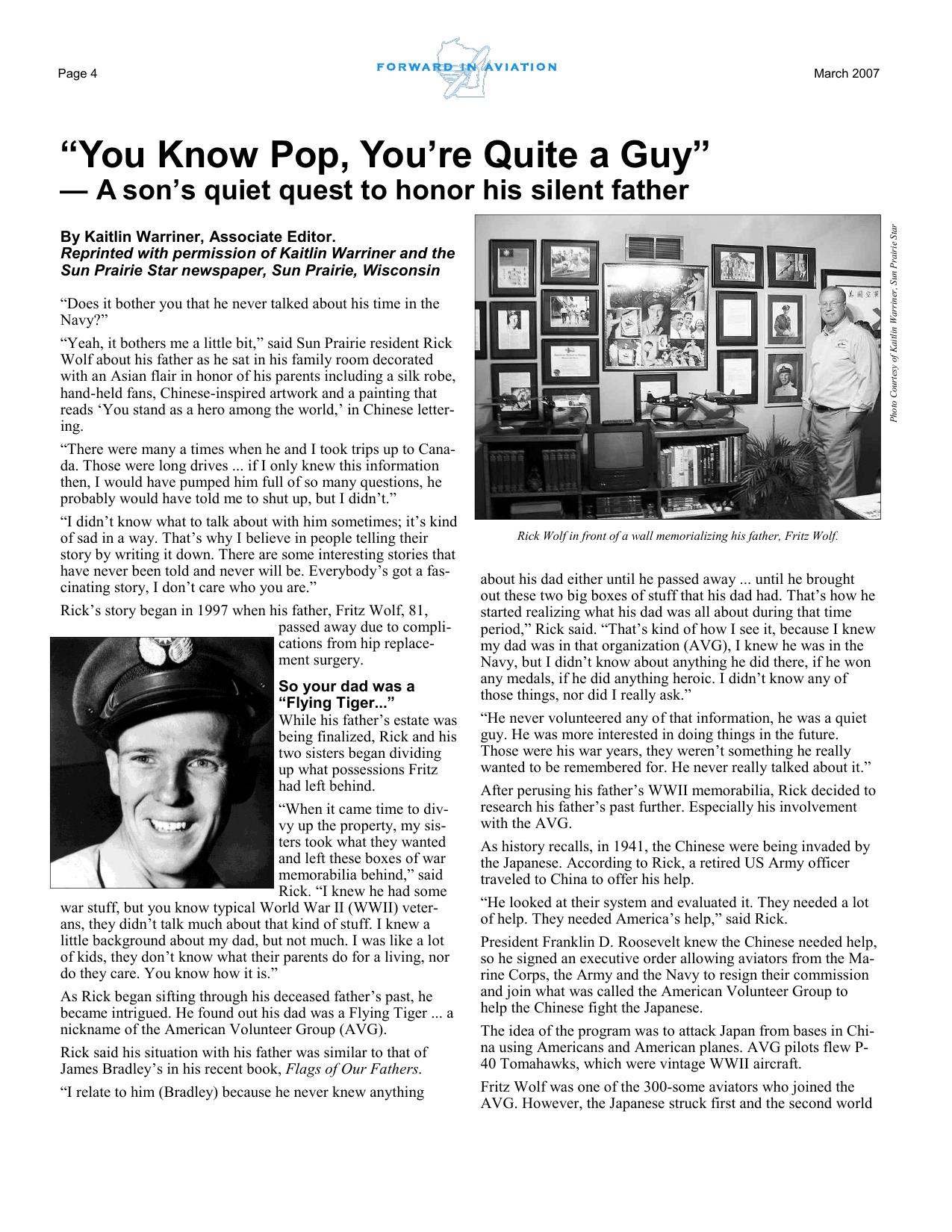
Page 4 March 2007 “You Know Pop, You’re Quite a Guy” Photo Courtesy of Kaitlin Warriner, Sun Prairie Star — A son’s quiet quest to honor his silent father By Kaitlin Warriner, Associate Editor. Reprinted with permission of Kaitlin Warriner and the Sun Prairie Star newspaper, Sun Prairie, Wisconsin “Does it bother you that he never talked about his time in the Navy?” “Yeah, it bothers me a little bit,” said Sun Prairie resident Rick Wolf about his father as he sat in his family room decorated with an Asian flair in honor of his parents including a silk robe, hand-held fans, Chinese-inspired artwork and a painting that reads ‘You stand as a hero among the world,’ in Chinese lettering. “There were many a times when he and I took trips up to Canada. Those were long drives ... if I only knew this information then, I would have pumped him full of so many questions, he probably would have told me to shut up, but I didn’t.” “I didn’t know what to talk about with him sometimes; it’s kind of sad in a way. That’s why I believe in people telling their story by writing it down. There are some interesting stories that have never been told and never will be. Everybody’s got a fascinating story, I don’t care who you are.” Rick’s story began in 1997 when his father, Fritz Wolf, 81, passed away due to complications from hip replacement surgery. So your dad was a “Flying Tiger...” While his father’s estate was being finalized, Rick and his two sisters began dividing up what possessions Fritz had left behind. “When it came time to divvy up the property, my sisters took what they wanted and left these boxes of war memorabilia behind,” said Rick. “I knew he had some war stuff, but you know typical World War II (WWII) veterans, they didn’t talk much about that kind of stuff. I knew a little background about my dad, but not much. I was like a lot of kids, they don’t know what their parents do for a living, nor do they care. You know how it is.” As Rick began sifting through his deceased father’s past, he became intrigued. He found out his dad was a Flying Tiger ... a nickname of the American Volunteer Group (AVG). Rick said his situation with his father was similar to that of James Bradley’s in his recent book, Flags of Our Fathers. “I relate to him (Bradley) because he never knew anything Rick Wolf in front of a wall memorializing his father, Fritz Wolf. about his dad either until he passed away ... until he brought out these two big boxes of stuff that his dad had. That’s how he started realizing what his dad was all about during that time period,” Rick said. “That’s kind of how I see it, because I knew my dad was in that organization (AVG), I knew he was in the Navy, but I didn’t know about anything he did there, if he won any medals, if he did anything heroic. I didn’t know any of those things, nor did I really ask.” “He never volunteered any of that information, he was a quiet guy. He was more interested in doing things in the future. Those were his war years, they weren’t something he really wanted to be remembered for. He never really talked about it.” After perusing his father’s WWII memorabilia, Rick decided to research his father’s past further. Especially his involvement with the AVG. As history recalls, in 1941, the Chinese were being invaded by the Japanese. According to Rick, a retired US Army officer traveled to China to offer his help. “He looked at their system and evaluated it. They needed a lot of help. They needed America’s help,” said Rick. President Franklin D. Roosevelt knew the Chinese needed help, so he signed an executive order allowing aviators from the Marine Corps, the Army and the Navy to resign their commission and join what was called the American Volunteer Group to help the Chinese fight the Japanese. The idea of the program was to attack Japan from bases in China using Americans and American planes. AVG pilots flew P40 Tomahawks, which were vintage WWII aircraft. Fritz Wolf was one of the 300-some aviators who joined the AVG. However, the Japanese struck first and the second world
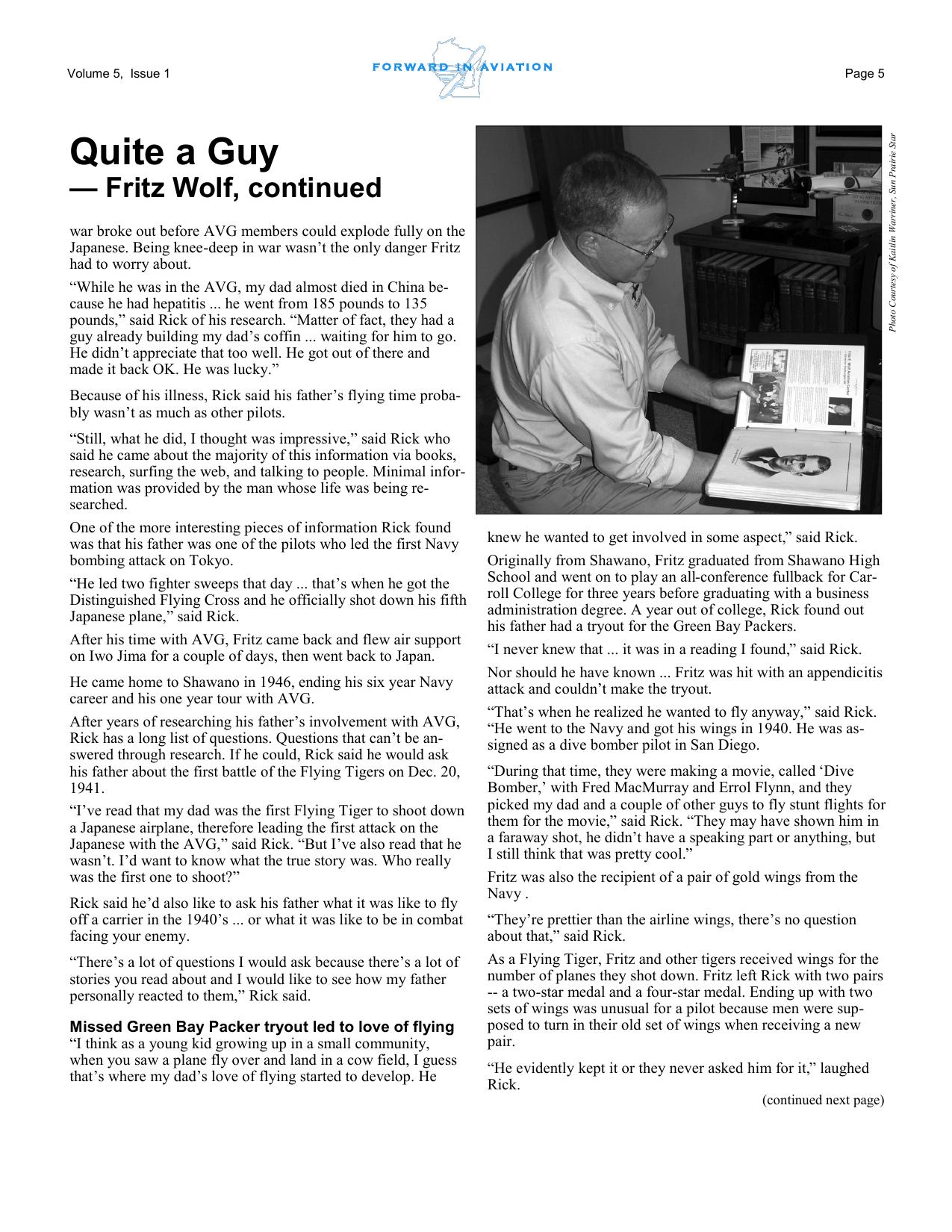
Volume 5, Issue 1 Page 5 Photo Courtesy of Kaitlin Warriner, Sun Prairie Star Quite a Guy — Fritz Wolf, continued war broke out before AVG members could explode fully on the Japanese. Being knee-deep in war wasn’t the only danger Fritz had to worry about. “While he was in the AVG, my dad almost died in China because he had hepatitis ... he went from 185 pounds to 135 pounds,” said Rick of his research. “Matter of fact, they had a guy already building my dad’s coffin ... waiting for him to go. He didn’t appreciate that too well. He got out of there and made it back OK. He was lucky.” Because of his illness, Rick said his father’s flying time probably wasn’t as much as other pilots. “Still, what he did, I thought was impressive,” said Rick who said he came about the majority of this information via books, research, surfing the web, and talking to people. Minimal information was provided by the man whose life was being researched. One of the more interesting pieces of information Rick found was that his father was one of the pilots who led the first Navy bombing attack on Tokyo. “He led two fighter sweeps that day ... that’s when he got the Distinguished Flying Cross and he officially shot down his fifth Japanese plane,” said Rick. After his time with AVG, Fritz came back and flew air support on Iwo Jima for a couple of days, then went back to Japan. He came home to Shawano in 1946, ending his six year Navy career and his one year tour with AVG. After years of researching his father’s involvement with AVG, Rick has a long list of questions. Questions that can’t be answered through research. If he could, Rick said he would ask his father about the first battle of the Flying Tigers on Dec. 20, 1941. “I’ve read that my dad was the first Flying Tiger to shoot down a Japanese airplane, therefore leading the first attack on the Japanese with the AVG,” said Rick. “But I’ve also read that he wasn’t. I’d want to know what the true story was. Who really was the first one to shoot?” Rick said he’d also like to ask his father what it was like to fly off a carrier in the 1940’s ... or what it was like to be in combat facing your enemy. “There’s a lot of questions I would ask because there’s a lot of stories you read about and I would like to see how my father personally reacted to them,” Rick said. Missed Green Bay Packer tryout led to love of flying “I think as a young kid growing up in a small community, when you saw a plane fly over and land in a cow field, I guess that’s where my dad’s love of flying started to develop. He knew he wanted to get involved in some aspect,” said Rick. Originally from Shawano, Fritz graduated from Shawano High School and went on to play an all-conference fullback for Carroll College for three years before graduating with a business administration degree. A year out of college, Rick found out his father had a tryout for the Green Bay Packers. “I never knew that ... it was in a reading I found,” said Rick. Nor should he have known ... Fritz was hit with an appendicitis attack and couldn’t make the tryout. “That’s when he realized he wanted to fly anyway,” said Rick. “He went to the Navy and got his wings in 1940. He was assigned as a dive bomber pilot in San Diego. “During that time, they were making a movie, called ‘Dive Bomber,’ with Fred MacMurray and Errol Flynn, and they picked my dad and a couple of other guys to fly stunt flights for them for the movie,” said Rick. “They may have shown him in a faraway shot, he didn’t have a speaking part or anything, but I still think that was pretty cool.” Fritz was also the recipient of a pair of gold wings from the Navy . “They’re prettier than the airline wings, there’s no question about that,” said Rick. As a Flying Tiger, Fritz and other tigers received wings for the number of planes they shot down. Fritz left Rick with two pairs -- a two-star medal and a four-star medal. Ending up with two sets of wings was unusual for a pilot because men were supposed to turn in their old set of wings when receiving a new pair. “He evidently kept it or they never asked him for it,” laughed Rick. (continued next page)
Page 6 March 2007 Quite a Guy — Fritz Wolf, continued Treasure Trove Walking up to his second-floor office, Rick’s walls are covered with a treasure trove of memorabilia including, high school and college photos, along with quite a few taken by the Wisconsin State Journal upon Fritz’s return to Shawano in the late 1940’s. Model airplanes like the P-40 Fritz flew with the Navy, the Japanese Zero, the Hellcat and F4 Wildcat, stand proudly next to photographs of Fritz in his younger years and his medals for heroism, an air medal, his Navy Wings and Distinguished Flying Cross. Rick pulled a thick black binder out from the shelves of a curio cabinet holding Fritz’s original discharge papers from the AVG, letters, news clippings and photos from more than 50 years ago. Across the room from his father’s silver dogtag hangs a photo simulating AVG’s first attack in the first combat signed by all the original members of AVG. Fritz Wolf: Director of Aeronautics “The AVG held reunions every year from the time they were disbanded on and my dad never went to one until he reached retirement age. He never really had any desire to,” said Rick. His desire, later in life, was for his position for the State of Wisconsin as Director of Aeronautics. “He loved his job, he probably would have done it for free. That’s what he would want to be remembered for,” said Rick. A lot of things Fritz did to promote aviation in Wisconsin became models for other states as well as air facilities nationwide -- like strobe lighting for tall towers. “My dad was the one who pioneered that and talked the (FAA) into doing that and now it’s nationally done. That’s how towers are lit,” said Rick referring to the Federal Aviation Administration. “I didn’t realize he did these things, he got up in the morning, went to work and came home,” said Rick laughing. “Although I did get a chance to fly with him when I was growing up, during the summer months when he inspected airports. He was just an interesting guy, but I always knew him as Fritz Wolf, my dad, not Fritz Wolf, war hero or Director of Aeronautics. But what he did for the State of Wisconsin deserves a lot more than what he probably could have done in the Navy. He loved what he did. Where else can you go and get all the flying you want in and meet people?” asked Rick. “People who knew him really liked him because he was an honest guy, real down-to-earth and he promoted aviation -- he thought it was the greatest thing there was.” Fritz Wolf: father “Growing up with Fritz ... he was a task master. I mean, he was pretty tough and his job was very important to him,” said Rick. “But I thought we had a great upbringing. He provided for us very well, I would almost consider it a Leave it to Beaver lifestyle in a way. “He wasn’t a mean person, but he expected certain things to be done and he expected them to be done right. I never had to fear getting spanked from him, what I feared was him coming home and talking to me because that was the worst,” said Rick with a smile. “His big thing when we were growing up was, ‘Anything you do reflects on us.’ I always kept that in mind. I never wanted my parents to look bad, so I always tried to maintain the right avenue. “I knew he loved us, but he never said it. I know he tried to do the best he could for us,” said Rick. “A lot of the time, you don’t understand parenting until you become a parent. My dad was the type of guy who talked to strangers better than he talked to his own kids. I was always a little intimidated around him, I guess.” “He had his life and it was a good one and I have my life and I think it’s a good one. I don’t have the fame that he did, and I didn’t do the things that he did. But I look at a school teacher as a very noble profession,” said Rick of his 19 years in the Cambridge School District. “I’ve touched a lot of lives. I have a lot of good memories. I just did it in a different way.” A quest toward recognizing a quiet hero “I wanted to know more about him,” said Rick. “And usually the way it works is, when you really want to ask the questions, there’s nobody around to answer them. The person I want to ask is him -- not somebody else, because he’s the one who lived it,” said Rick who has been on a 10-year-long journey to give his father the respect and recognition he feels he deserved in life. “I think he’d be proud of what I’m doing, but he’d say, ‘What are you doing that for, son?’ He never displayed anything in his office at work or at home. You would never know he did any of this stuff. It was something that he didn’t have to live in the past about. He didn’t have to prove that he did it. He knew that he did it. He was proud of it, but he just didn’t need to show it off,” said Rick who said he too is proud of what his father did in his lifetime ... even more so that he didn’t have to brag about it. “My dad wasn’t that type of person. He never went out of his way to say, ‘I’m Fritz Wolf and I’m the greatest thing since sliced bread.’ He wasn't that way,” said Rick. Fritz E. Wolf Aviation Center The one thing his father made clear was that he was more proud of his work for the State of Wisconsin, than his years in the Navy. “The one thing he wanted to be known for is Fritz Wolf, Director of Aeronautics. That’s what he near wanted to remembered for, Developments the Blackhawk Airport (87Y) not his war years,” Rick said. Following his father’s lead, Rick decided to get a Wisconsin airport named after his father.
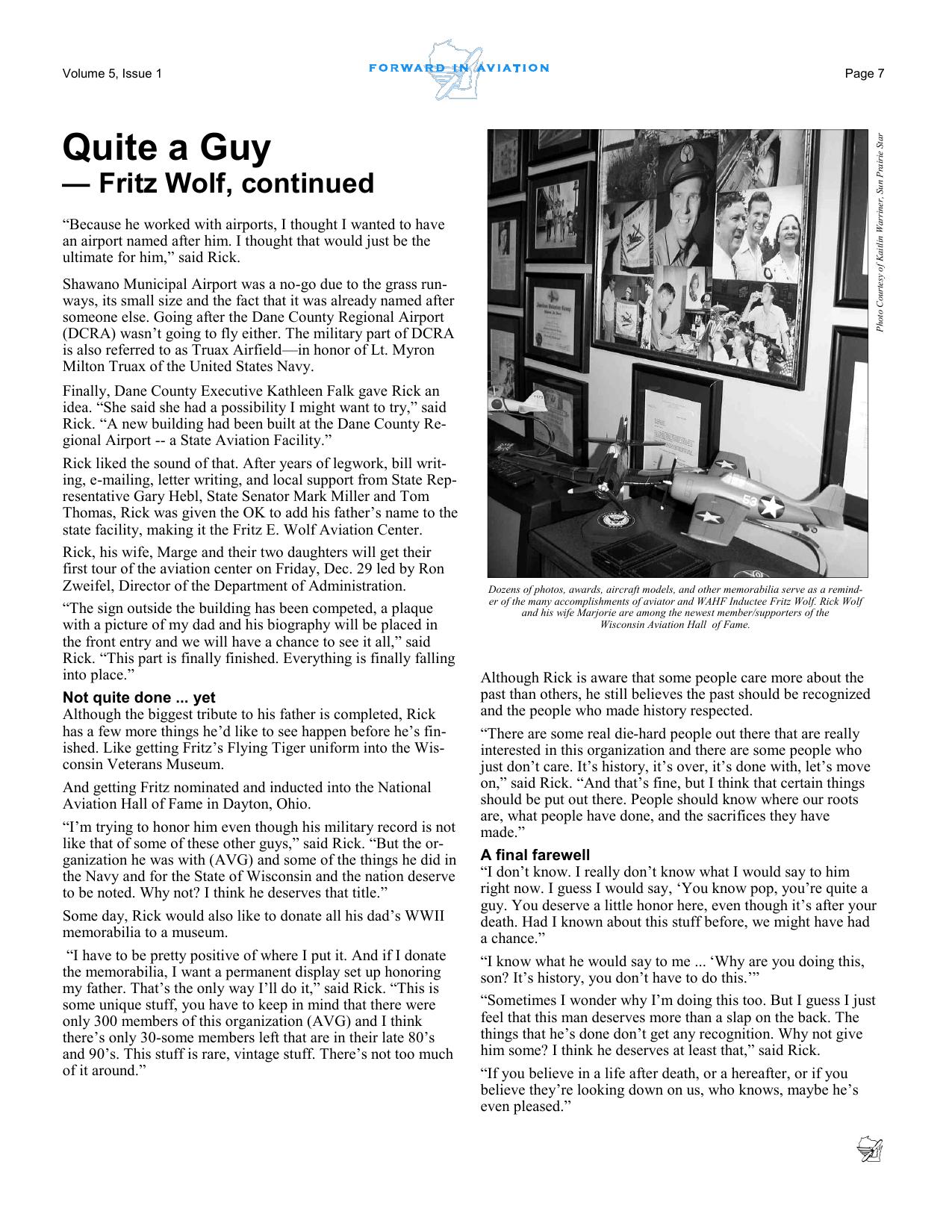
Volume 5, Issue 1 Page 7 Photo Courtesy of Kaitlin Warriner, Sun Prairie Star Quite a Guy — Fritz Wolf, continued “Because he worked with airports, I thought I wanted to have an airport named after him. I thought that would just be the ultimate for him,” said Rick. Shawano Municipal Airport was a no-go due to the grass runways, its small size and the fact that it was already named after someone else. Going after the Dane County Regional Airport (DCRA) wasn’t going to fly either. The military part of DCRA is also referred to as Truax Airfield—in honor of Lt. Myron Milton Truax of the United States Navy. Finally, Dane County Executive Kathleen Falk gave Rick an idea. “She said she had a possibility I might want to try,” said Rick. “A new building had been built at the Dane County Regional Airport -- a State Aviation Facility.” Rick liked the sound of that. After years of legwork, bill writing, e-mailing, letter writing, and local support from State Representative Gary Hebl, State Senator Mark Miller and Tom Thomas, Rick was given the OK to add his father’s name to the state facility, making it the Fritz E. Wolf Aviation Center. Rick, his wife, Marge and their two daughters will get their first tour of the aviation center on Friday, Dec. 29 led by Ron Zweifel, Director of the Department of Administration. “The sign outside the building has been competed, a plaque with a picture of my dad and his biography will be placed in the front entry and we will have a chance to see it all,” said Rick. “This part is finally finished. Everything is finally falling into place.” Not quite done ... yet Although the biggest tribute to his father is completed, Rick has a few more things he’d like to see happen before he’s finished. Like getting Fritz’s Flying Tiger uniform into the Wisconsin Veterans Museum. And getting Fritz nominated and inducted into the National Aviation Hall of Fame in Dayton, Ohio. “I’m trying to honor him even though his military record is not like that of some of these other guys,” said Rick. “But the organization he was with (AVG) and some of the things he did in the Navy and for the State of Wisconsin and the nation deserve to be noted. Why not? I think he deserves that title.” Some day, Rick would also like to donate all his dad’s WWII memorabilia to a museum. “I have to be pretty positive of where I put it. And if I donate the memorabilia, I want a permanent display set up honoring my father. That’s the only way I’ll do it,” said Rick. “This is some unique stuff, you have to keep in mind that there were only 300 members of this organization (AVG) and I think there’s only 30-some members left that are in their late 80’s and 90’s. This stuff is rare, vintage stuff. There’s not too much of it around.” Dozens of photos, awards, aircraft models, and other memorabilia serve as a reminder of the many accomplishments of aviator and WAHF Inductee Fritz Wolf. Rick Wolf and his wife Marjorie are among the newest member/supporters of the Wisconsin Aviation Hall of Fame. Although Rick is aware that some people care more about the past than others, he still believes the past should be recognized and the people who made history respected. “There are some real die-hard people out there that are really interested in this organization and there are some people who just don’t care. It’s history, it’s over, it’s done with, let’s move on,” said Rick. “And that’s fine, but I think that certain things should be put out there. People should know where our roots are, what people have done, and the sacrifices they have made.” A final farewell “I don’t know. I really don’t know what I would say to him right now. I guess I would say, ‘You know pop, you’re quite a guy. You deserve a little honor here, even though it’s after your death. Had I known about this stuff before, we might have had a chance.” “I know what he would say to me ... ‘Why are you doing this, son? It’s history, you don’t have to do this.’” “Sometimes I wonder why I’m doing this too. But I guess I just feel that this man deserves more than a slap on the back. The things that he’s done don’t get any recognition. Why not give him some? I think he deserves at least that,” said Rick. “If you believe in a life after death, or a hereafter, or if you believe they’re looking down on us, who knows, maybe he’s even pleased.”
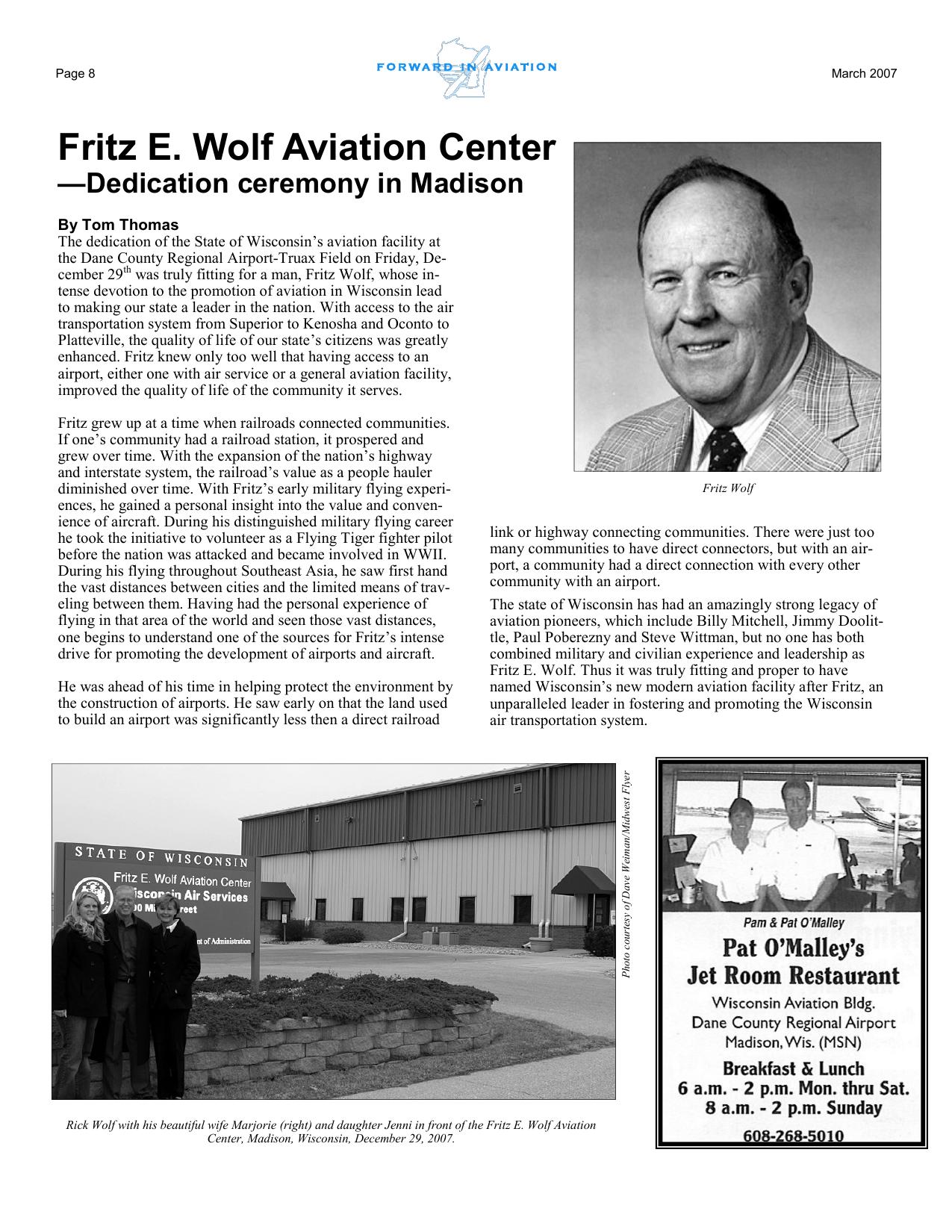
Page 8 March 2007 Fritz E. Wolf Aviation Center —Dedication ceremony in Madison By Tom Thomas The dedication of the State of Wisconsin’s aviation facility at the Dane County Regional Airport-Truax Field on Friday, December 29th was truly fitting for a man, Fritz Wolf, whose intense devotion to the promotion of aviation in Wisconsin lead to making our state a leader in the nation. With access to the air transportation system from Superior to Kenosha and Oconto to Platteville, the quality of life of our state’s citizens was greatly enhanced. Fritz knew only too well that having access to an airport, either one with air service or a general aviation facility, improved the quality of life of the community it serves. Fritz grew up at a time when railroads connected communities. If one’s community had a railroad station, it prospered and grew over time. With the expansion of the nation’s highway and interstate system, the railroad’s value as a people hauler diminished over time. With Fritz’s early military flying experiences, he gained a personal insight into the value and convenience of aircraft. During his distinguished military flying career he took the initiative to volunteer as a Flying Tiger fighter pilot before the nation was attacked and became involved in WWII. During his flying throughout Southeast Asia, he saw first hand the vast distances between cities and the limited means of traveling between them. Having had the personal experience of flying in that area of the world and seen those vast distances, one begins to understand one of the sources for Fritz’s intense drive for promoting the development of airports and aircraft. link or highway connecting communities. There were just too many communities to have direct connectors, but with an airport, a community had a direct connection with every other community with an airport. The state of Wisconsin has had an amazingly strong legacy of aviation pioneers, which include Billy Mitchell, Jimmy Doolittle, Paul Poberezny and Steve Wittman, but no one has both combined military and civilian experience and leadership as Fritz E. Wolf. Thus it was truly fitting and proper to have named Wisconsin’s new modern aviation facility after Fritz, an unparalleled leader in fostering and promoting the Wisconsin air transportation system. Photo courtesy of Dave Weiman/Midwest Flyer He was ahead of his time in helping protect the environment by the construction of airports. He saw early on that the land used to build an airport was significantly less then a direct railroad Fritz Wolf Rick Wolf with his beautiful wife Marjorie (right) and daughter Jenni in front of the Fritz E. Wolf Aviation Center, Madison, Wisconsin, December 29, 2007.
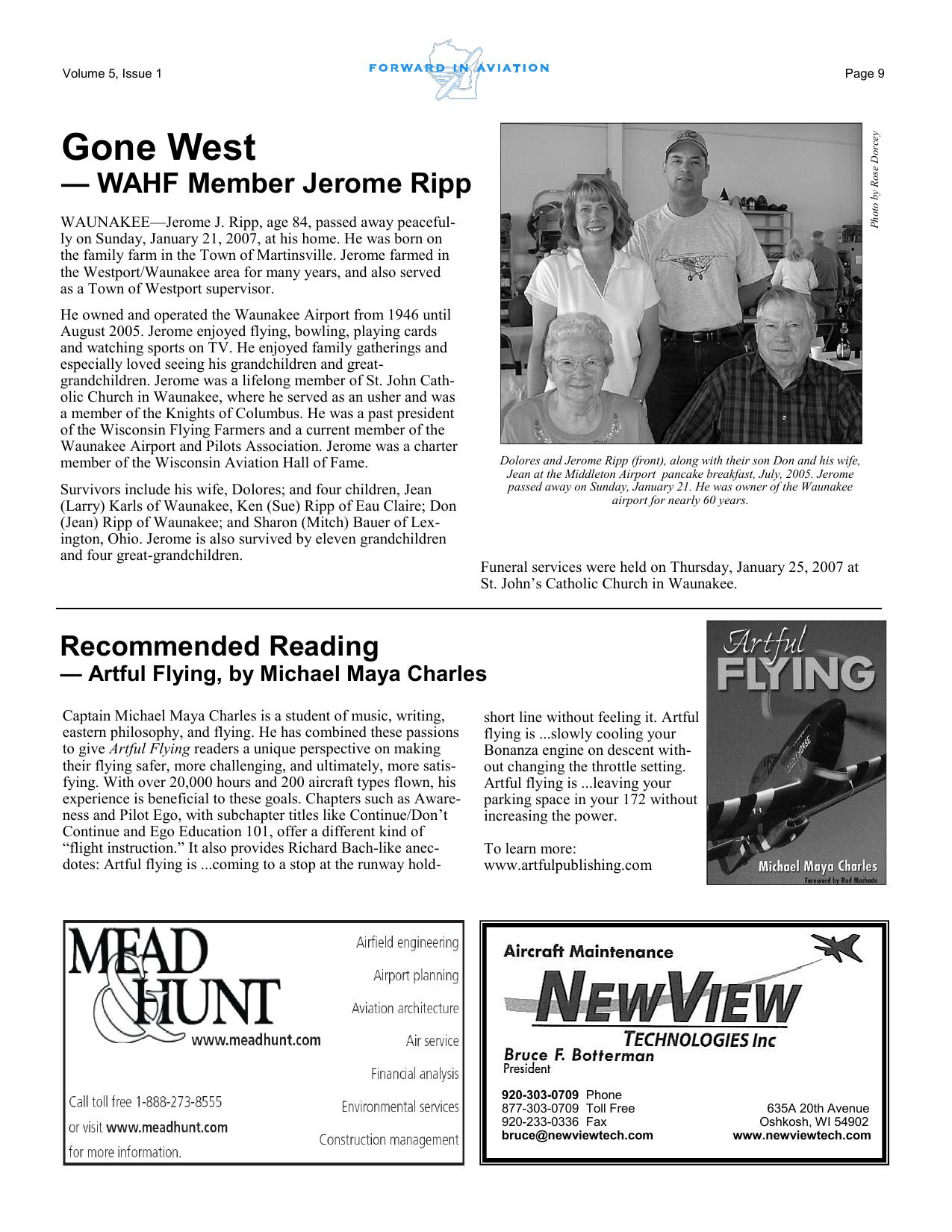
Volume 5, Issue 1 Page 9 Photo by Rose Dorcey Gone West — WAHF Member Jerome Ripp WAUNAKEE—Jerome J. Ripp, age 84, passed away peacefully on Sunday, January 21, 2007, at his home. He was born on the family farm in the Town of Martinsville. Jerome farmed in the Westport/Waunakee area for many years, and also served as a Town of Westport supervisor. He owned and operated the Waunakee Airport from 1946 until August 2005. Jerome enjoyed flying, bowling, playing cards and watching sports on TV. He enjoyed family gatherings and especially loved seeing his grandchildren and greatgrandchildren. Jerome was a lifelong member of St. John Catholic Church in Waunakee, where he served as an usher and was a member of the Knights of Columbus. He was a past president of the Wisconsin Flying Farmers and a current member of the Waunakee Airport and Pilots Association. Jerome was a charter member of the Wisconsin Aviation Hall of Fame. Survivors include his wife, Dolores; and four children, Jean (Larry) Karls of Waunakee, Ken (Sue) Ripp of Eau Claire; Don (Jean) Ripp of Waunakee; and Sharon (Mitch) Bauer of Lexington, Ohio. Jerome is also survived by eleven grandchildren and four great-grandchildren. Dolores and Jerome Ripp (front), along with their son Don and his wife, Jean at the Middleton Airport pancake breakfast, July, 2005. Jerome passed away on Sunday, January 21. He was owner of the Waunakee airport for nearly 60 years. Funeral services were held on Thursday, January 25, 2007 at St. John’s Catholic Church in Waunakee. Recommended Reading — Artful Flying, by Michael Maya Charles Captain Michael Maya Charles is a student of music, writing, eastern philosophy, and flying. He has combined these passions to give Artful Flying readers a unique perspective on making their flying safer, more challenging, and ultimately, more satisfying. With over 20,000 hours and 200 aircraft types flown, his experience is beneficial to these goals. Chapters such as Awareness and Pilot Ego, with subchapter titles like Continue/Don’t Continue and Ego Education 101, offer a different kind of “flight instruction.” It also provides Richard Bach-like anecdotes: Artful flying is ...coming to a stop at the runway hold- short line without feeling it. Artful flying is ...slowly cooling your Bonanza engine on descent without changing the throttle setting. Artful flying is ...leaving your parking space in your 172 without increasing the power. To learn more: www.artfulpublishing.com 920-303-0709 Phone 877-303-0709 Toll Free 920-233-0336 Fax bruce@newviewtech.com 635A 20th Avenue Oshkosh, WI 54902 www.newviewtech.com
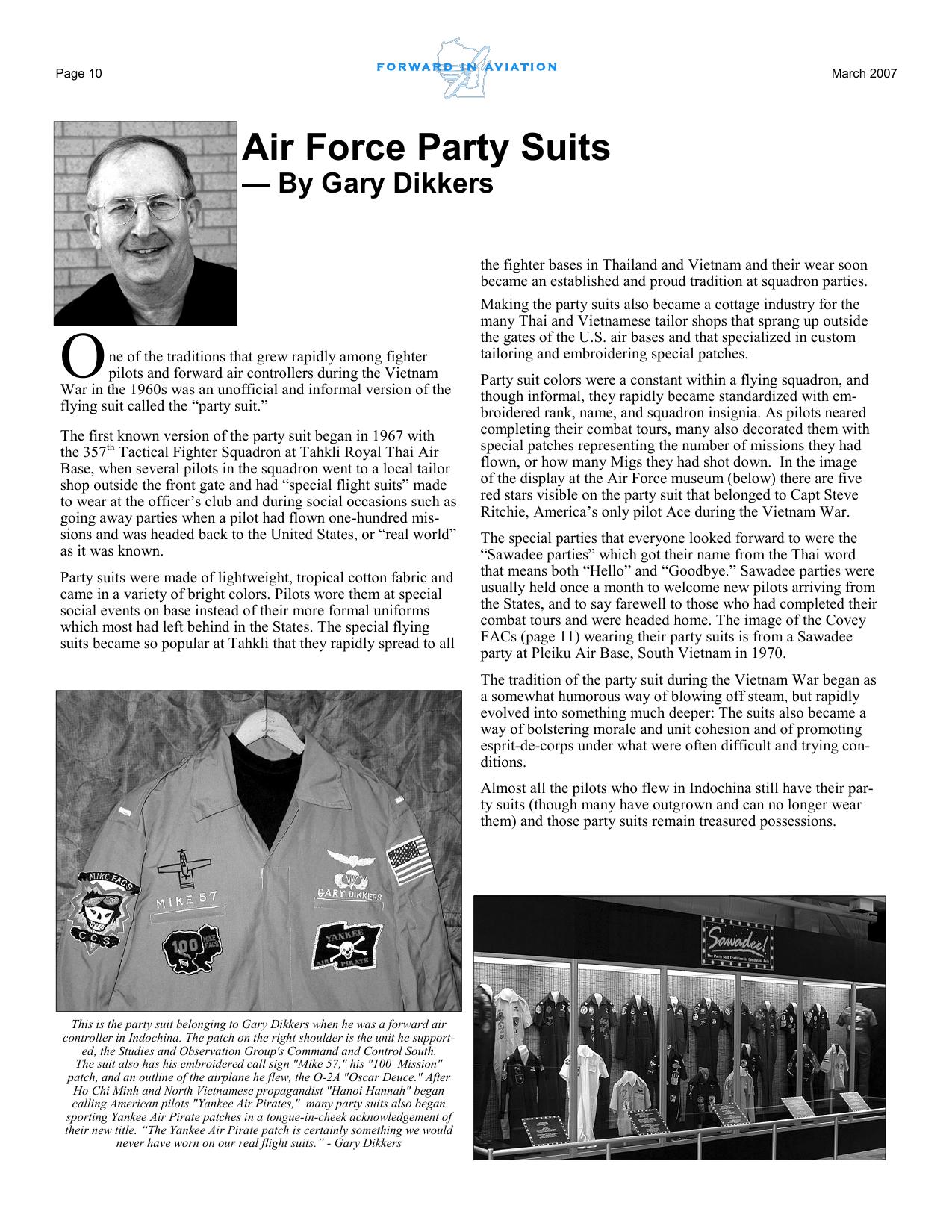
Page 10 March 2007 Air Force Party Suits — By Gary Dikkers O ne of the traditions that grew rapidly among fighter pilots and forward air controllers during the Vietnam War in the 1960s was an unofficial and informal version of the flying suit called the “party suit.” The first known version of the party suit began in 1967 with the 357th Tactical Fighter Squadron at Tahkli Royal Thai Air Base, when several pilots in the squadron went to a local tailor shop outside the front gate and had “special flight suits” made to wear at the officer’s club and during social occasions such as going away parties when a pilot had flown one-hundred missions and was headed back to the United States, or “real world” as it was known. Party suits were made of lightweight, tropical cotton fabric and came in a variety of bright colors. Pilots wore them at special social events on base instead of their more formal uniforms which most had left behind in the States. The special flying suits became so popular at Tahkli that they rapidly spread to all the fighter bases in Thailand and Vietnam and their wear soon became an established and proud tradition at squadron parties. Making the party suits also became a cottage industry for the many Thai and Vietnamese tailor shops that sprang up outside the gates of the U.S. air bases and that specialized in custom tailoring and embroidering special patches. Party suit colors were a constant within a flying squadron, and though informal, they rapidly became standardized with embroidered rank, name, and squadron insignia. As pilots neared completing their combat tours, many also decorated them with special patches representing the number of missions they had flown, or how many Migs they had shot down. In the image of the display at the Air Force museum (below) there are five red stars visible on the party suit that belonged to Capt Steve Ritchie, America’s only pilot Ace during the Vietnam War. The special parties that everyone looked forward to were the “Sawadee parties” which got their name from the Thai word that means both “Hello” and “Goodbye.” Sawadee parties were usually held once a month to welcome new pilots arriving from the States, and to say farewell to those who had completed their combat tours and were headed home. The image of the Covey FACs (page 11) wearing their party suits is from a Sawadee party at Pleiku Air Base, South Vietnam in 1970. The tradition of the party suit during the Vietnam War began as a somewhat humorous way of blowing off steam, but rapidly evolved into something much deeper: The suits also became a way of bolstering morale and unit cohesion and of promoting esprit-de-corps under what were often difficult and trying conditions. Almost all the pilots who flew in Indochina still have their party suits (though many have outgrown and can no longer wear them) and those party suits remain treasured possessions. This is the party suit belonging to Gary Dikkers when he was a forward air controller in Indochina. The patch on the right shoulder is the unit he supported, the Studies and Observation Group's Command and Control South. The suit also has his embroidered call sign "Mike 57," his "100 Mission" patch, and an outline of the airplane he flew, the O-2A "Oscar Deuce." After Ho Chi Minh and North Vietnamese propagandist "Hanoi Hannah" began calling American pilots "Yankee Air Pirates," many party suits also began sporting Yankee Air Pirate patches in a tongue-in-cheek acknowledgement of their new title. “The Yankee Air Pirate patch is certainly something we would never have worn on our real flight suits.” - Gary Dikkers
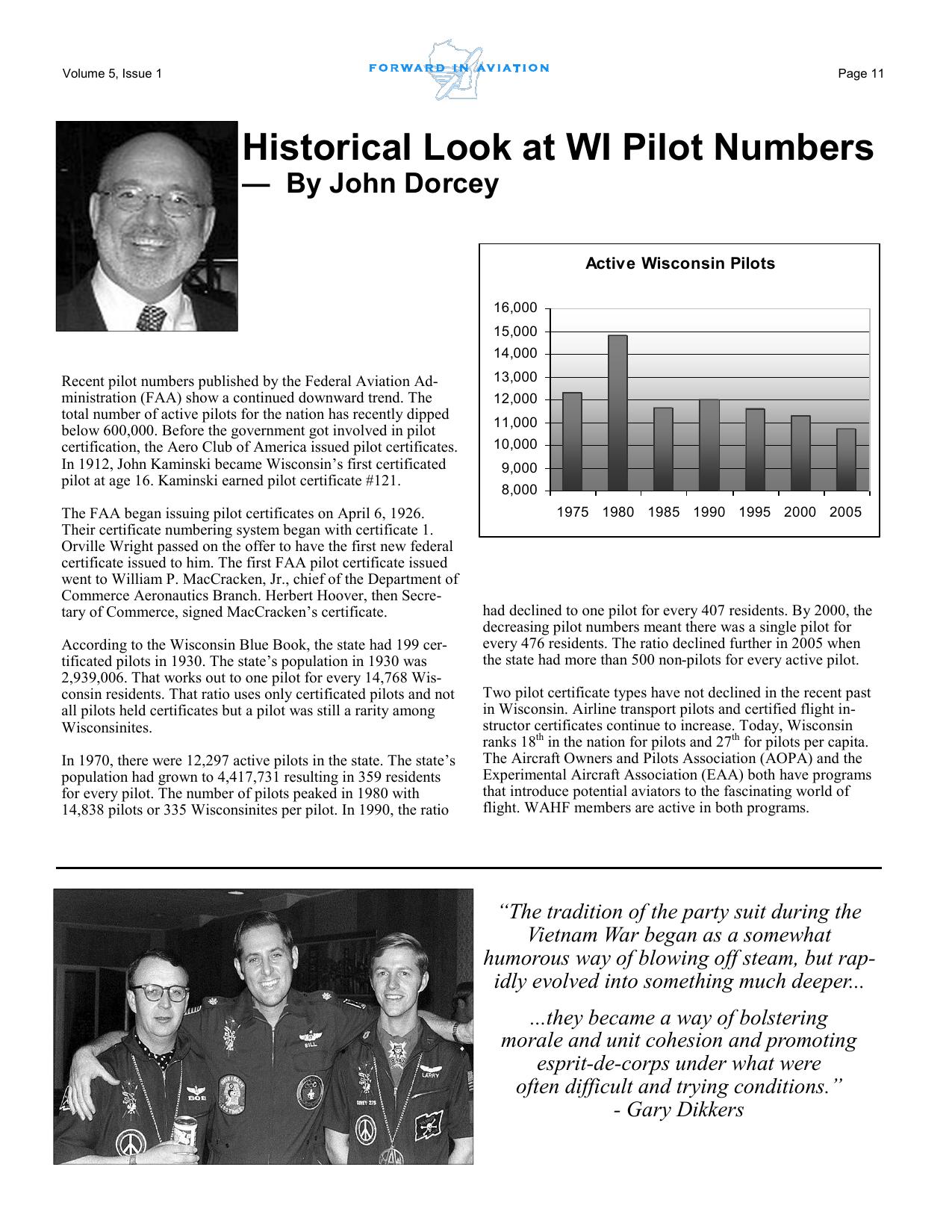
Volume 5, Issue 1 Page 11 Historical Look at WI Pilot Numbers — By John Dorcey Active Wisconsin Pilots 16,000 15,000 14,000 Recent pilot numbers published by the Federal Aviation Administration (FAA) show a continued downward trend. The total number of active pilots for the nation has recently dipped below 600,000. Before the government got involved in pilot certification, the Aero Club of America issued pilot certificates. In 1912, John Kaminski became Wisconsin’s first certificated pilot at age 16. Kaminski earned pilot certificate #121. The FAA began issuing pilot certificates on April 6, 1926. Their certificate numbering system began with certificate 1. Orville Wright passed on the offer to have the first new federal certificate issued to him. The first FAA pilot certificate issued went to William P. MacCracken, Jr., chief of the Department of Commerce Aeronautics Branch. Herbert Hoover, then Secretary of Commerce, signed MacCracken’s certificate. According to the Wisconsin Blue Book, the state had 199 certificated pilots in 1930. The state’s population in 1930 was 2,939,006. That works out to one pilot for every 14,768 Wisconsin residents. That ratio uses only certificated pilots and not all pilots held certificates but a pilot was still a rarity among Wisconsinites. In 1970, there were 12,297 active pilots in the state. The state’s population had grown to 4,417,731 resulting in 359 residents for every pilot. The number of pilots peaked in 1980 with 14,838 pilots or 335 Wisconsinites per pilot. In 1990, the ratio 13,000 12,000 11,000 10,000 9,000 8,000 1975 1980 1985 1990 1995 2000 2005 had declined to one pilot for every 407 residents. By 2000, the decreasing pilot numbers meant there was a single pilot for every 476 residents. The ratio declined further in 2005 when the state had more than 500 non-pilots for every active pilot. Two pilot certificate types have not declined in the recent past in Wisconsin. Airline transport pilots and certified flight instructor certificates continue to increase. Today, Wisconsin ranks 18th in the nation for pilots and 27th for pilots per capita. The Aircraft Owners and Pilots Association (AOPA) and the Experimental Aircraft Association (EAA) both have programs that introduce potential aviators to the fascinating world of flight. WAHF members are active in both programs. “The tradition of the party suit during the Vietnam War began as a somewhat humorous way of blowing off steam, but rapidly evolved into something much deeper... ...they became a way of bolstering morale and unit cohesion and promoting esprit-de-corps under what were often difficult and trying conditions.” - Gary Dikkers
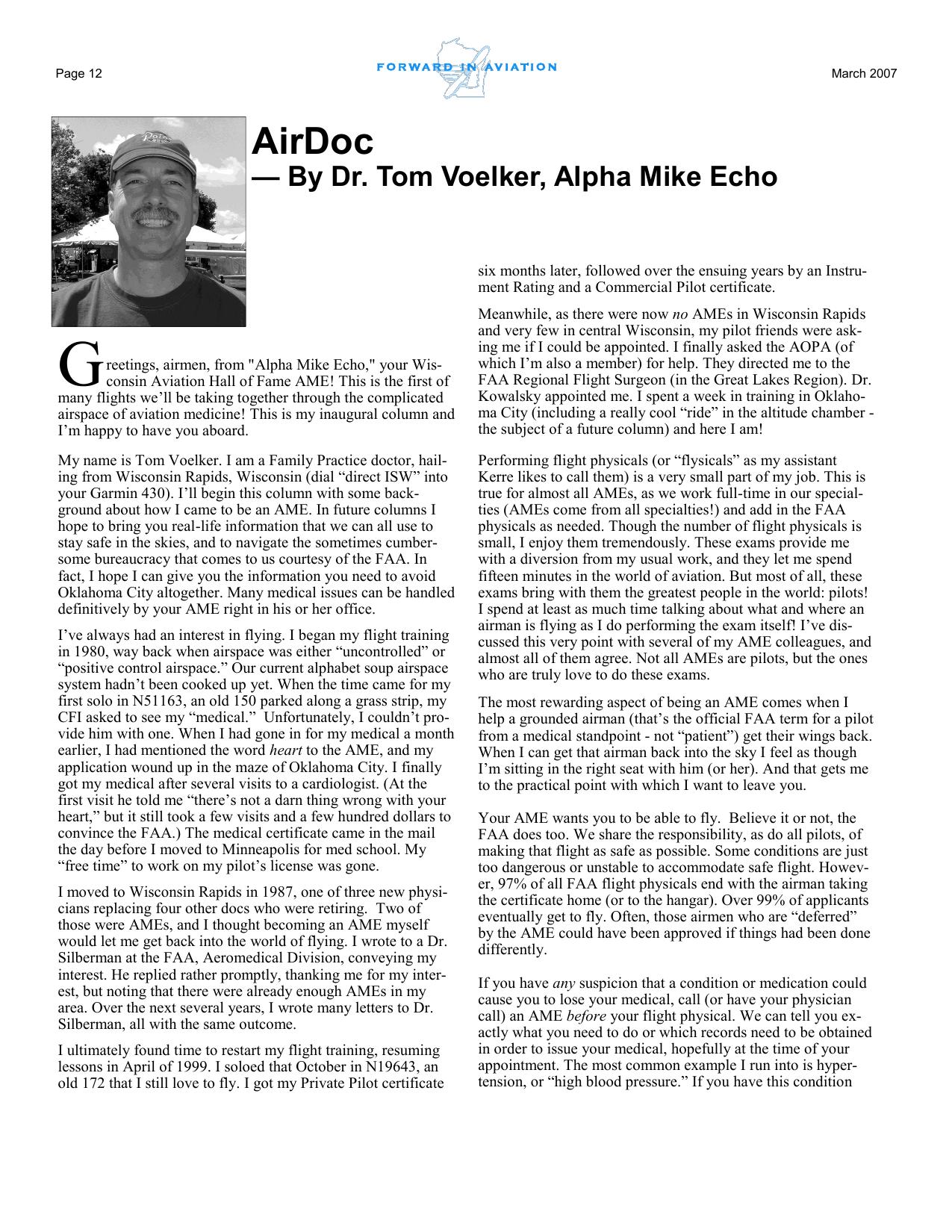
Page 12 March 2007 AirDoc — By Dr. Tom Voelker, Alpha Mike Echo six months later, followed over the ensuing years by an Instrument Rating and a Commercial Pilot certificate. G reetings, airmen, from "Alpha Mike Echo," your Wisconsin Aviation Hall of Fame AME! This is the first of many flights we’ll be taking together through the complicated airspace of aviation medicine! This is my inaugural column and I’m happy to have you aboard. My name is Tom Voelker. I am a Family Practice doctor, hailing from Wisconsin Rapids, Wisconsin (dial “direct ISW” into your Garmin 430). I’ll begin this column with some background about how I came to be an AME. In future columns I hope to bring you real-life information that we can all use to stay safe in the skies, and to navigate the sometimes cumbersome bureaucracy that comes to us courtesy of the FAA. In fact, I hope I can give you the information you need to avoid Oklahoma City altogether. Many medical issues can be handled definitively by your AME right in his or her office. I’ve always had an interest in flying. I began my flight training in 1980, way back when airspace was either “uncontrolled” or “positive control airspace.” Our current alphabet soup airspace system hadn’t been cooked up yet. When the time came for my first solo in N51163, an old 150 parked along a grass strip, my CFI asked to see my “medical.” Unfortunately, I couldn’t provide him with one. When I had gone in for my medical a month earlier, I had mentioned the word heart to the AME, and my application wound up in the maze of Oklahoma City. I finally got my medical after several visits to a cardiologist. (At the first visit he told me “there’s not a darn thing wrong with your heart,” but it still took a few visits and a few hundred dollars to convince the FAA.) The medical certificate came in the mail the day before I moved to Minneapolis for med school. My “free time” to work on my pilot’s license was gone. I moved to Wisconsin Rapids in 1987, one of three new physicians replacing four other docs who were retiring. Two of those were AMEs, and I thought becoming an AME myself would let me get back into the world of flying. I wrote to a Dr. Silberman at the FAA, Aeromedical Division, conveying my interest. He replied rather promptly, thanking me for my interest, but noting that there were already enough AMEs in my area. Over the next several years, I wrote many letters to Dr. Silberman, all with the same outcome. I ultimately found time to restart my flight training, resuming lessons in April of 1999. I soloed that October in N19643, an old 172 that I still love to fly. I got my Private Pilot certificate Meanwhile, as there were now no AMEs in Wisconsin Rapids and very few in central Wisconsin, my pilot friends were asking me if I could be appointed. I finally asked the AOPA (of which I’m also a member) for help. They directed me to the FAA Regional Flight Surgeon (in the Great Lakes Region). Dr. Kowalsky appointed me. I spent a week in training in Oklahoma City (including a really cool “ride” in the altitude chamber the subject of a future column) and here I am! Performing flight physicals (or “flysicals” as my assistant Kerre likes to call them) is a very small part of my job. This is true for almost all AMEs, as we work full-time in our specialties (AMEs come from all specialties!) and add in the FAA physicals as needed. Though the number of flight physicals is small, I enjoy them tremendously. These exams provide me with a diversion from my usual work, and they let me spend fifteen minutes in the world of aviation. But most of all, these exams bring with them the greatest people in the world: pilots! I spend at least as much time talking about what and where an airman is flying as I do performing the exam itself! I’ve discussed this very point with several of my AME colleagues, and almost all of them agree. Not all AMEs are pilots, but the ones who are truly love to do these exams. The most rewarding aspect of being an AME comes when I help a grounded airman (that’s the official FAA term for a pilot from a medical standpoint - not “patient”) get their wings back. When I can get that airman back into the sky I feel as though I’m sitting in the right seat with him (or her). And that gets me to the practical point with which I want to leave you. Your AME wants you to be able to fly. Believe it or not, the FAA does too. We share the responsibility, as do all pilots, of making that flight as safe as possible. Some conditions are just too dangerous or unstable to accommodate safe flight. However, 97% of all FAA flight physicals end with the airman taking the certificate home (or to the hangar). Over 99% of applicants eventually get to fly. Often, those airmen who are “deferred” by the AME could have been approved if things had been done differently. If you have any suspicion that a condition or medication could cause you to lose your medical, call (or have your physician call) an AME before your flight physical. We can tell you exactly what you need to do or which records need to be obtained in order to issue your medical, hopefully at the time of your appointment. The most common example I run into is hypertension, or “high blood pressure.” If you have this condition
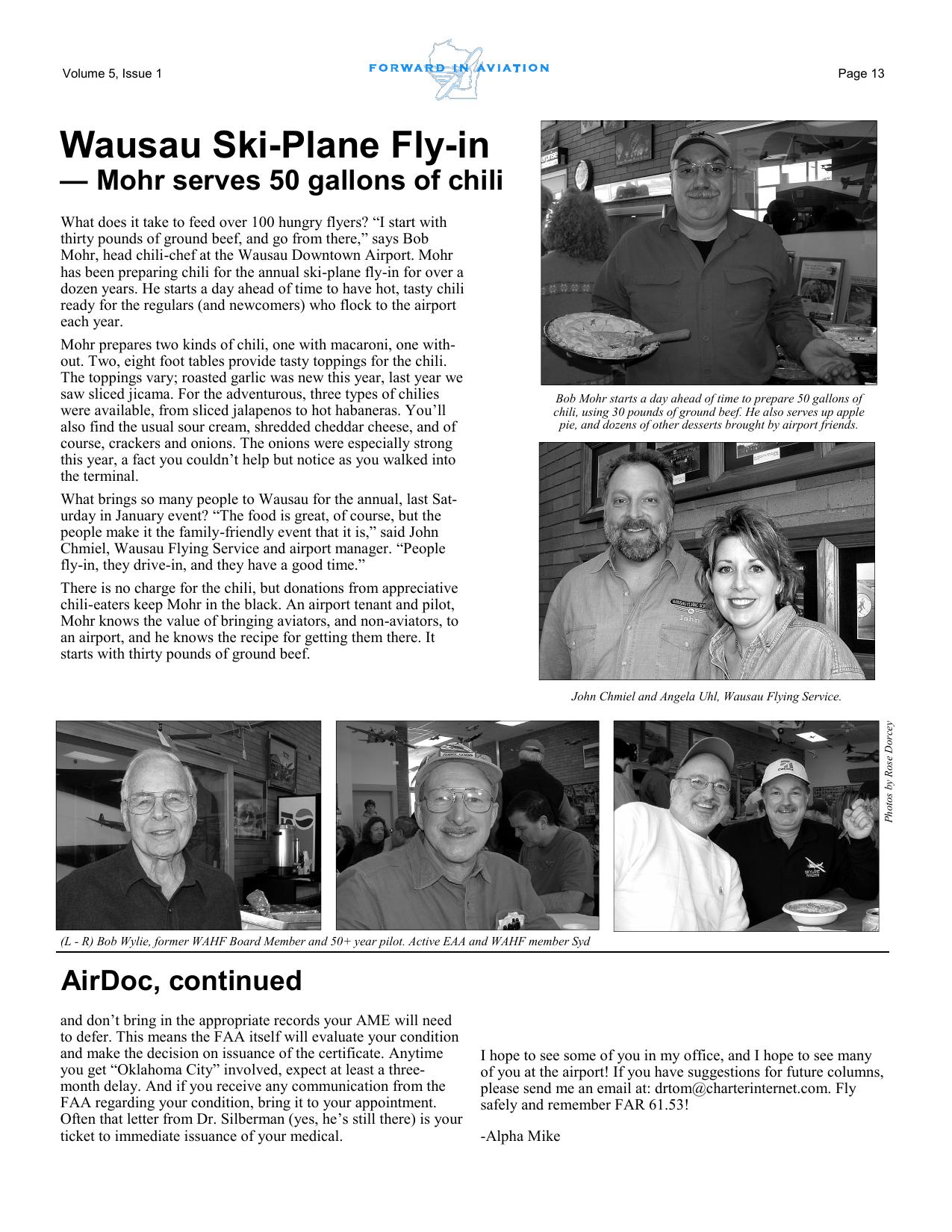
Volume 5, Issue 1 Page 13 Wausau Ski-Plane Fly-in — Mohr serves 50 gallons of chili What does it take to feed over 100 hungry flyers? “I start with thirty pounds of ground beef, and go from there,” says Bob Mohr, head chili-chef at the Wausau Downtown Airport. Mohr has been preparing chili for the annual ski-plane fly-in for over a dozen years. He starts a day ahead of time to have hot, tasty chili ready for the regulars (and newcomers) who flock to the airport each year. Mohr prepares two kinds of chili, one with macaroni, one without. Two, eight foot tables provide tasty toppings for the chili. The toppings vary; roasted garlic was new this year, last year we saw sliced jicama. For the adventurous, three types of chilies were available, from sliced jalapenos to hot habaneras. You’ll also find the usual sour cream, shredded cheddar cheese, and of course, crackers and onions. The onions were especially strong this year, a fact you couldn’t help but notice as you walked into the terminal. What brings so many people to Wausau for the annual, last Saturday in January event? “The food is great, of course, but the people make it the family-friendly event that it is,” said John Chmiel, Wausau Flying Service and airport manager. “People fly-in, they drive-in, and they have a good time.” There is no charge for the chili, but donations from appreciative chili-eaters keep Mohr in the black. An airport tenant and pilot, Mohr knows the value of bringing aviators, and non-aviators, to an airport, and he knows the recipe for getting them there. It starts with thirty pounds of ground beef. Bob Mohr starts a day ahead of time to prepare 50 gallons of chili, using 30 pounds of ground beef. He also serves up apple pie, and dozens of other desserts brought by airport friends. Photos by Rose Dorcey John Chmiel and Angela Uhl, Wausau Flying Service. (L - R) Bob Wylie, former WAHF Board Member and 50+ year pilot. Active EAA and WAHF member Syd AirDoc, continued and don’t bring in the appropriate records your AME will need to defer. This means the FAA itself will evaluate your condition and make the decision on issuance of the certificate. Anytime you get “Oklahoma City” involved, expect at least a threemonth delay. And if you receive any communication from the FAA regarding your condition, bring it to your appointment. Often that letter from Dr. Silberman (yes, he’s still there) is your ticket to immediate issuance of your medical. I hope to see some of you in my office, and I hope to see many of you at the airport! If you have suggestions for future columns, please send me an email at: drtom@charterinternet.com. Fly safely and remember FAR 61.53! -Alpha Mike
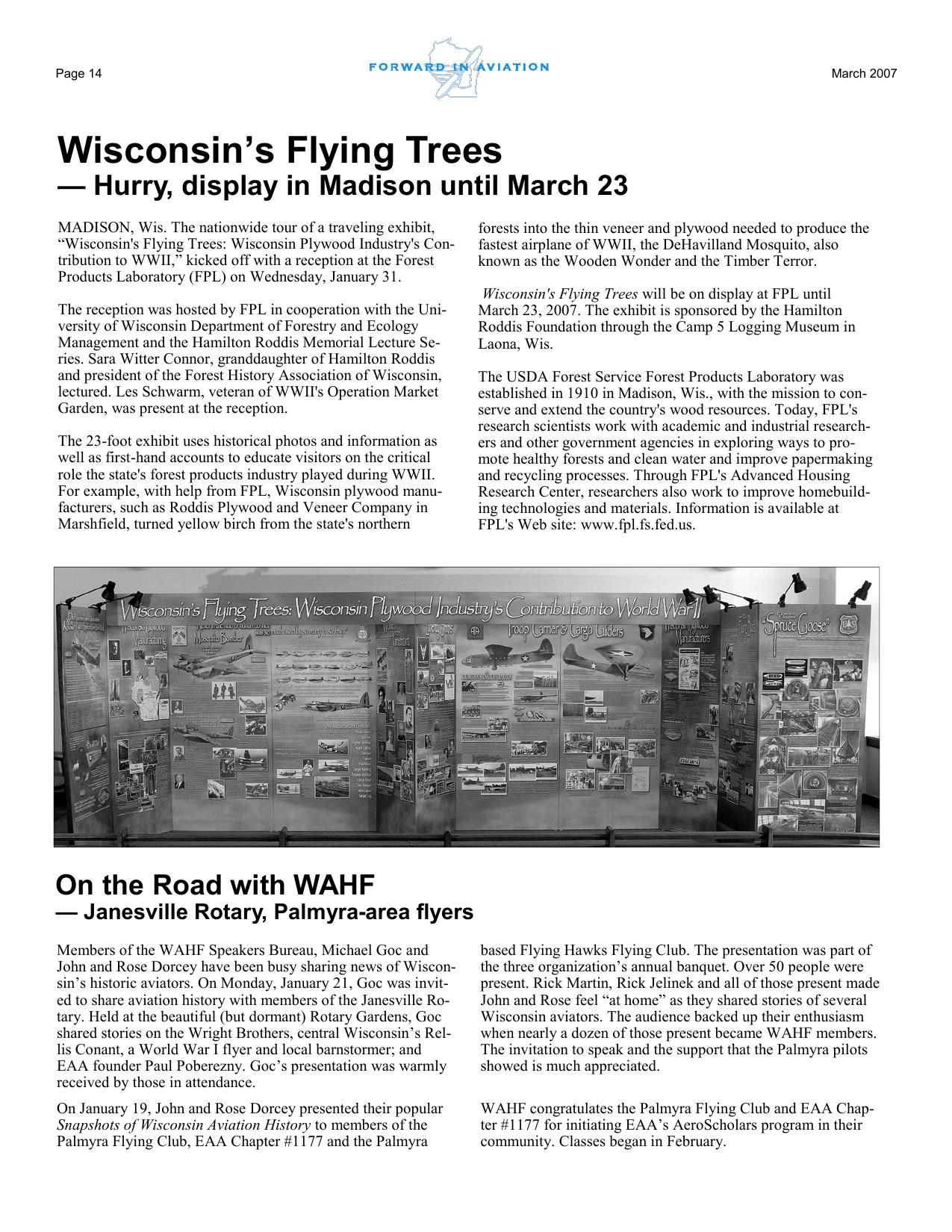
Page 14 March 2007 Wisconsin’s Flying Trees — Hurry, display in Madison until March 23 MADISON, Wis. The nationwide tour of a traveling exhibit, “Wisconsin's Flying Trees: Wisconsin Plywood Industry's Contribution to WWII,” kicked off with a reception at the Forest Products Laboratory (FPL) on Wednesday, January 31. The reception was hosted by FPL in cooperation with the University of Wisconsin Department of Forestry and Ecology Management and the Hamilton Roddis Memorial Lecture Series. Sara Witter Connor, granddaughter of Hamilton Roddis and president of the Forest History Association of Wisconsin, lectured. Les Schwarm, veteran of WWII's Operation Market Garden, was present at the reception. The 23-foot exhibit uses historical photos and information as well as first-hand accounts to educate visitors on the critical role the state's forest products industry played during WWII. For example, with help from FPL, Wisconsin plywood manufacturers, such as Roddis Plywood and Veneer Company in Marshfield, turned yellow birch from the state's northern forests into the thin veneer and plywood needed to produce the fastest airplane of WWII, the DeHavilland Mosquito, also known as the Wooden Wonder and the Timber Terror. Wisconsin's Flying Trees will be on display at FPL until March 23, 2007. The exhibit is sponsored by the Hamilton Roddis Foundation through the Camp 5 Logging Museum in Laona, Wis. The USDA Forest Service Forest Products Laboratory was established in 1910 in Madison, Wis., with the mission to conserve and extend the country's wood resources. Today, FPL's research scientists work with academic and industrial researchers and other government agencies in exploring ways to promote healthy forests and clean water and improve papermaking and recycling processes. Through FPL's Advanced Housing Research Center, researchers also work to improve homebuilding technologies and materials. Information is available at FPL's Web site: www.fpl.fs.fed.us. On the Road with WAHF — Janesville Rotary, Palmyra-area flyers Members of the WAHF Speakers Bureau, Michael Goc and John and Rose Dorcey have been busy sharing news of Wisconsin’s historic aviators. On Monday, January 21, Goc was invited to share aviation history with members of the Janesville Rotary. Held at the beautiful (but dormant) Rotary Gardens, Goc shared stories on the Wright Brothers, central Wisconsin’s Rellis Conant, a World War I flyer and local barnstormer; and EAA founder Paul Poberezny. Goc’s presentation was warmly received by those in attendance. based Flying Hawks Flying Club. The presentation was part of the three organization’s annual banquet. Over 50 people were present. Rick Martin, Rick Jelinek and all of those present made John and Rose feel “at home” as they shared stories of several Wisconsin aviators. The audience backed up their enthusiasm when nearly a dozen of those present became WAHF members. The invitation to speak and the support that the Palmyra pilots showed is much appreciated. On January 19, John and Rose Dorcey presented their popular Snapshots of Wisconsin Aviation History to members of the Palmyra Flying Club, EAA Chapter #1177 and the Palmyra WAHF congratulates the Palmyra Flying Club and EAA Chapter #1177 for initiating EAA’s AeroScholars program in their community. Classes began in February.
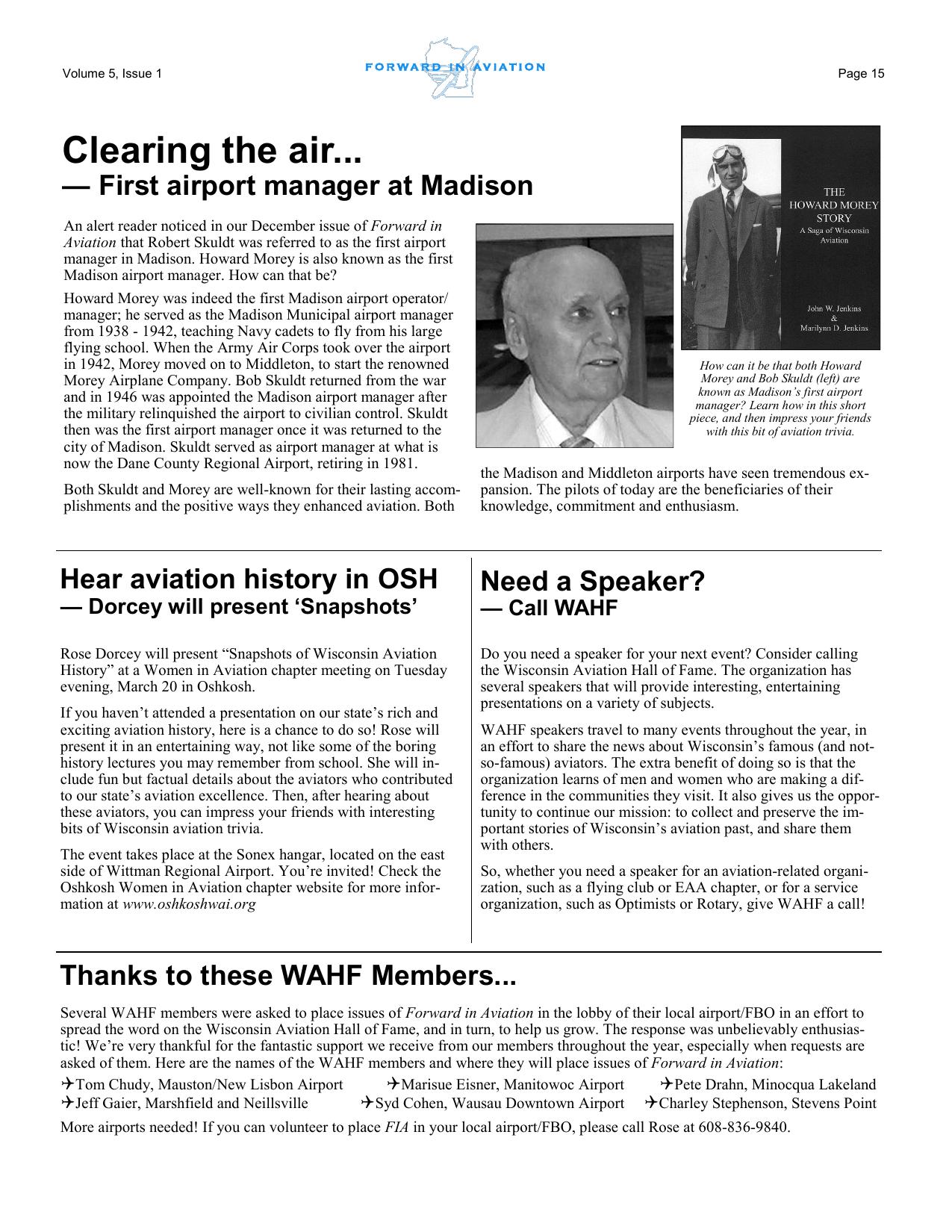
Volume 5, Issue 1 Page 15 Clearing the air... — First airport manager at Madison An alert reader noticed in our December issue of Forward in Aviation that Robert Skuldt was referred to as the first airport manager in Madison. Howard Morey is also known as the first Madison airport manager. How can that be? Howard Morey was indeed the first Madison airport operator/ manager; he served as the Madison Municipal airport manager from 1938 - 1942, teaching Navy cadets to fly from his large flying school. When the Army Air Corps took over the airport in 1942, Morey moved on to Middleton, to start the renowned Morey Airplane Company. Bob Skuldt returned from the war and in 1946 was appointed the Madison airport manager after the military relinquished the airport to civilian control. Skuldt then was the first airport manager once it was returned to the city of Madison. Skuldt served as airport manager at what is now the Dane County Regional Airport, retiring in 1981. How can it be that both Howard Morey and Bob Skuldt (left) are known as Madison’s first airport manager? Learn how in this short piece, and then impress your friends with this bit of aviation trivia. Both Skuldt and Morey are well-known for their lasting accomplishments and the positive ways they enhanced aviation. Both the Madison and Middleton airports have seen tremendous expansion. The pilots of today are the beneficiaries of their knowledge, commitment and enthusiasm. Hear aviation history in OSH Need a Speaker? — Dorcey will present ‘Snapshots’ Rose Dorcey will present “Snapshots of Wisconsin Aviation History” at a Women in Aviation chapter meeting on Tuesday evening, March 20 in Oshkosh. If you haven’t attended a presentation on our state’s rich and exciting aviation history, here is a chance to do so! Rose will present it in an entertaining way, not like some of the boring history lectures you may remember from school. She will include fun but factual details about the aviators who contributed to our state’s aviation excellence. Then, after hearing about these aviators, you can impress your friends with interesting bits of Wisconsin aviation trivia. The event takes place at the Sonex hangar, located on the east side of Wittman Regional Airport. You’re invited! Check the Oshkosh Women in Aviation chapter website for more information at www.oshkoshwai.org — Call WAHF Do you need a speaker for your next event? Consider calling the Wisconsin Aviation Hall of Fame. The organization has several speakers that will provide interesting, entertaining presentations on a variety of subjects. WAHF speakers travel to many events throughout the year, in an effort to share the news about Wisconsin’s famous (and notso-famous) aviators. The extra benefit of doing so is that the organization learns of men and women who are making a difference in the communities they visit. It also gives us the opportunity to continue our mission: to collect and preserve the important stories of Wisconsin’s aviation past, and share them with others. So, whether you need a speaker for an aviation-related organization, such as a flying club or EAA chapter, or for a service organization, such as Optimists or Rotary, give WAHF a call! Thanks to these WAHF Members... Several WAHF members were asked to place issues of Forward in Aviation in the lobby of their local airport/FBO in an effort to spread the word on the Wisconsin Aviation Hall of Fame, and in turn, to help us grow. The response was unbelievably enthusiastic! We’re very thankful for the fantastic support we receive from our members throughout the year, especially when requests are asked of them. Here are the names of the WAHF members and where they will place issues of Forward in Aviation: QTom Chudy, Mauston/New Lisbon Airport QMarisue Eisner, Manitowoc Airport QPete Drahn, Minocqua Lakeland QJeff Gaier, Marshfield and Neillsville QSyd Cohen, Wausau Downtown Airport QCharley Stephenson, Stevens Point More airports needed! If you can volunteer to place FIA in your local airport/FBO, please call Rose at 608-836-9840.
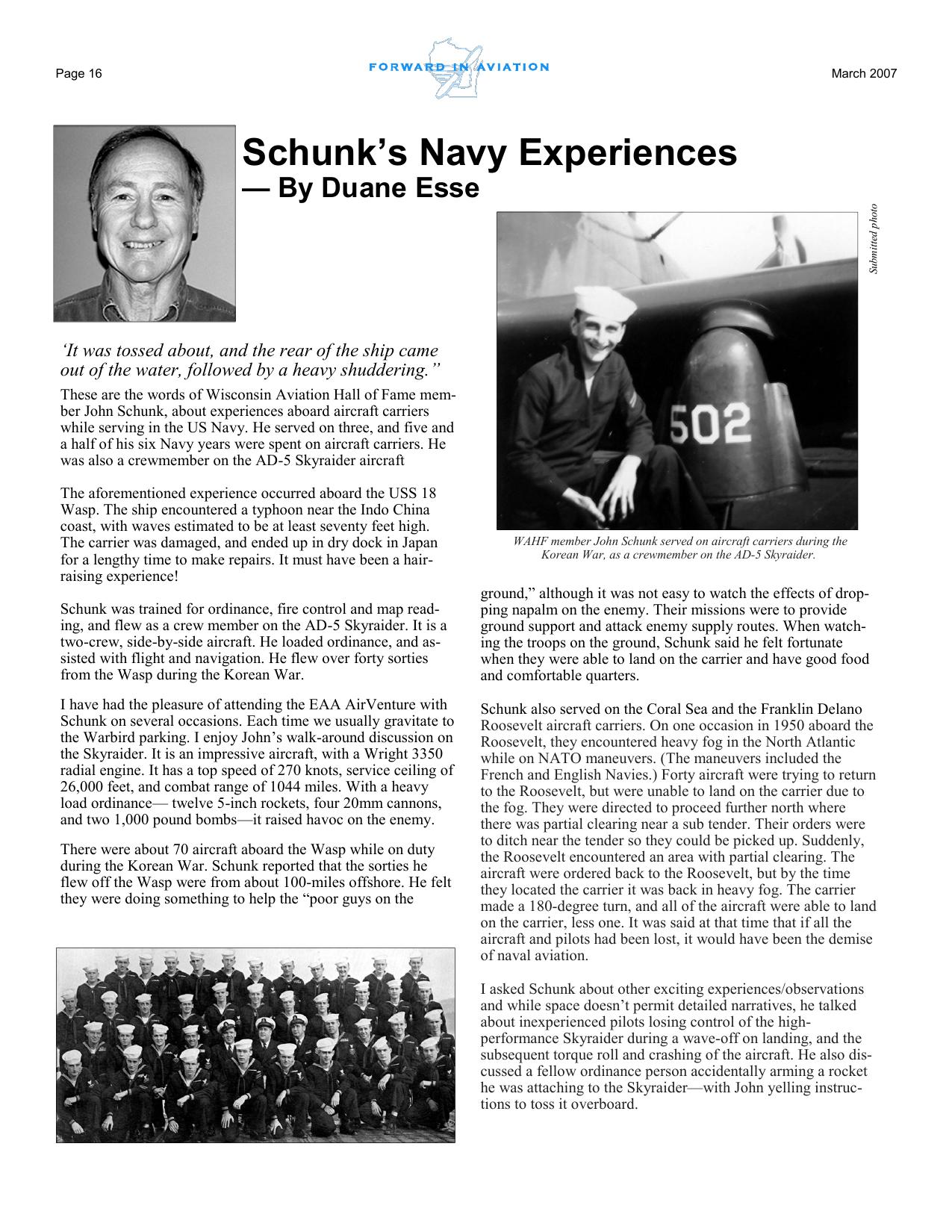
Page 16 March 2007 Schunk’s Navy Experiences Submitted photo — By Duane Esse ‘It was tossed about, and the rear of the ship came out of the water, followed by a heavy shuddering.” These are the words of Wisconsin Aviation Hall of Fame member John Schunk, about experiences aboard aircraft carriers while serving in the US Navy. He served on three, and five and a half of his six Navy years were spent on aircraft carriers. He was also a crewmember on the AD-5 Skyraider aircraft The aforementioned experience occurred aboard the USS 18 Wasp. The ship encountered a typhoon near the Indo China coast, with waves estimated to be at least seventy feet high. The carrier was damaged, and ended up in dry dock in Japan for a lengthy time to make repairs. It must have been a hairraising experience! Schunk was trained for ordinance, fire control and map reading, and flew as a crew member on the AD-5 Skyraider. It is a two-crew, side-by-side aircraft. He loaded ordinance, and assisted with flight and navigation. He flew over forty sorties from the Wasp during the Korean War. I have had the pleasure of attending the EAA AirVenture with Schunk on several occasions. Each time we usually gravitate to the Warbird parking. I enjoy John’s walk-around discussion on the Skyraider. It is an impressive aircraft, with a Wright 3350 radial engine. It has a top speed of 270 knots, service ceiling of 26,000 feet, and combat range of 1044 miles. With a heavy load ordinance— twelve 5-inch rockets, four 20mm cannons, and two 1,000 pound bombs—it raised havoc on the enemy. There were about 70 aircraft aboard the Wasp while on duty during the Korean War. Schunk reported that the sorties he flew off the Wasp were from about 100-miles offshore. He felt they were doing something to help the “poor guys on the WAHF member John Schunk served on aircraft carriers during the Korean War, as a crewmember on the AD-5 Skyraider. ground,” although it was not easy to watch the effects of dropping napalm on the enemy. Their missions were to provide ground support and attack enemy supply routes. When watching the troops on the ground, Schunk said he felt fortunate when they were able to land on the carrier and have good food and comfortable quarters. Schunk also served on the Coral Sea and the Franklin Delano Roosevelt aircraft carriers. On one occasion in 1950 aboard the Roosevelt, they encountered heavy fog in the North Atlantic while on NATO maneuvers. (The maneuvers included the French and English Navies.) Forty aircraft were trying to return to the Roosevelt, but were unable to land on the carrier due to the fog. They were directed to proceed further north where there was partial clearing near a sub tender. Their orders were to ditch near the tender so they could be picked up. Suddenly, the Roosevelt encountered an area with partial clearing. The aircraft were ordered back to the Roosevelt, but by the time they located the carrier it was back in heavy fog. The carrier made a 180-degree turn, and all of the aircraft were able to land on the carrier, less one. It was said at that time that if all the aircraft and pilots had been lost, it would have been the demise of naval aviation. I asked Schunk about other exciting experiences/observations and while space doesn’t permit detailed narratives, he talked about inexperienced pilots losing control of the highperformance Skyraider during a wave-off on landing, and the subsequent torque roll and crashing of the aircraft. He also discussed a fellow ordinance person accidentally arming a rocket he was attaching to the Skyraider—with John yelling instructions to toss it overboard.
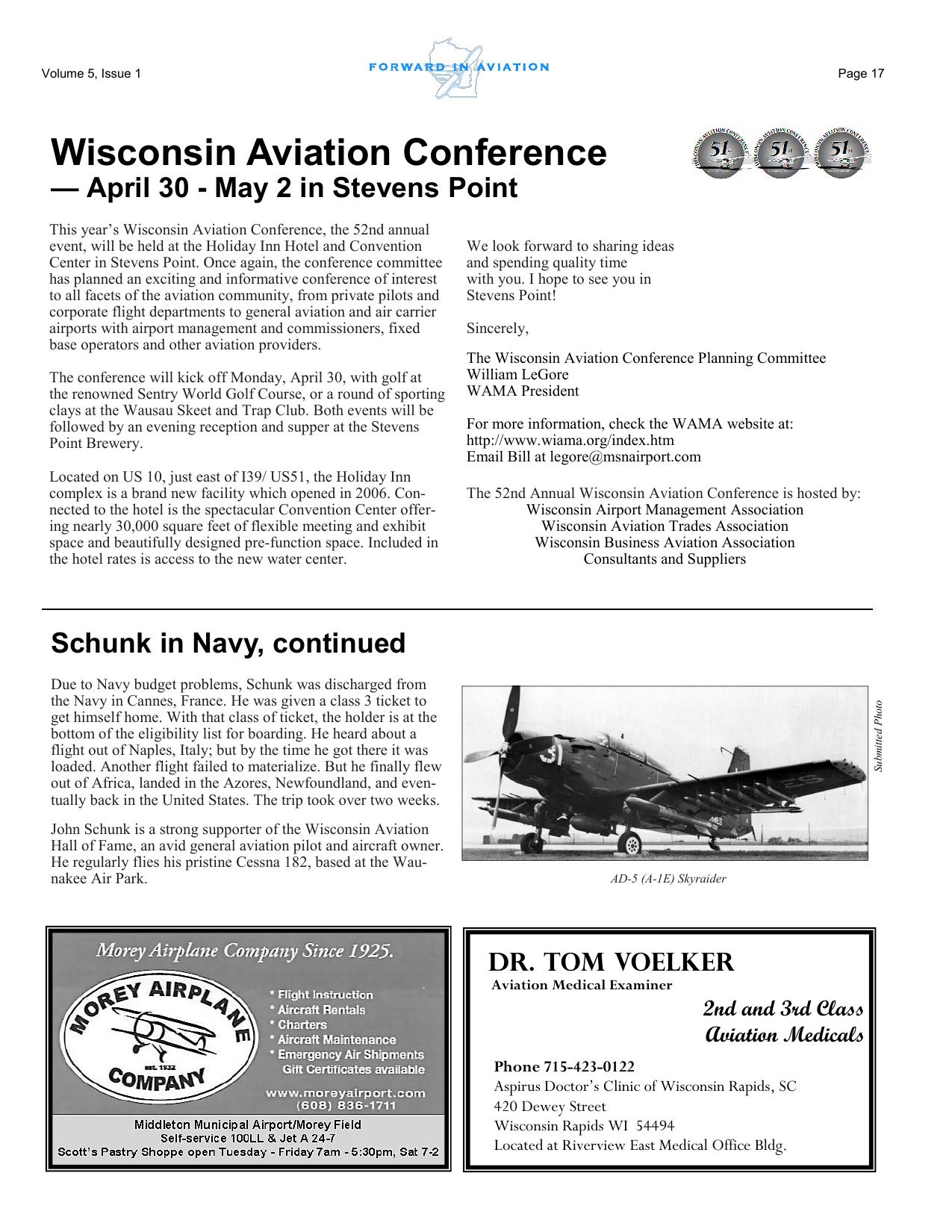
Volume 5, Issue 1 Page 17 Wisconsin Aviation Conference — April 30 - May 2 in Stevens Point This year’s Wisconsin Aviation Conference, the 52nd annual event, will be held at the Holiday Inn Hotel and Convention Center in Stevens Point. Once again, the conference committee has planned an exciting and informative conference of interest to all facets of the aviation community, from private pilots and corporate flight departments to general aviation and air carrier airports with airport management and commissioners, fixed base operators and other aviation providers. The conference will kick off Monday, April 30, with golf at the renowned Sentry World Golf Course, or a round of sporting clays at the Wausau Skeet and Trap Club. Both events will be followed by an evening reception and supper at the Stevens Point Brewery. Located on US 10, just east of I39/ US51, the Holiday Inn complex is a brand new facility which opened in 2006. Connected to the hotel is the spectacular Convention Center offering nearly 30,000 square feet of flexible meeting and exhibit space and beautifully designed pre-function space. Included in the hotel rates is access to the new water center. We look forward to sharing ideas and spending quality time with you. I hope to see you in Stevens Point! Sincerely, The Wisconsin Aviation Conference Planning Committee William LeGore WAMA President For more information, check the WAMA website at: http://www.wiama.org/index.htm Email Bill at legore@msnairport.com The 52nd Annual Wisconsin Aviation Conference is hosted by: Wisconsin Airport Management Association Wisconsin Aviation Trades Association Wisconsin Business Aviation Association Consultants and Suppliers Schunk in Navy, continued John Schunk is a strong supporter of the Wisconsin Aviation Hall of Fame, an avid general aviation pilot and aircraft owner. He regularly flies his pristine Cessna 182, based at the Waunakee Air Park. Submitted Photo Due to Navy budget problems, Schunk was discharged from the Navy in Cannes, France. He was given a class 3 ticket to get himself home. With that class of ticket, the holder is at the bottom of the eligibility list for boarding. He heard about a flight out of Naples, Italy; but by the time he got there it was loaded. Another flight failed to materialize. But he finally flew out of Africa, landed in the Azores, Newfoundland, and eventually back in the United States. The trip took over two weeks. AD-5 (A-1E) Skyraider DR. TOM VOELKER Aviation Medical Examiner 2nd and 3rd Class Aviation Medicals Phone 715-423-0122 Aspirus Doctor’s Clinic of Wisconsin Rapids, SC 420 Dewey Street Wisconsin Rapids WI 54494 Located at Riverview East Medical Office Bldg.
Page 18 March 2007 EAA AirVenture Museum —Special events, exhibits this spring and summer EAA AVIATION CENTER, OSHKOSH, WI - (Jan. 11, 2007) Special events, exhibits and activities are among the spectacular highlights of this year's schedule at the world-class EAA AirVenture Museum in Oshkosh, which celebrates its 24th year of operation in 2007. Among the featured events in 2007 is a presentation by Thomas Griffin of the famed Doolittle Raiders on March 27; new “Living History Days” at Pioneer Airport throughout the year; the openings of the Aerospace Design and Space Gallery exhibits in July; and renowned designer Burt Rutan as the keynote speaker at the annual Wright Brothers Memorial Banquet on Dec. 14. AirVenture Museum is a one-of-a-kind facility in both the Midwest and throughout the aviation world,” said Adam Smith, EAA AirVenture Museum Director. “It is a place for learning, discovery and history, a proud home for EAA members worldwide, and a vibrant center of activity within the local community. There's always something new to discover and additional activities to enjoy.” Abbreviated listing of museum events: March 27: Doolittle Raider Thomas Griffin-Listen to the tales of bravery and heroes, when one of the original Doolittle Raiders from WWII speaks in the museum. April 14-15: Open Cockpit Weekend - A rare "insider's look" at EAA's aircraft maintenance facility on 20th Street in Oshkosh, with tours of how EAA maintains its flying fleet. In the museum, several aircraft will have their cockpits opened, allowing visitors a unique look inside. Also, on April 14 a members-only, behind-the-scenes tours of EAA's archives and collections. May 5-6: Pioneer Airport Opening Weekend - The new flying season opens at Pioneer Airport, with vintage aircraft activities, plus Young Eagles flights. May 12, June 2, July 7, September 8, and October 6: Living History Days (new event in 2007) - Step back in time at Pioneer Airport and experience the golden age of aviation. Vintage children's games, send a piece of air mail and see rare aircraft fly. May 18-20: Coffy Gregory Weekend - An opportunity for girls of all ages to meet with mentors and explore a future in aviation. June 9: International Young Eagles Day - EAA's youth aviation education program, which has flown more than 1.25 million kids since 1992, takes center stage at the museum and Wittman Airport. June 23: Wings on Strings Kite Festival - One of man's earliest flying machines is celebrated in this family fun day featuring pro kite fliers, kite-making clinics and lots of room to launch your own kite! July 1: Aerospace Design Exhibition opening -Experience the innovations of wind tunnels and the progress made by them in this new exhibit designed in cooperation with NASA. July 14: Space Gallery opening - A compliment to EAA's SpaceShipOne replica, this new gallery will be filled with interactive and hands-on space activities. July 14-15: Space Exploration Weekend - A great family weekend where everyone can learn how to make an eggstronaunt and see giant rockets shot off outside. Space thrills for families of all ages. July 23-29: EAA AirVenture Oshkosh - The world's greatest aviation celebration includes extended museum hours and features many special activities and speakers. The EAA AirVenture Museum is located just off Hwy 41 at the Hwy 44 exit in Oshkosh. It is open Monday through Saturday from 8:30 a.m. to 5 p.m. and on Sundays from 10 a.m. to 5 p.m. EAA members receive free museum admission yearround and family memberships are available. For more information or to see other events, call the EAA AirVenture Museum at (920) 426-6108 or visit www.airventuremuseum.org. Aviation Scholarship Opportunities — Hurry, deadline approaching If you are a student enrolled in an aviation program at one of Wisconsin’s technical colleges, or if you know someone who is, please check into the Wisconsin Aviation Hall of Fame’s scholarship opportunities. The organization currently offers three aviation scholarships: The $1000 Carl Guell Memorial and the $500 Thiessen Field Scholarship. New in 2007 is the Jerome Ripp Memorial Scholarship. (Details to be announced.) WAHF has awarded over $5000 in scholarship monies to aviation students. Please check with your aviation academic advisors/instructors or call Keith Glasshof at 715-832-6379 for more information. But hurry, the scholarship deadline is fast approaching. Ask your friends to join the Wisconsin Aviation Hall of Fame!
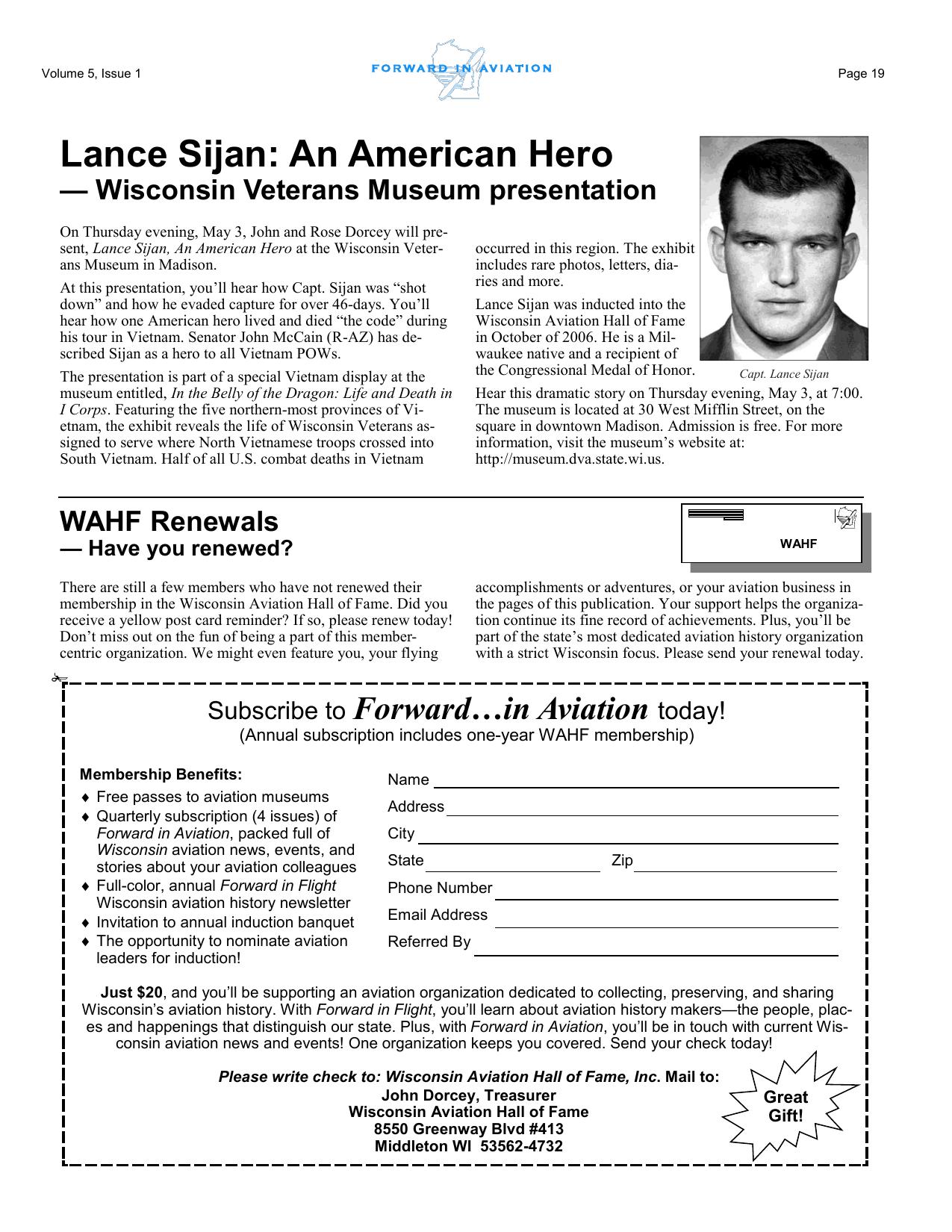
Volume 5, Issue 1 Page 19 Lance Sijan: An American Hero — Wisconsin Veterans Museum presentation On Thursday evening, May 3, John and Rose Dorcey will present, Lance Sijan, An American Hero at the Wisconsin Veterans Museum in Madison. At this presentation, you’ll hear how Capt. Sijan was “shot down” and how he evaded capture for over 46-days. You’ll hear how one American hero lived and died “the code” during his tour in Vietnam. Senator John McCain (R-AZ) has described Sijan as a hero to all Vietnam POWs. The presentation is part of a special Vietnam display at the museum entitled, In the Belly of the Dragon: Life and Death in I Corps. Featuring the five northern-most provinces of Vietnam, the exhibit reveals the life of Wisconsin Veterans assigned to serve where North Vietnamese troops crossed into South Vietnam. Half of all U.S. combat deaths in Vietnam occurred in this region. The exhibit includes rare photos, letters, diaries and more. Lance Sijan was inducted into the Wisconsin Aviation Hall of Fame in October of 2006. He is a Milwaukee native and a recipient of the Congressional Medal of Honor. Capt. Lance Sijan Hear this dramatic story on Thursday evening, May 3, at 7:00. The museum is located at 30 West Mifflin Street, on the square in downtown Madison. Admission is free. For more information, visit the museum’s website at: http://museum.dva.state.wi.us. WAHF Renewals — Have you renewed? WAHF There are still a few members who have not renewed their membership in the Wisconsin Aviation Hall of Fame. Did you receive a yellow post card reminder? If so, please renew today! Don’t miss out on the fun of being a part of this membercentric organization. We might even feature you, your flying accomplishments or adventures, or your aviation business in the pages of this publication. Your support helps the organization continue its fine record of achievements. Plus, you’ll be part of the state’s most dedicated aviation history organization with a strict Wisconsin focus. Please send your renewal today. Subscribe to Forward…in Aviation today! (Annual subscription includes one-year WAHF membership) Membership Benefits: ¨ Free passes to aviation museums ¨ Quarterly subscription (4 issues) of Forward in Aviation, packed full of Wisconsin aviation news, events, and stories about your aviation colleagues ¨ Full-color, annual Forward in Flight Wisconsin aviation history newsletter ¨ Invitation to annual induction banquet ¨ The opportunity to nominate aviation leaders for induction! Name Address City State Zip Phone Number Email Address Referred By Just $20, and you’ll be supporting an aviation organization dedicated to collecting, preserving, and sharing Wisconsin’s aviation history. With Forward in Flight, you’ll learn about aviation history makers—the people, places and happenings that distinguish our state. Plus, with Forward in Aviation, you’ll be in touch with current Wisconsin aviation news and events! One organization keeps you covered. Send your check today! Please write check to: Wisconsin Aviation Hall of Fame, Inc. Mail to: John Dorcey, Treasurer Wisconsin Aviation Hall of Fame 8550 Greenway Blvd #413 Middleton WI 53562-4732 Great Gift!
Return Service Requested Welcome new WAHF members: Thomas Boyer Roman Bukolt Leon Rediske Lowell Wilson Allyn Kaste Trig Solberg Richard Wolf Rick Jelinek Michael Dean Rick Martin Edward Hall Marjorie Wolf Lorna Fisher Phillip Pines Tina Swain Dave McCoy Dean Arcoraci Brad Hottman Gerald Adsit Mike Selwa Bill Wenkman James Kremsreiter Carolee Barnett Christina Kerscher Tom Hegy Thanks for coming onboard. We look forward to seeing you at a WAHF event soon! The Wisconsin Rapids Children’s Miracle Network John Symonds Memorial Balloon Rally will be held August 24-26, 2007 at the Wisconsin Rapids airport. Plan to attend this colorful event—you’ll be helping hundreds of kids throughout Wisconsin. Visit this website for more information: www.cmnballoonrally.com Sunday, August 5, Chetek, Wisconsin (Y23) Southworth Municipal Airport. BBQ fly-in for local charities: Warbird, antique and unique aircraft displays, antique and collector cars, raffles for airplane rides. For more information call Chuck Harrison at 715-456-8415 or email Chuck at fixdent@chibardun.net Thank you to our newsletter advertisers: Morey Airplane Company, NewView Technologies, Pat O’Malley’s Jet Room, Mead & Hunt, Dr. Tom Voelker, AME; and our newest supporters, Eagle Fuel Cells and Wisconsin Aviation. Thought for the day: “Anyone can make the simple complicated—creativity is making the complicated simple.” ~Charles Mingus ~ ~ ~ ~ ~ ~ ~ ~ ~ Don’t miss the 2007 WAHF Induction Banquet — November 10 at the EAA AirVenture Museum in Oshkosh! ~ Wisconsin Aviation Hall of Fame Officers and Board of Directors Rose Dorcey, President Michael Goc, Vice President John Dorcey, Secretary/Treasurer Duane Esse Keith Glasshof David Greene Charles Swain LaFonda Kinnaman Staber “Bill” Reese Charles Marotske, Honorary Chairman of the Board Wisconsin Aviation Hall of Fame 8550 Greenway Blvd - Suite 413 Middleton WI 53562-4732 Become a supporter today! For information call Rose Dorcey at 715-570-1186 www.aviationhalloffamewisconsin.com flyer@aviationhalloffamewisconsin.com