Volume 3, Issue 3
🗞️ Download Issue (PDF)
Forward in Flight Fall 2005
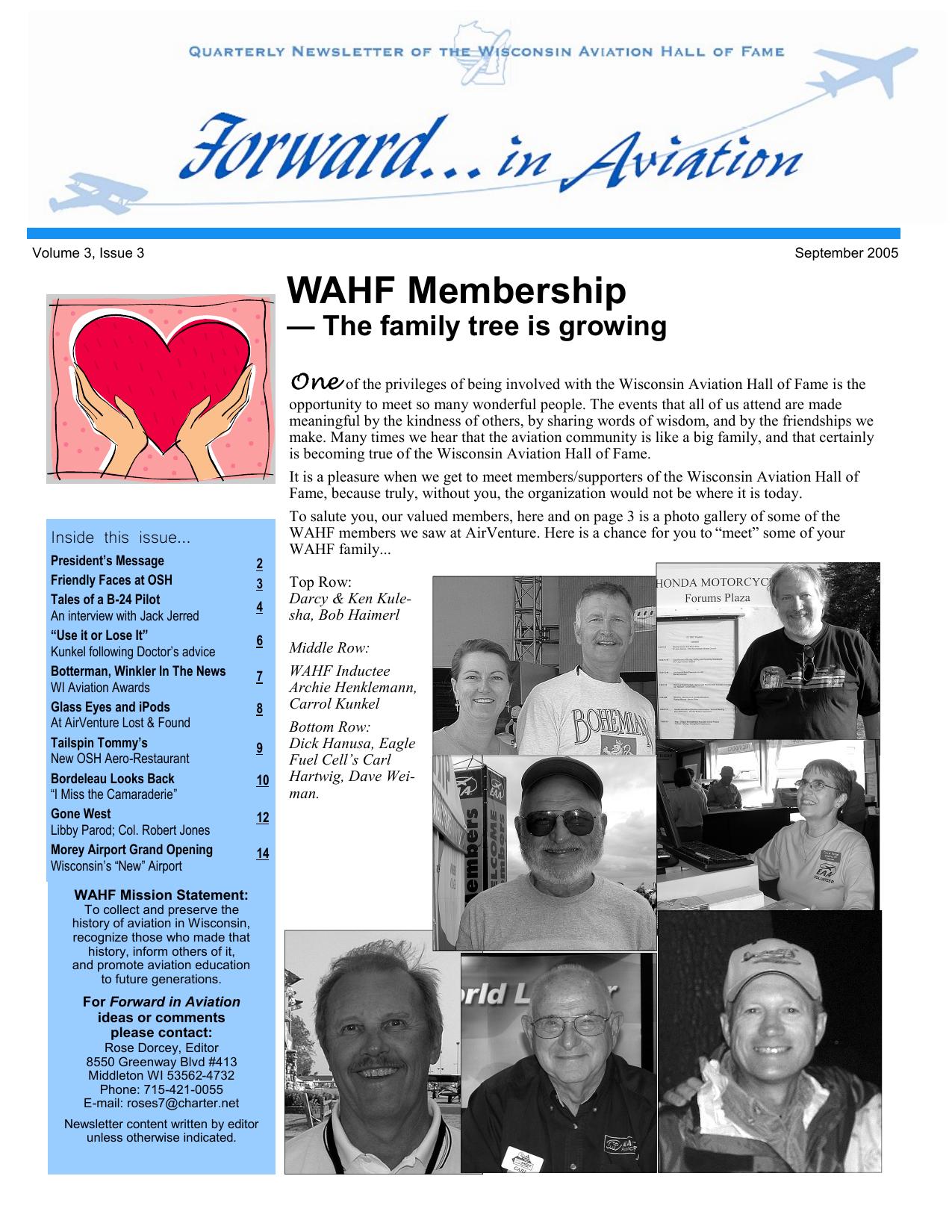
Volume 3, Issue 3 September 2005 WAHF Membership — The family tree is growing One of the privileges of being involved with the Wisconsin Aviation Hall of Fame is the Inside this issue… President’s Message Friendly Faces at OSH Tales of a B-24 Pilot An interview with Jack Jerred “Use it or Lose It” Kunkel following Doctor’s advice Botterman, Winkler In The News WI Aviation Awards Glass Eyes and iPods At AirVenture Lost & Found Tailspin Tommy’s New OSH Aero-Restaurant Bordeleau Looks Back “I Miss the Camaraderie” Gone West Libby Parod; Col. Robert Jones Morey Airport Grand Opening Wisconsin’s “New” Airport 2 3 4 6 7 8 9 10 12 14 WAHF Mission Statement: To collect and preserve the history of aviation in Wisconsin, recognize those who made that history, inform others of it, and promote aviation education to future generations. For Forward in Aviation ideas or comments please contact: Rose Dorcey, Editor 8550 Greenway Blvd #413 Middleton WI 53562-4732 Phone: 715-421-0055 E-mail: roses7@charter.net Newsletter content written by editor unless otherwise indicated. opportunity to meet so many wonderful people. The events that all of us attend are made meaningful by the kindness of others, by sharing words of wisdom, and by the friendships we make. Many times we hear that the aviation community is like a big family, and that certainly is becoming true of the Wisconsin Aviation Hall of Fame. It is a pleasure when we get to meet members/supporters of the Wisconsin Aviation Hall of Fame, because truly, without you, the organization would not be where it is today. To salute you, our valued members, here and on page 3 is a photo gallery of some of the WAHF members we saw at AirVenture. Here is a chance for you to “meet” some of your WAHF family... Top Row: Darcy & Ken Kulesha, Bob Haimerl Middle Row: WAHF Inductee Archie Henklemann, Carrol Kunkel Bottom Row: Dick Hanusa, Eagle Fuel Cell’s Carl Hartwig, Dave Weiman.
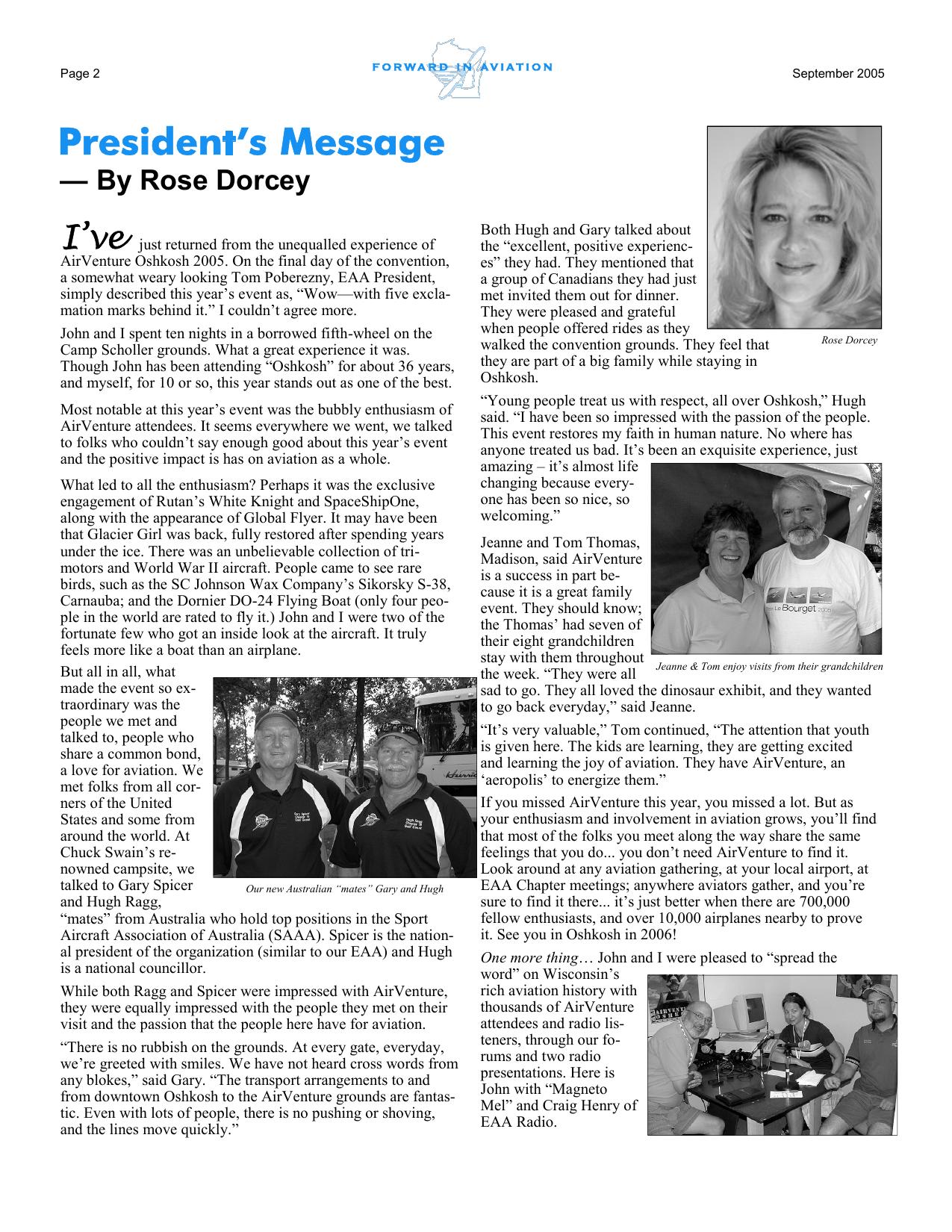
Page 2 September 2005 — By Rose Dorcey I’ve just returned from the unequalled experience of AirVenture Oshkosh 2005. On the final day of the convention, a somewhat weary looking Tom Poberezny, EAA President, simply described this year’s event as, “Wow—with five exclamation marks behind it.” I couldn’t agree more. John and I spent ten nights in a borrowed fifth-wheel on the Camp Scholler grounds. What a great experience it was. Though John has been attending “Oshkosh” for about 36 years, and myself, for 10 or so, this year stands out as one of the best. Most notable at this year’s event was the bubbly enthusiasm of AirVenture attendees. It seems everywhere we went, we talked to folks who couldn’t say enough good about this year’s event and the positive impact is has on aviation as a whole. What led to all the enthusiasm? Perhaps it was the exclusive engagement of Rutan’s White Knight and SpaceShipOne, along with the appearance of Global Flyer. It may have been that Glacier Girl was back, fully restored after spending years under the ice. There was an unbelievable collection of trimotors and World War II aircraft. People came to see rare birds, such as the SC Johnson Wax Company’s Sikorsky S-38, Carnauba; and the Dornier DO-24 Flying Boat (only four people in the world are rated to fly it.) John and I were two of the fortunate few who got an inside look at the aircraft. It truly feels more like a boat than an airplane. But all in all, what made the event so extraordinary was the people we met and talked to, people who share a common bond, a love for aviation. We met folks from all corners of the United States and some from around the world. At Chuck Swain’s renowned campsite, we talked to Gary Spicer Our new Australian “mates” Gary and Hugh and Hugh Ragg, “mates” from Australia who hold top positions in the Sport Aircraft Association of Australia (SAAA). Spicer is the national president of the organization (similar to our EAA) and Hugh is a national councillor. While both Ragg and Spicer were impressed with AirVenture, they were equally impressed with the people they met on their visit and the passion that the people here have for aviation. “There is no rubbish on the grounds. At every gate, everyday, we’re greeted with smiles. We have not heard cross words from any blokes,” said Gary. “The transport arrangements to and from downtown Oshkosh to the AirVenture grounds are fantastic. Even with lots of people, there is no pushing or shoving, and the lines move quickly.” Both Hugh and Gary talked about the “excellent, positive experiences” they had. They mentioned that a group of Canadians they had just met invited them out for dinner. They were pleased and grateful when people offered rides as they Rose Dorcey walked the convention grounds. They feel that they are part of a big family while staying in Oshkosh. “Young people treat us with respect, all over Oshkosh,” Hugh said. “I have been so impressed with the passion of the people. This event restores my faith in human nature. No where has anyone treated us bad. It’s been an exquisite experience, just amazing – it’s almost life changing because everyone has been so nice, so welcoming.” Jeanne and Tom Thomas, Madison, said AirVenture is a success in part because it is a great family event. They should know; the Thomas’ had seven of their eight grandchildren stay with them throughout Jeanne & Tom enjoy visits from their grandchildren the week. “They were all sad to go. They all loved the dinosaur exhibit, and they wanted to go back everyday,” said Jeanne. “It’s very valuable,” Tom continued, “The attention that youth is given here. The kids are learning, they are getting excited and learning the joy of aviation. They have AirVenture, an ‘aeropolis’ to energize them.” If you missed AirVenture this year, you missed a lot. But as your enthusiasm and involvement in aviation grows, you’ll find that most of the folks you meet along the way share the same feelings that you do... you don’t need AirVenture to find it. Look around at any aviation gathering, at your local airport, at EAA Chapter meetings; anywhere aviators gather, and you’re sure to find it there... it’s just better when there are 700,000 fellow enthusiasts, and over 10,000 airplanes nearby to prove it. See you in Oshkosh in 2006! One more thing… John and I were pleased to “spread the word” on Wisconsin’s rich aviation history with thousands of AirVenture attendees and radio listeners, through our forums and two radio presentations. Here is John with “Magneto Mel” and Craig Henry of EAA Radio.
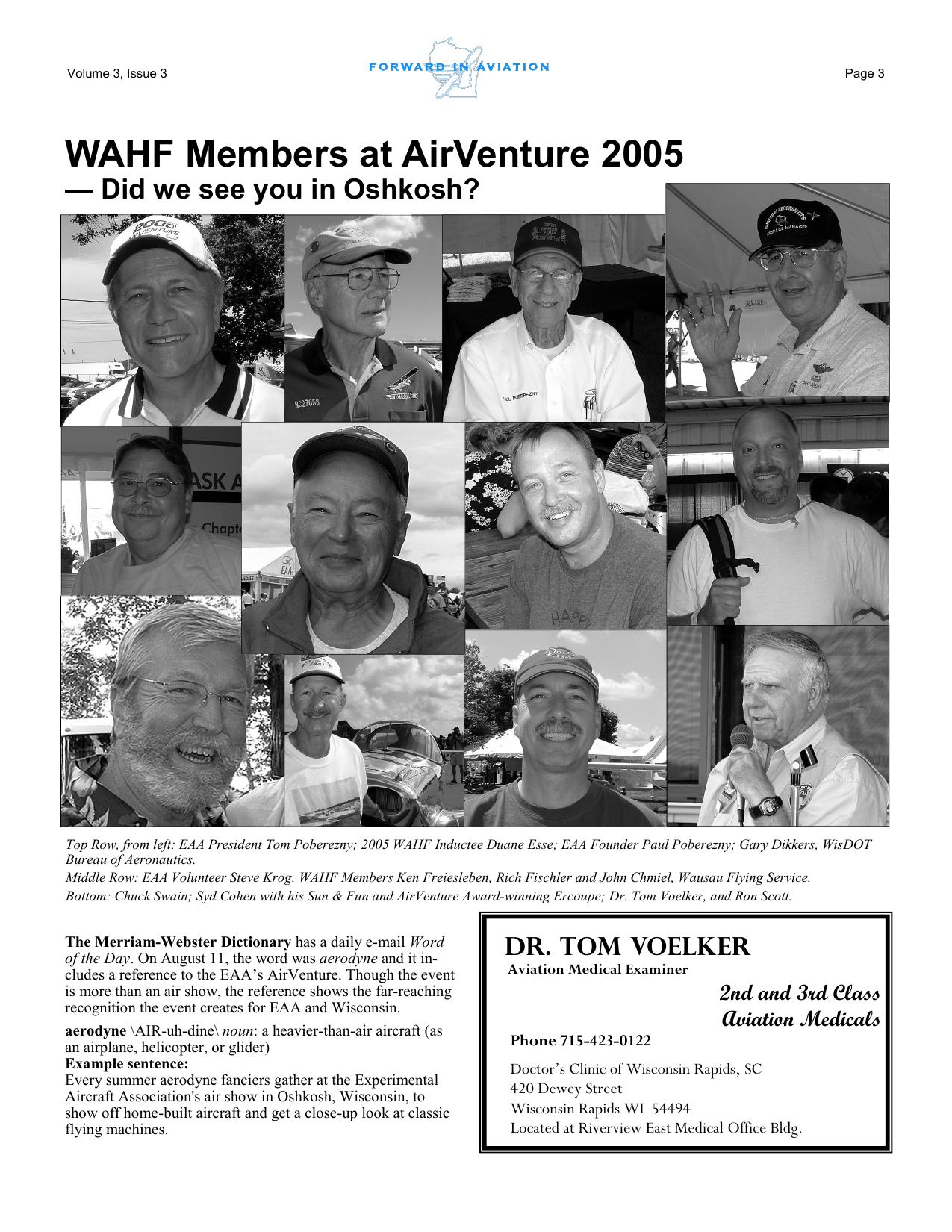
Volume 3, Issue 3 Page 3 WAHF Members at AirVenture 2005 — Did we see you in Oshkosh? Top Row, from left: EAA President Tom Poberezny; 2005 WAHF Inductee Duane Esse; EAA Founder Paul Poberezny; Gary Dikkers, WisDOT Bureau of Aeronautics. Middle Row: EAA Volunteer Steve Krog. WAHF Members Ken Freiesleben, Rich Fischler and John Chmiel, Wausau Flying Service. Bottom: Chuck Swain; Syd Cohen with his Sun & Fun and AirVenture Award-winning Ercoupe; Dr. Tom Voelker, and Ron Scott. The Merriam-Webster Dictionary has a daily e-mail Word of the Day. On August 11, the word was aerodyne and it includes a reference to the EAA’s AirVenture. Though the event is more than an air show, the reference shows the far-reaching recognition the event creates for EAA and Wisconsin. aerodyne \AIR-uh-dine\ noun: a heavier-than-air aircraft (as an airplane, helicopter, or glider) Example sentence: Every summer aerodyne fanciers gather at the Experimental Aircraft Association's air show in Oshkosh, Wisconsin, to show off home-built aircraft and get a close-up look at classic flying machines. DR. TOM VOELKER Aviation Medical Examiner 2nd and 3rd Class Aviation Medicals Phone 715-423-0122 Doctor’s Clinic of Wisconsin Rapids, SC 420 Dewey Street Wisconsin Rapids WI 54494 Located at Riverview East Medical Office Bldg.
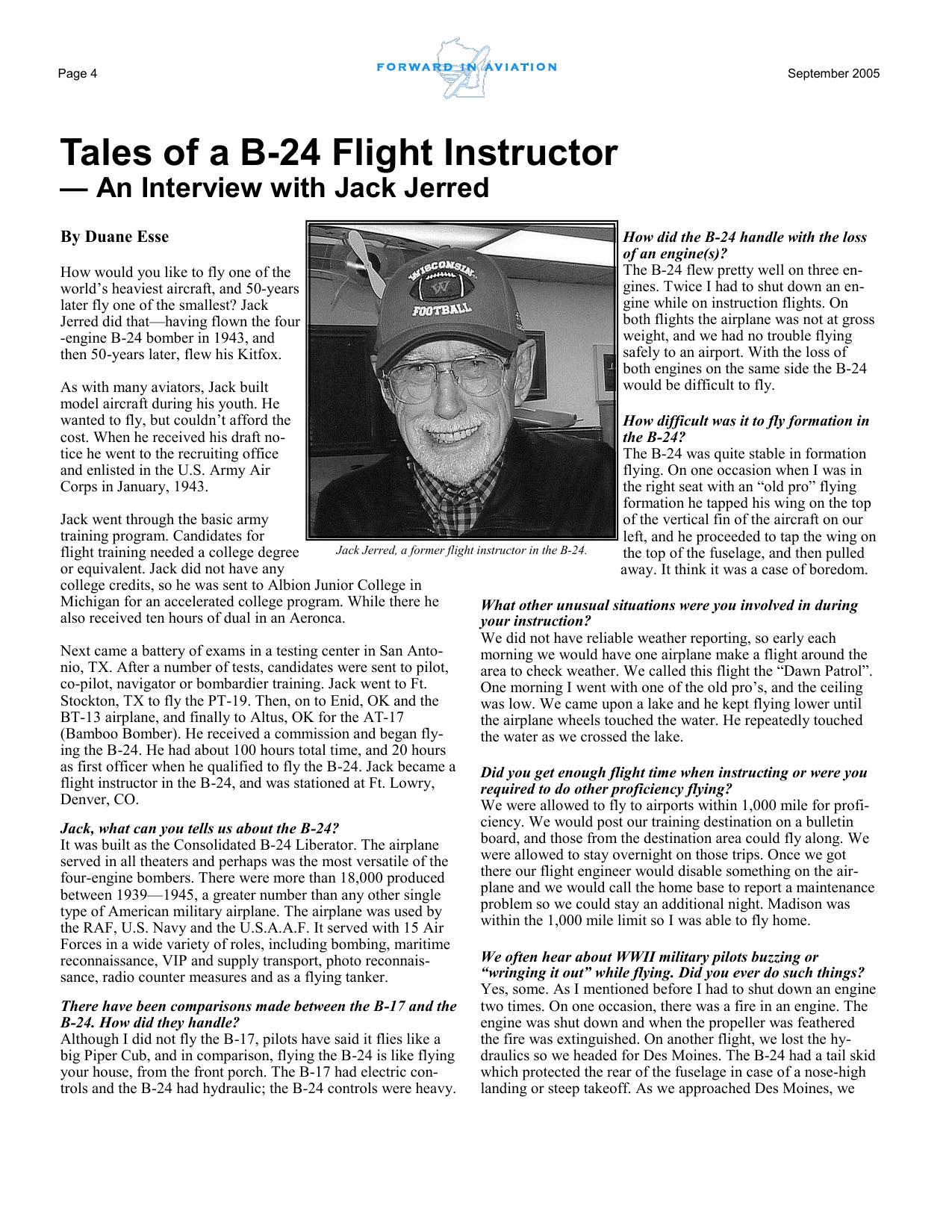
Page 4 September 2005 Tales of a B-24 Flight Instructor — An Interview with Jack Jerred By Duane Esse How would you like to fly one of the world’s heaviest aircraft, and 50-years later fly one of the smallest? Jack Jerred did that—having flown the four -engine B-24 bomber in 1943, and then 50-years later, flew his Kitfox. As with many aviators, Jack built model aircraft during his youth. He wanted to fly, but couldn’t afford the cost. When he received his draft notice he went to the recruiting office and enlisted in the U.S. Army Air Corps in January, 1943. How did the B-24 handle with the loss of an engine(s)? The B-24 flew pretty well on three engines. Twice I had to shut down an engine while on instruction flights. On both flights the airplane was not at gross weight, and we had no trouble flying safely to an airport. With the loss of both engines on the same side the B-24 would be difficult to fly. How difficult was it to fly formation in the B-24? The B-24 was quite stable in formation flying. On one occasion when I was in the right seat with an “old pro” flying formation he tapped his wing on the top of the vertical fin of the aircraft on our left, and he proceeded to tap the wing on the top of the fuselage, and then pulled away. It think it was a case of boredom. Jack went through the basic army training program. Candidates for Jack Jerred, a former flight instructor in the B-24. flight training needed a college degree or equivalent. Jack did not have any college credits, so he was sent to Albion Junior College in Michigan for an accelerated college program. While there he What other unusual situations were you involved in during also received ten hours of dual in an Aeronca. your instruction? We did not have reliable weather reporting, so early each Next came a battery of exams in a testing center in San Antomorning we would have one airplane make a flight around the nio, TX. After a number of tests, candidates were sent to pilot, area to check weather. We called this flight the “Dawn Patrol”. co-pilot, navigator or bombardier training. Jack went to Ft. One morning I went with one of the old pro’s, and the ceiling Stockton, TX to fly the PT-19. Then, on to Enid, OK and the was low. We came upon a lake and he kept flying lower until BT-13 airplane, and finally to Altus, OK for the AT-17 the airplane wheels touched the water. He repeatedly touched (Bamboo Bomber). He received a commission and began flythe water as we crossed the lake. ing the B-24. He had about 100 hours total time, and 20 hours as first officer when he qualified to fly the B-24. Jack became a Did you get enough flight time when instructing or were you flight instructor in the B-24, and was stationed at Ft. Lowry, required to do other proficiency flying? Denver, CO. We were allowed to fly to airports within 1,000 mile for proficiency. We would post our training destination on a bulletin Jack, what can you tells us about the B-24? board, and those from the destination area could fly along. We It was built as the Consolidated B-24 Liberator. The airplane were allowed to stay overnight on those trips. Once we got served in all theaters and perhaps was the most versatile of the there our flight engineer would disable something on the airfour-engine bombers. There were more than 18,000 produced plane and we would call the home base to report a maintenance between 1939—1945, a greater number than any other single problem so we could stay an additional night. Madison was type of American military airplane. The airplane was used by within the 1,000 mile limit so I was able to fly home. the RAF, U.S. Navy and the U.S.A.A.F. It served with 15 Air Forces in a wide variety of roles, including bombing, maritime We often hear about WWII military pilots buzzing or reconnaissance, VIP and supply transport, photo reconnais“wringing it out” while flying. Did you ever do such things? sance, radio counter measures and as a flying tanker. Yes, some. As I mentioned before I had to shut down an engine two times. On one occasion, there was a fire in an engine. The There have been comparisons made between the B-17 and the engine was shut down and when the propeller was feathered B-24. How did they handle? the fire was extinguished. On another flight, we lost the hyAlthough I did not fly the B-17, pilots have said it flies like a draulics so we headed for Des Moines. The B-24 had a tail skid big Piper Cub, and in comparison, flying the B-24 is like flying which protected the rear of the fuselage in case of a nose-high your house, from the front porch. The B-17 had electric conlanding or steep takeoff. As we approached Des Moines, we trols and the B-24 had hydraulic; the B-24 controls were heavy.
Volume 3 Issue 3 Page 5 2005 Induction Banquet — Plan to Attend 2005 marks a special year for the Wisconsin Aviation Hall of Fame as we celebrate our 20th birthday. Carl Guell, founder of the organization, along with his history-minded colleagues, set a standard for the future when they began honoring those who have made significant contributions to aviation in Wisconsin. On Saturday evening, October 22, the Wisconsin Aviation Hall of Fame will continue that fine tradition. Hundreds will gather to honor the 2005 slate of inductees, Jerry Mehlhaff, Duane Esse, Anton Brotz, Wendall McEldowney and Carlyle Godske. For more information or to order tickets, call Keith Glasshof at 715-832-6379 or Michael Goc at 608-339-7191. All WAHF members are invited to this esteemed event. EAA Museum admission is included with your ticket price to the banquet, so come and make a day of it! Oshkosh hotels will offer valuable discounts… just mention the Wisconsin Aviation Hall of Fame when you make your reservation. The WAHF Board of Directors encourages you to attend, and to bring your friends. The event begins with a Social Hour at 5:00 p.m. in The Eagle Hangar of the EAA AirVenture Museum. During the social hour, you’ll have a chance to relax and “catch-up” with fellow aviation friends, and meet the inductees and their families. A Silent Auction to benefit our WAHF Scholarship Program also takes place during this time. Dinner begins at 6:00 with a prayer by EAA Chaplain Ed Riddick. LaSure’s Catering of Oshkosh provides a delectable dinner. At 7 p.m., the induction ceremonies begin. We hope to have the event wrapped up by 9:00. Mark October 22 on your calendar and please plan to attend! WAHF Founder Carl Guell Deke Slayton Museum — Open House celebrates 30th anniversary of Apollo-Soyuz Mission The Deke Slayton Memorial Space and Bicycle Museum held an open house, July 16, 2005 to celebrate the 30th Anniversary of Deke Slayton's Apollo-Soyuz (ASTP) Mission. Deke Slayton was born in Sparta Wisconsin, raised on a farm just outside of Leon Wisconsin and graduated from the Sparta high school. He was one of the first Mercury 7 astronauts. The celebration at the Museum included a coloring contest for kids, the creation of an envelope cover depicting the ASTP Mission, and an impromptu class by Monroe County Aviators Larry Axelson and Gordon Stelter. The aviators shared with Young Eagles from Tomah EAA Chapter 935 the Flight of the Wright Brothers and described how the Monroe County Aviators volunteered over 500 hours to install the full scale Pietenpol Air Camper in the Museum Gallery. For more information on the Deke Slayton Museum, located at 200 West Main, Sparta, (WI) call Kay at 608-269-0033 or go to the museum website, www.dekeslayton.com. Jerred interview, continued cranked the gear down. On final, I told the crew to move to the rear of the airplane. As the airplane touched down nose high, I told the crew to slowly moved to the front. The nose wheel slowly came down, and without brakes the airplane eventually stopped before the end of the runway. How many hours do you have in the B-24, and what comments do you have? I have 1,300 hours in the B-24. It is a solid, stable airplane. In comparison to the B-17, I feel the B-24 had superior engines with Pratt & Whitney’s, compared to the Wrights in the B-17. Summarizing Comments by Duane Esse: Jack has maintained an interest in aviation. He spent five years building a Kit Fox, and said one of his greatest thrills was to fly it to Sun and Fun. He flew the Kit Fox for 120 hours and recently sold it. Jack is a member of the Madison EAA Chapter and is very active in Chapter activities. He is also involved in curling and has been for the past 50-years. Jack recently participated in the Senior National Bonspiel in Minnesota and won an event. I thoroughly enjoyed visiting with Jack, and truly respect him as one of the “greatest generation”.
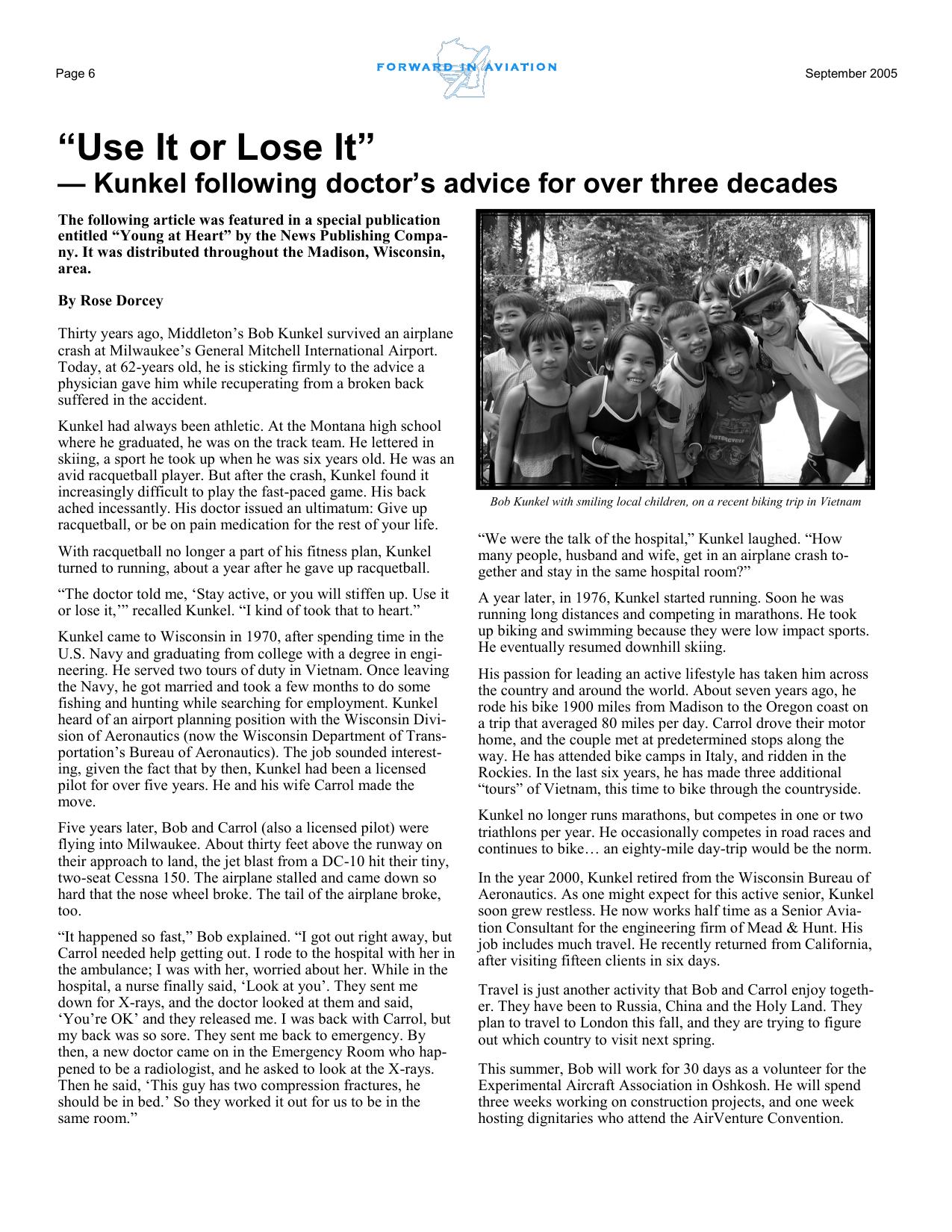
Page 6 September 2005 “Use It or Lose It” — Kunkel following doctor’s advice for over three decades The following article was featured in a special publication entitled “Young at Heart” by the News Publishing Company. It was distributed throughout the Madison, Wisconsin, area. By Rose Dorcey Thirty years ago, Middleton’s Bob Kunkel survived an airplane crash at Milwaukee’s General Mitchell International Airport. Today, at 62-years old, he is sticking firmly to the advice a physician gave him while recuperating from a broken back suffered in the accident. Kunkel had always been athletic. At the Montana high school where he graduated, he was on the track team. He lettered in skiing, a sport he took up when he was six years old. He was an avid racquetball player. But after the crash, Kunkel found it increasingly difficult to play the fast-paced game. His back ached incessantly. His doctor issued an ultimatum: Give up racquetball, or be on pain medication for the rest of your life. With racquetball no longer a part of his fitness plan, Kunkel turned to running, about a year after he gave up racquetball. “The doctor told me, ‘Stay active, or you will stiffen up. Use it or lose it,’” recalled Kunkel. “I kind of took that to heart.” Kunkel came to Wisconsin in 1970, after spending time in the U.S. Navy and graduating from college with a degree in engineering. He served two tours of duty in Vietnam. Once leaving the Navy, he got married and took a few months to do some fishing and hunting while searching for employment. Kunkel heard of an airport planning position with the Wisconsin Division of Aeronautics (now the Wisconsin Department of Transportation’s Bureau of Aeronautics). The job sounded interesting, given the fact that by then, Kunkel had been a licensed pilot for over five years. He and his wife Carrol made the move. Five years later, Bob and Carrol (also a licensed pilot) were flying into Milwaukee. About thirty feet above the runway on their approach to land, the jet blast from a DC-10 hit their tiny, two-seat Cessna 150. The airplane stalled and came down so hard that the nose wheel broke. The tail of the airplane broke, too. “It happened so fast,” Bob explained. “I got out right away, but Carrol needed help getting out. I rode to the hospital with her in the ambulance; I was with her, worried about her. While in the hospital, a nurse finally said, ‘Look at you’. They sent me down for X-rays, and the doctor looked at them and said, ‘You’re OK’ and they released me. I was back with Carrol, but my back was so sore. They sent me back to emergency. By then, a new doctor came on in the Emergency Room who happened to be a radiologist, and he asked to look at the X-rays. Then he said, ‘This guy has two compression fractures, he should be in bed.’ So they worked it out for us to be in the same room.” Bob Kunkel with smiling local children, on a recent biking trip in Vietnam “We were the talk of the hospital,” Kunkel laughed. “How many people, husband and wife, get in an airplane crash together and stay in the same hospital room?” A year later, in 1976, Kunkel started running. Soon he was running long distances and competing in marathons. He took up biking and swimming because they were low impact sports. He eventually resumed downhill skiing. His passion for leading an active lifestyle has taken him across the country and around the world. About seven years ago, he rode his bike 1900 miles from Madison to the Oregon coast on a trip that averaged 80 miles per day. Carrol drove their motor home, and the couple met at predetermined stops along the way. He has attended bike camps in Italy, and ridden in the Rockies. In the last six years, he has made three additional “tours” of Vietnam, this time to bike through the countryside. Kunkel no longer runs marathons, but competes in one or two triathlons per year. He occasionally competes in road races and continues to bike… an eighty-mile day-trip would be the norm. In the year 2000, Kunkel retired from the Wisconsin Bureau of Aeronautics. As one might expect for this active senior, Kunkel soon grew restless. He now works half time as a Senior Aviation Consultant for the engineering firm of Mead & Hunt. His job includes much travel. He recently returned from California, after visiting fifteen clients in six days. Travel is just another activity that Bob and Carrol enjoy together. They have been to Russia, China and the Holy Land. They plan to travel to London this fall, and they are trying to figure out which country to visit next spring. This summer, Bob will work for 30 days as a volunteer for the Experimental Aircraft Association in Oshkosh. He will spend three weeks working on construction projects, and one week hosting dignitaries who attend the AirVenture Convention.
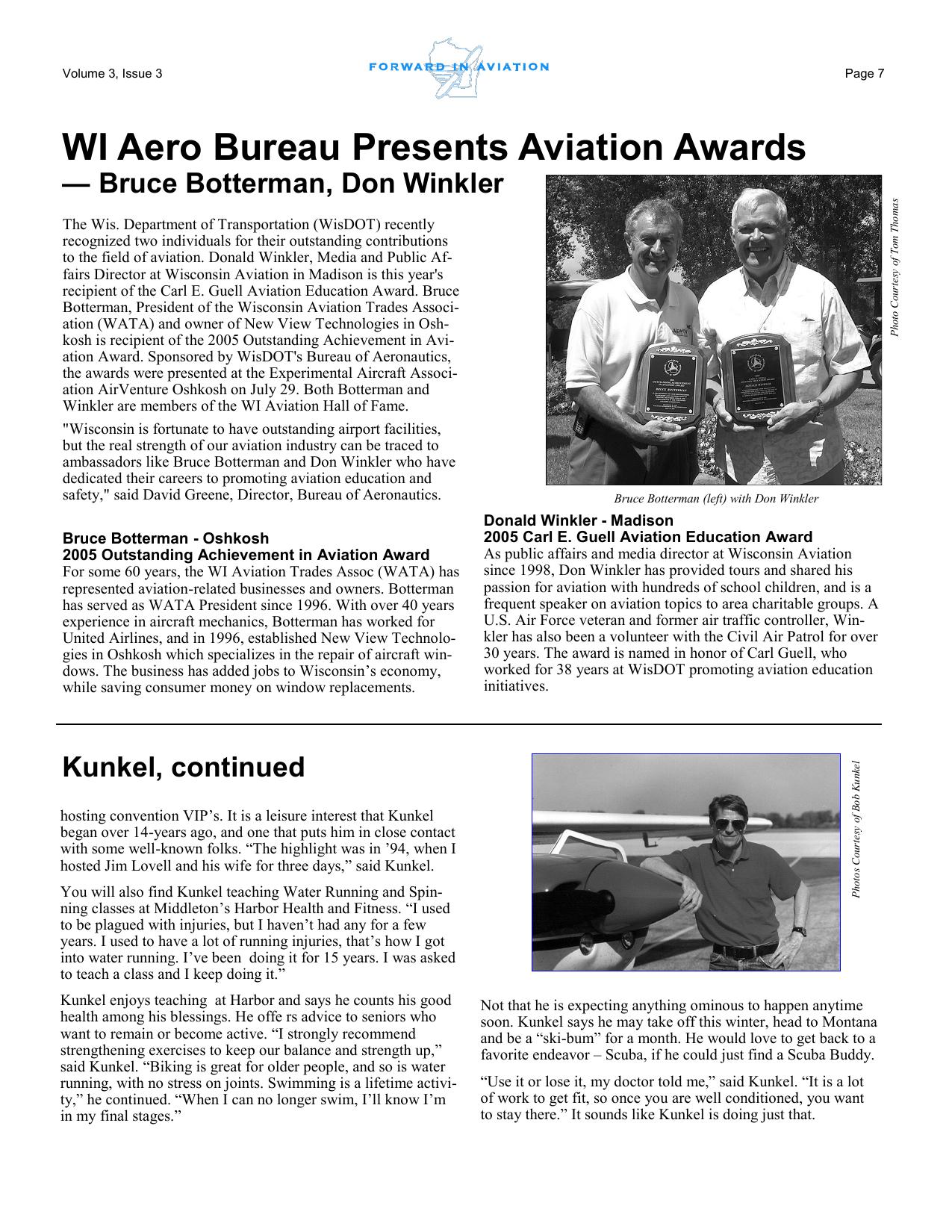
Volume 3, Issue 3 Page 7 WI Aero Bureau Presents Aviation Awards Bruce Botterman - Oshkosh 2005 Outstanding Achievement in Aviation Award For some 60 years, the WI Aviation Trades Assoc (WATA) has represented aviation-related businesses and owners. Botterman has served as WATA President since 1996. With over 40 years experience in aircraft mechanics, Botterman has worked for United Airlines, and in 1996, established New View Technologies in Oshkosh which specializes in the repair of aircraft windows. The business has added jobs to Wisconsin’s economy, while saving consumer money on window replacements. Kunkel, continued hosting convention VIP’s. It is a leisure interest that Kunkel began over 14-years ago, and one that puts him in close contact with some well-known folks. “The highlight was in ’94, when I hosted Jim Lovell and his wife for three days,” said Kunkel. You will also find Kunkel teaching Water Running and Spinning classes at Middleton’s Harbor Health and Fitness. “I used to be plagued with injuries, but I haven’t had any for a few years. I used to have a lot of running injuries, that’s how I got into water running. I’ve been doing it for 15 years. I was asked to teach a class and I keep doing it.” Kunkel enjoys teaching at Harbor and says he counts his good health among his blessings. He offe rs advice to seniors who want to remain or become active. “I strongly recommend strengthening exercises to keep our balance and strength up,” said Kunkel. “Biking is great for older people, and so is water running, with no stress on joints. Swimming is a lifetime activity,” he continued. “When I can no longer swim, I’ll know I’m in my final stages.” Bruce Botterman (left) with Don Winkler Donald Winkler - Madison 2005 Carl E. Guell Aviation Education Award As public affairs and media director at Wisconsin Aviation since 1998, Don Winkler has provided tours and shared his passion for aviation with hundreds of school children, and is a frequent speaker on aviation topics to area charitable groups. A U.S. Air Force veteran and former air traffic controller, Winkler has also been a volunteer with the Civil Air Patrol for over 30 years. The award is named in honor of Carl Guell, who worked for 38 years at WisDOT promoting aviation education initiatives. Photos Courtesy of Bob Kunkel The Wis. Department of Transportation (WisDOT) recently recognized two individuals for their outstanding contributions to the field of aviation. Donald Winkler, Media and Public Affairs Director at Wisconsin Aviation in Madison is this year's recipient of the Carl E. Guell Aviation Education Award. Bruce Botterman, President of the Wisconsin Aviation Trades Association (WATA) and owner of New View Technologies in Oshkosh is recipient of the 2005 Outstanding Achievement in Aviation Award. Sponsored by WisDOT's Bureau of Aeronautics, the awards were presented at the Experimental Aircraft Association AirVenture Oshkosh on July 29. Both Botterman and Winkler are members of the WI Aviation Hall of Fame. "Wisconsin is fortunate to have outstanding airport facilities, but the real strength of our aviation industry can be traced to ambassadors like Bruce Botterman and Don Winkler who have dedicated their careers to promoting aviation education and safety," said David Greene, Director, Bureau of Aeronautics. Photo Courtesy of Tom Thomas — Bruce Botterman, Don Winkler Not that he is expecting anything ominous to happen anytime soon. Kunkel says he may take off this winter, head to Montana and be a “ski-bum” for a month. He would love to get back to a favorite endeavor – Scuba, if he could just find a Scuba Buddy. “Use it or lose it, my doctor told me,” said Kunkel. “It is a lot of work to get fit, so once you are well conditioned, you want to stay there.” It sounds like Kunkel is doing just that.
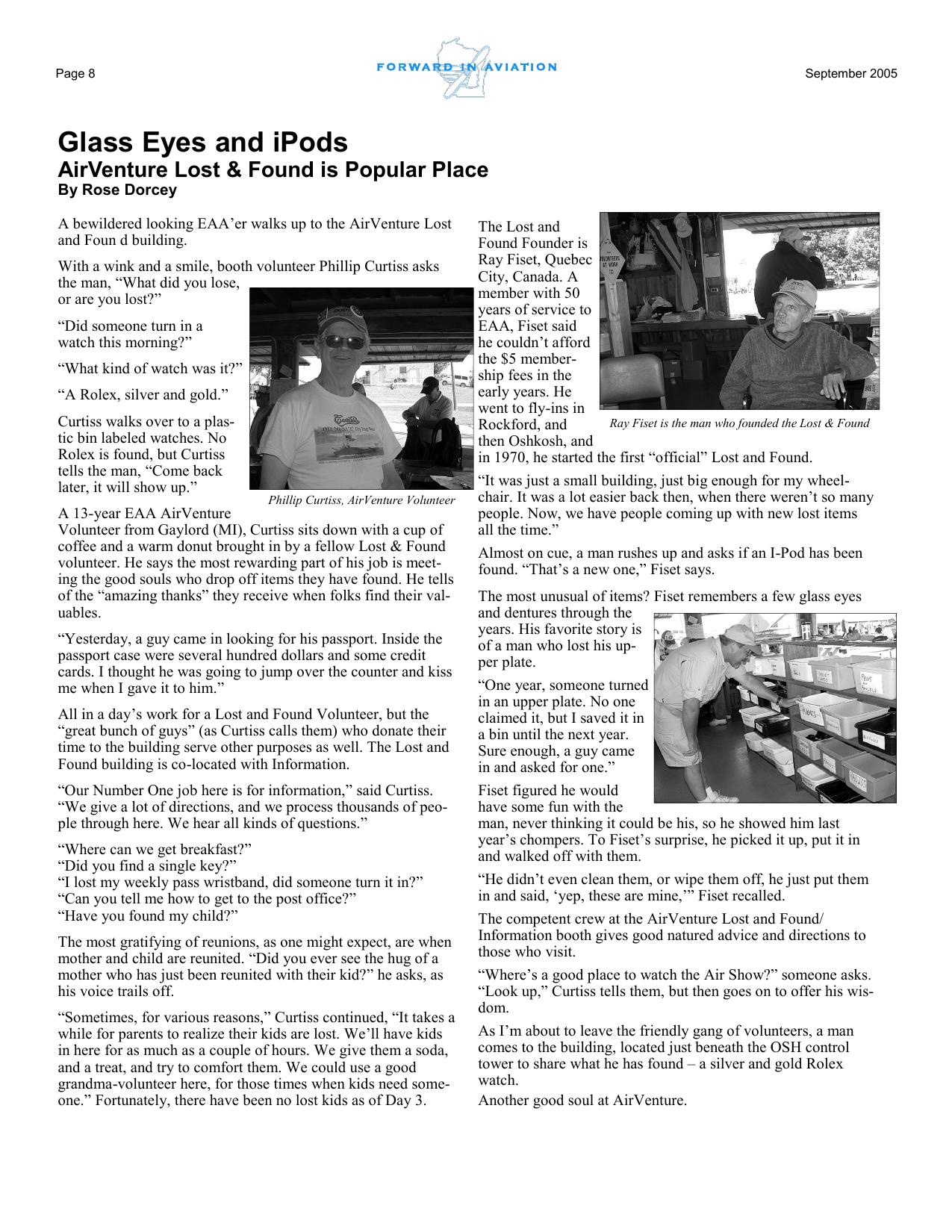
Page 8 September 2005 Glass Eyes and iPods AirVenture Lost & Found is Popular Place By Rose Dorcey A bewildered looking EAA’er walks up to the AirVenture Lost and Foun d building. With a wink and a smile, booth volunteer Phillip Curtiss asks the man, “What did you lose, or are you lost?” “Did someone turn in a watch this morning?” “What kind of watch was it?” “A Rolex, silver and gold.” Curtiss walks over to a plastic bin labeled watches. No Rolex is found, but Curtiss tells the man, “Come back later, it will show up.” Phillip Curtiss, AirVenture Volunteer A 13-year EAA AirVenture Volunteer from Gaylord (MI), Curtiss sits down with a cup of coffee and a warm donut brought in by a fellow Lost & Found volunteer. He says the most rewarding part of his job is meeting the good souls who drop off items they have found. He tells of the “amazing thanks” they receive when folks find their valuables. “Yesterday, a guy came in looking for his passport. Inside the passport case were several hundred dollars and some credit cards. I thought he was going to jump over the counter and kiss me when I gave it to him.” All in a day’s work for a Lost and Found Volunteer, but the “great bunch of guys” (as Curtiss calls them) who donate their time to the building serve other purposes as well. The Lost and Found building is co-located with Information. “Our Number One job here is for information,” said Curtiss. “We give a lot of directions, and we process thousands of people through here. We hear all kinds of questions.” “Where can we get breakfast?” “Did you find a single key?” “I lost my weekly pass wristband, did someone turn it in?” “Can you tell me how to get to the post office?” “Have you found my child?” The most gratifying of reunions, as one might expect, are when mother and child are reunited. “Did you ever see the hug of a mother who has just been reunited with their kid?” he asks, as his voice trails off. “Sometimes, for various reasons,” Curtiss continued, “It takes a while for parents to realize their kids are lost. We’ll have kids in here for as much as a couple of hours. We give them a soda, and a treat, and try to comfort them. We could use a good grandma-volunteer here, for those times when kids need someone.” Fortunately, there have been no lost kids as of Day 3. The Lost and Found Founder is Ray Fiset, Quebec City, Canada. A member with 50 years of service to EAA, Fiset said he couldn’t afford the $5 membership fees in the early years. He went to fly-ins in Ray Fiset is the man who founded the Lost & Found Rockford, and then Oshkosh, and in 1970, he started the first “official” Lost and Found. “It was just a small building, just big enough for my wheelchair. It was a lot easier back then, when there weren’t so many people. Now, we have people coming up with new lost items all the time.” Almost on cue, a man rushes up and asks if an I-Pod has been found. “That’s a new one,” Fiset says. The most unusual of items? Fiset remembers a few glass eyes and dentures through the years. His favorite story is of a man who lost his upper plate. “One year, someone turned in an upper plate. No one claimed it, but I saved it in a bin until the next year. Sure enough, a guy came in and asked for one.” Fiset figured he would have some fun with the man, never thinking it could be his, so he showed him last year’s chompers. To Fiset’s surprise, he picked it up, put it in and walked off with them. “He didn’t even clean them, or wipe them off, he just put them in and said, ‘yep, these are mine,’” Fiset recalled. The competent crew at the AirVenture Lost and Found/ Information booth gives good natured advice and directions to those who visit. “Where’s a good place to watch the Air Show?” someone asks. “Look up,” Curtiss tells them, but then goes on to offer his wisdom. As I’m about to leave the friendly gang of volunteers, a man comes to the building, located just beneath the OSH control tower to share what he has found – a silver and gold Rolex watch. Another good soul at AirVenture.
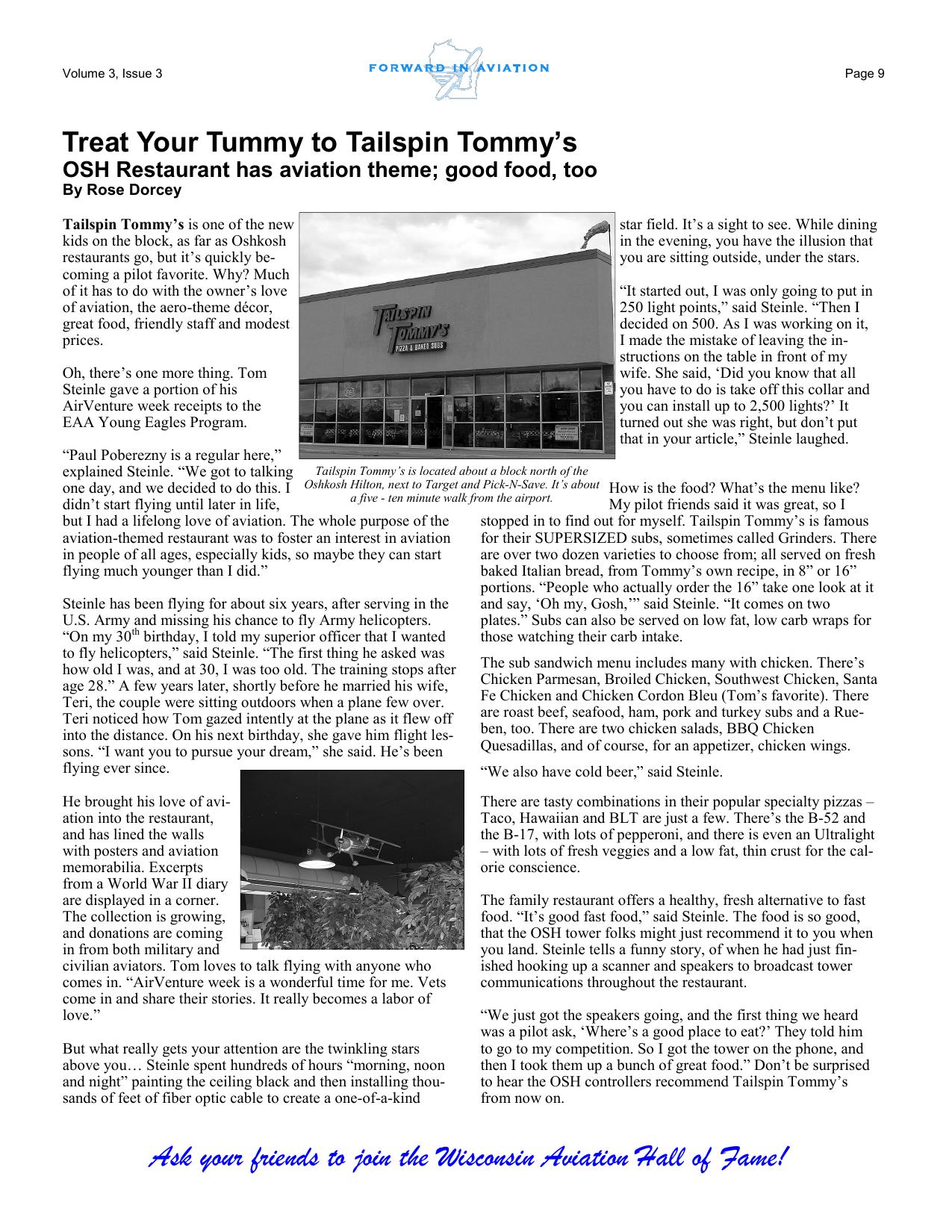
Volume 3, Issue 3 Page 9 Treat Your Tummy to Tailspin Tommy’s OSH Restaurant has aviation theme; good food, too By Rose Dorcey Tailspin Tommy’s is one of the new kids on the block, as far as Oshkosh restaurants go, but it’s quickly becoming a pilot favorite. Why? Much of it has to do with the owner’s love of aviation, the aero-theme décor, great food, friendly staff and modest prices. Oh, there’s one more thing. Tom Steinle gave a portion of his AirVenture week receipts to the EAA Young Eagles Program. star field. It’s a sight to see. While dining in the evening, you have the illusion that you are sitting outside, under the stars. “It started out, I was only going to put in 250 light points,” said Steinle. “Then I decided on 500. As I was working on it, I made the mistake of leaving the instructions on the table in front of my wife. She said, ‘Did you know that all you have to do is take off this collar and you can install up to 2,500 lights?’ It turned out she was right, but don’t put that in your article,” Steinle laughed. “Paul Poberezny is a regular here,” explained Steinle. “We got to talking Tailspin Tommy’s is located about a block north of the one day, and we decided to do this. I Oshkosh Hilton, next to Target and Pick-N-Save. It’s about How is the food? What’s the menu like? a five - ten minute walk from the airport. didn’t start flying until later in life, My pilot friends said it was great, so I but I had a lifelong love of aviation. The whole purpose of the stopped in to find out for myself. Tailspin Tommy’s is famous aviation-themed restaurant was to foster an interest in aviation for their SUPERSIZED subs, sometimes called Grinders. There in people of all ages, especially kids, so maybe they can start are over two dozen varieties to choose from; all served on fresh flying much younger than I did.” baked Italian bread, from Tommy’s own recipe, in 8” or 16” portions. “People who actually order the 16” take one look at it Steinle has been flying for about six years, after serving in the and say, ‘Oh my, Gosh,’” said Steinle. “It comes on two U.S. Army and missing his chance to fly Army helicopters. plates.” Subs can also be served on low fat, low carb wraps for “On my 30th birthday, I told my superior officer that I wanted those watching their carb intake. to fly helicopters,” said Steinle. “The first thing he asked was The sub sandwich menu includes many with chicken. There’s how old I was, and at 30, I was too old. The training stops after Chicken Parmesan, Broiled Chicken, Southwest Chicken, Santa age 28.” A few years later, shortly before he married his wife, Fe Chicken and Chicken Cordon Bleu (Tom’s favorite). There Teri, the couple were sitting outdoors when a plane few over. are roast beef, seafood, ham, pork and turkey subs and a RueTeri noticed how Tom gazed intently at the plane as it flew off ben, too. There are two chicken salads, BBQ Chicken into the distance. On his next birthday, she gave him flight lesQuesadillas, and of course, for an appetizer, chicken wings. sons. “I want you to pursue your dream,” she said. He’s been flying ever since. “We also have cold beer,” said Steinle. He brought his love of aviation into the restaurant, and has lined the walls with posters and aviation memorabilia. Excerpts from a World War II diary are displayed in a corner. The collection is growing, and donations are coming in from both military and civilian aviators. Tom loves to talk flying with anyone who comes in. “AirVenture week is a wonderful time for me. Vets come in and share their stories. It really becomes a labor of love.” But what really gets your attention are the twinkling stars above you… Steinle spent hundreds of hours “morning, noon and night” painting the ceiling black and then installing thousands of feet of fiber optic cable to create a one-of-a-kind There are tasty combinations in their popular specialty pizzas – Taco, Hawaiian and BLT are just a few. There’s the B-52 and the B-17, with lots of pepperoni, and there is even an Ultralight – with lots of fresh veggies and a low fat, thin crust for the calorie conscience. The family restaurant offers a healthy, fresh alternative to fast food. “It’s good fast food,” said Steinle. The food is so good, that the OSH tower folks might just recommend it to you when you land. Steinle tells a funny story, of when he had just finished hooking up a scanner and speakers to broadcast tower communications throughout the restaurant. “We just got the speakers going, and the first thing we heard was a pilot ask, ‘Where’s a good place to eat?’ They told him to go to my competition. So I got the tower on the phone, and then I took them up a bunch of great food.” Don’t be surprised to hear the OSH controllers recommend Tailspin Tommy’s from now on. Ask your friends to join the Wisconsin Aviation Hall of Fame!
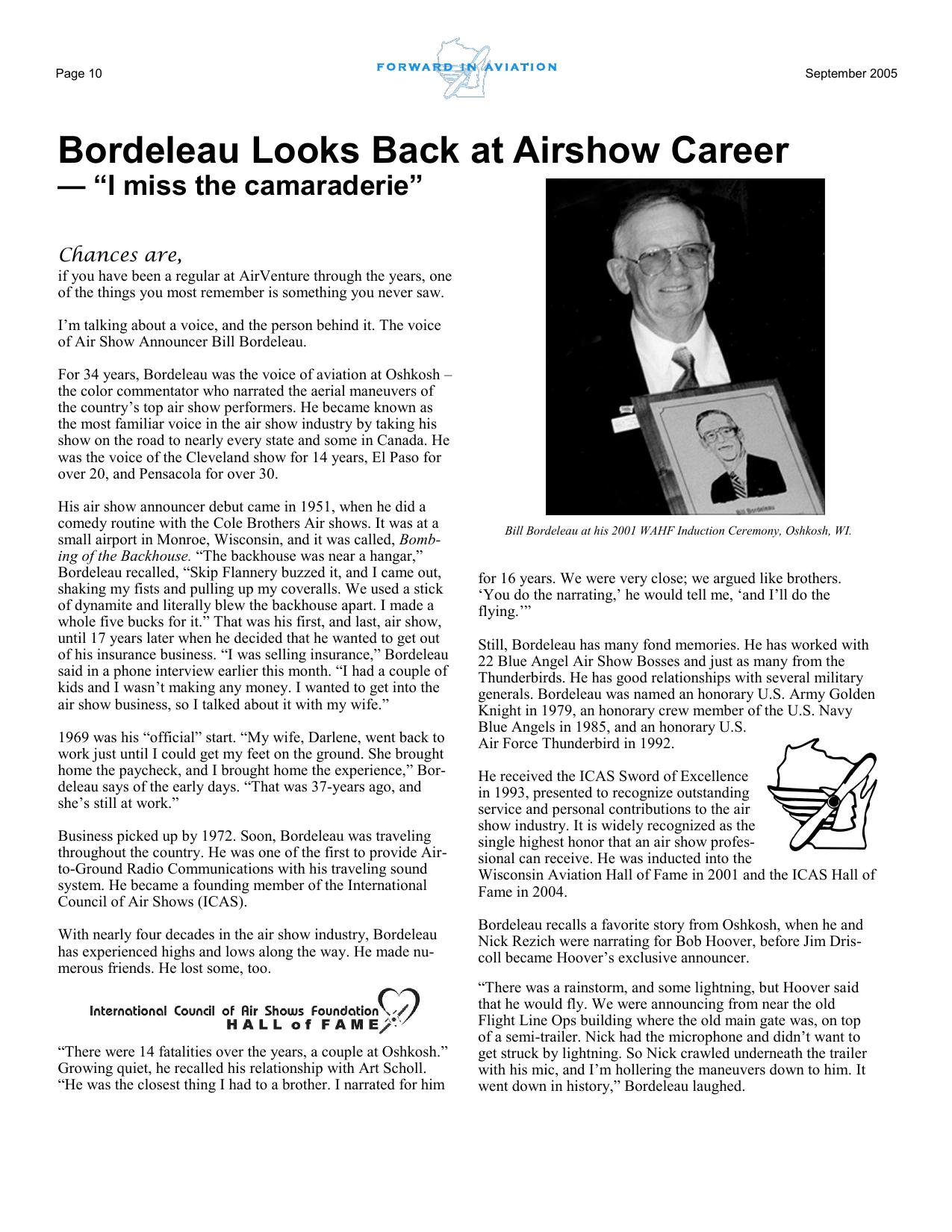
Page 10 September 2005 Bordeleau Looks Back at Airshow Career — “I miss the camaraderie” Chances are, if you have been a regular at AirVenture through the years, one of the things you most remember is something you never saw. I’m talking about a voice, and the person behind it. The voice of Air Show Announcer Bill Bordeleau. For 34 years, Bordeleau was the voice of aviation at Oshkosh – the color commentator who narrated the aerial maneuvers of the country’s top air show performers. He became known as the most familiar voice in the air show industry by taking his show on the road to nearly every state and some in Canada. He was the voice of the Cleveland show for 14 years, El Paso for over 20, and Pensacola for over 30. His air show announcer debut came in 1951, when he did a comedy routine with the Cole Brothers Air shows. It was at a small airport in Monroe, Wisconsin, and it was called, Bombing of the Backhouse. “The backhouse was near a hangar,” Bordeleau recalled, “Skip Flannery buzzed it, and I came out, shaking my fists and pulling up my coveralls. We used a stick of dynamite and literally blew the backhouse apart. I made a whole five bucks for it.” That was his first, and last, air show, until 17 years later when he decided that he wanted to get out of his insurance business. “I was selling insurance,” Bordeleau said in a phone interview earlier this month. “I had a couple of kids and I wasn’t making any money. I wanted to get into the air show business, so I talked about it with my wife.” 1969 was his “official” start. “My wife, Darlene, went back to work just until I could get my feet on the ground. She brought home the paycheck, and I brought home the experience,” Bordeleau says of the early days. “That was 37-years ago, and she’s still at work.” Business picked up by 1972. Soon, Bordeleau was traveling throughout the country. He was one of the first to provide Airto-Ground Radio Communications with his traveling sound system. He became a founding member of the International Council of Air Shows (ICAS). With nearly four decades in the air show industry, Bordeleau has experienced highs and lows along the way. He made numerous friends. He lost some, too. “There were 14 fatalities over the years, a couple at Oshkosh.” Growing quiet, he recalled his relationship with Art Scholl. “He was the closest thing I had to a brother. I narrated for him Bill Bordeleau at his 2001 WAHF Induction Ceremony, Oshkosh, WI. for 16 years. We were very close; we argued like brothers. ‘You do the narrating,’ he would tell me, ‘and I’ll do the flying.’” Still, Bordeleau has many fond memories. He has worked with 22 Blue Angel Air Show Bosses and just as many from the Thunderbirds. He has good relationships with several military generals. Bordeleau was named an honorary U.S. Army Golden Knight in 1979, an honorary crew member of the U.S. Navy Blue Angels in 1985, and an honorary U.S. Air Force Thunderbird in 1992. He received the ICAS Sword of Excellence in 1993, presented to recognize outstanding service and personal contributions to the air show industry. It is widely recognized as the single highest honor that an air show professional can receive. He was inducted into the Wisconsin Aviation Hall of Fame in 2001 and the ICAS Hall of Fame in 2004. Bordeleau recalls a favorite story from Oshkosh, when he and Nick Rezich were narrating for Bob Hoover, before Jim Driscoll became Hoover’s exclusive announcer. “There was a rainstorm, and some lightning, but Hoover said that he would fly. We were announcing from near the old Flight Line Ops building where the old main gate was, on top of a semi-trailer. Nick had the microphone and didn’t want to get struck by lightning. So Nick crawled underneath the trailer with his mic, and I’m hollering the maneuvers down to him. It went down in history,” Bordeleau laughed.
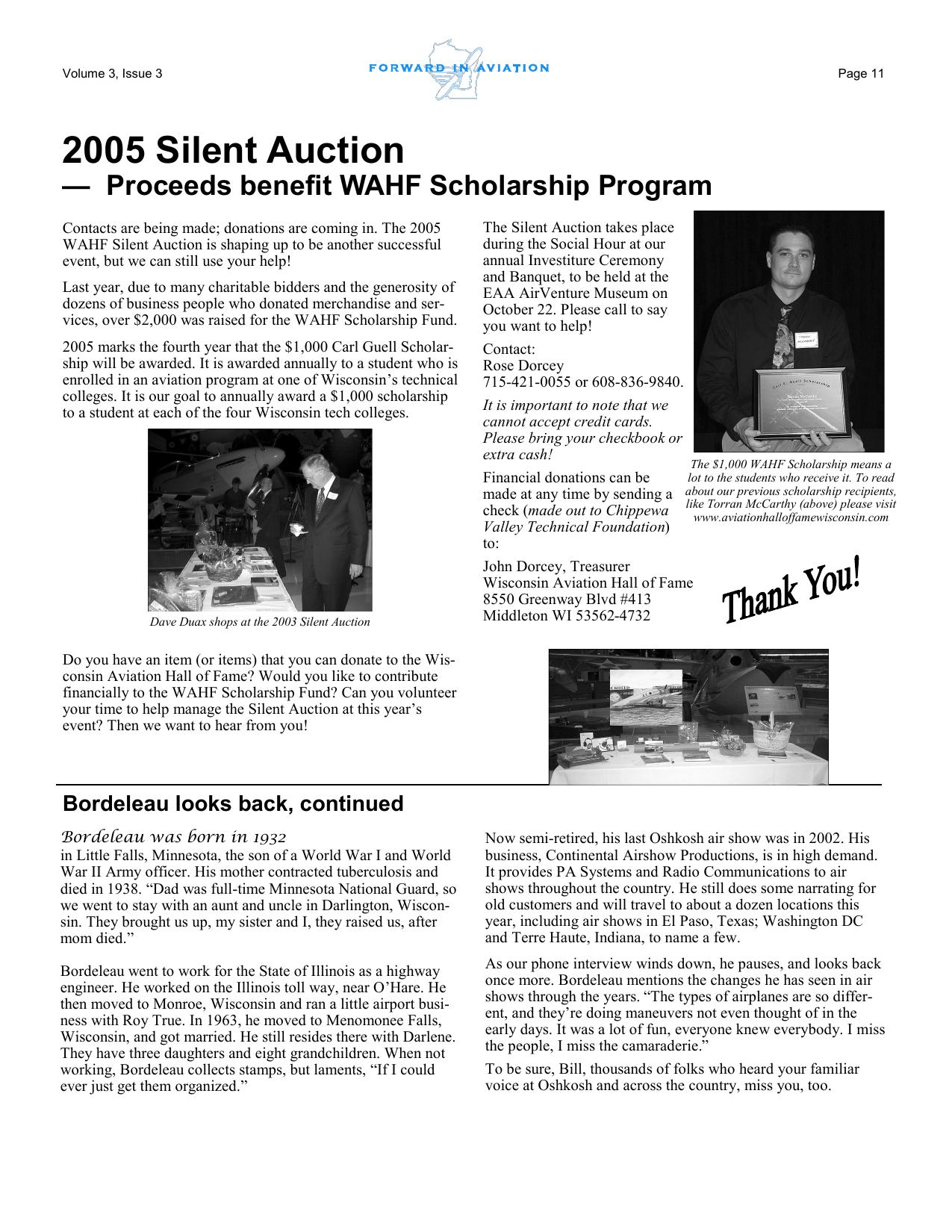
Volume 3, Issue 3 Page 11 2005 Silent Auction — Proceeds benefit WAHF Scholarship Program Contacts are being made; donations are coming in. The 2005 WAHF Silent Auction is shaping up to be another successful event, but we can still use your help! Last year, due to many charitable bidders and the generosity of dozens of business people who donated merchandise and services, over $2,000 was raised for the WAHF Scholarship Fund. 2005 marks the fourth year that the $1,000 Carl Guell Scholarship will be awarded. It is awarded annually to a student who is enrolled in an aviation program at one of Wisconsin’s technical colleges. It is our goal to annually award a $1,000 scholarship to a student at each of the four Wisconsin tech colleges. Dave Duax shops at the 2003 Silent Auction The Silent Auction takes place during the Social Hour at our annual Investiture Ceremony and Banquet, to be held at the EAA AirVenture Museum on October 22. Please call to say you want to help! Contact: Rose Dorcey 715-421-0055 or 608-836-9840. It is important to note that we cannot accept credit cards. Please bring your checkbook or extra cash! The $1,000 WAHF Scholarship means a lot to the students who receive it. To read Financial donations can be made at any time by sending a about our previous scholarship recipients, Torran McCarthy (above) please visit check (made out to Chippewa like www.aviationhalloffamewisconsin.com Valley Technical Foundation) to: John Dorcey, Treasurer Wisconsin Aviation Hall of Fame 8550 Greenway Blvd #413 Middleton WI 53562-4732 Do you have an item (or items) that you can donate to the Wisconsin Aviation Hall of Fame? Would you like to contribute financially to the WAHF Scholarship Fund? Can you volunteer your time to help manage the Silent Auction at this year’s event? Then we want to hear from you! Bordeleau looks back, continued Bordeleau was born in 1932 in Little Falls, Minnesota, the son of a World War I and World War II Army officer. His mother contracted tuberculosis and died in 1938. “Dad was full-time Minnesota National Guard, so we went to stay with an aunt and uncle in Darlington, Wisconsin. They brought us up, my sister and I, they raised us, after mom died.” Now semi-retired, his last Oshkosh air show was in 2002. His business, Continental Airshow Productions, is in high demand. It provides PA Systems and Radio Communications to air shows throughout the country. He still does some narrating for old customers and will travel to about a dozen locations this year, including air shows in El Paso, Texas; Washington DC and Terre Haute, Indiana, to name a few. Bordeleau went to work for the State of Illinois as a highway engineer. He worked on the Illinois toll way, near O’Hare. He then moved to Monroe, Wisconsin and ran a little airport business with Roy True. In 1963, he moved to Menomonee Falls, Wisconsin, and got married. He still resides there with Darlene. They have three daughters and eight grandchildren. When not working, Bordeleau collects stamps, but laments, “If I could ever just get them organized.” As our phone interview winds down, he pauses, and looks back once more. Bordeleau mentions the changes he has seen in air shows through the years. “The types of airplanes are so different, and they’re doing maneuvers not even thought of in the early days. It was a lot of fun, everyone knew everybody. I miss the people, I miss the camaraderie.” To be sure, Bill, thousands of folks who heard your familiar voice at Oshkosh and across the country, miss you, too.
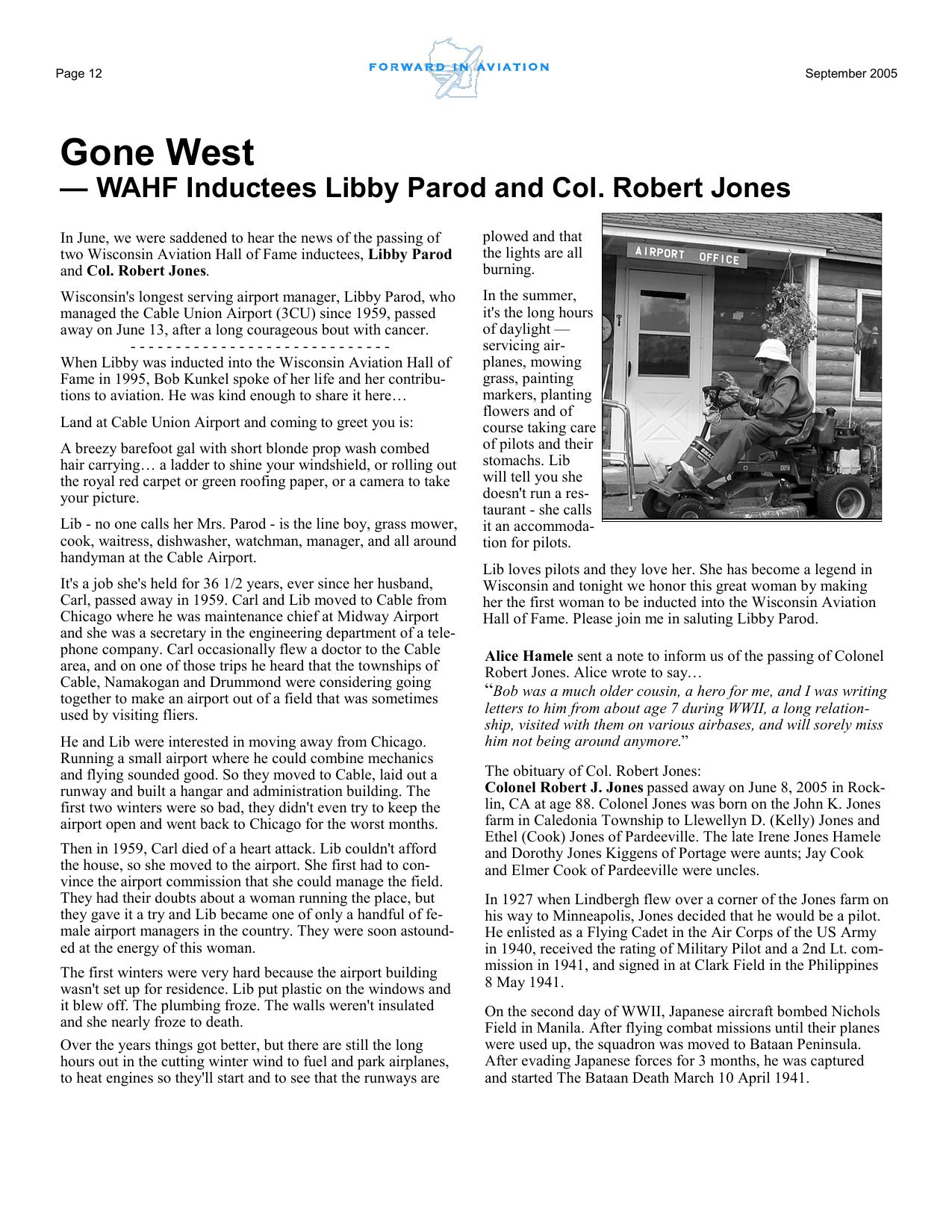
Page 12 September 2005 Gone West — WAHF Inductees Libby Parod and Col. Robert Jones In June, we were saddened to hear the news of the passing of two Wisconsin Aviation Hall of Fame inductees, Libby Parod and Col. Robert Jones. plowed and that the lights are all burning. Wisconsin's longest serving airport manager, Libby Parod, who managed the Cable Union Airport (3CU) since 1959, passed away on June 13, after a long courageous bout with cancer. ----------------------------When Libby was inducted into the Wisconsin Aviation Hall of Fame in 1995, Bob Kunkel spoke of her life and her contributions to aviation. He was kind enough to share it here… In the summer, it's the long hours of daylight — servicing airplanes, mowing grass, painting markers, planting flowers and of course taking care of pilots and their stomachs. Lib will tell you she doesn't run a restaurant - she calls it an accommodation for pilots. Land at Cable Union Airport and coming to greet you is: A breezy barefoot gal with short blonde prop wash combed hair carrying… a ladder to shine your windshield, or rolling out the royal red carpet or green roofing paper, or a camera to take your picture. Lib - no one calls her Mrs. Parod - is the line boy, grass mower, cook, waitress, dishwasher, watchman, manager, and all around handyman at the Cable Airport. It's a job she's held for 36 1/2 years, ever since her husband, Carl, passed away in 1959. Carl and Lib moved to Cable from Chicago where he was maintenance chief at Midway Airport and she was a secretary in the engineering department of a telephone company. Carl occasionally flew a doctor to the Cable area, and on one of those trips he heard that the townships of Cable, Namakogan and Drummond were considering going together to make an airport out of a field that was sometimes used by visiting fliers. He and Lib were interested in moving away from Chicago. Running a small airport where he could combine mechanics and flying sounded good. So they moved to Cable, laid out a runway and built a hangar and administration building. The first two winters were so bad, they didn't even try to keep the airport open and went back to Chicago for the worst months. Then in 1959, Carl died of a heart attack. Lib couldn't afford the house, so she moved to the airport. She first had to convince the airport commission that she could manage the field. They had their doubts about a woman running the place, but they gave it a try and Lib became one of only a handful of female airport managers in the country. They were soon astounded at the energy of this woman. The first winters were very hard because the airport building wasn't set up for residence. Lib put plastic on the windows and it blew off. The plumbing froze. The walls weren't insulated and she nearly froze to death. Over the years things got better, but there are still the long hours out in the cutting winter wind to fuel and park airplanes, to heat engines so they'll start and to see that the runways are Lib loves pilots and they love her. She has become a legend in Wisconsin and tonight we honor this great woman by making her the first woman to be inducted into the Wisconsin Aviation Hall of Fame. Please join me in saluting Libby Parod. Alice Hamele sent a note to inform us of the passing of Colonel Robert Jones. Alice wrote to say… “Bob was a much older cousin, a hero for me, and I was writing letters to him from about age 7 during WWII, a long relationship, visited with them on various airbases, and will sorely miss him not being around anymore.” The obituary of Col. Robert Jones: Colonel Robert J. Jones passed away on June 8, 2005 in Rocklin, CA at age 88. Colonel Jones was born on the John K. Jones farm in Caledonia Township to Llewellyn D. (Kelly) Jones and Ethel (Cook) Jones of Pardeeville. The late Irene Jones Hamele and Dorothy Jones Kiggens of Portage were aunts; Jay Cook and Elmer Cook of Pardeeville were uncles. In 1927 when Lindbergh flew over a corner of the Jones farm on his way to Minneapolis, Jones decided that he would be a pilot. He enlisted as a Flying Cadet in the Air Corps of the US Army in 1940, received the rating of Military Pilot and a 2nd Lt. commission in 1941, and signed in at Clark Field in the Philippines 8 May 1941. On the second day of WWII, Japanese aircraft bombed Nichols Field in Manila. After flying combat missions until their planes were used up, the squadron was moved to Bataan Peninsula. After evading Japanese forces for 3 months, he was captured and started The Bataan Death March 10 April 1941.
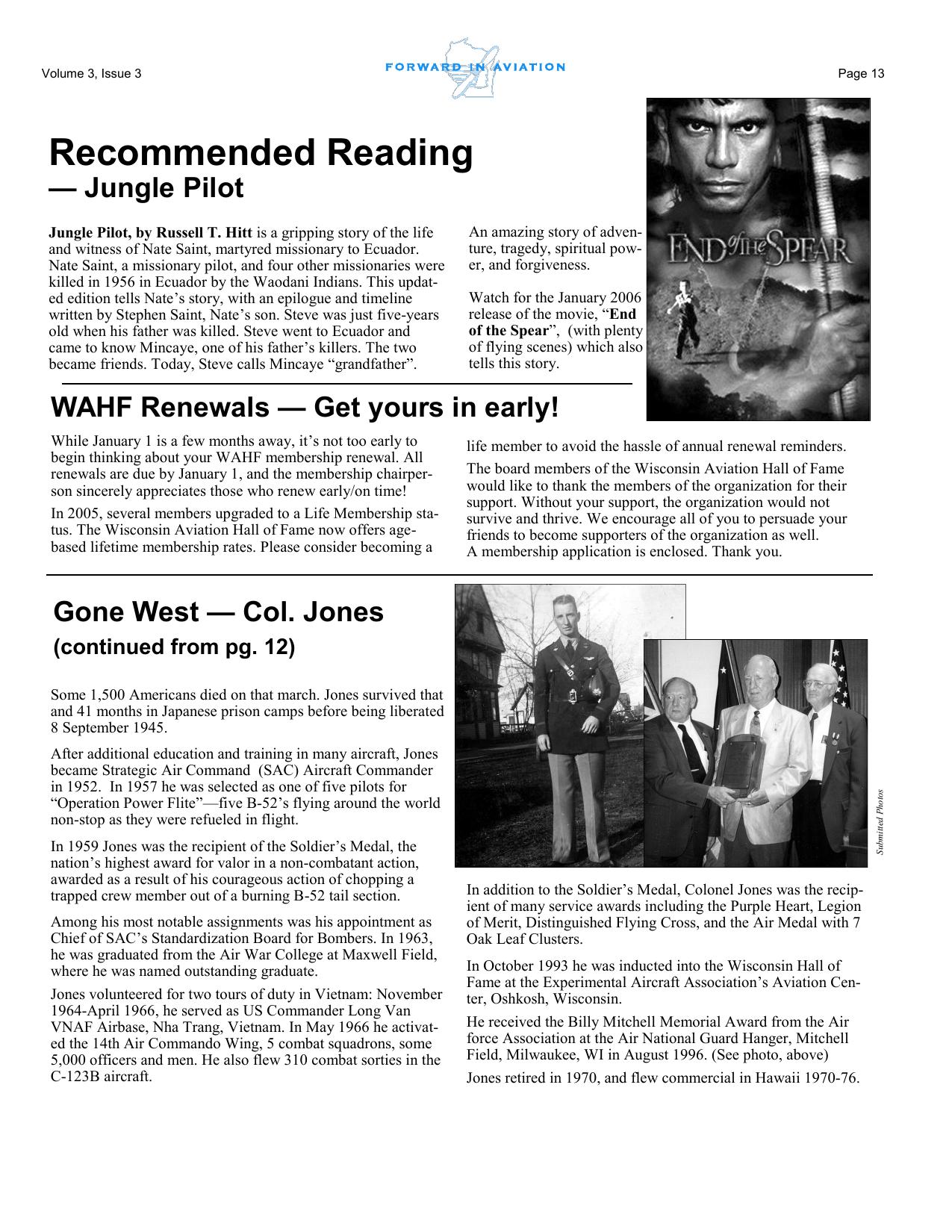
Volume 3, Issue 3 Page 13 Recommended Reading — Jungle Pilot Jungle Pilot, by Russell T. Hitt is a gripping story of the life and witness of Nate Saint, martyred missionary to Ecuador. Nate Saint, a missionary pilot, and four other missionaries were killed in 1956 in Ecuador by the Waodani Indians. This updated edition tells Nate’s story, with an epilogue and timeline written by Stephen Saint, Nate’s son. Steve was just five-years old when his father was killed. Steve went to Ecuador and came to know Mincaye, one of his father’s killers. The two became friends. Today, Steve calls Mincaye “grandfather”. An amazing story of adventure, tragedy, spiritual power, and forgiveness. Watch for the January 2006 release of the movie, “End of the Spear”, (with plenty of flying scenes) which also tells this story. WAHF Renewals — Get yours in early! While January 1 is a few months away, it’s not too early to begin thinking about your WAHF membership renewal. All renewals are due by January 1, and the membership chairperson sincerely appreciates those who renew early/on time! In 2005, several members upgraded to a Life Membership status. The Wisconsin Aviation Hall of Fame now offers agebased lifetime membership rates. Please consider becoming a life member to avoid the hassle of annual renewal reminders. The board members of the Wisconsin Aviation Hall of Fame would like to thank the members of the organization for their support. Without your support, the organization would not survive and thrive. We encourage all of you to persuade your friends to become supporters of the organization as well. A membership application is enclosed. Thank you. Gone West — Col. Jones (continued from pg. 12) Some 1,500 Americans died on that march. Jones survived that and 41 months in Japanese prison camps before being liberated 8 September 1945. In 1959 Jones was the recipient of the Soldier’s Medal, the nation’s highest award for valor in a non-combatant action, awarded as a result of his courageous action of chopping a trapped crew member out of a burning B-52 tail section. Among his most notable assignments was his appointment as Chief of SAC’s Standardization Board for Bombers. In 1963, he was graduated from the Air War College at Maxwell Field, where he was named outstanding graduate. Jones volunteered for two tours of duty in Vietnam: November 1964-April 1966, he served as US Commander Long Van VNAF Airbase, Nha Trang, Vietnam. In May 1966 he activated the 14th Air Commando Wing, 5 combat squadrons, some 5,000 officers and men. He also flew 310 combat sorties in the C-123B aircraft. Submitted Photos After additional education and training in many aircraft, Jones became Strategic Air Command (SAC) Aircraft Commander in 1952. In 1957 he was selected as one of five pilots for “Operation Power Flite”—five B-52’s flying around the world non-stop as they were refueled in flight. In addition to the Soldier’s Medal, Colonel Jones was the recipient of many service awards including the Purple Heart, Legion of Merit, Distinguished Flying Cross, and the Air Medal with 7 Oak Leaf Clusters. In October 1993 he was inducted into the Wisconsin Hall of Fame at the Experimental Aircraft Association’s Aviation Center, Oshkosh, Wisconsin. He received the Billy Mitchell Memorial Award from the Air force Association at the Air National Guard Hanger, Mitchell Field, Milwaukee, WI in August 1996. (See photo, above) Jones retired in 1970, and flew commercial in Hawaii 1970-76.
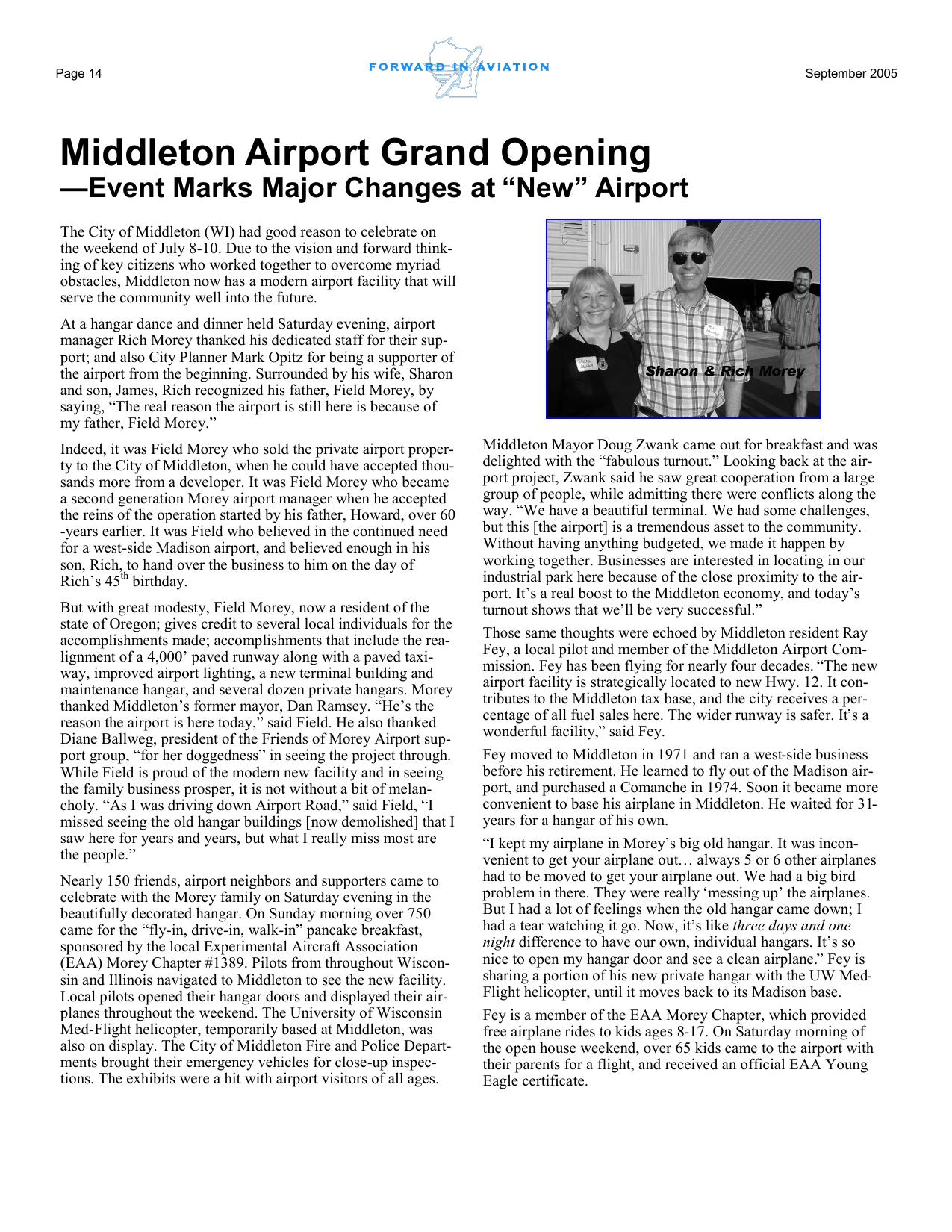
Page 14 September 2005 Middleton Airport Grand Opening —Event Marks Major Changes at “New” Airport The City of Middleton (WI) had good reason to celebrate on the weekend of July 8-10. Due to the vision and forward thinking of key citizens who worked together to overcome myriad obstacles, Middleton now has a modern airport facility that will serve the community well into the future. At a hangar dance and dinner held Saturday evening, airport manager Rich Morey thanked his dedicated staff for their support; and also City Planner Mark Opitz for being a supporter of the airport from the beginning. Surrounded by his wife, Sharon and son, James, Rich recognized his father, Field Morey, by saying, “The real reason the airport is still here is because of my father, Field Morey.” Indeed, it was Field Morey who sold the private airport property to the City of Middleton, when he could have accepted thousands more from a developer. It was Field Morey who became a second generation Morey airport manager when he accepted the reins of the operation started by his father, Howard, over 60 -years earlier. It was Field who believed in the continued need for a west-side Madison airport, and believed enough in his son, Rich, to hand over the business to him on the day of Rich’s 45th birthday. But with great modesty, Field Morey, now a resident of the state of Oregon; gives credit to several local individuals for the accomplishments made; accomplishments that include the realignment of a 4,000’ paved runway along with a paved taxiway, improved airport lighting, a new terminal building and maintenance hangar, and several dozen private hangars. Morey thanked Middleton’s former mayor, Dan Ramsey. “He’s the reason the airport is here today,” said Field. He also thanked Diane Ballweg, president of the Friends of Morey Airport support group, “for her doggedness” in seeing the project through. While Field is proud of the modern new facility and in seeing the family business prosper, it is not without a bit of melancholy. “As I was driving down Airport Road,” said Field, “I missed seeing the old hangar buildings [now demolished] that I saw here for years and years, but what I really miss most are the people.” Nearly 150 friends, airport neighbors and supporters came to celebrate with the Morey family on Saturday evening in the beautifully decorated hangar. On Sunday morning over 750 came for the “fly-in, drive-in, walk-in” pancake breakfast, sponsored by the local Experimental Aircraft Association (EAA) Morey Chapter #1389. Pilots from throughout Wisconsin and Illinois navigated to Middleton to see the new facility. Local pilots opened their hangar doors and displayed their airplanes throughout the weekend. The University of Wisconsin Med-Flight helicopter, temporarily based at Middleton, was also on display. The City of Middleton Fire and Police Departments brought their emergency vehicles for close-up inspections. The exhibits were a hit with airport visitors of all ages. Middleton Mayor Doug Zwank came out for breakfast and was delighted with the “fabulous turnout.” Looking back at the airport project, Zwank said he saw great cooperation from a large group of people, while admitting there were conflicts along the way. “We have a beautiful terminal. We had some challenges, but this [the airport] is a tremendous asset to the community. Without having anything budgeted, we made it happen by working together. Businesses are interested in locating in our industrial park here because of the close proximity to the airport. It’s a real boost to the Middleton economy, and today’s turnout shows that we’ll be very successful.” Those same thoughts were echoed by Middleton resident Ray Fey, a local pilot and member of the Middleton Airport Commission. Fey has been flying for nearly four decades. “The new airport facility is strategically located to new Hwy. 12. It contributes to the Middleton tax base, and the city receives a percentage of all fuel sales here. The wider runway is safer. It’s a wonderful facility,” said Fey. Fey moved to Middleton in 1971 and ran a west-side business before his retirement. He learned to fly out of the Madison airport, and purchased a Comanche in 1974. Soon it became more convenient to base his airplane in Middleton. He waited for 31years for a hangar of his own. “I kept my airplane in Morey’s big old hangar. It was inconvenient to get your airplane out… always 5 or 6 other airplanes had to be moved to get your airplane out. We had a big bird problem in there. They were really ‘messing up’ the airplanes. But I had a lot of feelings when the old hangar came down; I had a tear watching it go. Now, it’s like three days and one night difference to have our own, individual hangars. It’s so nice to open my hangar door and see a clean airplane.” Fey is sharing a portion of his new private hangar with the UW MedFlight helicopter, until it moves back to its Madison base. Fey is a member of the EAA Morey Chapter, which provided free airplane rides to kids ages 8-17. On Saturday morning of the open house weekend, over 65 kids came to the airport with their parents for a flight, and received an official EAA Young Eagle certificate.
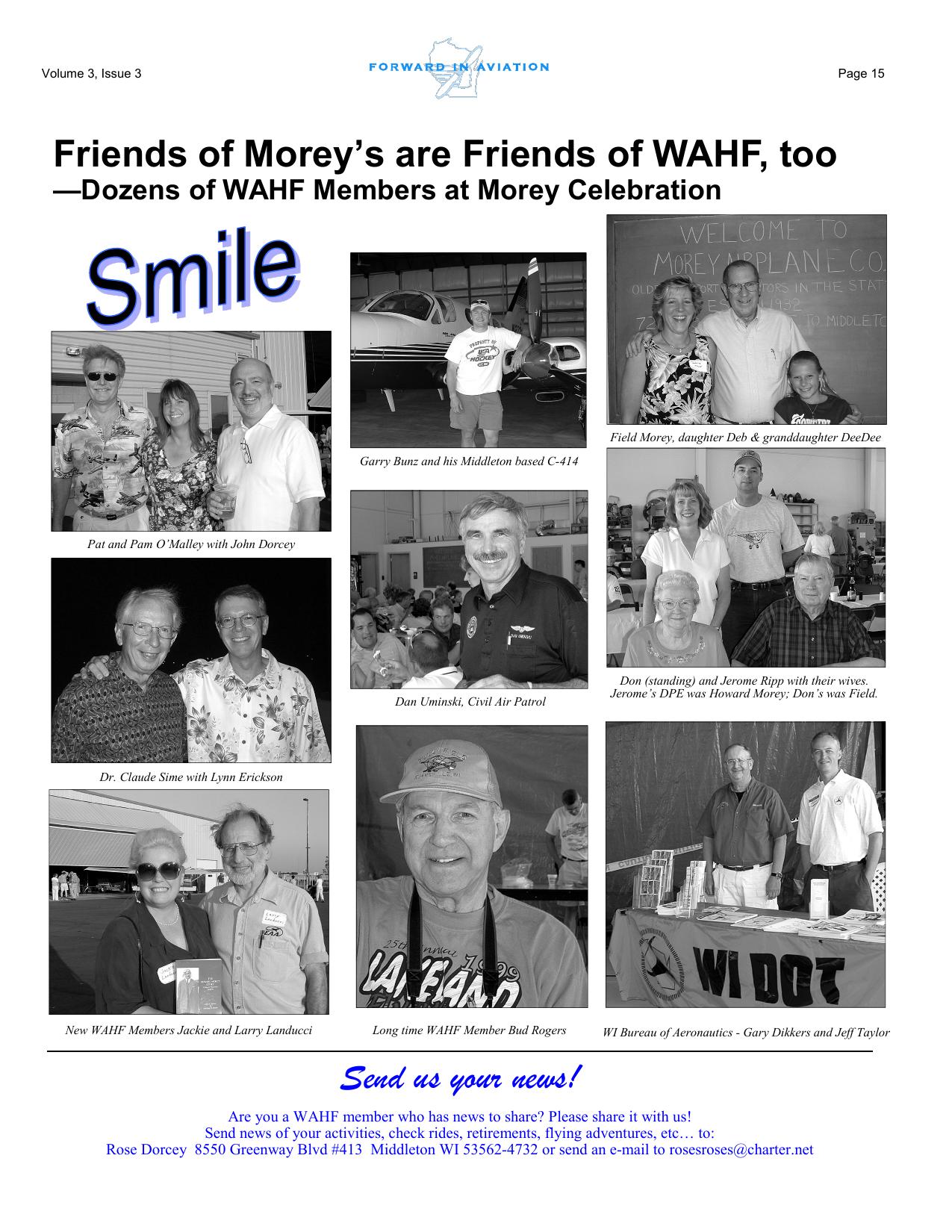
Volume 3, Issue 3 Page 15 Friends of Morey’s are Friends of WAHF, too —Dozens of WAHF Members at Morey Celebration Field Morey, daughter Deb & granddaughter DeeDee Garry Bunz and his Middleton based C-414 Pat and Pam O’Malley with John Dorcey Dan Uminski, Civil Air Patrol Don (standing) and Jerome Ripp with their wives. Jerome’s DPE was Howard Morey; Don’s was Field. Dr. Claude Sime with Lynn Erickson New WAHF Members Jackie and Larry Landucci Long time WAHF Member Bud Rogers WI Bureau of Aeronautics - Gary Dikkers and Jeff Taylor Send us your news! Are you a WAHF member who has news to share? Please share it with us! Send news of your activities, check rides, retirements, flying adventures, etc… to: Rose Dorcey 8550 Greenway Blvd #413 Middleton WI 53562-4732 or send an e-mail to rosesroses@charter.net

Celebrating Twenty Years 1985-2005 Welcome new WAHF members: Jack Culley David M Cabelka George Bindl Dave Jensen Bob & Letty Skuldt Patrick Lyle Grimm Thanks for coming on board. We look forward to seeing you at a WAHF event soon! ANNOUNCING: The Howard Morey Story, A Saga of Wisconsin Aviation, is now available! Written by John and Marilynn Jenkins, the book tells about the life of Wisconsin aviation pioneer and WAHF Inductee Howard Morey. Books can be purchased at the Middleton Municipal/Morey Field Airport for $12 , or ordered from the Morey Airplane Company and shipped to your home for $14. Call the Morey Airplane Company at 608-836-1711. Don’t miss out, get yours today. Want to order a copy of Blue Sky Moments ~ A Collection of Wisconsin Aviation Memories? Only $7 (minimum donation). Call 715-421-0055 or 608-836-9840. Next Issue: December 2005. Banquet wrap-up, membership renewal information, gift ideas and much more! Have an idea for a story? Have news to share? Let us know! Are you interested in placing an ad in the December issue of Forward...in Aviation? Ad prices are as low as $50. Deadline for December issue: November 15, 2005. Please call Rose Dorcey at 715-421-0055 or 608-836-9840 for more information. * * * * * * * * Don’t miss the 2005 WAHF Induction Banquet — October 22 in Oshkosh! * * Wisconsin Aviation Hall of Fame Officers and Board of Directors Rose Dorcey, President Charles Marotske, Vice President John Dorcey, Secretary/Treasurer Keith Glasshof, Past President Duane Esse Michael Goc David Greene LaFonda Kinnaman Staber “Bill” Reese Wisconsin Aviation Hall of Fame Corporate Headquarters 8550 Greenway Blvd - Suite 413 Middleton WI 53562-4732 Become a supporter today! For information call Rose Dorcey at 715-421-0055 www.aviationhalloffamewisconsin.com flyer@aviationhalloffamewisconsin.com