Volume 6, Issue 3
🗞️ Download Issue (PDF)
Forward in Flight - Fall 2008
Fall 2008 Volume 6, Issue 3
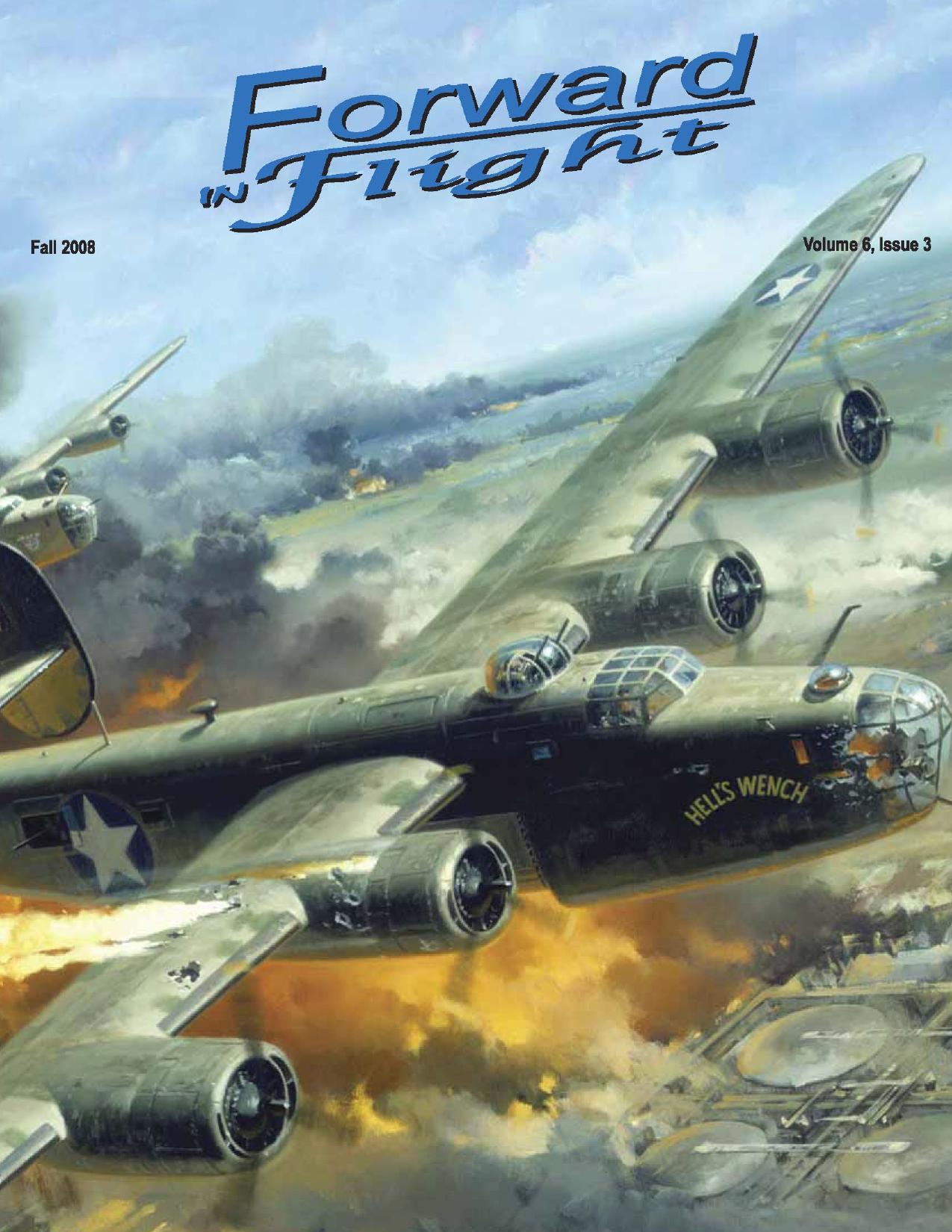
Inside this issue… President’s Message 3 Air Doc Dr. Tom Voelker, AME 4 Wisconsin’s Own B-25 By Tom Thomas 6 Try ’n Getit By Fred Beseler 8 Faithful Servant, Faithful Friend By Duane Esse 12 Remember, Returning is Secondary By Gary Dikkers 16 From the Archives By Michael Goc 22 Messages To and From the Archives 24 Youth Aviation 26 Member Spotlight 27 From the Airwaves 28 Membership Matters 30 Forward in Flight - sharing Wisconsin aviation stories, past and present Rose Dorcey, Editor 3980 Sharratt Drive Oshkosh WI 54901-1276 Phone: 920-385-1483 E-mail: rosesroses@new.rr.com Wisconsin Aviation Hall of Fame Mission Statement To collect and preserve the history of aviation in Wisconsin, recognize those who made that history, inform others of it, and promote aviation education for future generations. Try ’n Getit The Story of a B-17 and Its Crew By Fred Beseler On March 19, 1945, however, Ray Sundet, a radio operator from La Crosse, Wisconsin, on his ninth mission aboard the B-17G “Try ’n Getit” some 25,000 feet over Germany, probably wouldn’t have bet a plug nickel on the chance of having any future at all. Ed Colbert By Duane Esse Ed was about to be drafted into the military in 1942, and decided to join the Naval Reserve instead. He began flight instruction in Aeronca aircraft at Morey’s in Middleton. Remember, Returning is Secondary By Gary Dikkers Jerstad and Baker were now 10 miles from Ploesti, racing towards their target at 245 mph and only 50 feet above the ground, with only a few minutes left to live. William J. “Bill” Lotzer From law school to flight school to aviation entrepreneur By Michael Goc “I’ve loved aviation. I like it to this day. It was a practical thing for me. It was a business factor after the war.” On the cover: The painting “Remember...Returning is Secondary” hangs in the Pentagon’s Hall of Heroes. The painting shows “Hell’s Wench” piloted by Jack Jerstad after it hit the cable of a barrage balloon during its target run. Used with permission of aviation artist Roy Grinnell. More of Roy's aviation art can be viewed at www.TopGunArt.com
President’s Message ~ by Rose Dorcey A s fall draws near, your WAHF Board of Directors becomes very busy planning, organizing, and putting on the or- ganization’s annual induction banquet. For more than 20 years, WAHF has been honoring men and women who have made significant achievements in Wisconsin aviation with induction into the hall. Nearly 80 people have been honored. The “Class of 2008” is a distinguished and diverse group...Jean Hauser, the first deaf person in Wisconsin to become a pilot and who continues to inspires countless numbers of men and women, boys and girls, to become pilots. Dick and Bobbie Wagner, the husband and wife team who made WagAero a household name for homebuilders. Robert Stuckey, a World War II hero who came back from the war to pass on what he learned about flying through his own flight experiences. In the Pioneer category, for those who were flying before Charles Lindbergh crossed the Atlantic, John Wood and Orland Corben will be remembered. Ask most any aviation-minded individual in the Wausau area about John Wood’s flying history, and you’ll hear some interesting stories. Orland Corben’s name is still a popular airplane name—minus his first name. I encourage all WAHF members to attend the induction banquet and the annual membership meeting that precedes it. It’s a great way to learn more about the men and women who will be inducted, a great place to see some of your aviation friends and colleagues that you may not have seen in a while, and a great way to learn about the events that board members are planning. Your participation is needed and appreciated, and we hope to see many of you there. Invitations will be mailed soon—I hope to see your RSVP! As Forward in Flight grows and evolves, I have a request to ask of our readers. Do you know of a young boy or girl with an interest in aviation? If so, ask if they would write a short story about aviation. It can be any topic, a favorite airplane, memorable flight, their goals, an aviation personality, anything that shows the depth of their aviation passion. Then, have them send it to me so I can consider it for publication in a future issue. Aviation stories from kids are always refreshing and fun to read, and for the young future aviator, seeing their story published is just one more step that can help cement their continued involvement. In this issue, 12-year-old Max Stumpf wrote a story about helicopters for a class project, and I’m proud to share it, because it reminds me of my own aviation passion, and the passion I see in so many others. I’m looking forward to the day, a few years down the road, when I hear that Max has passed his helicopter check ride. Good luck, Max. Speaking of this issue…you’ll find some great stories by our dedicated, talented contributors. These volunteer writers spend a great deal of time researching, interviewing, and writing the stories that you read every couple of months in Forward in Flight. If you like their stuff as much as I do, contact them to let them know you appreciate their work. Or, let me know, and I’ll be delighted to pass along your praise. Need a speaker for your next aviation event? Contact WAHF! Call John Dorcey at 920-385-1483 or Michael Goc at 608-339-7191 flyer@aviationhalloffamewisconsin.com Your Hometown Full-Service Aviation Company Air Charter Flight Training Aircraft Sales & Service Service Centers: Cessna Cirrus Columbia Piper Socata Dane County Regional (MSN) - 800-594-5359 Watertown Municipal (RYV) - 800-657-0761 Dodge County (UNU) - 800-319-0907 www.wisconsinaviation.com 3 Forward in Flight ~ Fall 2008
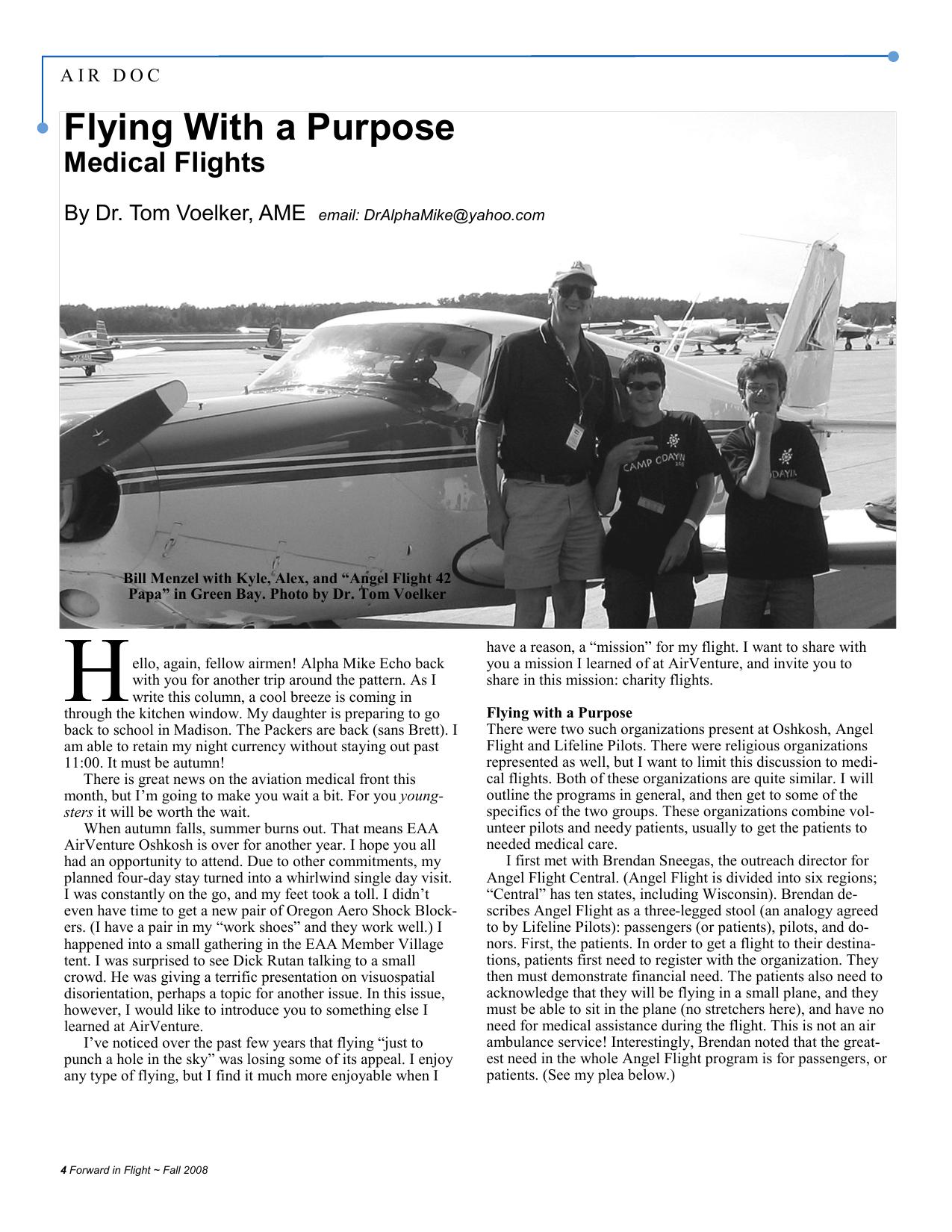
AIR DOC Flying With a Purpose Medical Flights By Dr. Tom Voelker, AME email: DrAlphaMike@yahoo.com Bill Menzel with Kyle, Alex, and “Angel Flight 42 Papa” in Green Bay. Photo by Dr. Tom Voelker H ello, again, fellow airmen! Alpha Mike Echo back with you for another trip around the pattern. As I write this column, a cool breeze is coming in through the kitchen window. My daughter is preparing to go back to school in Madison. The Packers are back (sans Brett). I am able to retain my night currency without staying out past 11:00. It must be autumn! There is great news on the aviation medical front this month, but I’m going to make you wait a bit. For you youngsters it will be worth the wait. When autumn falls, summer burns out. That means EAA AirVenture Oshkosh is over for another year. I hope you all had an opportunity to attend. Due to other commitments, my planned four-day stay turned into a whirlwind single day visit. I was constantly on the go, and my feet took a toll. I didn’t even have time to get a new pair of Oregon Aero Shock Blockers. (I have a pair in my “work shoes” and they work well.) I happened into a small gathering in the EAA Member Village tent. I was surprised to see Dick Rutan talking to a small crowd. He was giving a terrific presentation on visuospatial disorientation, perhaps a topic for another issue. In this issue, however, I would like to introduce you to something else I learned at AirVenture. I’ve noticed over the past few years that flying “just to punch a hole in the sky” was losing some of its appeal. I enjoy any type of flying, but I find it much more enjoyable when I 4 Forward in Flight ~ Fall 2008 have a reason, a “mission” for my flight. I want to share with you a mission I learned of at AirVenture, and invite you to share in this mission: charity flights. Flying with a Purpose There were two such organizations present at Oshkosh, Angel Flight and Lifeline Pilots. There were religious organizations represented as well, but I want to limit this discussion to medical flights. Both of these organizations are quite similar. I will outline the programs in general, and then get to some of the specifics of the two groups. These organizations combine volunteer pilots and needy patients, usually to get the patients to needed medical care. I first met with Brendan Sneegas, the outreach director for Angel Flight Central. (Angel Flight is divided into six regions; “Central” has ten states, including Wisconsin). Brendan describes Angel Flight as a three-legged stool (an analogy agreed to by Lifeline Pilots): passengers (or patients), pilots, and donors. First, the patients. In order to get a flight to their destinations, patients first need to register with the organization. They then must demonstrate financial need. The patients also need to acknowledge that they will be flying in a small plane, and they must be able to sit in the plane (no stretchers here), and have no need for medical assistance during the flight. This is not an air ambulance service! Interestingly, Brendan noted that the greatest need in the whole Angel Flight program is for passengers, or patients. (See my plea below.)
AIR DOC Next, and most to the point of this column, comes the pilot. Pilots volunteer their time for these flights. They also donate the cost of the aircraft (either self-owned or rented), and the fuel, as well as other incidental costs (landing fees, for example). A typical Angel Flight was described as up to 300 miles one way. Karen Halverson of Lifeline Pilots noted the average mission is 250 to 350 miles. Often the patient needs to go beyond these distances. In this case, two or more pilots meet up to “shuttle” the patient to the final destination. While the cost of the flight is absorbed by the pilot, this cost is fully taxdeductible, as these organizations are recognized by the IRS as 501(c)(3) charitable organizations. Signing up for a flight is easy. Member pilots check the internet or receive emails when appropriate missions become available, and they simply respond to any that might work for them. Finally, there is the donor. These organizations have lean budgets (certainly “lean of peak”) and they do have some administrative costs. Angel Flight has six paid staff members, with a home base in Kansas City, that coordinates fundraising, as well as the passenger and pilot ends of each flight. They have more than 900 volunteer pilots, and average one flight every 30 minutes. Anyone who wants to help with the transportation needs of the patients but cannot contribute as a pilot is encouraged to contact one of these groups at the websites below. More than 95 percent of all donations go directly to program services. Who can be a volunteer pilot? Generally, the two organizations require pilots to be 21 years old, possess at least a private pilot certificate (IFR preferred but not required by these two groups), have 250 hours of PIC time, show proof of insurance, and to disclose any prior accidents, incidents, or FAA enforcement actions. That probably means many WAHF members qualify! I was privileged to participate in an Angel Flight recently. WAHF member Bill Menzel, who frequently flies my Comanche (and who happens to be my parish priest—I figure it can’t hurt to have a connection to our Chief Pilot in the plane every now and then!) is an Angel Flight pilot. About 90 percent of missions are directly medical, but some missions bring patients to specialty camps, usually for patients with HIV, cancer, or heart problems. Our mission was to pick up two boys from a camp in Brainerd, Minnesota, and fly them to Austin Straubel International Airport (GRB), where another pilot, Jim from Angel Flight Northeast, would pick them up and take them home to Pontiac, Michigan. These boys were at “Camp Odayin,” a weeklong camp for children with congenital heart disease. (“Odayin” is Ojibwa for “heart.”) The flight to Brainerd Lakes Regional Airport (BRD) was lovely. At 6,000 feet, we were about 300 feet above the bumps. We had filed IFR, so we got to puff through occasional cloud tops. One reward of flying Angel Flight is that our call sign was not the usual Comanche 42 Papa, but rather Angel Flight 42 Papa. Having an Angel Flight call sign, I learned, means priority handling by air traffic control. We landed at Brainerd without difficulty but taxied to the terminal with considerable difficulty—there was a lot of construction going on. In any event, we got to the terminal and ordered lunch. Just after it arrived, so did our passengers—Alex and Kyle. They looked tired from a week at camp, and soon we were able to get them home—or at least partway home! The flight to Green Bay was great, but some storms were building just east of GRB. About three minutes after we got out of the plane, their ride to Michigan arrived. Bill and I made the switch, and then flew back home to Wisconsin Rapids (ISW). The pilot is the final word on the safety of the flight. If Bill had determined that we couldn’t have safely made it to Green Bay, he would have cancelled the flight. The passengers are required to have alternative arrangements in case the mission cannot be accomplished. Now you know how it works and how you can help. If you can, give yourself a good reason to fly! The organizations have made it easy to book a flight that works for you. If you can’t fly or don’t have access to a plane, but still want to help, get online and give a donation. Most importantly, get the word out! These groups need additional qualified patients in need of their services. If you know of someone (adult or child) who needs to get to a distant appointment or treatment but can’t afford the trip, give him or her the name of one of these groups. Moreover, if you belong to a civic group, put out your own plea at one of your meetings. Finally, a word about safety. Angel Flight had a record of more than 9,000 flights over the past 25 years without an accident. In the past three months, however, there have been three fatal Angel Flight accidents. There does not appear to be any connection between these incidents, and the organization is looking into ways to be even safer. If you do join up, please fly safely! Send me an email to let me know if you signed on...I’ll report in a future issue. You can find more information about these organizations at www.AngelFlightCentral.org or www.LifelinePilots.org. That probably means many WAHF members qualify! Oh, the great news? In case you haven’t heard, the FAA has changed some rules— for the better. It has acknowledged that very few accidents in younger pilots are caused by medical problems. If you were less than 40 years old at the time of your most recent medical, it will be valid for five years for third class medicals (previously three years) and for one year for first class medicals (previously six months). Second class medicals and medicals of any class for airmen over 40 years of age are not affected. If you are approaching 40, you may want to get another medical before you hit that magic age, to get in on the “five-year plan.” Fly safely, and send an email with any questions. 5 Forward in Flight ~ Fall 2008
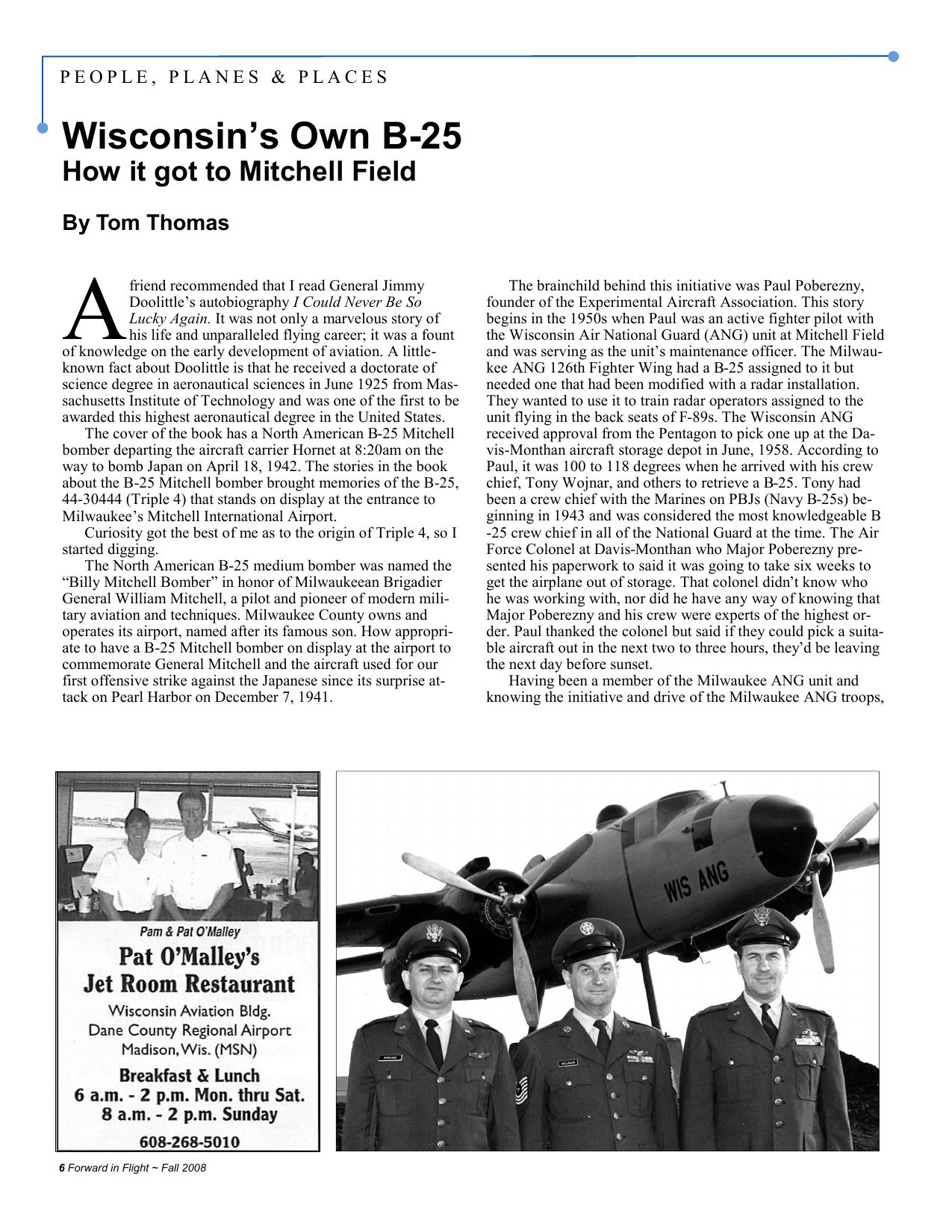
PEOPLE, PLANES & PLACES Wisconsin’s Own B-25 How it got to Mitchell Field By Tom Thomas A friend recommended that I read General Jimmy Doolittle’s autobiography I Could Never Be So Lucky Again. It was not only a marvelous story of his life and unparalleled flying career; it was a fount of knowledge on the early development of aviation. A littleknown fact about Doolittle is that he received a doctorate of science degree in aeronautical sciences in June 1925 from Massachusetts Institute of Technology and was one of the first to be awarded this highest aeronautical degree in the United States. The cover of the book has a North American B-25 Mitchell bomber departing the aircraft carrier Hornet at 8:20am on the way to bomb Japan on April 18, 1942. The stories in the book about the B-25 Mitchell bomber brought memories of the B-25, 44-30444 (Triple 4) that stands on display at the entrance to Milwaukee’s Mitchell International Airport. Curiosity got the best of me as to the origin of Triple 4, so I started digging. The North American B-25 medium bomber was named the “Billy Mitchell Bomber” in honor of Milwaukeean Brigadier General William Mitchell, a pilot and pioneer of modern military aviation and techniques. Milwaukee County owns and operates its airport, named after its famous son. How appropriate to have a B-25 Mitchell bomber on display at the airport to commemorate General Mitchell and the aircraft used for our first offensive strike against the Japanese since its surprise attack on Pearl Harbor on December 7, 1941. 6 Forward in Flight ~ Fall 2008 The brainchild behind this initiative was Paul Poberezny, founder of the Experimental Aircraft Association. This story begins in the 1950s when Paul was an active fighter pilot with the Wisconsin Air National Guard (ANG) unit at Mitchell Field and was serving as the unit’s maintenance officer. The Milwaukee ANG 126th Fighter Wing had a B-25 assigned to it but needed one that had been modified with a radar installation. They wanted to use it to train radar operators assigned to the unit flying in the back seats of F-89s. The Wisconsin ANG received approval from the Pentagon to pick one up at the Davis-Monthan aircraft storage depot in June, 1958. According to Paul, it was 100 to 118 degrees when he arrived with his crew chief, Tony Wojnar, and others to retrieve a B-25. Tony had been a crew chief with the Marines on PBJs (Navy B-25s) beginning in 1943 and was considered the most knowledgeable B -25 crew chief in all of the National Guard at the time. The Air Force Colonel at Davis-Monthan who Major Poberezny presented his paperwork to said it was going to take six weeks to get the airplane out of storage. That colonel didn’t know who he was working with, nor did he have any way of knowing that Major Poberezny and his crew were experts of the highest order. Paul thanked the colonel but said if they could pick a suitable aircraft out in the next two to three hours, they’d be leaving the next day before sunset. Having been a member of the Milwaukee ANG unit and knowing the initiative and drive of the Milwaukee ANG troops,
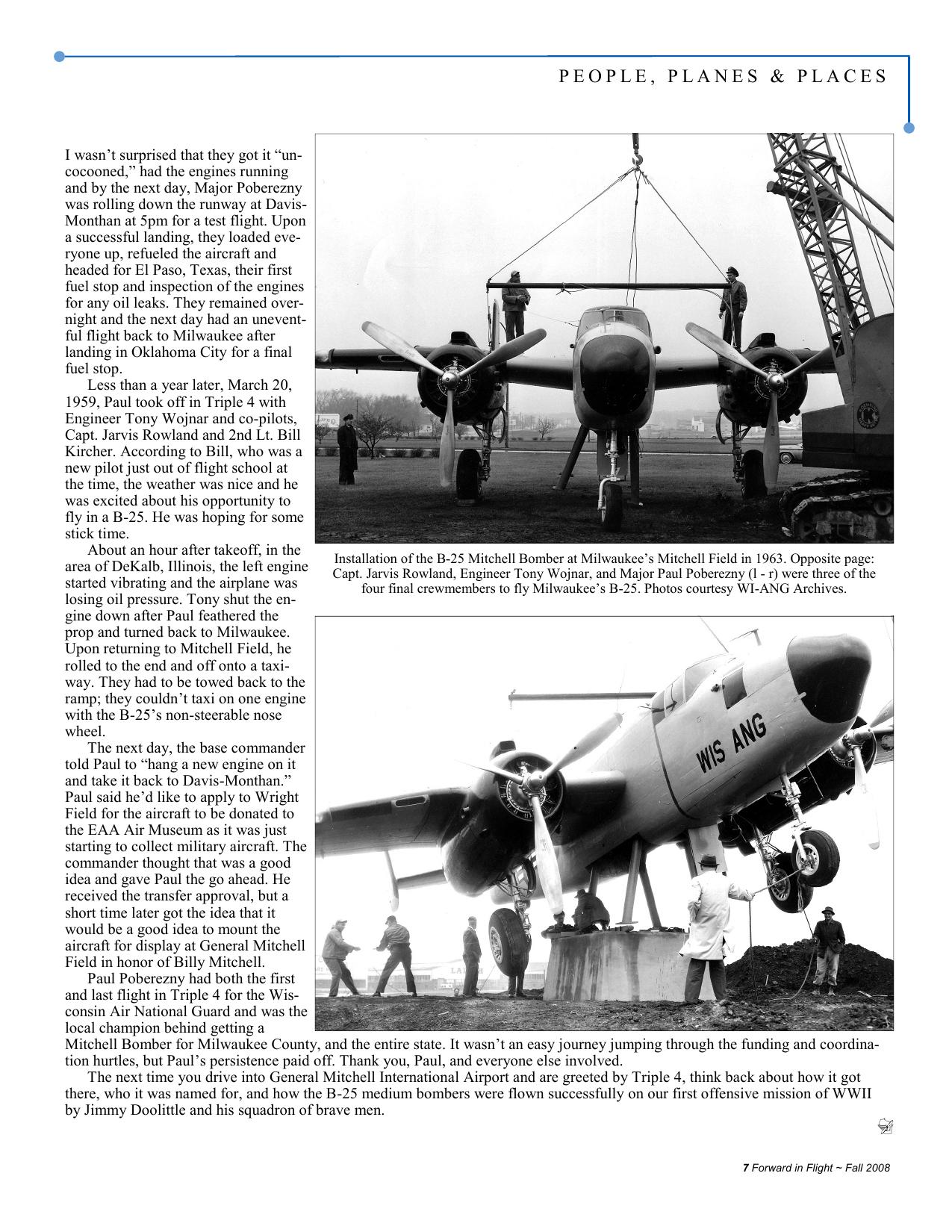
PEOPLE, PLANES & PLACES I wasn’t surprised that they got it “uncocooned,” had the engines running and by the next day, Major Poberezny was rolling down the runway at DavisMonthan at 5pm for a test flight. Upon a successful landing, they loaded everyone up, refueled the aircraft and headed for El Paso, Texas, their first fuel stop and inspection of the engines for any oil leaks. They remained overnight and the next day had an uneventful flight back to Milwaukee after landing in Oklahoma City for a final fuel stop. Less than a year later, March 20, 1959, Paul took off in Triple 4 with Engineer Tony Wojnar and co-pilots, Capt. Jarvis Rowland and 2nd Lt. Bill Kircher. According to Bill, who was a new pilot just out of flight school at the time, the weather was nice and he was excited about his opportunity to fly in a B-25. He was hoping for some stick time. About an hour after takeoff, in the Installation of the B-25 Mitchell Bomber at Milwaukee’s Mitchell Field in 1963. Opposite page: area of DeKalb, Illinois, the left engine Capt. Jarvis Rowland, Engineer Tony Wojnar, and Major Paul Poberezny (l - r) were three of the started vibrating and the airplane was four final crewmembers to fly Milwaukee’s B-25. Photos courtesy WI-ANG Archives. losing oil pressure. Tony shut the engine down after Paul feathered the prop and turned back to Milwaukee. Upon returning to Mitchell Field, he rolled to the end and off onto a taxiway. They had to be towed back to the ramp; they couldn’t taxi on one engine with the B-25’s non-steerable nose wheel. The next day, the base commander told Paul to “hang a new engine on it and take it back to Davis-Monthan.” Paul said he’d like to apply to Wright Field for the aircraft to be donated to the EAA Air Museum as it was just starting to collect military aircraft. The commander thought that was a good idea and gave Paul the go ahead. He received the transfer approval, but a short time later got the idea that it would be a good idea to mount the aircraft for display at General Mitchell Field in honor of Billy Mitchell. Paul Poberezny had both the first and last flight in Triple 4 for the Wisconsin Air National Guard and was the local champion behind getting a Mitchell Bomber for Milwaukee County, and the entire state. It wasn’t an easy journey jumping through the funding and coordination hurtles, but Paul’s persistence paid off. Thank you, Paul, and everyone else involved. The next time you drive into General Mitchell International Airport and are greeted by Triple 4, think back about how it got there, who it was named for, and how the B-25 medium bombers were flown successfully on our first offensive mission of WWII by Jimmy Doolittle and his squadron of brave men. 7 Forward in Flight ~ Fall 2008
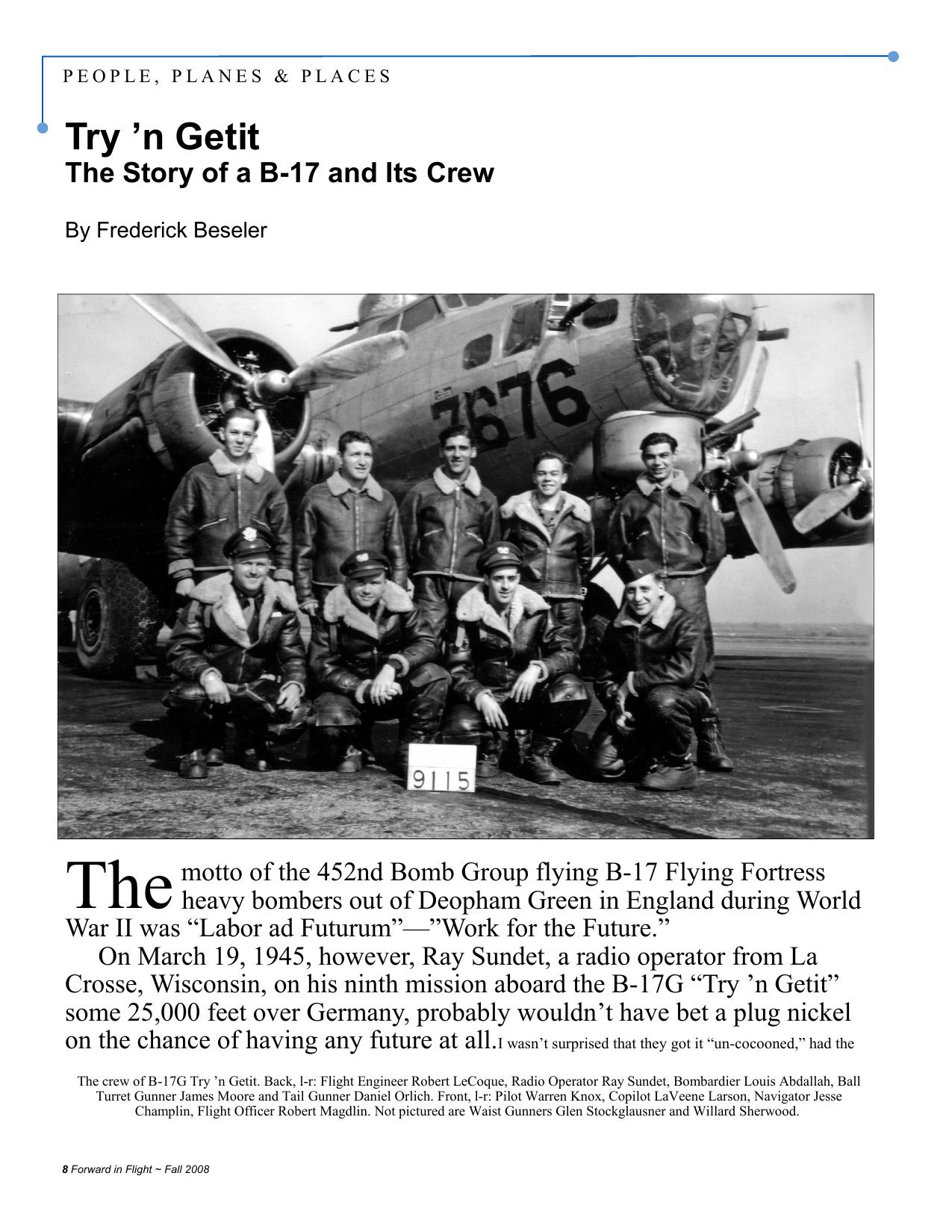
PEOPLE, PLANES & PLACES Try ’n Getit The Story of a B-17 and Its Crew By Frederick Beseler The motto of the 452nd Bomb Group flying B-17 Flying Fortress heavy bombers out of Deopham Green in England during World War II was “Labor ad Futurum”—”Work for the Future.” On March 19, 1945, however, Ray Sundet, a radio operator from La Crosse, Wisconsin, on his ninth mission aboard the B-17G “Try ’n Getit” some 25,000 feet over Germany, probably wouldn’t have bet a plug nickel on the chance of having any future at all.I wasn’t surprised that they got it “un-cocooned,” had the The crew of B-17G Try ’n Getit. Back, l-r: Flight Engineer Robert LeCoque, Radio Operator Ray Sundet, Bombardier Louis Abdallah, Ball Turret Gunner James Moore and Tail Gunner Daniel Orlich. Front, l-r: Pilot Warren Knox, Copilot LaVeene Larson, Navigator Jesse Champlin, Flight Officer Robert Magdlin. Not pictured are Waist Gunners Glen Stockglausner and Willard Sherwood. 8 Forward in Flight ~ Fall 2008
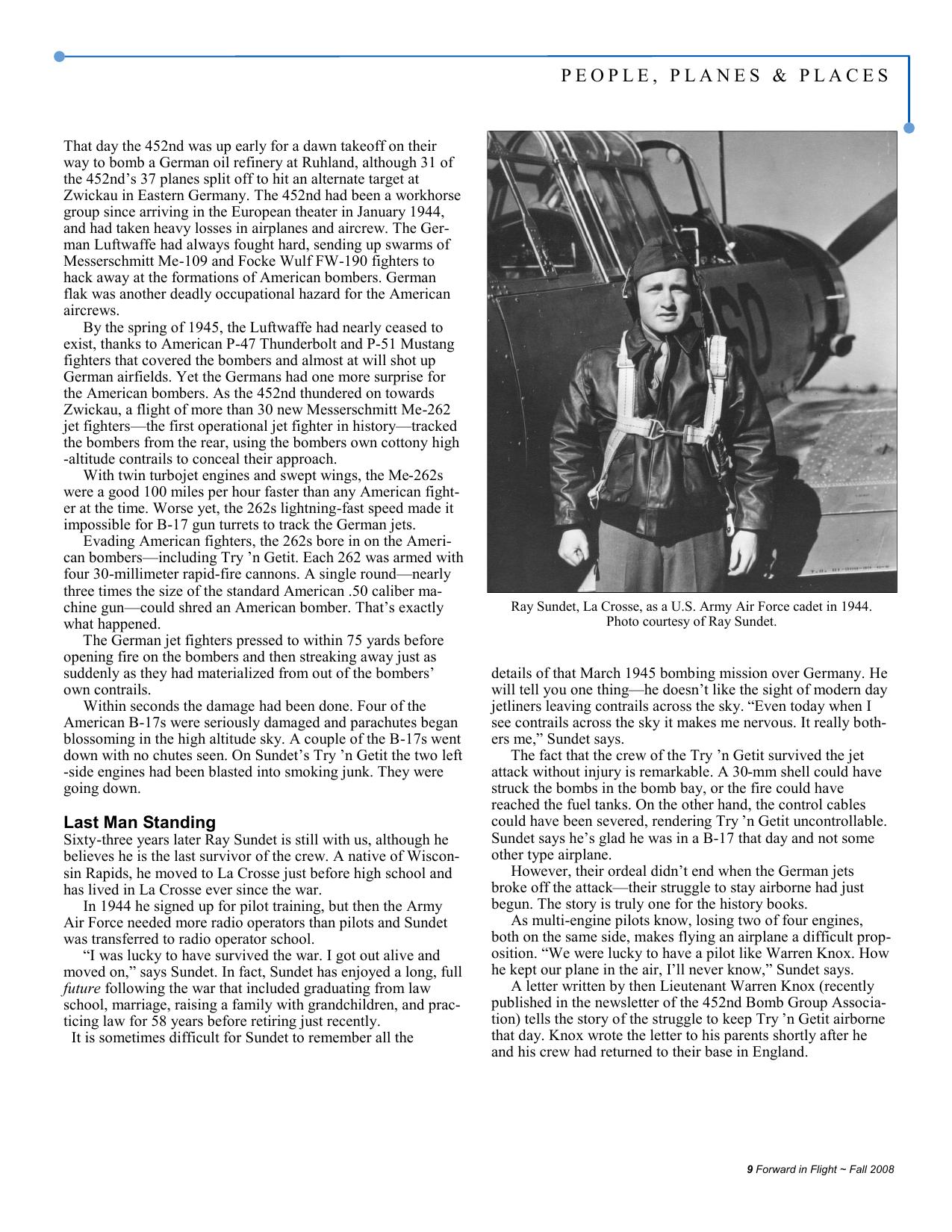
PEOPLE, PLANES & PLACES That day the 452nd was up early for a dawn takeoff on their way to bomb a German oil refinery at Ruhland, although 31 of the 452nd’s 37 planes split off to hit an alternate target at Zwickau in Eastern Germany. The 452nd had been a workhorse group since arriving in the European theater in January 1944, and had taken heavy losses in airplanes and aircrew. The German Luftwaffe had always fought hard, sending up swarms of Messerschmitt Me-109 and Focke Wulf FW-190 fighters to hack away at the formations of American bombers. German flak was another deadly occupational hazard for the American aircrews. By the spring of 1945, the Luftwaffe had nearly ceased to exist, thanks to American P-47 Thunderbolt and P-51 Mustang fighters that covered the bombers and almost at will shot up German airfields. Yet the Germans had one more surprise for the American bombers. As the 452nd thundered on towards Zwickau, a flight of more than 30 new Messerschmitt Me-262 jet fighters—the first operational jet fighter in history—tracked the bombers from the rear, using the bombers own cottony high -altitude contrails to conceal their approach. With twin turbojet engines and swept wings, the Me-262s were a good 100 miles per hour faster than any American fighter at the time. Worse yet, the 262s lightning-fast speed made it impossible for B-17 gun turrets to track the German jets. Evading American fighters, the 262s bore in on the American bombers—including Try ’n Getit. Each 262 was armed with four 30-millimeter rapid-fire cannons. A single round—nearly three times the size of the standard American .50 caliber machine gun—could shred an American bomber. That’s exactly what happened. The German jet fighters pressed to within 75 yards before opening fire on the bombers and then streaking away just as suddenly as they had materialized from out of the bombers’ own contrails. Within seconds the damage had been done. Four of the American B-17s were seriously damaged and parachutes began blossoming in the high altitude sky. A couple of the B-17s went down with no chutes seen. On Sundet’s Try ’n Getit the two left -side engines had been blasted into smoking junk. They were going down. Last Man Standing Sixty-three years later Ray Sundet is still with us, although he believes he is the last survivor of the crew. A native of Wisconsin Rapids, he moved to La Crosse just before high school and has lived in La Crosse ever since the war. In 1944 he signed up for pilot training, but then the Army Air Force needed more radio operators than pilots and Sundet was transferred to radio operator school. “I was lucky to have survived the war. I got out alive and moved on,” says Sundet. In fact, Sundet has enjoyed a long, full future following the war that included graduating from law school, marriage, raising a family with grandchildren, and practicing law for 58 years before retiring just recently. It is sometimes difficult for Sundet to remember all the Ray Sundet, La Crosse, as a U.S. Army Air Force cadet in 1944. Photo courtesy of Ray Sundet. details of that March 1945 bombing mission over Germany. He will tell you one thing—he doesn’t like the sight of modern day jetliners leaving contrails across the sky. “Even today when I see contrails across the sky it makes me nervous. It really bothers me,” Sundet says. The fact that the crew of the Try ’n Getit survived the jet attack without injury is remarkable. A 30-mm shell could have struck the bombs in the bomb bay, or the fire could have reached the fuel tanks. On the other hand, the control cables could have been severed, rendering Try ’n Getit uncontrollable. Sundet says he’s glad he was in a B-17 that day and not some other type airplane. However, their ordeal didn’t end when the German jets broke off the attack—their struggle to stay airborne had just begun. The story is truly one for the history books. As multi-engine pilots know, losing two of four engines, both on the same side, makes flying an airplane a difficult proposition. “We were lucky to have a pilot like Warren Knox. How he kept our plane in the air, I’ll never know,” Sundet says. A letter written by then Lieutenant Warren Knox (recently published in the newsletter of the 452nd Bomb Group Association) tells the story of the struggle to keep Try ’n Getit airborne that day. Knox wrote the letter to his parents shortly after he and his crew had returned to their base in England. 9 Forward in Flight ~ Fall 2008
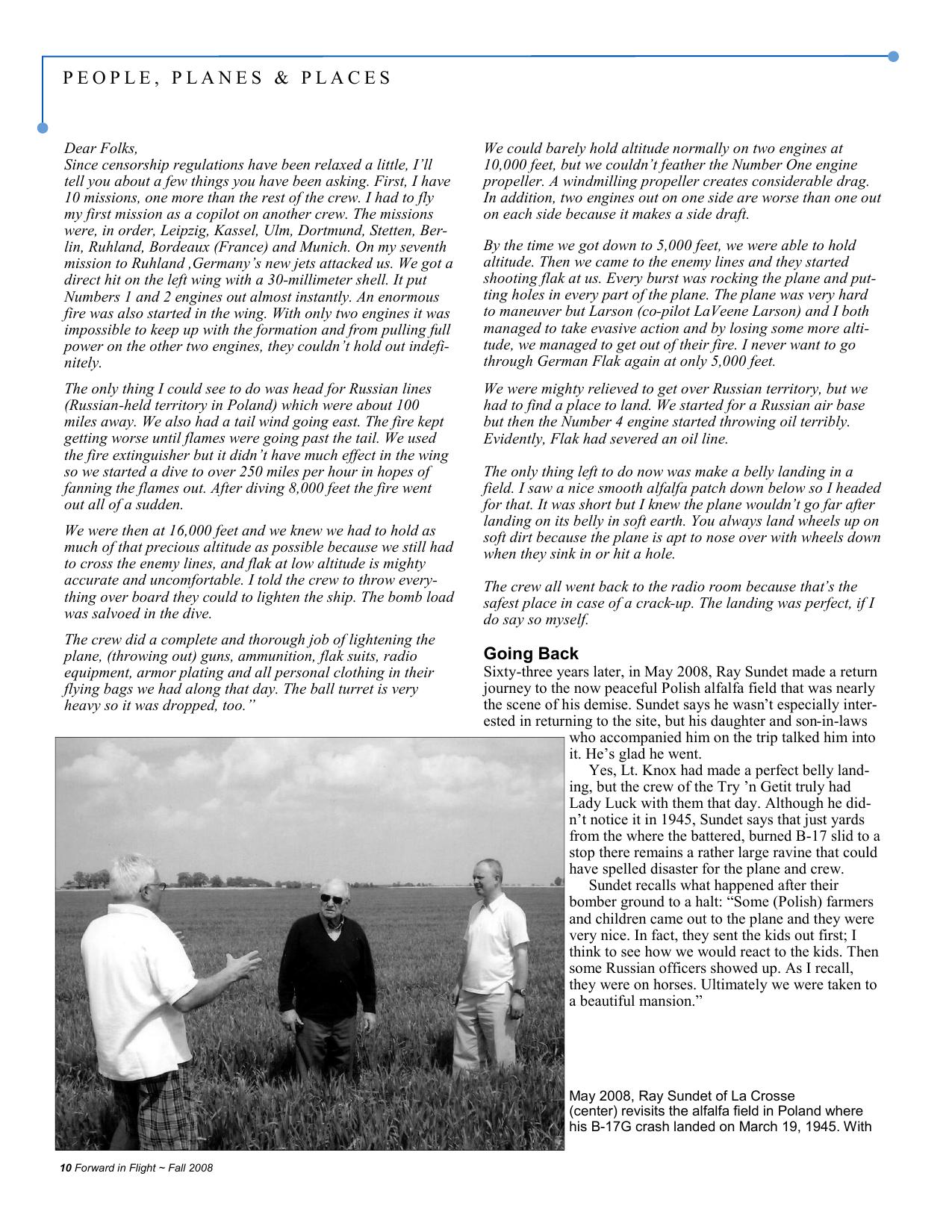
PEOPLE, PLANES & PLACES Dear Folks, Since censorship regulations have been relaxed a little, I’ll tell you about a few things you have been asking. First, I have 10 missions, one more than the rest of the crew. I had to fly my first mission as a copilot on another crew. The missions were, in order, Leipzig, Kassel, Ulm, Dortmund, Stetten, Berlin, Ruhland, Bordeaux (France) and Munich. On my seventh mission to Ruhland ,Germany’s new jets attacked us. We got a direct hit on the left wing with a 30-millimeter shell. It put Numbers 1 and 2 engines out almost instantly. An enormous fire was also started in the wing. With only two engines it was impossible to keep up with the formation and from pulling full power on the other two engines, they couldn’t hold out indefinitely. We could barely hold altitude normally on two engines at 10,000 feet, but we couldn’t feather the Number One engine propeller. A windmilling propeller creates considerable drag. In addition, two engines out on one side are worse than one out on each side because it makes a side draft. The only thing I could see to do was head for Russian lines (Russian-held territory in Poland) which were about 100 miles away. We also had a tail wind going east. The fire kept getting worse until flames were going past the tail. We used the fire extinguisher but it didn’t have much effect in the wing so we started a dive to over 250 miles per hour in hopes of fanning the flames out. After diving 8,000 feet the fire went out all of a sudden. We were mighty relieved to get over Russian territory, but we had to find a place to land. We started for a Russian air base but then the Number 4 engine started throwing oil terribly. Evidently, Flak had severed an oil line. We were then at 16,000 feet and we knew we had to hold as much of that precious altitude as possible because we still had to cross the enemy lines, and flak at low altitude is mighty accurate and uncomfortable. I told the crew to throw everything over board they could to lighten the ship. The bomb load was salvoed in the dive. The crew did a complete and thorough job of lightening the plane, (throwing out) guns, ammunition, flak suits, radio equipment, armor plating and all personal clothing in their flying bags we had along that day. The ball turret is very heavy so it was dropped, too.” By the time we got down to 5,000 feet, we were able to hold altitude. Then we came to the enemy lines and they started shooting flak at us. Every burst was rocking the plane and putting holes in every part of the plane. The plane was very hard to maneuver but Larson (co-pilot LaVeene Larson) and I both managed to take evasive action and by losing some more altitude, we managed to get out of their fire. I never want to go through German Flak again at only 5,000 feet. The only thing left to do now was make a belly landing in a field. I saw a nice smooth alfalfa patch down below so I headed for that. It was short but I knew the plane wouldn’t go far after landing on its belly in soft earth. You always land wheels up on soft dirt because the plane is apt to nose over with wheels down when they sink in or hit a hole. The crew all went back to the radio room because that’s the safest place in case of a crack-up. The landing was perfect, if I do say so myself. Going Back Sixty-three years later, in May 2008, Ray Sundet made a return journey to the now peaceful Polish alfalfa field that was nearly the scene of his demise. Sundet says he wasn’t especially interested in returning to the site, but his daughter and son-in-laws who accompanied him on the trip talked him into it. He’s glad he went. Yes, Lt. Knox had made a perfect belly landing, but the crew of the Try ’n Getit truly had Lady Luck with them that day. Although he didn’t notice it in 1945, Sundet says that just yards from the where the battered, burned B-17 slid to a stop there remains a rather large ravine that could have spelled disaster for the plane and crew. Sundet recalls what happened after their bomber ground to a halt: “Some (Polish) farmers and children came out to the plane and they were very nice. In fact, they sent the kids out first; I think to see how we would react to the kids. Then some Russian officers showed up. As I recall, they were on horses. Ultimately we were taken to a beautiful mansion.” May 2008, Ray Sundet of La Crosse (center) revisits the alfalfa field in Poland where his B-17G crash landed on March 19, 1945. With 10 Forward in Flight ~ Fall 2008
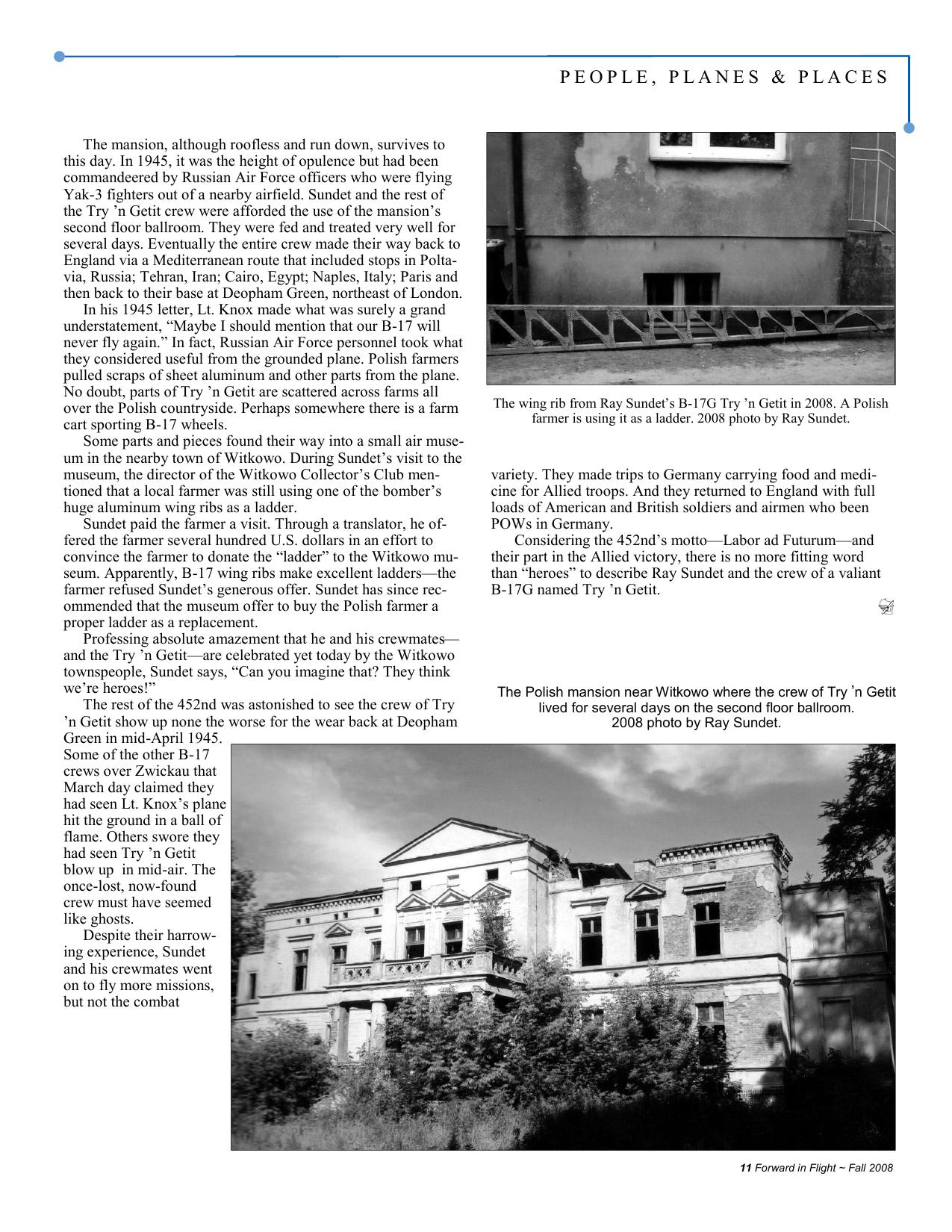
PEOPLE, PLANES & PLACES The mansion, although roofless and run down, survives to this day. In 1945, it was the height of opulence but had been commandeered by Russian Air Force officers who were flying Yak-3 fighters out of a nearby airfield. Sundet and the rest of the Try ’n Getit crew were afforded the use of the mansion’s second floor ballroom. They were fed and treated very well for several days. Eventually the entire crew made their way back to England via a Mediterranean route that included stops in Poltavia, Russia; Tehran, Iran; Cairo, Egypt; Naples, Italy; Paris and then back to their base at Deopham Green, northeast of London. In his 1945 letter, Lt. Knox made what was surely a grand understatement, “Maybe I should mention that our B-17 will never fly again.” In fact, Russian Air Force personnel took what they considered useful from the grounded plane. Polish farmers pulled scraps of sheet aluminum and other parts from the plane. No doubt, parts of Try ’n Getit are scattered across farms all over the Polish countryside. Perhaps somewhere there is a farm cart sporting B-17 wheels. Some parts and pieces found their way into a small air museum in the nearby town of Witkowo. During Sundet’s visit to the museum, the director of the Witkowo Collector’s Club mentioned that a local farmer was still using one of the bomber’s huge aluminum wing ribs as a ladder. Sundet paid the farmer a visit. Through a translator, he offered the farmer several hundred U.S. dollars in an effort to convince the farmer to donate the “ladder” to the Witkowo museum. Apparently, B-17 wing ribs make excellent ladders—the farmer refused Sundet’s generous offer. Sundet has since recommended that the museum offer to buy the Polish farmer a proper ladder as a replacement. Professing absolute amazement that he and his crewmates— and the Try ’n Getit—are celebrated yet today by the Witkowo townspeople, Sundet says, “Can you imagine that? They think we’re heroes!” The rest of the 452nd was astonished to see the crew of Try ’n Getit show up none the worse for the wear back at Deopham Green in mid-April 1945. Some of the other B-17 crews over Zwickau that March day claimed they had seen Lt. Knox’s plane hit the ground in a ball of flame. Others swore they had seen Try ’n Getit blow up in mid-air. The once-lost, now-found crew must have seemed like ghosts. Despite their harrowing experience, Sundet and his crewmates went on to fly more missions, but not the combat The wing rib from Ray Sundet’s B-17G Try ’n Getit in 2008. A Polish farmer is using it as a ladder. 2008 photo by Ray Sundet. variety. They made trips to Germany carrying food and medicine for Allied troops. And they returned to England with full loads of American and British soldiers and airmen who been POWs in Germany. Considering the 452nd’s motto—Labor ad Futurum—and their part in the Allied victory, there is no more fitting word than “heroes” to describe Ray Sundet and the crew of a valiant B-17G named Try ’n Getit. The Polish mansion near Witkowo where the crew of Try ’n Getit lived for several days on the second floor ballroom. 2008 photo by Ray Sundet. 11 Forward in Flight ~ Fall 2008
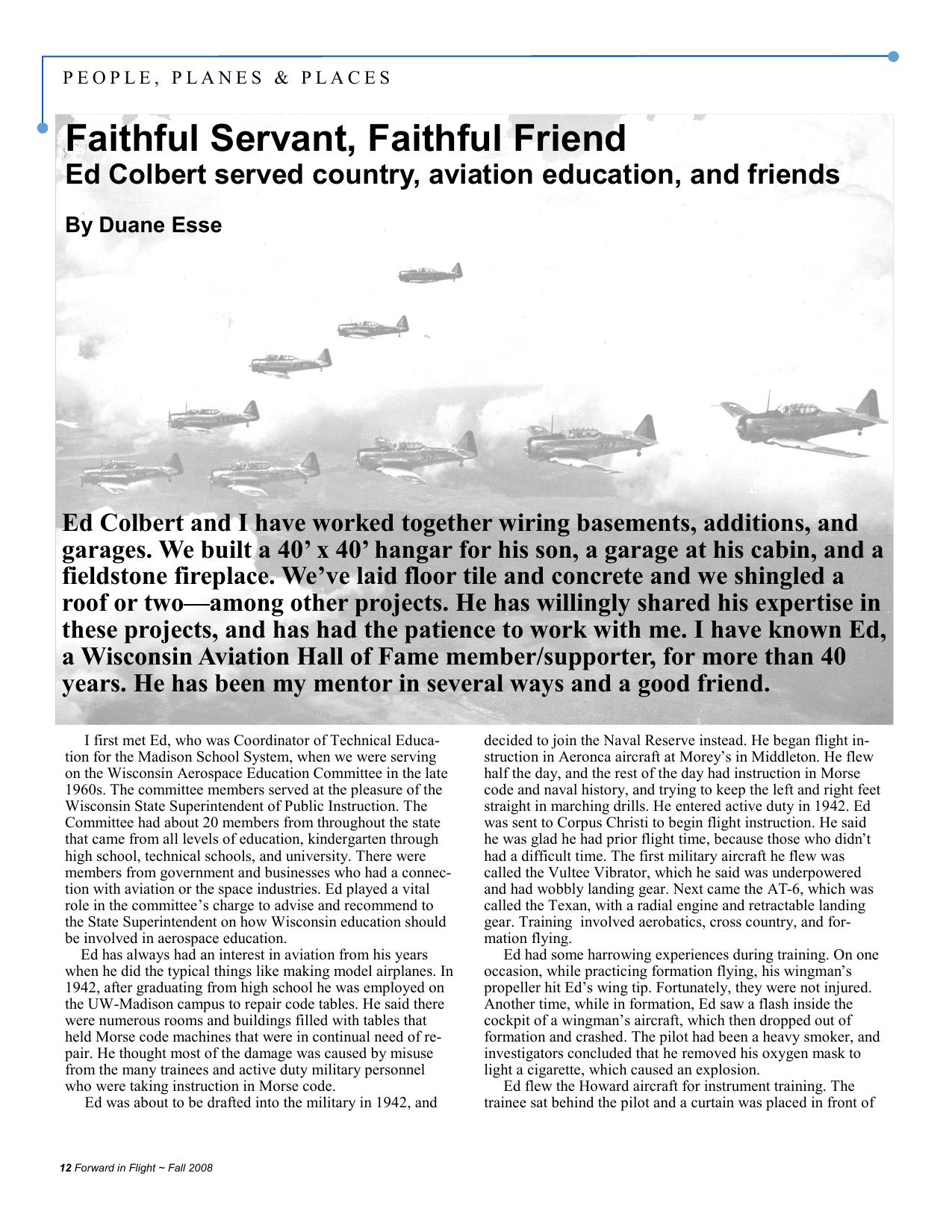
PEOPLE, PLANES & PLACES Faithful Servant, Faithful Friend Ed Colbert served country, aviation education, and friends By Duane Esse Ed Colbert and I have worked together wiring basements, additions, and garages. We built a 40’ x 40’ hangar for his son, a garage at his cabin, and a fieldstone fireplace. We’ve laid floor tile and concrete and we shingled a roof or two—among other projects. He has willingly shared his expertise in these projects, and has had the patience to work with me. I have known Ed, a Wisconsin Aviation Hall of Fame member/supporter, for more than 40 years. He has been my mentor in several ways and a good friend. I first met Ed, who was Coordinator of Technical Education for the Madison School System, when we were serving on the Wisconsin Aerospace Education Committee in the late 1960s. The committee members served at the pleasure of the Wisconsin State Superintendent of Public Instruction. The Committee had about 20 members from throughout the state that came from all levels of education, kindergarten through high school, technical schools, and university. There were members from government and businesses who had a connection with aviation or the space industries. Ed played a vital role in the committee’s charge to advise and recommend to the State Superintendent on how Wisconsin education should be involved in aerospace education. Ed has always had an interest in aviation from his years when he did the typical things like making model airplanes. In 1942, after graduating from high school he was employed on the UW-Madison campus to repair code tables. He said there were numerous rooms and buildings filled with tables that held Morse code machines that were in continual need of repair. He thought most of the damage was caused by misuse from the many trainees and active duty military personnel who were taking instruction in Morse code. Ed was about to be drafted into the military in 1942, and 12 Forward in Flight ~ Fall 2008 decided to join the Naval Reserve instead. He began flight instruction in Aeronca aircraft at Morey’s in Middleton. He flew half the day, and the rest of the day had instruction in Morse code and naval history, and trying to keep the left and right feet straight in marching drills. He entered active duty in 1942. Ed was sent to Corpus Christi to begin flight instruction. He said he was glad he had prior flight time, because those who didn’t had a difficult time. The first military aircraft he flew was called the Vultee Vibrator, which he said was underpowered and had wobbly landing gear. Next came the AT-6, which was called the Texan, with a radial engine and retractable landing gear. Training involved aerobatics, cross country, and formation flying. Ed had some harrowing experiences during training. On one occasion, while practicing formation flying, his wingman’s propeller hit Ed’s wing tip. Fortunately, they were not injured. Another time, while in formation, Ed saw a flash inside the cockpit of a wingman’s aircraft, which then dropped out of formation and crashed. The pilot had been a heavy smoker, and investigators concluded that he removed his oxygen mask to light a cigarette, which caused an explosion. Ed flew the Howard aircraft for instrument training. The trainee sat behind the pilot and a curtain was placed in front of
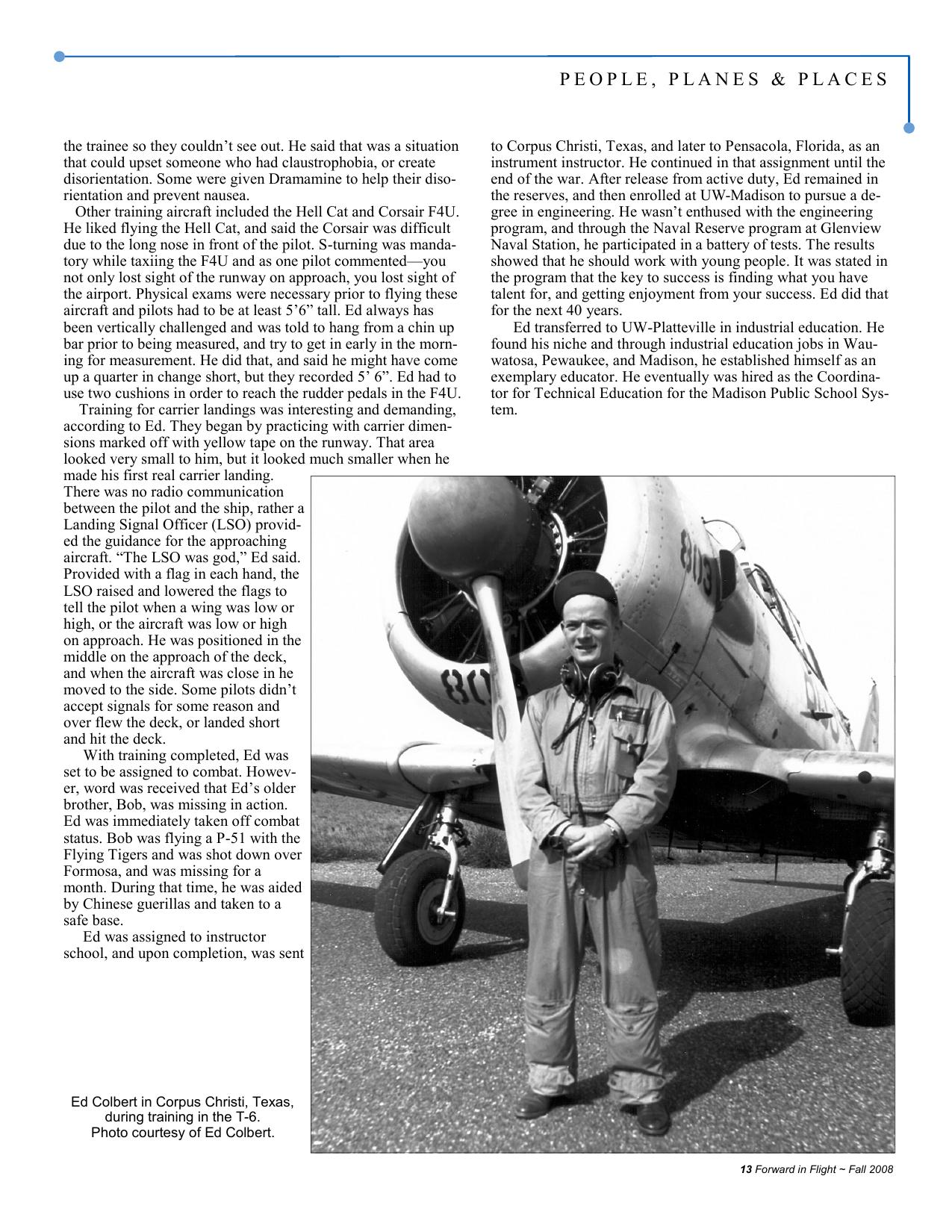
PEOPLE, PLANES & PLACES the trainee so they couldn’t see out. He said that was a situation that could upset someone who had claustrophobia, or create disorientation. Some were given Dramamine to help their disorientation and prevent nausea. Other training aircraft included the Hell Cat and Corsair F4U. He liked flying the Hell Cat, and said the Corsair was difficult due to the long nose in front of the pilot. S-turning was mandatory while taxiing the F4U and as one pilot commented—you not only lost sight of the runway on approach, you lost sight of the airport. Physical exams were necessary prior to flying these aircraft and pilots had to be at least 5’6” tall. Ed always has been vertically challenged and was told to hang from a chin up bar prior to being measured, and try to get in early in the morning for measurement. He did that, and said he might have come up a quarter in change short, but they recorded 5’ 6”. Ed had to use two cushions in order to reach the rudder pedals in the F4U. Training for carrier landings was interesting and demanding, according to Ed. They began by practicing with carrier dimensions marked off with yellow tape on the runway. That area looked very small to him, but it looked much smaller when he made his first real carrier landing. There was no radio communication between the pilot and the ship, rather a Landing Signal Officer (LSO) provided the guidance for the approaching aircraft. “The LSO was god,” Ed said. Provided with a flag in each hand, the LSO raised and lowered the flags to tell the pilot when a wing was low or high, or the aircraft was low or high on approach. He was positioned in the middle on the approach of the deck, and when the aircraft was close in he moved to the side. Some pilots didn’t accept signals for some reason and over flew the deck, or landed short and hit the deck. With training completed, Ed was set to be assigned to combat. However, word was received that Ed’s older brother, Bob, was missing in action. Ed was immediately taken off combat status. Bob was flying a P-51 with the Flying Tigers and was shot down over Formosa, and was missing for a month. During that time, he was aided by Chinese guerillas and taken to a safe base. Ed was assigned to instructor school, and upon completion, was sent to Corpus Christi, Texas, and later to Pensacola, Florida, as an instrument instructor. He continued in that assignment until the end of the war. After release from active duty, Ed remained in the reserves, and then enrolled at UW-Madison to pursue a degree in engineering. He wasn’t enthused with the engineering program, and through the Naval Reserve program at Glenview Naval Station, he participated in a battery of tests. The results showed that he should work with young people. It was stated in the program that the key to success is finding what you have talent for, and getting enjoyment from your success. Ed did that for the next 40 years. Ed transferred to UW-Platteville in industrial education. He found his niche and through industrial education jobs in Wauwatosa, Pewaukee, and Madison, he established himself as an exemplary educator. He eventually was hired as the Coordinator for Technical Education for the Madison Public School System. Ed Colbert in Corpus Christi, Texas, during training in the T-6. Photo courtesy of Ed Colbert. 13 Forward in Flight ~ Fall 2008
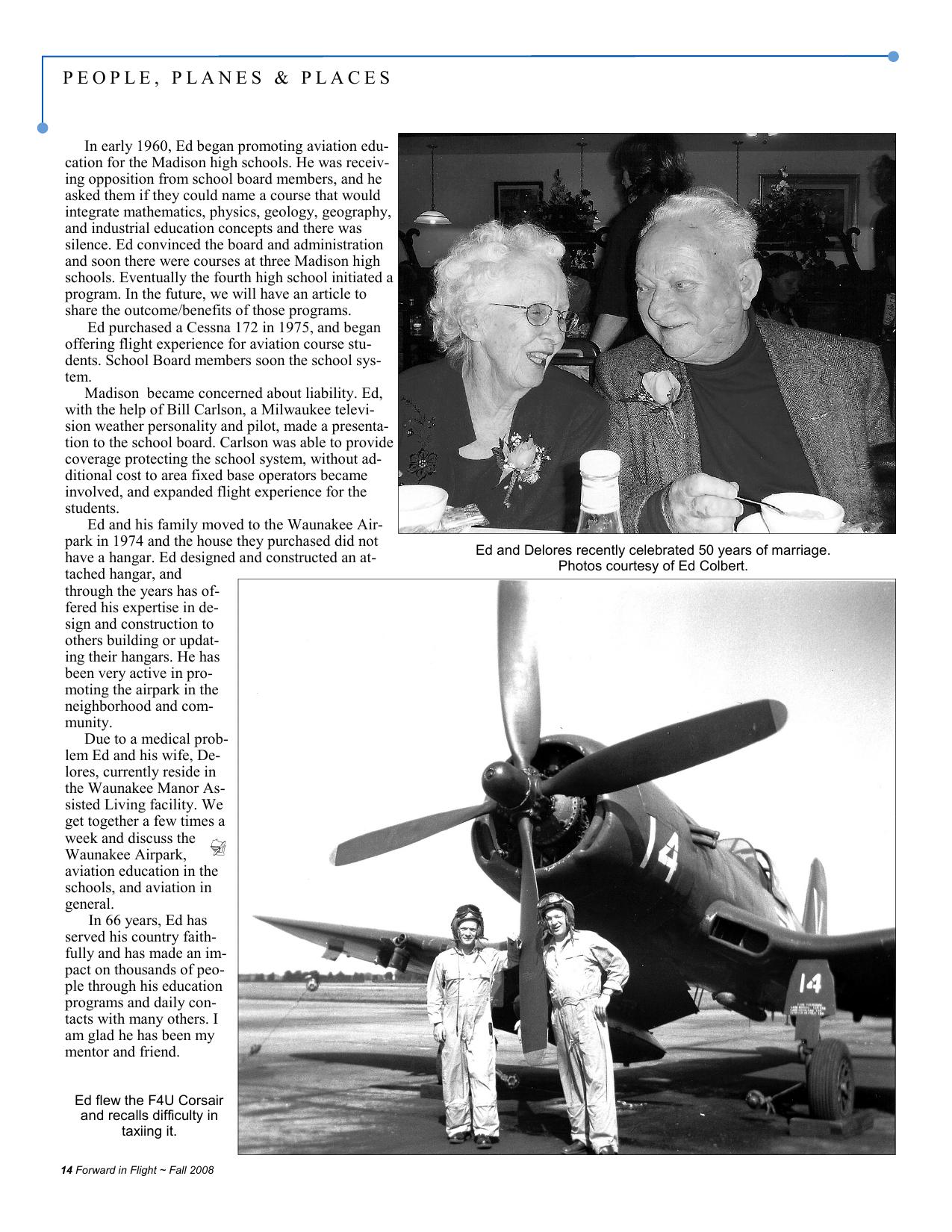
PEOPLE, PLANES & PLACES In early 1960, Ed began promoting aviation education for the Madison high schools. He was receiving opposition from school board members, and he asked them if they could name a course that would integrate mathematics, physics, geology, geography, and industrial education concepts and there was silence. Ed convinced the board and administration and soon there were courses at three Madison high schools. Eventually the fourth high school initiated a program. In the future, we will have an article to share the outcome/benefits of those programs. Ed purchased a Cessna 172 in 1975, and began offering flight experience for aviation course students. School Board members soon the school system. Madison became concerned about liability. Ed, with the help of Bill Carlson, a Milwaukee television weather personality and pilot, made a presentation to the school board. Carlson was able to provide coverage protecting the school system, without additional cost to area fixed base operators became involved, and expanded flight experience for the students. Ed and his family moved to the Waunakee Airpark in 1974 and the house they purchased did not have a hangar. Ed designed and constructed an attached hangar, and through the years has offered his expertise in design and construction to others building or updating their hangars. He has been very active in promoting the airpark in the neighborhood and community. Due to a medical problem Ed and his wife, Delores, currently reside in the Waunakee Manor Assisted Living facility. We get together a few times a week and discuss the Waunakee Airpark, aviation education in the schools, and aviation in general. In 66 years, Ed has served his country faithfully and has made an impact on thousands of people through his education programs and daily contacts with many others. I am glad he has been my mentor and friend. Ed flew the F4U Corsair and recalls difficulty in taxiing it. 14 Forward in Flight ~ Fall 2008 Ed and Delores recently celebrated 50 years of marriage. Photos courtesy of Ed Colbert.
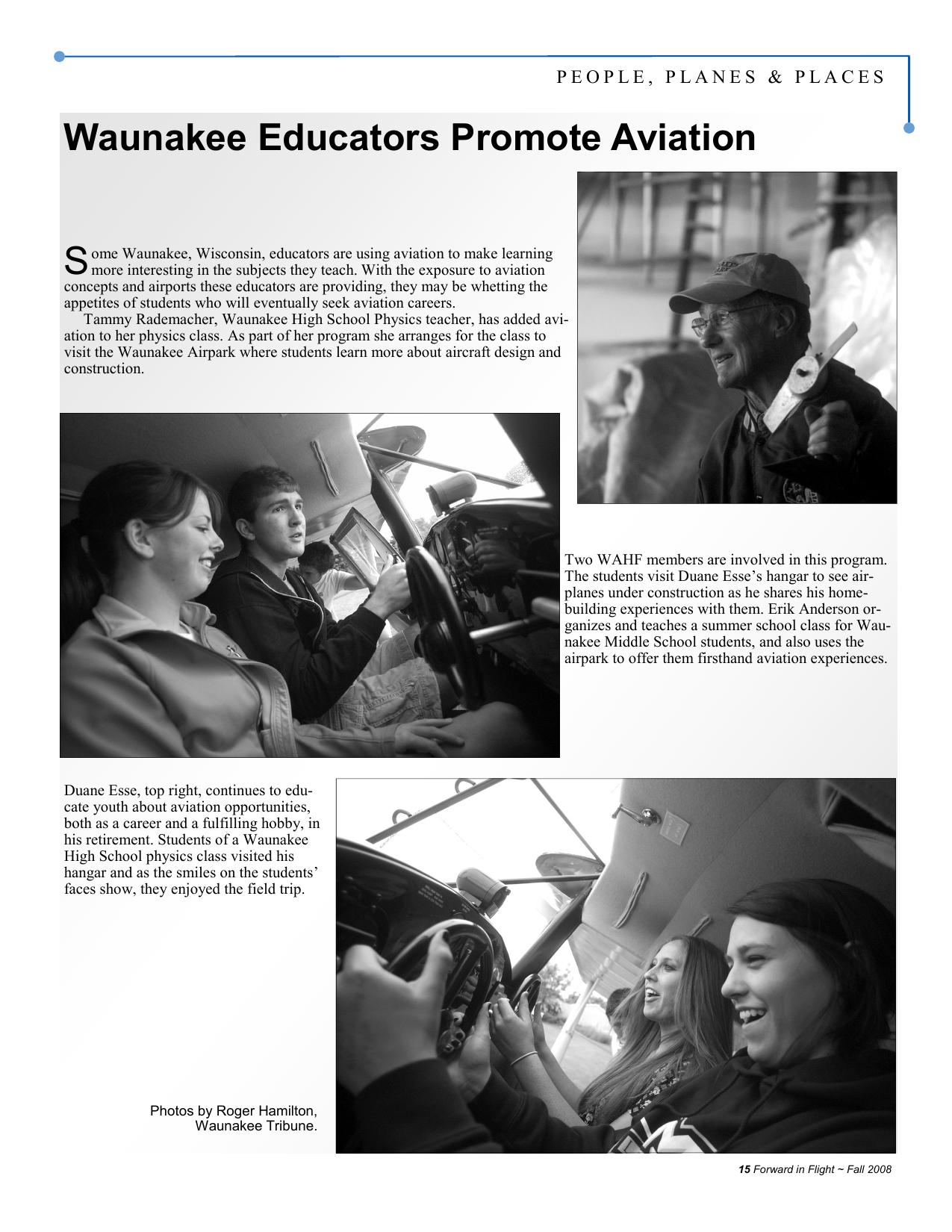
PEOPLE, PLANES & PLACES Waunakee Educators Promote Aviation ome Waunakee, Wisconsin, educators are using aviation to make learning S more interesting in the subjects they teach. With the exposure to aviation concepts and airports these educators are providing, they may be whetting the appetites of students who will eventually seek aviation careers. Tammy Rademacher, Waunakee High School Physics teacher, has added aviation to her physics class. As part of her program she arranges for the class to visit the Waunakee Airpark where students learn more about aircraft design and construction. Two WAHF members are involved in this program. The students visit Duane Esse’s hangar to see airplanes under construction as he shares his homebuilding experiences with them. Erik Anderson organizes and teaches a summer school class for Waunakee Middle School students, and also uses the airpark to offer them firsthand aviation experiences. Duane Esse, top right, continues to educate youth about aviation opportunities, both as a career and a fulfilling hobby, in his retirement. Students of a Waunakee High School physics class visited his hangar and as the smiles on the students’ faces show, they enjoyed the field trip. Photos by Roger Hamilton, Waunakee Tribune. 15 Forward in Flight ~ Fall 2008
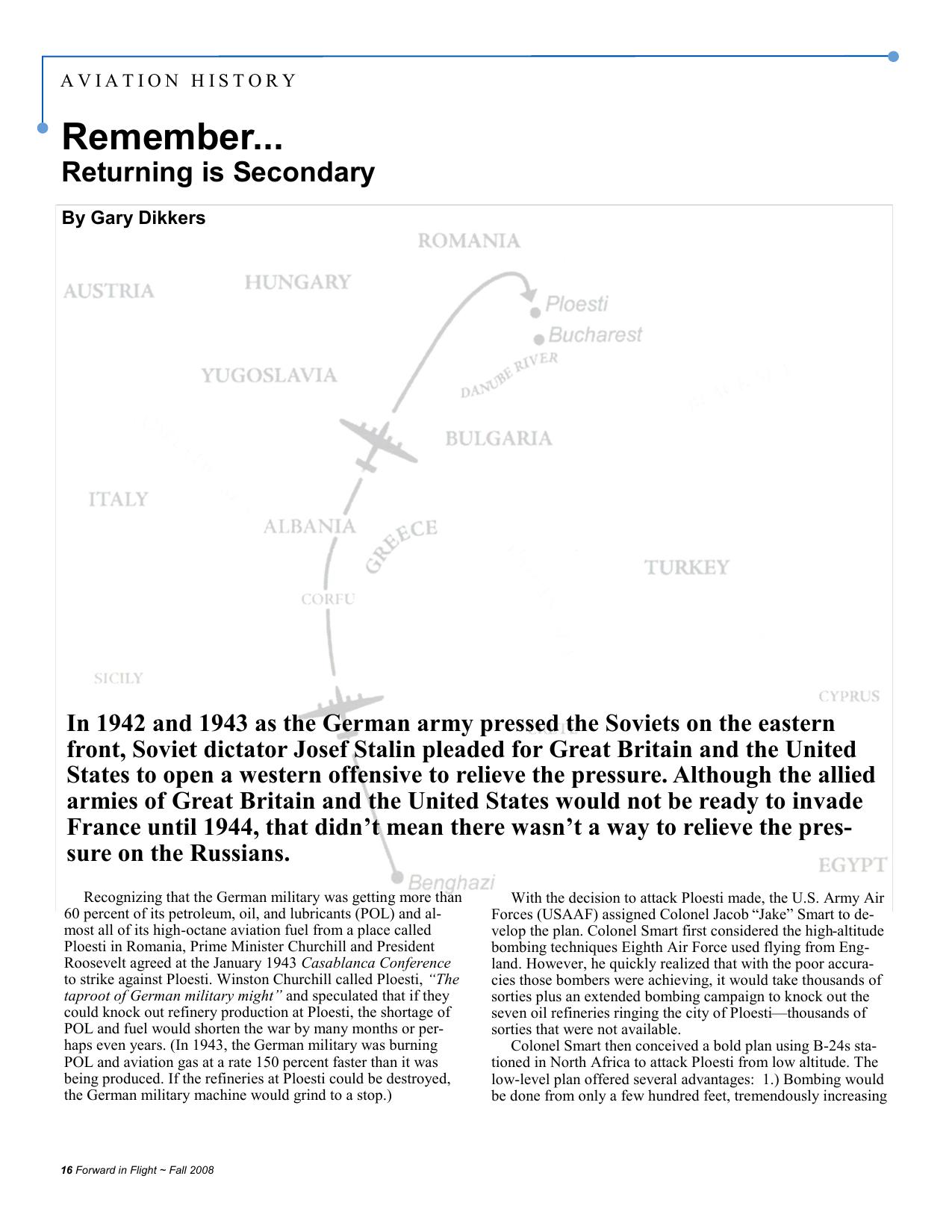
AVIATION HISTORY Remember... Returning is Secondary By Gary Dikkers In 1942 and 1943 as the German army pressed the Soviets on the eastern front, Soviet dictator Josef Stalin pleaded for Great Britain and the United States to open a western offensive to relieve the pressure. Although the allied armies of Great Britain and the United States would not be ready to invade France until 1944, that didn’t mean there wasn’t a way to relieve the pressure on the Russians. Recognizing that the German military was getting more than 60 percent of its petroleum, oil, and lubricants (POL) and almost all of its high-octane aviation fuel from a place called Ploesti in Romania, Prime Minister Churchill and President Roosevelt agreed at the January 1943 Casablanca Conference to strike against Ploesti. Winston Churchill called Ploesti, “The taproot of German military might” and speculated that if they could knock out refinery production at Ploesti, the shortage of POL and fuel would shorten the war by many months or perhaps even years. (In 1943, the German military was burning POL and aviation gas at a rate 150 percent faster than it was being produced. If the refineries at Ploesti could be destroyed, the German military machine would grind to a stop.) 16 Forward in Flight ~ Fall 2008 With the decision to attack Ploesti made, the U.S. Army Air Forces (USAAF) assigned Colonel Jacob “Jake” Smart to develop the plan. Colonel Smart first considered the high-altitude bombing techniques Eighth Air Force used flying from England. However, he quickly realized that with the poor accuracies those bombers were achieving, it would take thousands of sorties plus an extended bombing campaign to knock out the seven oil refineries ringing the city of Ploesti—thousands of sorties that were not available. Colonel Smart then conceived a bold plan using B-24s stationed in North Africa to attack Ploesti from low altitude. The low-level plan offered several advantages: 1.) Bombing would be done from only a few hundred feet, tremendously increasing
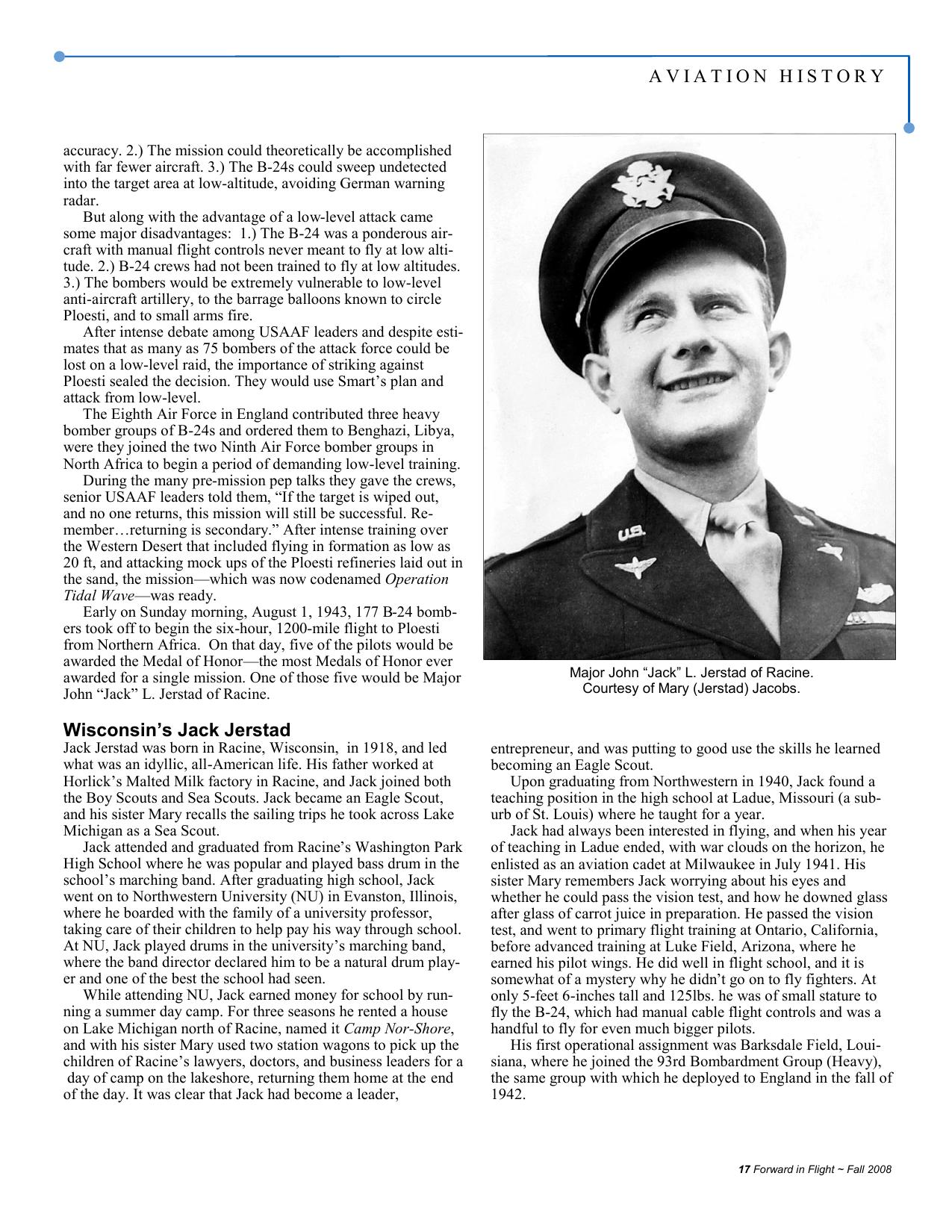
AVIATION HISTORY accuracy. 2.) The mission could theoretically be accomplished with far fewer aircraft. 3.) The B-24s could sweep undetected into the target area at low-altitude, avoiding German warning radar. But along with the advantage of a low-level attack came some major disadvantages: 1.) The B-24 was a ponderous aircraft with manual flight controls never meant to fly at low altitude. 2.) B-24 crews had not been trained to fly at low altitudes. 3.) The bombers would be extremely vulnerable to low-level anti-aircraft artillery, to the barrage balloons known to circle Ploesti, and to small arms fire. After intense debate among USAAF leaders and despite estimates that as many as 75 bombers of the attack force could be lost on a low-level raid, the importance of striking against Ploesti sealed the decision. They would use Smart’s plan and attack from low-level. The Eighth Air Force in England contributed three heavy bomber groups of B-24s and ordered them to Benghazi, Libya, were they joined the two Ninth Air Force bomber groups in North Africa to begin a period of demanding low-level training. During the many pre-mission pep talks they gave the crews, senior USAAF leaders told them, “If the target is wiped out, and no one returns, this mission will still be successful. Remember…returning is secondary.” After intense training over the Western Desert that included flying in formation as low as 20 ft, and attacking mock ups of the Ploesti refineries laid out in the sand, the mission—which was now codenamed Operation Tidal Wave—was ready. Early on Sunday morning, August 1, 1943, 177 B-24 bombers took off to begin the six-hour, 1200-mile flight to Ploesti from Northern Africa. On that day, five of the pilots would be awarded the Medal of Honor—the most Medals of Honor ever awarded for a single mission. One of those five would be Major John “Jack” L. Jerstad of Racine. Wisconsin’s Jack Jerstad Jack Jerstad was born in Racine, Wisconsin, in 1918, and led what was an idyllic, all-American life. His father worked at Horlick’s Malted Milk factory in Racine, and Jack joined both the Boy Scouts and Sea Scouts. Jack became an Eagle Scout, and his sister Mary recalls the sailing trips he took across Lake Michigan as a Sea Scout. Jack attended and graduated from Racine’s Washington Park High School where he was popular and played bass drum in the school’s marching band. After graduating high school, Jack went on to Northwestern University (NU) in Evanston, Illinois, where he boarded with the family of a university professor, taking care of their children to help pay his way through school. At NU, Jack played drums in the university’s marching band, where the band director declared him to be a natural drum player and one of the best the school had seen. While attending NU, Jack earned money for school by running a summer day camp. For three seasons he rented a house on Lake Michigan north of Racine, named it Camp Nor-Shore, and with his sister Mary used two station wagons to pick up the children of Racine’s lawyers, doctors, and business leaders for a day of camp on the lakeshore, returning them home at the end of the day. It was clear that Jack had become a leader, Major John “Jack” L. Jerstad of Racine. Courtesy of Mary (Jerstad) Jacobs. entrepreneur, and was putting to good use the skills he learned becoming an Eagle Scout. Upon graduating from Northwestern in 1940, Jack found a teaching position in the high school at Ladue, Missouri (a suburb of St. Louis) where he taught for a year. Jack had always been interested in flying, and when his year of teaching in Ladue ended, with war clouds on the horizon, he enlisted as an aviation cadet at Milwaukee in July 1941. His sister Mary remembers Jack worrying about his eyes and whether he could pass the vision test, and how he downed glass after glass of carrot juice in preparation. He passed the vision test, and went to primary flight training at Ontario, California, before advanced training at Luke Field, Arizona, where he earned his pilot wings. He did well in flight school, and it is somewhat of a mystery why he didn’t go on to fly fighters. At only 5-feet 6-inches tall and 125lbs. he was of small stature to fly the B-24, which had manual cable flight controls and was a handful to fly for even much bigger pilots. His first operational assignment was Barksdale Field, Louisiana, where he joined the 93rd Bombardment Group (Heavy), the same group with which he deployed to England in the fall of 1942. 17 Forward in Flight ~ Fall 2008
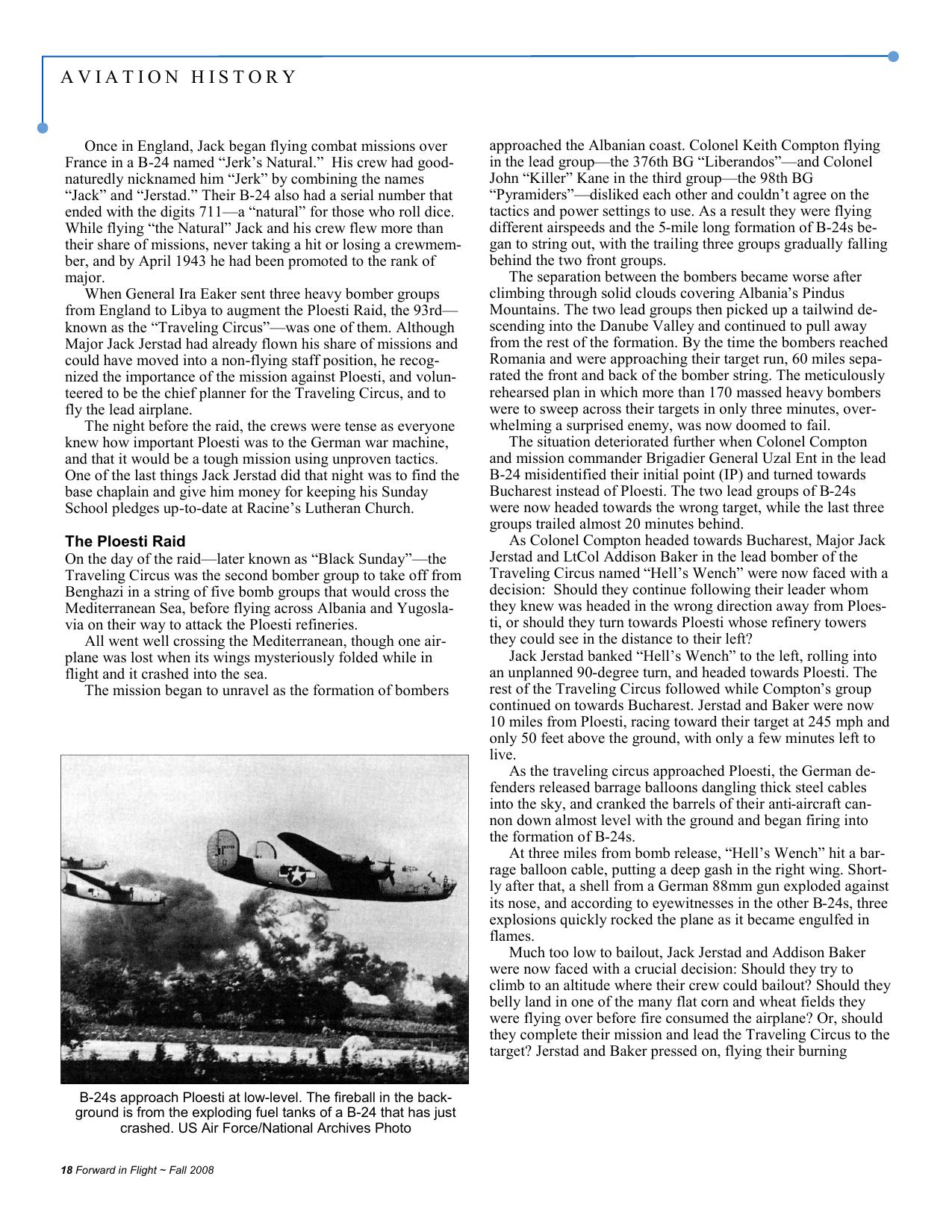
AVIATION HISTORY Once in England, Jack began flying combat missions over France in a B-24 named “Jerk’s Natural.” His crew had goodnaturedly nicknamed him “Jerk” by combining the names “Jack” and “Jerstad.” Their B-24 also had a serial number that ended with the digits 711—a “natural” for those who roll dice. While flying “the Natural” Jack and his crew flew more than their share of missions, never taking a hit or losing a crewmember, and by April 1943 he had been promoted to the rank of major. When General Ira Eaker sent three heavy bomber groups from England to Libya to augment the Ploesti Raid, the 93rd— known as the “Traveling Circus”—was one of them. Although Major Jack Jerstad had already flown his share of missions and could have moved into a non-flying staff position, he recognized the importance of the mission against Ploesti, and volunteered to be the chief planner for the Traveling Circus, and to fly the lead airplane. The night before the raid, the crews were tense as everyone knew how important Ploesti was to the German war machine, and that it would be a tough mission using unproven tactics. One of the last things Jack Jerstad did that night was to find the base chaplain and give him money for keeping his Sunday School pledges up-to-date at Racine’s Lutheran Church. The Ploesti Raid On the day of the raid—later known as “Black Sunday”—the Traveling Circus was the second bomber group to take off from Benghazi in a string of five bomb groups that would cross the Mediterranean Sea, before flying across Albania and Yugoslavia on their way to attack the Ploesti refineries. All went well crossing the Mediterranean, though one airplane was lost when its wings mysteriously folded while in flight and it crashed into the sea. The mission began to unravel as the formation of bombers B-24s approach Ploesti at low-level. The fireball in the background is from the exploding fuel tanks of a B-24 that has just crashed. US Air Force/National Archives Photo 18 Forward in Flight ~ Fall 2008 approached the Albanian coast. Colonel Keith Compton flying in the lead group—the 376th BG “Liberandos”—and Colonel John “Killer” Kane in the third group—the 98th BG “Pyramiders”—disliked each other and couldn’t agree on the tactics and power settings to use. As a result they were flying different airspeeds and the 5-mile long formation of B-24s began to string out, with the trailing three groups gradually falling behind the two front groups. The separation between the bombers became worse after climbing through solid clouds covering Albania’s Pindus Mountains. The two lead groups then picked up a tailwind descending into the Danube Valley and continued to pull away from the rest of the formation. By the time the bombers reached Romania and were approaching their target run, 60 miles separated the front and back of the bomber string. The meticulously rehearsed plan in which more than 170 massed heavy bombers were to sweep across their targets in only three minutes, overwhelming a surprised enemy, was now doomed to fail. The situation deteriorated further when Colonel Compton and mission commander Brigadier General Uzal Ent in the lead B-24 misidentified their initial point (IP) and turned towards Bucharest instead of Ploesti. The two lead groups of B-24s were now headed towards the wrong target, while the last three groups trailed almost 20 minutes behind. As Colonel Compton headed towards Bucharest, Major Jack Jerstad and LtCol Addison Baker in the lead bomber of the Traveling Circus named “Hell’s Wench” were now faced with a decision: Should they continue following their leader whom they knew was headed in the wrong direction away from Ploesti, or should they turn towards Ploesti whose refinery towers they could see in the distance to their left? Jack Jerstad banked “Hell’s Wench” to the left, rolling into an unplanned 90-degree turn, and headed towards Ploesti. The rest of the Traveling Circus followed while Compton’s group continued on towards Bucharest. Jerstad and Baker were now 10 miles from Ploesti, racing toward their target at 245 mph and only 50 feet above the ground, with only a few minutes left to live. As the traveling circus approached Ploesti, the German defenders released barrage balloons dangling thick steel cables into the sky, and cranked the barrels of their anti-aircraft cannon down almost level with the ground and began firing into the formation of B-24s. At three miles from bomb release, “Hell’s Wench” hit a barrage balloon cable, putting a deep gash in the right wing. Shortly after that, a shell from a German 88mm gun exploded against its nose, and according to eyewitnesses in the other B-24s, three explosions quickly rocked the plane as it became engulfed in flames. Much too low to bailout, Jack Jerstad and Addison Baker were now faced with a crucial decision: Should they try to climb to an altitude where their crew could bailout? Should they belly land in one of the many flat corn and wheat fields they were flying over before fire consumed the airplane? Or, should they complete their mission and lead the Traveling Circus to the target? Jerstad and Baker pressed on, flying their burning
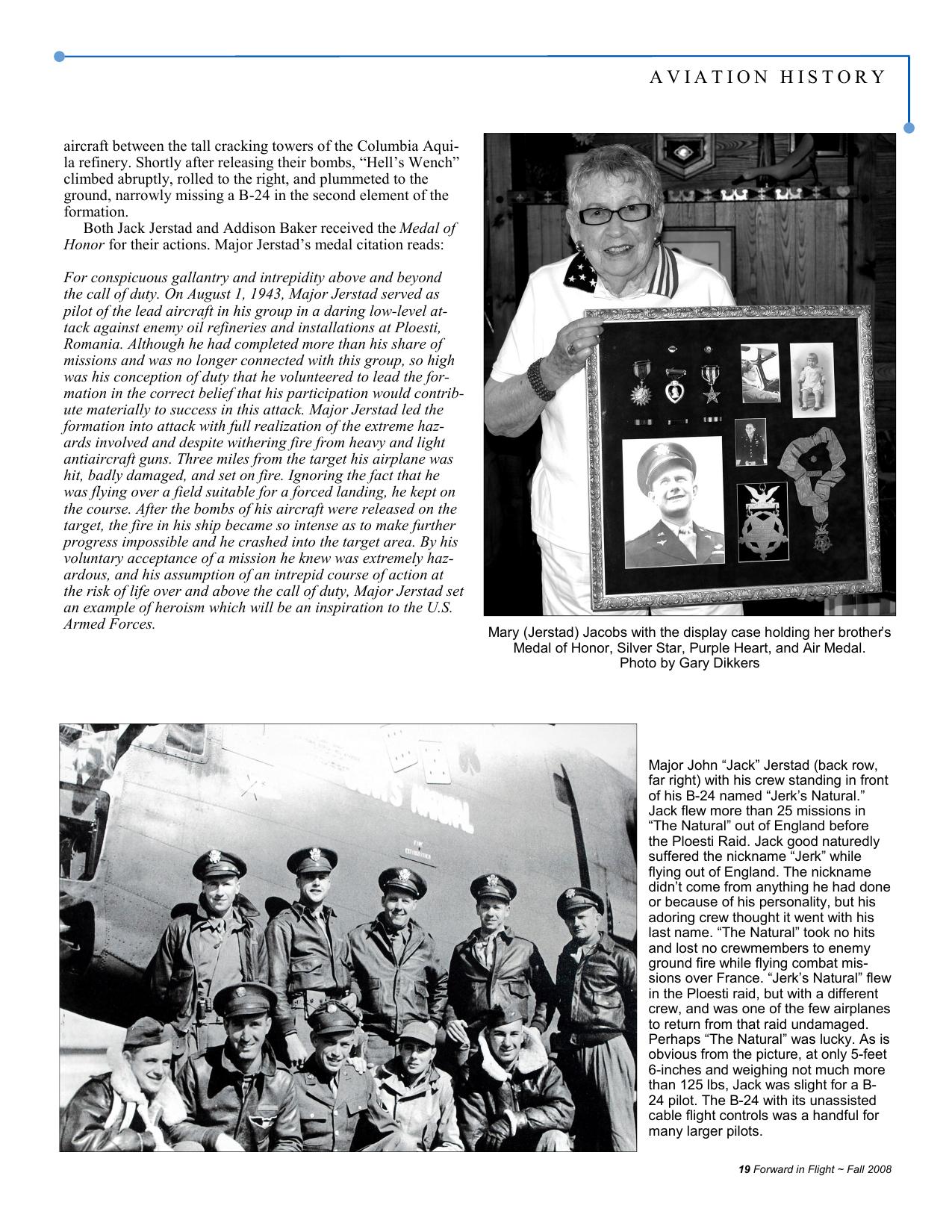
AVIATION HISTORY aircraft between the tall cracking towers of the Columbia Aquila refinery. Shortly after releasing their bombs, “Hell’s Wench” climbed abruptly, rolled to the right, and plummeted to the ground, narrowly missing a B-24 in the second element of the formation. Both Jack Jerstad and Addison Baker received the Medal of Honor for their actions. Major Jerstad’s medal citation reads: For conspicuous gallantry and intrepidity above and beyond the call of duty. On August 1, 1943, Major Jerstad served as pilot of the lead aircraft in his group in a daring low-level attack against enemy oil refineries and installations at Ploesti, Romania. Although he had completed more than his share of missions and was no longer connected with this group, so high was his conception of duty that he volunteered to lead the formation in the correct belief that his participation would contribute materially to success in this attack. Major Jerstad led the formation into attack with full realization of the extreme hazards involved and despite withering fire from heavy and light antiaircraft guns. Three miles from the target his airplane was hit, badly damaged, and set on fire. Ignoring the fact that he was flying over a field suitable for a forced landing, he kept on the course. After the bombs of his aircraft were released on the target, the fire in his ship became so intense as to make further progress impossible and he crashed into the target area. By his voluntary acceptance of a mission he knew was extremely hazardous, and his assumption of an intrepid course of action at the risk of life over and above the call of duty, Major Jerstad set an example of heroism which will be an inspiration to the U.S. Armed Forces. Mary (Jerstad) Jacobs with the display case holding her brother’s Medal of Honor, Silver Star, Purple Heart, and Air Medal. Photo by Gary Dikkers Major John “Jack” Jerstad (back row, far right) with his crew standing in front of his B-24 named “Jerk’s Natural.” Jack flew more than 25 missions in “The Natural” out of England before the Ploesti Raid. Jack good naturedly suffered the nickname “Jerk” while flying out of England. The nickname didn’t come from anything he had done or because of his personality, but his adoring crew thought it went with his last name. “The Natural” took no hits and lost no crewmembers to enemy ground fire while flying combat missions over France. “Jerk’s Natural” flew in the Ploesti raid, but with a different crew, and was one of the few airplanes to return from that raid undamaged. Perhaps “The Natural” was lucky. As is obvious from the picture, at only 5-feet 6-inches and weighing not much more than 125 lbs, Jack was slight for a B24 pilot. The B-24 with its unassisted cable flight controls was a handful for many larger pilots. 19 Forward in Flight ~ Fall 2008
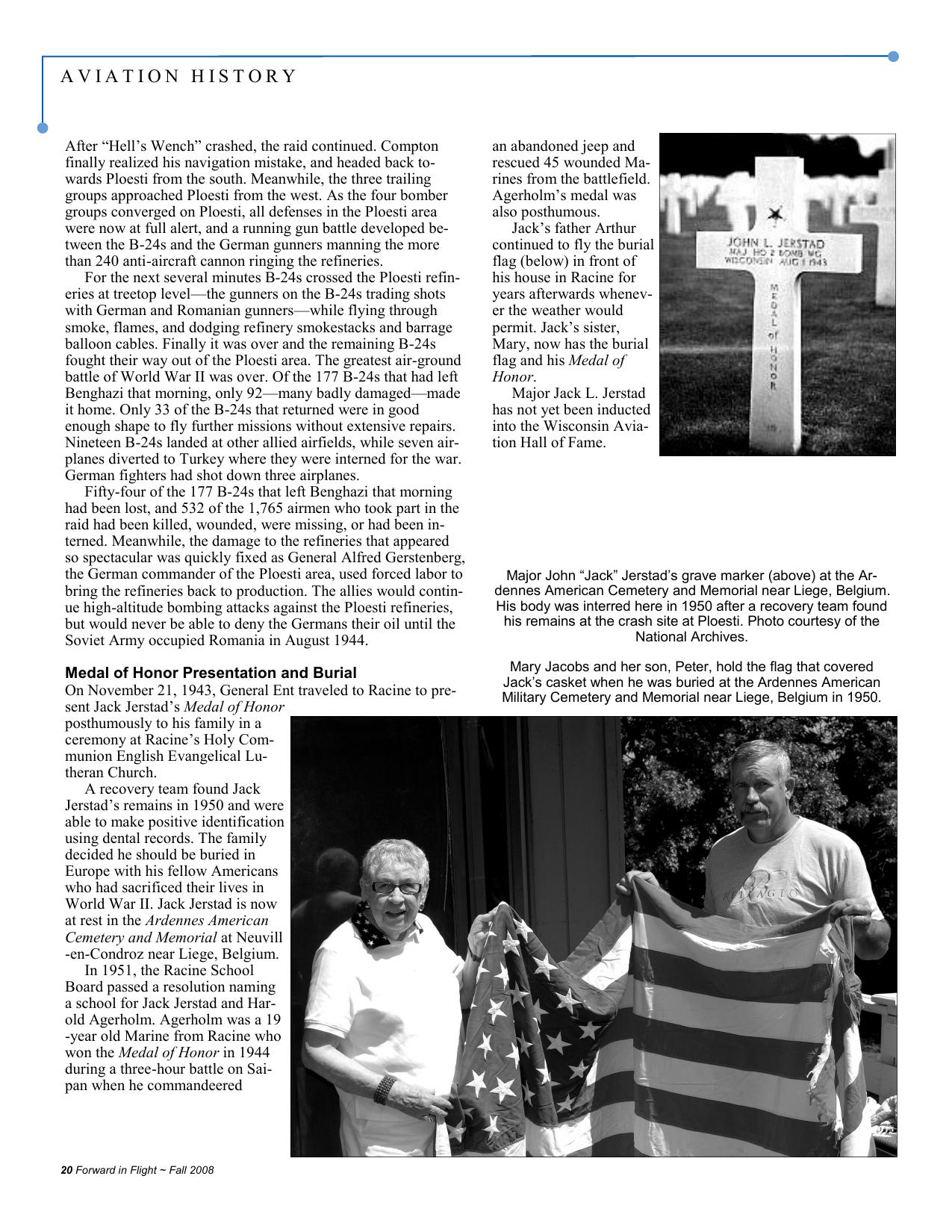
AVIATION HISTORY After “Hell’s Wench” crashed, the raid continued. Compton finally realized his navigation mistake, and headed back towards Ploesti from the south. Meanwhile, the three trailing groups approached Ploesti from the west. As the four bomber groups converged on Ploesti, all defenses in the Ploesti area were now at full alert, and a running gun battle developed between the B-24s and the German gunners manning the more than 240 anti-aircraft cannon ringing the refineries. For the next several minutes B-24s crossed the Ploesti refineries at treetop level—the gunners on the B-24s trading shots with German and Romanian gunners—while flying through smoke, flames, and dodging refinery smokestacks and barrage balloon cables. Finally it was over and the remaining B-24s fought their way out of the Ploesti area. The greatest air-ground battle of World War II was over. Of the 177 B-24s that had left Benghazi that morning, only 92—many badly damaged—made it home. Only 33 of the B-24s that returned were in good enough shape to fly further missions without extensive repairs. Nineteen B-24s landed at other allied airfields, while seven airplanes diverted to Turkey where they were interned for the war. German fighters had shot down three airplanes. Fifty-four of the 177 B-24s that left Benghazi that morning had been lost, and 532 of the 1,765 airmen who took part in the raid had been killed, wounded, were missing, or had been interned. Meanwhile, the damage to the refineries that appeared so spectacular was quickly fixed as General Alfred Gerstenberg, the German commander of the Ploesti area, used forced labor to bring the refineries back to production. The allies would continue high-altitude bombing attacks against the Ploesti refineries, but would never be able to deny the Germans their oil until the Soviet Army occupied Romania in August 1944. an abandoned jeep and rescued 45 wounded Marines from the battlefield. Agerholm’s medal was also posthumous. Jack’s father Arthur continued to fly the burial flag (below) in front of his house in Racine for years afterwards whenever the weather would permit. Jack’s sister, Mary, now has the burial flag and his Medal of Honor. Major Jack L. Jerstad has not yet been inducted into the Wisconsin Aviation Hall of Fame. Medal of Honor Presentation and Burial On November 21, 1943, General Ent traveled to Racine to present Jack Jerstad’s Medal of Honor posthumously to his family in a ceremony at Racine’s Holy Communion English Evangelical Lutheran Church. A recovery team found Jack Jerstad’s remains in 1950 and were able to make positive identification using dental records. The family decided he should be buried in Europe with his fellow Americans who had sacrificed their lives in World War II. Jack Jerstad is now at rest in the Ardennes American Cemetery and Memorial at Neuvill -en-Condroz near Liege, Belgium. In 1951, the Racine School Board passed a resolution naming a school for Jack Jerstad and Harold Agerholm. Agerholm was a 19 -year old Marine from Racine who won the Medal of Honor in 1944 during a three-hour battle on Saipan when he commandeered Mary Jacobs and her son, Peter, hold the flag that covered Jack’s casket when he was buried at the Ardennes American Military Cemetery and Memorial near Liege, Belgium in 1950. 20 Forward in Flight ~ Fall 2008 Major John “Jack” Jerstad’s grave marker (above) at the Ardennes American Cemetery and Memorial near Liege, Belgium. His body was interred here in 1950 after a recovery team found his remains at the crash site at Ploesti. Photo courtesy of the National Archives.
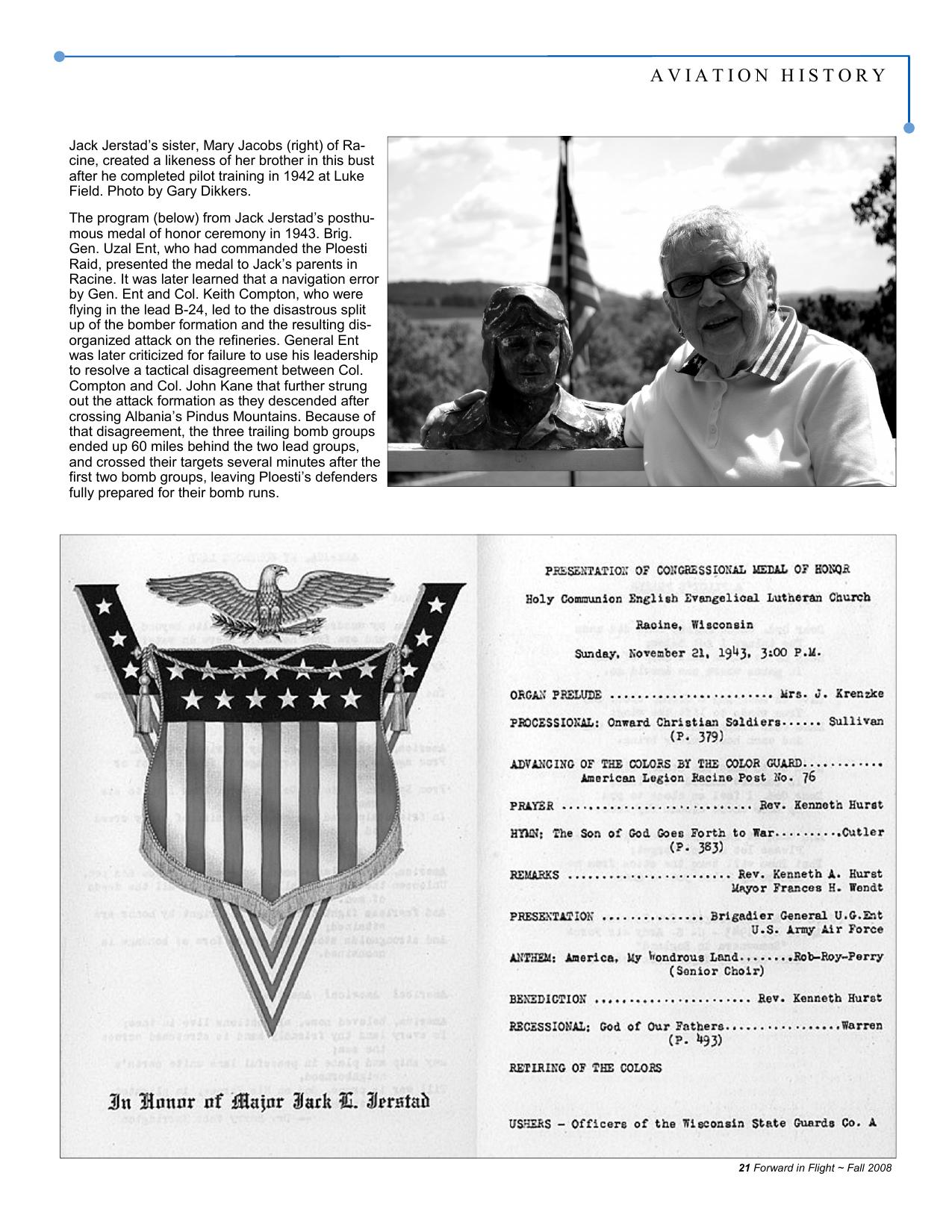
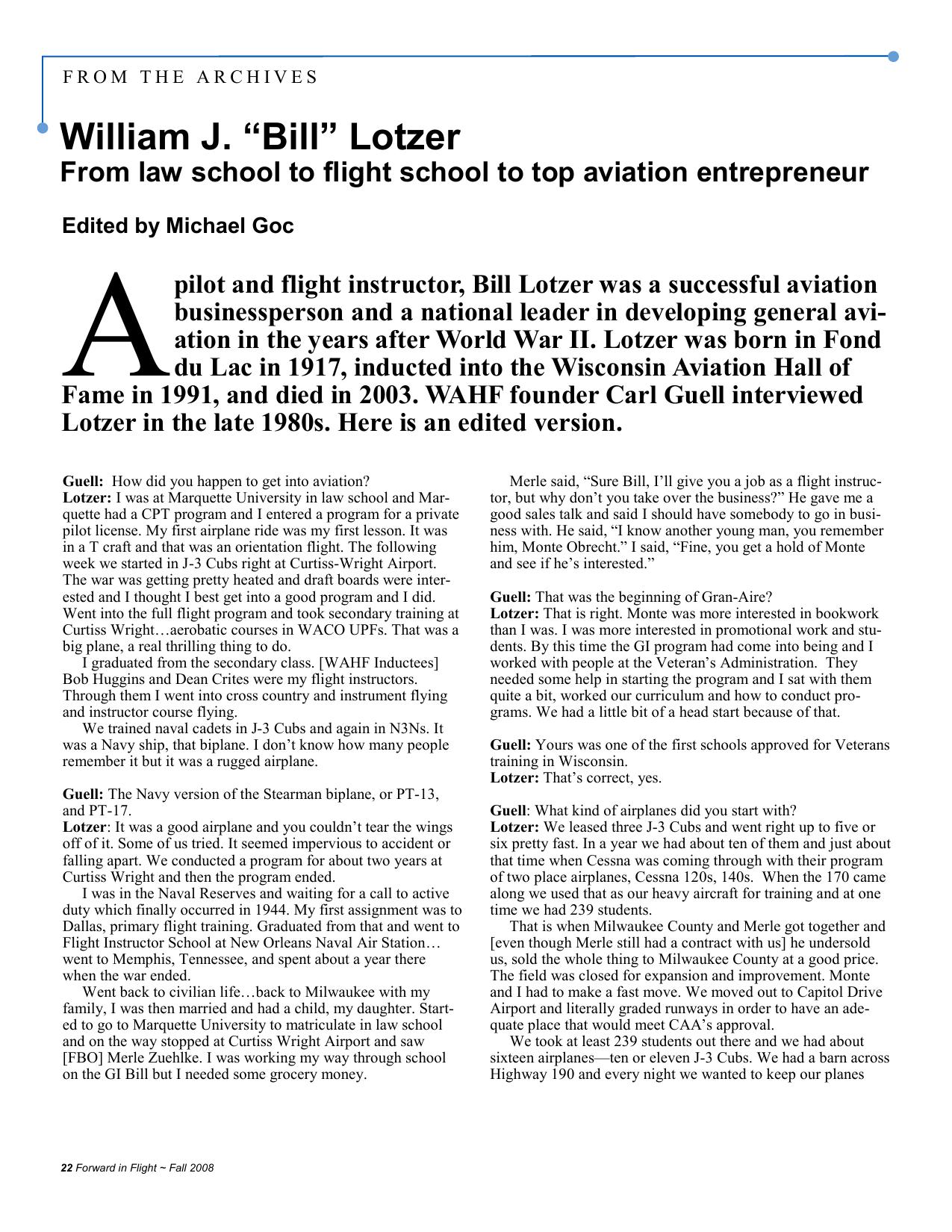
AVIATION HISTORY Jack Jerstad’s sister, Mary Jacobs (right) of Racine, created a likeness of her brother in this bust after he completed pilot training in 1942 at Luke Field. Photo by Gary Dikkers. The program (below) from Jack Jerstad’s posthumous medal of honor ceremony in 1943. Brig. Gen. Uzal Ent, who had commanded the Ploesti Raid, presented the medal to Jack’s parents in Racine. It was later learned that a navigation error by Gen. Ent and Col. Keith Compton, who were flying in the lead B-24, led to the disastrous split up of the bomber formation and the resulting disorganized attack on the refineries. General Ent was later criticized for failure to use his leadership to resolve a tactical disagreement between Col. Compton and Col. John Kane that further strung out the attack formation as they descended after crossing Albania’s Pindus Mountains. Because of that disagreement, the three trailing bomb groups ended up 60 miles behind the two lead groups, and crossed their targets several minutes after the first two bomb groups, leaving Ploesti’s defenders fully prepared for their bomb runs. 21 Forward in Flight ~ Fall 2008
FROM THE ARCHIVES William J. “Bill” Lotzer From law school to flight school to top aviation entrepreneur Edited by Michael Goc A pilot and flight instructor, Bill Lotzer was a successful aviation businessperson and a national leader in developing general aviation in the years after World War II. Lotzer was born in Fond du Lac in 1917, inducted into the Wisconsin Aviation Hall of Fame in 1991, and died in 2003. WAHF founder Carl Guell interviewed Lotzer in the late 1980s. Here is an edited version. Guell: How did you happen to get into aviation? Lotzer: I was at Marquette University in law school and Marquette had a CPT program and I entered a program for a private pilot license. My first airplane ride was my first lesson. It was in a T craft and that was an orientation flight. The following week we started in J-3 Cubs right at Curtiss-Wright Airport. The war was getting pretty heated and draft boards were interested and I thought I best get into a good program and I did. Went into the full flight program and took secondary training at Curtiss Wright…aerobatic courses in WACO UPFs. That was a big plane, a real thrilling thing to do. I graduated from the secondary class. [WAHF Inductees] Bob Huggins and Dean Crites were my flight instructors. Through them I went into cross country and instrument flying and instructor course flying. We trained naval cadets in J-3 Cubs and again in N3Ns. It was a Navy ship, that biplane. I don’t know how many people remember it but it was a rugged airplane. Guell: The Navy version of the Stearman biplane, or PT-13, and PT-17. Lotzer: It was a good airplane and you couldn’t tear the wings off of it. Some of us tried. It seemed impervious to accident or falling apart. We conducted a program for about two years at Curtiss Wright and then the program ended. I was in the Naval Reserves and waiting for a call to active duty which finally occurred in 1944. My first assignment was to Dallas, primary flight training. Graduated from that and went to Flight Instructor School at New Orleans Naval Air Station… went to Memphis, Tennessee, and spent about a year there when the war ended. Went back to civilian life…back to Milwaukee with my family, I was then married and had a child, my daughter. Started to go to Marquette University to matriculate in law school and on the way stopped at Curtiss Wright Airport and saw [FBO] Merle Zuehlke. I was working my way through school on the GI Bill but I needed some grocery money. 22 Forward in Flight ~ Fall 2008 Merle said, “Sure Bill, I’ll give you a job as a flight instructor, but why don’t you take over the business?” He gave me a good sales talk and said I should have somebody to go in business with. He said, “I know another young man, you remember him, Monte Obrecht.” I said, “Fine, you get a hold of Monte and see if he’s interested.” Guell: That was the beginning of Gran-Aire? Lotzer: That is right. Monte was more interested in bookwork than I was. I was more interested in promotional work and students. By this time the GI program had come into being and I worked with people at the Veteran’s Administration. They needed some help in starting the program and I sat with them quite a bit, worked our curriculum and how to conduct programs. We had a little bit of a head start because of that. Guell: Yours was one of the first schools approved for Veterans training in Wisconsin. Lotzer: That’s correct, yes. Guell: What kind of airplanes did you start with? Lotzer: We leased three J-3 Cubs and went right up to five or six pretty fast. In a year we had about ten of them and just about that time when Cessna was coming through with their program of two place airplanes, Cessna 120s, 140s. When the 170 came along we used that as our heavy aircraft for training and at one time we had 239 students. That is when Milwaukee County and Merle got together and [even though Merle still had a contract with us] he undersold us, sold the whole thing to Milwaukee County at a good price. The field was closed for expansion and improvement. Monte and I had to make a fast move. We moved out to Capitol Drive Airport and literally graded runways in order to have an adequate place that would meet CAA’s approval. We took at least 239 students out there and we had about sixteen airplanes—ten or eleven J-3 Cubs. We had a barn across Highway 190 and every night we wanted to keep our planes
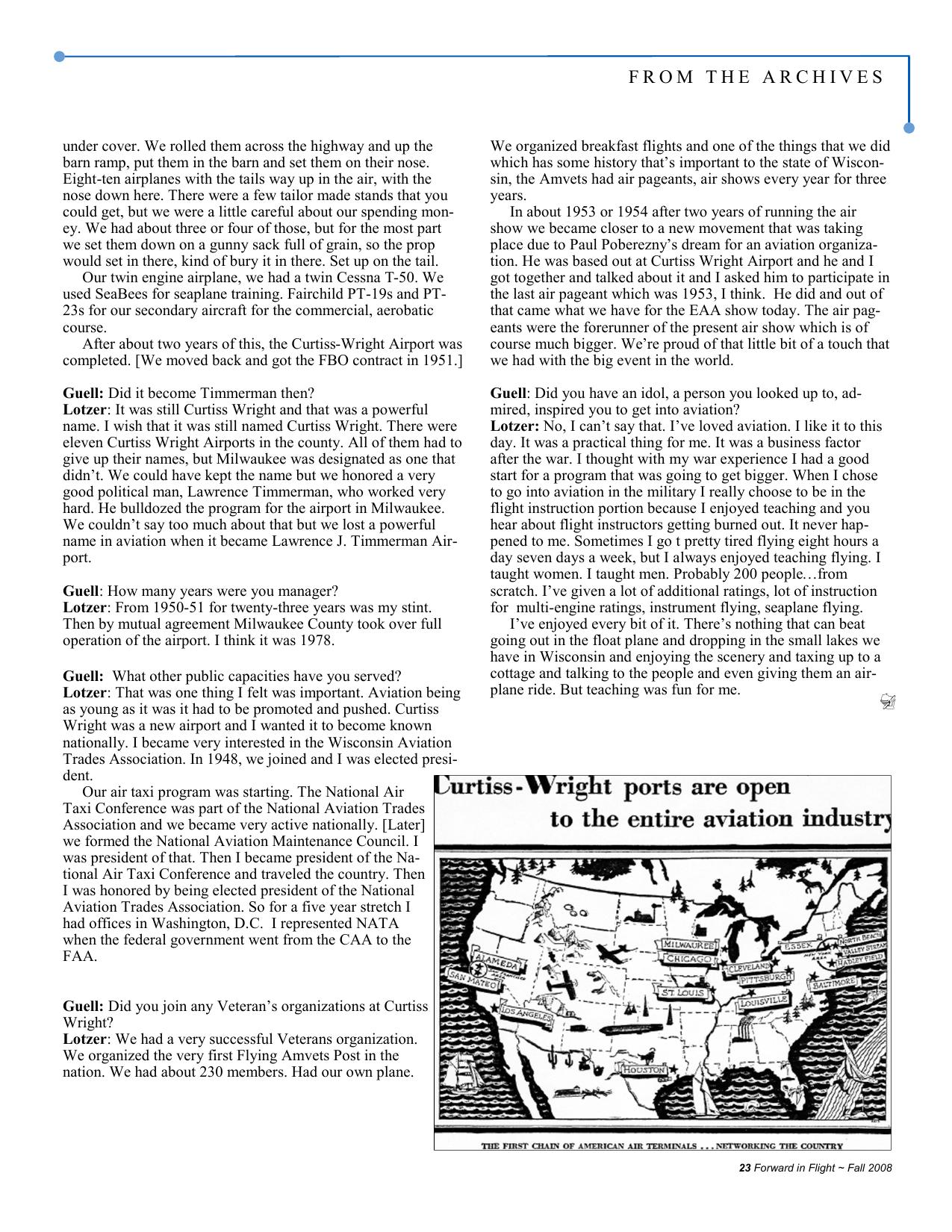
FROM THE ARCHIVES under cover. We rolled them across the highway and up the barn ramp, put them in the barn and set them on their nose. Eight-ten airplanes with the tails way up in the air, with the nose down here. There were a few tailor made stands that you could get, but we were a little careful about our spending money. We had about three or four of those, but for the most part we set them down on a gunny sack full of grain, so the prop would set in there, kind of bury it in there. Set up on the tail. Our twin engine airplane, we had a twin Cessna T-50. We used SeaBees for seaplane training. Fairchild PT-19s and PT23s for our secondary aircraft for the commercial, aerobatic course. After about two years of this, the Curtiss-Wright Airport was completed. [We moved back and got the FBO contract in 1951.] We organized breakfast flights and one of the things that we did which has some history that’s important to the state of Wisconsin, the Amvets had air pageants, air shows every year for three years. In about 1953 or 1954 after two years of running the air show we became closer to a new movement that was taking place due to Paul Poberezny’s dream for an aviation organization. He was based out at Curtiss Wright Airport and he and I got together and talked about it and I asked him to participate in the last air pageant which was 1953, I think. He did and out of that came what we have for the EAA show today. The air pageants were the forerunner of the present air show which is of course much bigger. We’re proud of that little bit of a touch that we had with the big event in the world. Guell: Did it become Timmerman then? Lotzer: It was still Curtiss Wright and that was a powerful name. I wish that it was still named Curtiss Wright. There were eleven Curtiss Wright Airports in the county. All of them had to give up their names, but Milwaukee was designated as one that didn’t. We could have kept the name but we honored a very good political man, Lawrence Timmerman, who worked very hard. He bulldozed the program for the airport in Milwaukee. We couldn’t say too much about that but we lost a powerful name in aviation when it became Lawrence J. Timmerman Airport. Guell: Did you have an idol, a person you looked up to, admired, inspired you to get into aviation? Lotzer: No, I can’t say that. I’ve loved aviation. I like it to this day. It was a practical thing for me. It was a business factor after the war. I thought with my war experience I had a good start for a program that was going to get bigger. When I chose to go into aviation in the military I really choose to be in the flight instruction portion because I enjoyed teaching and you hear about flight instructors getting burned out. It never happened to me. Sometimes I go t pretty tired flying eight hours a day seven days a week, but I always enjoyed teaching flying. I taught women. I taught men. Probably 200 people…from scratch. I’ve given a lot of additional ratings, lot of instruction for multi-engine ratings, instrument flying, seaplane flying. I’ve enjoyed every bit of it. There’s nothing that can beat going out in the float plane and dropping in the small lakes we have in Wisconsin and enjoying the scenery and taxing up to a cottage and talking to the people and even giving them an airplane ride. But teaching was fun for me. Guell: How many years were you manager? Lotzer: From 1950-51 for twenty-three years was my stint. Then by mutual agreement Milwaukee County took over full operation of the airport. I think it was 1978. Guell: What other public capacities have you served? Lotzer: That was one thing I felt was important. Aviation being as young as it was it had to be promoted and pushed. Curtiss Wright was a new airport and I wanted it to become known nationally. I became very interested in the Wisconsin Aviation Trades Association. In 1948, we joined and I was elected president. Our air taxi program was starting. The National Air Taxi Conference was part of the National Aviation Trades Association and we became very active nationally. [Later] we formed the National Aviation Maintenance Council. I was president of that. Then I became president of the National Air Taxi Conference and traveled the country. Then I was honored by being elected president of the National Aviation Trades Association. So for a five year stretch I had offices in Washington, D.C. I represented NATA when the federal government went from the CAA to the FAA. Guell: Did you join any Veteran’s organizations at Curtiss Wright? Lotzer: We had a very successful Veterans organization. We organized the very first Flying Amvets Post in the nation. We had about 230 members. Had our own plane. 23 Forward in Flight ~ Fall 2008
FROM THE ARCHIVES Messages To and From the Archives As keeper of the WAHF archives, WAHF board member Michael Goc receives questions on Wisconsin aviation history, obtains material to enlarge our collections, and is occasionally invited to share what he’s learned at speaking engagements throughout the state. Here are a few examples. Aviation History at Winchester Academy The Winchester Academy in Waupaca, Wisconsin, regularly hosts speakers on the widest variety of subjects to share knowledge with an interested, appreciative audience. On July 28, the Academy gave Goc, representing WAHF, a warm welcome. With EAA’s AirVenture 2008 only a short drive away, Academy director David Hathaway thought aviation history would be a timely subject. With old-fashioned, but trusty slides projected on a screen, Goc covered highlights of Wisconsin aviation history from ballooning in the 1860s, to the first powered aircraft to fly in the state in the 1900s, and on to the birth of the EAA in the 1950s. Also included was a tale or two about local aviation pioneer and WAHF Inductee Elwyn West. About 50 people attended, and many stayed afterward to ask questions, purchase copies of the book, Forward in Flight, and munch on the delicious cookies that are part of every Academy presentation. To learn more about Winchester Academy and its programs visit www.VisitWaupaca.com/WinchesterAcademy.html. First Airplanes, Air Mail, Airport in Madison? Ann Waidelich and Mary Jane Hamilton are volunteer researchers at the Wisconsin Historical Society in Madison. While cataloging a collection of photos in an album passed down from the family of Madison newspaperman Richard Lloyd Jones, they discovered a set of photos of vintage aircraft. One was labeled “first aeroplane in Madison,” so Ann and Mary Jane wondered if the aircraft depicted was actually the “first” airplane in the state capital. They emailed the images and we were able to identify the planes as World War I era JNs and guessed that they had come to Madison on a public relations mission in the summer of 1917, ‘18, or ‘19. Despite the label, the planes were not the first airplanes to fly in Madison. That honor was claimed by a Curtiss exhibition pilot named Jimmy Ward in 1914. To 24 Forward in Flight ~ Fall 2008 identify the planes in the photos we suggested that the researchers look in the Madison newspapers published in August or September of the war years and they’d probably find them. About one week later, we received copies of news articles printed in Madison in early September 1918. They reported that the airplanes in the photos were part of a flight of six “American” and “British” planes on their way from La Crosse, Wisconsin, to Chicago, Illinois. In addition to promoting the war effort at home, they were exploring a potential air mail route from Chicago to the Twin Cities and delivered the “first aerial letter ever received in Madison.” The planes landed at the “Weber Farm” south of Lake Monona. If the newspapers are accurate, these airplanes can claim a number of “firsts” for Madison. Although they were not the first planes to fly in the city, they were likely the first to fly a relatively long distance to the capital, i.e. all the way from La Crosse. When asked if he had any trouble finding Madison after he left La Crosse, one of the aviators reported that he had no trouble at all because he was able to pick out the four lakes not long after he took off and was soon able to spot the white stone of the Capitol shining in the sunlight. The planes also made history by delivering the first air mail to Madison and as the first flight to test the route that would later be used for regular air delivery of mail. Finally, they made the first recorded landing at what became Madison’s first airport. In the mid-1920s WAHF Inductee Howard Morey turned the Weber Farm into the city’s first aviation facility. So the photos in the Lloyd Jones collection play an important role in documenting Wisconsin’s aviation history, particularly the history of Madison. You never know what you’ll find when you open a box or turn the pages of an old photo album. History may be lurking there. To view the photos go to www.WisconsinHistory.org. Click on Wisconsin Historical Images and type in Snoke Family Album.
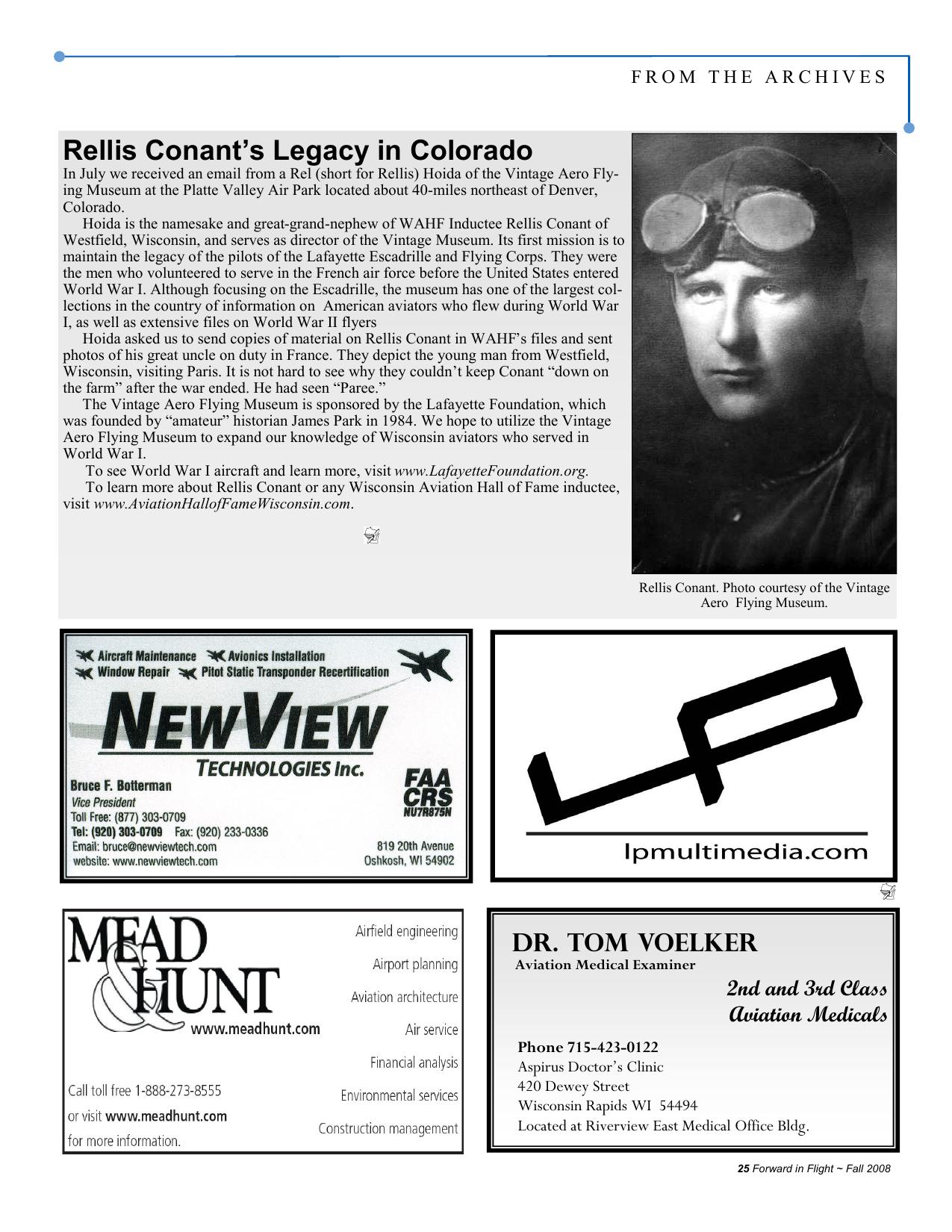
FROM THE ARCHIVES Rellis Conant’s Legacy in Colorado In July we received an email from a Rel (short for Rellis) Hoida of the Vintage Aero Flying Museum at the Platte Valley Air Park located about 40-miles northeast of Denver, Colorado. Hoida is the namesake and great-grand-nephew of WAHF Inductee Rellis Conant of Westfield, Wisconsin, and serves as director of the Vintage Museum. Its first mission is to maintain the legacy of the pilots of the Lafayette Escadrille and Flying Corps. They were the men who volunteered to serve in the French air force before the United States entered World War I. Although focusing on the Escadrille, the museum has one of the largest collections in the country of information on American aviators who flew during World War I, as well as extensive files on World War II flyers Hoida asked us to send copies of material on Rellis Conant in WAHF’s files and sent photos of his great uncle on duty in France. They depict the young man from Westfield, Wisconsin, visiting Paris. It is not hard to see why they couldn’t keep Conant “down on the farm” after the war ended. He had seen “Paree.” The Vintage Aero Flying Museum is sponsored by the Lafayette Foundation, which was founded by “amateur” historian James Park in 1984. We hope to utilize the Vintage Aero Flying Museum to expand our knowledge of Wisconsin aviators who served in World War I. To see World War I aircraft and learn more, visit www.LafayetteFoundation.org. To learn more about Rellis Conant or any Wisconsin Aviation Hall of Fame inductee, visit www.AviationHallofFameWisconsin.com. Rellis Conant. Photo courtesy of the Vintage Aero Flying Museum. DR. TOM VOELKER Aviation Medical Examiner 2nd and 3rd Class Aviation Medicals Phone 715-423-0122 Aspirus Doctor’s Clinic 420 Dewey Street Wisconsin Rapids WI 54494 Located at Riverview East Medical Office Bldg. 25 Forward in Flight ~ Fall 2008
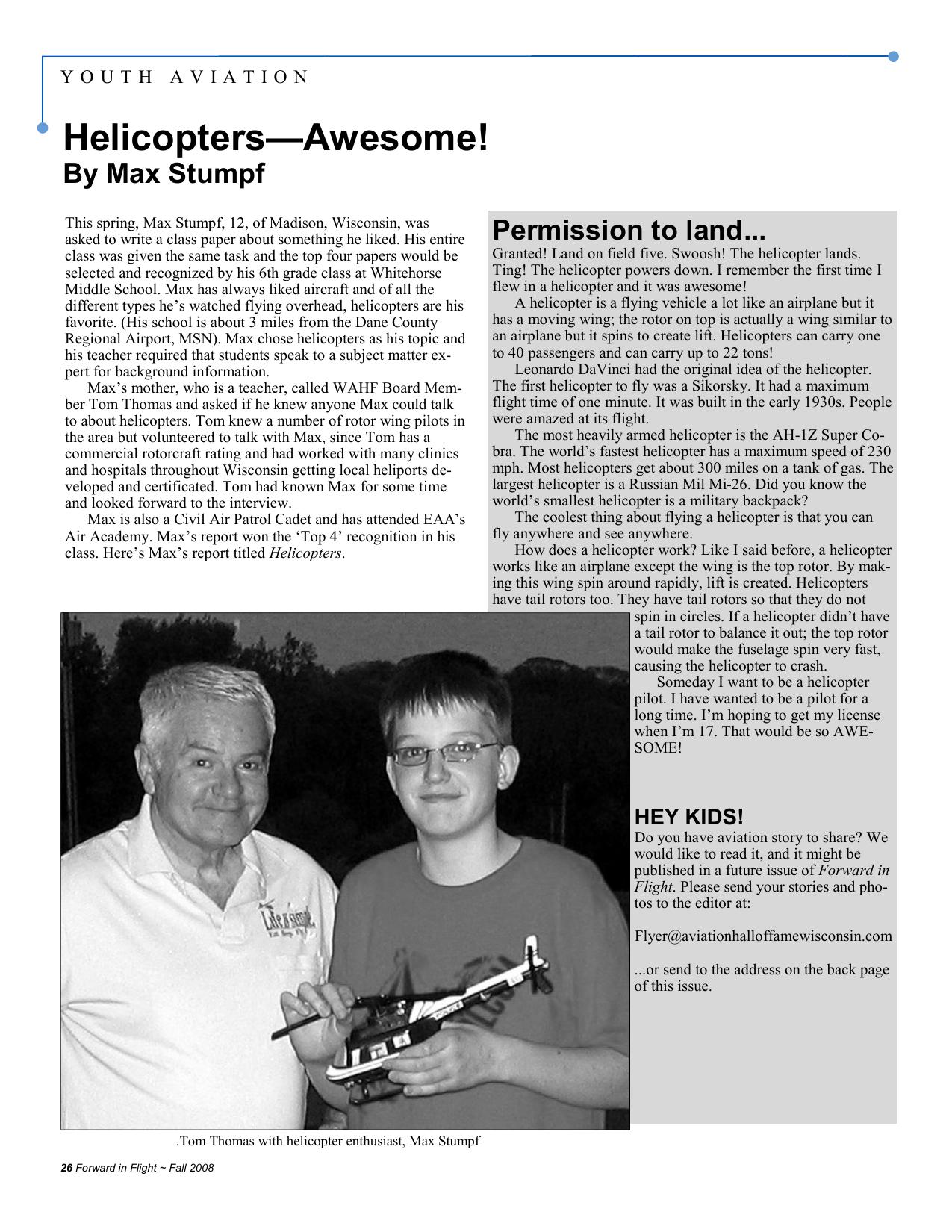
YOUTH AVIATION Helicopters—Awesome! By Max Stumpf This spring, Max Stumpf, 12, of Madison, Wisconsin, was asked to write a class paper about something he liked. His entire class was given the same task and the top four papers would be selected and recognized by his 6th grade class at Whitehorse Middle School. Max has always liked aircraft and of all the different types he’s watched flying overhead, helicopters are his favorite. (His school is about 3 miles from the Dane County Regional Airport, MSN). Max chose helicopters as his topic and his teacher required that students speak to a subject matter expert for background information. Max’s mother, who is a teacher, called WAHF Board Member Tom Thomas and asked if he knew anyone Max could talk to about helicopters. Tom knew a number of rotor wing pilots in the area but volunteered to talk with Max, since Tom has a commercial rotorcraft rating and had worked with many clinics and hospitals throughout Wisconsin getting local heliports developed and certificated. Tom had known Max for some time and looked forward to the interview. Max is also a Civil Air Patrol Cadet and has attended EAA’s Air Academy. Max’s report won the ‘Top 4’ recognition in his class. Here’s Max’s report titled Helicopters. Permission to land... Granted! Land on field five. Swoosh! The helicopter lands. Ting! The helicopter powers down. I remember the first time I flew in a helicopter and it was awesome! A helicopter is a flying vehicle a lot like an airplane but it has a moving wing; the rotor on top is actually a wing similar to an airplane but it spins to create lift. Helicopters can carry one to 40 passengers and can carry up to 22 tons! Leonardo DaVinci had the original idea of the helicopter. The first helicopter to fly was a Sikorsky. It had a maximum flight time of one minute. It was built in the early 1930s. People were amazed at its flight. The most heavily armed helicopter is the AH-1Z Super Cobra. The world’s fastest helicopter has a maximum speed of 230 mph. Most helicopters get about 300 miles on a tank of gas. The largest helicopter is a Russian Mil Mi-26. Did you know the world’s smallest helicopter is a military backpack? The coolest thing about flying a helicopter is that you can fly anywhere and see anywhere. How does a helicopter work? Like I said before, a helicopter works like an airplane except the wing is the top rotor. By making this wing spin around rapidly, lift is created. Helicopters have tail rotors too. They have tail rotors so that they do not spin in circles. If a helicopter didn’t have a tail rotor to balance it out; the top rotor would make the fuselage spin very fast, causing the helicopter to crash. Someday I want to be a helicopter pilot. I have wanted to be a pilot for a long time. I’m hoping to get my license when I’m 17. That would be so AWESOME! HEY KIDS! Do you have aviation story to share? We would like to read it, and it might be published in a future issue of Forward in Flight. Please send your stories and photos to the editor at: Flyer@aviationhalloffamewisconsin.com ...or send to the address on the back page of this issue. .Tom Thomas with helicopter enthusiast, Max Stumpf 26 Forward in Flight ~ Fall 2008
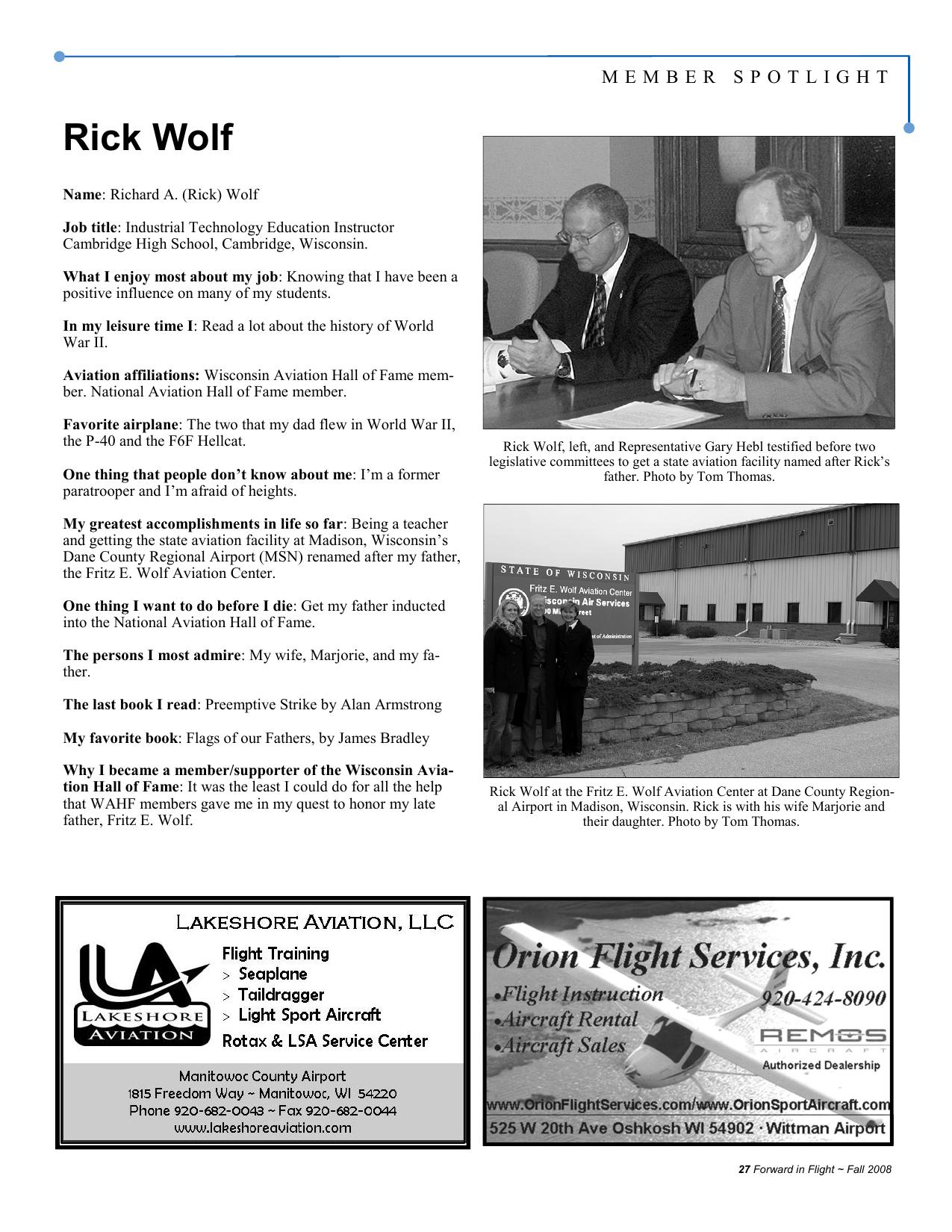
MEMBER SPOTLIGHT Rick Wolf Name: Richard A. (Rick) Wolf Job title: Industrial Technology Education Instructor Cambridge High School, Cambridge, Wisconsin. What I enjoy most about my job: Knowing that I have been a positive influence on many of my students. In my leisure time I: Read a lot about the history of World War II. Aviation affiliations: Wisconsin Aviation Hall of Fame member. National Aviation Hall of Fame member. Favorite airplane: The two that my dad flew in World War II, the P-40 and the F6F Hellcat. One thing that people don’t know about me: I’m a former paratrooper and I’m afraid of heights. Rick Wolf, left, and Representative Gary Hebl testified before two legislative committees to get a state aviation facility named after Rick’s father. Photo by Tom Thomas. My greatest accomplishments in life so far: Being a teacher and getting the state aviation facility at Madison, Wisconsin’s Dane County Regional Airport (MSN) renamed after my father, the Fritz E. Wolf Aviation Center. One thing I want to do before I die: Get my father inducted into the National Aviation Hall of Fame. The persons I most admire: My wife, Marjorie, and my father. The last book I read: Preemptive Strike by Alan Armstrong My favorite book: Flags of our Fathers, by James Bradley Why I became a member/supporter of the Wisconsin Aviation Hall of Fame: It was the least I could do for all the help that WAHF members gave me in my quest to honor my late father, Fritz E. Wolf. Rick Wolf at the Fritz E. Wolf Aviation Center at Dane County Regional Airport in Madison, Wisconsin. Rick is with his wife Marjorie and their daughter. Photo by Tom Thomas. 27 Forward in Flight ~ Fall 2008

FROM THE AIRWAYS New Management at Waupaca Airport Owners of Plane Guys Aviation LLC announce goals Susan and Peter Andersen, owners of Plane Guys Aviation LLC, have become managers/operators of the Waupaca Municipal Brunner Field Airport (PCZ), Waupaca, Wisconsin, as of June 1, 2008. Plane Guys Aviation has been located at the Waupaca Airport since 2006 and became a full-time source for light-sport aircraft in Wisconsin, Upper and Lower Michigan and Minnesota in January 2007. The Andersens succeed previous airport manager Russ Bargo. After 10 years of dedication to the management and operations of the Waupaca airport, Russ and his wife Lisa have decided to invest more time in their aircraft maintenance facility. “We understand we have big shoes to fill but promise we have set our goals high,” said Peter. “Our immediate plans include keeping the new fuel farm on schedule, and Thangar and terminal building repair. Long-range plans include promoting the construction of new hangars, airport improvements, and establishment of new businesses at the facility. We also plan to start an aviation youth group, work with local businesses to promote tourism through the airport and promote airport activities that area citizens can enjoy.” For more information, call Peter at 920-867-3070 or visit www.CityOfWaupaca.org/ air/air.html New London Company Offers Multi-use Trailers D&M Trailers LLC is a new company that offers trailers for powered parachutes (PPC). The company came about after its founders listened to complaints from fellow pilots about trailer problems and rising gas prices. Company representatives say the trailers offer options others lack, such as a wired-in trickle charger with receptacles and color and graphic choices. Standard features include a door-assist system and a front-wheel chuck. Wheel straps and tie-downs are included to hold the PPC in place. The trailer doubles as an off-road vehicle trailer; two motorcycles or ATVs fit well, and the trailer can double as a camper, according to a company press release. Call 920-565-3774 or 920-982-0981or visit www.PPCxlt.com to learn more. D&M Trailers, N9031 Zabel Drive, New London WI 54961. Three Generations in a DC-3 Eagle River Father’s Day Fly-in This year, the Eagle River Union Airport (EGV) made Father’s Day Fly-in history with the arrival of a DC-3. Vern Anderson flew it from Oshkosh, Wisconsin, with his son Michael on board, along with Vern’s two grandsons, Michael Jr. and Samuel. Three generations arrived in this aircraft dubbed, the “Spirit of Enterprise”. Vern has been coming to the fly in over the years, but this was the first opportunity to bring his son and two grandsons along. Vern reported some lower scattered clouds early in the morning, but it was VFR and improving steadily throughout the day. Vern once flew the KC-97L with the Wisconsin Air National Guard Unit at Mitchell Field in Milwaukee. As head of his three generation contingent, Vern won the unofficial ‘Father’s Day Competition’ at Eagle River Union Airport this year. What drew Vern to the Eagle River Father’s Day Fly-in? Eagle River’s reputation as a friendly airport is a draw to pilots from throughout the state and region. It is a welldesigned, built, and maintained airport facility that serves Wisconsin’s Northwoods as a functional, efficient, and effective air transportation link to the national air transportation system. For more information on the Eagle River Airport, visit www.ERAirport.com. Send Your News Releases to… flyer@aviationhalloffamewisconsin.com Please include applicable photos with captions. 28 Forward in Flight ~ Fall 2008

FROM THE AIRWAYS Attitude Flying with Dick Rutan New training DVD by Fly Right Films Fly Right Films has released Volume One of the Aviator-series, Attitude Flying with Dick Rutan, a highdefinition training DVD that put pilots “shoulder-to-shoulder” with Dick as he explains, dissects, and demonstrates the challenges and secrets of precise instrument flying. Produced and hosted by filmmaker and pilot, Charlie Hewitt, the widescreen format and 5.1 Dolby Surround soundtrack create an audio experience that puts you right in the cockpit. Hewitt said the goal in creating the Aviator Series is to “create an advanced flight training series that offers the perfect balance of meaningful, pro-active instruction, beautiful visuals, and engaging narrative.” Hewitt calls this flight training experience “entertrainment.” To order or watch the trailer, visit www.FlyRightFilms.com. Recommended Reading Stars of the Sky, Legends All By Ann Lewis Cooper Stars of the Sky, Legends All is a new book that looks at barrier-breaking female aviators, from the start of aviation to present. Through 50 profiles, readers are introduced to daring pilots, navigators, mechanics, executives, and astronauts. The inspiring women show a rare degree of courage, ambition, and skill, and despite diverse backgrounds and differing talents, all have made remarkable achievements. Illustrated by aviation artist Sharon Rajnus, the paperback, 320-page book, with 120 color and black and white photographs, is available at www.wai.org. All of Life is a School By Kermit Weeks This exciting children’s book is sure to inspire youngsters as it teaches life lessons. Gee Bee Zee is an unseasoned but enthusiastic little yellow monoplane that takes off on an important assignment without paying close attention to his flight teacher’s lessons. If not for backup from his older brother, Jimmy G., Zee might have failed at his task. The Gee Bee brothers and a colorful lineup of expressive vintage aircraft characters from the Golden Age of Aviation rev their engines for a debut children’s adventure in “All of Life is a School,” (KWIP Publishing, $19.95) by Fantasy of Flight owner and creator Kermit Weeks, with illustrations by Project Firefly. The scene is set at the mythical “Fantasy of Flight” airfield, where many types of airplanes created in the 1920s and ’30s live and where older, wiser airplanes help youngsters push the boundaries of flight. To order, visit www.GeeBee.com or www.Amazon.com. 29 Forward in Flight ~ Fall 2008
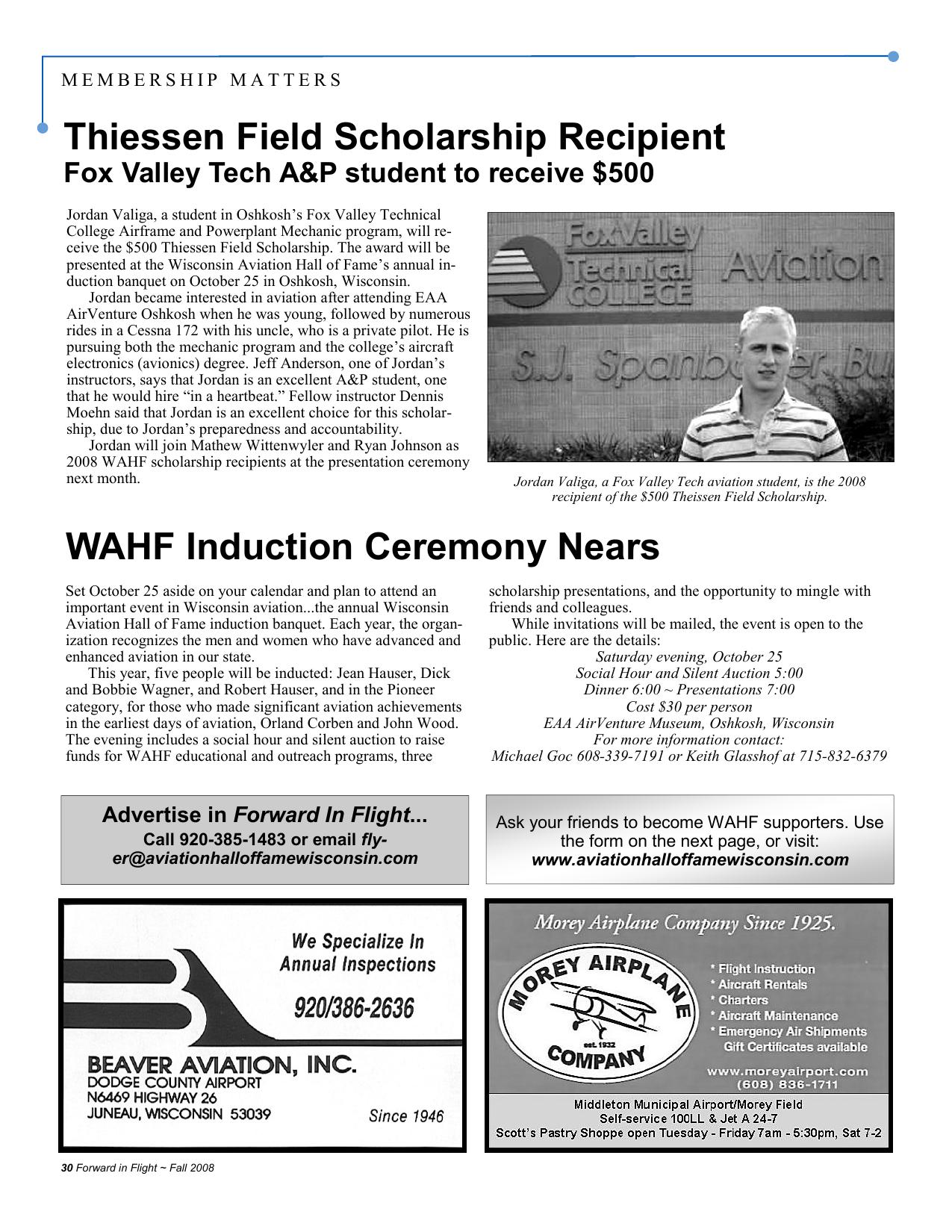
MEMBERSHIP MATTERS Thiessen Field Scholarship Recipient Fox Valley Tech A&P student to receive $500 Jordan Valiga, a student in Oshkosh’s Fox Valley Technical College Airframe and Powerplant Mechanic program, will receive the $500 Thiessen Field Scholarship. The award will be presented at the Wisconsin Aviation Hall of Fame’s annual induction banquet on October 25 in Oshkosh, Wisconsin. Jordan became interested in aviation after attending EAA AirVenture Oshkosh when he was young, followed by numerous rides in a Cessna 172 with his uncle, who is a private pilot. He is pursuing both the mechanic program and the college’s aircraft electronics (avionics) degree. Jeff Anderson, one of Jordan’s instructors, says that Jordan is an excellent A&P student, one that he would hire “in a heartbeat.” Fellow instructor Dennis Moehn said that Jordan is an excellent choice for this scholarship, due to Jordan’s preparedness and accountability. Jordan will join Mathew Wittenwyler and Ryan Johnson as 2008 WAHF scholarship recipients at the presentation ceremony next month. Jordan Valiga, a Fox Valley Tech aviation student, is the 2008 recipient of the $500 Theissen Field Scholarship. WAHF Induction Ceremony Nears Set October 25 aside on your calendar and plan to attend an important event in Wisconsin aviation...the annual Wisconsin Aviation Hall of Fame induction banquet. Each year, the organization recognizes the men and women who have advanced and enhanced aviation in our state. This year, five people will be inducted: Jean Hauser, Dick and Bobbie Wagner, and Robert Hauser, and in the Pioneer category, for those who made significant aviation achievements in the earliest days of aviation, Orland Corben and John Wood. The evening includes a social hour and silent auction to raise funds for WAHF educational and outreach programs, three Advertise in Forward In Flight... Call 920-385-1483 or email flyer@aviationhalloffamewisconsin.com 30 Forward in Flight ~ Fall 2008 scholarship presentations, and the opportunity to mingle with friends and colleagues. While invitations will be mailed, the event is open to the public. Here are the details: Saturday evening, October 25 Social Hour and Silent Auction 5:00 Dinner 6:00 ~ Presentations 7:00 Cost $30 per person EAA AirVenture Museum, Oshkosh, Wisconsin For more information contact: Michael Goc 608-339-7191 or Keith Glasshof at 715-832-6379 Ask your friends to become WAHF supporters. Use the form on the next page, or visit: www.aviationhalloffamewisconsin.com
MEMBERSHIP MATTERS Call for Silent Auction Donations Help raise funds for WAHF programs The WAHF board of directors is asking all Forward in Flight readers, WAHF members, and corporate supporters to consider your backing of the Wisconsin Aviation Hall of Fame’s Silent Auction. The event, to be held on October 25, needs gifts of cash, merchandise, and gift certificates. In the past six years, the silent auction, which takes place during the social hour of our annual induction banquet, has raised more than $10,000 for the WAHF scholarship fund. These funds have helped eight students complete their aviation degrees. Your support also assists the organization in building a strong financial platform that allows continued recognition of the men and women who have made aviation in Wisconsin better for all of the state’s citizens. Donations of both aviation and non-aviation items are needed. Popular items include signed and unsigned books, artwork, theme baskets (such as wine and cheese or chocolate), sports memorabilia, and certificates for overnight stays at area resorts. Cash donations and gift certificates are appreciated as well. To make a donation or to learn more, contact Rose Dorcey at 920-385-1483 or email: flyer@aviationhalloffamewisconsin.com. WAHF Membership Meeting The annual membership meeting of the Wisconsin Aviation Hall of Fame will be held on October 25 at 2:00pm in the Batten Board Room of the EAA AirVenture Museum in Oshkosh, Wisconsin. The agenda includes election of three board members. Directors serve three-year terms. Incumbent directors include LaFonda Kinnaman, Duane Esse, and Chuck Swain. While drafting the slate of board nominees continues, you should know that nominations from the floor are accepted. Consider attending the annual meeting. Many exciting things are on the organization’s horizon, including our 25th anniversary. Contact WAHF secretary John Dorcey at wipilot@new.rr.com, or call 920-385-1483 for additional details regarding WAHF’s annual membership meeting. Subscribe to Forward…in Flight today! (Annual subscription includes one-year WAHF membership) Membership Benefits: ¨ Quarterly subscription (4 issues) of Forward in Flight, packed full of Wisconsin aviation news, events, state aviation history, and stories about your aviation colleagues ¨ Free passes to aviation museums ¨ Invitation to annual induction banquet ¨ The opportunity to nominate aviation leaders for induction! Name Address City State Zip Phone Number Email Address Referred By Just $20, and you’ll be supporting an aviation organization dedicated to collecting, preserving, and sharing Wisconsin’s aviation history. With Forward in Flight, you’ll learn about aviation history makers—the people, places, and happenings that distinguish our state and also be in touch with current Wisconsin aviation news and events! Send your check today! Please write check to: Wisconsin Aviation Hall of Fame, Inc. Mail to: John Dorcey, Treasurer Wisconsin Aviation Hall of Fame 3980 Sharratt Drive Oshkosh WI 54901-1276 Great Gift! 31 Forward in Flight ~ Fall 2008

WISCONSIN AVIATION HALL OF FAME 3980 SHARRATT DRIVE OSHKOSH WI 54901-1276 Preserving Wisconsin’s Aviation History Welcome New Members: Joseph Androfski Ken Brooks Gene Calkins Paul Dries Dale Gauger Ray Kressin Robert McLaughlin Thomas Read Simon K Smith Bruce Bondow Thomas Kretschman Andrew Miller Thanks for coming on board. We look forward to seeing you at a WAHF event soon! Happy Birthday to WAHF Inductees who celebrate in fall: Bill Brennand - Paul Cassiman - Richard Knutson - Paul Poberezny - Tom Poberezny Happy Birthday and Congratulations ...to Bob and Letty Skuldt of Madison. Bob celebrated his 90th birthday and the couple celebrated 68 years of marriage in August. Vintage Hangar Dinner/Dance Fundraiser Saturday, November 1, 2008 – Aviation Heritage Center – Sheboygan County Memorial Airport (SBM). 1940s era dinner and dance featuring 20-piece band. Period attire encouraged. Tickets for dinner/dance package are $50. Visit www.SheboyganAviation.com. WAHF Induction Banquet October 25, 2008 Plan to attend! EAA AirVenture Museum, Oshkosh, Wisconsin. Social Hour and Silent Auction 5:00 ~ Dinner 6:00 ~ Presentations 7:00 For more information contact: Michael Goc 608-339-7191 or Keith Glasshof at 715-832-6379. WAHF Renewals Reminder: Renewals are due on December 31, 2008. Early renewals are appreciated! PRSRT STD US Postage Paid Wisc Rapids WI Permit 98 Wisconsin Aviation Hall of Fame Officers and Board of Directors Rose Dorcey, President Michael Goc, Vice President John Dorcey, Secretary/Treasurer Duane Esse Keith Glasshof Tom Thomas Charles Swain LaFonda Kinnaman Staber “Bill” Reese Charles Marotske, Honorary Chairman of the Board Wisconsin Aviation Hall of Fame 3980 Sharratt Drive Oshkosh WI 54901-1276 Become a supporter today! For information call Rose Dorcey at 920-385-1483 www.aviationhalloffamewisconsin.com flyer@aviationhalloffamewisconsin.com