Forward in Flight - Fall 2009
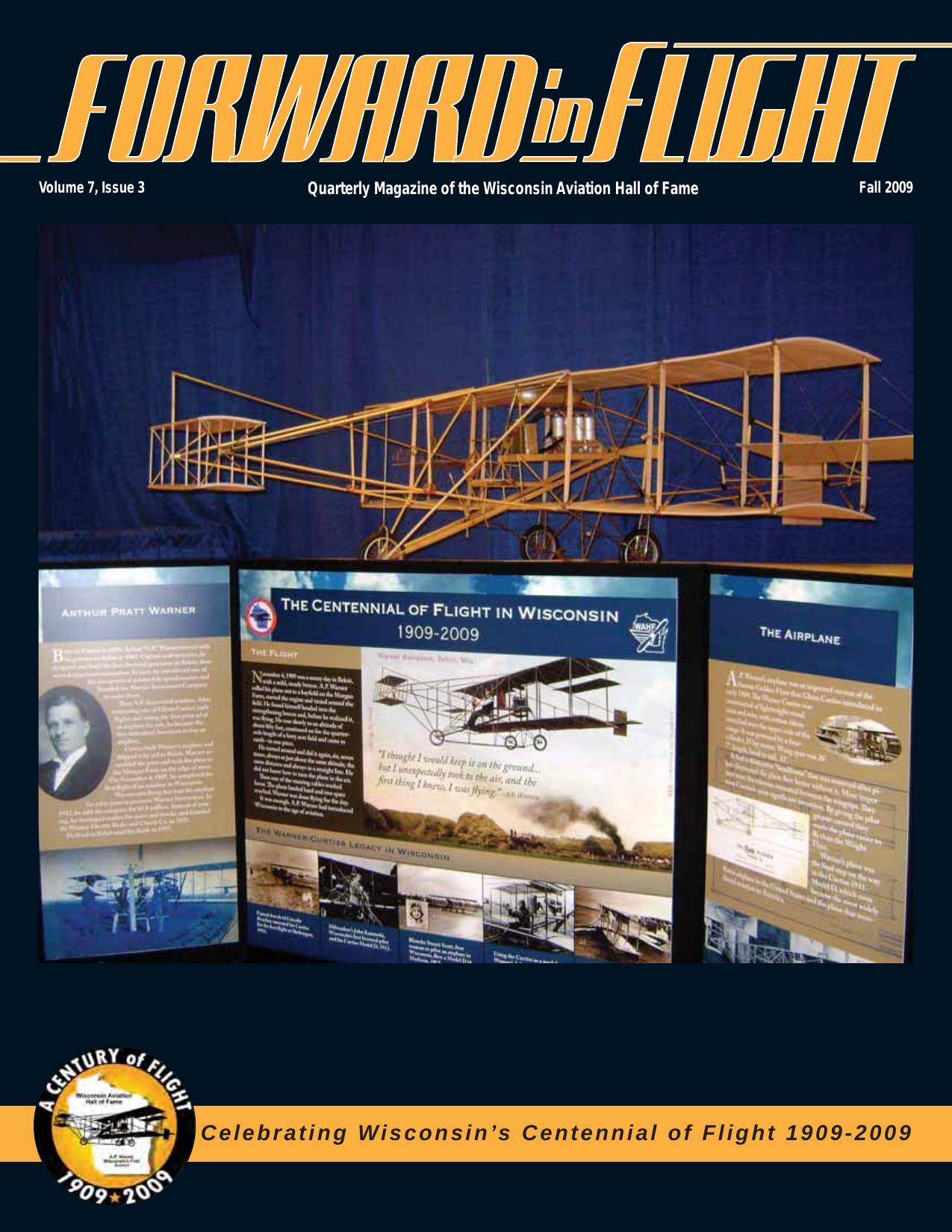
Volume 7, Issue 3 Quarterly Magazine of the Wisconsin Aviation Hall of Fame Fall 2009 Celebrating Wisconsin’s Centennial of Flight 1909-2009
Contents Association News 4 Update! Wisconsin Centennial of Flight 6 Smithsonian’s Tom Crouch to Visit Beloit Medical Matters 8 Fly With Your U.S. Medical Dr. Tom Voelker, AME Atlanta to Oshkosh in a DC-3 People, Planes, & Places 10 How I Got to Oshkosh A southern reporter takes a trip of a lifetime to the world’s biggest air show Pete Combs Check Six 14 The U.S. Air Force Academy What might have been at Lake Geneva Gary Dikkers No USAFA? Don’t blame the wealthy From the Archives 22 A Pair of Travel Airs, a Headless Pusher, and Sputnik IV All have a place in Wisconsin aviation history Michael Goc Book Review 25 Lucky Dog Frederick Beseler 26 Gone West 27 Member Spotlight 28 From the Airways 30 Member’s Logbook Manitowoc’s claim to Sputnik Forward in Flight Sharing Wisconsin aviation stories—past and present On the cover: As part of WAHF’s mission to share Wisconsin aviation history and promote aviation, the Wisconsin Centennial of Flight exhibit has been touring the state since May. With more than 1,000 Wisconsin road miles in its travel log, the model of the first airplane that flew in Wisconsin has taught many, young and old, about Wisconsin’s aviation foundation. If you haven’t already seen the educational exhibit The Wisconsin Aviation Hall of Fame is a membership and model, now is the time! organization with a mission to collect and preserve the Excitement is building as the Wisconsin Centennial of history of aviation in Wisconsin, recognize those who Flight events culminate in November. Look inside to find made that history, inform others of it, and promote aviation centennial events that you can participate in this fall. education for future generations. Rose Dorcey, Editor 3980 Sharratt Drive Oshkosh WI 54901-1276 Phone: 920-385-1483 flyer@aviationhalloffamewisconsin.com
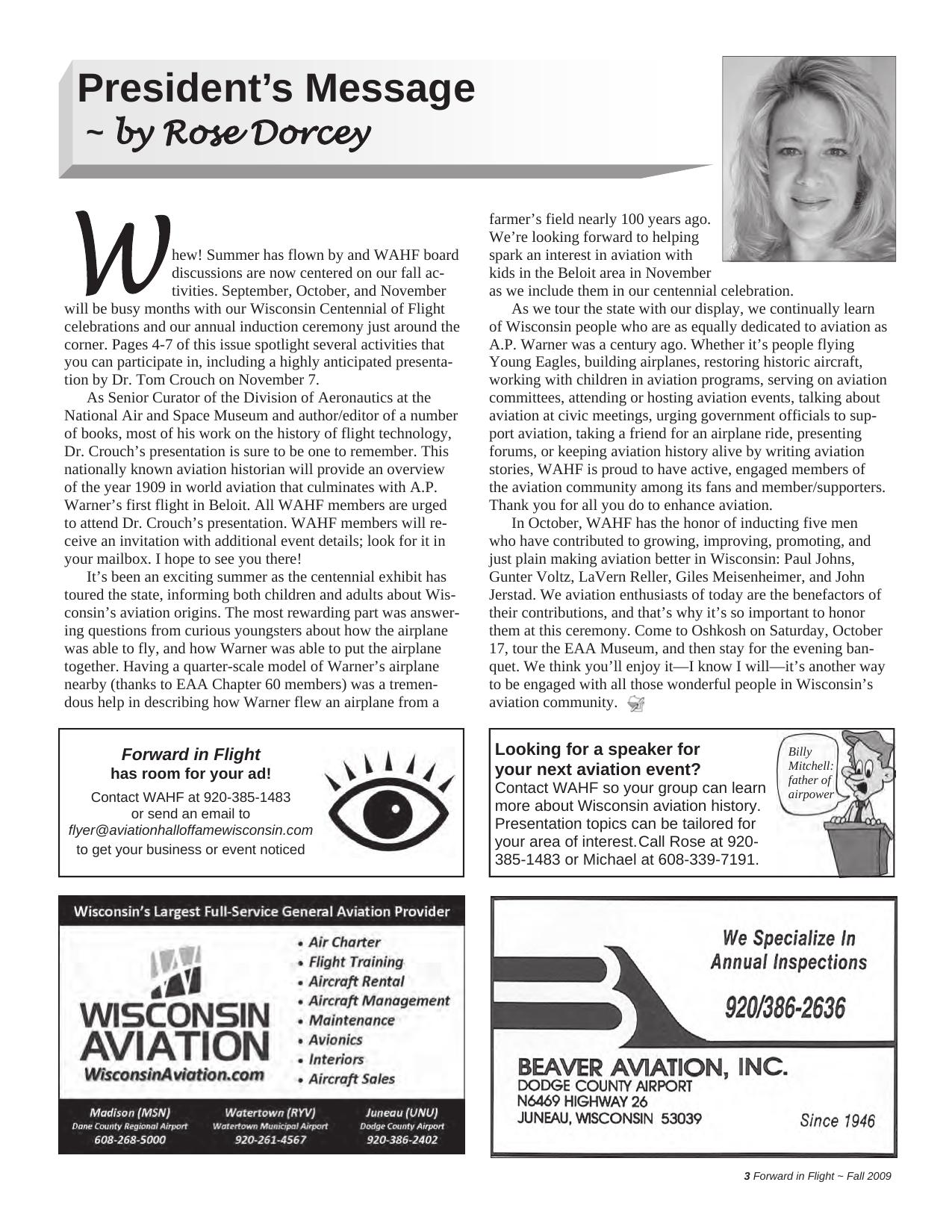
President’s Message ~ by Rose Dorcey hew! Summer has flown by and WAHF board discussions are now centered on our fall activities. September, October, and November will be busy months with our Wisconsin Centennial of Flight celebrations and our annual induction ceremony just around the corner. Pages 4-7 of this issue spotlight several activities that you can participate in, including a highly anticipated presentation by Dr. Tom Crouch on November 7. As Senior Curator of the Division of Aeronautics at the National Air and Space Museum and author/editor of a number of books, most of his work on the history of flight technology, Dr. Crouch’s presentation is sure to be one to remember. This nationally known aviation historian will provide an overview of the year 1909 in world aviation that culminates with A.P. Warner’s first flight in Beloit. All WAHF members are urged to attend Dr. Crouch’s presentation. WAHF members will receive an invitation with additional event details; look for it in your mailbox. I hope to see you there! It’s been an exciting summer as the centennial exhibit has toured the state, informing both children and adults about Wisconsin’s aviation origins. The most rewarding part was answering questions from curious youngsters about how the airplane was able to fly, and how Warner was able to put the airplane together. Having a quarter-scale model of Warner’s airplane nearby (thanks to EAA Chapter 60 members) was a tremendous help in describing how Warner flew an airplane from a Forward in Flight has room for your ad! Contact WAHF at 920-385-1483 or send an email to flyer@aviationhalloffamewisconsin.com to get your business or event noticed farmer’s field nearly 100 years ago. We’re looking forward to helping spark an interest in aviation with kids in the Beloit area in November as we include them in our centennial celebration. As we tour the state with our display, we continually learn of Wisconsin people who are as equally dedicated to aviation as A.P. Warner was a century ago. Whether it’s people flying Young Eagles, building airplanes, restoring historic aircraft, working with children in aviation programs, serving on aviation committees, attending or hosting aviation events, talking about aviation at civic meetings, urging government officials to support aviation, taking a friend for an airplane ride, presenting forums, or keeping aviation history alive by writing aviation stories, WAHF is proud to have active, engaged members of the aviation community among its fans and member/supporters. Thank you for all you do to enhance aviation. In October, WAHF has the honor of inducting five men who have contributed to growing, improving, promoting, and just plain making aviation better in Wisconsin: Paul Johns, Gunter Voltz, LaVern Reller, Giles Meisenheimer, and John Jerstad. We aviation enthusiasts of today are the benefactors of their contributions, and that’s why it’s so important to honor them at this ceremony. Come to Oshkosh on Saturday, October 17, tour the EAA Museum, and then stay for the evening banquet. We think you’ll enjoy it—I know I will—it’s another way to be engaged with all those wonderful people in Wisconsin’s aviation community. Looking for a speaker for your next aviation event? Contact WAHF so your group can learn more about Wisconsin aviation history. Presentation topics can be tailored for your area of interest. Call Rose at 920385-1483 or Michael at 608-339-7191. Billy Mitchell: father of airpower 3 Forward in Flight ~ Fall 2009
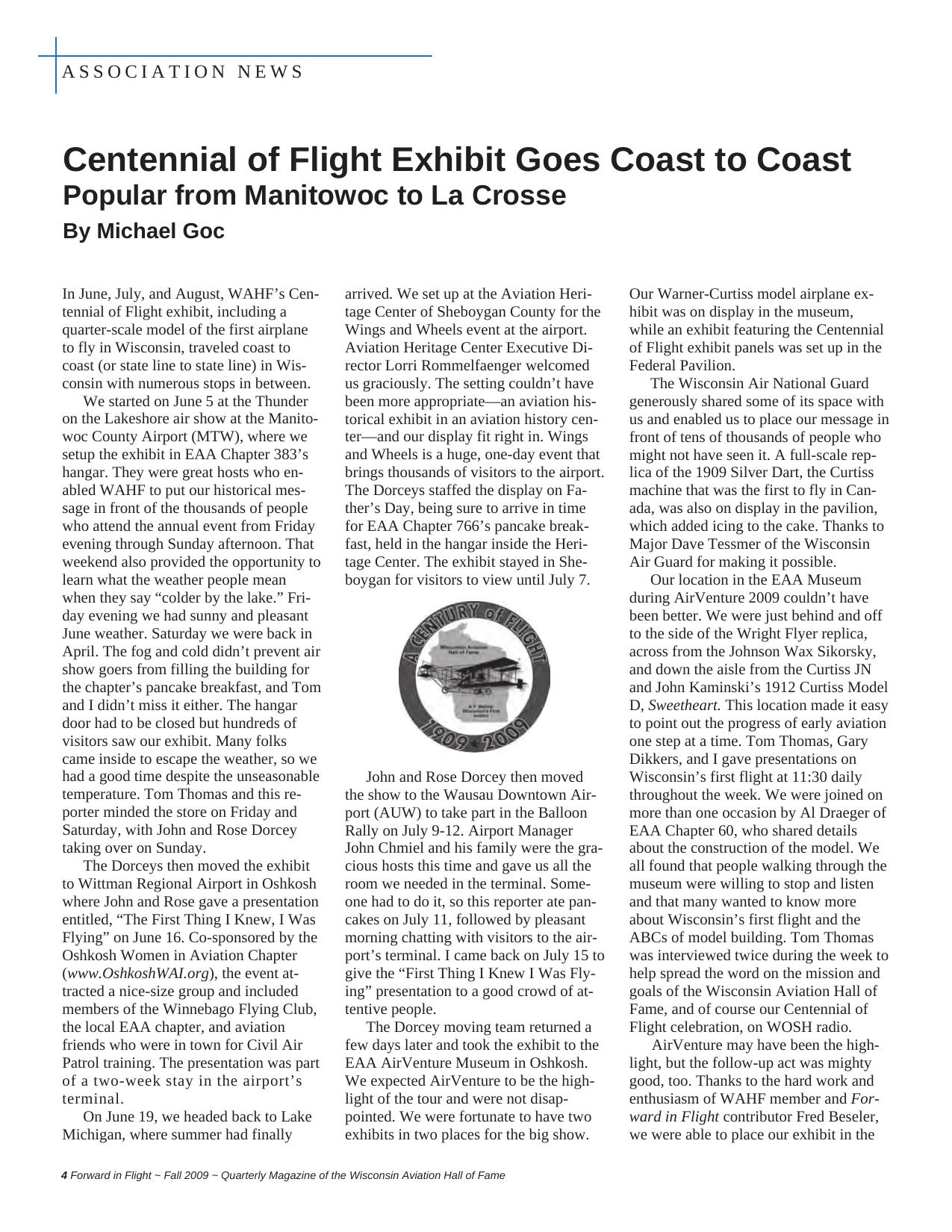
ASSOCIATION NEWS Centennial of Flight Exhibit Goes Coast to Coast Popular from Manitowoc to La Crosse By Michael Goc In June, July, and August, WAHF’s Centennial of Flight exhibit, including a quarter-scale model of the first airplane to fly in Wisconsin, traveled coast to coast (or state line to state line) in Wisconsin with numerous stops in between. We started on June 5 at the Thunder on the Lakeshore air show at the Manitowoc County Airport (MTW), where we setup the exhibit in EAA Chapter 383’s hangar. They were great hosts who enabled WAHF to put our historical message in front of the thousands of people who attend the annual event from Friday evening through Sunday afternoon. That weekend also provided the opportunity to learn what the weather people mean when they say “colder by the lake.” Friday evening we had sunny and pleasant June weather. Saturday we were back in April. The fog and cold didn’t prevent air show goers from filling the building for the chapter’s pancake breakfast, and Tom and I didn’t miss it either. The hangar door had to be closed but hundreds of visitors saw our exhibit. Many folks came inside to escape the weather, so we had a good time despite the unseasonable temperature. Tom Thomas and this reporter minded the store on Friday and Saturday, with John and Rose Dorcey taking over on Sunday. The Dorceys then moved the exhibit to Wittman Regional Airport in Oshkosh where John and Rose gave a presentation entitled, “The First Thing I Knew, I Was Flying” on June 16. Co-sponsored by the Oshkosh Women in Aviation Chapter (www.OshkoshWAI.org), the event attracted a nice-size group and included members of the Winnebago Flying Club, the local EAA chapter, and aviation friends who were in town for Civil Air Patrol training. The presentation was part of a two-week stay in the airport’s terminal. On June 19, we headed back to Lake Michigan, where summer had finally arrived. We set up at the Aviation Heritage Center of Sheboygan County for the Wings and Wheels event at the airport. Aviation Heritage Center Executive Director Lorri Rommelfaenger welcomed us graciously. The setting couldn’t have been more appropriate—an aviation historical exhibit in an aviation history center—and our display fit right in. Wings and Wheels is a huge, one-day event that brings thousands of visitors to the airport. The Dorceys staffed the display on Father’s Day, being sure to arrive in time for EAA Chapter 766’s pancake breakfast, held in the hangar inside the Heritage Center. The exhibit stayed in Sheboygan for visitors to view until July 7. John and Rose Dorcey then moved the show to the Wausau Downtown Airport (AUW) to take part in the Balloon Rally on July 9-12. Airport Manager John Chmiel and his family were the gracious hosts this time and gave us all the room we needed in the terminal. Someone had to do it, so this reporter ate pancakes on July 11, followed by pleasant morning chatting with visitors to the airport’s terminal. I came back on July 15 to give the “First Thing I Knew I Was Flying” presentation to a good crowd of attentive people. The Dorcey moving team returned a few days later and took the exhibit to the EAA AirVenture Museum in Oshkosh. We expected AirVenture to be the highlight of the tour and were not disappointed. We were fortunate to have two exhibits in two places for the big show. 4 Forward in Flight ~ Fall 2009 ~ Quarterly Magazine of the Wisconsin Aviation Hall of Fame Our Warner-Curtiss model airplane exhibit was on display in the museum, while an exhibit featuring the Centennial of Flight exhibit panels was set up in the Federal Pavilion. The Wisconsin Air National Guard generously shared some of its space with us and enabled us to place our message in front of tens of thousands of people who might not have seen it. A full-scale replica of the 1909 Silver Dart, the Curtiss machine that was the first to fly in Canada, was also on display in the pavilion, which added icing to the cake. Thanks to Major Dave Tessmer of the Wisconsin Air Guard for making it possible. Our location in the EAA Museum during AirVenture 2009 couldn’t have been better. We were just behind and off to the side of the Wright Flyer replica, across from the Johnson Wax Sikorsky, and down the aisle from the Curtiss JN and John Kaminski’s 1912 Curtiss Model D, Sweetheart. This location made it easy to point out the progress of early aviation one step at a time. Tom Thomas, Gary Dikkers, and I gave presentations on Wisconsin’s first flight at 11:30 daily throughout the week. We were joined on more than one occasion by Al Draeger of EAA Chapter 60, who shared details about the construction of the model. We all found that people walking through the museum were willing to stop and listen and that many wanted to know more about Wisconsin’s first flight and the ABCs of model building. Tom Thomas was interviewed twice during the week to help spread the word on the mission and goals of the Wisconsin Aviation Hall of Fame, and of course our Centennial of Flight celebration, on WOSH radio. AirVenture may have been the highlight, but the follow-up act was mighty good, too. Thanks to the hard work and enthusiasm of WAHF member and Forward in Flight contributor Fred Beseler, we were able to place our exhibit in the
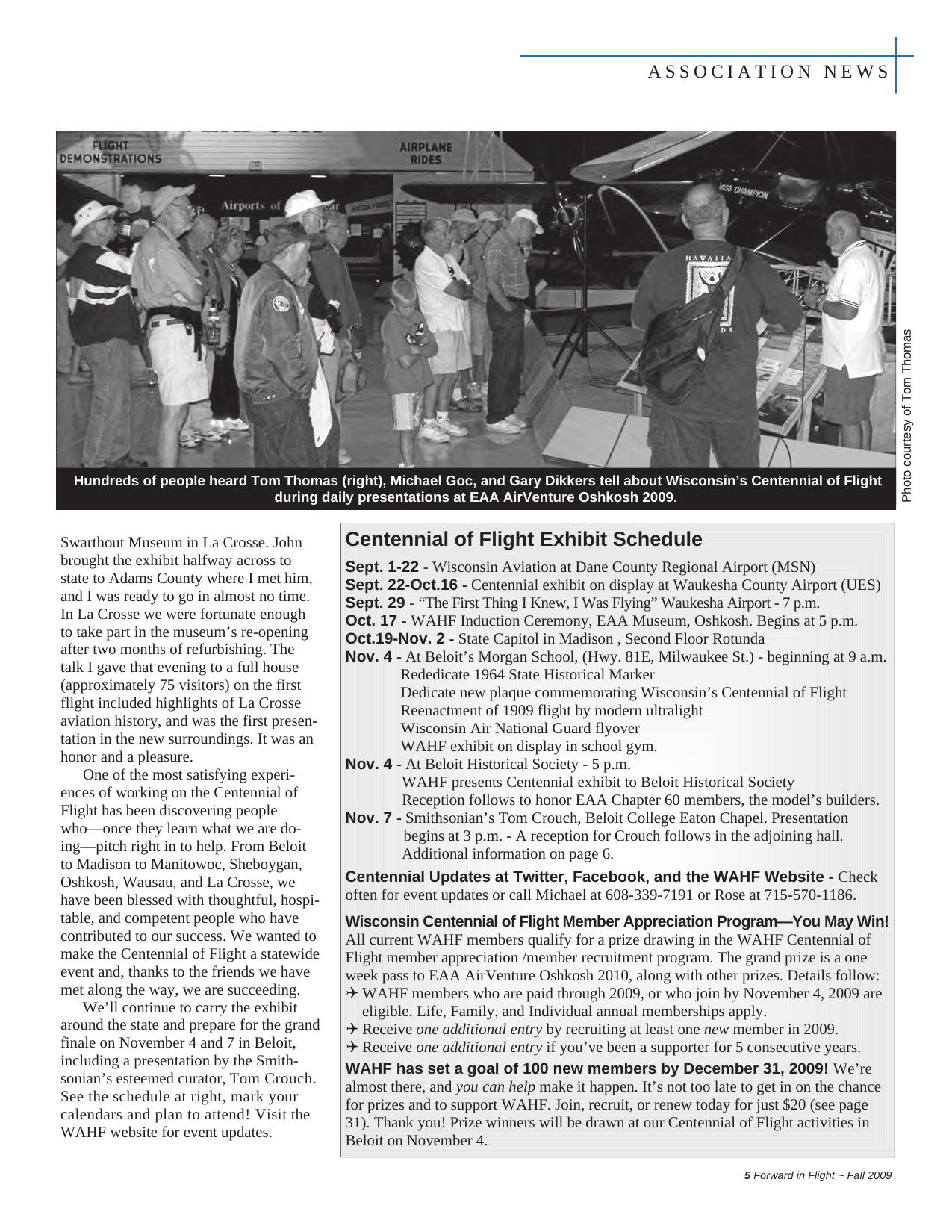
Hundreds of people heard Tom Thomas (right), Michael Goc, and Gary Dikkers tell about Wisconsin’s Centennial of Flight during daily presentations at EAA AirVenture Oshkosh 2009. Swarthout Museum in La Crosse. John brought the exhibit halfway across to state to Adams County where I met him, and I was ready to go in almost no time. In La Crosse we were fortunate enough to take part in the museum’s re-opening after two months of refurbishing. The talk I gave that evening to a full house (approximately 75 visitors) on the first flight included highlights of La Crosse aviation history, and was the first presentation in the new surroundings. It was an honor and a pleasure. One of the most satisfying experiences of working on the Centennial of Flight has been discovering people who—once they learn what we are doing—pitch right in to help. From Beloit to Madison to Manitowoc, Sheboygan, Oshkosh, Wausau, and La Crosse, we have been blessed with thoughtful, hospitable, and competent people who have contributed to our success. We wanted to make the Centennial of Flight a statewide event and, thanks to the friends we have met along the way, we are succeeding. We’ll continue to carry the exhibit around the state and prepare for the grand finale on November 4 and 7 in Beloit, including a presentation by the Smithsonian’s esteemed curator, Tom Crouch. See the schedule at right, mark your calendars and plan to attend! Visit the WAHF website for event updates. Centennial of Flight Exhibit Schedule Sept. 1-22 - Wisconsin Aviation at Dane County Regional Airport (MSN) Sept. 22-Oct.16 - Centennial exhibit on display at Waukesha County Airport (UES) Sept. 29 - “The First Thing I Knew, I Was Flying” Waukesha Airport - 7 p.m. Oct. 17 - WAHF Induction Ceremony, EAA Museum, Oshkosh. Begins at 5 p.m. Oct.19-Nov. 2 - State Capitol in Madison , Second Floor Rotunda Nov. 4 - At Beloit’s Morgan School, (Hwy. 81E, Milwaukee St.) - beginning at 9 a.m. Rededicate 1964 State Historical Marker Dedicate new plaque commemorating Wisconsin’s Centennial of Flight Reenactment of 1909 flight by modern ultralight Wisconsin Air National Guard flyover WAHF exhibit on display in school gym. Nov. 4 - At Beloit Historical Society - 5 p.m. WAHF presents Centennial exhibit to Beloit Historical Society Reception follows to honor EAA Chapter 60 members, the model’s builders. Nov. 7 - Smithsonian’s Tom Crouch, Beloit College Eaton Chapel. Presentation begins at 3 p.m. - A reception for Crouch follows in the adjoining hall. Additional information on page 6. Centennial Updates at Twitter, Facebook, and the WAHF Website - Check often for event updates or call Michael at 608-339-7191 or Rose at 715-570-1186. Wisconsin Centennial of Flight Member Appreciation Program—You May Win! All current WAHF members qualify for a prize drawing in the WAHF Centennial of Flight member appreciation /member recruitment program. The grand prize is a one week pass to EAA AirVenture Oshkosh 2010, along with other prizes. Details follow: 4 WAHF members who are paid through 2009, or who join by November 4, 2009 are eligible. Life, Family, and Individual annual memberships apply. 4 Receive one additional entry by recruiting at least one new member in 2009. 4 Receive one additional entry if you’ve been a supporter for 5 consecutive years. WAHF has set a goal of 100 new members by December 31, 2009! We’re almost there, and you can help make it happen. It’s not too late to get in on the chance for prizes and to support WAHF. Join, recruit, or renew today for just $20 (see page 31). Thank you! Prize winners will be drawn at our Centennial of Flight activities in Beloit on November 4. 5 Forward in Flight ~ Fall 2009 Photo courtesy of Tom Thomas ASSOCIATION NEWS
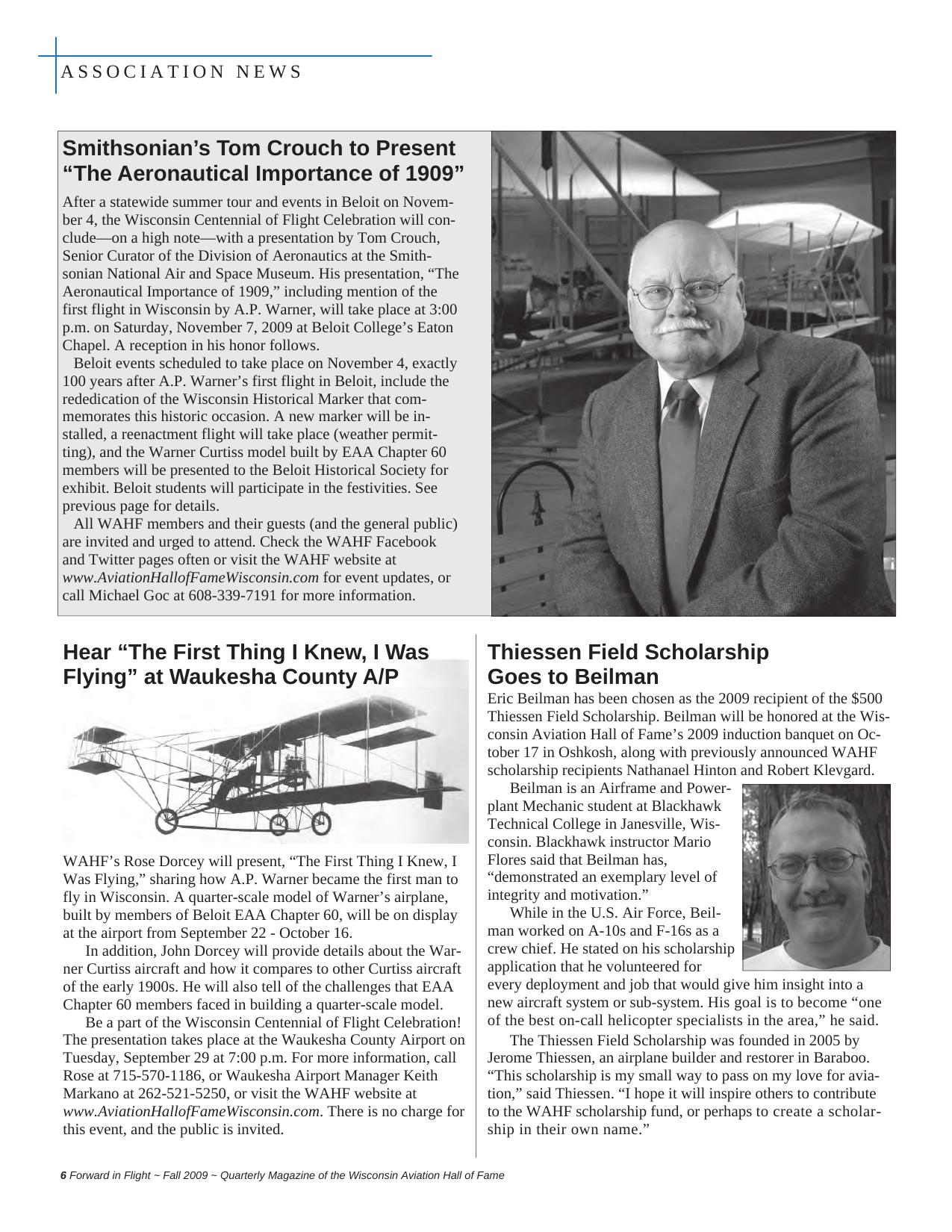
ASSOCIATION NEWS Smithsonian’s Tom Crouch to Present “The Aeronautical Importance of 1909” After a statewide summer tour and events in Beloit on November 4, the Wisconsin Centennial of Flight Celebration will conclude—on a high note—with a presentation by Tom Crouch, Senior Curator of the Division of Aeronautics at the Smithsonian National Air and Space Museum. His presentation, “The Aeronautical Importance of 1909,” including mention of the first flight in Wisconsin by A.P. Warner, will take place at 3:00 p.m. on Saturday, November 7, 2009 at Beloit College’s Eaton Chapel. A reception in his honor follows. Beloit events scheduled to take place on November 4, exactly 100 years after A.P. Warner’s first flight in Beloit, include the rededication of the Wisconsin Historical Marker that commemorates this historic occasion. A new marker will be installed, a reenactment flight will take place (weather permitting), and the Warner Curtiss model built by EAA Chapter 60 members will be presented to the Beloit Historical Society for exhibit. Beloit students will participate in the festivities. See previous page for details. All WAHF members and their guests (and the general public) are invited and urged to attend. Check the WAHF Facebook and Twitter pages often or visit the WAHF website at www.AviationHallofFameWisconsin.com for event updates, or call Michael Goc at 608-339-7191 for more information. Tom Crouch is the featured speaker in WAHF’s Centennial of Flight events in Beloit. Plan to attend his presentation. Hear “The First Thing I Knew, I Was Flying” at Waukesha County A/P Thiessen Field Scholarship Goes to Beilman WAHF’s Rose Dorcey will present, “The First Thing I Knew, I Was Flying,” sharing how A.P. Warner became the first man to fly in Wisconsin. A quarter-scale model of Warner’s airplane, built by members of Beloit EAA Chapter 60, will be on display at the airport from September 22 - October 16. In addition, John Dorcey will provide details about the Warner Curtiss aircraft and how it compares to other Curtiss aircraft of the early 1900s. He will also tell of the challenges that EAA Chapter 60 members faced in building a quarter-scale model. Be a part of the Wisconsin Centennial of Flight Celebration! The presentation takes place at the Waukesha County Airport on Tuesday, September 29 at 7:00 p.m. For more information, call Rose at 715-570-1186, or Waukesha Airport Manager Keith Markano at 262-521-5250, or visit the WAHF website at www.AviationHallofFameWisconsin.com. There is no charge for this event, and the public is invited. Eric Beilman has been chosen as the 2009 recipient of the $500 Thiessen Field Scholarship. Beilman will be honored at the Wisconsin Aviation Hall of Fame’s 2009 induction banquet on October 17 in Oshkosh, along with previously announced WAHF scholarship recipients Nathanael Hinton and Robert Klevgard. Beilman is an Airframe and Powerplant Mechanic student at Blackhawk Technical College in Janesville, Wisconsin. Blackhawk instructor Mario Flores said that Beilman has, “demonstrated an exemplary level of integrity and motivation.” While in the U.S. Air Force, Beilman worked on A-10s and F-16s as a crew chief. He stated on his scholarship application that he volunteered for every deployment and job that would give him insight into a new aircraft system or sub-system. His goal is to become “one of the best on-call helicopter specialists in the area,” he said. The Thiessen Field Scholarship was founded in 2005 by Jerome Thiessen, an airplane builder and restorer in Baraboo. “This scholarship is my small way to pass on my love for aviation,” said Thiessen. “I hope it will inspire others to contribute to the WAHF scholarship fund, or perhaps to create a scholarship in their own name.” 6 Forward in Flight ~ Fall 2009 ~ Quarterly Magazine of the Wisconsin Aviation Hall of Fame
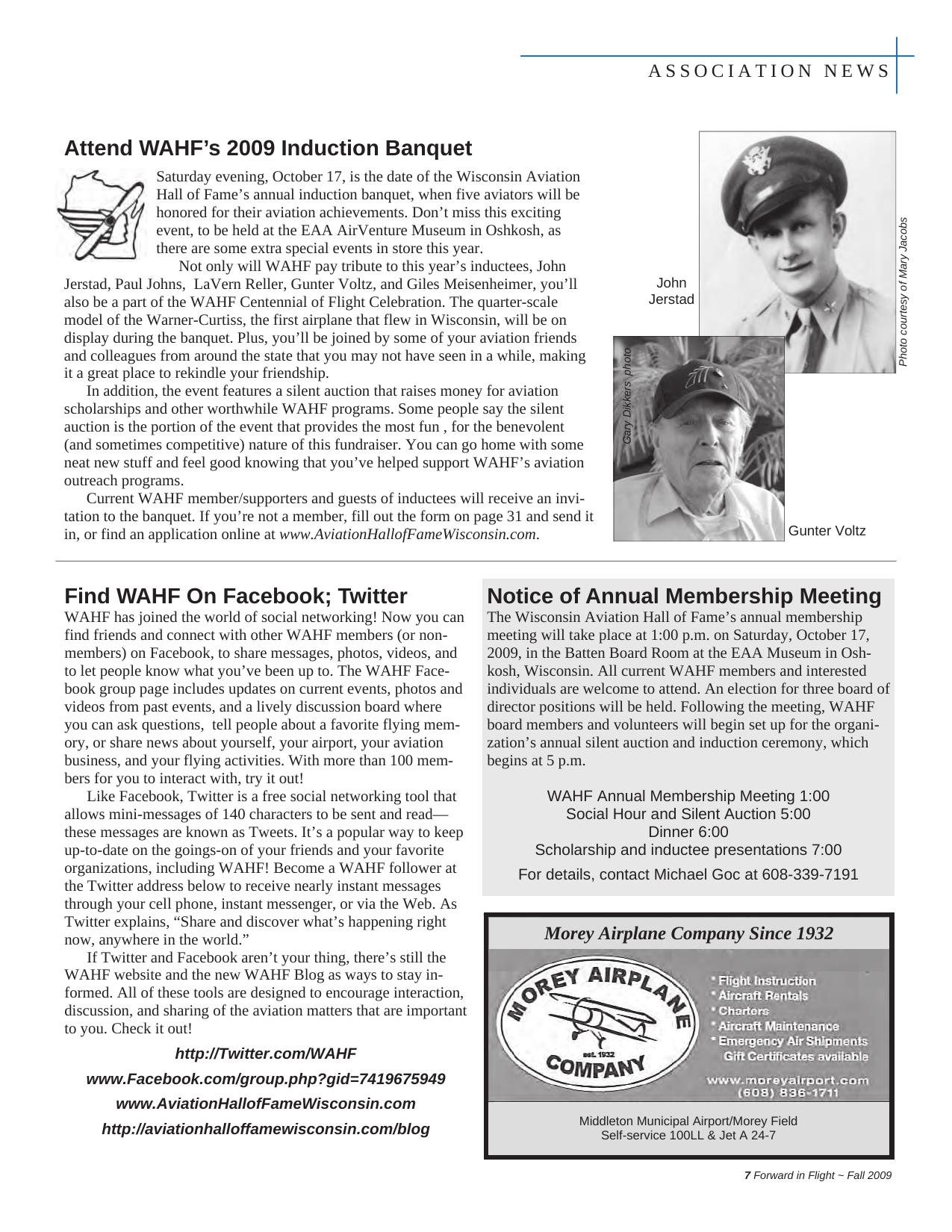
ASSOCIATION NEWS John Jerstad Gary Dikkers photo Saturday evening, October 17, is the date of the Wisconsin Aviation Hall of Fame’s annual induction banquet, when five aviators will be honored for their aviation achievements. Don’t miss this exciting event, to be held at the EAA AirVenture Museum in Oshkosh, as there are some extra special events in store this year. Not only will WAHF pay tribute to this year’s inductees, John Jerstad, Paul Johns, LaVern Reller, Gunter Voltz, and Giles Meisenheimer, you’ll also be a part of the WAHF Centennial of Flight Celebration. The quarter-scale model of the Warner-Curtiss, the first airplane that flew in Wisconsin, will be on display during the banquet. Plus, you’ll be joined by some of your aviation friends and colleagues from around the state that you may not have seen in a while, making it a great place to rekindle your friendship. In addition, the event features a silent auction that raises money for aviation scholarships and other worthwhile WAHF programs. Some people say the silent auction is the portion of the event that provides the most fun , for the benevolent (and sometimes competitive) nature of this fundraiser. You can go home with some neat new stuff and feel good knowing that you’ve helped support WAHF’s aviation outreach programs. Current WAHF member/supporters and guests of inductees will receive an invitation to the banquet. If you’re not a member, fill out the form on page 31 and send it in, or find an application online at www.AviationHallofFameWisconsin.com. Photo courtesy of Mary Jacobs Attend WAHF’s 2009 Induction Banquet Gunter Voltz Find WAHF On Facebook; Twitter Notice of Annual Membership Meeting WAHF has joined the world of social networking! Now you can find friends and connect with other WAHF members (or nonmembers) on Facebook, to share messages, photos, videos, and to let people know what you’ve been up to. The WAHF Facebook group page includes updates on current events, photos and videos from past events, and a lively discussion board where you can ask questions, tell people about a favorite flying memory, or share news about yourself, your airport, your aviation business, and your flying activities. With more than 100 members for you to interact with, try it out! Like Facebook, Twitter is a free social networking tool that allows mini-messages of 140 characters to be sent and read— these messages are known as Tweets. It’s a popular way to keep up-to-date on the goings-on of your friends and your favorite organizations, including WAHF! Become a WAHF follower at the Twitter address below to receive nearly instant messages through your cell phone, instant messenger, or via the Web. As Twitter explains, “Share and discover what’s happening right now, anywhere in the world.” If Twitter and Facebook aren’t your thing, there’s still the WAHF website and the new WAHF Blog as ways to stay informed. All of these tools are designed to encourage interaction, discussion, and sharing of the aviation matters that are important to you. Check it out! The Wisconsin Aviation Hall of Fame’s annual membership meeting will take place at 1:00 p.m. on Saturday, October 17, 2009, in the Batten Board Room at the EAA Museum in Oshkosh, Wisconsin. All current WAHF members and interested individuals are welcome to attend. An election for three board of director positions will be held. Following the meeting, WAHF board members and volunteers will begin set up for the organization’s annual silent auction and induction ceremony, which begins at 5 p.m. WAHF Annual Membership Meeting 1:00 Social Hour and Silent Auction 5:00 Dinner 6:00 Scholarship and inductee presentations 7:00 For details, contact Michael Goc at 608-339-7191 Morey Airplane Company Since 1932 http://Twitter.com/WAHF www.Facebook.com/group.php?gid=7419675949 www.AviationHallofFameWisconsin.com http://aviationhalloffamewisconsin.com/blog Middleton Municipal Airport/Morey Field Self-service 100LL & Jet A 24-7 7 Forward in Flight ~ Fall 2009
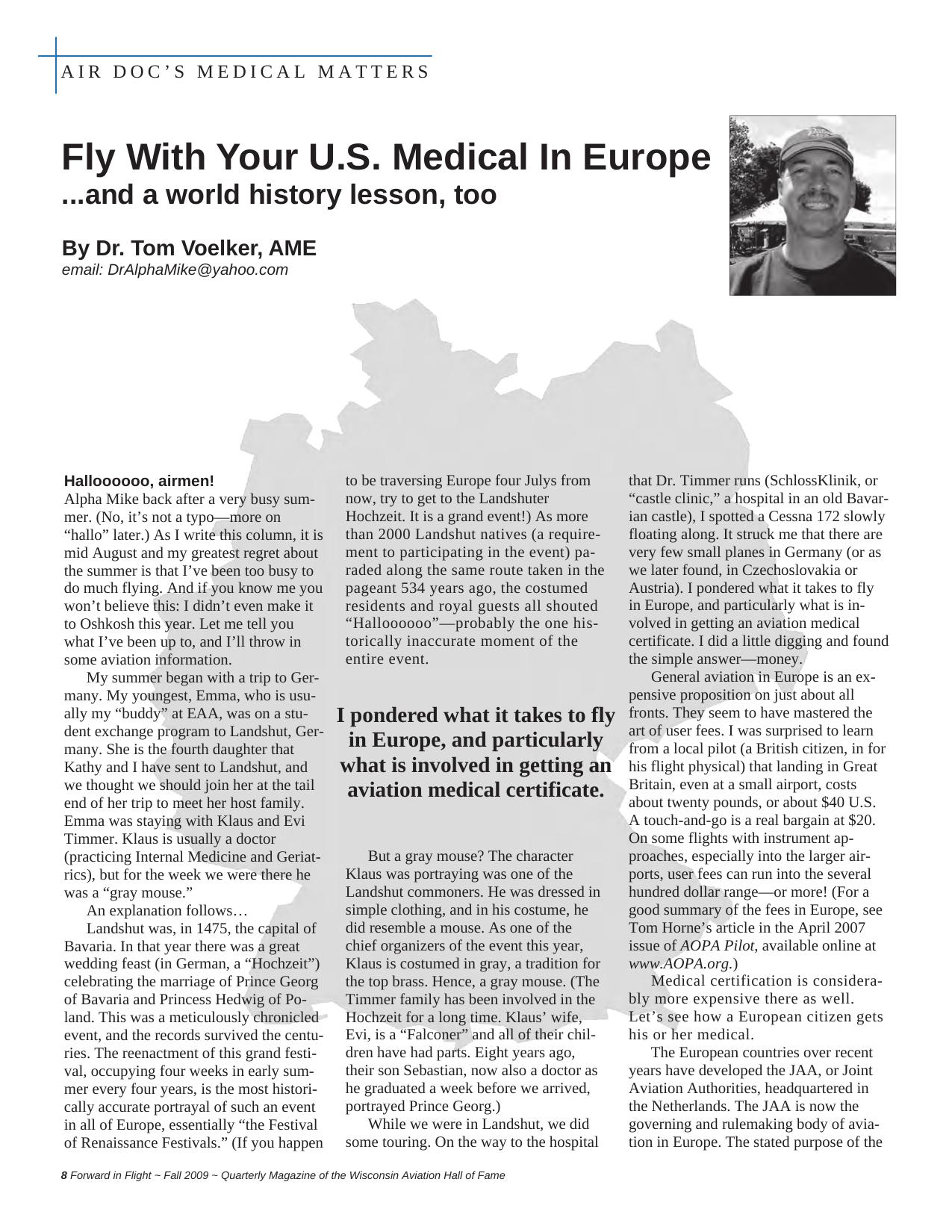
AIR DOC’S MEDICAL MATTERS Fly With Your U.S. Medical In Europe ...and a world history lesson, too By Dr. Tom Voelker, AME email: DrAlphaMike@yahoo.com Halloooooo, airmen! Alpha Mike back after a very busy summer. (No, it’s not a typo—more on “hallo” later.) As I write this column, it is mid August and my greatest regret about the summer is that I’ve been too busy to do much flying. And if you know me you won’t believe this: I didn’t even make it to Oshkosh this year. Let me tell you what I’ve been up to, and I’ll throw in some aviation information. My summer began with a trip to Germany. My youngest, Emma, who is usually my “buddy” at EAA, was on a student exchange program to Landshut, Germany. She is the fourth daughter that Kathy and I have sent to Landshut, and we thought we should join her at the tail end of her trip to meet her host family. Emma was staying with Klaus and Evi Timmer. Klaus is usually a doctor (practicing Internal Medicine and Geriatrics), but for the week we were there he was a “gray mouse.” An explanation follows… Landshut was, in 1475, the capital of Bavaria. In that year there was a great wedding feast (in German, a “Hochzeit”) celebrating the marriage of Prince Georg of Bavaria and Princess Hedwig of Poland. This was a meticulously chronicled event, and the records survived the centuries. The reenactment of this grand festival, occupying four weeks in early summer every four years, is the most historically accurate portrayal of such an event in all of Europe, essentially “the Festival of Renaissance Festivals.” (If you happen to be traversing Europe four Julys from now, try to get to the Landshuter Hochzeit. It is a grand event!) As more than 2000 Landshut natives (a requirement to participating in the event) paraded along the same route taken in the pageant 534 years ago, the costumed residents and royal guests all shouted “Halloooooo”—probably the one historically inaccurate moment of the entire event. I pondered what it takes to fly in Europe, and particularly what is involved in getting an aviation medical certificate. But a gray mouse? The character Klaus was portraying was one of the Landshut commoners. He was dressed in simple clothing, and in his costume, he did resemble a mouse. As one of the chief organizers of the event this year, Klaus is costumed in gray, a tradition for the top brass. Hence, a gray mouse. (The Timmer family has been involved in the Hochzeit for a long time. Klaus’ wife, Evi, is a “Falconer” and all of their children have had parts. Eight years ago, their son Sebastian, now also a doctor as he graduated a week before we arrived, portrayed Prince Georg.) While we were in Landshut, we did some touring. On the way to the hospital 8 Forward in Flight ~ Fall 2009 ~ Quarterly Magazine of the Wisconsin Aviation Hall of Fame that Dr. Timmer runs (SchlossKlinik, or “castle clinic,” a hospital in an old Bavarian castle), I spotted a Cessna 172 slowly floating along. It struck me that there are very few small planes in Germany (or as we later found, in Czechoslovakia or Austria). I pondered what it takes to fly in Europe, and particularly what is involved in getting an aviation medical certificate. I did a little digging and found the simple answer—money. General aviation in Europe is an expensive proposition on just about all fronts. They seem to have mastered the art of user fees. I was surprised to learn from a local pilot (a British citizen, in for his flight physical) that landing in Great Britain, even at a small airport, costs about twenty pounds, or about $40 U.S. A touch-and-go is a real bargain at $20. On some flights with instrument approaches, especially into the larger airports, user fees can run into the several hundred dollar range—or more! (For a good summary of the fees in Europe, see Tom Horne’s article in the April 2007 issue of AOPA Pilot, available online at www.AOPA.org.) Medical certification is considerably more expensive there as well. Let’s see how a European citizen gets his or her medical. The European countries over recent years have developed the JAA, or Joint Aviation Authorities, headquartered in the Netherlands. The JAA is now the governing and rulemaking body of aviation in Europe. The stated purpose of the
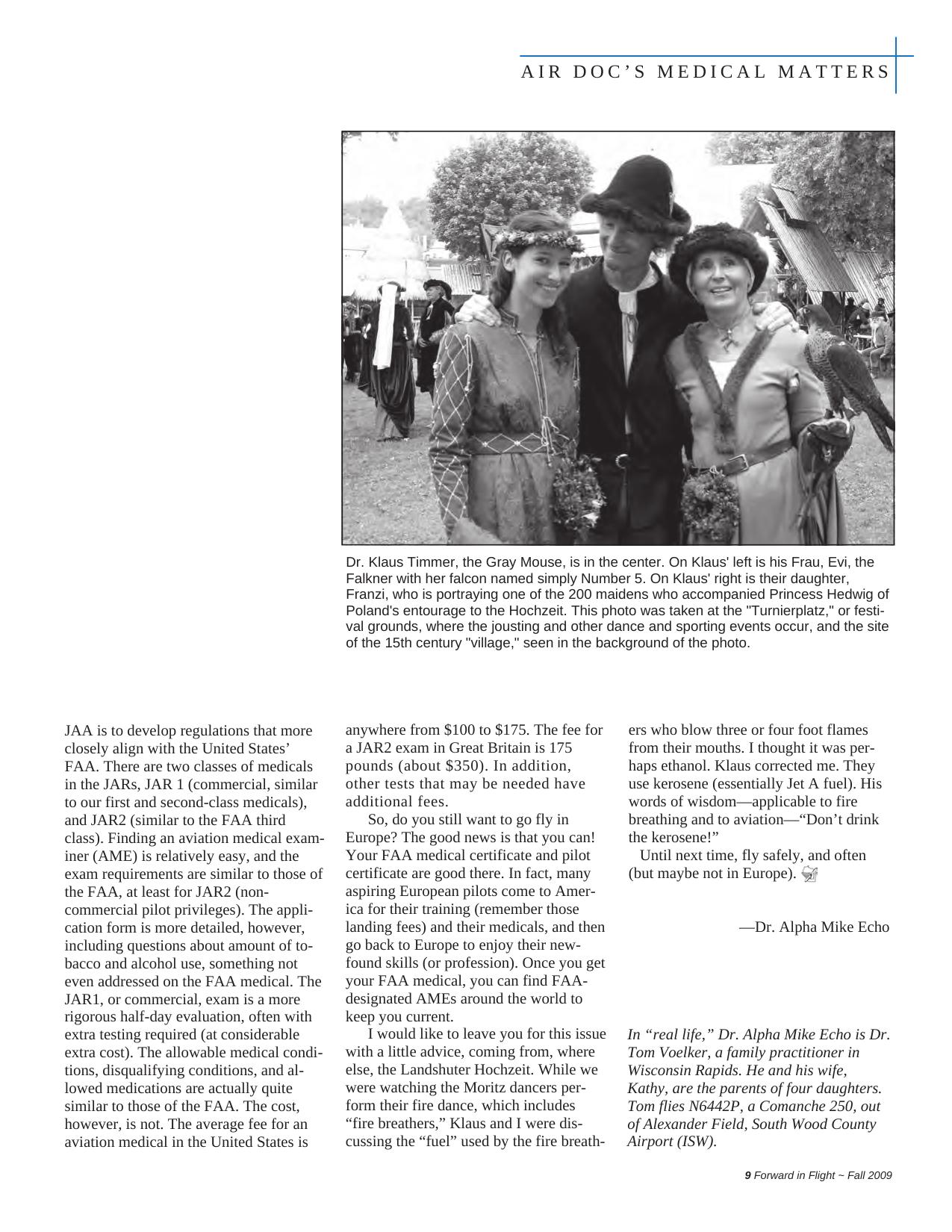
AIR DOC’S MEDICAL MATTERS Dr. Klaus Timmer, the Gray Mouse, is in the center. On Klaus' left is his Frau, Evi, the Falkner with her falcon named simply Number 5. On Klaus' right is their daughter, Franzi, who is portraying one of the 200 maidens who accompanied Princess Hedwig of Poland's entourage to the Hochzeit. This photo was taken at the "Turnierplatz," or festival grounds, where the jousting and other dance and sporting events occur, and the site of the 15th century "village," seen in the background of the photo. JAA is to develop regulations that more closely align with the United States’ FAA. There are two classes of medicals in the JARs, JAR 1 (commercial, similar to our first and second-class medicals), and JAR2 (similar to the FAA third class). Finding an aviation medical examiner (AME) is relatively easy, and the exam requirements are similar to those of the FAA, at least for JAR2 (noncommercial pilot privileges). The application form is more detailed, however, including questions about amount of tobacco and alcohol use, something not even addressed on the FAA medical. The JAR1, or commercial, exam is a more rigorous half-day evaluation, often with extra testing required (at considerable extra cost). The allowable medical conditions, disqualifying conditions, and allowed medications are actually quite similar to those of the FAA. The cost, however, is not. The average fee for an aviation medical in the United States is anywhere from $100 to $175. The fee for a JAR2 exam in Great Britain is 175 pounds (about $350). In addition, other tests that may be needed have additional fees. So, do you still want to go fly in Europe? The good news is that you can! Your FAA medical certificate and pilot certificate are good there. In fact, many aspiring European pilots come to America for their training (remember those landing fees) and their medicals, and then go back to Europe to enjoy their newfound skills (or profession). Once you get your FAA medical, you can find FAAdesignated AMEs around the world to keep you current. I would like to leave you for this issue with a little advice, coming from, where else, the Landshuter Hochzeit. While we were watching the Moritz dancers perform their fire dance, which includes “fire breathers,” Klaus and I were discussing the “fuel” used by the fire breath- ers who blow three or four foot flames from their mouths. I thought it was perhaps ethanol. Klaus corrected me. They use kerosene (essentially Jet A fuel). His words of wisdom—applicable to fire breathing and to aviation—“Don’t drink the kerosene!” Until next time, fly safely, and often (but maybe not in Europe). —Dr. Alpha Mike Echo In “real life,” Dr. Alpha Mike Echo is Dr. Tom Voelker, a family practitioner in Wisconsin Rapids. He and his wife, Kathy, are the parents of four daughters. Tom flies N6442P, a Comanche 250, out of Alexander Field, South Wood County Airport (ISW). 9 Forward in Flight ~ Fall 2009
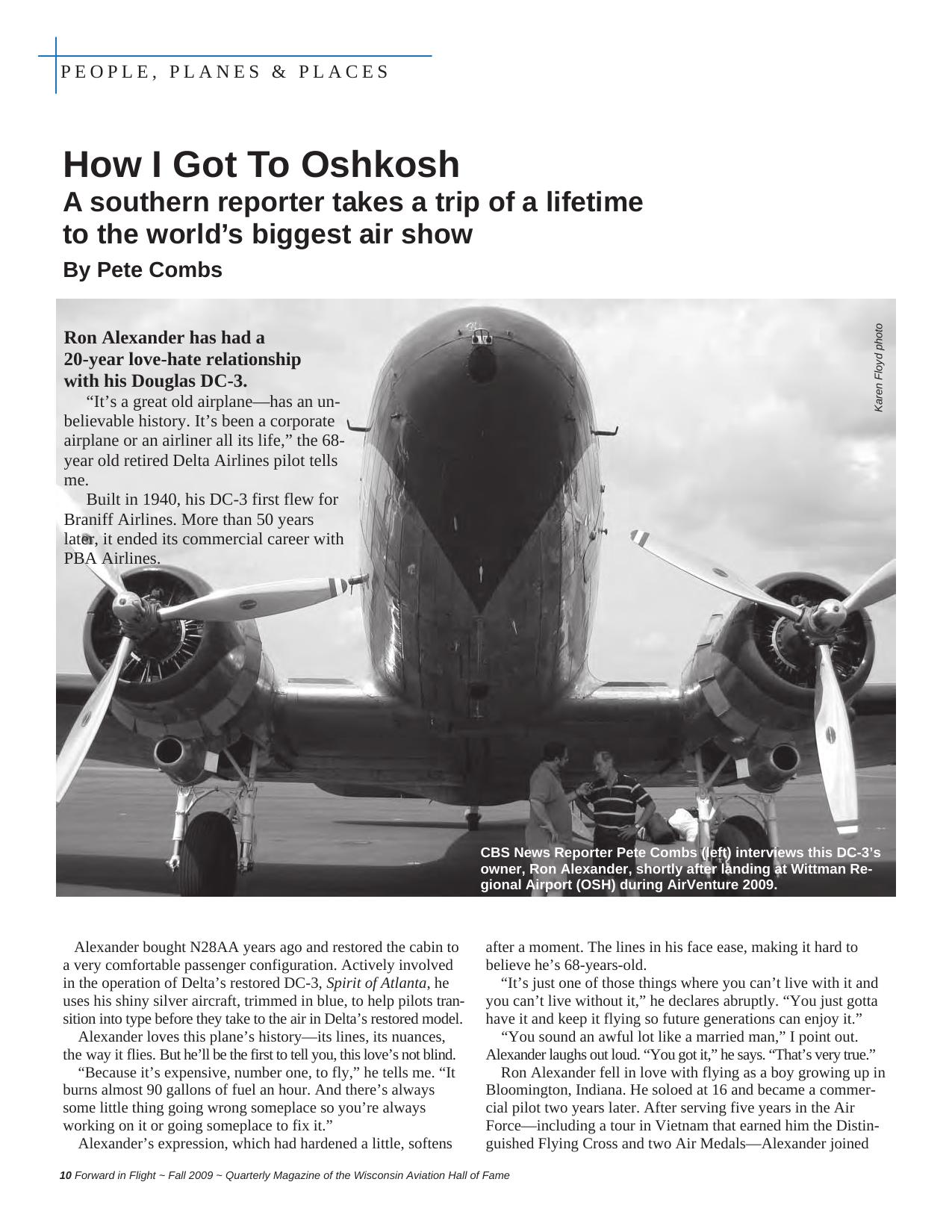
PEOPLE, PLANES & PLACES How I Got To Oshkosh A southern reporter takes a trip of a lifetime to the world’s biggest air show Karen Floyd photo By Pete Combs Ron Alexander has had a 20-year love-hate relationship with his Douglas DC-3. “It’s a great old airplane—has an unbelievable history. It’s been a corporate airplane or an airliner all its life,” the 68year old retired Delta Airlines pilot tells me. Built in 1940, his DC-3 first flew for Braniff Airlines. More than 50 years later, it ended its commercial career with PBA Airlines. CBS News Reporter Pete Combs (left) interviews this DC-3’s owner, Ron Alexander, shortly after landing at Wittman Regional Airport (OSH) during AirVenture 2009. Alexander bought N28AA years ago and restored the cabin to a very comfortable passenger configuration. Actively involved in the operation of Delta’s restored DC-3, Spirit of Atlanta, he uses his shiny silver aircraft, trimmed in blue, to help pilots transition into type before they take to the air in Delta’s restored model. Alexander loves this plane’s history—its lines, its nuances, the way it flies. But he’ll be the first to tell you, this love’s not blind. “Because it’s expensive, number one, to fly,” he tells me. “It burns almost 90 gallons of fuel an hour. And there’s always some little thing going wrong someplace so you’re always working on it or going someplace to fix it.” Alexander’s expression, which had hardened a little, softens after a moment. The lines in his face ease, making it hard to believe he’s 68-years-old. “It’s just one of those things where you can’t live with it and you can’t live without it,” he declares abruptly. “You just gotta have it and keep it flying so future generations can enjoy it.” “You sound an awful lot like a married man,” I point out. Alexander laughs out loud. “You got it,” he says. “That’s very true.” Ron Alexander fell in love with flying as a boy growing up in Bloomington, Indiana. He soloed at 16 and became a commercial pilot two years later. After serving five years in the Air Force—including a tour in Vietnam that earned him the Distinguished Flying Cross and two Air Medals—Alexander joined 10 Forward in Flight ~ Fall 2009 ~ Quarterly Magazine of the Wisconsin Aviation Hall of Fame
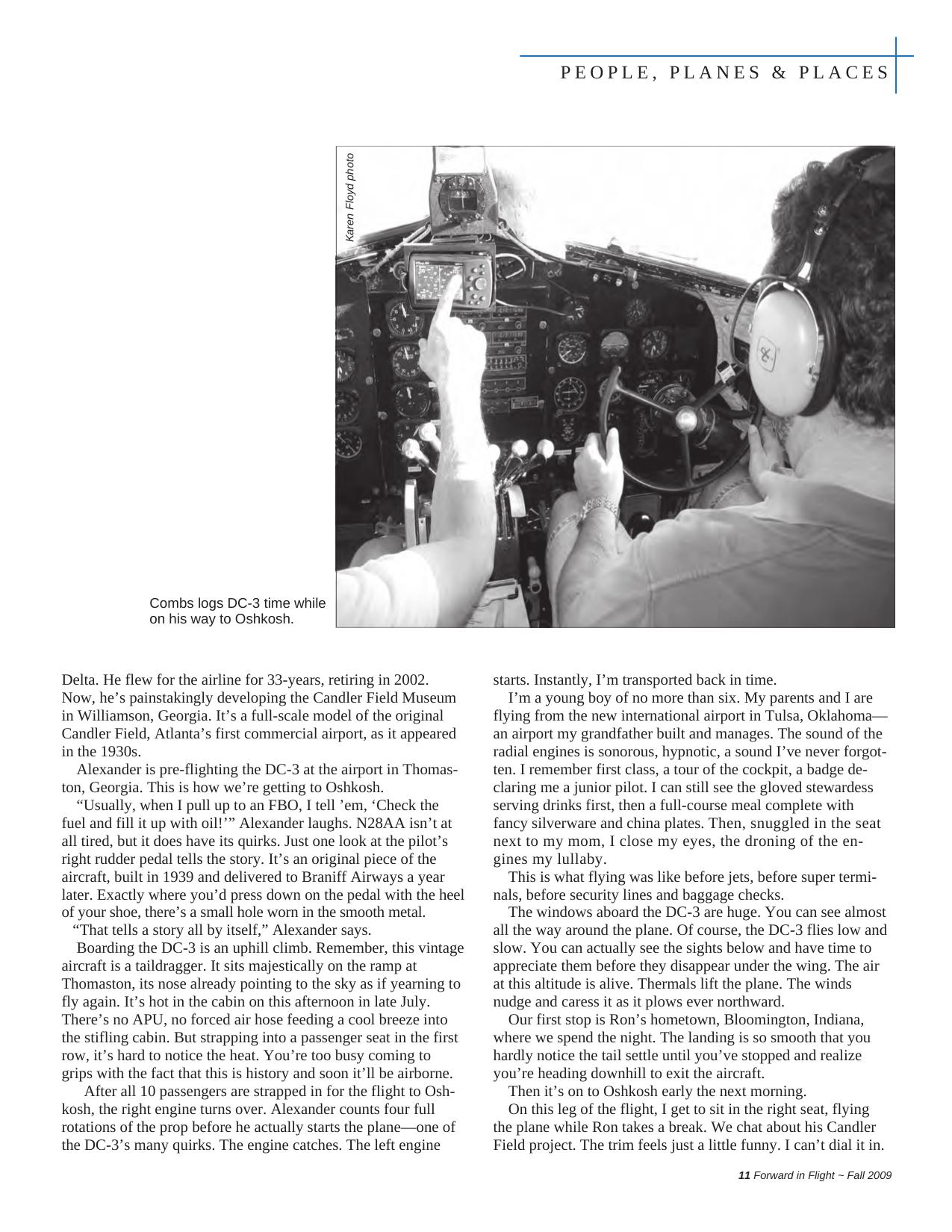
Karen Floyd photo PEOPLE, PLANES & PLACES Combs logs DC-3 time while on his way to Oshkosh. Delta. He flew for the airline for 33-years, retiring in 2002. Now, he’s painstakingly developing the Candler Field Museum in Williamson, Georgia. It’s a full-scale model of the original Candler Field, Atlanta’s first commercial airport, as it appeared in the 1930s. Alexander is pre-flighting the DC-3 at the airport in Thomaston, Georgia. This is how we’re getting to Oshkosh. “Usually, when I pull up to an FBO, I tell ’em, ‘Check the fuel and fill it up with oil!’” Alexander laughs. N28AA isn’t at all tired, but it does have its quirks. Just one look at the pilot’s right rudder pedal tells the story. It’s an original piece of the aircraft, built in 1939 and delivered to Braniff Airways a year later. Exactly where you’d press down on the pedal with the heel of your shoe, there’s a small hole worn in the smooth metal. “That tells a story all by itself,” Alexander says. Boarding the DC-3 is an uphill climb. Remember, this vintage aircraft is a taildragger. It sits majestically on the ramp at Thomaston, its nose already pointing to the sky as if yearning to fly again. It’s hot in the cabin on this afternoon in late July. There’s no APU, no forced air hose feeding a cool breeze into the stifling cabin. But strapping into a passenger seat in the first row, it’s hard to notice the heat. You’re too busy coming to grips with the fact that this is history and soon it’ll be airborne. After all 10 passengers are strapped in for the flight to Oshkosh, the right engine turns over. Alexander counts four full rotations of the prop before he actually starts the plane—one of the DC-3’s many quirks. The engine catches. The left engine starts. Instantly, I’m transported back in time. I’m a young boy of no more than six. My parents and I are flying from the new international airport in Tulsa, Oklahoma— an airport my grandfather built and manages. The sound of the radial engines is sonorous, hypnotic, a sound I’ve never forgotten. I remember first class, a tour of the cockpit, a badge declaring me a junior pilot. I can still see the gloved stewardess serving drinks first, then a full-course meal complete with fancy silverware and china plates. Then, snuggled in the seat next to my mom, I close my eyes, the droning of the engines my lullaby. This is what flying was like before jets, before super terminals, before security lines and baggage checks. The windows aboard the DC-3 are huge. You can see almost all the way around the plane. Of course, the DC-3 flies low and slow. You can actually see the sights below and have time to appreciate them before they disappear under the wing. The air at this altitude is alive. Thermals lift the plane. The winds nudge and caress it as it plows ever northward. Our first stop is Ron’s hometown, Bloomington, Indiana, where we spend the night. The landing is so smooth that you hardly notice the tail settle until you’ve stopped and realize you’re heading downhill to exit the aircraft. Then it’s on to Oshkosh early the next morning. On this leg of the flight, I get to sit in the right seat, flying the plane while Ron takes a break. We chat about his Candler Field project. The trim feels just a little funny. I can’t dial it in. 11 Forward in Flight ~ Fall 2009
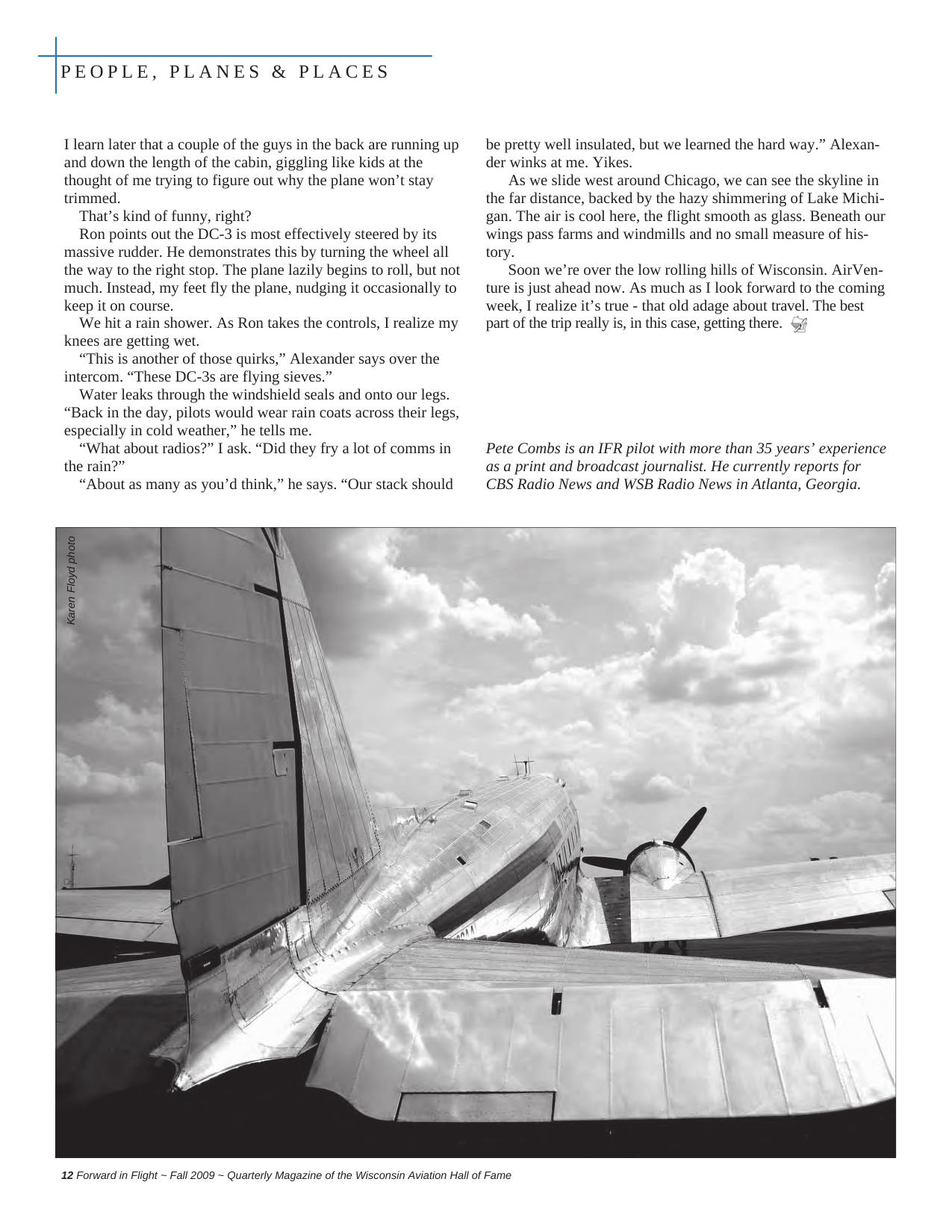
PEOPLE, PLANES & PLACES be pretty well insulated, but we learned the hard way.” Alexander winks at me. Yikes. As we slide west around Chicago, we can see the skyline in the far distance, backed by the hazy shimmering of Lake Michigan. The air is cool here, the flight smooth as glass. Beneath our wings pass farms and windmills and no small measure of history. Soon we’re over the low rolling hills of Wisconsin. AirVenture is just ahead now. As much as I look forward to the coming week, I realize it’s true - that old adage about travel. The best part of the trip really is, in this case, getting there. Pete Combs is an IFR pilot with more than 35 years’ experience as a print and broadcast journalist. He currently reports for CBS Radio News and WSB Radio News in Atlanta, Georgia. Karen Floyd photo I learn later that a couple of the guys in the back are running up and down the length of the cabin, giggling like kids at the thought of me trying to figure out why the plane won’t stay trimmed. That’s kind of funny, right? Ron points out the DC-3 is most effectively steered by its massive rudder. He demonstrates this by turning the wheel all the way to the right stop. The plane lazily begins to roll, but not much. Instead, my feet fly the plane, nudging it occasionally to keep it on course. We hit a rain shower. As Ron takes the controls, I realize my knees are getting wet. “This is another of those quirks,” Alexander says over the intercom. “These DC-3s are flying sieves.” Water leaks through the windshield seals and onto our legs. “Back in the day, pilots would wear rain coats across their legs, especially in cold weather,” he tells me. “What about radios?” I ask. “Did they fry a lot of comms in the rain?” “About as many as you’d think,” he says. “Our stack should 12 Forward in Flight ~ Fall 2009 ~ Quarterly Magazine of the Wisconsin Aviation Hall of Fame
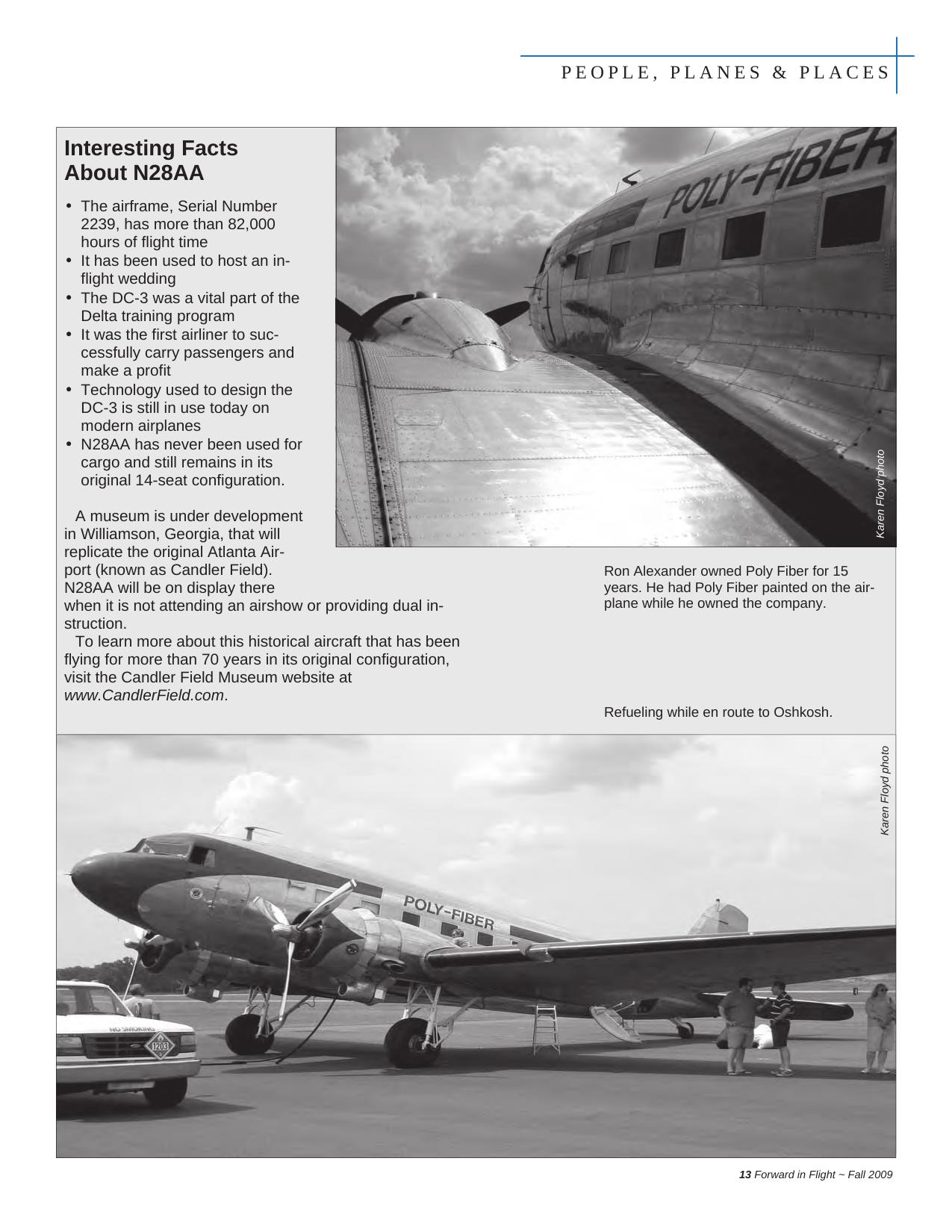
PEOPLE, PLANES & PLACES Interesting Facts About N28AA Ron Alexander owned Poly Fiber for 15 years. He had Poly Fiber painted on the airplane while he owned the company. Refueling while en route to Oshkosh. Karen Floyd photo A museum is under development in Williamson, Georgia, that will replicate the original Atlanta Airport (known as Candler Field). N28AA will be on display there when it is not attending an airshow or providing dual instruction. To learn more about this historical aircraft that has been flying for more than 70 years in its original configuration, visit the Candler Field Museum website at www.CandlerField.com. Karen Floyd photo • The airframe, Serial Number 2239, has more than 82,000 hours of flight time • It has been used to host an inflight wedding • The DC-3 was a vital part of the Delta training program • It was the first airliner to successfully carry passengers and make a profit • Technology used to design the DC-3 is still in use today on modern airplanes • N28AA has never been used for cargo and still remains in its original 14-seat configuration. 13 Forward in Flight ~ Fall 2009
CHECK SIX The U.S. Air Force Academy What might have been at Lake Geneva By Gary Dikkers This is a story of what might have been. A story involving Wisconsin’s “Tail-gunner Joe” McCarthy, Charles Lindbergh, President Dwight D. Eisenhower, the Wrigley family of chewing gum fame, and Wisconsin architect Frank Lloyd Wright. This is the story of how Lake Geneva narrowly missed being home to the United States Air Force Academy. From 1964 until graduating in 1968, I was fortunate to attend the Air Force Academy at Colorado Springs. During those years, memories of the Academy’s site selection and construction were still fresh in the minds of many. Although the Colorado site is spectacular, many cadets at the time didn’t enjoy its remoteness, nor fully appreciate the scenery. It was still common knowledge that the Academy had nearly been built at Geneva Lake, only 75 miles from Chicago, 45 miles from Milwaukee, and perhaps most significantly, near the then nationally acclaimed Playboy Club Resort at Lake Geneva. (Officially, the lake is “Geneva Lake,” while the city at the east end is Lake Geneva.) In the mid-1960s, the cadets widely held the view that if not for a few rich Chicago industrialists who considered Geneva Lake to be their exclusive getaway, and who were fearful of “aircraft noise,” our campus would have shared the same lake as the Playboy Club, instead of being stuck on the side of a mountain north of Colorado Springs. Finally, more than 40 years after graduating, I started inves- tigating the widely held rumor that a handful of rich Chicagoans had kept the Air Force from building its Academy on the shores of Geneva Lake. Need for an Air Force Academy Even before the Air Force gained its independence in 1947, it had been obvious that a professional school to train officers was needed, just as the Army and Navy have West Point and Annapolis. In 1949, Congress started legislation to authorize an Air Force Academy, but when the Korean War began, progress stalled. Finally, on 1 April 1954, President Eisenhower signed Public Law 325 authorizing the Air Force Academy, and site selection began in earnest. The Air Force solicited nominations for potential sites, and politicians and chambers of commerce flooded the Air Force with 582 proposed locations in 45 states. (Besides Lake Geneva, the other proposed sites in Wisconsin were Stevens Point, Camp McCoy between Sparta and Tomah, a site on Lake Michigan near Kenosha, a site on the Rock River south of 14 Forward in Flight ~ Fall 2009 ~ Quarterly Magazine of the Wisconsin Aviation Hall of Fame
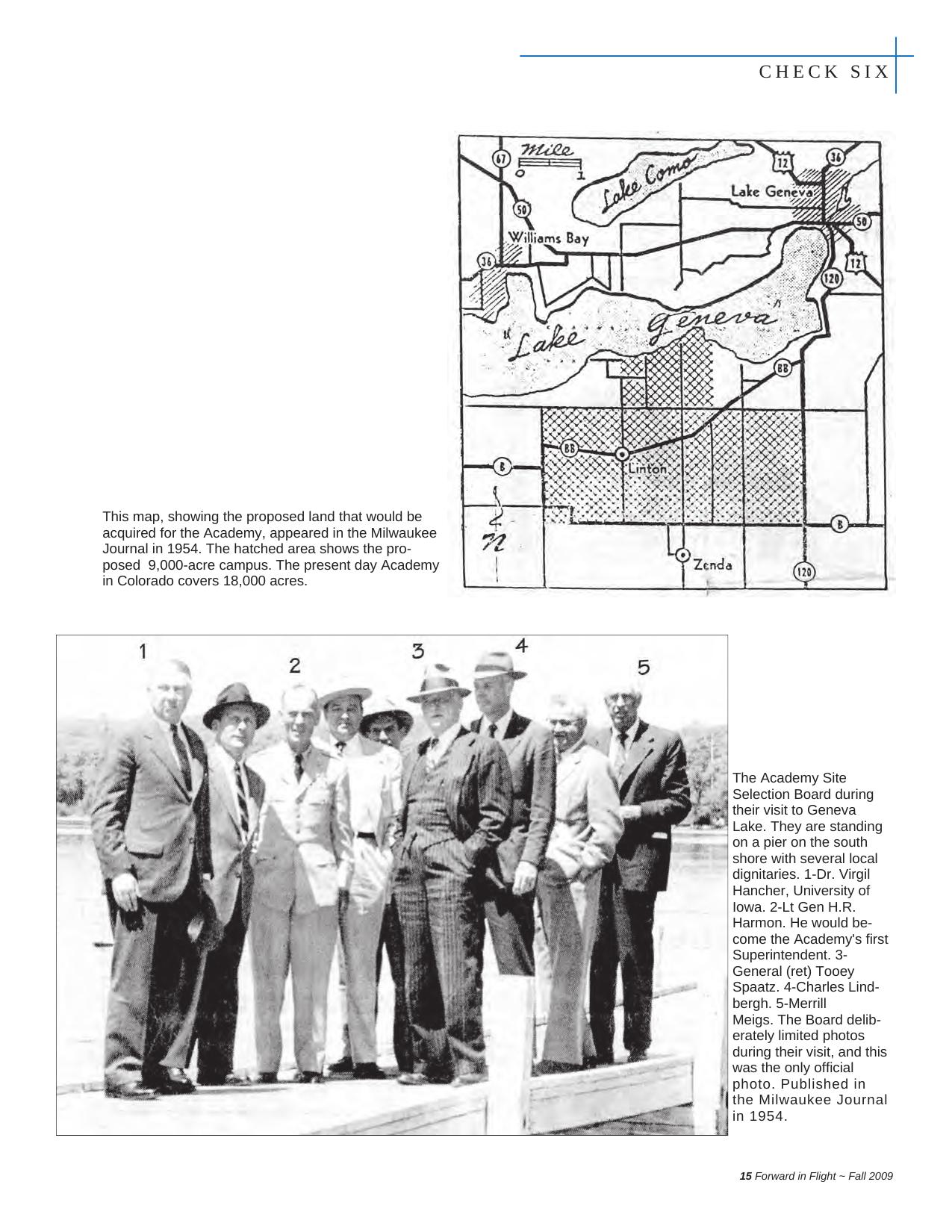
CHECK SIX This map, showing the proposed land that would be acquired for the Academy, appeared in the Milwaukee Journal in 1954. The hatched area shows the proposed 9,000-acre campus. The present day Academy in Colorado covers 18,000 acres. The Academy Site Selection Board during their visit to Geneva Lake. They are standing on a pier on the south shore with several local dignitaries. 1-Dr. Virgil Hancher, University of Iowa. 2-Lt Gen H.R. Harmon. He would become the Academy's first Superintendent. 3General (ret) Tooey Spaatz. 4-Charles Lindbergh. 5-Merrill Meigs. The Board deliberately limited photos during their visit, and this was the only official photo. Published in the Milwaukee Journal in 1954. 15 Forward in Flight ~ Fall 2009
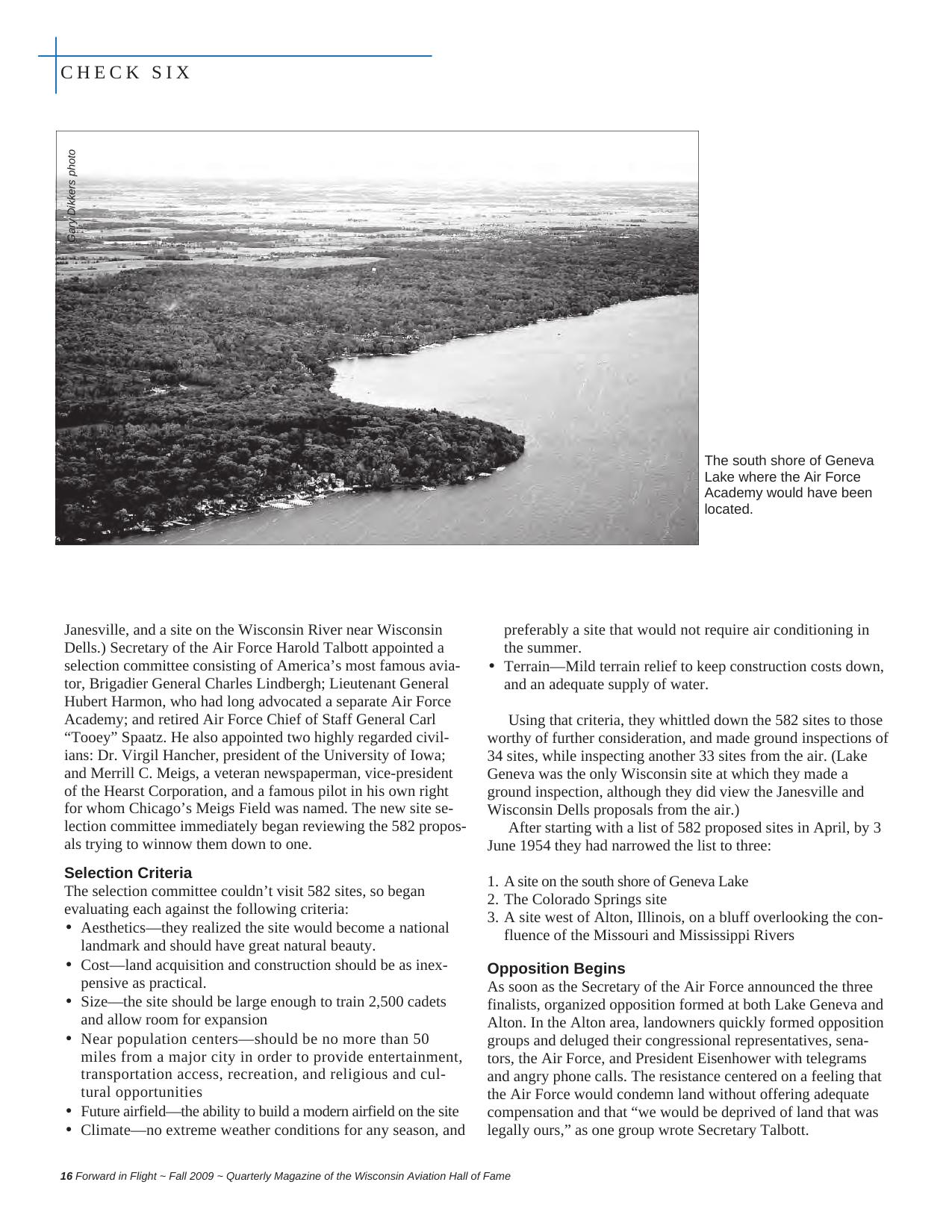
Gary Dikkers photo CHECK SIX The south shore of Geneva Lake where the Air Force Academy would have been located. Janesville, and a site on the Wisconsin River near Wisconsin Dells.) Secretary of the Air Force Harold Talbott appointed a selection committee consisting of America’s most famous aviator, Brigadier General Charles Lindbergh; Lieutenant General Hubert Harmon, who had long advocated a separate Air Force Academy; and retired Air Force Chief of Staff General Carl “Tooey” Spaatz. He also appointed two highly regarded civilians: Dr. Virgil Hancher, president of the University of Iowa; and Merrill C. Meigs, a veteran newspaperman, vice-president of the Hearst Corporation, and a famous pilot in his own right for whom Chicago’s Meigs Field was named. The new site selection committee immediately began reviewing the 582 proposals trying to winnow them down to one. Selection Criteria The selection committee couldn’t visit 582 sites, so began evaluating each against the following criteria: • Aesthetics—they realized the site would become a national landmark and should have great natural beauty. • Cost—land acquisition and construction should be as inexpensive as practical. • Size—the site should be large enough to train 2,500 cadets and allow room for expansion • Near population centers—should be no more than 50 miles from a major city in order to provide entertainment, transportation access, recreation, and religious and cultural opportunities • Future airfield—the ability to build a modern airfield on the site • Climate—no extreme weather conditions for any season, and preferably a site that would not require air conditioning in the summer. • Terrain—Mild terrain relief to keep construction costs down, and an adequate supply of water. Using that criteria, they whittled down the 582 sites to those worthy of further consideration, and made ground inspections of 34 sites, while inspecting another 33 sites from the air. (Lake Geneva was the only Wisconsin site at which they made a ground inspection, although they did view the Janesville and Wisconsin Dells proposals from the air.) After starting with a list of 582 proposed sites in April, by 3 June 1954 they had narrowed the list to three: 1. A site on the south shore of Geneva Lake 2. The Colorado Springs site 3. A site west of Alton, Illinois, on a bluff overlooking the confluence of the Missouri and Mississippi Rivers Opposition Begins As soon as the Secretary of the Air Force announced the three finalists, organized opposition formed at both Lake Geneva and Alton. In the Alton area, landowners quickly formed opposition groups and deluged their congressional representatives, senators, the Air Force, and President Eisenhower with telegrams and angry phone calls. The resistance centered on a feeling that the Air Force would condemn land without offering adequate compensation and that “we would be deprived of land that was legally ours,” as one group wrote Secretary Talbott. 16 Forward in Flight ~ Fall 2009 ~ Quarterly Magazine of the Wisconsin Aviation Hall of Fame
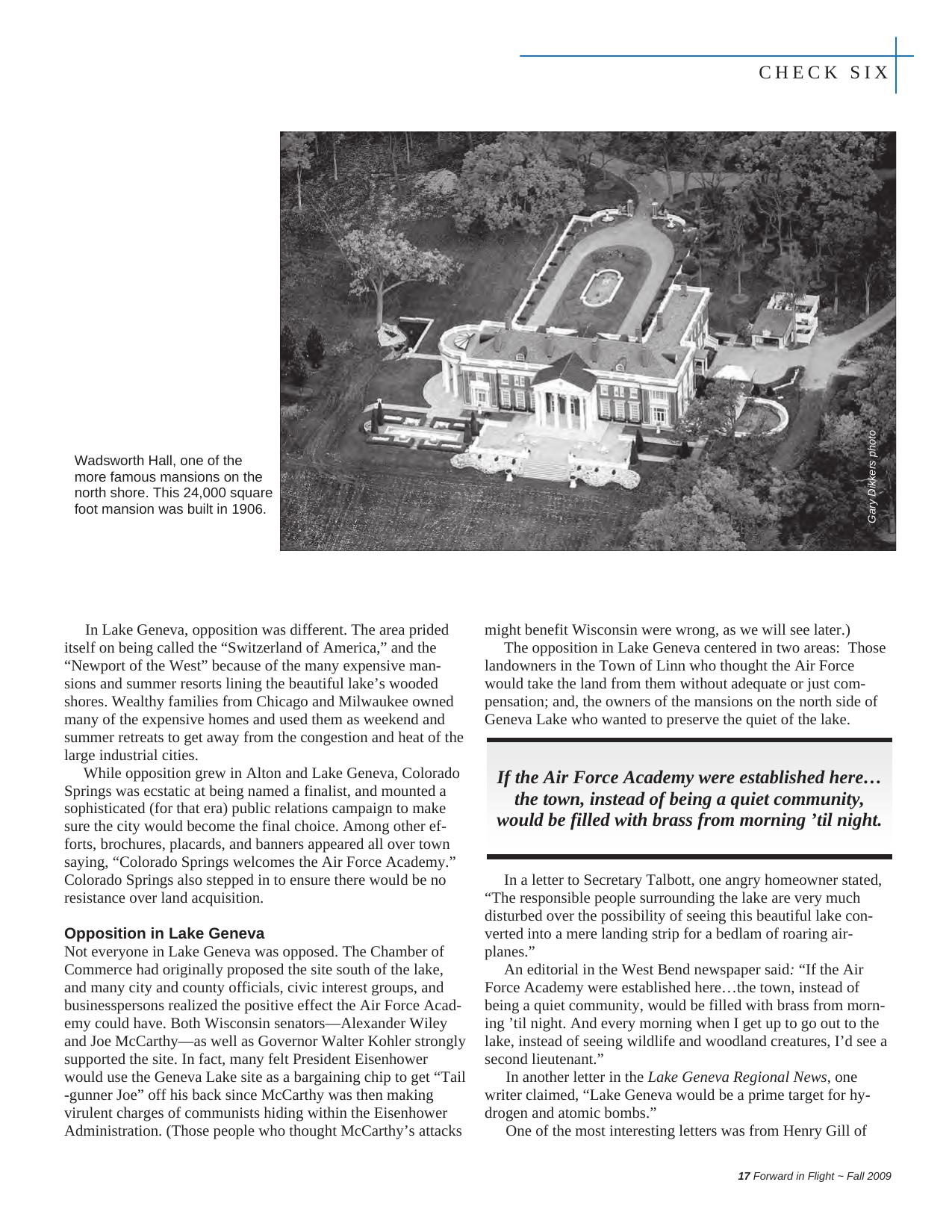
Wadsworth Hall, one of the more famous mansions on the north shore. This 24,000 square foot mansion was built in 1906. In Lake Geneva, opposition was different. The area prided itself on being called the “Switzerland of America,” and the “Newport of the West” because of the many expensive mansions and summer resorts lining the beautiful lake’s wooded shores. Wealthy families from Chicago and Milwaukee owned many of the expensive homes and used them as weekend and summer retreats to get away from the congestion and heat of the large industrial cities. While opposition grew in Alton and Lake Geneva, Colorado Springs was ecstatic at being named a finalist, and mounted a sophisticated (for that era) public relations campaign to make sure the city would become the final choice. Among other efforts, brochures, placards, and banners appeared all over town saying, “Colorado Springs welcomes the Air Force Academy.” Colorado Springs also stepped in to ensure there would be no resistance over land acquisition. Opposition in Lake Geneva Not everyone in Lake Geneva was opposed. The Chamber of Commerce had originally proposed the site south of the lake, and many city and county officials, civic interest groups, and businesspersons realized the positive effect the Air Force Academy could have. Both Wisconsin senators—Alexander Wiley and Joe McCarthy—as well as Governor Walter Kohler strongly supported the site. In fact, many felt President Eisenhower would use the Geneva Lake site as a bargaining chip to get “Tail -gunner Joe” off his back since McCarthy was then making virulent charges of communists hiding within the Eisenhower Administration. (Those people who thought McCarthy’s attacks Gary Dikkers photo CHECK SIX might benefit Wisconsin were wrong, as we will see later.) The opposition in Lake Geneva centered in two areas: Those landowners in the Town of Linn who thought the Air Force would take the land from them without adequate or just compensation; and, the owners of the mansions on the north side of Geneva Lake who wanted to preserve the quiet of the lake. If the Air Force Academy were established here… the town, instead of being a quiet community, would be filled with brass from morning ’til night. In a letter to Secretary Talbott, one angry homeowner stated, “The responsible people surrounding the lake are very much disturbed over the possibility of seeing this beautiful lake converted into a mere landing strip for a bedlam of roaring airplanes.” An editorial in the West Bend newspaper said: “If the Air Force Academy were established here…the town, instead of being a quiet community, would be filled with brass from morning ’til night. And every morning when I get up to go out to the lake, instead of seeing wildlife and woodland creatures, I’d see a second lieutenant.” In another letter in the Lake Geneva Regional News, one writer claimed, “Lake Geneva would be a prime target for hydrogen and atomic bombs.” One of the most interesting letters was from Henry Gill of 17 Forward in Flight ~ Fall 2009
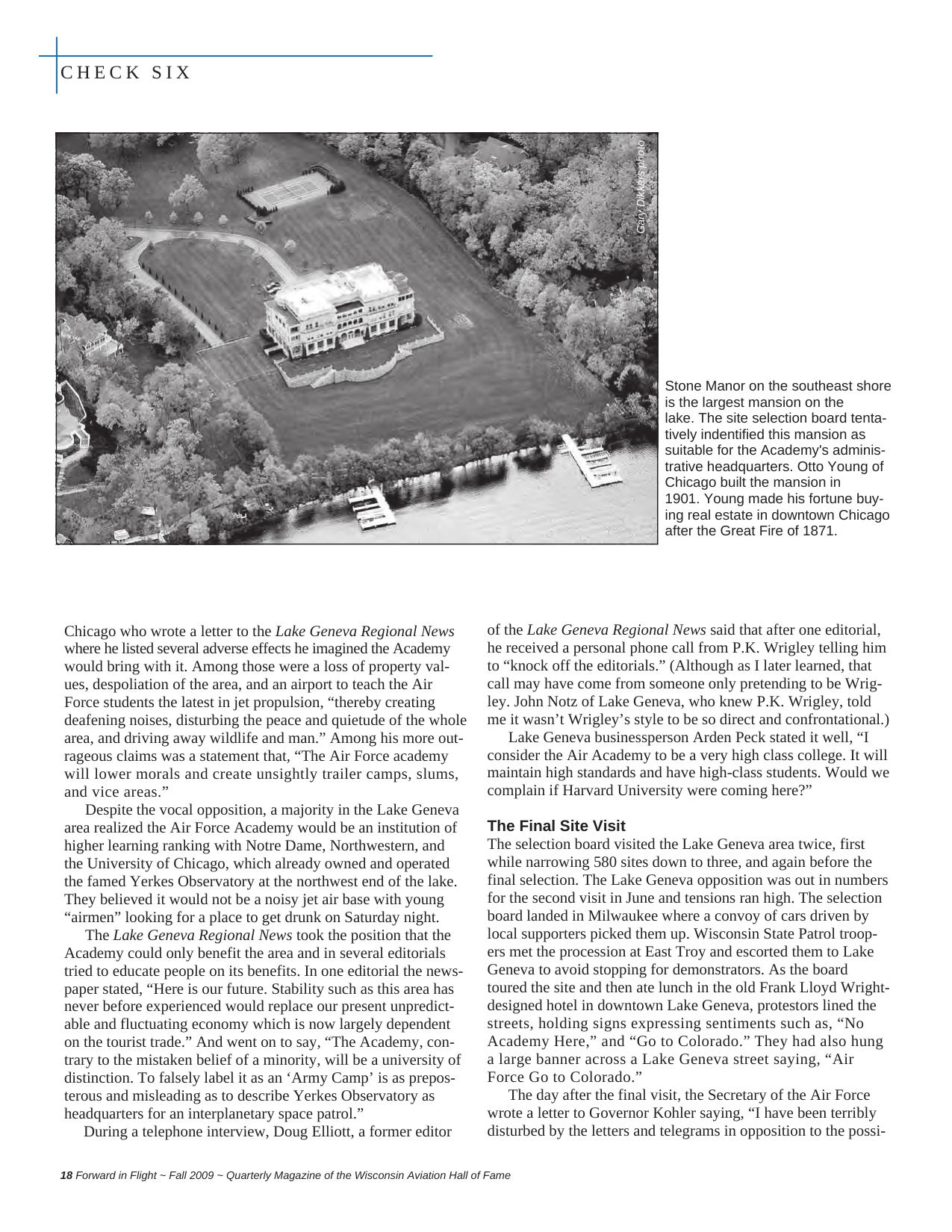
Gary Dikkers photo CHECK SIX Stone Manor on the southeast shore is the largest mansion on the lake. The site selection board tentatively indentified this mansion as suitable for the Academy's administrative headquarters. Otto Young of Chicago built the mansion in 1901. Young made his fortune buying real estate in downtown Chicago after the Great Fire of 1871. Chicago who wrote a letter to the Lake Geneva Regional News where he listed several adverse effects he imagined the Academy would bring with it. Among those were a loss of property values, despoliation of the area, and an airport to teach the Air Force students the latest in jet propulsion, “thereby creating deafening noises, disturbing the peace and quietude of the whole area, and driving away wildlife and man.” Among his more outrageous claims was a statement that, “The Air Force academy will lower morals and create unsightly trailer camps, slums, and vice areas.” Despite the vocal opposition, a majority in the Lake Geneva area realized the Air Force Academy would be an institution of higher learning ranking with Notre Dame, Northwestern, and the University of Chicago, which already owned and operated the famed Yerkes Observatory at the northwest end of the lake. They believed it would not be a noisy jet air base with young “airmen” looking for a place to get drunk on Saturday night. The Lake Geneva Regional News took the position that the Academy could only benefit the area and in several editorials tried to educate people on its benefits. In one editorial the newspaper stated, “Here is our future. Stability such as this area has never before experienced would replace our present unpredictable and fluctuating economy which is now largely dependent on the tourist trade.” And went on to say, “The Academy, contrary to the mistaken belief of a minority, will be a university of distinction. To falsely label it as an ‘Army Camp’ is as preposterous and misleading as to describe Yerkes Observatory as headquarters for an interplanetary space patrol.” During a telephone interview, Doug Elliott, a former editor of the Lake Geneva Regional News said that after one editorial, he received a personal phone call from P.K. Wrigley telling him to “knock off the editorials.” (Although as I later learned, that call may have come from someone only pretending to be Wrigley. John Notz of Lake Geneva, who knew P.K. Wrigley, told me it wasn’t Wrigley’s style to be so direct and confrontational.) Lake Geneva businessperson Arden Peck stated it well, “I consider the Air Academy to be a very high class college. It will maintain high standards and have high-class students. Would we complain if Harvard University were coming here?” The Final Site Visit The selection board visited the Lake Geneva area twice, first while narrowing 580 sites down to three, and again before the final selection. The Lake Geneva opposition was out in numbers for the second visit in June and tensions ran high. The selection board landed in Milwaukee where a convoy of cars driven by local supporters picked them up. Wisconsin State Patrol troopers met the procession at East Troy and escorted them to Lake Geneva to avoid stopping for demonstrators. As the board toured the site and then ate lunch in the old Frank Lloyd Wrightdesigned hotel in downtown Lake Geneva, protestors lined the streets, holding signs expressing sentiments such as, “No Academy Here,” and “Go to Colorado.” They had also hung a large banner across a Lake Geneva street saying, “Air Force Go to Colorado.” The day after the final visit, the Secretary of the Air Force wrote a letter to Governor Kohler saying, “I have been terribly disturbed by the letters and telegrams in opposition to the possi- 18 Forward in Flight ~ Fall 2009 ~ Quarterly Magazine of the Wisconsin Aviation Hall of Fame
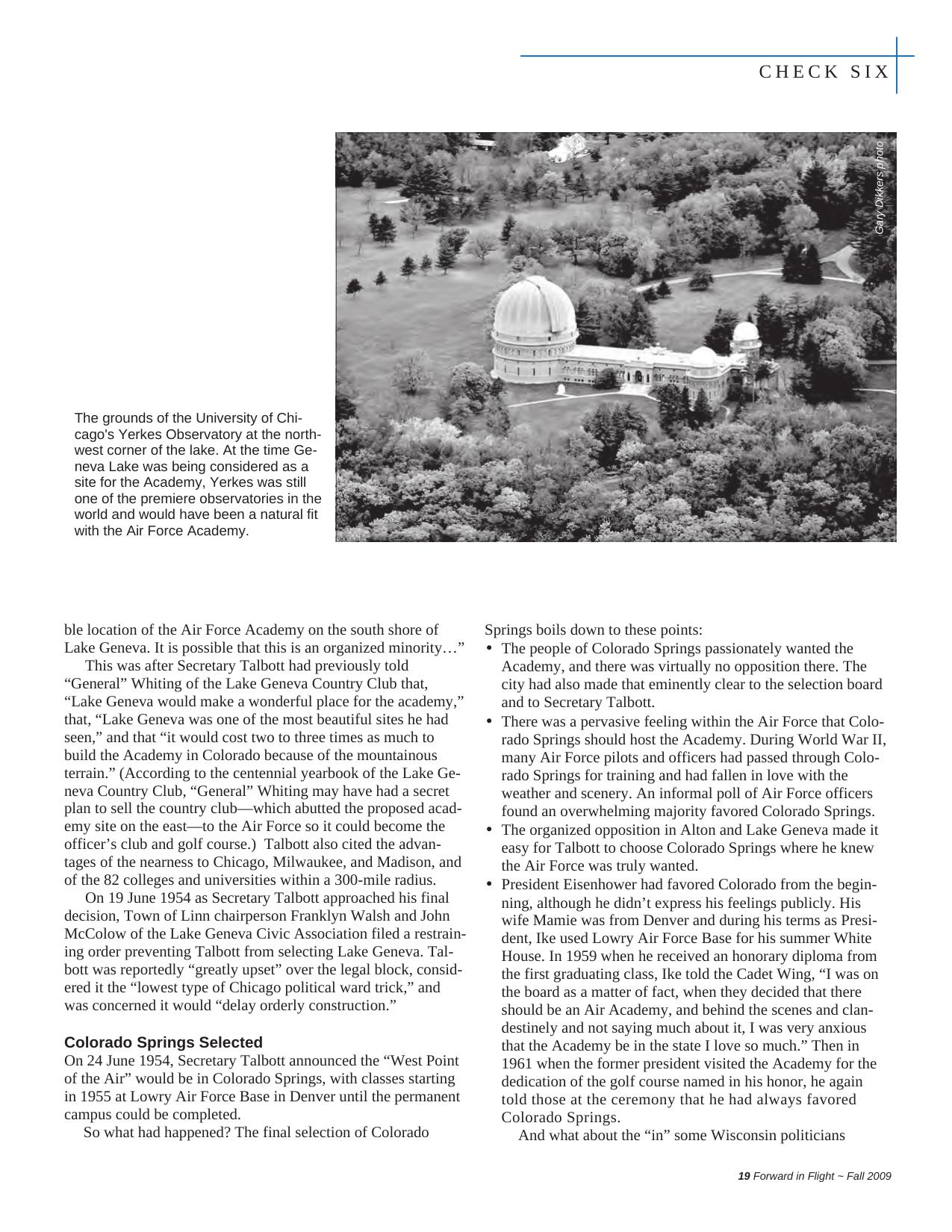
Gary Dikkers photo CHECK SIX The grounds of the University of Chicago's Yerkes Observatory at the northwest corner of the lake. At the time Geneva Lake was being considered as a site for the Academy, Yerkes was still one of the premiere observatories in the world and would have been a natural fit with the Air Force Academy. ble location of the Air Force Academy on the south shore of Lake Geneva. It is possible that this is an organized minority…” This was after Secretary Talbott had previously told “General” Whiting of the Lake Geneva Country Club that, “Lake Geneva would make a wonderful place for the academy,” that, “Lake Geneva was one of the most beautiful sites he had seen,” and that “it would cost two to three times as much to build the Academy in Colorado because of the mountainous terrain.” (According to the centennial yearbook of the Lake Geneva Country Club, “General” Whiting may have had a secret plan to sell the country club—which abutted the proposed academy site on the east—to the Air Force so it could become the officer’s club and golf course.) Talbott also cited the advantages of the nearness to Chicago, Milwaukee, and Madison, and of the 82 colleges and universities within a 300-mile radius. On 19 June 1954 as Secretary Talbott approached his final decision, Town of Linn chairperson Franklyn Walsh and John McColow of the Lake Geneva Civic Association filed a restraining order preventing Talbott from selecting Lake Geneva. Talbott was reportedly “greatly upset” over the legal block, considered it the “lowest type of Chicago political ward trick,” and was concerned it would “delay orderly construction.” Colorado Springs Selected On 24 June 1954, Secretary Talbott announced the “West Point of the Air” would be in Colorado Springs, with classes starting in 1955 at Lowry Air Force Base in Denver until the permanent campus could be completed. So what had happened? The final selection of Colorado Springs boils down to these points: • The people of Colorado Springs passionately wanted the Academy, and there was virtually no opposition there. The city had also made that eminently clear to the selection board and to Secretary Talbott. • There was a pervasive feeling within the Air Force that Colorado Springs should host the Academy. During World War II, many Air Force pilots and officers had passed through Colorado Springs for training and had fallen in love with the weather and scenery. An informal poll of Air Force officers found an overwhelming majority favored Colorado Springs. • The organized opposition in Alton and Lake Geneva made it easy for Talbott to choose Colorado Springs where he knew the Air Force was truly wanted. • President Eisenhower had favored Colorado from the beginning, although he didn’t express his feelings publicly. His wife Mamie was from Denver and during his terms as President, Ike used Lowry Air Force Base for his summer White House. In 1959 when he received an honorary diploma from the first graduating class, Ike told the Cadet Wing, “I was on the board as a matter of fact, when they decided that there should be an Air Academy, and behind the scenes and clandestinely and not saying much about it, I was very anxious that the Academy be in the state I love so much.” Then in 1961 when the former president visited the Academy for the dedication of the golf course named in his honor, he again told those at the ceremony that he had always favored Colorado Springs. And what about the “in” some Wisconsin politicians 19 Forward in Flight ~ Fall 2009
CHECK SIX thought they had, thinking Ike would offer the Academy to Wisconsin as a bargaining chip to get “Tail-gunner Joe” to shut up? It turned out that both Ike and Talbott detested Joe McCarthy, and that there was never a chance they would ever award a “plum” such as the Academy to Wisconsin while McCarthy was a senator. In fact, I found a document saying that Talbott’s wife (who also detested McCarthy) threatened to divorce Talbott if he gave the Academy to Wisconsin. Water and Elevation Despite the fact that Colorado Springs was almost a “lock” from the beginning, there were two possible deal breakers. The first was a concern about the millions of gallons of water the Academy would need. The City of Colorado Springs solved that by buying rights to bring water from the Western Slope of Colorado to the Front Range. However, water has always been a critical issue along the Front Range, and as the population of the Colorado Springs area mushroomed from about 50,000 in 1954, to more than 600,000 people today, potential water shortages are reaching crisis proportions. It turned out that both Ike and Talbott detested Joe McCarthy, and that there was never a chance they would award a “plum” such as the Academy to Wisconsin while McCarthy was a senator. The other potential “deal breaker” was the Academy’s elevation of more than 7,000 feet above sea level. During the 1950s, the Civil Aeronautics Authority (today’s FAA) wouldn’t certify basic flight training at airports with elevations of more than 3,000 feet. Air Force policy was also not to locate primary flying training bases at elevations of more than 3,000 feet. Many expressed deep concern that the Colorado site was simply too high for the basic flight training cadets would receive. Charles Lindbergh resolved that issue. On 28 May 1954, Lindbergh, Hancher, and Meigs made a secret visit to Colorado Springs to rent an airplane and fly over the site. Located on what is now the Academy was a small private airport that had a small assortment of old airplanes to rent. Lindbergh went into the airport office and asked if he could rent an airplane. The airport manager didn’t recognize Lindbergh and asked, “Do you know how to fly?” Lindbergh quietly answered, “I think I can fly.” The manager then asked, “Do you have a license?” Lindbergh now realized the airport manager didn’t know who he was, and answered, “Yes, I have a license.” “Well,” said the manager, “I have to see your license.” Upon this challenge, Lindbergh pulled out his billfold, started pulling out a dozen flying certificates from countries all over the world, and laid them on the manager’s desk. The manager turned red with embarrassment at not recognizing the world’s most famous aviator. He rented Lindbergh a small Stinson. Upon this challenge, Lindbergh pulled out his billfold, started pulling out a dozen flying certificates from countries all over the world, and laid them on the manager’s desk. The manager turned red with embarrassment at not recognizing the world’s most famous aviator. To view the potential site and to test the flying conditions, Lindbergh took Hancher and Meigs for a flight. After landing, Lindbergh simply said, “It will do.” It wasn’t until months later that Dr. Hancher reported they had almost crashed the overloaded airplane when Lindbergh got caught in a downdraft and had just barely cleared a ridgeline. USAFA and Frank Lloyd Wright Besides almost being in Lake Geneva, Wisconsin’s famed architect Frank Lloyd Wright nearly designed the Academy. After Lindbergh’s work on the site selection committee was done, Wright cabled his good friend saying, “Your eye for a site is as good as your eye for flight.” Wright’s Taliesin workshop then drew a proposed design, forwarded it to Washington, and in 1955 it became one of the two finalists in the design competition. However, Secretary Talbott became concerned over what he called Wright’s “communist” leanings, and also about an American Legion threat to make an issue of Wright’s declared opposition to using American military force. Wright didn’t help his case when he refused to go to Washington to sell his design saying, “I assume that an architect shouldn’t be asked to plead his case or tell who he is. The world knows what I can do in architecture. If officials of the Air Force have missed this, I can do more than feel sorry for what both have lost.” Piqued, Wright then withdrew his design from the final competition. (From The Fellowship: The untold story of Frank Lloyd Wright and the Taliesen Fellowship, Regan Books, 2006.) What Ifs Was Colorado Springs the right choice? Having gone to school there and over the years come to appreciate fully the spectacular beauty of the site, I must say without qualification, “Yes.” But I also can't help wondering what might have been. What if “Tail-gunner Joe” McCarthy had not been a Wisconsin senator in 1954? What if Colorado Springs had not been able to guarantee the Academy's water supply? And perhaps the biggest question: What if Charles Lindbergh had not been able to clear that ridgeline while flying an overloaded, rented Stinson on a turbulent day in May 1954? The Academy at Colorado Springs has become a national landmark as the selection board intended. But if the stars had been aligned just a bit differently, one can’t help feeling that landmark could now be in Wisconsin. 20 Forward in Flight ~ Fall 2009 ~ Quarterly Magazine of the Wisconsin Aviation Hall of Fame
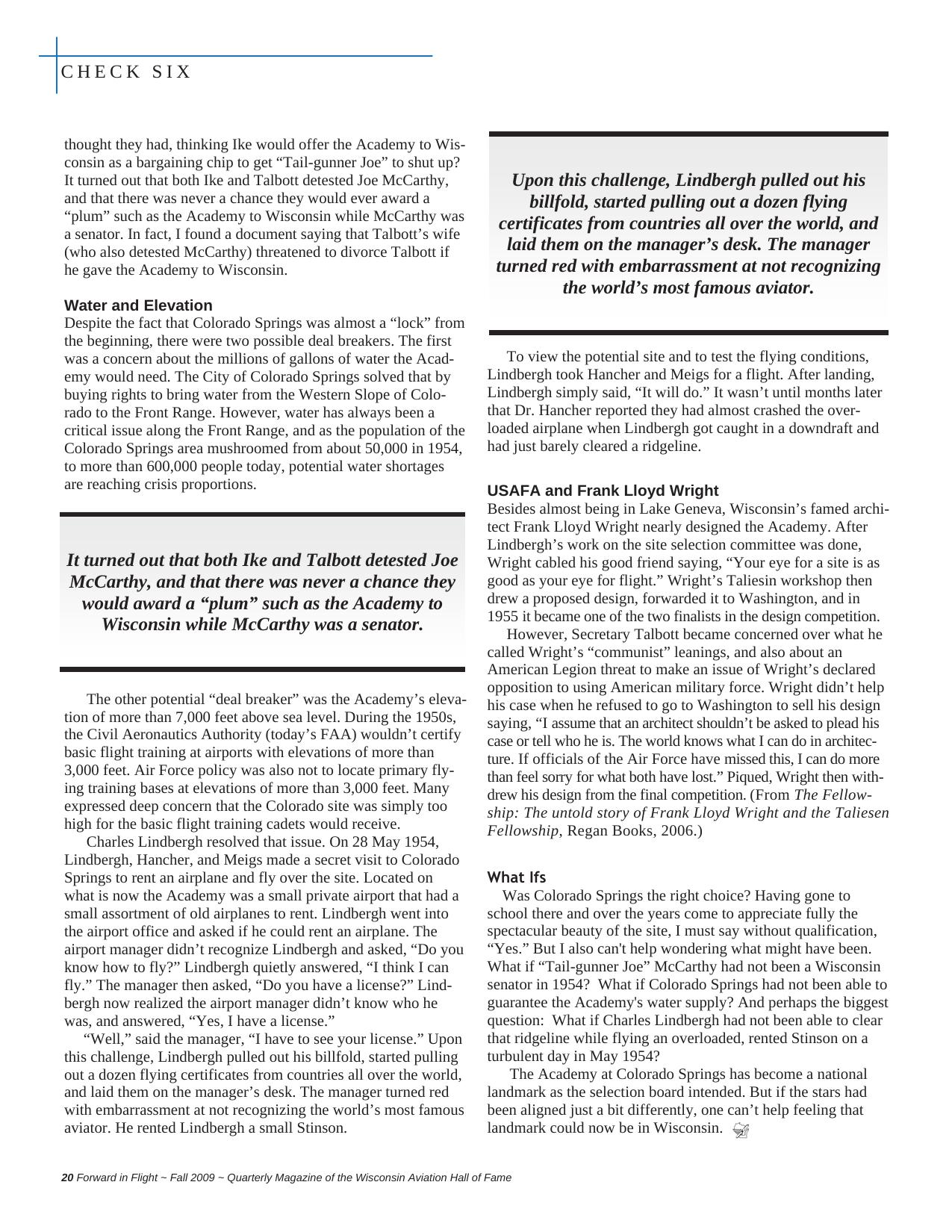
CHECK SIX The campus of the U.S. Air Force Academy as it appears today in Colorado. Three of the main buildings are named for WAHF inductees Billy Mitchell, Hoyt S. Vandenberg, and Lance Sijan. U.S. Air Force photo. Special thanks to Dr. Betsey Muenger, USAF Academy Command Historian, who allowed access to the Academy library’s special historical collections in October 2008, and to Cadet Kevin LaCosse, with whom I exchanged information while he was working on a history research project on this subject. Kevin is a native of Fontana-on-Geneva Lake and will graduate in 2011. Also special thanks to several longtime residents of Lake Geneva who responded to a letter I sent to the Lake Geneva Regional News asking for information and anecdotes from those who remembered the site selection visits in 1954. I have done my best to report your stories faithfully. Forward in Flight contributor Gary Dikkers was a Forward Air Controller and fighter pilot in the U.S. Air Force. After retiring from the Air Force, he and his family settled in Madison. He is now with the Wisconsin Dept. of Transportation’s Bureau of Aeronautics and is Wisconsin’s airspace manager. 21 Forward in Flight ~ Fall 2009
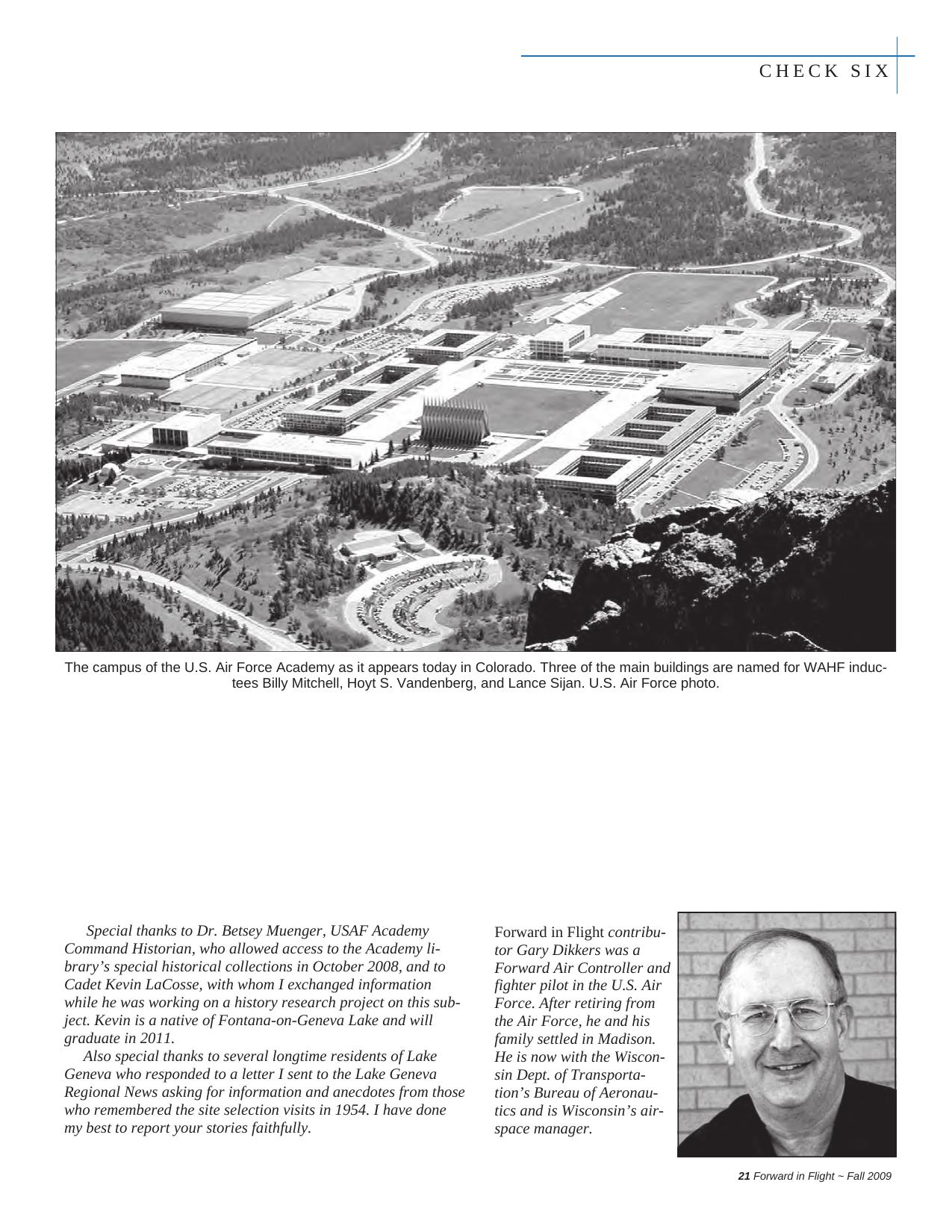
FROM THE ARCHIVES A Pair of Travel Airs, A Headless Pusher, and Sputnik IV All have a place in Wisconsin aviation history By Michael Goc the landing gear. He suspended the tube below the gear and climbed in like a kid on a swing. He stayed there for about 15 minutes while Morey circled the center of town. Goodyear got its money’s worth of attention. All went well until the stuntman tried to climb out of the tube and back onto the landing gear. The tube was coated with a slick layer of talcum powder and every time the stuntman tried to grab it, his hands slipped off. Morey had no idea what was going on. Guessing that the stuntman could not climb back onto the wing, he headed for Lake Monona and dropped to the wave tops to give him a chance to drop off safely. After a few circles around, Morey didn’t see a splash and feared for the worse. With fuel running low, he made for the airport. As he was making his final approach, Morey saw the desperate stuntman clamber onto the lower wing of the Jenny. That exploit was a warm up for Morey’s aerial refueling demonstrations. He had a student, a medical doctor, named Frank Dean. They had heard about in-air refueling and decided to give it try. Morey had become an owner and dealer of Travel Air cabin planes and he had a pair available for the test. They WAHF Archives Howard Morey was the small town boy from Birchwood, in northwestern Wisconsin, who became one of the founding fathers of commercial aviation in Madison. After completing at least four hours of training at the Heath Flying School in Chicago, he became an instructor himself. In less than a year, he saved $400 to buy a half-interest in a war-surplus Curtiss JN-4. On his way home to Birchwood in late 1925, he landed in Madison, and there he stayed. He was 22 years old. Morey opened an airport in Madison on the shore of Lake Monona in 1926 and soon became known as the number one aviator in town. In addition to the usual barnstorming feats, he gained fame as the pilot who could drop a baseball right on the pitchers mound for opening day of the Madison team at Breese Field. When the Goodyear Tire Company needed some positive publicity, it hired Morey and a daredevil stuntman to demonstrate the durability of Goodyear inner tubes. They took off with a Goodyear tube mounted in the landing gear. When they reached the Capitol downtown, the stuntman climbed out of the cockpit, walked the wings for a spell, and then climbed down to Morey began selling Travel Airs in the 1920s from his Madison airport. 22 Forward in Flight ~ Fall 2009 ~ Quarterly Magazine of the Wisconsin Aviation Hall of Fame
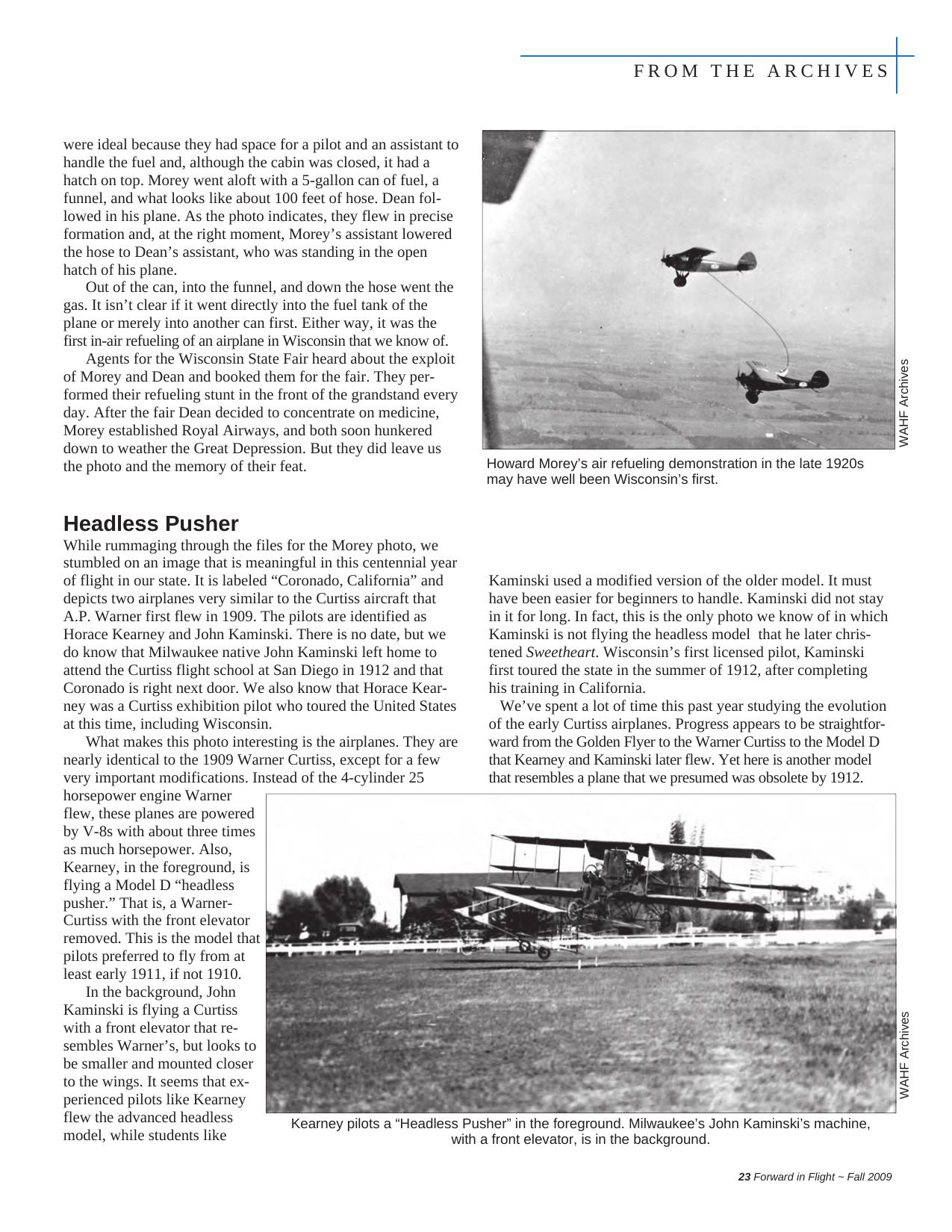
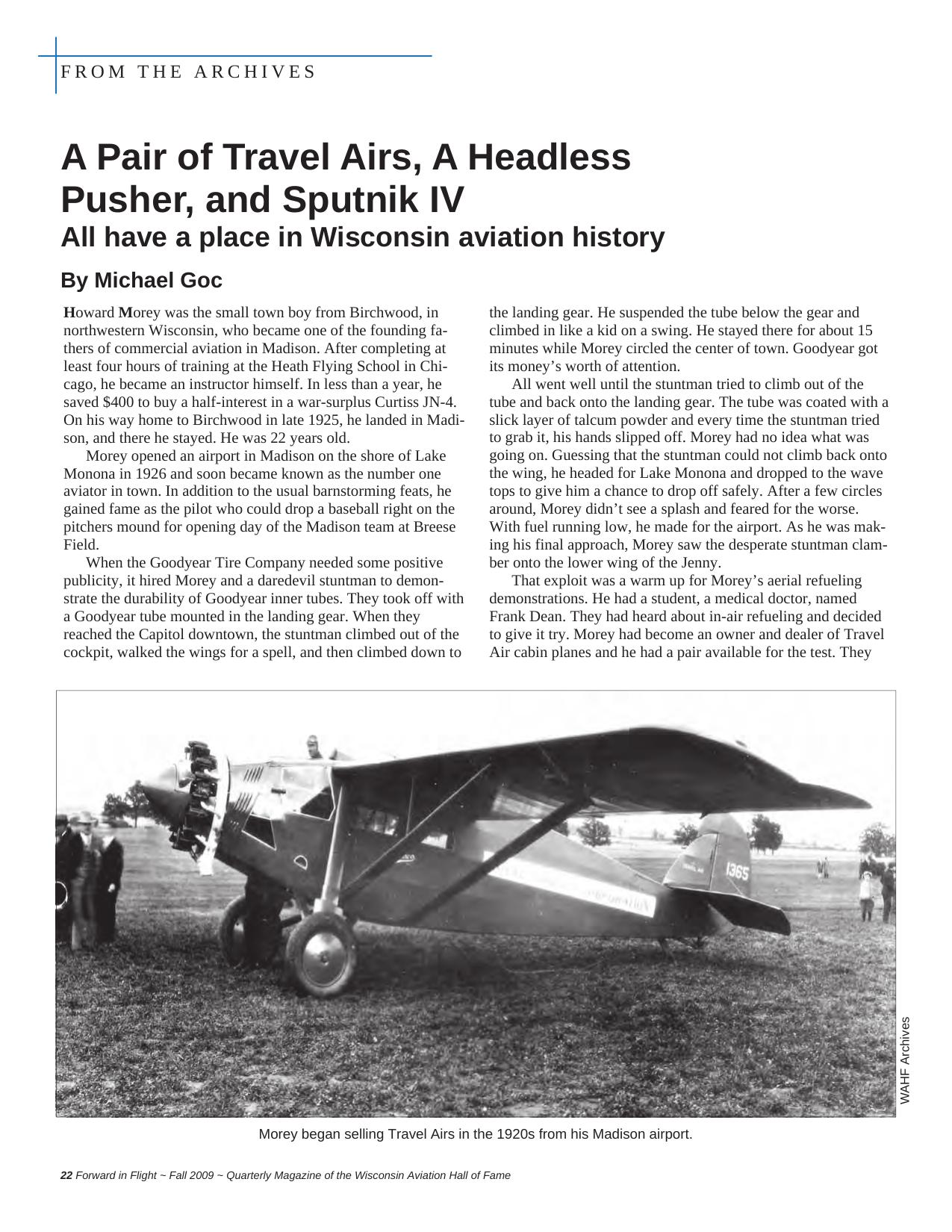
were ideal because they had space for a pilot and an assistant to handle the fuel and, although the cabin was closed, it had a hatch on top. Morey went aloft with a 5-gallon can of fuel, a funnel, and what looks like about 100 feet of hose. Dean followed in his plane. As the photo indicates, they flew in precise formation and, at the right moment, Morey’s assistant lowered the hose to Dean’s assistant, who was standing in the open hatch of his plane. Out of the can, into the funnel, and down the hose went the gas. It isn’t clear if it went directly into the fuel tank of the plane or merely into another can first. Either way, it was the first in-air refueling of an airplane in Wisconsin that we know of. Agents for the Wisconsin State Fair heard about the exploit of Morey and Dean and booked them for the fair. They performed their refueling stunt in the front of the grandstand every day. After the fair Dean decided to concentrate on medicine, Morey established Royal Airways, and both soon hunkered down to weather the Great Depression. But they did leave us the photo and the memory of their feat. WAHF Archives FROM THE ARCHIVES Howard Morey’s air refueling demonstration in the late 1920s may have well been Wisconsin’s first. While rummaging through the files for the Morey photo, we stumbled on an image that is meaningful in this centennial year Kaminski used a modified version of the older model. It must of flight in our state. It is labeled “Coronado, California” and have been easier for beginners to handle. Kaminski did not stay depicts two airplanes very similar to the Curtiss aircraft that in it for long. In fact, this is the only photo we know of in which A.P. Warner first flew in 1909. The pilots are identified as Kaminski is not flying the headless model that he later chrisHorace Kearney and John Kaminski. There is no date, but we tened Sweetheart. Wisconsin’s first licensed pilot, Kaminski do know that Milwaukee native John Kaminski left home to first toured the state in the summer of 1912, after completing attend the Curtiss flight school at San Diego in 1912 and that his training in California. Coronado is right next door. We also know that Horace KearWe’ve spent a lot of time this past year studying the evolution ney was a Curtiss exhibition pilot who toured the United States of the early Curtiss airplanes. Progress appears to be straightforat this time, including Wisconsin. ward from the Golden Flyer to the Warner Curtiss to the Model D What makes this photo interesting is the airplanes. They are that Kearney and Kaminski later flew. Yet here is another model nearly identical to the 1909 Warner Curtiss, except for a few that resembles a plane that we presumed was obsolete by 1912. very important modifications. Instead of the 4-cylinder 25 horsepower engine Warner flew, these planes are powered by V-8s with about three times as much horsepower. Also, Kearney, in the foreground, is flying a Model D “headless pusher.” That is, a WarnerCurtiss with the front elevator removed. This is the model that pilots preferred to fly from at least early 1911, if not 1910. In the background, John Kaminski is flying a Curtiss with a front elevator that resembles Warner’s, but looks to be smaller and mounted closer to the wings. It seems that experienced pilots like Kearney flew the advanced headless Kearney pilots a “Headless Pusher” in the foreground. Milwaukee’s John Kaminski’s machine, model, while students like with a front elevator, is in the background. 23 Forward in Flight ~ Fall 2009 WAHF Archives Headless Pusher
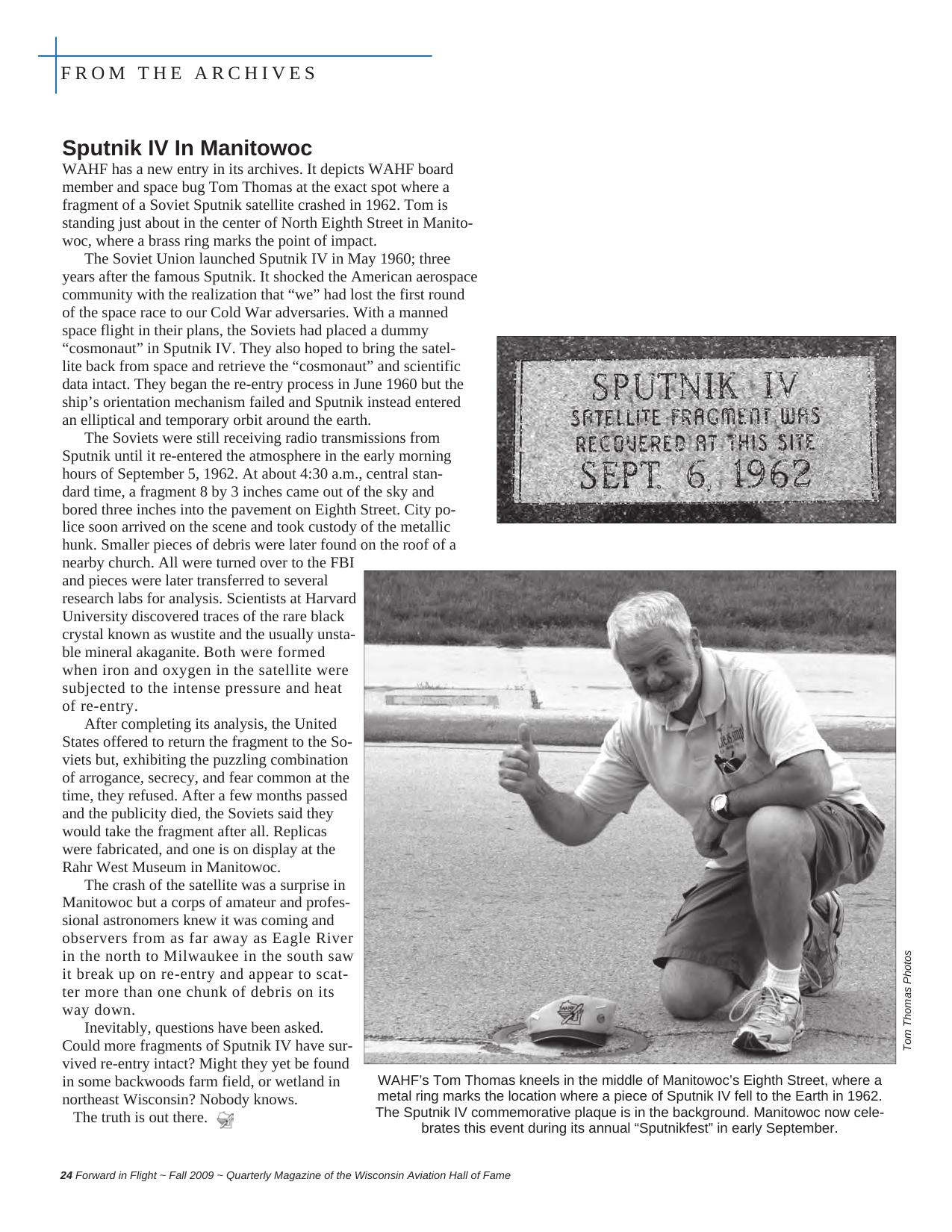
FROM THE ARCHIVES WAHF has a new entry in its archives. It depicts WAHF board member and space bug Tom Thomas at the exact spot where a fragment of a Soviet Sputnik satellite crashed in 1962. Tom is standing just about in the center of North Eighth Street in Manitowoc, where a brass ring marks the point of impact. The Soviet Union launched Sputnik IV in May 1960; three years after the famous Sputnik. It shocked the American aerospace community with the realization that “we” had lost the first round of the space race to our Cold War adversaries. With a manned space flight in their plans, the Soviets had placed a dummy “cosmonaut” in Sputnik IV. They also hoped to bring the satellite back from space and retrieve the “cosmonaut” and scientific data intact. They began the re-entry process in June 1960 but the ship’s orientation mechanism failed and Sputnik instead entered an elliptical and temporary orbit around the earth. The Soviets were still receiving radio transmissions from Sputnik until it re-entered the atmosphere in the early morning hours of September 5, 1962. At about 4:30 a.m., central standard time, a fragment 8 by 3 inches came out of the sky and bored three inches into the pavement on Eighth Street. City police soon arrived on the scene and took custody of the metallic hunk. Smaller pieces of debris were later found on the roof of a nearby church. All were turned over to the FBI and pieces were later transferred to several research labs for analysis. Scientists at Harvard University discovered traces of the rare black crystal known as wustite and the usually unstable mineral akaganite. Both were formed when iron and oxygen in the satellite were subjected to the intense pressure and heat of re-entry. After completing its analysis, the United States offered to return the fragment to the Soviets but, exhibiting the puzzling combination of arrogance, secrecy, and fear common at the time, they refused. After a few months passed and the publicity died, the Soviets said they would take the fragment after all. Replicas were fabricated, and one is on display at the Rahr West Museum in Manitowoc. The crash of the satellite was a surprise in Manitowoc but a corps of amateur and professional astronomers knew it was coming and observers from as far away as Eagle River in the north to Milwaukee in the south saw it break up on re-entry and appear to scatter more than one chunk of debris on its way down. Inevitably, questions have been asked. Could more fragments of Sputnik IV have survived re-entry intact? Might they yet be found WAHF’s Tom Thomas kneels in the middle of Manitowoc’s Eighth Street, where a in some backwoods farm field, or wetland in metal ring marks the location where a piece of Sputnik IV fell to the Earth in 1962. northeast Wisconsin? Nobody knows. The Sputnik IV commemorative plaque is in the background. Manitowoc now celeThe truth is out there. brates this event during its annual “Sputnikfest” in early September. 24 Forward in Flight ~ Fall 2009 ~ Quarterly Magazine of the Wisconsin Aviation Hall of Fame Tom Thomas Photos Sputnik IV In Manitowoc

BOOK REVIEW Lucky Dog Douglas Holt, 381st Bomb Group A Review by Frederick Beseler When I was a kid in the 1960s I must have read almost every Ballantine and Pocket book paperback about World War II flying that was offered. Many of those books still reside on my book shelves— books like God Is My Co-Pilot by Colonel Robert Scott of the Flying Tigers; Samurai by Saburo Sakai; Wing Leader by Johnny Johnson, and Robert S. Johnson’s Thunderbolt. I especially enjoyed reading about the B-17s in such books as Bert Stile’s immortal Serenade to the Big Bird. And there was Black Thursday, the story of the raid on the Schweinfurt ball bearing works in Germany. After finishing each book I always wondered, “How’d they do it?“ For me, Doug Holt’s recently published book Lucky Dog—The Experiences of One Member of the U.S. Army Air Corps During World War II begins to answer that question. And what a story it is. I met Doug at the 2009 Pietenpol Reunion fly-in at Brodhead, Wisconsin. Doug is a long-time friend of the late Al Kelch, an antique airplane collector and restorer extraordinaire. Doug had set up in one of Al’s hangars with a stack of his books to sell. “That’s me on the cover! I flew 35 missions in B-17s. Can you imagine—a 19-year-old kid?” Doug exclaimed. We visited for nearly an hour that afternoon at Brodhead. Doug went on to tell me how he managed to get into the Army Air Corps. He had graduated from Milwaukee’s Washington High School in June, 1942, and then worked as a grocery clerk and truck driver until March, 1943, when, after passing a variety of tests, he was allowed to enlist in the Army Air Corps as a cadet. Doug told me that like many veterans, he didn’t talk about the war for many years, but several years ago the 8th Air Force Association asked its members to write down their experiences. Searching his memory and with help from a small diary that he had kept during the war, Doug was as surprised as anyone when he discovered how many pages he had entered into his home computer. He made copies and sent them out to friends and relatives. He went on to do additional research—checking official records and contacting members of his bomber’s crew to verify various incidents during their combat tour between July and November 1944. Then somebody suggested that he ought to put it all into book form. Here then is his story of 35 missions with the 381st Bomb Group of the 8th Air Force. He starts with his training, then a risky flight across the North Atlantic to England, and then his combat missions. Doug saw it all. That he survived is best described by the title of his book. Each mission is recounted, some in more detail than others are, but each includes the entry from his diary. For example, Mission 6 to Merseberg, Germany, July 28, Field Morey 1944, “Made out pretty good.” Just days later, Mission 10, August 8, 1944, flying the B-17 “Passaic Warrior” to Cauvicort, France, Doug noted: “Really rough! About 80 holes in ship. A hit in window on my side, main spar in bomb bay hit.” A month later, September 8, 1944, Mission 18 to Ludwigshafen, Germany: “Really scared. Hit in gas tank. Lost a lot of gas. Very cold. Over the hump at last. 18 holes in ship.” On Mission 20 it all nearly ended for Doug and the rest of his crew when they flew right into a flak burst, showering the plane with shrapnel and starting an electrical fire. A piece of flak hit Doug right between the eyes, slamming his head against the seat. And then the Number one engine caught fire. You’ll have to read Lucky Dog to get the rest of the story. I recommend it. Doug Holt has written a book that has finally answered for me the question, “How’d they do it?” Doug will tell you that he was, without a doubt, a “Lucky Dog.” His story is also that of so many other bomber crews. In the dedication of Lucky Dog, Doug writes, “This book is dedicated to one of the best B-17 crews in the 8th Air Force. In 2002, the year my dear friend Bill Black passed away, he said: ‘We were lucky, but as a crew we also did the right things at the right time, which allowed us to survive no matter what fate threw at us.’” This is why they are called “the greatest generation.” Lucky Dog can be ordered for $16, including shipping, directly from Doug. Send a check to: Doug Holt 13106 Northwest Shoreland Dr Mequon, WI 53097 25 Forward in Flight ~ Fall 2009
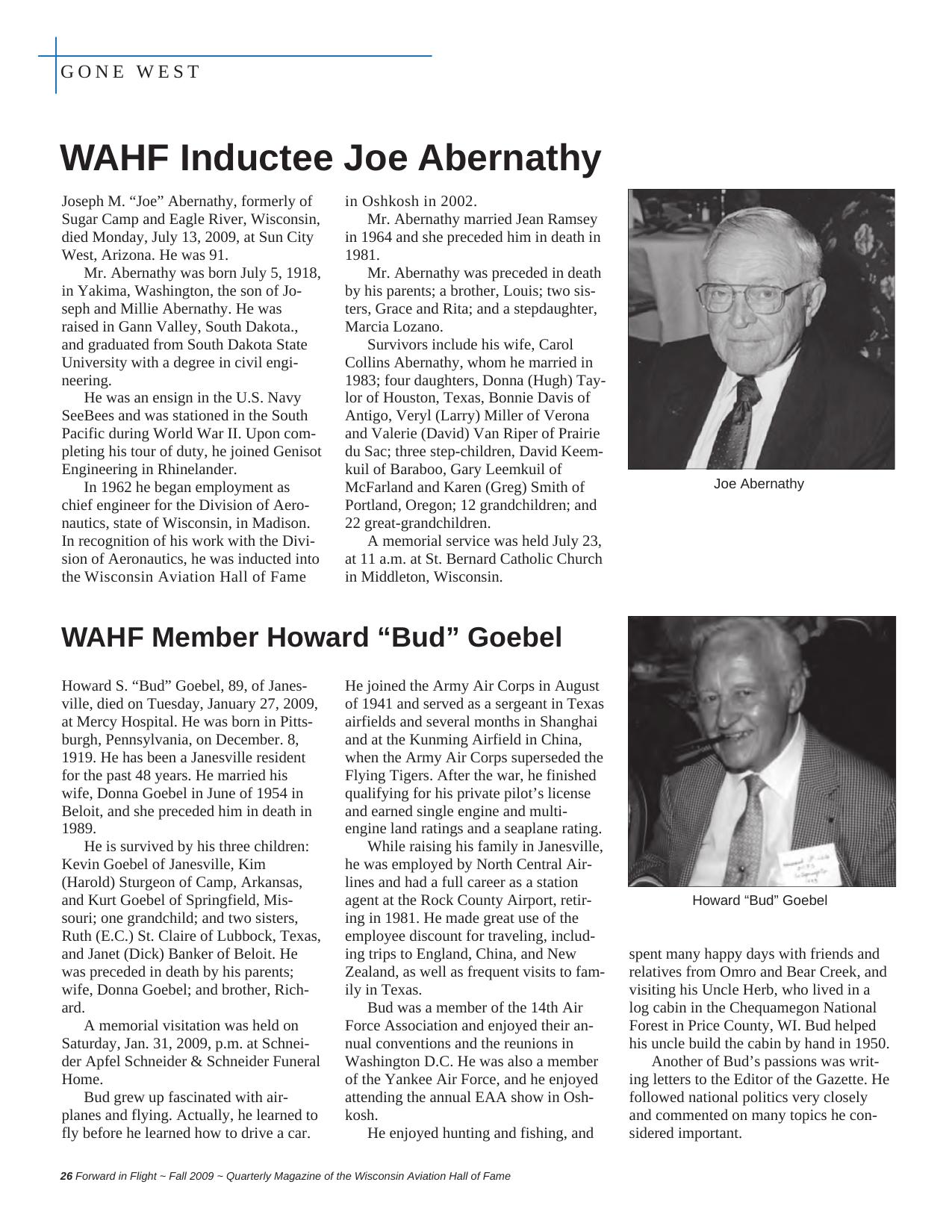
GONE WEST WAHF Inductee Joe Abernathy Joseph M. “Joe” Abernathy, formerly of Sugar Camp and Eagle River, Wisconsin, died Monday, July 13, 2009, at Sun City West, Arizona. He was 91. Mr. Abernathy was born July 5, 1918, in Yakima, Washington, the son of Joseph and Millie Abernathy. He was raised in Gann Valley, South Dakota., and graduated from South Dakota State University with a degree in civil engineering. He was an ensign in the U.S. Navy SeeBees and was stationed in the South Pacific during World War II. Upon completing his tour of duty, he joined Genisot Engineering in Rhinelander. In 1962 he began employment as chief engineer for the Division of Aeronautics, state of Wisconsin, in Madison. In recognition of his work with the Division of Aeronautics, he was inducted into the Wisconsin Aviation Hall of Fame in Oshkosh in 2002. Mr. Abernathy married Jean Ramsey in 1964 and she preceded him in death in 1981. Mr. Abernathy was preceded in death by his parents; a brother, Louis; two sisters, Grace and Rita; and a stepdaughter, Marcia Lozano. Survivors include his wife, Carol Collins Abernathy, whom he married in 1983; four daughters, Donna (Hugh) Taylor of Houston, Texas, Bonnie Davis of Antigo, Veryl (Larry) Miller of Verona and Valerie (David) Van Riper of Prairie du Sac; three step-children, David Keemkuil of Baraboo, Gary Leemkuil of McFarland and Karen (Greg) Smith of Portland, Oregon; 12 grandchildren; and 22 great-grandchildren. A memorial service was held July 23, at 11 a.m. at St. Bernard Catholic Church in Middleton, Wisconsin. Joe Abernathy WAHF Member Howard “Bud” Goebel Howard S. “Bud” Goebel, 89, of Janesville, died on Tuesday, January 27, 2009, at Mercy Hospital. He was born in Pittsburgh, Pennsylvania, on December. 8, 1919. He has been a Janesville resident for the past 48 years. He married his wife, Donna Goebel in June of 1954 in Beloit, and she preceded him in death in 1989. He is survived by his three children: Kevin Goebel of Janesville, Kim (Harold) Sturgeon of Camp, Arkansas, and Kurt Goebel of Springfield, Missouri; one grandchild; and two sisters, Ruth (E.C.) St. Claire of Lubbock, Texas, and Janet (Dick) Banker of Beloit. He was preceded in death by his parents; wife, Donna Goebel; and brother, Richard. A memorial visitation was held on Saturday, Jan. 31, 2009, p.m. at Schneider Apfel Schneider & Schneider Funeral Home. Bud grew up fascinated with airplanes and flying. Actually, he learned to fly before he learned how to drive a car. He joined the Army Air Corps in August of 1941 and served as a sergeant in Texas airfields and several months in Shanghai and at the Kunming Airfield in China, when the Army Air Corps superseded the Flying Tigers. After the war, he finished qualifying for his private pilot’s license and earned single engine and multiengine land ratings and a seaplane rating. While raising his family in Janesville, he was employed by North Central Airlines and had a full career as a station agent at the Rock County Airport, retiring in 1981. He made great use of the employee discount for traveling, including trips to England, China, and New Zealand, as well as frequent visits to family in Texas. Bud was a member of the 14th Air Force Association and enjoyed their annual conventions and the reunions in Washington D.C. He was also a member of the Yankee Air Force, and he enjoyed attending the annual EAA show in Oshkosh. He enjoyed hunting and fishing, and 26 Forward in Flight ~ Fall 2009 ~ Quarterly Magazine of the Wisconsin Aviation Hall of Fame Howard “Bud” Goebel spent many happy days with friends and relatives from Omro and Bear Creek, and visiting his Uncle Herb, who lived in a log cabin in the Chequamegon National Forest in Price County, WI. Bud helped his uncle build the cabin by hand in 1950. Another of Bud’s passions was writing letters to the Editor of the Gazette. He followed national politics very closely and commented on many topics he considered important.
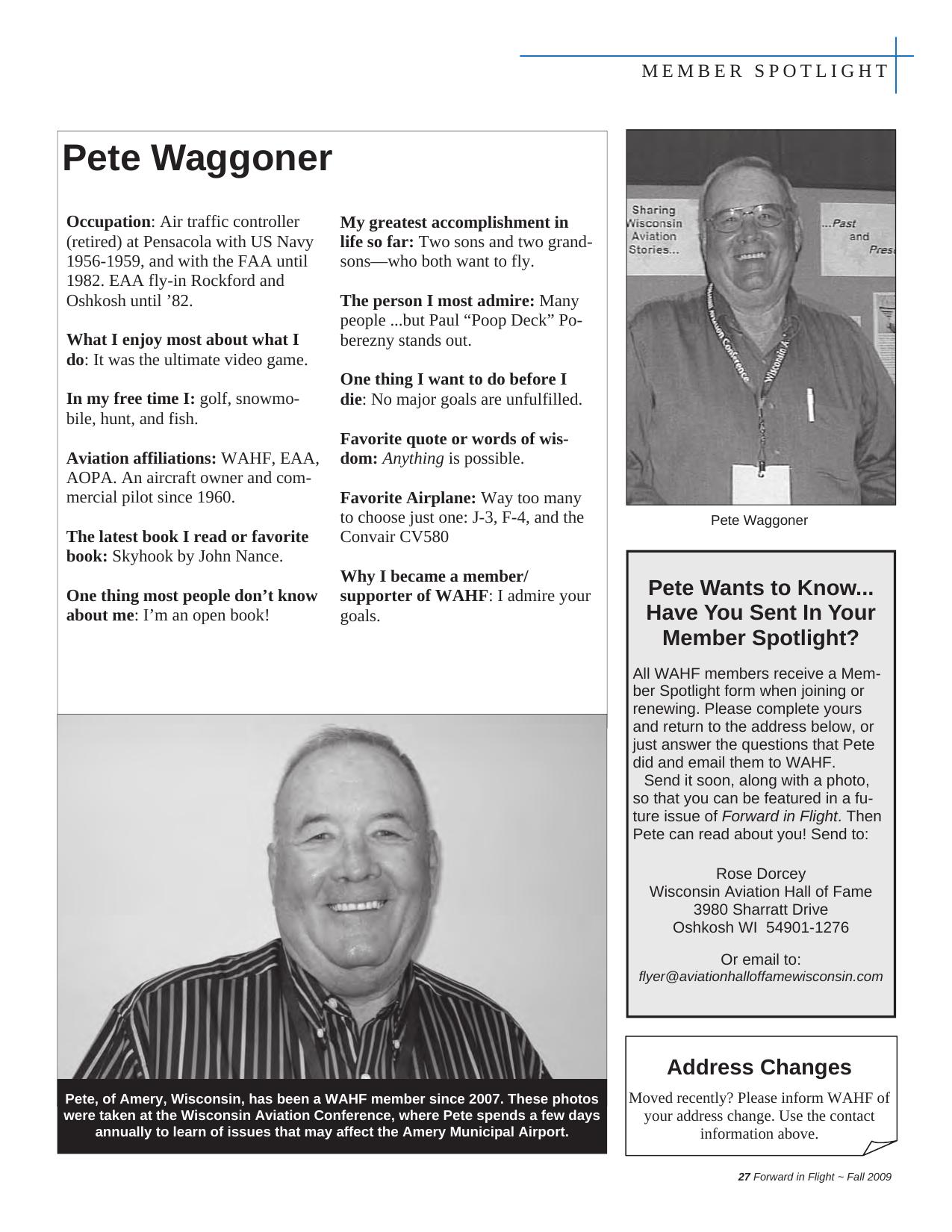
MEMBER SPOTLIGHT Pete Waggoner Occupation: Air traffic controller (retired) at Pensacola with US Navy 1956-1959, and with the FAA until 1982. EAA fly-in Rockford and Oshkosh until ’82. What I enjoy most about what I do: It was the ultimate video game. In my free time I: golf, snowmobile, hunt, and fish. Aviation affiliations: WAHF, EAA, AOPA. An aircraft owner and commercial pilot since 1960. The latest book I read or favorite book: Skyhook by John Nance. One thing most people don’t know about me: I’m an open book! My greatest accomplishment in life so far: Two sons and two grandsons—who both want to fly. The person I most admire: Many people ...but Paul “Poop Deck” Poberezny stands out. One thing I want to do before I die: No major goals are unfulfilled. Favorite quote or words of wisdom: Anything is possible. Favorite Airplane: Way too many to choose just one: J-3, F-4, and the Convair CV580 Why I became a member/ supporter of WAHF: I admire your goals. Pete Waggoner Pete Wants to Know... Have You Sent In Your Member Spotlight? All WAHF members receive a Member Spotlight form when joining or renewing. Please complete yours and return to the address below, or just answer the questions that Pete did and email them to WAHF. Send it soon, along with a photo, so that you can be featured in a future issue of Forward in Flight. Then Pete can read about you! Send to: Rose Dorcey Wisconsin Aviation Hall of Fame 3980 Sharratt Drive Oshkosh WI 54901-1276 Or email to: flyer@aviationhalloffamewisconsin.com Address Changes Pete, of Amery, Wisconsin, has been a WAHF member since 2007. These photos were taken at the Wisconsin Aviation Conference, where Pete spends a few days annually to learn of issues that may affect the Amery Municipal Airport. Moved recently? Please inform WAHF of your address change. Use the contact information above. 27 Forward in Flight ~ Fall 2009
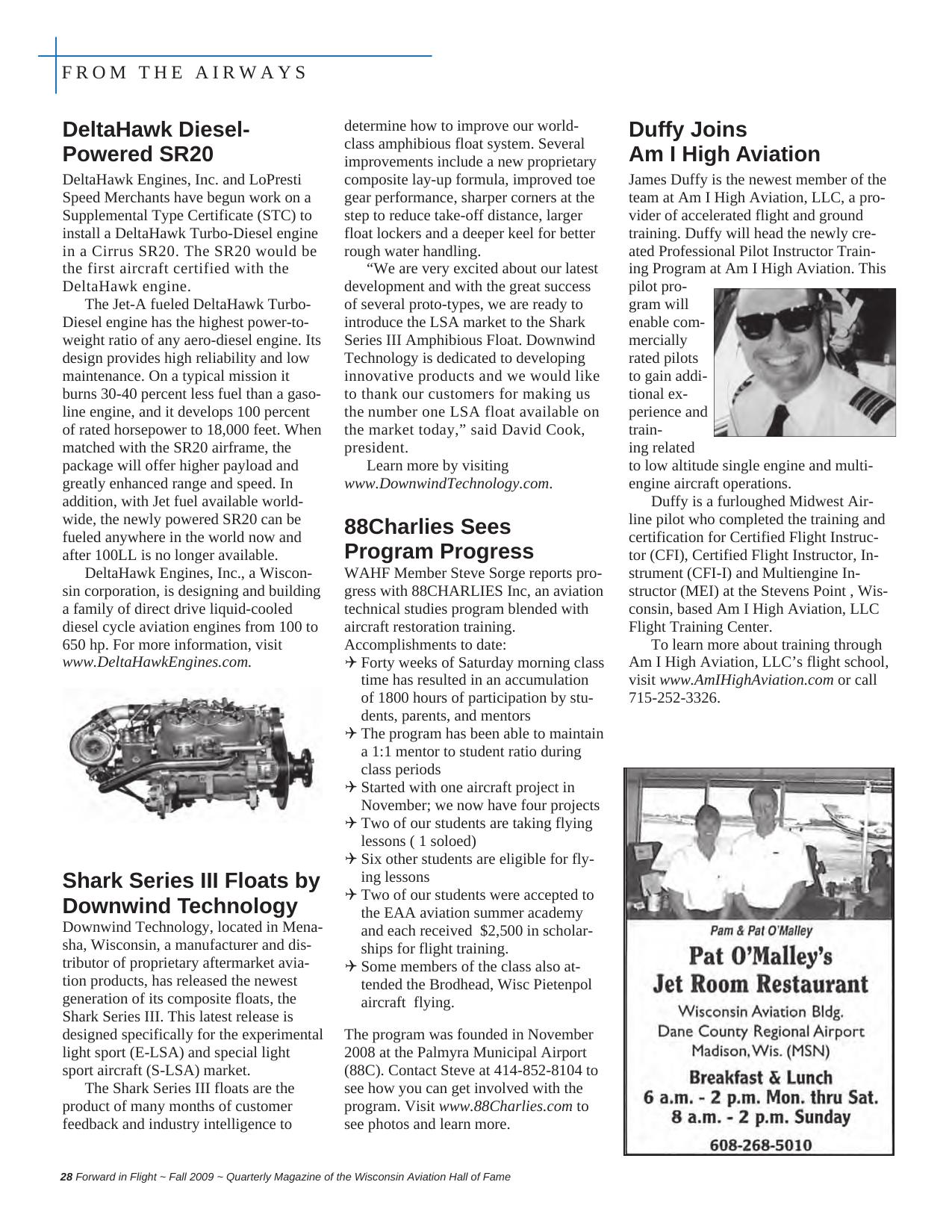
FROM THE AIRWAYS DeltaHawk DieselPowered SR20 DeltaHawk Engines, Inc. and LoPresti Speed Merchants have begun work on a Supplemental Type Certificate (STC) to install a DeltaHawk Turbo-Diesel engine in a Cirrus SR20. The SR20 would be the first aircraft certified with the DeltaHawk engine. The Jet-A fueled DeltaHawk TurboDiesel engine has the highest power-toweight ratio of any aero-diesel engine. Its design provides high reliability and low maintenance. On a typical mission it burns 30-40 percent less fuel than a gasoline engine, and it develops 100 percent of rated horsepower to 18,000 feet. When matched with the SR20 airframe, the package will offer higher payload and greatly enhanced range and speed. In addition, with Jet fuel available worldwide, the newly powered SR20 can be fueled anywhere in the world now and after 100LL is no longer available. DeltaHawk Engines, Inc., a Wisconsin corporation, is designing and building a family of direct drive liquid-cooled diesel cycle aviation engines from 100 to 650 hp. For more information, visit www.DeltaHawkEngines.com. Shark Series III Floats by Downwind Technology Downwind Technology, located in Menasha, Wisconsin, a manufacturer and distributor of proprietary aftermarket aviation products, has released the newest generation of its composite floats, the Shark Series III. This latest release is designed specifically for the experimental light sport (E-LSA) and special light sport aircraft (S-LSA) market. The Shark Series III floats are the product of many months of customer feedback and industry intelligence to determine how to improve our worldclass amphibious float system. Several improvements include a new proprietary composite lay-up formula, improved toe gear performance, sharper corners at the step to reduce take-off distance, larger float lockers and a deeper keel for better rough water handling. “We are very excited about our latest development and with the great success of several proto-types, we are ready to introduce the LSA market to the Shark Series III Amphibious Float. Downwind Technology is dedicated to developing innovative products and we would like to thank our customers for making us the number one LSA float available on the market today,” said David Cook, president. Learn more by visiting www.DownwindTechnology.com. 88Charlies Sees Program Progress WAHF Member Steve Sorge reports progress with 88CHARLIES Inc, an aviation technical studies program blended with aircraft restoration training. Accomplishments to date: 4 Forty weeks of Saturday morning class time has resulted in an accumulation of 1800 hours of participation by students, parents, and mentors 4 The program has been able to maintain a 1:1 mentor to student ratio during class periods 4 Started with one aircraft project in November; we now have four projects 4 Two of our students are taking flying lessons ( 1 soloed) 4 Six other students are eligible for flying lessons 4 Two of our students were accepted to the EAA aviation summer academy and each received $2,500 in scholarships for flight training. 4 Some members of the class also attended the Brodhead, Wisc Pietenpol aircraft flying. The program was founded in November 2008 at the Palmyra Municipal Airport (88C). Contact Steve at 414-852-8104 to see how you can get involved with the program. Visit www.88Charlies.com to see photos and learn more. 28 Forward in Flight ~ Fall 2009 ~ Quarterly Magazine of the Wisconsin Aviation Hall of Fame Duffy Joins Am I High Aviation James Duffy is the newest member of the team at Am I High Aviation, LLC, a provider of accelerated flight and ground training. Duffy will head the newly created Professional Pilot Instructor Training Program at Am I High Aviation. This pilot program will enable commercially rated pilots to gain additional experience and training related to low altitude single engine and multiengine aircraft operations. Duffy is a furloughed Midwest Airline pilot who completed the training and certification for Certified Flight Instructor (CFI), Certified Flight Instructor, Instrument (CFI-I) and Multiengine Instructor (MEI) at the Stevens Point , Wisconsin, based Am I High Aviation, LLC Flight Training Center. To learn more about training through Am I High Aviation, LLC’s flight school, visit www.AmIHighAviation.com or call 715-252-3326.
FROM THE AIRWAYS For Young Readers... The Wisconsin Historical Society Press has released Richard Bong: World War II Flying Ace (ISBN: 978-0-87020-434-0; $12.95) by Pete Barnes. This book is part of the Badger Biography series for young readers, a unique collection of stories about real Wisconsinites. Who would have imagined a farm boy from Wisconsin would be the greatest air hero of World War II? Richard Bong was an athletic and hardworking boy from northern Wisconsin who dreamed of flying from the first time a plane buzzed low over his family farm. When war broke out, he left behind his comfortable life of sports, deer hunting and farm chores to fly the new P-38 Lightning for the Army Air Force. Stationed in New Guinea, Bong shot down a total of 40 Japanese flyers in less than three years, beating the record of 26 set by Eddie Rickenbacker in World War I. His accomplishments won this modest pilot the title “Ace of Aces” and a Congressional Medal of Honor awarded by General MacArthur himself. Follow Bong as he navigates his way through basic training, flight school and life on an overseas army base. Watch as he takes to the skies in his beloved P38, out-flying Japanese aircraft with barrel rolls, dives and turns. Celebrate as he meets and marries the love of his life back home in Wisconsin, and mourn as his life comes to a swift and unexpected end during an ill-fated training flight in California. Richard Bong: World War II Flying Ace is the newest addition to the Badger Biographies series for young readers. The engaging narrative is complemented by an accessible format that includes historic photographs, a glossary of terms, sidebars on life in the military and suggestions for activities and discussion. DR. TOM VOELKER Aviation Medical Examiner 2nd and 3rd Class Aviation Medicals Phone 715-423-0122 Aspirus Doctor’s Clinic 420 Dewey Street Wisconsin Rapids WI 54494 Located at Riverview East Medical Office Bldg. 29 Forward in Flight ~ Fall 2009
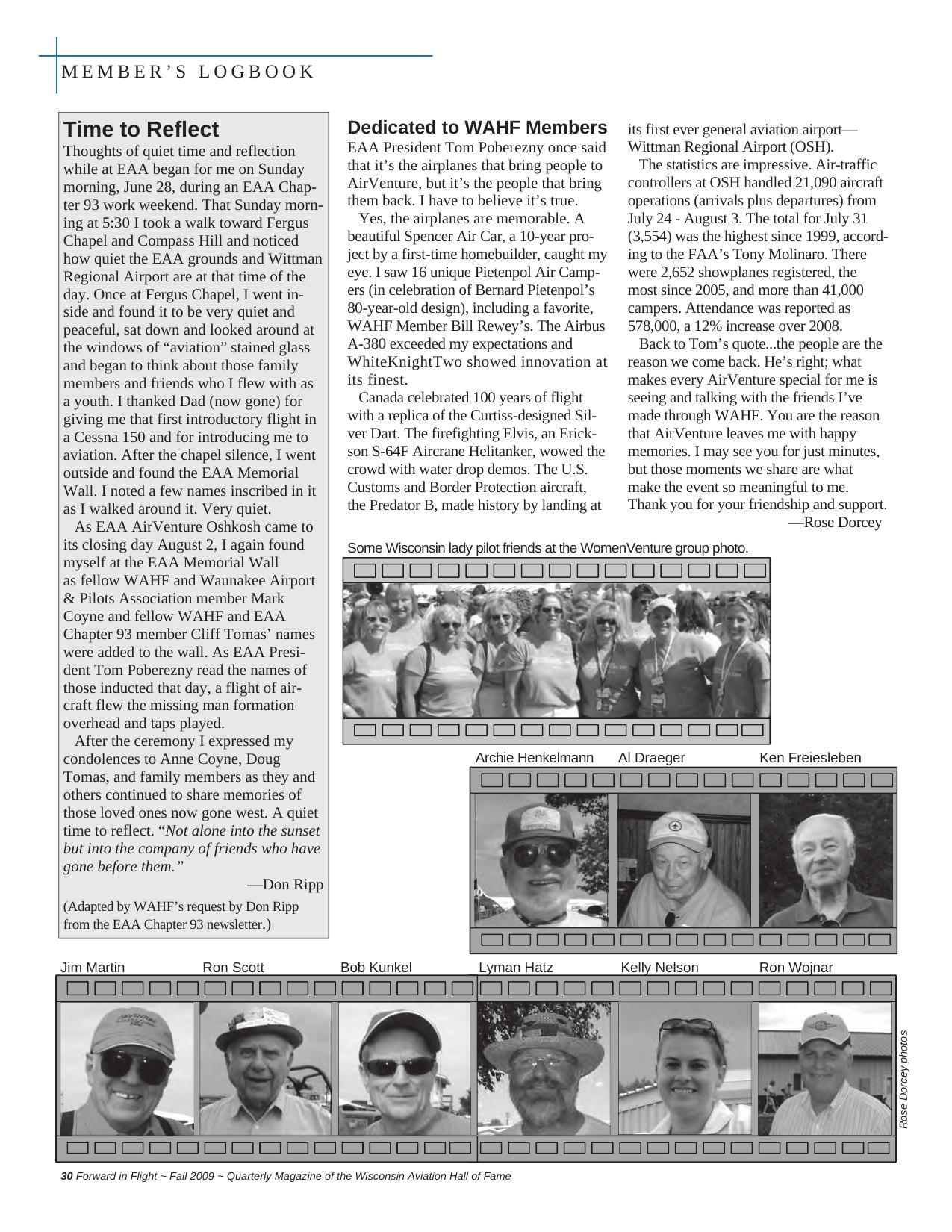
MEMBER’S LOGBOOK Time to Reflect Thoughts of quiet time and reflection while at EAA began for me on Sunday morning, June 28, during an EAA Chapter 93 work weekend. That Sunday morning at 5:30 I took a walk toward Fergus Chapel and Compass Hill and noticed how quiet the EAA grounds and Wittman Regional Airport are at that time of the day. Once at Fergus Chapel, I went inside and found it to be very quiet and peaceful, sat down and looked around at the windows of “aviation” stained glass and began to think about those family members and friends who I flew with as a youth. I thanked Dad (now gone) for giving me that first introductory flight in a Cessna 150 and for introducing me to aviation. After the chapel silence, I went outside and found the EAA Memorial Wall. I noted a few names inscribed in it as I walked around it. Very quiet. As EAA AirVenture Oshkosh came to its closing day August 2, I again found myself at the EAA Memorial Wall as fellow WAHF and Waunakee Airport & Pilots Association member Mark Coyne and fellow WAHF and EAA Chapter 93 member Cliff Tomas’ names were added to the wall. As EAA President Tom Poberezny read the names of those inducted that day, a flight of aircraft flew the missing man formation overhead and taps played. After the ceremony I expressed my condolences to Anne Coyne, Doug Tomas, and family members as they and others continued to share memories of those loved ones now gone west. A quiet time to reflect. “Not alone into the sunset but into the company of friends who have gone before them.” —Don Ripp Dedicated to WAHF Members EAA President Tom Poberezny once said that it’s the airplanes that bring people to AirVenture, but it’s the people that bring them back. I have to believe it’s true. Yes, the airplanes are memorable. A beautiful Spencer Air Car, a 10-year project by a first-time homebuilder, caught my eye. I saw 16 unique Pietenpol Air Campers (in celebration of Bernard Pietenpol’s 80-year-old design), including a favorite, WAHF Member Bill Rewey’s. The Airbus A-380 exceeded my expectations and WhiteKnightTwo showed innovation at its finest. Canada celebrated 100 years of flight with a replica of the Curtiss-designed Silver Dart. The firefighting Elvis, an Erickson S-64F Aircrane Helitanker, wowed the crowd with water drop demos. The U.S. Customs and Border Protection aircraft, the Predator B, made history by landing at its first ever general aviation airport— Wittman Regional Airport (OSH). The statistics are impressive. Air-traffic controllers at OSH handled 21,090 aircraft operations (arrivals plus departures) from July 24 - August 3. The total for July 31 (3,554) was the highest since 1999, according to the FAA’s Tony Molinaro. There were 2,652 showplanes registered, the most since 2005, and more than 41,000 campers. Attendance was reported as 578,000, a 12% increase over 2008. Back to Tom’s quote...the people are the reason we come back. He’s right; what makes every AirVenture special for me is seeing and talking with the friends I’ve made through WAHF. You are the reason that AirVenture leaves me with happy memories. I may see you for just minutes, but those moments we share are what make the event so meaningful to me. Thank you for your friendship and support. —Rose Dorcey Some Wisconsin lady pilot friends at the WomenVenture group photo. Archie Henkelmann Al Draeger Ken Freiesleben Lyman Hatz Kelly Nelson Ron Wojnar (Adapted by WAHF’s request by Don Ripp from the EAA Chapter 93 newsletter.) Ron Scott Bob Kunkel Rose Dorcey photos Jim Martin 30 Forward in Flight ~ Fall 2009 ~ Quarterly Magazine of the Wisconsin Aviation Hall of Fame
ON FINAL For the benefit of those who may not know, a hangar is to an airship what a garage is to an automobile. —Wausau News Herald, 1911 Mitchell was very erratic. One day he would be okay and the next lousy. I just happened to catch him on one of his good days. He made two perfect flights this day. We progress through repeated success; we learn through our mistakes. —unknown —Walter E. Lees, regarding Gen. Billy Mitchell’s first solo, 1916 The flight theme was used as a tool to learn more about the geography and climate of the “countries” visited. Our students learned much about the world we live in, in addition to the history of flight. —Elizabeth Dohr Wild Rose Elementary School There he would hang while the plane flew at 75 mph, first with two hands, then with one, then only by his teeth—without a parachute. I wanted to teach others to fly because I loved it so much myself. That was my objective in life. —Ruth Harman, CPT Instructor —Regarding Wisconsin wingwalker Clyde Lee, performing without a safety harness, 1925. from Forward in Flight I thought I would keep it on the ground until I became familiar with it, but on account of the wind, I unexpectedly took to the air, and the first thing I knew, I was flying. —A.P. Warner, November 4, 1909 Subscribe to Forward…in Flight today! (Annual subscription includes one-year WAHF membership) Membership Benefits: Quarterly subscription (4 issues) of Forward in Flight, packed full of Wisconsin aviation news, events, state aviation history, and stories about your aviation colleagues Free pass to Deke Slayton Museum Invitation to annual induction banquet The opportunity to nominate aviation leaders for induction! Name Address City State Zip Phone Number Email Address Referred By Just $20, and you’ll be supporting an aviation organization dedicated to collecting, preserving, and sharing Wisconsin’s aviation history. With Forward in Flight, you’ll learn about aviation history makers—the people, places, and happenings that distinguish our state and also be in touch with current Wisconsin aviation news and events! This form can be used for renewals, as well. Send your check today! Please write check to: Wisconsin Aviation Hall of Fame, Inc. Mail to: John Dorcey, Treasurer Wisconsin Aviation Hall of Fame 3980 Sharratt Drive Oshkosh WI 54901-1276 Great Gift! 31 Forward in Flight ~ Fall 2009