Volume 8, Issue 3
🗞️ Download Issue (PDF)
Forward in Flight - Fall 2010
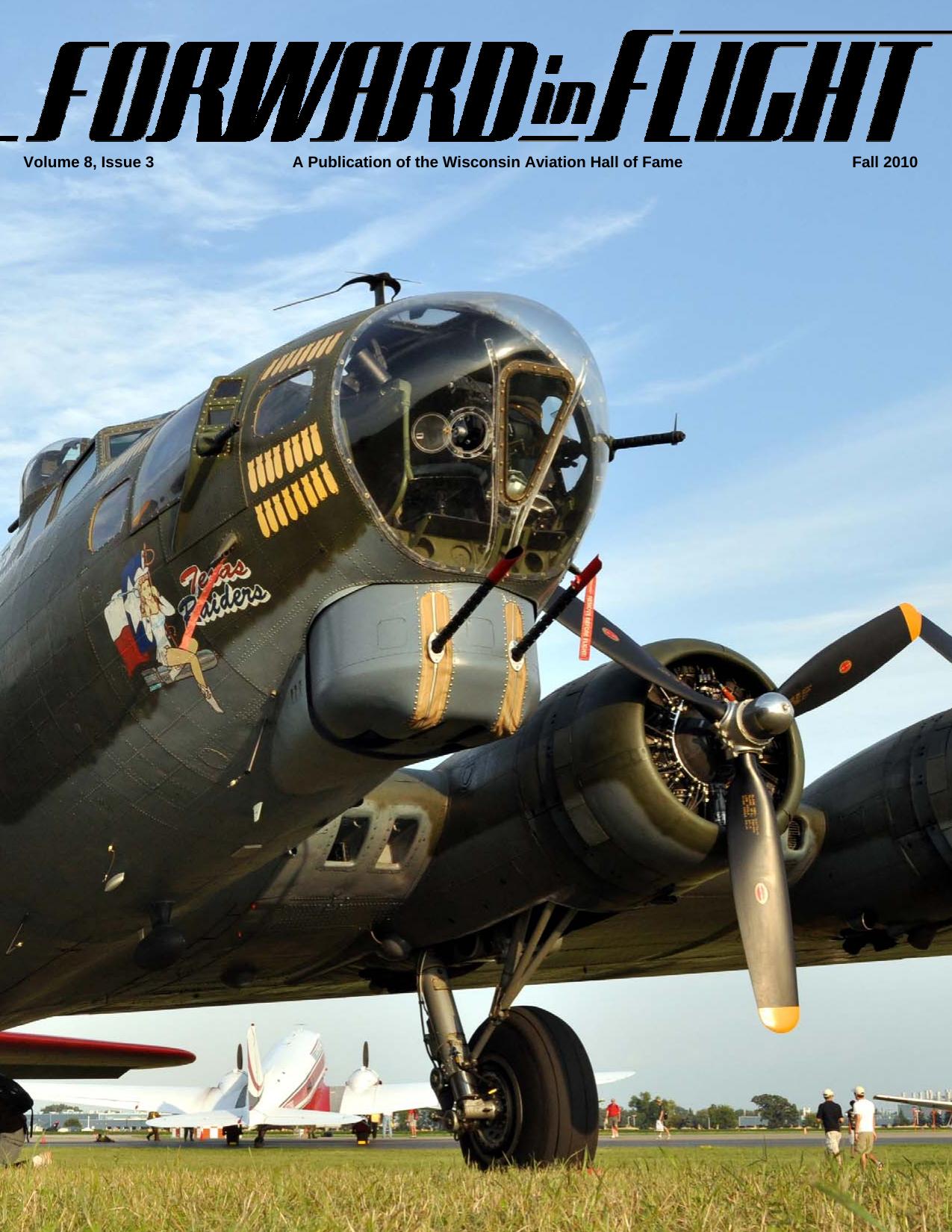
Volume 8, Issue 3 A Publication of the Wisconsin Aviation Hall of Fame Fall 2010
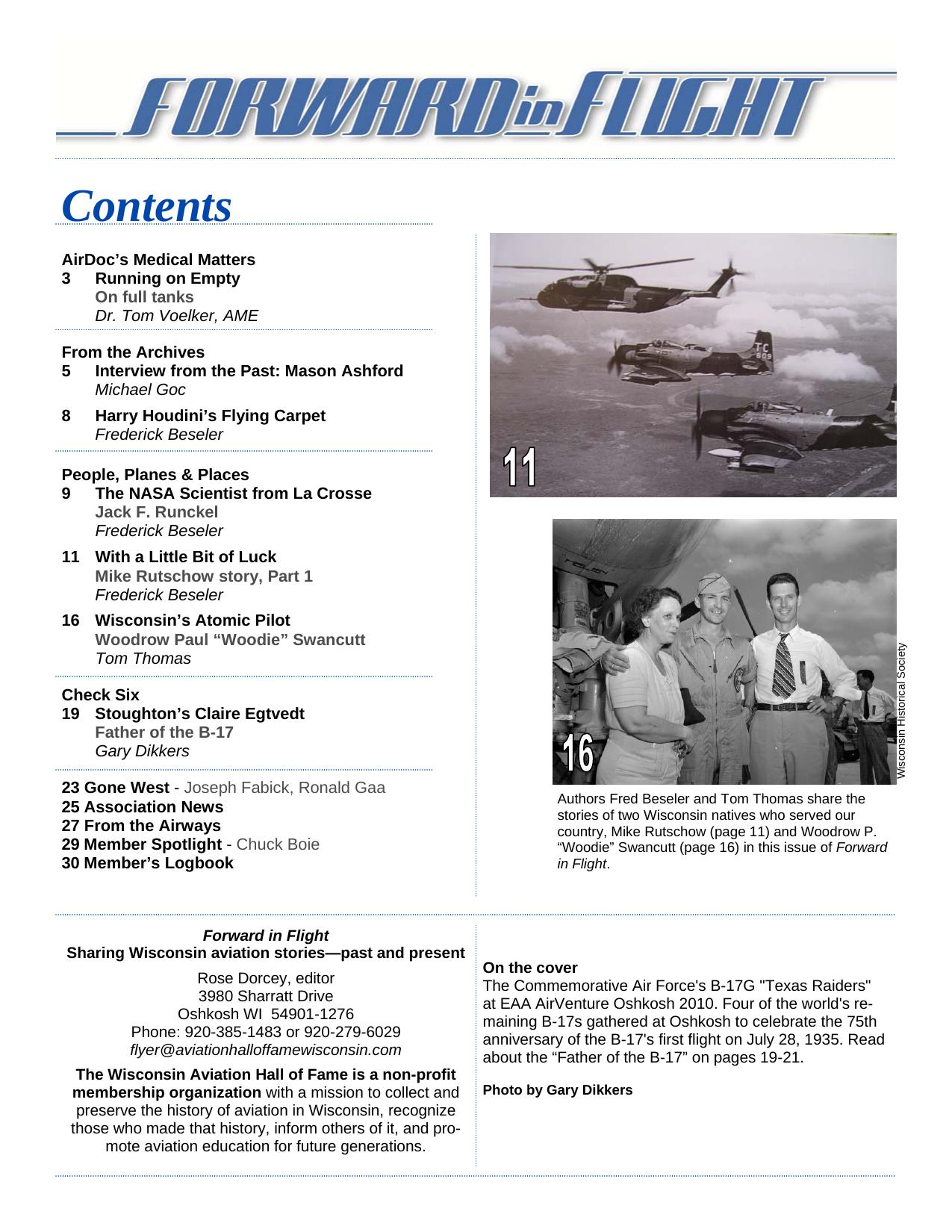
Contents AirDoc’s Medical Matters 3 Running on Empty On full tanks Dr. Tom Voelker, AME From the Archives 5 Interview from the Past: Mason Ashford Michael Goc 8 Harry Houdini’s Flying Carpet Frederick Beseler People, Planes & Places 9 The NASA Scientist from La Crosse Jack F. Runckel Frederick Beseler 11 With a Little Bit of Luck Mike Rutschow story, Part 1 Frederick Beseler Wisconsin Historical Society 16 Wisconsin’s Atomic Pilot Woodrow Paul “Woodie” Swancutt Tom Thomas Check Six 19 Stoughton’s Claire Egtvedt Father of the B-17 Gary Dikkers 23 Gone West - Joseph Fabick, Ronald Gaa 25 Association News 27 From the Airways 29 Member Spotlight - Chuck Boie 30 Member’s Logbook Authors Fred Beseler and Tom Thomas share the stories of two Wisconsin natives who served our country, Mike Rutschow (page 11) and Woodrow P. “Woodie” Swancutt (page 16) in this issue of Forward in Flight. Forward in Flight Sharing Wisconsin aviation stories—past and present Rose Dorcey, editor 3980 Sharratt Drive Oshkosh WI 54901-1276 Phone: 920-385-1483 or 920-279-6029 flyer@aviationhalloffamewisconsin.com The Wisconsin Aviation Hall of Fame is a non-profit membership organization with a mission to collect and preserve the history of aviation in Wisconsin, recognize those who made that history, inform others of it, and promote aviation education for future generations. On the cover The Commemorative Air Force's B-17G "Texas Raiders" at EAA AirVenture Oshkosh 2010. Four of the world's remaining B-17s gathered at Oshkosh to celebrate the 75th anniversary of the B-17's first flight on July 28, 1935. Read about the “Father of the B-17” on pages 19-21. Photo by Gary Dikkers
President’s Message ~ by Rose Dorcey What a wonderful summer it’s been! I’ve been blessed to have had some great times with family, friends, and flying... In June, John and I were reminiscing about a flight four years ago from Madison to Eagle River. On our return flight, we stopped at a handful of airports, taking pictures at each one. We landed at eight different airports that day. Our memories led to a discussion of how many Wisconsin airports we thought we could land at in a day if doing the same kind of thing, taking our time, taxiing to the terminal and getting photos of the airplane with an identifying feature of each airport in the background. With so many airports in close proximity to our home field of Oshkosh, we thought we could land at 20. Then we added another challenge: each airport had to be in a different county. A few days later, that’s exactly what we set out to do. After a few hours of flight planning to determine which airports were in which counties (sectional charts don’t show county lines!) we departed Wittman Regional Airport at 6:08 a.m. on Friday, June 16 en route for Wautoma, and then on to 18 more airports in southeast/south central Wisconsin, including Portage, Juneau, Ft. Atkinson, Janesville, East Troy, Kenosha, Sylvania, Capitol, Timmerman, and West Bend. After gassing up at West Bend, we flew on to Fond du Lac, and then Sheboygan, New Holstein, Manitowoc, Sturgeon Bay, Oconto, and Shawano. Then we flew home to Oshkosh. If you count, that’s only 19. Appleton was on our flight plan, but after 7 hours of flying on a hot, bumpy day, we were tired. So as our friend Jimmy Szajkovics likes to say, “in the interest of aviation safety,” we decided to bypass Appleton and go straight home to Oshkosh. By the time we returned, we had logged 7.8 hours of Hobbs time, had seen some beautiful Wisconsin scenery, talked to lots of people along the way, and took hundreds of pictures, both in the air and on the ground. What a great day! After wiping the bugs off the Cessna 172, refueling it, and tucking it back in its hangar, we drove to Buffalo Wild Wings for a “debrief.” Other than not bringing a cooler of water bottles along, we were thrilled with how the flight went. So of course, our conversation turned to what to do next. “Why not visit every county in Wisconsin that has a public-use airport?” John asked. Well that’s exactly what we’ve been doing this summer. In three flights, we’ve logged 20.3 Rose Dorcey hours visiting 45 airports in 45 counties. One flight remains, to 15 Northwest Wisconsin airports, including Superior, Ashland, Cable, and more. When complete, we’ll have visited all 60 counties that have a public use airport. This flight, scheduled for late September, will include an overnight in Menomonie to spend some time with our son, Luke, a student at UW-Stout. We’ve seen a lot on these flights. First, Wisconsin is fortunate to have modern airports with knowledgeable people running them. Many have had recent construction projects: Runway extensions, runway reconstructions, taxiway and ramp repaving, runway and taxiway lighting and marking upgrades. It’s great to see, knowing that these communities will benefit from the investment in their airports. As we talk with airport managers, many are sounding more optimistic about seeing traffic numbers slowly increasing. They’ve toughed out some hard times, and they are the heroes who contribute their talent daily to making Wisconsin airports the vital economic engine and transportation system that we pilots get to use and enjoy. Next time you land at an airport and see the airport manager, thank them for their dedicated efforts. These flights have cemented my belief that Wisconsin is a beautiful state in which to live. We’ve viewed dozens of lakes and rivers, ridges and valleys, marshy areas and heavily wooded forests in the Northwoods, and even saw a bald eagle fly beneath us. Best of all, we’ve connected with our aviation friends throughout the state, which made our flights an unforgettable experience. See photos and a short story on page 30. If you enjoy seeing that, you can also read my blog that chronicles our wonderful flying experiences at http://FlyingWisconsin.wordpress.com. Morey Airplane Company Since 1932 Middleton Municipal Airport/Morey Field Self-service 100LL & Jet A 24-7 2 Forward in Flight ~ Fall 2010

AIR DOC Running on Empty On full tanks By Dr. Tom Voelker, AME DrAlphaMike@yahoo.com Hello, fellow airmen. Welcome to another edition of all things aeromedical! I hope you enjoyed your summer as much as I did mine. Despite the high temperatures, the weather has allowed some wonderful flying. Alas, all good things must end; we have arrived at the season of the glorious fall colorama flights. These sightseeing flights are among my favorites. Last year I thoroughly enjoyed a September trek home from Duluth, complete with touch-and-goes at several airports along the way. I left Duluth International Airport (DLH) with two full tanks, and I arrived in Wisconsin Rapids with one full and three empty! Keep reading; the math works. I like to read NTSB aviation accident reports to see what I can learn that will add safety to my flights. One such report recently caught my eye. A small plane, a Cherokee, I believe, sustained considerable damage when one of its wings caught a street sign during an off-airport landing. The pilot almost pulled it off. He had landed on a dirt road due to an “emergency” situation: He had to go to the bathroom! (Yes, indeed, that’s what he told the investigators!) We’ve all been there. We fill the bladder tanks in the wings so that we can make a flight nonstop, and then our own bladders can’t make the trip. Flying solo, we may be able to use a relief bottle, but that solution isn’t always practical. We could avoid drinking anything during the three or four hour leg, but that puts us at risk for dehydration, especially in the hot summer while confined in the belly of a small bird. That can be more dangerous than a traffic sign on the side of the road! We have a balancing act to perform. We need to load the right amount of fuel into the airplane, keep our internal tanks (that is, the fluid in our bloodstream) in the operating range, and not overflow our bladder tanks. Dang, this flying stuff is hard! I hope to help you with your personal fluid systems. You’re on your own with 100 low-lead. The easier part of this balancing act is bladder management. Keeping hydrated, but not too hydrated, is the hard part. I’ll start with your fluid intake. It is generally recommended to drink two to four quarts of fluid daily. Water is probably best, but almost any non-caffeinated liquid will suffice. This amount of liquid gives our bodies the water we need for the various metabolic functions we perform. Water is a needed substance for many of the chemical reactions that occur in our bodies. Without these reactions we would not be able to digest our food, contract our 3 Forward in Flight ~ Quarterly Magazine of the Wisconsin Aviation Hall of Fame muscles, or even breathe. When we run low on water, our bodies will try to find it wherever it can be found. This ultimately may be in the bloodstream. Without enough fluid in the bloodstream, we develop hypotension, or low blood pressure. Have you ever been lightheaded on a hot summer day? That’s hypotension. In its most severe form it will cause complete loss of consciousness, or “passing out.” Usually, though, the effect is simply dizziness, fatigue, and difficulty concentrating. I don’t know about your passengers, but mine want a pilot who possesses characteristics other than dizziness and fatigue. By drinking plenty of fluid you can prevent this problem from developing. Our soldiers in Iraq and Afghanistan avoid hypotension on the 120 degree days in the desert, even though they are fully dressed. They drink lots of water. Caffeinated Drinks So, you think you can just have an extra cup of coffee before hitting the skies, right? Not if you want to stay hydrated. The problem with coffee is that it is a diuretic. It helps you make urine. If you have a long flight ahead of you, this may be a problem. In addition to having extra urine to get rid of, you are also depleting your body of needed water. I generally
AIR DOC tell my patients that one cup of coffee (or other caffeinated drinks, such as tea or cola) cause you to make about 1-1/2 cups of urine. If you want to have your coffee before flying, that’s fine, just be sure to drink extra non-caffeinated liquid along with it. If I’m having coffee before flying (and I do like my coffee!), I order it with a tall glass of water. Another thing to remember is that you can lose a lot of water by sweating. If it is particularly hot, you may want to increase you water intake to more than the two to four quarts previously prescribed. How Much is Enough? How do you know if you’re fully hydrated? The first clue is that you are urinating adequately. I’ll leave it up to you to define “adequate,” but if you haven’t gone to the bathroom for several hours, you probably aren’t fully hydrated. A more reliable method is to see how concentrated the urine is. As I mentioned, our bodies try to save water from wherever they can find it. This includes reabsorbing water from urine before it leaves the kidneys. The more concentrated your urine is, the darker the urine, and the more you need to drink. Mountain climbers know this well. Getting dehydrated at high altitudes can cause brain and breathing problems that cannot be resolved without descending. Most climbers won’t start a high summit attempt until their urine is completely colorless. Being completely hydrated before the flight is probably overkill, as this will essentially guarantee an early bathroom stop. But you should be sure that you That’s hypotension. In its most severe form it will cause complete loss of consciousness, or “passing out.” have had some extra fluid before flying. More importantly, bring some water with you on your flight. Sip on it frequently. Do this particularly as you are approaching your destination, as you will be getting less well hydrated as the flight goes on. In addition, if you drink more than you need as you near your destination, your pit stop is fast approaching! Most importantly, pay attention to your body. If you are getting any symptoms of dehydration (fatigue, headache, trouble concentrating), or if you’ve been perspiring a lot, drink. So, you’ve gotten well-hydrated and you are one hour from your destination, and now you’ve got to go! What do you do? You do have options. You could land and hit a signpost (not recommended). You could divert to a closer airport (not convenient, but not a bad option), or you can find immediate relief. There are several products available just for this, some more convenient than others. I must admit I have limited experience in this realm. When flying solo, I carry a jug for such an event. However, I find the procedure rather unnatural, and hence, difficult. Some friends have had good success with the product that turns urine into a nonspillable gel. I will leave the choice of products up to you. My co-owner in the Comanche, Mike, had an interesting thought. Why don’t we just wear Depends when we fly on long trips? I don’t know; that sounds unnatural as well. Maybe we could practice by putting on our swimsuits (over the “protective undergarment”), get a couple of lawn chairs and a cooler of Esser’s Best, and go “hangar flying!” I hope you’ve learned something that you can use. As I said earlier, by reading the NTSB reports we can learn from others’ mistakes. I won’t be so bold, though, to pretend “that could never happen to me.” If I ever get in the same predicament as the hapless Cherokee pilot, you can count on one thing. I’m not going to admit that I just had to pee. I’ll tell them, “The check engine light came on!” Your Suggestions If there’s an aeromedical topic that you would like to learn more about, let me know. Like any good doctor, if I don’t have the answers, I’ll make something up, and I might even throw in some big words in the process! Or, not. Until next time, fly often, fly safely, and look out for those street signs! —Alpha Mike Echo In “real” life, Alpha Mike Echo is Dr. Tom Voelker, AME, a family practitioner in Wisconsin Rapids. He and his wife, Kathy, are the parents of four daughters. Tom flies N6224P, a Comanche 250, out of Alexander Field, South Wood County Airport (ISW). 4 Forward in Flight ~ Fall 2010
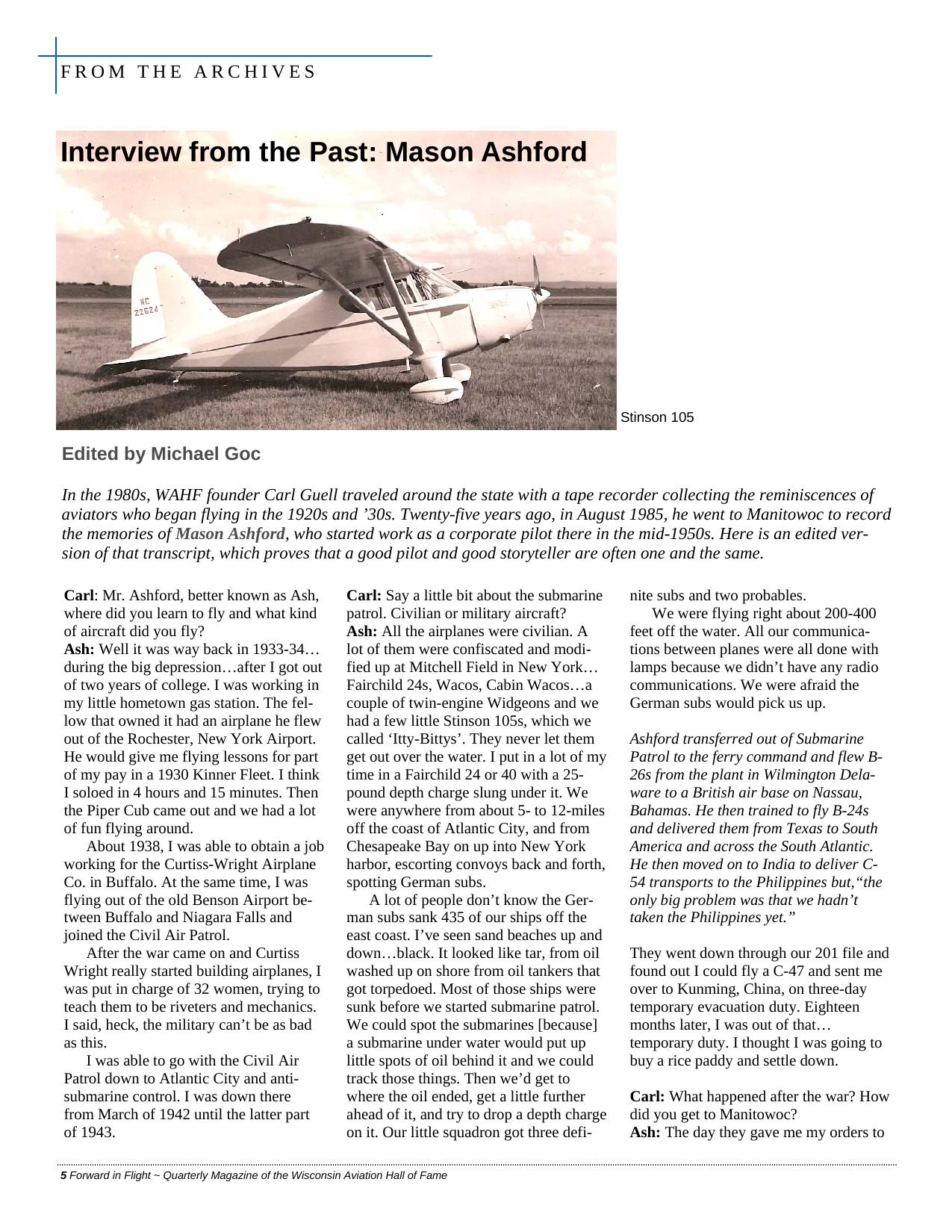
FROM THE ARCHIVES Interview from the Past: Mason Ashford Stinson 105 Edited by Michael Goc In the 1980s, WAHF founder Carl Guell traveled around the state with a tape recorder collecting the reminiscences of aviators who began flying in the 1920s and ’30s. Twenty-five years ago, in August 1985, he went to Manitowoc to record the memories of Mason Ashford, who started work as a corporate pilot there in the mid-1950s. Here is an edited version of that transcript, which proves that a good pilot and good storyteller are often one and the same. Carl: Mr. Ashford, better known as Ash, where did you learn to fly and what kind of aircraft did you fly? Ash: Well it was way back in 1933-34… during the big depression…after I got out of two years of college. I was working in my little hometown gas station. The fellow that owned it had an airplane he flew out of the Rochester, New York Airport. He would give me flying lessons for part of my pay in a 1930 Kinner Fleet. I think I soloed in 4 hours and 15 minutes. Then the Piper Cub came out and we had a lot of fun flying around. About 1938, I was able to obtain a job working for the Curtiss-Wright Airplane Co. in Buffalo. At the same time, I was flying out of the old Benson Airport between Buffalo and Niagara Falls and joined the Civil Air Patrol. After the war came on and Curtiss Wright really started building airplanes, I was put in charge of 32 women, trying to teach them to be riveters and mechanics. I said, heck, the military can’t be as bad as this. I was able to go with the Civil Air Patrol down to Atlantic City and antisubmarine control. I was down there from March of 1942 until the latter part of 1943. Carl: Say a little bit about the submarine patrol. Civilian or military aircraft? Ash: All the airplanes were civilian. A lot of them were confiscated and modified up at Mitchell Field in New York… Fairchild 24s, Wacos, Cabin Wacos…a couple of twin-engine Widgeons and we had a few little Stinson 105s, which we called ‘Itty-Bittys’. They never let them get out over the water. I put in a lot of my time in a Fairchild 24 or 40 with a 25pound depth charge slung under it. We were anywhere from about 5- to 12-miles off the coast of Atlantic City, and from Chesapeake Bay on up into New York harbor, escorting convoys back and forth, spotting German subs. A lot of people don’t know the German subs sank 435 of our ships off the east coast. I’ve seen sand beaches up and down…black. It looked like tar, from oil washed up on shore from oil tankers that got torpedoed. Most of those ships were sunk before we started submarine patrol. We could spot the submarines [because] a submarine under water would put up little spots of oil behind it and we could track those things. Then we’d get to where the oil ended, get a little further ahead of it, and try to drop a depth charge on it. Our little squadron got three defi- 5 Forward in Flight ~ Quarterly Magazine of the Wisconsin Aviation Hall of Fame nite subs and two probables. We were flying right about 200-400 feet off the water. All our communications between planes were all done with lamps because we didn’t have any radio communications. We were afraid the German subs would pick us up. Ashford transferred out of Submarine Patrol to the ferry command and flew B26s from the plant in Wilmington Delaware to a British air base on Nassau, Bahamas. He then trained to fly B-24s and delivered them from Texas to South America and across the South Atlantic. He then moved on to India to deliver C54 transports to the Philippines but,“the only big problem was that we hadn’t taken the Philippines yet.” They went down through our 201 file and found out I could fly a C-47 and sent me over to Kunming, China, on three-day temporary evacuation duty. Eighteen months later, I was out of that… temporary duty. I thought I was going to buy a rice paddy and settle down. Carl: What happened after the war? How did you get to Manitowoc? Ash: The day they gave me my orders to
FROM THE ARCHIVES come back from overseas, I said I was all through flying. I’d run all my luck out. So I hung around for three or four months and one day I took a ride to Rochester Airport and went into Highland Flying Service. I know all the guys. Golly dang, one of them talked me into taking a job as a flight instructor. I was with them for maybe six, eight months and one night, my old roommate from Kunming, China, called up from San Francisco and asked me if I was tired of flying dumb students around a traffic pattern. I said yeah, it does get kind of monotonous. He said, ‘I got a fellow out here that owns some ranches, I just bought a twinengine airplane for him. I want to get you for the pilot for it.’ The airplane was an AT-11, which was the twin-engine Beech that was converted into a bomber trainer. It had a bombardier’s nose, a flat nose. I said OK, nothing to lose, so I went out to San Francisco. Well, this rancher was John S. Hamilton from Hamilton Manufacturing in Manitowoc, Wisconsin, and he was in partnership with his brother-in-law, Guido Rahr, that owned the Rahr Malting Co. in Manitowoc. So, I flew with them in what we called the cattle car, on the old blunt-nosed Beech. Had it for one year and I told them that thing had over 5,000 hours on it when they got it and was ready to fall apart. So he authorized me to go back and get another airplane. I knew the pilots of the Gannett Newspapers in Rochester and they had a heck of a nice D-18, and they wanted to update their flying and wanted to put it up for sale. So I went back to Rochester with the old cattle car and swapped that to the owners of the Gannett Newspapers for their airplane. I took that back and that’s what we flew for the rest of the years I was with them…I’ve forgotten how many, about eight or nine years spent flying between Montana and San Diego. Wintertime I lived in La Jolla, California. Why I ever left there, maybe I should have had my head examined, leaving there. One day Rahr called me up from Manitowoc and said that he had an airplane he wanted to sell to Manitowoc Shipbuilding Co. and John West, he wanted to set up a little aviation depart- ment and wanted to know if I’d come back to Manitowoc and set it up for him. I said, oh sure. Guido Rahr sold John West this one little B-35, V-tail Bonanza. John West, interviewing me, asked me how old I was. I told him just 40. ‘My God,’ he says, ‘you’re old enough to retire, aren’t you kid?’ I said, Mr. West, the way I look at it, it takes at least 20 years to learn my job. By the way, how long did it take you to learn your job? After all, he was president of the company. He said, ‘Man you’re hired.’ Carl: What kind of airplanes did you fly for the Manitowoc company? How many years? “He would give me flying lessons for part of my pay in a 1930 Kinner Fleet. I think I soloed in 4 hours and 15 minutes. Then the Piper Cub came out and we had a lot of fun flying around.” Ash: I flew them for 29 years. Our first airplane was that little V-tail Bonanza 35. We had that about one year. It didn’t have any radio equipment and we limited that to just plain daylight flying and VFR flying. No over-water flying. Most of our flights were from Manitowoc to Milwaukee and Chicago and back. We did a lot of flying into Chicago, especially Miegs Field and old Midway Airport. We put in an order to Cessna Aircraft for one of the first Cessna 310s that came off their assembly lines. I think ours was serial number 78. When we got it, I believe it was 1954 or early 1955, it was the first 310 delivered east of the Mississippi River. Of course, flying it around then created quite a stir with the wing tanks on it. Nobody had seen anything like that. Carl: Did the corporate executives im- mediately accept the flying business? Ash: Well, that was an interesting deal. Practically none of them had ever flown before in their lives. Most of their traveling was all done by the train. They were going down to Chicago a lot. It would take about two-and-a-half hours down and about two-and-a-half hours back, so they’d have to leave early in the morning and it would be way late at night when they got back. I had a little hard time persuading them to take their first ride. Once they did it, they found out they could go down there in 50 minutes, get down to business, and they could be back here by noon the same day…it just sort of escalated. Once they took the first airplane ride, then they were sold on it. Carl: You, in effect, ran a little airline service for the company. Ash: You might say it was a miniature airline. I was running normally back and forth to Chicago, anywhere from three to four times, maximum number five trips a day. Carl: What kind of airplane did you graduate to after that first Cessna 310? [Baby Boomers of a certain age will remember the Cessna 310 as the airplane TV aviator Sky King flew on his adventures.] Ash: We upgraded to one of the newer, more quiet airplanes with a lot more radio equipment, the B-model. Our third airplane we traded in for the F-model of 310. After the F-model we upgraded to the 310N, which was a little bit different. The 310N that was quite an airplane. We were even able to put radar in that one. That was something for those days, the old radar deal. We had one of the first radar setups in the airplane around this part of the country. After the 310N, they got the 310R. John West had put in an order for a Citation Jet, but it took almost two years to get delivery on them back them. In the meantime Cessna had leased us one of their Cessna Jets and they sent me and Stevie [Manitowoc Co.’s second pilot Steve Berkowitz] to American Airlines for jet training and schooling. We were down there 45 days, checking out in the jet. Training was real rugged. Stevie, 6 Forward in Flight ~ Fall 2010
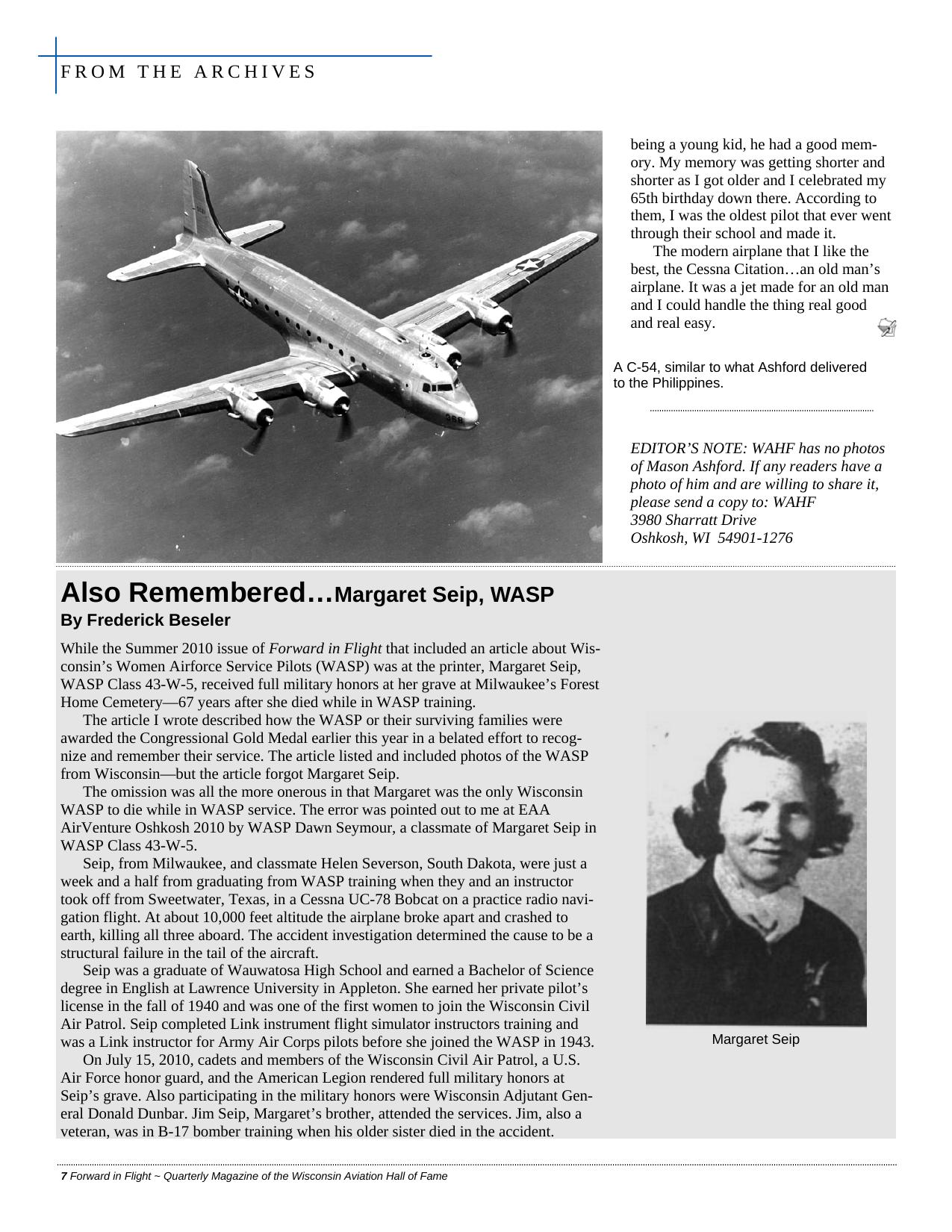
FROM THE ARCHIVES being a young kid, he had a good memory. My memory was getting shorter and shorter as I got older and I celebrated my 65th birthday down there. According to them, I was the oldest pilot that ever went through their school and made it. The modern airplane that I like the best, the Cessna Citation…an old man’s airplane. It was a jet made for an old man and I could handle the thing real good and real easy. A C-54, similar to what Ashford delivered to the Philippines. EDITOR’S NOTE: WAHF has no photos of Mason Ashford. If any readers have a photo of him and are willing to share it, please send a copy to: WAHF 3980 Sharratt Drive Oshkosh, WI 54901-1276 Also Remembered…Margaret Seip, WASP By Frederick Beseler While the Summer 2010 issue of Forward in Flight that included an article about Wisconsin’s Women Airforce Service Pilots (WASP) was at the printer, Margaret Seip, WASP Class 43-W-5, received full military honors at her grave at Milwaukee’s Forest Home Cemetery—67 years after she died while in WASP training. The article I wrote described how the WASP or their surviving families were awarded the Congressional Gold Medal earlier this year in a belated effort to recognize and remember their service. The article listed and included photos of the WASP from Wisconsin—but the article forgot Margaret Seip. The omission was all the more onerous in that Margaret was the only Wisconsin WASP to die while in WASP service. The error was pointed out to me at EAA AirVenture Oshkosh 2010 by WASP Dawn Seymour, a classmate of Margaret Seip in WASP Class 43-W-5. Seip, from Milwaukee, and classmate Helen Severson, South Dakota, were just a week and a half from graduating from WASP training when they and an instructor took off from Sweetwater, Texas, in a Cessna UC-78 Bobcat on a practice radio navigation flight. At about 10,000 feet altitude the airplane broke apart and crashed to earth, killing all three aboard. The accident investigation determined the cause to be a structural failure in the tail of the aircraft. Seip was a graduate of Wauwatosa High School and earned a Bachelor of Science degree in English at Lawrence University in Appleton. She earned her private pilot’s license in the fall of 1940 and was one of the first women to join the Wisconsin Civil Air Patrol. Seip completed Link instrument flight simulator instructors training and was a Link instructor for Army Air Corps pilots before she joined the WASP in 1943. On July 15, 2010, cadets and members of the Wisconsin Civil Air Patrol, a U.S. Air Force honor guard, and the American Legion rendered full military honors at Seip’s grave. Also participating in the military honors were Wisconsin Adjutant General Donald Dunbar. Jim Seip, Margaret’s brother, attended the services. Jim, also a veteran, was in B-17 bomber training when his older sister died in the accident. 7 Forward in Flight ~ Quarterly Magazine of the Wisconsin Aviation Hall of Fame Margaret Seip
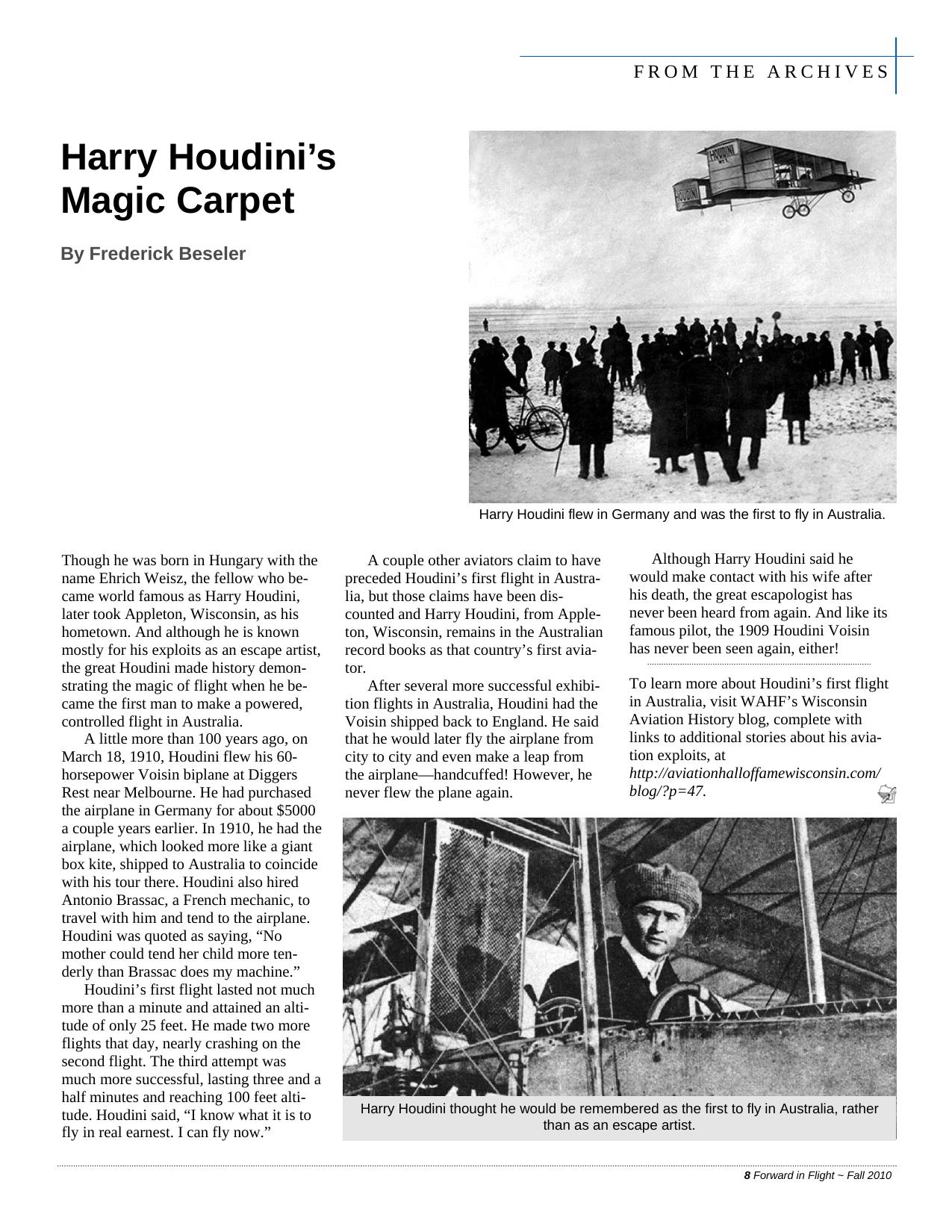
FROM THE ARCHIVES Harry Houdini’s Magic Carpet By Frederick Beseler Harry Houdini flew in Germany and was the first to fly in Australia. Though he was born in Hungary with the name Ehrich Weisz, the fellow who became world famous as Harry Houdini, later took Appleton, Wisconsin, as his hometown. And although he is known mostly for his exploits as an escape artist, the great Houdini made history demonstrating the magic of flight when he became the first man to make a powered, controlled flight in Australia. A little more than 100 years ago, on March 18, 1910, Houdini flew his 60horsepower Voisin biplane at Diggers Rest near Melbourne. He had purchased the airplane in Germany for about $5000 a couple years earlier. In 1910, he had the airplane, which looked more like a giant box kite, shipped to Australia to coincide with his tour there. Houdini also hired Antonio Brassac, a French mechanic, to travel with him and tend to the airplane. Houdini was quoted as saying, “No mother could tend her child more tenderly than Brassac does my machine.” Houdini’s first flight lasted not much more than a minute and attained an altitude of only 25 feet. He made two more flights that day, nearly crashing on the second flight. The third attempt was much more successful, lasting three and a half minutes and reaching 100 feet altitude. Houdini said, “I know what it is to fly in real earnest. I can fly now.” A couple other aviators claim to have preceded Houdini’s first flight in Australia, but those claims have been discounted and Harry Houdini, from Appleton, Wisconsin, remains in the Australian record books as that country’s first aviator. After several more successful exhibition flights in Australia, Houdini had the Voisin shipped back to England. He said that he would later fly the airplane from city to city and even make a leap from the airplane—handcuffed! However, he never flew the plane again. Although Harry Houdini said he would make contact with his wife after his death, the great escapologist has never been heard from again. And like its famous pilot, the 1909 Houdini Voisin has never been seen again, either! To learn more about Houdini’s first flight in Australia, visit WAHF’s Wisconsin Aviation History blog, complete with links to additional stories about his aviation exploits, at http://aviationhalloffamewisconsin.com/ blog/?p=47. Harry Houdini thought he would be remembered as the first to fly in Australia, rather than as an escape artist. 8 Forward in Flight ~ Fall 2010
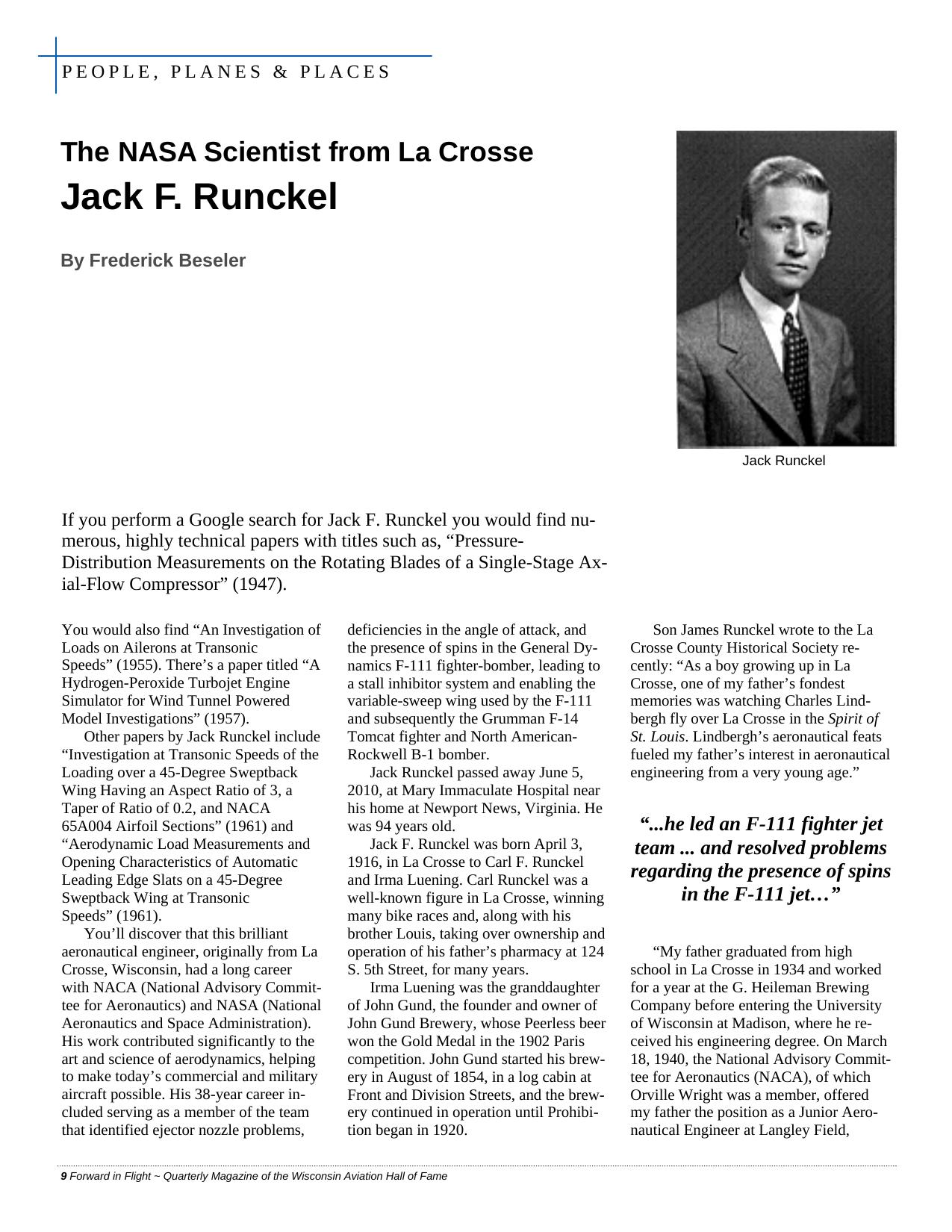
PEOPLE, PLANES & PLACES The NASA Scientist from La Crosse Jack F. Runckel By Frederick Beseler Jack Runckel If you perform a Google search for Jack F. Runckel you would find numerous, highly technical papers with titles such as, “PressureDistribution Measurements on the Rotating Blades of a Single-Stage Axial-Flow Compressor” (1947). You would also find “An Investigation of Loads on Ailerons at Transonic Speeds” (1955). There’s a paper titled “A Hydrogen-Peroxide Turbojet Engine Simulator for Wind Tunnel Powered Model Investigations” (1957). Other papers by Jack Runckel include “Investigation at Transonic Speeds of the Loading over a 45-Degree Sweptback Wing Having an Aspect Ratio of 3, a Taper of Ratio of 0.2, and NACA 65A004 Airfoil Sections” (1961) and “Aerodynamic Load Measurements and Opening Characteristics of Automatic Leading Edge Slats on a 45-Degree Sweptback Wing at Transonic Speeds” (1961). You’ll discover that this brilliant aeronautical engineer, originally from La Crosse, Wisconsin, had a long career with NACA (National Advisory Committee for Aeronautics) and NASA (National Aeronautics and Space Administration). His work contributed significantly to the art and science of aerodynamics, helping to make today’s commercial and military aircraft possible. His 38-year career included serving as a member of the team that identified ejector nozzle problems, deficiencies in the angle of attack, and the presence of spins in the General Dynamics F-111 fighter-bomber, leading to a stall inhibitor system and enabling the variable-sweep wing used by the F-111 and subsequently the Grumman F-14 Tomcat fighter and North AmericanRockwell B-1 bomber. Jack Runckel passed away June 5, 2010, at Mary Immaculate Hospital near his home at Newport News, Virginia. He was 94 years old. Jack F. Runckel was born April 3, 1916, in La Crosse to Carl F. Runckel and Irma Luening. Carl Runckel was a well-known figure in La Crosse, winning many bike races and, along with his brother Louis, taking over ownership and operation of his father’s pharmacy at 124 S. 5th Street, for many years. Irma Luening was the granddaughter of John Gund, the founder and owner of John Gund Brewery, whose Peerless beer won the Gold Medal in the 1902 Paris competition. John Gund started his brewery in August of 1854, in a log cabin at Front and Division Streets, and the brewery continued in operation until Prohibition began in 1920. 9 Forward in Flight ~ Quarterly Magazine of the Wisconsin Aviation Hall of Fame Son James Runckel wrote to the La Crosse County Historical Society recently: “As a boy growing up in La Crosse, one of my father’s fondest memories was watching Charles Lindbergh fly over La Crosse in the Spirit of St. Louis. Lindbergh’s aeronautical feats fueled my father’s interest in aeronautical engineering from a very young age.” “...he led an F-111 fighter jet team ... and resolved problems regarding the presence of spins in the F-111 jet…” “My father graduated from high school in La Crosse in 1934 and worked for a year at the G. Heileman Brewing Company before entering the University of Wisconsin at Madison, where he received his engineering degree. On March 18, 1940, the National Advisory Committee for Aeronautics (NACA), of which Orville Wright was a member, offered my father the position as a Junior Aeronautical Engineer at Langley Field,
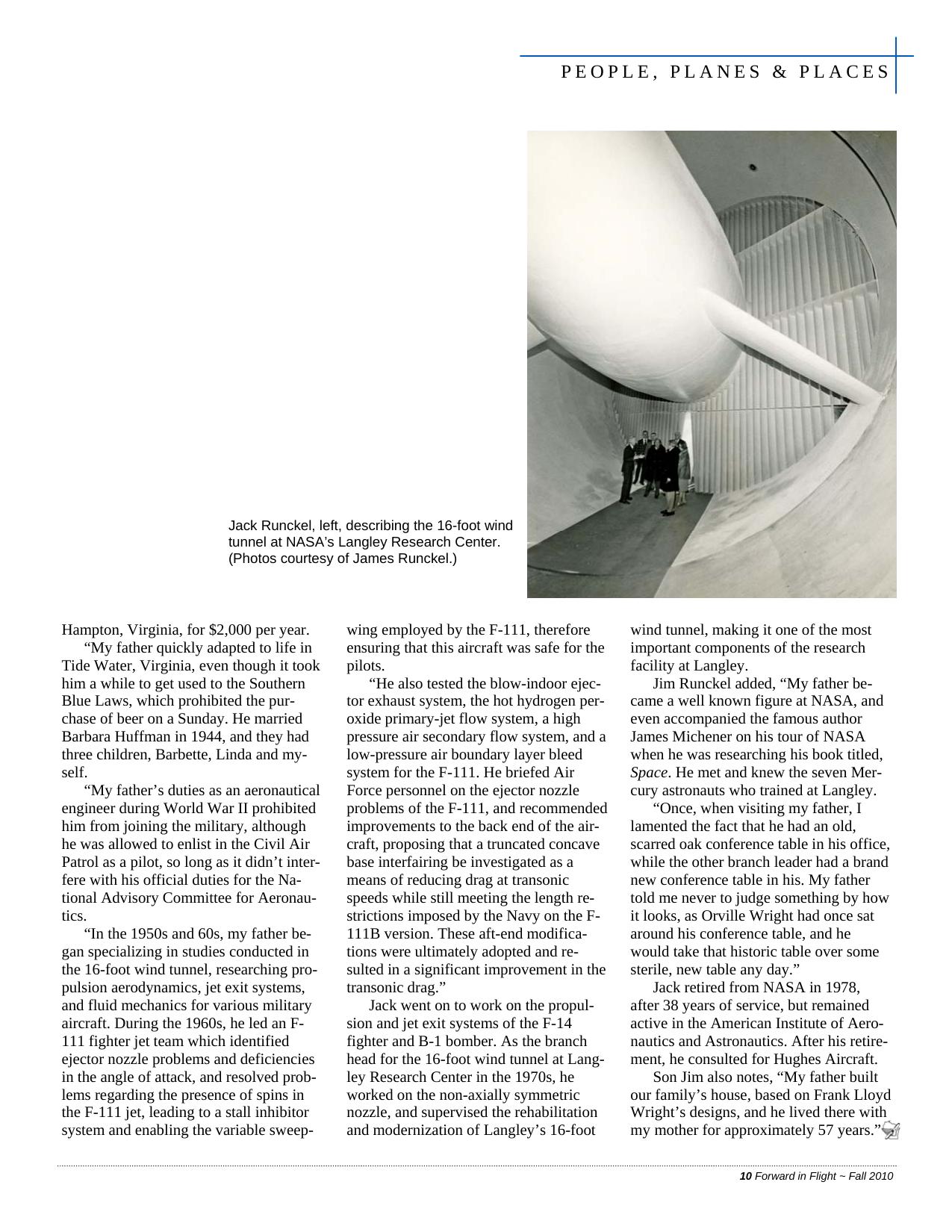
PEOPLE, PLANES & PLACES Jack Runckel, left, describing the 16-foot wind tunnel at NASA’s Langley Research Center. (Photos courtesy of James Runckel.) Hampton, Virginia, for $2,000 per year. “My father quickly adapted to life in Tide Water, Virginia, even though it took him a while to get used to the Southern Blue Laws, which prohibited the purchase of beer on a Sunday. He married Barbara Huffman in 1944, and they had three children, Barbette, Linda and myself. “My father’s duties as an aeronautical engineer during World War II prohibited him from joining the military, although he was allowed to enlist in the Civil Air Patrol as a pilot, so long as it didn’t interfere with his official duties for the National Advisory Committee for Aeronautics. “In the 1950s and 60s, my father began specializing in studies conducted in the 16-foot wind tunnel, researching propulsion aerodynamics, jet exit systems, and fluid mechanics for various military aircraft. During the 1960s, he led an F111 fighter jet team which identified ejector nozzle problems and deficiencies in the angle of attack, and resolved problems regarding the presence of spins in the F-111 jet, leading to a stall inhibitor system and enabling the variable sweep- wing employed by the F-111, therefore ensuring that this aircraft was safe for the pilots. “He also tested the blow-indoor ejector exhaust system, the hot hydrogen peroxide primary-jet flow system, a high pressure air secondary flow system, and a low-pressure air boundary layer bleed system for the F-111. He briefed Air Force personnel on the ejector nozzle problems of the F-111, and recommended improvements to the back end of the aircraft, proposing that a truncated concave base interfairing be investigated as a means of reducing drag at transonic speeds while still meeting the length restrictions imposed by the Navy on the F111B version. These aft-end modifications were ultimately adopted and resulted in a significant improvement in the transonic drag.” Jack went on to work on the propulsion and jet exit systems of the F-14 fighter and B-1 bomber. As the branch head for the 16-foot wind tunnel at Langley Research Center in the 1970s, he worked on the non-axially symmetric nozzle, and supervised the rehabilitation and modernization of Langley’s 16-foot wind tunnel, making it one of the most important components of the research facility at Langley. Jim Runckel added, “My father became a well known figure at NASA, and even accompanied the famous author James Michener on his tour of NASA when he was researching his book titled, Space. He met and knew the seven Mercury astronauts who trained at Langley. “Once, when visiting my father, I lamented the fact that he had an old, scarred oak conference table in his office, while the other branch leader had a brand new conference table in his. My father told me never to judge something by how it looks, as Orville Wright had once sat around his conference table, and he would take that historic table over some sterile, new table any day.” Jack retired from NASA in 1978, after 38 years of service, but remained active in the American Institute of Aeronautics and Astronautics. After his retirement, he consulted for Hughes Aircraft. Son Jim also notes, “My father built our family’s house, based on Frank Lloyd Wright’s designs, and he lived there with my mother for approximately 57 years.” 10 Forward in Flight ~ Fall 2010
PEOPLE, PLANES & PLACES With a Little Bit of Luck Mike Rutschow Story, Part 1 By Frederick Beseler “Nothing happens by chance, my friend...No such thing as luck. A meaning behind every little thing, and such a meaning behind this. Part for you, part for me…May not see it all real clear right now, but we will, before long.” From Nothing by Chance by Richard Bach Nothing by chance? No such thing as luck? Maybe, Maybe not. Mike Rutschow, a U.S. Air Force veteran of the Vietnam War and Desert Storm 1 will argue that chance and luck certainly played a role in his flying career. Says Mike, “I’m a firm believer that you have to have a little luck to be a pilot.” A native of Mondovi, Wisconsin, Mike recalls writing an eighth grade school paper stating that someday he’d like to drive either a farm tractor or fly airplanes. He’s done both, but he’ll tell you that he is much better at flying airplanes. During a nearly 25-year career in the U.S. Air Force and Air National Guard, Mike flew everything from prop planes to supersonic fighter bombers. Like many aviators, Mike’s flying career was sparked by his first airplane ride. There aren’t too many opportunities to catch an airplane ride in Mondovi, Wisconsin, but Mike was lucky in that he had an uncle who owned an Aeronca Sedan and lived just the other side of town. “It was fun to just go over to his place to go sit in the airplane. Uncle Chuck was an original flying farmer and I got to go flying with him fairly often. I don’t know how you cannot get interested in airplanes and flying when you grow up around an airplane like that.” After graduating from the University of Wisconsin in 1968 with a degree in Agricultural Economics, Mike opened the mailbox one day to find greetings 11 Forward in Flight ~ Quarterly Magazine of the Wisconsin Aviation Hall of Fame from his draft board. Before long, he had to report for an induction physical. It looked like he’d be doing a stint in the Army—perhaps in Vietnam. But a funny thing happened on his way to the Army. Mike was working in the Twin Cities at the time and happened to stop at a gas station where he noticed a fellow in a blue suit. “I thought he was with the Navy but he told me that he was with the U.S. Air Force,” says Mike. “I mentioned that I was interested in flying and hoped to someday get my private pilot’s license.” Call it chance or luck. “This Air Force fellow told me that he had just been assigned as a recruiter
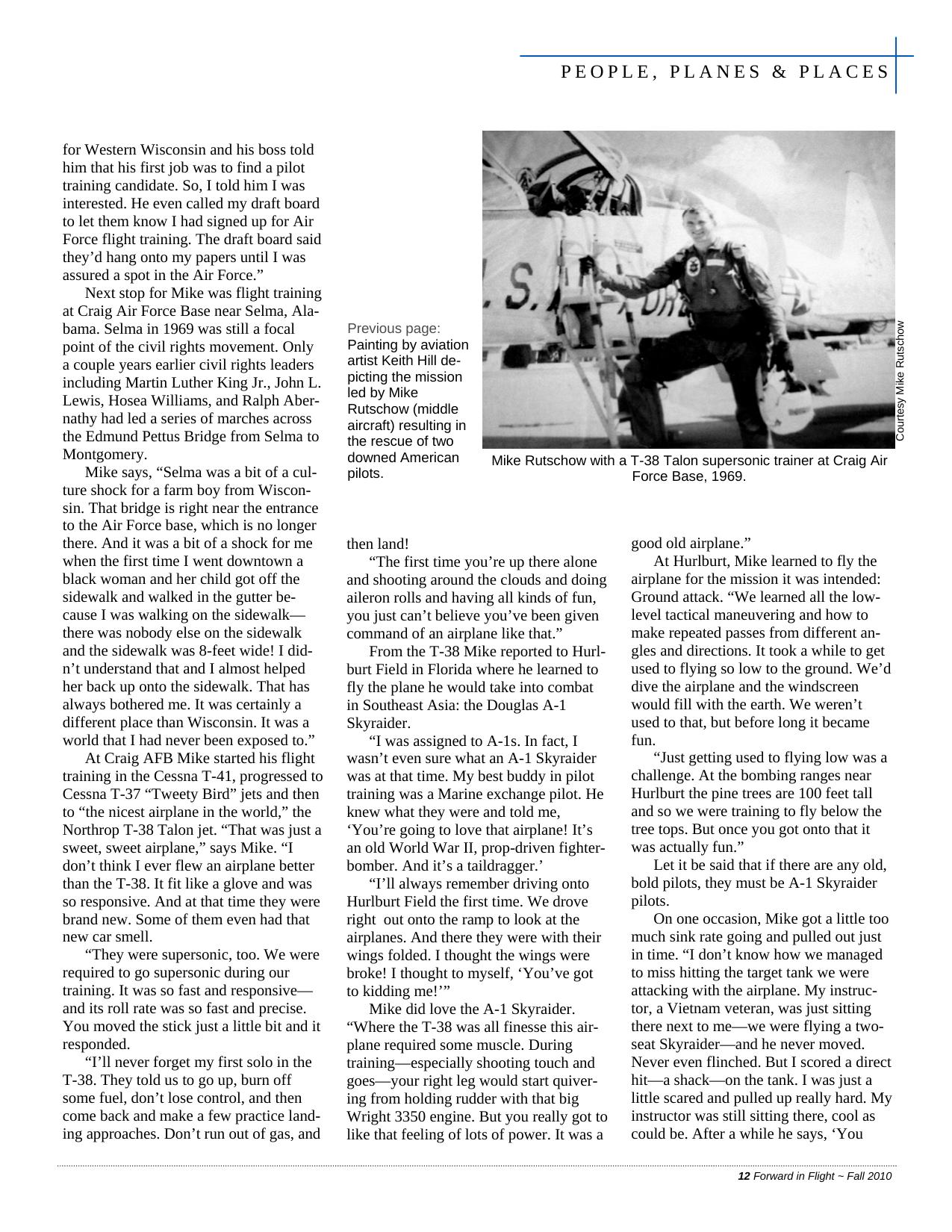
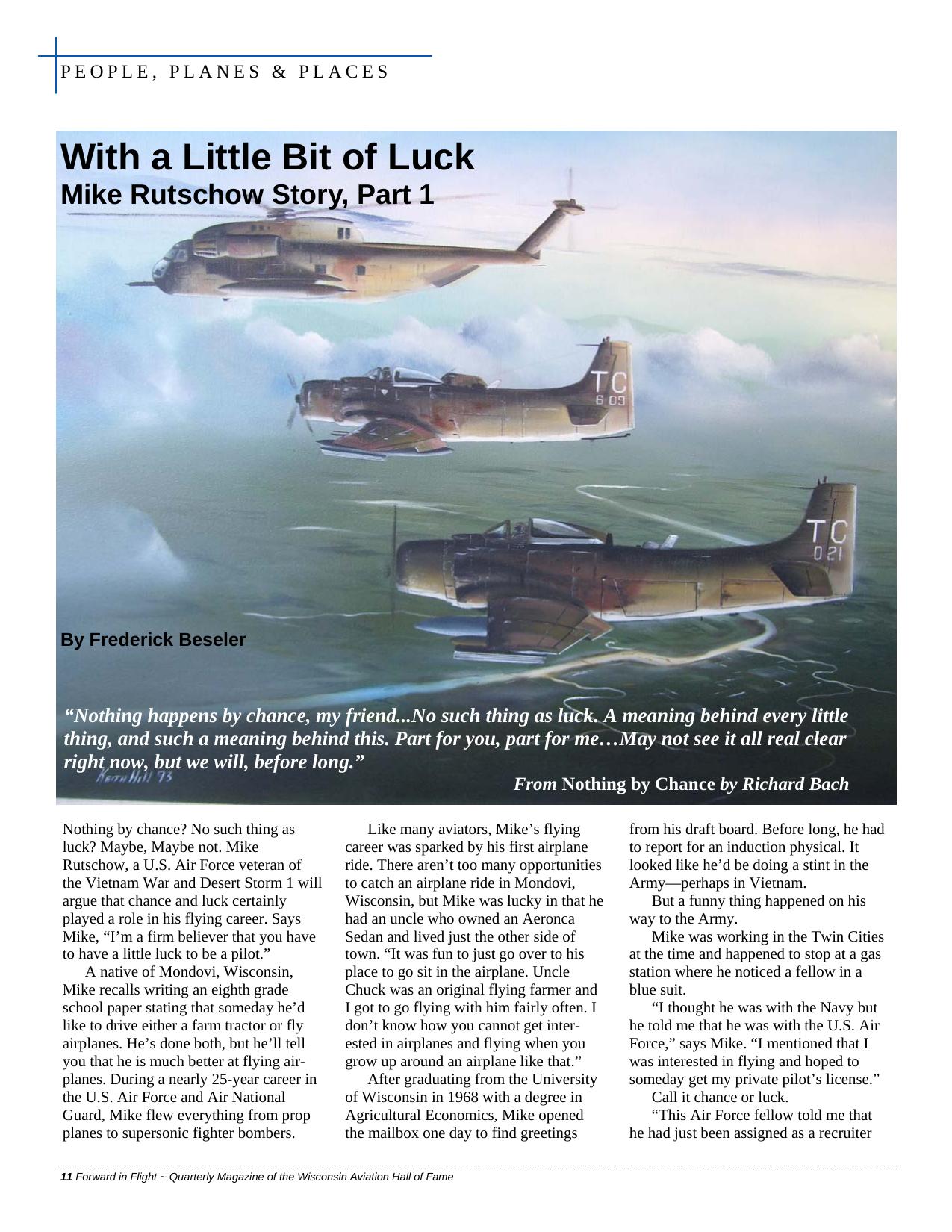
for Western Wisconsin and his boss told him that his first job was to find a pilot training candidate. So, I told him I was interested. He even called my draft board to let them know I had signed up for Air Force flight training. The draft board said they’d hang onto my papers until I was assured a spot in the Air Force.” Next stop for Mike was flight training at Craig Air Force Base near Selma, Alabama. Selma in 1969 was still a focal point of the civil rights movement. Only a couple years earlier civil rights leaders including Martin Luther King Jr., John L. Lewis, Hosea Williams, and Ralph Abernathy had led a series of marches across the Edmund Pettus Bridge from Selma to Montgomery. Mike says, “Selma was a bit of a culture shock for a farm boy from Wisconsin. That bridge is right near the entrance to the Air Force base, which is no longer there. And it was a bit of a shock for me when the first time I went downtown a black woman and her child got off the sidewalk and walked in the gutter because I was walking on the sidewalk— there was nobody else on the sidewalk and the sidewalk was 8-feet wide! I didn’t understand that and I almost helped her back up onto the sidewalk. That has always bothered me. It was certainly a different place than Wisconsin. It was a world that I had never been exposed to.” At Craig AFB Mike started his flight training in the Cessna T-41, progressed to Cessna T-37 “Tweety Bird” jets and then to “the nicest airplane in the world,” the Northrop T-38 Talon jet. “That was just a sweet, sweet airplane,” says Mike. “I don’t think I ever flew an airplane better than the T-38. It fit like a glove and was so responsive. And at that time they were brand new. Some of them even had that new car smell. “They were supersonic, too. We were required to go supersonic during our training. It was so fast and responsive— and its roll rate was so fast and precise. You moved the stick just a little bit and it responded. “I’ll never forget my first solo in the T-38. They told us to go up, burn off some fuel, don’t lose control, and then come back and make a few practice landing approaches. Don’t run out of gas, and Previous page: Painting by aviation artist Keith Hill depicting the mission led by Mike Rutschow (middle aircraft) resulting in the rescue of two downed American pilots. Courtesy Mike Rutschow PEOPLE, PLANES & PLACES Mike Rutschow with a T-38 Talon supersonic trainer at Craig Air Force Base, 1969. then land! “The first time you’re up there alone and shooting around the clouds and doing aileron rolls and having all kinds of fun, you just can’t believe you’ve been given command of an airplane like that.” From the T-38 Mike reported to Hurlburt Field in Florida where he learned to fly the plane he would take into combat in Southeast Asia: the Douglas A-1 Skyraider. “I was assigned to A-1s. In fact, I wasn’t even sure what an A-1 Skyraider was at that time. My best buddy in pilot training was a Marine exchange pilot. He knew what they were and told me, ‘You’re going to love that airplane! It’s an old World War II, prop-driven fighterbomber. And it’s a taildragger.’ “I’ll always remember driving onto Hurlburt Field the first time. We drove right out onto the ramp to look at the airplanes. And there they were with their wings folded. I thought the wings were broke! I thought to myself, ‘You’ve got to kidding me!’” Mike did love the A-1 Skyraider. “Where the T-38 was all finesse this airplane required some muscle. During training—especially shooting touch and goes—your right leg would start quivering from holding rudder with that big Wright 3350 engine. But you really got to like that feeling of lots of power. It was a good old airplane.” At Hurlburt, Mike learned to fly the airplane for the mission it was intended: Ground attack. “We learned all the lowlevel tactical maneuvering and how to make repeated passes from different angles and directions. It took a while to get used to flying so low to the ground. We’d dive the airplane and the windscreen would fill with the earth. We weren’t used to that, but before long it became fun. “Just getting used to flying low was a challenge. At the bombing ranges near Hurlburt the pine trees are 100 feet tall and so we were training to fly below the tree tops. But once you got onto that it was actually fun.” Let it be said that if there are any old, bold pilots, they must be A-1 Skyraider pilots. On one occasion, Mike got a little too much sink rate going and pulled out just in time. “I don’t know how we managed to miss hitting the target tank we were attacking with the airplane. My instructor, a Vietnam veteran, was just sitting there next to me—we were flying a twoseat Skyraider—and he never moved. Never even flinched. But I scored a direct hit—a shack—on the tank. I was just a little scared and pulled up really hard. My instructor was still sitting there, cool as could be. After a while he says, ‘You 12 Forward in Flight ~ Fall 2010
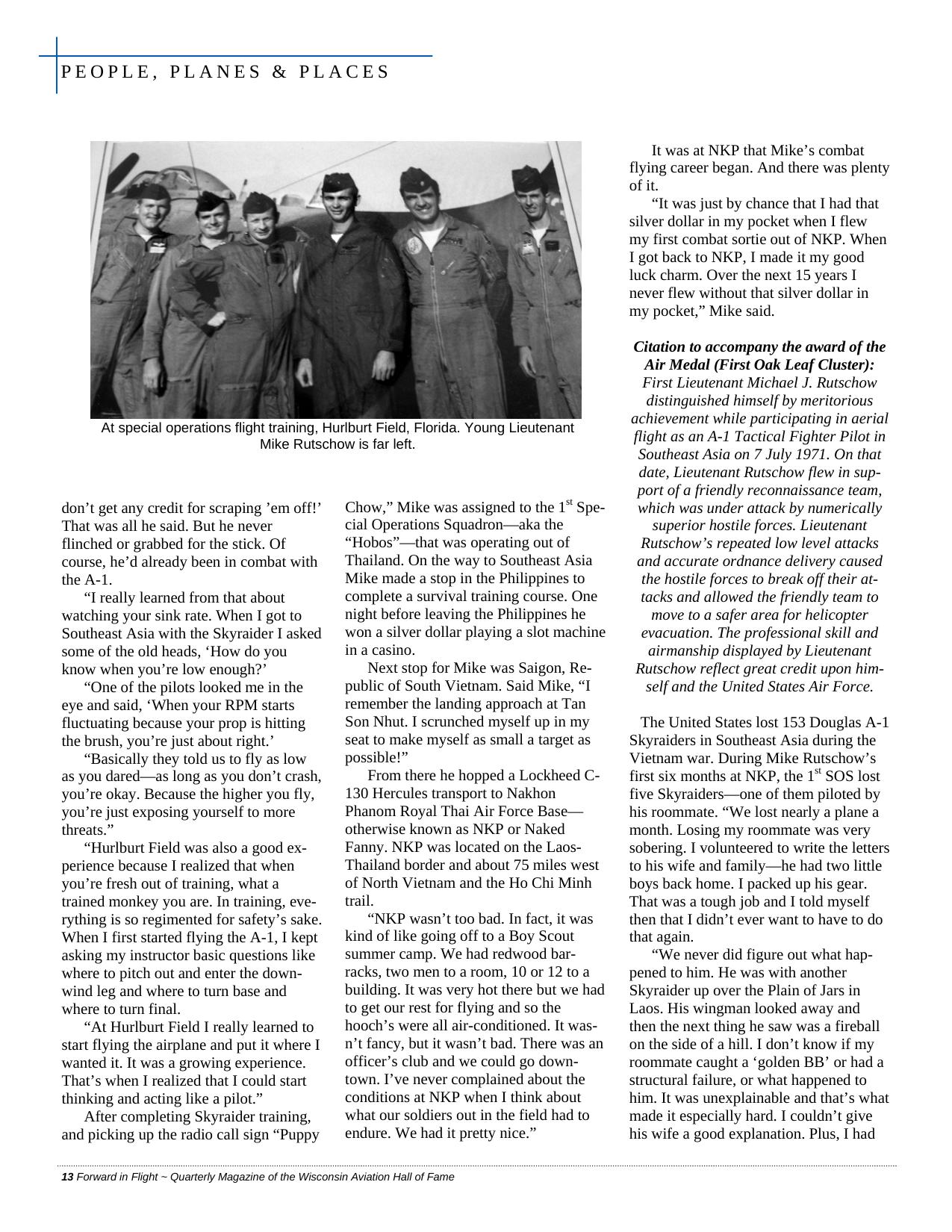
PEOPLE, PLANES & PLACES It was at NKP that Mike’s combat flying career began. And there was plenty of it. “It was just by chance that I had that silver dollar in my pocket when I flew my first combat sortie out of NKP. When I got back to NKP, I made it my good luck charm. Over the next 15 years I never flew without that silver dollar in my pocket,” Mike said. At special operations flight training, Hurlburt Field, Florida. Young Lieutenant Mike Rutschow is far left. don’t get any credit for scraping ’em off!’ That was all he said. But he never flinched or grabbed for the stick. Of course, he’d already been in combat with the A-1. “I really learned from that about watching your sink rate. When I got to Southeast Asia with the Skyraider I asked some of the old heads, ‘How do you know when you’re low enough?’ “One of the pilots looked me in the eye and said, ‘When your RPM starts fluctuating because your prop is hitting the brush, you’re just about right.’ “Basically they told us to fly as low as you dared—as long as you don’t crash, you’re okay. Because the higher you fly, you’re just exposing yourself to more threats.” “Hurlburt Field was also a good experience because I realized that when you’re fresh out of training, what a trained monkey you are. In training, everything is so regimented for safety’s sake. When I first started flying the A-1, I kept asking my instructor basic questions like where to pitch out and enter the downwind leg and where to turn base and where to turn final. “At Hurlburt Field I really learned to start flying the airplane and put it where I wanted it. It was a growing experience. That’s when I realized that I could start thinking and acting like a pilot.” After completing Skyraider training, and picking up the radio call sign “Puppy Chow,” Mike was assigned to the 1st Special Operations Squadron—aka the “Hobos”—that was operating out of Thailand. On the way to Southeast Asia Mike made a stop in the Philippines to complete a survival training course. One night before leaving the Philippines he won a silver dollar playing a slot machine in a casino. Next stop for Mike was Saigon, Republic of South Vietnam. Said Mike, “I remember the landing approach at Tan Son Nhut. I scrunched myself up in my seat to make myself as small a target as possible!” From there he hopped a Lockheed C130 Hercules transport to Nakhon Phanom Royal Thai Air Force Base— otherwise known as NKP or Naked Fanny. NKP was located on the LaosThailand border and about 75 miles west of North Vietnam and the Ho Chi Minh trail. “NKP wasn’t too bad. In fact, it was kind of like going off to a Boy Scout summer camp. We had redwood barracks, two men to a room, 10 or 12 to a building. It was very hot there but we had to get our rest for flying and so the hooch’s were all air-conditioned. It wasn’t fancy, but it wasn’t bad. There was an officer’s club and we could go downtown. I’ve never complained about the conditions at NKP when I think about what our soldiers out in the field had to endure. We had it pretty nice.” 13 Forward in Flight ~ Quarterly Magazine of the Wisconsin Aviation Hall of Fame Citation to accompany the award of the Air Medal (First Oak Leaf Cluster): First Lieutenant Michael J. Rutschow distinguished himself by meritorious achievement while participating in aerial flight as an A-1 Tactical Fighter Pilot in Southeast Asia on 7 July 1971. On that date, Lieutenant Rutschow flew in support of a friendly reconnaissance team, which was under attack by numerically superior hostile forces. Lieutenant Rutschow’s repeated low level attacks and accurate ordnance delivery caused the hostile forces to break off their attacks and allowed the friendly team to move to a safer area for helicopter evacuation. The professional skill and airmanship displayed by Lieutenant Rutschow reflect great credit upon himself and the United States Air Force. The United States lost 153 Douglas A-1 Skyraiders in Southeast Asia during the Vietnam war. During Mike Rutschow’s first six months at NKP, the 1st SOS lost five Skyraiders—one of them piloted by his roommate. “We lost nearly a plane a month. Losing my roommate was very sobering. I volunteered to write the letters to his wife and family—he had two little boys back home. I packed up his gear. That was a tough job and I told myself then that I didn’t ever want to have to do that again. “We never did figure out what happened to him. He was with another Skyraider up over the Plain of Jars in Laos. His wingman looked away and then the next thing he saw was a fireball on the side of a hill. I don’t know if my roommate caught a ‘golden BB’ or had a structural failure, or what happened to him. It was unexplainable and that’s what made it especially hard. I couldn’t give his wife a good explanation. Plus, I had
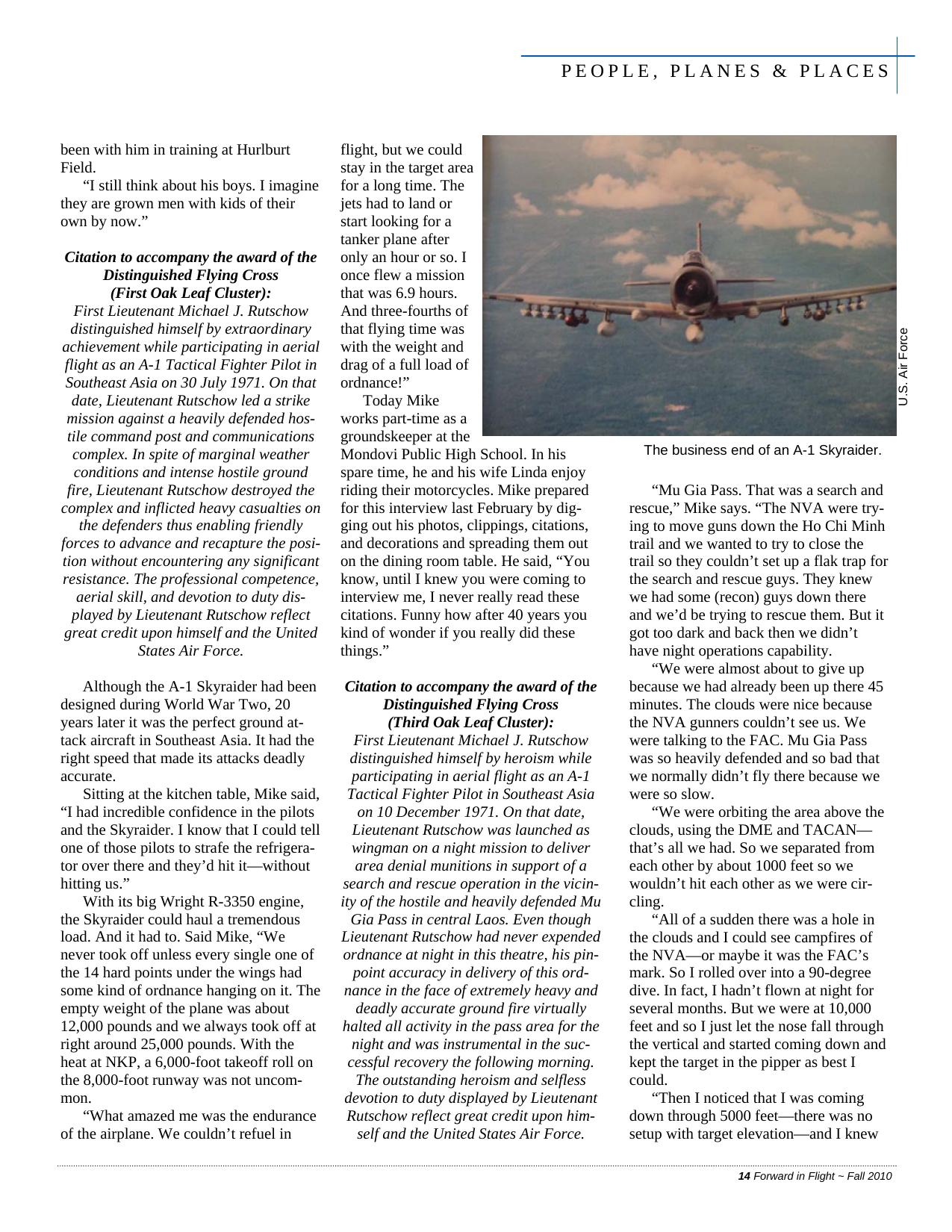
Citation to accompany the award of the Distinguished Flying Cross (First Oak Leaf Cluster): First Lieutenant Michael J. Rutschow distinguished himself by extraordinary achievement while participating in aerial flight as an A-1 Tactical Fighter Pilot in Southeast Asia on 30 July 1971. On that date, Lieutenant Rutschow led a strike mission against a heavily defended hostile command post and communications complex. In spite of marginal weather conditions and intense hostile ground fire, Lieutenant Rutschow destroyed the complex and inflicted heavy casualties on the defenders thus enabling friendly forces to advance and recapture the position without encountering any significant resistance. The professional competence, aerial skill, and devotion to duty displayed by Lieutenant Rutschow reflect great credit upon himself and the United States Air Force. flight, but we could stay in the target area for a long time. The jets had to land or start looking for a tanker plane after only an hour or so. I once flew a mission that was 6.9 hours. And three-fourths of that flying time was with the weight and drag of a full load of ordnance!” Today Mike works part-time as a groundskeeper at the Mondovi Public High School. In his spare time, he and his wife Linda enjoy riding their motorcycles. Mike prepared for this interview last February by digging out his photos, clippings, citations, and decorations and spreading them out on the dining room table. He said, “You know, until I knew you were coming to interview me, I never really read these citations. Funny how after 40 years you kind of wonder if you really did these things.” Although the A-1 Skyraider had been designed during World War Two, 20 years later it was the perfect ground attack aircraft in Southeast Asia. It had the right speed that made its attacks deadly accurate. Sitting at the kitchen table, Mike said, “I had incredible confidence in the pilots and the Skyraider. I know that I could tell one of those pilots to strafe the refrigerator over there and they’d hit it—without hitting us.” With its big Wright R-3350 engine, the Skyraider could haul a tremendous load. And it had to. Said Mike, “We never took off unless every single one of the 14 hard points under the wings had some kind of ordnance hanging on it. The empty weight of the plane was about 12,000 pounds and we always took off at right around 25,000 pounds. With the heat at NKP, a 6,000-foot takeoff roll on the 8,000-foot runway was not uncommon. “What amazed me was the endurance of the airplane. We couldn’t refuel in Citation to accompany the award of the Distinguished Flying Cross (Third Oak Leaf Cluster): First Lieutenant Michael J. Rutschow distinguished himself by heroism while participating in aerial flight as an A-1 Tactical Fighter Pilot in Southeast Asia on 10 December 1971. On that date, Lieutenant Rutschow was launched as wingman on a night mission to deliver area denial munitions in support of a search and rescue operation in the vicinity of the hostile and heavily defended Mu Gia Pass in central Laos. Even though Lieutenant Rutschow had never expended ordnance at night in this theatre, his pinpoint accuracy in delivery of this ordnance in the face of extremely heavy and deadly accurate ground fire virtually halted all activity in the pass area for the night and was instrumental in the successful recovery the following morning. The outstanding heroism and selfless devotion to duty displayed by Lieutenant Rutschow reflect great credit upon himself and the United States Air Force. been with him in training at Hurlburt Field. “I still think about his boys. I imagine they are grown men with kids of their own by now.” U.S. Air Force PEOPLE, PLANES & PLACES The business end of an A-1 Skyraider. “Mu Gia Pass. That was a search and rescue,” Mike says. “The NVA were trying to move guns down the Ho Chi Minh trail and we wanted to try to close the trail so they couldn’t set up a flak trap for the search and rescue guys. They knew we had some (recon) guys down there and we’d be trying to rescue them. But it got too dark and back then we didn’t have night operations capability. “We were almost about to give up because we had already been up there 45 minutes. The clouds were nice because the NVA gunners couldn’t see us. We were talking to the FAC. Mu Gia Pass was so heavily defended and so bad that we normally didn’t fly there because we were so slow. “We were orbiting the area above the clouds, using the DME and TACAN— that’s all we had. So we separated from each other by about 1000 feet so we wouldn’t hit each other as we were circling. “All of a sudden there was a hole in the clouds and I could see campfires of the NVA—or maybe it was the FAC’s mark. So I rolled over into a 90-degree dive. In fact, I hadn’t flown at night for several months. But we were at 10,000 feet and so I just let the nose fall through the vertical and started coming down and kept the target in the pipper as best I could. “Then I noticed that I was coming down through 5000 feet—there was no setup with target elevation—and I knew 14 Forward in Flight ~ Fall 2010
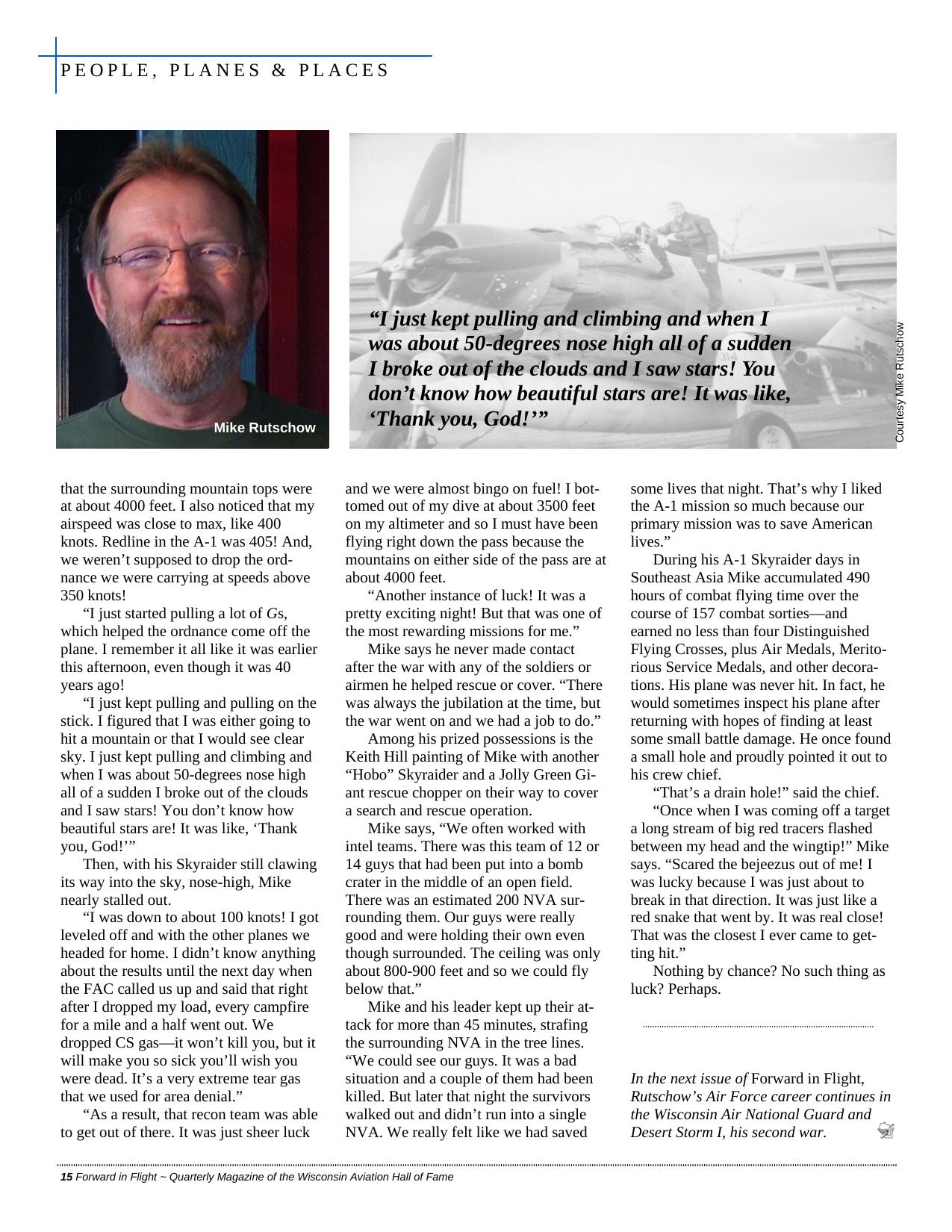
Mike Rutschow that the surrounding mountain tops were at about 4000 feet. I also noticed that my airspeed was close to max, like 400 knots. Redline in the A-1 was 405! And, we weren’t supposed to drop the ordnance we were carrying at speeds above 350 knots! “I just started pulling a lot of Gs, which helped the ordnance come off the plane. I remember it all like it was earlier this afternoon, even though it was 40 years ago! “I just kept pulling and pulling on the stick. I figured that I was either going to hit a mountain or that I would see clear sky. I just kept pulling and climbing and when I was about 50-degrees nose high all of a sudden I broke out of the clouds and I saw stars! You don’t know how beautiful stars are! It was like, ‘Thank you, God!’” Then, with his Skyraider still clawing its way into the sky, nose-high, Mike nearly stalled out. “I was down to about 100 knots! I got leveled off and with the other planes we headed for home. I didn’t know anything about the results until the next day when the FAC called us up and said that right after I dropped my load, every campfire for a mile and a half went out. We dropped CS gas—it won’t kill you, but it will make you so sick you’ll wish you were dead. It’s a very extreme tear gas that we used for area denial.” “As a result, that recon team was able to get out of there. It was just sheer luck “I just kept pulling and climbing and when I was about 50-degrees nose high all of a sudden I broke out of the clouds and I saw stars! You don’t know how beautiful stars are! It was like, ‘Thank you, God!’” and we were almost bingo on fuel! I bottomed out of my dive at about 3500 feet on my altimeter and so I must have been flying right down the pass because the mountains on either side of the pass are at about 4000 feet. “Another instance of luck! It was a pretty exciting night! But that was one of the most rewarding missions for me.” Mike says he never made contact after the war with any of the soldiers or airmen he helped rescue or cover. “There was always the jubilation at the time, but the war went on and we had a job to do.” Among his prized possessions is the Keith Hill painting of Mike with another “Hobo” Skyraider and a Jolly Green Giant rescue chopper on their way to cover a search and rescue operation. Mike says, “We often worked with intel teams. There was this team of 12 or 14 guys that had been put into a bomb crater in the middle of an open field. There was an estimated 200 NVA surrounding them. Our guys were really good and were holding their own even though surrounded. The ceiling was only about 800-900 feet and so we could fly below that.” Mike and his leader kept up their attack for more than 45 minutes, strafing the surrounding NVA in the tree lines. “We could see our guys. It was a bad situation and a couple of them had been killed. But later that night the survivors walked out and didn’t run into a single NVA. We really felt like we had saved 15 Forward in Flight ~ Quarterly Magazine of the Wisconsin Aviation Hall of Fame some lives that night. That’s why I liked the A-1 mission so much because our primary mission was to save American lives.” During his A-1 Skyraider days in Southeast Asia Mike accumulated 490 hours of combat flying time over the course of 157 combat sorties—and earned no less than four Distinguished Flying Crosses, plus Air Medals, Meritorious Service Medals, and other decorations. His plane was never hit. In fact, he would sometimes inspect his plane after returning with hopes of finding at least some small battle damage. He once found a small hole and proudly pointed it out to his crew chief. “That’s a drain hole!” said the chief. “Once when I was coming off a target a long stream of big red tracers flashed between my head and the wingtip!” Mike says. “Scared the bejeezus out of me! I was lucky because I was just about to break in that direction. It was just like a red snake that went by. It was real close! That was the closest I ever came to getting hit.” Nothing by chance? No such thing as luck? Perhaps. In the next issue of Forward in Flight, Rutschow’s Air Force career continues in the Wisconsin Air National Guard and Desert Storm I, his second war. Courtesy Mike Rutschow PEOPLE, PLANES & PLACES
PEOPLE, PLANES & PLACES Wisconsin’s Atomic Pilot Woodrow Paul “Woodie” Swancutt By Tom Thomas Major Woodrow P. Swancutt released the brakes on the B-29, Dave’s Dream, on July 1, 1946, and headed toward the active runway. This was to be the mission of his lifetime; one that he had trained for and practiced many times. Things had to go right. The lone bomb in his aircraft was a “Fat Boy,” similar to the one dropped on Nagasaki on August 9, 1944. The mighty Superfortress’ wheels lifted off the ground minutes before 0600 hours and soared upward, reaching its planned altitude of 30,000 feet This was to be the first peacetime aerial drop of an atomic bomb to test its affect on ships. Some 70 Japanese, German, and American ships, including submarines, were moored at the Bikini Atoll about 2,500 miles southwest of Hawaii. Major Swancutt had been selected from the Army Air Corps top bomber crews to pilot his aircraft on this important mission. He had been an active B-29 bomber pilot serving in the Pacific campaign since he’d arrived in India in early 1944. Major Swancutt had a distinguished war record, completing 49 combat missions by the end of World War II. Upon arriving at Chengdu, China, he was selected to lead the first bombing raid of Japan’s mainland on July 15, 1944, after Jimmy Doolittle’s B-25 raid in April 1942. Forty-seven B-29s participated in this mission. Because of the great distance and the B-29s’ heavy fuel usage while flying formation, all of the bombers went in single ship formation. Our Wisconsin Boy, Major Swancutt, lead the second bombing mission to hit Japan since the attack on Pearl Harbor on December 7, 1941. Woodrow “Woodie” Paul Swancutt was born in Edgar, Wisconsin, about 15 miles west of Wausau, on July 4, 1915. His family moved to Stevens Point where he attended elementary school, and then they moved to La Crosse. Woodie attended La Crosse Central High School and graduated in 1932. Jobs were scarce during the depression so he joined the Civilian Conservation Corp (CCC), locating in Wisconsin Rapids. He also joined the Catholic Youth Organization (CYO) for its recreational activities, including boxing. Celebrated Boxer Woodie enjoyed boxing and excelled in Golden Gloves, winning the state championship and a regional meet in Chicago as a middleweight. There, he was noticed by UW Wisconsin boxing coach, John Walsh. The coach found Woodie a parttime job so he could make enough money to attend college. Woodie came to Madison as a freshman in 1938—reportedly enrolling in premed—and joined the boxing team. In 1939, the UW hosted the NCAA Boxing Championship tournament, the first to be held at Camp Randall’s Fieldhouse. Four badgers took NCAA Championships that year and Woodie, at 155 pounds, was one of them. He was the underdog, having lost a bout with the returning champion from LSU three weeks prior. The news report said that in his final NCAA Championship bout, “never has Woodie fought with as consummate fury”. He came out swinging and soundly defeated his opponent from Louisiana State University. In 1940, the Badgers initially came on strong, but ended up with 2nd place at Nationals. Woodie was the only one to come away with his 2nd NCAA Championship. For an individual to win an NCAA Boxing title was one thing, but returning and winning a second year was a great feat. Military Career In late 1940, Woodie dropped out of the UW-Madison and enlisted in the Army Air Corps at Sparta, Wisconsin, thus beginning his long and distinguished military career. He attended flight training at Kelly Field outside San Antonio, Texas, and was commissioned a 2nd Lieutenant with his Wings of Silver in July 1941. Woodie’s flying career included being a backup pilot for Col. Paul Tibbets and the Enola Gay. The secrecy around the first atomic bomb was so tight that Woodie didn’t learn of this until much 16 Forward in Flight ~ Fall 2010
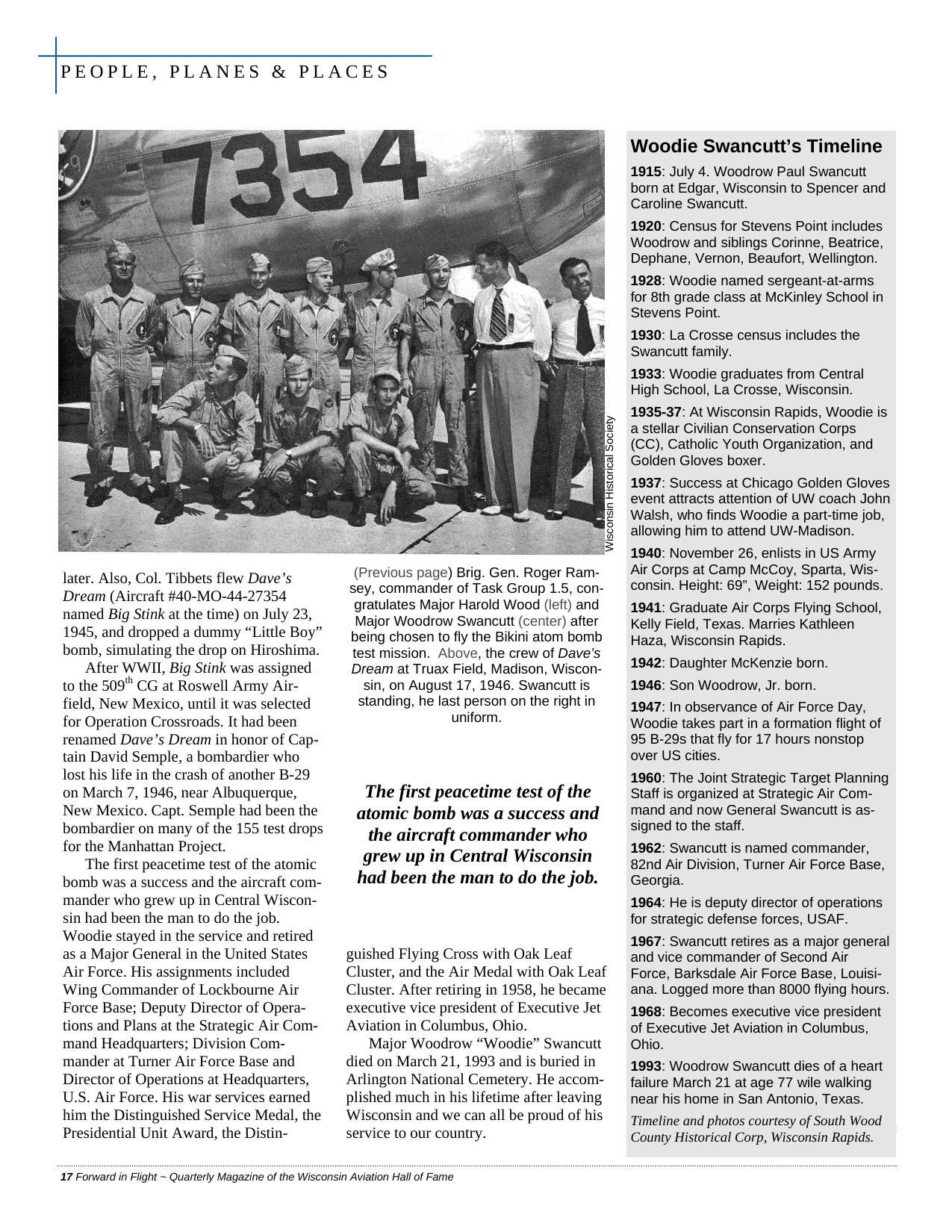
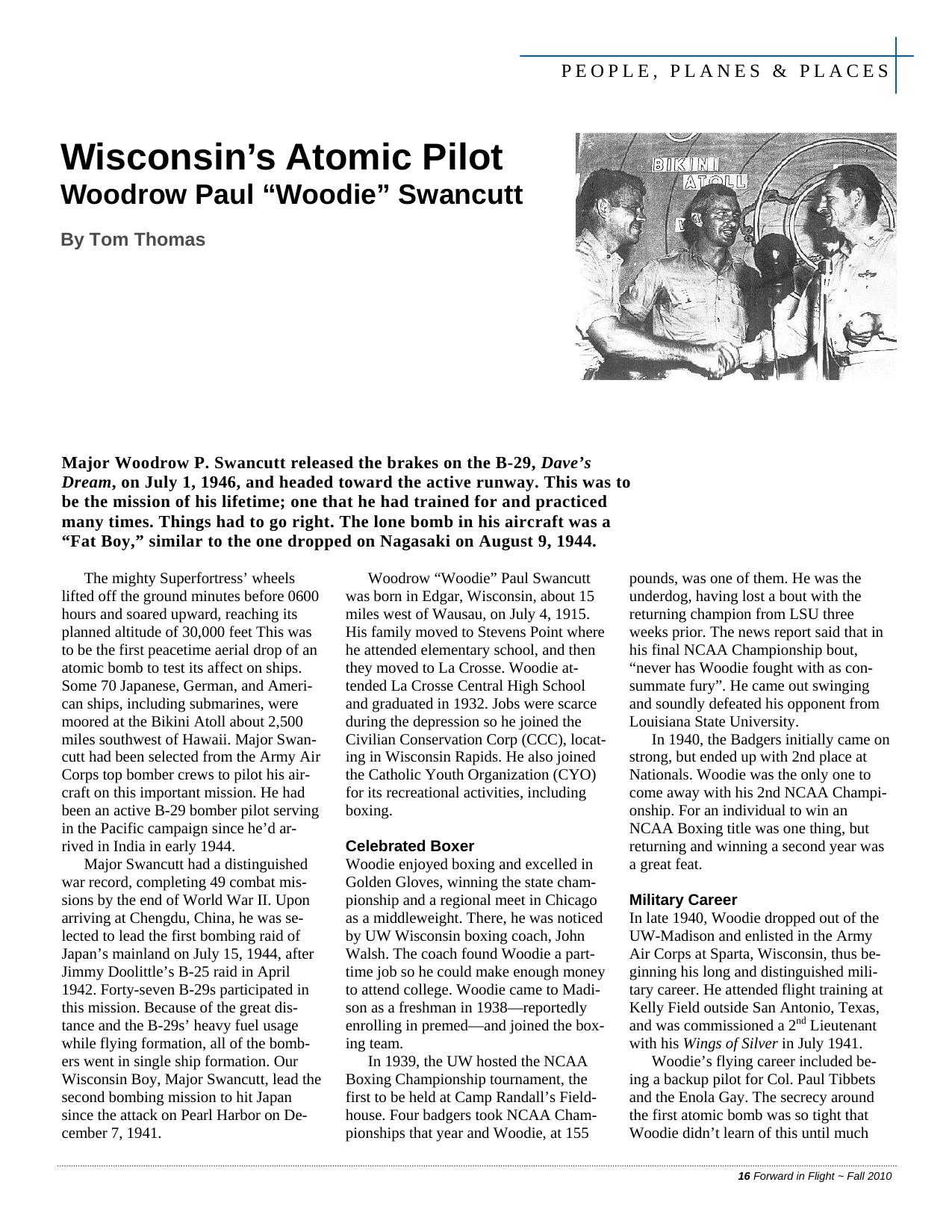
PEOPLE, PLANES & PLACES Woodie Swancutt’s Timeline 1915: July 4. Woodrow Paul Swancutt born at Edgar, Wisconsin to Spencer and Caroline Swancutt. 1920: Census for Stevens Point includes Woodrow and siblings Corinne, Beatrice, Dephane, Vernon, Beaufort, Wellington. 1928: Woodie named sergeant-at-arms for 8th grade class at McKinley School in Stevens Point. 1930: La Crosse census includes the Swancutt family. Wisconsin Historical Society 1933: Woodie graduates from Central High School, La Crosse, Wisconsin. later. Also, Col. Tibbets flew Dave’s Dream (Aircraft #40-MO-44-27354 named Big Stink at the time) on July 23, 1945, and dropped a dummy “Little Boy” bomb, simulating the drop on Hiroshima. After WWII, Big Stink was assigned to the 509th CG at Roswell Army Airfield, New Mexico, until it was selected for Operation Crossroads. It had been renamed Dave’s Dream in honor of Captain David Semple, a bombardier who lost his life in the crash of another B-29 on March 7, 1946, near Albuquerque, New Mexico. Capt. Semple had been the bombardier on many of the 155 test drops for the Manhattan Project. The first peacetime test of the atomic bomb was a success and the aircraft commander who grew up in Central Wisconsin had been the man to do the job. Woodie stayed in the service and retired as a Major General in the United States Air Force. His assignments included Wing Commander of Lockbourne Air Force Base; Deputy Director of Operations and Plans at the Strategic Air Command Headquarters; Division Commander at Turner Air Force Base and Director of Operations at Headquarters, U.S. Air Force. His war services earned him the Distinguished Service Medal, the Presidential Unit Award, the Distin- (Previous page) Brig. Gen. Roger Ramsey, commander of Task Group 1.5, congratulates Major Harold Wood (left) and Major Woodrow Swancutt (center) after being chosen to fly the Bikini atom bomb test mission. Above, the crew of Dave’s Dream at Truax Field, Madison, Wisconsin, on August 17, 1946. Swancutt is standing, he last person on the right in uniform. The first peacetime test of the atomic bomb was a success and the aircraft commander who grew up in Central Wisconsin had been the man to do the job. 1935-37: At Wisconsin Rapids, Woodie is a stellar Civilian Conservation Corps (CC), Catholic Youth Organization, and Golden Gloves boxer. 1937: Success at Chicago Golden Gloves event attracts attention of UW coach John Walsh, who finds Woodie a part-time job, allowing him to attend UW-Madison. 1940: November 26, enlists in US Army Air Corps at Camp McCoy, Sparta, Wisconsin. Height: 69”, Weight: 152 pounds. 1941: Graduate Air Corps Flying School, Kelly Field, Texas. Marries Kathleen Haza, Wisconsin Rapids. 1942: Daughter McKenzie born. 1946: Son Woodrow, Jr. born. 1947: In observance of Air Force Day, Woodie takes part in a formation flight of 95 B-29s that fly for 17 hours nonstop over US cities. 1960: The Joint Strategic Target Planning Staff is organized at Strategic Air Command and now General Swancutt is assigned to the staff. 1962: Swancutt is named commander, 82nd Air Division, Turner Air Force Base, Georgia. 1964: He is deputy director of operations for strategic defense forces, USAF. guished Flying Cross with Oak Leaf Cluster, and the Air Medal with Oak Leaf Cluster. After retiring in 1958, he became executive vice president of Executive Jet Aviation in Columbus, Ohio. Major Woodrow “Woodie” Swancutt died on March 21, 1993 and is buried in Arlington National Cemetery. He accomplished much in his lifetime after leaving Wisconsin and we can all be proud of his service to our country. 17 Forward in Flight ~ Quarterly Magazine of the Wisconsin Aviation Hall of Fame 1967: Swancutt retires as a major general and vice commander of Second Air Force, Barksdale Air Force Base, Louisiana. Logged more than 8000 flying hours. 1968: Becomes executive vice president of Executive Jet Aviation in Columbus, Ohio. 1993: Woodrow Swancutt dies of a heart failure March 21 at age 77 wile walking near his home in San Antonio, Texas. Timeline and photos courtesy of South Wood County Historical Corp, Wisconsin Rapids.
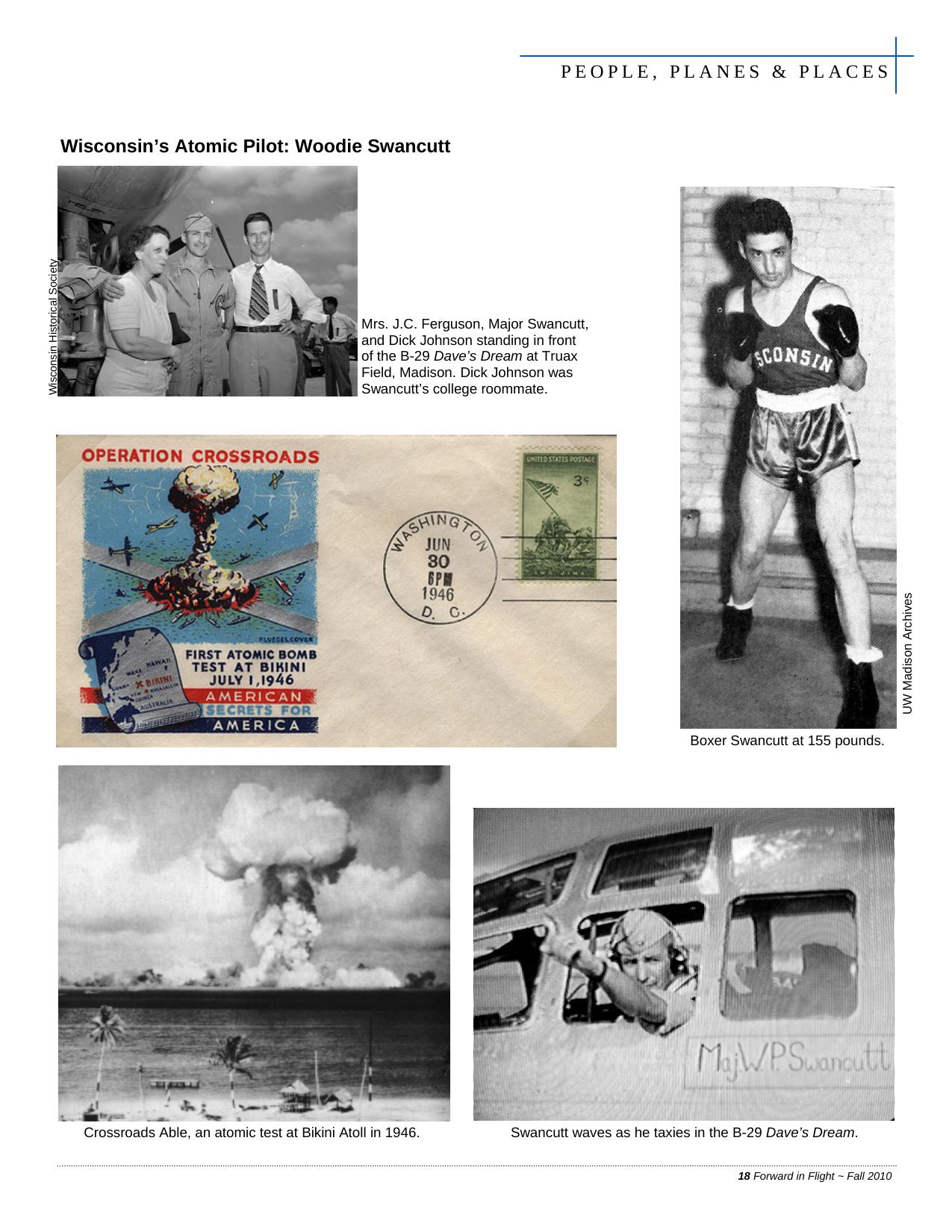
PEOPLE, PLANES & PLACES Mrs. J.C. Ferguson, Major Swancutt, and Dick Johnson standing in front of the B-29 Dave’s Dream at Truax Field, Madison. Dick Johnson was Swancutt’s college roommate. A 1946 envelope showing the atomic bomb tests at Bikini. Photo courtesy Witco Stamp Collection, Gift of Crompton Corporation, Chemical Heritage Foundation Collections. Crossroads Able, an atomic test at Bikini Atoll in 1946. UW Madison Archives Wisconsin Historical Society Wisconsin’s Atomic Pilot: Woodie Swancutt Boxer Swancutt at 155 pounds. Swancutt waves as he taxies in the B-29 Dave’s Dream. 18 Forward in Flight ~ Fall 2010
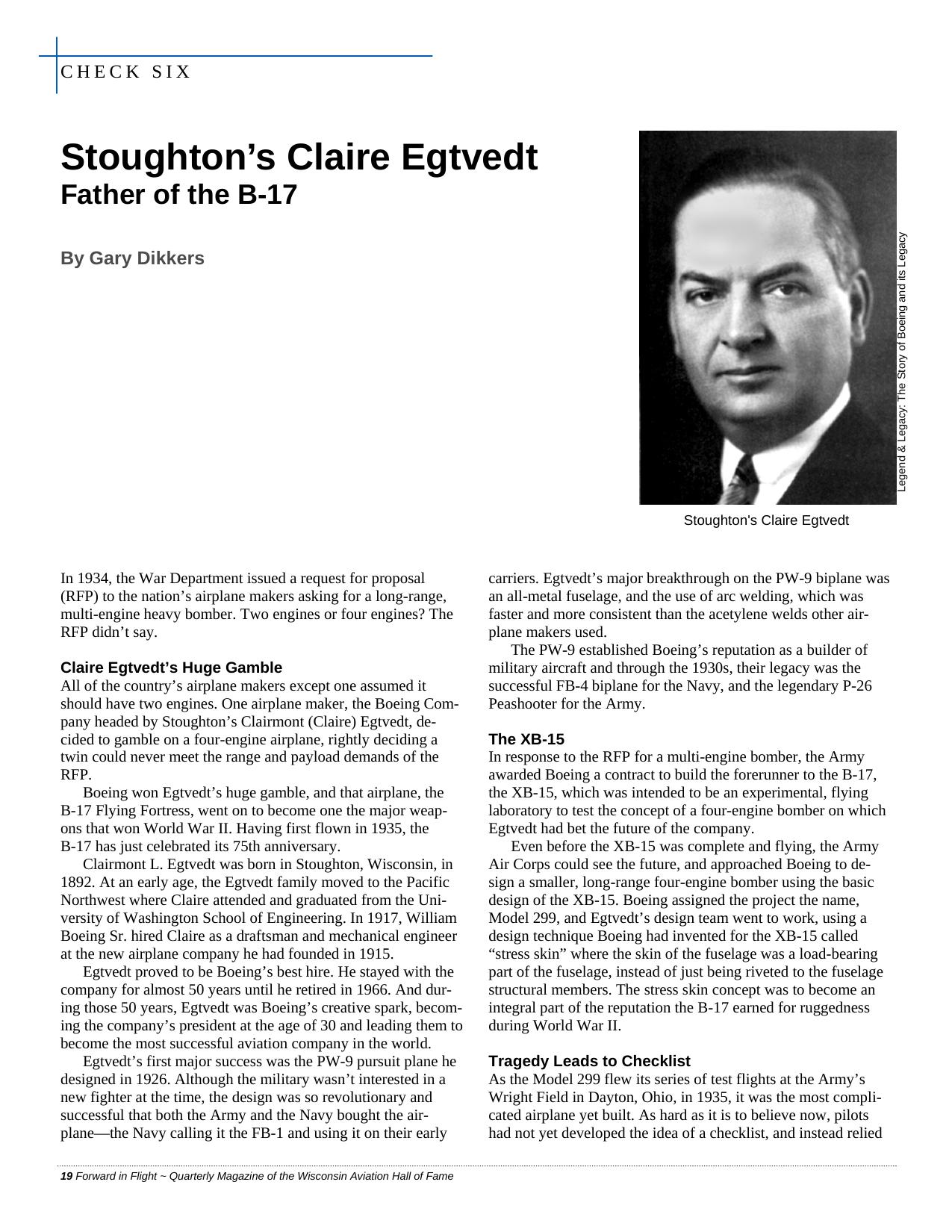
CHECK SIX Stoughton’s Claire Egtvedt Legend & Legacy: The Story of Boeing and its Legacy Father of the B-17 By Gary Dikkers Stoughton's Claire Egtvedt In 1934, the War Department issued a request for proposal (RFP) to the nation’s airplane makers asking for a long-range, multi-engine heavy bomber. Two engines or four engines? The RFP didn’t say. Claire Egtvedt’s Huge Gamble All of the country’s airplane makers except one assumed it should have two engines. One airplane maker, the Boeing Company headed by Stoughton’s Clairmont (Claire) Egtvedt, decided to gamble on a four-engine airplane, rightly deciding a twin could never meet the range and payload demands of the RFP. Boeing won Egtvedt’s huge gamble, and that airplane, the B-17 Flying Fortress, went on to become one the major weapons that won World War II. Having first flown in 1935, the B-17 has just celebrated its 75th anniversary. Clairmont L. Egtvedt was born in Stoughton, Wisconsin, in 1892. At an early age, the Egtvedt family moved to the Pacific Northwest where Claire attended and graduated from the University of Washington School of Engineering. In 1917, William Boeing Sr. hired Claire as a draftsman and mechanical engineer at the new airplane company he had founded in 1915. Egtvedt proved to be Boeing’s best hire. He stayed with the company for almost 50 years until he retired in 1966. And during those 50 years, Egtvedt was Boeing’s creative spark, becoming the company’s president at the age of 30 and leading them to become the most successful aviation company in the world. Egtvedt’s first major success was the PW-9 pursuit plane he designed in 1926. Although the military wasn’t interested in a new fighter at the time, the design was so revolutionary and successful that both the Army and the Navy bought the airplane—the Navy calling it the FB-1 and using it on their early 19 Forward in Flight ~ Quarterly Magazine of the Wisconsin Aviation Hall of Fame carriers. Egtvedt’s major breakthrough on the PW-9 biplane was an all-metal fuselage, and the use of arc welding, which was faster and more consistent than the acetylene welds other airplane makers used. The PW-9 established Boeing’s reputation as a builder of military aircraft and through the 1930s, their legacy was the successful FB-4 biplane for the Navy, and the legendary P-26 Peashooter for the Army. The XB-15 In response to the RFP for a multi-engine bomber, the Army awarded Boeing a contract to build the forerunner to the B-17, the XB-15, which was intended to be an experimental, flying laboratory to test the concept of a four-engine bomber on which Egtvedt had bet the future of the company. Even before the XB-15 was complete and flying, the Army Air Corps could see the future, and approached Boeing to design a smaller, long-range four-engine bomber using the basic design of the XB-15. Boeing assigned the project the name, Model 299, and Egtvedt’s design team went to work, using a design technique Boeing had invented for the XB-15 called “stress skin” where the skin of the fuselage was a load-bearing part of the fuselage, instead of just being riveted to the fuselage structural members. The stress skin concept was to become an integral part of the reputation the B-17 earned for ruggedness during World War II. Tragedy Leads to Checklist As the Model 299 flew its series of test flights at the Army’s Wright Field in Dayton, Ohio, in 1935, it was the most complicated airplane yet built. As hard as it is to believe now, pilots had not yet developed the idea of a checklist, and instead relied
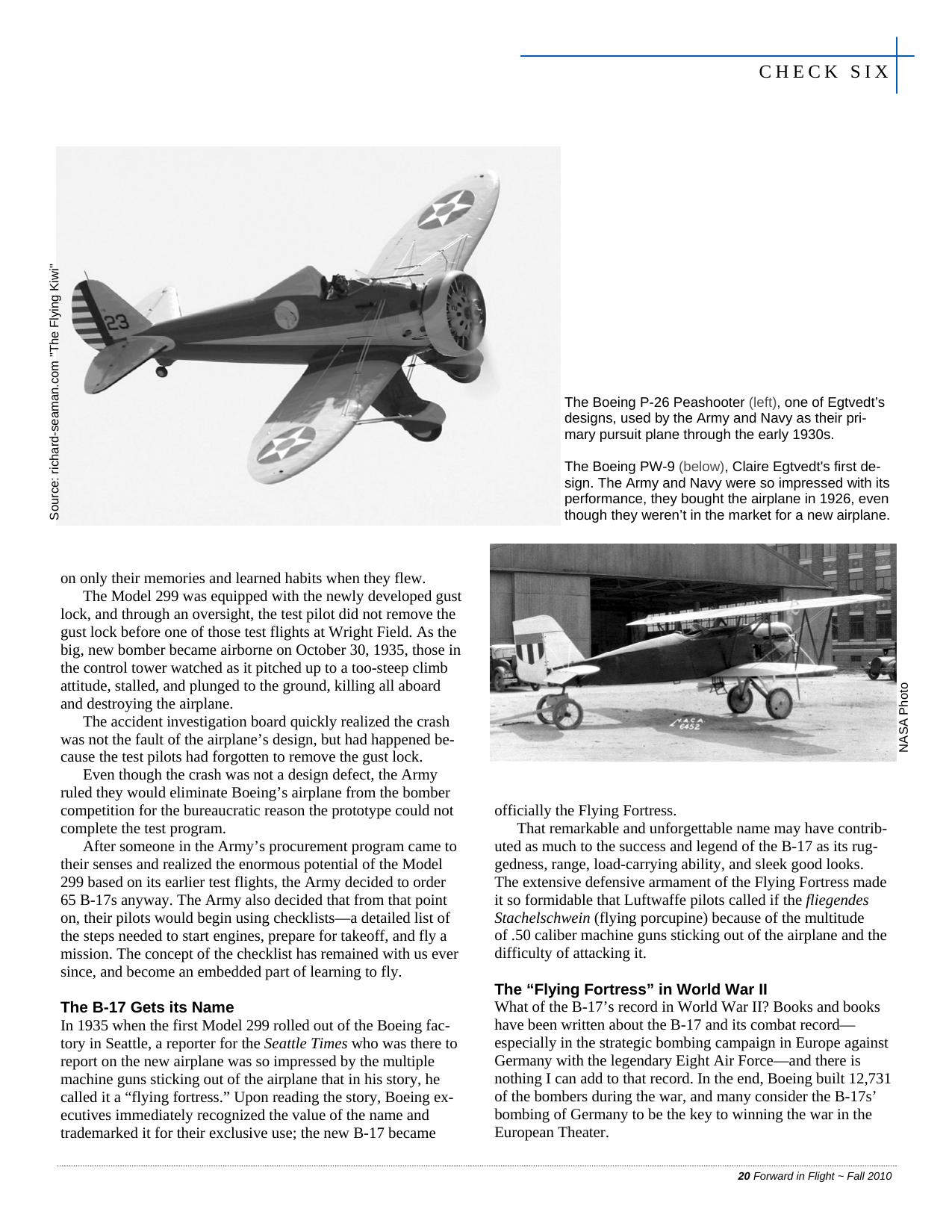
on only their memories and learned habits when they flew. The Model 299 was equipped with the newly developed gust lock, and through an oversight, the test pilot did not remove the gust lock before one of those test flights at Wright Field. As the big, new bomber became airborne on October 30, 1935, those in the control tower watched as it pitched up to a too-steep climb attitude, stalled, and plunged to the ground, killing all aboard and destroying the airplane. The accident investigation board quickly realized the crash was not the fault of the airplane’s design, but had happened because the test pilots had forgotten to remove the gust lock. Even though the crash was not a design defect, the Army ruled they would eliminate Boeing’s airplane from the bomber competition for the bureaucratic reason the prototype could not complete the test program. After someone in the Army’s procurement program came to their senses and realized the enormous potential of the Model 299 based on its earlier test flights, the Army decided to order 65 B-17s anyway. The Army also decided that from that point on, their pilots would begin using checklists—a detailed list of the steps needed to start engines, prepare for takeoff, and fly a mission. The concept of the checklist has remained with us ever since, and become an embedded part of learning to fly. The B-17 Gets its Name In 1935 when the first Model 299 rolled out of the Boeing factory in Seattle, a reporter for the Seattle Times who was there to report on the new airplane was so impressed by the multiple machine guns sticking out of the airplane that in his story, he called it a “flying fortress.” Upon reading the story, Boeing executives immediately recognized the value of the name and trademarked it for their exclusive use; the new B-17 became The Boeing P-26 Peashooter (left), one of Egtvedt’s designs, used by the Army and Navy as their primary pursuit plane through the early 1930s. The Boeing PW-9 (below), Claire Egtvedt's first design. The Army and Navy were so impressed with its performance, they bought the airplane in 1926, even though they weren’t in the market for a new airplane. NASA Photo Source: richard-seaman.com "The Flying Kiwi" CHECK SIX officially the Flying Fortress. That remarkable and unforgettable name may have contributed as much to the success and legend of the B-17 as its ruggedness, range, load-carrying ability, and sleek good looks. The extensive defensive armament of the Flying Fortress made it so formidable that Luftwaffe pilots called if the fliegendes Stachelschwein (flying porcupine) because of the multitude of .50 caliber machine guns sticking out of the airplane and the difficulty of attacking it. The “Flying Fortress” in World War II What of the B-17’s record in World War II? Books and books have been written about the B-17 and its combat record— especially in the strategic bombing campaign in Europe against Germany with the legendary Eight Air Force—and there is nothing I can add to that record. In the end, Boeing built 12,731 of the bombers during the war, and many consider the B-17s’ bombing of Germany to be the key to winning the war in the European Theater. 20 Forward in Flight ~ Fall 2010
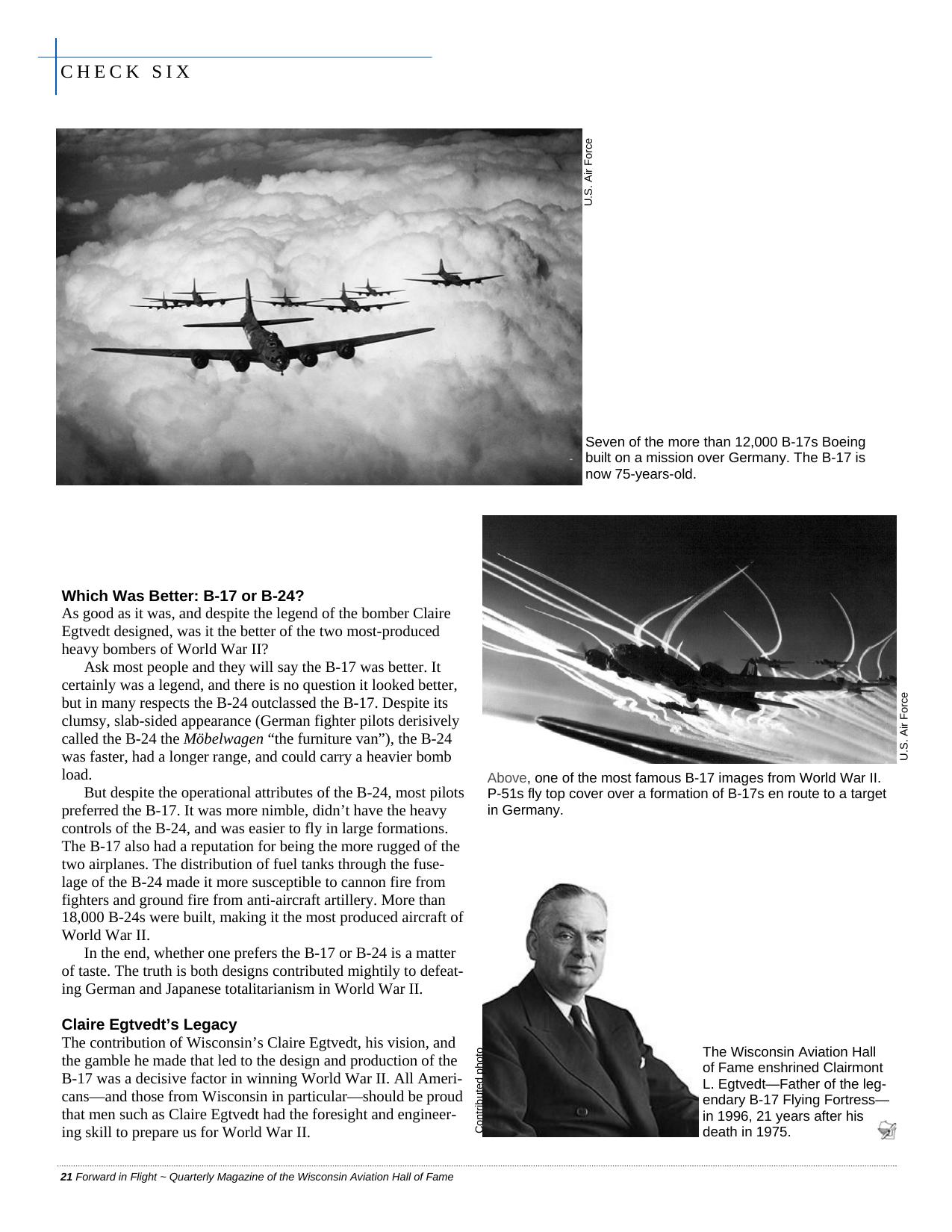
U.S. Air Force CHECK SIX Seven of the more than 12,000 B-17s Boeing built on a mission over Germany. The B-17 is now 75-years-old. 21 Forward in Flight ~ Quarterly Magazine of the Wisconsin Aviation Hall of Fame Above, one of the most famous B-17 images from World War II. P-51s fly top cover over a formation of B-17s en route to a target in Germany. Contributed photo Claire Egtvedt’s Legacy The contribution of Wisconsin’s Claire Egtvedt, his vision, and the gamble he made that led to the design and production of the B-17 was a decisive factor in winning World War II. All Americans—and those from Wisconsin in particular—should be proud that men such as Claire Egtvedt had the foresight and engineering skill to prepare us for World War II. U.S. Air Force Which Was Better: B-17 or B-24? As good as it was, and despite the legend of the bomber Claire Egtvedt designed, was it the better of the two most-produced heavy bombers of World War II? Ask most people and they will say the B-17 was better. It certainly was a legend, and there is no question it looked better, but in many respects the B-24 outclassed the B-17. Despite its clumsy, slab-sided appearance (German fighter pilots derisively called the B-24 the Möbelwagen “the furniture van”), the B-24 was faster, had a longer range, and could carry a heavier bomb load. But despite the operational attributes of the B-24, most pilots preferred the B-17. It was more nimble, didn’t have the heavy controls of the B-24, and was easier to fly in large formations. The B-17 also had a reputation for being the more rugged of the two airplanes. The distribution of fuel tanks through the fuselage of the B-24 made it more susceptible to cannon fire from fighters and ground fire from anti-aircraft artillery. More than 18,000 B-24s were built, making it the most produced aircraft of World War II. In the end, whether one prefers the B-17 or B-24 is a matter of taste. The truth is both designs contributed mightily to defeating German and Japanese totalitarianism in World War II. The Wisconsin Aviation Hall of Fame enshrined Clairmont L. Egtvedt—Father of the legendary B-17 Flying Fortress— in 1996, 21 years after his death in 1975.
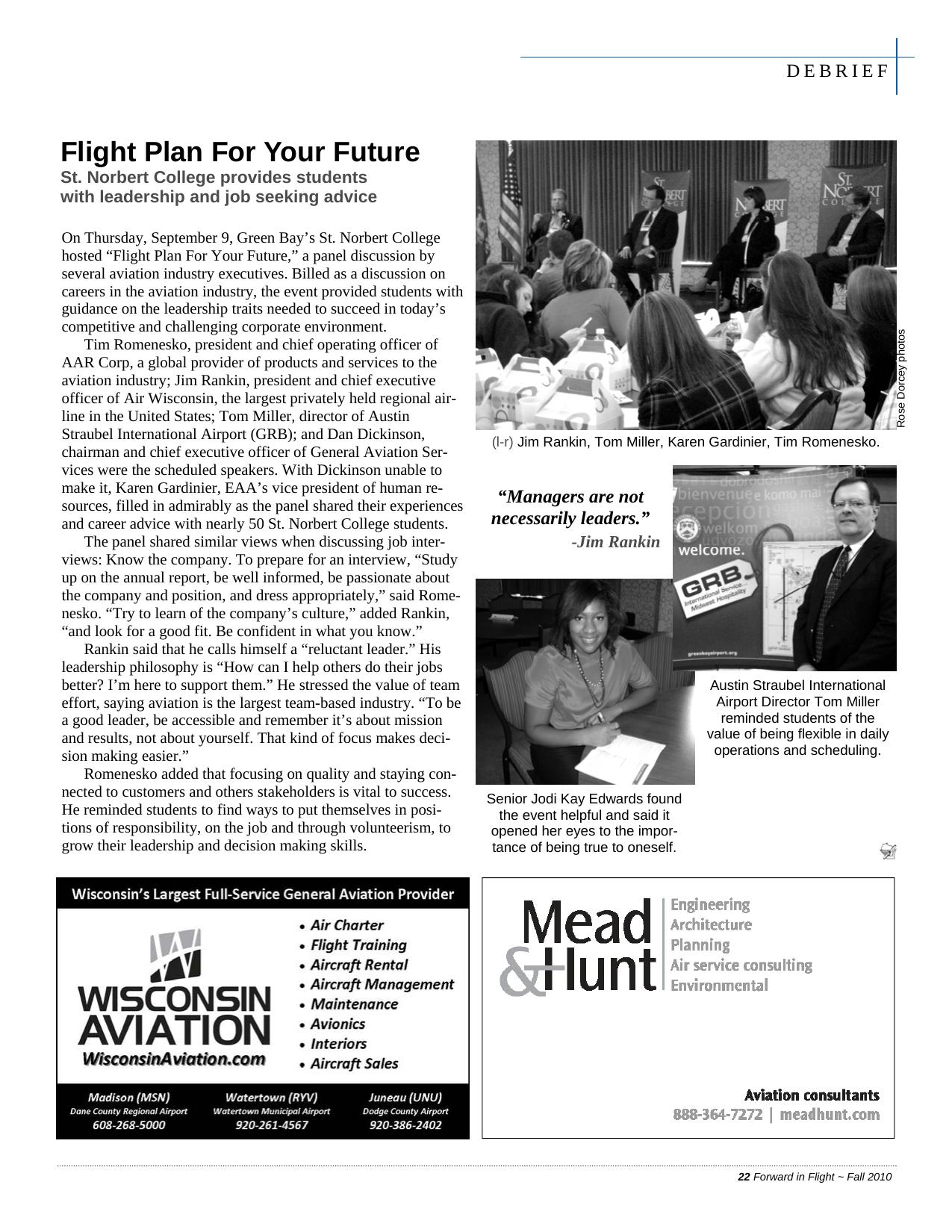
DEBRIEF Flight Plan For Your Future On Thursday, September 9, Green Bay’s St. Norbert College hosted “Flight Plan For Your Future,” a panel discussion by several aviation industry executives. Billed as a discussion on careers in the aviation industry, the event provided students with guidance on the leadership traits needed to succeed in today’s competitive and challenging corporate environment. Tim Romenesko, president and chief operating officer of AAR Corp, a global provider of products and services to the aviation industry; Jim Rankin, president and chief executive officer of Air Wisconsin, the largest privately held regional airline in the United States; Tom Miller, director of Austin Straubel International Airport (GRB); and Dan Dickinson, chairman and chief executive officer of General Aviation Services were the scheduled speakers. With Dickinson unable to make it, Karen Gardinier, EAA’s vice president of human resources, filled in admirably as the panel shared their experiences and career advice with nearly 50 St. Norbert College students. The panel shared similar views when discussing job interviews: Know the company. To prepare for an interview, “Study up on the annual report, be well informed, be passionate about the company and position, and dress appropriately,” said Romenesko. “Try to learn of the company’s culture,” added Rankin, “and look for a good fit. Be confident in what you know.” Rankin said that he calls himself a “reluctant leader.” His leadership philosophy is “How can I help others do their jobs better? I’m here to support them.” He stressed the value of team effort, saying aviation is the largest team-based industry. “To be a good leader, be accessible and remember it’s about mission and results, not about yourself. That kind of focus makes decision making easier.” Romenesko added that focusing on quality and staying connected to customers and others stakeholders is vital to success. He reminded students to find ways to put themselves in positions of responsibility, on the job and through volunteerism, to grow their leadership and decision making skills. Rose Dorcey photos St. Norbert College provides students with leadership and job seeking advice (l-r) Jim Rankin, Tom Miller, Karen Gardinier, Tim Romenesko. “Managers are not necessarily leaders.” -Jim Rankin Austin Straubel International Airport Director Tom Miller reminded students of the value of being flexible in daily operations and scheduling. Senior Jodi Kay Edwards found the event helpful and said it opened her eyes to the importance of being true to oneself. 22 Forward in Flight ~ Fall 2010
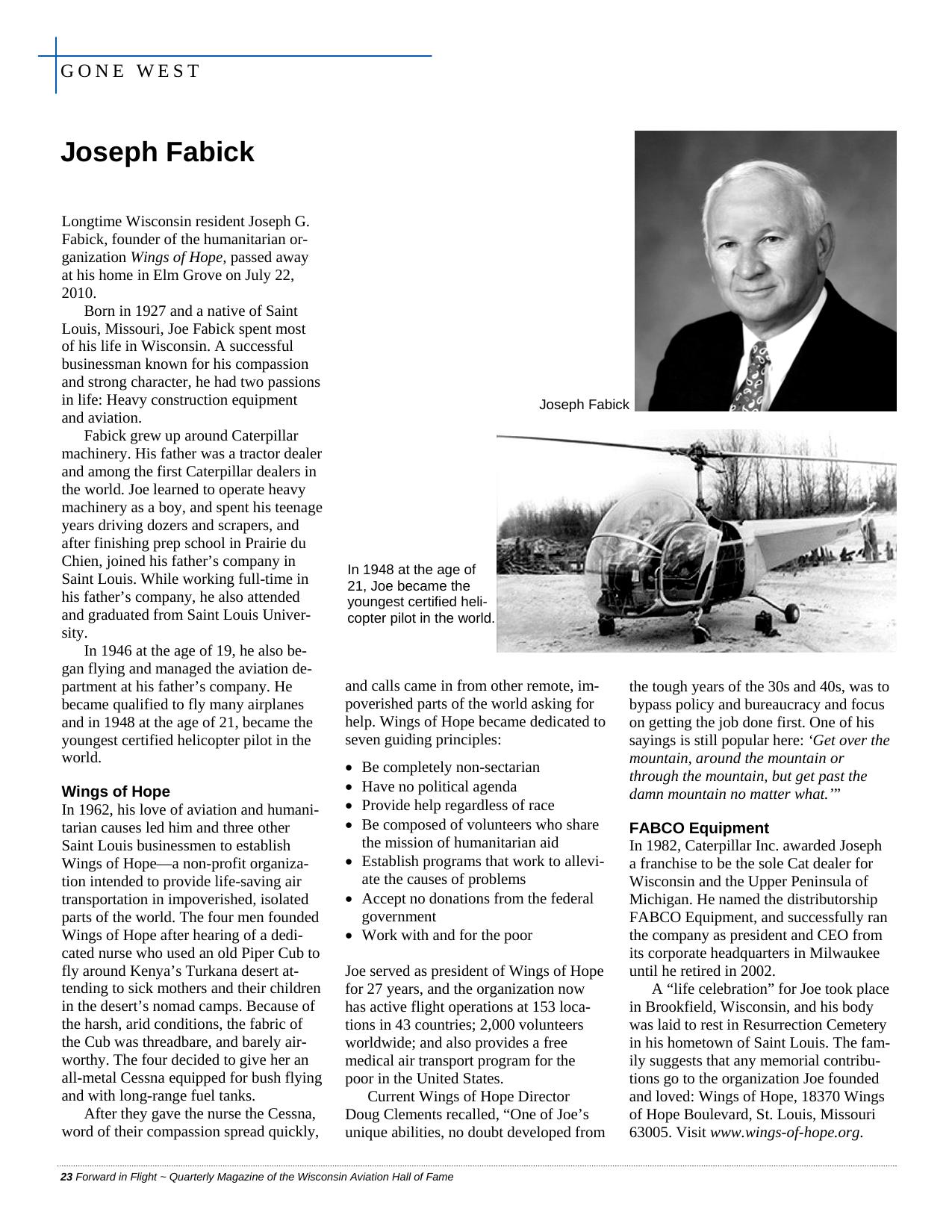
GONE WEST Joseph Fabick Longtime Wisconsin resident Joseph G. Fabick, founder of the humanitarian organization Wings of Hope, passed away at his home in Elm Grove on July 22, 2010. Born in 1927 and a native of Saint Louis, Missouri, Joe Fabick spent most of his life in Wisconsin. A successful businessman known for his compassion and strong character, he had two passions in life: Heavy construction equipment and aviation. Fabick grew up around Caterpillar machinery. His father was a tractor dealer and among the first Caterpillar dealers in the world. Joe learned to operate heavy machinery as a boy, and spent his teenage years driving dozers and scrapers, and after finishing prep school in Prairie du Chien, joined his father’s company in Saint Louis. While working full-time in his father’s company, he also attended and graduated from Saint Louis University. In 1946 at the age of 19, he also began flying and managed the aviation department at his father’s company. He became qualified to fly many airplanes and in 1948 at the age of 21, became the youngest certified helicopter pilot in the world. Wings of Hope In 1962, his love of aviation and humanitarian causes led him and three other Saint Louis businessmen to establish Wings of Hope—a non-profit organization intended to provide life-saving air transportation in impoverished, isolated parts of the world. The four men founded Wings of Hope after hearing of a dedicated nurse who used an old Piper Cub to fly around Kenya’s Turkana desert attending to sick mothers and their children in the desert’s nomad camps. Because of the harsh, arid conditions, the fabric of the Cub was threadbare, and barely airworthy. The four decided to give her an all-metal Cessna equipped for bush flying and with long-range fuel tanks. After they gave the nurse the Cessna, word of their compassion spread quickly, Joseph Fabick In 1948 at the age of 21, Joe became the youngest certified helicopter pilot in the world. and calls came in from other remote, impoverished parts of the world asking for help. Wings of Hope became dedicated to seven guiding principles: Be completely non-sectarian Have no political agenda Provide help regardless of race Be composed of volunteers who share the mission of humanitarian aid Establish programs that work to alleviate the causes of problems Accept no donations from the federal government Work with and for the poor Joe served as president of Wings of Hope for 27 years, and the organization now has active flight operations at 153 locations in 43 countries; 2,000 volunteers worldwide; and also provides a free medical air transport program for the poor in the United States. Current Wings of Hope Director Doug Clements recalled, “One of Joe’s unique abilities, no doubt developed from 23 Forward in Flight ~ Quarterly Magazine of the Wisconsin Aviation Hall of Fame the tough years of the 30s and 40s, was to bypass policy and bureaucracy and focus on getting the job done first. One of his sayings is still popular here: ‘Get over the mountain, around the mountain or through the mountain, but get past the damn mountain no matter what.’” FABCO Equipment In 1982, Caterpillar Inc. awarded Joseph a franchise to be the sole Cat dealer for Wisconsin and the Upper Peninsula of Michigan. He named the distributorship FABCO Equipment, and successfully ran the company as president and CEO from its corporate headquarters in Milwaukee until he retired in 2002. A “life celebration” for Joe took place in Brookfield, Wisconsin, and his body was laid to rest in Resurrection Cemetery in his hometown of Saint Louis. The family suggests that any memorial contributions go to the organization Joe founded and loved: Wings of Hope, 18370 Wings of Hope Boulevard, St. Louis, Missouri 63005. Visit www.wings-of-hope.org.
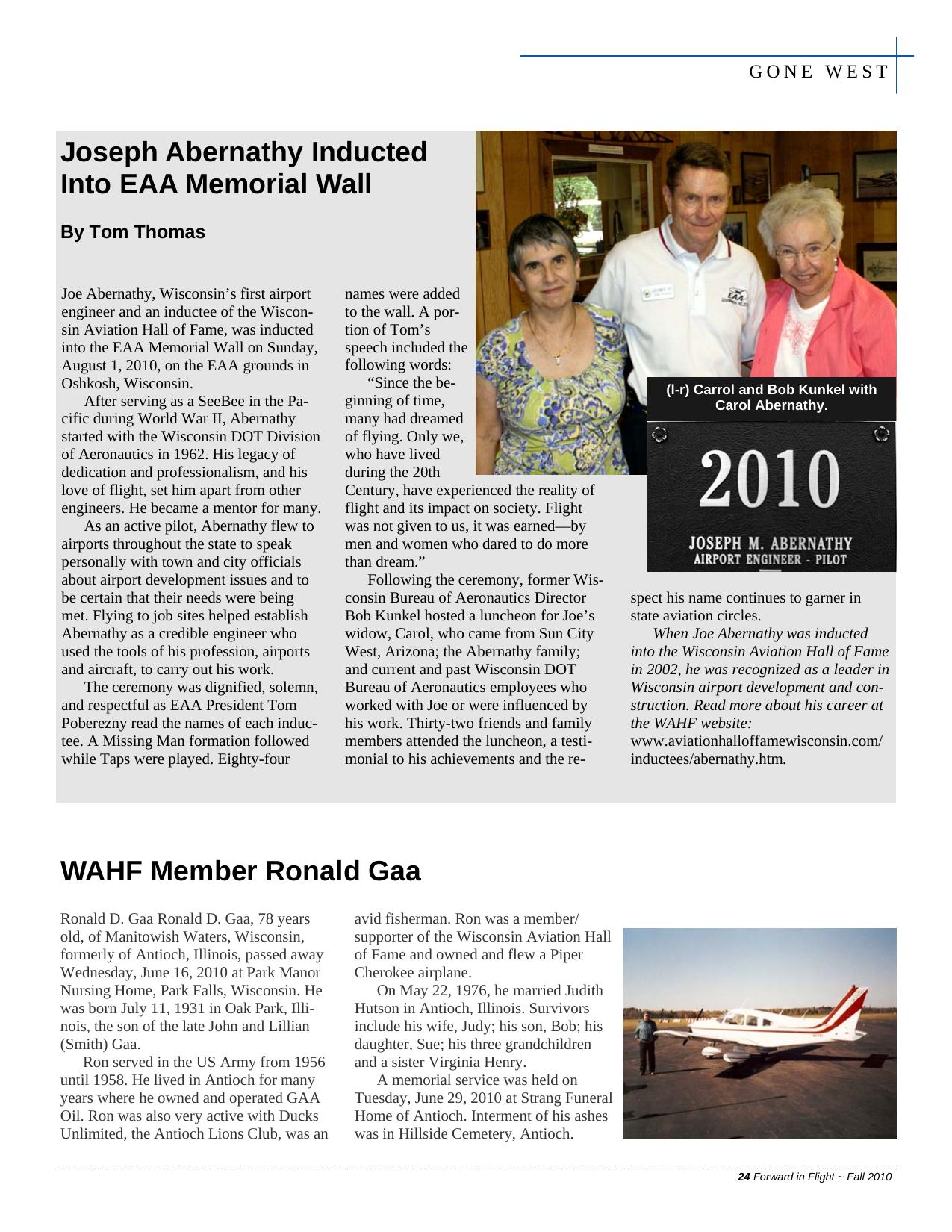
GONE WEST Joseph Abernathy Inducted Into EAA Memorial Wall By Tom Thomas Joe Abernathy, Wisconsin’s first airport engineer and an inductee of the Wisconsin Aviation Hall of Fame, was inducted into the EAA Memorial Wall on Sunday, August 1, 2010, on the EAA grounds in Oshkosh, Wisconsin. After serving as a SeeBee in the Pacific during World War II, Abernathy started with the Wisconsin DOT Division of Aeronautics in 1962. His legacy of dedication and professionalism, and his love of flight, set him apart from other engineers. He became a mentor for many. As an active pilot, Abernathy flew to airports throughout the state to speak personally with town and city officials about airport development issues and to be certain that their needs were being met. Flying to job sites helped establish Abernathy as a credible engineer who used the tools of his profession, airports and aircraft, to carry out his work. The ceremony was dignified, solemn, and respectful as EAA President Tom Poberezny read the names of each inductee. A Missing Man formation followed while Taps were played. Eighty-four names were added to the wall. A portion of Tom’s speech included the following words: “Since the beginning of time, many had dreamed of flying. Only we, who have lived during the 20th Century, have experienced the reality of flight and its impact on society. Flight was not given to us, it was earned—by men and women who dared to do more than dream.” Following the ceremony, former Wisconsin Bureau of Aeronautics Director Bob Kunkel hosted a luncheon for Joe’s widow, Carol, who came from Sun City West, Arizona; the Abernathy family; and current and past Wisconsin DOT Bureau of Aeronautics employees who worked with Joe or were influenced by his work. Thirty-two friends and family members attended the luncheon, a testimonial to his achievements and the re- (l-r) Carrol and Bob Kunkel with Carol Abernathy. spect his name continues to garner in state aviation circles. When Joe Abernathy was inducted into the Wisconsin Aviation Hall of Fame in 2002, he was recognized as a leader in Wisconsin airport development and construction. Read more about his career at the WAHF website: www.aviationhalloffamewisconsin.com/ inductees/abernathy.htm. WAHF Member Ronald Gaa Ronald D. Gaa Ronald D. Gaa, 78 years old, of Manitowish Waters, Wisconsin, formerly of Antioch, Illinois, passed away Wednesday, June 16, 2010 at Park Manor Nursing Home, Park Falls, Wisconsin. He was born July 11, 1931 in Oak Park, Illinois, the son of the late John and Lillian (Smith) Gaa. Ron served in the US Army from 1956 until 1958. He lived in Antioch for many years where he owned and operated GAA Oil. Ron was also very active with Ducks Unlimited, the Antioch Lions Club, was an avid fisherman. Ron was a member/ supporter of the Wisconsin Aviation Hall of Fame and owned and flew a Piper Cherokee airplane. On May 22, 1976, he married Judith Hutson in Antioch, Illinois. Survivors include his wife, Judy; his son, Bob; his daughter, Sue; his three grandchildren and a sister Virginia Henry. A memorial service was held on Tuesday, June 29, 2010 at Strang Funeral Home of Antioch. Interment of his ashes was in Hillside Cemetery, Antioch. 24 Forward in Flight ~ Fall 2010
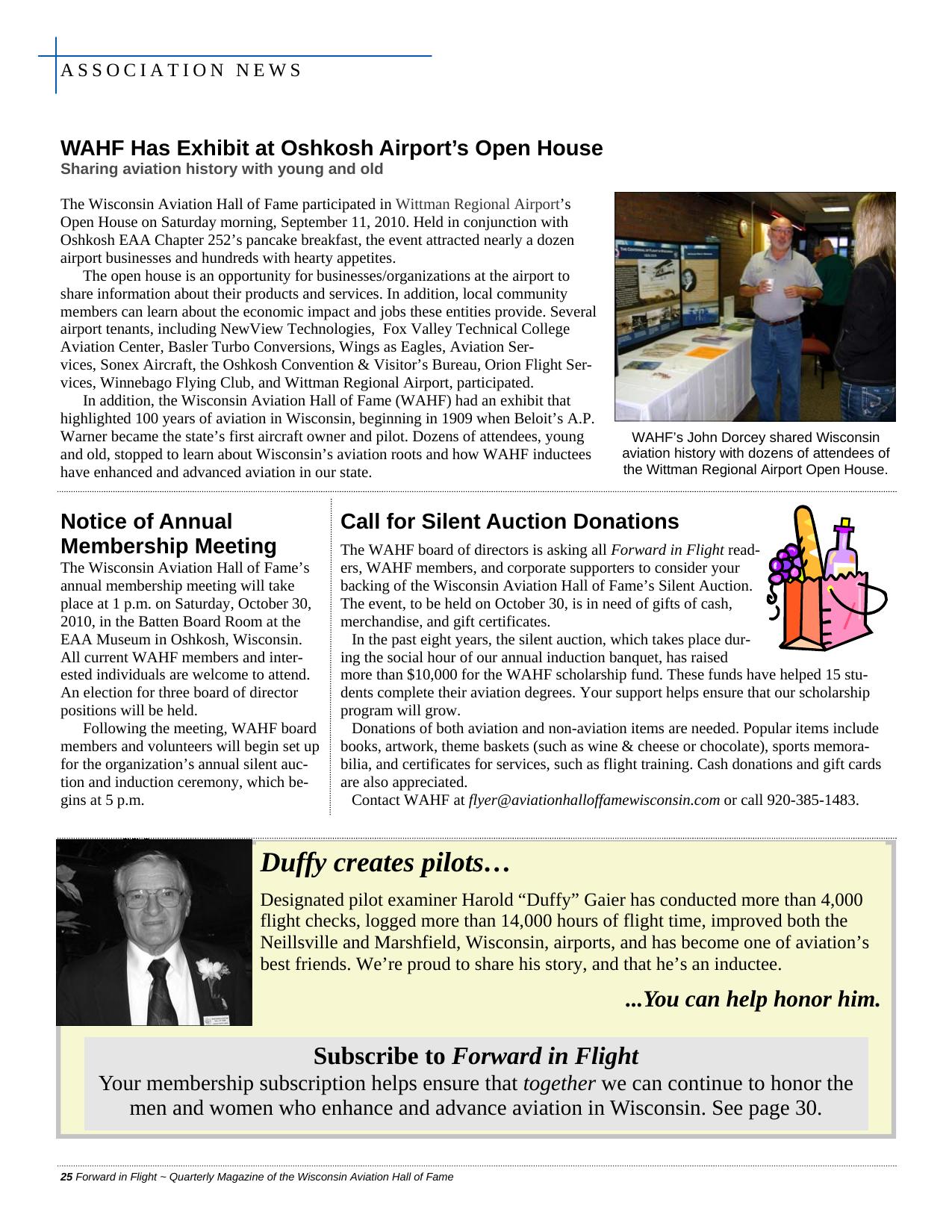
ASSOCIATION NEWS WAHF Has Exhibit at Oshkosh Airport’s Open House Sharing aviation history with young and old The Wisconsin Aviation Hall of Fame participated in Wittman Regional Airport’s Open House on Saturday morning, September 11, 2010. Held in conjunction with Oshkosh EAA Chapter 252’s pancake breakfast, the event attracted nearly a dozen airport businesses and hundreds with hearty appetites. The open house is an opportunity for businesses/organizations at the airport to share information about their products and services. In addition, local community members can learn about the economic impact and jobs these entities provide. Several airport tenants, including NewView Technologies, Fox Valley Technical College Aviation Center, Basler Turbo Conversions, Wings as Eagles, Aviation Services, Sonex Aircraft, the Oshkosh Convention & Visitor’s Bureau, Orion Flight Services, Winnebago Flying Club, and Wittman Regional Airport, participated. In addition, the Wisconsin Aviation Hall of Fame (WAHF) had an exhibit that highlighted 100 years of aviation in Wisconsin, beginning in 1909 when Beloit’s A.P. Warner became the state’s first aircraft owner and pilot. Dozens of attendees, young and old, stopped to learn about Wisconsin’s aviation roots and how WAHF inductees have enhanced and advanced aviation in our state. Notice of Annual Membership Meeting WAHF’s John Dorcey shared Wisconsin aviation history with dozens of attendees of the Wittman Regional Airport Open House. Call for Silent Auction Donations The Wisconsin Aviation Hall of Fame’s annual membership meeting will take place at 1 p.m. on Saturday, October 30, 2010, in the Batten Board Room at the EAA Museum in Oshkosh, Wisconsin. All current WAHF members and interested individuals are welcome to attend. An election for three board of director positions will be held. Following the meeting, WAHF board members and volunteers will begin set up for the organization’s annual silent auction and induction ceremony, which begins at 5 p.m. The WAHF board of directors is asking all Forward in Flight readers, WAHF members, and corporate supporters to consider your backing of the Wisconsin Aviation Hall of Fame’s Silent Auction. The event, to be held on October 30, is in need of gifts of cash, merchandise, and gift certificates. In the past eight years, the silent auction, which takes place during the social hour of our annual induction banquet, has raised more than $10,000 for the WAHF scholarship fund. These funds have helped 15 students complete their aviation degrees. Your support helps ensure that our scholarship program will grow. Donations of both aviation and non-aviation items are needed. Popular items include books, artwork, theme baskets (such as wine & cheese or chocolate), sports memorabilia, and certificates for services, such as flight training. Cash donations and gift cards are also appreciated. Contact WAHF at flyer@aviationhalloffamewisconsin.com or call 920-385-1483. Duffy creates pilots… Designated pilot examiner Harold “Duffy” Gaier has conducted more than 4,000 flight checks, logged more than 14,000 hours of flight time, improved both the Neillsville and Marshfield, Wisconsin, airports, and has become one of aviation’s best friends. We’re proud to share his story, and that he’s an inductee. ...You can help honor him. Subscribe to Forward in Flight Your membership subscription helps ensure that together we can continue to honor the men and women who enhance and advance aviation in Wisconsin. See page 30. 25 Forward in Flight ~ Quarterly Magazine of the Wisconsin Aviation Hall of Fame
ASSOCIATION NEWS WAHF Presents at WSGC Conference Thomas tells impact of WSCG grant The Wisconsin Space Grant Consortium (WSCG) held its 20th Annual Conference at UW-Sheboygan on August 19, 2010, with the theme “Dawn of a New Age.” The Wisconsin Aviation Hall of Fame was invited to make a presentation as part of the conference’s education sessions. WAHF board member Tom Thomas presented the educational outreach initiatives of WAHF’s Wisconsin Centennial of Flight Celebration. Using a PowerPoint presentation, Thomas explained how a WSCG grant assisted WAHF in the construction of a quarter-scale model of the first airplane to fly in Wisconsin and how thousands of youth and adults throughout the state learned more about our rich aviation history. The Wisconsin Space Grant Consortium is dedicated to using the excitement and vision of space and aerospace sciences to ignite interests in math, science, and technology in Wisconsin citizens. Learn more about the WSGC at www.UWGB.edu.wsgc. Tom Thomas presented a report about WAHF’s Wisconsin Centennial of Flight project to WSGC conference attendees. Special Offer for WAHF Renewals/New Members To celebrate our 25th anniversary, WAHF has a special offer for new and renewing members: $50 for three years (paid through December 31, 2013). With a regular price of $20 per year, you’ll save money—and time—by sending a check now. And, as we won’t have to send renewal reminders, you’ll reduce costs for WAHF. Use the form on the inside back cover, or just send a check noting the $50/3 years promotion. 2010 Banquet Just Around the Corner… By now, invitations to the 2010 WAHF Induction Banquet have been mailed. WAHF hopes that many Forward in Flight readers will attend. Set for Saturday evening, October 30, 2010, the event takes place at the beautiful EAA AirVenture Museum in Oshkosh, Wisconsin. Spend the day touring the museum, and then at 5 p.m., attend the social hour and silent auction to raise funds for WAHF’s scholarship program. Five Wisconsin aviators will be inducted: Jeannette Kapus, Bob Kunkel, Dick Wixom, Jesse Brabazon, and Richard Lutz. Dinner begins at 6 and the induction presentations at 7. If you haven’t already sent your registration, send it today! Call Rich Fischler at 262-370-5714 for more details. WAHF’s Thomas Shares Flying Experiences Wisconsin Aviation Hall of Fame board member/inductee Tom Thomas spoke at EAA Chapter 60’s monthly meeting in Beloit on September 8, 2010. Tom was asked to speak briefly on three subjects: the B-2 Bomber, his service with the Wisconsin Air National Guard, and his “unexplained” flying experiences (a repeat of the show he presented to the Madison Technical Club about unidentified flying objects). In honor of the presentation topic, Tom presented chapter members with a New Mexico aeronautical chart that depicts the alleged 1947 UFO crash site, located about 58 nautical miles northwest of the former Roswell Air Force Base (currently Roswell Municipal Airport). Considerable discussion followed Tom’s presentation, after which the aeronautical chart was ceremoniously hung in the chapter clubhouse at Beloit Airport (44C). Tom also thanked the chapter for its important role in WAHF’s Wisconsin Centennial of Flight activities in 2009. Looking for a Speaker? Flying clubs and EAA chapter meetings and banquets are just some of the places WAHF Speakers Bureau members, including Tom, are willing to attend. WAHF speakers also spread the word about Wisconsin aviation history at service clubs, such as Rotary, and at historical museums throughout the state. If you’re interested in scheduling a WAHF speaker at your next event, please call WAHF at 920-385-1483 or send an e-mail to speakers@aviationhalloffamewisconsin.com. WAHF Board Member Tom Thomas recently shared his personal aviation history with members of EAA Chapter 60 in Beloit, Wisconsin. 26 Forward in Flight ~ Fall 2010
FROM THE AIRWAYS Two Wisconsinites Renew Master-CFI Accreditation Wisconsin Aviation; Solverson Aviation Form Partnership Lynnwood K. “Woody” Minar and John Dorcey have renewed their Master-CFI (Certificated Flight Instructor) accreditations. Minar, of Dresser, Wisconsin, first earned this national professional accreditation in 2006. He is a three-time Master, a member of the Society of Aviation and Flight Educators (SAFE) and the chief flight instructor at Osceola AeroSport (www.OsceolaAero.com) at Osceola’s L.O. Simenstad Municipal Airport (OEO). He also works as a pilot for Custom Fire Apparatus and is a FAASTeam representative for the FAA’s Minneapolis FSDO area. John Dorcey, a two-time Master, is an independent Oshkosh-area flight instructor and A&P mechanic with inspection authorization who first earned this distinction in 2007. He is the operations manager at Master-CFIs Woody Minar (top) and John Dorcey. Wittman Regional Airport (OSH), serves as secretary of the Society of Aviation & Flight Educators (SAFE - www.SafePilots.org), and is treasurer for the Wisconsin Airport Management Association (www.WIAMA.org). John and Woodie are among only 16 CFIs in Wisconsin and 700 in the United States to earn this prestigious title. Both renewed their accreditations through Master Instructors LLC. Learn more at www.MasterInstructors.org. Wisconsin Aviation, Inc., Watertown, Wisconsin, has formed a partnership with Solverson Aviation, Reedsburg, to expand their services and provide wider exposure for their customer base. Air charter, flight training, and avionic installs and repairs will be offered. Wisconsin Aviation, Inc., has operations in Madison at the Dane County Regional Airport (MSN) and the Dodge County Airport (UNU), Juneau, Wisconsin, as well as the Watertown Municipal Airport (RYV), Watertown, Wisconsin. It is the largest full-service aviation provider in Wisconsin. Wisconsin Aviation has a well-established charter operation, featuring more than 25 aircraft ranging from single engines to long-range jets. The flight training center encompasses programs from Private Pilot thru Airline Transport Pilot certificates. There is also a full FAA Laser Grade Testing Center at the Madison location. For more information, visit www.WisconsinAviation.com. Solverson Aviation is owned by Ryan and Britt Solverson and was incorporated in March 2005. The Solversons offer a pilot training program and aircraft rental service. Learn more at www.SolversonAviation.com. Weimans Receive National Journalism Award WAHF Member/Supporters Dave and Peggy Weiman recently received the National Association of State Aviation Officials’ (NASAO) National Journalism Award. The award was presented for recognition of superior news coverage of aviation events nationwide in their magazine, Midwest Flyer. Dave and Peggy Weiman Send your news and information to: Forward in Flight · 3980 Sharratt Drive · Oshkosh, WI 54901 27 Forward in Flight ~ Quarterly Magazine of the Wisconsin Aviation Hall of Fame
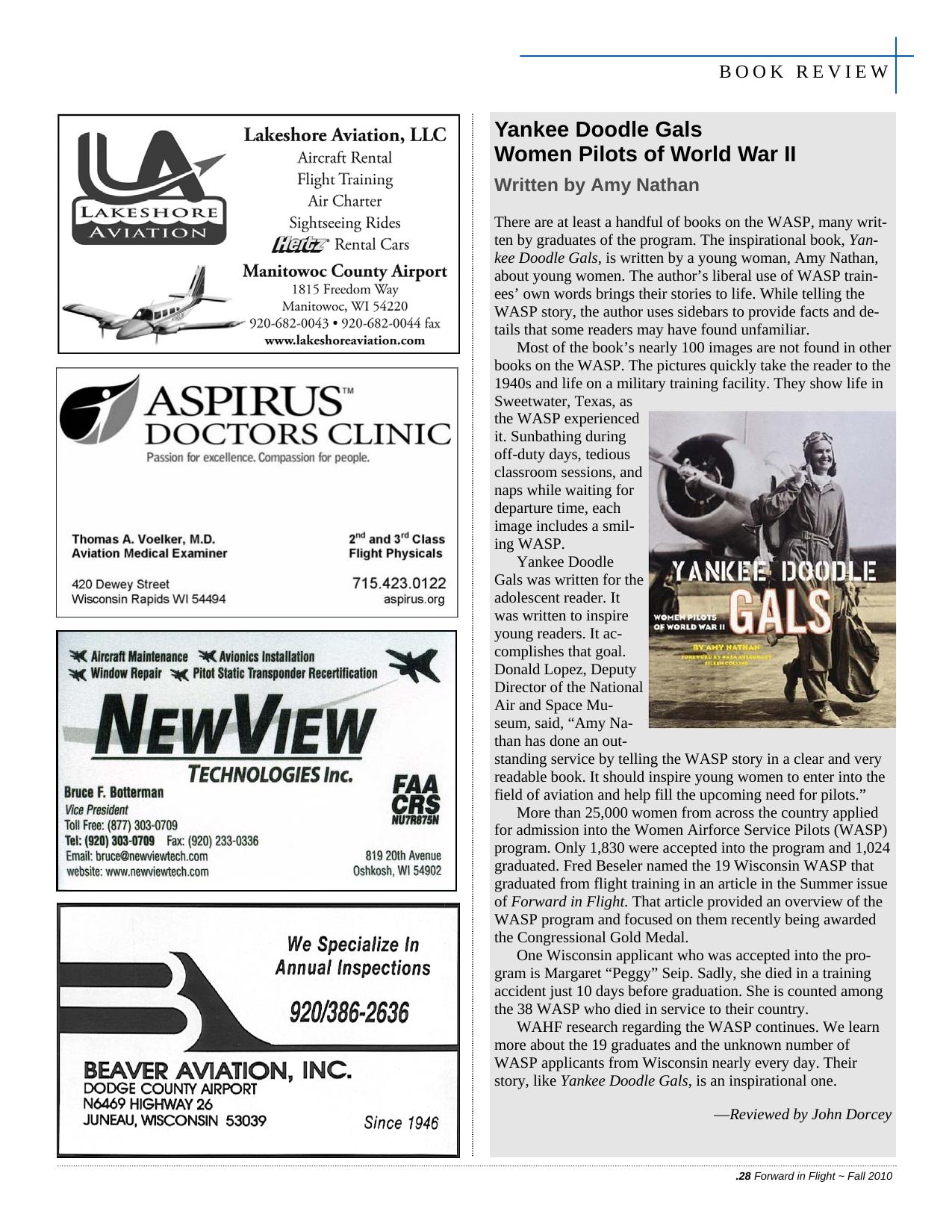
BOOK REVIEW Yankee Doodle Gals Women Pilots of World War II Written by Amy Nathan There are at least a handful of books on the WASP, many written by graduates of the program. The inspirational book, Yankee Doodle Gals, is written by a young woman, Amy Nathan, about young women. The author’s liberal use of WASP trainees’ own words brings their stories to life. While telling the WASP story, the author uses sidebars to provide facts and details that some readers may have found unfamiliar. Most of the book’s nearly 100 images are not found in other books on the WASP. The pictures quickly take the reader to the 1940s and life on a military training facility. They show life in Sweetwater, Texas, as the WASP experienced it. Sunbathing during off-duty days, tedious classroom sessions, and naps while waiting for departure time, each image includes a smiling WASP. Yankee Doodle Gals was written for the adolescent reader. It was written to inspire young readers. It accomplishes that goal. Donald Lopez, Deputy Director of the National Air and Space Museum, said, “Amy Nathan has done an outstanding service by telling the WASP story in a clear and very readable book. It should inspire young women to enter into the field of aviation and help fill the upcoming need for pilots.” More than 25,000 women from across the country applied for admission into the Women Airforce Service Pilots (WASP) program. Only 1,830 were accepted into the program and 1,024 graduated. Fred Beseler named the 19 Wisconsin WASP that graduated from flight training in an article in the Summer issue of Forward in Flight. That article provided an overview of the WASP program and focused on them recently being awarded the Congressional Gold Medal. One Wisconsin applicant who was accepted into the program is Margaret “Peggy” Seip. Sadly, she died in a training accident just 10 days before graduation. She is counted among the 38 WASP who died in service to their country. WAHF research regarding the WASP continues. We learn more about the 19 graduates and the unknown number of WASP applicants from Wisconsin nearly every day. Their story, like Yankee Doodle Gals, is an inspirational one. —Reviewed by John Dorcey .28 Forward in Flight ~ Fall 2010
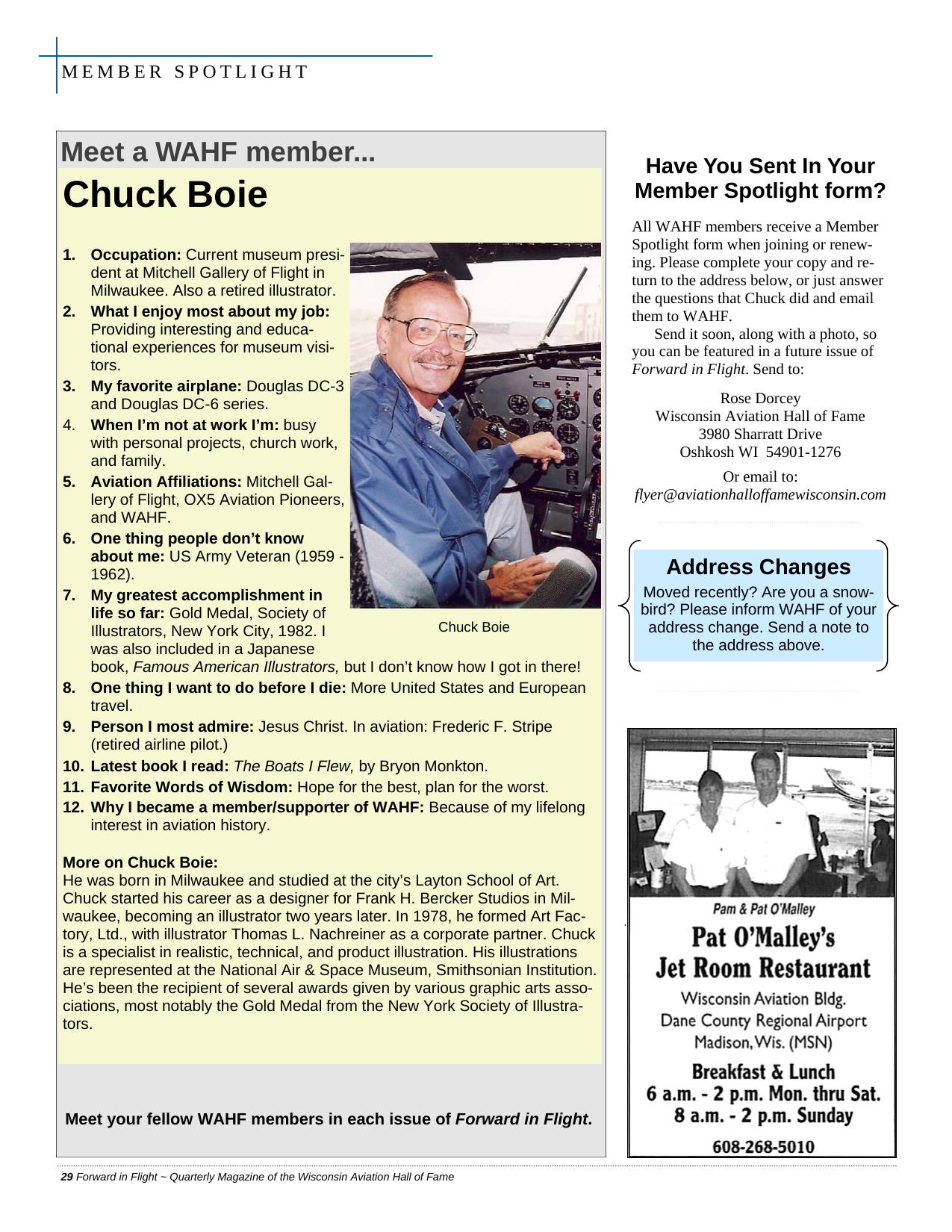
MEMBER SPOTLIGHT Meet a WAHF member... Chuck Boie 1. Occupation: Current museum president at Mitchell Gallery of Flight in Milwaukee. Also a retired illustrator. 2. What I enjoy most about my job: Providing interesting and educational experiences for museum visitors. 3. My favorite airplane: Douglas DC-3 and Douglas DC-6 series. 4. When I’m not at work I’m: busy with personal projects, church work, and family. 5. Aviation Affiliations: Mitchell Gallery of Flight, OX5 Aviation Pioneers, and WAHF. 6. One thing people don’t know about me: US Army Veteran (1959 1962). 7. My greatest accomplishment in life so far: Gold Medal, Society of Chuck Boie Illustrators, New York City, 1982. I was also included in a Japanese book, Famous American Illustrators, but I don’t know how I got in there! 8. One thing I want to do before I die: More United States and European travel. 9. Person I most admire: Jesus Christ. In aviation: Frederic F. Stripe (retired airline pilot.) 10. Latest book I read: The Boats I Flew, by Bryon Monkton. 11. Favorite Words of Wisdom: Hope for the best, plan for the worst. 12. Why I became a member/supporter of WAHF: Because of my lifelong interest in aviation history. More on Chuck Boie: He was born in Milwaukee and studied at the city’s Layton School of Art. Chuck started his career as a designer for Frank H. Bercker Studios in Milwaukee, becoming an illustrator two years later. In 1978, he formed Art Factory, Ltd., with illustrator Thomas L. Nachreiner as a corporate partner. Chuck is a specialist in realistic, technical, and product illustration. His illustrations are represented at the National Air & Space Museum, Smithsonian Institution. He’s been the recipient of several awards given by various graphic arts associations, most notably the Gold Medal from the New York Society of Illustrators. Meet your fellow WAHF members in each issue of Forward in Flight. 29 Forward in Flight ~ Quarterly Magazine of the Wisconsin Aviation Hall of Fame Have You Sent In Your Member Spotlight form? All WAHF members receive a Member Spotlight form when joining or renewing. Please complete your copy and return to the address below, or just answer the questions that Chuck did and email them to WAHF. Send it soon, along with a photo, so you can be featured in a future issue of Forward in Flight. Send to: Rose Dorcey Wisconsin Aviation Hall of Fame 3980 Sharratt Drive Oshkosh WI 54901-1276 Or email to: flyer@aviationhalloffamewisconsin.com Address Changes Moved recently? Are you a snowbird? Please inform WAHF of your address change. Send a note to the address above.
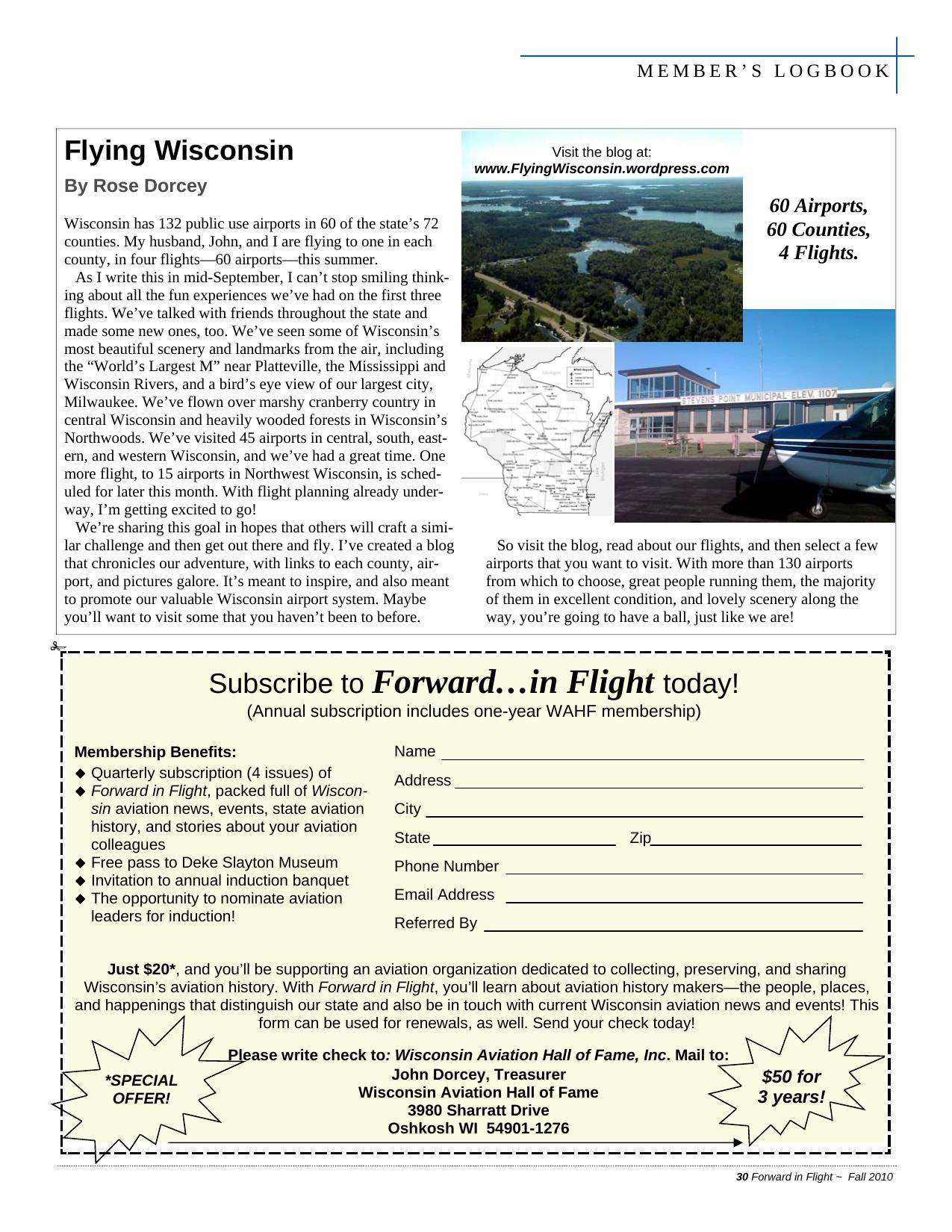
MEMBER’S LOGBOOK Flying Wisconsin Visit the blog at: www.FlyingWisconsin.wordpress.com By Rose Dorcey Wisconsin has 132 public use airports in 60 of the state’s 72 counties. My husband, John, and I are flying to one in each county, in four flights—60 airports—this summer. As I write this in mid-September, I can’t stop smiling thinking about all the fun experiences we’ve had on the first three flights. We’ve talked with friends throughout the state and made some new ones, too. We’ve seen some of Wisconsin’s most beautiful scenery and landmarks from the air, including the “World’s Largest M” near Platteville, the Mississippi and Wisconsin Rivers, and a bird’s eye view of our largest city, Milwaukee. We’ve flown over marshy cranberry country in central Wisconsin and heavily wooded forests in Wisconsin’s Northwoods. We’ve visited 45 airports in central, south, eastern, and western Wisconsin, and we’ve had a great time. One more flight, to 15 airports in Northwest Wisconsin, is scheduled for later this month. With flight planning already underway, I’m getting excited to go! We’re sharing this goal in hopes that others will craft a similar challenge and then get out there and fly. I’ve created a blog that chronicles our adventure, with links to each county, airport, and pictures galore. It’s meant to inspire, and also meant to promote our valuable Wisconsin airport system. Maybe you’ll want to visit some that you haven’t been to before. 60 Airports, 60 Counties, 4 Flights. So visit the blog, read about our flights, and then select a few airports that you want to visit. With more than 130 airports from which to choose, great people running them, the majority of them in excellent condition, and lovely scenery along the way, you’re going to have a ball, just like we are! Subscribe to Forward…in Flight today! (Annual subscription includes one-year WAHF membership) Membership Benefits: Quarterly subscription (4 issues) of Forward in Flight, packed full of Wisconsin aviation news, events, state aviation history, and stories about your aviation colleagues Free pass to Deke Slayton Museum Invitation to annual induction banquet The opportunity to nominate aviation leaders for induction! Name Address City State Zip Phone Number Email Address Referred By Just $20*, and you’ll be supporting an aviation organization dedicated to collecting, preserving, and sharing Wisconsin’s aviation history. With Forward in Flight, you’ll learn about aviation history makers—the people, places, and happenings that distinguish our state and also be in touch with current Wisconsin aviation news and events! This form can be used for renewals, as well. Send your check today! *SPECIAL OFFER! Please write check to: Wisconsin Aviation Hall of Fame, Inc. Mail to: John Dorcey, Treasurer Wisconsin Aviation Hall of Fame 3980 Sharratt Drive Oshkosh WI 54901-1276 $50 for 3 years! 30 Forward in Flight ~ Fall 2010

WISCONSIN AVIATION HALL OF FAME 3980 SHARRATT DRIVE OSHKOSH WI 54901-1276 PRSRT STD US Postage Paid Wisc Rapids WI Permit 98 Preserving and Sharing Wisconsin’s Aviation History Change Service Requested Welcome New WAHF Member/Supporters: Eric Oxendorf Ralph Winrich —Thanks for coming on board! WAHF is on Facebook and Twitter! www.Facebook.com/WisAviationHallofFame · Twitter @WAHF Line Up and Wait Phraseology Change Beginning September 30, 2010, the words “Line Up and Wait” will replace “Position and Hold” to instruct a pilot to enter the runway to await take-off clearance. Under the new “Line Up and Wait” phraseology, the controller will: State your call-sign; State the departure runway; State “Line Up and Wait.” Exercise Caution: Be aware the phrase “Traffic Holding in Position” will continue to be used to advise other aircraft that traffic has been authorized to “Line Up and Wait” on an active runway. Remember: Never cross a hold line without explicit ATC instructions. You may not enter a runway unless you have been: Instructed to cross or taxi onto that specific runway, Cleared to take off from that runway, or Instructed to “Line Up and Wait” on that specific runway. If in doubt, ask! Visit www.faa.gov/go/runwaysafety for more details on the change as well as to view an instructional animation explaining the new phraseology. Wisconsin Aviation Hall of Fame Officers and Board of Directors Rose Dorcey, President Michael Goc, Vice President John Dorcey, Secretary/Treasurer Duane Esse Rich Fischler Tom Thomas Charles Swain LaFonda Kinnaman Staber “Bill” Reese Charles Marotske, Honorary Chairman of the Board Wisconsin Aviation Hall of Fame 3980 Sharratt Drive Oshkosh WI 54901-1276 Become a supporter today! For information call Rose Dorcey at 920-385-1483 www.aviationhalloffamewisconsin.com flyer@aviationhalloffamewisconsin.com