Volume 9, Issue 3
🗞️ Download Issue (PDF)
Forward in Flight - Fall 2011
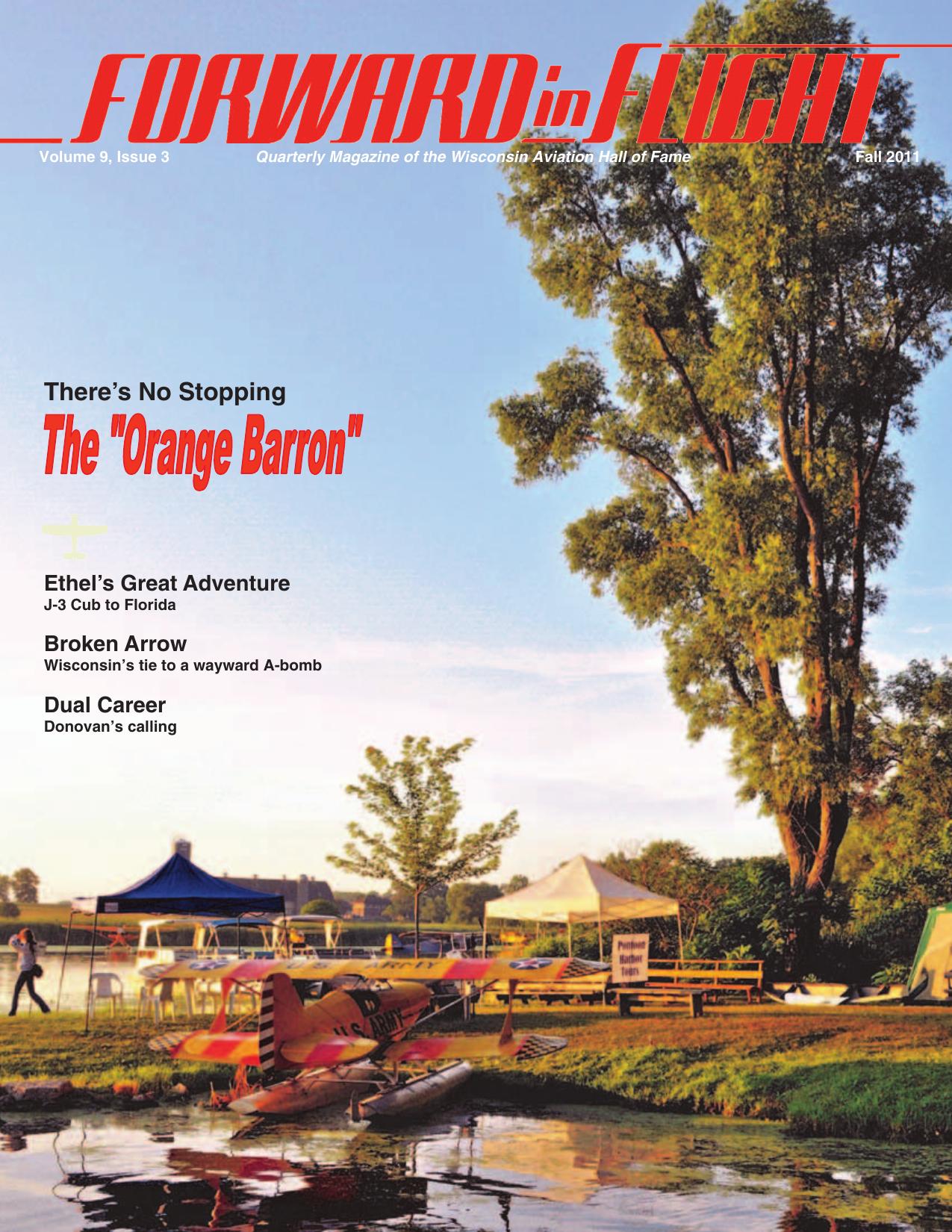
Volume 9, Issue 3 Quarterly Magazine of the Wisconsin Aviation Hall of Fame There’s No Stopping Ethel’s Great Adventure J-3 Cub to Florida Broken Arrow Wisconsin’s tie to a wayward A-bomb Dual Career Donovan’s calling Fall 2011
Contents RIGHT SEAT DIARIES 3 What Now? Tips to keep you flying Heather Gollnow, CFI FROM THE ARCHIVES 25 Area 51, An Uncensored History And mention of a 2011 WAHF Inductee Michael Goc AIR DOC 5 Bob, Cindy, and Burt Learn from them to breeze through your next aviation medical Dr. Tom Voelker, AME 28 29 31 33 Gone West Gunter Voltz Association News On the Road with WAHF From the Airways Wixom Honored Member Spotlight Don Voland PEOPLE, PLANES & PLACES 7 Captain Dan Donovan 9 43,000 and counting Frederick Beseler CHECK SIX 10 America’s Great Cold War Mystery Madison’s Ted Schreier and America’s First Lost A-bomb Gary Dikkers Donovan set the bar high in flying and aviation safety. PEOPLE, PLANES & PLACES 15 From Naval “Storm Chaser” to Northrup Engineer (and more) LeBarron Continues his Multifaceted Aviation Commitment Duane Esse 20 Whatever happened to the Mk-4? How the Wisconsin Air National Guard Got Its Motto Frederick Beseler PIONEER PILOTS 21 Ethel Christensen’s Flying Adventures And her career with the National Weather Service Tom Thomas LeBarron can’t get enough of aviation. Wisconsin’s Largest Full-Service General Aviation Provider Air Charter Flight Training Aircraft Rental Aircraft Management Avionics Interiors Aircraft Sales Madison (MSN) Watertown (RYV) Dane County Regional Airport Watertown Municipal Airport Dodge County Airport Juneau (UNU) 608-268-5000 920-261-4567 920-386-2402 Aviation consultants 888-364-7272 | meadhunt.com
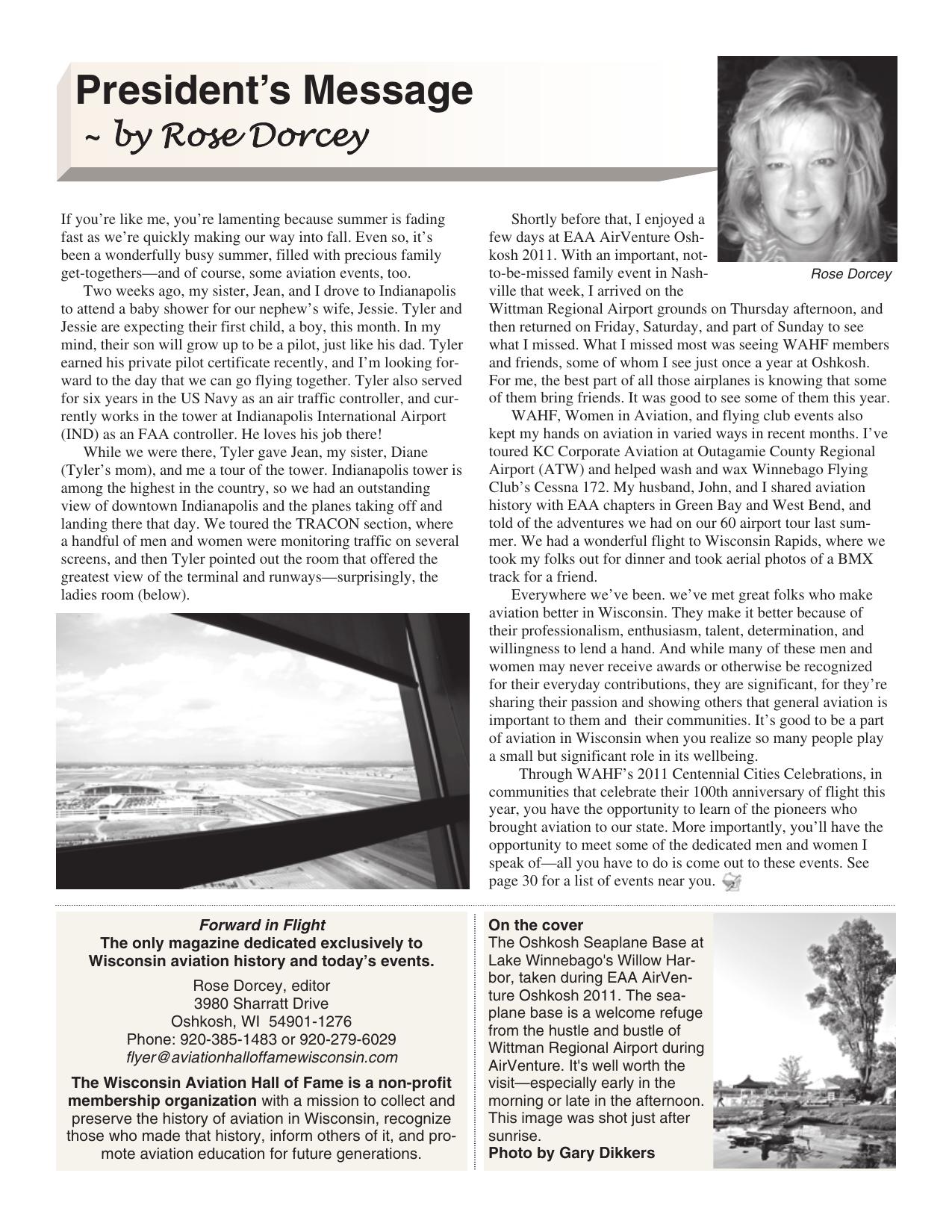
President’s Message ~ by Rose Dorcey If you’re like me, you’re lamenting because summer is fading fast as we’re quickly making our way into fall. Even so, it’s been a wonderfully busy summer, filled with precious family get-togethers—and of course, some aviation events, too. Two weeks ago, my sister, Jean, and I drove to Indianapolis to attend a baby shower for our nephew’s wife, Jessie. Tyler and Jessie are expecting their first child, a boy, this month. In my mind, their son will grow up to be a pilot, just like his dad. Tyler earned his private pilot certificate recently, and I’m looking forward to the day that we can go flying together. Tyler also served for six years in the US Navy as an air traffic controller, and currently works in the tower at Indianapolis International Airport (IND) as an FAA controller. He loves his job there! While we were there, Tyler gave Jean, my sister, Diane (Tyler’s mom), and me a tour of the tower. Indianapolis tower is among the highest in the country, so we had an outstanding view of downtown Indianapolis and the planes taking off and landing there that day. We toured the TRACON section, where a handful of men and women were monitoring traffic on several screens, and then Tyler pointed out the room that offered the greatest view of the terminal and runways—surprisingly, the ladies room (below). Forward in Flight The only magazine dedicated exclusively to Wisconsin aviation history and today’s events. Rose Dorcey, editor 3980 Sharratt Drive Oshkosh, WI 54901-1276 Phone: 920-385-1483 or 920-279-6029 flyer@aviationhalloffamewisconsin.com The Wisconsin Aviation Hall of Fame is a non-profit membership organization with a mission to collect and preserve the history of aviation in Wisconsin, recognize those who made that history, inform others of it, and promote aviation education for future generations. Shortly before that, I enjoyed a few days at EAA AirVenture Oshkosh 2011. With an important, notto-be-missed family event in NashRose Dorcey ville that week, I arrived on the Wittman Regional Airport grounds on Thursday afternoon, and then returned on Friday, Saturday, and part of Sunday to see what I missed. What I missed most was seeing WAHF members and friends, some of whom I see just once a year at Oshkosh. For me, the best part of all those airplanes is knowing that some of them bring friends. It was good to see some of them this year. WAHF, Women in Aviation, and flying club events also kept my hands on aviation in varied ways in recent months. I’ve toured KC Corporate Aviation at Outagamie County Regional Airport (ATW) and helped wash and wax Winnebago Flying Club’s Cessna 172. My husband, John, and I shared aviation history with EAA chapters in Green Bay and West Bend, and told of the adventures we had on our 60 airport tour last summer. We had a wonderful flight to Wisconsin Rapids, where we took my folks out for dinner and took aerial photos of a BMX track for a friend. Everywhere we’ve been. we’ve met great folks who make aviation better in Wisconsin. They make it better because of their professionalism, enthusiasm, talent, determination, and willingness to lend a hand. And while many of these men and women may never receive awards or otherwise be recognized for their everyday contributions, they are significant, for they’re sharing their passion and showing others that general aviation is important to them and their communities. It’s good to be a part of aviation in Wisconsin when you realize so many people play a small but significant role in its wellbeing. Through WAHF’s 2011 Centennial Cities Celebrations, in communities that celebrate their 100th anniversary of flight this year, you have the opportunity to learn of the pioneers who brought aviation to our state. More importantly, you’ll have the opportunity to meet some of the dedicated men and women I speak of—all you have to do is come out to these events. See page 30 for a list of events near you. On the cover The Oshkosh Seaplane Base at Lake Winnebago's Willow Harbor, taken during EAA AirVenture Oshkosh 2011. The seaplane base is a welcome refuge from the hustle and bustle of Wittman Regional Airport during AirVenture. It's well worth the visit—especially early in the morning or late in the afternoon. This image was shot just after sunrise. Photo by Gary Dikkers
RIGHT SEAT DIARIES Tips to keep you flying By Heather Gollnow When I give a discovery flight or an introductory flying lesson, I like to show potential pilots how awesome it is to have a great view of the city or how fun it is to visit another airport for dinner. My passion lies in introducing others to the world of aviation, whether or not that person decides to continue towards a pilot certificate. I also encourage other pilots to remember the initial motivation to earn a pilot certificate and continue with that goal after earning their certificate—even if the goal is just flying for pure pleasure. I encourage this because it was something I did not do after completing my certificate. My private pilot check ride was on October 3, 1997. That night, I celebrated with my friends Dianna and EJ over a pancake dinner at a local Big Boy restaurant. I am a goal-oriented person—I always need to be working toward something. Naturally, the next day I started working on my complex endorsement. It was several months before I flew for pure enjoyment. I didn’t take the time to enjoy what I had just accomplished. I have met several pilots who earned their certificate and had similar feelings. “What now?” is a common question. This topic has been in the back of my mind for about a month now. I’ve been mulling it over and taking mental notes each time I go flying or hang out at an airport talking about flying. There are books, blogs, and websites that give you plenty of ideas of what you can do with a pilot certificate, but I’m approaching this differently. After reading this article, I want you to decide on one new thing you can do with your pilot certificate and go do it (within your personal limitations, of course!) Here are a few of my favorite things to do while flying. Use these suggestions as is, or tweak them to fit your needs. Introduce a Friend to Flying This may seem like I’m stating the obvious, but I know there are other people like me out there who just didn't think to do this. My first passenger was almost two months after I earned my certificate and it was another pilot! I think the reason I never took anyone flying sooner was because I didn’t think 3 Forward in Flight ~ Quarterly Magazine of the Wisconsin Aviation Hall of Fame my friends or family would want to go. I quickly realized I needed to figure out if any of my friends or family wanted to go for a ride. Challenge yourself – Plan a Long Cross-country Look through your logbook. What’s the longest cross-country you’ve completed so far? Is it your 100-nautical mile crosscountry required to earn your certificate? Push yourself a little and plan one a little farther. Is there some place you’ve always wanted to visit? Do you have a friend who’s a six-hour car ride away? Find the nearest airport and go! Being able to go to faraway places for just the day, rather than sitting in a car for hours to get there, is part of the fun of being a pilot. Enjoy it! Fly Over Your House No matter how old you are, it’s always cool to fly over your own house. I’ve even flown over a few of my childhood homes too. Bring along a friend and snap some photos. Put one in a nice frame for a gift for the person who’s hard to buy for!
RIGHT SEAT DIARIES Set a Regular Flying Schedule It’s easy to get out of a regular flying schedule once you have earned your certificate because you may no longer have an instructor working with you. Flying is a skill. You’ve got to use it before you lose it. Figure out what’s best with your schedule and set up those times for flying. A friend of mine has off work every Wednesday morning. He reserves an airplane for a few hours every Wednesday and chooses an airport he’s never flown into. He doesn’t get to go every week, but the schedule helps ensure he doesn’t go weeks or months without flying. Set Mini-goals or Challenges Oftentimes I will fly along with my friend on Wednesday mornings. Although he thinks I am just along for the ride, I like to push him to challenge himself. Why not do the same for yourself? Haven’t practiced soft field landings in a while? Practice them. Find an airport with a nice grass strip, grab a friend who’s good at soft field landings, and head out for a meal. My most recent goal was to fly into Oshkosh during AirVenture, which I was able to accomplish with the help of a friend. My current goal is to complete my CFII, a work in progress. What’s the next thing you want to accomplish as a pilot? Embrace the Aviation Community There are so many aviation-related events in the flying community every week. Fly-ins, pancake breakfasts, and airport open houses are just a few of the events I’ve attended. This is a great way to meet other aviation enthusiasts who love hangar flying. Talking about flying is a great way to learn from other pilots’ experiences. Attend a few of these, and before you know it, you’ll have quite a few new friends in the aviation community. depend on weather, maintenance, and your own well-being. Getting it on the books makes it more likely to happen. Set a mini-goal. Pick a date and do it! Find or Become a Mentor The same day I sat down to write this article, a great article by the FAA’s Susan Parson arrived in my email inbox. In her article, Parson discusses how a mentor can help a new pilot on the journey toward new endorsements, certificates, or ratings. A mentor can help enhance your flying skills, and can build confidence and provide encouragement. In my own experience, I have found talking with other pilots about their experiences, sharing my experiences, and flying with a variety of pilots have provided me with invaluable learning moments. For example, when I was hanging out with a friend at the airport, I was able to have a great conversation with a pilot who made an off-airport landing the day before. Everyone involved walked away and he was able to share his experience with a few of us that day. Now that I have given you seven suggestions for what to do now, I ask each one of you to do at least one of the following in the coming month: Embrace the aviation community. Not sure where to start? Check the calendar of events on EAA’s website at www.EAA.org/calendar where you can input your zip code to find events close to home or input an airport code to find events at an airport you’d like to fly to. For a monthly listing of airport fly-ins, visit www.DOT.wisconsin.gov/travel/air/ fly-ins.htm. Find or become a mentor. It doesn’t need to be anything formal. Find a friend who has logged a substantial amount of flight time and learn from his or her experiences. Share your experiences with other pilots. As a CFI, it’s important for me to show others how being a pilot can change lives, and how to keep them flying. The most important thing is to remember why many of you started flying in the first place—to have fun! Note: Susan Parson’s article can be accessed on page 20 of the July/August 2011 issue of the FAA Safety Briefing at www.faa.gov/news/safety_briefing/2011/ media/JulAug2011.pdf. Identify a co-worker, friend, or family member who would love to go for an airplane ride with you. Schedule a time. If the flight needs to be cancelled for any reason, reschedule it right away. Plan a long cross-country. Take the person you identified in the previous suggestion with you. Pick a spot that’s meaningful to you and fly over it. Take pictures to remember it. Get your calendar out and set a regular flying schedule over the next three months. Obviously, this will Heather Gollnow is a Certificated Flight Instructor of Aura Aviation Services, LLC. Residing in Menasha, WI, she instructs part-time in Appleton and Green Bay and speaks at schools and other youth groups around Northeast Wisconsin. Along with aviation, Heather works in the Information Technology Education field. Heather can be reached at heather.gollnow@gmail.com or on Twitter at @aviatrixhg. 4 Forward in Flight ~ Fall 2011
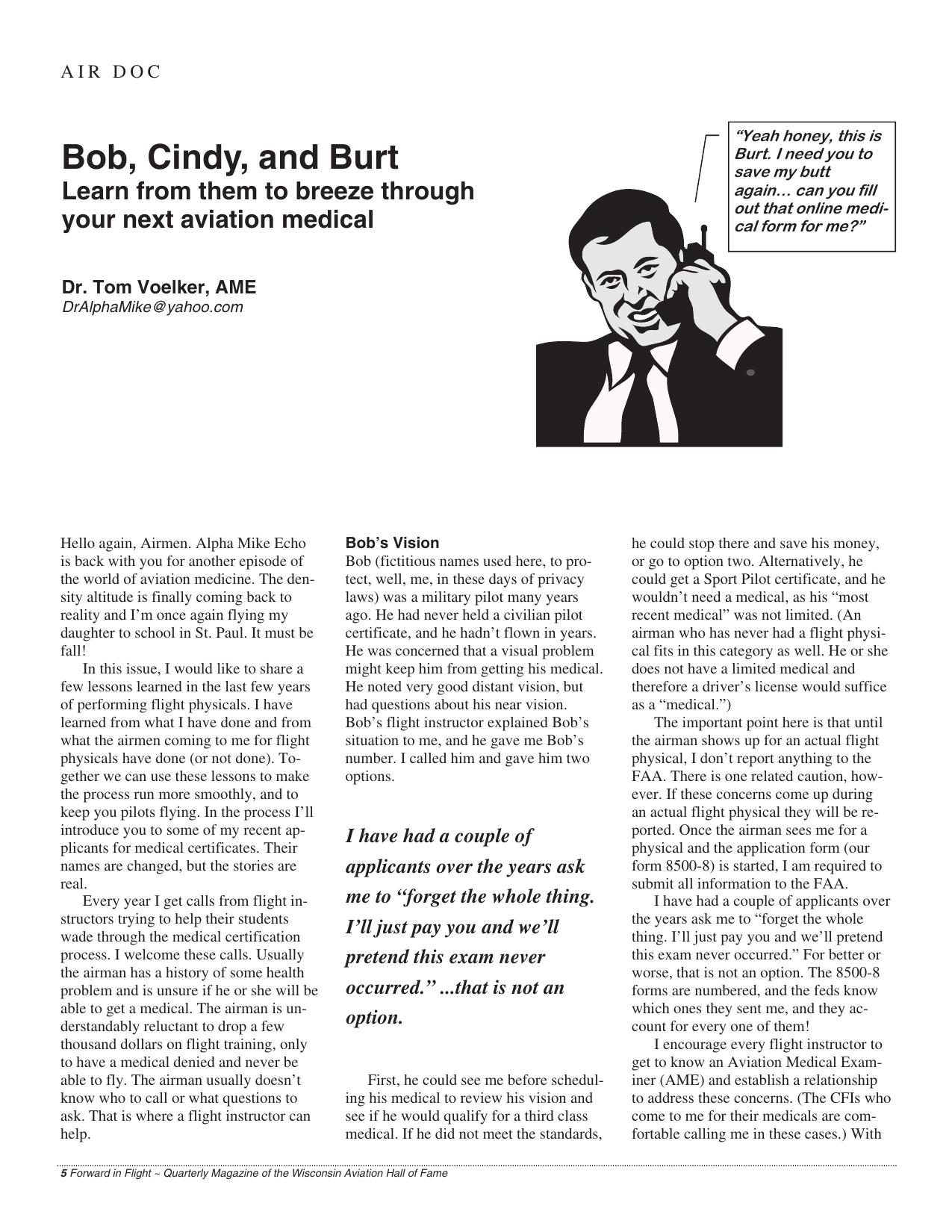
AIR DOC Bob, Cindy, and Burt Learn from them to breeze through your next aviation medical “Yeah honey, this is Burt. I need you to save my butt again… can you fill out that online medical form for me?” Dr. Tom Voelker, AME DrAlphaMike@yahoo.com Hello again, Airmen. Alpha Mike Echo is back with you for another episode of the world of aviation medicine. The density altitude is finally coming back to reality and I’m once again flying my daughter to school in St. Paul. It must be fall! In this issue, I would like to share a few lessons learned in the last few years of performing flight physicals. I have learned from what I have done and from what the airmen coming to me for flight physicals have done (or not done). Together we can use these lessons to make the process run more smoothly, and to keep you pilots flying. In the process I’ll introduce you to some of my recent applicants for medical certificates. Their names are changed, but the stories are real. Every year I get calls from flight instructors trying to help their students wade through the medical certification process. I welcome these calls. Usually the airman has a history of some health problem and is unsure if he or she will be able to get a medical. The airman is understandably reluctant to drop a few thousand dollars on flight training, only to have a medical denied and never be able to fly. The airman usually doesn’t know who to call or what questions to ask. That is where a flight instructor can help. Bob’s Vision Bob (fictitious names used here, to protect, well, me, in these days of privacy laws) was a military pilot many years ago. He had never held a civilian pilot certificate, and he hadn’t flown in years. He was concerned that a visual problem might keep him from getting his medical. He noted very good distant vision, but had questions about his near vision. Bob’s flight instructor explained Bob’s situation to me, and he gave me Bob’s number. I called him and gave him two options. I have had a couple of applicants over the years ask me to “forget the whole thing. I’ll just pay you and we’ll pretend this exam never occurred.” ...that is not an option. First, he could see me before scheduling his medical to review his vision and see if he would qualify for a third class medical. If he did not meet the standards, 5 Forward in Flight ~ Quarterly Magazine of the Wisconsin Aviation Hall of Fame he could stop there and save his money, or go to option two. Alternatively, he could get a Sport Pilot certificate, and he wouldn’t need a medical, as his “most recent medical” was not limited. (An airman who has never had a flight physical fits in this category as well. He or she does not have a limited medical and therefore a driver’s license would suffice as a “medical.”) The important point here is that until the airman shows up for an actual flight physical, I don’t report anything to the FAA. There is one related caution, however. If these concerns come up during an actual flight physical they will be reported. Once the airman sees me for a physical and the application form (our form 8500-8) is started, I am required to submit all information to the FAA. I have had a couple of applicants over the years ask me to “forget the whole thing. I’ll just pay you and we’ll pretend this exam never occurred.” For better or worse, that is not an option. The 8500-8 forms are numbered, and the feds know which ones they sent me, and they account for every one of them! I encourage every flight instructor to get to know an Aviation Medical Examiner (AME) and establish a relationship to address these concerns. (The CFIs who come to me for their medicals are comfortable calling me in these cases.) With
AIR DOC permission of the student pilot, the CFI can briefly explain the medical problem that the student is dealing with or has in his or her history. Generally I don’t need details, just the nature of the problem. Armed with this information, I can give the instructor guidance and recommendations, or talk to the applicant myself. Incidentally, Bob did see me, and his vision was acceptable. He subsequently cancelled his flight physical, however. His instructor told me he had “other issues” and had decided to pursue a Sport Pilot certificate. Cindy’s BP Cindy had another problem. She had seen me one year previously for a flight physical. That encounter went smoothly. Cindy has a history of hypertension (“high blood pressure”) and she had recently seen her doctor for a check-up on this condition. Armed with her medical records, I was able to issue her second class medical at the time of that exam. This time, however, things didn’t go as smoothly. At the bottom of the 8500-8 application form, the airman is to list any doctors seen in the past three years. Can you guess the last doctor who Cindy had seen before her flight physical? Yup, it was me, the year before. She had not seen her personal doctor in more than a year. (Incidentally, you do not need to list visits to your AME for flight physicals on the form. Only visits to other providers for general check-ups or other illnesses or conditions are required to be mentioned.) The FAA has done a great job of delegating authority to the AME to approve and issue medical certificates for various conditions. This makes the system much more efficient and pilotfriendly. However, the feds will not allow AMEs to rewrite the rules. Hypertension, heart disease, and many other conditions need to be evaluated at least annually, and the condition needs to be shown to be under control before a certificate can be issued. Cindy would need to see her doctor for a blood pressure check and annual lab work. Fortunately for her, one of my partners (who happens to be a pilot as well) is her physician. I was able to get him to see her the same day. When her physician’s note was in the chart and the labs were back, I was able to issue a certificate. I don’t recommend going this route, though. It was difficult to get that on-the-spot appointment. This put us all under a time crunch. Cindy needed her second class medical for commercial pilot duties, and I couldn’t issue the medical until the records were available. In addition, I have only two weeks after the physical to submit my records to Oklahoma City and to issue the medical. If the records don’t arrive by then, or if there is a problem with her labs, I will need to “defer” her application to the FAA. As I have previously mentioned in these pages, sending an application to OKC for their review is an almost guaranteed three-month delay in the process. Cindy didn’t come to her appointment as prepared as she could have been. The best way to prepare for the flight physical is to use MedXPress. My recommendation for Cindy? Get the blood pressure check-up (often combined with an annual physical exam) from her usual doctor one or two months before her flight physical. It would also help for Cindy or her doctor to contact her AME before the appointment and get a list of what needs to be included in this evaluation. Cindy didn’t come to her appointment as prepared as she could have been. The best way to prepare for the flight physical is to use MedXPress. Just don’t do it like Burt did. Burt’s Application MedXPress, you may recall, is the electronic form 8500-8, or application form for the flight physical. You can fill it out in the leisure of your home. This form can be completed up to 60 days before the flight physical. Complete the form and bring the confirmation number to your physical, and you’re in. You do need to log on and setup an account with the FAA, but this is a simple process. (Go to www.FAA.gov, and search “MedXPress” to get to the log-on page.) Knowing that I encourage the use of MedXPress, Burt wanted to use this electronic application form. (Some AMEs won’t perform a flight physical if the applicant hasn’t used MedXPress.) He forgot the part about completing it at home. When I went in the exam room to perform the physical, Burt was on his cell phone with his wife, telling her what to type in the boxes as she tried to navigate through the 8500-8 on her home computer. After a couple minutes, I left to see another patient. Ten minutes later I returned, and Burt and his wife were still at it! Realizing I only have two weeks to submit the exam, I requested that Burt hang up and complete the paper form. With the help of my assistant and a mere 30 minutes, he was done! And the FAA suggests a flight physical should take about 15 minutes! There are other suggestions I could give you, and over the next few years I’m sure I’ll come up with more. Perhaps I can share them with you in a future issue. For now, I hope these suggestions help you navigate the aeromedical sky. Go visit MedXPress, get your next unrestricted medical, and take on the crisp fall weather. Fly safely. Fly high. Fly! —Alpha Mike In “real” life, Alpha Mike Echo is Dr. Tom Voelker, AME, a family practitioner in Wisconsin Rapids. He and his wife, Kathy, are the parents of four daughters. Tom flies N6224P, a Comanche 250, out of Alexander Field, South Wood County Airport (ISW). 6 Forward in Flight ~ Fall 2011
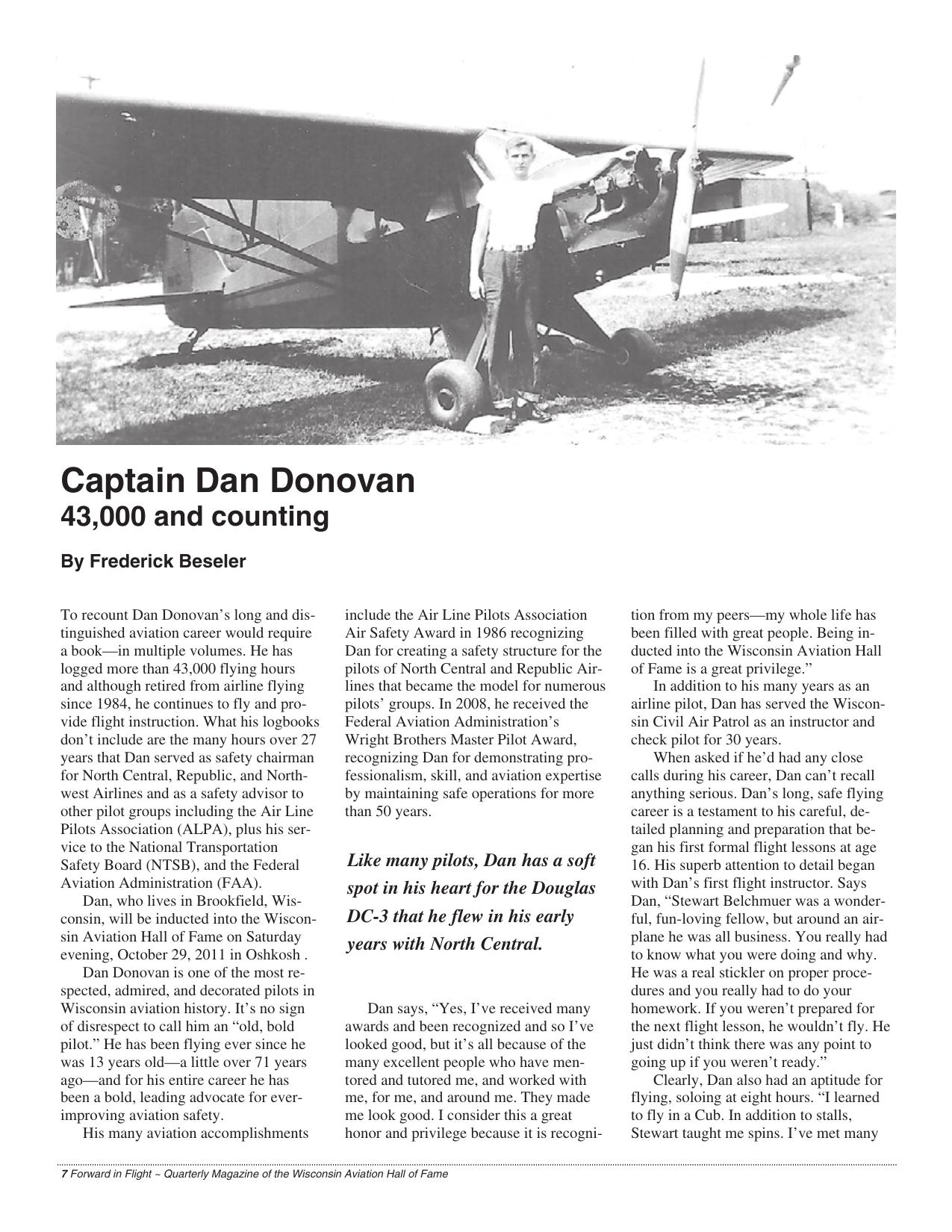
Captain Dan Donovan 43,000 and counting By Frederick Beseler To recount Dan Donovan’s long and distinguished aviation career would require a book—in multiple volumes. He has logged more than 43,000 flying hours and although retired from airline flying since 1984, he continues to fly and provide flight instruction. What his logbooks don’t include are the many hours over 27 years that Dan served as safety chairman for North Central, Republic, and Northwest Airlines and as a safety advisor to other pilot groups including the Air Line Pilots Association (ALPA), plus his service to the National Transportation Safety Board (NTSB), and the Federal Aviation Administration (FAA). Dan, who lives in Brookfield, Wisconsin, will be inducted into the Wisconsin Aviation Hall of Fame on Saturday evening, October 29, 2011 in Oshkosh . Dan Donovan is one of the most respected, admired, and decorated pilots in Wisconsin aviation history. It’s no sign of disrespect to call him an “old, bold pilot.” He has been flying ever since he was 13 years old—a little over 71 years ago—and for his entire career he has been a bold, leading advocate for everimproving aviation safety. His many aviation accomplishments include the Air Line Pilots Association Air Safety Award in 1986 recognizing Dan for creating a safety structure for the pilots of North Central and Republic Airlines that became the model for numerous pilots’ groups. In 2008, he received the Federal Aviation Administration’s Wright Brothers Master Pilot Award, recognizing Dan for demonstrating professionalism, skill, and aviation expertise by maintaining safe operations for more than 50 years. Like many pilots, Dan has a soft spot in his heart for the Douglas DC-3 that he flew in his early years with North Central. Dan says, “Yes, I’ve received many awards and been recognized and so I’ve looked good, but it’s all because of the many excellent people who have mentored and tutored me, and worked with me, for me, and around me. They made me look good. I consider this a great honor and privilege because it is recogni- 7 Forward in Flight ~ Quarterly Magazine of the Wisconsin Aviation Hall of Fame tion from my peers—my whole life has been filled with great people. Being inducted into the Wisconsin Aviation Hall of Fame is a great privilege.” In addition to his many years as an airline pilot, Dan has served the Wisconsin Civil Air Patrol as an instructor and check pilot for 30 years. When asked if he’d had any close calls during his career, Dan can’t recall anything serious. Dan’s long, safe flying career is a testament to his careful, detailed planning and preparation that began his first formal flight lessons at age 16. His superb attention to detail began with Dan’s first flight instructor. Says Dan, “Stewart Belchmuer was a wonderful, fun-loving fellow, but around an airplane he was all business. You really had to know what you were doing and why. He was a real stickler on proper procedures and you really had to do your homework. If you weren’t prepared for the next flight lesson, he wouldn’t fly. He just didn’t think there was any point to going up if you weren’t ready.” Clearly, Dan also had an aptitude for flying, soloing at eight hours. “I learned to fly in a Cub. In addition to stalls, Stewart taught me spins. I’ve met many
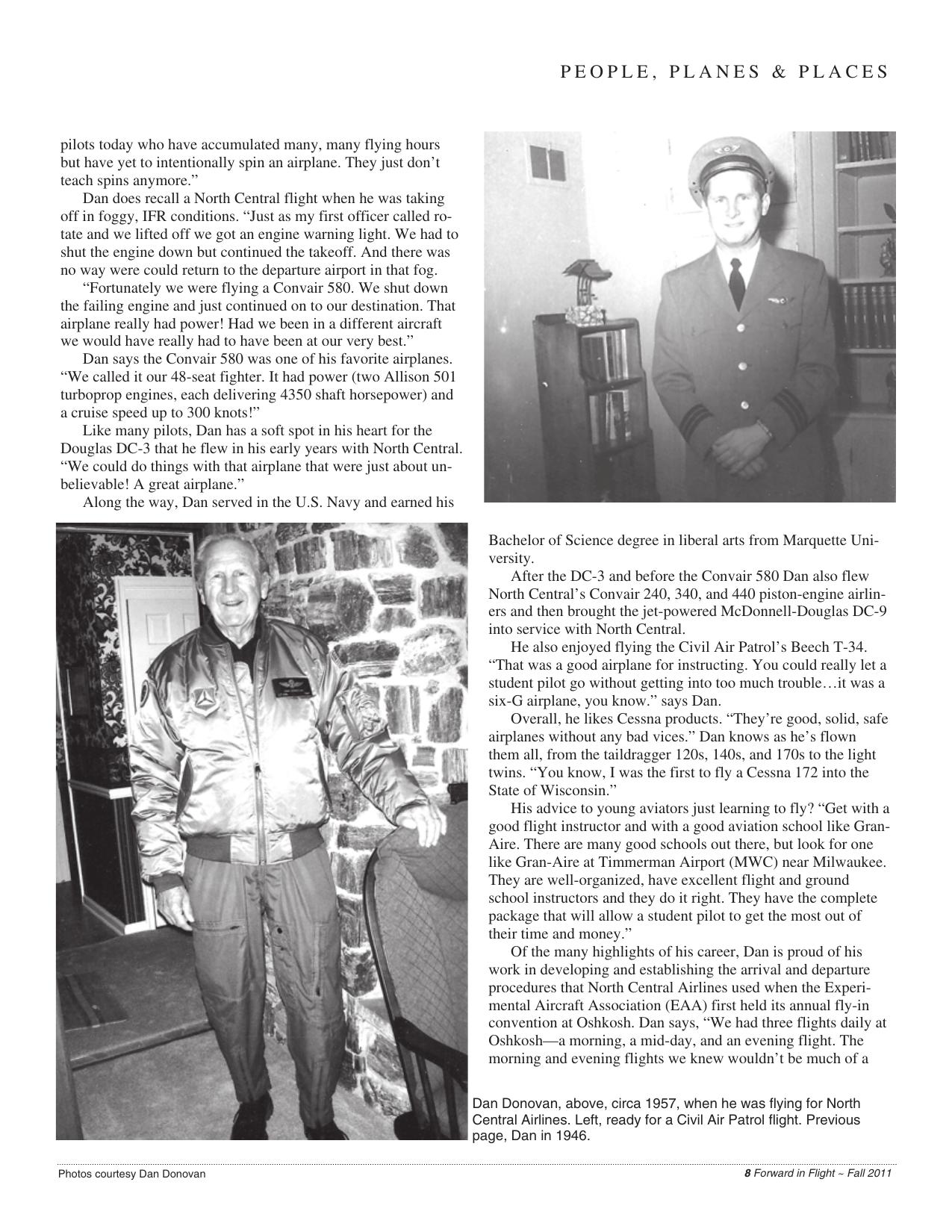
PEOPLE, PLANES & PLACES pilots today who have accumulated many, many flying hours but have yet to intentionally spin an airplane. They just don’t teach spins anymore.” Dan does recall a North Central flight when he was taking off in foggy, IFR conditions. “Just as my first officer called rotate and we lifted off we got an engine warning light. We had to shut the engine down but continued the takeoff. And there was no way were could return to the departure airport in that fog. “Fortunately we were flying a Convair 580. We shut down the failing engine and just continued on to our destination. That airplane really had power! Had we been in a different aircraft we would have really had to have been at our very best.” Dan says the Convair 580 was one of his favorite airplanes. “We called it our 48-seat fighter. It had power (two Allison 501 turboprop engines, each delivering 4350 shaft horsepower) and a cruise speed up to 300 knots!” Like many pilots, Dan has a soft spot in his heart for the Douglas DC-3 that he flew in his early years with North Central. “We could do things with that airplane that were just about unbelievable! A great airplane.” Along the way, Dan served in the U.S. Navy and earned his Bachelor of Science degree in liberal arts from Marquette University. After the DC-3 and before the Convair 580 Dan also flew North Central’s Convair 240, 340, and 440 piston-engine airliners and then brought the jet-powered McDonnell-Douglas DC-9 into service with North Central. He also enjoyed flying the Civil Air Patrol’s Beech T-34. “That was a good airplane for instructing. You could really let a student pilot go without getting into too much trouble…it was a six-G airplane, you know.” says Dan. Overall, he likes Cessna products. “They’re good, solid, safe airplanes without any bad vices.” Dan knows as he’s flown them all, from the taildragger 120s, 140s, and 170s to the light twins. “You know, I was the first to fly a Cessna 172 into the State of Wisconsin.” His advice to young aviators just learning to fly? “Get with a good flight instructor and with a good aviation school like GranAire. There are many good schools out there, but look for one like Gran-Aire at Timmerman Airport (MWC) near Milwaukee. They are well-organized, have excellent flight and ground school instructors and they do it right. They have the complete package that will allow a student pilot to get the most out of their time and money.” Of the many highlights of his career, Dan is proud of his work in developing and establishing the arrival and departure procedures that North Central Airlines used when the Experimental Aircraft Association (EAA) first held its annual fly-in convention at Oshkosh. Dan says, “We had three flights daily at Oshkosh—a morning, a mid-day, and an evening flight. The morning and evening flights we knew wouldn’t be much of a Dan Donovan, above, circa 1957, when he was flying for North Central Airlines. Left, ready for a Civil Air Patrol flight. Previous page, Dan in 1946. Photos courtesy Dan Donovan 8 Forward in Flight ~ Fall 2011
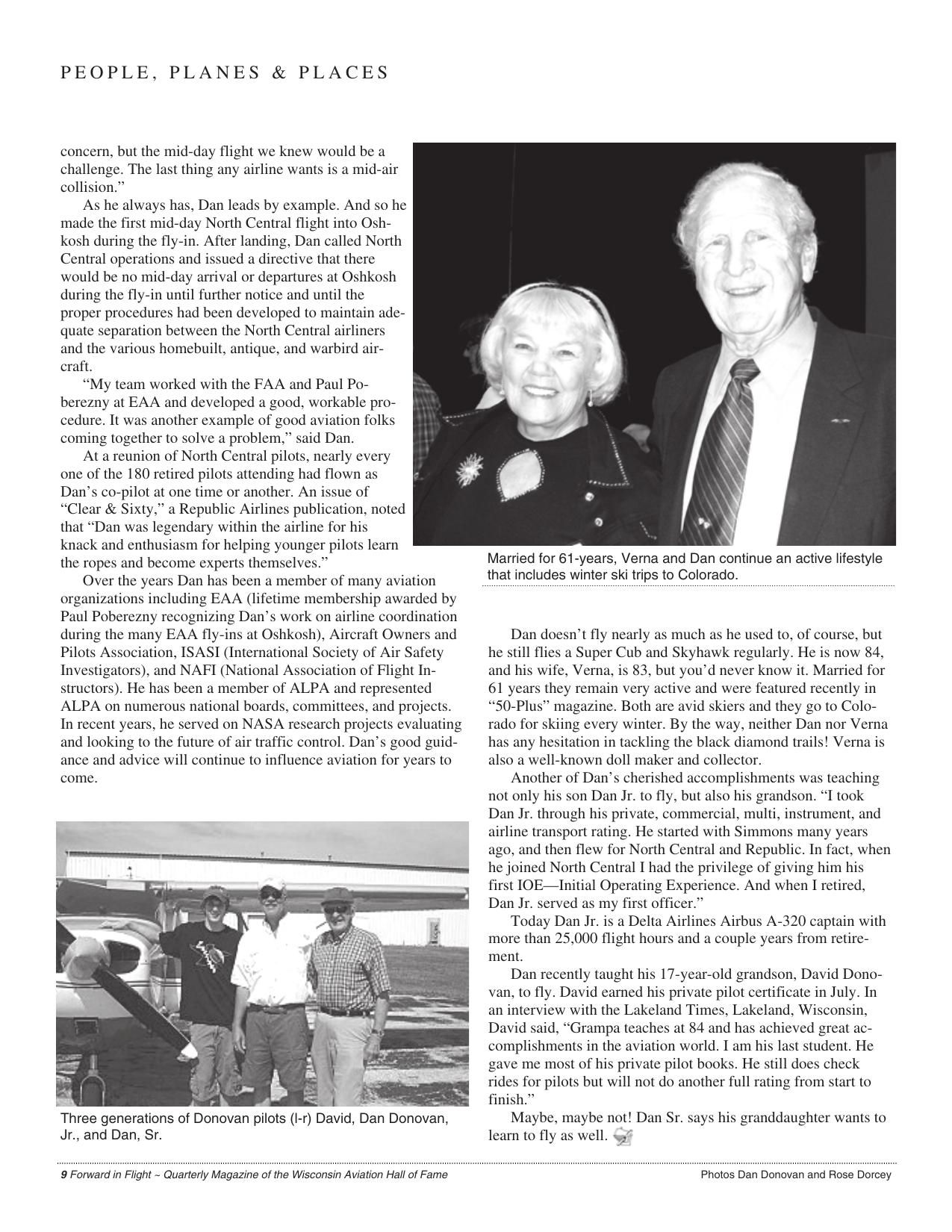
PEOPLE, PLANES & PLACES concern, but the mid-day flight we knew would be a challenge. The last thing any airline wants is a mid-air collision.” As he always has, Dan leads by example. And so he made the first mid-day North Central flight into Oshkosh during the fly-in. After landing, Dan called North Central operations and issued a directive that there would be no mid-day arrival or departures at Oshkosh during the fly-in until further notice and until the proper procedures had been developed to maintain adequate separation between the North Central airliners and the various homebuilt, antique, and warbird aircraft. “My team worked with the FAA and Paul Poberezny at EAA and developed a good, workable procedure. It was another example of good aviation folks coming together to solve a problem,” said Dan. At a reunion of North Central pilots, nearly every one of the 180 retired pilots attending had flown as Dan’s co-pilot at one time or another. An issue of “Clear & Sixty,” a Republic Airlines publication, noted that “Dan was legendary within the airline for his knack and enthusiasm for helping younger pilots learn the ropes and become experts themselves.” Over the years Dan has been a member of many aviation organizations including EAA (lifetime membership awarded by Paul Poberezny recognizing Dan’s work on airline coordination during the many EAA fly-ins at Oshkosh), Aircraft Owners and Pilots Association, ISASI (International Society of Air Safety Investigators), and NAFI (National Association of Flight Instructors). He has been a member of ALPA and represented ALPA on numerous national boards, committees, and projects. In recent years, he served on NASA research projects evaluating and looking to the future of air traffic control. Dan’s good guidance and advice will continue to influence aviation for years to come. Married for 61-years, Verna and Dan continue an active lifestyle that includes winter ski trips to Colorado. Three generations of Donovan pilots (l-r) David, Dan Donovan, Jr., and Dan, Sr. Dan doesn’t fly nearly as much as he used to, of course, but he still flies a Super Cub and Skyhawk regularly. He is now 84, and his wife, Verna, is 83, but you’d never know it. Married for 61 years they remain very active and were featured recently in “50-Plus” magazine. Both are avid skiers and they go to Colorado for skiing every winter. By the way, neither Dan nor Verna has any hesitation in tackling the black diamond trails! Verna is also a well-known doll maker and collector. Another of Dan’s cherished accomplishments was teaching not only his son Dan Jr. to fly, but also his grandson. “I took Dan Jr. through his private, commercial, multi, instrument, and airline transport rating. He started with Simmons many years ago, and then flew for North Central and Republic. In fact, when he joined North Central I had the privilege of giving him his first IOE—Initial Operating Experience. And when I retired, Dan Jr. served as my first officer.” Today Dan Jr. is a Delta Airlines Airbus A-320 captain with more than 25,000 flight hours and a couple years from retirement. Dan recently taught his 17-year-old grandson, David Donovan, to fly. David earned his private pilot certificate in July. In an interview with the Lakeland Times, Lakeland, Wisconsin, David said, “Grampa teaches at 84 and has achieved great accomplishments in the aviation world. I am his last student. He gave me most of his private pilot books. He still does check rides for pilots but will not do another full rating from start to finish.” Maybe, maybe not! Dan Sr. says his granddaughter wants to learn to fly as well. 9 Forward in Flight ~ Quarterly Magazine of the Wisconsin Aviation Hall of Fame Photos Dan Donovan and Rose Dorcey
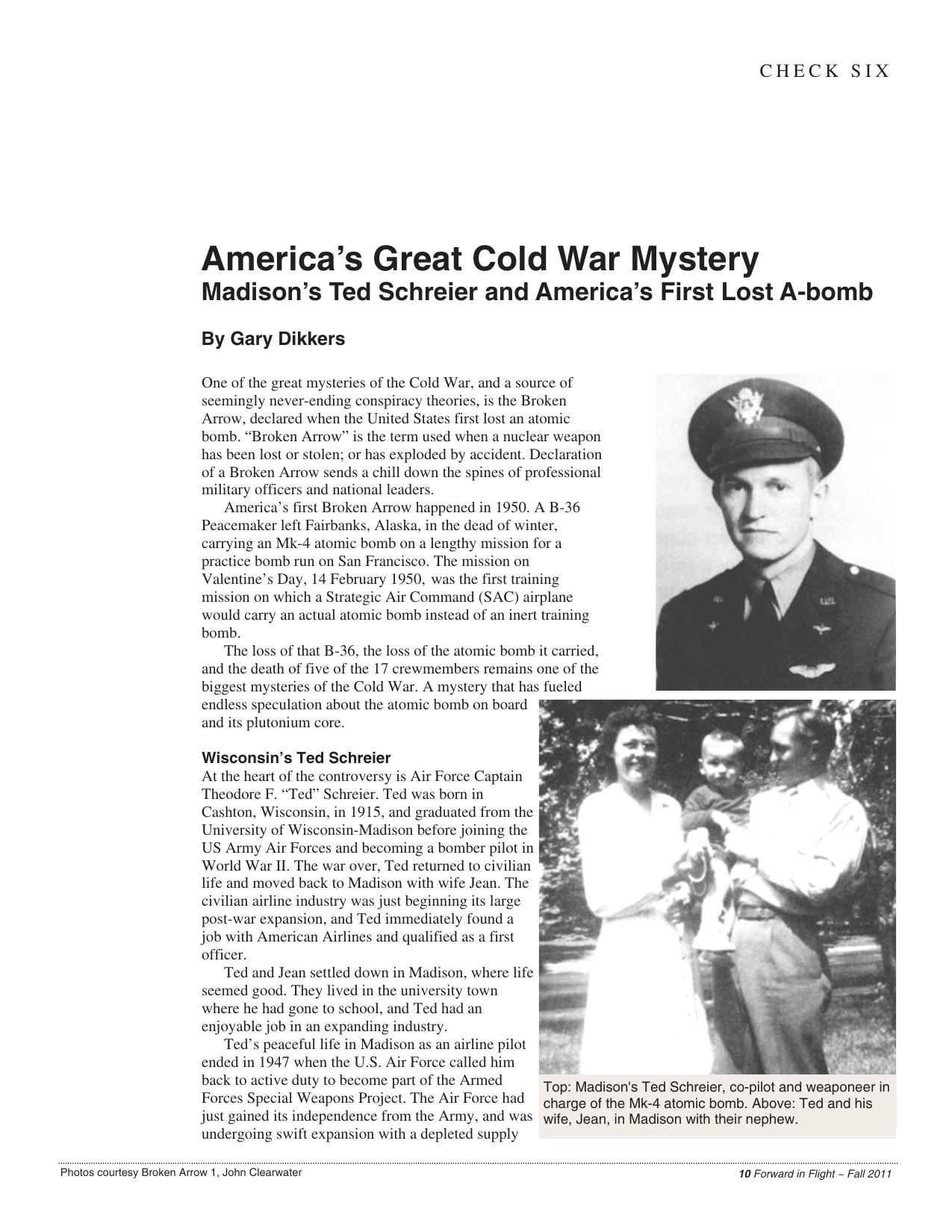
CHECK SIX America’s Great Cold War Mystery Madison’s Ted Schreier and America’s First Lost A-bomb By Gary Dikkers One of the great mysteries of the Cold War, and a source of seemingly never-ending conspiracy theories, is the Broken Arrow, declared when the United States first lost an atomic bomb. “Broken Arrow” is the term used when a nuclear weapon has been lost or stolen; or has exploded by accident. Declaration of a Broken Arrow sends a chill down the spines of professional military officers and national leaders. America’s first Broken Arrow happened in 1950. A B-36 Peacemaker left Fairbanks, Alaska, in the dead of winter, carrying an Mk-4 atomic bomb on a lengthy mission for a practice bomb run on San Francisco. The mission on Valentine’s Day, 14 February 1950, was the first training mission on which a Strategic Air Command (SAC) airplane would carry an actual atomic bomb instead of an inert training bomb. The loss of that B-36, the loss of the atomic bomb it carried, and the death of five of the 17 crewmembers remains one of the biggest mysteries of the Cold War. A mystery that has fueled endless speculation about the atomic bomb on board and its plutonium core. Wisconsin’s Ted Schreier At the heart of the controversy is Air Force Captain Theodore F. “Ted” Schreier. Ted was born in Cashton, Wisconsin, in 1915, and graduated from the University of Wisconsin-Madison before joining the US Army Air Forces and becoming a bomber pilot in World War II. The war over, Ted returned to civilian life and moved back to Madison with wife Jean. The civilian airline industry was just beginning its large post-war expansion, and Ted immediately found a job with American Airlines and qualified as a first officer. Ted and Jean settled down in Madison, where life seemed good. They lived in the university town where he had gone to school, and Ted had an enjoyable job in an expanding industry. Ted’s peaceful life in Madison as an airline pilot ended in 1947 when the U.S. Air Force called him back to active duty to become part of the Armed Top: Madison's Ted Schreier, co-pilot and weaponeer in Forces Special Weapons Project. The Air Force had charge of the Mk-4 atomic bomb. Above: Ted and his just gained its independence from the Army, and was wife, Jean, in Madison with their nephew. undergoing swift expansion with a depleted supply Photos courtesy Broken Arrow 1, John Clearwater 10 Forward in Flight ~ Fall 2011
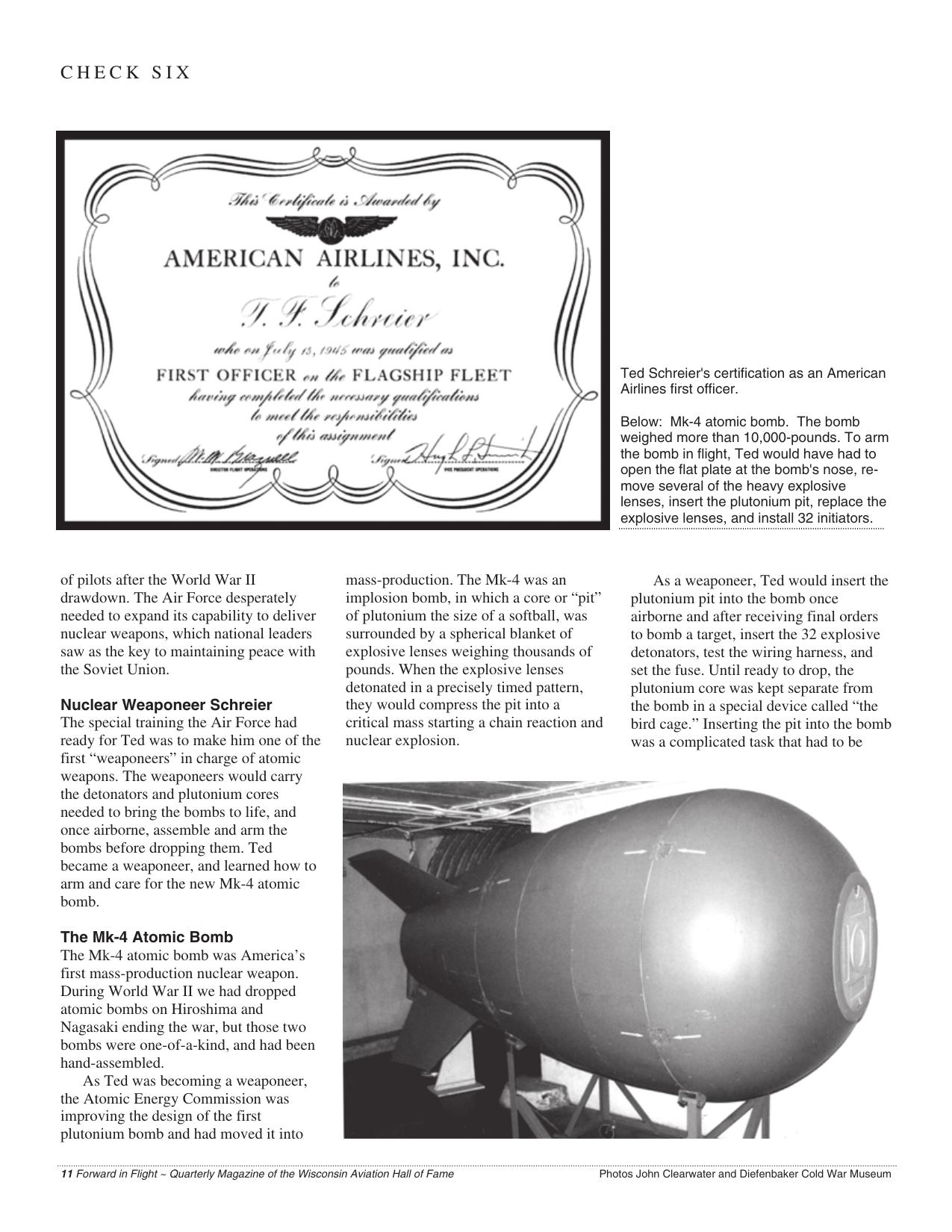
CHECK SIX Ted Schreier's certification as an American Airlines first officer. Below: Mk-4 atomic bomb. The bomb weighed more than 10,000-pounds. To arm the bomb in flight, Ted would have had to open the flat plate at the bomb's nose, remove several of the heavy explosive lenses, insert the plutonium pit, replace the explosive lenses, and install 32 initiators. of pilots after the World War II drawdown. The Air Force desperately needed to expand its capability to deliver nuclear weapons, which national leaders saw as the key to maintaining peace with the Soviet Union. Nuclear Weaponeer Schreier The special training the Air Force had ready for Ted was to make him one of the first “weaponeers” in charge of atomic weapons. The weaponeers would carry the detonators and plutonium cores needed to bring the bombs to life, and once airborne, assemble and arm the bombs before dropping them. Ted became a weaponeer, and learned how to arm and care for the new Mk-4 atomic bomb. mass-production. The Mk-4 was an implosion bomb, in which a core or “pit” of plutonium the size of a softball, was surrounded by a spherical blanket of explosive lenses weighing thousands of pounds. When the explosive lenses detonated in a precisely timed pattern, they would compress the pit into a critical mass starting a chain reaction and nuclear explosion. As a weaponeer, Ted would insert the plutonium pit into the bomb once airborne and after receiving final orders to bomb a target, insert the 32 explosive detonators, test the wiring harness, and set the fuse. Until ready to drop, the plutonium core was kept separate from the bomb in a special device called “the bird cage.” Inserting the pit into the bomb was a complicated task that had to be The Mk-4 Atomic Bomb The Mk-4 atomic bomb was America’s first mass-production nuclear weapon. During World War II we had dropped atomic bombs on Hiroshima and Nagasaki ending the war, but those two bombs were one-of-a-kind, and had been hand-assembled. As Ted was becoming a weaponeer, the Atomic Energy Commission was improving the design of the first plutonium bomb and had moved it into 11 Forward in Flight ~ Quarterly Magazine of the Wisconsin Aviation Hall of Fame Photos John Clearwater and Diefenbaker Cold War Museum
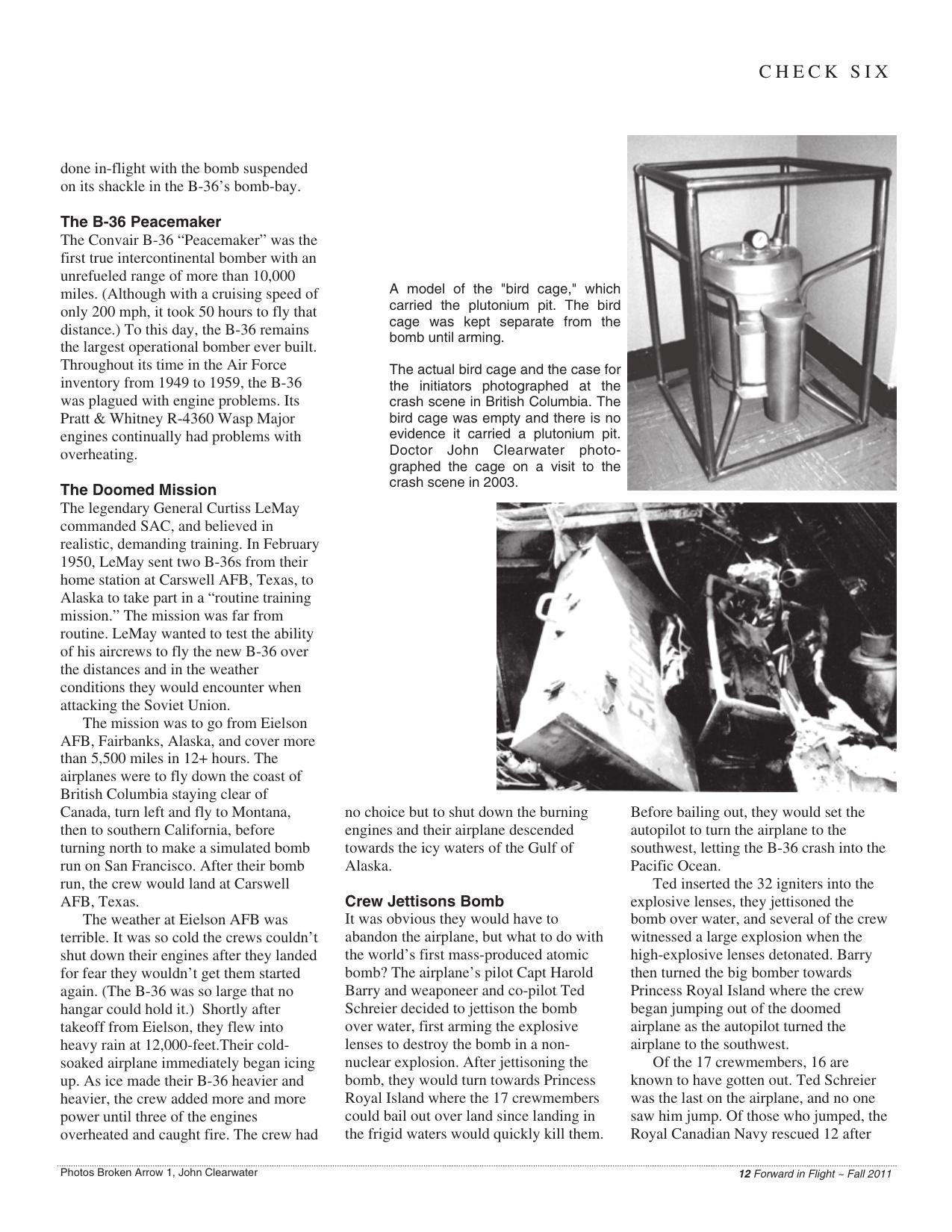
CHECK SIX done in-flight with the bomb suspended on its shackle in the B-36’s bomb-bay. The B-36 Peacemaker The Convair B-36 “Peacemaker” was the first true intercontinental bomber with an unrefueled range of more than 10,000 miles. (Although with a cruising speed of only 200 mph, it took 50 hours to fly that distance.) To this day, the B-36 remains the largest operational bomber ever built. Throughout its time in the Air Force inventory from 1949 to 1959, the B-36 was plagued with engine problems. Its Pratt & Whitney R-4360 Wasp Major engines continually had problems with overheating. The Doomed Mission The legendary General Curtiss LeMay commanded SAC, and believed in realistic, demanding training. In February 1950, LeMay sent two B-36s from their home station at Carswell AFB, Texas, to Alaska to take part in a “routine training mission.” The mission was far from routine. LeMay wanted to test the ability of his aircrews to fly the new B-36 over the distances and in the weather conditions they would encounter when attacking the Soviet Union. The mission was to go from Eielson AFB, Fairbanks, Alaska, and cover more than 5,500 miles in 12+ hours. The airplanes were to fly down the coast of British Columbia staying clear of Canada, turn left and fly to Montana, then to southern California, before turning north to make a simulated bomb run on San Francisco. After their bomb run, the crew would land at Carswell AFB, Texas. The weather at Eielson AFB was terrible. It was so cold the crews couldn’t shut down their engines after they landed for fear they wouldn’t get them started again. (The B-36 was so large that no hangar could hold it.) Shortly after takeoff from Eielson, they flew into heavy rain at 12,000-feet.Their coldsoaked airplane immediately began icing up. As ice made their B-36 heavier and heavier, the crew added more and more power until three of the engines overheated and caught fire. The crew had Photos Broken Arrow 1, John Clearwater A model of the "bird cage," which carried the plutonium pit. The bird cage was kept separate from the bomb until arming. The actual bird cage and the case for the initiators photographed at the crash scene in British Columbia. The bird cage was empty and there is no evidence it carried a plutonium pit. Doctor John Clearwater photographed the cage on a visit to the crash scene in 2003. no choice but to shut down the burning engines and their airplane descended towards the icy waters of the Gulf of Alaska. Crew Jettisons Bomb It was obvious they would have to abandon the airplane, but what to do with the world’s first mass-produced atomic bomb? The airplane’s pilot Capt Harold Barry and weaponeer and co-pilot Ted Schreier decided to jettison the bomb over water, first arming the explosive lenses to destroy the bomb in a nonnuclear explosion. After jettisoning the bomb, they would turn towards Princess Royal Island where the 17 crewmembers could bail out over land since landing in the frigid waters would quickly kill them. Before bailing out, they would set the autopilot to turn the airplane to the southwest, letting the B-36 crash into the Pacific Ocean. Ted inserted the 32 igniters into the explosive lenses, they jettisoned the bomb over water, and several of the crew witnessed a large explosion when the high-explosive lenses detonated. Barry then turned the big bomber towards Princess Royal Island where the crew began jumping out of the doomed airplane as the autopilot turned the airplane to the southwest. Of the 17 crewmembers, 16 are known to have gotten out. Ted Schreier was the last on the airplane, and no one saw him jump. Of those who jumped, the Royal Canadian Navy rescued 12 after 12 Forward in Flight ~ Fall 2011
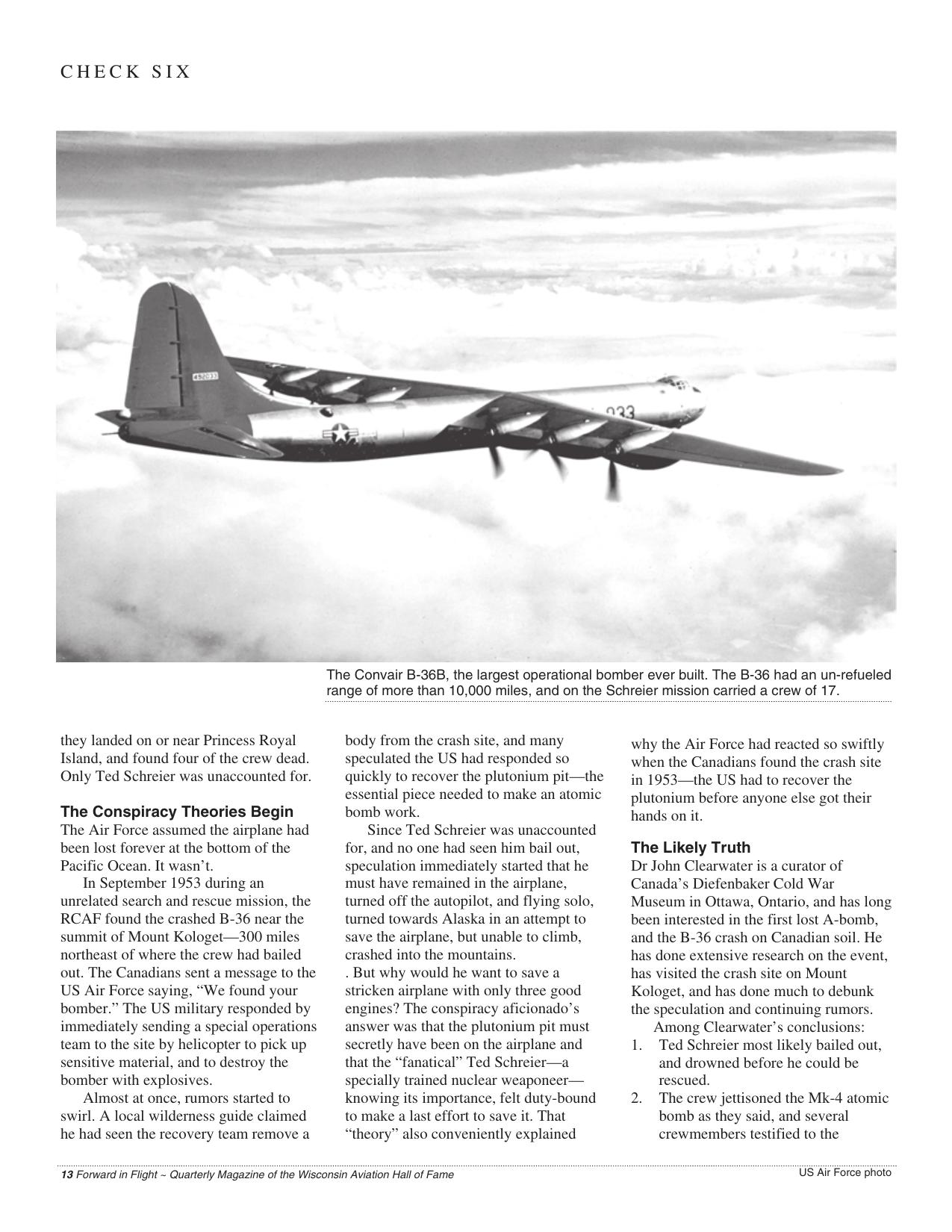
CHECK SIX The Convair B-36B, the largest operational bomber ever built. The B-36 had an un-refueled range of more than 10,000 miles, and on the Schreier mission carried a crew of 17. they landed on or near Princess Royal Island, and found four of the crew dead. Only Ted Schreier was unaccounted for. The Conspiracy Theories Begin The Air Force assumed the airplane had been lost forever at the bottom of the Pacific Ocean. It wasn’t. In September 1953 during an unrelated search and rescue mission, the RCAF found the crashed B-36 near the summit of Mount Kologet—300 miles northeast of where the crew had bailed out. The Canadians sent a message to the US Air Force saying, “We found your bomber.” The US military responded by immediately sending a special operations team to the site by helicopter to pick up sensitive material, and to destroy the bomber with explosives. Almost at once, rumors started to swirl. A local wilderness guide claimed he had seen the recovery team remove a body from the crash site, and many speculated the US had responded so quickly to recover the plutonium pit—the essential piece needed to make an atomic bomb work. Since Ted Schreier was unaccounted for, and no one had seen him bail out, speculation immediately started that he must have remained in the airplane, turned off the autopilot, and flying solo, turned towards Alaska in an attempt to save the airplane, but unable to climb, crashed into the mountains. . But why would he want to save a stricken airplane with only three good engines? The conspiracy aficionado’s answer was that the plutonium pit must secretly have been on the airplane and that the “fanatical” Ted Schreier—a specially trained nuclear weaponeer— knowing its importance, felt duty-bound to make a last effort to save it. That “theory” also conveniently explained 13 Forward in Flight ~ Quarterly Magazine of the Wisconsin Aviation Hall of Fame why the Air Force had reacted so swiftly when the Canadians found the crash site in 1953—the US had to recover the plutonium before anyone else got their hands on it. The Likely Truth Dr John Clearwater is a curator of Canada’s Diefenbaker Cold War Museum in Ottawa, Ontario, and has long been interested in the first lost A-bomb, and the B-36 crash on Canadian soil. He has done extensive research on the event, has visited the crash site on Mount Kologet, and has done much to debunk the speculation and continuing rumors. Among Clearwater’s conclusions: 1. Ted Schreier most likely bailed out, and drowned before he could be rescued. 2. The crew jettisoned the Mk-4 atomic bomb as they said, and several crewmembers testified to the US Air Force photo
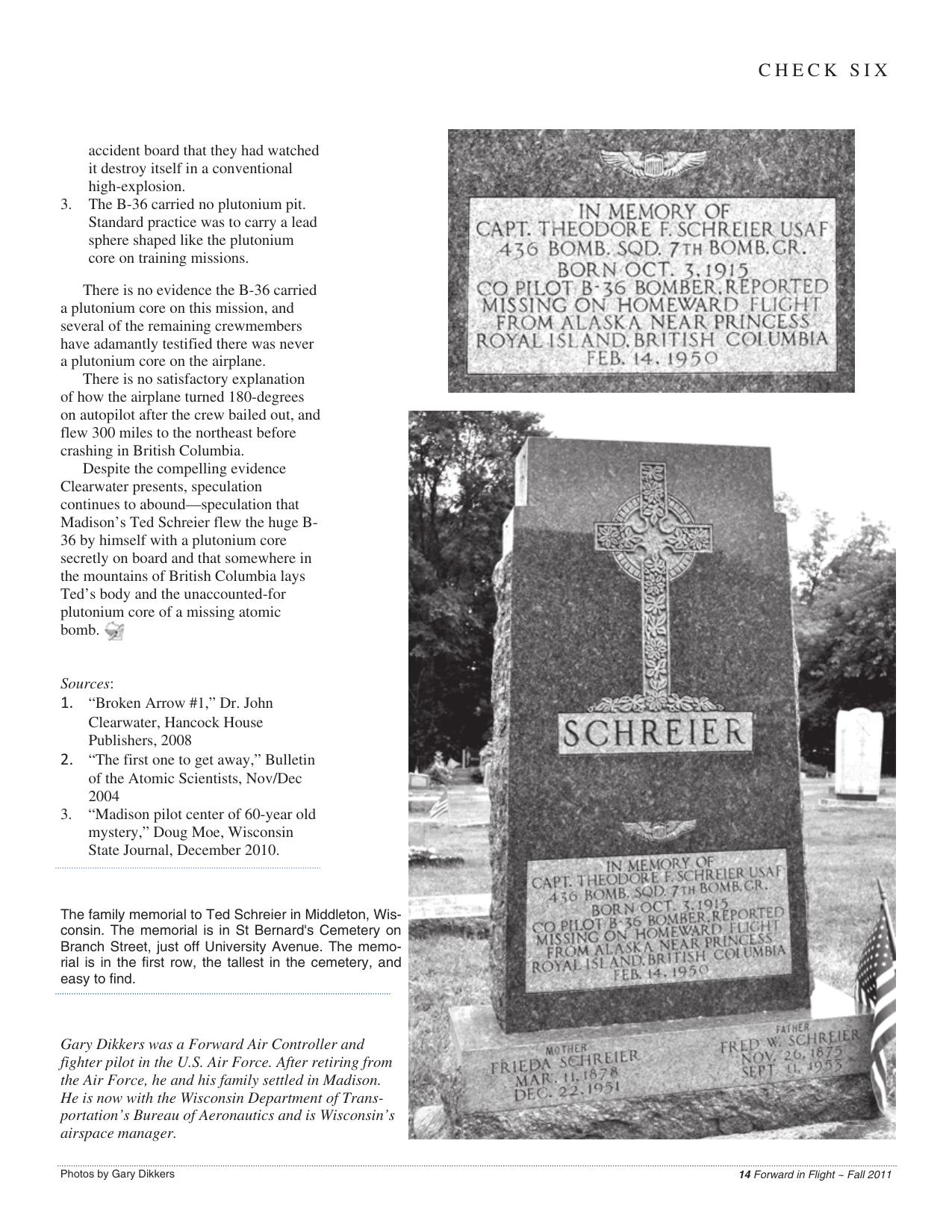
CHECK SIX 3. accident board that they had watched it destroy itself in a conventional high-explosion. The B-36 carried no plutonium pit. Standard practice was to carry a lead sphere shaped like the plutonium core on training missions. There is no evidence the B-36 carried a plutonium core on this mission, and several of the remaining crewmembers have adamantly testified there was never a plutonium core on the airplane. There is no satisfactory explanation of how the airplane turned 180-degrees on autopilot after the crew bailed out, and flew 300 miles to the northeast before crashing in British Columbia. Despite the compelling evidence Clearwater presents, speculation continues to abound—speculation that Madison’s Ted Schreier flew the huge B36 by himself with a plutonium core secretly on board and that somewhere in the mountains of British Columbia lays Ted’s body and the unaccounted-for plutonium core of a missing atomic bomb. Sources: 1. “Broken Arrow #1,” Dr. John Clearwater, Hancock House Publishers, 2008 2. “The first one to get away,” Bulletin of the Atomic Scientists, Nov/Dec 2004 3. “Madison pilot center of 60-year old mystery,” Doug Moe, Wisconsin State Journal, December 2010. The family memorial to Ted Schreier in Middleton, Wisconsin. The memorial is in St Bernard's Cemetery on Branch Street, just off University Avenue. The memorial is in the first row, the tallest in the cemetery, and easy to find. Gary Dikkers was a Forward Air Controller and fighter pilot in the U.S. Air Force. After retiring from the Air Force, he and his family settled in Madison. He is now with the Wisconsin Department of Transportation’s Bureau of Aeronautics and is Wisconsin’s airspace manager. Photos by Gary Dikkers 14 Forward in Flight ~ Fall 2011
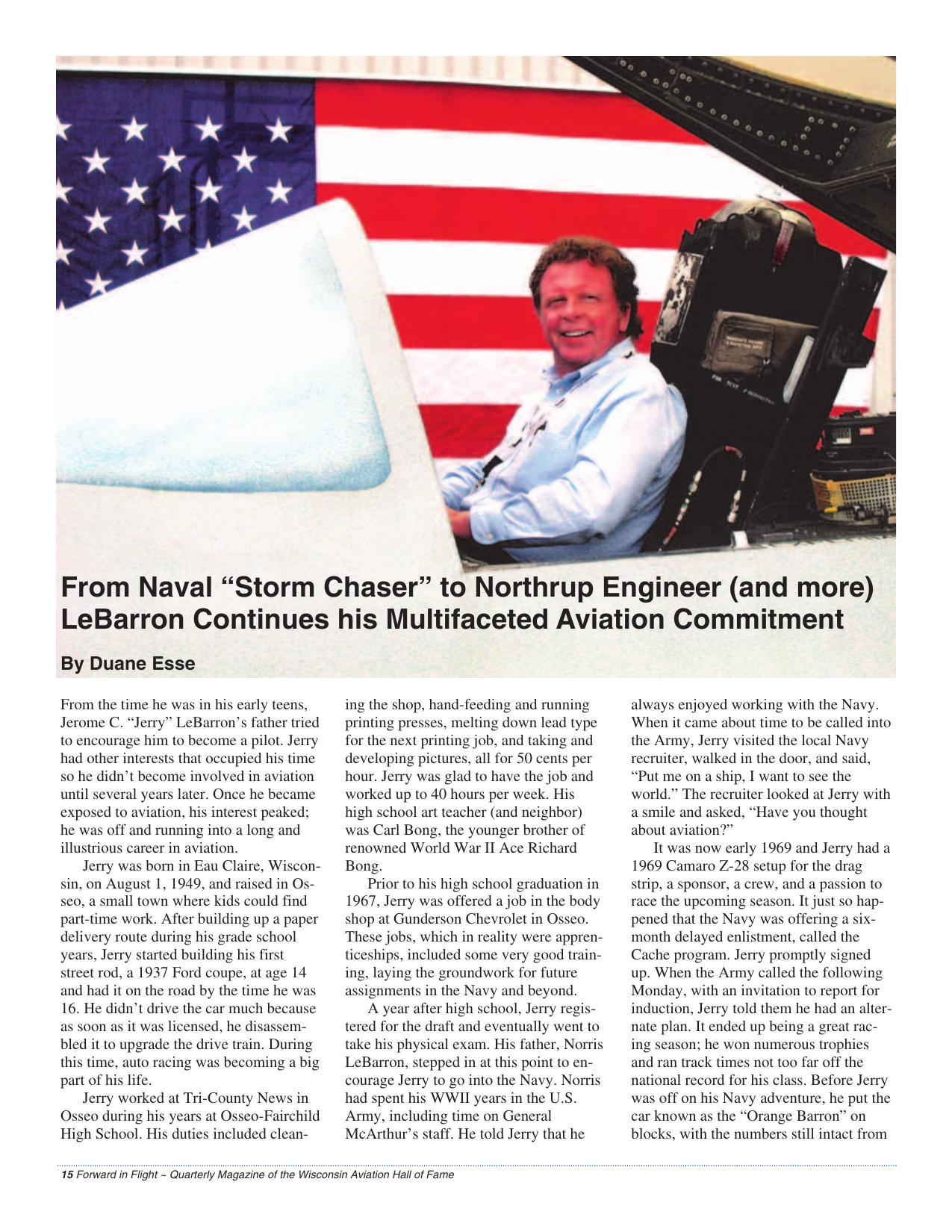
From Naval “Storm Chaser” to Northrup Engineer (and more) LeBarron Continues his Multifaceted Aviation Commitment By Duane Esse From the time he was in his early teens, Jerome C. “Jerry” LeBarron’s father tried to encourage him to become a pilot. Jerry had other interests that occupied his time so he didn’t become involved in aviation until several years later. Once he became exposed to aviation, his interest peaked; he was off and running into a long and illustrious career in aviation. Jerry was born in Eau Claire, Wisconsin, on August 1, 1949, and raised in Osseo, a small town where kids could find part-time work. After building up a paper delivery route during his grade school years, Jerry started building his first street rod, a 1937 Ford coupe, at age 14 and had it on the road by the time he was 16. He didn’t drive the car much because as soon as it was licensed, he disassembled it to upgrade the drive train. During this time, auto racing was becoming a big part of his life. Jerry worked at Tri-County News in Osseo during his years at Osseo-Fairchild High School. His duties included clean- ing the shop, hand-feeding and running printing presses, melting down lead type for the next printing job, and taking and developing pictures, all for 50 cents per hour. Jerry was glad to have the job and worked up to 40 hours per week. His high school art teacher (and neighbor) was Carl Bong, the younger brother of renowned World War II Ace Richard Bong. Prior to his high school graduation in 1967, Jerry was offered a job in the body shop at Gunderson Chevrolet in Osseo. These jobs, which in reality were apprenticeships, included some very good training, laying the groundwork for future assignments in the Navy and beyond. A year after high school, Jerry registered for the draft and eventually went to take his physical exam. His father, Norris LeBarron, stepped in at this point to encourage Jerry to go into the Navy. Norris had spent his WWII years in the U.S. Army, including time on General McArthur’s staff. He told Jerry that he 15 Forward in Flight ~ Quarterly Magazine of the Wisconsin Aviation Hall of Fame always enjoyed working with the Navy. When it came about time to be called into the Army, Jerry visited the local Navy recruiter, walked in the door, and said, “Put me on a ship, I want to see the world.” The recruiter looked at Jerry with a smile and asked, “Have you thought about aviation?” It was now early 1969 and Jerry had a 1969 Camaro Z-28 setup for the drag strip, a sponsor, a crew, and a passion to race the upcoming season. It just so happened that the Navy was offering a sixmonth delayed enlistment, called the Cache program. Jerry promptly signed up. When the Army called the following Monday, with an invitation to report for induction, Jerry told them he had an alternate plan. It ended up being a great racing season; he won numerous trophies and ran track times not too far off the national record for his class. Before Jerry was off on his Navy adventure, he put the car known as the “Orange Barron” on blocks, with the numbers still intact from
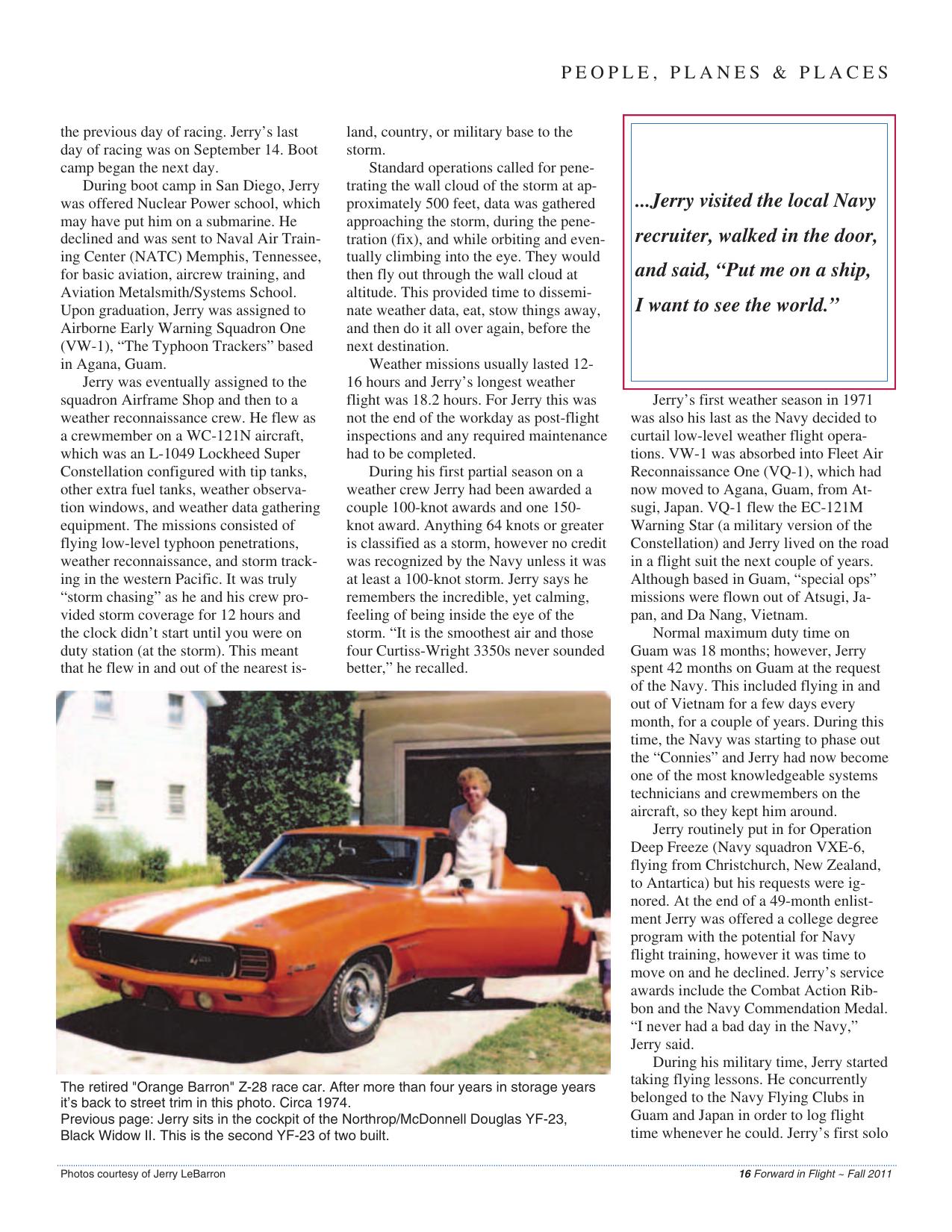
PEOPLE, PLANES & PLACES the previous day of racing. Jerry’s last day of racing was on September 14. Boot camp began the next day. During boot camp in San Diego, Jerry was offered Nuclear Power school, which may have put him on a submarine. He declined and was sent to Naval Air Training Center (NATC) Memphis, Tennessee, for basic aviation, aircrew training, and Aviation Metalsmith/Systems School. Upon graduation, Jerry was assigned to Airborne Early Warning Squadron One (VW-1), “The Typhoon Trackers” based in Agana, Guam. Jerry was eventually assigned to the squadron Airframe Shop and then to a weather reconnaissance crew. He flew as a crewmember on a WC-121N aircraft, which was an L-1049 Lockheed Super Constellation configured with tip tanks, other extra fuel tanks, weather observation windows, and weather data gathering equipment. The missions consisted of flying low-level typhoon penetrations, weather reconnaissance, and storm tracking in the western Pacific. It was truly “storm chasing” as he and his crew provided storm coverage for 12 hours and the clock didn’t start until you were on duty station (at the storm). This meant that he flew in and out of the nearest is- land, country, or military base to the storm. Standard operations called for penetrating the wall cloud of the storm at approximately 500 feet, data was gathered approaching the storm, during the penetration (fix), and while orbiting and eventually climbing into the eye. They would then fly out through the wall cloud at altitude. This provided time to disseminate weather data, eat, stow things away, and then do it all over again, before the next destination. Weather missions usually lasted 1216 hours and Jerry’s longest weather flight was 18.2 hours. For Jerry this was not the end of the workday as post-flight inspections and any required maintenance had to be completed. During his first partial season on a weather crew Jerry had been awarded a couple 100-knot awards and one 150knot award. Anything 64 knots or greater is classified as a storm, however no credit was recognized by the Navy unless it was at least a 100-knot storm. Jerry says he remembers the incredible, yet calming, feeling of being inside the eye of the storm. “It is the smoothest air and those four Curtiss-Wright 3350s never sounded better,” he recalled. The retired "Orange Barron" Z-28 race car. After more than four years in storage years it’s back to street trim in this photo. Circa 1974. Previous page: Jerry sits in the cockpit of the Northrop/McDonnell Douglas YF-23, Black Widow II. This is the second YF-23 of two built. Photos courtesy of Jerry LeBarron ...Jerry visited the local Navy recruiter, walked in the door, and said, “Put me on a ship, I want to see the world.” Jerry’s first weather season in 1971 was also his last as the Navy decided to curtail low-level weather flight operations. VW-1 was absorbed into Fleet Air Reconnaissance One (VQ-1), which had now moved to Agana, Guam, from Atsugi, Japan. VQ-1 flew the EC-121M Warning Star (a military version of the Constellation) and Jerry lived on the road in a flight suit the next couple of years. Although based in Guam, “special ops” missions were flown out of Atsugi, Japan, and Da Nang, Vietnam. Normal maximum duty time on Guam was 18 months; however, Jerry spent 42 months on Guam at the request of the Navy. This included flying in and out of Vietnam for a few days every month, for a couple of years. During this time, the Navy was starting to phase out the “Connies” and Jerry had now become one of the most knowledgeable systems technicians and crewmembers on the aircraft, so they kept him around. Jerry routinely put in for Operation Deep Freeze (Navy squadron VXE-6, flying from Christchurch, New Zealand, to Antartica) but his requests were ignored. At the end of a 49-month enlistment Jerry was offered a college degree program with the potential for Navy flight training, however it was time to move on and he declined. Jerry’s service awards include the Combat Action Ribbon and the Navy Commendation Medal. “I never had a bad day in the Navy,” Jerry said. During his military time, Jerry started taking flying lessons. He concurrently belonged to the Navy Flying Clubs in Guam and Japan in order to log flight time whenever he could. Jerry’s first solo 16 Forward in Flight ~ Fall 2011
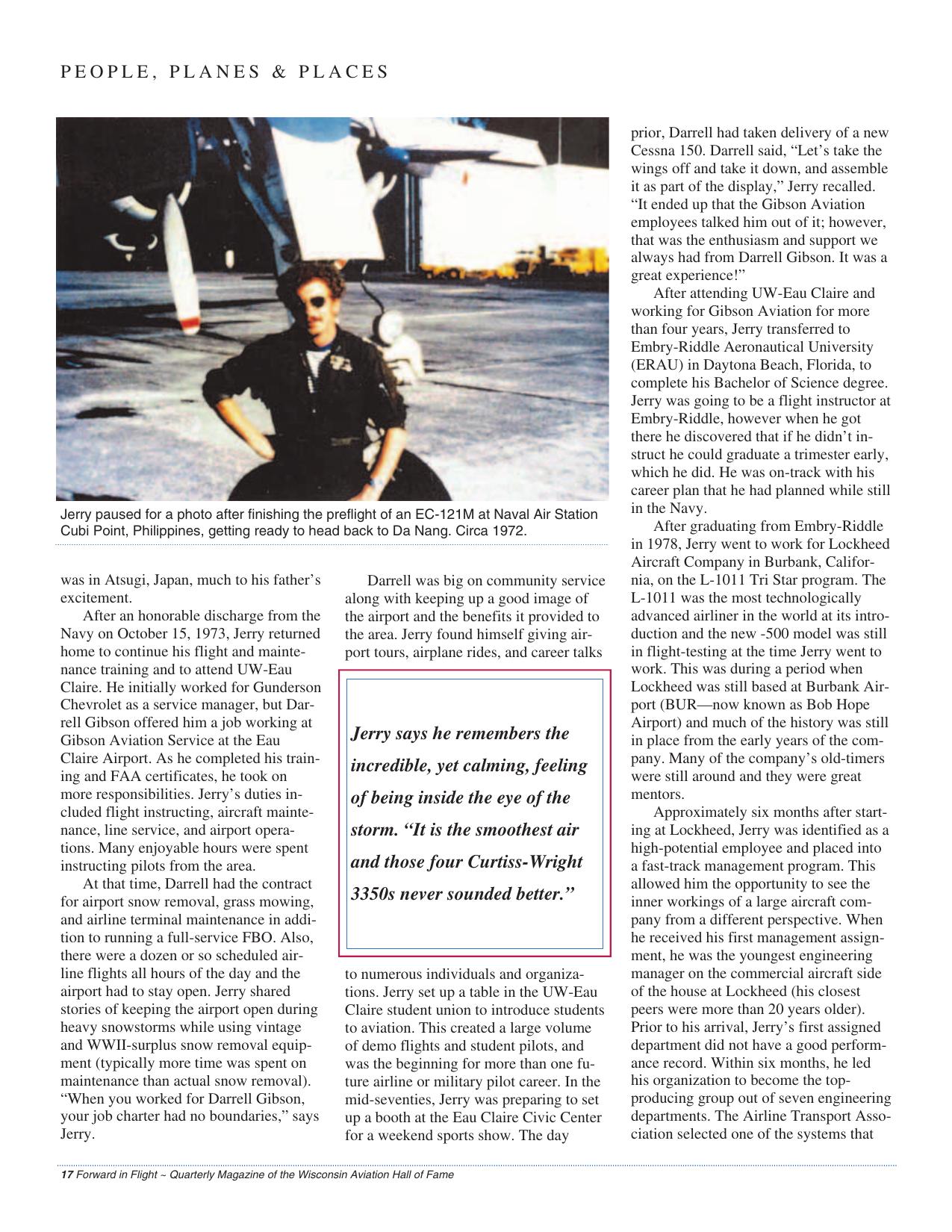
PEOPLE, PLANES & PLACES Jerry paused for a photo after finishing the preflight of an EC-121M at Naval Air Station Cubi Point, Philippines, getting ready to head back to Da Nang. Circa 1972. was in Atsugi, Japan, much to his father’s excitement. After an honorable discharge from the Navy on October 15, 1973, Jerry returned home to continue his flight and maintenance training and to attend UW-Eau Claire. He initially worked for Gunderson Chevrolet as a service manager, but Darrell Gibson offered him a job working at Gibson Aviation Service at the Eau Claire Airport. As he completed his training and FAA certificates, he took on more responsibilities. Jerry’s duties included flight instructing, aircraft maintenance, line service, and airport operations. Many enjoyable hours were spent instructing pilots from the area. At that time, Darrell had the contract for airport snow removal, grass mowing, and airline terminal maintenance in addition to running a full-service FBO. Also, there were a dozen or so scheduled airline flights all hours of the day and the airport had to stay open. Jerry shared stories of keeping the airport open during heavy snowstorms while using vintage and WWII-surplus snow removal equipment (typically more time was spent on maintenance than actual snow removal). “When you worked for Darrell Gibson, your job charter had no boundaries,” says Jerry. Darrell was big on community service along with keeping up a good image of the airport and the benefits it provided to the area. Jerry found himself giving airport tours, airplane rides, and career talks Jerry says he remembers the incredible, yet calming, feeling of being inside the eye of the storm. “It is the smoothest air and those four Curtiss-Wright 3350s never sounded better.” to numerous individuals and organizations. Jerry set up a table in the UW-Eau Claire student union to introduce students to aviation. This created a large volume of demo flights and student pilots, and was the beginning for more than one future airline or military pilot career. In the mid-seventies, Jerry was preparing to set up a booth at the Eau Claire Civic Center for a weekend sports show. The day 17 Forward in Flight ~ Quarterly Magazine of the Wisconsin Aviation Hall of Fame prior, Darrell had taken delivery of a new Cessna 150. Darrell said, “Let’s take the wings off and take it down, and assemble it as part of the display,” Jerry recalled. “It ended up that the Gibson Aviation employees talked him out of it; however, that was the enthusiasm and support we always had from Darrell Gibson. It was a great experience!” After attending UW-Eau Claire and working for Gibson Aviation for more than four years, Jerry transferred to Embry-Riddle Aeronautical University (ERAU) in Daytona Beach, Florida, to complete his Bachelor of Science degree. Jerry was going to be a flight instructor at Embry-Riddle, however when he got there he discovered that if he didn’t instruct he could graduate a trimester early, which he did. He was on-track with his career plan that he had planned while still in the Navy. After graduating from Embry-Riddle in 1978, Jerry went to work for Lockheed Aircraft Company in Burbank, California, on the L-1011 Tri Star program. The L-1011 was the most technologically advanced airliner in the world at its introduction and the new -500 model was still in flight-testing at the time Jerry went to work. This was during a period when Lockheed was still based at Burbank Airport (BUR—now known as Bob Hope Airport) and much of the history was still in place from the early years of the company. Many of the company’s old-timers were still around and they were great mentors. Approximately six months after starting at Lockheed, Jerry was identified as a high-potential employee and placed into a fast-track management program. This allowed him the opportunity to see the inner workings of a large aircraft company from a different perspective. When he received his first management assignment, he was the youngest engineering manager on the commercial aircraft side of the house at Lockheed (his closest peers were more than 20 years older). Prior to his arrival, Jerry’s first assigned department did not have a good performance record. Within six months, he led his organization to become the topproducing group out of seven engineering departments. The Airline Transport Association selected one of the systems that
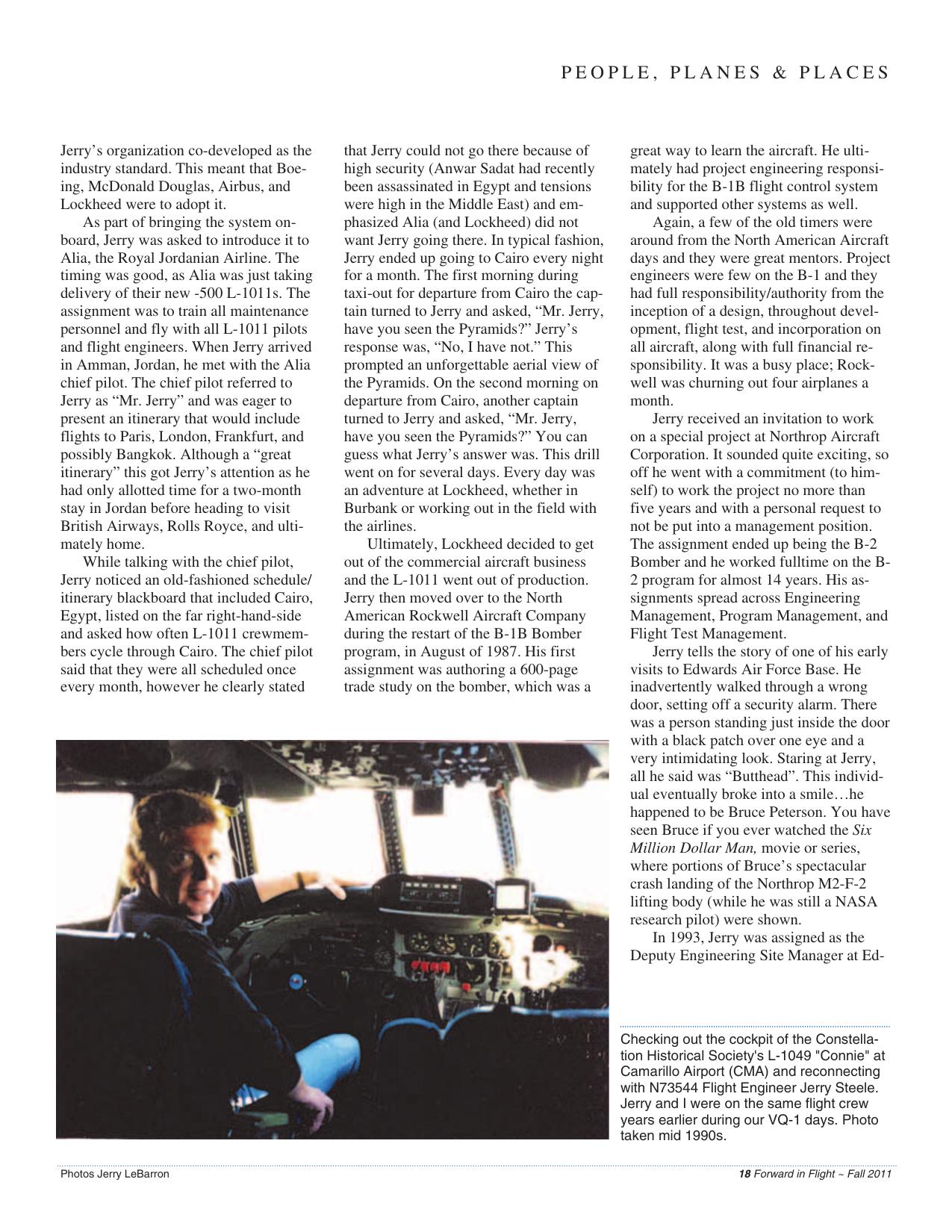
PEOPLE, PLANES & PLACES Jerry’s organization co-developed as the industry standard. This meant that Boeing, McDonald Douglas, Airbus, and Lockheed were to adopt it. As part of bringing the system onboard, Jerry was asked to introduce it to Alia, the Royal Jordanian Airline. The timing was good, as Alia was just taking delivery of their new -500 L-1011s. The assignment was to train all maintenance personnel and fly with all L-1011 pilots and flight engineers. When Jerry arrived in Amman, Jordan, he met with the Alia chief pilot. The chief pilot referred to Jerry as “Mr. Jerry” and was eager to present an itinerary that would include flights to Paris, London, Frankfurt, and possibly Bangkok. Although a “great itinerary” this got Jerry’s attention as he had only allotted time for a two-month stay in Jordan before heading to visit British Airways, Rolls Royce, and ultimately home. While talking with the chief pilot, Jerry noticed an old-fashioned schedule/ itinerary blackboard that included Cairo, Egypt, listed on the far right-hand-side and asked how often L-1011 crewmembers cycle through Cairo. The chief pilot said that they were all scheduled once every month, however he clearly stated that Jerry could not go there because of high security (Anwar Sadat had recently been assassinated in Egypt and tensions were high in the Middle East) and emphasized Alia (and Lockheed) did not want Jerry going there. In typical fashion, Jerry ended up going to Cairo every night for a month. The first morning during taxi-out for departure from Cairo the captain turned to Jerry and asked, “Mr. Jerry, have you seen the Pyramids?” Jerry’s response was, “No, I have not.” This prompted an unforgettable aerial view of the Pyramids. On the second morning on departure from Cairo, another captain turned to Jerry and asked, “Mr. Jerry, have you seen the Pyramids?” You can guess what Jerry’s answer was. This drill went on for several days. Every day was an adventure at Lockheed, whether in Burbank or working out in the field with the airlines. Ultimately, Lockheed decided to get out of the commercial aircraft business and the L-1011 went out of production. Jerry then moved over to the North American Rockwell Aircraft Company during the restart of the B-1B Bomber program, in August of 1987. His first assignment was authoring a 600-page trade study on the bomber, which was a great way to learn the aircraft. He ultimately had project engineering responsibility for the B-1B flight control system and supported other systems as well. Again, a few of the old timers were around from the North American Aircraft days and they were great mentors. Project engineers were few on the B-1 and they had full responsibility/authority from the inception of a design, throughout development, flight test, and incorporation on all aircraft, along with full financial responsibility. It was a busy place; Rockwell was churning out four airplanes a month. Jerry received an invitation to work on a special project at Northrop Aircraft Corporation. It sounded quite exciting, so off he went with a commitment (to himself) to work the project no more than five years and with a personal request to not be put into a management position. The assignment ended up being the B-2 Bomber and he worked fulltime on the B2 program for almost 14 years. His assignments spread across Engineering Management, Program Management, and Flight Test Management. Jerry tells the story of one of his early visits to Edwards Air Force Base. He inadvertently walked through a wrong door, setting off a security alarm. There was a person standing just inside the door with a black patch over one eye and a very intimidating look. Staring at Jerry, all he said was “Butthead”. This individual eventually broke into a smile…he happened to be Bruce Peterson. You have seen Bruce if you ever watched the Six Million Dollar Man, movie or series, where portions of Bruce’s spectacular crash landing of the Northrop M2-F-2 lifting body (while he was still a NASA research pilot) were shown. In 1993, Jerry was assigned as the Deputy Engineering Site Manager at Ed- Checking out the cockpit of the Constellation Historical Society's L-1049 "Connie" at Camarillo Airport (CMA) and reconnecting with N73544 Flight Engineer Jerry Steele. Jerry and I were on the same flight crew years earlier during our VQ-1 days. Photo taken mid 1990s. Photos Jerry LeBarron 18 Forward in Flight ~ Fall 2011
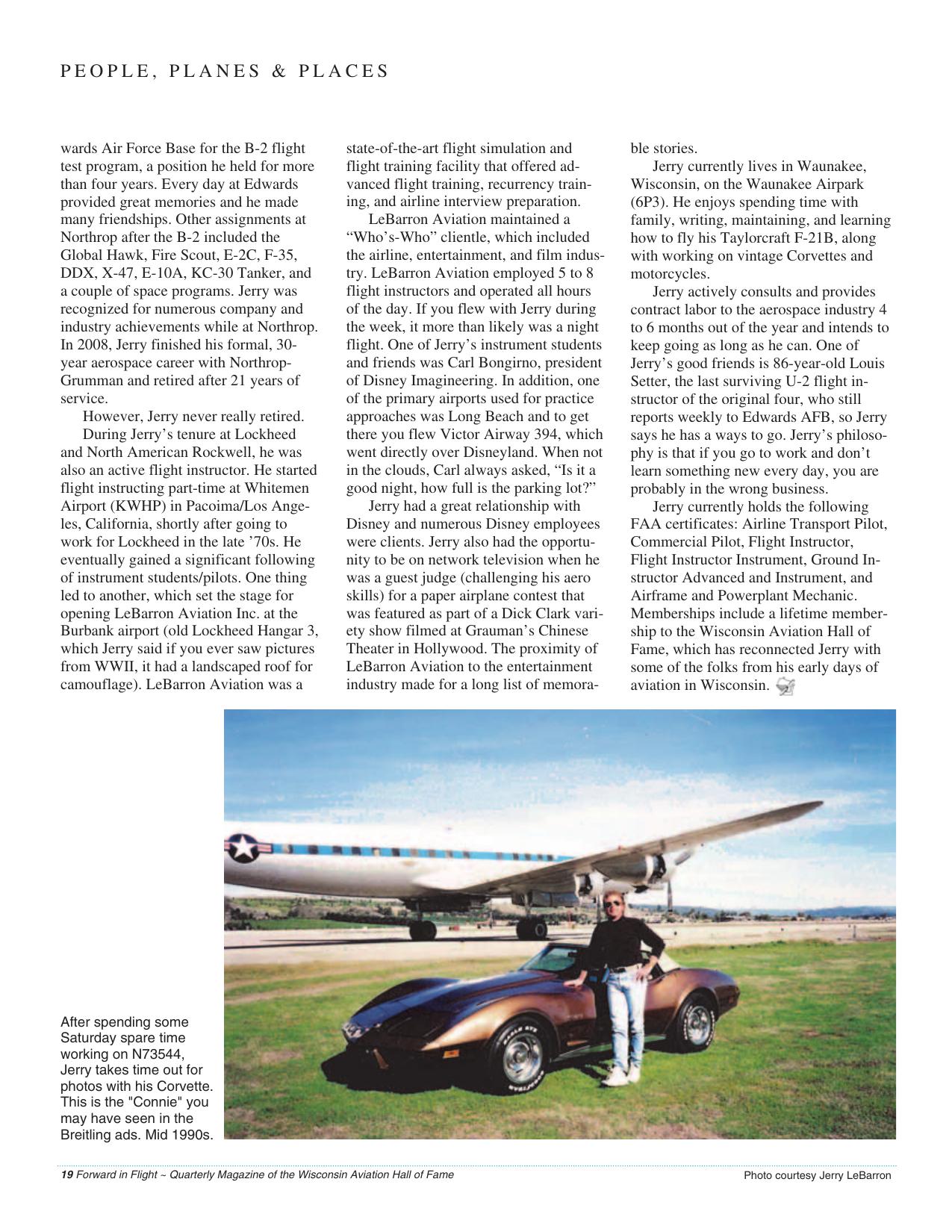
PEOPLE, PLANES & PLACES wards Air Force Base for the B-2 flight test program, a position he held for more than four years. Every day at Edwards provided great memories and he made many friendships. Other assignments at Northrop after the B-2 included the Global Hawk, Fire Scout, E-2C, F-35, DDX, X-47, E-10A, KC-30 Tanker, and a couple of space programs. Jerry was recognized for numerous company and industry achievements while at Northrop. In 2008, Jerry finished his formal, 30year aerospace career with NorthropGrumman and retired after 21 years of service. However, Jerry never really retired. During Jerry’s tenure at Lockheed and North American Rockwell, he was also an active flight instructor. He started flight instructing part-time at Whitemen Airport (KWHP) in Pacoima/Los Angeles, California, shortly after going to work for Lockheed in the late ’70s. He eventually gained a significant following of instrument students/pilots. One thing led to another, which set the stage for opening LeBarron Aviation Inc. at the Burbank airport (old Lockheed Hangar 3, which Jerry said if you ever saw pictures from WWII, it had a landscaped roof for camouflage). LeBarron Aviation was a state-of-the-art flight simulation and flight training facility that offered advanced flight training, recurrency training, and airline interview preparation. LeBarron Aviation maintained a “Who’s-Who” clientle, which included the airline, entertainment, and film industry. LeBarron Aviation employed 5 to 8 flight instructors and operated all hours of the day. If you flew with Jerry during the week, it more than likely was a night flight. One of Jerry’s instrument students and friends was Carl Bongirno, president of Disney Imagineering. In addition, one of the primary airports used for practice approaches was Long Beach and to get there you flew Victor Airway 394, which went directly over Disneyland. When not in the clouds, Carl always asked, “Is it a good night, how full is the parking lot?” Jerry had a great relationship with Disney and numerous Disney employees were clients. Jerry also had the opportunity to be on network television when he was a guest judge (challenging his aero skills) for a paper airplane contest that was featured as part of a Dick Clark variety show filmed at Grauman’s Chinese Theater in Hollywood. The proximity of LeBarron Aviation to the entertainment industry made for a long list of memora- ble stories. Jerry currently lives in Waunakee, Wisconsin, on the Waunakee Airpark (6P3). He enjoys spending time with family, writing, maintaining, and learning how to fly his Taylorcraft F-21B, along with working on vintage Corvettes and motorcycles. Jerry actively consults and provides contract labor to the aerospace industry 4 to 6 months out of the year and intends to keep going as long as he can. One of Jerry’s good friends is 86-year-old Louis Setter, the last surviving U-2 flight instructor of the original four, who still reports weekly to Edwards AFB, so Jerry says he has a ways to go. Jerry’s philosophy is that if you go to work and don’t learn something new every day, you are probably in the wrong business. Jerry currently holds the following FAA certificates: Airline Transport Pilot, Commercial Pilot, Flight Instructor, Flight Instructor Instrument, Ground Instructor Advanced and Instrument, and Airframe and Powerplant Mechanic. Memberships include a lifetime membership to the Wisconsin Aviation Hall of Fame, which has reconnected Jerry with some of the folks from his early days of aviation in Wisconsin. After spending some Saturday spare time working on N73544, Jerry takes time out for photos with his Corvette. This is the "Connie" you may have seen in the Breitling ads. Mid 1990s. 19 Forward in Flight ~ Quarterly Magazine of the Wisconsin Aviation Hall of Fame Photo courtesy Jerry LeBarron
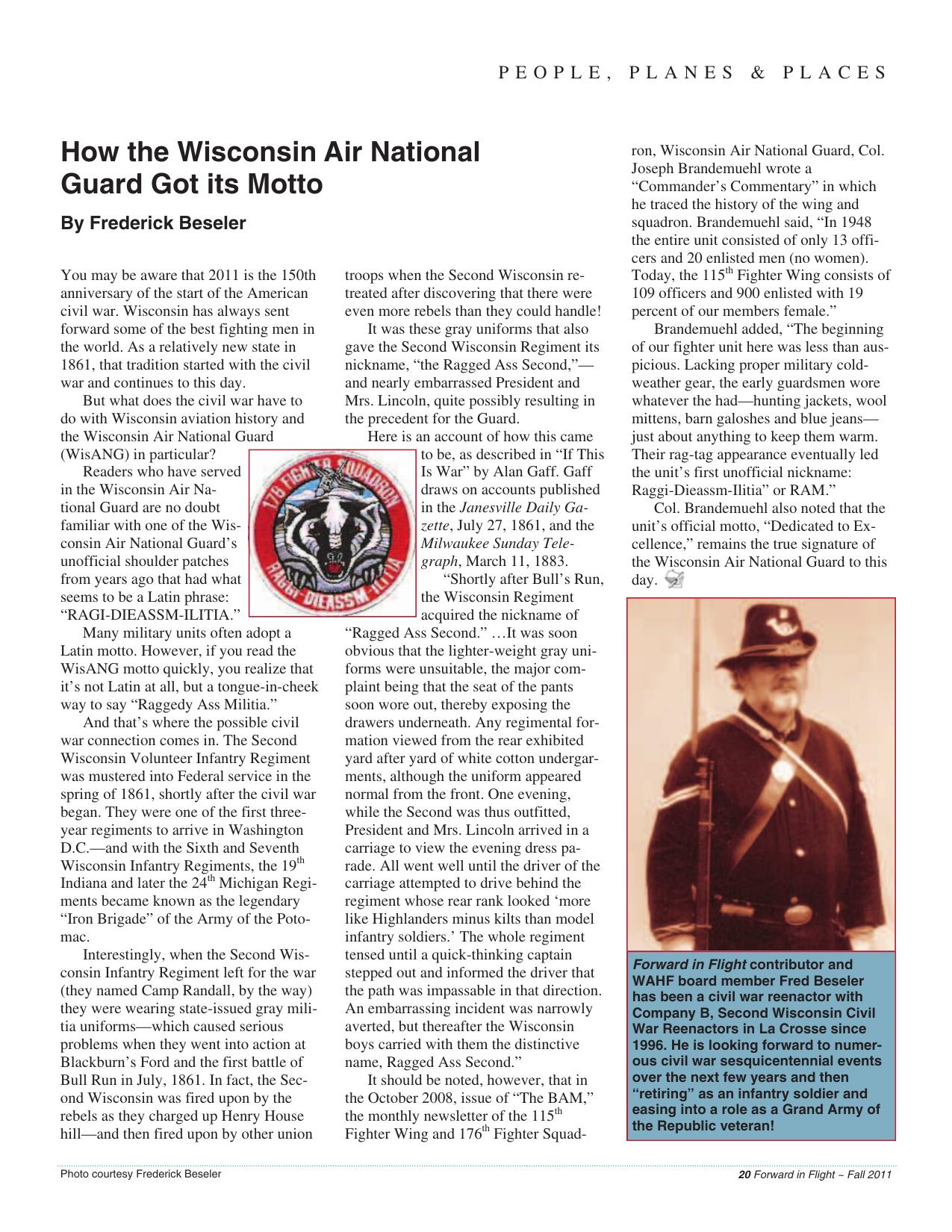
PEOPLE, PLANES & PLACES How the Wisconsin Air National Guard Got its Motto By Frederick Beseler You may be aware that 2011 is the 150th anniversary of the start of the American civil war. Wisconsin has always sent forward some of the best fighting men in the world. As a relatively new state in 1861, that tradition started with the civil war and continues to this day. But what does the civil war have to do with Wisconsin aviation history and the Wisconsin Air National Guard (WisANG) in particular? Readers who have served in the Wisconsin Air National Guard are no doubt familiar with one of the Wisconsin Air National Guard’s unofficial shoulder patches from years ago that had what seems to be a Latin phrase: “RAGI-DIEASSM-ILITIA.” Many military units often adopt a Latin motto. However, if you read the WisANG motto quickly, you realize that it’s not Latin at all, but a tongue-in-cheek way to say “Raggedy Ass Militia.” And that’s where the possible civil war connection comes in. The Second Wisconsin Volunteer Infantry Regiment was mustered into Federal service in the spring of 1861, shortly after the civil war began. They were one of the first threeyear regiments to arrive in Washington D.C.—and with the Sixth and Seventh Wisconsin Infantry Regiments, the 19th Indiana and later the 24th Michigan Regiments became known as the legendary “Iron Brigade” of the Army of the Potomac. Interestingly, when the Second Wisconsin Infantry Regiment left for the war (they named Camp Randall, by the way) they were wearing state-issued gray militia uniforms—which caused serious problems when they went into action at Blackburn’s Ford and the first battle of Bull Run in July, 1861. In fact, the Second Wisconsin was fired upon by the rebels as they charged up Henry House hill—and then fired upon by other union Photo courtesy Frederick Beseler troops when the Second Wisconsin retreated after discovering that there were even more rebels than they could handle! It was these gray uniforms that also gave the Second Wisconsin Regiment its nickname, “the Ragged Ass Second,”— and nearly embarrassed President and Mrs. Lincoln, quite possibly resulting in the precedent for the Guard. Here is an account of how this came to be, as described in “If This Is War” by Alan Gaff. Gaff draws on accounts published in the Janesville Daily Gazette, July 27, 1861, and the Milwaukee Sunday Telegraph, March 11, 1883. “Shortly after Bull’s Run, the Wisconsin Regiment acquired the nickname of “Ragged Ass Second.” …It was soon obvious that the lighter-weight gray uniforms were unsuitable, the major complaint being that the seat of the pants soon wore out, thereby exposing the drawers underneath. Any regimental formation viewed from the rear exhibited yard after yard of white cotton undergarments, although the uniform appeared normal from the front. One evening, while the Second was thus outfitted, President and Mrs. Lincoln arrived in a carriage to view the evening dress parade. All went well until the driver of the carriage attempted to drive behind the regiment whose rear rank looked ‘more like Highlanders minus kilts than model infantry soldiers.’ The whole regiment tensed until a quick-thinking captain stepped out and informed the driver that the path was impassable in that direction. An embarrassing incident was narrowly averted, but thereafter the Wisconsin boys carried with them the distinctive name, Ragged Ass Second.” It should be noted, however, that in the October 2008, issue of “The BAM,” the monthly newsletter of the 115th Fighter Wing and 176th Fighter Squad- ron, Wisconsin Air National Guard, Col. Joseph Brandemuehl wrote a “Commander’s Commentary” in which he traced the history of the wing and squadron. Brandemuehl said, “In 1948 the entire unit consisted of only 13 officers and 20 enlisted men (no women). Today, the 115th Fighter Wing consists of 109 officers and 900 enlisted with 19 percent of our members female.” Brandemuehl added, “The beginning of our fighter unit here was less than auspicious. Lacking proper military coldweather gear, the early guardsmen wore whatever the had—hunting jackets, wool mittens, barn galoshes and blue jeans— just about anything to keep them warm. Their rag-tag appearance eventually led the unit’s first unofficial nickname: Raggi-Dieassm-Ilitia” or RAM.” Col. Brandemuehl also noted that the unit’s official motto, “Dedicated to Excellence,” remains the true signature of the Wisconsin Air National Guard to this day. Forward in Flight contributor and WAHF board member Fred Beseler has been a civil war reenactor with Company B, Second Wisconsin Civil War Reenactors in La Crosse since 1996. He is looking forward to numerous civil war sesquicentennial events over the next few years and then “retiring” as an infantry soldier and easing into a role as a Grand Army of the Republic veteran! 20 Forward in Flight ~ Fall 2011
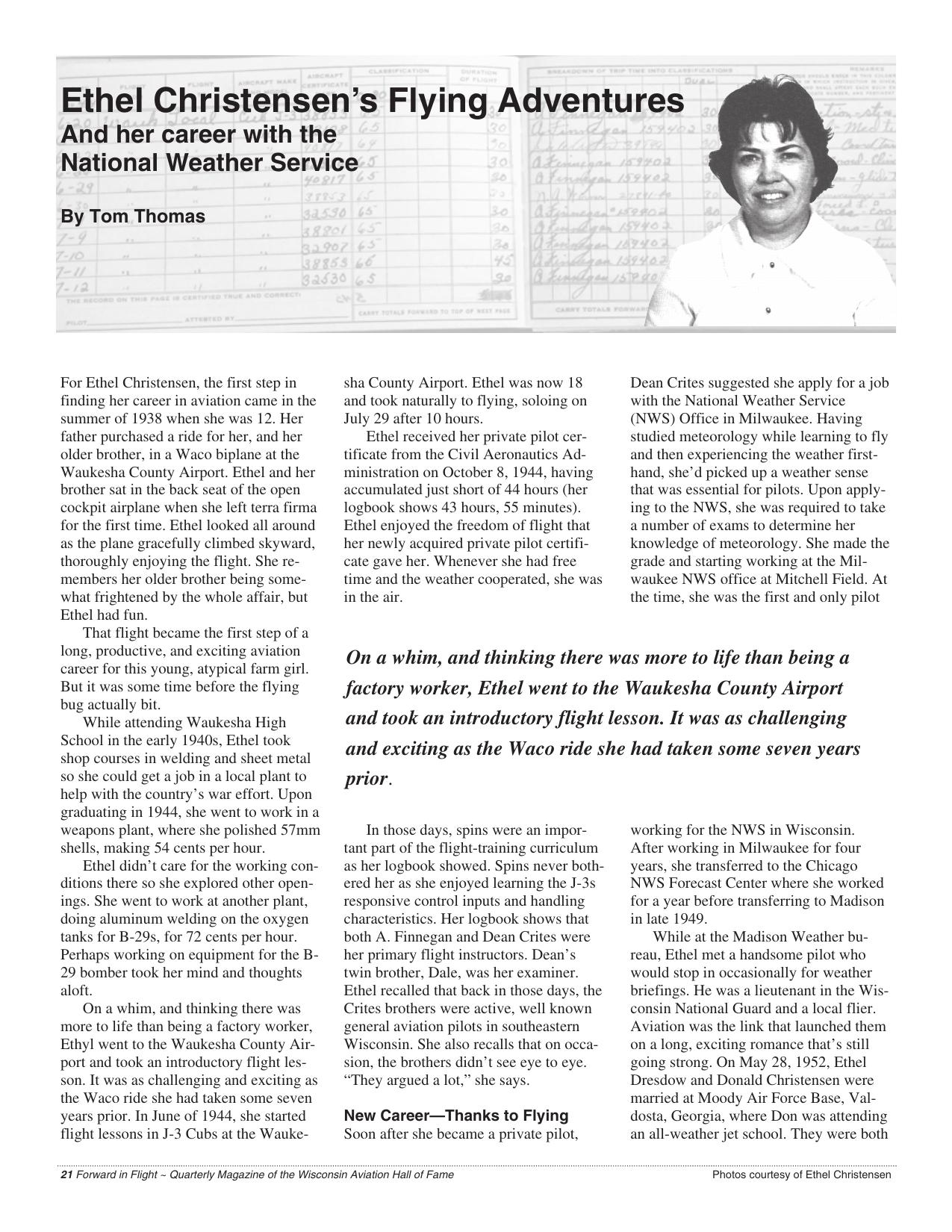
Ethel Christensen’s Flying Adventures And her career with the National Weather Service By Tom Thomas For Ethel Christensen, the first step in finding her career in aviation came in the summer of 1938 when she was 12. Her father purchased a ride for her, and her older brother, in a Waco biplane at the Waukesha County Airport. Ethel and her brother sat in the back seat of the open cockpit airplane when she left terra firma for the first time. Ethel looked all around as the plane gracefully climbed skyward, thoroughly enjoying the flight. She remembers her older brother being somewhat frightened by the whole affair, but Ethel had fun. That flight became the first step of a long, productive, and exciting aviation career for this young, atypical farm girl. But it was some time before the flying bug actually bit. While attending Waukesha High School in the early 1940s, Ethel took shop courses in welding and sheet metal so she could get a job in a local plant to help with the country’s war effort. Upon graduating in 1944, she went to work in a weapons plant, where she polished 57mm shells, making 54 cents per hour. Ethel didn’t care for the working conditions there so she explored other openings. She went to work at another plant, doing aluminum welding on the oxygen tanks for B-29s, for 72 cents per hour. Perhaps working on equipment for the B29 bomber took her mind and thoughts aloft. On a whim, and thinking there was more to life than being a factory worker, Ethyl went to the Waukesha County Airport and took an introductory flight lesson. It was as challenging and exciting as the Waco ride she had taken some seven years prior. In June of 1944, she started flight lessons in J-3 Cubs at the Wauke- sha County Airport. Ethel was now 18 and took naturally to flying, soloing on July 29 after 10 hours. Ethel received her private pilot certificate from the Civil Aeronautics Administration on October 8, 1944, having accumulated just short of 44 hours (her logbook shows 43 hours, 55 minutes). Ethel enjoyed the freedom of flight that her newly acquired private pilot certificate gave her. Whenever she had free time and the weather cooperated, she was in the air. Dean Crites suggested she apply for a job with the National Weather Service (NWS) Office in Milwaukee. Having studied meteorology while learning to fly and then experiencing the weather firsthand, she’d picked up a weather sense that was essential for pilots. Upon applying to the NWS, she was required to take a number of exams to determine her knowledge of meteorology. She made the grade and starting working at the Milwaukee NWS office at Mitchell Field. At the time, she was the first and only pilot On a whim, and thinking there was more to life than being a factory worker, Ethel went to the Waukesha County Airport and took an introductory flight lesson. It was as challenging and exciting as the Waco ride she had taken some seven years prior. In those days, spins were an important part of the flight-training curriculum as her logbook showed. Spins never bothered her as she enjoyed learning the J-3s responsive control inputs and handling characteristics. Her logbook shows that both A. Finnegan and Dean Crites were her primary flight instructors. Dean’s twin brother, Dale, was her examiner. Ethel recalled that back in those days, the Crites brothers were active, well known general aviation pilots in southeastern Wisconsin. She also recalls that on occasion, the brothers didn’t see eye to eye. “They argued a lot,” she says. New Career—Thanks to Flying Soon after she became a private pilot, 21 Forward in Flight ~ Quarterly Magazine of the Wisconsin Aviation Hall of Fame working for the NWS in Wisconsin. After working in Milwaukee for four years, she transferred to the Chicago NWS Forecast Center where she worked for a year before transferring to Madison in late 1949. While at the Madison Weather bureau, Ethel met a handsome pilot who would stop in occasionally for weather briefings. He was a lieutenant in the Wisconsin National Guard and a local flier. Aviation was the link that launched them on a long, exciting romance that’s still going strong. On May 28, 1952, Ethel Dresdow and Donald Christensen were married at Moody Air Force Base, Valdosta, Georgia, where Don was attending an all-weather jet school. They were both Photos courtesy of Ethel Christensen
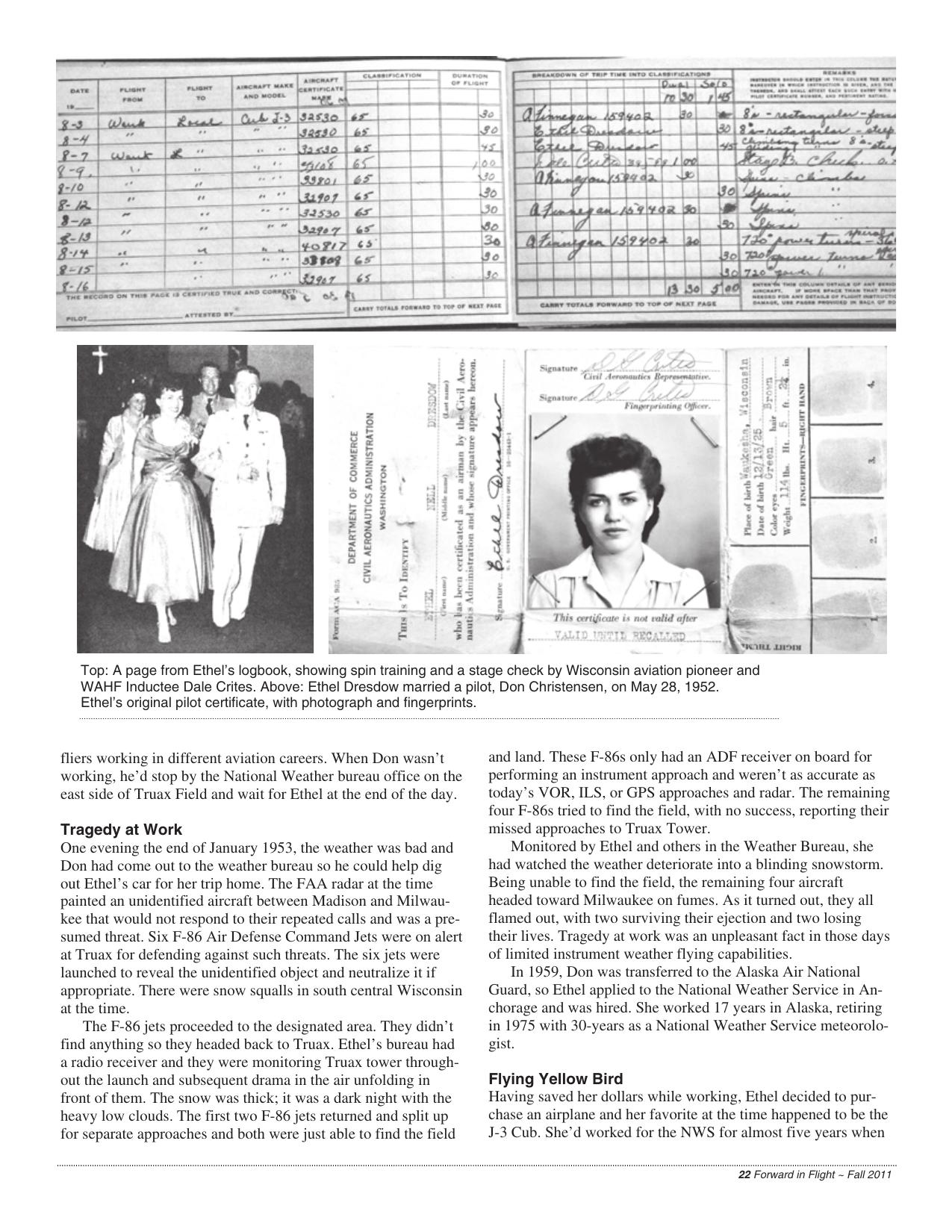
Top: A page from Ethel’s logbook, showing spin training and a stage check by Wisconsin aviation pioneer and WAHF Inductee Dale Crites. Above: Ethel Dresdow married a pilot, Don Christensen, on May 28, 1952. Ethel’s original pilot certificate, with photograph and fingerprints. fliers working in different aviation careers. When Don wasn’t working, he’d stop by the National Weather bureau office on the east side of Truax Field and wait for Ethel at the end of the day. Tragedy at Work One evening the end of January 1953, the weather was bad and Don had come out to the weather bureau so he could help dig out Ethel’s car for her trip home. The FAA radar at the time painted an unidentified aircraft between Madison and Milwaukee that would not respond to their repeated calls and was a presumed threat. Six F-86 Air Defense Command Jets were on alert at Truax for defending against such threats. The six jets were launched to reveal the unidentified object and neutralize it if appropriate. There were snow squalls in south central Wisconsin at the time. The F-86 jets proceeded to the designated area. They didn’t find anything so they headed back to Truax. Ethel’s bureau had a radio receiver and they were monitoring Truax tower throughout the launch and subsequent drama in the air unfolding in front of them. The snow was thick; it was a dark night with the heavy low clouds. The first two F-86 jets returned and split up for separate approaches and both were just able to find the field and land. These F-86s only had an ADF receiver on board for performing an instrument approach and weren’t as accurate as today’s VOR, ILS, or GPS approaches and radar. The remaining four F-86s tried to find the field, with no success, reporting their missed approaches to Truax Tower. Monitored by Ethel and others in the Weather Bureau, she had watched the weather deteriorate into a blinding snowstorm. Being unable to find the field, the remaining four aircraft headed toward Milwaukee on fumes. As it turned out, they all flamed out, with two surviving their ejection and two losing their lives. Tragedy at work was an unpleasant fact in those days of limited instrument weather flying capabilities. In 1959, Don was transferred to the Alaska Air National Guard, so Ethel applied to the National Weather Service in Anchorage and was hired. She worked 17 years in Alaska, retiring in 1975 with 30-years as a National Weather Service meteorologist. Flying Yellow Bird Having saved her dollars while working, Ethel decided to purchase an airplane and her favorite at the time happened to be the J-3 Cub. She’d worked for the NWS for almost five years when 22 Forward in Flight ~ Fall 2011
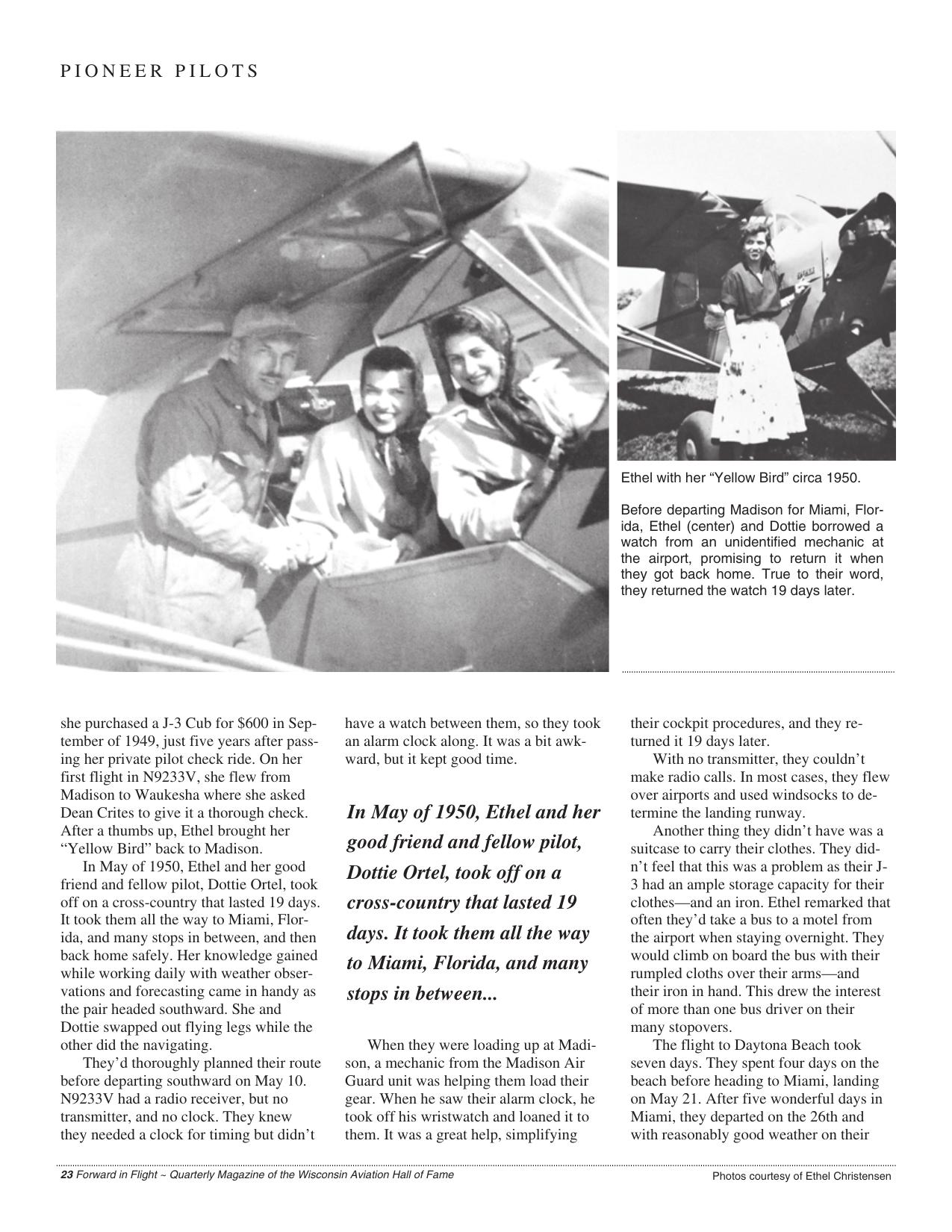
PIONEER PILOTS Ethel with her “Yellow Bird” circa 1950. Before departing Madison for Miami, Florida, Ethel (center) and Dottie borrowed a watch from an unidentified mechanic at the airport, promising to return it when they got back home. True to their word, they returned the watch 19 days later. she purchased a J-3 Cub for $600 in September of 1949, just five years after passing her private pilot check ride. On her first flight in N9233V, she flew from Madison to Waukesha where she asked Dean Crites to give it a thorough check. After a thumbs up, Ethel brought her “Yellow Bird” back to Madison. In May of 1950, Ethel and her good friend and fellow pilot, Dottie Ortel, took off on a cross-country that lasted 19 days. It took them all the way to Miami, Florida, and many stops in between, and then back home safely. Her knowledge gained while working daily with weather observations and forecasting came in handy as the pair headed southward. She and Dottie swapped out flying legs while the other did the navigating. They’d thoroughly planned their route before departing southward on May 10. N9233V had a radio receiver, but no transmitter, and no clock. They knew they needed a clock for timing but didn’t have a watch between them, so they took an alarm clock along. It was a bit awkward, but it kept good time. In May of 1950, Ethel and her good friend and fellow pilot, Dottie Ortel, took off on a cross-country that lasted 19 days. It took them all the way to Miami, Florida, and many stops in between... When they were loading up at Madison, a mechanic from the Madison Air Guard unit was helping them load their gear. When he saw their alarm clock, he took off his wristwatch and loaned it to them. It was a great help, simplifying 23 Forward in Flight ~ Quarterly Magazine of the Wisconsin Aviation Hall of Fame their cockpit procedures, and they returned it 19 days later. With no transmitter, they couldn’t make radio calls. In most cases, they flew over airports and used windsocks to determine the landing runway. Another thing they didn’t have was a suitcase to carry their clothes. They didn’t feel that this was a problem as their J3 had an ample storage capacity for their clothes—and an iron. Ethel remarked that often they’d take a bus to a motel from the airport when staying overnight. They would climb on board the bus with their rumpled cloths over their arms—and their iron in hand. This drew the interest of more than one bus driver on their many stopovers. The flight to Daytona Beach took seven days. They spent four days on the beach before heading to Miami, landing on May 21. After five wonderful days in Miami, they departed on the 26th and with reasonably good weather on their Photos courtesy of Ethel Christensen
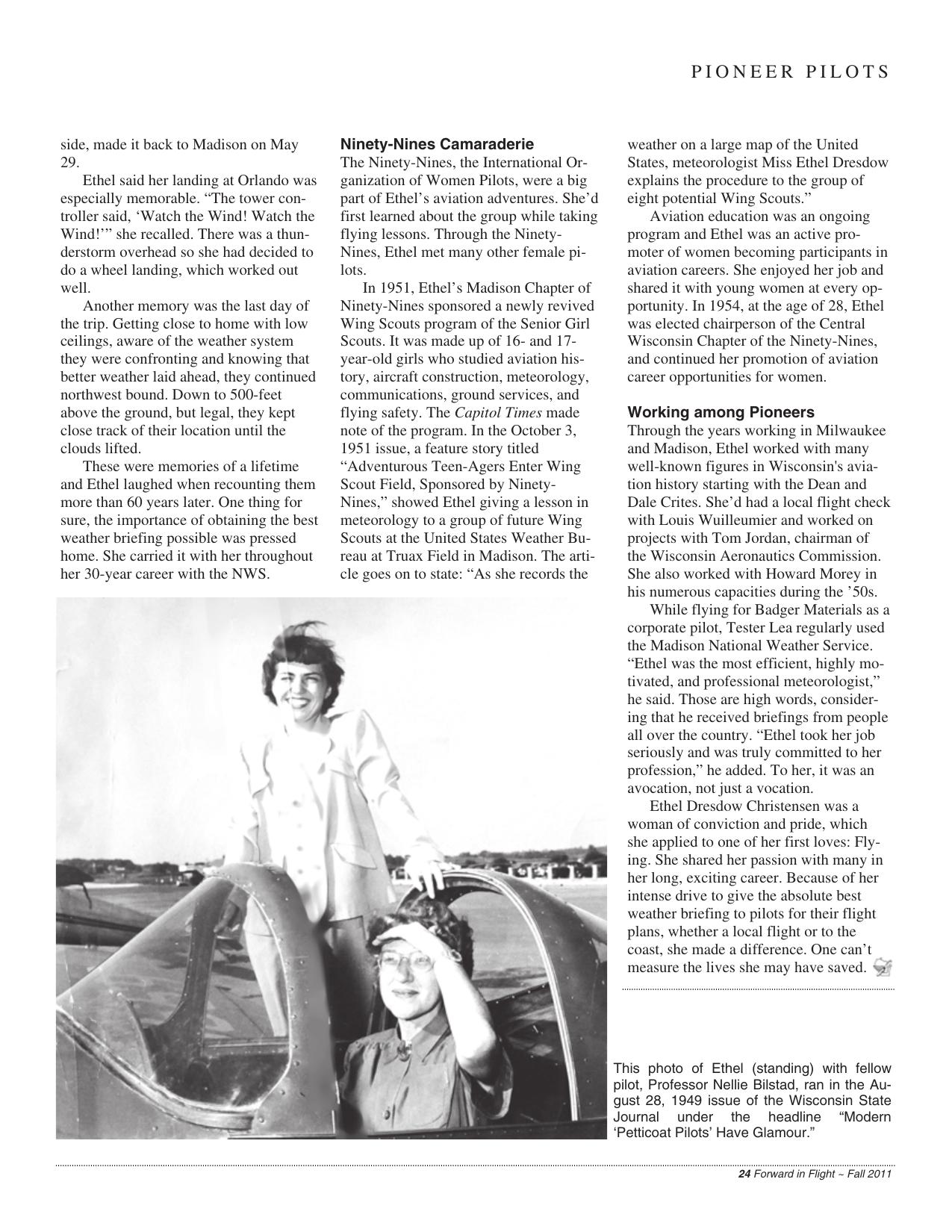
PIONEER PILOTS side, made it back to Madison on May 29. Ethel said her landing at Orlando was especially memorable. “The tower controller said, ‘Watch the Wind! Watch the Wind!’” she recalled. There was a thunderstorm overhead so she had decided to do a wheel landing, which worked out well. Another memory was the last day of the trip. Getting close to home with low ceilings, aware of the weather system they were confronting and knowing that better weather laid ahead, they continued northwest bound. Down to 500-feet above the ground, but legal, they kept close track of their location until the clouds lifted. These were memories of a lifetime and Ethel laughed when recounting them more than 60 years later. One thing for sure, the importance of obtaining the best weather briefing possible was pressed home. She carried it with her throughout her 30-year career with the NWS. Ninety-Nines Camaraderie The Ninety-Nines, the International Organization of Women Pilots, were a big part of Ethel’s aviation adventures. She’d first learned about the group while taking flying lessons. Through the NinetyNines, Ethel met many other female pilots. In 1951, Ethel’s Madison Chapter of Ninety-Nines sponsored a newly revived Wing Scouts program of the Senior Girl Scouts. It was made up of 16- and 17year-old girls who studied aviation history, aircraft construction, meteorology, communications, ground services, and flying safety. The Capitol Times made note of the program. In the October 3, 1951 issue, a feature story titled “Adventurous Teen-Agers Enter Wing Scout Field, Sponsored by NinetyNines,” showed Ethel giving a lesson in meteorology to a group of future Wing Scouts at the United States Weather Bureau at Truax Field in Madison. The article goes on to state: “As she records the weather on a large map of the United States, meteorologist Miss Ethel Dresdow explains the procedure to the group of eight potential Wing Scouts.” Aviation education was an ongoing program and Ethel was an active promoter of women becoming participants in aviation careers. She enjoyed her job and shared it with young women at every opportunity. In 1954, at the age of 28, Ethel was elected chairperson of the Central Wisconsin Chapter of the Ninety-Nines, and continued her promotion of aviation career opportunities for women. Working among Pioneers Through the years working in Milwaukee and Madison, Ethel worked with many well-known figures in Wisconsin's aviation history starting with the Dean and Dale Crites. She’d had a local flight check with Louis Wuilleumier and worked on projects with Tom Jordan, chairman of the Wisconsin Aeronautics Commission. She also worked with Howard Morey in his numerous capacities during the ’50s. While flying for Badger Materials as a corporate pilot, Tester Lea regularly used the Madison National Weather Service. “Ethel was the most efficient, highly motivated, and professional meteorologist,” he said. Those are high words, considering that he received briefings from people all over the country. “Ethel took her job seriously and was truly committed to her profession,” he added. To her, it was an avocation, not just a vocation. Ethel Dresdow Christensen was a woman of conviction and pride, which she applied to one of her first loves: Flying. She shared her passion with many in her long, exciting career. Because of her intense drive to give the absolute best weather briefing to pilots for their flight plans, whether a local flight or to the coast, she made a difference. One can’t measure the lives she may have saved. This photo of Ethel (standing) with fellow pilot, Professor Nellie Bilstad, ran in the August 28, 1949 issue of the Wisconsin State Journal under the headline “Modern ‘Petticoat Pilots’ Have Glamour.” 24 Forward in Flight ~ Fall 2011

FROM THE ARCHIVES More than a book review… Area 51, An Uncensored History And mention of a 2011 WAHF Inductee By Michael Goc AREA 51 does not exist—officially. But, as every conspiracy buff, UFOlogist, and science fantasist knows, AREA 51 not only exists but is the place where: The flying saucer that crashed at Roswell, New Mex- ico, in July 1947 and its crew of extraterrestrials is hidden away. The 1969 lunar landing where Neil Armstrong and Buzz Aldrin took the “first giant step for mankind” was staged. Osama Bin Laden is jailed today. (And you thought he was killed in Pakistan and buried at sea.) Conspiracy theories, UFOs, and science fantasies are fun. I must confess that I have delighted in every single one that I have encountered since I first sat down in front of the Philco with my milk and cookies to watch an all but forgotten TV show called “One Step Beyond.” So it was with great anticipation I cracked open Area 51, An Uncensored History of America’s Top Secret Military Base. The author is Annie Jacobsen, an “investigative reporter” for the Los Angeles Times, who writes like a journalist and documents her material like an academic. The text and photos in her AREA 51 cover not quite 400 hard cover book pages. Jacobsen’s notes and bibliography require more than another 100 pages. Her research was made a bit easier by the end of the Cold War and the subsequent declassification of secret documents and by the memories of a few aged Area 51 veterans willing to talk. She could not, however, get a Pentagon spokesman to admit that Area 51 is a real place. I found all the theories, UFOs and fantasies I was looking for in Jacobsen’s book (except for the bit on Bin Laden; the book was written before the raid). I also discovered the simple fact that the history of Area 51 is as entertaining as and more intriguing than any of the fantasy. The parcel of ground identified as Area 51 consists of several (?) thousand acres on the edge of the 4,800-plus square miles of the Nevada Test and Training Range, about 65 miles northwest of Las Vegas. The Range is divided into dozens of numbered areas that have been used for many kinds of research 25 Forward in Flight ~ Quarterly Magazine of the Wisconsin Aviation Hall of Fame
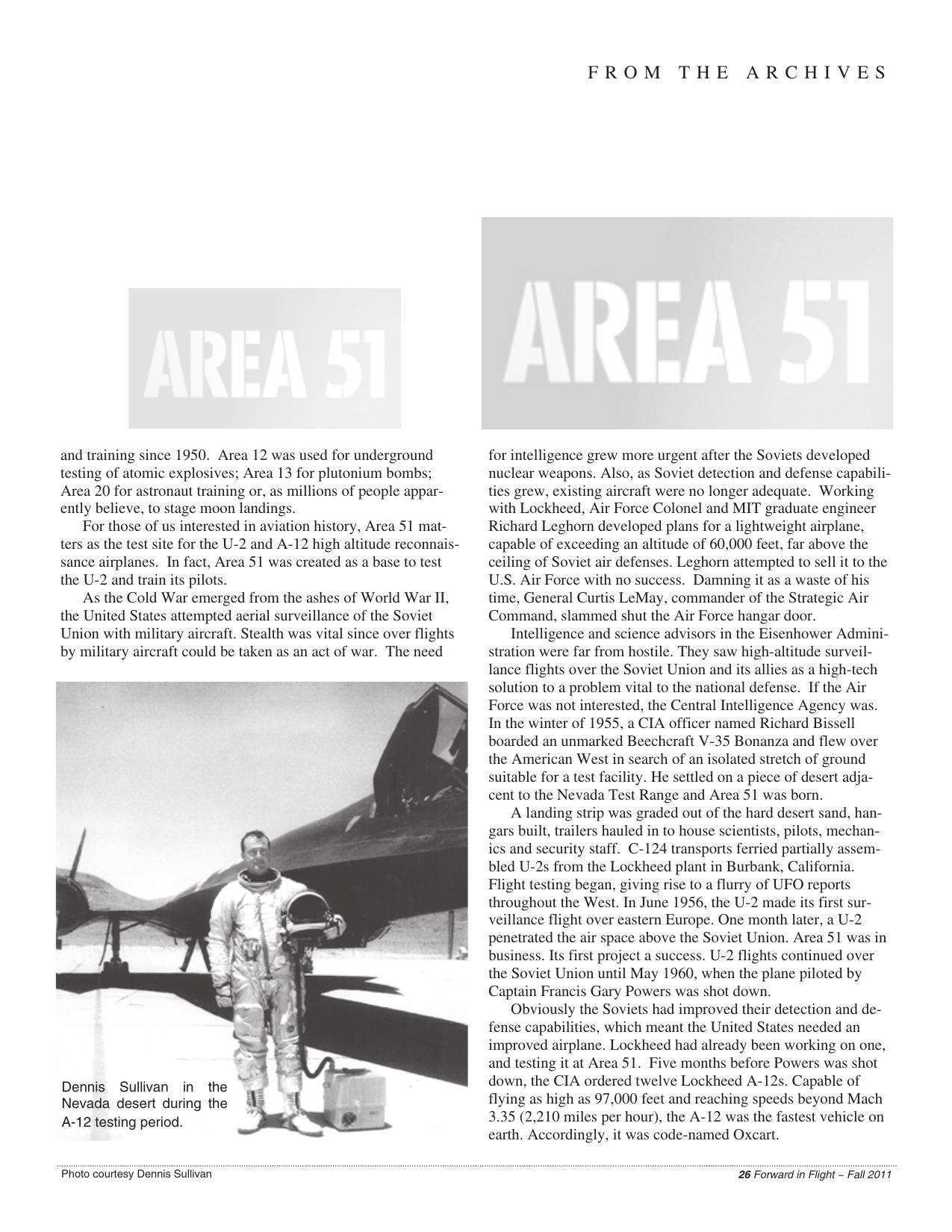
FROM THE ARCHIVES and training since 1950. Area 12 was used for underground testing of atomic explosives; Area 13 for plutonium bombs; Area 20 for astronaut training or, as millions of people apparently believe, to stage moon landings. For those of us interested in aviation history, Area 51 matters as the test site for the U-2 and A-12 high altitude reconnaissance airplanes. In fact, Area 51 was created as a base to test the U-2 and train its pilots. As the Cold War emerged from the ashes of World War II, the United States attempted aerial surveillance of the Soviet Union with military aircraft. Stealth was vital since over flights by military aircraft could be taken as an act of war. The need Dennis Sullivan in the Nevada desert during the A-12 testing period. Photo courtesy Dennis Sullivan for intelligence grew more urgent after the Soviets developed nuclear weapons. Also, as Soviet detection and defense capabilities grew, existing aircraft were no longer adequate. Working with Lockheed, Air Force Colonel and MIT graduate engineer Richard Leghorn developed plans for a lightweight airplane, capable of exceeding an altitude of 60,000 feet, far above the ceiling of Soviet air defenses. Leghorn attempted to sell it to the U.S. Air Force with no success. Damning it as a waste of his time, General Curtis LeMay, commander of the Strategic Air Command, slammed shut the Air Force hangar door. Intelligence and science advisors in the Eisenhower Administration were far from hostile. They saw high-altitude surveillance flights over the Soviet Union and its allies as a high-tech solution to a problem vital to the national defense. If the Air Force was not interested, the Central Intelligence Agency was. In the winter of 1955, a CIA officer named Richard Bissell boarded an unmarked Beechcraft V-35 Bonanza and flew over the American West in search of an isolated stretch of ground suitable for a test facility. He settled on a piece of desert adjacent to the Nevada Test Range and Area 51 was born. A landing strip was graded out of the hard desert sand, hangars built, trailers hauled in to house scientists, pilots, mechanics and security staff. C-124 transports ferried partially assembled U-2s from the Lockheed plant in Burbank, California. Flight testing began, giving rise to a flurry of UFO reports throughout the West. In June 1956, the U-2 made its first surveillance flight over eastern Europe. One month later, a U-2 penetrated the air space above the Soviet Union. Area 51 was in business. Its first project a success. U-2 flights continued over the Soviet Union until May 1960, when the plane piloted by Captain Francis Gary Powers was shot down. Obviously the Soviets had improved their detection and defense capabilities, which meant the United States needed an improved airplane. Lockheed had already been working on one, and testing it at Area 51. Five months before Powers was shot down, the CIA ordered twelve Lockheed A-12s. Capable of flying as high as 97,000 feet and reaching speeds beyond Mach 3.35 (2,210 miles per hour), the A-12 was the fastest vehicle on earth. Accordingly, it was code-named Oxcart. 26 Forward in Flight ~ Fall 2011
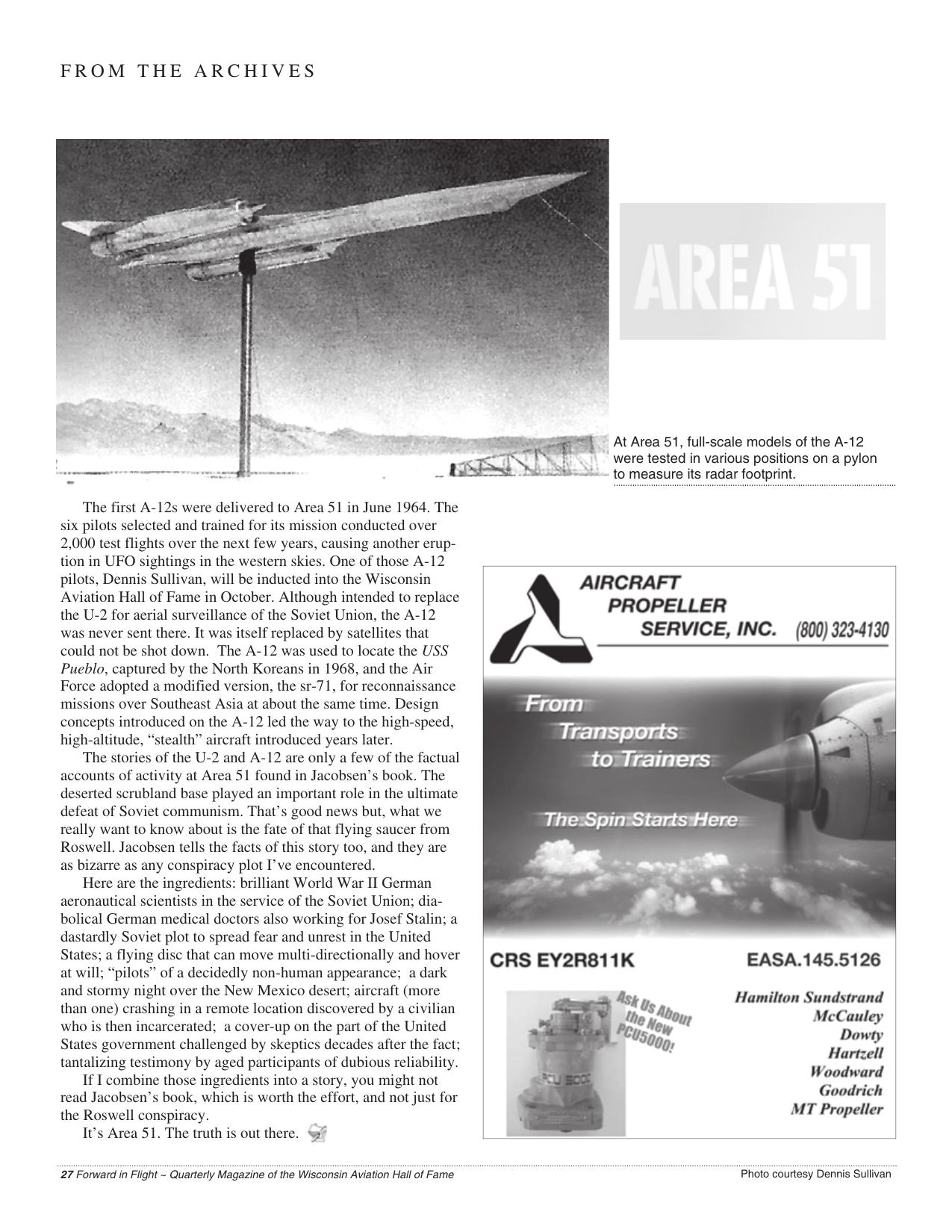
FROM THE ARCHIVES At Area 51, full-scale models of the A-12 were tested in various positions on a pylon to measure its radar footprint. The first A-12s were delivered to Area 51 in June 1964. The six pilots selected and trained for its mission conducted over 2,000 test flights over the next few years, causing another eruption in UFO sightings in the western skies. One of those A-12 pilots, Dennis Sullivan, will be inducted into the Wisconsin Aviation Hall of Fame in October. Although intended to replace the U-2 for aerial surveillance of the Soviet Union, the A-12 was never sent there. It was itself replaced by satellites that could not be shot down. The A-12 was used to locate the USS Pueblo, captured by the North Koreans in 1968, and the Air Force adopted a modified version, the sr-71, for reconnaissance missions over Southeast Asia at about the same time. Design concepts introduced on the A-12 led the way to the high-speed, high-altitude, “stealth” aircraft introduced years later. The stories of the U-2 and A-12 are only a few of the factual accounts of activity at Area 51 found in Jacobsen’s book. The deserted scrubland base played an important role in the ultimate defeat of Soviet communism. That’s good news but, what we really want to know about is the fate of that flying saucer from Roswell. Jacobsen tells the facts of this story too, and they are as bizarre as any conspiracy plot I’ve encountered. Here are the ingredients: brilliant World War II German aeronautical scientists in the service of the Soviet Union; diabolical German medical doctors also working for Josef Stalin; a dastardly Soviet plot to spread fear and unrest in the United States; a flying disc that can move multi-directionally and hover at will; “pilots” of a decidedly non-human appearance; a dark and stormy night over the New Mexico desert; aircraft (more than one) crashing in a remote location discovered by a civilian who is then incarcerated; a cover-up on the part of the United States government challenged by skeptics decades after the fact; tantalizing testimony by aged participants of dubious reliability. If I combine those ingredients into a story, you might not read Jacobsen’s book, which is worth the effort, and not just for the Roswell conspiracy. It’s Area 51. The truth is out there. 27 Forward in Flight ~ Quarterly Magazine of the Wisconsin Aviation Hall of Fame Photo courtesy Dennis Sullivan
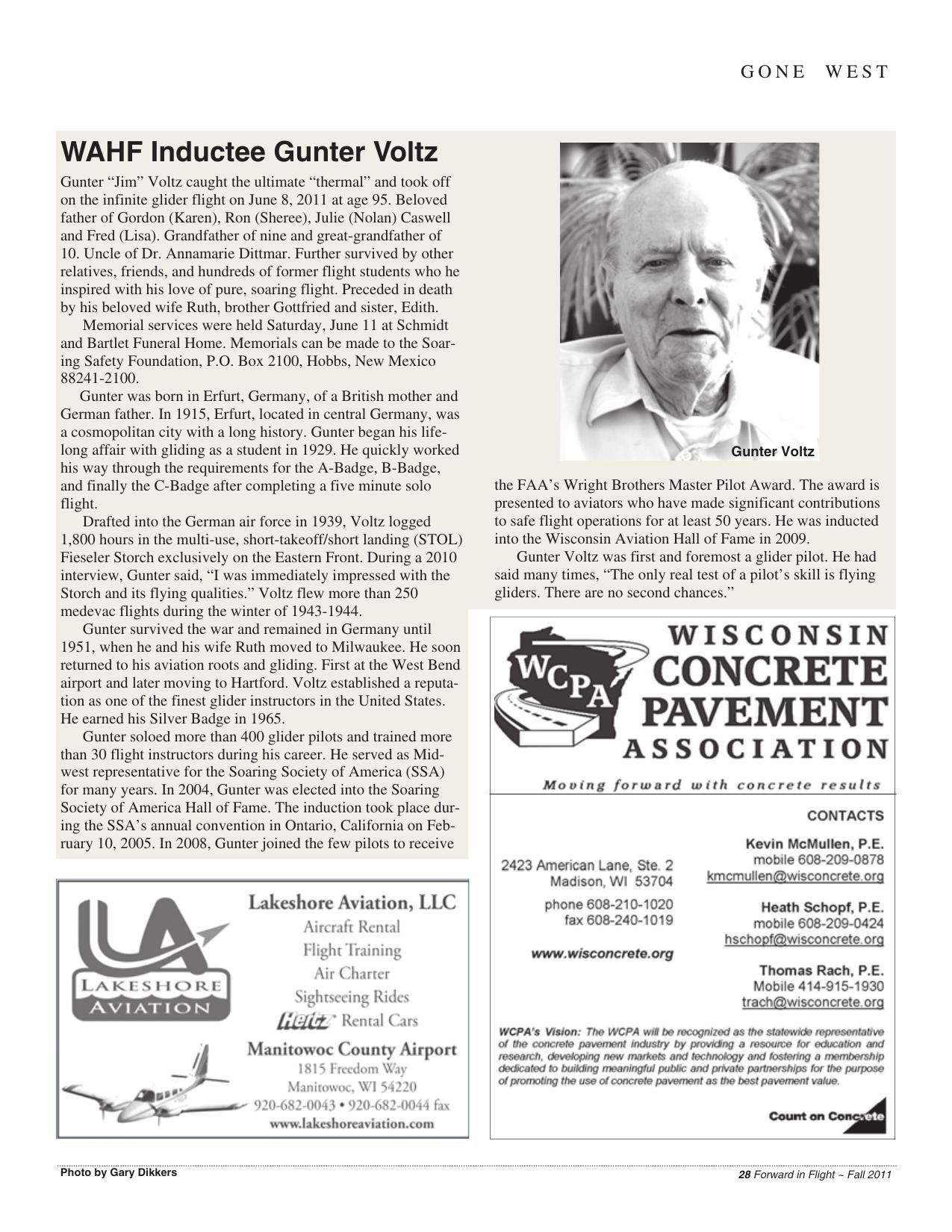
GONE WEST WAHF Inductee Gunter Voltz Gunter “Jim” Voltz caught the ultimate “thermal” and took off on the infinite glider flight on June 8, 2011 at age 95. Beloved father of Gordon (Karen), Ron (Sheree), Julie (Nolan) Caswell and Fred (Lisa). Grandfather of nine and great-grandfather of 10. Uncle of Dr. Annamarie Dittmar. Further survived by other relatives, friends, and hundreds of former flight students who he inspired with his love of pure, soaring flight. Preceded in death by his beloved wife Ruth, brother Gottfried and sister, Edith. Memorial services were held Saturday, June 11 at Schmidt and Bartlet Funeral Home. Memorials can be made to the Soaring Safety Foundation, P.O. Box 2100, Hobbs, New Mexico 88241-2100. Gunter was born in Erfurt, Germany, of a British mother and German father. In 1915, Erfurt, located in central Germany, was a cosmopolitan city with a long history. Gunter began his lifelong affair with gliding as a student in 1929. He quickly worked his way through the requirements for the A-Badge, B-Badge, and finally the C-Badge after completing a five minute solo flight. Drafted into the German air force in 1939, Voltz logged 1,800 hours in the multi-use, short-takeoff/short landing (STOL) Fieseler Storch exclusively on the Eastern Front. During a 2010 interview, Gunter said, “I was immediately impressed with the Storch and its flying qualities.” Voltz flew more than 250 medevac flights during the winter of 1943-1944. Gunter survived the war and remained in Germany until 1951, when he and his wife Ruth moved to Milwaukee. He soon returned to his aviation roots and gliding. First at the West Bend airport and later moving to Hartford. Voltz established a reputation as one of the finest glider instructors in the United States. He earned his Silver Badge in 1965. Gunter soloed more than 400 glider pilots and trained more than 30 flight instructors during his career. He served as Midwest representative for the Soaring Society of America (SSA) for many years. In 2004, Gunter was elected into the Soaring Society of America Hall of Fame. The induction took place during the SSA’s annual convention in Ontario, California on February 10, 2005. In 2008, Gunter joined the few pilots to receive Photo by Gary Dikkers Gunter Voltz the FAA’s Wright Brothers Master Pilot Award. The award is presented to aviators who have made significant contributions to safe flight operations for at least 50 years. He was inducted into the Wisconsin Aviation Hall of Fame in 2009. Gunter Voltz was first and foremost a glider pilot. He had said many times, “The only real test of a pilot’s skill is flying gliders. There are no second chances.” 28 Forward in Flight ~ Fall 2011
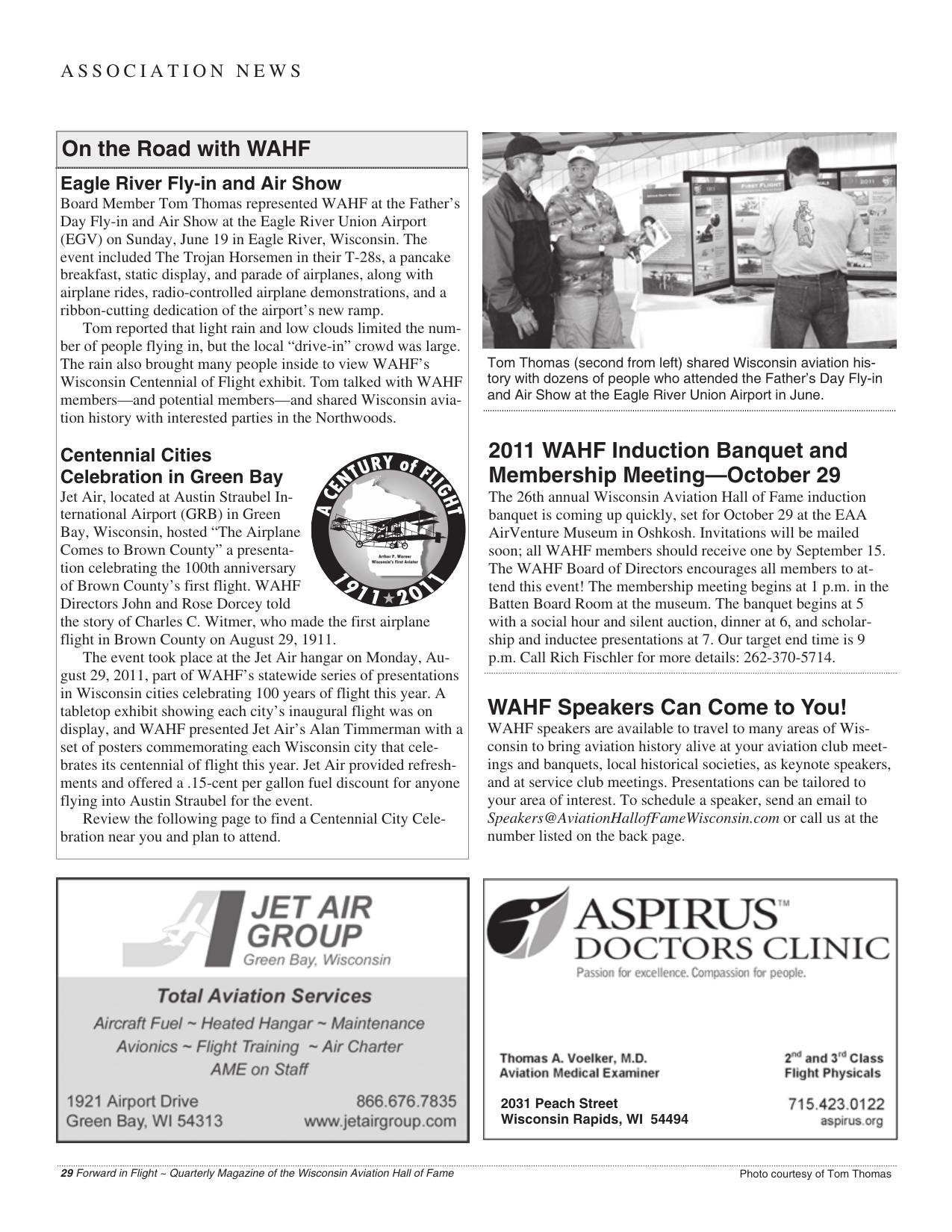
ASSOCIATION NEWS On the Road with WAHF Eagle River Fly-in and Air Show Board Member Tom Thomas represented WAHF at the Father’s Day Fly-in and Air Show at the Eagle River Union Airport (EGV) on Sunday, June 19 in Eagle River, Wisconsin. The event included The Trojan Horsemen in their T-28s, a pancake breakfast, static display, and parade of airplanes, along with airplane rides, radio-controlled airplane demonstrations, and a ribbon-cutting dedication of the airport’s new ramp. Tom reported that light rain and low clouds limited the number of people flying in, but the local “drive-in” crowd was large. The rain also brought many people inside to view WAHF’s Wisconsin Centennial of Flight exhibit. Tom talked with WAHF members—and potential members—and shared Wisconsin aviation history with interested parties in the Northwoods. Tom Thomas (second from left) shared Wisconsin aviation history with dozens of people who attended the Father’s Day Fly-in and Air Show at the Eagle River Union Airport in June. Centennial Cities Celebration in Green Bay 2011 WAHF Induction Banquet and Membership Meeting—October 29 Jet Air, located at Austin Straubel International Airport (GRB) in Green Bay, Wisconsin, hosted “The Airplane Comes to Brown County” a presentation celebrating the 100th anniversary of Brown County’s first flight. WAHF Directors John and Rose Dorcey told the story of Charles C. Witmer, who made the first airplane flight in Brown County on August 29, 1911. The event took place at the Jet Air hangar on Monday, August 29, 2011, part of WAHF’s statewide series of presentations in Wisconsin cities celebrating 100 years of flight this year. A tabletop exhibit showing each city’s inaugural flight was on display, and WAHF presented Jet Air’s Alan Timmerman with a set of posters commemorating each Wisconsin city that celebrates its centennial of flight this year. Jet Air provided refreshments and offered a .15-cent per gallon fuel discount for anyone flying into Austin Straubel for the event. Review the following page to find a Centennial City Celebration near you and plan to attend. The 26th annual Wisconsin Aviation Hall of Fame induction banquet is coming up quickly, set for October 29 at the EAA AirVenture Museum in Oshkosh. Invitations will be mailed soon; all WAHF members should receive one by September 15. The WAHF Board of Directors encourages all members to attend this event! The membership meeting begins at 1 p.m. in the Batten Board Room at the museum. The banquet begins at 5 with a social hour and silent auction, dinner at 6, and scholarship and inductee presentations at 7. Our target end time is 9 p.m. Call Rich Fischler for more details: 262-370-5714. WAHF Speakers Can Come to You! WAHF speakers are available to travel to many areas of Wisconsin to bring aviation history alive at your aviation club meetings and banquets, local historical societies, as keynote speakers, and at service club meetings. Presentations can be tailored to your area of interest. To schedule a speaker, send an email to Speakers@AviationHallofFameWisconsin.com or call us at the number listed on the back page. 2031 Peach Street Wisconsin Rapids, WI 54494 29 Forward in Flight ~ Quarterly Magazine of the Wisconsin Aviation Hall of Fame Photo courtesy of Tom Thomas
ASSOCIATION NEWS WAHF Brings Aviation History to You! Join the celebration—2011 centennial events WAHF has scheduled several upcoming events, working with historical and aviation groups in Wisconsin cities where their first flights occurred in 1911. Choose an event that observes each city’s unique aviation history and join the celebration! Manitowoc: Wednesday, September 14. EAA Chapter 383 will host WAHF’s John and Rose Dorcey at its annual Chapter Corn Roast. Dinner begins at 5 p.m., presentation on Beckwith Havens and Manitowoc’s aviation history begins at 6. Location: Manitowoc County Airport (MTW), look for the EAA Chapter hangar. Visit www.EAAChapter383.org for more information. Menomonie: WAHF’s Michael Goc will be featured in the Heritage Speaker Series at the Dunn County Heritage Museum at 1:30 p.m. on Sunday, September 18 at the Heritage Museum at 1820 Wakanda Street in Menomonie. His subject will be “From France to Menomonie, The Airplane Arrives in Dunn County, 1911.” Chippewa Valley Museum: Tuesday, September 20 from 6 – 8 p.m. at the Chippewa Valley Museum. See local aviation artifacts and hear WAHF’s Michael Goc present, “The Airplane Comes to the Chippewa Valley.” Admission into the Chippewa Valley Museum is free. For more information, contact Ashley Dziuk: 715-834-7871 or email a.dziuk@cvmuseum.com. tempted to fly from Minneapolis down the Mississippi River to New Orleans in a 1911 Curtiss Hydroaeroplane—stopping in La Crosse along the way. Free and open to the public. Location is at the main auditorium of the library at 8th and Main Streets. Appleton’s History Museum at the Castle: Michael Goc will speak on “Cal Rodgers, the Vin Fiz, and the First Airplane to Fly in Appleton” at the History Museum at the Castle in Appleton on Saturday, November 19 at 1:00 pm. Visit www.AviationHallofFameWisconsin.com for more event information. More Aviation History Online! Many people have heard of Austin Straubel International Airport (GRB) in Green Bay, Wisconsin, but how many people know the story of the airport’s namesake? WAHF Blogger John Dorcey shares details about Lt. Col. Austin A. Straubel, the first Brown County aviator to lose his life in World War II. Born on September 4, 1909, Straubel joined the Army Air Corps in 1928 and completed military pilot training in Texas and March Field, California. Among other postings, Straubel spent time in the Philippines during the 1930s before returning to the states for additional training. Learn more on the WAHF Blog at http://aviationhalloffamewisconsin.com/blog. Chippewa Valley Regional Airport: WAHF Speakers will present the history of aviation in the Chippewa Valley on Saturday, September 24 at Heartland Aviation, located at Chippewa Valley Regional Airport (EAU). In addition, EAA Chapter 509 will provide a chili lunch and Young Eagles rides. Antique aircraft and cars will be on display. The event runs from 10 a.m. 3 p.m. For more information, call 715-839-6241 or email cvra@clearwire.net. Antigo Airport Fly-in: Saturday, September 24. WAHF’s Tom Thomas will make a presentation on John Schwister, Wisconsin’s first homebuilder, at the Langlade County Airport (AIG). Visit the WAHF website for more details. Tomahawk Historical Society: Michael Goc will speak at the Tomahawk Historical Society’s Annual Appreciation Day in the afternoon of September 29. His subject will be “John Kaminski, Reider Olsen, and the History of Aviation in Tomahawk.” Time and location to be determined, visit the WAHF website for more information. Morey Airplane Company Since 1932 Sheboygan: Aviation Heritage Center of Wisconsin, located at Sheboygan County Memorial Airport (SBM), Friday, September 30. Time to be determined. Call 920-385-1483. La Crosse Public Library: WAHF’s Frederick Beseler will present “The Centennial of Powered Flight in La Crosse” on Sunday, October 30 at 2 p.m. Co-sponsored by the Wisconsin Aviation Hall of Fame and the La Crosse County Historical Society, Fred will describe in words and photographs the flight of aviation pioneer Hugh Robinson who, in October 1911, at- Middleton Municipal Airport/Morey Field Self-service 100LL & Jet A 24-7 30 Forward in Flight ~ Fall 2011
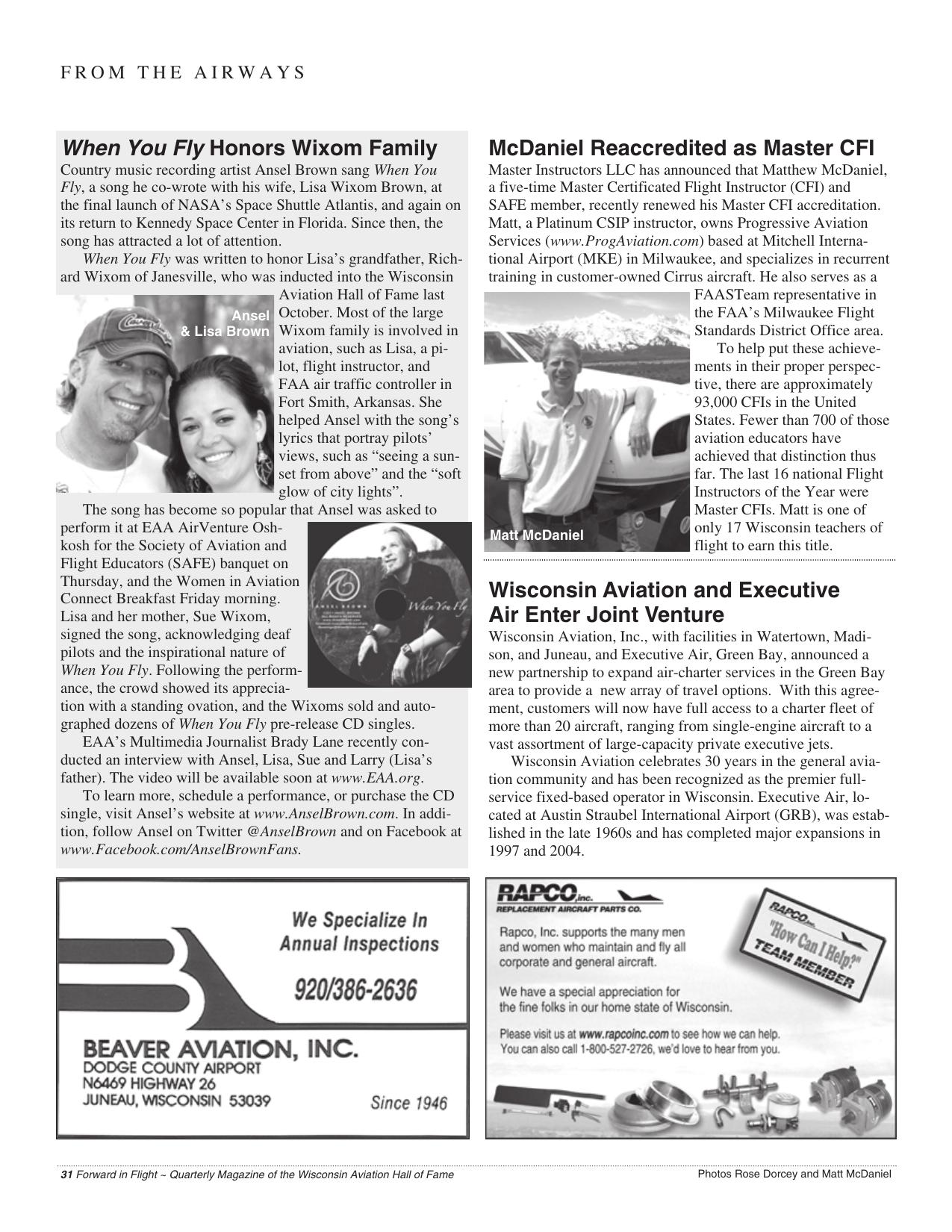
FROM THE AIRWAYS When You Fly Honors Wixom Family McDaniel Reaccredited as Master CFI Country music recording artist Ansel Brown sang When You Fly, a song he co-wrote with his wife, Lisa Wixom Brown, at the final launch of NASA’s Space Shuttle Atlantis, and again on its return to Kennedy Space Center in Florida. Since then, the song has attracted a lot of attention. When You Fly was written to honor Lisa’s grandfather, Richard Wixom of Janesville, who was inducted into the Wisconsin Aviation Hall of Fame last Ansel October. Most of the large & Lisa Brown Wixom family is involved in aviation, such as Lisa, a pilot, flight instructor, and FAA air traffic controller in Fort Smith, Arkansas. She helped Ansel with the song’s lyrics that portray pilots’ views, such as “seeing a sunset from above” and the “soft glow of city lights”. The song has become so popular that Ansel was asked to perform it at EAA AirVenture Oshkosh for the Society of Aviation and Flight Educators (SAFE) banquet on Thursday, and the Women in Aviation Connect Breakfast Friday morning. Lisa and her mother, Sue Wixom, signed the song, acknowledging deaf pilots and the inspirational nature of When You Fly. Following the performance, the crowd showed its appreciation with a standing ovation, and the Wixoms sold and autographed dozens of When You Fly pre-release CD singles. EAA’s Multimedia Journalist Brady Lane recently conducted an interview with Ansel, Lisa, Sue and Larry (Lisa’s father). The video will be available soon at www.EAA.org. To learn more, schedule a performance, or purchase the CD single, visit Ansel’s website at www.AnselBrown.com. In addition, follow Ansel on Twitter @AnselBrown and on Facebook at www.Facebook.com/AnselBrownFans. Master Instructors LLC has announced that Matthew McDaniel, a five-time Master Certificated Flight Instructor (CFI) and SAFE member, recently renewed his Master CFI accreditation. Matt, a Platinum CSIP instructor, owns Progressive Aviation Services (www.ProgAviation.com) based at Mitchell International Airport (MKE) in Milwaukee, and specializes in recurrent training in customer-owned Cirrus aircraft. He also serves as a FAASTeam representative in the FAA’s Milwaukee Flight Standards District Office area. To help put these achievements in their proper perspective, there are approximately 93,000 CFIs in the United States. Fewer than 700 of those aviation educators have achieved that distinction thus far. The last 16 national Flight Instructors of the Year were Master CFIs. Matt is one of only 17 Wisconsin teachers of Matt McDaniel flight to earn this title. 31 Forward in Flight ~ Quarterly Magazine of the Wisconsin Aviation Hall of Fame Wisconsin Aviation and Executive Air Enter Joint Venture Wisconsin Aviation, Inc., with facilities in Watertown, Madison, and Juneau, and Executive Air, Green Bay, announced a new partnership to expand air-charter services in the Green Bay area to provide a new array of travel options. With this agreement, customers will now have full access to a charter fleet of more than 20 aircraft, ranging from single-engine aircraft to a vast assortment of large-capacity private executive jets. Wisconsin Aviation celebrates 30 years in the general aviation community and has been recognized as the premier fullservice fixed-based operator in Wisconsin. Executive Air, located at Austin Straubel International Airport (GRB), was established in the late 1960s and has completed major expansions in 1997 and 2004. Photos Rose Dorcey and Matt McDaniel
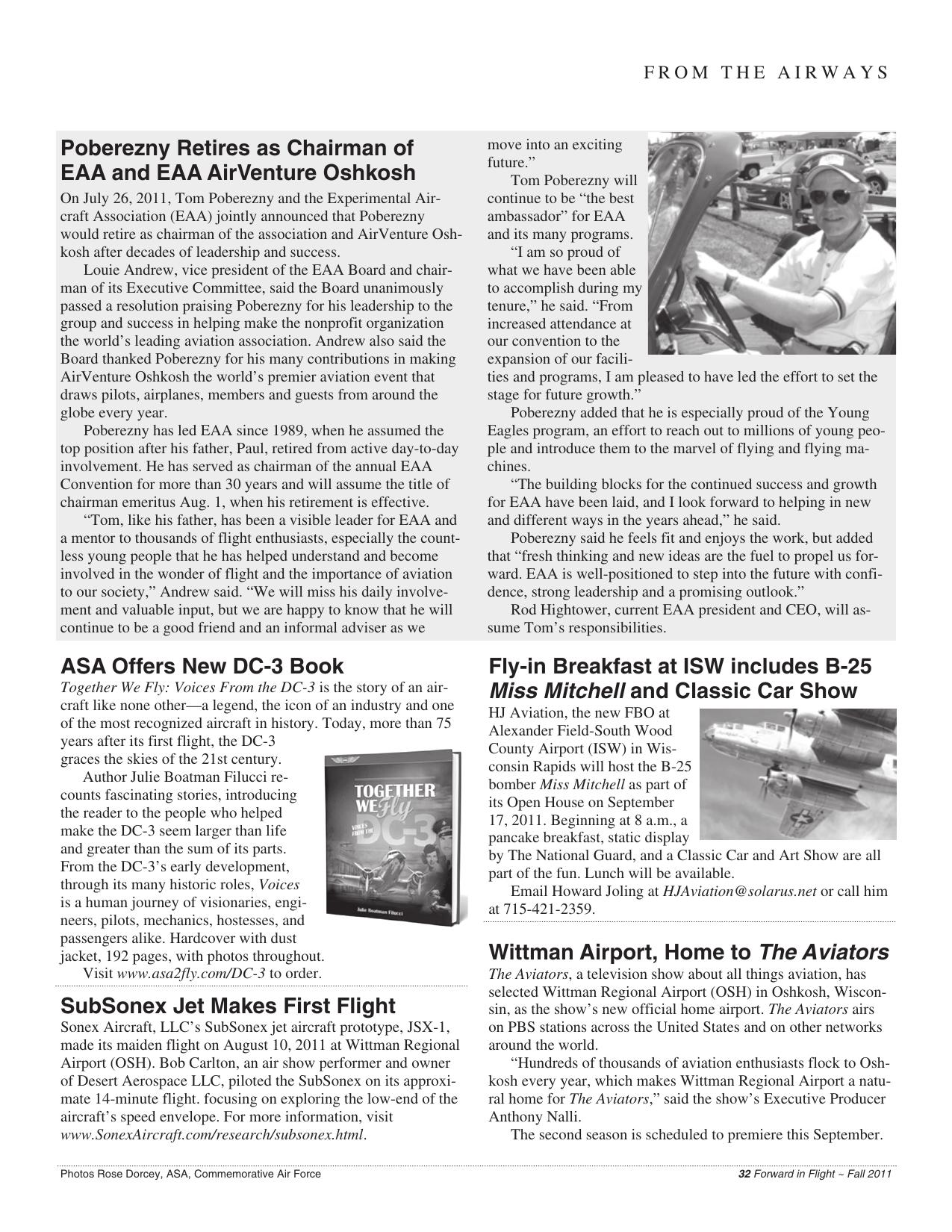
FROM THE AIRWAYS Poberezny Retires as Chairman of EAA and EAA AirVenture Oshkosh On July 26, 2011, Tom Poberezny and the Experimental Aircraft Association (EAA) jointly announced that Poberezny would retire as chairman of the association and AirVenture Oshkosh after decades of leadership and success. Louie Andrew, vice president of the EAA Board and chairman of its Executive Committee, said the Board unanimously passed a resolution praising Poberezny for his leadership to the group and success in helping make the nonprofit organization the world’s leading aviation association. Andrew also said the Board thanked Poberezny for his many contributions in making AirVenture Oshkosh the world’s premier aviation event that draws pilots, airplanes, members and guests from around the globe every year. Poberezny has led EAA since 1989, when he assumed the top position after his father, Paul, retired from active day-to-day involvement. He has served as chairman of the annual EAA Convention for more than 30 years and will assume the title of chairman emeritus Aug. 1, when his retirement is effective. “Tom, like his father, has been a visible leader for EAA and a mentor to thousands of flight enthusiasts, especially the countless young people that he has helped understand and become involved in the wonder of flight and the importance of aviation to our society,” Andrew said. “We will miss his daily involvement and valuable input, but we are happy to know that he will continue to be a good friend and an informal adviser as we ASA Offers New DC-3 Book Together We Fly: Voices From the DC-3 is the story of an aircraft like none other—a legend, the icon of an industry and one of the most recognized aircraft in history. Today, more than 75 years after its first flight, the DC-3 graces the skies of the 21st century. Author Julie Boatman Filucci recounts fascinating stories, introducing the reader to the people who helped make the DC-3 seem larger than life and greater than the sum of its parts. From the DC-3’s early development, through its many historic roles, Voices is a human journey of visionaries, engineers, pilots, mechanics, hostesses, and passengers alike. Hardcover with dust jacket, 192 pages, with photos throughout. Visit www.asa2fly.com/DC-3 to order. SubSonex Jet Makes First Flight Sonex Aircraft, LLC’s SubSonex jet aircraft prototype, JSX-1, made its maiden flight on August 10, 2011 at Wittman Regional Airport (OSH). Bob Carlton, an air show performer and owner of Desert Aerospace LLC, piloted the SubSonex on its approximate 14-minute flight. focusing on exploring the low-end of the aircraft’s speed envelope. For more information, visit www.SonexAircraft.com/research/subsonex.html. Photos Rose Dorcey, ASA, Commemorative Air Force move into an exciting future.” Tom Poberezny will continue to be “the best ambassador” for EAA and its many programs. “I am so proud of what we have been able to accomplish during my tenure,” he said. “From increased attendance at our convention to the expansion of our facilities and programs, I am pleased to have led the effort to set the stage for future growth.” Poberezny added that he is especially proud of the Young Eagles program, an effort to reach out to millions of young people and introduce them to the marvel of flying and flying machines. “The building blocks for the continued success and growth for EAA have been laid, and I look forward to helping in new and different ways in the years ahead,” he said. Poberezny said he feels fit and enjoys the work, but added that “fresh thinking and new ideas are the fuel to propel us forward. EAA is well-positioned to step into the future with confidence, strong leadership and a promising outlook.” Rod Hightower, current EAA president and CEO, will assume Tom’s responsibilities. Fly-in Breakfast at ISW includes B-25 Miss Mitchell and Classic Car Show HJ Aviation, the new FBO at Alexander Field-South Wood County Airport (ISW) in Wisconsin Rapids will host the B-25 bomber Miss Mitchell as part of its Open House on September 17, 2011. Beginning at 8 a.m., a pancake breakfast, static display by The National Guard, and a Classic Car and Art Show are all part of the fun. Lunch will be available. Email Howard Joling at HJAviation@solarus.net or call him at 715-421-2359. Wittman Airport, Home to The Aviators The Aviators, a television show about all things aviation, has selected Wittman Regional Airport (OSH) in Oshkosh, Wisconsin, as the show’s new official home airport. The Aviators airs on PBS stations across the United States and on other networks around the world. “Hundreds of thousands of aviation enthusiasts flock to Oshkosh every year, which makes Wittman Regional Airport a natural home for The Aviators,” said the show’s Executive Producer Anthony Nalli. The second season is scheduled to premiere this September. 32 Forward in Flight ~ Fall 2011
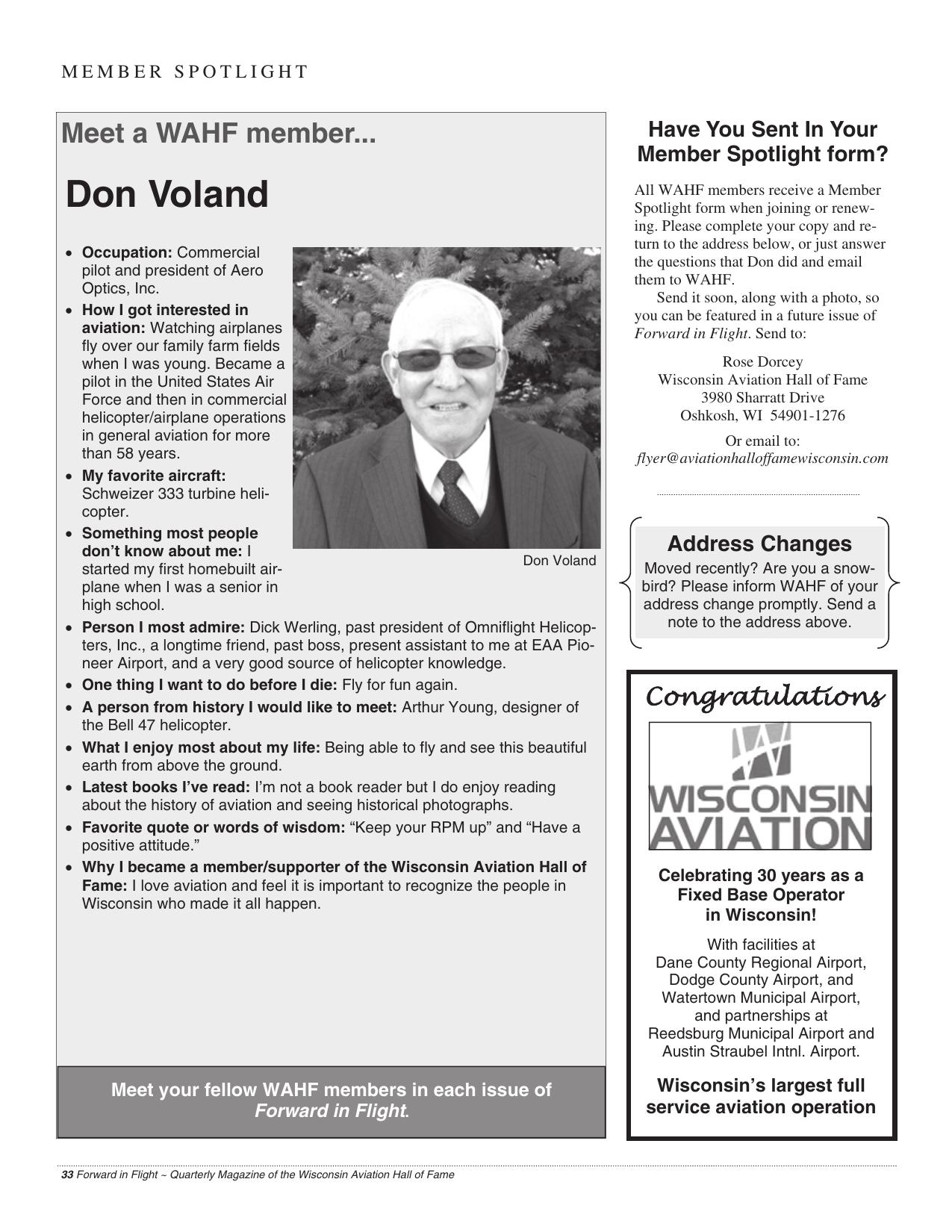
MEMBER SPOTLIGHT Meet a WAHF member... Have You Sent In Your Member Spotlight form? Don Voland All WAHF members receive a Member Spotlight form when joining or renewing. Please complete your copy and return to the address below, or just answer the questions that Don did and email them to WAHF. Send it soon, along with a photo, so you can be featured in a future issue of Forward in Flight. Send to: Occupation: Commercial pilot and president of Aero Optics, Inc. How I got interested in aviation: Watching airplanes fly over our family farm fields when I was young. Became a pilot in the United States Air Force and then in commercial helicopter/airplane operations in general aviation for more than 58 years. My favorite aircraft: Schweizer 333 turbine helicopter. Something most people don’t know about me: I Don Voland started my first homebuilt airplane when I was a senior in high school. Person I most admire: Dick Werling, past president of Omniflight Helicopters, Inc., a longtime friend, past boss, present assistant to me at EAA Pioneer Airport, and a very good source of helicopter knowledge. One thing I want to do before I die: Fly for fun again. A person from history I would like to meet: Arthur Young, designer of the Bell 47 helicopter. What I enjoy most about my life: Being able to fly and see this beautiful earth from above the ground. Latest books I’ve read: I’m not a book reader but I do enjoy reading about the history of aviation and seeing historical photographs. Favorite quote or words of wisdom: “Keep your RPM up” and “Have a positive attitude.” Why I became a member/supporter of the Wisconsin Aviation Hall of Fame: I love aviation and feel it is important to recognize the people in Wisconsin who made it all happen. Rose Dorcey Wisconsin Aviation Hall of Fame 3980 Sharratt Drive Oshkosh, WI 54901-1276 Or email to: flyer@aviationhalloffamewisconsin.com Address Changes Moved recently? Are you a snowbird? Please inform WAHF of your address change promptly. Send a note to the address above. Congratulations Celebrating 30 years as a Fixed Base Operator in Wisconsin! With facilities at Dane County Regional Airport, Dodge County Airport, and Watertown Municipal Airport, and partnerships at Reedsburg Municipal Airport and Austin Straubel Intnl. Airport. Meet your fellow WAHF members in each issue of Forward in Flight. 33 Forward in Flight ~ Quarterly Magazine of the Wisconsin Aviation Hall of Fame Wisconsin’s largest full service aviation operation

Subscribe to Forward in Flight today! Annual subscription includes one-year WAHF membership Membership Benefits: Quarterly subscription (4 issues) of Forward in Flight, packed full of Wisconsin aviation news, events, state aviation history, and stories about your aviation colleagues Free pass to Deke Slayton Museum Invitation to annual induction banquet Name Address City State Zip Phone Number Email Referred By Just $20, and you’ll be supporting an aviation organization dedicated to collecting, preserving, and sharing Wisconsin’s aviation history. With Forward in Flight, you’ll learn about aviation history makers—the people, places, and events that distinguish our state and also be in touch with current Wisconsin aviation news and information. Send your check today! Please write check to: Wisconsin Aviation Hall of Fame, Inc. Mail to: John Dorcey, Treasurer Wisconsin Aviation Hall of Fame 3980 Sharratt Drive Oshkosh WI 54901-1276 Pam & Pat O’Malley Pat O’Malley’s Jet Room Restaurant Wisconsin Aviation Bldg. Dane County Regional Airport Madison, Wis. (MSN) Breakfast & Lunch 6 a.m. - 2 p.m. Mon. thru Sat. 8 a.m. - 2 p.m. Sunday 608-268-5010 www.JetRoomRestaurant.com 34 Forward in Flight ~ Fall 2011
PRSRT STD US Postage Paid Wisc Rapids WI Permit 98 WISCONSIN AVIATION HALL OF FAME 3980 SHARRATT DRIVE OSHKOSH WI 54901-1276 Wisconsin Aviation Hall of Fame A Membership Organization Dedicated to Preserving the Past Fostering the Future of Flight Change Service Requested Welcome WAHF Member/Supporters: William Buettner Peter Jensen Doris Piehl-Burr Tom Ruhlmann —Thanks for coming on board! Mark Landvatter CONGRATULATIONS!!! WAHF Member Mike Dean passed his sport pilot check ride on July 2, 2011, flying Ercoupe 415-C, N3174H, out of Watertown, Wisconsin. Mike’s examiner was James Notstad from Madison and his flight instructor was Kevin Loppnow. Congratulations also to WAHF Member Sam Wiltzius who passed his private pilot check ride with Designated Pilot Examiner (and WAHF Inductee) Harold “Duffy” Gaier at the Marshfield Municipal AirportRoy Shwery Field (MFI) on July 9. Sam’s flight instructor was WAHF Board Member John Dorcey. Great job guys! The Winnebago Flying Club, based at Wittman Regional Airport in Oshkosh, is now accepting new members. The club offers an expertly maintained 1971 Cessna 172 for just $79 per hour (wet), low monthly membership rates, and several certificated flight instructors (CFIs), two of whom are Master-CFIs. For more information, visit call 920-470-9103 or visit www.WinnebagoFlyingClub.com. Email info@winnebagoflyingclub.com. Wittman Regional Airport in Oshkosh will host a “Get to Know Your Airport Day” on Saturday, September 10 in the main terminal building. Airport tenants and non-profit organizations will have displays. EAA Chapter 252 will offer a pancake breakfast from 7:30 - 11. WAHF is on Facebook and Twitter! Follow us to learn more about aviation in Wisconsin! Wisconsin Aviation Hall of Fame Officers and Board of Directors Rose Dorcey, President Michael Goc, Vice President John Dorcey, Secretary/Treasurer Frederick Beseler Duane Esse Rich Fischler Andrew Ovans Charles Swain Tom Thomas Charles Marotske, Honorary Chairman of the Board Wisconsin Aviation Hall of Fame 3980 Sharratt Drive Oshkosh WI 54901-1276 Become a supporter today! For information call Rose Dorcey at 920-385-1483 www.aviationhalloffamewisconsin.com flyer@aviationhalloffamewisconsin.com