Volume 10, Issue 3
🗞️ Download Issue (PDF)
Forward in Flight - Fall 2012
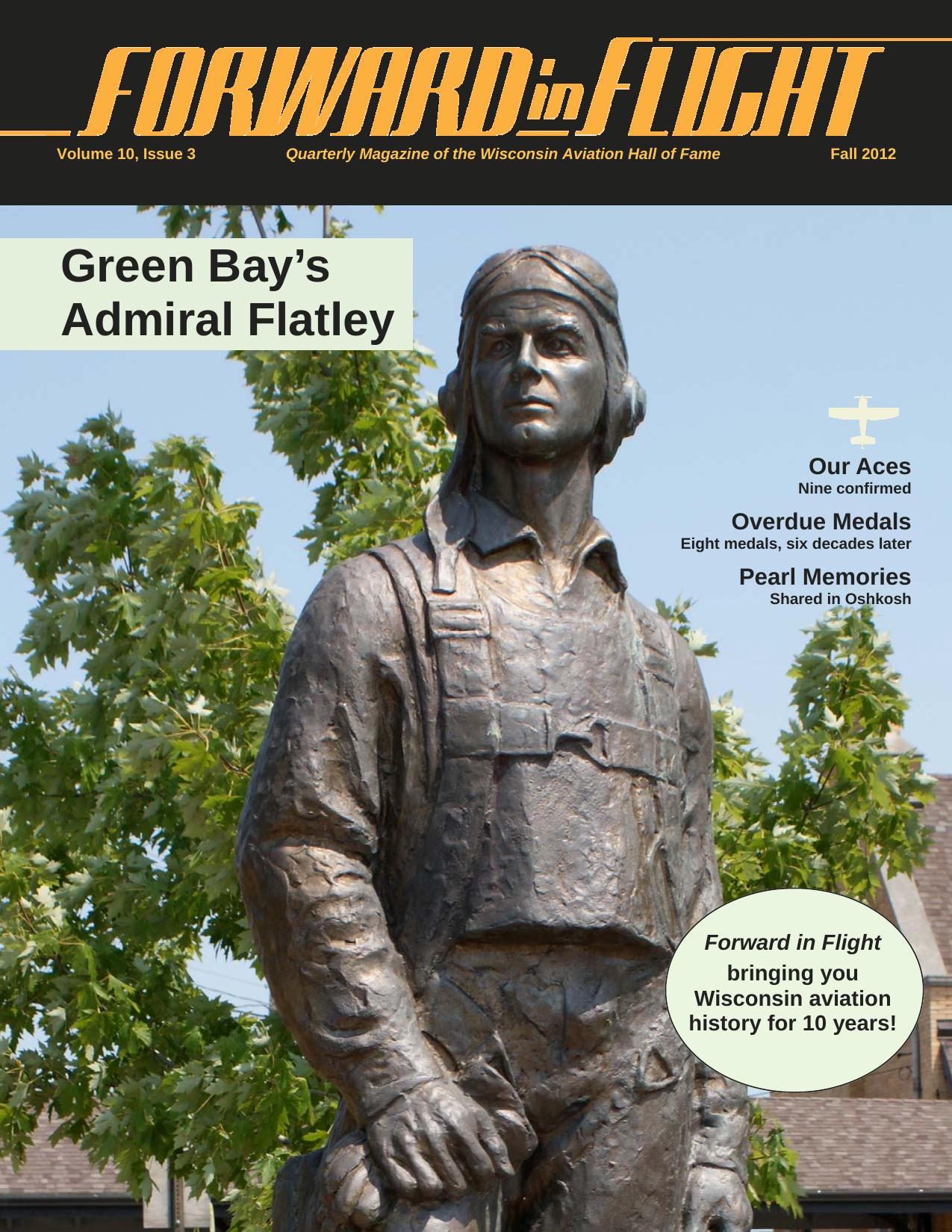
Volume 10, Issue 3 Quarterly Magazine of the Wisconsin Aviation Hall of Fame Fall 2012 Green Bay’s Admiral Flatley Our Aces Nine confirmed Overdue Medals Eight medals, six decades later Pearl Memories Shared in Oshkosh Forward in Flight bringing you Wisconsin aviation history for 10 years!
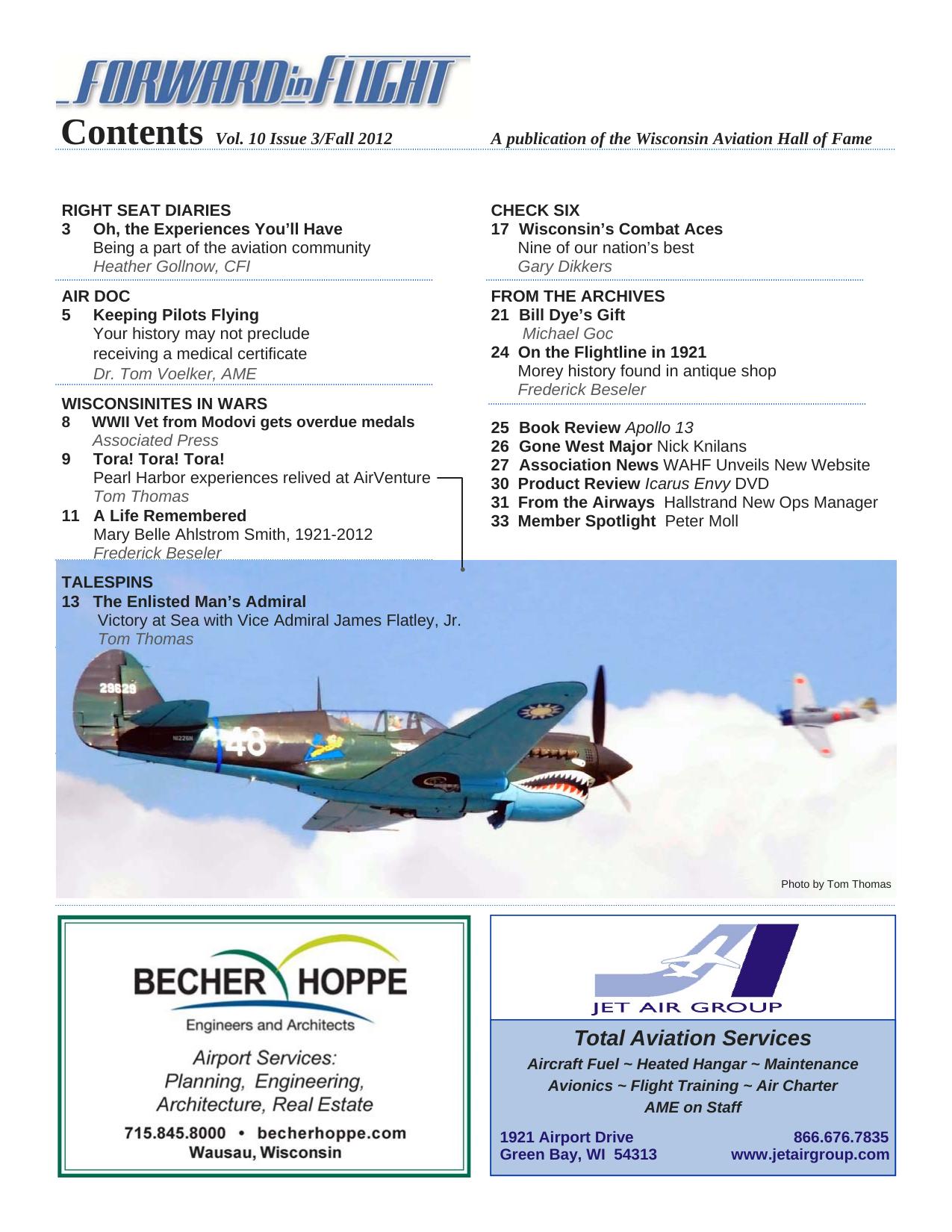
Contents Vol. 10 Issue 3/Fall 2012 A publication of the Wisconsin Aviation Hall of Fame RIGHT SEAT DIARIES 3 Oh, the Experiences You’ll Have Being a part of the aviation community Heather Gollnow, CFI CHECK SIX 17 Wisconsin’s Combat Aces Nine of our nation’s best Gary Dikkers AIR DOC 5 Keeping Pilots Flying Your history may not preclude receiving a medical certificate Dr. Tom Voelker, AME FROM THE ARCHIVES 21 Bill Dye’s Gift Michael Goc 24 On the Flightline in 1921 Morey history found in antique shop Frederick Beseler WISCONSINITES IN WARS 8 WWII Vet from Modovi gets overdue medals Associated Press 9 Tora! Tora! Tora! Pearl Harbor experiences relived at AirVenture Tom Thomas 11 A Life Remembered Mary Belle Ahlstrom Smith, 1921-2012 Frederick Beseler 25 Book Review Apollo 13 26 Gone West Major Nick Knilans 27 Association News WAHF Unveils New Website 30 Product Review Icarus Envy DVD 31 From the Airways Hallstrand New Ops Manager 33 Member Spotlight Peter Moll • TALESPINS 13 The Enlisted Man’s Admiral Victory at Sea with Vice Admiral James Flatley, Jr. Tom Thomas • A setting sun casts a beautiful hue on this Cessna 170B as its pilot readies for departure from Sugar Ridge Airport. Photo by Tom Thomas Total Aviation Services Aircraft Fuel ~ Heated Hangar ~ Maintenance Avionics ~ Flight Training ~ Air Charter AME on Staff 1921 Airport Drive Green Bay, WI 54313 866.676.7835 www.jetairgroup.com
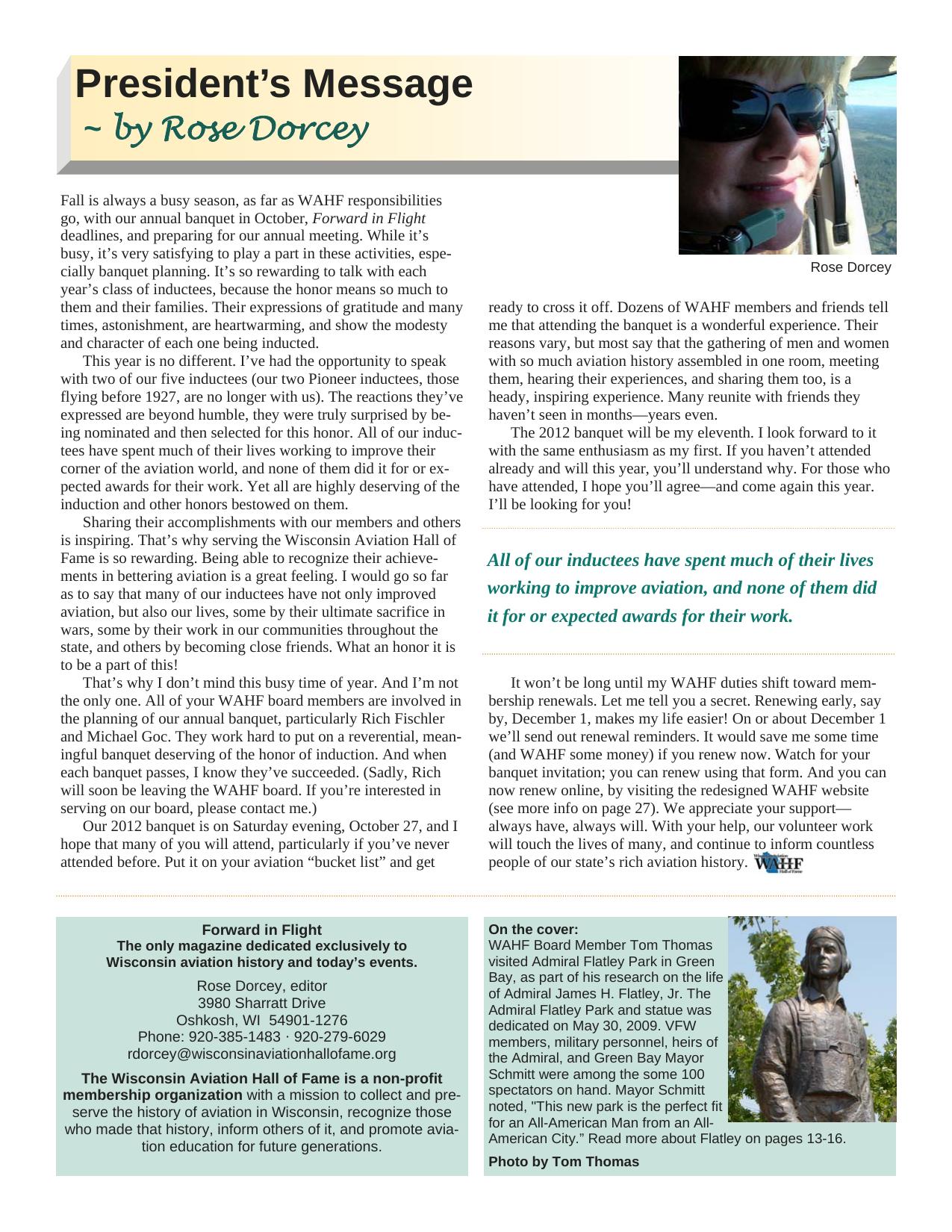
President’s Message ~ by Rose Dorcey Fall is always a busy season, as far as WAHF responsibilities go, with our annual banquet in October, Forward in Flight deadlines, and preparing for our annual meeting. While it’s busy, it’s very satisfying to play a part in these activities, especially banquet planning. It’s so rewarding to talk with each year’s class of inductees, because the honor means so much to them and their families. Their expressions of gratitude and many times, astonishment, are heartwarming, and show the modesty and character of each one being inducted. This year is no different. I’ve had the opportunity to speak with two of our five inductees (our two Pioneer inductees, those flying before 1927, are no longer with us). The reactions they’ve expressed are beyond humble, they were truly surprised by being nominated and then selected for this honor. All of our inductees have spent much of their lives working to improve their corner of the aviation world, and none of them did it for or expected awards for their work. Yet all are highly deserving of the induction and other honors bestowed on them. Sharing their accomplishments with our members and others is inspiring. That’s why serving the Wisconsin Aviation Hall of Fame is so rewarding. Being able to recognize their achievements in bettering aviation is a great feeling. I would go so far as to say that many of our inductees have not only improved aviation, but also our lives, some by their ultimate sacrifice in wars, some by their work in our communities throughout the state, and others by becoming close friends. What an honor it is to be a part of this! That’s why I don’t mind this busy time of year. And I’m not the only one. All of your WAHF board members are involved in the planning of our annual banquet, particularly Rich Fischler and Michael Goc. They work hard to put on a reverential, meaningful banquet deserving of the honor of induction. And when each banquet passes, I know they’ve succeeded. (Sadly, Rich will soon be leaving the WAHF board. If you’re interested in serving on our board, please contact me.) Our 2012 banquet is on Saturday evening, October 27, and I hope that many of you will attend, particularly if you’ve never attended before. Put it on your aviation “bucket list” and get Forward in Flight The only magazine dedicated exclusively to Wisconsin aviation history and today’s events. Rose Dorcey, editor 3980 Sharratt Drive Oshkosh, WI 54901-1276 Phone: 920-385-1483 · 920-279-6029 rdorcey@wisconsinaviationhallofame.org The Wisconsin Aviation Hall of Fame is a non-profit membership organization with a mission to collect and preserve the history of aviation in Wisconsin, recognize those who made that history, inform others of it, and promote aviation education for future generations. Rose Dorcey ready to cross it off. Dozens of WAHF members and friends tell me that attending the banquet is a wonderful experience. Their reasons vary, but most say that the gathering of men and women with so much aviation history assembled in one room, meeting them, hearing their experiences, and sharing them too, is a heady, inspiring experience. Many reunite with friends they haven’t seen in months—years even. The 2012 banquet will be my eleventh. I look forward to it with the same enthusiasm as my first. If you haven’t attended already and will this year, you’ll understand why. For those who have attended, I hope you’ll agree—and come again this year. I’ll be looking for you! All of our inductees have spent much of their lives working to improve aviation, and none of them did it for or expected awards for their work. It won’t be long until my WAHF duties shift toward membership renewals. Let me tell you a secret. Renewing early, say by, December 1, makes my life easier! On or about December 1 we’ll send out renewal reminders. It would save me some time (and WAHF some money) if you renew now. Watch for your banquet invitation; you can renew using that form. And you can now renew online, by visiting the redesigned WAHF website (see more info on page 27). We appreciate your support— always have, always will. With your help, our volunteer work will touch the lives of many, and continue to inform countless people of our state’s rich aviation history. On the cover: WAHF Board Member Tom Thomas visited Admiral Flatley Park in Green Bay, as part of his research on the life of Admiral James H. Flatley, Jr. The Admiral Flatley Park and statue was dedicated on May 30, 2009. VFW members, military personnel, heirs of the Admiral, and Green Bay Mayor Schmitt were among the some 100 spectators on hand. Mayor Schmitt noted, "This new park is the perfect fit for an All-American Man from an AllAmerican City.” Read more about Flatley on pages 13-16. Photo by Tom Thomas
RIGHT SEAT DIARIES Oh, the Experiences You’ll Have Being a part of the aviation community By Heather Gollnow As we approach the fall season, it’s a little sad to know the air show season is coming to an end here in Wisconsin. I love attending airshows and other aviation related events throughout the summer and fall. Once I started flying lessons, I had much more appreciation for how hard it is to do what the air show performers do to entertain us. For me, going to airshows is a fun way to spend an afternoon, not only for the airplanes and entertainment but for becoming a part of my local aviation community. It’s important for me to be a part of the aviation community for many reasons. I am involved in many different ways. I try to attend as many events as I can, I write articles for Forward in Flight magazine, and I give presentations to youth groups. I’m local to Oshkosh and have been fortunate to have been able to attend the convention nearly every year since I was a child. I always wish I can do more, but I give what I can. Flying is so much more than just the act of flight; it’s a whole way of life. I get a lot out of all the activities I participate in and I encourage you to become involved too! Below you will find some of my suggestions on how you can become more involved. meeting people with all sorts of experiences to learn from. I know that I have someone I can call whenever I have a question. I’m constantly amazed at the people I meet and the experiences they share. When you are new to the aviation world, having one or two people you can trust for good advice is a must! But a traditional mentor/mentee relationship is very helpful, and I encourage those, too. 1. Getting involved in your aviation community is a great way to meet other pilots, mechanics, air traffic controllers, and fans of aviation. It’s always great to meet other people who enjoy the same things you do. I’m constantly amazed at how many great people I meet through my love of aviation. I have friends all over the world with diverse backgrounds and a lot of great stories to tell. I enjoy speaking with other pilots and sharing our flying stories. It’s always nice to know a few good mechanics out there to learn more about the airplane you fly or even to know more about the airplane you’d love to fly. If you are just learning how to fly and are new to aviation, becoming involved in aviation related activities is a great way to make some new friends who can share their experiences with you. 3. Do some hangar flying at your local airport. For me, attending airshows and conventions was always about the airplanes. Now, attending events is all about reuniting with old friends and making new ones. I always like to tell my nonaviation friends that since flying can be expensive, sitting around talking about flying is an acceptable second-place! As an educator, I understand the importance of reflecting on past experiences and sharing them with others to help process and learn from every experience. Hangar flying gives you the opportunity to learn from other people’s experiences and reflect on your own. 2. Getting involved in your aviation community will help you to find a mentor. When I say to find a mentor, I don’t mean establishing a formal mentor/mentee relationship. For me, it’s more about 3 Forward in Flight ~ Quarterly Magazine of the Wisconsin Aviation Hall of Fame Hangar flying gives you the opportunity to learn from other people’s experiences and reflect on your own. 4. Your aviation community will help
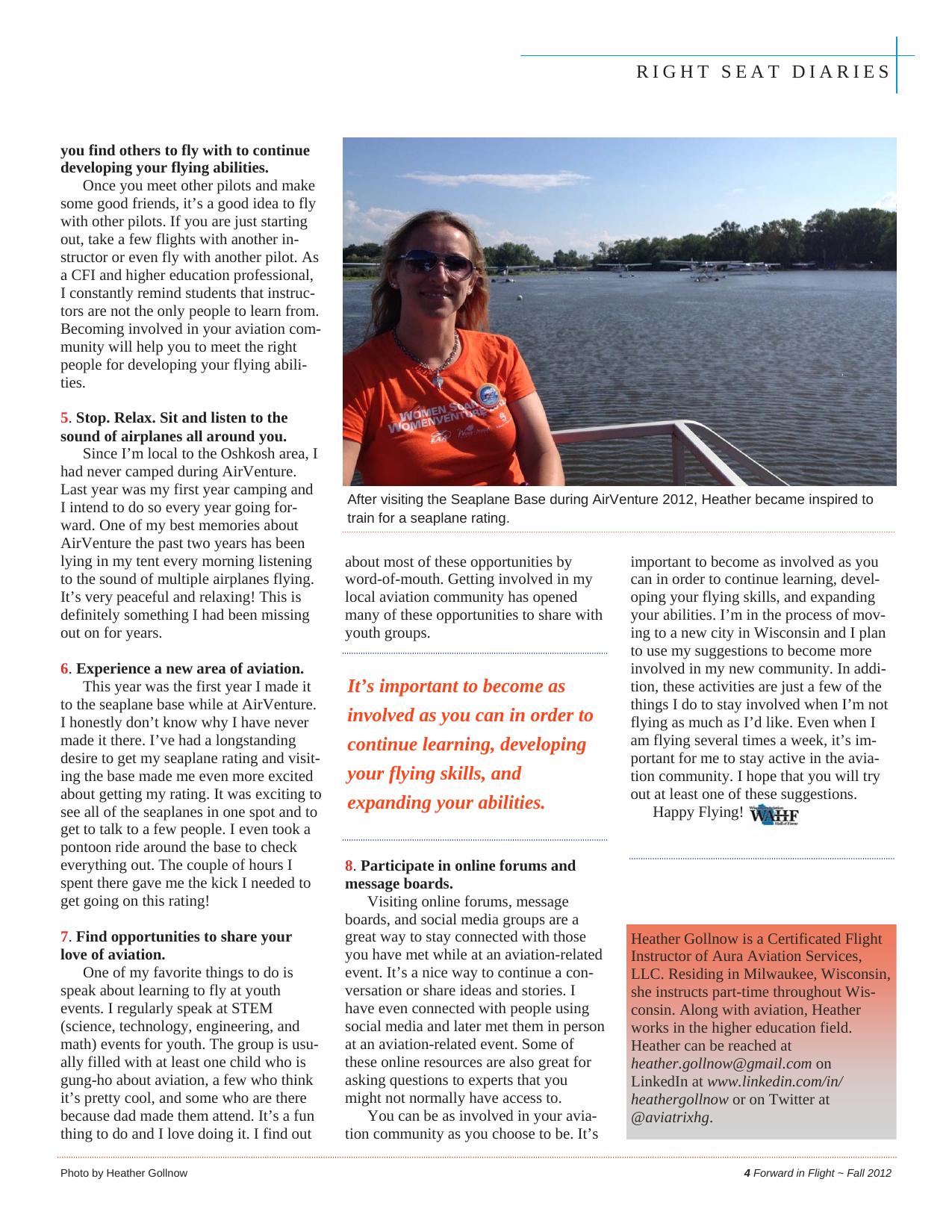
RIGHT SEAT DIARIES you find others to fly with to continue developing your flying abilities. Once you meet other pilots and make some good friends, it’s a good idea to fly with other pilots. If you are just starting out, take a few flights with another instructor or even fly with another pilot. As a CFI and higher education professional, I constantly remind students that instructors are not the only people to learn from. Becoming involved in your aviation community will help you to meet the right people for developing your flying abilities. 5. Stop. Relax. Sit and listen to the sound of airplanes all around you. Since I’m local to the Oshkosh area, I had never camped during AirVenture. Last year was my first year camping and I intend to do so every year going forward. One of my best memories about AirVenture the past two years has been lying in my tent every morning listening to the sound of multiple airplanes flying. It’s very peaceful and relaxing! This is definitely something I had been missing out on for years. 6. Experience a new area of aviation. This year was the first year I made it to the seaplane base while at AirVenture. I honestly don’t know why I have never made it there. I’ve had a longstanding desire to get my seaplane rating and visiting the base made me even more excited about getting my rating. It was exciting to see all of the seaplanes in one spot and to get to talk to a few people. I even took a pontoon ride around the base to check everything out. The couple of hours I spent there gave me the kick I needed to get going on this rating! 7. Find opportunities to share your love of aviation. One of my favorite things to do is speak about learning to fly at youth events. I regularly speak at STEM (science, technology, engineering, and math) events for youth. The group is usually filled with at least one child who is gung-ho about aviation, a few who think it’s pretty cool, and some who are there because dad made them attend. It’s a fun thing to do and I love doing it. I find out Photo by Heather Gollnow After visiting the Seaplane Base during AirVenture 2012, Heather became inspired to train for a seaplane rating. about most of these opportunities by word-of-mouth. Getting involved in my local aviation community has opened many of these opportunities to share with youth groups. It’s important to become as involved as you can in order to continue learning, developing your flying skills, and expanding your abilities. 8. Participate in online forums and message boards. Visiting online forums, message boards, and social media groups are a great way to stay connected with those you have met while at an aviation-related event. It’s a nice way to continue a conversation or share ideas and stories. I have even connected with people using social media and later met them in person at an aviation-related event. Some of these online resources are also great for asking questions to experts that you might not normally have access to. You can be as involved in your aviation community as you choose to be. It’s important to become as involved as you can in order to continue learning, developing your flying skills, and expanding your abilities. I’m in the process of moving to a new city in Wisconsin and I plan to use my suggestions to become more involved in my new community. In addition, these activities are just a few of the things I do to stay involved when I’m not flying as much as I’d like. Even when I am flying several times a week, it’s important for me to stay active in the aviation community. I hope that you will try out at least one of these suggestions. Happy Flying! Heather Gollnow is a Certificated Flight Instructor of Aura Aviation Services, LLC. Residing in Milwaukee, Wisconsin, she instructs part-time throughout Wisconsin. Along with aviation, Heather works in the higher education field. Heather can be reached at heather.gollnow@gmail.com on LinkedIn at www.linkedin.com/in/ heathergollnow or on Twitter at @aviatrixhg. 4 Forward in Flight ~ Fall 2012
AIR DOC Keeping Pilots Flying Your History May Not Preclude Receiving a Medical Certificate Dr. Tom Voelker, AME DrAlphaMike@yahoo.com Hello again, Airmen! This is Alpha Mike with you for another flight in the airspace of aviation medicine. Since we last connected, I suspect most of us have enjoyed another wonderful EAA AirVenture Oshkosh experience. I always look forward to this aviation adventure, and my only regret after attending is that I didn’t have more time. This year was no different, but I did attend a session that should be both enlightening and encouraging to all of us. Also, keep tuned to the end of this column. By the time you read this we may have passed an important deadline in aviation medical exams. This issue I want to share some recent gratifying encounters. About two months ago I was a part of two terrific Aviation Medical Examiner (AME) success stories. The other players were two applicants for flight physicals and, not surprisingly as I am learning, the FAA. I will explain my interactions with the FAA after I present the two cases. ADHD—or Not? The first airman (yes, they are both airmen, or pilots, as they did successfully receive their Student Pilot Certificates) had seen me a few months earlier. He (I will call the first one John out of respect for confidentiality) came in to get a sec- ond class medical. His dream was to become an air traffic controller, and he had already enrolled at a renowned aviation college for this program. The problem was that John had been previously diagnosed with ADHD, or Attention Deficit (Hyperactivity) Disorder. You might think this diagnosis would preclude obtaining an aviation medical certificate, and therefore becoming a pilot or an air traffic controller (ATC). ATCs, even though they keep their feet on the ground, need a second class medical. The outcome? He does not have ADHD! The FAA issued John a temporary medical certificate, and will be sending him a “letter of evidence,” allowing us AMEs to overlook the history of ADHD on medical exams. Usually, you would be right. There are two reasons why people with ADHD usually can’t get a medical. 5 Forward in Flight ~ Quarterly Magazine of the Wisconsin Aviation Hall of Fame First, the condition of ADHD itself involves a lack of attention to details, and a difficulty staying “on task.” Can you imagine flying in the clouds with a controller who is not able to keep his or her mind on the job for more than a few minutes? Second, the medications used to treat ADHD are what we doctors call “centrally acting,” meaning they exert their effects on the brain. With rare exceptions, all centrally acting medications are considered by the FAA to be incompatible with safe flight. John did himself a great favor a few months before his appointment for his medical. He had contacted me (his local AME). He actually had a preliminary conversation with me a couple of years earlier, when he was first contemplating a career in aviation. This contact, in which I was very happy to be involved, prompted me to call the Great Lakes Region of the FAA aeromedical division. I was able to ask the right questions and get John the information he would need to proceed with the application. John’s first task was to get off of his ADHD medication. I spoke with his usual doctor, and we decided that it would be safe to do so. (I, like most AMEs, am happy to speak with an airman’s personal doctor to discuss things such as the requirements for certification
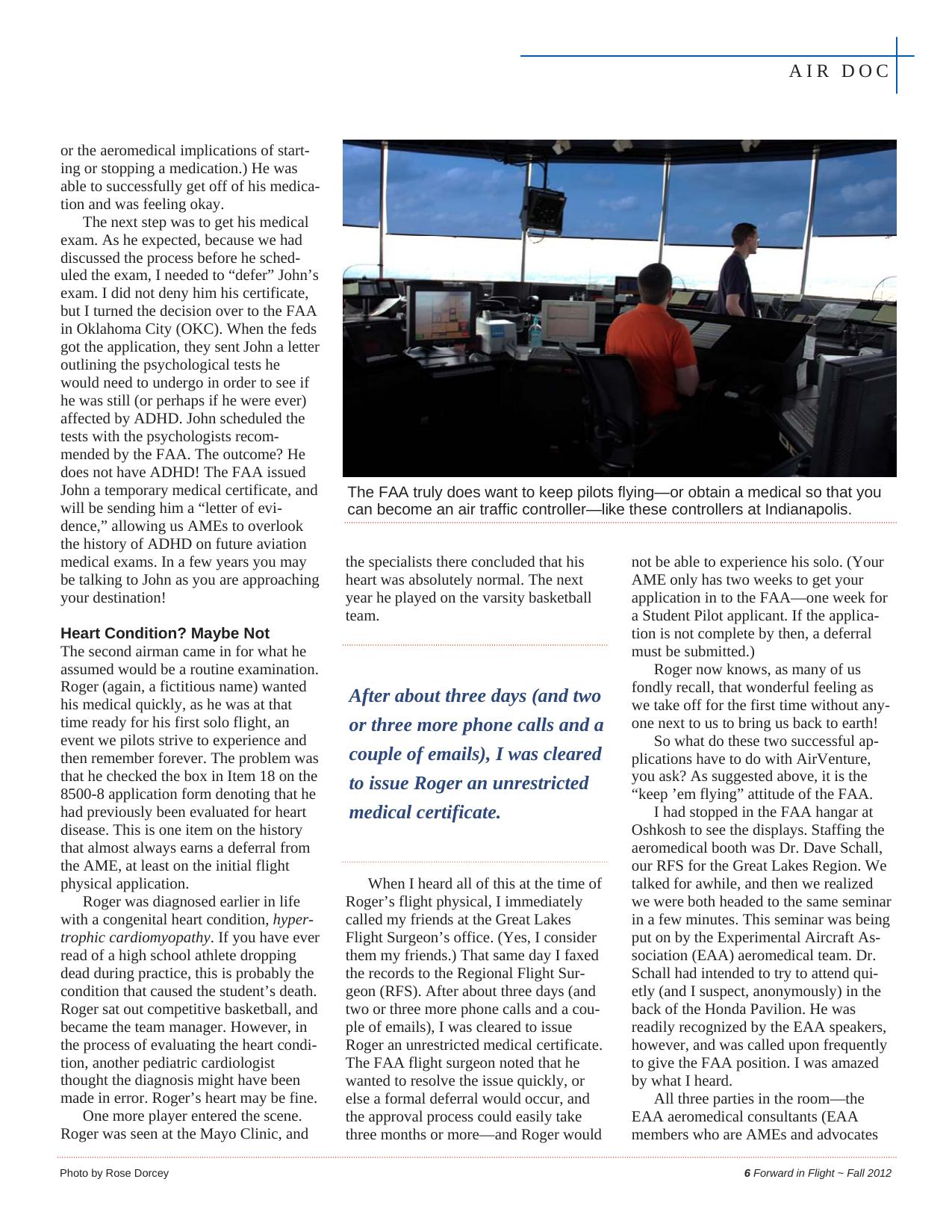
AIR DOC or the aeromedical implications of starting or stopping a medication.) He was able to successfully get off of his medication and was feeling okay. The next step was to get his medical exam. As he expected, because we had discussed the process before he scheduled the exam, I needed to “defer” John’s exam. I did not deny him his certificate, but I turned the decision over to the FAA in Oklahoma City (OKC). When the feds got the application, they sent John a letter outlining the psychological tests he would need to undergo in order to see if he was still (or perhaps if he were ever) affected by ADHD. John scheduled the tests with the psychologists recommended by the FAA. The outcome? He does not have ADHD! The FAA issued John a temporary medical certificate, and will be sending him a “letter of evidence,” allowing us AMEs to overlook the history of ADHD on future aviation medical exams. In a few years you may be talking to John as you are approaching your destination! Heart Condition? Maybe Not The second airman came in for what he assumed would be a routine examination. Roger (again, a fictitious name) wanted his medical quickly, as he was at that time ready for his first solo flight, an event we pilots strive to experience and then remember forever. The problem was that he checked the box in Item 18 on the 8500-8 application form denoting that he had previously been evaluated for heart disease. This is one item on the history that almost always earns a deferral from the AME, at least on the initial flight physical application. Roger was diagnosed earlier in life with a congenital heart condition, hypertrophic cardiomyopathy. If you have ever read of a high school athlete dropping dead during practice, this is probably the condition that caused the student’s death. Roger sat out competitive basketball, and became the team manager. However, in the process of evaluating the heart condition, another pediatric cardiologist thought the diagnosis might have been made in error. Roger’s heart may be fine. One more player entered the scene. Roger was seen at the Mayo Clinic, and Photo by Rose Dorcey The FAA truly does want to keep pilots flying—or obtain a medical so that you can become an air traffic controller—like these controllers at Indianapolis. the specialists there concluded that his heart was absolutely normal. The next year he played on the varsity basketball team. After about three days (and two or three more phone calls and a couple of emails), I was cleared to issue Roger an unrestricted medical certificate. When I heard all of this at the time of Roger’s flight physical, I immediately called my friends at the Great Lakes Flight Surgeon’s office. (Yes, I consider them my friends.) That same day I faxed the records to the Regional Flight Surgeon (RFS). After about three days (and two or three more phone calls and a couple of emails), I was cleared to issue Roger an unrestricted medical certificate. The FAA flight surgeon noted that he wanted to resolve the issue quickly, or else a formal deferral would occur, and the approval process could easily take three months or more—and Roger would not be able to experience his solo. (Your AME only has two weeks to get your application in to the FAA—one week for a Student Pilot applicant. If the application is not complete by then, a deferral must be submitted.) Roger now knows, as many of us fondly recall, that wonderful feeling as we take off for the first time without anyone next to us to bring us back to earth! So what do these two successful applications have to do with AirVenture, you ask? As suggested above, it is the “keep ’em flying” attitude of the FAA. I had stopped in the FAA hangar at Oshkosh to see the displays. Staffing the aeromedical booth was Dr. Dave Schall, our RFS for the Great Lakes Region. We talked for awhile, and then we realized we were both headed to the same seminar in a few minutes. This seminar was being put on by the Experimental Aircraft Association (EAA) aeromedical team. Dr. Schall had intended to try to attend quietly (and I suspect, anonymously) in the back of the Honda Pavilion. He was readily recognized by the EAA speakers, however, and was called upon frequently to give the FAA position. I was amazed by what I heard. All three parties in the room—the EAA aeromedical consultants (EAA members who are AMEs and advocates 6 Forward in Flight ~ Fall 2012
AIRDOC for pilots on aeromedical certification issues), Dr. Schall and the other FAA doctors, and the pilots in attendance—had the same two-part agenda: to keep pilots flying, and to keep the sky safe. What was particularly pleasing was the FAA position. While there are some limitations that need to be observed, the FAA does indeed want pilots to fly. The first issue addressed was the current movement, being driven by EAA and AOPA to eliminate medical certificates completely for pilots with third class medicals, using only a driver’s license, as we currently do for Sport Pilot privileges. EAA reps acknowledged that this will probably never happen. This is not for medical reasons, but simply because the process is mired in the political process, and is probably not going anywhere. The alternative process, and one that is gaining support from EAA and FAA aeromedical folks, is to decrease the number of medical conditions that are disqualifying, and therefore (like ADHD and heart conditions) require a deferral and the accompanying delay in obtaining a medical, as I explained above. While ADHD and heart problems will still require input from the docs at OKC, there are quite a few medical conditions that could be managed by the AME, allowing issuance of the medical certificate at the time of the original exam, as long as the applicant can provide documentation that the underlying condition is adequately and safely treated. This is how we AMEs currently handle airmen with hypertension. The second issue that struck me so favorably was the genuine openness of the FAA. They do want to help airmen get their certificates. Dr. Schall reiterated the statistic I have heard repeatedly: more than 99% of all applicants for a medical certificate ultimately do get their medical. He had two very good suggestions. First, see an AME who is also a pilot. We know what is involved in certification and what limitations might truly face a pilot. And if you have questions whether your medical condition and history might affect your ability to receive a medical, call your AME before you even make an appointment for your flight physical. Nothing you say or ask at that visit goes to the FAA. However, once you show up for your scheduled flight physical (and we submit your MedXPress confirmation number as mentioned below) we AMEs are required to submit all information from that visit to the feds. Dr. Schall’s second suggestion was to call the Regional Flight Surgeon’s office directly. You can even remain anonymous: “You see I have this friend who wants to get his pilot’s license, and he saw a doctor for….” The FAA wants you to have the right information, and they want to help. Finally, as promised, the news: As of October 1, 2012, all medical applications need to be completed on the MedXPress Internet form. Paper forms (the 8500-8 that so many of us have filled out) will not be allowed. At my office, and I suspect at most AMEs offices, that means if you show up for a flight physical appointment without the confirmation number from your MedXpress application, we will ask you to reschedule the appointment. Simply Google “MedXPress,” set up your FAA account (yes, it’s free), fill out the form, and bring the confirmation number to your exam. (This last step is very important. If we don’t have the confirmation number, we cannot access your application.) With that I bid you a pleasant autumn. Happy flying! —Alpha Mike Echo In “real” life, Alpha Mike Echo is Dr. Tom Voelker, AME, a family practitioner in Wisconsin Rapids. He and his wife, Kathy, are the parents of four daughters. Tom flies N6224P, a Comanche 250, out of Alexander Field, South Wood County Airport (ISW). Frosting for Flight Fundraiser Raising funds for the Women in Aviation Oshkosh Chapter’s $500 Spirit of Flight Scholarship. If you like to bake—or eat—cupcakes, the Oshkosh Women in Aviation chapter’s second annual Cupcake Competition is for you! Come for an afternoon of tasting and your chance to win door prizes. Cupcakes will be sold for just $1 each or six for $5. All proceeds benefit the Spirit of Flight scholarship fund. Sign up to compete! Form a one- or two-person team to bake and decorate a prize-winning cupcake. Judging based on taste, appearance, and theme.* Just $5 per person, or $10 per team to enter. Prizes will be awarded to the judge’s top 3 favorite cupcake bakers. No charge to watch judging and view contestant’s tables. When: Time: Where: Ea Cupc t akes! Enter a team Saturday, October 6 ! 2 p.m. - 4:30 p.m. Wittman Regional Airport, Oshkosh Main Terminal Building, 525 W 20th Ave Contact: Linda Grady 262-510-9254 Or email: ljgrady5@aol.com Visit: www.OshkoshWAI.org for more info and team registration forms. *Contestants are encouraged to carry out a theme through costume/dress and table decorations. Represent your company or organization at this tasty fundraising event! 7 Forward in Flight ~ Quarterly Magazine of the Wisconsin Aviation Hall of Fame
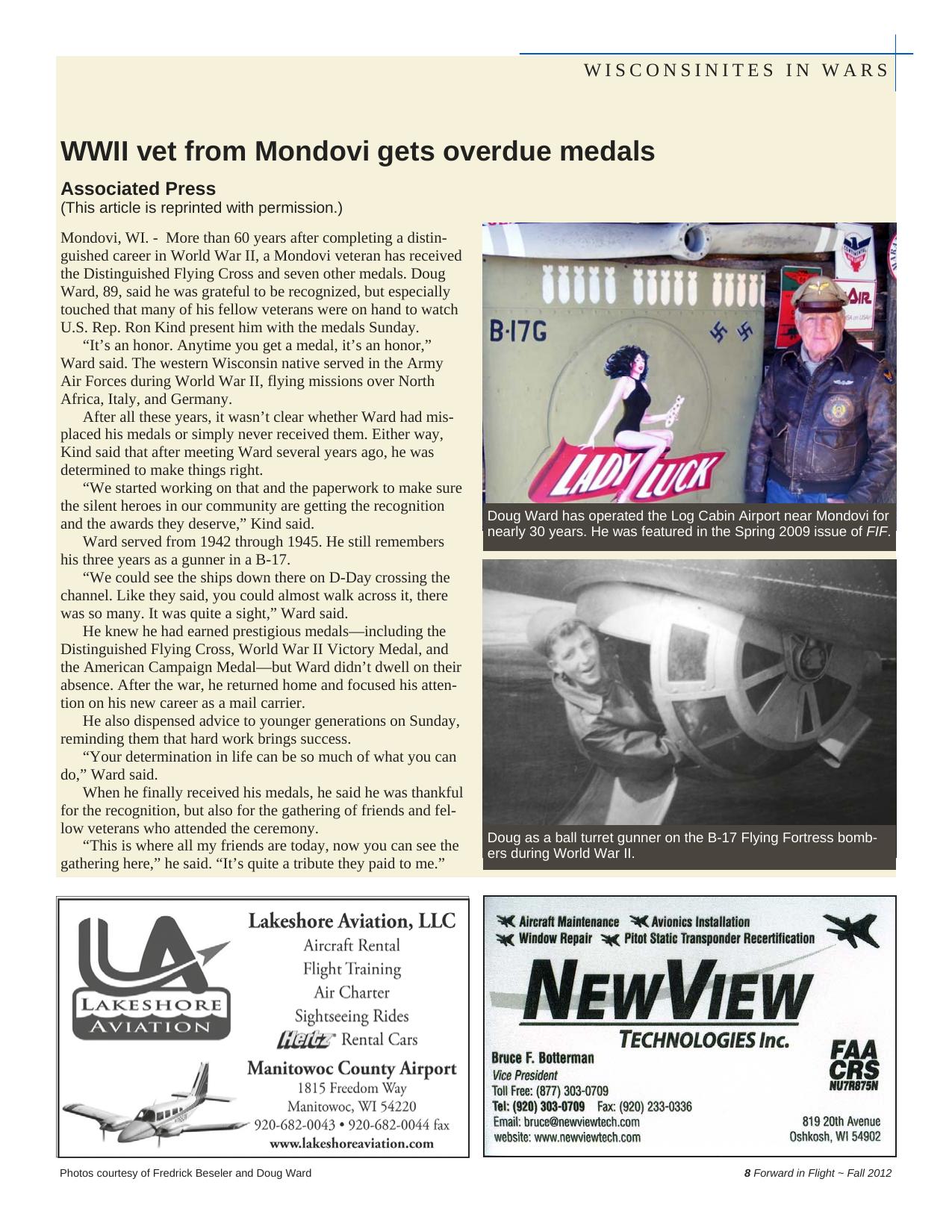
WISCONSINITES IN WARS WWII vet from Mondovi gets overdue medals Associated Press (This article is reprinted with permission.) Mondovi, WI. - More than 60 years after completing a distinguished career in World War II, a Mondovi veteran has received the Distinguished Flying Cross and seven other medals. Doug Ward, 89, said he was grateful to be recognized, but especially touched that many of his fellow veterans were on hand to watch U.S. Rep. Ron Kind present him with the medals Sunday. “It’s an honor. Anytime you get a medal, it’s an honor,” Ward said. The western Wisconsin native served in the Army Air Forces during World War II, flying missions over North Africa, Italy, and Germany. After all these years, it wasn’t clear whether Ward had misplaced his medals or simply never received them. Either way, Kind said that after meeting Ward several years ago, he was determined to make things right. “We started working on that and the paperwork to make sure the silent heroes in our community are getting the recognition and the awards they deserve,” Kind said. Ward served from 1942 through 1945. He still remembers his three years as a gunner in a B-17. “We could see the ships down there on D-Day crossing the channel. Like they said, you could almost walk across it, there was so many. It was quite a sight,” Ward said. He knew he had earned prestigious medals—including the Distinguished Flying Cross, World War II Victory Medal, and the American Campaign Medal—but Ward didn’t dwell on their absence. After the war, he returned home and focused his attention on his new career as a mail carrier. He also dispensed advice to younger generations on Sunday, reminding them that hard work brings success. “Your determination in life can be so much of what you can do,” Ward said. When he finally received his medals, he said he was thankful for the recognition, but also for the gathering of friends and fellow veterans who attended the ceremony. “This is where all my friends are today, now you can see the gathering here,” he said. “It’s quite a tribute they paid to me.” Photos courtesy of Fredrick Beseler and Doug Ward Doug Ward has operated the Log Cabin Airport near Mondovi for nearly 30 years. He was featured in the Spring 2009 issue of FIF. Doug as a ball turret gunner on the B-17 Flying Fortress bombers during World War II. 8 Forward in Flight ~ Fall 2012
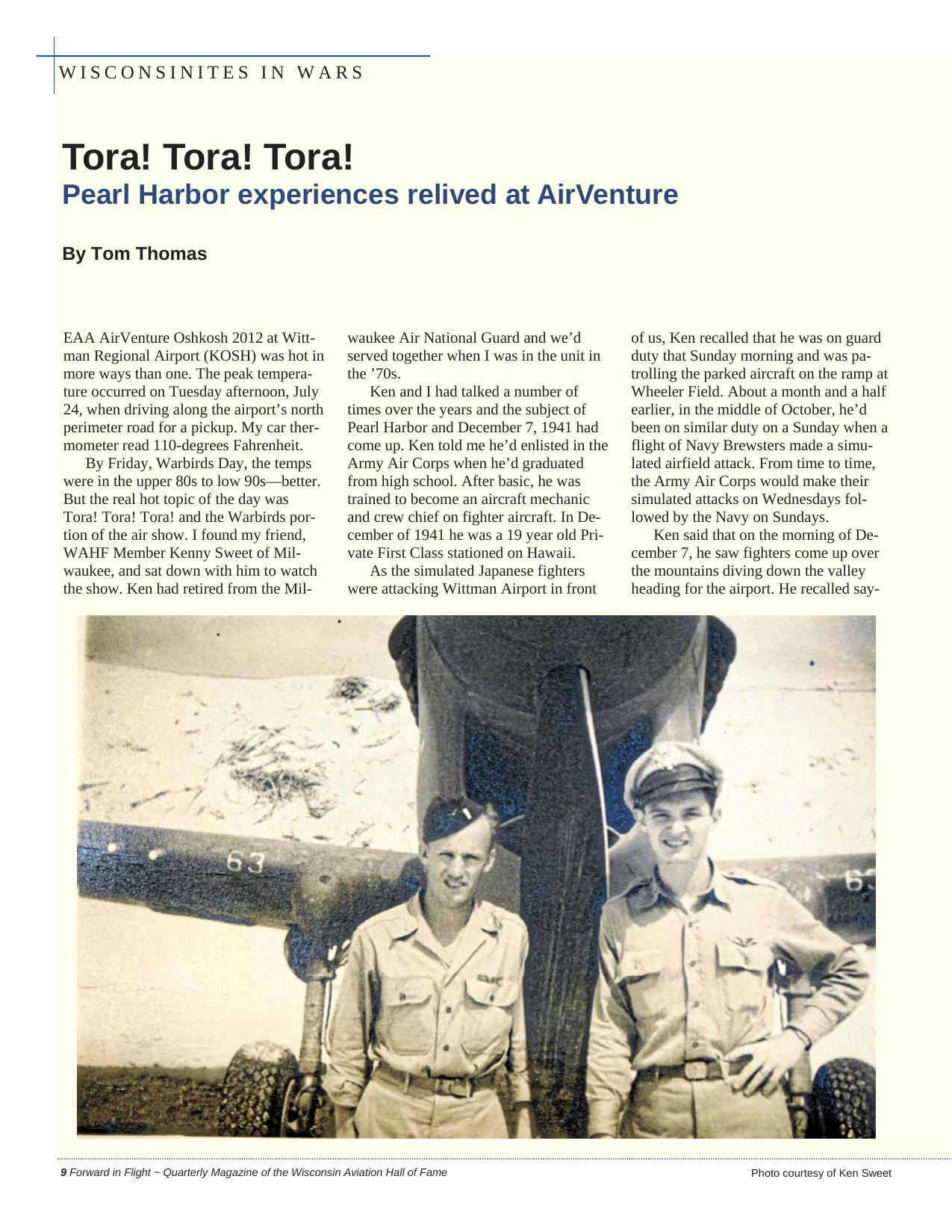
WISCONSINITES IN WARS Tora! Tora! Tora! Pearl Harbor experiences relived at AirVenture By Tom Thomas EAA AirVenture Oshkosh 2012 at Wittman Regional Airport (KOSH) was hot in more ways than one. The peak temperature occurred on Tuesday afternoon, July 24, when driving along the airport’s north perimeter road for a pickup. My car thermometer read 110-degrees Fahrenheit. By Friday, Warbirds Day, the temps were in the upper 80s to low 90s—better. But the real hot topic of the day was Tora! Tora! Tora! and the Warbirds portion of the air show. I found my friend, WAHF Member Kenny Sweet of Milwaukee, and sat down with him to watch the show. Ken had retired from the Mil- waukee Air National Guard and we’d served together when I was in the unit in the ’70s. Ken and I had talked a number of times over the years and the subject of Pearl Harbor and December 7, 1941 had come up. Ken told me he’d enlisted in the Army Air Corps when he’d graduated from high school. After basic, he was trained to become an aircraft mechanic and crew chief on fighter aircraft. In December of 1941 he was a 19 year old Private First Class stationed on Hawaii. As the simulated Japanese fighters were attacking Wittman Airport in front 9 Forward in Flight ~ Quarterly Magazine of the Wisconsin Aviation Hall of Fame of us, Ken recalled that he was on guard duty that Sunday morning and was patrolling the parked aircraft on the ramp at Wheeler Field. About a month and a half earlier, in the middle of October, he’d been on similar duty on a Sunday when a flight of Navy Brewsters made a simulated airfield attack. From time to time, the Army Air Corps would make their simulated attacks on Wednesdays followed by the Navy on Sundays. Ken said that on the morning of December 7, he saw fighters come up over the mountains diving down the valley heading for the airport. He recalled say- Photo courtesy of Ken Sweet
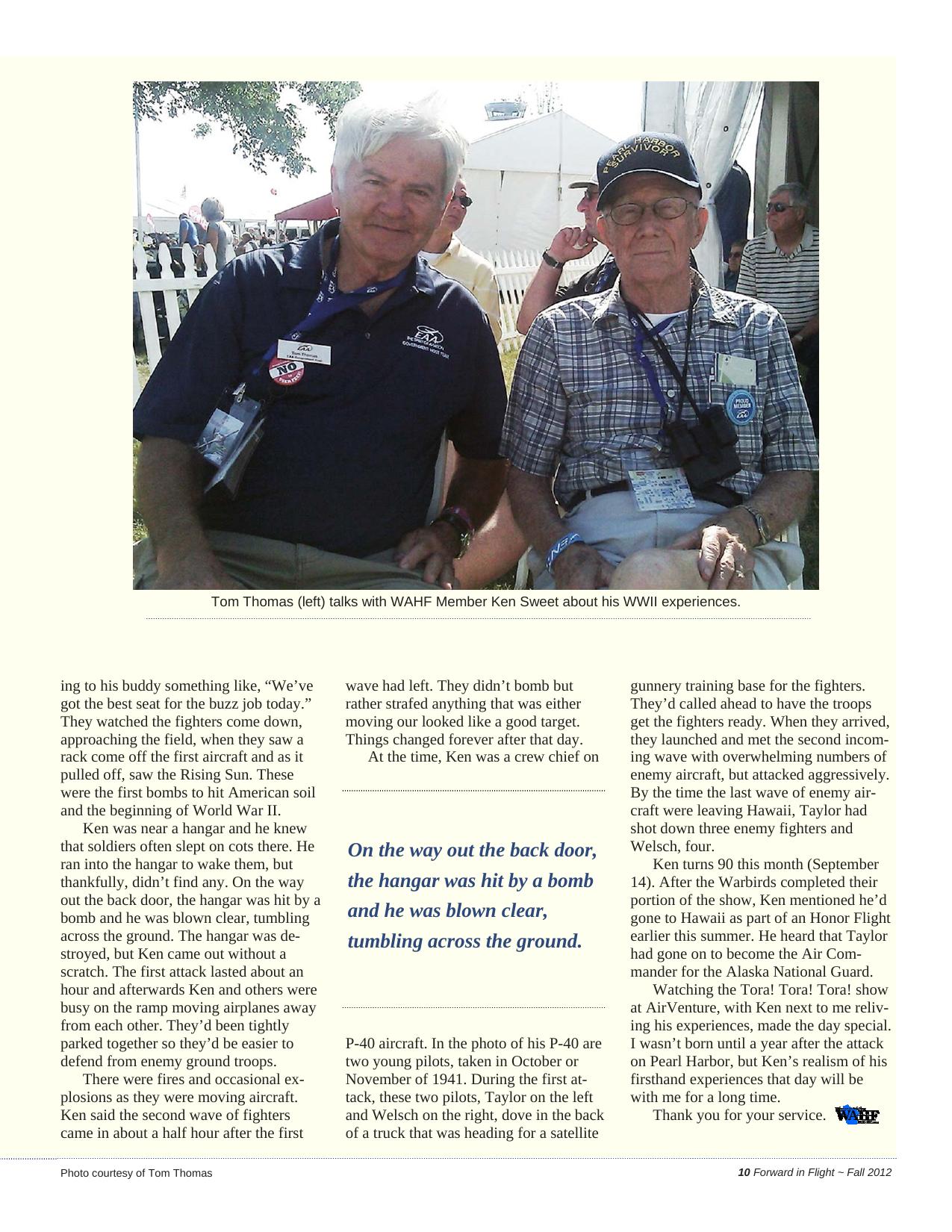
Tom Thomas (left) talks with WAHF Member Ken Sweet about his WWII experiences. ing to his buddy something like, “We’ve got the best seat for the buzz job today.” They watched the fighters come down, approaching the field, when they saw a rack come off the first aircraft and as it pulled off, saw the Rising Sun. These were the first bombs to hit American soil and the beginning of World War II. Ken was near a hangar and he knew that soldiers often slept on cots there. He ran into the hangar to wake them, but thankfully, didn’t find any. On the way out the back door, the hangar was hit by a bomb and he was blown clear, tumbling across the ground. The hangar was destroyed, but Ken came out without a scratch. The first attack lasted about an hour and afterwards Ken and others were busy on the ramp moving airplanes away from each other. They’d been tightly parked together so they’d be easier to defend from enemy ground troops. There were fires and occasional explosions as they were moving aircraft. Ken said the second wave of fighters came in about a half hour after the first Photo courtesy of Tom Thomas wave had left. They didn’t bomb but rather strafed anything that was either moving our looked like a good target. Things changed forever after that day. At the time, Ken was a crew chief on On the way out the back door, the hangar was hit by a bomb and he was blown clear, tumbling across the ground. P-40 aircraft. In the photo of his P-40 are two young pilots, taken in October or November of 1941. During the first attack, these two pilots, Taylor on the left and Welsch on the right, dove in the back of a truck that was heading for a satellite gunnery training base for the fighters. They’d called ahead to have the troops get the fighters ready. When they arrived, they launched and met the second incoming wave with overwhelming numbers of enemy aircraft, but attacked aggressively. By the time the last wave of enemy aircraft were leaving Hawaii, Taylor had shot down three enemy fighters and Welsch, four. Ken turns 90 this month (September 14). After the Warbirds completed their portion of the show, Ken mentioned he’d gone to Hawaii as part of an Honor Flight earlier this summer. He heard that Taylor had gone on to become the Air Commander for the Alaska National Guard. Watching the Tora! Tora! Tora! show at AirVenture, with Ken next to me reliving his experiences, made the day special. I wasn’t born until a year after the attack on Pearl Harbor, but Ken’s realism of his firsthand experiences that day will be with me for a long time. Thank you for your service. 10 Forward in Flight ~ Fall 2012
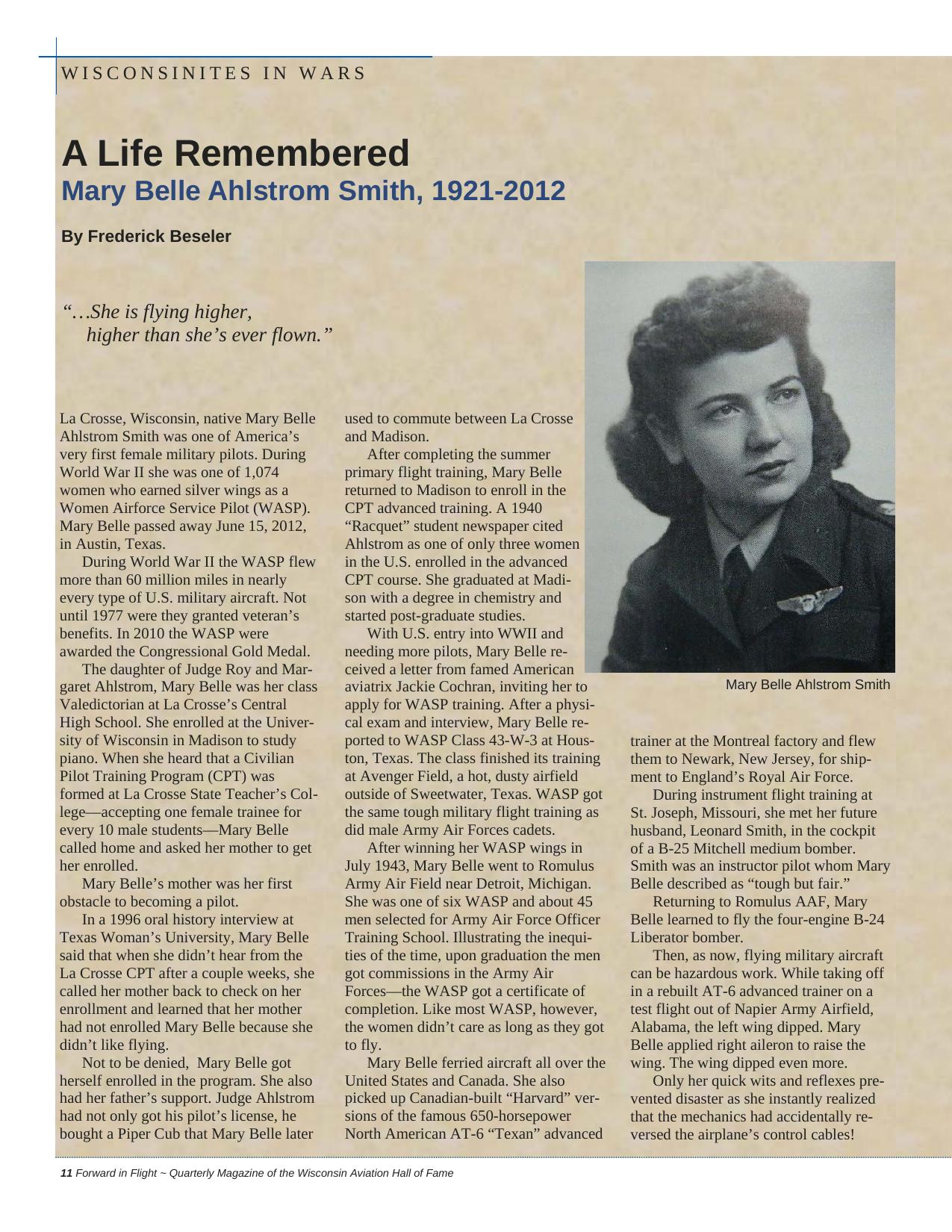
WISCONSINITES IN WARS A Life Remembered Mary Belle Ahlstrom Smith, 1921-2012 By Frederick Beseler “…She is flying higher, higher than she’s ever flown.” La Crosse, Wisconsin, native Mary Belle Ahlstrom Smith was one of America’s very first female military pilots. During World War II she was one of 1,074 women who earned silver wings as a Women Airforce Service Pilot (WASP). Mary Belle passed away June 15, 2012, in Austin, Texas. During World War II the WASP flew more than 60 million miles in nearly every type of U.S. military aircraft. Not until 1977 were they granted veteran’s benefits. In 2010 the WASP were awarded the Congressional Gold Medal. The daughter of Judge Roy and Margaret Ahlstrom, Mary Belle was her class Valedictorian at La Crosse’s Central High School. She enrolled at the University of Wisconsin in Madison to study piano. When she heard that a Civilian Pilot Training Program (CPT) was formed at La Crosse State Teacher’s College—accepting one female trainee for every 10 male students—Mary Belle called home and asked her mother to get her enrolled. Mary Belle’s mother was her first obstacle to becoming a pilot. In a 1996 oral history interview at Texas Woman’s University, Mary Belle said that when she didn’t hear from the La Crosse CPT after a couple weeks, she called her mother back to check on her enrollment and learned that her mother had not enrolled Mary Belle because she didn’t like flying. Not to be denied, Mary Belle got herself enrolled in the program. She also had her father’s support. Judge Ahlstrom had not only got his pilot’s license, he bought a Piper Cub that Mary Belle later used to commute between La Crosse and Madison. After completing the summer primary flight training, Mary Belle returned to Madison to enroll in the CPT advanced training. A 1940 “Racquet” student newspaper cited Ahlstrom as one of only three women in the U.S. enrolled in the advanced CPT course. She graduated at Madison with a degree in chemistry and started post-graduate studies. With U.S. entry into WWII and needing more pilots, Mary Belle received a letter from famed American aviatrix Jackie Cochran, inviting her to apply for WASP training. After a physical exam and interview, Mary Belle reported to WASP Class 43-W-3 at Houston, Texas. The class finished its training at Avenger Field, a hot, dusty airfield outside of Sweetwater, Texas. WASP got the same tough military flight training as did male Army Air Forces cadets. After winning her WASP wings in July 1943, Mary Belle went to Romulus Army Air Field near Detroit, Michigan. She was one of six WASP and about 45 men selected for Army Air Force Officer Training School. Illustrating the inequities of the time, upon graduation the men got commissions in the Army Air Forces—the WASP got a certificate of completion. Like most WASP, however, the women didn’t care as long as they got to fly. Mary Belle ferried aircraft all over the United States and Canada. She also picked up Canadian-built “Harvard” versions of the famous 650-horsepower North American AT-6 “Texan” advanced 11 Forward in Flight ~ Quarterly Magazine of the Wisconsin Aviation Hall of Fame Mary Belle Ahlstrom Smith trainer at the Montreal factory and flew them to Newark, New Jersey, for shipment to England’s Royal Air Force. During instrument flight training at St. Joseph, Missouri, she met her future husband, Leonard Smith, in the cockpit of a B-25 Mitchell medium bomber. Smith was an instructor pilot whom Mary Belle described as “tough but fair.” Returning to Romulus AAF, Mary Belle learned to fly the four-engine B-24 Liberator bomber. Then, as now, flying military aircraft can be hazardous work. While taking off in a rebuilt AT-6 advanced trainer on a test flight out of Napier Army Airfield, Alabama, the left wing dipped. Mary Belle applied right aileron to raise the wing. The wing dipped even more. Only her quick wits and reflexes prevented disaster as she instantly realized that the mechanics had accidentally reversed the airplane’s control cables!
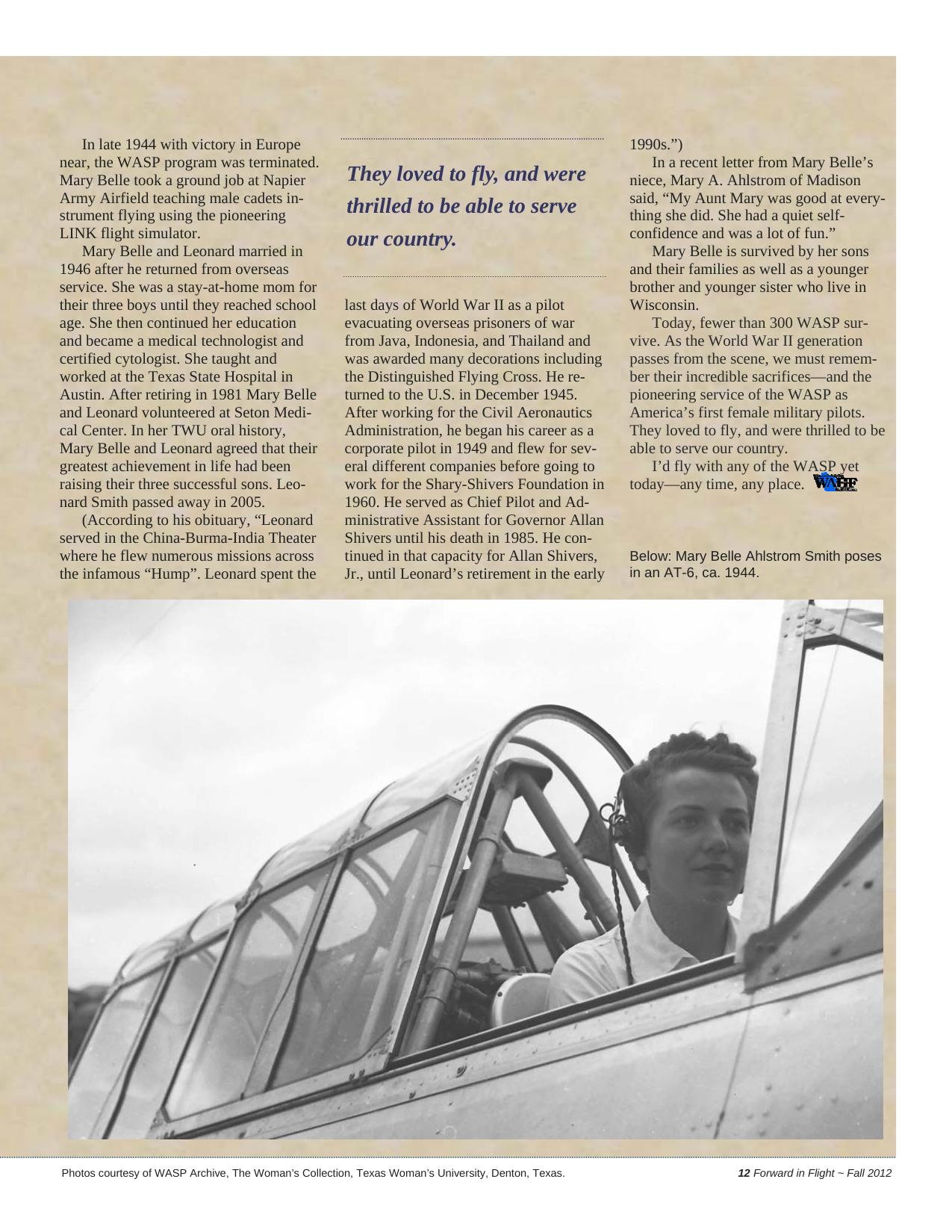
In late 1944 with victory in Europe near, the WASP program was terminated. Mary Belle took a ground job at Napier Army Airfield teaching male cadets instrument flying using the pioneering LINK flight simulator. Mary Belle and Leonard married in 1946 after he returned from overseas service. She was a stay-at-home mom for their three boys until they reached school age. She then continued her education and became a medical technologist and certified cytologist. She taught and worked at the Texas State Hospital in Austin. After retiring in 1981 Mary Belle and Leonard volunteered at Seton Medical Center. In her TWU oral history, Mary Belle and Leonard agreed that their greatest achievement in life had been raising their three successful sons. Leonard Smith passed away in 2005. (According to his obituary, “Leonard served in the China-Burma-India Theater where he flew numerous missions across the infamous “Hump”. Leonard spent the They loved to fly, and were thrilled to be able to serve our country. last days of World War II as a pilot evacuating overseas prisoners of war from Java, Indonesia, and Thailand and was awarded many decorations including the Distinguished Flying Cross. He returned to the U.S. in December 1945. After working for the Civil Aeronautics Administration, he began his career as a corporate pilot in 1949 and flew for several different companies before going to work for the Shary-Shivers Foundation in 1960. He served as Chief Pilot and Administrative Assistant for Governor Allan Shivers until his death in 1985. He continued in that capacity for Allan Shivers, Jr., until Leonard’s retirement in the early Photos courtesy of WASP Archive, The Woman’s Collection, Texas Woman’s University, Denton, Texas. 1990s.”) In a recent letter from Mary Belle’s niece, Mary A. Ahlstrom of Madison said, “My Aunt Mary was good at everything she did. She had a quiet selfconfidence and was a lot of fun.” Mary Belle is survived by her sons and their families as well as a younger brother and younger sister who live in Wisconsin. Today, fewer than 300 WASP survive. As the World War II generation passes from the scene, we must remember their incredible sacrifices—and the pioneering service of the WASP as America’s first female military pilots. They loved to fly, and were thrilled to be able to serve our country. I’d fly with any of the WASP yet today—any time, any place. Below: Mary Belle Ahlstrom Smith poses in an AT-6, ca. 1944. 12 Forward in Flight ~ Fall 2012
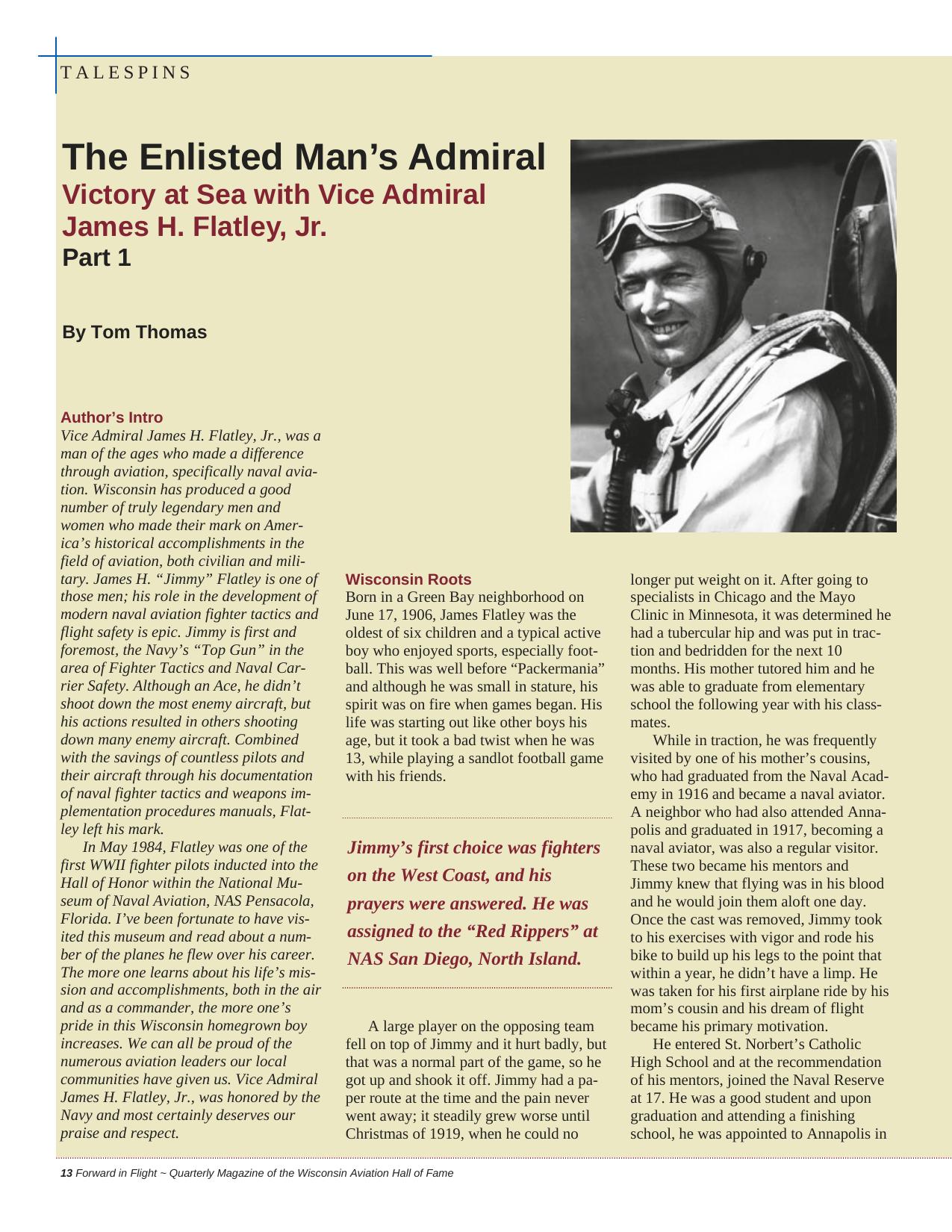
TALESPINS The Enlisted Man’s Admiral Victory at Sea with Vice Admiral James H. Flatley, Jr. Part 1 By Tom Thomas Author’s Intro Vice Admiral James H. Flatley, Jr., was a man of the ages who made a difference through aviation, specifically naval aviation. Wisconsin has produced a good number of truly legendary men and women who made their mark on America’s historical accomplishments in the field of aviation, both civilian and military. James H. “Jimmy” Flatley is one of those men; his role in the development of modern naval aviation fighter tactics and flight safety is epic. Jimmy is first and foremost, the Navy’s “Top Gun” in the area of Fighter Tactics and Naval Carrier Safety. Although an Ace, he didn’t shoot down the most enemy aircraft, but his actions resulted in others shooting down many enemy aircraft. Combined with the savings of countless pilots and their aircraft through his documentation of naval fighter tactics and weapons implementation procedures manuals, Flatley left his mark. In May 1984, Flatley was one of the first WWII fighter pilots inducted into the Hall of Honor within the National Museum of Naval Aviation, NAS Pensacola, Florida. I’ve been fortunate to have visited this museum and read about a number of the planes he flew over his career. The more one learns about his life’s mission and accomplishments, both in the air and as a commander, the more one’s pride in this Wisconsin homegrown boy increases. We can all be proud of the numerous aviation leaders our local communities have given us. Vice Admiral James H. Flatley, Jr., was honored by the Navy and most certainly deserves our praise and respect. Wisconsin Roots Born in a Green Bay neighborhood on June 17, 1906, James Flatley was the oldest of six children and a typical active boy who enjoyed sports, especially football. This was well before “Packermania” and although he was small in stature, his spirit was on fire when games began. His life was starting out like other boys his age, but it took a bad twist when he was 13, while playing a sandlot football game with his friends. Jimmy’s first choice was fighters on the West Coast, and his prayers were answered. He was assigned to the “Red Rippers” at NAS San Diego, North Island. A large player on the opposing team fell on top of Jimmy and it hurt badly, but that was a normal part of the game, so he got up and shook it off. Jimmy had a paper route at the time and the pain never went away; it steadily grew worse until Christmas of 1919, when he could no 13 Forward in Flight ~ Quarterly Magazine of the Wisconsin Aviation Hall of Fame longer put weight on it. After going to specialists in Chicago and the Mayo Clinic in Minnesota, it was determined he had a tubercular hip and was put in traction and bedridden for the next 10 months. His mother tutored him and he was able to graduate from elementary school the following year with his classmates. While in traction, he was frequently visited by one of his mother’s cousins, who had graduated from the Naval Academy in 1916 and became a naval aviator. A neighbor who had also attended Annapolis and graduated in 1917, becoming a naval aviator, was also a regular visitor. These two became his mentors and Jimmy knew that flying was in his blood and he would join them aloft one day. Once the cast was removed, Jimmy took to his exercises with vigor and rode his bike to build up his legs to the point that within a year, he didn’t have a limp. He was taken for his first airplane ride by his mom’s cousin and his dream of flight became his primary motivation. He entered St. Norbert’s Catholic High School and at the recommendation of his mentors, joined the Naval Reserve at 17. He was a good student and upon graduation and attending a finishing school, he was appointed to Annapolis in
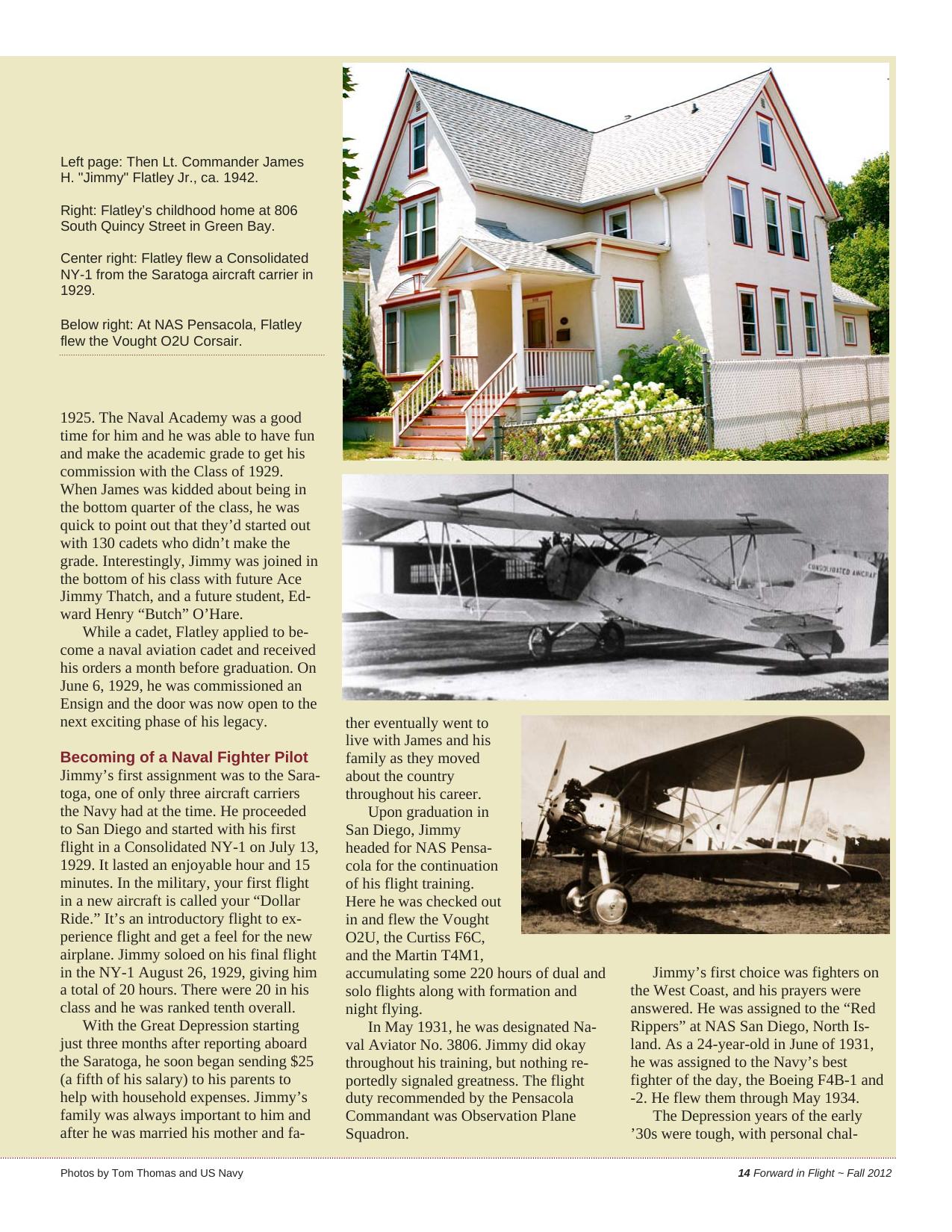
Left page: Then Lt. Commander James H. "Jimmy" Flatley Jr., ca. 1942. Right: Flatley’s childhood home at 806 South Quincy Street in Green Bay. Center right: Flatley flew a Consolidated NY-1 from the Saratoga aircraft carrier in 1929. Below right: At NAS Pensacola, Flatley flew the Vought O2U Corsair. 1925. The Naval Academy was a good time for him and he was able to have fun and make the academic grade to get his commission with the Class of 1929. When James was kidded about being in the bottom quarter of the class, he was quick to point out that they’d started out with 130 cadets who didn’t make the grade. Interestingly, Jimmy was joined in the bottom of his class with future Ace Jimmy Thatch, and a future student, Edward Henry “Butch” O’Hare. While a cadet, Flatley applied to become a naval aviation cadet and received his orders a month before graduation. On June 6, 1929, he was commissioned an Ensign and the door was now open to the next exciting phase of his legacy. Becoming of a Naval Fighter Pilot Jimmy’s first assignment was to the Saratoga, one of only three aircraft carriers the Navy had at the time. He proceeded to San Diego and started with his first flight in a Consolidated NY-1 on July 13, 1929. It lasted an enjoyable hour and 15 minutes. In the military, your first flight in a new aircraft is called your “Dollar Ride.” It’s an introductory flight to experience flight and get a feel for the new airplane. Jimmy soloed on his final flight in the NY-1 August 26, 1929, giving him a total of 20 hours. There were 20 in his class and he was ranked tenth overall. With the Great Depression starting just three months after reporting aboard the Saratoga, he soon began sending $25 (a fifth of his salary) to his parents to help with household expenses. Jimmy’s family was always important to him and after he was married his mother and faPhotos by Tom Thomas and US Navy ther eventually went to live with James and his family as they moved about the country throughout his career. Upon graduation in San Diego, Jimmy headed for NAS Pensacola for the continuation of his flight training. Here he was checked out in and flew the Vought O2U, the Curtiss F6C, and the Martin T4M1, accumulating some 220 hours of dual and solo flights along with formation and night flying. In May 1931, he was designated Naval Aviator No. 3806. Jimmy did okay throughout his training, but nothing reportedly signaled greatness. The flight duty recommended by the Pensacola Commandant was Observation Plane Squadron. Jimmy’s first choice was fighters on the West Coast, and his prayers were answered. He was assigned to the “Red Rippers” at NAS San Diego, North Island. As a 24-year-old in June of 1931, he was assigned to the Navy’s best fighter of the day, the Boeing F4B-1 and -2. He flew them through May 1934. The Depression years of the early ’30s were tough, with personal chal14 Forward in Flight ~ Fall 2012
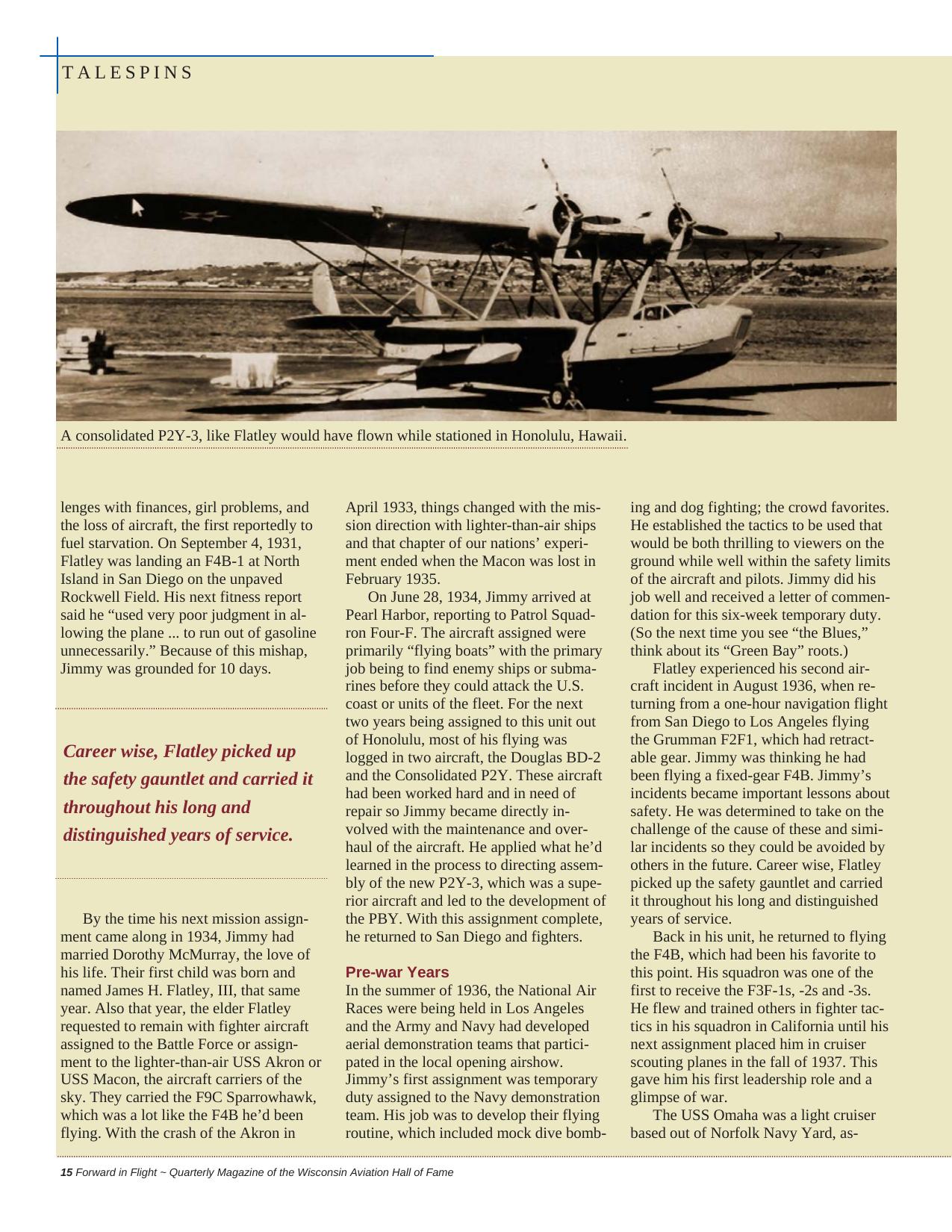
TALESPINS A consolidated P2Y-3, like Flatley would have flown while stationed in Honolulu, Hawaii. lenges with finances, girl problems, and the loss of aircraft, the first reportedly to fuel starvation. On September 4, 1931, Flatley was landing an F4B-1 at North Island in San Diego on the unpaved Rockwell Field. His next fitness report said he “used very poor judgment in allowing the plane ... to run out of gasoline unnecessarily.” Because of this mishap, Jimmy was grounded for 10 days. Career wise, Flatley picked up the safety gauntlet and carried it throughout his long and distinguished years of service. By the time his next mission assignment came along in 1934, Jimmy had married Dorothy McMurray, the love of his life. Their first child was born and named James H. Flatley, III, that same year. Also that year, the elder Flatley requested to remain with fighter aircraft assigned to the Battle Force or assignment to the lighter-than-air USS Akron or USS Macon, the aircraft carriers of the sky. They carried the F9C Sparrowhawk, which was a lot like the F4B he’d been flying. With the crash of the Akron in April 1933, things changed with the mission direction with lighter-than-air ships and that chapter of our nations’ experiment ended when the Macon was lost in February 1935. On June 28, 1934, Jimmy arrived at Pearl Harbor, reporting to Patrol Squadron Four-F. The aircraft assigned were primarily “flying boats” with the primary job being to find enemy ships or submarines before they could attack the U.S. coast or units of the fleet. For the next two years being assigned to this unit out of Honolulu, most of his flying was logged in two aircraft, the Douglas BD-2 and the Consolidated P2Y. These aircraft had been worked hard and in need of repair so Jimmy became directly involved with the maintenance and overhaul of the aircraft. He applied what he’d learned in the process to directing assembly of the new P2Y-3, which was a superior aircraft and led to the development of the PBY. With this assignment complete, he returned to San Diego and fighters. Pre-war Years In the summer of 1936, the National Air Races were being held in Los Angeles and the Army and Navy had developed aerial demonstration teams that participated in the local opening airshow. Jimmy’s first assignment was temporary duty assigned to the Navy demonstration team. His job was to develop their flying routine, which included mock dive bomb- 15 Forward in Flight ~ Quarterly Magazine of the Wisconsin Aviation Hall of Fame ing and dog fighting; the crowd favorites. He established the tactics to be used that would be both thrilling to viewers on the ground while well within the safety limits of the aircraft and pilots. Jimmy did his job well and received a letter of commendation for this six-week temporary duty. (So the next time you see “the Blues,” think about its “Green Bay” roots.) Flatley experienced his second aircraft incident in August 1936, when returning from a one-hour navigation flight from San Diego to Los Angeles flying the Grumman F2F1, which had retractable gear. Jimmy was thinking he had been flying a fixed-gear F4B. Jimmy’s incidents became important lessons about safety. He was determined to take on the challenge of the cause of these and similar incidents so they could be avoided by others in the future. Career wise, Flatley picked up the safety gauntlet and carried it throughout his long and distinguished years of service. Back in his unit, he returned to flying the F4B, which had been his favorite to this point. His squadron was one of the first to receive the F3F-1s, -2s and -3s. He flew and trained others in fighter tactics in his squadron in California until his next assignment placed him in cruiser scouting planes in the fall of 1937. This gave him his first leadership role and a glimpse of war. The USS Omaha was a light cruiser based out of Norfolk Navy Yard, as-
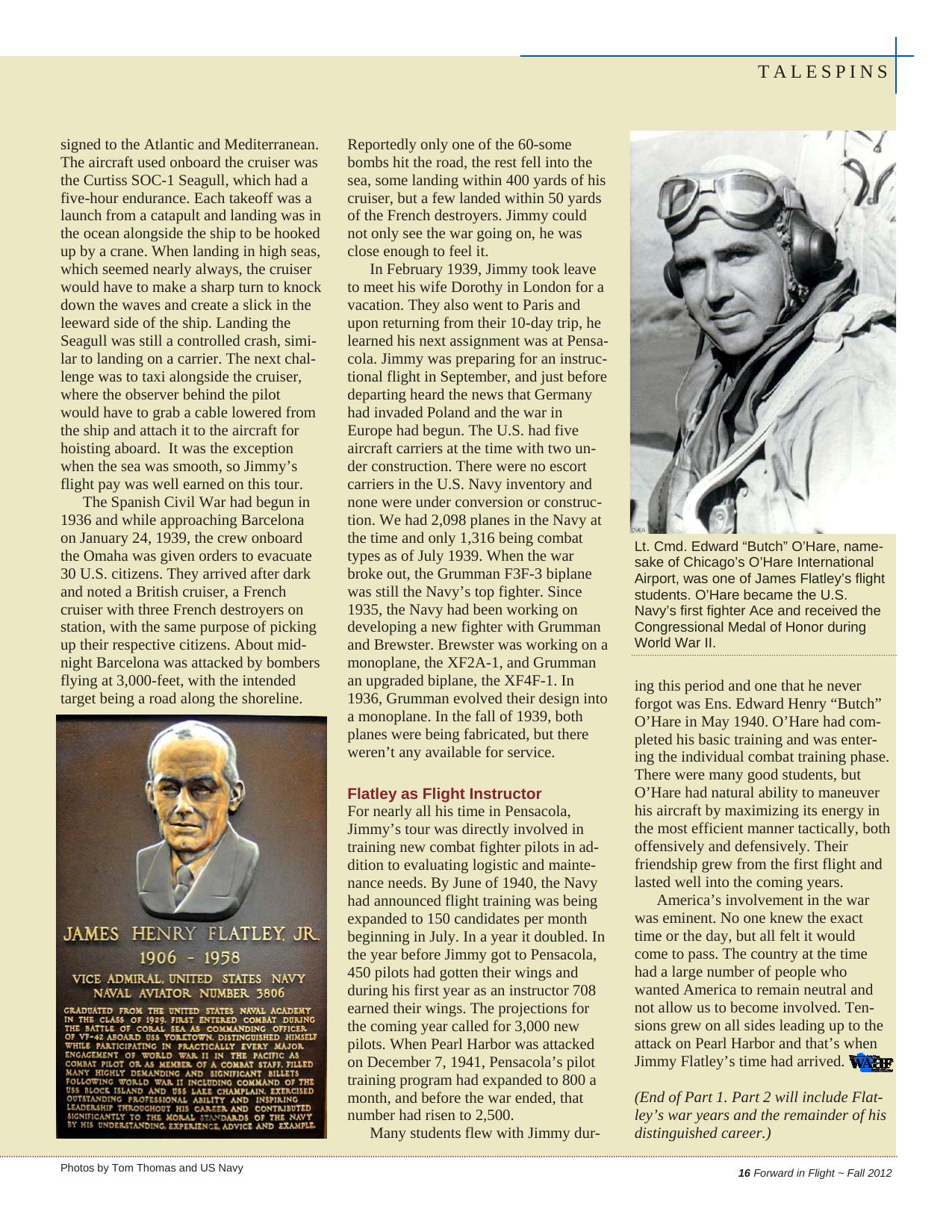
TALESPINS signed to the Atlantic and Mediterranean. The aircraft used onboard the cruiser was the Curtiss SOC-1 Seagull, which had a five-hour endurance. Each takeoff was a launch from a catapult and landing was in the ocean alongside the ship to be hooked up by a crane. When landing in high seas, which seemed nearly always, the cruiser would have to make a sharp turn to knock down the waves and create a slick in the leeward side of the ship. Landing the Seagull was still a controlled crash, similar to landing on a carrier. The next challenge was to taxi alongside the cruiser, where the observer behind the pilot would have to grab a cable lowered from the ship and attach it to the aircraft for hoisting aboard. It was the exception when the sea was smooth, so Jimmy’s flight pay was well earned on this tour. The Spanish Civil War had begun in 1936 and while approaching Barcelona on January 24, 1939, the crew onboard the Omaha was given orders to evacuate 30 U.S. citizens. They arrived after dark and noted a British cruiser, a French cruiser with three French destroyers on station, with the same purpose of picking up their respective citizens. About midnight Barcelona was attacked by bombers flying at 3,000-feet, with the intended target being a road along the shoreline. Reportedly only one of the 60-some bombs hit the road, the rest fell into the sea, some landing within 400 yards of his cruiser, but a few landed within 50 yards of the French destroyers. Jimmy could not only see the war going on, he was close enough to feel it. In February 1939, Jimmy took leave to meet his wife Dorothy in London for a vacation. They also went to Paris and upon returning from their 10-day trip, he learned his next assignment was at Pensacola. Jimmy was preparing for an instructional flight in September, and just before departing heard the news that Germany had invaded Poland and the war in Europe had begun. The U.S. had five aircraft carriers at the time with two under construction. There were no escort carriers in the U.S. Navy inventory and none were under conversion or construction. We had 2,098 planes in the Navy at the time and only 1,316 being combat types as of July 1939. When the war broke out, the Grumman F3F-3 biplane was still the Navy’s top fighter. Since 1935, the Navy had been working on developing a new fighter with Grumman and Brewster. Brewster was working on a monoplane, the XF2A-1, and Grumman an upgraded biplane, the XF4F-1. In 1936, Grumman evolved their design into a monoplane. In the fall of 1939, both planes were being fabricated, but there weren’t any available for service. Flatley as Flight Instructor For nearly all his time in Pensacola, Jimmy’s tour was directly involved in training new combat fighter pilots in addition to evaluating logistic and maintenance needs. By June of 1940, the Navy had announced flight training was being expanded to 150 candidates per month beginning in July. In a year it doubled. In the year before Jimmy got to Pensacola, 450 pilots had gotten their wings and during his first year as an instructor 708 earned their wings. The projections for the coming year called for 3,000 new pilots. When Pearl Harbor was attacked on December 7, 1941, Pensacola’s pilot training program had expanded to 800 a month, and before the war ended, that number had risen to 2,500. Many students flew with Jimmy dur- Photos by Tom Thomas and US Navy Lt. Cmd. Edward “Butch” O’Hare, namesake of Chicago’s O’Hare International Airport, was one of James Flatley’s flight students. O’Hare became the U.S. Navy’s first fighter Ace and received the Congressional Medal of Honor during World War II. ing this period and one that he never forgot was Ens. Edward Henry “Butch” O’Hare in May 1940. O’Hare had completed his basic training and was entering the individual combat training phase. There were many good students, but O’Hare had natural ability to maneuver his aircraft by maximizing its energy in the most efficient manner tactically, both offensively and defensively. Their friendship grew from the first flight and lasted well into the coming years. America’s involvement in the war was eminent. No one knew the exact time or the day, but all felt it would come to pass. The country at the time had a large number of people who wanted America to remain neutral and not allow us to become involved. Tensions grew on all sides leading up to the attack on Pearl Harbor and that’s when Jimmy Flatley’s time had arrived. (End of Part 1. Part 2 will include Flatley’s war years and the remainder of his distinguished career.) 16 Forward in Flight ~ Fall 2012
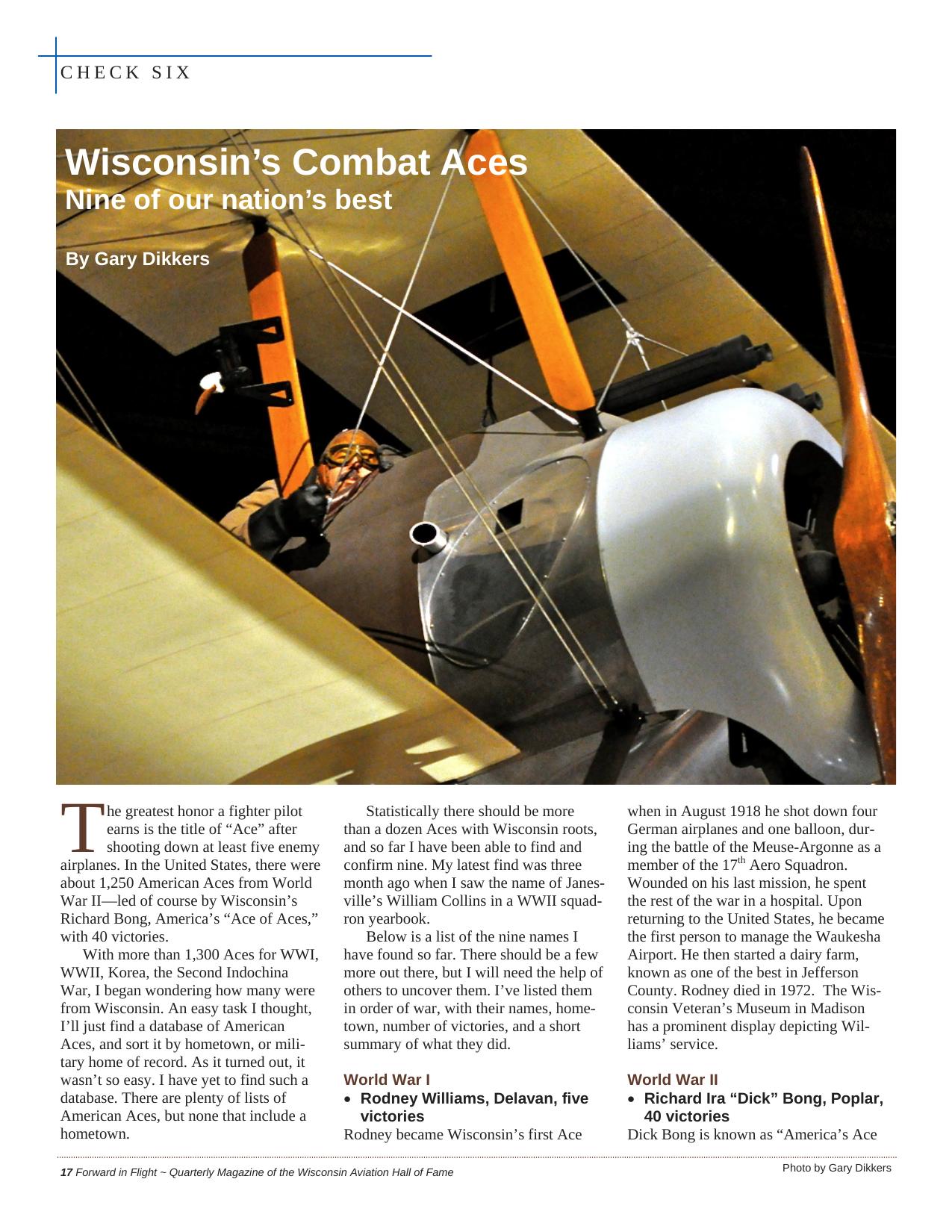
CHECK SIX Wisconsin’s Combat Aces Nine of our nation’s best By Gary Dikkers T he greatest honor a fighter pilot earns is the title of “Ace” after shooting down at least five enemy airplanes. In the United States, there were about 1,250 American Aces from World War II—led of course by Wisconsin’s Richard Bong, America’s “Ace of Aces,” with 40 victories. With more than 1,300 Aces for WWI, WWII, Korea, the Second Indochina War, I began wondering how many were from Wisconsin. An easy task I thought, I’ll just find a database of American Aces, and sort it by hometown, or military home of record. As it turned out, it wasn’t so easy. I have yet to find such a database. There are plenty of lists of American Aces, but none that include a hometown. Statistically there should be more than a dozen Aces with Wisconsin roots, and so far I have been able to find and confirm nine. My latest find was three month ago when I saw the name of Janesville’s William Collins in a WWII squadron yearbook. Below is a list of the nine names I have found so far. There should be a few more out there, but I will need the help of others to uncover them. I’ve listed them in order of war, with their names, hometown, number of victories, and a short summary of what they did. when in August 1918 he shot down four German airplanes and one balloon, during the battle of the Meuse-Argonne as a member of the 17th Aero Squadron. Wounded on his last mission, he spent the rest of the war in a hospital. Upon returning to the United States, he became the first person to manage the Waukesha Airport. He then started a dairy farm, known as one of the best in Jefferson County. Rodney died in 1972. The Wisconsin Veteran’s Museum in Madison has a prominent display depicting Williams’ service. World War I Rodney Williams, Delavan, five victories Rodney became Wisconsin’s first Ace World War II Richard Ira “Dick” Bong, Poplar, 40 victories Dick Bong is known as “America’s Ace 17 Forward in Flight ~ Quarterly Magazine of the Wisconsin Aviation Hall of Fame Photo by Gary Dikkers
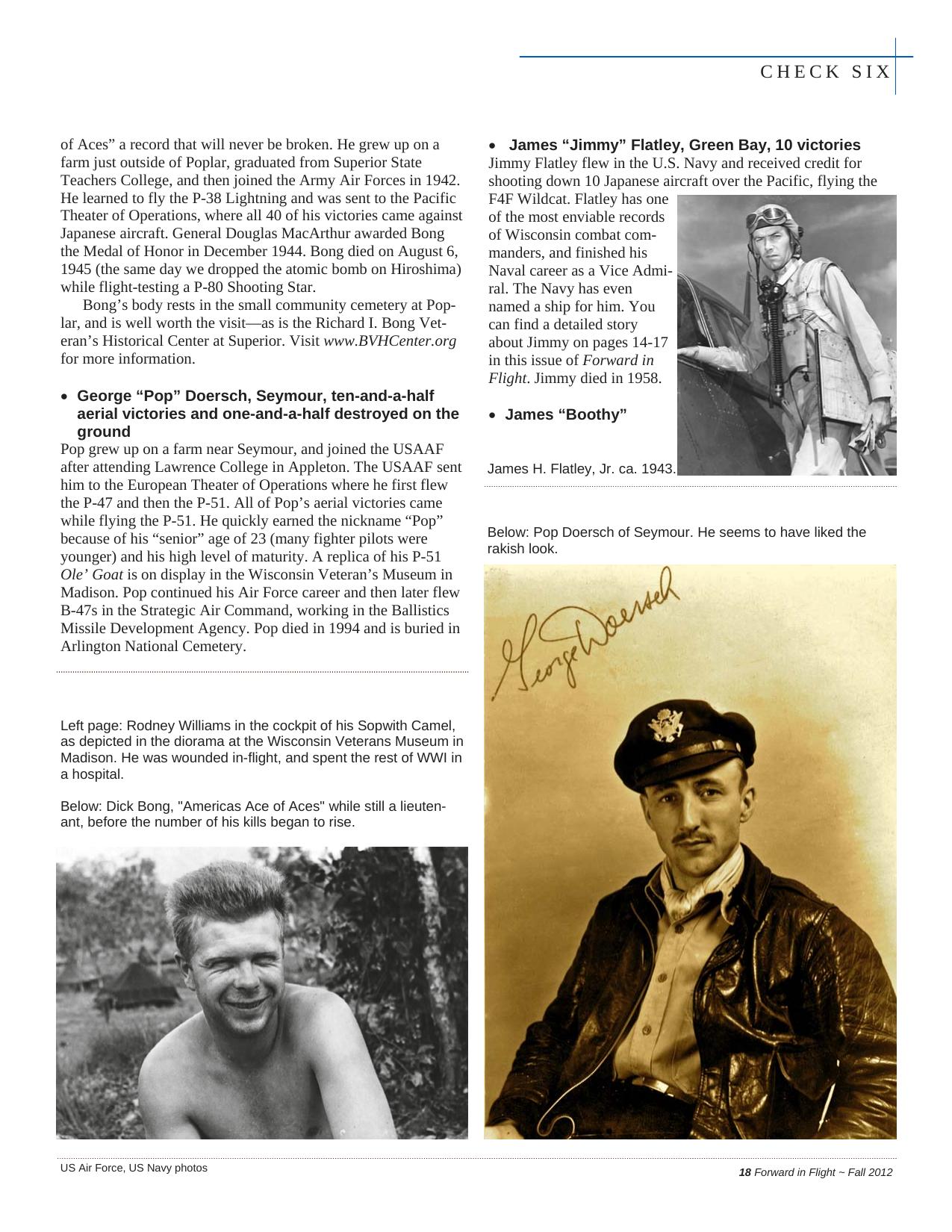
CHECK SIX of Aces” a record that will never be broken. He grew up on a farm just outside of Poplar, graduated from Superior State Teachers College, and then joined the Army Air Forces in 1942. He learned to fly the P-38 Lightning and was sent to the Pacific Theater of Operations, where all 40 of his victories came against Japanese aircraft. General Douglas MacArthur awarded Bong the Medal of Honor in December 1944. Bong died on August 6, 1945 (the same day we dropped the atomic bomb on Hiroshima) while flight-testing a P-80 Shooting Star. Bong’s body rests in the small community cemetery at Poplar, and is well worth the visit—as is the Richard I. Bong Veteran’s Historical Center at Superior. Visit www.BVHCenter.org for more information. George “Pop” Doersch, Seymour, ten-and-a-half aerial victories and one-and-a-half destroyed on the ground Pop grew up on a farm near Seymour, and joined the USAAF after attending Lawrence College in Appleton. The USAAF sent him to the European Theater of Operations where he first flew the P-47 and then the P-51. All of Pop’s aerial victories came while flying the P-51. He quickly earned the nickname “Pop” because of his “senior” age of 23 (many fighter pilots were younger) and his high level of maturity. A replica of his P-51 Ole’ Goat is on display in the Wisconsin Veteran’s Museum in Madison. Pop continued his Air Force career and then later flew B-47s in the Strategic Air Command, working in the Ballistics Missile Development Agency. Pop died in 1994 and is buried in Arlington National Cemetery. James “Jimmy” Flatley, Green Bay, 10 victories Jimmy Flatley flew in the U.S. Navy and received credit for shooting down 10 Japanese aircraft over the Pacific, flying the F4F Wildcat. Flatley has one of the most enviable records of Wisconsin combat commanders, and finished his Naval career as a Vice Admiral. The Navy has even named a ship for him. You can find a detailed story about Jimmy on pages 14-17 in this issue of Forward in Flight. Jimmy died in 1958. James “Boothy” James H. Flatley, Jr. ca. 1943. Below: Pop Doersch of Seymour. He seems to have liked the rakish look. Left page: Rodney Williams in the cockpit of his Sopwith Camel, as depicted in the diorama at the Wisconsin Veterans Museum in Madison. He was wounded in-flight, and spent the rest of WWI in a hospital. Below: Dick Bong, "Americas Ace of Aces" while still a lieutenant, before the number of his kills began to rise. US Air Force, US Navy photos 18 Forward in Flight ~ Fall 2012
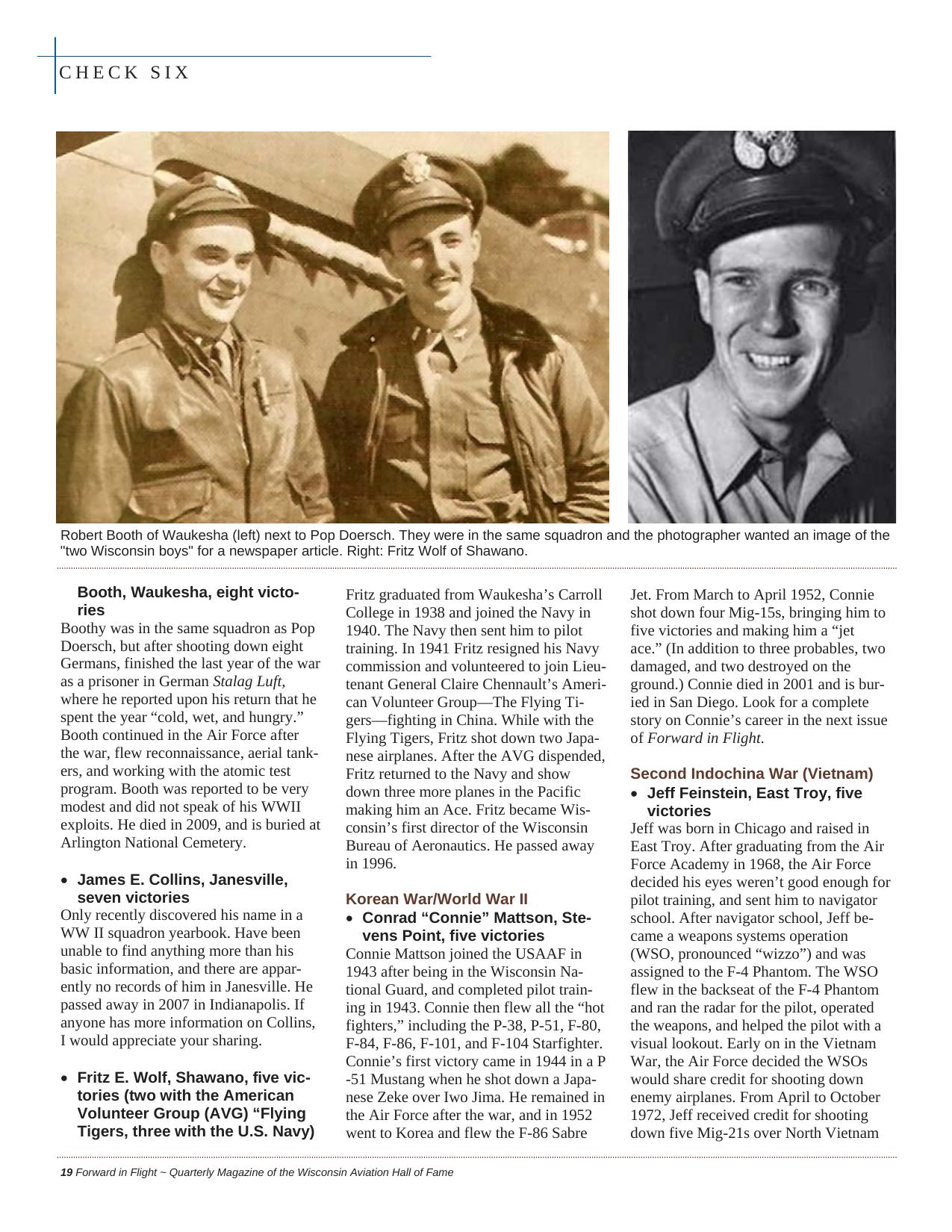
CHECK SIX Robert Booth of Waukesha (left) next to Pop Doersch. They were in the same squadron and the photographer wanted an image of the "two Wisconsin boys" for a newspaper article. Right: Fritz Wolf of Shawano. Booth, Waukesha, eight victories Boothy was in the same squadron as Pop Doersch, but after shooting down eight Germans, finished the last year of the war as a prisoner in German Stalag Luft, where he reported upon his return that he spent the year “cold, wet, and hungry.” Booth continued in the Air Force after the war, flew reconnaissance, aerial tankers, and working with the atomic test program. Booth was reported to be very modest and did not speak of his WWII exploits. He died in 2009, and is buried at Arlington National Cemetery. James E. Collins, Janesville, seven victories Only recently discovered his name in a WW II squadron yearbook. Have been unable to find anything more than his basic information, and there are apparently no records of him in Janesville. He passed away in 2007 in Indianapolis. If anyone has more information on Collins, I would appreciate your sharing. Fritz E. Wolf, Shawano, five victories (two with the American Volunteer Group (AVG) “Flying Tigers, three with the U.S. Navy) Fritz graduated from Waukesha’s Carroll College in 1938 and joined the Navy in 1940. The Navy then sent him to pilot training. In 1941 Fritz resigned his Navy commission and volunteered to join Lieutenant General Claire Chennault’s American Volunteer Group—The Flying Tigers—fighting in China. While with the Flying Tigers, Fritz shot down two Japanese airplanes. After the AVG dispended, Fritz returned to the Navy and show down three more planes in the Pacific making him an Ace. Fritz became Wisconsin’s first director of the Wisconsin Bureau of Aeronautics. He passed away in 1996. Korean War/World War II Conrad “Connie” Mattson, Stevens Point, five victories Connie Mattson joined the USAAF in 1943 after being in the Wisconsin National Guard, and completed pilot training in 1943. Connie then flew all the “hot fighters,” including the P-38, P-51, F-80, F-84, F-86, F-101, and F-104 Starfighter. Connie’s first victory came in 1944 in a P -51 Mustang when he shot down a Japanese Zeke over Iwo Jima. He remained in the Air Force after the war, and in 1952 went to Korea and flew the F-86 Sabre 19 Forward in Flight ~ Quarterly Magazine of the Wisconsin Aviation Hall of Fame Jet. From March to April 1952, Connie shot down four Mig-15s, bringing him to five victories and making him a “jet ace.” (In addition to three probables, two damaged, and two destroyed on the ground.) Connie died in 2001 and is buried in San Diego. Look for a complete story on Connie’s career in the next issue of Forward in Flight. Second Indochina War (Vietnam) Jeff Feinstein, East Troy, five victories Jeff was born in Chicago and raised in East Troy. After graduating from the Air Force Academy in 1968, the Air Force decided his eyes weren’t good enough for pilot training, and sent him to navigator school. After navigator school, Jeff became a weapons systems operation (WSO, pronounced “wizzo”) and was assigned to the F-4 Phantom. The WSO flew in the backseat of the F-4 Phantom and ran the radar for the pilot, operated the weapons, and helped the pilot with a visual lookout. Early on in the Vietnam War, the Air Force decided the WSOs would share credit for shooting down enemy airplanes. From April to October 1972, Jeff received credit for shooting down five Mig-21s over North Vietnam
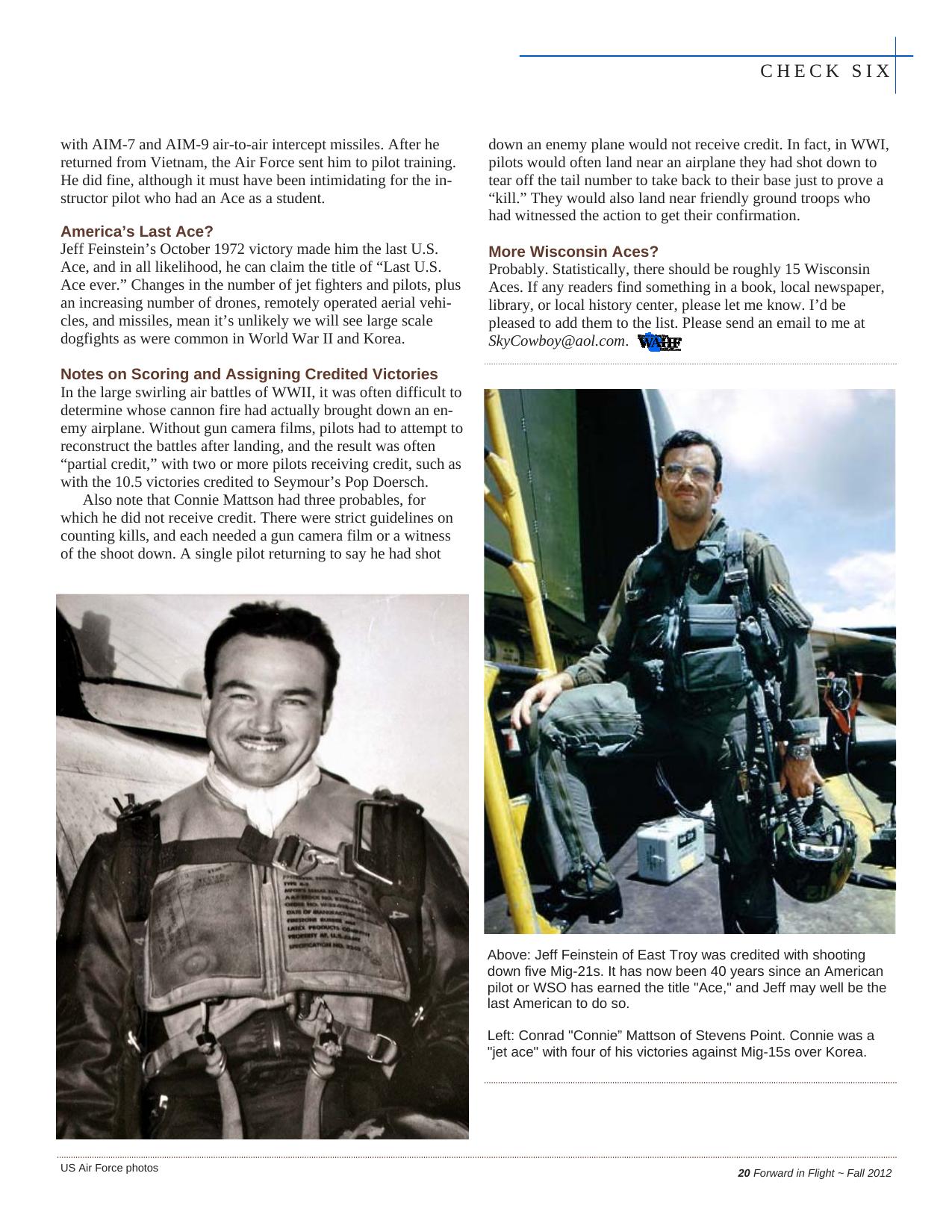
CHECK SIX with AIM-7 and AIM-9 air-to-air intercept missiles. After he returned from Vietnam, the Air Force sent him to pilot training. He did fine, although it must have been intimidating for the instructor pilot who had an Ace as a student. America’s Last Ace? Jeff Feinstein’s October 1972 victory made him the last U.S. Ace, and in all likelihood, he can claim the title of “Last U.S. Ace ever.” Changes in the number of jet fighters and pilots, plus an increasing number of drones, remotely operated aerial vehicles, and missiles, mean it’s unlikely we will see large scale dogfights as were common in World War II and Korea. down an enemy plane would not receive credit. In fact, in WWI, pilots would often land near an airplane they had shot down to tear off the tail number to take back to their base just to prove a “kill.” They would also land near friendly ground troops who had witnessed the action to get their confirmation. More Wisconsin Aces? Probably. Statistically, there should be roughly 15 Wisconsin Aces. If any readers find something in a book, local newspaper, library, or local history center, please let me know. I’d be pleased to add them to the list. Please send an email to me at SkyCowboy@aol.com. Notes on Scoring and Assigning Credited Victories In the large swirling air battles of WWII, it was often difficult to determine whose cannon fire had actually brought down an enemy airplane. Without gun camera films, pilots had to attempt to reconstruct the battles after landing, and the result was often “partial credit,” with two or more pilots receiving credit, such as with the 10.5 victories credited to Seymour’s Pop Doersch. Also note that Connie Mattson had three probables, for which he did not receive credit. There were strict guidelines on counting kills, and each needed a gun camera film or a witness of the shoot down. A single pilot returning to say he had shot Above: Jeff Feinstein of East Troy was credited with shooting down five Mig-21s. It has now been 40 years since an American pilot or WSO has earned the title "Ace," and Jeff may well be the last American to do so. Left: Conrad "Connie” Mattson of Stevens Point. Connie was a "jet ace" with four of his victories against Mig-15s over Korea. US Air Force photos 20 Forward in Flight ~ Fall 2012
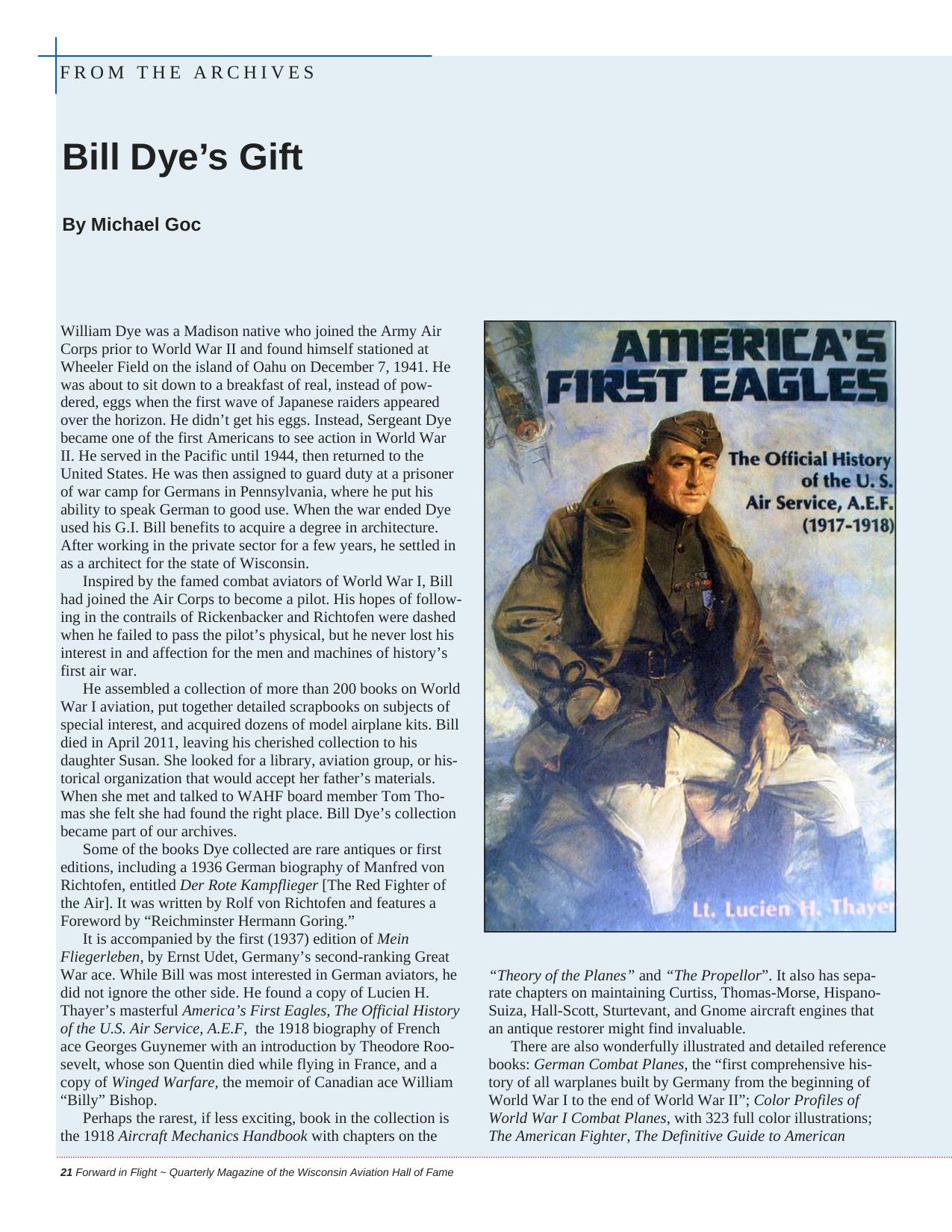
FROM THE ARCHIVES Bill Dye’s Gift By Michael Goc William Dye was a Madison native who joined the Army Air Corps prior to World War II and found himself stationed at Wheeler Field on the island of Oahu on December 7, 1941. He was about to sit down to a breakfast of real, instead of powdered, eggs when the first wave of Japanese raiders appeared over the horizon. He didn’t get his eggs. Instead, Sergeant Dye became one of the first Americans to see action in World War II. He served in the Pacific until 1944, then returned to the United States. He was then assigned to guard duty at a prisoner of war camp for Germans in Pennsylvania, where he put his ability to speak German to good use. When the war ended Dye used his G.I. Bill benefits to acquire a degree in architecture. After working in the private sector for a few years, he settled in as a architect for the state of Wisconsin. Inspired by the famed combat aviators of World War I, Bill had joined the Air Corps to become a pilot. His hopes of following in the contrails of Rickenbacker and Richtofen were dashed when he failed to pass the pilot’s physical, but he never lost his interest in and affection for the men and machines of history’s first air war. He assembled a collection of more than 200 books on World War I aviation, put together detailed scrapbooks on subjects of special interest, and acquired dozens of model airplane kits. Bill died in April 2011, leaving his cherished collection to his daughter Susan. She looked for a library, aviation group, or historical organization that would accept her father’s materials. When she met and talked to WAHF board member Tom Thomas she felt she had found the right place. Bill Dye’s collection became part of our archives. Some of the books Dye collected are rare antiques or first editions, including a 1936 German biography of Manfred von Richtofen, entitled Der Rote Kampflieger [The Red Fighter of the Air]. It was written by Rolf von Richtofen and features a Foreword by “Reichminster Hermann Goring.” It is accompanied by the first (1937) edition of Mein Fliegerleben, by Ernst Udet, Germany’s second-ranking Great War ace. While Bill was most interested in German aviators, he did not ignore the other side. He found a copy of Lucien H. Thayer’s masterful America’s First Eagles, The Official History of the U.S. Air Service, A.E.F, the 1918 biography of French ace Georges Guynemer with an introduction by Theodore Roosevelt, whose son Quentin died while flying in France, and a copy of Winged Warfare, the memoir of Canadian ace William “Billy” Bishop. Perhaps the rarest, if less exciting, book in the collection is the 1918 Aircraft Mechanics Handbook with chapters on the 21 Forward in Flight ~ Quarterly Magazine of the Wisconsin Aviation Hall of Fame “Theory of the Planes” and “The Propellor”. It also has separate chapters on maintaining Curtiss, Thomas-Morse, HispanoSuiza, Hall-Scott, Sturtevant, and Gnome aircraft engines that an antique restorer might find invaluable. There are also wonderfully illustrated and detailed reference books: German Combat Planes, the “first comprehensive history of all warplanes built by Germany from the beginning of World War I to the end of World War II”; Color Profiles of World War I Combat Planes, with 323 full color illustrations; The American Fighter, The Definitive Guide to American
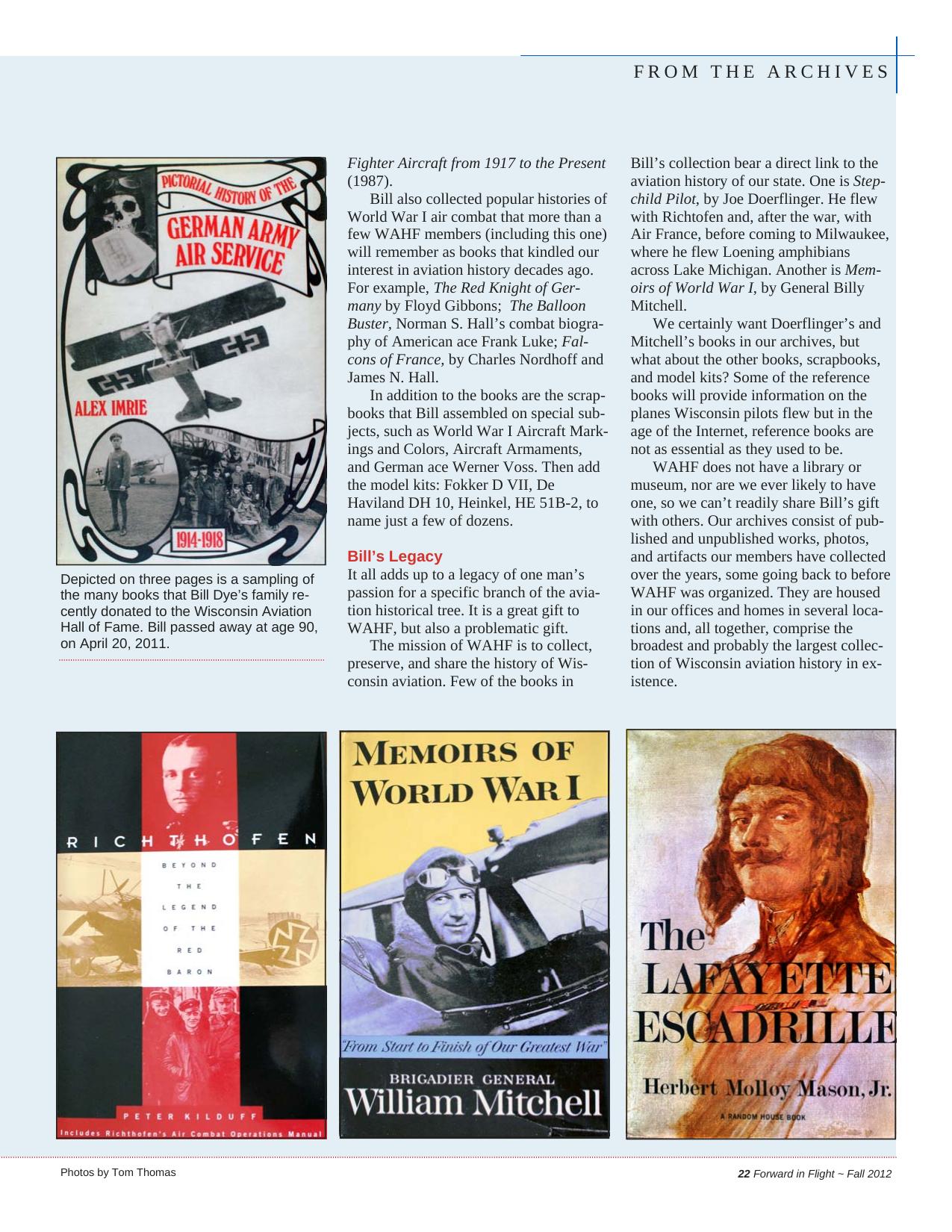
FROM THE ARCHIVES Fighter Aircraft from 1917 to the Present (1987). Bill also collected popular histories of World War I air combat that more than a few WAHF members (including this one) will remember as books that kindled our interest in aviation history decades ago. For example, The Red Knight of Germany by Floyd Gibbons; The Balloon Buster, Norman S. Hall’s combat biography of American ace Frank Luke; Falcons of France, by Charles Nordhoff and James N. Hall. In addition to the books are the scrapbooks that Bill assembled on special subjects, such as World War I Aircraft Markings and Colors, Aircraft Armaments, and German ace Werner Voss. Then add the model kits: Fokker D VII, De Haviland DH 10, Heinkel, HE 51B-2, to name just a few of dozens. Depicted on three pages is a sampling of the many books that Bill Dye’s family recently donated to the Wisconsin Aviation Hall of Fame. Bill passed away at age 90, on April 20, 2011. Photos by Tom Thomas Bill’s Legacy It all adds up to a legacy of one man’s passion for a specific branch of the aviation historical tree. It is a great gift to WAHF, but also a problematic gift. The mission of WAHF is to collect, preserve, and share the history of Wisconsin aviation. Few of the books in Bill’s collection bear a direct link to the aviation history of our state. One is Stepchild Pilot, by Joe Doerflinger. He flew with Richtofen and, after the war, with Air France, before coming to Milwaukee, where he flew Loening amphibians across Lake Michigan. Another is Memoirs of World War I, by General Billy Mitchell. We certainly want Doerflinger’s and Mitchell’s books in our archives, but what about the other books, scrapbooks, and model kits? Some of the reference books will provide information on the planes Wisconsin pilots flew but in the age of the Internet, reference books are not as essential as they used to be. WAHF does not have a library or museum, nor are we ever likely to have one, so we can’t readily share Bill’s gift with others. Our archives consist of published and unpublished works, photos, and artifacts our members have collected over the years, some going back to before WAHF was organized. They are housed in our offices and homes in several locations and, all together, comprise the broadest and probably the largest collection of Wisconsin aviation history in existence. 22 Forward in Flight ~ Fall 2012
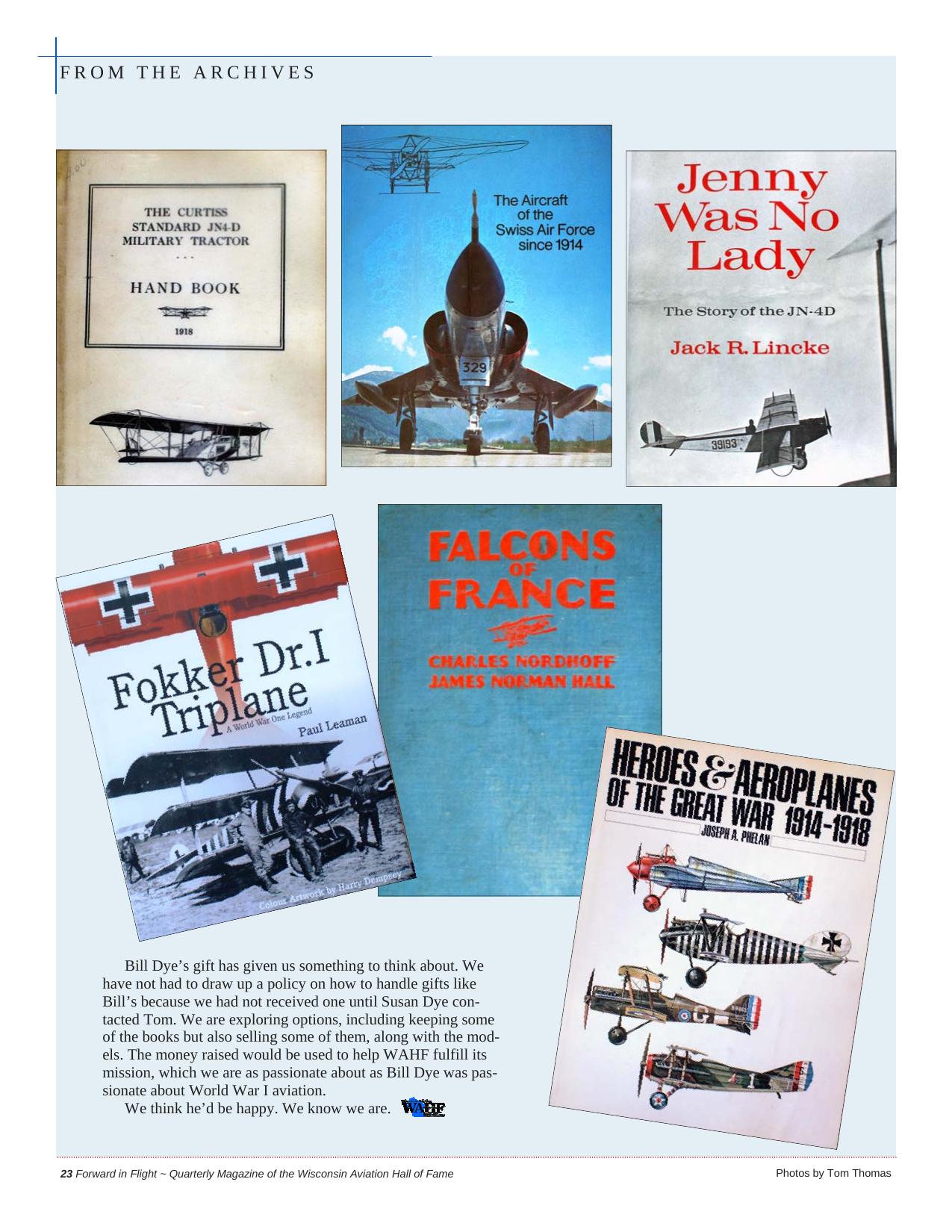
FROM THE ARCHIVES Bill Dye’s gift has given us something to think about. We have not had to draw up a policy on how to handle gifts like Bill’s because we had not received one until Susan Dye contacted Tom. We are exploring options, including keeping some of the books but also selling some of them, along with the models. The money raised would be used to help WAHF fulfill its mission, which we are as passionate about as Bill Dye was passionate about World War I aviation. We think he’d be happy. We know we are. 23 Forward in Flight ~ Quarterly Magazine of the Wisconsin Aviation Hall of Fame Photos by Tom Thomas
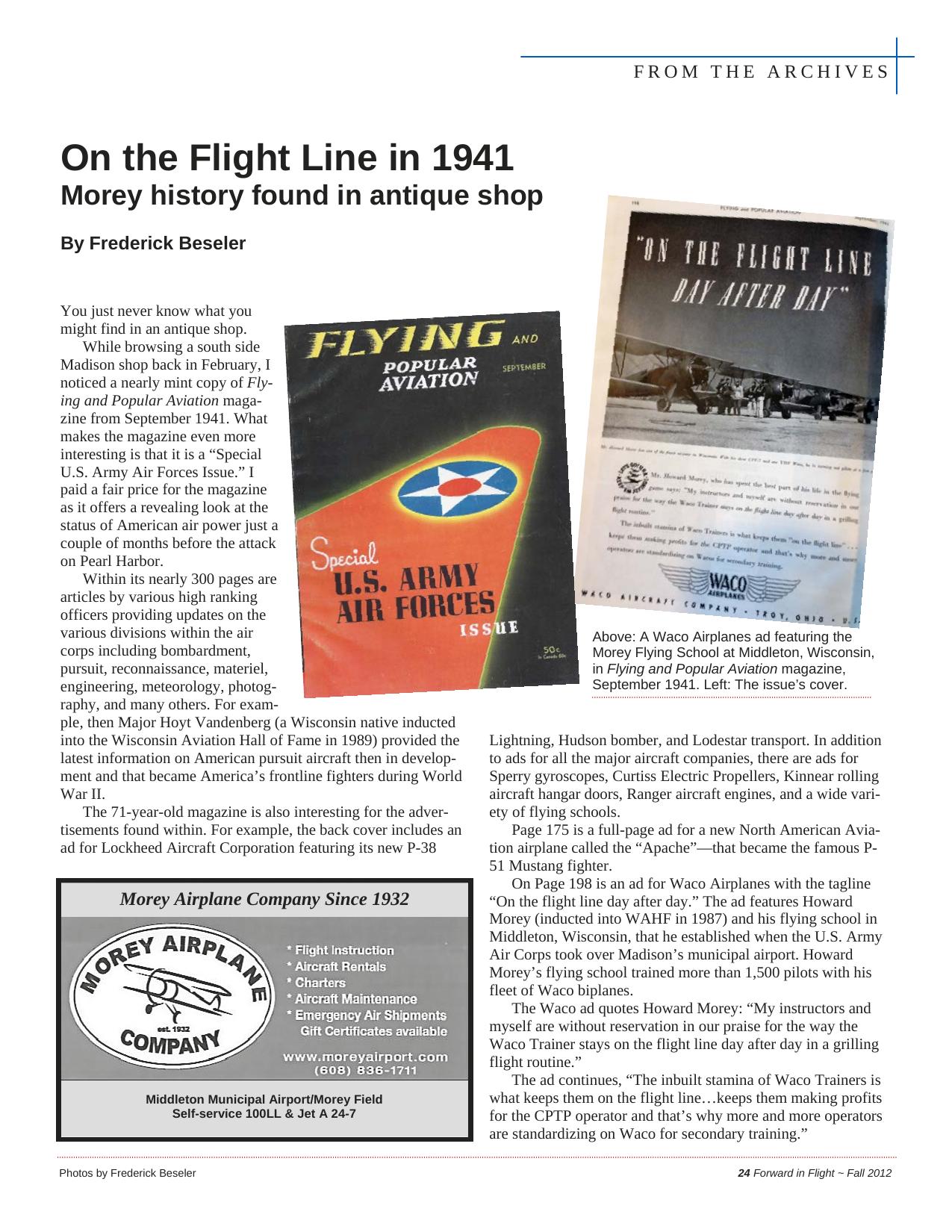
FROM THE ARCHIVES On the Flight Line in 1941 Morey history found in antique shop By Frederick Beseler You just never know what you might find in an antique shop. While browsing a south side Madison shop back in February, I noticed a nearly mint copy of Flying and Popular Aviation magazine from September 1941. What makes the magazine even more interesting is that it is a “Special U.S. Army Air Forces Issue.” I paid a fair price for the magazine as it offers a revealing look at the status of American air power just a couple of months before the attack on Pearl Harbor. Within its nearly 300 pages are articles by various high ranking officers providing updates on the various divisions within the air corps including bombardment, pursuit, reconnaissance, materiel, engineering, meteorology, photography, and many others. For example, then Major Hoyt Vandenberg (a Wisconsin native inducted into the Wisconsin Aviation Hall of Fame in 1989) provided the latest information on American pursuit aircraft then in development and that became America’s frontline fighters during World War II. The 71-year-old magazine is also interesting for the advertisements found within. For example, the back cover includes an ad for Lockheed Aircraft Corporation featuring its new P-38 Morey Airplane Company Since 1932 Middleton Municipal Airport/Morey Field Self-service 100LL & Jet A 24-7 Photos by Frederick Beseler Above: A Waco Airplanes ad featuring the Morey Flying School at Middleton, Wisconsin, in Flying and Popular Aviation magazine, September 1941. Left: The issue’s cover. Lightning, Hudson bomber, and Lodestar transport. In addition to ads for all the major aircraft companies, there are ads for Sperry gyroscopes, Curtiss Electric Propellers, Kinnear rolling aircraft hangar doors, Ranger aircraft engines, and a wide variety of flying schools. Page 175 is a full-page ad for a new North American Aviation airplane called the “Apache”—that became the famous P51 Mustang fighter. On Page 198 is an ad for Waco Airplanes with the tagline “On the flight line day after day.” The ad features Howard Morey (inducted into WAHF in 1987) and his flying school in Middleton, Wisconsin, that he established when the U.S. Army Air Corps took over Madison’s municipal airport. Howard Morey’s flying school trained more than 1,500 pilots with his fleet of Waco biplanes. The Waco ad quotes Howard Morey: “My instructors and myself are without reservation in our praise for the way the Waco Trainer stays on the flight line day after day in a grilling flight routine.” The ad continues, “The inbuilt stamina of Waco Trainers is what keeps them on the flight line…keeps them making profits for the CPTP operator and that’s why more and more operators are standardizing on Waco for secondary training.” 24 Forward in Flight ~ Fall 2012
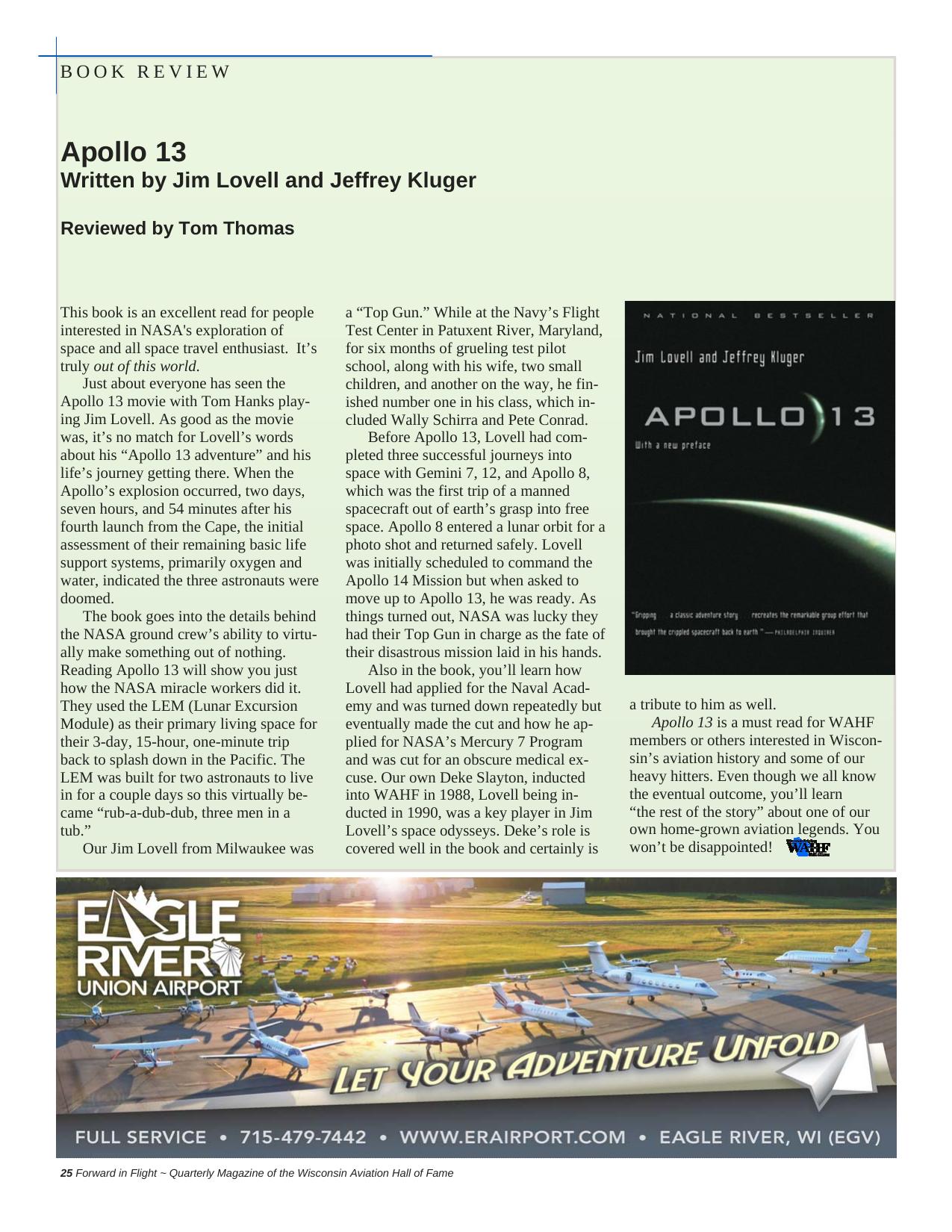
BOOK REVIEW Apollo 13 Written by Jim Lovell and Jeffrey Kluger Reviewed by Tom Thomas This book is an excellent read for people interested in NASA's exploration of space and all space travel enthusiast. It’s truly out of this world. Just about everyone has seen the Apollo 13 movie with Tom Hanks playing Jim Lovell. As good as the movie was, it’s no match for Lovell’s words about his “Apollo 13 adventure” and his life’s journey getting there. When the Apollo’s explosion occurred, two days, seven hours, and 54 minutes after his fourth launch from the Cape, the initial assessment of their remaining basic life support systems, primarily oxygen and water, indicated the three astronauts were doomed. The book goes into the details behind the NASA ground crew’s ability to virtually make something out of nothing. Reading Apollo 13 will show you just how the NASA miracle workers did it. They used the LEM (Lunar Excursion Module) as their primary living space for their 3-day, 15-hour, one-minute trip back to splash down in the Pacific. The LEM was built for two astronauts to live in for a couple days so this virtually became “rub-a-dub-dub, three men in a tub.” Our Jim Lovell from Milwaukee was a “Top Gun.” While at the Navy’s Flight Test Center in Patuxent River, Maryland, for six months of grueling test pilot school, along with his wife, two small children, and another on the way, he finished number one in his class, which included Wally Schirra and Pete Conrad. Before Apollo 13, Lovell had completed three successful journeys into space with Gemini 7, 12, and Apollo 8, which was the first trip of a manned spacecraft out of earth’s grasp into free space. Apollo 8 entered a lunar orbit for a photo shot and returned safely. Lovell was initially scheduled to command the Apollo 14 Mission but when asked to move up to Apollo 13, he was ready. As things turned out, NASA was lucky they had their Top Gun in charge as the fate of their disastrous mission laid in his hands. Also in the book, you’ll learn how Lovell had applied for the Naval Academy and was turned down repeatedly but eventually made the cut and how he applied for NASA’s Mercury 7 Program and was cut for an obscure medical excuse. Our own Deke Slayton, inducted into WAHF in 1988, Lovell being inducted in 1990, was a key player in Jim Lovell’s space odysseys. Deke’s role is covered well in the book and certainly is 25 Forward in Flight ~ Quarterly Magazine of the Wisconsin Aviation Hall of Fame a tribute to him as well. Apollo 13 is a must read for WAHF members or others interested in Wisconsin’s aviation history and some of our heavy hitters. Even though we all know the eventual outcome, you’ll learn “the rest of the story” about one of our own home-grown aviation legends. You won’t be disappointed!
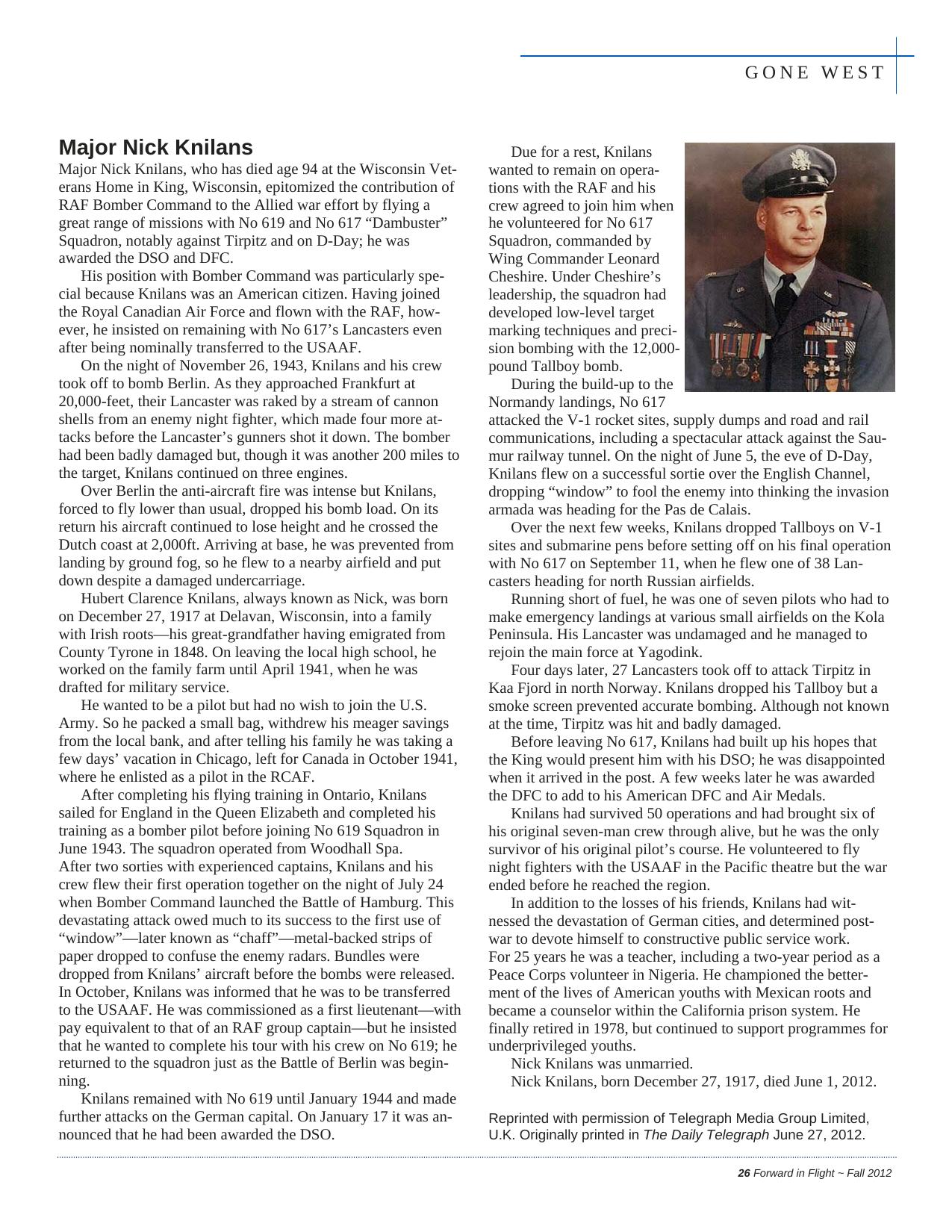
GONE WEST Major Nick Knilans Major Nick Knilans, who has died age 94 at the Wisconsin Veterans Home in King, Wisconsin, epitomized the contribution of RAF Bomber Command to the Allied war effort by flying a great range of missions with No 619 and No 617 “Dambuster” Squadron, notably against Tirpitz and on D-Day; he was awarded the DSO and DFC. His position with Bomber Command was particularly special because Knilans was an American citizen. Having joined the Royal Canadian Air Force and flown with the RAF, however, he insisted on remaining with No 617’s Lancasters even after being nominally transferred to the USAAF. On the night of November 26, 1943, Knilans and his crew took off to bomb Berlin. As they approached Frankfurt at 20,000-feet, their Lancaster was raked by a stream of cannon shells from an enemy night fighter, which made four more attacks before the Lancaster’s gunners shot it down. The bomber had been badly damaged but, though it was another 200 miles to the target, Knilans continued on three engines. Over Berlin the anti-aircraft fire was intense but Knilans, forced to fly lower than usual, dropped his bomb load. On its return his aircraft continued to lose height and he crossed the Dutch coast at 2,000ft. Arriving at base, he was prevented from landing by ground fog, so he flew to a nearby airfield and put down despite a damaged undercarriage. Hubert Clarence Knilans, always known as Nick, was born on December 27, 1917 at Delavan, Wisconsin, into a family with Irish roots—his great-grandfather having emigrated from County Tyrone in 1848. On leaving the local high school, he worked on the family farm until April 1941, when he was drafted for military service. He wanted to be a pilot but had no wish to join the U.S. Army. So he packed a small bag, withdrew his meager savings from the local bank, and after telling his family he was taking a few days’ vacation in Chicago, left for Canada in October 1941, where he enlisted as a pilot in the RCAF. After completing his flying training in Ontario, Knilans sailed for England in the Queen Elizabeth and completed his training as a bomber pilot before joining No 619 Squadron in June 1943. The squadron operated from Woodhall Spa. After two sorties with experienced captains, Knilans and his crew flew their first operation together on the night of July 24 when Bomber Command launched the Battle of Hamburg. This devastating attack owed much to its success to the first use of “window”—later known as “chaff”—metal-backed strips of paper dropped to confuse the enemy radars. Bundles were dropped from Knilans’ aircraft before the bombs were released. In October, Knilans was informed that he was to be transferred to the USAAF. He was commissioned as a first lieutenant—with pay equivalent to that of an RAF group captain—but he insisted that he wanted to complete his tour with his crew on No 619; he returned to the squadron just as the Battle of Berlin was beginning. Knilans remained with No 619 until January 1944 and made further attacks on the German capital. On January 17 it was announced that he had been awarded the DSO. Due for a rest, Knilans wanted to remain on operations with the RAF and his crew agreed to join him when he volunteered for No 617 Squadron, commanded by Wing Commander Leonard Cheshire. Under Cheshire’s leadership, the squadron had developed low-level target marking techniques and precision bombing with the 12,000pound Tallboy bomb. During the build-up to the Normandy landings, No 617 attacked the V-1 rocket sites, supply dumps and road and rail communications, including a spectacular attack against the Saumur railway tunnel. On the night of June 5, the eve of D-Day, Knilans flew on a successful sortie over the English Channel, dropping “window” to fool the enemy into thinking the invasion armada was heading for the Pas de Calais. Over the next few weeks, Knilans dropped Tallboys on V-1 sites and submarine pens before setting off on his final operation with No 617 on September 11, when he flew one of 38 Lancasters heading for north Russian airfields. Running short of fuel, he was one of seven pilots who had to make emergency landings at various small airfields on the Kola Peninsula. His Lancaster was undamaged and he managed to rejoin the main force at Yagodink. Four days later, 27 Lancasters took off to attack Tirpitz in Kaa Fjord in north Norway. Knilans dropped his Tallboy but a smoke screen prevented accurate bombing. Although not known at the time, Tirpitz was hit and badly damaged. Before leaving No 617, Knilans had built up his hopes that the King would present him with his DSO; he was disappointed when it arrived in the post. A few weeks later he was awarded the DFC to add to his American DFC and Air Medals. Knilans had survived 50 operations and had brought six of his original seven-man crew through alive, but he was the only survivor of his original pilot’s course. He volunteered to fly night fighters with the USAAF in the Pacific theatre but the war ended before he reached the region. In addition to the losses of his friends, Knilans had witnessed the devastation of German cities, and determined postwar to devote himself to constructive public service work. For 25 years he was a teacher, including a two-year period as a Peace Corps volunteer in Nigeria. He championed the betterment of the lives of American youths with Mexican roots and became a counselor within the California prison system. He finally retired in 1978, but continued to support programmes for underprivileged youths. Nick Knilans was unmarried. Nick Knilans, born December 27, 1917, died June 1, 2012. Reprinted with permission of Telegraph Media Group Limited, U.K. Originally printed in The Daily Telegraph June 27, 2012. 26 Forward in Flight ~ Fall 2012
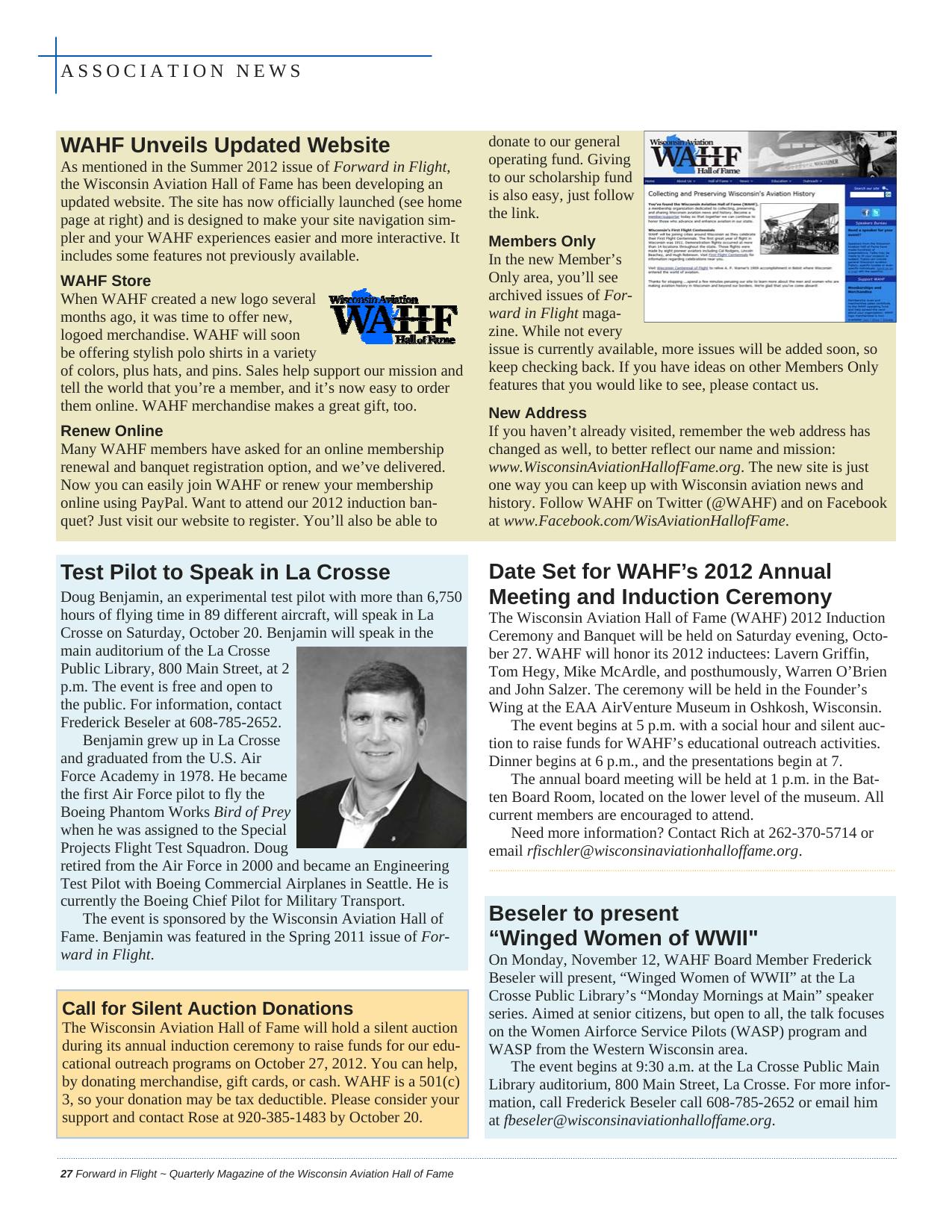
ASSOCIATION NEWS WAHF Unveils Updated Website As mentioned in the Summer 2012 issue of Forward in Flight, the Wisconsin Aviation Hall of Fame has been developing an updated website. The site has now officially launched (see home page at right) and is designed to make your site navigation simpler and your WAHF experiences easier and more interactive. It includes some features not previously available. WAHF Store When WAHF created a new logo several months ago, it was time to offer new, logoed merchandise. WAHF will soon be offering stylish polo shirts in a variety of colors, plus hats, and pins. Sales help support our mission and tell the world that you’re a member, and it’s now easy to order them online. WAHF merchandise makes a great gift, too. Renew Online Many WAHF members have asked for an online membership renewal and banquet registration option, and we’ve delivered. Now you can easily join WAHF or renew your membership online using PayPal. Want to attend our 2012 induction banquet? Just visit our website to register. You’ll also be able to Test Pilot to Speak in La Crosse Doug Benjamin, an experimental test pilot with more than 6,750 hours of flying time in 89 different aircraft, will speak in La Crosse on Saturday, October 20. Benjamin will speak in the main auditorium of the La Crosse Public Library, 800 Main Street, at 2 p.m. The event is free and open to the public. For information, contact Frederick Beseler at 608-785-2652. Benjamin grew up in La Crosse and graduated from the U.S. Air Force Academy in 1978. He became the first Air Force pilot to fly the Boeing Phantom Works Bird of Prey when he was assigned to the Special Projects Flight Test Squadron. Doug retired from the Air Force in 2000 and became an Engineering Test Pilot with Boeing Commercial Airplanes in Seattle. He is currently the Boeing Chief Pilot for Military Transport. The event is sponsored by the Wisconsin Aviation Hall of Fame. Benjamin was featured in the Spring 2011 issue of Forward in Flight. Call for Silent Auction Donations The Wisconsin Aviation Hall of Fame will hold a silent auction during its annual induction ceremony to raise funds for our educational outreach programs on October 27, 2012. You can help, by donating merchandise, gift cards, or cash. WAHF is a 501(c) 3, so your donation may be tax deductible. Please consider your support and contact Rose at 920-385-1483 by October 20. 27 Forward in Flight ~ Quarterly Magazine of the Wisconsin Aviation Hall of Fame donate to our general operating fund. Giving to our scholarship fund is also easy, just follow the link. Members Only In the new Member’s Only area, you’ll see archived issues of Forward in Flight magazine. While not every issue is currently available, more issues will be added soon, so keep checking back. If you have ideas on other Members Only features that you would like to see, please contact us. New Address If you haven’t already visited, remember the web address has changed as well, to better reflect our name and mission: www.WisconsinAviationHallofFame.org. The new site is just one way you can keep up with Wisconsin aviation news and history. Follow WAHF on Twitter (@WAHF) and on Facebook at www.Facebook.com/WisAviationHallofFame. Date Set for WAHF’s 2012 Annual Meeting and Induction Ceremony The Wisconsin Aviation Hall of Fame (WAHF) 2012 Induction Ceremony and Banquet will be held on Saturday evening, October 27. WAHF will honor its 2012 inductees: Lavern Griffin, Tom Hegy, Mike McArdle, and posthumously, Warren O’Brien and John Salzer. The ceremony will be held in the Founder’s Wing at the EAA AirVenture Museum in Oshkosh, Wisconsin. The event begins at 5 p.m. with a social hour and silent auction to raise funds for WAHF’s educational outreach activities. Dinner begins at 6 p.m., and the presentations begin at 7. The annual board meeting will be held at 1 p.m. in the Batten Board Room, located on the lower level of the museum. All current members are encouraged to attend. Need more information? Contact Rich at 262-370-5714 or email rfischler@wisconsinaviationhalloffame.org. Beseler to present “Winged Women of WWII" On Monday, November 12, WAHF Board Member Frederick Beseler will present, “Winged Women of WWII” at the La Crosse Public Library’s “Monday Mornings at Main” speaker series. Aimed at senior citizens, but open to all, the talk focuses on the Women Airforce Service Pilots (WASP) program and WASP from the Western Wisconsin area. The event begins at 9:30 a.m. at the La Crosse Public Main Library auditorium, 800 Main Street, La Crosse. For more information, call Frederick Beseler call 608-785-2652 or email him at fbeseler@wisconsinaviationhalloffame.org.
ASSOCIATION NEWS On the Road with WAHF Wings Over Waukesha Air Show In 1912, John Kaminski became the first pilot to land and take off in an aircraft in Waukesha County. The county commemorated this event by celebrating its “100 Years of Aviation” during the annual Wings Over Waukesha Air Show and Open House August 25-26. WAHF was invited to participate, and board member Tom Thomas (right) was happy to oblige. Tom provided a talk about some of Wisconsin’s women who have played key roles in our aviation history. Tom shared stories of Ethel Dresdow Christensen of Waukesha, who learned to fly at the Waukesha Airport in 1944 after graduating from Waukesha High School. One of her instructors was Dean Crites, and Dale Crites gave Ethel her flight check, on September 24, 1944. Ethel went on to buy and fly a J-3 Cub to Miami, Florida, in 1951, as told in the Fall 2011 issue of Forward in Flight. Tom also spoke of Jeannette Kapus of Milwaukee, who became a Women Airforce Service Pilot (WASP), one of just 19 from Wisconsin. A crowd of some 100 were on hand for the talk. Tom (right) gave complimentary issues of Forward in Flight to presentation attendees. Congratulations Waukesha County on your first 100 years of aviation! 2031 Peach Street Wisconsin Rapids, WI 54494 28 Forward in Flight ~ Fall 2012
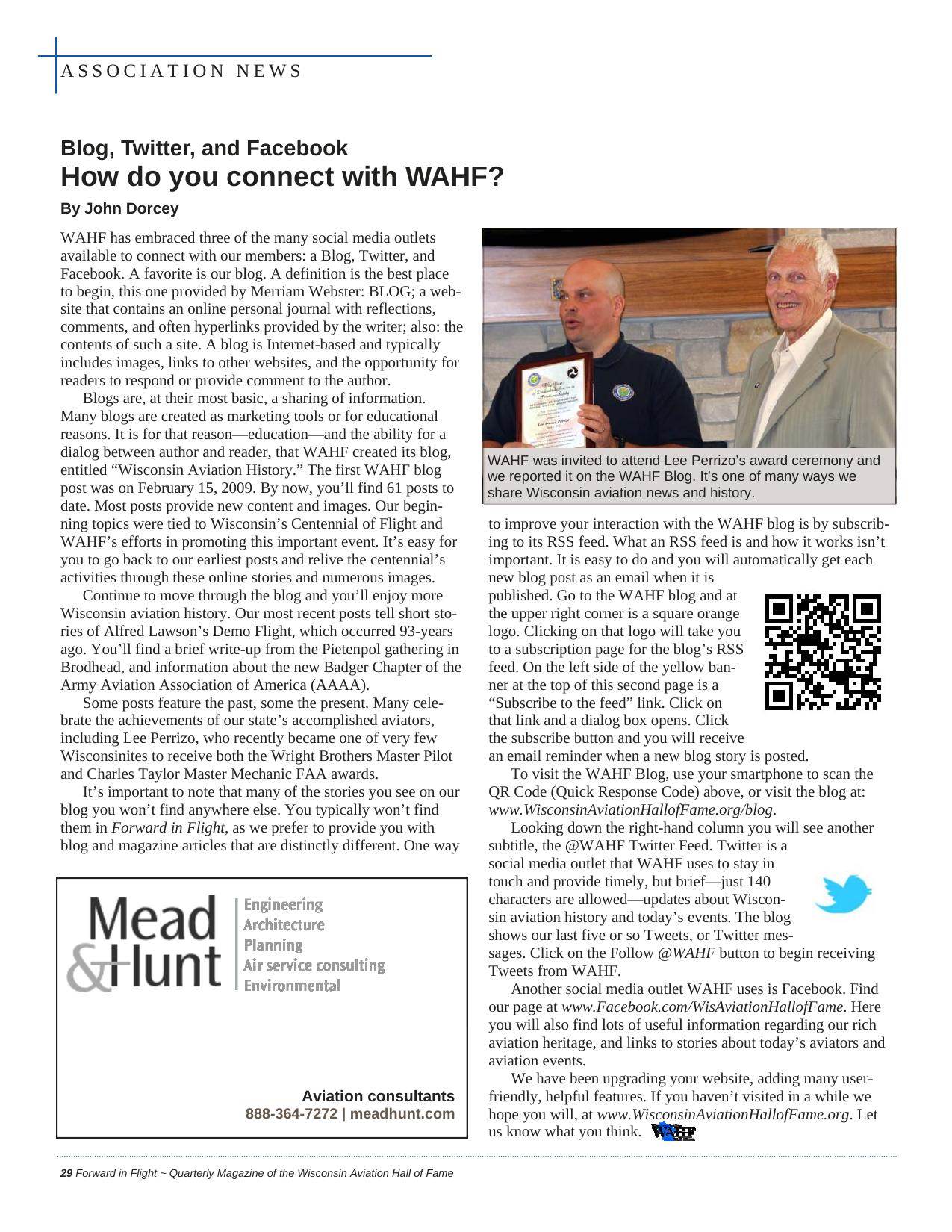
ASSOCIATION NEWS Blog, Twitter, and Facebook How do you connect with WAHF? By John Dorcey WAHF has embraced three of the many social media outlets available to connect with our members: a Blog, Twitter, and Facebook. A favorite is our blog. A definition is the best place to begin, this one provided by Merriam Webster: BLOG; a website that contains an online personal journal with reflections, comments, and often hyperlinks provided by the writer; also: the contents of such a site. A blog is Internet-based and typically includes images, links to other websites, and the opportunity for readers to respond or provide comment to the author. Blogs are, at their most basic, a sharing of information. Many blogs are created as marketing tools or for educational reasons. It is for that reason—education—and the ability for a dialog between author and reader, that WAHF created its blog, entitled “Wisconsin Aviation History.” The first WAHF blog post was on February 15, 2009. By now, you’ll find 61 posts to date. Most posts provide new content and images. Our beginning topics were tied to Wisconsin’s Centennial of Flight and WAHF’s efforts in promoting this important event. It’s easy for you to go back to our earliest posts and relive the centennial’s activities through these online stories and numerous images. Continue to move through the blog and you’ll enjoy more Wisconsin aviation history. Our most recent posts tell short stories of Alfred Lawson’s Demo Flight, which occurred 93-years ago. You’ll find a brief write-up from the Pietenpol gathering in Brodhead, and information about the new Badger Chapter of the Army Aviation Association of America (AAAA). Some posts feature the past, some the present. Many celebrate the achievements of our state’s accomplished aviators, including Lee Perrizo, who recently became one of very few Wisconsinites to receive both the Wright Brothers Master Pilot and Charles Taylor Master Mechanic FAA awards. It’s important to note that many of the stories you see on our blog you won’t find anywhere else. You typically won’t find them in Forward in Flight, as we prefer to provide you with blog and magazine articles that are distinctly different. One way Aviation consultants 888-364-7272 | meadhunt.com 29 Forward in Flight ~ Quarterly Magazine of the Wisconsin Aviation Hall of Fame WAHF was invited to attend Lee Perrizo’s award ceremony and we reported it on the WAHF Blog. It’s one of many ways we share Wisconsin aviation news and history. to improve your interaction with the WAHF blog is by subscribing to its RSS feed. What an RSS feed is and how it works isn’t important. It is easy to do and you will automatically get each new blog post as an email when it is published. Go to the WAHF blog and at the upper right corner is a square orange logo. Clicking on that logo will take you to a subscription page for the blog’s RSS feed. On the left side of the yellow banner at the top of this second page is a “Subscribe to the feed” link. Click on that link and a dialog box opens. Click the subscribe button and you will receive an email reminder when a new blog story is posted. To visit the WAHF Blog, use your smartphone to scan the QR Code (Quick Response Code) above, or visit the blog at: www.WisconsinAviationHallofFame.org/blog. Looking down the right-hand column you will see another subtitle, the @WAHF Twitter Feed. Twitter is a social media outlet that WAHF uses to stay in touch and provide timely, but brief—just 140 characters are allowed—updates about Wisconsin aviation history and today’s events. The blog shows our last five or so Tweets, or Twitter messages. Click on the Follow @WAHF button to begin receiving Tweets from WAHF. Another social media outlet WAHF uses is Facebook. Find our page at www.Facebook.com/WisAviationHallofFame. Here you will also find lots of useful information regarding our rich aviation heritage, and links to stories about today’s aviators and aviation events. We have been upgrading your website, adding many userfriendly, helpful features. If you haven’t visited in a while we hope you will, at www.WisconsinAviationHallofFame.org. Let us know what you think.
PRODUCT REVIEW Just Released Icarus Envy DVD Documents Light Sport Aviation Reviewed by John Dorcey Are you looking for a new way to introduce people to aviation? Want to share the beauty of Wisconsin from the air with folks who are hesitant to fly? A newly released video (DVD), Icarus Envy, is just what you need. Filmed almost entirely in (and over) Wisconsin, the 60-minute feature provides breathtaking views of lakes, rivers—and flying, lots of flying. Views that are possible, we might add, only from the air. The purpose of the video is to introduce various types of Light Sport Aircraft (LSA). Who better to tell this story than 14 passionate pilots? (Is there any other kind?) Some shared flying stories. One story detailed checking out the Egyptian military in powered parachutes. Another told of a fun trip to Madeline Island by air, land, and sea. Others talked about building an airplane from scratch or assembling an aircraft kit. Ease of learning to fly, driver’s license in lieu of a medical, and economics were all given as reasons to consider flying an LSA. Safety was a constant theme. Sugar Ridge Airport (WS62) owner Tom Kretschman from Verona, Wisconsin, was a featured personality of the video. You may remember an article on Tom in the Summer 2012 issue of Forward in Flight. Other WAHF notables in the video were 2011 inductee Bill Rewey and longtime member/supporter Buddy Rogers. While the screen was filled with elements of flight, a voiceover piece caught my attention. A poem by Bob O’Hara early in the video began, “I long to fly off a grass field in a small plane, fabric covered with good and enthusiastic friends who thrill at every takeoff and savor each skill-filled landing.” It concluded, “I long to sit beneath the wings and talk to fellow aviators about the wonder of it all.” I was unfamiliar with O’Hara’s work until now. I am better for coming across it. In addition to Icarus Envy, the DVD includes four short bonus features. One involves a weather decision that proved to be wrong but was an excellent lesson. Another provides an overview of the BRS Aerospace ballistic recovery parachute. The third provides Sport Pilot certification basics by sport pilot instructor and pilot examiner Peter Aarnvold. The last tells of the recent acquisition of a rotating beacon by Tom Kretschman and its historical significance. Icarus Envy would make an excellent Christmas or birthday gift for you, a fellow aviator, or a future one. To order your DVD, send a check or money order for $24, which includes shipping, to: Video Art Productions, 2217 Goecks Court, Cottage Grove, WI 53527. For additional information on Icarus Envy or other films by Video Art Productions visit their website www.VAPFilms.com, send an email to VAPBob@juno.com, or call 608-873-5784. 30 Forward in Flight ~ Fall 2012
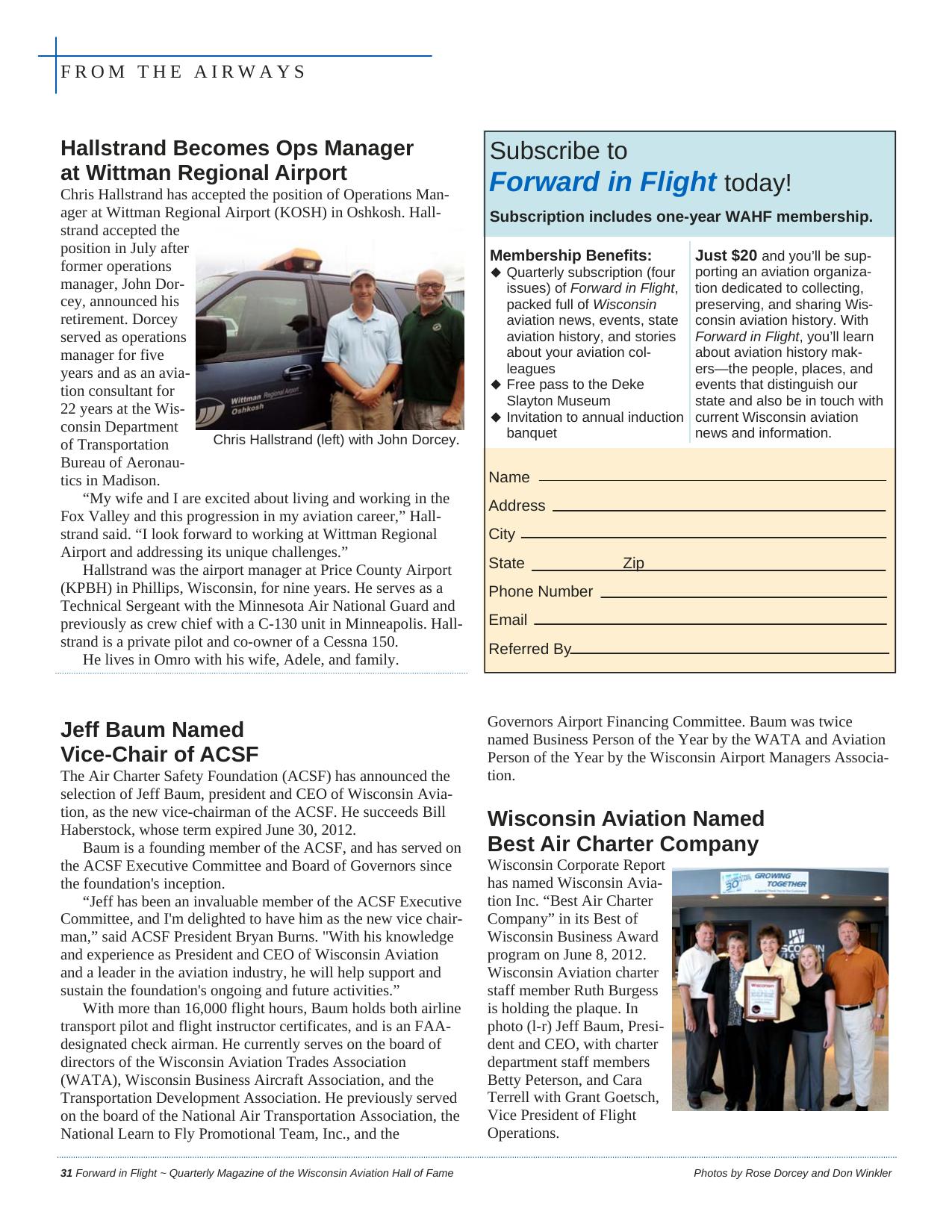
FROM THE AIRWAYS Hallstrand Becomes Ops Manager at Wittman Regional Airport Chris Hallstrand has accepted the position of Operations Manager at Wittman Regional Airport (KOSH) in Oshkosh. Hallstrand accepted the position in July after former operations manager, John Dorcey, announced his retirement. Dorcey served as operations manager for five years and as an aviation consultant for 22 years at the Wisconsin Department Chris Hallstrand (left) with John Dorcey. of Transportation Bureau of Aeronautics in Madison. “My wife and I are excited about living and working in the Fox Valley and this progression in my aviation career,” Hallstrand said. “I look forward to working at Wittman Regional Airport and addressing its unique challenges.” Hallstrand was the airport manager at Price County Airport (KPBH) in Phillips, Wisconsin, for nine years. He serves as a Technical Sergeant with the Minnesota Air National Guard and previously as crew chief with a C-130 unit in Minneapolis. Hallstrand is a private pilot and co-owner of a Cessna 150. He lives in Omro with his wife, Adele, and family. Jeff Baum Named Vice-Chair of ACSF The Air Charter Safety Foundation (ACSF) has announced the selection of Jeff Baum, president and CEO of Wisconsin Aviation, as the new vice-chairman of the ACSF. He succeeds Bill Haberstock, whose term expired June 30, 2012. Baum is a founding member of the ACSF, and has served on the ACSF Executive Committee and Board of Governors since the foundation's inception. “Jeff has been an invaluable member of the ACSF Executive Committee, and I'm delighted to have him as the new vice chairman,” said ACSF President Bryan Burns. "With his knowledge and experience as President and CEO of Wisconsin Aviation and a leader in the aviation industry, he will help support and sustain the foundation's ongoing and future activities.” With more than 16,000 flight hours, Baum holds both airline transport pilot and flight instructor certificates, and is an FAAdesignated check airman. He currently serves on the board of directors of the Wisconsin Aviation Trades Association (WATA), Wisconsin Business Aircraft Association, and the Transportation Development Association. He previously served on the board of the National Air Transportation Association, the National Learn to Fly Promotional Team, Inc., and the 31 Forward in Flight ~ Quarterly Magazine of the Wisconsin Aviation Hall of Fame Subscribe to Forward in Flight today! Subscription includes one-year WAHF membership. Membership Benefits: Just $20 and you’ll be sup- Quarterly subscription (four porting an aviation organization dedicated to collecting, preserving, and sharing Wisconsin aviation history. With Forward in Flight, you’ll learn about aviation history makers—the people, places, and events that distinguish our state and also be in touch with current Wisconsin aviation news and information. issues) of Forward in Flight, packed full of Wisconsin aviation news, events, state aviation history, and stories about your aviation colleagues Free pass to the Deke Slayton Museum Invitation to annual induction banquet Name Address City State Zip Phone Number Email Referred By Governors Airport Financing Committee. Baum was twice named Business Person of the Year by the WATA and Aviation Person of the Year by the Wisconsin Airport Managers Association. Wisconsin Aviation Named Best Air Charter Company Wisconsin Corporate Report has named Wisconsin Aviation Inc. “Best Air Charter Company” in its Best of Wisconsin Business Award program on June 8, 2012. Wisconsin Aviation charter staff member Ruth Burgess is holding the plaque. In photo (l-r) Jeff Baum, President and CEO, with charter department staff members Betty Peterson, and Cara Terrell with Grant Goetsch, Vice President of Flight Operations. Photos by Rose Dorcey and Don Winkler
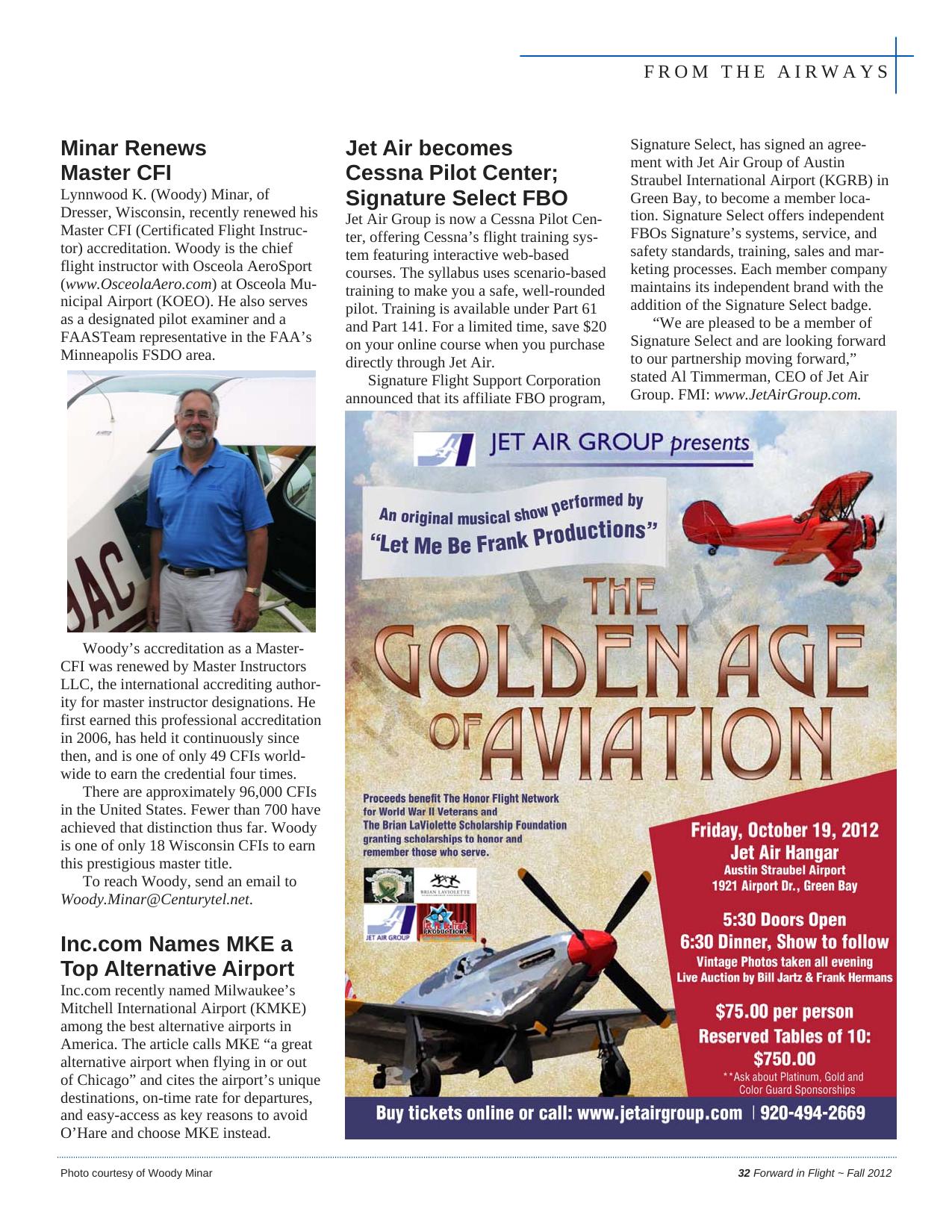
FROM THE AIRWAYS Minar Renews Master CFI Lynnwood K. (Woody) Minar, of Dresser, Wisconsin, recently renewed his Master CFI (Certificated Flight Instructor) accreditation. Woody is the chief flight instructor with Osceola AeroSport (www.OsceolaAero.com) at Osceola Municipal Airport (KOEO). He also serves as a designated pilot examiner and a FAASTeam representative in the FAA’s Minneapolis FSDO area. Jet Air becomes Cessna Pilot Center; Signature Select FBO Jet Air Group is now a Cessna Pilot Center, offering Cessna’s flight training system featuring interactive web-based courses. The syllabus uses scenario-based training to make you a safe, well-rounded pilot. Training is available under Part 61 and Part 141. For a limited time, save $20 on your online course when you purchase directly through Jet Air. Signature Flight Support Corporation announced that its affiliate FBO program, Signature Select, has signed an agreement with Jet Air Group of Austin Straubel International Airport (KGRB) in Green Bay, to become a member location. Signature Select offers independent FBOs Signature’s systems, service, and safety standards, training, sales and marketing processes. Each member company maintains its independent brand with the addition of the Signature Select badge. “We are pleased to be a member of Signature Select and are looking forward to our partnership moving forward,” stated Al Timmerman, CEO of Jet Air Group. FMI: www.JetAirGroup.com. Woody’s accreditation as a MasterCFI was renewed by Master Instructors LLC, the international accrediting authority for master instructor designations. He first earned this professional accreditation in 2006, has held it continuously since then, and is one of only 49 CFIs worldwide to earn the credential four times. There are approximately 96,000 CFIs in the United States. Fewer than 700 have achieved that distinction thus far. Woody is one of only 18 Wisconsin CFIs to earn this prestigious master title. To reach Woody, send an email to Woody.Minar@Centurytel.net. Inc.com Names MKE a Top Alternative Airport Inc.com recently named Milwaukee’s Mitchell International Airport (KMKE) among the best alternative airports in America. The article calls MKE “a great alternative airport when flying in or out of Chicago” and cites the airport’s unique destinations, on-time rate for departures, and easy-access as key reasons to avoid O’Hare and choose MKE instead. Photo courtesy of Woody Minar 32 Forward in Flight ~ Fall 2012
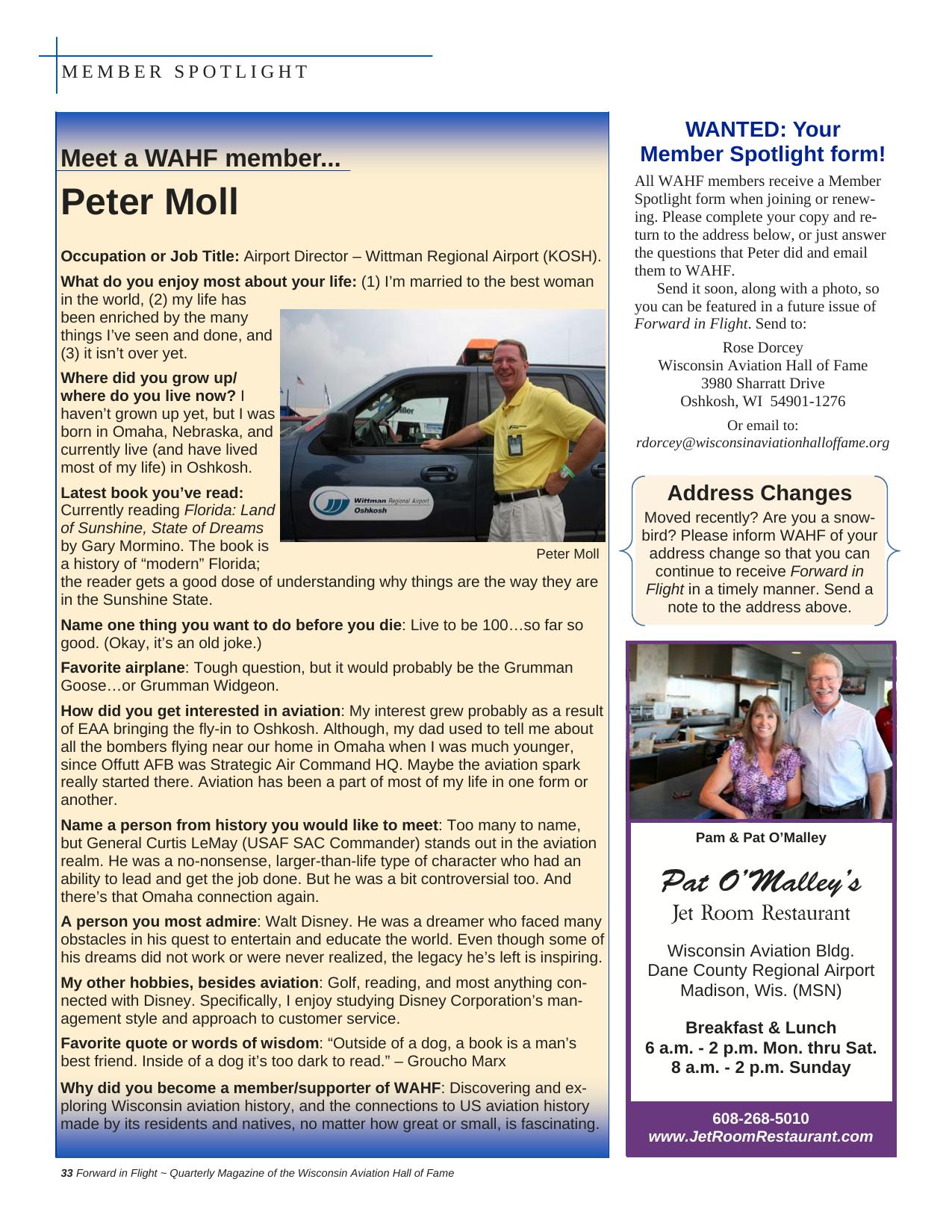
MEMBER SPOTLIGHT Meet a WAHF member... Peter Moll Occupation or Job Title: Airport Director – Wittman Regional Airport (KOSH). What do you enjoy most about your life: (1) I’m married to the best woman in the world, (2) my life has been enriched by the many things I’ve seen and done, and (3) it isn’t over yet. Where did you grow up/ where do you live now? I haven’t grown up yet, but I was born in Omaha, Nebraska, and currently live (and have lived most of my life) in Oshkosh. Latest book you’ve read: Currently reading Florida: Land of Sunshine, State of Dreams by Gary Mormino. The book is Peter Moll a history of “modern” Florida; the reader gets a good dose of understanding why things are the way they are in the Sunshine State. WANTED: Your Member Spotlight form! All WAHF members receive a Member Spotlight form when joining or renewing. Please complete your copy and return to the address below, or just answer the questions that Peter did and email them to WAHF. Send it soon, along with a photo, so you can be featured in a future issue of Forward in Flight. Send to: Rose Dorcey Wisconsin Aviation Hall of Fame 3980 Sharratt Drive Oshkosh, WI 54901-1276 Or email to: rdorcey@wisconsinaviationhalloffame.org Address Changes Moved recently? Are you a snowbird? Please inform WAHF of your address change so that you can continue to receive Forward in Flight in a timely manner. Send a note to the address above. Name one thing you want to do before you die: Live to be 100…so far so good. (Okay, it’s an old joke.) Favorite airplane: Tough question, but it would probably be the Grumman Goose…or Grumman Widgeon. How did you get interested in aviation: My interest grew probably as a result of EAA bringing the fly-in to Oshkosh. Although, my dad used to tell me about all the bombers flying near our home in Omaha when I was much younger, since Offutt AFB was Strategic Air Command HQ. Maybe the aviation spark really started there. Aviation has been a part of most of my life in one form or another. Name a person from history you would like to meet: Too many to name, but General Curtis LeMay (USAF SAC Commander) stands out in the aviation realm. He was a no-nonsense, larger-than-life type of character who had an ability to lead and get the job done. But he was a bit controversial too. And there’s that Omaha connection again. A person you most admire: Walt Disney. He was a dreamer who faced many obstacles in his quest to entertain and educate the world. Even though some of his dreams did not work or were never realized, the legacy he’s left is inspiring. My other hobbies, besides aviation: Golf, reading, and most anything connected with Disney. Specifically, I enjoy studying Disney Corporation’s management style and approach to customer service. Favorite quote or words of wisdom: “Outside of a dog, a book is a man’s best friend. Inside of a dog it’s too dark to read.” – Groucho Marx Why did you become a member/supporter of WAHF: Discovering and exploring Wisconsin aviation history, and the connections to US aviation history made by its residents and natives, no matter how great or small, is fascinating. 33 Forward in Flight ~ Quarterly Magazine of the Wisconsin Aviation Hall of Fame Pam & Pat O’Malley Pat O’Malley’s Jet Room Restaurant Wisconsin Aviation Bldg. Dane County Regional Airport Madison, Wis. (MSN) Breakfast & Lunch 6 a.m. - 2 p.m. Mon. thru Sat. 8 a.m. - 2 p.m. Sunday 608-268-5010 www.JetRoomRestaurant.com

Wittman Regional Airport Oshkosh So much history ...and still making it! From the legacy of Steve Wittman to Warren Basler’s DC-3 conversions, we’re proud to support and contribute to Wisconsin aviation history. FLY TO OSHKOSH wittmanairport.com @wittmanairport 34 Forward in Flight ~ Fall 2012
PRSRT STD US Postage Paid Wisc Rapids WI Permit 98 3980 SHARRATT DRIVE OSHKOSH WI 54901-1276 The Wisconsin Aviation Hall of Fame is a non-profit membership organization dedicated to preserving the past and fostering the future of flight. Welcome WAHF Member/Supporters: Ken Hanson Gary Hebl Earl P. Martin Lou Molnar Zach Parmeter James Wise —Thanks for coming on board. We hope to see you at a WAHF event soon! Cheers to WAHF Member Diane Ballweg, who recently donated $25,000 to Women in Aviation, International (WAI), to establish a flight scholarship. The $500 scholarship will go to a pilot wanting to obtain an instrument rating, commercial certificate, or CFI. It will be offered annually beginning in 2013. Diane is a pilot and school teacher in Madison. Frosting for Flight Fundraiser The Oshkosh chapter of Women in Aviation International is holding its second annual cupcake competition on Saturday, October 6 from 2-4:30 p.m. in the terminal building at Wittman Regional Airport (KOSH). The event raises funds for the chapter’s $500 Spirit of Flight Scholarship. For more information about entering a cupcake or attending, visit www.OshkoshWAI.org. Congratulations to the City of Marshfield, which celebrated its Centennial of Flight in 2012. Duffy’s Aircraft, located at Marshfield Municipal AirportRoy Shwery Field (KMFI), celebrated by hosting a customer appreciation day, inviting pilots and the general public to stop out for food and refreshments in August. Duffy’s Aircraft is owned by Harold “Duffy” Gaier, a 2004 WAHF inductee. The WAHF website has been updated and there are some new features that will make joining/renewing WAHF membership easier. Visit www.WisconsinAviationHallofFame.org or scan the QR code at right. Read about other updates on page 27. Wisconsin Aviation Hall of Fame Officers and Board of Directors Rose Dorcey, President Michael Goc, Vice President John Dorcey, Secretary/Treasurer Frederick Beseler Gary Dikkers Rich Fischler Andrew Ovans Charles Swain Tom Thomas Charles Marotske, Honorary Chairman of the Board Wisconsin Aviation Hall of Fame 3980 Sharratt Drive Oshkosh WI 54901-1276 Become a supporter today! For information call Rose Dorcey at 920-385-1483 www.wisconsinaviationhalloffame.org rdorcey@wisconsinaviationhalloffame.org