Volume 13, Issue 3
🗞️ Download Issue (PDF)
Forward in Flight - Fall 2013
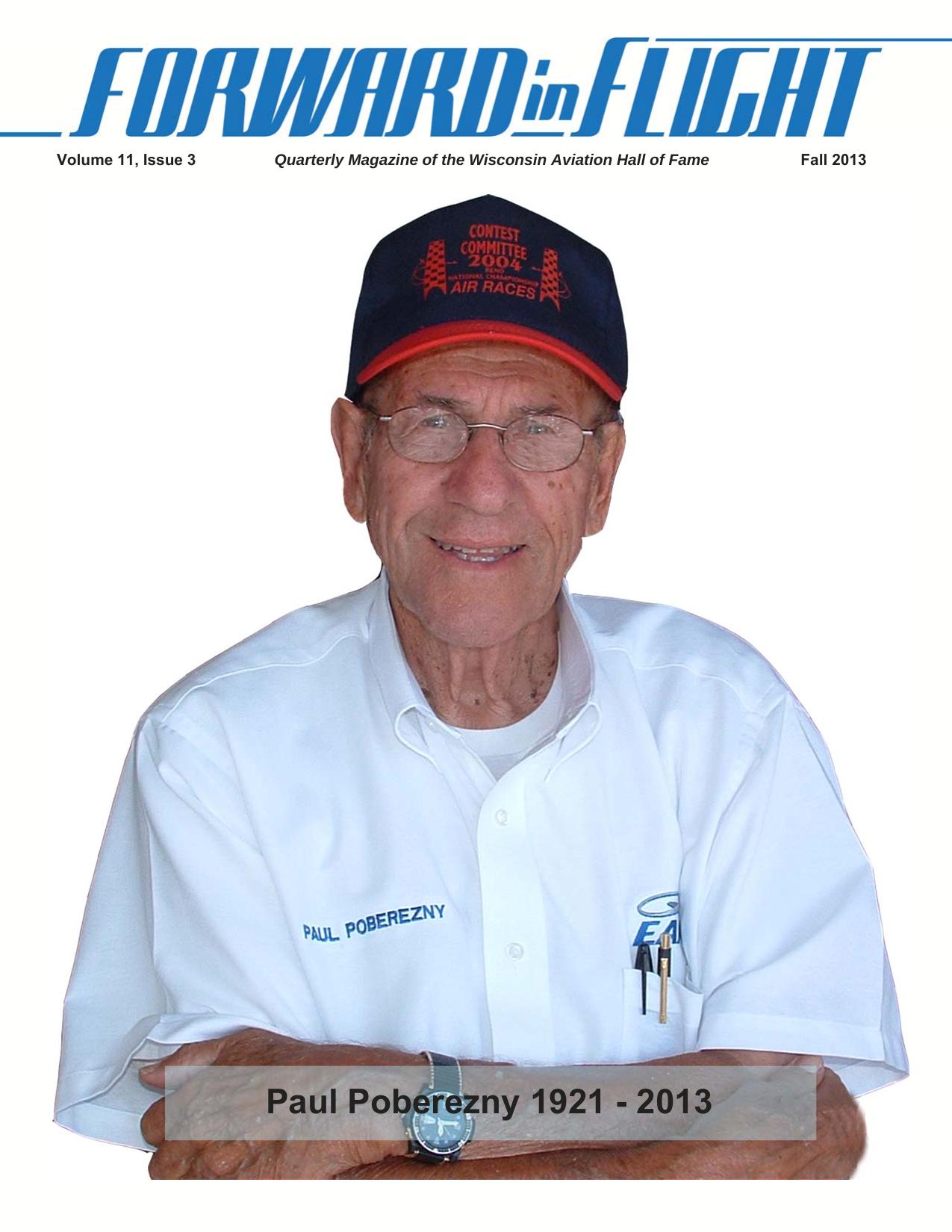
Volume 11, Issue 3 Quarterly Magazine of the Wisconsin Aviation Hall of Fame Paul Poberezny 1921 - 2013 Fall 2013
Contents Vol. 11 Issue 3/Fall 2013 A publication of the Wisconsin Aviation Hall of Fame RIGHT SEAT DIARIES 3 Emergency Procedures What are you expecting? Heather Gollnow, CFI FROM THE ARCHIVES 22 Carol Iverson Ackerman and Curtiss-Wright Airport Michael Goc AIR DOC 5 FAA Change May Hasten Your Next Medical The CACI Advantage Dr. Tom Voelker, AME WAYPOINTS 25 When in Milwaukee... Visit the Mitchell Gallery of Flight Leo Kohn 27 WAHF Inductees Honored at EAA Memorial Wall Ceremony Tom Thomas BOOK REVIEW 8 Fatal Crossing Reviewed by WAHF Member Charles Boie ASSOCIATION NEWS 29 Date Set for 2013 Induction Banquet WE FLY 9 Dan Knutson Lives Aviation! Judging, restoring, and flying vintage aircraft Duane Esse 12 Darrel Gibson’s Legacy Gibson Aviation was a highway to the sky Jerry LeBarron TALESPINS 17 Coming Home Otto Trapp’s Purple Heart and his service in WWII Tom Thomas 30 From the Airways Vilas’ Memorial Flight, SubSonex, and more… 32 Gone West Paul Poberezny, Frank Trofimchuck 33 Member Spotlight Ralph C. “Bud” Jensen WAHF Inductee Bob Skuldt, along with dozens of men and women who have gone west, were honored at a ceremony at the EAA Memorial Wall in Oshkosh on August 4. Read more on page 27. Total Aviation Services Aircraft Fuel ~ Heated Hangar ~ Maintenance Avionics ~ Flight Training ~ Air Charter AME on Staff 1921 Airport Drive Green Bay, WI 54313 866.676.7835 www.jetairgroup.com
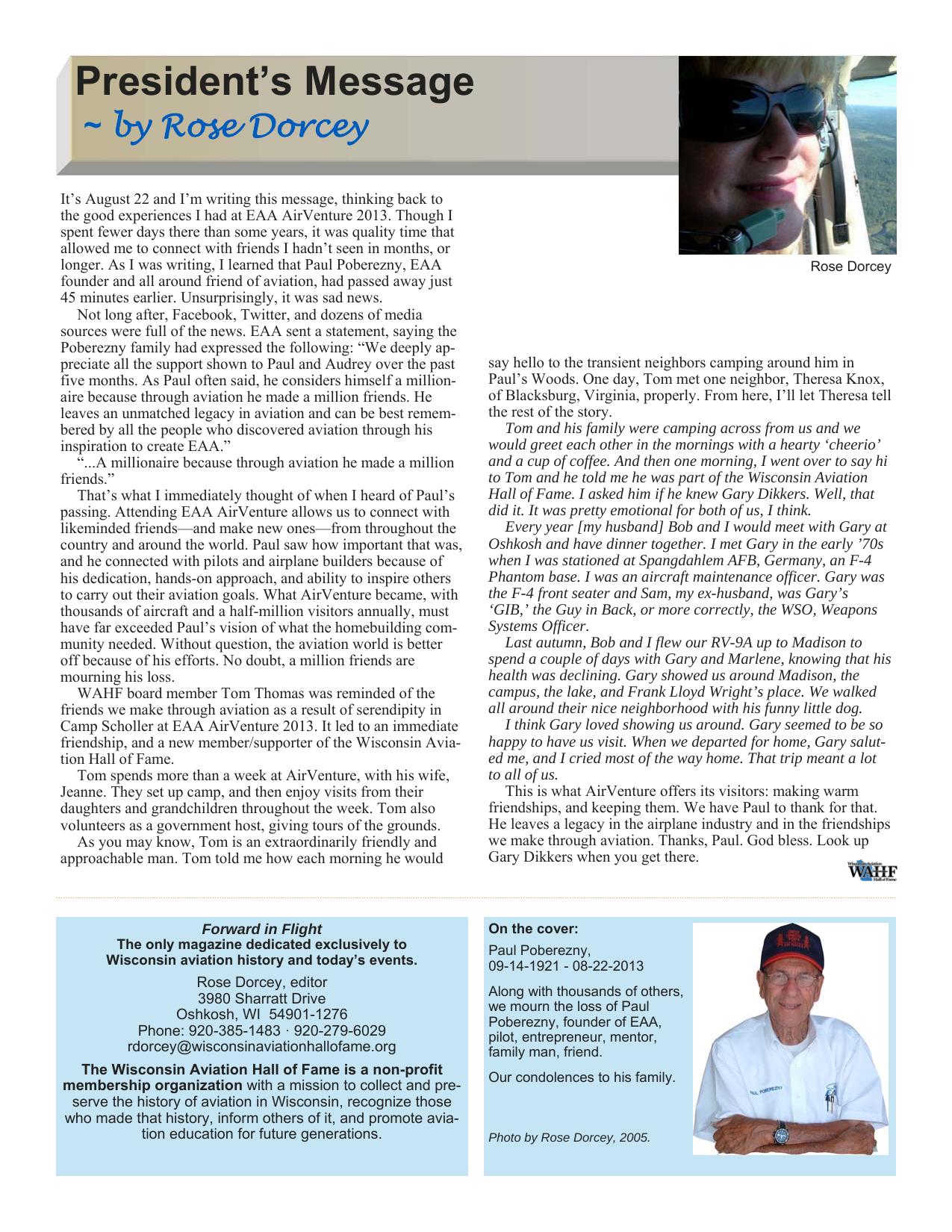
President’s Message ~ by Rose Dorcey It’s August 22 and I’m writing this message, thinking back to the good experiences I had at EAA AirVenture 2013. Though I spent fewer days there than some years, it was quality time that allowed me to connect with friends I hadn’t seen in months, or longer. As I was writing, I learned that Paul Poberezny, EAA founder and all around friend of aviation, had passed away just 45 minutes earlier. Unsurprisingly, it was sad news. Not long after, Facebook, Twitter, and dozens of media sources were full of the news. EAA sent a statement, saying the Poberezny family had expressed the following: “We deeply appreciate all the support shown to Paul and Audrey over the past five months. As Paul often said, he considers himself a millionaire because through aviation he made a million friends. He leaves an unmatched legacy in aviation and can be best remembered by all the people who discovered aviation through his inspiration to create EAA.” “...A millionaire because through aviation he made a million friends.” That’s what I immediately thought of when I heard of Paul’s passing. Attending EAA AirVenture allows us to connect with likeminded friends—and make new ones—from throughout the country and around the world. Paul saw how important that was, and he connected with pilots and airplane builders because of his dedication, hands-on approach, and ability to inspire others to carry out their aviation goals. What AirVenture became, with thousands of aircraft and a half-million visitors annually, must have far exceeded Paul’s vision of what the homebuilding community needed. Without question, the aviation world is better off because of his efforts. No doubt, a million friends are mourning his loss. WAHF board member Tom Thomas was reminded of the friends we make through aviation as a result of serendipity in Camp Scholler at EAA AirVenture 2013. It led to an immediate friendship, and a new member/supporter of the Wisconsin Aviation Hall of Fame. Tom spends more than a week at AirVenture, with his wife, Jeanne. They set up camp, and then enjoy visits from their daughters and grandchildren throughout the week. Tom also volunteers as a government host, giving tours of the grounds. As you may know, Tom is an extraordinarily friendly and approachable man. Tom told me how each morning he would Forward in Flight The only magazine dedicated exclusively to Wisconsin aviation history and today’s events. Rose Dorcey, editor 3980 Sharratt Drive Oshkosh, WI 54901-1276 Phone: 920-385-1483 · 920-279-6029 rdorcey@wisconsinaviationhallofame.org The Wisconsin Aviation Hall of Fame is a non-profit membership organization with a mission to collect and preserve the history of aviation in Wisconsin, recognize those who made that history, inform others of it, and promote aviation education for future generations. Rose Dorcey say hello to the transient neighbors camping around him in Paul’s Woods. One day, Tom met one neighbor, Theresa Knox, of Blacksburg, Virginia, properly. From here, I’ll let Theresa tell the rest of the story. Tom and his family were camping across from us and we would greet each other in the mornings with a hearty ‘cheerio’ and a cup of coffee. And then one morning, I went over to say hi to Tom and he told me he was part of the Wisconsin Aviation Hall of Fame. I asked him if he knew Gary Dikkers. Well, that did it. It was pretty emotional for both of us, I think. Every year [my husband] Bob and I would meet with Gary at Oshkosh and have dinner together. I met Gary in the early ’70s when I was stationed at Spangdahlem AFB, Germany, an F-4 Phantom base. I was an aircraft maintenance officer. Gary was the F-4 front seater and Sam, my ex-husband, was Gary’s ‘GIB,’ the Guy in Back, or more correctly, the WSO, Weapons Systems Officer. Last autumn, Bob and I flew our RV-9A up to Madison to spend a couple of days with Gary and Marlene, knowing that his health was declining. Gary showed us around Madison, the campus, the lake, and Frank Lloyd Wright’s place. We walked all around their nice neighborhood with his funny little dog. I think Gary loved showing us around. Gary seemed to be so happy to have us visit. When we departed for home, Gary saluted me, and I cried most of the way home. That trip meant a lot to all of us. This is what AirVenture offers its visitors: making warm friendships, and keeping them. We have Paul to thank for that. He leaves a legacy in the airplane industry and in the friendships we make through aviation. Thanks, Paul. God bless. Look up Gary Dikkers when you get there. On the cover: Paul Poberezny, 09-14-1921 - 08-22-2013 Along with thousands of others, we mourn the loss of Paul Poberezny, founder of EAA, pilot, entrepreneur, mentor, family man, friend. Our condolences to his family. Photo by Rose Dorcey, 2005.
RIGHT SEAT DIARIES Emergency Procedures What are you expecting? By Heather Gollnow, CFI Emergency procedures are not always a fun thing to talk about, especially with non-pilots. Oftentimes people don’t want to think about the things that can go wrong when flying. In my own experience, I get a lot of questions from inquiring minds like “what happens if the engine ‘stalls,’” “how do you know where to stop to get gas,” “what if the wings fall off,” “why don’t you wear a parachute,” and “have you ever hit a bird?” I’m sure many of us get these same types of questions, which normally spark a great conversation and an opportunity to educate about aviation safety. I recently read a piece of aviation wisdom on Facebook, which summarizes this article very well: Expect engine failure on every take-off and expect to go around on every landing. Think about some of these scenarios. Are you expecting an engine failure during some of these phases of flight? Do you think about your emergency procedures before, during, and after every flight? Expect your engine will quit on every takeoff. Expect your engine will quit on every landing. Expect that a deer will run out onto the runway on every takeoff. Expect that a deer will run out onto the runway on every landing. Expect that another aircraft will land/takeoff on the same or intersecting runway on every takeoff. Expect that another aircraft will land/takeoff on the same or intersecting runway on every landing. Expect that a tire will blow on every takeoff. Expect that a tire will blow on every landing. Do you catch my drift? I am a firm believer in planning for the worst but hoping for the best, especially while flying. While on takeoff roll, what are you thinking about? Are you looking down the runway? Are you monitoring the sound of your engine(s)? How much back pressure do you have on the yoke? I learned how to fly in Oshkosh. I had 8,000-feet of runway. I could take off and land my Cessna 152 several times if I really needed to! Sure, my instructor and I always went over takeoff emergency procedures, but that 8,000-foot runway was definitely a huge safety net. I remember the first time I took off from a short and soft field. The runway was a dry, grass strip that was about 1,200-feet long, with a nice patch of trees right at the end of the runway. Coming from a paved runway that was a mile and a half long, this was intimidating to me. I remember thinking that this was exactly what my instructor was trying to teach me. Suddenly, there was no room for error. If something happened on that takeoff roll that 3 Forward in Flight ~ Quarterly Magazine of the Wisconsin Aviation Hall of Fame I wasn’t prepared for, that responsibility was on me! What are the things you’re doing to prepare yourself for an aborted takeoff or engine failure after takeoff? On my takeoff roll, I keep my hand on the throttle. The more people I fly with, the more I notice that other pilots do not do this one little thing to prepare for an emergency. Consider this scenario. You’re going through your pre-flight checklist; everything looks good. You start up the engine, taxi, do your engine run up, and everything still looks and sounds good. You line up your aircraft with the centerline of the runway, apply full throttle, and put your hand back down on your knee. Now you’re on your takeoff roll and a deer jumps out onto the runway. The reaction time from moving your hand off your knee and back to the throttle could mean the difference between a safely aborted takeoff and a nasty collision with a deer. What are your plans if your engine quits after you’re airborne? We see over and over again reports of pilots attempting to turn around after an engine failure during takeoff. I’ve seen some reports that an aircraft can lose as much as 800feet of altitude during this maneuver. There’s also a high potential for a stall/ spin accident to occur when attempting to turn back to the runway. When taking off I often think, sometimes I think aloud, what I would do if the engine quit at that exact moment. I The reaction time from moving your hand off your knee and back to the throttle could mean the difference between a safely aborted takeoff and a nasty collision with a deer.
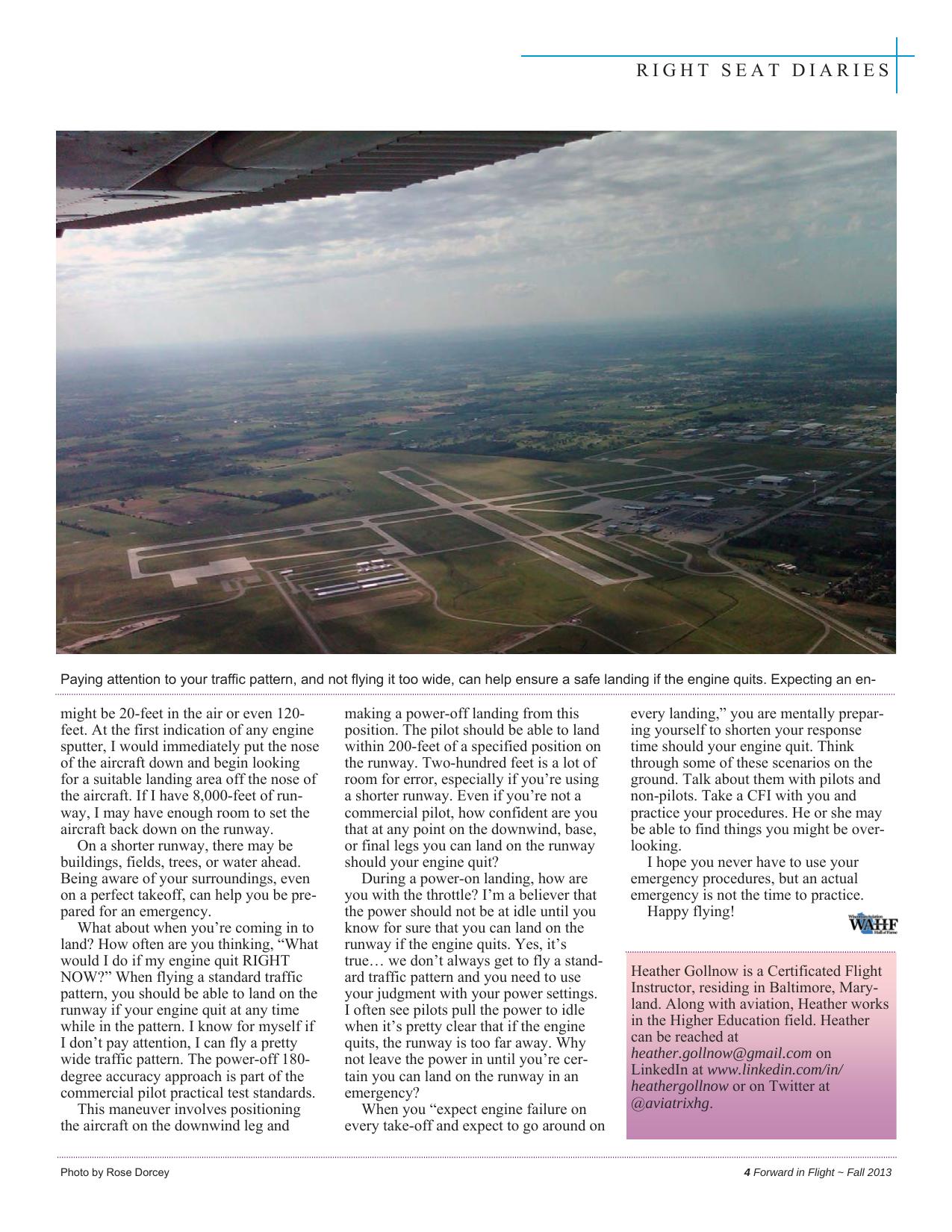
RIGHT SEAT DIARIES Paying attention to your traffic pattern, and not flying it too wide, can help ensure a safe landing if the engine quits. Expecting an en- might be 20-feet in the air or even 120feet. At the first indication of any engine sputter, I would immediately put the nose of the aircraft down and begin looking for a suitable landing area off the nose of the aircraft. If I have 8,000-feet of runway, I may have enough room to set the aircraft back down on the runway. On a shorter runway, there may be buildings, fields, trees, or water ahead. Being aware of your surroundings, even on a perfect takeoff, can help you be prepared for an emergency. What about when you’re coming in to land? How often are you thinking, “What would I do if my engine quit RIGHT NOW?” When flying a standard traffic pattern, you should be able to land on the runway if your engine quit at any time while in the pattern. I know for myself if I don’t pay attention, I can fly a pretty wide traffic pattern. The power-off 180degree accuracy approach is part of the commercial pilot practical test standards. This maneuver involves positioning the aircraft on the downwind leg and Photo by Rose Dorcey making a power-off landing from this position. The pilot should be able to land within 200-feet of a specified position on the runway. Two-hundred feet is a lot of room for error, especially if you’re using a shorter runway. Even if you’re not a commercial pilot, how confident are you that at any point on the downwind, base, or final legs you can land on the runway should your engine quit? During a power-on landing, how are you with the throttle? I’m a believer that the power should not be at idle until you know for sure that you can land on the runway if the engine quits. Yes, it’s true… we don’t always get to fly a standard traffic pattern and you need to use your judgment with your power settings. I often see pilots pull the power to idle when it’s pretty clear that if the engine quits, the runway is too far away. Why not leave the power in until you’re certain you can land on the runway in an emergency? When you “expect engine failure on every take-off and expect to go around on every landing,” you are mentally preparing yourself to shorten your response time should your engine quit. Think through some of these scenarios on the ground. Talk about them with pilots and non-pilots. Take a CFI with you and practice your procedures. He or she may be able to find things you might be overlooking. I hope you never have to use your emergency procedures, but an actual emergency is not the time to practice. Happy flying! Heather Gollnow is a Certificated Flight Instructor, residing in Baltimore, Maryland. Along with aviation, Heather works in the Higher Education field. Heather can be reached at heather.gollnow@gmail.com on LinkedIn at www.linkedin.com/in/ heathergollnow or on Twitter at @aviatrixhg. 4 Forward in Flight ~ Fall 2013
AIR DOC FAA change may hasten issuance of your medical The CACI Advantage Dr. Tom Voelker, AME DrAlphaMike@yahoo.com Greetings, airmen! It’s great to be back with you once again. As I write this edition’s column, I am relaxing on my deck with a Point at my side, enjoying the crisp fall air on a clear, starlit evening. I think this is my favorite season. BUT I DO NOT WANT IT TO BE FALL IN THE MIDDLE OF AUGUST! There, I got it off my chest. What is with this weather, anyway? By the time you read this, autumn will at least seem like a reasonable possibility. But for now I guess I’ll have to enjoy a cool cockpit on a summer day. If it is indeed August, that must mean that I, and I expect most of you readers, just got back from EAA AirVenture Oshkosh, that jewel of an aviation celebration that is Wisconsin’s alone. I had a wonderful time at EAA. I would like to share with you a few comments about my experience, and then I’ll spend the bulk of my words on new developments at the FAA aeromedical division. I brought my youngest daughter, Emma, to EAA this year. She and I used to stay in Camp Scholler and enjoy a few days a year at AirVenture. After a few too many storms and damaged tents we migrated to my brother-in-law’s house in Neenah for our lodging. Now I find myself busier and Emma is all grown up (a senior in college), and we could only muster one day together. As was the case all week, the weather was wonderful. We had planned to stay to watch the premier of the Disney production “Planes,” but after the airshow we were both showing our age and getting tired out. It was to be another three hours until show time, so we decided to head home. Perhaps I will take my 2-1/2 year-old granddaughter to the theater to see the film. Even at this young age she is infatuated with airplanes. Maybe in a couple of years she will replace Emma as my “EAA buddy.” My first impression of the show was that something was missing. I didn’t see what it was at first. The only real business I wanted to accomplish at AirVenture was to discuss a couple of things with the FAA reps about ADS-B navigation, and a couple of regulatory issues. I also like to check in with the FAA aeromedical personnel at the show. You may recall that last year I went to one of the medical certification presentations with Dr. Dave Schall, the Great Lakes Regional Flight Surgeon. It’s great to have these people there to talk to. If the AME can agree that the condition is adequately treated and controlled, he or she can issue the unrestricted medical on the spot. That’s what was missing – the FAA! I went into the FAA pavilion, expecting to find the usual booths (navigation, charting, aircraft registration, medical certification, etc.) Some of these areas were represented – by videos. There was not a single FAA employee in sight! You probably have heard that the FAA Administrator also had a prior engagement and needed to miss the largest aviation show in the entire country. 5 Forward in Flight ~ Quarterly Magazine of the Wisconsin Aviation Hall of Fame Yes, indeed, something had changed. My questions went unanswered, and I do not have anything new in the aeromedical field to bring to you from Oshkosh. The other glaring omission was current military aircraft. I did not expect to see many of our country’s finest in flight, but apparently the static aircraft displays were “grounded” as well. What really makes EAA special, though, was still strong. It was great to have thousands of aircraft, pilots, and other aviation enthusiasts all in one place, sharing stories, rubbing shoulders, and just “hanging out.” Yes, even the aircraft have stories to tell. I think my highlight of the day was the very static display of an FM-2 Wildcat fighter. This aircraft had crashed into Lake Michigan on an aircraft carrier landing mission in 1944. While it is in rough shape (or “roughly the shape” of an airplane), the bird will be restored and ultimately make it to the National Naval Aviation Museum in Pensacola, Florida. The recovery and the restoration teams were there to tell their stories. But it was the Wildcat itself that was speaking the loudest as I was looking at it. This is definitely one project I will follow as it develops, and I plan to take Emma to Pensacola in about five years to see the FM-2 in its original glory. All in all, I really enjoyed EAA AirVenture and look forward to next year’s show. Meanwhile, in Oklahoma City the FAA aeromedical staff was hard at work helping us! There is a new development in medical certification of airmen, and it is a good one. CACI (pronounced “kacky”) will make obtaining a medical much eas-
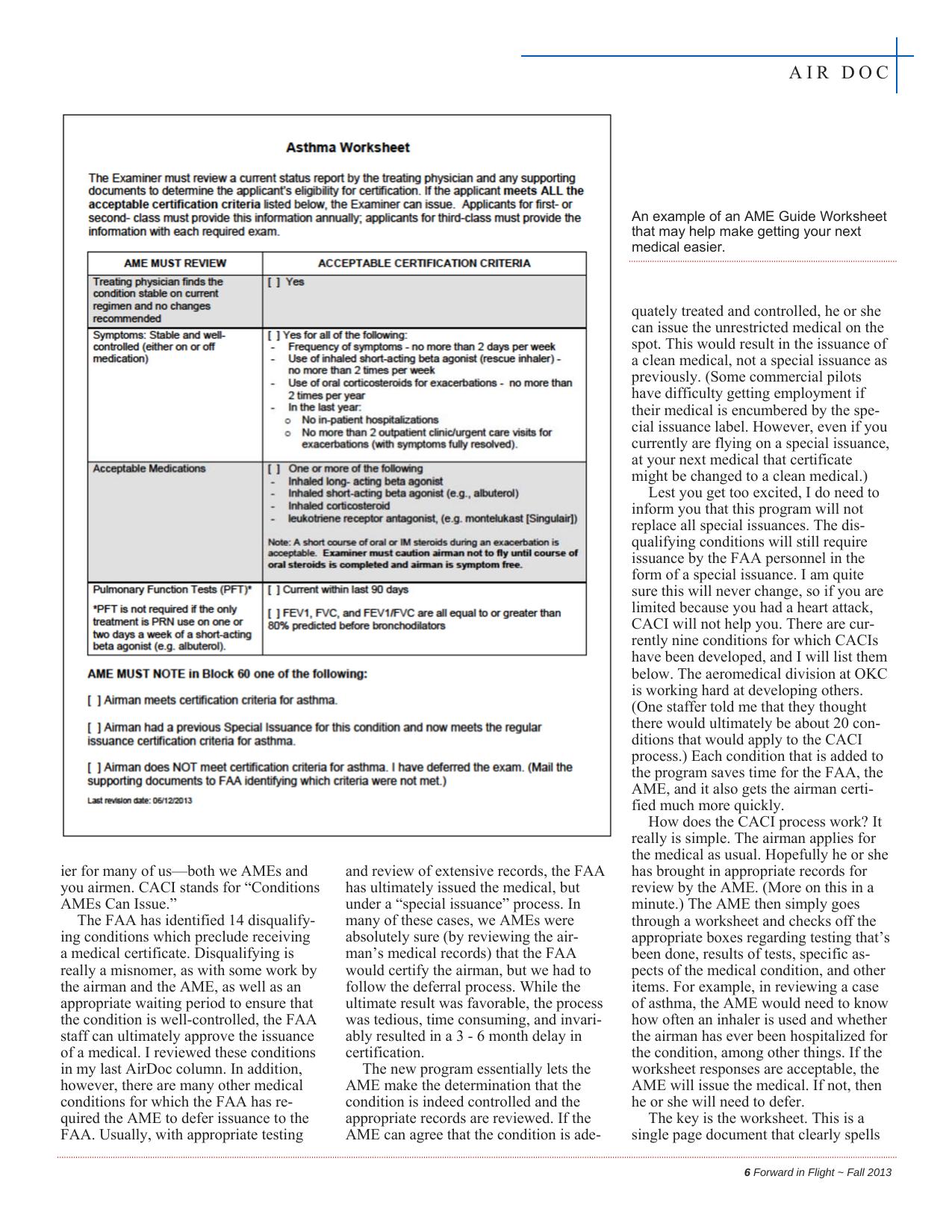
AIR DOC An example of an AME Guide Worksheet that may help make getting your next medical easier. ier for many of us—both we AMEs and you airmen. CACI stands for “Conditions AMEs Can Issue.” The FAA has identified 14 disqualifying conditions which preclude receiving a medical certificate. Disqualifying is really a misnomer, as with some work by the airman and the AME, as well as an appropriate waiting period to ensure that the condition is well-controlled, the FAA staff can ultimately approve the issuance of a medical. I reviewed these conditions in my last AirDoc column. In addition, however, there are many other medical conditions for which the FAA has required the AME to defer issuance to the FAA. Usually, with appropriate testing and review of extensive records, the FAA has ultimately issued the medical, but under a “special issuance” process. In many of these cases, we AMEs were absolutely sure (by reviewing the airman’s medical records) that the FAA would certify the airman, but we had to follow the deferral process. While the ultimate result was favorable, the process was tedious, time consuming, and invariably resulted in a 3 - 6 month delay in certification. The new program essentially lets the AME make the determination that the condition is indeed controlled and the appropriate records are reviewed. If the AME can agree that the condition is ade- quately treated and controlled, he or she can issue the unrestricted medical on the spot. This would result in the issuance of a clean medical, not a special issuance as previously. (Some commercial pilots have difficulty getting employment if their medical is encumbered by the special issuance label. However, even if you currently are flying on a special issuance, at your next medical that certificate might be changed to a clean medical.) Lest you get too excited, I do need to inform you that this program will not replace all special issuances. The disqualifying conditions will still require issuance by the FAA personnel in the form of a special issuance. I am quite sure this will never change, so if you are limited because you had a heart attack, CACI will not help you. There are currently nine conditions for which CACIs have been developed, and I will list them below. The aeromedical division at OKC is working hard at developing others. (One staffer told me that they thought there would ultimately be about 20 conditions that would apply to the CACI process.) Each condition that is added to the program saves time for the FAA, the AME, and it also gets the airman certified much more quickly. How does the CACI process work? It really is simple. The airman applies for the medical as usual. Hopefully he or she has brought in appropriate records for review by the AME. (More on this in a minute.) The AME then simply goes through a worksheet and checks off the appropriate boxes regarding testing that’s been done, results of tests, specific aspects of the medical condition, and other items. For example, in reviewing a case of asthma, the AME would need to know how often an inhaler is used and whether the airman has ever been hospitalized for the condition, among other things. If the worksheet responses are acceptable, the AME will issue the medical. If not, then he or she will need to defer. The key is the worksheet. This is a single page document that clearly spells 6 Forward in Flight ~ Fall 2013

AIR DOC out what information will be needed for the AME to review. The worksheet is available to the airman. Simply Google the phrase “AME Guide Worksheet Asthma” (or whatever condition you are dealing with), and the worksheet will appear! Bring this to your regular doctor, and he or she should be able to make sure you get the appropriate records and testing done to bring to your flight physical. Since this is a new program, you may need to Google a little harder to get the actual worksheet, but it is available. The nine conditions for which a CACI worksheet is currently available are: Glaucoma, Asthma, Hypertension, Chronic Hepatitis C, Renal Cancer, Arthritis, Migraine and Chronic Headache, Pre-Diabetes, and Hypothyroidism. If you currently have one of these conditions and are on a special issuance, download the worksheet and see if you might be able to get a regular medical certification. I’ll keep you posted on the developments in this area. I have yet to complete my first worksheet, but I look forward to doing so. Once I complete the worksheet, I fill out the medical, and I don’t even need to send the records to the FAA. They trust me! Could this really be the same FAA that didn’t show up at EAA? Time will tell. With that I wish you all happy times, safe flights, and good health! —Alpha Mike Echo “Alpha Mike Echo” is Dr. Tom Voelker, AME, a family practitioner in Wisconsin Rapids. He and his wife, Kathy, are the parents of four daughters. Tom flies N6224P, a Comanche 250, out of Alexander Field, South Wood County Airport (ISW). 2031 Peach Street Wisconsin Rapids, WI 54494 7 Forward in Flight ~ Quarterly Magazine of the Wisconsin Aviation Hall of Fame Advertise in Forward in Flight! Reach Wisconsin pilots and aircraft owners with an affordable ad in Forward in Flight. It’s easy to get started; call Rose at 920-385-1483 or email rdorcey@wisconsinaviationhalloffame.org.
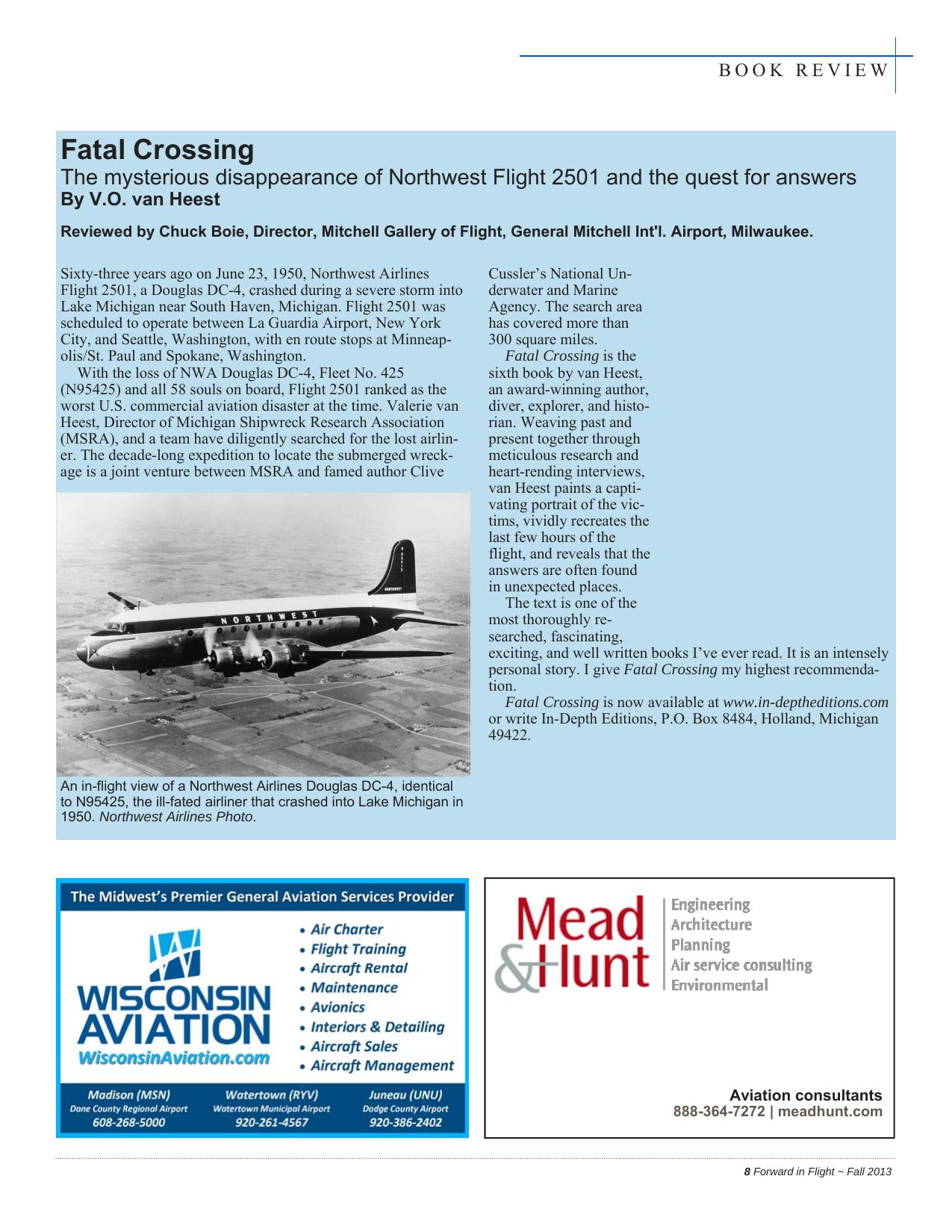
BOOK REVIEW Fatal Crossing The mysterious disappearance of Northwest Flight 2501 and the quest for answers By V.O. van Heest Reviewed by Chuck Boie, Director, Mitchell Gallery of Flight, General Mitchell Int'l. Airport, Milwaukee. Sixty-three years ago on June 23, 1950, Northwest Airlines Flight 2501, a Douglas DC-4, crashed during a severe storm into Lake Michigan near South Haven, Michigan. Flight 2501 was scheduled to operate between La Guardia Airport, New York City, and Seattle, Washington, with en route stops at Minneapolis/St. Paul and Spokane, Washington. With the loss of NWA Douglas DC-4, Fleet No. 425 (N95425) and all 58 souls on board, Flight 2501 ranked as the worst U.S. commercial aviation disaster at the time. Valerie van Heest, Director of Michigan Shipwreck Research Association (MSRA), and a team have diligently searched for the lost airliner. The decade-long expedition to locate the submerged wreckage is a joint venture between MSRA and famed author Clive Cussler’s National Underwater and Marine Agency. The search area has covered more than 300 square miles. Fatal Crossing is the sixth book by van Heest, an award-winning author, diver, explorer, and historian. Weaving past and present together through meticulous research and heart-rending interviews, van Heest paints a captivating portrait of the victims, vividly recreates the last few hours of the flight, and reveals that the answers are often found in unexpected places. The text is one of the most thoroughly researched, fascinating, exciting, and well written books I’ve ever read. It is an intensely personal story. I give Fatal Crossing my highest recommendation. Fatal Crossing is now available at www.in-deptheditions.com or write In-Depth Editions, P.O. Box 8484, Holland, Michigan 49422. An in-flight view of a Northwest Airlines Douglas DC-4, identical to N95425, the ill-fated airliner that crashed into Lake Michigan in 1950. Northwest Airlines Photo. Aviation consultants 888-364-7272 | meadhunt.com 8 Forward in Flight ~ Fall 2013
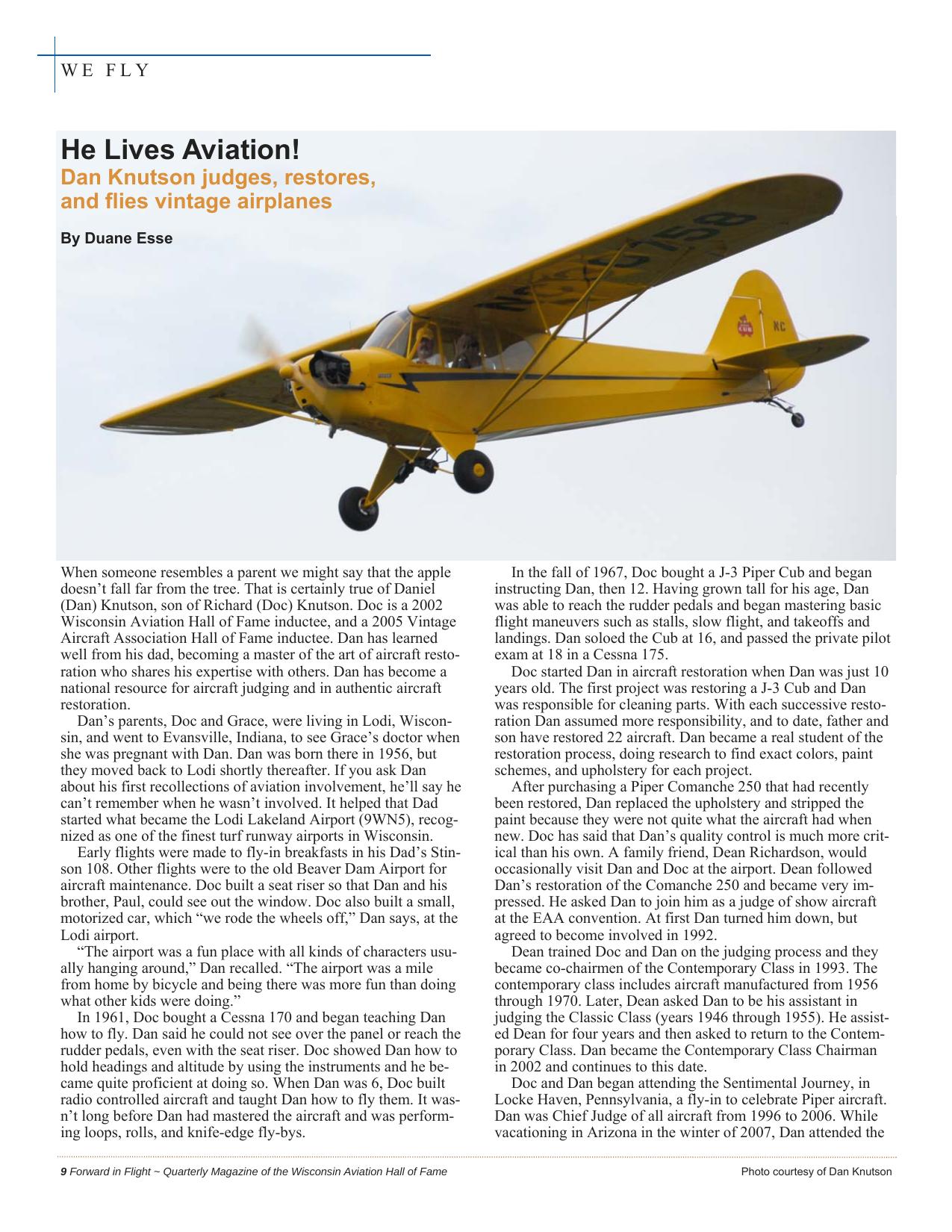
WE FLY He Lives Aviation! Dan Knutson judges, restores, and flies vintage airplanes By Duane Esse When someone resembles a parent we might say that the apple doesn’t fall far from the tree. That is certainly true of Daniel (Dan) Knutson, son of Richard (Doc) Knutson. Doc is a 2002 Wisconsin Aviation Hall of Fame inductee, and a 2005 Vintage Aircraft Association Hall of Fame inductee. Dan has learned well from his dad, becoming a master of the art of aircraft restoration who shares his expertise with others. Dan has become a national resource for aircraft judging and in authentic aircraft restoration. Dan’s parents, Doc and Grace, were living in Lodi, Wisconsin, and went to Evansville, Indiana, to see Grace’s doctor when she was pregnant with Dan. Dan was born there in 1956, but they moved back to Lodi shortly thereafter. If you ask Dan about his first recollections of aviation involvement, he’ll say he can’t remember when he wasn’t involved. It helped that Dad started what became the Lodi Lakeland Airport (9WN5), recognized as one of the finest turf runway airports in Wisconsin. Early flights were made to fly-in breakfasts in his Dad’s Stinson 108. Other flights were to the old Beaver Dam Airport for aircraft maintenance. Doc built a seat riser so that Dan and his brother, Paul, could see out the window. Doc also built a small, motorized car, which “we rode the wheels off,” Dan says, at the Lodi airport. “The airport was a fun place with all kinds of characters usually hanging around,” Dan recalled. “The airport was a mile from home by bicycle and being there was more fun than doing what other kids were doing.” In 1961, Doc bought a Cessna 170 and began teaching Dan how to fly. Dan said he could not see over the panel or reach the rudder pedals, even with the seat riser. Doc showed Dan how to hold headings and altitude by using the instruments and he became quite proficient at doing so. When Dan was 6, Doc built radio controlled aircraft and taught Dan how to fly them. It wasn’t long before Dan had mastered the aircraft and was performing loops, rolls, and knife-edge fly-bys. 9 Forward in Flight ~ Quarterly Magazine of the Wisconsin Aviation Hall of Fame In the fall of 1967, Doc bought a J-3 Piper Cub and began instructing Dan, then 12. Having grown tall for his age, Dan was able to reach the rudder pedals and began mastering basic flight maneuvers such as stalls, slow flight, and takeoffs and landings. Dan soloed the Cub at 16, and passed the private pilot exam at 18 in a Cessna 175. Doc started Dan in aircraft restoration when Dan was just 10 years old. The first project was restoring a J-3 Cub and Dan was responsible for cleaning parts. With each successive restoration Dan assumed more responsibility, and to date, father and son have restored 22 aircraft. Dan became a real student of the restoration process, doing research to find exact colors, paint schemes, and upholstery for each project. After purchasing a Piper Comanche 250 that had recently been restored, Dan replaced the upholstery and stripped the paint because they were not quite what the aircraft had when new. Doc has said that Dan’s quality control is much more critical than his own. A family friend, Dean Richardson, would occasionally visit Dan and Doc at the airport. Dean followed Dan’s restoration of the Comanche 250 and became very impressed. He asked Dan to join him as a judge of show aircraft at the EAA convention. At first Dan turned him down, but agreed to become involved in 1992. Dean trained Doc and Dan on the judging process and they became co-chairmen of the Contemporary Class in 1993. The contemporary class includes aircraft manufactured from 1956 through 1970. Later, Dean asked Dan to be his assistant in judging the Classic Class (years 1946 through 1955). He assisted Dean for four years and then asked to return to the Contemporary Class. Dan became the Contemporary Class Chairman in 2002 and continues to this date. Doc and Dan began attending the Sentimental Journey, in Locke Haven, Pennsylvania, a fly-in to celebrate Piper aircraft. Dan was Chief Judge of all aircraft from 1996 to 2006. While vacationing in Arizona in the winter of 2007, Dan attended the Photo courtesy of Dan Knutson
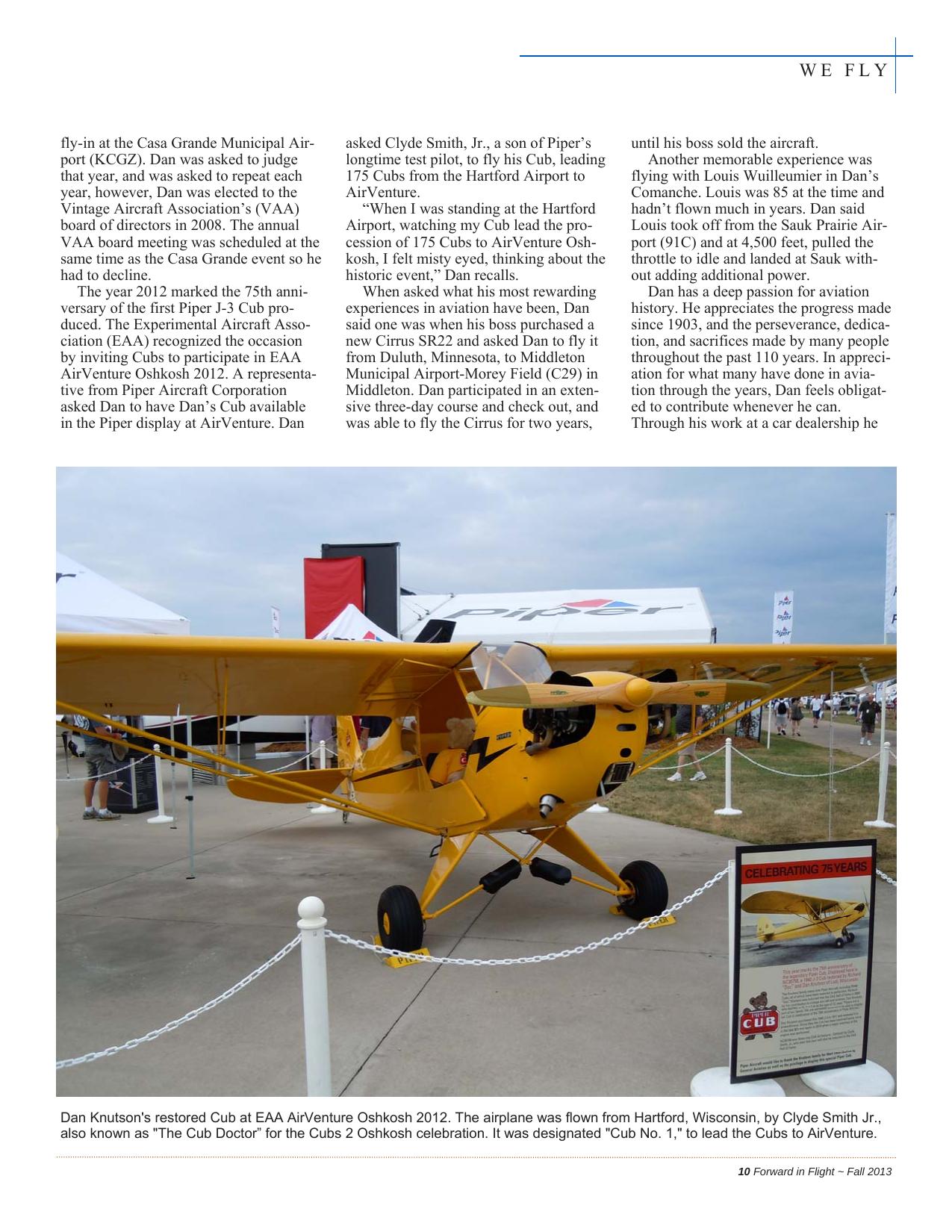
WE FLY fly-in at the Casa Grande Municipal Airport (KCGZ). Dan was asked to judge that year, and was asked to repeat each year, however, Dan was elected to the Vintage Aircraft Association’s (VAA) board of directors in 2008. The annual VAA board meeting was scheduled at the same time as the Casa Grande event so he had to decline. The year 2012 marked the 75th anniversary of the first Piper J-3 Cub produced. The Experimental Aircraft Association (EAA) recognized the occasion by inviting Cubs to participate in EAA AirVenture Oshkosh 2012. A representative from Piper Aircraft Corporation asked Dan to have Dan’s Cub available in the Piper display at AirVenture. Dan asked Clyde Smith, Jr., a son of Piper’s longtime test pilot, to fly his Cub, leading 175 Cubs from the Hartford Airport to AirVenture. “When I was standing at the Hartford Airport, watching my Cub lead the procession of 175 Cubs to AirVenture Oshkosh, I felt misty eyed, thinking about the historic event,” Dan recalls. When asked what his most rewarding experiences in aviation have been, Dan said one was when his boss purchased a new Cirrus SR22 and asked Dan to fly it from Duluth, Minnesota, to Middleton Municipal Airport-Morey Field (C29) in Middleton. Dan participated in an extensive three-day course and check out, and was able to fly the Cirrus for two years, until his boss sold the aircraft. Another memorable experience was flying with Louis Wuilleumier in Dan’s Comanche. Louis was 85 at the time and hadn’t flown much in years. Dan said Louis took off from the Sauk Prairie Airport (91C) and at 4,500 feet, pulled the throttle to idle and landed at Sauk without adding additional power. Dan has a deep passion for aviation history. He appreciates the progress made since 1903, and the perseverance, dedication, and sacrifices made by many people throughout the past 110 years. In appreciation for what many have done in aviation through the years, Dan feels obligated to contribute whenever he can. Through his work at a car dealership he Dan Knutson's restored Cub at EAA AirVenture Oshkosh 2012. The airplane was flown from Hartford, Wisconsin, by Clyde Smith Jr., also known as "The Cub Doctor” for the Cubs 2 Oshkosh celebration. It was designated "Cub No. 1," to lead the Cubs to AirVenture. 10 Forward in Flight ~ Fall 2013
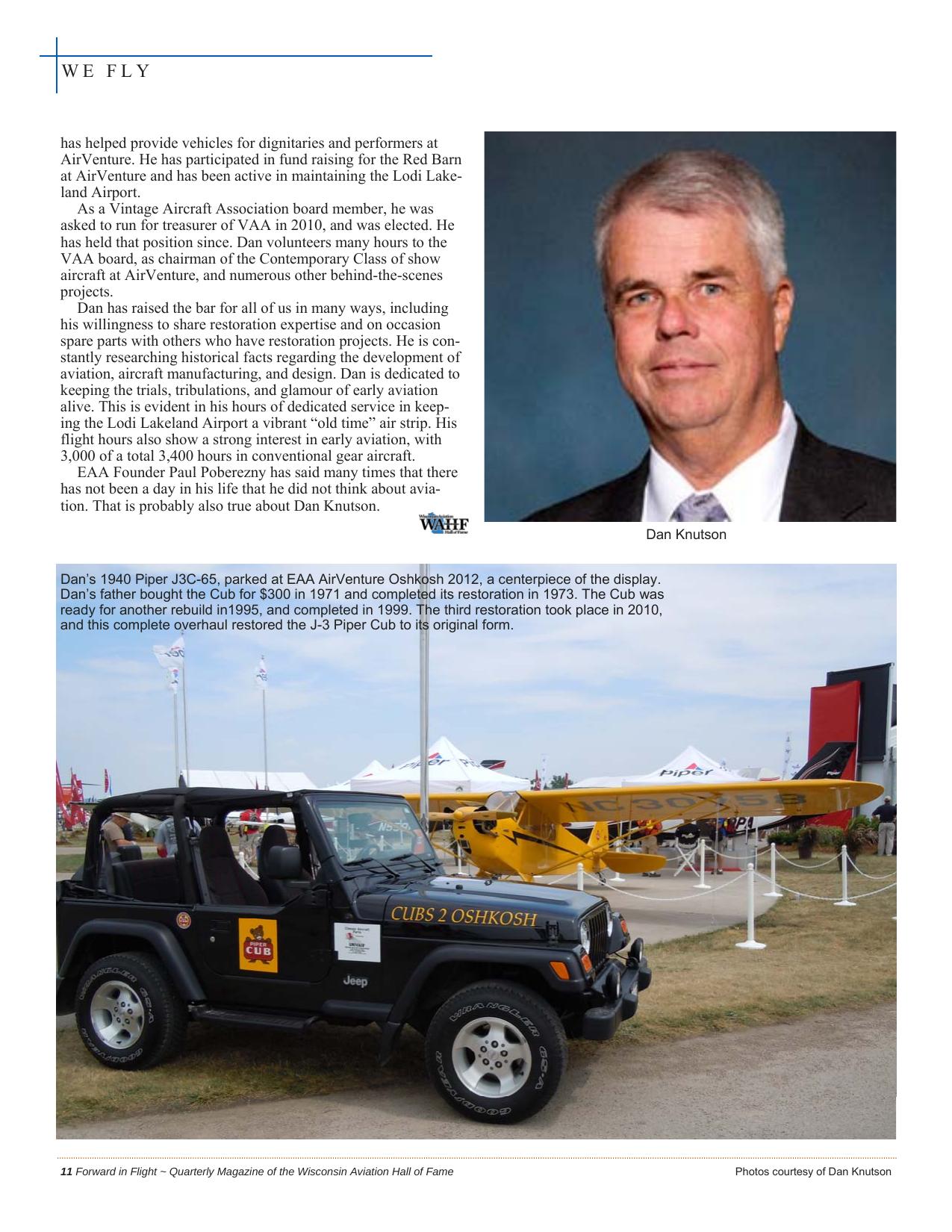
WE FLY has helped provide vehicles for dignitaries and performers at AirVenture. He has participated in fund raising for the Red Barn at AirVenture and has been active in maintaining the Lodi Lakeland Airport. As a Vintage Aircraft Association board member, he was asked to run for treasurer of VAA in 2010, and was elected. He has held that position since. Dan volunteers many hours to the VAA board, as chairman of the Contemporary Class of show aircraft at AirVenture, and numerous other behind-the-scenes projects. Dan has raised the bar for all of us in many ways, including his willingness to share restoration expertise and on occasion spare parts with others who have restoration projects. He is constantly researching historical facts regarding the development of aviation, aircraft manufacturing, and design. Dan is dedicated to keeping the trials, tribulations, and glamour of early aviation alive. This is evident in his hours of dedicated service in keeping the Lodi Lakeland Airport a vibrant “old time” air strip. His flight hours also show a strong interest in early aviation, with 3,000 of a total 3,400 hours in conventional gear aircraft. EAA Founder Paul Poberezny has said many times that there has not been a day in his life that he did not think about aviation. That is probably also true about Dan Knutson. Dan Knutson Dan’s 1940 Piper J3C-65, parked at EAA AirVenture Oshkosh 2012, a centerpiece of the display. Dan’s father bought the Cub for $300 in 1971 and completed its restoration in 1973. The Cub was ready for another rebuild in1995, and completed in 1999. The third restoration took place in 2010, and this complete overhaul restored the J-3 Piper Cub to its original form. 11 Forward in Flight ~ Quarterly Magazine of the Wisconsin Aviation Hall of Fame Photos courtesy of Dan Knutson
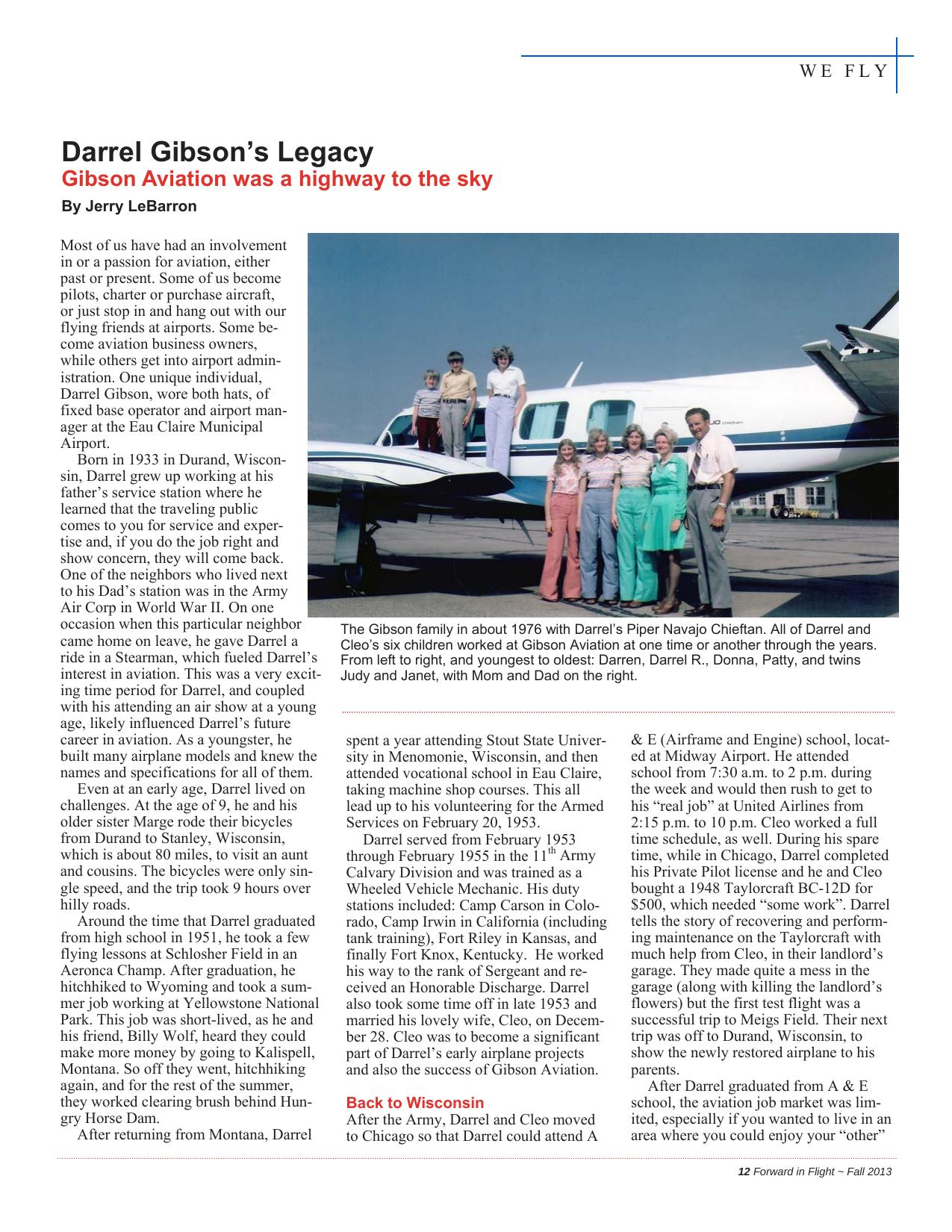
WE FLY Darrel Gibson’s Legacy Gibson Aviation was a highway to the sky By Jerry LeBarron Most of us have had an involvement in or a passion for aviation, either past or present. Some of us become pilots, charter or purchase aircraft, or just stop in and hang out with our flying friends at airports. Some become aviation business owners, while others get into airport administration. One unique individual, Darrel Gibson, wore both hats, of fixed base operator and airport manager at the Eau Claire Municipal Airport. Born in 1933 in Durand, Wisconsin, Darrel grew up working at his father’s service station where he learned that the traveling public comes to you for service and expertise and, if you do the job right and show concern, they will come back. One of the neighbors who lived next to his Dad’s station was in the Army Air Corp in World War II. On one occasion when this particular neighbor came home on leave, he gave Darrel a ride in a Stearman, which fueled Darrel’s interest in aviation. This was a very exciting time period for Darrel, and coupled with his attending an air show at a young age, likely influenced Darrel’s future career in aviation. As a youngster, he built many airplane models and knew the names and specifications for all of them. Even at an early age, Darrel lived on challenges. At the age of 9, he and his older sister Marge rode their bicycles from Durand to Stanley, Wisconsin, which is about 80 miles, to visit an aunt and cousins. The bicycles were only single speed, and the trip took 9 hours over hilly roads. Around the time that Darrel graduated from high school in 1951, he took a few flying lessons at Schlosher Field in an Aeronca Champ. After graduation, he hitchhiked to Wyoming and took a summer job working at Yellowstone National Park. This job was short-lived, as he and his friend, Billy Wolf, heard they could make more money by going to Kalispell, Montana. So off they went, hitchhiking again, and for the rest of the summer, they worked clearing brush behind Hungry Horse Dam. After returning from Montana, Darrel The Gibson family in about 1976 with Darrel’s Piper Navajo Chieftan. All of Darrel and Cleo’s six children worked at Gibson Aviation at one time or another through the years. From left to right, and youngest to oldest: Darren, Darrel R., Donna, Patty, and twins Judy and Janet, with Mom and Dad on the right. spent a year attending Stout State University in Menomonie, Wisconsin, and then attended vocational school in Eau Claire, taking machine shop courses. This all lead up to his volunteering for the Armed Services on February 20, 1953. Darrel served from February 1953 through February 1955 in the 11th Army Calvary Division and was trained as a Wheeled Vehicle Mechanic. His duty stations included: Camp Carson in Colorado, Camp Irwin in California (including tank training), Fort Riley in Kansas, and finally Fort Knox, Kentucky. He worked his way to the rank of Sergeant and received an Honorable Discharge. Darrel also took some time off in late 1953 and married his lovely wife, Cleo, on December 28. Cleo was to become a significant part of Darrel’s early airplane projects and also the success of Gibson Aviation. Back to Wisconsin After the Army, Darrel and Cleo moved to Chicago so that Darrel could attend A & E (Airframe and Engine) school, located at Midway Airport. He attended school from 7:30 a.m. to 2 p.m. during the week and would then rush to get to his “real job” at United Airlines from 2:15 p.m. to 10 p.m. Cleo worked a full time schedule, as well. During his spare time, while in Chicago, Darrel completed his Private Pilot license and he and Cleo bought a 1948 Taylorcraft BC-12D for $500, which needed “some work”. Darrel tells the story of recovering and performing maintenance on the Taylorcraft with much help from Cleo, in their landlord’s garage. They made quite a mess in the garage (along with killing the landlord’s flowers) but the first test flight was a successful trip to Meigs Field. Their next trip was off to Durand, Wisconsin, to show the newly restored airplane to his parents. After Darrel graduated from A & E school, the aviation job market was limited, especially if you wanted to live in an area where you could enjoy your “other” 12 Forward in Flight ~ Fall 2013
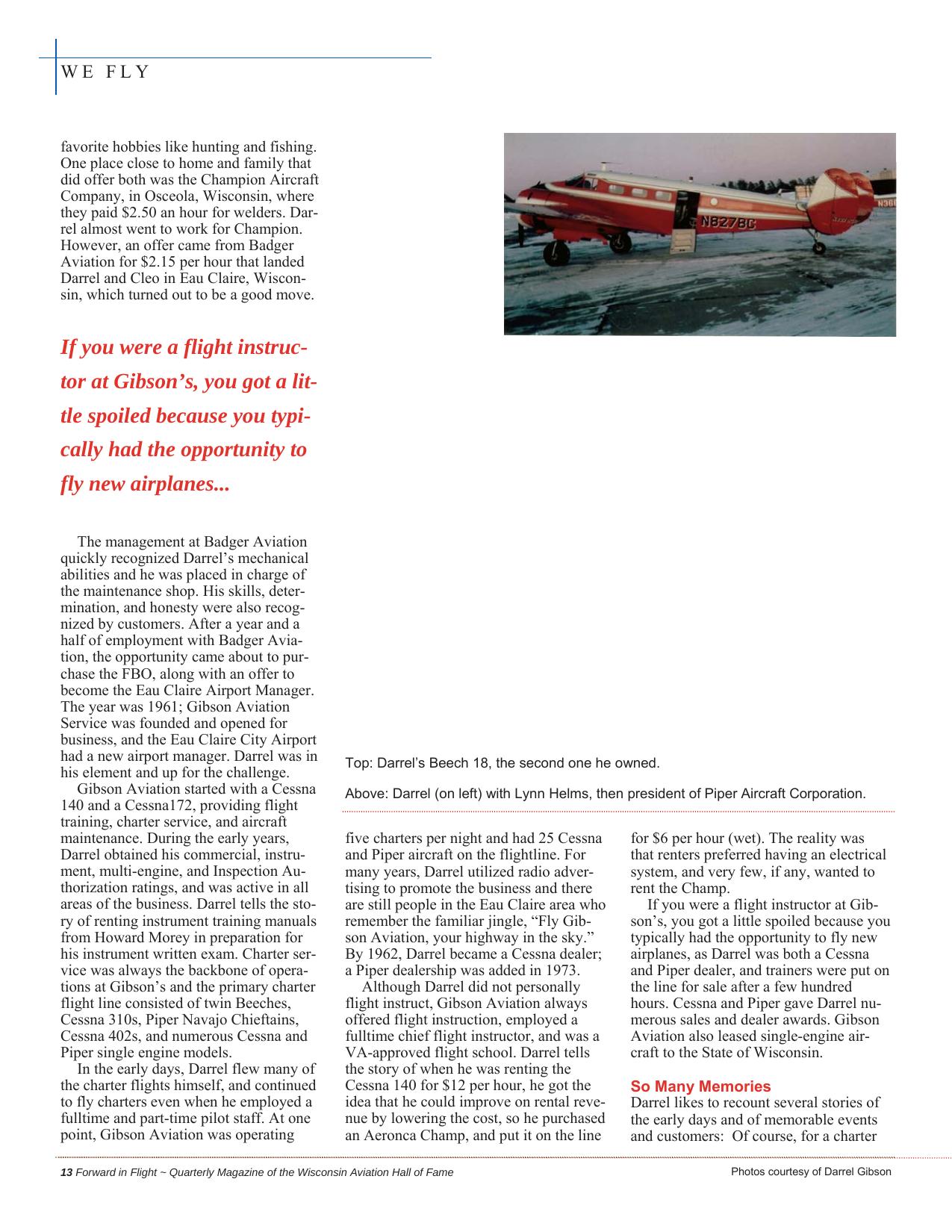
WE FLY favorite hobbies like hunting and fishing. One place close to home and family that did offer both was the Champion Aircraft Company, in Osceola, Wisconsin, where they paid $2.50 an hour for welders. Darrel almost went to work for Champion. However, an offer came from Badger Aviation for $2.15 per hour that landed Darrel and Cleo in Eau Claire, Wisconsin, which turned out to be a good move. If you were a flight instructor at Gibson’s, you got a little spoiled because you typically had the opportunity to fly new airplanes... The management at Badger Aviation quickly recognized Darrel’s mechanical abilities and he was placed in charge of the maintenance shop. His skills, determination, and honesty were also recognized by customers. After a year and a half of employment with Badger Aviation, the opportunity came about to purchase the FBO, along with an offer to become the Eau Claire Airport Manager. The year was 1961; Gibson Aviation Service was founded and opened for business, and the Eau Claire City Airport had a new airport manager. Darrel was in his element and up for the challenge. Gibson Aviation started with a Cessna 140 and a Cessna172, providing flight training, charter service, and aircraft maintenance. During the early years, Darrel obtained his commercial, instrument, multi-engine, and Inspection Authorization ratings, and was active in all areas of the business. Darrel tells the story of renting instrument training manuals from Howard Morey in preparation for his instrument written exam. Charter service was always the backbone of operations at Gibson’s and the primary charter flight line consisted of twin Beeches, Cessna 310s, Piper Navajo Chieftains, Cessna 402s, and numerous Cessna and Piper single engine models. In the early days, Darrel flew many of the charter flights himself, and continued to fly charters even when he employed a fulltime and part-time pilot staff. At one point, Gibson Aviation was operating Top: Darrel’s Beech 18, the second one he owned. Above: Darrel (on left) with Lynn Helms, then president of Piper Aircraft Corporation. five charters per night and had 25 Cessna and Piper aircraft on the flightline. For many years, Darrel utilized radio advertising to promote the business and there are still people in the Eau Claire area who remember the familiar jingle, “Fly Gibson Aviation, your highway in the sky.” By 1962, Darrel became a Cessna dealer; a Piper dealership was added in 1973. Although Darrel did not personally flight instruct, Gibson Aviation always offered flight instruction, employed a fulltime chief flight instructor, and was a VA-approved flight school. Darrel tells the story of when he was renting the Cessna 140 for $12 per hour, he got the idea that he could improve on rental revenue by lowering the cost, so he purchased an Aeronca Champ, and put it on the line 13 Forward in Flight ~ Quarterly Magazine of the Wisconsin Aviation Hall of Fame for $6 per hour (wet). The reality was that renters preferred having an electrical system, and very few, if any, wanted to rent the Champ. If you were a flight instructor at Gibson’s, you got a little spoiled because you typically had the opportunity to fly new airplanes, as Darrel was both a Cessna and Piper dealer, and trainers were put on the line for sale after a few hundred hours. Cessna and Piper gave Darrel numerous sales and dealer awards. Gibson Aviation also leased single-engine aircraft to the State of Wisconsin. So Many Memories Darrel likes to recount several stories of the early days and of memorable events and customers: Of course, for a charter Photos courtesy of Darrel Gibson
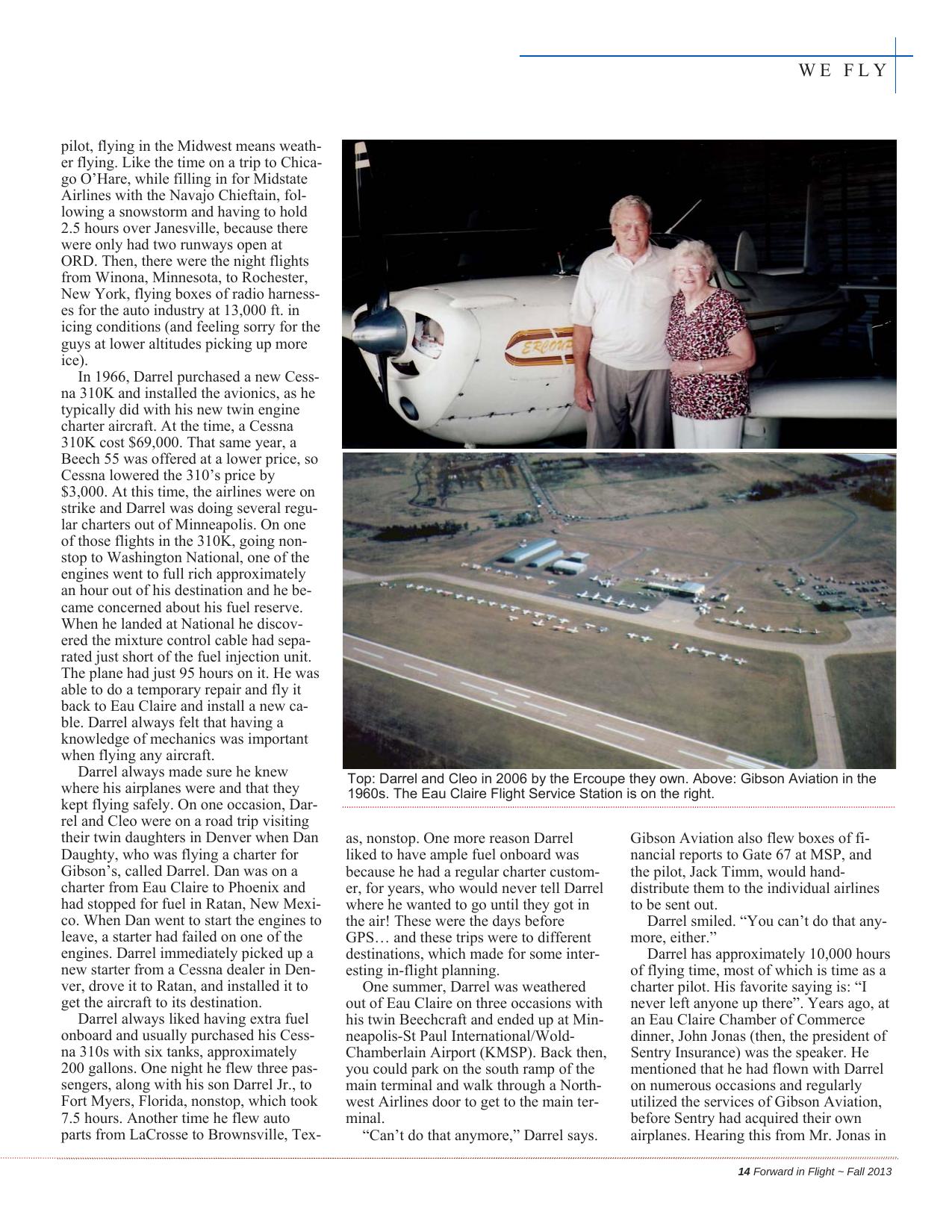
WE FLY pilot, flying in the Midwest means weather flying. Like the time on a trip to Chicago O’Hare, while filling in for Midstate Airlines with the Navajo Chieftain, following a snowstorm and having to hold 2.5 hours over Janesville, because there were only had two runways open at ORD. Then, there were the night flights from Winona, Minnesota, to Rochester, New York, flying boxes of radio harnesses for the auto industry at 13,000 ft. in icing conditions (and feeling sorry for the guys at lower altitudes picking up more ice). In 1966, Darrel purchased a new Cessna 310K and installed the avionics, as he typically did with his new twin engine charter aircraft. At the time, a Cessna 310K cost $69,000. That same year, a Beech 55 was offered at a lower price, so Cessna lowered the 310’s price by $3,000. At this time, the airlines were on strike and Darrel was doing several regular charters out of Minneapolis. On one of those flights in the 310K, going nonstop to Washington National, one of the engines went to full rich approximately an hour out of his destination and he became concerned about his fuel reserve. When he landed at National he discovered the mixture control cable had separated just short of the fuel injection unit. The plane had just 95 hours on it. He was able to do a temporary repair and fly it back to Eau Claire and install a new cable. Darrel always felt that having a knowledge of mechanics was important when flying any aircraft. Darrel always made sure he knew where his airplanes were and that they kept flying safely. On one occasion, Darrel and Cleo were on a road trip visiting their twin daughters in Denver when Dan Daughty, who was flying a charter for Gibson’s, called Darrel. Dan was on a charter from Eau Claire to Phoenix and had stopped for fuel in Ratan, New Mexico. When Dan went to start the engines to leave, a starter had failed on one of the engines. Darrel immediately picked up a new starter from a Cessna dealer in Denver, drove it to Ratan, and installed it to get the aircraft to its destination. Darrel always liked having extra fuel onboard and usually purchased his Cessna 310s with six tanks, approximately 200 gallons. One night he flew three passengers, along with his son Darrel Jr., to Fort Myers, Florida, nonstop, which took 7.5 hours. Another time he flew auto parts from LaCrosse to Brownsville, Tex- Top: Darrel and Cleo in 2006 by the Ercoupe they own. Above: Gibson Aviation in the 1960s. The Eau Claire Flight Service Station is on the right. as, nonstop. One more reason Darrel liked to have ample fuel onboard was because he had a regular charter customer, for years, who would never tell Darrel where he wanted to go until they got in the air! These were the days before GPS… and these trips were to different destinations, which made for some interesting in-flight planning. One summer, Darrel was weathered out of Eau Claire on three occasions with his twin Beechcraft and ended up at Minneapolis-St Paul International/WoldChamberlain Airport (KMSP). Back then, you could park on the south ramp of the main terminal and walk through a Northwest Airlines door to get to the main terminal. “Can’t do that anymore,” Darrel says. Gibson Aviation also flew boxes of financial reports to Gate 67 at MSP, and the pilot, Jack Timm, would handdistribute them to the individual airlines to be sent out. Darrel smiled. “You can’t do that anymore, either.” Darrel has approximately 10,000 hours of flying time, most of which is time as a charter pilot. His favorite saying is: “I never left anyone up there”. Years ago, at an Eau Claire Chamber of Commerce dinner, John Jonas (then, the president of Sentry Insurance) was the speaker. He mentioned that he had flown with Darrel on numerous occasions and regularly utilized the services of Gibson Aviation, before Sentry had acquired their own airplanes. Hearing this from Mr. Jonas in 14 Forward in Flight ~ Fall 2013
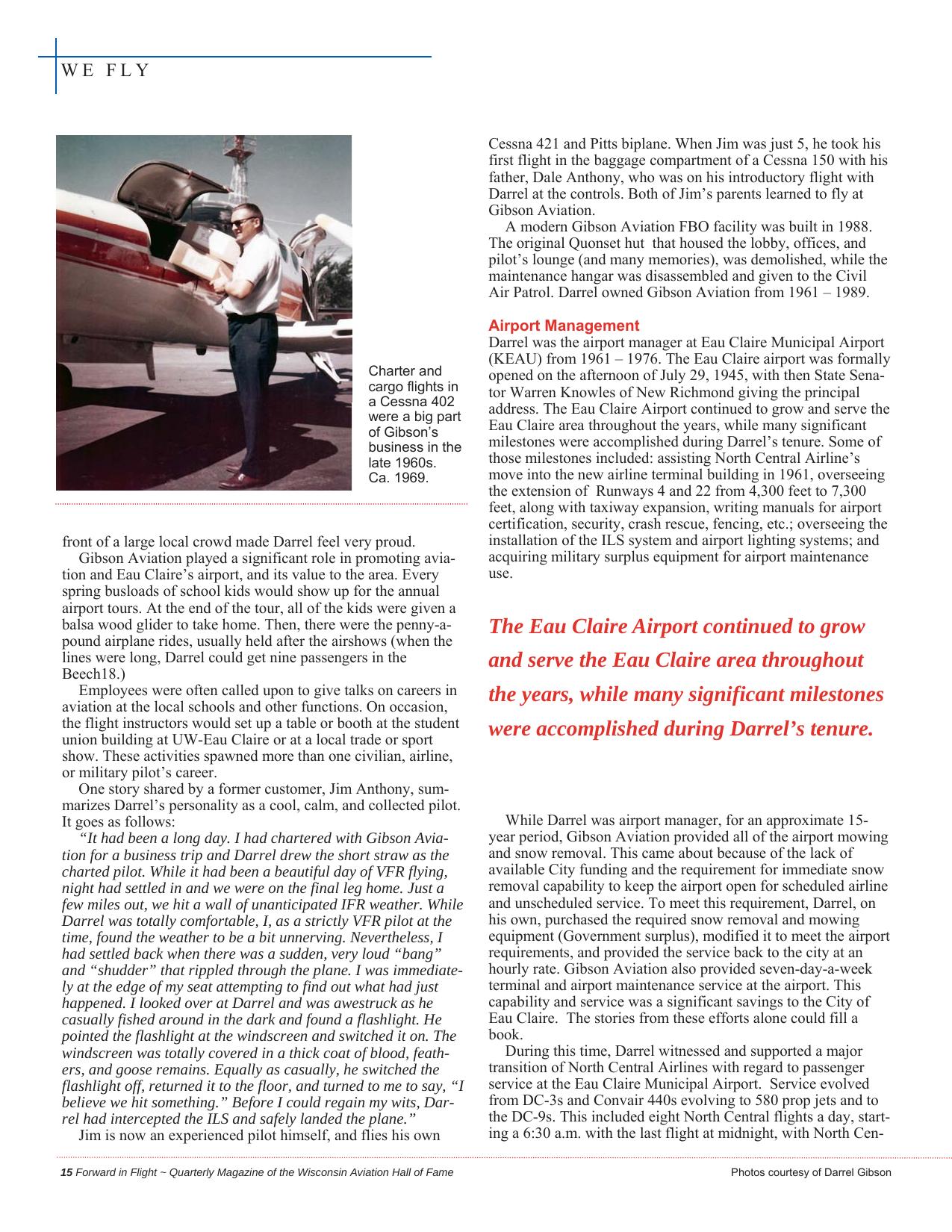
WE FLY Cessna 421 and Pitts biplane. When Jim was just 5, he took his first flight in the baggage compartment of a Cessna 150 with his father, Dale Anthony, who was on his introductory flight with Darrel at the controls. Both of Jim’s parents learned to fly at Gibson Aviation. A modern Gibson Aviation FBO facility was built in 1988. The original Quonset hut that housed the lobby, offices, and pilot’s lounge (and many memories), was demolished, while the maintenance hangar was disassembled and given to the Civil Air Patrol. Darrel owned Gibson Aviation from 1961 – 1989. Charter and cargo flights in a Cessna 402 were a big part of Gibson’s business in the late 1960s. Ca. 1969. front of a large local crowd made Darrel feel very proud. Gibson Aviation played a significant role in promoting aviation and Eau Claire’s airport, and its value to the area. Every spring busloads of school kids would show up for the annual airport tours. At the end of the tour, all of the kids were given a balsa wood glider to take home. Then, there were the penny-apound airplane rides, usually held after the airshows (when the lines were long, Darrel could get nine passengers in the Beech18.) Employees were often called upon to give talks on careers in aviation at the local schools and other functions. On occasion, the flight instructors would set up a table or booth at the student union building at UW-Eau Claire or at a local trade or sport show. These activities spawned more than one civilian, airline, or military pilot’s career. One story shared by a former customer, Jim Anthony, summarizes Darrel’s personality as a cool, calm, and collected pilot. It goes as follows: “It had been a long day. I had chartered with Gibson Aviation for a business trip and Darrel drew the short straw as the charted pilot. While it had been a beautiful day of VFR flying, night had settled in and we were on the final leg home. Just a few miles out, we hit a wall of unanticipated IFR weather. While Darrel was totally comfortable, I, as a strictly VFR pilot at the time, found the weather to be a bit unnerving. Nevertheless, I had settled back when there was a sudden, very loud “bang” and “shudder” that rippled through the plane. I was immediately at the edge of my seat attempting to find out what had just happened. I looked over at Darrel and was awestruck as he casually fished around in the dark and found a flashlight. He pointed the flashlight at the windscreen and switched it on. The windscreen was totally covered in a thick coat of blood, feathers, and goose remains. Equally as casually, he switched the flashlight off, returned it to the floor, and turned to me to say, “I believe we hit something.” Before I could regain my wits, Darrel had intercepted the ILS and safely landed the plane.” Jim is now an experienced pilot himself, and flies his own 15 Forward in Flight ~ Quarterly Magazine of the Wisconsin Aviation Hall of Fame Airport Management Darrel was the airport manager at Eau Claire Municipal Airport (KEAU) from 1961 – 1976. The Eau Claire airport was formally opened on the afternoon of July 29, 1945, with then State Senator Warren Knowles of New Richmond giving the principal address. The Eau Claire Airport continued to grow and serve the Eau Claire area throughout the years, while many significant milestones were accomplished during Darrel’s tenure. Some of those milestones included: assisting North Central Airline’s move into the new airline terminal building in 1961, overseeing the extension of Runways 4 and 22 from 4,300 feet to 7,300 feet, along with taxiway expansion, writing manuals for airport certification, security, crash rescue, fencing, etc.; overseeing the installation of the ILS system and airport lighting systems; and acquiring military surplus equipment for airport maintenance use. The Eau Claire Airport continued to grow and serve the Eau Claire area throughout the years, while many significant milestones were accomplished during Darrel’s tenure. While Darrel was airport manager, for an approximate 15year period, Gibson Aviation provided all of the airport mowing and snow removal. This came about because of the lack of available City funding and the requirement for immediate snow removal capability to keep the airport open for scheduled airline and unscheduled service. To meet this requirement, Darrel, on his own, purchased the required snow removal and mowing equipment (Government surplus), modified it to meet the airport requirements, and provided the service back to the city at an hourly rate. Gibson Aviation also provided seven-day-a-week terminal and airport maintenance service at the airport. This capability and service was a significant savings to the City of Eau Claire. The stories from these efforts alone could fill a book. During this time, Darrel witnessed and supported a major transition of North Central Airlines with regard to passenger service at the Eau Claire Municipal Airport. Service evolved from DC-3s and Convair 440s evolving to 580 prop jets and to the DC-9s. This included eight North Central flights a day, starting a 6:30 a.m. with the last flight at midnight, with North CenPhotos courtesy of Darrel Gibson
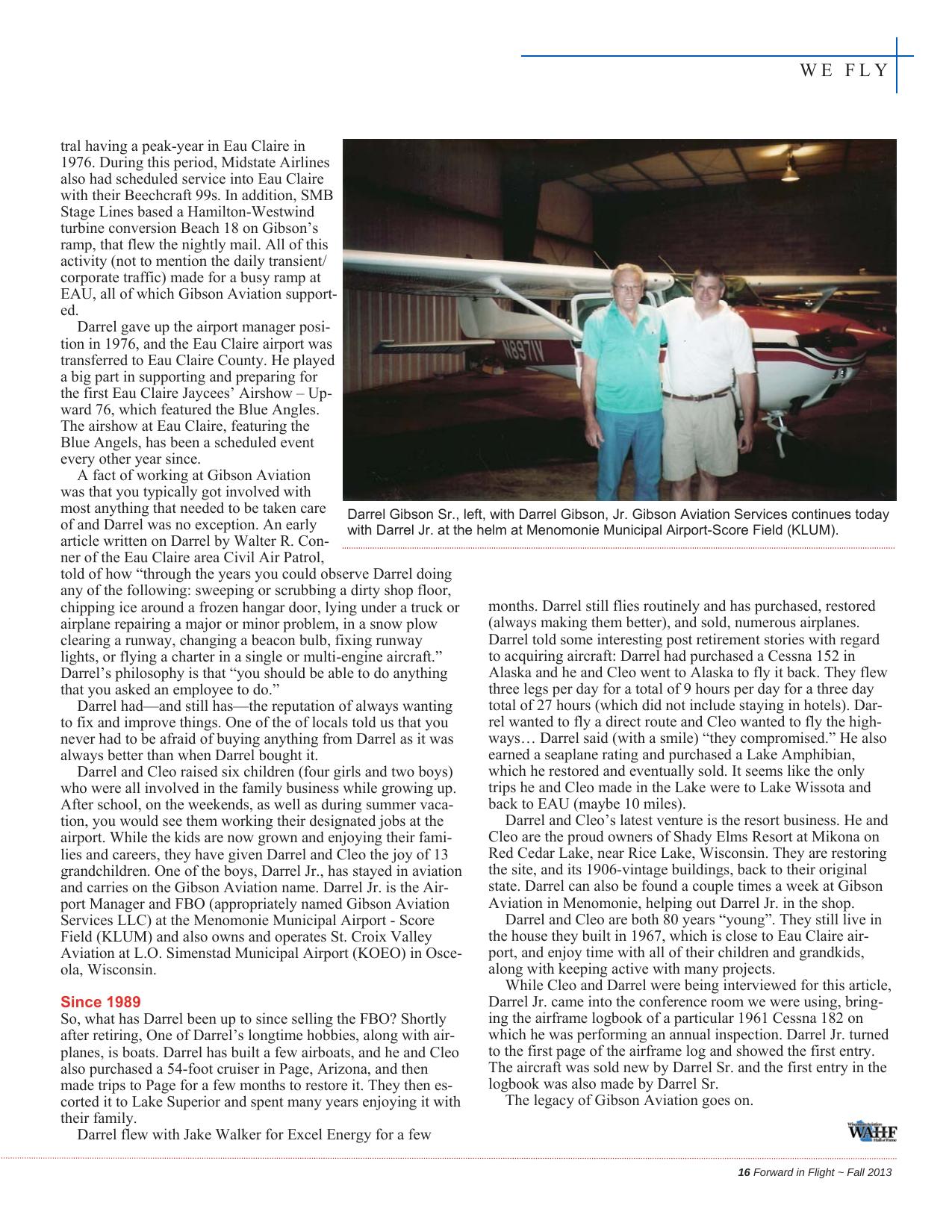
WE FLY tral having a peak-year in Eau Claire in 1976. During this period, Midstate Airlines also had scheduled service into Eau Claire with their Beechcraft 99s. In addition, SMB Stage Lines based a Hamilton-Westwind turbine conversion Beach 18 on Gibson’s ramp, that flew the nightly mail. All of this activity (not to mention the daily transient/ corporate traffic) made for a busy ramp at EAU, all of which Gibson Aviation supported. Darrel gave up the airport manager position in 1976, and the Eau Claire airport was transferred to Eau Claire County. He played a big part in supporting and preparing for the first Eau Claire Jaycees’ Airshow – Upward 76, which featured the Blue Angles. The airshow at Eau Claire, featuring the Blue Angels, has been a scheduled event every other year since. A fact of working at Gibson Aviation was that you typically got involved with most anything that needed to be taken care Darrel Gibson Sr., left, with Darrel Gibson, Jr. Gibson Aviation Services continues today of and Darrel was no exception. An early with Darrel Jr. at the helm at Menomonie Municipal Airport-Score Field (KLUM). article written on Darrel by Walter R. Conner of the Eau Claire area Civil Air Patrol, told of how “through the years you could observe Darrel doing any of the following: sweeping or scrubbing a dirty shop floor, months. Darrel still flies routinely and has purchased, restored chipping ice around a frozen hangar door, lying under a truck or (always making them better), and sold, numerous airplanes. airplane repairing a major or minor problem, in a snow plow Darrel told some interesting post retirement stories with regard clearing a runway, changing a beacon bulb, fixing runway to acquiring aircraft: Darrel had purchased a Cessna 152 in lights, or flying a charter in a single or multi-engine aircraft.” Alaska and he and Cleo went to Alaska to fly it back. They flew Darrel’s philosophy is that “you should be able to do anything three legs per day for a total of 9 hours per day for a three day that you asked an employee to do.” total of 27 hours (which did not include staying in hotels). DarDarrel had—and still has—the reputation of always wanting rel wanted to fly a direct route and Cleo wanted to fly the highto fix and improve things. One of the of locals told us that you ways… Darrel said (with a smile) “they compromised.” He also never had to be afraid of buying anything from Darrel as it was earned a seaplane rating and purchased a Lake Amphibian, always better than when Darrel bought it. which he restored and eventually sold. It seems like the only Darrel and Cleo raised six children (four girls and two boys) trips he and Cleo made in the Lake were to Lake Wissota and who were all involved in the family business while growing up. back to EAU (maybe 10 miles). After school, on the weekends, as well as during summer vacaDarrel and Cleo’s latest venture is the resort business. He and tion, you would see them working their designated jobs at the Cleo are the proud owners of Shady Elms Resort at Mikona on airport. While the kids are now grown and enjoying their famiRed Cedar Lake, near Rice Lake, Wisconsin. They are restoring lies and careers, they have given Darrel and Cleo the joy of 13 the site, and its 1906-vintage buildings, back to their original grandchildren. One of the boys, Darrel Jr., has stayed in aviation state. Darrel can also be found a couple times a week at Gibson and carries on the Gibson Aviation name. Darrel Jr. is the AirAviation in Menomonie, helping out Darrel Jr. in the shop. port Manager and FBO (appropriately named Gibson Aviation Darrel and Cleo are both 80 years “young”. They still live in Services LLC) at the Menomonie Municipal Airport - Score the house they built in 1967, which is close to Eau Claire airField (KLUM) and also owns and operates St. Croix Valley port, and enjoy time with all of their children and grandkids, Aviation at L.O. Simenstad Municipal Airport (KOEO) in Oscealong with keeping active with many projects. ola, Wisconsin. While Cleo and Darrel were being interviewed for this article, Darrel Jr. came into the conference room we were using, bringSince 1989 ing the airframe logbook of a particular 1961 Cessna 182 on So, what has Darrel been up to since selling the FBO? Shortly which he was performing an annual inspection. Darrel Jr. turned after retiring, One of Darrel’s longtime hobbies, along with airto the first page of the airframe log and showed the first entry. planes, is boats. Darrel has built a few airboats, and he and Cleo The aircraft was sold new by Darrel Sr. and the first entry in the also purchased a 54-foot cruiser in Page, Arizona, and then logbook was also made by Darrel Sr. made trips to Page for a few months to restore it. They then esThe legacy of Gibson Aviation goes on. corted it to Lake Superior and spent many years enjoying it with their family. Darrel flew with Jake Walker for Excel Energy for a few 16 Forward in Flight ~ Fall 2013
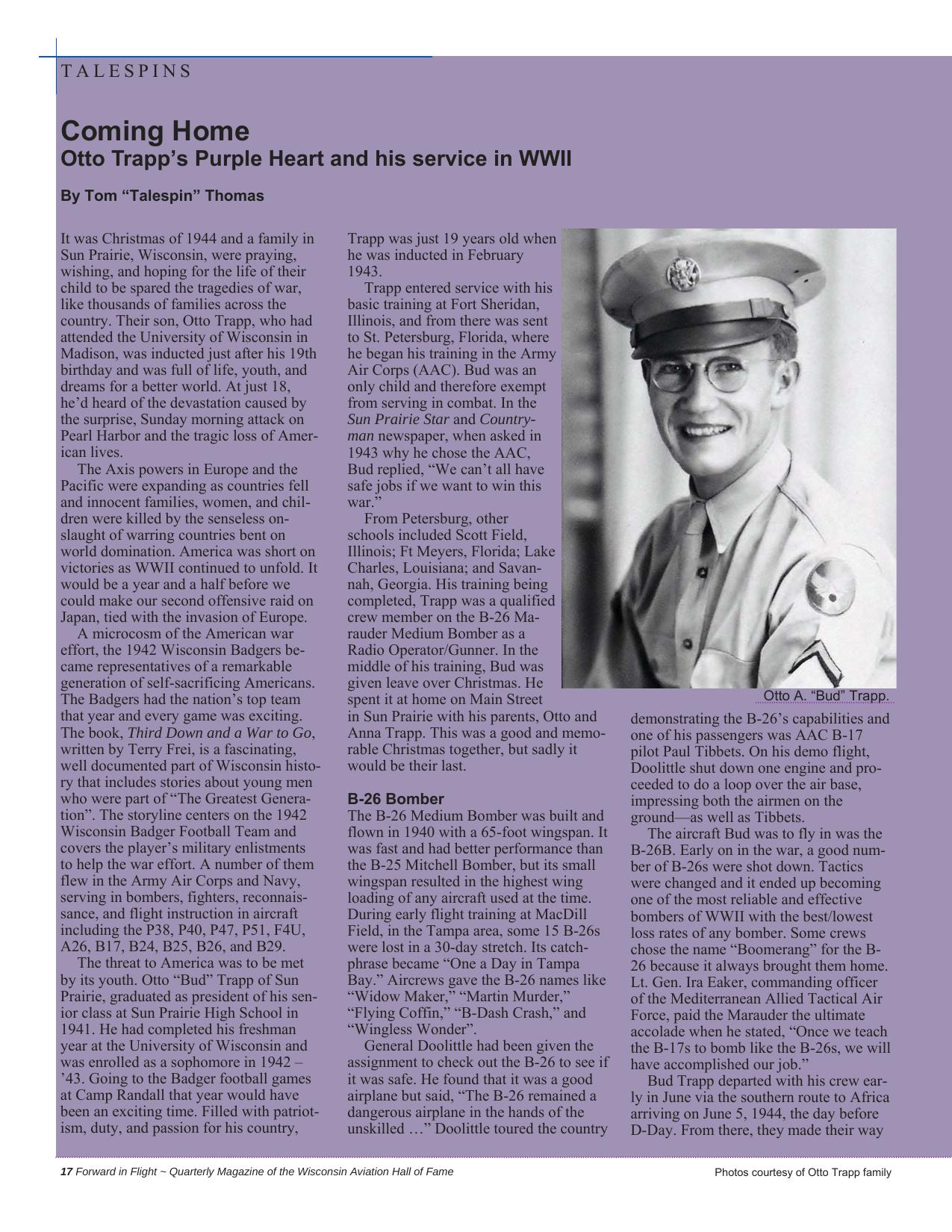
TALESPINS Coming Home Otto Trapp’s Purple Heart and his service in WWII By Tom “Talespin” Thomas It was Christmas of 1944 and a family in Sun Prairie, Wisconsin, were praying, wishing, and hoping for the life of their child to be spared the tragedies of war, like thousands of families across the country. Their son, Otto Trapp, who had attended the University of Wisconsin in Madison, was inducted just after his 19th birthday and was full of life, youth, and dreams for a better world. At just 18, he’d heard of the devastation caused by the surprise, Sunday morning attack on Pearl Harbor and the tragic loss of American lives. The Axis powers in Europe and the Pacific were expanding as countries fell and innocent families, women, and children were killed by the senseless onslaught of warring countries bent on world domination. America was short on victories as WWII continued to unfold. It would be a year and a half before we could make our second offensive raid on Japan, tied with the invasion of Europe. A microcosm of the American war effort, the 1942 Wisconsin Badgers became representatives of a remarkable generation of self-sacrificing Americans. The Badgers had the nation’s top team that year and every game was exciting. The book, Third Down and a War to Go, written by Terry Frei, is a fascinating, well documented part of Wisconsin history that includes stories about young men who were part of “The Greatest Generation”. The storyline centers on the 1942 Wisconsin Badger Football Team and covers the player’s military enlistments to help the war effort. A number of them flew in the Army Air Corps and Navy, serving in bombers, fighters, reconnaissance, and flight instruction in aircraft including the P38, P40, P47, P51, F4U, A26, B17, B24, B25, B26, and B29. The threat to America was to be met by its youth. Otto “Bud” Trapp of Sun Prairie, graduated as president of his senior class at Sun Prairie High School in 1941. He had completed his freshman year at the University of Wisconsin and was enrolled as a sophomore in 1942 – ’43. Going to the Badger football games at Camp Randall that year would have been an exciting time. Filled with patriotism, duty, and passion for his country, Trapp was just 19 years old when he was inducted in February 1943. Trapp entered service with his basic training at Fort Sheridan, Illinois, and from there was sent to St. Petersburg, Florida, where he began his training in the Army Air Corps (AAC). Bud was an only child and therefore exempt from serving in combat. In the Sun Prairie Star and Countryman newspaper, when asked in 1943 why he chose the AAC, Bud replied, “We can’t all have safe jobs if we want to win this war.” From Petersburg, other schools included Scott Field, Illinois; Ft Meyers, Florida; Lake Charles, Louisiana; and Savannah, Georgia. His training being completed, Trapp was a qualified crew member on the B-26 Marauder Medium Bomber as a Radio Operator/Gunner. In the middle of his training, Bud was given leave over Christmas. He spent it at home on Main Street in Sun Prairie with his parents, Otto and Anna Trapp. This was a good and memorable Christmas together, but sadly it would be their last. B-26 Bomber The B-26 Medium Bomber was built and flown in 1940 with a 65-foot wingspan. It was fast and had better performance than the B-25 Mitchell Bomber, but its small wingspan resulted in the highest wing loading of any aircraft used at the time. During early flight training at MacDill Field, in the Tampa area, some 15 B-26s were lost in a 30-day stretch. Its catchphrase became “One a Day in Tampa Bay.” Aircrews gave the B-26 names like “Widow Maker,” “Martin Murder,” “Flying Coffin,” “B-Dash Crash,” and “Wingless Wonder”. General Doolittle had been given the assignment to check out the B-26 to see if it was safe. He found that it was a good airplane but said, “The B-26 remained a dangerous airplane in the hands of the unskilled …” Doolittle toured the country 17 Forward in Flight ~ Quarterly Magazine of the Wisconsin Aviation Hall of Fame Otto A. “Bud” Trapp. demonstrating the B-26’s capabilities and one of his passengers was AAC B-17 pilot Paul Tibbets. On his demo flight, Doolittle shut down one engine and proceeded to do a loop over the air base, impressing both the airmen on the ground—as well as Tibbets. The aircraft Bud was to fly in was the B-26B. Early on in the war, a good number of B-26s were shot down. Tactics were changed and it ended up becoming one of the most reliable and effective bombers of WWII with the best/lowest loss rates of any bomber. Some crews chose the name “Boomerang” for the B26 because it always brought them home. Lt. Gen. Ira Eaker, commanding officer of the Mediterranean Allied Tactical Air Force, paid the Marauder the ultimate accolade when he stated, “Once we teach the B-17s to bomb like the B-26s, we will have accomplished our job.” Bud Trapp departed with his crew early in June via the southern route to Africa arriving on June 5, 1944, the day before D-Day. From there, they made their way Photos courtesy of Otto Trapp family
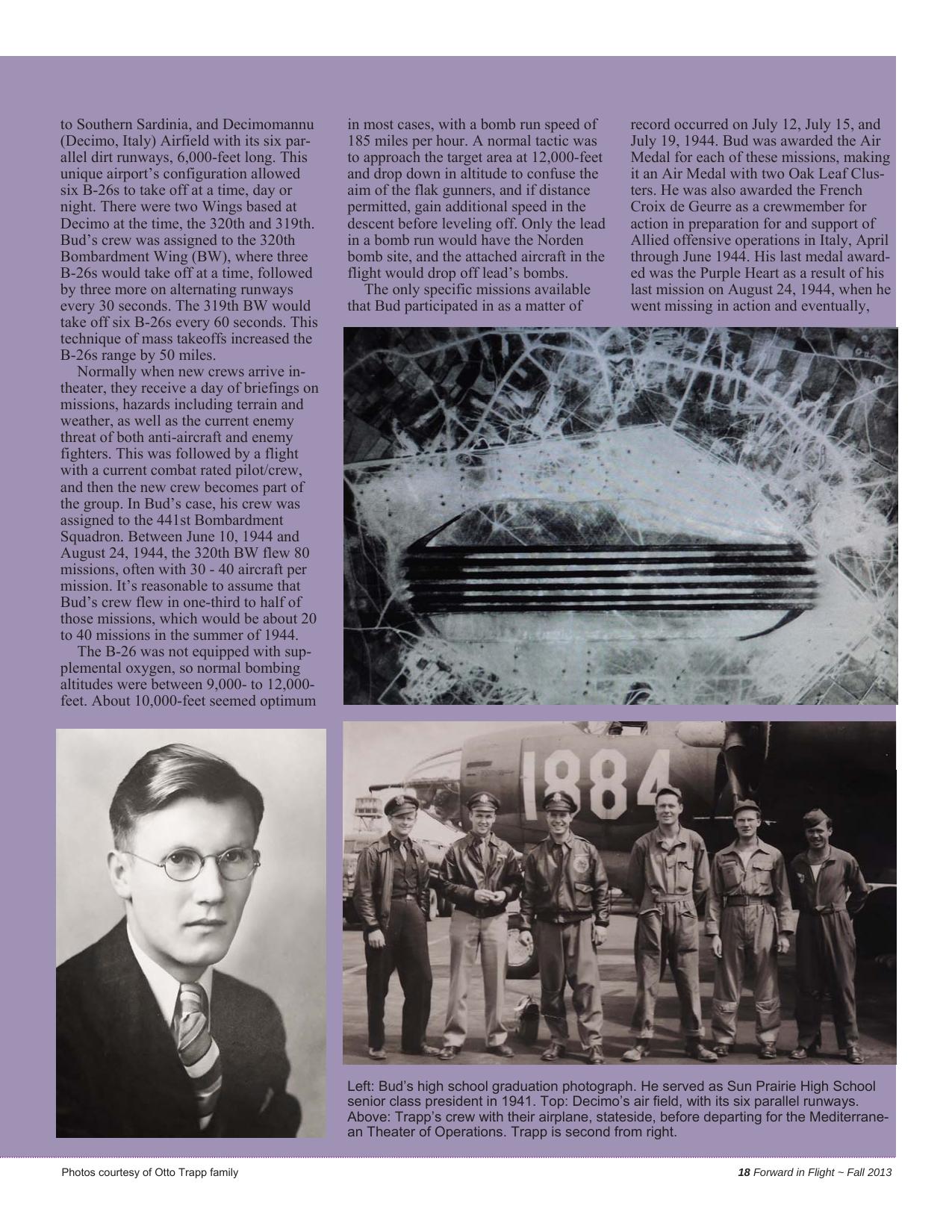
to Southern Sardinia, and Decimomannu (Decimo, Italy) Airfield with its six parallel dirt runways, 6,000-feet long. This unique airport’s configuration allowed six B-26s to take off at a time, day or night. There were two Wings based at Decimo at the time, the 320th and 319th. Bud’s crew was assigned to the 320th Bombardment Wing (BW), where three B-26s would take off at a time, followed by three more on alternating runways every 30 seconds. The 319th BW would take off six B-26s every 60 seconds. This technique of mass takeoffs increased the B-26s range by 50 miles. Normally when new crews arrive intheater, they receive a day of briefings on missions, hazards including terrain and weather, as well as the current enemy threat of both anti-aircraft and enemy fighters. This was followed by a flight with a current combat rated pilot/crew, and then the new crew becomes part of the group. In Bud’s case, his crew was assigned to the 441st Bombardment Squadron. Between June 10, 1944 and August 24, 1944, the 320th BW flew 80 missions, often with 30 - 40 aircraft per mission. It’s reasonable to assume that Bud’s crew flew in one-third to half of those missions, which would be about 20 to 40 missions in the summer of 1944. The B-26 was not equipped with supplemental oxygen, so normal bombing altitudes were between 9,000- to 12,000feet. About 10,000-feet seemed optimum in most cases, with a bomb run speed of 185 miles per hour. A normal tactic was to approach the target area at 12,000-feet and drop down in altitude to confuse the aim of the flak gunners, and if distance permitted, gain additional speed in the descent before leveling off. Only the lead in a bomb run would have the Norden bomb site, and the attached aircraft in the flight would drop off lead’s bombs. The only specific missions available that Bud participated in as a matter of record occurred on July 12, July 15, and July 19, 1944. Bud was awarded the Air Medal for each of these missions, making it an Air Medal with two Oak Leaf Clusters. He was also awarded the French Croix de Geurre as a crewmember for action in preparation for and support of Allied offensive operations in Italy, April through June 1944. His last medal awarded was the Purple Heart as a result of his last mission on August 24, 1944, when he went missing in action and eventually, Left: Bud’s high school graduation photograph. He served as Sun Prairie High School senior class president in 1941. Top: Decimo’s air field, with its six parallel runways. Above: Trapp’s crew with their airplane, stateside, before departing for the Mediterranean Theater of Operations. Trapp is second from right. Photos courtesy of Otto Trapp family 18 Forward in Flight ~ Fall 2013
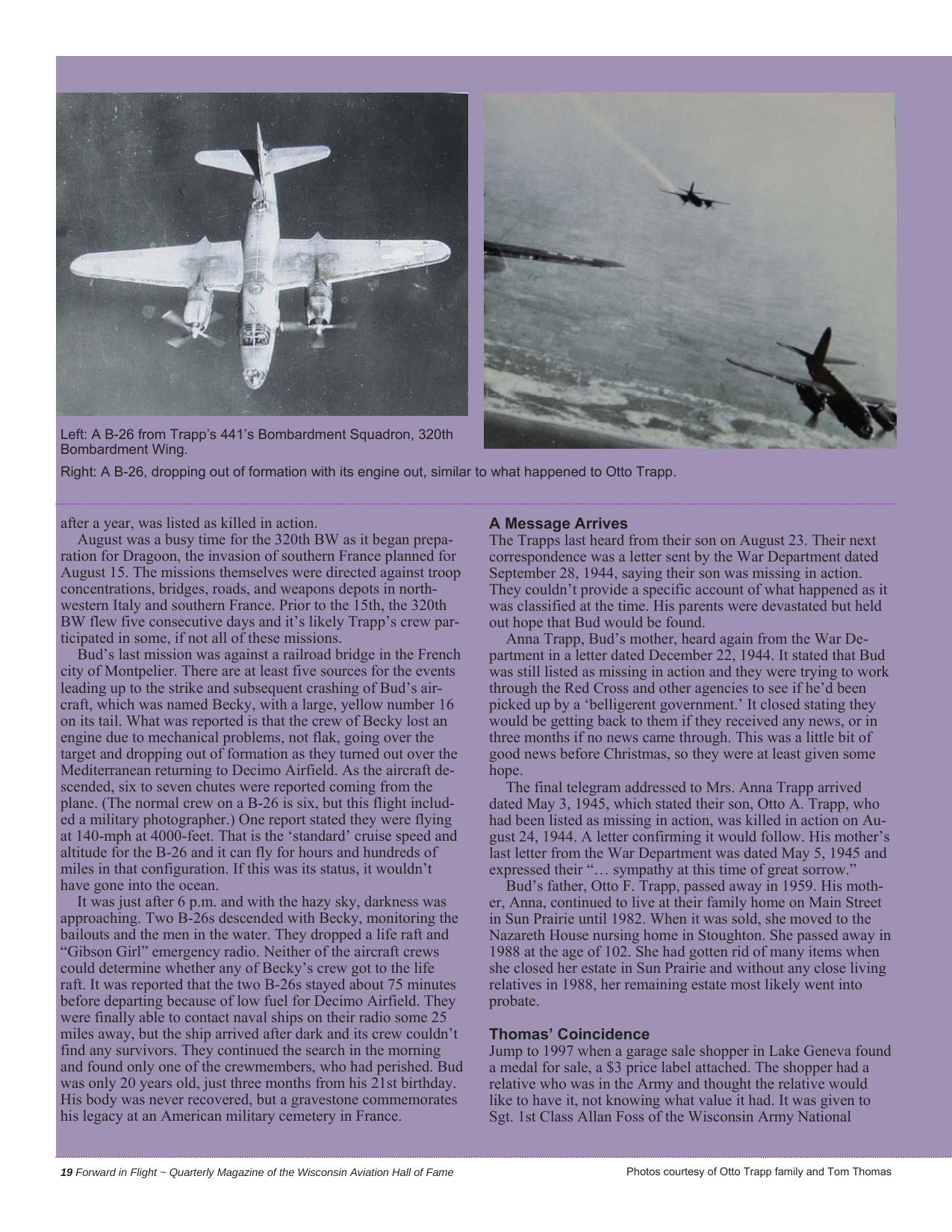
Left: A B-26 from Trapp’s 441’s Bombardment Squadron, 320th Bombardment Wing. Right: A B-26, dropping out of formation with its engine out, similar to what happened to Otto Trapp. after a year, was listed as killed in action. August was a busy time for the 320th BW as it began preparation for Dragoon, the invasion of southern France planned for August 15. The missions themselves were directed against troop concentrations, bridges, roads, and weapons depots in northwestern Italy and southern France. Prior to the 15th, the 320th BW flew five consecutive days and it’s likely Trapp’s crew participated in some, if not all of these missions. Bud’s last mission was against a railroad bridge in the French city of Montpelier. There are at least five sources for the events leading up to the strike and subsequent crashing of Bud’s aircraft, which was named Becky, with a large, yellow number 16 on its tail. What was reported is that the crew of Becky lost an engine due to mechanical problems, not flak, going over the target and dropping out of formation as they turned out over the Mediterranean returning to Decimo Airfield. As the aircraft descended, six to seven chutes were reported coming from the plane. (The normal crew on a B-26 is six, but this flight included a military photographer.) One report stated they were flying at 140-mph at 4000-feet. That is the ‘standard’ cruise speed and altitude for the B-26 and it can fly for hours and hundreds of miles in that configuration. If this was its status, it wouldn’t have gone into the ocean. It was just after 6 p.m. and with the hazy sky, darkness was approaching. Two B-26s descended with Becky, monitoring the bailouts and the men in the water. They dropped a life raft and “Gibson Girl” emergency radio. Neither of the aircraft crews could determine whether any of Becky’s crew got to the life raft. It was reported that the two B-26s stayed about 75 minutes before departing because of low fuel for Decimo Airfield. They were finally able to contact naval ships on their radio some 25 miles away, but the ship arrived after dark and its crew couldn’t find any survivors. They continued the search in the morning and found only one of the crewmembers, who had perished. Bud was only 20 years old, just three months from his 21st birthday. His body was never recovered, but a gravestone commemorates his legacy at an American military cemetery in France. 19 Forward in Flight ~ Quarterly Magazine of the Wisconsin Aviation Hall of Fame A Message Arrives The Trapps last heard from their son on August 23. Their next correspondence was a letter sent by the War Department dated September 28, 1944, saying their son was missing in action. They couldn’t provide a specific account of what happened as it was classified at the time. His parents were devastated but held out hope that Bud would be found. Anna Trapp, Bud’s mother, heard again from the War Department in a letter dated December 22, 1944. It stated that Bud was still listed as missing in action and they were trying to work through the Red Cross and other agencies to see if he’d been picked up by a ‘belligerent government.’ It closed stating they would be getting back to them if they received any news, or in three months if no news came through. This was a little bit of good news before Christmas, so they were at least given some hope. The final telegram addressed to Mrs. Anna Trapp arrived dated May 3, 1945, which stated their son, Otto A. Trapp, who had been listed as missing in action, was killed in action on August 24, 1944. A letter confirming it would follow. His mother’s last letter from the War Department was dated May 5, 1945 and expressed their “… sympathy at this time of great sorrow.” Bud’s father, Otto F. Trapp, passed away in 1959. His mother, Anna, continued to live at their family home on Main Street in Sun Prairie until 1982. When it was sold, she moved to the Nazareth House nursing home in Stoughton. She passed away in 1988 at the age of 102. She had gotten rid of many items when she closed her estate in Sun Prairie and without any close living relatives in 1988, her remaining estate most likely went into probate. Thomas’ Coincidence Jump to 1997 when a garage sale shopper in Lake Geneva found a medal for sale, a $3 price label attached. The shopper had a relative who was in the Army and thought the relative would like to have it, not knowing what value it had. It was given to Sgt. 1st Class Allan Foss of the Wisconsin Army National Photos courtesy of Otto Trapp family and Tom Thomas
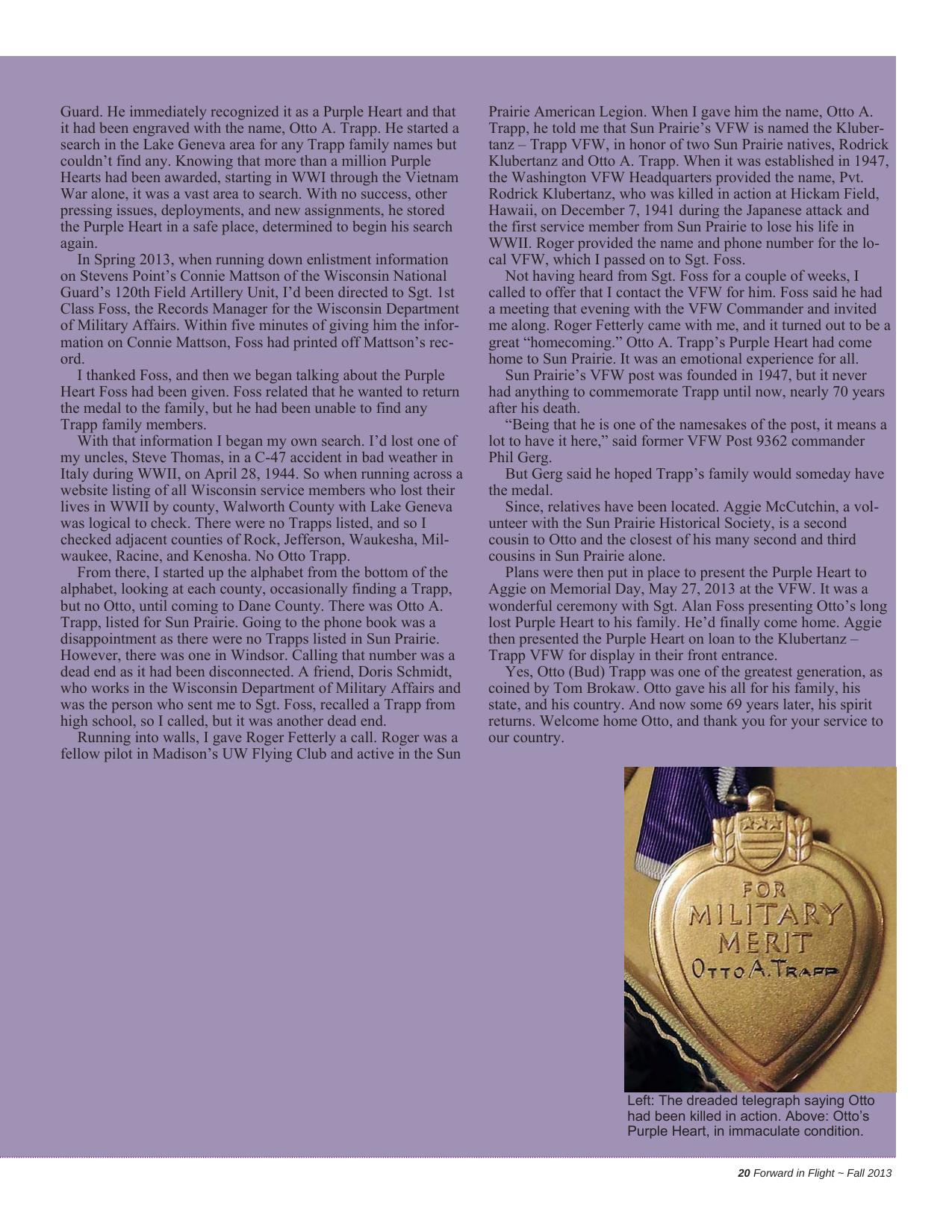
Guard. He immediately recognized it as a Purple Heart and that it had been engraved with the name, Otto A. Trapp. He started a search in the Lake Geneva area for any Trapp family names but couldn’t find any. Knowing that more than a million Purple Hearts had been awarded, starting in WWI through the Vietnam War alone, it was a vast area to search. With no success, other pressing issues, deployments, and new assignments, he stored the Purple Heart in a safe place, determined to begin his search again. In Spring 2013, when running down enlistment information on Stevens Point’s Connie Mattson of the Wisconsin National Guard’s 120th Field Artillery Unit, I’d been directed to Sgt. 1st Class Foss, the Records Manager for the Wisconsin Department of Military Affairs. Within five minutes of giving him the information on Connie Mattson, Foss had printed off Mattson’s record. I thanked Foss, and then we began talking about the Purple Heart Foss had been given. Foss related that he wanted to return the medal to the family, but he had been unable to find any Trapp family members. With that information I began my own search. I’d lost one of my uncles, Steve Thomas, in a C-47 accident in bad weather in Italy during WWII, on April 28, 1944. So when running across a website listing of all Wisconsin service members who lost their lives in WWII by county, Walworth County with Lake Geneva was logical to check. There were no Trapps listed, and so I checked adjacent counties of Rock, Jefferson, Waukesha, Milwaukee, Racine, and Kenosha. No Otto Trapp. From there, I started up the alphabet from the bottom of the alphabet, looking at each county, occasionally finding a Trapp, but no Otto, until coming to Dane County. There was Otto A. Trapp, listed for Sun Prairie. Going to the phone book was a disappointment as there were no Trapps listed in Sun Prairie. However, there was one in Windsor. Calling that number was a dead end as it had been disconnected. A friend, Doris Schmidt, who works in the Wisconsin Department of Military Affairs and was the person who sent me to Sgt. Foss, recalled a Trapp from high school, so I called, but it was another dead end. Running into walls, I gave Roger Fetterly a call. Roger was a fellow pilot in Madison’s UW Flying Club and active in the Sun Prairie American Legion. When I gave him the name, Otto A. Trapp, he told me that Sun Prairie’s VFW is named the Klubertanz – Trapp VFW, in honor of two Sun Prairie natives, Rodrick Klubertanz and Otto A. Trapp. When it was established in 1947, the Washington VFW Headquarters provided the name, Pvt. Rodrick Klubertanz, who was killed in action at Hickam Field, Hawaii, on December 7, 1941 during the Japanese attack and the first service member from Sun Prairie to lose his life in WWII. Roger provided the name and phone number for the local VFW, which I passed on to Sgt. Foss. Not having heard from Sgt. Foss for a couple of weeks, I called to offer that I contact the VFW for him. Foss said he had a meeting that evening with the VFW Commander and invited me along. Roger Fetterly came with me, and it turned out to be a great “homecoming.” Otto A. Trapp’s Purple Heart had come home to Sun Prairie. It was an emotional experience for all. Sun Prairie’s VFW post was founded in 1947, but it never had anything to commemorate Trapp until now, nearly 70 years after his death. “Being that he is one of the namesakes of the post, it means a lot to have it here,” said former VFW Post 9362 commander Phil Gerg. But Gerg said he hoped Trapp’s family would someday have the medal. Since, relatives have been located. Aggie McCutchin, a volunteer with the Sun Prairie Historical Society, is a second cousin to Otto and the closest of his many second and third cousins in Sun Prairie alone. Plans were then put in place to present the Purple Heart to Aggie on Memorial Day, May 27, 2013 at the VFW. It was a wonderful ceremony with Sgt. Alan Foss presenting Otto’s long lost Purple Heart to his family. He’d finally come home. Aggie then presented the Purple Heart on loan to the Klubertanz – Trapp VFW for display in their front entrance. Yes, Otto (Bud) Trapp was one of the greatest generation, as coined by Tom Brokaw. Otto gave his all for his family, his state, and his country. And now some 69 years later, his spirit returns. Welcome home Otto, and thank you for your service to our country. Left: The dreaded telegraph saying Otto had been killed in action. Above: Otto’s Purple Heart, in immaculate condition. 20 Forward in Flight ~ Fall 2013
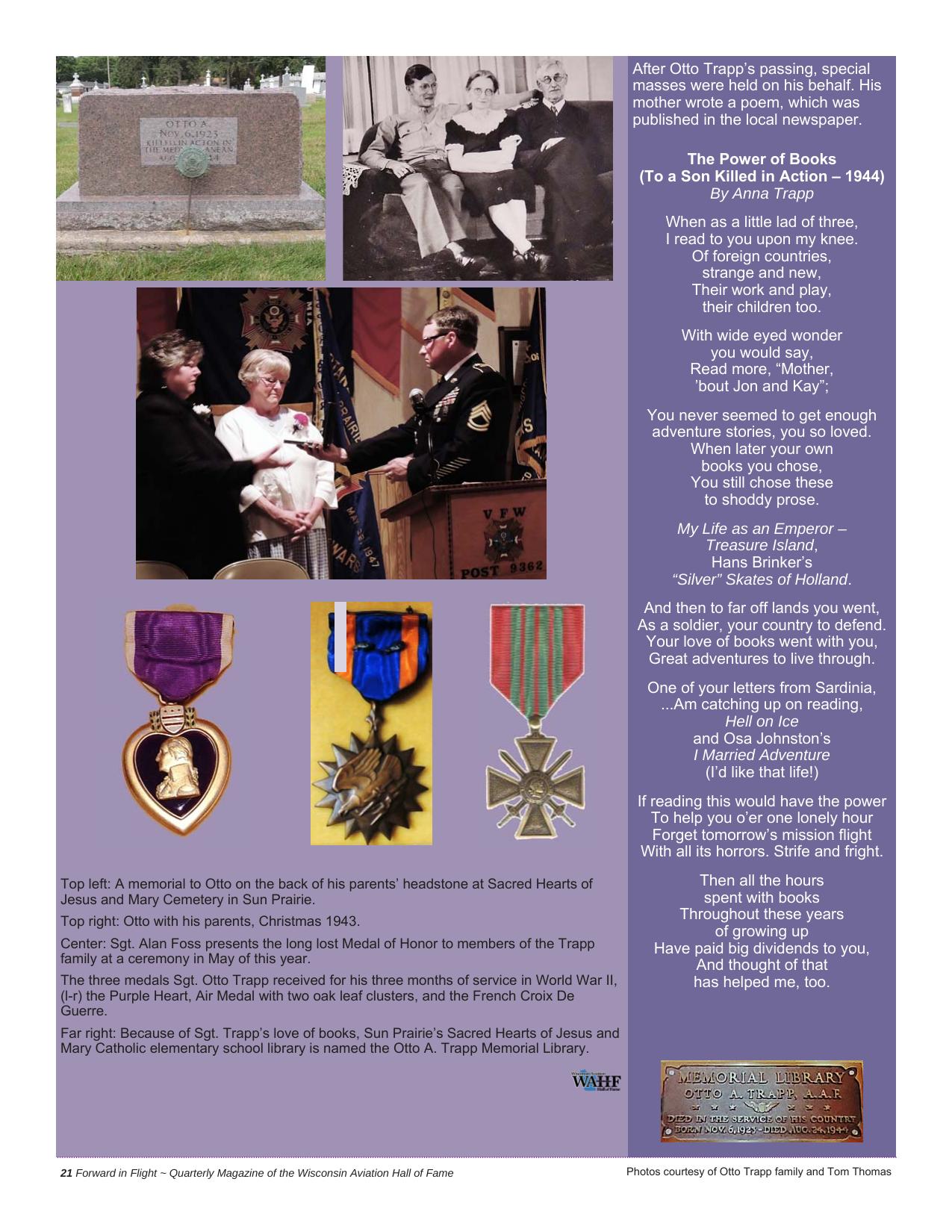
After Otto Trapp’s passing, special masses were held on his behalf. His mother wrote a poem, which was published in the local newspaper. The Power of Books (To a Son Killed in Action – 1944) By Anna Trapp When as a little lad of three, I read to you upon my knee. Of foreign countries, strange and new, Their work and play, their children too. With wide eyed wonder you would say, Read more, “Mother, ’bout Jon and Kay”; You never seemed to get enough adventure stories, you so loved. When later your own books you chose, You still chose these to shoddy prose. My Life as an Emperor – Treasure Island, Hans Brinker’s “Silver” Skates of Holland. And then to far off lands you went, As a soldier, your country to defend. Your love of books went with you, Great adventures to live through. One of your letters from Sardinia, ...Am catching up on reading, Hell on Ice and Osa Johnston’s I Married Adventure (I’d like that life!) If reading this would have the power To help you o’er one lonely hour Forget tomorrow’s mission flight With all its horrors. Strife and fright. Top left: A memorial to Otto on the back of his parents’ headstone at Sacred Hearts of Jesus and Mary Cemetery in Sun Prairie. Top right: Otto with his parents, Christmas 1943. Center: Sgt. Alan Foss presents the long lost Medal of Honor to members of the Trapp family at a ceremony in May of this year. The three medals Sgt. Otto Trapp received for his three months of service in World War II, (l-r) the Purple Heart, Air Medal with two oak leaf clusters, and the French Croix De Guerre. Then all the hours spent with books Throughout these years of growing up Have paid big dividends to you, And thought of that has helped me, too. Far right: Because of Sgt. Trapp’s love of books, Sun Prairie’s Sacred Hearts of Jesus and Mary Catholic elementary school library is named the Otto A. Trapp Memorial Library. 21 Forward in Flight ~ Quarterly Magazine of the Wisconsin Aviation Hall of Fame Photos courtesy of Otto Trapp family and Tom Thomas
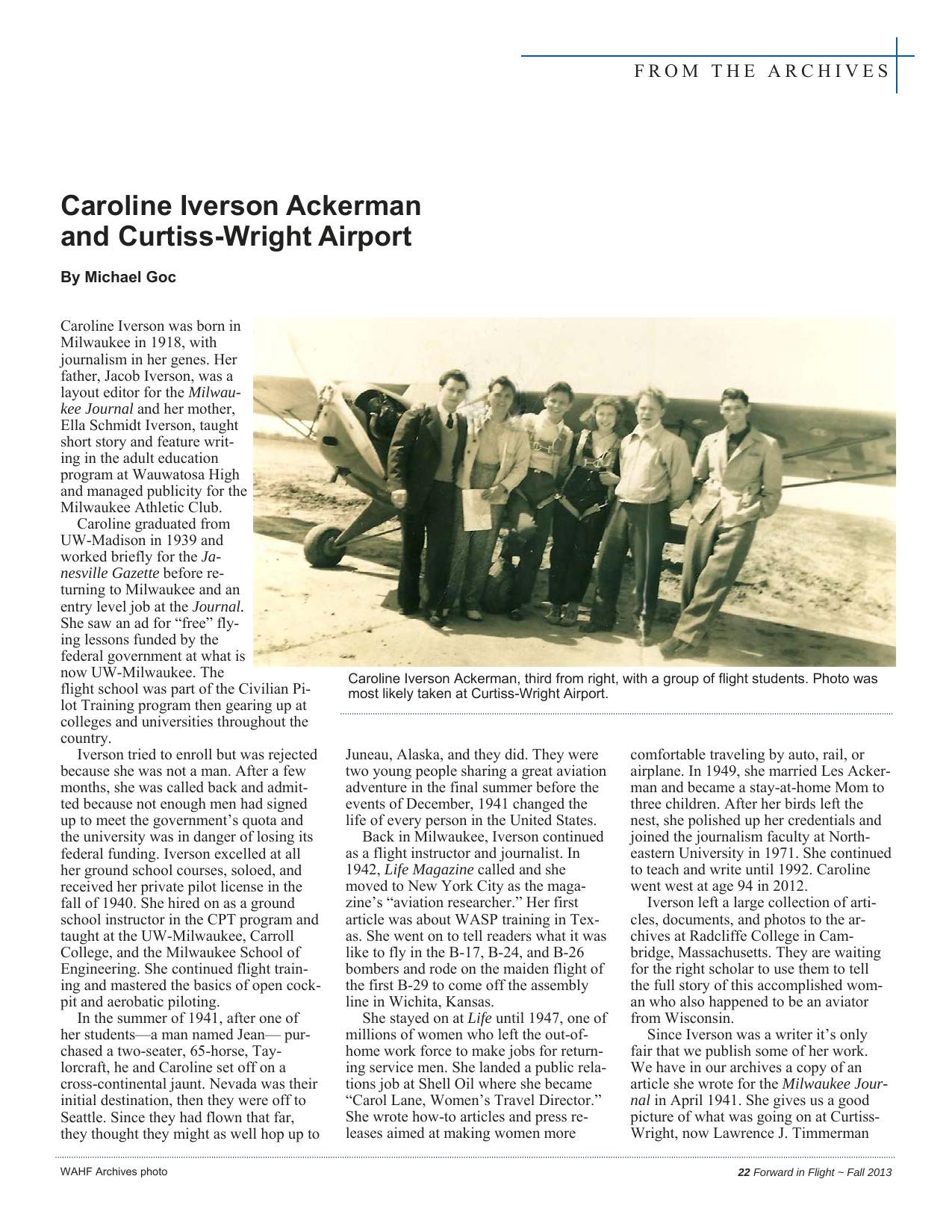
FROM THE ARCHIVES Caroline Iverson Ackerman and Curtiss-Wright Airport By Michael Goc Caroline Iverson was born in Milwaukee in 1918, with journalism in her genes. Her father, Jacob Iverson, was a layout editor for the Milwaukee Journal and her mother, Ella Schmidt Iverson, taught short story and feature writing in the adult education program at Wauwatosa High and managed publicity for the Milwaukee Athletic Club. Caroline graduated from UW-Madison in 1939 and worked briefly for the Janesville Gazette before returning to Milwaukee and an entry level job at the Journal. She saw an ad for “free” flying lessons funded by the federal government at what is now UW-Milwaukee. The flight school was part of the Civilian Pilot Training program then gearing up at colleges and universities throughout the country. Iverson tried to enroll but was rejected because she was not a man. After a few months, she was called back and admitted because not enough men had signed up to meet the government’s quota and the university was in danger of losing its federal funding. Iverson excelled at all her ground school courses, soloed, and received her private pilot license in the fall of 1940. She hired on as a ground school instructor in the CPT program and taught at the UW-Milwaukee, Carroll College, and the Milwaukee School of Engineering. She continued flight training and mastered the basics of open cockpit and aerobatic piloting. In the summer of 1941, after one of her students—a man named Jean— purchased a two-seater, 65-horse, Taylorcraft, he and Caroline set off on a cross-continental jaunt. Nevada was their initial destination, then they were off to Seattle. Since they had flown that far, they thought they might as well hop up to WAHF Archives photo Caroline Iverson Ackerman, third from right, with a group of flight students. Photo was most likely taken at Curtiss-Wright Airport. Juneau, Alaska, and they did. They were two young people sharing a great aviation adventure in the final summer before the events of December, 1941 changed the life of every person in the United States. Back in Milwaukee, Iverson continued as a flight instructor and journalist. In 1942, Life Magazine called and she moved to New York City as the magazine’s “aviation researcher.” Her first article was about WASP training in Texas. She went on to tell readers what it was like to fly in the B-17, B-24, and B-26 bombers and rode on the maiden flight of the first B-29 to come off the assembly line in Wichita, Kansas. She stayed on at Life until 1947, one of millions of women who left the out-ofhome work force to make jobs for returning service men. She landed a public relations job at Shell Oil where she became “Carol Lane, Women’s Travel Director.” She wrote how-to articles and press releases aimed at making women more comfortable traveling by auto, rail, or airplane. In 1949, she married Les Ackerman and became a stay-at-home Mom to three children. After her birds left the nest, she polished up her credentials and joined the journalism faculty at Northeastern University in 1971. She continued to teach and write until 1992. Caroline went west at age 94 in 2012. Iverson left a large collection of articles, documents, and photos to the archives at Radcliffe College in Cambridge, Massachusetts. They are waiting for the right scholar to use them to tell the full story of this accomplished woman who also happened to be an aviator from Wisconsin. Since Iverson was a writer it’s only fair that we publish some of her work. We have in our archives a copy of an article she wrote for the Milwaukee Journal in April 1941. She gives us a good picture of what was going on at CurtissWright, now Lawrence J. Timmerman 22 Forward in Flight ~ Fall 2013
FROM THE ARCHIVES Airport (KMWC), in the last months before the US went to war. Once A White Elephant, Airport Pays Dividends Young Merle Zuehlke Puts Pep Into Curtiss-Wright Field That Cost Over Half Million [This story was written by Miss Caroline Iverson, who holds a private pilot’s license and has been instructing in aviation ground school programs. She has done all of her flying at the Curtiss-Wright airport, is the only girl who has completed the CAA secondary course of acrobatic flying there, and is the only one in the state appointed to the apprentice instructor course.] For 11 years the airport on Highway 41 north of Milwaukee was a financial white elephant. The Curtiss-Wright Corp. of New York had done a good job in building the airport. It poured over a half million dollars into buying a big field, tiling it for drainage, and building what is still the largest individual hangar in the state. But the corporation flying school didn’t make money; nor did other flying schools conducted by individuals who leased the airport from Curtiss-Wright. That was until September, 1939, when Merle Zuehlke became manager. Merle was not only a flying enthusiast—he’d owned 26 different planes by the time he was 32—had a good business head, was a day-night worker, and an opportunist. Dividends at Last Result: Today Curtiss-Wright is the largest privately-operated airport in the state, has more government trainees, more rerated instructors, more licensed mechanics, more modern airplanes, and bigger Sunday audiences than any other private airport in the area. And the Milwaukee businessmen interested in aviation, who altruistically bought stock in Milwaukee Airways Inc., the local organization now leasing the airport, are receiving dividends for the first time in the airport’s history. The man who developed a successful airport in a year and a half is young enough for the draft (a charming little woman and two youngsters exempt him). He started flying near his hometown of Appleton at the Larson Airport in 1929 in a (blush!) J-1 Standard. Since then he’s flown many types of planes, including the first Aeroncas, Cubs, and Taylorcrafts that were built. On the whole Zuehlke had good luck with his airplanes and flying, though shortly after winning his wings, he did on one occasion encounter severe cockpit trouble. Being A Budding Romeo Being a budding Romeo, as well as a flier, he used to fly romantically over the home of his Juliet (of the moment) and make his dates by dropping notes in her back yard. One day the sight of her lovely self rushing to recover his missile was too much and he forgot his plane as he leaned out for an exuberant wave…the plane wound up into a tight spin and plummeted its pilot onto the ground right before the eyes of the horrified Juliet! Romeo emerged from the hospital three months older and years wiser. Between flights Zuehlke attended the University of Wisconsin and graduated from Lawrence College. A general course BA and a fascination for airplanes were a far cry from making a living when the greatest danger to pilots was starvation, so Zuehlke was glad he studied a little math. He became auditor first for Wadhams Oil and then Barnsdall Refining Co, with a territory of nine states to cover. Of course, he flew. And just as much of course he kept his eyes open for airport manager possibilities. Not Planning To Starve When Zuehlke finally decided to move bag and baggage to Wauwatosa and take over the office of the Curtiss-Wright airport, he wasn’t planning to starve, despite the field’s unhappy record. He had a big deal in view and if he could meet the terms, his airport should thrive. The deal was with Washington where Congress had just voted to support a flight training program under the supervision of the aeronautics authority. By performing a Herculean task of assembling a corps of CAA approved flight instructors and mechanics, and raising funds to finance new airplanes at a field that had been absolutely devoid of them, he met the terms and got the first small contract for training 10 boys in the spring of 1940. The government must have liked the record. Summer brought a large quota, including an advanced CAA course. Now close to 100 students are given flight training under the CAA program at CurtissWright each quarter of the year. The setup is solid. The rerated instructors who were so scarce back in June that they could name their own salaries received them from Zuehlke with guaranteed monthly minimums in addition as insurance for bad weather days. Those Enticing Offers Now, when such instructors are still scarce, especially with the army, navy, and Canada making enticing offers to every experi- 23 Forward in Flight ~ Quarterly Magazine of the Wisconsin Aviation Hall of Fame WAHF Archives photo and Fritz Lueneberg
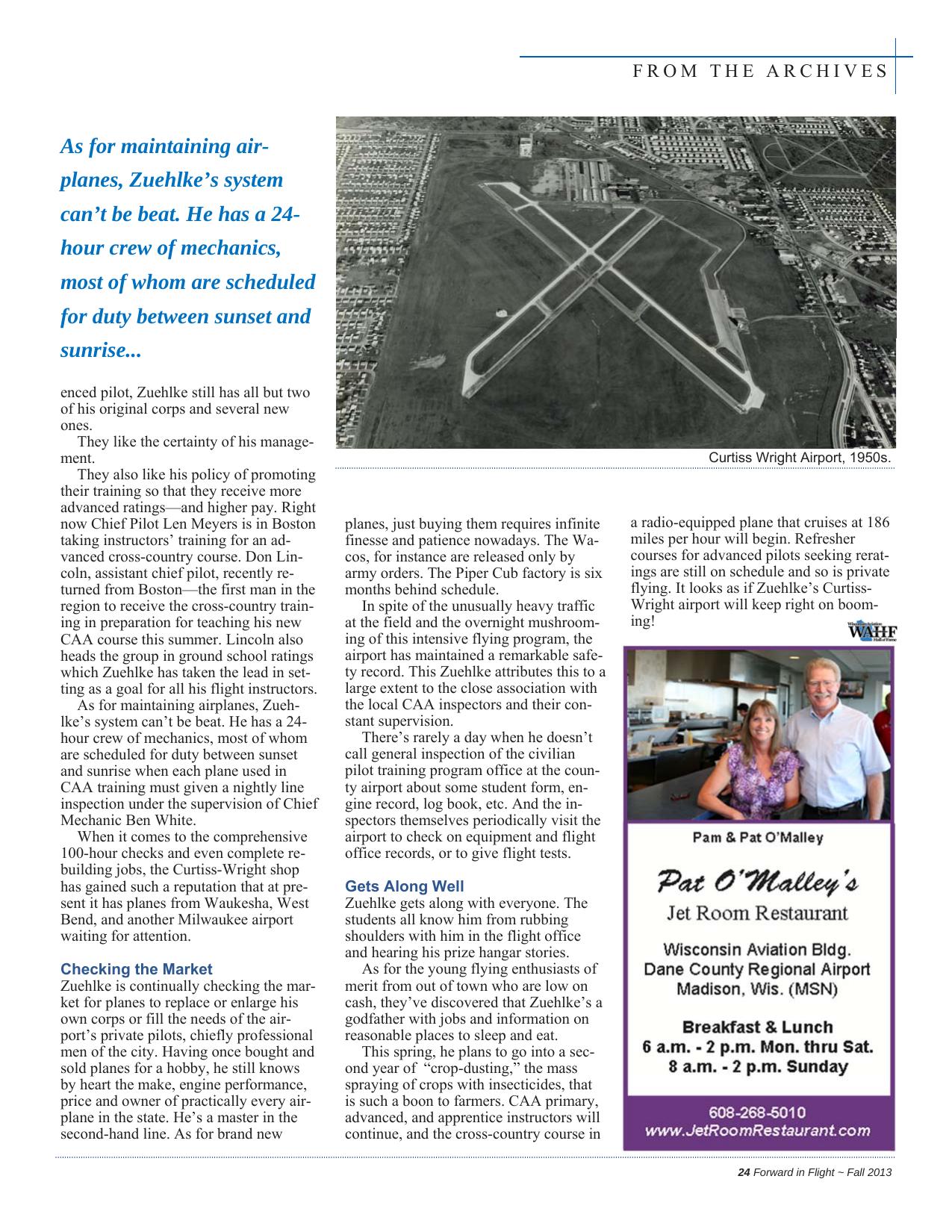
FROM THE ARCHIVES As for maintaining airplanes, Zuehlke’s system can’t be beat. He has a 24hour crew of mechanics, most of whom are scheduled for duty between sunset and sunrise... enced pilot, Zuehlke still has all but two of his original corps and several new ones. They like the certainty of his management. They also like his policy of promoting their training so that they receive more advanced ratings—and higher pay. Right now Chief Pilot Len Meyers is in Boston taking instructors’ training for an advanced cross-country course. Don Lincoln, assistant chief pilot, recently returned from Boston—the first man in the region to receive the cross-country training in preparation for teaching his new CAA course this summer. Lincoln also heads the group in ground school ratings which Zuehlke has taken the lead in setting as a goal for all his flight instructors. As for maintaining airplanes, Zuehlke’s system can’t be beat. He has a 24hour crew of mechanics, most of whom are scheduled for duty between sunset and sunrise when each plane used in CAA training must given a nightly line inspection under the supervision of Chief Mechanic Ben White. When it comes to the comprehensive 100-hour checks and even complete rebuilding jobs, the Curtiss-Wright shop has gained such a reputation that at present it has planes from Waukesha, West Bend, and another Milwaukee airport waiting for attention. Checking the Market Zuehlke is continually checking the market for planes to replace or enlarge his own corps or fill the needs of the airport’s private pilots, chiefly professional men of the city. Having once bought and sold planes for a hobby, he still knows by heart the make, engine performance, price and owner of practically every airplane in the state. He’s a master in the second-hand line. As for brand new Curtiss Wright Airport, 1950s. planes, just buying them requires infinite finesse and patience nowadays. The Wacos, for instance are released only by army orders. The Piper Cub factory is six months behind schedule. In spite of the unusually heavy traffic at the field and the overnight mushrooming of this intensive flying program, the airport has maintained a remarkable safety record. This Zuehlke attributes this to a large extent to the close association with the local CAA inspectors and their constant supervision. There’s rarely a day when he doesn’t call general inspection of the civilian pilot training program office at the county airport about some student form, engine record, log book, etc. And the inspectors themselves periodically visit the airport to check on equipment and flight office records, or to give flight tests. a radio-equipped plane that cruises at 186 miles per hour will begin. Refresher courses for advanced pilots seeking reratings are still on schedule and so is private flying. It looks as if Zuehlke’s CurtissWright airport will keep right on booming! Gets Along Well Zuehlke gets along with everyone. The students all know him from rubbing shoulders with him in the flight office and hearing his prize hangar stories. As for the young flying enthusiasts of merit from out of town who are low on cash, they’ve discovered that Zuehlke’s a godfather with jobs and information on reasonable places to sleep and eat. This spring, he plans to go into a second year of “crop-dusting,” the mass spraying of crops with insecticides, that is such a boon to farmers. CAA primary, advanced, and apprentice instructors will continue, and the cross-country course in 24 Forward in Flight ~ Fall 2013
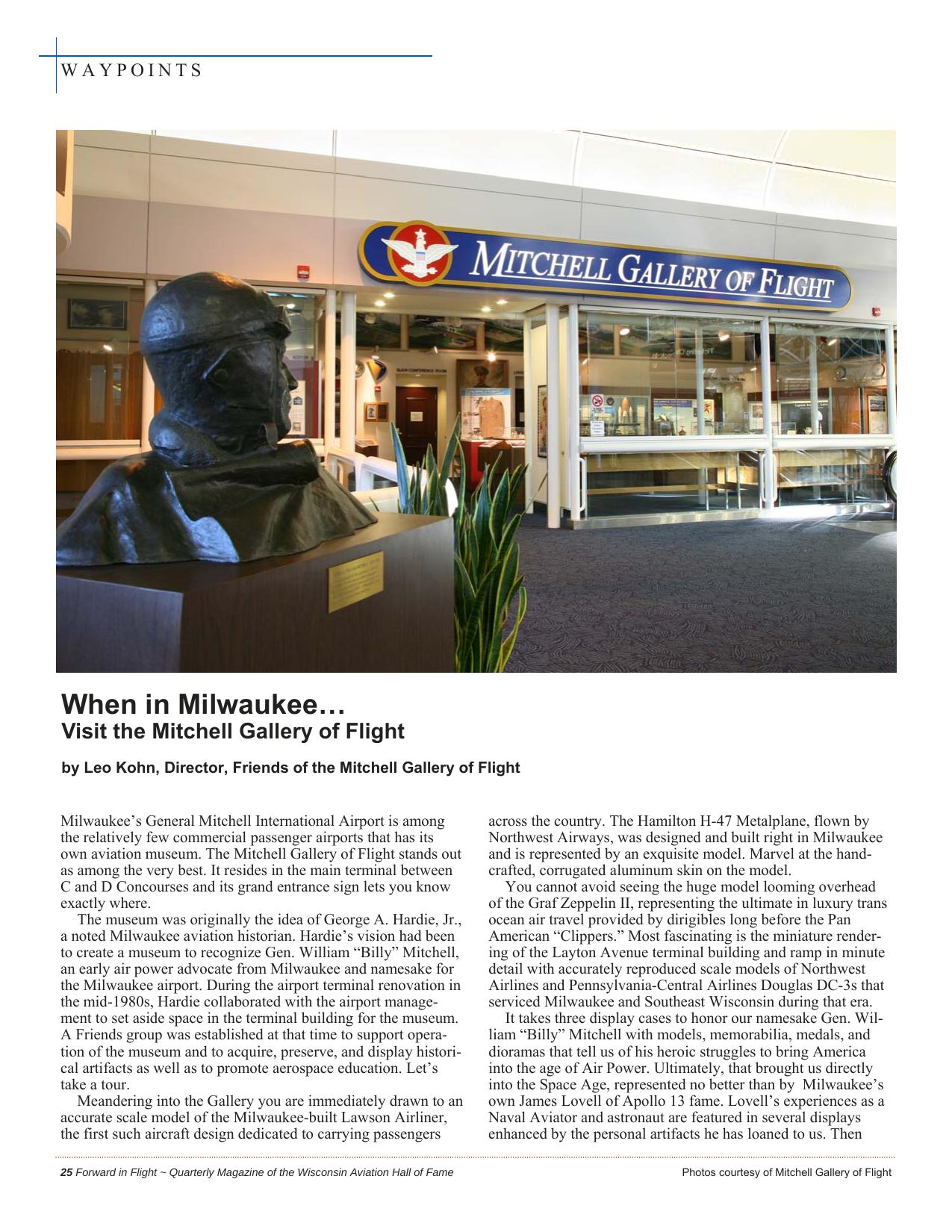
WAYPOINTS When in Milwaukee… Visit the Mitchell Gallery of Flight by Leo Kohn, Director, Friends of the Mitchell Gallery of Flight Milwaukee’s General Mitchell International Airport is among the relatively few commercial passenger airports that has its own aviation museum. The Mitchell Gallery of Flight stands out as among the very best. It resides in the main terminal between C and D Concourses and its grand entrance sign lets you know exactly where. The museum was originally the idea of George A. Hardie, Jr., a noted Milwaukee aviation historian. Hardie’s vision had been to create a museum to recognize Gen. William “Billy” Mitchell, an early air power advocate from Milwaukee and namesake for the Milwaukee airport. During the airport terminal renovation in the mid-1980s, Hardie collaborated with the airport management to set aside space in the terminal building for the museum. A Friends group was established at that time to support operation of the museum and to acquire, preserve, and display historical artifacts as well as to promote aerospace education. Let’s take a tour. Meandering into the Gallery you are immediately drawn to an accurate scale model of the Milwaukee-built Lawson Airliner, the first such aircraft design dedicated to carrying passengers 25 Forward in Flight ~ Quarterly Magazine of the Wisconsin Aviation Hall of Fame across the country. The Hamilton H-47 Metalplane, flown by Northwest Airways, was designed and built right in Milwaukee and is represented by an exquisite model. Marvel at the handcrafted, corrugated aluminum skin on the model. You cannot avoid seeing the huge model looming overhead of the Graf Zeppelin II, representing the ultimate in luxury trans ocean air travel provided by dirigibles long before the Pan American “Clippers.” Most fascinating is the miniature rendering of the Layton Avenue terminal building and ramp in minute detail with accurately reproduced scale models of Northwest Airlines and Pennsylvania-Central Airlines Douglas DC-3s that serviced Milwaukee and Southeast Wisconsin during that era. It takes three display cases to honor our namesake Gen. William “Billy” Mitchell with models, memorabilia, medals, and dioramas that tell us of his heroic struggles to bring America into the age of Air Power. Ultimately, that brought us directly into the Space Age, represented no better than by Milwaukee’s own James Lovell of Apollo 13 fame. Lovell’s experiences as a Naval Aviator and astronaut are featured in several displays enhanced by the personal artifacts he has loaned to us. Then Photos courtesy of Mitchell Gallery of Flight
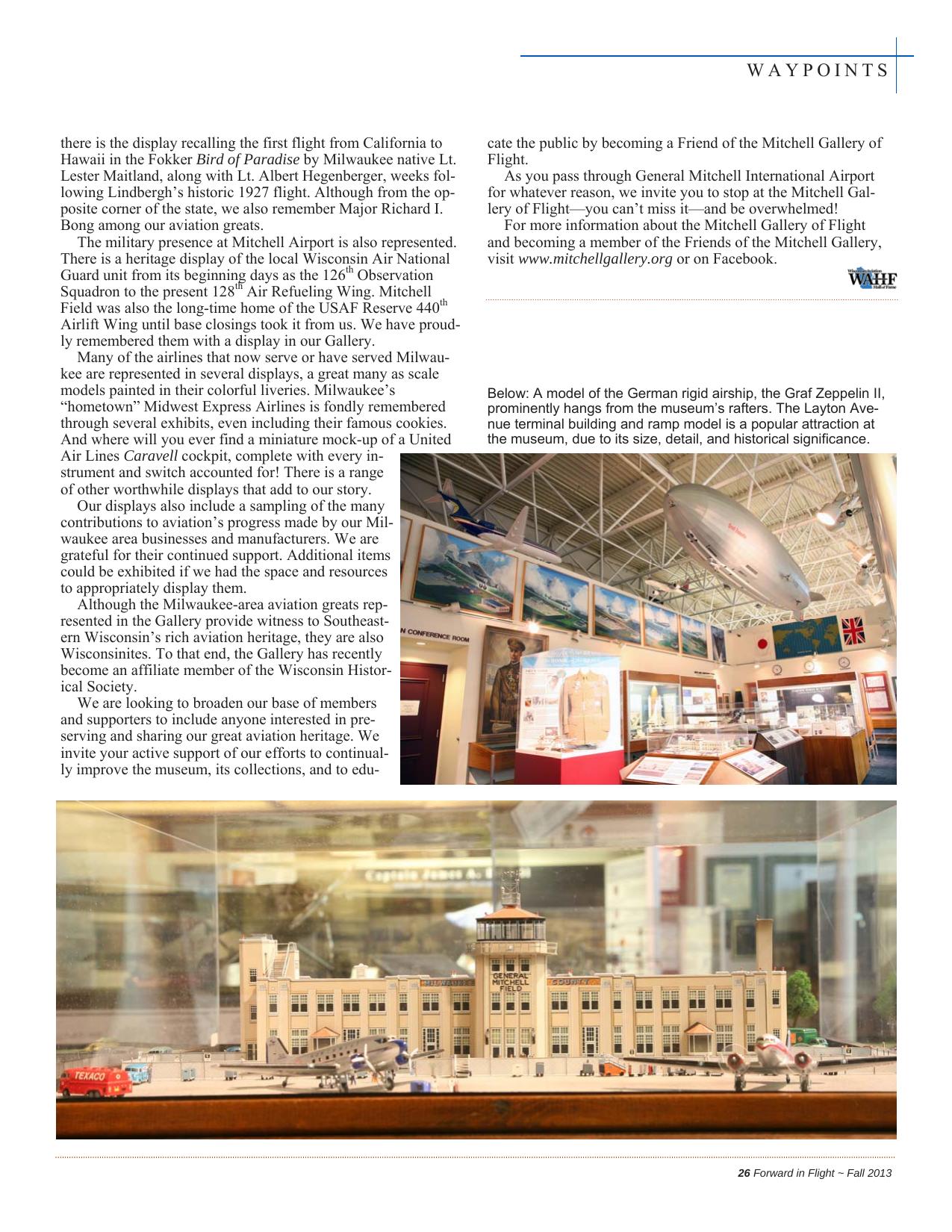
WAYPOINTS there is the display recalling the first flight from California to Hawaii in the Fokker Bird of Paradise by Milwaukee native Lt. Lester Maitland, along with Lt. Albert Hegenberger, weeks following Lindbergh’s historic 1927 flight. Although from the opposite corner of the state, we also remember Major Richard I. Bong among our aviation greats. The military presence at Mitchell Airport is also represented. There is a heritage display of the local Wisconsin Air National Guard unit from its beginning days as the 126th Observation Squadron to the present 128th Air Refueling Wing. Mitchell Field was also the long-time home of the USAF Reserve 440th Airlift Wing until base closings took it from us. We have proudly remembered them with a display in our Gallery. Many of the airlines that now serve or have served Milwaukee are represented in several displays, a great many as scale models painted in their colorful liveries. Milwaukee’s “hometown” Midwest Express Airlines is fondly remembered through several exhibits, even including their famous cookies. And where will you ever find a miniature mock-up of a United Air Lines Caravell cockpit, complete with every instrument and switch accounted for! There is a range of other worthwhile displays that add to our story. Our displays also include a sampling of the many contributions to aviation’s progress made by our Milwaukee area businesses and manufacturers. We are grateful for their continued support. Additional items could be exhibited if we had the space and resources to appropriately display them. Although the Milwaukee-area aviation greats represented in the Gallery provide witness to Southeastern Wisconsin’s rich aviation heritage, they are also Wisconsinites. To that end, the Gallery has recently become an affiliate member of the Wisconsin Historical Society. We are looking to broaden our base of members and supporters to include anyone interested in preserving and sharing our great aviation heritage. We invite your active support of our efforts to continually improve the museum, its collections, and to edu- cate the public by becoming a Friend of the Mitchell Gallery of Flight. As you pass through General Mitchell International Airport for whatever reason, we invite you to stop at the Mitchell Gallery of Flight—you can’t miss it—and be overwhelmed! For more information about the Mitchell Gallery of Flight and becoming a member of the Friends of the Mitchell Gallery, visit www.mitchellgallery.org or on Facebook. Below: A model of the German rigid airship, the Graf Zeppelin II, prominently hangs from the museum’s rafters. The Layton Avenue terminal building and ramp model is a popular attraction at the museum, due to its size, detail, and historical significance. 26 Forward in Flight ~ Fall 2013
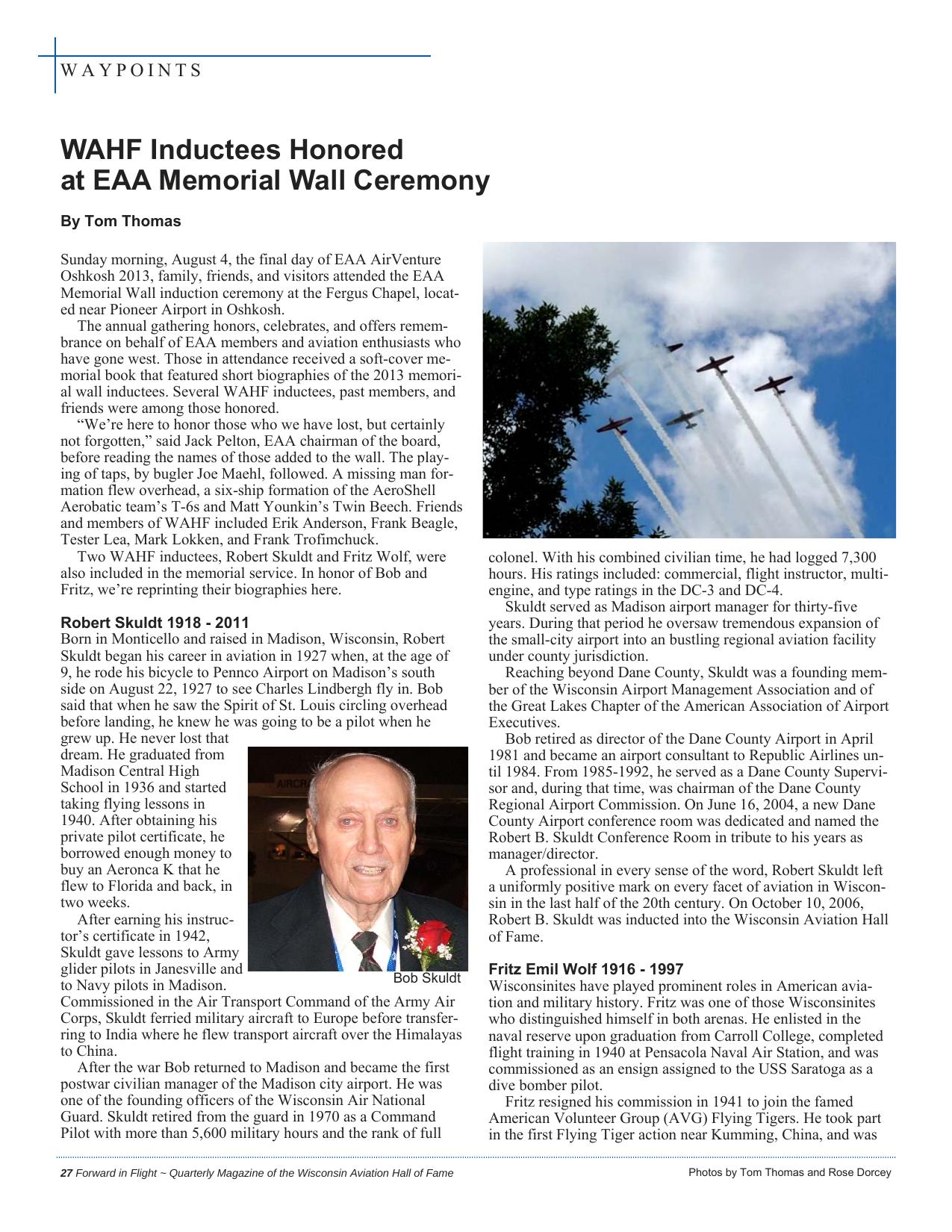
WAYPOINTS WAHF Inductees Honored at EAA Memorial Wall Ceremony By Tom Thomas Sunday morning, August 4, the final day of EAA AirVenture Oshkosh 2013, family, friends, and visitors attended the EAA Memorial Wall induction ceremony at the Fergus Chapel, located near Pioneer Airport in Oshkosh. The annual gathering honors, celebrates, and offers remembrance on behalf of EAA members and aviation enthusiasts who have gone west. Those in attendance received a soft-cover memorial book that featured short biographies of the 2013 memorial wall inductees. Several WAHF inductees, past members, and friends were among those honored. “We’re here to honor those who we have lost, but certainly not forgotten,” said Jack Pelton, EAA chairman of the board, before reading the names of those added to the wall. The playing of taps, by bugler Joe Maehl, followed. A missing man formation flew overhead, a six-ship formation of the AeroShell Aerobatic team’s T-6s and Matt Younkin’s Twin Beech. Friends and members of WAHF included Erik Anderson, Frank Beagle, Tester Lea, Mark Lokken, and Frank Trofimchuck. Two WAHF inductees, Robert Skuldt and Fritz Wolf, were also included in the memorial service. In honor of Bob and Fritz, we’re reprinting their biographies here. Robert Skuldt 1918 - 2011 Born in Monticello and raised in Madison, Wisconsin, Robert Skuldt began his career in aviation in 1927 when, at the age of 9, he rode his bicycle to Pennco Airport on Madison’s south side on August 22, 1927 to see Charles Lindbergh fly in. Bob said that when he saw the Spirit of St. Louis circling overhead before landing, he knew he was going to be a pilot when he grew up. He never lost that dream. He graduated from Madison Central High School in 1936 and started taking flying lessons in 1940. After obtaining his private pilot certificate, he borrowed enough money to buy an Aeronca K that he flew to Florida and back, in two weeks. After earning his instructor’s certificate in 1942, Skuldt gave lessons to Army glider pilots in Janesville and Bob Skuldt to Navy pilots in Madison. Commissioned in the Air Transport Command of the Army Air Corps, Skuldt ferried military aircraft to Europe before transferring to India where he flew transport aircraft over the Himalayas to China. After the war Bob returned to Madison and became the first postwar civilian manager of the Madison city airport. He was one of the founding officers of the Wisconsin Air National Guard. Skuldt retired from the guard in 1970 as a Command Pilot with more than 5,600 military hours and the rank of full 27 Forward in Flight ~ Quarterly Magazine of the Wisconsin Aviation Hall of Fame colonel. With his combined civilian time, he had logged 7,300 hours. His ratings included: commercial, flight instructor, multiengine, and type ratings in the DC-3 and DC-4. Skuldt served as Madison airport manager for thirty-five years. During that period he oversaw tremendous expansion of the small-city airport into an bustling regional aviation facility under county jurisdiction. Reaching beyond Dane County, Skuldt was a founding member of the Wisconsin Airport Management Association and of the Great Lakes Chapter of the American Association of Airport Executives. Bob retired as director of the Dane County Airport in April 1981 and became an airport consultant to Republic Airlines until 1984. From 1985-1992, he served as a Dane County Supervisor and, during that time, was chairman of the Dane County Regional Airport Commission. On June 16, 2004, a new Dane County Airport conference room was dedicated and named the Robert B. Skuldt Conference Room in tribute to his years as manager/director. A professional in every sense of the word, Robert Skuldt left a uniformly positive mark on every facet of aviation in Wisconsin in the last half of the 20th century. On October 10, 2006, Robert B. Skuldt was inducted into the Wisconsin Aviation Hall of Fame. Fritz Emil Wolf 1916 - 1997 Wisconsinites have played prominent roles in American aviation and military history. Fritz was one of those Wisconsinites who distinguished himself in both arenas. He enlisted in the naval reserve upon graduation from Carroll College, completed flight training in 1940 at Pensacola Naval Air Station, and was commissioned as an ensign assigned to the USS Saratoga as a dive bomber pilot. Fritz resigned his commission in 1941 to join the famed American Volunteer Group (AVG) Flying Tigers. He took part in the first Flying Tiger action near Kumming, China, and was Photos by Tom Thomas and Rose Dorcey
WAYPOINTS credited with shooting down two Mitsubishi bombers and assisting in downing a third. Near Rangoon, Burma, he was in a dogfight with 14 Japanese fighters and managed to shoot down one. Later near Loiwing, China, he shot down two more. Chennault praised him for his administrative skills. He returned to the Navy with the rank of lieutenant senior grade and was assigned as a fighter pilot instructor at Jacksonville Naval Air Station. He was later transferred to VF-11 aboard the USS Hornet. On the first of February, 1945, he was made squadron commander of VBF-3 aboard the USS Yorktown. He participated in support of the invasion of Iwo Jima and led the first historic naval bombing attack on the Tokyo area. He qualified as an Ace and received two Distinguished Flying Cross medals for bravery. After leaving active duty with the United States Navy in April 1946, Fritz became the first paid employee of the new Wisconsin State Aeronautics Commission. In 1967, he was appointed the first director of aeronautics. When the Aeronautics commission merged with the newly formed Department of Transportation, he became the first bureau director. In his 35 years of distinguished service, Fritz was the guiding force behind many of the innovative aviation developments in the state. Many of his programs became national models. His tenure saw Wisconsin set the pace in safety development. He pioneered strobe lighting for tall towers, which became the national method of lighting towers and was instrumental in administering the “tall tower” law and developing the “tower farm,” where antennas that are hazardous to airplanes could be clustered. He established Wisconsin’s nationally recognized Air Markers program. Fritz was responsible for implementing the first national aviation weather report in the nation, later to become familiar to thousands of radio listeners as the twice-daily “Weather Roundup” over the state radio network. He organized the first agricultural air tours in the nation and was instrumental in the development of the National Association of State Aviation Officials’ publication, “Preparation Guide for Minimum Requirements for Aeronautical Services” and served as that organization’s president. The capstone of his career was his induction into the Wisconsin Aviation Hall of Fame in 1989. He was the recipient of more than a dozen aviation and management awards. In 2006, Wisconsin Governor James Doyle signed a bill that renamed the Photos Jason Toney and WAHF Archives state aviation facility at the Dane County Regional Airport in Madison the “Fritz E. Wolf Aviation Center.” Those who knew him would tell you he was a man on honesty, integrity, and above all, modesty. A true statesman of the air. A true statesman of the air. Fritz Wolf Many attendees of the Memorial Wall event make rubbings of special names on the wall. 28 Forward in Flight ~ Fall 2013
ASSOCIATION NEWS Date Set for WAHF’s 2013 Induction Ceremony The 28th annual Wisconsin Aviation Hall of Fame induction ceremony promises to be a great evening for WAHF members and friends. Five Wisconsin aviators will be inducted: Bill Adams, Jeff Baum, Arnold Ebneter, Walter Kohler, and Ron Scott. The event takes place in the Founder’s Wing at the EAA AirVenture Museum in Oshkosh on Saturday, October 26. A social hour begins at 5 p.m., followed by dinner at 6. Inductee and scholarship presentations begin at 7. A silent auction to raise funds for WAHF’s educational programs runs from 5 - 6, and this year, credit cards will be accepted. Invitations will be mailed in September. Please plan to attend, and register early! Annual Membership Meeting The Wisconsin Aviation Hall of Fame (WAHF) conducts its annual membership meeting at 1 p.m. in the Batten Board Room at the EAA AirVenture Museum in Oshkosh, prior to the annual induction ceremony and banquet on October 26. The annual meeting is required by Wisconsin law and the organization’s bylaws. The annual membership meeting provides the one opportunity for the organization’s members to make decisions that will affect the organization for as much as the next three years. The annual meeting agenda typically includes a financial report, review of the past year’s projects, accomplishments to- Morey Airplane Company Since 1932 wards the organization’s goals, and election of directors. The WAHF board is comprised of nine directors, each elected for a three-year term. Terms are staggered so each year three directors are elected. Board vacancies may occur at times other than the conclusion of a term at the annual meeting. Those openings are filled by the board in accordance with the bylaws. Current director and vicepresident Michael Goc recently announced his retirement from the board effective October 26, 2013. The Board Nominations Committee recommended the board include this pending vacancy in the regular director elections during the annual meeting. The director elected will fill the remaining two years of Michael’s term. Two of the three incumbent directors reaching the end of their term, Rose Dorcey and Tom Thomas, have agreed to run for re-election. Four director positions need to be filled and there are two candidates to date. WAHF members interested in being a candidate should contact Board Nominations Committee Chair John Dorcey at jdorcey@wisconsinaviationhalloffame.org or by phone at 920-385-1483. Nominations are also taken from the floor during the annual meeting. Subscribe to Forward in Flight today! Subscription includes one-year WAHF membership. Membership Benefits: Quarterly subscription (four Middleton Municipal Airport/Morey Field Self-service 100LL & Jet A 24-7 issues) of Forward in Flight, packed full of Wisconsin aviation news, events, state aviation history, and stories about your aviation colleagues Free pass to the Deke Slayton Museum Invitation to annual induction banquet Just $20 and you’ll be sup- porting an aviation organization dedicated to collecting, preserving, and sharing Wisconsin aviation history. With Forward in Flight, you’ll learn about aviation history makers—the people, places, and events that distinguish our state and also be in touch with current Wisconsin aviation news and information. Name Address City State Zip Phone Number Email Mail to: WAHF, 3980 Sharratt Drive, Oshkosh, WI 54901 29 Forward in Flight ~ Quarterly Magazine of the Wisconsin Aviation Hall of Fame
FROM THE AIRWAYS Flight Marks 100-year Anniversary of First Crossing of Lake Michigan Faith Vilas successfully made a water landing near Chicago’s tems such as the inability to Navy Pier on July 1, 2013, recreating the flight her grandfather observe objects close to the and pioneer aviator Logan A. (Jack) Vilas made July 1, 1913 to Sun. become the first person to fly an airplane across Lake Michigan. “It will be fantastic to fly Vilas, a senior scientist at the Planetary Science Institute, and use the Atsa in suborbimade the flight to commemorate the 100th anniversary of her tal space,” she said. “Open grandfather’s groundbreaking feat. human spaceflight is our She flew a Cessna 185 seaplane from Southwest Regional future.” Airport in St. Joseph/Benton Harbor, Michigan, to the Navy Pier For more information in Chicago, Illinois. visit www.psi.edu. “I am so glad to complete this journey successfully on the 100th anniversary of my grandfather’s landing – at that time, the longest flight over water in aviation history,” Vilas said. “This is the culmination of years of work on the part of admirers of Jack’s accomplishment, and it is great to complete this effort on behalf of family and friends, and especially in honor of my grandfather, Jack Vilas.” Vilas held a press conference in the Navy Pier Grand Ballroom before heading off to a reception in the Navy Pier Lakeview Terrace attended by family, friends, and well-wishers. The 64-mile Lake Michigan flight, accomplished under windy conditions, marks the successful end of two years of training and preparation for Vilas, whose future aviation goals are aimed even higher. She is eager to go up into space as part of PSI’s Atsa Suborbital Observatory project that will see scientists and students operate a telescope while aboard a reusable spacecraft, XCOR Aerospace’s Lynx. Vilas is a founder of and Project Scientist on the Atsa project. Atsa will provide low-cost space-based observations above the limiting atmosphere of Earth, while avoiding Faith Vilas’ landing in Chicago completes the reenactment of her some operational constraints of satellite telescope sysgrandfather’s pioneering flight in 1913. Dorcey Elected Chairman of SAFE SubSonex Kit Reservations Available WAHF Secretary/Treasurer John Dorcey has been elected Chairman of the Society of Aviation and Flight Educators (SAFE). Dorcey was elected during the organization’s annual board meeting on July 28 in Oshkosh, Wisconsin. As chairman of the national organization, Dorcey will lead the board of directors in carrying out its mission of creating a safer aviation environment through enhanced education. The organization provides aviation educators with mentoring, support, and professional accreditation. By providing quality educational materials and other resources, the organization promotes a reduction in aviation accidents, increased professionalism among aviation educators, and lifelong learning by everyone involved in aviation. Visit www.SafePilots.org for more information about SAFE. Sonex Aircraft, LLC has announced that Kit Reservation Deposits are now being accepted for the SubSonex Personal Jet. A $10,000 refundable deposit will allow SubSonex customers to receive position numbers for the first kit deliveries, anticipated to commence mid-year, 2014. Sonex also announced that an introductory price of $125,000 will be guaranteed for the first 10 Kit Reservation Deposit holders, which includes the SubSonex Ultra -Quick Build Kit and the PBS TJ-100 turbojet engine with installation accessories. The announcement was made as part of the company’s 10th annual Sonex Aircraft Open House and Homecoming Fly-In, held at Sonex factory headquarters on Wittman Regional Airport (KOSH) in Oshkosh on July 28, 2013. For more information, visit www.SonexAircraft.com. 30 Forward in Flight ~ Fall 2013
FROM THE AIRWAYS Global Flight Research Offers Upset Recovery Training Global Flight Research’s Upset Recovery Training Center, is now located at Jet Air in Green Bay, at Austin Straubel International Airport (KGRB). Global Flight Research, based in Sturgeon Bay, provides aviation research and ownership consulting services for aircraft owners worldwide, and upset recovery training. Their philosophy is simple, by adapting to the client, the company will create an environment where everything is easily understood. “You don’t have to go far out of your way to make time in your busy schedule to work with GFR,” says Vuksanovic. “We set up your training to work out what’s best for you.” Upset Recovery Training Developed for the professional pilot, GFR’s Upset Recovery Training Center in Green Bay houses a curriculum focused on the professional aviator who uses an airplane for business. GFR, operated by Robert Vuksanovic, caters to those who want to be a safe aviator. “We want our clients to be hands on, and we review their avionics suites and how to operate them safely,” he says. “We have assisted in the development of the Calspan/Veridian In-flight Simulators Upset Program and we are an affiliate of Rich Stowell’s Emergency Maneuver Training Program. “When people complete our programs, we want them to be competent in both,” Vuksanovic added. “We address the top reasons for accidents caused by the pilot. Controlled flight into terrain is one of the leading causes of fatalities.” GFR incorporates ground school, simulator, and actual flight demonstration by experienced instructors with military, collegiate, charter, freight, corporate, and airline flying experience, plus thousands of hours of general aviation, small aircraft fly- ing. Vuksanovic started flying aerobatics in 1978 in a Cessna T-37 “Tweet” and never looked back. He delved into his aviation career and never gave up going to the small airport to fly a Cessna Aerobat, Bellanca Super Decathlon, Pitts Special, Great Lakes, Christen Eagle, Beechcraft T-34A/B, Beechcraft E/F33C Bonanza, Pilatus P3, or a 7KCAB Citabria (he bought that one!) Meanwhile, he was flying corporate jets all over the world and settling into a career with Midwest Express Airlines. Those experiences helped him realize who needed this type of flying, the commercial career pilot. Robert Vuksanovic Inside/outside, up/ down, and inverted describe the flight training, to get a real feel for the airplane. Some experiences are learned in a simulator, some must be performed in a plane. The upset recovery course is designed to teach commercial pilots how to combat controlled flight into terrain (CFIT) accidents. A one-day upset recovery training program, offered through Global Flight Research, is available at Jet Air’s Green Bay headquarters for $850, by appointment. For more information on the upset recovery program, call 877-938-2705. The company held an open house at Jet Air on September 1, offering Redbird simulator rides to preview the course. Motorcycle Ride To Benefit Mission Aviation Fellowship Join Mission Aviation Fellowship (MAF) on Saturday, September 21 for a scenic motorcycle ride through the Northern Kettle Moraine, led by the Christian Motorcycle Association. The ride starts and ends at the Aviation Heritage Center of Wisconsin, located at the Sheboygan County Memorial Airport (KSBM), N6191 Resource Drive, Sheboygan Falls, Wisconsin. Ride2Fly benefits the isolated people MAF serves around the world by providing funds that keep MAF flying! Registration is $25 for rider/bike, and $10 for passengers. Registration includes a Ride2Fly patch and a meal. Ride begins at noon; check-in starts at 10:30 a.m. Details: •Coffee and donuts provided at check-in •Scheduled fuel stops •Ice cream break in Dundee •Post ride meal and an MAF presentation at the AHC 31 Forward in Flight ~ Quarterly Magazine of the Wisconsin Aviation Hall of Fame •A pledge per mile fundraiser challenge, with prizes for the most funds raised (see details online). For more information contact Jack Erdmann at 920-2075173. Register online at www.MAF.ORG/ride2flywisconsin. Photos courtesy of GFR
GONE WEST Paul Poberezny Paul Poberezny founded one of the world’s largest aviation organizations and emerged as one of the 20th century’s greatest aviation leaders, creating a worldwide aviation organization and the world’s premiere aviation event, EAA AirVenture Oshkosh. He died at the age of 91 on August 22, 2013 in Oshkosh after a career that spanned more than 70 years of flight. A highly skilled pilot, he flew more than 500 different types of aircraft and logged more than 30,000 hours. Paul often said that there was not a day that went by that he didn’t say the word “airplane”. His flight experiences began as a high school student who taught himself to fly and continued through service in World War II and the Korean conflict. Between the wars, he began his hands-on approach to aircraft design and building that would direct his future and legacy. In January 1953, he organized about three dozen aircraft builders and restorers into a local Milwaukee, Wisconsin, club that was named the Experimental Aircraft Association. Later that year, the first EAA fly-in formed the foundation of what has become EAA AirVenture Oshkosh. Paul’s life and career was a shining example of vision, selfreliance, motivation, and leadership. He is regarded as one of the individual giants of aviation’s first century, with an influence that reaches beyond a single flying accomplishment, to affecting tens of thousands of people who have dreamed of flying. Paul Poberezny was more than a legend. He left legacy of a lifetime involvement in aviation that will impact future generations for decades to come. Paul was one of the Wisconsin Aviation Hall of Fame’s three inaugural inductees in 1986. Paul was preceded in death by his parents, Peter and Jetta Poberezny, and sister, Martha Biesterveld. Paul is survived by his wife of 69 years, Audrey, son Tom (Sharon) Poberezny, of Brookfield, Wisconsin; daughter Bonnie (Chuck) Parnall of Oshkosh; granddaughters Audra (Michael) Hoy of Oshkosh, Lesley Poberezny of Brookfield, Wisconsin, and stepgranddaughter Marnee (Russell) Lott of Benbrook, Texas. Paul is also survived by great-granddaughter Charlotte “Charley” Hoy, and step-greatgrandson, Cord Lott. Paul is also survived by his brother, Norm (Betty) Poberezny, nephew, Lewis (Denise) Poberezny, and niece, Eileen Schroeder. A private family service was held. In lieu of flowers, memorials in honor of Paul’s life and legacy can be made to any of the following: EAA Aviation Foundation, P. O. Box 3086, Oshkosh, WI 54903; Evergreen Foundation, 1130 North Westfield Street, Oshkosh, WI 54903; or the American Cancer Society, Northeast Wisconsin, 790 Marvelle Lane, Green Bay, WI 54304. Frank Trofimchuck Francis A.“Frank” Trofimchuck, 79, of Potosi passed away peacefully and was granted his angel wings Wednesday, April 24, 2013, at his home. Private graveside services were held at the VanBuren Cemetery, Potosi. Military rites were accorded by American Legion Post #473 and Berg-Averkamp VFW Post #5276. Frank was born on June 19, 1933 in Joliet, Illinois, the son of Francis and Anna (Miksa) Trofimchuck. He went to grade school through high school in Braidwood, Illinois. He served in the Army Air Force during the Korean War. He was the President of Fransyl Equipment Company in Kieler, Wisconsin, and serviced the utility business for 55 years. Frank enjoyed photography, wood making, fishing, and hunting. Aviation was his passion and he was a long standing member of the AOPA, EAA, and a lifetime member of WAHF. Frank is survived by his loving wife of 30 years, Sylvia; sons, Daniel, Mark, and Matthew Trofimchuck; stepsons, Larry, Alan, and Danny Ray; 10 grandchildren; 12 great-grandchildren; his two dogs, Abbie and Sassie. He was preceded in death by his parents. You’re Invited… to the Wisconsin Aviation Hall of Fame’s 28th Annual Induction Ceremony and Banquet. Saturday, October 26, 2013 Social Hour 5 p.m., Dinner 6 p.m. EAA AirVenture Museum Founder’s Wing, Oshkosh Register Online at WisconsinAviationHallofFame.org or call Rose at 920-385-1483. Photos courtesy EAA and Trofimchuck family 32 Forward in Flight ~ Fall 2013
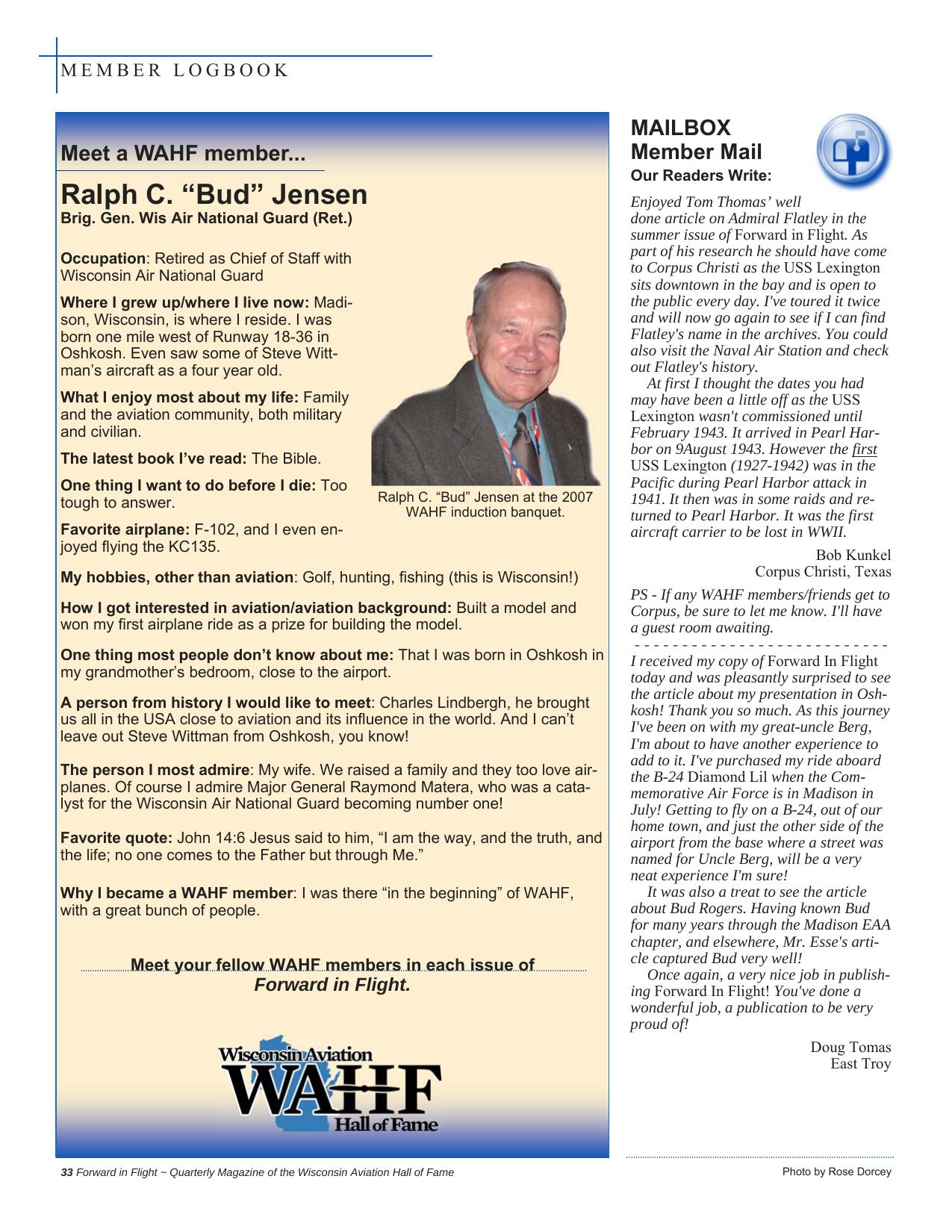
MEMBER LOGBOOK MAILBOX Member Mail Meet a WAHF member... Our Readers Write: Ralph C. “Bud” Jensen Brig. Gen. Wis Air National Guard (Ret.) Occupation: Retired as Chief of Staff with Wisconsin Air National Guard Where I grew up/where I live now: Madison, Wisconsin, is where I reside. I was born one mile west of Runway 18-36 in Oshkosh. Even saw some of Steve Wittman’s aircraft as a four year old. What I enjoy most about my life: Family and the aviation community, both military and civilian. The latest book I’ve read: The Bible. One thing I want to do before I die: Too tough to answer. Ralph C. “Bud” Jensen at the 2007 WAHF induction banquet. Favorite airplane: F-102, and I even enjoyed flying the KC135. My hobbies, other than aviation: Golf, hunting, fishing (this is Wisconsin!) How I got interested in aviation/aviation background: Built a model and won my first airplane ride as a prize for building the model. One thing most people don’t know about me: That I was born in Oshkosh in my grandmother’s bedroom, close to the airport. A person from history I would like to meet: Charles Lindbergh, he brought us all in the USA close to aviation and its influence in the world. And I can’t leave out Steve Wittman from Oshkosh, you know! The person I most admire: My wife. We raised a family and they too love airplanes. Of course I admire Major General Raymond Matera, who was a catalyst for the Wisconsin Air National Guard becoming number one! Favorite quote: John 14:6 Jesus said to him, “I am the way, and the truth, and the life; no one comes to the Father but through Me.” Why I became a WAHF member: I was there “in the beginning” of WAHF, with a great bunch of people. Meet your fellow WAHF members in each issue of Forward in Flight. 33 Forward in Flight ~ Quarterly Magazine of the Wisconsin Aviation Hall of Fame Enjoyed Tom Thomas’ well done article on Admiral Flatley in the summer issue of Forward in Flight. As part of his research he should have come to Corpus Christi as the USS Lexington sits downtown in the bay and is open to the public every day. I've toured it twice and will now go again to see if I can find Flatley's name in the archives. You could also visit the Naval Air Station and check out Flatley's history. At first I thought the dates you had may have been a little off as the USS Lexington wasn't commissioned until February 1943. It arrived in Pearl Harbor on 9August 1943. However the first USS Lexington (1927-1942) was in the Pacific during Pearl Harbor attack in 1941. It then was in some raids and returned to Pearl Harbor. It was the first aircraft carrier to be lost in WWII. Bob Kunkel Corpus Christi, Texas PS - If any WAHF members/friends get to Corpus, be sure to let me know. I'll have a guest room awaiting. --------------------------I received my copy of Forward In Flight today and was pleasantly surprised to see the article about my presentation in Oshkosh! Thank you so much. As this journey I've been on with my great-uncle Berg, I'm about to have another experience to add to it. I've purchased my ride aboard the B-24 Diamond Lil when the Commemorative Air Force is in Madison in July! Getting to fly on a B-24, out of our home town, and just the other side of the airport from the base where a street was named for Uncle Berg, will be a very neat experience I'm sure! It was also a treat to see the article about Bud Rogers. Having known Bud for many years through the Madison EAA chapter, and elsewhere, Mr. Esse's article captured Bud very well! Once again, a very nice job in publishing Forward In Flight! You've done a wonderful job, a publication to be very proud of! Doug Tomas East Troy Photo by Rose Dorcey

Wittman Regional Airport Oshkosh So much history ...and still making it! From the legacy of Steve Wittman to Warren Basler’s DC-3 conversions, we’re proud to support and contribute to Wisconsin aviation history. FLY TO OSHKOSH wittmanairport.com @wittmanairport 34 Forward in Flight ~ Fall 2013
PRSRT STD US Postage Paid Wisc Rapids WI Permit 98 3980 SHARRATT DRIVE OSHKOSH WI 54901-1276 The Wisconsin Aviation Hall of Fame is a non-profit membership organization dedicated to preserving the past and fostering the future of flight. Welcome WAHF Member/Supporters: Lee Kunze Doug Osborn Theresa Knox Eldon Isely Jeremy Keyes Don Ellingson Jane Beseler —Thanks for coming aboard. We hope to see you at a WAHF event soon! CONGRATULATIONS …to WAHF Member Doc Mosher, FAA Charles Taylor Master Mechanic and Wright Brothers Master Pilot award recipient, who received the Navy League’s Aviation Excellence Award in recognition of his 74 years and 21,000 hours of accident-free flying and aircraft maintenance activities, and his tremendous contributions to the development of general aviation. ...to Alexander Field-South Wood County Airport (KISW) in Wisconsin Rapids on its 85th anniversary! A celebration was held August 29 - September 3, which featured rides in EAA’s Ford TriMotor, an old-time hangar dance, and Wisconsin aviation history learning opportunities for the community. Watch for a report in the next issue of Forward in Flight. WISCONSIN AVIATION EVENTS EAA Chapter 252 in Oshkosh will hold a pancake breakfast in conjunction with Wittman Regional Airport’s Open House on Saturday, September 14 from 7:30 a.m. - 11. Airport businesses and non-profit organizations will exhibit at the event. Enjoy a breakfast of sausage, eggs, beverages, and all you can eat pancakes ($7 adults, $3 children under age 10). Young Eagles rides (ages 8 -17) from 9 - 11 a.m. FMI: www.EAA252.org. Wisconsin Aviation Hall of Fame Officers and Board of Directors Rose Dorcey, President Michael Goc, Vice President John Dorcey, Secretary/Treasurer Frederick Beseler Bruce Botterman Andrew Ovans Charles Swain Tom Thomas Wynne Williams Charles Marotske, Honorary Chairman of the Board Wisconsin Aviation Hall of Fame 3980 Sharratt Drive Oshkosh, WI 54901-1276 Become a supporter today! For information call Rose Dorcey at 920-385-1483 The Oshkosh Women in Aviation chapter is holding its third annual Frosting for Flight cupcake competition and sale on Saturday, October 5 from 1-3 p.m. in the conference room at Wittman Regional Airport (KOSH) in Oshkosh. The event raises funds for the chapter’s Spirit of Flight scholarship, a $500 award to a woman who has soloed and is working toward a pilot www.wisconsinaviationhalloffame.org certificate or rating. Plan to compete, or to purchase cupcakes; they will be available for just $1 each or six for $5. rdorcey@wisconsinaviationhalloffame.org For more information, visit www.OshkoshWAI.org or Facebook at www.Facebook.com/ OshkoshWAI. The event is sponsored by Wittman Regional Airport.