Volume 12, Issue 3
🗞️ Download Issue (PDF)
Forward in Flight - Fall 2014
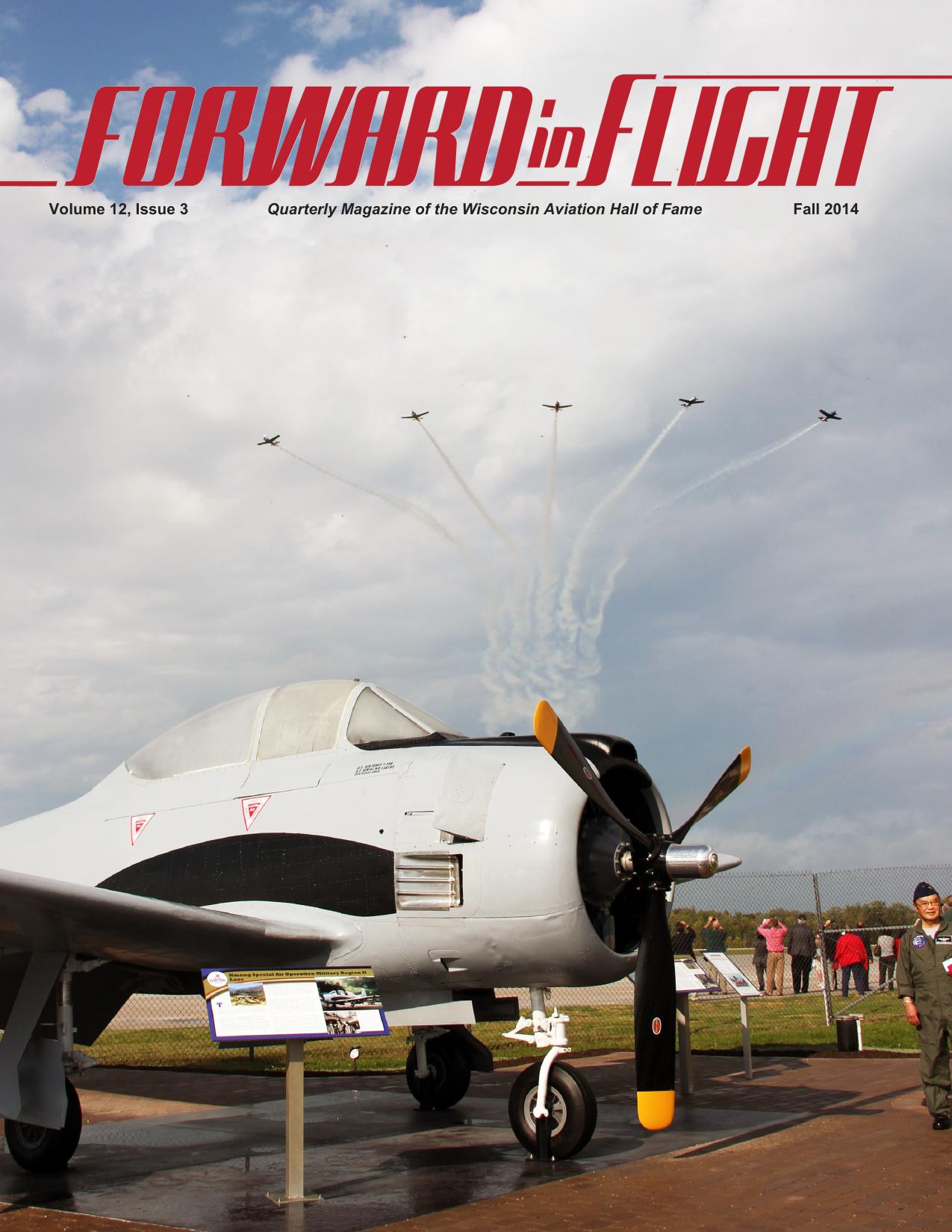
Volume 12, Issue 3 Quarterly Magazine of the Wisconsin Aviation Hall of Fame Fall 2014
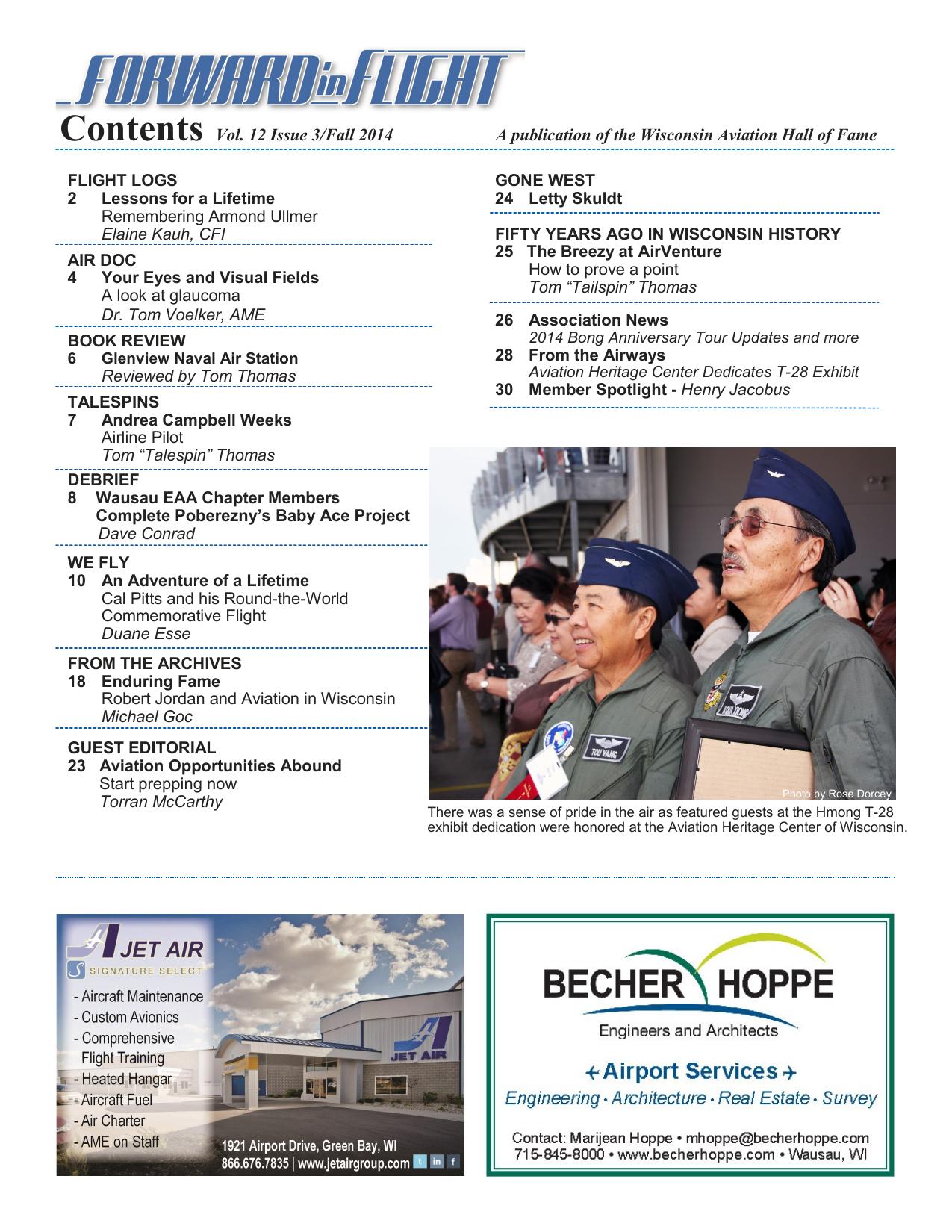
Contents Vol. 12 Issue 3/Fall 2014 FLIGHT LOGS 2 Lessons for a Lifetime Remembering Armond Ullmer Elaine Kauh, CFI AIR DOC 4 Your Eyes and Visual Fields A look at glaucoma Dr. Tom Voelker, AME BOOK REVIEW 6 Glenview Naval Air Station Reviewed by Tom Thomas TALESPINS 7 Andrea Campbell Weeks Airline Pilot Tom “Talespin” Thomas DEBRIEF 8 Wausau EAA Chapter Members Complete Poberezny’s Baby Ace Project Dave Conrad A publication of the Wisconsin Aviation Hall of Fame GONE WEST 24 Letty Skuldt FIFTY YEARS AGO IN WISCONSIN HISTORY 25 The Breezy at AirVenture How to prove a point Tom “Tailspin” Thomas 26 Association News 2014 Bong Anniversary Tour Updates and more 28 From the Airways Aviation Heritage Center Dedicates T-28 Exhibit 30 Member Spotlight - Henry Jacobus WE FLY 10 An Adventure of a Lifetime Cal Pitts and his Round-the-World Commemorative Flight Duane Esse FROM THE ARCHIVES 18 Enduring Fame Robert Jordan and Aviation in Wisconsin Michael Goc GUEST EDITORIAL 23 Aviation Opportunities Abound Start prepping now Torran McCarthy Photo by Rose Dorcey There was a sense of pride in the air as featured guests at the Hmong T-28 exhibit dedication were honored at the Aviation Heritage Center of Wisconsin.
President’s Message ~ by Rose Dorcey One of the greatest joys of flying is sharing it with those we love. John and I did just that recently. It was one of those flights that was especially memorable and meaningful. As you may know, my daughter is a Dominican Sister teaching in Denver. This past summer she began studying for her masters degree in Rhode Island, and then after her studies had two weeks to rest at a retreat in Nashville before coming back home to Wisconsin. She let me know before her arrival that she was so well rested she would be ready for an active home visit. I put together an ambitious schedule and we carried it out. We went for a boat ride and a bike ride, and took in a Brewers/ Cubs game at Wrigley Field. We played pickle ball (she beat me), prayed at several Masses, reunited with family and friends in Wisconsin Rapids, had our favorite dishes at Belts’ Soft Serve in Stevens Point, and spent two days in Minneapolis with Logan, her one-month-old nephew (my grandson). Though hectic, we had a great time! The best part was our evening flight in a Cessna 172. Before she entered the convent, Sister Maria Caeli had flown with me in Cessna 150s and 172s. She had even taken a flight lesson in Wisconsin Rapids. That was her last general aviation flight. Unfortunately, it was an extremely bumpy ride, and she decided not to pursue a private pilot certificate. On our recent flight though, the air was as smooth as the Lake Winnebago water on which we had just boated. We flew to Green Bay and requested to circle over Lambeau Field. A huge Packers fan, Sister liked that a lot, and we recalled her Punt, Pass, and Kick appearances there and games we had attended when she was younger. We witnessed God’s good works in a gorgeous sunset and the region’s beautiful lakes and rivers. She asked a lot of good questions about flying, and thoroughly enjoyed the flight. After the flight, and the next day, she asked more questions, and confidently commented, “I could do that, learn to fly.” Of that I have no doubt. As we left the airport, I realized how much she had enjoyed it. I still can’t quite describe the overwhelmingly good feeling that came over me. Maybe it was gratefulness, or just pure happiness, but I can confirm this, it was an extraordinary feeling being able to share something that’s so meaningful to me, with Forward in Flight The only magazine dedicated exclusively to Wisconsin aviation history and today’s events. Rose Dorcey, editor 3980 Sharratt Drive Oshkosh, WI 54901-1276 Phone: 920-385-1483 920-279-6029 rdorcey@wisconsinaviationhallofame.org The Wisconsin Aviation Hall of Fame is a non-profit membership organization with a mission to collect and preserve the history of aviation in Wisconsin, recognize those who made that history, inform others of it, and promote aviation education for future generations. Rose Dorcey someone so special to me, and know how much she enjoyed the experience. May you all have the opportunity to share this same joy with those who are special to you. Typically this time of year I’m telling you how busy things are, in preparation for our annual induction ceremony on October 25. Yes, it’s been busy, more so this year than any other year I can remember. But as the event gets closer, I continue to be thankful for the honor of being involved in the Wisconsin Aviation Hall of Fame, no matter how busy! The men and women who are inducted each year are so grateful and humbled by this honor, and it’s so nice to hear from them and their families as they express how much it means to them. What good people I’ve met in my dozen or so years with WAHF. Now is also a good time to remind our members and friends about WAHF’s growing scholarship program. We recently heard from a past scholarship recipient, Torran McCarthy, who is thriving in his aviation career. He noted how important it was to receive scholarships in getting him where he is today. It’s not just a financial boost, but a boost in confidence as well. While our scholarship deadline isn’t until March 2015, it’s never too early to think about applying. Surprisingly, it’s not always easy to give money away. Please share information about our scholarships with aviation students you know. We now offer five scholarships, and we’ve opened up our guidelines to include Wisconsin students going to colleges or universities outside the state. It’s a simple, online application process. We hope to see dozens of applications come spring! On the cover: The Trojan Horsemen T-28 Pilots performed a flyover at the dedication of the Aviation Heritage Center of Wisconsin’s Hmong T-28 Exhibit on Saturday, September 20. The exhibit is intended to educate people about Hmong pilots of the U.S. Secret War in Laos. Flyover pilots were Jeff Clark, Lead, Waukegan, Illinois; Paul Walter, Milwaukee; Ralph Glasser, Springfield, Illinois; Jim Rohlf, Bennett, Iowa; and Andrew Smart, New Jersey. Photo by Rose Dorcey.
FLIGHT LOGS Lessons for a Lifetime Remembering Armond Ullmer By Elaine Kauh Hearty laughter flooded the cockpit intercom as we bounced down the little grass strip, my hands and feet grappling the stick and rudder of the old Citabria. It didn't cease until the airplane finally came to rest on all three wheels, propeller whirling idly. I had at least two more landings to perform, so I didn't think it was all that funny. The amused man sitting behind me was Armond Ullmer, my choice of instructor for this first flight review as a private pilot. The Citabria is similar to the vintage taildraggers in which he taught flying for more than 50 years, and I knew he had many nuggets of wisdom to share. After flying a Cessna 152 for my initial pilot training, I enjoyed the fun and challenge of a tandem taildragger with a stick. It was a long-awaited goal that began many (!) years ago when I drove by a country airport in Ohio and thought: I am going to learn how to fly one of those. Now, with a two-year-old license to learn and a fresh tailwheel endorsement, I wanted to celebrate my milestones. It was September, and Armond had just turned 81. He had earned his pilot’s license after serving in World War II as an Army radio operator and began instructing soon thereafter. Like many pilots of his generation, he had a common sense, no-frills approach to flying. When I first encountered him puttering around in his blue and white Taylorcraft, I liked him immediately. He was a calm, friendly man with white hair, a light build and lively skyblue eyes, a contrast to the young, sharptongued instructors I was used to dealing with as a student pilot. Yes, he offered instruction and flight reviews, in his taildragger or yours. Yes, you could call him at home any time, but more often than not, you left a message. He was usually out flying or socializing with his many friends or running errands. He was a busy man who never had to hurry. Our one-hour ground session consisted of discussing a short written test I was to fill out before our appointment. Its aim The Citabria bounced again, but not so high this time. Then came a little skip, and the airplane settled... was to ensure that I was a safe, competent pilot who always, always looked out the window for traffic and never, never forgot from where the wind was blowing. Then we headed out to the Citabria. It was a sunny afternoon, and a stiff south crosswind blowing across the paved runway would require me to perform my takeoffs and landings on the short grass strip. I was used to short and unpaved runways, but I hadn’t flown much in gusty winds. Naturally, this gave me pause, but the breeze was lined up with the grass strip and hey, I was with an instructor. He would be my safety net. Over the early-autumn patches of northern Wisconsin woods, I demonstrated my air work with little comment from Armond. Then, at his cue, I turned for 2 Forward in Flight ~ Quarterly Magazine of the Wisconsin Aviation Hall of Fame home. The windsock was fully extended by now, sometimes flipping its tip upward—telling us that whatever the gusts were, they were more than 15 knots. I told myself that with a straight-on headwind, the landings would be just fine. The east-west runway presented too much crosswind, and I declared as such to Armond. He agreed and, I hoped, gave me points for my stellar judgment. I glided down to the grass threshold and eased the stick back. So far, a textbook three-pointer. I waited for the wheels grease on, then waited some more. I ignored my brain telling me that something wasn’t quite right with this sight picture, and the numbers were high on the airspeed dial. Like many a green pilot feeling the pressure to perform, I was in denial about my error and continued as if nothing required correction. I waited, passively. The main wheels bounded off the turf and, with plenty of lift and wind flowing under its wings, the ship sailed down the strip a few feet above the earth. In that moment—and that’s all the time I had—I resolved to continue the landing rather than go around. I held the stick back. The Citabria bounced again, but not so high this time. Then came a little skip, and the airplane settled on its haunches and rolled to a stop on the smooth grass. Armond’s Santa Claus chuckles erupted at that first bounce and didn’t stop until the airplane did. My first thought was that he had little regard for my flying skills. My second thought was that he didn’t seem to be the least bit concerned about being wedged in the back seat of this bird while a so-called pilot in command flew him toward a wall of fully grown corn.
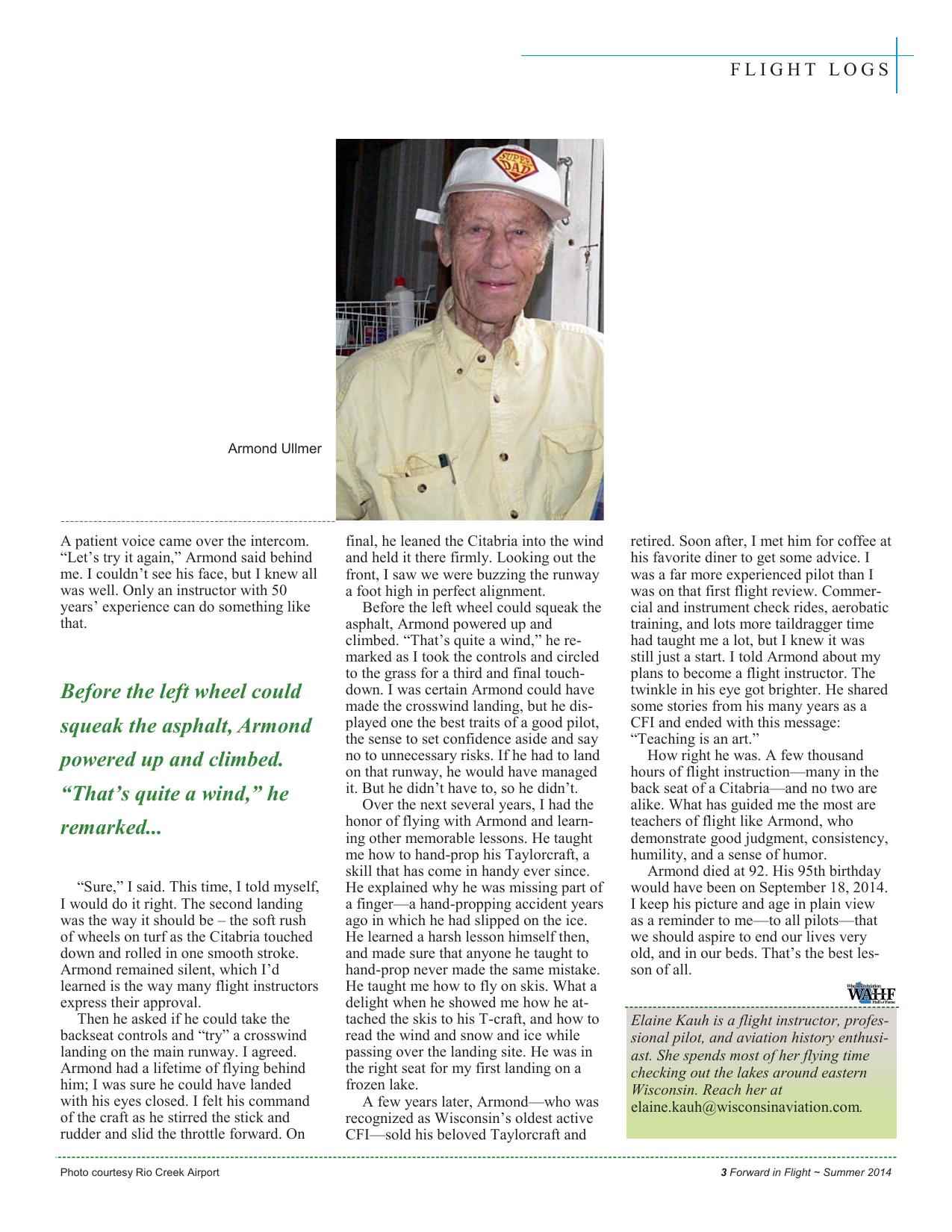
FLIGHT LOGS Armond Ullmer A patient voice came over the intercom. “Let’s try it again,” Armond said behind me. I couldn’t see his face, but I knew all was well. Only an instructor with 50 years’ experience can do something like that. Before the left wheel could squeak the asphalt, Armond powered up and climbed. “That’s quite a wind,” he remarked... “Sure,” I said. This time, I told myself, I would do it right. The second landing was the way it should be – the soft rush of wheels on turf as the Citabria touched down and rolled in one smooth stroke. Armond remained silent, which I’d learned is the way many flight instructors express their approval. Then he asked if he could take the backseat controls and “try” a crosswind landing on the main runway. I agreed. Armond had a lifetime of flying behind him; I was sure he could have landed with his eyes closed. I felt his command of the craft as he stirred the stick and rudder and slid the throttle forward. On Photo courtesy Rio Creek Airport final, he leaned the Citabria into the wind and held it there firmly. Looking out the front, I saw we were buzzing the runway a foot high in perfect alignment. Before the left wheel could squeak the asphalt, Armond powered up and climbed. “That’s quite a wind,” he remarked as I took the controls and circled to the grass for a third and final touchdown. I was certain Armond could have made the crosswind landing, but he displayed one the best traits of a good pilot, the sense to set confidence aside and say no to unnecessary risks. If he had to land on that runway, he would have managed it. But he didn’t have to, so he didn’t. Over the next several years, I had the honor of flying with Armond and learning other memorable lessons. He taught me how to hand-prop his Taylorcraft, a skill that has come in handy ever since. He explained why he was missing part of a finger—a hand-propping accident years ago in which he had slipped on the ice. He learned a harsh lesson himself then, and made sure that anyone he taught to hand-prop never made the same mistake. He taught me how to fly on skis. What a delight when he showed me how he attached the skis to his T-craft, and how to read the wind and snow and ice while passing over the landing site. He was in the right seat for my first landing on a frozen lake. A few years later, Armond—who was recognized as Wisconsin’s oldest active CFI—sold his beloved Taylorcraft and retired. Soon after, I met him for coffee at his favorite diner to get some advice. I was a far more experienced pilot than I was on that first flight review. Commercial and instrument check rides, aerobatic training, and lots more taildragger time had taught me a lot, but I knew it was still just a start. I told Armond about my plans to become a flight instructor. The twinkle in his eye got brighter. He shared some stories from his many years as a CFI and ended with this message: “Teaching is an art.” How right he was. A few thousand hours of flight instruction—many in the back seat of a Citabria—and no two are alike. What has guided me the most are teachers of flight like Armond, who demonstrate good judgment, consistency, humility, and a sense of humor. Armond died at 92. His 95th birthday would have been on September 18, 2014. I keep his picture and age in plain view as a reminder to me—to all pilots—that we should aspire to end our lives very old, and in our beds. That’s the best lesson of all. Elaine Kauh is a flight instructor, professional pilot, and aviation history enthusiast. She spends most of her flying time checking out the lakes around eastern Wisconsin. Reach her at elaine.kauh@wisconsinaviation.com. 3 Forward in Flight ~ Summer 2014
AIR DOC Your Eyes and Visual Fields A look at glaucoma Dr. Tom Voelker, AME DrAlphaMike@yahoo.com Hello, again fellow airmen. It’s good to be back with you. Summer has flown by, and I hope yours has been enjoyable. I did not get a chance to get to EAA AirVenture Oshkosh this year. Busy, busy, busy! I hope you got a chance to attend the greatest (air)show on earth! From what I hear, it was one of the best AirVentures in recent years. Before I go any further, I want to do something I don’t get to do very often, but something I like to do whenever possible: I stand corrected! In the last (Summer 2014) issue of Forward in Flight, we played “Would you fly with this pilot?” I like that “game” and plan to repeat it in a future issue. However, this doctor gave you a good dose of misinformation last time around. Walt Kessler is President Emeritus of the Illinois Aviation Hall of Fame. As one of our comrades to the south, and as a fellow reader of Forward in Flight, I was delighted to hear his response to my last column. It turns out I gave you incorrect information about glaucoma and its effect on aeromedical certification. Yes, you can fly (in certain cases) with a diagnosis of glaucoma, even with a “visual field deficit” or permanent loss of vision in one or both eyes. I will explain how this works shortly. Moreover, an airman can even fly with complete loss of vision in one eye, or even loss of the eye itself. This requires a waiver by the FAA aeromedical folks in OKC and a flight test with a FSDO representative, but once that is accomplished you can take to the skies, and safely. Walt is one of more than 3,000 “monocular” pilots (having vision in only one eye) with medical certificates in the United States! Let’s talk about aeromedical certification of vision problems and specifically glaucoma. We’ll start with the basics. To be certified to fly with a third class medical, an airman must meet three basic requirements. First, visual acuity must be 20/40 or better in each eye and in both eyes, both distant and near vision. Glasses or contact lenses may be used for this test. (For first or second class medicals, the distant vision must be 20/20 or better. The FAA holds commercial pilots to a higher standard.) Second, the airman must be able to pass a “color blindness” test. Finally, the “visual fields” must be intact. If any of these conditions are not met, the AME cannot issue an unrestricted medical. Some of these standards can be overcome with a waiver from OKC and possibly a flight test, but these are the basic standards. It is when visual field deficits appear that the FAA gets involved. I should also mention flying with “near vision” contact lenses. These are contacts that are made for one eye only to allow a person to read with that eye, using the other eye for distant vision. When looking in the distance, the brain essentially “shuts off” any input from the near vision eye. Suffice it to say that getting aeromedical certification while using near vision contacts is very difficult, and until the past few years it was not allowed at all. Interestingly, the most common mistake I find on an airman’s application for a medical (the “8500-8 form,” now completed on the FAA’s MedXPress webpage) is checking that he or she wears “near vision contact lenses” (box 17b). In virtually every case, the airman simply meant that they wear “regular” contact lenses. So, we know what visual acuity is, and we have all heard of color blindness. But what is this “visual field” thing? Glad you asked. This topic will get us back to glaucoma, as promised. Glaucoma is a in which the pressure 4 Forward in Flight ~ Quarterly Magazine of the Wisconsin Aviation Hall of Fame in the eye is increased. This is the second leading cause of blindness in the United States and usually affects people over the age of 40. Our eyeballs are bathed in fluid. If the pressure of that fluid increases beyond a certain point (generally 23 mm Hg, for those of you who are counting), the pressure can cause damage to the optic nerve, the main nerve to the eye. This then will cause loss of vision to the part of the retina served by the damaged part of the optic nerve. That area of the retina will not perceive light, leaving the pilot with a “blind spot” or “visual field deficit.” This is the condition I referred to in our last column. There are several medications, generally topical eye drops, that can be used to control the pressure in the eye. Most of these medications can be used while flying. However, as is often the case when considering medications during aeromedical certification, it is frequently the condition being treated, not the medication treating the condition, which leads to deferral or denial of certification. This is the case with glaucoma. You should be aware that there are two types of glaucoma. The most common is “open-angle glaucoma.” This condition is generally followed over time by an eye doctor (an ophthalmologist or “M.D. eye doctor” is required by the FAA for certification), and when advanced to a certain degree, medications are prescribed. The patient’s visual fields are checked closely at every visit. The other type of glaucoma is “narrow-angle glaucoma” or “closed-angle glaucoma.” This condition involves blockage of the drainage tract for eye fluid, allowing the pressure in the eye to increase dramatically. Narrow angle glaucoma is much more of an emergency, and the treatment is often laser surgery of the affected eye, opening the drainage tract. It is also worth mentioning that glaucoma, whether open-angle or closed-angle, is a chronic condition and requires you to buddy up with an eye doctor for life. It is when visual field deficits appear
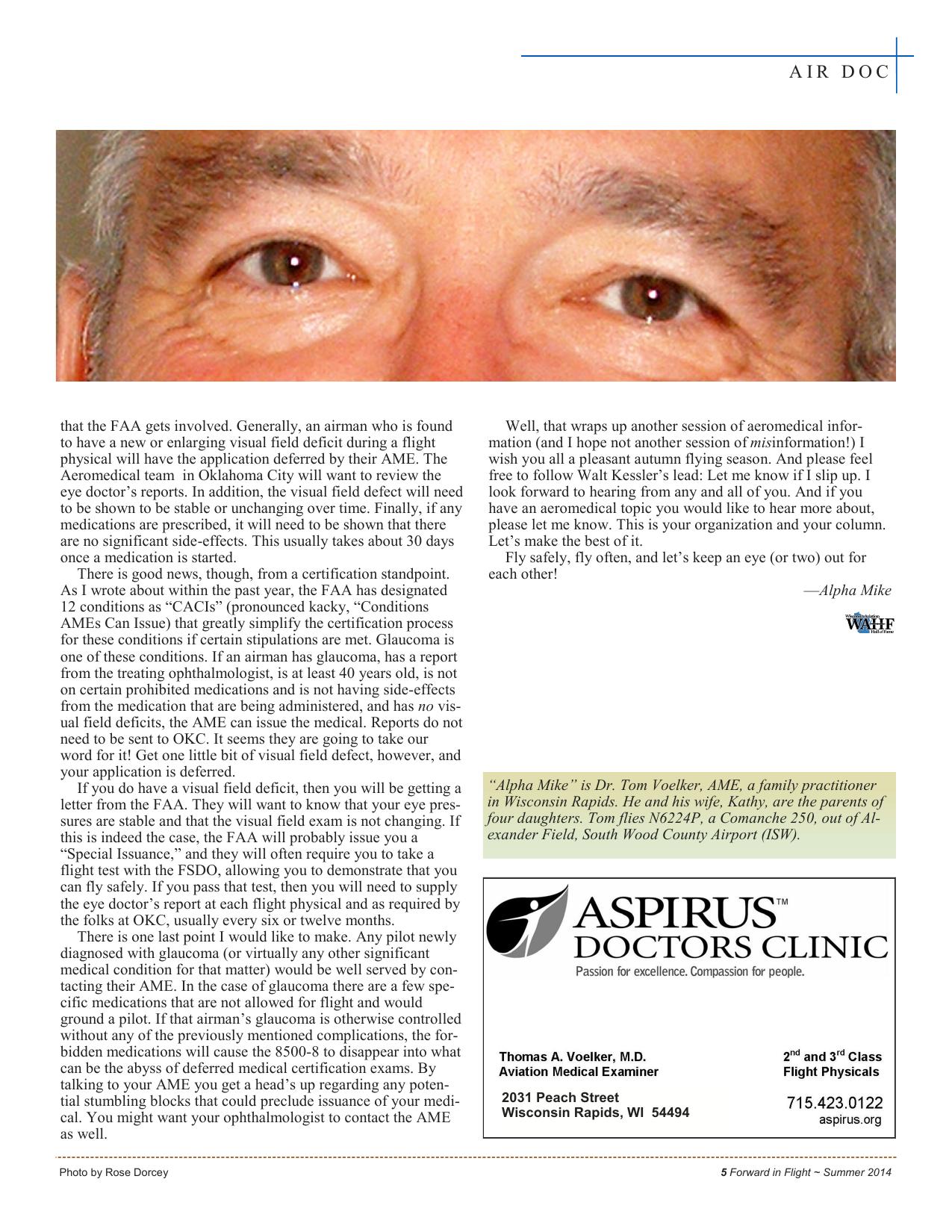
AIR DOC that the FAA gets involved. Generally, an airman who is found to have a new or enlarging visual field deficit during a flight physical will have the application deferred by their AME. The Aeromedical team in Oklahoma City will want to review the eye doctor’s reports. In addition, the visual field defect will need to be shown to be stable or unchanging over time. Finally, if any medications are prescribed, it will need to be shown that there are no significant side-effects. This usually takes about 30 days once a medication is started. There is good news, though, from a certification standpoint. As I wrote about within the past year, the FAA has designated 12 conditions as “CACIs” (pronounced kacky, “Conditions AMEs Can Issue) that greatly simplify the certification process for these conditions if certain stipulations are met. Glaucoma is one of these conditions. If an airman has glaucoma, has a report from the treating ophthalmologist, is at least 40 years old, is not on certain prohibited medications and is not having side-effects from the medication that are being administered, and has no visual field deficits, the AME can issue the medical. Reports do not need to be sent to OKC. It seems they are going to take our word for it! Get one little bit of visual field defect, however, and your application is deferred. If you do have a visual field deficit, then you will be getting a letter from the FAA. They will want to know that your eye pressures are stable and that the visual field exam is not changing. If this is indeed the case, the FAA will probably issue you a “Special Issuance,” and they will often require you to take a flight test with the FSDO, allowing you to demonstrate that you can fly safely. If you pass that test, then you will need to supply the eye doctor’s report at each flight physical and as required by the folks at OKC, usually every six or twelve months. There is one last point I would like to make. Any pilot newly diagnosed with glaucoma (or virtually any other significant medical condition for that matter) would be well served by contacting their AME. In the case of glaucoma there are a few specific medications that are not allowed for flight and would ground a pilot. If that airman’s glaucoma is otherwise controlled without any of the previously mentioned complications, the forbidden medications will cause the 8500-8 to disappear into what can be the abyss of deferred medical certification exams. By talking to your AME you get a head’s up regarding any potential stumbling blocks that could preclude issuance of your medical. You might want your ophthalmologist to contact the AME as well. Photo by Rose Dorcey Well, that wraps up another session of aeromedical information (and I hope not another session of misinformation!) I wish you all a pleasant autumn flying season. And please feel free to follow Walt Kessler’s lead: Let me know if I slip up. I look forward to hearing from any and all of you. And if you have an aeromedical topic you would like to hear more about, please let me know. This is your organization and your column. Let’s make the best of it. Fly safely, fly often, and let’s keep an eye (or two) out for each other! —Alpha Mike “Alpha Mike” is Dr. Tom Voelker, AME, a family practitioner in Wisconsin Rapids. He and his wife, Kathy, are the parents of four daughters. Tom flies N6224P, a Comanche 250, out of Alexander Field, South Wood County Airport (ISW). 2031 Peach Street Wisconsin Rapids, WI 54494 5 Forward in Flight ~ Summer 2014
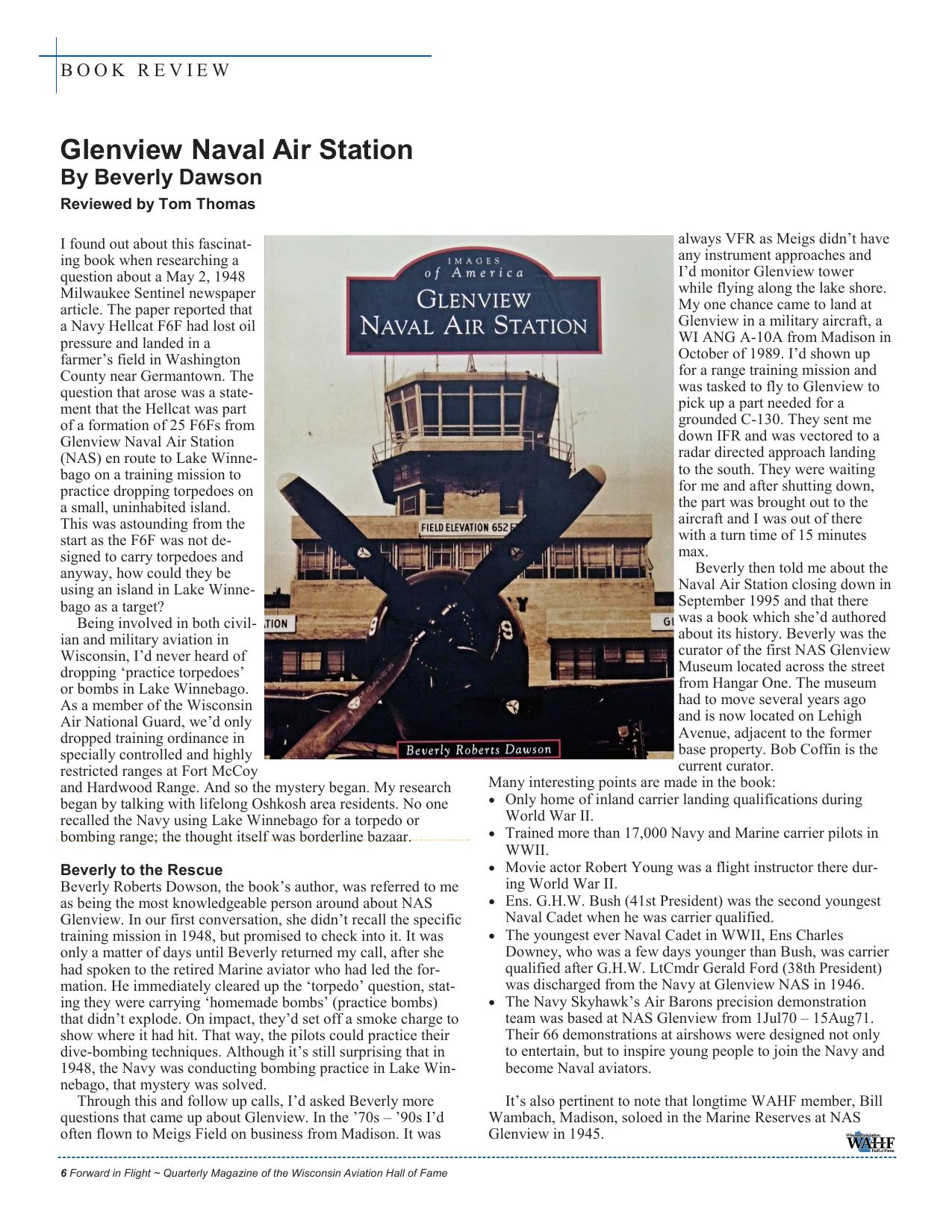
BOOK REVIEW Glenview Naval Air Station By Beverly Dawson Reviewed by Tom Thomas I found out about this fascinating book when researching a question about a May 2, 1948 Milwaukee Sentinel newspaper article. The paper reported that a Navy Hellcat F6F had lost oil pressure and landed in a farmer’s field in Washington County near Germantown. The question that arose was a statement that the Hellcat was part of a formation of 25 F6Fs from Glenview Naval Air Station (NAS) en route to Lake Winnebago on a training mission to practice dropping torpedoes on a small, uninhabited island. This was astounding from the start as the F6F was not designed to carry torpedoes and anyway, how could they be using an island in Lake Winnebago as a target? Being involved in both civilian and military aviation in Wisconsin, I’d never heard of dropping ‘practice torpedoes’ or bombs in Lake Winnebago. As a member of the Wisconsin Air National Guard, we’d only dropped training ordinance in specially controlled and highly restricted ranges at Fort McCoy and Hardwood Range. And so the mystery began. My research began by talking with lifelong Oshkosh area residents. No one recalled the Navy using Lake Winnebago for a torpedo or bombing range; the thought itself was borderline bazaar. Beverly to the Rescue Beverly Roberts Dowson, the book’s author, was referred to me as being the most knowledgeable person around about NAS Glenview. In our first conversation, she didn’t recall the specific training mission in 1948, but promised to check into it. It was only a matter of days until Beverly returned my call, after she had spoken to the retired Marine aviator who had led the formation. He immediately cleared up the ‘torpedo’ question, stating they were carrying ‘homemade bombs’ (practice bombs) that didn’t explode. On impact, they’d set off a smoke charge to show where it had hit. That way, the pilots could practice their dive-bombing techniques. Although it’s still surprising that in 1948, the Navy was conducting bombing practice in Lake Winnebago, that mystery was solved. Through this and follow up calls, I’d asked Beverly more questions that came up about Glenview. In the ’70s – ’90s I’d often flown to Meigs Field on business from Madison. It was 6 Forward in Flight ~ Quarterly Magazine of the Wisconsin Aviation Hall of Fame always VFR as Meigs didn’t have any instrument approaches and I’d monitor Glenview tower while flying along the lake shore. My one chance came to land at Glenview in a military aircraft, a WI ANG A-10A from Madison in October of 1989. I’d shown up for a range training mission and was tasked to fly to Glenview to pick up a part needed for a grounded C-130. They sent me down IFR and was vectored to a radar directed approach landing to the south. They were waiting for me and after shutting down, the part was brought out to the aircraft and I was out of there with a turn time of 15 minutes max. Beverly then told me about the Naval Air Station closing down in September 1995 and that there was a book which she’d authored about its history. Beverly was the curator of the first NAS Glenview Museum located across the street from Hangar One. The museum had to move several years ago and is now located on Lehigh Avenue, adjacent to the former base property. Bob Coffin is the current curator. Many interesting points are made in the book: · Only home of inland carrier landing qualifications during World War II. · Trained more than 17,000 Navy and Marine carrier pilots in WWII. · Movie actor Robert Young was a flight instructor there during World War II. · Ens. G.H.W. Bush (41st President) was the second youngest Naval Cadet when he was carrier qualified. · The youngest ever Naval Cadet in WWII, Ens Charles Downey, who was a few days younger than Bush, was carrier qualified after G.H.W. LtCmdr Gerald Ford (38th President) was discharged from the Navy at Glenview NAS in 1946. · The Navy Skyhawk’s Air Barons precision demonstration team was based at NAS Glenview from 1Jul70 – 15Aug71. Their 66 demonstrations at airshows were designed not only to entertain, but to inspire young people to join the Navy and become Naval aviators. It’s also pertinent to note that longtime WAHF member, Bill Wambach, Madison, soloed in the Marine Reserves at NAS Glenview in 1945.
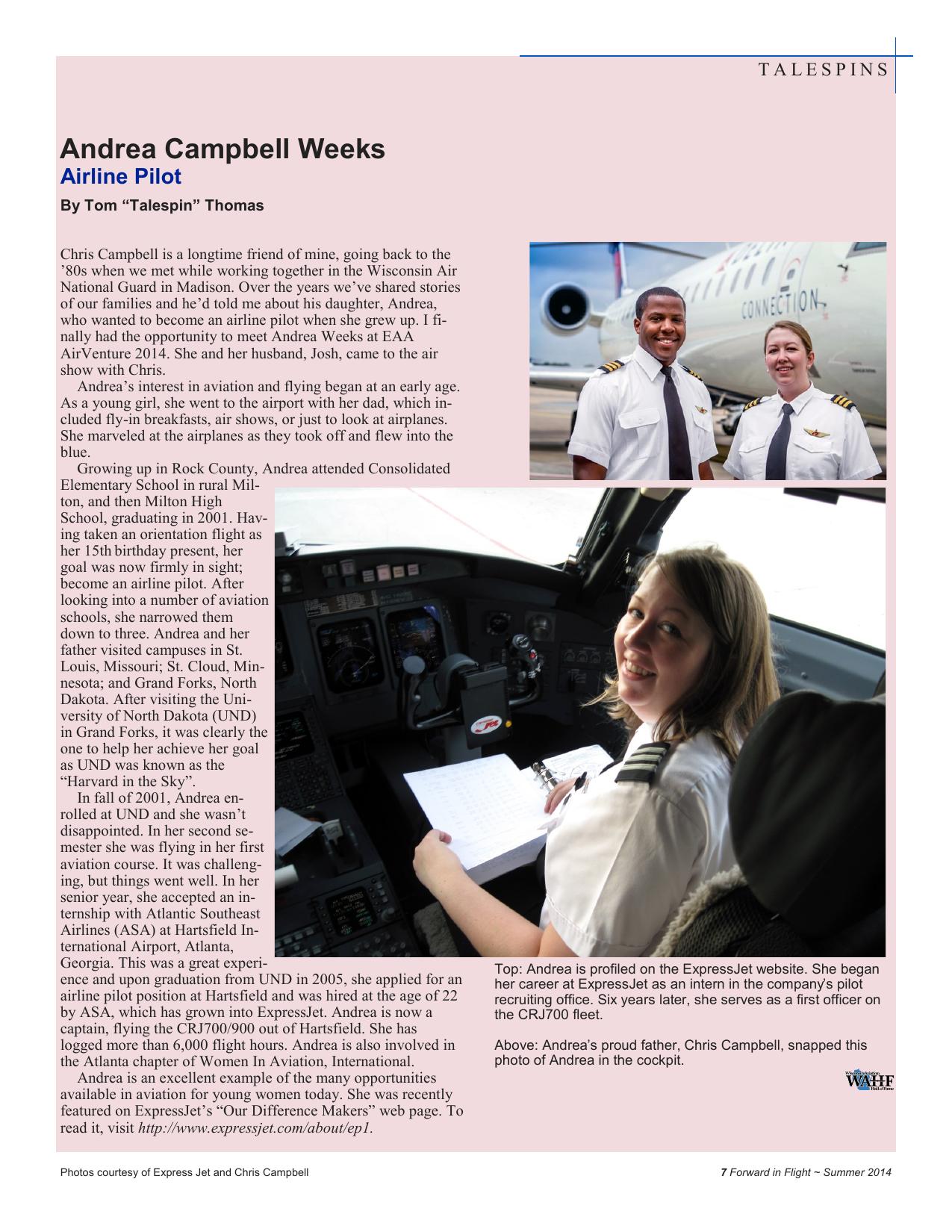
TALESPINS Andrea Campbell Weeks Airline Pilot By Tom “Talespin” Thomas Chris Campbell is a longtime friend of mine, going back to the ’80s when we met while working together in the Wisconsin Air National Guard in Madison. Over the years we’ve shared stories of our families and he’d told me about his daughter, Andrea, who wanted to become an airline pilot when she grew up. I finally had the opportunity to meet Andrea Weeks at EAA AirVenture 2014. She and her husband, Josh, came to the air show with Chris. Andrea’s interest in aviation and flying began at an early age. As a young girl, she went to the airport with her dad, which included fly-in breakfasts, air shows, or just to look at airplanes. She marveled at the airplanes as they took off and flew into the blue. Growing up in Rock County, Andrea attended Consolidated Elementary School in rural Milton, and then Milton High School, graduating in 2001. Having taken an orientation flight as her 15th birthday present, her goal was now firmly in sight; become an airline pilot. After looking into a number of aviation schools, she narrowed them down to three. Andrea and her father visited campuses in St. Louis, Missouri; St. Cloud, Minnesota; and Grand Forks, North Dakota. After visiting the University of North Dakota (UND) in Grand Forks, it was clearly the one to help her achieve her goal as UND was known as the “Harvard in the Sky”. In fall of 2001, Andrea enrolled at UND and she wasn’t disappointed. In her second semester she was flying in her first aviation course. It was challenging, but things went well. In her senior year, she accepted an internship with Atlantic Southeast Airlines (ASA) at Hartsfield International Airport, Atlanta, Georgia. This was a great experience and upon graduation from UND in 2005, she applied for an airline pilot position at Hartsfield and was hired at the age of 22 by ASA, which has grown into ExpressJet. Andrea is now a captain, flying the CRJ700/900 out of Hartsfield. She has logged more than 6,000 flight hours. Andrea is also involved in the Atlanta chapter of Women In Aviation, International. Andrea is an excellent example of the many opportunities available in aviation for young women today. She was recently featured on ExpressJet’s “Our Difference Makers” web page. To read it, visit http://www.expressjet.com/about/ep1. Photos courtesy of Express Jet and Chris Campbell Top: Andrea is profiled on the ExpressJet website. She began her career at ExpressJet as an intern in the company’s pilot recruiting office. Six years later, she serves as a first officer on the CRJ700 fleet. Above: Andrea’s proud father, Chris Campbell, snapped this photo of Andrea in the cockpit. 7 Forward in Flight ~ Summer 2014
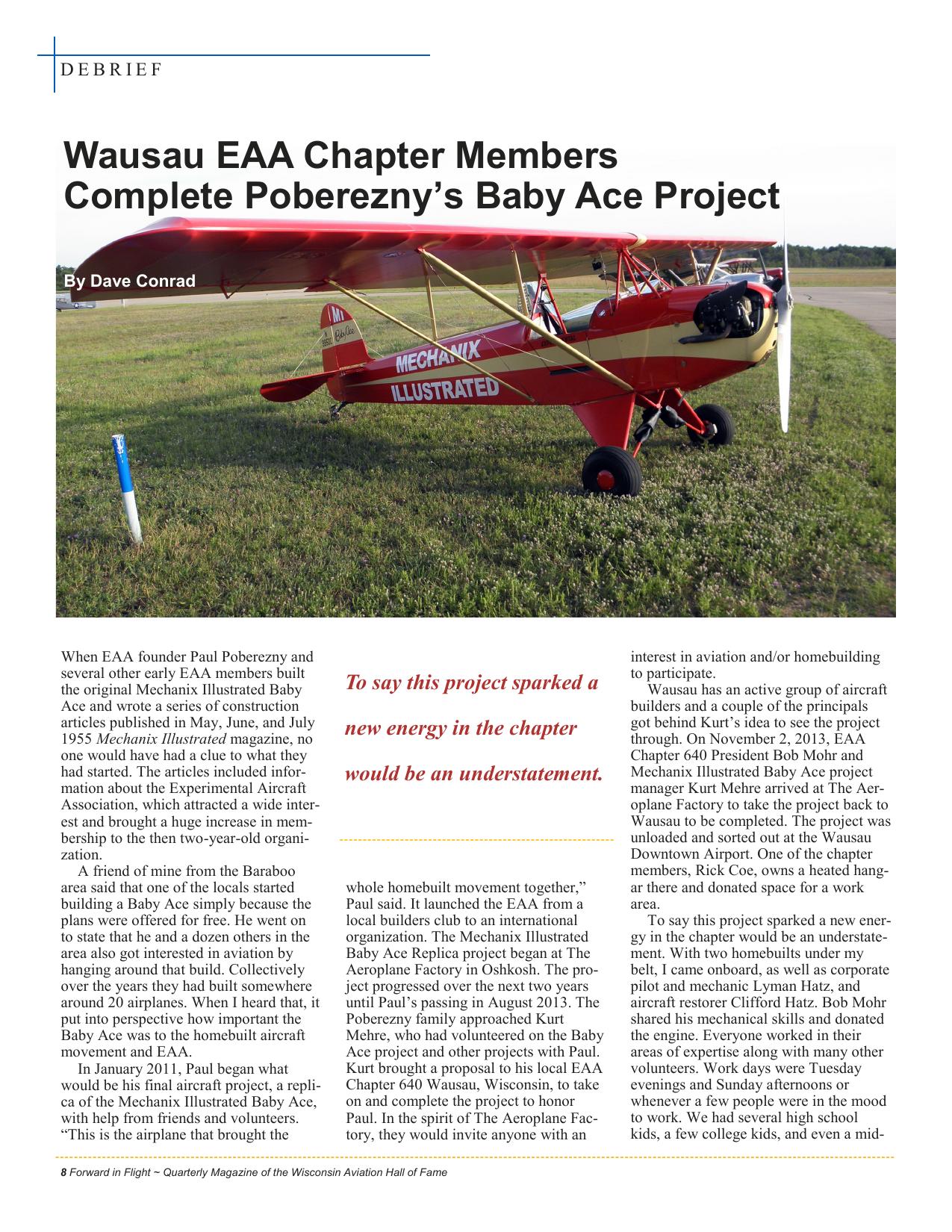
DEBRIEF Wausau EAA Chapter Members Complete Poberezny’s Baby Ace Project By Dave Conrad When EAA founder Paul Poberezny and several other early EAA members built the original Mechanix Illustrated Baby Ace and wrote a series of construction articles published in May, June, and July 1955 Mechanix Illustrated magazine, no one would have had a clue to what they had started. The articles included information about the Experimental Aircraft Association, which attracted a wide interest and brought a huge increase in membership to the then two-year-old organization. A friend of mine from the Baraboo area said that one of the locals started building a Baby Ace simply because the plans were offered for free. He went on to state that he and a dozen others in the area also got interested in aviation by hanging around that build. Collectively over the years they had built somewhere around 20 airplanes. When I heard that, it put into perspective how important the Baby Ace was to the homebuilt aircraft movement and EAA. In January 2011, Paul began what would be his final aircraft project, a replica of the Mechanix Illustrated Baby Ace, with help from friends and volunteers. “This is the airplane that brought the To say this project sparked a new energy in the chapter would be an understatement. whole homebuilt movement together,” Paul said. It launched the EAA from a local builders club to an international organization. The Mechanix Illustrated Baby Ace Replica project began at The Aeroplane Factory in Oshkosh. The project progressed over the next two years until Paul’s passing in August 2013. The Poberezny family approached Kurt Mehre, who had volunteered on the Baby Ace project and other projects with Paul. Kurt brought a proposal to his local EAA Chapter 640 Wausau, Wisconsin, to take on and complete the project to honor Paul. In the spirit of The Aeroplane Factory, they would invite anyone with an 8 Forward in Flight ~ Quarterly Magazine of the Wisconsin Aviation Hall of Fame interest in aviation and/or homebuilding to participate. Wausau has an active group of aircraft builders and a couple of the principals got behind Kurt’s idea to see the project through. On November 2, 2013, EAA Chapter 640 President Bob Mohr and Mechanix Illustrated Baby Ace project manager Kurt Mehre arrived at The Aeroplane Factory to take the project back to Wausau to be completed. The project was unloaded and sorted out at the Wausau Downtown Airport. One of the chapter members, Rick Coe, owns a heated hangar there and donated space for a work area. To say this project sparked a new energy in the chapter would be an understatement. With two homebuilts under my belt, I came onboard, as well as corporate pilot and mechanic Lyman Hatz, and aircraft restorer Clifford Hatz. Bob Mohr shared his mechanical skills and donated the engine. Everyone worked in their areas of expertise along with many other volunteers. Work days were Tuesday evenings and Sunday afternoons or whenever a few people were in the mood to work. We had several high school kids, a few college kids, and even a mid-
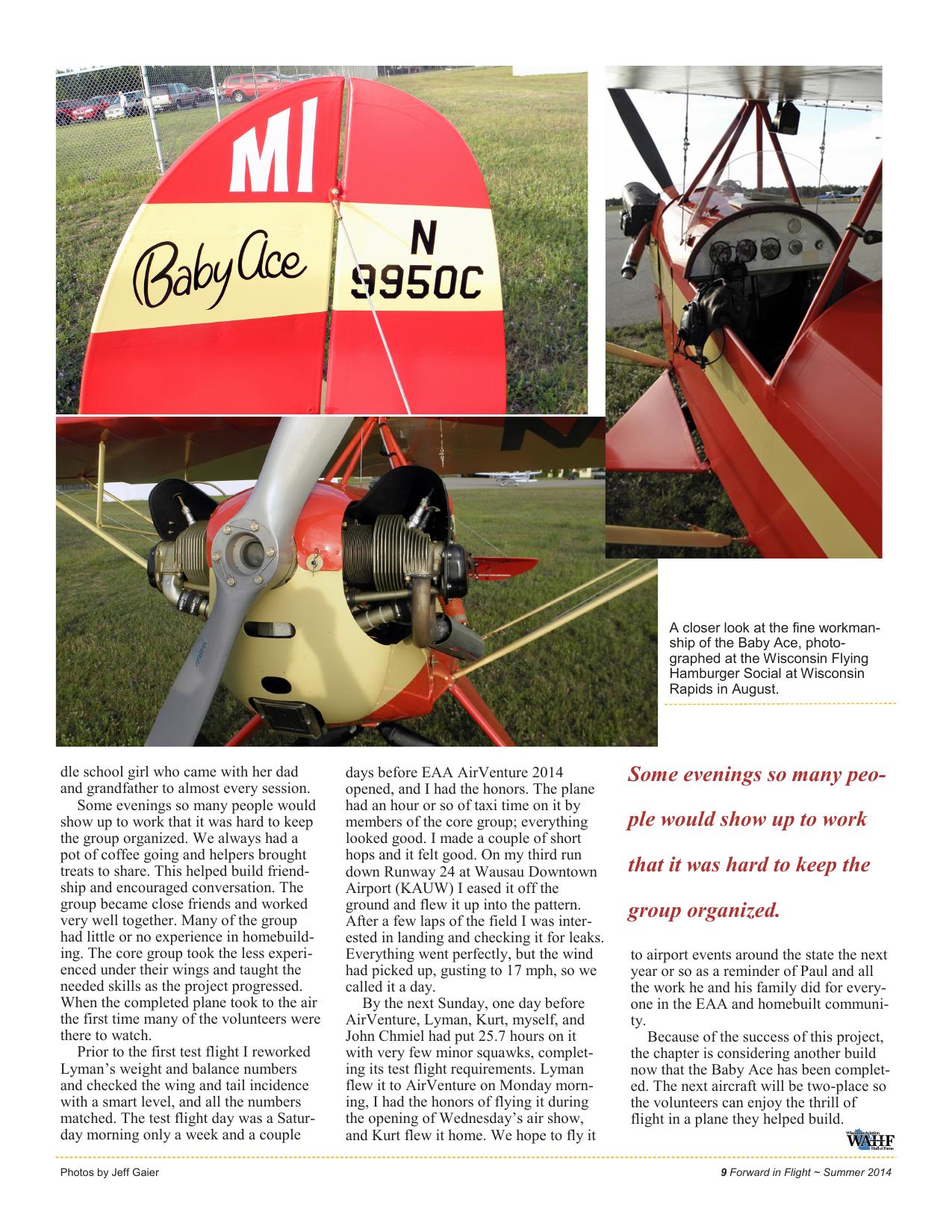
A closer look at the fine workmanship of the Baby Ace, photographed at the Wisconsin Flying Hamburger Social at Wisconsin Rapids in August. dle school girl who came with her dad and grandfather to almost every session. Some evenings so many people would show up to work that it was hard to keep the group organized. We always had a pot of coffee going and helpers brought treats to share. This helped build friendship and encouraged conversation. The group became close friends and worked very well together. Many of the group had little or no experience in homebuilding. The core group took the less experienced under their wings and taught the needed skills as the project progressed. When the completed plane took to the air the first time many of the volunteers were there to watch. Prior to the first test flight I reworked Lyman’s weight and balance numbers and checked the wing and tail incidence with a smart level, and all the numbers matched. The test flight day was a Saturday morning only a week and a couple Photos by Jeff Gaier days before EAA AirVenture 2014 opened, and I had the honors. The plane had an hour or so of taxi time on it by members of the core group; everything looked good. I made a couple of short hops and it felt good. On my third run down Runway 24 at Wausau Downtown Airport (KAUW) I eased it off the ground and flew it up into the pattern. After a few laps of the field I was interested in landing and checking it for leaks. Everything went perfectly, but the wind had picked up, gusting to 17 mph, so we called it a day. By the next Sunday, one day before AirVenture, Lyman, Kurt, myself, and John Chmiel had put 25.7 hours on it with very few minor squawks, completing its test flight requirements. Lyman flew it to AirVenture on Monday morning, I had the honors of flying it during the opening of Wednesday’s air show, and Kurt flew it home. We hope to fly it Some evenings so many people would show up to work that it was hard to keep the group organized. to airport events around the state the next year or so as a reminder of Paul and all the work he and his family did for everyone in the EAA and homebuilt community. Because of the success of this project, the chapter is considering another build now that the Baby Ace has been completed. The next aircraft will be two-place so the volunteers can enjoy the thrill of flight in a plane they helped build. 9 Forward in Flight ~ Summer 2014
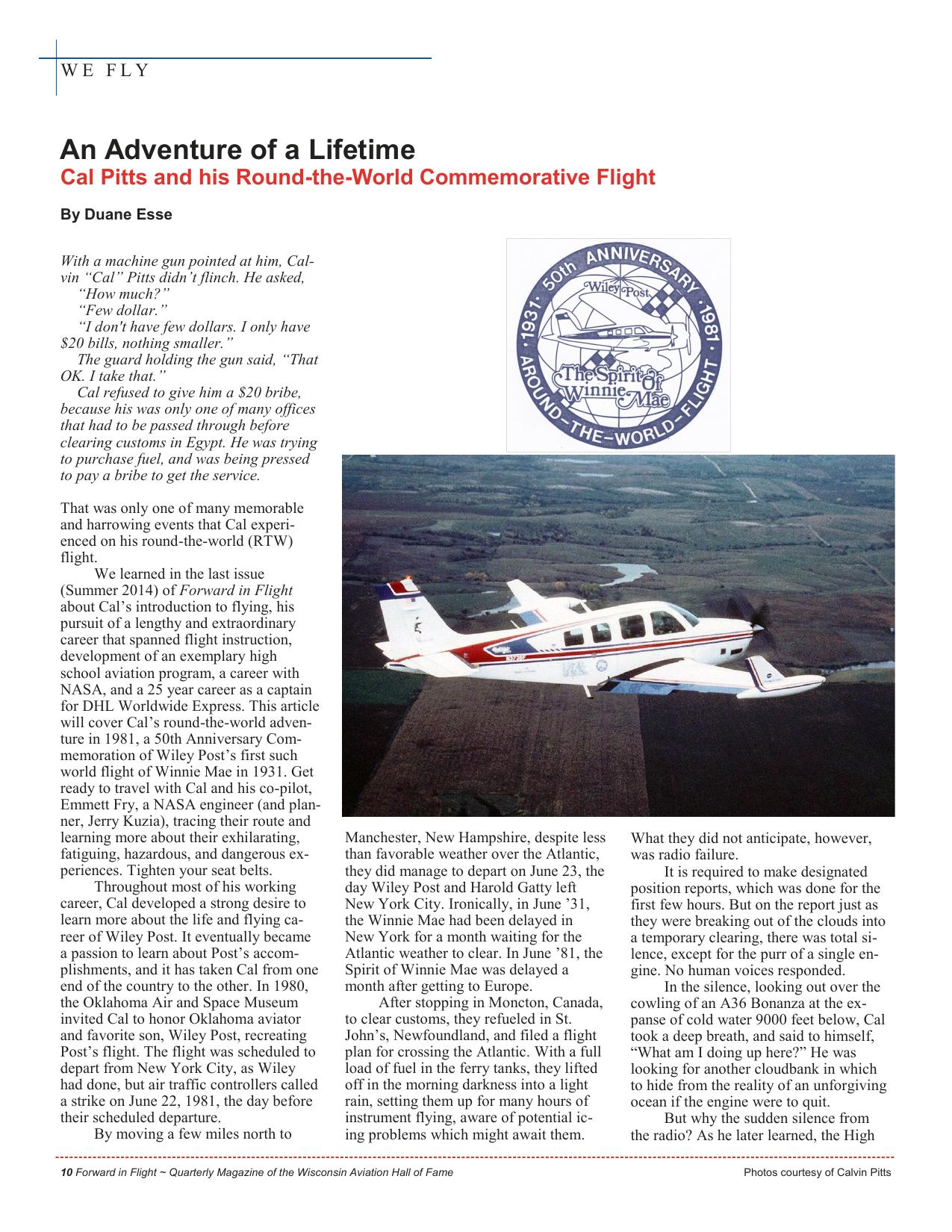
WE FLY An Adventure of a Lifetime Cal Pitts and his Round-the-World Commemorative Flight By Duane Esse With a machine gun pointed at him, Calvin “Cal” Pitts didn’t flinch. He asked, “How much?” “Few dollar.” “I don't have few dollars. I only have $20 bills, nothing smaller.” The guard holding the gun said, “That OK. I take that.” Cal refused to give him a $20 bribe, because his was only one of many offices that had to be passed through before clearing customs in Egypt. He was trying to purchase fuel, and was being pressed to pay a bribe to get the service. That was only one of many memorable and harrowing events that Cal experienced on his round-the-world (RTW) flight. We learned in the last issue (Summer 2014) of Forward in Flight about Cal’s introduction to flying, his pursuit of a lengthy and extraordinary career that spanned flight instruction, development of an exemplary high school aviation program, a career with NASA, and a 25 year career as a captain for DHL Worldwide Express. This article will cover Cal’s round-the-world adventure in 1981, a 50th Anniversary Commemoration of Wiley Post’s first such world flight of Winnie Mae in 1931. Get ready to travel with Cal and his co-pilot, Emmett Fry, a NASA engineer (and planner, Jerry Kuzia), tracing their route and learning more about their exhilarating, fatiguing, hazardous, and dangerous experiences. Tighten your seat belts. Throughout most of his working career, Cal developed a strong desire to learn more about the life and flying career of Wiley Post. It eventually became a passion to learn about Post’s accomplishments, and it has taken Cal from one end of the country to the other. In 1980, the Oklahoma Air and Space Museum invited Cal to honor Oklahoma aviator and favorite son, Wiley Post, recreating Post’s flight. The flight was scheduled to depart from New York City, as Wiley had done, but air traffic controllers called a strike on June 22, 1981, the day before their scheduled departure. By moving a few miles north to Manchester, New Hampshire, despite less than favorable weather over the Atlantic, they did manage to depart on June 23, the day Wiley Post and Harold Gatty left New York City. Ironically, in June ’31, the Winnie Mae had been delayed in New York for a month waiting for the Atlantic weather to clear. In June ’81, the Spirit of Winnie Mae was delayed a month after getting to Europe. After stopping in Moncton, Canada, to clear customs, they refueled in St. John’s, Newfoundland, and filed a flight plan for crossing the Atlantic. With a full load of fuel in the ferry tanks, they lifted off in the morning darkness into a light rain, setting them up for many hours of instrument flying, aware of potential icing problems which might await them. 10 Forward in Flight ~ Quarterly Magazine of the Wisconsin Aviation Hall of Fame What they did not anticipate, however, was radio failure. It is required to make designated position reports, which was done for the first few hours. But on the report just as they were breaking out of the clouds into a temporary clearing, there was total silence, except for the purr of a single engine. No human voices responded. In the silence, looking out over the cowling of an A36 Bonanza at the expanse of cold water 9000 feet below, Cal took a deep breath, and said to himself, “What am I doing up here?” He was looking for another cloudbank in which to hide from the reality of an unforgiving ocean if the engine were to quit. But why the sudden silence from the radio? As he later learned, the High Photos courtesy of Calvin Pitts
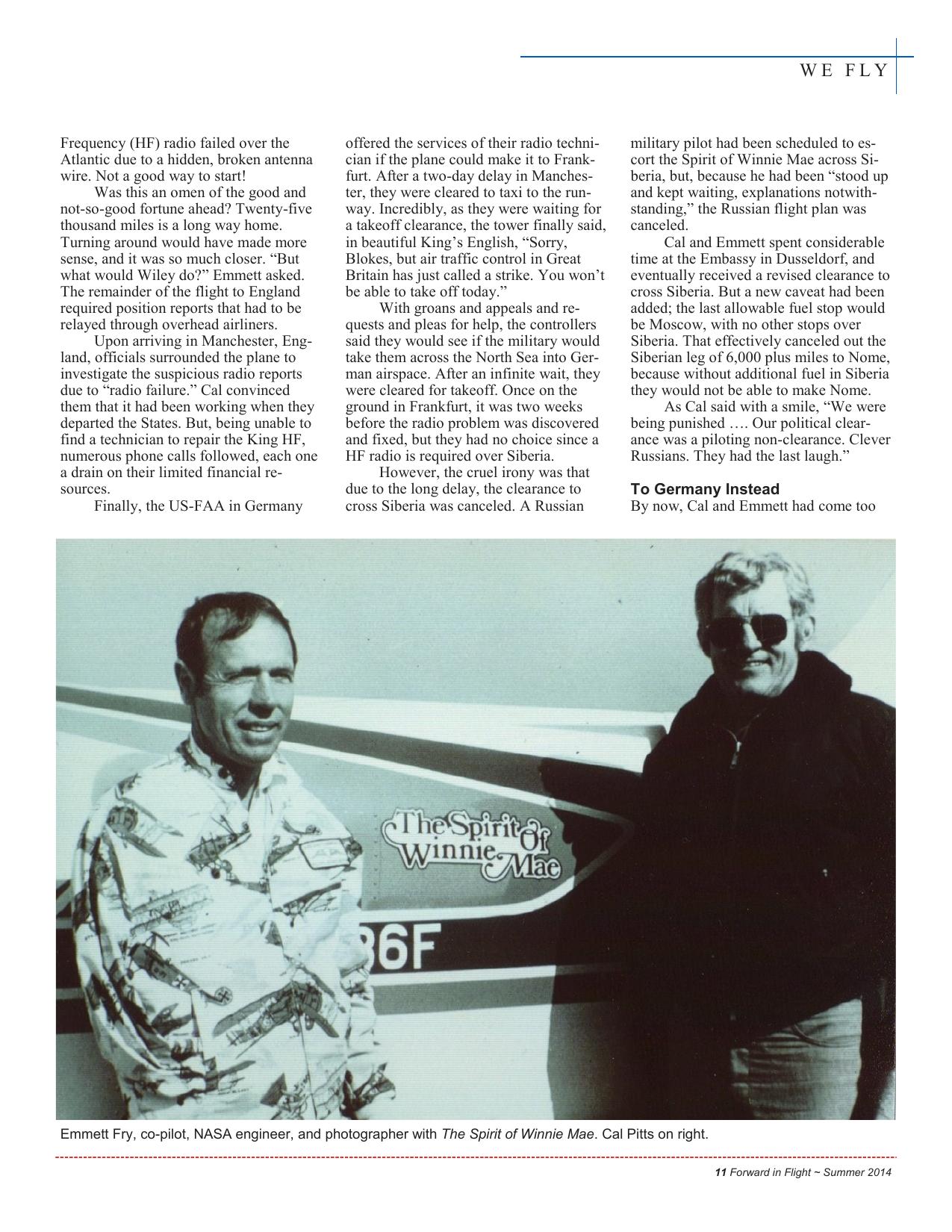
WE FLY Frequency (HF) radio failed over the Atlantic due to a hidden, broken antenna wire. Not a good way to start! Was this an omen of the good and not-so-good fortune ahead? Twenty-five thousand miles is a long way home. Turning around would have made more sense, and it was so much closer. “But what would Wiley do?” Emmett asked. The remainder of the flight to England required position reports that had to be relayed through overhead airliners. Upon arriving in Manchester, England, officials surrounded the plane to investigate the suspicious radio reports due to “radio failure.” Cal convinced them that it had been working when they departed the States. But, being unable to find a technician to repair the King HF, numerous phone calls followed, each one a drain on their limited financial resources. Finally, the US-FAA in Germany offered the services of their radio technician if the plane could make it to Frankfurt. After a two-day delay in Manchester, they were cleared to taxi to the runway. Incredibly, as they were waiting for a takeoff clearance, the tower finally said, in beautiful King’s English, “Sorry, Blokes, but air traffic control in Great Britain has just called a strike. You won’t be able to take off today.” With groans and appeals and requests and pleas for help, the controllers said they would see if the military would take them across the North Sea into German airspace. After an infinite wait, they were cleared for takeoff. Once on the ground in Frankfurt, it was two weeks before the radio problem was discovered and fixed, but they had no choice since a HF radio is required over Siberia. However, the cruel irony was that due to the long delay, the clearance to cross Siberia was canceled. A Russian military pilot had been scheduled to escort the Spirit of Winnie Mae across Siberia, but, because he had been “stood up and kept waiting, explanations notwithstanding,” the Russian flight plan was canceled. Cal and Emmett spent considerable time at the Embassy in Dusseldorf, and eventually received a revised clearance to cross Siberia. But a new caveat had been added; the last allowable fuel stop would be Moscow, with no other stops over Siberia. That effectively canceled out the Siberian leg of 6,000 plus miles to Nome, because without additional fuel in Siberia they would not be able to make Nome. As Cal said with a smile, “We were being punished …. Our political clearance was a piloting non-clearance. Clever Russians. They had the last laugh.” To Germany Instead By now, Cal and Emmett had come too Emmett Fry, co-pilot, NASA engineer, and photographer with The Spirit of Winnie Mae. Cal Pitts on right. 11 Forward in Flight ~ Summer 2014
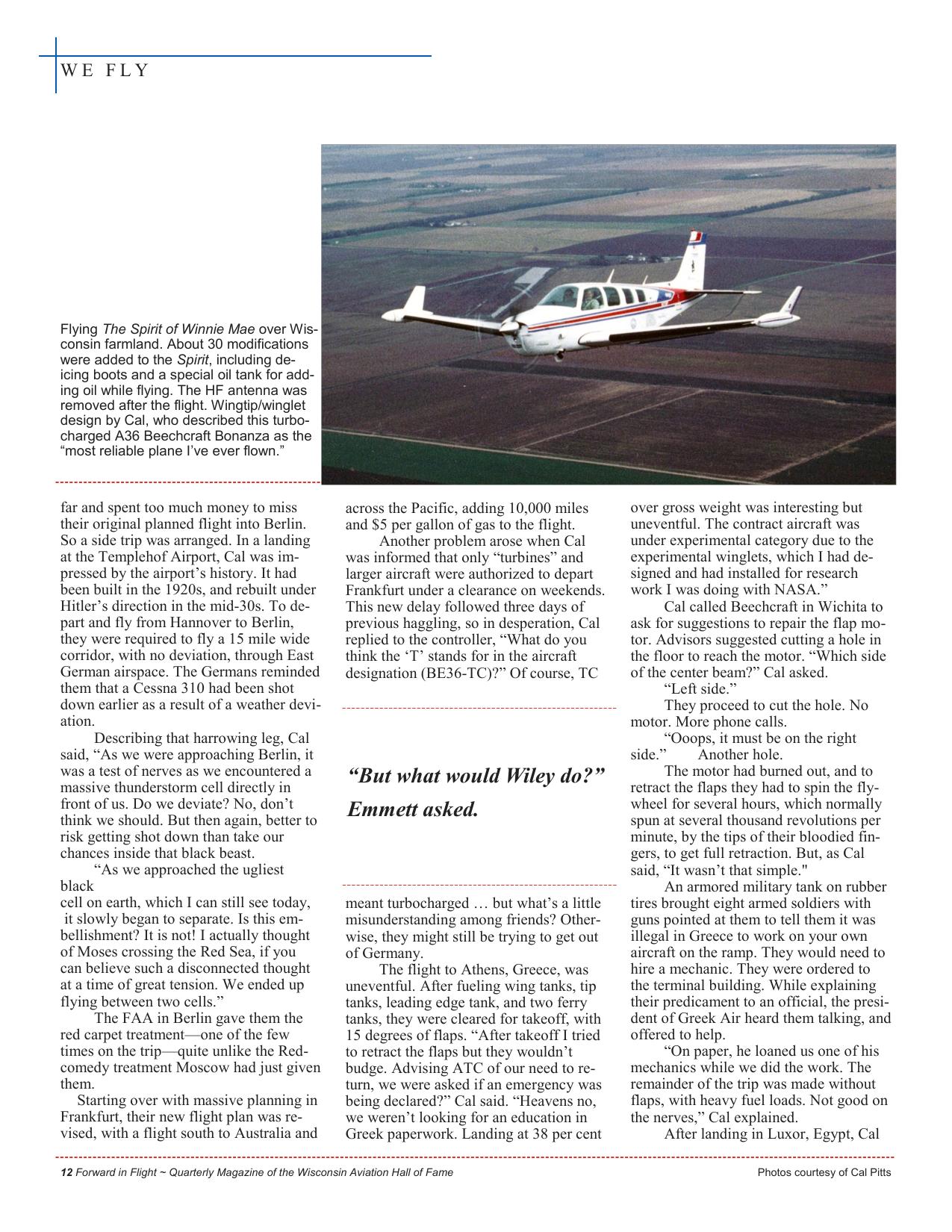
WE FLY Flying The Spirit of Winnie Mae over Wisconsin farmland. About 30 modifications were added to the Spirit, including deicing boots and a special oil tank for adding oil while flying. The HF antenna was removed after the flight. Wingtip/winglet design by Cal, who described this turbocharged A36 Beechcraft Bonanza as the “most reliable plane I’ve ever flown.” far and spent too much money to miss their original planned flight into Berlin. So a side trip was arranged. In a landing at the Templehof Airport, Cal was impressed by the airport’s history. It had been built in the 1920s, and rebuilt under Hitler’s direction in the mid-30s. To depart and fly from Hannover to Berlin, they were required to fly a 15 mile wide corridor, with no deviation, through East German airspace. The Germans reminded them that a Cessna 310 had been shot down earlier as a result of a weather deviation. Describing that harrowing leg, Cal said, “As we were approaching Berlin, it was a test of nerves as we encountered a massive thunderstorm cell directly in front of us. Do we deviate? No, don’t think we should. But then again, better to risk getting shot down than take our chances inside that black beast. “As we approached the ugliest black cell on earth, which I can still see today, it slowly began to separate. Is this embellishment? It is not! I actually thought of Moses crossing the Red Sea, if you can believe such a disconnected thought at a time of great tension. We ended up flying between two cells.” The FAA in Berlin gave them the red carpet treatment—one of the few times on the trip—quite unlike the Redcomedy treatment Moscow had just given them. Starting over with massive planning in Frankfurt, their new flight plan was revised, with a flight south to Australia and across the Pacific, adding 10,000 miles and $5 per gallon of gas to the flight. Another problem arose when Cal was informed that only “turbines” and larger aircraft were authorized to depart Frankfurt under a clearance on weekends. This new delay followed three days of previous haggling, so in desperation, Cal replied to the controller, “What do you think the ‘T’ stands for in the aircraft designation (BE36-TC)?” Of course, TC “But what would Wiley do?” Emmett asked. meant turbocharged … but what’s a little misunderstanding among friends? Otherwise, they might still be trying to get out of Germany. The flight to Athens, Greece, was uneventful. After fueling wing tanks, tip tanks, leading edge tank, and two ferry tanks, they were cleared for takeoff, with 15 degrees of flaps. “After takeoff I tried to retract the flaps but they wouldn’t budge. Advising ATC of our need to return, we were asked if an emergency was being declared?” Cal said. “Heavens no, we weren’t looking for an education in Greek paperwork. Landing at 38 per cent 12 Forward in Flight ~ Quarterly Magazine of the Wisconsin Aviation Hall of Fame over gross weight was interesting but uneventful. The contract aircraft was under experimental category due to the experimental winglets, which I had designed and had installed for research work I was doing with NASA.” Cal called Beechcraft in Wichita to ask for suggestions to repair the flap motor. Advisors suggested cutting a hole in the floor to reach the motor. “Which side of the center beam?” Cal asked. “Left side.” They proceed to cut the hole. No motor. More phone calls. “Ooops, it must be on the right side.” Another hole. The motor had burned out, and to retract the flaps they had to spin the flywheel for several hours, which normally spun at several thousand revolutions per minute, by the tips of their bloodied fingers, to get full retraction. But, as Cal said, “It wasn’t that simple." An armored military tank on rubber tires brought eight armed soldiers with guns pointed at them to tell them it was illegal in Greece to work on your own aircraft on the ramp. They would need to hire a mechanic. They were ordered to the terminal building. While explaining their predicament to an official, the president of Greek Air heard them talking, and offered to help. “On paper, he loaned us one of his mechanics while we did the work. The remainder of the trip was made without flaps, with heavy fuel loads. Not good on the nerves,” Cal explained. After landing in Luxor, Egypt, Cal Photos courtesy of Cal Pitts
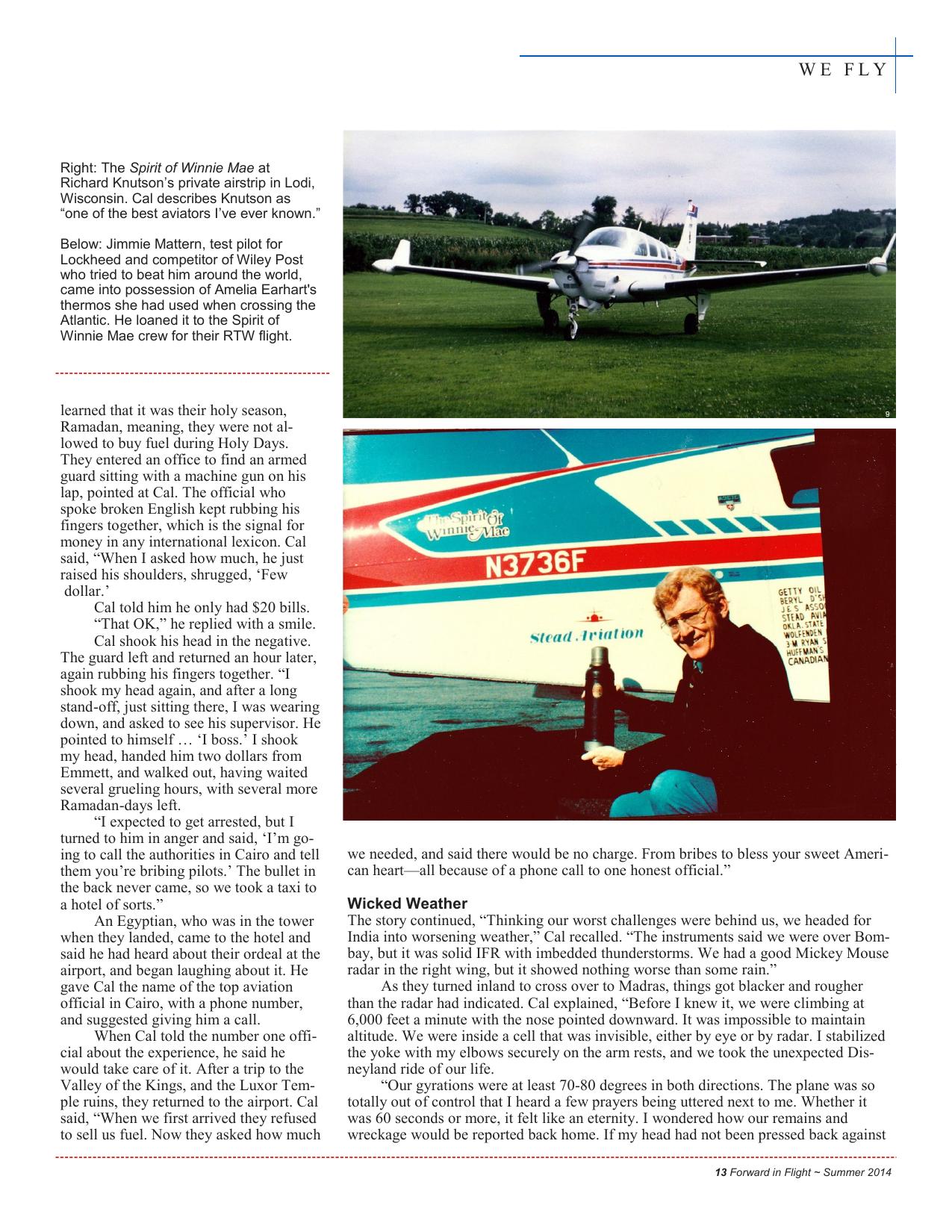
WE FLY Right: The Spirit of Winnie Mae at Richard Knutson’s private airstrip in Lodi, Wisconsin. Cal describes Knutson as “one of the best aviators I’ve ever known.” Below: Jimmie Mattern, test pilot for Lockheed and competitor of Wiley Post who tried to beat him around the world, came into possession of Amelia Earhart's thermos she had used when crossing the Atlantic. He loaned it to the Spirit of Winnie Mae crew for their RTW flight. learned that it was their holy season, Ramadan, meaning, they were not allowed to buy fuel during Holy Days. They entered an office to find an armed guard sitting with a machine gun on his lap, pointed at Cal. The official who spoke broken English kept rubbing his fingers together, which is the signal for money in any international lexicon. Cal said, “When I asked how much, he just raised his shoulders, shrugged, ‘Few dollar.’ Cal told him he only had $20 bills. “That OK,” he replied with a smile. Cal shook his head in the negative. The guard left and returned an hour later, again rubbing his fingers together. “I shook my head again, and after a long stand-off, just sitting there, I was wearing down, and asked to see his supervisor. He pointed to himself … ‘I boss.’ I shook my head, handed him two dollars from Emmett, and walked out, having waited several grueling hours, with several more Ramadan-days left. “I expected to get arrested, but I turned to him in anger and said, ‘I’m going to call the authorities in Cairo and tell them you’re bribing pilots.’ The bullet in the back never came, so we took a taxi to a hotel of sorts.” An Egyptian, who was in the tower when they landed, came to the hotel and said he had heard about their ordeal at the airport, and began laughing about it. He gave Cal the name of the top aviation official in Cairo, with a phone number, and suggested giving him a call. When Cal told the number one official about the experience, he said he would take care of it. After a trip to the Valley of the Kings, and the Luxor Temple ruins, they returned to the airport. Cal said, “When we first arrived they refused to sell us fuel. Now they asked how much we needed, and said there would be no charge. From bribes to bless your sweet American heart—all because of a phone call to one honest official.” Wicked Weather The story continued, “Thinking our worst challenges were behind us, we headed for India into worsening weather,” Cal recalled. “The instruments said we were over Bombay, but it was solid IFR with imbedded thunderstorms. We had a good Mickey Mouse radar in the right wing, but it showed nothing worse than some rain.” As they turned inland to cross over to Madras, things got blacker and rougher than the radar had indicated. Cal explained, “Before I knew it, we were climbing at 6,000 feet a minute with the nose pointed downward. It was impossible to maintain altitude. We were inside a cell that was invisible, either by eye or by radar. I stabilized the yoke with my elbows securely on the arm rests, and we took the unexpected Disneyland ride of our life. “Our gyrations were at least 70-80 degrees in both directions. The plane was so totally out of control that I heard a few prayers being uttered next to me. Whether it was 60 seconds or more, it felt like an eternity. I wondered how our remains and wreckage would be reported back home. If my head had not been pressed back against 13 Forward in Flight ~ Summer 2014
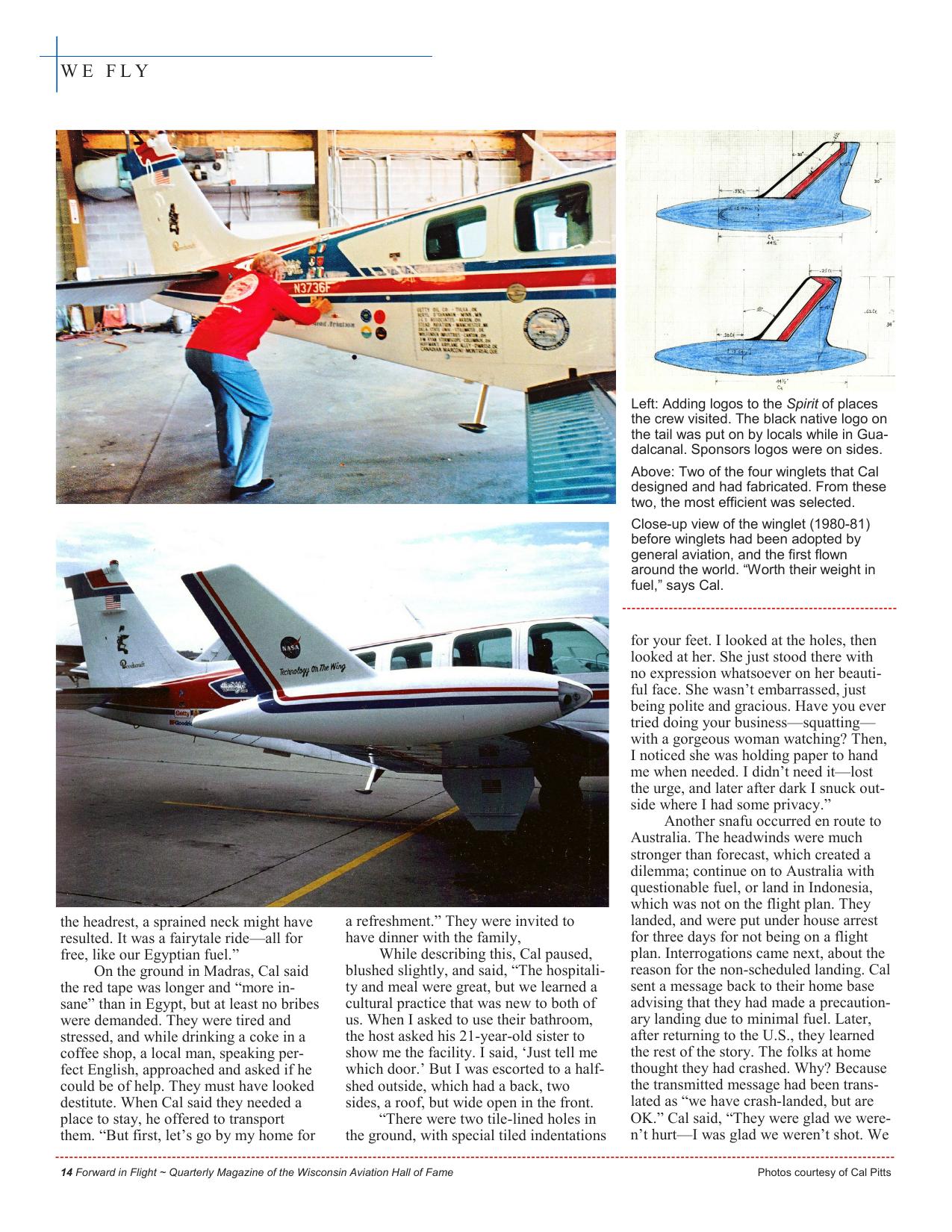
WE FLY Left: Adding logos to the Spirit of places the crew visited. The black native logo on the tail was put on by locals while in Guadalcanal. Sponsors logos were on sides. Above: Two of the four winglets that Cal designed and had fabricated. From these two, the most efficient was selected. Close-up view of the winglet (1980-81) before winglets had been adopted by general aviation, and the first flown around the world. “Worth their weight in fuel,” says Cal. the headrest, a sprained neck might have resulted. It was a fairytale ride—all for free, like our Egyptian fuel.” On the ground in Madras, Cal said the red tape was longer and “more insane” than in Egypt, but at least no bribes were demanded. They were tired and stressed, and while drinking a coke in a coffee shop, a local man, speaking perfect English, approached and asked if he could be of help. They must have looked destitute. When Cal said they needed a place to stay, he offered to transport them. “But first, let’s go by my home for a refreshment.” They were invited to have dinner with the family, While describing this, Cal paused, blushed slightly, and said, “The hospitality and meal were great, but we learned a cultural practice that was new to both of us. When I asked to use their bathroom, the host asked his 21-year-old sister to show me the facility. I said, ‘Just tell me which door.’ But I was escorted to a halfshed outside, which had a back, two sides, a roof, but wide open in the front. “There were two tile-lined holes in the ground, with special tiled indentations 14 Forward in Flight ~ Quarterly Magazine of the Wisconsin Aviation Hall of Fame for your feet. I looked at the holes, then looked at her. She just stood there with no expression whatsoever on her beautiful face. She wasn’t embarrassed, just being polite and gracious. Have you ever tried doing your business—squatting— with a gorgeous woman watching? Then, I noticed she was holding paper to hand me when needed. I didn’t need it—lost the urge, and later after dark I snuck outside where I had some privacy.” Another snafu occurred en route to Australia. The headwinds were much stronger than forecast, which created a dilemma; continue on to Australia with questionable fuel, or land in Indonesia, which was not on the flight plan. They landed, and were put under house arrest for three days for not being on a flight plan. Interrogations came next, about the reason for the non-scheduled landing. Cal sent a message back to their home base advising that they had made a precautionary landing due to minimal fuel. Later, after returning to the U.S., they learned the rest of the story. The folks at home thought they had crashed. Why? Because the transmitted message had been translated as “we have crash-landed, but are OK.” Cal said, “They were glad we weren’t hurt—I was glad we weren’t shot. We Photos courtesy of Cal Pitts
WE FLY were in Indonesia.” The Indonesian officials said a new clearance was needed, and sent them to another island to clear customs. That airport was at sea level, surrounded by the high terrain of a large volcano. Officials there demanded an expensive bribe, which was impossible to pay because funds were running very low. More delays! They were told they had to report back at the original airport and pay a fine. “The sun had set, and we desperately needed to depart while we could still see the profile of the surrounding high mountain ridge,” Cal said. “We paid for the fuel, and I handed the official a $20 tip(bribe). After takeoff for the original Ubangdang Bandar Udara Bontang airport, I had a change of heart. They made a profit from the $5 per gallon fuel, and from three days at the hotel plus meals. That was enough. “So we headed for Australia, filing a flight plan with Australian ATC while en route. Emmett had misgivings, and wanted to return to where we had been put under house arrest, as instructed. I simply said, ‘Let’s just write them a letter of explanation when we get home.’ Cal was probably smiling when he said it. Landing in Darwin, Australia, Cal said, “It was a short, sweet, friendly visit, but we had no time to take a trip to the Outback.” Fuel there was more than $5 a gallon, with a credit card bill for one purchase of more than $1,000. In a recent petroleum report, it showed fuel prices in 1981 at record levels, causing Cal to say, “Making a RTW flight in 1981 at record fuel prices was only one of many small challenges.” Challenging Customs En route to New Guinea they flew over the outer reef, which Cal described as breathtakingly beautiful. They arrived in Port Moresby, New Guinea, after dark, with tall mountains just beyond the airport. The approach and landing were uneventful. Cal’s father had been there in combat during WWII at Milne Bay, so Cal wanted to visit the site of many of his father’s stories. The next day, they departed on a flight to Milne Bay. Having asked for information about local regulations, they were instructed by a New Zealand official to call them on the ground at the jungle airport next to the Bay. The country was so rugged and beautiful that they weren’t looking for traffic. A mail pilot, flying a Cessna 310, was making a 50-mile, straight-in approach to the jungle airport— unannounced. Cal reported his position on downwind, but the C-310 was not on the guarded frequency. Cal said, “I reported again on base leg and turned final, not seeing the C-310, which caused him to go-around. On the ground Cal apologized to an angry C-310 pilot when he landed, and asked why he wasn’t moni- “He thought I was trying to buy wife number 9...” —Cal Pitts toring the guarded frequency. “That did it, and had there not been a witness, I might have lost a body part.” They then flew to another WWII battle site, Goodenough Island, and landed on a WWII airfield. It had not been maintained and didn’t have a smooth surface. They had been on the ground a short while when a bushman, with his nine wives, appeared out of the bush. “The man spoke pidgin English, so I tried my hand at it,” Cal said. “I asked if I could buy one of the handmade bone necklaces that one of his wives was wearing, who was wearing only a grass skirt. “Yes, for a price he was willing to sell her. I said no, no, not your wife, the necklace, to which I was pointing. Bad move. I couldn’t get him to understand, so I tried to give up on the primitive necklace. But he kept pushing, so I gave him $10 for the 50-cent necklace to stay out of his cooking pot.” Cal and Emmett walked into the bush and found a wrecked WWII plane. “This was stuff dreams are made of,” Cal said. “We decided to not push our luck before our friend got hungry. We departed and flew low along the beach with numerous natives waving. I could hardly wait to tell my father that I had found one of his combat sites.” When they were thinking about leaving New Guinea, a New Zealand FAA-type Inspector said he wanted to talk with them. He asked, “Do you know how many New Zealand regulations you have broken?” “Tell me,” Cal said. “You landed at night, which is illegal for a single-engine plane, you landed on the wrong runway, you failed to make necessary position reports on the way to Milne Bay … you cut off a C-310 on a straight-in approach.” All in the wilds of New Guinea. More fun followed. “I was ready to respond [to the official] before one of the local New Zealand pilots interrupted. ‘Hey Bob, why don’t you tell the gents what you yourself did last week.’ The FAA guy said, ‘That’s enough.’ ‘No,” the gent said, “They would find it amusing that you failed to check the fuel before takeoff, you ran out of gas in the air, and had to make a dead-stick landing.’ “Inspector Bob wasn’t amused, and told us to leave and not come back,” said Cal. According to Cal, being on Guadalcanal in the Solomon Islands was a dream come true. Cal explains, “Guadalcanal Diary was my favorite movie as a youth, and now, I was there. We rented a car and explored WWII sites, which contained the wreckages of P -38s, Corsairs, B-17s, Zeros, and Betty Bombers. We drove to Bloody Ridge and found ammo shells and parts of jeeps. It was as if the Marines had just left. Then we found abandoned tanks with trees growing up through them.” En route to Tarawa, Kiribati, they encountered some of the worst weather since the East German Corridor. “There was a Pacific storm system cutting diagonally across our flight path,” Cal said. “The Omega Nav System had failed due to a lack of triangulation below the equator. Dead reckoning, I knew we would have to turn 90 degrees left to go through the ugliest system I had seen in a long time. “Descending to 3,000 feet, and determining a penetration airspeed, I told my buddy to hold on. Within about 40 miles we were through the worst of it, and surprisingly, it was not as bad as the storm in India. We climbed back to 9,000 feet and headed for Tarawa.” Cal continued, “It was here that I began to think of Amelia Earhart. We would be approaching the same general area where she probably went down. 15 Forward in Flight ~ Summer 2014
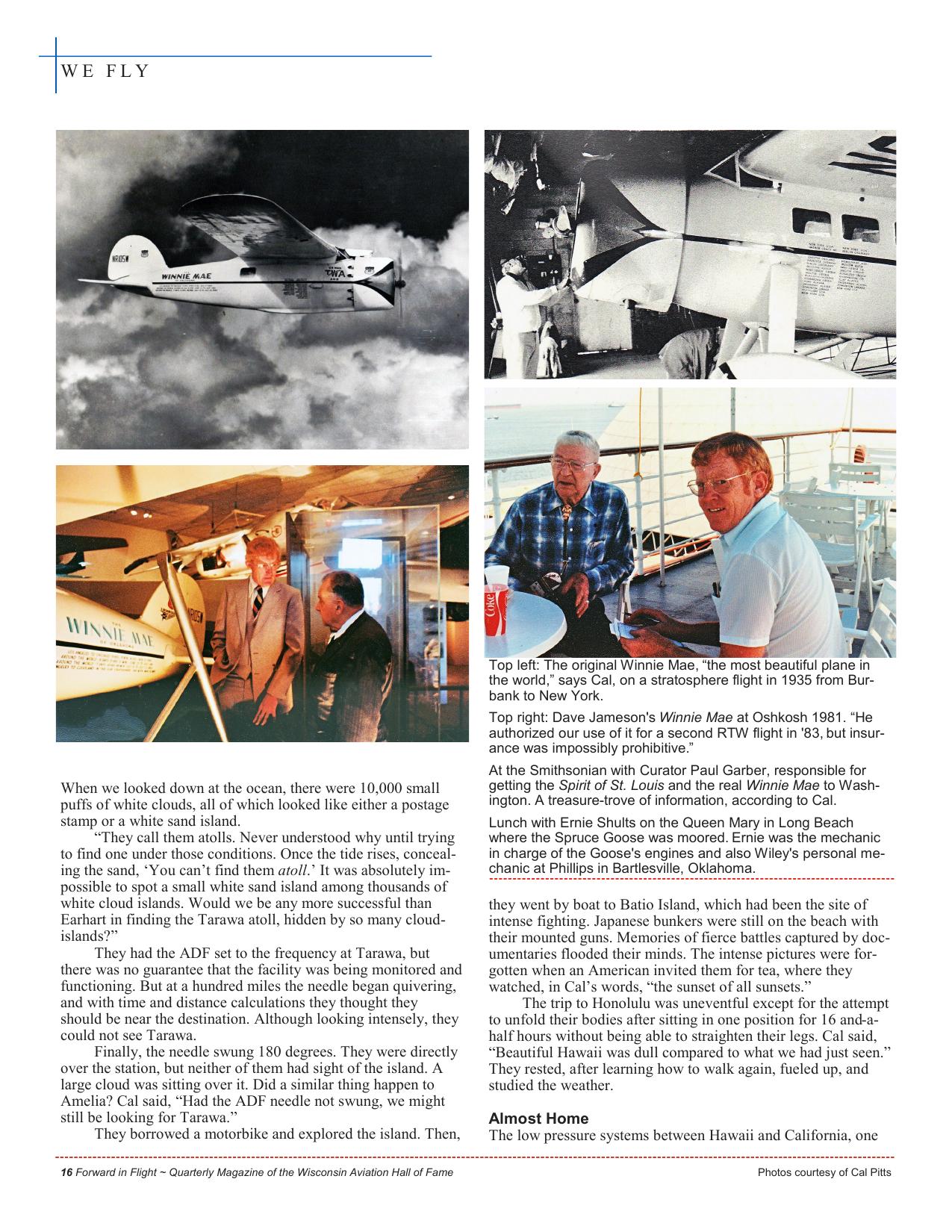
WE FLY Top left: The original Winnie Mae, “the most beautiful plane in the world,” says Cal, on a stratosphere flight in 1935 from Burbank to New York. Top right: Dave Jameson's Winnie Mae at Oshkosh 1981. “He authorized our use of it for a second RTW flight in '83, but insurance was impossibly prohibitive.” When we looked down at the ocean, there were 10,000 small puffs of white clouds, all of which looked like either a postage stamp or a white sand island. “They call them atolls. Never understood why until trying to find one under those conditions. Once the tide rises, concealing the sand, ‘You can’t find them atoll.’ It was absolutely impossible to spot a small white sand island among thousands of white cloud islands. Would we be any more successful than Earhart in finding the Tarawa atoll, hidden by so many cloudislands?” They had the ADF set to the frequency at Tarawa, but there was no guarantee that the facility was being monitored and functioning. But at a hundred miles the needle began quivering, and with time and distance calculations they thought they should be near the destination. Although looking intensely, they could not see Tarawa. Finally, the needle swung 180 degrees. They were directly over the station, but neither of them had sight of the island. A large cloud was sitting over it. Did a similar thing happen to Amelia? Cal said, “Had the ADF needle not swung, we might still be looking for Tarawa.” They borrowed a motorbike and explored the island. Then, 16 Forward in Flight ~ Quarterly Magazine of the Wisconsin Aviation Hall of Fame At the Smithsonian with Curator Paul Garber, responsible for getting the Spirit of St. Louis and the real Winnie Mae to Washington. A treasure-trove of information, according to Cal. Lunch with Ernie Shults on the Queen Mary in Long Beach where the Spruce Goose was moored. Ernie was the mechanic in charge of the Goose's engines and also Wiley's personal mechanic at Phillips in Bartlesville, Oklahoma. they went by boat to Batio Island, which had been the site of intense fighting. Japanese bunkers were still on the beach with their mounted guns. Memories of fierce battles captured by documentaries flooded their minds. The intense pictures were forgotten when an American invited them for tea, where they watched, in Cal’s words, “the sunset of all sunsets.” The trip to Honolulu was uneventful except for the attempt to unfold their bodies after sitting in one position for 16 and-ahalf hours without being able to straighten their legs. Cal said, “Beautiful Hawaii was dull compared to what we had just seen.” They rested, after learning how to walk again, fueled up, and studied the weather. Almost Home The low pressure systems between Hawaii and California, one Photos courtesy of Cal Pitts
WE FLY south of their route, and the next one north, indicated they would encounter unwanted headwinds the first half, with a likely tailwind the second half of the 16.5 hour flight. The fuel calculations showed that without the projected tailwind they might land in California on mere fumes. They departed in the darkness of early morning in rain, and followed the VOR until it faded. Meanwhile, they were trying to get the Omega functioning, which was having trouble ‘triangulating.’ They badly wanted it to help in navigating through headwinds, crosswinds, and hopeful tailwinds. At almost the very instant when the VOR signal was lost, the Omega held onto the coordinates that had been repeatedly entered. The Omega had come to life just in time. At the halfway point where Cal had previously decided to return to Hawaii if the headwinds and crosswinds still persisted, the Omega showed Finally, the needle swung 180 degrees. They were directly over the station, but neither of them had sight of the island. A large cloud was sitting over it. Did a similar thing happen to Amelia? clear indications of the anticipated tailwind from the low pressure off to their left. But the relief was short-lived. Very short. Almost immediately, the Omega showed those dreaded 8.8.8.8s. It had again lost its signal. With about 1,300 miles to go, they were back to dead reckoning, in the rain. At this point, the plan was to aim for the mainland just south of San Francisco, and land at Cal and Emmett's home base at NAS Moffett Field. As they continued, Cal said, “Some nine hours after takeoff, the sun greeted us on the eastern horizon. Some seven hours later, we saw the most beautiful sight a land-plane can see after a long, overwater flight, a dark stripe emerging on the horizon, a strip of land.” The ferry tanks and tip tanks had already run dry, and they were now down to half-full main tanks, less than 35 gallons. Cal estimated that on landing, they would have less than an hour of fuel remaining. As the skyline of San Francisco began to materialize, Cal looked at Emmett, and said, “We’re H-O-M-E …well almost.” But at least they were beyond armed military men, house arrest, machine guns, threats, demands for bribes, broken English, pompous officials, weather concerns, fuel calculations, mechanical and electronic problems. But they still had 2,850 miles and 19 flight hours of flying remaining to the East coast. There were celebrations and stories to share with NASA Ames Research Center personnel with whom they worked. They headed east and planned the last refueling stop for Lexington, Kentucky, where Cal’s WWII veteran-father lived. When they landed, the press was there for interviews as in Berlin, Frankfurt, San Jose, and other places. Cal shared stories with his father, and then departed on the last leg. When they were an hour out of Manchester, New Hampshire, their starting point, the engine began to run rough, very slight at first, then rougher. “Test of nerves,” Cal said. “Would we have to make an emergency landing this close to home?” After landing, and sharing congratulations and greetings, Cal had the plugs removed, and they were fouled. He said, “If this had occurred a few hours ago at night over the Pacific, it might have caused a bead of sweat or two.” Summarizing, Cal said, “What could possibly go wrong on such a short, quick flight? When contemplating the Divine Hand of providence which was with us in life-and-death situations, it was enough to humble anyone. We were not alone. As a boy, one of my favorite movies was, ‘God Is My Co-pilot.’ In this case, however, I was not Scottie, I was the co-pilot. With so many problems and close calls, credit goes to The Pilot.” The rest of the story, creating many more flights, includes new friendships and acquaintances with Wiley’s family members, such as Wylie’s wife Mae Post, brother Gordon Post, cousin Jimmie Post, competitor Jimmie Mattern, mechanic Ernie Shults and his wife, Marie; confidant and friend Jimmy Doolittle, Mrs. Joe (Lillian) Crosson, who fed Wylie his last meal; Sam Pryor (former Pam Am VP and close friend of Charles Lindbergh), Fay Gillis Wells (close friend of Amelia Earhart and Wiley, who arranged his fuel in Russia in 1933), Robert Harris (an oil executive), Jennifer Rogers (greatgranddaughter of Will Rogers), Steve Gragert (director of the Will Rogers Memorial Museum who made Cal one of its researchers), and Col. David Greist (son of Dr. Greist, who tended to the bodies in Barrow, Alaska, after Post’s death in 1935), and various others who shared stories of their friendship with Wiley and Mae Post. When asked if he would do it again, Cal said, “Hmmm, at this age, I think, wait, are you making an offer? Let’s go.” “Life after the Wiley Post flight was never again the same,” Cal explained. “But the red tape, bureaucratic regulations, and political turmoil cancel out any technology advantage modern pilots may have. Our original flight had been tediously worked out and planned, with necessary approvals. But once the HF delay caused the 48 hour window of the clearances to close, we had to reinvent the wheel in Europe without proper contacts. “At the time it was a challenge. Reliving it afterwards was mindboggling. Although the adventure ended, the memories did not. New friends of this caliber brought a new dimension to this aviator’s life.” When asked if he would do it again, Cal said, “Hmmm, at this age, I think, wait, are you making an offer? Let’s go.” 17 Forward in Flight ~ Summer 2014
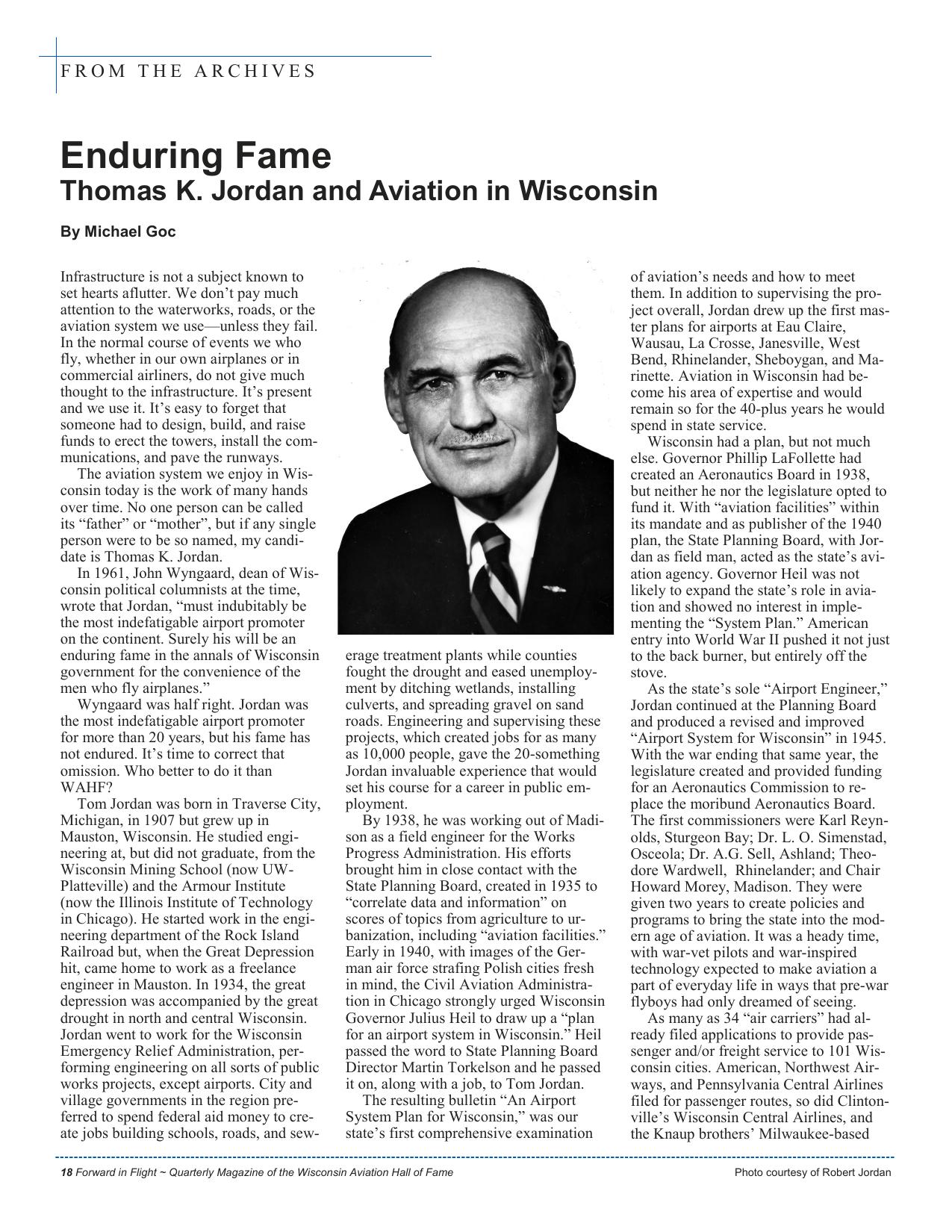
FROM THE ARCHIVES Enduring Fame Thomas K. Jordan and Aviation in Wisconsin By Michael Goc Infrastructure is not a subject known to set hearts aflutter. We don’t pay much attention to the waterworks, roads, or the aviation system we use—unless they fail. In the normal course of events we who fly, whether in our own airplanes or in commercial airliners, do not give much thought to the infrastructure. It’s present and we use it. It’s easy to forget that someone had to design, build, and raise funds to erect the towers, install the communications, and pave the runways. The aviation system we enjoy in Wisconsin today is the work of many hands over time. No one person can be called its “father” or “mother”, but if any single person were to be so named, my candidate is Thomas K. Jordan. In 1961, John Wyngaard, dean of Wisconsin political columnists at the time, wrote that Jordan, “must indubitably be the most indefatigable airport promoter on the continent. Surely his will be an enduring fame in the annals of Wisconsin government for the convenience of the men who fly airplanes.” Wyngaard was half right. Jordan was the most indefatigable airport promoter for more than 20 years, but his fame has not endured. It’s time to correct that omission. Who better to do it than WAHF? Tom Jordan was born in Traverse City, Michigan, in 1907 but grew up in Mauston, Wisconsin. He studied engineering at, but did not graduate, from the Wisconsin Mining School (now UWPlatteville) and the Armour Institute (now the Illinois Institute of Technology in Chicago). He started work in the engineering department of the Rock Island Railroad but, when the Great Depression hit, came home to work as a freelance engineer in Mauston. In 1934, the great depression was accompanied by the great drought in north and central Wisconsin. Jordan went to work for the Wisconsin Emergency Relief Administration, performing engineering on all sorts of public works projects, except airports. City and village governments in the region preferred to spend federal aid money to create jobs building schools, roads, and sew- erage treatment plants while counties fought the drought and eased unemployment by ditching wetlands, installing culverts, and spreading gravel on sand roads. Engineering and supervising these projects, which created jobs for as many as 10,000 people, gave the 20-something Jordan invaluable experience that would set his course for a career in public employment. By 1938, he was working out of Madison as a field engineer for the Works Progress Administration. His efforts brought him in close contact with the State Planning Board, created in 1935 to “correlate data and information” on scores of topics from agriculture to urbanization, including “aviation facilities.” Early in 1940, with images of the German air force strafing Polish cities fresh in mind, the Civil Aviation Administration in Chicago strongly urged Wisconsin Governor Julius Heil to draw up a “plan for an airport system in Wisconsin.” Heil passed the word to State Planning Board Director Martin Torkelson and he passed it on, along with a job, to Tom Jordan. The resulting bulletin “An Airport System Plan for Wisconsin,” was our state’s first comprehensive examination 18 Forward in Flight ~ Quarterly Magazine of the Wisconsin Aviation Hall of Fame of aviation’s needs and how to meet them. In addition to supervising the project overall, Jordan drew up the first master plans for airports at Eau Claire, Wausau, La Crosse, Janesville, West Bend, Rhinelander, Sheboygan, and Marinette. Aviation in Wisconsin had become his area of expertise and would remain so for the 40-plus years he would spend in state service. Wisconsin had a plan, but not much else. Governor Phillip LaFollette had created an Aeronautics Board in 1938, but neither he nor the legislature opted to fund it. With “aviation facilities” within its mandate and as publisher of the 1940 plan, the State Planning Board, with Jordan as field man, acted as the state’s aviation agency. Governor Heil was not likely to expand the state’s role in aviation and showed no interest in implementing the “System Plan.” American entry into World War II pushed it not just to the back burner, but entirely off the stove. As the state’s sole “Airport Engineer,” Jordan continued at the Planning Board and produced a revised and improved “Airport System for Wisconsin” in 1945. With the war ending that same year, the legislature created and provided funding for an Aeronautics Commission to replace the moribund Aeronautics Board. The first commissioners were Karl Reynolds, Sturgeon Bay; Dr. L. O. Simenstad, Osceola; Dr. A.G. Sell, Ashland; Theodore Wardwell, Rhinelander; and Chair Howard Morey, Madison. They were given two years to create policies and programs to bring the state into the modern age of aviation. It was a heady time, with war-vet pilots and war-inspired technology expected to make aviation a part of everyday life in ways that pre-war flyboys had only dreamed of seeing. As many as 34 “air carriers” had already filed applications to provide passenger and/or freight service to 101 Wisconsin cities. American, Northwest Airways, and Pennsylvania Central Airlines filed for passenger routes, so did Clintonville’s Wisconsin Central Airlines, and the Knaup brothers’ Milwaukee-based Photo courtesy of Robert Jordan
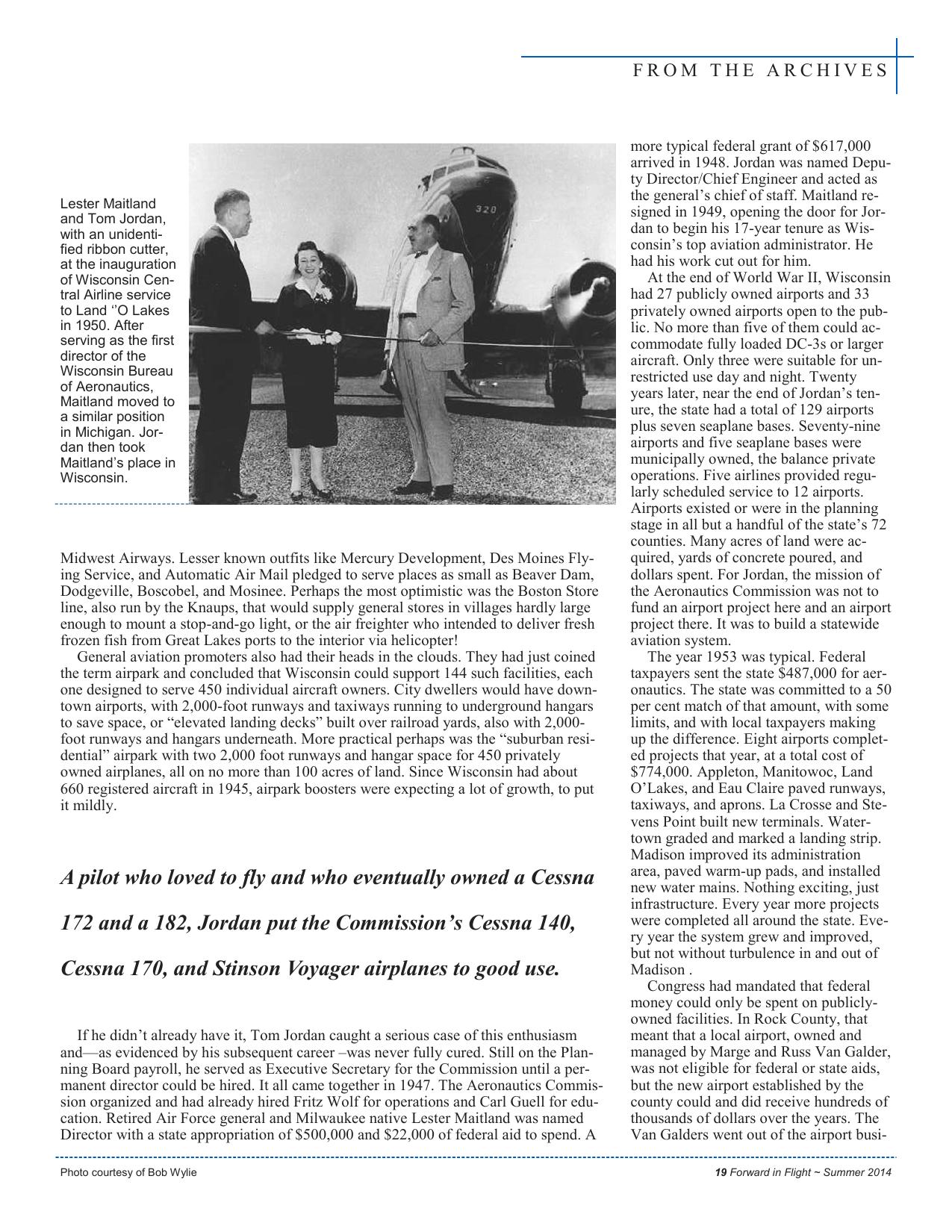
FROM THE ARCHIVES Lester Maitland and Tom Jordan, with an unidentified ribbon cutter, at the inauguration of Wisconsin Central Airline service to Land ‘’O Lakes in 1950. After serving as the first director of the Wisconsin Bureau of Aeronautics, Maitland moved to a similar position in Michigan. Jordan then took Maitland’s place in Wisconsin. Midwest Airways. Lesser known outfits like Mercury Development, Des Moines Flying Service, and Automatic Air Mail pledged to serve places as small as Beaver Dam, Dodgeville, Boscobel, and Mosinee. Perhaps the most optimistic was the Boston Store line, also run by the Knaups, that would supply general stores in villages hardly large enough to mount a stop-and-go light, or the air freighter who intended to deliver fresh frozen fish from Great Lakes ports to the interior via helicopter! General aviation promoters also had their heads in the clouds. They had just coined the term airpark and concluded that Wisconsin could support 144 such facilities, each one designed to serve 450 individual aircraft owners. City dwellers would have downtown airports, with 2,000-foot runways and taxiways running to underground hangars to save space, or “elevated landing decks” built over railroad yards, also with 2,000foot runways and hangars underneath. More practical perhaps was the “suburban residential” airpark with two 2,000 foot runways and hangar space for 450 privately owned airplanes, all on no more than 100 acres of land. Since Wisconsin had about 660 registered aircraft in 1945, airpark boosters were expecting a lot of growth, to put it mildly. A pilot who loved to fly and who eventually owned a Cessna 172 and a 182, Jordan put the Commission’s Cessna 140, Cessna 170, and Stinson Voyager airplanes to good use. If he didn’t already have it, Tom Jordan caught a serious case of this enthusiasm and—as evidenced by his subsequent career –was never fully cured. Still on the Planning Board payroll, he served as Executive Secretary for the Commission until a permanent director could be hired. It all came together in 1947. The Aeronautics Commission organized and had already hired Fritz Wolf for operations and Carl Guell for education. Retired Air Force general and Milwaukee native Lester Maitland was named Director with a state appropriation of $500,000 and $22,000 of federal aid to spend. A Photo courtesy of Bob Wylie more typical federal grant of $617,000 arrived in 1948. Jordan was named Deputy Director/Chief Engineer and acted as the general’s chief of staff. Maitland resigned in 1949, opening the door for Jordan to begin his 17-year tenure as Wisconsin’s top aviation administrator. He had his work cut out for him. At the end of World War II, Wisconsin had 27 publicly owned airports and 33 privately owned airports open to the public. No more than five of them could accommodate fully loaded DC-3s or larger aircraft. Only three were suitable for unrestricted use day and night. Twenty years later, near the end of Jordan’s tenure, the state had a total of 129 airports plus seven seaplane bases. Seventy-nine airports and five seaplane bases were municipally owned, the balance private operations. Five airlines provided regularly scheduled service to 12 airports. Airports existed or were in the planning stage in all but a handful of the state’s 72 counties. Many acres of land were acquired, yards of concrete poured, and dollars spent. For Jordan, the mission of the Aeronautics Commission was not to fund an airport project here and an airport project there. It was to build a statewide aviation system. The year 1953 was typical. Federal taxpayers sent the state $487,000 for aeronautics. The state was committed to a 50 per cent match of that amount, with some limits, and with local taxpayers making up the difference. Eight airports completed projects that year, at a total cost of $774,000. Appleton, Manitowoc, Land O’Lakes, and Eau Claire paved runways, taxiways, and aprons. La Crosse and Stevens Point built new terminals. Watertown graded and marked a landing strip. Madison improved its administration area, paved warm-up pads, and installed new water mains. Nothing exciting, just infrastructure. Every year more projects were completed all around the state. Every year the system grew and improved, but not without turbulence in and out of Madison . Congress had mandated that federal money could only be spent on publiclyowned facilities. In Rock County, that meant that a local airport, owned and managed by Marge and Russ Van Galder, was not eligible for federal or state aids, but the new airport established by the county could and did receive hundreds of thousands of dollars over the years. The Van Galders went out of the airport busi19 Forward in Flight ~ Summer 2014
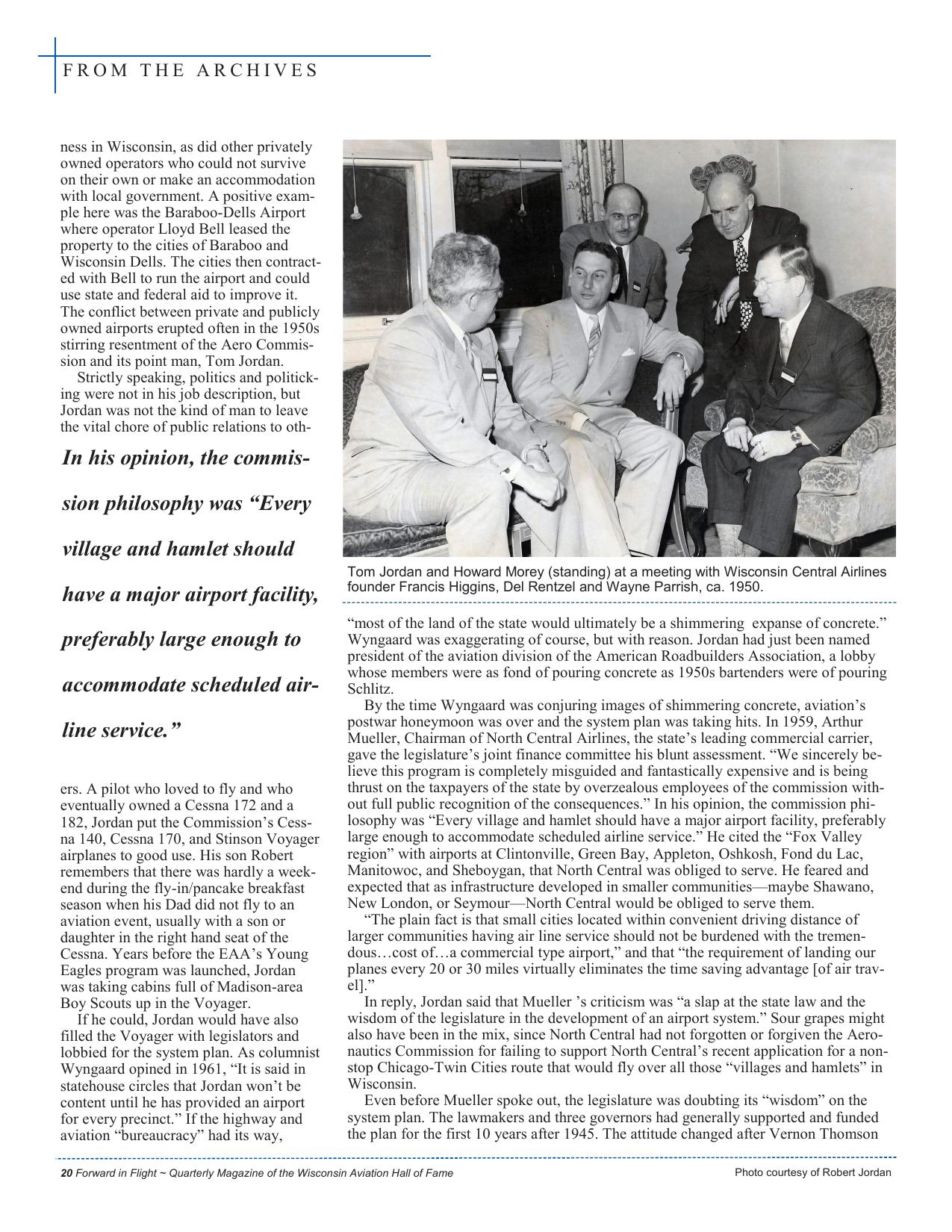
FROM THE ARCHIVES ness in Wisconsin, as did other privately owned operators who could not survive on their own or make an accommodation with local government. A positive example here was the Baraboo-Dells Airport where operator Lloyd Bell leased the property to the cities of Baraboo and Wisconsin Dells. The cities then contracted with Bell to run the airport and could use state and federal aid to improve it. The conflict between private and publicly owned airports erupted often in the 1950s stirring resentment of the Aero Commission and its point man, Tom Jordan. Strictly speaking, politics and politicking were not in his job description, but Jordan was not the kind of man to leave the vital chore of public relations to oth- In his opinion, the commission philosophy was “Every village and hamlet should have a major airport facility, preferably large enough to accommodate scheduled airline service.” ers. A pilot who loved to fly and who eventually owned a Cessna 172 and a 182, Jordan put the Commission’s Cessna 140, Cessna 170, and Stinson Voyager airplanes to good use. His son Robert remembers that there was hardly a weekend during the fly-in/pancake breakfast season when his Dad did not fly to an aviation event, usually with a son or daughter in the right hand seat of the Cessna. Years before the EAA’s Young Eagles program was launched, Jordan was taking cabins full of Madison-area Boy Scouts up in the Voyager. If he could, Jordan would have also filled the Voyager with legislators and lobbied for the system plan. As columnist Wyngaard opined in 1961, “It is said in statehouse circles that Jordan won’t be content until he has provided an airport for every precinct.” If the highway and aviation “bureaucracy” had its way, Tom Jordan and Howard Morey (standing) at a meeting with Wisconsin Central Airlines founder Francis Higgins, Del Rentzel and Wayne Parrish, ca. 1950. “most of the land of the state would ultimately be a shimmering expanse of concrete.” Wyngaard was exaggerating of course, but with reason. Jordan had just been named president of the aviation division of the American Roadbuilders Association, a lobby whose members were as fond of pouring concrete as 1950s bartenders were of pouring Schlitz. By the time Wyngaard was conjuring images of shimmering concrete, aviation’s postwar honeymoon was over and the system plan was taking hits. In 1959, Arthur Mueller, Chairman of North Central Airlines, the state’s leading commercial carrier, gave the legislature’s joint finance committee his blunt assessment. “We sincerely believe this program is completely misguided and fantastically expensive and is being thrust on the taxpayers of the state by overzealous employees of the commission without full public recognition of the consequences.” In his opinion, the commission philosophy was “Every village and hamlet should have a major airport facility, preferably large enough to accommodate scheduled airline service.” He cited the “Fox Valley region” with airports at Clintonville, Green Bay, Appleton, Oshkosh, Fond du Lac, Manitowoc, and Sheboygan, that North Central was obliged to serve. He feared and expected that as infrastructure developed in smaller communities—maybe Shawano, New London, or Seymour—North Central would be obliged to serve them. “The plain fact is that small cities located within convenient driving distance of larger communities having air line service should not be burdened with the tremendous…cost of…a commercial type airport,” and that “the requirement of landing our planes every 20 or 30 miles virtually eliminates the time saving advantage [of air travel].” In reply, Jordan said that Mueller ’s criticism was “a slap at the state law and the wisdom of the legislature in the development of an airport system.” Sour grapes might also have been in the mix, since North Central had not forgotten or forgiven the Aeronautics Commission for failing to support North Central’s recent application for a nonstop Chicago-Twin Cities route that would fly over all those “villages and hamlets” in Wisconsin. Even before Mueller spoke out, the legislature was doubting its “wisdom” on the system plan. The lawmakers and three governors had generally supported and funded the plan for the first 10 years after 1945. The attitude changed after Vernon Thomson 20 Forward in Flight ~ Quarterly Magazine of the Wisconsin Aviation Hall of Fame Photo courtesy of Robert Jordan
FROM THE ARCHIVES was elected governor in 1956. He had promised to cut state spending and went to work right after his election in meetings with individual agency heads. Unabashed, Jordan requested $1.24 million from the state general fund. Added to state money designated for the commission, local levies and federal aid, it would result in a record $6 million expenditure. The money would be spent in 21 communities, including Osceola, New Holstein, Crandon, Merrill, Hartford, Rhinelander, Waukesha, Oshkosh, Madison, and Milwaukee. Thomson stayed mum until after his inauguration, but a Madison press report concluded that “it required no particular gift of prophecy to forecast that Mr. Jordan, among many others, will be disappointed.” He was. When he sent his budget to the legislature in January 1957, Thomson asked for $445,000 for aeronautics, roughly one-third of Jordan’s request. It would reduce federal aid to less than $1 million and threaten the construction of new airports at Kenosha, Merrill, Hayward, and five other cities. It would also delay the completion of Fond du Lac’s new airport and a new terminal at Oshkosh. Also on the block was an additional airport at Madison. Local leaders lobbied for it because, as Manager Robert Skuldt told reporters, the Air Force “has been taking over more and more of our field.” The city wanted an initial grant of state and federal funds to acquire land on the southwest side of town for a civilian-only facility, with more to come in future years. Jordan issued press releases showing how air traffic of all kinds had increased in the past two years and rallied local leaders to lobby the legislature to restore Thomson’s cuts. He was able to get another $130,000. It helped finish work at Fond du Lac, but could not save Madison’s second airport. Coincidentally, one item Governor Thomson left in the budget was a pay raise for the Aeronautics Commission Director from $8,500 to $9,500 a year. The battle renewed during the next budget debate in 1959. Unabashed again, Jordan came to the Capitol with an $8.2 million program that would require more than $1.7 million from the state. New Governor Gaylord Nelson was no more friendly to the proposal than Governor Thomson was to the 1957 request. He cut the Aero Commission’s appropriation to $140,000. Once again Jordan went to work pointing out how much aviation in Wisconsin had grown since the last budget and how much federal aid the state would lose. Nelson is sometimes remembered as a 1960s tax-and-spend liberal Democrat, but he was not taxing or spending here. Aeronautics faced the most serious budget shortfall it had known. Jordan leaped to the offensive but ended up, if not in the fire, in hot water. He was making his case before the Senate Joint Finance Committee to restore Nelson’s cuts when Senator William Draheim a conservative Republican from Neenah asked, “Do you intend to come in with a bill to replace those aids and logroll it through the legislature as you did in 1957?” Before Jordan could respond, Draheim said, “I have a lot of respect for your ability as a promoter but there is a statute that prohibits a department head from lobbying. I wonder if you have confined your activities within the limits of that statute?” “Absolutely,” Jordan replied. “Any time you find that I haven’t you can have my resignation.” “I have the highest regard for you personally,” Draheim said. “But I just wonder if you haven’t gone overboard on this matter.” “This is a serious matter, the provision of adequate transportation for the years ahead. I’m working on behalf of the state, and it is not a matter of personal ambition,” Jordan said. He had been working to build an aviation system for 20 years and had become the most visible representative of the state’s role in creating that system, its most “indefatigable” promoter. Every budget session he informed the governor what Aeronautics needed to implement the plan. Every governor reduced it. When he asked the legislature to restore the cuts, more often than not, his request was denied, the appropriation reduced, the federal aids lost. Between 1959 and his last request in 1966, Wisconsin received somewhere between $770,000 and $1.2 million annually in federal aid that funded about one-half the system costs. In some years the state’s contribution dropped as low as 10 per cent of the total spent while some local taxpayers put up as much as 40 per cent. Tom Jordan’s final battle involved the very existence of the Aeronautics Commission. In 1965, the state created a task force to study and prepare a plan for reor- ganizing state administration. Two years later the legislature enacted and Governor Warren Knowles signed into law a plan that realigned 84 units of state government into 28. The Aeronautics Commission lost its policy making role and was renamed the Council on Aeronautics. Commission staff went to work for a new Aeronautics Division within a new Department of Transportation. In the period leading up to the reorganization Jordan made no secret of his opposition to the merger. He wanted a separate cabinet level Department of Aeronautics that would not be engulfed by the much larger highway units in Transportation. Coincidentally, the Governor who signed the measure killing the Aeronautics Commission, Warren Knowles, led the legislative campaign to create it back in 1945. He had come full circle. So had Tom Jordan. He was not named to head the new Division. Instead, he took over the Division’s Airport Development section, responsible for planning and construction. Jordan had returned to where he started in 1938. Recognizing the end of an era, the Wisconsin Society of Professional Engineers named him “Engineer of the Year.” The Wisconsin Aviation Trades Association that he had helped organize in the mid-1940s gave him its highest honor, a lifetime membership. The National Association of State Aviation Officials cited and applauded him for his “aggressive leadership.” Numerous local government officials, business people, and individual aviators expressed appreciation and gratitude. Jordan stayed with the Aeronautics Division until he reached age 65 in 1972. He had private interests to pursue, including logging hours in his Cessna and making use of the aviation infrastructure whose development had been his life’s work. He went west in 1984. Author’s Note: Sources for this article include Subject Files of the Wisconsin Bureau of Aeronautics, 1936-1968, and Clipping Files of the Wisconsin State Aeronautics Commission, 1943-47, 1955-1967 in the archives of the Wisconsin Historical Society; Wisconsin Blue Books 19371970; airport and state government files in the WAHF archives; conversations with Robert Jordan. 21 Forward in Flight ~ Summer 2014
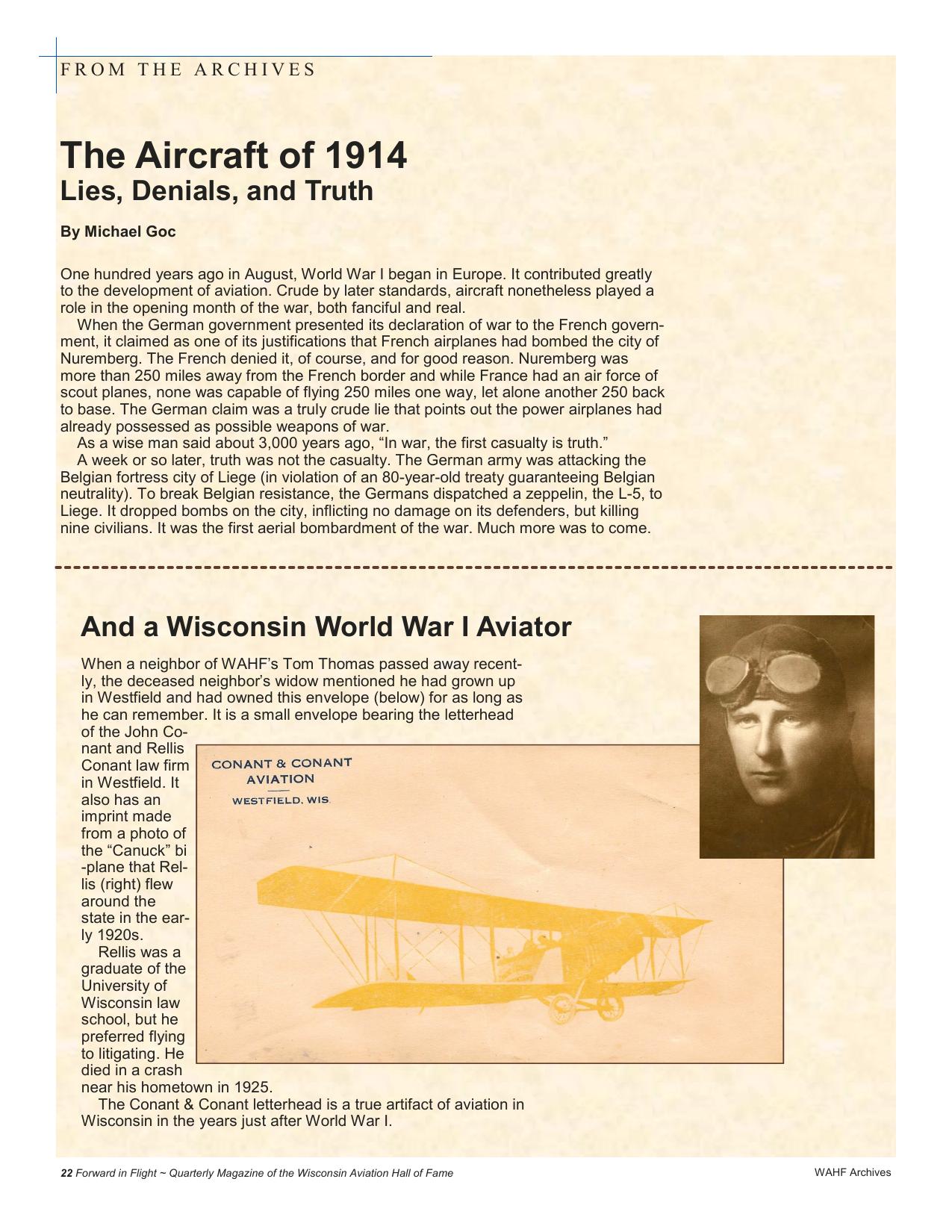
FROM THE ARCHIVES The Aircraft of 1914 Lies, Denials, and Truth By Michael Goc One hundred years ago in August, World War I began in Europe. It contributed greatly to the development of aviation. Crude by later standards, aircraft nonetheless played a role in the opening month of the war, both fanciful and real. When the German government presented its declaration of war to the French government, it claimed as one of its justifications that French airplanes had bombed the city of Nuremberg. The French denied it, of course, and for good reason. Nuremberg was more than 250 miles away from the French border and while France had an air force of scout planes, none was capable of flying 250 miles one way, let alone another 250 back to base. The German claim was a truly crude lie that points out the power airplanes had already possessed as possible weapons of war. As a wise man said about 3,000 years ago, “In war, the first casualty is truth.” A week or so later, truth was not the casualty. The German army was attacking the Belgian fortress city of Liege (in violation of an 80-year-old treaty guaranteeing Belgian neutrality). To break Belgian resistance, the Germans dispatched a zeppelin, the L-5, to Liege. It dropped bombs on the city, inflicting no damage on its defenders, but killing nine civilians. It was the first aerial bombardment of the war. Much more was to come. And a Wisconsin World War I Aviator When a neighbor of WAHF’s Tom Thomas passed away recently, the deceased neighbor’s widow mentioned he had grown up in Westfield and had owned this envelope (below) for as long as he can remember. It is a small envelope bearing the letterhead of the John Conant and Rellis Conant law firm in Westfield. It also has an imprint made from a photo of the “Canuck” bi -plane that Rellis (right) flew around the state in the early 1920s. Rellis was a graduate of the University of Wisconsin law school, but he preferred flying to litigating. He died in a crash near his hometown in 1925. The Conant & Conant letterhead is a true artifact of aviation in Wisconsin in the years just after World War I. 22 Forward in Flight ~ Quarterly Magazine of the Wisconsin Aviation Hall of Fame WAHF Archives
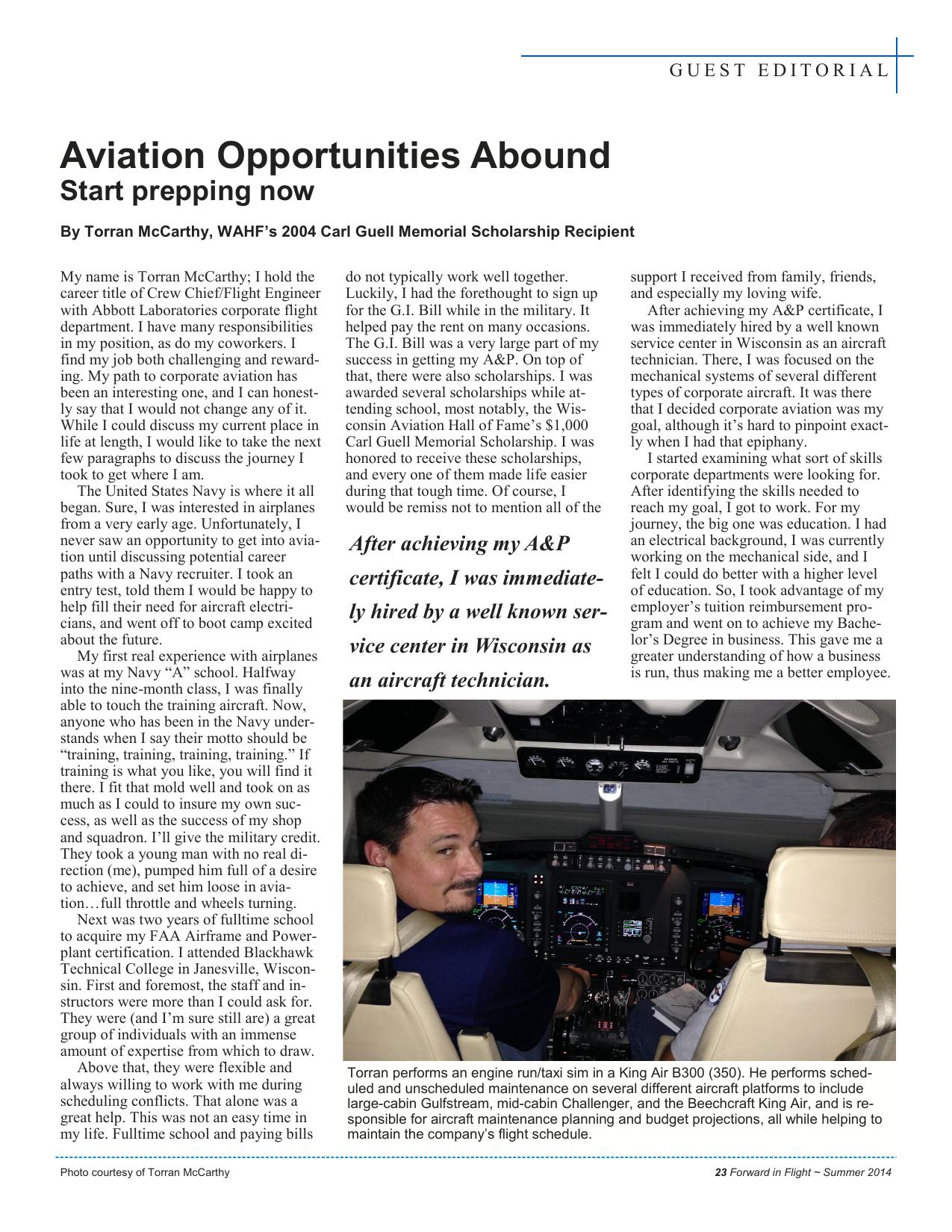
GUEST EDITORIAL Aviation Opportunities Abound Start prepping now By Torran McCarthy, WAHF’s 2004 Carl Guell Memorial Scholarship Recipient My name is Torran McCarthy; I hold the career title of Crew Chief/Flight Engineer with Abbott Laboratories corporate flight department. I have many responsibilities in my position, as do my coworkers. I find my job both challenging and rewarding. My path to corporate aviation has been an interesting one, and I can honestly say that I would not change any of it. While I could discuss my current place in life at length, I would like to take the next few paragraphs to discuss the journey I took to get where I am. The United States Navy is where it all began. Sure, I was interested in airplanes from a very early age. Unfortunately, I never saw an opportunity to get into aviation until discussing potential career paths with a Navy recruiter. I took an entry test, told them I would be happy to help fill their need for aircraft electricians, and went off to boot camp excited about the future. My first real experience with airplanes was at my Navy “A” school. Halfway into the nine-month class, I was finally able to touch the training aircraft. Now, anyone who has been in the Navy understands when I say their motto should be “training, training, training, training.” If training is what you like, you will find it there. I fit that mold well and took on as much as I could to insure my own success, as well as the success of my shop and squadron. I’ll give the military credit. They took a young man with no real direction (me), pumped him full of a desire to achieve, and set him loose in aviation…full throttle and wheels turning. Next was two years of fulltime school to acquire my FAA Airframe and Powerplant certification. I attended Blackhawk Technical College in Janesville, Wisconsin. First and foremost, the staff and instructors were more than I could ask for. They were (and I’m sure still are) a great group of individuals with an immense amount of expertise from which to draw. Above that, they were flexible and always willing to work with me during scheduling conflicts. That alone was a great help. This was not an easy time in my life. Fulltime school and paying bills Photo courtesy of Torran McCarthy do not typically work well together. Luckily, I had the forethought to sign up for the G.I. Bill while in the military. It helped pay the rent on many occasions. The G.I. Bill was a very large part of my success in getting my A&P. On top of that, there were also scholarships. I was awarded several scholarships while attending school, most notably, the Wisconsin Aviation Hall of Fame’s $1,000 Carl Guell Memorial Scholarship. I was honored to receive these scholarships, and every one of them made life easier during that tough time. Of course, I would be remiss not to mention all of the After achieving my A&P certificate, I was immediately hired by a well known service center in Wisconsin as an aircraft technician. support I received from family, friends, and especially my loving wife. After achieving my A&P certificate, I was immediately hired by a well known service center in Wisconsin as an aircraft technician. There, I was focused on the mechanical systems of several different types of corporate aircraft. It was there that I decided corporate aviation was my goal, although it’s hard to pinpoint exactly when I had that epiphany. I started examining what sort of skills corporate departments were looking for. After identifying the skills needed to reach my goal, I got to work. For my journey, the big one was education. I had an electrical background, I was currently working on the mechanical side, and I felt I could do better with a higher level of education. So, I took advantage of my employer’s tuition reimbursement program and went on to achieve my Bachelor’s Degree in business. This gave me a greater understanding of how a business is run, thus making me a better employee. Torran performs an engine run/taxi sim in a King Air B300 (350). He performs scheduled and unscheduled maintenance on several different aircraft platforms to include large-cabin Gulfstream, mid-cabin Challenger, and the Beechcraft King Air, and is responsible for aircraft maintenance planning and budget projections, all while helping to maintain the company’s flight schedule. 23 Forward in Flight ~ Summer 2014
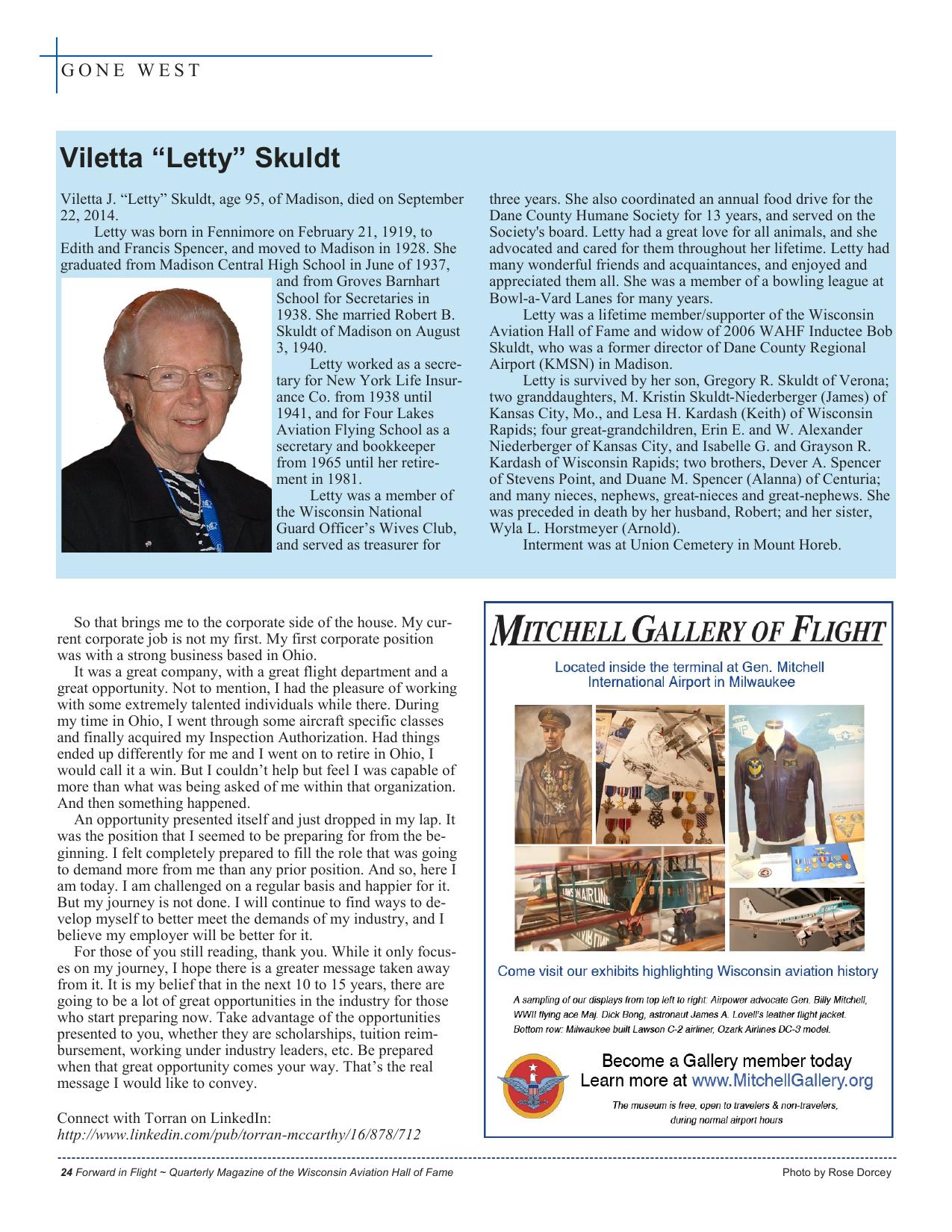
GONE WEST Viletta “Letty” Skuldt Viletta J. “Letty” Skuldt, age 95, of Madison, died on September 22, 2014. Letty was born in Fennimore on February 21, 1919, to Edith and Francis Spencer, and moved to Madison in 1928. She graduated from Madison Central High School in June of 1937, and from Groves Barnhart School for Secretaries in 1938. She married Robert B. Skuldt of Madison on August 3, 1940. Letty worked as a secretary for New York Life Insurance Co. from 1938 until 1941, and for Four Lakes Aviation Flying School as a secretary and bookkeeper from 1965 until her retirement in 1981. Letty was a member of the Wisconsin National Guard Officer’s Wives Club, and served as treasurer for three years. She also coordinated an annual food drive for the Dane County Humane Society for 13 years, and served on the Society's board. Letty had a great love for all animals, and she advocated and cared for them throughout her lifetime. Letty had many wonderful friends and acquaintances, and enjoyed and appreciated them all. She was a member of a bowling league at Bowl-a-Vard Lanes for many years. Letty was a lifetime member/supporter of the Wisconsin Aviation Hall of Fame and widow of 2006 WAHF Inductee Bob Skuldt, who was a former director of Dane County Regional Airport (KMSN) in Madison. Letty is survived by her son, Gregory R. Skuldt of Verona; two granddaughters, M. Kristin Skuldt-Niederberger (James) of Kansas City, Mo., and Lesa H. Kardash (Keith) of Wisconsin Rapids; four great-grandchildren, Erin E. and W. Alexander Niederberger of Kansas City, and Isabelle G. and Grayson R. Kardash of Wisconsin Rapids; two brothers, Dever A. Spencer of Stevens Point, and Duane M. Spencer (Alanna) of Centuria; and many nieces, nephews, great-nieces and great-nephews. She was preceded in death by her husband, Robert; and her sister, Wyla L. Horstmeyer (Arnold). Interment was at Union Cemetery in Mount Horeb. So that brings me to the corporate side of the house. My current corporate job is not my first. My first corporate position was with a strong business based in Ohio. It was a great company, with a great flight department and a great opportunity. Not to mention, I had the pleasure of working with some extremely talented individuals while there. During my time in Ohio, I went through some aircraft specific classes and finally acquired my Inspection Authorization. Had things ended up differently for me and I went on to retire in Ohio, I would call it a win. But I couldn’t help but feel I was capable of more than what was being asked of me within that organization. And then something happened. An opportunity presented itself and just dropped in my lap. It was the position that I seemed to be preparing for from the beginning. I felt completely prepared to fill the role that was going to demand more from me than any prior position. And so, here I am today. I am challenged on a regular basis and happier for it. But my journey is not done. I will continue to find ways to develop myself to better meet the demands of my industry, and I believe my employer will be better for it. For those of you still reading, thank you. While it only focuses on my journey, I hope there is a greater message taken away from it. It is my belief that in the next 10 to 15 years, there are going to be a lot of great opportunities in the industry for those who start preparing now. Take advantage of the opportunities presented to you, whether they are scholarships, tuition reimbursement, working under industry leaders, etc. Be prepared when that great opportunity comes your way. That’s the real message I would like to convey. Connect with Torran on LinkedIn: http://www.linkedin.com/pub/torran-mccarthy/16/878/712 24 Forward in Flight ~ Quarterly Magazine of the Wisconsin Aviation Hall of Fame Photo by Rose Dorcey
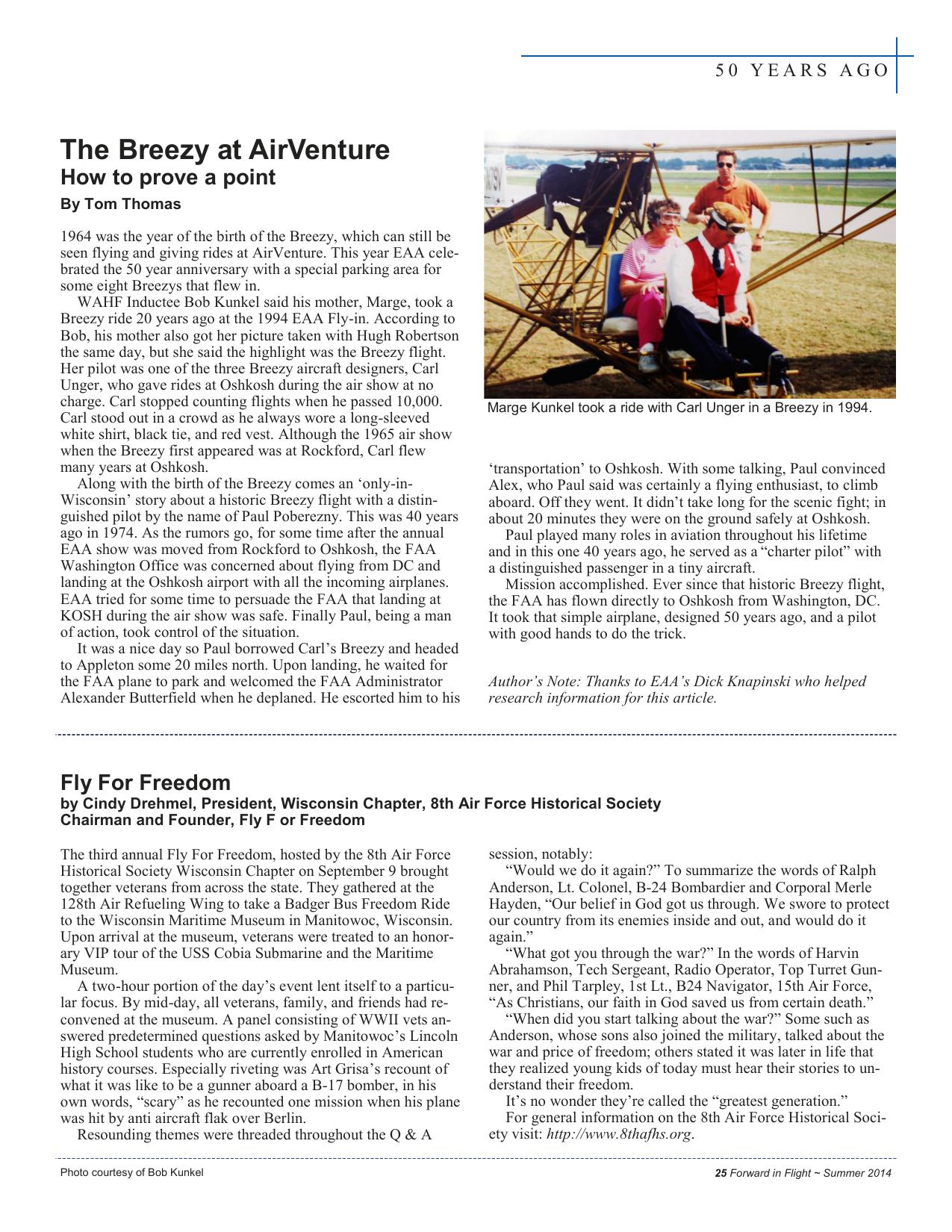
50 YEARS AGO The Breezy at AirVenture How to prove a point By Tom Thomas 1964 was the year of the birth of the Breezy, which can still be seen flying and giving rides at AirVenture. This year EAA celebrated the 50 year anniversary with a special parking area for some eight Breezys that flew in. WAHF Inductee Bob Kunkel said his mother, Marge, took a Breezy ride 20 years ago at the 1994 EAA Fly-in. According to Bob, his mother also got her picture taken with Hugh Robertson the same day, but she said the highlight was the Breezy flight. Her pilot was one of the three Breezy aircraft designers, Carl Unger, who gave rides at Oshkosh during the air show at no charge. Carl stopped counting flights when he passed 10,000. Carl stood out in a crowd as he always wore a long-sleeved white shirt, black tie, and red vest. Although the 1965 air show when the Breezy first appeared was at Rockford, Carl flew many years at Oshkosh. Along with the birth of the Breezy comes an ‘only-inWisconsin’ story about a historic Breezy flight with a distinguished pilot by the name of Paul Poberezny. This was 40 years ago in 1974. As the rumors go, for some time after the annual EAA show was moved from Rockford to Oshkosh, the FAA Washington Office was concerned about flying from DC and landing at the Oshkosh airport with all the incoming airplanes. EAA tried for some time to persuade the FAA that landing at KOSH during the air show was safe. Finally Paul, being a man of action, took control of the situation. It was a nice day so Paul borrowed Carl’s Breezy and headed to Appleton some 20 miles north. Upon landing, he waited for the FAA plane to park and welcomed the FAA Administrator Alexander Butterfield when he deplaned. He escorted him to his Marge Kunkel took a ride with Carl Unger in a Breezy in 1994. ‘transportation’ to Oshkosh. With some talking, Paul convinced Alex, who Paul said was certainly a flying enthusiast, to climb aboard. Off they went. It didn’t take long for the scenic fight; in about 20 minutes they were on the ground safely at Oshkosh. Paul played many roles in aviation throughout his lifetime and in this one 40 years ago, he served as a “charter pilot” with a distinguished passenger in a tiny aircraft. Mission accomplished. Ever since that historic Breezy flight, the FAA has flown directly to Oshkosh from Washington, DC. It took that simple airplane, designed 50 years ago, and a pilot with good hands to do the trick. Author’s Note: Thanks to EAA’s Dick Knapinski who helped research information for this article. Fly For Freedom by Cindy Drehmel, President, Wisconsin Chapter, 8th Air Force Historical Society Chairman and Founder, Fly F or Freedom The third annual Fly For Freedom, hosted by the 8th Air Force Historical Society Wisconsin Chapter on September 9 brought together veterans from across the state. They gathered at the 128th Air Refueling Wing to take a Badger Bus Freedom Ride to the Wisconsin Maritime Museum in Manitowoc, Wisconsin. Upon arrival at the museum, veterans were treated to an honorary VIP tour of the USS Cobia Submarine and the Maritime Museum. A two-hour portion of the day’s event lent itself to a particular focus. By mid-day, all veterans, family, and friends had reconvened at the museum. A panel consisting of WWII vets answered predetermined questions asked by Manitowoc’s Lincoln High School students who are currently enrolled in American history courses. Especially riveting was Art Grisa’s recount of what it was like to be a gunner aboard a B-17 bomber, in his own words, “scary” as he recounted one mission when his plane was hit by anti aircraft flak over Berlin. Resounding themes were threaded throughout the Q & A Photo courtesy of Bob Kunkel session, notably: “Would we do it again?” To summarize the words of Ralph Anderson, Lt. Colonel, B-24 Bombardier and Corporal Merle Hayden, “Our belief in God got us through. We swore to protect our country from its enemies inside and out, and would do it again.” “What got you through the war?” In the words of Harvin Abrahamson, Tech Sergeant, Radio Operator, Top Turret Gunner, and Phil Tarpley, 1st Lt., B24 Navigator, 15th Air Force, “As Christians, our faith in God saved us from certain death.” “When did you start talking about the war?” Some such as Anderson, whose sons also joined the military, talked about the war and price of freedom; others stated it was later in life that they realized young kids of today must hear their stories to understand their freedom. It’s no wonder they’re called the “greatest generation.” For general information on the 8th Air Force Historical Society visit: http://www.8thafhs.org. 25 Forward in Flight ~ Summer 2014
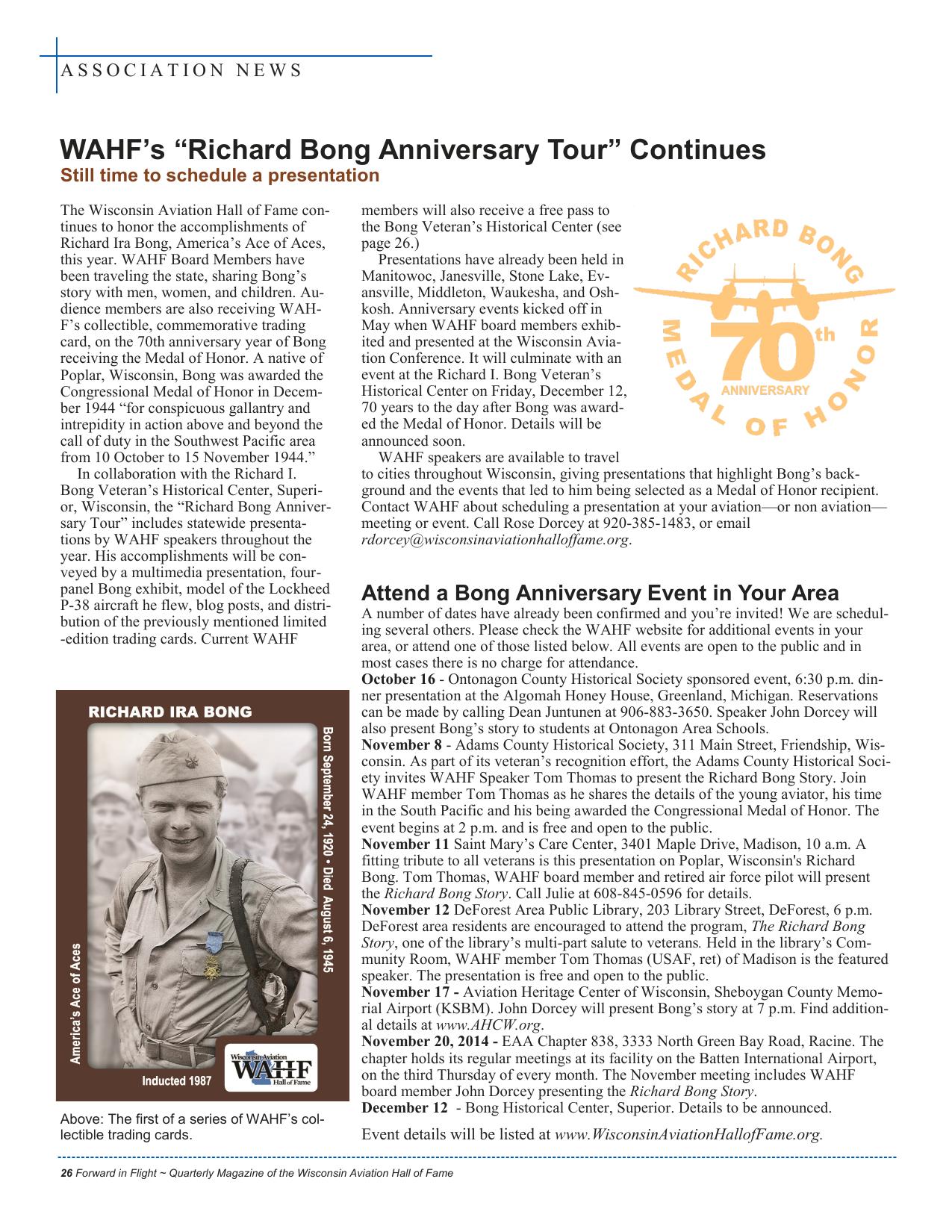
ASSOCIATION NEWS WAHF’s “Richard Bong Anniversary Tour” Continues Still time to schedule a presentation The Wisconsin Aviation Hall of Fame continues to honor the accomplishments of Richard Ira Bong, America’s Ace of Aces, this year. WAHF Board Members have been traveling the state, sharing Bong’s story with men, women, and children. Audience members are also receiving WAHF’s collectible, commemorative trading card, on the 70th anniversary year of Bong receiving the Medal of Honor. A native of Poplar, Wisconsin, Bong was awarded the Congressional Medal of Honor in December 1944 “for conspicuous gallantry and intrepidity in action above and beyond the call of duty in the Southwest Pacific area from 10 October to 15 November 1944.” In collaboration with the Richard I. Bong Veteran’s Historical Center, Superior, Wisconsin, the “Richard Bong Anniversary Tour” includes statewide presentations by WAHF speakers throughout the year. His accomplishments will be conveyed by a multimedia presentation, fourpanel Bong exhibit, model of the Lockheed P-38 aircraft he flew, blog posts, and distribution of the previously mentioned limited -edition trading cards. Current WAHF Above: The first of a series of WAHF’s collectible trading cards. members will also receive a free pass to the Bong Veteran’s Historical Center (see page 26.) Presentations have already been held in Manitowoc, Janesville, Stone Lake, Evansville, Middleton, Waukesha, and Oshkosh. Anniversary events kicked off in May when WAHF board members exhibited and presented at the Wisconsin Aviation Conference. It will culminate with an event at the Richard I. Bong Veteran’s Historical Center on Friday, December 12, 70 years to the day after Bong was awarded the Medal of Honor. Details will be announced soon. WAHF speakers are available to travel to cities throughout Wisconsin, giving presentations that highlight Bong’s background and the events that led to him being selected as a Medal of Honor recipient. Contact WAHF about scheduling a presentation at your aviation—or non aviation— meeting or event. Call Rose Dorcey at 920-385-1483, or email rdorcey@wisconsinaviationhalloffame.org. Attend a Bong Anniversary Event in Your Area A number of dates have already been confirmed and you’re invited! We are scheduling several others. Please check the WAHF website for additional events in your area, or attend one of those listed below. All events are open to the public and in most cases there is no charge for attendance. October 16 - Ontonagon County Historical Society sponsored event, 6:30 p.m. dinner presentation at the Algomah Honey House, Greenland, Michigan. Reservations can be made by calling Dean Juntunen at 906-883-3650. Speaker John Dorcey will also present Bong’s story to students at Ontonagon Area Schools. November 8 - Adams County Historical Society, 311 Main Street, Friendship, Wisconsin. As part of its veteran’s recognition effort, the Adams County Historical Society invites WAHF Speaker Tom Thomas to present the Richard Bong Story. Join WAHF member Tom Thomas as he shares the details of the young aviator, his time in the South Pacific and his being awarded the Congressional Medal of Honor. The event begins at 2 p.m. and is free and open to the public. November 11 Saint Mary’s Care Center, 3401 Maple Drive, Madison, 10 a.m. A fitting tribute to all veterans is this presentation on Poplar, Wisconsin's Richard Bong. Tom Thomas, WAHF board member and retired air force pilot will present the Richard Bong Story. Call Julie at 608-845-0596 for details. November 12 DeForest Area Public Library, 203 Library Street, DeForest, 6 p.m. DeForest area residents are encouraged to attend the program, The Richard Bong Story, one of the library’s multi-part salute to veterans. Held in the library’s Community Room, WAHF member Tom Thomas (USAF, ret) of Madison is the featured speaker. The presentation is free and open to the public. November 17 - Aviation Heritage Center of Wisconsin, Sheboygan County Memorial Airport (KSBM). John Dorcey will present Bong’s story at 7 p.m. Find additional details at www.AHCW.org. November 20, 2014 - EAA Chapter 838, 3333 North Green Bay Road, Racine. The chapter holds its regular meetings at its facility on the Batten International Airport, on the third Thursday of every month. The November meeting includes WAHF board member John Dorcey presenting the Richard Bong Story. December 12 - Bong Historical Center, Superior. Details to be announced. Event details will be listed at www.WisconsinAviationHallofFame.org. 26 Forward in Flight ~ Quarterly Magazine of the Wisconsin Aviation Hall of Fame
ASSOCIATION NEWS New Membership Benefit Richard I. Bong Veterans Historical Center 305 Harbor View Parkway Superior, Wisconsin Free Admission to Bong Historical Center Now through December 2015, current WAHF members receive free admission to the Richard I. Bong Veterans Historical Center in Superior, Wisconsin. The free admission is a membership benefit you’ll want to take advantage of soon. As you’ve read on pages 22 - 24 of this issue, there’s a lot to see! The free admission coupon is easy to use, just present it at the front desk when you visit the museum, along with your current WAHF membership card. For museum hours, call 715-3927151 or email info@bvhcenter.org. The mission of the Richard I. Bong Veterans Historical Center is to honor the memory of Major Bong and all the veterans of WWII and later conflicts whose sacrifices maintain our freedoms. The center is an educational resource that collects and preserves the tangible legacy of these veterans and their home front supporters. Also, the center perpetuates their ideals, principles, and leadership skills for today as well as future generations. Reminder to Apply for WAHF Scholarships WAHF’s scholarship program began in 2002 with the $1,000 Carl Guell Memorial Scholarship, honoring WAHF’s founder. In 2005, WAHF member supporter Jerome Thiessen, an aircraft builder and pilot, created the $500 Thiessen Field Scholarship. Two years later, the family of longtime WAHF member/ supporter Jerome Ripp approached the organization with a plan for a third $500 WAHF scholarship. In 2015, five scholarships are available, including the new $250 Jeff Baum Scholarship, and the $1,000 Robert Payzer Memorial/EAA Chapter 640 Scholarship. The scholarships are available to Wisconsin students enrolled in any accredited aviation program in or outside Wisconsin. Completed applications must be submitted by March 1, 2015. Questions regarding criteria or the application process can be directed to Sue Nelson at the Community Foundation of North Central Wisconsin, sue@cfoncw.org or 715-845-9555. Visit www.CFONCW.org for more information. FREE ADMISSION COUPON For current members of the Wisconsin Aviation Hall of Fame This coupon entitles a current WAHF member to a free admission at the time the coupon is surrendered. Coupon is good for one individual admission only. Please present your WAHF membership card to receive your free admission. Coupon expires Dec. 31, 2015. Visit www.bvhcenter.org - Phone 715-392-7151 Subscribe to Forward in Flight today! Subscription includes one-year WAHF membership. Membership Benefits: u Quarterly subscription (four issues) of Forward in Flight, packed full of Wisconsin aviation news, events, state aviation history, and stories about your aviation colleagues u Free pass to the Deke Slayton Museum u Invitation to annual induction banquet Just $20 and you’ll be sup- porting an aviation organization dedicated to collecting, preserving, and sharing Wisconsin aviation history. With Forward in Flight, you’ll learn about aviation history makers—the people, places, and events that distinguish our state—and also be in touch with current Wisconsin aviation news and information. Name Address City State Zip Phone Number Email Mail to: WAHF, 3980 Sharratt Drive, Oshkosh, WI 54901 27 Forward in Flight ~ Summer 2014
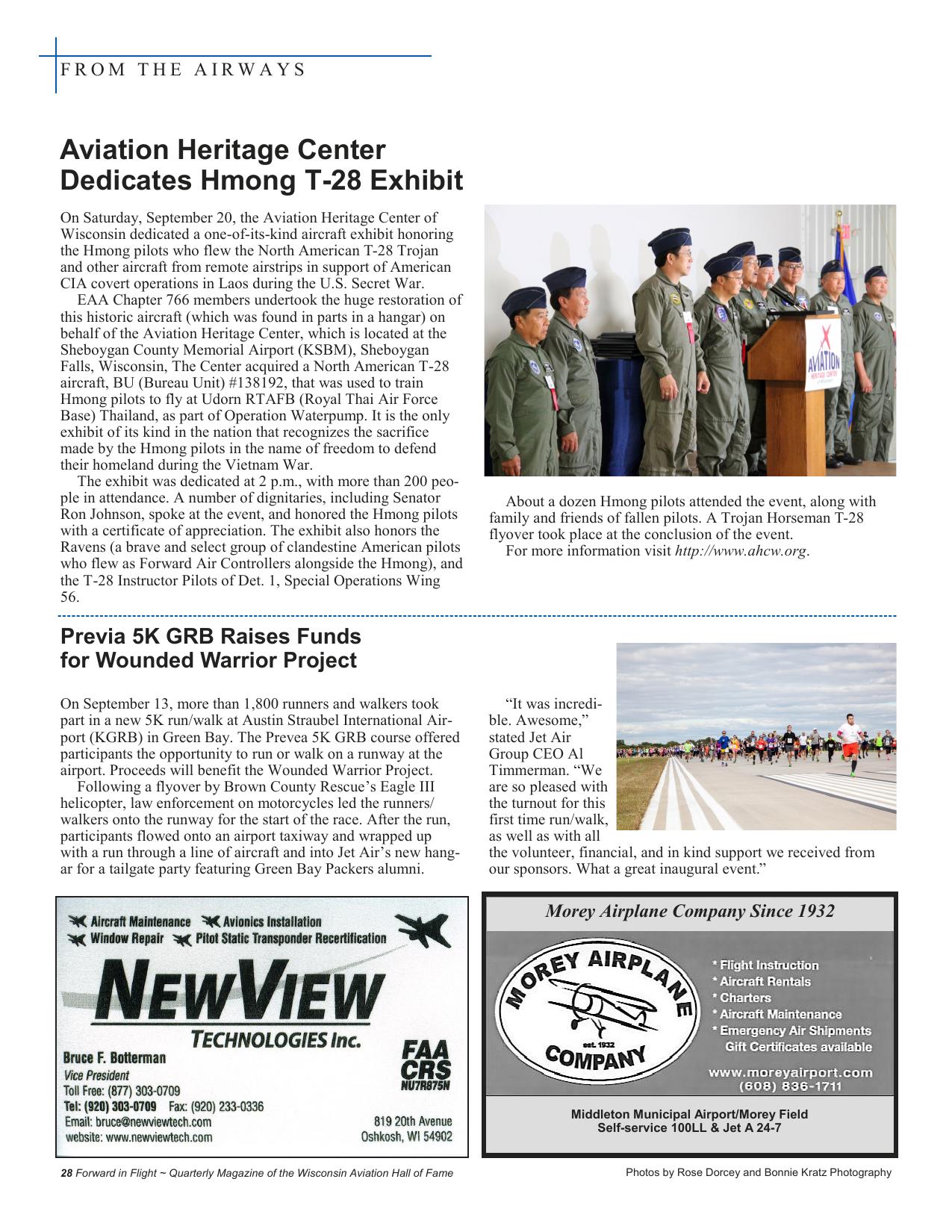
FROM THE AIRWAYS Aviation Heritage Center Dedicates Hmong T-28 Exhibit On Saturday, September 20, the Aviation Heritage Center of Wisconsin dedicated a one-of-its-kind aircraft exhibit honoring the Hmong pilots who flew the North American T-28 Trojan and other aircraft from remote airstrips in support of American CIA covert operations in Laos during the U.S. Secret War. EAA Chapter 766 members undertook the huge restoration of this historic aircraft (which was found in parts in a hangar) on behalf of the Aviation Heritage Center, which is located at the Sheboygan County Memorial Airport (KSBM), Sheboygan Falls, Wisconsin, The Center acquired a North American T-28 aircraft, BU (Bureau Unit) #138192, that was used to train Hmong pilots to fly at Udorn RTAFB (Royal Thai Air Force Base) Thailand, as part of Operation Waterpump. It is the only exhibit of its kind in the nation that recognizes the sacrifice made by the Hmong pilots in the name of freedom to defend their homeland during the Vietnam War. The exhibit was dedicated at 2 p.m., with more than 200 people in attendance. A number of dignitaries, including Senator Ron Johnson, spoke at the event, and honored the Hmong pilots with a certificate of appreciation. The exhibit also honors the Ravens (a brave and select group of clandestine American pilots who flew as Forward Air Controllers alongside the Hmong), and the T-28 Instructor Pilots of Det. 1, Special Operations Wing 56. About a dozen Hmong pilots attended the event, along with family and friends of fallen pilots. A Trojan Horseman T-28 flyover took place at the conclusion of the event. For more information visit http://www.ahcw.org. Previa 5K GRB Raises Funds for Wounded Warrior Project On September 13, more than 1,800 runners and walkers took part in a new 5K run/walk at Austin Straubel International Airport (KGRB) in Green Bay. The Prevea 5K GRB course offered participants the opportunity to run or walk on a runway at the airport. Proceeds will benefit the Wounded Warrior Project. Following a flyover by Brown County Rescue’s Eagle III helicopter, law enforcement on motorcycles led the runners/ walkers onto the runway for the start of the race. After the run, participants flowed onto an airport taxiway and wrapped up with a run through a line of aircraft and into Jet Air’s new hangar for a tailgate party featuring Green Bay Packers alumni. “It was incredible. Awesome,” stated Jet Air Group CEO Al Timmerman. “We are so pleased with the turnout for this first time run/walk, as well as with all the volunteer, financial, and in kind support we received from our sponsors. What a great inaugural event.” Morey Airplane Company Since 1932 Middleton Municipal Airport/Morey Field Self-service 100LL & Jet A 24-7 28 Forward in Flight ~ Quarterly Magazine of the Wisconsin Aviation Hall of Fame Photos by Rose Dorcey and Bonnie Kratz Photography
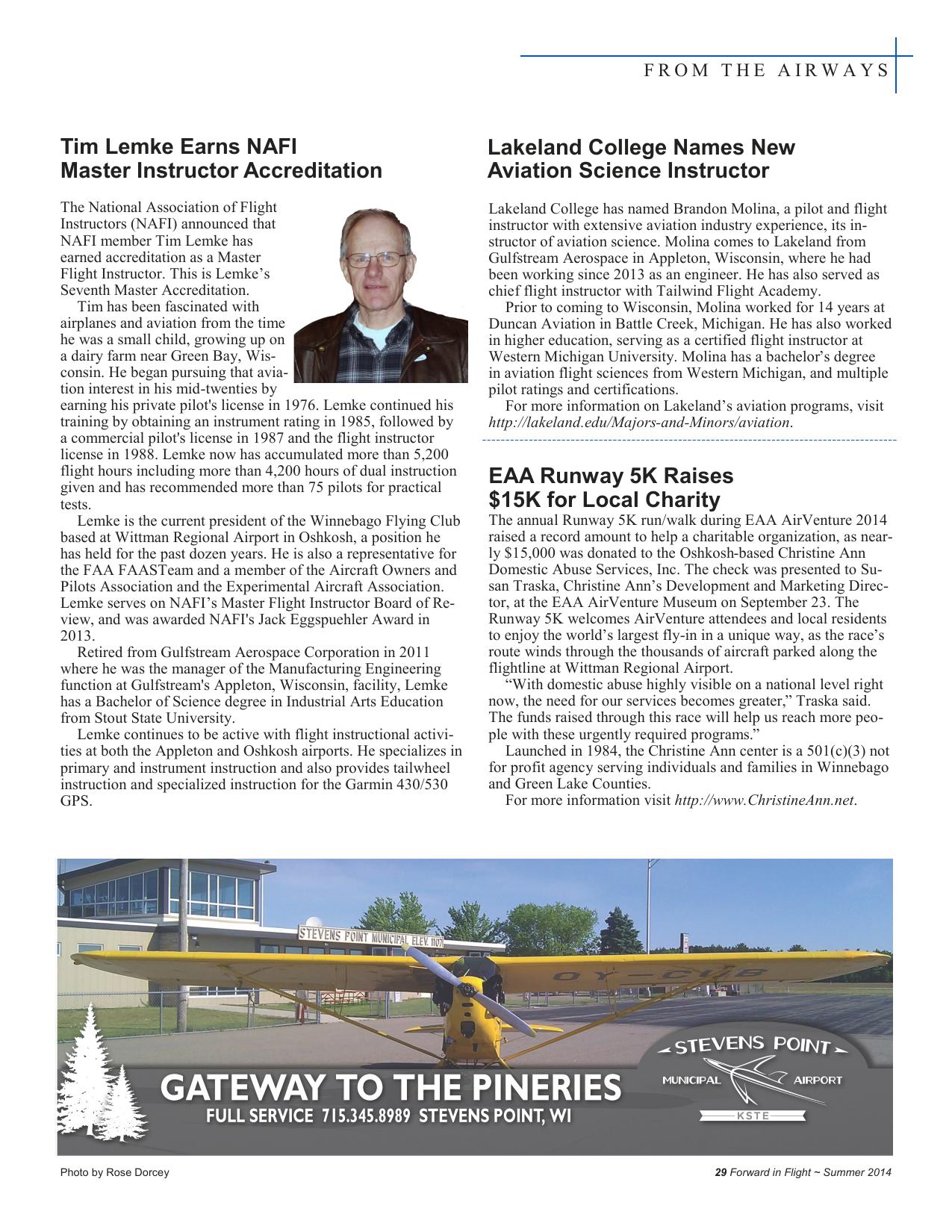
FROM THE AIRWAYS Tim Lemke Earns NAFI Master Instructor Accreditation Lakeland College Names New Aviation Science Instructor The National Association of Flight Instructors (NAFI) announced that NAFI member Tim Lemke has earned accreditation as a Master Flight Instructor. This is Lemke’s Seventh Master Accreditation. Tim has been fascinated with airplanes and aviation from the time he was a small child, growing up on a dairy farm near Green Bay, Wisconsin. He began pursuing that aviation interest in his mid-twenties by earning his private pilot's license in 1976. Lemke continued his training by obtaining an instrument rating in 1985, followed by a commercial pilot's license in 1987 and the flight instructor license in 1988. Lemke now has accumulated more than 5,200 flight hours including more than 4,200 hours of dual instruction given and has recommended more than 75 pilots for practical tests. Lemke is the current president of the Winnebago Flying Club based at Wittman Regional Airport in Oshkosh, a position he has held for the past dozen years. He is also a representative for the FAA FAASTeam and a member of the Aircraft Owners and Pilots Association and the Experimental Aircraft Association. Lemke serves on NAFI’s Master Flight Instructor Board of Review, and was awarded NAFI's Jack Eggspuehler Award in 2013. Retired from Gulfstream Aerospace Corporation in 2011 where he was the manager of the Manufacturing Engineering function at Gulfstream's Appleton, Wisconsin, facility, Lemke has a Bachelor of Science degree in Industrial Arts Education from Stout State University. Lemke continues to be active with flight instructional activities at both the Appleton and Oshkosh airports. He specializes in primary and instrument instruction and also provides tailwheel instruction and specialized instruction for the Garmin 430/530 GPS. Lakeland College has named Brandon Molina, a pilot and flight instructor with extensive aviation industry experience, its instructor of aviation science. Molina comes to Lakeland from Gulfstream Aerospace in Appleton, Wisconsin, where he had been working since 2013 as an engineer. He has also served as chief flight instructor with Tailwind Flight Academy. Prior to coming to Wisconsin, Molina worked for 14 years at Duncan Aviation in Battle Creek, Michigan. He has also worked in higher education, serving as a certified flight instructor at Western Michigan University. Molina has a bachelor’s degree in aviation flight sciences from Western Michigan, and multiple pilot ratings and certifications. For more information on Lakeland’s aviation programs, visit http://lakeland.edu/Majors-and-Minors/aviation. Photo by Rose Dorcey EAA Runway 5K Raises $15K for Local Charity The annual Runway 5K run/walk during EAA AirVenture 2014 raised a record amount to help a charitable organization, as nearly $15,000 was donated to the Oshkosh-based Christine Ann Domestic Abuse Services, Inc. The check was presented to Susan Traska, Christine Ann’s Development and Marketing Director, at the EAA AirVenture Museum on September 23. The Runway 5K welcomes AirVenture attendees and local residents to enjoy the world’s largest fly-in in a unique way, as the race’s route winds through the thousands of aircraft parked along the flightline at Wittman Regional Airport. “With domestic abuse highly visible on a national level right now, the need for our services becomes greater,” Traska said. The funds raised through this race will help us reach more people with these urgently required programs.” Launched in 1984, the Christine Ann center is a 501(c)(3) not for profit agency serving individuals and families in Winnebago and Green Lake Counties. For more information visit http://www.ChristineAnn.net. 29 Forward in Flight ~ Summer 2014
FROM THE AIRWAYS Ground is Broken for the Oshkosh Aviation Business Park After several years of planning, presentations, and negotiations, the Oshkosh Aviation Business Park is now officially underway. A groundbreaking ceremony was held on Thursday, September 4 and the infrastructure is scheduled to be completed within the next year. After a flyover by aircraft from Wittman Regional Airport based Sonex Aircraft and Basler Turbo Conversions, Chamco (Oshkosh Industrial Development Corporation) CEO Elizabeth Hartman kicked off the ceremony by thanking the many organizations that worked so hard to make this business park a reality. Other speakers at the ceremony included City Manager Mark Rohloff, County Executive Mark Harris and Lieutenant Governor Rebecca Kleefisch. Following the remarks of each speaker, representatives from the many groups that helped bring this new airport addition to fruition grabbed shovels and turned some dirt, officially marking the opening of the business park. The future of the Oshkosh Aviation Business Park appears bright. A business accelerator, anchored by AeroInnovate, is currently under development and is planned for one of the cityowned lots. D’Shannon Aviation, a recognized leader in modifi- cations for Beech Bonanza and Baron aircraft, has committed to moving its engine operations to Wittman Regional Airport. Discussions are underway with several other aviation entities to ultimately fill the park. For more information visit www.WittmanAirport.com. Women in Aviation Scholarship Deadline Approaches; Apply by Nov. 17 Adisen Fenrich Selected as Spirit of Flight Scholarship Recipient WAI scholarships for 2015 now number 91 with the value of $517,150. No matter what stage of your aviation career, fly for fun, or want to learn, Women in Aviation, International has a scholarship for you. These scholarships will be awarded during WAI’s 26th Annual International Conference in Dallas, Texas, March 5-7, 2015 at the Hilton Anatole. “Our scholarships are for any WAI member, not just for students. These scholarships change lives, open doors, and accelerate careers,” said WAI President Dr. Peggy Chabrian. In order to qualify for any WAI scholarship, the person must be an active WAI member as of November 1, 2014. All scholarship applications must be postmarked by November 17, 2014. Complete details on all scholarships as well as an application form and advice are available at www.wai.org. The Oshkosh Women in Aviation chapter has announced that Adisen Fenrich, 17, of Winneconne, has been selected as the chapter’s 2014 Spirit of Flight scholarship recipient. Adi said she hopes to use the $500 scholarship for a tailwheel checkout. The scholarship was presented during the WomenVenture Power Lunch at the Theater in the Woods on Wednesday, July 30 during EAA AirVenture 2014. Adisen earned her private pilot certificate in August. The Oshkosh Chapter’s Spirit of Flight Scholarship is open to women of all ages who have already soloed and are working on their recreational, sport pilot, private pilot, or commercial certificate, instrument or multiengine rating, or CFI. Preference will be given to Wisconsin residents, but all who qualify are encouraged to apply. The $500 award is paid to the flight school of the recipient’s choice. The deadline to apply for the 2015 scholarship is November 17, 2014. For more information visit www.wai.org. 30 Forward in Flight ~ Quarterly Magazine of the Wisconsin Aviation Hall of Fame Photos by Jennifer Jensen and Jeanne Fenrich
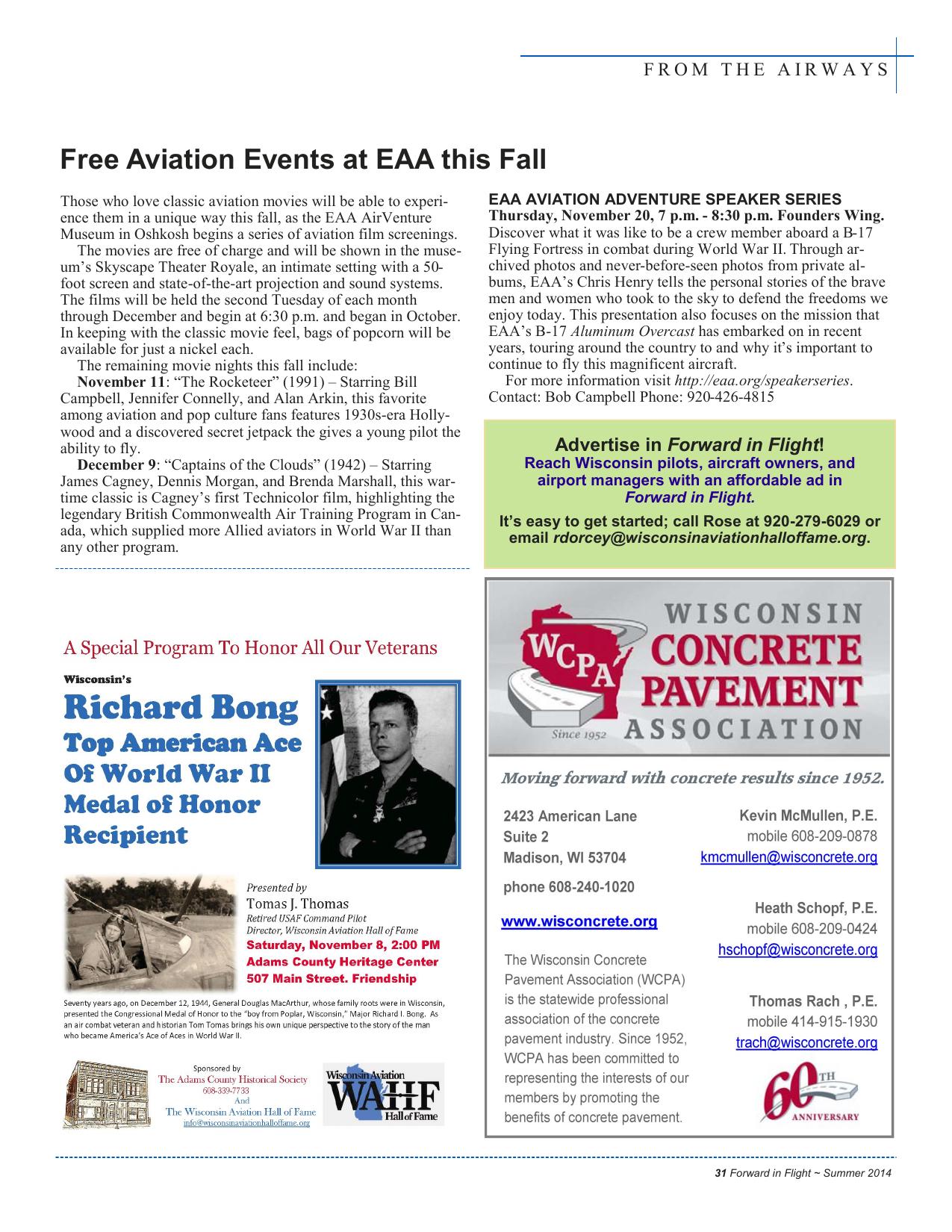
FROM THE AIRWAYS Free Aviation Events at EAA this Fall Those who love classic aviation movies will be able to experience them in a unique way this fall, as the EAA AirVenture Museum in Oshkosh begins a series of aviation film screenings. The movies are free of charge and will be shown in the museum’s Skyscape Theater Royale, an intimate setting with a 50foot screen and state-of-the-art projection and sound systems. The films will be held the second Tuesday of each month through December and begin at 6:30 p.m. and began in October. In keeping with the classic movie feel, bags of popcorn will be available for just a nickel each. The remaining movie nights this fall include: November 11: “The Rocketeer” (1991) – Starring Bill Campbell, Jennifer Connelly, and Alan Arkin, this favorite among aviation and pop culture fans features 1930s-era Hollywood and a discovered secret jetpack the gives a young pilot the ability to fly. December 9: “Captains of the Clouds” (1942) – Starring James Cagney, Dennis Morgan, and Brenda Marshall, this wartime classic is Cagney’s first Technicolor film, highlighting the legendary British Commonwealth Air Training Program in Canada, which supplied more Allied aviators in World War II than any other program. EAA AVIATION ADVENTURE SPEAKER SERIES Thursday, November 20, 7 p.m. - 8:30 p.m. Founders Wing. Discover what it was like to be a crew member aboard a B-17 Flying Fortress in combat during World War II. Through archived photos and never-before-seen photos from private albums, EAA’s Chris Henry tells the personal stories of the brave men and women who took to the sky to defend the freedoms we enjoy today. This presentation also focuses on the mission that EAA’s B-17 Aluminum Overcast has embarked on in recent years, touring around the country to and why it’s important to continue to fly this magnificent aircraft. For more information visit http://eaa.org/speakerseries. Contact: Bob Campbell Phone: 920-426-4815 Advertise in Forward in Flight! Reach Wisconsin pilots, aircraft owners, and airport managers with an affordable ad in Forward in Flight. It’s easy to get started; call Rose at 920-279-6029 or email rdorcey@wisconsinaviationhalloffame.org. 31 Forward in Flight ~ Summer 2014
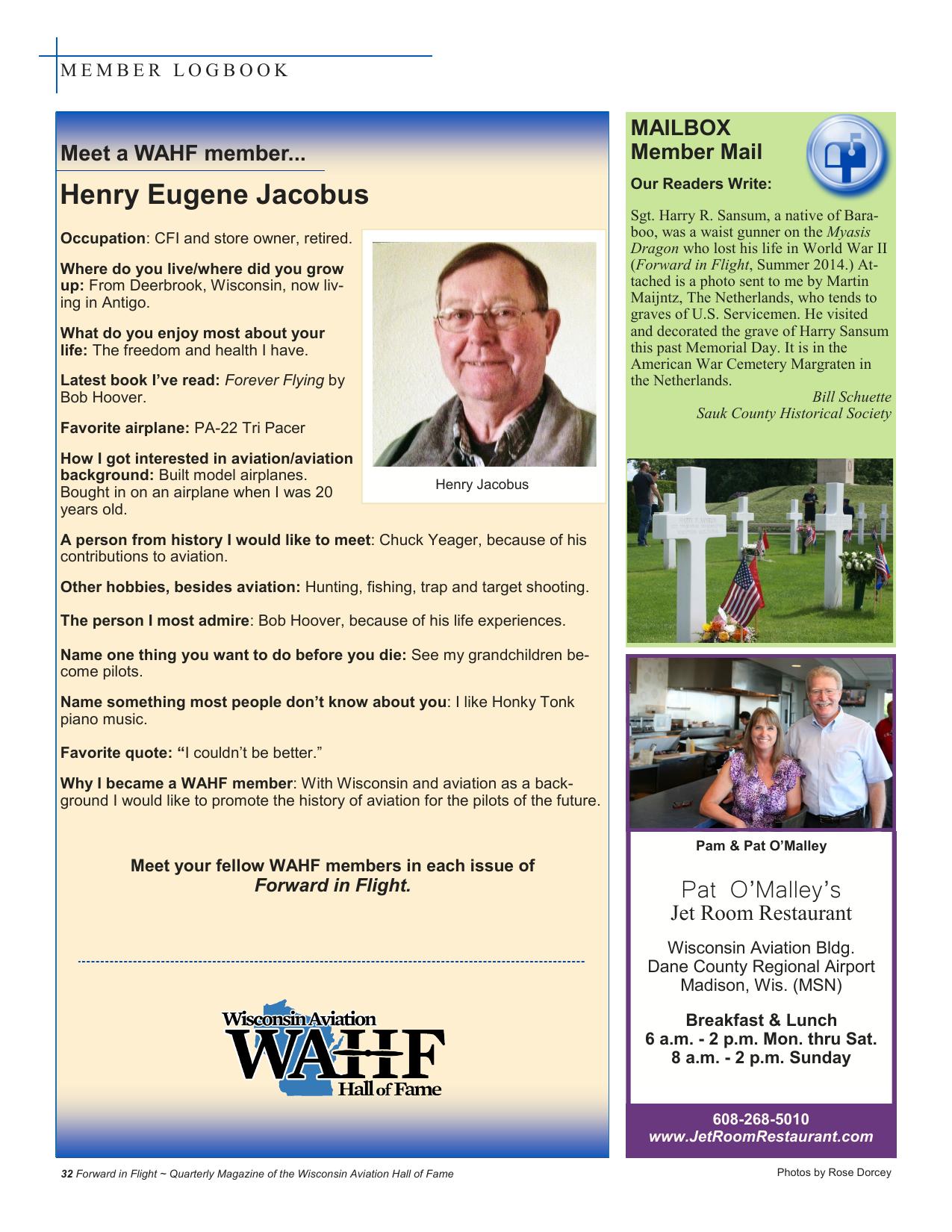
MEMBER LOGBOOK MAILBOX Member Mail Meet a WAHF member... Our Readers Write: Henry Eugene Jacobus Sgt. Harry R. Sansum, a native of Baraboo, was a waist gunner on the Myasis Dragon who lost his life in World War II (Forward in Flight, Summer 2014.) Attached is a photo sent to me by Martin Maijntz, The Netherlands, who tends to graves of U.S. Servicemen. He visited and decorated the grave of Harry Sansum this past Memorial Day. It is in the American War Cemetery Margraten in the Netherlands. Bill Schuette Sauk County Historical Society Occupation: CFI and store owner, retired. Where do you live/where did you grow up: From Deerbrook, Wisconsin, now living in Antigo. What do you enjoy most about your life: The freedom and health I have. Latest book I’ve read: Forever Flying by Bob Hoover. Favorite airplane: PA-22 Tri Pacer How I got interested in aviation/aviation background: Built model airplanes. Bought in on an airplane when I was 20 years old. Henry Jacobus A person from history I would like to meet: Chuck Yeager, because of his contributions to aviation. Other hobbies, besides aviation: Hunting, fishing, trap and target shooting. The person I most admire: Bob Hoover, because of his life experiences. Name one thing you want to do before you die: See my grandchildren become pilots. Name something most people don’t know about you: I like Honky Tonk piano music. Favorite quote: “I couldn’t be better.” Why I became a WAHF member: With Wisconsin and aviation as a background I would like to promote the history of aviation for the pilots of the future. Pam & Pat O’Malley Meet your fellow WAHF members in each issue of Forward in Flight. Pat O’Malley’s Jet Room Restaurant Wisconsin Aviation Bldg. Dane County Regional Airport Madison, Wis. (MSN) Breakfast & Lunch 6 a.m. - 2 p.m. Mon. thru Sat. 8 a.m. - 2 p.m. Sunday 608-268-5010 www.JetRoomRestaurant.com 32 Forward in Flight ~ Quarterly Magazine of the Wisconsin Aviation Hall of Fame Photos by Rose Dorcey

Wittman Regional Airport Oshkosh So much history ...and still making it! From the legacy of Steve Wittman to Warren Basler’s DC-3 conversions, we’re proud to support and contribute to Wisconsin aviation history. FLY TO OSHKOSH wittmanairport.com @wittmanairport
PRSRT STD US Postage Paid Wisc Rapids WI Permit 98 3980 SHARRATT DRIVE OSHKOSH WI 54901-1276 The Wisconsin Aviation Hall of Fame is a non-profit membership organization dedicated to preserving the past and fostering the future of flight. Welcome WAHF Member/Supporters: Barb Bohmann Russell Brodtke Dennis Faivre Margaret Foerster Steve Foerster Barbara Gretschman Lynn Howard Gary Huempfner David Isabell Rick Jansing Russell Klingaman Luke Lachendro Dave Mann* Georgeann Doersch Paddock Glenn Ruskaup Charles Vehlow Joan Vehlow Ed Vopelak Allen Zielieke —Thanks for coming on board. We hope to see you at a WAHF event soon! * Upgrade to Life Membership AVIATION EVENTS: Poker Run - Saturday, October 18, 9 a.m. Alexander Field - South Wood County Airport (KISW) Route: Wisconsin Rapids, Marshfield, Stevens Point, Wautoma, Waupaca, and finish at Wisconsin Rapids. Small registration fee for prizes and lunch. If necessary to cancel, notice will be posted on the EAA Chapter 706 Facebook page no later than 8 a.m. on October 18. Call Merlin Bauer at 715-424-5581 or email merlinb@charter.net for more information. FOR SALE 1977 Cessna 172N. Midwest based airplane, always hangared. Located in Wisconsin at Brennand Airport (79C). AFTT 2500, TSMOH 400, $49,500. Call Brett at 920-740-7817. Wisconsin Aviation Hall of Fame Officers Rose Dorcey, President Tom Thomas, Vice-President John Dorcey, Secretary/Treasurer Board of Directors Bruce Botterman Andrew Ovans Henry Peterson Charles Swain Wynne Williams Ron Wojnar Charles Marotske, Honorary Chairman of the Board Wisconsin Aviation Hall of Fame 3980 Sharratt Drive Oshkosh, WI 54901-1276 Become a supporter today! For information call Rose Dorcey at 920-385-1483 www.wisconsinaviationhalloffame.org rdorcey@wisconsinaviationhalloffame.org