Volume 13, Issue 3
🗞️ Download Issue (PDF)
Forward in Flight - Fall 2015
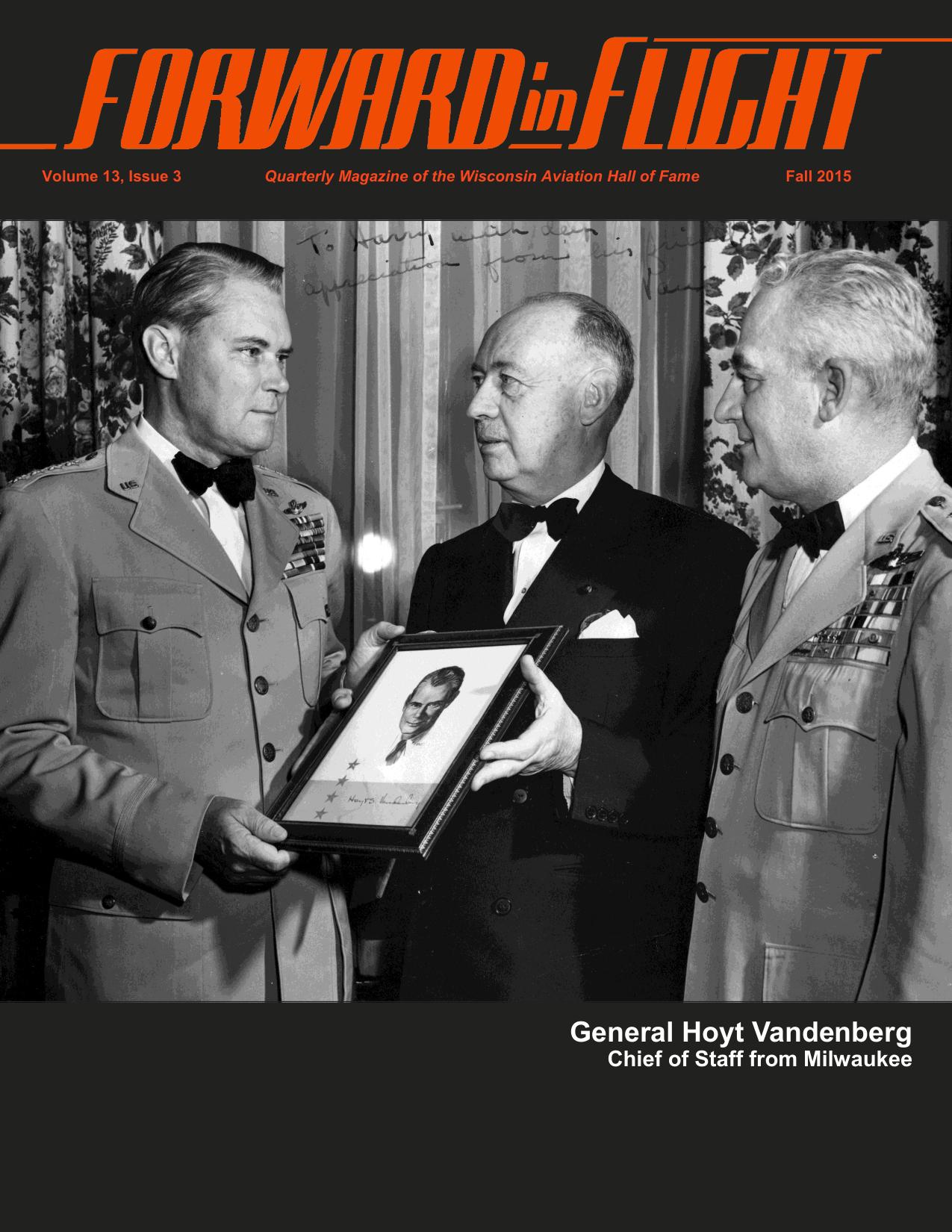
Volume 13, Issue 3 Quarterly Magazine of the Wisconsin Aviation Hall of Fame Fall 2015 General Hoyt Vandenberg Chief of Staff from Milwaukee
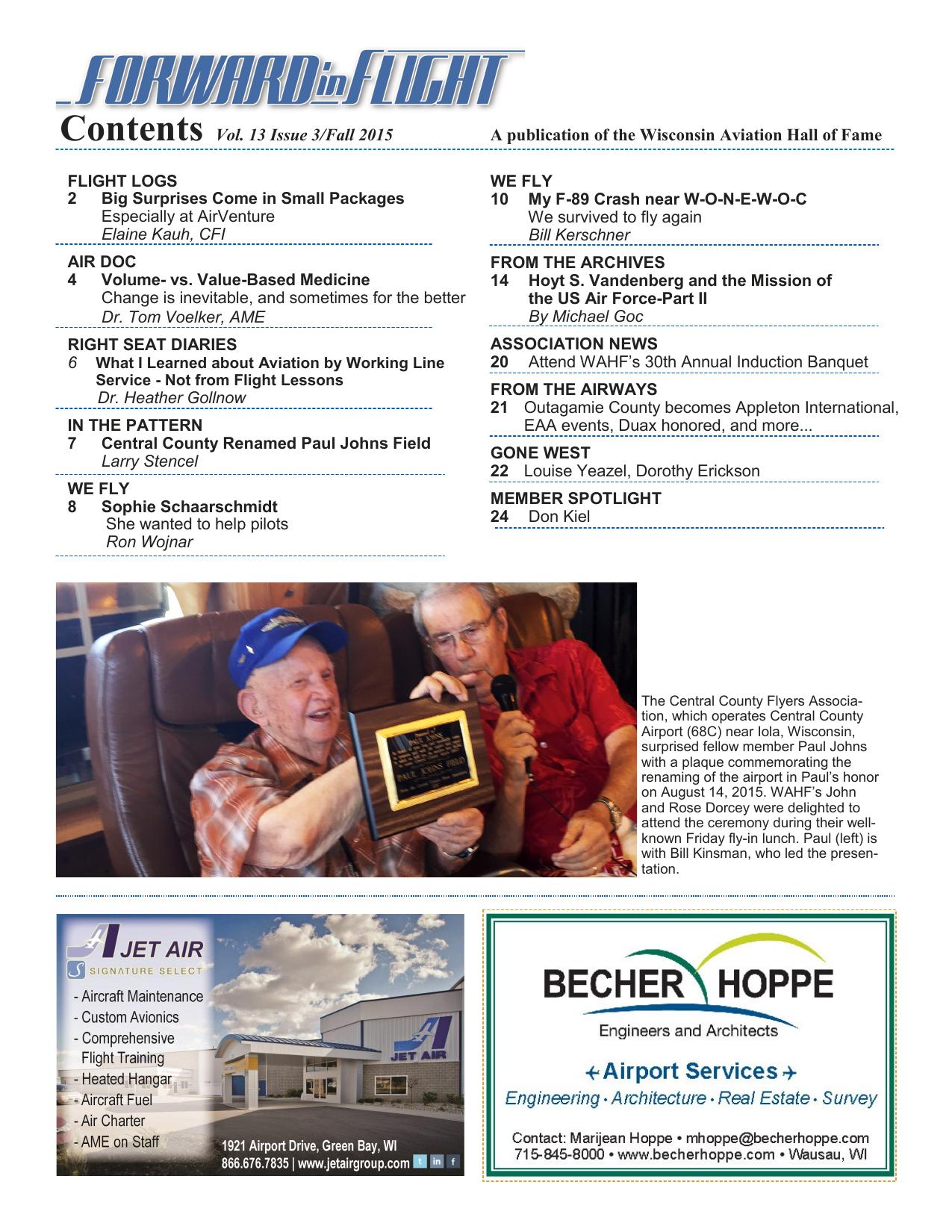
Contents Vol. 13 Issue 3/Fall 2015 A publication of the Wisconsin Aviation Hall of Fame FLIGHT LOGS 2 Big Surprises Come in Small Packages Especially at AirVenture Elaine Kauh, CFI WE FLY 10 My F-89 Crash near W-O-N-E-W-O-C We survived to fly again Bill Kerschner AIR DOC 4 Volume- vs. Value-Based Medicine Change is inevitable, and sometimes for the better Dr. Tom Voelker, AME FROM THE ARCHIVES 14 Hoyt S. Vandenberg and the Mission of the US Air Force-Part II By Michael Goc RIGHT SEAT DIARIES 6 What I Learned about Aviation by Working Line ASSOCIATION NEWS 20 Attend WAHF’s 30th Annual Induction Banquet Service - Not from Flight Lessons Dr. Heather Gollnow IN THE PATTERN 7 Central County Renamed Paul Johns Field Larry Stencel WE FLY 8 Sophie Schaarschmidt She wanted to help pilots Ron Wojnar FROM THE AIRWAYS 21 Outagamie County becomes Appleton International, EAA events, Duax honored, and more... GONE WEST 22 Louise Yeazel, Dorothy Erickson MEMBER SPOTLIGHT 24 Don Kiel The Central County Flyers Association, which operates Central County Airport (68C) near Iola, Wisconsin, surprised fellow member Paul Johns with a plaque commemorating the renaming of the airport in Paul’s honor on August 14, 2015. WAHF’s John and Rose Dorcey were delighted to attend the ceremony during their wellknown Friday fly-in lunch. Paul (left) is with Bill Kinsman, who led the presentation.
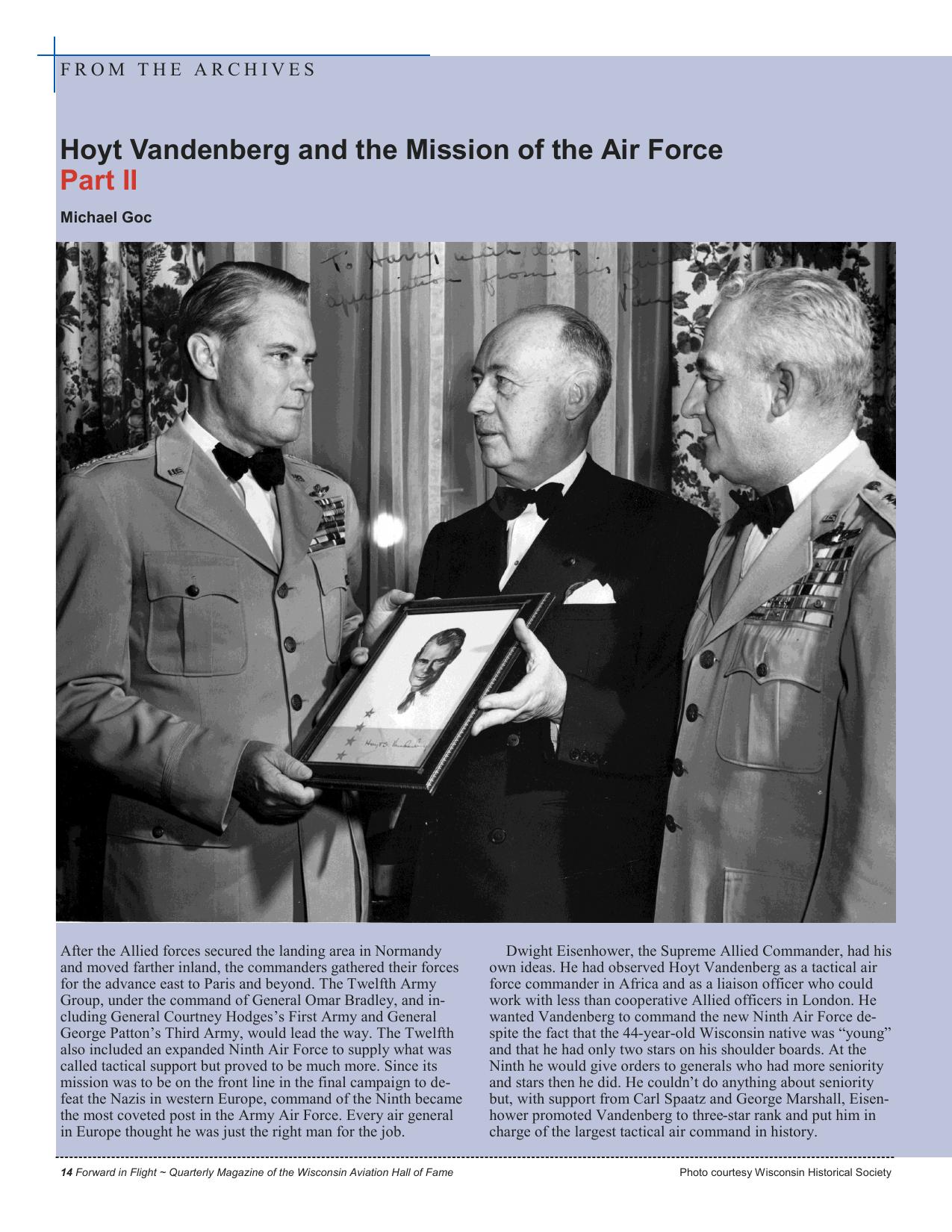
President’s Message ~ by Rose Dorcey Driving home from Sunday Mass a few weeks back, my husband, John, said to me, “Call Steve Krog, let’s get some flight lessons scheduled to get your tailwheel endorsement. We’ve been talking about this for too long.” Who was I to argue? I called Steve right away. He answered the phone and within minutes we had a flight scheduled in one of his three Piper Cubs. We arrived at Cub Air Flight at the Hartford Municipal Airport (HXF) a few days later. After just one flight I was absolutely hooked. Door down, window open, flying in the pattern 500 feet above the ground, feeling the wind on my face... this is the kind of flying I had longed for, and didn’t even know it until that first flight. Since then, I’ve had about eight flights in a Piper Cub, and I’m getting close to earning the tailwheel endorsement. It’s been challenging and fun and it’s absolutely been the best flying of my life. What I’ve learned in just a few short hours has already carried over to my usual flying in a 172. I’m losing my discomfort with landing on grass. My slips are more aggressive. I can’t wait to do some crosswinds in the 172, after tackling 90-degree, 17 knots crosswind wheel landings on the hard surface of Runway 29 at Hartford, landing on one wheel. One wheel! Three weeks ago I started training for a 10k run. I’ve read a lot about training, the benefits of running, and about the “Runner’s High” …studies show that running elicits a flood of endorphins in the brain. These endorphins are associated with mood changes, and the more an athlete pumps them out, the greater the effect. The endorphins can make runs feel easy, exhilarating, euphoric even. Well guess what? That’s exactly how I feel after flying the Cub. A Cub high, I guess, and while I can’t say that it makes all the flights feel easy— those 90-degree crosswinds sometimes make me sweat—it definitely feels good, definitely feels exhilarating. I’ll be going back for more next week. If you’ve never flown a Cub, I definitely recommend that you try it, at least once. But it’s likely that just one flight will lead to more. You’ll likely feel the same way I do, and that’s a great feeling! Forward in Flight The only magazine dedicated exclusively to Wisconsin aviation history and today’s events. Rose Dorcey, editor 3980 Sharratt Drive Oshkosh, WI 54901-1276 Phone: 920-385-1483 920-279-6029 rdorcey@wisconsinaviationhallofame.org The Wisconsin Aviation Hall of Fame is a non-profit membership organization with a mission to collect and preserve the history of aviation in Wisconsin, recognize those who made that history, inform others of it, and promote aviation education for future generations. It’s mid September and your WAHF board members are working on all kinds of things. Forward in Flight is about to go to the printer. Induction banquet planning is in full swing with invitations mailed out, registrations coming in, plaque scripts being written, and presenters preparing their talks. It won’t be long until members who renew on an annual basis will begin receiving renewal notices. All of these things happen because we have a dedicated group of volunteer board members, along with friends who help too. Thanks to all of you who give of your time and talent to WAHF. Membership is the lifeblood of most any organization. We sincerely hope you’ll continue to be an active WAHF member. Attend the membership meeting on October 24, and then stay for the induction banquet. We think you’ll love to hear of the inductees’ extraordinary backgrounds, and enjoy meeting them even more. When your renewal notice comes in early December, please renew promptly. I’ve said it before and will again, you are appreciated more than you know. Thank you in advance for your continued support. Longtime readers will be delighted, as I am, to see Dr. Heather Gollnow’s name back in the pages of Forward in Flight. Dr. Gollnow moved to Maryland awhile back and was busy growing her career and finishing her PhD. With the PhD behind her, and a move to Arizona, she’s found time to begin writing again. I’ve always enjoyed her fresh perspective on aviation matters, and judging from comments received by our readers, you’ve enjoyed her articles too. In this issue she covers some much needed aviation etiquette and things to think about that may make your flying —and ground time, at least while at the airport anyway—more enjoyable. Welcome back! On the cover: Vandenberg (left) and Nathan Twining visited Milwaukee in the late 1940s and Vandenberg presented aviation publicist Harry Bruno with an autographed photo. Twining succeeded Vandenberg as Air Force Chief of Staff and went on to become the first Air Force Chief to chair the Joint Chiefs of Staff. Vandenberg and Twining were the highest ranking Air Force officers born in Wisconsin. Photo courtesy of Wisconsin Historical Society.
FLIGHT LOGS Big Surprises Come in Small Packages Especially at AirVenture By Elaine Kauh To stand beneath the wings and engines of a B-52 Stratofortress and take in the awesome size, and then to think about what these bombers have seen in their decades of service, is a rare opportunity. I knew months before Oshkosh’s big show this year that the B-52 has a wingspan of about 185 feet – a tight squeeze to fit onto Wittman Regional Airport’s longest runway – but without much else to compare it to, the Stratofortress was hard to picture until seeing the real thing. As I stood on tiptoe and peered into the yawning Pratt & Whitney turbines, I thought, this is cool. The sight was somewhat surprising, but it wasn’t by any means a big shock. Big is big, and this aircraft carries with it a well-known heritage of the likes that few others can claim. It also was a bit surprising to see the elegant hulk of the Airbus A350 widebody airliner, which actually dwarfed the B-52 at center stage in Boeing Square with a wingspan of more than 200 feet. I’d read about the A350 when I learned it would be opened up to visitors at Oshkosh and again, couldn’t grasp the size until I saw it for myself. I loved the winglets, which really were giant wings in and of themselves, sculpted into one of the world’s biggest airfoils. Tall flights of air stairs took visitors inside the A350, and the lines stretched out over the square. No surprise there. We have few chances to see such aircraft at our leisure, with likeminded people who also know very well what they’re looking at, and still get a thrill every time. This is what it’s all about. There are many such “wow” moments at Oshkosh, but the biggest surprises I encountered there this year were far more personal in nature, and in the form of two much tinier airplanes. Both took place on the same day, my last at Oshkosh, and within a couple of hours of each other at my perennial favorite, the Vintage display and campground. The first surprise was on show before the Vintage Hangar, shining in the sun—the second Aeronca Chief I’d ever seen in my life. Something tells me that I would have stopped to admire this 2015 award winner no matter what, but the fact that I now have 10 hours in a Chief and some historical knowledge gave me a new perspective on it. It seems today that most passengers (and their pilots) prefer side-by-side seating and a control stick that doesn’t interfere with their shifting about in the cabin. The Chiefs, at least in my own travels, are far rarer than the Aeronca Champ. I logged quite a few hours in Champs early on in my flying career and not until recently did I ever see a Chief— when a new client presented the airplane he bought to learn to fly in. As an instructor I had the duty of due diligence, learning about the Chief before getting in it, but admittedly it was more curiosity that had me looking into the origins of the Chief and the Champ. The history of the two Aeroncas is a bit complex and the timeline a bit blurry in places due to different entities owning the type designs over the years, but a few useful tidbits came out in the records: They were born in Ohio in the mid-1940s as fraternal twins, designed to be two variations of the same basic design. They share around 75 percent of the same components, including flight control surfaces and wings. The Champ is tandem-seat and stick-flown, while the Chief has sideby-side seats and flies with a yoke. The 2 Forward in Flight ~ Quarterly Magazine of the Wisconsin Aviation Hall of Fame Champ apparently outsold the Chief when both were in production, although there doesn’t seem to be any clearly stated reasons as to why this was the case. It seems today that most passengers (and their pilots) prefer side-by-side seating and a control stick that doesn’t interfere with their shifting about in the cabin. Perhaps in the ’40s it was the other way around! Could be, since most pilots at the time—military and civilian—learned to fly in stick-and-rudder tandem trainers. Aeronca stopped producing the airplanes around 1950 and the plans changed hands. By the 1970s, Bellanca Aircraft had them. Eventually, the Champ/Chief designs, as well as their other brethren, Bellanca’s Citabria/ Decathlon series, came under ownership of American Champion Aircraft, which operates today in Rochester, Wisconsin. (ACA continues to manufacture and service its popular series of tandem-seat Scouts, Citabrias, and Decathlons, which feature modern improvements but overall have changed little from their original looks.) The Chief on display at Vintage was perfectly restored, sporting a pretty sunflower-yellow color. Every detail was considered, from the classic-style yokes and the fat throttle knob that you cup in the palm of your hand while flying. The one I’m building time in has a similar golden-yellow color and the same big throttle knob. I gained a new appreciation for what it must have felt like to be able to buy a brand new Chief in 1946. It’s also a nice feeling to know that after all these years, the airframes still out there flying have held up nicely, parts can be obtained, and pilots still want to learn to fly them. After taking my photos of the Chief and strolling on to meet a friend for lunch, I was thinking that this had turned out to be a great day. Yet the biggest surprise was yet to come. I took my time walking back through the vintage
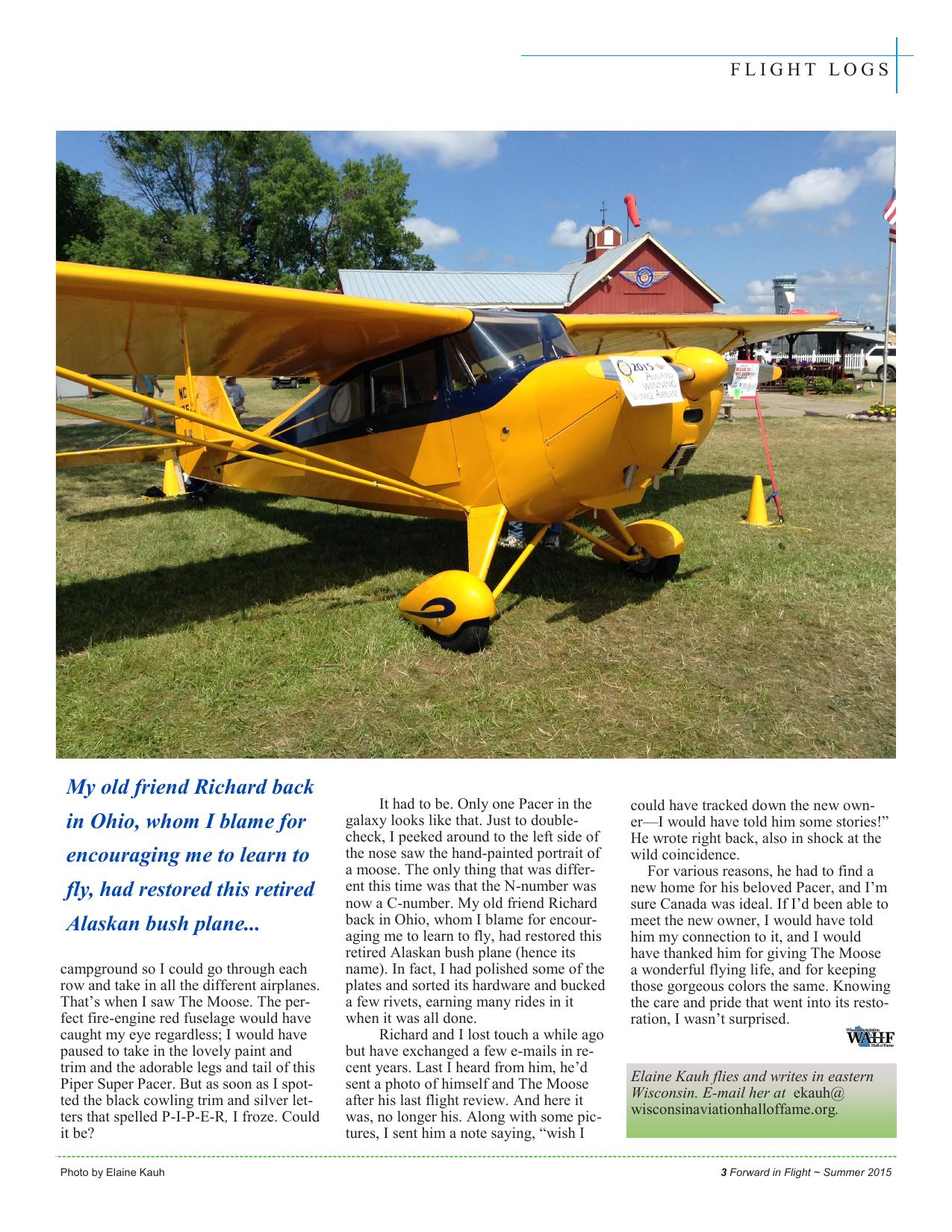
FLIGHT LOGS My old friend Richard back in Ohio, whom I blame for encouraging me to learn to fly, had restored this retired Alaskan bush plane... campground so I could go through each row and take in all the different airplanes. That’s when I saw The Moose. The perfect fire-engine red fuselage would have caught my eye regardless; I would have paused to take in the lovely paint and trim and the adorable legs and tail of this Piper Super Pacer. But as soon as I spotted the black cowling trim and silver letters that spelled P-I-P-E-R, I froze. Could it be? Photo by Elaine Kauh It had to be. Only one Pacer in the galaxy looks like that. Just to doublecheck, I peeked around to the left side of the nose saw the hand-painted portrait of a moose. The only thing that was different this time was that the N-number was now a C-number. My old friend Richard back in Ohio, whom I blame for encouraging me to learn to fly, had restored this retired Alaskan bush plane (hence its name). In fact, I had polished some of the plates and sorted its hardware and bucked a few rivets, earning many rides in it when it was all done. Richard and I lost touch a while ago but have exchanged a few e-mails in recent years. Last I heard from him, he’d sent a photo of himself and The Moose after his last flight review. And here it was, no longer his. Along with some pictures, I sent him a note saying, “wish I could have tracked down the new owner—I would have told him some stories!” He wrote right back, also in shock at the wild coincidence. For various reasons, he had to find a new home for his beloved Pacer, and I’m sure Canada was ideal. If I’d been able to meet the new owner, I would have told him my connection to it, and I would have thanked him for giving The Moose a wonderful flying life, and for keeping those gorgeous colors the same. Knowing the care and pride that went into its restoration, I wasn’t surprised. Elaine Kauh flies and writes in eastern Wisconsin. E-mail her at ekauh@ wisconsinaviationhalloffame.org. 3 Forward in Flight ~ Summer 2015
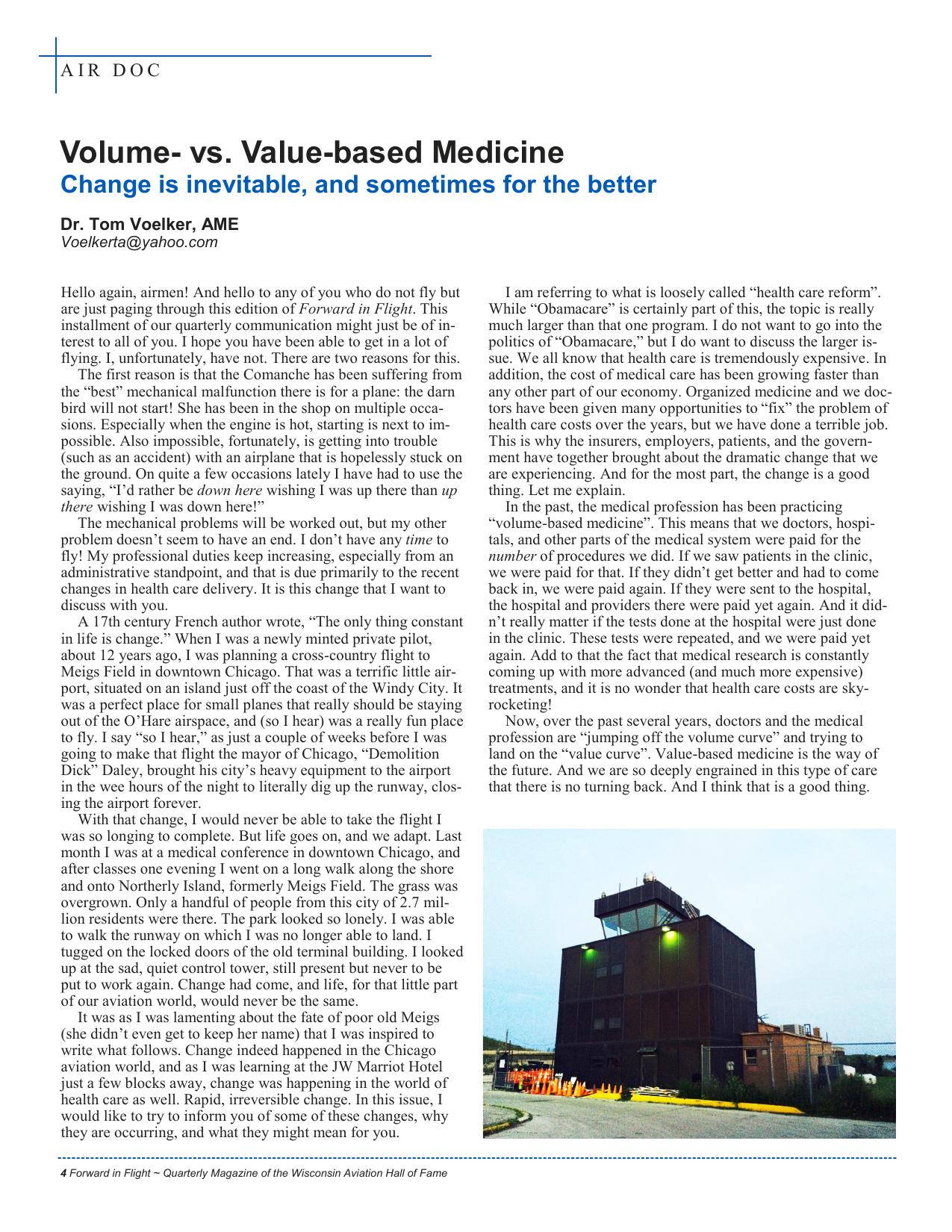
AIR DOC Volume- vs. Value-based Medicine Change is inevitable, and sometimes for the better Dr. Tom Voelker, AME Voelkerta@yahoo.com Hello again, airmen! And hello to any of you who do not fly but are just paging through this edition of Forward in Flight. This installment of our quarterly communication might just be of interest to all of you. I hope you have been able to get in a lot of flying. I, unfortunately, have not. There are two reasons for this. The first reason is that the Comanche has been suffering from the “best” mechanical malfunction there is for a plane: the darn bird will not start! She has been in the shop on multiple occasions. Especially when the engine is hot, starting is next to impossible. Also impossible, fortunately, is getting into trouble (such as an accident) with an airplane that is hopelessly stuck on the ground. On quite a few occasions lately I have had to use the saying, “I’d rather be down here wishing I was up there than up there wishing I was down here!” The mechanical problems will be worked out, but my other problem doesn’t seem to have an end. I don’t have any time to fly! My professional duties keep increasing, especially from an administrative standpoint, and that is due primarily to the recent changes in health care delivery. It is this change that I want to discuss with you. A 17th century French author wrote, “The only thing constant in life is change.” When I was a newly minted private pilot, about 12 years ago, I was planning a cross-country flight to Meigs Field in downtown Chicago. That was a terrific little airport, situated on an island just off the coast of the Windy City. It was a perfect place for small planes that really should be staying out of the O’Hare airspace, and (so I hear) was a really fun place to fly. I say “so I hear,” as just a couple of weeks before I was going to make that flight the mayor of Chicago, “Demolition Dick” Daley, brought his city’s heavy equipment to the airport in the wee hours of the night to literally dig up the runway, closing the airport forever. With that change, I would never be able to take the flight I was so longing to complete. But life goes on, and we adapt. Last month I was at a medical conference in downtown Chicago, and after classes one evening I went on a long walk along the shore and onto Northerly Island, formerly Meigs Field. The grass was overgrown. Only a handful of people from this city of 2.7 million residents were there. The park looked so lonely. I was able to walk the runway on which I was no longer able to land. I tugged on the locked doors of the old terminal building. I looked up at the sad, quiet control tower, still present but never to be put to work again. Change had come, and life, for that little part of our aviation world, would never be the same. It was as I was lamenting about the fate of poor old Meigs (she didn’t even get to keep her name) that I was inspired to write what follows. Change indeed happened in the Chicago aviation world, and as I was learning at the JW Marriot Hotel just a few blocks away, change was happening in the world of health care as well. Rapid, irreversible change. In this issue, I would like to try to inform you of some of these changes, why they are occurring, and what they might mean for you. 4 Forward in Flight ~ Quarterly Magazine of the Wisconsin Aviation Hall of Fame I am referring to what is loosely called “health care reform”. While “Obamacare” is certainly part of this, the topic is really much larger than that one program. I do not want to go into the politics of “Obamacare,” but I do want to discuss the larger issue. We all know that health care is tremendously expensive. In addition, the cost of medical care has been growing faster than any other part of our economy. Organized medicine and we doctors have been given many opportunities to “fix” the problem of health care costs over the years, but we have done a terrible job. This is why the insurers, employers, patients, and the government have together brought about the dramatic change that we are experiencing. And for the most part, the change is a good thing. Let me explain. In the past, the medical profession has been practicing “volume-based medicine”. This means that we doctors, hospitals, and other parts of the medical system were paid for the number of procedures we did. If we saw patients in the clinic, we were paid for that. If they didn’t get better and had to come back in, we were paid again. If they were sent to the hospital, the hospital and providers there were paid yet again. And it didn’t really matter if the tests done at the hospital were just done in the clinic. These tests were repeated, and we were paid yet again. Add to that the fact that medical research is constantly coming up with more advanced (and much more expensive) treatments, and it is no wonder that health care costs are skyrocketing! Now, over the past several years, doctors and the medical profession are “jumping off the volume curve” and trying to land on the “value curve”. Value-based medicine is the way of the future. And we are so deeply engrained in this type of care that there is no turning back. And I think that is a good thing.
AIR DOC So what is “value-based medicine?” The best way to answer this is to explain a concept in health care that we are all trying to follow: the “Triple Aim”. This is a concept developed in 2007 by the IHI (Institute for Healthcare Improvement), a non-profit health care organization out of Cambridge, Massachusetts, that is leading the innovative changes in health care worldwide. The idea of the “Triple Aim” is to deliver health care: · That will improve patient satisfaction · That will improve the health of entire populations · And at a reduced cost. It is no longer enough for your doctors to treat your condition and make you better. Now they need to provide good customer service while they are working with you. It is no longer enough for your doctors to treat your condition and make you better. Now they need to provide good customer service while they are working with you. In addition to treating your cough, high blood pressure, or whatever you are seeing them for, you can expect to have a discussion about your weight, your smoking habits, or perhaps the throw rugs in your kitchen that can be a tripping hazard. In addition, these treatments need to be provided at a controlled cost. This is a tall order and one that is beyond your doctor alone. More and more your health care provider is working in a team. There are doctors, nurse practitioners and physician’s assistants, nurses, medical assistants, and the newest addition, the Medical Home coordinators. (I’ll speak about medical home specifically is a little bit.) All of these people are working to make you and the rest of the population they treat healthier. To do this, especially to manage the entire population, we now have changed to the “electronic medical record.” Obamacare and other federal programs have essentially legislated this change, as any providers not using these computerized records are getting reimbursed less and less for the care they provide, particularly to patients insured by government, such as those patients on Medicare and Medicaid. The electronic record is really a very good improvement (despite what your own doctor might tell you!). Finding information from previous visits used to be nearly impossible when thumbing through thick paper charts, often with illegible handwriting. (We are doctors, after all!) Problem lists can be easily updated, and knowing all of a patient’s medical problems and history helps make the care we provide safer and less costly. The electronic record also directly contributes to the prevention of medical errors. If I try to prescribe a medication to which a particular patient is allergic, or if the dose I prescribe is too large for the patient’s decreased kidney function, the “computer” will generate a “pop-up” warning, alerting me of the potential error, before I can finish the order. So, you might ask, how does all of this save money for the patients and the population? That question is at the heart of the change to value-based care. More and more we doctors, hospi- tals, and medical systems are getting paid premiums for achieving certain health standards (or in some cases, being charged penalties for not meeting these goals). Examples include getting a certain percentage of all of our diabetic patients to a high level of glucose or sugar control, decreasing the number of our patients with high blood pressure, decreasing the readmission rate to hospitals, and increasing the number of “tobacco-free” patients in our population. This change is brought about in large part by two programs: medical home and transitions of care. I could write pages on each of these, but I will spare you. The short description is as follows. Medical home is a process in which the staff (usually RNs and social workers) work with the doctors and other providers to help patients institute lifestyle changes such as dietary changes and smoking cessation. These providers are often experts in diabetic education, as that condition is one of the most significant in the explosion of medical care costs and complications over the years. Care coordination is done by staff, again usually social workers and nurses, who follow patients from the hospital to home care to the primary care doctors office to the specialist’s follow-up appointments, making sure everything is done is a timely and coordinated manner. These people are also the ones who coordinate enrollment in some of the programs that we doctors don’t have the time to deal with as we are getting increasingly busy, such as home-delivered meals or arranging for pharmaceutical company medication discount programs for the indigent. The real story in this side of the value-based care program, however, is that the work of the medical home and the care coordinators is done at no cost to the patients. The medical system makes up for this cost (and then some) by increasing the health of the patients, decreasing the rates of hospital admissions, and decreasing the cost of care to the system. Because we are being paid ever more for the quality, not quantity, of the care we deliver, the medical systems come out ahead as well. We have happier and healthier patients and everyone saves money. And that is precisely the “Triple Aim”. The next time you see your doctor, nurse practitioner, or physician’s assistant, ask about the triple aim. While they might grumble a little about the way medicine is changing, it’s likely they would know what you are talking about, and they can probably add to what I have discussed here. The one thing I know for sure is that they will not mention the “old triple aim” that we pilots used to follow but due to change will never again be able to experience: · Look down the runway · Nose wheel on the centerline · Main gear touchdown on the stripes – as we experience the thrill of landing at Meigs field! I hope you feel at least a little enlightened, or that you understand a little more of what is going on around you as we all strive to improve our health. Happy flying! —Alpha Mike “Alpha Mike” is Dr. Tom Voelker, AME, a family practitioner in Wisconsin Rapids. He and his wife, Kathy, are the parents of four daughters. Tom flies N6224P, a Comanche 250, out of Alexander Field, South Wood County Airport (ISW). 5 Forward in Flight ~ Summer 2015
RIGHT SEAT DIARIES What I Learned about Aviation by Working Line Service - Not from Flight Lessons By Dr. Heather Gollnow After earning my private pilot certificate back in the late 1990s, I was fortunate to get a job working as a line service technician at the local FBO. It was cool to work at the airport, be around airplanes, and earn a little extra spending money. I didn’t realize all of the skills I would learn that would help me understand all of the pieces that go into owning and maintaining an airplane, the nuts and bolts of airport operations, and general nuances of airport etiquette that I hadn’t learned while taking flight lessons. I was not one of those kids who had a family member who was a pilot. I became interested in aviation after a field trip to the airport when I was in kindergarten. I spent time as a kid at airports through school events, airshows, and plane-watching. My flying lessons began at 19 and I learned everything in the Practical Test Standards (PTS), but what I didn’t learn was all the other things that are a part of being responsible for an airplane. Working the ramp at the airport gave me so many skills that I take forward with me, even 20 years later. This article is written for those who are likely just getting into aviation. You may be considering getting your pilot certificate, maybe you just earned your certificate, or you may be researching airplane ownership. Wherever you are, here are some things I learned along the way that you may find beneficial as you immerse yourself into the aviation world. 1. You are in charge of your airplane. If you don’t like how someone is handling it, you absolutely have the right to say something. If you want to be the one to fuel your airplane, do it. There are many aircraft owners who don’t want anyone to touch their airplane without their supervision. That’s okay. 2. When you’re visiting an airport, make sure you check the weather forecast for the entire length of your visit, especially if you’re leaving your airplane on the ramp. If it starts hailing while you’re vacationing, you and everyone else whose airplanes are on the ramp are frantically calling for hangar space. Don’t get left behind. 3. Just about everyone working at the airport works there because they also think aviation is cool. For the most part, those working at the airport just want to be in the environment. Sure, you’ll always have some people who feel it’s just a job. Not everyone wants to be a pilot, mechanic, or an air traffic controller. When you’re interacting with airport employees, keep this in mind. 4. There is a proper way to fuel your airplane. When I was taking flight lessons, I never once had to fuel my own airplane. I only learned how to fuel an airplane once I started my job at the airport. Not every airport has a full-service FBO, so make sure you take the time to learn how to safely and properly fuel your airplane. 5. Ramp operations is a physically demanding job. Tow bars are heavy. Lifting a single-point fuel nozzle up a ladder and lifting it up over your head is heavy. Cold fuel hoses in winter are really heavy. Hand-pushing smaller aircraft around all 6 Forward in Flight ~ Quarterly Magazine of the Wisconsin Aviation Hall of Fame day wears you out. Climbing up and down ladders all day gets exhausting. I can’t even tell you how much food I ate when I worked in this position and how good I slept at night. Food is always welcomed by the line service crew. 6. There is a right and wrong way to tie down your airplane. I have seen some interesting knots in my time. In the October 2004 issue of Flight Training Magazine, there is an excellent article on how to properly tie down your airplane (link below). In a nutshell, use the correct knot, tie the wings down first, use the tail to pull the wings tight, and park your airplane into the wind. Yes, I have seen airplanes take flight just from a strong gust of wind. Don’t let it be yours! 7. Part of any flight training includes basic maintenance on your aircraft. You learn how to check the air pressure in the tires, check oil levels and add if necessary, and you’ll learn the list of tasks a certificated pilot can perform on an aircraft as listed in AC43-12A Preventative Maintenance. After I earned my pilot certificate, I certainly didn’t feel comfortable performing most of these tasks. Working at an FBO with a maintenance department allowed me to see the airplanes I fly every day completely ripped apart for inspections and maintenance. I was able to watch the mechanics do their job, ask questions, and have them teach me basic maintenance tasks that I didn’t learn as part of my flight training. It helped me build my confidence in being able to perform some of these tasks. It also helped me to feel much more comfortable talking to mechanics at other airports when I needed their assistance. 8. Finally, I learned how important it is to remain humble. Sure, in your circle of friends you may be a big deal because you’re a pilot. Don’t let that go to your head. Some people come in to an airport and treat the front desk receptionist, line techs, and other airport employees with disrespect. Just remember to keep your ego in check when interacting with airport employees. I guarantee you’re not the only pilot they have ever met. I have carried these things with me throughout the years and have passed them on to others. It’s only a partial list. What are your tips that you might add? Send me a message on Facebook.com/aviatrixhg. For more information on proper tie-down techniques visit: http://flighttraining.aopa.org/magazine/2004/ October/200410_Features_Tying_the_knot.html
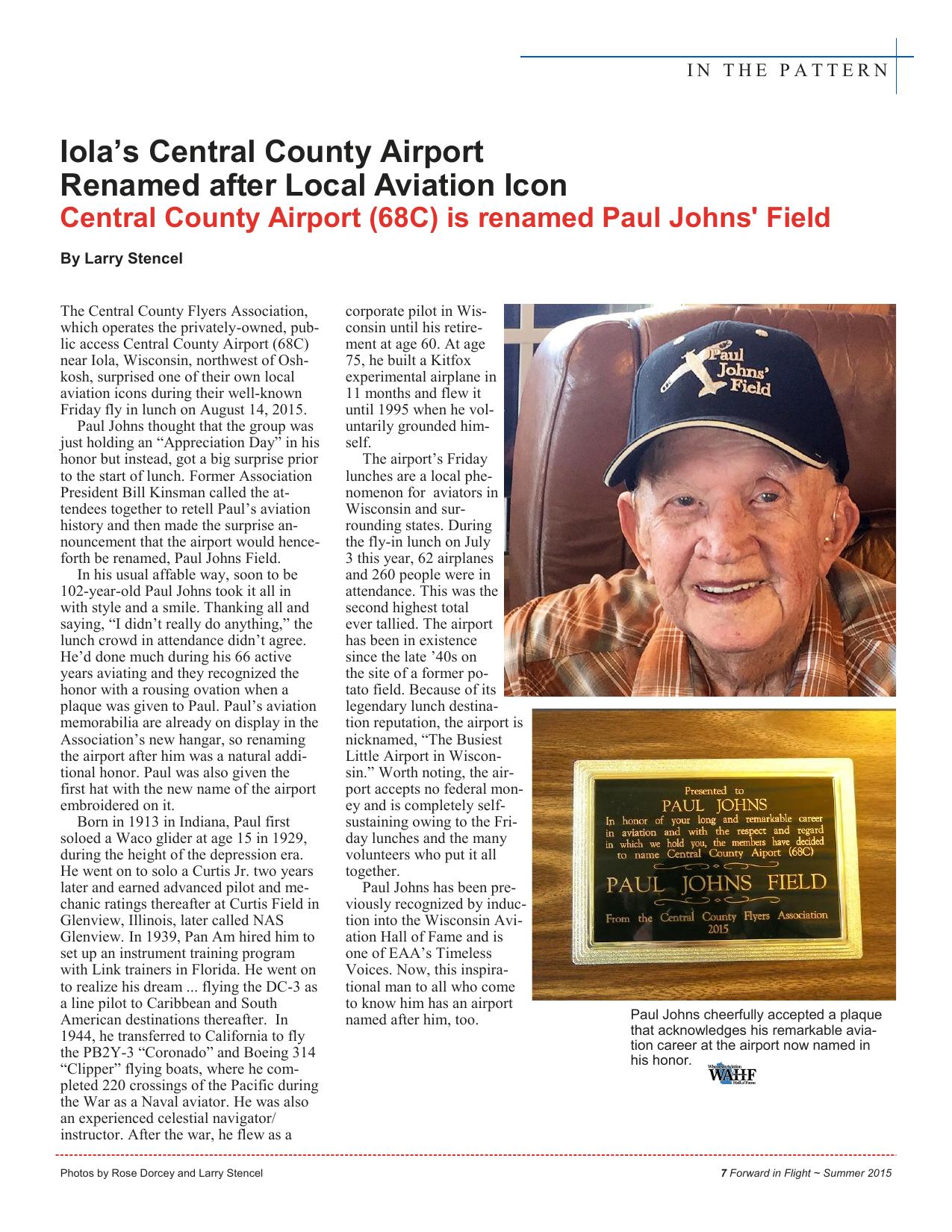
IN THE PATTERN Iola’s Central County Airport Renamed after Local Aviation Icon Central County Airport (68C) is renamed Paul Johns' Field By Larry Stencel The Central County Flyers Association, which operates the privately-owned, public access Central County Airport (68C) near Iola, Wisconsin, northwest of Oshkosh, surprised one of their own local aviation icons during their well-known Friday fly in lunch on August 14, 2015. Paul Johns thought that the group was just holding an “Appreciation Day” in his honor but instead, got a big surprise prior to the start of lunch. Former Association President Bill Kinsman called the attendees together to retell Paul’s aviation history and then made the surprise announcement that the airport would henceforth be renamed, Paul Johns Field. In his usual affable way, soon to be 102-year-old Paul Johns took it all in with style and a smile. Thanking all and saying, “I didn’t really do anything,” the lunch crowd in attendance didn’t agree. He’d done much during his 66 active years aviating and they recognized the honor with a rousing ovation when a plaque was given to Paul. Paul’s aviation memorabilia are already on display in the Association’s new hangar, so renaming the airport after him was a natural additional honor. Paul was also given the first hat with the new name of the airport embroidered on it. Born in 1913 in Indiana, Paul first soloed a Waco glider at age 15 in 1929, during the height of the depression era. He went on to solo a Curtis Jr. two years later and earned advanced pilot and mechanic ratings thereafter at Curtis Field in Glenview, Illinois, later called NAS Glenview. In 1939, Pan Am hired him to set up an instrument training program with Link trainers in Florida. He went on to realize his dream ... flying the DC-3 as a line pilot to Caribbean and South American destinations thereafter. In 1944, he transferred to California to fly the PB2Y-3 “Coronado” and Boeing 314 “Clipper” flying boats, where he completed 220 crossings of the Pacific during the War as a Naval aviator. He was also an experienced celestial navigator/ instructor. After the war, he flew as a Photos by Rose Dorcey and Larry Stencel corporate pilot in Wisconsin until his retirement at age 60. At age 75, he built a Kitfox experimental airplane in 11 months and flew it until 1995 when he voluntarily grounded himself. The airport’s Friday lunches are a local phenomenon for aviators in Wisconsin and surrounding states. During the fly-in lunch on July 3 this year, 62 airplanes and 260 people were in attendance. This was the second highest total ever tallied. The airport has been in existence since the late ’40s on the site of a former potato field. Because of its legendary lunch destination reputation, the airport is nicknamed, “The Busiest Little Airport in Wisconsin.” Worth noting, the airport accepts no federal money and is completely selfsustaining owing to the Friday lunches and the many volunteers who put it all together. Paul Johns has been previously recognized by induction into the Wisconsin Aviation Hall of Fame and is one of EAA’s Timeless Voices. Now, this inspirational man to all who come to know him has an airport named after him, too. Paul Johns cheerfully accepted a plaque that acknowledges his remarkable aviation career at the airport now named in his honor. 7 Forward in Flight ~ Summer 2015
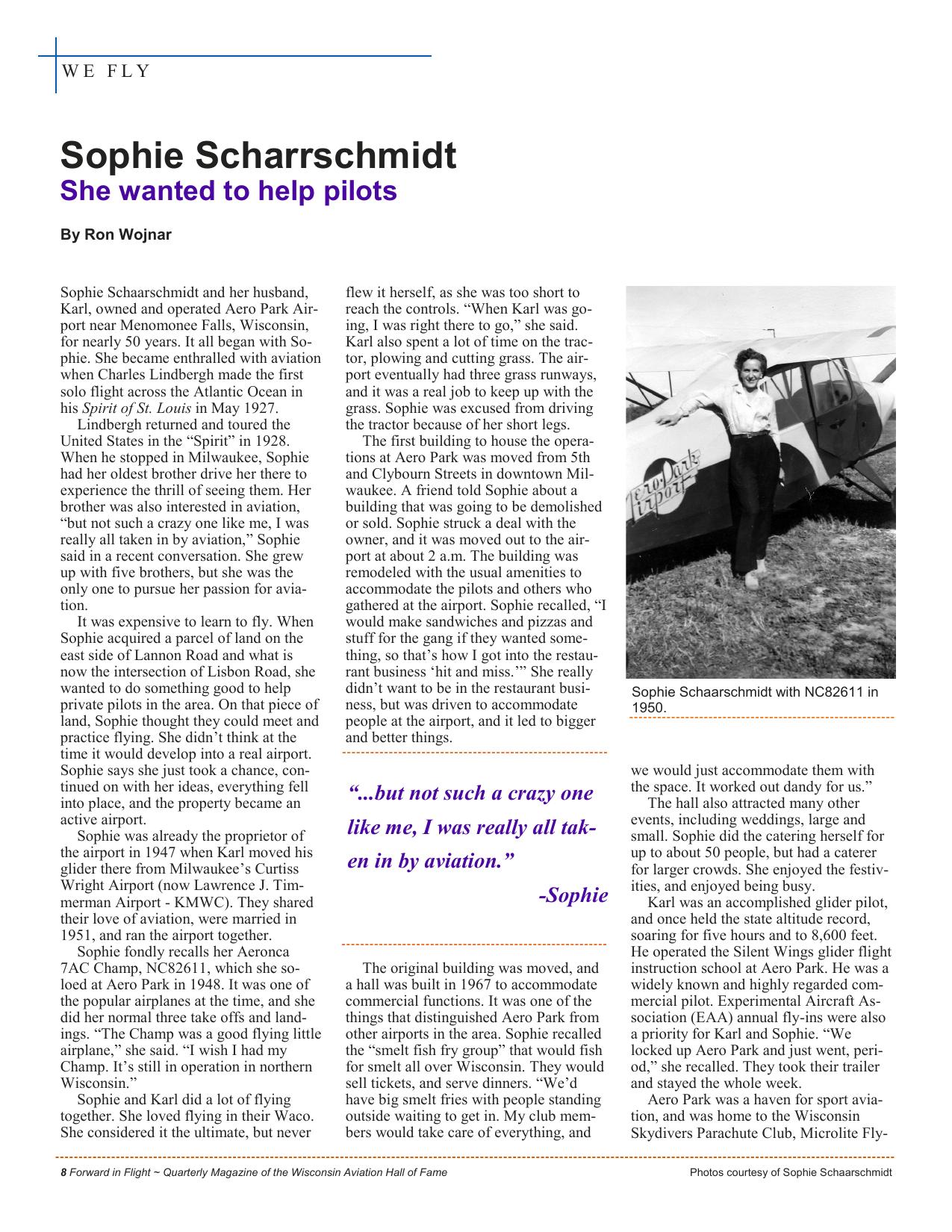
WE FLY Sophie Scharrschmidt She wanted to help pilots By Ron Wojnar Sophie Schaarschmidt and her husband, Karl, owned and operated Aero Park Airport near Menomonee Falls, Wisconsin, for nearly 50 years. It all began with Sophie. She became enthralled with aviation when Charles Lindbergh made the first solo flight across the Atlantic Ocean in his Spirit of St. Louis in May 1927. Lindbergh returned and toured the United States in the “Spirit” in 1928. When he stopped in Milwaukee, Sophie had her oldest brother drive her there to experience the thrill of seeing them. Her brother was also interested in aviation, “but not such a crazy one like me, I was really all taken in by aviation,” Sophie said in a recent conversation. She grew up with five brothers, but she was the only one to pursue her passion for aviation. It was expensive to learn to fly. When Sophie acquired a parcel of land on the east side of Lannon Road and what is now the intersection of Lisbon Road, she wanted to do something good to help private pilots in the area. On that piece of land, Sophie thought they could meet and practice flying. She didn’t think at the time it would develop into a real airport. Sophie says she just took a chance, continued on with her ideas, everything fell into place, and the property became an active airport. Sophie was already the proprietor of the airport in 1947 when Karl moved his glider there from Milwaukee’s Curtiss Wright Airport (now Lawrence J. Timmerman Airport - KMWC). They shared their love of aviation, were married in 1951, and ran the airport together. Sophie fondly recalls her Aeronca 7AC Champ, NC82611, which she soloed at Aero Park in 1948. It was one of the popular airplanes at the time, and she did her normal three take offs and landings. “The Champ was a good flying little airplane,” she said. “I wish I had my Champ. It’s still in operation in northern Wisconsin.” Sophie and Karl did a lot of flying together. She loved flying in their Waco. She considered it the ultimate, but never flew it herself, as she was too short to reach the controls. “When Karl was going, I was right there to go,” she said. Karl also spent a lot of time on the tractor, plowing and cutting grass. The airport eventually had three grass runways, and it was a real job to keep up with the grass. Sophie was excused from driving the tractor because of her short legs. The first building to house the operations at Aero Park was moved from 5th and Clybourn Streets in downtown Milwaukee. A friend told Sophie about a building that was going to be demolished or sold. Sophie struck a deal with the owner, and it was moved out to the airport at about 2 a.m. The building was remodeled with the usual amenities to accommodate the pilots and others who gathered at the airport. Sophie recalled, “I would make sandwiches and pizzas and stuff for the gang if they wanted something, so that’s how I got into the restaurant business ‘hit and miss.’” She really didn’t want to be in the restaurant business, but was driven to accommodate people at the airport, and it led to bigger and better things. “...but not such a crazy one like me, I was really all taken in by aviation.” -Sophie The original building was moved, and a hall was built in 1967 to accommodate commercial functions. It was one of the things that distinguished Aero Park from other airports in the area. Sophie recalled the “smelt fish fry group” that would fish for smelt all over Wisconsin. They would sell tickets, and serve dinners. “We’d have big smelt fries with people standing outside waiting to get in. My club members would take care of everything, and 8 Forward in Flight ~ Quarterly Magazine of the Wisconsin Aviation Hall of Fame Sophie Schaarschmidt with NC82611 in 1950. we would just accommodate them with the space. It worked out dandy for us.” The hall also attracted many other events, including weddings, large and small. Sophie did the catering herself for up to about 50 people, but had a caterer for larger crowds. She enjoyed the festivities, and enjoyed being busy. Karl was an accomplished glider pilot, and once held the state altitude record, soaring for five hours and to 8,600 feet. He operated the Silent Wings glider flight instruction school at Aero Park. He was a widely known and highly regarded commercial pilot. Experimental Aircraft Association (EAA) annual fly-ins were also a priority for Karl and Sophie. “We locked up Aero Park and just went, period,” she recalled. They took their trailer and stayed the whole week. Aero Park was a haven for sport aviation, and was home to the Wisconsin Skydivers Parachute Club, Microlite FlyPhotos courtesy of Sophie Schaarschmidt
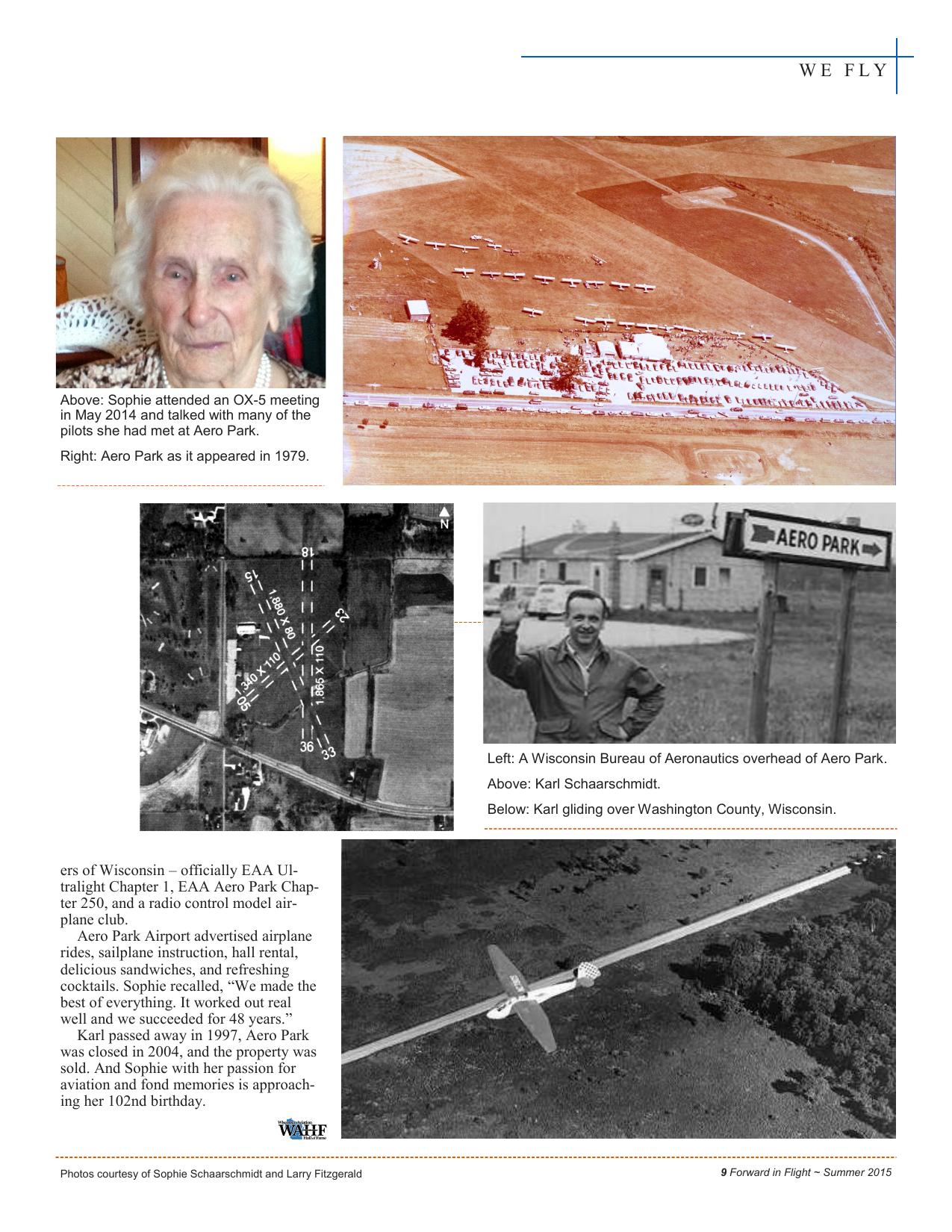
WE FLY Above: Sophie attended an OX-5 meeting in May 2014 and talked with many of the pilots she had met at Aero Park. Right: Aero Park as it appeared in 1979. Left: A Wisconsin Bureau of Aeronautics overhead of Aero Park. Above: Karl Schaarschmidt. Below: Karl gliding over Washington County, Wisconsin. ers of Wisconsin – officially EAA Ultralight Chapter 1, EAA Aero Park Chapter 250, and a radio control model airplane club. Aero Park Airport advertised airplane rides, sailplane instruction, hall rental, delicious sandwiches, and refreshing cocktails. Sophie recalled, “We made the best of everything. It worked out real well and we succeeded for 48 years.” Karl passed away in 1997, Aero Park was closed in 2004, and the property was sold. And Sophie with her passion for aviation and fond memories is approaching her 102nd birthday. Photos courtesy of Sophie Schaarschmidt and Larry Fitzgerald 9 Forward in Flight ~ Summer 2015
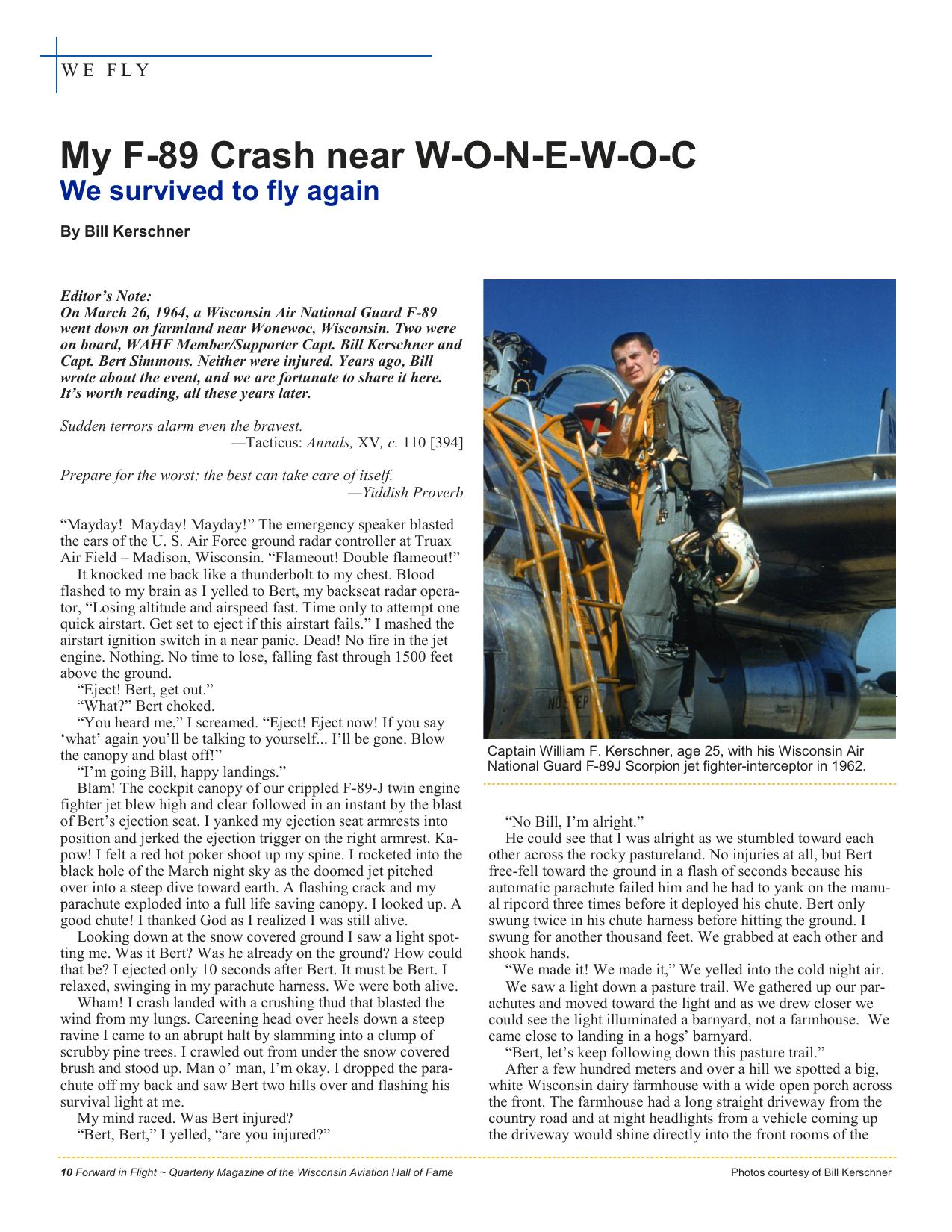
WE FLY My F-89 Crash near W-O-N-E-W-O-C We survived to fly again By Bill Kerschner Editor’s Note: On March 26, 1964, a Wisconsin Air National Guard F-89 went down on farmland near Wonewoc, Wisconsin. Two were on board, WAHF Member/Supporter Capt. Bill Kerschner and Capt. Bert Simmons. Neither were injured. Years ago, Bill wrote about the event, and we are fortunate to share it here. It’s worth reading, all these years later. Sudden terrors alarm even the bravest. —Tacticus: Annals, XV, c. 110 [394] Prepare for the worst; the best can take care of itself. —Yiddish Proverb “Mayday! Mayday! Mayday!” The emergency speaker blasted the ears of the U. S. Air Force ground radar controller at Truax Air Field – Madison, Wisconsin. “Flameout! Double flameout!” It knocked me back like a thunderbolt to my chest. Blood flashed to my brain as I yelled to Bert, my backseat radar operator, “Losing altitude and airspeed fast. Time only to attempt one quick airstart. Get set to eject if this airstart fails.” I mashed the airstart ignition switch in a near panic. Dead! No fire in the jet engine. Nothing. No time to lose, falling fast through 1500 feet above the ground. “Eject! Bert, get out.” “What?” Bert choked. “You heard me,” I screamed. “Eject! Eject now! If you say ‘what’ again you’ll be talking to yourself... I’ll be gone. Blow the canopy and blast off!” “I’m going Bill, happy landings.” Blam! The cockpit canopy of our crippled F-89-J twin engine fighter jet blew high and clear followed in an instant by the blast of Bert’s ejection seat. I yanked my ejection seat armrests into position and jerked the ejection trigger on the right armrest. Kapow! I felt a red hot poker shoot up my spine. I rocketed into the black hole of the March night sky as the doomed jet pitched over into a steep dive toward earth. A flashing crack and my parachute exploded into a full life saving canopy. I looked up. A good chute! I thanked God as I realized I was still alive. Looking down at the snow covered ground I saw a light spotting me. Was it Bert? Was he already on the ground? How could that be? I ejected only 10 seconds after Bert. It must be Bert. I relaxed, swinging in my parachute harness. We were both alive. Wham! I crash landed with a crushing thud that blasted the wind from my lungs. Careening head over heels down a steep ravine I came to an abrupt halt by slamming into a clump of scrubby pine trees. I crawled out from under the snow covered brush and stood up. Man o’ man, I’m okay. I dropped the parachute off my back and saw Bert two hills over and flashing his survival light at me. My mind raced. Was Bert injured? “Bert, Bert,” I yelled, “are you injured?” 10 Forward in Flight ~ Quarterly Magazine of the Wisconsin Aviation Hall of Fame Captain William F. Kerschner, age 25, with his Wisconsin Air National Guard F-89J Scorpion jet fighter-interceptor in 1962. “No Bill, I’m alright.” He could see that I was alright as we stumbled toward each other across the rocky pastureland. No injuries at all, but Bert free-fell toward the ground in a flash of seconds because his automatic parachute failed him and he had to yank on the manual ripcord three times before it deployed his chute. Bert only swung twice in his chute harness before hitting the ground. I swung for another thousand feet. We grabbed at each other and shook hands. “We made it! We made it,” We yelled into the cold night air. We saw a light down a pasture trail. We gathered up our parachutes and moved toward the light and as we drew closer we could see the light illuminated a barnyard, not a farmhouse. We came close to landing in a hogs’ barnyard. “Bert, let’s keep following down this pasture trail.” After a few hundred meters and over a hill we spotted a big, white Wisconsin dairy farmhouse with a wide open porch across the front. The farmhouse had a long straight driveway from the country road and at night headlights from a vehicle coming up the driveway would shine directly into the front rooms of the Photos courtesy of Bill Kerschner
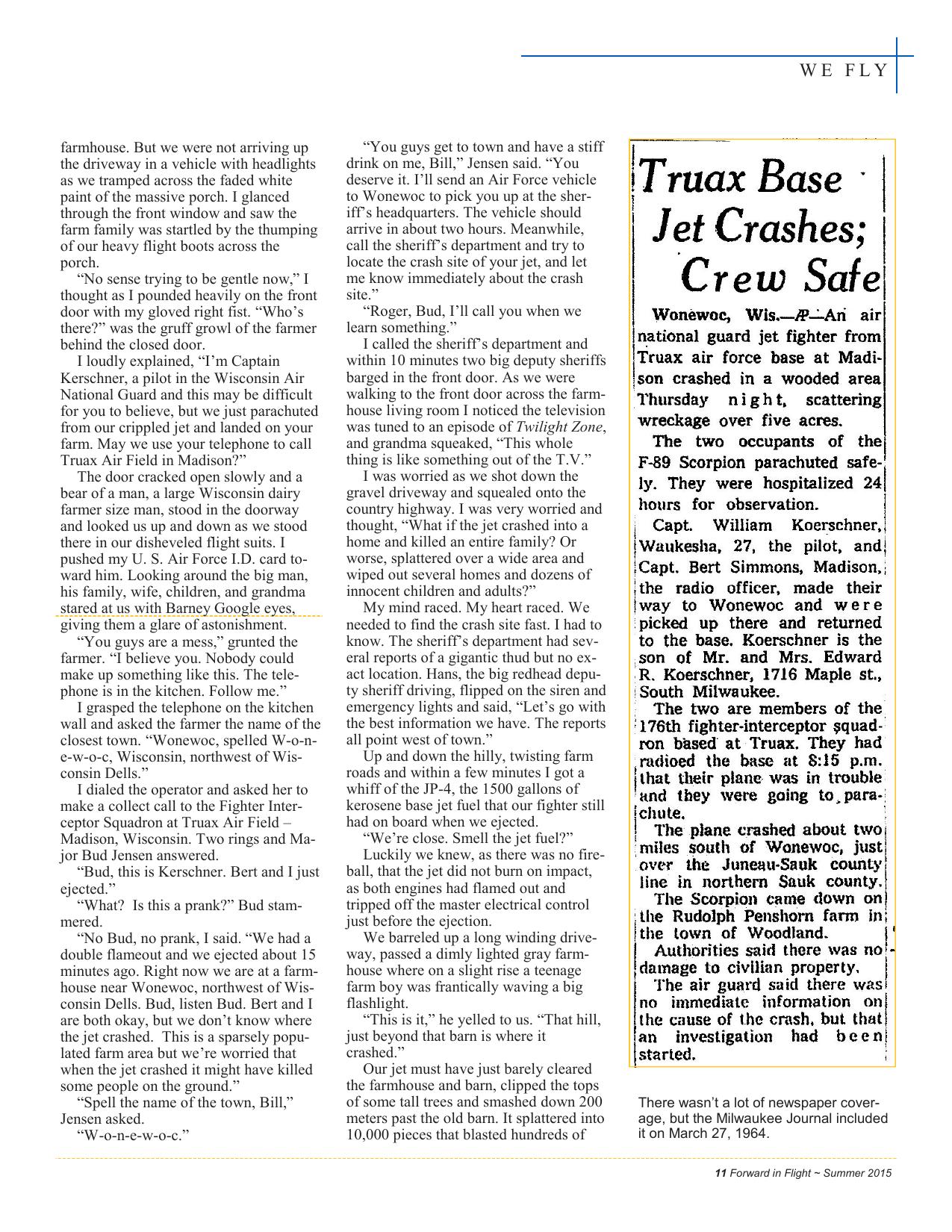
WE FLY farmhouse. But we were not arriving up the driveway in a vehicle with headlights as we tramped across the faded white paint of the massive porch. I glanced through the front window and saw the farm family was startled by the thumping of our heavy flight boots across the porch. “No sense trying to be gentle now,” I thought as I pounded heavily on the front door with my gloved right fist. “Who’s there?” was the gruff growl of the farmer behind the closed door. I loudly explained, “I’m Captain Kerschner, a pilot in the Wisconsin Air National Guard and this may be difficult for you to believe, but we just parachuted from our crippled jet and landed on your farm. May we use your telephone to call Truax Air Field in Madison?” The door cracked open slowly and a bear of a man, a large Wisconsin dairy farmer size man, stood in the doorway and looked us up and down as we stood there in our disheveled flight suits. I pushed my U. S. Air Force I.D. card toward him. Looking around the big man, his family, wife, children, and grandma stared at us with Barney Google eyes, giving them a glare of astonishment. “You guys are a mess,” grunted the farmer. “I believe you. Nobody could make up something like this. The telephone is in the kitchen. Follow me.” I grasped the telephone on the kitchen wall and asked the farmer the name of the closest town. “Wonewoc, spelled W-o-ne-w-o-c, Wisconsin, northwest of Wisconsin Dells.” I dialed the operator and asked her to make a collect call to the Fighter Interceptor Squadron at Truax Air Field – Madison, Wisconsin. Two rings and Major Bud Jensen answered. “Bud, this is Kerschner. Bert and I just ejected.” “What? Is this a prank?” Bud stammered. “No Bud, no prank, I said. “We had a double flameout and we ejected about 15 minutes ago. Right now we are at a farmhouse near Wonewoc, northwest of Wisconsin Dells. Bud, listen Bud. Bert and I are both okay, but we don’t know where the jet crashed. This is a sparsely populated farm area but we’re worried that when the jet crashed it might have killed some people on the ground.” “Spell the name of the town, Bill,” Jensen asked. “W-o-n-e-w-o-c.” “You guys get to town and have a stiff drink on me, Bill,” Jensen said. “You deserve it. I’ll send an Air Force vehicle to Wonewoc to pick you up at the sheriff’s headquarters. The vehicle should arrive in about two hours. Meanwhile, call the sheriff’s department and try to locate the crash site of your jet, and let me know immediately about the crash site.” “Roger, Bud, I’ll call you when we learn something.” I called the sheriff’s department and within 10 minutes two big deputy sheriffs barged in the front door. As we were walking to the front door across the farmhouse living room I noticed the television was tuned to an episode of Twilight Zone, and grandma squeaked, “This whole thing is like something out of the T.V.” I was worried as we shot down the gravel driveway and squealed onto the country highway. I was very worried and thought, “What if the jet crashed into a home and killed an entire family? Or worse, splattered over a wide area and wiped out several homes and dozens of innocent children and adults?” My mind raced. My heart raced. We needed to find the crash site fast. I had to know. The sheriff’s department had several reports of a gigantic thud but no exact location. Hans, the big redhead deputy sheriff driving, flipped on the siren and emergency lights and said, “Let’s go with the best information we have. The reports all point west of town.” Up and down the hilly, twisting farm roads and within a few minutes I got a whiff of the JP-4, the 1500 gallons of kerosene base jet fuel that our fighter still had on board when we ejected. “We’re close. Smell the jet fuel?” Luckily we knew, as there was no fireball, that the jet did not burn on impact, as both engines had flamed out and tripped off the master electrical control just before the ejection. We barreled up a long winding driveway, passed a dimly lighted gray farmhouse where on a slight rise a teenage farm boy was frantically waving a big flashlight. “This is it,” he yelled to us. “That hill, just beyond that barn is where it crashed.” Our jet must have just barely cleared the farmhouse and barn, clipped the tops of some tall trees and smashed down 200 meters past the old barn. It splattered into 10,000 pieces that blasted hundreds of There wasn’t a lot of newspaper coverage, but the Milwaukee Journal included it on March 27, 1964. 11 Forward in Flight ~ Summer 2015
FROM THE ARCHIVES meters down a jagged ravine away from the farmhouse and barn. By now the farm boy had already climbed all over the crash site and called out, “I found the cockpit. Come, I’ll show you.” We scrambled a few meters past aircraft debris of bits and slabs of aluminum and finally there, jammed into the trunk of a huge oak tree, was the cockpit. I was stunned. If my ejection seat had failed me I would still have been strapped in that mangled cockpit. Man o’ man, I was thankful to God for my life and my childhood trust in a guardian angel came ringing back in my mind. My knees were a bit weak. I had to get away from the crash site. “Let’s get away from here,” I said. I staggered back up the craggy ravine to where the sheriff’s emergency vehicle stood with lights flashing. In the shadow of the gray farmhouse was an elderly farmer in faded bib overalls, with trembling arms and eyes glazed over. The old gentleman had been in the house alone except for Rommel, his German Shepherd dog. All other family members were at church services as it was March 26, 1964 and Holy Thursday, that very night. The old gentleman stared at us and stammered, “I shoulda gone with the family to church tonight.” Back into the sheriff’s emergency vehicle and flying down the gravel driveway, Hans the redhead and mustachioed deputy barked out, “Where to now Captain?” “Go to the sheriff’s headquarters, Hans. I need to call flight operations at Truax Air Field again and report the crash site.” We piled out of the vehicle and into the office. I snatched the telephone off the desk and again dialed the operator. “Do you want Truax Air Field again?” “Yes, put me through again.” The small town telephone operator must have been listening to my first call to Truax. The call went through instantly to Major Bud Jensen. “Bill, is that you?” Jensen asked. “Right Bud, everything is A-okay,” I explained. “The jet just missed skinning the roof off a farmhouse and old barn and crashed and splattered about 200 meters past the barn on a wooded hilltop. No injuries or property damage other than some trees and an aging F-89-J fighter jet.” “Wow, you guys are golden,” Jensen answered. “That aging jet is only worth about a million dollars, so you should be able to pay for it within 50 years. Just kidding, Bill. You guys did a fine job and thank God nobody on the ground is hurt. The Air Force van is on the way and should arrive to pick you up in less than an hour. Go get that stiff drink and relax. You dodged bullets from a machine gun.” “The jet just missed skinning the roof off a farmhouse and old barn and crashed and splattered about 200 meters past the barn on a wooded hilltop.” —Bill Kerschner “Thanks much, Bud,” I said. “Bert and I will see you in a few hours.” “Bert, we had better call our wives and tell them we ‘Hit the Silk’. If they see this first on the 10:00 news we’ll be in deep, bad, serious trouble.” I called Phyllis and told her we had an abbreviated flight and I’m on the ground already. Then I told her, “I am fine but I ejected, bailed out, and everything is okay, except I will have to pay for the crashed F-89-J jet.” “What? We pay for a fighter jet?” she asked. “Right, but it’s only a million dollars and we should be able to pay it off within 50 years. No, No I’m just joking.” I couldn’t let Phyllis believe that for more than a few seconds. “But I don’t think I’ll be home tonight,” I continued. “The Air Force will probably put us in the hospital overnight for observation. This crash will surely be on the 10 p.m. news, so call my parents and your parents and tell them I am fine. See you tomorrow. Good night, Love.” The Air Force vehicle with two bright young sergeants soon arrived and we piled in with our precious flight gear of parachutes and helmets and headed south for Truax Field. We charged into flight 12 Forward in Flight ~ Quarterly Magazine of the Wisconsin Aviation Hall of Fame operations at 2230 (10:30 p.m.) and were mobbed by our squadron mates and maintenance staff with clattering hoots and cheers. I shook the hand of the parachute rigger, Pat Burke. Pat packed the parachute that saved my life. I owed him big time and will owe him the rest of my life. After a round of wild handshakes we were rushed to the hospital for a physical exam and to spend the night under observation. The first thing the medical staff did was to draw blood for analysis to determine if there was any alcohol or drugs in our bodies. We never had time for that drink in Wonewoc that Bud Jensen ordered us to have and I was glad for that. We would have had a lot of explaining to do to the accident investigation team. The physical exam was routine except for one thing. I had a ballpoint pen ink bulls-eye around my navel that I had totally forgotten about. Just before I left our new, small, nice duplex apartment in Waukesha that afternoon for the one hour drive to Truax Field, Phyllis was just finishing giving our seven month old son Ted a bath. I was playing with Ted and picked him up, took my ballpoint pen and drew a bulls-eye target on his bottom. Phyllis was very incensed with my poor judgment. “How would you like it if someone did that to you?” She took the pen from my hand and before I could react she drew a circle around my navel. Time was short and I had to leave for night flying. So, there I was six hours later, as the doctor examined me with a bulls-eye on my navel. The doctor said nothing. I said nothing. I was just so happy to be alive that the circled navel deserved no explanation. The very next day, Good Friday, March 27, 1964, a massive and devastating earthquake struck Anchorage, Alaska, and our jet crash at Wonewoc, Wisconsin, with no lives lost, was relegated to page two of the newspapers. Except, the Wonewoc weekly had a big spread the next Thursday. I was age 27 at this time, married to Phyllis Jean Kexel Kerschner, age 24, and the father of our son, Ted, born on August 21, 1963. Phyllis and I did not know that she was pregnant at this time with our second son, Joe, who was born December 9, 1964. This flawed flight and ejection almost cost Bert Simmons and me our lives. Even now a half century later when I think of our children, Photos courtesy of Bill Kerschner
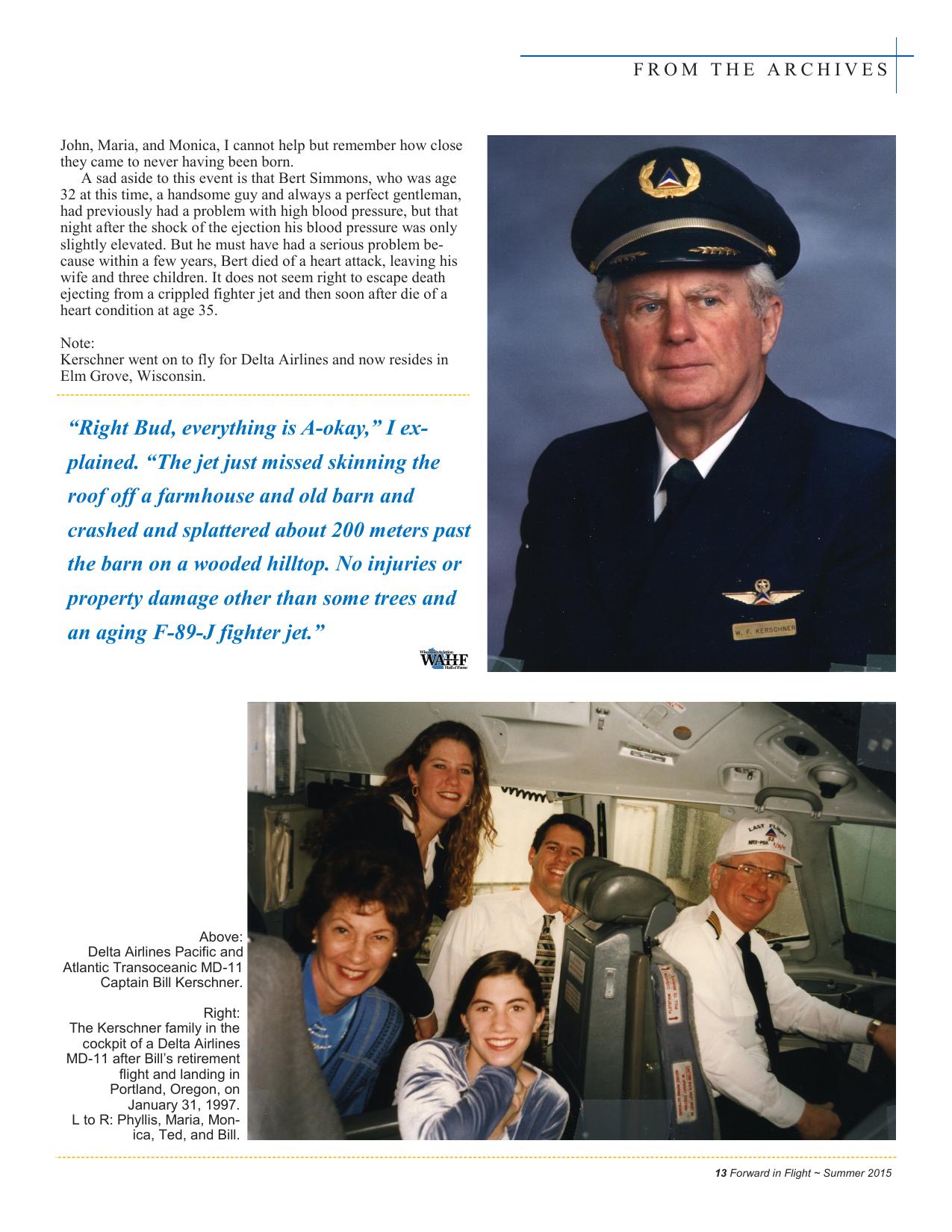
FROM THE ARCHIVES John, Maria, and Monica, I cannot help but remember how close they came to never having been born. A sad aside to this event is that Bert Simmons, who was age 32 at this time, a handsome guy and always a perfect gentleman, had previously had a problem with high blood pressure, but that night after the shock of the ejection his blood pressure was only slightly elevated. But he must have had a serious problem because within a few years, Bert died of a heart attack, leaving his wife and three children. It does not seem right to escape death ejecting from a crippled fighter jet and then soon after die of a heart condition at age 35. Note: Kerschner went on to fly for Delta Airlines and now resides in Elm Grove, Wisconsin. “Right Bud, everything is A-okay,” I explained. “The jet just missed skinning the roof off a farmhouse and old barn and crashed and splattered about 200 meters past the barn on a wooded hilltop. No injuries or property damage other than some trees and an aging F-89-J fighter jet.” Above: Delta Airlines Pacific and Atlantic Transoceanic MD-11 Captain Bill Kerschner. Right: The Kerschner family in the cockpit of a Delta Airlines MD-11 after Bill’s retirement flight and landing in Portland, Oregon, on January 31, 1997. L to R: Phyllis, Maria, Monica, Ted, and Bill. 13 Forward in Flight ~ Summer 2015
FROM THE ARCHIVES Hoyt Vandenberg and the Mission of the Air Force Part II Michael Goc After the Allied forces secured the landing area in Normandy and moved farther inland, the commanders gathered their forces for the advance east to Paris and beyond. The Twelfth Army Group, under the command of General Omar Bradley, and including General Courtney Hodges’s First Army and General George Patton’s Third Army, would lead the way. The Twelfth also included an expanded Ninth Air Force to supply what was called tactical support but proved to be much more. Since its mission was to be on the front line in the final campaign to defeat the Nazis in western Europe, command of the Ninth became the most coveted post in the Army Air Force. Every air general in Europe thought he was just the right man for the job. 14 Forward in Flight ~ Quarterly Magazine of the Wisconsin Aviation Hall of Fame Dwight Eisenhower, the Supreme Allied Commander, had his own ideas. He had observed Hoyt Vandenberg as a tactical air force commander in Africa and as a liaison officer who could work with less than cooperative Allied officers in London. He wanted Vandenberg to command the new Ninth Air Force despite the fact that the 44-year-old Wisconsin native was “young” and that he had only two stars on his shoulder boards. At the Ninth he would give orders to generals who had more seniority and stars then he did. He couldn’t do anything about seniority but, with support from Carl Spaatz and George Marshall, Eisenhower promoted Vandenberg to three-star rank and put him in charge of the largest tactical air command in history. Photo courtesy Wisconsin Historical Society
FROM THE ARCHIVES The Ninth Air Force had 4,000 aircraft and 180,000 men. It had three tactical air commands and a bomber command; an engineering command that would build and maintain at least 285 airfields in nine months of war and an anti-aircraft command to defend them; plus transport and logistics units to feed and house personnel and fuel, arm, and keep warplanes in the air 24/7. Overall, the Twelfth Army Group was the most powerful fighting force on the western front—if it was not misused. Every commander in Europe was aware of the powerful forces misused and wasted in the trenches of World War I. Vandenberg was well schooled in the latest tactics of air and ground warfare. He had helped design them in Washington and North Africa. He implemented them with a vengeance in the Ninth Air Force. Close cooperation and intimate communication with ground forces were the keys to victory. He kept his headquarters close to Bradley’s, while his tactical air commanders, Generals Elwood Quesada and Otto Weyland, were all but next door neighbors to Hodges and Patton. Down the line, armored and/or infantry officers were on air force staffs and air force officers were with the armored and infantry staffs. At the combat level, a pilot was assigned to each tank squadron. He was in radio contact with four-ship fighter bomber units constantly flying overhead. The airplanes ranged as far as 30 miles ahead of the tanks to find the enemy, alert the ground forces, and attack on their own. They could also be called in if the tanks encountered enemy troops. So effective were these tactics that the Twelfth Army Group took Paris on August 25, 1944. Vandenberg had been in command of the Ninth Air Force for three weeks. Previous page: Vandenberg and Nathan Twining visited Milwaukee in the late 1940s and Vandenberg presented aviation publicist Harry Bruno with an autographed photo. Twining succeeded Vandenberg as Air Force Chief of Staff and went on to become the first Air Force Chief to chair the Joint Chiefs of Staff. Vandenberg and Twining were the highest ranking Air Force officers born in Wisconsin. Patton, Hodges, and their tanks are justifiably famous for their lightning strikes across western France. Less known are the efforts of the airmen who cleared the way for them. In one instance the commander of a German force of 20,000 men surrendered to units of the Third Army. He insisted that a general of the air force be present at the ceremony because it was the unremitting and destructive bombardment his forces had suffered that prompted him to give up. Weyland was there to accept the surrender and collect souvenir Lugers for himself and Vandenberg. Patton himself reported that “the cooperation between the Third Army and [Weyland’s] Tactical Air Command….has been the finest example of the ground and air working together that I have ever seen.” This is when Patton famously fell to his knees and prayed for clear skies “to smite the ene- my.” The weather god in heaven and Vandenberg on earth answered Patton’s prayer. The Allied advance continued uninterrupted until winter weather grounded the airplanes. In mid-December, German forces launched the counterattack known as the Battle of the Bulge and stopped the American armies in eastern France. This is when Patton famously fell to his knees and prayed for clear skies “to smite the enemy.” The weather god in heaven and Vandenberg on earth answered Patton’s prayer. On December 23, 1944 the storm and fog lifted and Vandenberg ordered the heavy bombers of the Ninth, along with a bomber division borrowed from the Eighth Air Force, to destroy the roads, bridges, railroads, and landing fields behind the German lines. He then reinforced his own tactical commands with two fighter groups from the Eighth and concentrated this force on the advancing German armies. Between December 23-27, these units flew 5,291 sorties and halted the Germans. General von Rundstedt, the German commander, later said that were it not for the Ameri- can air force he could have retaken Paris. Vandenberg summed it up by saying that “we have bottlenecked the enemy’s supplies and throttled his offensive power.” Vandenberg didn’t say it, but it is possible that he remembered what he heard Billy Mitchell tell the cadets about air power back at West Point in 1921. Even if he did not, Vandenberg had achieved what Mitchell had attempted to do in combat in eastern France in 1918. That was, to use air power and ground forces as a unified fighting force to succeed in combat. In May 1945, the war in Europe ended. Vandenberg returned to a hero’s welcome home tour where he shared the stage with stay-at-home celebrities like Clark Gable and Ronald Reagan. He also returned to the wife, son, and daughter he had been away from for years, and to a post in the Operations, Commitments and Requirements Division of the Army Air Force. It was not as dull as it sounds, because OCR was charged with postwar planning, including what was called the “unification” of the armed forces. Much of OCR’s planning was knocked into a cocked hat in August when American B-29s dropped atomic bombs on Hiroshima and Nagasaki. In October Army Air Force Commander “Hap” Arnold named three of his top generals—Carl Spaatz, Vandenberg, and Lauris Norstad—to study the nuclear future. In a pair of reports the trio laid out the future mission of the air force. The United States would need a force of 10,000 aircraft and 400,000 men who would have “full parity and coequal status with the ground and naval forces.” This was the opening shot in the battle to establish an independent air force. They went on to say that nuclear weapons were the weapons of the future. The air force would be the first to use them and should therefore control them. This was also the opening shot in another battle, since the regular army, the navy, as well as the civilian scientists who built the bomb also wanted custody and control of nuclear arms. Finally, the three planners stated categorically that in a future war, the air force would be first in combat—either to defend or attack. Therefore, the United States had to maintain in peacetime an air force ready and able to go to war as soon as the first shot was fired. Air power had forced the United States to end its long-standing tradition of severely limiting the size of its 15 Forward in Flight ~ Summer 2015
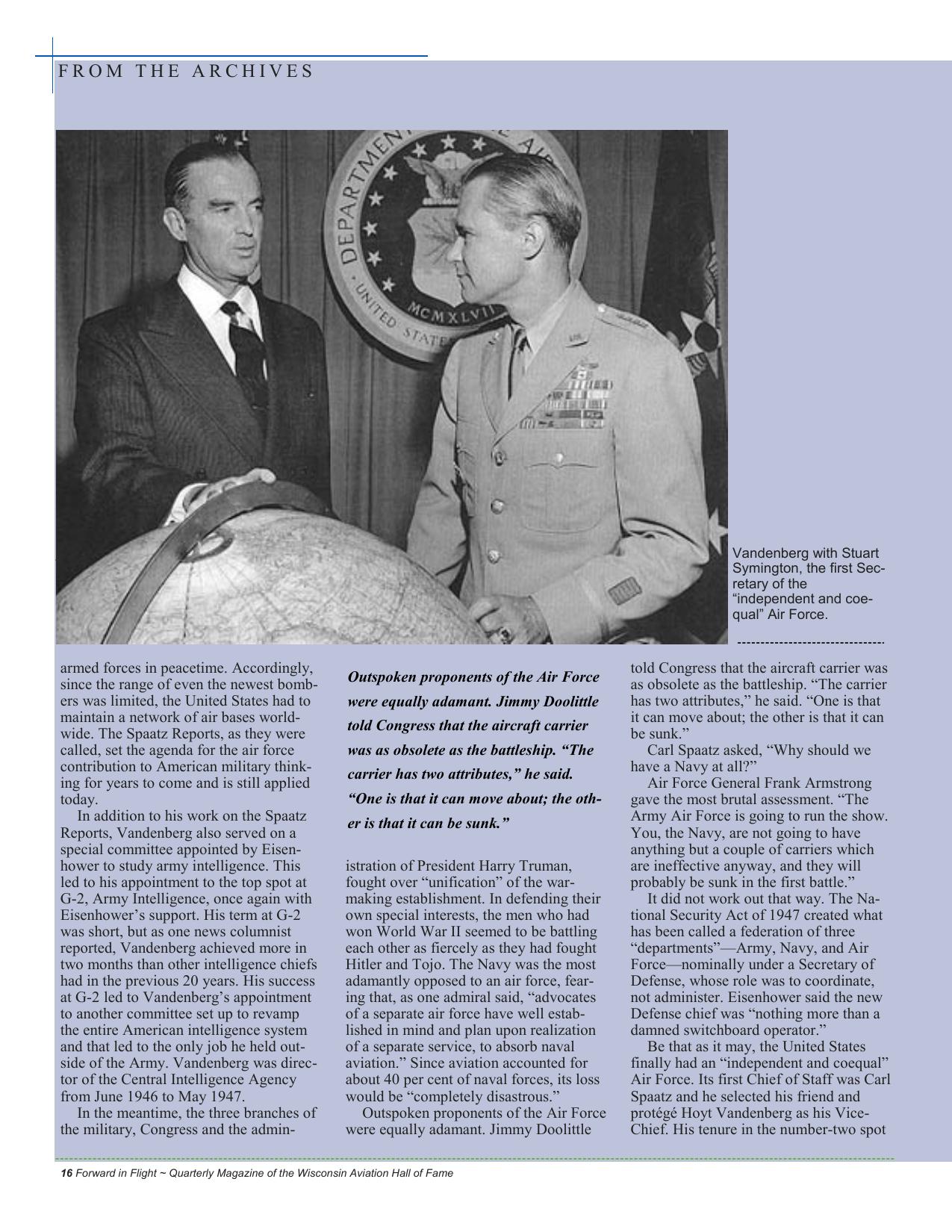
FROM THE ARCHIVES Above: Flight Engineer Wojnar and KC-97 in Las Vegas. Next page: Tony at his KC-97 Flight Engineer’s station. Vandenberg with Stuart Symington, the first Secretary of the “independent and coequal” Air Force. armed forces in peacetime. Accordingly, since the range of even the newest bombers was limited, the United States had to maintain a network of air bases worldwide. The Spaatz Reports, as they were called, set the agenda for the air force contribution to American military thinking for years to come and is still applied today. In addition to his work on the Spaatz Reports, Vandenberg also served on a special committee appointed by Eisenhower to study army intelligence. This led to his appointment to the top spot at G-2, Army Intelligence, once again with Eisenhower’s support. His term at G-2 was short, but as one news columnist reported, Vandenberg achieved more in two months than other intelligence chiefs had in the previous 20 years. His success at G-2 led to Vandenberg’s appointment to another committee set up to revamp the entire American intelligence system and that led to the only job he held outside of the Army. Vandenberg was director of the Central Intelligence Agency from June 1946 to May 1947. In the meantime, the three branches of the military, Congress and the admin- Outspoken proponents of the Air Force were equally adamant. Jimmy Doolittle told Congress that the aircraft carrier was as obsolete as the battleship. “The carrier has two attributes,” he said. “One is that it can move about; the other is that it can be sunk.” istration of President Harry Truman, fought over “unification” of the warmaking establishment. In defending their own special interests, the men who had won World War II seemed to be battling each other as fiercely as they had fought Hitler and Tojo. The Navy was the most adamantly opposed to an air force, fearing that, as one admiral said, “advocates of a separate air force have well established in mind and plan upon realization of a separate service, to absorb naval aviation.” Since aviation accounted for about 40 per cent of naval forces, its loss would be “completely disastrous.” Outspoken proponents of the Air Force were equally adamant. Jimmy Doolittle 16 Forward in Flight ~ Quarterly Magazine of the Wisconsin Aviation Hall of Fame told Congress that the aircraft carrier was as obsolete as the battleship. “The carrier has two attributes,” he said. “One is that it can move about; the other is that it can be sunk.” Carl Spaatz asked, “Why should we have a Navy at all?” Air Force General Frank Armstrong gave the most brutal assessment. “The Army Air Force is going to run the show. You, the Navy, are not going to have anything but a couple of carriers which are ineffective anyway, and they will probably be sunk in the first battle.” It did not work out that way. The National Security Act of 1947 created what has been called a federation of three “departments”—Army, Navy, and Air Force—nominally under a Secretary of Defense, whose role was to coordinate, not administer. Eisenhower said the new Defense chief was “nothing more than a damned switchboard operator.” Be that as it may, the United States finally had an “independent and coequal” Air Force. Its first Chief of Staff was Carl Spaatz and he selected his friend and protégé Hoyt Vandenberg as his ViceChief. His tenure in the number-two spot
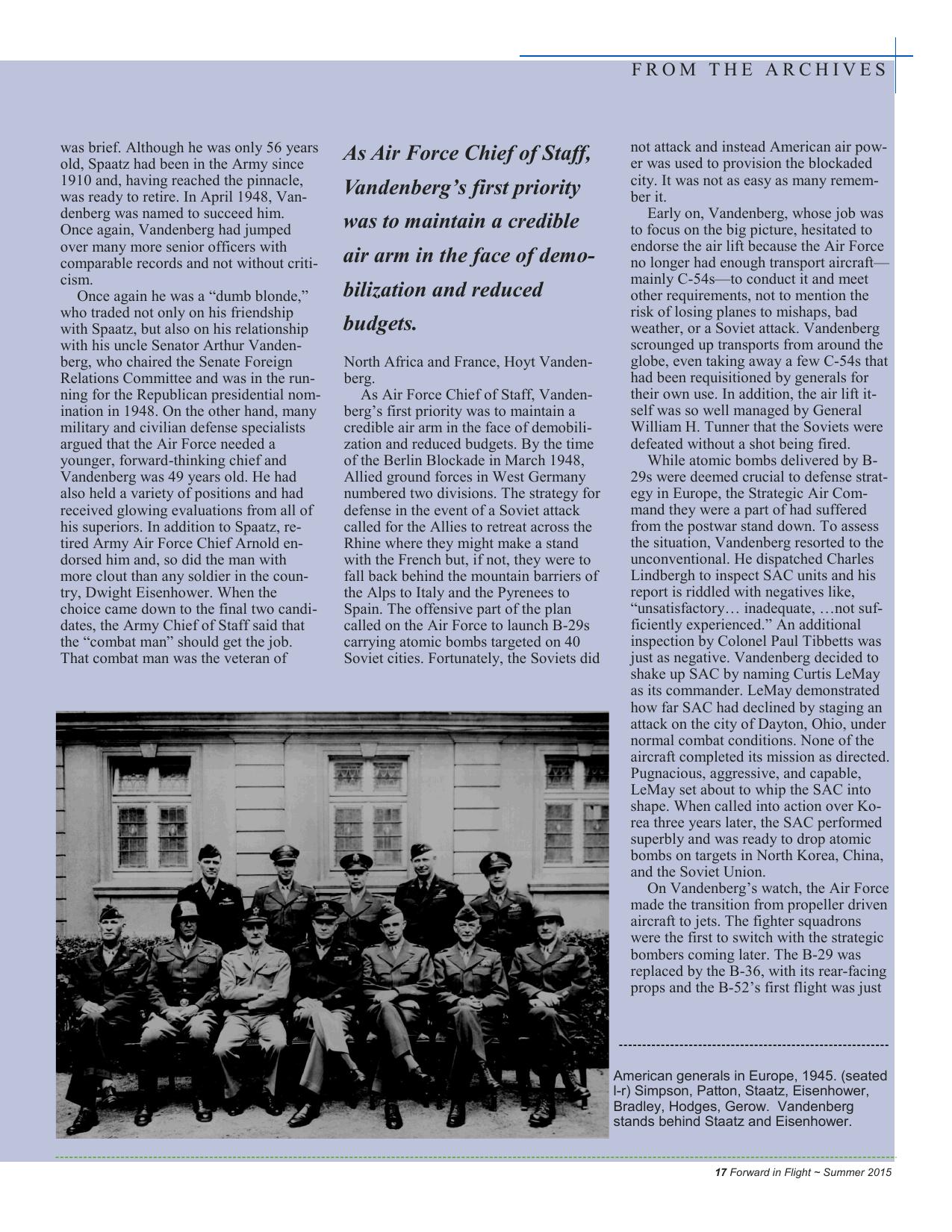
FROM THE ARCHIVES was brief. Although he was only 56 years old, Spaatz had been in the Army since 1910 and, having reached the pinnacle, was ready to retire. In April 1948, Vandenberg was named to succeed him. Once again, Vandenberg had jumped over many more senior officers with comparable records and not without criticism. Once again he was a “dumb blonde,” who traded not only on his friendship with Spaatz, but also on his relationship with his uncle Senator Arthur Vandenberg, who chaired the Senate Foreign Relations Committee and was in the running for the Republican presidential nomination in 1948. On the other hand, many military and civilian defense specialists argued that the Air Force needed a younger, forward-thinking chief and Vandenberg was 49 years old. He had also held a variety of positions and had received glowing evaluations from all of his superiors. In addition to Spaatz, retired Army Air Force Chief Arnold endorsed him and, so did the man with more clout than any soldier in the country, Dwight Eisenhower. When the choice came down to the final two candidates, the Army Chief of Staff said that the “combat man” should get the job. That combat man was the veteran of As Air Force Chief of Staff, Vandenberg’s first priority was to maintain a credible air arm in the face of demobilization and reduced budgets. North Africa and France, Hoyt Vandenberg. As Air Force Chief of Staff, Vandenberg’s first priority was to maintain a credible air arm in the face of demobilization and reduced budgets. By the time of the Berlin Blockade in March 1948, Allied ground forces in West Germany numbered two divisions. The strategy for defense in the event of a Soviet attack called for the Allies to retreat across the Rhine where they might make a stand with the French but, if not, they were to fall back behind the mountain barriers of the Alps to Italy and the Pyrenees to Spain. The offensive part of the plan called on the Air Force to launch B-29s carrying atomic bombs targeted on 40 Soviet cities. Fortunately, the Soviets did not attack and instead American air power was used to provision the blockaded city. It was not as easy as many remember it. Early on, Vandenberg, whose job was to focus on the big picture, hesitated to endorse the air lift because the Air Force no longer had enough transport aircraft— mainly C-54s—to conduct it and meet other requirements, not to mention the risk of losing planes to mishaps, bad weather, or a Soviet attack. Vandenberg scrounged up transports from around the globe, even taking away a few C-54s that had been requisitioned by generals for their own use. In addition, the air lift itself was so well managed by General William H. Tunner that the Soviets were defeated without a shot being fired. While atomic bombs delivered by B29s were deemed crucial to defense strategy in Europe, the Strategic Air Command they were a part of had suffered from the postwar stand down. To assess the situation, Vandenberg resorted to the unconventional. He dispatched Charles Lindbergh to inspect SAC units and his report is riddled with negatives like, “unsatisfactory… inadequate, …not sufficiently experienced.” An additional inspection by Colonel Paul Tibbetts was just as negative. Vandenberg decided to shake up SAC by naming Curtis LeMay as its commander. LeMay demonstrated how far SAC had declined by staging an attack on the city of Dayton, Ohio, under normal combat conditions. None of the aircraft completed its mission as directed. Pugnacious, aggressive, and capable, LeMay set about to whip the SAC into shape. When called into action over Korea three years later, the SAC performed superbly and was ready to drop atomic bombs on targets in North Korea, China, and the Soviet Union. On Vandenberg’s watch, the Air Force made the transition from propeller driven aircraft to jets. The fighter squadrons were the first to switch with the strategic bombers coming later. The B-29 was replaced by the B-36, with its rear-facing props and the B-52’s first flight was just American generals in Europe, 1945. (seated l-r) Simpson, Patton, Staatz, Eisenhower, Bradley, Hodges, Gerow. Vandenberg stands behind Staatz and Eisenhower. 17 Forward in Flight ~ Summer 2015
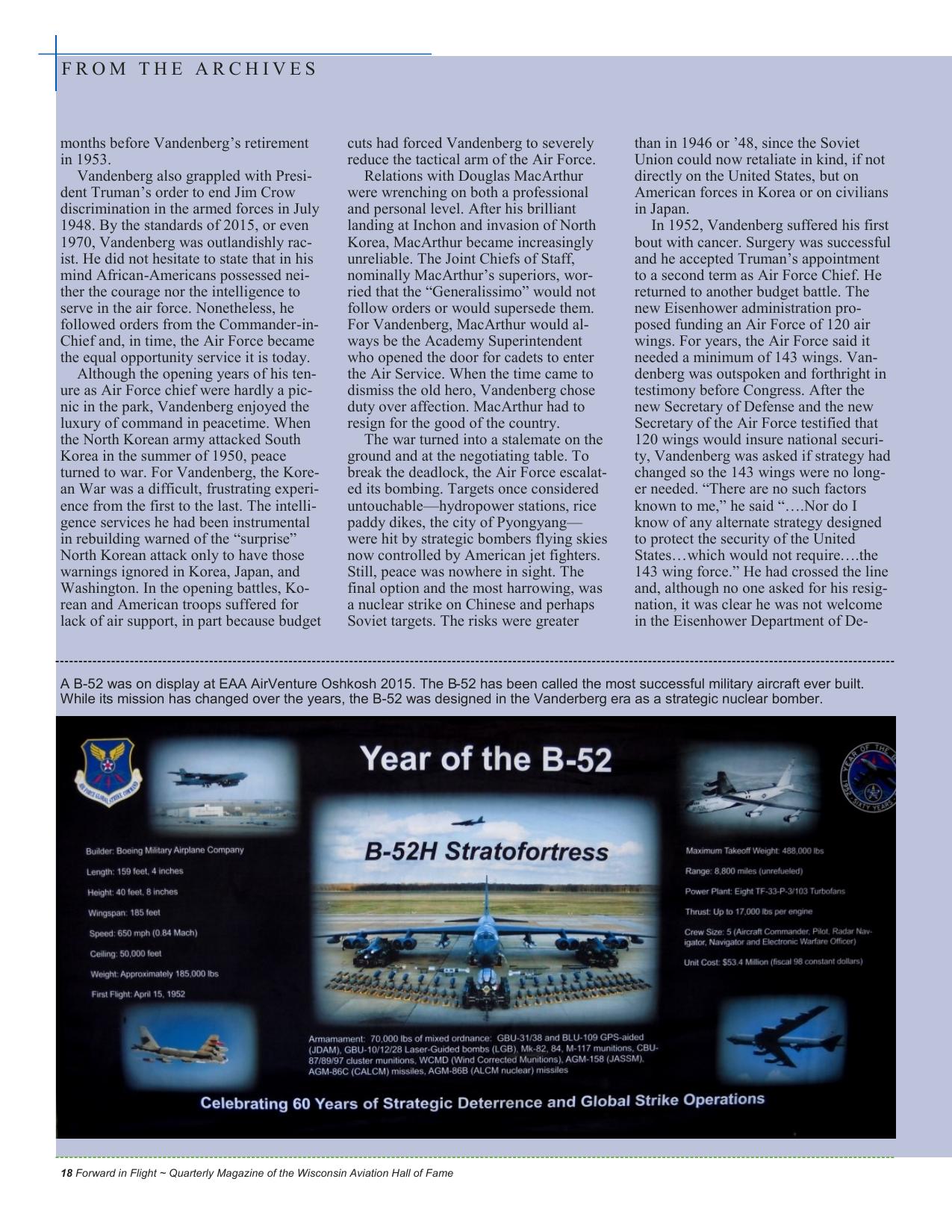
FROM THE ARCHIVES months before Vandenberg’s retirement in 1953. Vandenberg also grappled with President Truman’s order to end Jim Crow discrimination in the armed forces in July 1948. By the standards of 2015, or even 1970, Vandenberg was outlandishly racist. He did not hesitate to state that in his mind African-Americans possessed neither the courage nor the intelligence to serve in the air force. Nonetheless, he followed orders from the Commander-inChief and, in time, the Air Force became the equal opportunity service it is today. Although the opening years of his tenure as Air Force chief were hardly a picnic in the park, Vandenberg enjoyed the luxury of command in peacetime. When the North Korean army attacked South Korea in the summer of 1950, peace turned to war. For Vandenberg, the Korean War was a difficult, frustrating experience from the first to the last. The intelligence services he had been instrumental in rebuilding warned of the “surprise” North Korean attack only to have those warnings ignored in Korea, Japan, and Washington. In the opening battles, Korean and American troops suffered for lack of air support, in part because budget cuts had forced Vandenberg to severely reduce the tactical arm of the Air Force. Relations with Douglas MacArthur were wrenching on both a professional and personal level. After his brilliant landing at Inchon and invasion of North Korea, MacArthur became increasingly unreliable. The Joint Chiefs of Staff, nominally MacArthur’s superiors, worried that the “Generalissimo” would not follow orders or would supersede them. For Vandenberg, MacArthur would always be the Academy Superintendent who opened the door for cadets to enter the Air Service. When the time came to dismiss the old hero, Vandenberg chose duty over affection. MacArthur had to resign for the good of the country. The war turned into a stalemate on the ground and at the negotiating table. To break the deadlock, the Air Force escalated its bombing. Targets once considered untouchable—hydropower stations, rice paddy dikes, the city of Pyongyang— were hit by strategic bombers flying skies now controlled by American jet fighters. Still, peace was nowhere in sight. The final option and the most harrowing, was a nuclear strike on Chinese and perhaps Soviet targets. The risks were greater than in 1946 or ’48, since the Soviet Union could now retaliate in kind, if not directly on the United States, but on American forces in Korea or on civilians in Japan. In 1952, Vandenberg suffered his first bout with cancer. Surgery was successful and he accepted Truman’s appointment to a second term as Air Force Chief. He returned to another budget battle. The new Eisenhower administration proposed funding an Air Force of 120 air wings. For years, the Air Force said it needed a minimum of 143 wings. Vandenberg was outspoken and forthright in testimony before Congress. After the new Secretary of Defense and the new Secretary of the Air Force testified that 120 wings would insure national security, Vandenberg was asked if strategy had changed so the 143 wings were no longer needed. “There are no such factors known to me,” he said “….Nor do I know of any alternate strategy designed to protect the security of the United States…which would not require….the 143 wing force.” He had crossed the line and, although no one asked for his resignation, it was clear he was not welcome in the Eisenhower Department of De- A B-52 was on display at EAA AirVenture Oshkosh 2015. The B-52 has been called the most successful military aircraft ever built. While its mission has changed over the years, the B-52 was designed in the Vanderberg era as a strategic nuclear bomber. . 18 Forward in Flight ~ Quarterly Magazine of the Wisconsin Aviation Hall of Fame
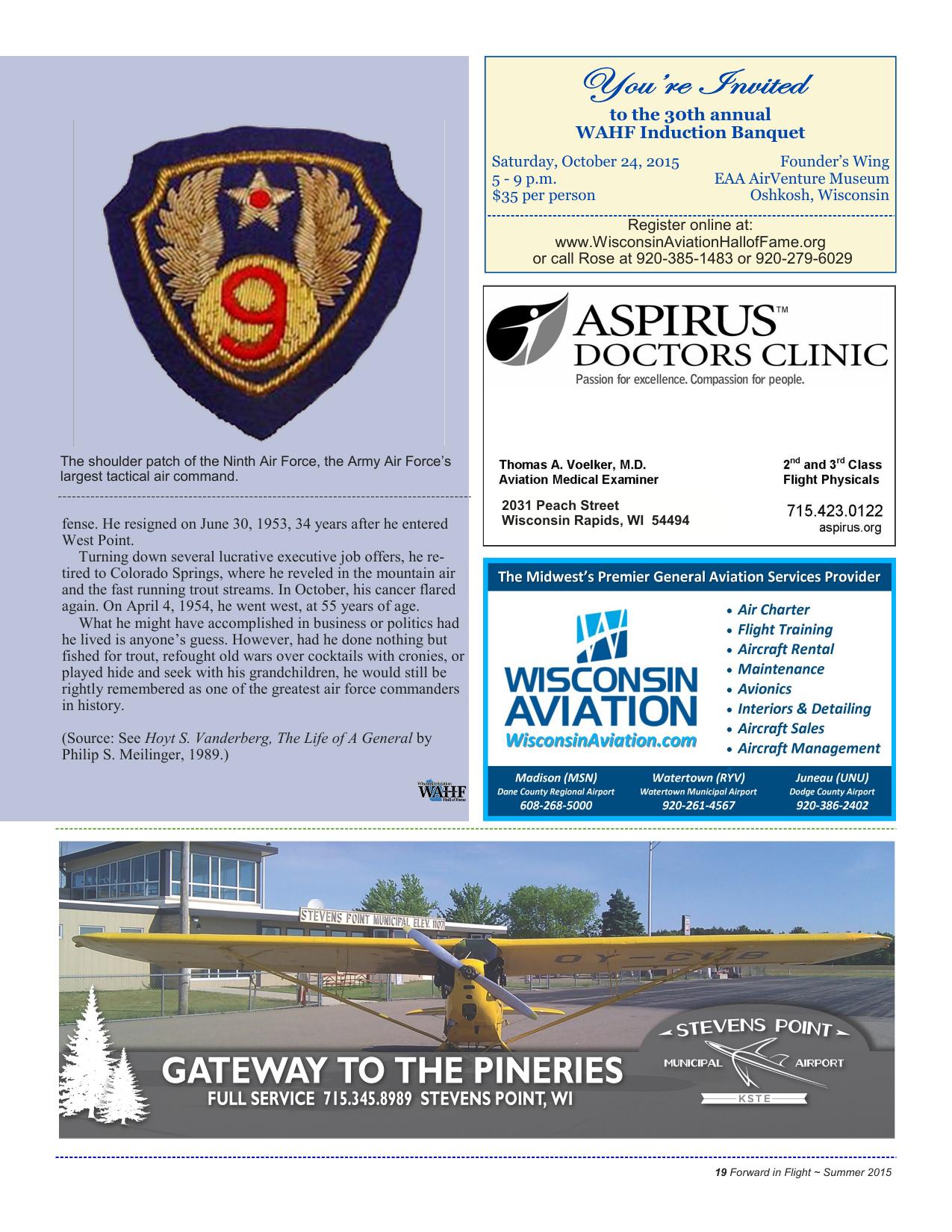
to the 30th annual WAHF Induction Banquet Saturday, October 24, 2015 5 - 9 p.m. $35 per person Founder’s Wing EAA AirVenture Museum Oshkosh, Wisconsin Register online at: www.WisconsinAviationHallofFame.org or call Rose at 920-385-1483 or 920-279-6029 The shoulder patch of the Ninth Air Force, the Army Air Force’s largest tactical air command. fense. He resigned on June 30, 1953, 34 years after he entered West Point. Turning down several lucrative executive job offers, he retired to Colorado Springs, where he reveled in the mountain air and the fast running trout streams. In October, his cancer flared again. On April 4, 1954, he went west, at 55 years of age. What he might have accomplished in business or politics had he lived is anyone’s guess. However, had he done nothing but fished for trout, refought old wars over cocktails with cronies, or played hide and seek with his grandchildren, he would still be rightly remembered as one of the greatest air force commanders in history. 2031 Peach Street Wisconsin Rapids, WI 54494 (Source: See Hoyt S. Vanderberg, The Life of A General by Philip S. Meilinger, 1989.) 19 Forward in Flight ~ Summer 2015
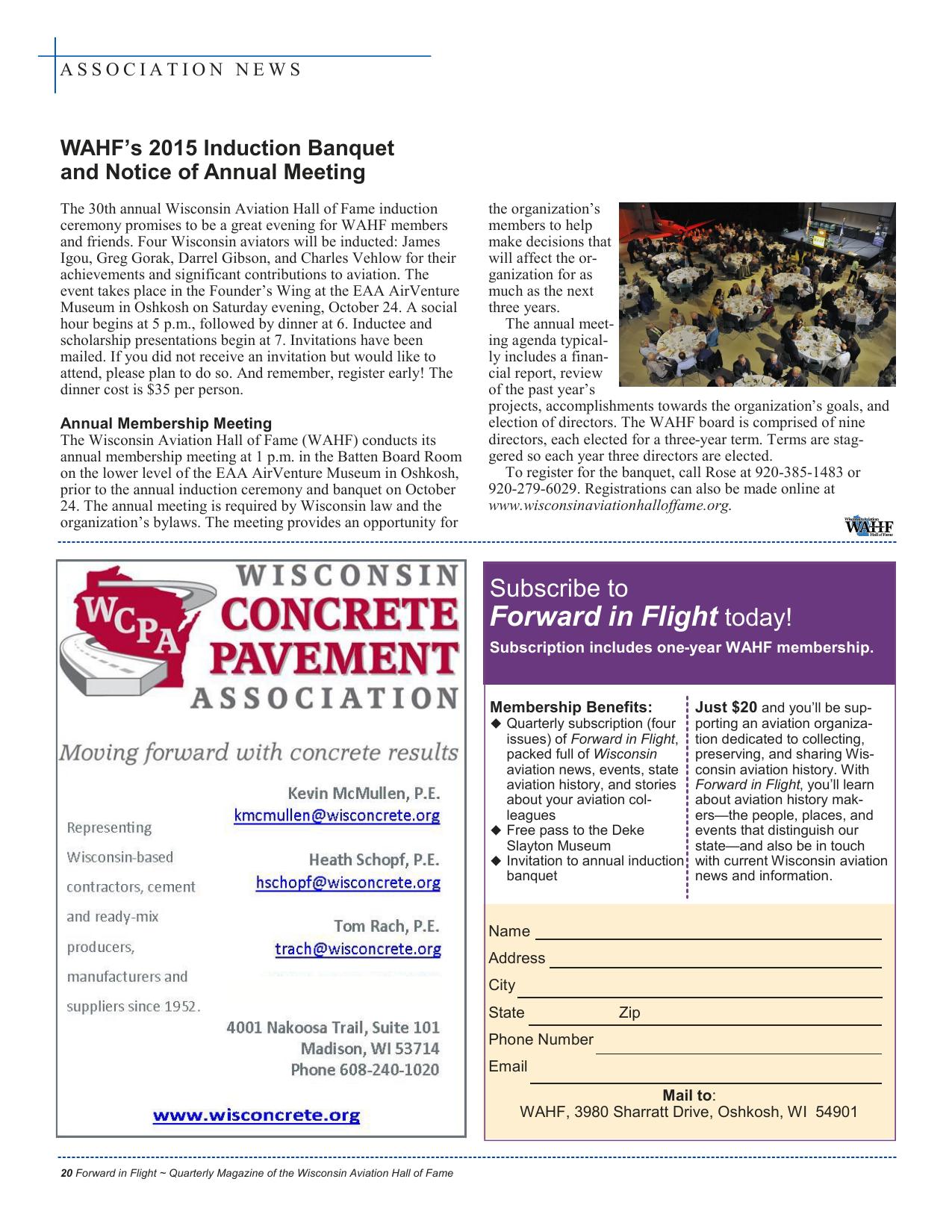
ASSOCIATION NEWS WAHF’s 2015 Induction Banquet and Notice of Annual Meeting The 30th annual Wisconsin Aviation Hall of Fame induction ceremony promises to be a great evening for WAHF members and friends. Four Wisconsin aviators will be inducted: James Igou, Greg Gorak, Darrel Gibson, and Charles Vehlow for their achievements and significant contributions to aviation. The event takes place in the Founder’s Wing at the EAA AirVenture Museum in Oshkosh on Saturday evening, October 24. A social hour begins at 5 p.m., followed by dinner at 6. Inductee and scholarship presentations begin at 7. Invitations have been mailed. If you did not receive an invitation but would like to attend, please plan to do so. And remember, register early! The dinner cost is $35 per person. Annual Membership Meeting The Wisconsin Aviation Hall of Fame (WAHF) conducts its annual membership meeting at 1 p.m. in the Batten Board Room on the lower level of the EAA AirVenture Museum in Oshkosh, prior to the annual induction ceremony and banquet on October 24. The annual meeting is required by Wisconsin law and the organization’s bylaws. The meeting provides an opportunity for the organization’s members to help make decisions that will affect the organization for as much as the next three years. The annual meeting agenda typically includes a financial report, review of the past year’s projects, accomplishments towards the organization’s goals, and election of directors. The WAHF board is comprised of nine directors, each elected for a three-year term. Terms are staggered so each year three directors are elected. To register for the banquet, call Rose at 920-385-1483 or 920-279-6029. Registrations can also be made online at www.wisconsinaviationhalloffame.org. Subscribe to Forward in Flight today! Subscription includes one-year WAHF membership. Membership Benefits: u Quarterly subscription (four issues) of Forward in Flight, packed full of Wisconsin aviation news, events, state aviation history, and stories about your aviation colleagues u Free pass to the Deke Slayton Museum u Invitation to annual induction banquet Just $20 and you’ll be sup- porting an aviation organization dedicated to collecting, preserving, and sharing Wisconsin aviation history. With Forward in Flight, you’ll learn about aviation history makers—the people, places, and events that distinguish our state—and also be in touch with current Wisconsin aviation news and information. Name Address City State Zip Phone Number Email Mail to: WAHF, 3980 Sharratt Drive, Oshkosh, WI 54901 20 Forward in Flight ~ Quarterly Magazine of the Wisconsin Aviation Hall of Fame
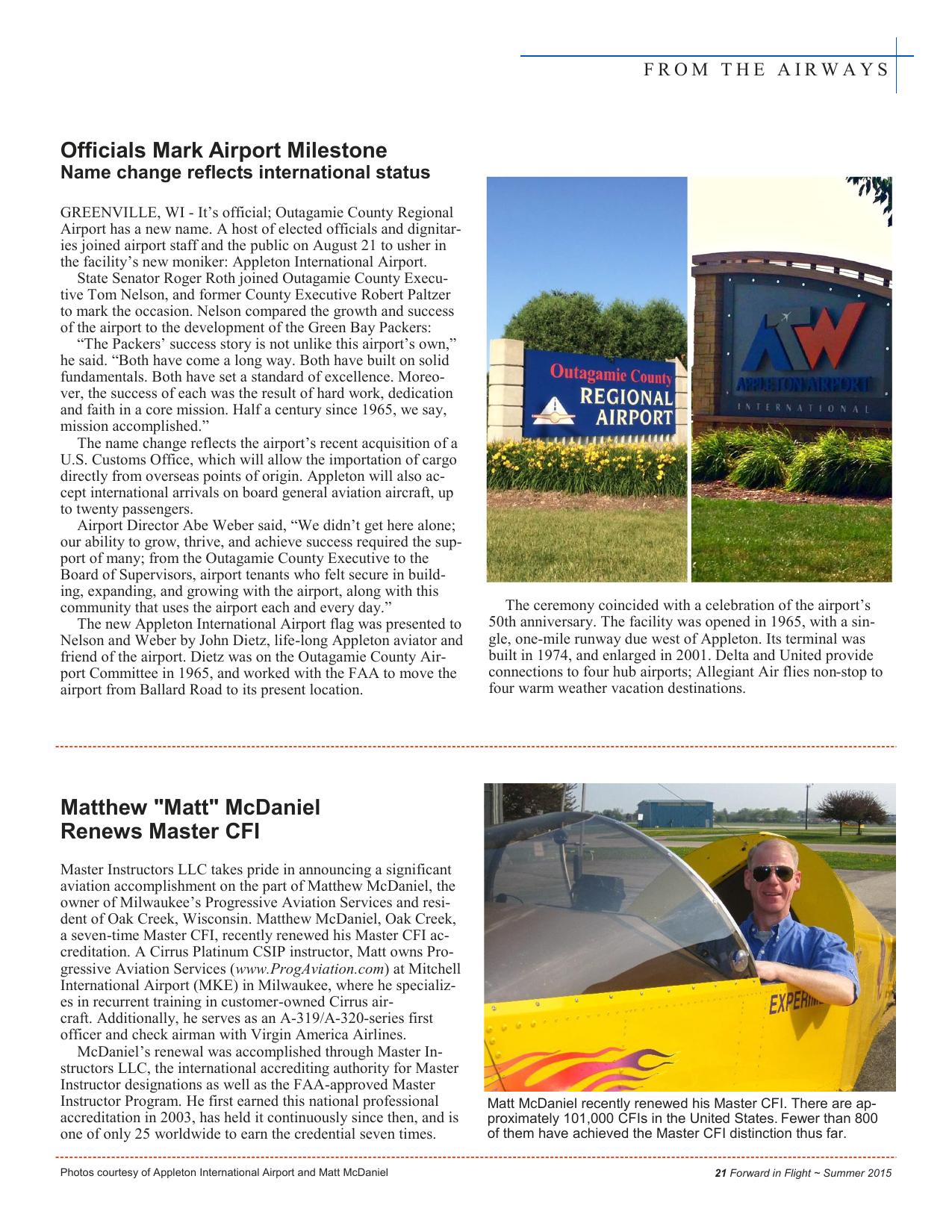
FROM THE AIRWAYS Officials Mark Airport Milestone Name change reflects international status GREENVILLE, WI - It’s official; Outagamie County Regional Airport has a new name. A host of elected officials and dignitaries joined airport staff and the public on August 21 to usher in the facility’s new moniker: Appleton International Airport. State Senator Roger Roth joined Outagamie County Executive Tom Nelson, and former County Executive Robert Paltzer to mark the occasion. Nelson compared the growth and success of the airport to the development of the Green Bay Packers: “The Packers’ success story is not unlike this airport’s own,” he said. “Both have come a long way. Both have built on solid fundamentals. Both have set a standard of excellence. Moreover, the success of each was the result of hard work, dedication and faith in a core mission. Half a century since 1965, we say, mission accomplished.” The name change reflects the airport’s recent acquisition of a U.S. Customs Office, which will allow the importation of cargo directly from overseas points of origin. Appleton will also accept international arrivals on board general aviation aircraft, up to twenty passengers. Airport Director Abe Weber said, “We didn’t get here alone; our ability to grow, thrive, and achieve success required the support of many; from the Outagamie County Executive to the Board of Supervisors, airport tenants who felt secure in building, expanding, and growing with the airport, along with this community that uses the airport each and every day.” The new Appleton International Airport flag was presented to Nelson and Weber by John Dietz, life-long Appleton aviator and friend of the airport. Dietz was on the Outagamie County Airport Committee in 1965, and worked with the FAA to move the airport from Ballard Road to its present location. The ceremony coincided with a celebration of the airport’s 50th anniversary. The facility was opened in 1965, with a single, one-mile runway due west of Appleton. Its terminal was built in 1974, and enlarged in 2001. Delta and United provide connections to four hub airports; Allegiant Air flies non-stop to four warm weather vacation destinations. Matthew "Matt" McDaniel Renews Master CFI Master Instructors LLC takes pride in announcing a significant aviation accomplishment on the part of Matthew McDaniel, the owner of Milwaukee’s Progressive Aviation Services and resident of Oak Creek, Wisconsin. Matthew McDaniel, Oak Creek, a seven-time Master CFI, recently renewed his Master CFI accreditation. A Cirrus Platinum CSIP instructor, Matt owns Progressive Aviation Services (www.ProgAviation.com) at Mitchell International Airport (MKE) in Milwaukee, where he specializes in recurrent training in customer-owned Cirrus aircraft. Additionally, he serves as an A-319/A-320-series first officer and check airman with Virgin America Airlines. McDaniel’s renewal was accomplished through Master Instructors LLC, the international accrediting authority for Master Instructor designations as well as the FAA-approved Master Instructor Program. He first earned this national professional accreditation in 2003, has held it continuously since then, and is one of only 25 worldwide to earn the credential seven times. Photos courtesy of Appleton International Airport and Matt McDaniel Matt McDaniel recently renewed his Master CFI. There are approximately 101,000 CFIs in the United States. Fewer than 800 of them have achieved the Master CFI distinction thus far. 21 Forward in Flight ~ Summer 2015
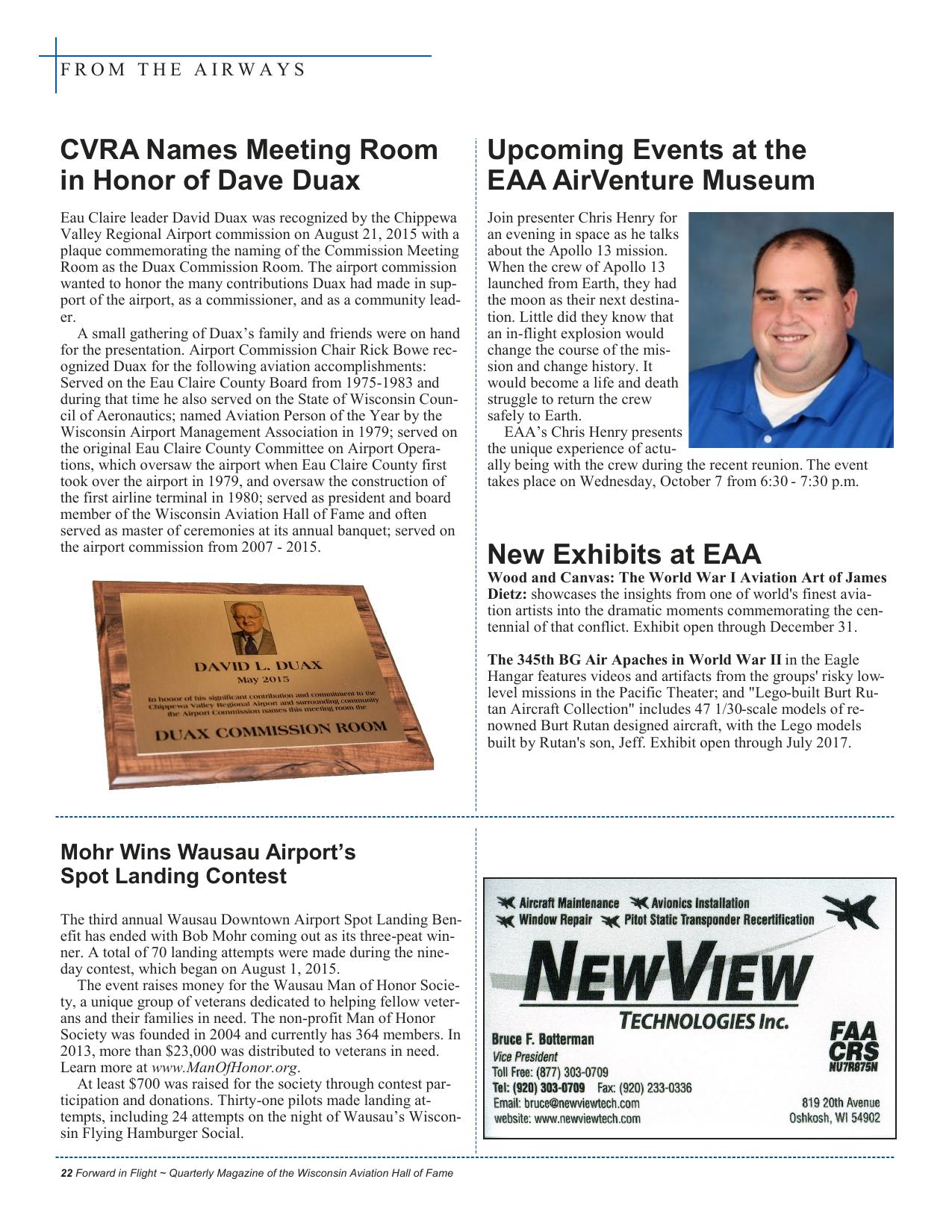
FROM THE AIRWAYS CVRA Names Meeting Room in Honor of Dave Duax Upcoming Events at the EAA AirVenture Museum Eau Claire leader David Duax was recognized by the Chippewa Valley Regional Airport commission on August 21, 2015 with a plaque commemorating the naming of the Commission Meeting Room as the Duax Commission Room. The airport commission wanted to honor the many contributions Duax had made in support of the airport, as a commissioner, and as a community leader. A small gathering of Duax’s family and friends were on hand for the presentation. Airport Commission Chair Rick Bowe recognized Duax for the following aviation accomplishments: Served on the Eau Claire County Board from 1975-1983 and during that time he also served on the State of Wisconsin Council of Aeronautics; named Aviation Person of the Year by the Wisconsin Airport Management Association in 1979; served on the original Eau Claire County Committee on Airport Operations, which oversaw the airport when Eau Claire County first took over the airport in 1979, and oversaw the construction of the first airline terminal in 1980; served as president and board member of the Wisconsin Aviation Hall of Fame and often served as master of ceremonies at its annual banquet; served on the airport commission from 2007 - 2015. Join presenter Chris Henry for an evening in space as he talks about the Apollo 13 mission. When the crew of Apollo 13 launched from Earth, they had the moon as their next destination. Little did they know that an in-flight explosion would change the course of the mission and change history. It would become a life and death struggle to return the crew safely to Earth. EAA’s Chris Henry presents the unique experience of actually being with the crew during the recent reunion. The event takes place on Wednesday, October 7 from 6:30 - 7:30 p.m. New Exhibits at EAA Wood and Canvas: The World War I Aviation Art of James Dietz: showcases the insights from one of world's finest aviation artists into the dramatic moments commemorating the centennial of that conflict. Exhibit open through December 31. The 345th BG Air Apaches in World War II in the Eagle Hangar features videos and artifacts from the groups' risky lowlevel missions in the Pacific Theater; and "Lego-built Burt Rutan Aircraft Collection" includes 47 1/30-scale models of renowned Burt Rutan designed aircraft, with the Lego models built by Rutan's son, Jeff. Exhibit open through July 2017. Mohr Wins Wausau Airport’s Spot Landing Contest The third annual Wausau Downtown Airport Spot Landing Benefit has ended with Bob Mohr coming out as its three-peat winner. A total of 70 landing attempts were made during the nineday contest, which began on August 1, 2015. The event raises money for the Wausau Man of Honor Society, a unique group of veterans dedicated to helping fellow veterans and their families in need. The non-profit Man of Honor Society was founded in 2004 and currently has 364 members. In 2013, more than $23,000 was distributed to veterans in need. Learn more at www.ManOfHonor.org. At least $700 was raised for the society through contest participation and donations. Thirty-one pilots made landing attempts, including 24 attempts on the night of Wausau’s Wisconsin Flying Hamburger Social. 22 Forward in Flight ~ Quarterly Magazine of the Wisconsin Aviation Hall of Fame
GONE WEST Longtime WAHF Member/Supporter Louise Yeazel has Gone West Louise M. Yeazel passed away at home on August 31, 2015, at age 84. She was born in Algoma, Wisconsin, on January 26, 1931, to Frieda and James Fluck. She graduated as valedictorian of Algoma High School in 1948. Louise continued her lifetime love of learning at the University of Wisconsin-Madison, where she earned her bachelor’s degree in microbiology in 1953 and later in life, while raising five children, completed her Ph.D. in Math Education in 1988. Louise met her husband, Roy Yeazel, at the UW Lutheran Student House. Louise and Roy married in Algoma on June 21, 1953. Four words sum up Louise’s lifelong passions: Education, aviation, music, and family. Louise was a natural teacher. She taught elementary school in Milwaukee, math education at UWMadison, and aviation ground school at Madison Area Technical College. Louise infused aviation and space concepts into her summer middle-school math workshops. In 1981, she authored the book, Aerospace Education: A Planning Guide for Local Schools. She also enabled her family’s education by supporting Roy through medical school and encouraging all her children to complete college. Louise was an accomplished private pilot, enthusiastic mem- ber of the women’s flying organization The Ninety-Nines, and enjoyed aerobatics and cross-country aviation rallies. She also served on the Wisconsin State Aeronautics Board. She was a longtime member/supporter of the Wisconsin Aviation Hall of Fame. Louise sang and played clarinet during high school and college with groups including the Polka Dots dance band. She sang in the Covenant Presbyterian Choir for decades, belonged to Madison’s Allegro and Euterpe music clubs, and enjoyed weekly woodwind quintet rehearsals with friends. Louise will be remembered for her kindness, warmth, and generous spirit. Lifelong friends recall her hospitality was freely offered to extra “family” including friends, kid’s friends, neighbors, and exchange students. She leaves behind her loving husband of 62 years, Roy; children, Mark (Jody Kempf), Susan (Rick Seegers) Yeazel, David (Melanie), Daniel (Monica), and Stephen (Rebecca); and 10 grandchildren as well as extended family and friends. Her parents and her siblings, William Fluck, Paul Fluck and Ruth Gruendemann, preceded her in death. Funeral services were held on Saturday, September 5, 2015, at Covenant Presbyterian Church, Madison. Dorothy Joyce Erickson, sister of Dick Bong, passes away Dorothy Joyce Erickson, 87, Poplar, passed away on Friday, September 11, 2015 at Brentwood Memory Care in Rice Lake, Wisconsin. She was born on May 1, 1928 in Superior to Carl and Dora (Bryce) Bong. Joyce was a member of Peace Lutheran Church, where she was a member of the Church choir. She was also a member of the P38 Association and President Emeritus of the Bong Heritage Center. She was an avid golfer, knitter and was a devoted grandmother. She loved sports including watching the Milwaukee Brewers and Green Bay Packers. Joyce is survived by one daughter, Kathy (Bob) Lehman, Cameron, Wis.; four sons, Mitchell (Vickie) Erickson, Nome, Alaska, Mark (Amy) Erickson, Dickinson, N.D., Michael (Sandy) Erickson, Fort Collins, Colo., Merrill (Amy) Erickson, Poplar; 15 grandchildren, Erick, Mallory, Kristen, Joshua, Jess, Katie, Brecken, Charlie Ann, Zana, MaKayla, Tucker, Kris, Lacy, Molly and Kevin; six great-grandchildren, Kellen, Riley, Zander, Chayden, Taylor and Harper; two sisters, Geraldine Fechtelkotter, Poplar and Barbara Peterman, Eaton Rapids, Mich. and several nieces and nephews. She was preceded in death by her husband Reynold; her parents; three brothers, Richard I. Bong, Carl Bong, Jr and James Bong and three sisters, Nelda Peterson, Betty Bong and Sue Bong. Burial was held in the Poplar Cemetery. 23 Forward in Flight ~ Summer 2015
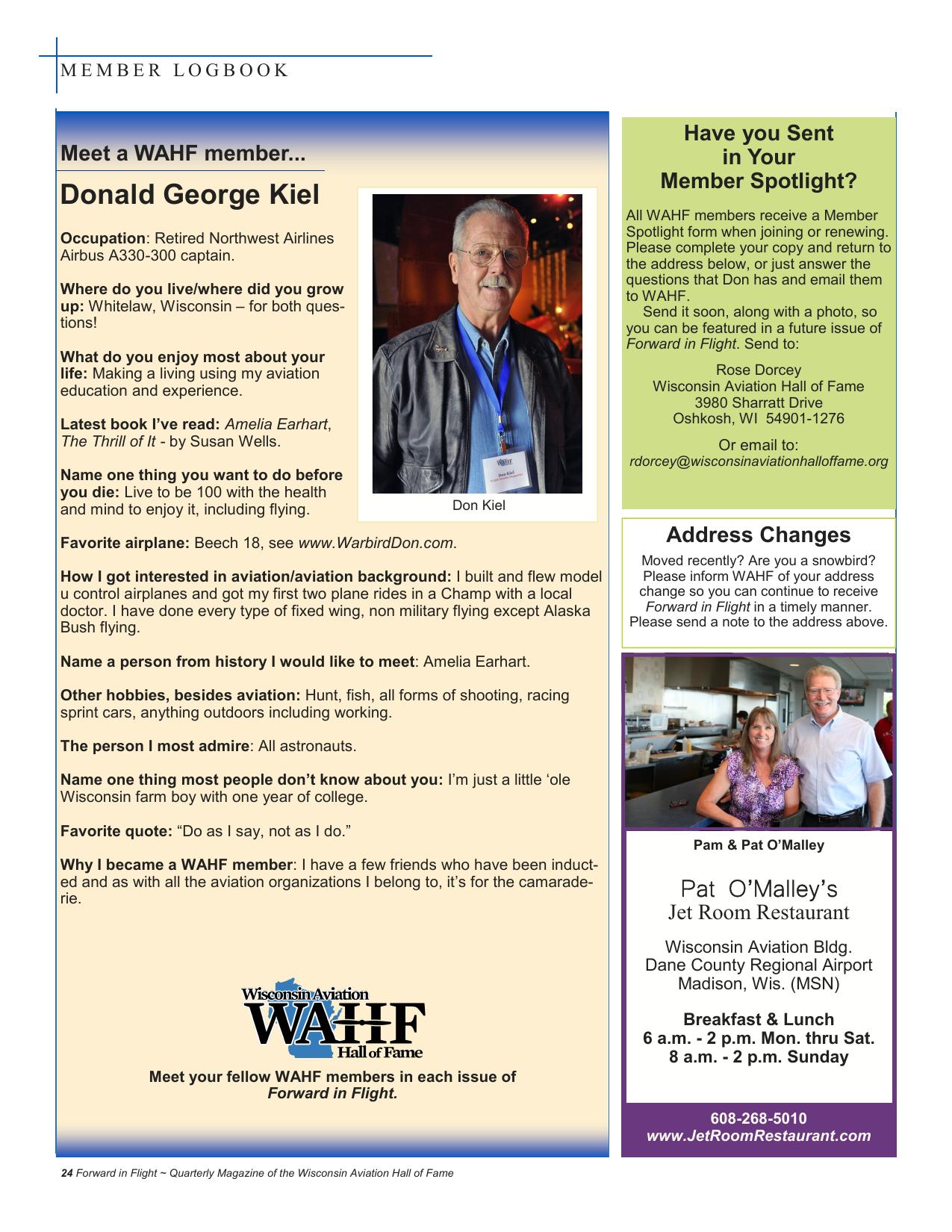
MEMBER LOGBOOK Have you Sent in Your Member Spotlight? Meet a WAHF member... Donald George Kiel Occupation: Retired Northwest Airlines Airbus A330-300 captain. Where do you live/where did you grow up: Whitelaw, Wisconsin – for both questions! Roger Small What do you enjoy most about your life: Making a living using my aviation education and experience. Rose Dorcey Wisconsin Aviation Hall of Fame 3980 Sharratt Drive Oshkosh, WI 54901-1276 Latest book I’ve read: Amelia Earhart, The Thrill of It - by Susan Wells. Name one thing you want to do before you die: Live to be 100 with the health and mind to enjoy it, including flying. All WAHF members receive a Member Spotlight form when joining or renewing. Please complete your copy and return to the address below, or just answer the questions that Don has and email them to WAHF. Send it soon, along with a photo, so you can be featured in a future issue of Forward in Flight. Send to: Or email to: rdorcey@wisconsinaviationhalloffame.org Don Kiel Favorite airplane: Beech 18, see www.WarbirdDon.com. How I got interested in aviation/aviation background: I built and flew model u control airplanes and got my first two plane rides in a Champ with a local doctor. I have done every type of fixed wing, non military flying except Alaska Bush flying. Address Changes Moved recently? Are you a snowbird? Please inform WAHF of your address change so you can continue to receive Forward in Flight in a timely manner. Please send a note to the address above. Name a person from history I would like to meet: Amelia Earhart. Other hobbies, besides aviation: Hunt, fish, all forms of shooting, racing sprint cars, anything outdoors including working. The person I most admire: All astronauts. Name one thing most people don’t know about you: I’m just a little ‘ole Wisconsin farm boy with one year of college. Favorite quote: “Do as I say, not as I do.” Why I became a WAHF member: I have a few friends who have been inducted and as with all the aviation organizations I belong to, it’s for the camaraderie. Pam & Pat O’Malley Pat O’Malley’s Jet Room Restaurant Wisconsin Aviation Bldg. Dane County Regional Airport Madison, Wis. (MSN) Breakfast & Lunch 6 a.m. - 2 p.m. Mon. thru Sat. 8 a.m. - 2 p.m. Sunday Meet your fellow WAHF members in each issue of Forward in Flight. 608-268-5010 www.JetRoomRestaurant.com 24 Forward in Flight ~ Quarterly Magazine of the Wisconsin Aviation Hall of Fame

Wittman Regional Airport Oshkosh So much history ...and still making it! From the legacy of Steve Wittman to Warren Basler’s DC-3 conversions, we’re proud to support and contribute to Wisconsin aviation history. FLY TO OSHKOSH wittmanairport.com @wittmanairport
PRSRT STD US Postage Paid Wisc Rapids WI Permit 98 3980 SHARRATT DRIVE OSHKOSH WI 54901-1276 The Wisconsin Aviation Hall of Fame is a non-profit membership organization dedicated to preserving the past and fostering the future of flight. Welcome WAHF Member/Supporters Lloyd Anderson Diane Mikelbank Betty Hedgecock* Dave Hedgecock* Timothy Spoerl —Thanks for coming on board. We hope to see you at a WAHF event soon! *Lifetime Member Officers Rose Dorcey, President Tom Thomas, Vice-President John Dorcey, Secretary/Treasurer Frosting for Flight Fundraiser Board of Directors Elaine Kauh Henry Peterson Brendan Stormo Charles Swain Wynne Williams Ron Wojnar Raising funds for the Women in Aviation Oshkosh Chapter’s $500 Spirit of Flight Scholarship. If you like to bake—or eat—cupcakes, the Oshkosh Women in Aviation chapter’s fifth annual Cupcake Competition is for you! Come for an afternoon of tasting and your chance to win door prizes. Cupcakes will be sold for just $1 each or six for $5. All proceeds benefit the Spirit of Flight scholarship fund. Sign up to compete! Form a one- or two-person team to bake and decorate a prize-winning cupcake. Judging based on taste, appearance, and theme.* Just $5 per person, or $10 per team to enter. Prizes will be awarded to the judge’s top 3 favorite cupcake bakers. No charge to watch judging and view contestant’s tables. Saturday, November 14 from 1:00 p.m. - 3:00 p.m. Wittman Regional Airport, 525 W 20th Avenue, Oshkosh Rose Dorcey 920-279-6029 or rose.dorcey@gmail.com Please join us! Wisconsin Aviation Hall of Fame Charles Marotske, Honorary Chairman of the Board *Contestants are encouraged to carry out a theme through costume/dress and table decorations. Represent your company or organization at this tasty fundraising event! Wisconsin Aviation Hall of Fame 3980 Sharratt Drive Oshkosh, WI 54901-1276 Become a supporter today! For information call Rose Dorcey at 920-385-1483 www.wisconsinaviationhalloffame.org rdorcey@wisconsinaviationhalloffame.org