Volume 14, Issue 3
🗞️ Download Issue (PDF)
Forward in Flight - Fall 2016
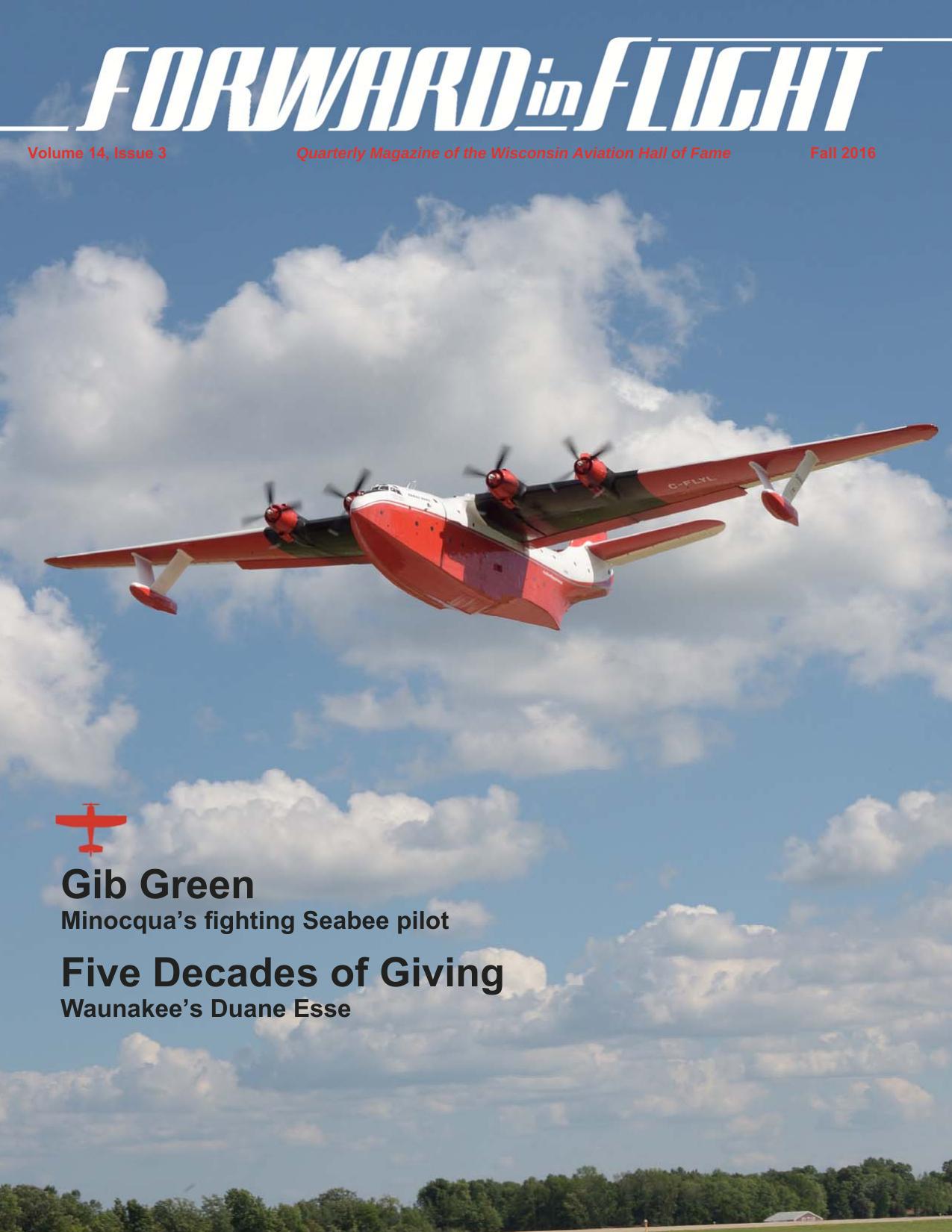
Volume 14, Issue 3 Quarterly Magazine of the Wisconsin Aviation Hall of Fame Gib Green Minocqua’s fighting Seabee pilot Five Decades of Giving Waunakee’s Duane Esse Fall 2016
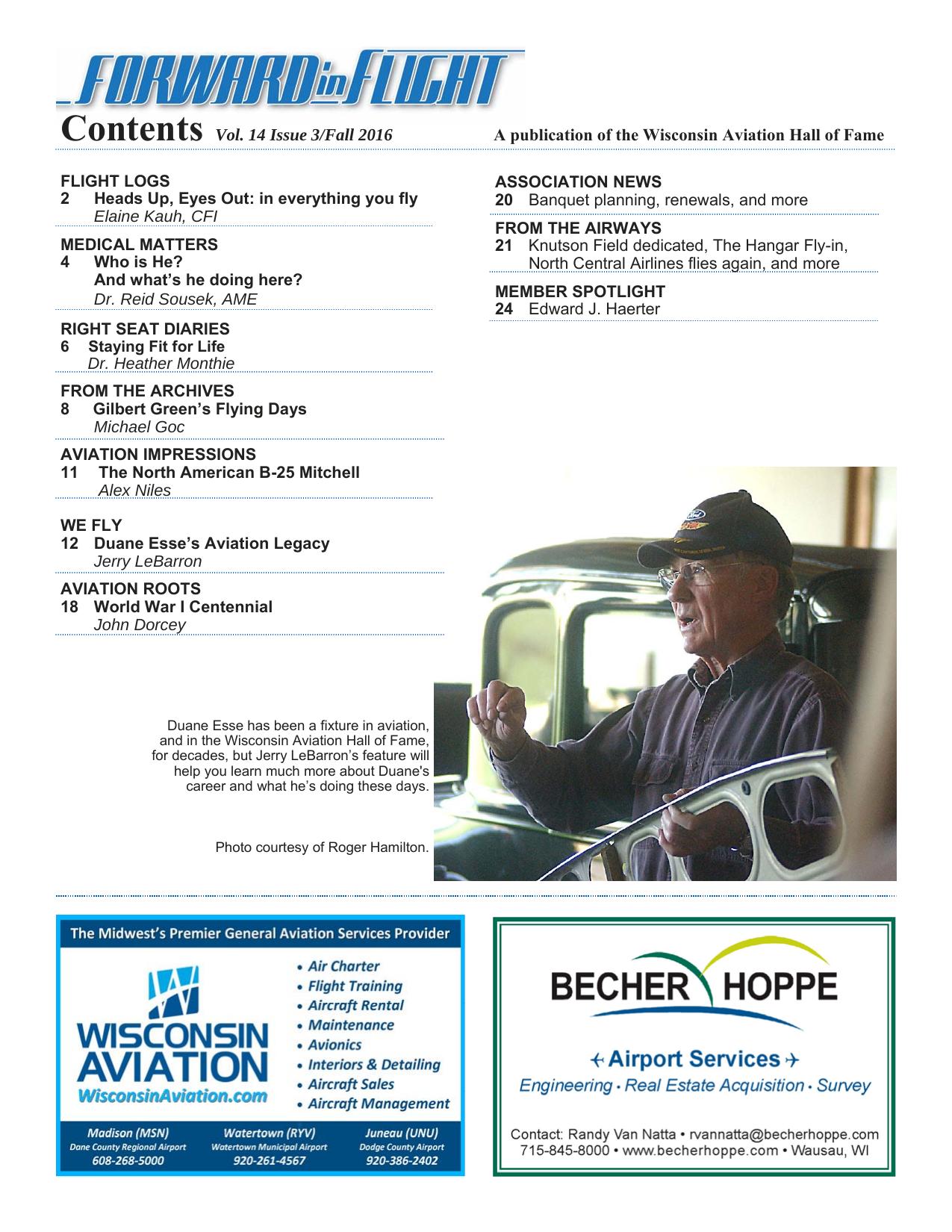
Contents Vol. 14 Issue 3/Fall 2016 A publication of the Wisconsin Aviation Hall of Fame FLIGHT LOGS 2 Heads Up, Eyes Out: in everything you fly Elaine Kauh, CFI ASSOCIATION NEWS 20 Banquet planning, renewals, and more MEDICAL MATTERS 4 Who is He? And what’s he doing here? Dr. Reid Sousek, AME RIGHT SEAT DIARIES 6 Staying Fit for Life Dr. Heather Monthie FROM THE ARCHIVES 8 Gilbert Green’s Flying Days Michael Goc AVIATION IMPRESSIONS 11 The North American B-25 Mitchell Alex Niles WE FLY 12 Duane Esse’s Aviation Legacy Jerry LeBarron AVIATION ROOTS 18 World War I Centennial John Dorcey Duane Esse has been a fixture in aviation, and in the Wisconsin Aviation Hall of Fame, for decades, but Jerry LeBarron’s feature will help you learn much more about Duane's career and what he’s doing these days. Photo courtesy of Roger Hamilton. FROM THE AIRWAYS 21 Knutson Field dedicated, The Hangar Fly-in, North Central Airlines flies again, and more MEMBER SPOTLIGHT 24 Edward J. Haerter
President’s Message ~ by Rose Dorcey In this column, I’ve often wrote about the joys I’ve experienced since becoming involved with the Wisconsin Aviation Hall of Fame. I’ve learned a great deal about our state’s aviation history, I’ve met several of the history makers, and worked with many talented men and women on the board of directors. I’ve made dozens of friendships with WAHF member/supporters and inductees, and as I’ve said numerous times, the friendships are the biggest bonus of volunteer work such as this. Back in about 2001 I was asked to consider saying yes to a position with the WAHF board of directors. I knew little about the organization, or our state’s aviation history for that matter, but I was eager to learn about both. I agreed and soon began attending my first board meetings. If you ask those who served with me at the time, they would probably tell you that I was pretty quiet. That was when Earl Pingel was still president, and founding board member LaFonda Kinnaman was still serving. Charles Marotske, another longtime board member, was there, and so was Keith Glasshof. I listened and learned from them, and then eventually, started bringing ideas forward. I saw the organization as one with a strong foundation, but one that also had great potential to grow and create more programs by reaching out to the aviation —and non-aviation— community. With a board willing to try some new things, we created a quarterly publication for our members. It started small, as a little four-pager, and we called it the WAHF Flyer. It was not a new idea, Earl had sent out membership newsletters, but we had bigger plans. Soon it grew, with the well researched articles by Gary Dikkers and colorful, informative stories by Michael Goc. We couldn’t call it a newsletter anymore, it became an anticipated magazine that our members enjoyed. About the same time that I joined the board Earl began pitching the idea of initiating a WAHF scholarship. He contributed his own funds as seed money. Soon the fund grew, with contributions from WAHF members and friends, and proceeds of our silent auctions. Once the fund was endowed, we began giving an annual $1000 scholarship to an aviation student from Wisconsin. Soon Jerome Thiessen contacted us about starting a scholarship, and then the family of Jerome Ripp did the same. A few years later EAA Chapter 640 started a fund with WAHF, Forward in Flight The only magazine dedicated exclusively to Wisconsin aviation history and today’s events. Rose Dorcey, editor 3980 Sharratt Drive Oshkosh, WI 54901-1276 Phone: 920-385-1483 · 920-279-6029 rdorcey@wisconsinaviationhallofame.org The Wisconsin Aviation Hall of Fame is a non-profit membership organization with a mission to collect and preserve the history of aviation in Wisconsin, recognize those who made that history, inform others of it, and promote aviation education for future generations. and so did the friends and family of Jeff Baum. What kind, generous people I had the pleasure of working with as those scholarships got established! Somewhere through the years I became president of WAHF. It seemed a natural progression. I was no longer that quiet person on the board, in fact there were times I likely said too much! But my fellow board members and I had a great relationship as we planned events and grew the organization. More importantly, we helped WAHF become much more visible in state aviation circles. From the strong foundation of which we started, we went out and formed relationships with the Wisconsin aviation community, such as the good people with the Wisconsin Airport Management Association. Our partnerships and friendships helped WAHF receive more nominations, donations, and members, thereby helping us carry out our mission. By now you’ve probably realized that I’m very proud of the work we’ve done. I believe every organization should have a change in leadership from time to time to keep things fresh, and though it’s been a very special part of my life for these past 15 years, I must cut back on my WAHF duties. It’s not easy, but I must say, it’s time for me to step down. My fellow board members have become good friends, and they understand my decision to decline another term. I will not be running for a board position in October, and this will be my last president’s message. You’ll still hear from me though. I have promised to stay on as editor of Forward in Flight, and you’ll likely see me at WAHF events, but not in a leadership role. I’ll always be a staunch supporter of WAHF. I hope you will, too. The work the board does is important and they are dedicated men and women. I can’t tell you how many hours your volunteer board works (it’s a lot!) to make this a vital aviation organization. I am so thankful to all who have been our supportive member and partners along the way. And I thank every WAHF member I’ve had the pleasure to meet and work with; you’re all so important to me. On the cover: The gigantic Martin Mars aircraft, the world’s largest flying water bomber and the last of its kind, made its first trip to Wisconsin to participate in EAA AirVenture Oshkosh 2016. During the event, the Mars was parked near the EAA Seaplane Base on Lake Winnebago. It flew several demonstrations throughout the week during the daily afternoon air shows. The plane thrilled the air show audience when it dropped several thousand gallons of water toward the runways at Wittman Regional Airport, showing its outstanding capability as a fire fighting aircraft. EAA photo/Spencer Thornton
FLIGHT LOGS Heads Up, Eyes Out In everything you fly By Elaine Kauh Of the few scary moments I’ve encountered in flying, one of the scariest occurred just this summer. And as it was well over a mile away from me while I stood on a tarmac, I could only watch with relief as everything worked out and was thankful I didn’t have to be a witness to an accident. It was a typical Wisconsin summer day – warm, with a gentle breeze from the southwest and a bright clear sky. Another pilot and I were getting into a Piper Cherokee to return to his home base after a fun morning of airport hopping with lots of practice landings. I remember opening the single cabin door to let the left-seat pilot in, and then pausing on the wing to watch a business jet’s landing light shining in the distance as it flew its final approach to the wide, long runway. Although the sun was behind me, it was intense enough for me to squint and shade my eyes a little as I enjoyed the sight of the jet’s light, like a little star floating down, as the rest of the aircraft began to come into view. Then it arrived in profile approaching the threshold, seemingly silent and gleaming white. I’ve come to expect perfect landings from these types of aircraft as I’ve never seen anything else. But something different happened that broke me out of my quiet gaze. The jet began powering up. As soon as I heard the sharp whirring of its engines, I saw something else. It was the cause of the interruption – a yellow cropduster had just finished its landing rollout and was turning off the runway. While I knew that this was a beefy taildragger (compared to the ones I’m used to) with a turbine engine, it looked so tiny on that expanse of concrete beneath the bizjet that zoomed over it on a go-around. It all took just a second, and then it was obvious what had just happened – a runway incursion followed by an aborted landing, as the jet pilot went around to avoid what could have been a terrible accident. A few minutes later, we had started up the Cherokee and when the radios were up, I heard the tower controller discussing this with the bizjet pilot. From what I could tell, the taildragger wasn’t in radio contact and must have had a prior arrangement with the tower to arrive and land. The jet pilot was understanding and didn’t blame the controller for the close call, and he had done what every pilot is trained to do on approach to a runway – keep a close eye for anything that could get in the way. It was a reminder for us just boarding an airplane that everyone operating at an airport—on the ground and in the air—is responsible for collision avoidance. And the best tool you have, no matter how much equipment there is to see traffic, is your brain: Heads Up, Eyes Out. And if so equipped, Ears On. Most airports don’t have control towers, leaving it up to pilots to watch for each other while moving on the ground, departing and arriving. Most everyone also communicates via radio to report their position and listen for any potential traffic conflicts that could be alongside, above and below, ahead and behind. Even when talking to another pilot to work out where everyone is and what we’re going to do, that “conflict loop” remains open until both aircraft have visual contact with one another. One pilot reporting he or she has you “in sight” and so can maneuver accordingly is just about good enough for most situations, but there’s that extra bit of reassurance when the other pilot also sees the first one. Heads Up, Eyes Out, Ears On. Even those airports with extra pairs of eyes on the ground working air traffic control require constant vigilance on the part of pilots by watching and listening. Out of training, habit, and common sense, we always check the airspace approaching a runway before telling the control tower we’re ready for takeoff, then check the runway itself as we roll out. Regardless of who’s talking and listening, errors can and do happen. Radio calls have often masked, until a close call or collision, mistakes in communications, wrong runway numbers, misjudged directions and positions – another reason why visual contact is the only true way to 2 Forward in Flight ~ Quarterly Magazine of the Wisconsin Aviation Hall of Fame confirm what’s going on. Near collisions are far more common than statistics show, since most of these instances do occur at the untowered airports that make up the majority of the National Airspace System. Incursions, where there is a traffic conflict on a runway, don’t get reported unless there’s an actual collision or other mishap. When there’s a close call, as in the event I saw, with air traffic controllers on watch, they must report the event. If there’s a pattern of incursions or incidents at a specific area where ground-to-ground or groundto-air conflicts are a problem, changes to procedures or ground markings are issued and airport diagrams get marked with “hot spots” to point these out to pilots. It all took just a second, and then it was obvious what had just happened – a runway incursion followed by an aborted landing…. There’s always potential for this no matter how much we try to watch and listen. Most public-use airports have multiple runways; tower or not, it is often impossible for two airplanes on the ground at different runways to see each other. Radio calls are among the most useful methods of knowing what’s going on in the vicinity of any airport. But pilots aren’t always able to listen continuously due to other distractions. Moreover, cockpit radios are not required unless in areas where air traffic control is directing traffic. Most pilots these days are adamant
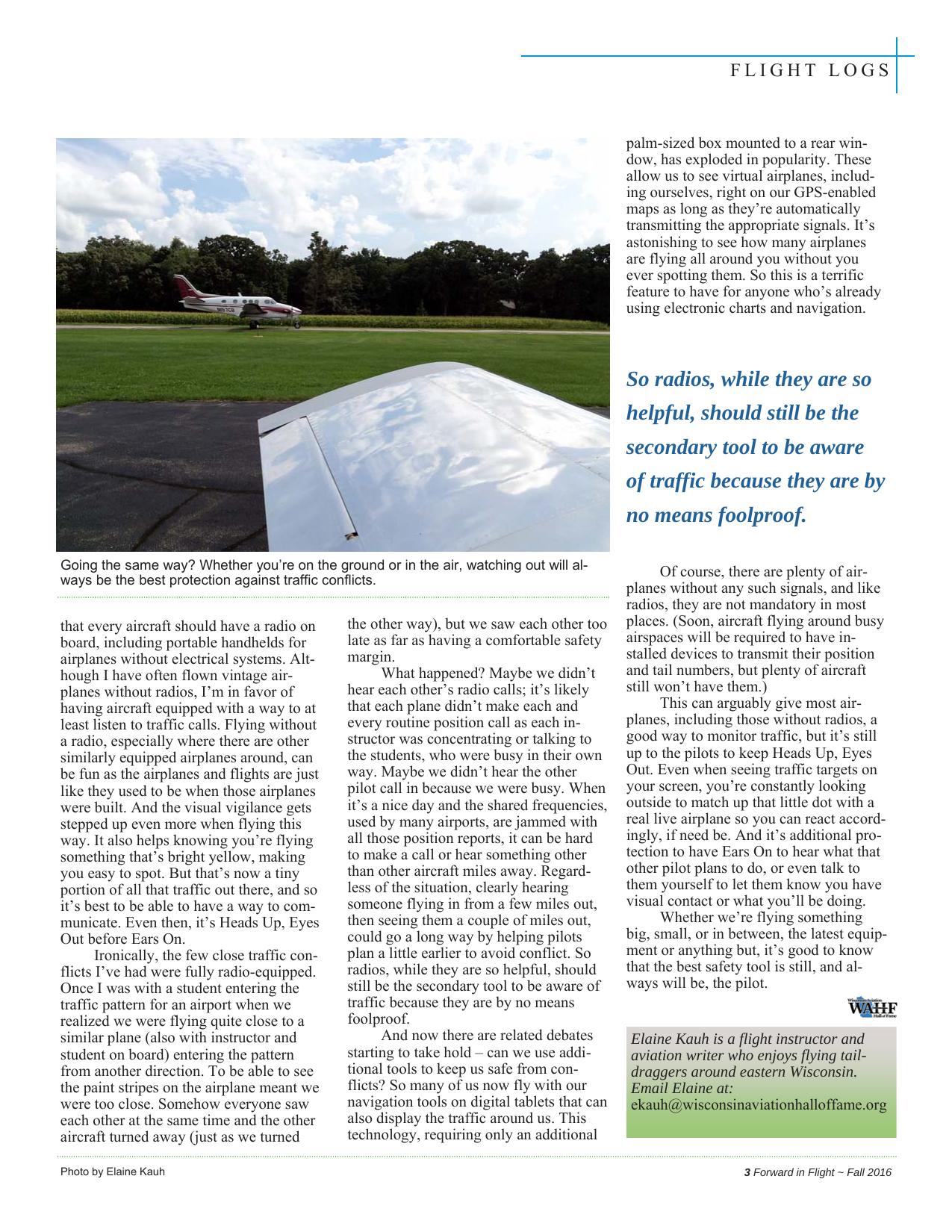
FLIGHT LOGS palm-sized box mounted to a rear window, has exploded in popularity. These allow us to see virtual airplanes, including ourselves, right on our GPS-enabled maps as long as they’re automatically transmitting the appropriate signals. It’s astonishing to see how many airplanes are flying all around you without you ever spotting them. So this is a terrific feature to have for anyone who’s already using electronic charts and navigation. So radios, while they are so helpful, should still be the secondary tool to be aware of traffic because they are by no means foolproof. Going the same way? Whether you’re on the ground or in the air, watching out will always be the best protection against traffic conflicts. that every aircraft should have a radio on board, including portable handhelds for airplanes without electrical systems. Although I have often flown vintage airplanes without radios, I’m in favor of having aircraft equipped with a way to at least listen to traffic calls. Flying without a radio, especially where there are other similarly equipped airplanes around, can be fun as the airplanes and flights are just like they used to be when those airplanes were built. And the visual vigilance gets stepped up even more when flying this way. It also helps knowing you’re flying something that’s bright yellow, making you easy to spot. But that’s now a tiny portion of all that traffic out there, and so it’s best to be able to have a way to communicate. Even then, it’s Heads Up, Eyes Out before Ears On. Ironically, the few close traffic conflicts I’ve had were fully radio-equipped. Once I was with a student entering the traffic pattern for an airport when we realized we were flying quite close to a similar plane (also with instructor and student on board) entering the pattern from another direction. To be able to see the paint stripes on the airplane meant we were too close. Somehow everyone saw each other at the same time and the other aircraft turned away (just as we turned Photo by Elaine Kauh the other way), but we saw each other too late as far as having a comfortable safety margin. What happened? Maybe we didn’t hear each other’s radio calls; it’s likely that each plane didn’t make each and every routine position call as each instructor was concentrating or talking to the students, who were busy in their own way. Maybe we didn’t hear the other pilot call in because we were busy. When it’s a nice day and the shared frequencies, used by many airports, are jammed with all those position reports, it can be hard to make a call or hear something other than other aircraft miles away. Regardless of the situation, clearly hearing someone flying in from a few miles out, then seeing them a couple of miles out, could go a long way by helping pilots plan a little earlier to avoid conflict. So radios, while they are so helpful, should still be the secondary tool to be aware of traffic because they are by no means foolproof. And now there are related debates starting to take hold – can we use additional tools to keep us safe from conflicts? So many of us now fly with our navigation tools on digital tablets that can also display the traffic around us. This technology, requiring only an additional Of course, there are plenty of airplanes without any such signals, and like radios, they are not mandatory in most places. (Soon, aircraft flying around busy airspaces will be required to have installed devices to transmit their position and tail numbers, but plenty of aircraft still won’t have them.) This can arguably give most airplanes, including those without radios, a good way to monitor traffic, but it’s still up to the pilots to keep Heads Up, Eyes Out. Even when seeing traffic targets on your screen, you’re constantly looking outside to match up that little dot with a real live airplane so you can react accordingly, if need be. And it’s additional protection to have Ears On to hear what that other pilot plans to do, or even talk to them yourself to let them know you have visual contact or what you’ll be doing. Whether we’re flying something big, small, or in between, the latest equipment or anything but, it’s good to know that the best safety tool is still, and always will be, the pilot. Elaine Kauh is a flight instructor and aviation writer who enjoys flying taildraggers around eastern Wisconsin. Email Elaine at: ekauh@wisconsinaviationhalloffame.org 3 Forward in Flight ~ Fall 2016
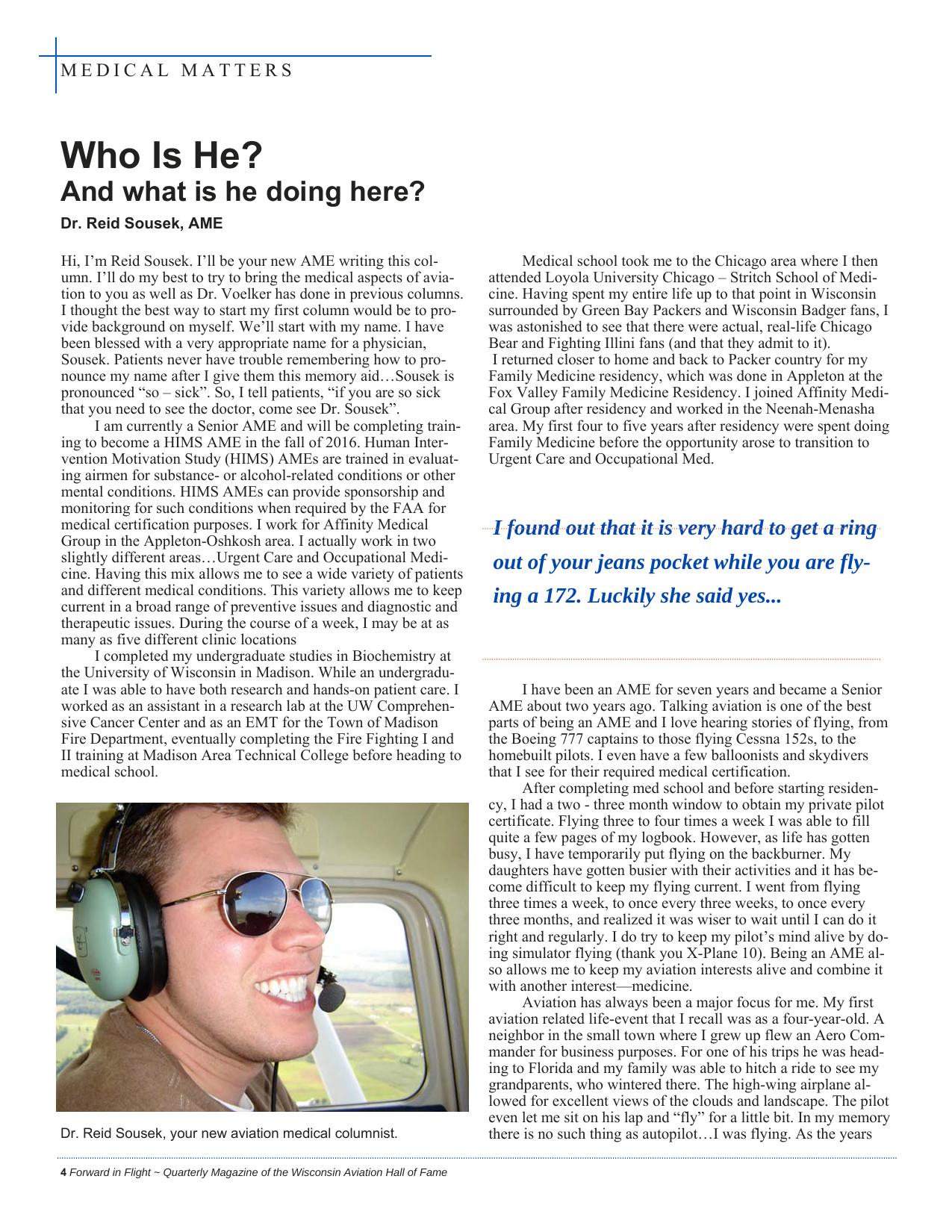
MEDICAL MATTERS Who Is He? And what is he doing here? Dr. Reid Sousek, AME Hi, I’m Reid Sousek. I’ll be your new AME writing this column. I’ll do my best to try to bring the medical aspects of aviation to you as well as Dr. Voelker has done in previous columns. I thought the best way to start my first column would be to provide background on myself. We’ll start with my name. I have been blessed with a very appropriate name for a physician, Sousek. Patients never have trouble remembering how to pronounce my name after I give them this memory aid…Sousek is pronounced “so – sick”. So, I tell patients, “if you are so sick that you need to see the doctor, come see Dr. Sousek”. I am currently a Senior AME and will be completing training to become a HIMS AME in the fall of 2016. Human Intervention Motivation Study (HIMS) AMEs are trained in evaluating airmen for substance- or alcohol-related conditions or other mental conditions. HIMS AMEs can provide sponsorship and monitoring for such conditions when required by the FAA for medical certification purposes. I work for Affinity Medical Group in the Appleton-Oshkosh area. I actually work in two slightly different areas…Urgent Care and Occupational Medicine. Having this mix allows me to see a wide variety of patients and different medical conditions. This variety allows me to keep current in a broad range of preventive issues and diagnostic and therapeutic issues. During the course of a week, I may be at as many as five different clinic locations I completed my undergraduate studies in Biochemistry at the University of Wisconsin in Madison. While an undergraduate I was able to have both research and hands-on patient care. I worked as an assistant in a research lab at the UW Comprehensive Cancer Center and as an EMT for the Town of Madison Fire Department, eventually completing the Fire Fighting I and II training at Madison Area Technical College before heading to medical school. Dr. Reid Sousek, your new aviation medical columnist. 4 Forward in Flight ~ Quarterly Magazine of the Wisconsin Aviation Hall of Fame Medical school took me to the Chicago area where I then attended Loyola University Chicago – Stritch School of Medicine. Having spent my entire life up to that point in Wisconsin surrounded by Green Bay Packers and Wisconsin Badger fans, I was astonished to see that there were actual, real-life Chicago Bear and Fighting Illini fans (and that they admit to it). I returned closer to home and back to Packer country for my Family Medicine residency, which was done in Appleton at the Fox Valley Family Medicine Residency. I joined Affinity Medical Group after residency and worked in the Neenah-Menasha area. My first four to five years after residency were spent doing Family Medicine before the opportunity arose to transition to Urgent Care and Occupational Med. I found out that it is very hard to get a ring out of your jeans pocket while you are flying a 172. Luckily she said yes... I have been an AME for seven years and became a Senior AME about two years ago. Talking aviation is one of the best parts of being an AME and I love hearing stories of flying, from the Boeing 777 captains to those flying Cessna 152s, to the homebuilt pilots. I even have a few balloonists and skydivers that I see for their required medical certification. After completing med school and before starting residency, I had a two - three month window to obtain my private pilot certificate. Flying three to four times a week I was able to fill quite a few pages of my logbook. However, as life has gotten busy, I have temporarily put flying on the backburner. My daughters have gotten busier with their activities and it has become difficult to keep my flying current. I went from flying three times a week, to once every three weeks, to once every three months, and realized it was wiser to wait until I can do it right and regularly. I do try to keep my pilot’s mind alive by doing simulator flying (thank you X-Plane 10). Being an AME also allows me to keep my aviation interests alive and combine it with another interest—medicine. Aviation has always been a major focus for me. My first aviation related life-event that I recall was as a four-year-old. A neighbor in the small town where I grew up flew an Aero Commander for business purposes. For one of his trips he was heading to Florida and my family was able to hitch a ride to see my grandparents, who wintered there. The high-wing airplane allowed for excellent views of the clouds and landscape. The pilot even let me sit on his lap and “fly” for a little bit. In my memory there is no such thing as autopilot…I was flying. As the years
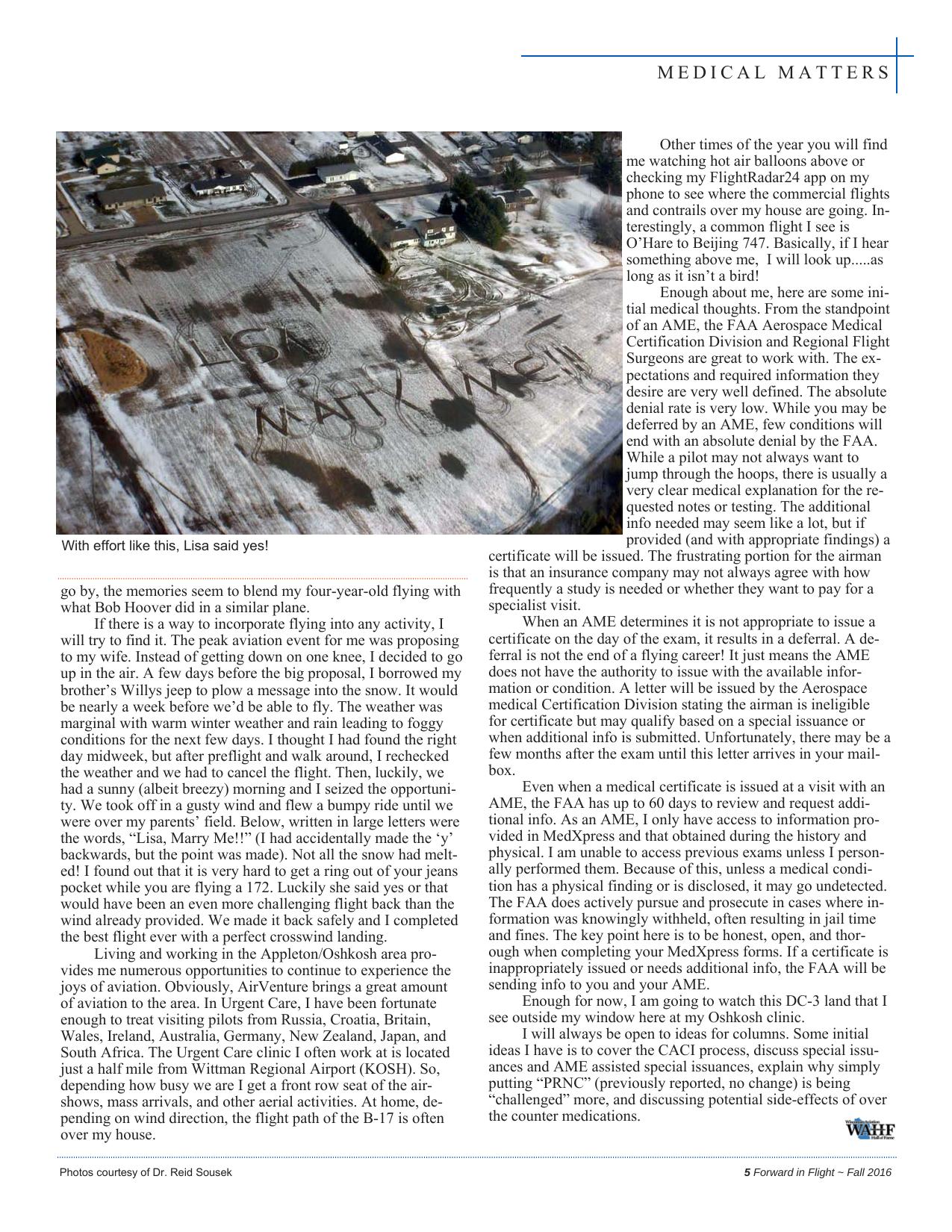
MEDICAL MATTERS With effort like this, Lisa said yes! go by, the memories seem to blend my four-year-old flying with what Bob Hoover did in a similar plane. If there is a way to incorporate flying into any activity, I will try to find it. The peak aviation event for me was proposing to my wife. Instead of getting down on one knee, I decided to go up in the air. A few days before the big proposal, I borrowed my brother’s Willys jeep to plow a message into the snow. It would be nearly a week before we’d be able to fly. The weather was marginal with warm winter weather and rain leading to foggy conditions for the next few days. I thought I had found the right day midweek, but after preflight and walk around, I rechecked the weather and we had to cancel the flight. Then, luckily, we had a sunny (albeit breezy) morning and I seized the opportunity. We took off in a gusty wind and flew a bumpy ride until we were over my parents’ field. Below, written in large letters were the words, “Lisa, Marry Me!!” (I had accidentally made the ‘y’ backwards, but the point was made). Not all the snow had melted! I found out that it is very hard to get a ring out of your jeans pocket while you are flying a 172. Luckily she said yes or that would have been an even more challenging flight back than the wind already provided. We made it back safely and I completed the best flight ever with a perfect crosswind landing. Living and working in the Appleton/Oshkosh area provides me numerous opportunities to continue to experience the joys of aviation. Obviously, AirVenture brings a great amount of aviation to the area. In Urgent Care, I have been fortunate enough to treat visiting pilots from Russia, Croatia, Britain, Wales, Ireland, Australia, Germany, New Zealand, Japan, and South Africa. The Urgent Care clinic I often work at is located just a half mile from Wittman Regional Airport (KOSH). So, depending how busy we are I get a front row seat of the airshows, mass arrivals, and other aerial activities. At home, depending on wind direction, the flight path of the B-17 is often over my house. Photos courtesy of Dr. Reid Sousek Other times of the year you will find me watching hot air balloons above or checking my FlightRadar24 app on my phone to see where the commercial flights and contrails over my house are going. Interestingly, a common flight I see is O’Hare to Beijing 747. Basically, if I hear something above me, I will look up.....as long as it isn’t a bird! Enough about me, here are some initial medical thoughts. From the standpoint of an AME, the FAA Aerospace Medical Certification Division and Regional Flight Surgeons are great to work with. The expectations and required information they desire are very well defined. The absolute denial rate is very low. While you may be deferred by an AME, few conditions will end with an absolute denial by the FAA. While a pilot may not always want to jump through the hoops, there is usually a very clear medical explanation for the requested notes or testing. The additional info needed may seem like a lot, but if provided (and with appropriate findings) a certificate will be issued. The frustrating portion for the airman is that an insurance company may not always agree with how frequently a study is needed or whether they want to pay for a specialist visit. When an AME determines it is not appropriate to issue a certificate on the day of the exam, it results in a deferral. A deferral is not the end of a flying career! It just means the AME does not have the authority to issue with the available information or condition. A letter will be issued by the Aerospace medical Certification Division stating the airman is ineligible for certificate but may qualify based on a special issuance or when additional info is submitted. Unfortunately, there may be a few months after the exam until this letter arrives in your mailbox. Even when a medical certificate is issued at a visit with an AME, the FAA has up to 60 days to review and request additional info. As an AME, I only have access to information provided in MedXpress and that obtained during the history and physical. I am unable to access previous exams unless I personally performed them. Because of this, unless a medical condition has a physical finding or is disclosed, it may go undetected. The FAA does actively pursue and prosecute in cases where information was knowingly withheld, often resulting in jail time and fines. The key point here is to be honest, open, and thorough when completing your MedXpress forms. If a certificate is inappropriately issued or needs additional info, the FAA will be sending info to you and your AME. Enough for now, I am going to watch this DC-3 land that I see outside my window here at my Oshkosh clinic. I will always be open to ideas for columns. Some initial ideas I have is to cover the CACI process, discuss special issuances and AME assisted special issuances, explain why simply putting “PRNC” (previously reported, no change) is being “challenged” more, and discussing potential side-effects of over the counter medications. 5 Forward in Flight ~ Fall 2016
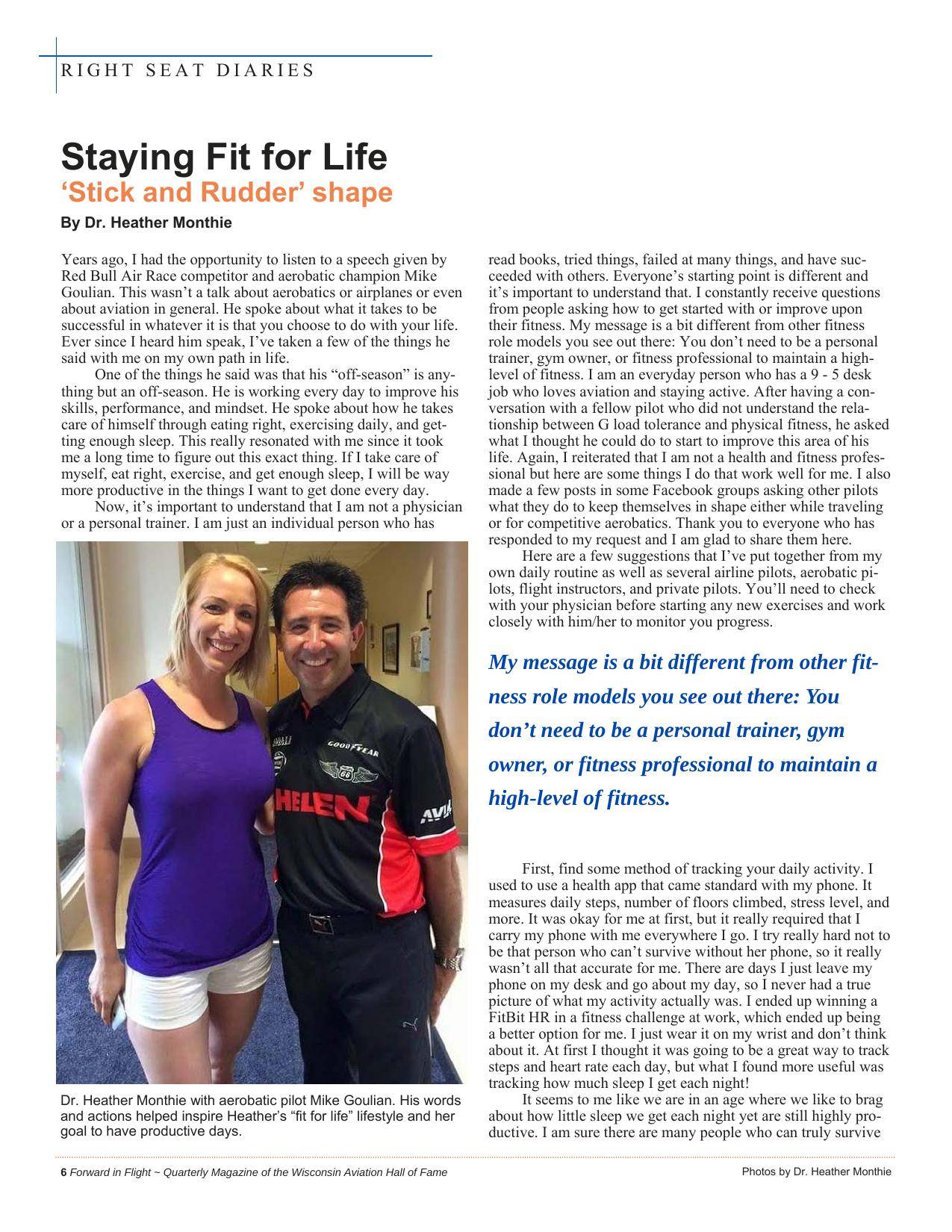
RIGHT SEAT DIARIES Staying Fit for Life ‘Stick and Rudder’ shape By Dr. Heather Monthie Years ago, I had the opportunity to listen to a speech given by Red Bull Air Race competitor and aerobatic champion Mike Goulian. This wasn’t a talk about aerobatics or airplanes or even about aviation in general. He spoke about what it takes to be successful in whatever it is that you choose to do with your life. Ever since I heard him speak, I’ve taken a few of the things he said with me on my own path in life. One of the things he said was that his “off-season” is anything but an off-season. He is working every day to improve his skills, performance, and mindset. He spoke about how he takes care of himself through eating right, exercising daily, and getting enough sleep. This really resonated with me since it took me a long time to figure out this exact thing. If I take care of myself, eat right, exercise, and get enough sleep, I will be way more productive in the things I want to get done every day. Now, it’s important to understand that I am not a physician or a personal trainer. I am just an individual person who has read books, tried things, failed at many things, and have succeeded with others. Everyone’s starting point is different and it’s important to understand that. I constantly receive questions from people asking how to get started with or improve upon their fitness. My message is a bit different from other fitness role models you see out there: You don’t need to be a personal trainer, gym owner, or fitness professional to maintain a highlevel of fitness. I am an everyday person who has a 9 - 5 desk job who loves aviation and staying active. After having a conversation with a fellow pilot who did not understand the relationship between G load tolerance and physical fitness, he asked what I thought he could do to start to improve this area of his life. Again, I reiterated that I am not a health and fitness professional but here are some things I do that work well for me. I also made a few posts in some Facebook groups asking other pilots what they do to keep themselves in shape either while traveling or for competitive aerobatics. Thank you to everyone who has responded to my request and I am glad to share them here. Here are a few suggestions that I’ve put together from my own daily routine as well as several airline pilots, aerobatic pilots, flight instructors, and private pilots. You’ll need to check with your physician before starting any new exercises and work closely with him/her to monitor you progress. My message is a bit different from other fitness role models you see out there: You don’t need to be a personal trainer, gym owner, or fitness professional to maintain a high-level of fitness. Dr. Heather Monthie with aerobatic pilot Mike Goulian. His words and actions helped inspire Heather’s “fit for life” lifestyle and her goal to have productive days. 6 Forward in Flight ~ Quarterly Magazine of the Wisconsin Aviation Hall of Fame First, find some method of tracking your daily activity. I used to use a health app that came standard with my phone. It measures daily steps, number of floors climbed, stress level, and more. It was okay for me at first, but it really required that I carry my phone with me everywhere I go. I try really hard not to be that person who can’t survive without her phone, so it really wasn’t all that accurate for me. There are days I just leave my phone on my desk and go about my day, so I never had a true picture of what my activity actually was. I ended up winning a FitBit HR in a fitness challenge at work, which ended up being a better option for me. I just wear it on my wrist and don’t think about it. At first I thought it was going to be a great way to track steps and heart rate each day, but what I found more useful was tracking how much sleep I get each night! It seems to me like we are in an age where we like to brag about how little sleep we get each night yet are still highly productive. I am sure there are many people who can truly survive Photos by Dr. Heather Monthie
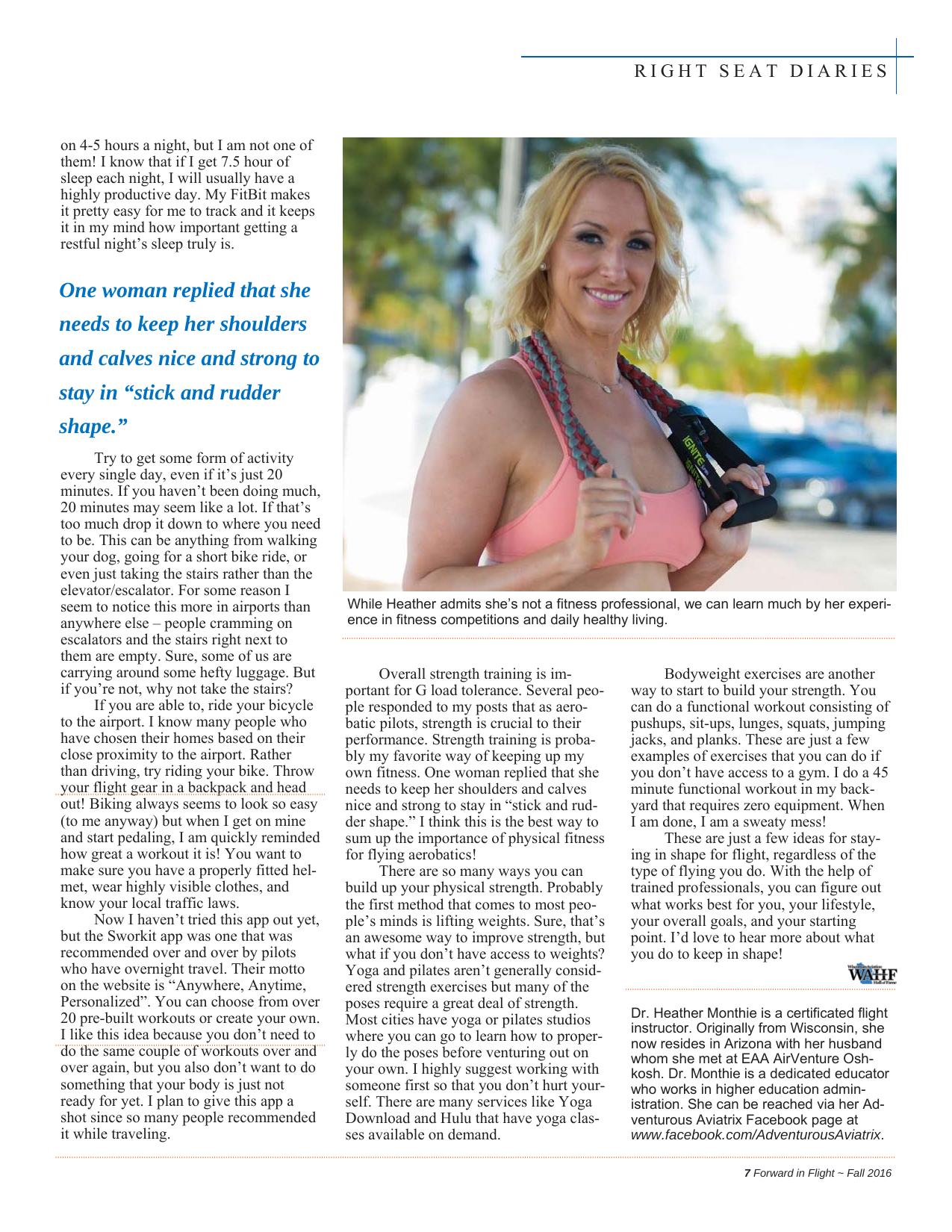
RIGHT SEAT DIARIES on 4-5 hours a night, but I am not one of them! I know that if I get 7.5 hour of sleep each night, I will usually have a highly productive day. My FitBit makes it pretty easy for me to track and it keeps it in my mind how important getting a restful night’s sleep truly is. One woman replied that she needs to keep her shoulders and calves nice and strong to stay in “stick and rudder shape.” Try to get some form of activity every single day, even if it’s just 20 minutes. If you haven’t been doing much, 20 minutes may seem like a lot. If that’s too much drop it down to where you need to be. This can be anything from walking your dog, going for a short bike ride, or even just taking the stairs rather than the elevator/escalator. For some reason I seem to notice this more in airports than anywhere else – people cramming on escalators and the stairs right next to them are empty. Sure, some of us are carrying around some hefty luggage. But if you’re not, why not take the stairs? If you are able to, ride your bicycle to the airport. I know many people who have chosen their homes based on their close proximity to the airport. Rather than driving, try riding your bike. Throw your flight gear in a backpack and head out! Biking always seems to look so easy (to me anyway) but when I get on mine and start pedaling, I am quickly reminded how great a workout it is! You want to make sure you have a properly fitted helmet, wear highly visible clothes, and know your local traffic laws. Now I haven’t tried this app out yet, but the Sworkit app was one that was recommended over and over by pilots who have overnight travel. Their motto on the website is “Anywhere, Anytime, Personalized”. You can choose from over 20 pre-built workouts or create your own. I like this idea because you don’t need to do the same couple of workouts over and over again, but you also don’t want to do something that your body is just not ready for yet. I plan to give this app a shot since so many people recommended it while traveling. While Heather admits she’s not a fitness professional, we can learn much by her experience in fitness competitions and daily healthy living. Overall strength training is important for G load tolerance. Several people responded to my posts that as aerobatic pilots, strength is crucial to their performance. Strength training is probably my favorite way of keeping up my own fitness. One woman replied that she needs to keep her shoulders and calves nice and strong to stay in “stick and rudder shape.” I think this is the best way to sum up the importance of physical fitness for flying aerobatics! There are so many ways you can build up your physical strength. Probably the first method that comes to most people’s minds is lifting weights. Sure, that’s an awesome way to improve strength, but what if you don’t have access to weights? Yoga and pilates aren’t generally considered strength exercises but many of the poses require a great deal of strength. Most cities have yoga or pilates studios where you can go to learn how to properly do the poses before venturing out on your own. I highly suggest working with someone first so that you don’t hurt yourself. There are many services like Yoga Download and Hulu that have yoga classes available on demand. Bodyweight exercises are another way to start to build your strength. You can do a functional workout consisting of pushups, sit-ups, lunges, squats, jumping jacks, and planks. These are just a few examples of exercises that you can do if you don’t have access to a gym. I do a 45 minute functional workout in my backyard that requires zero equipment. When I am done, I am a sweaty mess! These are just a few ideas for staying in shape for flight, regardless of the type of flying you do. With the help of trained professionals, you can figure out what works best for you, your lifestyle, your overall goals, and your starting point. I’d love to hear more about what you do to keep in shape! Dr. Heather Monthie is a certificated flight instructor. Originally from Wisconsin, she now resides in Arizona with her husband whom she met at EAA AirVenture Oshkosh. Dr. Monthie is a dedicated educator who works in higher education administration. She can be reached via her Adventurous Aviatrix Facebook page at www.facebook.com/AdventurousAviatrix. 7 Forward in Flight ~ Fall 2016
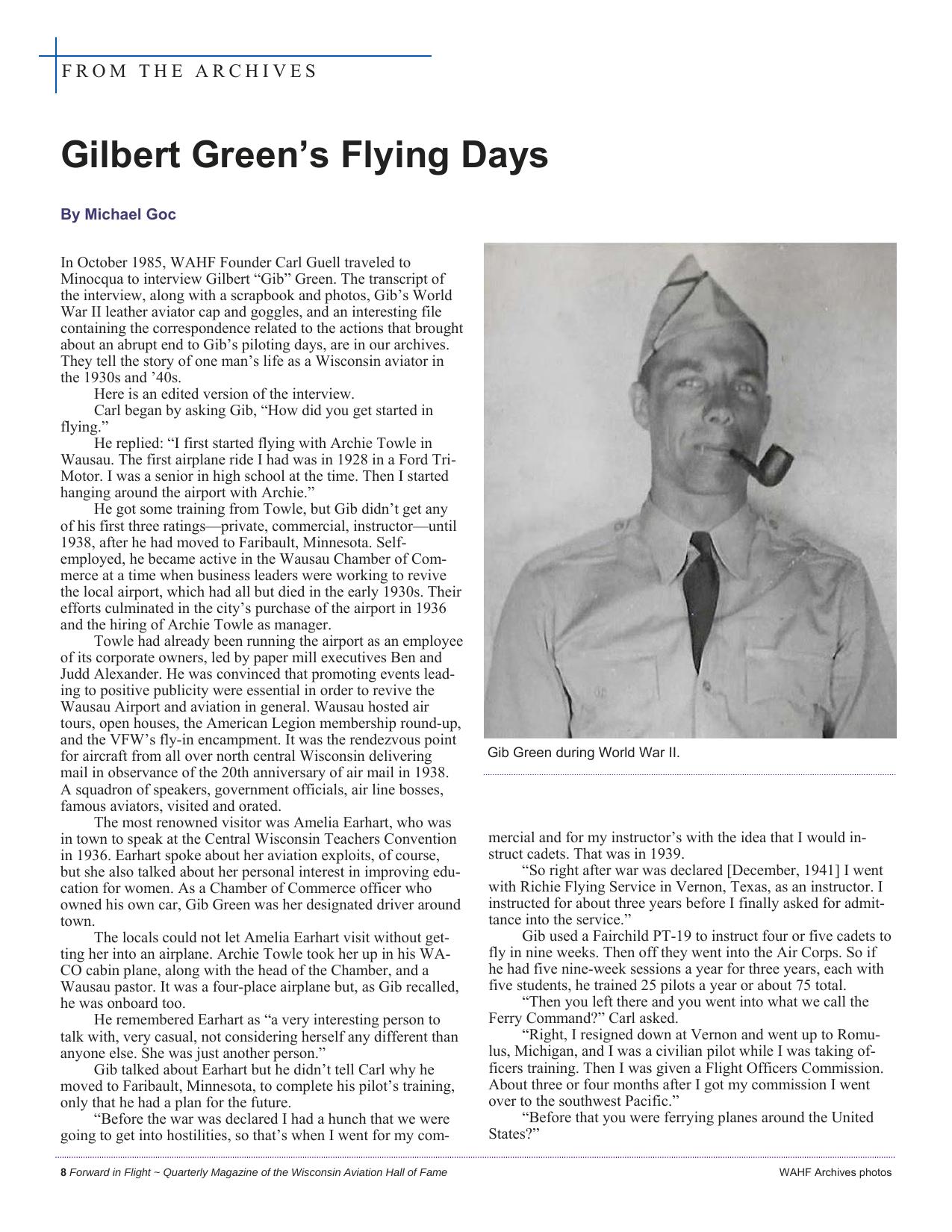
FROM THE ARCHIVES Gilbert Green’s Flying Days By Michael Goc In October 1985, WAHF Founder Carl Guell traveled to Minocqua to interview Gilbert “Gib” Green. The transcript of the interview, along with a scrapbook and photos, Gib’s World War II leather aviator cap and goggles, and an interesting file containing the correspondence related to the actions that brought about an abrupt end to Gib’s piloting days, are in our archives. They tell the story of one man’s life as a Wisconsin aviator in the 1930s and ’40s. Here is an edited version of the interview. Carl began by asking Gib, “How did you get started in flying.” He replied: “I first started flying with Archie Towle in Wausau. The first airplane ride I had was in 1928 in a Ford TriMotor. I was a senior in high school at the time. Then I started hanging around the airport with Archie.” He got some training from Towle, but Gib didn’t get any of his first three ratings—private, commercial, instructor—until 1938, after he had moved to Faribault, Minnesota. Selfemployed, he became active in the Wausau Chamber of Commerce at a time when business leaders were working to revive the local airport, which had all but died in the early 1930s. Their efforts culminated in the city’s purchase of the airport in 1936 and the hiring of Archie Towle as manager. Towle had already been running the airport as an employee of its corporate owners, led by paper mill executives Ben and Judd Alexander. He was convinced that promoting events leading to positive publicity were essential in order to revive the Wausau Airport and aviation in general. Wausau hosted air tours, open houses, the American Legion membership round-up, and the VFW’s fly-in encampment. It was the rendezvous point for aircraft from all over north central Wisconsin delivering mail in observance of the 20th anniversary of air mail in 1938. A squadron of speakers, government officials, air line bosses, famous aviators, visited and orated. The most renowned visitor was Amelia Earhart, who was in town to speak at the Central Wisconsin Teachers Convention in 1936. Earhart spoke about her aviation exploits, of course, but she also talked about her personal interest in improving education for women. As a Chamber of Commerce officer who owned his own car, Gib Green was her designated driver around town. The locals could not let Amelia Earhart visit without getting her into an airplane. Archie Towle took her up in his WACO cabin plane, along with the head of the Chamber, and a Wausau pastor. It was a four-place airplane but, as Gib recalled, he was onboard too. He remembered Earhart as “a very interesting person to talk with, very casual, not considering herself any different than anyone else. She was just another person.” Gib talked about Earhart but he didn’t tell Carl why he moved to Faribault, Minnesota, to complete his pilot’s training, only that he had a plan for the future. “Before the war was declared I had a hunch that we were going to get into hostilities, so that’s when I went for my com8 Forward in Flight ~ Quarterly Magazine of the Wisconsin Aviation Hall of Fame Gib Green during World War II. mercial and for my instructor’s with the idea that I would instruct cadets. That was in 1939. “So right after war was declared [December, 1941] I went with Richie Flying Service in Vernon, Texas, as an instructor. I instructed for about three years before I finally asked for admittance into the service.” Gib used a Fairchild PT-19 to instruct four or five cadets to fly in nine weeks. Then off they went into the Air Corps. So if he had five nine-week sessions a year for three years, each with five students, he trained 25 pilots a year or about 75 total. “Then you left there and you went into what we call the Ferry Command?” Carl asked. “Right, I resigned down at Vernon and went up to Romulus, Michigan, and I was a civilian pilot while I was taking officers training. Then I was given a Flight Officers Commission. About three or four months after I got my commission I went over to the southwest Pacific.” “Before that you were ferrying planes around the United States?” WAHF Archives photos
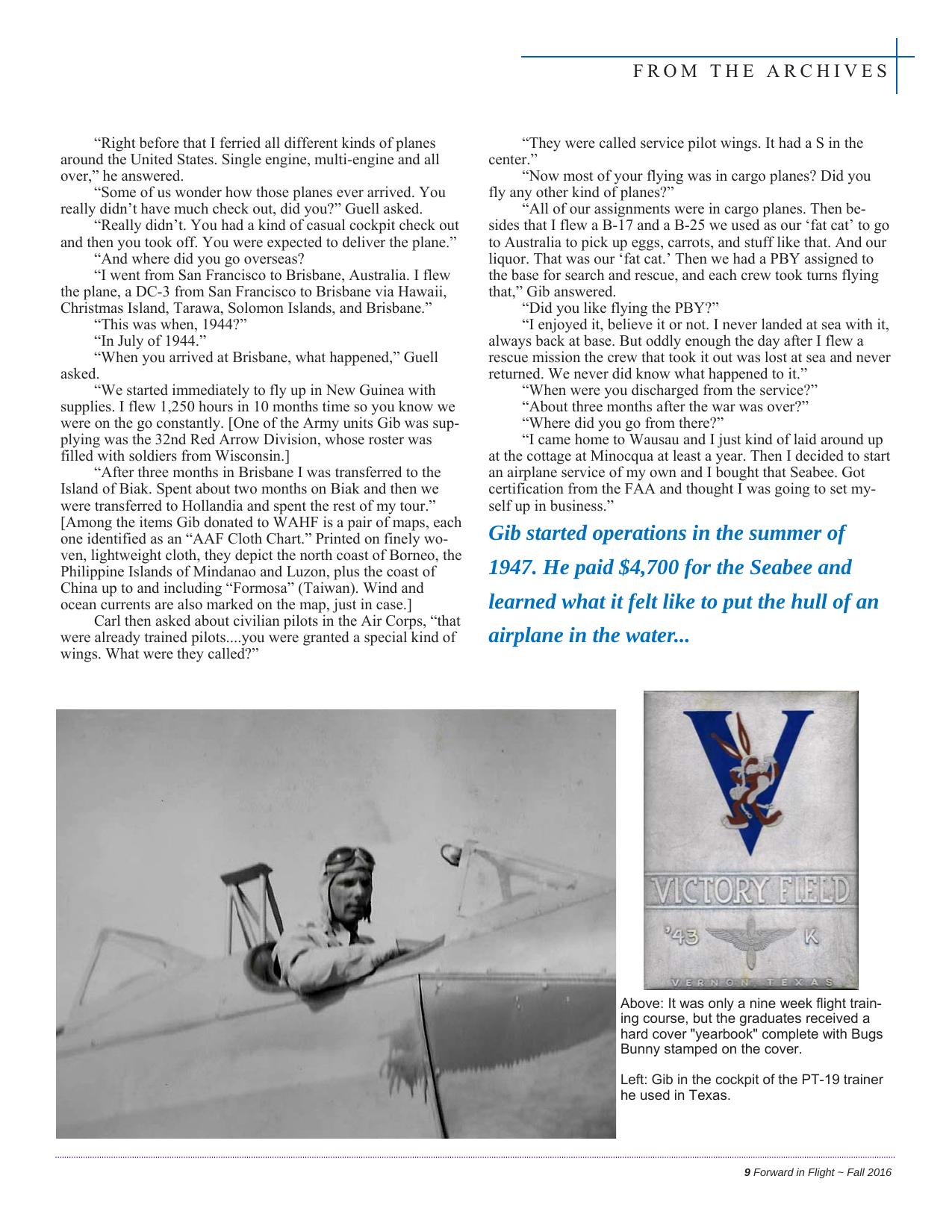
FROM THE ARCHIVES “Right before that I ferried all different kinds of planes around the United States. Single engine, multi-engine and all over,” he answered. “Some of us wonder how those planes ever arrived. You really didn’t have much check out, did you?” Guell asked. “Really didn’t. You had a kind of casual cockpit check out and then you took off. You were expected to deliver the plane.” “And where did you go overseas? “I went from San Francisco to Brisbane, Australia. I flew the plane, a DC-3 from San Francisco to Brisbane via Hawaii, Christmas Island, Tarawa, Solomon Islands, and Brisbane.” “This was when, 1944?” “In July of 1944.” “When you arrived at Brisbane, what happened,” Guell asked. “We started immediately to fly up in New Guinea with supplies. I flew 1,250 hours in 10 months time so you know we were on the go constantly. [One of the Army units Gib was supplying was the 32nd Red Arrow Division, whose roster was filled with soldiers from Wisconsin.] “After three months in Brisbane I was transferred to the Island of Biak. Spent about two months on Biak and then we were transferred to Hollandia and spent the rest of my tour.” [Among the items Gib donated to WAHF is a pair of maps, each one identified as an “AAF Cloth Chart.” Printed on finely woven, lightweight cloth, they depict the north coast of Borneo, the Philippine Islands of Mindanao and Luzon, plus the coast of China up to and including “Formosa” (Taiwan). Wind and ocean currents are also marked on the map, just in case.] Carl then asked about civilian pilots in the Air Corps, “that were already trained pilots....you were granted a special kind of wings. What were they called?” “They were called service pilot wings. It had a S in the center.” “Now most of your flying was in cargo planes? Did you fly any other kind of planes?” “All of our assignments were in cargo planes. Then besides that I flew a B-17 and a B-25 we used as our ‘fat cat’ to go to Australia to pick up eggs, carrots, and stuff like that. And our liquor. That was our ‘fat cat.’ Then we had a PBY assigned to the base for search and rescue, and each crew took turns flying that,” Gib answered. “Did you like flying the PBY?” “I enjoyed it, believe it or not. I never landed at sea with it, always back at base. But oddly enough the day after I flew a rescue mission the crew that took it out was lost at sea and never returned. We never did know what happened to it.” “When were you discharged from the service?” “About three months after the war was over?” “Where did you go from there?” “I came home to Wausau and I just kind of laid around up at the cottage at Minocqua at least a year. Then I decided to start an airplane service of my own and I bought that Seabee. Got certification from the FAA and thought I was going to set myself up in business.” Gib started operations in the summer of 1947. He paid $4,700 for the Seabee and learned what it felt like to put the hull of an airplane in the water... Above: It was only a nine week flight training course, but the graduates received a hard cover "yearbook" complete with Bugs Bunny stamped on the cover. Left: Gib in the cockpit of the PT-19 trainer he used in Texas. 9 Forward in Flight ~ Fall 2016
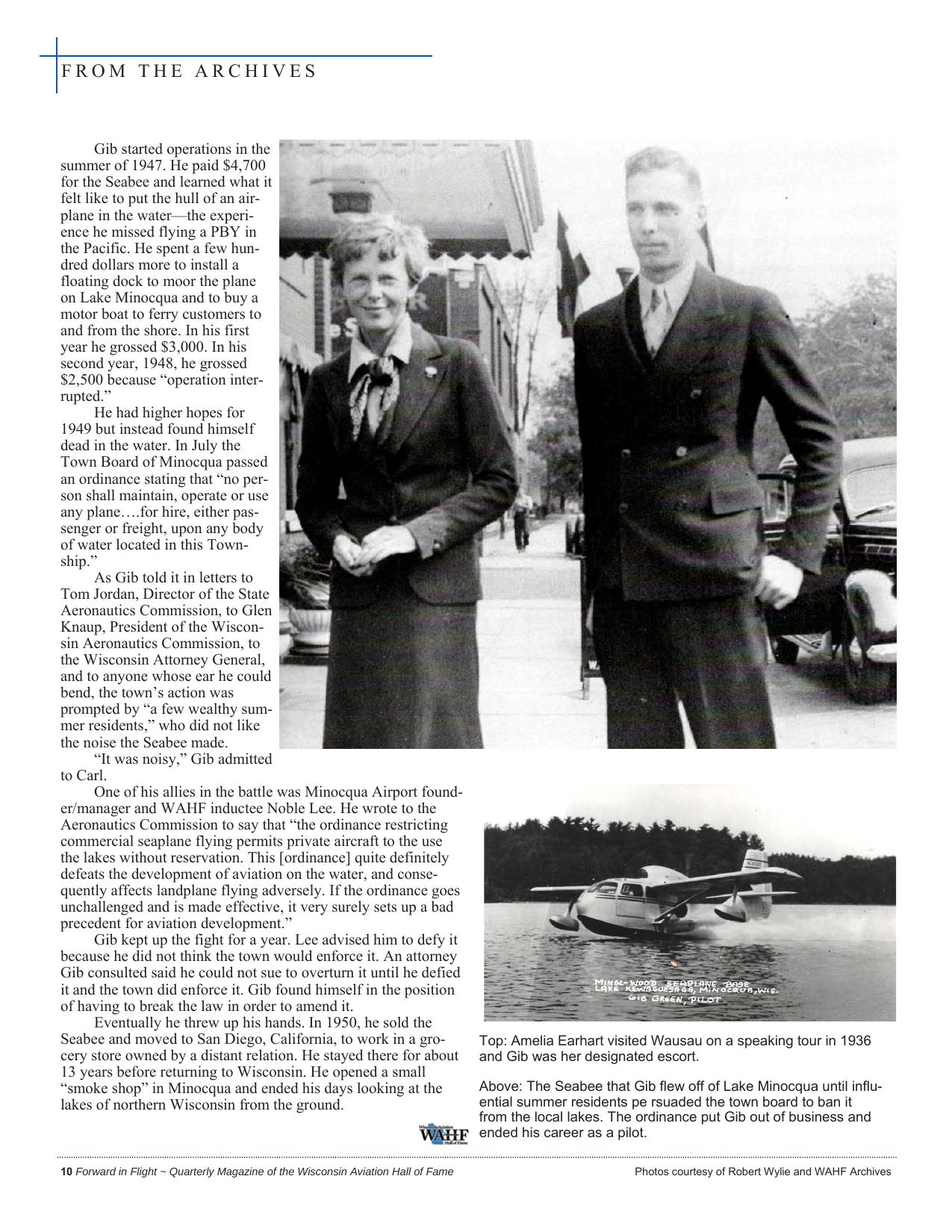
FROM THE ARCHIVES Gib started operations in the summer of 1947. He paid $4,700 for the Seabee and learned what it felt like to put the hull of an airplane in the water—the experience he missed flying a PBY in the Pacific. He spent a few hundred dollars more to install a floating dock to moor the plane on Lake Minocqua and to buy a motor boat to ferry customers to and from the shore. In his first year he grossed $3,000. In his second year, 1948, he grossed $2,500 because “operation interrupted.” He had higher hopes for 1949 but instead found himself dead in the water. In July the Town Board of Minocqua passed an ordinance stating that “no person shall maintain, operate or use any plane….for hire, either passenger or freight, upon any body of water located in this Township.” As Gib told it in letters to Tom Jordan, Director of the State Aeronautics Commission, to Glen Knaup, President of the Wisconsin Aeronautics Commission, to the Wisconsin Attorney General, and to anyone whose ear he could bend, the town’s action was prompted by “a few wealthy summer residents,” who did not like the noise the Seabee made. “It was noisy,” Gib admitted to Carl. One of his allies in the battle was Minocqua Airport founder/manager and WAHF inductee Noble Lee. He wrote to the Aeronautics Commission to say that “the ordinance restricting commercial seaplane flying permits private aircraft to the use the lakes without reservation. This [ordinance] quite definitely defeats the development of aviation on the water, and consequently affects landplane flying adversely. If the ordinance goes unchallenged and is made effective, it very surely sets up a bad precedent for aviation development.” Gib kept up the fight for a year. Lee advised him to defy it because he did not think the town would enforce it. An attorney Gib consulted said he could not sue to overturn it until he defied it and the town did enforce it. Gib found himself in the position of having to break the law in order to amend it. Eventually he threw up his hands. In 1950, he sold the Seabee and moved to San Diego, California, to work in a grocery store owned by a distant relation. He stayed there for about 13 years before returning to Wisconsin. He opened a small “smoke shop” in Minocqua and ended his days looking at the lakes of northern Wisconsin from the ground. 10 Forward in Flight ~ Quarterly Magazine of the Wisconsin Aviation Hall of Fame Top: Amelia Earhart visited Wausau on a speaking tour in 1936 and Gib was her designated escort. Above: The Seabee that Gib flew off of Lake Minocqua until influential summer residents pe rsuaded the town board to ban it from the local lakes. The ordinance put Gib out of business and ended his career as a pilot. Photos courtesy of Robert Wylie and WAHF Archives
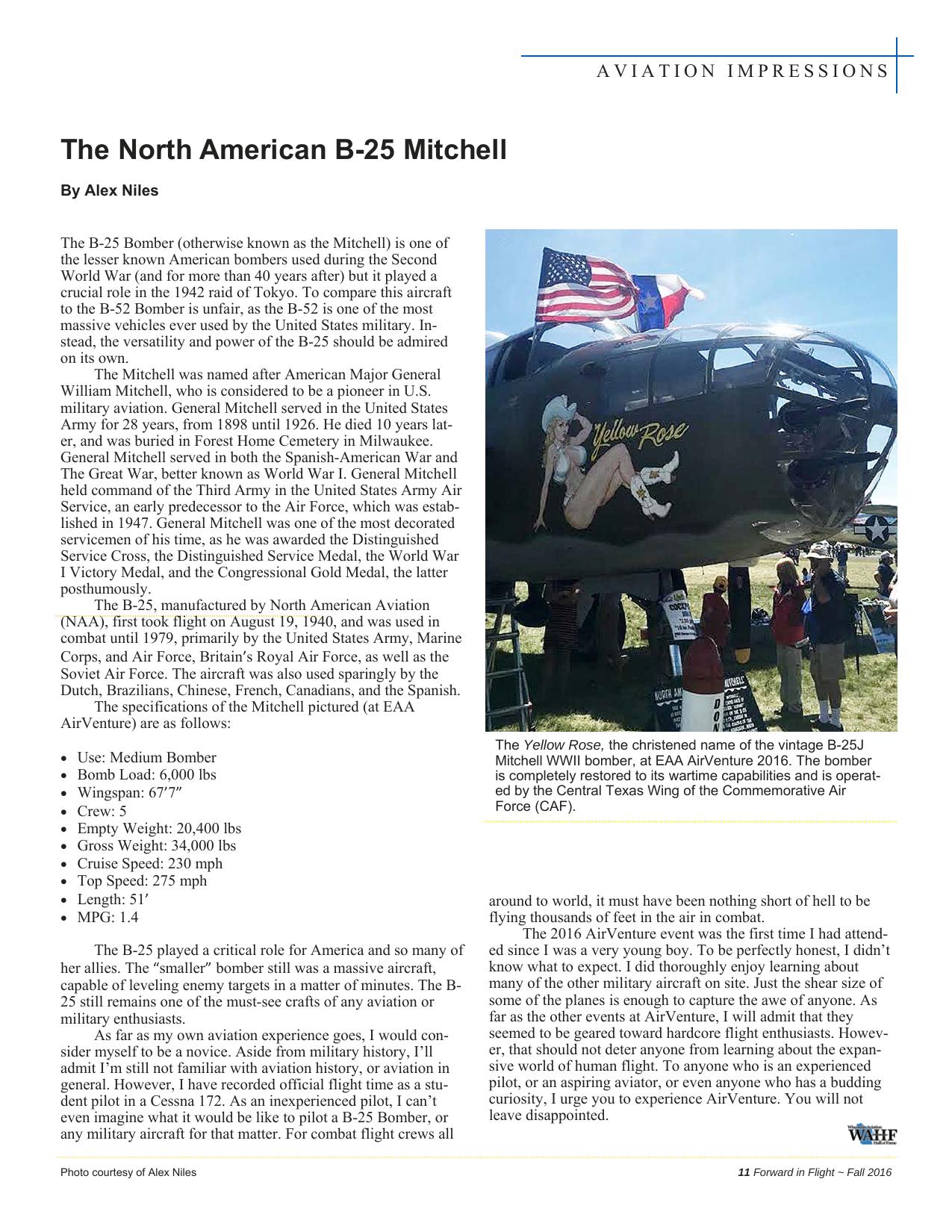
AVIATION IMPRESSIONS The North American B-25 Mitchell By Alex Niles The B-25 Bomber (otherwise known as the Mitchell) is one of the lesser known American bombers used during the Second World War (and for more than 40 years after) but it played a crucial role in the 1942 raid of Tokyo. To compare this aircraft to the B-52 Bomber is unfair, as the B-52 is one of the most massive vehicles ever used by the United States military. Instead, the versatility and power of the B-25 should be admired on its own. The Mitchell was named after American Major General William Mitchell, who is considered to be a pioneer in U.S. military aviation. General Mitchell served in the United States Army for 28 years, from 1898 until 1926. He died 10 years later, and was buried in Forest Home Cemetery in Milwaukee. General Mitchell served in both the Spanish-American War and The Great War, better known as World War I. General Mitchell held command of the Third Army in the United States Army Air Service, an early predecessor to the Air Force, which was established in 1947. General Mitchell was one of the most decorated servicemen of his time, as he was awarded the Distinguished Service Cross, the Distinguished Service Medal, the World War I Victory Medal, and the Congressional Gold Medal, the latter posthumously. The B-25, manufactured by North American Aviation (NAA), first took flight on August 19, 1940, and was used in combat until 1979, primarily by the United States Army, Marine Corps, and Air Force, Britain’s Royal Air Force, as well as the Soviet Air Force. The aircraft was also used sparingly by the Dutch, Brazilians, Chinese, French, Canadians, and the Spanish. The specifications of the Mitchell pictured (at EAA AirVenture) are as follows: Use: Medium Bomber Bomb Load: 6,000 lbs Wingspan: 67’7” Crew: 5 Empty Weight: 20,400 lbs Gross Weight: 34,000 lbs Cruise Speed: 230 mph Top Speed: 275 mph Length: 51’ MPG: 1.4 The B-25 played a critical role for America and so many of her allies. The “smaller” bomber still was a massive aircraft, capable of leveling enemy targets in a matter of minutes. The B25 still remains one of the must-see crafts of any aviation or military enthusiasts. As far as my own aviation experience goes, I would consider myself to be a novice. Aside from military history, I’ll admit I’m still not familiar with aviation history, or aviation in general. However, I have recorded official flight time as a student pilot in a Cessna 172. As an inexperienced pilot, I can’t even imagine what it would be like to pilot a B-25 Bomber, or any military aircraft for that matter. For combat flight crews all Photo courtesy of Alex Niles The Yellow Rose, the christened name of the vintage B-25J Mitchell WWII bomber, at EAA AirVenture 2016. The bomber is completely restored to its wartime capabilities and is operated by the Central Texas Wing of the Commemorative Air Force (CAF). around to world, it must have been nothing short of hell to be flying thousands of feet in the air in combat. The 2016 AirVenture event was the first time I had attended since I was a very young boy. To be perfectly honest, I didn’t know what to expect. I did thoroughly enjoy learning about many of the other military aircraft on site. Just the shear size of some of the planes is enough to capture the awe of anyone. As far as the other events at AirVenture, I will admit that they seemed to be geared toward hardcore flight enthusiasts. However, that should not deter anyone from learning about the expansive world of human flight. To anyone who is an experienced pilot, or an aspiring aviator, or even anyone who has a budding curiosity, I urge you to experience AirVenture. You will not leave disappointed. 11 Forward in Flight ~ Fall 2016
WE FLY Duane Esse’s Aviation Legacy By Jerry LeBarron Duane E. Esse has been involved in and has contributed to numerous facets of Wisconsin aviation for more than 50 years. If you are a reader of Forward in Flight you more than likely have read many of Duane’s articles paying tribute to others who have come before and after him. Interestingly enough, there has never been an article in Forward in Flight dedicated to Duane. If you know Duane you know he possesses one of those rare traits of the modern world known as humility, so we had to corner him with the proposition of, “Duane We Are Going To Do This Article, You Don’t Have a Choice”. So about this gentleman, Duane Esse. His resume includes: paper boy, farmer, pin setter, custodian, gardener, truck and semi driver, beverage bottler and delivery, sporting goods and auto parts sales, carpenter, mason, caretaker, teacher and coach, flight instructor, charter pilot (including for five of our state governors, high profile convicts, and even prostitutes, …all State approved and legal of course. With that said, let’s learn more about Duane and his legacy. Early Life Duane was born on January 26, 1936 in DeForest, Wisconsin, and grew up in Morrisonville, Wisconsin, which is three miles north of DeForest. Morrisonville was the typical example of small town America. No one locked their doors and everyone helped one another, especially when sickness or death occurred. Duane’s parents were his role models and the values of dedication, loyalty, and honesty were integral to daily life in the Esse household, and were ingrained. Duane and his siblings attended a two-room elementary school, which was grouped into grades 1-4 and 5-8. While attending, one of Duane’s favorite activities was playing tackle football. Duane’s father, Norman, had a painting business, and he always had jobs waiting, based on word of mouth. A con- tract was based on a handshake. Duane’s parents had four acres on which they raised fruits and vegetables for sale and for themselves. Duane spent many hours working in these fields and his memories include the B-36 bombers flying over at altitude with the unique rumble sound of their radial engines. This was Duane’s first exposure to aviation; the seed was planted and would continue to grow. Another vivid memory was from August 1945, when Duane and his friend had the opportunity to ring the village fire bell, which was located in the town square, they manned two pull cables for at least 30 minutes to celebrate the end of World War II. Duane attended DeForest High School and he typically walked the railroad tracks to school, and would always beat the school bus arrival. During his high school years, he played the sousaphone, helped in the music room, was on the football, basketball, and track teams, worked on the school paper, and was class president during his sophomore and senior years. A Type A personality was developing, and those who know Duane, well, things haven’t changed much to this today! 12 Forward in Flight ~ Quarterly Magazine of the Wisconsin Aviation Hall of Fame After graduating from high school, Duane didn’t waste any time and started work the following day for a local cement construction company. The first six of seven days he worked 72 hours shoveling gravel into a cement mixer. He recalls developing blisters under his blisters. The pay was $1.25 per hour, with no overtime pay. Duane would hold this position for a year and half, where he learned many building construction skills, which he frequently uses to this day. The Military Years Duane served three years in the U.S. Army. This adventure began when he convinced seven of his good friends to enlist with him. While spending their last night together in Milwaukee before leaving for basic training, they all agreed that they would buy motorcycles when they were discharged and ride across the country together. After completing basic training, Duane requested duty assignments in Germany, England, and France in order of preference and Uncle Sam promptly sent him off to Puerto Rico. When Duane arrived in Puerto Rico he was assigned guard duty, which en-
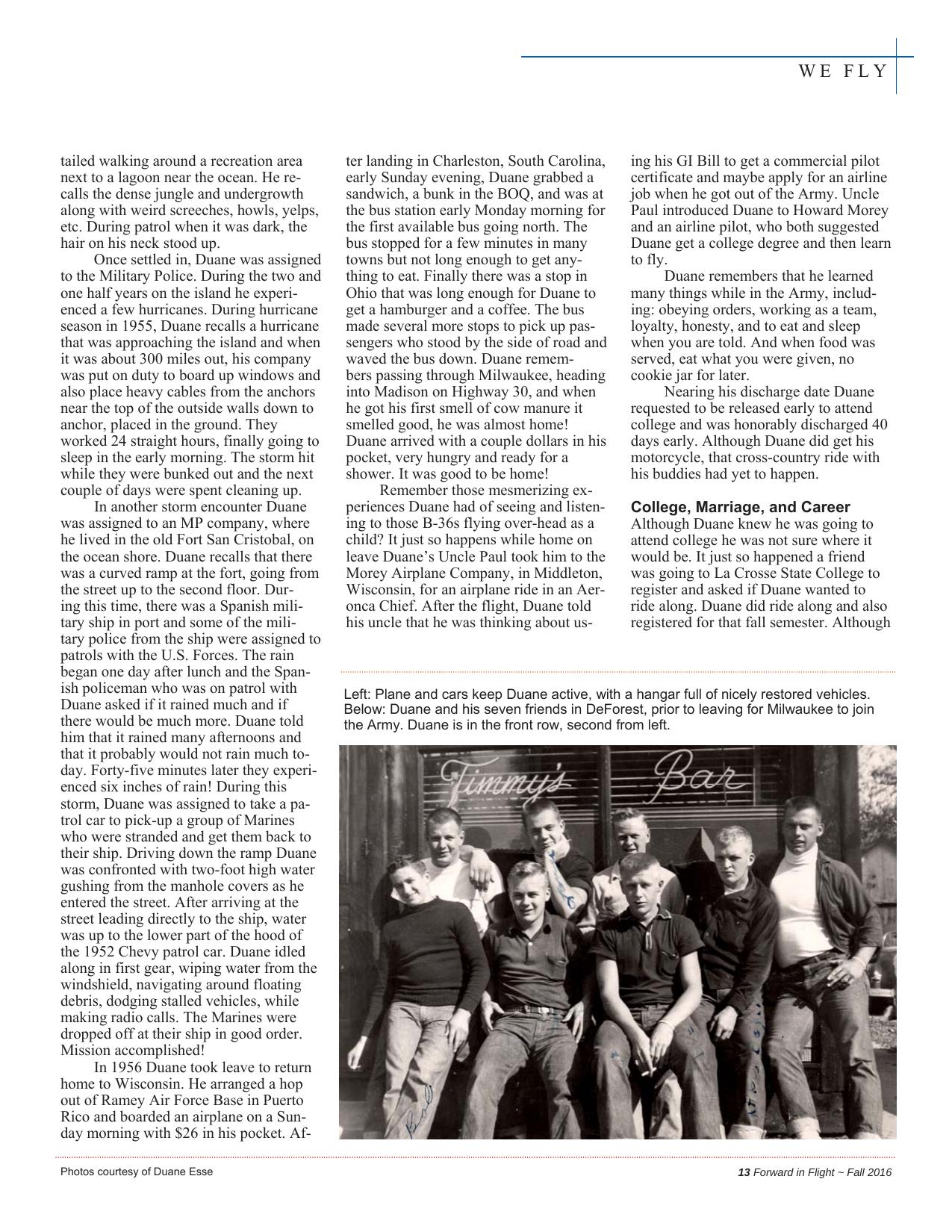
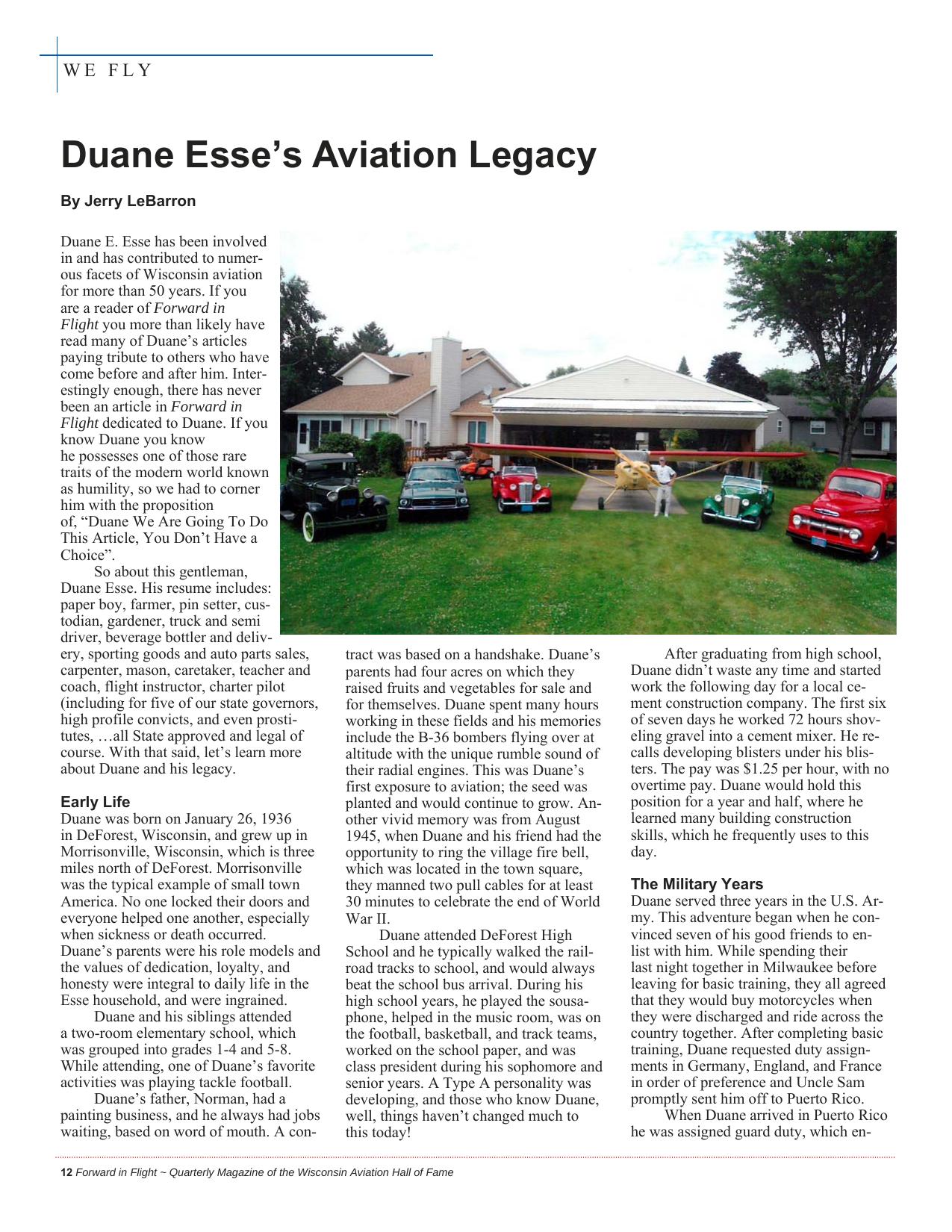
WE FLY tailed walking around a recreation area next to a lagoon near the ocean. He recalls the dense jungle and undergrowth along with weird screeches, howls, yelps, etc. During patrol when it was dark, the hair on his neck stood up. Once settled in, Duane was assigned to the Military Police. During the two and one half years on the island he experienced a few hurricanes. During hurricane season in 1955, Duane recalls a hurricane that was approaching the island and when it was about 300 miles out, his company was put on duty to board up windows and also place heavy cables from the anchors near the top of the outside walls down to anchor, placed in the ground. They worked 24 straight hours, finally going to sleep in the early morning. The storm hit while they were bunked out and the next couple of days were spent cleaning up. In another storm encounter Duane was assigned to an MP company, where he lived in the old Fort San Cristobal, on the ocean shore. Duane recalls that there was a curved ramp at the fort, going from the street up to the second floor. During this time, there was a Spanish military ship in port and some of the military police from the ship were assigned to patrols with the U.S. Forces. The rain began one day after lunch and the Spanish policeman who was on patrol with Duane asked if it rained much and if there would be much more. Duane told him that it rained many afternoons and that it probably would not rain much today. Forty-five minutes later they experienced six inches of rain! During this storm, Duane was assigned to take a patrol car to pick-up a group of Marines who were stranded and get them back to their ship. Driving down the ramp Duane was confronted with two-foot high water gushing from the manhole covers as he entered the street. After arriving at the street leading directly to the ship, water was up to the lower part of the hood of the 1952 Chevy patrol car. Duane idled along in first gear, wiping water from the windshield, navigating around floating debris, dodging stalled vehicles, while making radio calls. The Marines were dropped off at their ship in good order. Mission accomplished! In 1956 Duane took leave to return home to Wisconsin. He arranged a hop out of Ramey Air Force Base in Puerto Rico and boarded an airplane on a Sunday morning with $26 in his pocket. AfPhotos courtesy of Duane Esse ter landing in Charleston, South Carolina, early Sunday evening, Duane grabbed a sandwich, a bunk in the BOQ, and was at the bus station early Monday morning for the first available bus going north. The bus stopped for a few minutes in many towns but not long enough to get anything to eat. Finally there was a stop in Ohio that was long enough for Duane to get a hamburger and a coffee. The bus made several more stops to pick up passengers who stood by the side of road and waved the bus down. Duane remembers passing through Milwaukee, heading into Madison on Highway 30, and when he got his first smell of cow manure it smelled good, he was almost home! Duane arrived with a couple dollars in his pocket, very hungry and ready for a shower. It was good to be home! Remember those mesmerizing experiences Duane had of seeing and listening to those B-36s flying over-head as a child? It just so happens while home on leave Duane’s Uncle Paul took him to the Morey Airplane Company, in Middleton, Wisconsin, for an airplane ride in an Aeronca Chief. After the flight, Duane told his uncle that he was thinking about us- ing his GI Bill to get a commercial pilot certificate and maybe apply for an airline job when he got out of the Army. Uncle Paul introduced Duane to Howard Morey and an airline pilot, who both suggested Duane get a college degree and then learn to fly. Duane remembers that he learned many things while in the Army, including: obeying orders, working as a team, loyalty, honesty, and to eat and sleep when you are told. And when food was served, eat what you were given, no cookie jar for later. Nearing his discharge date Duane requested to be released early to attend college and was honorably discharged 40 days early. Although Duane did get his motorcycle, that cross-country ride with his buddies had yet to happen. College, Marriage, and Career Although Duane knew he was going to attend college he was not sure where it would be. It just so happened a friend was going to La Crosse State College to register and asked if Duane wanted to ride along. Duane did ride along and also registered for that fall semester. Although Left: Plane and cars keep Duane active, with a hangar full of nicely restored vehicles. Below: Duane and his seven friends in DeForest, prior to leaving for Milwaukee to join the Army. Duane is in the front row, second from left. 13 Forward in Flight ~ Fall 2016
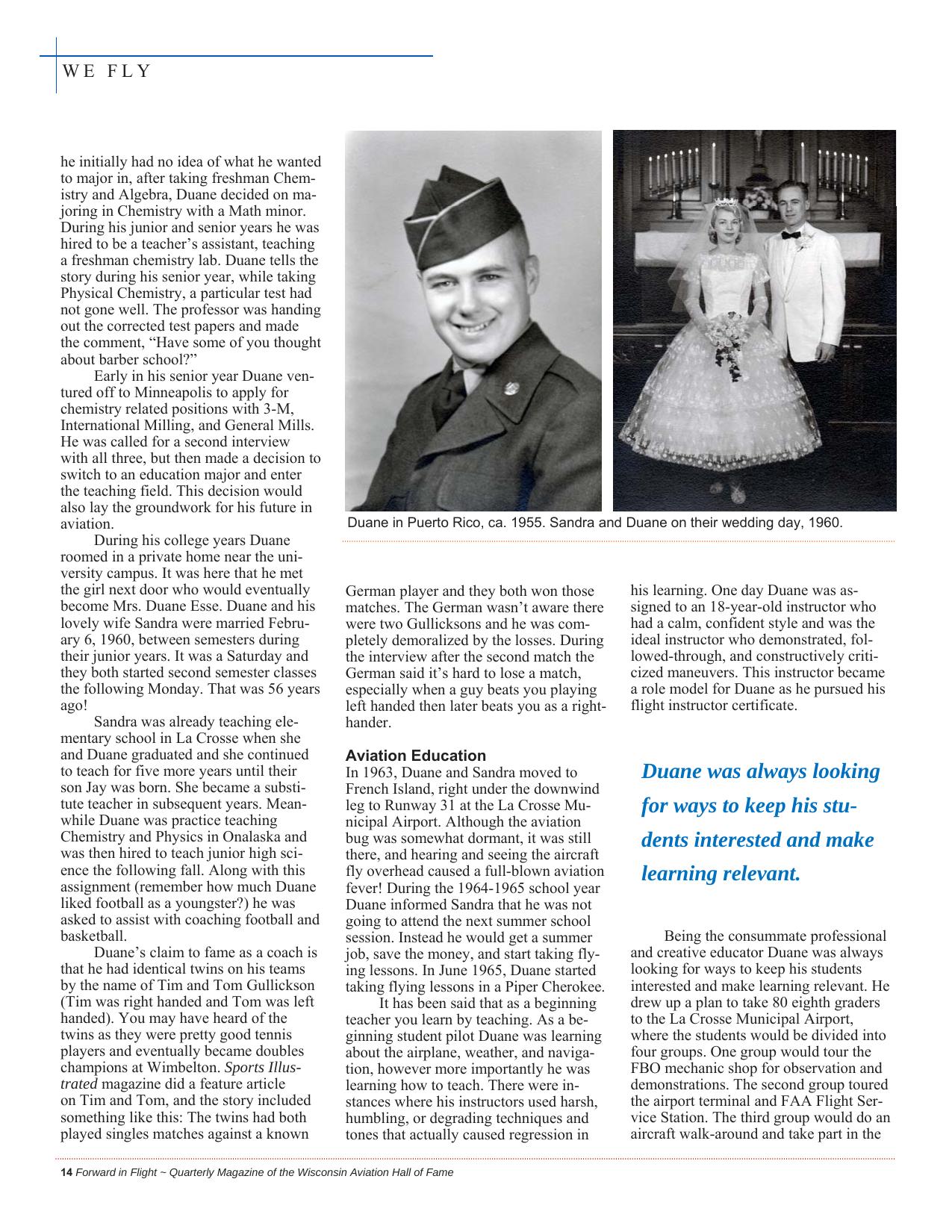
WE FLY he initially had no idea of what he wanted to major in, after taking freshman Chemistry and Algebra, Duane decided on majoring in Chemistry with a Math minor. During his junior and senior years he was hired to be a teacher’s assistant, teaching a freshman chemistry lab. Duane tells the story during his senior year, while taking Physical Chemistry, a particular test had not gone well. The professor was handing out the corrected test papers and made the comment, “Have some of you thought about barber school?” Early in his senior year Duane ventured off to Minneapolis to apply for chemistry related positions with 3-M, International Milling, and General Mills. He was called for a second interview with all three, but then made a decision to switch to an education major and enter the teaching field. This decision would also lay the groundwork for his future in aviation. During his college years Duane roomed in a private home near the university campus. It was here that he met the girl next door who would eventually become Mrs. Duane Esse. Duane and his lovely wife Sandra were married February 6, 1960, between semesters during their junior years. It was a Saturday and they both started second semester classes the following Monday. That was 56 years ago! Sandra was already teaching elementary school in La Crosse when she and Duane graduated and she continued to teach for five more years until their son Jay was born. She became a substitute teacher in subsequent years. Meanwhile Duane was practice teaching Chemistry and Physics in Onalaska and was then hired to teach junior high science the following fall. Along with this assignment (remember how much Duane liked football as a youngster?) he was asked to assist with coaching football and basketball. Duane’s claim to fame as a coach is that he had identical twins on his teams by the name of Tim and Tom Gullickson (Tim was right handed and Tom was left handed). You may have heard of the twins as they were pretty good tennis players and eventually became doubles champions at Wimbelton. Sports Illustrated magazine did a feature article on Tim and Tom, and the story included something like this: The twins had both played singles matches against a known Duane in Puerto Rico, ca. 1955. Sandra and Duane on their wedding day, 1960. German player and they both won those matches. The German wasn’t aware there were two Gullicksons and he was completely demoralized by the losses. During the interview after the second match the German said it’s hard to lose a match, especially when a guy beats you playing left handed then later beats you as a righthander. Aviation Education In 1963, Duane and Sandra moved to French Island, right under the downwind leg to Runway 31 at the La Crosse Municipal Airport. Although the aviation bug was somewhat dormant, it was still there, and hearing and seeing the aircraft fly overhead caused a full-blown aviation fever! During the 1964-1965 school year Duane informed Sandra that he was not going to attend the next summer school session. Instead he would get a summer job, save the money, and start taking flying lessons. In June 1965, Duane started taking flying lessons in a Piper Cherokee. It has been said that as a beginning teacher you learn by teaching. As a beginning student pilot Duane was learning about the airplane, weather, and navigation, however more importantly he was learning how to teach. There were instances where his instructors used harsh, humbling, or degrading techniques and tones that actually caused regression in 14 Forward in Flight ~ Quarterly Magazine of the Wisconsin Aviation Hall of Fame his learning. One day Duane was assigned to an 18-year-old instructor who had a calm, confident style and was the ideal instructor who demonstrated, followed-through, and constructively criticized maneuvers. This instructor became a role model for Duane as he pursued his flight instructor certificate. Duane was always looking for ways to keep his students interested and make learning relevant. Being the consummate professional and creative educator Duane was always looking for ways to keep his students interested and make learning relevant. He drew up a plan to take 80 eighth graders to the La Crosse Municipal Airport, where the students would be divided into four groups. One group would tour the FBO mechanic shop for observation and demonstrations. The second group toured the airport terminal and FAA Flight Service Station. The third group would do an aircraft walk-around and take part in the
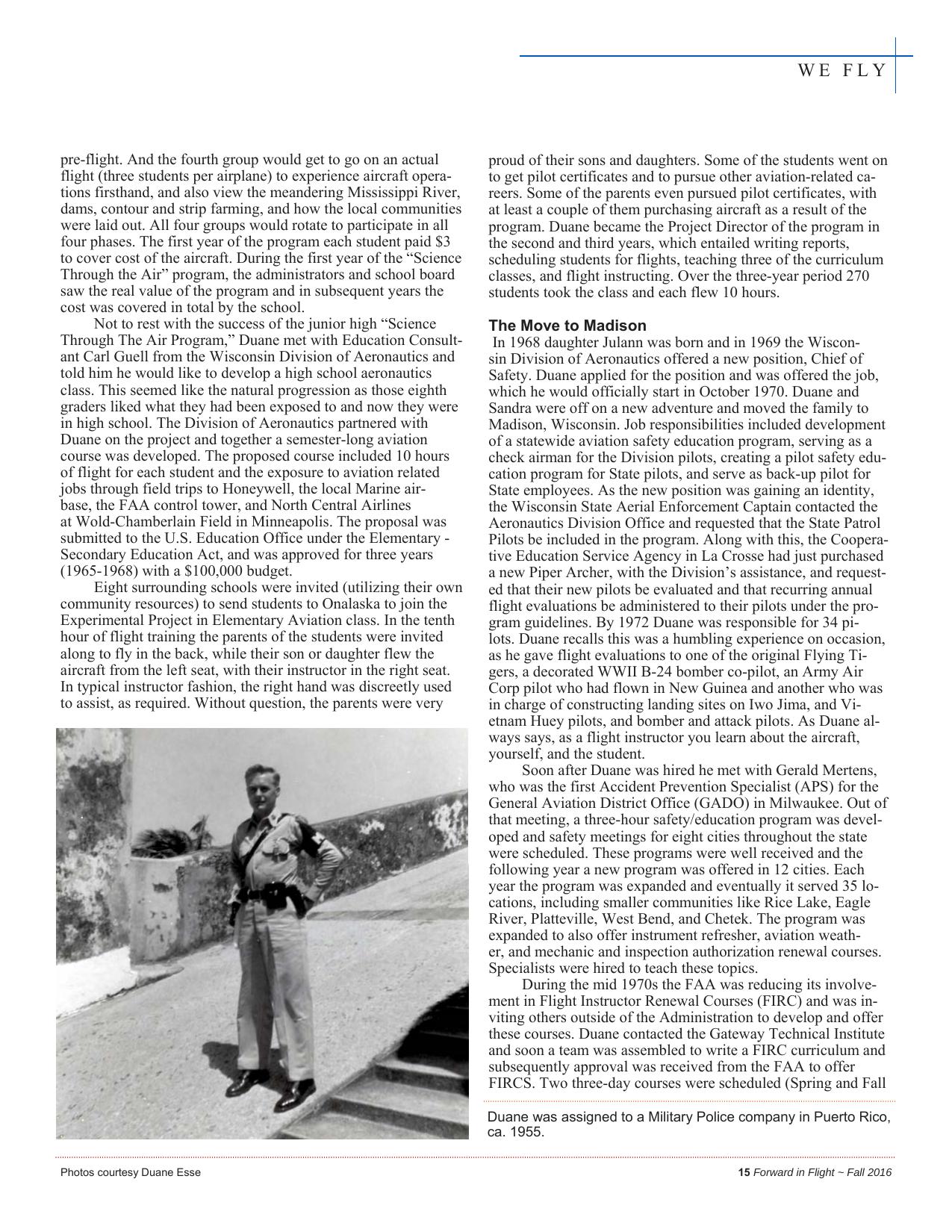
WE FLY pre-flight. And the fourth group would get to go on an actual flight (three students per airplane) to experience aircraft operations firsthand, and also view the meandering Mississippi River, dams, contour and strip farming, and how the local communities were laid out. All four groups would rotate to participate in all four phases. The first year of the program each student paid $3 to cover cost of the aircraft. During the first year of the “Science Through the Air” program, the administrators and school board saw the real value of the program and in subsequent years the cost was covered in total by the school. Not to rest with the success of the junior high “Science Through The Air Program,” Duane met with Education Consultant Carl Guell from the Wisconsin Division of Aeronautics and told him he would like to develop a high school aeronautics class. This seemed like the natural progression as those eighth graders liked what they had been exposed to and now they were in high school. The Division of Aeronautics partnered with Duane on the project and together a semester-long aviation course was developed. The proposed course included 10 hours of flight for each student and the exposure to aviation related jobs through field trips to Honeywell, the local Marine airbase, the FAA control tower, and North Central Airlines at Wold-Chamberlain Field in Minneapolis. The proposal was submitted to the U.S. Education Office under the Elementary Secondary Education Act, and was approved for three years (1965-1968) with a $100,000 budget. Eight surrounding schools were invited (utilizing their own community resources) to send students to Onalaska to join the Experimental Project in Elementary Aviation class. In the tenth hour of flight training the parents of the students were invited along to fly in the back, while their son or daughter flew the aircraft from the left seat, with their instructor in the right seat. In typical instructor fashion, the right hand was discreetly used to assist, as required. Without question, the parents were very proud of their sons and daughters. Some of the students went on to get pilot certificates and to pursue other aviation-related careers. Some of the parents even pursued pilot certificates, with at least a couple of them purchasing aircraft as a result of the program. Duane became the Project Director of the program in the second and third years, which entailed writing reports, scheduling students for flights, teaching three of the curriculum classes, and flight instructing. Over the three-year period 270 students took the class and each flew 10 hours. The Move to Madison In 1968 daughter Julann was born and in 1969 the Wisconsin Division of Aeronautics offered a new position, Chief of Safety. Duane applied for the position and was offered the job, which he would officially start in October 1970. Duane and Sandra were off on a new adventure and moved the family to Madison, Wisconsin. Job responsibilities included development of a statewide aviation safety education program, serving as a check airman for the Division pilots, creating a pilot safety education program for State pilots, and serve as back-up pilot for State employees. As the new position was gaining an identity, the Wisconsin State Aerial Enforcement Captain contacted the Aeronautics Division Office and requested that the State Patrol Pilots be included in the program. Along with this, the Cooperative Education Service Agency in La Crosse had just purchased a new Piper Archer, with the Division’s assistance, and requested that their new pilots be evaluated and that recurring annual flight evaluations be administered to their pilots under the program guidelines. By 1972 Duane was responsible for 34 pilots. Duane recalls this was a humbling experience on occasion, as he gave flight evaluations to one of the original Flying Tigers, a decorated WWII B-24 bomber co-pilot, an Army Air Corp pilot who had flown in New Guinea and another who was in charge of constructing landing sites on Iwo Jima, and Vietnam Huey pilots, and bomber and attack pilots. As Duane always says, as a flight instructor you learn about the aircraft, yourself, and the student. Soon after Duane was hired he met with Gerald Mertens, who was the first Accident Prevention Specialist (APS) for the General Aviation District Office (GADO) in Milwaukee. Out of that meeting, a three-hour safety/education program was developed and safety meetings for eight cities throughout the state were scheduled. These programs were well received and the following year a new program was offered in 12 cities. Each year the program was expanded and eventually it served 35 locations, including smaller communities like Rice Lake, Eagle River, Platteville, West Bend, and Chetek. The program was expanded to also offer instrument refresher, aviation weather, and mechanic and inspection authorization renewal courses. Specialists were hired to teach these topics. During the mid 1970s the FAA was reducing its involvement in Flight Instructor Renewal Courses (FIRC) and was inviting others outside of the Administration to develop and offer these courses. Duane contacted the Gateway Technical Institute and soon a team was assembled to write a FIRC curriculum and subsequently approval was received from the FAA to offer FIRCS. Two three-day courses were scheduled (Spring and Fall Duane was assigned to a Military Police company in Puerto Rico, ca. 1955. Photos courtesy Duane Esse 15 Forward in Flight ~ Fall 2016
WE FLY Duane with his students at the La Crosse Municipal Airport (LSE), ca. 1966. sessions) and the Wisconsin Bureau of Aeronautics FIRC continues to this day. In the late 1970s, the FAA discontinued offering FAA written exam sessions at its facilities. Duane contacted General Aviation District Office (GADO) 13 in Milwaukee and was trained and approved to establish a network of testing locations, train the examiners, develop the implementation schedule, and supervise the statewide program. A total of 12 universities, technical schools, and fixed base operators were trained and appointed to offer on-site testing. In the 15-and-a-half years of his direct involvement with these successful initiatives, Duane personally oversaw and conducted more than 550 programs. They were a mix of 1 - 3 day sessions and were held both during the day and evening. In those 15-and-a-half years only one program was cancelled! Duane recalls the cancelled event was an evening event to be held in Wausau, in late November. He was to meet the FAA APS at a local motel by 3 p.m., set up the training room at the technical school, eat and be ready to kick off the program at 7 p.m. It was snowing when Duane left Madison and as he headed north on Highway 51, it continued to increase in intensity. Just before reaching Stevens Point a semi truck passed Duane, so he decided to stay behind it and followed its tail lights. By the time Duane had reached the motel the storm was in full blizzard mode. At the motel, Duane discussed the situation with the FAA APS, when during the discussion he heard his name being paged. The motel clerk informed Duane that the technical school was just closed down for the evening due to the blizzard, resulting in the program’s one and only cancella- tion. Remember we said Duane has “charter pilot” on his resume? Although most all of his trips were memorable there are a few that really stand out. One in particular was when one of the men who bombed Sterling Hall at the University of Wisconsin – Madison was apprehended in Canada. Duane and Division of Aeronautics Chief Pilot Vern Reller were assigned to standby and be prepared to fly to Toronto to return the bomber to Madison. Nothing was to be said to anyone as this was covert operation. Two days later at 7 p.m., Duane received the word that they were to depart Madison at Duane received the word that they were to depart Madison at 11:30 p.m. that evening, fly to Toronto with police officials on board, and return with the bomber. 11:30 p.m. that evening, fly to Toronto with police officials on board, and return with the bomber. The trip to Toronto was uneventful. However, the subsequent hour or so was not and included waiting for Canadian officials on the taxiway for at least 40 minutes, and waiting for the on-board police to provide the necessary documentation. Then later waiting for the car to bring the bomber to the aircraft. 16 Forward in Flight ~ Quarterly Magazine of the Wisconsin Aviation Hall of Fame The bomber was finally delivered in shackles and was seated, facing forward in the second seat of the Piper Navajo. As they were getting ready to close the door, Duane remembers overhearing the bomber ask the police if the pilots had much flight experience. The police officer responded by saying, “No, they are our least qualified pilots, we don’t want to expose our best to high-risk operations.” The plan was to land at Truax Field in Madison, however they were given a re-routing over Lake Michigan to land in Janesville. There were three police vehicles waiting behind a row of hangars to take the bomber to Madison. Duane learned the next day that there was a large crowd of agitators waiting at the airport in Madison for the bomber’s arrival. Note, if you ever get some time to talk with Duane you can ask about those other passengers he flew while working for the State. In the 25 years Duane spent with the Division of Aeronautics there were never two days alike, which made things exciting. There were always new challenges and as Paul Poberezny said many times over the years, “Airplanes are great but the people make it super,” or similar words. Duane has many vivid memories of meetings with attendees of the various programs held each year, sponsors of those meetings, and the special presenters who were hired to offer their expertise. He could write a book about traveling the state with FAA personnel; the good natured bantering back and forth, pulling pranks on one another, and traveling through six inches of mud on a dark, rainy night trying to reach the next destination. And also the feeling that he might have been responsible for the death of an FAA friend (fortunately, he was not – nor was the FAA friend killed), or pushing a stalled FAA car with a State vehicle across a busy intersection during rush hour to a service station in Milwaukee. Those of you who have had the pleasure of knowing Duane know that if he is part of something, the show will go on. “I looked forward to going to work each day of those 25 years,” says Duane. WAHF Involvement Duane is privileged to be part of the early years of the Wisconsin Aviation Hall of Fame (WAHF) Board of Directors, and also served as Secretary-Treasurer. He was directly involved in various pro-
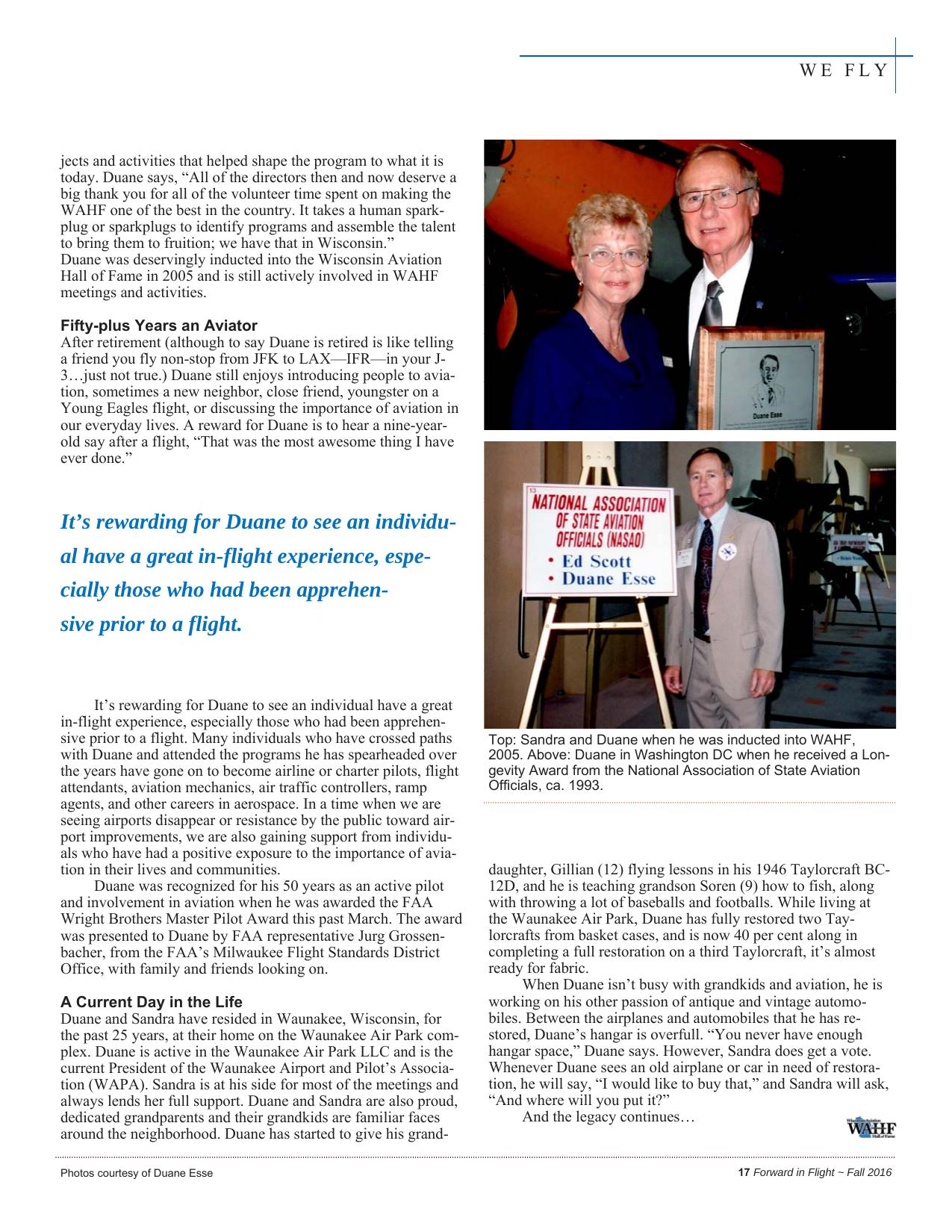
WE FLY jects and activities that helped shape the program to what it is today. Duane says, “All of the directors then and now deserve a big thank you for all of the volunteer time spent on making the WAHF one of the best in the country. It takes a human sparkplug or sparkplugs to identify programs and assemble the talent to bring them to fruition; we have that in Wisconsin.” Duane was deservingly inducted into the Wisconsin Aviation Hall of Fame in 2005 and is still actively involved in WAHF meetings and activities. Fifty-plus Years an Aviator After retirement (although to say Duane is retired is like telling a friend you fly non-stop from JFK to LAX—IFR—in your J3…just not true.) Duane still enjoys introducing people to aviation, sometimes a new neighbor, close friend, youngster on a Young Eagles flight, or discussing the importance of aviation in our everyday lives. A reward for Duane is to hear a nine-yearold say after a flight, “That was the most awesome thing I have ever done.” It’s rewarding for Duane to see an individual have a great in-flight experience, especially those who had been apprehensive prior to a flight. It’s rewarding for Duane to see an individual have a great in-flight experience, especially those who had been apprehensive prior to a flight. Many individuals who have crossed paths with Duane and attended the programs he has spearheaded over the years have gone on to become airline or charter pilots, flight attendants, aviation mechanics, air traffic controllers, ramp agents, and other careers in aerospace. In a time when we are seeing airports disappear or resistance by the public toward airport improvements, we are also gaining support from individuals who have had a positive exposure to the importance of aviation in their lives and communities. Duane was recognized for his 50 years as an active pilot and involvement in aviation when he was awarded the FAA Wright Brothers Master Pilot Award this past March. The award was presented to Duane by FAA representative Jurg Grossenbacher, from the FAA’s Milwaukee Flight Standards District Office, with family and friends looking on. A Current Day in the Life Duane and Sandra have resided in Waunakee, Wisconsin, for the past 25 years, at their home on the Waunakee Air Park complex. Duane is active in the Waunakee Air Park LLC and is the current President of the Waunakee Airport and Pilot’s Association (WAPA). Sandra is at his side for most of the meetings and always lends her full support. Duane and Sandra are also proud, dedicated grandparents and their grandkids are familiar faces around the neighborhood. Duane has started to give his grandPhotos courtesy of Duane Esse Top: Sandra and Duane when he was inducted into WAHF, 2005. Above: Duane in Washington DC when he received a Longevity Award from the National Association of State Aviation Officials, ca. 1993. daughter, Gillian (12) flying lessons in his 1946 Taylorcraft BC12D, and he is teaching grandson Soren (9) how to fish, along with throwing a lot of baseballs and footballs. While living at the Waunakee Air Park, Duane has fully restored two Taylorcrafts from basket cases, and is now 40 per cent along in completing a full restoration on a third Taylorcraft, it’s almost ready for fabric. When Duane isn’t busy with grandkids and aviation, he is working on his other passion of antique and vintage automobiles. Between the airplanes and automobiles that he has restored, Duane’s hangar is overfull. “You never have enough hangar space,” Duane says. However, Sandra does get a vote. Whenever Duane sees an old airplane or car in need of restoration, he will say, “I would like to buy that,” and Sandra will ask, “And where will you put it?” And the legacy continues… 17 Forward in Flight ~ Fall 2016
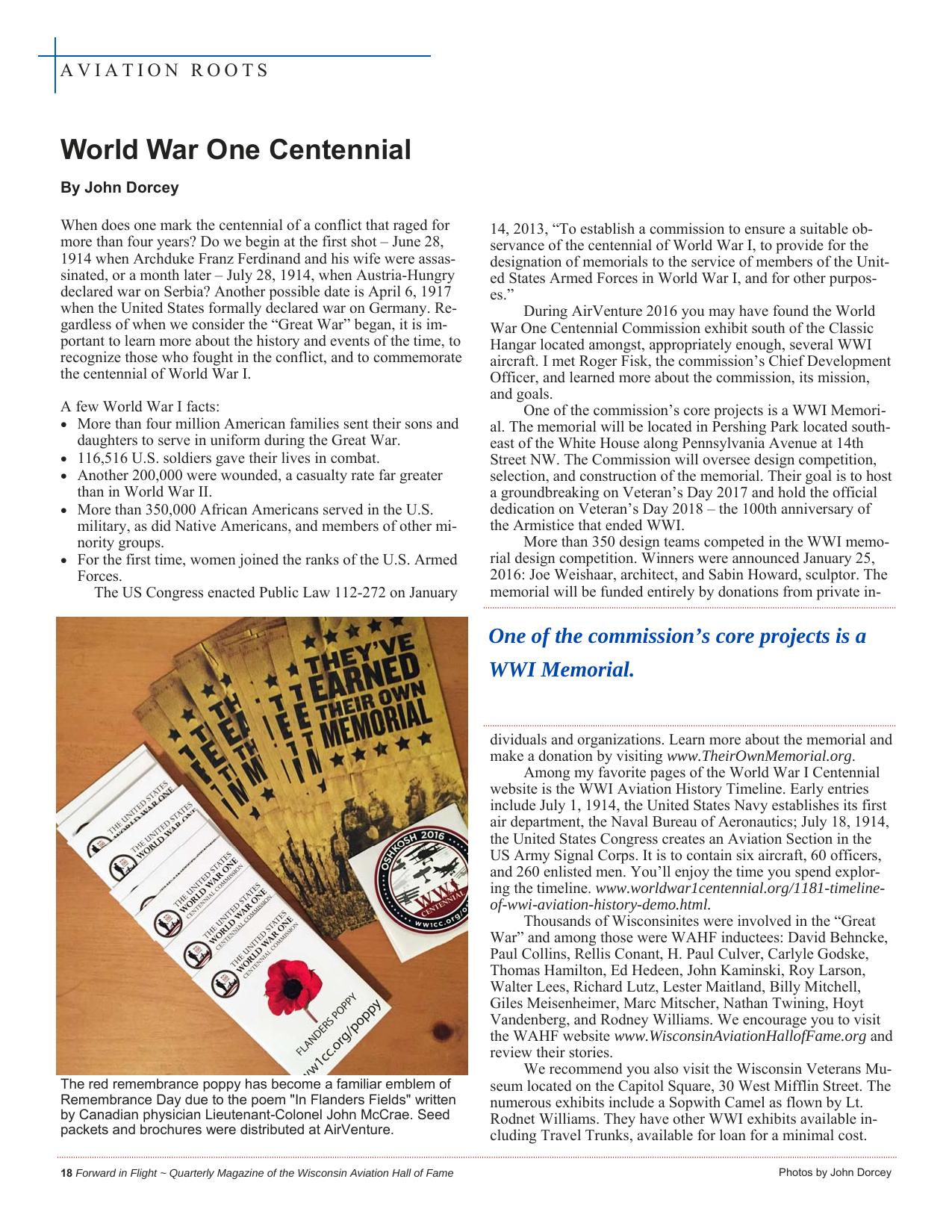
AVIATION ROOTS World War One Centennial By John Dorcey When does one mark the centennial of a conflict that raged for more than four years? Do we begin at the first shot – June 28, 1914 when Archduke Franz Ferdinand and his wife were assassinated, or a month later – July 28, 1914, when Austria-Hungry declared war on Serbia? Another possible date is April 6, 1917 when the United States formally declared war on Germany. Regardless of when we consider the “Great War” began, it is important to learn more about the history and events of the time, to recognize those who fought in the conflict, and to commemorate the centennial of World War I. A few World War I facts: More than four million American families sent their sons and daughters to serve in uniform during the Great War. 116,516 U.S. soldiers gave their lives in combat. Another 200,000 were wounded, a casualty rate far greater than in World War II. More than 350,000 African Americans served in the U.S. military, as did Native Americans, and members of other minority groups. For the first time, women joined the ranks of the U.S. Armed Forces. The US Congress enacted Public Law 112-272 on January 14, 2013, “To establish a commission to ensure a suitable observance of the centennial of World War I, to provide for the designation of memorials to the service of members of the United States Armed Forces in World War I, and for other purposes.” During AirVenture 2016 you may have found the World War One Centennial Commission exhibit south of the Classic Hangar located amongst, appropriately enough, several WWI aircraft. I met Roger Fisk, the commission’s Chief Development Officer, and learned more about the commission, its mission, and goals. One of the commission’s core projects is a WWI Memorial. The memorial will be located in Pershing Park located southeast of the White House along Pennsylvania Avenue at 14th Street NW. The Commission will oversee design competition, selection, and construction of the memorial. Their goal is to host a groundbreaking on Veteran’s Day 2017 and hold the official dedication on Veteran’s Day 2018 – the 100th anniversary of the Armistice that ended WWI. More than 350 design teams competed in the WWI memorial design competition. Winners were announced January 25, 2016: Joe Weishaar, architect, and Sabin Howard, sculptor. The memorial will be funded entirely by donations from private in- One of the commission’s core projects is a WWI Memorial. The red remembrance poppy has become a familiar emblem of Remembrance Day due to the poem "In Flanders Fields" written by Canadian physician Lieutenant-Colonel John McCrae. Seed packets and brochures were distributed at AirVenture. 18 Forward in Flight ~ Quarterly Magazine of the Wisconsin Aviation Hall of Fame dividuals and organizations. Learn more about the memorial and make a donation by visiting www.TheirOwnMemorial.org. Among my favorite pages of the World War I Centennial website is the WWI Aviation History Timeline. Early entries include July 1, 1914, the United States Navy establishes its first air department, the Naval Bureau of Aeronautics; July 18, 1914, the United States Congress creates an Aviation Section in the US Army Signal Corps. It is to contain six aircraft, 60 officers, and 260 enlisted men. You’ll enjoy the time you spend exploring the timeline. www.worldwar1centennial.org/1181-timelineof-wwi-aviation-history-demo.html. Thousands of Wisconsinites were involved in the “Great War” and among those were WAHF inductees: David Behncke, Paul Collins, Rellis Conant, H. Paul Culver, Carlyle Godske, Thomas Hamilton, Ed Hedeen, John Kaminski, Roy Larson, Walter Lees, Richard Lutz, Lester Maitland, Billy Mitchell, Giles Meisenheimer, Marc Mitscher, Nathan Twining, Hoyt Vandenberg, and Rodney Williams. We encourage you to visit the WAHF website www.WisconsinAviationHallofFame.org and review their stories. We recommend you also visit the Wisconsin Veterans Museum located on the Capitol Square, 30 West Mifflin Street. The numerous exhibits include a Sopwith Camel as flown by Lt. Rodnet Williams. They have other WWI exhibits available including Travel Trunks, available for loan for a minimal cost. Photos by John Dorcey
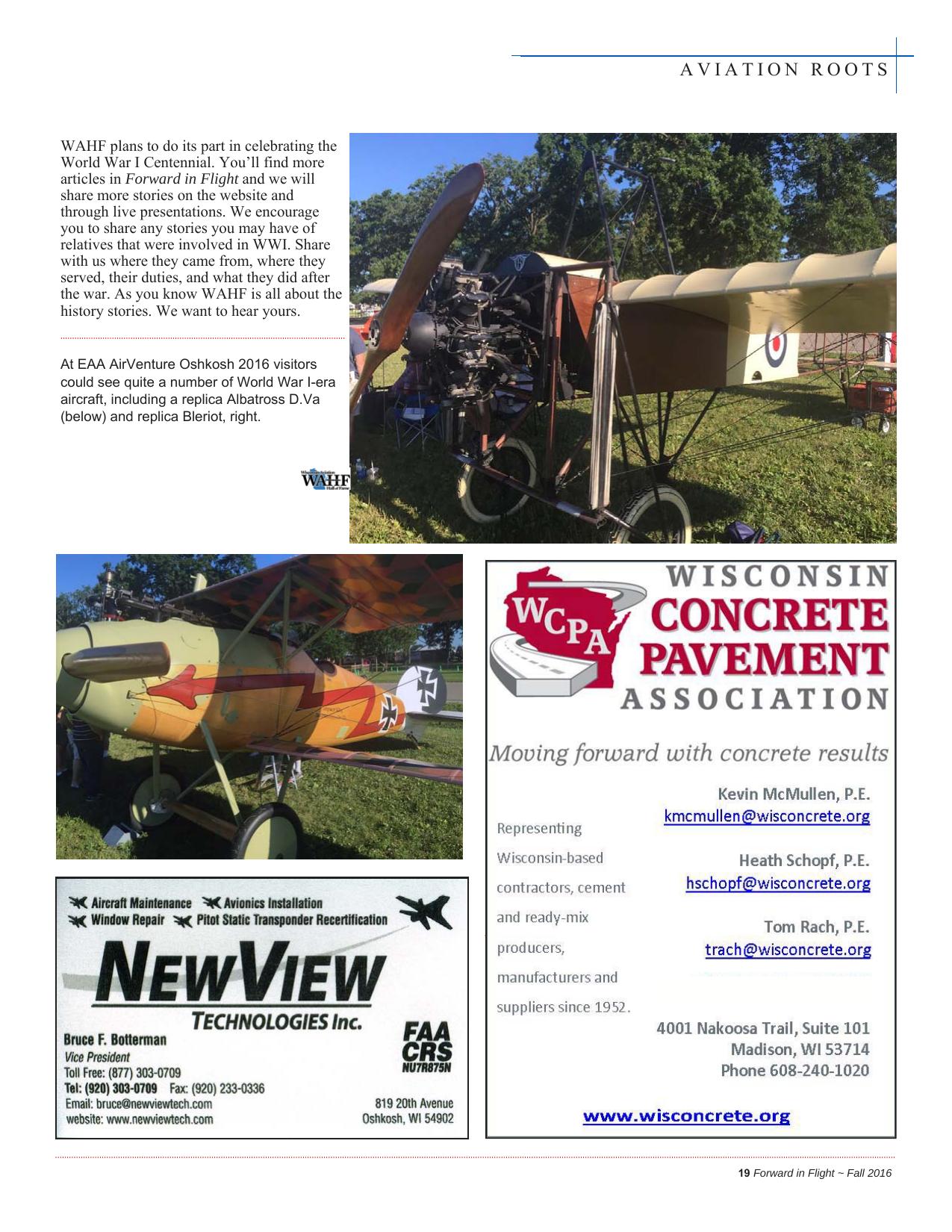
AVIATION ROOTS WAHF plans to do its part in celebrating the World War I Centennial. You’ll find more articles in Forward in Flight and we will share more stories on the website and through live presentations. We encourage you to share any stories you may have of relatives that were involved in WWI. Share with us where they came from, where they served, their duties, and what they did after the war. As you know WAHF is all about the history stories. We want to hear yours. At EAA AirVenture Oshkosh 2016 visitors could see quite a number of World War I-era aircraft, including a replica Albatross D.Va (below) and replica Bleriot, right. 19 Forward in Flight ~ Fall 2016
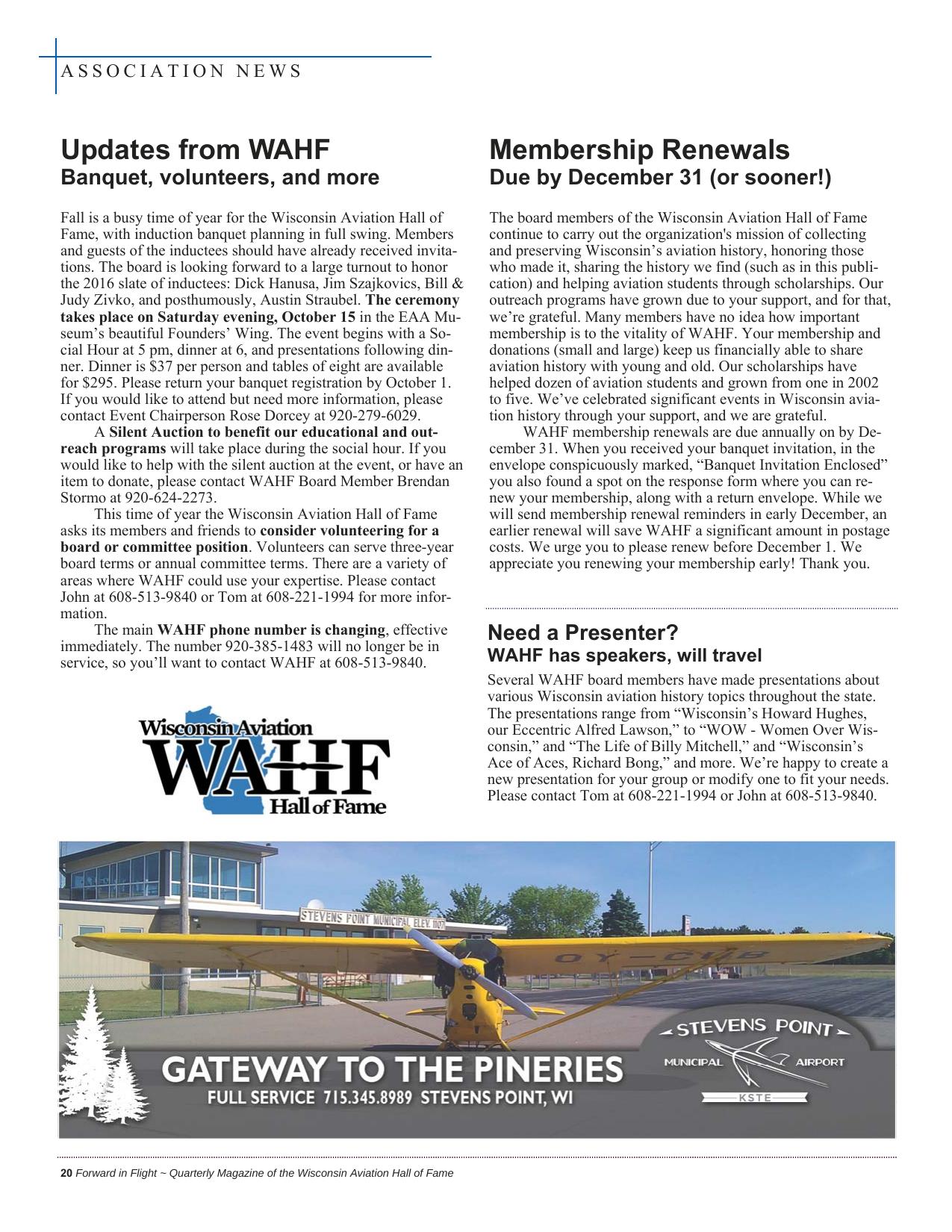
ASSOCIATION NEWS Updates from WAHF Membership Renewals Fall is a busy time of year for the Wisconsin Aviation Hall of Fame, with induction banquet planning in full swing. Members and guests of the inductees should have already received invitations. The board is looking forward to a large turnout to honor the 2016 slate of inductees: Dick Hanusa, Jim Szajkovics, Bill & Judy Zivko, and posthumously, Austin Straubel. The ceremony takes place on Saturday evening, October 15 in the EAA Museum’s beautiful Founders’ Wing. The event begins with a Social Hour at 5 pm, dinner at 6, and presentations following dinner. Dinner is $37 per person and tables of eight are available for $295. Please return your banquet registration by October 1. If you would like to attend but need more information, please contact Event Chairperson Rose Dorcey at 920-279-6029. A Silent Auction to benefit our educational and outreach programs will take place during the social hour. If you would like to help with the silent auction at the event, or have an item to donate, please contact WAHF Board Member Brendan Stormo at 920-624-2273. This time of year the Wisconsin Aviation Hall of Fame asks its members and friends to consider volunteering for a board or committee position. Volunteers can serve three-year board terms or annual committee terms. There are a variety of areas where WAHF could use your expertise. Please contact John at 608-513-9840 or Tom at 608-221-1994 for more information. The main WAHF phone number is changing, effective immediately. The number 920-385-1483 will no longer be in service, so you’ll want to contact WAHF at 608-513-9840. The board members of the Wisconsin Aviation Hall of Fame continue to carry out the organization's mission of collecting and preserving Wisconsin’s aviation history, honoring those who made it, sharing the history we find (such as in this publication) and helping aviation students through scholarships. Our outreach programs have grown due to your support, and for that, we’re grateful. Many members have no idea how important membership is to the vitality of WAHF. Your membership and donations (small and large) keep us financially able to share aviation history with young and old. Our scholarships have helped dozen of aviation students and grown from one in 2002 to five. We’ve celebrated significant events in Wisconsin aviation history through your support, and we are grateful. WAHF membership renewals are due annually on by December 31. When you received your banquet invitation, in the envelope conspicuously marked, “Banquet Invitation Enclosed” you also found a spot on the response form where you can renew your membership, along with a return envelope. While we will send membership renewal reminders in early December, an earlier renewal will save WAHF a significant amount in postage costs. We urge you to please renew before December 1. We appreciate you renewing your membership early! Thank you. Banquet, volunteers, and more Due by December 31 (or sooner!) Need a Presenter? WAHF has speakers, will travel Several WAHF board members have made presentations about various Wisconsin aviation history topics throughout the state. The presentations range from “Wisconsin’s Howard Hughes, our Eccentric Alfred Lawson,” to “WOW - Women Over Wisconsin,” and “The Life of Billy Mitchell,” and “Wisconsin’s Ace of Aces, Richard Bong,” and more. We’re happy to create a new presentation for your group or modify one to fit your needs. Please contact Tom at 608-221-1994 or John at 608-513-9840. 20 Forward in Flight ~ Quarterly Magazine of the Wisconsin Aviation Hall of Fame
FROM THE AIRWAYS Lodi’s New Airport Name Honors Dick Knutson Knutson Field was dedicated in July Another Wisconsin airport has been named in honor of a Wisconsin Aviation Hall of Fame inductee. On Friday, July 15, 2016, family, friends, and officials from the town of Lodi gathered at the Lakeland Lodi Airport (9WN5) for the dedication of Knutson Field. Richard “Doc” Knutson, 91, was the founding president of the airport, which has become known as one of the finest turf runway airports in Wisconsin. Doc was there to celebrate at the renaming ceremony. He’s long been involved in aviation. Not long after he started his first aircraft restoration project in 1967, Richard W. Knutson became the go-to guy for fellow restorers throughout Wisconsin and beyond. In the years since, Knutson has restored 22 airplanes, from a Piper J-3 and Tri-Pacer to a Stinson 108-1 and a 7AC Aeronca Champ. He began flying at Baraboo in 1952 but soon felt the need for an airport closer to his home near Lodi. With the help from a few friends and an obliging farm landowner, Knutson then started what became Lodi’s airport. A chiropractor who practiced until 1986, Knutson is best known for his expertise as an aircraft restorer, mentor, and inspiration to other men and women who build, refurbish, and restore the aircraft they fly. In 1961, Doc bought a Cessna 170 and began teaching his son, Dan, how to fly. Dan has said that the local airport has been a part of his life for as far back as he can remember. If you ask Dan about his first recollections of aviation involvement, he’ll say he can’t remember when he wasn’t involved. “The airport was a fun place with all kinds of characters usually hanging around,” Dan recalled. “The airport was a mile from home by bicycle and being there was more fun than doing what other kids were doing.” With all that history, it’s fitting that the airport is now named in his father’s honor. Knutson was inducted into the Wisconsin Aviation Hall of Fame in 2002. In 2005, he was inducted into Dick Knutson when he was inthe EAA Vintage Aircraft ducted into WAHF in 2002. Hall of Fame. (WAHF Archives photo.) EAA Museum Events Movies, speakers, and more EAA’s fall museum event schedule offers a great opportunity to see free movies (with free popcorn) and hear passionate aviators tell their unique stories. The Museum Movie Nights take place in the Skyscape Theater on its 50-foot screen. Seating is firstcome, first-serve and subject to capacity. Tuesday, October 11, 6:30 p.m. - A Guy Named Joe (1943) Tuesday, November 8, 6:30 p.m. - Bridges at Toko-Ri (1954) Tuesday, December 13, 6:30 p.m. - The Dam Busters (1955) Aviation Adventure Speaker Series Learn about unique and historic aviation experiences with the following free presentations, which take place in the EAA Founder’s Wing. Enjoy a beyond the barrier cockpit climb in various World War II aircraft immediately following the presentations. October 20 - Col. Dick Kalata will present “Flying the Presidential Helicopter, Marine One.” Col. Kalata flew helicopters I Vietnam, and also served as a presidential helicopter pilot for the Nixon, Ford, and Carter administrations. November 17 - Col. Clarence “Bud” Anderson presents “From Dogfighting to Test Flight.” Col. Anderson flew P-51 Mustangs in the famous 357th Fighter Group. By the end of World War II he would accrue 16 1/4 kills. He went on to become a test pilot and would fly more than 100 different aircraft types including the PQ-14 in EAA’s museum collection. December 9, Wright Brothers Memorial Banquet, 6 - 9 p.m., Founder’s Wing. This annual banquet honors the spirit and achievements of the Wright Brothers. Eugene Francis “Gene” Kranz, is the keynote speaker. Born in Toledo, Ohio, Kranz is a retired NASA flight director and manager. Kranz served as a Flight Director during the Gemini and Apollo programs, and is best known for his role in directing the successful Mission Control team efforts to save the crew of Apollo 13. Cocktail hour begin at 6, dinner at 7 with presentation to follow. Call EAA at 920-426-4800 or 800-564-6322 for presentation times, or visit www.EAA.org for more information. 21 Forward in Flight ~ Fall 2016
FROM THE AIRWAYS The Hangar to Host First Annual Fly-in Newly remodeled restaurant next to Crivitz Airport Make Crivitz a new fly-in destination. The Hangar’s First Annual Fly-in is on October 8, 2016, beginning at 10 a.m., where you’ll experience authentic smoked BBQ. Comments about the BBQ range from “The smoked ribs are amazing ...best ribs I’ve ever had,” (Sarah M.) to “The smoked brisket is amazing. Excellent choices of BBQ sauce flavors,” (Nicole T.) The Hangar has been completely remodeled and is under new management. Its location next to the airport makes it a great opportunity for pilots to fly in for lunch or dinner, while watching the planes. Park your plane for free at the Crivitz Municipal Airport (3D1). The Hangar is located just 300 feet from the tarmac. Restaurant hours are Thursday through Saturday from noon to close. Visit crivitzbanquets.com to see pictures of the newly remodeled venue. Like them on Facebook at Facebook.com/ crivitzbanquets. Call 715-854-2288 for more information. The Hangar has been remodeled and is open for business offering ribs and more, located next to the Crivitz airport. Another Record Setting AirVenture 2016 was ‘magical’ Anyone attending EAA AirVenture Oshkosh 2016 likely noticed that the grounds were full of activity. Approximately 563,000 people attended, an increase of nearly one percent over 2015. More than 10,000 aircraft arrived at Wittman Regional Airport in Oshkosh and other Wisconsin airports.“Our attendance was particularly outstanding, since we had some weather challenges mid-week compared to seven perfect days in 2015,” said EAA Chairman Jack Pelton. “Our grounds crew and our volunteers, who number more than 5,000, did a superb job keeping the site ready for visitors and campers who arrived by ground or by air.” Top notch performances were everywhere, beginning with the Ford-sponsored Third Eye Blind concert, the gigantic Martin Mars aircraft, the world’s largest flying water bomber and the last of its kind; and the impressive planes on Boeing Plaza. “It was a magical week at Oshkosh this year,” Pelton said. “You could sense the enthusiasm throughout the grounds no matter where you were. From the aviation anniversaries we celebrated, to the magnificent performances by the Canadian Forces Snowbirds, to the airplanes and aviators who were here, there was an energy that reinvigorated everyone involved in aviation.” The total number of showplanes was up 7 per cent to 2,855. The exhibit areas held 891 commercial exhibitors, a 10 percent increase over EAA AirVenture 2015. A record 2,369 visitors registered from a record-tying 80 nations. Top countries represented: Canada (578 visitors), Australia (340), and Argentina (167). AirVenture visitors took advantage of educational opportunities, with 1,050 sessions attended by more than 75,000 people. That’s a lot of learning! Success like this doesn’t happen overnight, it takes months of planning. EAA’s 65th annual fly-in convention planning is already underway. Says Pelton, “Next year is the 80th anniversary of the iconic Piper Cub airplane and the 70th anniversary of 22 Forward in Flight ~ Quarterly Magazine of the Wisconsin Aviation Hall of Fame the U.S. Air Force. Our evening lineups continue to provide attendees with additional reasons to stay throughout the night, and 2017 will be no different as we’ll kick off the week on Monday, July 24, with an evening concert by the Grammy-nominated alt-rock band Barenaked Ladies, presented by Ford Motor Company.” Stay up-to-date on 2017 AirVenture planning by visiting www.eaa.org/airventure. EAA Memorial Wall By Tom Thomas The last day of this year’s EAA AirVenture Oshkosh was beautiful; perfect for the Memorial Wall ceremony held behind the Chapel adjacent to Compass Hill. Family and friends of those being inducted attended from across the country to honor and commemorate the 69 honorees added this year. WAHF Inductee Ron Scott was one of the 14 from Wisconsin, along with Joshua Sanford, a Flying Tiger from Hillsboro, and Conrad Mattson, fStevens Point, who was Wisconsin’s first jet Ace. I was honored to attend because one of my aviation mentors and uncle, Captain Emil Thomas, who was a B-29 Navigator in the Pacific during WWII, was one of those honored. The Memorial Wall was established to allow EAA members to recognize their friends, family, and mentors with a tie to the wide world of aviation. It was initially built in 1989 with 99 bricks the first year and with this year’s additions, 2050 people have been inducted on the Memorial Wall. It’s an important ceremony, held annually on the last Sunday of the event. Plan to attend the 2017 Memorial Wall ceremony. More information will be available at http://www.eaa.org/en/airventure. Photo courtesy of The Hangar
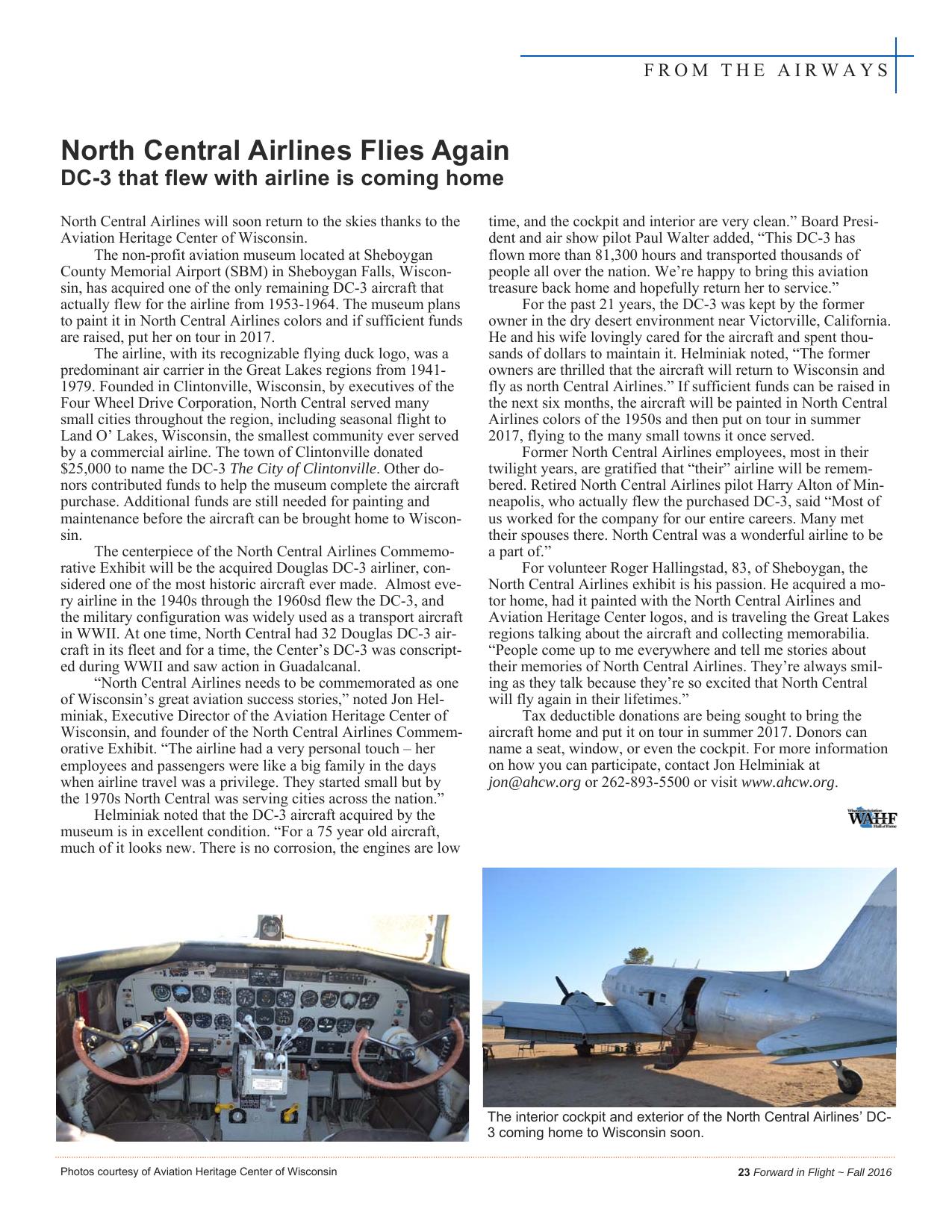
FROM THE AIRWAYS North Central Airlines Flies Again DC-3 that flew with airline is coming home North Central Airlines will soon return to the skies thanks to the Aviation Heritage Center of Wisconsin. The non-profit aviation museum located at Sheboygan County Memorial Airport (SBM) in Sheboygan Falls, Wisconsin, has acquired one of the only remaining DC-3 aircraft that actually flew for the airline from 1953-1964. The museum plans to paint it in North Central Airlines colors and if sufficient funds are raised, put her on tour in 2017. The airline, with its recognizable flying duck logo, was a predominant air carrier in the Great Lakes regions from 19411979. Founded in Clintonville, Wisconsin, by executives of the Four Wheel Drive Corporation, North Central served many small cities throughout the region, including seasonal flight to Land O’ Lakes, Wisconsin, the smallest community ever served by a commercial airline. The town of Clintonville donated $25,000 to name the DC-3 The City of Clintonville. Other donors contributed funds to help the museum complete the aircraft purchase. Additional funds are still needed for painting and maintenance before the aircraft can be brought home to Wisconsin. The centerpiece of the North Central Airlines Commemorative Exhibit will be the acquired Douglas DC-3 airliner, considered one of the most historic aircraft ever made. Almost every airline in the 1940s through the 1960sd flew the DC-3, and the military configuration was widely used as a transport aircraft in WWII. At one time, North Central had 32 Douglas DC-3 aircraft in its fleet and for a time, the Center’s DC-3 was conscripted during WWII and saw action in Guadalcanal. “North Central Airlines needs to be commemorated as one of Wisconsin’s great aviation success stories,” noted Jon Helminiak, Executive Director of the Aviation Heritage Center of Wisconsin, and founder of the North Central Airlines Commemorative Exhibit. “The airline had a very personal touch – her employees and passengers were like a big family in the days when airline travel was a privilege. They started small but by the 1970s North Central was serving cities across the nation.” Helminiak noted that the DC-3 aircraft acquired by the museum is in excellent condition. “For a 75 year old aircraft, much of it looks new. There is no corrosion, the engines are low time, and the cockpit and interior are very clean.” Board President and air show pilot Paul Walter added, “This DC-3 has flown more than 81,300 hours and transported thousands of people all over the nation. We’re happy to bring this aviation treasure back home and hopefully return her to service.” For the past 21 years, the DC-3 was kept by the former owner in the dry desert environment near Victorville, California. He and his wife lovingly cared for the aircraft and spent thousands of dollars to maintain it. Helminiak noted, “The former owners are thrilled that the aircraft will return to Wisconsin and fly as north Central Airlines.” If sufficient funds can be raised in the next six months, the aircraft will be painted in North Central Airlines colors of the 1950s and then put on tour in summer 2017, flying to the many small towns it once served. Former North Central Airlines employees, most in their twilight years, are gratified that “their” airline will be remembered. Retired North Central Airlines pilot Harry Alton of Minneapolis, who actually flew the purchased DC-3, said “Most of us worked for the company for our entire careers. Many met their spouses there. North Central was a wonderful airline to be a part of.” For volunteer Roger Hallingstad, 83, of Sheboygan, the North Central Airlines exhibit is his passion. He acquired a motor home, had it painted with the North Central Airlines and Aviation Heritage Center logos, and is traveling the Great Lakes regions talking about the aircraft and collecting memorabilia. “People come up to me everywhere and tell me stories about their memories of North Central Airlines. They’re always smiling as they talk because they’re so excited that North Central will fly again in their lifetimes.” Tax deductible donations are being sought to bring the aircraft home and put it on tour in summer 2017. Donors can name a seat, window, or even the cockpit. For more information on how you can participate, contact Jon Helminiak at jon@ahcw.org or 262-893-5500 or visit www.ahcw.org. The interior cockpit and exterior of the North Central Airlines’ DC3 coming home to Wisconsin soon. Photos courtesy of Aviation Heritage Center of Wisconsin 23 Forward in Flight ~ Fall 2016
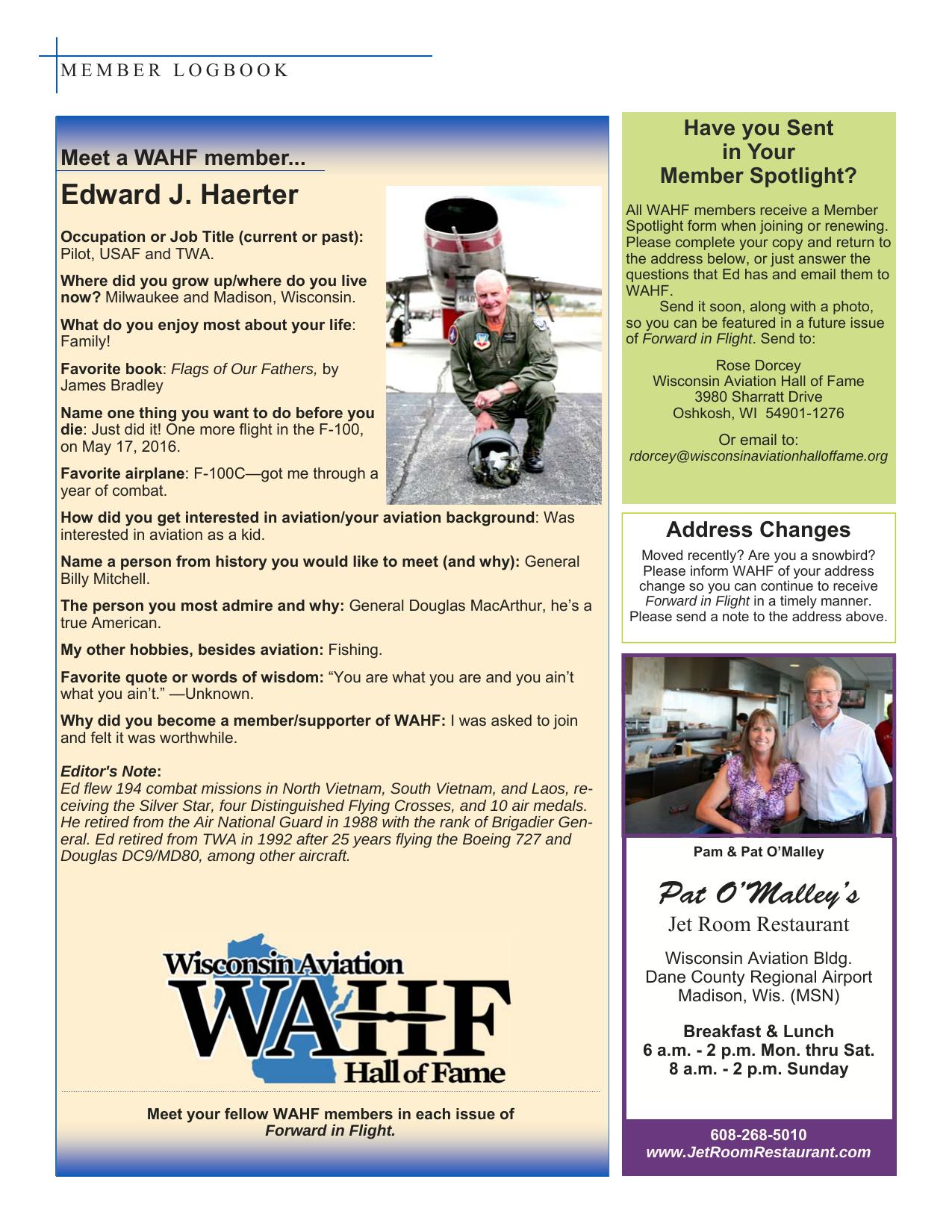
MEMBER LOGBOOK Have you Sent in Your Member Spotlight? Meet a WAHF member... Edward J. Haerter Occupation or Job Title (current or past): Pilot, USAF and TWA. Where did you grow up/where do you live now? Milwaukee and Madison, Wisconsin. What do you enjoy most about your life: Family! Roger Small Favorite book: Flags of Our Fathers, by James Bradley Name one thing you want to do before you die: Just did it! One more flight in the F-100, on May 17, 2016. All WAHF members receive a Member Spotlight form when joining or renewing. Please complete your copy and return to the address below, or just answer the questions that Ed has and email them to WAHF. Send it soon, along with a photo, so you can be featured in a future issue of Forward in Flight. Send to: Rose Dorcey Wisconsin Aviation Hall of Fame 3980 Sharratt Drive Oshkosh, WI 54901-1276 Or email to: rdorcey@wisconsinaviationhalloffame.org Favorite airplane: F-100C—got me through a year of combat. How did you get interested in aviation/your aviation background: Was interested in aviation as a kid. Name a person from history you would like to meet (and why): General Billy Mitchell. The person you most admire and why: General Douglas MacArthur, he’s a true American. Address Changes Moved recently? Are you a snowbird? Please inform WAHF of your address change so you can continue to receive Forward in Flight in a timely manner. Please send a note to the address above. My other hobbies, besides aviation: Fishing. Favorite quote or words of wisdom: “You are what you are and you ain’t what you ain’t.” —Unknown. Why did you become a member/supporter of WAHF: I was asked to join and felt it was worthwhile. Editor's Note: Ed flew 194 combat missions in North Vietnam, South Vietnam, and Laos, receiving the Silver Star, four Distinguished Flying Crosses, and 10 air medals. He retired from the Air National Guard in 1988 with the rank of Brigadier General. Ed retired from TWA in 1992 after 25 years flying the Boeing 727 and Douglas DC9/MD80, among other aircraft. Pam & Pat O’Malley Pat O’Malley’s Jet Room Restaurant Wisconsin Aviation Bldg. Dane County Regional Airport Madison, Wis. (MSN) Breakfast & Lunch 6 a.m. - 2 p.m. Mon. thru Sat. 8 a.m. - 2 p.m. Sunday Meet your fellow WAHF members in each issue of Forward in Flight. 608-268-5010 www.JetRoomRestaurant.com

Wittman Regional Airport Oshkosh So much history ...and still making it! From the legacy of Steve Wittman to Warren Basler’s DC-3 conversions, we’re proud to support and contribute to Wisconsin aviation history. FLY TO OSHKOSH wittmanairport.com @wittmanairport
PRSRT STD US Postage Paid Wisc Rapids WI Permit 98 3980 SHARRATT DRIVE OSHKOSH WI 54901-1276 The Wisconsin Aviation Hall of Fame is a non-profit membership organization dedicated to preserving the past and fostering the future of flight. CHANGE SERVICE REQUESTED Welcome New WAHF Member/Supporters Tim Anderson Tanya Cunningham Bruce Douglas Edward Haerter William Horton Kathleen Labrie Neil Robinson Thanks for coming on board. We hope to see you at a WAHF event soon! WAHF PHONE NUMBER HAS CHANGED! As of September 6, 2016, WAHF’s phone number (the number of John and Rose Dorcey, has changed.) Please discontinue using 920-385-1483 immediately and begin using 608-513-9840. Thank you! Congratulations to WAHF Member Andrea Weidner who completed her training and testing and earned her private pilot certificate on August 29. Andrea did her training out of Wittman Regional Airport (KOSH) in Oshkosh through Winnebago Flying Club and flew with Designated Examiner Dick Hanusa. Her flight instructor was John Dorcey. You’re Invited To the 31st annual Wisconsin Aviation Hall of Fame Induction Banquet Saturday, October 15, 2016 EAA AirVenture Museum - Founder’s Wing Oshkosh, Wisconsin 5:00 p.m. Social Hour - Dinner at 6 - Presentations at 7 $37 per person Contact Rose Dorcey for more information 920-279-6029 Wisconsin Aviation Hall of Fame Officers Rose Dorcey, President Tom Thomas, Vice-President John Dorcey, Secretary/Treasurer Board of Directors Elaine Kauh Kurt Stanich Brendan Stormo Charles Swain Wynne Williams Ron Wojnar Charles Marotske, Honorary Chairman of the Board Wisconsin Aviation Hall of Fame 3980 Sharratt Drive Oshkosh, WI 54901-1276 Become a member/supporter today! For information call Rose Dorcey at 920-279-6029 www.wisconsinaviationhalloffame.org rdorcey@wisconsinaviationhalloffame.org