Volume 15, Issue 3
🗞️ Download Issue (PDF)
Forward in Flight - Fall 2017
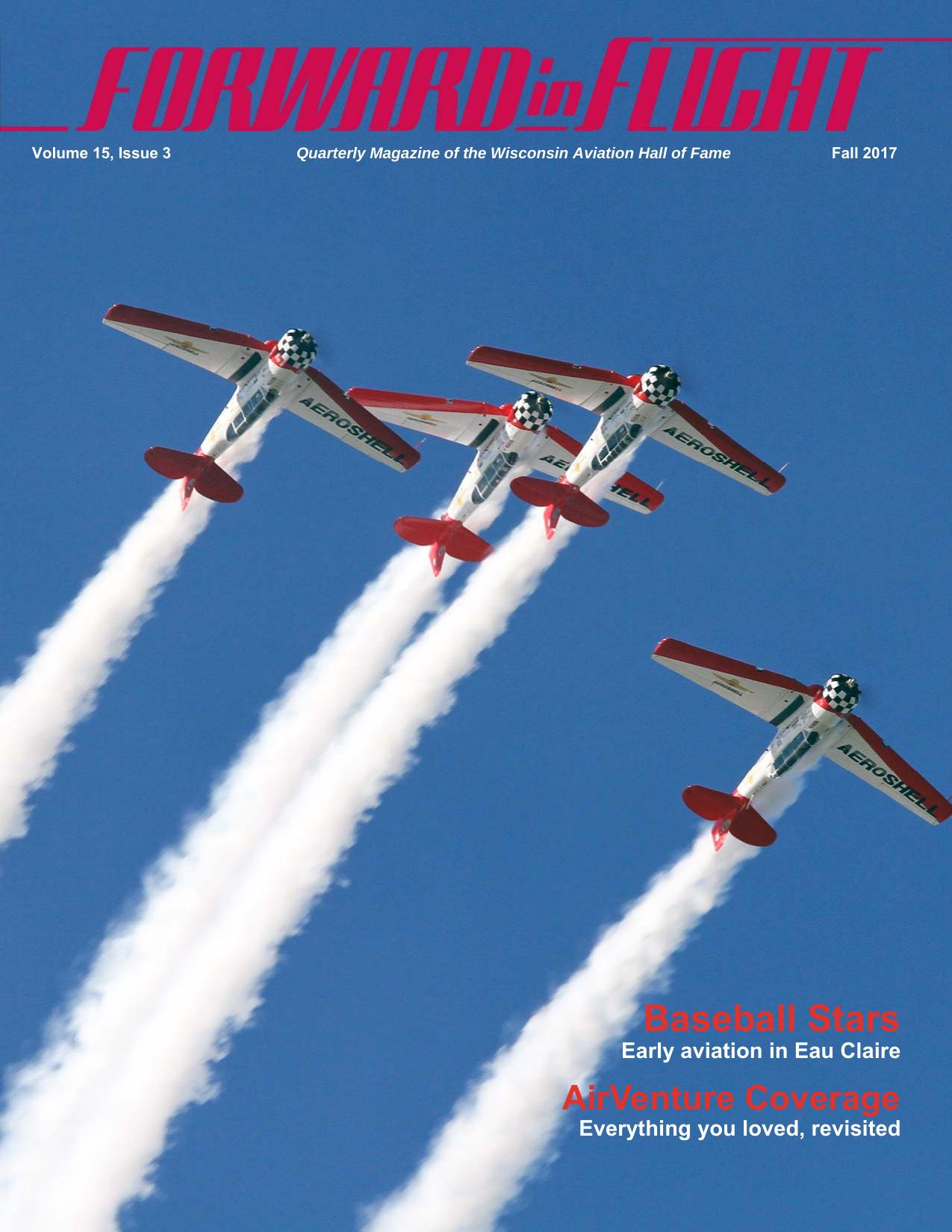
Volume 15, Issue 3 Quarterly Magazine of the Wisconsin Aviation Hall of Fame Fall 2017 Baseball Stars Early aviation in Eau Claire AirVenture Coverage Everything you loved, revisited
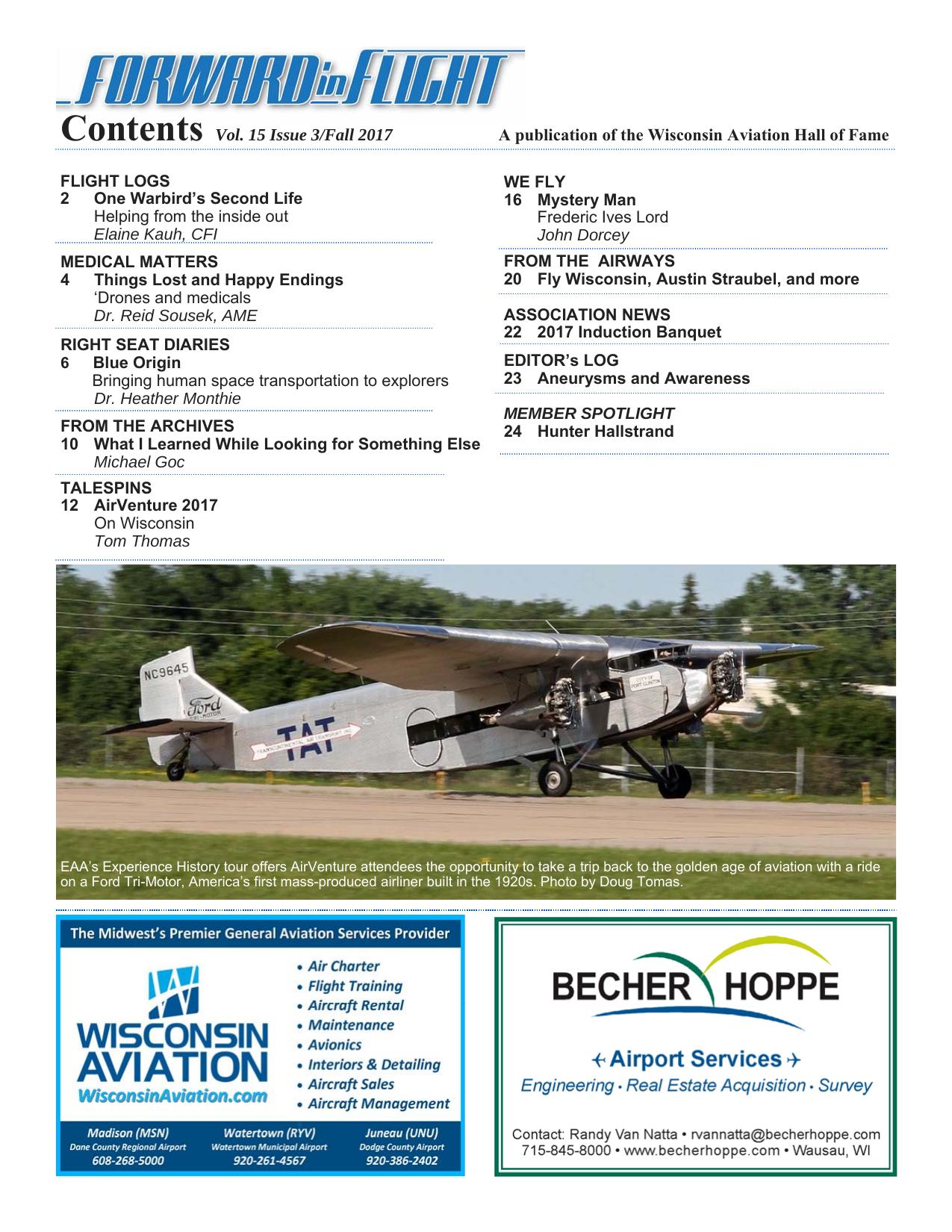
Contents Vol. 15 Issue 3/Fall 2017 A publication of the Wisconsin Aviation Hall of Fame FLIGHT LOGS 2 One Warbird’s Second Life Helping from the inside out Elaine Kauh, CFI WE FLY 16 Mystery Man Frederic Ives Lord John Dorcey MEDICAL MATTERS 4 Things Lost and Happy Endings ‘Drones and medicals Dr. Reid Sousek, AME FROM THE AIRWAYS 20 Fly Wisconsin, Austin Straubel, and more RIGHT SEAT DIARIES 6 Blue Origin Bringing human space transportation to explorers Dr. Heather Monthie FROM THE ARCHIVES 10 What I Learned While Looking for Something Else Michael Goc ASSOCIATION NEWS 22 2017 Induction Banquet EDITOR’s LOG 23 Aneurysms and Awareness MEMBER SPOTLIGHT 24 Hunter Hallstrand TALESPINS 12 AirVenture 2017 On Wisconsin Tom Thomas EAA’s Experience History tour offers AirVenture attendees the opportunity to take a trip back to the golden age of aviation with a ride on a Ford Tri-Motor, America’s first mass-produced airliner built in the 1920s. Photo by Doug Tomas.
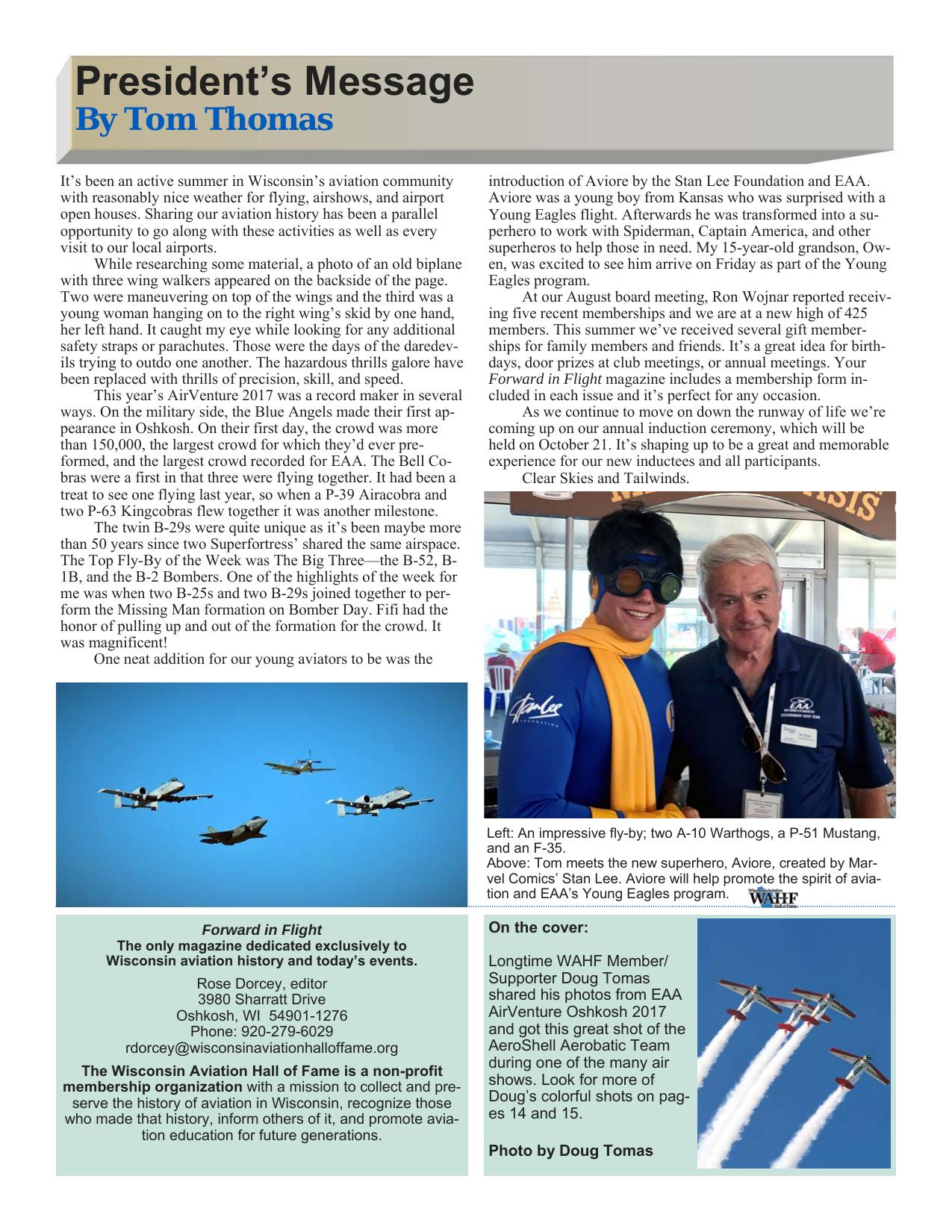
President’s Message By Tom Thomas It’s been an active summer in Wisconsin’s aviation community with reasonably nice weather for flying, airshows, and airport open houses. Sharing our aviation history has been a parallel opportunity to go along with these activities as well as every visit to our local airports. While researching some material, a photo of an old biplane with three wing walkers appeared on the backside of the page. Two were maneuvering on top of the wings and the third was a young woman hanging on to the right wing’s skid by one hand, her left hand. It caught my eye while looking for any additional safety straps or parachutes. Those were the days of the daredevils trying to outdo one another. The hazardous thrills galore have been replaced with thrills of precision, skill, and speed. This year’s AirVenture 2017 was a record maker in several ways. On the military side, the Blue Angels made their first appearance in Oshkosh. On their first day, the crowd was more than 150,000, the largest crowd for which they’d ever preformed, and the largest crowd recorded for EAA. The Bell Cobras were a first in that three were flying together. It had been a treat to see one flying last year, so when a P-39 Airacobra and two P-63 Kingcobras flew together it was another milestone. The twin B-29s were quite unique as it’s been maybe more than 50 years since two Superfortress’ shared the same airspace. The Top Fly-By of the Week was The Big Three—the B-52, B1B, and the B-2 Bombers. One of the highlights of the week for me was when two B-25s and two B-29s joined together to perform the Missing Man formation on Bomber Day. Fifi had the honor of pulling up and out of the formation for the crowd. It was magnificent! One neat addition for our young aviators to be was the introduction of Aviore by the Stan Lee Foundation and EAA. Aviore was a young boy from Kansas who was surprised with a Young Eagles flight. Afterwards he was transformed into a superhero to work with Spiderman, Captain America, and other superheros to help those in need. My 15-year-old grandson, Owen, was excited to see him arrive on Friday as part of the Young Eagles program. At our August board meeting, Ron Wojnar reported receiving five recent memberships and we are at a new high of 425 members. This summer we’ve received several gift memberships for family members and friends. It’s a great idea for birthdays, door prizes at club meetings, or annual meetings. Your Forward in Flight magazine includes a membership form included in each issue and it’s perfect for any occasion. As we continue to move on down the runway of life we’re coming up on our annual induction ceremony, which will be held on October 21. It’s shaping up to be a great and memorable experience for our new inductees and all participants. Clear Skies and Tailwinds. Left: An impressive fly-by; two A-10 Warthogs, a P-51 Mustang, and an F-35. Above: Tom meets the new superhero, Aviore, created by Marvel Comics’ Stan Lee. Aviore will help promote the spirit of aviation and EAA’s Young Eagles program. Forward in Flight The only magazine dedicated exclusively to Wisconsin aviation history and today’s events. Rose Dorcey, editor 3980 Sharratt Drive Oshkosh, WI 54901-1276 Phone: 920-279-6029 rdorcey@wisconsinaviationhalloffame.org The Wisconsin Aviation Hall of Fame is a non-profit membership organization with a mission to collect and preserve the history of aviation in Wisconsin, recognize those who made that history, inform others of it, and promote aviation education for future generations. On the cover: Longtime WAHF Member/ Supporter Doug Tomas shared his photos from EAA AirVenture Oshkosh 2017 and got this great shot of the AeroShell Aerobatic Team during one of the many air shows. Look for more of Doug’s colorful shots on pages 14 and 15. Photo by Doug Tomas
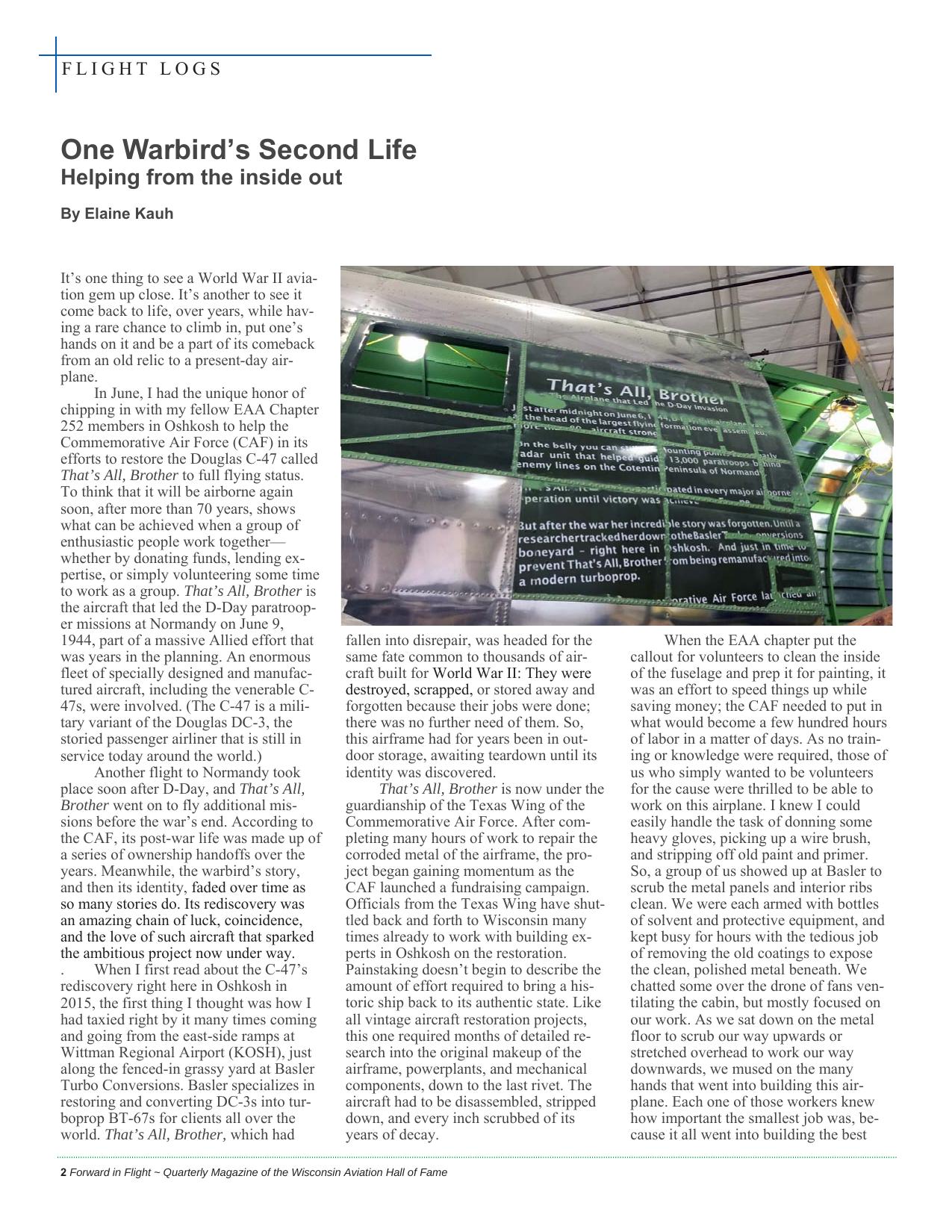
FLIGHT LOGS One Warbird’s Second Life Helping from the inside out By Elaine Kauh It’s one thing to see a World War II aviation gem up close. It’s another to see it come back to life, over years, while having a rare chance to climb in, put one’s hands on it and be a part of its comeback from an old relic to a present-day airplane. In June, I had the unique honor of chipping in with my fellow EAA Chapter 252 members in Oshkosh to help the Commemorative Air Force (CAF) in its efforts to restore the Douglas C-47 called That’s All, Brother to full flying status. To think that it will be airborne again soon, after more than 70 years, shows what can be achieved when a group of enthusiastic people work together— whether by donating funds, lending expertise, or simply volunteering some time to work as a group. That’s All, Brother is the aircraft that led the D-Day paratrooper missions at Normandy on June 9, 1944, part of a massive Allied effort that was years in the planning. An enormous fleet of specially designed and manufactured aircraft, including the venerable C47s, were involved. (The C-47 is a military variant of the Douglas DC-3, the storied passenger airliner that is still in service today around the world.) Another flight to Normandy took place soon after D-Day, and That’s All, Brother went on to fly additional missions before the war’s end. According to the CAF, its post-war life was made up of a series of ownership handoffs over the years. Meanwhile, the warbird’s story, and then its identity, faded over time as so many stories do. Its rediscovery was an amazing chain of luck, coincidence, and the love of such aircraft that sparked the ambitious project now under way. . When I first read about the C-47’s rediscovery right here in Oshkosh in 2015, the first thing I thought was how I had taxied right by it many times coming and going from the east-side ramps at Wittman Regional Airport (KOSH), just along the fenced-in grassy yard at Basler Turbo Conversions. Basler specializes in restoring and converting DC-3s into turboprop BT-67s for clients all over the world. That’s All, Brother, which had fallen into disrepair, was headed for the same fate common to thousands of aircraft built for World War II: They were destroyed, scrapped, or stored away and forgotten because their jobs were done; there was no further need of them. So, this airframe had for years been in outdoor storage, awaiting teardown until its identity was discovered. That’s All, Brother is now under the guardianship of the Texas Wing of the Commemorative Air Force. After completing many hours of work to repair the corroded metal of the airframe, the project began gaining momentum as the CAF launched a fundraising campaign. Officials from the Texas Wing have shuttled back and forth to Wisconsin many times already to work with building experts in Oshkosh on the restoration. Painstaking doesn’t begin to describe the amount of effort required to bring a historic ship back to its authentic state. Like all vintage aircraft restoration projects, this one required months of detailed research into the original makeup of the airframe, powerplants, and mechanical components, down to the last rivet. The aircraft had to be disassembled, stripped down, and every inch scrubbed of its years of decay. 2 Forward in Flight ~ Quarterly Magazine of the Wisconsin Aviation Hall of Fame When the EAA chapter put the callout for volunteers to clean the inside of the fuselage and prep it for painting, it was an effort to speed things up while saving money; the CAF needed to put in what would become a few hundred hours of labor in a matter of days. As no training or knowledge were required, those of us who simply wanted to be volunteers for the cause were thrilled to be able to work on this airplane. I knew I could easily handle the task of donning some heavy gloves, picking up a wire brush, and stripping off old paint and primer. So, a group of us showed up at Basler to scrub the metal panels and interior ribs clean. We were each armed with bottles of solvent and protective equipment, and kept busy for hours with the tedious job of removing the old coatings to expose the clean, polished metal beneath. We chatted some over the drone of fans ventilating the cabin, but mostly focused on our work. As we sat down on the metal floor to scrub our way upwards or stretched overhead to work our way downwards, we mused on the many hands that went into building this airplane. Each one of those workers knew how important the smallest job was, because it all went into building the best
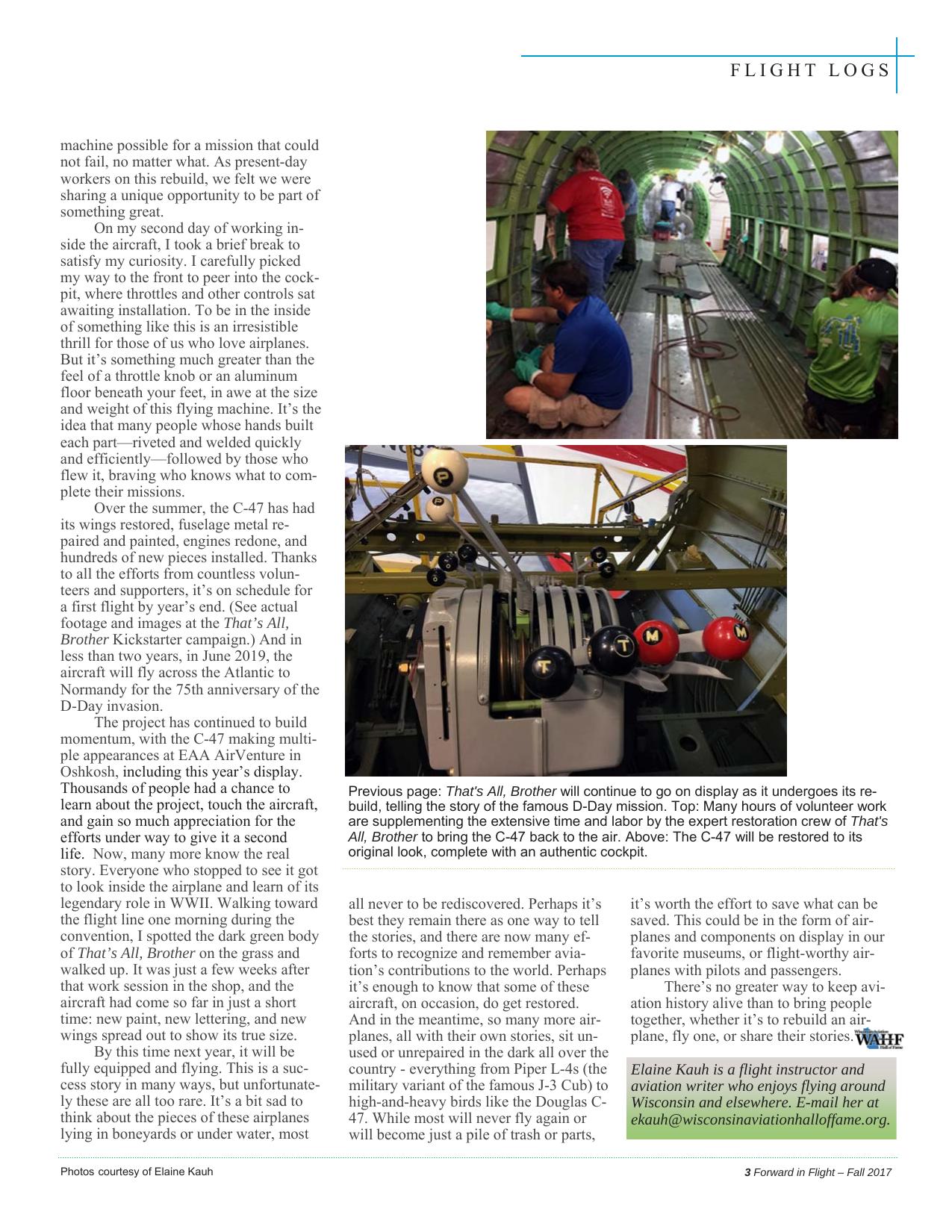
FLIGHT LOGS machine possible for a mission that could not fail, no matter what. As present-day workers on this rebuild, we felt we were sharing a unique opportunity to be part of something great. On my second day of working inside the aircraft, I took a brief break to satisfy my curiosity. I carefully picked my way to the front to peer into the cockpit, where throttles and other controls sat awaiting installation. To be in the inside of something like this is an irresistible thrill for those of us who love airplanes. But it’s something much greater than the feel of a throttle knob or an aluminum floor beneath your feet, in awe at the size and weight of this flying machine. It’s the idea that many people whose hands built each part—riveted and welded quickly and efficiently—followed by those who flew it, braving who knows what to complete their missions. Over the summer, the C-47 has had its wings restored, fuselage metal repaired and painted, engines redone, and hundreds of new pieces installed. Thanks to all the efforts from countless volunteers and supporters, it’s on schedule for a first flight by year’s end. (See actual footage and images at the That’s All, Brother Kickstarter campaign.) And in less than two years, in June 2019, the aircraft will fly across the Atlantic to Normandy for the 75th anniversary of the D-Day invasion. The project has continued to build momentum, with the C-47 making multiple appearances at EAA AirVenture in Oshkosh, including this year’s display. Thousands of people had a chance to learn about the project, touch the aircraft, and gain so much appreciation for the efforts under way to give it a second life. Now, many more know the real story. Everyone who stopped to see it got to look inside the airplane and learn of its legendary role in WWII. Walking toward the flight line one morning during the convention, I spotted the dark green body of That’s All, Brother on the grass and walked up. It was just a few weeks after that work session in the shop, and the aircraft had come so far in just a short time: new paint, new lettering, and new wings spread out to show its true size. By this time next year, it will be fully equipped and flying. This is a success story in many ways, but unfortunately these are all too rare. It’s a bit sad to think about the pieces of these airplanes lying in boneyards or under water, most Photos courtesy of Elaine Kauh Previous page: That's All, Brother will continue to go on display as it undergoes its rebuild, telling the story of the famous D-Day mission. Top: Many hours of volunteer work are supplementing the extensive time and labor by the expert restoration crew of That's All, Brother to bring the C-47 back to the air. Above: The C-47 will be restored to its original look, complete with an authentic cockpit. all never to be rediscovered. Perhaps it’s best they remain there as one way to tell the stories, and there are now many efforts to recognize and remember aviation’s contributions to the world. Perhaps it’s enough to know that some of these aircraft, on occasion, do get restored. And in the meantime, so many more airplanes, all with their own stories, sit unused or unrepaired in the dark all over the country - everything from Piper L-4s (the military variant of the famous J-3 Cub) to high-and-heavy birds like the Douglas C47. While most will never fly again or will become just a pile of trash or parts, it’s worth the effort to save what can be saved. This could be in the form of airplanes and components on display in our favorite museums, or flight-worthy airplanes with pilots and passengers. There’s no greater way to keep aviation history alive than to bring people together, whether it’s to rebuild an airplane, fly one, or share their stories. Elaine Kauh is a flight instructor and aviation writer who enjoys flying around Wisconsin and elsewhere. E-mail her at ekauh@wisconsinaviationhalloffame.org. 3 Forward in Flight – Fall 2017
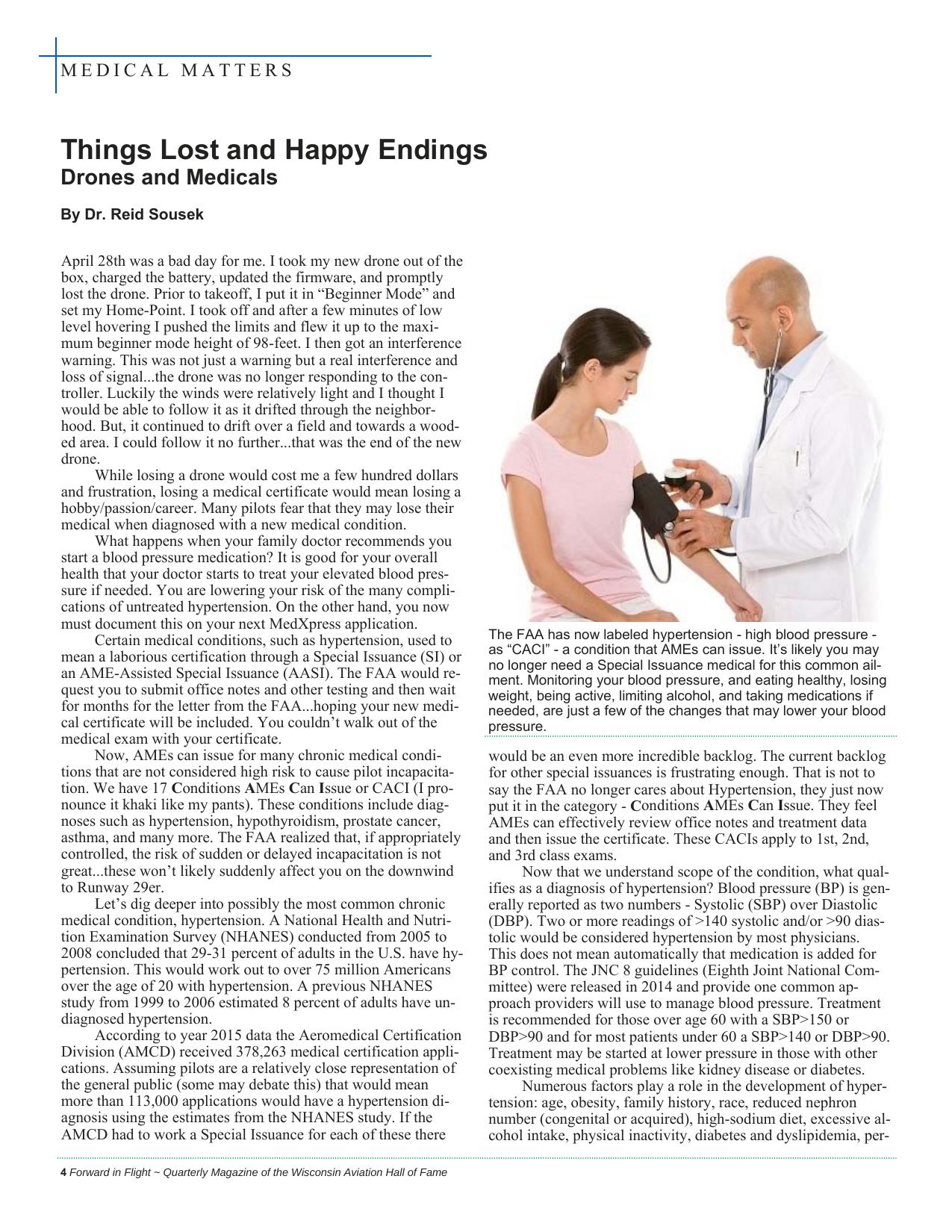
MEDICAL MATTERS Things Lost and Happy Endings Drones and Medicals By Dr. Reid Sousek April 28th was a bad day for me. I took my new drone out of the box, charged the battery, updated the firmware, and promptly lost the drone. Prior to takeoff, I put it in “Beginner Mode” and set my Home-Point. I took off and after a few minutes of low level hovering I pushed the limits and flew it up to the maximum beginner mode height of 98-feet. I then got an interference warning. This was not just a warning but a real interference and loss of signal...the drone was no longer responding to the controller. Luckily the winds were relatively light and I thought I would be able to follow it as it drifted through the neighborhood. But, it continued to drift over a field and towards a wooded area. I could follow it no further...that was the end of the new drone. While losing a drone would cost me a few hundred dollars and frustration, losing a medical certificate would mean losing a hobby/passion/career. Many pilots fear that they may lose their medical when diagnosed with a new medical condition. What happens when your family doctor recommends you start a blood pressure medication? It is good for your overall health that your doctor starts to treat your elevated blood pressure if needed. You are lowering your risk of the many complications of untreated hypertension. On the other hand, you now must document this on your next MedXpress application. Certain medical conditions, such as hypertension, used to mean a laborious certification through a Special Issuance (SI) or an AME-Assisted Special Issuance (AASI). The FAA would request you to submit office notes and other testing and then wait for months for the letter from the FAA...hoping your new medical certificate will be included. You couldn’t walk out of the medical exam with your certificate. Now, AMEs can issue for many chronic medical conditions that are not considered high risk to cause pilot incapacitation. We have 17 Conditions AMEs Can Issue or CACI (I pronounce it khaki like my pants). These conditions include diagnoses such as hypertension, hypothyroidism, prostate cancer, asthma, and many more. The FAA realized that, if appropriately controlled, the risk of sudden or delayed incapacitation is not great...these won’t likely suddenly affect you on the downwind to Runway 29er. Let’s dig deeper into possibly the most common chronic medical condition, hypertension. A National Health and Nutrition Examination Survey (NHANES) conducted from 2005 to 2008 concluded that 29-31 percent of adults in the U.S. have hypertension. This would work out to over 75 million Americans over the age of 20 with hypertension. A previous NHANES study from 1999 to 2006 estimated 8 percent of adults have undiagnosed hypertension. According to year 2015 data the Aeromedical Certification Division (AMCD) received 378,263 medical certification applications. Assuming pilots are a relatively close representation of the general public (some may debate this) that would mean more than 113,000 applications would have a hypertension diagnosis using the estimates from the NHANES study. If the AMCD had to work a Special Issuance for each of these there 4 Forward in Flight ~ Quarterly Magazine of the Wisconsin Aviation Hall of Fame The FAA has now labeled hypertension - high blood pressure as “CACI” - a condition that AMEs can issue. It’s likely you may no longer need a Special Issuance medical for this common ailment. Monitoring your blood pressure, and eating healthy, losing weight, being active, limiting alcohol, and taking medications if needed, are just a few of the changes that may lower your blood pressure. would be an even more incredible backlog. The current backlog for other special issuances is frustrating enough. That is not to say the FAA no longer cares about Hypertension, they just now put it in the category - Conditions AMEs Can Issue. They feel AMEs can effectively review office notes and treatment data and then issue the certificate. These CACIs apply to 1st, 2nd, and 3rd class exams. Now that we understand scope of the condition, what qualifies as a diagnosis of hypertension? Blood pressure (BP) is generally reported as two numbers - Systolic (SBP) over Diastolic (DBP). Two or more readings of >140 systolic and/or >90 diastolic would be considered hypertension by most physicians. This does not mean automatically that medication is added for BP control. The JNC 8 guidelines (Eighth Joint National Committee) were released in 2014 and provide one common approach providers will use to manage blood pressure. Treatment is recommended for those over age 60 with a SBP>150 or DBP>90 and for most patients under 60 a SBP>140 or DBP>90. Treatment may be started at lower pressure in those with other coexisting medical problems like kidney disease or diabetes. Numerous factors play a role in the development of hypertension: age, obesity, family history, race, reduced nephron number (congenital or acquired), high-sodium diet, excessive alcohol intake, physical inactivity, diabetes and dyslipidemia, per-
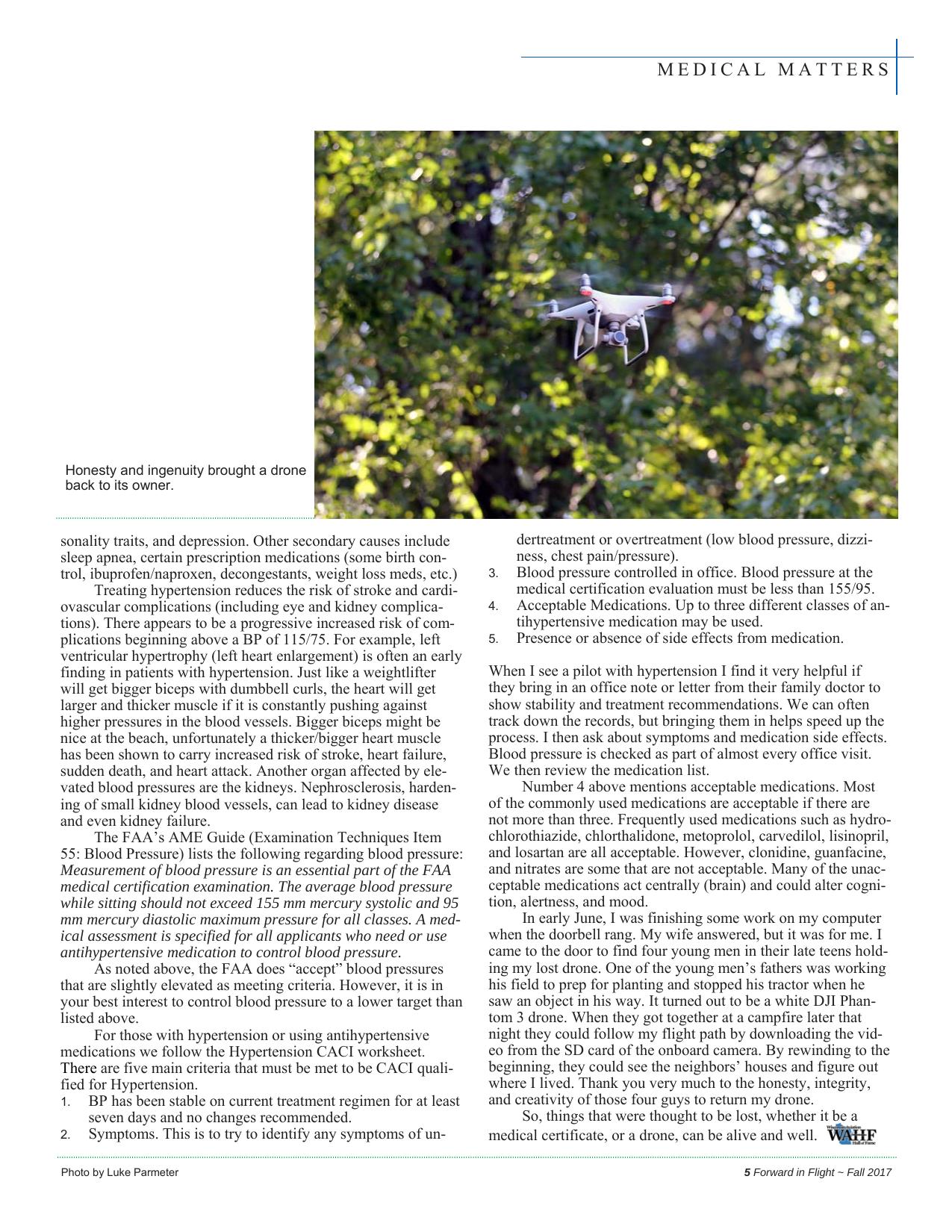
MEDICAL MATTERS Honesty and ingenuity brought a drone back to its owner. sonality traits, and depression. Other secondary causes include sleep apnea, certain prescription medications (some birth control, ibuprofen/naproxen, decongestants, weight loss meds, etc.) Treating hypertension reduces the risk of stroke and cardiovascular complications (including eye and kidney complications). There appears to be a progressive increased risk of complications beginning above a BP of 115/75. For example, left ventricular hypertrophy (left heart enlargement) is often an early finding in patients with hypertension. Just like a weightlifter will get bigger biceps with dumbbell curls, the heart will get larger and thicker muscle if it is constantly pushing against higher pressures in the blood vessels. Bigger biceps might be nice at the beach, unfortunately a thicker/bigger heart muscle has been shown to carry increased risk of stroke, heart failure, sudden death, and heart attack. Another organ affected by elevated blood pressures are the kidneys. Nephrosclerosis, hardening of small kidney blood vessels, can lead to kidney disease and even kidney failure. The FAA’s AME Guide (Examination Techniques Item 55: Blood Pressure) lists the following regarding blood pressure: Measurement of blood pressure is an essential part of the FAA medical certification examination. The average blood pressure while sitting should not exceed 155 mm mercury systolic and 95 mm mercury diastolic maximum pressure for all classes. A medical assessment is specified for all applicants who need or use antihypertensive medication to control blood pressure. As noted above, the FAA does “accept” blood pressures that are slightly elevated as meeting criteria. However, it is in your best interest to control blood pressure to a lower target than listed above. For those with hypertension or using antihypertensive medications we follow the Hypertension CACI worksheet. There are five main criteria that must be met to be CACI qualified for Hypertension. 1. BP has been stable on current treatment regimen for at least seven days and no changes recommended. 2. Symptoms. This is to try to identify any symptoms of unPhoto by Luke Parmeter 3. 4. 5. dertreatment or overtreatment (low blood pressure, dizziness, chest pain/pressure). Blood pressure controlled in office. Blood pressure at the medical certification evaluation must be less than 155/95. Acceptable Medications. Up to three different classes of antihypertensive medication may be used. Presence or absence of side effects from medication. When I see a pilot with hypertension I find it very helpful if they bring in an office note or letter from their family doctor to show stability and treatment recommendations. We can often track down the records, but bringing them in helps speed up the process. I then ask about symptoms and medication side effects. Blood pressure is checked as part of almost every office visit. We then review the medication list. Number 4 above mentions acceptable medications. Most of the commonly used medications are acceptable if there are not more than three. Frequently used medications such as hydrochlorothiazide, chlorthalidone, metoprolol, carvedilol, lisinopril, and losartan are all acceptable. However, clonidine, guanfacine, and nitrates are some that are not acceptable. Many of the unacceptable medications act centrally (brain) and could alter cognition, alertness, and mood. In early June, I was finishing some work on my computer when the doorbell rang. My wife answered, but it was for me. I came to the door to find four young men in their late teens holding my lost drone. One of the young men’s fathers was working his field to prep for planting and stopped his tractor when he saw an object in his way. It turned out to be a white DJI Phantom 3 drone. When they got together at a campfire later that night they could follow my flight path by downloading the video from the SD card of the onboard camera. By rewinding to the beginning, they could see the neighbors’ houses and figure out where I lived. Thank you very much to the honesty, integrity, and creativity of those four guys to return my drone. So, things that were thought to be lost, whether it be a medical certificate, or a drone, can be alive and well. 5 Forward in Flight ~ Fall 2017
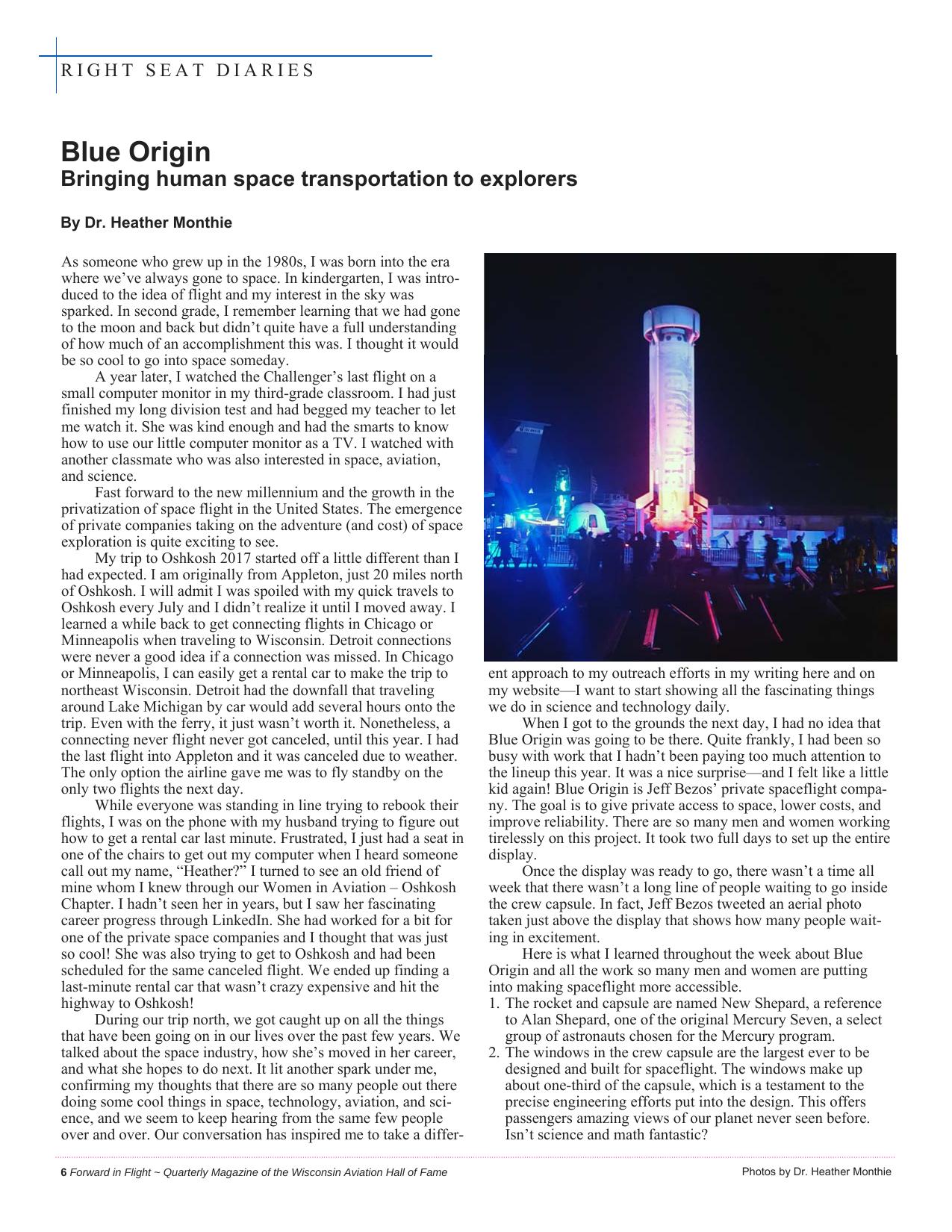
RIGHT SEAT DIARIES Blue Origin Bringing human space transportation to explorers By Dr. Heather Monthie As someone who grew up in the 1980s, I was born into the era where we’ve always gone to space. In kindergarten, I was introduced to the idea of flight and my interest in the sky was sparked. In second grade, I remember learning that we had gone to the moon and back but didn’t quite have a full understanding of how much of an accomplishment this was. I thought it would be so cool to go into space someday. A year later, I watched the Challenger’s last flight on a small computer monitor in my third-grade classroom. I had just finished my long division test and had begged my teacher to let me watch it. She was kind enough and had the smarts to know how to use our little computer monitor as a TV. I watched with another classmate who was also interested in space, aviation, and science. Fast forward to the new millennium and the growth in the privatization of space flight in the United States. The emergence of private companies taking on the adventure (and cost) of space exploration is quite exciting to see. My trip to Oshkosh 2017 started off a little different than I had expected. I am originally from Appleton, just 20 miles north of Oshkosh. I will admit I was spoiled with my quick travels to Oshkosh every July and I didn’t realize it until I moved away. I learned a while back to get connecting flights in Chicago or Minneapolis when traveling to Wisconsin. Detroit connections were never a good idea if a connection was missed. In Chicago or Minneapolis, I can easily get a rental car to make the trip to northeast Wisconsin. Detroit had the downfall that traveling around Lake Michigan by car would add several hours onto the trip. Even with the ferry, it just wasn’t worth it. Nonetheless, a connecting never flight never got canceled, until this year. I had the last flight into Appleton and it was canceled due to weather. The only option the airline gave me was to fly standby on the only two flights the next day. While everyone was standing in line trying to rebook their flights, I was on the phone with my husband trying to figure out how to get a rental car last minute. Frustrated, I just had a seat in one of the chairs to get out my computer when I heard someone call out my name, “Heather?” I turned to see an old friend of mine whom I knew through our Women in Aviation – Oshkosh Chapter. I hadn’t seen her in years, but I saw her fascinating career progress through LinkedIn. She had worked for a bit for one of the private space companies and I thought that was just so cool! She was also trying to get to Oshkosh and had been scheduled for the same canceled flight. We ended up finding a last-minute rental car that wasn’t crazy expensive and hit the highway to Oshkosh! During our trip north, we got caught up on all the things that have been going on in our lives over the past few years. We talked about the space industry, how she’s moved in her career, and what she hopes to do next. It lit another spark under me, confirming my thoughts that there are so many people out there doing some cool things in space, technology, aviation, and science, and we seem to keep hearing from the same few people over and over. Our conversation has inspired me to take a differ6 Forward in Flight ~ Quarterly Magazine of the Wisconsin Aviation Hall of Fame ent approach to my outreach efforts in my writing here and on my website—I want to start showing all the fascinating things we do in science and technology daily. When I got to the grounds the next day, I had no idea that Blue Origin was going to be there. Quite frankly, I had been so busy with work that I hadn’t been paying too much attention to the lineup this year. It was a nice surprise—and I felt like a little kid again! Blue Origin is Jeff Bezos’ private spaceflight company. The goal is to give private access to space, lower costs, and improve reliability. There are so many men and women working tirelessly on this project. It took two full days to set up the entire display. Once the display was ready to go, there wasn’t a time all week that there wasn’t a long line of people waiting to go inside the crew capsule. In fact, Jeff Bezos tweeted an aerial photo taken just above the display that shows how many people waiting in excitement. Here is what I learned throughout the week about Blue Origin and all the work so many men and women are putting into making spaceflight more accessible. 1. The rocket and capsule are named New Shepard, a reference to Alan Shepard, one of the original Mercury Seven, a select group of astronauts chosen for the Mercury program. 2. The windows in the crew capsule are the largest ever to be designed and built for spaceflight. The windows make up about one-third of the capsule, which is a testament to the precise engineering efforts put into the design. This offers passengers amazing views of our planet never seen before. Isn’t science and math fantastic? Photos by Dr. Heather Monthie
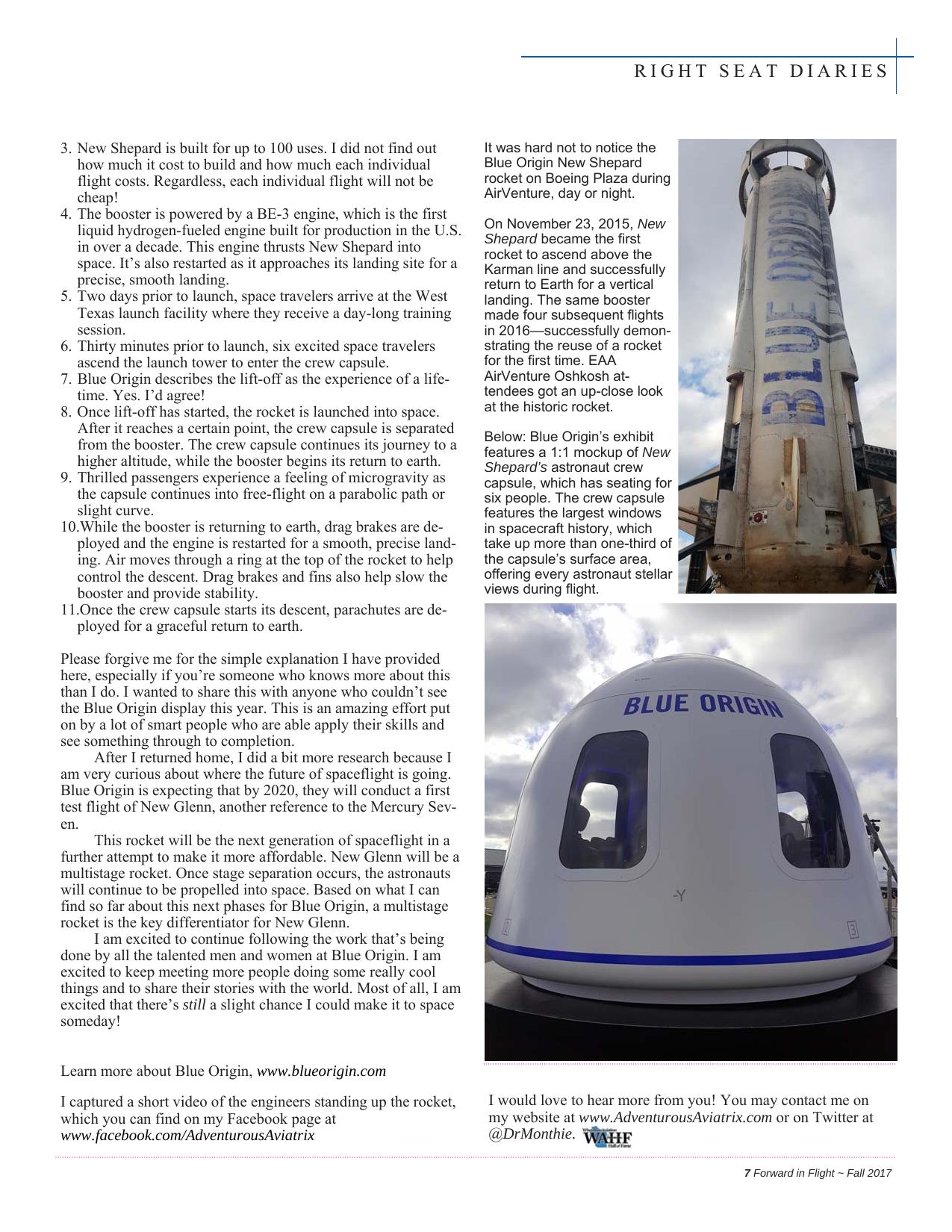
RIGHT SEAT DIARIES 3. New Shepard is built for up to 100 uses. I did not find out how much it cost to build and how much each individual flight costs. Regardless, each individual flight will not be cheap! 4. The booster is powered by a BE-3 engine, which is the first liquid hydrogen-fueled engine built for production in the U.S. in over a decade. This engine thrusts New Shepard into space. It’s also restarted as it approaches its landing site for a precise, smooth landing. 5. Two days prior to launch, space travelers arrive at the West Texas launch facility where they receive a day-long training session. 6. Thirty minutes prior to launch, six excited space travelers ascend the launch tower to enter the crew capsule. 7. Blue Origin describes the lift-off as the experience of a lifetime. Yes. I’d agree! 8. Once lift-off has started, the rocket is launched into space. After it reaches a certain point, the crew capsule is separated from the booster. The crew capsule continues its journey to a higher altitude, while the booster begins its return to earth. 9. Thrilled passengers experience a feeling of microgravity as the capsule continues into free-flight on a parabolic path or slight curve. 10.While the booster is returning to earth, drag brakes are deployed and the engine is restarted for a smooth, precise landing. Air moves through a ring at the top of the rocket to help control the descent. Drag brakes and fins also help slow the booster and provide stability. 11.Once the crew capsule starts its descent, parachutes are deployed for a graceful return to earth. It was hard not to notice the Blue Origin New Shepard rocket on Boeing Plaza during AirVenture, day or night. On November 23, 2015, New Shepard became the first rocket to ascend above the Karman line and successfully return to Earth for a vertical landing. The same booster made four subsequent flights in 2016—successfully demonstrating the reuse of a rocket for the first time. EAA AirVenture Oshkosh attendees got an up-close look at the historic rocket. Below: Blue Origin’s exhibit features a 1:1 mockup of New Shepard’s astronaut crew capsule, which has seating for six people. The crew capsule features the largest windows in spacecraft history, which take up more than one-third of the capsule’s surface area, offering every astronaut stellar views during flight. Please forgive me for the simple explanation I have provided here, especially if you’re someone who knows more about this than I do. I wanted to share this with anyone who couldn’t see the Blue Origin display this year. This is an amazing effort put on by a lot of smart people who are able apply their skills and see something through to completion. After I returned home, I did a bit more research because I am very curious about where the future of spaceflight is going. Blue Origin is expecting that by 2020, they will conduct a first test flight of New Glenn, another reference to the Mercury Seven. This rocket will be the next generation of spaceflight in a further attempt to make it more affordable. New Glenn will be a multistage rocket. Once stage separation occurs, the astronauts will continue to be propelled into space. Based on what I can find so far about this next phases for Blue Origin, a multistage rocket is the key differentiator for New Glenn. I am excited to continue following the work that’s being done by all the talented men and women at Blue Origin. I am excited to keep meeting more people doing some really cool things and to share their stories with the world. Most of all, I am excited that there’s still a slight chance I could make it to space someday! Learn more about Blue Origin, www.blueorigin.com I captured a short video of the engineers standing up the rocket, which you can find on my Facebook page at www.facebook.com/AdventurousAviatrix I would love to hear more from you! You may contact me on my website at www.AdventurousAviatrix.com or on Twitter at @DrMonthie. 7 Forward in Flight ~ Fall 2017
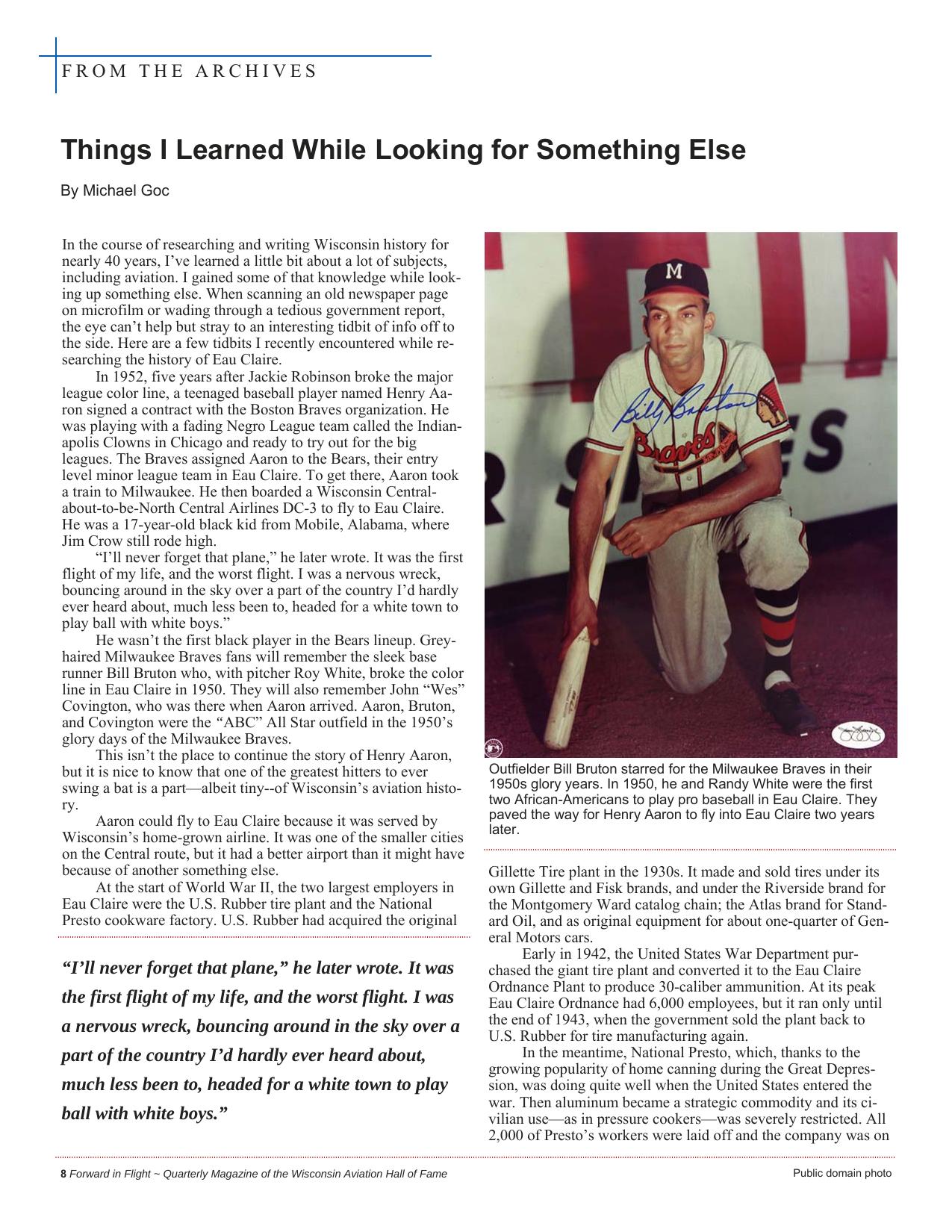
FROM THE ARCHIVES Things I Learned While Looking for Something Else By Michael Goc In the course of researching and writing Wisconsin history for nearly 40 years, I’ve learned a little bit about a lot of subjects, including aviation. I gained some of that knowledge while looking up something else. When scanning an old newspaper page on microfilm or wading through a tedious government report, the eye can’t help but stray to an interesting tidbit of info off to the side. Here are a few tidbits I recently encountered while researching the history of Eau Claire. In 1952, five years after Jackie Robinson broke the major league color line, a teenaged baseball player named Henry Aaron signed a contract with the Boston Braves organization. He was playing with a fading Negro League team called the Indianapolis Clowns in Chicago and ready to try out for the big leagues. The Braves assigned Aaron to the Bears, their entry level minor league team in Eau Claire. To get there, Aaron took a train to Milwaukee. He then boarded a Wisconsin Centralabout-to-be-North Central Airlines DC-3 to fly to Eau Claire. He was a 17-year-old black kid from Mobile, Alabama, where Jim Crow still rode high. “I’ll never forget that plane,” he later wrote. It was the first flight of my life, and the worst flight. I was a nervous wreck, bouncing around in the sky over a part of the country I’d hardly ever heard about, much less been to, headed for a white town to play ball with white boys.” He wasn’t the first black player in the Bears lineup. Greyhaired Milwaukee Braves fans will remember the sleek base runner Bill Bruton who, with pitcher Roy White, broke the color line in Eau Claire in 1950. They will also remember John “Wes” Covington, who was there when Aaron arrived. Aaron, Bruton, and Covington were the “ABC” All Star outfield in the 1950’s glory days of the Milwaukee Braves. This isn’t the place to continue the story of Henry Aaron, but it is nice to know that one of the greatest hitters to ever swing a bat is a part—albeit tiny--of Wisconsin’s aviation history. Aaron could fly to Eau Claire because it was served by Wisconsin’s home-grown airline. It was one of the smaller cities on the Central route, but it had a better airport than it might have because of another something else. At the start of World War II, the two largest employers in Eau Claire were the U.S. Rubber tire plant and the National Presto cookware factory. U.S. Rubber had acquired the original “I’ll never forget that plane,” he later wrote. It was the first flight of my life, and the worst flight. I was a nervous wreck, bouncing around in the sky over a part of the country I’d hardly ever heard about, much less been to, headed for a white town to play ball with white boys.” 8 Forward in Flight ~ Quarterly Magazine of the Wisconsin Aviation Hall of Fame Outfielder Bill Bruton starred for the Milwaukee Braves in their 1950s glory years. In 1950, he and Randy White were the first two African-Americans to play pro baseball in Eau Claire. They paved the way for Henry Aaron to fly into Eau Claire two years later. Gillette Tire plant in the 1930s. It made and sold tires under its own Gillette and Fisk brands, and under the Riverside brand for the Montgomery Ward catalog chain; the Atlas brand for Standard Oil, and as original equipment for about one-quarter of General Motors cars. Early in 1942, the United States War Department purchased the giant tire plant and converted it to the Eau Claire Ordnance Plant to produce 30-caliber ammunition. At its peak Eau Claire Ordnance had 6,000 employees, but it ran only until the end of 1943, when the government sold the plant back to U.S. Rubber for tire manufacturing again. In the meantime, National Presto, which, thanks to the growing popularity of home canning during the Great Depression, was doing quite well when the United States entered the war. Then aluminum became a strategic commodity and its civilian use—as in pressure cookers—was severely restricted. All 2,000 of Presto’s workers were laid off and the company was on Public domain photo
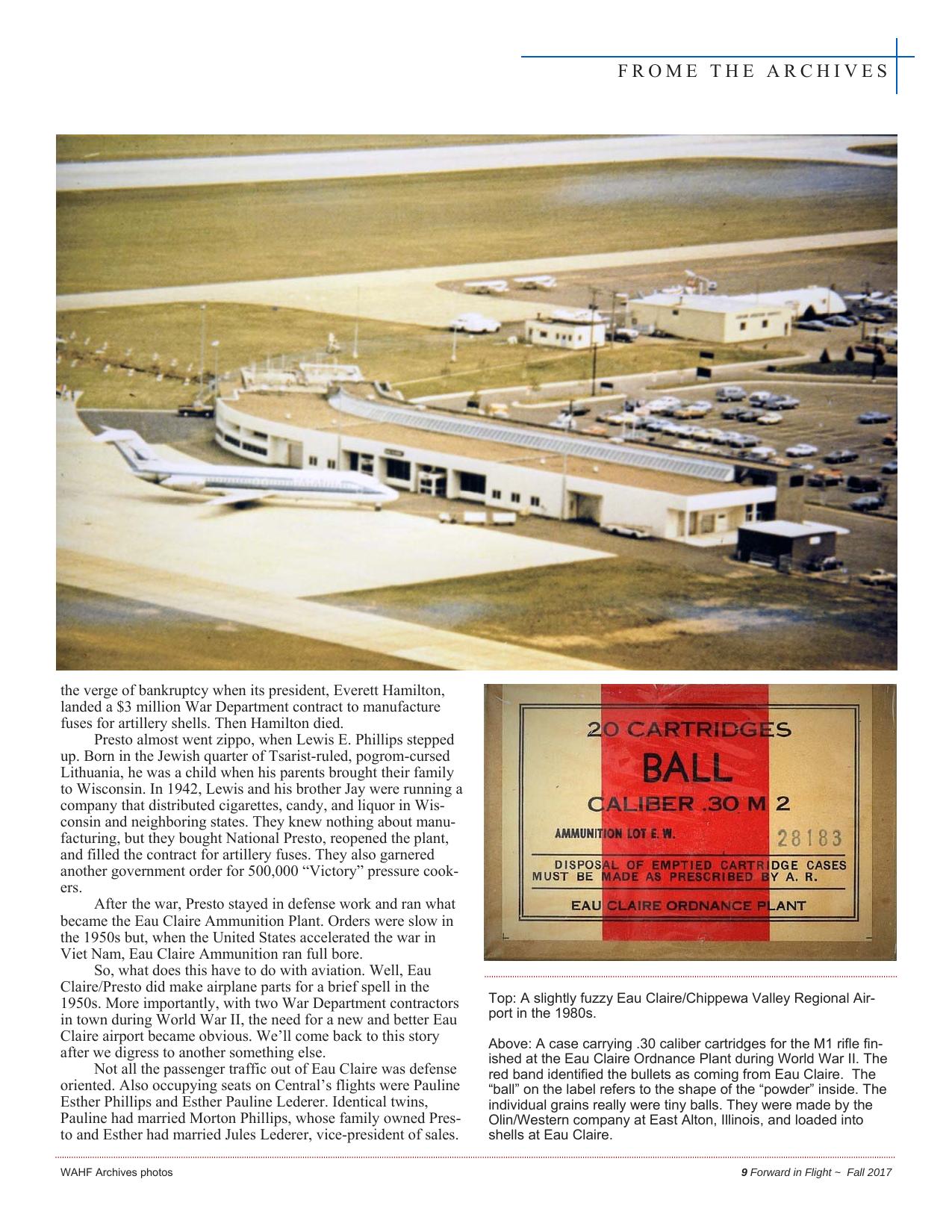
FROME THE ARCHIVES the verge of bankruptcy when its president, Everett Hamilton, landed a $3 million War Department contract to manufacture fuses for artillery shells. Then Hamilton died. Presto almost went zippo, when Lewis E. Phillips stepped up. Born in the Jewish quarter of Tsarist-ruled, pogrom-cursed Lithuania, he was a child when his parents brought their family to Wisconsin. In 1942, Lewis and his brother Jay were running a company that distributed cigarettes, candy, and liquor in Wisconsin and neighboring states. They knew nothing about manufacturing, but they bought National Presto, reopened the plant, and filled the contract for artillery fuses. They also garnered another government order for 500,000 “Victory” pressure cookers. After the war, Presto stayed in defense work and ran what became the Eau Claire Ammunition Plant. Orders were slow in the 1950s but, when the United States accelerated the war in Viet Nam, Eau Claire Ammunition ran full bore. So, what does this have to do with aviation. Well, Eau Claire/Presto did make airplane parts for a brief spell in the 1950s. More importantly, with two War Department contractors in town during World War II, the need for a new and better Eau Claire airport became obvious. We’ll come back to this story after we digress to another something else. Not all the passenger traffic out of Eau Claire was defense oriented. Also occupying seats on Central’s flights were Pauline Esther Phillips and Esther Pauline Lederer. Identical twins, Pauline had married Morton Phillips, whose family owned Presto and Esther had married Jules Lederer, vice-president of sales. WAHF Archives photos Top: A slightly fuzzy Eau Claire/Chippewa Valley Regional Airport in the 1980s. Above: A case carrying .30 caliber cartridges for the M1 rifle finished at the Eau Claire Ordnance Plant during World War II. The red band identified the bullets as coming from Eau Claire. The “ball” on the label refers to the shape of the “powder” inside. The individual grains really were tiny balls. They were made by the Olin/Western company at East Alton, Illinois, and loaded into shells at Eau Claire. 9 Forward in Flight ~ Fall 2017
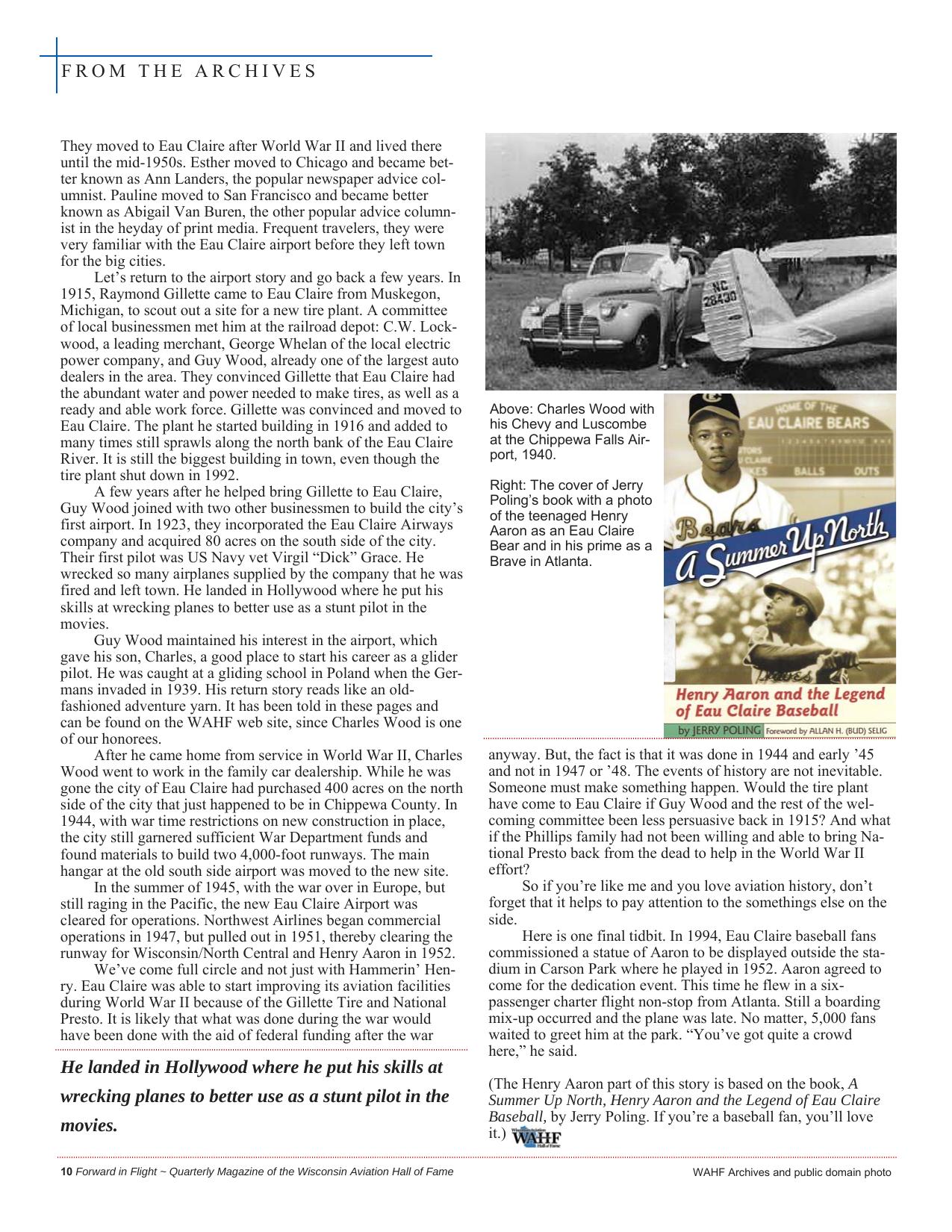
FROM THE ARCHIVES They moved to Eau Claire after World War II and lived there until the mid-1950s. Esther moved to Chicago and became better known as Ann Landers, the popular newspaper advice columnist. Pauline moved to San Francisco and became better known as Abigail Van Buren, the other popular advice columnist in the heyday of print media. Frequent travelers, they were very familiar with the Eau Claire airport before they left town for the big cities. Let’s return to the airport story and go back a few years. In 1915, Raymond Gillette came to Eau Claire from Muskegon, Michigan, to scout out a site for a new tire plant. A committee of local businessmen met him at the railroad depot: C.W. Lockwood, a leading merchant, George Whelan of the local electric power company, and Guy Wood, already one of the largest auto dealers in the area. They convinced Gillette that Eau Claire had the abundant water and power needed to make tires, as well as a ready and able work force. Gillette was convinced and moved to Eau Claire. The plant he started building in 1916 and added to many times still sprawls along the north bank of the Eau Claire River. It is still the biggest building in town, even though the tire plant shut down in 1992. A few years after he helped bring Gillette to Eau Claire, Guy Wood joined with two other businessmen to build the city’s first airport. In 1923, they incorporated the Eau Claire Airways company and acquired 80 acres on the south side of the city. Their first pilot was US Navy vet Virgil “Dick” Grace. He wrecked so many airplanes supplied by the company that he was fired and left town. He landed in Hollywood where he put his skills at wrecking planes to better use as a stunt pilot in the movies. Guy Wood maintained his interest in the airport, which gave his son, Charles, a good place to start his career as a glider pilot. He was caught at a gliding school in Poland when the Germans invaded in 1939. His return story reads like an oldfashioned adventure yarn. It has been told in these pages and can be found on the WAHF web site, since Charles Wood is one of our honorees. After he came home from service in World War II, Charles Wood went to work in the family car dealership. While he was gone the city of Eau Claire had purchased 400 acres on the north side of the city that just happened to be in Chippewa County. In 1944, with war time restrictions on new construction in place, the city still garnered sufficient War Department funds and found materials to build two 4,000-foot runways. The main hangar at the old south side airport was moved to the new site. In the summer of 1945, with the war over in Europe, but still raging in the Pacific, the new Eau Claire Airport was cleared for operations. Northwest Airlines began commercial operations in 1947, but pulled out in 1951, thereby clearing the runway for Wisconsin/North Central and Henry Aaron in 1952. We’ve come full circle and not just with Hammerin’ Henry. Eau Claire was able to start improving its aviation facilities during World War II because of the Gillette Tire and National Presto. It is likely that what was done during the war would have been done with the aid of federal funding after the war He landed in Hollywood where he put his skills at wrecking planes to better use as a stunt pilot in the movies. 10 Forward in Flight ~ Quarterly Magazine of the Wisconsin Aviation Hall of Fame Above: Charles Wood with his Chevy and Luscombe at the Chippewa Falls Airport, 1940. Right: The cover of Jerry Poling’s book with a photo of the teenaged Henry Aaron as an Eau Claire Bear and in his prime as a Brave in Atlanta. anyway. But, the fact is that it was done in 1944 and early ’45 and not in 1947 or ’48. The events of history are not inevitable. Someone must make something happen. Would the tire plant have come to Eau Claire if Guy Wood and the rest of the welcoming committee been less persuasive back in 1915? And what if the Phillips family had not been willing and able to bring National Presto back from the dead to help in the World War II effort? So if you’re like me and you love aviation history, don’t forget that it helps to pay attention to the somethings else on the side. Here is one final tidbit. In 1994, Eau Claire baseball fans commissioned a statue of Aaron to be displayed outside the stadium in Carson Park where he played in 1952. Aaron agreed to come for the dedication event. This time he flew in a sixpassenger charter flight non-stop from Atlanta. Still a boarding mix-up occurred and the plane was late. No matter, 5,000 fans waited to greet him at the park. “You’ve got quite a crowd here,” he said. (The Henry Aaron part of this story is based on the book, A Summer Up North, Henry Aaron and the Legend of Eau Claire Baseball, by Jerry Poling. If you’re a baseball fan, you’ll love it.) WAHF Archives and public domain photo

Morey Airplane Company Since 1932 Middleton Municipal Airport/Morey Field Self-service 100LL & Jet A 24-7 11 Forward in Flight ~ Fall 2017
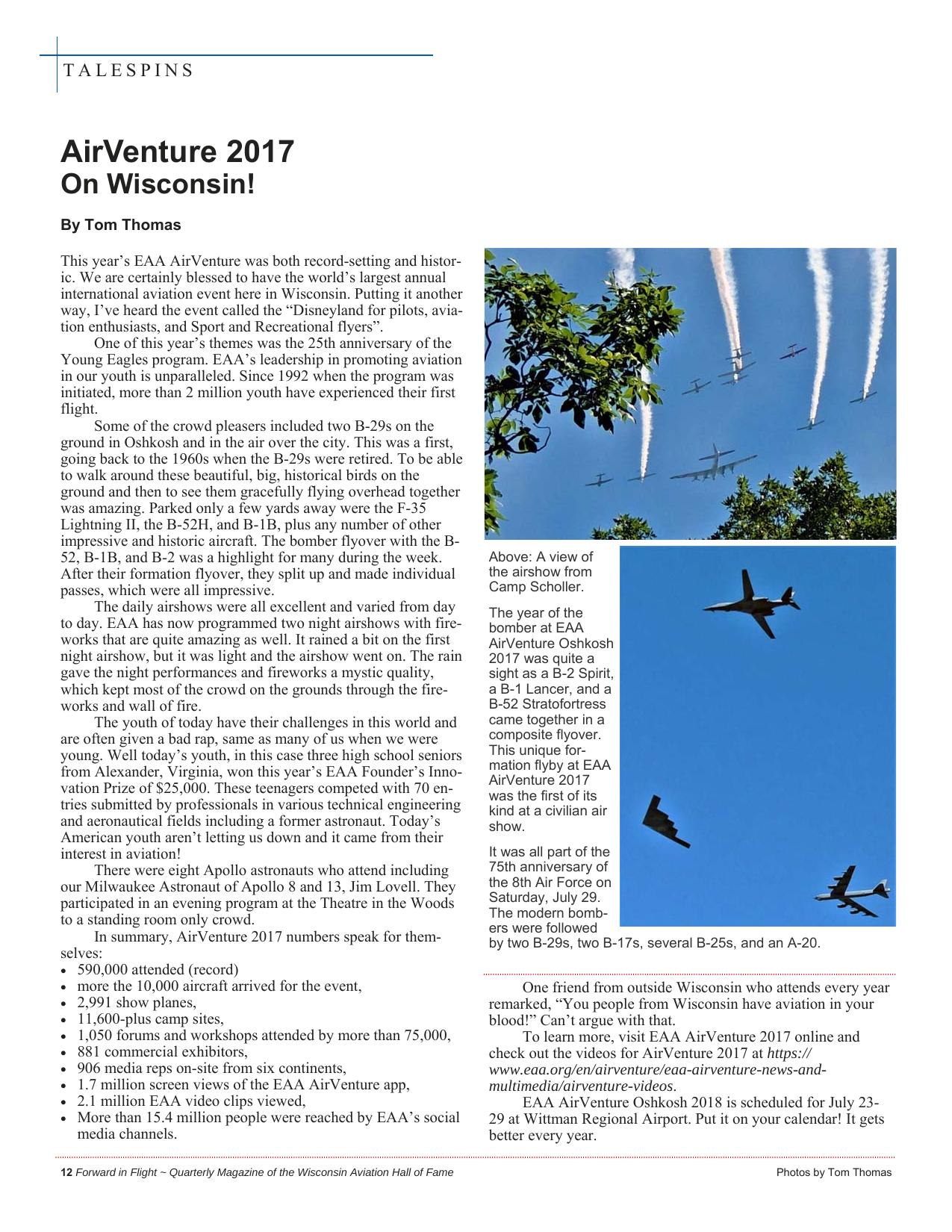
TALESPINS AirVenture 2017 On Wisconsin! By Tom Thomas This year’s EAA AirVenture was both record-setting and historic. We are certainly blessed to have the world’s largest annual international aviation event here in Wisconsin. Putting it another way, I’ve heard the event called the “Disneyland for pilots, aviation enthusiasts, and Sport and Recreational flyers”. One of this year’s themes was the 25th anniversary of the Young Eagles program. EAA’s leadership in promoting aviation in our youth is unparalleled. Since 1992 when the program was initiated, more than 2 million youth have experienced their first flight. Some of the crowd pleasers included two B-29s on the ground in Oshkosh and in the air over the city. This was a first, going back to the 1960s when the B-29s were retired. To be able to walk around these beautiful, big, historical birds on the ground and then to see them gracefully flying overhead together was amazing. Parked only a few yards away were the F-35 Lightning II, the B-52H, and B-1B, plus any number of other impressive and historic aircraft. The bomber flyover with the B52, B-1B, and B-2 was a highlight for many during the week. After their formation flyover, they split up and made individual passes, which were all impressive. The daily airshows were all excellent and varied from day to day. EAA has now programmed two night airshows with fireworks that are quite amazing as well. It rained a bit on the first night airshow, but it was light and the airshow went on. The rain gave the night performances and fireworks a mystic quality, which kept most of the crowd on the grounds through the fireworks and wall of fire. The youth of today have their challenges in this world and are often given a bad rap, same as many of us when we were young. Well today’s youth, in this case three high school seniors from Alexander, Virginia, won this year’s EAA Founder’s Innovation Prize of $25,000. These teenagers competed with 70 entries submitted by professionals in various technical engineering and aeronautical fields including a former astronaut. Today’s American youth aren’t letting us down and it came from their interest in aviation! There were eight Apollo astronauts who attend including our Milwaukee Astronaut of Apollo 8 and 13, Jim Lovell. They participated in an evening program at the Theatre in the Woods to a standing room only crowd. In summary, AirVenture 2017 numbers speak for themselves: 590,000 attended (record) more the 10,000 aircraft arrived for the event, 2,991 show planes, 11,600-plus camp sites, 1,050 forums and workshops attended by more than 75,000, 881 commercial exhibitors, 906 media reps on-site from six continents, 1.7 million screen views of the EAA AirVenture app, 2.1 million EAA video clips viewed, More than 15.4 million people were reached by EAA’s social media channels. 12 Forward in Flight ~ Quarterly Magazine of the Wisconsin Aviation Hall of Fame Above: A view of the airshow from Camp Scholler. The year of the bomber at EAA AirVenture Oshkosh 2017 was quite a sight as a B-2 Spirit, a B-1 Lancer, and a B-52 Stratofortress came together in a composite flyover. This unique formation flyby at EAA AirVenture 2017 was the first of its kind at a civilian air show. It was all part of the 75th anniversary of the 8th Air Force on Saturday, July 29. The modern bombers were followed by two B-29s, two B-17s, several B-25s, and an A-20. One friend from outside Wisconsin who attends every year remarked, “You people from Wisconsin have aviation in your blood!” Can’t argue with that. To learn more, visit EAA AirVenture 2017 online and check out the videos for AirVenture 2017 at https:// www.eaa.org/en/airventure/eaa-airventure-news-andmultimedia/airventure-videos. EAA AirVenture Oshkosh 2018 is scheduled for July 2329 at Wittman Regional Airport. Put it on your calendar! It gets better every year. Photos by Tom Thomas
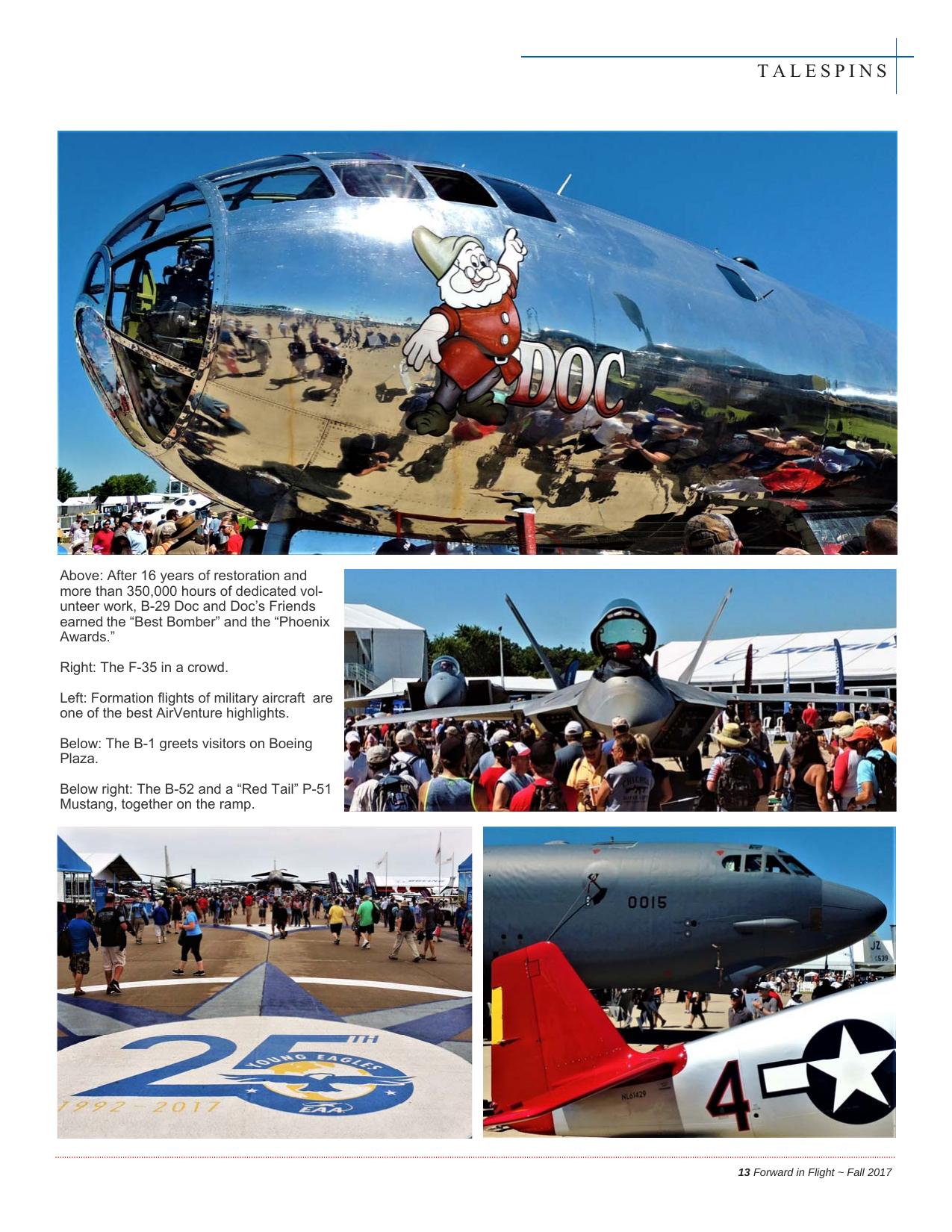
TALESPINS Above: After 16 years of restoration and more than 350,000 hours of dedicated volunteer work, B-29 Doc and Doc’s Friends earned the “Best Bomber” and the “Phoenix Awards.” Right: The F-35 in a crowd. Left: Formation flights of military aircraft are one of the best AirVenture highlights. Below: The B-1 greets visitors on Boeing Plaza. Below right: The B-52 and a “Red Tail” P-51 Mustang, together on the ramp. 13 Forward in Flight ~ Fall 2017
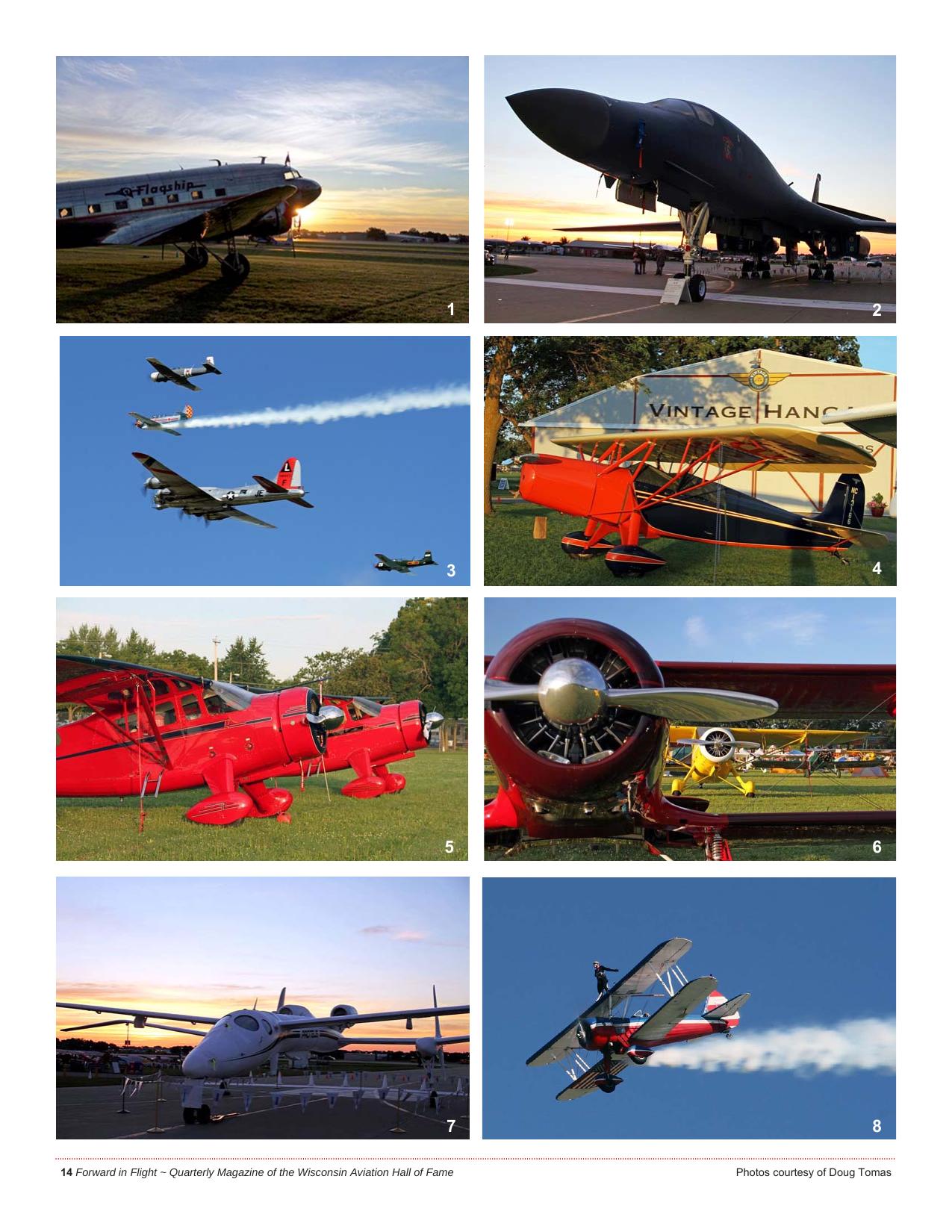
1 2 3 4 5 6 7 8 14 Forward in Flight ~ Quarterly Magazine of the Wisconsin Aviation Hall of Fame Photos courtesy of Doug Tomas
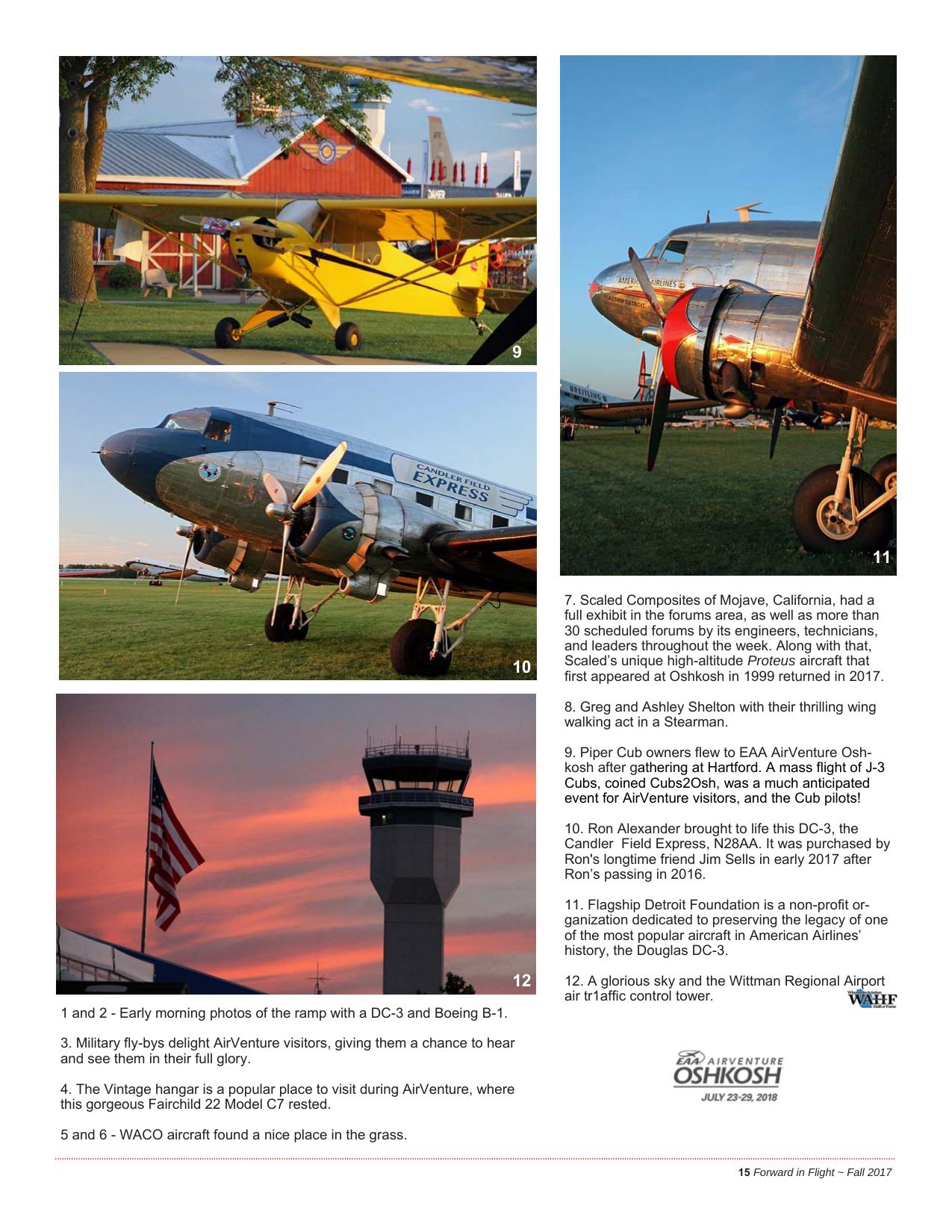
9 11 10 7. Scaled Composites of Mojave, California, had a full exhibit in the forums area, as well as more than 30 scheduled forums by its engineers, technicians, and leaders throughout the week. Along with that, Scaled’s unique high-altitude Proteus aircraft that first appeared at Oshkosh in 1999 returned in 2017. 8. Greg and Ashley Shelton with their thrilling wing walking act in a Stearman. 9. Piper Cub owners flew to EAA AirVenture Oshkosh after gathering at Hartford. A mass flight of J-3 Cubs, coined Cubs2Osh, was a much anticipated event for AirVenture visitors, and the Cub pilots! 10. Ron Alexander brought to life this DC-3, the Candler Field Express, N28AA. It was purchased by Ron's longtime friend Jim Sells in early 2017 after Ron’s passing in 2016. 11. Flagship Detroit Foundation is a non-profit organization dedicated to preserving the legacy of one of the most popular aircraft in American Airlines’ history, the Douglas DC-3. 12 12. A glorious sky and the Wittman Regional Airport air tr1affic control tower. 1 and 2 - Early morning photos of the ramp with a DC-3 and Boeing B-1. 3. Military fly-bys delight AirVenture visitors, giving them a chance to hear and see them in their full glory. 4. The Vintage hangar is a popular place to visit during AirVenture, where this gorgeous Fairchild 22 Model C7 rested. 5 and 6 - WACO aircraft found a nice place in the grass. 15 Forward in Flight ~ Fall 2017
WE FLY Mystery Man Frederic Ives Lord By John Dorcey Harold A. Albert wrote a series of newspaper articles sharing what he called “stories from behind the scenes of war”. The column, called Yankee Doodle, had its last installment titled Mystery Man Slaps Japs published in the Winnipeg Free Press (Winnipeg, Manitoba) on Thursday, May 13, 1943. (1) The article contained several facts about the American Volunteer Group (AVG), or as they are popularly known the Flying Tigers. Beyond facts, it contained much hyperbole and numerous misstatements. A question Albert asks is, “What precisely was the link between the holocaust and the fighting career of a lean-faced kid who ran away from Texas in [19]’16 and smuggled himself across the Canadian border to join what was then called the Royal Flying Corps?” We will answer that question, among others, as we provide the factual story of Manitowoc native and World War I ace Frederic Ives Lord. Mystery surrounding Frederic begins with his birthdate. Frederic Ives Lord was born in Manitowoc, Wisconsin, and according to 1900 census data, was born April 1897 and was living with his mother Alma. Frederic was the oldest of three children, sisters Lucia and Zayda were four and seven years younger respectfully. The 1910 US Census indicates that Frederic and his sisters were living with their maternal grandparents, Fred and Lena Mueller, at 1716 Clark Street in Manitowoc. Grandfather Fred served as Manitowoc Register of Deeds. An uncle, Arnold Mueller, was a Manitowoc doctor. The 1920 census, taken on January 9, 1920, indicates the entire Lord family, Alma, Frederic, and his two sisters, resided in Houston, Texas. From the book, In Clouds of Glory (2) , we learn that Lord joined the Texas National Guard at age 16 and served several months in Company A of the Third Texas Infantry before being discharged as underage. The book’s author, James Hudson, indicates Frederic’s birth year as 1900 with no source for that date. Hudson continues, “using a ‘doctored’ birth certificate, he travelled to Canada, where he joined the Royal Flying Corps.” Records at the Royal Air Force Museum indicate Lord’s birthdate as April 18, 1895. We now have three different years of birth for Frederic Lord; census data from three different censuses show 1897, RAF records indicate 1895, and author Hudson uses 1900. We can agree that Frederic’s childhood was atypical with revolving living arrangements; first living with his mother in Manitowoc, then grandparents, and then moving to Texas with his mother and sisters. Without a father figure and living with three women we can assume that young Lord wanted to prove his manliness. The military, with war on the horizon, was just what teenager Frederic needed. What remains a mystery is the exact year of his birth. World War I After joining the Royal Flying Corps (RFC) in Toronto, Ontario, Canada and completing pilot training, Lord left for England in October 1917 and, following advanced training, he joined 79 Squadron on March 21, 1918 in France. The squadron was formed on August 1, 1917 at Gosport RFC, Hampshire, England, deployed to France on February 20, 1918 and began combat operations on March 6, 1918. The 79 Squadron was one of four RFC squadrons that operated the Sopwith Dolphin exclusively in its mission of low -level-ground-attack operations and offensive (fighter) patrols. The aircraft, liked by pilots, was fast, maneuverable, and easy to fly. See article on the Dolphin elsewhere in this issue. Frederic did not have a pilot logbook as we know them today. The Royal Flying Corps does have information available regarding some of Lord’s flights in its archives. We next review his known flights in chronological order. On March 11, 1918, 2nd Lieutenant Lord overturned in a crosswind landing following engine trouble during takeoff while on a test flight. On another test flight, this one on May 27, 1918, Lord experienced a forced landing on rough ground when his engine failed at 200 feet. Damage to the aircraft and injuries to Lord are not available. The next day, Tuesday, May 28, 16 Forward in Flight ~ Quarterly Magazine of the Wisconsin Aviation Hall of Fame 1918, Lord was on an early morning offensive mission. After reaching altitude he adjusted his throttle and mixture controls to maximize time over his assigned patrol area. He was frustrated, he had spent the last nine weeks flying combat missions without scoring his first victory. Searching for potential targets, Lord spotted two German observation balloons, about 3,000 feet below. He rolled left and began a turning glide toward his targets. He watched as ground crew started to bring the balloons down. His after-action report states, “I fired about 20 rounds at one kite balloon at about 200 feet range without result, and overshooting this one I saw the second directly in front of me. This kite balloon was only a few hundred feet above the ground. I fired about 30 rounds into it from very close range and the balloon caught fire emitting black and yellow smoke. Fire from the ground was extremely accurate and active and my machine was hit in several places.” (3) The damage to Lord’s Dolphin was minimal and he returned safely to St. Marie Cappel Aerodrome elated with his first victory. June 7, 1918 Frederic scored his second victory, this one against an Albatros DVa “Scout” over the French village of La Bassee. Lord described the action in his report, “I turned on an AlPublic Domain photo
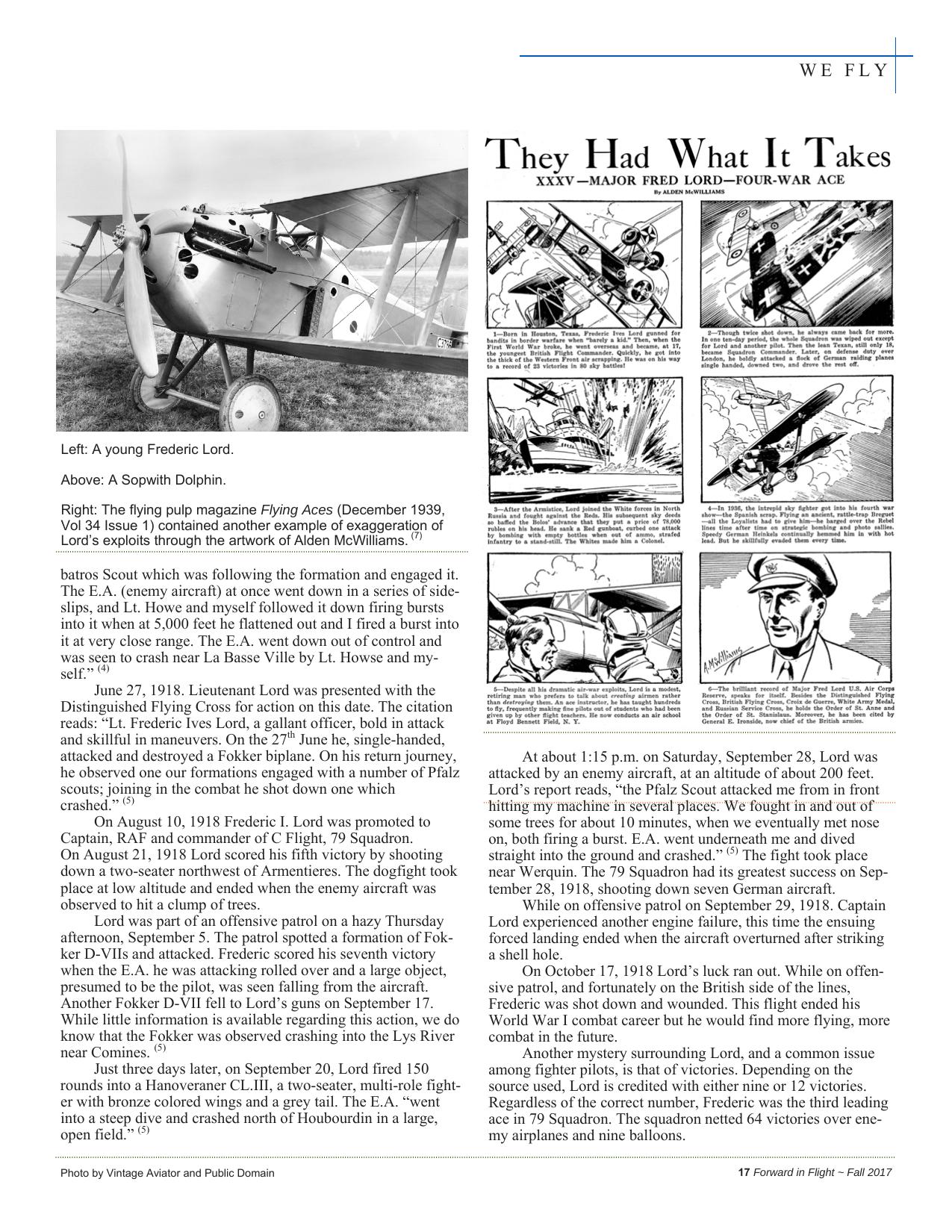
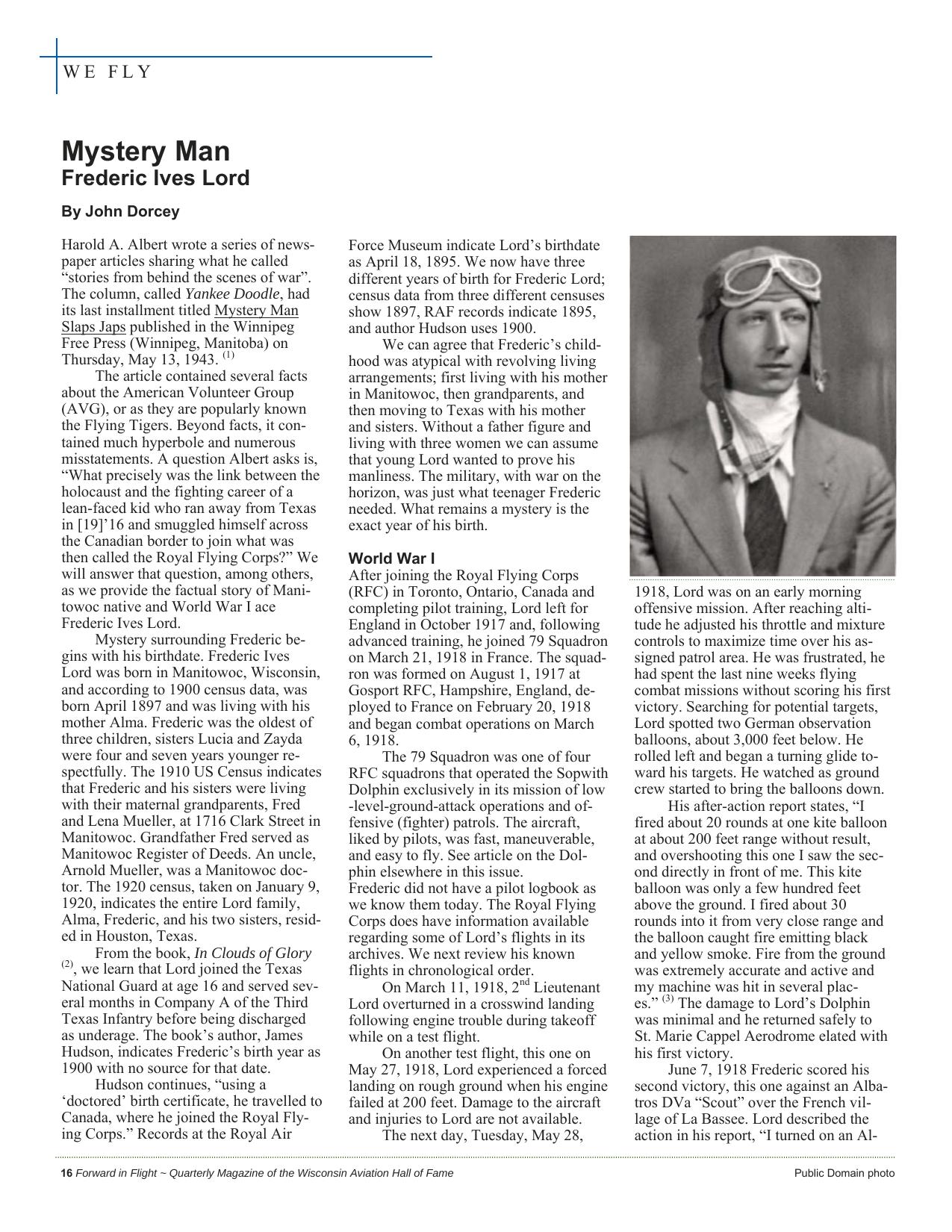
WE FLY Left: A young Frederic Lord. Above: A Sopwith Dolphin. Right: The flying pulp magazine Flying Aces (December 1939, Vol 34 Issue 1) contained another example of exaggeration of Lord’s exploits through the artwork of Alden McWilliams. (7) batros Scout which was following the formation and engaged it. The E.A. (enemy aircraft) at once went down in a series of sideslips, and Lt. Howe and myself followed it down firing bursts into it when at 5,000 feet he flattened out and I fired a burst into it at very close range. The E.A. went down out of control and was seen to crash near La Basse Ville by Lt. Howse and myself.” (4) June 27, 1918. Lieutenant Lord was presented with the Distinguished Flying Cross for action on this date. The citation reads: “Lt. Frederic Ives Lord, a gallant officer, bold in attack and skillful in maneuvers. On the 27th June he, single-handed, attacked and destroyed a Fokker biplane. On his return journey, he observed one our formations engaged with a number of Pfalz scouts; joining in the combat he shot down one which crashed.” (5) On August 10, 1918 Frederic I. Lord was promoted to Captain, RAF and commander of C Flight, 79 Squadron. On August 21, 1918 Lord scored his fifth victory by shooting down a two-seater northwest of Armentieres. The dogfight took place at low altitude and ended when the enemy aircraft was observed to hit a clump of trees. Lord was part of an offensive patrol on a hazy Thursday afternoon, September 5. The patrol spotted a formation of Fokker D-VIIs and attacked. Frederic scored his seventh victory when the E.A. he was attacking rolled over and a large object, presumed to be the pilot, was seen falling from the aircraft. Another Fokker D-VII fell to Lord’s guns on September 17. While little information is available regarding this action, we do know that the Fokker was observed crashing into the Lys River near Comines. (5) Just three days later, on September 20, Lord fired 150 rounds into a Hanoveraner CL.III, a two-seater, multi-role fighter with bronze colored wings and a grey tail. The E.A. “went into a steep dive and crashed north of Houbourdin in a large, open field.” (5) Photo by Vintage Aviator and Public Domain At about 1:15 p.m. on Saturday, September 28, Lord was attacked by an enemy aircraft, at an altitude of about 200 feet. Lord’s report reads, “the Pfalz Scout attacked me from in front hitting my machine in several places. We fought in and out of some trees for about 10 minutes, when we eventually met nose on, both firing a burst. E.A. went underneath me and dived straight into the ground and crashed.” (5) The fight took place near Werquin. The 79 Squadron had its greatest success on September 28, 1918, shooting down seven German aircraft. While on offensive patrol on September 29, 1918. Captain Lord experienced another engine failure, this time the ensuing forced landing ended when the aircraft overturned after striking a shell hole. On October 17, 1918 Lord’s luck ran out. While on offensive patrol, and fortunately on the British side of the lines, Frederic was shot down and wounded. This flight ended his World War I combat career but he would find more flying, more combat in the future. Another mystery surrounding Lord, and a common issue among fighter pilots, is that of victories. Depending on the source used, Lord is credited with either nine or 12 victories. Regardless of the correct number, Frederic was the third leading ace in 79 Squadron. The squadron netted 64 victories over enemy airplanes and nine balloons. 17 Forward in Flight ~ Fall 2017
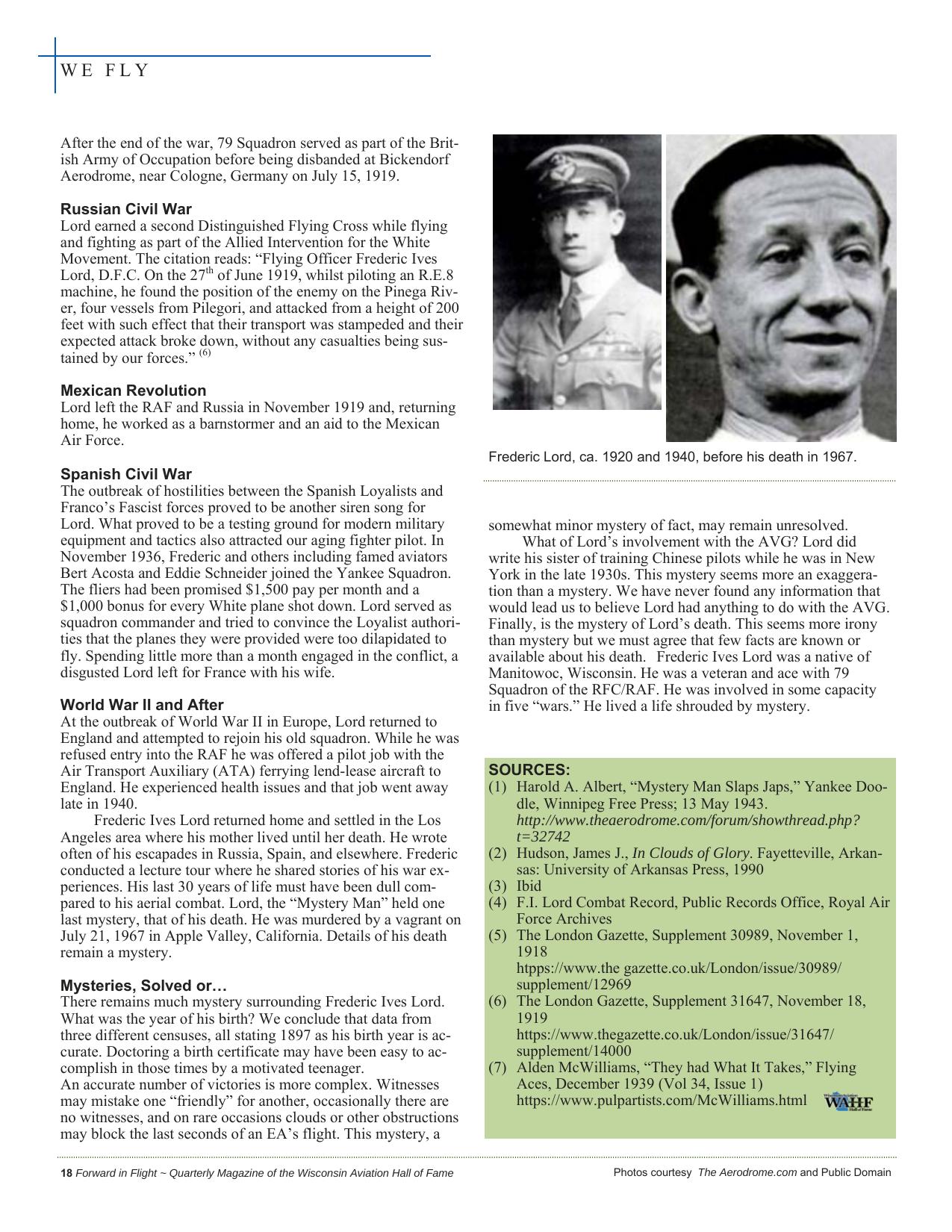
WE FLY After the end of the war, 79 Squadron served as part of the British Army of Occupation before being disbanded at Bickendorf Aerodrome, near Cologne, Germany on July 15, 1919. Russian Civil War Lord earned a second Distinguished Flying Cross while flying and fighting as part of the Allied Intervention for the White Movement. The citation reads: “Flying Officer Frederic Ives Lord, D.F.C. On the 27th of June 1919, whilst piloting an R.E.8 machine, he found the position of the enemy on the Pinega River, four vessels from Pilegori, and attacked from a height of 200 feet with such effect that their transport was stampeded and their expected attack broke down, without any casualties being sustained by our forces.” (6) Mexican Revolution Lord left the RAF and Russia in November 1919 and, returning home, he worked as a barnstormer and an aid to the Mexican Air Force. Spanish Civil War The outbreak of hostilities between the Spanish Loyalists and Franco’s Fascist forces proved to be another siren song for Lord. What proved to be a testing ground for modern military equipment and tactics also attracted our aging fighter pilot. In November 1936, Frederic and others including famed aviators Bert Acosta and Eddie Schneider joined the Yankee Squadron. The fliers had been promised $1,500 pay per month and a $1,000 bonus for every White plane shot down. Lord served as squadron commander and tried to convince the Loyalist authorities that the planes they were provided were too dilapidated to fly. Spending little more than a month engaged in the conflict, a disgusted Lord left for France with his wife. World War II and After At the outbreak of World War II in Europe, Lord returned to England and attempted to rejoin his old squadron. While he was refused entry into the RAF he was offered a pilot job with the Air Transport Auxiliary (ATA) ferrying lend-lease aircraft to England. He experienced health issues and that job went away late in 1940. Frederic Ives Lord returned home and settled in the Los Angeles area where his mother lived until her death. He wrote often of his escapades in Russia, Spain, and elsewhere. Frederic conducted a lecture tour where he shared stories of his war experiences. His last 30 years of life must have been dull compared to his aerial combat. Lord, the “Mystery Man” held one last mystery, that of his death. He was murdered by a vagrant on July 21, 1967 in Apple Valley, California. Details of his death remain a mystery. Mysteries, Solved or… There remains much mystery surrounding Frederic Ives Lord. What was the year of his birth? We conclude that data from three different censuses, all stating 1897 as his birth year is accurate. Doctoring a birth certificate may have been easy to accomplish in those times by a motivated teenager. An accurate number of victories is more complex. Witnesses may mistake one “friendly” for another, occasionally there are no witnesses, and on rare occasions clouds or other obstructions may block the last seconds of an EA’s flight. This mystery, a 18 Forward in Flight ~ Quarterly Magazine of the Wisconsin Aviation Hall of Fame Frederic Lord, ca. 1920 and 1940, before his death in 1967. somewhat minor mystery of fact, may remain unresolved. What of Lord’s involvement with the AVG? Lord did write his sister of training Chinese pilots while he was in New York in the late 1930s. This mystery seems more an exaggeration than a mystery. We have never found any information that would lead us to believe Lord had anything to do with the AVG. Finally, is the mystery of Lord’s death. This seems more irony than mystery but we must agree that few facts are known or available about his death. Frederic Ives Lord was a native of Manitowoc, Wisconsin. He was a veteran and ace with 79 Squadron of the RFC/RAF. He was involved in some capacity in five “wars.” He lived a life shrouded by mystery. SOURCES: (1) Harold A. Albert, “Mystery Man Slaps Japs,” Yankee Doodle, Winnipeg Free Press; 13 May 1943. http://www.theaerodrome.com/forum/showthread.php? t=32742 (2) Hudson, James J., In Clouds of Glory. Fayetteville, Arkansas: University of Arkansas Press, 1990 (3) Ibid (4) F.I. Lord Combat Record, Public Records Office, Royal Air Force Archives (5) The London Gazette, Supplement 30989, November 1, 1918 htpps://www.the gazette.co.uk/London/issue/30989/ supplement/12969 (6) The London Gazette, Supplement 31647, November 18, 1919 https://www.thegazette.co.uk/London/issue/31647/ supplement/14000 (7) Alden McWilliams, “They had What It Takes,” Flying Aces, December 1939 (Vol 34, Issue 1) https://www.pulpartists.com/McWilliams.html Photos courtesy The Aerodrome.com and Public Domain
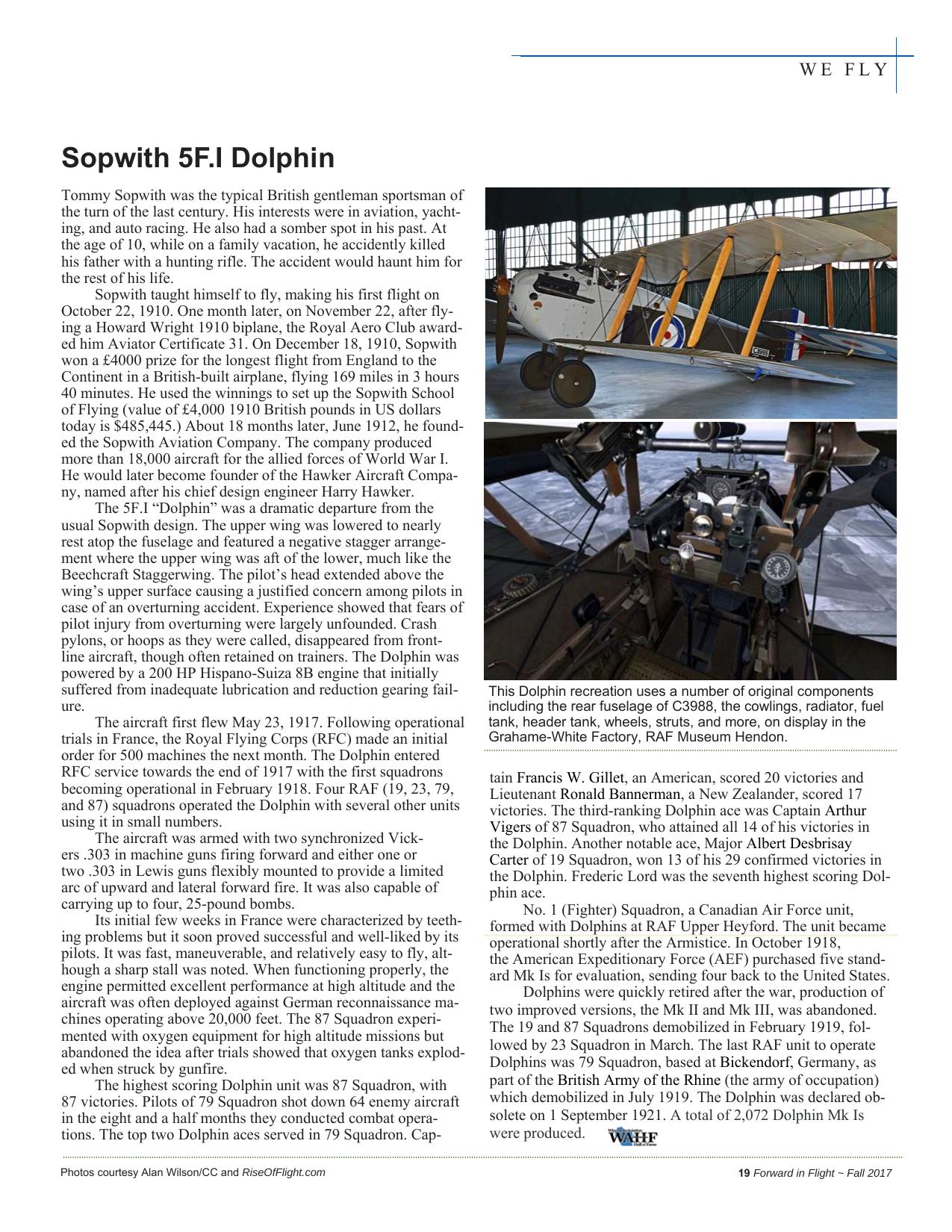
WE FLY Sopwith 5F.I Dolphin Tommy Sopwith was the typical British gentleman sportsman of the turn of the last century. His interests were in aviation, yachting, and auto racing. He also had a somber spot in his past. At the age of 10, while on a family vacation, he accidently killed his father with a hunting rifle. The accident would haunt him for the rest of his life. Sopwith taught himself to fly, making his first flight on October 22, 1910. One month later, on November 22, after flying a Howard Wright 1910 biplane, the Royal Aero Club awarded him Aviator Certificate 31. On December 18, 1910, Sopwith won a £4000 prize for the longest flight from England to the Continent in a British-built airplane, flying 169 miles in 3 hours 40 minutes. He used the winnings to set up the Sopwith School of Flying (value of £4,000 1910 British pounds in US dollars today is $485,445.) About 18 months later, June 1912, he founded the Sopwith Aviation Company. The company produced more than 18,000 aircraft for the allied forces of World War I. He would later become founder of the Hawker Aircraft Company, named after his chief design engineer Harry Hawker. The 5F.I “Dolphin” was a dramatic departure from the usual Sopwith design. The upper wing was lowered to nearly rest atop the fuselage and featured a negative stagger arrangement where the upper wing was aft of the lower, much like the Beechcraft Staggerwing. The pilot’s head extended above the wing’s upper surface causing a justified concern among pilots in case of an overturning accident. Experience showed that fears of pilot injury from overturning were largely unfounded. Crash pylons, or hoops as they were called, disappeared from frontline aircraft, though often retained on trainers. The Dolphin was powered by a 200 HP Hispano-Suiza 8B engine that initially suffered from inadequate lubrication and reduction gearing failure. The aircraft first flew May 23, 1917. Following operational trials in France, the Royal Flying Corps (RFC) made an initial order for 500 machines the next month. The Dolphin entered RFC service towards the end of 1917 with the first squadrons becoming operational in February 1918. Four RAF (19, 23, 79, and 87) squadrons operated the Dolphin with several other units using it in small numbers. The aircraft was armed with two synchronized Vickers .303 in machine guns firing forward and either one or two .303 in Lewis guns flexibly mounted to provide a limited arc of upward and lateral forward fire. It was also capable of carrying up to four, 25-pound bombs. Its initial few weeks in France were characterized by teething problems but it soon proved successful and well-liked by its pilots. It was fast, maneuverable, and relatively easy to fly, although a sharp stall was noted. When functioning properly, the engine permitted excellent performance at high altitude and the aircraft was often deployed against German reconnaissance machines operating above 20,000 feet. The 87 Squadron experimented with oxygen equipment for high altitude missions but abandoned the idea after trials showed that oxygen tanks exploded when struck by gunfire. The highest scoring Dolphin unit was 87 Squadron, with 87 victories. Pilots of 79 Squadron shot down 64 enemy aircraft in the eight and a half months they conducted combat operations. The top two Dolphin aces served in 79 Squadron. CapPhotos courtesy Alan Wilson/CC and RiseOfFlight.com This Dolphin recreation uses a number of original components including the rear fuselage of C3988, the cowlings, radiator, fuel tank, header tank, wheels, struts, and more, on display in the Grahame-White Factory, RAF Museum Hendon. tain Francis W. Gillet, an American, scored 20 victories and Lieutenant Ronald Bannerman, a New Zealander, scored 17 victories. The third-ranking Dolphin ace was Captain Arthur Vigers of 87 Squadron, who attained all 14 of his victories in the Dolphin. Another notable ace, Major Albert Desbrisay Carter of 19 Squadron, won 13 of his 29 confirmed victories in the Dolphin. Frederic Lord was the seventh highest scoring Dolphin ace. No. 1 (Fighter) Squadron, a Canadian Air Force unit, formed with Dolphins at RAF Upper Heyford. The unit became operational shortly after the Armistice. In October 1918, the American Expeditionary Force (AEF) purchased five standard Mk Is for evaluation, sending four back to the United States. Dolphins were quickly retired after the war, production of two improved versions, the Mk II and Mk III, was abandoned. The 19 and 87 Squadrons demobilized in February 1919, followed by 23 Squadron in March. The last RAF unit to operate Dolphins was 79 Squadron, based at Bickendorf, Germany, as part of the British Army of the Rhine (the army of occupation) which demobilized in July 1919. The Dolphin was declared obsolete on 1 September 1921. A total of 2,072 Dolphin Mk Is were produced. 19 Forward in Flight ~ Fall 2017
FROM THE AIRWAYS Fly Wisconsin Airport Passport Program debuts The Fly Wisconsin Airport Passport program promotes safety and education by encouraging recreational flight to Wisconsin’s 127 public use airports. It also supports general aviation airports, area businesses, and tourism. It is a collaborative program of the Wisconsin Department of Transportation (WisDOT) Bureau of Aeronautics (BOA) and the Wisconsin Airport Management Association (WAMA). Any licensed pilot, from any state, and their passenger(s) may participate. Pilots and their passengers may earn three different levels of recognition awards by flying into airports, attending annual FAA safety seminars, and visiting Wisconsin’s aviation attractions. Register for a Fly Wisconsin Airport Passport online or fill out a registration card available at participating airports. Fly Safe! Always conduct adequate pre-flight activities to ensure your flight can be conducted safely. For example, confirm airport condition prior to flight, especially at privately owned airports. This program is open to all pilots and their passengers. Participants are not required to be Wisconsin residents. Be aware of airport CTAF numbers as some are required to gain entrance into a terminal. When visiting a qualifying airport, attraction, or FAA safety seminar, participants must obtain a stamp or signature in their passport. All stamps must be made in the appropriate location in the passport. No stamps may be made on any other document and later placed in the passport. Pilots may attend FAA Safety Seminars online or in per- There are three participation levels with prizes for each level, such as shirts, flights bags, leather jackets, and $100 gift cards. Learn more at http://wisconsindot.gov/Pages/travel/ air/pilot-info/flywi.aspx Pumpkin Drop at KUNU IFR/VFR Seminar at Volk Field The third annual Pumpkin Drop Contest is scheduled for Sunday, October 29 at Dodge County Airport (KUNU) from 9 a.m. - 4 p.m. Yes, drop a pumpkin out of a plane and try to hit the target. $30 for two tries! Bring your own pumpkins or use those provided. RSVP to reserve your spot by calling 800-319-0907. Volk Field is hosting a Fly-In and IFR/VFR seminar on Saturday, October 14 beginning at 8:30 a.m. The military airfield is open for general aviation aircraft to come in and park on the ramp during the fly-in. Food will be available for purchase both for breakfast and lunch. No services are available for arriving aircraft other than ATC and a parking space on the ramp. If flying isn't an option or there is challenging weather, you may drive to the event as well. There are some additional requirements that need to be met to fly into Volk Field. Call Levi Eastlick 608-267-5018 for more details. Kalishek Earns CFI-G WAHF Member Karen Kalishek recently earned her CFI-Glider. She received her commercial glider certificate in 2015 and since then has enjoyed flying sailplanes in Wisconsin, California, Arkansas, Tennessee, Arizona, and Vermont. Karen is a member of the Wisconsin Soaring Society based in Hartford, Wisconsin. She recommends the fun of a glider flight to everyone, and suggests that pilots will appreciate the skill development that is part of non-powered flight. 20 Forward in Flight ~ Quarterly Magazine of the Wisconsin Aviation Hall of Fame son. Find events, stay informed, register and log-in at: faasafety.gov, or contact the Flight Standards District Office for more information. If the course is taken online, fill in the course name, date and instructor’s name on the signature line. You may also be asked to provide a copy of your FAA Safety Team Accredited Activity history. Awards and recognition will be made at the annual Wisconsin Aviation Conference. There is no deadline for completing the passport program as long as the program remains in operation. The program will be adjusted as necessary to accommodate new public-use airports as well as airport closures. For a current listing of participating airports visit the Wisconsin DOT Bureau of Aeronautics website. Wings for Autism Event The Appleton International Airport (KATW) will host its next Wings for Autism event on November 4. Wings for Autism is an airport rehearsal program for people with autism spectrum disorders. Participants will practice entering the airport, obtaining boarding passes, going through security, and boarding an airplane. Register online at http://bit.ly/2woeJc5. Photo courtesy of Karen Kalishek
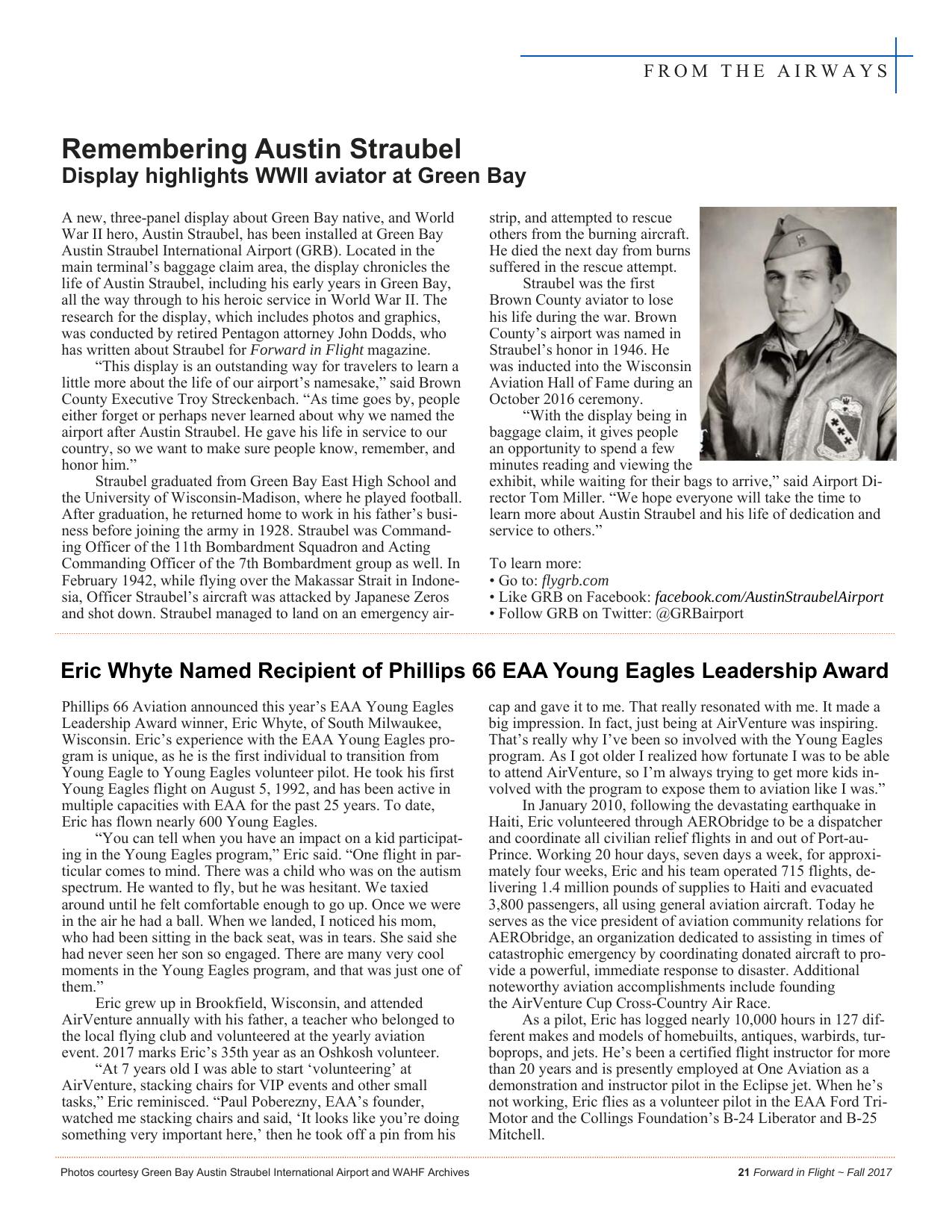
FROM THE AIRWAYS Remembering Austin Straubel Display highlights WWII aviator at Green Bay A new, three-panel display about Green Bay native, and World War II hero, Austin Straubel, has been installed at Green Bay Austin Straubel International Airport (GRB). Located in the main terminal’s baggage claim area, the display chronicles the life of Austin Straubel, including his early years in Green Bay, all the way through to his heroic service in World War II. The research for the display, which includes photos and graphics, was conducted by retired Pentagon attorney John Dodds, who has written about Straubel for Forward in Flight magazine. “This display is an outstanding way for travelers to learn a little more about the life of our airport’s namesake,” said Brown County Executive Troy Streckenbach. “As time goes by, people either forget or perhaps never learned about why we named the airport after Austin Straubel. He gave his life in service to our country, so we want to make sure people know, remember, and honor him.” Straubel graduated from Green Bay East High School and the University of Wisconsin-Madison, where he played football. After graduation, he returned home to work in his father’s business before joining the army in 1928. Straubel was Commanding Officer of the 11th Bombardment Squadron and Acting Commanding Officer of the 7th Bombardment group as well. In February 1942, while flying over the Makassar Strait in Indonesia, Officer Straubel’s aircraft was attacked by Japanese Zeros and shot down. Straubel managed to land on an emergency air- strip, and attempted to rescue others from the burning aircraft. He died the next day from burns suffered in the rescue attempt. Straubel was the first Brown County aviator to lose his life during the war. Brown County’s airport was named in Straubel’s honor in 1946. He was inducted into the Wisconsin Aviation Hall of Fame during an October 2016 ceremony. “With the display being in baggage claim, it gives people an opportunity to spend a few minutes reading and viewing the exhibit, while waiting for their bags to arrive,” said Airport Director Tom Miller. “We hope everyone will take the time to learn more about Austin Straubel and his life of dedication and service to others.” To learn more: • Go to: flygrb.com • Like GRB on Facebook: facebook.com/AustinStraubelAirport • Follow GRB on Twitter: @GRBairport Eric Whyte Named Recipient of Phillips 66 EAA Young Eagles Leadership Award Phillips 66 Aviation announced this year’s EAA Young Eagles Leadership Award winner, Eric Whyte, of South Milwaukee, Wisconsin. Eric’s experience with the EAA Young Eagles program is unique, as he is the first individual to transition from Young Eagle to Young Eagles volunteer pilot. He took his first Young Eagles flight on August 5, 1992, and has been active in multiple capacities with EAA for the past 25 years. To date, Eric has flown nearly 600 Young Eagles. “You can tell when you have an impact on a kid participating in the Young Eagles program,” Eric said. “One flight in particular comes to mind. There was a child who was on the autism spectrum. He wanted to fly, but he was hesitant. We taxied around until he felt comfortable enough to go up. Once we were in the air he had a ball. When we landed, I noticed his mom, who had been sitting in the back seat, was in tears. She said she had never seen her son so engaged. There are many very cool moments in the Young Eagles program, and that was just one of them.” Eric grew up in Brookfield, Wisconsin, and attended AirVenture annually with his father, a teacher who belonged to the local flying club and volunteered at the yearly aviation event. 2017 marks Eric’s 35th year as an Oshkosh volunteer. “At 7 years old I was able to start ‘volunteering’ at AirVenture, stacking chairs for VIP events and other small tasks,” Eric reminisced. “Paul Poberezny, EAA’s founder, watched me stacking chairs and said, ‘It looks like you’re doing something very important here,’ then he took off a pin from his cap and gave it to me. That really resonated with me. It made a big impression. In fact, just being at AirVenture was inspiring. That’s really why I’ve been so involved with the Young Eagles program. As I got older I realized how fortunate I was to be able to attend AirVenture, so I’m always trying to get more kids involved with the program to expose them to aviation like I was.” In January 2010, following the devastating earthquake in Haiti, Eric volunteered through AERObridge to be a dispatcher and coordinate all civilian relief flights in and out of Port-auPrince. Working 20 hour days, seven days a week, for approximately four weeks, Eric and his team operated 715 flights, delivering 1.4 million pounds of supplies to Haiti and evacuated 3,800 passengers, all using general aviation aircraft. Today he serves as the vice president of aviation community relations for AERObridge, an organization dedicated to assisting in times of catastrophic emergency by coordinating donated aircraft to provide a powerful, immediate response to disaster. Additional noteworthy aviation accomplishments include founding the AirVenture Cup Cross-Country Air Race. As a pilot, Eric has logged nearly 10,000 hours in 127 different makes and models of homebuilts, antiques, warbirds, turboprops, and jets. He’s been a certified flight instructor for more than 20 years and is presently employed at One Aviation as a demonstration and instructor pilot in the Eclipse jet. When he’s not working, Eric flies as a volunteer pilot in the EAA Ford TriMotor and the Collings Foundation’s B-24 Liberator and B-25 Mitchell. Photos courtesy Green Bay Austin Straubel International Airport and WAHF Archives 21 Forward in Flight ~ Fall 2017
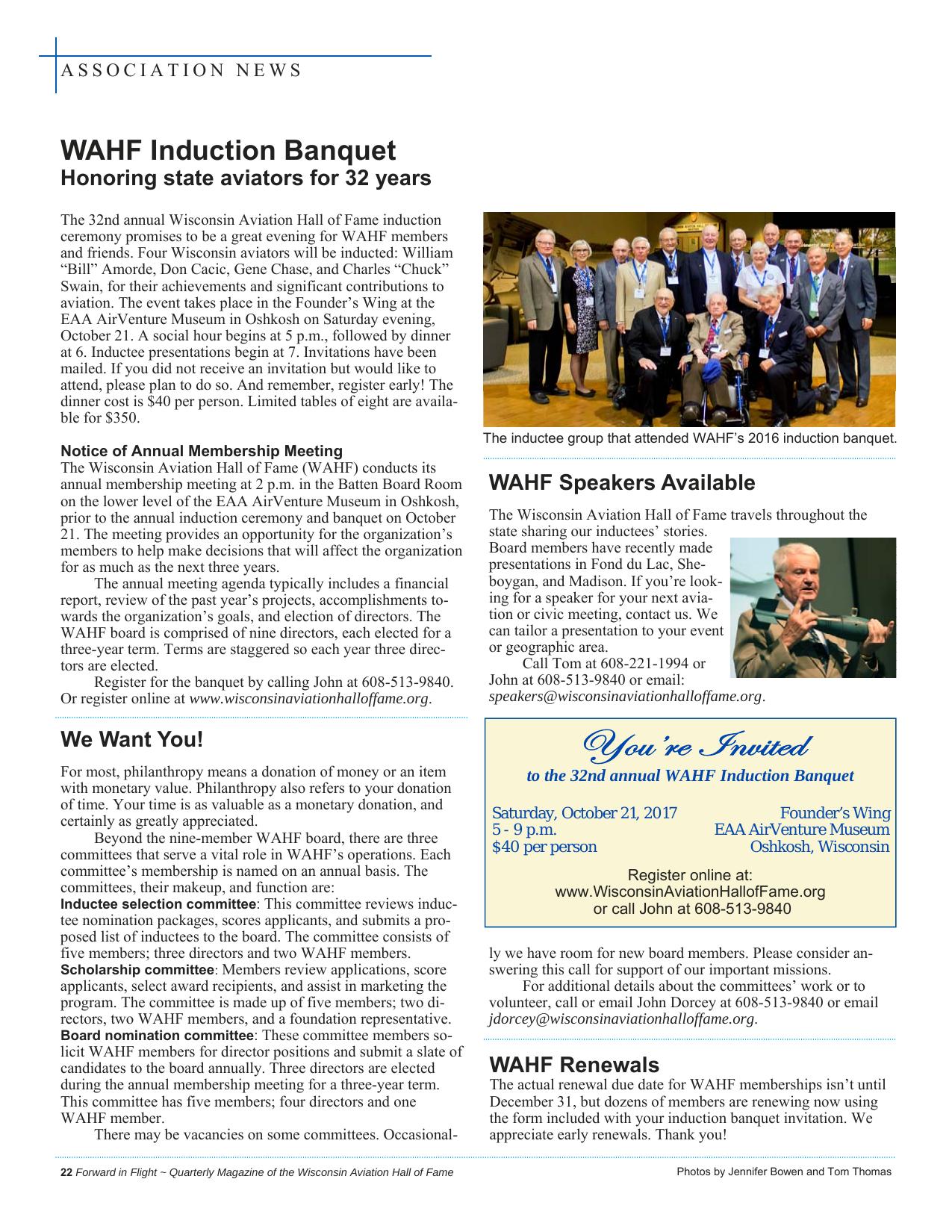
ASSOCIATION NEWS WAHF Induction Banquet Honoring state aviators for 32 years The 32nd annual Wisconsin Aviation Hall of Fame induction ceremony promises to be a great evening for WAHF members and friends. Four Wisconsin aviators will be inducted: William “Bill” Amorde, Don Cacic, Gene Chase, and Charles “Chuck” Swain, for their achievements and significant contributions to aviation. The event takes place in the Founder’s Wing at the EAA AirVenture Museum in Oshkosh on Saturday evening, October 21. A social hour begins at 5 p.m., followed by dinner at 6. Inductee presentations begin at 7. Invitations have been mailed. If you did not receive an invitation but would like to attend, please plan to do so. And remember, register early! The dinner cost is $40 per person. Limited tables of eight are available for $350. Notice of Annual Membership Meeting The Wisconsin Aviation Hall of Fame (WAHF) conducts its annual membership meeting at 2 p.m. in the Batten Board Room on the lower level of the EAA AirVenture Museum in Oshkosh, prior to the annual induction ceremony and banquet on October 21. The meeting provides an opportunity for the organization’s members to help make decisions that will affect the organization for as much as the next three years. The annual meeting agenda typically includes a financial report, review of the past year’s projects, accomplishments towards the organization’s goals, and election of directors. The WAHF board is comprised of nine directors, each elected for a three-year term. Terms are staggered so each year three directors are elected. Register for the banquet by calling John at 608-513-9840. Or register online at www.wisconsinaviationhalloffame.org. The inductee group that attended WAHF’s 2016 induction banquet. WAHF Speakers Available The Wisconsin Aviation Hall of Fame travels throughout the state sharing our inductees’ stories. Board members have recently made presentations in Fond du Lac, Sheboygan, and Madison. If you’re looking for a speaker for your next aviation or civic meeting, contact us. We can tailor a presentation to your event or geographic area. Call Tom at 608-221-1994 or John at 608-513-9840 or email: speakers@wisconsinaviationhalloffame.org. We Want You! For most, philanthropy means a donation of money or an item with monetary value. Philanthropy also refers to your donation of time. Your time is as valuable as a monetary donation, and certainly as greatly appreciated. Beyond the nine-member WAHF board, there are three committees that serve a vital role in WAHF’s operations. Each committee’s membership is named on an annual basis. The committees, their makeup, and function are: Inductee selection committee: This committee reviews inductee nomination packages, scores applicants, and submits a proposed list of inductees to the board. The committee consists of five members; three directors and two WAHF members. Scholarship committee: Members review applications, score applicants, select award recipients, and assist in marketing the program. The committee is made up of five members; two directors, two WAHF members, and a foundation representative. Board nomination committee: These committee members solicit WAHF members for director positions and submit a slate of candidates to the board annually. Three directors are elected during the annual membership meeting for a three-year term. This committee has five members; four directors and one WAHF member. There may be vacancies on some committees. Occasional22 Forward in Flight ~ Quarterly Magazine of the Wisconsin Aviation Hall of Fame to the 32nd annual WAHF Induction Banquet Saturday, October 21, 2017 5 - 9 p.m. $40 per person Founder’s Wing EAA AirVenture Museum Oshkosh, Wisconsin Register online at: www.WisconsinAviationHallofFame.org or call John at 608-513-9840 ly we have room for new board members. Please consider answering this call for support of our important missions. For additional details about the committees’ work or to volunteer, call or email John Dorcey at 608-513-9840 or email jdorcey@wisconsinaviationhalloffame.org. WAHF Renewals The actual renewal due date for WAHF memberships isn’t until December 31, but dozens of members are renewing now using the form included with your induction banquet invitation. We appreciate early renewals. Thank you! Photos by Jennifer Bowen and Tom Thomas
EDITOR’S LOG Aneurysms and Awareness Review the symptoms and be a survivor By Rose Dorcey On December 15, 2016, I was out flying a Cessna 172 with John, my favorite flight instructor, better known as my husband. We had been working on the final prep for my commercial checkride that I had scheduled with Harold “Duffy” Gaier in Marshfield on December 21. As some of you know, that checkride never happened. Our training flights were going so well! That day, I performed eights-on-pylons, steep turns, chandelles, and lazy eights. Not flawlessly, but well. Our maneuvering had us inching closer to Fond du Lac, so we stopped for fuel and a break. It was a crisp December day, and fuel prices are generally lower at Fond du Lac than Oshkosh, where our plane is based, plus they’ll pump. On a cold day, that made sense. We went inside the FBO, warmed up, and I took pictures of our plane, N7770G, in the setting sun. Other than the cold, it had been a beautiful day. I was feeling confident I was ready for the checkride. Right about 4 p.m., we returned to the pattern at Wittman Regional Airport (KOSH) in Oshkosh. Unusual for us, I requested Runway 31, which allows the most direct route to the north tee hangars. When we shut down at the hangar, John said, “You do the paperwork, and I’ll get the tow bar.” He hopped out, closed the door, and ran to the hangar. I reached behind the seat to grab the aircraft log, and then leaned over to record the Hobbs. The next thing I remember is coming out of a fog and seeing John pounding on my window, calling, “Rose, are you alright? Open the door.” He told me weeks later that when he returned to the airplane, I was slumped over and holding my head in my hand. I remember telling him, “I have the worst headache of my life.” But I don’t remember the pain. He asked me to unlock my door, and as I reached behind me to grab the handle he knew by my shaking hands that something was wrong. I don’t remember exiting the aircraft, but I do remember him helping me to our car. I was so weak! When we got there, he helped me into the seat, and turned on the heat. “I’ll be right back, and then I’ll take you to the hospital,” he said, as he went to put the airplane in the hangar. As he ran, I started beeping the car horn. He came running back. I told him, “We have to go right away, something’s wrong. I can feeling knocking in my head.” I remember telling him that, but I don’t remember the feeling. John dropped everything, leaving the plane in the center of the hangar row. I was losing consciousness, but I looked up and saw the airport fire station, maybe 300 feet ahead of me. I remember asking, “Do you think the paramedics are in the firehouse?” And that’s where he took me. It was maybe four minutes since we had landed and I was getting medical care. The rest is a blur. I remember the paramedics coming to help me out of the car. I vaguely remember vomiting in the firehouse. And I remember waking ever so briefly and feeling my neck and body being positioned into the ambulance to take me to Mercy Medical Center in Oshkosh. I don’t remember when I stopped breathing. I don’t remember the ThedaStar helicopter flight to ThedaCare Regional Medical Center in Neenah that evening. Nothing until about a week later when I heard my son, Luke; my daughter, Sister Maria Caeli; and John telling me comforting words. Their loving voices sounded so sweet. Aneurysms can rupture without warning. It’s critical to receive immediate medical care. Know the symptoms: Sudden severe headache, commonly reported as “the worst headache of your life” Loss of consciousness Nausea/Vomiting Stiff Neck Sudden blurred or double vision Sudden pain above/behind the eye or difficulty seeing Sudden change in mental status/awareness Sudden trouble walking or dizziness Sudden weakness and numbness Sensitivity to light (photophobia) Seizure Drooping eyelid Courtesy Brain Aneurysm Foundation It’s still hard to recall many moments of the next 21 days while I recovered at ThedaCare. But at some point I was told that I had suffered a ruptured cerebral aneurysm and subarachnoid hemorrhage. It wasn’t a large aneurysm, my doctors said, but it caused a significant bleed. It was a basilar tip aneurysm, located on the basilar artery, treated with an endovascular coiling procedure. A catheter is passed through the groin and up into the artery containing the aneurysm, and platinum coils are inserted through the catheter and placed within the aneurysm. The body responds by healing around the coils, which helps block the flow of blood into the aneurysm, preventing it from leaking. In coming weeks, dozens of people would send flowers and cards with uplifting messages. Dozens more prayed for me. Family and friends brought food and came to visit. I am so grateful for every kindness toward me! I know it contributed to my survival, with no deficits, along with the excellent care of my doctors and staff at ThedaCare. Dr. Phil Yazbak of Neuroscience Group in Neenah was one of my doctors, and one of John’s recent flight students. We are so thankful that he put together an “A-Team” to influence and provide for my care. John and I have flown together once since it happened, to the Wisconsin Flying Hamburger Social at Wisconsin Rapids to show our grandson, Logan, the airplane. He loved it! I would like to go back to my commercial training, but as you might guess, I am currently without a medical. There’s a mandatory one-year wait before I can apply for an FAA medical, and they’ll want almost every medical record regarding my “event” from the time I was with the paramedics to my last cerebral angiogram in June, and maybe more. As the one-year anniversary draws closer, I have much to consider about medicals. Special Issuance or BasicMed? I’ll be careful about what I do. Many people have told me they read the story Duane Esse wrote about me in the Winter 2016 issue of Forward in Flight. Some suggested I write a “rest of the story.” I wasn’t inclined to do so. But September is Aneurysm Awareness Month, so it seems a good time to share it. Please review the symptoms above. Thank you, bless you, and be well. 23 Forward in Flight ~ Fall 2017
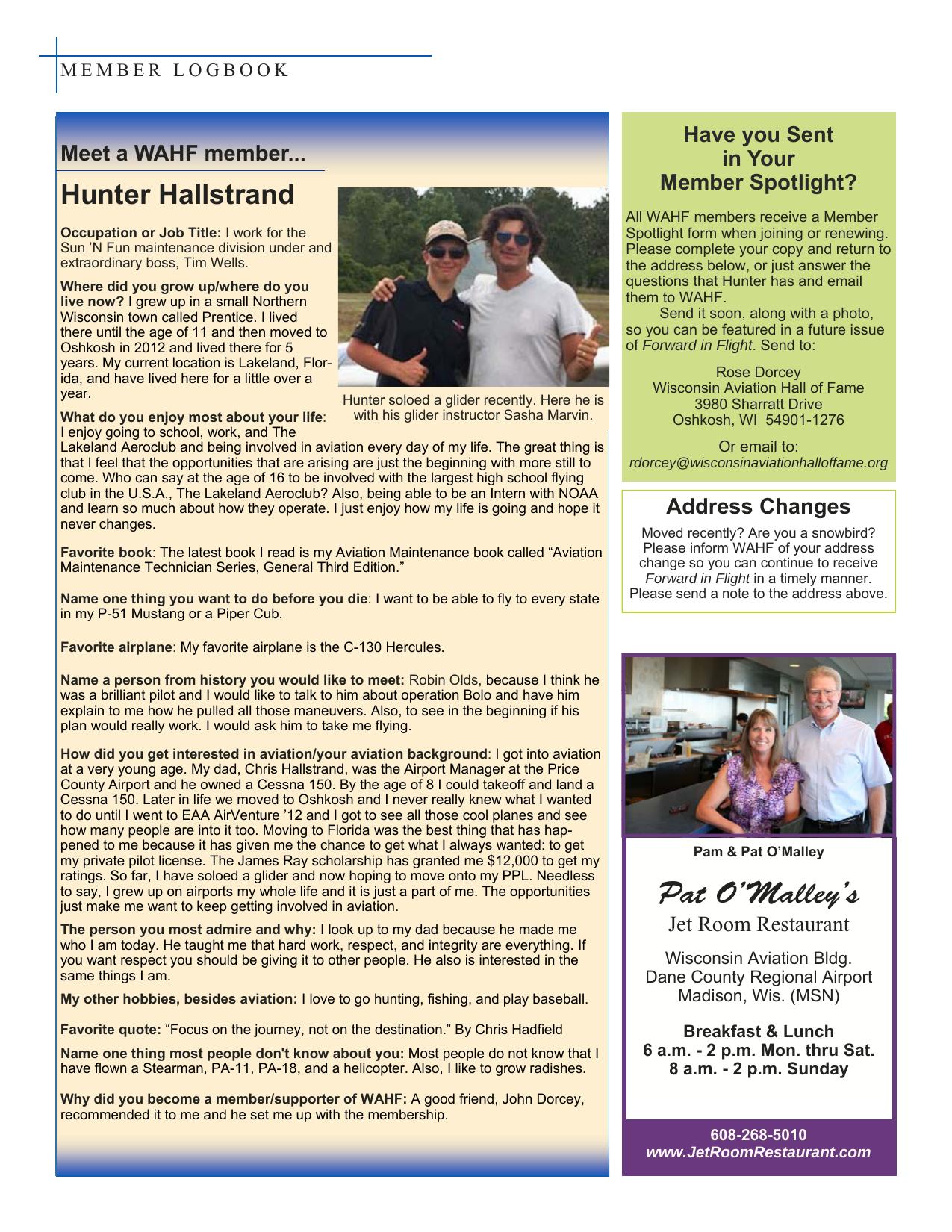
MEMBER LOGBOOK Meet a WAHF member... Hunter Hallstrand Occupation or Job Title: I work for the Sun ’N Fun maintenance division under and extraordinary boss, Tim Wells. Where did you grow up/where do you live now? I grew up in a small Northern Wisconsin town called Prentice. I lived Roger Small there until the age of 11 and then moved to Oshkosh in 2012 and lived there for 5 years. My current location is Lakeland, Florida, and have lived here for a little over a year. Hunter soloed a glider recently. Here he is with his glider instructor Sasha Marvin. What do you enjoy most about your life: I enjoy going to school, work, and The Lakeland Aeroclub and being involved in aviation every day of my life. The great thing is that I feel that the opportunities that are arising are just the beginning with more still to come. Who can say at the age of 16 to be involved with the largest high school flying club in the U.S.A., The Lakeland Aeroclub? Also, being able to be an Intern with NOAA and learn so much about how they operate. I just enjoy how my life is going and hope it never changes. Favorite book: The latest book I read is my Aviation Maintenance book called “Aviation Maintenance Technician Series, General Third Edition.” Name one thing you want to do before you die: I want to be able to fly to every state in my P-51 Mustang or a Piper Cub. Have you Sent in Your Member Spotlight? All WAHF members receive a Member Spotlight form when joining or renewing. Please complete your copy and return to the address below, or just answer the questions that Hunter has and email them to WAHF. Send it soon, along with a photo, so you can be featured in a future issue of Forward in Flight. Send to: Rose Dorcey Wisconsin Aviation Hall of Fame 3980 Sharratt Drive Oshkosh, WI 54901-1276 Or email to: rdorcey@wisconsinaviationhalloffame.org Address Changes Moved recently? Are you a snowbird? Please inform WAHF of your address change so you can continue to receive Forward in Flight in a timely manner. Please send a note to the address above. Favorite airplane: My favorite airplane is the C-130 Hercules. Name a person from history you would like to meet: Robin Olds, because I think he was a brilliant pilot and I would like to talk to him about operation Bolo and have him explain to me how he pulled all those maneuvers. Also, to see in the beginning if his plan would really work. I would ask him to take me flying. How did you get interested in aviation/your aviation background: I got into aviation at a very young age. My dad, Chris Hallstrand, was the Airport Manager at the Price County Airport and he owned a Cessna 150. By the age of 8 I could takeoff and land a Cessna 150. Later in life we moved to Oshkosh and I never really knew what I wanted to do until I went to EAA AirVenture ’12 and I got to see all those cool planes and see how many people are into it too. Moving to Florida was the best thing that has happened to me because it has given me the chance to get what I always wanted: to get my private pilot license. The James Ray scholarship has granted me $12,000 to get my ratings. So far, I have soloed a glider and now hoping to move onto my PPL. Needless to say, I grew up on airports my whole life and it is just a part of me. The opportunities just make me want to keep getting involved in aviation. The person you most admire and why: I look up to my dad because he made me who I am today. He taught me that hard work, respect, and integrity are everything. If you want respect you should be giving it to other people. He also is interested in the same things I am. My other hobbies, besides aviation: I love to go hunting, fishing, and play baseball. Favorite quote: “Focus on the journey, not on the destination.” By Chris Hadfield Name one thing most people don't know about you: Most people do not know that I have flown a Stearman, PA-11, PA-18, and a helicopter. Also, I like to grow radishes. Pam & Pat O’Malley Pat O’Malley’s Jet Room Restaurant Wisconsin Aviation Bldg. Dane County Regional Airport Madison, Wis. (MSN) Breakfast & Lunch 6 a.m. - 2 p.m. Mon. thru Sat. 8 a.m. - 2 p.m. Sunday Why did you become a member/supporter of WAHF: A good friend, John Dorcey, recommended it to me and he set me up with the membership. 608-268-5010 www.JetRoomRestaurant.com

Wittman Regional Airport Oshkosh So much history ...and still making it! From the legacy of Steve Wittman to Warren Basler’s DC-3 conversions, we’re proud to support and contribute to Wisconsin aviation history. FLY TO OSHKOSH wittmanairport.com @wittmanairport
PRSRT STD US Postage Paid Wisc Rapids WI Permit 98 3980 SHARRATT DRIVE OSHKOSH WI 54901-1276 The Wisconsin Aviation Hall of Fame is a non-profit membership organization dedicated to preserving the past and fostering the future of flight. CHANGE SERVICE REQUESTED Welcome New WAHF Member/Supporters Pat Goss Jim Kippola Ruth Mack Daniel Wall Ron Unertl Thanks for coming on board. We hope to see you at a WAHF event soon! November 12, 2017 - VFW All You Can Eat Breakfast! Reedsburg Municipal Airport (C35) 8 a.m. - Noon. Pancakes, French toast, eggs, hash browns, sausage, plus biscuits and gravy and drinks - all for just $8. Contact Eric at 608-768-5549 or visit www.EWPAircraftServices.com. Wisconsin Aviation Hall of Fame Officers Tom Thomas, President Jill Mann, Vice-President John Dorcey, Secretary/Treasurer Board of Directors Mark your calendars for the 63rd Annual Wisconsin Aviation Conference at the Wilderness Hotel and Golf Resort in the Wisconsin Dells! Please note the dates have changed slightly to May 6-8, 2018 to accommodate a social and family day on Sunday and a more productive professional agenda on Monday and Tuesday. Elaine Kauh Kurt Stanich Brendan Stormo Charles Swain Wynne Williams Ron Wojnar Do you have a story suggestion for Forward in Flight? Many of our article ideas come from members/readers who want to share the story of someone—or something—important in their lives. Some choose to write the story themselves, while others are told by our regular FIF contributors. Sharing those stories helps WAHF carry out its mission of recognizing and sharing the accounts of Wisconsin aviators. We hope to hear from you! Contact Editor Rose Dorcey with your story ideas or submissions at rose.dorcey@gmail.com. Wisconsin Aviation Hall of Fame c/o John Dorcey 3980 Sharratt Drive Oshkosh, WI 54901-1276 HAS YOUR ADDRESS CHANGED? Please contact us to inform us of your new address. A timely reminder of your new address is very much appreciated as it helps save time—and money—for our small non-profit. It’s easy, send a note to Membership Chair Ron Wojnar at the address to the right, or call 262-347-7464. Become a member/supporter today! For information call Ron Wojnar at 262-347-7464 rwojnar@wisconsinaviationhalloffame.org www.wisconsinaviationhalloffame.org