Volume 16, Issue 3
🗞️ Download Issue (PDF)
Forward in Flight - Fall 2018
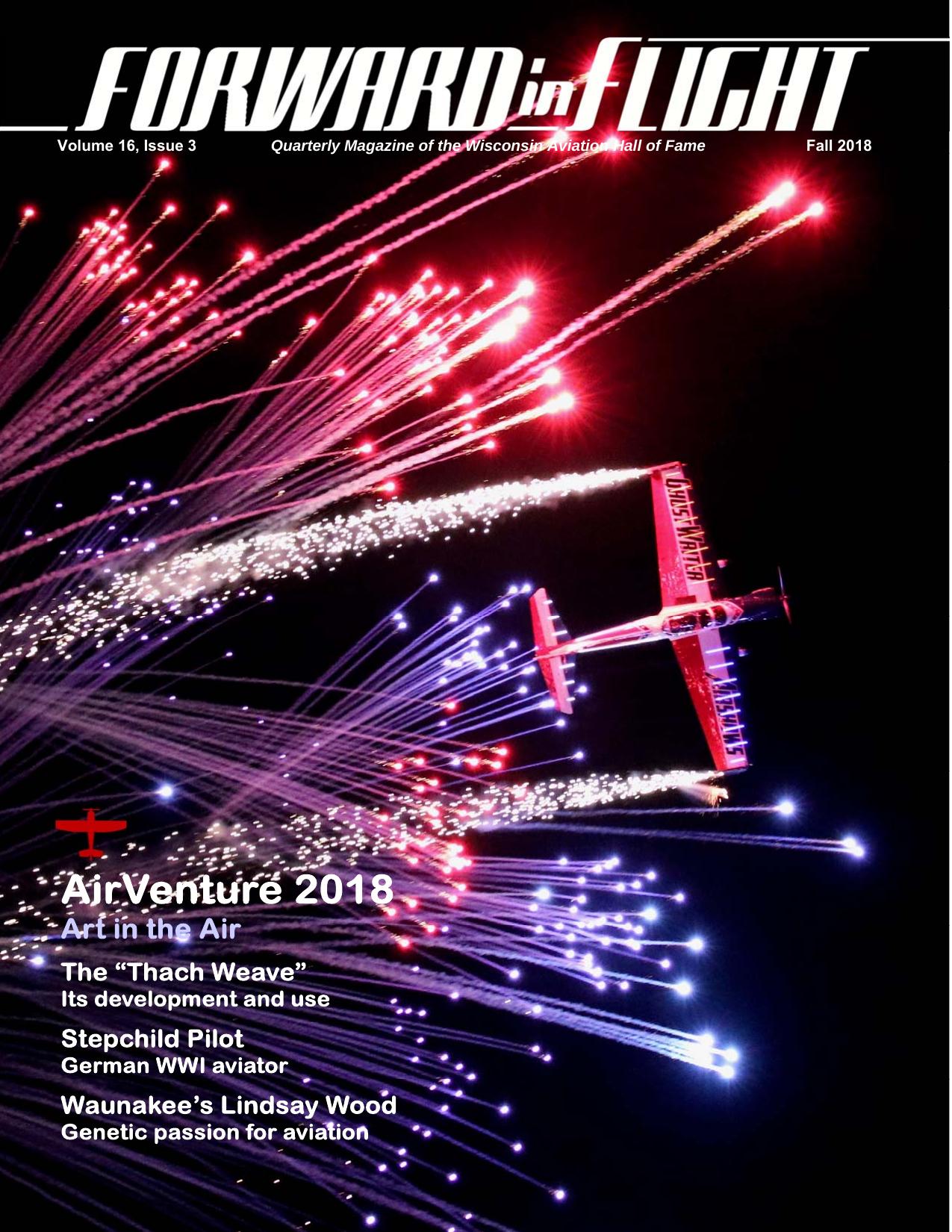
Volume 16, Issue 3 Quarterly Magazine of the Wisconsin Aviation Hall of Fame Fall 2018
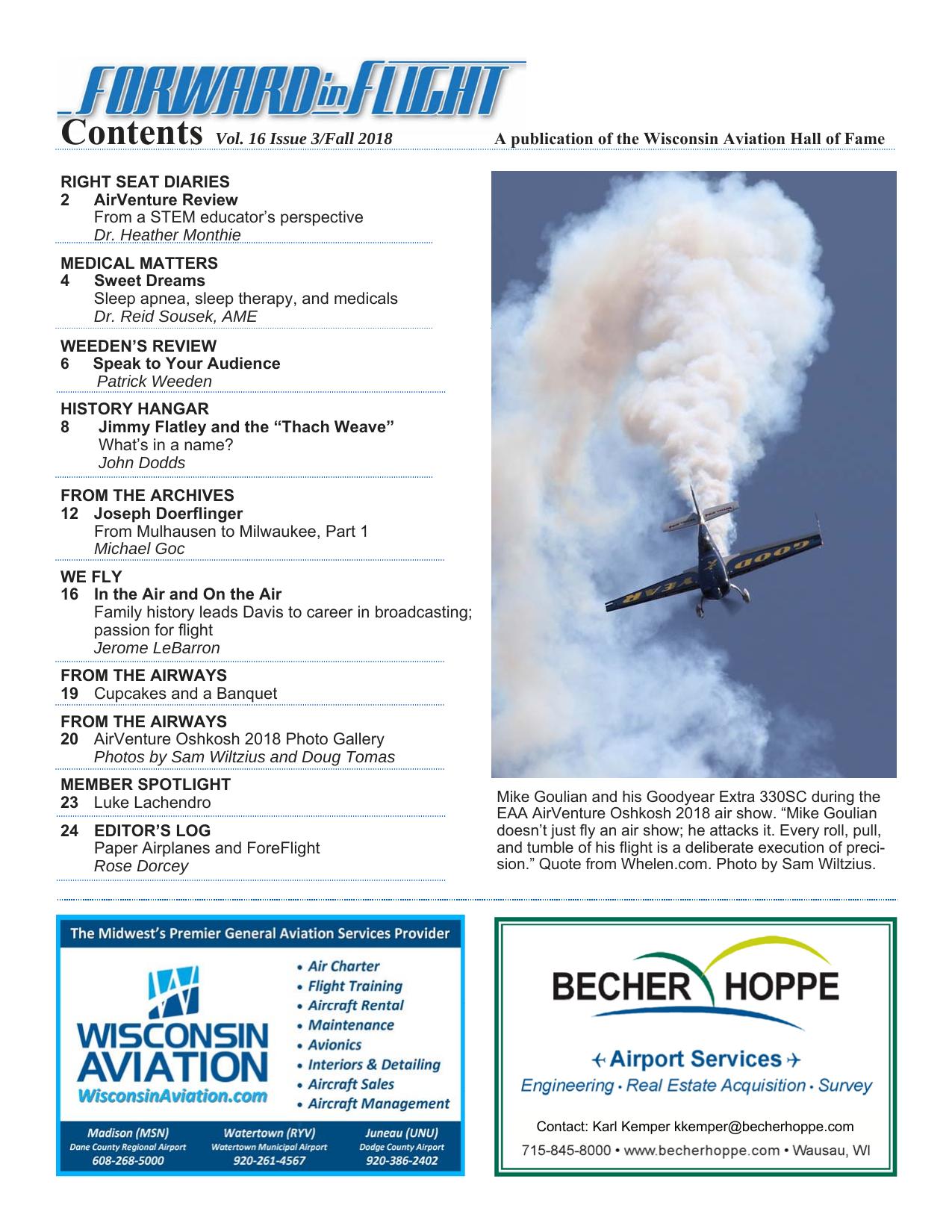
Contents Vol. 16 Issue 3/Fall 2018 A publication of the Wisconsin Aviation Hall of Fame RIGHT SEAT DIARIES 2 AirVenture Review From a STEM educator’s perspective Dr. Heather Monthie MEDICAL MATTERS 4 Sweet Dreams Sleep apnea, sleep therapy, and medicals Dr. Reid Sousek, AME WEEDEN’S REVIEW 6 Speak to Your Audience Patrick Weeden HISTORY HANGAR 8 Jimmy Flatley and the “Thach Weave” What’s in a name? John Dodds FROM THE ARCHIVES 12 Joseph Doerflinger From Mulhausen to Milwaukee, Part 1 Michael Goc WE FLY 16 In the Air and On the Air Family history leads Davis to career in broadcasting; passion for flight Jerome LeBarron FROM THE AIRWAYS 19 Cupcakes and a Banquet FROM THE AIRWAYS 20 AirVenture Oshkosh 2018 Photo Gallery Photos by Sam Wiltzius and Doug Tomas MEMBER SPOTLIGHT 23 Luke Lachendro 24 EDITOR’S LOG Paper Airplanes and ForeFlight Rose Dorcey Mike Goulian and his Goodyear Extra 330SC during the EAA AirVenture Oshkosh 2018 air show. “Mike Goulian doesn’t just fly an air show; he attacks it. Every roll, pull, and tumble of his flight is a deliberate execution of precision.” Quote from Whelen.com. Photo by Sam Wiltzius. Contact: Karl Kemper kkemper@becherhoppe.com
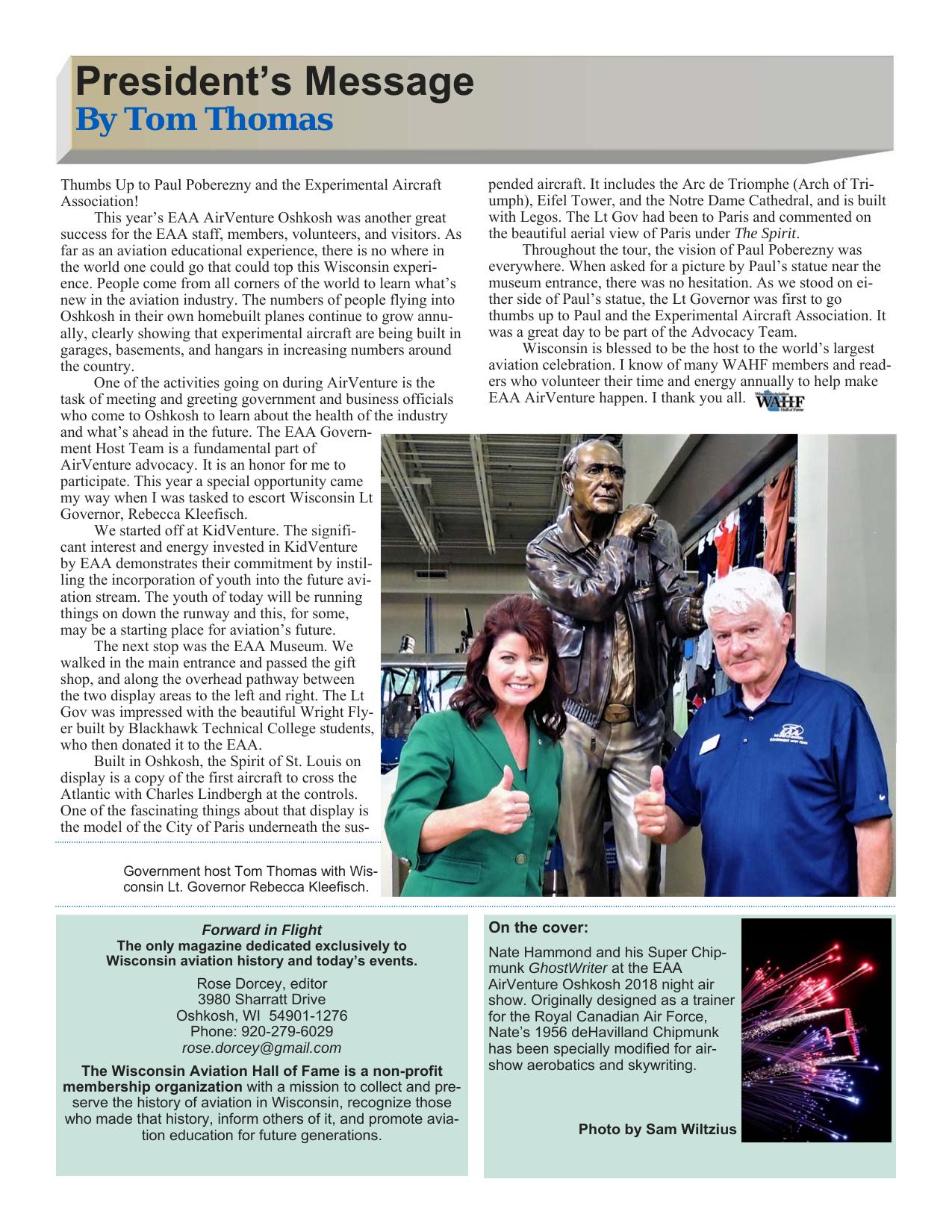
President’s Message By Tom Thomas Thumbs Up to Paul Poberezny and the Experimental Aircraft Association! This year’s EAA AirVenture Oshkosh was another great success for the EAA staff, members, volunteers, and visitors. As far as an aviation educational experience, there is no where in the world one could go that could top this Wisconsin experience. People come from all corners of the world to learn what’s new in the aviation industry. The numbers of people flying into Oshkosh in their own homebuilt planes continue to grow annually, clearly showing that experimental aircraft are being built in garages, basements, and hangars in increasing numbers around the country. One of the activities going on during AirVenture is the task of meeting and greeting government and business officials who come to Oshkosh to learn about the health of the industry and what’s ahead in the future. The EAA Government Host Team is a fundamental part of AirVenture advocacy. It is an honor for me to participate. This year a special opportunity came my way when I was tasked to escort Wisconsin Lt Governor, Rebecca Kleefisch. We started off at KidVenture. The significant interest and energy invested in KidVenture by EAA demonstrates their commitment by instilling the incorporation of youth into the future aviation stream. The youth of today will be running things on down the runway and this, for some, may be a starting place for aviation’s future. The next stop was the EAA Museum. We walked in the main entrance and passed the gift shop, and along the overhead pathway between the two display areas to the left and right. The Lt Gov was impressed with the beautiful Wright Flyer built by Blackhawk Technical College students, who then donated it to the EAA. Built in Oshkosh, the Spirit of St. Louis on display is a copy of the first aircraft to cross the Atlantic with Charles Lindbergh at the controls. One of the fascinating things about that display is the model of the City of Paris underneath the sus- pended aircraft. It includes the Arc de Triomphe (Arch of Triumph), Eifel Tower, and the Notre Dame Cathedral, and is built with Legos. The Lt Gov had been to Paris and commented on the beautiful aerial view of Paris under The Spirit. Throughout the tour, the vision of Paul Poberezny was everywhere. When asked for a picture by Paul’s statue near the museum entrance, there was no hesitation. As we stood on either side of Paul’s statue, the Lt Governor was first to go thumbs up to Paul and the Experimental Aircraft Association. It was a great day to be part of the Advocacy Team. Wisconsin is blessed to be the host to the world’s largest aviation celebration. I know of many WAHF members and readers who volunteer their time and energy annually to help make EAA AirVenture happen. I thank you all. Government host Tom Thomas with Wisconsin Lt. Governor Rebecca Kleefisch. Forward in Flight The only magazine dedicated exclusively to Wisconsin aviation history and today’s events. Rose Dorcey, editor 3980 Sharratt Drive Oshkosh, WI 54901-1276 Phone: 920-279-6029 rose.dorcey@gmail.com The Wisconsin Aviation Hall of Fame is a non-profit membership organization with a mission to collect and preserve the history of aviation in Wisconsin, recognize those who made that history, inform others of it, and promote aviation education for future generations. On the cover: Nate Hammond and his Super Chipmunk GhostWriter at the EAA AirVenture Oshkosh 2018 night air show. Originally designed as a trainer for the Royal Canadian Air Force, Nate’s 1956 deHavilland Chipmunk has been specially modified for airshow aerobatics and skywriting. Photo by Sam Wiltzius
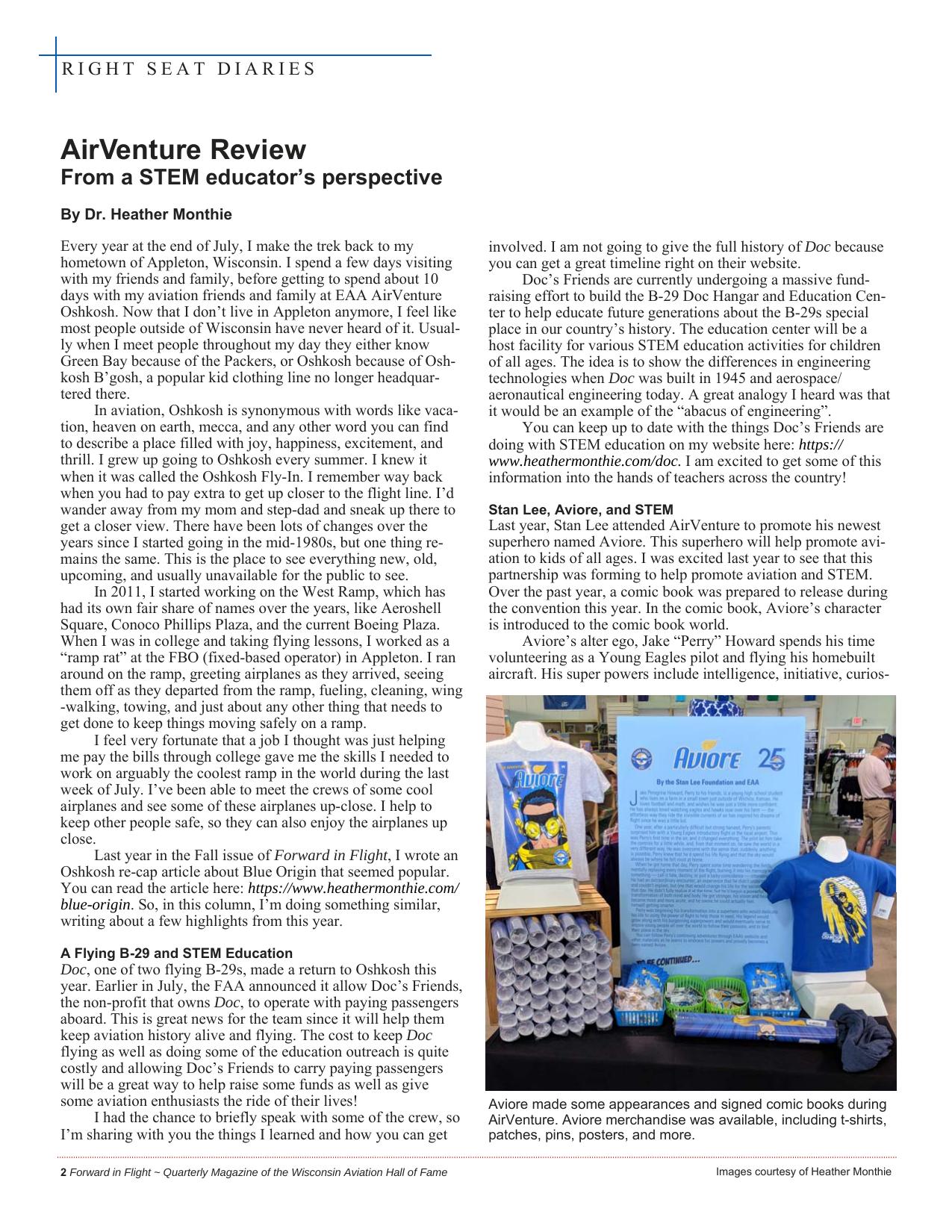
RIGHT SEAT DIARIES AirVenture Review From a STEM educator’s perspective By Dr. Heather Monthie Every year at the end of July, I make the trek back to my hometown of Appleton, Wisconsin. I spend a few days visiting with my friends and family, before getting to spend about 10 days with my aviation friends and family at EAA AirVenture Oshkosh. Now that I don’t live in Appleton anymore, I feel like most people outside of Wisconsin have never heard of it. Usually when I meet people throughout my day they either know Green Bay because of the Packers, or Oshkosh because of Oshkosh B’gosh, a popular kid clothing line no longer headquartered there. In aviation, Oshkosh is synonymous with words like vacation, heaven on earth, mecca, and any other word you can find to describe a place filled with joy, happiness, excitement, and thrill. I grew up going to Oshkosh every summer. I knew it when it was called the Oshkosh Fly-In. I remember way back when you had to pay extra to get up closer to the flight line. I’d wander away from my mom and step-dad and sneak up there to get a closer view. There have been lots of changes over the years since I started going in the mid-1980s, but one thing remains the same. This is the place to see everything new, old, upcoming, and usually unavailable for the public to see. In 2011, I started working on the West Ramp, which has had its own fair share of names over the years, like Aeroshell Square, Conoco Phillips Plaza, and the current Boeing Plaza. When I was in college and taking flying lessons, I worked as a “ramp rat” at the FBO (fixed-based operator) in Appleton. I ran around on the ramp, greeting airplanes as they arrived, seeing them off as they departed from the ramp, fueling, cleaning, wing -walking, towing, and just about any other thing that needs to get done to keep things moving safely on a ramp. I feel very fortunate that a job I thought was just helping me pay the bills through college gave me the skills I needed to work on arguably the coolest ramp in the world during the last week of July. I’ve been able to meet the crews of some cool airplanes and see some of these airplanes up-close. I help to keep other people safe, so they can also enjoy the airplanes up close. Last year in the Fall issue of Forward in Flight, I wrote an Oshkosh re-cap article about Blue Origin that seemed popular. You can read the article here: https://www.heathermonthie.com/ blue-origin. So, in this column, I’m doing something similar, writing about a few highlights from this year. involved. I am not going to give the full history of Doc because you can get a great timeline right on their website. Doc’s Friends are currently undergoing a massive fundraising effort to build the B-29 Doc Hangar and Education Center to help educate future generations about the B-29s special place in our country’s history. The education center will be a host facility for various STEM education activities for children of all ages. The idea is to show the differences in engineering technologies when Doc was built in 1945 and aerospace/ aeronautical engineering today. A great analogy I heard was that it would be an example of the “abacus of engineering”. You can keep up to date with the things Doc’s Friends are doing with STEM education on my website here: https:// www.heathermonthie.com/doc. I am excited to get some of this information into the hands of teachers across the country! Stan Lee, Aviore, and STEM Last year, Stan Lee attended AirVenture to promote his newest superhero named Aviore. This superhero will help promote aviation to kids of all ages. I was excited last year to see that this partnership was forming to help promote aviation and STEM. Over the past year, a comic book was prepared to release during the convention this year. In the comic book, Aviore’s character is introduced to the comic book world. Aviore’s alter ego, Jake “Perry” Howard spends his time volunteering as a Young Eagles pilot and flying his homebuilt aircraft. His super powers include intelligence, initiative, curios- A Flying B-29 and STEM Education Doc, one of two flying B-29s, made a return to Oshkosh this year. Earlier in July, the FAA announced it allow Doc’s Friends, the non-profit that owns Doc, to operate with paying passengers aboard. This is great news for the team since it will help them keep aviation history alive and flying. The cost to keep Doc flying as well as doing some of the education outreach is quite costly and allowing Doc’s Friends to carry paying passengers will be a great way to help raise some funds as well as give some aviation enthusiasts the ride of their lives! I had the chance to briefly speak with some of the crew, so I’m sharing with you the things I learned and how you can get 2 Forward in Flight ~ Quarterly Magazine of the Wisconsin Aviation Hall of Fame Aviore made some appearances and signed comic books during AirVenture. Aviore merchandise was available, including t-shirts, patches, pins, posters, and more. Images courtesy of Heather Monthie
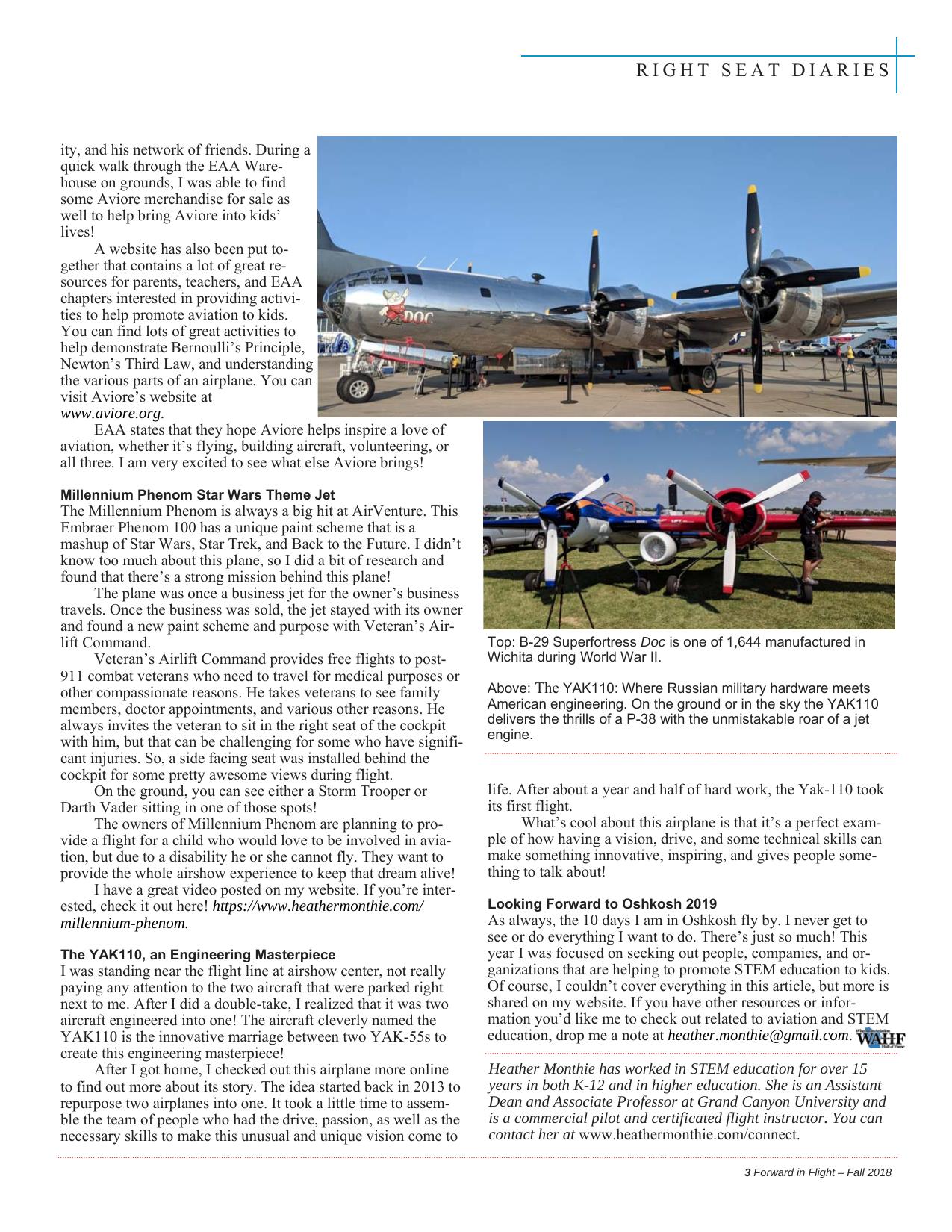
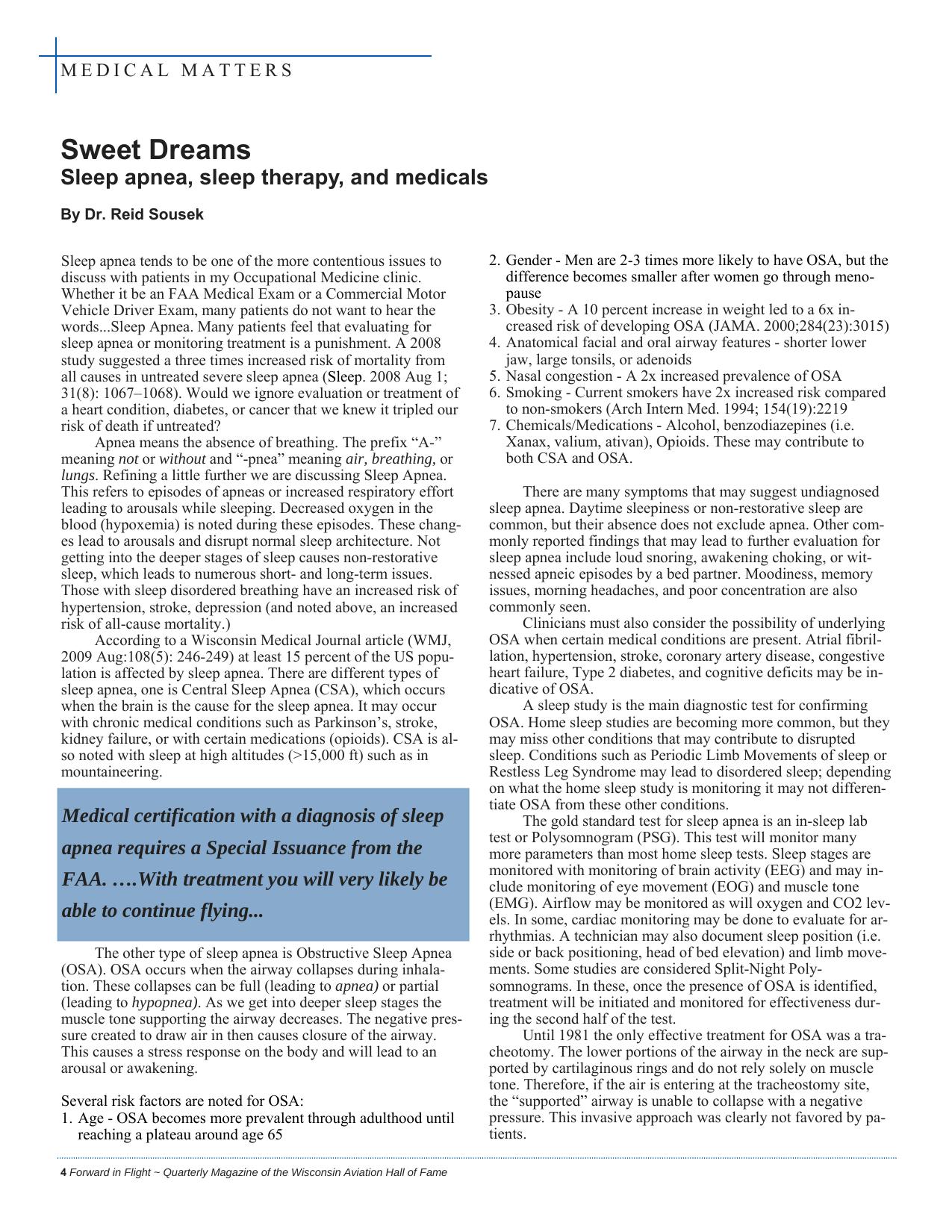
RIGHT SEAT DIARIES ity, and his network of friends. During a quick walk through the EAA Warehouse on grounds, I was able to find some Aviore merchandise for sale as well to help bring Aviore into kids’ lives! A website has also been put together that contains a lot of great resources for parents, teachers, and EAA chapters interested in providing activities to help promote aviation to kids. You can find lots of great activities to help demonstrate Bernoulli’s Principle, Newton’s Third Law, and understanding the various parts of an airplane. You can visit Aviore’s website at www.aviore.org. EAA states that they hope Aviore helps inspire a love of aviation, whether it’s flying, building aircraft, volunteering, or all three. I am very excited to see what else Aviore brings! Millennium Phenom Star Wars Theme Jet The Millennium Phenom is always a big hit at AirVenture. This Embraer Phenom 100 has a unique paint scheme that is a mashup of Star Wars, Star Trek, and Back to the Future. I didn’t know too much about this plane, so I did a bit of research and found that there’s a strong mission behind this plane! The plane was once a business jet for the owner’s business travels. Once the business was sold, the jet stayed with its owner and found a new paint scheme and purpose with Veteran’s Airlift Command. Veteran’s Airlift Command provides free flights to post911 combat veterans who need to travel for medical purposes or other compassionate reasons. He takes veterans to see family members, doctor appointments, and various other reasons. He always invites the veteran to sit in the right seat of the cockpit with him, but that can be challenging for some who have significant injuries. So, a side facing seat was installed behind the cockpit for some pretty awesome views during flight. On the ground, you can see either a Storm Trooper or Darth Vader sitting in one of those spots! The owners of Millennium Phenom are planning to provide a flight for a child who would love to be involved in aviation, but due to a disability he or she cannot fly. They want to provide the whole airshow experience to keep that dream alive! I have a great video posted on my website. If you’re interested, check it out here! https://www.heathermonthie.com/ millennium-phenom. The YAK110, an Engineering Masterpiece I was standing near the flight line at airshow center, not really paying any attention to the two aircraft that were parked right next to me. After I did a double-take, I realized that it was two aircraft engineered into one! The aircraft cleverly named the YAK110 is the innovative marriage between two YAK-55s to create this engineering masterpiece! After I got home, I checked out this airplane more online to find out more about its story. The idea started back in 2013 to repurpose two airplanes into one. It took a little time to assemble the team of people who had the drive, passion, as well as the necessary skills to make this unusual and unique vision come to Top: B-29 Superfortress Doc is one of 1,644 manufactured in Wichita during World War II. Above: The YAK110: Where Russian military hardware meets American engineering. On the ground or in the sky the YAK110 delivers the thrills of a P-38 with the unmistakable roar of a jet engine. life. After about a year and half of hard work, the Yak-110 took its first flight. What’s cool about this airplane is that it’s a perfect example of how having a vision, drive, and some technical skills can make something innovative, inspiring, and gives people something to talk about! Looking Forward to Oshkosh 2019 As always, the 10 days I am in Oshkosh fly by. I never get to see or do everything I want to do. There’s just so much! This year I was focused on seeking out people, companies, and organizations that are helping to promote STEM education to kids. Of course, I couldn’t cover everything in this article, but more is shared on my website. If you have other resources or information you’d like me to check out related to aviation and STEM education, drop me a note at heather.monthie@gmail.com. Heather Monthie has worked in STEM education for over 15 years in both K-12 and in higher education. She is an Assistant Dean and Associate Professor at Grand Canyon University and is a commercial pilot and certificated flight instructor. You can contact her at www.heathermonthie.com/connect. 3 Forward in Flight – Fall 2018
MEDICAL MATTERS Sweet Dreams Sleep apnea, sleep therapy, and medicals By Dr. Reid Sousek Sleep apnea tends to be one of the more contentious issues to discuss with patients in my Occupational Medicine clinic. Whether it be an FAA Medical Exam or a Commercial Motor Vehicle Driver Exam, many patients do not want to hear the words...Sleep Apnea. Many patients feel that evaluating for sleep apnea or monitoring treatment is a punishment. A 2008 study suggested a three times increased risk of mortality from all causes in untreated severe sleep apnea (Sleep. 2008 Aug 1; 31(8): 1067–1068). Would we ignore evaluation or treatment of a heart condition, diabetes, or cancer that we knew it tripled our risk of death if untreated? Apnea means the absence of breathing. The prefix “A-” meaning not or without and “-pnea” meaning air, breathing, or lungs. Refining a little further we are discussing Sleep Apnea. This refers to episodes of apneas or increased respiratory effort leading to arousals while sleeping. Decreased oxygen in the blood (hypoxemia) is noted during these episodes. These changes lead to arousals and disrupt normal sleep architecture. Not getting into the deeper stages of sleep causes non-restorative sleep, which leads to numerous short- and long-term issues. Those with sleep disordered breathing have an increased risk of hypertension, stroke, depression (and noted above, an increased risk of all-cause mortality.) According to a Wisconsin Medical Journal article (WMJ, 2009 Aug:108(5): 246-249) at least 15 percent of the US population is affected by sleep apnea. There are different types of sleep apnea, one is Central Sleep Apnea (CSA), which occurs when the brain is the cause for the sleep apnea. It may occur with chronic medical conditions such as Parkinson’s, stroke, kidney failure, or with certain medications (opioids). CSA is also noted with sleep at high altitudes (>15,000 ft) such as in mountaineering. Medical certification with a diagnosis of sleep apnea requires a Special Issuance from the FAA. ….With treatment you will very likely be able to continue flying... The other type of sleep apnea is Obstructive Sleep Apnea (OSA). OSA occurs when the airway collapses during inhalation. These collapses can be full (leading to apnea) or partial (leading to hypopnea). As we get into deeper sleep stages the muscle tone supporting the airway decreases. The negative pressure created to draw air in then causes closure of the airway. This causes a stress response on the body and will lead to an arousal or awakening. Several risk factors are noted for OSA: 1. Age - OSA becomes more prevalent through adulthood until reaching a plateau around age 65 4 Forward in Flight ~ Quarterly Magazine of the Wisconsin Aviation Hall of Fame 2. Gender - Men are 2-3 times more likely to have OSA, but the difference becomes smaller after women go through menopause 3. Obesity - A 10 percent increase in weight led to a 6x increased risk of developing OSA (JAMA. 2000;284(23):3015) 4. Anatomical facial and oral airway features - shorter lower jaw, large tonsils, or adenoids 5. Nasal congestion - A 2x increased prevalence of OSA 6. Smoking - Current smokers have 2x increased risk compared to non-smokers (Arch Intern Med. 1994; 154(19):2219 7. Chemicals/Medications - Alcohol, benzodiazepines (i.e. Xanax, valium, ativan), Opioids. These may contribute to both CSA and OSA. There are many symptoms that may suggest undiagnosed sleep apnea. Daytime sleepiness or non-restorative sleep are common, but their absence does not exclude apnea. Other commonly reported findings that may lead to further evaluation for sleep apnea include loud snoring, awakening choking, or witnessed apneic episodes by a bed partner. Moodiness, memory issues, morning headaches, and poor concentration are also commonly seen. Clinicians must also consider the possibility of underlying OSA when certain medical conditions are present. Atrial fibrillation, hypertension, stroke, coronary artery disease, congestive heart failure, Type 2 diabetes, and cognitive deficits may be indicative of OSA. A sleep study is the main diagnostic test for confirming OSA. Home sleep studies are becoming more common, but they may miss other conditions that may contribute to disrupted sleep. Conditions such as Periodic Limb Movements of sleep or Restless Leg Syndrome may lead to disordered sleep; depending on what the home sleep study is monitoring it may not differentiate OSA from these other conditions. The gold standard test for sleep apnea is an in-sleep lab test or Polysomnogram (PSG). This test will monitor many more parameters than most home sleep tests. Sleep stages are monitored with monitoring of brain activity (EEG) and may include monitoring of eye movement (EOG) and muscle tone (EMG). Airflow may be monitored as will oxygen and CO2 levels. In some, cardiac monitoring may be done to evaluate for arrhythmias. A technician may also document sleep position (i.e. side or back positioning, head of bed elevation) and limb movements. Some studies are considered Split-Night Polysomnograms. In these, once the presence of OSA is identified, treatment will be initiated and monitored for effectiveness during the second half of the test. Until 1981 the only effective treatment for OSA was a tracheotomy. The lower portions of the airway in the neck are supported by cartilaginous rings and do not rely solely on muscle tone. Therefore, if the air is entering at the tracheostomy site, the “supported” airway is unable to collapse with a negative pressure. This invasive approach was clearly not favored by patients.
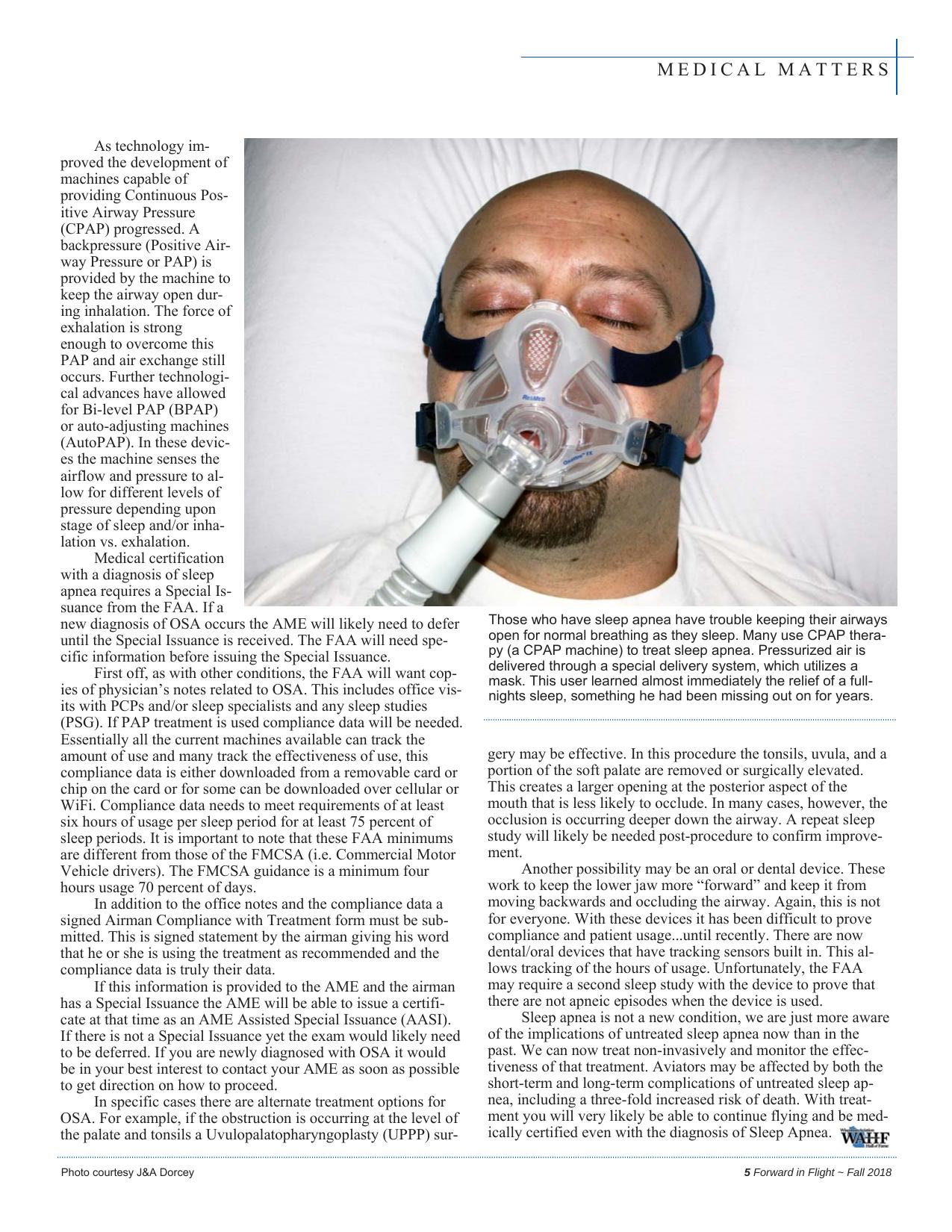
MEDICAL MATTERS As technology improved the development of machines capable of providing Continuous Positive Airway Pressure (CPAP) progressed. A backpressure (Positive Airway Pressure or PAP) is provided by the machine to keep the airway open during inhalation. The force of exhalation is strong enough to overcome this PAP and air exchange still occurs. Further technological advances have allowed for Bi-level PAP (BPAP) or auto-adjusting machines (AutoPAP). In these devices the machine senses the airflow and pressure to allow for different levels of pressure depending upon stage of sleep and/or inhalation vs. exhalation. Medical certification with a diagnosis of sleep apnea requires a Special Issuance from the FAA. If a new diagnosis of OSA occurs the AME will likely need to defer until the Special Issuance is received. The FAA will need specific information before issuing the Special Issuance. First off, as with other conditions, the FAA will want copies of physician’s notes related to OSA. This includes office visits with PCPs and/or sleep specialists and any sleep studies (PSG). If PAP treatment is used compliance data will be needed. Essentially all the current machines available can track the amount of use and many track the effectiveness of use, this compliance data is either downloaded from a removable card or chip on the card or for some can be downloaded over cellular or WiFi. Compliance data needs to meet requirements of at least six hours of usage per sleep period for at least 75 percent of sleep periods. It is important to note that these FAA minimums are different from those of the FMCSA (i.e. Commercial Motor Vehicle drivers). The FMCSA guidance is a minimum four hours usage 70 percent of days. In addition to the office notes and the compliance data a signed Airman Compliance with Treatment form must be submitted. This is signed statement by the airman giving his word that he or she is using the treatment as recommended and the compliance data is truly their data. If this information is provided to the AME and the airman has a Special Issuance the AME will be able to issue a certificate at that time as an AME Assisted Special Issuance (AASI). If there is not a Special Issuance yet the exam would likely need to be deferred. If you are newly diagnosed with OSA it would be in your best interest to contact your AME as soon as possible to get direction on how to proceed. In specific cases there are alternate treatment options for OSA. For example, if the obstruction is occurring at the level of the palate and tonsils a Uvulopalatopharyngoplasty (UPPP) surPhoto courtesy J&A Dorcey Those who have sleep apnea have trouble keeping their airways open for normal breathing as they sleep. Many use CPAP therapy (a CPAP machine) to treat sleep apnea. Pressurized air is delivered through a special delivery system, which utilizes a mask. This user learned almost immediately the relief of a fullnights sleep, something he had been missing out on for years. gery may be effective. In this procedure the tonsils, uvula, and a portion of the soft palate are removed or surgically elevated. This creates a larger opening at the posterior aspect of the mouth that is less likely to occlude. In many cases, however, the occlusion is occurring deeper down the airway. A repeat sleep study will likely be needed post-procedure to confirm improvement. Another possibility may be an oral or dental device. These work to keep the lower jaw more “forward” and keep it from moving backwards and occluding the airway. Again, this is not for everyone. With these devices it has been difficult to prove compliance and patient usage...until recently. There are now dental/oral devices that have tracking sensors built in. This allows tracking of the hours of usage. Unfortunately, the FAA may require a second sleep study with the device to prove that there are not apneic episodes when the device is used. Sleep apnea is not a new condition, we are just more aware of the implications of untreated sleep apnea now than in the past. We can now treat non-invasively and monitor the effectiveness of that treatment. Aviators may be affected by both the short-term and long-term complications of untreated sleep apnea, including a three-fold increased risk of death. With treatment you will very likely be able to continue flying and be medically certified even with the diagnosis of Sleep Apnea. 5 Forward in Flight ~ Fall 2018
WEEDEN’S REVIEW Speak to Your Audience By Patrick Weeden, Executive Director, Kelch Aviation Museum I’m an introvert by nature, which is not actually a good trait for my position. I’d generally rather be in the back of a crowded room, listening and learning, than leading a discussion. However, as Executive Director of the Kelch Aviation Museum at Brodhead Airport (C37), I regularly give presentations and guided tours to a wide variety of civic groups, numbering from one to 50 people. Many members of the Wisconsin Aviation Hall of Fame are in a similar position, as they tell the story of Wisconsin’s aviation history and how it is relevant to your local community. In college, I had a mandatory public speaking class that I skipped more than I attended; file that move under “Regrets of Youth.” In 2015, with almost no experience addressing a crowd, I set out to speak as often as I could to as many people as possible. The Kelch Aviation Museum had just launched a $1 Million capital campaign to build a new museum facility, and we needed to raise our voices, so to speak, to reach our fundraising goal by 2018. Yet, as I often joke, “We’re only a museum because we say we are.” We were virtually unknown, in both the aviation community and the local area. In the vintage aviation world, Alfred and Lois Kelch of Mequon, Wisconsin, were pioneers. Not only did they collect and restore many antique airplanes throughout their lives, they also helped create the Antique & Classic Division of EAA, now known as the EAA Vintage Aircraft Association. Al and a few associates created the core judging rules that are still in use at 6 Forward in Flight ~ Quarterly Magazine of the Wisconsin Aviation Hall of Fame fly-ins today. Together, the Kelches edited and funded The Vintage Airplane magazine in its early years, funded aviation scholarships, and toward the end of their lives, created what they called their “museum” at the Brodhead Airport. Al died in 2004 and Lois in 2009, but their legacy lives on in their beautiful collection. But that’s exactly the trouble with the Kelch Museum; it’s simply a collection of beautifully restored (and mostly airworthy) historic aircraft, spread between a bunch of hangars at a small, out-of-the-way Wisconsin grass airport. To see the collection, you had to know it existed in the first place, call the right person, and find your way to Brodhead - population 3,892. We had no advertising and very little exposure. When the museum was formally organized as a 501(c)(3) non-profit in 2014, I was hired to transform the museum into a year-round, open-tothe-public facility that would be an asset to the local community. A public speaking tour seemed like a logical first step. Area EAA chapters, Optimists Clubs, Kiwanis, Chambers of Commerce, and the like were all targets for my public relations push. I rehearsed and streamlined my program to about 40 minutes, which I figured was the attention span for most of these meetings. I was anxious at first, but knew my material, and slowly got comfortable being in the spotlight. However, I learned early on that it is important, even critical, to speak to your audience. As excited as I was to preach the technical minutia of EAA Photo by Jim Koepnick
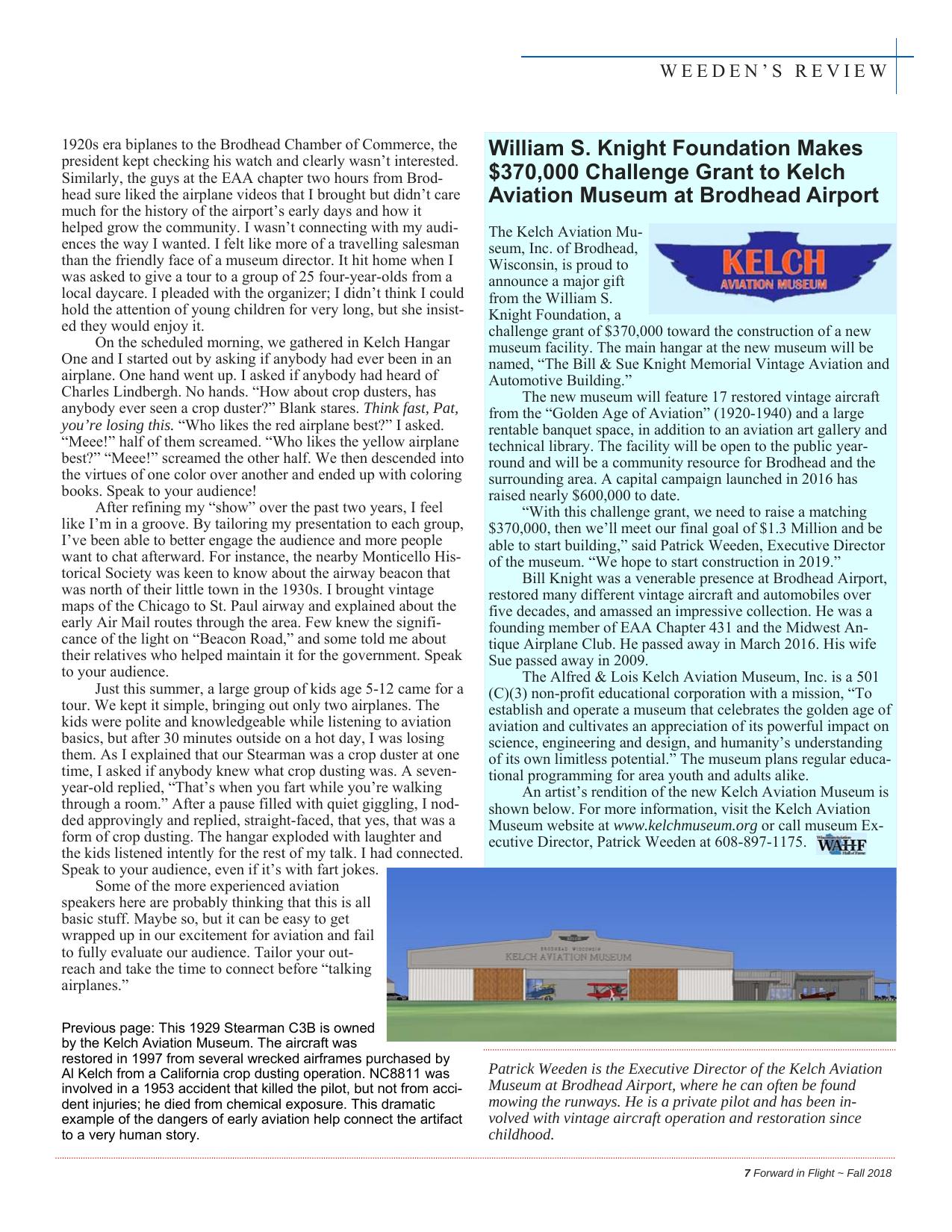
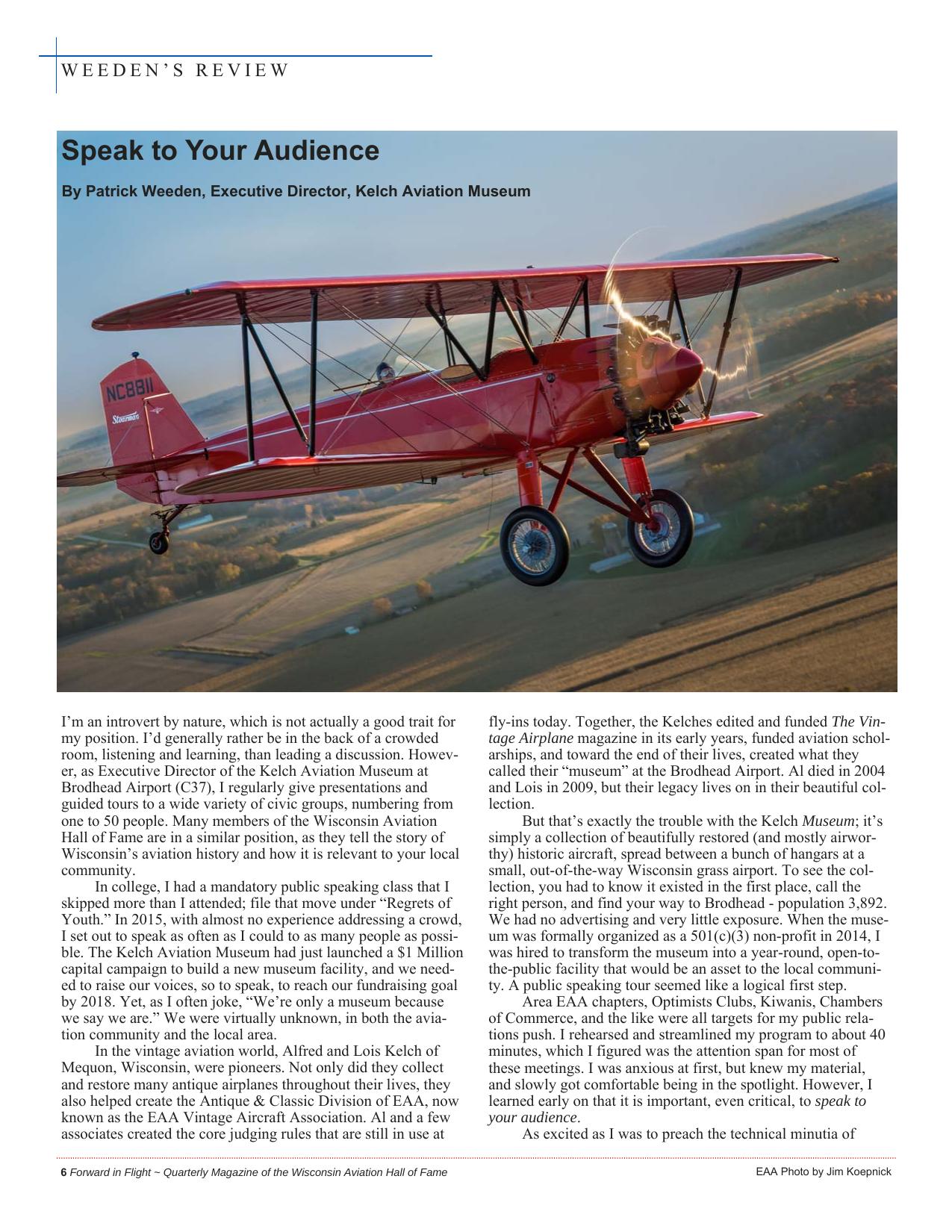
WEEDEN’S REVIEW 1920s era biplanes to the Brodhead Chamber of Commerce, the president kept checking his watch and clearly wasn’t interested. Similarly, the guys at the EAA chapter two hours from Brodhead sure liked the airplane videos that I brought but didn’t care much for the history of the airport’s early days and how it helped grow the community. I wasn’t connecting with my audiences the way I wanted. I felt like more of a travelling salesman than the friendly face of a museum director. It hit home when I was asked to give a tour to a group of 25 four-year-olds from a local daycare. I pleaded with the organizer; I didn’t think I could hold the attention of young children for very long, but she insisted they would enjoy it. On the scheduled morning, we gathered in Kelch Hangar One and I started out by asking if anybody had ever been in an airplane. One hand went up. I asked if anybody had heard of Charles Lindbergh. No hands. “How about crop dusters, has anybody ever seen a crop duster?” Blank stares. Think fast, Pat, you’re losing this. “Who likes the red airplane best?” I asked. “Meee!” half of them screamed. “Who likes the yellow airplane best?” “Meee!” screamed the other half. We then descended into the virtues of one color over another and ended up with coloring books. Speak to your audience! After refining my “show” over the past two years, I feel like I’m in a groove. By tailoring my presentation to each group, I’ve been able to better engage the audience and more people want to chat afterward. For instance, the nearby Monticello Historical Society was keen to know about the airway beacon that was north of their little town in the 1930s. I brought vintage maps of the Chicago to St. Paul airway and explained about the early Air Mail routes through the area. Few knew the significance of the light on “Beacon Road,” and some told me about their relatives who helped maintain it for the government. Speak to your audience. Just this summer, a large group of kids age 5-12 came for a tour. We kept it simple, bringing out only two airplanes. The kids were polite and knowledgeable while listening to aviation basics, but after 30 minutes outside on a hot day, I was losing them. As I explained that our Stearman was a crop duster at one time, I asked if anybody knew what crop dusting was. A sevenyear-old replied, “That’s when you fart while you’re walking through a room.” After a pause filled with quiet giggling, I nodded approvingly and replied, straight-faced, that yes, that was a form of crop dusting. The hangar exploded with laughter and the kids listened intently for the rest of my talk. I had connected. Speak to your audience, even if it’s with fart jokes. Some of the more experienced aviation speakers here are probably thinking that this is all basic stuff. Maybe so, but it can be easy to get wrapped up in our excitement for aviation and fail to fully evaluate our audience. Tailor your outreach and take the time to connect before “talking airplanes.” Previous page: This 1929 Stearman C3B is owned by the Kelch Aviation Museum. The aircraft was restored in 1997 from several wrecked airframes purchased by Al Kelch from a California crop dusting operation. NC8811 was involved in a 1953 accident that killed the pilot, but not from accident injuries; he died from chemical exposure. This dramatic example of the dangers of early aviation help connect the artifact to a very human story. William S. Knight Foundation Makes $370,000 Challenge Grant to Kelch Aviation Museum at Brodhead Airport The Kelch Aviation Museum, Inc. of Brodhead, Wisconsin, is proud to announce a major gift from the William S. Knight Foundation, a challenge grant of $370,000 toward the construction of a new museum facility. The main hangar at the new museum will be named, “The Bill & Sue Knight Memorial Vintage Aviation and Automotive Building.” The new museum will feature 17 restored vintage aircraft from the “Golden Age of Aviation” (1920-1940) and a large rentable banquet space, in addition to an aviation art gallery and technical library. The facility will be open to the public yearround and will be a community resource for Brodhead and the surrounding area. A capital campaign launched in 2016 has raised nearly $600,000 to date. “With this challenge grant, we need to raise a matching $370,000, then we’ll meet our final goal of $1.3 Million and be able to start building,” said Patrick Weeden, Executive Director of the museum. “We hope to start construction in 2019.” Bill Knight was a venerable presence at Brodhead Airport, restored many different vintage aircraft and automobiles over five decades, and amassed an impressive collection. He was a founding member of EAA Chapter 431 and the Midwest Antique Airplane Club. He passed away in March 2016. His wife Sue passed away in 2009. The Alfred & Lois Kelch Aviation Museum, Inc. is a 501 (C)(3) non-profit educational corporation with a mission, “To establish and operate a museum that celebrates the golden age of aviation and cultivates an appreciation of its powerful impact on science, engineering and design, and humanity’s understanding of its own limitless potential.” The museum plans regular educational programming for area youth and adults alike. An artist’s rendition of the new Kelch Aviation Museum is shown below. For more information, visit the Kelch Aviation Museum website at www.kelchmuseum.org or call museum Executive Director, Patrick Weeden at 608-897-1175. Patrick Weeden is the Executive Director of the Kelch Aviation Museum at Brodhead Airport, where he can often be found mowing the runways. He is a private pilot and has been involved with vintage aircraft operation and restoration since childhood. 7 Forward in Flight ~ Fall 2018
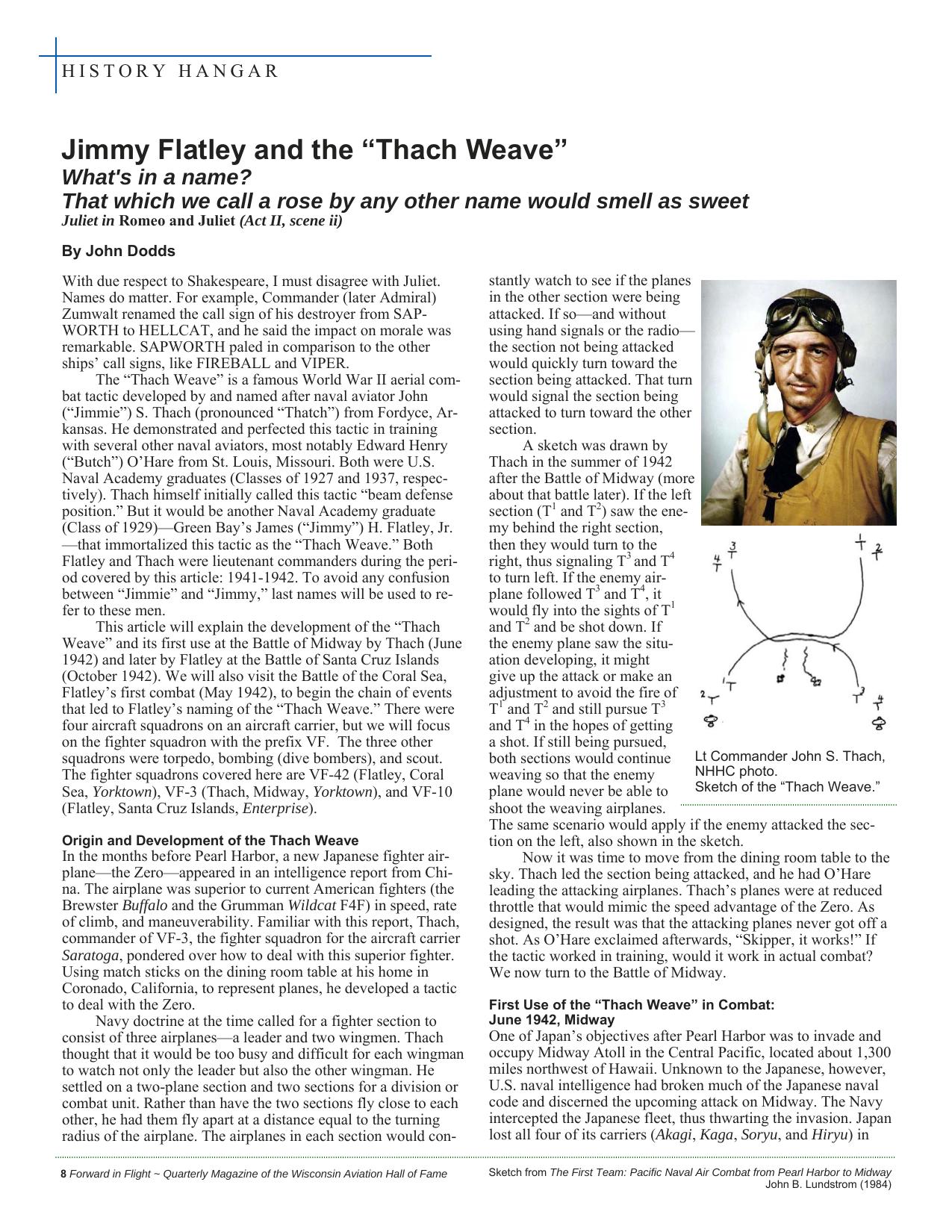
HISTORY HANGAR Jimmy Flatley and the “Thach Weave” What's in a name? That which we call a rose by any other name would smell as sweet Juliet in Romeo and Juliet (Act II, scene ii) By John Dodds With due respect to Shakespeare, I must disagree with Juliet. Names do matter. For example, Commander (later Admiral) Zumwalt renamed the call sign of his destroyer from SAPWORTH to HELLCAT, and he said the impact on morale was remarkable. SAPWORTH paled in comparison to the other ships’ call signs, like FIREBALL and VIPER. The “Thach Weave” is a famous World War II aerial combat tactic developed by and named after naval aviator John (“Jimmie”) S. Thach (pronounced “Thatch”) from Fordyce, Arkansas. He demonstrated and perfected this tactic in training with several other naval aviators, most notably Edward Henry (“Butch”) O’Hare from St. Louis, Missouri. Both were U.S. Naval Academy graduates (Classes of 1927 and 1937, respectively). Thach himself initially called this tactic “beam defense position.” But it would be another Naval Academy graduate (Class of 1929)—Green Bay’s James (“Jimmy”) H. Flatley, Jr. —that immortalized this tactic as the “Thach Weave.” Both Flatley and Thach were lieutenant commanders during the period covered by this article: 1941-1942. To avoid any confusion between “Jimmie” and “Jimmy,” last names will be used to refer to these men. This article will explain the development of the “Thach Weave” and its first use at the Battle of Midway by Thach (June 1942) and later by Flatley at the Battle of Santa Cruz Islands (October 1942). We will also visit the Battle of the Coral Sea, Flatley’s first combat (May 1942), to begin the chain of events that led to Flatley’s naming of the “Thach Weave.” There were four aircraft squadrons on an aircraft carrier, but we will focus on the fighter squadron with the prefix VF. The three other squadrons were torpedo, bombing (dive bombers), and scout. The fighter squadrons covered here are VF-42 (Flatley, Coral Sea, Yorktown), VF-3 (Thach, Midway, Yorktown), and VF-10 (Flatley, Santa Cruz Islands, Enterprise). Origin and Development of the Thach Weave In the months before Pearl Harbor, a new Japanese fighter airplane—the Zero—appeared in an intelligence report from China. The airplane was superior to current American fighters (the Brewster Buffalo and the Grumman Wildcat F4F) in speed, rate of climb, and maneuverability. Familiar with this report, Thach, commander of VF-3, the fighter squadron for the aircraft carrier Saratoga, pondered over how to deal with this superior fighter. Using match sticks on the dining room table at his home in Coronado, California, to represent planes, he developed a tactic to deal with the Zero. Navy doctrine at the time called for a fighter section to consist of three airplanes—a leader and two wingmen. Thach thought that it would be too busy and difficult for each wingman to watch not only the leader but also the other wingman. He settled on a two-plane section and two sections for a division or combat unit. Rather than have the two sections fly close to each other, he had them fly apart at a distance equal to the turning radius of the airplane. The airplanes in each section would con8 Forward in Flight ~ Quarterly Magazine of the Wisconsin Aviation Hall of Fame stantly watch to see if the planes in the other section were being attacked. If so—and without using hand signals or the radio— the section not being attacked would quickly turn toward the section being attacked. That turn would signal the section being attacked to turn toward the other section. A sketch was drawn by Thach in the summer of 1942 after the Battle of Midway (more about that battle later). If the left section (T1 and T2) saw the enemy behind the right section, then they would turn to the right, thus signaling T3 and T4 to turn left. If the enemy airplane followed T3 and T4, it would fly into the sights of T1 and T2 and be shot down. If the enemy plane saw the situation developing, it might give up the attack or make an adjustment to avoid the fire of T1 and T2 and still pursue T3 and T4 in the hopes of getting a shot. If still being pursued, Lt Commander John S. Thach, both sections would continue NHHC photo. weaving so that the enemy Sketch of the “Thach Weave.” plane would never be able to shoot the weaving airplanes. The same scenario would apply if the enemy attacked the section on the left, also shown in the sketch. Now it was time to move from the dining room table to the sky. Thach led the section being attacked, and he had O’Hare leading the attacking airplanes. Thach’s planes were at reduced throttle that would mimic the speed advantage of the Zero. As designed, the result was that the attacking planes never got off a shot. As O’Hare exclaimed afterwards, “Skipper, it works!” If the tactic worked in training, would it work in actual combat? We now turn to the Battle of Midway. First Use of the “Thach Weave” in Combat: June 1942, Midway One of Japan’s objectives after Pearl Harbor was to invade and occupy Midway Atoll in the Central Pacific, located about 1,300 miles northwest of Hawaii. Unknown to the Japanese, however, U.S. naval intelligence had broken much of the Japanese naval code and discerned the upcoming attack on Midway. The Navy intercepted the Japanese fleet, thus thwarting the invasion. Japan lost all four of its carriers (Akagi, Kaga, Soryu, and Hiryu) in Sketch from The First Team: Pacific Naval Air Combat from Pearl Harbor to Midway John B. Lundstrom (1984)
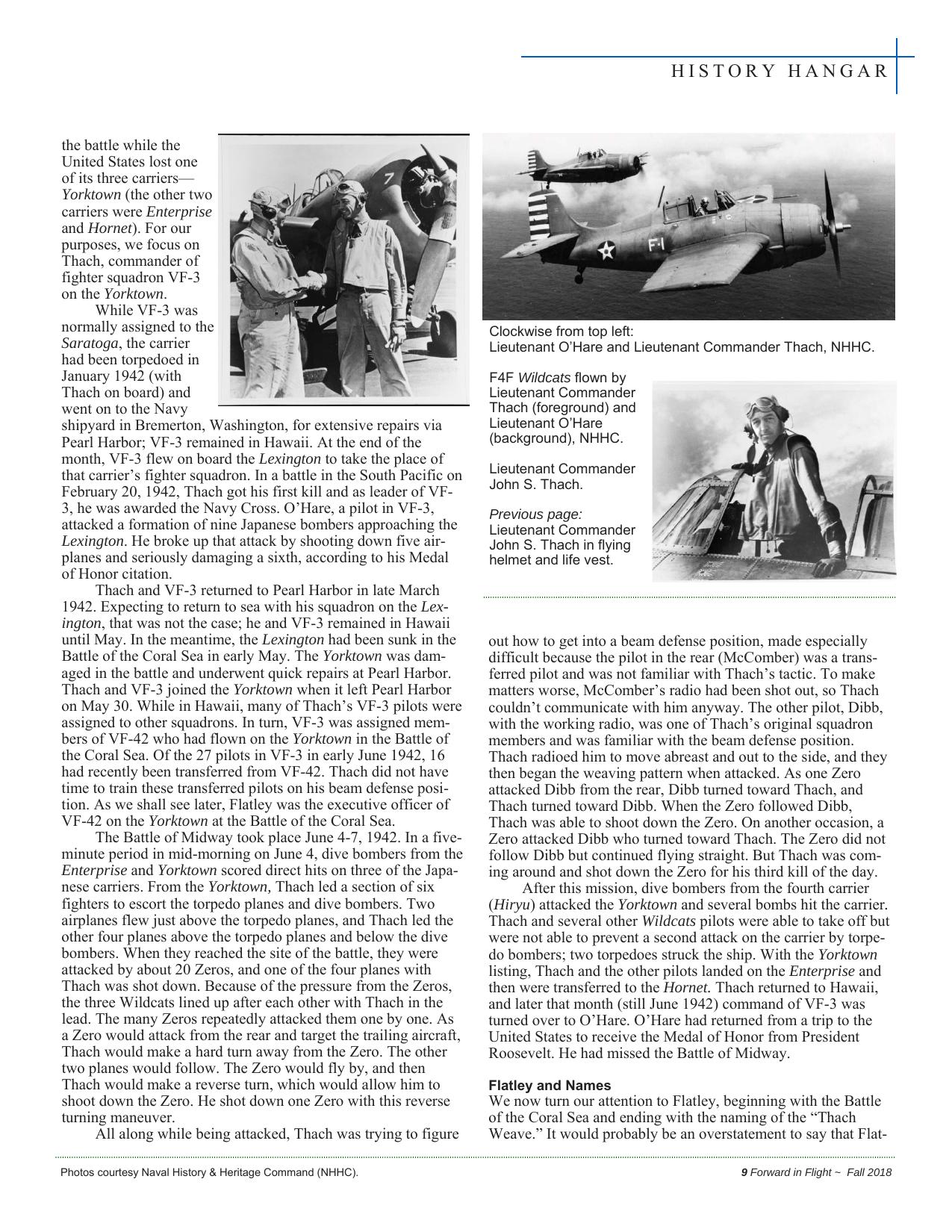
HISTORY HANGAR the battle while the United States lost one of its three carriers— Yorktown (the other two carriers were Enterprise and Hornet). For our purposes, we focus on Thach, commander of fighter squadron VF-3 on the Yorktown. While VF-3 was normally assigned to the Saratoga, the carrier had been torpedoed in January 1942 (with Thach on board) and went on to the Navy shipyard in Bremerton, Washington, for extensive repairs via Pearl Harbor; VF-3 remained in Hawaii. At the end of the month, VF-3 flew on board the Lexington to take the place of that carrier’s fighter squadron. In a battle in the South Pacific on February 20, 1942, Thach got his first kill and as leader of VF3, he was awarded the Navy Cross. O’Hare, a pilot in VF-3, attacked a formation of nine Japanese bombers approaching the Lexington. He broke up that attack by shooting down five airplanes and seriously damaging a sixth, according to his Medal of Honor citation. Thach and VF-3 returned to Pearl Harbor in late March 1942. Expecting to return to sea with his squadron on the Lexington, that was not the case; he and VF-3 remained in Hawaii until May. In the meantime, the Lexington had been sunk in the Battle of the Coral Sea in early May. The Yorktown was damaged in the battle and underwent quick repairs at Pearl Harbor. Thach and VF-3 joined the Yorktown when it left Pearl Harbor on May 30. While in Hawaii, many of Thach’s VF-3 pilots were assigned to other squadrons. In turn, VF-3 was assigned members of VF-42 who had flown on the Yorktown in the Battle of the Coral Sea. Of the 27 pilots in VF-3 in early June 1942, 16 had recently been transferred from VF-42. Thach did not have time to train these transferred pilots on his beam defense position. As we shall see later, Flatley was the executive officer of VF-42 on the Yorktown at the Battle of the Coral Sea. The Battle of Midway took place June 4-7, 1942. In a fiveminute period in mid-morning on June 4, dive bombers from the Enterprise and Yorktown scored direct hits on three of the Japanese carriers. From the Yorktown, Thach led a section of six fighters to escort the torpedo planes and dive bombers. Two airplanes flew just above the torpedo planes, and Thach led the other four planes above the torpedo planes and below the dive bombers. When they reached the site of the battle, they were attacked by about 20 Zeros, and one of the four planes with Thach was shot down. Because of the pressure from the Zeros, the three Wildcats lined up after each other with Thach in the lead. The many Zeros repeatedly attacked them one by one. As a Zero would attack from the rear and target the trailing aircraft, Thach would make a hard turn away from the Zero. The other two planes would follow. The Zero would fly by, and then Thach would make a reverse turn, which would allow him to shoot down the Zero. He shot down one Zero with this reverse turning maneuver. All along while being attacked, Thach was trying to figure Photos courtesy Naval History & Heritage Command (NHHC). Clockwise from top left: Lieutenant O’Hare and Lieutenant Commander Thach, NHHC. F4F Wildcats flown by Lieutenant Commander Thach (foreground) and Lieutenant O’Hare (background), NHHC. Lieutenant Commander John S. Thach. Previous page: Lieutenant Commander John S. Thach in flying helmet and life vest. out how to get into a beam defense position, made especially difficult because the pilot in the rear (McComber) was a transferred pilot and was not familiar with Thach’s tactic. To make matters worse, McComber’s radio had been shot out, so Thach couldn’t communicate with him anyway. The other pilot, Dibb, with the working radio, was one of Thach’s original squadron members and was familiar with the beam defense position. Thach radioed him to move abreast and out to the side, and they then began the weaving pattern when attacked. As one Zero attacked Dibb from the rear, Dibb turned toward Thach, and Thach turned toward Dibb. When the Zero followed Dibb, Thach was able to shoot down the Zero. On another occasion, a Zero attacked Dibb who turned toward Thach. The Zero did not follow Dibb but continued flying straight. But Thach was coming around and shot down the Zero for his third kill of the day. After this mission, dive bombers from the fourth carrier (Hiryu) attacked the Yorktown and several bombs hit the carrier. Thach and several other Wildcats pilots were able to take off but were not able to prevent a second attack on the carrier by torpedo bombers; two torpedoes struck the ship. With the Yorktown listing, Thach and the other pilots landed on the Enterprise and then were transferred to the Hornet. Thach returned to Hawaii, and later that month (still June 1942) command of VF-3 was turned over to O’Hare. O’Hare had returned from a trip to the United States to receive the Medal of Honor from President Roosevelt. He had missed the Battle of Midway. Flatley and Names We now turn our attention to Flatley, beginning with the Battle of the Coral Sea and ending with the naming of the “Thach Weave.” It would probably be an overstatement to say that Flat9 Forward in Flight ~ Fall 2018
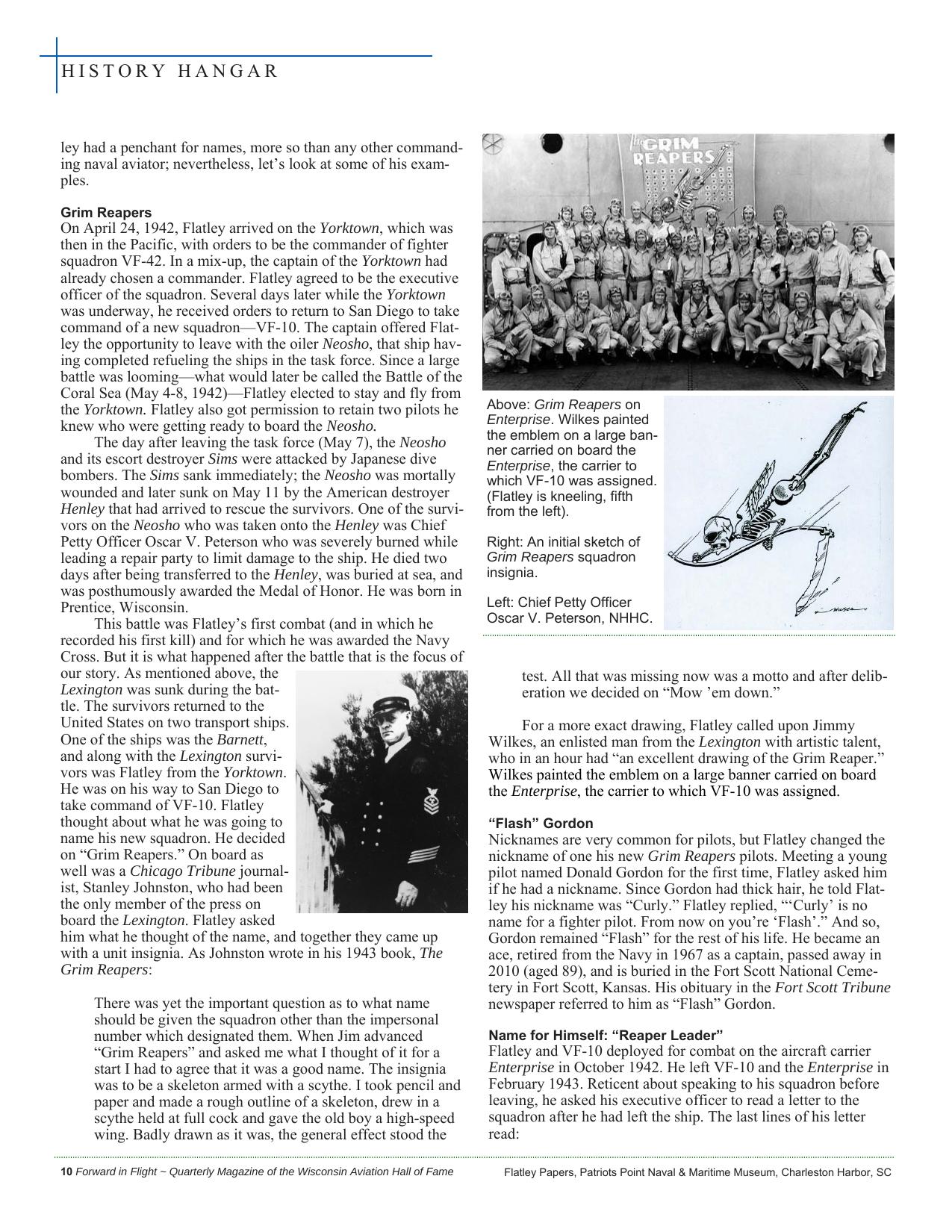
HISTORY HANGAR ley had a penchant for names, more so than any other commanding naval aviator; nevertheless, let’s look at some of his examples. Grim Reapers On April 24, 1942, Flatley arrived on the Yorktown, which was then in the Pacific, with orders to be the commander of fighter squadron VF-42. In a mix-up, the captain of the Yorktown had already chosen a commander. Flatley agreed to be the executive officer of the squadron. Several days later while the Yorktown was underway, he received orders to return to San Diego to take command of a new squadron—VF-10. The captain offered Flatley the opportunity to leave with the oiler Neosho, that ship having completed refueling the ships in the task force. Since a large battle was looming—what would later be called the Battle of the Coral Sea (May 4-8, 1942)—Flatley elected to stay and fly from the Yorktown. Flatley also got permission to retain two pilots he knew who were getting ready to board the Neosho. The day after leaving the task force (May 7), the Neosho and its escort destroyer Sims were attacked by Japanese dive bombers. The Sims sank immediately; the Neosho was mortally wounded and later sunk on May 11 by the American destroyer Henley that had arrived to rescue the survivors. One of the survivors on the Neosho who was taken onto the Henley was Chief Petty Officer Oscar V. Peterson who was severely burned while leading a repair party to limit damage to the ship. He died two days after being transferred to the Henley, was buried at sea, and was posthumously awarded the Medal of Honor. He was born in Prentice, Wisconsin. This battle was Flatley’s first combat (and in which he recorded his first kill) and for which he was awarded the Navy Cross. But it is what happened after the battle that is the focus of our story. As mentioned above, the Lexington was sunk during the battle. The survivors returned to the United States on two transport ships. One of the ships was the Barnett, and along with the Lexington survivors was Flatley from the Yorktown. He was on his way to San Diego to take command of VF-10. Flatley thought about what he was going to name his new squadron. He decided on “Grim Reapers.” On board as well was a Chicago Tribune journalist, Stanley Johnston, who had been the only member of the press on board the Lexington. Flatley asked him what he thought of the name, and together they came up with a unit insignia. As Johnston wrote in his 1943 book, The Grim Reapers: There was yet the important question as to what name should be given the squadron other than the impersonal number which designated them. When Jim advanced “Grim Reapers” and asked me what I thought of it for a start I had to agree that it was a good name. The insignia was to be a skeleton armed with a scythe. I took pencil and paper and made a rough outline of a skeleton, drew in a scythe held at full cock and gave the old boy a high-speed wing. Badly drawn as it was, the general effect stood the 10 Forward in Flight ~ Quarterly Magazine of the Wisconsin Aviation Hall of Fame Above: Grim Reapers on Enterprise. Wilkes painted the emblem on a large banner carried on board the Enterprise, the carrier to which VF-10 was assigned. (Flatley is kneeling, fifth from the left). Right: An initial sketch of Grim Reapers squadron insignia. Left: Chief Petty Officer Oscar V. Peterson, NHHC. test. All that was missing now was a motto and after deliberation we decided on “Mow ’em down.” For a more exact drawing, Flatley called upon Jimmy Wilkes, an enlisted man from the Lexington with artistic talent, who in an hour had “an excellent drawing of the Grim Reaper.” Wilkes painted the emblem on a large banner carried on board the Enterprise, the carrier to which VF-10 was assigned. “Flash” Gordon Nicknames are very common for pilots, but Flatley changed the nickname of one his new Grim Reapers pilots. Meeting a young pilot named Donald Gordon for the first time, Flatley asked him if he had a nickname. Since Gordon had thick hair, he told Flatley his nickname was “Curly.” Flatley replied, “‘Curly’ is no name for a fighter pilot. From now on you’re ‘Flash’.” And so, Gordon remained “Flash” for the rest of his life. He became an ace, retired from the Navy in 1967 as a captain, passed away in 2010 (aged 89), and is buried in the Fort Scott National Cemetery in Fort Scott, Kansas. His obituary in the Fort Scott Tribune newspaper referred to him as “Flash” Gordon. Name for Himself: “Reaper Leader” Flatley and VF-10 deployed for combat on the aircraft carrier Enterprise in October 1942. He left VF-10 and the Enterprise in February 1943. Reticent about speaking to his squadron before leaving, he asked his executive officer to read a letter to the squadron after he had left the ship. The last lines of his letter read: Flatley Papers, Patriots Point Naval & Maritime Museum, Charleston Harbor, SC
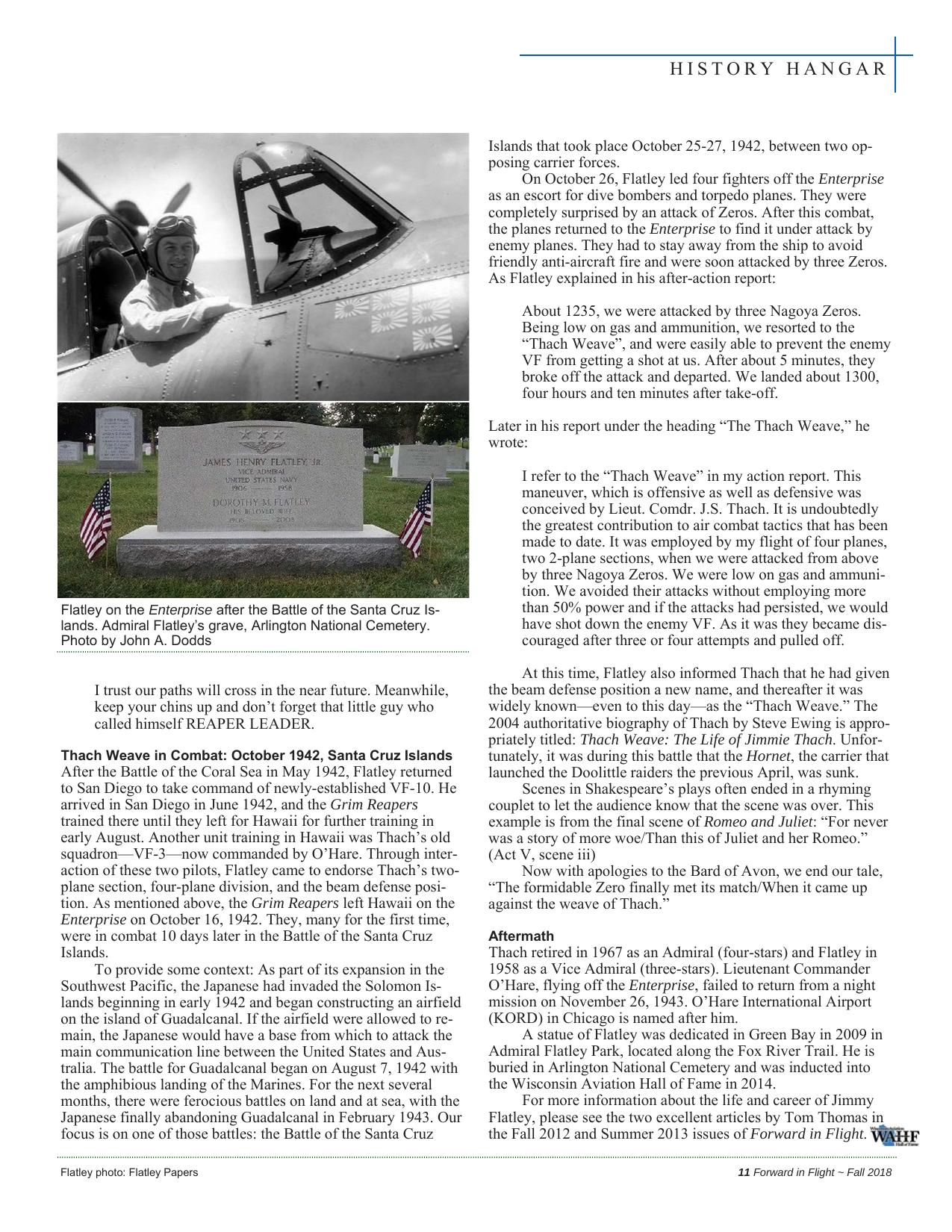
HISTORY HANGAR Islands that took place October 25-27, 1942, between two opposing carrier forces. On October 26, Flatley led four fighters off the Enterprise as an escort for dive bombers and torpedo planes. They were completely surprised by an attack of Zeros. After this combat, the planes returned to the Enterprise to find it under attack by enemy planes. They had to stay away from the ship to avoid friendly anti-aircraft fire and were soon attacked by three Zeros. As Flatley explained in his after-action report: About 1235, we were attacked by three Nagoya Zeros. Being low on gas and ammunition, we resorted to the “Thach Weave”, and were easily able to prevent the enemy VF from getting a shot at us. After about 5 minutes, they broke off the attack and departed. We landed about 1300, four hours and ten minutes after take-off. Later in his report under the heading “The Thach Weave,” he wrote: Flatley on the Enterprise after the Battle of the Santa Cruz Islands. Admiral Flatley’s grave, Arlington National Cemetery. Photo by John A. Dodds I trust our paths will cross in the near future. Meanwhile, keep your chins up and don’t forget that little guy who called himself REAPER LEADER. Thach Weave in Combat: October 1942, Santa Cruz Islands After the Battle of the Coral Sea in May 1942, Flatley returned to San Diego to take command of newly-established VF-10. He arrived in San Diego in June 1942, and the Grim Reapers trained there until they left for Hawaii for further training in early August. Another unit training in Hawaii was Thach’s old squadron—VF-3—now commanded by O’Hare. Through interaction of these two pilots, Flatley came to endorse Thach’s twoplane section, four-plane division, and the beam defense position. As mentioned above, the Grim Reapers left Hawaii on the Enterprise on October 16, 1942. They, many for the first time, were in combat 10 days later in the Battle of the Santa Cruz Islands. To provide some context: As part of its expansion in the Southwest Pacific, the Japanese had invaded the Solomon Islands beginning in early 1942 and began constructing an airfield on the island of Guadalcanal. If the airfield were allowed to remain, the Japanese would have a base from which to attack the main communication line between the United States and Australia. The battle for Guadalcanal began on August 7, 1942 with the amphibious landing of the Marines. For the next several months, there were ferocious battles on land and at sea, with the Japanese finally abandoning Guadalcanal in February 1943. Our focus is on one of those battles: the Battle of the Santa Cruz Flatley photo: Flatley Papers I refer to the “Thach Weave” in my action report. This maneuver, which is offensive as well as defensive was conceived by Lieut. Comdr. J.S. Thach. It is undoubtedly the greatest contribution to air combat tactics that has been made to date. It was employed by my flight of four planes, two 2-plane sections, when we were attacked from above by three Nagoya Zeros. We were low on gas and ammunition. We avoided their attacks without employing more than 50% power and if the attacks had persisted, we would have shot down the enemy VF. As it was they became discouraged after three or four attempts and pulled off. At this time, Flatley also informed Thach that he had given the beam defense position a new name, and thereafter it was widely known—even to this day—as the “Thach Weave.” The 2004 authoritative biography of Thach by Steve Ewing is appropriately titled: Thach Weave: The Life of Jimmie Thach. Unfortunately, it was during this battle that the Hornet, the carrier that launched the Doolittle raiders the previous April, was sunk. Scenes in Shakespeare’s plays often ended in a rhyming couplet to let the audience know that the scene was over. This example is from the final scene of Romeo and Juliet: “For never was a story of more woe/Than this of Juliet and her Romeo.” (Act V, scene iii) Now with apologies to the Bard of Avon, we end our tale, “The formidable Zero finally met its match/When it came up against the weave of Thach.” Aftermath Thach retired in 1967 as an Admiral (four-stars) and Flatley in 1958 as a Vice Admiral (three-stars). Lieutenant Commander O’Hare, flying off the Enterprise, failed to return from a night mission on November 26, 1943. O’Hare International Airport (KORD) in Chicago is named after him. A statue of Flatley was dedicated in Green Bay in 2009 in Admiral Flatley Park, located along the Fox River Trail. He is buried in Arlington National Cemetery and was inducted into the Wisconsin Aviation Hall of Fame in 2014. For more information about the life and career of Jimmy Flatley, please see the two excellent articles by Tom Thomas in the Fall 2012 and Summer 2013 issues of Forward in Flight. 11 Forward in Flight ~ Fall 2018
FROM THE ARCHIVES Joseph Doerflinger From Mulhausen to Milwaukee, Part 1 By Michael Goc Joseph Doerflinger began his aviation career at a civilian pilot training school at Halberstadt in western Germany in early 1918. He ended it at the Knaup Brothers’ Civilian Pilot Training school at Mitchell Field in 1943. In between he flew in combat for the German empire, as a transport pilot in colonial French Africa, as a polar explorer in Norway, and as a commercial pilot in the United States. He logged thousands of hours and hundreds of thousands of miles in a hundred different aircraft on three continents. He ended his days as a husband, a father of eight children, and an apparently unremarkable working Joe in Milwaukee, Wisconsin. He was born in 1898 in Alsace, the province that Germany had acquired, along with neighboring Lorraine, after defeating France in 1871. Control of Alsace-Lorraine had seesawed back and forth over the centuries and the inhabitants were used to displaying their allegiance to the current occupying power. When World War I began in August 1914, Doerflinger was a sixteen-year-old subject of the German Empire. He was also an orphan whose parents had died and whose older brothers and sisters were scattered around Europe and the United States. He volunteered for the army and, fascinated with aviation, applied for the fledging imperial air service. In its wisdom, the army trained him as a machine-gunner and assigned him to the infantry. It probably saved his life, since a much higher percentage of machine gunners than pilots lived to see the end of the war. Doerflinger fought in the mountainous section of the Western Front not far from his home in Alsace and on the Eastern Front in Poland where he witnessed the collapse of what the Russian Empire called an army in 1915. He was at Verdun in France where, in eleven months in 1916, the French and German armies inflicted 700,000 casualties on each other. He was back on the Eastern Front in 1917, now largely inactive because of revolution in Russia, but still dangerous. By the end of ’17, the nineteen-year-old Doerflinger had “behind me three years of mudding, trenching, killing, blood, devastation, filth, and disease…. By this time my senses were numbed, my perspective distorted, and sense of values completely muddled.” His three-year-old application for the air service was still on file and finally accepted in March 1918. After a four-day train ride from the eastern front in Poland, he arrived at the Halberstadt flight school run by civilians under contract to the army. His instructor was a harsh but fair taskmaster name Herman Heinze. Training consisted of 35 flights with Heinze in a “Halberstadt Trainer,” powered by an 80-hp Obersol rotary motor. Among its idiosyncrasies, the Obersol could not run at idle. The pilot controlled the Obersol and the airplane by pressing “a contact button” on top of the stick and killing the motor. There was no reason for the engine to idle when taking off or flying so this system worked reasonably well; not so when landing. To reduce speed on his approach, the pilot had to judge when and how many times to press and release the contact button. Too much power meant a very hard or a crash landing. Too little power meant the Halberstadt would hit the ground nose first, as happened to Doerflinger when his instructor let him take control on flight number 36. 12 Forward in Flight ~ Quarterly Magazine of the Wisconsin Aviation Hall of Fame John Kaminski, ca 1912. As Heinze said afterwards, “If you can’t learn to concentrate, you’ll never learn to fly.” That was good advice in 1918 and still is today. In time Doerflinger learned to concentrate and to fly. His final test required that he take off, rise to 1,000 feet, circle the field three times, and land safely. “I took off,” he recalled. “I flew over woods and fields. I was masterful and confident…I felt a joy unlike anything I had ever experienced. It is a joy only one can understand who has flown alone, conquered the air, his plane, his nerves, sever earthly bonds and he feels equal to it.” Equal he was, even to successfully manipulating the contact button to make three perfect landings. It was May 1918 and Joseph Doerflinger was now licensed by the Federation Aeronautique Internationale and certified to pilot an airplane anywhere in the world. That would not have been the case had he trained at a military flight school and did not matter at the time. He was an army pilot and was sent for training to a military landing strip at Hanover. Here he learned to handle Rumpler, Albatross, DFW and Aviatik aircraft and was surprised to discover that the rigorous training he had endured at Halberstadt
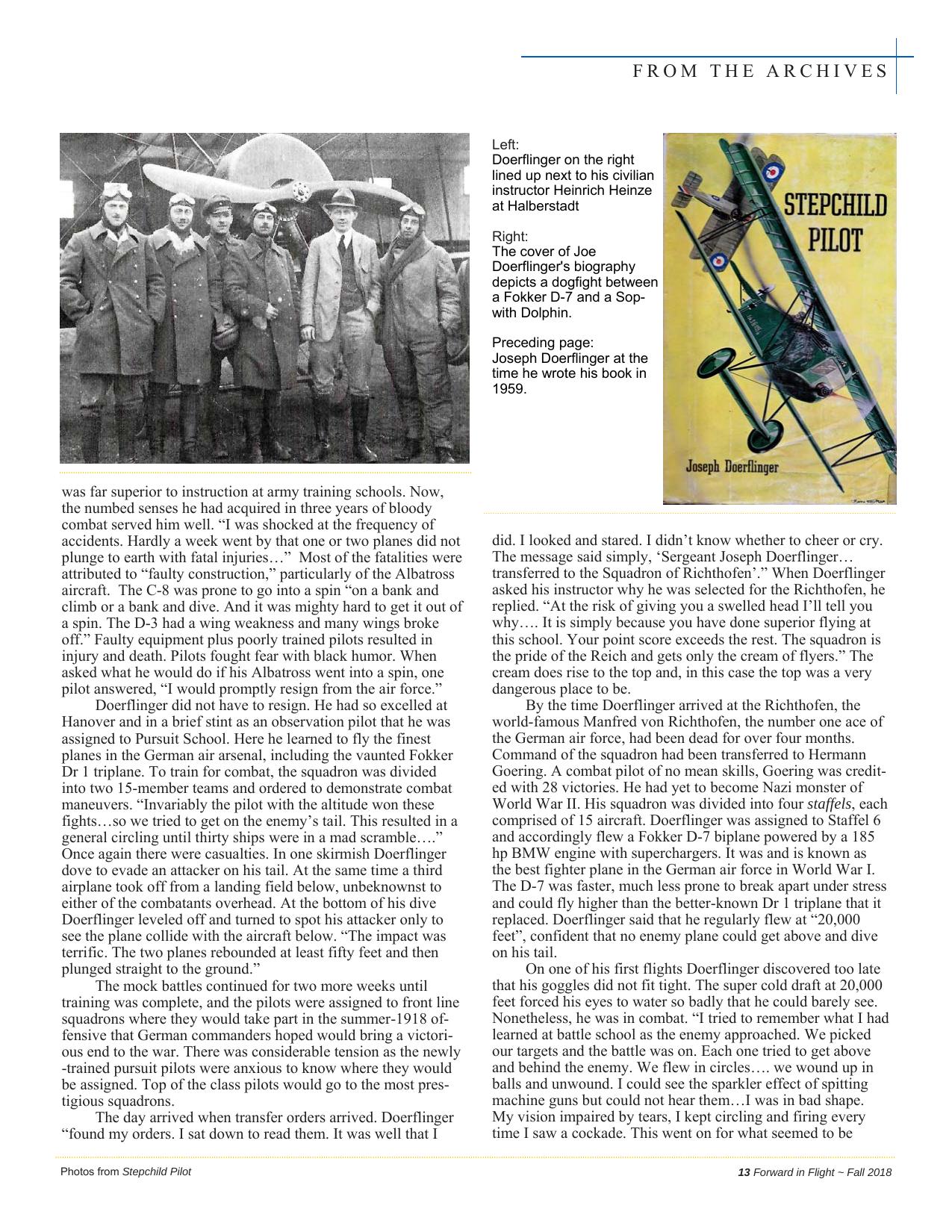
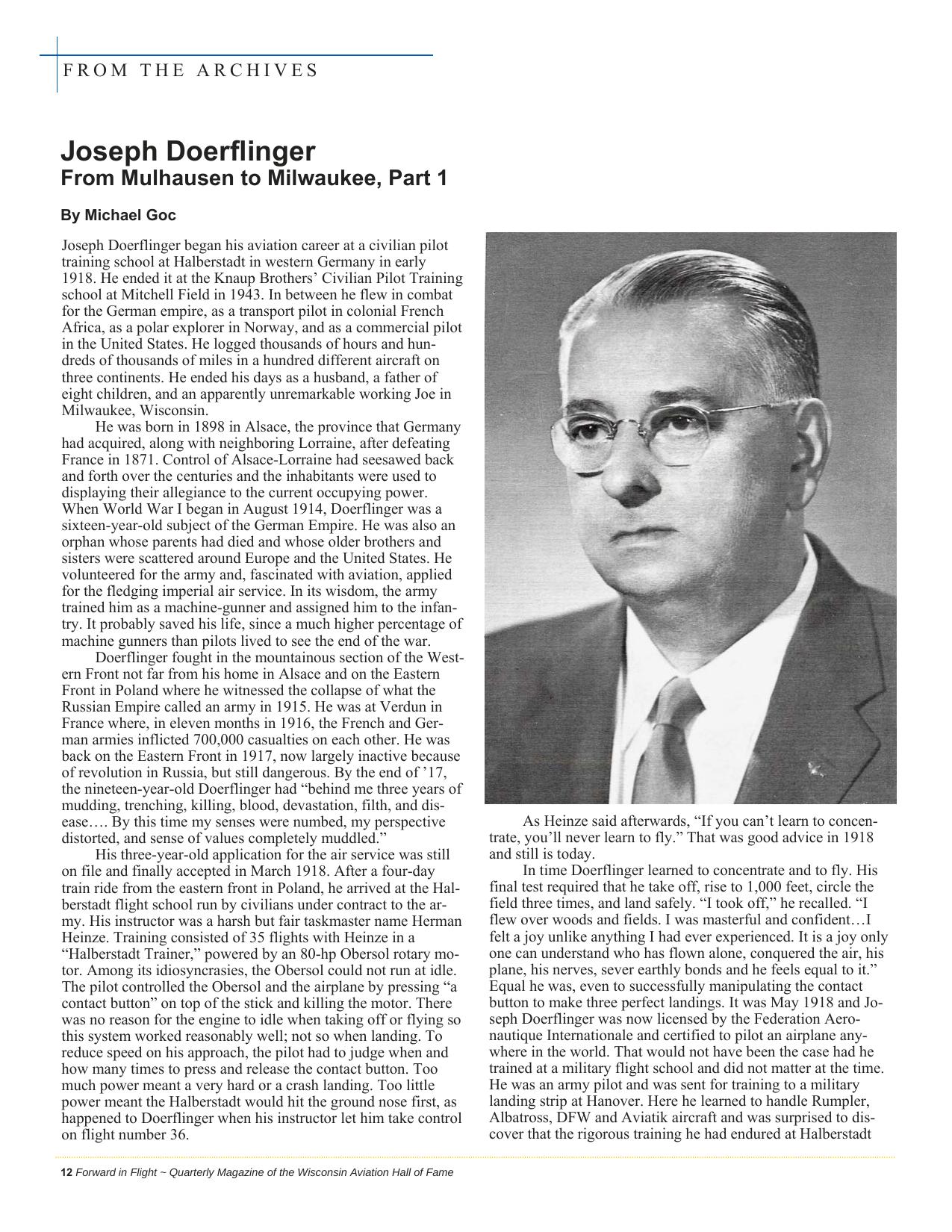
FROM THE ARCHIVES Left: Doerflinger on the right lined up next to his civilian instructor Heinrich Heinze at Halberstadt Right: The cover of Joe Doerflinger's biography depicts a dogfight between a Fokker D-7 and a Sopwith Dolphin. Preceding page: Joseph Doerflinger at the time he wrote his book in 1959. was far superior to instruction at army training schools. Now, the numbed senses he had acquired in three years of bloody combat served him well. “I was shocked at the frequency of accidents. Hardly a week went by that one or two planes did not plunge to earth with fatal injuries…” Most of the fatalities were attributed to “faulty construction,” particularly of the Albatross aircraft. The C-8 was prone to go into a spin “on a bank and climb or a bank and dive. And it was mighty hard to get it out of a spin. The D-3 had a wing weakness and many wings broke off.” Faulty equipment plus poorly trained pilots resulted in injury and death. Pilots fought fear with black humor. When asked what he would do if his Albatross went into a spin, one pilot answered, “I would promptly resign from the air force.” Doerflinger did not have to resign. He had so excelled at Hanover and in a brief stint as an observation pilot that he was assigned to Pursuit School. Here he learned to fly the finest planes in the German air arsenal, including the vaunted Fokker Dr 1 triplane. To train for combat, the squadron was divided into two 15-member teams and ordered to demonstrate combat maneuvers. “Invariably the pilot with the altitude won these fights…so we tried to get on the enemy’s tail. This resulted in a general circling until thirty ships were in a mad scramble….” Once again there were casualties. In one skirmish Doerflinger dove to evade an attacker on his tail. At the same time a third airplane took off from a landing field below, unbeknownst to either of the combatants overhead. At the bottom of his dive Doerflinger leveled off and turned to spot his attacker only to see the plane collide with the aircraft below. “The impact was terrific. The two planes rebounded at least fifty feet and then plunged straight to the ground.” The mock battles continued for two more weeks until training was complete, and the pilots were assigned to front line squadrons where they would take part in the summer-1918 offensive that German commanders hoped would bring a victorious end to the war. There was considerable tension as the newly -trained pursuit pilots were anxious to know where they would be assigned. Top of the class pilots would go to the most prestigious squadrons. The day arrived when transfer orders arrived. Doerflinger “found my orders. I sat down to read them. It was well that I Photos from Stepchild Pilot did. I looked and stared. I didn’t know whether to cheer or cry. The message said simply, ‘Sergeant Joseph Doerflinger… transferred to the Squadron of Richthofen’.” When Doerflinger asked his instructor why he was selected for the Richthofen, he replied. “At the risk of giving you a swelled head I’ll tell you why…. It is simply because you have done superior flying at this school. Your point score exceeds the rest. The squadron is the pride of the Reich and gets only the cream of flyers.” The cream does rise to the top and, in this case the top was a very dangerous place to be. By the time Doerflinger arrived at the Richthofen, the world-famous Manfred von Richthofen, the number one ace of the German air force, had been dead for over four months. Command of the squadron had been transferred to Hermann Goering. A combat pilot of no mean skills, Goering was credited with 28 victories. He had yet to become Nazi monster of World War II. His squadron was divided into four staffels, each comprised of 15 aircraft. Doerflinger was assigned to Staffel 6 and accordingly flew a Fokker D-7 biplane powered by a 185 hp BMW engine with superchargers. It was and is known as the best fighter plane in the German air force in World War I. The D-7 was faster, much less prone to break apart under stress and could fly higher than the better-known Dr 1 triplane that it replaced. Doerflinger said that he regularly flew at “20,000 feet”, confident that no enemy plane could get above and dive on his tail. On one of his first flights Doerflinger discovered too late that his goggles did not fit tight. The super cold draft at 20,000 feet forced his eyes to water so badly that he could barely see. Nonetheless, he was in combat. “I tried to remember what I had learned at battle school as the enemy approached. We picked our targets and the battle was on. Each one tried to get above and behind the enemy. We flew in circles…. we wound up in balls and unwound. I could see the sparkler effect of spitting machine guns but could not hear them…I was in bad shape. My vision impaired by tears, I kept circling and firing every time I saw a cockade. This went on for what seemed to be 13 Forward in Flight ~ Fall 2018
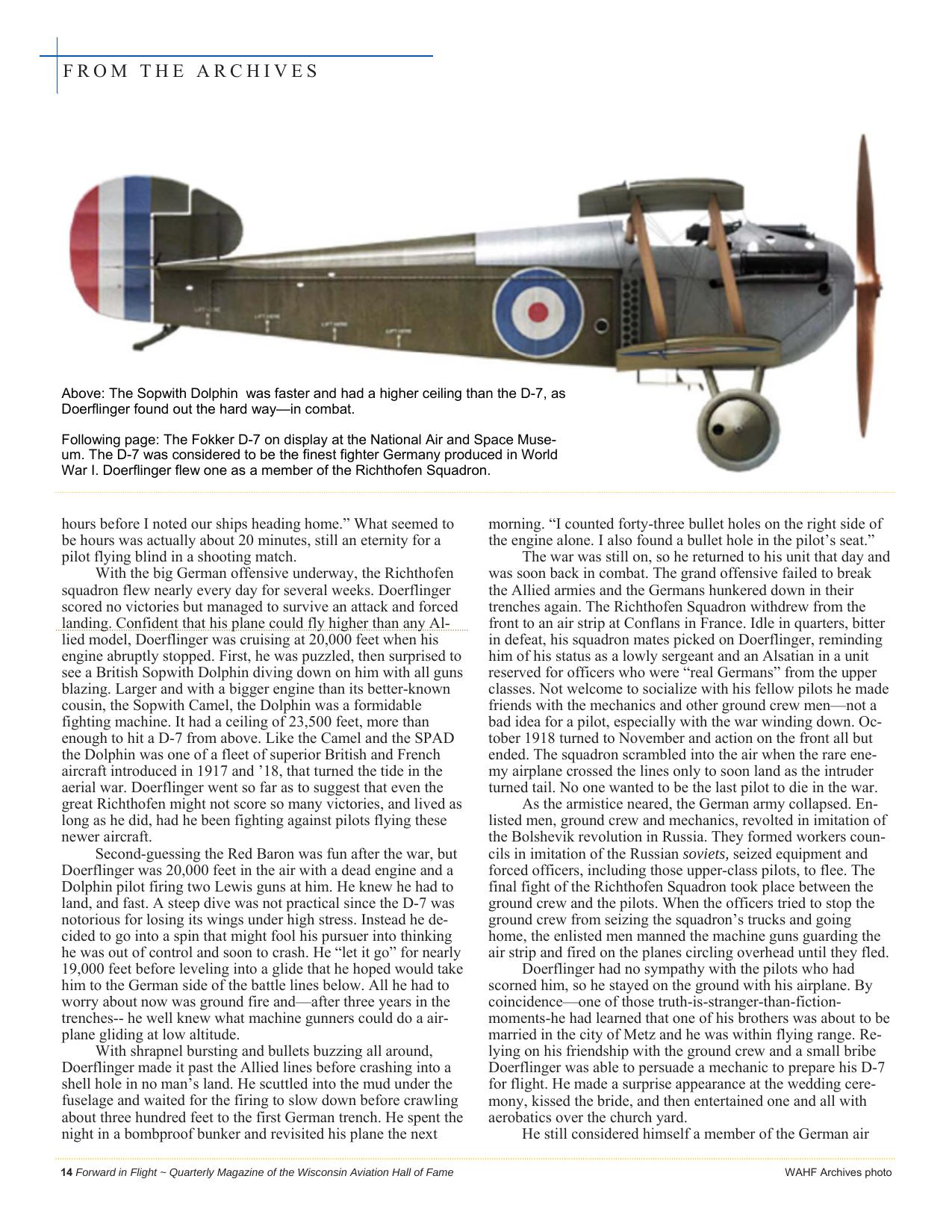
FROM THE ARCHIVES Above: The Sopwith Dolphin was faster and had a higher ceiling than the D-7, as Doerflinger found out the hard way—in combat. Following page: The Fokker D-7 on display at the National Air and Space Museum. The D-7 was considered to be the finest fighter Germany produced in World War I. Doerflinger flew one as a member of the Richthofen Squadron. hours before I noted our ships heading home.” What seemed to be hours was actually about 20 minutes, still an eternity for a pilot flying blind in a shooting match. With the big German offensive underway, the Richthofen squadron flew nearly every day for several weeks. Doerflinger scored no victories but managed to survive an attack and forced landing. Confident that his plane could fly higher than any Allied model, Doerflinger was cruising at 20,000 feet when his engine abruptly stopped. First, he was puzzled, then surprised to see a British Sopwith Dolphin diving down on him with all guns blazing. Larger and with a bigger engine than its better-known cousin, the Sopwith Camel, the Dolphin was a formidable fighting machine. It had a ceiling of 23,500 feet, more than enough to hit a D-7 from above. Like the Camel and the SPAD the Dolphin was one of a fleet of superior British and French aircraft introduced in 1917 and ’18, that turned the tide in the aerial war. Doerflinger went so far as to suggest that even the great Richthofen might not score so many victories, and lived as long as he did, had he been fighting against pilots flying these newer aircraft. Second-guessing the Red Baron was fun after the war, but Doerflinger was 20,000 feet in the air with a dead engine and a Dolphin pilot firing two Lewis guns at him. He knew he had to land, and fast. A steep dive was not practical since the D-7 was notorious for losing its wings under high stress. Instead he decided to go into a spin that might fool his pursuer into thinking he was out of control and soon to crash. He “let it go” for nearly 19,000 feet before leveling into a glide that he hoped would take him to the German side of the battle lines below. All he had to worry about now was ground fire and—after three years in the trenches-- he well knew what machine gunners could do a airplane gliding at low altitude. With shrapnel bursting and bullets buzzing all around, Doerflinger made it past the Allied lines before crashing into a shell hole in no man’s land. He scuttled into the mud under the fuselage and waited for the firing to slow down before crawling about three hundred feet to the first German trench. He spent the night in a bombproof bunker and revisited his plane the next 14 Forward in Flight ~ Quarterly Magazine of the Wisconsin Aviation Hall of Fame morning. “I counted forty-three bullet holes on the right side of the engine alone. I also found a bullet hole in the pilot’s seat.” The war was still on, so he returned to his unit that day and was soon back in combat. The grand offensive failed to break the Allied armies and the Germans hunkered down in their trenches again. The Richthofen Squadron withdrew from the front to an air strip at Conflans in France. Idle in quarters, bitter in defeat, his squadron mates picked on Doerflinger, reminding him of his status as a lowly sergeant and an Alsatian in a unit reserved for officers who were “real Germans” from the upper classes. Not welcome to socialize with his fellow pilots he made friends with the mechanics and other ground crew men—not a bad idea for a pilot, especially with the war winding down. October 1918 turned to November and action on the front all but ended. The squadron scrambled into the air when the rare enemy airplane crossed the lines only to soon land as the intruder turned tail. No one wanted to be the last pilot to die in the war. As the armistice neared, the German army collapsed. Enlisted men, ground crew and mechanics, revolted in imitation of the Bolshevik revolution in Russia. They formed workers councils in imitation of the Russian soviets, seized equipment and forced officers, including those upper-class pilots, to flee. The final fight of the Richthofen Squadron took place between the ground crew and the pilots. When the officers tried to stop the ground crew from seizing the squadron’s trucks and going home, the enlisted men manned the machine guns guarding the air strip and fired on the planes circling overhead until they fled. Doerflinger had no sympathy with the pilots who had scorned him, so he stayed on the ground with his airplane. By coincidence—one of those truth-is-stranger-than-fictionmoments-he had learned that one of his brothers was about to be married in the city of Metz and he was within flying range. Relying on his friendship with the ground crew and a small bribe Doerflinger was able to persuade a mechanic to prepare his D-7 for flight. He made a surprise appearance at the wedding ceremony, kissed the bride, and then entertained one and all with aerobatics over the church yard. He still considered himself a member of the German air WAHF Archives photo
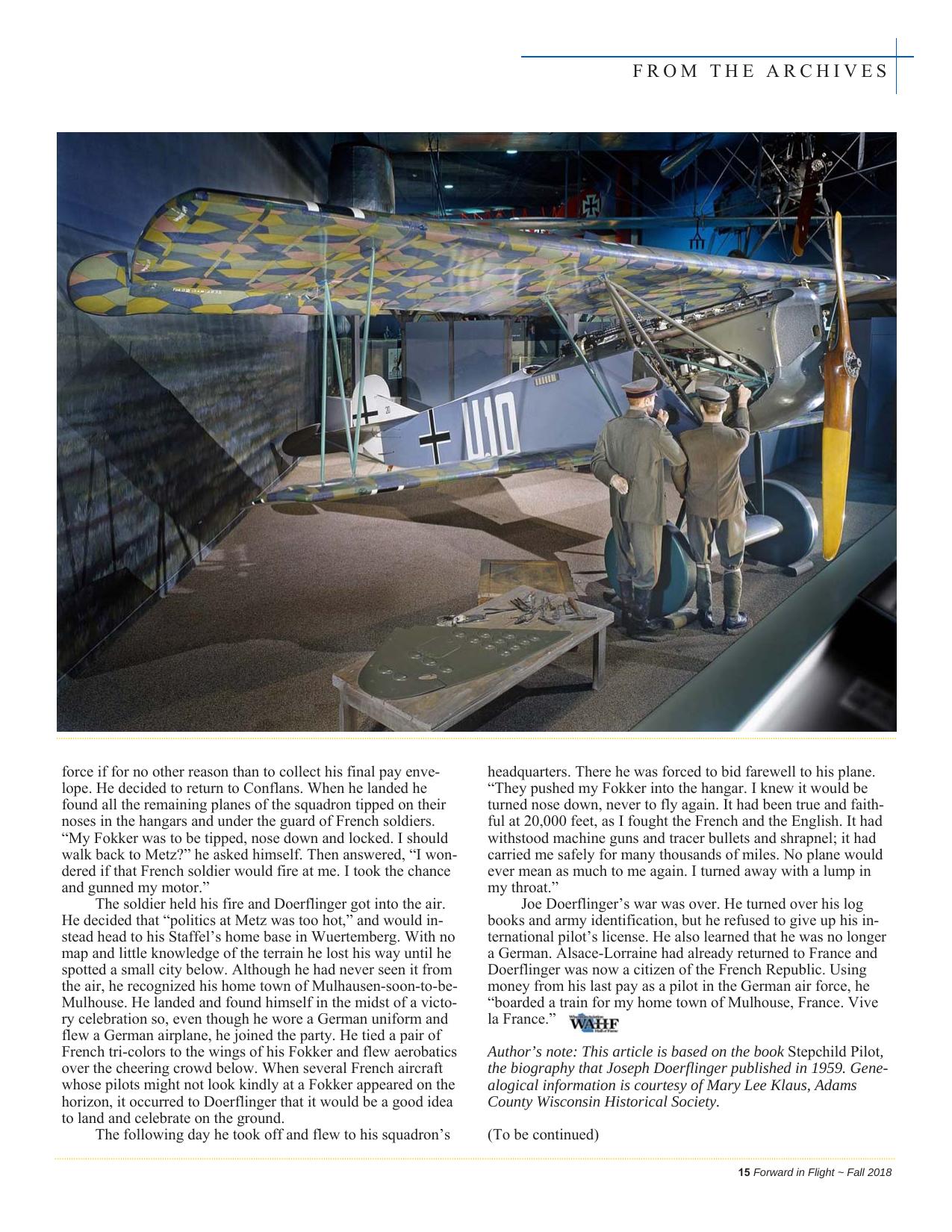
FROM THE ARCHIVES Les Smith and his Special Standard J-1, The Duster at Peninsula Park, 1926. force if for no other reason than to collect his final pay envelope. He decided to return to Conflans. When he landed he found all the remaining planes of the squadron tipped on their noses in the hangars and under the guard of French soldiers. “My Fokker was to be tipped, nose down and locked. I should walk back to Metz?” he asked himself. Then answered, “I wondered if that French soldier would fire at me. I took the chance and gunned my motor.” The soldier held his fire and Doerflinger got into the air. He decided that “politics at Metz was too hot,” and would instead head to his Staffel’s home base in Wuertemberg. With no map and little knowledge of the terrain he lost his way until he spotted a small city below. Although he had never seen it from the air, he recognized his home town of Mulhausen-soon-to-beMulhouse. He landed and found himself in the midst of a victory celebration so, even though he wore a German uniform and flew a German airplane, he joined the party. He tied a pair of French tri-colors to the wings of his Fokker and flew aerobatics over the cheering crowd below. When several French aircraft whose pilots might not look kindly at a Fokker appeared on the horizon, it occurred to Doerflinger that it would be a good idea to land and celebrate on the ground. The following day he took off and flew to his squadron’s headquarters. There he was forced to bid farewell to his plane. “They pushed my Fokker into the hangar. I knew it would be turned nose down, never to fly again. It had been true and faithful at 20,000 feet, as I fought the French and the English. It had withstood machine guns and tracer bullets and shrapnel; it had carried me safely for many thousands of miles. No plane would ever mean as much to me again. I turned away with a lump in my throat.” Joe Doerflinger’s war was over. He turned over his log books and army identification, but he refused to give up his international pilot’s license. He also learned that he was no longer a German. Alsace-Lorraine had already returned to France and Doerflinger was now a citizen of the French Republic. Using money from his last pay as a pilot in the German air force, he “boarded a train for my home town of Mulhouse, France. Vive la France.” Author’s note: This article is based on the book Stepchild Pilot, the biography that Joseph Doerflinger published in 1959. Genealogical information is courtesy of Mary Lee Klaus, Adams County Wisconsin Historical Society. (To be continued) 15 Forward in Flight ~ Fall 2018
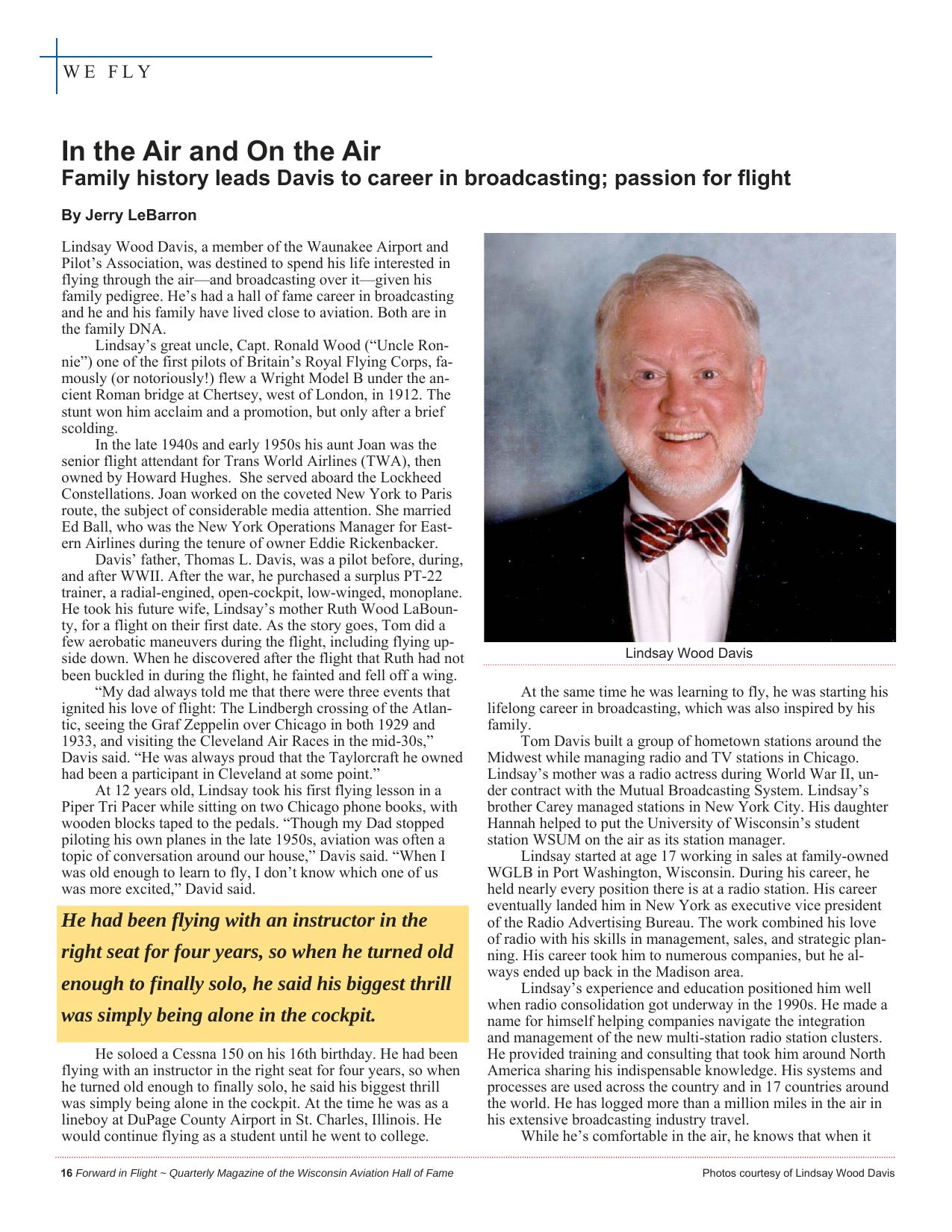
WE FLY In the Air and On the Air Family history leads Davis to career in broadcasting; passion for flight By Jerry LeBarron Lindsay Wood Davis, a member of the Waunakee Airport and Pilot’s Association, was destined to spend his life interested in flying through the air—and broadcasting over it—given his family pedigree. He’s had a hall of fame career in broadcasting and he and his family have lived close to aviation. Both are in the family DNA. Lindsay’s great uncle, Capt. Ronald Wood (“Uncle Ronnie”) one of the first pilots of Britain’s Royal Flying Corps, famously (or notoriously!) flew a Wright Model B under the ancient Roman bridge at Chertsey, west of London, in 1912. The stunt won him acclaim and a promotion, but only after a brief scolding. In the late 1940s and early 1950s his aunt Joan was the senior flight attendant for Trans World Airlines (TWA), then owned by Howard Hughes. She served aboard the Lockheed Constellations. Joan worked on the coveted New York to Paris route, the subject of considerable media attention. She married Ed Ball, who was the New York Operations Manager for Eastern Airlines during the tenure of owner Eddie Rickenbacker. Davis’ father, Thomas L. Davis, was a pilot before, during, and after WWII. After the war, he purchased a surplus PT-22 trainer, a radial-engined, open-cockpit, low-winged, monoplane. He took his future wife, Lindsay’s mother Ruth Wood LaBounty, for a flight on their first date. As the story goes, Tom did a few aerobatic maneuvers during the flight, including flying upside down. When he discovered after the flight that Ruth had not been buckled in during the flight, he fainted and fell off a wing. “My dad always told me that there were three events that ignited his love of flight: The Lindbergh crossing of the Atlantic, seeing the Graf Zeppelin over Chicago in both 1929 and 1933, and visiting the Cleveland Air Races in the mid-30s,” Davis said. “He was always proud that the Taylorcraft he owned had been a participant in Cleveland at some point.” At 12 years old, Lindsay took his first flying lesson in a Piper Tri Pacer while sitting on two Chicago phone books, with wooden blocks taped to the pedals. “Though my Dad stopped piloting his own planes in the late 1950s, aviation was often a topic of conversation around our house,” Davis said. “When I was old enough to learn to fly, I don’t know which one of us was more excited,” David said. Lindsay Wood Davis He soloed a Cessna 150 on his 16th birthday. He had been flying with an instructor in the right seat for four years, so when he turned old enough to finally solo, he said his biggest thrill was simply being alone in the cockpit. At the time he was as a lineboy at DuPage County Airport in St. Charles, Illinois. He would continue flying as a student until he went to college. At the same time he was learning to fly, he was starting his lifelong career in broadcasting, which was also inspired by his family. Tom Davis built a group of hometown stations around the Midwest while managing radio and TV stations in Chicago. Lindsay’s mother was a radio actress during World War II, under contract with the Mutual Broadcasting System. Lindsay’s brother Carey managed stations in New York City. His daughter Hannah helped to put the University of Wisconsin’s student station WSUM on the air as its station manager. Lindsay started at age 17 working in sales at family-owned WGLB in Port Washington, Wisconsin. During his career, he held nearly every position there is at a radio station. His career eventually landed him in New York as executive vice president of the Radio Advertising Bureau. The work combined his love of radio with his skills in management, sales, and strategic planning. His career took him to numerous companies, but he always ended up back in the Madison area. Lindsay’s experience and education positioned him well when radio consolidation got underway in the 1990s. He made a name for himself helping companies navigate the integration and management of the new multi-station radio station clusters. He provided training and consulting that took him around North America sharing his indispensable knowledge. His systems and processes are used across the country and in 17 countries around the world. He has logged more than a million miles in the air in his extensive broadcasting industry travel. While he’s comfortable in the air, he knows that when it 16 Forward in Flight ~ Quarterly Magazine of the Wisconsin Aviation Hall of Fame Photos courtesy of Lindsay Wood Davis He had been flying with an instructor in the right seat for four years, so when he turned old enough to finally solo, he said his biggest thrill was simply being alone in the cockpit.
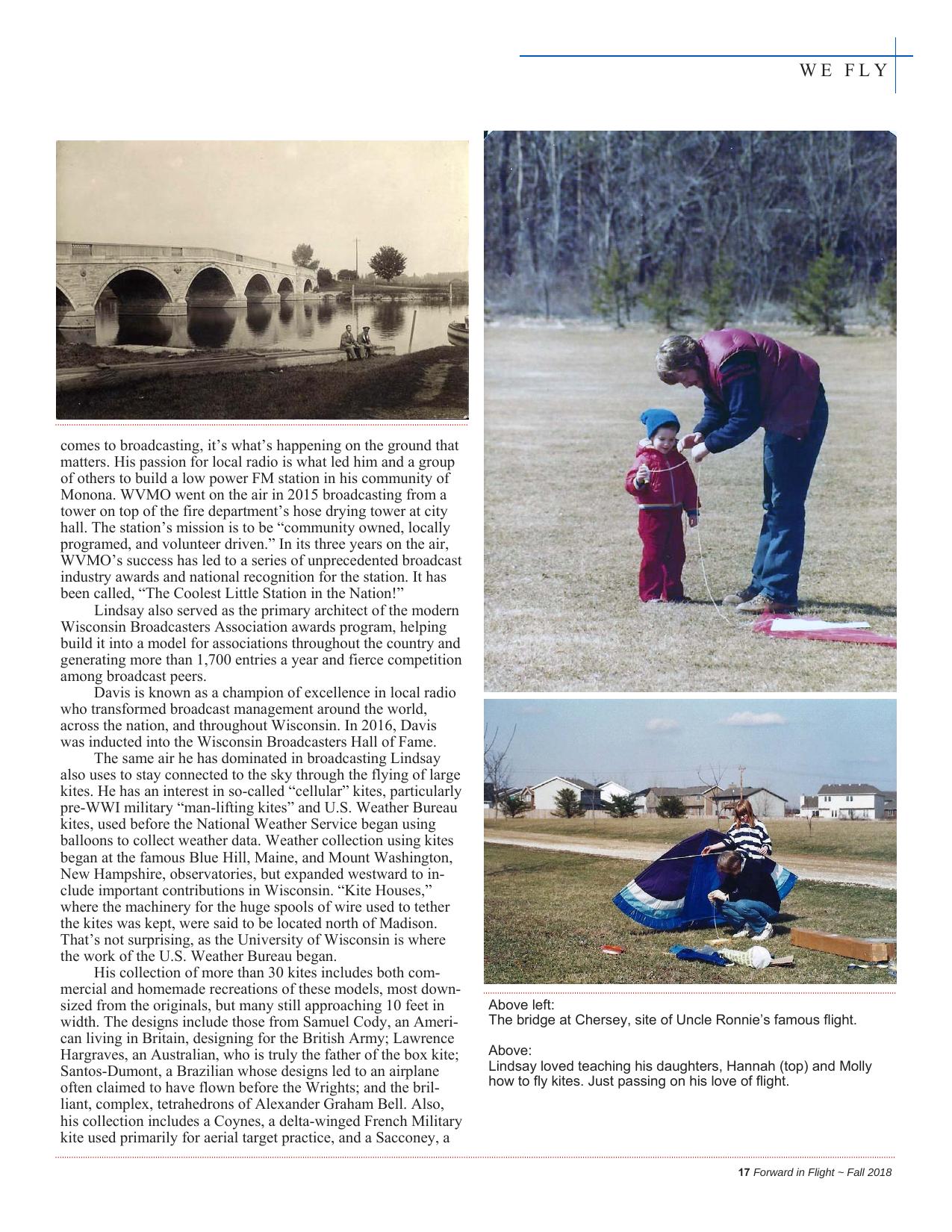
WE FLY comes to broadcasting, it’s what’s happening on the ground that matters. His passion for local radio is what led him and a group of others to build a low power FM station in his community of Monona. WVMO went on the air in 2015 broadcasting from a tower on top of the fire department’s hose drying tower at city hall. The station’s mission is to be “community owned, locally programed, and volunteer driven.” In its three years on the air, WVMO’s success has led to a series of unprecedented broadcast industry awards and national recognition for the station. It has been called, “The Coolest Little Station in the Nation!” Lindsay also served as the primary architect of the modern Wisconsin Broadcasters Association awards program, helping build it into a model for associations throughout the country and generating more than 1,700 entries a year and fierce competition among broadcast peers. Davis is known as a champion of excellence in local radio who transformed broadcast management around the world, across the nation, and throughout Wisconsin. In 2016, Davis was inducted into the Wisconsin Broadcasters Hall of Fame. The same air he has dominated in broadcasting Lindsay also uses to stay connected to the sky through the flying of large kites. He has an interest in so-called “cellular” kites, particularly pre-WWI military “man-lifting kites” and U.S. Weather Bureau kites, used before the National Weather Service began using balloons to collect weather data. Weather collection using kites began at the famous Blue Hill, Maine, and Mount Washington, New Hampshire, observatories, but expanded westward to include important contributions in Wisconsin. “Kite Houses,” where the machinery for the huge spools of wire used to tether the kites was kept, were said to be located north of Madison. That’s not surprising, as the University of Wisconsin is where the work of the U.S. Weather Bureau began. His collection of more than 30 kites includes both commercial and homemade recreations of these models, most downsized from the originals, but many still approaching 10 feet in width. The designs include those from Samuel Cody, an American living in Britain, designing for the British Army; Lawrence Hargraves, an Australian, who is truly the father of the box kite; Santos-Dumont, a Brazilian whose designs led to an airplane often claimed to have flown before the Wrights; and the brilliant, complex, tetrahedrons of Alexander Graham Bell. Also, his collection includes a Coynes, a delta-winged French Military kite used primarily for aerial target practice, and a Sacconey, a Above left: The bridge at Chersey, site of Uncle Ronnie’s famous flight. Above: Lindsay loved teaching his daughters, Hannah (top) and Molly how to fly kites. Just passing on his love of flight. 17 Forward in Flight ~ Fall 2018
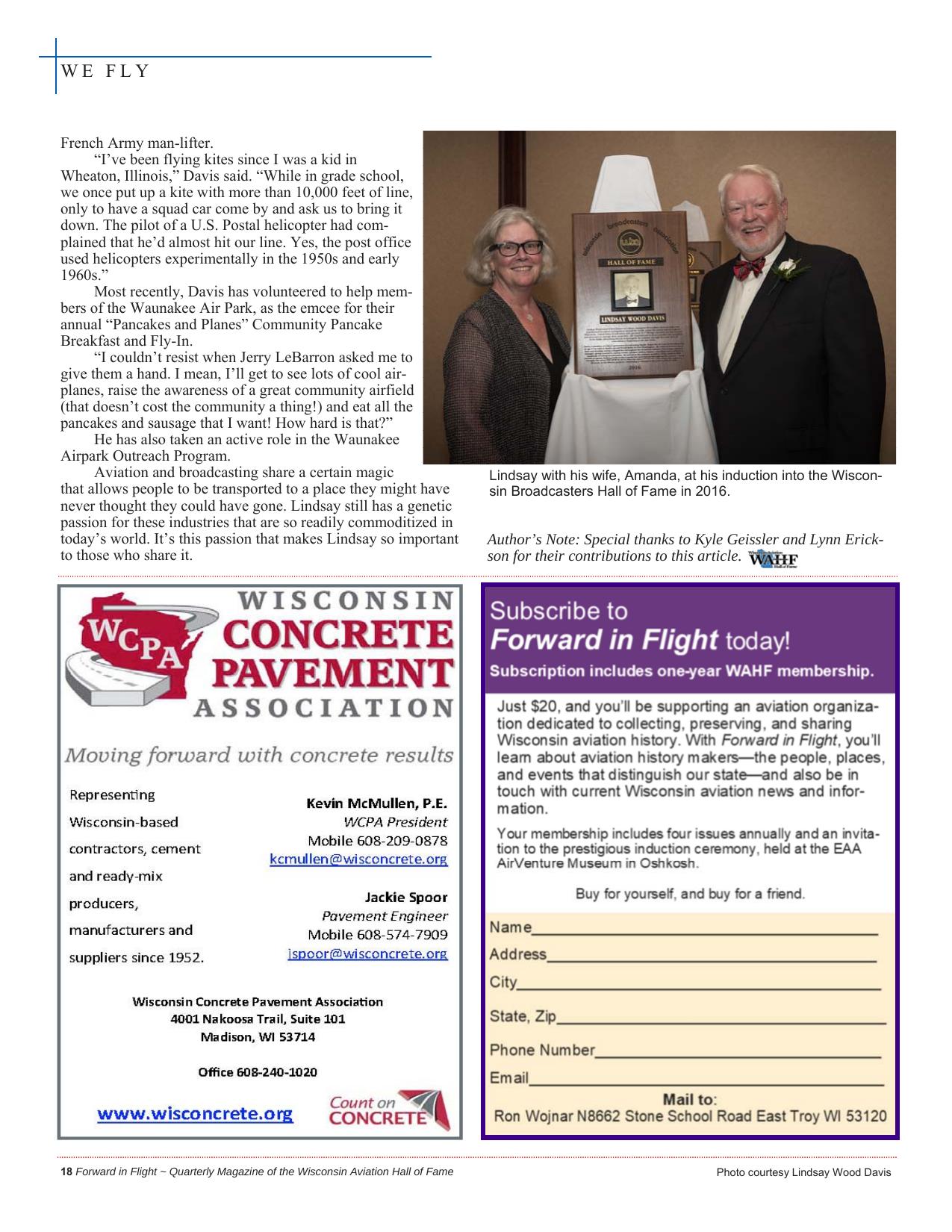
WE FLY French Army man-lifter. “I’ve been flying kites since I was a kid in Wheaton, Illinois,” Davis said. “While in grade school, we once put up a kite with more than 10,000 feet of line, only to have a squad car come by and ask us to bring it down. The pilot of a U.S. Postal helicopter had complained that he’d almost hit our line. Yes, the post office used helicopters experimentally in the 1950s and early 1960s.” Most recently, Davis has volunteered to help members of the Waunakee Air Park, as the emcee for their annual “Pancakes and Planes” Community Pancake Breakfast and Fly-In. “I couldn’t resist when Jerry LeBarron asked me to give them a hand. I mean, I’ll get to see lots of cool airplanes, raise the awareness of a great community airfield (that doesn’t cost the community a thing!) and eat all the pancakes and sausage that I want! How hard is that?” He has also taken an active role in the Waunakee Airpark Outreach Program. Aviation and broadcasting share a certain magic that allows people to be transported to a place they might have never thought they could have gone. Lindsay still has a genetic passion for these industries that are so readily commoditized in today’s world. It’s this passion that makes Lindsay so important to those who share it. Author’s Note: Special thanks to Kyle Geissler and Lynn Erickson for their contributions to this article. 18 Forward in Flight ~ Quarterly Magazine of the Wisconsin Aviation Hall of Fame Photo courtesy Lindsay Wood Davis Lindsay with his wife, Amanda, at his induction into the Wisconsin Broadcasters Hall of Fame in 2016.
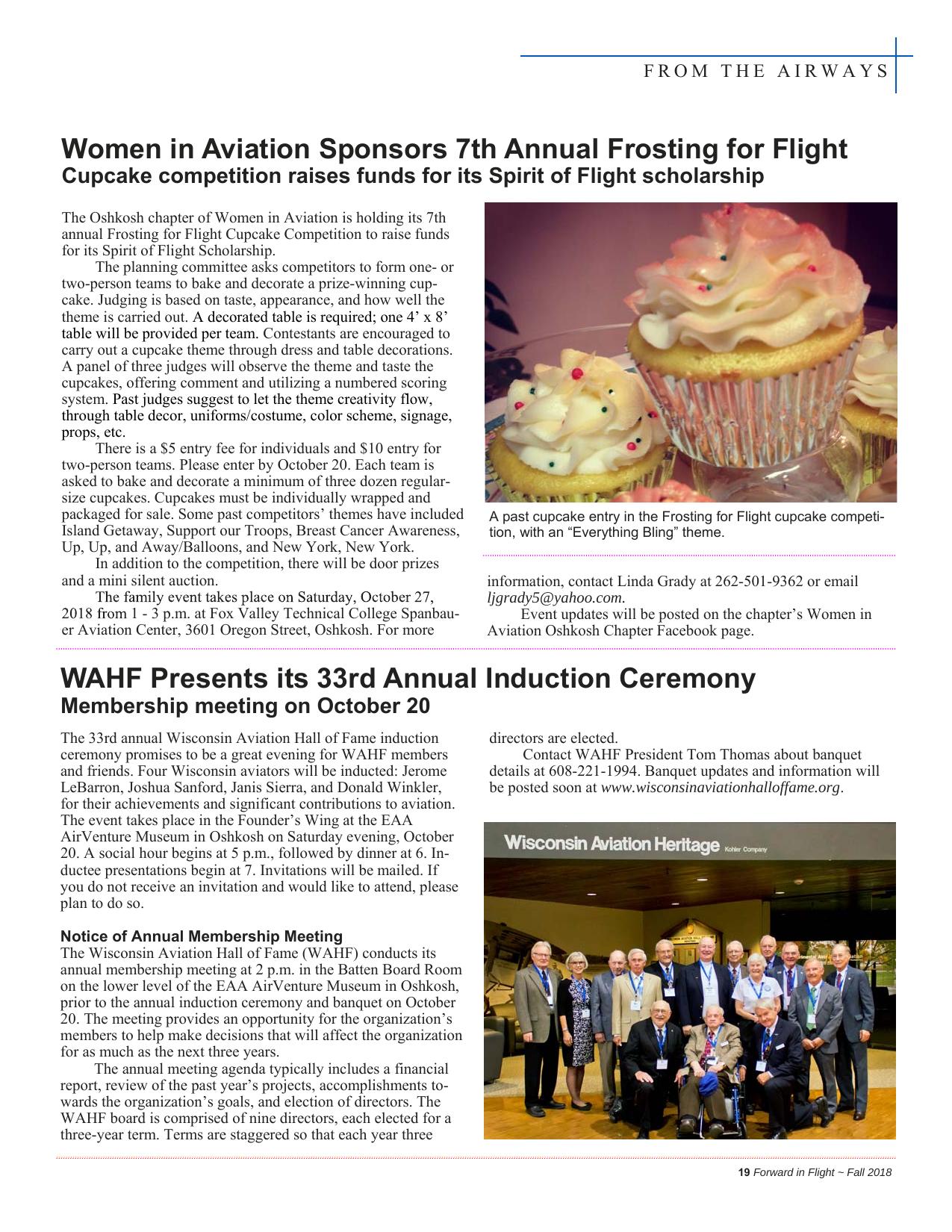
FROM THE AIRWAYS Women in Aviation Sponsors 7th Annual Frosting for Flight Cupcake competition raises funds for its Spirit of Flight scholarship The Oshkosh chapter of Women in Aviation is holding its 7th annual Frosting for Flight Cupcake Competition to raise funds for its Spirit of Flight Scholarship. The planning committee asks competitors to form one- or two-person teams to bake and decorate a prize-winning cupcake. Judging is based on taste, appearance, and how well the theme is carried out. A decorated table is required; one 4’ x 8’ table will be provided per team. Contestants are encouraged to carry out a cupcake theme through dress and table decorations. A panel of three judges will observe the theme and taste the cupcakes, offering comment and utilizing a numbered scoring system. Past judges suggest to let the theme creativity flow, through table decor, uniforms/costume, color scheme, signage, props, etc. There is a $5 entry fee for individuals and $10 entry for two-person teams. Please enter by October 20. Each team is asked to bake and decorate a minimum of three dozen regularsize cupcakes. Cupcakes must be individually wrapped and packaged for sale. Some past competitors’ themes have included Island Getaway, Support our Troops, Breast Cancer Awareness, Up, Up, and Away/Balloons, and New York, New York. In addition to the competition, there will be door prizes and a mini silent auction. 1 - 3 p.m. at Fox Valley Technical College Spanbauer Aviation Center, 3601 Oregon Street, Oshkosh. For more A past cupcake entry in the Frosting for Flight cupcake competition, with an “Everything Bling” theme. information, contact Linda Grady at 262-501-9362 or email ljgrady5@yahoo.com. Event updates will be posted on the chapter’s Women in Aviation Oshkosh Chapter Facebook page. WAHF Presents its 33rd Annual Induction Ceremony Membership meeting on October 20 The 33rd annual Wisconsin Aviation Hall of Fame induction ceremony promises to be a great evening for WAHF members and friends. Four Wisconsin aviators will be inducted: Jerome LeBarron, Joshua Sanford, Janis Sierra, and Donald Winkler, for their achievements and significant contributions to aviation. The event takes place in the Founder’s Wing at the EAA AirVenture Museum in Oshkosh on Saturday evening, October 20. A social hour begins at 5 p.m., followed by dinner at 6. Inductee presentations begin at 7. Invitations will be mailed. If you do not receive an invitation and would like to attend, please plan to do so. directors are elected. Contact WAHF President Tom Thomas about banquet details at 608-221-1994. Banquet updates and information will be posted soon at www.wisconsinaviationhalloffame.org. Notice of Annual Membership Meeting The Wisconsin Aviation Hall of Fame (WAHF) conducts its annual membership meeting at 2 p.m. in the Batten Board Room on the lower level of the EAA AirVenture Museum in Oshkosh, prior to the annual induction ceremony and banquet on October 20. The meeting provides an opportunity for the organization’s members to help make decisions that will affect the organization for as much as the next three years. The annual meeting agenda typically includes a financial report, review of the past year’s projects, accomplishments towards the organization’s goals, and election of directors. The WAHF board is comprised of nine directors, each elected for a three-year term. Terms are staggered so that each year three 19 Forward in Flight ~ Fall 2018
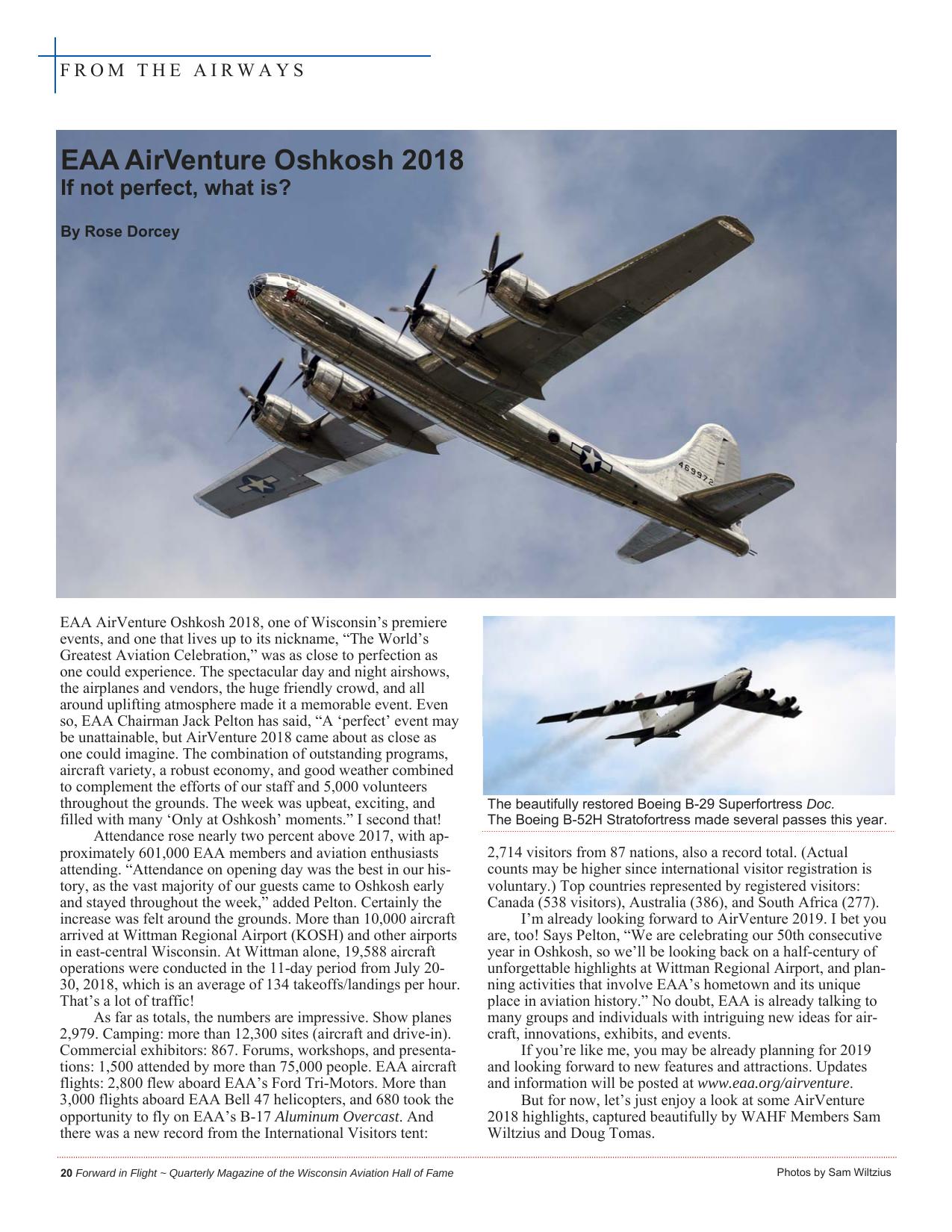
FROM THE AIRWAYS EAA AirVenture Oshkosh 2018 If not perfect, what is? By Rose Dorcey EAA AirVenture Oshkosh 2018, one of Wisconsin’s premiere events, and one that lives up to its nickname, “The World’s Greatest Aviation Celebration,” was as close to perfection as one could experience. The spectacular day and night airshows, the airplanes and vendors, the huge friendly crowd, and all around uplifting atmosphere made it a memorable event. Even so, EAA Chairman Jack Pelton has said, “A ‘perfect’ event may be unattainable, but AirVenture 2018 came about as close as one could imagine. The combination of outstanding programs, aircraft variety, a robust economy, and good weather combined to complement the efforts of our staff and 5,000 volunteers throughout the grounds. The week was upbeat, exciting, and filled with many ‘Only at Oshkosh’ moments.” I second that! Attendance rose nearly two percent above 2017, with approximately 601,000 EAA members and aviation enthusiasts attending. “Attendance on opening day was the best in our history, as the vast majority of our guests came to Oshkosh early and stayed throughout the week,” added Pelton. Certainly the increase was felt around the grounds. More than 10,000 aircraft arrived at Wittman Regional Airport (KOSH) and other airports in east-central Wisconsin. At Wittman alone, 19,588 aircraft operations were conducted in the 11-day period from July 2030, 2018, which is an average of 134 takeoffs/landings per hour. That’s a lot of traffic! As far as totals, the numbers are impressive. Show planes 2,979. Camping: more than 12,300 sites (aircraft and drive-in). Commercial exhibitors: 867. Forums, workshops, and presentations: 1,500 attended by more than 75,000 people. EAA aircraft flights: 2,800 flew aboard EAA’s Ford Tri-Motors. More than 3,000 flights aboard EAA Bell 47 helicopters, and 680 took the opportunity to fly on EAA’s B-17 Aluminum Overcast. And there was a new record from the International Visitors tent: 2,714 visitors from 87 nations, also a record total. (Actual counts may be higher since international visitor registration is voluntary.) Top countries represented by registered visitors: Canada (538 visitors), Australia (386), and South Africa (277). I’m already looking forward to AirVenture 2019. I bet you are, too! Says Pelton, “We are celebrating our 50th consecutive year in Oshkosh, so we’ll be looking back on a half-century of unforgettable highlights at Wittman Regional Airport, and planning activities that involve EAA’s hometown and its unique place in aviation history.” No doubt, EAA is already talking to many groups and individuals with intriguing new ideas for aircraft, innovations, exhibits, and events. If you’re like me, you may be already planning for 2019 and looking forward to new features and attractions. Updates and information will be posted at www.eaa.org/airventure. But for now, let’s just enjoy a look at some AirVenture 2018 highlights, captured beautifully by WAHF Members Sam Wiltzius and Doug Tomas. 20 Forward in Flight ~ Quarterly Magazine of the Wisconsin Aviation Hall of Fame Photos by Sam Wiltzius The beautifully restored Boeing B-29 Superfortress Doc. The Boeing B-52H Stratofortress made several passes this year.
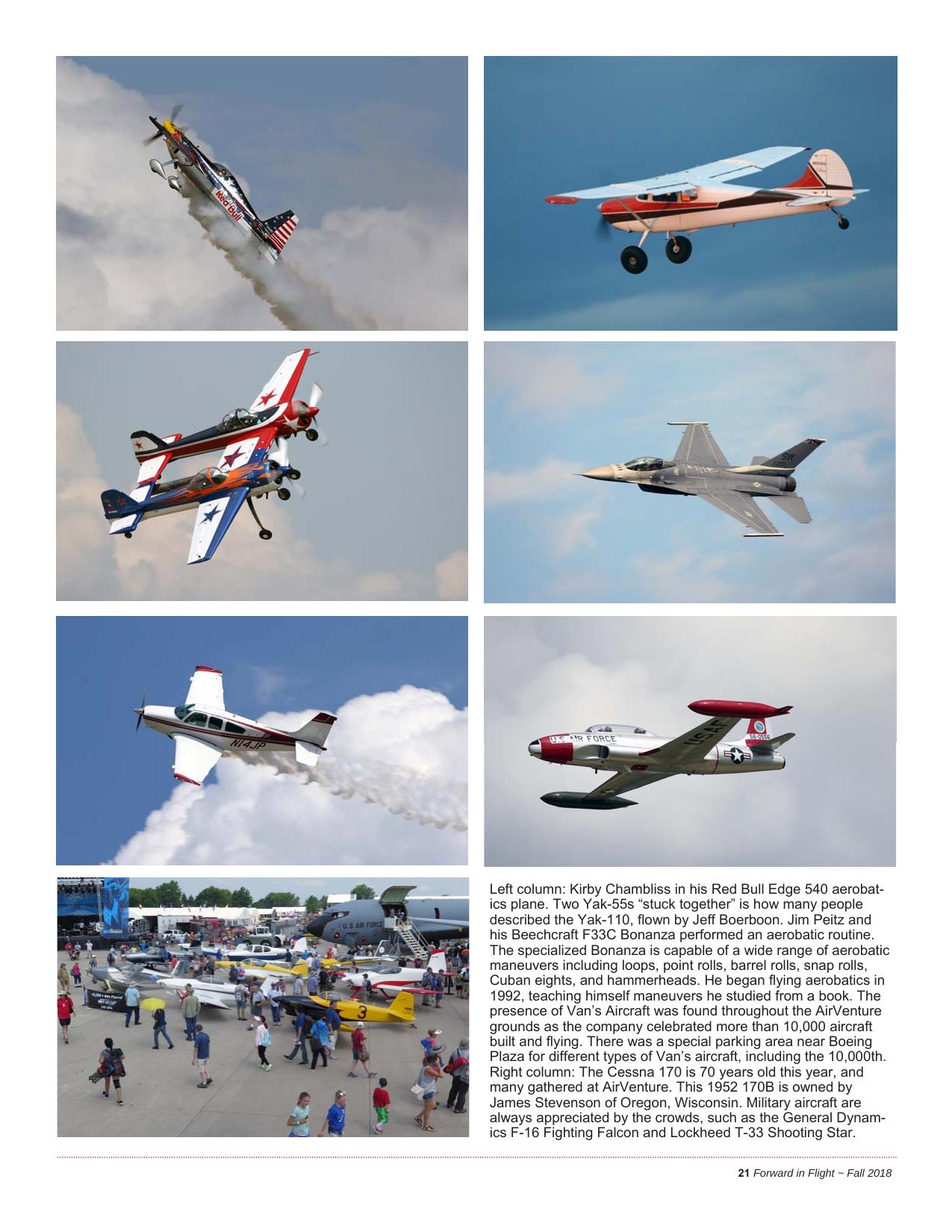
Left column: Kirby Chambliss in his Red Bull Edge 540 aerobatics plane. Two Yak-55s “stuck together” is how many people described the Yak-110, flown by Jeff Boerboon. Jim Peitz and his Beechcraft F33C Bonanza performed an aerobatic routine. The specialized Bonanza is capable of a wide range of aerobatic maneuvers including loops, point rolls, barrel rolls, snap rolls, Cuban eights, and hammerheads. He began flying aerobatics in 1992, teaching himself maneuvers he studied from a book. The presence of Van’s Aircraft was found throughout the AirVenture grounds as the company celebrated more than 10,000 aircraft built and flying. There was a special parking area near Boeing Plaza for different types of Van’s aircraft, including the 10,000th. Right column: The Cessna 170 is 70 years old this year, and many gathered at AirVenture. This 1952 170B is owned by James Stevenson of Oregon, Wisconsin. Military aircraft are always appreciated by the crowds, such as the General Dynamics F-16 Fighting Falcon and Lockheed T-33 Shooting Star. 21 Forward in Flight ~ Fall 2018
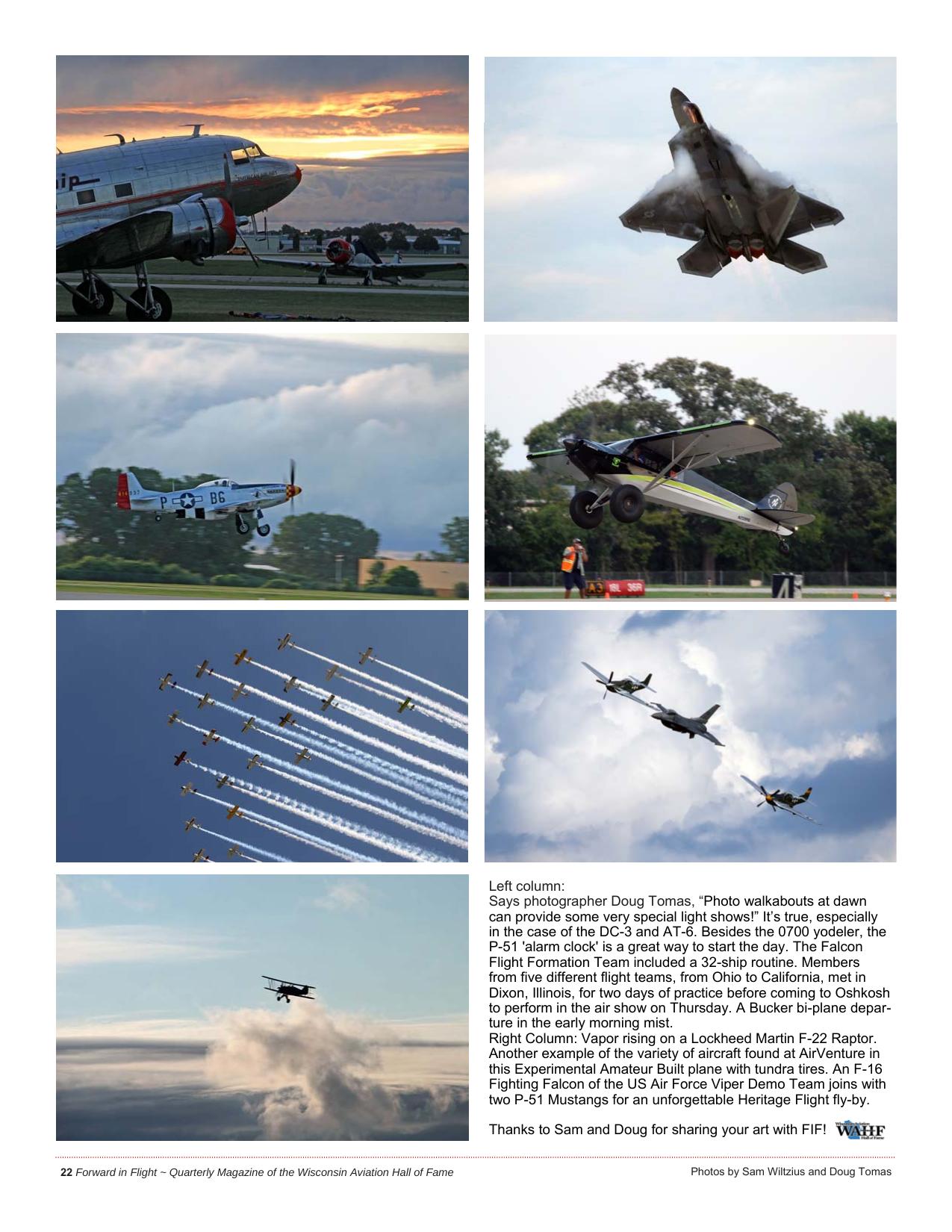
Left column: Says photographer Doug Tomas, “Photo walkabouts at dawn can provide some very special light shows!” It’s true, especially in the case of the DC-3 and AT-6. Besides the 0700 yodeler, the P-51 'alarm clock' is a great way to start the day. The Falcon Flight Formation Team included a 32-ship routine. Members from five different flight teams, from Ohio to California, met in Dixon, Illinois, for two days of practice before coming to Oshkosh to perform in the air show on Thursday. A Bucker bi-plane departure in the early morning mist. Right Column: Vapor rising on a Lockheed Martin F-22 Raptor. Another example of the variety of aircraft found at AirVenture in this Experimental Amateur Built plane with tundra tires. An F-16 Fighting Falcon of the US Air Force Viper Demo Team joins with two P-51 Mustangs for an unforgettable Heritage Flight fly-by. Thanks to Sam and Doug for sharing your art with FIF! 22 Forward in Flight ~ Quarterly Magazine of the Wisconsin Aviation Hall of Fame Photos by Sam Wiltzius and Doug Tomas
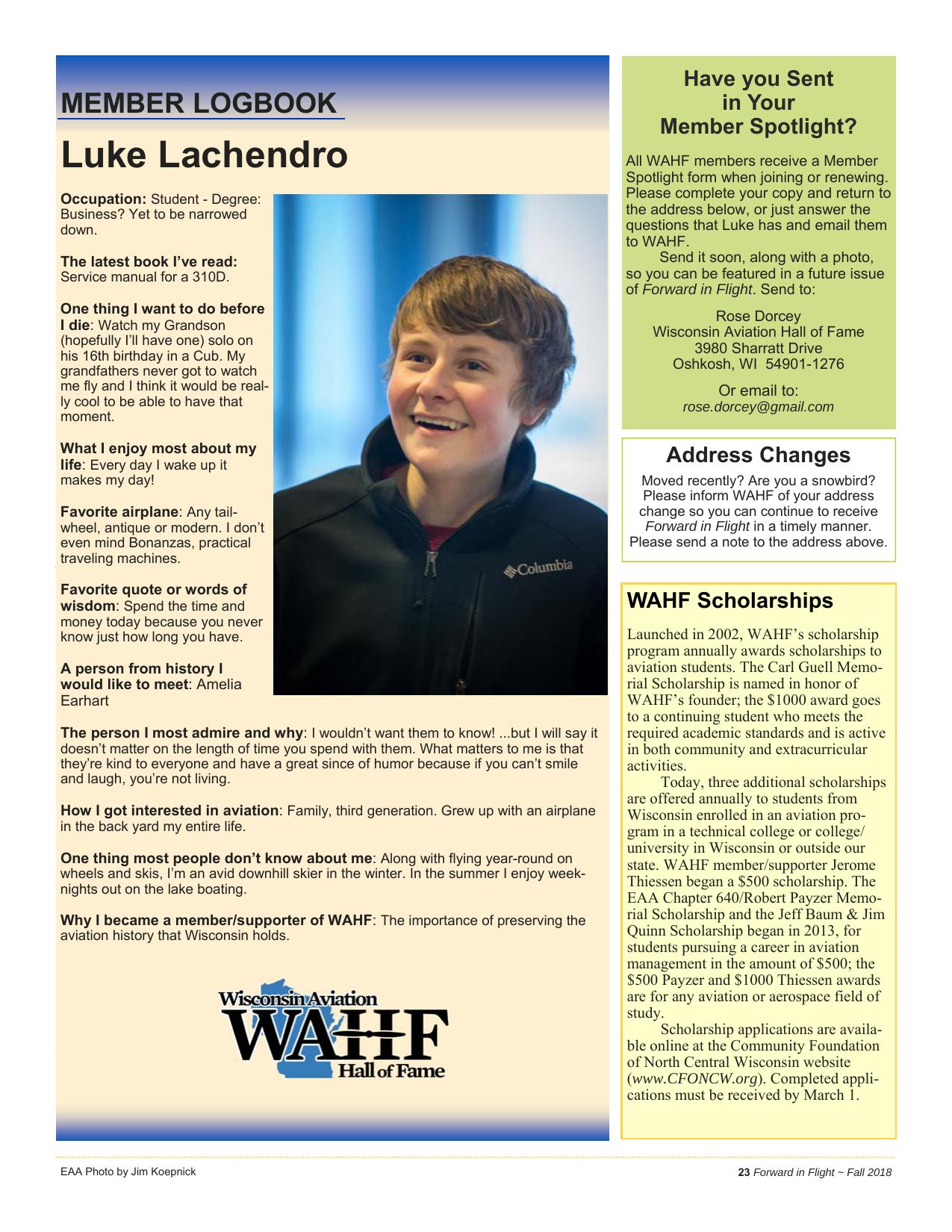
MEMBER LOGBOOK Luke Lachendro Occupation: Student - Degree: Business? Yet to be narrowed down. The latest book I’ve read: Service manual for a 310D. One thing I want to do before I die: Watch my Grandson (hopefully I’ll have one) solo on his 16th birthday in a Cub. My grandfathers never got to watch me fly and I think it would be really cool to be able to have that moment. Have you Sent in Your Member Spotlight? All WAHF members receive a Member Spotlight form when joining or renewing. Please complete your copy and return to the address below, or just answer the questions that Luke has and email them to WAHF. Send it soon, along with a photo, so you can be featured in a future issue of Forward in Flight. Send to: Rose Dorcey Wisconsin Aviation Hall of Fame 3980 Sharratt Drive Oshkosh, WI 54901-1276 Or email to: rose.dorcey@gmail.com What I enjoy most about my life: Every day I wake up it Address Changes Favorite airplane: Any tail- Moved recently? Are you a snowbird? Please inform WAHF of your address change so you can continue to receive Forward in Flight in a timely manner. Please send a note to the address above. Favorite quote or words of wisdom: Spend the time and WAHF Scholarships makes my day! wheel, antique or modern. I don’t even mind Bonanzas, practical traveling machines. money today because you never know just how long you have. A person from history I would like to meet: Amelia Earhart The person I most admire and why: I wouldn’t want them to know! ...but I will say it doesn’t matter on the length of time you spend with them. What matters to me is that they’re kind to everyone and have a great since of humor because if you can’t smile and laugh, you’re not living. How I got interested in aviation: Family, third generation. Grew up with an airplane in the back yard my entire life. One thing most people don’t know about me: Along with flying year-round on wheels and skis, I’m an avid downhill skier in the winter. In the summer I enjoy weeknights out on the lake boating. Why I became a member/supporter of WAHF: The importance of preserving the aviation history that Wisconsin holds. EAA Photo by Jim Koepnick Launched in 2002, WAHF’s scholarship program annually awards scholarships to aviation students. The Carl Guell Memorial Scholarship is named in honor of WAHF’s founder; the $1000 award goes to a continuing student who meets the required academic standards and is active in both community and extracurricular activities. Today, three additional scholarships are offered annually to students from Wisconsin enrolled in an aviation program in a technical college or college/ university in Wisconsin or outside our state. WAHF member/supporter Jerome Thiessen began a $500 scholarship. The EAA Chapter 640/Robert Payzer Memorial Scholarship and the Jeff Baum & Jim Quinn Scholarship began in 2013, for students pursuing a career in aviation management in the amount of $500; the $500 Payzer and $1000 Thiessen awards are for any aviation or aerospace field of study. Scholarship applications are available online at the Community Foundation of North Central Wisconsin website (www.CFONCW.org). Completed applications must be received by March 1. 23 Forward in Flight ~ Fall 2018
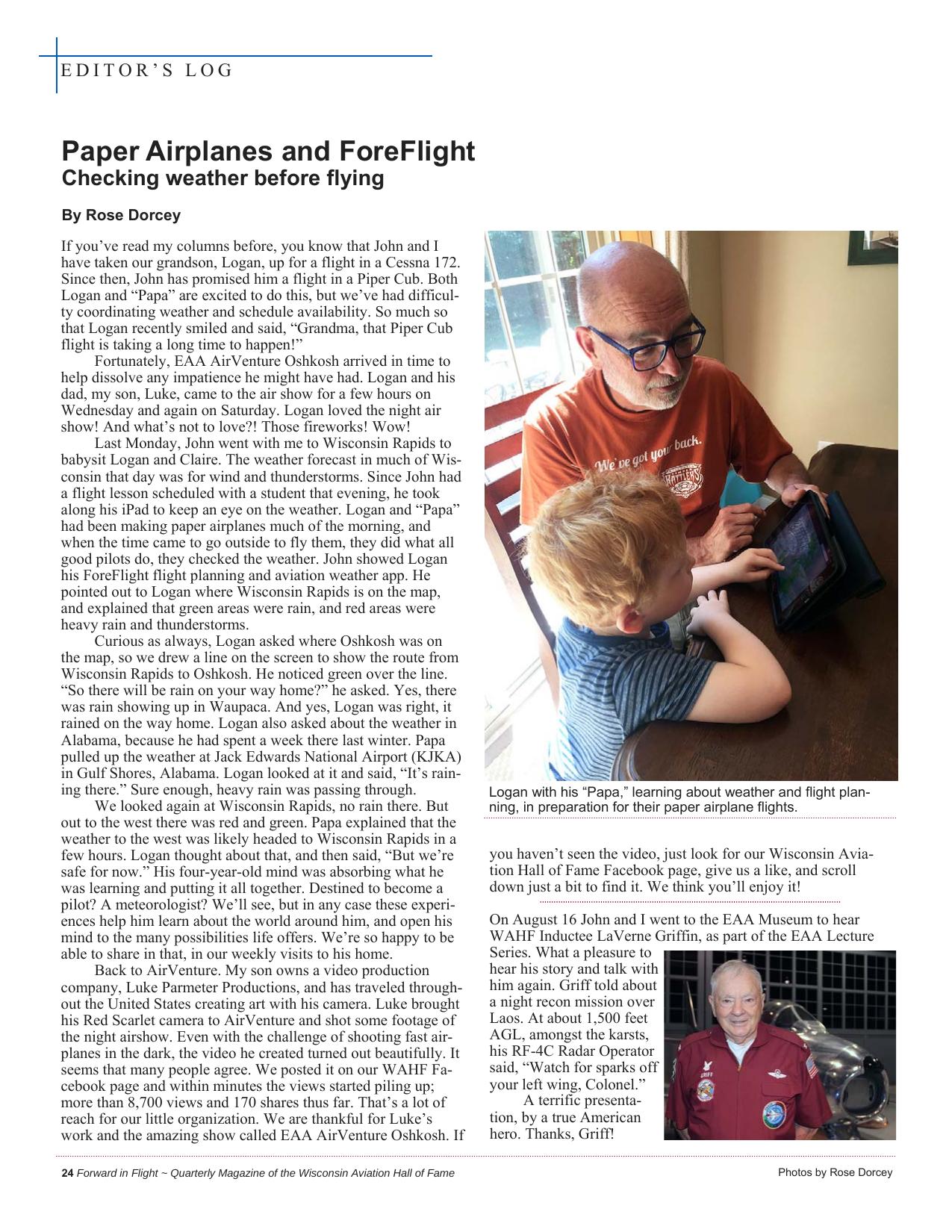
EDITOR’S LOG Paper Airplanes and ForeFlight Checking weather before flying By Rose Dorcey If you’ve read my columns before, you know that John and I have taken our grandson, Logan, up for a flight in a Cessna 172. Since then, John has promised him a flight in a Piper Cub. Both Logan and “Papa” are excited to do this, but we’ve had difficulty coordinating weather and schedule availability. So much so that Logan recently smiled and said, “Grandma, that Piper Cub flight is taking a long time to happen!” Fortunately, EAA AirVenture Oshkosh arrived in time to help dissolve any impatience he might have had. Logan and his dad, my son, Luke, came to the air show for a few hours on Wednesday and again on Saturday. Logan loved the night air show! And what’s not to love?! Those fireworks! Wow! Last Monday, John went with me to Wisconsin Rapids to babysit Logan and Claire. The weather forecast in much of Wisconsin that day was for wind and thunderstorms. Since John had a flight lesson scheduled with a student that evening, he took along his iPad to keep an eye on the weather. Logan and “Papa” had been making paper airplanes much of the morning, and when the time came to go outside to fly them, they did what all good pilots do, they checked the weather. John showed Logan his ForeFlight flight planning and aviation weather app. He pointed out to Logan where Wisconsin Rapids is on the map, and explained that green areas were rain, and red areas were heavy rain and thunderstorms. Curious as always, Logan asked where Oshkosh was on the map, so we drew a line on the screen to show the route from Wisconsin Rapids to Oshkosh. He noticed green over the line. “So there will be rain on your way home?” he asked. Yes, there was rain showing up in Waupaca. And yes, Logan was right, it rained on the way home. Logan also asked about the weather in Alabama, because he had spent a week there last winter. Papa pulled up the weather at Jack Edwards National Airport (KJKA) in Gulf Shores, Alabama. Logan looked at it and said, “It’s raining there.” Sure enough, heavy rain was passing through. We looked again at Wisconsin Rapids, no rain there. But out to the west there was red and green. Papa explained that the weather to the west was likely headed to Wisconsin Rapids in a few hours. Logan thought about that, and then said, “But we’re safe for now.” His four-year-old mind was absorbing what he was learning and putting it all together. Destined to become a pilot? A meteorologist? We’ll see, but in any case these experiences help him learn about the world around him, and open his mind to the many possibilities life offers. We’re so happy to be able to share in that, in our weekly visits to his home. Back to AirVenture. My son owns a video production company, Luke Parmeter Productions, and has traveled throughout the United States creating art with his camera. Luke brought his Red Scarlet camera to AirVenture and shot some footage of the night airshow. Even with the challenge of shooting fast airplanes in the dark, the video he created turned out beautifully. It seems that many people agree. We posted it on our WAHF Facebook page and within minutes the views started piling up; more than 8,700 views and 170 shares thus far. That’s a lot of reach for our little organization. We are thankful for Luke’s work and the amazing show called EAA AirVenture Oshkosh. If 24 Forward in Flight ~ Quarterly Magazine of the Wisconsin Aviation Hall of Fame Logan with his “Papa,” learning about weather and flight planning, in preparation for their paper airplane flights. you haven’t seen the video, just look for our Wisconsin Aviation Hall of Fame Facebook page, give us a like, and scroll down just a bit to find it. We think you’ll enjoy it! On August 16 John and I went to the EAA Museum to hear WAHF Inductee LaVerne Griffin, as part of the EAA Lecture Series. What a pleasure to hear his story and talk with him again. Griff told about a night recon mission over Laos. At about 1,500 feet AGL, amongst the karsts, his RF-4C Radar Operator said, “Watch for sparks off your left wing, Colonel.” A terrific presentation, by a true American hero. Thanks, Griff! Photos by Rose Dorcey

The Wisconsin Aviation Hall of Fame Board of Directors cordially invite you to attend our 33rd Annual Investiture Dinner and Ceremony. Please join us as we honor our 2018 inductees: Jerome LeBarron Joshua Sanford Janis Sierra Donald Winkler Saturday evening, October 20, 2018 EAA Aviation Museum Founder’s Wing 3000 Poberezny Road Oshkosh, Wisconsin No Host Reception 5 p.m. - Dinner 6 p.m. Ceremony follows dinner Annual Membership Meeting 2 p.m. Batten Board Room, lower lever, EAA Museum For more information: Call John Dorcey 608-513-9840 wisconsinaviationhalloffame.org Morey Airplane Company Since 1932 Middleton Municipal Airport/Morey Field Self-service 100LL & Jet A 24-7
PRSRT STD US Postage Paid Wisc Rapids WI Permit 98 3980 SHARRATT DRIVE OSHKOSH WI 54901-1276 The Wisconsin Aviation Hall of Fame is a non-profit membership organization dedicated to preserving the past and fostering the future of flight. CHANGE SERVICE REQUESTED Welcome New WAHF Member/Supporters Patti Bruha Ava Buellesbach Tom Charpentier Tom Dietz Brian Dominick Bob Egan Tom Eisele Bruce Huizenga Mark Lampe Hilary Lawrence Jerry McGuire Pat McGuire Mike Menon Laura Mineo Hayden Mueller Logan Parmeter Heather Pederson Larry Pierce Valarie Rabideau Brett Schneider Jacob Thomas Al Wilkening Thanks for coming on board. We hope to see you at a WAHF event soon! EVENTS: September 15, 2018 Wittman Regional Airport EAA Chapter 252 Fly-In Breakfast & Airport Expo (KOSH) Wittman Airport Terminal, 525 W 20th Avenue Oshkosh WI. 7:30 am - 11 am. Pancake breakfast with sausage, scrambled eggs, milk, juice, coffee, and all the pancakes you can eat! Adults - $7 (free for pilots of homebuilt aircraft who fly in.) Children under 10 - $3. Free Airplane Rides/EAA Young Eagles Event for kids ages 8 to 17 weather permitting. Dennis Moehn 920-810-1046 or visit http://www.252.eaachapter.org September 16, 2018 Neillsville Rotary Fly-ln Breakfast Neillsville Municipal Airport (KVIQ) 8 am -12 pm—Fly-in & Drive-in breakfast. Pilot flying eat free and driver of show car eats free. Menu includes pancakes, sausage, scrambled eggs, and drink. Adults $7 and kids 12 and under $4. For more information: Wayne Short 715-2387378 shortw@compsolsite.com HAS YOUR ADDRESS CHANGED? Please contact us to inform us of your new address. A timely reminder of your new address is very much appreciated as it helps save time—and money—for our small non-profit. It’s easy, send a note to Membership Chair Ron Wojnar at the email to the right, or call 262-347-7464. Wisconsin Aviation Hall of Fame Officers Tom Thomas, President Jill Mann, Vice-President John Dorcey, Secretary/Treasurer Board of Directors Kurt Stanich Charles Swain Jim Szajkovics Wynne Williams Ron Wojnar James Zuelsdorf Wisconsin Aviation Hall of Fame c/o John Dorcey, Secretary 3980 Sharratt Drive Oshkosh, WI 54901-1276 608-513-9840 Become a member/supporter today! For information call Ron Wojnar, Membership Chair 262-347-7464 rwojnar@wi.rr.com www.wisconsinaviationhalloffame.org