Volume 17, Issue 3
🗞️ Download Issue (PDF)
Forward in Flight - Fall 2019
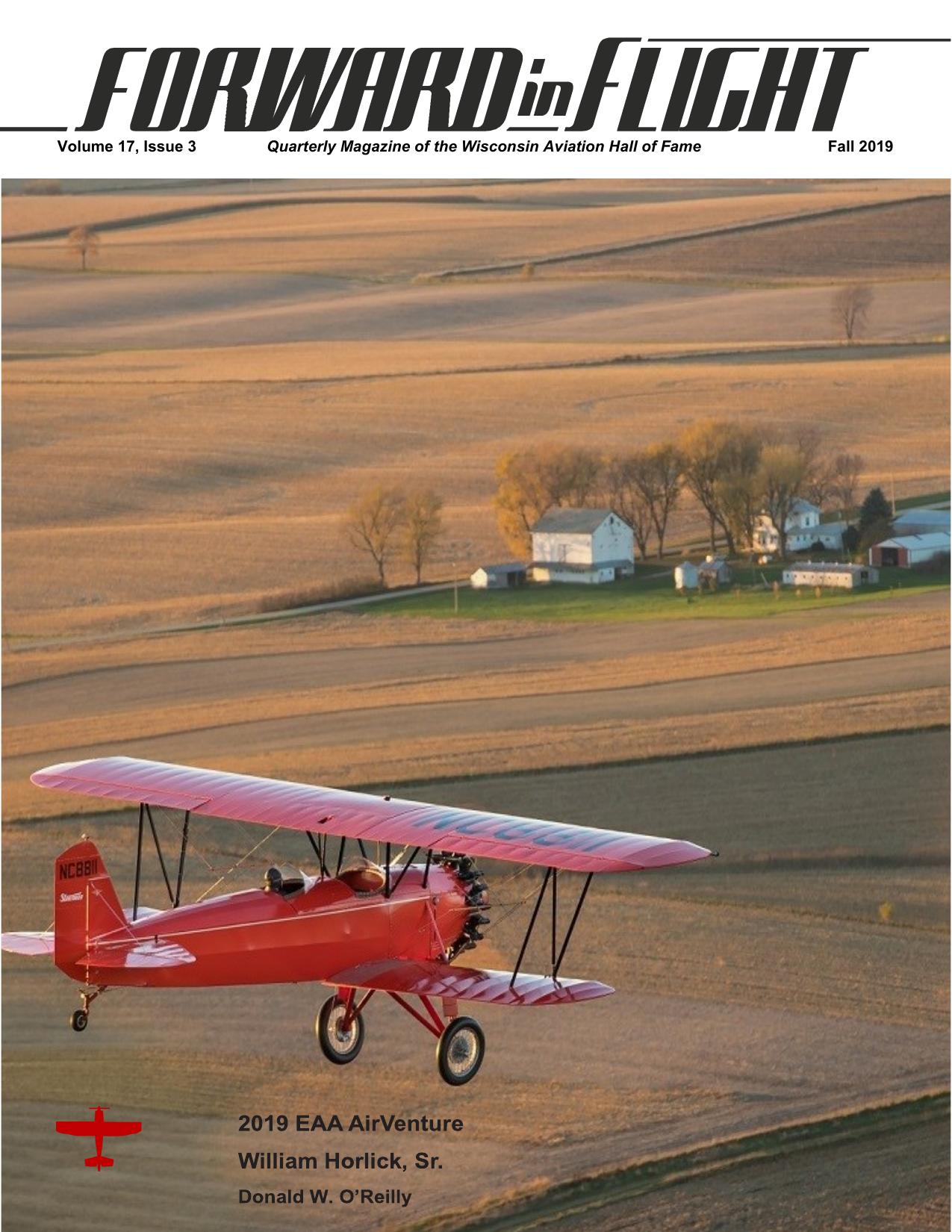
Volume 17, Issue 3 Quarterly Magazine of the Wisconsin Aviation Hall of Fame Fall 2019
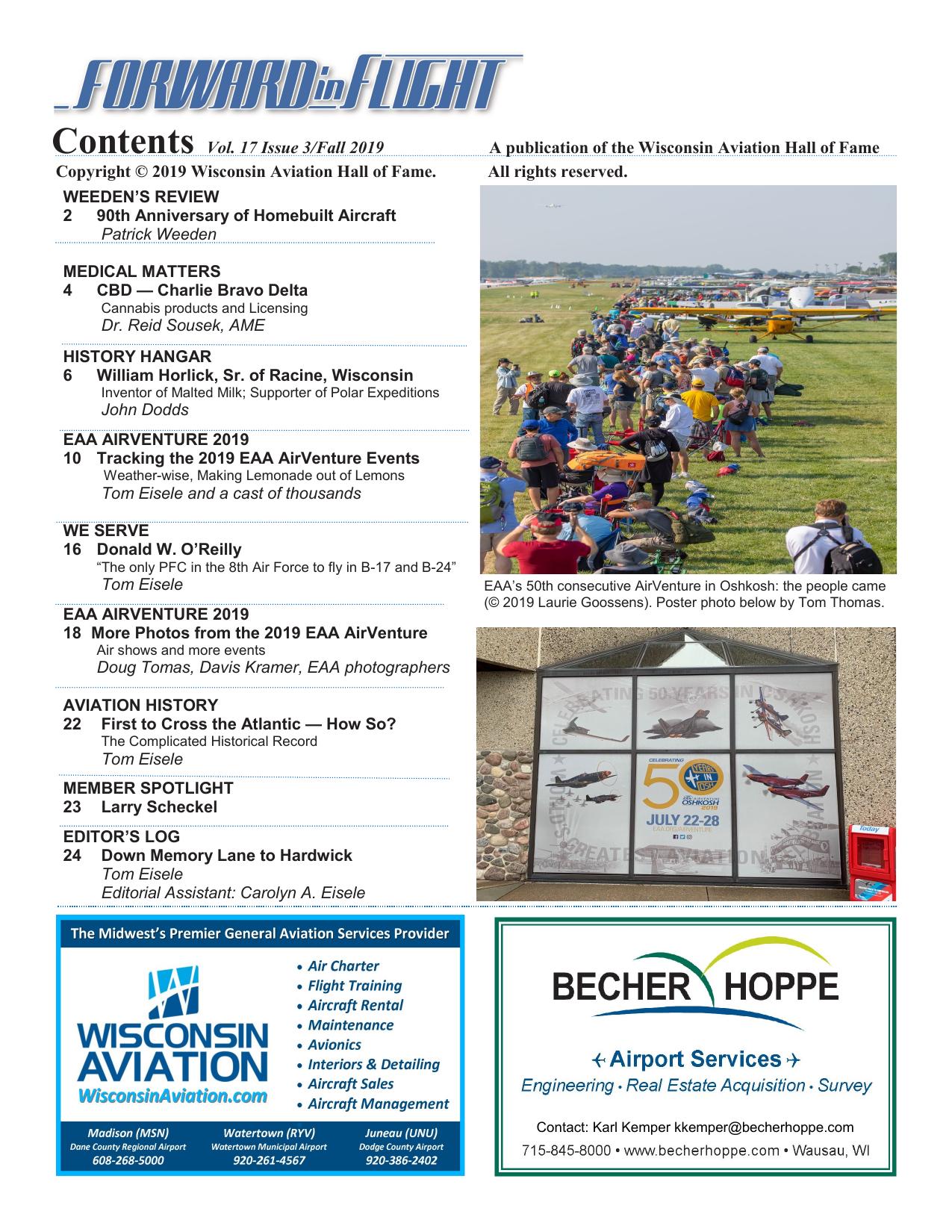
Contents Vol. 17 Issue 3/Fall 2019 Copyright © 2019 Wisconsin Aviation Hall of Fame. WEEDEN’S REVIEW 2 90th Anniversary of Homebuilt Aircraft Patrick Weeden A publication of the Wisconsin Aviation Hall of Fame All rights reserved. MEDICAL MATTERS 4 CBD — Charlie Bravo Delta Cannabis products and Licensing Dr. Reid Sousek, AME HISTORY HANGAR 6 William Horlick, Sr. of Racine, Wisconsin Inventor of Malted Milk; Supporter of Polar Expeditions John Dodds EAA AIRVENTURE 2019 10 Tracking the 2019 EAA AirVenture Events Weather-wise, Making Lemonade out of Lemons Tom Eisele and a cast of thousands WE SERVE 16 Donald W. O’Reilly “The only PFC in the 8th Air Force to fly in B-17 and B-24” Tom Eisele EAA AIRVENTURE 2019 18 More Photos from the 2019 EAA AirVenture EAA’s 50th consecutive AirVenture in Oshkosh: the people came (© 2019 Laurie Goossens). Poster photo below by Tom Thomas. Air shows and more events Doug Tomas, Davis Kramer, EAA photographers AVIATION HISTORY 22 First to Cross the Atlantic — How So? The Complicated Historical Record Tom Eisele MEMBER SPOTLIGHT 23 Larry Scheckel EDITOR’S LOG 24 Down Memory Lane to Hardwick Tom Eisele Editorial Assistant: Carolyn A. Eisele Contact: Karl Kemper kkemper@becherhoppe.com
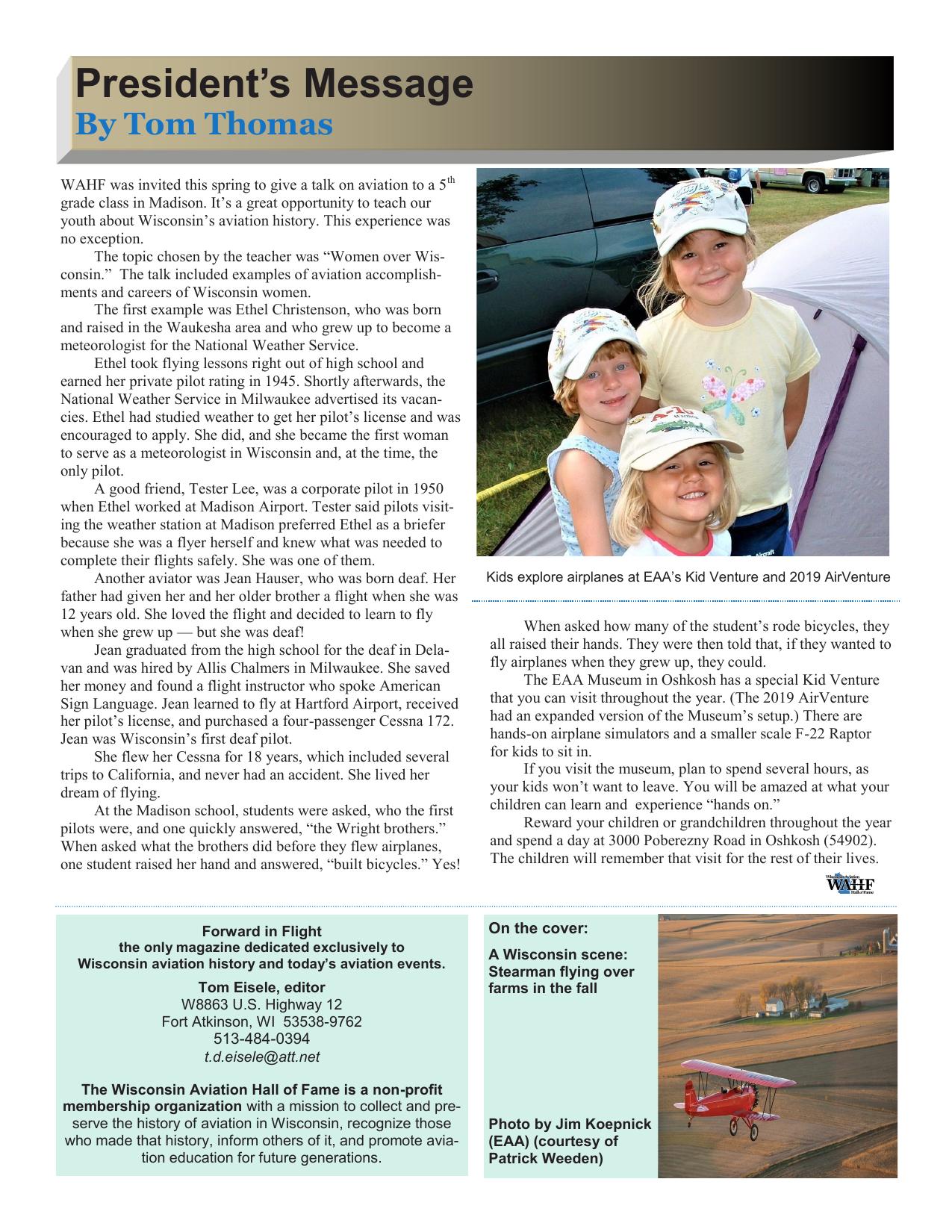
President’s Message By Tom Thomas WAHF was invited this spring to give a talk on aviation to a 5 th grade class in Madison. It’s a great opportunity to teach our youth about Wisconsin’s aviation history. This experience was no exception. The topic chosen by the teacher was “Women over Wisconsin.” The talk included examples of aviation accomplishments and careers of Wisconsin women. The first example was Ethel Christenson, who was born and raised in the Waukesha area and who grew up to become a meteorologist for the National Weather Service. Ethel took flying lessons right out of high school and earned her private pilot rating in 1945. Shortly afterwards, the National Weather Service in Milwaukee advertised its vacancies. Ethel had studied weather to get her pilot’s license and was encouraged to apply. She did, and she became the first woman to serve as a meteorologist in Wisconsin and, at the time, the only pilot. A good friend, Tester Lee, was a corporate pilot in 1950 when Ethel worked at Madison Airport. Tester said pilots visiting the weather station at Madison preferred Ethel as a briefer because she was a flyer herself and knew what was needed to complete their flights safely. She was one of them. Another aviator was Jean Hauser, who was born deaf. Her father had given her and her older brother a flight when she was 12 years old. She loved the flight and decided to learn to fly when she grew up — but she was deaf! Jean graduated from the high school for the deaf in Delavan and was hired by Allis Chalmers in Milwaukee. She saved her money and found a flight instructor who spoke American Sign Language. Jean learned to fly at Hartford Airport, received her pilot’s license, and purchased a four-passenger Cessna 172. Jean was Wisconsin’s first deaf pilot. She flew her Cessna for 18 years, which included several trips to California, and never had an accident. She lived her dream of flying. At the Madison school, students were asked, who the first pilots were, and one quickly answered, “the Wright brothers.” When asked what the brothers did before they flew airplanes, one student raised her hand and answered, “built bicycles.” Yes! Forward in Flight the only magazine dedicated exclusively to Wisconsin aviation history and today’s aviation events. Tom Eisele, editor W8863 U.S. Highway 12 Fort Atkinson, WI 53538-9762 Kids explore airplanes at EAA’s Kid Venture and 2019 AirVenture When asked how many of the student’s rode bicycles, they all raised their hands. They were then told that, if they wanted to fly airplanes when they grew up, they could. The EAA Museum in Oshkosh has a special Kid Venture that you can visit throughout the year. (The 2019 AirVenture had an expanded version of the Museum’s setup.) There are hands-on airplane simulators and a smaller scale F-22 Raptor for kids to sit in. If you visit the museum, plan to spend several hours, as your kids won’t want to leave. You will be amazed at what your children can learn and experience “hands on.” Reward your children or grandchildren throughout the year and spend a day at 3000 Poberezny Road in Oshkosh (54902). The children will remember that visit for the rest of their lives. On the cover: A Wisconsin scene: Stearman flying over farms in the fall 513-484-0394 t.d.eisele@att.net The Wisconsin Aviation Hall of Fame is a non-profit membership organization with a mission to collect and preserve the history of aviation in Wisconsin, recognize those who made that history, inform others of it, and promote aviation education for future generations. Photo by Jim Koepnick (EAA) (courtesy of Patrick Weeden)
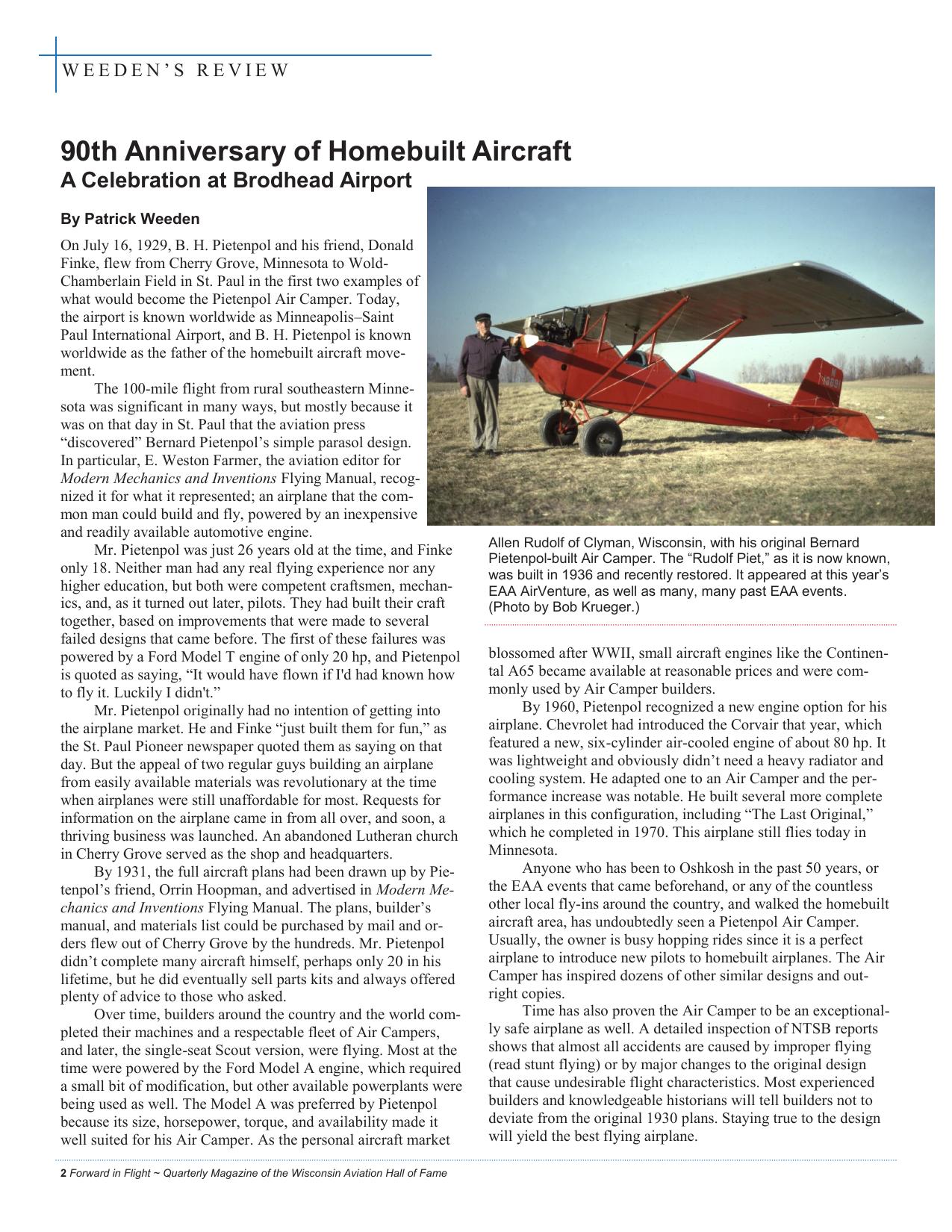
WEEDEN’S REVIEW 90th Anniversary of Homebuilt Aircraft A Celebration at Brodhead Airport By Patrick Weeden On July 16, 1929, B. H. Pietenpol and his friend, Donald Finke, flew from Cherry Grove, Minnesota to WoldChamberlain Field in St. Paul in the first two examples of what would become the Pietenpol Air Camper. Today, the airport is known worldwide as Minneapolis–Saint Paul International Airport, and B. H. Pietenpol is known worldwide as the father of the homebuilt aircraft movement. The 100-mile flight from rural southeastern Minnesota was significant in many ways, but mostly because it was on that day in St. Paul that the aviation press “discovered” Bernard Pietenpol’s simple parasol design. In particular, E. Weston Farmer, the aviation editor for Modern Mechanics and Inventions Flying Manual, recognized it for what it represented; an airplane that the common man could build and fly, powered by an inexpensive and readily available automotive engine. Mr. Pietenpol was just 26 years old at the time, and Finke only 18. Neither man had any real flying experience nor any higher education, but both were competent craftsmen, mechanics, and, as it turned out later, pilots. They had built their craft together, based on improvements that were made to several failed designs that came before. The first of these failures was powered by a Ford Model T engine of only 20 hp, and Pietenpol is quoted as saying, “It would have flown if I'd had known how to fly it. Luckily I didn't.” Mr. Pietenpol originally had no intention of getting into the airplane market. He and Finke “just built them for fun,” as the St. Paul Pioneer newspaper quoted them as saying on that day. But the appeal of two regular guys building an airplane from easily available materials was revolutionary at the time when airplanes were still unaffordable for most. Requests for information on the airplane came in from all over, and soon, a thriving business was launched. An abandoned Lutheran church in Cherry Grove served as the shop and headquarters. By 1931, the full aircraft plans had been drawn up by Pietenpol’s friend, Orrin Hoopman, and advertised in Modern Mechanics and Inventions Flying Manual. The plans, builder’s manual, and materials list could be purchased by mail and orders flew out of Cherry Grove by the hundreds. Mr. Pietenpol didn’t complete many aircraft himself, perhaps only 20 in his lifetime, but he did eventually sell parts kits and always offered plenty of advice to those who asked. Over time, builders around the country and the world completed their machines and a respectable fleet of Air Campers, and later, the single-seat Scout version, were flying. Most at the time were powered by the Ford Model A engine, which required a small bit of modification, but other available powerplants were being used as well. The Model A was preferred by Pietenpol because its size, horsepower, torque, and availability made it well suited for his Air Camper. As the personal aircraft market 2 Forward in Flight ~ Quarterly Magazine of the Wisconsin Aviation Hall of Fame Allen Rudolf of Clyman, Wisconsin, with his original Bernard Pietenpol-built Air Camper. The “Rudolf Piet,” as it is now known, was built in 1936 and recently restored. It appeared at this year’s EAA AirVenture, as well as many, many past EAA events. (Photo by Bob Krueger.) blossomed after WWII, small aircraft engines like the Continental A65 became available at reasonable prices and were commonly used by Air Camper builders. By 1960, Pietenpol recognized a new engine option for his airplane. Chevrolet had introduced the Corvair that year, which featured a new, six-cylinder air-cooled engine of about 80 hp. It was lightweight and obviously didn’t need a heavy radiator and cooling system. He adapted one to an Air Camper and the performance increase was notable. He built several more complete airplanes in this configuration, including “The Last Original,” which he completed in 1970. This airplane still flies today in Minnesota. Anyone who has been to Oshkosh in the past 50 years, or the EAA events that came beforehand, or any of the countless other local fly-ins around the country, and walked the homebuilt aircraft area, has undoubtedly seen a Pietenpol Air Camper. Usually, the owner is busy hopping rides since it is a perfect airplane to introduce new pilots to homebuilt airplanes. The Air Camper has inspired dozens of other similar designs and outright copies. Time has also proven the Air Camper to be an exceptionally safe airplane as well. A detailed inspection of NTSB reports shows that almost all accidents are caused by improper flying (read stunt flying) or by major changes to the original design that cause undesirable flight characteristics. Most experienced builders and knowledgeable historians will tell builders not to deviate from the original 1930 plans. Staying true to the design will yield the best flying airplane.
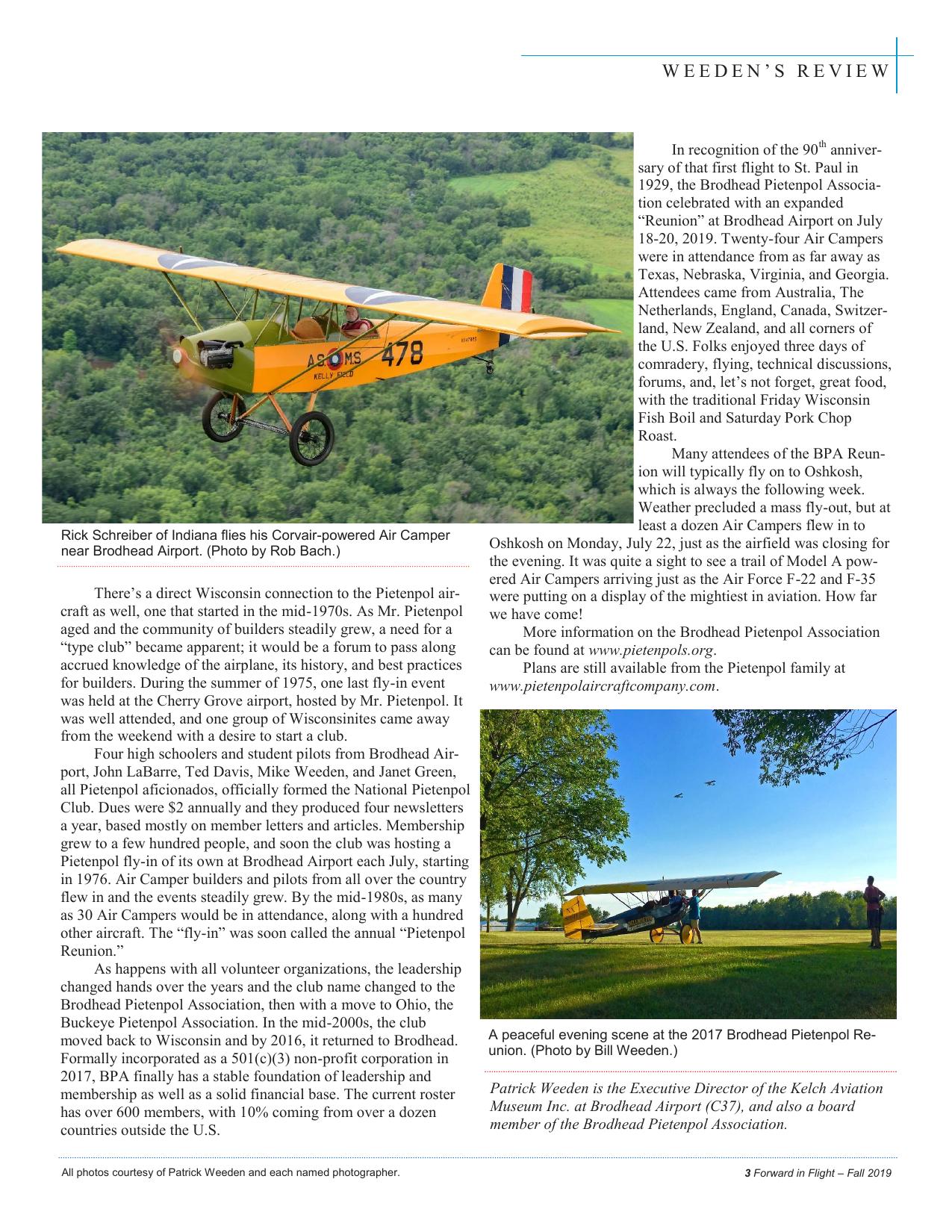
WEEDEN’S REVIEW Rick Schreiber of Indiana flies his Corvair-powered Air Camper near Brodhead Airport. (Photo by Rob Bach.) There’s a direct Wisconsin connection to the Pietenpol aircraft as well, one that started in the mid-1970s. As Mr. Pietenpol aged and the community of builders steadily grew, a need for a “type club” became apparent; it would be a forum to pass along accrued knowledge of the airplane, its history, and best practices for builders. During the summer of 1975, one last fly-in event was held at the Cherry Grove airport, hosted by Mr. Pietenpol. It was well attended, and one group of Wisconsinites came away from the weekend with a desire to start a club. Four high schoolers and student pilots from Brodhead Airport, John LaBarre, Ted Davis, Mike Weeden, and Janet Green, all Pietenpol aficionados, officially formed the National Pietenpol Club. Dues were $2 annually and they produced four newsletters a year, based mostly on member letters and articles. Membership grew to a few hundred people, and soon the club was hosting a Pietenpol fly-in of its own at Brodhead Airport each July, starting in 1976. Air Camper builders and pilots from all over the country flew in and the events steadily grew. By the mid-1980s, as many as 30 Air Campers would be in attendance, along with a hundred other aircraft. The “fly-in” was soon called the annual “Pietenpol Reunion.” As happens with all volunteer organizations, the leadership changed hands over the years and the club name changed to the Brodhead Pietenpol Association, then with a move to Ohio, the Buckeye Pietenpol Association. In the mid-2000s, the club moved back to Wisconsin and by 2016, it returned to Brodhead. Formally incorporated as a 501(c)(3) non-profit corporation in 2017, BPA finally has a stable foundation of leadership and membership as well as a solid financial base. The current roster has over 600 members, with 10% coming from over a dozen countries outside the U.S. All photos courtesy of Patrick Weeden and each named photographer. In recognition of the 90th anniversary of that first flight to St. Paul in 1929, the Brodhead Pietenpol Association celebrated with an expanded “Reunion” at Brodhead Airport on July 18-20, 2019. Twenty-four Air Campers were in attendance from as far away as Texas, Nebraska, Virginia, and Georgia. Attendees came from Australia, The Netherlands, England, Canada, Switzerland, New Zealand, and all corners of the U.S. Folks enjoyed three days of comradery, flying, technical discussions, forums, and, let’s not forget, great food, with the traditional Friday Wisconsin Fish Boil and Saturday Pork Chop Roast. Many attendees of the BPA Reunion will typically fly on to Oshkosh, which is always the following week. Weather precluded a mass fly-out, but at least a dozen Air Campers flew in to Oshkosh on Monday, July 22, just as the airfield was closing for the evening. It was quite a sight to see a trail of Model A powered Air Campers arriving just as the Air Force F-22 and F-35 were putting on a display of the mightiest in aviation. How far we have come! More information on the Brodhead Pietenpol Association can be found at www.pietenpols.org. Plans are still available from the Pietenpol family at www.pietenpolaircraftcompany.com. A peaceful evening scene at the 2017 Brodhead Pietenpol Reunion. (Photo by Bill Weeden.) Patrick Weeden is the Executive Director of the Kelch Aviation Museum Inc. at Brodhead Airport (C37), and also a board member of the Brodhead Pietenpol Association. 3 Forward in Flight – Fall 2019
MEDICAL MATTERS CBD — Charlie Bravo Delta Cannabis products and Licensing By Dr. Reid Sousek, CME C, B, D is not a reference to your taxi instructions. Rather, this is an article about Cannabidiol. It seems every day on my drive to work, I see a new store selling CBD products. Are these magic medicines that cure all, or are they snake oil? Will they make you a better pilot, or will they make you an illegal pilot? The paragraphs below will provide information to allow each pilot to make his/her own decision. My viewpoint will become clear and is mine alone. This article is not meant to represent any position statement from the FAA or any medical board. Science, Some Studies, and the FDA The body’s natural endocannabinoids (eCB) and their receptors are present in multiple body systems, including the nervous system, organs, connective tissue, glands, and the immune system. Cannabinoid receptor Type 1 (CB1) is present in varying levels in multiple nervous system tissues. Cannabinoid receptor Type 2 (CB2) is most present in cells related to the immune system. Based on their actions in these tissues, these CBs have impacts on “eat, sleep, relax, forget, protect” (Br J Pharmacol. 2014;172:737–753). The body’s natural eCBs have been considered to play a role in multiple conditions, including fibromyalgia, irritable bowel syndrome, schizophrenia, multiple sclerosis, Parkinson’s disease, Huntington’s disease, and infant failure to thrive (Eur J Pharmacol. 1998;353:23–31). Plant-based cannabinoids are familiar to many and are not newly bred or discovered. Over 60 natural cannabinoids are found in natural marijuana. Delta-9 tetrahydrocannabinol (THC), Cannabidiol (CBD), Cannabinol (CBN) are among those naturally occurring in these plants. The 2014 Farm Bill (as well as s.94.55 Wis Stats) defined “industrial hemp” as the plant Cannabis sativa L, with a delta-9tetrahydrocannabinol concentration of less than 0.3% when dried. This classification allowed growth of industrial hemp for certain research purposes. The 2018 Farm Bill broadened usage and growth as it amended the Controlled Substances Act of 1970 and removed the Schedule 1 controlled substance definition by the DEA. (As a point of reference, examples of other current Schedule 1 drugs include heroin, LSD, ecstasy, methaqualone, and peyote.) With the removal of the Schedule 1 definition, the supervision of hemp was shifted from the DEA to the USDA. As the name suggests, the Food and Drug Administration has supervisory control over our foods and drugs. The Farm Bill preserved the FDA’s supervision over foods and drugs containing cannabis. The rules for cannabiscontaining products are the same as for other FDA-monitored 4 Forward in Flight ~ Quarterly Magazine of the Wisconsin Aviation Hall of Fame products. The FDA will not allow therapeutic claims for products unless approved. Just as one can’t legally sell maple leaves from a backyard tree and market them as curing ear infections, a seller of CBD oil cannot claim medical benefits of CBD without FDA approval. At the time of this writing (August, 2019), the FDA has not approved marketing for CBD or cannabis for any disease or condition. The exception is Epidiolex (a purified form of CBD). Epidiolex is approved for treatment of two very specific types of seizures (Dravet Syndrome and Lennox-Gastaut Syndrome). It is approved to be used to augment treatment with other antiseizure meds and is not intended to be the only therapy. Other than Epidiolex, there are no FDA-approved CBD-containing products for therapeutic treatment of conditions. Marinol and Syndros contain a synthetic form of THC and are approved for treatment of anorexia with weight loss related to AIDS. One other drug, Cesamet, is approved and contains a synthetic chemical similar to THC. (https://www.fda.gov/newsevents/public-health-focus/fda-regulation-cannabis-andcannabis-derived-products-questions-and-answers#farmbill) Federal and State Laws and Licensing There is high variability between states regarding marijuana, cannabis, CBD. A key point made by the Federal Air Surgeon, Matthew Berry, is that federal law, not state law, governs FAA medical and pilot certifications. Therefore, a pilot looking to maintain medical certification is advised to look at federal regulations, rather than those of a more lax state, such as California or Colorado. Since, as stated above, there are no proven medical/ therapeutic indications for use of CBD, it would be very difficult to explain to licensing or certifying authorities a positive drug test for THC and attribute it to the benefits of CBD. Wait, stop the presses. We just learned a few paragraphs ago that CBD products are legally required to contain less than 0.3% THC. Considering the initial testing threshold of 50ng/ ml^3 THC being considered positive on DOT drug testing, we are not likely to be positive, right? Considering the relative newness of these products, there are a seemingly endless number of new companies getting products to market. Not all of these are made with the same “quality control.” A recent study using four different methods of testing THC levels in hemp seeds revealed variations in levels dependent upon testing method (Cannabis Cannabinoid Res. 2017; 2 (1): 274–281). Every single test has a certain level of accuracy or expected standard error; however, in these THC tests, there were even variations between different test types and between which portion of the seed was tested.
MEDICAL MATTERS Without hard and fast standards, you may find producer A testing with method 1 getting different results than producer B testing with method 2. Whereas the FDA monitors the purity and production standards of Epidiolex with consistency, there is not the same level of supervision over these other CBD products. Do you trust the packaging label, or store employee’s “guarantee”? If there are variations between testing methods, and even which part of the plant is tested, what level of risk are you willing to accept? Speed Bumps and some Hard Questions As I did research for this article, I came across another possible speed bump as related to random drug testing. This issue arose in the same journal referenced above regarding the variations of results with different testing methods. I have honestly never heard of this journal before researching this article, but as the title suggests, cannabis research is their “thing.” I am not sure if it is slightly biased one way or the other. I am using it just to show there may be some risks to taking CBD products. In this second study, the researchers evaluated CBD in an acidic environment (similar to that found in our stomachs). They found that THC was present from the acidic breakdown of CBD (Cannabis Cannabinoid Res. 2016;1:102–112). When this CBD was in a control-neutral buffered solution, no THC was produced. However, a separate article stated this breakdown is not reproduced in vivo (in our bodies) (Cannabis Cannabinoid Res. 2017; 2(1): 81–86). So, conditions similar to our gastric contents lead to breakdown of CBD into some detectable THC in a beaker on a lab bench. Yet nearly identical conditions in our body do not seem to produce similar findings. Federal law, not state law, governs FAA medical and pilot certifications. A pilot looking to maintain medical certification is ad- vised to look at federal regulations. Here again, do you want to roll the dice with a positive drug test and possibly risk your career when we are still struggling to explain the science? Along this same line of thinking, if we can’t explain or reproduce findings on a lab bench and compare it to what happens in our body, do you want to be altering neurotransmitters or immune-system signaling in your body? While we may barely understand the short-term effects of CBD on our bodies, we have even less knowledge and understanding of its long-term implications. For many receptors in our bodies, continuous exposure to exogenous or outside sources of a hormone or neurotransmitter will lead to either up-regulation of our own receptors or suppress our bodies’ natural production of that hormone or chemical. Two examples of this are opioids and testosterone. Continued exposure to opioid medication will often lead to a need for escalating dosing due to up-regulation of opioid receptors. Similarly, a body builder who uses illegal anabolic steroids will see decreased testosterone production and, sometimes, testicular atrophy. (Great selling point, right?) A recent study evaluated high dose CBD oil in mice (Molecules 2019, 24(9), 1694). This study showed increased liver enzymes and gene expression consistent with liver toxicity. Obviously, liver damage is bad. However, even though damage may not occur at lower doses, these lower doses could be problematic. If the liver is stressed by trying to metabolize the CBD chemical, the liver may have less ability to metabolize other medications. So, while a lower dose may not cause frank damage, it could affect your body’s ability to metabolize a common medication, such as acetaminophen. There is little known about drug-and-drug interactions with CBD and other medications The cynic in me also questions why more CBD medications haven’t been developed by drug companies. I believe that, if CBD were the miracle chemical many proponents claim it to be, companies such as Pfizer and AstraZenica would have found it years ago and developed it into a marketable drug. After all, many other countries have not had the strict regulation against hemp/cannabis that the US has had in the past. Chinese writings dating back to 2300 BC suggest human knowledge and use of some of the effects of cannabis and hemp. I find it hard to believe that these drug companies would wait for the Farm Bill to start their research. Doubts and Cautions in Conclusion So, what conclusions do I come to with regard to CBD? Many people currently take CBD products with good results. If they are able to get back to a normal life and treat their ailments, that is great. The hemp/cannabis plant has been around for millenia. Steps towards legalization have rapidly progressed in the past 510 years. Now, all of a sudden, we find claims that CBD can treat conditions such as anxiety, arthritis, Parkinson’s, and seizures. However, we have very limited studies showing reproducible clinical benefits in double blinded studies. We also have very limited studies showing CBD to be safe with other medications or with long-term use. We have a relatively unregulated, new marketplace with creams, lotions, and gummies, popping up everyday. The production and testing for these products may not meet standards for other products we use in our bodies. As more studies are completed, we may actually find some clinical benefits and safety data. I may re-read this article in 2022, or 2032, and laugh at my scepticism toward CBD. For now, however, I will not be in line at the CBD store. 5 Forward in Flight ~ Fall 2019
HISTORY HANGAR William Horlick, Sr. of Racine, Wisconsin Inventor - Malted Milk; Supporter of Polar Expeditions By John Dodds In late 1933, a Curtiss-Wright Condor II, named “WILLIAM HORLICK,” began the first of many exploration flights in Antarctica during Admiral Richard Byrd’s Second Antarctic Expedition. The namesake of this plane is none other than William Horlick of Racine, Wisconsin, known for having invented malted milk and after whom the Horlick Mountains in Antarctica and William Horlick High School in Racine are named. Invention of Malted Milk William Horlick obtained a patent for malted milk in 1883 and later a trademark for “Malted Milk.” As he described in his patent, malted milk is made by “taking equal parts of select barleymalt and ground wheat (or oats)” and then mixing it with “fresh cow’s milk” to “form a loose soft mash.” The mash is then heated to certain temperatures, pressed to remove the liquid, and macerated finely to produce a “dried powder extract” that “readily dissolves in water.” In addition to the powder form, it was also later made in tablet form. In general usage, the products were often merely referred to as “Horlick’s.” Although intended for “Infants and Invalids,” explorers later found that malted milk was a good and convenient source of nutrition. The photo (at right) shows Arctic explorer, Ernest de Koven Leffingwell from Racine, Wisconsin, in Alaska with cases of Horlick’s. He attended Racine College as did Horlick’s sons, Alexander and William, Jr. Horlick’s was carried to the North and South Poles by many explorers, including the famous Norwegian explorer Roald Amundsen. In a letter to Horlick in March, 1912, he wrote: “I am pleased to tell you, our way straight down to the Pole [South Pole] is littered with boxes stamped Horlick’s, Racine, Wis., giving full evidence of the liberal use we made of your splendid Malted Milk.” For Horlick’s contributions to Norwegian expeditions, King Haakon VI of Norway in 1922 bestowed on Horlick the Order of St. Olav. In addition to polar explorers, Horlick’s was also taken into space by John Glenn on his orbital flight in 1962, which prompted this advertisement (at right): ABOVE: Ernest de Koven Leffingwell (U.S. Geological Survey) RIGHT: Horlick’s advertisement with exploration theme (WHS) 6 Forward in Flight ~ Quarterly Magazine of the Wisconsin Aviation Hall of Fame In 1922, a druggist at Walgreen’s in Chicago added malted milk to a milk shake, giving rise to a new and popular beverage. Walgreen’s advertised that it used Horlick’s “Malted Milk.” Malted milk was such a popular drink that the March 1928 issue of The William Horlick, inventor/supporter Soda Fountain maga(Wisconsin Historical Society [“WHS”]) zine contained an article titled “Malted Milk: the New National Drink.” Malted milk was a favorite of none other than Richard “Dick” Bong, “Ace of Aces,” from Poplar, Wisconsin (see Forward in Flight, Spring 2019). In his biography of Bong, General George Kenney recounted that on Bong’s first trip home from the Southwest Pacific in 1943, Bong said he wanted to eat his mom’s home cooking and drink “lots of milk.” He then added: “another thing, I want a nice big double-rich chocolate malted. I haven’t seen one for over a year.” On his second trip home in 1944, he was widely recognized as he traveled around the country giving “pep talks” and signing autographs. Kenney wrote, “Oh, and the one place he remembered most favorably was Wilmington, North Carolina” because there he was not recognized and was not bothered by people. He continued: “After dinner he went into town and wandered around alone, looking in the store windows, and finally stopped in a drugstore to get a double-rich chocolate malted milk-shake.” Antarctica Antarctica is a continent described by NASA as follows: Antarctica is the highest, driest, coldest and brightest of the seven continents. It is roughly the size of the United States and Mexico combined and is almost completely covered by a layer of ice that averages more than one mile in thickness but is nearly three miles thick in places. This ice accumulated over millions of years through snowfall. Presently, the Antarctic ice sheet contains 90% of the ice on Earth and would raise sea levels worldwide by over 200 feet were it to melt. Photos courtesy of John Dodds and institutions/societies, as noted
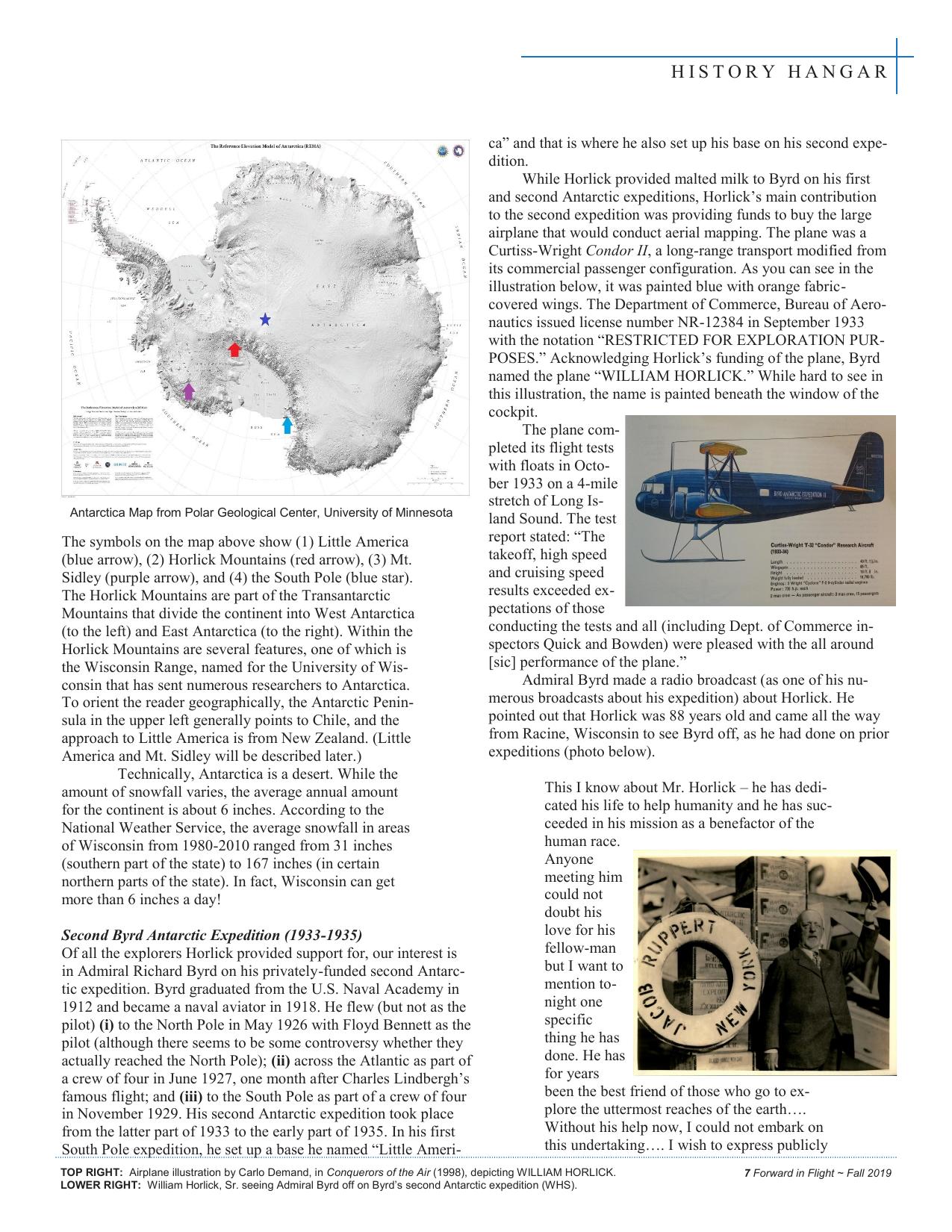
HISTORY HANGAR Antarctica Map from Polar Geological Center, University of Minnesota The symbols on the map above show (1) Little America (blue arrow), (2) Horlick Mountains (red arrow), (3) Mt. Sidley (purple arrow), and (4) the South Pole (blue star). The Horlick Mountains are part of the Transantarctic Mountains that divide the continent into West Antarctica (to the left) and East Antarctica (to the right). Within the Horlick Mountains are several features, one of which is the Wisconsin Range, named for the University of Wisconsin that has sent numerous researchers to Antarctica. To orient the reader geographically, the Antarctic Peninsula in the upper left generally points to Chile, and the approach to Little America is from New Zealand. (Little America and Mt. Sidley will be described later.) Technically, Antarctica is a desert. While the amount of snowfall varies, the average annual amount for the continent is about 6 inches. According to the National Weather Service, the average snowfall in areas of Wisconsin from 1980-2010 ranged from 31 inches (southern part of the state) to 167 inches (in certain northern parts of the state). In fact, Wisconsin can get more than 6 inches a day! Second Byrd Antarctic Expedition (1933-1935) Of all the explorers Horlick provided support for, our interest is in Admiral Richard Byrd on his privately-funded second Antarctic expedition. Byrd graduated from the U.S. Naval Academy in 1912 and became a naval aviator in 1918. He flew (but not as the pilot) (i) to the North Pole in May 1926 with Floyd Bennett as the pilot (although there seems to be some controversy whether they actually reached the North Pole); (ii) across the Atlantic as part of a crew of four in June 1927, one month after Charles Lindbergh’s famous flight; and (iii) to the South Pole as part of a crew of four in November 1929. His second Antarctic expedition took place from the latter part of 1933 to the early part of 1935. In his first South Pole expedition, he set up a base he named “Little Ameri- ca” and that is where he also set up his base on his second expedition. While Horlick provided malted milk to Byrd on his first and second Antarctic expeditions, Horlick’s main contribution to the second expedition was providing funds to buy the large airplane that would conduct aerial mapping. The plane was a Curtiss-Wright Condor II, a long-range transport modified from its commercial passenger configuration. As you can see in the illustration below, it was painted blue with orange fabriccovered wings. The Department of Commerce, Bureau of Aeronautics issued license number NR-12384 in September 1933 with the notation “RESTRICTED FOR EXPLORATION PURPOSES.” Acknowledging Horlick’s funding of the plane, Byrd named the plane “WILLIAM HORLICK.” While hard to see in this illustration, the name is painted beneath the window of the cockpit. The plane completed its flight tests with floats in October 1933 on a 4-mile stretch of Long Island Sound. The test report stated: “The takeoff, high speed and cruising speed results exceeded expectations of those conducting the tests and all (including Dept. of Commerce inspectors Quick and Bowden) were pleased with the all around [sic] performance of the plane.” Admiral Byrd made a radio broadcast (as one of his numerous broadcasts about his expedition) about Horlick. He pointed out that Horlick was 88 years old and came all the way from Racine, Wisconsin to see Byrd off, as he had done on prior expeditions (photo below). This I know about Mr. Horlick – he has dedicated his life to help humanity and he has succeeded in his mission as a benefactor of the human race. Anyone meeting him could not doubt his love for his fellow-man but I want to mention tonight one specific thing he has done. He has for years been the best friend of those who go to explore the uttermost reaches of the earth…. Without his help now, I could not embark on this undertaking…. I wish to express publicly TOP RIGHT: Airplane illustration by Carlo Demand, in Conquerors of the Air (1998), depicting WILLIAM HORLICK. LOWER RIGHT: William Horlick, Sr. seeing Admiral Byrd off on Byrd’s second Antarctic expedition (WHS). 7 Forward in Flight ~ Fall 2019
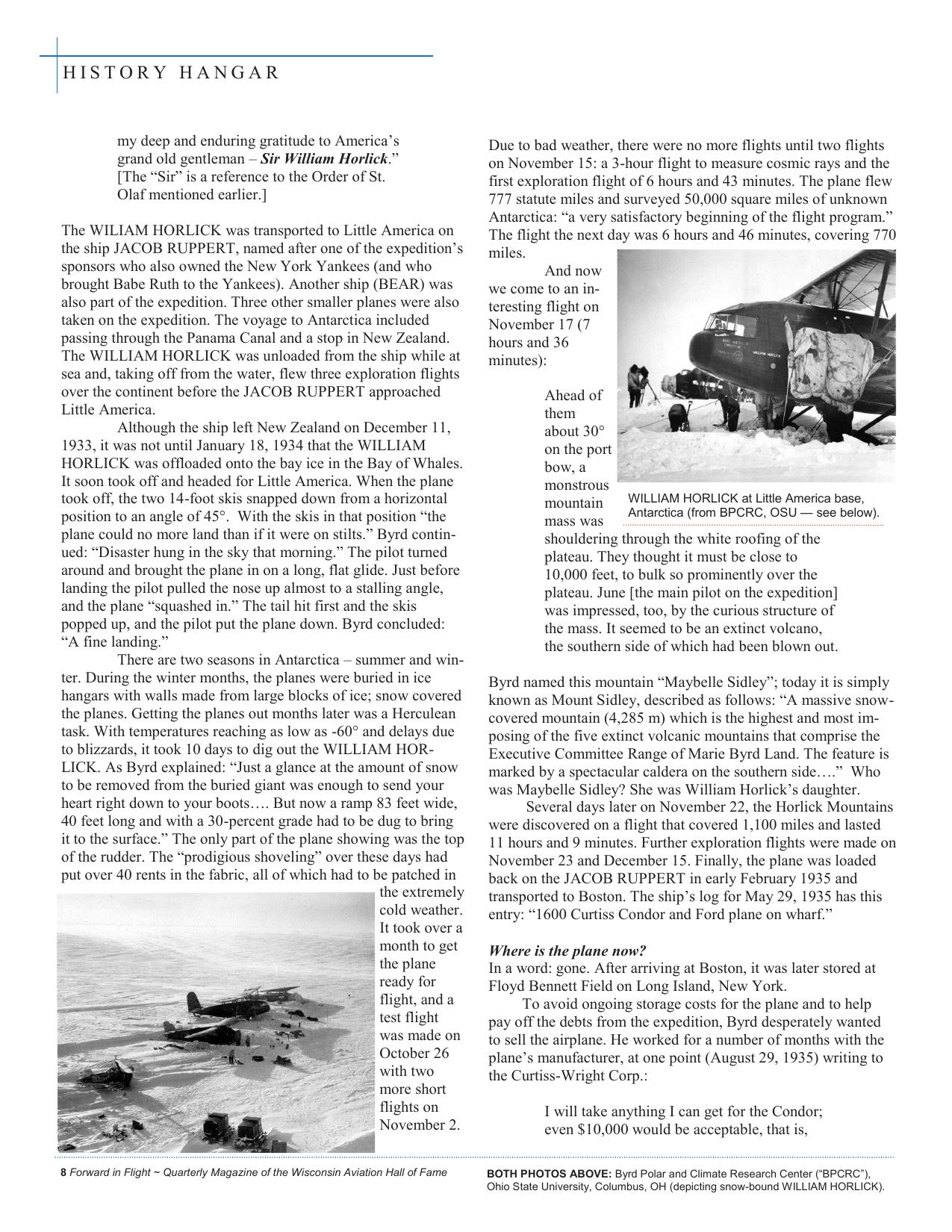
HISTORY HANGAR my deep and enduring gratitude to America’s grand old gentleman – Sir William Horlick.” [The “Sir” is a reference to the Order of St. Olaf mentioned earlier.] The WILIAM HORLICK was transported to Little America on the ship JACOB RUPPERT, named after one of the expedition’s sponsors who also owned the New York Yankees (and who brought Babe Ruth to the Yankees). Another ship (BEAR) was also part of the expedition. Three other smaller planes were also taken on the expedition. The voyage to Antarctica included passing through the Panama Canal and a stop in New Zealand. The WILLIAM HORLICK was unloaded from the ship while at sea and, taking off from the water, flew three exploration flights over the continent before the JACOB RUPPERT approached Little America. Although the ship left New Zealand on December 11, 1933, it was not until January 18, 1934 that the WILLIAM HORLICK was offloaded onto the bay ice in the Bay of Whales. It soon took off and headed for Little America. When the plane took off, the two 14-foot skis snapped down from a horizontal position to an angle of 45°. With the skis in that position “the plane could no more land than if it were on stilts.” Byrd continued: “Disaster hung in the sky that morning.” The pilot turned around and brought the plane in on a long, flat glide. Just before landing the pilot pulled the nose up almost to a stalling angle, and the plane “squashed in.” The tail hit first and the skis popped up, and the pilot put the plane down. Byrd concluded: “A fine landing.” There are two seasons in Antarctica – summer and winter. During the winter months, the planes were buried in ice hangars with walls made from large blocks of ice; snow covered the planes. Getting the planes out months later was a Herculean task. With temperatures reaching as low as -60° and delays due to blizzards, it took 10 days to dig out the WILLIAM HORLICK. As Byrd explained: “Just a glance at the amount of snow to be removed from the buried giant was enough to send your heart right down to your boots…. But now a ramp 83 feet wide, 40 feet long and with a 30-percent grade had to be dug to bring it to the surface.” The only part of the plane showing was the top of the rudder. The “prodigious shoveling” over these days had put over 40 rents in the fabric, all of which had to be patched in the extremely cold weather. It took over a month to get the plane ready for flight, and a test flight was made on October 26 with two more short flights on November 2. 8 Forward in Flight ~ Quarterly Magazine of the Wisconsin Aviation Hall of Fame Due to bad weather, there were no more flights until two flights on November 15: a 3-hour flight to measure cosmic rays and the first exploration flight of 6 hours and 43 minutes. The plane flew 777 statute miles and surveyed 50,000 square miles of unknown Antarctica: “a very satisfactory beginning of the flight program.” The flight the next day was 6 hours and 46 minutes, covering 770 miles. And now we come to an interesting flight on November 17 (7 hours and 36 minutes): Ahead of them about 30° on the port bow, a monstrous WILLIAM HORLICK at Little America base, mountain Antarctica (from BPCRC, OSU — see below). mass was shouldering through the white roofing of the plateau. They thought it must be close to 10,000 feet, to bulk so prominently over the plateau. June [the main pilot on the expedition] was impressed, too, by the curious structure of the mass. It seemed to be an extinct volcano, the southern side of which had been blown out. Byrd named this mountain “Maybelle Sidley”; today it is simply known as Mount Sidley, described as follows: “A massive snowcovered mountain (4,285 m) which is the highest and most imposing of the five extinct volcanic mountains that comprise the Executive Committee Range of Marie Byrd Land. The feature is marked by a spectacular caldera on the southern side….” Who was Maybelle Sidley? She was William Horlick’s daughter. Several days later on November 22, the Horlick Mountains were discovered on a flight that covered 1,100 miles and lasted 11 hours and 9 minutes. Further exploration flights were made on November 23 and December 15. Finally, the plane was loaded back on the JACOB RUPPERT in early February 1935 and transported to Boston. The ship’s log for May 29, 1935 has this entry: “1600 Curtiss Condor and Ford plane on wharf.” Where is the plane now? In a word: gone. After arriving at Boston, it was later stored at Floyd Bennett Field on Long Island, New York. To avoid ongoing storage costs for the plane and to help pay off the debts from the expedition, Byrd desperately wanted to sell the airplane. He worked for a number of months with the plane’s manufacturer, at one point (August 29, 1935) writing to the Curtiss-Wright Corp.: I will take anything I can get for the Condor; even $10,000 would be acceptable, that is, BOTH PHOTOS ABOVE: Byrd Polar and Climate Research Center (“BPCRC”), Ohio State University, Columbus, OH (depicting snow-bound WILLIAM HORLICK).
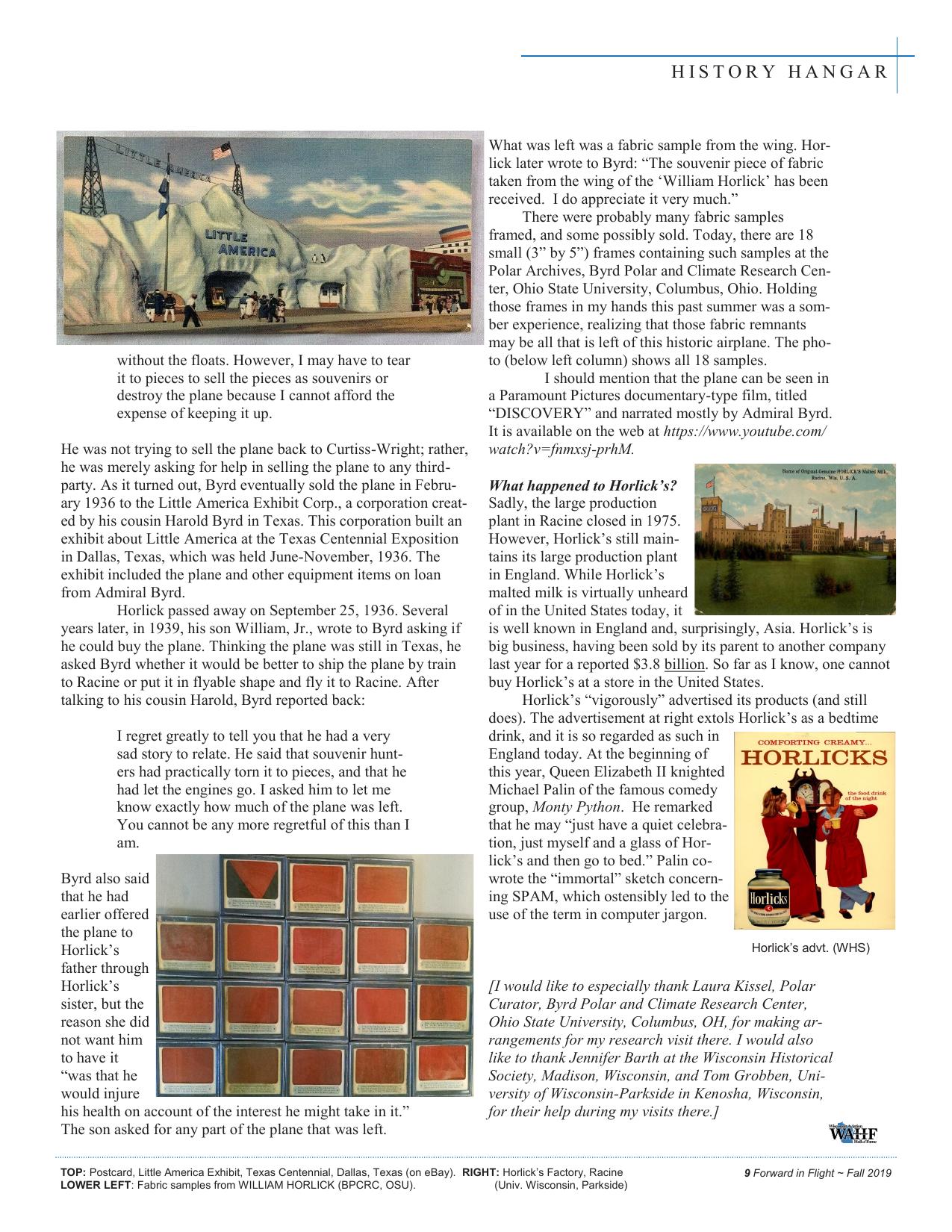
HISTORY HANGAR without the floats. However, I may have to tear it to pieces to sell the pieces as souvenirs or destroy the plane because I cannot afford the expense of keeping it up. He was not trying to sell the plane back to Curtiss-Wright; rather, he was merely asking for help in selling the plane to any thirdparty. As it turned out, Byrd eventually sold the plane in February 1936 to the Little America Exhibit Corp., a corporation created by his cousin Harold Byrd in Texas. This corporation built an exhibit about Little America at the Texas Centennial Exposition in Dallas, Texas, which was held June-November, 1936. The exhibit included the plane and other equipment items on loan from Admiral Byrd. Horlick passed away on September 25, 1936. Several years later, in 1939, his son William, Jr., wrote to Byrd asking if he could buy the plane. Thinking the plane was still in Texas, he asked Byrd whether it would be better to ship the plane by train to Racine or put it in flyable shape and fly it to Racine. After talking to his cousin Harold, Byrd reported back: I regret greatly to tell you that he had a very sad story to relate. He said that souvenir hunters had practically torn it to pieces, and that he had let the engines go. I asked him to let me know exactly how much of the plane was left. You cannot be any more regretful of this than I am. Byrd also said that he had earlier offered the plane to Horlick’s father through Horlick’s sister, but the reason she did not want him to have it “was that he would injure his health on account of the interest he might take in it.” The son asked for any part of the plane that was left. What was left was a fabric sample from the wing. Horlick later wrote to Byrd: “The souvenir piece of fabric taken from the wing of the ‘William Horlick’ has been received. I do appreciate it very much.” There were probably many fabric samples framed, and some possibly sold. Today, there are 18 small (3” by 5”) frames containing such samples at the Polar Archives, Byrd Polar and Climate Research Center, Ohio State University, Columbus, Ohio. Holding those frames in my hands this past summer was a somber experience, realizing that those fabric remnants may be all that is left of this historic airplane. The photo (below left column) shows all 18 samples. I should mention that the plane can be seen in a Paramount Pictures documentary-type film, titled “DISCOVERY” and narrated mostly by Admiral Byrd. It is available on the web at https://www.youtube.com/ watch?v=fnmxsj-prhM. What happened to Horlick’s? Sadly, the large production plant in Racine closed in 1975. However, Horlick’s still maintains its large production plant in England. While Horlick’s malted milk is virtually unheard of in the United States today, it is well known in England and, surprisingly, Asia. Horlick’s is big business, having been sold by its parent to another company last year for a reported $3.8 billion. So far as I know, one cannot buy Horlick’s at a store in the United States. Horlick’s “vigorously” advertised its products (and still does). The advertisement at right extols Horlick’s as a bedtime drink, and it is so regarded as such in England today. At the beginning of this year, Queen Elizabeth II knighted Michael Palin of the famous comedy group, Monty Python. He remarked that he may “just have a quiet celebration, just myself and a glass of Horlick’s and then go to bed.” Palin cowrote the “immortal” sketch concerning SPAM, which ostensibly led to the use of the term in computer jargon. Horlick’s advt. (WHS) [I would like to especially thank Laura Kissel, Polar Curator, Byrd Polar and Climate Research Center, Ohio State University, Columbus, OH, for making arrangements for my research visit there. I would also like to thank Jennifer Barth at the Wisconsin Historical Society, Madison, Wisconsin, and Tom Grobben, University of Wisconsin-Parkside in Kenosha, Wisconsin, for their help during my visits there.] TOP: Postcard, Little America Exhibit, Texas Centennial, Dallas, Texas (on eBay). RIGHT: Horlick’s Factory, Racine LOWER LEFT: Fabric samples from WILLIAM HORLICK (BPCRC, OSU). (Univ. Wisconsin, Parkside) 9 Forward in Flight ~ Fall 2019
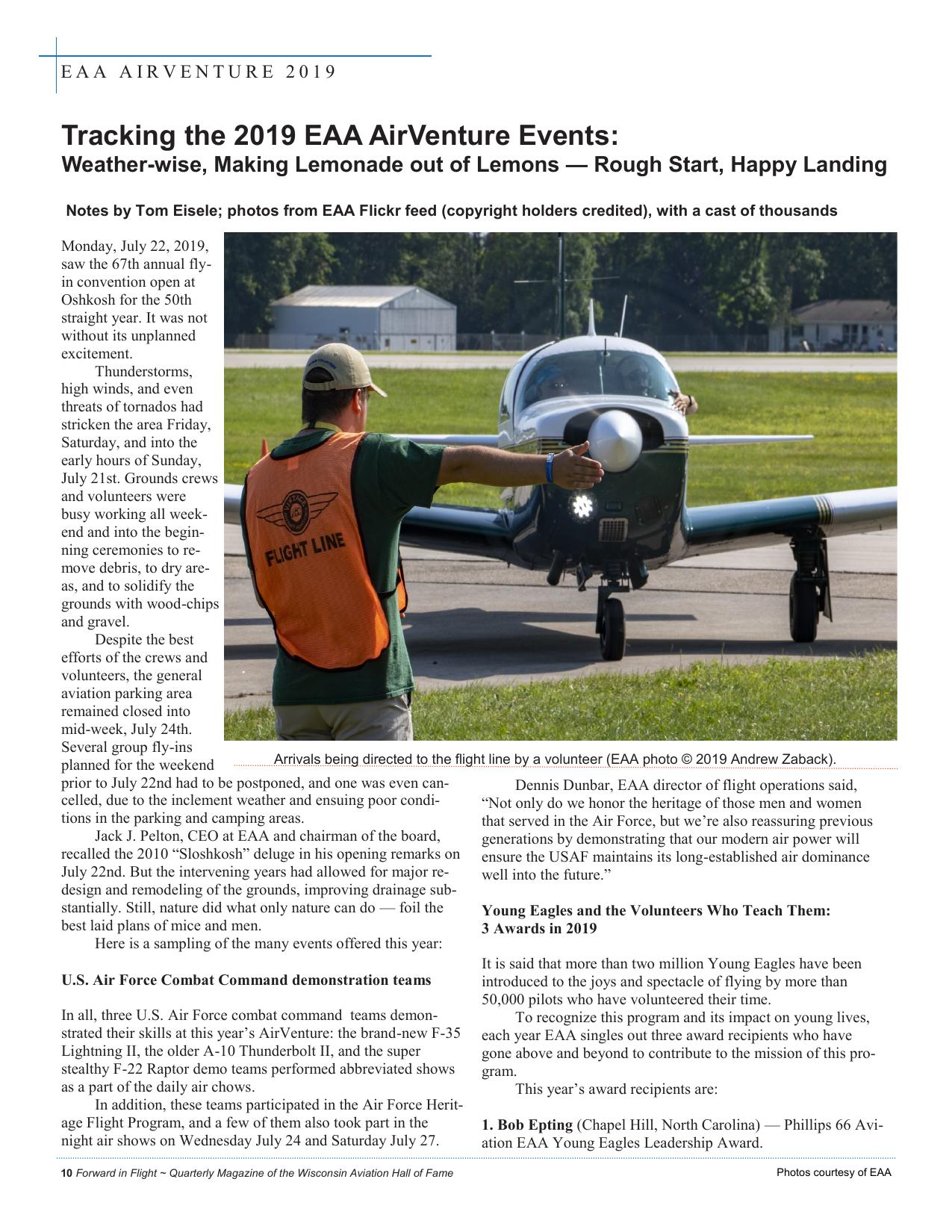
EAA AIRVENTURE 2019 Tracking the 2019 EAA AirVenture Events: Weather-wise, Making Lemonade out of Lemons — Rough Start, Happy Landing Notes by Tom Eisele; photos from EAA Flickr feed (copyright holders credited), with a cast of thousands Monday, July 22, 2019, saw the 67th annual flyin convention open at Oshkosh for the 50th straight year. It was not without its unplanned excitement. Thunderstorms, high winds, and even threats of tornados had stricken the area Friday, Saturday, and into the early hours of Sunday, July 21st. Grounds crews and volunteers were busy working all weekend and into the beginning ceremonies to remove debris, to dry areas, and to solidify the grounds with wood-chips and gravel. Despite the best efforts of the crews and volunteers, the general aviation parking area remained closed into mid-week, July 24th. Several group fly-ins Arrivals being directed to the flight line by a volunteer (EAA photo © 2019 Andrew Zaback). planned for the weekend prior to July 22nd had to be postponed, and one was even canDennis Dunbar, EAA director of flight operations said, celled, due to the inclement weather and ensuing poor condi“Not only do we honor the heritage of those men and women tions in the parking and camping areas. that served in the Air Force, but we’re also reassuring previous Jack J. Pelton, CEO at EAA and chairman of the board, generations by demonstrating that our modern air power will recalled the 2010 “Sloshkosh” deluge in his opening remarks on ensure the USAF maintains its long-established air dominance July 22nd. But the intervening years had allowed for major rewell into the future.” design and remodeling of the grounds, improving drainage substantially. Still, nature did what only nature can do — foil the Young Eagles and the Volunteers Who Teach Them: best laid plans of mice and men. 3 Awards in 2019 Here is a sampling of the many events offered this year: It is said that more than two million Young Eagles have been U.S. Air Force Combat Command demonstration teams introduced to the joys and spectacle of flying by more than 50,000 pilots who have volunteered their time. In all, three U.S. Air Force combat command teams demonTo recognize this program and its impact on young lives, strated their skills at this year’s AirVenture: the brand-new F-35 each year EAA singles out three award recipients who have Lightning II, the older A-10 Thunderbolt II, and the super gone above and beyond to contribute to the mission of this prostealthy F-22 Raptor demo teams performed abbreviated shows gram. as a part of the daily air chows. This year’s award recipients are: In addition, these teams participated in the Air Force Heritage Flight Program, and a few of them also took part in the 1. Bob Epting (Chapel Hill, North Carolina) — Phillips 66 Avinight air shows on Wednesday July 24 and Saturday July 27. ation EAA Young Eagles Leadership Award. 10 Forward in Flight ~ Quarterly Magazine of the Wisconsin Aviation Hall of Fame Photos courtesy of EAA
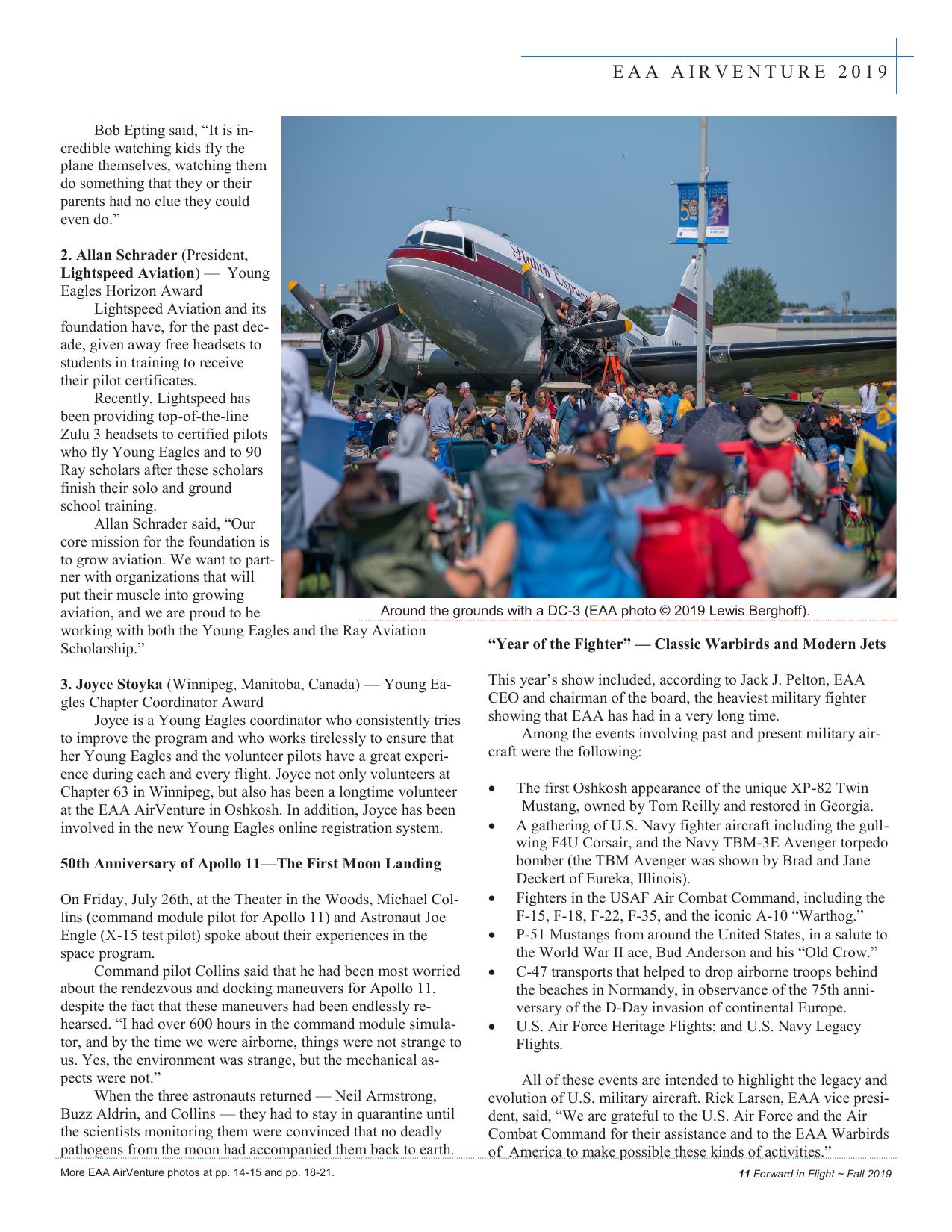
EAA AIRVENTURE 2019 Bob Epting said, “It is incredible watching kids fly the plane themselves, watching them do something that they or their parents had no clue they could even do.” 2. Allan Schrader (President, Lightspeed Aviation) — Young Eagles Horizon Award Lightspeed Aviation and its foundation have, for the past decade, given away free headsets to students in training to receive their pilot certificates. Recently, Lightspeed has been providing top-of-the-line Zulu 3 headsets to certified pilots who fly Young Eagles and to 90 Ray scholars after these scholars finish their solo and ground school training. Allan Schrader said, “Our core mission for the foundation is to grow aviation. We want to partner with organizations that will put their muscle into growing Around the grounds with a DC-3 (EAA photo © 2019 Lewis Berghoff). aviation, and we are proud to be working with both the Young Eagles and the Ray Aviation “Year of the Fighter” — Classic Warbirds and Modern Jets Scholarship.” 3. Joyce Stoyka (Winnipeg, Manitoba, Canada) — Young Eagles Chapter Coordinator Award Joyce is a Young Eagles coordinator who consistently tries to improve the program and who works tirelessly to ensure that her Young Eagles and the volunteer pilots have a great experience during each and every flight. Joyce not only volunteers at Chapter 63 in Winnipeg, but also has been a longtime volunteer at the EAA AirVenture in Oshkosh. In addition, Joyce has been involved in the new Young Eagles online registration system. This year’s show included, according to Jack J. Pelton, EAA CEO and chairman of the board, the heaviest military fighter showing that EAA has had in a very long time. Among the events involving past and present military aircraft were the following: • • 50th Anniversary of Apollo 11—The First Moon Landing On Friday, July 26th, at the Theater in the Woods, Michael Collins (command module pilot for Apollo 11) and Astronaut Joe Engle (X-15 test pilot) spoke about their experiences in the space program. Command pilot Collins said that he had been most worried about the rendezvous and docking maneuvers for Apollo 11, despite the fact that these maneuvers had been endlessly rehearsed. “I had over 600 hours in the command module simulator, and by the time we were airborne, things were not strange to us. Yes, the environment was strange, but the mechanical aspects were not.” When the three astronauts returned — Neil Armstrong, Buzz Aldrin, and Collins — they had to stay in quarantine until the scientists monitoring them were convinced that no deadly pathogens from the moon had accompanied them back to earth. More EAA AirVenture photos at pp. 14-15 and pp. 18-21. • • • • The first Oshkosh appearance of the unique XP-82 Twin Mustang, owned by Tom Reilly and restored in Georgia. A gathering of U.S. Navy fighter aircraft including the gullwing F4U Corsair, and the Navy TBM-3E Avenger torpedo bomber (the TBM Avenger was shown by Brad and Jane Deckert of Eureka, Illinois). Fighters in the USAF Air Combat Command, including the F-15, F-18, F-22, F-35, and the iconic A-10 “Warthog.” P-51 Mustangs from around the United States, in a salute to the World War II ace, Bud Anderson and his “Old Crow.” C-47 transports that helped to drop airborne troops behind the beaches in Normandy, in observance of the 75th anniversary of the D-Day invasion of continental Europe. U.S. Air Force Heritage Flights; and U.S. Navy Legacy Flights. All of these events are intended to highlight the legacy and evolution of U.S. military aircraft. Rick Larsen, EAA vice president, said, “We are grateful to the U.S. Air Force and the Air Combat Command for their assistance and to the EAA Warbirds of America to make possible these kinds of activities.” 11 Forward in Flight ~ Fall 2019
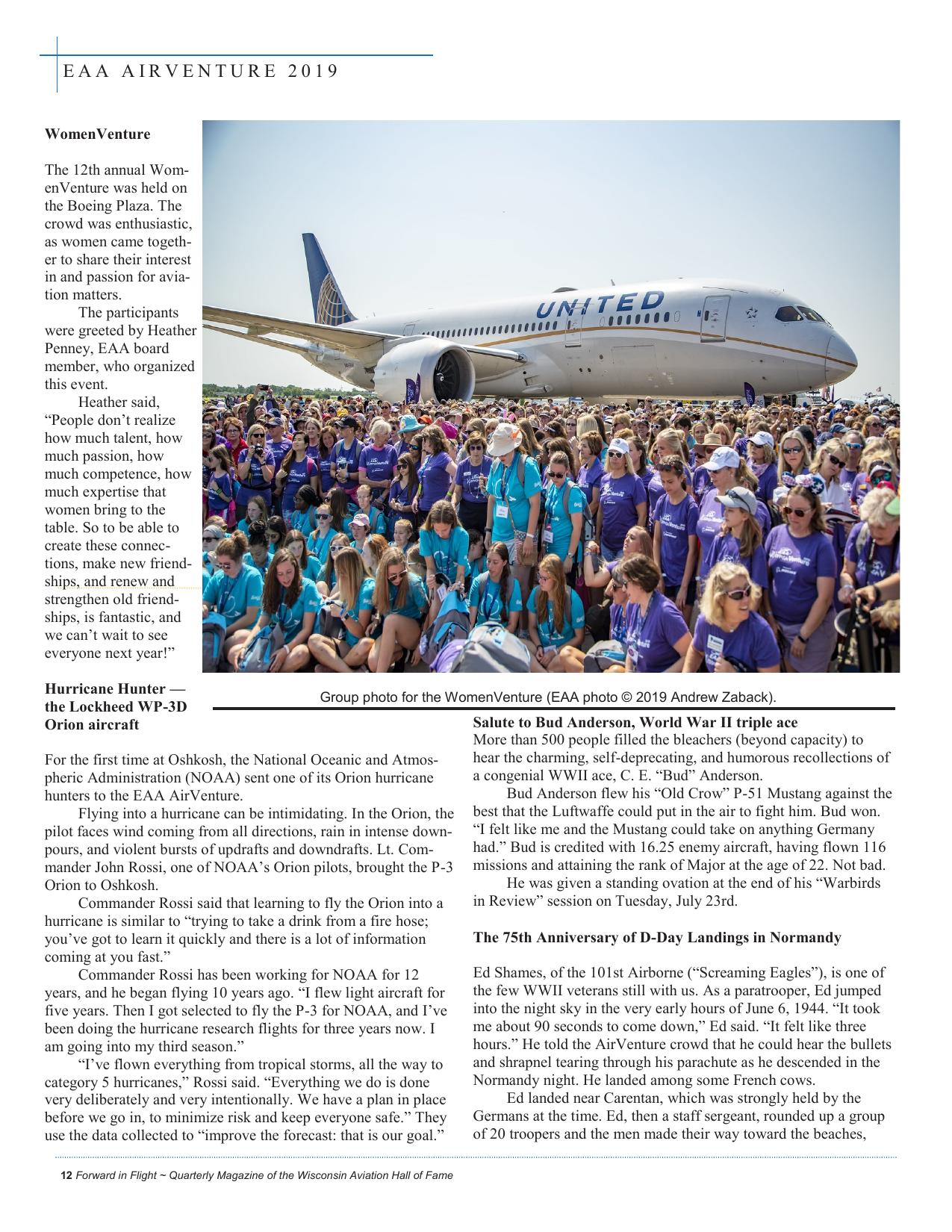
EAA AIRVENTURE 2019 WomenVenture The 12th annual WomenVenture was held on the Boeing Plaza. The crowd was enthusiastic, as women came together to share their interest in and passion for aviation matters. The participants were greeted by Heather Penney, EAA board member, who organized this event. Heather said, “People don’t realize how much talent, how much passion, how much competence, how much expertise that women bring to the table. So to be able to create these connections, make new friendships, and renew and strengthen old friendships, is fantastic, and we can’t wait to see everyone next year!” Hurricane Hunter — the Lockheed WP-3D Orion aircraft Group photo for the WomenVenture (EAA photo © 2019 Andrew Zaback). For the first time at Oshkosh, the National Oceanic and Atmospheric Administration (NOAA) sent one of its Orion hurricane hunters to the EAA AirVenture. Flying into a hurricane can be intimidating. In the Orion, the pilot faces wind coming from all directions, rain in intense downpours, and violent bursts of updrafts and downdrafts. Lt. Commander John Rossi, one of NOAA’s Orion pilots, brought the P-3 Orion to Oshkosh. Commander Rossi said that learning to fly the Orion into a hurricane is similar to “trying to take a drink from a fire hose; you’ve got to learn it quickly and there is a lot of information coming at you fast.” Commander Rossi has been working for NOAA for 12 years, and he began flying 10 years ago. “I flew light aircraft for five years. Then I got selected to fly the P-3 for NOAA, and I’ve been doing the hurricane research flights for three years now. I am going into my third season.” “I’ve flown everything from tropical storms, all the way to category 5 hurricanes,” Rossi said. “Everything we do is done very deliberately and very intentionally. We have a plan in place before we go in, to minimize risk and keep everyone safe.” They use the data collected to “improve the forecast: that is our goal.” 12 Forward in Flight ~ Quarterly Magazine of the Wisconsin Aviation Hall of Fame Salute to Bud Anderson, World War II triple ace More than 500 people filled the bleachers (beyond capacity) to hear the charming, self-deprecating, and humorous recollections of a congenial WWII ace, C. E. “Bud” Anderson. Bud Anderson flew his “Old Crow” P-51 Mustang against the best that the Luftwaffe could put in the air to fight him. Bud won. “I felt like me and the Mustang could take on anything Germany had.” Bud is credited with 16.25 enemy aircraft, having flown 116 missions and attaining the rank of Major at the age of 22. Not bad. He was given a standing ovation at the end of his “Warbirds in Review” session on Tuesday, July 23rd. The 75th Anniversary of D-Day Landings in Normandy Ed Shames, of the 101st Airborne (“Screaming Eagles”), is one of the few WWII veterans still with us. As a paratrooper, Ed jumped into the night sky in the very early hours of June 6, 1944. “It took me about 90 seconds to come down,” Ed said. “It felt like three hours.” He told the AirVenture crowd that he could hear the bullets and shrapnel tearing through his parachute as he descended in the Normandy night. He landed among some French cows. Ed landed near Carentan, which was strongly held by the Germans at the time. Ed, then a staff sergeant, rounded up a group of 20 troopers and the men made their way toward the beaches,
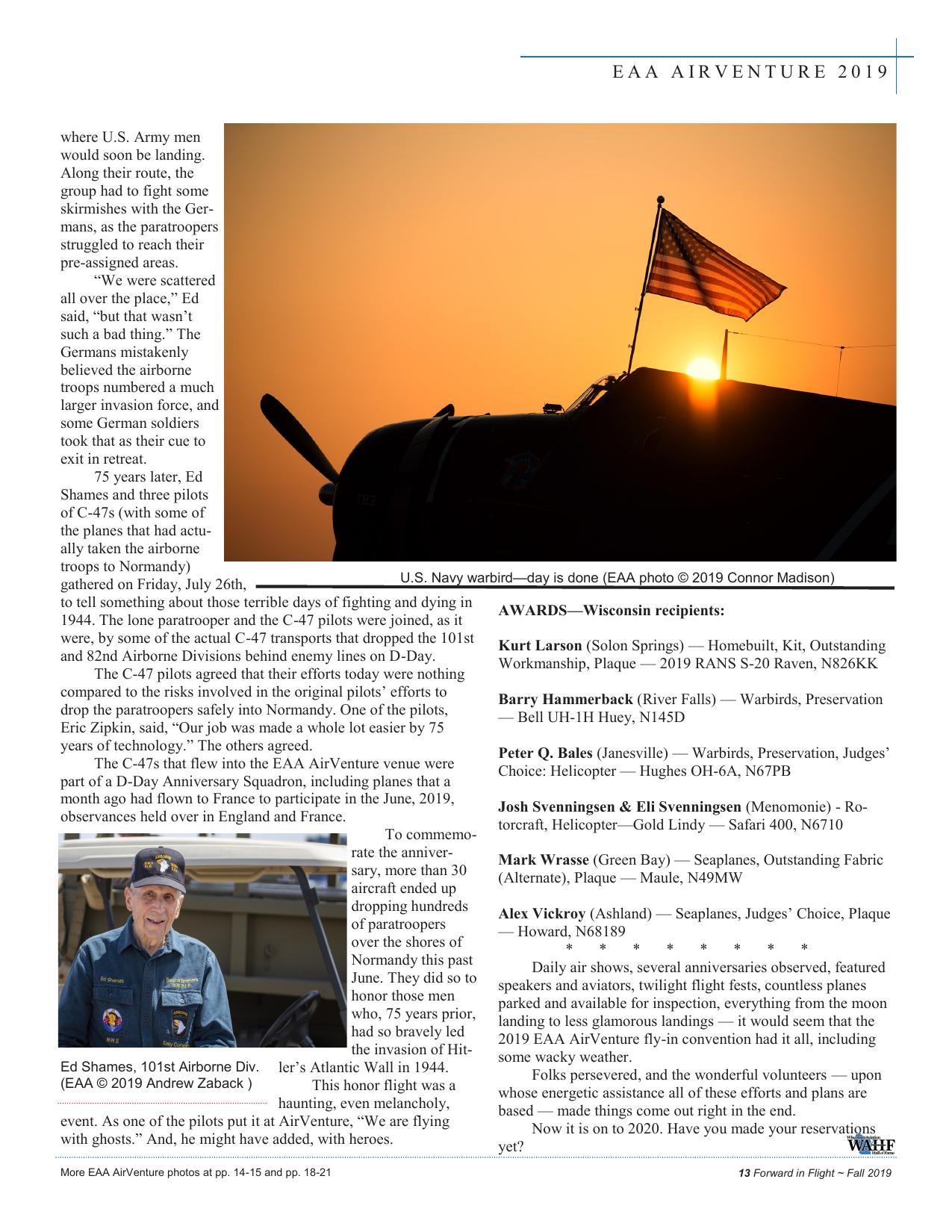
EAA AIRVENTURE 2019 where U.S. Army men would soon be landing. Along their route, the group had to fight some skirmishes with the Germans, as the paratroopers struggled to reach their pre-assigned areas. “We were scattered all over the place,” Ed said, “but that wasn’t such a bad thing.” The Germans mistakenly believed the airborne troops numbered a much larger invasion force, and some German soldiers took that as their cue to exit in retreat. 75 years later, Ed Shames and three pilots of C-47s (with some of the planes that had actually taken the airborne troops to Normandy) U.S. Navy warbird—day is done (EAA photo © 2019 Connor Madison) gathered on Friday, July 26th, to tell something about those terrible days of fighting and dying in AWARDS—Wisconsin recipients: 1944. The lone paratrooper and the C-47 pilots were joined, as it were, by some of the actual C-47 transports that dropped the 101st Kurt Larson (Solon Springs) — Homebuilt, Kit, Outstanding and 82nd Airborne Divisions behind enemy lines on D-Day. Workmanship, Plaque — 2019 RANS S-20 Raven, N826KK The C-47 pilots agreed that their efforts today were nothing compared to the risks involved in the original pilots’ efforts to Barry Hammerback (River Falls) — Warbirds, Preservation drop the paratroopers safely into Normandy. One of the pilots, — Bell UH-1H Huey, N145D Eric Zipkin, said, “Our job was made a whole lot easier by 75 years of technology.” The others agreed. Peter Q. Bales (Janesville) — Warbirds, Preservation, Judges’ The C-47s that flew into the EAA AirVenture venue were Choice: Helicopter — Hughes OH-6A, N67PB part of a D-Day Anniversary Squadron, including planes that a month ago had flown to France to participate in the June, 2019, Josh Svenningsen & Eli Svenningsen (Menomonie) - Roobservances held over in England and France. torcraft, Helicopter—Gold Lindy — Safari 400, N6710 To commemorate the anniverMark Wrasse (Green Bay) — Seaplanes, Outstanding Fabric sary, more than 30 (Alternate), Plaque — Maule, N49MW aircraft ended up dropping hundreds Alex Vickroy (Ashland) — Seaplanes, Judges’ Choice, Plaque of paratroopers — Howard, N68189 over the shores of * * * * * * * * Normandy this past Daily air shows, several anniversaries observed, featured June. They did so to speakers and aviators, twilight flight fests, countless planes honor those men parked and available for inspection, everything from the moon who, 75 years prior, landing to less glamorous landings — it would seem that the had so bravely led 2019 EAA AirVenture fly-in convention had it all, including the invasion of Hitsome wacky weather. Ed Shames, 101st Airborne Div. ler’s Atlantic Wall in 1944. Folks persevered, and the wonderful volunteers — upon (EAA © 2019 Andrew Zaback ) This honor flight was a whose energetic assistance all of these efforts and plans are haunting, even melancholy, based — made things come out right in the end. event. As one of the pilots put it at AirVenture, “We are flying Now it is on to 2020. Have you made your reservations with ghosts.” And, he might have added, with heroes. yet? More EAA AirVenture photos at pp. 14-15 and pp. 18-21 13 Forward in Flight ~ Fall 2019
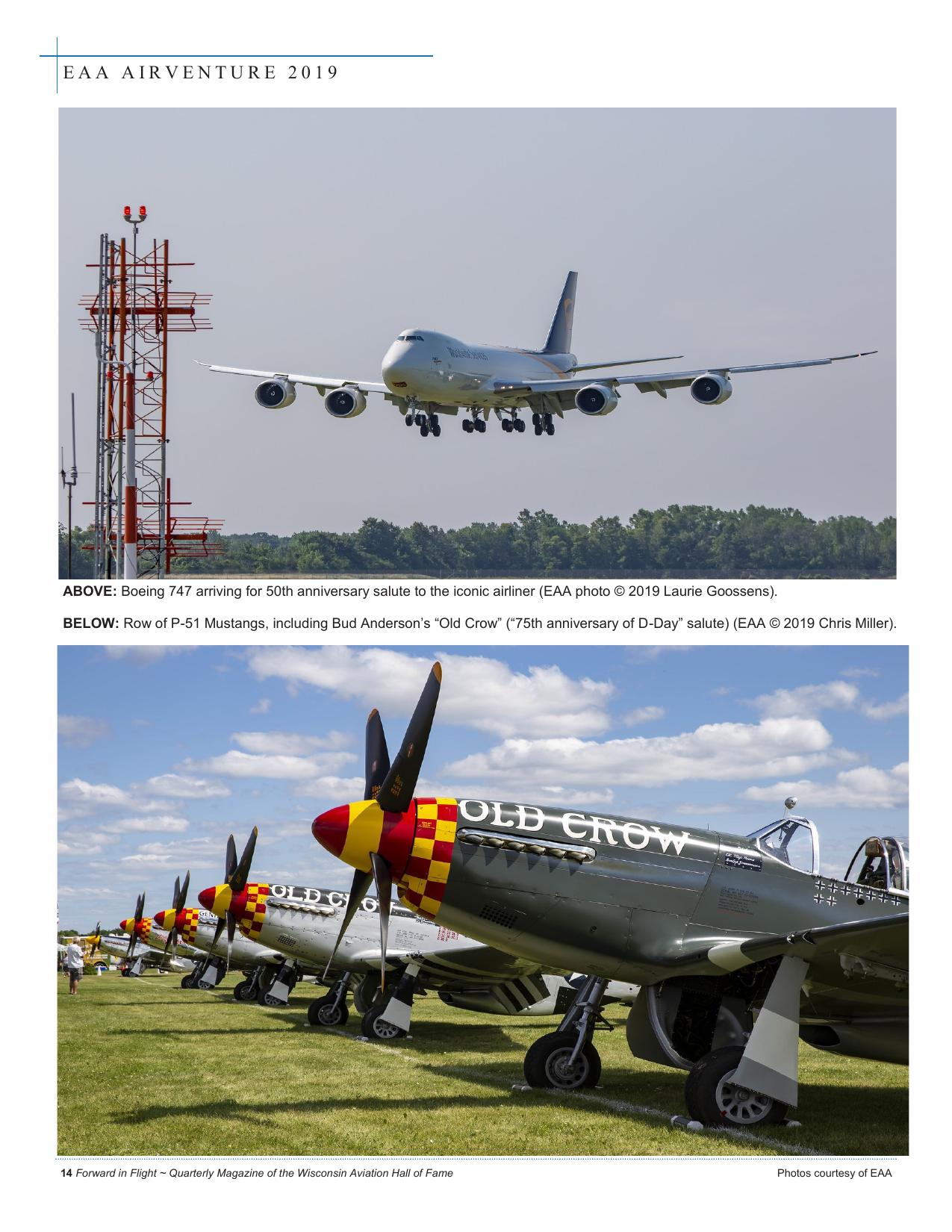
EAA AIRVENTURE 2019 ABOVE: Boeing 747 arriving for 50th anniversary salute to the iconic airliner (EAA photo © 2019 Laurie Goossens). BELOW: Row of P-51 Mustangs, including Bud Anderson’s “Old Crow” (“75th anniversary of D-Day” salute) (EAA © 2019 Chris Miller). 14 Forward in Flight ~ Quarterly Magazine of the Wisconsin Aviation Hall of Fame Photos courtesy of EAA
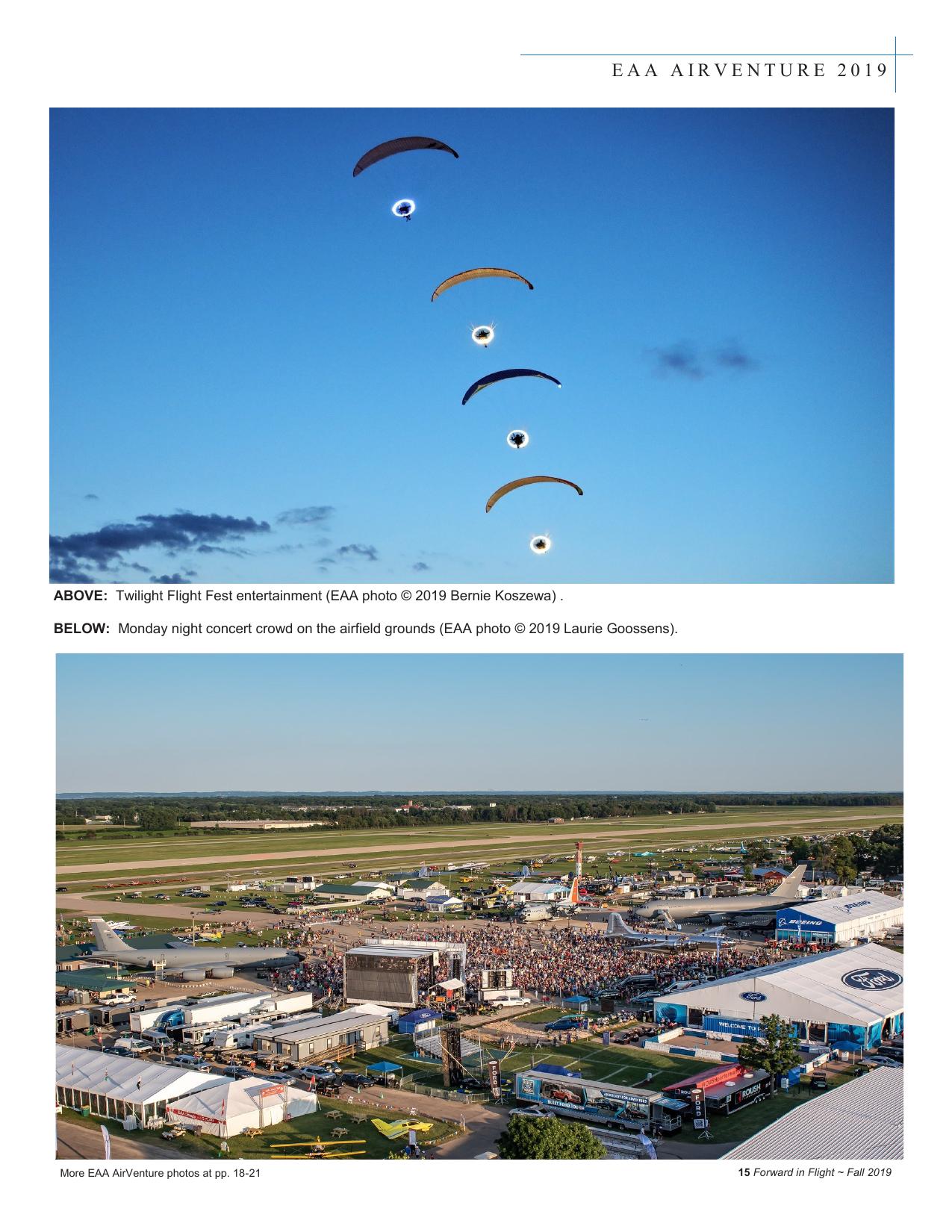
EAA AIRVENTURE 2019 ABOVE: Twilight Flight Fest entertainment (EAA photo © 2019 Bernie Koszewa) . BELOW: Monday night concert crowd on the airfield grounds (EAA photo © 2019 Laurie Goossens). More EAA AirVenture photos at pp. 18-21 15 Forward in Flight ~ Fall 2019
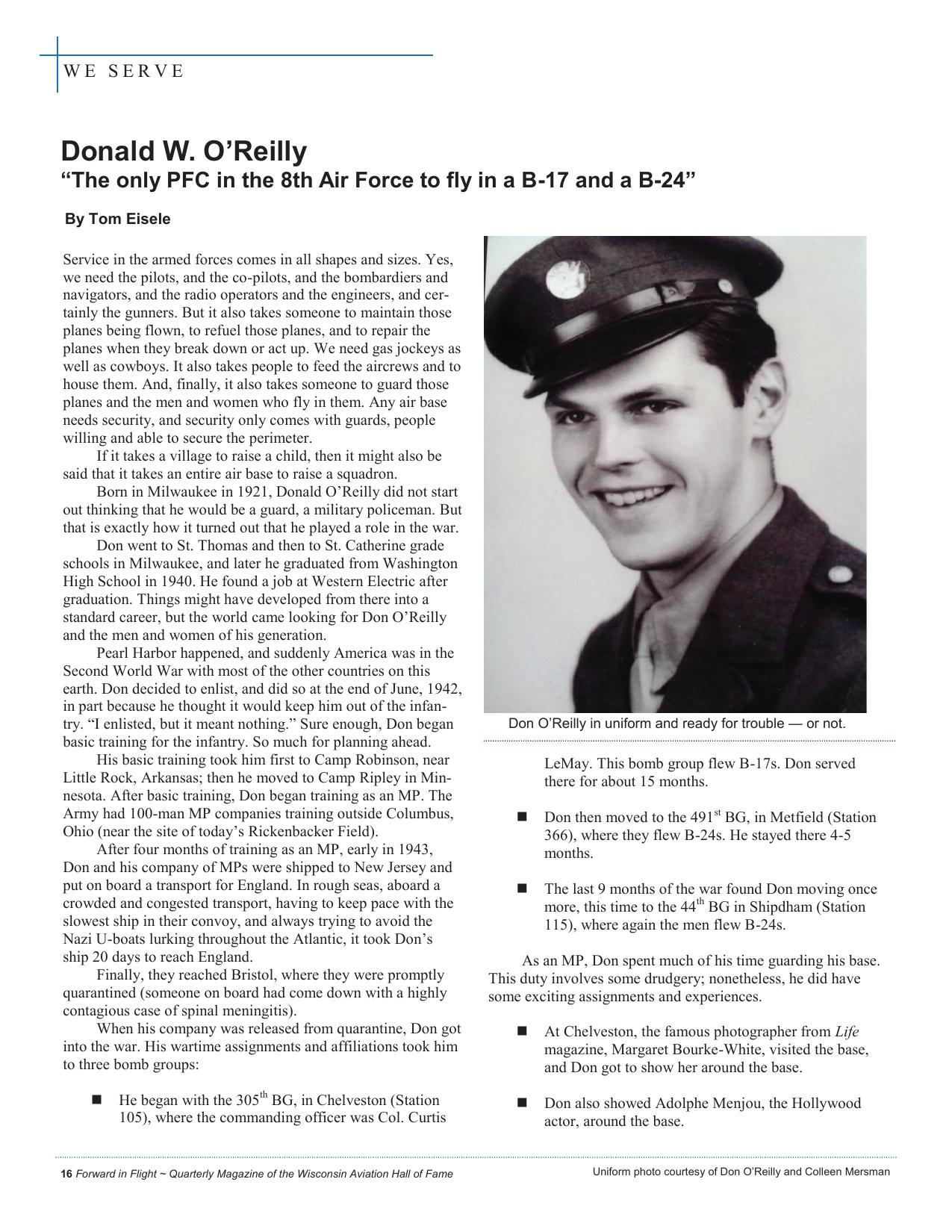
WE SERVE Donald W. O’Reilly “The only PFC in the 8th Air Force to fly in a B-17 and a B-24” By Tom Eisele Service in the armed forces comes in all shapes and sizes. Yes, we need the pilots, and the co-pilots, and the bombardiers and navigators, and the radio operators and the engineers, and certainly the gunners. But it also takes someone to maintain those planes being flown, to refuel those planes, and to repair the planes when they break down or act up. We need gas jockeys as well as cowboys. It also takes people to feed the aircrews and to house them. And, finally, it also takes someone to guard those planes and the men and women who fly in them. Any air base needs security, and security only comes with guards, people willing and able to secure the perimeter. If it takes a village to raise a child, then it might also be said that it takes an entire air base to raise a squadron. Born in Milwaukee in 1921, Donald O’Reilly did not start out thinking that he would be a guard, a military policeman. But that is exactly how it turned out that he played a role in the war. Don went to St. Thomas and then to St. Catherine grade schools in Milwaukee, and later he graduated from Washington High School in 1940. He found a job at Western Electric after graduation. Things might have developed from there into a standard career, but the world came looking for Don O’Reilly and the men and women of his generation. Pearl Harbor happened, and suddenly America was in the Second World War with most of the other countries on this earth. Don decided to enlist, and did so at the end of June, 1942, in part because he thought it would keep him out of the infantry. “I enlisted, but it meant nothing.” Sure enough, Don began basic training for the infantry. So much for planning ahead. His basic training took him first to Camp Robinson, near Little Rock, Arkansas; then he moved to Camp Ripley in Minnesota. After basic training, Don began training as an MP. The Army had 100-man MP companies training outside Columbus, Ohio (near the site of today’s Rickenbacker Field). After four months of training as an MP, early in 1943, Don and his company of MPs were shipped to New Jersey and put on board a transport for England. In rough seas, aboard a crowded and congested transport, having to keep pace with the slowest ship in their convoy, and always trying to avoid the Nazi U-boats lurking throughout the Atlantic, it took Don’s ship 20 days to reach England. Finally, they reached Bristol, where they were promptly quarantined (someone on board had come down with a highly contagious case of spinal meningitis). When his company was released from quarantine, Don got into the war. His wartime assignments and affiliations took him to three bomb groups: ◼ He began with the 305th BG, in Chelveston (Station 105), where the commanding officer was Col. Curtis 16 Forward in Flight ~ Quarterly Magazine of the Wisconsin Aviation Hall of Fame Don O’Reilly in uniform and ready for trouble — or not. LeMay. This bomb group flew B-17s. Don served there for about 15 months. ◼ Don then moved to the 491st BG, in Metfield (Station 366), where they flew B-24s. He stayed there 4-5 months. ◼ The last 9 months of the war found Don moving once more, this time to the 44th BG in Shipdham (Station 115), where again the men flew B-24s. As an MP, Don spent much of his time guarding his base. This duty involves some drudgery; nonetheless, he did have some exciting assignments and experiences. ◼ At Chelveston, the famous photographer from Life magazine, Margaret Bourke-White, visited the base, and Don got to show her around the base. ◼ Don also showed Adolphe Menjou, the Hollywood actor, around the base. Uniform photo courtesy of Don O’Reilly and Colleen Mersman
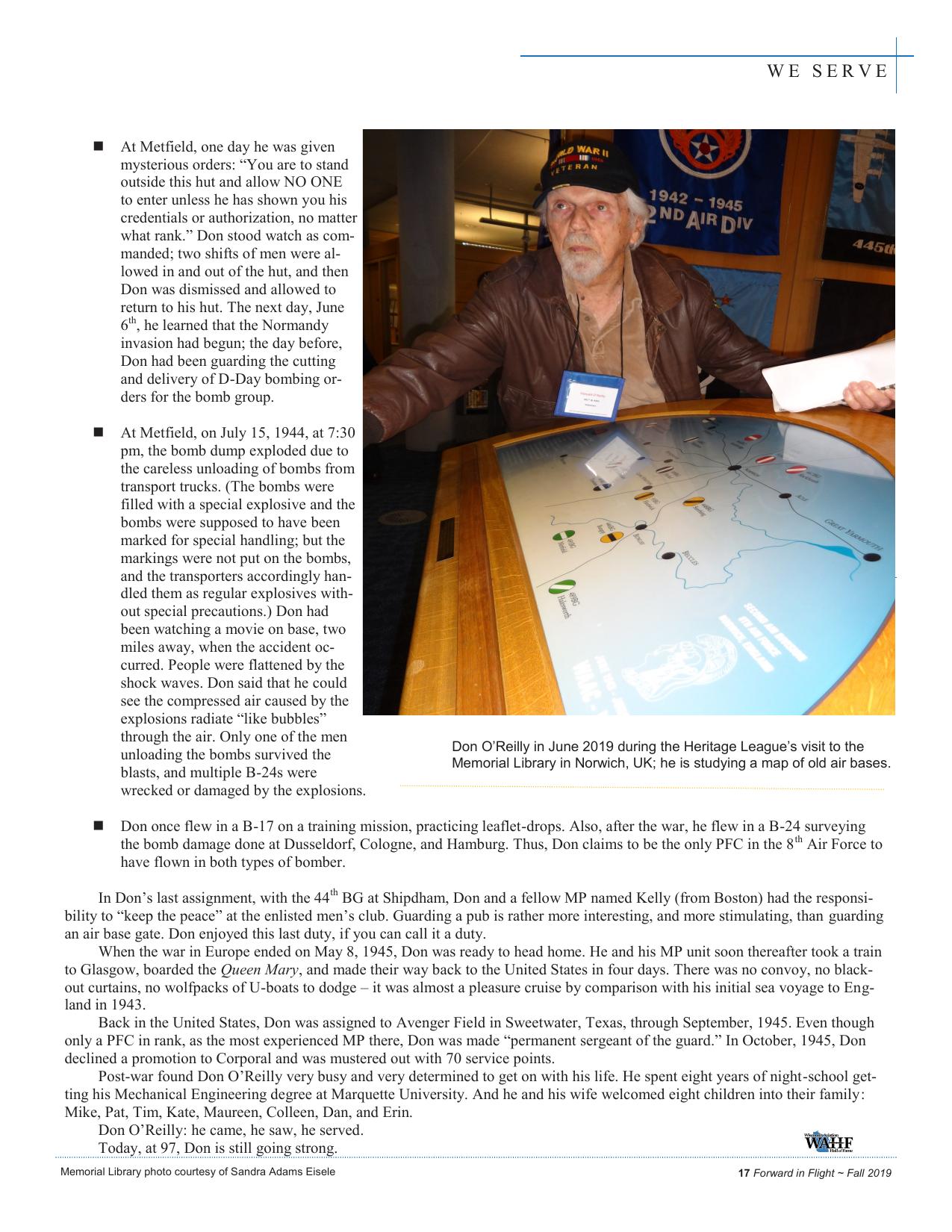
WE SERVE ◼ At Metfield, one day he was given mysterious orders: “You are to stand outside this hut and allow NO ONE to enter unless he has shown you his credentials or authorization, no matter what rank.” Don stood watch as commanded; two shifts of men were allowed in and out of the hut, and then Don was dismissed and allowed to return to his hut. The next day, June 6th, he learned that the Normandy invasion had begun; the day before, Don had been guarding the cutting and delivery of D-Day bombing orders for the bomb group. ◼ At Metfield, on July 15, 1944, at 7:30 pm, the bomb dump exploded due to the careless unloading of bombs from transport trucks. (The bombs were filled with a special explosive and the bombs were supposed to have been marked for special handling; but the markings were not put on the bombs, and the transporters accordingly handled them as regular explosives without special precautions.) Don had been watching a movie on base, two miles away, when the accident occurred. People were flattened by the shock waves. Don said that he could see the compressed air caused by the explosions radiate “like bubbles” through the air. Only one of the men unloading the bombs survived the blasts, and multiple B-24s were wrecked or damaged by the explosions. ◼ Don O’Reilly in June 2019 during the Heritage League’s visit to the Memorial Library in Norwich, UK; he is studying a map of old air bases. Don once flew in a B-17 on a training mission, practicing leaflet-drops. Also, after the war, he flew in a B-24 surveying the bomb damage done at Dusseldorf, Cologne, and Hamburg. Thus, Don claims to be the only PFC in the 8 th Air Force to have flown in both types of bomber. In Don’s last assignment, with the 44th BG at Shipdham, Don and a fellow MP named Kelly (from Boston) had the responsibility to “keep the peace” at the enlisted men’s club. Guarding a pub is rather more interesting, and more stimulating, than guarding an air base gate. Don enjoyed this last duty, if you can call it a duty. When the war in Europe ended on May 8, 1945, Don was ready to head home. He and his MP unit soon thereafter took a train to Glasgow, boarded the Queen Mary, and made their way back to the United States in four days. There was no convoy, no blackout curtains, no wolfpacks of U-boats to dodge – it was almost a pleasure cruise by comparison with his initial sea voyage to England in 1943. Back in the United States, Don was assigned to Avenger Field in Sweetwater, Texas, through September, 1945. Even though only a PFC in rank, as the most experienced MP there, Don was made “permanent sergeant of the guard.” In October, 1945, Don declined a promotion to Corporal and was mustered out with 70 service points. Post-war found Don O’Reilly very busy and very determined to get on with his life. He spent eight years of night-school getting his Mechanical Engineering degree at Marquette University. And he and his wife welcomed eight children into their family: Mike, Pat, Tim, Kate, Maureen, Colleen, Dan, and Erin. Don O’Reilly: he came, he saw, he served. Today, at 97, Don is still going strong. Memorial Library photo courtesy of Sandra Adams Eisele 17 Forward in Flight ~ Fall 2019
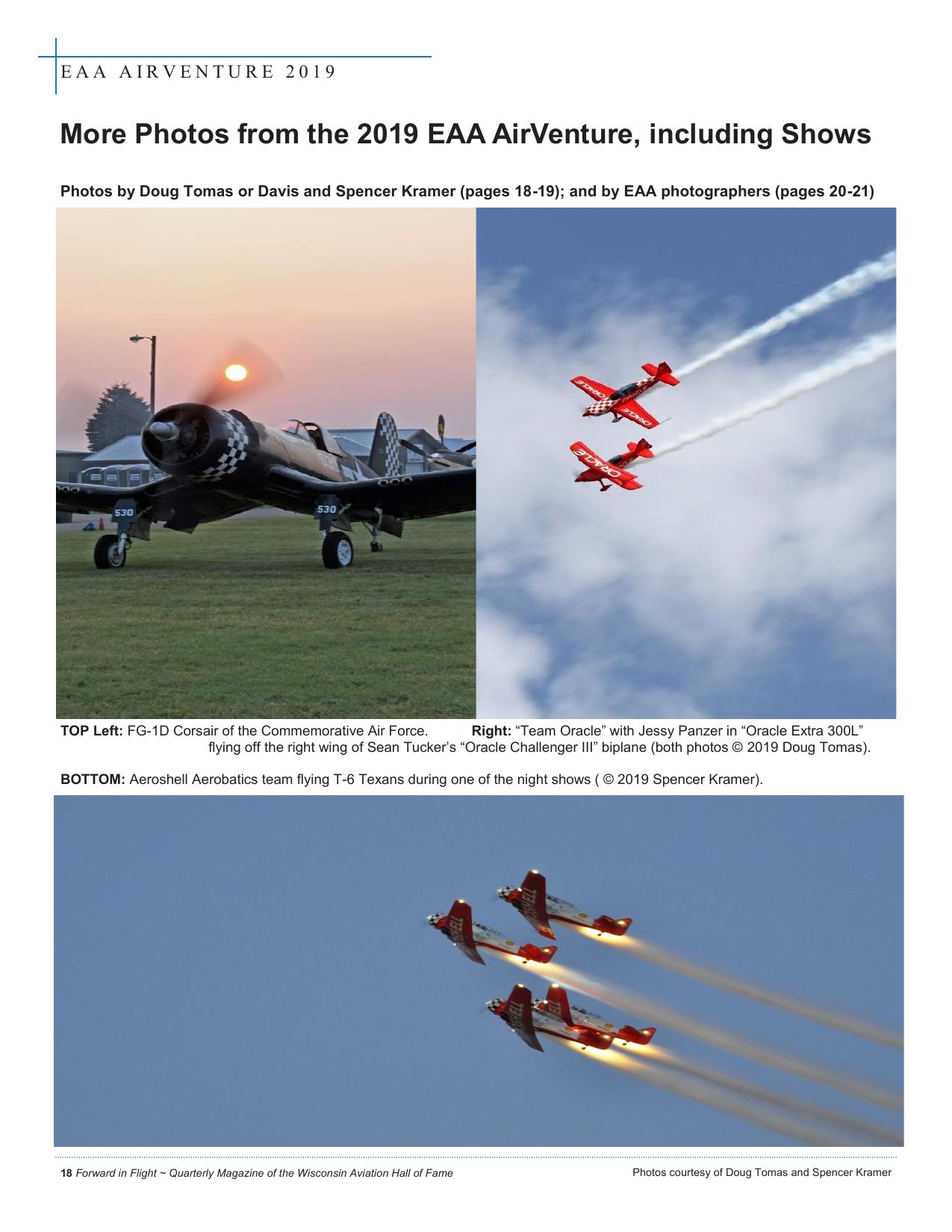
EAA AIRVENTURE 2019 More Photos from the 2019 EAA AirVenture, including Shows Photos by Doug Tomas or Davis and Spencer Kramer (pages 18-19); and by EAA photographers (pages 20-21) TOP Left: FG-1D Corsair of the Commemorative Air Force. Right: “Team Oracle” with Jessy Panzer in “Oracle Extra 300L” flying off the right wing of Sean Tucker’s “Oracle Challenger III” biplane (both photos © 2019 Doug Tomas). BOTTOM: Aeroshell Aerobatics team flying T-6 Texans during one of the night shows ( © 2019 Spencer Kramer). 18 Forward in Flight ~ Quarterly Magazine of the Wisconsin Aviation Hall of Fame Photos courtesy of Doug Tomas and Spencer Kramer
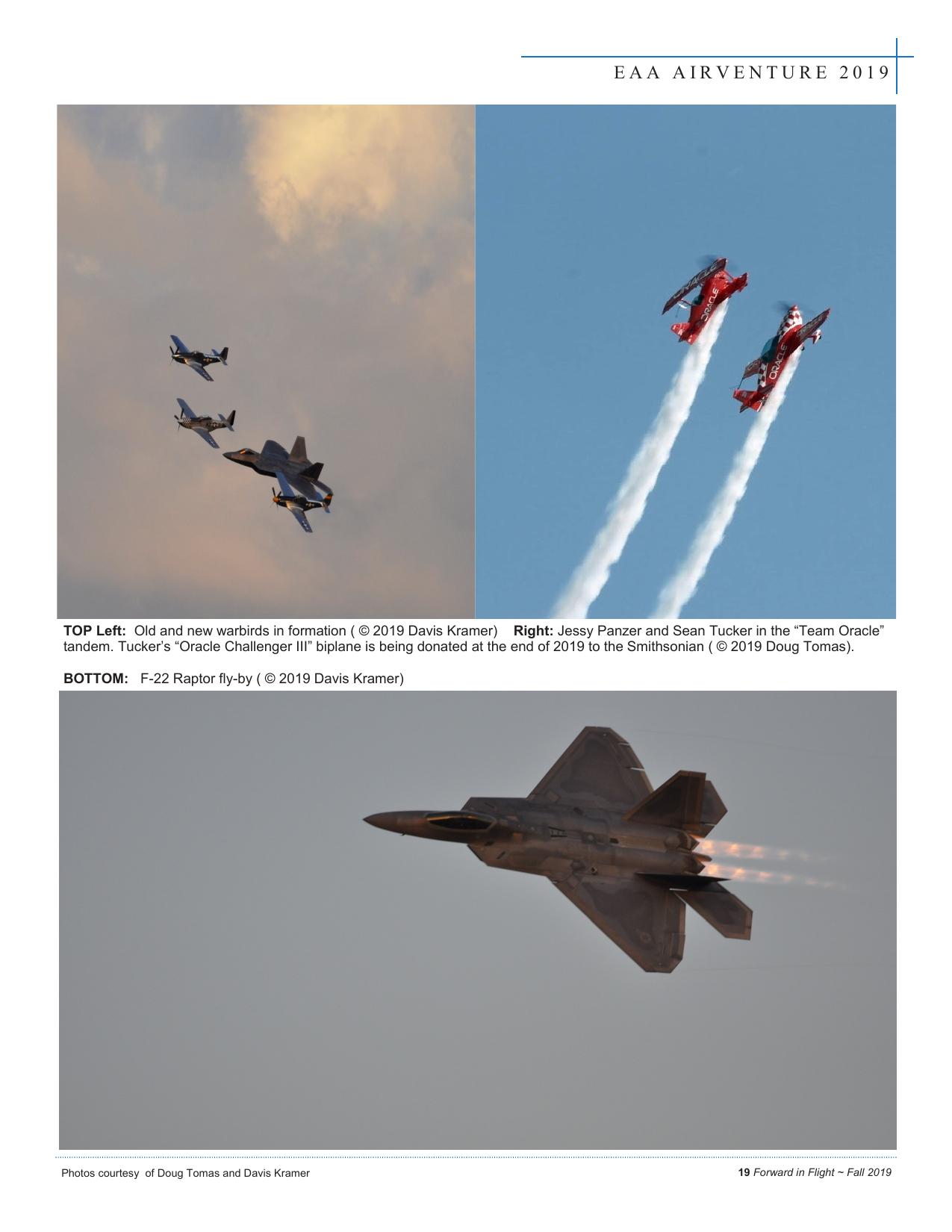
EAA AIRVENTURE 2019 TOP Left: Old and new warbirds in formation ( © 2019 Davis Kramer) Right: Jessy Panzer and Sean Tucker in the “Team Oracle” tandem. Tucker’s “Oracle Challenger III” biplane is being donated at the end of 2019 to the Smithsonian ( © 2019 Doug Tomas). BOTTOM: F-22 Raptor fly-by ( © 2019 Davis Kramer) Photos courtesy of Doug Tomas and Davis Kramer 19 Forward in Flight ~ Fall 2019
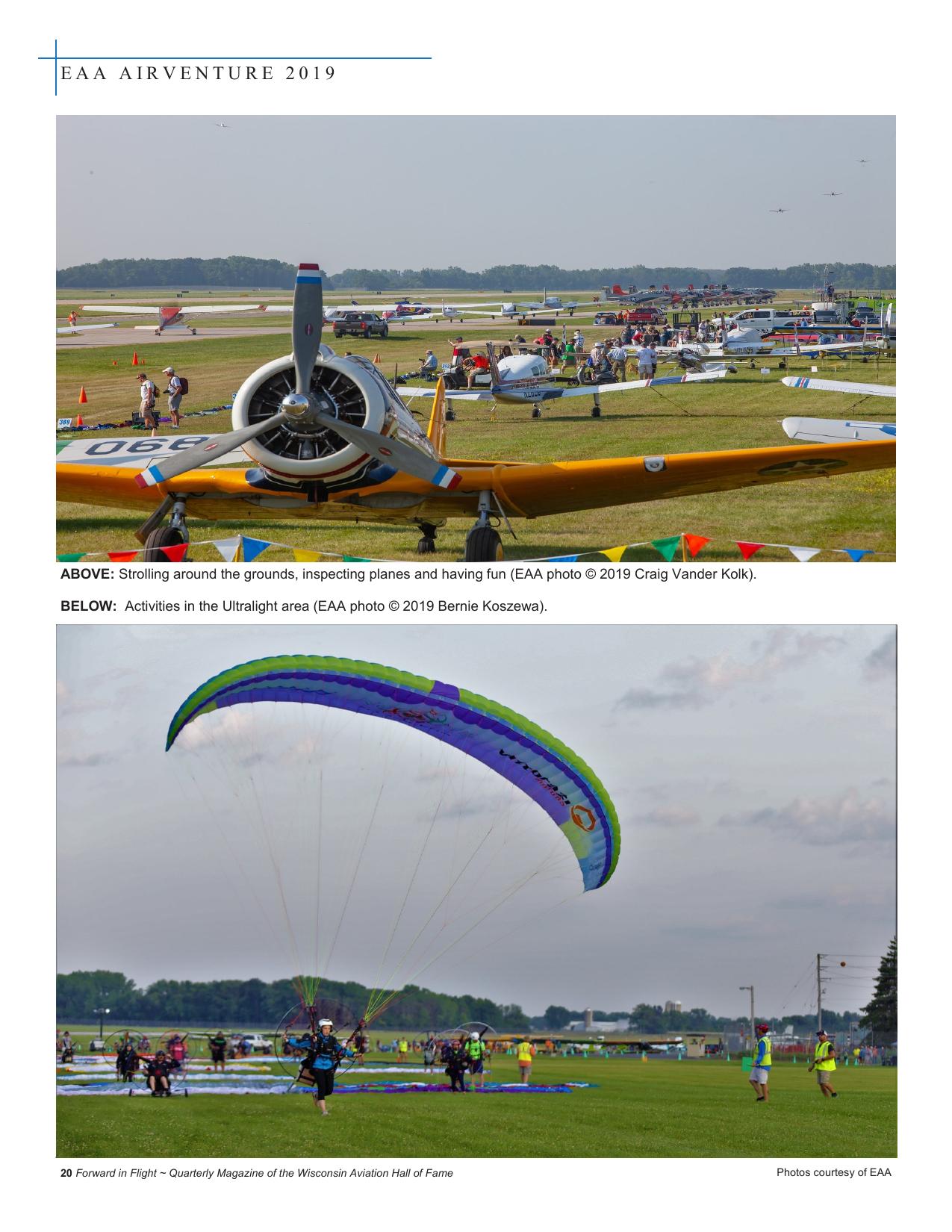
EAA AIRVENTURE 2019 ABOVE: Strolling around the grounds, inspecting planes and having fun (EAA photo © 2019 Craig Vander Kolk). BELOW: Activities in the Ultralight area (EAA photo © 2019 Bernie Koszewa). 20 Forward in Flight ~ Quarterly Magazine of the Wisconsin Aviation Hall of Fame Photos courtesy of EAA
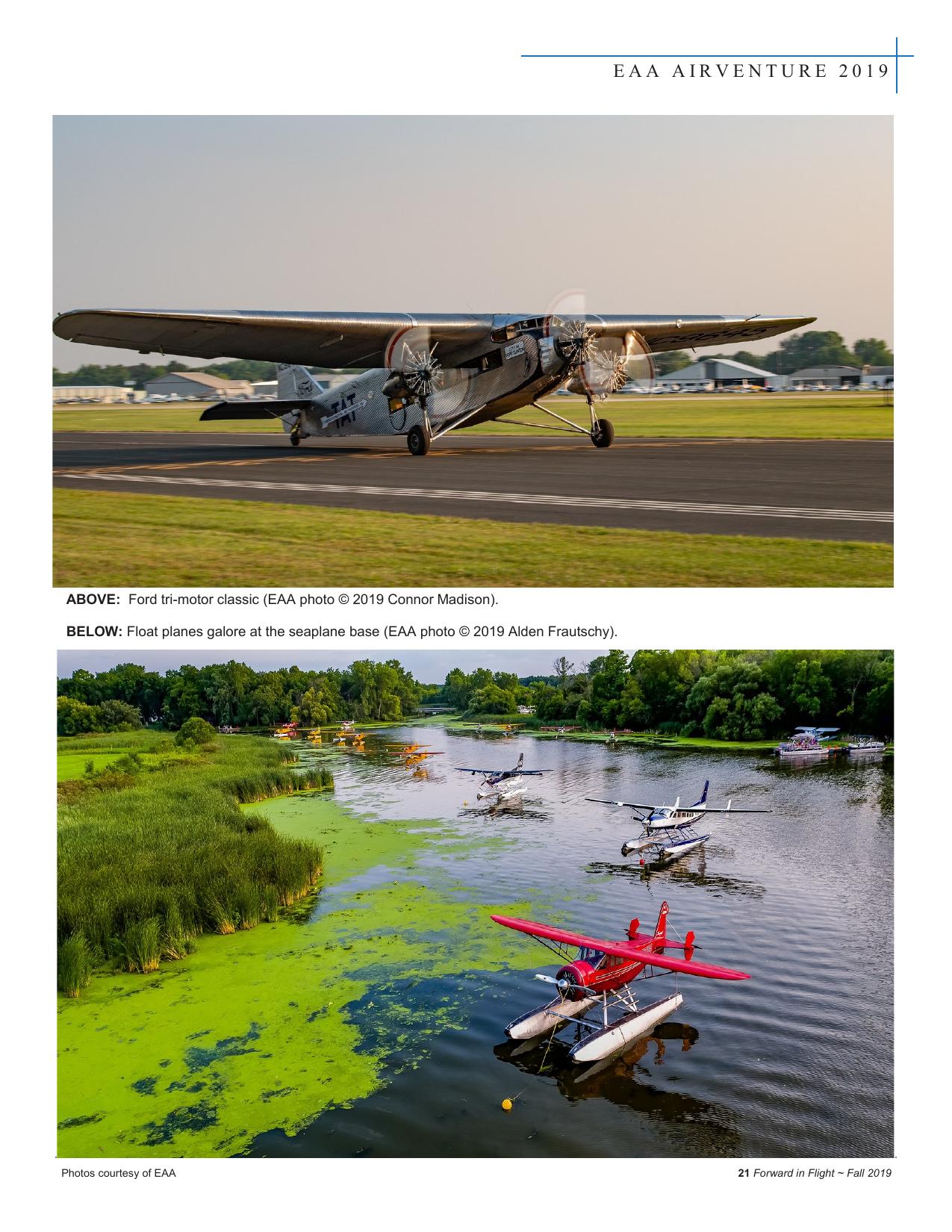
EAA AIRVENTURE 2019 ABOVE: Ford tri-motor classic (EAA photo © 2019 Connor Madison). BELOW: Float planes galore at the seaplane base (EAA photo © 2019 Alden Frautschy). Photos courtesy of EAA 21 Forward in Flight ~ Fall 2019
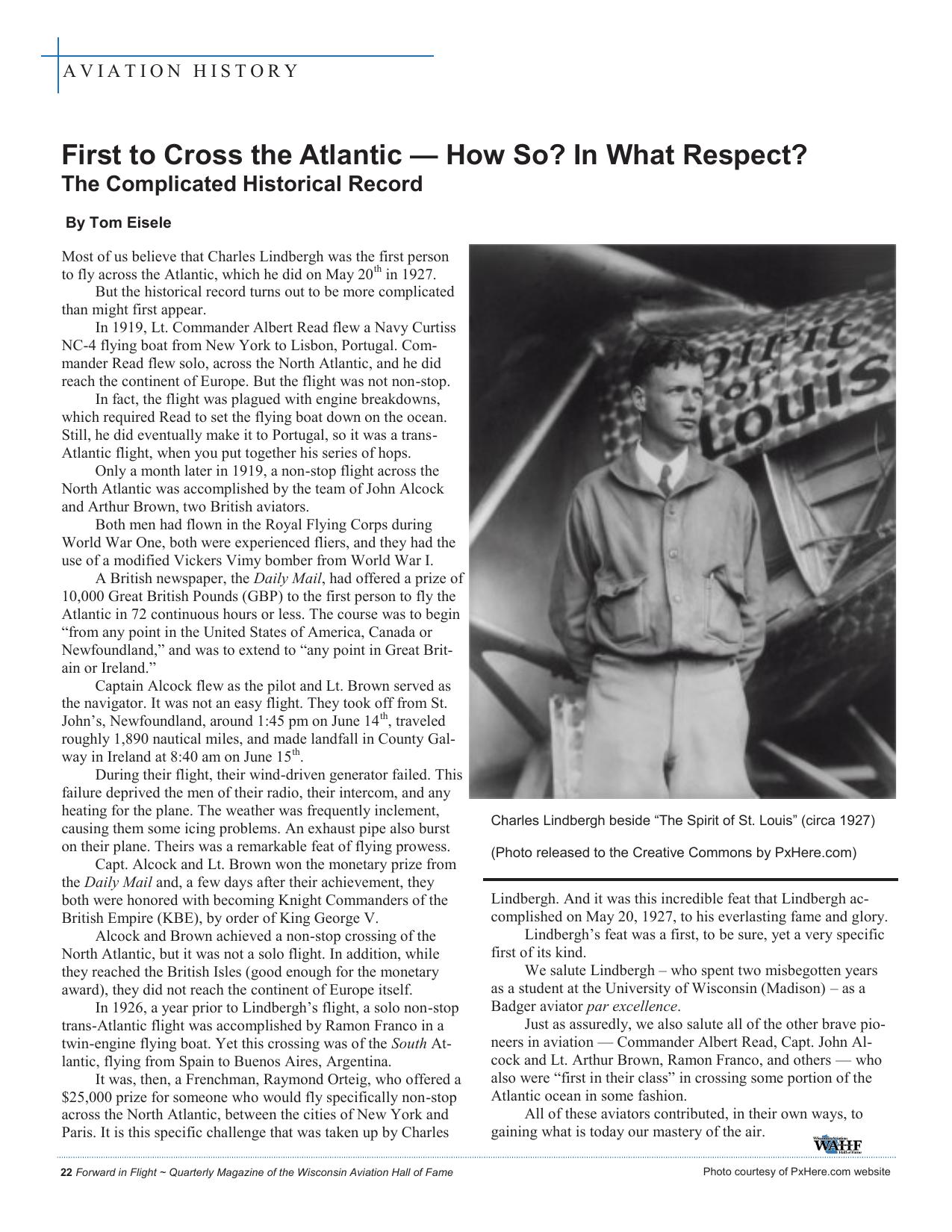
AVIATION HISTORY First to Cross the Atlantic — How So? In What Respect? The Complicated Historical Record By Tom Eisele Most of us believe that Charles Lindbergh was the first person to fly across the Atlantic, which he did on May 20 th in 1927. But the historical record turns out to be more complicated than might first appear. In 1919, Lt. Commander Albert Read flew a Navy Curtiss NC-4 flying boat from New York to Lisbon, Portugal. Commander Read flew solo, across the North Atlantic, and he did reach the continent of Europe. But the flight was not non-stop. In fact, the flight was plagued with engine breakdowns, which required Read to set the flying boat down on the ocean. Still, he did eventually make it to Portugal, so it was a transAtlantic flight, when you put together his series of hops. Only a month later in 1919, a non-stop flight across the North Atlantic was accomplished by the team of John Alcock and Arthur Brown, two British aviators. Both men had flown in the Royal Flying Corps during World War One, both were experienced fliers, and they had the use of a modified Vickers Vimy bomber from World War I. A British newspaper, the Daily Mail, had offered a prize of 10,000 Great British Pounds (GBP) to the first person to fly the Atlantic in 72 continuous hours or less. The course was to begin “from any point in the United States of America, Canada or Newfoundland,” and was to extend to “any point in Great Britain or Ireland.” Captain Alcock flew as the pilot and Lt. Brown served as the navigator. It was not an easy flight. They took off from St. John’s, Newfoundland, around 1:45 pm on June 14 th, traveled roughly 1,890 nautical miles, and made landfall in County Galway in Ireland at 8:40 am on June 15th. During their flight, their wind-driven generator failed. This failure deprived the men of their radio, their intercom, and any heating for the plane. The weather was frequently inclement, causing them some icing problems. An exhaust pipe also burst on their plane. Theirs was a remarkable feat of flying prowess. Capt. Alcock and Lt. Brown won the monetary prize from the Daily Mail and, a few days after their achievement, they both were honored with becoming Knight Commanders of the British Empire (KBE), by order of King George V. Alcock and Brown achieved a non-stop crossing of the North Atlantic, but it was not a solo flight. In addition, while they reached the British Isles (good enough for the monetary award), they did not reach the continent of Europe itself. In 1926, a year prior to Lindbergh’s flight, a solo non-stop trans-Atlantic flight was accomplished by Ramon Franco in a twin-engine flying boat. Yet this crossing was of the South Atlantic, flying from Spain to Buenos Aires, Argentina. It was, then, a Frenchman, Raymond Orteig, who offered a $25,000 prize for someone who would fly specifically non-stop across the North Atlantic, between the cities of New York and Paris. It is this specific challenge that was taken up by Charles 22 Forward in Flight ~ Quarterly Magazine of the Wisconsin Aviation Hall of Fame Charles Lindbergh beside “The Spirit of St. Louis” (circa 1927) (Photo released to the Creative Commons by PxHere.com) Lindbergh. And it was this incredible feat that Lindbergh accomplished on May 20, 1927, to his everlasting fame and glory. Lindbergh’s feat was a first, to be sure, yet a very specific first of its kind. We salute Lindbergh – who spent two misbegotten years as a student at the University of Wisconsin (Madison) – as a Badger aviator par excellence. Just as assuredly, we also salute all of the other brave pioneers in aviation — Commander Albert Read, Capt. John Alcock and Lt. Arthur Brown, Ramon Franco, and others — who also were “first in their class” in crossing some portion of the Atlantic ocean in some fashion. All of these aviators contributed, in their own ways, to gaining what is today our mastery of the air. Photo courtesy of PxHere.com website
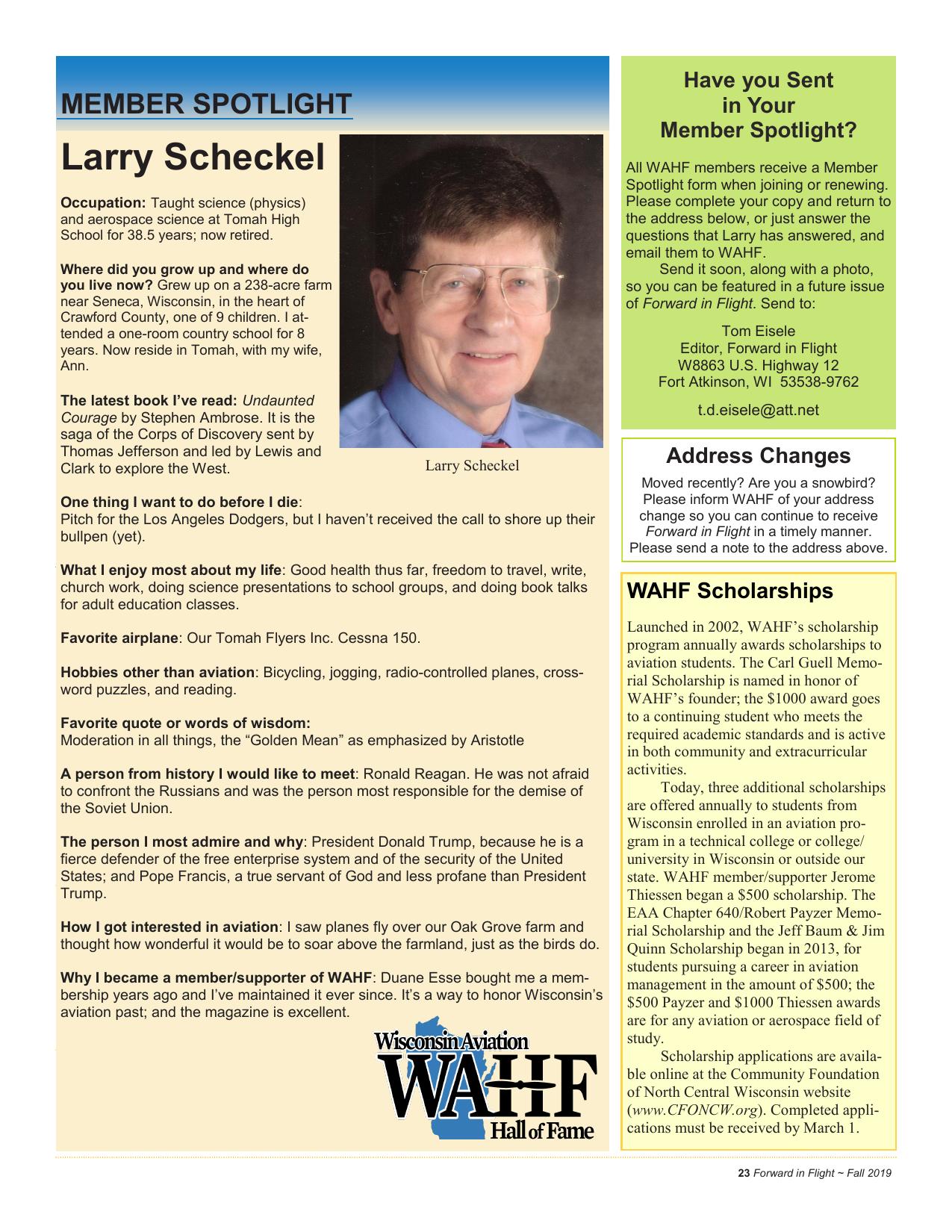
Have you Sent in Your Member Spotlight? MEMBER SPOTLIGHT Larry Scheckel All WAHF members receive a Member Spotlight form when joining or renewing. Please complete your copy and return to the address below, or just answer the questions that Larry has answered, and email them to WAHF. Send it soon, along with a photo, so you can be featured in a future issue of Forward in Flight. Send to: Occupation: Taught science (physics) and aerospace science at Tomah High School for 38.5 years; now retired. Where did you grow up and where do you live now? Grew up on a 238-acre farm near Seneca, Wisconsin, in the heart of Crawford County, one of 9 children. I attended a one-room country school for 8 years. Now reside in Tomah, with my wife, Ann. The latest book I’ve read: Undaunted Courage by Stephen Ambrose. It is the saga of the Corps of Discovery sent by Thomas Jefferson and led by Lewis and Clark to explore the West. Tom Eisele Editor, Forward in Flight W8863 U.S. Highway 12 Fort Atkinson, WI 53538-9762 t.d.eisele@att.net Larry Scheckel Address Changes One thing I want to do before I die: Pitch for the Los Angeles Dodgers, but I haven’t received the call to shore up their bullpen (yet). Moved recently? Are you a snowbird? Please inform WAHF of your address change so you can continue to receive Forward in Flight in a timely manner. Please send a note to the address above. What I enjoy most about my life: Good health thus far, freedom to travel, write, church work, doing science presentations to school groups, and doing book talks for adult education classes. WAHF Scholarships Favorite airplane: Our Tomah Flyers Inc. Cessna 150. Hobbies other than aviation: Bicycling, jogging, radio-controlled planes, crossword puzzles, and reading. Favorite quote or words of wisdom: Moderation in all things, the “Golden Mean” as emphasized by Aristotle A person from history I would like to meet: Ronald Reagan. He was not afraid to confront the Russians and was the person most responsible for the demise of the Soviet Union. The person I most admire and why: President Donald Trump, because he is a fierce defender of the free enterprise system and of the security of the United States; and Pope Francis, a true servant of God and less profane than President Trump. How I got interested in aviation: I saw planes fly over our Oak Grove farm and thought how wonderful it would be to soar above the farmland, just as the birds do. Why I became a member/supporter of WAHF: Duane Esse bought me a membership years ago and I’ve maintained it ever since. It’s a way to honor Wisconsin’s aviation past; and the magazine is excellent. Launched in 2002, WAHF’s scholarship program annually awards scholarships to aviation students. The Carl Guell Memorial Scholarship is named in honor of WAHF’s founder; the $1000 award goes to a continuing student who meets the required academic standards and is active in both community and extracurricular activities. Today, three additional scholarships are offered annually to students from Wisconsin enrolled in an aviation program in a technical college or college/ university in Wisconsin or outside our state. WAHF member/supporter Jerome Thiessen began a $500 scholarship. The EAA Chapter 640/Robert Payzer Memorial Scholarship and the Jeff Baum & Jim Quinn Scholarship began in 2013, for students pursuing a career in aviation management in the amount of $500; the $500 Payzer and $1000 Thiessen awards are for any aviation or aerospace field of study. Scholarship applications are available online at the Community Foundation of North Central Wisconsin website (www.CFONCW.org). Completed applications must be received by March 1. 23 Forward in Flight ~ Fall 2019
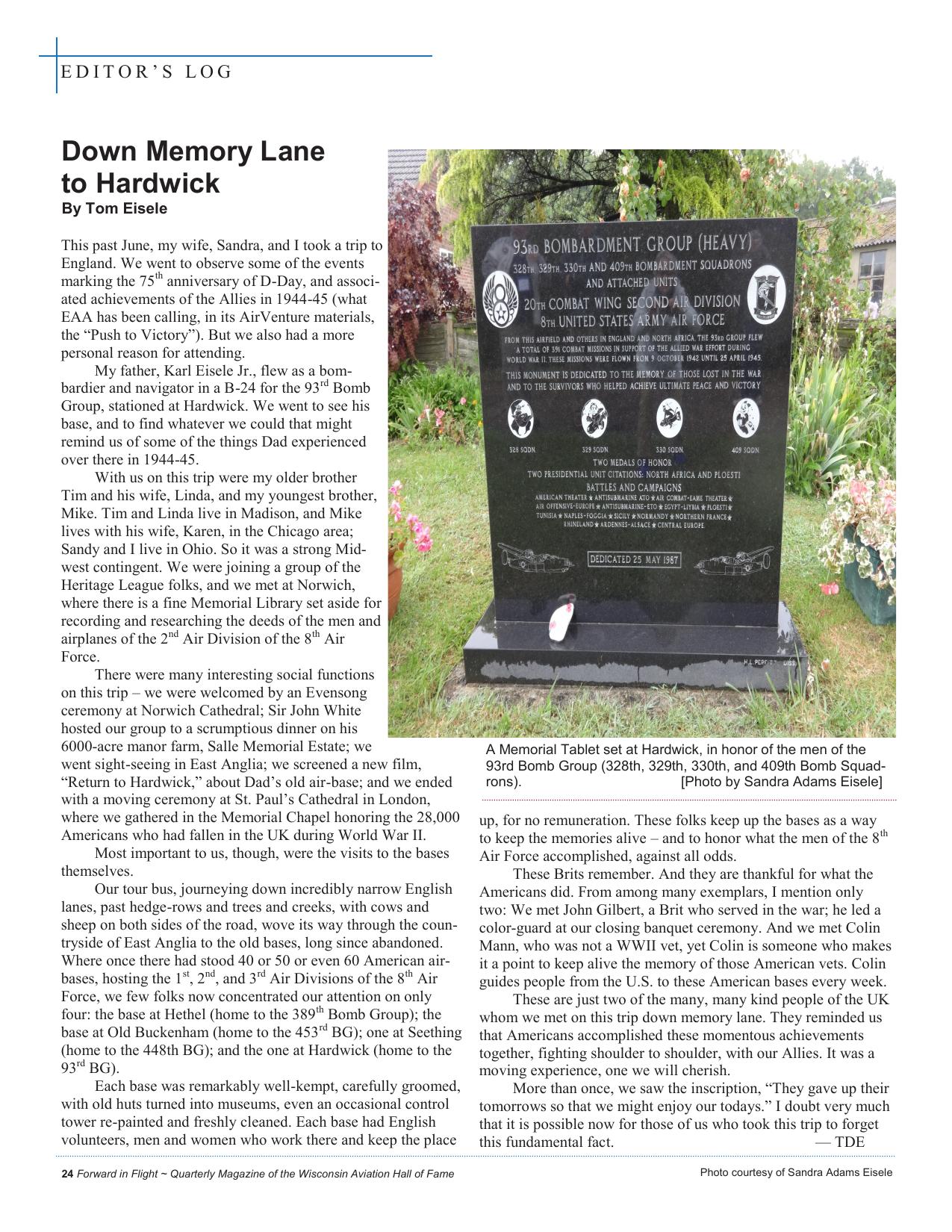
EDITOR’S LOG Down Memory Lane to Hardwick By Tom Eisele This past June, my wife, Sandra, and I took a trip to England. We went to observe some of the events marking the 75th anniversary of D-Day, and associated achievements of the Allies in 1944-45 (what EAA has been calling, in its AirVenture materials, the “Push to Victory”). But we also had a more personal reason for attending. My father, Karl Eisele Jr., flew as a bombardier and navigator in a B-24 for the 93rd Bomb Group, stationed at Hardwick. We went to see his base, and to find whatever we could that might remind us of some of the things Dad experienced over there in 1944-45. With us on this trip were my older brother Tim and his wife, Linda, and my youngest brother, Mike. Tim and Linda live in Madison, and Mike lives with his wife, Karen, in the Chicago area; Sandy and I live in Ohio. So it was a strong Midwest contingent. We were joining a group of the Heritage League folks, and we met at Norwich, where there is a fine Memorial Library set aside for recording and researching the deeds of the men and airplanes of the 2nd Air Division of the 8th Air Force. There were many interesting social functions on this trip – we were welcomed by an Evensong ceremony at Norwich Cathedral; Sir John White hosted our group to a scrumptious dinner on his 6000-acre manor farm, Salle Memorial Estate; we went sight-seeing in East Anglia; we screened a new film, “Return to Hardwick,” about Dad’s old air-base; and we ended with a moving ceremony at St. Paul’s Cathedral in London, where we gathered in the Memorial Chapel honoring the 28,000 Americans who had fallen in the UK during World War II. Most important to us, though, were the visits to the bases themselves. Our tour bus, journeying down incredibly narrow English lanes, past hedge-rows and trees and creeks, with cows and sheep on both sides of the road, wove its way through the countryside of East Anglia to the old bases, long since abandoned. Where once there had stood 40 or 50 or even 60 American airbases, hosting the 1st, 2nd, and 3rd Air Divisions of the 8th Air Force, we few folks now concentrated our attention on only four: the base at Hethel (home to the 389th Bomb Group); the base at Old Buckenham (home to the 453rd BG); one at Seething (home to the 448th BG); and the one at Hardwick (home to the 93rd BG). Each base was remarkably well-kempt, carefully groomed, with old huts turned into museums, even an occasional control tower re-painted and freshly cleaned. Each base had English volunteers, men and women who work there and keep the place 24 Forward in Flight ~ Quarterly Magazine of the Wisconsin Aviation Hall of Fame A Memorial Tablet set at Hardwick, in honor of the men of the 93rd Bomb Group (328th, 329th, 330th, and 409th Bomb Squadrons). [Photo by Sandra Adams Eisele] up, for no remuneration. These folks keep up the bases as a way to keep the memories alive – and to honor what the men of the 8th Air Force accomplished, against all odds. These Brits remember. And they are thankful for what the Americans did. From among many exemplars, I mention only two: We met John Gilbert, a Brit who served in the war; he led a color-guard at our closing banquet ceremony. And we met Colin Mann, who was not a WWII vet, yet Colin is someone who makes it a point to keep alive the memory of those American vets. Colin guides people from the U.S. to these American bases every week. These are just two of the many, many kind people of the UK whom we met on this trip down memory lane. They reminded us that Americans accomplished these momentous achievements together, fighting shoulder to shoulder, with our Allies. It was a moving experience, one we will cherish. More than once, we saw the inscription, “They gave up their tomorrows so that we might enjoy our todays.” I doubt very much that it is possible now for those of us who took this trip to forget this fundamental fact. — TDE Photo courtesy of Sandra Adams Eisele

Any time of year is the right time to give a WAHF membership Membership levels: ---- Youth (under 18) ---- Individual (annual) ---- Couple (annual) ---- Lifetime (self) ---- Lifetime (couple) $7 $20 $30 $500 $750 NAME: _____________________________ ADDRESS: _____________________________ CITY, STATE, ZIP _____________________________ Phone: _________________________ Email: _________________________ Online: www.WisconsinAviationHallofFame.org Mail form to: Ron Wojnar, WAHF N8662 Stone School Road East Troy, WI 53120 Join us. Wisconsin, aviation, history. What could be more fun? Morey Airplane Company Since 1932 Middleton Municipal Airport/Morey Field Self-service 100LL & Jet A 24-7
PRSRT STD US Postage Paid Wisc Rapids WI Permit 98 5033 SUDBURY WAY MADISON WI 53714 The Wisconsin Aviation Hall of Fame is a non-profit membership organization dedicated to preserving the past and fostering the future of flight. CHANGE SERVICE REQUESTED Welcome New WAHF Member/Supporters Robert Birmingham Melanie Siegel John Zollicoffer Terri Donner Todd Touton Richard Hubertus Michael Witkovsky Thanks for coming on board. We hope to see you at a WAHF event soon! Wisconsin Aviation Hall of Fame Officers Tom Thomas, President Jill Mann, Vice-President Chris Campbell, Treasurer Board of Directors MEMBERSHIP RENEWALS The WAHF board and directors appreciate your support. Because of you, we are able to continue our efforts of sharing Wisconsin aviation history. If you renew your membership annually you’ll soon be receiving your renewal reminder. We urge you to renew promptly, and we thank you for doing so. HAS YOUR ADDRESS CHANGED? Please contact us to inform us of your new address. A timely reminder of your new address is very much appreciated as it helps save time—and money—for our small non-profit. It’s easy, send a note to Membership Chair Ron Wojnar at the email to the right, or call at 262-347-7464. Henry Peterson, Secretary Kurt Stanich Charles Swain Jim Szajkovics Wynne Williams Ron Wojnar James Zuelsdorf Wisconsin Aviation Hall of Fame c/o Tom Thomas, president 5033 Sudbury Way Madison, WI 53714 608-221-1994 Become a member/supporter today! For information, contact: Ron Wojnar, Membership Chair 262-347-7464 rwojnar@wi.rr.com www.wisconsinaviationhalloffame.org