Volume 20, Issue 3
🗞️ Download Issue (PDF)
Forward in Flight - Fall 2023
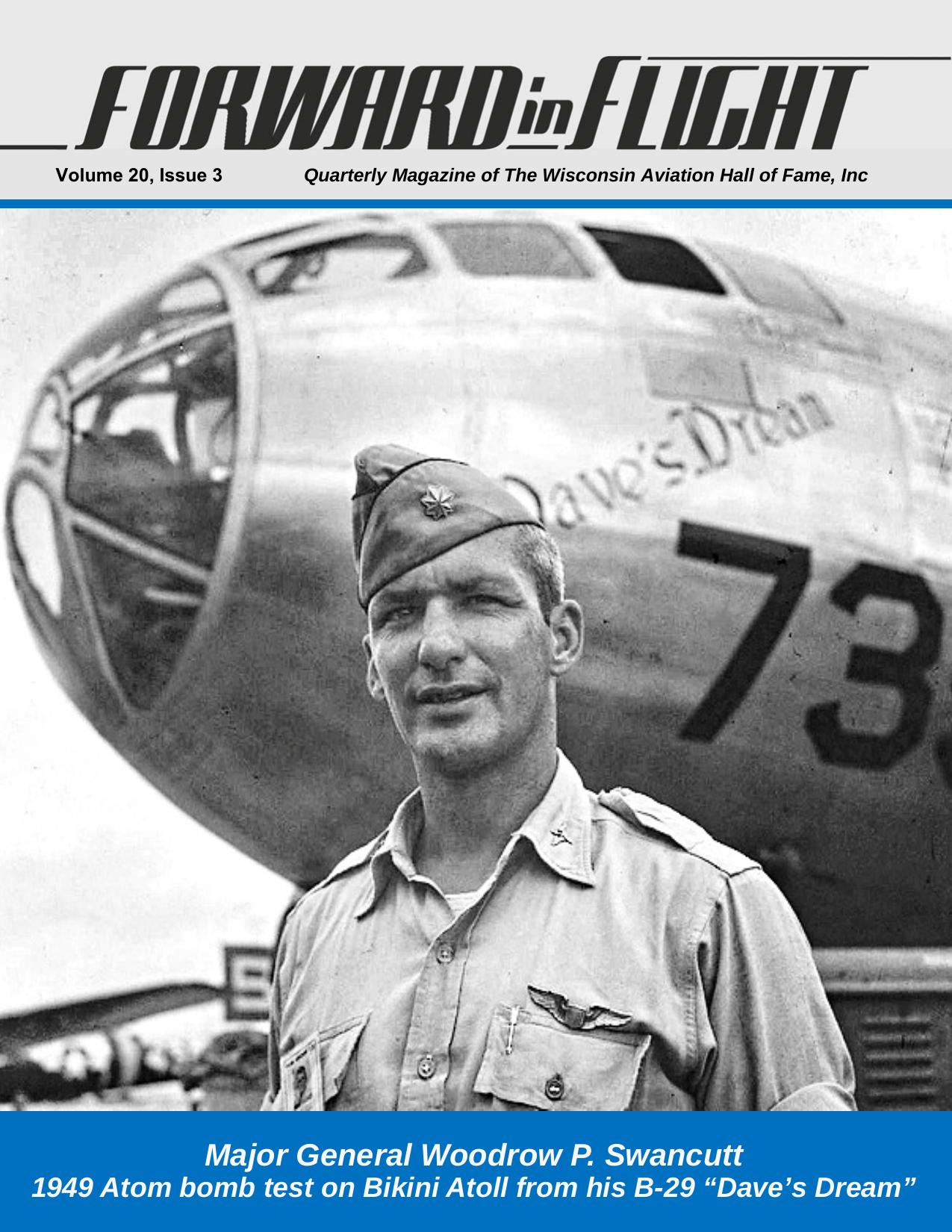
Volume 20, Issue 3 Quarterly Magazine of The Wisconsin Aviation Hall of Fame, Inc Major General Woodrow P. Swancutt 1949 Atom bomb test on Bikini Atoll from his B-29 “Dave’s Dream”
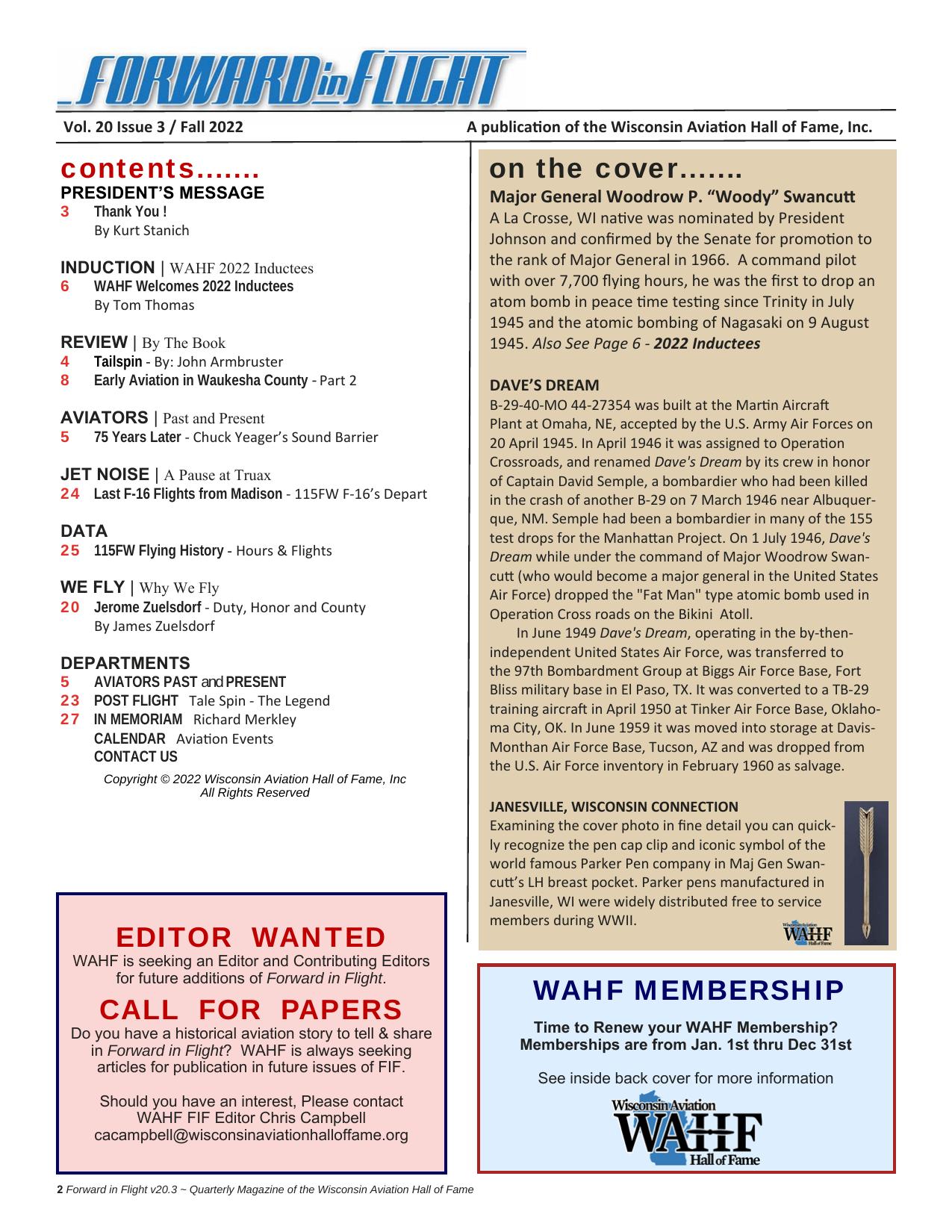
Vol. 20 Issue 3 / Fall 2022 A publica on of the Wisconsin Avia on Hall of Fame, Inc. contents……. PRESIDENT’S MESSAGE 3 Thank You ! By Kurt Stanich INDUCTION | WAHF 2022 Inductees 6 WAHF Welcomes 2022 Inductees By Tom Thomas REVIEW | By The Book 4 8 Tailspin ‐ By: John Armbruster Early Aviation in Waukesha County - Part 2 AVIATORS | Past and Present 5 75 Years Later ‐ Chuck Yeager’s Sound Barrier JET NOISE | A Pause at Truax 24 Last F-16 Flights from Madison ‐ 115FW F‐16’s Depart DATA 25 115FW Flying History - Hours & Flights WE FLY | Why We Fly 20 Jerome Zuelsdorf ‐ Duty, Honor and County By James Zuelsdorf DEPARTMENTS 5 AVIATORS PAST and PRESENT 23 POST FLIGHT Tale Spin ‐ The Legend 27 IN MEMORIAM Richard Merkley CALENDAR Avia on Events CONTACT US Copyright © 2022 Wisconsin Aviation Hall of Fame, Inc All Rights Reserved EDITOR WANTED WAHF is seeking an Editor and Contributing Editors for future additions of Forward in Flight. CALL FOR PAPERS Do you have a historical aviation story to tell & share in Forward in Flight? WAHF is always seeking articles for publication in future issues of FIF. Should you have an interest, Please contact WAHF FIF Editor Chris Campbell cacampbell@wisconsinaviationhalloffame.org 2 Forward in Flight v20.3 ~ Quarterly Magazine of the Wisconsin Aviation Hall of Fame on the cover……. Major General Woodrow P. “Woody” Swancu A La Crosse, WI na ve was nominated by President Johnson and confirmed by the Senate for promo on to the rank of Major General in 1966. A command pilot with over 7,700 flying hours, he was the first to drop an atom bomb in peace me tes ng since Trinity in July 1945 and the atomic bombing of Nagasaki on 9 August 1945. Also See Page 6 ‐ 2022 Inductees DAVE’S DREAM B‐29‐40‐MO 44‐27354 was built at the Mar n Aircra Plant at Omaha, NE, accepted by the U.S. Army Air Forces on 20 April 1945. In April 1946 it was assigned to Opera on Crossroads, and renamed Dave's Dream by its crew in honor of Captain David Semple, a bombardier who had been killed in the crash of another B‐29 on 7 March 1946 near Albuquer‐ que, NM. Semple had been a bombardier in many of the 155 test drops for the Manha an Project. On 1 July 1946, Dave's Dream while under the command of Major Woodrow Swan‐ cu (who would become a major general in the United States Air Force) dropped the "Fat Man" type atomic bomb used in Opera on Cross roads on the Bikini Atoll. In June 1949 Dave's Dream, opera ng in the by‐then‐ independent United States Air Force, was transferred to the 97th Bombardment Group at Biggs Air Force Base, Fort Bliss military base in El Paso, TX. It was converted to a TB‐29 training aircra in April 1950 at Tinker Air Force Base, Oklaho‐ ma City, OK. In June 1959 it was moved into storage at Davis‐ Monthan Air Force Base, Tucson, AZ and was dropped from the U.S. Air Force inventory in February 1960 as salvage. JANESVILLE, WISCONSIN CONNECTION Examining the cover photo in fine detail you can quick‐ ly recognize the pen cap clip and iconic symbol of the world famous Parker Pen company in Maj Gen Swan‐ cu ’s LH breast pocket. Parker pens manufactured in Janesville, WI were widely distributed free to service members during WWII. WAHF MEMBERSHIP Time to Renew your WAHF Membership? Memberships are from Jan. 1st thru Dec 31st See inside back cover for more information
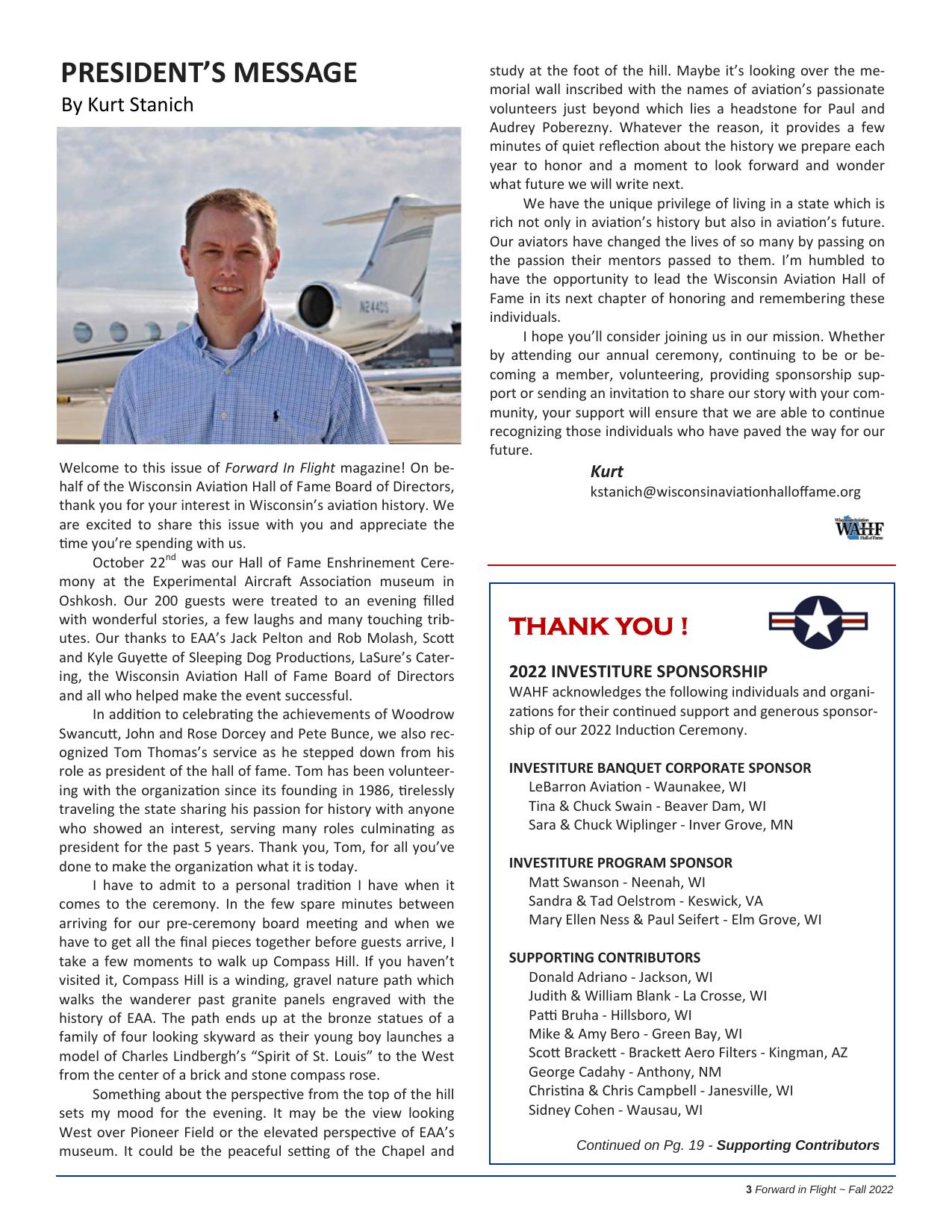
PRESIDENT’S MESSAGE By Kurt Stanich Welcome to this issue of Forward In Flight magazine! On be‐ half of the Wisconsin Avia on Hall of Fame Board of Directors, thank you for your interest in Wisconsin’s avia on history. We are excited to share this issue with you and appreciate the me you’re spending with us. October 22nd was our Hall of Fame Enshrinement Cere‐ mony at the Experimental Aircra Associa on museum in Oshkosh. Our 200 guests were treated to an evening filled with wonderful stories, a few laughs and many touching trib‐ utes. Our thanks to EAA’s Jack Pelton and Rob Molash, Sco and Kyle Guye e of Sleeping Dog Produc ons, LaSure’s Cater‐ ing, the Wisconsin Avia on Hall of Fame Board of Directors and all who helped make the event successful. In addi on to celebra ng the achievements of Woodrow Swancu , John and Rose Dorcey and Pete Bunce, we also rec‐ ognized Tom Thomas’s service as he stepped down from his role as president of the hall of fame. Tom has been volunteer‐ ing with the organiza on since its founding in 1986, relessly traveling the state sharing his passion for history with anyone who showed an interest, serving many roles culmina ng as president for the past 5 years. Thank you, Tom, for all you’ve done to make the organiza on what it is today. I have to admit to a personal tradi on I have when it comes to the ceremony. In the few spare minutes between arriving for our pre‐ceremony board mee ng and when we have to get all the final pieces together before guests arrive, I take a few moments to walk up Compass Hill. If you haven’t visited it, Compass Hill is a winding, gravel nature path which walks the wanderer past granite panels engraved with the history of EAA. The path ends up at the bronze statues of a family of four looking skyward as their young boy launches a model of Charles Lindbergh’s “Spirit of St. Louis” to the West from the center of a brick and stone compass rose. Something about the perspec ve from the top of the hill sets my mood for the evening. It may be the view looking West over Pioneer Field or the elevated perspec ve of EAA’s museum. It could be the peaceful se ng of the Chapel and study at the foot of the hill. Maybe it’s looking over the me‐ morial wall inscribed with the names of avia on’s passionate volunteers just beyond which lies a headstone for Paul and Audrey Poberezny. Whatever the reason, it provides a few minutes of quiet reflec on about the history we prepare each year to honor and a moment to look forward and wonder what future we will write next. We have the unique privilege of living in a state which is rich not only in avia on’s history but also in avia on’s future. Our aviators have changed the lives of so many by passing on the passion their mentors passed to them. I’m humbled to have the opportunity to lead the Wisconsin Avia on Hall of Fame in its next chapter of honoring and remembering these individuals. I hope you’ll consider joining us in our mission. Whether by a ending our annual ceremony, con nuing to be or be‐ coming a member, volunteering, providing sponsorship sup‐ port or sending an invita on to share our story with your com‐ munity, your support will ensure that we are able to con nue recognizing those individuals who have paved the way for our future. Kurt kstanich@wisconsinavia onhalloffame.org THANK YOU ! 2022 INVESTITURE SPONSORSHIP WAHF acknowledges the following individuals and organi‐ za ons for their con nued support and generous sponsor‐ ship of our 2022 Induc on Ceremony. INVESTITURE BANQUET CORPORATE SPONSOR LeBarron Avia on ‐ Waunakee, WI Tina & Chuck Swain ‐ Beaver Dam, WI Sara & Chuck Wiplinger ‐ Inver Grove, MN INVESTITURE PROGRAM SPONSOR Ma Swanson ‐ Neenah, WI Sandra & Tad Oelstrom ‐ Keswick, VA Mary Ellen Ness & Paul Seifert ‐ Elm Grove, WI SUPPORTING CONTRIBUTORS Donald Adriano ‐ Jackson, WI Judith & William Blank ‐ La Crosse, WI Pa Bruha ‐ Hillsboro, WI Mike & Amy Bero ‐ Green Bay, WI Sco Bracke ‐ Bracke Aero Filters ‐ Kingman, AZ George Cadahy ‐ Anthony, NM Chris na & Chris Campbell ‐ Janesville, WI Sidney Cohen ‐ Wausau, WI Continued on Pg. 19 - Supporting Contributors 3 Forward in Flight ~ Fall 2022
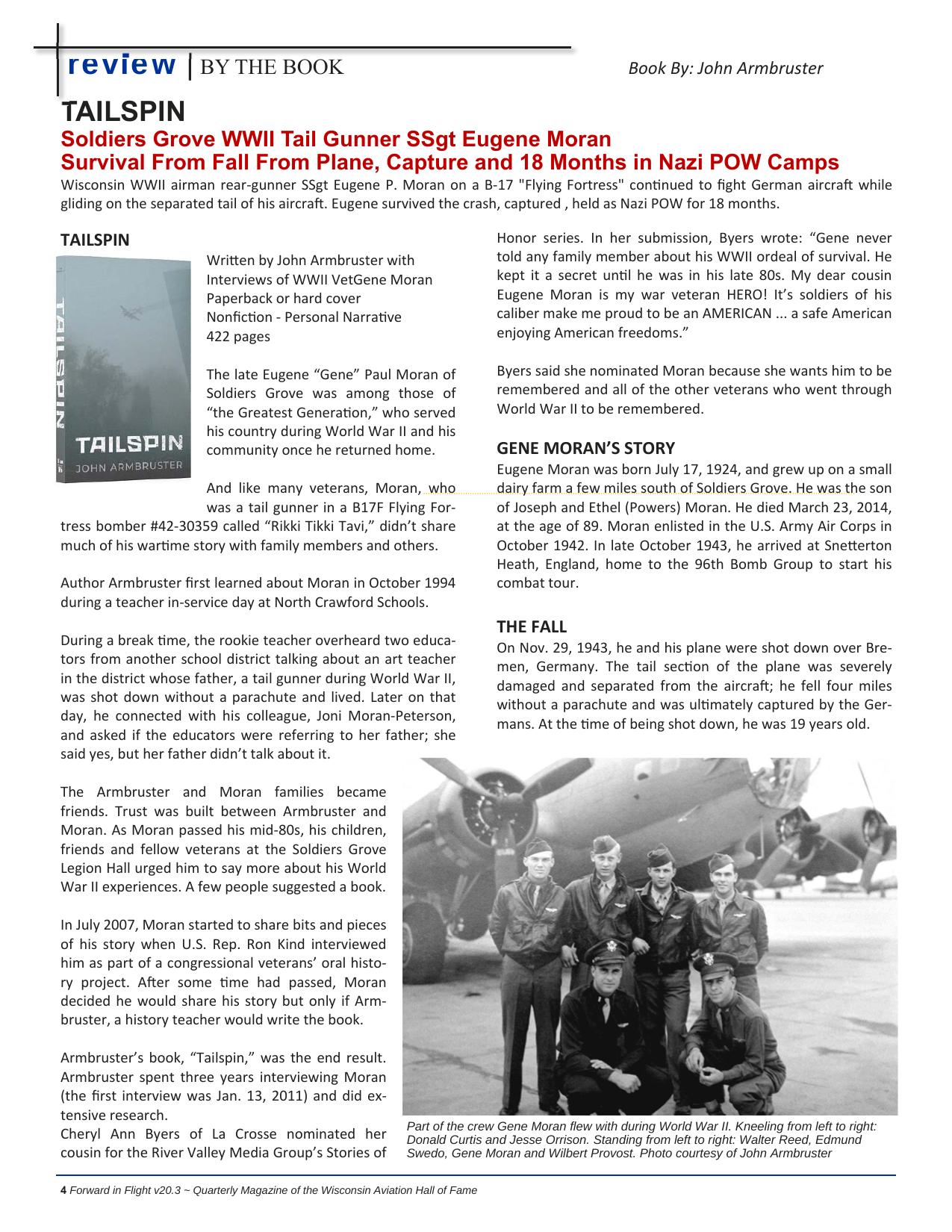
review | BY THE BOOK Book By: John Armbruster TAILSPIN Soldiers Grove WWII Tail Gunner SSgt Eugene Moran Survival From Fall From Plane, Capture and 18 Months in Nazi POW Camps Wisconsin WWII airman rear‐gunner SSgt Eugene P. Moran on a B‐17 "Flying Fortress" con nued to fight German aircra while gliding on the separated tail of his aircra . Eugene survived the crash, captured , held as Nazi POW for 18 months. TAILSPIN Wri en by John Armbruster with Interviews of WWII VetGene Moran Paperback or hard cover Nonfic on ‐ Personal Narra ve 422 pages The late Eugene “Gene” Paul Moran of Soldiers Grove was among those of “the Greatest Genera on,” who served his country during World War II and his community once he returned home. And like many veterans, Moran, who was a tail gunner in a B17F Flying For‐ tress bomber #42‐30359 called “Rikki Tikki Tavi,” didn’t share much of his war me story with family members and others. Author Armbruster first learned about Moran in October 1994 during a teacher in‐service day at North Crawford Schools. During a break me, the rookie teacher overheard two educa‐ tors from another school district talking about an art teacher in the district whose father, a tail gunner during World War II, was shot down without a parachute and lived. Later on that day, he connected with his colleague, Joni Moran‐Peterson, and asked if the educators were referring to her father; she said yes, but her father didn’t talk about it. Honor series. In her submission, Byers wrote: “Gene never told any family member about his WWII ordeal of survival. He kept it a secret un l he was in his late 80s. My dear cousin Eugene Moran is my war veteran HERO! It’s soldiers of his caliber make me proud to be an AMERICAN ... a safe American enjoying American freedoms.” Byers said she nominated Moran because she wants him to be remembered and all of the other veterans who went through World War II to be remembered. GENE MORAN’S STORY Eugene Moran was born July 17, 1924, and grew up on a small dairy farm a few miles south of Soldiers Grove. He was the son of Joseph and Ethel (Powers) Moran. He died March 23, 2014, at the age of 89. Moran enlisted in the U.S. Army Air Corps in October 1942. In late October 1943, he arrived at Sne erton Heath, England, home to the 96th Bomb Group to start his combat tour. THE FALL On Nov. 29, 1943, he and his plane were shot down over Bre‐ men, Germany. The tail sec on of the plane was severely damaged and separated from the aircra ; he fell four miles without a parachute and was ul mately captured by the Ger‐ mans. At the me of being shot down, he was 19 years old. The Armbruster and Moran families became friends. Trust was built between Armbruster and Moran. As Moran passed his mid‐80s, his children, friends and fellow veterans at the Soldiers Grove Legion Hall urged him to say more about his World War II experiences. A few people suggested a book. In July 2007, Moran started to share bits and pieces of his story when U.S. Rep. Ron Kind interviewed him as part of a congressional veterans’ oral histo‐ ry project. A er some me had passed, Moran decided he would share his story but only if Arm‐ bruster, a history teacher would write the book. Armbruster’s book, “Tailspin,” was the end result. Armbruster spent three years interviewing Moran (the first interview was Jan. 13, 2011) and did ex‐ tensive research. Cheryl Ann Byers of La Crosse nominated her cousin for the River Valley Media Group’s Stories of Part of the crew Gene Moran flew with during World War II. Kneeling from left to right: Donald Curtis and Jesse Orrison. Standing from left to right: Walter Reed, Edmund Swedo, Gene Moran and Wilbert Provost. Photo courtesy of John Armbruster 4 Forward in Flight v20.3 ~ Quarterly Magazine of the Wisconsin Aviation Hall of Fame
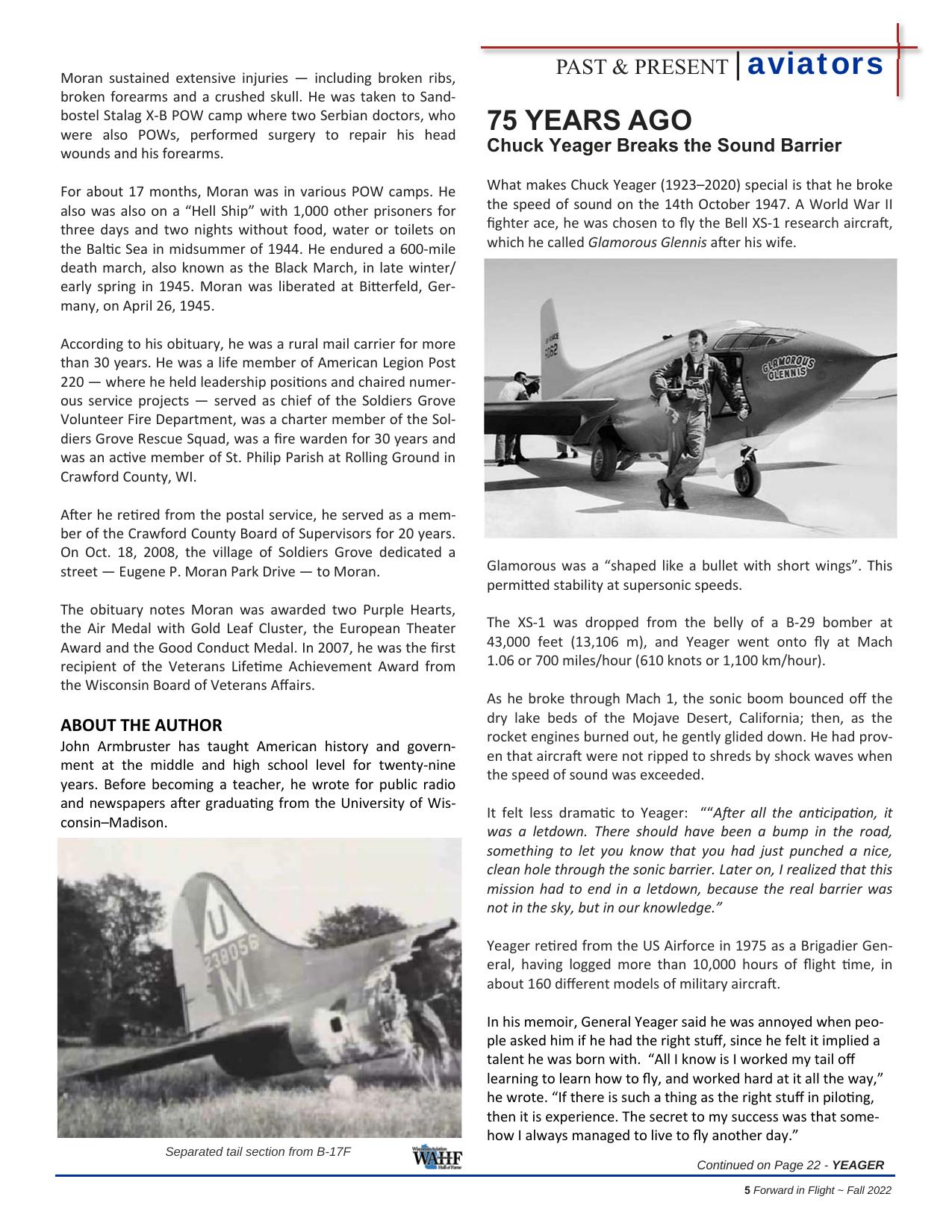
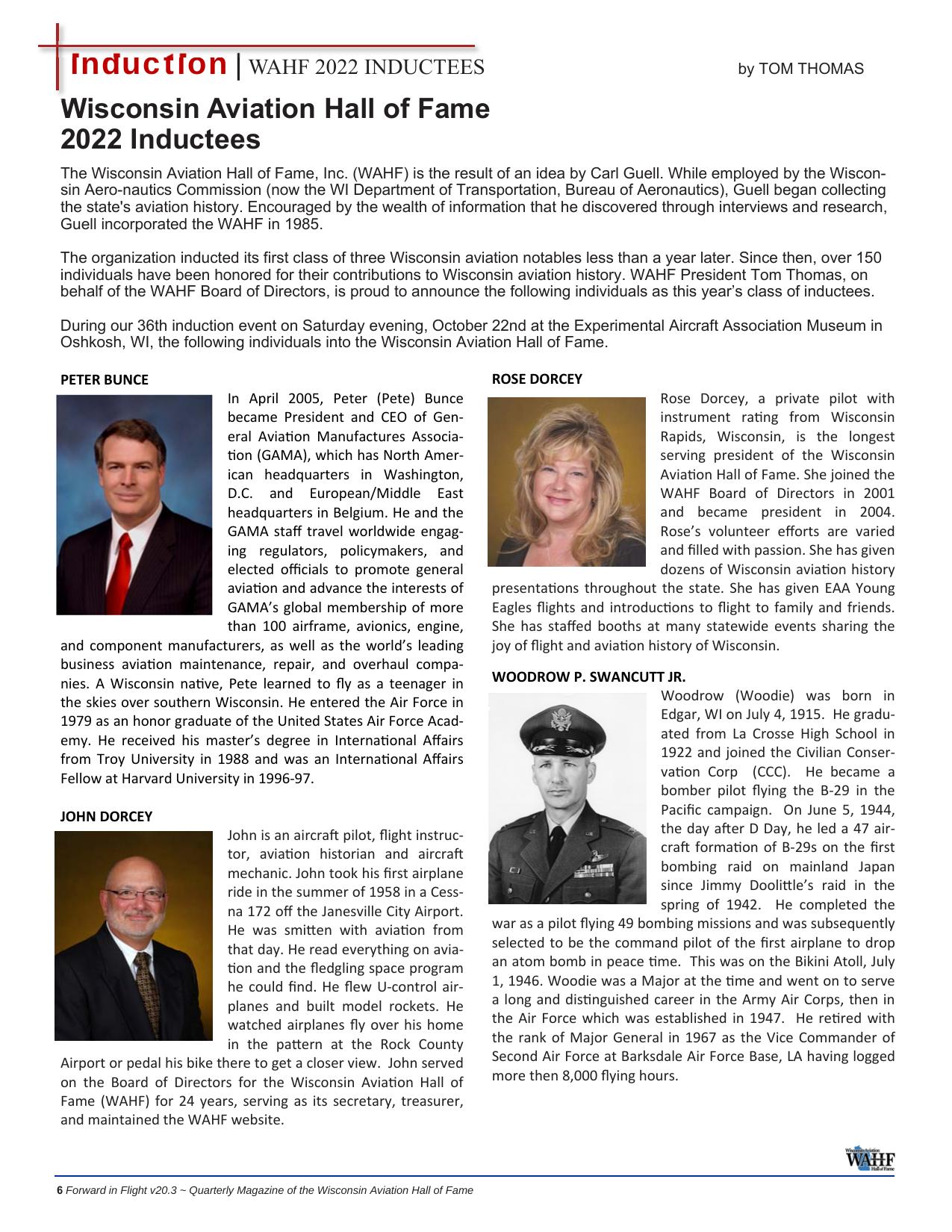
Moran sustained extensive injuries — including broken ribs, broken forearms and a crushed skull. He was taken to Sand‐ bostel Stalag X‐B POW camp where two Serbian doctors, who were also POWs, performed surgery to repair his head wounds and his forearms. For about 17 months, Moran was in various POW camps. He also was also on a “Hell Ship” with 1,000 other prisoners for three days and two nights without food, water or toilets on the Bal c Sea in midsummer of 1944. He endured a 600‐mile death march, also known as the Black March, in late winter/ early spring in 1945. Moran was liberated at Bi erfeld, Ger‐ many, on April 26, 1945. PAST & PRESENT | aviators 75 YEARS AGO Chuck Yeager Breaks the Sound Barrier What makes Chuck Yeager (1923–2020) special is that he broke the speed of sound on the 14th October 1947. A World War II fighter ace, he was chosen to fly the Bell XS‐1 research aircra , which he called Glamorous Glennis a er his wife. According to his obituary, he was a rural mail carrier for more than 30 years. He was a life member of American Legion Post 220 — where he held leadership posi ons and chaired numer‐ ous service projects — served as chief of the Soldiers Grove Volunteer Fire Department, was a charter member of the Sol‐ diers Grove Rescue Squad, was a fire warden for 30 years and was an ac ve member of St. Philip Parish at Rolling Ground in Crawford County, WI. A er he re red from the postal service, he served as a mem‐ ber of the Crawford County Board of Supervisors for 20 years. On Oct. 18, 2008, the village of Soldiers Grove dedicated a street — Eugene P. Moran Park Drive — to Moran. The obituary notes Moran was awarded two Purple Hearts, the Air Medal with Gold Leaf Cluster, the European Theater Award and the Good Conduct Medal. In 2007, he was the first recipient of the Veterans Life me Achievement Award from the Wisconsin Board of Veterans Affairs. ABOUT THE AUTHOR John Armbruster has taught American history and govern‐ ment at the middle and high school level for twenty‐nine years. Before becoming a teacher, he wrote for public radio and newspapers a er gradua ng from the University of Wis‐ consin–Madison. Glamorous was a “shaped like a bullet with short wings”. This permi ed stability at supersonic speeds. The XS‐1 was dropped from the belly of a B‐29 bomber at 43,000 feet (13,106 m), and Yeager went onto fly at Mach 1.06 or 700 miles/hour (610 knots or 1,100 km/hour). As he broke through Mach 1, the sonic boom bounced off the dry lake beds of the Mojave Desert, California; then, as the rocket engines burned out, he gently glided down. He had prov‐ en that aircra were not ripped to shreds by shock waves when the speed of sound was exceeded. It felt less drama c to Yeager: ““A er all the an cipa on, it was a letdown. There should have been a bump in the road, something to let you know that you had just punched a nice, clean hole through the sonic barrier. Later on, I realized that this mission had to end in a letdown, because the real barrier was not in the sky, but in our knowledge.” Yeager re red from the US Airforce in 1975 as a Brigadier Gen‐ eral, having logged more than 10,000 hours of flight me, in about 160 different models of military aircra . In his memoir, General Yeager said he was annoyed when peo‐ ple asked him if he had the right stuff, since he felt it implied a talent he was born with. “All I know is I worked my tail off learning to learn how to fly, and worked hard at it all the way,” he wrote. “If there is such a thing as the right stuff in pilo ng, then it is experience. The secret to my success was that some‐ how I always managed to live to fly another day.” Separated tail section from B-17F Continued on Page 22 - YEAGER 5 Forward in Flight ~ Fall 2022
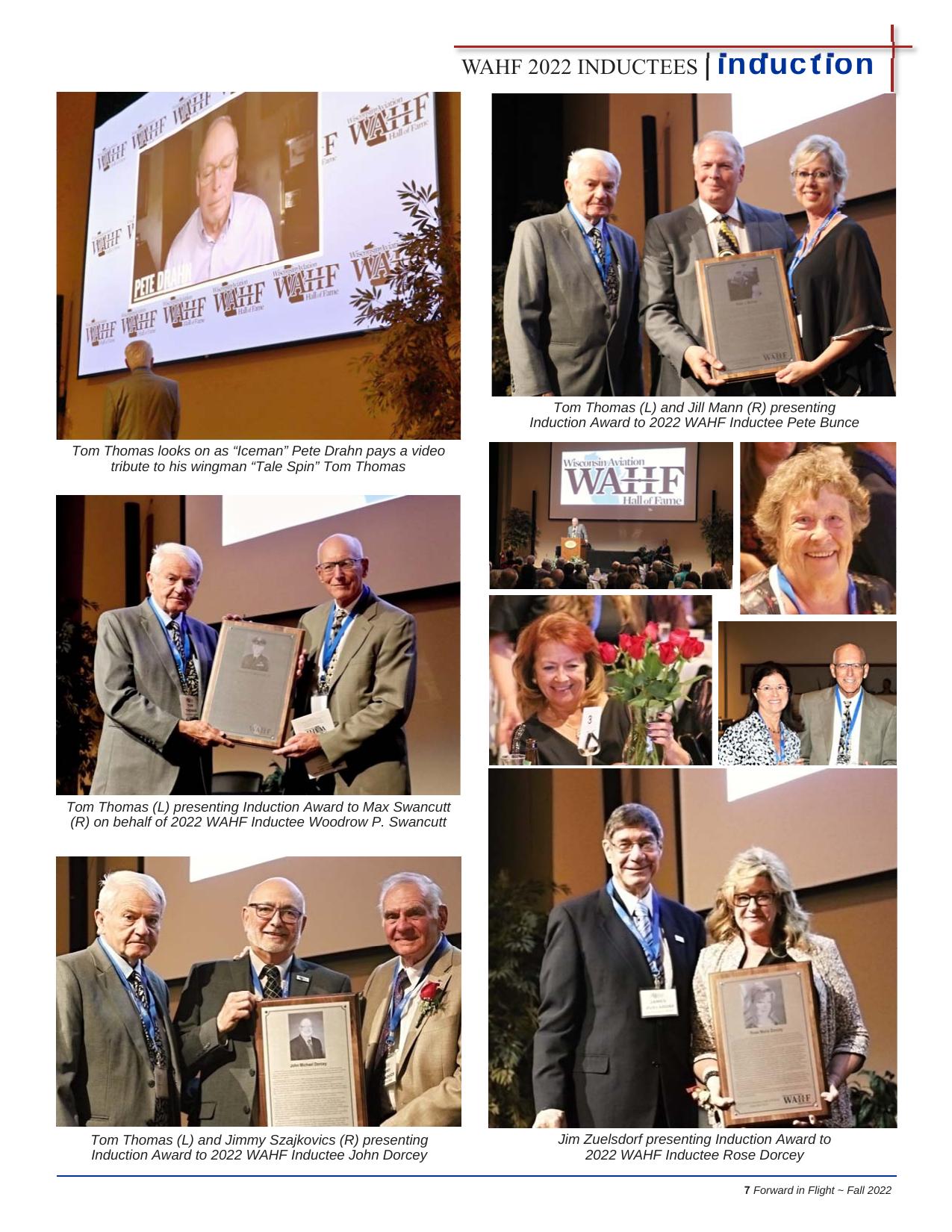
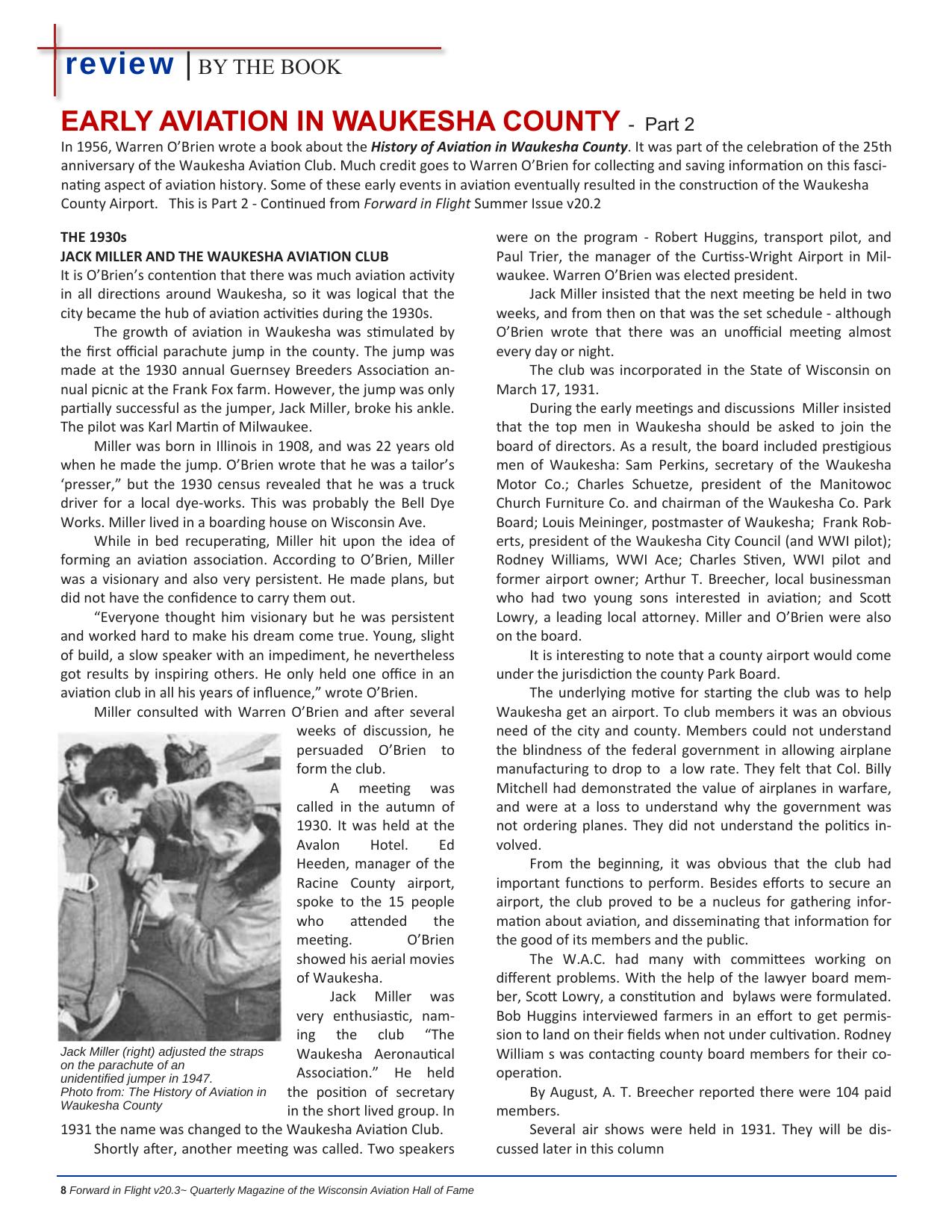
induction | WAHF 2022 INDUCTEES by TOM THOMAS Wisconsin Aviation Hall of Fame 2022 Inductees The Wisconsin Aviation Hall of Fame, Inc. (WAHF) is the result of an idea by Carl Guell. While employed by the Wisconsin Aero-nautics Commission (now the WI Department of Transportation, Bureau of Aeronautics), Guell began collecting the state's aviation history. Encouraged by the wealth of information that he discovered through interviews and research, Guell incorporated the WAHF in 1985. The organization inducted its first class of three Wisconsin aviation notables less than a year later. Since then, over 150 individuals have been honored for their contributions to Wisconsin aviation history. WAHF President Tom Thomas, on behalf of the WAHF Board of Directors, is proud to announce the following individuals as this year’s class of inductees. During our 36th induction event on Saturday evening, October 22nd at the Experimental Aircraft Association Museum in Oshkosh, WI, the following individuals into the Wisconsin Aviation Hall of Fame. PETER BUNCE ROSE DORCEY In April 2005, Peter (Pete) Bunce became President and CEO of Gen‐ eral Avia on Manufactures Associa‐ on (GAMA), which has North Amer‐ ican headquarters in Washington, D.C. and European/Middle East headquarters in Belgium. He and the GAMA staff travel worldwide engag‐ ing regulators, policymakers, and elected officials to promote general avia on and advance the interests of GAMA’s global membership of more than 100 airframe, avionics, engine, and component manufacturers, as well as the world’s leading business avia on maintenance, repair, and overhaul compa‐ nies. A Wisconsin na ve, Pete learned to fly as a teenager in the skies over southern Wisconsin. He entered the Air Force in 1979 as an honor graduate of the United States Air Force Acad‐ emy. He received his master’s degree in Interna onal Affairs from Troy University in 1988 and was an Interna onal Affairs Fellow at Harvard University in 1996‐97. Rose Dorcey, a private pilot with instrument ra ng from Wisconsin Rapids, Wisconsin, is the longest serving president of the Wisconsin Avia on Hall of Fame. She joined the WAHF Board of Directors in 2001 and became president in 2004. Rose’s volunteer efforts are varied and filled with passion. She has given dozens of Wisconsin avia on history presenta ons throughout the state. She has given EAA Young Eagles flights and introduc ons to flight to family and friends. She has staffed booths at many statewide events sharing the joy of flight and avia on history of Wisconsin. JOHN DORCEY John is an aircra pilot, flight instruc‐ tor, avia on historian and aircra mechanic. John took his first airplane ride in the summer of 1958 in a Cess‐ na 172 off the Janesville City Airport. He was smi en with avia on from that day. He read everything on avia‐ on and the fledgling space program he could find. He flew U‐control air‐ planes and built model rockets. He watched airplanes fly over his home in the pa ern at the Rock County Airport or pedal his bike there to get a closer view. John served on the Board of Directors for the Wisconsin Avia on Hall of Fame (WAHF) for 24 years, serving as its secretary, treasurer, and maintained the WAHF website. 6 Forward in Flight v20.3 ~ Quarterly Magazine of the Wisconsin Aviation Hall of Fame WOODROW P. SWANCUTT JR. Woodrow (Woodie) was born in Edgar, WI on July 4, 1915. He gradu‐ ated from La Crosse High School in 1922 and joined the Civilian Conser‐ va on Corp (CCC). He became a bomber pilot flying the B‐29 in the Pacific campaign. On June 5, 1944, the day a er D Day, he led a 47 air‐ cra forma on of B‐29s on the first bombing raid on mainland Japan since Jimmy Dooli le’s raid in the spring of 1942. He completed the war as a pilot flying 49 bombing missions and was subsequently selected to be the command pilot of the first airplane to drop an atom bomb in peace me. This was on the Bikini Atoll, July 1, 1946. Woodie was a Major at the me and went on to serve a long and dis nguished career in the Army Air Corps, then in the Air Force which was established in 1947. He re red with the rank of Major General in 1967 as the Vice Commander of Second Air Force at Barksdale Air Force Base, LA having logged more then 8,000 flying hours.
WAHF 2022 INDUCTEES | induction Tom Thomas (L) and Jill Mann (R) presenting Induction Award to 2022 WAHF Inductee Pete Bunce Tom Thomas looks on as “Iceman” Pete Drahn pays a video tribute to his wingman “Tale Spin” Tom Thomas Tom Thomas (L) presenting Induction Award to Max Swancutt (R) on behalf of 2022 WAHF Inductee Woodrow P. Swancutt Tom Thomas (L) and Jimmy Szajkovics (R) presenting Induction Award to 2022 WAHF Inductee John Dorcey Jim Zuelsdorf presenting Induction Award to 2022 WAHF Inductee Rose Dorcey 7 Forward in Flight ~ Fall 2022
review | BY THE BOOK EARLY AVIATION IN WAUKESHA COUNTY - Part 2 In 1956, Warren O’Brien wrote a book about the History of Avia on in Waukesha County. It was part of the celebra on of the 25th anniversary of the Waukesha Avia on Club. Much credit goes to Warren O’Brien for collec ng and saving informa on on this fasci‐ na ng aspect of avia on history. Some of these early events in avia on eventually resulted in the construc on of the Waukesha County Airport. This is Part 2 ‐ Con nued from Forward in Flight Summer Issue v20.2 THE 1930s JACK MILLER AND THE WAUKESHA AVIATION CLUB It is O’Brien’s conten on that there was much avia on ac vity in all direc ons around Waukesha, so it was logical that the city became the hub of avia on ac vi es during the 1930s. The growth of avia on in Waukesha was s mulated by the first official parachute jump in the county. The jump was made at the 1930 annual Guernsey Breeders Associa on an‐ nual picnic at the Frank Fox farm. However, the jump was only par ally successful as the jumper, Jack Miller, broke his ankle. The pilot was Karl Mar n of Milwaukee. Miller was born in Illinois in 1908, and was 22 years old when he made the jump. O’Brien wrote that he was a tailor’s ‘presser,” but the 1930 census revealed that he was a truck driver for a local dye‐works. This was probably the Bell Dye Works. Miller lived in a boarding house on Wisconsin Ave. While in bed recupera ng, Miller hit upon the idea of forming an avia on associa on. According to O’Brien, Miller was a visionary and also very persistent. He made plans, but did not have the confidence to carry them out. “Everyone thought him visionary but he was persistent and worked hard to make his dream come true. Young, slight of build, a slow speaker with an impediment, he nevertheless got results by inspiring others. He only held one office in an avia on club in all his years of influence,” wrote O’Brien. Miller consulted with Warren O’Brien and a er several weeks of discussion, he persuaded O’Brien to form the club. A mee ng was called in the autumn of 1930. It was held at the Avalon Hotel. Ed Heeden, manager of the Racine County airport, spoke to the 15 people who a ended the mee ng. O’Brien showed his aerial movies of Waukesha. Jack Miller was very enthusias c, nam‐ ing the club “The Jack Miller (right) adjusted the straps Waukesha Aeronau cal on the parachute of an Associa on.” He held unidentified jumper in 1947. Photo from: The History of Aviation in the posi on of secretary Waukesha County in the short lived group. In 1931 the name was changed to the Waukesha Avia on Club. Shortly a er, another mee ng was called. Two speakers 8 Forward in Flight v20.3~ Quarterly Magazine of the Wisconsin Aviation Hall of Fame were on the program ‐ Robert Huggins, transport pilot, and Paul Trier, the manager of the Cur ss‐Wright Airport in Mil‐ waukee. Warren O’Brien was elected president. Jack Miller insisted that the next mee ng be held in two weeks, and from then on that was the set schedule ‐ although O’Brien wrote that there was an unofficial mee ng almost every day or night. The club was incorporated in the State of Wisconsin on March 17, 1931. During the early mee ngs and discussions Miller insisted that the top men in Waukesha should be asked to join the board of directors. As a result, the board included pres gious men of Waukesha: Sam Perkins, secretary of the Waukesha Motor Co.; Charles Schuetze, president of the Manitowoc Church Furniture Co. and chairman of the Waukesha Co. Park Board; Louis Meininger, postmaster of Waukesha; Frank Rob‐ erts, president of the Waukesha City Council (and WWI pilot); Rodney Williams, WWI Ace; Charles S ven, WWI pilot and former airport owner; Arthur T. Breecher, local businessman who had two young sons interested in avia on; and Sco Lowry, a leading local a orney. Miller and O’Brien were also on the board. It is interes ng to note that a county airport would come under the jurisdic on the county Park Board. The underlying mo ve for star ng the club was to help Waukesha get an airport. To club members it was an obvious need of the city and county. Members could not understand the blindness of the federal government in allowing airplane manufacturing to drop to a low rate. They felt that Col. Billy Mitchell had demonstrated the value of airplanes in warfare, and were at a loss to understand why the government was not ordering planes. They did not understand the poli cs in‐ volved. From the beginning, it was obvious that the club had important func ons to perform. Besides efforts to secure an airport, the club proved to be a nucleus for gathering infor‐ ma on about avia on, and dissemina ng that informa on for the good of its members and the public. The W.A.C. had many with commi ees working on different problems. With the help of the lawyer board mem‐ ber, Sco Lowry, a cons tu on and bylaws were formulated. Bob Huggins interviewed farmers in an effort to get permis‐ sion to land on their fields when not under cul va on. Rodney William s was contac ng county board members for their co‐ opera on. By August, A. T. Breecher reported there were 104 paid members. Several air shows were held in 1931. They will be dis‐ cussed later in this column
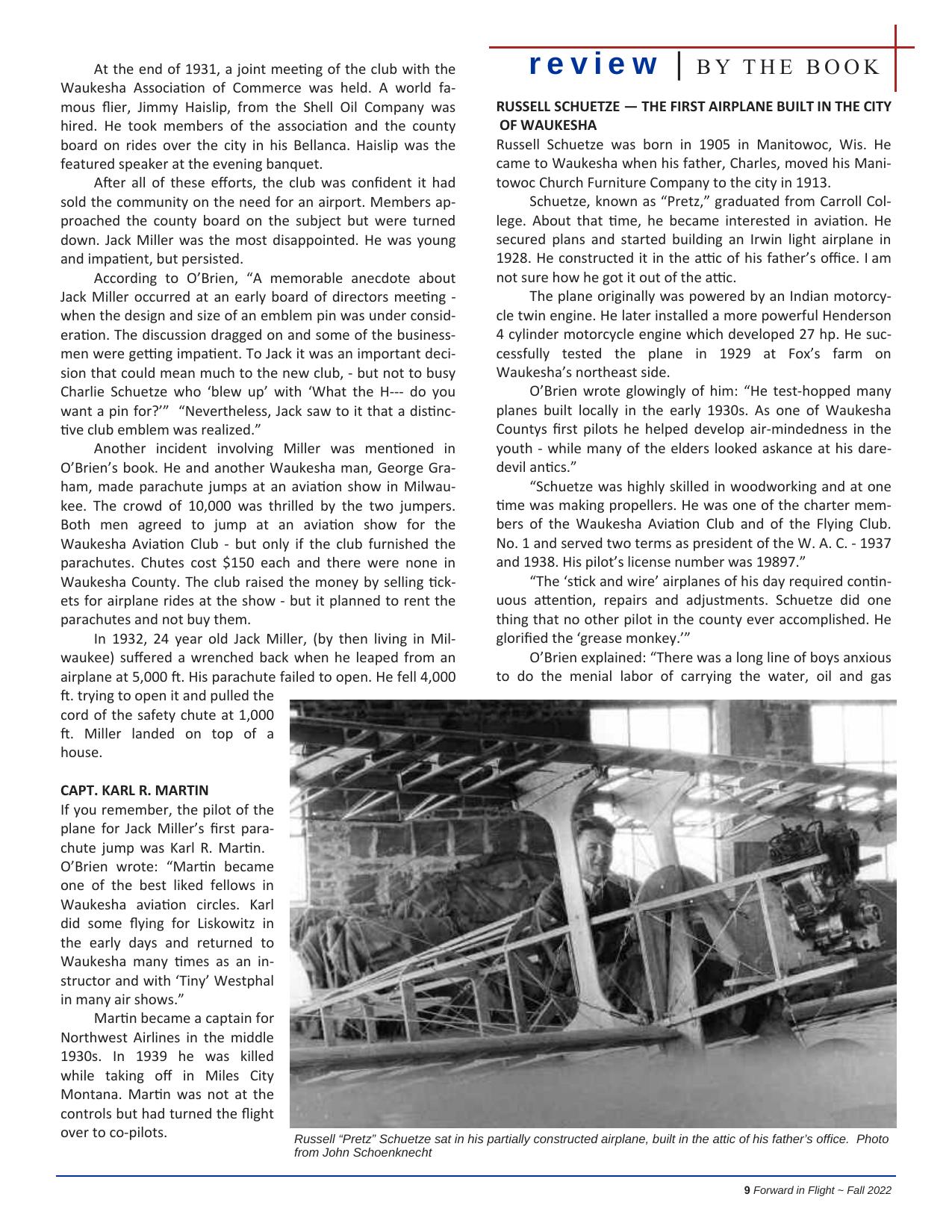
At the end of 1931, a joint mee ng of the club with the Waukesha Associa on of Commerce was held. A world fa‐ mous flier, Jimmy Haislip, from the Shell Oil Company was hired. He took members of the associa on and the county board on rides over the city in his Bellanca. Haislip was the featured speaker at the evening banquet. A er all of these efforts, the club was confident it had sold the community on the need for an airport. Members ap‐ proached the county board on the subject but were turned down. Jack Miller was the most disappointed. He was young and impa ent, but persisted. According to O’Brien, “A memorable anecdote about Jack Miller occurred at an early board of directors mee ng ‐ when the design and size of an emblem pin was under consid‐ era on. The discussion dragged on and some of the business‐ men were ge ng impa ent. To Jack it was an important deci‐ sion that could mean much to the new club, ‐ but not to busy Charlie Schuetze who ‘blew up’ with ‘What the H‐‐‐ do you want a pin for?’” “Nevertheless, Jack saw to it that a dis nc‐ ve club emblem was realized.” Another incident involving Miller was men oned in O’Brien’s book. He and another Waukesha man, George Gra‐ ham, made parachute jumps at an avia on show in Milwau‐ kee. The crowd of 10,000 was thrilled by the two jumpers. Both men agreed to jump at an avia on show for the Waukesha Avia on Club ‐ but only if the club furnished the parachutes. Chutes cost $150 each and there were none in Waukesha County. The club raised the money by selling ck‐ ets for airplane rides at the show ‐ but it planned to rent the parachutes and not buy them. In 1932, 24 year old Jack Miller, (by then living in Mil‐ waukee) suffered a wrenched back when he leaped from an airplane at 5,000 . His parachute failed to open. He fell 4,000 . trying to open it and pulled the cord of the safety chute at 1,000 . Miller landed on top of a house. CAPT. KARL R. MARTIN If you remember, the pilot of the plane for Jack Miller’s first para‐ chute jump was Karl R. Mar n. O’Brien wrote: “Mar n became one of the best liked fellows in Waukesha avia on circles. Karl did some flying for Liskowitz in the early days and returned to Waukesha many mes as an in‐ structor and with ‘Tiny’ Westphal in many air shows.” Mar n became a captain for Northwest Airlines in the middle 1930s. In 1939 he was killed while taking off in Miles City Montana. Mar n was not at the controls but had turned the flight over to co‐pilots. r ev i e w | B Y T H E B O O K RUSSELL SCHUETZE — THE FIRST AIRPLANE BUILT IN THE CITY OF WAUKESHA Russell Schuetze was born in 1905 in Manitowoc, Wis. He came to Waukesha when his father, Charles, moved his Mani‐ towoc Church Furniture Company to the city in 1913. Schuetze, known as “Pretz,” graduated from Carroll Col‐ lege. About that me, he became interested in avia on. He secured plans and started building an Irwin light airplane in 1928. He constructed it in the a c of his father’s office. I am not sure how he got it out of the a c. The plane originally was powered by an Indian motorcy‐ cle twin engine. He later installed a more powerful Henderson 4 cylinder motorcycle engine which developed 27 hp. He suc‐ cessfully tested the plane in 1929 at Fox’s farm on Waukesha’s northeast side. O’Brien wrote glowingly of him: “He test‐hopped many planes built locally in the early 1930s. As one of Waukesha Countys first pilots he helped develop air‐mindedness in the youth ‐ while many of the elders looked askance at his dare‐ devil an cs.” “Schuetze was highly skilled in woodworking and at one me was making propellers. He was one of the charter mem‐ bers of the Waukesha Avia on Club and of the Flying Club. No. 1 and served two terms as president of the W. A. C. ‐ 1937 and 1938. His pilot’s license number was 19897.” “The ‘s ck and wire’ airplanes of his day required con n‐ uous a en on, repairs and adjustments. Schuetze did one thing that no other pilot in the county ever accomplished. He glorified the ‘grease monkey.’” O’Brien explained: “There was a long line of boys anxious to do the menial labor of carrying the water, oil and gas Russell “Pretz” Schuetze sat in his partially constructed airplane, built in the attic of his father’s office. Photo from John Schoenknecht 9 Forward in Flight ~ Fall 2022
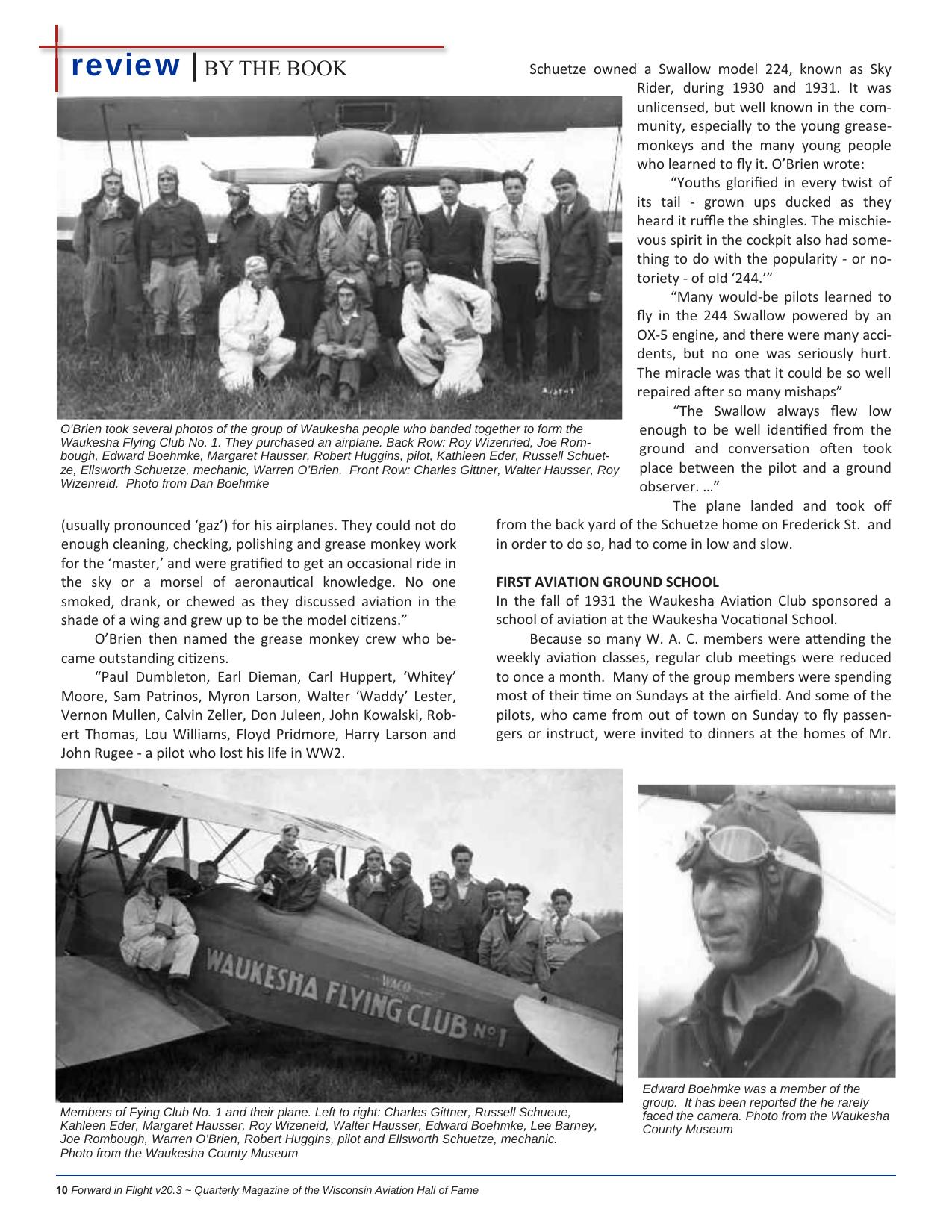
review | BY THE BOOK Schuetze owned a Swallow model 224, known as Sky Rider, during 1930 and 1931. It was unlicensed, but well known in the com‐ munity, especially to the young grease‐ monkeys and the many young people who learned to fly it. O’Brien wrote: “Youths glorified in every twist of its tail ‐ grown ups ducked as they heard it ruffle the shingles. The mischie‐ vous spirit in the cockpit also had some‐ thing to do with the popularity ‐ or no‐ toriety ‐ of old ‘244.’” “Many would‐be pilots learned to fly in the 244 Swallow powered by an OX‐5 engine, and there were many acci‐ dents, but no one was seriously hurt. The miracle was that it could be so well repaired a er so many mishaps” “The Swallow always flew low O’Brien took several photos of the group of Waukesha people who banded together to form the enough to be well iden fied from the Waukesha Flying Club No. 1. They purchased an airplane. Back Row: Roy Wizenried, Joe Romground and conversa on o en took bough, Edward Boehmke, Margaret Hausser, Robert Huggins, pilot, Kathleen Eder, Russell Schuetplace between the pilot and a ground ze, Ellsworth Schuetze, mechanic, Warren O’Brien. Front Row: Charles Gittner, Walter Hausser, Roy Wizenreid. Photo from Dan Boehmke observer. …” The plane landed and took off from the back yard of the Schuetze home on Frederick St. and (usually pronounced ‘gaz’) for his airplanes. They could not do in order to do so, had to come in low and slow. enough cleaning, checking, polishing and grease monkey work for the ‘master,’ and were gra fied to get an occasional ride in FIRST AVIATION GROUND SCHOOL the sky or a morsel of aeronau cal knowledge. No one In the fall of 1931 the Waukesha Avia on Club sponsored a smoked, drank, or chewed as they discussed avia on in the school of avia on at the Waukesha Voca onal School. shade of a wing and grew up to be the model ci zens.” Because so many W. A. C. members were a ending the O’Brien then named the grease monkey crew who be‐ weekly avia on classes, regular club mee ngs were reduced came outstanding ci zens. to once a month. Many of the group members were spending “Paul Dumbleton, Earl Dieman, Carl Huppert, ‘Whitey’ most of their me on Sundays at the airfield. And some of the Moore, Sam Patrinos, Myron Larson, Walter ‘Waddy’ Lester, pilots, who came from out of town on Sunday to fly passen‐ Vernon Mullen, Calvin Zeller, Don Juleen, John Kowalski, Rob‐ gers or instruct, were invited to dinners at the homes of Mr. ert Thomas, Lou Williams, Floyd Pridmore, Harry Larson and John Rugee ‐ a pilot who lost his life in WW2. Members of Fying Club No. 1 and their plane. Left to right: Charles Gittner, Russell Schueue, Kahleen Eder, Margaret Hausser, Roy Wizeneid, Walter Hausser, Edward Boehmke, Lee Barney, Joe Rombough, Warren O’Brien, Robert Huggins, pilot and Ellsworth Schuetze, mechanic. Photo from the Waukesha County Museum 10 Forward in Flight v20.3 ~ Quarterly Magazine of the Wisconsin Aviation Hall of Fame Edward Boehmke was a member of the group. It has been reported the he rarely faced the camera. Photo from the Waukesha County Museum
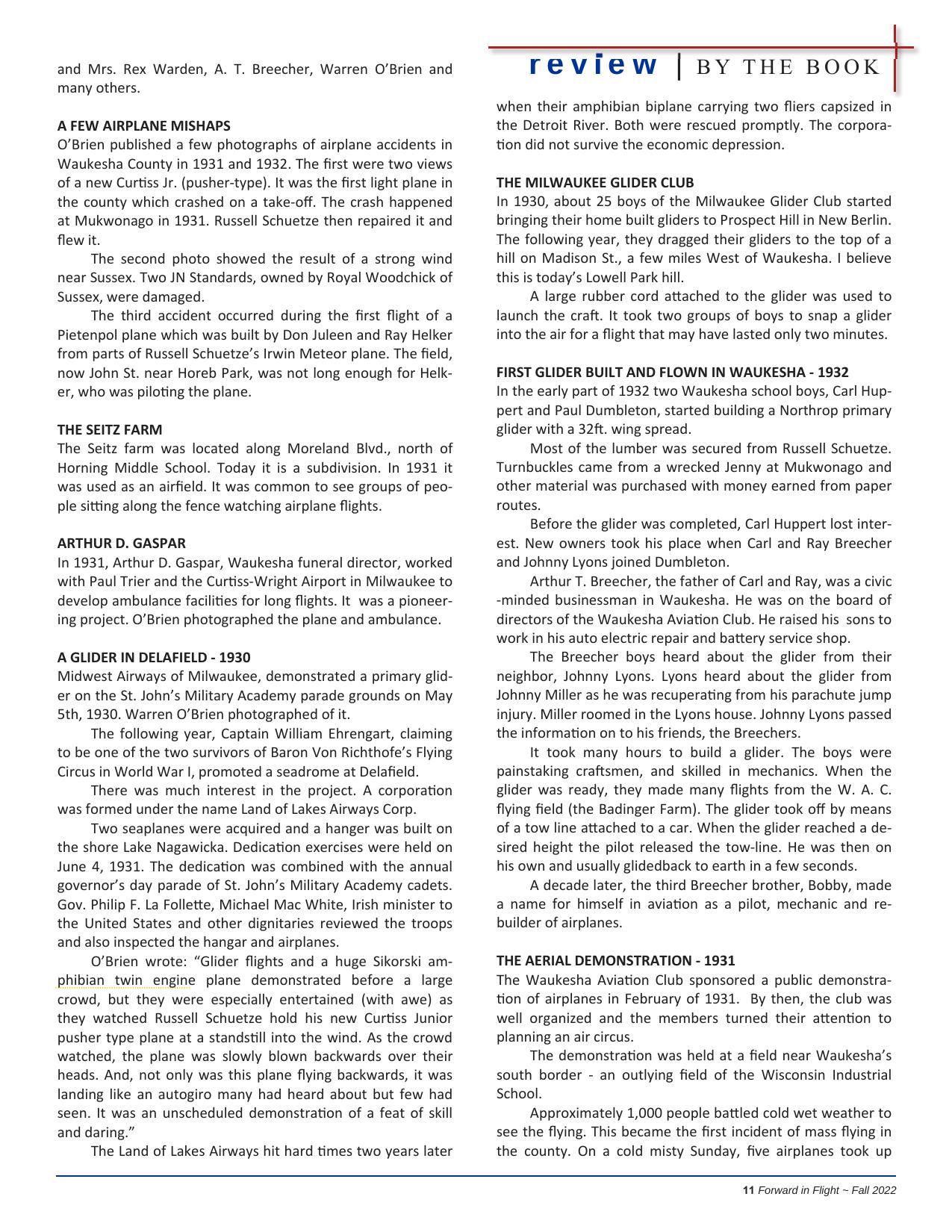
and Mrs. Rex Warden, A. T. Breecher, Warren O’Brien and many others. A FEW AIRPLANE MISHAPS O’Brien published a few photographs of airplane accidents in Waukesha County in 1931 and 1932. The first were two views of a new Cur ss Jr. (pusher‐type). It was the first light plane in the county which crashed on a take‐off. The crash happened at Mukwonago in 1931. Russell Schuetze then repaired it and flew it. The second photo showed the result of a strong wind near Sussex. Two JN Standards, owned by Royal Woodchick of Sussex, were damaged. The third accident occurred during the first flight of a Pietenpol plane which was built by Don Juleen and Ray Helker from parts of Russell Schuetze’s Irwin Meteor plane. The field, now John St. near Horeb Park, was not long enough for Helk‐ er, who was pilo ng the plane. THE SEITZ FARM The Seitz farm was located along Moreland Blvd., north of Horning Middle School. Today it is a subdivision. In 1931 it was used as an airfield. It was common to see groups of peo‐ ple si ng along the fence watching airplane flights. ARTHUR D. GASPAR In 1931, Arthur D. Gaspar, Waukesha funeral director, worked with Paul Trier and the Cur ss‐Wright Airport in Milwaukee to develop ambulance facili es for long flights. It was a pioneer‐ ing project. O’Brien photographed the plane and ambulance. A GLIDER IN DELAFIELD ‐ 1930 Midwest Airways of Milwaukee, demonstrated a primary glid‐ er on the St. John’s Military Academy parade grounds on May 5th, 1930. Warren O’Brien photographed of it. The following year, Captain William Ehrengart, claiming to be one of the two survivors of Baron Von Richthofe’s Flying Circus in World War I, promoted a seadrome at Delafield. There was much interest in the project. A corpora on was formed under the name Land of Lakes Airways Corp. Two seaplanes were acquired and a hanger was built on the shore Lake Nagawicka. Dedica on exercises were held on June 4, 1931. The dedica on was combined with the annual governor’s day parade of St. John’s Military Academy cadets. Gov. Philip F. La Folle e, Michael Mac White, Irish minister to the United States and other dignitaries reviewed the troops and also inspected the hangar and airplanes. O’Brien wrote: “Glider flights and a huge Sikorski am‐ phibian twin engine plane demonstrated before a large crowd, but they were especially entertained (with awe) as they watched Russell Schuetze hold his new Cur ss Junior pusher type plane at a stands ll into the wind. As the crowd watched, the plane was slowly blown backwards over their heads. And, not only was this plane flying backwards, it was landing like an autogiro many had heard about but few had seen. It was an unscheduled demonstra on of a feat of skill and daring.” The Land of Lakes Airways hit hard mes two years later r ev i e w | B Y T H E B O O K when their amphibian biplane carrying two fliers capsized in the Detroit River. Both were rescued promptly. The corpora‐ on did not survive the economic depression. THE MILWAUKEE GLIDER CLUB In 1930, about 25 boys of the Milwaukee Glider Club started bringing their home built gliders to Prospect Hill in New Berlin. The following year, they dragged their gliders to the top of a hill on Madison St., a few miles West of Waukesha. I believe this is today’s Lowell Park hill. A large rubber cord a ached to the glider was used to launch the cra . It took two groups of boys to snap a glider into the air for a flight that may have lasted only two minutes. FIRST GLIDER BUILT AND FLOWN IN WAUKESHA ‐ 1932 In the early part of 1932 two Waukesha school boys, Carl Hup‐ pert and Paul Dumbleton, started building a Northrop primary glider with a 32 . wing spread. Most of the lumber was secured from Russell Schuetze. Turnbuckles came from a wrecked Jenny at Mukwonago and other material was purchased with money earned from paper routes. Before the glider was completed, Carl Huppert lost inter‐ est. New owners took his place when Carl and Ray Breecher and Johnny Lyons joined Dumbleton. Arthur T. Breecher, the father of Carl and Ray, was a civic ‐minded businessman in Waukesha. He was on the board of directors of the Waukesha Avia on Club. He raised his sons to work in his auto electric repair and ba ery service shop. The Breecher boys heard about the glider from their neighbor, Johnny Lyons. Lyons heard about the glider from Johnny Miller as he was recupera ng from his parachute jump injury. Miller roomed in the Lyons house. Johnny Lyons passed the informa on on to his friends, the Breechers. It took many hours to build a glider. The boys were painstaking cra smen, and skilled in mechanics. When the glider was ready, they made many flights from the W. A. C. flying field (the Badinger Farm). The glider took off by means of a tow line a ached to a car. When the glider reached a de‐ sired height the pilot released the tow‐line. He was then on his own and usually glidedback to earth in a few seconds. A decade later, the third Breecher brother, Bobby, made a name for himself in avia on as a pilot, mechanic and re‐ builder of airplanes. THE AERIAL DEMONSTRATION ‐ 1931 The Waukesha Avia on Club sponsored a public demonstra‐ on of airplanes in February of 1931. By then, the club was well organized and the members turned their a en on to planning an air circus. The demonstra on was held at a field near Waukesha’s south border ‐ an outlying field of the Wisconsin Industrial School. Approximately 1,000 people ba led cold wet weather to see the flying. This became the first incident of mass flying in the county. On a cold misty Sunday, five airplanes took up 11 Forward in Flight ~ Fall 2022
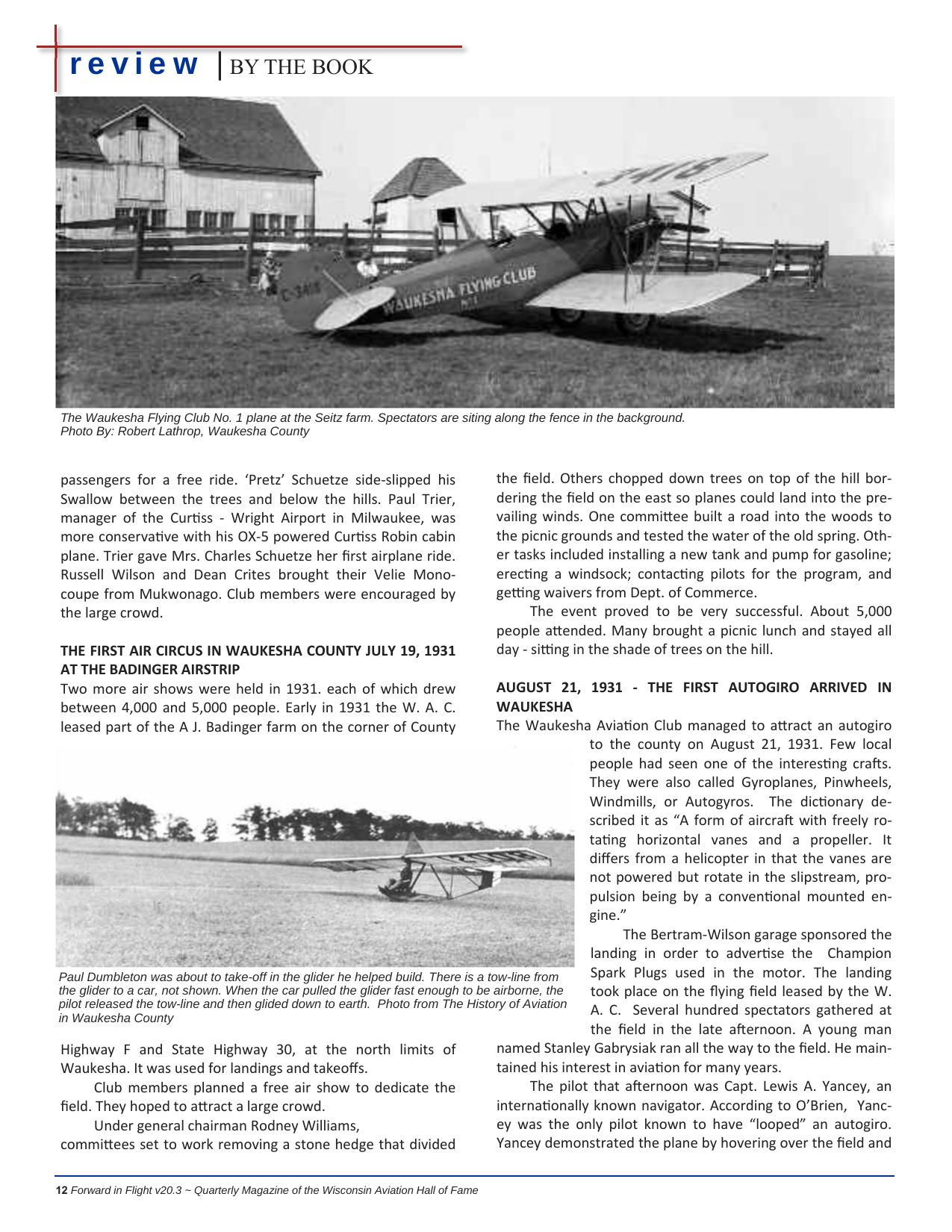
r ev i e w | BY THE BOOK The Waukesha Flying Club No. 1 plane at the Seitz farm. Spectators are siting along the fence in the background. Photo By: Robert Lathrop, Waukesha County passengers for a free ride. ‘Pretz’ Schuetze side‐slipped his Swallow between the trees and below the hills. Paul Trier, manager of the Cur ss ‐ Wright Airport in Milwaukee, was more conserva ve with his OX‐5 powered Cur ss Robin cabin plane. Trier gave Mrs. Charles Schuetze her first airplane ride. Russell Wilson and Dean Crites brought their Velie Mono‐ coupe from Mukwonago. Club members were encouraged by the large crowd. THE FIRST AIR CIRCUS IN WAUKESHA COUNTY JULY 19, 1931 AT THE BADINGER AIRSTRIP Two more air shows were held in 1931. each of which drew between 4,000 and 5,000 people. Early in 1931 the W. A. C. leased part of the A J. Badinger farm on the corner of County the field. Others chopped down trees on top of the hill bor‐ dering the field on the east so planes could land into the pre‐ vailing winds. One commi ee built a road into the woods to the picnic grounds and tested the water of the old spring. Oth‐ er tasks included installing a new tank and pump for gasoline; erec ng a windsock; contac ng pilots for the program, and ge ng waivers from Dept. of Commerce. The event proved to be very successful. About 5,000 people a ended. Many brought a picnic lunch and stayed all day ‐ si ng in the shade of trees on the hill. AUGUST 21, 1931 ‐ THE FIRST AUTOGIRO ARRIVED IN WAUKESHA The Waukesha Avia on Club managed to a ract an autogiro to the county on August 21, 1931. Few local people had seen one of the interes ng cra s. They were also called Gyroplanes, Pinwheels, Windmills, or Autogyros. The dic onary de‐ scribed it as “A form of aircra with freely ro‐ ta ng horizontal vanes and a propeller. It differs from a helicopter in that the vanes are not powered but rotate in the slipstream, pro‐ pulsion being by a conven onal mounted en‐ gine.” The Bertram‐Wilson garage sponsored the landing in order to adver se the Champion Spark Plugs used in the motor. The landing Paul Dumbleton was about to take-off in the glider he helped build. There is a tow-line from the glider to a car, not shown. When the car pulled the glider fast enough to be airborne, the took place on the flying field leased by the W. pilot released the tow-line and then glided down to earth. Photo from The History of Aviation A. C. Several hundred spectators gathered at in Waukesha County the field in the late a ernoon. A young man named Stanley Gabrysiak ran all the way to the field. He main‐ Highway F and State Highway 30, at the north limits of tained his interest in avia on for many years. Waukesha. It was used for landings and takeoffs. The pilot that a ernoon was Capt. Lewis A. Yancey, an Club members planned a free air show to dedicate the interna onally known navigator. According to O’Brien, Yanc‐ field. They hoped to a ract a large crowd. ey was the only pilot known to have “looped” an autogiro. Under general chairman Rodney Williams, Yancey demonstrated the plane by hovering over the field and commi ees set to work removing a stone hedge that divided 12 Forward in Flight v20.3 ~ Quarterly Magazine of the Wisconsin Aviation Hall of Fame
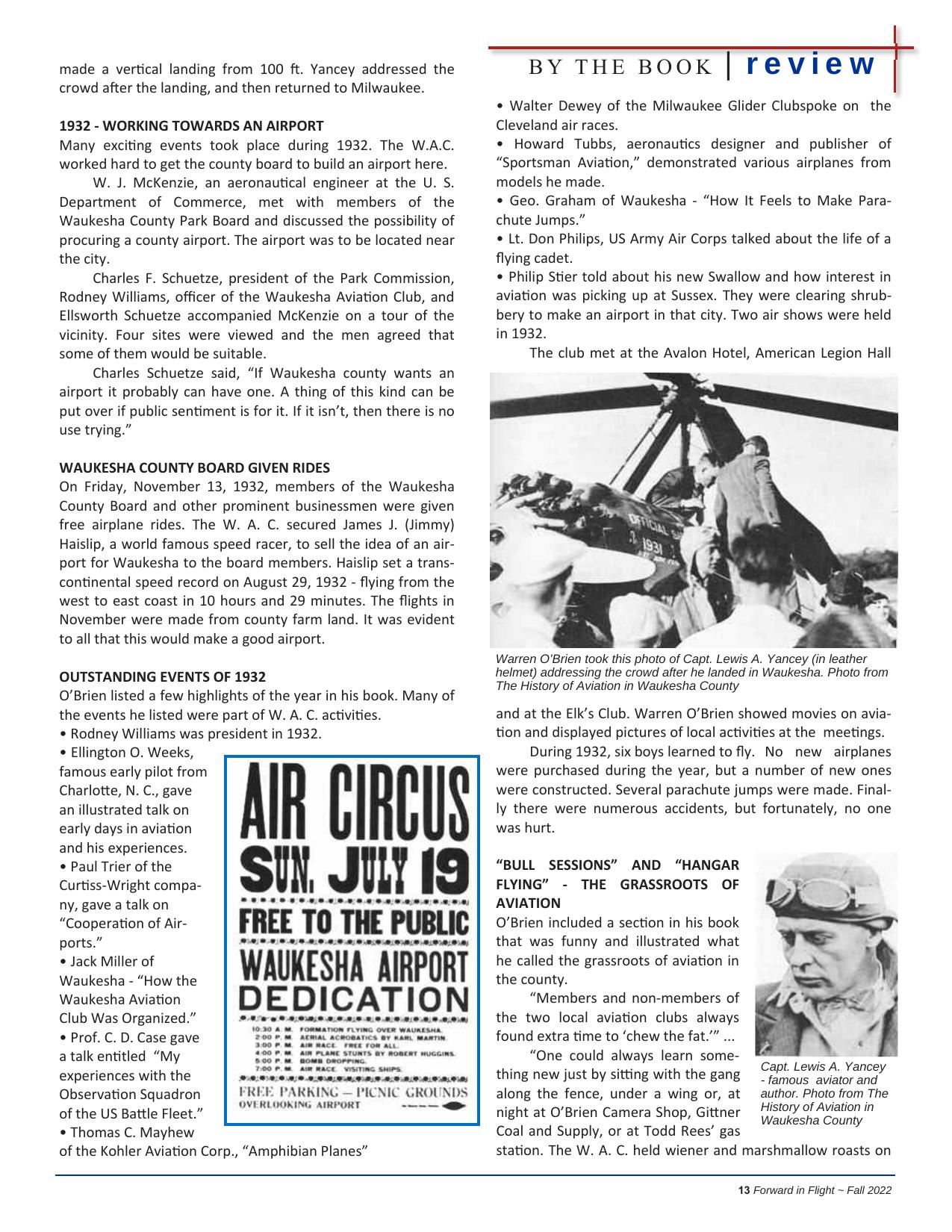
made a ver cal landing from 100 . Yancey addressed the crowd a er the landing, and then returned to Milwaukee. 1932 ‐ WORKING TOWARDS AN AIRPORT Many exci ng events took place during 1932. The W.A.C. worked hard to get the county board to build an airport here. W. J. McKenzie, an aeronau cal engineer at the U. S. Department of Commerce, met with members of the Waukesha County Park Board and discussed the possibility of procuring a county airport. The airport was to be located near the city. Charles F. Schuetze, president of the Park Commission, Rodney Williams, officer of the Waukesha Avia on Club, and Ellsworth Schuetze accompanied McKenzie on a tour of the vicinity. Four sites were viewed and the men agreed that some of them would be suitable. Charles Schuetze said, “If Waukesha county wants an airport it probably can have one. A thing of this kind can be put over if public sen ment is for it. If it isn’t, then there is no use trying.” B Y T H E B O O K | r ev i e w • Walter Dewey of the Milwaukee Glider Clubspoke on the Cleveland air races. • Howard Tubbs, aeronau cs designer and publisher of “Sportsman Avia on,” demonstrated various airplanes from models he made. • Geo. Graham of Waukesha ‐ “How It Feels to Make Para‐ chute Jumps.” • Lt. Don Philips, US Army Air Corps talked about the life of a flying cadet. • Philip S er told about his new Swallow and how interest in avia on was picking up at Sussex. They were clearing shrub‐ bery to make an airport in that city. Two air shows were held in 1932. The club met at the Avalon Hotel, American Legion Hall WAUKESHA COUNTY BOARD GIVEN RIDES On Friday, November 13, 1932, members of the Waukesha County Board and other prominent businessmen were given free airplane rides. The W. A. C. secured James J. (Jimmy) Haislip, a world famous speed racer, to sell the idea of an air‐ port for Waukesha to the board members. Haislip set a trans‐ con nental speed record on August 29, 1932 ‐ flying from the west to east coast in 10 hours and 29 minutes. The flights in November were made from county farm land. It was evident to all that this would make a good airport. OUTSTANDING EVENTS OF 1932 O’Brien listed a few highlights of the year in his book. Many of the events he listed were part of W. A. C. ac vi es. • Rodney Williams was president in 1932. •.Ellington O. Weeks, famous early pilot from Charlo e, N. C., gave an illustrated talk on early days in avia on and his experiences. • Paul Trier of the Cur ss‐Wright compa‐ ny, gave a talk on “Coopera on of Air‐ ports.” •.Jack Miller of Waukesha ‐ “How the Waukesha Avia on Club Was Organized.” • Prof. C. D. Case gave a talk en tled “My experiences with the Observa on Squadron of the US Ba le Fleet.” • Thomas C. Mayhew of the Kohler Avia on Corp., “Amphibian Planes” Warren O’Brien took this photo of Capt. Lewis A. Yancey (in leather helmet) addressing the crowd after he landed in Waukesha. Photo from The History of Aviation in Waukesha County and at the Elk’s Club. Warren O’Brien showed movies on avia‐ on and displayed pictures of local ac vi es at the mee ngs. During 1932, six boys learned to fly. No new airplanes were purchased during the year, but a number of new ones were constructed. Several parachute jumps were made. Final‐ ly there were numerous accidents, but fortunately, no one was hurt. “BULL SESSIONS” AND “HANGAR FLYING” ‐ THE GRASSROOTS OF AVIATION O’Brien included a sec on in his book that was funny and illustrated what he called the grassroots of avia on in the county. “Members and non‐members of the two local avia on clubs always found extra me to ‘chew the fat.’” ... “One could always learn some‐ Capt. Lewis A. Yancey thing new just by si ng with the gang - famous aviator and along the fence, under a wing or, at author. Photo from The night at O’Brien Camera Shop, Gi ner History of Aviation in Waukesha County Coal and Supply, or at Todd Rees’ gas sta on. The W. A. C. held wiener and marshmallow roasts on 13 Forward in Flight ~ Fall 2022
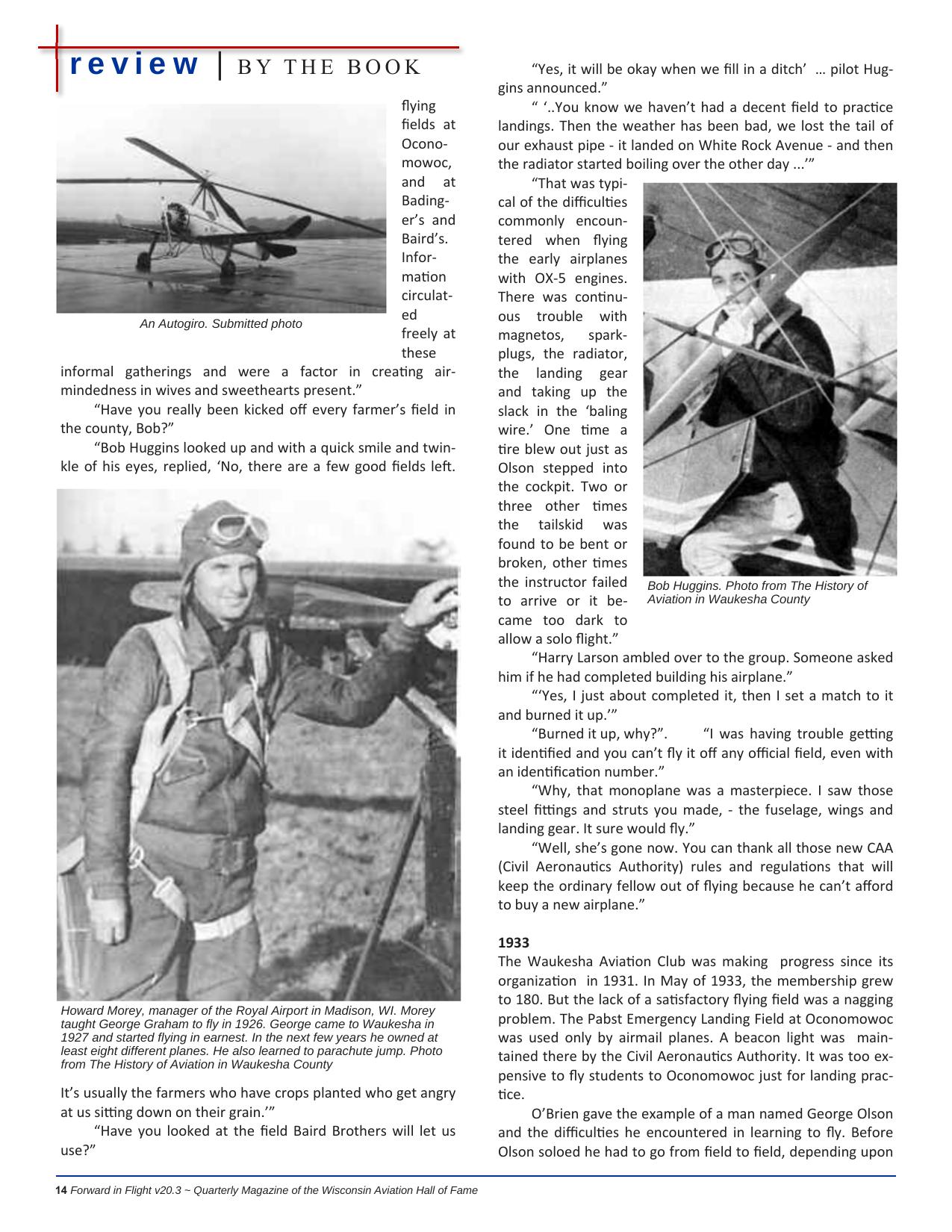
r ev i e w | B Y T H E B O O K flying fields at Ocono‐ mowoc, and at Bading‐ er’s and Baird’s. Infor‐ ma on circulat‐ ed An Autogiro. Submitted photo freely at these informal gatherings and were a factor in crea ng air‐ mindedness in wives and sweethearts present.” “Have you really been kicked off every farmer’s field in the county, Bob?” “Bob Huggins looked up and with a quick smile and twin‐ kle of his eyes, replied, ‘No, there are a few good fields le . Howard Morey, manager of the Royal Airport in Madison, WI. Morey taught George Graham to fly in 1926. George came to Waukesha in 1927 and started flying in earnest. In the next few years he owned at least eight different planes. He also learned to parachute jump. Photo from The History of Aviation in Waukesha County It’s usually the farmers who have crops planted who get angry at us si ng down on their grain.’” “Have you looked at the field Baird Brothers will let us use?” 14 Forward in Flight v20.3 ~ Quarterly Magazine of the Wisconsin Aviation Hall of Fame “Yes, it will be okay when we fill in a ditch’ … pilot Hug‐ gins announced.” “ ‘..You know we haven’t had a decent field to prac ce landings. Then the weather has been bad, we lost the tail of our exhaust pipe ‐ it landed on White Rock Avenue ‐ and then the radiator started boiling over the other day ...’” “That was typi‐ cal of the difficul es commonly encoun‐ tered when flying the early airplanes with OX‐5 engines. There was con nu‐ ous trouble with magnetos, spark‐ plugs, the radiator, the landing gear and taking up the slack in the ‘baling wire.’ One me a re blew out just as Olson stepped into the cockpit. Two or three other mes the tailskid was found to be bent or broken, other mes the instructor failed Bob Huggins. Photo from The History of to arrive or it be‐ Aviation in Waukesha County came too dark to allow a solo flight.” “Harry Larson ambled over to the group. Someone asked him if he had completed building his airplane.” “‘Yes, I just about completed it, then I set a match to it and burned it up.’” “Burned it up, why?”. “I was having trouble ge ng it iden fied and you can’t fly it off any official field, even with an iden fica on number.” “Why, that monoplane was a masterpiece. I saw those steel fi ngs and struts you made, ‐ the fuselage, wings and landing gear. It sure would fly.” “Well, she’s gone now. You can thank all those new CAA (Civil Aeronau cs Authority) rules and regula ons that will keep the ordinary fellow out of flying because he can’t afford to buy a new airplane.” 1933 The Waukesha Avia on Club was making progress since its organiza on in 1931. In May of 1933, the membership grew to 180. But the lack of a sa sfactory flying field was a nagging problem. The Pabst Emergency Landing Field at Oconomowoc was used only by airmail planes. A beacon light was main‐ tained there by the Civil Aeronau cs Authority. It was too ex‐ pensive to fly students to Oconomowoc just for landing prac‐ ce. O’Brien gave the example of a man named George Olson and the difficul es he encountered in learning to fly. Before Olson soloed he had to go from field to field, depending upon
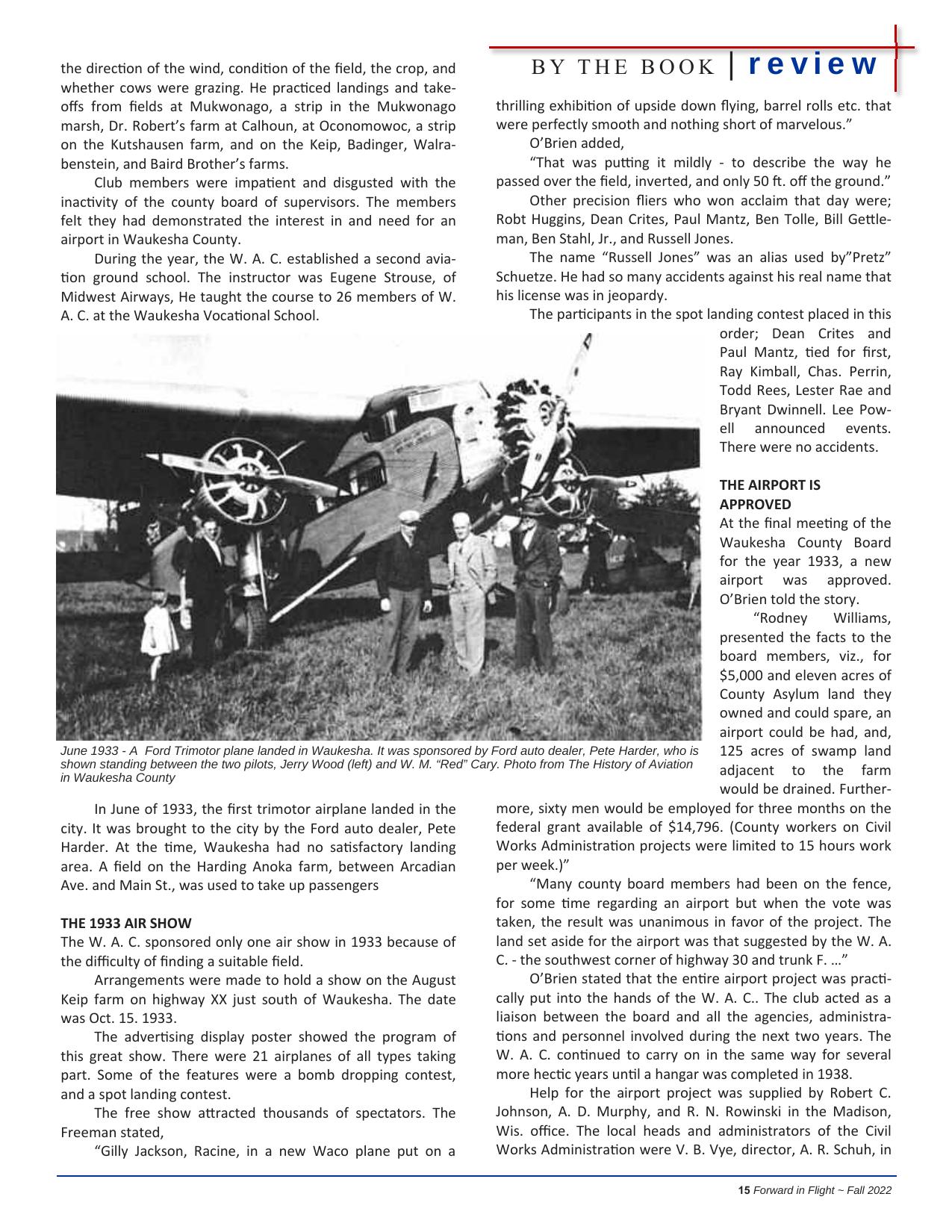
the direc on of the wind, condi on of the field, the crop, and whether cows were grazing. He prac ced landings and take‐ offs from fields at Mukwonago, a strip in the Mukwonago marsh, Dr. Robert’s farm at Calhoun, at Oconomowoc, a strip on the Kutshausen farm, and on the Keip, Badinger, Walra‐ benstein, and Baird Brother’s farms. Club members were impa ent and disgusted with the inac vity of the county board of supervisors. The members felt they had demonstrated the interest in and need for an airport in Waukesha County. During the year, the W. A. C. established a second avia‐ on ground school. The instructor was Eugene Strouse, of Midwest Airways, He taught the course to 26 members of W. A. C. at the Waukesha Voca onal School. B Y T H E B O O K | r ev i e w thrilling exhibi on of upside down flying, barrel rolls etc. that were perfectly smooth and nothing short of marvelous.” O’Brien added, “That was pu ng it mildly ‐ to describe the way he passed over the field, inverted, and only 50 . off the ground.” Other precision fliers who won acclaim that day were; Robt Huggins, Dean Crites, Paul Mantz, Ben Tolle, Bill Ge le‐ man, Ben Stahl, Jr., and Russell Jones. The name “Russell Jones” was an alias used by”Pretz” Schuetze. He had so many accidents against his real name that his license was in jeopardy. The par cipants in the spot landing contest placed in this order; Dean Crites and Paul Mantz, ed for first, Ray Kimball, Chas. Perrin, Todd Rees, Lester Rae and Bryant Dwinnell. Lee Pow‐ ell announced events. There were no accidents. THE AIRPORT IS APPROVED At the final mee ng of the Waukesha County Board for the year 1933, a new airport was approved. O’Brien told the story. “Rodney Williams, presented the facts to the board members, viz., for $5,000 and eleven acres of County Asylum land they owned and could spare, an airport could be had, and, June 1933 - A Ford Trimotor plane landed in Waukesha. It was sponsored by Ford auto dealer, Pete Harder, who is 125 acres of swamp land shown standing between the two pilots, Jerry Wood (left) and W. M. “Red” Cary. Photo from The History of Aviation adjacent to the farm in Waukesha County would be drained. Further‐ more, sixty men would be employed for three months on the In June of 1933, the first trimotor airplane landed in the federal grant available of $14,796. (County workers on Civil city. It was brought to the city by the Ford auto dealer, Pete Works Administra on projects were limited to 15 hours work Harder. At the me, Waukesha had no sa sfactory landing per week.)” area. A field on the Harding Anoka farm, between Arcadian “Many county board members had been on the fence, Ave. and Main St., was used to take up passengers for some me regarding an airport but when the vote was taken, the result was unanimous in favor of the project. The THE 1933 AIR SHOW land set aside for the airport was that suggested by the W. A. The W. A. C. sponsored only one air show in 1933 because of C. ‐ the southwest corner of highway 30 and trunk F. …” the difficulty of finding a suitable field. O’Brien stated that the en re airport project was prac ‐ Arrangements were made to hold a show on the August cally put into the hands of the W. A. C.. The club acted as a Keip farm on highway XX just south of Waukesha. The date liaison between the board and all the agencies, administra‐ was Oct. 15. 1933. ons and personnel involved during the next two years. The The adver sing display poster showed the program of W. A. C. con nued to carry on in the same way for several this great show. There were 21 airplanes of all types taking more hec c years un l a hangar was completed in 1938. part. Some of the features were a bomb dropping contest, Help for the airport project was supplied by Robert C. and a spot landing contest. Johnson, A. D. Murphy, and R. N. Rowinski in the Madison, The free show a racted thousands of spectators. The Wis. office. The local heads and administrators of the Civil Freeman stated, Works Administra on were V. B. Vye, director, A. R. Schuh, in “Gilly Jackson, Racine, in a new Waco plane put on a 15 Forward in Flight ~ Fall 2022
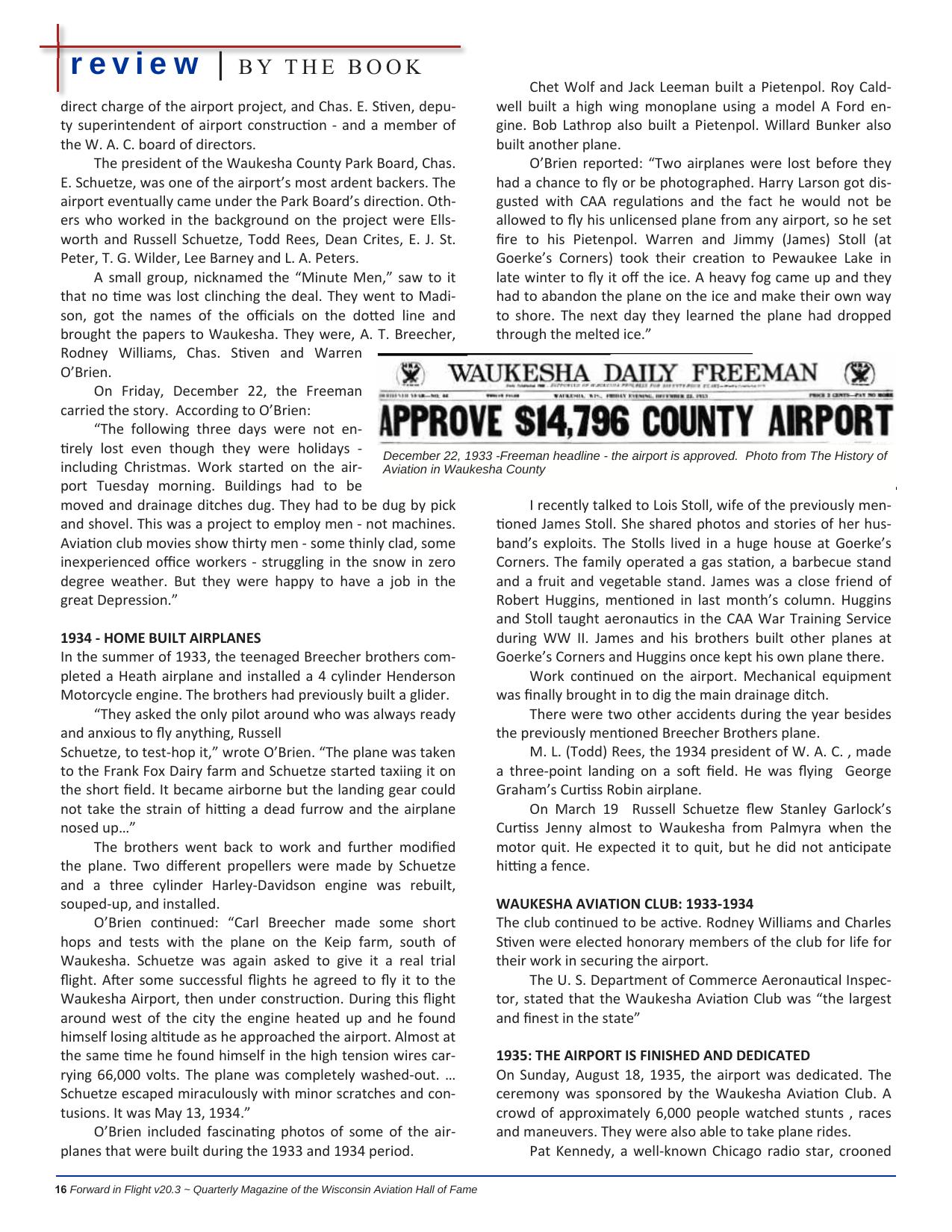
r ev i e w | B Y T H E B O O K Chet Wolf and Jack Leeman built a Pietenpol. Roy Cald‐ direct charge of the airport project, and Chas. E. S ven, depu‐ well built a high wing monoplane using a model A Ford en‐ gine. Bob Lathrop also built a Pietenpol. Willard Bunker also ty superintendent of airport construc on ‐ and a member of the W. A. C. board of directors. built another plane. O’Brien reported: “Two airplanes were lost before they The president of the Waukesha County Park Board, Chas. E. Schuetze, was one of the airport’s most ardent backers. The had a chance to fly or be photographed. Harry Larson got dis‐ gusted with CAA regula ons and the fact he would not be airport eventually came under the Park Board’s direc on. Oth‐ ers who worked in the background on the project were Ells‐ allowed to fly his unlicensed plane from any airport, so he set fire to his Pietenpol. Warren and Jimmy (James) Stoll (at worth and Russell Schuetze, Todd Rees, Dean Crites, E. J. St. Peter, T. G. Wilder, Lee Barney and L. A. Peters. Goerke’s Corners) took their crea on to Pewaukee Lake in late winter to fly it off the ice. A heavy fog came up and they A small group, nicknamed the “Minute Men,” saw to it had to abandon the plane on the ice and make their own way that no me was lost clinching the deal. They went to Madi‐ son, got the names of the officials on the do ed line and to shore. The next day they learned the plane had dropped through the melted ice.” brought the papers to Waukesha. They were, A. T. Breecher, Rodney Williams, Chas. S ven and Warren O’Brien. On Friday, December 22, the Freeman carried the story. According to O’Brien: “The following three days were not en‐ rely lost even though they were holidays ‐ December 22, 1933 -Freeman headline - the airport is approved. Photo from The History of including Christmas. Work started on the air‐ Aviation in Waukesha County port Tuesday morning. Buildings had to be I recently talked to Lois Stoll, wife of the previously men‐ moved and drainage ditches dug. They had to be dug by pick and shovel. This was a project to employ men ‐ not machines. oned James Stoll. She shared photos and stories of her hus‐ band’s exploits. The Stolls lived in a huge house at Goerke’s Avia on club movies show thirty men ‐ some thinly clad, some inexperienced office workers ‐ struggling in the snow in zero Corners. The family operated a gas sta on, a barbecue stand and a fruit and vegetable stand. James was a close friend of degree weather. But they were happy to have a job in the great Depression.” Robert Huggins, men oned in last month’s column. Huggins and Stoll taught aeronau cs in the CAA War Training Service 1934 ‐ HOME BUILT AIRPLANES during WW II. James and his brothers built other planes at Goerke’s Corners and Huggins once kept his own plane there. In the summer of 1933, the teenaged Breecher brothers com‐ Work con nued on the airport. Mechanical equipment pleted a Heath airplane and installed a 4 cylinder Henderson Motorcycle engine. The brothers had previously built a glider. was finally brought in to dig the main drainage ditch. There were two other accidents during the year besides “They asked the only pilot around who was always ready and anxious to fly anything, Russell the previously men oned Breecher Brothers plane. M. L. (Todd) Rees, the 1934 president of W. A. C. , made Schuetze, to test‐hop it,” wrote O’Brien. “The plane was taken to the Frank Fox Dairy farm and Schuetze started taxiing it on a three‐point landing on a so field. He was flying George Graham’s Cur ss Robin airplane. the short field. It became airborne but the landing gear could not take the strain of hi ng a dead furrow and the airplane On March 19 Russell Schuetze flew Stanley Garlock’s Cur ss Jenny almost to Waukesha from Palmyra when the nosed up…” motor quit. He expected it to quit, but he did not an cipate The brothers went back to work and further modified the plane. Two different propellers were made by Schuetze hi ng a fence. and a three cylinder Harley‐Davidson engine was rebuilt, souped‐up, and installed. WAUKESHA AVIATION CLUB: 1933‐1934 The club con nued to be ac ve. Rodney Williams and Charles O’Brien con nued: “Carl Breecher made some short hops and tests with the plane on the Keip farm, south of S ven were elected honorary members of the club for life for their work in securing the airport. Waukesha. Schuetze was again asked to give it a real trial flight. A er some successful flights he agreed to fly it to the The U. S. Department of Commerce Aeronau cal Inspec‐ tor, stated that the Waukesha Avia on Club was “the largest Waukesha Airport, then under construc on. During this flight and finest in the state” around west of the city the engine heated up and he found himself losing al tude as he approached the airport. Almost at 1935: THE AIRPORT IS FINISHED AND DEDICATED the same me he found himself in the high tension wires car‐ On Sunday, August 18, 1935, the airport was dedicated. The rying 66,000 volts. The plane was completely washed‐out. … ceremony was sponsored by the Waukesha Avia on Club. A Schuetze escaped miraculously with minor scratches and con‐ crowd of approximately 6,000 people watched stunts , races tusions. It was May 13, 1934.” and maneuvers. They were also able to take plane rides. O’Brien included fascina ng photos of some of the air‐ Pat Kennedy, a well‐known Chicago radio star, crooned planes that were built during the 1933 and 1934 period. 16 Forward in Flight v20.3 ~ Quarterly Magazine of the Wisconsin Aviation Hall of Fame
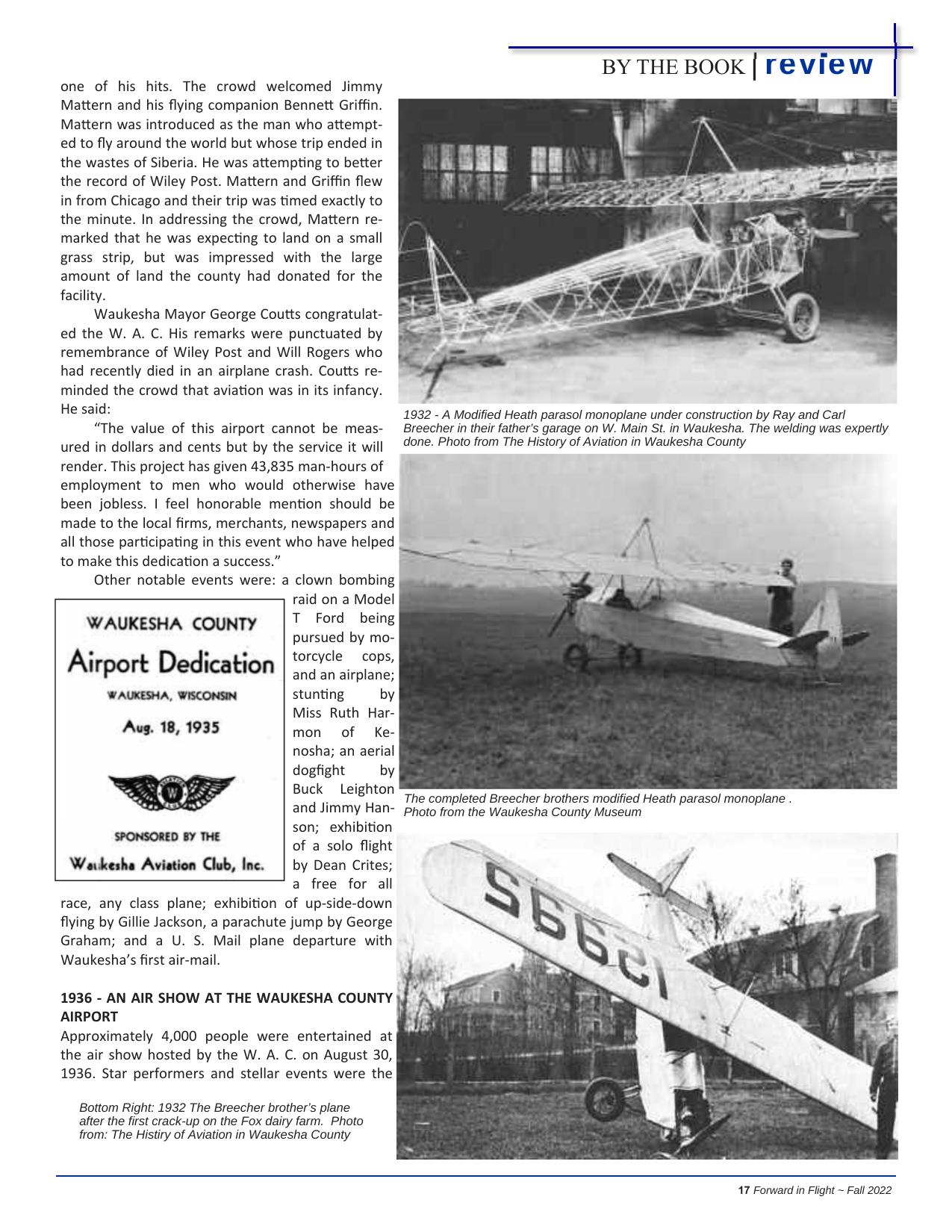
BY THE BOOK | review one of his hits. The crowd welcomed Jimmy Ma ern and his flying companion Benne Griffin. Ma ern was introduced as the man who a empt‐ ed to fly around the world but whose trip ended in the wastes of Siberia. He was a emp ng to be er the record of Wiley Post. Ma ern and Griffin flew in from Chicago and their trip was med exactly to the minute. In addressing the crowd, Ma ern re‐ marked that he was expec ng to land on a small grass strip, but was impressed with the large amount of land the county had donated for the facility. Waukesha Mayor George Cou s congratulat‐ ed the W. A. C. His remarks were punctuated by remembrance of Wiley Post and Will Rogers who had recently died in an airplane crash. Cou s re‐ minded the crowd that avia on was in its infancy. He said: 1932 - A Modified Heath parasol monoplane under construction by Ray and Carl “The value of this airport cannot be meas‐ Breecher in their father’s garage on W. Main St. in Waukesha. The welding was expertly ured in dollars and cents but by the service it will done. Photo from The History of Aviation in Waukesha County render. This project has given 43,835 man‐hours of employment to men who would otherwise have been jobless. I feel honorable men on should be made to the local firms, merchants, newspapers and all those par cipa ng in this event who have helped to make this dedica on a success.” Other notable events were: a clown bombing raid on a Model T Ford being pursued by mo‐ torcycle cops, and an airplane; stun ng by Miss Ruth Har‐ mon of Ke‐ nosha; an aerial dogfight by Buck Leighton The completed Breecher brothers modified Heath parasol monoplane . and Jimmy Han‐ Photo from the Waukesha County Museum son; exhibi on of a solo flight by Dean Crites; a free for all race, any class plane; exhibi on of up‐side‐down flying by Gillie Jackson, a parachute jump by George Graham; and a U. S. Mail plane departure with Waukesha’s first air‐mail. 1936 ‐ AN AIR SHOW AT THE WAUKESHA COUNTY AIRPORT Approximately 4,000 people were entertained at the air show hosted by the W. A. C. on August 30, 1936. Star performers and stellar events were the Bottom Right: 1932 The Breecher brother’s plane after the first crack-up on the Fox dairy farm. Photo from: The Histiry of Aviation in Waukesha County 17 Forward in Flight ~ Fall 2022
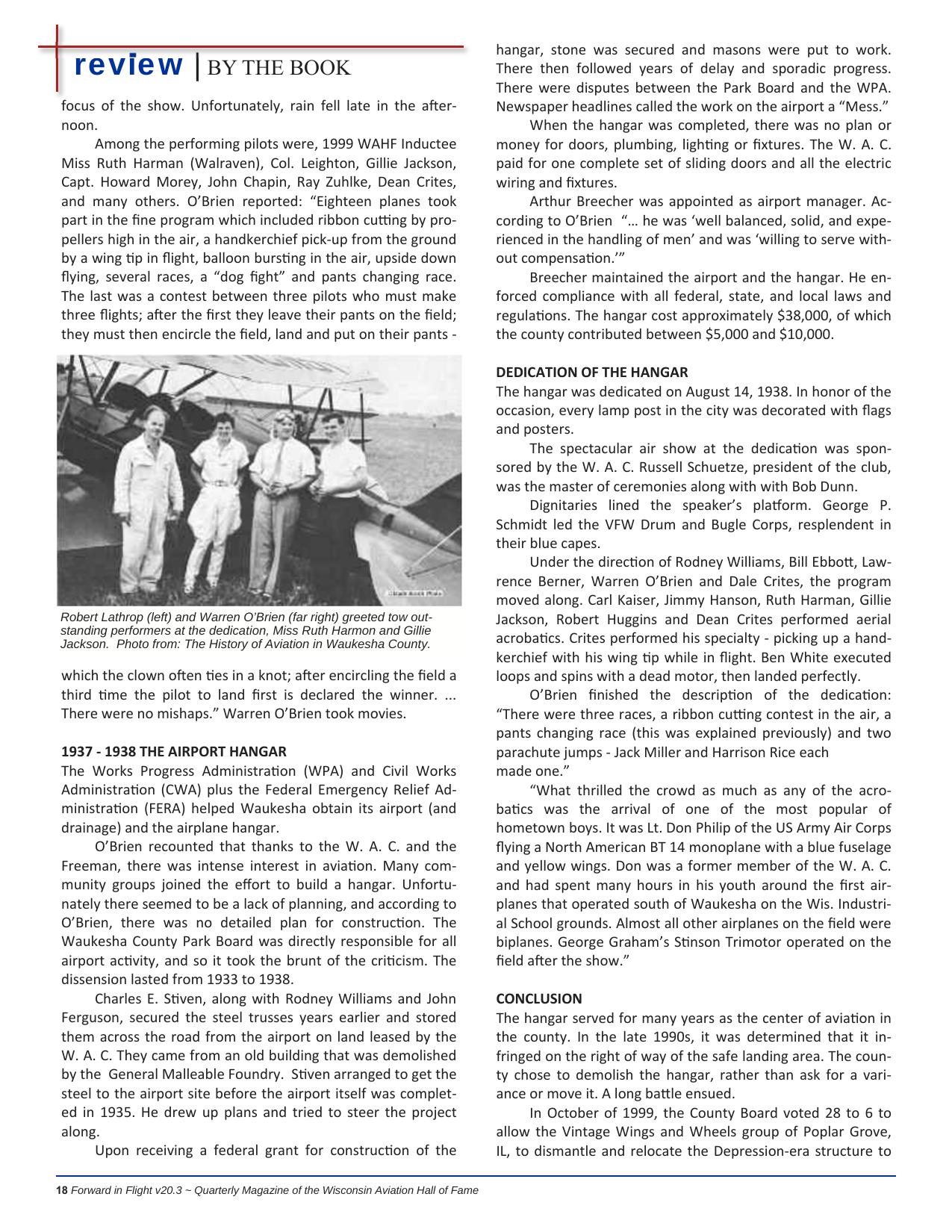
review | BY THE BOOK focus of the show. Unfortunately, rain fell late in the a er‐ noon. Among the performing pilots were, 1999 WAHF Inductee Miss Ruth Harman (Walraven), Col. Leighton, Gillie Jackson, Capt. Howard Morey, John Chapin, Ray Zuhlke, Dean Crites, and many others. O’Brien reported: “Eighteen planes took part in the fine program which included ribbon cu ng by pro‐ pellers high in the air, a handkerchief pick‐up from the ground by a wing p in flight, balloon burs ng in the air, upside down flying, several races, a “dog fight” and pants changing race. The last was a contest between three pilots who must make three flights; a er the first they leave their pants on the field; they must then encircle the field, land and put on their pants ‐ Robert Lathrop (left) and Warren O’Brien (far right) greeted tow outstanding performers at the dedication, Miss Ruth Harmon and Gillie Jackson. Photo from: The History of Aviation in Waukesha County. which the clown o en es in a knot; a er encircling the field a third me the pilot to land first is declared the winner. ... There were no mishaps.” Warren O’Brien took movies. 1937 ‐ 1938 THE AIRPORT HANGAR The Works Progress Administra on (WPA) and Civil Works Administra on (CWA) plus the Federal Emergency Relief Ad‐ ministra on (FERA) helped Waukesha obtain its airport (and drainage) and the airplane hangar. O’Brien recounted that thanks to the W. A. C. and the Freeman, there was intense interest in avia on. Many com‐ munity groups joined the effort to build a hangar. Unfortu‐ nately there seemed to be a lack of planning, and according to O’Brien, there was no detailed plan for construc on. The Waukesha County Park Board was directly responsible for all airport ac vity, and so it took the brunt of the cri cism. The dissension lasted from 1933 to 1938. Charles E. S ven, along with Rodney Williams and John Ferguson, secured the steel trusses years earlier and stored them across the road from the airport on land leased by the W. A. C. They came from an old building that was demolished by the General Malleable Foundry. S ven arranged to get the steel to the airport site before the airport itself was complet‐ ed in 1935. He drew up plans and tried to steer the project along. Upon receiving a federal grant for construc on of the 18 Forward in Flight v20.3 ~ Quarterly Magazine of the Wisconsin Aviation Hall of Fame hangar, stone was secured and masons were put to work. There then followed years of delay and sporadic progress. There were disputes between the Park Board and the WPA. Newspaper headlines called the work on the airport a “Mess.” When the hangar was completed, there was no plan or money for doors, plumbing, ligh ng or fixtures. The W. A. C. paid for one complete set of sliding doors and all the electric wiring and fixtures. Arthur Breecher was appointed as airport manager. Ac‐ cording to O’Brien “… he was ‘well balanced, solid, and expe‐ rienced in the handling of men’ and was ‘willing to serve with‐ out compensa on.’” Breecher maintained the airport and the hangar. He en‐ forced compliance with all federal, state, and local laws and regula ons. The hangar cost approximately $38,000, of which the county contributed between $5,000 and $10,000. DEDICATION OF THE HANGAR The hangar was dedicated on August 14, 1938. In honor of the occasion, every lamp post in the city was decorated with flags and posters. The spectacular air show at the dedica on was spon‐ sored by the W. A. C. Russell Schuetze, president of the club, was the master of ceremonies along with with Bob Dunn. Dignitaries lined the speaker’s pla orm. George P. Schmidt led the VFW Drum and Bugle Corps, resplendent in their blue capes. Under the direc on of Rodney Williams, Bill Ebbo , Law‐ rence Berner, Warren O’Brien and Dale Crites, the program moved along. Carl Kaiser, Jimmy Hanson, Ruth Harman, Gillie Jackson, Robert Huggins and Dean Crites performed aerial acroba cs. Crites performed his specialty ‐ picking up a hand‐ kerchief with his wing p while in flight. Ben White executed loops and spins with a dead motor, then landed perfectly. O’Brien finished the descrip on of the dedica on: “There were three races, a ribbon cu ng contest in the air, a pants changing race (this was explained previously) and two parachute jumps ‐ Jack Miller and Harrison Rice each made one.” “What thrilled the crowd as much as any of the acro‐ ba cs was the arrival of one of the most popular of hometown boys. It was Lt. Don Philip of the US Army Air Corps flying a North American BT 14 monoplane with a blue fuselage and yellow wings. Don was a former member of the W. A. C. and had spent many hours in his youth around the first air‐ planes that operated south of Waukesha on the Wis. Industri‐ al School grounds. Almost all other airplanes on the field were biplanes. George Graham’s S nson Trimotor operated on the field a er the show.” CONCLUSION The hangar served for many years as the center of avia on in the county. In the late 1990s, it was determined that it in‐ fringed on the right of way of the safe landing area. The coun‐ ty chose to demolish the hangar, rather than ask for a vari‐ ance or move it. A long ba le ensued. In October of 1999, the County Board voted 28 to 6 to allow the Vintage Wings and Wheels group of Poplar Grove, IL, to dismantle and relocate the Depression‐era structure to
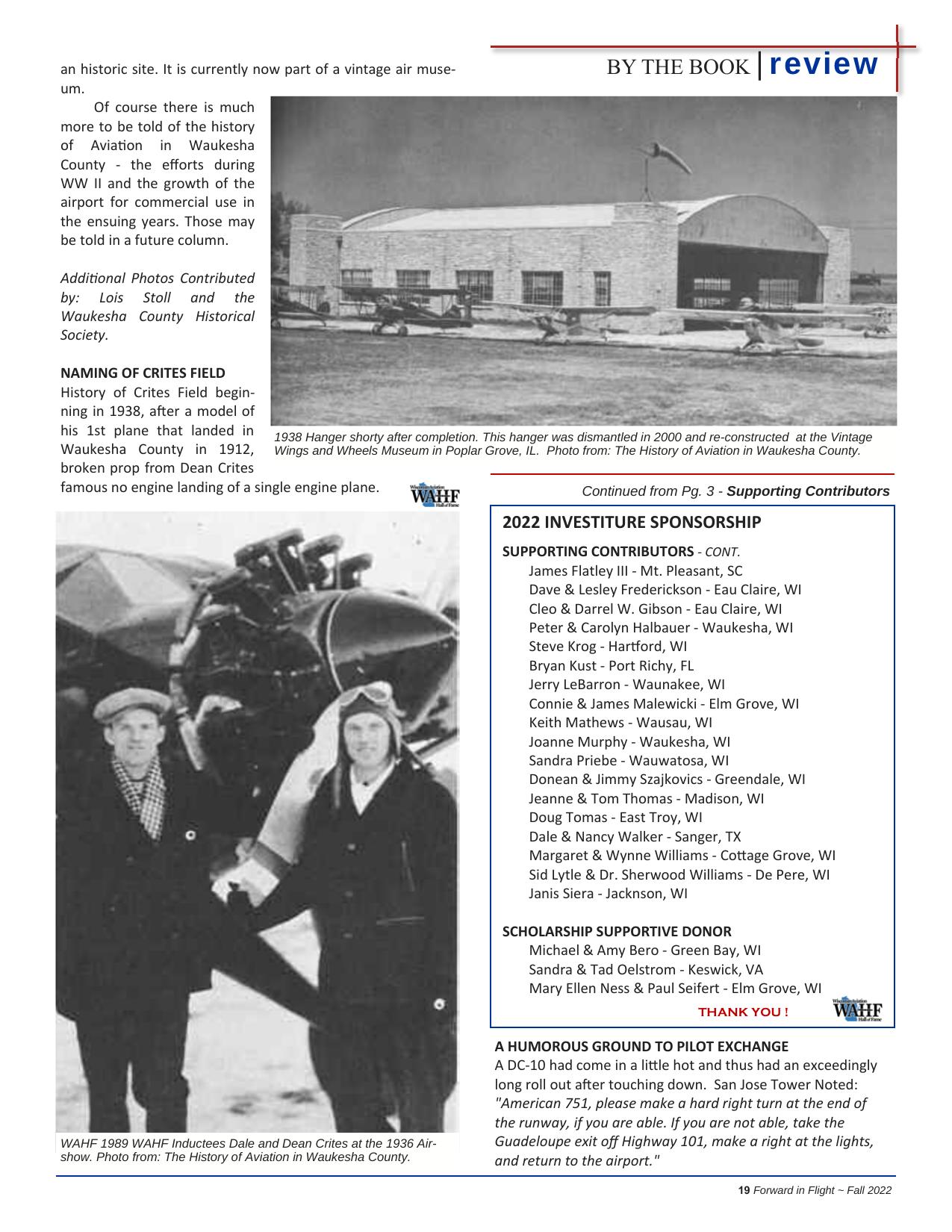
an historic site. It is currently now part of a vintage air muse‐ um. Of course there is much more to be told of the history of Avia on in Waukesha County ‐ the efforts during WW II and the growth of the airport for commercial use in the ensuing years. Those may be told in a future column. BY THE BOOK | review Addi onal Photos Contributed by: Lois Stoll and the Waukesha County Historical Society. NAMING OF CRITES FIELD History of Crites Field begin‐ ning in 1938, a er a model of his 1st plane that landed in 1938 Hanger shorty after completion. This hanger was dismantled in 2000 and re-constructed at the Vintage Waukesha County in 1912, Wings and Wheels Museum in Poplar Grove, IL. Photo from: The History of Aviation in Waukesha County. broken prop from Dean Crites famous no engine landing of a single engine plane. Continued from Pg. 3 - Supporting Contributors 2022 INVESTITURE SPONSORSHIP SUPPORTING CONTRIBUTORS ‐ CONT. James Flatley III ‐ Mt. Pleasant, SC Dave & Lesley Frederickson ‐ Eau Claire, WI Cleo & Darrel W. Gibson ‐ Eau Claire, WI Peter & Carolyn Halbauer ‐ Waukesha, WI Steve Krog ‐ Har ord, WI Bryan Kust ‐ Port Richy, FL Jerry LeBarron ‐ Waunakee, WI Connie & James Malewicki ‐ Elm Grove, WI Keith Mathews ‐ Wausau, WI Joanne Murphy ‐ Waukesha, WI Sandra Priebe ‐ Wauwatosa, WI Donean & Jimmy Szajkovics ‐ Greendale, WI Jeanne & Tom Thomas ‐ Madison, WI Doug Tomas ‐ East Troy, WI Dale & Nancy Walker ‐ Sanger, TX Margaret & Wynne Williams ‐ Co age Grove, WI Sid Lytle & Dr. Sherwood Williams ‐ De Pere, WI Janis Siera ‐ Jacknson, WI SCHOLARSHIP SUPPORTIVE DONOR Michael & Amy Bero ‐ Green Bay, WI Sandra & Tad Oelstrom ‐ Keswick, VA Mary Ellen Ness & Paul Seifert ‐ Elm Grove, WI THANK YOU ! WAHF 1989 WAHF Inductees Dale and Dean Crites at the 1936 Airshow. Photo from: The History of Aviation in Waukesha County. A HUMOROUS GROUND TO PILOT EXCHANGE A DC‐10 had come in a li le hot and thus had an exceedingly long roll out a er touching down. San Jose Tower Noted: "American 751, please make a hard right turn at the end of the runway, if you are able. If you are not able, take the Guadeloupe exit off Highway 101, make a right at the lights, and return to the airport." 19 Forward in Flight ~ Fall 2022
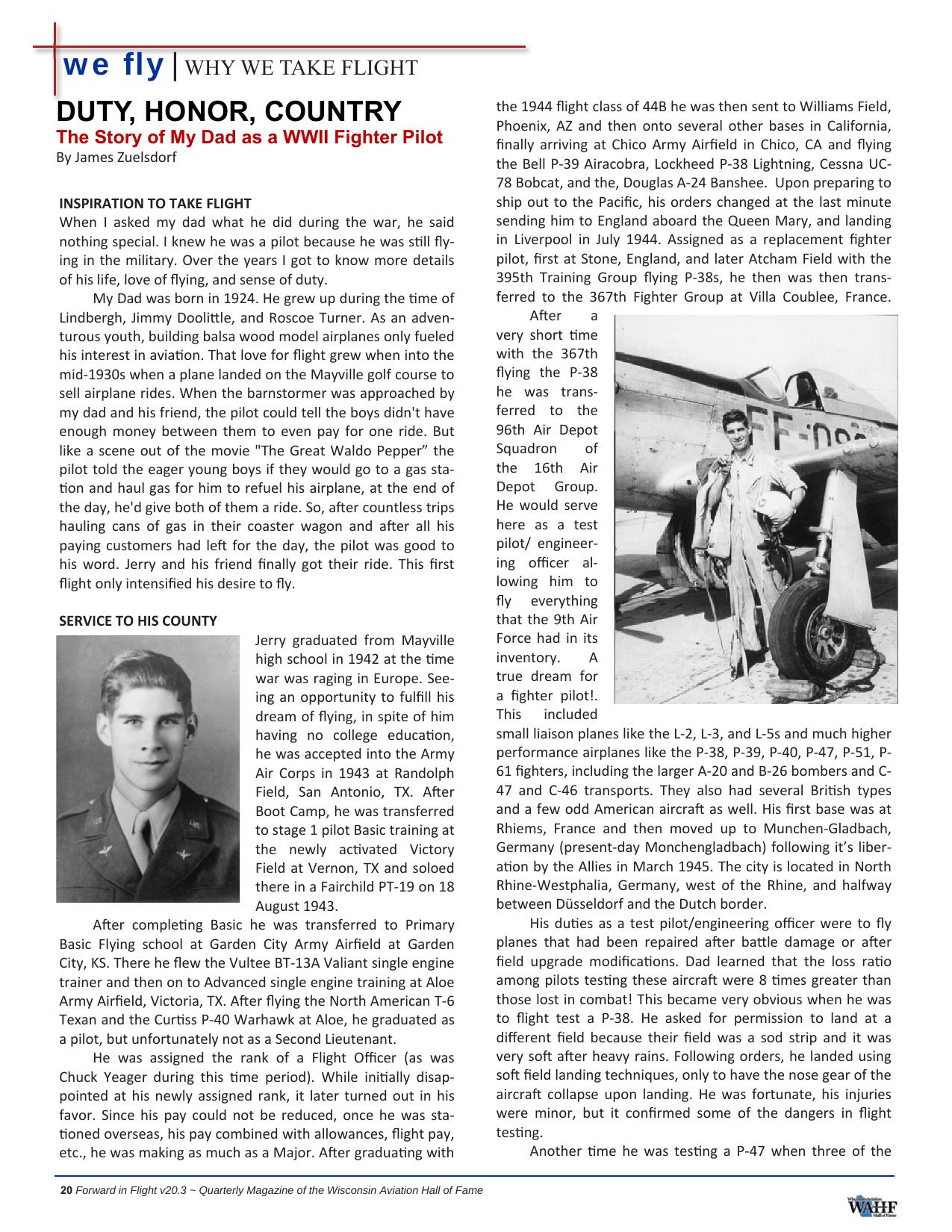
we fly | WHY WE TAKE FLIGHT DUTY, HONOR, COUNTRY The Story of My Dad as a WWII Fighter Pilot By James Zuelsdorf INSPIRATION TO TAKE FLIGHT When I asked my dad what he did during the war, he said nothing special. I knew he was a pilot because he was s ll fly‐ ing in the military. Over the years I got to know more details of his life, love of flying, and sense of duty. My Dad was born in 1924. He grew up during the me of Lindbergh, Jimmy Dooli le, and Roscoe Turner. As an adven‐ turous youth, building balsa wood model airplanes only fueled his interest in avia on. That love for flight grew when into the mid‐1930s when a plane landed on the Mayville golf course to sell airplane rides. When the barnstormer was approached by my dad and his friend, the pilot could tell the boys didn't have enough money between them to even pay for one ride. But like a scene out of the movie "The Great Waldo Pepper” the pilot told the eager young boys if they would go to a gas sta‐ on and haul gas for him to refuel his airplane, at the end of the day, he'd give both of them a ride. So, a er countless trips hauling cans of gas in their coaster wagon and a er all his paying customers had le for the day, the pilot was good to his word. Jerry and his friend finally got their ride. This first flight only intensified his desire to fly. SERVICE TO HIS COUNTY Jerry graduated from Mayville high school in 1942 at the me war was raging in Europe. See‐ ing an opportunity to fulfill his dream of flying, in spite of him having no college educa on, he was accepted into the Army Air Corps in 1943 at Randolph Field, San Antonio, TX. A er Boot Camp, he was transferred to stage 1 pilot Basic training at the newly ac vated Victory Field at Vernon, TX and soloed there in a Fairchild PT‐19 on 18 August 1943. A er comple ng Basic he was transferred to Primary Basic Flying school at Garden City Army Airfield at Garden City, KS. There he flew the Vultee BT‐13A Valiant single engine trainer and then on to Advanced single engine training at Aloe Army Airfield, Victoria, TX. A er flying the North American T‐6 Texan and the Cur ss P‐40 Warhawk at Aloe, he graduated as a pilot, but unfortunately not as a Second Lieutenant. He was assigned the rank of a Flight Officer (as was Chuck Yeager during this me period). While ini ally disap‐ pointed at his newly assigned rank, it later turned out in his favor. Since his pay could not be reduced, once he was sta‐ oned overseas, his pay combined with allowances, flight pay, etc., he was making as much as a Major. A er gradua ng with 20 Forward in Flight v20.3 ~ Quarterly Magazine of the Wisconsin Aviation Hall of Fame the 1944 flight class of 44B he was then sent to Williams Field, Phoenix, AZ and then onto several other bases in California, finally arriving at Chico Army Airfield in Chico, CA and flying the Bell P‐39 Airacobra, Lockheed P‐38 Lightning, Cessna UC‐ 78 Bobcat, and the, Douglas A‐24 Banshee. Upon preparing to ship out to the Pacific, his orders changed at the last minute sending him to England aboard the Queen Mary, and landing in Liverpool in July 1944. Assigned as a replacement fighter pilot, first at Stone, England, and later Atcham Field with the 395th Training Group flying P‐38s, he then was then trans‐ ferred to the 367th Fighter Group at Villa Coublee, France. A er a very short me with the 367th flying the P‐38 he was trans‐ ferred to the 96th Air Depot Squadron of the 16th Air Depot Group. He would serve here as a test pilot/ engineer‐ ing officer al‐ lowing him to fly everything that the 9th Air Force had in its inventory. A true dream for a fighter pilot!. This included small liaison planes like the L‐2, L‐3, and L‐5s and much higher performance airplanes like the P‐38, P‐39, P‐40, P‐47, P‐51, P‐ 61 fighters, including the larger A‐20 and B‐26 bombers and C‐ 47 and C‐46 transports. They also had several Bri sh types and a few odd American aircra as well. His first base was at Rhiems, France and then moved up to Munchen‐Gladbach, Germany (present‐day Monchengladbach) following it’s liber‐ a on by the Allies in March 1945. The city is located in North Rhine‐Westphalia, Germany, west of the Rhine, and halfway between Düsseldorf and the Dutch border. His du es as a test pilot/engineering officer were to fly planes that had been repaired a er ba le damage or a er field upgrade modifica ons. Dad learned that the loss ra o among pilots tes ng these aircra were 8 mes greater than those lost in combat! This became very obvious when he was to flight test a P‐38. He asked for permission to land at a different field because their field was a sod strip and it was very so a er heavy rains. Following orders, he landed using so field landing techniques, only to have the nose gear of the aircra collapse upon landing. He was fortunate, his injuries were minor, but it confirmed some of the dangers in flight tes ng. Another me he was tes ng a P‐47 when three of the
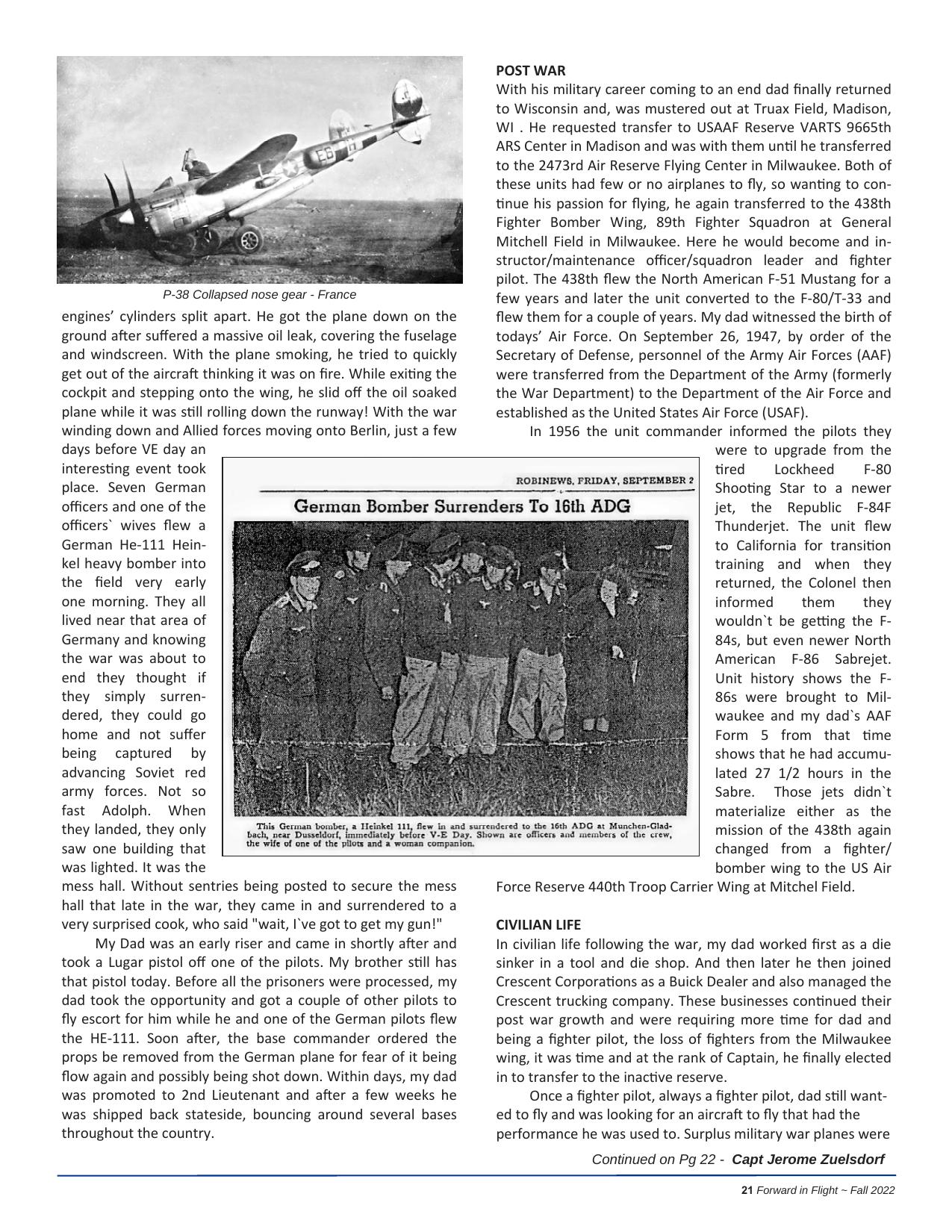
P-38 Collapsed nose gear - France engines’ cylinders split apart. He got the plane down on the ground a er suffered a massive oil leak, covering the fuselage and windscreen. With the plane smoking, he tried to quickly get out of the aircra thinking it was on fire. While exi ng the cockpit and stepping onto the wing, he slid off the oil soaked plane while it was s ll rolling down the runway! With the war winding down and Allied forces moving onto Berlin, just a few days before VE day an interes ng event took place. Seven German officers and one of the officers` wives flew a German He‐111 Hein‐ kel heavy bomber into the field very early one morning. They all lived near that area of Germany and knowing the war was about to end they thought if they simply surren‐ dered, they could go home and not suffer being captured by advancing Soviet red army forces. Not so fast Adolph. When they landed, they only saw one building that was lighted. It was the mess hall. Without sentries being posted to secure the mess hall that late in the war, they came in and surrendered to a very surprised cook, who said "wait, I`ve got to get my gun!" My Dad was an early riser and came in shortly a er and took a Lugar pistol off one of the pilots. My brother s ll has that pistol today. Before all the prisoners were processed, my dad took the opportunity and got a couple of other pilots to fly escort for him while he and one of the German pilots flew the HE‐111. Soon a er, the base commander ordered the props be removed from the German plane for fear of it being flow again and possibly being shot down. Within days, my dad was promoted to 2nd Lieutenant and a er a few weeks he was shipped back stateside, bouncing around several bases throughout the country. POST WAR With his military career coming to an end dad finally returned to Wisconsin and, was mustered out at Truax Field, Madison, WI . He requested transfer to USAAF Reserve VARTS 9665th ARS Center in Madison and was with them un l he transferred to the 2473rd Air Reserve Flying Center in Milwaukee. Both of these units had few or no airplanes to fly, so wan ng to con‐ nue his passion for flying, he again transferred to the 438th Fighter Bomber Wing, 89th Fighter Squadron at General Mitchell Field in Milwaukee. Here he would become and in‐ structor/maintenance officer/squadron leader and fighter pilot. The 438th flew the North American F‐51 Mustang for a few years and later the unit converted to the F‐80/T‐33 and flew them for a couple of years. My dad witnessed the birth of todays’ Air Force. On September 26, 1947, by order of the Secretary of Defense, personnel of the Army Air Forces (AAF) were transferred from the Department of the Army (formerly the War Department) to the Department of the Air Force and established as the United States Air Force (USAF). In 1956 the unit commander informed the pilots they were to upgrade from the red Lockheed F‐80 Shoo ng Star to a newer jet, the Republic F‐84F Thunderjet. The unit flew to California for transi on training and when they returned, the Colonel then informed them they wouldn`t be ge ng the F‐ 84s, but even newer North American F‐86 Sabrejet. Unit history shows the F‐ 86s were brought to Mil‐ waukee and my dad`s AAF Form 5 from that me shows that he had accumu‐ lated 27 1/2 hours in the Sabre. Those jets didn`t materialize either as the mission of the 438th again changed from a fighter/ bomber wing to the US Air Force Reserve 440th Troop Carrier Wing at Mitchel Field. CIVILIAN LIFE In civilian life following the war, my dad worked first as a die sinker in a tool and die shop. And then later he then joined Crescent Corpora ons as a Buick Dealer and also managed the Crescent trucking company. These businesses con nued their post war growth and were requiring more me for dad and being a fighter pilot, the loss of fighters from the Milwaukee wing, it was me and at the rank of Captain, he finally elected in to transfer to the inac ve reserve. Once a fighter pilot, always a fighter pilot, dad s ll want‐ ed to fly and was looking for an aircra to fly that had the performance he was used to. Surplus military war planes were Continued on Pg 22 - Capt Jerome Zuelsdorf 21 Forward in Flight ~ Fall 2022
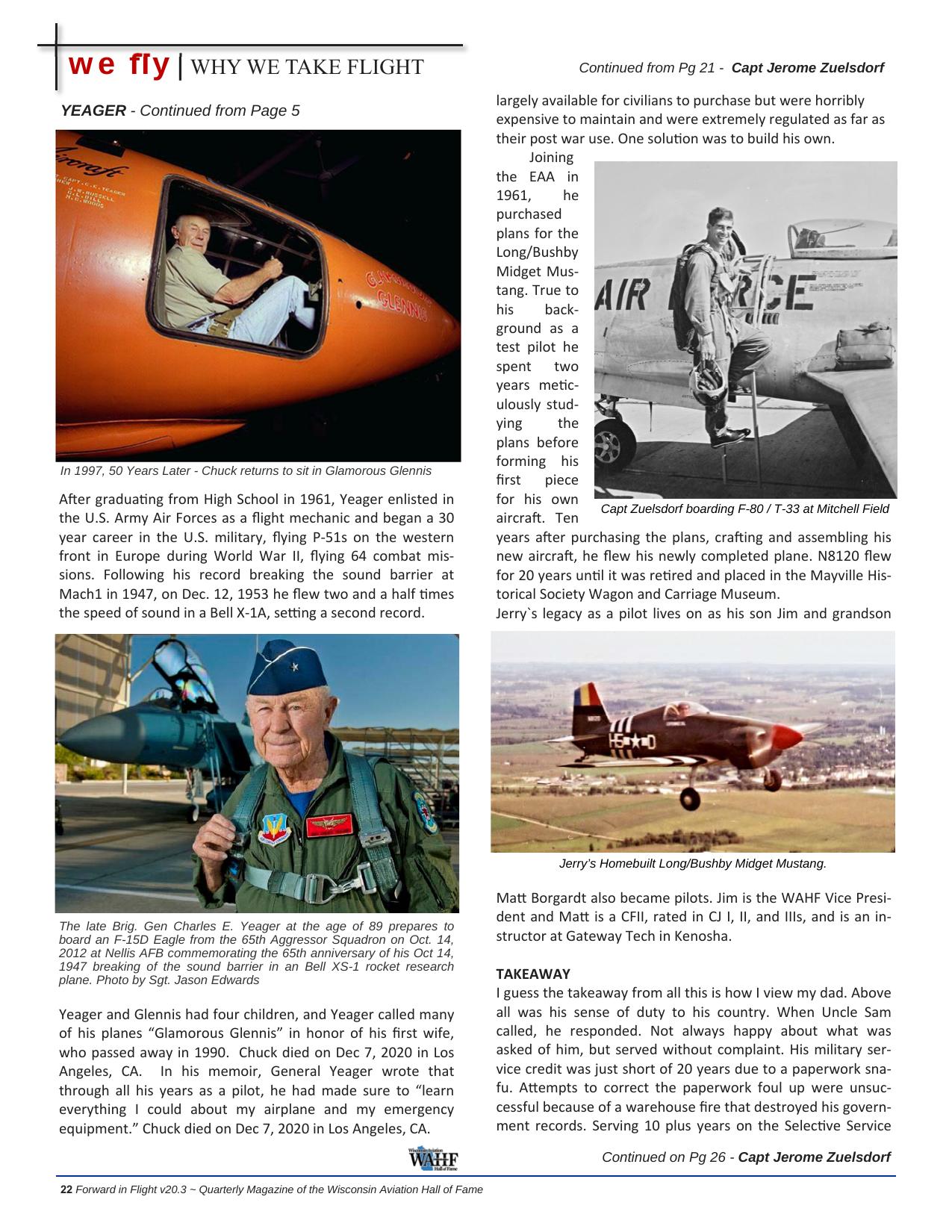
we fly | WHY WE TAKE FLIGHT YEAGER - Continued from Page 5 In 1997, 50 Years Later - Chuck returns to sit in Glamorous Glennis A er gradua ng from High School in 1961, Yeager enlisted in the U.S. Army Air Forces as a flight mechanic and began a 30 year career in the U.S. military, flying P‐51s on the western front in Europe during World War II, flying 64 combat mis‐ sions. Following his record breaking the sound barrier at Mach1 in 1947, on Dec. 12, 1953 he flew two and a half mes the speed of sound in a Bell X‐1A, se ng a second record. Continued from Pg 21 - Capt Jerome Zuelsdorf largely available for civilians to purchase but were horribly expensive to maintain and were extremely regulated as far as their post war use. One solu on was to build his own. Joining the EAA in 1961, he purchased plans for the Long/Bushby Midget Mus‐ tang. True to his back‐ ground as a test pilot he spent two years me c‐ ulously stud‐ ying the plans before forming his first piece for his own Capt Zuelsdorf boarding F-80 / T-33 at Mitchell Field aircra . Ten years a er purchasing the plans, cra ing and assembling his new aircra , he flew his newly completed plane. N8120 flew for 20 years un l it was re red and placed in the Mayville His‐ torical Society Wagon and Carriage Museum. Jerry`s legacy as a pilot lives on as his son Jim and grandson Jerry’s Homebuilt Long/Bushby Midget Mustang. The late Brig. Gen Charles E. Yeager at the age of 89 prepares to board an F-15D Eagle from the 65th Aggressor Squadron on Oct. 14, 2012 at Nellis AFB commemorating the 65th anniversary of his Oct 14, 1947 breaking of the sound barrier in an Bell XS-1 rocket research plane. Photo by Sgt. Jason Edwards Yeager and Glennis had four children, and Yeager called many of his planes “Glamorous Glennis” in honor of his first wife, who passed away in 1990. Chuck died on Dec 7, 2020 in Los Angeles, CA. In his memoir, General Yeager wrote that through all his years as a pilot, he had made sure to “learn everything I could about my airplane and my emergency equipment.” Chuck died on Dec 7, 2020 in Los Angeles, CA. Ma Borgardt also became pilots. Jim is the WAHF Vice Presi‐ dent and Ma is a CFII, rated in CJ I, II, and IIIs, and is an in‐ structor at Gateway Tech in Kenosha. TAKEAWAY I guess the takeaway from all this is how I view my dad. Above all was his sense of duty to his country. When Uncle Sam called, he responded. Not always happy about what was asked of him, but served without complaint. His military ser‐ vice credit was just short of 20 years due to a paperwork sna‐ fu. A empts to correct the paperwork foul up were unsuc‐ cessful because of a warehouse fire that destroyed his govern‐ ment records. Serving 10 plus years on the Selec ve Service Continued on Pg 26 - Capt Jerome Zuelsdorf 22 Forward in Flight v20.3 ~ Quarterly Magazine of the Wisconsin Aviation Hall of Fame
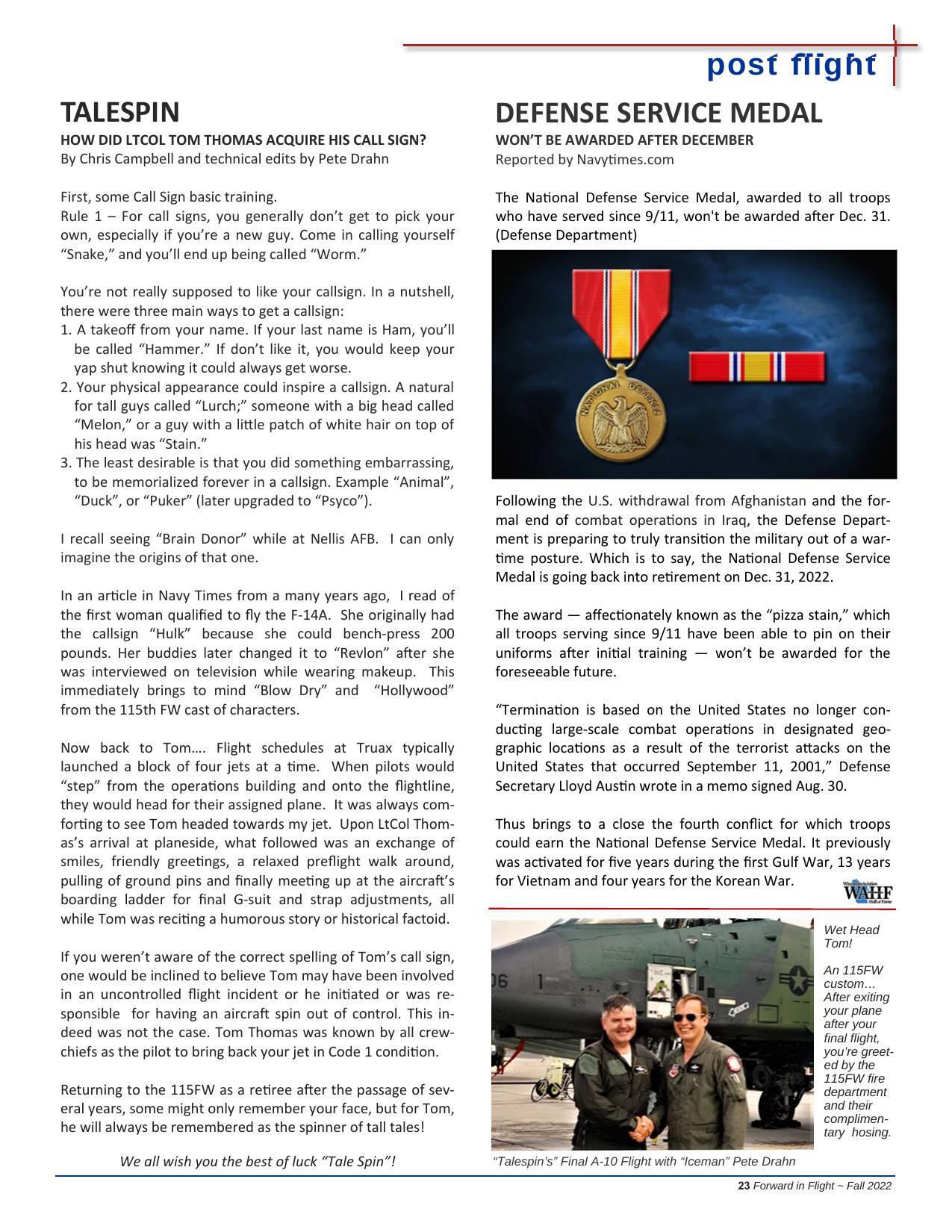
post flight TALESPIN DEFENSE SERVICE MEDAL HOW DID LTCOL TOM THOMAS ACQUIRE HIS CALL SIGN? By Chris Campbell and technical edits by Pete Drahn WON’T BE AWARDED AFTER DECEMBER Reported by Navy mes.com First, some Call Sign basic training. Rule 1 – For call signs, you generally don’t get to pick your own, especially if you’re a new guy. Come in calling yourself “Snake,” and you’ll end up being called “Worm.” The Na onal Defense Service Medal, awarded to all troops who have served since 9/11, won't be awarded a er Dec. 31. (Defense Department) You’re not really supposed to like your callsign. In a nutshell, there were three main ways to get a callsign: 1. A takeoff from your name. If your last name is Ham, you’ll be called “Hammer.” If don’t like it, you would keep your yap shut knowing it could always get worse. 2. Your physical appearance could inspire a callsign. A natural for tall guys called “Lurch;” someone with a big head called “Melon,” or a guy with a li le patch of white hair on top of his head was “Stain.” 3. The least desirable is that you did something embarrassing, to be memorialized forever in a callsign. Example “Animal”, “Duck”, or “Puker” (later upgraded to “Psyco”). I recall seeing “Brain Donor” while at Nellis AFB. I can only imagine the origins of that one. In an ar cle in Navy Times from a many years ago, I read of the first woman qualified to fly the F‐14A. She originally had the callsign “Hulk” because she could bench‐press 200 pounds. Her buddies later changed it to “Revlon” a er she was interviewed on television while wearing makeup. This immediately brings to mind “Blow Dry” and “Hollywood” from the 115th FW cast of characters. Now back to Tom…. Flight schedules at Truax typically launched a block of four jets at a me. When pilots would “step” from the opera ons building and onto the flightline, they would head for their assigned plane. It was always com‐ for ng to see Tom headed towards my jet. Upon LtCol Thom‐ as’s arrival at planeside, what followed was an exchange of smiles, friendly gree ngs, a relaxed preflight walk around, pulling of ground pins and finally mee ng up at the aircra ’s boarding ladder for final G‐suit and strap adjustments, all while Tom was reci ng a humorous story or historical factoid. Following the U.S. withdrawal from Afghanistan and the for‐ mal end of combat opera ons in Iraq, the Defense Depart‐ ment is preparing to truly transi on the military out of a war‐ me posture. Which is to say, the Na onal Defense Service Medal is going back into re rement on Dec. 31, 2022. The award ― affec onately known as the “pizza stain,” which all troops serving since 9/11 have been able to pin on their uniforms a er ini al training ― won’t be awarded for the foreseeable future. “Termina on is based on the United States no longer con‐ duc ng large‐scale combat opera ons in designated geo‐ graphic loca ons as a result of the terrorist a acks on the United States that occurred September 11, 2001,” Defense Secretary Lloyd Aus n wrote in a memo signed Aug. 30. Thus brings to a close the fourth conflict for which troops could earn the Na onal Defense Service Medal. It previously was ac vated for five years during the first Gulf War, 13 years for Vietnam and four years for the Korean War. Wet Head Tom! If you weren’t aware of the correct spelling of Tom’s call sign, one would be inclined to believe Tom may have been involved in an uncontrolled flight incident or he ini ated or was re‐ sponsible for having an aircra spin out of control. This in‐ deed was not the case. Tom Thomas was known by all crew‐ chiefs as the pilot to bring back your jet in Code 1 condi on. An 115FW custom… After exiting your plane after your final flight, you’re greeted by the 115FW fire department and their complimentary hosing. Returning to the 115FW as a re ree a er the passage of sev‐ eral years, some might only remember your face, but for Tom, he will always be remembered as the spinner of tall tales! We all wish you the best of luck “Tale Spin”! “Talespin’s” Final A-10 Flight with “Iceman” Pete Drahn 23 Forward in Flight ~ Fall 2022
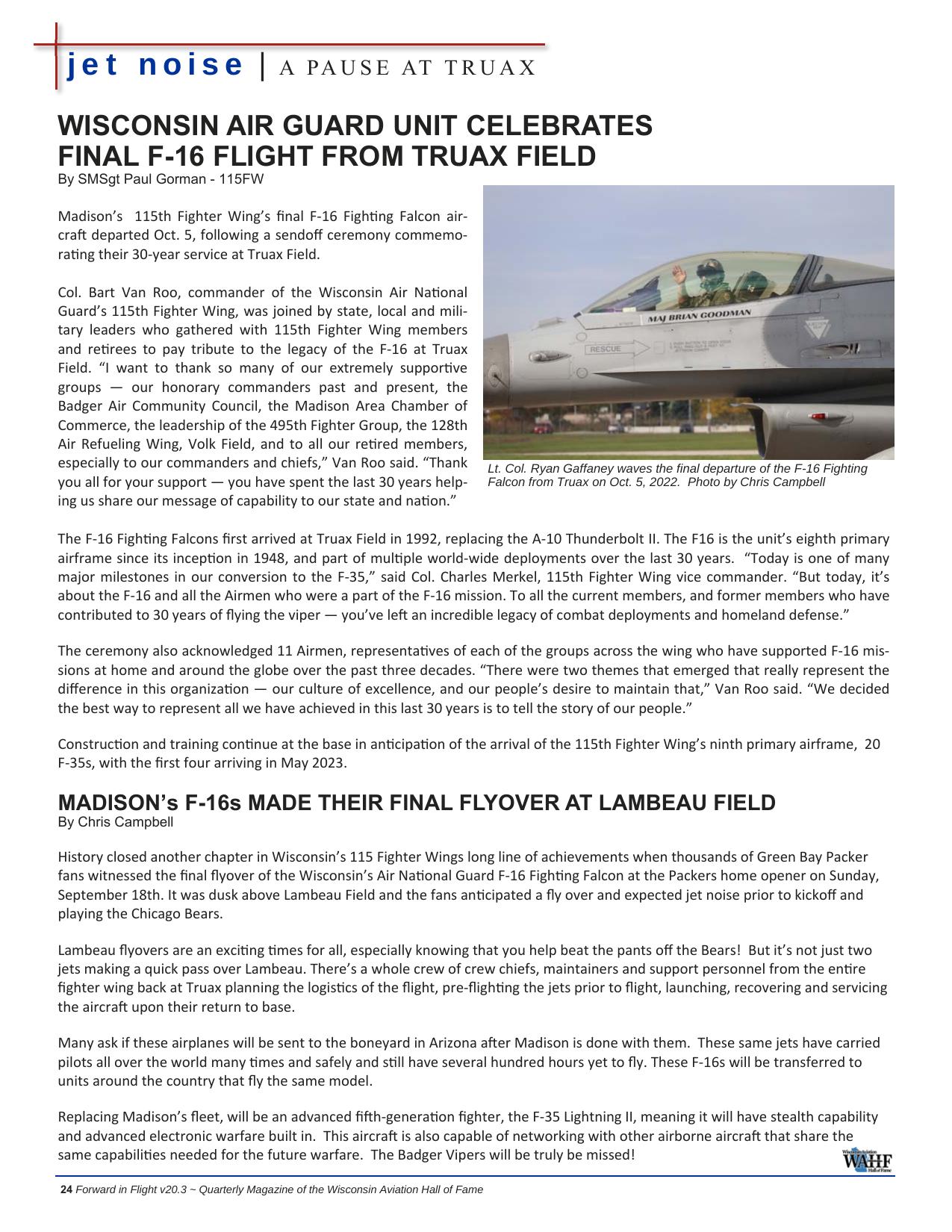
j e t n o i s e | A PA U S E AT T R U A X WISCONSIN AIR GUARD UNIT CELEBRATES FINAL F-16 FLIGHT FROM TRUAX FIELD By SMSgt Paul Gorman - 115FW Madison’s 115th Fighter Wing’s final F‐16 Figh ng Falcon air‐ cra departed Oct. 5, following a sendoff ceremony commemo‐ ra ng their 30‐year service at Truax Field. Col. Bart Van Roo, commander of the Wisconsin Air Na onal Guard’s 115th Fighter Wing, was joined by state, local and mili‐ tary leaders who gathered with 115th Fighter Wing members and re rees to pay tribute to the legacy of the F‐16 at Truax Field. “I want to thank so many of our extremely suppor ve groups — our honorary commanders past and present, the Badger Air Community Council, the Madison Area Chamber of Commerce, the leadership of the 495th Fighter Group, the 128th Air Refueling Wing, Volk Field, and to all our re red members, especially to our commanders and chiefs,” Van Roo said. “Thank you all for your support — you have spent the last 30 years help‐ ing us share our message of capability to our state and na on.” Lt. Col. Ryan Gaffaney waves the final departure of the F-16 Fighting Falcon from Truax on Oct. 5, 2022. Photo by Chris Campbell The F‐16 Figh ng Falcons first arrived at Truax Field in 1992, replacing the A‐10 Thunderbolt II. The F16 is the unit’s eighth primary airframe since its incep on in 1948, and part of mul ple world‐wide deployments over the last 30 years. “Today is one of many major milestones in our conversion to the F‐35,” said Col. Charles Merkel, 115th Fighter Wing vice commander. “But today, it’s about the F‐16 and all the Airmen who were a part of the F‐16 mission. To all the current members, and former members who have contributed to 30 years of flying the viper — you’ve le an incredible legacy of combat deployments and homeland defense.” The ceremony also acknowledged 11 Airmen, representa ves of each of the groups across the wing who have supported F‐16 mis‐ sions at home and around the globe over the past three decades. “There were two themes that emerged that really represent the difference in this organiza on — our culture of excellence, and our people’s desire to maintain that,” Van Roo said. “We decided the best way to represent all we have achieved in this last 30 years is to tell the story of our people.” Construc on and training con nue at the base in an cipa on of the arrival of the 115th Fighter Wing’s ninth primary airframe, 20 F‐35s, with the first four arriving in May 2023. MADISON’s F-16s MADE THEIR FINAL FLYOVER AT LAMBEAU FIELD By Chris Campbell History closed another chapter in Wisconsin’s 115 Fighter Wings long line of achievements when thousands of Green Bay Packer fans witnessed the final flyover of the Wisconsin’s Air Na onal Guard F‐16 Figh ng Falcon at the Packers home opener on Sunday, September 18th. It was dusk above Lambeau Field and the fans an cipated a fly over and expected jet noise prior to kickoff and playing the Chicago Bears. Lambeau flyovers are an exci ng mes for all, especially knowing that you help beat the pants off the Bears! But it’s not just two jets making a quick pass over Lambeau. There’s a whole crew of crew chiefs, maintainers and support personnel from the en re fighter wing back at Truax planning the logis cs of the flight, pre‐fligh ng the jets prior to flight, launching, recovering and servicing the aircra upon their return to base. Many ask if these airplanes will be sent to the boneyard in Arizona a er Madison is done with them. These same jets have carried pilots all over the world many mes and safely and s ll have several hundred hours yet to fly. These F‐16s will be transferred to units around the country that fly the same model. Replacing Madison’s fleet, will be an advanced fi h‐genera on fighter, the F‐35 Lightning II, meaning it will have stealth capability and advanced electronic warfare built in. This aircra is also capable of networking with other airborne aircra that share the same capabili es needed for the future warfare. The Badger Vipers will be truly be missed! 24 Forward in Flight v20.3 ~ Quarterly Magazine of the Wisconsin Aviation Hall of Fame
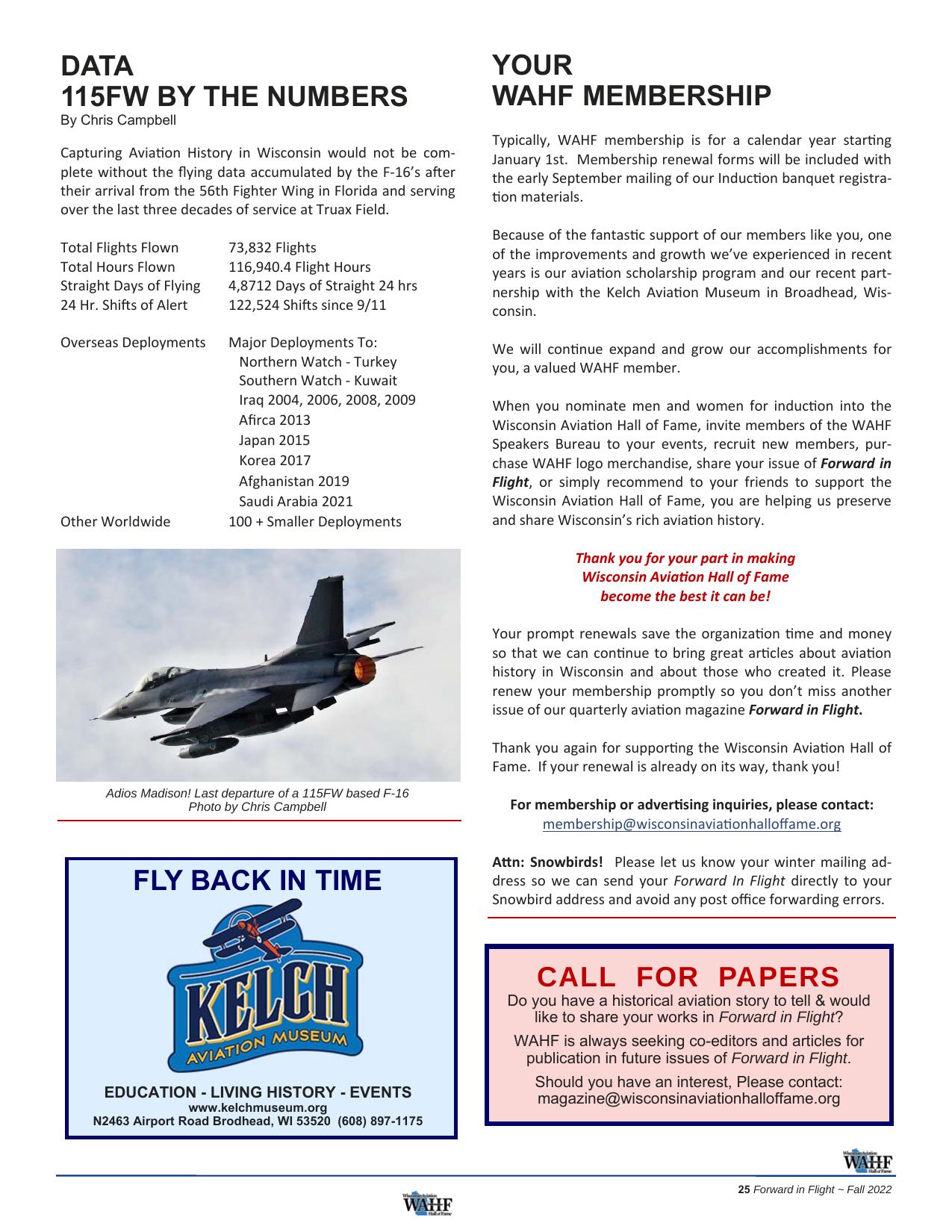
DATA 115FW BY THE NUMBERS YOUR WAHF MEMBERSHIP By Chris Campbell Capturing Avia on History in Wisconsin would not be com‐ plete without the flying data accumulated by the F‐16’s a er their arrival from the 56th Fighter Wing in Florida and serving over the last three decades of service at Truax Field. Total Flights Flown Total Hours Flown Straight Days of Flying 24 Hr. Shi s of Alert 73,832 Flights 116,940.4 Flight Hours 4,8712 Days of Straight 24 hrs 122,524 Shi s since 9/11 Overseas Deployments Major Deployments To: Northern Watch ‐ Turkey Southern Watch ‐ Kuwait Iraq 2004, 2006, 2008, 2009 Afirca 2013 Japan 2015 Korea 2017 Afghanistan 2019 Saudi Arabia 2021 100 + Smaller Deployments Other Worldwide Typically, WAHF membership is for a calendar year star ng January 1st. Membership renewal forms will be included with the early September mailing of our Induc on banquet registra‐ on materials. Because of the fantas c support of our members like you, one of the improvements and growth we’ve experienced in recent years is our avia on scholarship program and our recent part‐ nership with the Kelch Avia on Museum in Broadhead, Wis‐ consin. We will con nue expand and grow our accomplishments for you, a valued WAHF member. When you nominate men and women for induc on into the Wisconsin Avia on Hall of Fame, invite members of the WAHF Speakers Bureau to your events, recruit new members, pur‐ chase WAHF logo merchandise, share your issue of Forward in Flight, or simply recommend to your friends to support the Wisconsin Avia on Hall of Fame, you are helping us preserve and share Wisconsin’s rich avia on history. Thank you for your part in making Wisconsin Avia on Hall of Fame become the best it can be! Your prompt renewals save the organiza on me and money so that we can con nue to bring great ar cles about avia on history in Wisconsin and about those who created it. Please renew your membership promptly so you don’t miss another issue of our quarterly avia on magazine Forward in Flight. Thank you again for suppor ng the Wisconsin Avia on Hall of Fame. If your renewal is already on its way, thank you! Adios Madison! Last departure of a 115FW based F-16 Photo by Chris Campbell FLY BACK IN TIME For membership or adver sing inquiries, please contact: membership@wisconsinavia onhalloffame.org A n: Snowbirds! Please let us know your winter mailing ad‐ dress so we can send your Forward In Flight directly to your Snowbird address and avoid any post office forwarding errors. CALL FOR PAPERS Do you have a historical aviation story to tell & would like to share your works in Forward in Flight? WAHF is always seeking co-editors and articles for publication in future issues of Forward in Flight. EDUCATION - LIVING HISTORY - EVENTS www.kelchmuseum.org N2463 Airport Road Brodhead, WI 53520 (608) 897-1175 Should you have an interest, Please contact: magazine@wisconsinaviationhalloffame.org 25 Forward in Flight ~ Fall 2022
Any me of year is the right me to give a gi WAHF membership ANNUAL MEMBERSHIP LEVELS: Please Check ____ Youth (Under 18) ____ Individual (Annual) ____ Couple (Annual) ____ Life me (Self) ____ Life me (Couple) $10 $30 $40 $500 $750 leading edge | EMAIL BLAST Our Leading Edge email announcements are being published and distributed to current WAHF members to highlight current avia on events. While the focus of our Forward in Flight (FIF) magazine is on Wisconsin’s early avia on history, Leading Edge email eBlasts are intended to communicate current “happenings” in the wide world of avia on and serve as a bridge for modern day avia on topics. Name: ____________________________________________ Address: ___________________________________________ City: ______________________________________________ State, Zip __________________________________________ Phone: ____________________________________________ Email: _____________________________________________ TAX DEDUCTIBLE CONTRIBUTIONS Your contribu ons will help ensure Wisconsin’s avia on pio‐ neers and outstanding students in avia on educa on will con‐ nue to be appropriately recognized. Your Contribu ons, in any amount are greatly appreciated. WAHF Suppor ng Contribu on $_________ (General Opera ng / Events Programming Fund) WAHF Scholarship Fund** Leading Edge is not published on a schedule or a regular basis. Emails are sent for those events that occur between our publi‐ ca on dates of our quarterly of FIF, or to just inform you of “anything” that might be of interest to you. Your Email Address is Required! If you haven’t received a Leading Edge email, it’s because we don’t have your current email address. To be included is future emails, or to check if we have your current and correct email address, simply email: membership@wisconsinavia onhalloffame.org to have your address added to our distribu on list OR to be removed. Get on The List, make sure we have your email address! $_________** **For scholarship dona ons, please make a Separate Check payable to: Community Founda on of North Central Wisconsin or visit www.CFONCW.org for online dona ons. U.S. AAF Captain Jerome A. Zuelsdorf 1943 Visit Us At: www.WisconsinAvia onHallofFame.org WAHF is a 501(c)(3) organiza on. Mail this form to: WAHF | 416 E. JF Townline Rd | Janesville, WI 53545 Continued from Pg 22 - Capt Jerome Zuelsdorf Board (dra board), which was as a civilian posi on, all preclud‐ ed any credit to obtain a military pension. Rank meant nothing to him. He once said had he remained in the reserves, he likely would have been promoted. However, with that promo on he would have been “flying a desk”, and he was really there to fly airplanes. He sought no medals, recogni on, or badges. None of it seemed to bother him as he chalked it up as the cost of service to his country. A er all, some gave their lives for their service. Jerome A. Zuelsdorf died in Horicon, WI on April 11, 2014 at the age of 90 years old. 26 Forward in Flight v20.3 ~ Quarterly Magazine of the Wisconsin Aviation Hall of Fame Jerome A. Zuelsdorf 5 Mar 1924 - 11 Apr 2014
calendar | AVIATION EVENTS WAHF EVENTS CONTACT US WAHF President Kurt Stanich kstanich@wisconsinaviationhalloffame.org WAHF Speaker’s Bureau Tomas Thomas homas@wisconsinaviationhalloffame.org Membership & Subscriber Service Chris Campbell cacampbell@wisconsinaviationhalloffame.org WAHF Advertising / Marketing Chris Campbell cacampbell@wisconsinaviationhalloffame.org WAHF Scholarships Wynne Williams wwilliams@wisconsinaviationhalloffame.org WAHF Induction Nominations Kurt Stanich kstanich@wisconsinaviationhalloffame.org Web Site Join the Conversation, Follow Us At: www.WisconsinAviationHallofFame.org IN MEMORIAM Richard Merkley Life Member Since 2006 3 May 1958 - 19 December 2020 Richard took his final solo flight to his heavenly home December 19, 2020. Born to Robert and Virginia Merkley, Richard grew up on a dairy farm. A er gradua on from Neenah High School, Richard worked for Buckstaff in Osh‐ kosh, before 19 years of employment with Dean Foods in Hortonville. All during this me Richard had his eye on the sky, as he obtained his pri‐ vate pilot license in 1985 and commercial pilot license in 1988. His passion for avia on led him to career change in 1998 to the Waupaca Air‐ port. As a flight instructor he shared that love of fly‐ ing with many young and older students, where many con nued to become his friends. Also, as a cer fied airframe mechanic he kept many planes flying safely. Richard was a life member of EAA & WAFH, and gave rides to many young children with the Young Eagles program. October 23, 2023 ‐ Wisconsin Aviation Hall of Fame Inductions EAA Museum, Oshkosh, WI | www.wisconsinaviationhalloffame.org MIDWEST AVIATION EVENTS 2023 Jan 7 ‐ Brodhead, WI ‐ EAA Chapter 431 Mee ng 9:00am www.eaa431.org Feb 4 ‐ Brodhead, WI ‐ EAA Chapter 431 Mee ng 9:00am www.eaa431.org Feb 4 ‐ Brodhead, WI ‐ Kelch Museum, Groundhog Chili Ski Fly‐in. www.eaa431.org Call 608‐897‐1175 or e‐mail events@kelchmuseum.org Feb 7‐8 ‐ Des Moines, IA ‐ Midwest Regional Aircra Maintenance Seminar at Holiday Inn at the airport. www.iaavia on.com Feb 25 ‐ Fond du Lac, WI ‐ WI Avia on Maintenance & IA Refresher Confer‐ ence at the Radisson Hotel & Conference Center, 625 W Rolling Meadows Dr. levi.eastlick@dot.wi.gov or call 608‐267‐5018 or www.wisconsindot.gov/ Pages/doing‐bus/aeronau cs/trng‐evnts/mech‐ia.asx Mar 4 ‐ Brodhead, WI ‐ EAA Chapter 431 Mee ng 9:00am www.eaa431.org Mar 13‐14 ‐ Brooklyn Center, MN ‐ 2023 Minnesota Avia on Maintenance Technician & IA Renewal Conference at the Heritage Center, 6155 Earle Brown Drive. www.darlene.dahlseide@state.mn.us Mar 18 ‐ Aitkin, MN ‐ Ski Plane & Wheels Fly‐in at Aitkin Municipal Airport ‐ Steve Kurtz Field. Ski planes and wheels welcomed to a no‐charge chili feed and hot dogs fly‐in sponsored by EAA Chapter 965, Aitkin Flyers. www.trudiamundson@yahoo.com Mar 25‐26 ‐ Tucson, AZ ‐ Featuring USAF Thunderbirds1 Davis Monthan AFB Thunder and Lightning Over Arizona Mar 27‐4/1 ‐ Lakeland, FL ‐ Sun N Fun Aerospace Expo. www.flysnf.org Apr 26‐28 ‐ Alexandria, MN ‐ Minnesota Airports Conference at the Arrow‐ wood Resort & Conference Center. May 6 ‐ Breezy Point, MN ‐ 8th Annual Breezy Point Avia on Day. Aircra Display & Classic Car Show. Call 218‐838‐3434. Pilots must register online: www.breezypointairport.com May 13‐14 ‐ Belleville, IL ‐ Featuring USN Blue Angels1 Sco AFB Air Show. www.sco .af.mil/Home/Airshow/ Yep! That’s Right! USN at a USAF Base May 21 ‐ Brodhead, WI ‐ Kelch Museum, Community Pancake Breakfast. www.eaa431.org Call 608‐897‐1175 or e‐mail events@kelchmuseum.org Jun 16‐17 ‐ Wausau, WI ‐ Wings Over Wausau Airshow. www.wausauevents.org/wingsoverwausau.html Jun 17‐18 ‐ Columbus, OH ‐ Featuring USN Blue Angels1 Columbus Ohio Air Show 2023 at Rickenbacker Interna onal Airport. www.columbusairshow.com Jun 24‐25 ‐ Davenport, IA ‐ Featuring USAF Thunderbirds1 Quad City Air Show at Davenport Municipal Airport. www.quadcityairshow.com Jun 24‐25 ‐ Flint, MI ‐ Wings Over Flint 2023 at Bishop Interna onal Airport. Jun 26‐29 ‐ Chicago, IL ‐ Avia on Technician Educa on Council (ATEC). www.atec‐amt.org/annual‐conference.html Updates to this calendar will be announced in our Leading Edge email blasts Note1: Dates shown are for jet team performances only. Military jet teams may not perform on all days of mul ‐day events. Check event website for full event schedules. Having a Conferences or Exhibi on?: Submit your events to be listed in our Calendar of Events. Email: magazine@wisconsinaviationhalloffame.org 27 Forward in Flight ~ Fall 2022
416 E. JF Townline Road Janesville, WI 53545 The Wisconsin Aviation Hall of Fame is a non-profit membership organization dedicated to preserving the past and fostering the future of flight in Wisconsin Thanks to All WAHF Members and Supporters in 2022 New Members Paul McCarthy Andrew Crowbridge Brendan Srormo Mark VanTine Scott & Julie Green Earl Lawrence Randy & Andrea Sullwold Matthew Borgart Hal & Muffy Bryan Justin Reckner Matt Swanson Michael Kaufman Corporate Members Reabe Spraying Service - Plover, WI New Life Members Lewis Jaye James Zuelsdorf Supporting Contributors William & Belinda Adams Steve Krog David Cummings Kim & Dennis Klister Terry Railing Cleo Gibson Roland & Earlene Schable Becky Soderholm Kenneth Koch Jeff & Cheryl Baker Don Adriano Sune and Jean Ericson Jimmy Szajkovics Patti Bruha Dan Simpson Sandra Esse Brett Gelbach Edward Hall Kurt Mehre Jeff Point Gregory Cunningham Howard Rand Dale & Nancy Walker Chuck Losinski Scholarship Contributors Brad Volker Officers Kurt Stanich, President James Zuelsdorf, Vice-President Chris Campbell, Treasurer Henry Peterson, Secretary Board of Directors John Dorcey Scott Green Jill Mann Jim Szajkovics Patrick Weeden Wynne Williams Wisconsin Aviation Hall of Fame c/o Chris Campbell 416 E. JF Townline Rd Janesville, WI 53545 608-295-4805 2022 Investiture Sponsorships For 2022 Investiture Sponsors, See Page 3 Will Your Address Change / Attention Snowbirds? Please inform us of your new address. A timely reminder of your new address is very much appreciated, as it helps to save time and expenses for our small non-profit organization and ensures that your next issue of Forward In Flight will reach you. Become a member / supporter today! www.wisconsinaviationhalloffame.org