Volume 22, Issue 3
🗞️ Download Issue (PDF)
Forward in Flight - Fall 2024
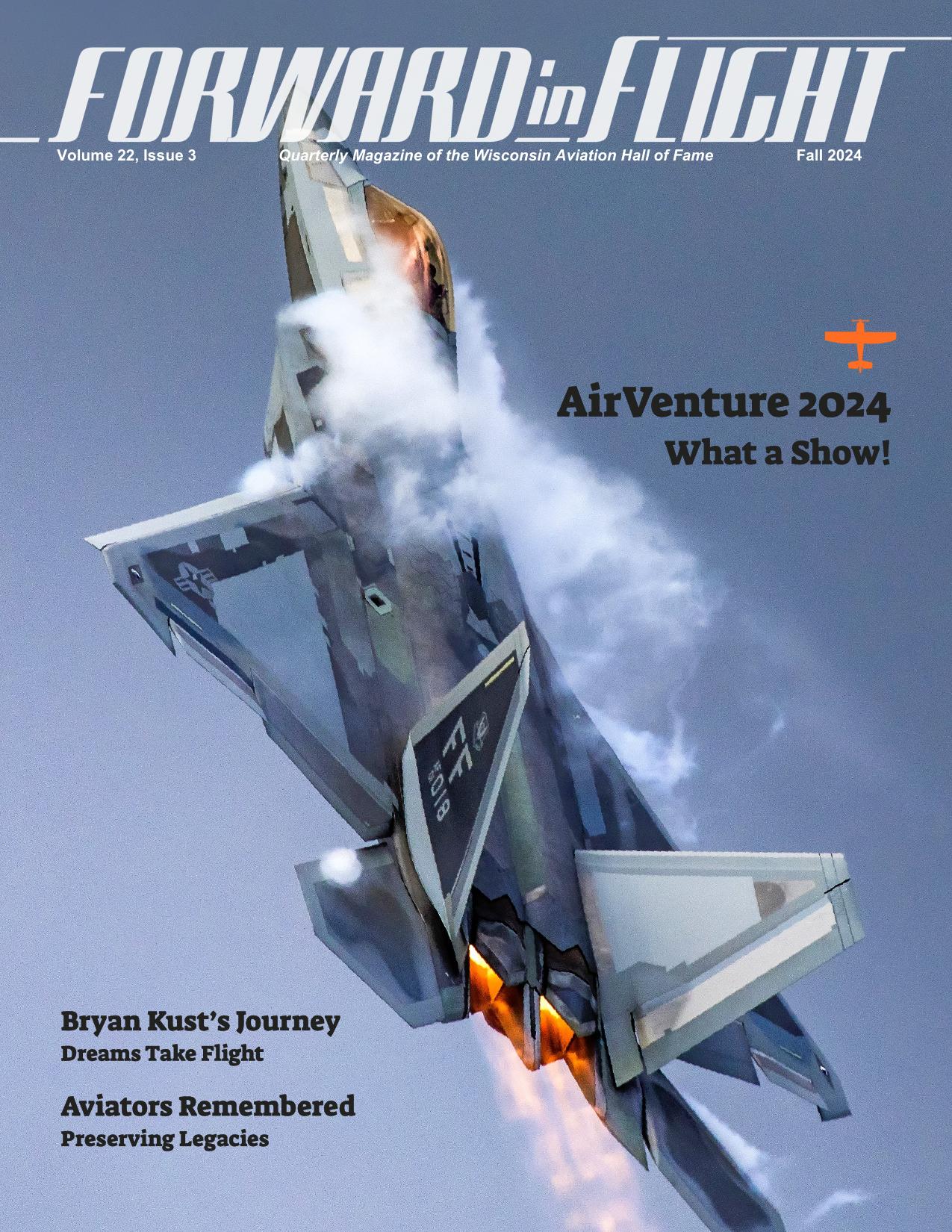
Volume 22, Issue 3 Quarterly Magazine of the Wisconsin Aviation Hall of Fame Fall 2024 AirVenture 2024 What a Show! Bryan Kust’s Journey Dreams Take Flight Aviators Remembered Preserving Legacies
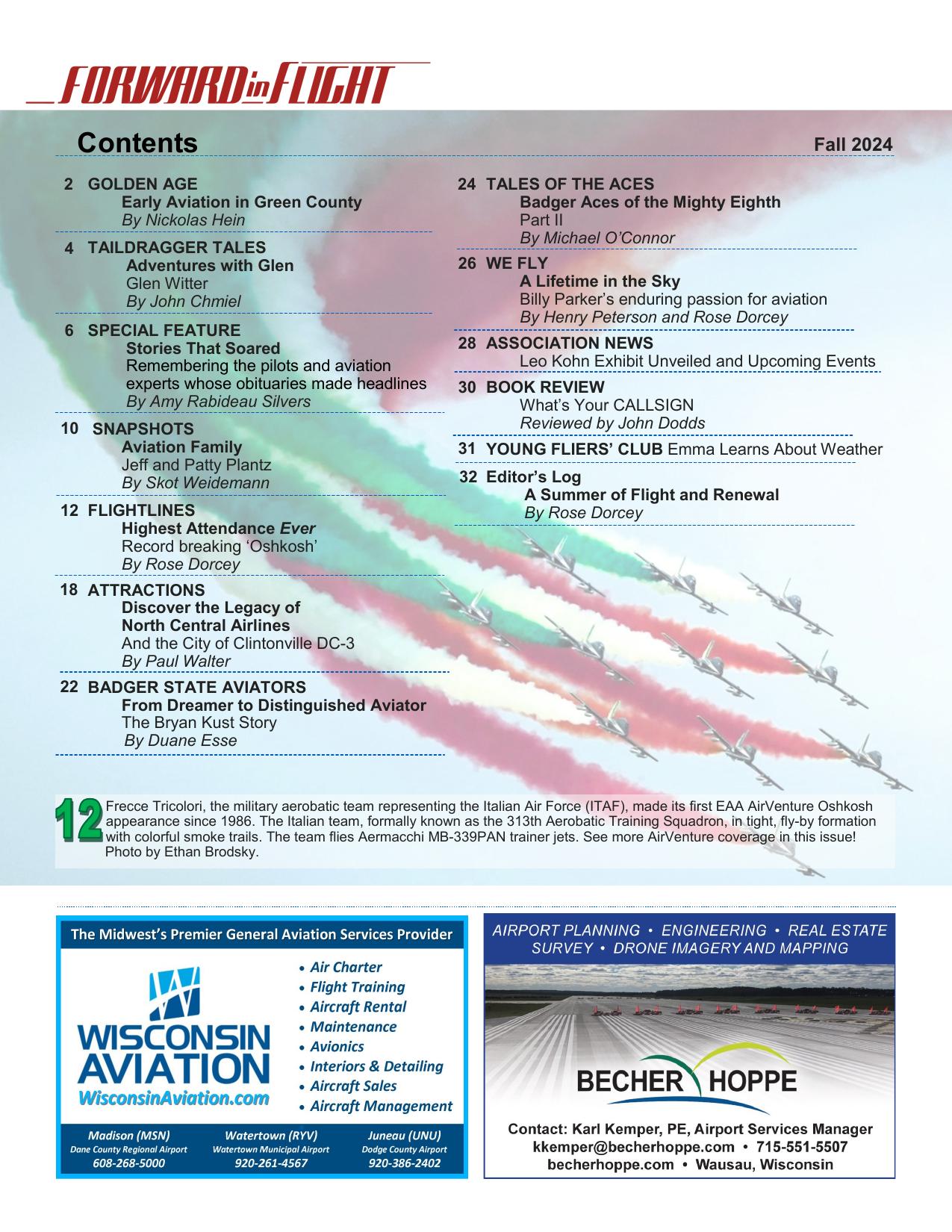
Contents 2 GOLDEN AGE Early Aviation in Green County By Nickolas Hein 4 TAILDRAGGER TALES Adventures with Glen Glen Witter By John Chmiel 6 SPECIAL FEATURE Stories That Soared Remembering the pilots and aviation experts whose obituaries made headlines By Amy Rabideau Silvers 10 SNAPSHOTS Aviation Family Jeff and Patty Plantz By Skot Weidemann 12 FLIGHTLINES Highest Attendance Ever Record breaking ‘Oshkosh’ By Rose Dorcey Fall 2024 24 TALES OF THE ACES Badger Aces of the Mighty Eighth Part II By Michael O’Connor 26 WE FLY A Lifetime in the Sky Billy Parker’s enduring passion for aviation By Henry Peterson and Rose Dorcey 28 ASSOCIATION NEWS Leo Kohn Exhibit Unveiled and Upcoming Events 30 BOOK REVIEW What’s Your CALLSIGN Reviewed by John Dodds 31 YOUNG FLIERS’ CLUB Emma Learns About Weather 32 Editor’s Log A Summer of Flight and Renewal By Rose Dorcey 18 ATTRACTIONS Discover the Legacy of North Central Airlines And the City of Clintonville DC-3 By Paul Walter 22 BADGER STATE AVIATORS From Dreamer to Distinguished Aviator The Bryan Kust Story By Duane Esse Frecce Tricolori, the military aerobatic team representing the Italian Air Force (ITAF), made its first EAA AirVenture Oshkosh appearance since 1986. The Italian team, formally known as the 313th Aerobatic Training Squadron, in tight, fly-by formation with colorful smoke trails. The team flies Aermacchi MB-339PAN trainer jets. See more AirVenture coverage in this issue! Photo by Ethan Brodsky.
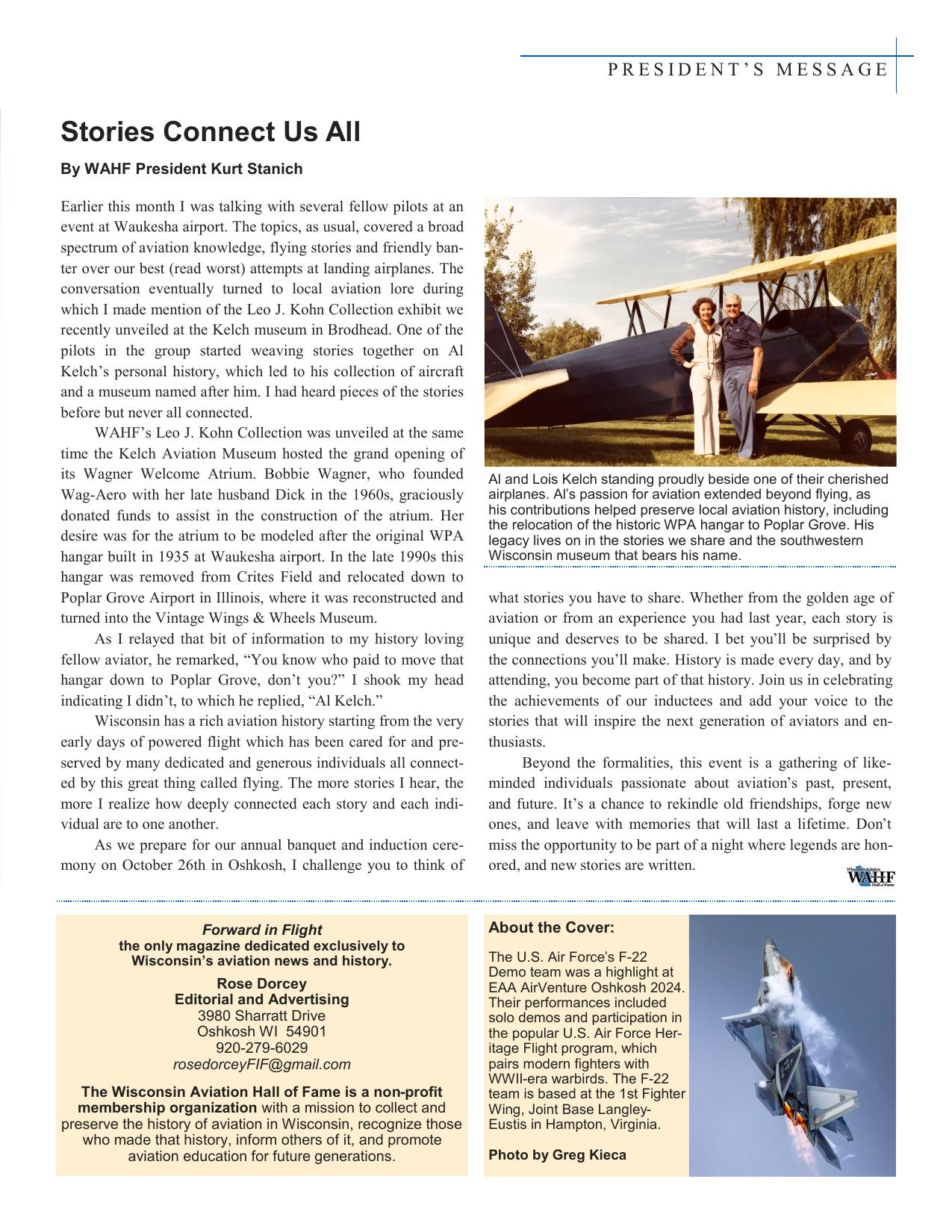
PRESIDENT’S MESSAGE Stories Connect Us All By WAHF President Kurt Stanich Earlier this month I was talking with several fellow pilots at an event at Waukesha airport. The topics, as usual, covered a broad spectrum of aviation knowledge, flying stories and friendly banter over our best (read worst) attempts at landing airplanes. The conversation eventually turned to local aviation lore during which I made mention of the Leo J. Kohn Collection exhibit we recently unveiled at the Kelch museum in Brodhead. One of the pilots in the group started weaving stories together on Al Kelch’s personal history, which led to his collection of aircraft and a museum named after him. I had heard pieces of the stories before but never all connected. WAHF’s Leo J. Kohn Collection was unveiled at the same time the Kelch Aviation Museum hosted the grand opening of its Wagner Welcome Atrium. Bobbie Wagner, who founded Wag-Aero with her late husband Dick in the 1960s, graciously donated funds to assist in the construction of the atrium. Her desire was for the atrium to be modeled after the original WPA hangar built in 1935 at Waukesha airport. In the late 1990s this hangar was removed from Crites Field and relocated down to Poplar Grove Airport in Illinois, where it was reconstructed and turned into the Vintage Wings & Wheels Museum. As I relayed that bit of information to my history loving fellow aviator, he remarked, “You know who paid to move that hangar down to Poplar Grove, don’t you?” I shook my head indicating I didn’t, to which he replied, “Al Kelch.” Wisconsin has a rich aviation history starting from the very early days of powered flight which has been cared for and preserved by many dedicated and generous individuals all connected by this great thing called flying. The more stories I hear, the more I realize how deeply connected each story and each individual are to one another. As we prepare for our annual banquet and induction ceremony on October 26th in Oshkosh, I challenge you to think of Forward in Flight the only magazine dedicated exclusively to Wisconsin’s aviation news and history. Rose Dorcey Editorial and Advertising 3980 Sharratt Drive Oshkosh WI 54901 920-279-6029 rosedorceyFIF@gmail.com The Wisconsin Aviation Hall of Fame is a non-profit membership organization with a mission to collect and preserve the history of aviation in Wisconsin, recognize those who made that history, inform others of it, and promote aviation education for future generations. Al and Lois Kelch standing proudly beside one of their cherished airplanes. Al’s passion for aviation extended beyond flying, as his contributions helped preserve local aviation history, including the relocation of the historic WPA hangar to Poplar Grove. His legacy lives on in the stories we share and the southwestern Wisconsin museum that bears his name. what stories you have to share. Whether from the golden age of aviation or from an experience you had last year, each story is unique and deserves to be shared. I bet you’ll be surprised by the connections you’ll make. History is made every day, and by attending, you become part of that history. Join us in celebrating the achievements of our inductees and add your voice to the stories that will inspire the next generation of aviators and enthusiasts. Beyond the formalities, this event is a gathering of likeminded individuals passionate about aviation’s past, present, and future. It’s a chance to rekindle old friendships, forge new ones, and leave with memories that will last a lifetime. Don’t miss the opportunity to be part of a night where legends are honored, and new stories are written. About the Cover: The U.S. Air Force’s F-22 Demo team was a highlight at EAA AirVenture Oshkosh 2024. Their performances included solo demos and participation in the popular U.S. Air Force Heritage Flight program, which pairs modern fighters with WWII-era warbirds. The F-22 team is based at the 1st Fighter Wing, Joint Base LangleyEustis in Hampton, Virginia. Photo by Greg Kieca
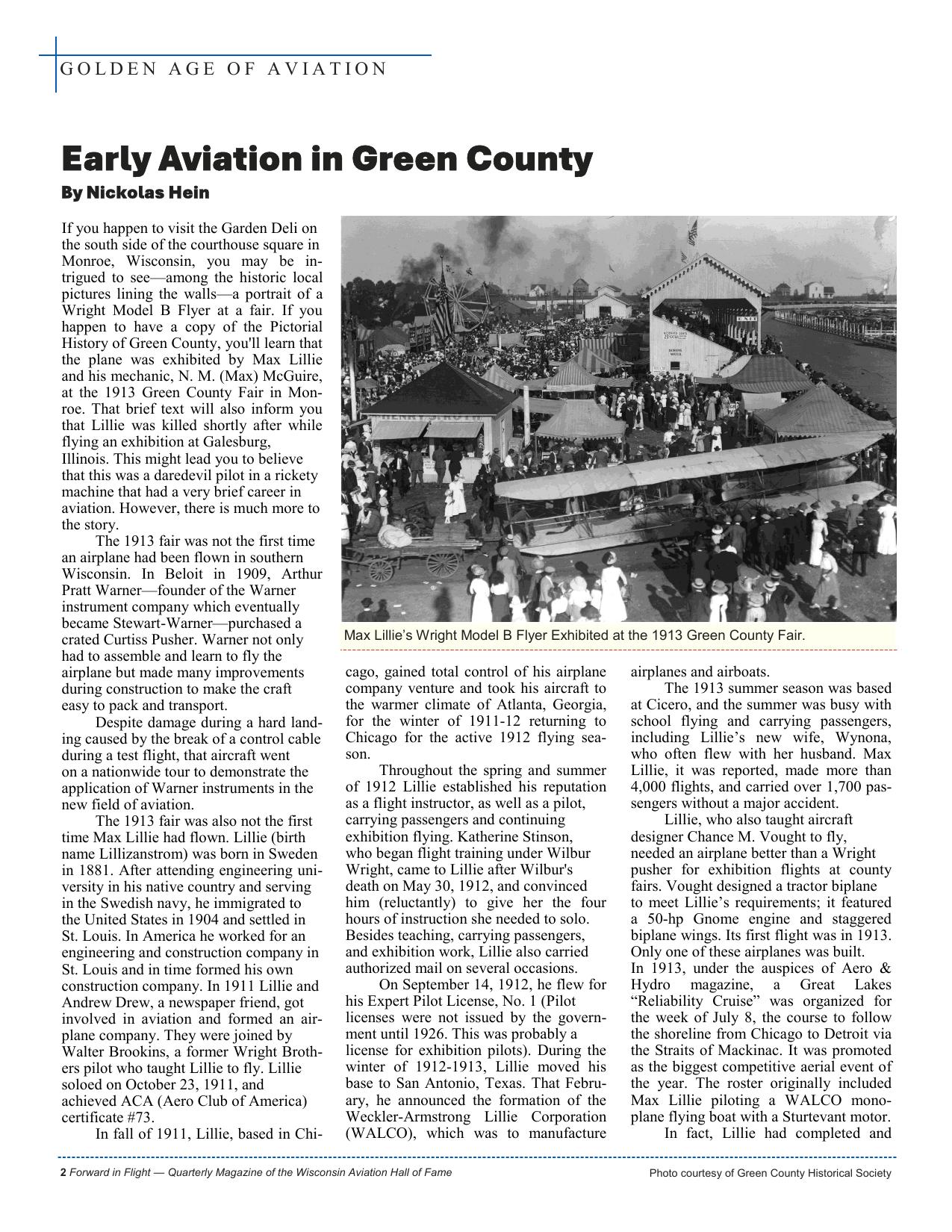
GOLDEN AGE OF AVIATION Early Aviation in Green County By Nickolas Hein If you happen to visit the Garden Deli on the south side of the courthouse square in Monroe, Wisconsin, you may be intrigued to see—among the historic local pictures lining the walls—a portrait of a Wright Model B Flyer at a fair. If you happen to have a copy of the Pictorial History of Green County, you'll learn that the plane was exhibited by Max Lillie and his mechanic, N. M. (Max) McGuire, at the 1913 Green County Fair in Monroe. That brief text will also inform you that Lillie was killed shortly after while flying an exhibition at Galesburg, Illinois. This might lead you to believe that this was a daredevil pilot in a rickety machine that had a very brief career in aviation. However, there is much more to the story. The 1913 fair was not the first time an airplane had been flown in southern Wisconsin. In Beloit in 1909, Arthur Pratt Warner—founder of the Warner instrument company which eventually became Stewart-Warner—purchased a crated Curtiss Pusher. Warner not only had to assemble and learn to fly the airplane but made many improvements during construction to make the craft easy to pack and transport. Despite damage during a hard landing caused by the break of a control cable during a test flight, that aircraft went on a nationwide tour to demonstrate the application of Warner instruments in the new field of aviation. The 1913 fair was also not the first time Max Lillie had flown. Lillie (birth name Lillizanstrom) was born in Sweden in 1881. After attending engineering university in his native country and serving in the Swedish navy, he immigrated to the United States in 1904 and settled in St. Louis. In America he worked for an engineering and construction company in St. Louis and in time formed his own construction company. In 1911 Lillie and Andrew Drew, a newspaper friend, got involved in aviation and formed an airplane company. They were joined by Walter Brookins, a former Wright Brothers pilot who taught Lillie to fly. Lillie soloed on October 23, 1911, and achieved ACA (Aero Club of America) certificate #73. In fall of 1911, Lillie, based in Chi- Max Lillie’s Wright Model B Flyer Exhibited at the 1913 Green County Fair. cago, gained total control of his airplane company venture and took his aircraft to the warmer climate of Atlanta, Georgia, for the winter of 1911-12 returning to Chicago for the active 1912 flying season. Throughout the spring and summer of 1912 Lillie established his reputation as a flight instructor, as well as a pilot, carrying passengers and continuing exhibition flying. Katherine Stinson, who began flight training under Wilbur Wright, came to Lillie after Wilbur's death on May 30, 1912, and convinced him (reluctantly) to give her the four hours of instruction she needed to solo. Besides teaching, carrying passengers, and exhibition work, Lillie also carried authorized mail on several occasions. On September 14, 1912, he flew for his Expert Pilot License, No. 1 (Pilot licenses were not issued by the government until 1926. This was probably a license for exhibition pilots). During the winter of 1912-1913, Lillie moved his base to San Antonio, Texas. That February, he announced the formation of the Weckler-Armstrong Lillie Corporation (WALCO), which was to manufacture 2 Forward in Flight — Quarterly Magazine of the Wisconsin Aviation Hall of Fame airplanes and airboats. The 1913 summer season was based at Cicero, and the summer was busy with school flying and carrying passengers, including Lillie’s new wife, Wynona, who often flew with her husband. Max Lillie, it was reported, made more than 4,000 flights, and carried over 1,700 passengers without a major accident. Lillie, who also taught aircraft designer Chance M. Vought to fly, needed an airplane better than a Wright pusher for exhibition flights at county fairs. Vought designed a tractor biplane to meet Lillie’s requirements; it featured a 50-hp Gnome engine and staggered biplane wings. Its first flight was in 1913. Only one of these airplanes was built. In 1913, under the auspices of Aero & Hydro magazine, a Great Lakes “Reliability Cruise” was organized for the week of July 8, the course to follow the shoreline from Chicago to Detroit via the Straits of Mackinac. It was promoted as the biggest competitive aerial event of the year. The roster originally included Max Lillie piloting a WALCO monoplane flying boat with a Sturtevant motor. In fact, Lillie had completed and Photo courtesy of Green County Historical Society
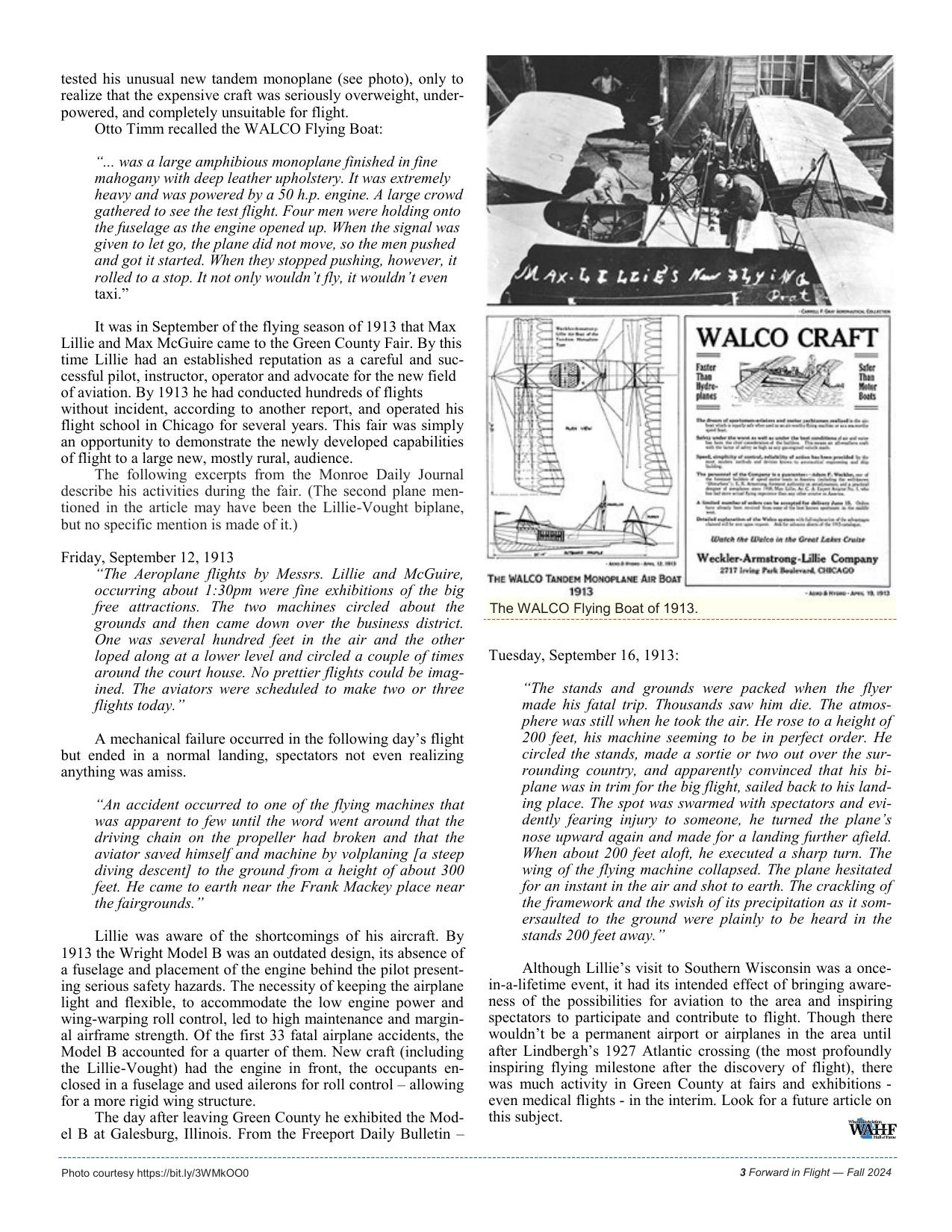
tested his unusual new tandem monoplane (see photo), only to realize that the expensive craft was seriously overweight, underpowered, and completely unsuitable for flight. Otto Timm recalled the WALCO Flying Boat: “...ÊwasÊaÊlargeÊamphibiousÊmonoplaneÊfinishedÊinÊfine mahoganyÊwithÊdeepÊleatherÊupholstery.ÊItÊwasÊextremely heavyÊandÊwasÊpoweredÊbyÊaÊ50Êh.p.Êengine.ÊAÊlargeÊcrowd gatheredÊtoÊseeÊtheÊtestÊflight.ÊFourÊmenÊwereÊholdingÊonto theÊfuselageÊasÊtheÊengineÊopenedÊup.ÊWhenÊtheÊsignalÊwas givenÊtoÊletÊgo,ÊtheÊplaneÊdidÊnotÊmove,ÊsoÊtheÊmenÊpushed andÊgotÊitÊstarted.ÊWhenÊtheyÊstoppedÊpushing,Êhowever,Êit rolledÊtoÊaÊstop.ÊItÊnotÊonlyÊwouldn’tÊfly,ÊitÊwouldn’tÊeven taxi.” It was in September of the flying season of 1913 that Max Lillie and Max McGuire came to the Green County Fair. By this time Lillie had an established reputation as a careful and successful pilot, instructor, operator and advocate for the new field of aviation. By 1913 he had conducted hundreds of flights without incident, according to another report, and operated his flight school in Chicago for several years. This fair was simply an opportunity to demonstrate the newly developed capabilities of flight to a large new, mostly rural, audience. The following excerpts from the Monroe Daily Journal describe his activities during the fair. (The second plane mentioned in the article may have been the Lillie-Vought biplane, but no specific mention is made of it.) Friday, September 12, 1913 “TheÊ AeroplaneÊ flightsÊ byÊ Messrs.Ê LillieÊ andÊ McGuire,Ê occurringÊ aboutÊ 1:30pmÊ wereÊ fineÊ exhibitionsÊ ofÊ theÊ bigÊ freeÊ attractions.Ê TheÊ twoÊ machinesÊ circledÊ aboutÊ theÊ groundsÊ andÊ thenÊ cameÊ downÊ overÊ theÊ businessÊ district.Ê OneÊ wasÊ severalÊ hundredÊ feetÊ inÊ theÊ airÊ andÊ theÊ otherÊ lopedÊalongÊatÊaÊlowerÊlevelÊandÊcircledÊaÊcoupleÊofÊtimesÊ aroundÊtheÊcourtÊhouse.ÊNoÊprettierÊflightsÊcouldÊbeÊimagined.Ê TheÊ aviatorsÊ wereÊ scheduledÊ toÊ makeÊ twoÊ orÊ threeÊ flightsÊtoday.” A mechanical failure occurred in the following day’s flight but ended in a normal landing, spectators not even realizing anything was amiss. “AnÊ accidentÊ occurredÊ toÊ oneÊ ofÊ theÊ flyingÊ machinesÊ thatÊ wasÊ apparentÊ toÊ fewÊ untilÊ theÊ wordÊ wentÊ aroundÊ thatÊ theÊ drivingÊ chainÊ onÊ theÊ propellerÊ hadÊ brokenÊ andÊ thatÊ theÊ aviatorÊsavedÊhimselfÊandÊmachineÊbyÊvolplaningÊ[aÊsteepÊ divingÊdescent]Ê toÊ theÊgroundÊ fromÊ aÊ heightÊ ofÊ aboutÊ 300Ê feet.ÊHeÊcameÊtoÊearthÊnearÊtheÊFrankÊMackeyÊplaceÊnearÊ theÊfairgrounds.” Lillie was aware of the shortcomings of his aircraft. By 1913 the Wright Model B was an outdated design, its absence of a fuselage and placement of the engine behind the pilot presenting serious safety hazards. The necessity of keeping the airplane light and flexible, to accommodate the low engine power and wing-warping roll control, led to high maintenance and marginal airframe strength. Of the first 33 fatal airplane accidents, the Model B accounted for a quarter of them. New craft (including the Lillie-Vought) had the engine in front, the occupants enclosed in a fuselage and used ailerons for roll control – allowing for a more rigid wing structure. The day after leaving Green County he exhibited the Model B at Galesburg, Illinois. From the Freeport Daily Bulletin – Photo courtesy https://bit.ly/3WMkOO0 The WALCO Flying Boat of 1913. Tuesday, September 16, 1913: “TheÊ standsÊ andÊ groundsÊ wereÊ packedÊ whenÊ theÊ flyerÊ madeÊ hisÊ fatalÊ trip.Ê ThousandsÊ sawÊ himÊ die.Ê TheÊ atmosphereÊwasÊstillÊwhenÊheÊtookÊtheÊair.ÊHeÊroseÊtoÊaÊheightÊofÊ 200Ê feet,Ê hisÊ machineÊ seemingÊ toÊ beÊ inÊ perfectÊ order.Ê HeÊ circledÊtheÊstands,ÊmadeÊaÊsortieÊorÊtwoÊoutÊoverÊtheÊsurroundingÊ country,Ê andÊ apparentlyÊ convincedÊ thatÊ hisÊ biplaneÊwasÊinÊtrimÊforÊtheÊbigÊflight,ÊsailedÊbackÊtoÊhisÊlandingÊplace.ÊTheÊspotÊwasÊswarmedÊwithÊspectatorsÊandÊevidentlyÊ fearingÊ injuryÊ toÊ someone,Ê heÊ turnedÊ theÊ plane’sÊ noseÊupwardÊagainÊandÊmadeÊforÊaÊlandingÊfurtherÊafield.Ê WhenÊ aboutÊ 200Ê feetÊ aloft,ÊheÊ executedÊ aÊ sharpÊ turn.Ê TheÊ wingÊofÊtheÊflyingÊmachineÊcollapsed.ÊTheÊplaneÊhesitatedÊ forÊanÊinstantÊinÊtheÊairÊandÊshotÊtoÊearth.ÊTheÊcracklingÊofÊ theÊframeworkÊandÊtheÊswishÊofÊitsÊprecipitationÊasÊitÊsomersaultedÊ toÊ theÊ groundÊ wereÊ plainlyÊ toÊ beÊ heardÊ inÊ theÊ standsÊ200ÊfeetÊaway.” Although Lillie’s visit to Southern Wisconsin was a oncein-a-lifetime event, it had its intended effect of bringing awareness of the possibilities for aviation to the area and inspiring spectators to participate and contribute to flight. Though there wouldn’t be a permanent airport or airplanes in the area until after Lindbergh’s 1927 Atlantic crossing (the most profoundly inspiring flying milestone after the discovery of flight), there was much activity in Green County at fairs and exhibitions even medical flights - in the interim. Look for a future article on this subject. 3 Forward in Flight — Fall 2024
TAILDRAGGER TALES Adventures with Glen By John Chmiel The blue-and-white 7ECA Bellanca Citabria taxied up to our fuel pump on our first day of business that October of 1992. A John/Jim Belushi-esque figure began a careful egress from the cockpit, accompanied by the grunts and groans of someone contorting themselves free from a stronghold. If you’ve worn a parachute in a Citabria you know exactly what I’m describing. Glen Witter emerged and removed his parachute. We began exchanging the small talk that occurs daily at GA airports across America as I fueled his plane and then cleaned his windshield. Glen followed me inside to pay the bill, lit his cigar, and we talked airplanes for the next hour while getting to know each other’s stories. We were sizing each other up and deciding how this should go. That’s how our friendship started. Little did I know that over the next 30 years we’d become the best of friends, and that October day was just the beginning of many airport adventures. I wouldn’t be the man I've become without his example, guidance, and feedback. As with many real friendships, it wasn’t intentional. It just happened that way. We learned lessons together over time. We’d learned to fly at separate old school FBOs where our local airport was our social center (like a bar, or barbershop). We always had time to just hang out, converse, and pursue solutions to the world’s problems in addition to flying. But Glen was also a man of action pursuing the next opportunity and he never seemed to rest. Refueling that Citabria with a precise amount of fuel for the next practice, lighting the post flight cigar, and pursuing conversation in the FBO became our everyday ritual. Glen learned to fly at Grimm’s Flying Service in Wausau in the 1970s, flying Cherokees. He took his checkride with WAHF inductee Lyle Grimm. He joined the airport’s oldest flying club, Wausau Flyers, and earned his instrument rating in its Piper Warrior. Flying that Golden Retriever of an airplane was a little too ho-hum, so he turned to aerobatics. He bought the 7ECA, then learned aerobatics in Pulaski, Wisconsin. He was never cured of the aerobatic bug. After a couple weeks, Glen started inviting me to go along on his daily aerobatic practice sessions. I had experienced limited aerobatics before this, and I soon discovered that five maneuvers were my limit. After the aerobatics we’d end the session with pattern work. I observed his aerobatic routine, and he would ask for my critique, even though I felt unqualified to do so. This forced me to really engage and learn. Our daily flights taught me much about flying an airplane and energy management. When I made the decision to pursue aerobatics, after hours of observing Glen’s practice flights, I progressed quickly while learning each maneuver. I believe I learned in a shorter period because I understood the timing, had experienced G-forces, I knew where to look, and when to look there. Glen gave me the greatest aerobatic course for free. He also let me fly his airplane and I asked for his critique in return. Every flyer should have a friend like Glen to fly with. One day the subject of favorite airplanes came up. That’s when I told Glen about my passion for the Stearman. It wasn’t long after, Glen sold the Citabria and showed up with N63266, a 1942 Boeing A75N1 Stearman painted in the Army Air Corps livery. Our daily flights in the Stearman became some of the most memorable of my career. Glen gave me as much stick time as he loggged whenever we flew. We were both living the dream. It was my dream ship, but his airplane. Without that flying experience and logged flight time, I would never have become the flight instructor I am or been able to one day own a Stearman of my own. Glen remembered that in the 1960s, a Grimm Flying Service Cherokee used to fly Santa Claus into Wausau for the annual Christmas parade. This airport event was heavily promoted. Press releases were sent to local newspapers and TV stations. A large crowd of citizens would arrive to greet Santa on the airport apron. Glen decided that this Christmas event needed to be recreated in our time, but Santa would be flown in on his Stearman. Since Santa is an open cockpit veteran, the Stearman wouldn’t be a problem. A 4 Forward in Flight — Quarterly Magazine of the Wisconsin Aviation Hall of Fame Santa suit was procured, and I was chosen to play the part. On that fateful day temperatures were cold, and the precipitation was fresh. We loaded out of view by Glen’s hangar but due to the temperature and IMC conditions we decided to taxi direct to the apron to greet Wausau’s Santa fans. Even though Santa had his leather flying jacket underneath his traditional red winter suit, taxiing in the cold was brutal. We arrived and waved to the large crowd. TV station broadcasters awaited our arrival as the engine slowly ticked to a stop. The time had arrived to greet the kids. Unfortunately Santa’s black boots weren’t prepared for the combination of oil on the wingwalk and the ice/snow on the apron. In front of all his admirers Mr. Claus slipped on the wing. Then just as his boots hit the ground, he lost balance again and Santa intuitively released a string of inappropriate expletives in a voice that was loud and clear—like a Marine in the heat of combat. Not even one Ho! Ho! Ho! was uttered in that moment on camera. I don’t think the parents were impressed. It may have been the last year Santa came to town in a Stearman. It’s appropriate that my birthday and the beginning of open cockpit season occur in May. One year Glen invited me to go on a Stearman flight for my birthday. As we boarded Glen instructed me to strap in the back seat for the first time and he invited me to do the first pattern. After each circuit, I was told to execute another, even after I offered to return the controls to him. It was a mostly silent flight. After the third we taxied back on the grass runway and Glen just said, “Happy Birthday, John!” as he deplaned. I was dumbfounded and overwhelmed. I couldn’t believe what was happening to me. I’m typically hesitant to fly other people’s aircraft solo even though I’m often given the opportunity. I understand how precious an airplane is to its owner. Allowing someone to fly your airplane solo, in my book, is the highest honor you can give a fellow pilot. That birthday was one of my most memorable days and of my flying career. Glen and I used to fly to the annual National Stearman Fly-in, in Galesburg,
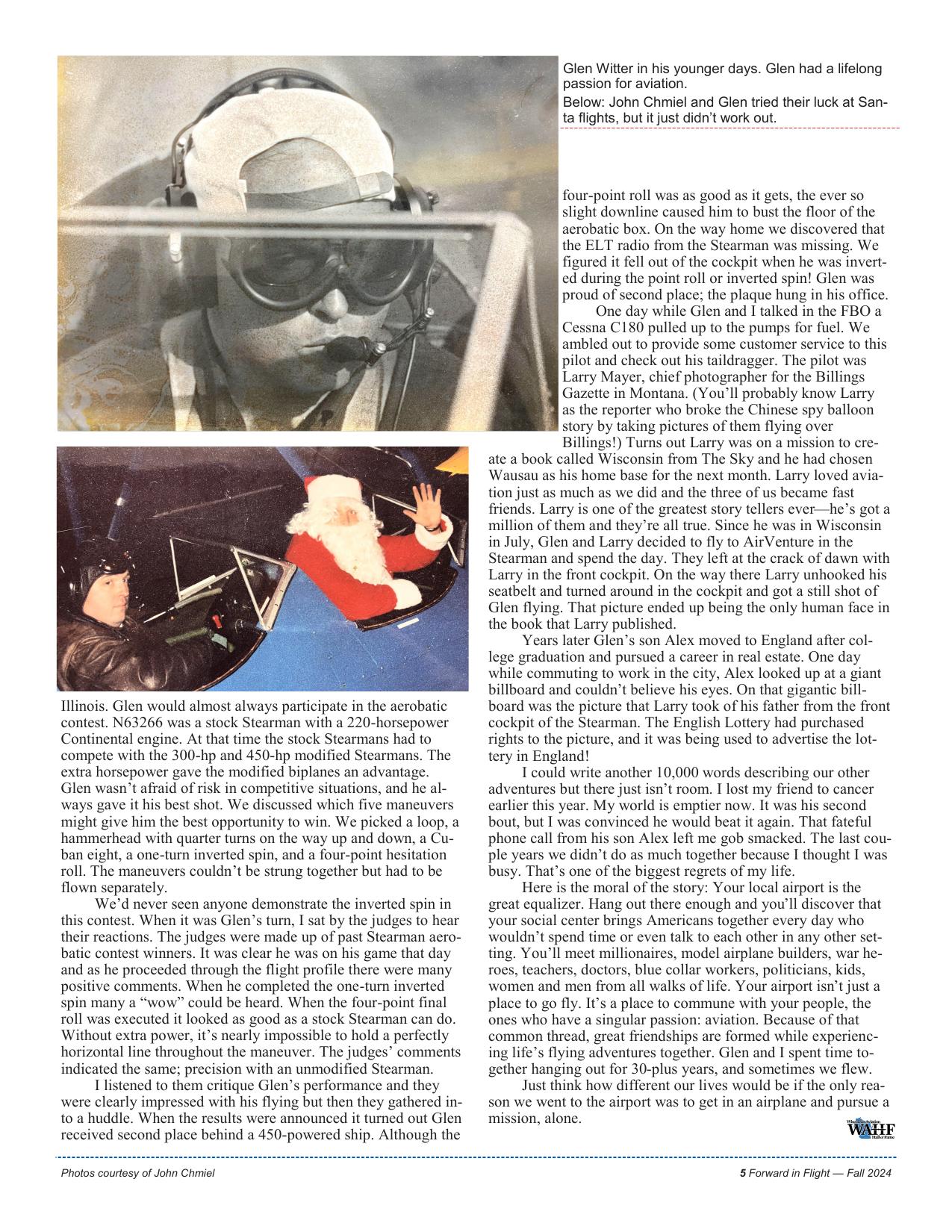
Glen Witter in his younger days. Glen had a lifelong passion for aviation. Below: John Chmiel and Glen tried their luck at Santa flights, but it just didn’t work out. Illinois. Glen would almost always participate in the aerobatic contest. N63266 was a stock Stearman with a 220-horsepower Continental engine. At that time the stock Stearmans had to compete with the 300-hp and 450-hp modified Stearmans. The extra horsepower gave the modified biplanes an advantage. Glen wasn’t afraid of risk in competitive situations, and he always gave it his best shot. We discussed which five maneuvers might give him the best opportunity to win. We picked a loop, a hammerhead with quarter turns on the way up and down, a Cuban eight, a one-turn inverted spin, and a four-point hesitation roll. The maneuvers couldn’t be strung together but had to be flown separately. We’d never seen anyone demonstrate the inverted spin in this contest. When it was Glen’s turn, I sat by the judges to hear their reactions. The judges were made up of past Stearman aerobatic contest winners. It was clear he was on his game that day and as he proceeded through the flight profile there were many positive comments. When he completed the one-turn inverted spin many a “wow” could be heard. When the four-point final roll was executed it looked as good as a stock Stearman can do. Without extra power, it’s nearly impossible to hold a perfectly horizontal line throughout the maneuver. The judges’ comments indicated the same; precision with an unmodified Stearman. I listened to them critique Glen’s performance and they were clearly impressed with his flying but then they gathered into a huddle. When the results were announced it turned out Glen received second place behind a 450-powered ship. Although the Photos courtesy of John Chmiel four-point roll was as good as it gets, the ever so slight downline caused him to bust the floor of the aerobatic box. On the way home we discovered that the ELT radio from the Stearman was missing. We figured it fell out of the cockpit when he was inverted during the point roll or inverted spin! Glen was proud of second place; the plaque hung in his office. One day while Glen and I talked in the FBO a Cessna C180 pulled up to the pumps for fuel. We ambled out to provide some customer service to this pilot and check out his taildragger. The pilot was Larry Mayer, chief photographer for the Billings Gazette in Montana. (You’ll probably know Larry as the reporter who broke the Chinese spy balloon story by taking pictures of them flying over Billings!) Turns out Larry was on a mission to create a book called Wisconsin from The Sky and he had chosen Wausau as his home base for the next month. Larry loved aviation just as much as we did and the three of us became fast friends. Larry is one of the greatest story tellers ever—he’s got a million of them and they’re all true. Since he was in Wisconsin in July, Glen and Larry decided to fly to AirVenture in the Stearman and spend the day. They left at the crack of dawn with Larry in the front cockpit. On the way there Larry unhooked his seatbelt and turned around in the cockpit and got a still shot of Glen flying. That picture ended up being the only human face in the book that Larry published. Years later Glen’s son Alex moved to England after college graduation and pursued a career in real estate. One day while commuting to work in the city, Alex looked up at a giant billboard and couldn’t believe his eyes. On that gigantic billboard was the picture that Larry took of his father from the front cockpit of the Stearman. The English Lottery had purchased rights to the picture, and it was being used to advertise the lottery in England! I could write another 10,000 words describing our other adventures but there just isn’t room. I lost my friend to cancer earlier this year. My world is emptier now. It was his second bout, but I was convinced he would beat it again. That fateful phone call from his son Alex left me gob smacked. The last couple years we didn’t do as much together because I thought I was busy. That’s one of the biggest regrets of my life. Here is the moral of the story: Your local airport is the great equalizer. Hang out there enough and you’ll discover that your social center brings Americans together every day who wouldn’t spend time or even talk to each other in any other setting. You’ll meet millionaires, model airplane builders, war heroes, teachers, doctors, blue collar workers, politicians, kids, women and men from all walks of life. Your airport isn’t just a place to go fly. It’s a place to commune with your people, the ones who have a singular passion: aviation. Because of that common thread, great friendships are formed while experiencing life’s flying adventures together. Glen and I spent time together hanging out for 30-plus years, and sometimes we flew. Just think how different our lives would be if the only reason we went to the airport was to get in an airplane and pursue a mission, alone. 5 Forward in Flight — Fall 2024
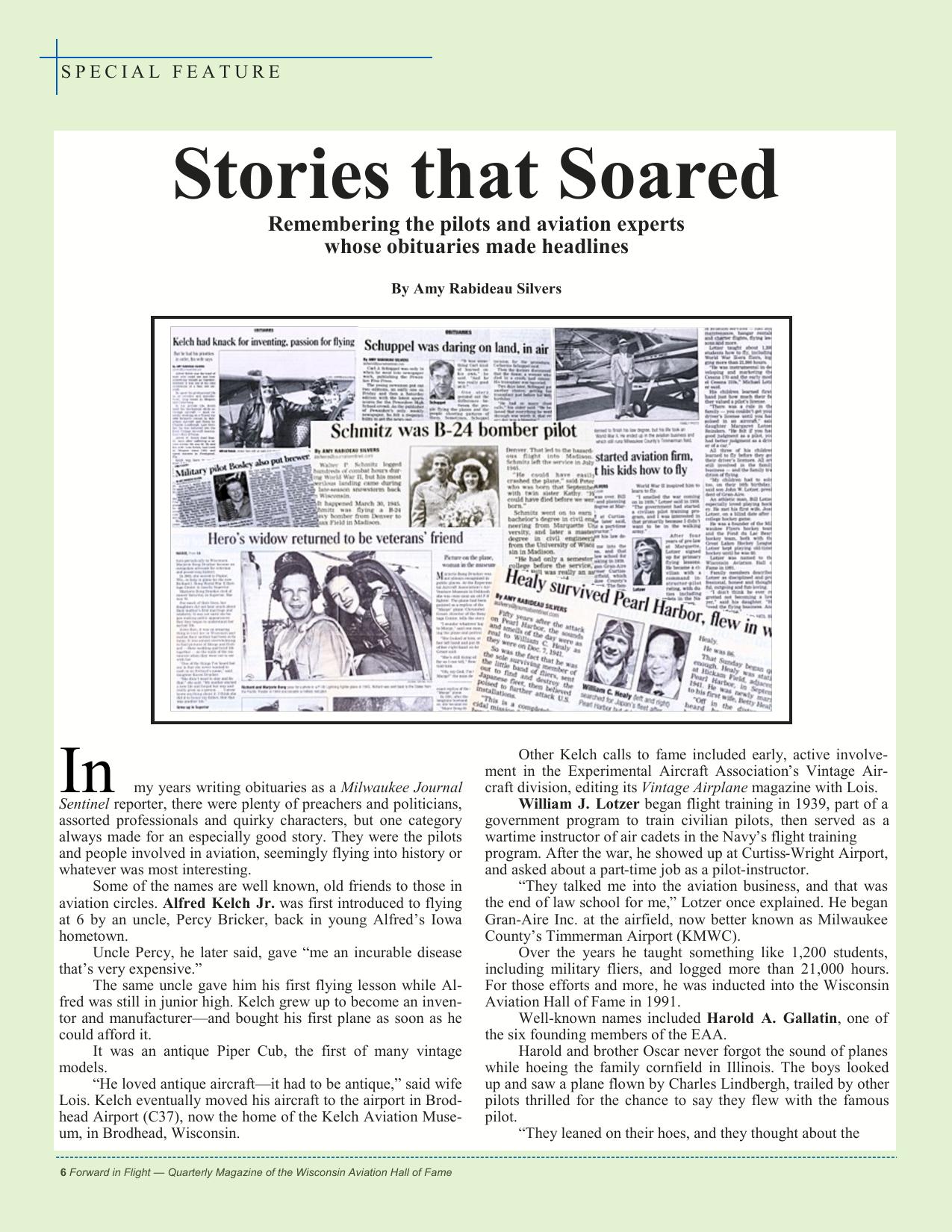
SPECIAL FEATURE Stories that Soared Remembering the pilots and aviation experts whose obituaries made headlines By Amy Rabideau Silvers In my years writing obituaries as a MilwaukeeÊJournalÊ Sentinel reporter, there were plenty of preachers and politicians, assorted professionals and quirky characters, but one category always made for an especially good story. They were the pilots and people involved in aviation, seemingly flying into history or whatever was most interesting. Some of the names are well known, old friends to those in aviation circles. Alfred Kelch Jr. was first introduced to flying at 6 by an uncle, Percy Bricker, back in young Alfred’s Iowa hometown. Uncle Percy, he later said, gave “me an incurable disease that’s very expensive.” The same uncle gave him his first flying lesson while Alfred was still in junior high. Kelch grew up to become an inventor and manufacturer—and bought his first plane as soon as he could afford it. It was an antique Piper Cub, the first of many vintage models. “He loved antique aircraft—it had to be antique,” said wife Lois. Kelch eventually moved his aircraft to the airport in Brodhead Airport (C37), now the home of the Kelch Aviation Museum, in Brodhead, Wisconsin. 6 Forward in Flight — Quarterly Magazine of the Wisconsin Aviation Hall of Fame Other Kelch calls to fame included early, active involvement in the Experimental Aircraft Association’s Vintage Aircraft division, editing its VintageÊAirplane magazine with Lois. William J. Lotzer began flight training in 1939, part of a government program to train civilian pilots, then served as a wartime instructor of air cadets in the Navy’s flight training program. After the war, he showed up at Curtiss-Wright Airport, and asked about a part-time job as a pilot-instructor. “They talked me into the aviation business, and that was the end of law school for me,” Lotzer once explained. He began Gran-Aire Inc. at the airfield, now better known as Milwaukee County’s Timmerman Airport (KMWC). Over the years he taught something like 1,200 students, including military fliers, and logged more than 21,000 hours. For those efforts and more, he was inducted into the Wisconsin Aviation Hall of Fame in 1991. Well-known names included Harold A. Gallatin, one of the six founding members of the EAA. Harold and brother Oscar never forgot the sound of planes while hoeing the family cornfield in Illinois. The boys looked up and saw a plane flown by Charles Lindbergh, trailed by other pilots thrilled for the chance to say they flew with the famous pilot. “They leaned on their hoes, and they thought about the
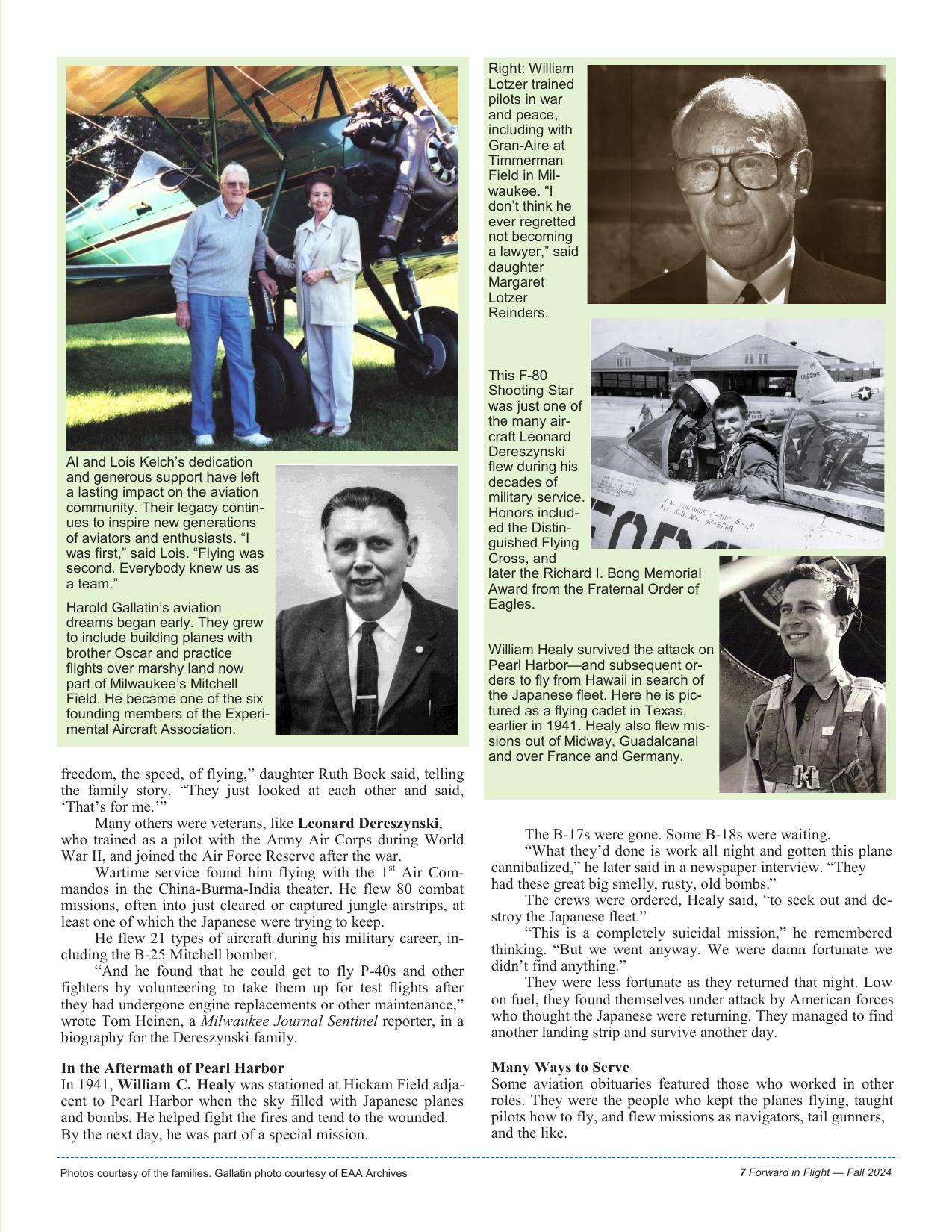
Right: William Lotzer trained pilots in war and peace, including with Gran-Aire at Timmerman Field in Milwaukee. “I don’t think he ever regretted not becoming a lawyer,” said daughter Margaret Lotzer Reinders. Al and Lois Kelch’s dedication and generous support have left a lasting impact on the aviation community. Their legacy continues to inspire new generations of aviators and enthusiasts. “I was first,” said Lois. “Flying was second. Everybody knew us as a team.” Harold Gallatin’s aviation dreams began early. They grew to include building planes with brother Oscar and practice flights over marshy land now part of Milwaukee’s Mitchell Field. He became one of the six founding members of the Experimental Aircraft Association. This F-80 Shooting Star was just one of the many aircraft Leonard Dereszynski flew during his decades of military service. Honors included the Distinguished Flying Cross, and later the Richard I. Bong Memorial Award from the Fraternal Order of Eagles. William Healy survived the attack on Pearl Harbor—and subsequent orders to fly from Hawaii in search of the Japanese fleet. Here he is pictured as a flying cadet in Texas, earlier in 1941. Healy also flew missions out of Midway, Guadalcanal and over France and Germany. freedom, the speed, of flying,” daughter Ruth Bock said, telling the family story. “They just looked at each other and said, ‘That’s for me.’” Many others were veterans, like Leonard Dereszynski, who trained as a pilot with the Army Air Corps during World War II, and joined the Air Force Reserve after the war. Wartime service found him flying with the 1st Air Commandos in the China-Burma-India theater. He flew 80 combat missions, often into just cleared or captured jungle airstrips, at least one of which the Japanese were trying to keep. He flew 21 types of aircraft during his military career, including the B-25 Mitchell bomber. “And he found that he could get to fly P-40s and other fighters by volunteering to take them up for test flights after they had undergone engine replacements or other maintenance,” wrote Tom Heinen, a MilwaukeeÊJournalÊSentinel reporter, in a biography for the Dereszynski family. The B-17s were gone. Some B-18s were waiting. “What they’d done is work all night and gotten this plane cannibalized,” he later said in a newspaper interview. “They had these great big smelly, rusty, old bombs.” The crews were ordered, Healy said, “to seek out and destroy the Japanese fleet.” “This is a completely suicidal mission,” he remembered thinking. “But we went anyway. We were damn fortunate we didn’t find anything.” They were less fortunate as they returned that night. Low on fuel, they found themselves under attack by American forces who thought the Japanese were returning. They managed to find another landing strip and survive another day. In the Aftermath of Pearl Harbor In 1941, William C. Healy was stationed at Hickam Field adjacent to Pearl Harbor when the sky filled with Japanese planes and bombs. He helped fight the fires and tend to the wounded. By the next day, he was part of a special mission. Many Ways to Serve Some aviation obituaries featured those who worked in other roles. They were the people who kept the planes flying, taught pilots how to fly, and flew missions as navigators, tail gunners, and the like. Photos courtesy of the families. Gallatin photo courtesy of EAA Archives 7 Forward in Flight — Fall 2024
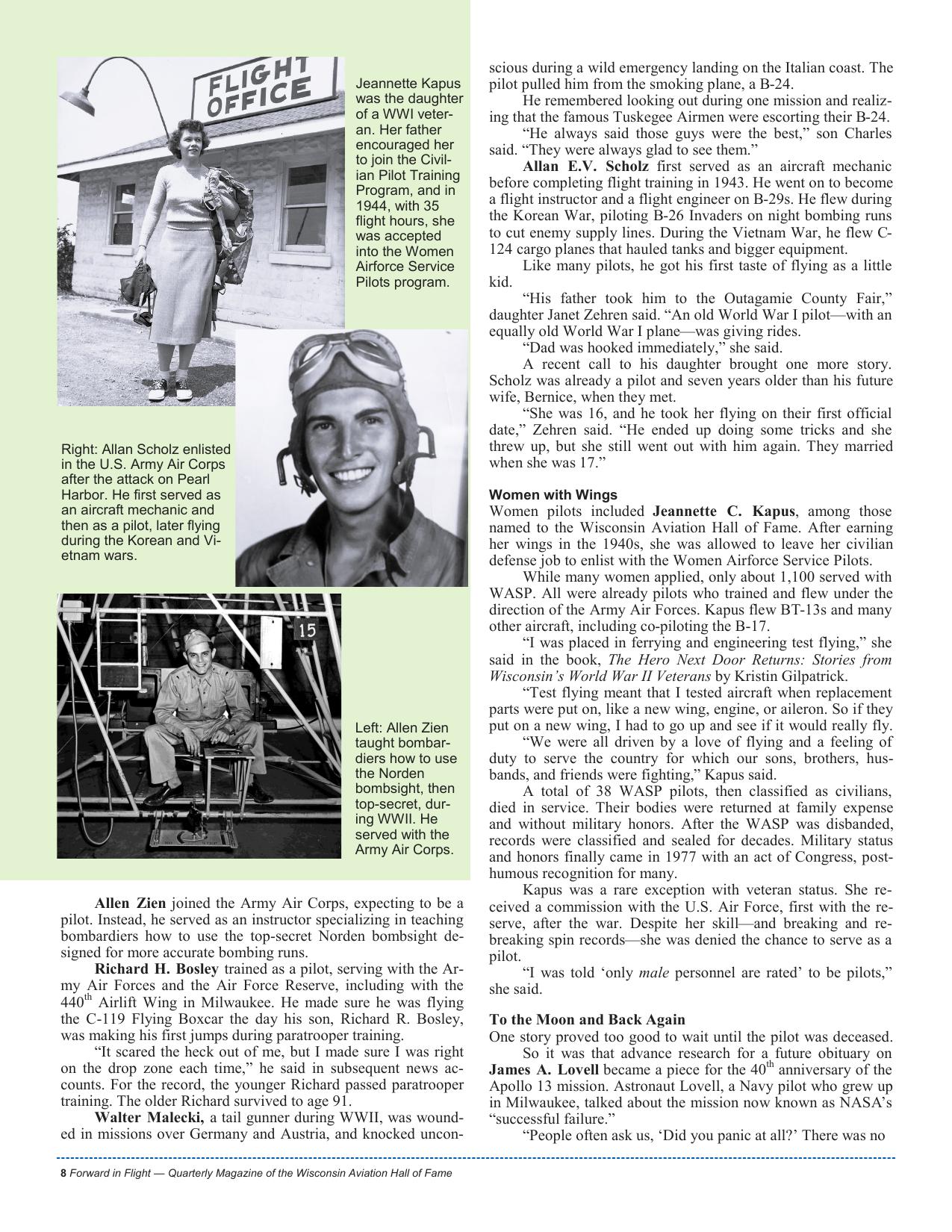
Jeannette Kapus was the daughter of a WWI veteran. Her father encouraged her to join the Civilian Pilot Training Program, and in 1944, with 35 flight hours, she was accepted into the Women Airforce Service Pilots program. Right: Allan Scholz enlisted in the U.S. Army Air Corps after the attack on Pearl Harbor. He first served as an aircraft mechanic and then as a pilot, later flying during the Korean and Vietnam wars. scious during a wild emergency landing on the Italian coast. The pilot pulled him from the smoking plane, a B-24. He remembered looking out during one mission and realizing that the famous Tuskegee Airmen were escorting their B-24. “He always said those guys were the best,” son Charles said. “They were always glad to see them.” Allan E.V. Scholz first served as an aircraft mechanic before completing flight training in 1943. He went on to become a flight instructor and a flight engineer on B-29s. He flew during the Korean War, piloting B-26 Invaders on night bombing runs to cut enemy supply lines. During the Vietnam War, he flew C124 cargo planes that hauled tanks and bigger equipment. Like many pilots, he got his first taste of flying as a little kid. “His father took him to the Outagamie County Fair,” daughter Janet Zehren said. “An old World War I pilot—with an equally old World War I plane—was giving rides. “Dad was hooked immediately,” she said. A recent call to his daughter brought one more story. Scholz was already a pilot and seven years older than his future wife, Bernice, when they met. “She was 16, and he took her flying on their first official date,” Zehren said. “He ended up doing some tricks and she threw up, but she still went out with him again. They married when she was 17.” Women with Wings Left: Allen Zien taught bombardiers how to use the Norden bombsight, then top-secret, during WWII. He served with the Army Air Corps. Allen Zien joined the Army Air Corps, expecting to be a pilot. Instead, he served as an instructor specializing in teaching bombardiers how to use the top-secret Norden bombsight designed for more accurate bombing runs. Richard H. Bosley trained as a pilot, serving with the Army Air Forces and the Air Force Reserve, including with the 440th Airlift Wing in Milwaukee. He made sure he was flying the C-119 Flying Boxcar the day his son, Richard R. Bosley, was making his first jumps during paratrooper training. “It scared the heck out of me, but I made sure I was right on the drop zone each time,” he said in subsequent news accounts. For the record, the younger Richard passed paratrooper training. The older Richard survived to age 91. Walter Malecki, a tail gunner during WWII, was wounded in missions over Germany and Austria, and knocked uncon8 Forward in Flight — Quarterly Magazine of the Wisconsin Aviation Hall of Fame Women pilots included Jeannette C. Kapus, among those named to the Wisconsin Aviation Hall of Fame. After earning her wings in the 1940s, she was allowed to leave her civilian defense job to enlist with the Women Airforce Service Pilots. While many women applied, only about 1,100 served with WASP. All were already pilots who trained and flew under the direction of the Army Air Forces. Kapus flew BT-13s and many other aircraft, including co-piloting the B-17. “I was placed in ferrying and engineering test flying,” she said in the book, TheÊ HeroÊ NextÊ DoorÊ Returns:Ê StoriesÊ fromÊ Wisconsin’sÊWorldÊWarÊIIÊVeteransÊby Kristin Gilpatrick. “Test flying meant that I tested aircraft when replacement parts were put on, like a new wing, engine, or aileron. So if they put on a new wing, I had to go up and see if it would really fly. “We were all driven by a love of flying and a feeling of duty to serve the country for which our sons, brothers, husbands, and friends were fighting,” Kapus said. A total of 38 WASP pilots, then classified as civilians, died in service. Their bodies were returned at family expense and without military honors. After the WASP was disbanded, records were classified and sealed for decades. Military status and honors finally came in 1977 with an act of Congress, posthumous recognition for many. Kapus was a rare exception with veteran status. She received a commission with the U.S. Air Force, first with the reserve, after the war. Despite her skill—and breaking and rebreaking spin records—she was denied the chance to serve as a pilot. “I was told ‘only male personnel are rated’ to be pilots,” she said. To the Moon and Back Again One story proved too good to wait until the pilot was deceased. So it was that advance research for a future obituary on James A. Lovell became a piece for the 40th anniversary of the Apollo 13 mission. Astronaut Lovell, a Navy pilot who grew up in Milwaukee, talked about the mission now known as NASA’s “successful failure.” “People often ask us, ‘Did you panic at all?’ There was no
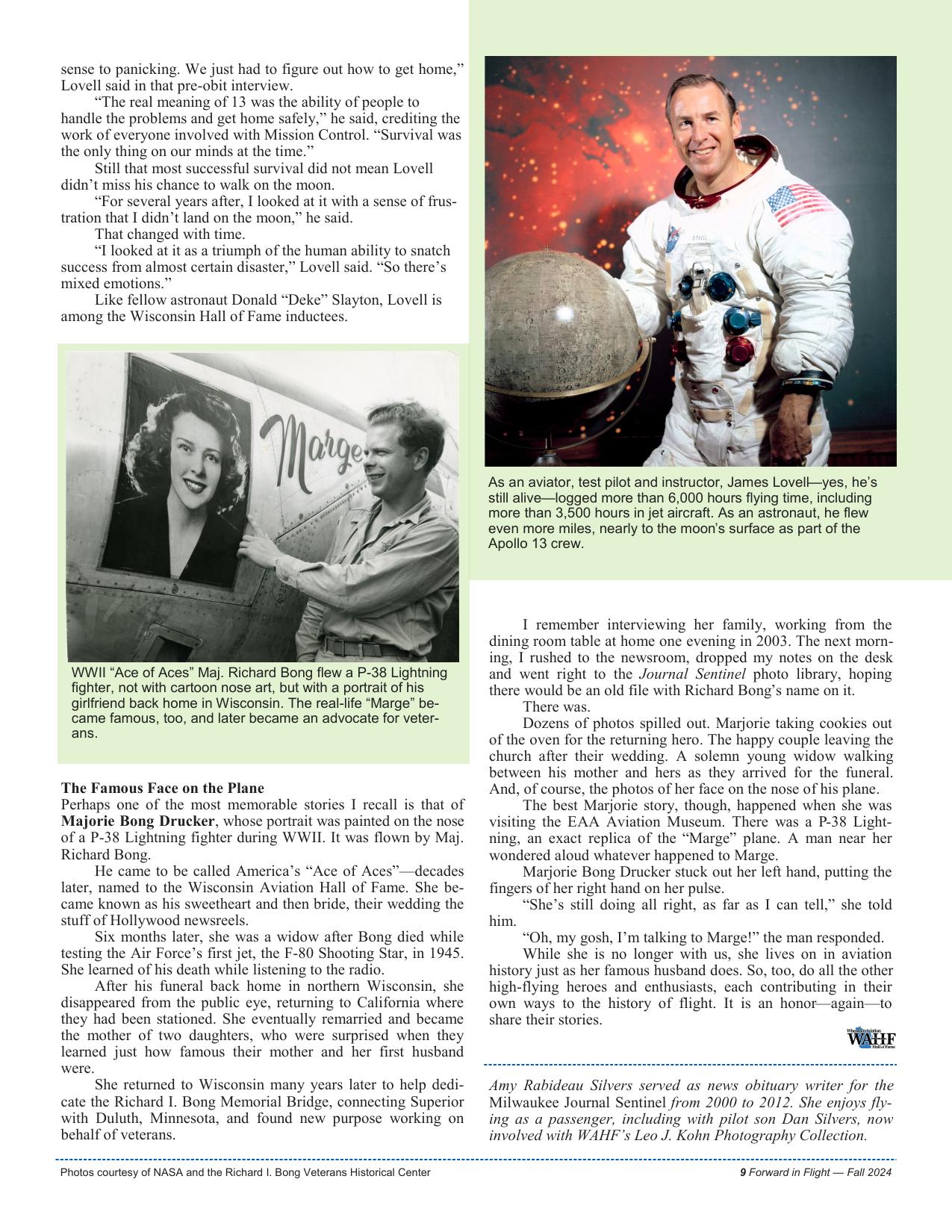
sense to panicking. We just had to figure out how to get home,” Lovell said in that pre-obit interview. “The real meaning of 13 was the ability of people to handle the problems and get home safely,” he said, crediting the work of everyone involved with Mission Control. “Survival was the only thing on our minds at the time.” Still that most successful survival did not mean Lovell didn’t miss his chance to walk on the moon. “For several years after, I looked at it with a sense of frustration that I didn’t land on the moon,” he said. That changed with time. “I looked at it as a triumph of the human ability to snatch success from almost certain disaster,” Lovell said. “So there’s mixed emotions.” Like fellow astronaut Donald “Deke” Slayton, Lovell is among the Wisconsin Hall of Fame inductees. As an aviator, test pilot and instructor, James Lovell—yes, he’s still alive—logged more than 6,000 hours flying time, including more than 3,500 hours in jet aircraft. As an astronaut, he flew even more miles, nearly to the moon’s surface as part of the Apollo 13 crew. WWII “Ace of Aces” Maj. Richard Bong flew a P-38 Lightning fighter, not with cartoon nose art, but with a portrait of his girlfriend back home in Wisconsin. The real-life “Marge” became famous, too, and later became an advocate for veterans. The Famous Face on the Plane Perhaps one of the most memorable stories I recall is that of Majorie Bong Drucker, whose portrait was painted on the nose of a P-38 Lightning fighter during WWII. It was flown by Maj. Richard Bong. He came to be called America’s “Ace of Aces”—decades later, named to the Wisconsin Aviation Hall of Fame. She became known as his sweetheart and then bride, their wedding the stuff of Hollywood newsreels. Six months later, she was a widow after Bong died while testing the Air Force’s first jet, the F-80 Shooting Star, in 1945. She learned of his death while listening to the radio. After his funeral back home in northern Wisconsin, she disappeared from the public eye, returning to California where they had been stationed. She eventually remarried and became the mother of two daughters, who were surprised when they learned just how famous their mother and her first husband were. She returned to Wisconsin many years later to help dedicate the Richard I. Bong Memorial Bridge, connecting Superior with Duluth, Minnesota, and found new purpose working on behalf of veterans. Photos courtesy of NASA and the Richard I. Bong Veterans Historical Center I remember interviewing her family, working from the dining room table at home one evening in 2003. The next morning, I rushed to the newsroom, dropped my notes on the desk and went right to the JournalÊ Sentinel photo library, hoping there would be an old file with Richard Bong’s name on it. There was. Dozens of photos spilled out. Marjorie taking cookies out of the oven for the returning hero. The happy couple leaving the church after their wedding. A solemn young widow walking between his mother and hers as they arrived for the funeral. And, of course, the photos of her face on the nose of his plane. The best Marjorie story, though, happened when she was visiting the EAA Aviation Museum. There was a P-38 Lightning, an exact replica of the “Marge” plane. A man near her wondered aloud whatever happened to Marge. Marjorie Bong Drucker stuck out her left hand, putting the fingers of her right hand on her pulse. “She’s still doing all right, as far as I can tell,” she told him. “Oh, my gosh, I’m talking to Marge!” the man responded. While she is no longer with us, she lives on in aviation history just as her famous husband does. So, too, do all the other high-flying heroes and enthusiasts, each contributing in their own ways to the history of flight. It is an honor—again—to share their stories. AmyÊ RabideauÊ SilversÊ servedÊ asÊ newsÊ obituaryÊ writerÊ forÊ theÊ Milwaukee Journal SentinelÊfromÊ2000ÊtoÊ2012.ÊSheÊenjoysÊflyingÊ asÊ aÊ passenger,Ê includingÊ withÊ pilotÊ sonÊ DanÊ Silvers,Ê nowÊ involvedÊwithÊWAHF’sÊLeoÊJ.ÊKohnÊPhotographyÊCollection. 9 Forward in Flight — Fall 2024
SNAPSHOTS An Aviation Family: Jeff and Patty Plantz Story and Photos by Skot Weidemann Deeply involved in general aviation for most of their lives, the Madison, Wisconsin-based aviation couple, Jeff and Patty Plantz, are participating in their aviation obsession together. Jeff and Patty met years ago while they were both in graduate school at UW-Madison. They have owned and flown a handful of small general aviation aircraft, including a homebuilt experimental aircraft and several classic certified airplanes as well. They are and have been involved in the national and local EAA (Experimental Aircraft Association), EAA Young Eagles program, Recreational Aviation Foundation, seaplane associations, and have consistently done selfless volunteer work for those groups and others. Jeff spent his early years flying an ultralight out of Mathaire Airport near Columbus, Wisconsin. Jeff’s brother Gregg was the first one in the family certified to fly, followed by Jeff’s dad, who earned his private pilot certificate at age 61. Dad then bought a 1967 Cessna 172; Jeff & Patty flew it as well. Their first airplane ownership experience was a Kitfox Model 1, followed by a Bellanca Cruzaire that they flew for 17 years (from coast to coast and to the Bahamas). In 2001, Jeff got his high-performance seaplane rating, while in the process of building an Experimental Wag Aero PA- 14 2+2 Replica with parts from various suppliers. The plane was finished, test flown on wheels, and afterwards, mounted on amphibious floats in 2013. This plane took them on many adventures, meeting new friends in the process, including a trip to Alaska. This high-performance high-wing is now flying on specialized off-airport landing gear. The engine used on the plane is the Superior IO-360 with a constant speed MT Propeller. Between the two of them, Jeff and Patty have flown 634 EAA Young Eagles. Patty has been active in women’s aviation groups, including Women in Aviation, Girls in Aviation, EAA Ray Scholarships through their chapter, the Remington Viney Scholarship, and the Willa Brown Aviation Academy. Throughout their life together, they have two children, and a granddaughter (who is also interested in aviation). They are active bicycle riders, downhill and cross-country skiers, and motor coach campers. They continue to fly their Experimental copy of a Piper PA-14 (now with a partner) and have a partnership in a Cessna 172 Skyhawk for other missions. Through all their adventures together, Jeff and Patty Plantz continue to promote general aviation with unwavering passion and commitment, actively participating in various aviation activities and community involvement.
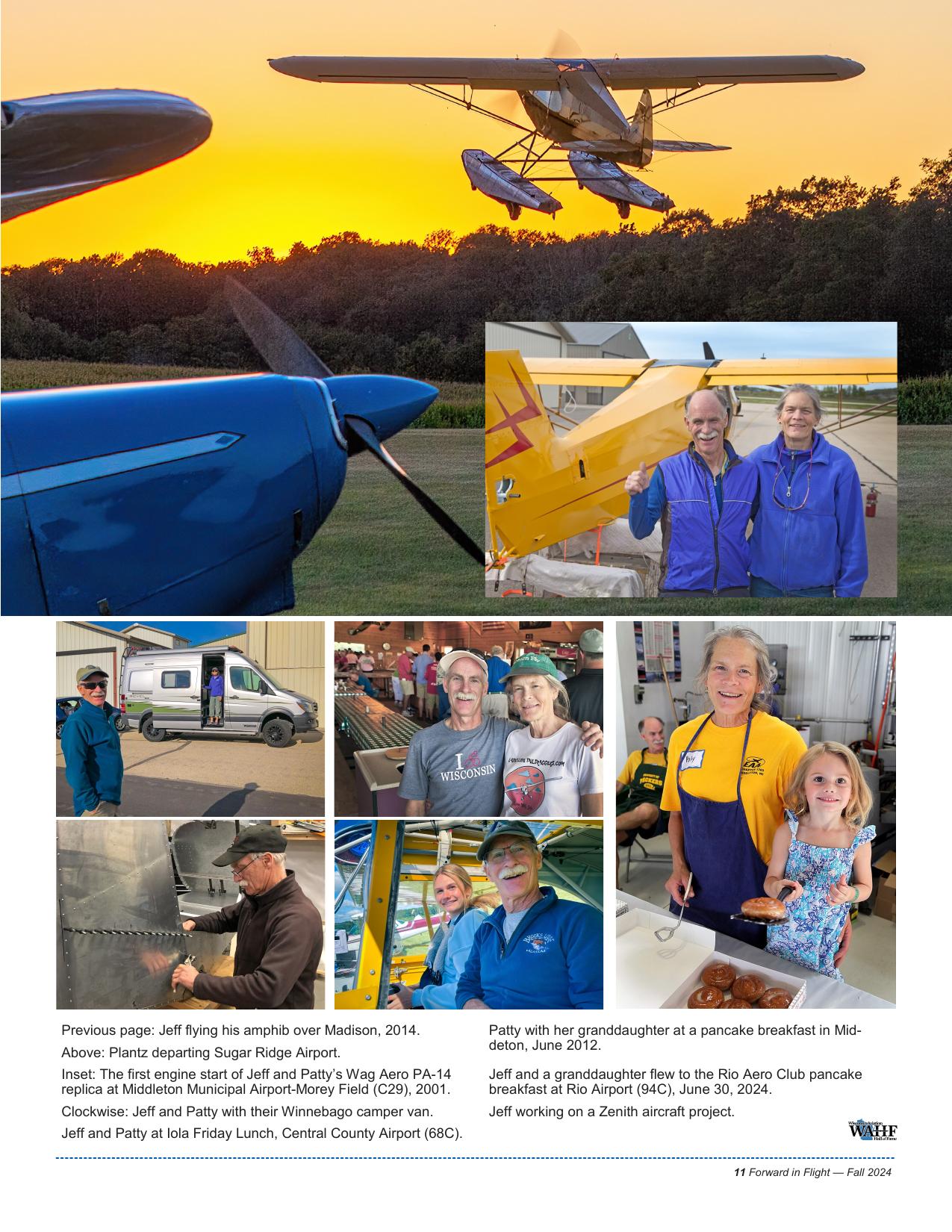
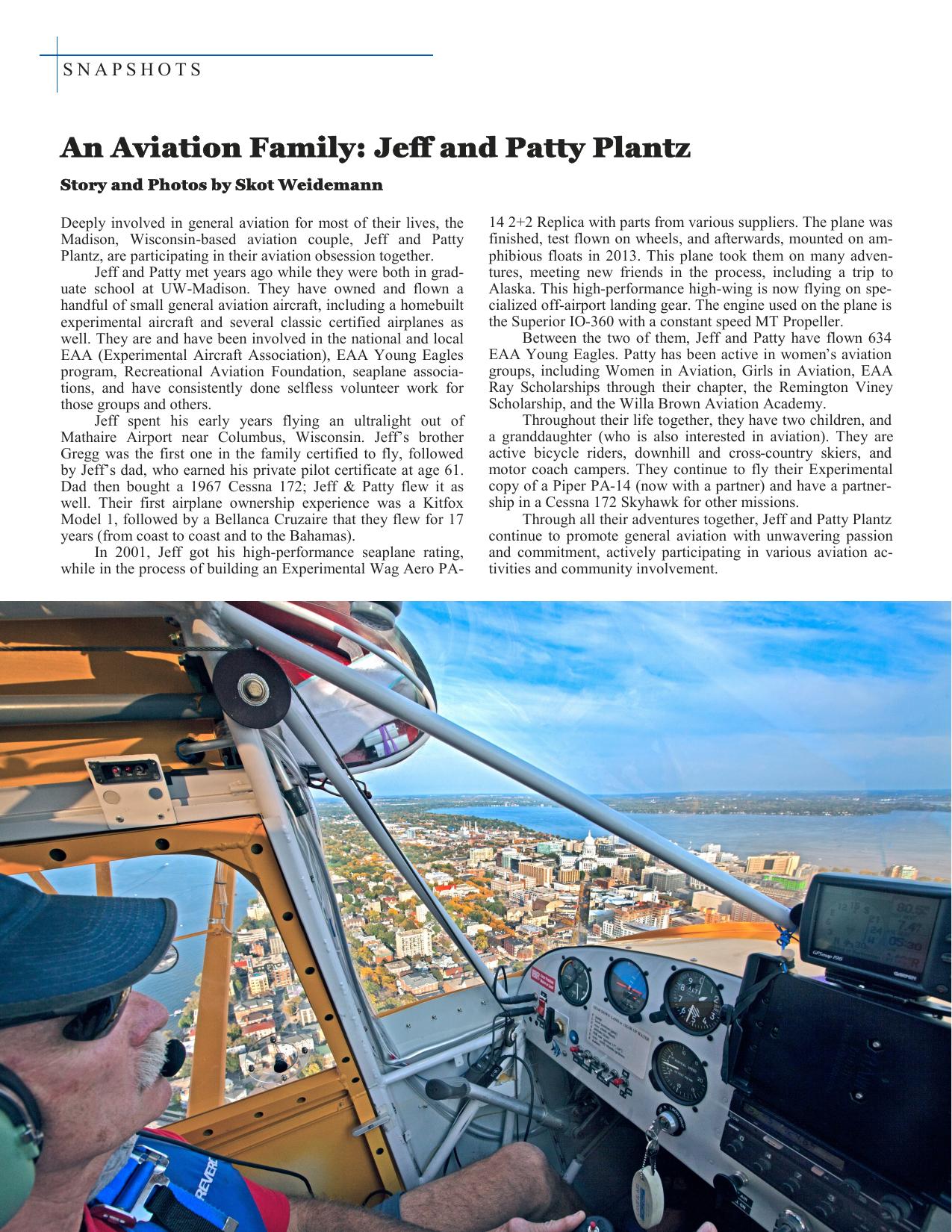
Previous page: Jeff flying his amphib over Madison, 2014. Above: Plantz departing Sugar Ridge Airport. Patty with her granddaughter at a pancake breakfast in Middeton, June 2012. Inset: The first engine start of Jeff and Patty’s Wag Aero PA-14 replica at Middleton Municipal Airport-Morey Field (C29), 2001. Jeff and a granddaughter flew to the Rio Aero Club pancake breakfast at Rio Airport (94C), June 30, 2024. Clockwise: Jeff and Patty with their Winnebago camper van. Jeff working on a Zenith aircraft project. Jeff and Patty at Iola Friday Lunch, Central County Airport (68C). 11 Forward in Flight — Fall 2024
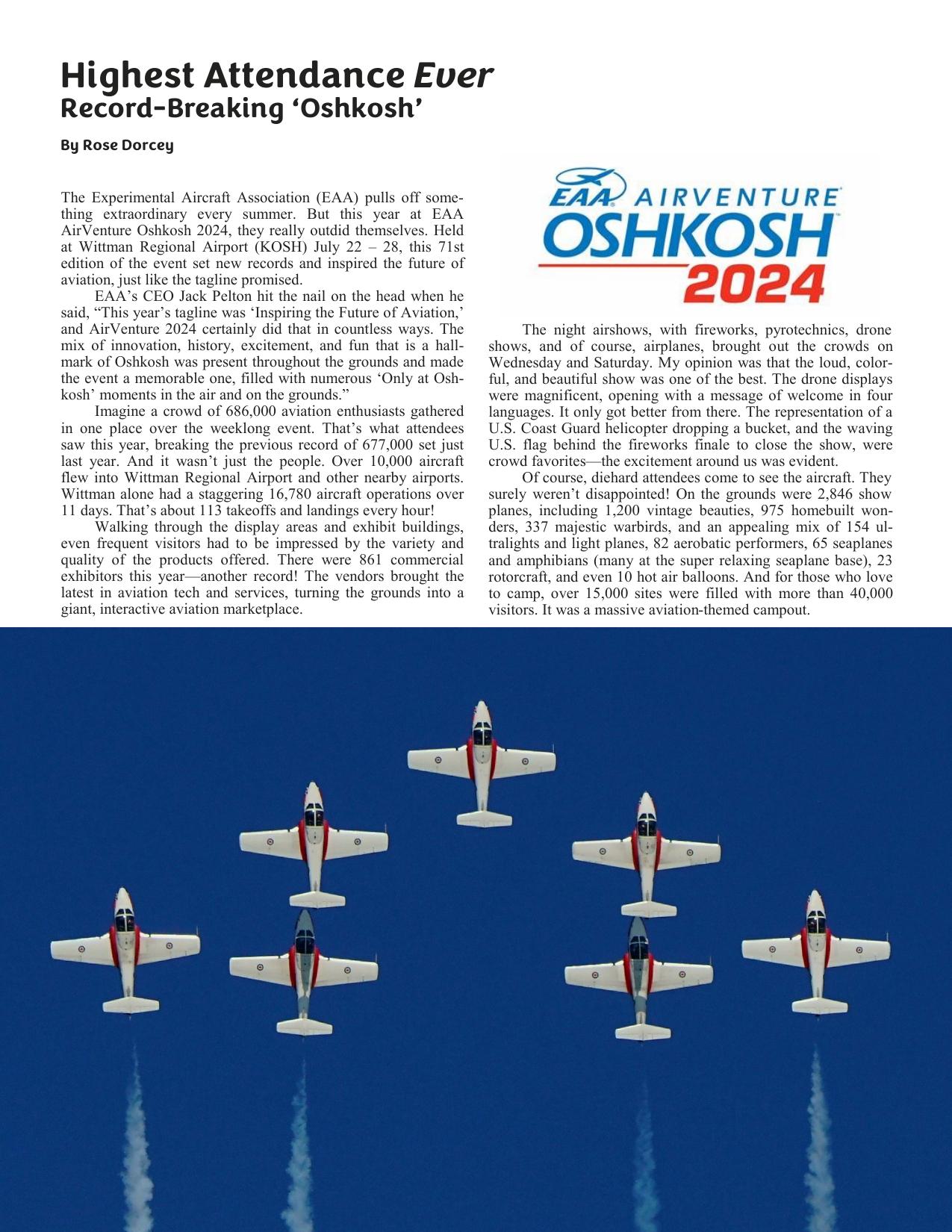
Highest Attendance Ever Record-Breaking ‘Oshkosh’ By Rose Dorcey The Experimental Aircraft Association (EAA) pulls off something extraordinary every summer. But this year at EAA AirVenture Oshkosh 2024, they really outdid themselves. Held at Wittman Regional Airport (KOSH) July 22 – 28, this 71st edition of the event set new records and inspired the future of aviation, just like the tagline promised. EAA’s CEO Jack Pelton hit the nail on the head when he said, “This year’s tagline was ‘Inspiring the Future of Aviation,’ and AirVenture 2024 certainly did that in countless ways. The mix of innovation, history, excitement, and fun that is a hallmark of Oshkosh was present throughout the grounds and made the event a memorable one, filled with numerous ‘Only at Oshkosh’ moments in the air and on the grounds.” Imagine a crowd of 686,000 aviation enthusiasts gathered in one place over the weeklong event. That’s what attendees saw this year, breaking the previous record of 677,000 set just last year. And it wasn’t just the people. Over 10,000 aircraft flew into Wittman Regional Airport and other nearby airports. Wittman alone had a staggering 16,780 aircraft operations over 11 days. That’s about 113 takeoffs and landings every hour! Walking through the display areas and exhibit buildings, even frequent visitors had to be impressed by the variety and quality of the products offered. There were 861 commercial exhibitors this year—another record! The vendors brought the latest in aviation tech and services, turning the grounds into a giant, interactive aviation marketplace. The night airshows, with fireworks, pyrotechnics, drone shows, and of course, airplanes, brought out the crowds on Wednesday and Saturday. My opinion was that the loud, colorful, and beautiful show was one of the best. The drone displays were magnificent, opening with a message of welcome in four languages. It only got better from there. The representation of a U.S. Coast Guard helicopter dropping a bucket, and the waving U.S. flag behind the fireworks finale to close the show, were crowd favorites—the excitement around us was evident. Of course, diehard attendees come to see the aircraft. They surely weren’t disappointed! On the grounds were 2,846 show planes, including 1,200 vintage beauties, 975 homebuilt wonders, 337 majestic warbirds, and an appealing mix of 154 ultralights and light planes, 82 aerobatic performers, 65 seaplanes and amphibians (many at the super relaxing seaplane base), 23 rotorcraft, and even 10 hot air balloons. And for those who love to camp, over 15,000 sites were filled with more than 40,000 visitors. It was a massive aviation-themed campout.
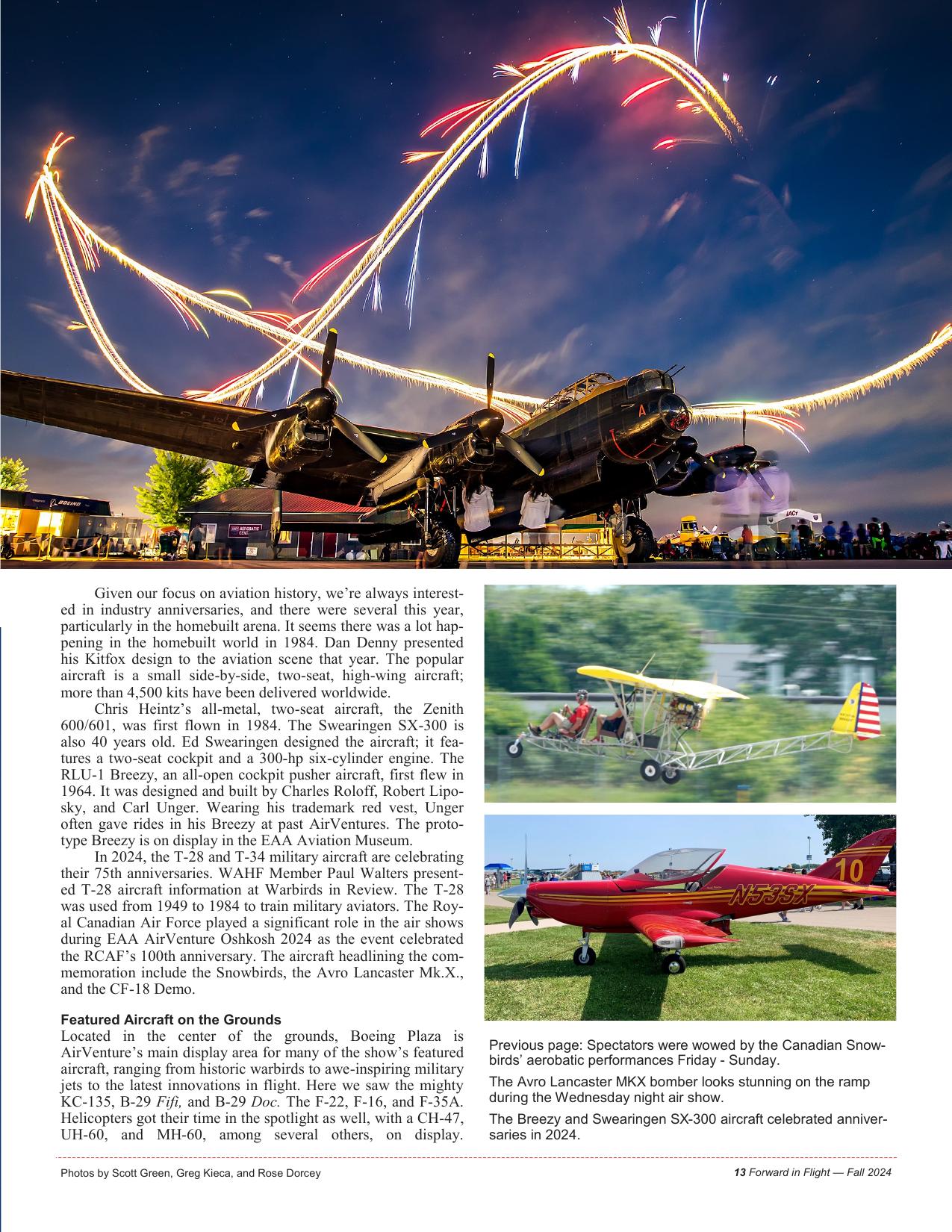
Given our focus on aviation history, we’re always interested in industry anniversaries, and there were several this year, particularly in the homebuilt arena. It seems there was a lot happening in the homebuilt world in 1984. Dan Denny presented his Kitfox design to the aviation scene that year. The popular aircraft is a small side-by-side, two-seat, high-wing aircraft; more than 4,500 kits have been delivered worldwide. Chris Heintz’s all-metal, two-seat aircraft, the Zenith 600/601, was first flown in 1984. The Swearingen SX-300 is also 40 years old. Ed Swearingen designed the aircraft; it features a two-seat cockpit and a 300-hp six-cylinder engine. The RLU-1 Breezy, an all-open cockpit pusher aircraft, first flew in 1964. It was designed and built by Charles Roloff, Robert Liposky, and Carl Unger. Wearing his trademark red vest, Unger often gave rides in his Breezy at past AirVentures. The prototype Breezy is on display in the EAA Aviation Museum. In 2024, the T-28 and T-34 military aircraft are celebrating their 75th anniversaries. WAHF Member Paul Walters presented T-28 aircraft information at Warbirds in Review. The T-28 was used from 1949 to 1984 to train military aviators. The Royal Canadian Air Force played a significant role in the air shows during EAA AirVenture Oshkosh 2024 as the event celebrated the RCAF’s 100th anniversary. The aircraft headlining the commemoration include the Snowbirds, the Avro Lancaster Mk.X., and the CF-18 Demo. Featured Aircraft on the Grounds Located in the center of the grounds, Boeing Plaza is AirVenture’s main display area for many of the show’s featured aircraft, ranging from historic warbirds to awe-inspiring military jets to the latest innovations in flight. Here we saw the mighty KC-135, B-29 Fifi,Êand B-29 Doc. The F-22, F-16, and F-35A. Helicopters got their time in the spotlight as well, with a CH-47, UH-60, and MH-60, among several others, on display. Photos by Scott Green, Greg Kieca, and Rose Dorcey Previous page: Spectators were wowed by the Canadian Snowbirds’ aerobatic performances Friday - Sunday. The Avro Lancaster MKX bomber looks stunning on the ramp during the Wednesday night air show. The Breezy and Swearingen SX-300 aircraft celebrated anniversaries in 2024. 13 Forward in Flight — Fall 2024
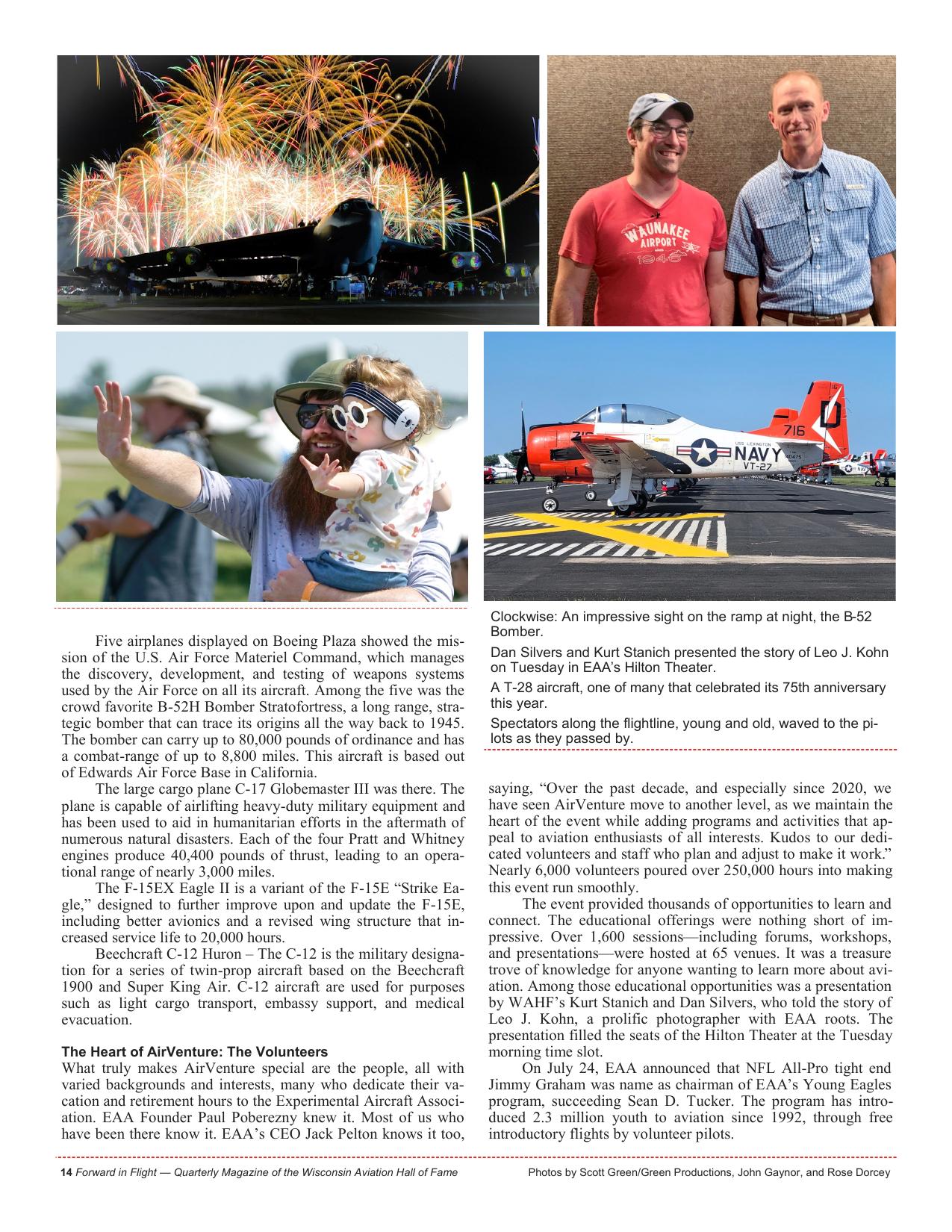
Five airplanes displayed on Boeing Plaza showed the mission of the U.S. Air Force Materiel Command, which manages the discovery, development, and testing of weapons systems used by the Air Force on all its aircraft. Among the five was the crowd favorite B-52H Bomber Stratofortress, a long range, strategic bomber that can trace its origins all the way back to 1945. The bomber can carry up to 80,000 pounds of ordinance and has a combat-range of up to 8,800 miles. This aircraft is based out of Edwards Air Force Base in California. The large cargo plane C-17 Globemaster III was there. The plane is capable of airlifting heavy-duty military equipment and has been used to aid in humanitarian efforts in the aftermath of numerous natural disasters. Each of the four Pratt and Whitney engines produce 40,400 pounds of thrust, leading to an operational range of nearly 3,000 miles. The F-15EX Eagle II is a variant of the F-15E “Strike Eagle,” designed to further improve upon and update the F-15E, including better avionics and a revised wing structure that increased service life to 20,000 hours. Beechcraft C-12 Huron – The C-12 is the military designation for a series of twin-prop aircraft based on the Beechcraft 1900 and Super King Air. C-12 aircraft are used for purposes such as light cargo transport, embassy support, and medical evacuation. Clockwise: An impressive sight on the ramp at night, the B-52 Bomber. Dan Silvers and Kurt Stanich presented the story of Leo J. Kohn on Tuesday in EAA’s Hilton Theater. A T-28 aircraft, one of many that celebrated its 75th anniversary this year. Spectators along the flightline, young and old, waved to the pilots as they passed by. What truly makes AirVenture special are the people, all with varied backgrounds and interests, many who dedicate their vacation and retirement hours to the Experimental Aircraft Association. EAA Founder Paul Poberezny knew it. Most of us who have been there know it. EAA’s CEO Jack Pelton knows it too, saying, “Over the past decade, and especially since 2020, we have seen AirVenture move to another level, as we maintain the heart of the event while adding programs and activities that appeal to aviation enthusiasts of all interests. Kudos to our dedicated volunteers and staff who plan and adjust to make it work.” Nearly 6,000 volunteers poured over 250,000 hours into making this event run smoothly. The event provided thousands of opportunities to learn and connect. The educational offerings were nothing short of impressive. Over 1,600 sessions—including forums, workshops, and presentations—were hosted at 65 venues. It was a treasure trove of knowledge for anyone wanting to learn more about aviation. Among those educational opportunities was a presentation by WAHF’s Kurt Stanich and Dan Silvers, who told the story of Leo J. Kohn, a prolific photographer with EAA roots. The presentation filled the seats of the Hilton Theater at the Tuesday morning time slot. On July 24, EAA announced that NFL All-Pro tight end Jimmy Graham was name as chairman of EAA’s Young Eagles program, succeeding Sean D. Tucker. The program has introduced 2.3 million youth to aviation since 1992, through free introductory flights by volunteer pilots. 14 Forward in Flight — Quarterly Magazine of the Wisconsin Aviation Hall of Fame Photos by Scott Green/Green Productions, John Gaynor, and Rose Dorcey The Heart of AirVenture: The Volunteers
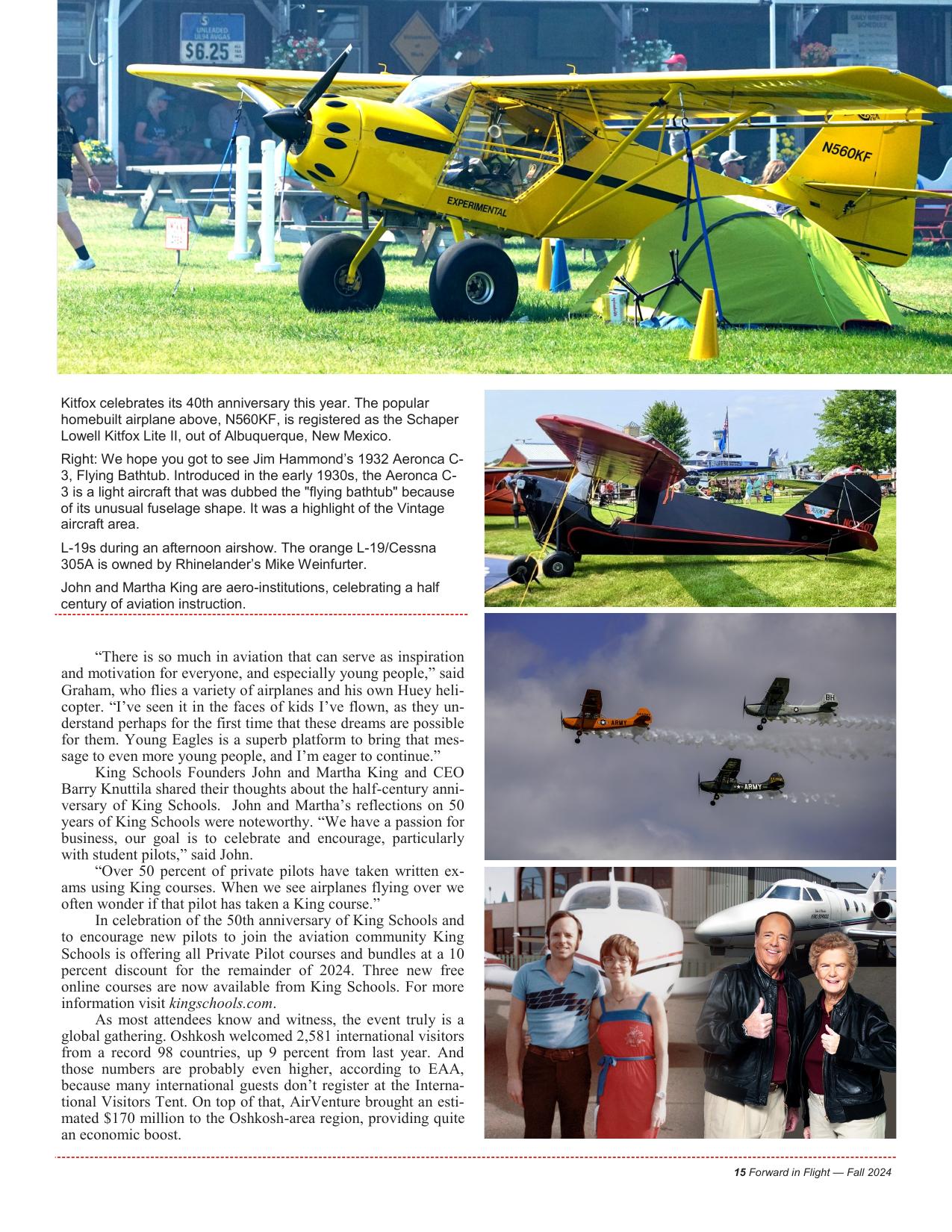
Kitfox celebrates its 40th anniversary this year. The popular homebuilt airplane above, N560KF, is registered as the Schaper Lowell Kitfox Lite II, out of Albuquerque, New Mexico. Right: We hope you got to see Jim Hammond’s 1932 Aeronca C3, Flying Bathtub. Introduced in the early 1930s, the Aeronca C3 is a light aircraft that was dubbed the "flying bathtub" because of its unusual fuselage shape. It was a highlight of the Vintage aircraft area. L-19s during an afternoon airshow. The orange L-19/Cessna 305A is owned by Rhinelander’s Mike Weinfurter. John and Martha King are aero-institutions, celebrating a half century of aviation instruction. “There is so much in aviation that can serve as inspiration and motivation for everyone, and especially young people,” said Graham, who flies a variety of airplanes and his own Huey helicopter. “I’ve seen it in the faces of kids I’ve flown, as they understand perhaps for the first time that these dreams are possible for them. Young Eagles is a superb platform to bring that message to even more young people, and I’m eager to continue.” King Schools Founders John and Martha King and CEO Barry Knuttila shared their thoughts about the half-century anniversary of King Schools. John and Martha’s reflections on 50 years of King Schools were noteworthy. “We have a passion for business, our goal is to celebrate and encourage, particularly with student pilots,” said John. “Over 50 percent of private pilots have taken written exams using King courses. When we see airplanes flying over we often wonder if that pilot has taken a King course.” In celebration of the 50th anniversary of King Schools and to encourage new pilots to join the aviation community King Schools is offering all Private Pilot courses and bundles at a 10 percent discount for the remainder of 2024. Three new free online courses are now available from King Schools. For more information visit kingschools.com. As most attendees know and witness, the event truly is a global gathering. Oshkosh welcomed 2,581 international visitors from a record 98 countries, up 9 percent from last year. And those numbers are probably even higher, according to EAA, because many international guests don’t register at the International Visitors Tent. On top of that, AirVenture brought an estimated $170 million to the Oshkosh-area region, providing quite an economic boost. 15 Forward in Flight — Fall 2024
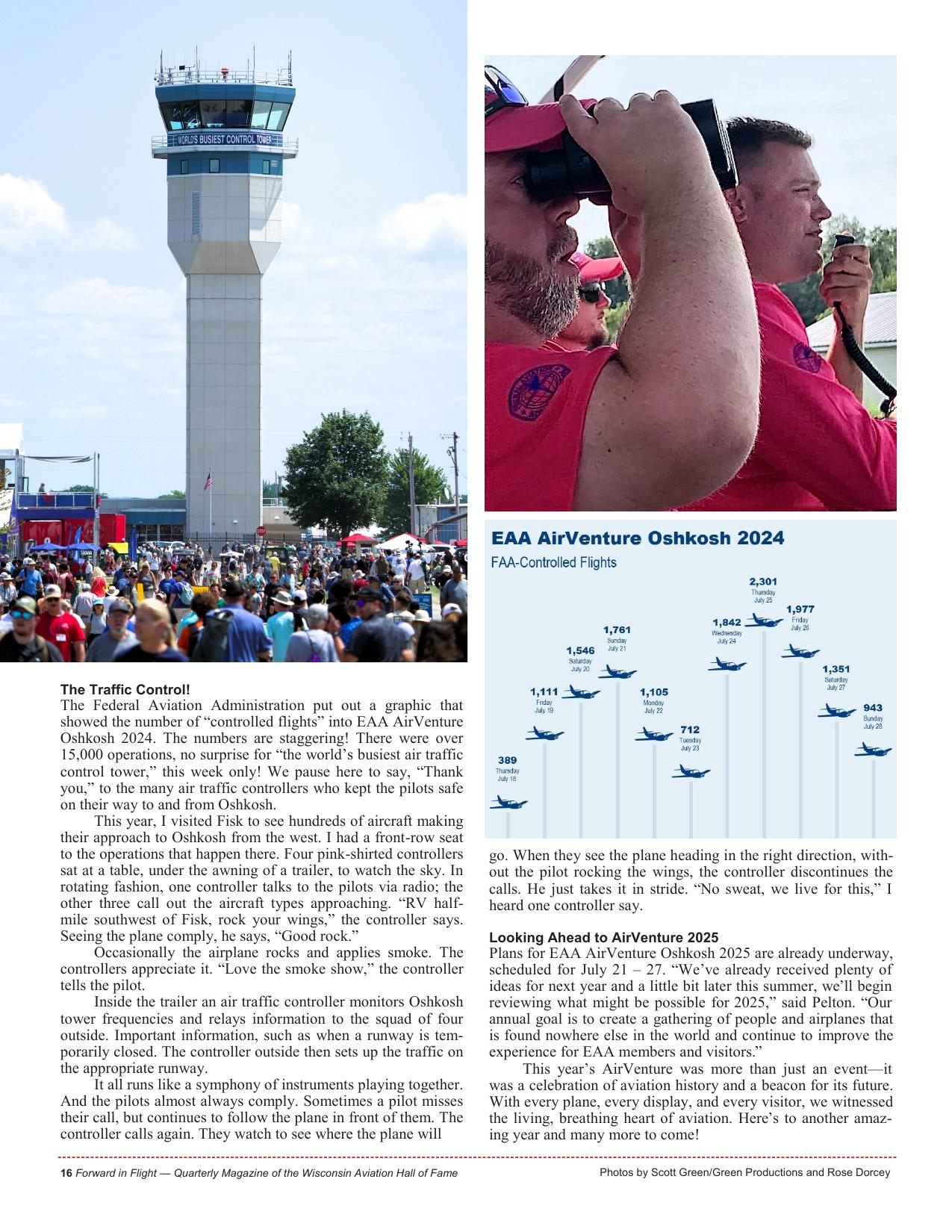
The Traffic Control! The Federal Aviation Administration put out a graphic that showed the number of “controlled flights” into EAA AirVenture Oshkosh 2024. The numbers are staggering! There were over 15,000 operations, no surprise for “the world’s busiest air traffic control tower,” this week only! We pause here to say, “Thank you,” to the many air traffic controllers who kept the pilots safe on their way to and from Oshkosh. This year, I visited Fisk to see hundreds of aircraft making their approach to Oshkosh from the west. I had a front-row seat to the operations that happen there. Four pink-shirted controllers sat at a table, under the awning of a trailer, to watch the sky. In rotating fashion, one controller talks to the pilots via radio; the other three call out the aircraft types approaching. “RV halfmile southwest of Fisk, rock your wings,” the controller says. Seeing the plane comply, he says, “Good rock.” Occasionally the airplane rocks and applies smoke. The controllers appreciate it. “Love the smoke show,” the controller tells the pilot. Inside the trailer an air traffic controller monitors Oshkosh tower frequencies and relays information to the squad of four outside. Important information, such as when a runway is temporarily closed. The controller outside then sets up the traffic on the appropriate runway. It all runs like a symphony of instruments playing together. And the pilots almost always comply. Sometimes a pilot misses their call, but continues to follow the plane in front of them. The controller calls again. They watch to see where the plane will 16 Forward in Flight — Quarterly Magazine of the Wisconsin Aviation Hall of Fame go. When they see the plane heading in the right direction, without the pilot rocking the wings, the controller discontinues the calls. He just takes it in stride. “No sweat, we live for this,” I heard one controller say. Looking Ahead to AirVenture 2025 Plans for EAA AirVenture Oshkosh 2025 are already underway, scheduled for July 21 – 27. “We’ve already received plenty of ideas for next year and a little bit later this summer, we’ll begin reviewing what might be possible for 2025,” said Pelton. “Our annual goal is to create a gathering of people and airplanes that is found nowhere else in the world and continue to improve the experience for EAA members and visitors.” This year’s AirVenture was more than just an event—it was a celebration of aviation history and a beacon for its future. With every plane, every display, and every visitor, we witnessed the living, breathing heart of aviation. Here’s to another amazing year and many more to come! Photos by Scott Green/Green Productions and Rose Dorcey
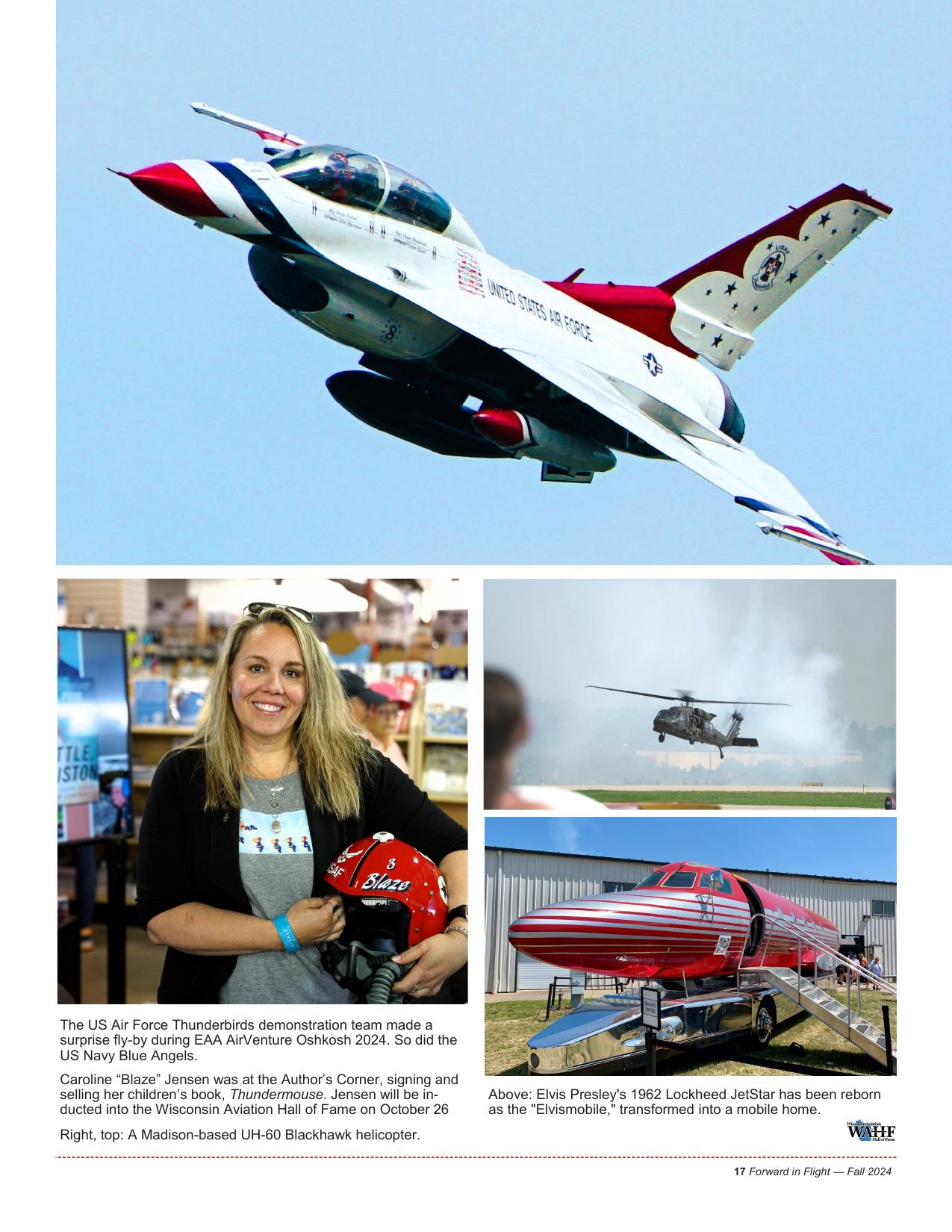
The US Air Force Thunderbirds demonstration team made a surprise fly-by during EAA AirVenture Oshkosh 2024. So did the US Navy Blue Angels. Caroline “Blaze” Jensen was at the Author’s Corner, signing and selling her children’s book, Thundermouse. Jensen will be inducted into the Wisconsin Aviation Hall of Fame on October 26 Above: Elvis Presley's 1962 Lockheed JetStar has been reborn as the "Elvismobile," transformed into a mobile home. Right, top: A Madison-based UH-60 Blackhawk helicopter. 17 Forward in Flight — Fall 2024
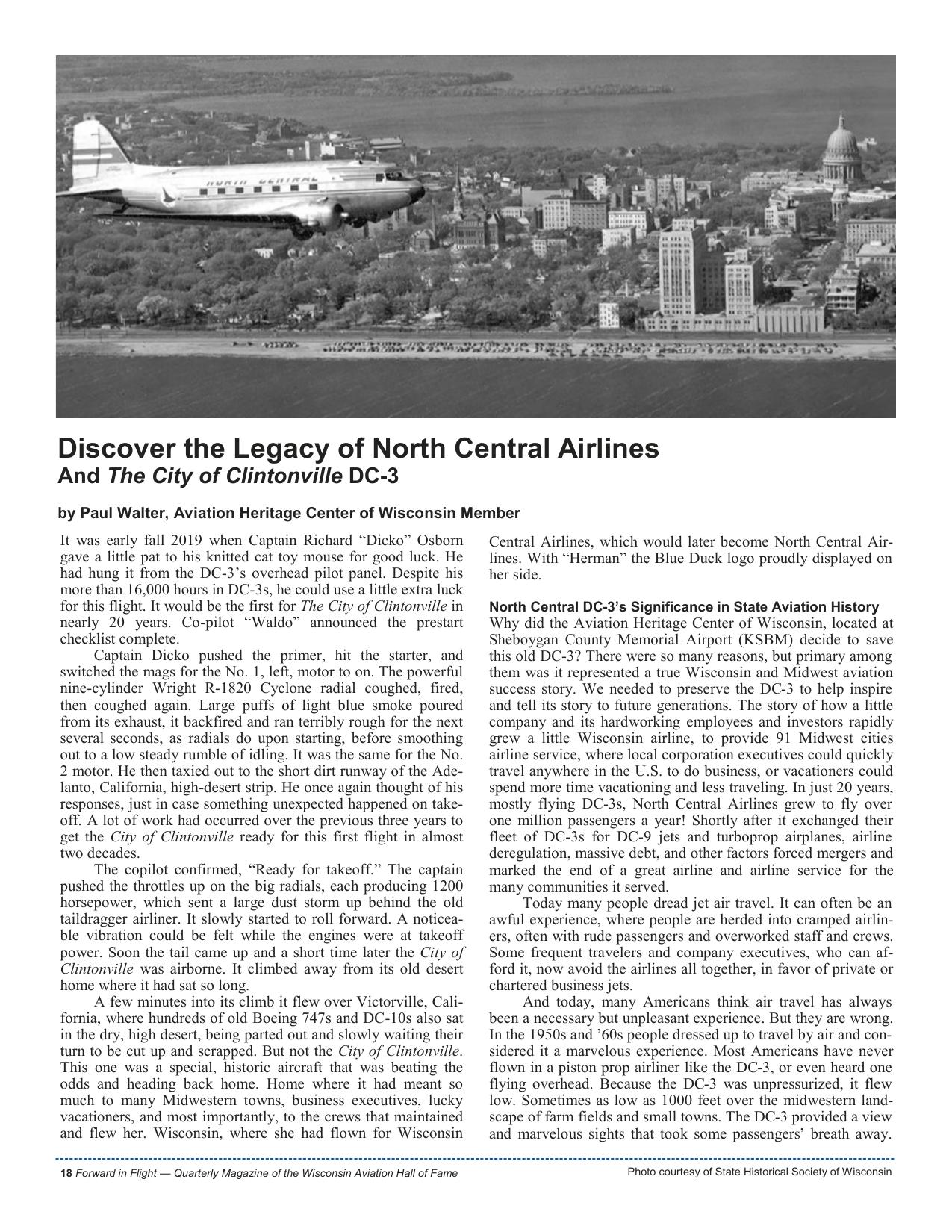
Discover the Legacy of North Central Airlines And The City of Clintonville DC-3 by Paul Walter, Aviation Heritage Center of Wisconsin Member It was early fall 2019 when Captain Richard “Dicko” Osborn gave a little pat to his knitted cat toy mouse for good luck. He had hung it from the DC-3’s overhead pilot panel. Despite his more than 16,000 hours in DC-3s, he could use a little extra luck for this flight. It would be the first for TheÊCityÊofÊClintonville in nearly 20 years. Co-pilot “Waldo” announced the prestart checklist complete. Captain Dicko pushed the primer, hit the starter, and switched the mags for the No. 1, left, motor to on. The powerful nine-cylinder Wright R-1820 Cyclone radial coughed, fired, then coughed again. Large puffs of light blue smoke poured from its exhaust, it backfired and ran terribly rough for the next several seconds, as radials do upon starting, before smoothing out to a low steady rumble of idling. It was the same for the No. 2 motor. He then taxied out to the short dirt runway of the Adelanto, California, high-desert strip. He once again thought of his responses, just in case something unexpected happened on takeoff. A lot of work had occurred over the previous three years to get the CityÊ ofÊ ClintonvilleÊ ready for this first flight in almost two decades. The copilot confirmed, “Ready for takeoff.” The captain pushed the throttles up on the big radials, each producing 1200 horsepower, which sent a large dust storm up behind the old taildragger airliner. It slowly started to roll forward. A noticeable vibration could be felt while the engines were at takeoff power. Soon the tail came up and a short time later the CityÊofÊ Clintonville was airborne. It climbed away from its old desert home where it had sat so long. A few minutes into its climb it flew over Victorville, California, where hundreds of old Boeing 747s and DC-10s also sat in the dry, high desert, being parted out and slowly waiting their turn to be cut up and scrapped. But not the CityÊofÊClintonville. This one was a special, historic aircraft that was beating the odds and heading back home. Home where it had meant so much to many Midwestern towns, business executives, lucky vacationers, and most importantly, to the crews that maintained and flew her. Wisconsin, where she had flown for Wisconsin 18 Forward in Flight — Quarterly Magazine of the Wisconsin Aviation Hall of Fame Central Airlines, which would later become North Central Airlines. With “Herman” the Blue Duck logo proudly displayed on her side. North Central DC-3’s Significance in State Aviation History Why did the Aviation Heritage Center of Wisconsin, located at Sheboygan County Memorial Airport (KSBM) decide to save this old DC-3? There were so many reasons, but primary among them was it represented a true Wisconsin and Midwest aviation success story. We needed to preserve the DC-3 to help inspire and tell its story to future generations. The story of how a little company and its hardworking employees and investors rapidly grew a little Wisconsin airline, to provide 91 Midwest cities airline service, where local corporation executives could quickly travel anywhere in the U.S. to do business, or vacationers could spend more time vacationing and less traveling. In just 20 years, mostly flying DC-3s, North Central Airlines grew to fly over one million passengers a year! Shortly after it exchanged their fleet of DC-3s for DC-9 jets and turboprop airplanes, airline deregulation, massive debt, and other factors forced mergers and marked the end of a great airline and airline service for the many communities it served. Today many people dread jet air travel. It can often be an awful experience, where people are herded into cramped airliners, often with rude passengers and overworked staff and crews. Some frequent travelers and company executives, who can afford it, now avoid the airlines all together, in favor of private or chartered business jets. And today, many Americans think air travel has always been a necessary but unpleasant experience. But they are wrong. In the 1950s and ’60s people dressed up to travel by air and considered it a marvelous experience. Most Americans have never flown in a piston prop airliner like the DC-3, or even heard one flying overhead. Because the DC-3 was unpressurized, it flew low. Sometimes as low as 1000 feet over the midwestern landscape of farm fields and small towns. The DC-3 provided a view and marvelous sights that took some passengers’ breath away. Photo courtesy of State Historical Society of Wisconsin
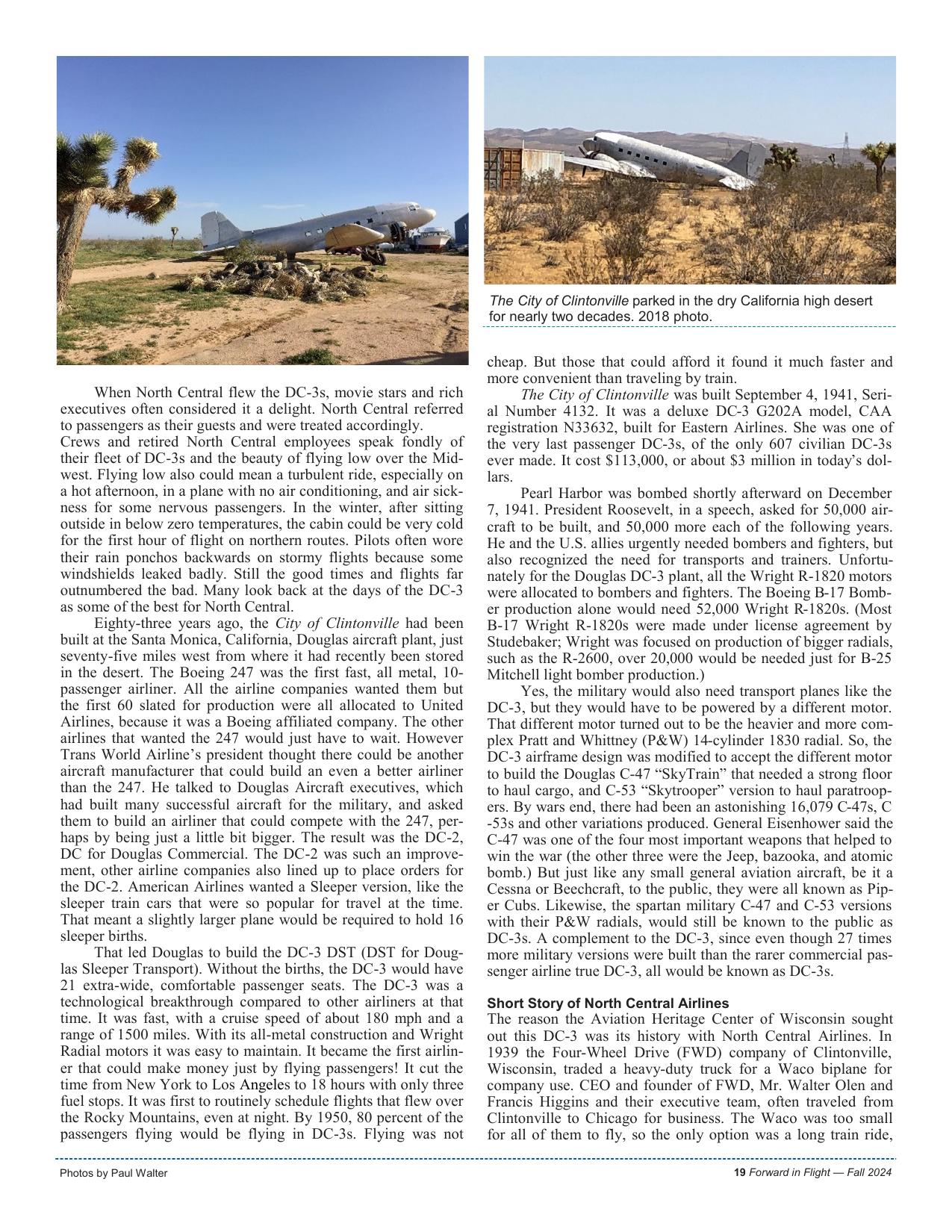
The City of Clintonville parked in the dry California high desert for nearly two decades. 2018 photo. When North Central flew the DC-3s, movie stars and rich executives often considered it a delight. North Central referred to passengers as their guests and were treated accordingly. Crews and retired North Central employees speak fondly of their fleet of DC-3s and the beauty of flying low over the Midwest. Flying low also could mean a turbulent ride, especially on a hot afternoon, in a plane with no air conditioning, and air sickness for some nervous passengers. In the winter, after sitting outside in below zero temperatures, the cabin could be very cold for the first hour of flight on northern routes. Pilots often wore their rain ponchos backwards on stormy flights because some windshields leaked badly. Still the good times and flights far outnumbered the bad. Many look back at the days of the DC-3 as some of the best for North Central. Eighty-three years ago, theÊ CityÊ ofÊ Clintonville had been built at the Santa Monica, California, Douglas aircraft plant, just seventy-five miles west from where it had recently been stored in the desert. The Boeing 247 was the first fast, all metal, 10passenger airliner. All the airline companies wanted them but the first 60 slated for production were all allocated to United Airlines, because it was a Boeing affiliated company. The other airlines that wanted the 247 would just have to wait. However Trans World Airline’s president thought there could be another aircraft manufacturer that could build an even a better airliner than the 247. He talked to Douglas Aircraft executives, which had built many successful aircraft for the military, and asked them to build an airliner that could compete with the 247, perhaps by being just a little bit bigger. The result was the DC-2, DC for Douglas Commercial. The DC-2 was such an improvement, other airline companies also lined up to place orders for the DC-2. American Airlines wanted a Sleeper version, like the sleeper train cars that were so popular for travel at the time. That meant a slightly larger plane would be required to hold 16 sleeper births. That led Douglas to build the DC-3 DST (DST for Douglas Sleeper Transport). Without the births, the DC-3 would have 21 extra-wide, comfortable passenger seats. The DC-3 was a technological breakthrough compared to other airliners at that time. It was fast, with a cruise speed of about 180 mph and a range of 1500 miles. With its all-metal construction and Wright Radial motors it was easy to maintain. It became the first airliner that could make money just by flying passengers! It cut the time from New York to Los Angeles to 18 hours with only three fuel stops. It was first to routinely schedule flights that flew over the Rocky Mountains, even at night. By 1950, 80 percent of the passengers flying would be flying in DC-3s. Flying was not Photos by Paul Walter cheap. But those that could afford it found it much faster and more convenient than traveling by train. TheÊCityÊofÊClintonvilleÊwas built September 4, 1941, Serial Number 4132. It was a deluxe DC-3 G202A model, CAA registration N33632, built for Eastern Airlines. She was one of the very last passenger DC-3s, of the only 607 civilian DC-3s ever made. It cost $113,000, or about $3 million in today’s dollars. Pearl Harbor was bombed shortly afterward on December 7, 1941. President Roosevelt, in a speech, asked for 50,000 aircraft to be built, and 50,000 more each of the following years. He and the U.S. allies urgently needed bombers and fighters, but also recognized the need for transports and trainers. Unfortunately for the Douglas DC-3 plant, all the Wright R-1820 motors were allocated to bombers and fighters. The Boeing B-17 Bomber production alone would need 52,000 Wright R-1820s. (Most B-17 Wright R-1820s were made under license agreement by Studebaker; Wright was focused on production of bigger radials, such as the R-2600, over 20,000 would be needed just for B-25 Mitchell light bomber production.) Yes, the military would also need transport planes like the DC-3, but they would have to be powered by a different motor. That different motor turned out to be the heavier and more complex Pratt and Whittney (P&W) 14-cylinder 1830 radial. So, the DC-3 airframe design was modified to accept the different motor to build the Douglas C-47 “SkyTrain” that needed a strong floor to haul cargo, and C-53 “Skytrooper” version to haul paratroopers. By wars end, there had been an astonishing 16,079 C-47s, C -53s and other variations produced. General Eisenhower said the C-47 was one of the four most important weapons that helped to win the war (the other three were the Jeep, bazooka, and atomic bomb.) But just like any small general aviation aircraft, be it a Cessna or Beechcraft, to the public, they were all known as Piper Cubs. Likewise, the spartan military C-47 and C-53 versions with their P&W radials, would still be known to the public as DC-3s. A complement to the DC-3, since even though 27 times more military versions were built than the rarer commercial passenger airline true DC-3, all would be known as DC-3s. Short Story of North Central Airlines The reason the Aviation Heritage Center of Wisconsin sought out this DC-3 was its history with North Central Airlines. In 1939 the Four-Wheel Drive (FWD) company of Clintonville, Wisconsin, traded a heavy-duty truck for a Waco biplane for company use. CEO and founder of FWD, Mr. Walter Olen and Francis Higgins and their executive team, often traveled from Clintonville to Chicago for business. The Waco was too small for all of them to fly, so the only option was a long train ride, 19 Forward in Flight — Fall 2024
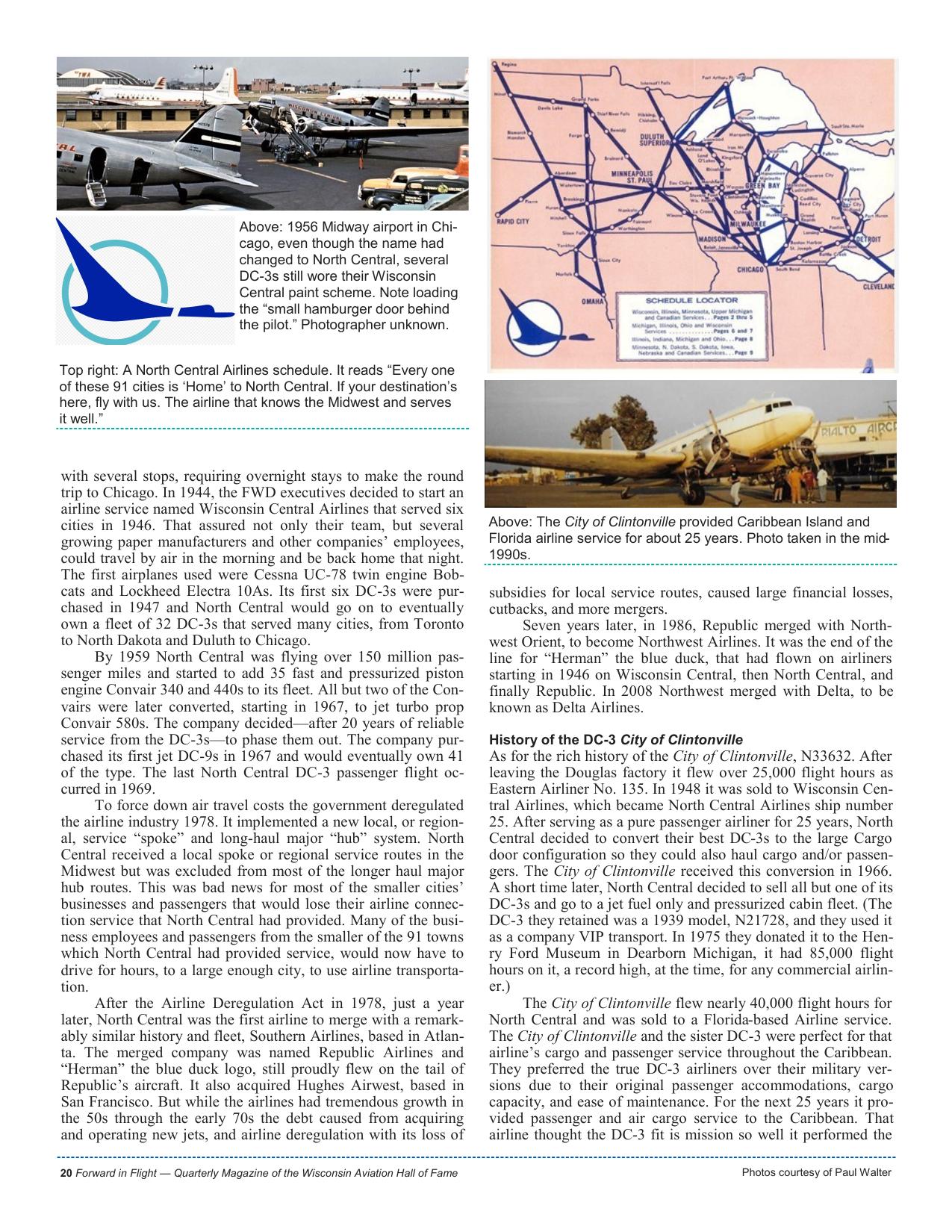
Above: 1956 Midway airport in Chicago, even though the name had changed to North Central, several DC-3s still wore their Wisconsin Central paint scheme. Note loading the “small hamburger door behind the pilot.” Photographer unknown. Top right: A North Central Airlines schedule. It reads “Every one of these 91 cities is ‘Home’ to North Central. If your destination’s here, fly with us. The airline that knows the Midwest and serves it well.” with several stops, requiring overnight stays to make the round trip to Chicago. In 1944, the FWD executives decided to start an airline service named Wisconsin Central Airlines that served six cities in 1946. That assured not only their team, but several growing paper manufacturers and other companies’ employees, could travel by air in the morning and be back home that night. The first airplanes used were Cessna UC-78 twin engine Bobcats and Lockheed Electra 10As. Its first six DC-3s were purchased in 1947 and North Central would go on to eventually own a fleet of 32 DC-3s that served many cities, from Toronto to North Dakota and Duluth to Chicago. By 1959 North Central was flying over 150 million passenger miles and started to add 35 fast and pressurized piston engine Convair 340 and 440s to its fleet. All but two of the Convairs were later converted, starting in 1967, to jet turbo prop Convair 580s. The company decided—after 20 years of reliable service from the DC-3s—to phase them out. The company purchased its first jet DC-9s in 1967 and would eventually own 41 of the type. The last North Central DC-3 passenger flight occurred in 1969. To force down air travel costs the government deregulated the airline industry 1978. It implemented a new local, or regional, service “spoke” and long-haul major “hub” system. North Central received a local spoke or regional service routes in the Midwest but was excluded from most of the longer haul major hub routes. This was bad news for most of the smaller cities’ businesses and passengers that would lose their airline connection service that North Central had provided. Many of the business employees and passengers from the smaller of the 91 towns which North Central had provided service, would now have to drive for hours, to a large enough city, to use airline transportation. After the Airline Deregulation Act in 1978, just a year later, North Central was the first airline to merge with a remarkably similar history and fleet, Southern Airlines, based in Atlanta. The merged company was named Republic Airlines and “Herman” the blue duck logo, still proudly flew on the tail of Republic’s aircraft. It also acquired Hughes Airwest, based in San Francisco. But while the airlines had tremendous growth in the 50s through the early 70s the debt caused from acquiring and operating new jets, and airline deregulation with its loss of 20 Forward in Flight — Quarterly Magazine of the Wisconsin Aviation Hall of Fame Above: The City of Clintonville provided Caribbean Island and Florida airline service for about 25 years. Photo taken in the mid1990s. subsidies for local service routes, caused large financial losses, cutbacks, and more mergers. Seven years later, in 1986, Republic merged with Northwest Orient, to become Northwest Airlines. It was the end of the line for “Herman” the blue duck, that had flown on airliners starting in 1946 on Wisconsin Central, then North Central, and finally Republic. In 2008 Northwest merged with Delta, to be known as Delta Airlines. History of the DC-3 City of Clintonville As for the rich history of the CityÊofÊClintonville, N33632. After leaving the Douglas factory it flew over 25,000 flight hours as Eastern Airliner No. 135. In 1948 it was sold to Wisconsin Central Airlines, which became North Central Airlines ship number 25. After serving as a pure passenger airliner for 25 years, North Central decided to convert their best DC-3s to the large Cargo door configuration so they could also haul cargo and/or passengers. The CityÊofÊClintonville received this conversion in 1966. A short time later, North Central decided to sell all but one of its DC-3s and go to a jet fuel only and pressurized cabin fleet. (The DC-3 they retained was a 1939 model, N21728, and they used it as a company VIP transport. In 1975 they donated it to the Henry Ford Museum in Dearborn Michigan, it had 85,000 flight hours on it, a record high, at the time, for any commercial airliner.) The CityÊofÊClintonville flew nearly 40,000 flight hours for North Central and was sold to a Florida-based Airline service. The CityÊofÊClintonvilleÊand the sister DC-3 were perfect for that airline’s cargo and passenger service throughout the Caribbean. They preferred the true DC-3 airliners over their military versions due to their original passenger accommodations, cargo capacity, and ease of maintenance. For the next 25 years it provided passenger and air cargo service to the Caribbean. That airline thought the DC-3 fit is mission so well it performed the Photos courtesy of Paul Walter
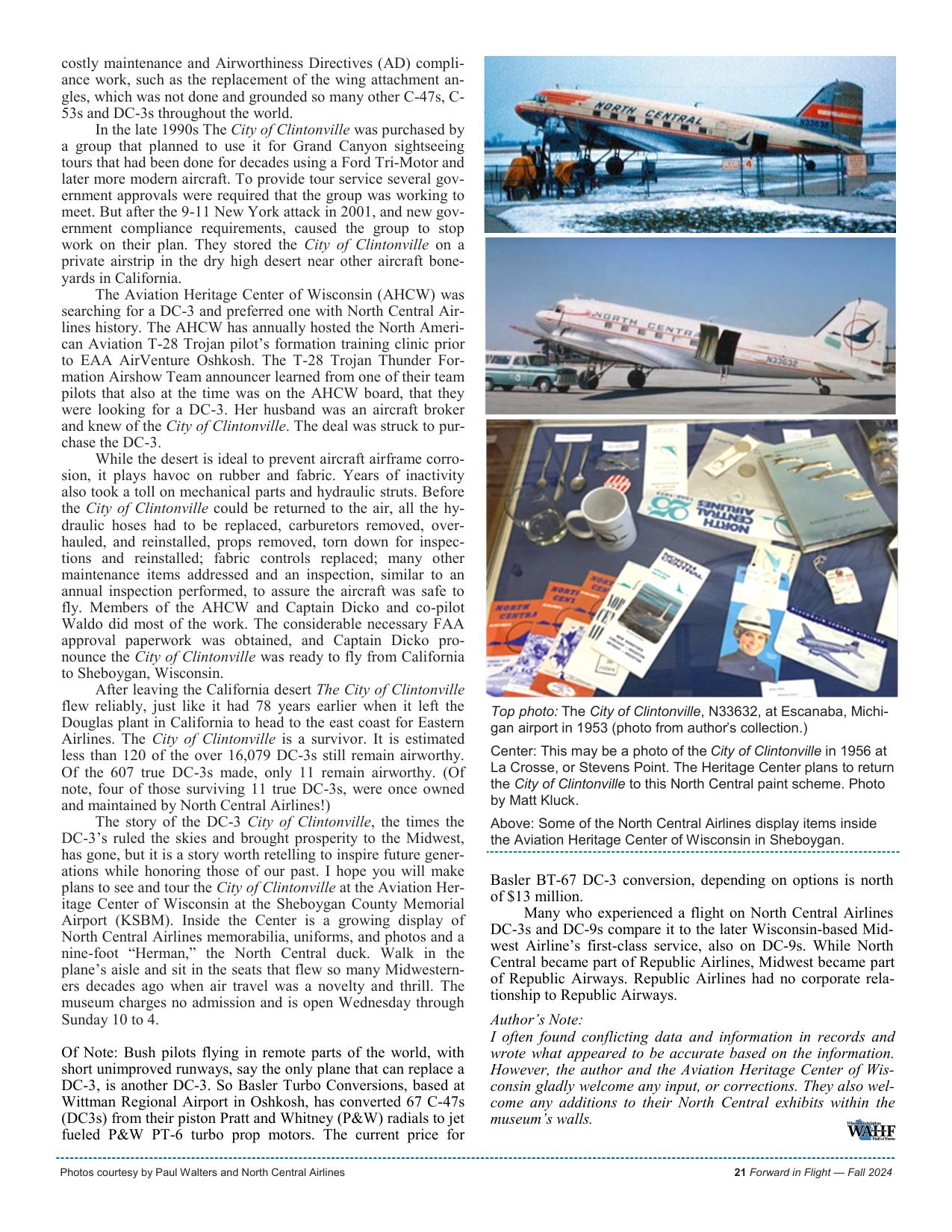
costly maintenance and Airworthiness Directives (AD) compliance work, such as the replacement of the wing attachment angles, which was not done and grounded so many other C-47s, C53s and DC-3s throughout the world. In the late 1990s The CityÊofÊClintonvilleÊwas purchased by a group that planned to use it for Grand Canyon sightseeing tours that had been done for decades using a Ford Tri-Motor and later more modern aircraft. To provide tour service several government approvals were required that the group was working to meet. But after the 9-11 New York attack in 2001, and new government compliance requirements, caused the group to stop work on their plan. They stored the CityÊ ofÊ Clintonville on a private airstrip in the dry high desert near other aircraft boneyards in California. The Aviation Heritage Center of Wisconsin (AHCW) was searching for a DC-3 and preferred one with North Central Airlines history. The AHCW has annually hosted the North American Aviation T-28 Trojan pilot’s formation training clinic prior to EAA AirVenture Oshkosh. The T-28 Trojan Thunder Formation Airshow Team announcer learned from one of their team pilots that also at the time was on the AHCW board, that they were looking for a DC-3. Her husband was an aircraft broker and knew of the CityÊofÊClintonville. The deal was struck to purchase the DC-3. While the desert is ideal to prevent aircraft airframe corrosion, it plays havoc on rubber and fabric. Years of inactivity also took a toll on mechanical parts and hydraulic struts. Before the CityÊofÊClintonvilleÊcould be returned to the air, all the hydraulic hoses had to be replaced, carburetors removed, overhauled, and reinstalled, props removed, torn down for inspections and reinstalled; fabric controls replaced; many other maintenance items addressed and an inspection, similar to an annual inspection performed, to assure the aircraft was safe to fly. Members of the AHCW and Captain Dicko and co-pilot Waldo did most of the work. The considerable necessary FAA approval paperwork was obtained, and Captain Dicko pronounce the CityÊofÊClintonvilleÊwas ready to fly from California to Sheboygan, Wisconsin. After leaving the California desert TheÊCityÊofÊClintonville flew reliably, just like it had 78 years earlier when it left the Douglas plant in California to head to the east coast for Eastern Airlines. TheÊ CityÊ ofÊ Clintonville is a survivor. It is estimated less than 120 of the over 16,079 DC-3s still remain airworthy. Of the 607 true DC-3s made, only 11 remain airworthy. (Of note, four of those surviving 11 true DC-3s, were once owned and maintained by North Central Airlines!) The story of the DC-3 CityÊ ofÊ Clintonville, the times the DC-3’s ruled the skies and brought prosperity to the Midwest, has gone, but it is a story worth retelling to inspire future generations while honoring those of our past. I hope you will make plans to see and tour the CityÊofÊClintonvilleÊat the Aviation Heritage Center of Wisconsin at the Sheboygan CountyÊ Memorial Airport (KSBM). Inside the Center is a growing display of North Central Airlines memorabilia, uniforms, and photos and a nine-foot “Herman,” the North Central duck. Walk in the plane’s aisle and sit in the seats that flew so many Midwesterners decades ago when air travel was a novelty and thrill. The museum charges no admission and is open Wednesday through Sunday 10 to 4. Of Note: Bush pilots flying in remote parts of the world, with short unimproved runways, say the only plane that can replace a DC-3, is another DC-3. So Basler Turbo Conversions, based at Wittman Regional Airport in Oshkosh, has converted 67 C-47s (DC3s) from their piston Pratt and Whitney (P&W) radials to jet fueled P&W PT-6 turbo prop motors. The current price for Photos courtesy by Paul Walters and North Central Airlines Top photo: The City of Clintonville, N33632, at Escanaba, Michigan airport in 1953 (photo from author’s collection.) Center: This may be a photo of the City of Clintonville in 1956 at La Crosse, or Stevens Point. The Heritage Center plans to return the City of Clintonville to this North Central paint scheme. Photo by Matt Kluck. Above: Some of the North Central Airlines display items inside the Aviation Heritage Center of Wisconsin in Sheboygan. Basler BT-67 DC-3 conversion, depending on options is north of $13 million. Many who experienced a flight on North Central Airlines DC-3s and DC-9s compare it to the later Wisconsin-based Midwest Airline’s first-class service, also on DC-9s. While North Central became part of Republic Airlines, Midwest became part of Republic Airways. Republic Airlines had no corporate relationship to Republic Airways. Author’sÊNote: IÊ oftenÊ foundÊ conflictingÊ dataÊ andÊ informationÊ inÊ recordsÊ andÊ wroteÊ whatÊappearedÊtoÊbeÊaccurateÊbasedÊonÊtheÊinformation.Ê However,ÊtheÊauthorÊandÊtheÊAviationÊHeritageÊCenterÊofÊ WisconsinÊgladlyÊwelcomeÊanyÊinput,ÊorÊcorrections.ÊTheyÊalsoÊwelcomeÊ anyÊ additionsÊ toÊ theirÊ NorthÊ CentralÊ exhibitsÊ withinÊ theÊ museum’sÊwalls. 21 Forward in Flight — Fall 2024
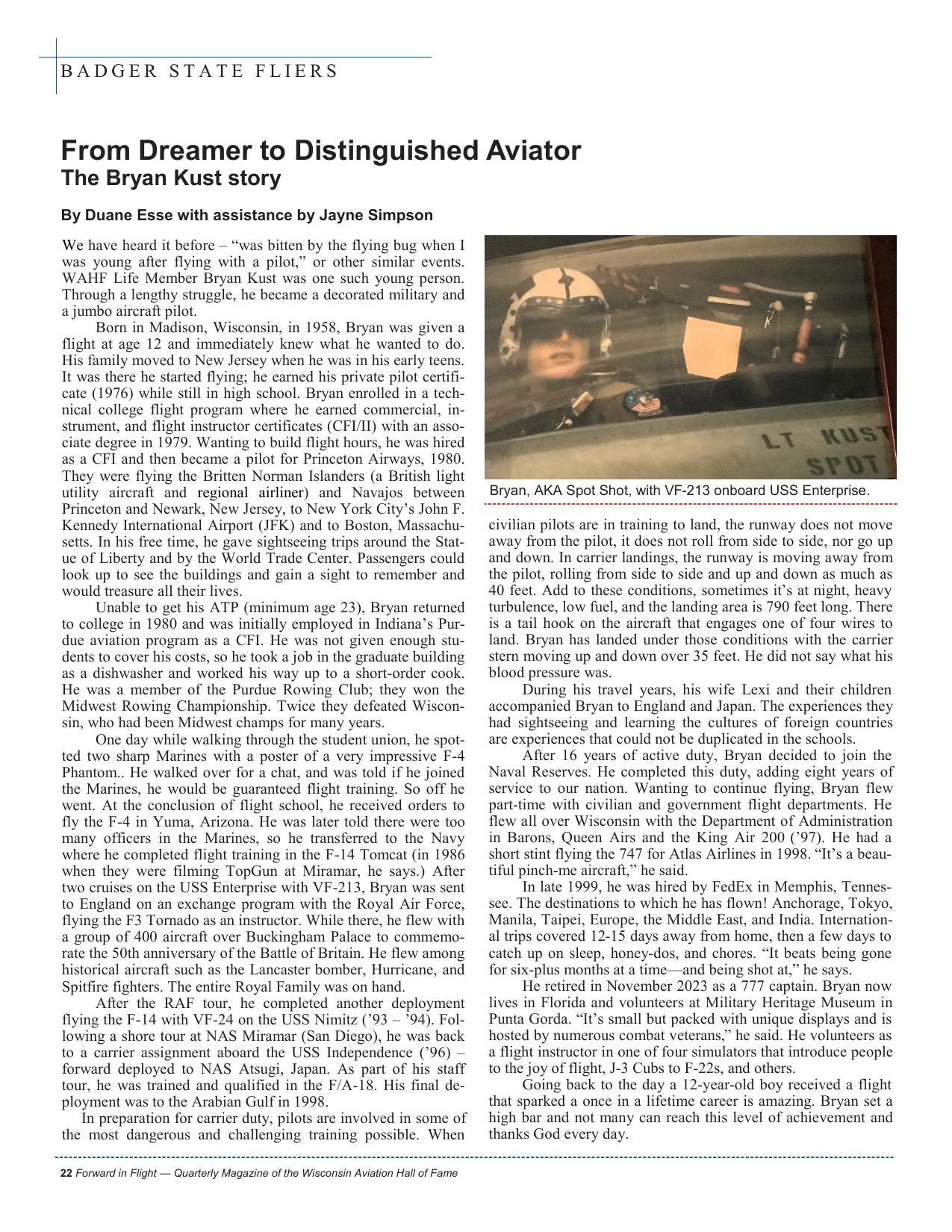
BADGER STATE FLIERS From Dreamer to Distinguished Aviator The Bryan Kust story By Duane Esse with assistance by Jayne Simpson We have heard it before – “was bitten by the flying bug when I was young after flying with a pilot,” or other similar events. WAHF Life Member Bryan Kust was one such young person. Through a lengthy struggle, he became a decorated military and a jumbo aircraft pilot. Born in Madison, Wisconsin, in 1958, Bryan was given a flight at age 12 and immediately knew what he wanted to do. His family moved to New Jersey when he was in his early teens. It was there he started flying; he earned his private pilot certificate (1976) while still in high school. Bryan enrolled in a technical college flight program where he earned commercial, instrument, and flight instructor certificates (CFI/II) with an associate degree in 1979. Wanting to build flight hours, he was hired as a CFI and then became a pilot for Princeton Airways, 1980. They were flying the Britten Norman Islanders (a British light utility aircraft and regional airliner) and Navajos between Princeton and Newark, New Jersey, to New York City’s John F. Kennedy International Airport (JFK) and to Boston, Massachusetts. In his free time, he gave sightseeing trips around the Statue of Liberty and by the World Trade Center. Passengers could look up to see the buildings and gain a sight to remember and would treasure all their lives. Unable to get his ATP (minimum age 23), Bryan returned to college in 1980 and was initially employed in Indiana’s Purdue aviation program as a CFI. He was not given enough students to cover his costs, so he took a job in the graduate building as a dishwasher and worked his way up to a short-order cook. He was a member of the Purdue Rowing Club; they won the Midwest Rowing Championship. Twice they defeated Wisconsin, who had been Midwest champs for many years. One day while walking through the student union, he spotted two sharp Marines with a poster of a very impressive F-4 Phantom.. He walked over for a chat, and was told if he joined the Marines, he would be guaranteed flight training. So off he went. At the conclusion of flight school, he received orders to fly the F-4 in Yuma, Arizona. He was later told there were too many officers in the Marines, so he transferred to the Navy where he completed flight training in the F-14 Tomcat (in 1986 when they were filming TopGun at Miramar, he says.) After two cruises on the USS Enterprise with VF-213, Bryan was sent to England on an exchange program with the Royal Air Force, flying the F3 Tornado as an instructor. While there, he flew with a group of 400 aircraft over Buckingham Palace to commemorate the 50th anniversary of the Battle of Britain. He flew among historical aircraft such as the Lancaster bomber, Hurricane, and Spitfire fighters. The entire Royal Family was on hand. After the RAF tour, he completed another deployment flying the F-14 with VF-24 on the USS Nimitz (’93 – ’94). Following a shore tour at NAS Miramar (San Diego), he was back to a carrier assignment aboard the USS Independence (’96) – forward deployed to NAS Atsugi, Japan. As part of his staff tour, he was trained and qualified in the F/A-18. His final deployment was to the Arabian Gulf in 1998. In preparation for carrier duty, pilots are involved in some of the most dangerous and challenging training possible. When 22 Forward in Flight — Quarterly Magazine of the Wisconsin Aviation Hall of Fame Bryan, AKA Spot Shot, with VF-213 onboard USS Enterprise. civilian pilots are in training to land, the runway does not move away from the pilot, it does not roll from side to side, nor go up and down. In carrier landings, the runway is moving away from the pilot, rolling from side to side and up and down as much as 40 feet. Add to these conditions, sometimes it’s at night, heavy turbulence, low fuel, and the landing area is 790 feet long. There is a tail hook on the aircraft that engages one of four wires to land. Bryan has landed under those conditions with the carrier stern moving up and down over 35 feet. He did not say what his blood pressure was. During his travel years, his wife Lexi and their children accompanied Bryan to England and Japan. The experiences they had sightseeing and learning the cultures of foreign countries are experiences that could not be duplicated in the schools. After 16 years of active duty, Bryan decided to join the Naval Reserves. He completed this duty, adding eight years of service to our nation. Wanting to continue flying, Bryan flew part-time with civilian and government flight departments. He flew all over Wisconsin with the Department of Administration in Barons, Queen Airs and the King Air 200 (’97). He had a short stint flying the 747 for Atlas Airlines in 1998. “It’s a beautiful pinch-me aircraft,” he said. In late 1999, he was hired by FedEx in Memphis, Tennessee. The destinations to which he has flown! Anchorage, Tokyo, Manila, Taipei, Europe, the Middle East, and India. International trips covered 12-15 days away from home, then a few days to catch up on sleep, honey-dos, and chores. “It beats being gone for six-plus months at a time—and being shot at,” he says. He retired in November 2023 as a 777 captain. Bryan now lives in Florida and volunteers at Military Heritage Museum in Punta Gorda. “It’s small but packed with unique displays and is hosted by numerous combat veterans,” he said. He volunteers as a flight instructor in one of four simulators that introduce people to the joy of flight, J-3 Cubs to F-22s, and others. Going back to the day a 12-year-old boy received a flight that sparked a once in a lifetime career is amazing. Bryan set a high bar and not many can reach this level of achievement and thanks God every day.
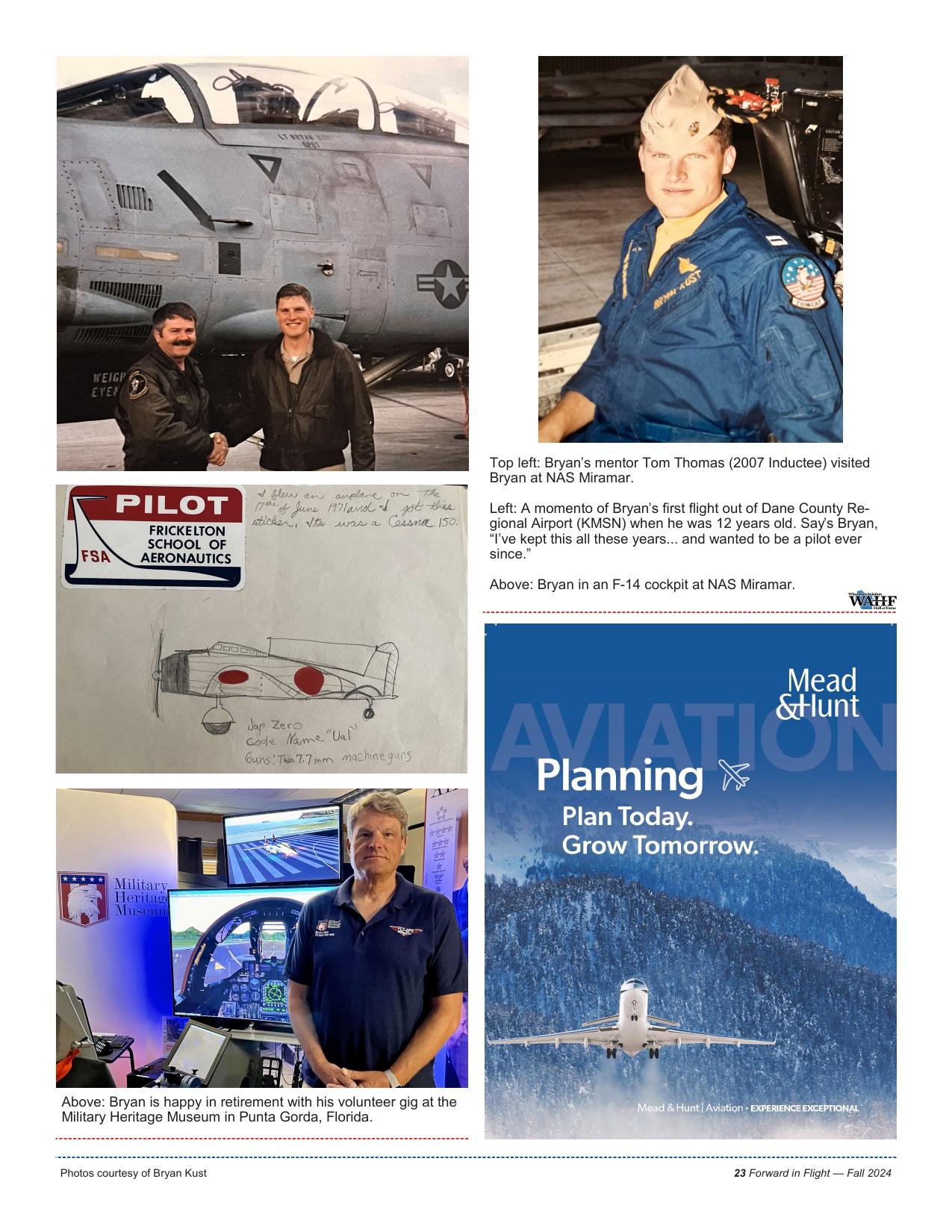
Top left: Bryan’s mentor Tom Thomas (2007 Inductee) visited Bryan at NAS Miramar. Left: A momento of Bryan’s first flight out of Dane County Regional Airport (KMSN) when he was 12 years old. Say’s Bryan, “I’ve kept this all these years... and wanted to be a pilot ever since.” Above: Bryan in an F-14 cockpit at NAS Miramar. Above: Bryan is happy in retirement with his volunteer gig at the Military Heritage Museum in Punta Gorda, Florida. Photos courtesy of Bryan Kust 23 Forward in Flight — Fall 2024
TALES OF THE ACES Badger Aces of the Mighty Eighth Part II By Michael O’Connor The U. S. Army Air Force went to war on December 7, 1941, with an unshakeable belief in the war-winning power of its B17 and B-24 bombers. So-called ‘bomber mafia’ generals believed that compact formations of those heavily armed bombers could fight their way through any enemy defenses and devastate their factories, railyards, airfields, and other targets while suffering minimum losses. In February 1942, the Eighth Air Force was established in England to carry out a daylight strategic bombing campaign against Nazi Germany. Initial missions seemed to confirm the ‘bomber will always get through’ mantra but USAAF commanders failed to realize Germany needed time to devise and implement effective tactics and weaponry. Once Luftwaffe fighter units and German antiaircraft batteries took the measure of the ‘Mighty Eighth’ strikes, U. S. losses began to mount. By the fall of 1943, losses had become so severe that they brought into question the sustainability of the daylight bomber offensive. Then, on October 14, 1943, the Eighth Air Force hit the Schweinfurt ball-bearing factories and suffered the disastrous loss of 60 B-17s and 600 crewmen! The entire bomber campaign was called into question. Fighter escorts for the ‘Big Friends’ were clearly needed. Republic P-47 Thunderbolts and Lockheed P-38 Lightnings were initially deployed as escorts, but both had deficiencies. The ‘Jug’ was short-ranged and couldn’t cover the bombers all the way to targets in Germany. Likewise, the P-38 Lighting experienced serious engine and mechanical difficulties. At its moment of greatest peril, the Eighth Air Force was saved by the introduction of the North American P-51 Mustang in early 1944. Originally designed as a fighter-bomber, the Mustang was re-engined and became a warwinning design that enabled the Eighth Air Force to safely prosecute its daylight offensive. During World War II, over 260 Eighth Air Force pilots became aces. Many scored all or most of their victories while flying the Mustang. Three of those aces were from Wisconsin. Two Badger Mustang Aces flew with the 357th Fighter Group, the legendary YoxfordÊBoys, which ended the war as one of the Eighth Air Force’s top-scoring fighter groups. LeRoy Ruder was born in Nekoosa on May 22, 1921. A 1939 graduate of Alexander Senior High School, he was working at the Port Edwards Paper Mill when war broke out, subsequently enlisting in August 1942. After flight training, Ruder was assigned to the 364th Fighter Squadron, 357th Fighter Group. The 357th began operations in February 1944 with Ruder claiming his first kills on the momentous March 6th strike on Berlin. That Berlin mission marked the turning point in the Mighty Eighth’s air war. Seven hundred bombers escorted by 800 fighters successfully hit the German capital, prompting Hermann Goering to acknowledge “the jig is up.” On the 6th, 120-plus Messerschmitt 109s, ’110s, and ’410s swarmed in on bombers protected by the 357th FG. Ruder downed one of the ’110 attackers, shared a second with another pilot, and chased a ’109 to tree-top level. Though he didn’t down this last fighter, he “did scare the hell out of him.” One month later, on April 11, LeRoy Ruder claimed a Focke-Wulf 190 while escorting bombers to Magdeburg. By now, Ruder had a regularly assigned Mustang, which he named LindaÊLou. May turned out to be a productive month for the Nekoosa native, Ruder downing three Luftwaffe fighters. On May 19, he downed a FW-190 west of Berlin. Spotting Luftwaffe fighters above, he climbed and targeted one of the FWs, scoring “numerous hits on the fuselage and wings.” The Luftwaffe pilot went into frantic maneuvers but Ruder held on. He scored so many hits that the ‘190 “fell apart (and) the enemy aircraft tumbled toward the ground, end over end.” On May 27, a Messerschmitt 109 fell to Ruder’s guns followed by the magical fifth kill 24 hours later. On the 28th, 24 Forward in Flight — Quarterly Magazine of the Wisconsin Aviation Hall of Fame the 357th tore into a 100-plus Luftwaffe formation near Magdeburg. Ruder scored “numerous strikes on the cockpit and fuselage” of one of the ’109 attackers. As the ’109 dropped down in a vertical dive, its pilot bailed out. Sadly, a week later, LeRoy Ruder was killed, shot down while flying in support of the June 6th D-Day invasion. During the mission, he experienced engine trouble and dropped down to make a forced landing. A nearby German antiaircraft battery opened fire and Ruder crashed to his death. His 5 ½ victories resulted in two Distinguished Flying Crosses, four Air Medals, and a Purple Heart. The second Eighth Air Force Badger Ace who flew Mustangs was Irwin Dregne, who served as the 357th’s last wartime commander. Dregne’s career was extensively covered in an earlier ForwardÊinÊFlightÊ article. Herein follows a short synopsis of the life and times of this notable ace and fighter leader. Born on January 2, 1917, in Franklin, Dregne grew up in Viroqua. He left the University of Wisconsin-Madison to enlist in April 1941. By November 1943, he was the 357th FG’s Operations Officer, flying a P-51B named BobbyÊJeanne after his wife and daughter. Dregne’s first confirmed victory – a Messerschmitt 109 – came on May 12, 1944, followed by another ’109 on the 19th. In October, Dregne became Deputy Group Commander. On December 2, he was made Group Commander and, under his forceful and innovative leadership, the 357th flourished. Captain ‘Bud’ Anderson, a 357th triple ace, commented that Dregne was “a great pilot and an outstanding commander.” On December 24, Dregne led the 357th as part of the largest Mighty Eighth mission ever flown, 2,000 bombers flying in support of American forces engaged in the Battle of the Bulge. Dregne downed a ’109. On January 14, 1945, Dregne led the 357th when it established an Eighth Air Force record of 56 ½ shootdowns in one day by one group. Dregne made ace
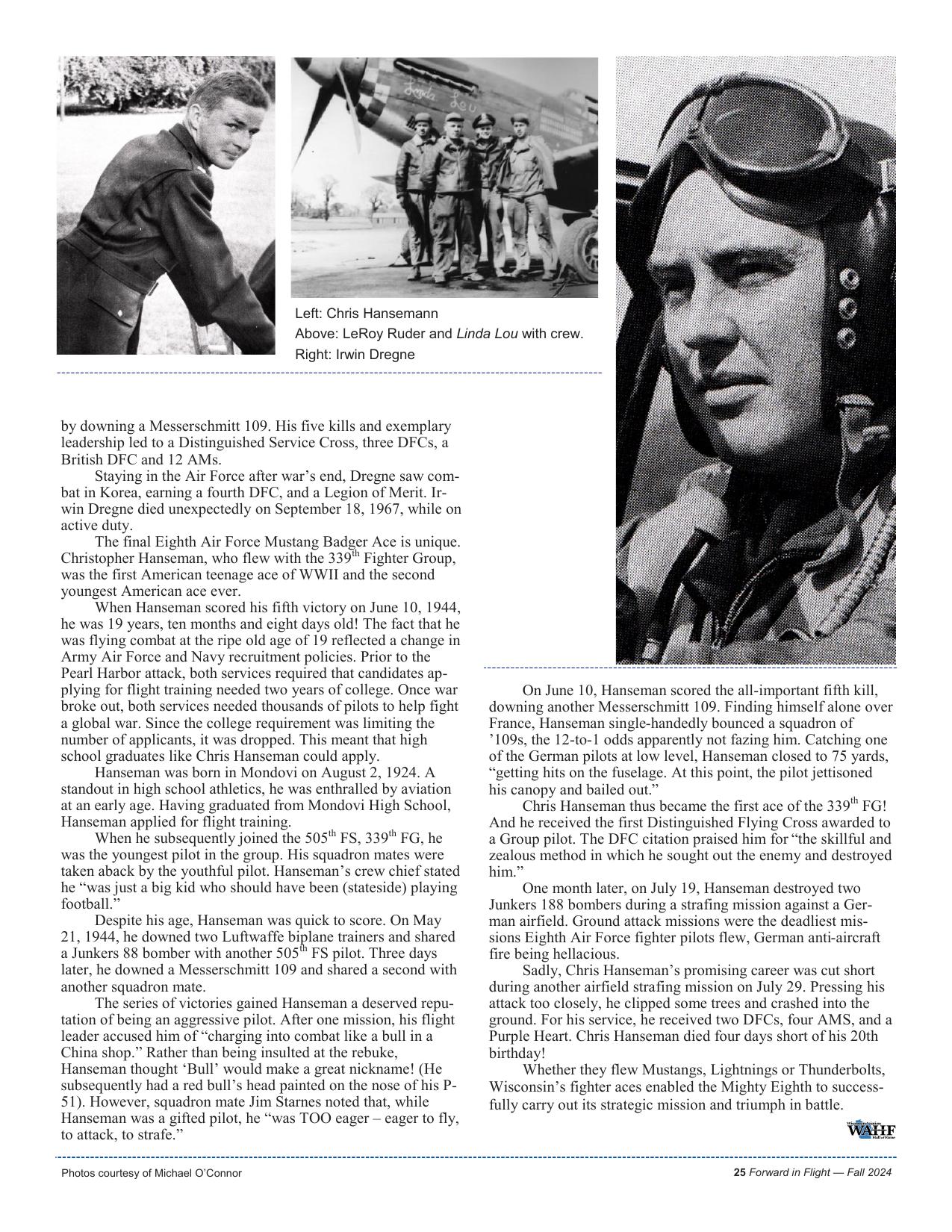
Left: Chris Hansemann Above: LeRoy Ruder and Linda Lou with crew. Right: Irwin Dregne by downing a Messerschmitt 109. His five kills and exemplary leadership led to a Distinguished Service Cross, three DFCs, a British DFC and 12 AMs. Staying in the Air Force after war’s end, Dregne saw combat in Korea, earning a fourth DFC, and a Legion of Merit. Irwin Dregne died unexpectedly on September 18, 1967, while on active duty. The final Eighth Air Force Mustang Badger Ace is unique. Christopher Hanseman, who flew with the 339th Fighter Group, was the first American teenage ace of WWII and the second youngest American ace ever. When Hanseman scored his fifth victory on June 10, 1944, he was 19 years, ten months and eight days old! The fact that he was flying combat at the ripe old age of 19 reflected a change in Army Air Force and Navy recruitment policies. Prior to the Pearl Harbor attack, both services required that candidates applying for flight training needed two years of college. Once war broke out, both services needed thousands of pilots to help fight a global war. Since the college requirement was limiting the number of applicants, it was dropped. This meant that high school graduates like Chris Hanseman could apply. Hanseman was born in Mondovi on August 2, 1924. A standout in high school athletics, he was enthralled by aviation at an early age. Having graduated from Mondovi High School, Hanseman applied for flight training. When he subsequently joined the 505th FS, 339th FG, he was the youngest pilot in the group. His squadron mates were taken aback by the youthful pilot. Hanseman’s crew chief stated he “was just a big kid who should have been (stateside) playing football.” Despite his age, Hanseman was quick to score. On May 21, 1944, he downed two Luftwaffe biplane trainers and shared a Junkers 88 bomber with another 505th FS pilot. Three days later, he downed a Messerschmitt 109 and shared a second with another squadron mate. The series of victories gained Hanseman a deserved reputation of being an aggressive pilot. After one mission, his flight leader accused him of “charging into combat like a bull in a China shop.” Rather than being insulted at the rebuke, Hanseman thought ‘Bull’ would make a great nickname! (He subsequently had a red bull’s head painted on the nose of his P51). However, squadron mate Jim Starnes noted that, while Hanseman was a gifted pilot, he “was TOO eager – eager to fly, to attack, to strafe.” Photos courtesy of Michael O’Connor On June 10, Hanseman scored the all-important fifth kill, downing another Messerschmitt 109. Finding himself alone over France, Hanseman single-handedly bounced a squadron of ’109s, the 12-to-1 odds apparently not fazing him. Catching one of the German pilots at low level, Hanseman closed to 75 yards, “getting hits on the fuselage. At this point, the pilot jettisoned his canopy and bailed out.” Chris Hanseman thus became the first ace of the 339th FG! And he received the first Distinguished Flying Cross awarded to a Group pilot. The DFC citation praised him for “the skillful and zealous method in which he sought out the enemy and destroyed him.” One month later, on July 19, Hanseman destroyed two Junkers 188 bombers during a strafing mission against a German airfield. Ground attack missions were the deadliest missions Eighth Air Force fighter pilots flew, German anti-aircraft fire being hellacious. Sadly, Chris Hanseman’s promising career was cut short during another airfield strafing mission on July 29. Pressing his attack too closely, he clipped some trees and crashed into the ground. For his service, he received two DFCs, four AMS, and a Purple Heart. Chris Hanseman died four days short of his 20th birthday! Whether they flew Mustangs, Lightnings or Thunderbolts, Wisconsin’s fighter aces enabled the Mighty Eighth to successfully carry out its strategic mission and triumph in battle. 25 Forward in Flight — Fall 2024
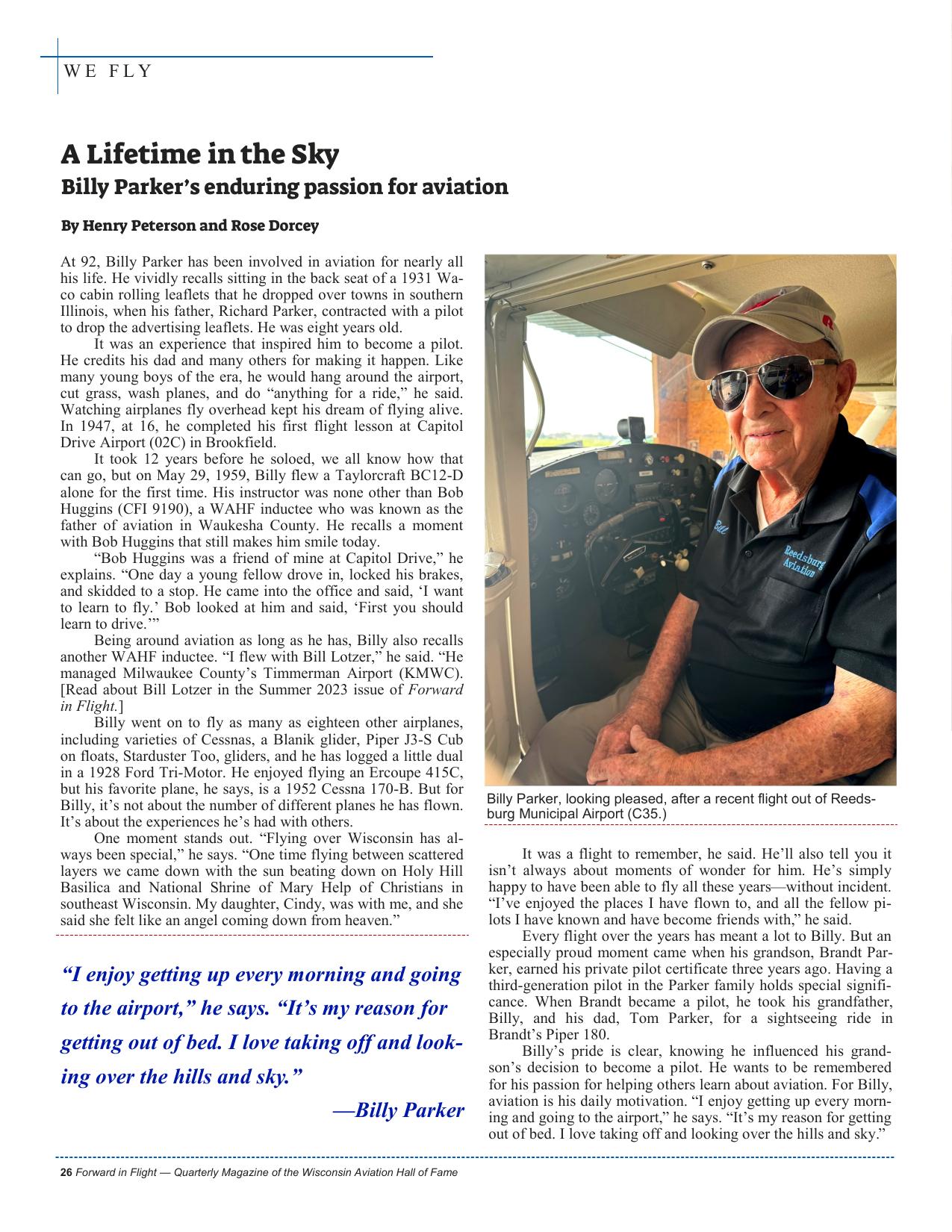
WE FLY A Lifetime in the Sky Billy Parker’s enduring passion for aviation By Henry Peterson and Rose Dorcey At 92, Billy Parker has been involved in aviation for nearly all his life. He vividly recalls sitting in the back seat of a 1931 Waco cabin rolling leaflets that he dropped over towns in southern Illinois, when his father, Richard Parker, contracted with a pilot to drop the advertising leaflets. He was eight years old. It was an experience that inspired him to become a pilot. He credits his dad and many others for making it happen. Like many young boys of the era, he would hang around the airport, cut grass, wash planes, and do “anything for a ride,” he said. Watching airplanes fly overhead kept his dream of flying alive. In 1947, at 16, he completed his first flight lesson at Capitol Drive Airport (02C) in Brookfield. It took 12 years before he soloed, we all know how that can go, but on May 29, 1959, Billy flew a Taylorcraft BC12-D alone for the first time. His instructor was none other than Bob Huggins (CFI 9190), a WAHF inductee who was known as the father of aviation in Waukesha County. He recalls a moment with Bob Huggins that still makes him smile today. “Bob Huggins was a friend of mine at Capitol Drive,” he explains. “One day a young fellow drove in, locked his brakes, and skidded to a stop. He came into the office and said, ‘I want to learn to fly.’ Bob looked at him and said, ‘First you should learn to drive.’” Being around aviation as long as he has, Billy also recalls another WAHF inductee. “I flew with Bill Lotzer,” he said. “He managed Milwaukee County’s Timmerman Airport (KMWC). [Read about Bill Lotzer in the Summer 2023 issue of ForwardÊ inÊFlight.] Billy went on to fly as many as eighteen other airplanes, including varieties of Cessnas, a Blanik glider, Piper J3-S Cub on floats, Starduster Too, gliders, and he has logged a little dual in a 1928 Ford Tri-Motor. He enjoyed flying an Ercoupe 415C, but his favorite plane, he says, is a 1952 Cessna 170-B. But for Billy, it’s not about the number of different planes he has flown. It’s about the experiences he’s had with others. One moment stands out. “Flying over Wisconsin has always been special,” he says. “One time flying between scattered layers we came down with the sun beating down on Holy Hill Basilica and National Shrine of Mary Help of Christians in southeast Wisconsin. My daughter, Cindy, was with me, and she said she felt like an angel coming down from heaven.” “I enjoy getting up every morning and going to the airport,” he says. “It’s my reason for getting out of bed. I love taking off and looking over the hills and sky.” —Billy Parker 26 Forward in Flight — Quarterly Magazine of the Wisconsin Aviation Hall of Fame Billy Parker, looking pleased, after a recent flight out of Reedsburg Municipal Airport (C35.) It was a flight to remember, he said. He’ll also tell you it isn’t always about moments of wonder for him. He’s simply happy to have been able to fly all these years—without incident. “I’ve enjoyed the places I have flown to, and all the fellow pilots I have known and have become friends with,” he said. Every flight over the years has meant a lot to Billy. But an especially proud moment came when his grandson, Brandt Parker, earned his private pilot certificate three years ago. Having a third-generation pilot in the Parker family holds special significance. When Brandt became a pilot, he took his grandfather, Billy, and his dad, Tom Parker, for a sightseeing ride in Brandt’s Piper 180. Billy’s pride is clear, knowing he influenced his grandson’s decision to become a pilot. He wants to be remembered for his passion for helping others learn about aviation. For Billy, aviation is his daily motivation. “I enjoy getting up every morning and going to the airport,” he says. “It’s my reason for getting out of bed. I love taking off and looking over the hills and sky.”
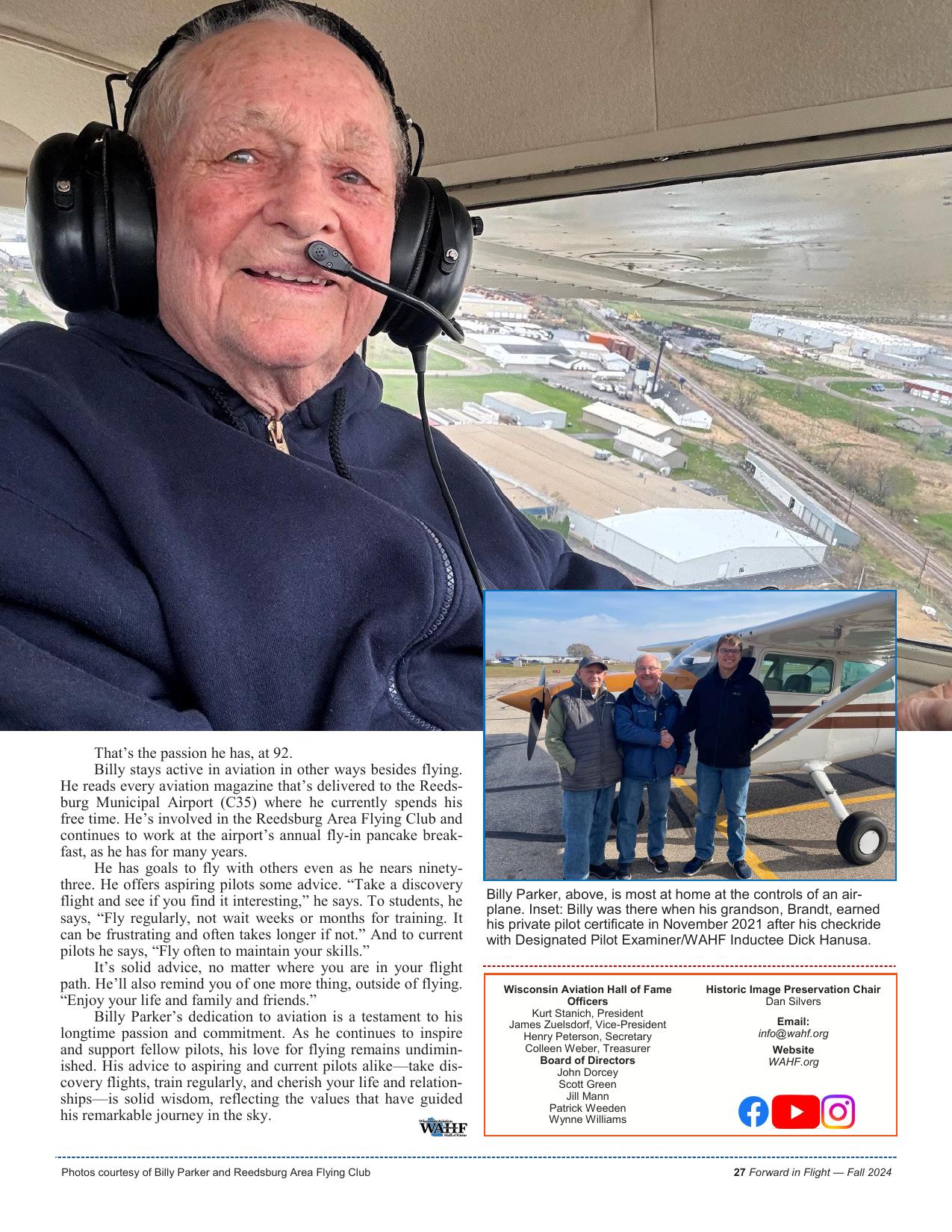
That’s the passion he has, at 92. Billy stays active in aviation in other ways besides flying. He reads every aviation magazine that’s delivered to the Reedsburg Municipal Airport (C35) where he currently spends his free time. He’s involved in the Reedsburg Area Flying Club and continues to work at the airport’s annual fly-in pancake breakfast, as he has for many years. He has goals to fly with others even as he nears ninetythree. He offers aspiring pilots some advice. “Take a discovery flight and see if you find it interesting,” he says. To students, he says, “Fly regularly, not wait weeks or months for training. It can be frustrating and often takes longer if not.” And to current pilots he says, “Fly often to maintain your skills.” It’s solid advice, no matter where you are in your flight path. He’ll also remind you of one more thing, outside of flying. “Enjoy your life and family and friends.” Billy Parker’s dedication to aviation is a testament to his longtime passion and commitment. As he continues to inspire and support fellow pilots, his love for flying remains undiminished. His advice to aspiring and current pilots alike—take discovery flights, train regularly, and cherish your life and relationships—is solid wisdom, reflecting the values that have guided his remarkable journey in the sky. Photos courtesy of Billy Parker and Reedsburg Area Flying Club Billy Parker, above, is most at home at the controls of an airplane. Inset: Billy was there when his grandson, Brandt, earned his private pilot certificate in November 2021 after his checkride with Designated Pilot Examiner/WAHF Inductee Dick Hanusa. Wisconsin Aviation Hall of Fame Officers Kurt Stanich, President James Zuelsdorf, Vice-President Henry Peterson, Secretary Colleen Weber, Treasurer Board of Directors John Dorcey Scott Green Jill Mann Patrick Weeden Wynne Williams Historic Image Preservation Chair Dan Silvers Email: info@wahf.org Website WAHF.org 27 Forward in Flight — Fall 2024
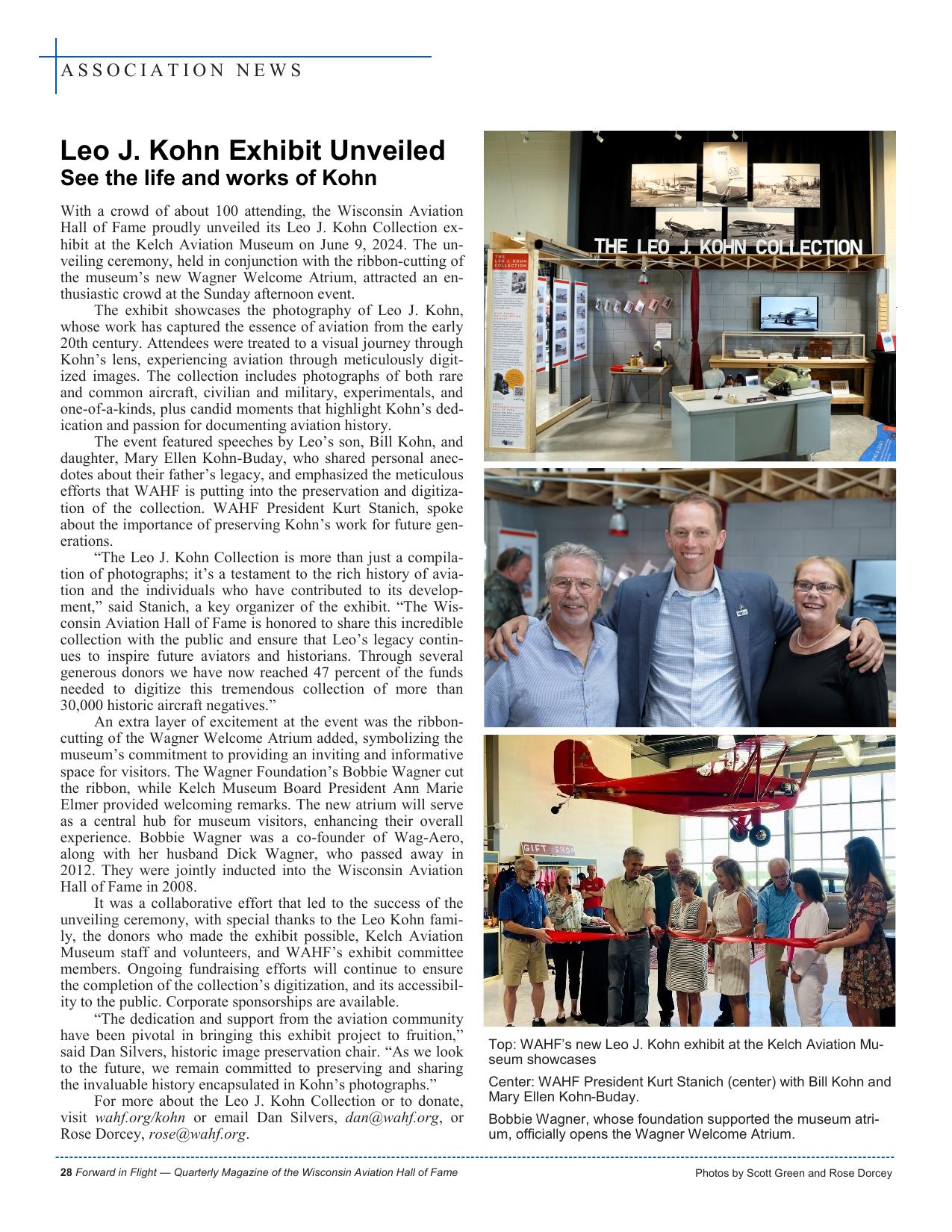
ASSOCIATION NEWS Leo J. Kohn Exhibit Unveiled See the life and works of Kohn With a crowd of about 100 attending, the Wisconsin Aviation Hall of Fame proudly unveiled its Leo J. Kohn Collection exhibit at the Kelch Aviation Museum on June 9, 2024. The unveiling ceremony, held in conjunction with the ribbon-cutting of the museum’s new Wagner Welcome Atrium, attracted an enthusiastic crowd at the Sunday afternoon event. The exhibit showcases the photography of Leo J. Kohn, whose work has captured the essence of aviation from the early 20th century. Attendees were treated to a visual journey through Kohn’s lens, experiencing aviation through meticulously digitized images. The collection includes photographs of both rare and common aircraft, civilian and military, experimentals, and one-of-a-kinds, plus candid moments that highlight Kohn’s dedication and passion for documenting aviation history. The event featured speeches by Leo’s son, Bill Kohn, and daughter, Mary Ellen Kohn-Buday, who shared personal anecdotes about their father’s legacy, and emphasized the meticulous efforts that WAHF is putting into the preservation and digitization of the collection. WAHF President Kurt Stanich, spoke about the importance of preserving Kohn’s work for future generations. “The Leo J. Kohn Collection is more than just a compilation of photographs; it’s a testament to the rich history of aviation and the individuals who have contributed to its development,” said Stanich, a key organizer of the exhibit. “The Wisconsin Aviation Hall of Fame is honored to share this incredible collection with the public and ensure that Leo’s legacy continues to inspire future aviators and historians. Through several generous donors we have now reached 47 percent of the funds needed to digitize this tremendous collection of more than 30,000 historic aircraft negatives.” An extra layer of excitement at the event was the ribboncutting of the Wagner Welcome Atrium added, symbolizing the museum’s commitment to providing an inviting and informative space for visitors. The Wagner Foundation’s Bobbie Wagner cut the ribbon, while Kelch Museum Board President Ann Marie Elmer provided welcoming remarks. The new atrium will serve as a central hub for museum visitors, enhancing their overall experience. Bobbie Wagner was a co-founder of Wag-Aero, along with her husband Dick Wagner, who passed away in 2012. They were jointly inducted into the Wisconsin Aviation Hall of Fame in 2008. It was a collaborative effort that led to the success of the unveiling ceremony, with special thanks to the Leo Kohn family, the donors who made the exhibit possible, Kelch Aviation Museum staff and volunteers, and WAHF’s exhibit committee members. Ongoing fundraising efforts will continue to ensure the completion of the collection’s digitization, and its accessibility to the public. Corporate sponsorships are available. “The dedication and support from the aviation community have been pivotal in bringing this exhibit project to fruition,” said Dan Silvers, historic image preservation chair. “As we look to the future, we remain committed to preserving and sharing the invaluable history encapsulated in Kohn’s photographs.” For more about the Leo J. Kohn Collection or to donate, visit wahf.org/kohnÊ or email Dan Silvers, dan@wahf.org, or Rose Dorcey, rose@wahf.org. 28 Forward in Flight — Quarterly Magazine of the Wisconsin Aviation Hall of Fame Top: WAHF’s new Leo J. Kohn exhibit at the Kelch Aviation Museum showcases Center: WAHF President Kurt Stanich (center) with Bill Kohn and Mary Ellen Kohn-Buday. Bobbie Wagner, whose foundation supported the museum atrium, officially opens the Wagner Welcome Atrium. Photos by Scott Green and Rose Dorcey
ASSOCIATION NEWS Join Us at an ‘Armchair Aviator’ Event in Oshkosh Be a part of a unique Airplane Photo Screening Party! Our “Armchair Aviator” event will showcase the impressive images from the Leo J. Kohn Aviation Photography Collection. Test your aviation knowledge with our ‘Name that Airplane’ game, and enjoy light appetizers (while they last) courtesy of WAHF. Contribute to our donation box to support the digitization of Leo’s incredible photo collection. Door prizes, too. Join us Sunday, September 22 from 1 - 4 pm at Wittman Regional Airport, 525 W 20th Avenue, Oshkosh. RSVPs appreciated—email info@wahf.orgÊor call/text 920-279-6029. Saturday, October 26 is going to be a great day of aviation for you and your friends. WAHF’s induction ceremony, at the EAA Aviation Museum in Oshkosh, features museum tours, a social hour, dinner, and of course: honoring our inductees! Join us as we honor Caroline “Blaze” Jensen, John Kelk, Bob Lussow, George Doersch, and John Hatz. Get your event tickets and ceremony details at WAHF.org/rsvp. WAHF die-cut stickers are a popular way to show your support for aviation history and the organization. They’re versatile, affordable, and make great conversation starters for connecting with fellow enthusiasts. And, when you order a few at just $4 each you’re helping to support a non-profit organization with a worthy mission: honoring history makers and sharing their stories. Email rose@wahf.infoÊto order. DARREL GIBSON We’re saddened to learn that WAHF Inductee Darrel Walter Gibson, 91, passed away peacefully at home on May 24, 2024. Born on February 2, 1933, in Durand, Wisconsin, Darrel’s early work ethic developed alongside his father at their family-run station. His passion for aviation sparked from watching airshows and taking a ride in a Stearman biplane. After high school, he began flight training at Schlosser Field, Waukesha. Darrel served in the 11th Army Cavalry Division from 1953 to 1955, where he excelled as a wheeled vehicle mechanic and earned the rank of Sergeant. He married Cleo in December 1953, who supported his aviation career. Post-service, they moved to Chicago for Darrel to attend Airframe and Engine school at Midway Airport and worked nights with United Airlines. They restored a 1948 Taylorcraft BC-12D and Darrel obtained his private pilot license. Moving to Eau Claire in 1961, Darrel took over Badger Aviation, renaming it Gibson Aviation and managing Eau Claire Airport until 1976. His business jingle was “Fly Gibson Aviation, Your Highway in the Sky.” After selling the business in 1989, he continued flying for Menards and Xcel Energy. Inducted into the Wisconsin Hall of Fame in 2015, Darrel logged over 10,000 flying hours in various aircraft. Darrel’s adventurous spirit was evident from childhood bicycle trips to significant aviation purchases. He renovated properties and enjoyed boating, camping, and traveling. Darrel was a mentor and role model, known for his hard work, kindness, and dedication to family. 2024 Scholarships Awarded The Wisconsin Aviation Hall of Fame is pleased to announce its 2024 class of scholarship recipients: ¨ Ashlyn Barwick, Jeff Baum Aviation Business & Jim Quinn Flight School Scholarship ¨ Evan Bloemers, Jerome Thiessen Field Scholarship ¨ Isak Danke, Jerome Thiessen Field Scholarship ¨ Grace Kahon, Jerome Thiessen Field Scholarship ¨ Cruz Patzner, Jerome Thiessen Field Scholarship ¨ Josephine Rief, Carl Guell Memorial Scholarship ¨ Lauren Stettbacher, EAA Chapter 640/Robert Payzer Memorial Scholarship ¨ Adam Taylor, Jerome Thiessen Field Scholarship More information about the recipients will be published in the Winter issue of ForwardÊinÊFlight.Ê WAHF’s Sidney A. & Ruth M. Julson Scholarship was not awarded this year. WAHF’s new Kylie’s Cub Air Flight LLC, Kylie Murray, Steve & Sharon Krog Scholarship is a new scholarship, a $1,000 award for individuals aiming to enhance their flying skills through earning a tailwheel endorsement or spin training. Fundraising is underway for this scholarship, with the first award anticipated in March 2025. Learn more about WAHF scholarships at wahf.org/scholarships. 29 Forward in Flight — Fall 2024
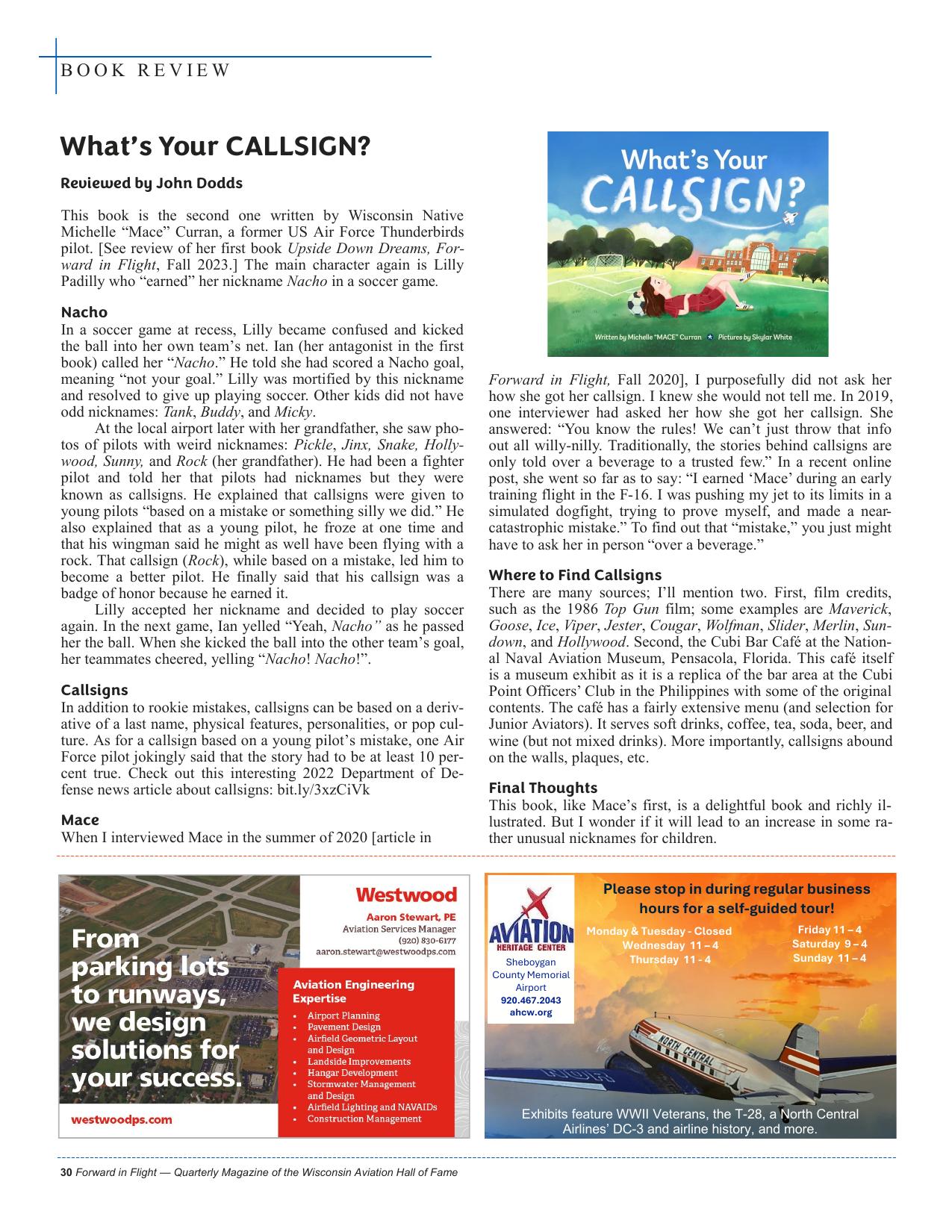
BOOK REVIEW What’s Your CALLSIGN? Reviewed by John Dodds This book is the second one written by Wisconsin Native Michelle “Mace” Curran, a former US Air Force Thunderbirds pilot. [See review of her first book UpsideÊDownÊDreams,ÊForwardÊ inÊ Flight, Fall 2023.] The main character again is Lilly Padilly who “earned” her nickname Nacho in a soccer game. Nacho In a soccer game at recess, Lilly became confused and kicked the ball into her own team’s net. Ian (her antagonist in the first book) called her “Nacho.” He told she had scored a Nacho goal, meaning “not your goal.” Lilly was mortified by this nickname and resolved to give up playing soccer. Other kids did not have odd nicknames: Tank, Buddy, and Micky. At the local airport later with her grandfather, she saw photos of pilots with weird nicknames: Pickle, Jinx,Ê Snake,ÊHollywood,ÊSunny, and RockÊ(her grandfather). He had been a fighter pilot and told her that pilots had nicknames but they were known as callsigns. He explained that callsigns were given to young pilots “based on a mistake or something silly we did.” He also explained that as a young pilot, he froze at one time and that his wingman said he might as well have been flying with a rock. That callsign (Rock), while based on a mistake, led him to become a better pilot. He finally said that his callsign was a badge of honor because he earned it. Lilly accepted her nickname and decided to play soccer again. In the next game, Ian yelled “Yeah, Nacho”Êas he passed her the ball. When she kicked the ball into the other team’s goal, her teammates cheered, yelling “Nacho! Nacho!”. Callsigns In addition to rookie mistakes, callsigns can be based on a derivative of a last name, physical features, personalities, or pop culture. As for a callsign based on a young pilot’s mistake, one Air Force pilot jokingly said that the story had to be at least 10 percent true. Check out this interesting 2022 Department of Defense news article about callsigns: bit.ly/3xzCiVk Mace When I interviewed Mace in the summer of 2020 [article in ForwardÊ inÊ Flight,Ê FallÊ 2020], I purposefully did not ask her how she got her callsign. I knew she would not tell me. In 2019, one interviewer had asked her how she got her callsign. She answered: “You know the rules! We can’t just throw that info out all willy-nilly. Traditionally, the stories behind callsigns are only told over a beverage to a trusted few.” In a recent online post, she went so far as to say: “I earned ‘Mace’ during an early training flight in the F-16. I was pushing my jet to its limits in a simulated dogfight, trying to prove myself, and made a nearcatastrophic mistake.” To find out that “mistake,” you just might have to ask her in person “over a beverage.” Where to Find Callsigns There are many sources; I’ll mention two. First, film credits, such as the 1986 TopÊ Gun film; some examples are Maverick, Goose, Ice, Viper, Jester, Cougar, Wolfman, Slider, Merlin, Sundown, and Hollywood. Second, the Cubi Bar Café at the National Naval Aviation Museum, Pensacola, Florida. This café itself is a museum exhibit as it is a replica of the bar area at the Cubi Point Officers’ Club in the Philippines with some of the original contents. The café has a fairly extensive menu (and selection for Junior Aviators). It serves soft drinks, coffee, tea, soda, beer, and wine (but not mixed drinks). More importantly, callsigns abound on the walls, plaques, etc. Final Thoughts This book, like Mace’s first, is a delightful book and richly illustrated. But I wonder if it will lead to an increase in some rather unusual nicknames for children. Please stop in during regular business hours for a self-guided tour! Sheboygan County Memorial Airport 920.467.2043 ahcw.org Monday & Tuesday - Closed Wednesday 11 – 4 Thursday 11 - 4 Friday 11 – 4 Saturday 9 – 4 Sunday 11 – 4 Exhibits feature WWII Veterans, the T-28, a North Central Airlines’ DC-3 and airline history, and more. 30 Forward in Flight — Quarterly Magazine of the Wisconsin Aviation Hall of Fame
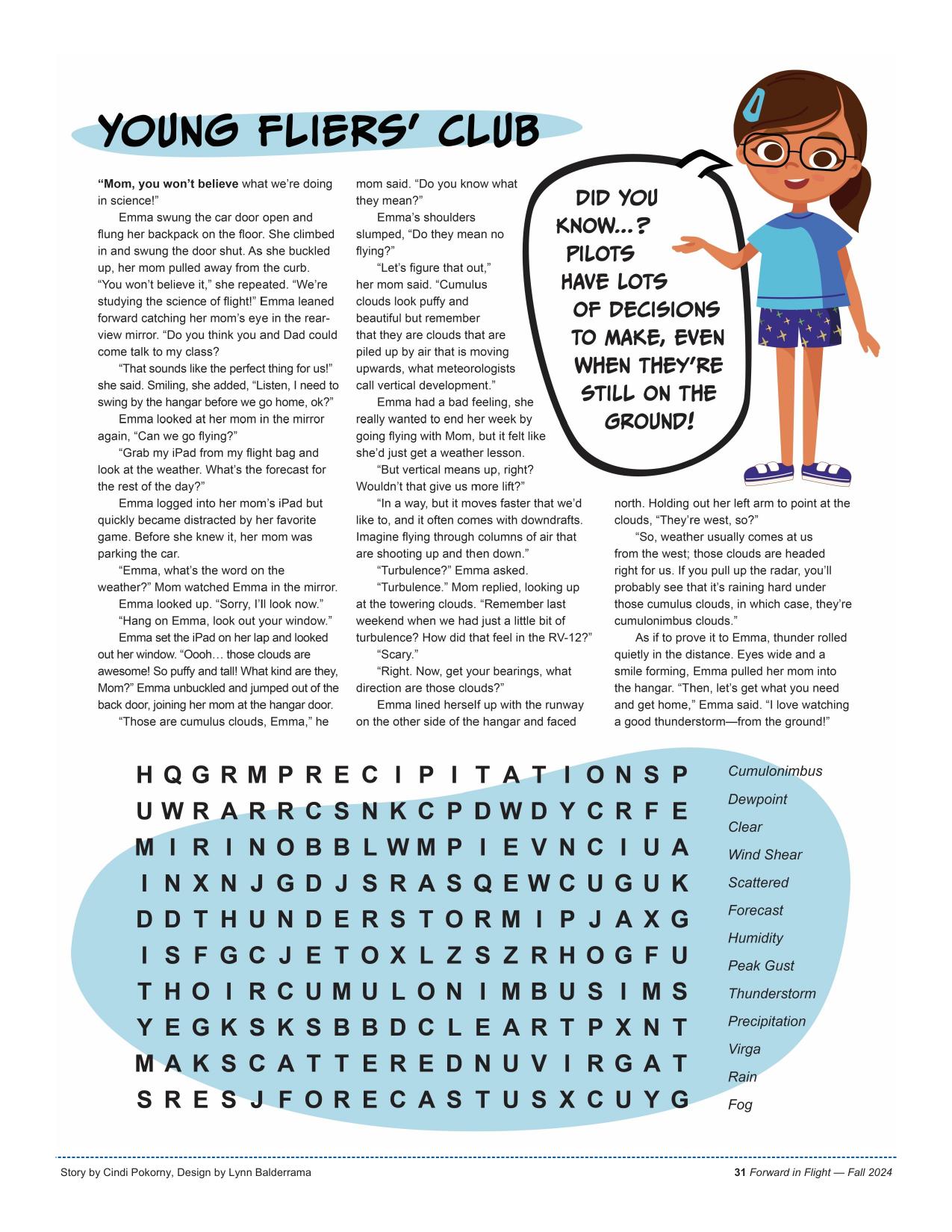
Story by Cindi Pokorny, Design by Lynn Balderrama 31 Forward in Flight — Fall 2024
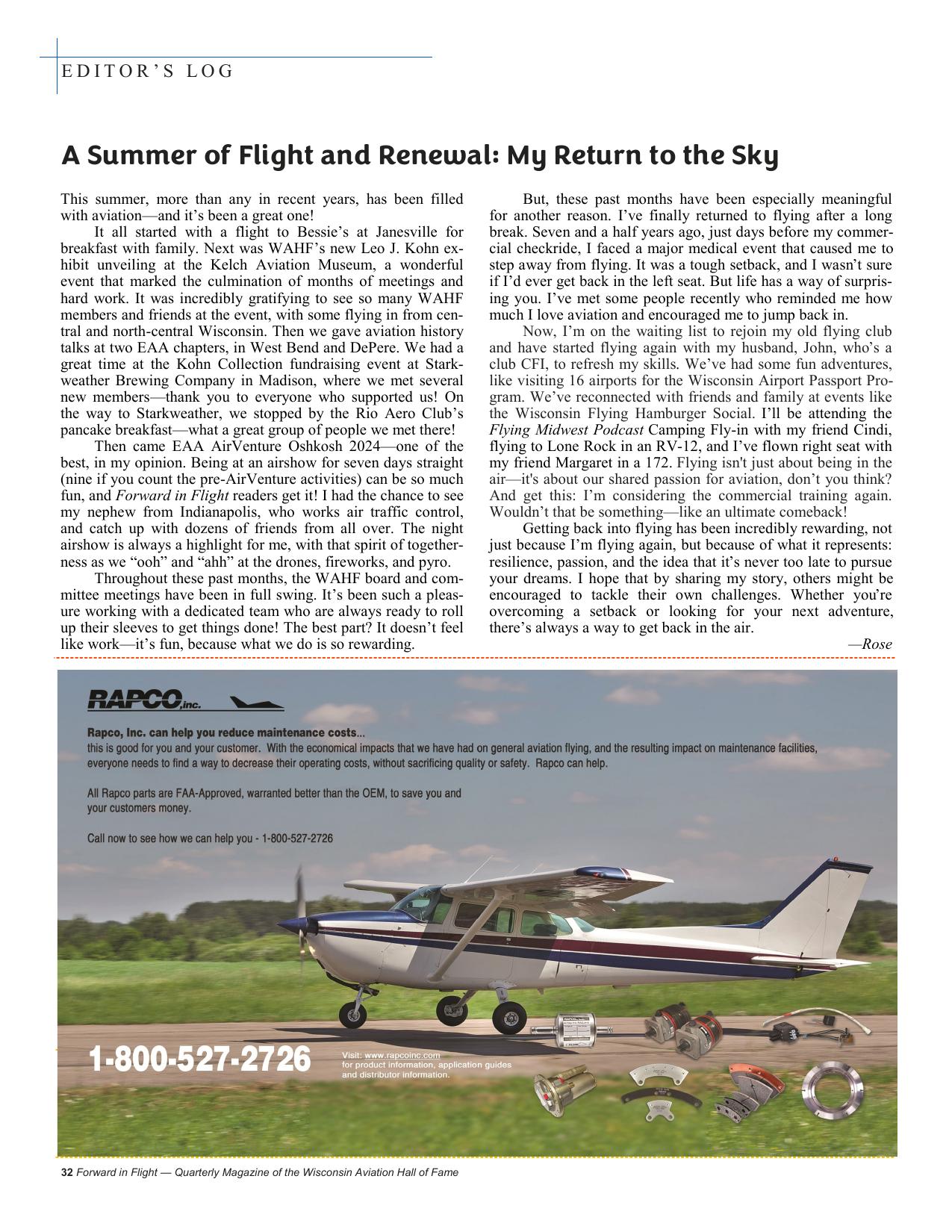
EDITOR’S LOG A Summer of Flight and Renewal: My Return to the Sky This summer, more than any in recent years, has been filled with aviation—and it’s been a great one! It all started with a flight to Bessie’s at Janesville for breakfast with family. Next was WAHF’s new Leo J. Kohn exhibit unveiling at the Kelch Aviation Museum, a wonderful event that marked the culmination of months of meetings and hard work. It was incredibly gratifying to see so many WAHF members and friends at the event, with some flying in from central and north-central Wisconsin. Then we gave aviation history talks at two EAA chapters, in West Bend and DePere. We had a great time at the Kohn Collection fundraising event at Starkweather Brewing Company in Madison, where we met several new members—thank you to everyone who supported us! On the way to Starkweather, we stopped by the Rio Aero Club’s pancake breakfast—what a great group of people we met there! Then came EAA AirVenture Oshkosh 2024—one of the best, in my opinion. Being at an airshow for seven days straight (nine if you count the pre-AirVenture activities) can be so much fun, and ForwardÊinÊFlightÊreaders get it! I had the chance to see my nephew from Indianapolis, who works air traffic control, and catch up with dozens of friends from all over. The night airshow is always a highlight for me, with that spirit of togetherness as we “ooh” and “ahh” at the drones, fireworks, and pyro. Throughout these past months, the WAHF board and committee meetings have been in full swing. It’s been such a pleasure working with a dedicated team who are always ready to roll up their sleeves to get things done! The best part? It doesn’t feel like work—it’s fun, because what we do is so rewarding. 32 Forward in Flight — Quarterly Magazine of the Wisconsin Aviation Hall of Fame But, these past months have been especially meaningful for another reason. I’ve finally returned to flying after a long break. Seven and a half years ago, just days before my commercial checkride, I faced a major medical event that caused me to step away from flying. It was a tough setback, and I wasn’t sure if I’d ever get back in the left seat. But life has a way of surprising you. I’ve met some people recently who reminded me how much I love aviation and encouraged me to jump back in. Now, I’m on the waiting list to rejoin my old flying club and have started flying again with my husband, John, who’s a club CFI, to refresh my skills. We’ve had some fun adventures, like visiting 16 airports for the Wisconsin Airport Passport Program. We’ve reconnected with friends and family at events like the Wisconsin Flying Hamburger Social. I’ll be attending the FlyingÊMidwestÊPodcastÊCamping Fly-in with my friend Cindi, flying to Lone Rock in an RV-12, and I’ve flown right seat with my friend Margaret in a 172. Flying isn't just about being in the air—it's about our shared passion for aviation, don’t you think? And get this: I’m considering the commercial training again. Wouldn’t that be something—like an ultimate comeback! Getting back into flying has been incredibly rewarding, not just because I’m flying again, but because of what it represents: resilience, passion, and the idea that it’s never too late to pursue your dreams. I hope that by sharing my story, others might be encouraged to tackle their own challenges. Whether you’re overcoming a setback or looking for your next adventure, there’s always a way to get back in the air. —Rose

Fly with us—become a WAHF member and receive a subscription to Forward in Flight! ANNUAL MEMBERSHIP LEVELS _____ Youth (Under age 18) _____ Individual (Annual) _____ Couple (Annual) _____ Lifetime (Individual) _____ Lifetime (Couple) $10 $30 $40 $500 $750 TAX DEDUCTIBLE CONTRIBUTIONS Your contributions help ensure Wisconsin’s aviation pioneers and outstanding students in aviation education will continue to be recognized. Your contributions, in any amount, are appreciated. WAHF Supporting Contribution $___________ (General operating/events programming fund) Leo J. Kohn Collection Preservation Fund $___________ WAHF Scholarship Fund* $___________ *for scholarship donations please make a separate check payable to Community Foundation of North Central Wisconsin or visit www.CFONCW.org. Name________________________________________ Address______________________________________ City__________________________________________ State, Zip_____________________________________ Phone_______________________________________ Email________________________________________ Members receive WAHF’s quarterly magazine Forward in Flight! Join Online! WAHF.org Donate Online WAHF.org/kohn Or, mail this form, along with your check payable to: Wisconsin Aviation Hall of Fame, Inc. to: Rose Dorcey/WAHF 3980 Sharratt Drive Oshkosh WI 54901 The Wisconsin Aviation Hall of Fame is a 501(c)(3) organization. Morey Airplane Company Since 1932 Middleton Municipal Airport/Morey Field Self-service 100LL & Jet A 24-7 33 Forward in Flight— Fall 2024
PRSRT STD US Postage Paid Wisc Rapids WI Permit 98 Forward in Flight c/o Rose Dorcey 3980 Sharratt Drive Oshkosh WI 54901-1276 The Wisconsin Aviation Hall of Fame is a non-profit membership organization dedicated to preserving the past and fostering the future of flight. Welcome New WAHF Member/Supporters! Dan Doyne Patrice Coyne Tim Craft Susan Craft Tom Culbert Alyssa Horpedahl Kylie Kalishek Mathew Kurtz Daniel Miller John Schranz Joe Snow Cynthia Stanich Nick Stanich Thank you for coming onboard! Our Gratitude to... We thank Madi, Jim, and Andrew from the Flying Midwest podcast. During EAA AirVenture Oshkosh this great crew interviewed WAHF’s Dan Silvers and Rose Dorcey about the mission of the Wisconsin Aviation Hall of Fame and our Leo J. Kohn Photo Collection digitization project. We appreciate being guests on the podcast. For info or to listen, visit flyingmidwest.com. WAHF Calendar September 16, 2024 - Armchair Aviator/Leo Kohn Story - with EAA Chapter 766, Presentation by Dan Silvers and John & Rose Dorcey, 7:00pm. Aviation Heritage Center of Wisconsin, located at Sheboygan County Memorial Airport (KSBM). September 22, 2024 - Armchair Aviator Event, Wittman Regional Airport Terminal Building, 525 W 20th Avenue, Oshkosh, 1 - 4 pm. Join Dan Silvers and John & Rose Dorcey for an "Armchair Aviator" event in Oshkosh, featuring a special screening of images from the Leo J. Kohn Aviation Photography Collection. Details on page 29. October 26, 2024 - WAHF’s Annual Induction Ceremony - EAA Aviation Museum, Oshkosh. Docent led museum tours from 3:30 - 4:30, membership meeting, social hour and silent auction 5 - 6, and dinner at 6pm. Members receive an invitation. Visit wahf.org/rsvp for more information and to reserve your seat! LEO J. KOHN COLLECTION DONORS WALL OF FAME We're overwhelmed by the generosity of those who have contributed to the Leo J. Kohn Collection Digitization Project thus far. Thank you all so very much! Your gift will play a crucial role in preserving this astounding collection of historic aviation images. Basler Flight Service Walter Bauer Gene Calkins Ken Cook Publishing Randy & Jackie Gustafson James Hackman Bill Kohn Steve & Sharon Krog Kurt Mehre NewView Technologies Ann Meyer Schmick Howard Seaborn EAA Chap. 1158 Bobbie Wagner Wynne Williams Sam Wiltzius Chuck & Luann Boie Carolyn DeLong Tom Hegy John LeBarre Kenyon Nowotny Michael Stopar Peter von Tresckow Nancy Zjaba Bruce & Rae Botterman Duane Esse Peter Jensen Jerry LeBarron Billy Parker Jimmy Szajkovics Dale & Nancy Walker Peter Bunce Keith Gerard Karen Kalishek Jason McDowell Steve Poole Erin Thompson Jeffrey S. Ward