Volume 23, Issue 3
🗞️ Download Issue (PDF)
Forward in Flight - Fall 2025
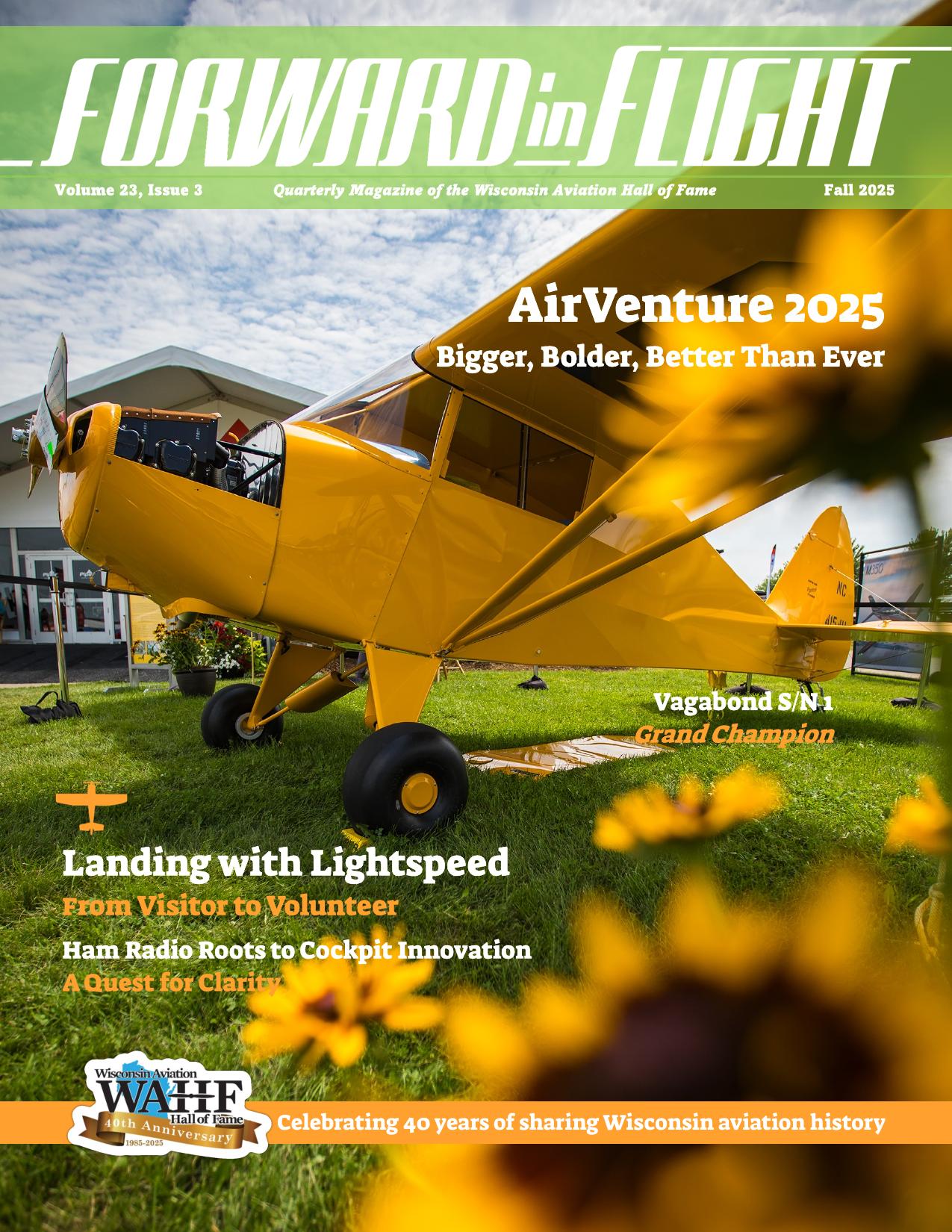
Volume 23, Issue 3 Quarterly Magazine of the Wisconsin Aviation Hall of Fame Fall 2025 AirVenture 2025 Bigger, Bolder, Better Than Ever Vagabond S/N 1 Grand Champion Landing with Lightspeed From Visitor to Volunteer Ham Radio Roots to Cockpit Innovation A Quest for Clarity Celebrating 40 years of sharing Wisconsin aviation history
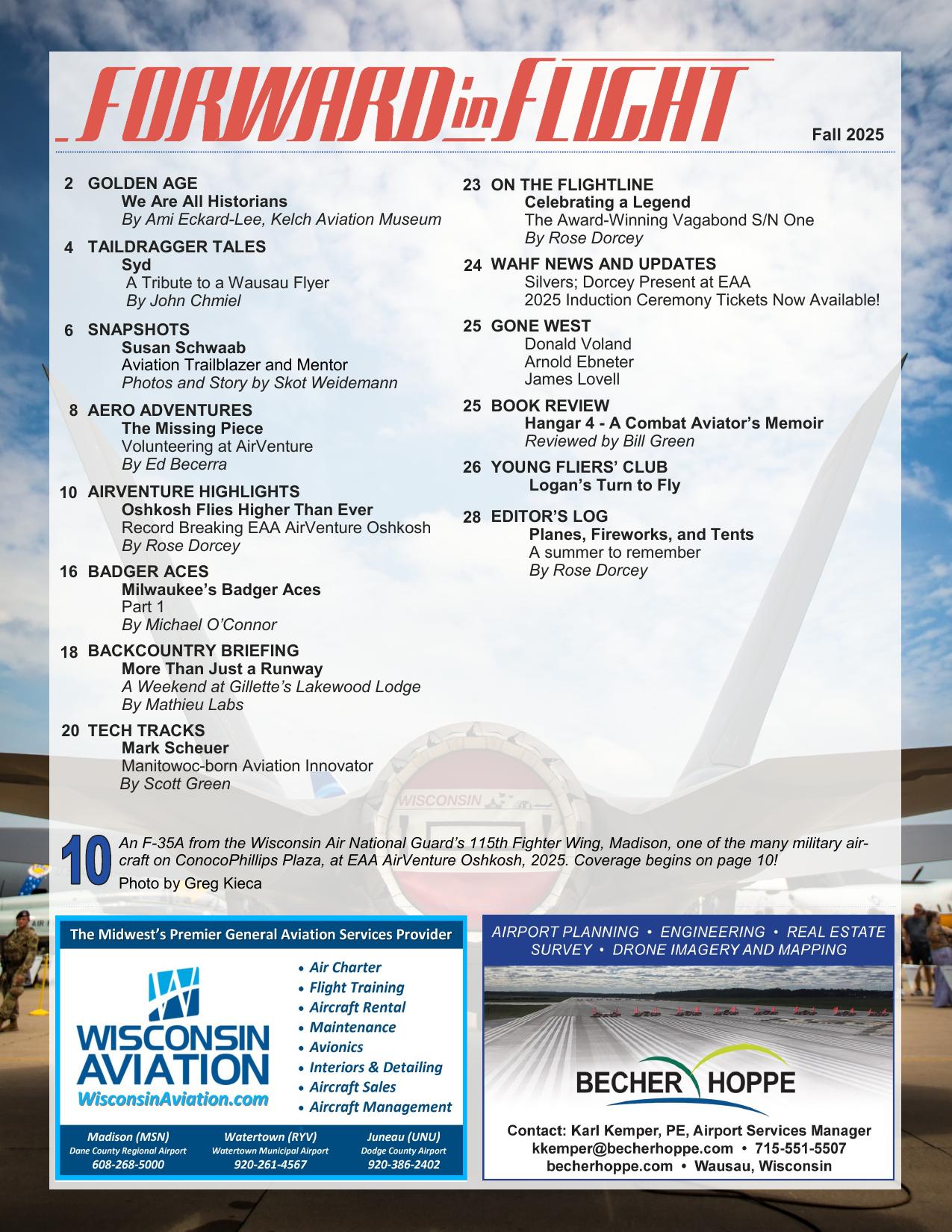
Fall 2025 2 GOLDEN AGE We Are All Historians By Ami Eckard-Lee, Kelch Aviation Museum 4 TAILDRAGGER TALES Syd A Tribute to a Wausau Flyer By John Chmiel 23 ON THE FLIGHTLINE Celebrating a Legend The Award-Winning Vagabond S/N One By Rose Dorcey 24 WAHF NEWS AND UPDATES Silvers; Dorcey Present at EAA 2025 Induction Ceremony Tickets Now Available! 6 SNAPSHOTS Susan Schwaab Aviation Trailblazer and Mentor Photos and Story by Skot Weidemann 25 GONE WEST Donald Voland Arnold Ebneter James Lovell 8 AERO ADVENTURES The Missing Piece Volunteering at AirVenture By Ed Becerra 25 BOOK REVIEW Hangar 4 - A Combat Aviator’s Memoir Reviewed by Bill Green 10 AIRVENTURE HIGHLIGHTS Oshkosh Flies Higher Than Ever Record Breaking EAA AirVenture Oshkosh By Rose Dorcey 16 BADGER ACES Milwaukee’s Badger Aces Part 1 By Michael O’Connor 26 YOUNG FLIERS’ CLUB Logan’s Turn to Fly 28 EDITOR’S LOG Planes, Fireworks, and Tents A summer to remember By Rose Dorcey 18 BACKCOUNTRY BRIEFING More Than Just a Runway A Weekend at Gillette’s Lakewood Lodge By Mathieu Labs 20 TECH TRACKS Mark Scheuer Manitowoc-born Aviation Innovator By Scott Green An F-35A from the Wisconsin Air National Guard’s 115th Fighter Wing, Madison, one of the many military aircraft on ConocoPhillips Plaza, at EAA AirVenture Oshkosh, 2025. Coverage begins on page 10! Photo by Greg Kieca
PRESIDENT’S MESSAGE Aviation and Community And Honoring Wisconsin’s Aviation Legends By WAHF President Kurt Stanich Every July, Oshkosh becomes the heart of the aviation world during EAA AirVenture—and what a gift it is to have such an extraordinary gathering right in our Wisconsin backyard. It’s more than airshows and exhibits. For those of us who love flight, it’s a homecoming. Pilots, families, restorers, dreamers, engineers, and fans of every stripe come together to celebrate the past, present, and future of aviation. And for the Wisconsin Aviation Hall of Fame, it’s one of the highlights of our year. AirVenture gives us the joy of reconnecting with so many recognize remarkable men and women whose contributions de- of you—members we’ve known for years, and new friends who serve to be remembered. Their stories are often untold else- share our love of aviation and history. Whether we meet under a where—but they reflect courage, innovation, and perseverance hangar roof, at a forum stage, or simply walking the flight line, that continue to inspire. We promise an evening of celebration, those moments remind us that this organization is about more reflection, and connection. than plaques on a wall. It’s about people. It’s about stories If you’ve never been to an induction ceremony, let me passed down, preserved, and honored. And it’s about a shared personally encourage you to come. It’s a warm, welcoming belief that what came before us is worth remembering—and that event—not just for honorees and their families, but for everyone we each have a part in what comes next. who loves aviation. You’ll meet living legends, hear firsthand That’s especially true this year, as we celebrate our 40th accounts of triumphs and challenges, and see history through a anniversary. For four decades, the Wisconsin Aviation Hall of very personal lens. Many who attend once make it a tradition— Fame has worked to recognize the people who’ve helped shape and we hope this year, that includes you. aviation in our state—and to make sure those stories aren’t lost. On behalf of the entire WAHF board, thank you for your From barnstormers and air racers to educators, engineers, and continued support and involvement. Your membership helps us military aviators, we’ve been proud to shine a light on the lives preserve and share Wisconsin’s rich aviation story. We’re proud and legacies that make Wisconsin’s aviation history so unique. to stand with you in this work—and we look forward to seeing As part of that milestone year, I hope you’ll make plans to join you soon, whether at an airfield, an exhibit, or at the 2025 In- us for our 2025 Induction Ceremony. Each fall, we gather to duction Ceremony. Forward in Flight the only magazine dedicated exclusively to Wisconsin’s aviation news and history. Rose Dorcey Editorial and Advertising 3980 Sharratt Drive Oshkosh WI 54901 920-279-6029 rose@wahf.org The Wisconsin Aviation Hall of Fame is a non-profit membership organization with a mission to collect and preserve the history of aviation in Wisconsin, recognize those who made that history, inform others of it, and promote aviation education for future generations. About the Cover: You’ve read about the painstaking restoration of Piper Vagabond S/N 1 in past issues of Forward in Flight magazine. But this issue brings news that’s been months in the making. What’s next for this one-of-a-kind aircraft? Turn to page 23 to find out. Photo by Greg Kieca
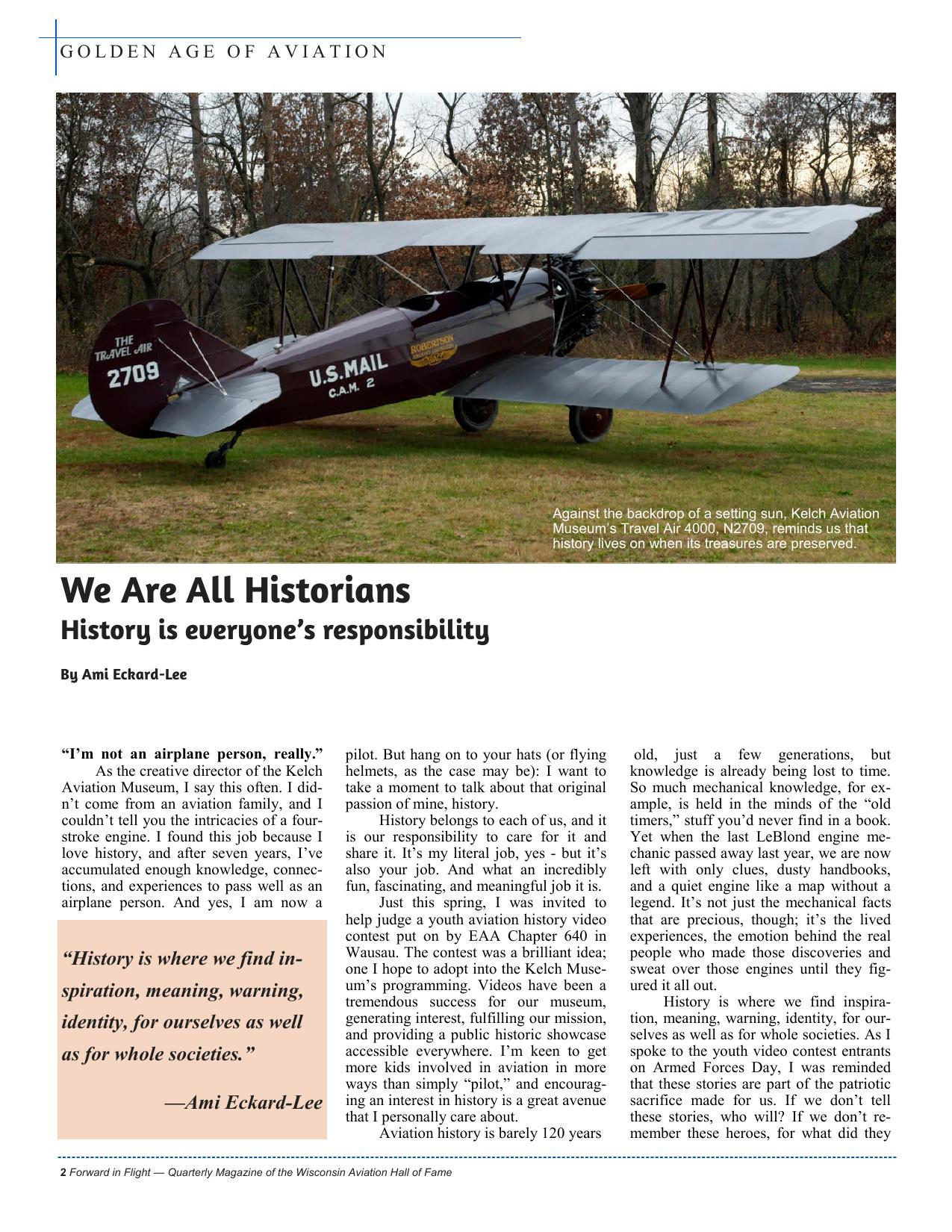
GOLDEN AGE OF AVIATION Against the backdrop of a setting sun, Kelch Aviation Museum’s Travel Air 4000, N2709, reminds us that history lives on when its treasures are preserved. We Are All Historians History is everyone’s responsibility By Ami Eckard-Lee “I’m not an airplane person, really.” As the creative director of the Kelch Aviation Museum, I say this often. I didn’t come from an aviation family, and I couldn’t tell you the intricacies of a fourstroke engine. I found this job because I love history, and after seven years, I’ve accumulated enough knowledge, connections, and experiences to pass well as an airplane person. And yes, I am now a “History is where we find inspiration, meaning, warning, identity, for ourselves as well as for whole societies.” —Ami Eckard-Lee pilot. But hang on to your hats (or flying helmets, as the case may be): I want to take a moment to talk about that original passion of mine, history. History belongs to each of us, and it is our responsibility to care for it and share it. It’s my literal job, yes - but it’s also your job. And what an incredibly fun, fascinating, and meaningful job it is. Just this spring, I was invited to help judge a youth aviation history video contest put on by EAA Chapter 640 in Wausau. The contest was a brilliant idea; one I hope to adopt into the Kelch Museum’s programming. Videos have been a tremendous success for our museum, generating interest, fulfilling our mission, and providing a public historic showcase accessible everywhere. I’m keen to get more kids involved in aviation in more ways than simply “pilot,” and encouraging an interest in history is a great avenue that I personally care about. Aviation history is barely 120 years 2 Forward in Flight — Quarterly Magazine of the Wisconsin Aviation Hall of Fame old, just a few generations, but knowledge is already being lost to time. So much mechanical knowledge, for example, is held in the minds of the “old timers,” stuff you’d never find in a book. Yet when the last LeBlond engine mechanic passed away last year, we are now left with only clues, dusty handbooks, and a quiet engine like a map without a legend. It’s not just the mechanical facts that are precious, though; it’s the lived experiences, the emotion behind the real people who made those discoveries and sweat over those engines until they figured it all out. History is where we find inspiration, meaning, warning, identity, for ourselves as well as for whole societies. As I spoke to the youth video contest entrants on Armed Forces Day, I was reminded that these stories are part of the patriotic sacrifice made for us. If we don’t tell these stories, who will? If we don’t remember these heroes, for what did they
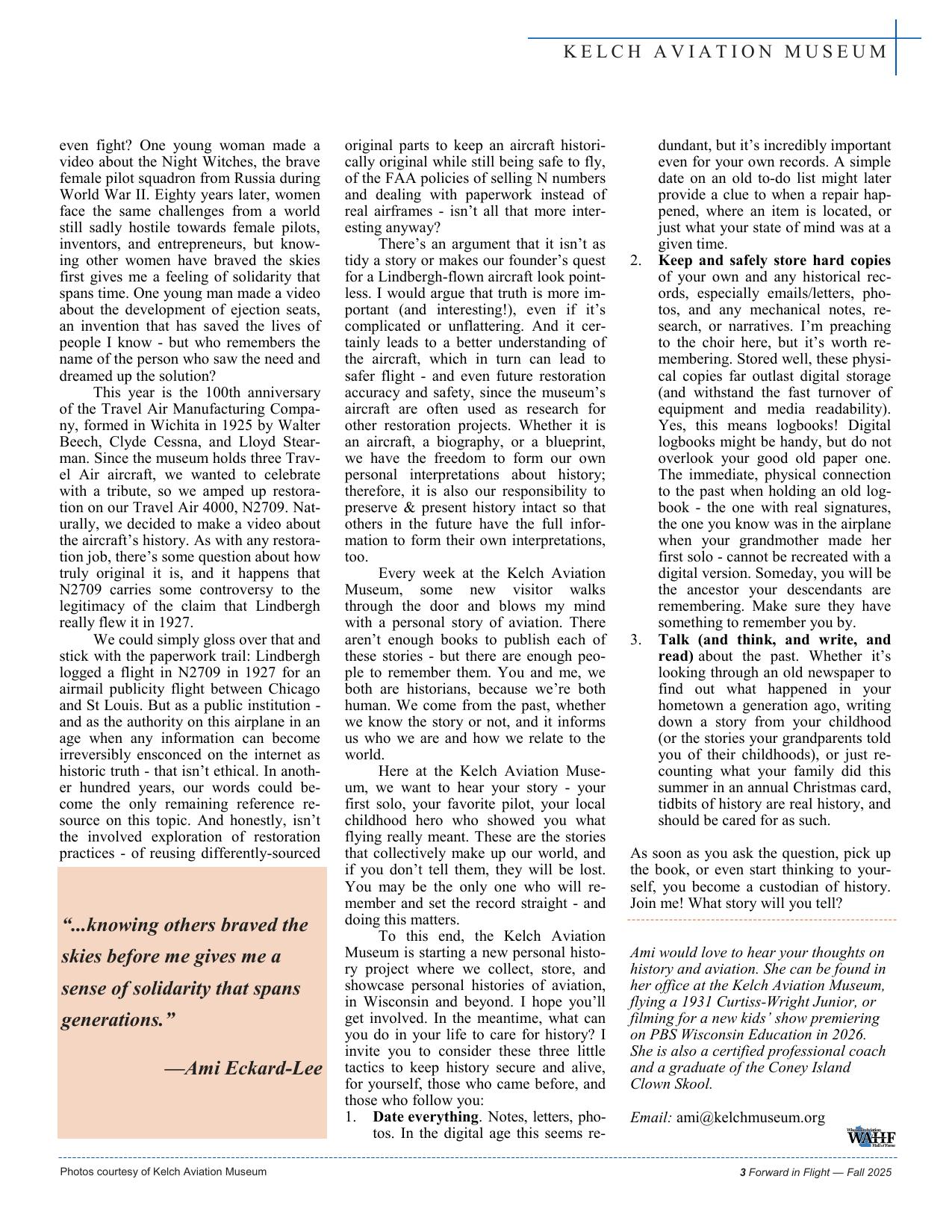
KELCH AVIATION MUSEUM even fight? One young woman made a video about the Night Witches, the brave female pilot squadron from Russia during World War II. Eighty years later, women face the same challenges from a world still sadly hostile towards female pilots, inventors, and entrepreneurs, but knowing other women have braved the skies first gives me a feeling of solidarity that spans time. One young man made a video about the development of ejection seats, an invention that has saved the lives of people I know - but who remembers the name of the person who saw the need and dreamed up the solution? This year is the 100th anniversary of the Travel Air Manufacturing Company, formed in Wichita in 1925 by Walter Beech, Clyde Cessna, and Lloyd Stearman. Since the museum holds three Travel Air aircraft, we wanted to celebrate with a tribute, so we amped up restoration on our Travel Air 4000, N2709. Naturally, we decided to make a video about the aircraft’s history. As with any restoration job, there’s some question about how truly original it is, and it happens that N2709 carries some controversy to the legitimacy of the claim that Lindbergh really flew it in 1927. We could simply gloss over that and stick with the paperwork trail: Lindbergh logged a flight in N2709 in 1927 for an airmail publicity flight between Chicago and St Louis. But as a public institution and as the authority on this airplane in an age when any information can become irreversibly ensconced on the internet as historic truth - that isn’t ethical. In another hundred years, our words could become the only remaining reference resource on this topic. And honestly, isn’t the involved exploration of restoration practices - of reusing differently-sourced “...knowing others braved the skies before me gives me a sense of solidarity that spans generations.” —Ami Eckard-Lee Photos courtesy of Kelch Aviation Museum original parts to keep an aircraft historically original while still being safe to fly, of the FAA policies of selling N numbers and dealing with paperwork instead of real airframes - isn’t all that more interesting anyway? There’s an argument that it isn’t as tidy a story or makes our founder’s quest for a Lindbergh-flown aircraft look pointless. I would argue that truth is more important (and interesting!), even if it’s complicated or unflattering. And it certainly leads to a better understanding of the aircraft, which in turn can lead to safer flight - and even future restoration accuracy and safety, since the museum’s aircraft are often used as research for other restoration projects. Whether it is an aircraft, a biography, or a blueprint, we have the freedom to form our own personal interpretations about history; therefore, it is also our responsibility to preserve & present history intact so that others in the future have the full information to form their own interpretations, too. Every week at the Kelch Aviation Museum, some new visitor walks through the door and blows my mind with a personal story of aviation. There aren’t enough books to publish each of these stories - but there are enough people to remember them. You and me, we both are historians, because we’re both human. We come from the past, whether we know the story or not, and it informs us who we are and how we relate to the world. Here at the Kelch Aviation Museum, we want to hear your story - your first solo, your favorite pilot, your local childhood hero who showed you what flying really meant. These are the stories that collectively make up our world, and if you don’t tell them, they will be lost. You may be the only one who will remember and set the record straight - and doing this matters. To this end, the Kelch Aviation Museum is starting a new personal history project where we collect, store, and showcase personal histories of aviation, in Wisconsin and beyond. I hope you’ll get involved. In the meantime, what can you do in your life to care for history? I invite you to consider these three little tactics to keep history secure and alive, for yourself, those who came before, and those who follow you: 1. Date everything. Notes, letters, photos. In the digital age this seems re- 2. 3. dundant, but it’s incredibly important even for your own records. A simple date on an old to-do list might later provide a clue to when a repair happened, where an item is located, or just what your state of mind was at a given time. Keep and safely store hard copies of your own and any historical records, especially emails/letters, photos, and any mechanical notes, research, or narratives. I’m preaching to the choir here, but it’s worth remembering. Stored well, these physical copies far outlast digital storage (and withstand the fast turnover of equipment and media readability). Yes, this means logbooks! Digital logbooks might be handy, but do not overlook your good old paper one. The immediate, physical connection to the past when holding an old logbook - the one with real signatures, the one you know was in the airplane when your grandmother made her first solo - cannot be recreated with a digital version. Someday, you will be the ancestor your descendants are remembering. Make sure they have something to remember you by. Talk (and think, and write, and read) about the past. Whether it’s looking through an old newspaper to find out what happened in your hometown a generation ago, writing down a story from your childhood (or the stories your grandparents told you of their childhoods), or just recounting what your family did this summer in an annual Christmas card, tidbits of history are real history, and should be cared for as such. As soon as you ask the question, pick up the book, or even start thinking to yourself, you become a custodian of history. Join me! What story will you tell? Ami would love to hear your thoughts on history and aviation. She can be found in her office at the Kelch Aviation Museum, flying a 1931 Curtiss-Wright Junior, or filming for a new kids’ show premiering on PBS Wisconsin Education in 2026. She is also a certified professional coach and a graduate of the Coney Island Clown Skool. Email: ami@kelchmuseum.org 3 Forward in Flight — Fall 2025
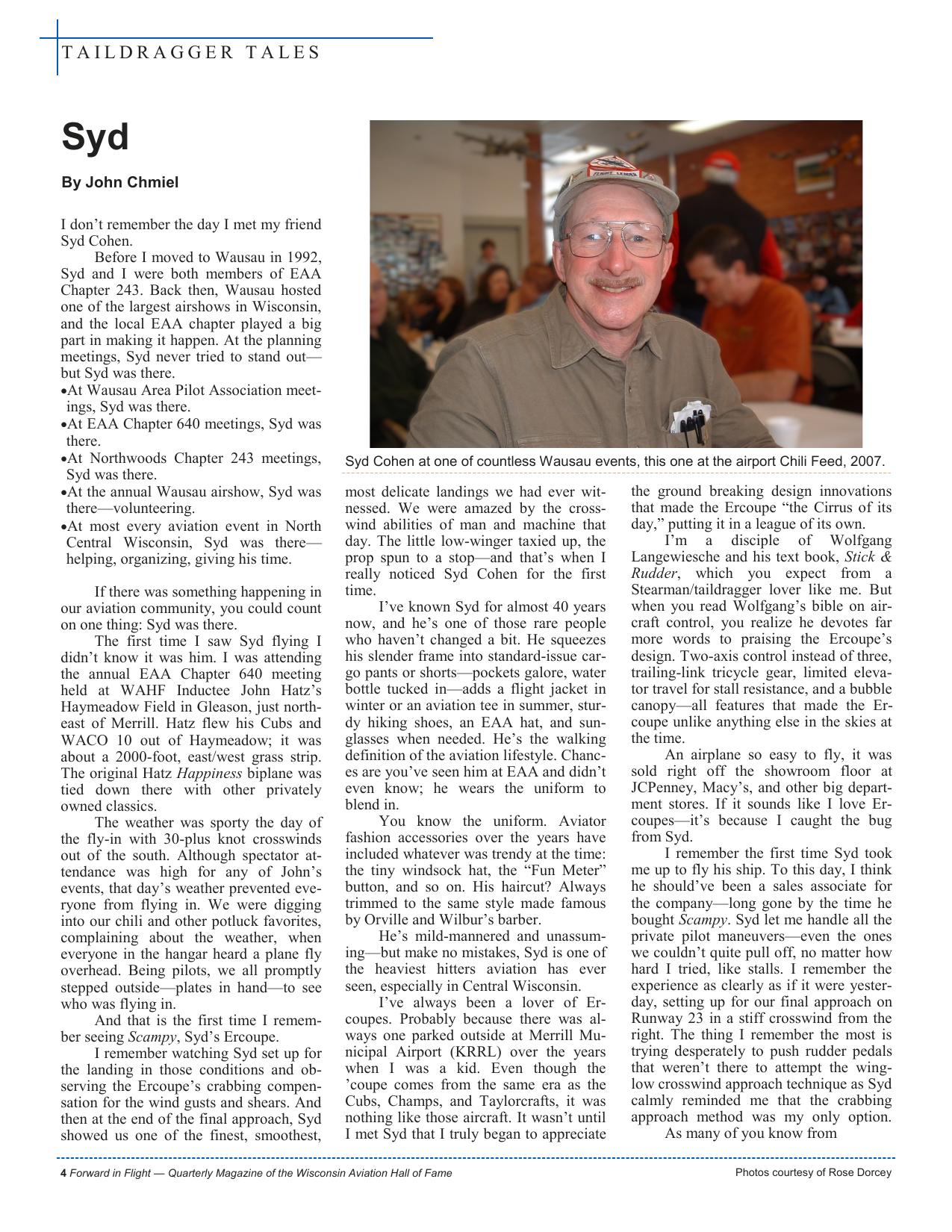
TAILDRAGGER TALES Syd By John Chmiel I don’t remember the day I met my friend Syd Cohen. Before I moved to Wausau in 1992, Syd and I were both members of EAA Chapter 243. Back then, Wausau hosted one of the largest airshows in Wisconsin, and the local EAA chapter played a big part in making it happen. At the planning meetings, Syd never tried to stand out— but Syd was there. ·At Wausau Area Pilot Association meetings, Syd was there. ·At EAA Chapter 640 meetings, Syd was there. ·At Northwoods Chapter 243 meetings, Syd was there. ·At the annual Wausau airshow, Syd was there—volunteering. ·At most every aviation event in North Central Wisconsin, Syd was there— helping, organizing, giving his time. If there was something happening in our aviation community, you could count on one thing: Syd was there. The first time I saw Syd flying I didn’t know it was him. I was attending the annual EAA Chapter 640 meeting held at WAHF Inductee John Hatz’s Haymeadow Field in Gleason, just northeast of Merrill. Hatz flew his Cubs and WACO 10 out of Haymeadow; it was about a 2000-foot, east/west grass strip. The original Hatz Happiness biplane was tied down there with other privately owned classics. The weather was sporty the day of the fly-in with 30-plus knot crosswinds out of the south. Although spectator attendance was high for any of John’s events, that day’s weather prevented everyone from flying in. We were digging into our chili and other potluck favorites, complaining about the weather, when everyone in the hangar heard a plane fly overhead. Being pilots, we all promptly stepped outside—plates in hand—to see who was flying in. And that is the first time I remember seeing Scampy, Syd’s Ercoupe. I remember watching Syd set up for the landing in those conditions and observing the Ercoupe’s crabbing compensation for the wind gusts and shears. And then at the end of the final approach, Syd showed us one of the finest, smoothest, Syd Cohen at one of countless Wausau events, this one at the airport Chili Feed, 2007. most delicate landings we had ever witnessed. We were amazed by the crosswind abilities of man and machine that day. The little low-winger taxied up, the prop spun to a stop—and that’s when I really noticed Syd Cohen for the first time. I’ve known Syd for almost 40 years now, and he’s one of those rare people who haven’t changed a bit. He squeezes his slender frame into standard-issue cargo pants or shorts—pockets galore, water bottle tucked in—adds a flight jacket in winter or an aviation tee in summer, sturdy hiking shoes, an EAA hat, and sunglasses when needed. He’s the walking definition of the aviation lifestyle. Chances are you’ve seen him at EAA and didn’t even know; he wears the uniform to blend in. You know the uniform. Aviator fashion accessories over the years have included whatever was trendy at the time: the tiny windsock hat, the “Fun Meter” button, and so on. His haircut? Always trimmed to the same style made famous by Orville and Wilbur’s barber. He’s mild-mannered and unassuming—but make no mistakes, Syd is one of the heaviest hitters aviation has ever seen, especially in Central Wisconsin. I’ve always been a lover of Ercoupes. Probably because there was always one parked outside at Merrill Municipal Airport (KRRL) over the years when I was a kid. Even though the ’coupe comes from the same era as the Cubs, Champs, and Taylorcrafts, it was nothing like those aircraft. It wasn’t until I met Syd that I truly began to appreciate 4 Forward in Flight — Quarterly Magazine of the Wisconsin Aviation Hall of Fame the ground breaking design innovations that made the Ercoupe “the Cirrus of its day,” putting it in a league of its own. I’m a disciple of Wolfgang Langewiesche and his text book, Stick & Rudder, which you expect from a Stearman/taildragger lover like me. But when you read Wolfgang’s bible on aircraft control, you realize he devotes far more words to praising the Ercoupe’s design. Two-axis control instead of three, trailing-link tricycle gear, limited elevator travel for stall resistance, and a bubble canopy—all features that made the Ercoupe unlike anything else in the skies at the time. An airplane so easy to fly, it was sold right off the showroom floor at JCPenney, Macy’s, and other big department stores. If it sounds like I love Ercoupes—it’s because I caught the bug from Syd. I remember the first time Syd took me up to fly his ship. To this day, I think he should’ve been a sales associate for the company—long gone by the time he bought Scampy. Syd let me handle all the private pilot maneuvers—even the ones we couldn’t quite pull off, no matter how hard I tried, like stalls. I remember the experience as clearly as if it were yesterday, setting up for our final approach on Runway 23 in a stiff crosswind from the right. The thing I remember the most is trying desperately to push rudder pedals that weren’t there to attempt the winglow crosswind approach technique as Syd calmly reminded me that the crabbing approach method was my only option. As many of you know from Photos courtesy of Rose Dorcey
TAILDRAGGER TALES experience, a taildragger pilot with no rudder pedals is like a fish out of water. The conclusion was an incredibly smooth landing followed by an internal conversation about driving that airplane like a car now that we were on the ground. The experience of a tailwheel pilot transitioning to an Ercoupe has similarities to the opposite experience of a tricycle pilot transitioning to tailwheel. The learning law of primacy is your enemy, and it takes time and practice to overcome previously learned habits required to control other aircraft. Over the years Syd and I often flew together. I’ve never known another pilot who made such beautiful landings as consistently as Syd does. I’ve never experienced one bad landing with Syd at the controls of Scampy. Syd’s first flight lessons were a gift from a college friend, but he didn’t finish in the Cessna Cardinal he started in. After college Syd became a teacher at Mosinee High School, in 1972. It was when he moved to Wausau that he heard about an Ercoupe for sale. He convinced four other teachers to form a club with him to purchase the airplane. (On a side note, that aircraft was bought from the great uncle of one of my current flight instructors at Wausau Flying Service.) Eventually Syd bought out his fellow club members because he was the only member flying the airplane; he became the sole owner of the painted version of Scampy. That’s when he decided that the ship should be returned as close as possible to its original glory as it had emerged from the factory in 1946. The wings were recovered, interior replaced, and the instrument panel returned to its original layout. And then the awards started rolling in. An entire wall in his hangar is now adorned with Scampy accolades. Over the years, Syd has rebuilt the airplane three times, and restored another Ercoupe as well, with the help of airplane mechanics Jack Chmiel (my father) and Lyman Hatz. I would challenge you to open an issue of EAA Sport Aviation that doesn’t have a picture of Scampy somewhere on its pages. The gospel of everything Ercoupe has been spread by Syd for decades. The Annual National Ercoupe Convention has taken place in Wausau, Wisconsin, on four separate occasions during Wausau Flying Service’s tenure. It’s a fun event that attracts every “Syd Cohen” from across the United States and Canada who flies the Ercoupe, Alon, Forney, and Mooney M-10 Cadet versions of the innovative low-wing trike. Most of the owners wear the same uniform, and are in the same age range, etc. People always say stereotypes are there for a reason and Ercoupers prove that theory. During the week-long festivities there is typically a “rubber chicken drop” contest (live chickens are never used), spot landing contest, and fly-outs to other airports for lunch. The event concludes with the group fly-out to EAA AirVenture Oshkosh. Syd has organized and led the gaggle every year and upon arrival has sponsored the type club’s annual banquet. I’ll just say that you haven’t seen anything until you’ve witnessed 25-50 Ercoupes departing your airport in-trail, flying over your city. All this happened because of Syd. In his years of flying, Syd has rarely flown by himself. Whether he’s flying cross country to the National Ercoupe Convention, to breakfast fly-in’s, Hamburger Nights, Sun ’n Fun, or EAA events, Syd often has a passenger. Many of his friends now own Ercoupes because of his discipleship. He’s also had a major impact on youth. During his teaching days, for 15 years, one of the classes he taught was Aviation & Aerospace. After he earned his pilot certificate he often invited his students to fly with him after school. When the EAA Young Eagles program began in 1992, Syd was appointed and continued as EAA Chapter 640’s Young Eagles Coordinator for the next 25 years. Syd gave Young Eagle rides whenever he could and organized Young Eagles rallies at airports across Central Wisconsin giving kids their first exposure to aviation. He did it with a smile on his face and one kid at a time. I’m not sure there has been another pilot in America as dedicated to the Young Eagles program as Syd Cohen. After one of the Scampy rebuilds Syd was jonesing for something to do. That’s when my dad, Jack Chmiel, heard about the WACO glider project and told Syd about it. Many of the WACO gliders used during the invasion of Sicily, southern France, Burma, Normandy, Holland, and across the Rhine River were manufactured by Ford at their manufacturing facility in Iron Mountain, Michigan. After the war, the surplus aircraft were bought at auction by civilians. The gliders were so huge that the crates they came in contained enough wood to build a two-bedroom house! Buyers were buying them at auction for the crate, not the glider. Then glider steel tube fuselages were sold and used as the framework for smaller hunting shacks. One of these fuselages was discovered in the Northwoods and the Menominee Range Historical Museum wanted to restore the airframe to put on display in honor of its historic significance to the area. Nobody with expertise had come forward to help with the restoration until Syd. After one visit, Syd Cohen decided he would spearhead restoration of the fuselage for display. Arrangements were made to deliver the gigantic fuselage to Syd’s personal hangar at Wausau Downtown Airport. The EAA Chapter was unable to help, so Syd put ads in the local paper to recruit people to help with the project. Soon a rag-tag group of non-aviation people emerged willing to get to work. They organized multiple work nights a week, fabricated specialty tools and steaming machines and more to get the project done. Other volunteers in Iron Mountain built up the wings, rear fuselage, and tail section. In true Syd Cohen fashion, he and the glider group finished their part of the project that no one else had come forward to complete. You can see this glider on display at the WWII Glider & Military Museum in Iron Mountain, Michigan. During the restoration process, the public education that took place regarding the history of the WACO glider and its role during the invasions was nothing short of phenomenal. It’s an obscure story that needed to be told and the local people who emerged and had direct connections to the glider and D-Day made the process a wonderful experience. Without Syd, none of it would have happened. In preparation for this article I recorded an over two-hour interview with Syd. There are so many more Syd stories to tell, but they won’t fit in this month’s column. Recently Syd received word that he was losing his FAA medical certificate. You can imagine how it has affected Syd. But when I heard the news, it hit me hard too. I don’t want Syd to quit flying, and I called and told him so. My hope is that he can continue to fly with my help for as long as he can. Wausau has been blessed with one of the greatest ambassadors of aviation that any airport has ever had for the last 40 years. I’m not willing to let his tenure end. Look around your airport. Many airports have a “Syd” as one of its main characters. They always wear camouflage and easily blend in, but without their tenacity and stick-to-it-ness, your airport wouldn’t be the place it is today. You need to figure out who that is and go thank them today. 5 Forward in Flight — Fall 2025
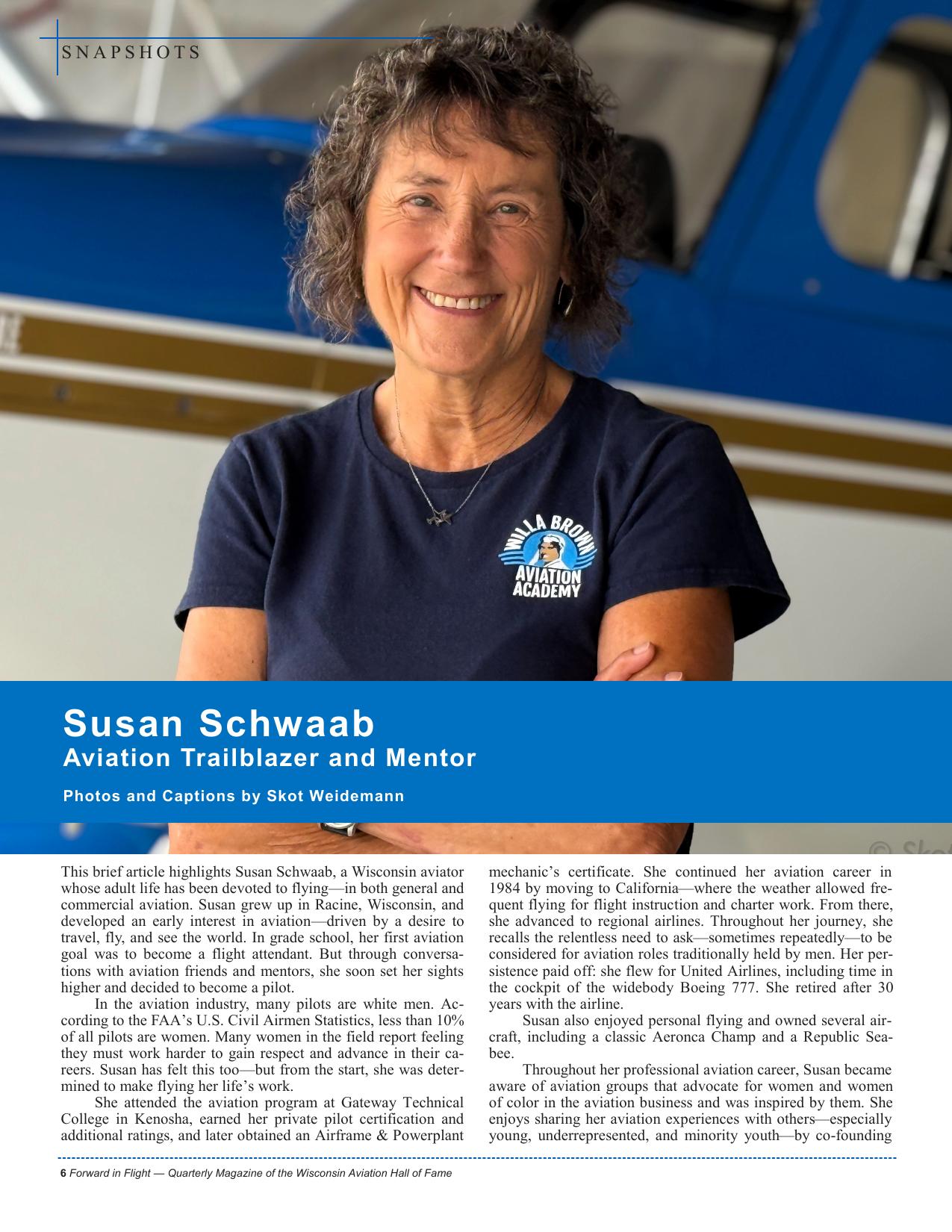
SNAPSHOTS Susan Schwaab Aviation Trailblazer and Mentor Photos and Captions by Skot Weidemann This brief article highlights Susan Schwaab, a Wisconsin aviator whose adult life has been devoted to flying—in both general and commercial aviation. Susan grew up in Racine, Wisconsin, and developed an early interest in aviation—driven by a desire to travel, fly, and see the world. In grade school, her first aviation goal was to become a flight attendant. But through conversations with aviation friends and mentors, she soon set her sights higher and decided to become a pilot. In the aviation industry, many pilots are white men. According to the FAA’s U.S. Civil Airmen Statistics, less than 10% of all pilots are women. Many women in the field report feeling they must work harder to gain respect and advance in their careers. Susan has felt this too—but from the start, she was determined to make flying her life’s work. She attended the aviation program at Gateway Technical College in Kenosha, earned her private pilot certification and additional ratings, and later obtained an Airframe & Powerplant 6 Forward in Flight — Quarterly Magazine of the Wisconsin Aviation Hall of Fame mechanic’s certificate. She continued her aviation career in 1984 by moving to California—where the weather allowed frequent flying for flight instruction and charter work. From there, she advanced to regional airlines. Throughout her journey, she recalls the relentless need to ask—sometimes repeatedly—to be considered for aviation roles traditionally held by men. Her persistence paid off: she flew for United Airlines, including time in the cockpit of the widebody Boeing 777. She retired after 30 years with the airline. Susan also enjoyed personal flying and owned several aircraft, including a classic Aeronca Champ and a Republic Seabee. Throughout her professional aviation career, Susan became aware of aviation groups that advocate for women and women of color in the aviation business and was inspired by them. She enjoys sharing her aviation experiences with others—especially young, underrepresented, and minority youth—by co-founding
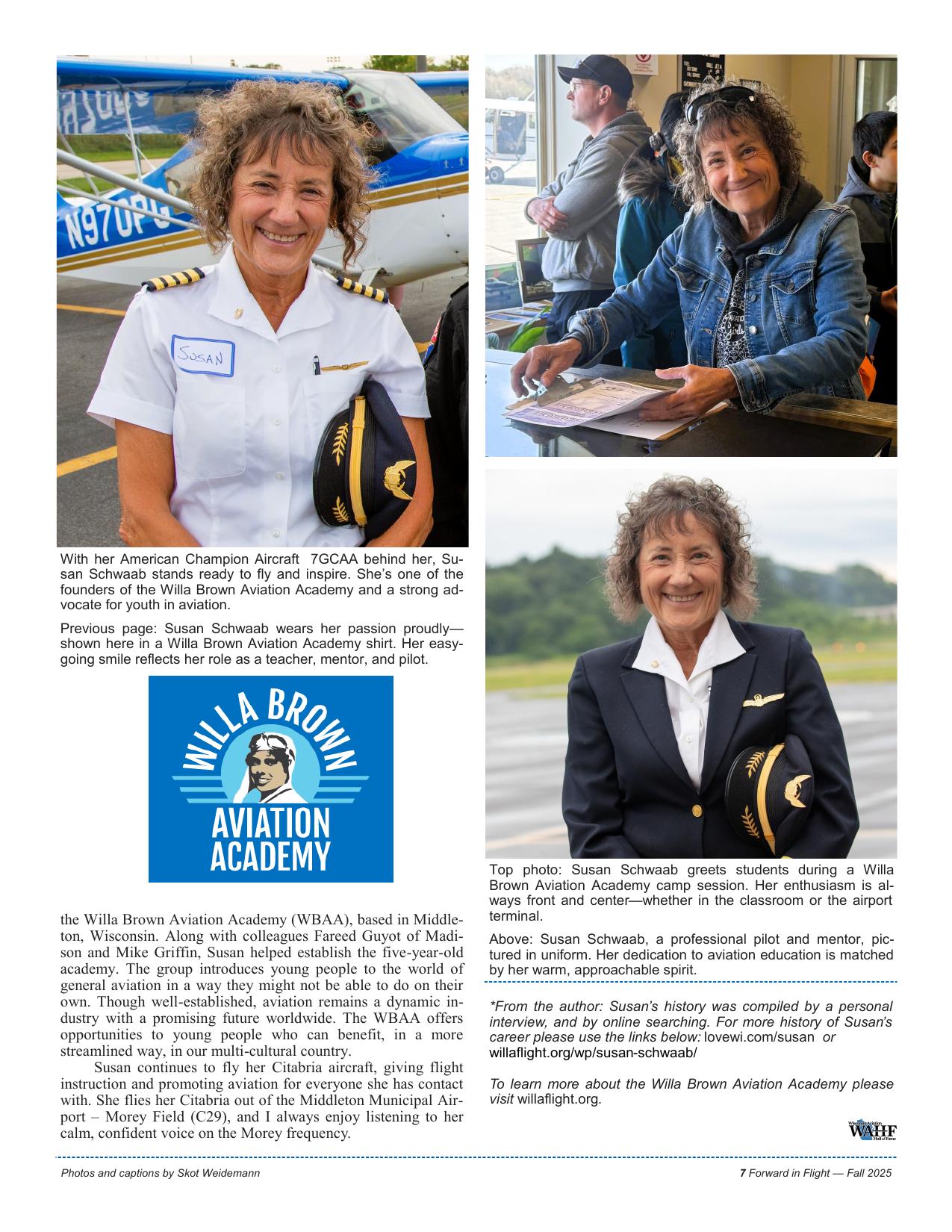
With her American Champion Aircraft 7GCAA behind her, Susan Schwaab stands ready to fly and inspire. She’s one of the founders of the Willa Brown Aviation Academy and a strong advocate for youth in aviation. Previous page: Susan Schwaab wears her passion proudly— shown here in a Willa Brown Aviation Academy shirt. Her easygoing smile reflects her role as a teacher, mentor, and pilot. the Willa Brown Aviation Academy (WBAA), based in Middleton, Wisconsin. Along with colleagues Fareed Guyot of Madison and Mike Griffin, Susan helped establish the five-year-old academy. The group introduces young people to the world of general aviation in a way they might not be able to do on their own. Though well-established, aviation remains a dynamic industry with a promising future worldwide. The WBAA offers opportunities to young people who can benefit, in a more streamlined way, in our multi-cultural country. Susan continues to fly her Citabria aircraft, giving flight instruction and promoting aviation for everyone she has contact with. She flies her Citabria out of the Middleton Municipal Airport – Morey Field (C29), and I always enjoy listening to her calm, confident voice on the Morey frequency. Photos and captions by Skot Weidemann Top photo: Susan Schwaab greets students during a Willa Brown Aviation Academy camp session. Her enthusiasm is always front and center—whether in the classroom or the airport terminal. Above: Susan Schwaab, a professional pilot and mentor, pictured in uniform. Her dedication to aviation education is matched by her warm, approachable spirit. *From the author: Susan’s history was compiled by a personal interview, and by online searching. For more history of Susan’s career please use the links below: lovewi.com/susan or willaflight.org/wp/susan-schwaab/ To learn more about the Willa Brown Aviation Academy please visit willaflight.org. 7 Forward in Flight — Fall 2025
AERO ADVENTURES The Missing Piece How Volunteering Completed My AirVenture Experience By Ed Becerra There are few things I look forward to each year: a slice of my mom’s homemade pumpkin pie on Thanksgiving, that perfect first day of flying, our annual trip to Door County, and of course, the mecca of aviation—EAA AirVenture Oshkosh. For one week, hundreds of thousands of pilots and aviation enthusiasts descend on the small town of Oshkosh, Wisconsin. In 2025, with an estimated 704,000 visitors, attendance exceeded even Milwaukee’s population. My first few visits to AirVenture were, in a word, overwhelming. With only a two- or three-day visit, my head was spinning as I tried to see it all. A hint for newbies: you can’t! Over time, I learned to extend my vacation, which allowed me to see all the airplanes I wanted. But then I realized there were still forums, workshops, meet and greets, movies at Theater in the Woods, the seaplane base, and the EAA Aviation Museum. With apologies to Mickey, what was supposed to be just a few days of aviation bliss turned into a full week at what I now consider the most magical place on Earth. After visiting nearly every year for the last twenty-five years, I still yearned for more. How could I enhance my experience? I had already traversed each end of the show multiple times, added my rivet to the One Week Wonder, sampled cheese curd tacos, shook hands with world renown aerobatic pilot Sean Tucker, and even saw the legendary F-14 Tomcat take to the skies. There had to be more. That's when my pilgrimage took an unexpected, and incredibly rewarding, detour. Lightspeed Aviation, makers of what I consider the most 8 Forward in Flight — Quarterly Magazine of the Wisconsin Aviation Hall of Fame comfortable and safety-oriented headsets around, was looking for volunteers for their AirVenture booth. The requirements were simple: be a pilot, use their product, and be willing to talk to other pilots about headsets. In return, we'd get a nice place to stay with hot showers and air conditioning, meals, and a generous token of appreciation. Could this be the missing piece to complete my AirVenture experience? I quickly filled out their questionnaire, snapped a few cheesy photos of myself in my Pacer, and submitted my aviation résumé, hoping for a resounding “YES” from the Lightspeed team. As fate would have it, I was chosen for the AirVenture volunteer squad. The crew was a diverse group of pilots from all over the country. We completed product and logistics training with Lightspeed employees a week before the event, and after practicing my sales pitch in the mirror dozens of times, I was ready for a new Oshkosh experience! “What was supposed to be just a few days of aviation bliss turned into a full week at what I now consider the most magical place on Earth.” —Ed Becerra
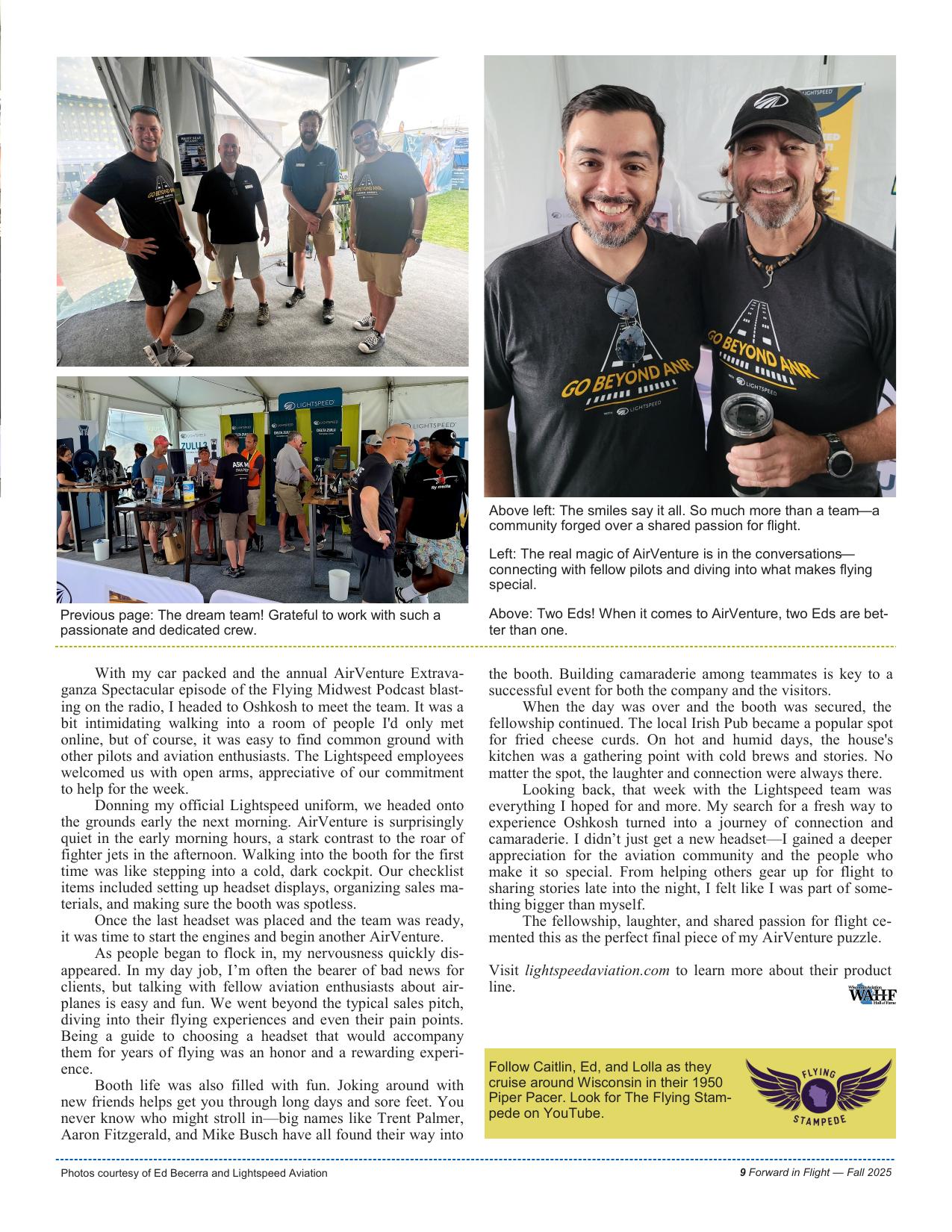
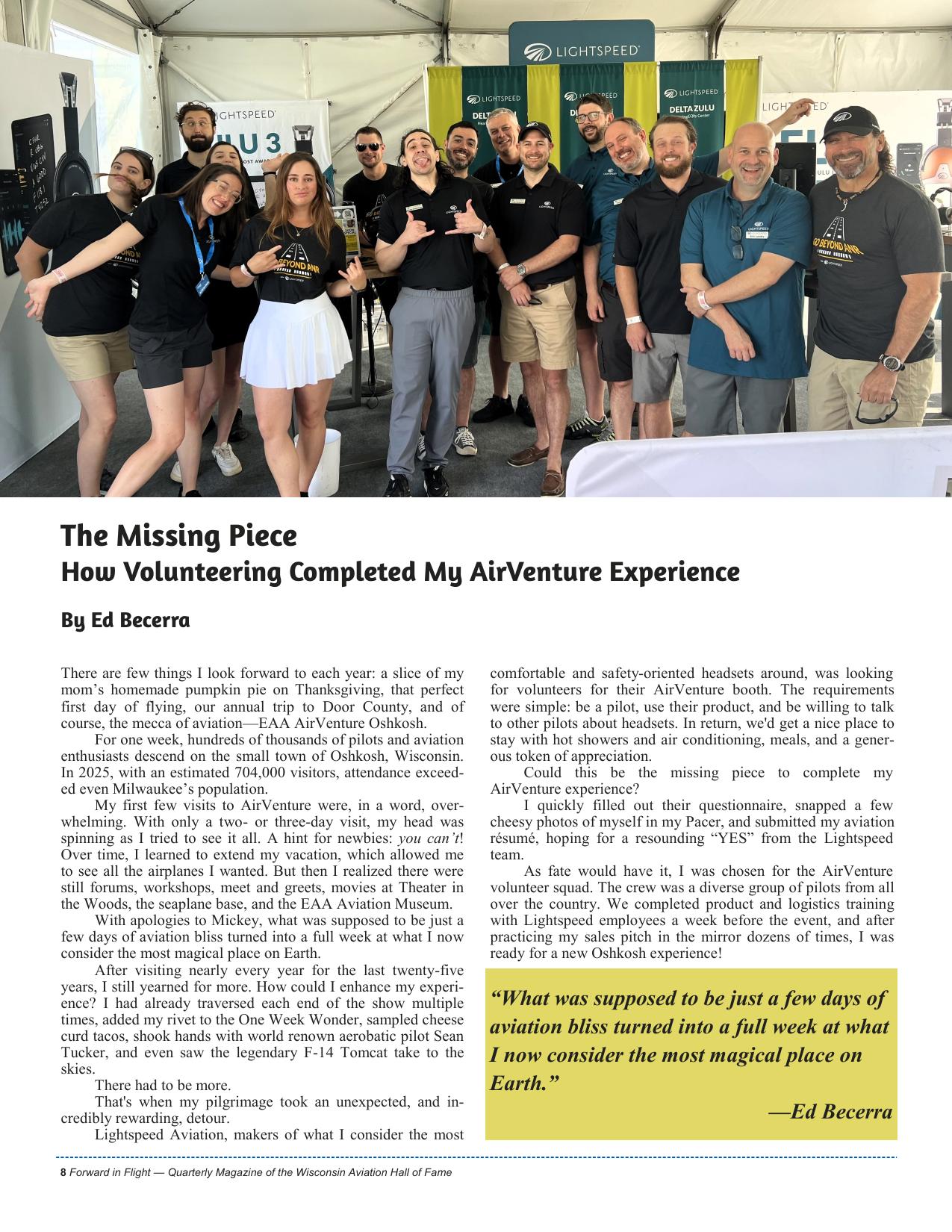
Above left: The smiles say it all. So much more than a team—a community forged over a shared passion for flight. Left: The real magic of AirVenture is in the conversations— connecting with fellow pilots and diving into what makes flying special. Previous page: The dream team! Grateful to work with such a passionate and dedicated crew. Above: Two Eds! When it comes to AirVenture, two Eds are better than one. With my car packed and the annual AirVenture Extravaganza Spectacular episode of the Flying Midwest Podcast blasting on the radio, I headed to Oshkosh to meet the team. It was a bit intimidating walking into a room of people I'd only met online, but of course, it was easy to find common ground with other pilots and aviation enthusiasts. The Lightspeed employees welcomed us with open arms, appreciative of our commitment to help for the week. Donning my official Lightspeed uniform, we headed onto the grounds early the next morning. AirVenture is surprisingly quiet in the early morning hours, a stark contrast to the roar of fighter jets in the afternoon. Walking into the booth for the first time was like stepping into a cold, dark cockpit. Our checklist items included setting up headset displays, organizing sales materials, and making sure the booth was spotless. Once the last headset was placed and the team was ready, it was time to start the engines and begin another AirVenture. As people began to flock in, my nervousness quickly disappeared. In my day job, I’m often the bearer of bad news for clients, but talking with fellow aviation enthusiasts about airplanes is easy and fun. We went beyond the typical sales pitch, diving into their flying experiences and even their pain points. Being a guide to choosing a headset that would accompany them for years of flying was an honor and a rewarding experience. Booth life was also filled with fun. Joking around with new friends helps get you through long days and sore feet. You never know who might stroll in—big names like Trent Palmer, Aaron Fitzgerald, and Mike Busch have all found their way into the booth. Building camaraderie among teammates is key to a successful event for both the company and the visitors. When the day was over and the booth was secured, the fellowship continued. The local Irish Pub became a popular spot for fried cheese curds. On hot and humid days, the house's kitchen was a gathering point with cold brews and stories. No matter the spot, the laughter and connection were always there. Looking back, that week with the Lightspeed team was everything I hoped for and more. My search for a fresh way to experience Oshkosh turned into a journey of connection and camaraderie. I didn’t just get a new headset—I gained a deeper appreciation for the aviation community and the people who make it so special. From helping others gear up for flight to sharing stories late into the night, I felt like I was part of something bigger than myself. The fellowship, laughter, and shared passion for flight cemented this as the perfect final piece of my AirVenture puzzle. Photos courtesy of Ed Becerra and Lightspeed Aviation Visit lightspeedaviation.com to learn more about their product line. Follow Caitlin, Ed, and Lolla as they cruise around Wisconsin in their 1950 Piper Pacer. Look for The Flying Stampede on YouTube. 9 Forward in Flight — Fall 2025
HIGHLIGHTS Oshkosh has always been a special place in the aviation world, but this year, it reached new heights. More than 704,000 people from around the globe poured into east-central Wisconsin for EAA AirVenture, setting an all-time attendance record for what’s known as The World’s Greatest Aviation Celebration. For one week, the skies over Wittman Regional Airport and surrounding communities became a living museum, innovation hub, and social gathering all rolled into one. More than 10,000 aircraft touched down at Oshkosh and nearby airports, creating a spectacle unlike anywhere else in the world. “This year’s success is a credit to our 6,000 volunteers, our staff members, and our partners as they continue to raise the bar on what’s possible as we bring the aviation world to Oshkosh,” said EAA CEO and Chairman Jack Pelton. A Wisconsin Welcome on a Global Stage From vintage warbirds to homebuilt marvels, the lineup of more than 2,500 show planes attracted pilots and spectators from 94 countries, including the first-ever visitor from Senegal. Local campgrounds were packed, with 15,000 camping sites accommodating over 40,000 visitors — turning Oshkosh into Wisconsin’s busiest summer neighborhood. The economic ripple effect stretched across Winnebago, Outagamie, Fond du Lac, Calumet, and Brown counties, generating $257 million according to a University of Wisconsin Oshkosh study. Hotels, restaurants, gas stations, and small businesses felt the boost as aviation fans explored the region. It’s clear that aviation helps keep the local economy buzzing. 10 Forward in Flight — Quarterly Magazine of the Wisconsin Aviation Hall of Fame Aircraft with Wisconsin Stories Not every airplane at AirVenture comes from far away. This year, a plane that flies out of Wittman Regional Airport (KOSH) won a Best Primary Trainer Silver Wrench award. Restored by Mike and Penny Kelly of Coldwater, Michigan, the 1943 PT19B Fairchild “Cornell” was a 3,300 hour, 16-year restoration, from August 2008 - August 2024. It’s currently in the loving hands of Jim and Jean Busha of Oshkosh. At the Piper Aircraft booth, the highly anticipated Piper Vagabond Serial Number One was on display, meticulously restored by Lone Rock’s The Johnson Brothers Flight Service, LLC, owned by Cory and Ryan Johnson. The aircraft won Grand Champion in the Classic Category (September 1945– 1955) — more on page 23. We were thrilled that the Wittman Legacy, N454WL — built by kids and based in Wausau — earned a Plans Built Outstanding Workmanship Award. The plane is owned by the Learn, Build, Fly group, led by WAHF Member Dave Conrad, which has been educating young people and enthusiasts in aircraft construction since 2014. Their success is clear proof of their dedication. We first shared the story of Barry Hammerback and Combat Helicopters, LLC, in the Spring 2024 issue of Forward in Flight. This year, their Bell UH-1H Huey, N14SD, earned a preservation award at AirVenture. Believed to be the world’s oldest flying UH-1D/H, the Huey served in Vietnam during 1966 and 1967. Today, it flies to honor Vietnam veterans and share their stories — a mission we were proud to feature. Photo by Greg Kieca
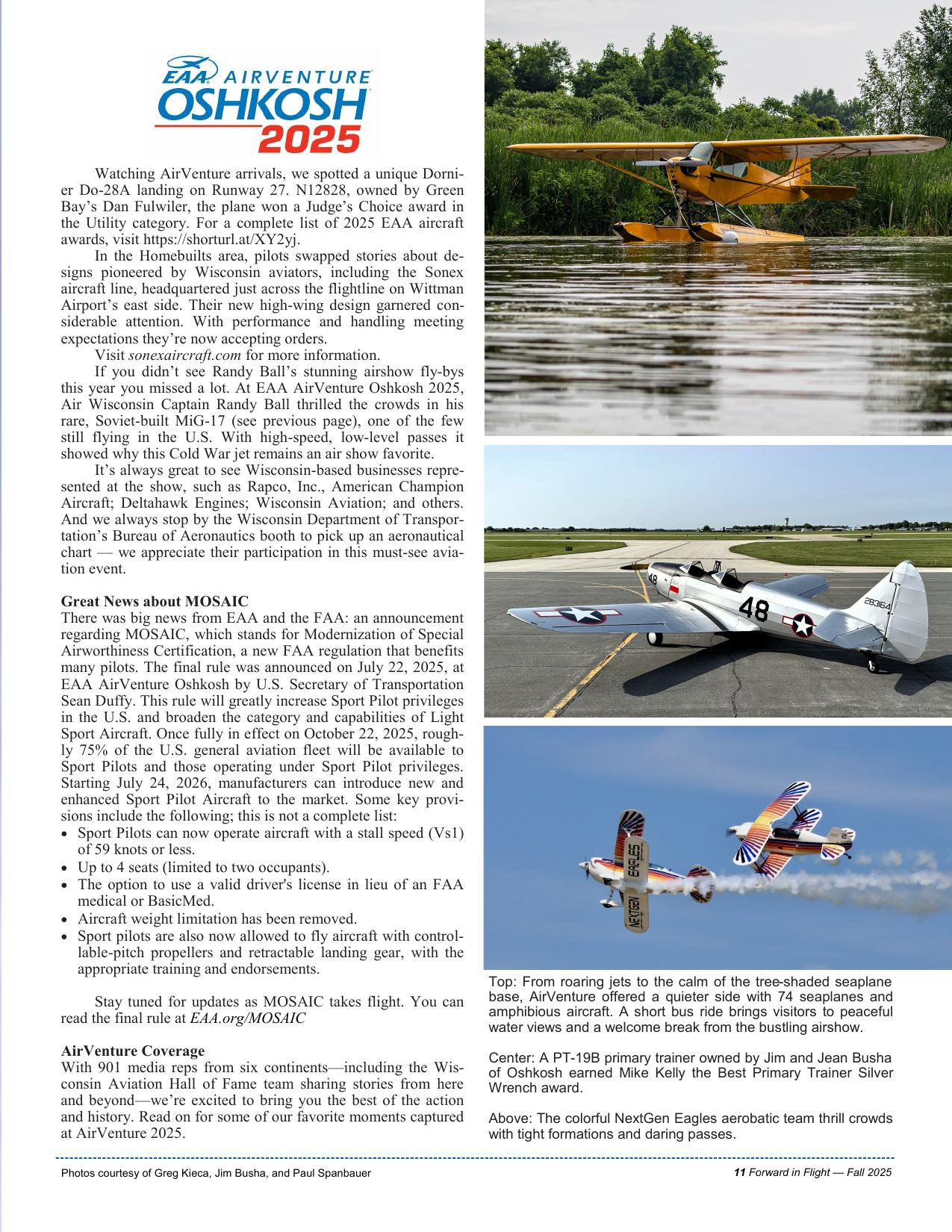
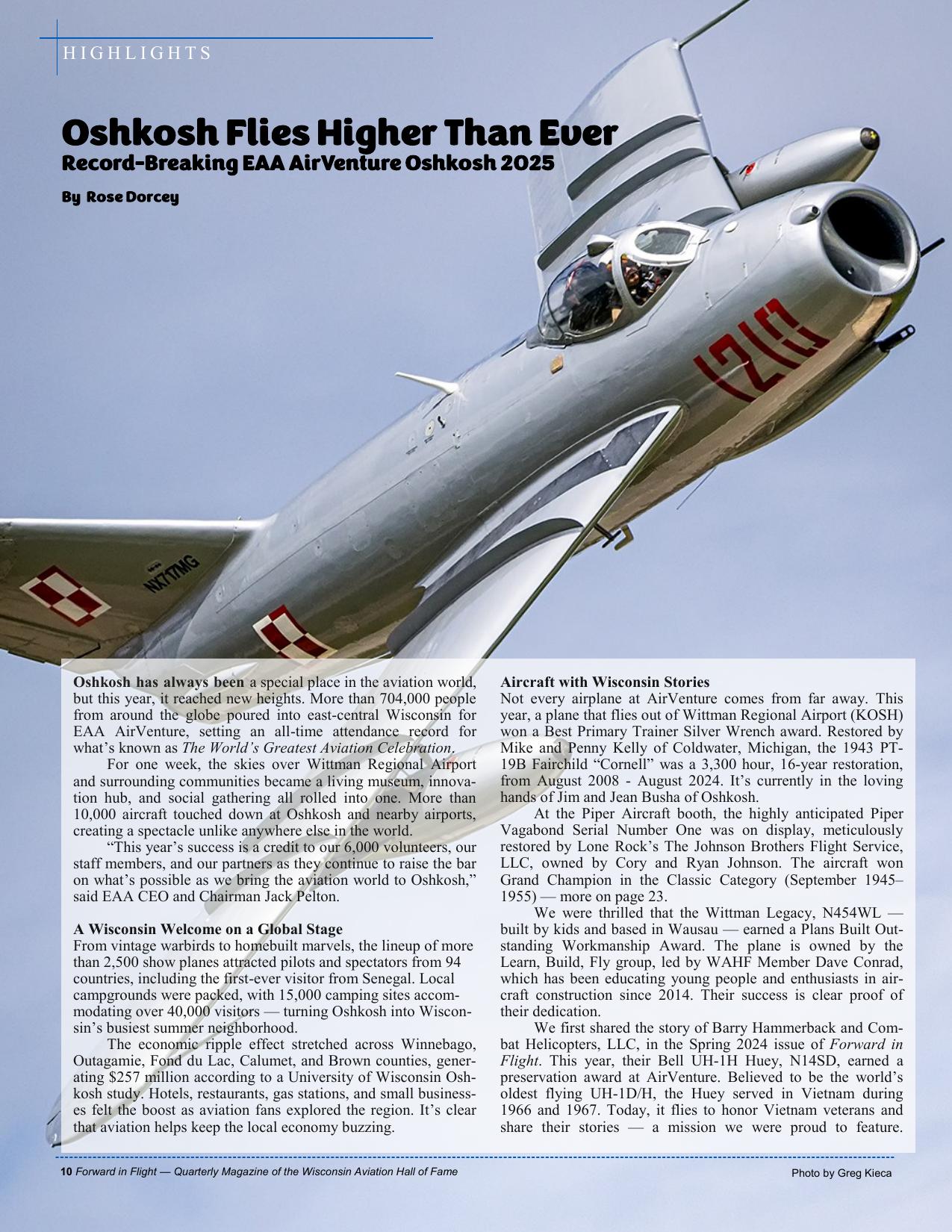
Watching AirVenture arrivals, we spotted a unique Dornier Do-28A landing on Runway 27. N12828, owned by Green Bay’s Dan Fulwiler, the plane won a Judge’s Choice award in the Utility category. For a complete list of 2025 EAA aircraft awards, visit https://shorturl.at/XY2yj. In the Homebuilts area, pilots swapped stories about designs pioneered by Wisconsin aviators, including the Sonex aircraft line, headquartered just across the flightline on Wittman Airport’s east side. Their new high-wing design garnered considerable attention. With performance and handling meeting expectations they’re now accepting orders. Visit sonexaircraft.com for more information. If you didn’t see Randy Ball’s stunning airshow fly-bys this year you missed a lot. At EAA AirVenture Oshkosh 2025, Air Wisconsin Captain Randy Ball thrilled the crowds in his rare, Soviet-built MiG-17 (see previous page), one of the few still flying in the U.S. With high-speed, low-level passes it showed why this Cold War jet remains an air show favorite. It’s always great to see Wisconsin-based businesses represented at the show, such as Rapco, Inc., American Champion Aircraft; Deltahawk Engines; Wisconsin Aviation; and others. And we always stop by the Wisconsin Department of Transportation’s Bureau of Aeronautics booth to pick up an aeronautical chart — we appreciate their participation in this must-see aviation event. Great News about MOSAIC There was big news from EAA and the FAA: an announcement regarding MOSAIC, which stands for Modernization of Special Airworthiness Certification, a new FAA regulation that benefits many pilots. The final rule was announced on July 22, 2025, at EAA AirVenture Oshkosh by U.S. Secretary of Transportation Sean Duffy. This rule will greatly increase Sport Pilot privileges in the U.S. and broaden the category and capabilities of Light Sport Aircraft. Once fully in effect on October 22, 2025, roughly 75% of the U.S. general aviation fleet will be available to Sport Pilots and those operating under Sport Pilot privileges. Starting July 24, 2026, manufacturers can introduce new and enhanced Sport Pilot Aircraft to the market. Some key provisions include the following; this is not a complete list: · Sport Pilots can now operate aircraft with a stall speed (Vs1) of 59 knots or less. · Up to 4 seats (limited to two occupants). · The option to use a valid driver's license in lieu of an FAA medical or BasicMed. · Aircraft weight limitation has been removed. · Sport pilots are also now allowed to fly aircraft with controllable-pitch propellers and retractable landing gear, with the appropriate training and endorsements. Stay tuned for updates as MOSAIC takes flight. You can read the final rule at EAA.org/MOSAIC AirVenture Coverage With 901 media reps from six continents—including the Wisconsin Aviation Hall of Fame team sharing stories from here and beyond—we’re excited to bring you the best of the action and history. Read on for some of our favorite moments captured at AirVenture 2025. Photos courtesy of Greg Kieca, Jim Busha, and Paul Spanbauer Top: From roaring jets to the calm of the tree-shaded seaplane base, AirVenture offered a quieter side with 74 seaplanes and amphibious aircraft. A short bus ride brings visitors to peaceful water views and a welcome break from the bustling airshow. Center: A PT-19B primary trainer owned by Jim and Jean Busha of Oshkosh earned Mike Kelly the Best Primary Trainer Silver Wrench award. Above: The colorful NextGen Eagles aerobatic team thrill crowds with tight formations and daring passes. 11 Forward in Flight — Fall 2025
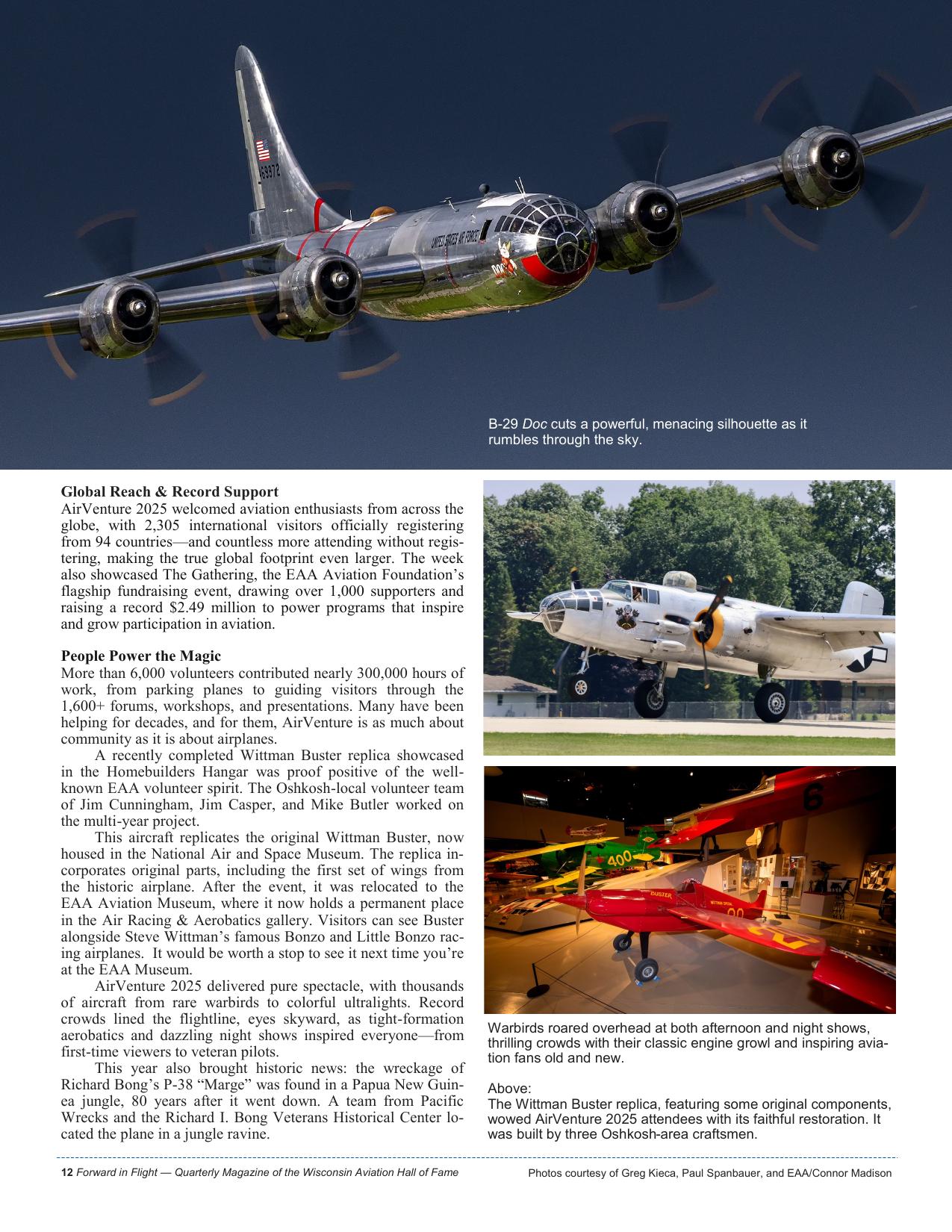
B-29 Doc cuts a powerful, menacing silhouette as it rumbles through the sky. Global Reach & Record Support AirVenture 2025 welcomed aviation enthusiasts from across the globe, with 2,305 international visitors officially registering from 94 countries—and countless more attending without registering, making the true global footprint even larger. The week also showcased The Gathering, the EAA Aviation Foundation’s flagship fundraising event, drawing over 1,000 supporters and raising a record $2.49 million to power programs that inspire and grow participation in aviation. People Power the Magic More than 6,000 volunteers contributed nearly 300,000 hours of work, from parking planes to guiding visitors through the 1,600+ forums, workshops, and presentations. Many have been helping for decades, and for them, AirVenture is as much about community as it is about airplanes. A recently completed Wittman Buster replica showcased in the Homebuilders Hangar was proof positive of the wellknown EAA volunteer spirit. The Oshkosh-local volunteer team of Jim Cunningham, Jim Casper, and Mike Butler worked on the multi-year project. This aircraft replicates the original Wittman Buster, now housed in the National Air and Space Museum. The replica incorporates original parts, including the first set of wings from the historic airplane. After the event, it was relocated to the EAA Aviation Museum, where it now holds a permanent place in the Air Racing & Aerobatics gallery. Visitors can see Buster alongside Steve Wittman’s famous Bonzo and Little Bonzo racing airplanes. It would be worth a stop to see it next time you’re at the EAA Museum. AirVenture 2025 delivered pure spectacle, with thousands of aircraft from rare warbirds to colorful ultralights. Record crowds lined the flightline, eyes skyward, as tight-formation aerobatics and dazzling night shows inspired everyone—from first-time viewers to veteran pilots. This year also brought historic news: the wreckage of Richard Bong’s P-38 “Marge” was found in a Papua New Guinea jungle, 80 years after it went down. A team from Pacific Wrecks and the Richard I. Bong Veterans Historical Center located the plane in a jungle ravine. 12 Forward in Flight — Quarterly Magazine of the Wisconsin Aviation Hall of Fame Warbirds roared overhead at both afternoon and night shows, thrilling crowds with their classic engine growl and inspiring aviation fans old and new. Above: The Wittman Buster replica, featuring some original components, wowed AirVenture 2025 attendees with its faithful restoration. It was built by three Oshkosh-area craftsmen. Photos courtesy of Greg Kieca, Paul Spanbauer, and EAA/Connor Madison
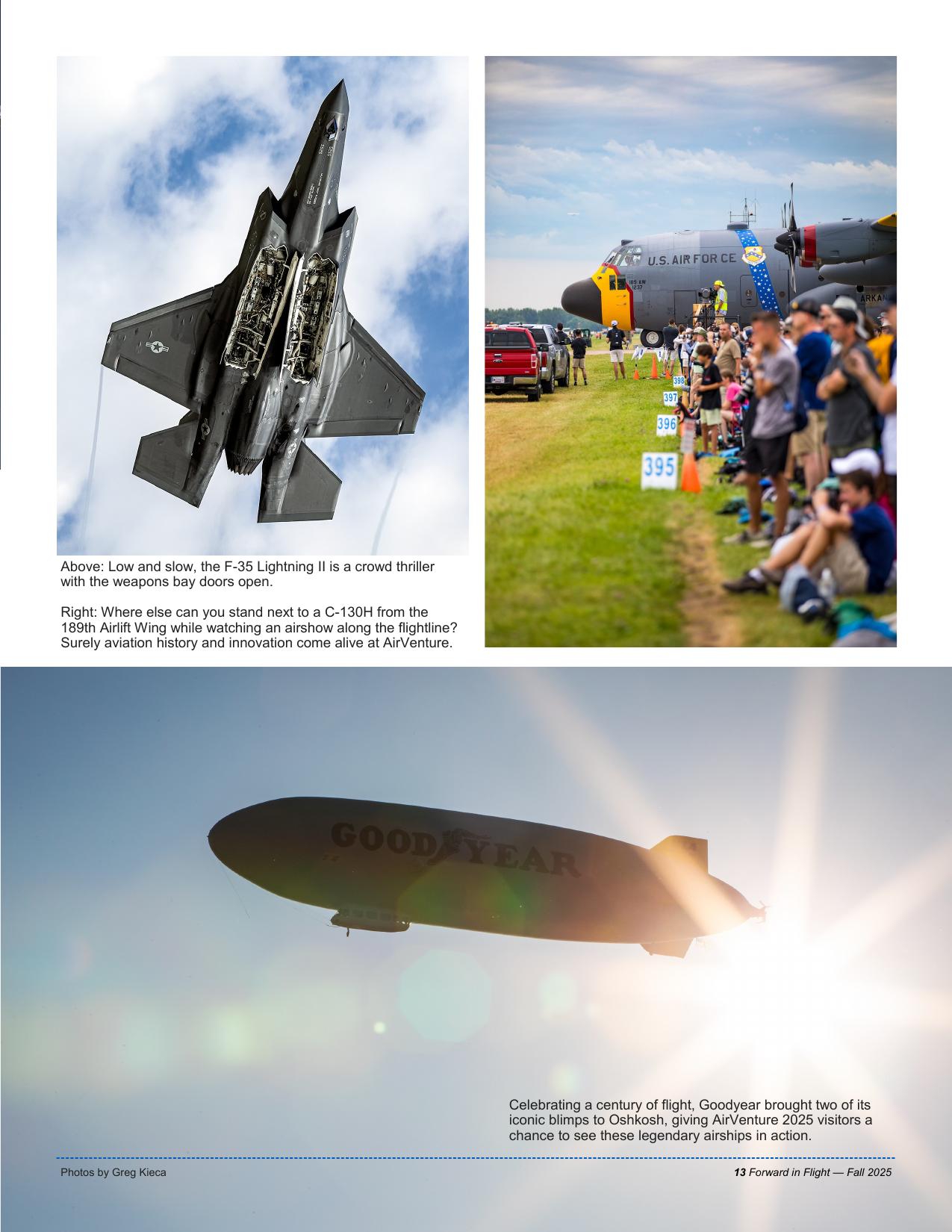
Above: Low and slow, the F-35 Lightning II is a crowd thriller with the weapons bay doors open. Right: Where else can you stand next to a C-130H from the 189th Airlift Wing while watching an airshow along the flightline? Surely aviation history and innovation come alive at AirVenture. Celebrating a century of flight, Goodyear brought two of its iconic blimps to Oshkosh, giving AirVenture 2025 visitors a chance to see these legendary airships in action. Photos by Greg Kieca 13 Forward in Flight — Fall 2025
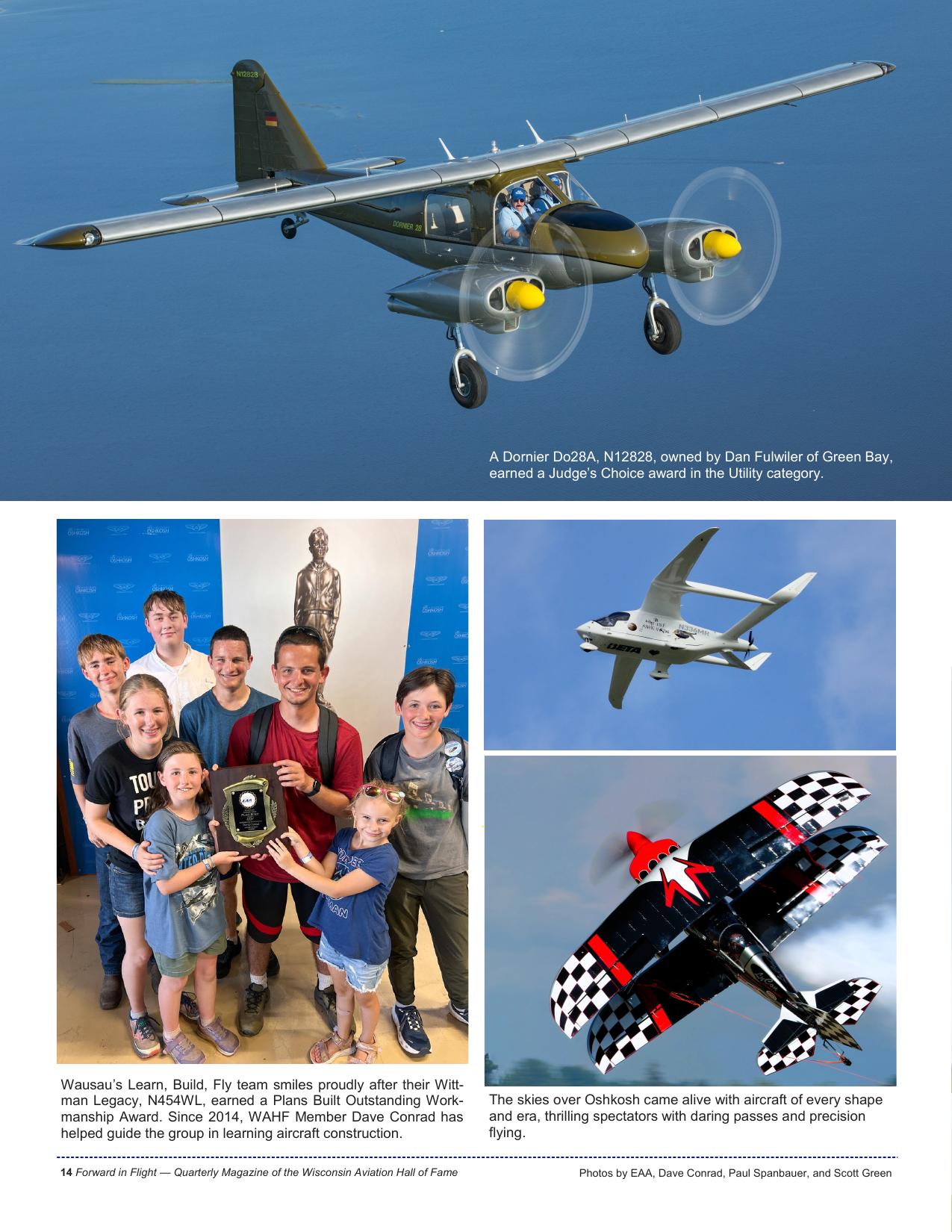
A Dornier Do28A, N12828, owned by Dan Fulwiler of Green Bay, earned a Judge’s Choice award in the Utility category. Wausau’s Learn, Build, Fly team smiles proudly after their Wittman Legacy, N454WL, earned a Plans Built Outstanding Workmanship Award. Since 2014, WAHF Member Dave Conrad has helped guide the group in learning aircraft construction. 14 Forward in Flight — Quarterly Magazine of the Wisconsin Aviation Hall of Fame The skies over Oshkosh came alive with aircraft of every shape and era, thrilling spectators with daring passes and precision flying. Photos by EAA, Dave Conrad, Paul Spanbauer, and Scott Green
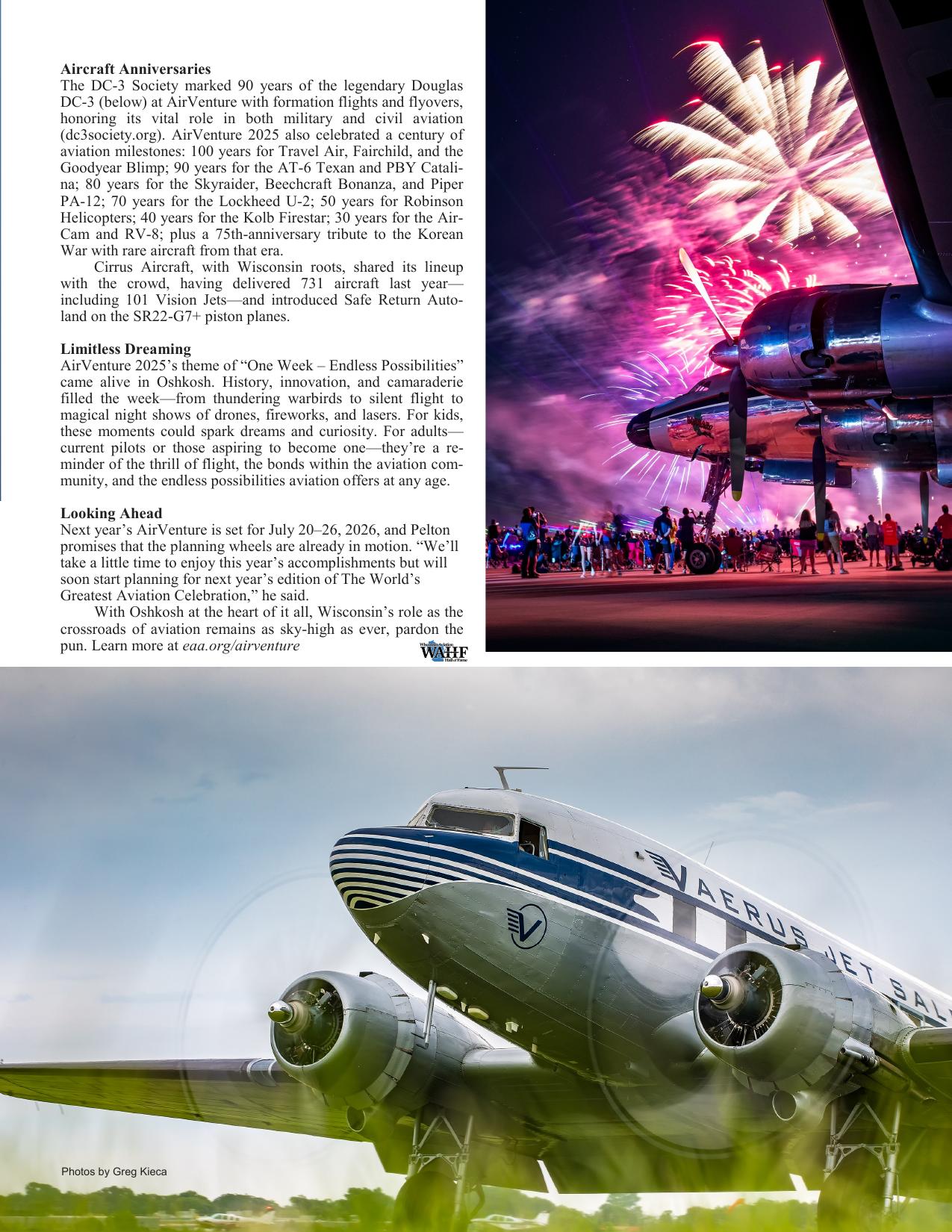
Aircraft Anniversaries The DC‑3 Society marked 90 years of the legendary Douglas DC‑3 (below) at AirVenture with formation flights and flyovers, honoring its vital role in both military and civil aviation (dc3society.org). AirVenture 2025 also celebrated a century of aviation milestones: 100 years for Travel Air, Fairchild, and the Goodyear Blimp; 90 years for the AT‑6 Texan and PBY Catalina; 80 years for the Skyraider, Beechcraft Bonanza, and Piper PA‑12; 70 years for the Lockheed U‑2; 50 years for Robinson Helicopters; 40 years for the Kolb Firestar; 30 years for the AirCam and RV‑8; plus a 75th-anniversary tribute to the Korean War with rare aircraft from that era. Cirrus Aircraft, with Wisconsin roots, shared its lineup with the crowd, having delivered 731 aircraft last year— including 101 Vision Jets—and introduced Safe Return Autoland on the SR22-G7+ piston planes. Limitless Dreaming AirVenture 2025’s theme of “One Week – Endless Possibilities” came alive in Oshkosh. History, innovation, and camaraderie filled the week—from thundering warbirds to silent flight to magical night shows of drones, fireworks, and lasers. For kids, these moments could spark dreams and curiosity. For adults— current pilots or those aspiring to become one—they’re a reminder of the thrill of flight, the bonds within the aviation community, and the endless possibilities aviation offers at any age. Looking Ahead Next year’s AirVenture is set for July 20–26, 2026, and Pelton promises that the planning wheels are already in motion. “We’ll take a little time to enjoy this year’s accomplishments but will soon start planning for next year’s edition of The World’s Greatest Aviation Celebration,” he said. With Oshkosh at the heart of it all, Wisconsin’s role as the crossroads of aviation remains as sky-high as ever, pardon the pun. Learn more at eaa.org/airventure Photos by Greg Kieca 15 Forward in Flight — Fall 2025
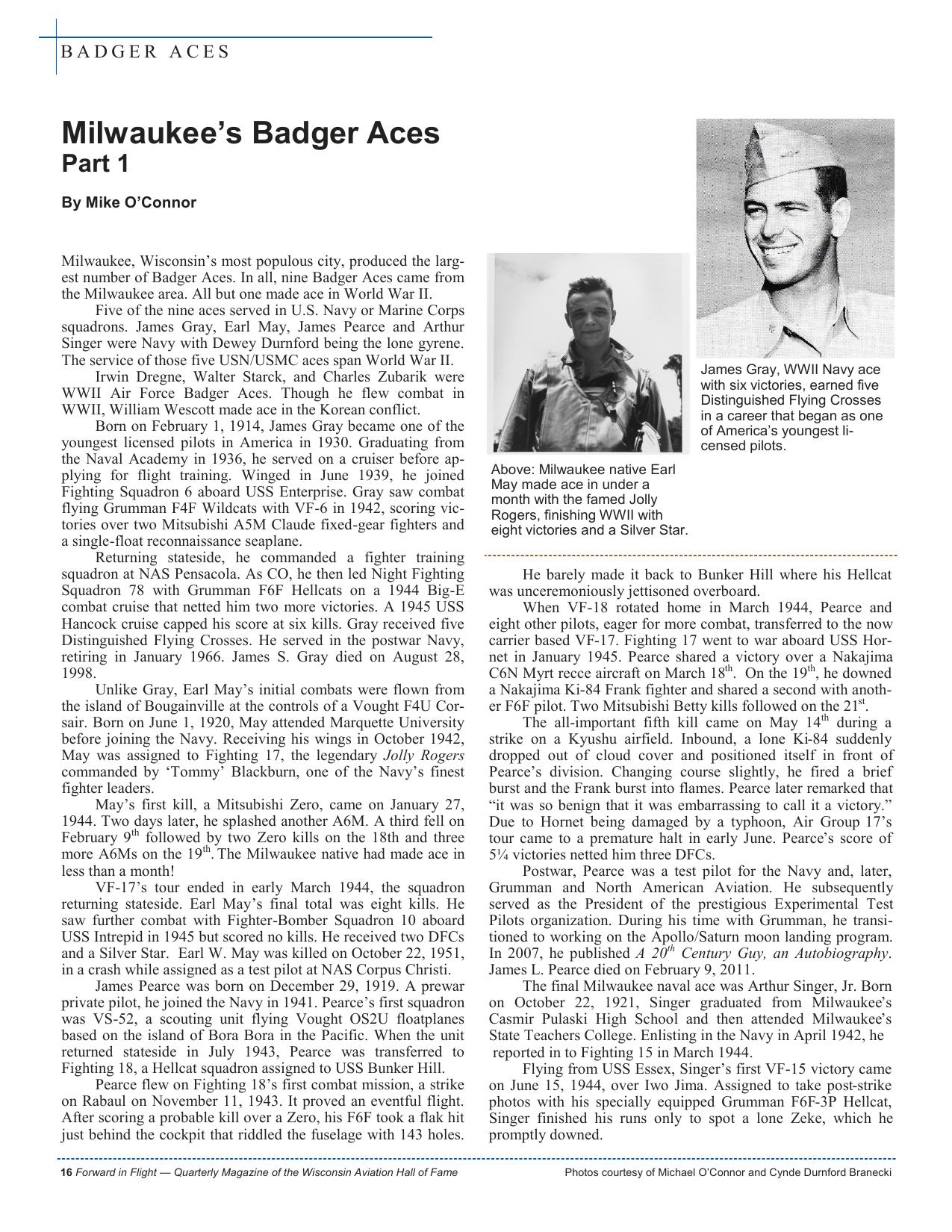
BADGER ACES Milwaukee’s Badger Aces Part 1 By Mike O’Connor Milwaukee, Wisconsin’s most populous city, produced the largest number of Badger Aces. In all, nine Badger Aces came from the Milwaukee area. All but one made ace in World War II. Five of the nine aces served in U.S. Navy or Marine Corps squadrons. James Gray, Earl May, James Pearce and Arthur Singer were Navy with Dewey Durnford being the lone gyrene. The service of those five USN/USMC aces span World War II. Irwin Dregne, Walter Starck, and Charles Zubarik were WWII Air Force Badger Aces. Though he flew combat in WWII, William Wescott made ace in the Korean conflict. Born on February 1, 1914, James Gray became one of the youngest licensed pilots in America in 1930. Graduating from the Naval Academy in 1936, he served on a cruiser before applying for flight training. Winged in June 1939, he joined Fighting Squadron 6 aboard USS Enterprise. Gray saw combat flying Grumman F4F Wildcats with VF-6 in 1942, scoring victories over two Mitsubishi A5M Claude fixed-gear fighters and a single-float reconnaissance seaplane. Returning stateside, he commanded a fighter training squadron at NAS Pensacola. As CO, he then led Night Fighting Squadron 78 with Grumman F6F Hellcats on a 1944 Big-E combat cruise that netted him two more victories. A 1945 USS Hancock cruise capped his score at six kills. Gray received five Distinguished Flying Crosses. He served in the postwar Navy, retiring in January 1966. James S. Gray died on August 28, 1998. Unlike Gray, Earl May’s initial combats were flown from the island of Bougainville at the controls of a Vought F4U Corsair. Born on June 1, 1920, May attended Marquette University before joining the Navy. Receiving his wings in October 1942, May was assigned to Fighting 17, the legendary Jolly Rogers commanded by ‘Tommy’ Blackburn, one of the Navy’s finest fighter leaders. May’s first kill, a Mitsubishi Zero, came on January 27, 1944. Two days later, he splashed another A6M. A third fell on February 9th followed by two Zero kills on the 18th and three more A6Ms on the 19th. The Milwaukee native had made ace in less than a month! VF-17’s tour ended in early March 1944, the squadron returning stateside. Earl May’s final total was eight kills. He saw further combat with Fighter-Bomber Squadron 10 aboard USS Intrepid in 1945 but scored no kills. He received two DFCs and a Silver Star. Earl W. May was killed on October 22, 1951, in a crash while assigned as a test pilot at NAS Corpus Christi. James Pearce was born on December 29, 1919. A prewar private pilot, he joined the Navy in 1941. Pearce’s first squadron was VS-52, a scouting unit flying Vought OS2U floatplanes based on the island of Bora Bora in the Pacific. When the unit returned stateside in July 1943, Pearce was transferred to Fighting 18, a Hellcat squadron assigned to USS Bunker Hill. Pearce flew on Fighting 18’s first combat mission, a strike on Rabaul on November 11, 1943. It proved an eventful flight. After scoring a probable kill over a Zero, his F6F took a flak hit just behind the cockpit that riddled the fuselage with 143 holes. He barely made it back to Bunker Hill where his Hellcat was unceremoniously jettisoned overboard. When VF-18 rotated home in March 1944, Pearce and eight other pilots, eager for more combat, transferred to the now carrier based VF-17. Fighting 17 went to war aboard USS Hornet in January 1945. Pearce shared a victory over a Nakajima C6N Myrt recce aircraft on March 18th. On the 19th, he downed a Nakajima Ki-84 Frank fighter and shared a second with another F6F pilot. Two Mitsubishi Betty kills followed on the 21st. The all-important fifth kill came on May 14th during a strike on a Kyushu airfield. Inbound, a lone Ki-84 suddenly dropped out of cloud cover and positioned itself in front of Pearce’s division. Changing course slightly, he fired a brief burst and the Frank burst into flames. Pearce later remarked that “it was so benign that it was embarrassing to call it a victory.” Due to Hornet being damaged by a typhoon, Air Group 17’s tour came to a premature halt in early June. Pearce’s score of 5¼ victories netted him three DFCs. Postwar, Pearce was a test pilot for the Navy and, later, Grumman and North American Aviation. He subsequently served as the President of the prestigious Experimental Test Pilots organization. During his time with Grumman, he transitioned to working on the Apollo/Saturn moon landing program. In 2007, he published A 20th Century Guy, an Autobiography. James L. Pearce died on February 9, 2011. The final Milwaukee naval ace was Arthur Singer, Jr. Born on October 22, 1921, Singer graduated from Milwaukee’s Casmir Pulaski High School and then attended Milwaukee’s State Teachers College. Enlisting in the Navy in April 1942, he reported in to Fighting 15 in March 1944. Flying from USS Essex, Singer’s first VF-15 victory came on June 15, 1944, over Iwo Jima. Assigned to take post-strike photos with his specially equipped Grumman F6F-3P Hellcat, Singer finished his runs only to spot a lone Zeke, which he promptly downed. 16 Forward in Flight — Quarterly Magazine of the Wisconsin Aviation Hall of Fame Photos courtesy of Michael O’Connor and Cynde Durnford Branecki James Gray, WWII Navy ace with six victories, earned five Distinguished Flying Crosses in a career that began as one of America’s youngest licensed pilots. Above: Milwaukee native Earl May made ace in under a month with the famed Jolly Rogers, finishing WWII with eight victories and a Silver Star.
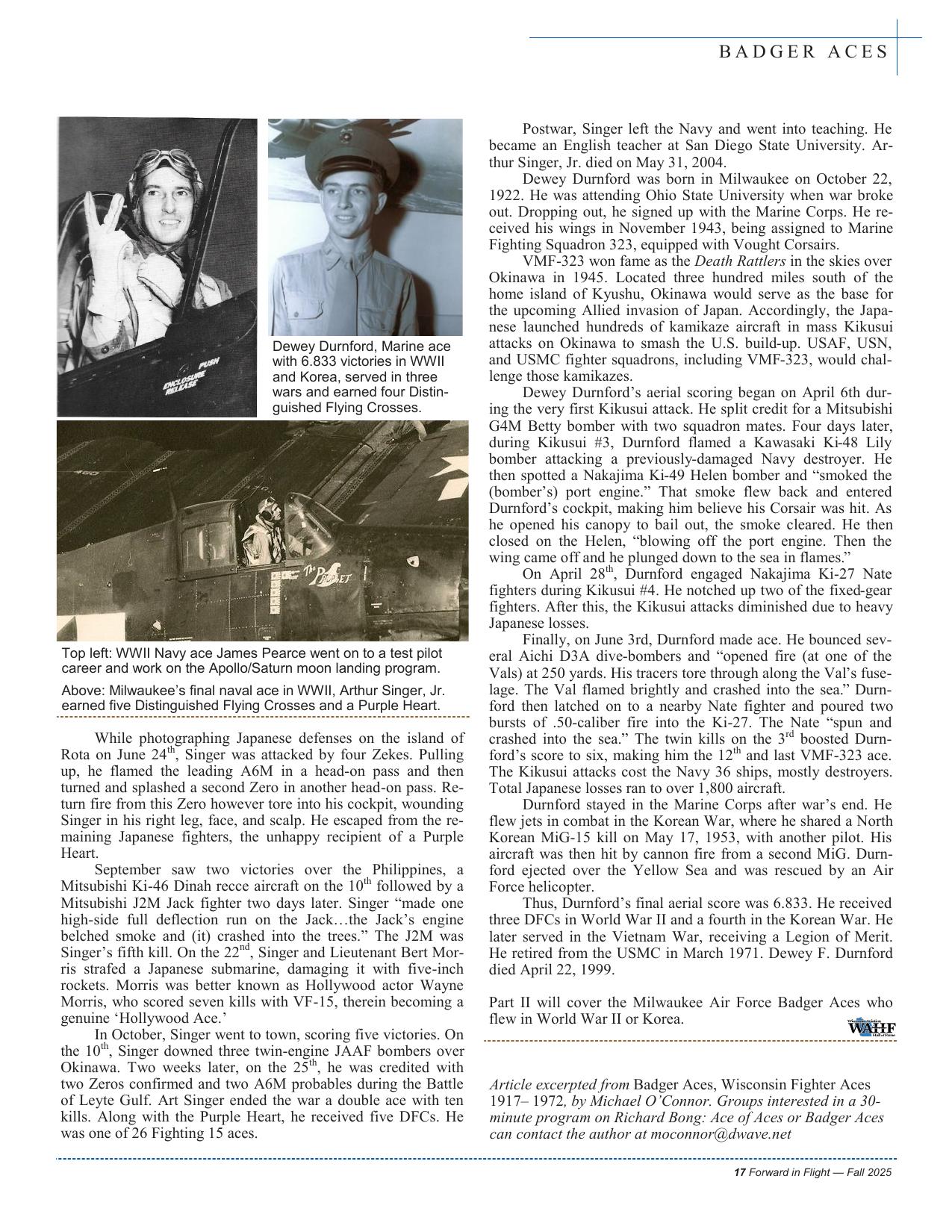
BADGER ACES Dewey Durnford, Marine ace with 6.833 victories in WWII and Korea, served in three wars and earned four Distinguished Flying Crosses. Top left: WWII Navy ace James Pearce went on to a test pilot career and work on the Apollo/Saturn moon landing program. Above: Milwaukee’s final naval ace in WWII, Arthur Singer, Jr. earned five Distinguished Flying Crosses and a Purple Heart. While photographing Japanese defenses on the island of Rota on June 24th, Singer was attacked by four Zekes. Pulling up, he flamed the leading A6M in a head-on pass and then turned and splashed a second Zero in another head-on pass. Return fire from this Zero however tore into his cockpit, wounding Singer in his right leg, face, and scalp. He escaped from the remaining Japanese fighters, the unhappy recipient of a Purple Heart. September saw two victories over the Philippines, a Mitsubishi Ki-46 Dinah recce aircraft on the 10th followed by a Mitsubishi J2M Jack fighter two days later. Singer “made one high-side full deflection run on the Jack…the Jack’s engine belched smoke and (it) crashed into the trees.” The J2M was Singer’s fifth kill. On the 22nd, Singer and Lieutenant Bert Morris strafed a Japanese submarine, damaging it with five-inch rockets. Morris was better known as Hollywood actor Wayne Morris, who scored seven kills with VF-15, therein becoming a genuine ‘Hollywood Ace.’ In October, Singer went to town, scoring five victories. On the 10th, Singer downed three twin-engine JAAF bombers over Okinawa. Two weeks later, on the 25th, he was credited with two Zeros confirmed and two A6M probables during the Battle of Leyte Gulf. Art Singer ended the war a double ace with ten kills. Along with the Purple Heart, he received five DFCs. He was one of 26 Fighting 15 aces. Postwar, Singer left the Navy and went into teaching. He became an English teacher at San Diego State University. Arthur Singer, Jr. died on May 31, 2004. Dewey Durnford was born in Milwaukee on October 22, 1922. He was attending Ohio State University when war broke out. Dropping out, he signed up with the Marine Corps. He received his wings in November 1943, being assigned to Marine Fighting Squadron 323, equipped with Vought Corsairs. VMF-323 won fame as the Death Rattlers in the skies over Okinawa in 1945. Located three hundred miles south of the home island of Kyushu, Okinawa would serve as the base for the upcoming Allied invasion of Japan. Accordingly, the Japanese launched hundreds of kamikaze aircraft in mass Kikusui attacks on Okinawa to smash the U.S. build-up. USAF, USN, and USMC fighter squadrons, including VMF-323, would challenge those kamikazes. Dewey Durnford’s aerial scoring began on April 6th during the very first Kikusui attack. He split credit for a Mitsubishi G4M Betty bomber with two squadron mates. Four days later, during Kikusui #3, Durnford flamed a Kawasaki Ki-48 Lily bomber attacking a previously-damaged Navy destroyer. He then spotted a Nakajima Ki-49 Helen bomber and “smoked the (bomber’s) port engine.” That smoke flew back and entered Durnford’s cockpit, making him believe his Corsair was hit. As he opened his canopy to bail out, the smoke cleared. He then closed on the Helen, “blowing off the port engine. Then the wing came off and he plunged down to the sea in flames.” On April 28th, Durnford engaged Nakajima Ki-27 Nate fighters during Kikusui #4. He notched up two of the fixed-gear fighters. After this, the Kikusui attacks diminished due to heavy Japanese losses. Finally, on June 3rd, Durnford made ace. He bounced several Aichi D3A dive-bombers and “opened fire (at one of the Vals) at 250 yards. His tracers tore through along the Val’s fuselage. The Val flamed brightly and crashed into the sea.” Durnford then latched on to a nearby Nate fighter and poured two bursts of .50-caliber fire into the Ki-27. The Nate “spun and crashed into the sea.” The twin kills on the 3rd boosted Durnford’s score to six, making him the 12th and last VMF-323 ace. The Kikusui attacks cost the Navy 36 ships, mostly destroyers. Total Japanese losses ran to over 1,800 aircraft. Durnford stayed in the Marine Corps after war’s end. He flew jets in combat in the Korean War, where he shared a North Korean MiG-15 kill on May 17, 1953, with another pilot. His aircraft was then hit by cannon fire from a second MiG. Durnford ejected over the Yellow Sea and was rescued by an Air Force helicopter. Thus, Durnford’s final aerial score was 6.833. He received three DFCs in World War II and a fourth in the Korean War. He later served in the Vietnam War, receiving a Legion of Merit. He retired from the USMC in March 1971. Dewey F. Durnford died April 22, 1999. Part II will cover the Milwaukee Air Force Badger Aces who flew in World War II or Korea. Article excerpted from Badger Aces, Wisconsin Fighter Aces 1917– 1972, by Michael O’Connor. Groups interested in a 30minute program on Richard Bong: Ace of Aces or Badger Aces can contact the author at moconnor@dwave.net 17 Forward in Flight — Fall 2025
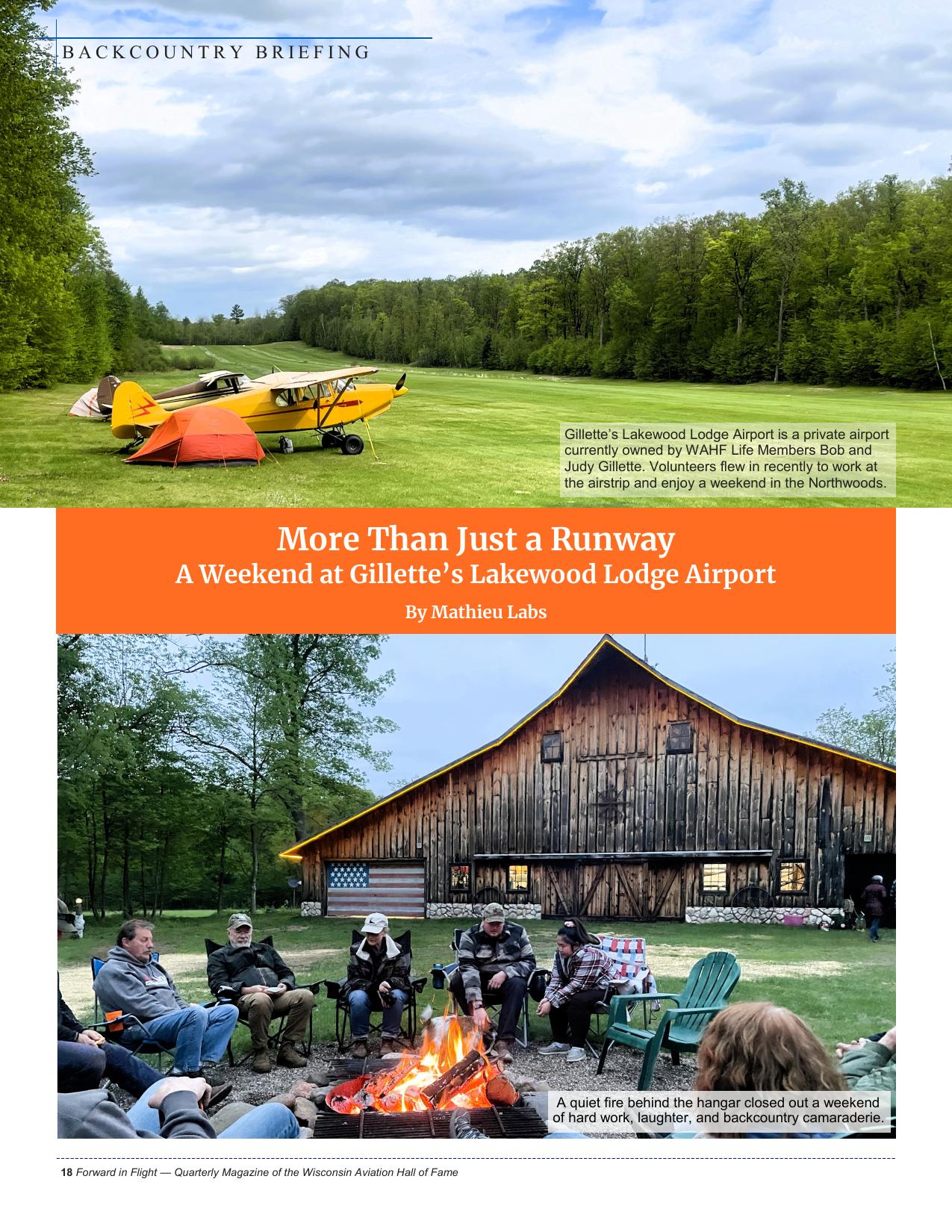
BACKCOUNTRY BRIEFING Gillette’s Lakewood Lodge Airport is a private airport currently owned by WAHF Life Members Bob and Judy Gillette. Volunteers flew in recently to work at the airstrip and enjoy a weekend in the Northwoods. More Than Just a Runway A Weekend at Gillette’s Lakewood Lodge Airport By Mathieu Labs A quiet fire behind the hangar closed out a weekend of hard work, laughter, and backcountry camaraderie. 18 Forward in Flight — Quarterly Magazine of the Wisconsin Aviation Hall of Fame
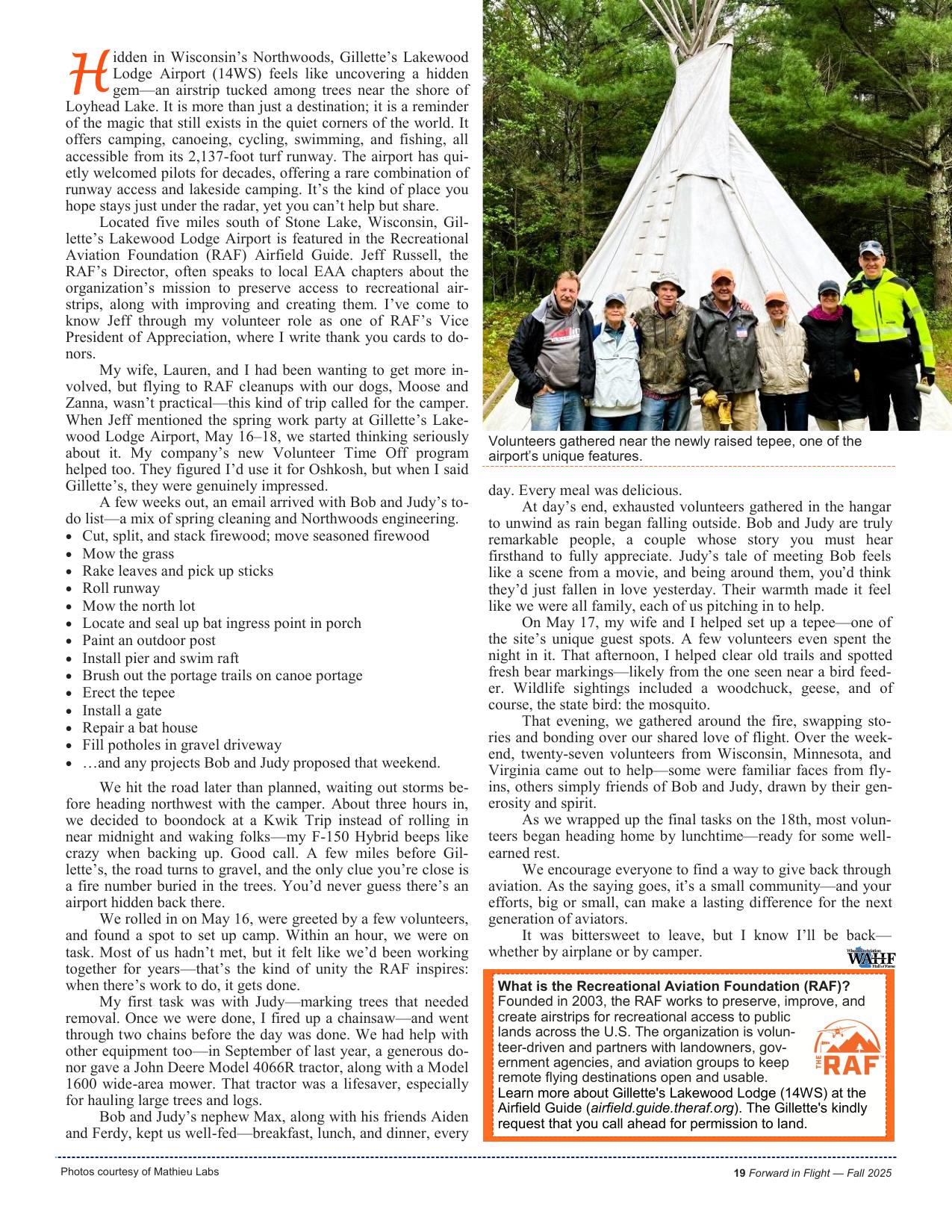
H idden in Wisconsin’s Northwoods, Gillette’s Lakewood Lodge Airport (14WS) feels like uncovering a hidden gem—an airstrip tucked among trees near the shore of Loyhead Lake. It is more than just a destination; it is a reminder of the magic that still exists in the quiet corners of the world. It offers camping, canoeing, cycling, swimming, and fishing, all accessible from its 2,137-foot turf runway. The airport has quietly welcomed pilots for decades, offering a rare combination of runway access and lakeside camping. It’s the kind of place you hope stays just under the radar, yet you can’t help but share. Located five miles south of Stone Lake, Wisconsin, Gillette’s Lakewood Lodge Airport is featured in the Recreational Aviation Foundation (RAF) Airfield Guide. Jeff Russell, the RAF’s Director, often speaks to local EAA chapters about the organization’s mission to preserve access to recreational airstrips, along with improving and creating them. I’ve come to know Jeff through my volunteer role as one of RAF’s Vice President of Appreciation, where I write thank you cards to donors. My wife, Lauren, and I had been wanting to get more involved, but flying to RAF cleanups with our dogs, Moose and Zanna, wasn’t practical—this kind of trip called for the camper. When Jeff mentioned the spring work party at Gillette’s Lakewood Lodge Airport, May 16–18, we started thinking seriously about it. My company’s new Volunteer Time Off program helped too. They figured I’d use it for Oshkosh, but when I said Gillette’s, they were genuinely impressed. A few weeks out, an email arrived with Bob and Judy’s todo list—a mix of spring cleaning and Northwoods engineering. · Cut, split, and stack firewood; move seasoned firewood · Mow the grass · Rake leaves and pick up sticks · Roll runway · Mow the north lot · Locate and seal up bat ingress point in porch · Paint an outdoor post · Install pier and swim raft · Brush out the portage trails on canoe portage · Erect the tepee · Install a gate · Repair a bat house · Fill potholes in gravel driveway · …and any projects Bob and Judy proposed that weekend. We hit the road later than planned, waiting out storms before heading northwest with the camper. About three hours in, we decided to boondock at a Kwik Trip instead of rolling in near midnight and waking folks—my F-150 Hybrid beeps like crazy when backing up. Good call. A few miles before Gillette’s, the road turns to gravel, and the only clue you’re close is a fire number buried in the trees. You’d never guess there’s an airport hidden back there. We rolled in on May 16, were greeted by a few volunteers, and found a spot to set up camp. Within an hour, we were on task. Most of us hadn’t met, but it felt like we’d been working together for years—that’s the kind of unity the RAF inspires: when there’s work to do, it gets done. My first task was with Judy—marking trees that needed removal. Once we were done, I fired up a chainsaw—and went through two chains before the day was done. We had help with other equipment too—in September of last year, a generous donor gave a John Deere Model 4066R tractor, along with a Model 1600 wide-area mower. That tractor was a lifesaver, especially for hauling large trees and logs. Bob and Judy’s nephew Max, along with his friends Aiden and Ferdy, kept us well-fed—breakfast, lunch, and dinner, every Photos courtesy of Mathieu Labs Volunteers gathered near the newly raised tepee, one of the airport’s unique features. day. Every meal was delicious. At day’s end, exhausted volunteers gathered in the hangar to unwind as rain began falling outside. Bob and Judy are truly remarkable people, a couple whose story you must hear firsthand to fully appreciate. Judy’s tale of meeting Bob feels like a scene from a movie, and being around them, you’d think they’d just fallen in love yesterday. Their warmth made it feel like we were all family, each of us pitching in to help. On May 17, my wife and I helped set up a tepee—one of the site’s unique guest spots. A few volunteers even spent the night in it. That afternoon, I helped clear old trails and spotted fresh bear markings—likely from the one seen near a bird feeder. Wildlife sightings included a woodchuck, geese, and of course, the state bird: the mosquito. That evening, we gathered around the fire, swapping stories and bonding over our shared love of flight. Over the weekend, twenty-seven volunteers from Wisconsin, Minnesota, and Virginia came out to help—some were familiar faces from flyins, others simply friends of Bob and Judy, drawn by their generosity and spirit. As we wrapped up the final tasks on the 18th, most volunteers began heading home by lunchtime—ready for some wellearned rest. We encourage everyone to find a way to give back through aviation. As the saying goes, it’s a small community—and your efforts, big or small, can make a lasting difference for the next generation of aviators. It was bittersweet to leave, but I know I’ll be back— whether by airplane or by camper. What is the Recreational Aviation Foundation (RAF)? Founded in 2003, the RAF works to preserve, improve, and create airstrips for recreational access to public lands across the U.S. The organization is volunteer-driven and partners with landowners, government agencies, and aviation groups to keep remote flying destinations open and usable. Learn more about Gillette's Lakewood Lodge (14WS) at the Airfield Guide (airfield.guide.theraf.org). The Gillette's kindly request that you call ahead for permission to land. 19 Forward in Flight — Fall 2025
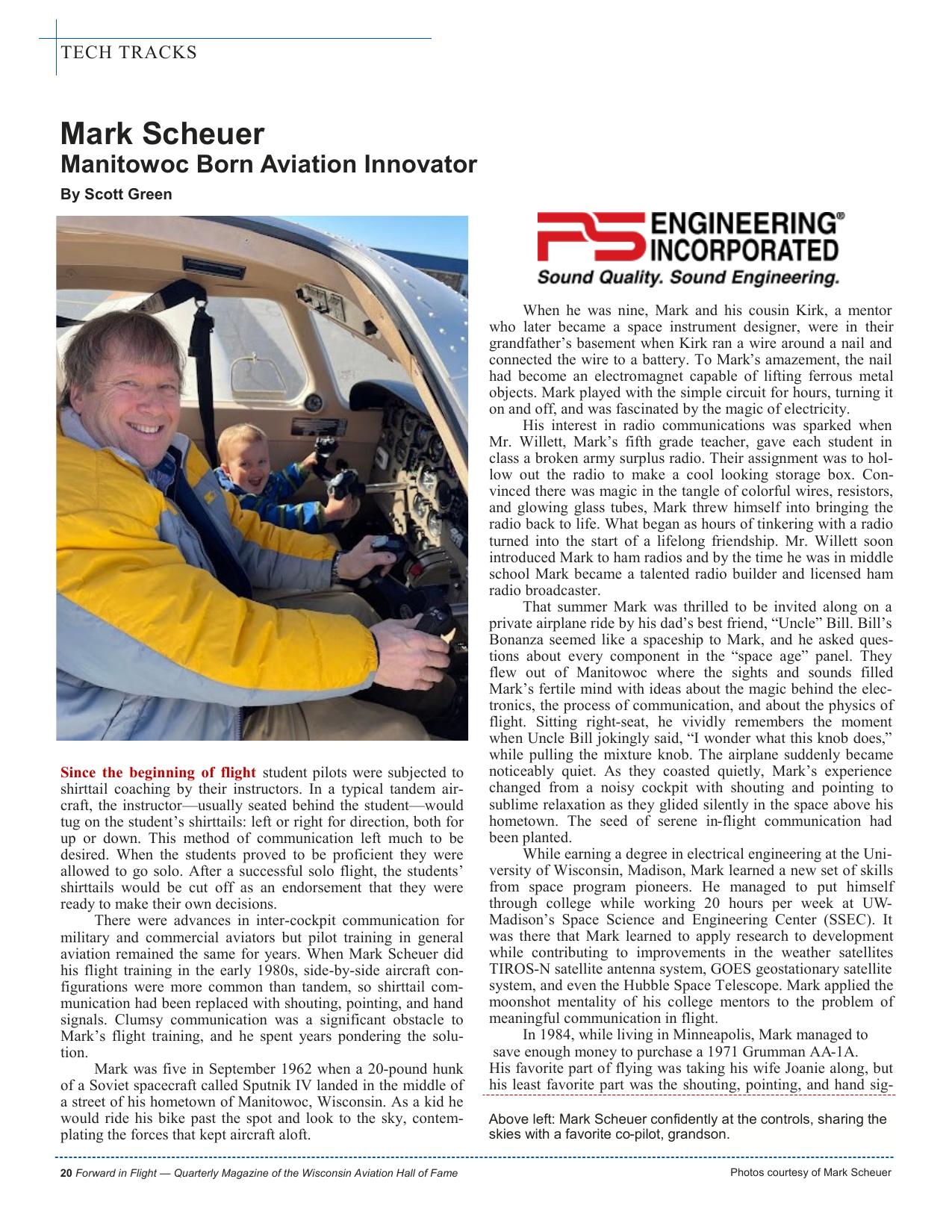
TECH TRACKS Mark Scheuer Manitowoc Born Aviation Innovator By Scott Green When he was nine, Mark and his cousin Kirk, a mentor who later became a space instrument designer, were in their grandfather’s basement when Kirk ran a wire around a nail and connected the wire to a battery. To Mark’s amazement, the nail had become an electromagnet capable of lifting ferrous metal objects. Mark played with the simple circuit for hours, turning it on and off, and was fascinated by the magic of electricity. His interest in radio communications was sparked when Mr. Willett, Mark’s fifth grade teacher, gave each student in class a broken army surplus radio. Their assignment was to hollow out the radio to make a cool looking storage box. Convinced there was magic in the tangle of colorful wires, resistors, and glowing glass tubes, Mark threw himself into bringing the radio back to life. What began as hours of tinkering with a radio turned into the start of a lifelong friendship. Mr. Willett soon introduced Mark to ham radios and by the time he was in middle school Mark became a talented radio builder and licensed ham radio broadcaster. That summer Mark was thrilled to be invited along on a private airplane ride by his dad’s best friend, “Uncle” Bill. Bill’s Bonanza seemed like a spaceship to Mark, and he asked questions about every component in the “space age” panel. They flew out of Manitowoc where the sights and sounds filled Mark’s fertile mind with ideas about the magic behind the electronics, the process of communication, and about the physics of flight. Sitting right-seat, he vividly remembers the moment when Uncle Bill jokingly said, “I wonder what this knob does,” while pulling the mixture knob. The airplane suddenly became noticeably quiet. As they coasted quietly, Mark’s experience changed from a noisy cockpit with shouting and pointing to sublime relaxation as they glided silently in the space above his hometown. The seed of serene in-flight communication had been planted. While earning a degree in electrical engineering at the University of Wisconsin, Madison, Mark learned a new set of skills from space program pioneers. He managed to put himself through college while working 20 hours per week at UWMadison’s Space Science and Engineering Center (SSEC). It was there that Mark learned to apply research to development while contributing to improvements in the weather satellites TIROS-N satellite antenna system, GOES geostationary satellite system, and even the Hubble Space Telescope. Mark applied the moonshot mentality of his college mentors to the problem of meaningful communication in flight. In 1984, while living in Minneapolis, Mark managed to save enough money to purchase a 1971 Grumman AA-1A. His favorite part of flying was taking his wife Joanie along, but his least favorite part was the shouting, pointing, and hand sig- Since the beginning of flight student pilots were subjected to shirttail coaching by their instructors. In a typical tandem aircraft, the instructor—usually seated behind the student—would tug on the student’s shirttails: left or right for direction, both for up or down. This method of communication left much to be desired. When the students proved to be proficient they were allowed to go solo. After a successful solo flight, the students’ shirttails would be cut off as an endorsement that they were ready to make their own decisions. There were advances in inter-cockpit communication for military and commercial aviators but pilot training in general aviation remained the same for years. When Mark Scheuer did his flight training in the early 1980s, side-by-side aircraft configurations were more common than tandem, so shirttail communication had been replaced with shouting, pointing, and hand signals. Clumsy communication was a significant obstacle to Mark’s flight training, and he spent years pondering the solution. Mark was five in September 1962 when a 20-pound hunk of a Soviet spacecraft called Sputnik IV landed in the middle of a street of his hometown of Manitowoc, Wisconsin. As a kid he would ride his bike past the spot and look to the sky, contemplating the forces that kept aircraft aloft. Above left: Mark Scheuer confidently at the controls, sharing the skies with a favorite co-pilot, grandson. 20 Forward in Flight — Quarterly Magazine of the Wisconsin Aviation Hall of Fame Photos courtesy of Mark Scheuer
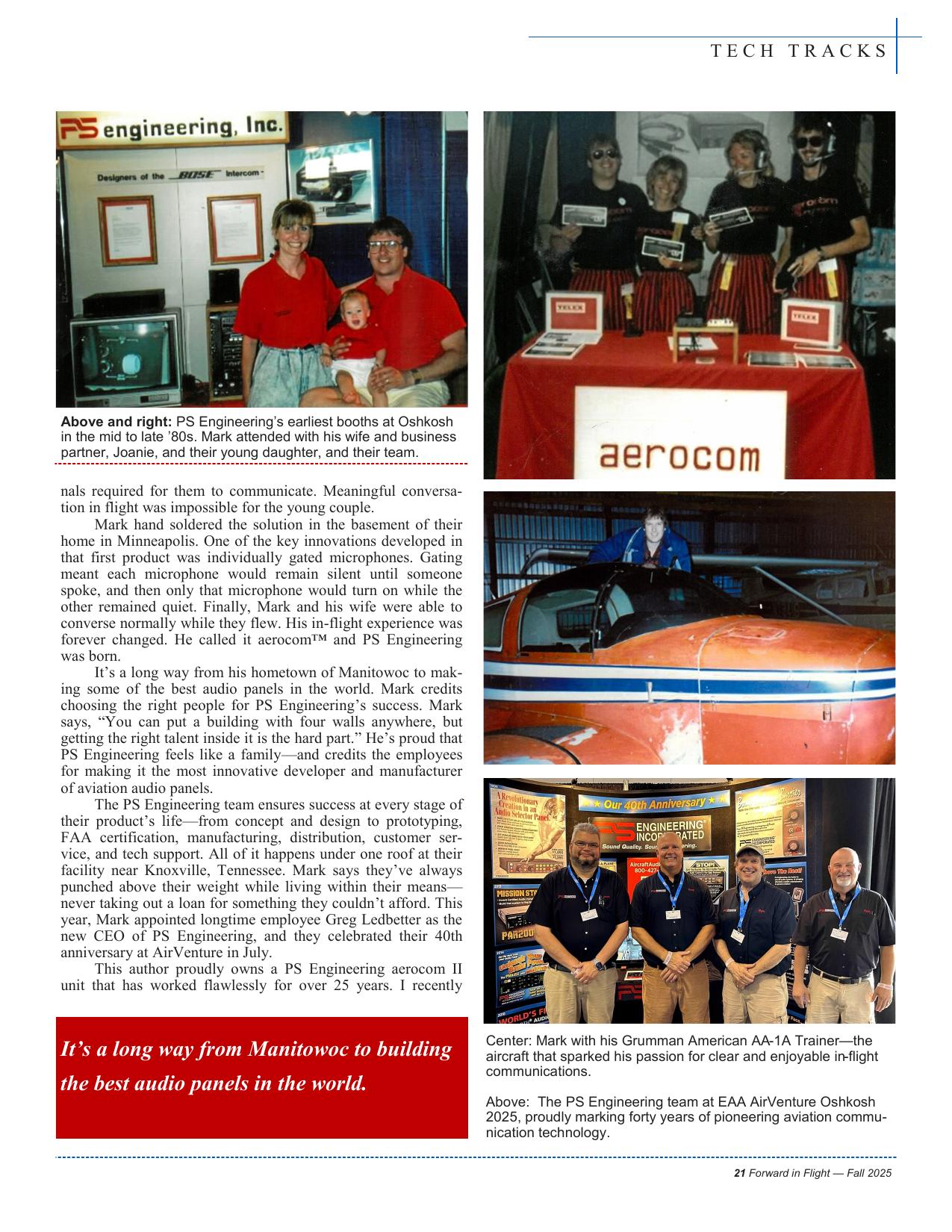
TECH TRACKS Above and right: PS Engineering’s earliest booths at Oshkosh in the mid to late ’80s. Mark attended with his wife and business partner, Joanie, and their young daughter, and their team. nals required for them to communicate. Meaningful conversation in flight was impossible for the young couple. Mark hand soldered the solution in the basement of their home in Minneapolis. One of the key innovations developed in that first product was individually gated microphones. Gating meant each microphone would remain silent until someone spoke, and then only that microphone would turn on while the other remained quiet. Finally, Mark and his wife were able to converse normally while they flew. His in-flight experience was forever changed. He called it aerocom and PS Engineering was born. It’s a long way from his hometown of Manitowoc to making some of the best audio panels in the world. Mark credits choosing the right people for PS Engineering’s success. Mark says, “You can put a building with four walls anywhere, but getting the right talent inside it is the hard part.” He’s proud that PS Engineering feels like a family—and credits the employees for making it the most innovative developer and manufacturer of aviation audio panels. The PS Engineering team ensures success at every stage of their product’s life—from concept and design to prototyping, FAA certification, manufacturing, distribution, customer service, and tech support. All of it happens under one roof at their facility near Knoxville, Tennessee. Mark says they’ve always punched above their weight while living within their means— never taking out a loan for something they couldn’t afford. This year, Mark appointed longtime employee Greg Ledbetter as the new CEO of PS Engineering, and they celebrated their 40th anniversary at AirVenture in July. This author proudly owns a PS Engineering aerocom II unit that has worked flawlessly for over 25 years. I recently It’s a long way from Manitowoc to building the best audio panels in the world. Center: Mark with his Grumman American AA-1A Trainer—the aircraft that sparked his passion for clear and enjoyable in-flight communications. Above: The PS Engineering team at EAA AirVenture Oshkosh 2025, proudly marking forty years of pioneering aviation communication technology. 21 Forward in Flight — Fall 2025
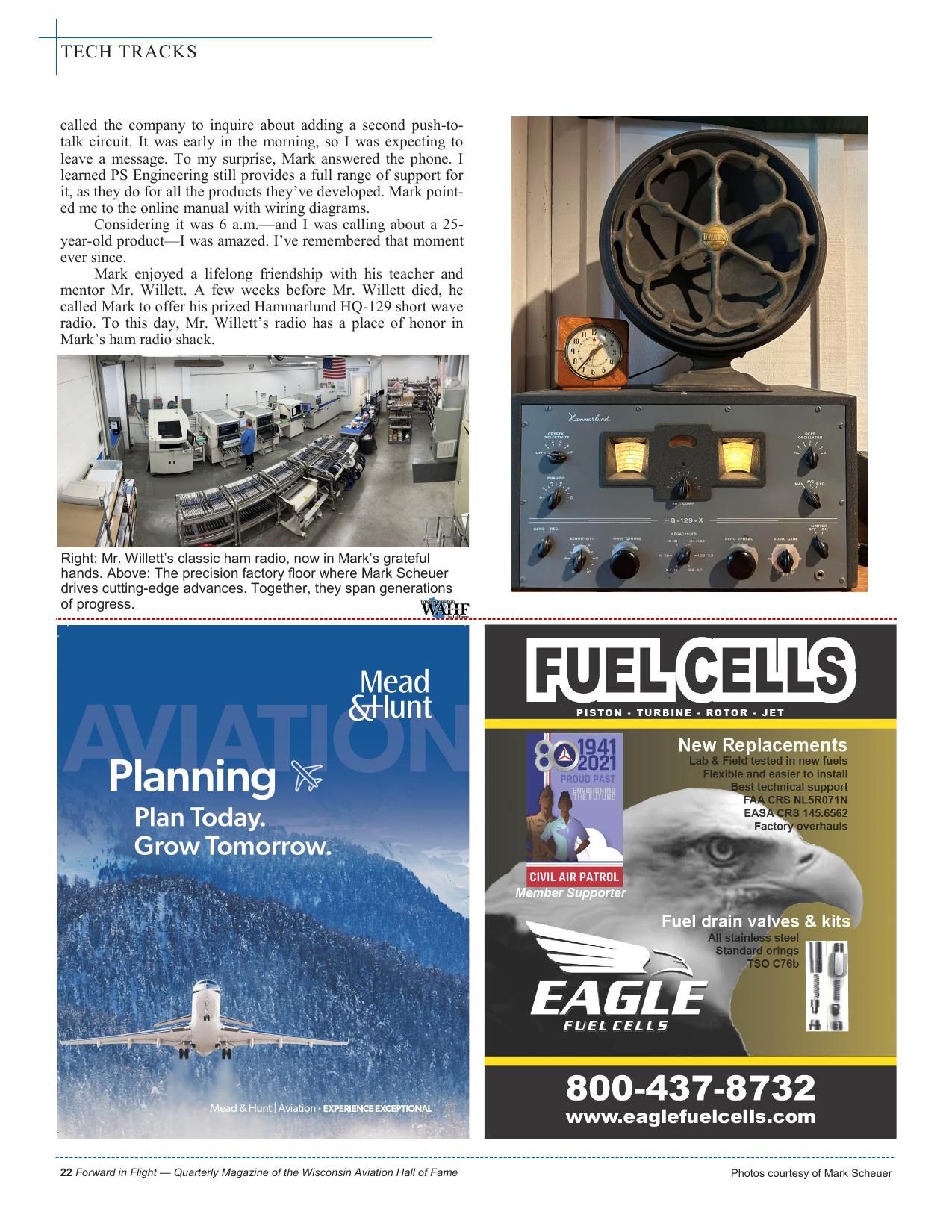
TECH TRACKS called the company to inquire about adding a second push-totalk circuit. It was early in the morning, so I was expecting to leave a message. To my surprise, Mark answered the phone. I learned PS Engineering still provides a full range of support for it, as they do for all the products they’ve developed. Mark pointed me to the online manual with wiring diagrams. Considering it was 6 a.m.—and I was calling about a 25year-old product—I was amazed. I’ve remembered that moment ever since. Mark enjoyed a lifelong friendship with his teacher and mentor Mr. Willett. A few weeks before Mr. Willett died, he called Mark to offer his prized Hammarlund HQ-129 short wave radio. To this day, Mr. Willett’s radio has a place of honor in Mark’s ham radio shack. Right: Mr. Willett’s classic ham radio, now in Mark’s grateful hands. Above: The precision factory floor where Mark Scheuer drives cutting-edge advances. Together, they span generations of progress. 22 Forward in Flight — Quarterly Magazine of the Wisconsin Aviation Hall of Fame Photos courtesy of Mark Scheuer
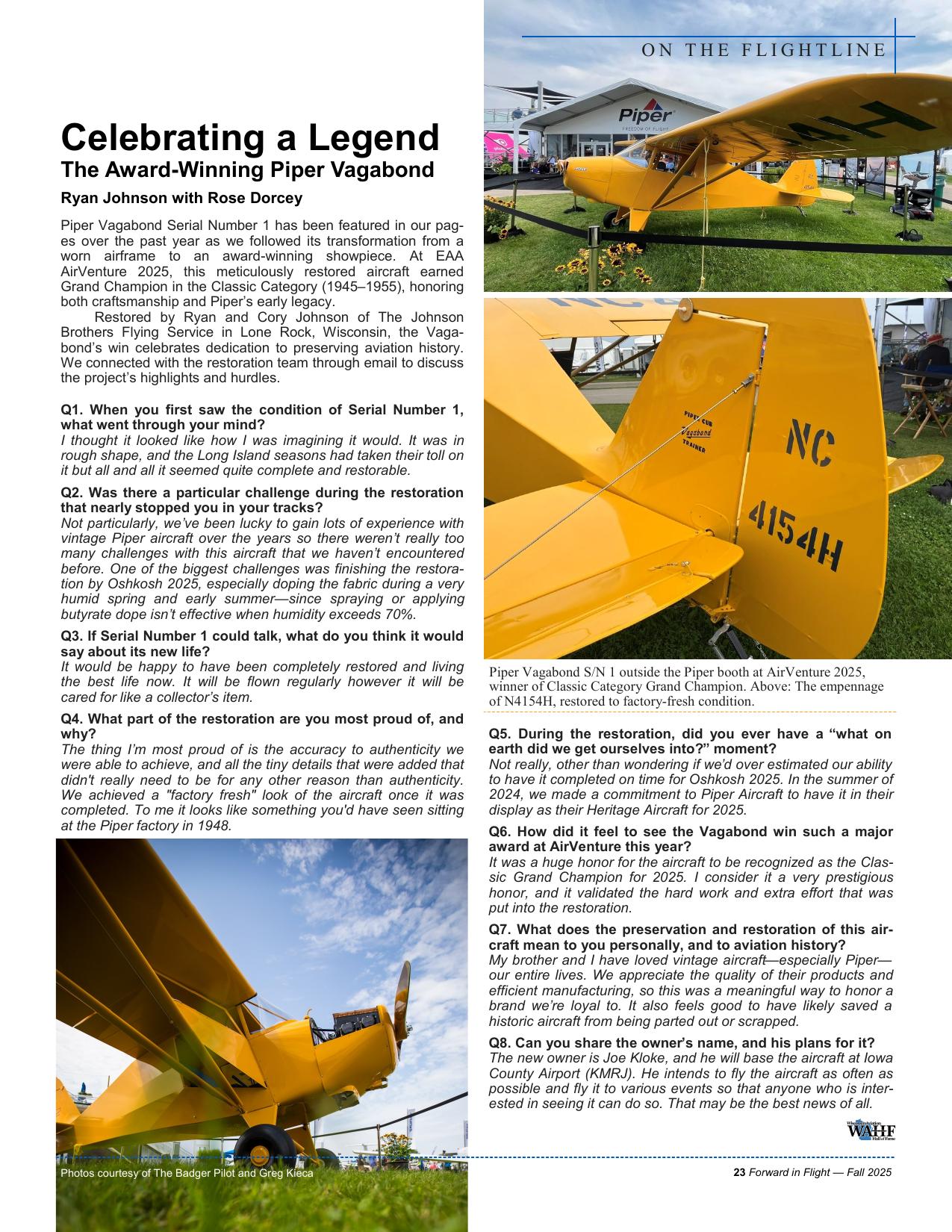
ON THE FLIGHTLINE Celebrating a Legend The Award-Winning Piper Vagabond Ryan Johnson with Rose Dorcey Piper Vagabond Serial Number 1 has been featured in our pages over the past year as we followed its transformation from a worn airframe to an award-winning showpiece. At EAA AirVenture 2025, this meticulously restored aircraft earned Grand Champion in the Classic Category (1945–1955), honoring both craftsmanship and Piper’s early legacy. Restored by Ryan and Cory Johnson of The Johnson Brothers Flying Service in Lone Rock, Wisconsin, the Vagabond’s win celebrates dedication to preserving aviation history. We connected with the restoration team through email to discuss the project’s highlights and hurdles. Q1. When you first saw the condition of Serial Number 1, what went through your mind? I thought it looked like how I was imagining it would. It was in rough shape, and the Long Island seasons had taken their toll on it but all and all it seemed quite complete and restorable. Q2. Was there a particular challenge during the restoration that nearly stopped you in your tracks? Not particularly, we’ve been lucky to gain lots of experience with vintage Piper aircraft over the years so there weren’t really too many challenges with this aircraft that we haven’t encountered before. One of the biggest challenges was finishing the restoration by Oshkosh 2025, especially doping the fabric during a very humid spring and early summer—since spraying or applying butyrate dope isn’t effective when humidity exceeds 70%. Q3. If Serial Number 1 could talk, what do you think it would say about its new life? It would be happy to have been completely restored and living the best life now. It will be flown regularly however it will be cared for like a collector’s item. Q4. What part of the restoration are you most proud of, and why? The thing I’m most proud of is the accuracy to authenticity we were able to achieve, and all the tiny details that were added that didn't really need to be for any other reason than authenticity. We achieved a "factory fresh" look of the aircraft once it was completed. To me it looks like something you'd have seen sitting at the Piper factory in 1948. Piper Vagabond S/N 1 outside the Piper booth at AirVenture 2025, winner of Classic Category Grand Champion. Above: The empennage of N4154H, restored to factory-fresh condition. Q5. During the restoration, did you ever have a “what on earth did we get ourselves into?” moment? Not really, other than wondering if we’d over estimated our ability to have it completed on time for Oshkosh 2025. In the summer of 2024, we made a commitment to Piper Aircraft to have it in their display as their Heritage Aircraft for 2025. Q6. How did it feel to see the Vagabond win such a major award at AirVenture this year? It was a huge honor for the aircraft to be recognized as the Classic Grand Champion for 2025. I consider it a very prestigious honor, and it validated the hard work and extra effort that was put into the restoration. Q7. What does the preservation and restoration of this aircraft mean to you personally, and to aviation history? My brother and I have loved vintage aircraft—especially Piper— our entire lives. We appreciate the quality of their products and efficient manufacturing, so this was a meaningful way to honor a brand we’re loyal to. It also feels good to have likely saved a historic aircraft from being parted out or scrapped. Q8. Can you share the owner’s name, and his plans for it? The new owner is Joe Kloke, and he will base the aircraft at Iowa County Airport (KMRJ). He intends to fly the aircraft as often as possible and fly it to various events so that anyone who is interested in seeing it can do so. That may be the best news of all. Photos courtesy of The Badger Pilot and Greg Kieca 23 Forward in Flight — Fall 2025
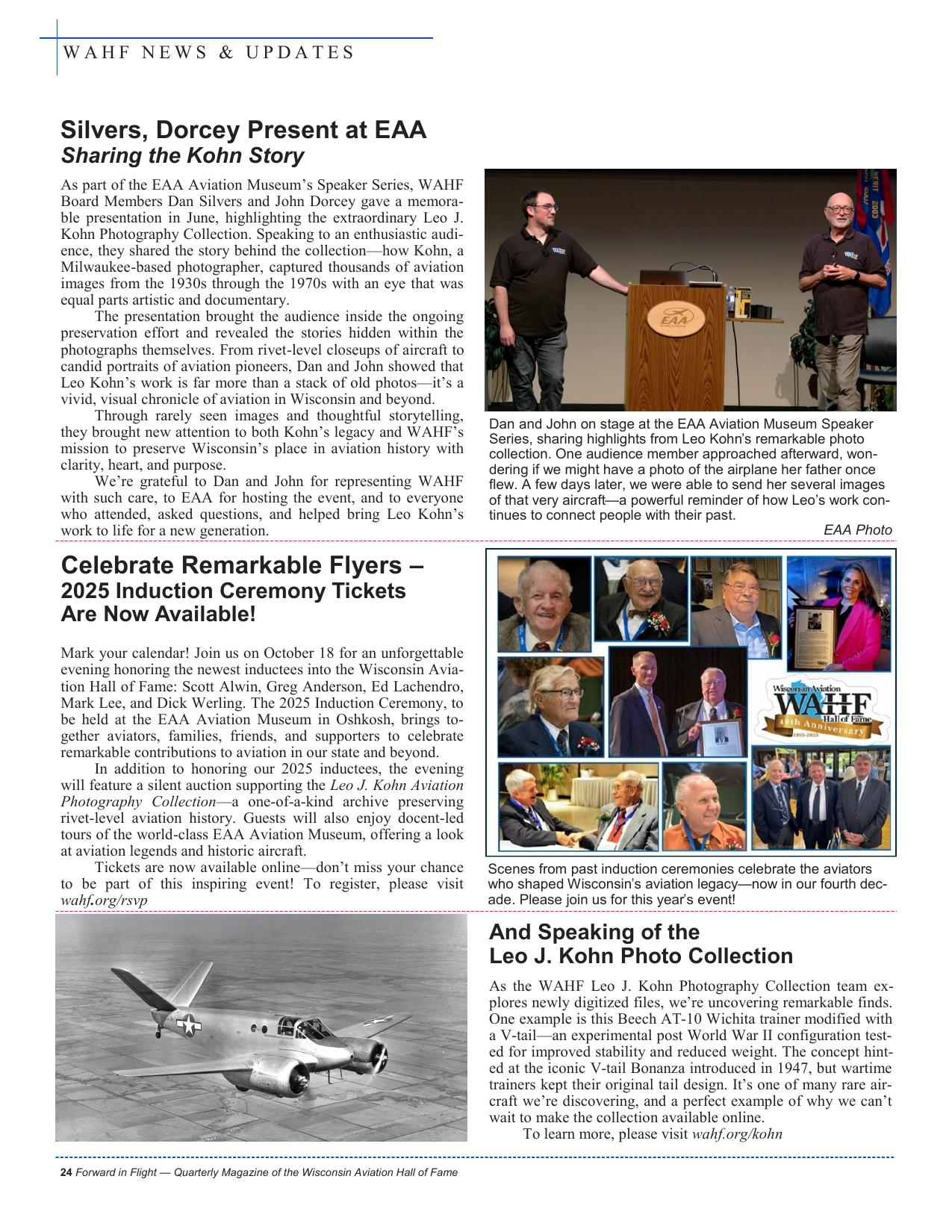
WAHF NEWS & UPDATES Silvers, Dorcey Present at EAA Sharing the Kohn Story As part of the EAA Aviation Museum’s Speaker Series, WAHF Board Members Dan Silvers and John Dorcey gave a memorable presentation in June, highlighting the extraordinary Leo J. Kohn Photography Collection. Speaking to an enthusiastic audience, they shared the story behind the collection—how Kohn, a Milwaukee-based photographer, captured thousands of aviation images from the 1930s through the 1970s with an eye that was equal parts artistic and documentary. The presentation brought the audience inside the ongoing preservation effort and revealed the stories hidden within the photographs themselves. From rivet-level closeups of aircraft to candid portraits of aviation pioneers, Dan and John showed that Leo Kohn’s work is far more than a stack of old photos—it’s a vivid, visual chronicle of aviation in Wisconsin and beyond. Through rarely seen images and thoughtful storytelling, they brought new attention to both Kohn’s legacy and WAHF’s mission to preserve Wisconsin’s place in aviation history with clarity, heart, and purpose. We’re grateful to Dan and John for representing WAHF with such care, to EAA for hosting the event, and to everyone who attended, asked questions, and helped bring Leo Kohn’s work to life for a new generation. Dan and John on stage at the EAA Aviation Museum Speaker Series, sharing highlights from Leo Kohn’s remarkable photo collection. One audience member approached afterward, wondering if we might have a photo of the airplane her father once flew. A few days later, we were able to send her several images of that very aircraft—a powerful reminder of how Leo’s work continues to connect people with their past. EAA Photo Celebrate Remarkable Flyers – 2025 Induction Ceremony Tickets Are Now Available! Mark your calendar! Join us on October 18 for an unforgettable evening honoring the newest inductees into the Wisconsin Aviation Hall of Fame: Scott Alwin, Greg Anderson, Ed Lachendro, Mark Lee, and Dick Werling. The 2025 Induction Ceremony, to be held at the EAA Aviation Museum in Oshkosh, brings together aviators, families, friends, and supporters to celebrate remarkable contributions to aviation in our state and beyond. In addition to honoring our 2025 inductees, the evening will feature a silent auction supporting the Leo J. Kohn Aviation Photography Collection—a one-of-a-kind archive preserving rivet-level aviation history. Guests will also enjoy docent-led tours of the world-class EAA Aviation Museum, offering a look at aviation legends and historic aircraft. Tickets are now available online—don’t miss your chance to be part of this inspiring event! To register, please visit wahf.org/rsvp Scenes from past induction ceremonies celebrate the aviators who shaped Wisconsin’s aviation legacy—now in our fourth decade. Please join us for this year’s event! And Speaking of the Leo J. Kohn Photo Collection As the WAHF Leo J. Kohn Photography Collection team explores newly digitized files, we’re uncovering remarkable finds. One example is this Beech AT-10 Wichita trainer modified with a V-tail—an experimental post World War II configuration tested for improved stability and reduced weight. The concept hinted at the iconic V-tail Bonanza introduced in 1947, but wartime trainers kept their original tail design. It’s one of many rare aircraft we’re discovering, and a perfect example of why we can’t wait to make the collection available online. To learn more, please visit wahf.org/kohn 24 Forward in Flight — Quarterly Magazine of the Wisconsin Aviation Hall of Fame
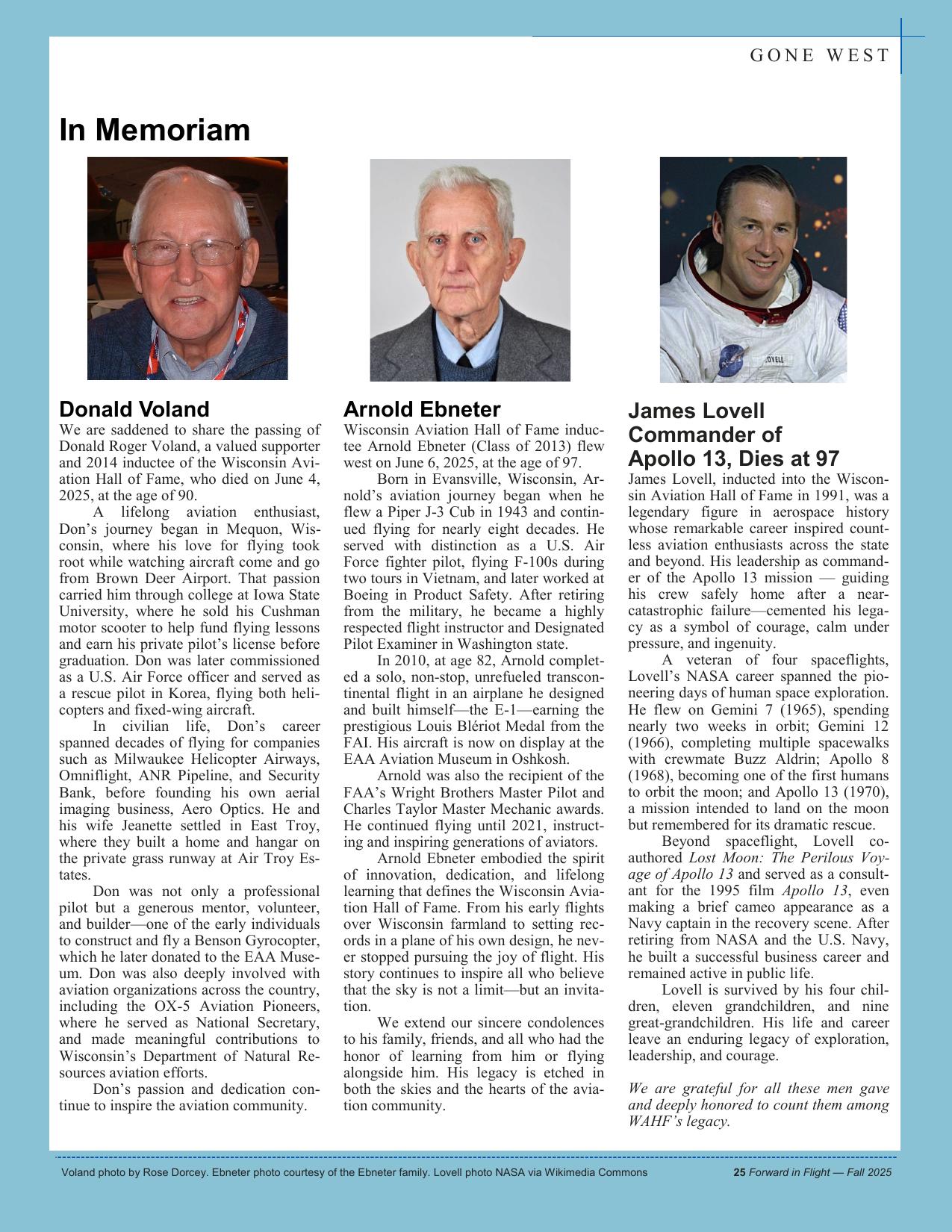
GONE WEST In Memoriam Donald Voland We are saddened to share the passing of Donald Roger Voland, a valued supporter and 2014 inductee of the Wisconsin Aviation Hall of Fame, who died on June 4, 2025, at the age of 90. A lifelong aviation enthusiast, Don’s journey began in Mequon, Wisconsin, where his love for flying took root while watching aircraft come and go from Brown Deer Airport. That passion carried him through college at Iowa State University, where he sold his Cushman motor scooter to help fund flying lessons and earn his private pilot’s license before graduation. Don was later commissioned as a U.S. Air Force officer and served as a rescue pilot in Korea, flying both helicopters and fixed-wing aircraft. In civilian life, Don’s career spanned decades of flying for companies such as Milwaukee Helicopter Airways, Omniflight, ANR Pipeline, and Security Bank, before founding his own aerial imaging business, Aero Optics. He and his wife Jeanette settled in East Troy, where they built a home and hangar on the private grass runway at Air Troy Estates. Don was not only a professional pilot but a generous mentor, volunteer, and builder—one of the early individuals to construct and fly a Benson Gyrocopter, which he later donated to the EAA Museum. Don was also deeply involved with aviation organizations across the country, including the OX-5 Aviation Pioneers, where he served as National Secretary, and made meaningful contributions to Wisconsin’s Department of Natural Resources aviation efforts. Don’s passion and dedication continue to inspire the aviation community. Arnold Ebneter Wisconsin Aviation Hall of Fame inductee Arnold Ebneter (Class of 2013) flew west on June 6, 2025, at the age of 97. Born in Evansville, Wisconsin, Arnold’s aviation journey began when he flew a Piper J-3 Cub in 1943 and continued flying for nearly eight decades. He served with distinction as a U.S. Air Force fighter pilot, flying F-100s during two tours in Vietnam, and later worked at Boeing in Product Safety. After retiring from the military, he became a highly respected flight instructor and Designated Pilot Examiner in Washington state. In 2010, at age 82, Arnold completed a solo, non-stop, unrefueled transcontinental flight in an airplane he designed and built himself—the E-1—earning the prestigious Louis Blériot Medal from the FAI. His aircraft is now on display at the EAA Aviation Museum in Oshkosh. Arnold was also the recipient of the FAA’s Wright Brothers Master Pilot and Charles Taylor Master Mechanic awards. He continued flying until 2021, instructing and inspiring generations of aviators. Arnold Ebneter embodied the spirit of innovation, dedication, and lifelong learning that defines the Wisconsin Aviation Hall of Fame. From his early flights over Wisconsin farmland to setting records in a plane of his own design, he never stopped pursuing the joy of flight. His story continues to inspire all who believe that the sky is not a limit—but an invitation. We extend our sincere condolences to his family, friends, and all who had the honor of learning from him or flying alongside him. His legacy is etched in both the skies and the hearts of the aviation community. James Lovell Commander of Apollo 13, Dies at 97 James Lovell, inducted into the Wisconsin Aviation Hall of Fame in 1991, was a legendary figure in aerospace history whose remarkable career inspired countless aviation enthusiasts across the state and beyond. His leadership as commander of the Apollo 13 mission — guiding his crew safely home after a nearcatastrophic failure—cemented his legacy as a symbol of courage, calm under pressure, and ingenuity. A veteran of four spaceflights, Lovell’s NASA career spanned the pioneering days of human space exploration. He flew on Gemini 7 (1965), spending nearly two weeks in orbit; Gemini 12 (1966), completing multiple spacewalks with crewmate Buzz Aldrin; Apollo 8 (1968), becoming one of the first humans to orbit the moon; and Apollo 13 (1970), a mission intended to land on the moon but remembered for its dramatic rescue. Beyond spaceflight, Lovell coauthored Lost Moon: The Perilous Voyage of Apollo 13 and served as a consultant for the 1995 film Apollo 13, even making a brief cameo appearance as a Navy captain in the recovery scene. After retiring from NASA and the U.S. Navy, he built a successful business career and remained active in public life. Lovell is survived by his four children, eleven grandchildren, and nine great-grandchildren. His life and career leave an enduring legacy of exploration, leadership, and courage. We are grateful for all these men gave and deeply honored to count them among WAHF’s legacy. Voland photo by Rose Dorcey. Ebneter photo courtesy of the Ebneter family. Lovell photo NASA via Wikimedia Commons 25 Forward in Flight — Fall 2025
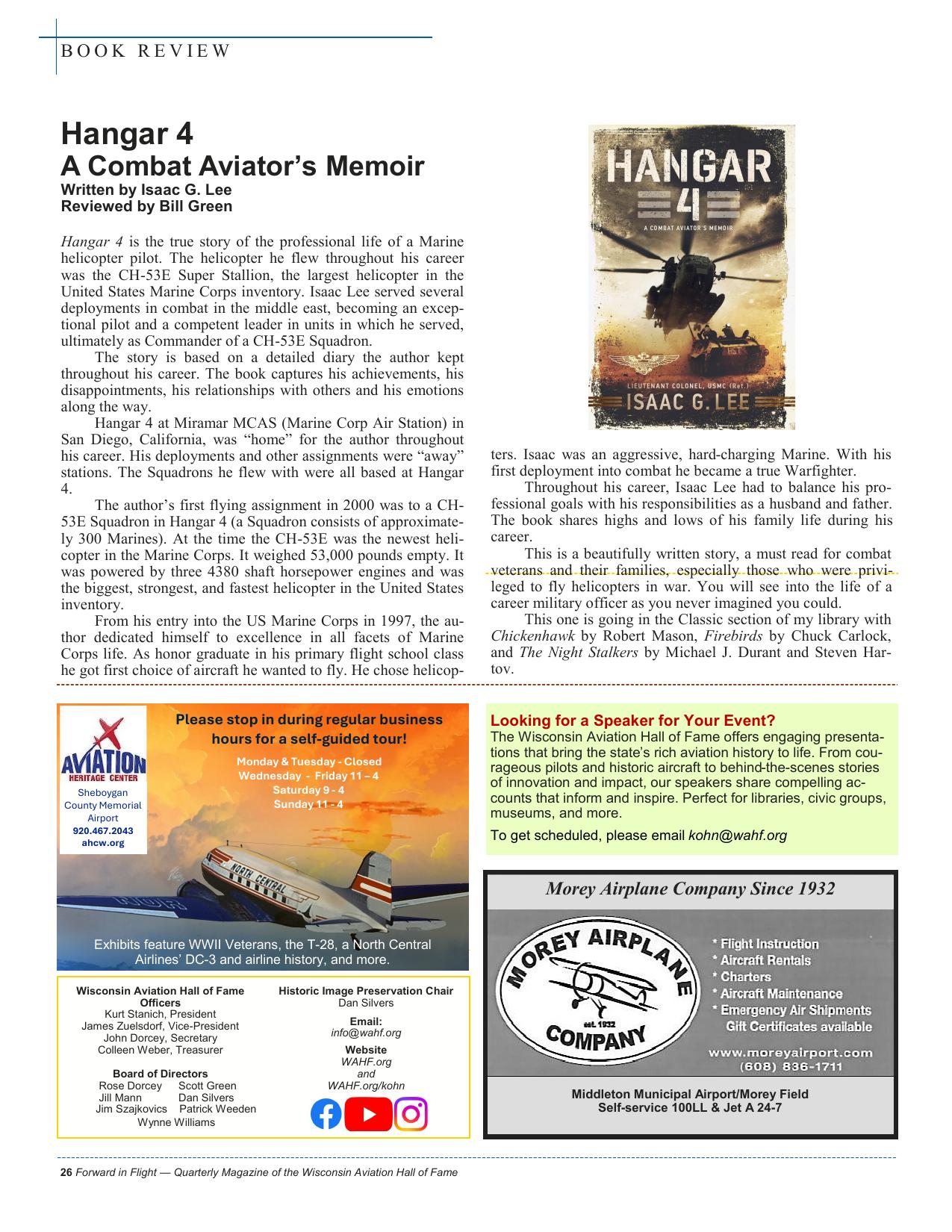
BOOK REVIEW Hangar 4 A Combat Aviator’s Memoir Written by Isaac G. Lee Reviewed by Bill Green Hangar 4 is the true story of the professional life of a Marine helicopter pilot. The helicopter he flew throughout his career was the CH-53E Super Stallion, the largest helicopter in the United States Marine Corps inventory. Isaac Lee served several deployments in combat in the middle east, becoming an exceptional pilot and a competent leader in units in which he served, ultimately as Commander of a CH-53E Squadron. The story is based on a detailed diary the author kept throughout his career. The book captures his achievements, his disappointments, his relationships with others and his emotions along the way. Hangar 4 at Miramar MCAS (Marine Corp Air Station) in San Diego, California, was “home” for the author throughout his career. His deployments and other assignments were “away” stations. The Squadrons he flew with were all based at Hangar 4. The author’s first flying assignment in 2000 was to a CH53E Squadron in Hangar 4 (a Squadron consists of approximately 300 Marines). At the time the CH-53E was the newest helicopter in the Marine Corps. It weighed 53,000 pounds empty. It was powered by three 4380 shaft horsepower engines and was the biggest, strongest, and fastest helicopter in the United States inventory. From his entry into the US Marine Corps in 1997, the author dedicated himself to excellence in all facets of Marine Corps life. As honor graduate in his primary flight school class he got first choice of aircraft he wanted to fly. He chose helicopPlease stop in during regular business hours for a self-guided tour! Sheboygan County Memorial Airport 920.467.2043 ahcw.org Monday & Tuesday - Closed Wednesday - Friday 11 – 4 Saturday 9 - 4 Sunday 11 - 4 ters. Isaac was an aggressive, hard-charging Marine. With his first deployment into combat he became a true Warfighter. Throughout his career, Isaac Lee had to balance his professional goals with his responsibilities as a husband and father. The book shares highs and lows of his family life during his career. This is a beautifully written story, a must read for combat veterans and their families, especially those who were privileged to fly helicopters in war. You will see into the life of a career military officer as you never imagined you could. This one is going in the Classic section of my library with Chickenhawk by Robert Mason, Firebirds by Chuck Carlock, and The Night Stalkers by Michael J. Durant and Steven Hartov. Looking for a Speaker for Your Event? The Wisconsin Aviation Hall of Fame offers engaging presentations that bring the state’s rich aviation history to life. From courageous pilots and historic aircraft to behind-the-scenes stories of innovation and impact, our speakers share compelling accounts that inform and inspire. Perfect for libraries, civic groups, museums, and more. To get scheduled, please email kohn@wahf.org Morey Airplane Company Since 1932 Exhibits feature WWII Veterans, the T-28, a North Central Airlines’ DC-3 and airline history, and more. Wisconsin Aviation Hall of Fame Officers Kurt Stanich, President James Zuelsdorf, Vice-President John Dorcey, Secretary Colleen Weber, Treasurer Board of Directors Rose Dorcey Scott Green Jill Mann Dan Silvers Jim Szajkovics Patrick Weeden Wynne Williams Historic Image Preservation Chair Dan Silvers Email: info@wahf.org Website WAHF.org and WAHF.org/kohn 26 Forward in Flight — Quarterly Magazine of the Wisconsin Aviation Hall of Fame Middleton Municipal Airport/Morey Field Self-service 100LL & Jet A 24-7
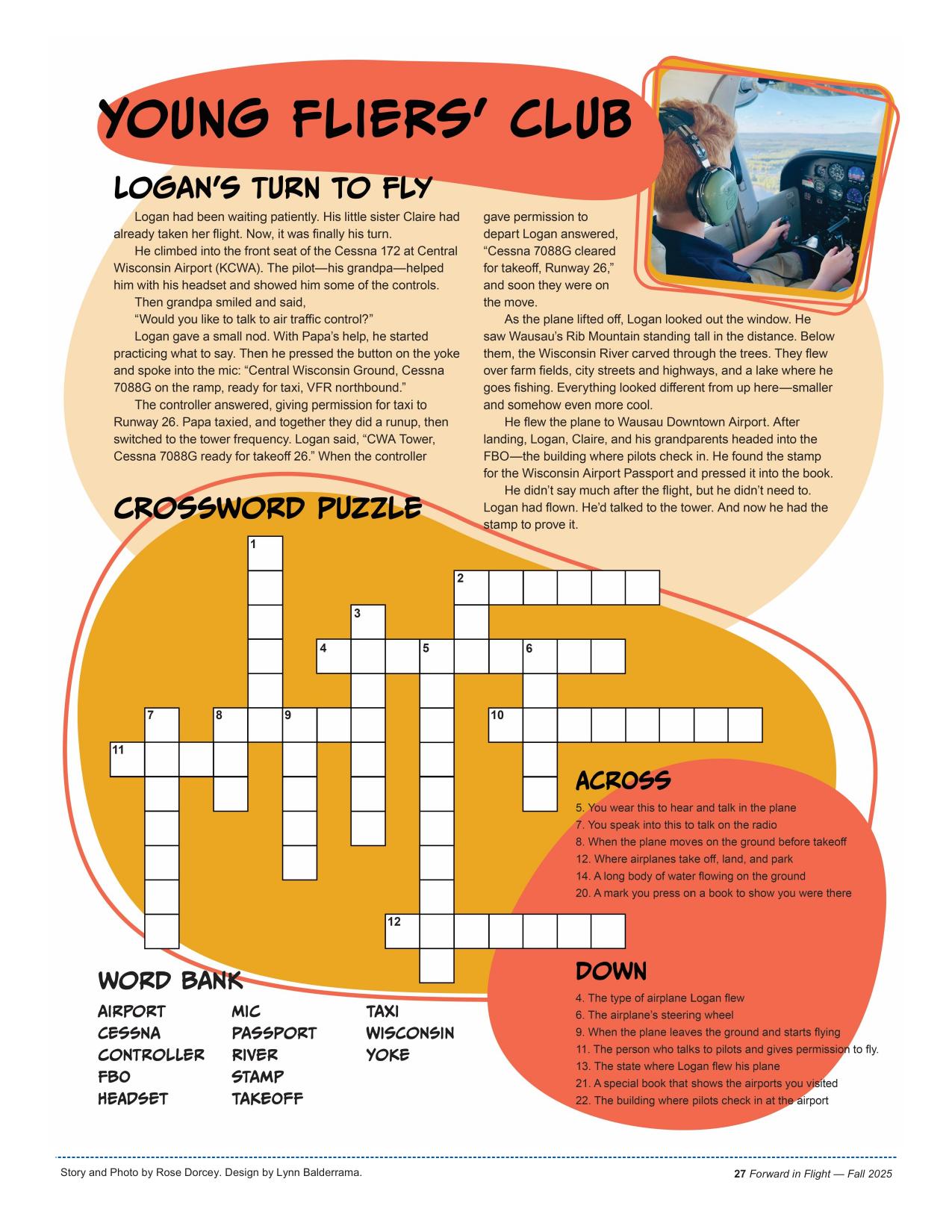
Story and Photo by Rose Dorcey. Design by Lynn Balderrama. 27 Forward in Flight — Fall 2025
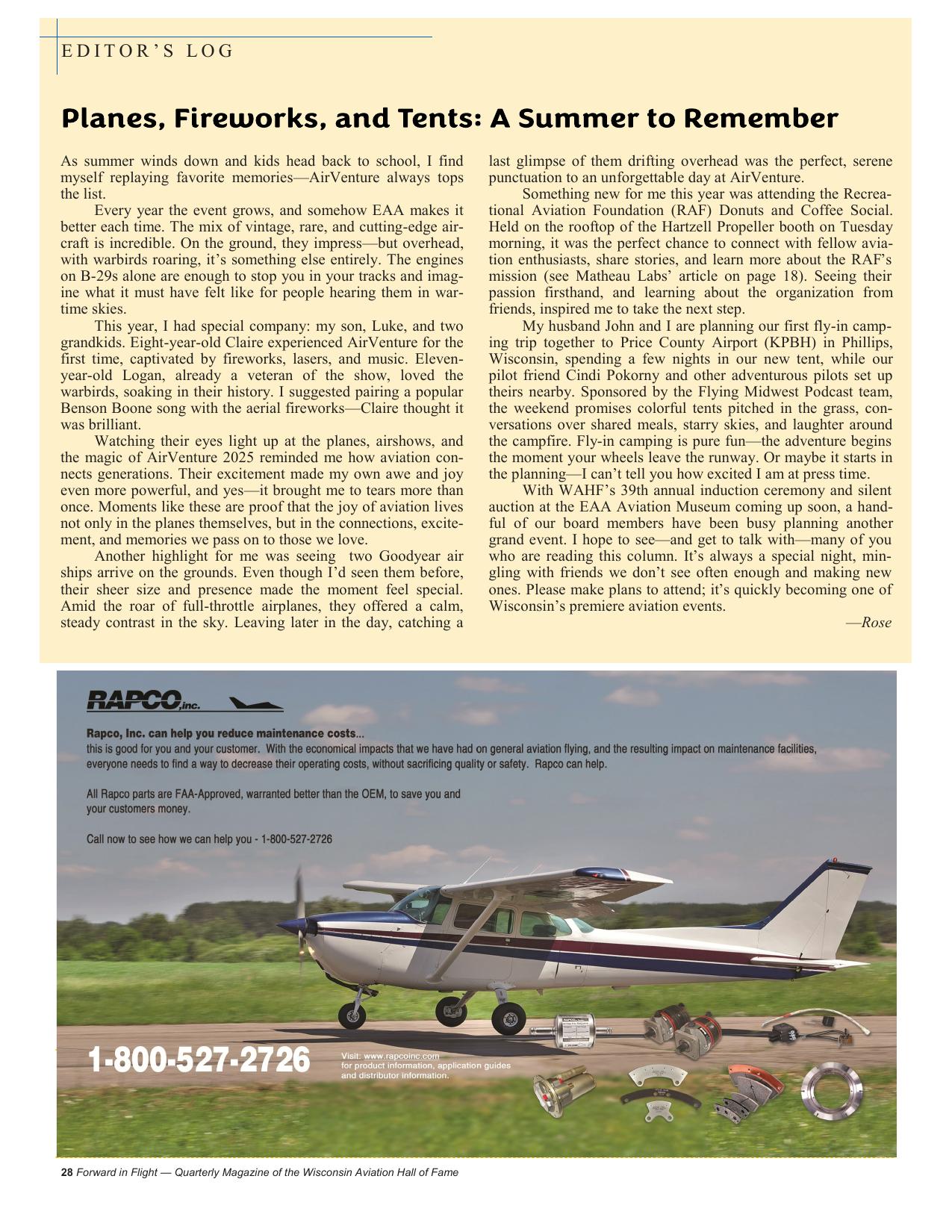
EDITOR’S LOG As summer winds down and kids head back to school, I find myself replaying favorite memories—AirVenture always tops the list. Every year the event grows, and somehow EAA makes it better each time. The mix of vintage, rare, and cutting-edge aircraft is incredible. On the ground, they impress—but overhead, with warbirds roaring, it’s something else entirely. The engines on B-29s alone are enough to stop you in your tracks and imagine what it must have felt like for people hearing them in wartime skies. This year, I had special company: my son, Luke, and two grandkids. Eight-year-old Claire experienced AirVenture for the first time, captivated by fireworks, lasers, and music. Elevenyear-old Logan, already a veteran of the show, loved the warbirds, soaking in their history. I suggested pairing a popular Benson Boone song with the aerial fireworks—Claire thought it was brilliant. Watching their eyes light up at the planes, airshows, and the magic of AirVenture 2025 reminded me how aviation connects generations. Their excitement made my own awe and joy even more powerful, and yes—it brought me to tears more than once. Moments like these are proof that the joy of aviation lives not only in the planes themselves, but in the connections, excitement, and memories we pass on to those we love. Another highlight for me was seeing two Goodyear air ships arrive on the grounds. Even though I’d seen them before, their sheer size and presence made the moment feel special. Amid the roar of full-throttle airplanes, they offered a calm, steady contrast in the sky. Leaving later in the day, catching a 28 Forward in Flight — Quarterly Magazine of the Wisconsin Aviation Hall of Fame last glimpse of them drifting overhead was the perfect, serene punctuation to an unforgettable day at AirVenture. Something new for me this year was attending the Recreational Aviation Foundation (RAF) Donuts and Coffee Social. Held on the rooftop of the Hartzell Propeller booth on Tuesday morning, it was the perfect chance to connect with fellow aviation enthusiasts, share stories, and learn more about the RAF’s mission (see Matheau Labs’ article on page 18). Seeing their passion firsthand, and learning about the organization from friends, inspired me to take the next step. My husband John and I are planning our first fly-in camping trip together to Price County Airport (KPBH) in Phillips, Wisconsin, spending a few nights in our new tent, while our pilot friend Cindi Pokorny and other adventurous pilots set up theirs nearby. Sponsored by the Flying Midwest Podcast team, the weekend promises colorful tents pitched in the grass, conversations over shared meals, starry skies, and laughter around the campfire. Fly-in camping is pure fun—the adventure begins the moment your wheels leave the runway. Or maybe it starts in the planning—I can’t tell you how excited I am at press time. With WAHF’s 39th annual induction ceremony and silent auction at the EAA Aviation Museum coming up soon, a handful of our board members have been busy planning another grand event. I hope to see—and get to talk with—many of you who are reading this column. It’s always a special night, mingling with friends we don’t see often enough and making new ones. Please make plans to attend; it’s quickly becoming one of Wisconsin’s premiere aviation events. —Rose
WAHF Membership and Donation Form Use for New Memberships and Renewals ANNUAL MEMBERSHIP LEVELS _____ Youth (Under age 18) _____ Individual (Annual) _____ Couple (Annual) _____ Lifetime (Individual) _____ Lifetime (Couple) $10 $30 $40 $500 $750 TAX DEDUCTIBLE CONTRIBUTIONS Your contributions help ensure Wisconsin’s aviation pioneers and outstanding students in aviation education will continue to be recognized. Your contributions, in any amount, are appreciated. WAHF Supporting Contribution $___________ (General operating/programming fund) Leo J. Kohn Collection Preservation Fund $___________ WAHF Scholarship Fund* $___________ *for scholarship donations please write a separate check payable to: Community Foundation of North Central Wisconsin or visit www.CFONCW.org Name________________________________________ Address______________________________________ City__________________________________________ State, Zip_____________________________________ Phone_______________________________________ Email________________________________________ Members receive WAHF’s quarterly magazine Forward in Flight! Join Online! WAHF.org Donate Online WAHF.org or WAHF.org/kohn Or, mail this form, along with your check payable to: Wisconsin Aviation Hall of Fame, Inc. Send to: Rose Dorcey/WAHF 3980 Sharratt Drive Oshkosh WI 54901 The Wisconsin Aviation Hall of Fame is a 501(c)(3) organization. 29 Forward in Flight — Summer 2025
PRSRT STD US Postage Paid Wisc Rapids WI Permit 98 Forward in Flight c/o Rose Dorcey 3980 Sharratt Drive Oshkosh WI 54901-1276 Welcome New WAHF Member/Supporters! Mike Bero Tori Essman Michael Haubrich Chris Henry Karen Maahs (Life) Peter Moll Wayne Mutza Mike Schlender Fran West Corporate Member: Mark Scheuer/PS Engineering Thanks for coming on board! Your support helps us continue collecting, preserving, and sharing Wisconsin aviation history— and honoring those who make it. We also thank William Paul and Scott Gluck for upgrading from an Annual to Lifetime Membership. And to all the members who have recently renewed: We're truly grateful; your support means a lot! The Wisconsin Ninety-Nines are hosting the Fall North Central Section Meeting in Oshkosh from October 3 - 5, 2025. The event invites members from a nine-state area to learn, grow, and interact with fellow members. WAHF Inductee Janis Sierra will be the keynote speaker. The Ninety-Nines are an international group of women pilots with a mission is to promote advancement of aviation through education, scholarships, and mutual support. http://wisconsin.ncs99s.org/ Thank you to Bill Green for a generous $500 donation to help offset the cost of producing Forward in Flight. Contributions such as these play a vital role in supporting the continued publication of Forward in Flight and the meaningful stories it shares. Thank you to Mike Bero, Jim & Lori Walloch, Mike Schlender, Joe Moreth, Dixie Igou, Jeff & Cheryl Baker, Joseph Moreth, Jeff Point, Danny Simpson, Matt Swanson, and Ron Vandervort for your recent donation to the Wisconsin Aviation Hall of Fame—whether in support of the Leo J. Kohn Photography Project, our General Operating Fund, or both. We truly appreciate your role in helping preserve and share Wisconsin’s aviation history. Thank you to longtime WAHF member/supporter Mal Gross for donating several interview tapes featuring associates of WAHF Inductee Alfred Lawson and his A.W. Lawson Airplane Company. Watch for more in upcoming issues of Forward in Flight about these historic recordings, which may offer new insights into Lawson and his work. EVENTS: Saturday, October 18, 2025 - 3:00 p.m. WAHF’s 39th Annual Induction Ceremony EAA Aviation Museum, 3000 Poberezny Road, Oshkosh Docent led museum tours, silent auction, social hour, and dinner to honor five remarkable aviators. Learn more at wahf.org/rsvp