Volume 6, Issue 1
🗞️ Download Issue (PDF)
Forward in Flight - Spring 2008
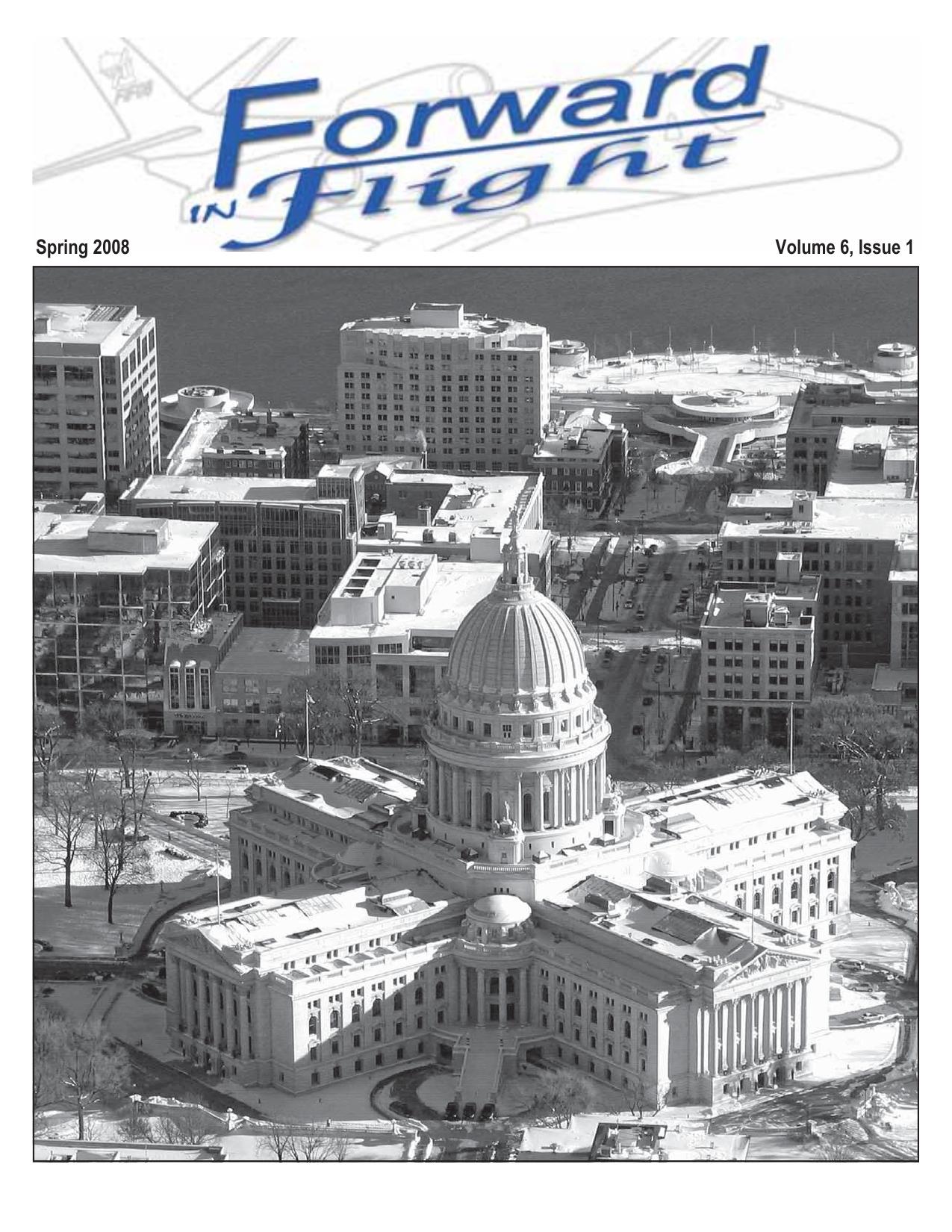
Spring 2008 Volume 6, Issue 1
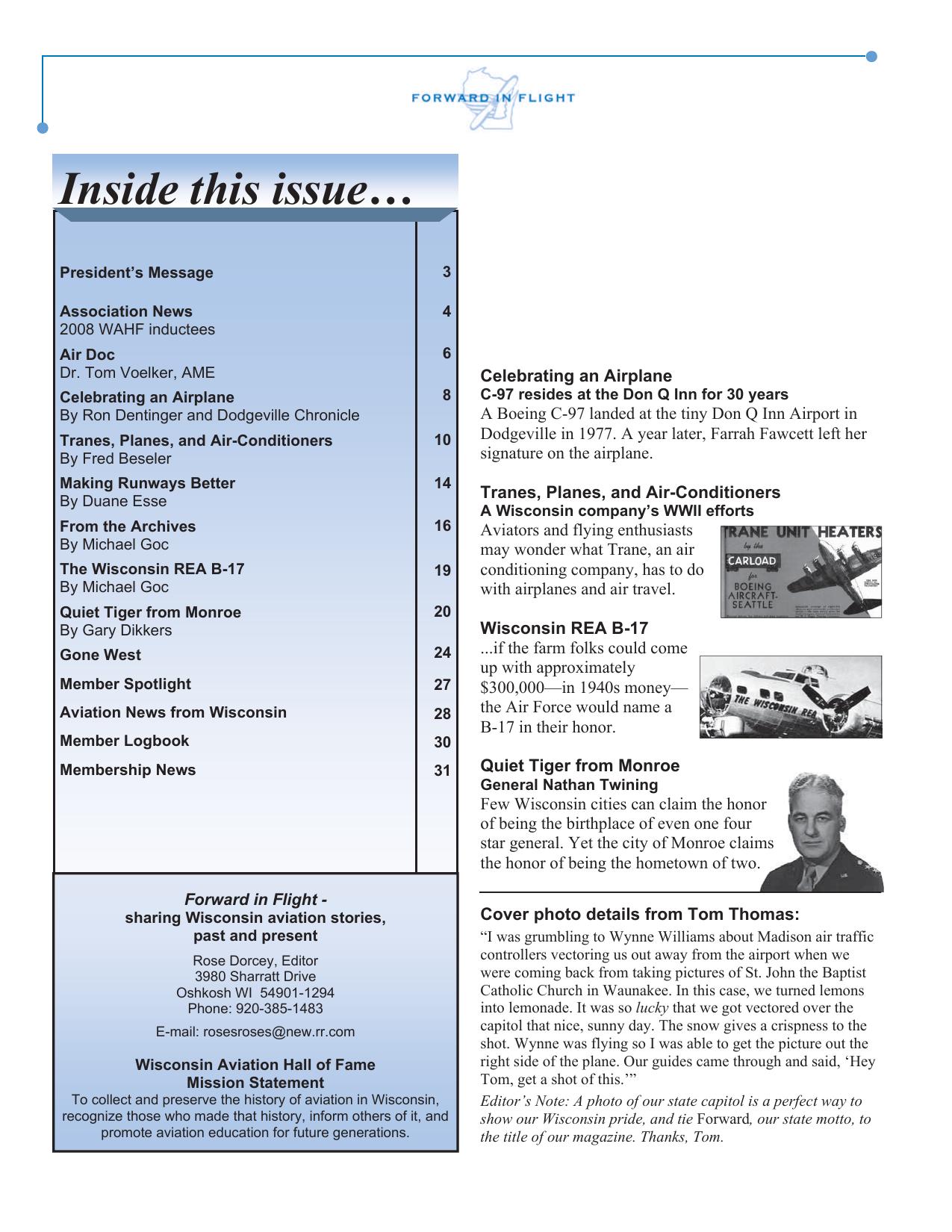
Inside this issue… President’s Message 3 Association News 2008 WAHF inductees 4 Air Doc Dr. Tom Voelker, AME 6 Celebrating an Airplane By Ron Dentinger and Dodgeville Chronicle 8 C-97 resides at the Don Q Inn for 30 years Tranes, Planes, and Air-Conditioners By Fred Beseler 10 A Boeing C-97 landed at the tiny Don Q Inn Airport in Dodgeville in 1977. A year later, Farrah Fawcett left her signature on the airplane. Making Runways Better By Duane Esse 14 From the Archives By Michael Goc 16 The Wisconsin REA B-17 By Michael Goc 19 Quiet Tiger from Monroe By Gary Dikkers 20 Gone West 24 Member Spotlight 27 Aviation News from Wisconsin 28 Member Logbook 30 Membership News 31 Celebrating an Airplane Tranes, Planes, and Air-Conditioners A Wisconsin company’s WWII efforts Aviators and flying enthusiasts may wonder what Trane, an air conditioning company, has to do with airplanes and air travel. Wisconsin REA B-17 ...if the farm folks could come up with approximately $300,000—in 1940s money— the Air Force would name a B-17 in their honor. Quiet Tiger from Monroe General Nathan Twining Few Wisconsin cities can claim the honor of being the birthplace of even one four star general. Yet the city of Monroe claims the honor of being the hometown of two. Forward in Flight sharing Wisconsin aviation stories, past and present Rose Dorcey, Editor 3980 Sharratt Drive Oshkosh WI 54901-1294 Phone: 920-385-1483 E-mail: rosesroses@new.rr.com Wisconsin Aviation Hall of Fame Mission Statement To collect and preserve the history of aviation in Wisconsin, recognize those who made that history, inform others of it, and promote aviation education for future generations. Cover photo details from Tom Thomas: “I was grumbling to Wynne Williams about Madison air traffic controllers vectoring us out away from the airport when we were coming back from taking pictures of St. John the Baptist Catholic Church in Waunakee. In this case, we turned lemons into lemonade. It was so lucky that we got vectored over the capitol that nice, sunny day. The snow gives a crispness to the shot. Wynne was flying so I was able to get the picture out the right side of the plane. Our guides came through and said, ‘Hey Tom, get a shot of this.’” Editor’s Note: A photo of our state capitol is a perfect way to show our Wisconsin pride, and tie Forward, our state motto, to the title of our magazine. Thanks, Tom.
President’s Message ~ by Rose Dorcey This is the spring issue of Forward in Flight, which makes me want to believe that soon, we’ll experience the last snowfall of this record-setting season of white. However, tomorrow’s forecast calls for another 5-8 inches of snow, and then cold temperatures to follow. It’s a season like those I remember when I was younger—high snow banks, multiple snow storms and school cancellations—and then sledding, building snowmen, and making snow angels and snow sculptures with my brothers and sisters and neighborhood friends. Snow days are different as adults, of course. It was a snowy day in January when the WAHF Board of Directors met at the Wittman Regional Airport in Oshkosh. They traveled from southern and central Wisconsin on slippery, snow-covered roads to discuss 2008 officer elections and inductee selections. A review of the 2007 banquet was performed that generated positive suggestions for 2008. In developing goals, we first looked past, and then forward. As reported in my Winter 2007 message, WAHF membership grew by more than 14 percent last year. What’s more remarkable is that our non-renewal rate was at all-time low, at less than 5 percent. In that message, I thanked all of our loyal members for your part in making that happen. We board members know that our efforts at membership retention and recruitment have less to do with our work, and more to do with your dedication and support. We know that you understand the value of supporting aviation associations such as ours, and our appreciation for that is never far from our hearts. Thank you again. Our membership goal in 2008 is to achieve similar results. If you haven’t already renewed, please do so. Or, invite a friend to become a member/supporter. Even though the snow banks are so high that the only part of our mailbox that shows is the flip-down door, the postal carrier still finds it and consistently brings messages from WAHF members our way. I hope to see one from you soon! Due to the weather, I’m hearing from friends all over the state who say they’re not flying as often as they would like. Winter will do that, but there are a number of ways to keep your passion for aviation burning: 4 Plan a flying adventure—the first trip you’ll take in spring or to a destination you’ve never been before 4 Attend an EAA, 99s, Women in Aviation, or other aviation 4 4 4 4 4 4 4 4 4 4 4 4 4 4 chapter meeting, and consider joining Attend a lecture on an aviation topic Invite a WAHF speaker to your flying or civic club Read aviation books and watch aviation movies Review flight terminology or your FAR/AIM Clean and perform maintenance on your airplane Volunteer your talent, like Luke at LP MultiMedia did by designing a new masthead for the FIF cover Be an aviation speaker for school or civic groups Answer the Member Spotlight questions on page 27 and return them to WAHF. Send your photo, too. Attend the Women in Aviation Conference in March Attend Sun ’n Fun in April Attend the Wisconsin Aviation Conference in May (pg. 29) Take part in a homebuilding workshop, such as those offered by Sonex Aircraft or EAA Write a story about someone who has influenced your aviation “career” and share it with that person (and us) And again, please renew your WAHF membership! These are just a few ideas to keep your aviation passion strong. I’ve done most of them over the past few months, and will do more before we finally see green grass again. I encourage you to try some, too! Advertising in FIF Your Hometown Full-Service Aviation Company — Placing an ad is easy Forward in Flight has a great advertising opportunity for you! Here’s a chance to reach potential customers and a way to help an organization that is dedicated to sharing aviation news, past and present, with its members. A business card-size ad can be placed for as little as $45 each when committing to three consecutive issues. You’ll be in good company, just look at this issue’s advertisers! It’s easy to place your ad: Send your business card to Rose Dorcey or call 920-385-1483 or 920-4264827. Email: rosesroses@new.rr.com Air Charter Flight Training Aircraft Sales & Service Service Centers: Cessna Cirrus Columbia Piper Socata Dane County Regional (MSN) - 800-594-5359 Watertown Municipal (RYV) - 800-657-0761 Dodge County (UNU) - 800-319-0907 www.wisconsinaviation.com 3 Forward in Flight ~ Spring, 2008
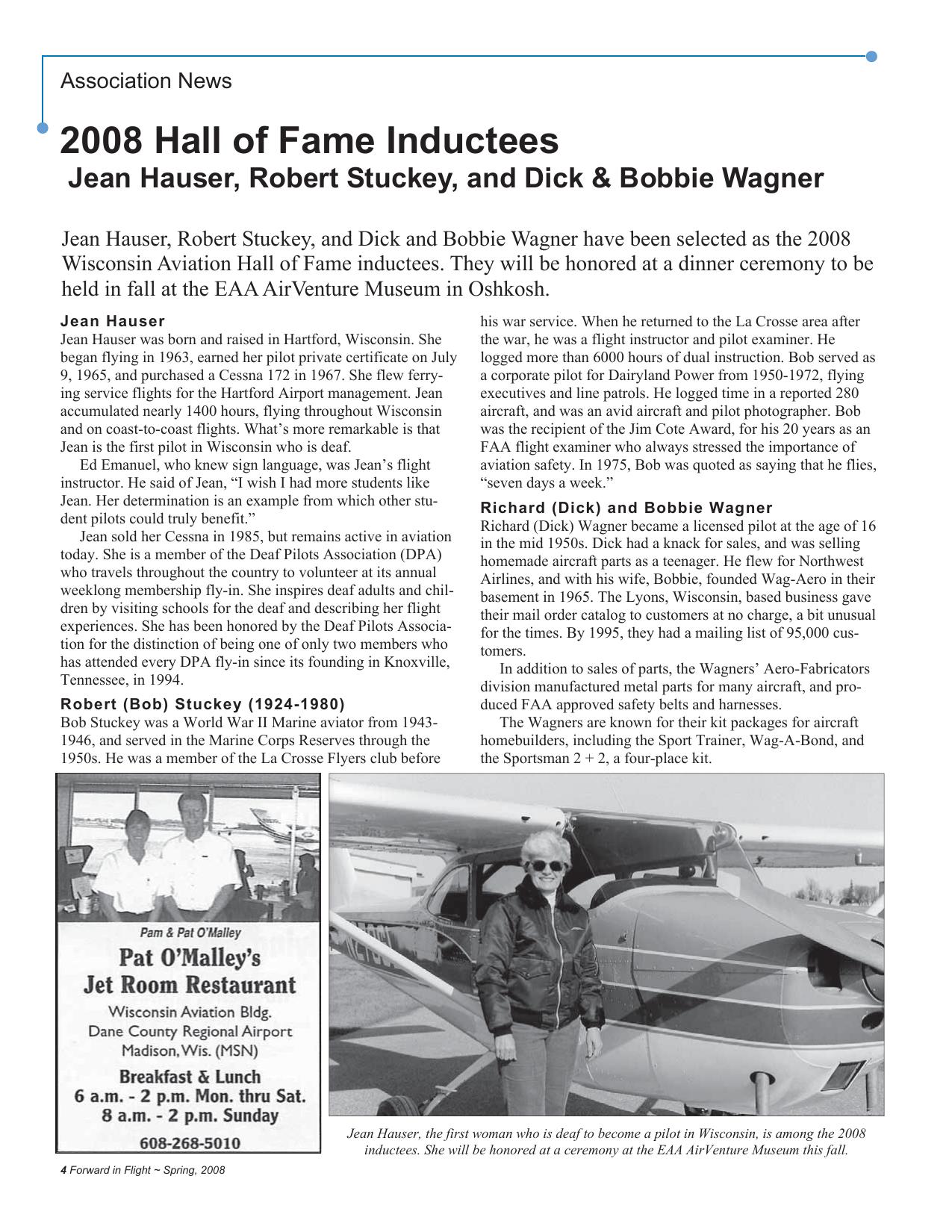
Association News 2008 Hall of Fame Inductees Jean Hauser, Robert Stuckey, and Dick & Bobbie Wagner Jean Hauser, Robert Stuckey, and Dick and Bobbie Wagner have been selected as the 2008 Wisconsin Aviation Hall of Fame inductees. They will be honored at a dinner ceremony to be held in fall at the EAA AirVenture Museum in Oshkosh. Jean Hauser Jean Hauser was born and raised in Hartford, Wisconsin. She began flying in 1963, earned her pilot private certificate on July 9, 1965, and purchased a Cessna 172 in 1967. She flew ferrying service flights for the Hartford Airport management. Jean accumulated nearly 1400 hours, flying throughout Wisconsin and on coast-to-coast flights. What’s more remarkable is that Jean is the first pilot in Wisconsin who is deaf. Ed Emanuel, who knew sign language, was Jean’s flight instructor. He said of Jean, “I wish I had more students like Jean. Her determination is an example from which other student pilots could truly benefit.” Jean sold her Cessna in 1985, but remains active in aviation today. She is a member of the Deaf Pilots Association (DPA) who travels throughout the country to volunteer at its annual weeklong membership fly-in. She inspires deaf adults and children by visiting schools for the deaf and describing her flight experiences. She has been honored by the Deaf Pilots Association for the distinction of being one of only two members who has attended every DPA fly-in since its founding in Knoxville, Tennessee, in 1994. Robert (Bob) Stuckey (1924-1980) Bob Stuckey was a World War II Marine aviator from 19431946, and served in the Marine Corps Reserves through the 1950s. He was a member of the La Crosse Flyers club before his war service. When he returned to the La Crosse area after the war, he was a flight instructor and pilot examiner. He logged more than 6000 hours of dual instruction. Bob served as a corporate pilot for Dairyland Power from 1950-1972, flying executives and line patrols. He logged time in a reported 280 aircraft, and was an avid aircraft and pilot photographer. Bob was the recipient of the Jim Cote Award, for his 20 years as an FAA flight examiner who always stressed the importance of aviation safety. In 1975, Bob was quoted as saying that he flies, “seven days a week.” Richard (Dick) and Bobbie Wagner Richard (Dick) Wagner became a licensed pilot at the age of 16 in the mid 1950s. Dick had a knack for sales, and was selling homemade aircraft parts as a teenager. He flew for Northwest Airlines, and with his wife, Bobbie, founded Wag-Aero in their basement in 1965. The Lyons, Wisconsin, based business gave their mail order catalog to customers at no charge, a bit unusual for the times. By 1995, they had a mailing list of 95,000 customers. In addition to sales of parts, the Wagners’ Aero-Fabricators division manufactured metal parts for many aircraft, and produced FAA approved safety belts and harnesses. The Wagners are known for their kit packages for aircraft homebuilders, including the Sport Trainer, Wag-A-Bond, and the Sportsman 2 + 2, a four-place kit. Jean Hauser, the first woman who is deaf to become a pilot in Wisconsin, is among the 2008 inductees. She will be honored at a ceremony at the EAA AirVenture Museum this fall. 4 Forward in Flight ~ Spring, 2008
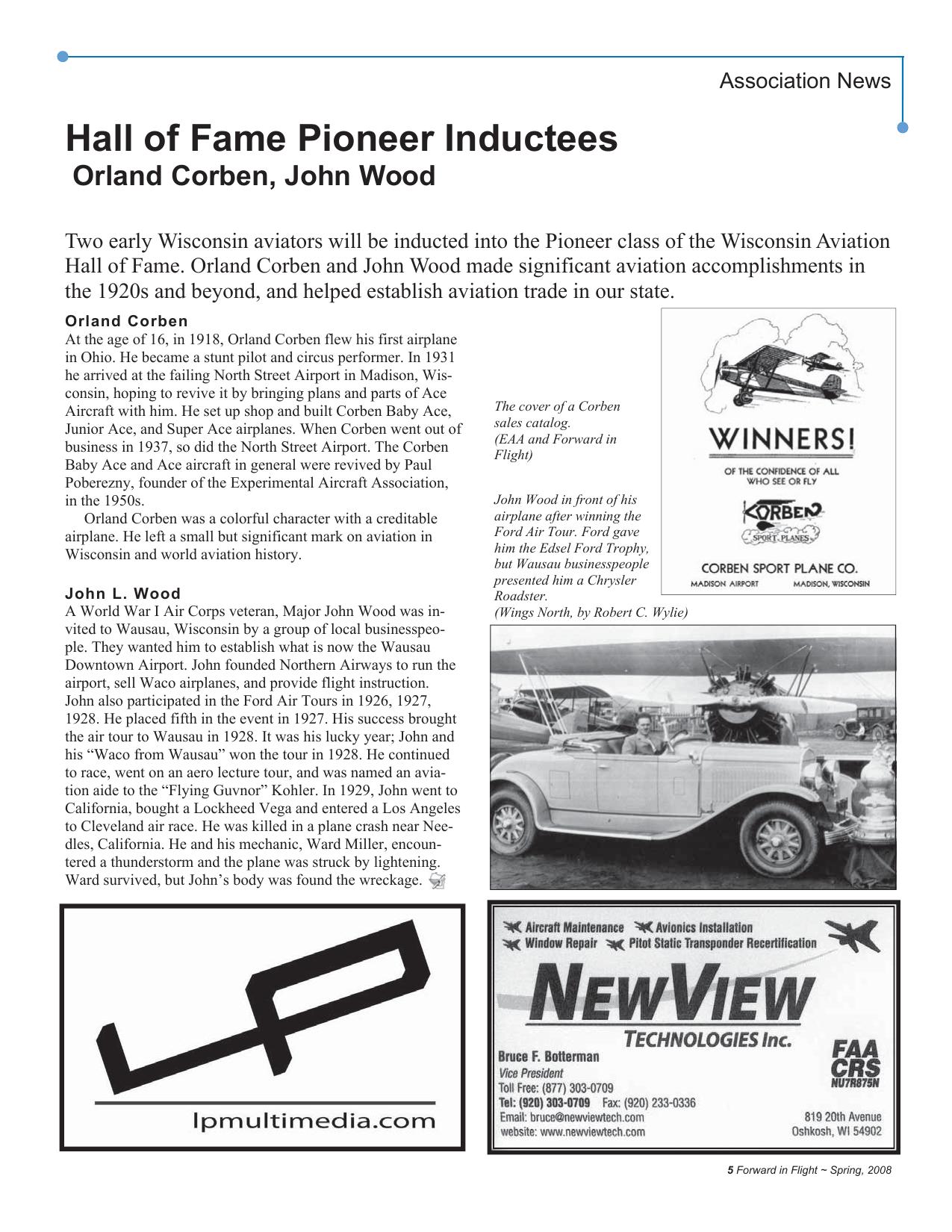
Association News Hall of Fame Pioneer Inductees Orland Corben, John Wood Two early Wisconsin aviators will be inducted into the Pioneer class of the Wisconsin Aviation Hall of Fame. Orland Corben and John Wood made significant aviation accomplishments in the 1920s and beyond, and helped establish aviation trade in our state. Orland Corben At the age of 16, in 1918, Orland Corben flew his first airplane in Ohio. He became a stunt pilot and circus performer. In 1931 he arrived at the failing North Street Airport in Madison, Wisconsin, hoping to revive it by bringing plans and parts of Ace Aircraft with him. He set up shop and built Corben Baby Ace, Junior Ace, and Super Ace airplanes. When Corben went out of business in 1937, so did the North Street Airport. The Corben Baby Ace and Ace aircraft in general were revived by Paul Poberezny, founder of the Experimental Aircraft Association, in the 1950s. Orland Corben was a colorful character with a creditable airplane. He left a small but significant mark on aviation in Wisconsin and world aviation history. John L. Wood A World War I Air Corps veteran, Major John Wood was invited to Wausau, Wisconsin by a group of local businesspeople. They wanted him to establish what is now the Wausau Downtown Airport. John founded Northern Airways to run the airport, sell Waco airplanes, and provide flight instruction. John also participated in the Ford Air Tours in 1926, 1927, 1928. He placed fifth in the event in 1927. His success brought the air tour to Wausau in 1928. It was his lucky year; John and his “Waco from Wausau” won the tour in 1928. He continued to race, went on an aero lecture tour, and was named an aviation aide to the “Flying Guvnor” Kohler. In 1929, John went to California, bought a Lockheed Vega and entered a Los Angeles to Cleveland air race. He was killed in a plane crash near Needles, California. He and his mechanic, Ward Miller, encountered a thunderstorm and the plane was struck by lightening. Ward survived, but John’s body was found the wreckage. The cover of a Corben sales catalog. (EAA and Forward in Flight) John Wood in front of his airplane after winning the Ford Air Tour. Ford gave him the Edsel Ford Trophy, but Wausau businesspeople presented him a Chrysler Roadster. (Wings North, by Robert C. Wylie) 5 Forward in Flight ~ Spring, 2008
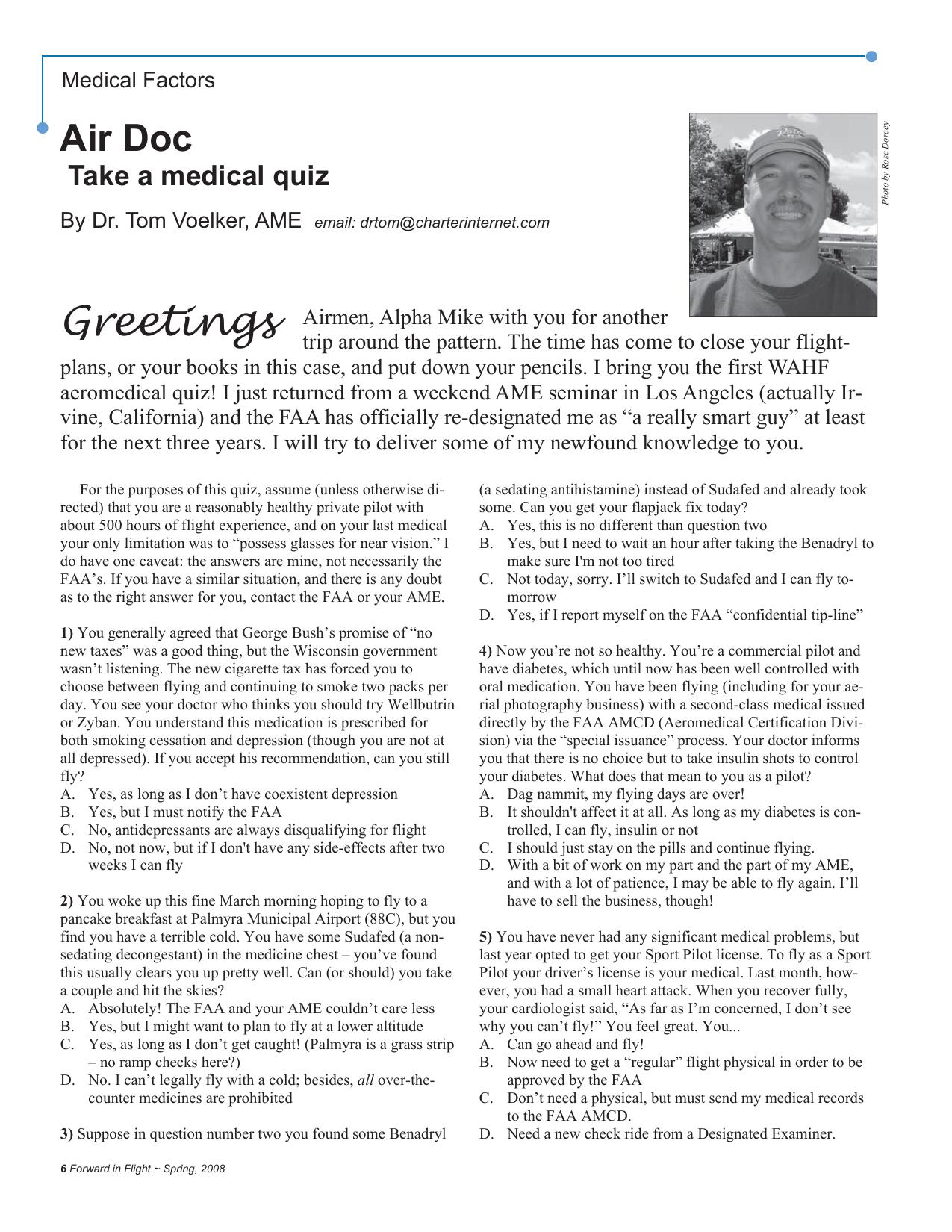
Medical Factors Photo by Rose Dorcey Air Doc Take a medical quiz By Dr. Tom Voelker, AME email: drtom@charterinternet.com Alpha Mike with you for another Greetings Airmen, trip around the pattern. The time has come to close your flightplans, or your books in this case, and put down your pencils. I bring you the first WAHF aeromedical quiz! I just returned from a weekend AME seminar in Los Angeles (actually Irvine, California) and the FAA has officially re-designated me as “a really smart guy” at least for the next three years. I will try to deliver some of my newfound knowledge to you. For the purposes of this quiz, assume (unless otherwise directed) that you are a reasonably healthy private pilot with about 500 hours of flight experience, and on your last medical your only limitation was to “possess glasses for near vision.” I do have one caveat: the answers are mine, not necessarily the FAA’s. If you have a similar situation, and there is any doubt as to the right answer for you, contact the FAA or your AME. 1) You generally agreed that George Bush’s promise of “no new taxes” was a good thing, but the Wisconsin government wasn’t listening. The new cigarette tax has forced you to choose between flying and continuing to smoke two packs per day. You see your doctor who thinks you should try Wellbutrin or Zyban. You understand this medication is prescribed for both smoking cessation and depression (though you are not at all depressed). If you accept his recommendation, can you still fly? A. Yes, as long as I don’t have coexistent depression B. Yes, but I must notify the FAA C. No, antidepressants are always disqualifying for flight D. No, not now, but if I don't have any side-effects after two weeks I can fly 2) You woke up this fine March morning hoping to fly to a pancake breakfast at Palmyra Municipal Airport (88C), but you find you have a terrible cold. You have some Sudafed (a nonsedating decongestant) in the medicine chest – you’ve found this usually clears you up pretty well. Can (or should) you take a couple and hit the skies? A. Absolutely! The FAA and your AME couldn’t care less B. Yes, but I might want to plan to fly at a lower altitude C. Yes, as long as I don’t get caught! (Palmyra is a grass strip – no ramp checks here?) D. No. I can’t legally fly with a cold; besides, all over-thecounter medicines are prohibited 3) Suppose in question number two you found some Benadryl 6 Forward in Flight ~ Spring, 2008 (a sedating antihistamine) instead of Sudafed and already took some. Can you get your flapjack fix today? A. Yes, this is no different than question two B. Yes, but I need to wait an hour after taking the Benadryl to make sure I'm not too tired C. Not today, sorry. I’ll switch to Sudafed and I can fly tomorrow D. Yes, if I report myself on the FAA “confidential tip-line” 4) Now you’re not so healthy. You’re a commercial pilot and have diabetes, which until now has been well controlled with oral medication. You have been flying (including for your aerial photography business) with a second-class medical issued directly by the FAA AMCD (Aeromedical Certification Division) via the “special issuance” process. Your doctor informs you that there is no choice but to take insulin shots to control your diabetes. What does that mean to you as a pilot? A. Dag nammit, my flying days are over! B. It shouldn't affect it at all. As long as my diabetes is controlled, I can fly, insulin or not C. I should just stay on the pills and continue flying. D. With a bit of work on my part and the part of my AME, and with a lot of patience, I may be able to fly again. I’ll have to sell the business, though! 5) You have never had any significant medical problems, but last year opted to get your Sport Pilot license. To fly as a Sport Pilot your driver’s license is your medical. Last month, however, you had a small heart attack. When you recover fully, your cardiologist said, “As far as I’m concerned, I don’t see why you can’t fly!” You feel great. You... A. Can go ahead and fly! B. Now need to get a “regular” flight physical in order to be approved by the FAA C. Don’t need a physical, but must send my medical records to the FAA AMCD. D. Need a new check ride from a Designated Examiner.
Medical Factors So, how do you think you did? I hope the answers and explanations give you the same impression of the FAA Aeromedical Division that I got from my recent conference: they really do want to help you fly, though their first and foremost responsibility is ensuring the safety of the public. 1) C – Antidepressant medications are always disqualifying as are all "centrally-acting" medications (those that exert their effects directly on the brain). The concern is that they may have more concerning side-effects, such as sedation or confusion. The FAA is aware, however, that there are many airmen who simply don't disclose the fact that they are on antidepressants so that they can continue flying. Perhaps worse, there are many pilots (especially commercial pilots) who are flying with untreated depression; afraid to be treated as they would be grounded (and unemployed). The FAA is working on this, and Dr. Frederick Tilton, the Federal Air Surgeon, told us to expect some action on this issue in the next few months. I'll keep you posted. In regards to smoking (back to the quiz), the new smoking cessation drug Chantix, which seems to work wonderfully, is allowed to be used by airmen, as long as they are not experiencing any significant side-effects. 2) B – Of course your AME cares and I suppose the FAA does as well. Sudafed is fine to fly with, again as long as you don’t have concerning side effects. If you fly too high, though, you may get a “block” where air expands in your middle ear cavity with altitude. This can be quite painful. If you can’t “pop your ears,” descend a little and fly at a lower altitude. You also need to “self certify” that you are medically fit for today’s mission (FAR 61.53). More on this regulation later. 3) C – Benadryl is a sedating antihistamine and cannot be safely used in flight. Fortunately, there are non-sedating antihistamines that can be used while flying. Claritin, or loratadine, is available over the counter. Allegra (fexofenadine) and Clarinex (desloratadine) are available by prescription. These medications may be used in flight, again, as long as you have no concerning side effects. One point from my conference: do not use Zyrtec (cetirizine), an antihistamine marketed as "nearly non-sedating”. The FAA will automatically invalidate your medical if that drug appears on your list of medications, and if your AME issues you a medical with Zyrtec on your application, he or she will immediately get a “bad boy” or “bad girl” letter from the Aeromedical Certification Division. And what if you took some Benadryl? When can you fly? Unfortunately this won’t be soon enough to get your pancakes in Palmyra, but a good rule of thumb is to wait two dosing intervals after taking a medication with significant side effects before you fly. Just look at the label. If a medication, for instance Benadryl, is to be taken “every six hours, as needed,” then wait twelve hours. Incidentally, there really is a “confidential tip line” to confidentially report any aviation safety concerns (be it a local pilot flying right after getting out of the hospital from a heart attack, or that local “hot dog pilot” buzzing kids on a playground). 1-800-255-1111. 4) D – There are currently 5,552 (as of January 2008) noninsulin-dependent diabetic pilots flying legally in the U.S. 338 diabetic pilots take insulin injections. There are very strict limitations to flying while on insulin, as you might imagine. An "insulin reaction" (due to low blood sugar, often caused by insulin) could very well result in confusion, lethargy, or even coma! But if you need to go on insulin, you may be able to fly again. Sell that aerial photo business, though. All 338 of the insulin-dependent aviators received third class medicals. Second class medicals cannot be issued to airmen on insulin. As to response "c”, please take care of yourself first, then work on your flying credentials! 5) A – I was surprised to hear this answer at my conference. If you have never had a flight physical, or if your latest medical is unrestricted and since expired, while flying under the light– sport rules, your driver’s license is your medical. Once again, FAR 61.53 (Prohibition on operations during medical deficiency) binds you to "self certify,” perhaps with consultation with your regular physician, that you are medically fit for this particular flight. Pilots are not doctors, though, and sometimes this determination can be difficult to make. You may need to talk to your doctor, or perhaps an AME. The “certifying authority,” however is (in the case of Sport Pilot) you! The FAA realizes the position pilots are being put in, however, and to help “self certify for flight,” they are working on a “Medical Handbook for Pilots.” I’ll let you know when it’s available. The “certifying authority,” (in the case of Sport Pilot) is you! As I noted in my introduction, the FAA says that now I’m now a really smart guy. However, at the AME conference I found that I fed you some misinformation in the Winter 2007 issue. (Actually, it might have been correct then—the policies were recently changed.) First, the FAA now allows near vision contact lenses under certain conditions (but only “bifocal contacts,” not “one eye for distant vision and one for reading.” If you’re interested, contact the FAA Aeromedical Certification Division or your AME. Second, if an airmen is “color-blind,” he or she can no longer get a “SODA,” one of the two choices I gave you in my last column. You need to get a “Letter of Evidence” to show that you can discern red, green, and yellow lights. Contact the FAA Civil Aerospace Medical Institute (CAMI) to schedule an appointment with your local FSDO for the “light gun test.” I hope you enjoyed our first little quiz! As always, if you have ideas for a future column, let me know! See you up there in the air! 7 Forward in Flight ~ Spring, 2008
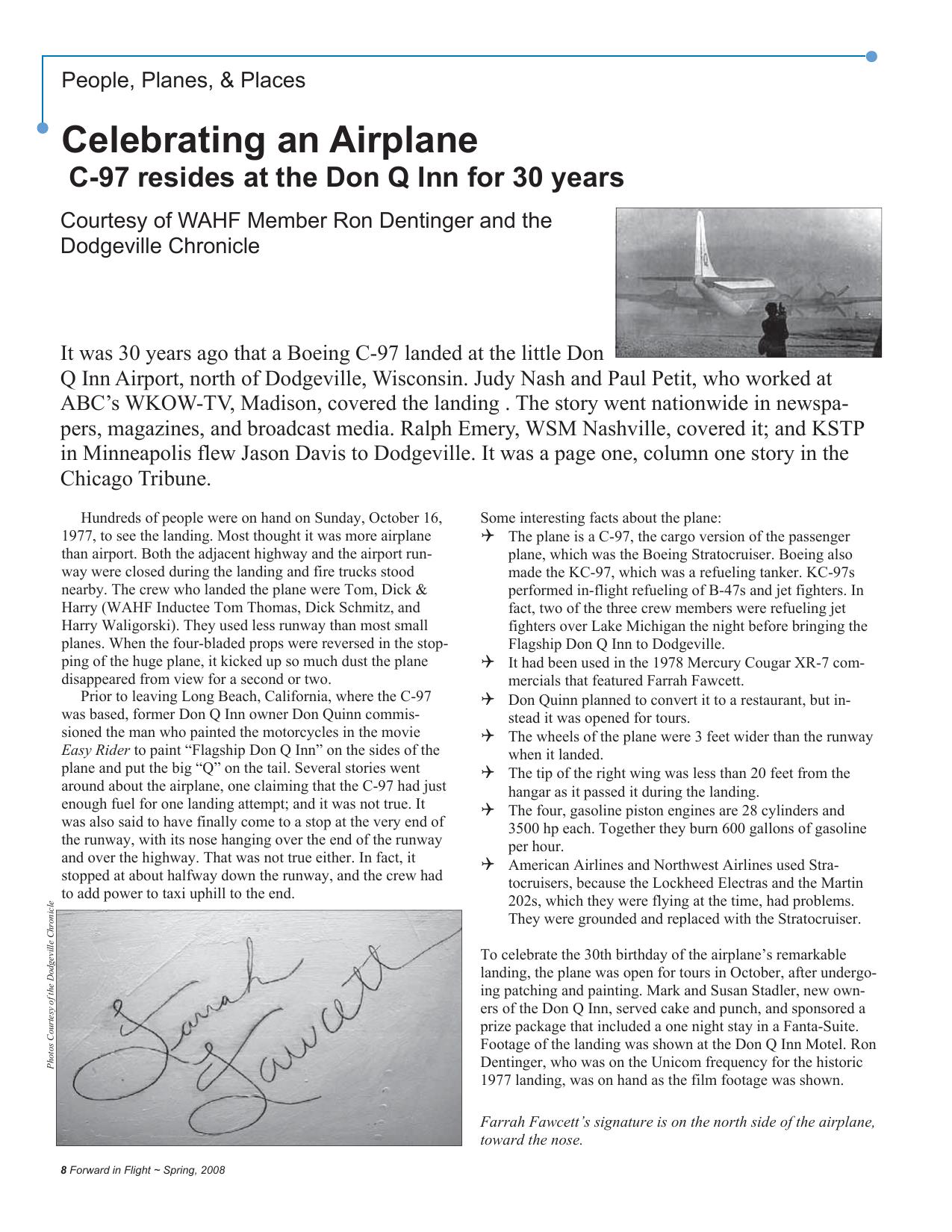
People, Planes, & Places Celebrating an Airplane C-97 resides at the Don Q Inn for 30 years Courtesy of WAHF Member Ron Dentinger and the Dodgeville Chronicle Photos Courtesy of the Dodgeville Chronicle It was 30 years ago that a Boeing C-97 landed at the little Don Q Inn Airport, north of Dodgeville, Wisconsin. Judy Nash and Paul Petit, who worked at ABC’s WKOW-TV, Madison, covered the landing . The story went nationwide in newspapers, magazines, and broadcast media. Ralph Emery, WSM Nashville, covered it; and KSTP in Minneapolis flew Jason Davis to Dodgeville. It was a page one, column one story in the Chicago Tribune. Hundreds of people were on hand on Sunday, October 16, 1977, to see the landing. Most thought it was more airplane than airport. Both the adjacent highway and the airport runway were closed during the landing and fire trucks stood nearby. The crew who landed the plane were Tom, Dick & Harry (WAHF Inductee Tom Thomas, Dick Schmitz, and Harry Waligorski). They used less runway than most small planes. When the four-bladed props were reversed in the stopping of the huge plane, it kicked up so much dust the plane disappeared from view for a second or two. Prior to leaving Long Beach, California, where the C-97 was based, former Don Q Inn owner Don Quinn commissioned the man who painted the motorcycles in the movie Easy Rider to paint “Flagship Don Q Inn” on the sides of the plane and put the big “Q” on the tail. Several stories went around about the airplane, one claiming that the C-97 had just enough fuel for one landing attempt; and it was not true. It was also said to have finally come to a stop at the very end of the runway, with its nose hanging over the end of the runway and over the highway. That was not true either. In fact, it stopped at about halfway down the runway, and the crew had to add power to taxi uphill to the end. Some interesting facts about the plane: 4 The plane is a C-97, the cargo version of the passenger plane, which was the Boeing Stratocruiser. Boeing also made the KC-97, which was a refueling tanker. KC-97s performed in-flight refueling of B-47s and jet fighters. In fact, two of the three crew members were refueling jet fighters over Lake Michigan the night before bringing the Flagship Don Q Inn to Dodgeville. 4 It had been used in the 1978 Mercury Cougar XR-7 commercials that featured Farrah Fawcett. 4 Don Quinn planned to convert it to a restaurant, but instead it was opened for tours. 4 The wheels of the plane were 3 feet wider than the runway when it landed. 4 The tip of the right wing was less than 20 feet from the hangar as it passed it during the landing. 4 The four, gasoline piston engines are 28 cylinders and 3500 hp each. Together they burn 600 gallons of gasoline per hour. 4 American Airlines and Northwest Airlines used Stratocruisers, because the Lockheed Electras and the Martin 202s, which they were flying at the time, had problems. They were grounded and replaced with the Stratocruiser. To celebrate the 30th birthday of the airplane’s remarkable landing, the plane was open for tours in October, after undergoing patching and painting. Mark and Susan Stadler, new owners of the Don Q Inn, served cake and punch, and sponsored a prize package that included a one night stay in a Fanta-Suite. Footage of the landing was shown at the Don Q Inn Motel. Ron Dentinger, who was on the Unicom frequency for the historic 1977 landing, was on hand as the film footage was shown. Farrah Fawcett’s signature is on the north side of the airplane, toward the nose. 8 Forward in Flight ~ Spring, 2008
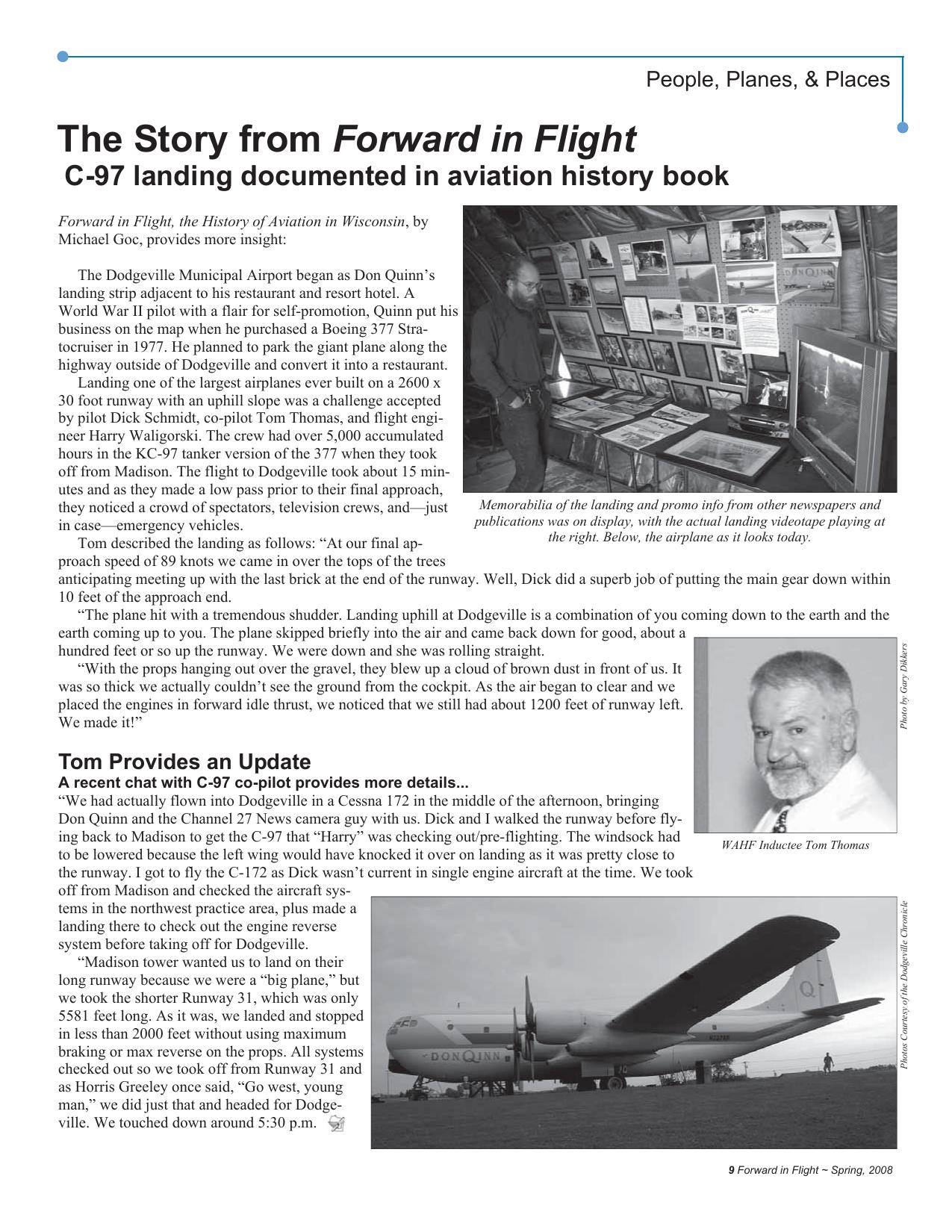
People, Planes, & Places The Story from Forward in Flight C-97 landing documented in aviation history book The Dodgeville Municipal Airport began as Don Quinn’s landing strip adjacent to his restaurant and resort hotel. A World War II pilot with a flair for self-promotion, Quinn put his business on the map when he purchased a Boeing 377 Stratocruiser in 1977. He planned to park the giant plane along the highway outside of Dodgeville and convert it into a restaurant. Landing one of the largest airplanes ever built on a 2600 x 30 foot runway with an uphill slope was a challenge accepted by pilot Dick Schmidt, co-pilot Tom Thomas, and flight engineer Harry Waligorski. The crew had over 5,000 accumulated hours in the KC-97 tanker version of the 377 when they took off from Madison. The flight to Dodgeville took about 15 minutes and as they made a low pass prior to their final approach, Memorabilia of the landing and promo info from other newspapers and they noticed a crowd of spectators, television crews, and—just publications was on display, with the actual landing videotape playing at in case—emergency vehicles. the right. Below, the airplane as it looks today. Tom described the landing as follows: “At our final approach speed of 89 knots we came in over the tops of the trees anticipating meeting up with the last brick at the end of the runway. Well, Dick did a superb job of putting the main gear down within 10 feet of the approach end. “The plane hit with a tremendous shudder. Landing uphill at Dodgeville is a combination of you coming down to the earth and the earth coming up to you. The plane skipped briefly into the air and came back down for good, about a hundred feet or so up the runway. We were down and she was rolling straight. “With the props hanging out over the gravel, they blew up a cloud of brown dust in front of us. It was so thick we actually couldn’t see the ground from the cockpit. As the air began to clear and we placed the engines in forward idle thrust, we noticed that we still had about 1200 feet of runway left. We made it!” Photo by Gary Dikkers Forward in Flight, the History of Aviation in Wisconsin, by Michael Goc, provides more insight: Tom Provides an Update WAHF Inductee Tom Thomas Photos Courtesy of the Dodgeville Chronicle A recent chat with C-97 co-pilot provides more details... “We had actually flown into Dodgeville in a Cessna 172 in the middle of the afternoon, bringing Don Quinn and the Channel 27 News camera guy with us. Dick and I walked the runway before flying back to Madison to get the C-97 that “Harry” was checking out/pre-flighting. The windsock had to be lowered because the left wing would have knocked it over on landing as it was pretty close to the runway. I got to fly the C-172 as Dick wasn’t current in single engine aircraft at the time. We took off from Madison and checked the aircraft systems in the northwest practice area, plus made a landing there to check out the engine reverse system before taking off for Dodgeville. “Madison tower wanted us to land on their long runway because we were a “big plane,” but we took the shorter Runway 31, which was only 5581 feet long. As it was, we landed and stopped in less than 2000 feet without using maximum braking or max reverse on the props. All systems checked out so we took off from Runway 31 and as Horris Greeley once said, “Go west, young man,” we did just that and headed for Dodgeville. We touched down around 5:30 p.m. 9 Forward in Flight ~ Spring, 2008
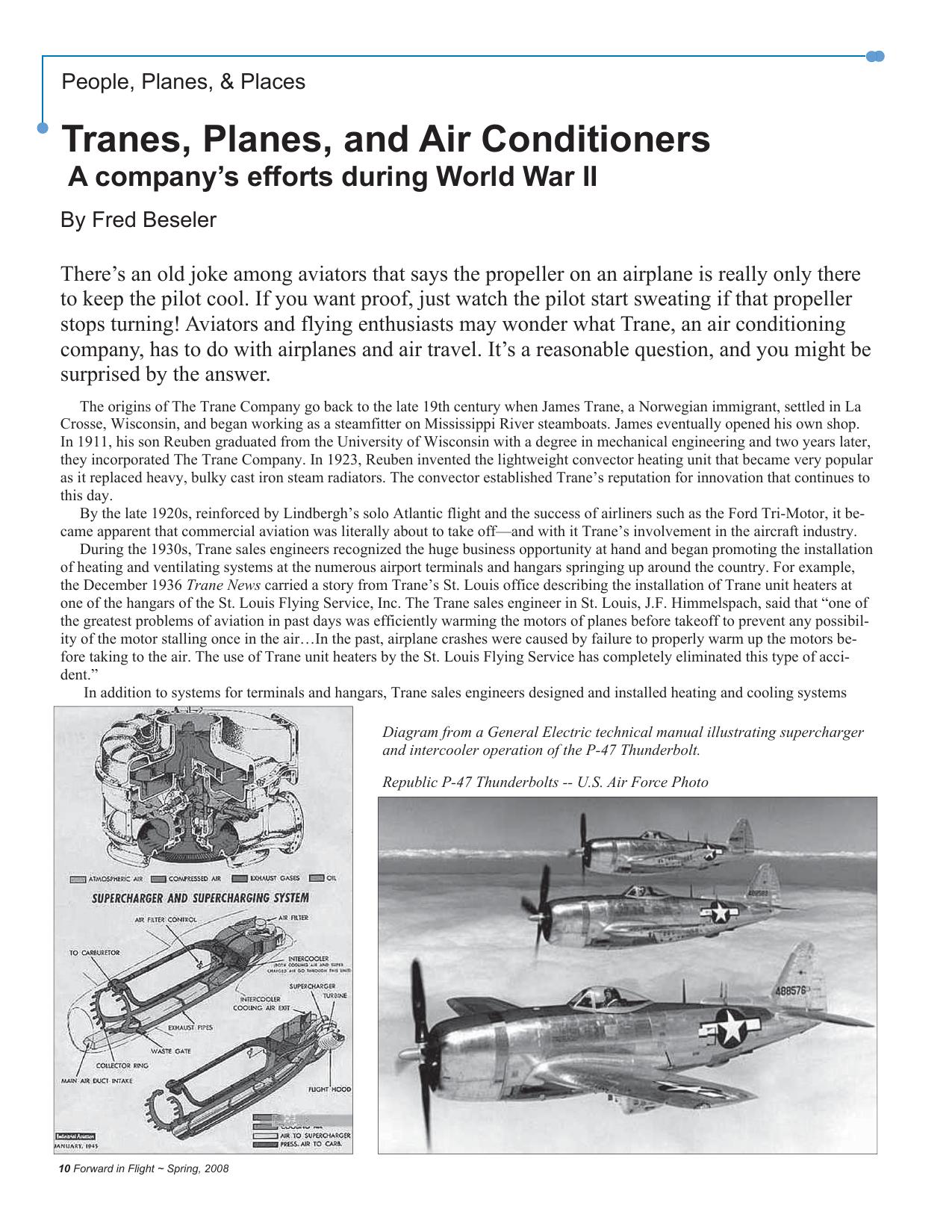
People, Planes, & Places Tranes, Planes, and Air Conditioners A company’s efforts during World War II By Fred Beseler There’s an old joke among aviators that says the propeller on an airplane is really only there to keep the pilot cool. If you want proof, just watch the pilot start sweating if that propeller stops turning! Aviators and flying enthusiasts may wonder what Trane, an air conditioning company, has to do with airplanes and air travel. It’s a reasonable question, and you might be surprised by the answer. The origins of The Trane Company go back to the late 19th century when James Trane, a Norwegian immigrant, settled in La Crosse, Wisconsin, and began working as a steamfitter on Mississippi River steamboats. James eventually opened his own shop. In 1911, his son Reuben graduated from the University of Wisconsin with a degree in mechanical engineering and two years later, they incorporated The Trane Company. In 1923, Reuben invented the lightweight convector heating unit that became very popular as it replaced heavy, bulky cast iron steam radiators. The convector established Trane’s reputation for innovation that continues to this day. By the late 1920s, reinforced by Lindbergh’s solo Atlantic flight and the success of airliners such as the Ford Tri-Motor, it became apparent that commercial aviation was literally about to take off—and with it Trane’s involvement in the aircraft industry. During the 1930s, Trane sales engineers recognized the huge business opportunity at hand and began promoting the installation of heating and ventilating systems at the numerous airport terminals and hangars springing up around the country. For example, the December 1936 Trane News carried a story from Trane’s St. Louis office describing the installation of Trane unit heaters at one of the hangars of the St. Louis Flying Service, Inc. The Trane sales engineer in St. Louis, J.F. Himmelspach, said that “one of the greatest problems of aviation in past days was efficiently warming the motors of planes before takeoff to prevent any possibility of the motor stalling once in the air…In the past, airplane crashes were caused by failure to properly warm up the motors before taking to the air. The use of Trane unit heaters by the St. Louis Flying Service has completely eliminated this type of accident.” In addition to systems for terminals and hangars, Trane sales engineers designed and installed heating and cooling systems Diagram from a General Electric technical manual illustrating supercharger and intercooler operation of the P-47 Thunderbolt. Republic P-47 Thunderbolts -- U.S. Air Force Photo 10 Forward in Flight ~ Spring, 2008
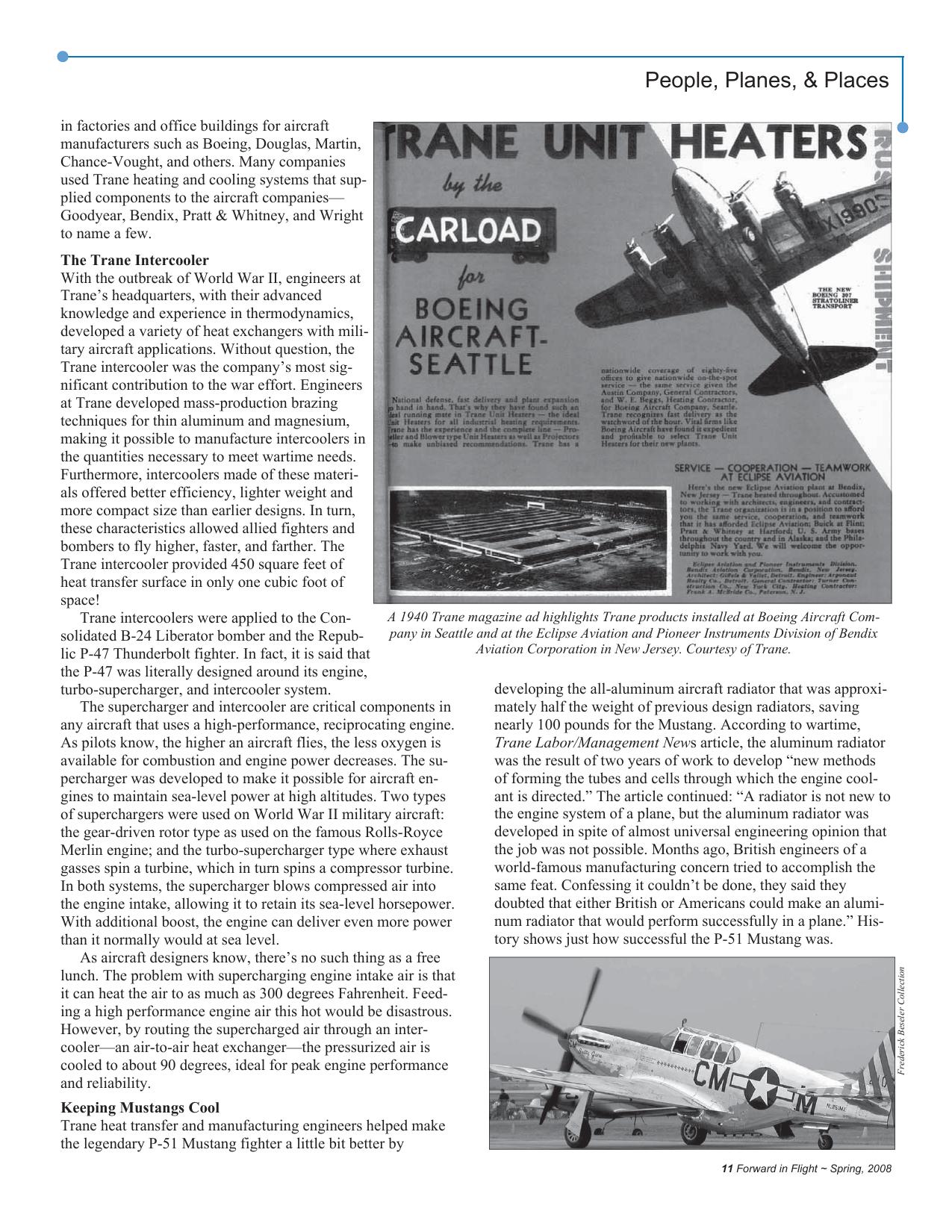
People, Planes, & Places The Trane Intercooler With the outbreak of World War II, engineers at Trane’s headquarters, with their advanced knowledge and experience in thermodynamics, developed a variety of heat exchangers with military aircraft applications. Without question, the Trane intercooler was the company’s most significant contribution to the war effort. Engineers at Trane developed mass-production brazing techniques for thin aluminum and magnesium, making it possible to manufacture intercoolers in the quantities necessary to meet wartime needs. Furthermore, intercoolers made of these materials offered better efficiency, lighter weight and more compact size than earlier designs. In turn, these characteristics allowed allied fighters and bombers to fly higher, faster, and farther. The Trane intercooler provided 450 square feet of heat transfer surface in only one cubic foot of space! A 1940 Trane magazine ad highlights Trane products installed at Boeing Aircraft ComTrane intercoolers were applied to the Conpany in Seattle and at the Eclipse Aviation and Pioneer Instruments Division of Bendix solidated B-24 Liberator bomber and the RepubAviation Corporation in New Jersey. Courtesy of Trane. lic P-47 Thunderbolt fighter. In fact, it is said that the P-47 was literally designed around its engine, developing the all-aluminum aircraft radiator that was approxiturbo-supercharger, and intercooler system. mately half the weight of previous design radiators, saving The supercharger and intercooler are critical components in nearly 100 pounds for the Mustang. According to wartime, any aircraft that uses a high-performance, reciprocating engine. Trane Labor/Management News article, the aluminum radiator As pilots know, the higher an aircraft flies, the less oxygen is was the result of two years of work to develop “new methods available for combustion and engine power decreases. The suof forming the tubes and cells through which the engine coolpercharger was developed to make it possible for aircraft enant is directed.” The article continued: “A radiator is not new to gines to maintain sea-level power at high altitudes. Two types the engine system of a plane, but the aluminum radiator was of superchargers were used on World War II military aircraft: developed in spite of almost universal engineering opinion that the gear-driven rotor type as used on the famous Rolls-Royce the job was not possible. Months ago, British engineers of a Merlin engine; and the turbo-supercharger type where exhaust world-famous manufacturing concern tried to accomplish the gasses spin a turbine, which in turn spins a compressor turbine. same feat. Confessing it couldn’t be done, they said they In both systems, the supercharger blows compressed air into doubted that either British or Americans could make an alumithe engine intake, allowing it to retain its sea-level horsepower. num radiator that would perform successfully in a plane.” HisWith additional boost, the engine can deliver even more power tory shows just how successful the P-51 Mustang was. than it normally would at sea level. As aircraft designers know, there’s no such thing as a free lunch. The problem with supercharging engine intake air is that it can heat the air to as much as 300 degrees Fahrenheit. Feeding a high performance engine air this hot would be disastrous. However, by routing the supercharged air through an intercooler—an air-to-air heat exchanger—the pressurized air is cooled to about 90 degrees, ideal for peak engine performance and reliability. Keeping Mustangs Cool Trane heat transfer and manufacturing engineers helped make the legendary P-51 Mustang fighter a little bit better by 11 Forward in Flight ~ Spring, 2008 Frederick Beseler Collection in factories and office buildings for aircraft manufacturers such as Boeing, Douglas, Martin, Chance-Vought, and others. Many companies used Trane heating and cooling systems that supplied components to the aircraft companies— Goodyear, Bendix, Pratt & Whitney, and Wright to name a few.
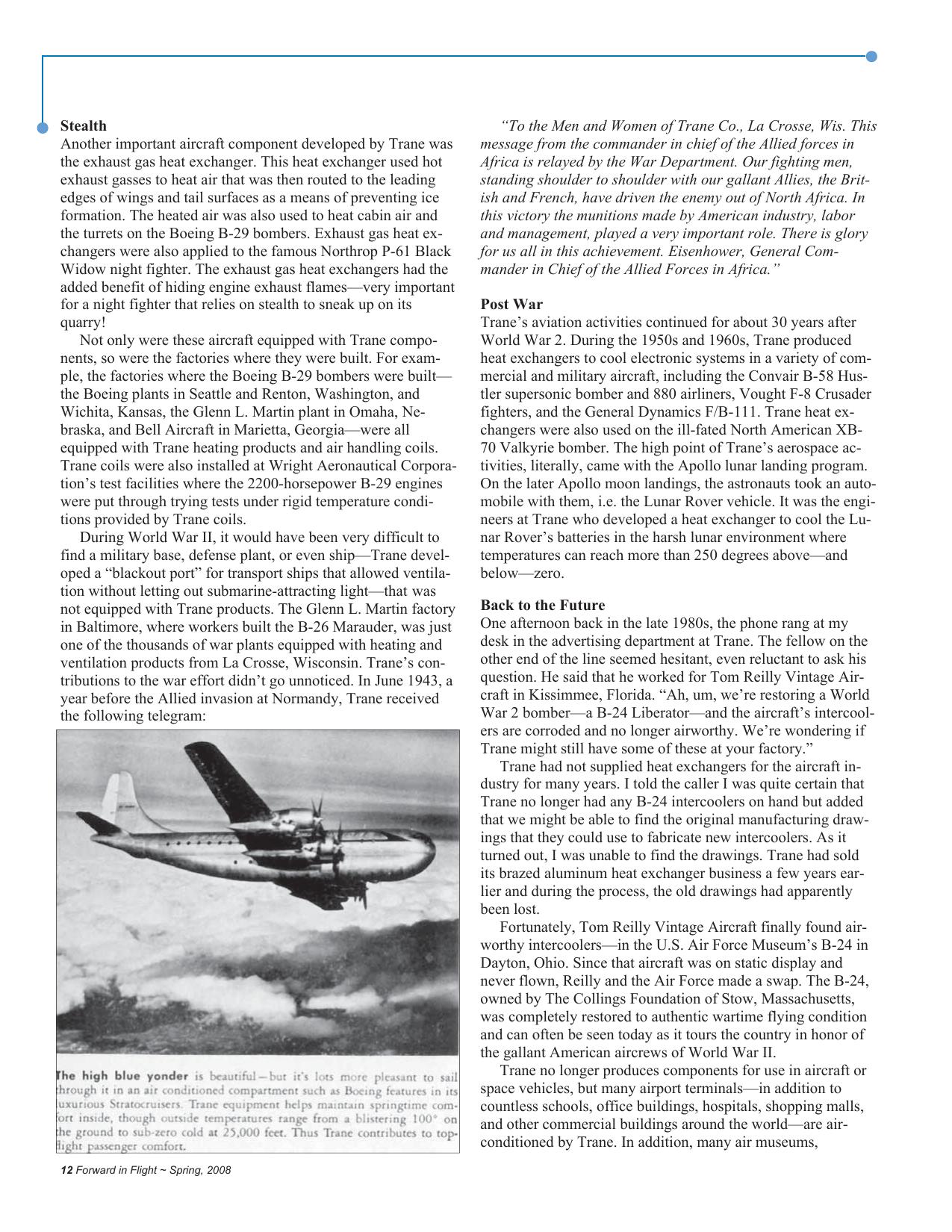
Stealth Another important aircraft component developed by Trane was the exhaust gas heat exchanger. This heat exchanger used hot exhaust gasses to heat air that was then routed to the leading edges of wings and tail surfaces as a means of preventing ice formation. The heated air was also used to heat cabin air and the turrets on the Boeing B-29 bombers. Exhaust gas heat exchangers were also applied to the famous Northrop P-61 Black Widow night fighter. The exhaust gas heat exchangers had the added benefit of hiding engine exhaust flames—very important for a night fighter that relies on stealth to sneak up on its quarry! Not only were these aircraft equipped with Trane components, so were the factories where they were built. For example, the factories where the Boeing B-29 bombers were built— the Boeing plants in Seattle and Renton, Washington, and Wichita, Kansas, the Glenn L. Martin plant in Omaha, Nebraska, and Bell Aircraft in Marietta, Georgia—were all equipped with Trane heating products and air handling coils. Trane coils were also installed at Wright Aeronautical Corporation’s test facilities where the 2200-horsepower B-29 engines were put through trying tests under rigid temperature conditions provided by Trane coils. During World War II, it would have been very difficult to find a military base, defense plant, or even ship—Trane developed a “blackout port” for transport ships that allowed ventilation without letting out submarine-attracting light—that was not equipped with Trane products. The Glenn L. Martin factory in Baltimore, where workers built the B-26 Marauder, was just one of the thousands of war plants equipped with heating and ventilation products from La Crosse, Wisconsin. Trane’s contributions to the war effort didn’t go unnoticed. In June 1943, a year before the Allied invasion at Normandy, Trane received the following telegram: Trane ad 12 Forward in Flight ~ Spring, 2008 “To the Men and Women of Trane Co., La Crosse, Wis. This message from the commander in chief of the Allied forces in Africa is relayed by the War Department. Our fighting men, standing shoulder to shoulder with our gallant Allies, the British and French, have driven the enemy out of North Africa. In this victory the munitions made by American industry, labor and management, played a very important role. There is glory for us all in this achievement. Eisenhower, General Commander in Chief of the Allied Forces in Africa.” Post War Trane’s aviation activities continued for about 30 years after World War 2. During the 1950s and 1960s, Trane produced heat exchangers to cool electronic systems in a variety of commercial and military aircraft, including the Convair B-58 Hustler supersonic bomber and 880 airliners, Vought F-8 Crusader fighters, and the General Dynamics F/B-111. Trane heat exchangers were also used on the ill-fated North American XB70 Valkyrie bomber. The high point of Trane’s aerospace activities, literally, came with the Apollo lunar landing program. On the later Apollo moon landings, the astronauts took an automobile with them, i.e. the Lunar Rover vehicle. It was the engineers at Trane who developed a heat exchanger to cool the Lunar Rover’s batteries in the harsh lunar environment where temperatures can reach more than 250 degrees above—and below—zero. Back to the Future One afternoon back in the late 1980s, the phone rang at my desk in the advertising department at Trane. The fellow on the other end of the line seemed hesitant, even reluctant to ask his question. He said that he worked for Tom Reilly Vintage Aircraft in Kissimmee, Florida. “Ah, um, we’re restoring a World War 2 bomber—a B-24 Liberator—and the aircraft’s intercoolers are corroded and no longer airworthy. We’re wondering if Trane might still have some of these at your factory.” Trane had not supplied heat exchangers for the aircraft industry for many years. I told the caller I was quite certain that Trane no longer had any B-24 intercoolers on hand but added that we might be able to find the original manufacturing drawings that they could use to fabricate new intercoolers. As it turned out, I was unable to find the drawings. Trane had sold its brazed aluminum heat exchanger business a few years earlier and during the process, the old drawings had apparently been lost. Fortunately, Tom Reilly Vintage Aircraft finally found airworthy intercoolers—in the U.S. Air Force Museum’s B-24 in Dayton, Ohio. Since that aircraft was on static display and never flown, Reilly and the Air Force made a swap. The B-24, owned by The Collings Foundation of Stow, Massachusetts, was completely restored to authentic wartime flying condition and can often be seen today as it tours the country in honor of the gallant American aircrews of World War II. Trane no longer produces components for use in aircraft or space vehicles, but many airport terminals—in addition to countless schools, office buildings, hospitals, shopping malls, and other commercial buildings around the world—are airconditioned by Trane. In addition, many air museums,
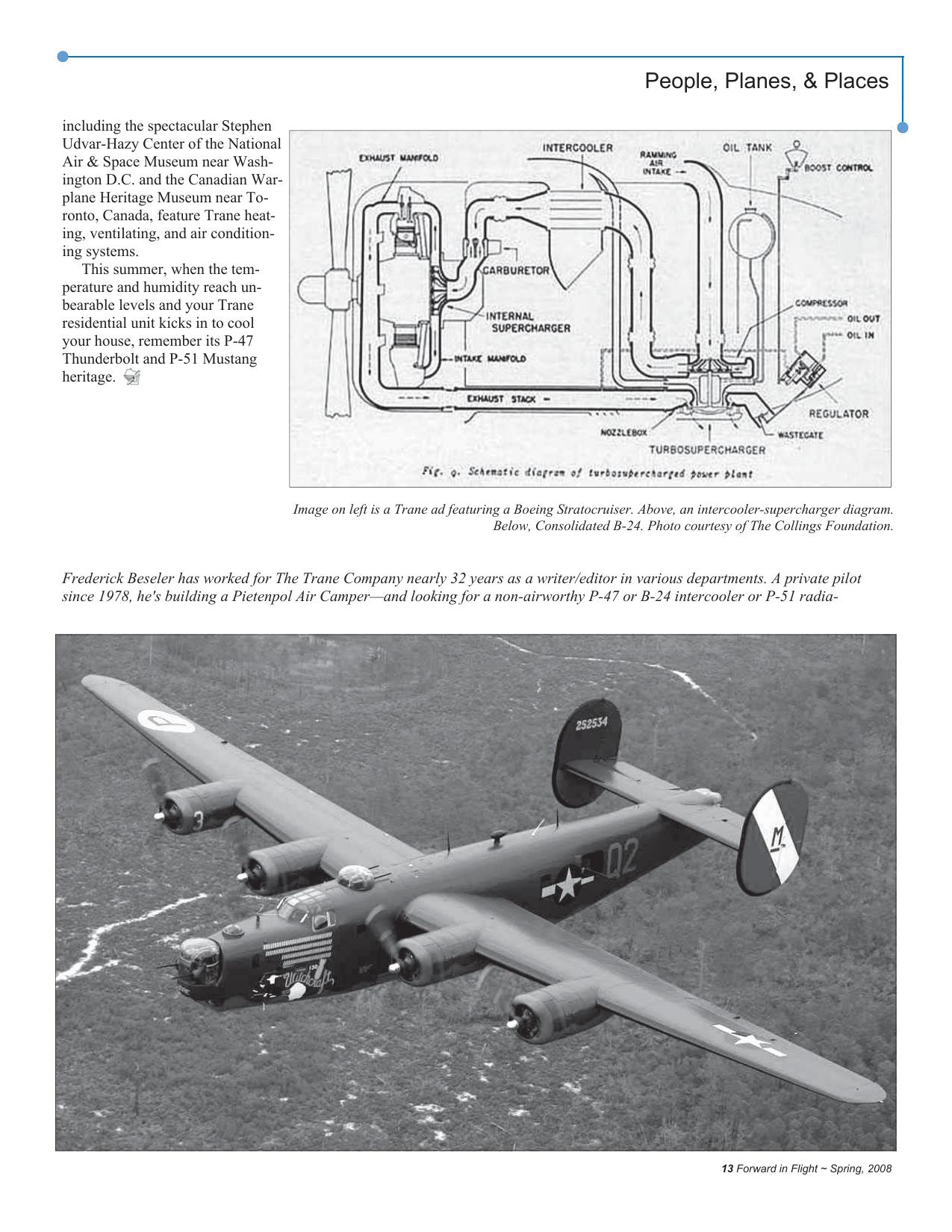
People, Planes, & Places including the spectacular Stephen Udvar-Hazy Center of the National Air & Space Museum near Washington D.C. and the Canadian Warplane Heritage Museum near Toronto, Canada, feature Trane heating, ventilating, and air conditioning systems. This summer, when the temperature and humidity reach unbearable levels and your Trane residential unit kicks in to cool your house, remember its P-47 Thunderbolt and P-51 Mustang heritage. Intercooler-supercharger diagram. Image on left is a Trane ad featuring a Boeing Stratocruiser. Above, an intercooler-supercharger diagram. Below, Consolidated B-24. Photo courtesy of The Collings Foundation. Frederick Beseler has worked for The Trane Company nearly 32 years as a writer/editor in various departments. A private pilot since 1978, he's building a Pietenpol Air Camper—and looking for a non-airworthy P-47 or B-24 intercooler or P-51 radia- 13 Forward in Flight ~ Spring, 2008
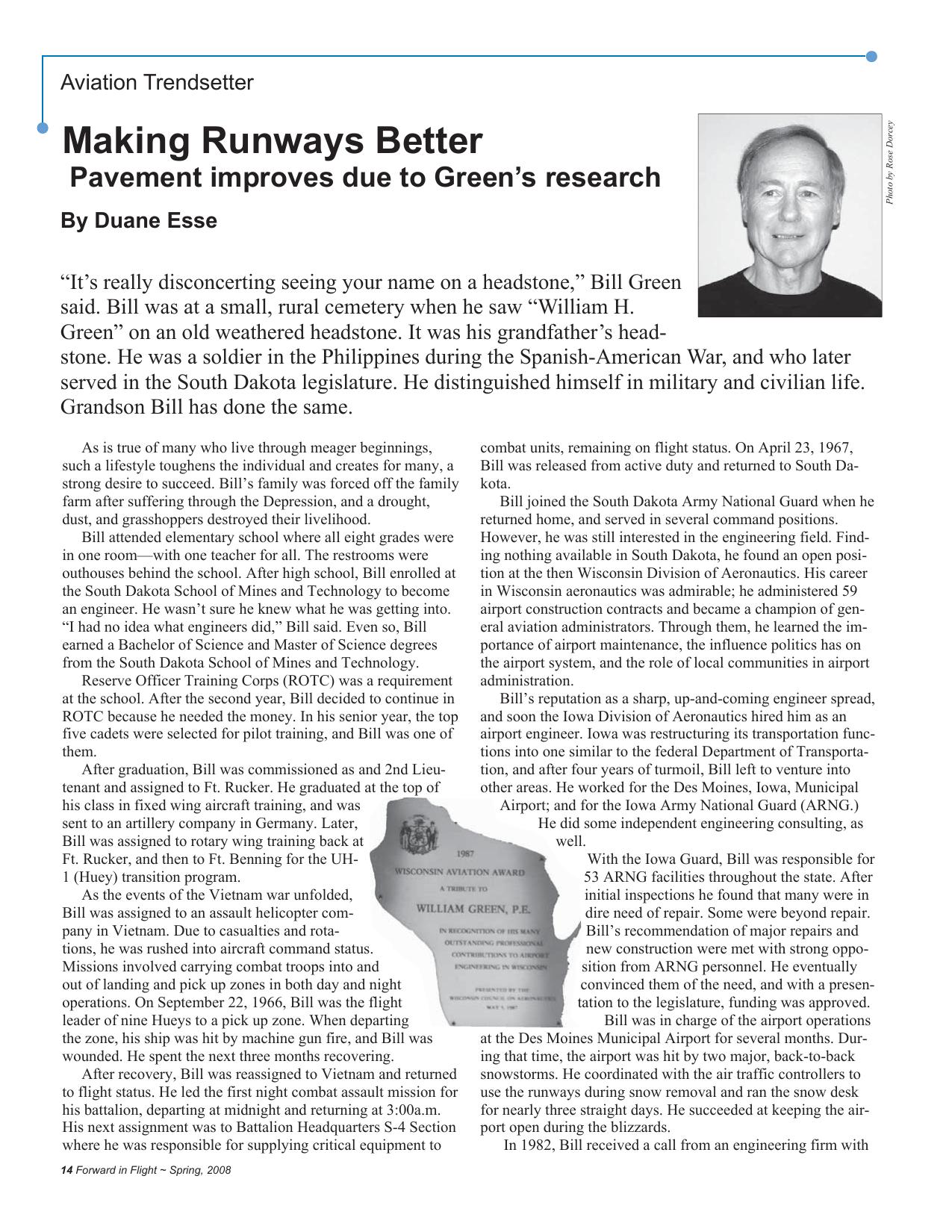
Making Runways Better Pavement improves due to Green’s research By Duane Esse “It’s really disconcerting seeing your name on a headstone,” Bill Green said. Bill was at a small, rural cemetery when he saw “William H. Green” on an old weathered headstone. It was his grandfather’s headstone. He was a soldier in the Philippines during the Spanish-American War, and who later served in the South Dakota legislature. He distinguished himself in military and civilian life. Grandson Bill has done the same. As is true of many who live through meager beginnings, such a lifestyle toughens the individual and creates for many, a strong desire to succeed. Bill’s family was forced off the family farm after suffering through the Depression, and a drought, dust, and grasshoppers destroyed their livelihood. Bill attended elementary school where all eight grades were in one room—with one teacher for all. The restrooms were outhouses behind the school. After high school, Bill enrolled at the South Dakota School of Mines and Technology to become an engineer. He wasn’t sure he knew what he was getting into. “I had no idea what engineers did,” Bill said. Even so, Bill earned a Bachelor of Science and Master of Science degrees from the South Dakota School of Mines and Technology. Reserve Officer Training Corps (ROTC) was a requirement at the school. After the second year, Bill decided to continue in ROTC because he needed the money. In his senior year, the top five cadets were selected for pilot training, and Bill was one of them. After graduation, Bill was commissioned as and 2nd Lieutenant and assigned to Ft. Rucker. He graduated at the top of his class in fixed wing aircraft training, and was sent to an artillery company in Germany. Later, Bill was assigned to rotary wing training back at Ft. Rucker, and then to Ft. Benning for the UH1 (Huey) transition program. As the events of the Vietnam war unfolded, Bill was assigned to an assault helicopter company in Vietnam. Due to casualties and rotations, he was rushed into aircraft command status. Missions involved carrying combat troops into and out of landing and pick up zones in both day and night operations. On September 22, 1966, Bill was the flight leader of nine Hueys to a pick up zone. When departing the zone, his ship was hit by machine gun fire, and Bill was wounded. He spent the next three months recovering. After recovery, Bill was reassigned to Vietnam and returned to flight status. He led the first night combat assault mission for his battalion, departing at midnight and returning at 3:00a.m. His next assignment was to Battalion Headquarters S-4 Section where he was responsible for supplying critical equipment to 14 Forward in Flight ~ Spring, 2008 combat units, remaining on flight status. On April 23, 1967, Bill was released from active duty and returned to South Dakota. Bill joined the South Dakota Army National Guard when he returned home, and served in several command positions. However, he was still interested in the engineering field. Finding nothing available in South Dakota, he found an open position at the then Wisconsin Division of Aeronautics. His career in Wisconsin aeronautics was admirable; he administered 59 airport construction contracts and became a champion of general aviation administrators. Through them, he learned the importance of airport maintenance, the influence politics has on the airport system, and the role of local communities in airport administration. Bill’s reputation as a sharp, up-and-coming engineer spread, and soon the Iowa Division of Aeronautics hired him as an airport engineer. Iowa was restructuring its transportation functions into one similar to the federal Department of Transportation, and after four years of turmoil, Bill left to venture into other areas. He worked for the Des Moines, Iowa, Municipal Airport; and for the Iowa Army National Guard (ARNG.) He did some independent engineering consulting, as well. With the Iowa Guard, Bill was responsible for 53 ARNG facilities throughout the state. After initial inspections he found that many were in dire need of repair. Some were beyond repair. Bill’s recommendation of major repairs and new construction were met with strong opposition from ARNG personnel. He eventually convinced them of the need, and with a presentation to the legislature, funding was approved. Bill was in charge of the airport operations at the Des Moines Municipal Airport for several months. During that time, the airport was hit by two major, back-to-back snowstorms. He coordinated with the air traffic controllers to use the runways during snow removal and ran the snow desk for nearly three straight days. He succeeded at keeping the airport open during the blizzards. In 1982, Bill received a call from an engineering firm with Photo by Rose Dorcey Aviation Trendsetter
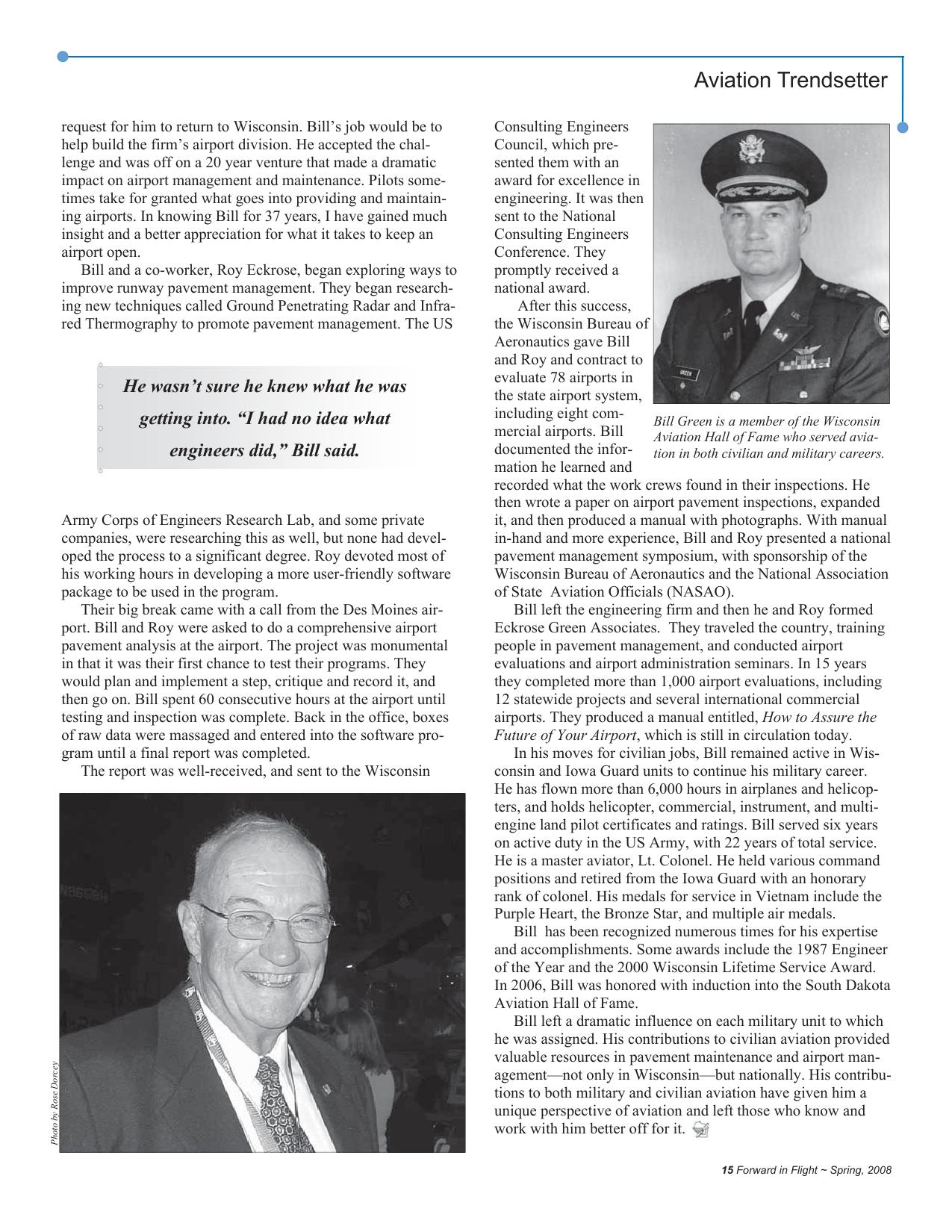
Aviation Trendsetter request for him to return to Wisconsin. Bill’s job would be to help build the firm’s airport division. He accepted the challenge and was off on a 20 year venture that made a dramatic impact on airport management and maintenance. Pilots sometimes take for granted what goes into providing and maintaining airports. In knowing Bill for 37 years, I have gained much insight and a better appreciation for what it takes to keep an airport open. Bill and a co-worker, Roy Eckrose, began exploring ways to improve runway pavement management. They began researching new techniques called Ground Penetrating Radar and Infrared Thermography to promote pavement management. The US He wasn’t sure he knew what he was getting into. “I had no idea what engineers did,” Bill said. Photo by Rose Dorcey Army Corps of Engineers Research Lab, and some private companies, were researching this as well, but none had developed the process to a significant degree. Roy devoted most of his working hours in developing a more user-friendly software package to be used in the program. Their big break came with a call from the Des Moines airport. Bill and Roy were asked to do a comprehensive airport pavement analysis at the airport. The project was monumental in that it was their first chance to test their programs. They would plan and implement a step, critique and record it, and then go on. Bill spent 60 consecutive hours at the airport until testing and inspection was complete. Back in the office, boxes of raw data were massaged and entered into the software program until a final report was completed. The report was well-received, and sent to the Wisconsin Consulting Engineers Council, which presented them with an award for excellence in engineering. It was then sent to the National Consulting Engineers Conference. They promptly received a national award. After this success, the Wisconsin Bureau of Aeronautics gave Bill and Roy and contract to evaluate 78 airports in the state airport system, including eight comBill Green is a member of the Wisconsin mercial airports. Bill Aviation Hall of Fame who served aviadocumented the infor- tion in both civilian and military careers. mation he learned and recorded what the work crews found in their inspections. He then wrote a paper on airport pavement inspections, expanded it, and then produced a manual with photographs. With manual in-hand and more experience, Bill and Roy presented a national pavement management symposium, with sponsorship of the Wisconsin Bureau of Aeronautics and the National Association of State Aviation Officials (NASAO). Bill left the engineering firm and then he and Roy formed Eckrose Green Associates. They traveled the country, training people in pavement management, and conducted airport evaluations and airport administration seminars. In 15 years they completed more than 1,000 airport evaluations, including 12 statewide projects and several international commercial airports. They produced a manual entitled, How to Assure the Future of Your Airport, which is still in circulation today. In his moves for civilian jobs, Bill remained active in Wisconsin and Iowa Guard units to continue his military career. He has flown more than 6,000 hours in airplanes and helicopters, and holds helicopter, commercial, instrument, and multiengine land pilot certificates and ratings. Bill served six years on active duty in the US Army, with 22 years of total service. He is a master aviator, Lt. Colonel. He held various command positions and retired from the Iowa Guard with an honorary rank of colonel. His medals for service in Vietnam include the Purple Heart, the Bronze Star, and multiple air medals. Bill has been recognized numerous times for his expertise and accomplishments. Some awards include the 1987 Engineer of the Year and the 2000 Wisconsin Lifetime Service Award. In 2006, Bill was honored with induction into the South Dakota Aviation Hall of Fame. Bill left a dramatic influence on each military unit to which he was assigned. His contributions to civilian aviation provided valuable resources in pavement maintenance and airport management—not only in Wisconsin—but nationally. His contributions to both military and civilian aviation have given him a unique perspective of aviation and left those who know and work with him better off for it. 15 Forward in Flight ~ Spring, 2008
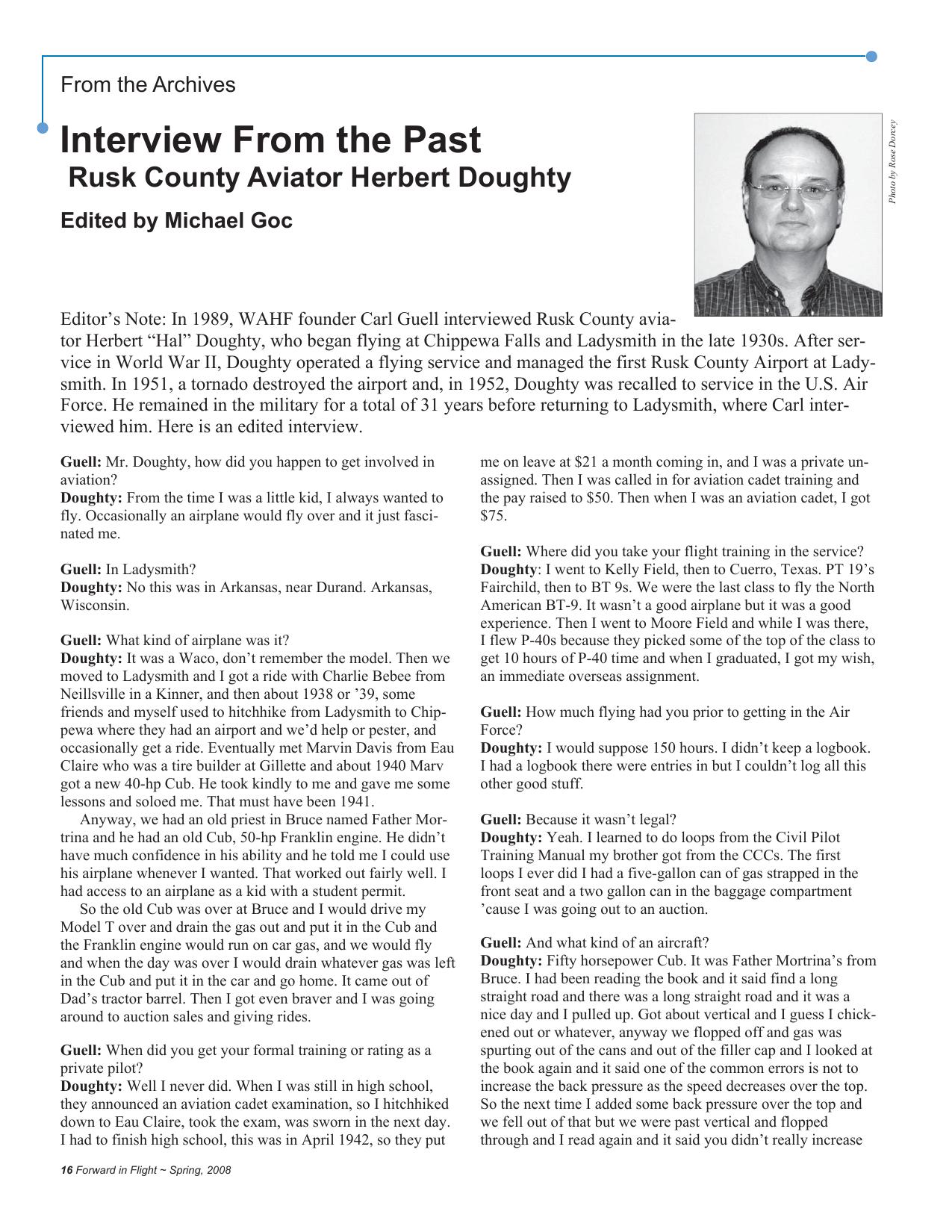
Interview From the Past Rusk County Aviator Herbert Doughty Edited by Michael Goc Editor’s Note: In 1989, WAHF founder Carl Guell interviewed Rusk County aviator Herbert “Hal” Doughty, who began flying at Chippewa Falls and Ladysmith in the late 1930s. After service in World War II, Doughty operated a flying service and managed the first Rusk County Airport at Ladysmith. In 1951, a tornado destroyed the airport and, in 1952, Doughty was recalled to service in the U.S. Air Force. He remained in the military for a total of 31 years before returning to Ladysmith, where Carl interviewed him. Here is an edited interview. Guell: Mr. Doughty, how did you happen to get involved in aviation? Doughty: From the time I was a little kid, I always wanted to fly. Occasionally an airplane would fly over and it just fascinated me. Guell: In Ladysmith? Doughty: No this was in Arkansas, near Durand. Arkansas, Wisconsin. Guell: What kind of airplane was it? Doughty: It was a Waco, don’t remember the model. Then we moved to Ladysmith and I got a ride with Charlie Bebee from Neillsville in a Kinner, and then about 1938 or ’39, some friends and myself used to hitchhike from Ladysmith to Chippewa where they had an airport and we’d help or pester, and occasionally get a ride. Eventually met Marvin Davis from Eau Claire who was a tire builder at Gillette and about 1940 Marv got a new 40-hp Cub. He took kindly to me and gave me some lessons and soloed me. That must have been 1941. Anyway, we had an old priest in Bruce named Father Mortrina and he had an old Cub, 50-hp Franklin engine. He didn’t have much confidence in his ability and he told me I could use his airplane whenever I wanted. That worked out fairly well. I had access to an airplane as a kid with a student permit. So the old Cub was over at Bruce and I would drive my Model T over and drain the gas out and put it in the Cub and the Franklin engine would run on car gas, and we would fly and when the day was over I would drain whatever gas was left in the Cub and put it in the car and go home. It came out of Dad’s tractor barrel. Then I got even braver and I was going around to auction sales and giving rides. Guell: When did you get your formal training or rating as a private pilot? Doughty: Well I never did. When I was still in high school, they announced an aviation cadet examination, so I hitchhiked down to Eau Claire, took the exam, was sworn in the next day. I had to finish high school, this was in April 1942, so they put 16 Forward in Flight ~ Spring, 2008 me on leave at $21 a month coming in, and I was a private unassigned. Then I was called in for aviation cadet training and the pay raised to $50. Then when I was an aviation cadet, I got $75. Guell: Where did you take your flight training in the service? Doughty: I went to Kelly Field, then to Cuerro, Texas. PT 19’s Fairchild, then to BT 9s. We were the last class to fly the North American BT-9. It wasn’t a good airplane but it was a good experience. Then I went to Moore Field and while I was there, I flew P-40s because they picked some of the top of the class to get 10 hours of P-40 time and when I graduated, I got my wish, an immediate overseas assignment. Guell: How much flying had you prior to getting in the Air Force? Doughty: I would suppose 150 hours. I didn’t keep a logbook. I had a logbook there were entries in but I couldn’t log all this other good stuff. Guell: Because it wasn’t legal? Doughty: Yeah. I learned to do loops from the Civil Pilot Training Manual my brother got from the CCCs. The first loops I ever did I had a five-gallon can of gas strapped in the front seat and a two gallon can in the baggage compartment ’cause I was going out to an auction. Guell: And what kind of an aircraft? Doughty: Fifty horsepower Cub. It was Father Mortrina’s from Bruce. I had been reading the book and it said find a long straight road and there was a long straight road and it was a nice day and I pulled up. Got about vertical and I guess I chickened out or whatever, anyway we flopped off and gas was spurting out of the cans and out of the filler cap and I looked at the book again and it said one of the common errors is not to increase the back pressure as the speed decreases over the top. So the next time I added some back pressure over the top and we fell out of that but we were past vertical and flopped through and I read again and it said you didn’t really increase Photo by Rose Dorcey From the Archives
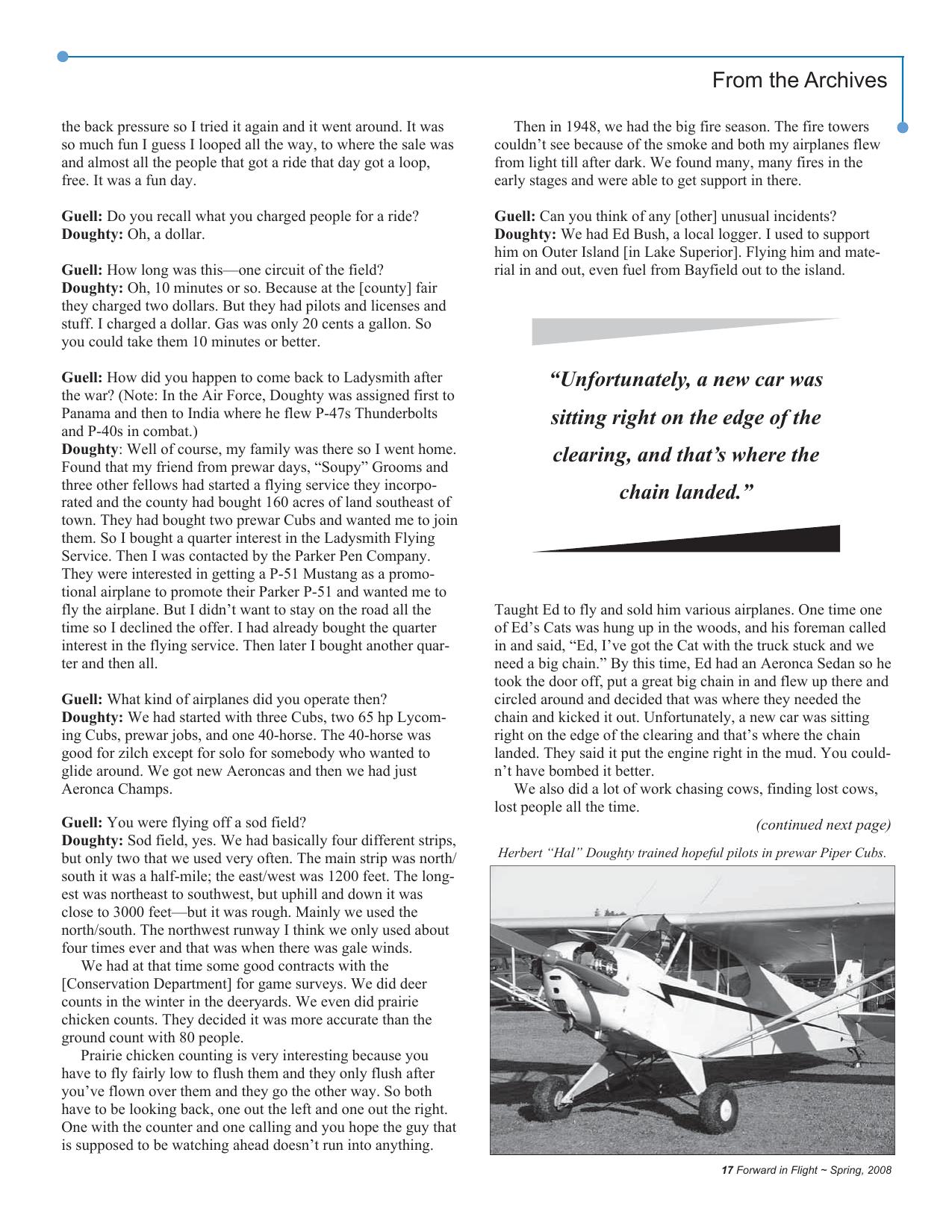
From the Archives the back pressure so I tried it again and it went around. It was so much fun I guess I looped all the way, to where the sale was and almost all the people that got a ride that day got a loop, free. It was a fun day. Then in 1948, we had the big fire season. The fire towers couldn’t see because of the smoke and both my airplanes flew from light till after dark. We found many, many fires in the early stages and were able to get support in there. Guell: Do you recall what you charged people for a ride? Doughty: Oh, a dollar. Guell: Can you think of any [other] unusual incidents? Doughty: We had Ed Bush, a local logger. I used to support him on Outer Island [in Lake Superior]. Flying him and material in and out, even fuel from Bayfield out to the island. Guell: How long was this—one circuit of the field? Doughty: Oh, 10 minutes or so. Because at the [county] fair they charged two dollars. But they had pilots and licenses and stuff. I charged a dollar. Gas was only 20 cents a gallon. So you could take them 10 minutes or better. Guell: How did you happen to come back to Ladysmith after the war? (Note: In the Air Force, Doughty was assigned first to Panama and then to India where he flew P-47s Thunderbolts and P-40s in combat.) Doughty: Well of course, my family was there so I went home. Found that my friend from prewar days, “Soupy” Grooms and three other fellows had started a flying service they incorporated and the county had bought 160 acres of land southeast of town. They had bought two prewar Cubs and wanted me to join them. So I bought a quarter interest in the Ladysmith Flying Service. Then I was contacted by the Parker Pen Company. They were interested in getting a P-51 Mustang as a promotional airplane to promote their Parker P-51 and wanted me to fly the airplane. But I didn’t want to stay on the road all the time so I declined the offer. I had already bought the quarter interest in the flying service. Then later I bought another quarter and then all. Guell: What kind of airplanes did you operate then? Doughty: We had started with three Cubs, two 65 hp Lycoming Cubs, prewar jobs, and one 40-horse. The 40-horse was good for zilch except for solo for somebody who wanted to glide around. We got new Aeroncas and then we had just Aeronca Champs. Guell: You were flying off a sod field? Doughty: Sod field, yes. We had basically four different strips, but only two that we used very often. The main strip was north/ south it was a half-mile; the east/west was 1200 feet. The longest was northeast to southwest, but uphill and down it was close to 3000 feet—but it was rough. Mainly we used the north/south. The northwest runway I think we only used about four times ever and that was when there was gale winds. We had at that time some good contracts with the [Conservation Department] for game surveys. We did deer counts in the winter in the deeryards. We even did prairie chicken counts. They decided it was more accurate than the ground count with 80 people. Prairie chicken counting is very interesting because you have to fly fairly low to flush them and they only flush after you’ve flown over them and they go the other way. So both have to be looking back, one out the left and one out the right. One with the counter and one calling and you hope the guy that is supposed to be watching ahead doesn’t run into anything. “Unfortunately, a new car was sitting right on the edge of the clearing, and that’s where the chain landed.” Taught Ed to fly and sold him various airplanes. One time one of Ed’s Cats was hung up in the woods, and his foreman called in and said, “Ed, I’ve got the Cat with the truck stuck and we need a big chain.” By this time, Ed had an Aeronca Sedan so he took the door off, put a great big chain in and flew up there and circled around and decided that was where they needed the chain and kicked it out. Unfortunately, a new car was sitting right on the edge of the clearing and that’s where the chain landed. They said it put the engine right in the mud. You couldn’t have bombed it better. We also did a lot of work chasing cows, finding lost cows, lost people all the time. (continued next page) Herbert “Hal” Doughty trained hopeful pilots in prewar Piper Cubs. 17 Forward in Flight ~ Spring, 2008
From the Archives Guell: Lost hunters? Doughty: Oh, yes. But right after I got into the airplane business someone stole my car and I reported it to the sheriff but they said it was hard to find where it was. So I just flew a grid around Ladysmith expanding all the time till I found it in a park over in Bruce and landed in a nearby field to retrieve it. I had calls all the time, “I have a cow lost.” Someone wanted me to find his wife. I had one case where I spent almost a week hauling a guy around, following his wife. Berry pickers lost. We always found what we were looking for, always. Lots of lost cows. Guell: Did you ever do any wolf hunting from the air? Doughty: Yes, about 1947 or ’48, when there was a bounty on wolves in Wisconsin and Minnesota and Canada. My first operation was up in the Winter-Ojibwa area. Friend of mine said his brother had land up there and they had lots of wolves. Twenty dollars apiece. That was good money then. The man involved was a real estate fellow in Ladysmith who had ridden in an airplane only once or twice, but he had a good shotgun. I took him up, told him what the restrictions were. I told him I didn’t want him to shoot the floor, or the prop, or the wing struts, and I told him how to shoot ’cause the plane would be going faster than the wolf and the amount of lead he needed was generally to shoot at the tip of the wolf’s tail and our speed being faster than the wolf, that would give him a good body shot. Anyway we went up and circled, and spotted a couple of wolf’s right away, and went down and the second shot he got one and we circled around and we got the second one. That was about it and we went home. He says, “You know, I been thinking about, we were up this way and down that way, it’s a wonder I wasn’t sick.” You talk about incidents. We had a pilot one day, Christmas Eve, about 1949. We were down to the river and we had skis on. He had a Cub, I had the Champ, and we were running down the river and sliding along. Then you make a power turn and slide around and take off the other way. Bitter cold but a nice day to be out flying. He ran up a little lagoon, couldn’t make the turn, and ran into a stump. He badly bent the rear of the Cub, broke the propeller, caved in the right landing gear, broke the ski all to pieces, 20 below zero, Christmas Eve. So he got in my airplane and we went back to the airport and got some tools and went back and took off the right-hand landing gear and went back to the airport, and he took it to town and got some angle iron and reinforced it and he put the wheel on that side. Then we took my hacksaw, measured the propeller, and cut it off so it was square on both ends. I took all the clothes line I could find at the airport and we pulled the fuselage straight. Then we used the clothesline wire to tie the tail to the wingtips to keep it in line. So then, I went home with one ski, one wheel, short fan and tail tied straight behind the thing with the clothesline wire. My wife was very unhappy when I got there. “I took him up, told him what the restrictions were. I told him I didn’t want him to shoot the floor, or the prop, or the wing struts, and I told him how to shoot…” Guell: How long did you continue flying out at the Ladysmith Airport? Doughty: Well, in 1951 we had a big tornado that wiped out most of the hangars, one of the two remaining airplanes, over half of the based airplanes. Then the next year I was recalled for the Korean War. The state had decided that they wouldn’t fund the old county airport because it couldn’t be brought up to standard or expanded and they selected a site over by Tony for a new airport. We just closed the old facility. I sold the house. It was moved away. The shop was torn down, the one remaining hangar was torn down, and [the landing strip] was sold for farmland. Guell: There is nothing remaining there today? Doughty: Nothing except the pump jack. It’s farmland. You would never know. It’s called Airport Road and if you knew where it used to be you could find it. Thanks for your support of the Wisconsin Aviation Hall of Fame 18 Forward in Flight ~ Spring, 2008
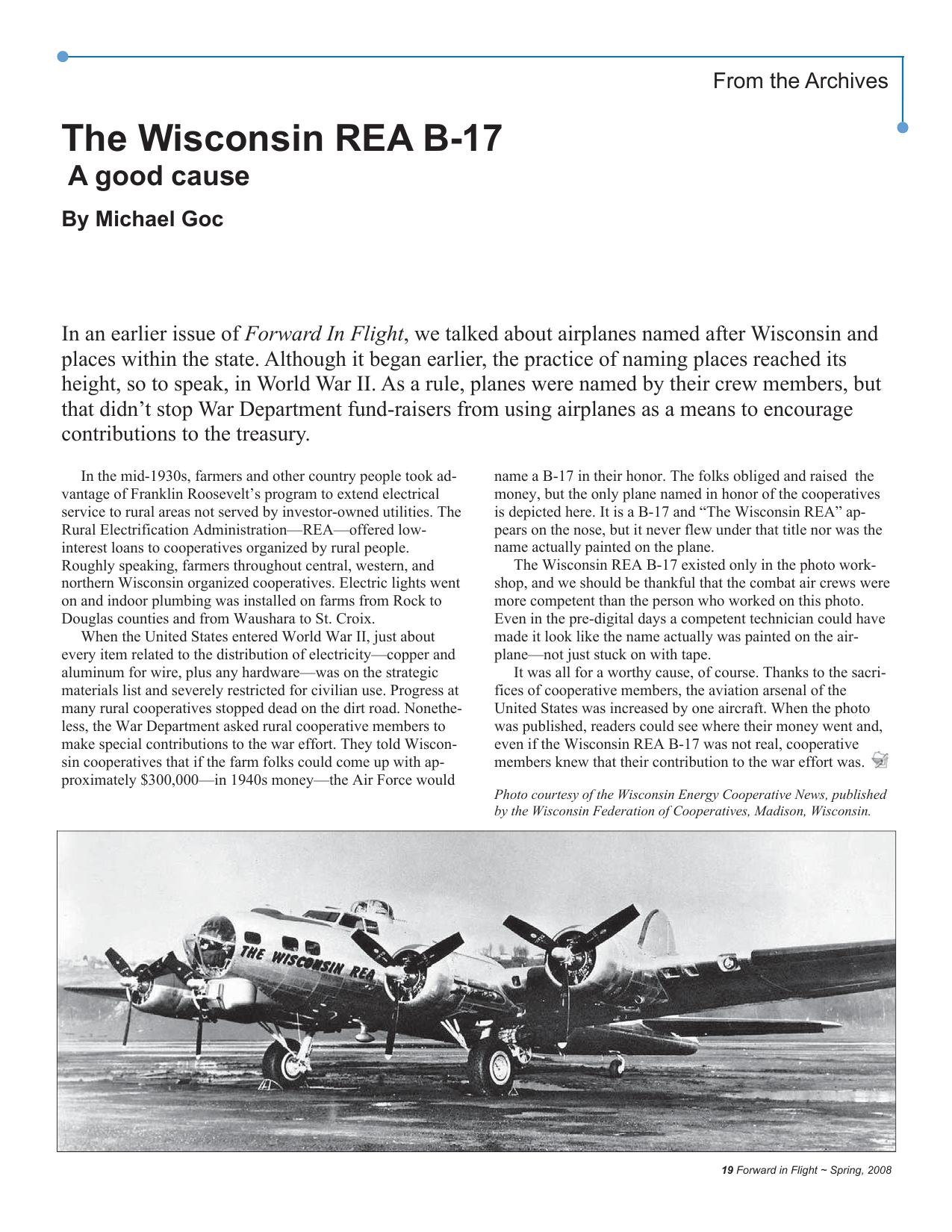
From the Archives The Wisconsin REA B-17 A good cause By Michael Goc In an earlier issue of Forward In Flight, we talked about airplanes named after Wisconsin and places within the state. Although it began earlier, the practice of naming places reached its height, so to speak, in World War II. As a rule, planes were named by their crew members, but that didn’t stop War Department fund-raisers from using airplanes as a means to encourage contributions to the treasury. In the mid-1930s, farmers and other country people took advantage of Franklin Roosevelt’s program to extend electrical service to rural areas not served by investor-owned utilities. The Rural Electrification Administration—REA—offered lowinterest loans to cooperatives organized by rural people. Roughly speaking, farmers throughout central, western, and northern Wisconsin organized cooperatives. Electric lights went on and indoor plumbing was installed on farms from Rock to Douglas counties and from Waushara to St. Croix. When the United States entered World War II, just about every item related to the distribution of electricity—copper and aluminum for wire, plus any hardware—was on the strategic materials list and severely restricted for civilian use. Progress at many rural cooperatives stopped dead on the dirt road. Nonetheless, the War Department asked rural cooperative members to make special contributions to the war effort. They told Wisconsin cooperatives that if the farm folks could come up with approximately $300,000—in 1940s money—the Air Force would name a B-17 in their honor. The folks obliged and raised the money, but the only plane named in honor of the cooperatives is depicted here. It is a B-17 and “The Wisconsin REA” appears on the nose, but it never flew under that title nor was the name actually painted on the plane. The Wisconsin REA B-17 existed only in the photo workshop, and we should be thankful that the combat air crews were more competent than the person who worked on this photo. Even in the pre-digital days a competent technician could have made it look like the name actually was painted on the airplane—not just stuck on with tape. It was all for a worthy cause, of course. Thanks to the sacrifices of cooperative members, the aviation arsenal of the United States was increased by one aircraft. When the photo was published, readers could see where their money went and, even if the Wisconsin REA B-17 was not real, cooperative members knew that their contribution to the war effort was. Photo courtesy of the Wisconsin Energy Cooperative News, published by the Wisconsin Federation of Cooperatives, Madison, Wisconsin. 19 Forward in Flight ~ Spring, 2008
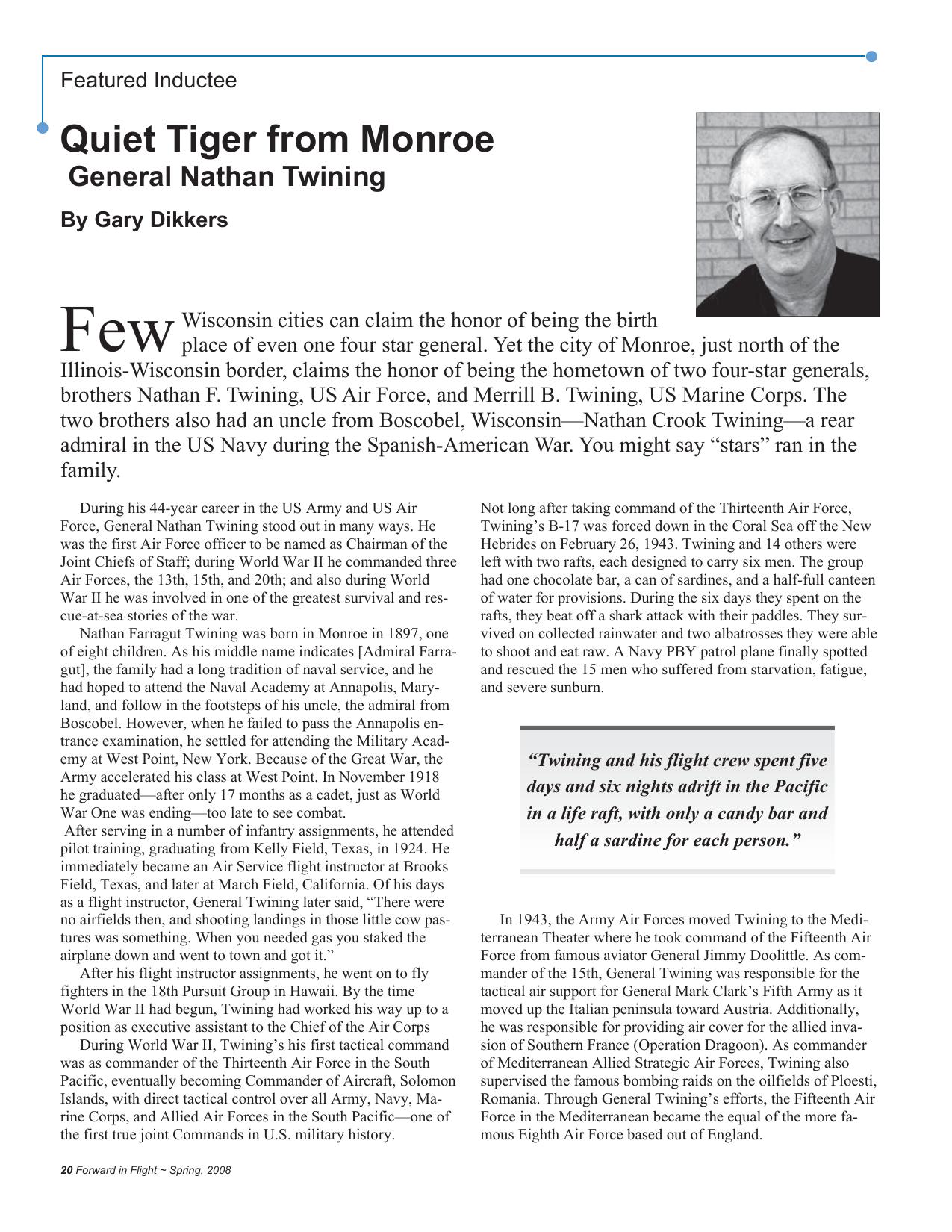
Featured Inductee Quiet Tiger from Monroe General Nathan Twining By Gary Dikkers Few Wisconsin cities can claim the honor of being the birth place of even one four star general. Yet the city of Monroe, just north of the Illinois-Wisconsin border, claims the honor of being the hometown of two four-star generals, brothers Nathan F. Twining, US Air Force, and Merrill B. Twining, US Marine Corps. The two brothers also had an uncle from Boscobel, Wisconsin—Nathan Crook Twining—a rear admiral in the US Navy during the Spanish-American War. You might say “stars” ran in the family. During his 44-year career in the US Army and US Air Force, General Nathan Twining stood out in many ways. He was the first Air Force officer to be named as Chairman of the Joint Chiefs of Staff; during World War II he commanded three Air Forces, the 13th, 15th, and 20th; and also during World War II he was involved in one of the greatest survival and rescue-at-sea stories of the war. Nathan Farragut Twining was born in Monroe in 1897, one of eight children. As his middle name indicates [Admiral Farragut], the family had a long tradition of naval service, and he had hoped to attend the Naval Academy at Annapolis, Maryland, and follow in the footsteps of his uncle, the admiral from Boscobel. However, when he failed to pass the Annapolis entrance examination, he settled for attending the Military Academy at West Point, New York. Because of the Great War, the Army accelerated his class at West Point. In November 1918 he graduated—after only 17 months as a cadet, just as World War One was ending—too late to see combat. After serving in a number of infantry assignments, he attended pilot training, graduating from Kelly Field, Texas, in 1924. He immediately became an Air Service flight instructor at Brooks Field, Texas, and later at March Field, California. Of his days as a flight instructor, General Twining later said, “There were no airfields then, and shooting landings in those little cow pastures was something. When you needed gas you staked the airplane down and went to town and got it.” After his flight instructor assignments, he went on to fly fighters in the 18th Pursuit Group in Hawaii. By the time World War II had begun, Twining had worked his way up to a position as executive assistant to the Chief of the Air Corps During World War II, Twining’s his first tactical command was as commander of the Thirteenth Air Force in the South Pacific, eventually becoming Commander of Aircraft, Solomon Islands, with direct tactical control over all Army, Navy, Marine Corps, and Allied Air Forces in the South Pacific—one of the first true joint Commands in U.S. military history. 20 Forward in Flight ~ Spring, 2008 Not long after taking command of the Thirteenth Air Force, Twining’s B-17 was forced down in the Coral Sea off the New Hebrides on February 26, 1943. Twining and 14 others were left with two rafts, each designed to carry six men. The group had one chocolate bar, a can of sardines, and a half-full canteen of water for provisions. During the six days they spent on the rafts, they beat off a shark attack with their paddles. They survived on collected rainwater and two albatrosses they were able to shoot and eat raw. A Navy PBY patrol plane finally spotted and rescued the 15 men who suffered from starvation, fatigue, and severe sunburn. “Twining and his flight crew spent five days and six nights adrift in the Pacific in a life raft, with only a candy bar and half a sardine for each person.” In 1943, the Army Air Forces moved Twining to the Mediterranean Theater where he took command of the Fifteenth Air Force from famous aviator General Jimmy Doolittle. As commander of the 15th, General Twining was responsible for the tactical air support for General Mark Clark’s Fifth Army as it moved up the Italian peninsula toward Austria. Additionally, he was responsible for providing air cover for the allied invasion of Southern France (Operation Dragoon). As commander of Mediterranean Allied Strategic Air Forces, Twining also supervised the famous bombing raids on the oilfields of Ploesti, Romania. Through General Twining’s efforts, the Fifteenth Air Force in the Mediterranean became the equal of the more famous Eighth Air Force based out of England.
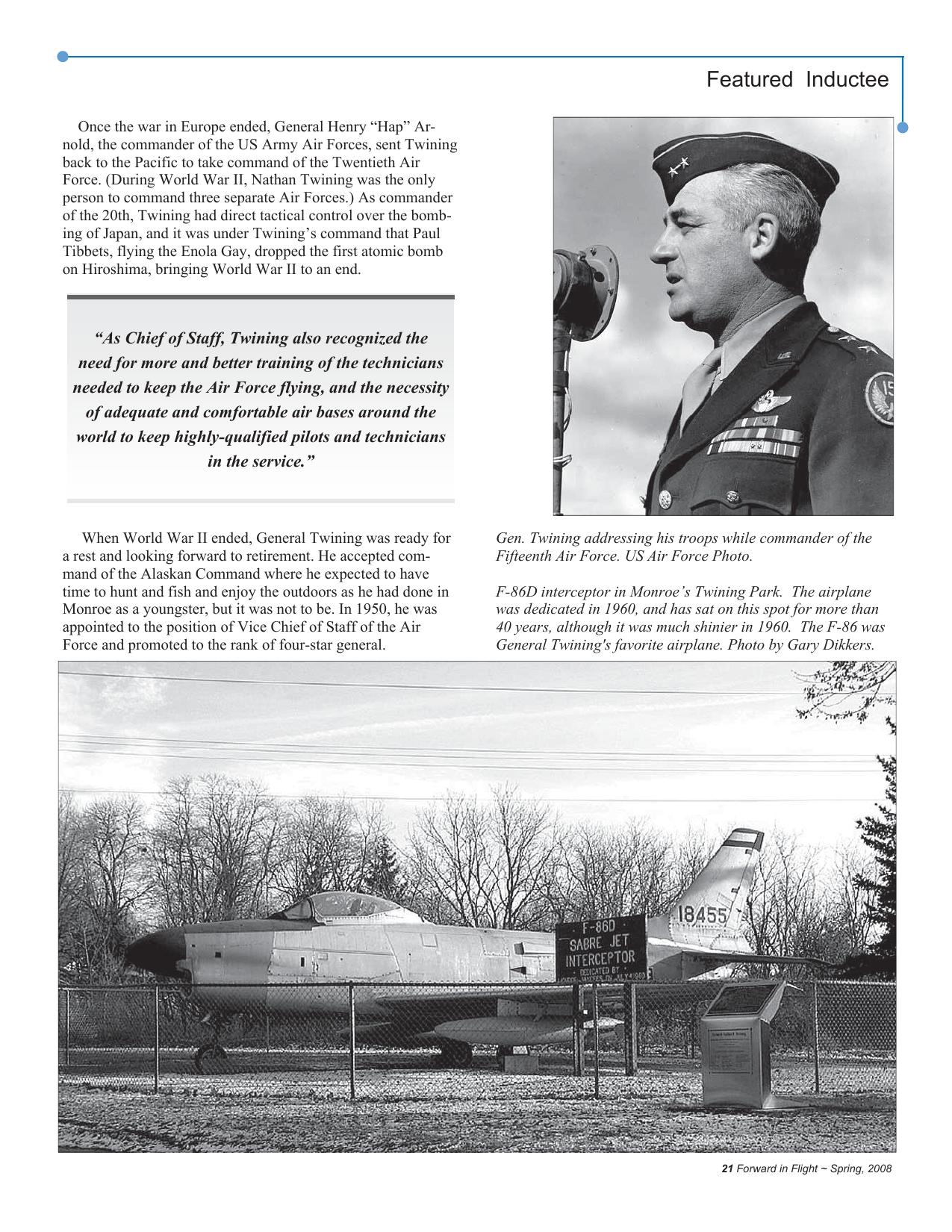
Featured Inductee Once the war in Europe ended, General Henry “Hap” Arnold, the commander of the US Army Air Forces, sent Twining back to the Pacific to take command of the Twentieth Air Force. (During World War II, Nathan Twining was the only person to command three separate Air Forces.) As commander of the 20th, Twining had direct tactical control over the bombing of Japan, and it was under Twining’s command that Paul Tibbets, flying the Enola Gay, dropped the first atomic bomb on Hiroshima, bringing World War II to an end. “As Chief of Staff, Twining also recognized the need for more and better training of the technicians needed to keep the Air Force flying, and the necessity of adequate and comfortable air bases around the world to keep highly-qualified pilots and technicians in the service.” When World War II ended, General Twining was ready for a rest and looking forward to retirement. He accepted command of the Alaskan Command where he expected to have time to hunt and fish and enjoy the outdoors as he had done in Monroe as a youngster, but it was not to be. In 1950, he was appointed to the position of Vice Chief of Staff of the Air Force and promoted to the rank of four-star general. Gen. Twining addressing his troops while commander of the Fifteenth Air Force. US Air Force Photo. F-86D interceptor in Monroe’s Twining Park. The airplane was dedicated in 1960, and has sat on this spot for more than 40 years, although it was much shinier in 1960. The F-86 was General Twining's favorite airplane. Photo by Gary Dikkers. 21 Forward in Flight ~ Spring, 2008
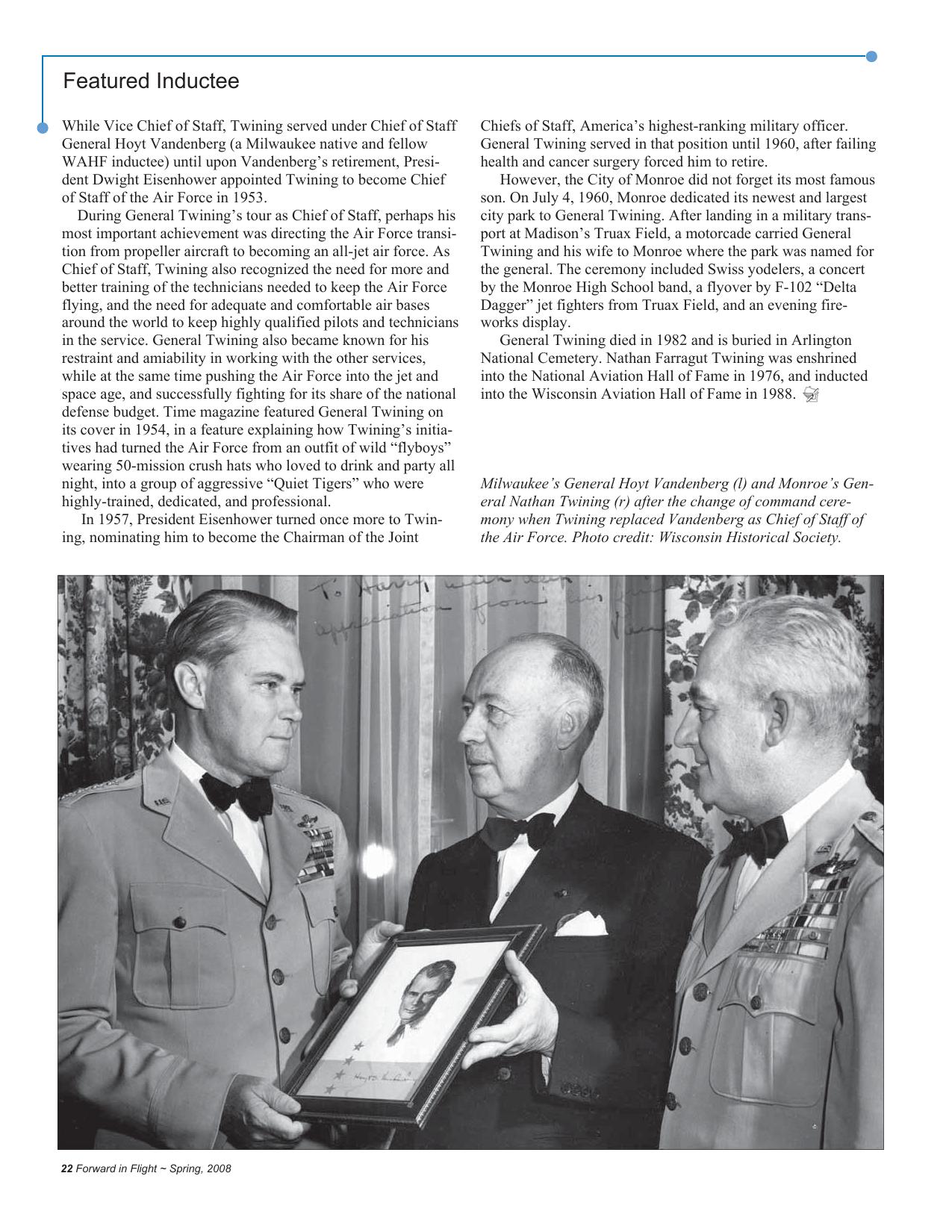
Featured Inductee While Vice Chief of Staff, Twining served under Chief of Staff General Hoyt Vandenberg (a Milwaukee native and fellow WAHF inductee) until upon Vandenberg’s retirement, President Dwight Eisenhower appointed Twining to become Chief of Staff of the Air Force in 1953. During General Twining’s tour as Chief of Staff, perhaps his most important achievement was directing the Air Force transition from propeller aircraft to becoming an all-jet air force. As Chief of Staff, Twining also recognized the need for more and better training of the technicians needed to keep the Air Force flying, and the need for adequate and comfortable air bases around the world to keep highly qualified pilots and technicians in the service. General Twining also became known for his restraint and amiability in working with the other services, while at the same time pushing the Air Force into the jet and space age, and successfully fighting for its share of the national defense budget. Time magazine featured General Twining on its cover in 1954, in a feature explaining how Twining’s initiatives had turned the Air Force from an outfit of wild “flyboys” wearing 50-mission crush hats who loved to drink and party all night, into a group of aggressive “Quiet Tigers” who were highly-trained, dedicated, and professional. In 1957, President Eisenhower turned once more to Twining, nominating him to become the Chairman of the Joint 22 Forward in Flight ~ Spring, 2008 Chiefs of Staff, America’s highest-ranking military officer. General Twining served in that position until 1960, after failing health and cancer surgery forced him to retire. However, the City of Monroe did not forget its most famous son. On July 4, 1960, Monroe dedicated its newest and largest city park to General Twining. After landing in a military transport at Madison’s Truax Field, a motorcade carried General Twining and his wife to Monroe where the park was named for the general. The ceremony included Swiss yodelers, a concert by the Monroe High School band, a flyover by F-102 “Delta Dagger” jet fighters from Truax Field, and an evening fireworks display. General Twining died in 1982 and is buried in Arlington National Cemetery. Nathan Farragut Twining was enshrined into the National Aviation Hall of Fame in 1976, and inducted into the Wisconsin Aviation Hall of Fame in 1988. Milwaukee’s General Hoyt Vandenberg (l) and Monroe’s General Nathan Twining (r) after the change of command ceremony when Twining replaced Vandenberg as Chief of Staff of the Air Force. Photo credit: Wisconsin Historical Society.
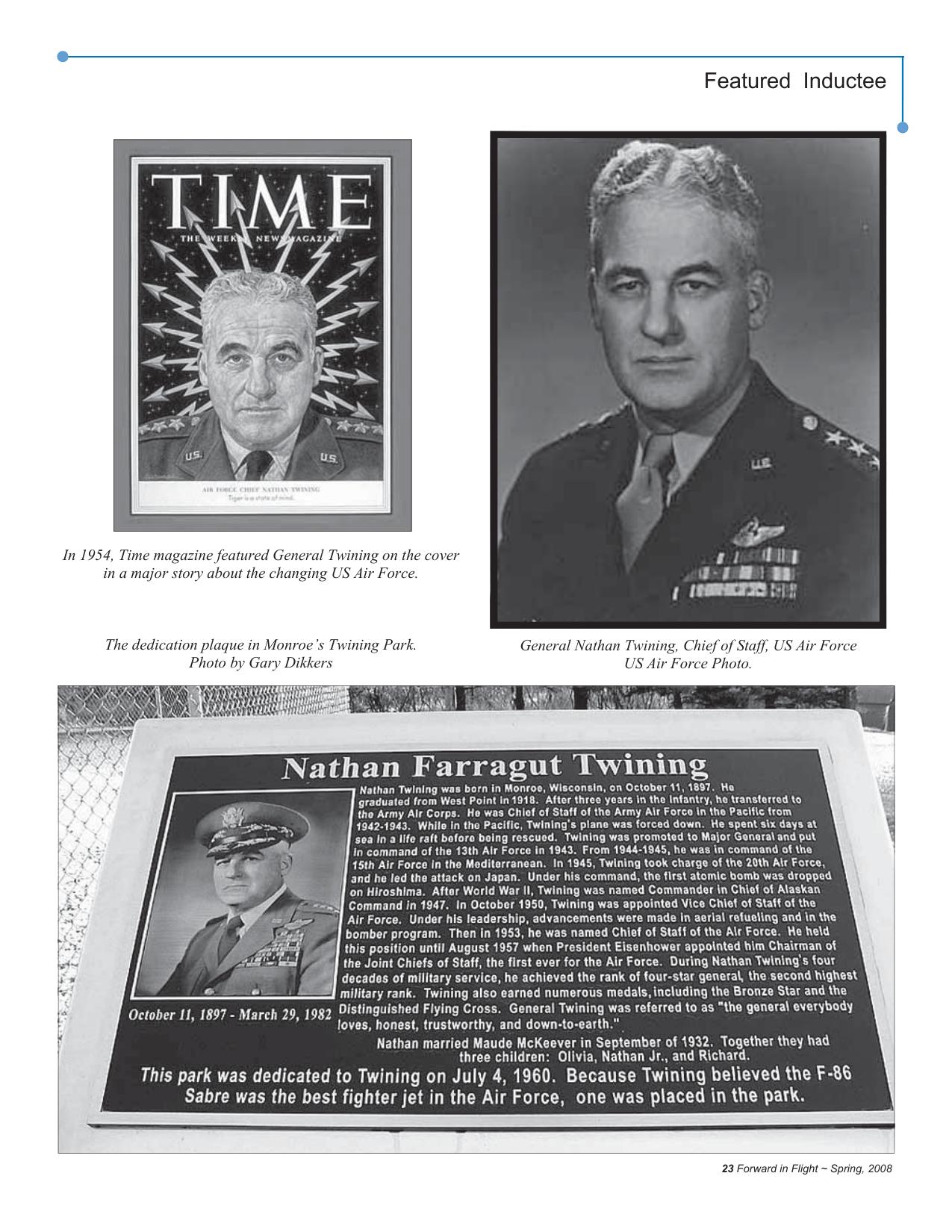
Featured Inductee In 1954, Time magazine featured General Twining on the cover in a major story about the changing US Air Force. The dedication plaque in Monroe’s Twining Park. Photo by Gary Dikkers General Nathan Twining, Chief of Staff, US Air Force US Air Force Photo. 23 Forward in Flight ~ Spring, 2008
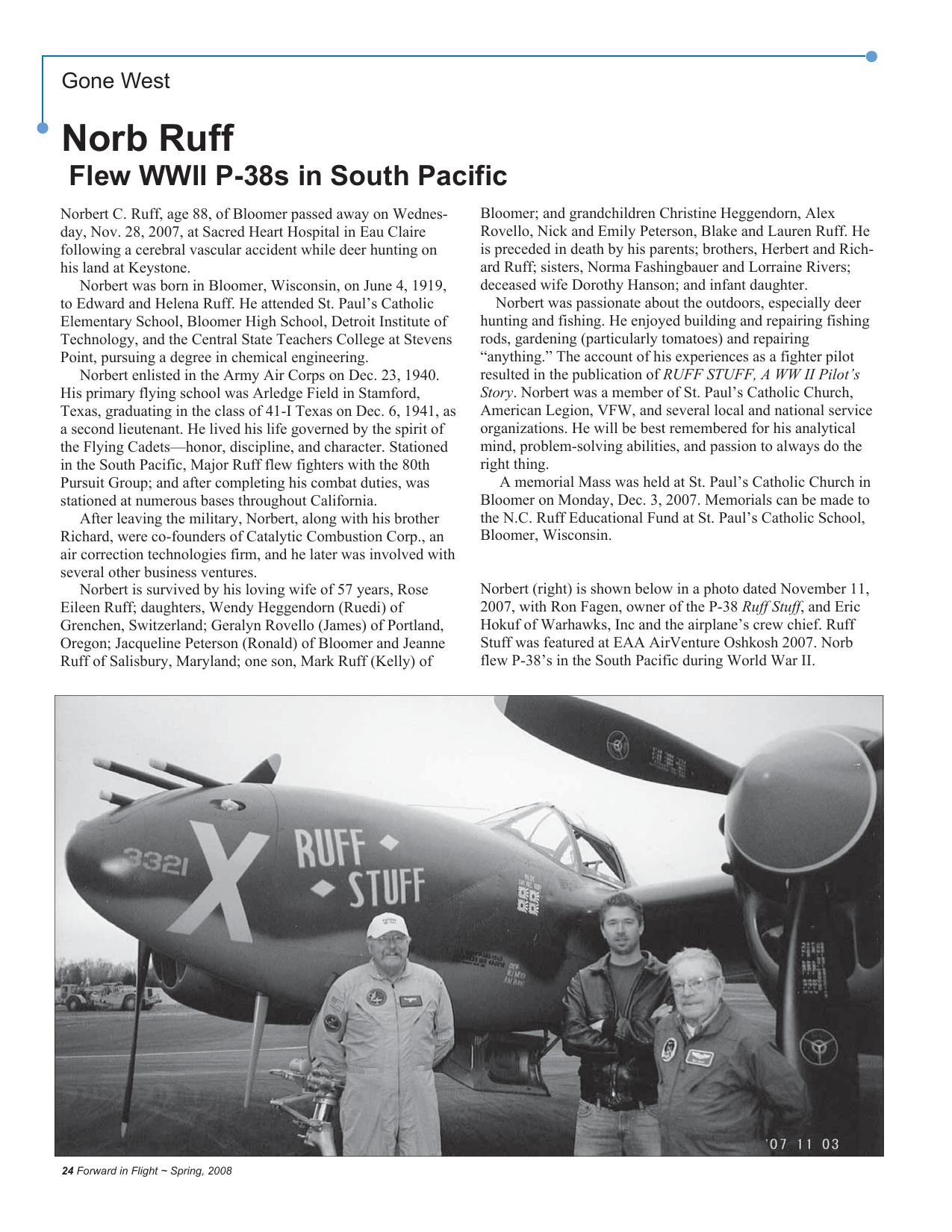
Gone West Norb Ruff Flew WWII P-38s in South Pacific Norbert C. Ruff, age 88, of Bloomer passed away on Wednesday, Nov. 28, 2007, at Sacred Heart Hospital in Eau Claire following a cerebral vascular accident while deer hunting on his land at Keystone. Norbert was born in Bloomer, Wisconsin, on June 4, 1919, to Edward and Helena Ruff. He attended St. Paul’s Catholic Elementary School, Bloomer High School, Detroit Institute of Technology, and the Central State Teachers College at Stevens Point, pursuing a degree in chemical engineering. Norbert enlisted in the Army Air Corps on Dec. 23, 1940. His primary flying school was Arledge Field in Stamford, Texas, graduating in the class of 41-I Texas on Dec. 6, 1941, as a second lieutenant. He lived his life governed by the spirit of the Flying Cadets—honor, discipline, and character. Stationed in the South Pacific, Major Ruff flew fighters with the 80th Pursuit Group; and after completing his combat duties, was stationed at numerous bases throughout California. After leaving the military, Norbert, along with his brother Richard, were co-founders of Catalytic Combustion Corp., an air correction technologies firm, and he later was involved with several other business ventures. Norbert is survived by his loving wife of 57 years, Rose Eileen Ruff; daughters, Wendy Heggendorn (Ruedi) of Grenchen, Switzerland; Geralyn Rovello (James) of Portland, Oregon; Jacqueline Peterson (Ronald) of Bloomer and Jeanne Ruff of Salisbury, Maryland; one son, Mark Ruff (Kelly) of 24 Forward in Flight ~ Spring, 2008 Bloomer; and grandchildren Christine Heggendorn, Alex Rovello, Nick and Emily Peterson, Blake and Lauren Ruff. He is preceded in death by his parents; brothers, Herbert and Richard Ruff; sisters, Norma Fashingbauer and Lorraine Rivers; deceased wife Dorothy Hanson; and infant daughter. Norbert was passionate about the outdoors, especially deer hunting and fishing. He enjoyed building and repairing fishing rods, gardening (particularly tomatoes) and repairing “anything.” The account of his experiences as a fighter pilot resulted in the publication of RUFF STUFF, A WW II Pilot’s Story. Norbert was a member of St. Paul’s Catholic Church, American Legion, VFW, and several local and national service organizations. He will be best remembered for his analytical mind, problem-solving abilities, and passion to always do the right thing. A memorial Mass was held at St. Paul’s Catholic Church in Bloomer on Monday, Dec. 3, 2007. Memorials can be made to the N.C. Ruff Educational Fund at St. Paul’s Catholic School, Bloomer, Wisconsin. Norbert (right) is shown below in a photo dated November 11, 2007, with Ron Fagen, owner of the P-38 Ruff Stuff, and Eric Hokuf of Warhawks, Inc and the airplane’s crew chief. Ruff Stuff was featured at EAA AirVenture Oshkosh 2007. Norb flew P-38’s in the South Pacific during World War II.
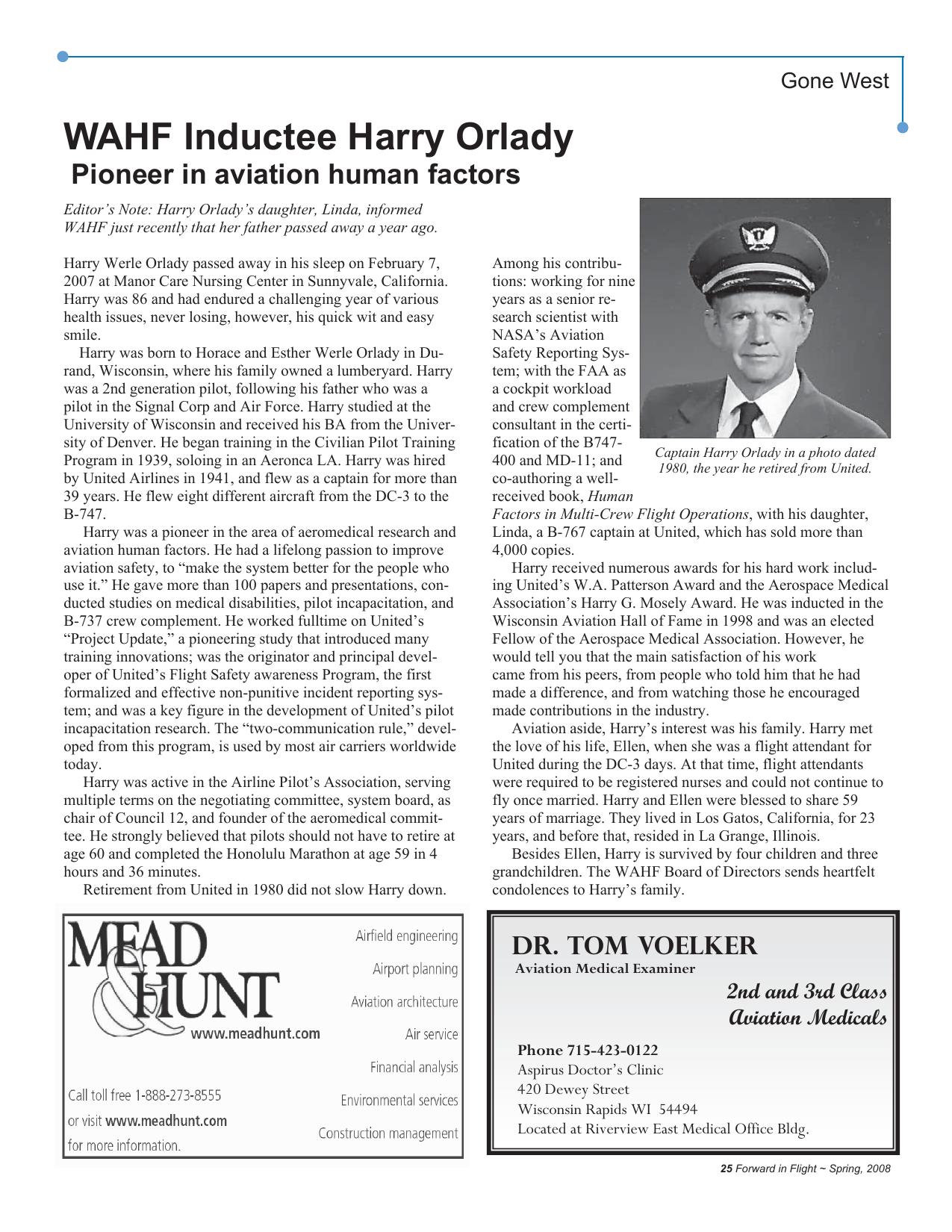
Gone West WAHF Inductee Harry Orlady Pioneer in aviation human factors Editor’s Note: Harry Orlady’s daughter, Linda, informed WAHF just recently that her father passed away a year ago. Harry Werle Orlady passed away in his sleep on February 7, 2007 at Manor Care Nursing Center in Sunnyvale, California. Harry was 86 and had endured a challenging year of various health issues, never losing, however, his quick wit and easy smile. Harry was born to Horace and Esther Werle Orlady in Durand, Wisconsin, where his family owned a lumberyard. Harry was a 2nd generation pilot, following his father who was a pilot in the Signal Corp and Air Force. Harry studied at the University of Wisconsin and received his BA from the University of Denver. He began training in the Civilian Pilot Training Program in 1939, soloing in an Aeronca LA. Harry was hired by United Airlines in 1941, and flew as a captain for more than 39 years. He flew eight different aircraft from the DC-3 to the B-747. Harry was a pioneer in the area of aeromedical research and aviation human factors. He had a lifelong passion to improve aviation safety, to “make the system better for the people who use it.” He gave more than 100 papers and presentations, conducted studies on medical disabilities, pilot incapacitation, and B-737 crew complement. He worked fulltime on United’s “Project Update,” a pioneering study that introduced many training innovations; was the originator and principal developer of United’s Flight Safety awareness Program, the first formalized and effective non-punitive incident reporting system; and was a key figure in the development of United’s pilot incapacitation research. The “two-communication rule,” developed from this program, is used by most air carriers worldwide today. Harry was active in the Airline Pilot’s Association, serving multiple terms on the negotiating committee, system board, as chair of Council 12, and founder of the aeromedical committee. He strongly believed that pilots should not have to retire at age 60 and completed the Honolulu Marathon at age 59 in 4 hours and 36 minutes. Retirement from United in 1980 did not slow Harry down. Among his contributions: working for nine years as a senior research scientist with NASA’s Aviation Safety Reporting System; with the FAA as a cockpit workload and crew complement consultant in the certification of the B747Captain Harry Orlady in a photo dated 400 and MD-11; and 1980, the year he retired from United. co-authoring a wellreceived book, Human Factors in Multi-Crew Flight Operations, with his daughter, Linda, a B-767 captain at United, which has sold more than 4,000 copies. Harry received numerous awards for his hard work including United’s W.A. Patterson Award and the Aerospace Medical Association’s Harry G. Mosely Award. He was inducted in the Wisconsin Aviation Hall of Fame in 1998 and was an elected Fellow of the Aerospace Medical Association. However, he would tell you that the main satisfaction of his work came from his peers, from people who told him that he had made a difference, and from watching those he encouraged made contributions in the industry. Aviation aside, Harry’s interest was his family. Harry met the love of his life, Ellen, when she was a flight attendant for United during the DC-3 days. At that time, flight attendants were required to be registered nurses and could not continue to fly once married. Harry and Ellen were blessed to share 59 years of marriage. They lived in Los Gatos, California, for 23 years, and before that, resided in La Grange, Illinois. Besides Ellen, Harry is survived by four children and three grandchildren. The WAHF Board of Directors sends heartfelt condolences to Harry’s family. DR. TOM VOELKER Aviation Medical Examiner 2nd and 3rd Class Aviation Medicals Phone 715-423-0122 Aspirus Doctor’s Clinic 420 Dewey Street Wisconsin Rapids WI 54494 Located at Riverview East Medical Office Bldg. 25 Forward in Flight ~ Spring, 2008
Gone West Wisconsin Native Evelyn Pinckert Brier Known as first US female flight instructor By Valerie J. Nelson January 28, 2008 Reprinted from the LA Times Evelyn Pinckert “Pinky” Brier, who was widely regarded as the first licensed female flight instructor in the United States and who owned and ran a private airport in San Bernardino, California, for 40 years, has died. She was 98. Brier, who also flew non-combat missions during World War II as a member of the Women Airforce Service Pilots, died January 20 of pneumonia at Redlands Community Hospital in Redlands, California, said her niece Victoria Pinckert Rafa. She learned to fly from a co-worker at the Southern California Gas Co. in the 1930s and then married her instructor, Air Force pilot Joe Brier, in 1939. The same year, she became the first woman to receive an airplane instructor's license under the newly established Civil Air Authority, according to an Air Force history of women in aviation. “I was the only one in this area licensed to teach aerobatics, which I loved,” Brier told the Riverside Press-Enterprise in 2001. The couple operated San Bernardino’s Tri-City Airport, which was about 10 years old when Joe Brier bought it in 1938, and ran a flying school. For years they lived in a hangar at the airport that also served Redlands and Colton. They never had children. “I thought a town that didn’t have an airport wasn’t much of a town,” Evelyn Brier said in the Press-Enterprise in 2003. “Flying was difficult to sell in those days.” She did her part to promote it by landing her plane in the middle of Redlands Boulevard on May 19, 1938, to mark the advent of airmail in Redlands. She reportedly tied up traffic for hours. With her husband serving in the military during World War II, Brier joined the WASP program and ferried warplanes to air bases within the United States. She “relished the opportunity to fly military aircraft,” including B-17s, and trained military pilots, said Wilfrid C. Lemann, her attorney and longtime friend. In the 2002 book The Powder Puff Derby of 1929, author Gene Nora Jessen wrote that the Briers’ “busy, grass strip airport . . . exemplified the heart and soul of aviation’s postwar development in the U.S. “Pinky flew charter, and Joe kept the airplanes under repair —a man with a magical ear for a sick engine. Pinky advertised that she would fly anywhere at any time, and she did,” Jessen recalled. Long before commuter airlines were commonplace, Brier flew three short hops a day from Tri-City to Los Angeles International Airport. 26 Forward in Flight ~ Spring, 2008 “It was not uncommon for Pinky to fly wise guys to Sin City in the afternoon and transport [federal] agents—who were tailing them—to Las Vegas that night. . . . Her flights were about the only way to get to Vegas in a hurry,” Lemann said. A little taller than 5 feet, Brier was “petite but tremendously strong, very opinionated,” her niece said. “She had to be to do what she did in her time.” “I thought a town that didn’t have an airport wasn’t much of a town.” In 2004, she established the Brier Foundation to provide scholarships to young women interested in aviation or maritime careers. Born April 12, 1909, in Medford, Wisconsin, Brier was the eighth of 10 children of German immigrants. Well-known astrologer and psychic Jeanne Dixon, who died in 1997, was her older sister. Her brother Ernie was one of several USC football players who modeled for the Tommy Trojan sculpture on campus. When she was 9, her family moved to California. She graduated from San Bernardino High School and Longmire’s Business College in San Bernardino and joined the gas company. Three years after her husband died in 1976, she sold most of the Tri-City Airport property to an Irvine-based development company. Commercial establishments now cover much of it. In 1980, Brier piloted her last plane and turned to building a penthouse apartment on her remaining airport land. She converted a seat from a military plane into a chair for her makeup table. Etched into her shower door was the official WASP mascot [Fifinella] designed by Walt Disney.
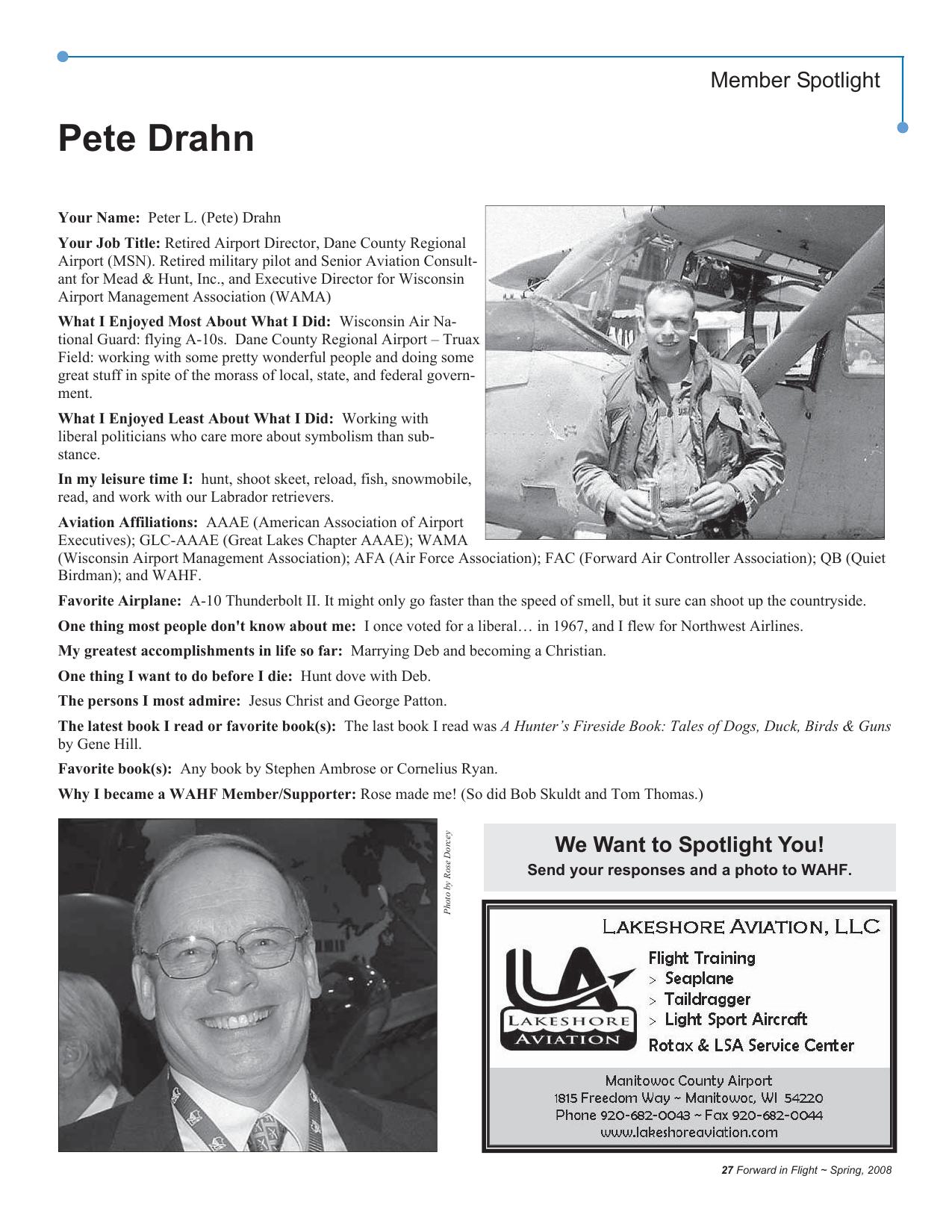
Member Spotlight Pete Drahn Your Name: Peter L. (Pete) Drahn Your Job Title: Retired Airport Director, Dane County Regional Airport (MSN). Retired military pilot and Senior Aviation Consultant for Mead & Hunt, Inc., and Executive Director for Wisconsin Airport Management Association (WAMA) What I Enjoyed Most About What I Did: Wisconsin Air National Guard: flying A-10s. Dane County Regional Airport – Truax Field: working with some pretty wonderful people and doing some great stuff in spite of the morass of local, state, and federal government. What I Enjoyed Least About What I Did: Working with liberal politicians who care more about symbolism than substance. In my leisure time I: hunt, shoot skeet, reload, fish, snowmobile, read, and work with our Labrador retrievers. Aviation Affiliations: AAAE (American Association of Airport Executives); GLC-AAAE (Great Lakes Chapter AAAE); WAMA (Wisconsin Airport Management Association); AFA (Air Force Association); FAC (Forward Air Controller Association); QB (Quiet Birdman); and WAHF. Favorite Airplane: A-10 Thunderbolt II. It might only go faster than the speed of smell, but it sure can shoot up the countryside. One thing most people don't know about me: I once voted for a liberal… in 1967, and I flew for Northwest Airlines. My greatest accomplishments in life so far: Marrying Deb and becoming a Christian. One thing I want to do before I die: Hunt dove with Deb. The persons I most admire: Jesus Christ and George Patton. The latest book I read or favorite book(s): The last book I read was A Hunter’s Fireside Book: Tales of Dogs, Duck, Birds & Guns by Gene Hill. Favorite book(s): Any book by Stephen Ambrose or Cornelius Ryan. Photo by Rose Dorcey Why I became a WAHF Member/Supporter: Rose made me! (So did Bob Skuldt and Tom Thomas.) We Want to Spotlight You! Send your responses and a photo to WAHF. 27 Forward in Flight ~ Spring, 2008
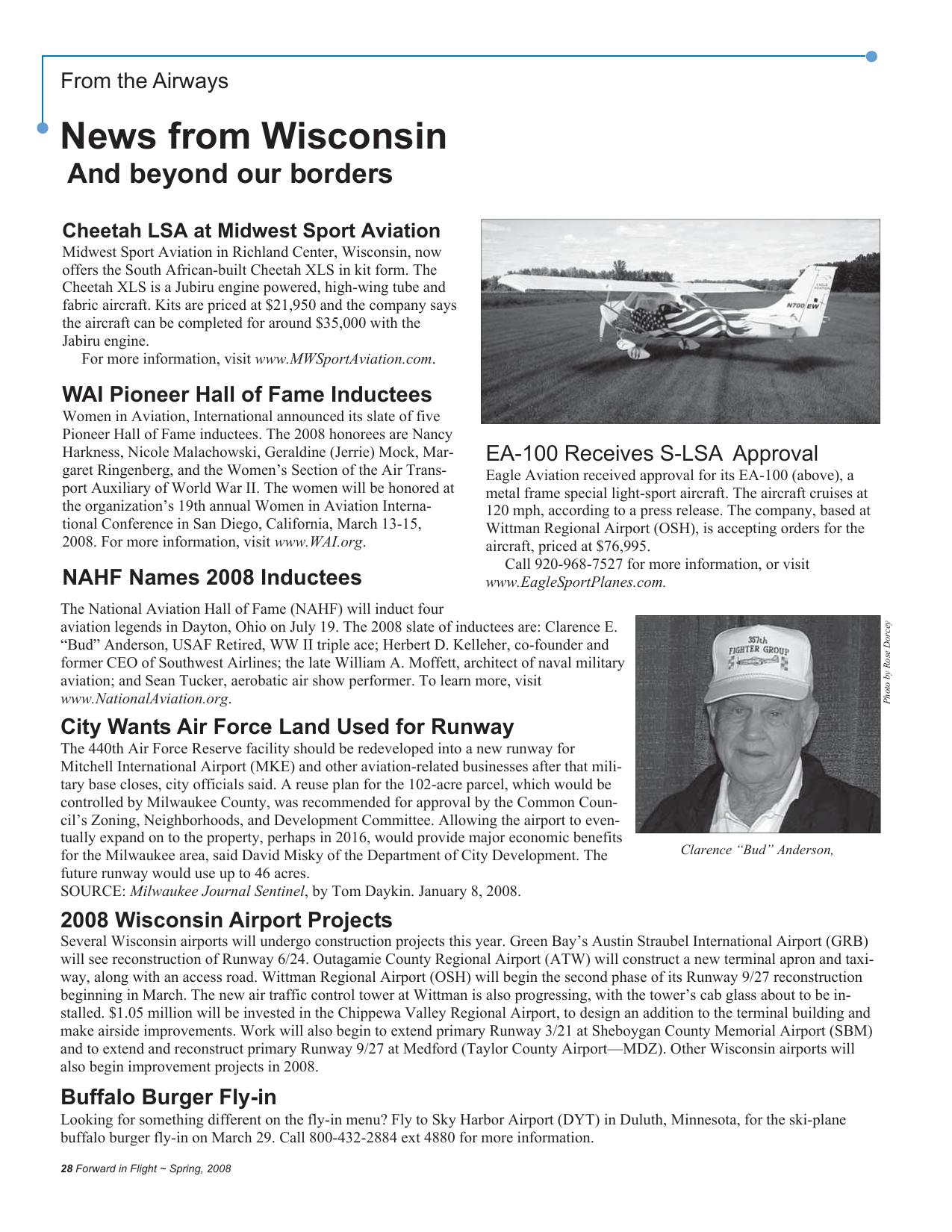
From the Airways News from Wisconsin And beyond our borders Cheetah LSA at Midwest Sport Aviation Midwest Sport Aviation in Richland Center, Wisconsin, now offers the South African-built Cheetah XLS in kit form. The Cheetah XLS is a Jubiru engine powered, high-wing tube and fabric aircraft. Kits are priced at $21,950 and the company says the aircraft can be completed for around $35,000 with the Jabiru engine. For more information, visit www.MWSportAviation.com. WAI Pioneer Hall of Fame Inductees Women in Aviation, International announced its slate of five Pioneer Hall of Fame inductees. The 2008 honorees are Nancy Harkness, Nicole Malachowski, Geraldine (Jerrie) Mock, Margaret Ringenberg, and the Women’s Section of the Air Transport Auxiliary of World War II. The women will be honored at the organization’s 19th annual Women in Aviation International Conference in San Diego, California, March 13-15, 2008. For more information, visit www.WAI.org. NAHF Names 2008 Inductees EA-100 Receives S-LSA Approval Eagle Aviation received approval for its EA-100 (above), a metal frame special light-sport aircraft. The aircraft cruises at 120 mph, according to a press release. The company, based at Wittman Regional Airport (OSH), is accepting orders for the aircraft, priced at $76,995. Call 920-968-7527 for more information, or visit www.EagleSportPlanes.com. Photo by Rose Dorcey The National Aviation Hall of Fame (NAHF) will induct four aviation legends in Dayton, Ohio on July 19. The 2008 slate of inductees are: Clarence E. “Bud” Anderson, USAF Retired, WW II triple ace; Herbert D. Kelleher, co-founder and former CEO of Southwest Airlines; the late William A. Moffett, architect of naval military aviation; and Sean Tucker, aerobatic air show performer. To learn more, visit www.NationalAviation.org. City Wants Air Force Land Used for Runway The 440th Air Force Reserve facility should be redeveloped into a new runway for Mitchell International Airport (MKE) and other aviation-related businesses after that military base closes, city officials said. A reuse plan for the 102-acre parcel, which would be controlled by Milwaukee County, was recommended for approval by the Common Council’s Zoning, Neighborhoods, and Development Committee. Allowing the airport to eventually expand on to the property, perhaps in 2016, would provide major economic benefits for the Milwaukee area, said David Misky of the Department of City Development. The future runway would use up to 46 acres. SOURCE: Milwaukee Journal Sentinel, by Tom Daykin. January 8, 2008. Clarence “Bud” Anderson, 2008 Wisconsin Airport Projects Several Wisconsin airports will undergo construction projects this year. Green Bay’s Austin Straubel International Airport (GRB) will see reconstruction of Runway 6/24. Outagamie County Regional Airport (ATW) will construct a new terminal apron and taxiway, along with an access road. Wittman Regional Airport (OSH) will begin the second phase of its Runway 9/27 reconstruction beginning in March. The new air traffic control tower at Wittman is also progressing, with the tower’s cab glass about to be installed. $1.05 million will be invested in the Chippewa Valley Regional Airport, to design an addition to the terminal building and make airside improvements. Work will also begin to extend primary Runway 3/21 at Sheboygan County Memorial Airport (SBM) and to extend and reconstruct primary Runway 9/27 at Medford (Taylor County Airport—MDZ). Other Wisconsin airports will also begin improvement projects in 2008. Buffalo Burger Fly-in Looking for something different on the fly-in menu? Fly to Sky Harbor Airport (DYT) in Duluth, Minnesota, for the ski-plane buffalo burger fly-in on March 29. Call 800-432-2884 ext 4880 for more information. 28 Forward in Flight ~ Spring, 2008
From the Airways Love at First Flight A woman’s experience as a WASP in World War II A Minnesota native will share her World War II flight experiences at an event to be held in La Crosse. Liz Strohfus shares her high-flying story of service as a WASP (Women’s Airforce Service Pilot) during World War II. Growing up in Faribault, Minnesota, during the Great Depression, Liz (then known as Betty Wall) discovered her love of flying—and put her bicycle up as collateral on a loan to buy a membership in the local flying club. In 1942, Liz applied for the WASP program, an experimental, pioneering program in which women were taught to fly American military aircraft. Of some 25,000 applicants, only 1,800 were accepted and of those Liz was one of only about 1000 to earn her wings. In addition to flying military trainers such as the PT-19, BT13, and AT-6 at legendary Avenger Field in Texas, Liz went on to fly the B-26 Marauder and B-17 Flying Fortress bombers and P-39 Airacobra fighter. Learn about flying the planes of “the greatest generation”—and the many obstacles that Liz and her female comrades overcame to get into the pilot’s seat. And, by the way, 60-plus years later Liz is still flying! The event is co-sponsored by La Crosse EAA Chapter 307 and is part of Viterbo University’s D.B. Reinhart Institute for Ethics in Leadership lecture series. There is no charge for this event. Tuesday, March 18, 2008 7:00 p.m. Fine Arts Center Main Theatre Viterbo University La Crosse, Wisconsin To learn more, visit www.Viterbo.edu/ethics.aspx?id=26546 To learn more about Liz, visit: www.MNLegion.org/paper/html/strohfus.html Wisconsin Aviation Conference The 53rd Annual Wisconsin Aviation Conference will be held May 5 - 7, 2008 at the Radisson Paper Valley Hotel in Appleton, Wisconsin. Conference committee members are planning an exciting and informative conference of interest to a diverse group of aviation advocates. The event kicks off with a round of golf or a clay shoot. EAA Founder Paul Poberezny will speak at the event; you’ll also hear updates from state and federal aviation agencies, and a discussion on Cirrus’ The Jet. Conference registration is $65, which includes all meals, snacks, and social hours. Exhibit space is still available. Sponsored by the Wisconsin Airport Management Association, Wisconsin Aviation Trades Association, and the Wisconsin Business Aviation Association. For more information, visit www.WIAMA.org or email Pete Drahn at daredem@verizon.net. BTC Aviation Center Renovation A $1.7 renovation at the Blackhawk Technical College (BTC) Aviation Center, Janesville, Wisconsin, is now complete, offering students an improved learning facility. The renovation included a new library, conference rooms, and updated classrooms with stateof-the-art technology. The lighting, heating, ventilation, and air-conditioning systems were updated on the shop floor. The building also received a new roof and other updates to comply with the American Disabilities Act. The BTC Aviation Center is located at the Southern Wisconsin Regional Airport (JVL). It offers one of only four Airframe and PowerPlant Mechanic programs in Wisconsin. For more information about the Airframe and PowerPlant Mechanic program, visit www.Blackhawk.edu/programs/diploma/airframe_powerplant.htm 2nd Annual Sportsmen’s and Outdoor Recreation Expo Kay Bender, director of the Deke Slayton Memorial Space and Bike Museum (and a friend of WAHF) shared this information about the 2nd Annual Sportsman and Outdoor Recreation Expo. Kay said that several light-sport aircraft dealers have been asked to participate, but no word on their reply. Either way, it sounds like a great event. The expo, sponsored by the Sparta Rotary Club, is set for March 15, 2008. Special guests include Frank Addington, Jr., an archery trick shot artist; and Dave Watson, host of Watson TV, which airs on the Outdoor Life Network. The event includes demonstrations and activities for all ages, including a kids casting contest and a Genesis archery shoot, with a top prize of $1,000. March 15, 2008 8 am - 5 pm Sparta High School, Sparta, Wisconsin Call Bob Ohm at 608-487-1933 for more information Ask your friends to join the Wisconsin Aviation Hall of Fame! 29 Forward in Flight ~ Spring, 2008
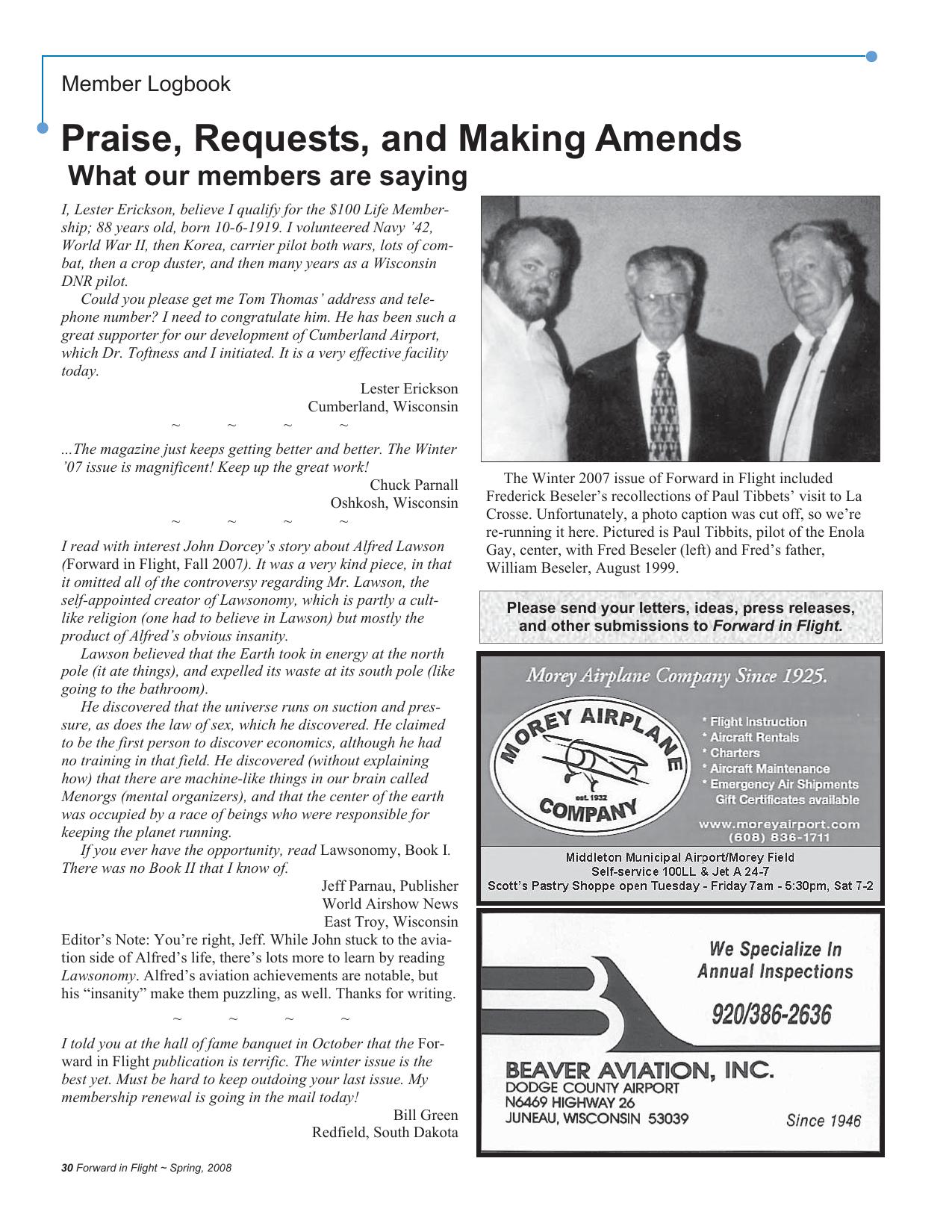
Member Logbook Praise, Requests, and Making Amends What our members are saying I, Lester Erickson, believe I qualify for the $100 Life Membership; 88 years old, born 10-6-1919. I volunteered Navy ’42, World War II, then Korea, carrier pilot both wars, lots of combat, then a crop duster, and then many years as a Wisconsin DNR pilot. Could you please get me Tom Thomas’ address and telephone number? I need to congratulate him. He has been such a great supporter for our development of Cumberland Airport, which Dr. Toftness and I initiated. It is a very effective facility today. Lester Erickson Cumberland, Wisconsin ~ ~ ~ ~ ...The magazine just keeps getting better and better. The Winter ’07 issue is magnificent! Keep up the great work! Chuck Parnall Oshkosh, Wisconsin ~ ~ ~ ~ I read with interest John Dorcey’s story about Alfred Lawson (Forward in Flight, Fall 2007). It was a very kind piece, in that it omitted all of the controversy regarding Mr. Lawson, the self-appointed creator of Lawsonomy, which is partly a cultlike religion (one had to believe in Lawson) but mostly the product of Alfred’s obvious insanity. Lawson believed that the Earth took in energy at the north pole (it ate things), and expelled its waste at its south pole (like going to the bathroom). He discovered that the universe runs on suction and pressure, as does the law of sex, which he discovered. He claimed to be the first person to discover economics, although he had no training in that field. He discovered (without explaining how) that there are machine-like things in our brain called Menorgs (mental organizers), and that the center of the earth was occupied by a race of beings who were responsible for keeping the planet running. If you ever have the opportunity, read Lawsonomy, Book I. There was no Book II that I know of. Jeff Parnau, Publisher World Airshow News East Troy, Wisconsin Editor’s Note: You’re right, Jeff. While John stuck to the aviation side of Alfred’s life, there’s lots more to learn by reading Lawsonomy. Alfred’s aviation achievements are notable, but his “insanity” make them puzzling, as well. Thanks for writing. ~ ~ ~ ~ I told you at the hall of fame banquet in October that the Forward in Flight publication is terrific. The winter issue is the best yet. Must be hard to keep outdoing your last issue. My membership renewal is going in the mail today! Bill Green Redfield, South Dakota 30 Forward in Flight ~ Spring, 2008 The Winter 2007 issue of Forward in Flight included Frederick Beseler’s recollections of Paul Tibbets’ visit to La Crosse. Unfortunately, a photo caption was cut off, so we’re re-running it here. Pictured is Paul Tibbits, pilot of the Enola Gay, center, with Fred Beseler (left) and Fred’s father, William Beseler, August 1999. Please send your letters, ideas, press releases, and other submissions to Forward in Flight.
Membership Matters WAHF Membership—for Kids! Encourage aviation passion in youth The Wisconsin Aviation Hall of Fame board of directors added a Youth/Student Membership category more than two years ago, and we’re excited to announce (finally) our first four members: Owen DuBois, Matt McLaughlin, Emma Soderholm, and Jared Soderholm. (See Matt’s aviation story in the Fall, 2007 issue of Forward in Flight.) Youth members will receive a membership card, free pass to the Deke Slayton Museum, a membership certificate, Forward in Flight, and a few surprises, too! Expect to learn of additional benefits soon. WAHF board members believe in encouraging and inspiring youth to help their aviation passion grow. The youth membership helps fulfill the organization’s mission to inform others of our state’s aviation history, and promote aviation education for future generations. With the youth membership segment now growing, the board is taking a closer look at ways to develop the program. Submissions from youth members, such as photos, stories, or artwork, are encouraged, and may be included in future issues of Forward in Flight. Do you know of a youth (18 or younger) who is interested in aviation? Please fill out the form below, note “Youth Member” on the application, and send $7. Alternatively, a membership application is available on the WAHF membership web page at: www.AviationHallofFameWisconsin.com Renewal Reminder! While you’re writing a check for your children or grandchildren’s youth membership, don’t forget to renew your membership in the Wisconsin Aviation Hall of Fame! Use the form below, or visit www.AviationHallofFameWisconsin.com for a membership application. “New Member” Special — Free WAHF Pin To encourage WAHF growth, people who become new member/supporters from January 1 - December 31, 2008 will receive a WAHF lapel pin at no charge. The blue enamel pin with gold trim shows your pride in WAHF membership. WAHF board members have noticed that the pins serve as good conversation starters, too. The pin promotion applies to all new 2008 adult memberships—individual, couple, life, or corporate (one pin per category). Sorry, the promotion does not apply to the youth membership category, or to those who have let their membership lapse and then renew. Current WAHF members can order a WAHF lapel pin for $3, including shipping and handling. Libby has a story... Libby Parod was known and loved as a bossy, hardworking, devoted airport manager in Cable, Wisconsin. We’re proud that we’ve shared her story, and that she’s a WAHF inductee. ...You Can Help Tell It Your support ensures that together we can continue to honor the men and women who enhance aviation in Wisconsin. Just $20 annually Wisconsin Aviation Hall of Fame www.aviationhalloffamewisconsin.com Call 920-385-1483 for more information, or send a check to: Wisconsin Aviation Hall of Fame 3980 Sharratt Drive Oshkosh WI 54901-1276 31 Forward in Flight ~ Spring, 2008
WISCONSIN AVIATION HALL OF FAME 3980 SHARRATT DRIVE OSHKOSH WI 54901-1276 PRSRT STD US Postage Paid Wisc Rapids WI Permit 98 tor! Contact Fred at TBYH@aol.com. Welcome new WAHF members: Timothy Lippert Chuck Parnall William Gartland Robert Gartland Robert Nordlander Rita Hanusa Kenneth Earhardt Rita Corcoran Dr. Larry Carson Peter Moll Andrew Ovans Linda Orlady Anne Beard Gretchen Caron A special welcome to our first four student members: Owen DuBois Matt McLaughlin Emma Soderholm Jared Soderholm Thanks for coming onboard. We look forward to seeing you at a WAHF event soon! Copies of Forward in Flight, the History of Aviation in Wisconsin, are still available. To order, contact Michael Goc at 608-339-7191 or email: newpast@maqs.net. Thank you to our advertisers: Morey Airplane Company, NewView Technologies, Pat O’Malley’s Jet Room, Mead & Hunt, Dr. Tom Voelker, AME; Eagle Fuel Cells; Wisconsin Aviation; Lakeshore Aviation; and Beaver Aviation. We want to spotlight you! A new feature of Forward in Flight is a member spotlight column, designed to help our member/supporters get to know one another. Answer the questions Pete Drahn did on page 27, and send to Rose Dorcey. Dates to remember: Women in Aviation Conference, March 13-15, 2008, San Diego, California. Visit www.wai.org to learn more. Wisconsin Aviation Conference, May 5-7, 2008, Appleton, WI. Visit www.wiama.org. EAA Young Eagles Day - June 14, 2008. EAA AirVenture Oshkosh 2008, July 28-August 3. www.AirVenture.org. Wisconsin Aviation Hall of Fame Officers and Board of Directors Rose Dorcey, President Michael Goc, Vice President John Dorcey, Secretary/Treasurer Duane Esse Keith Glasshof Tom Thomas Charles Swain LaFonda Kinnaman Staber “Bill” Reese Charles Marotske, Honorary Chairman of the Board Wisconsin Aviation Hall of Fame 3980 Sharratt Drive Oshkosh WI 54901-1276 Become a supporter today! For information call Rose Dorcey at 920-385-1483 www.aviationhalloffamewisconsin.com rosesroses@new.rr.com