Forward in Flight - Spring 2009
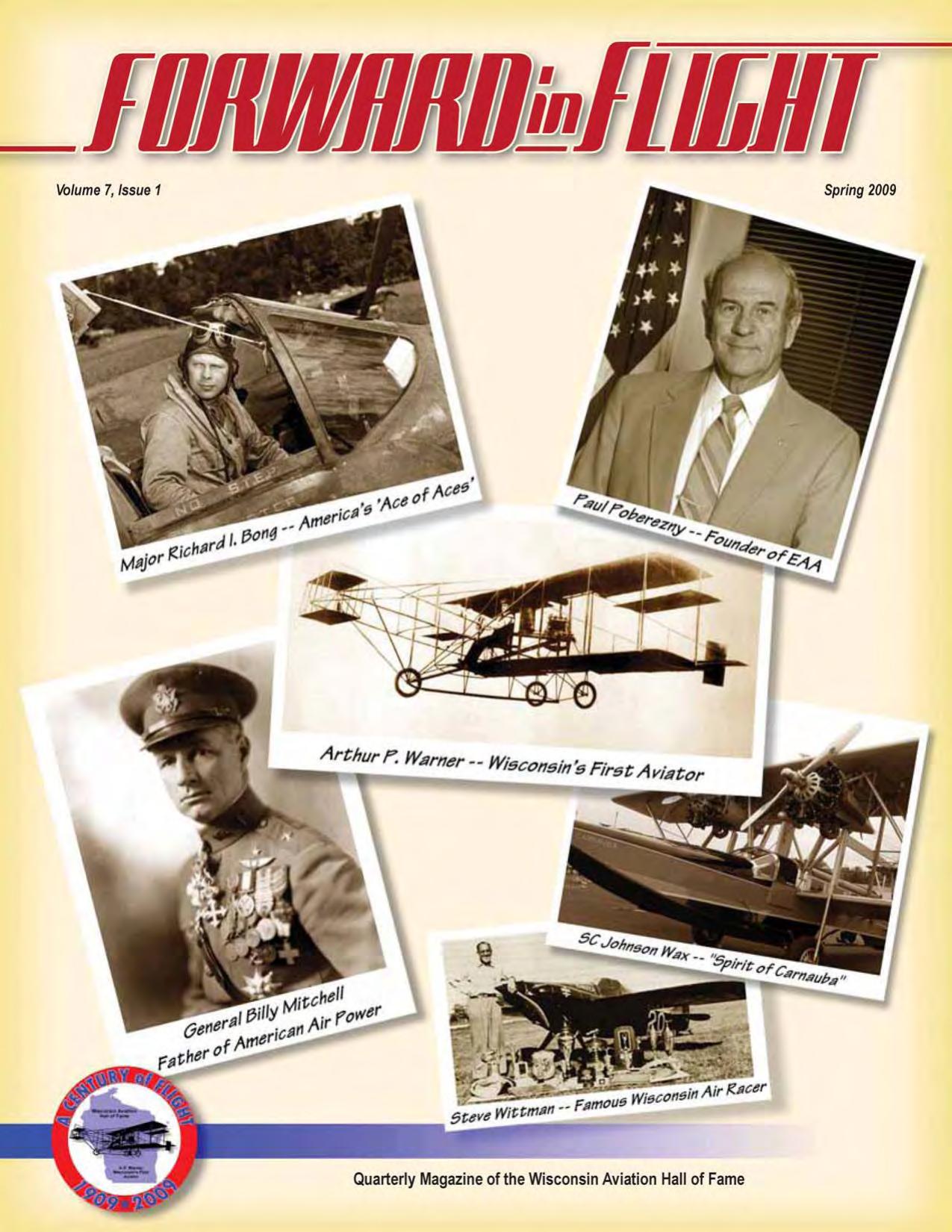
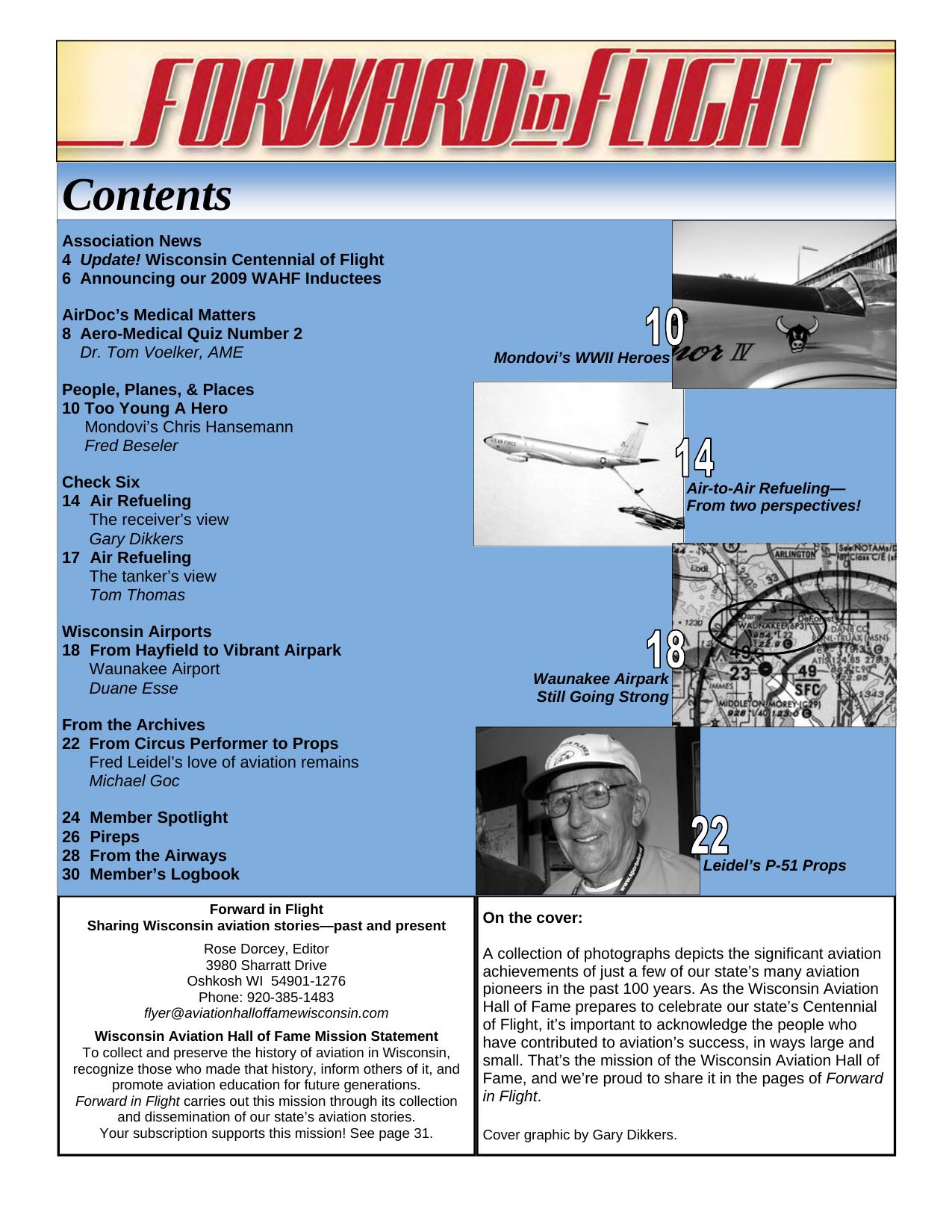
Contents Association News 4 Update! Wisconsin Centennial of Flight 6 Announcing our 2009 WAHF Inductees AirDoc’s Medical Matters 8 Aero-Medical Quiz Number 2 Dr. Tom Voelker, AME Mondovi’s WWII Heroes People, Planes, & Places 10 Too Young A Hero Mondovi’s Chris Hansemann Fred Beseler Check Six 14 Air Refueling The receiver’s view Gary Dikkers 17 Air Refueling The tanker’s view Tom Thomas Wisconsin Airports 18 From Hayfield to Vibrant Airpark Waunakee Airport Duane Esse Air-to-Air Refueling— From two perspectives! Waunakee Airpark Still Going Strong From the Archives 22 From Circus Performer to Props Fred Leidel’s love of aviation remains Michael Goc 24 Member Spotlight 26 Pireps 28 From the Airways 30 Member’s Logbook Forward in Flight Sharing Wisconsin aviation stories—past and present Rose Dorcey, Editor 3980 Sharratt Drive Oshkosh WI 54901-1276 Phone: 920-385-1483 flyer@aviationhalloffamewisconsin.com Wisconsin Aviation Hall of Fame Mission Statement To collect and preserve the history of aviation in Wisconsin, recognize those who made that history, inform others of it, and promote aviation education for future generations. Forward in Flight carries out this mission through its collection and dissemination of our state’s aviation stories. Your subscription supports this mission! See page 31. Leidel’s P-51 Props On the cover: A collection of photographs depicts the significant aviation achievements of just a few of our state’s many aviation pioneers in the past 100 years. As the Wisconsin Aviation Hall of Fame prepares to celebrate our state’s Centennial of Flight, it’s important to acknowledge the people who have contributed to aviation’s success, in ways large and small. That’s the mission of the Wisconsin Aviation Hall of Fame, and we’re proud to share it in the pages of Forward in Flight. Cover graphic by Gary Dikkers.
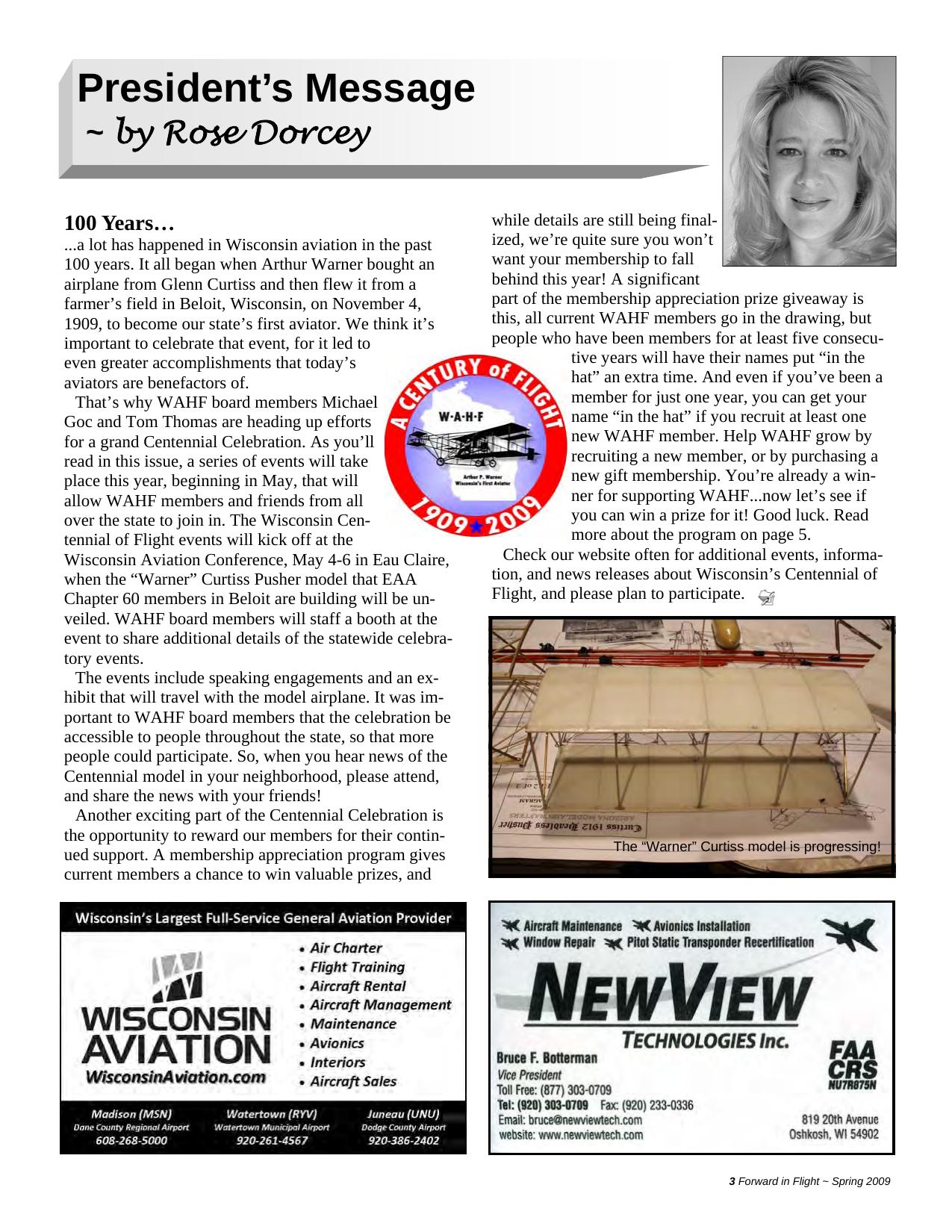
President’s Message ~ by Rose Dorcey 100 Years… ...a lot has happened in Wisconsin aviation in the past 100 years. It all began when Arthur Warner bought an airplane from Glenn Curtiss and then flew it from a farmer’s field in Beloit, Wisconsin, on November 4, 1909, to become our state’s first aviator. We think it’s important to celebrate that event, for it led to even greater accomplishments that today’s aviators are benefactors of. That’s why WAHF board members Michael Goc and Tom Thomas are heading up efforts for a grand Centennial Celebration. As you’ll read in this issue, a series of events will take place this year, beginning in May, that will allow WAHF members and friends from all over the state to join in. The Wisconsin Centennial of Flight events will kick off at the Wisconsin Aviation Conference, May 4-6 in Eau Claire, when the “Warner” Curtiss Pusher model that EAA Chapter 60 members in Beloit are building will be unveiled. WAHF board members will staff a booth at the event to share additional details of the statewide celebratory events. The events include speaking engagements and an exhibit that will travel with the model airplane. It was important to WAHF board members that the celebration be accessible to people throughout the state, so that more people could participate. So, when you hear news of the Centennial model in your neighborhood, please attend, and share the news with your friends! Another exciting part of the Centennial Celebration is the opportunity to reward our members for their continued support. A membership appreciation program gives current members a chance to win valuable prizes, and while details are still being finalized, we’re quite sure you won’t want your membership to fall behind this year! A significant part of the membership appreciation prize giveaway is this, all current WAHF members go in the drawing, but people who have been members for at least five consecutive years will have their names put “in the hat” an extra time. And even if you’ve been a member for just one year, you can get your name “in the hat” if you recruit at least one new WAHF member. Help WAHF grow by recruiting a new member, or by purchasing a new gift membership. You’re already a winner for supporting WAHF...now let’s see if you can win a prize for it! Good luck. Read more about the program on page 5. Check our website often for additional events, information, and news releases about Wisconsin’s Centennial of Flight, and please plan to participate. The “Warner” Curtiss model is progressing! 3 Forward in Flight ~ Spring 2009
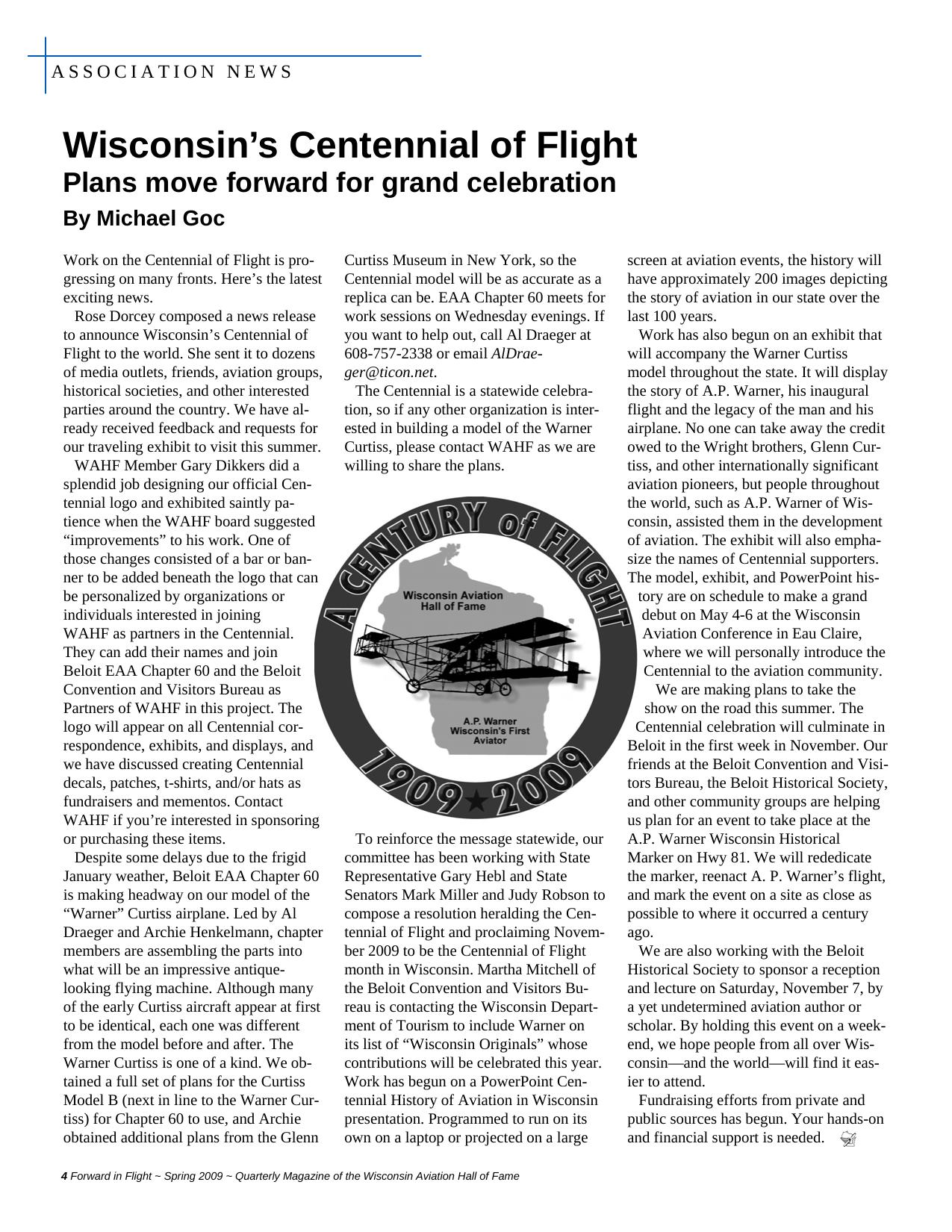
ASSOCIATION NEWS Wisconsin’s Centennial of Flight Plans move forward for grand celebration By Michael Goc Work on the Centennial of Flight is progressing on many fronts. Here’s the latest exciting news. Rose Dorcey composed a news release to announce Wisconsin’s Centennial of Flight to the world. She sent it to dozens of media outlets, friends, aviation groups, historical societies, and other interested parties around the country. We have already received feedback and requests for our traveling exhibit to visit this summer. WAHF Member Gary Dikkers did a splendid job designing our official Centennial logo and exhibited saintly patience when the WAHF board suggested “improvements” to his work. One of those changes consisted of a bar or banner to be added beneath the logo that can be personalized by organizations or individuals interested in joining WAHF as partners in the Centennial. They can add their names and join Beloit EAA Chapter 60 and the Beloit Convention and Visitors Bureau as Partners of WAHF in this project. The logo will appear on all Centennial correspondence, exhibits, and displays, and we have discussed creating Centennial decals, patches, t-shirts, and/or hats as fundraisers and mementos. Contact WAHF if you’re interested in sponsoring or purchasing these items. Despite some delays due to the frigid January weather, Beloit EAA Chapter 60 is making headway on our model of the “Warner” Curtiss airplane. Led by Al Draeger and Archie Henkelmann, chapter members are assembling the parts into what will be an impressive antiquelooking flying machine. Although many of the early Curtiss aircraft appear at first to be identical, each one was different from the model before and after. The Warner Curtiss is one of a kind. We obtained a full set of plans for the Curtiss Model B (next in line to the Warner Curtiss) for Chapter 60 to use, and Archie obtained additional plans from the Glenn Curtiss Museum in New York, so the Centennial model will be as accurate as a replica can be. EAA Chapter 60 meets for work sessions on Wednesday evenings. If you want to help out, call Al Draeger at 608-757-2338 or email AlDraeger@ticon.net. The Centennial is a statewide celebration, so if any other organization is interested in building a model of the Warner Curtiss, please contact WAHF as we are willing to share the plans. To reinforce the message statewide, our committee has been working with State Representative Gary Hebl and State Senators Mark Miller and Judy Robson to compose a resolution heralding the Centennial of Flight and proclaiming November 2009 to be the Centennial of Flight month in Wisconsin. Martha Mitchell of the Beloit Convention and Visitors Bureau is contacting the Wisconsin Department of Tourism to include Warner on its list of “Wisconsin Originals” whose contributions will be celebrated this year. Work has begun on a PowerPoint Centennial History of Aviation in Wisconsin presentation. Programmed to run on its own on a laptop or projected on a large 4 Forward in Flight ~ Spring 2009 ~ Quarterly Magazine of the Wisconsin Aviation Hall of Fame screen at aviation events, the history will have approximately 200 images depicting the story of aviation in our state over the last 100 years. Work has also begun on an exhibit that will accompany the Warner Curtiss model throughout the state. It will display the story of A.P. Warner, his inaugural flight and the legacy of the man and his airplane. No one can take away the credit owed to the Wright brothers, Glenn Curtiss, and other internationally significant aviation pioneers, but people throughout the world, such as A.P. Warner of Wisconsin, assisted them in the development of aviation. The exhibit will also emphasize the names of Centennial supporters. The model, exhibit, and PowerPoint history are on schedule to make a grand debut on May 4-6 at the Wisconsin Aviation Conference in Eau Claire, where we will personally introduce the Centennial to the aviation community. We are making plans to take the show on the road this summer. The Centennial celebration will culminate in Beloit in the first week in November. Our friends at the Beloit Convention and Visitors Bureau, the Beloit Historical Society, and other community groups are helping us plan for an event to take place at the A.P. Warner Wisconsin Historical Marker on Hwy 81. We will rededicate the marker, reenact A. P. Warner’s flight, and mark the event on a site as close as possible to where it occurred a century ago. We are also working with the Beloit Historical Society to sponsor a reception and lecture on Saturday, November 7, by a yet undetermined aviation author or scholar. By holding this event on a weekend, we hope people from all over Wisconsin—and the world—will find it easier to attend. Fundraising efforts from private and public sources has begun. Your hands-on and financial support is needed.
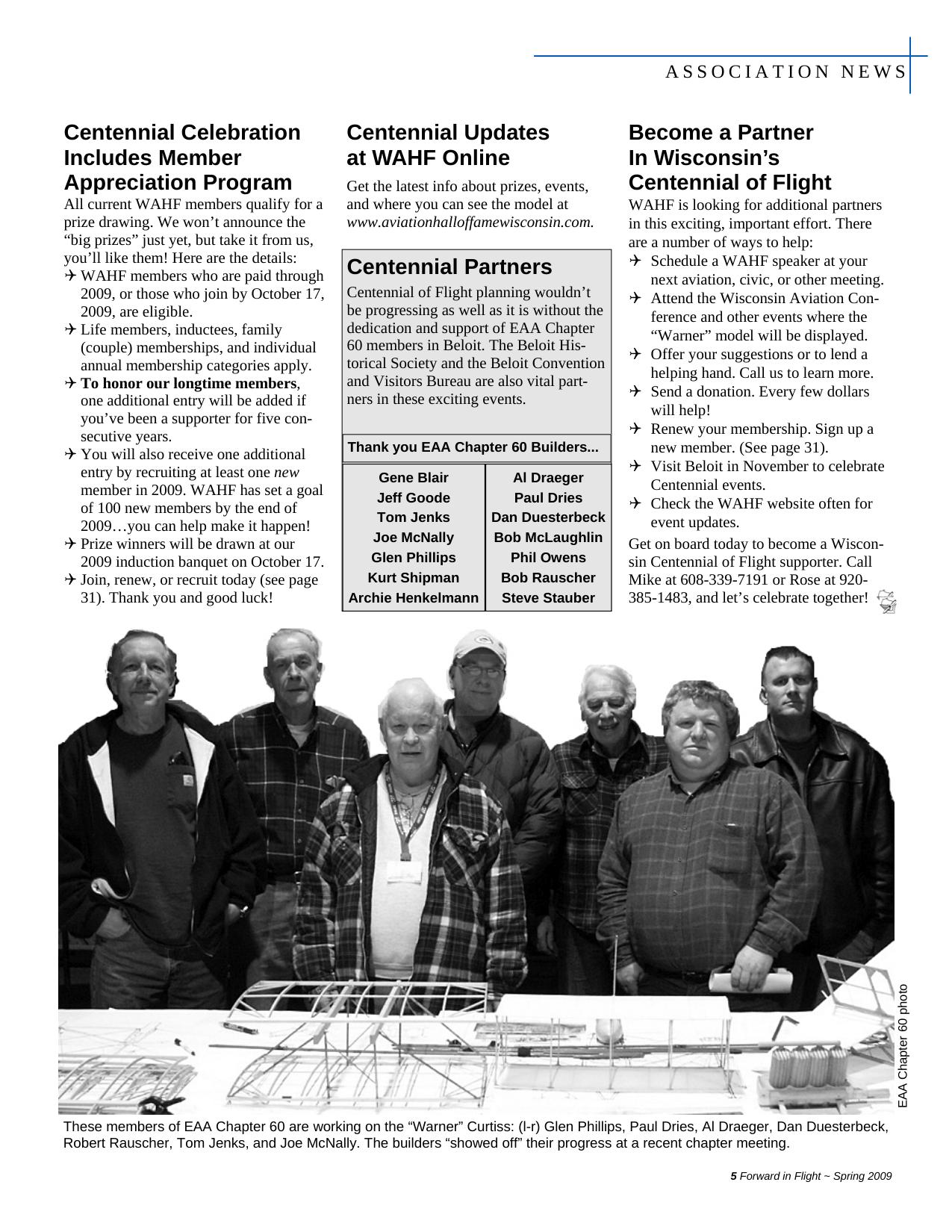
ASSOCIATION NEWS Centennial Celebration Includes Member Appreciation Program Get the latest info about prizes, events, and where you can see the model at www.aviationhalloffamewisconsin.com. Centennial Partners Centennial of Flight planning wouldn’t be progressing as well as it is without the dedication and support of EAA Chapter 60 members in Beloit. The Beloit Historical Society and the Beloit Convention and Visitors Bureau are also vital partners in these exciting events. Thank you EAA Chapter 60 Builders... Gene Blair Al Draeger Jeff Goode Paul Dries Tom Jenks Dan Duesterbeck Joe McNally Bob McLaughlin Glen Phillips Phil Owens Kurt Shipman Bob Rauscher Archie Henkelmann Steve Stauber Become a Partner In Wisconsin’s Centennial of Flight WAHF is looking for additional partners in this exciting, important effort. There are a number of ways to help: Schedule a WAHF speaker at your next aviation, civic, or other meeting. Attend the Wisconsin Aviation Conference and other events where the “Warner” model will be displayed. Offer your suggestions or to lend a helping hand. Call us to learn more. Send a donation. Every few dollars will help! Renew your membership. Sign up a new member. (See page 31). Visit Beloit in November to celebrate Centennial events. Check the WAHF website often for event updates. Get on board today to become a Wisconsin Centennial of Flight supporter. Call Mike at 608-339-7191 or Rose at 920385-1483, and let’s celebrate together! EAA Chapter 60 photo All current WAHF members qualify for a prize drawing. We won’t announce the “big prizes” just yet, but take it from us, you’ll like them! Here are the details: WAHF members who are paid through 2009, or those who join by October 17, 2009, are eligible. Life members, inductees, family (couple) memberships, and individual annual membership categories apply. To honor our longtime members, one additional entry will be added if you’ve been a supporter for five consecutive years. You will also receive one additional entry by recruiting at least one new member in 2009. WAHF has set a goal of 100 new members by the end of 2009…you can help make it happen! Prize winners will be drawn at our 2009 induction banquet on October 17. Join, renew, or recruit today (see page 31). Thank you and good luck! Centennial Updates at WAHF Online These members of EAA Chapter 60 are working on the “Warner” Curtiss: (l-r) Glen Phillips, Paul Dries, Al Draeger, Dan Duesterbeck, Robert Rauscher, Tom Jenks, and Joe McNally. The builders “showed off” their progress at a recent chapter meeting. 5 Forward in Flight ~ Spring 2009
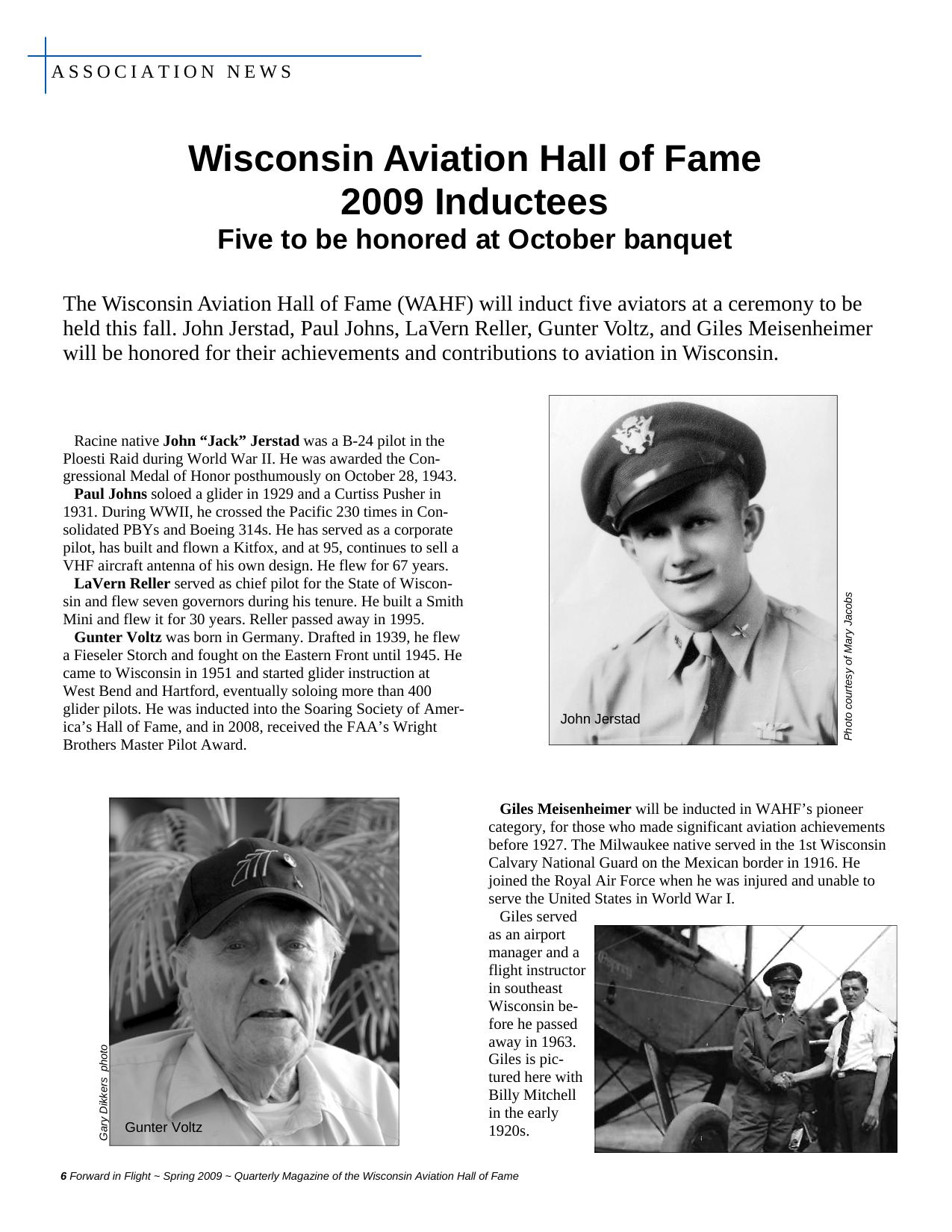
ASSOCIATION NEWS Wisconsin Aviation Hall of Fame 2009 Inductees Five to be honored at October banquet Gary Dikkers photo Racine native John “Jack” Jerstad was a B-24 pilot in the Ploesti Raid during World War II. He was awarded the Congressional Medal of Honor posthumously on October 28, 1943. Paul Johns soloed a glider in 1929 and a Curtiss Pusher in 1931. During WWII, he crossed the Pacific 230 times in Consolidated PBYs and Boeing 314s. He has served as a corporate pilot, has built and flown a Kitfox, and at 95, continues to sell a VHF aircraft antenna of his own design. He flew for 67 years. LaVern Reller served as chief pilot for the State of Wisconsin and flew seven governors during his tenure. He built a Smith Mini and flew it for 30 years. Reller passed away in 1995. Gunter Voltz was born in Germany. Drafted in 1939, he flew a Fieseler Storch and fought on the Eastern Front until 1945. He came to Wisconsin in 1951 and started glider instruction at West Bend and Hartford, eventually soloing more than 400 glider pilots. He was inducted into the Soaring Society of America’s Hall of Fame, and in 2008, received the FAA’s Wright Brothers Master Pilot Award. Gunter Voltz John Jerstad Photo courtesy of Mary Jacobs The Wisconsin Aviation Hall of Fame (WAHF) will induct five aviators at a ceremony to be held this fall. John Jerstad, Paul Johns, LaVern Reller, Gunter Voltz, and Giles Meisenheimer will be honored for their achievements and contributions to aviation in Wisconsin. Giles Meisenheimer will be inducted in WAHF’s pioneer category, for those who made significant aviation achievements before 1927. The Milwaukee native served in the 1st Wisconsin Calvary National Guard on the Mexican border in 1916. He joined the Royal Air Force when he was injured and unable to serve the United States in World War I. Giles served as an airport manager and a flight instructor in southeast Wisconsin before he passed away in 1963. Giles is pictured here with Billy Mitchell in the early 1920s. 6 Forward in Flight ~ Spring 2009 ~ Quarterly Magazine of the Wisconsin Aviation Hall of Fame
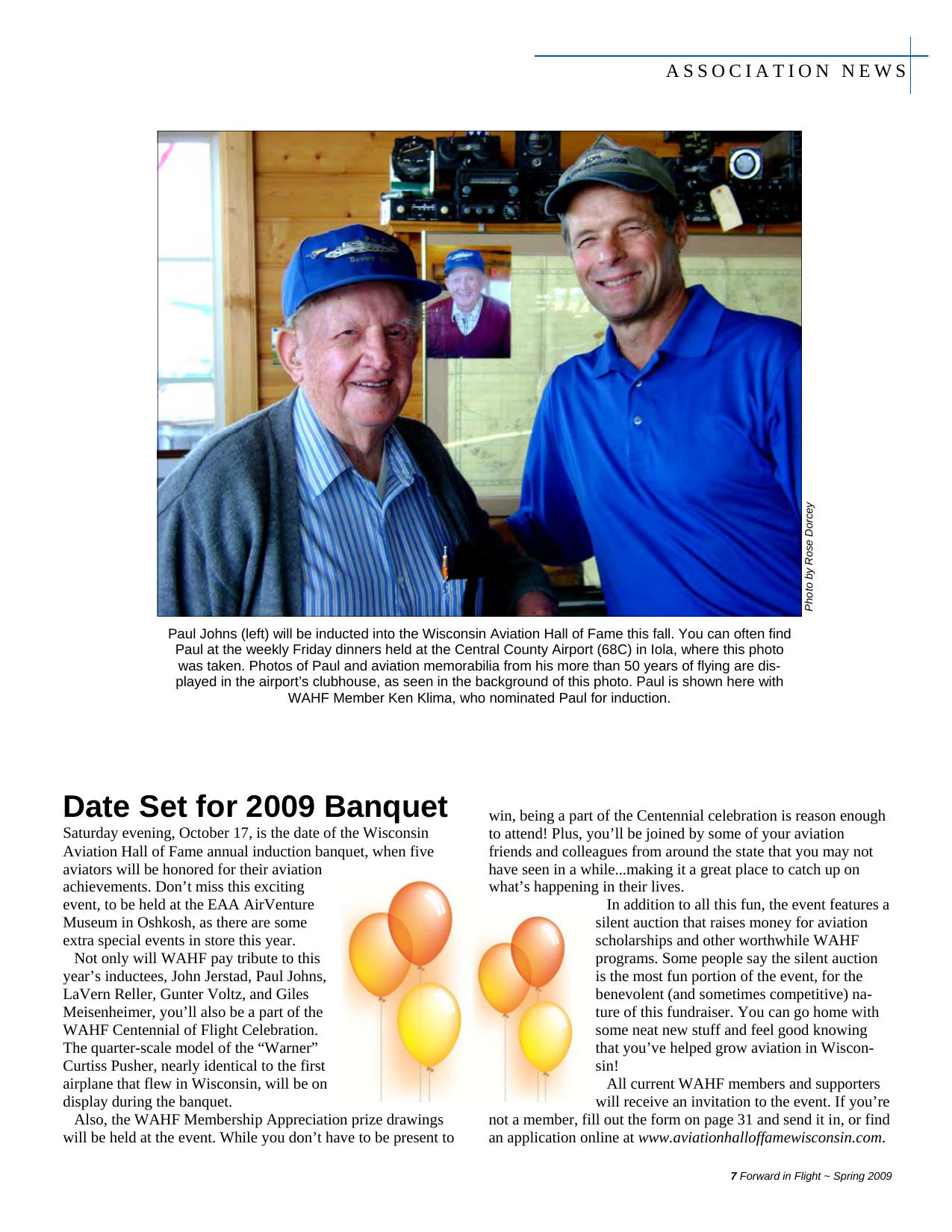
Photo by Rose Dorcey ASSOCIATION NEWS Paul Johns (left) will be inducted into the Wisconsin Aviation Hall of Fame this fall. You can often find Paul at the weekly Friday dinners held at the Central County Airport (68C) in Iola, where this photo was taken. Photos of Paul and aviation memorabilia from his more than 50 years of flying are displayed in the airport’s clubhouse, as seen in the background of this photo. Paul is shown here with WAHF Member Ken Klima, who nominated Paul for induction. Date Set for 2009 Banquet Saturday evening, October 17, is the date of the Wisconsin Aviation Hall of Fame annual induction banquet, when five aviators will be honored for their aviation achievements. Don’t miss this exciting event, to be held at the EAA AirVenture Museum in Oshkosh, as there are some extra special events in store this year. Not only will WAHF pay tribute to this year’s inductees, John Jerstad, Paul Johns, LaVern Reller, Gunter Voltz, and Giles Meisenheimer, you’ll also be a part of the WAHF Centennial of Flight Celebration. The quarter-scale model of the “Warner” Curtiss Pusher, nearly identical to the first airplane that flew in Wisconsin, will be on display during the banquet. Also, the WAHF Membership Appreciation prize drawings will be held at the event. While you don’t have to be present to win, being a part of the Centennial celebration is reason enough to attend! Plus, you’ll be joined by some of your aviation friends and colleagues from around the state that you may not have seen in a while...making it a great place to catch up on what’s happening in their lives. In addition to all this fun, the event features a silent auction that raises money for aviation scholarships and other worthwhile WAHF programs. Some people say the silent auction is the most fun portion of the event, for the benevolent (and sometimes competitive) nature of this fundraiser. You can go home with some neat new stuff and feel good knowing that you’ve helped grow aviation in Wisconsin! All current WAHF members and supporters will receive an invitation to the event. If you’re not a member, fill out the form on page 31 and send it in, or find an application online at www.aviationhalloffamewisconsin.com. 7 Forward in Flight ~ Spring 2009
AIR DOC’S MEDICAL MATTERS Aero-Medical Quiz Number 2 By Dr. Tom Voelker, AME email: DrAlphaMike@yahoo.com Hello again, airmen. It’s Alpha Mike, saying, “Welcome to spring! Let’s get rid of the snow, already…it’s time to do some flying!” Wait! Aero-medical news flash: Tom Cruse has heart attack while flying Cessna. Lives to tell about it! No, not that Tom Cruise. This one is a 65-year-old man from Ohio, an 800-hour private pilot with (at the time of the event) a current third class medical. You can read all about his ordeal in FAA Aviation News (which I’ll plug at the end of this column). His story is one from which we can learn. My last aero-medical quiz was quite popular. This one is a ten-question quiz. I’m obligated to consider 90 percent a great score. 1) It turns out Mr. Cruse had palpitations before his “heart attack flight.” (He did get this thoroughly checked out by his doctor long before the recent heart attack.) Knowing that he was having these “funny heartbeats,” (and before he had the heart attack) he: A. can fly whenever he wants, until his current medical expires B. must turn his medical into the FAA Aerospace Medical Certification Division (AMCD) at once C. can “self-certify” for flight if evaluated by a doctor and is told “sudden incapacitation” is very unlikely D. must consult with an Aviation Medical Examiner 2) Assuming you currently hold an unrestricted medical, if you have a heart attack, you can expect your next medical to: A. be issued by the AME (as long as you have clearance from your doctor) B. be “deferred” to the Aerospace Medical Certification Division of the FAA for a decision C. be denied by your AME D. Forget it. You’ll never fly again! 3) Of all pilots (“airmen”) who apply for a medical, ___ ultimately receive a medical certificate, which allows them to fly as PIC. A. 90% B. 95% C. 98% D. 99.9% 4) On a different subject, how long do you have to wait after a heavy night of drinking to operate an airplane? A. eight hours B. until you are no longer intoxicated C. until you hangover has resolved D. 24 hours 5) If you are convicted of a DUI (and report this on your next medical application, as required), A. your AME will probably be able to issue your medical if you don’t have a pattern of problem drinking, but he or she may need to discuss the situation with the AMCD in Oklahoma City B. you medical will automatically be denied C. your medical will need to be deferred to the AMCD for a final decision D. you may as well kiss your airline career goodbye if you are diagnosed as an alcoholic 6) You broke your right arm and it is in a cast. You can get by with only Tylenol for pain. You can fly: A. only after the cast is removed B. anytime – after all, there’s no restriction on your current medical C. after a flight test with your local FSDO D. if you feel you can adequately perform all required duties as PIC 7) What if you needed surgery to fix the fractured arm? You: A. cannot fly until cleared by your 8 Forward in Flight ~ Spring 2009 ~ Quarterly Magazine of the Wisconsin Aviation Hall of Fame orthopedist, and you must carry a note from that doctor with you A. can fly when you feel able to perform the required flight duties (and are off your Vicodin!) B. cannot fly until your next medical, since surgeries need to be reported on your 8500-8 application C. can’t afford to fly because you have to pay the outlandish doctor bill 8) Coumadin, or warfarin, is a commonly used blood thinner, often used for months or years at a time. It was discovered at he University of Wisconsin in Madison. This drug has no sedation, agitation, or other side effects that would be dangerous in flight. Why will the mention of Coumadin attract attention by the AMCD on a medical application? A. Any medicine needs to be reported, and the FAA folks like to get their dander up. B. My uncle is on Coumadin. C. Coumadin is addictive. D. The underlying condition for which the Coumadin is being taken could result in sudden incapacitation. 9) Aspirin is also a “blood thinner,” but the FAA isn’t as concerned about it (even though its use should be reported on your application) because: A. it is commonly taken simply for prevention of illness, in the absence of any specific diagnosis B. as a blood thinner, or anticoagulant, it isn’t nearly as potent as Coumadin C. it is an OTC (over-the-counter) medicine.
AIR DOC’S MEDICAL MATTERS D. its use is too widespread to try to control 10) Herbal medications: A. are invariably harmless B. can help detoxify other drugs which would otherwise preclude safe flight C. can be taken while flying without any concerns, in the eyes of the FAA D. are not recommended for use in aviators, as their safety, efficacy, mechanism of action and side-effects are often poorly understood and in many cases, have not been studied at all. The Answers: 1) C 2) B 3) D – FAA’s main concern when issuing medical certificates is reasonable assurance that the airman will not have any sudden incapacitation for the duration of the certificate. This is why a medical issued under the “special issuance program” for heart conditions will often have a one year period of certification, requiring further updated information before re-issuance. AMEs are required to defer applications of airmen with most heart problems. If your heart problem comes up after the flight physical, however, you will have to self-certify your fitness for flight, according to FAR 61.53. If you know you have a condition that would keep you from passing a flight physical, you must ground yourself (straight from the FAR). Whether a condition precludes flying is technically up to you, but you should probably consult your doctor, or preferably your AME. (1D is incorrect, as you could or should, but not must, consult your AME.) Almost all flight physical applicants do ultimately get approved to fly. Sometimes, though, it takes patience and perseverance. And when the AMCD says they need results of specific tests, get them those specific tests, and not an alternative your treating physician thinks will be “good enough.” 4) C 5) A – The rules about alcohol use are well delineated in FAR 91.17. Be sure you don’t get behind the yoke until you are no longer under the influence, meaning not intoxicated and not hung over. The blood alcohol limit of 0.04% is, according to many experts, too high. At 0.04% your reaction times will still be diminished. Interestingly, there are alcoholics who, after successful treatment and a satisfactory period of sobriety and under a monitoring program, do fly for the airlines. 6) D 7) B – (though I’d consider credit if you honestly answered D) – This is an easy one. It is completely up to you to self-certify for the flight per FAR 61.53. Don’t be too cavalier with your decision, though. Make sure you can move the controls, operate the throttle and carb heat and work the radios before you fly. If “something happens” and your arm is in a cast, the FAA enforcement arm will probably be quick to cite you for “reckless operation. 8) D 9) A 10) D – These questions illustrate a very important point. It is often the disease or condition that is the concern, not the medication. If you take Coumadin for atrial fibrillation (a condition in which blood clots can form in your heart, then can break off and go to your brain, causing a stroke) and you (and your doctor) are not adequately monitoring the dose, you could have a sudden stroke in flight. As previously mentioned, the FAA is trying to assure that such a “sudden incapacitation” will not occur in flight (or, in other words, for the duration of the medical certificate). If you are taking aspirin for a history of a heart attack, ears will perk up at the FAA. By itself, though, aspirin is no big deal for the flight physician. Your AME, though, will probably ask you why you take it. Finally, herbal “medicines” are a real quandary. Undoubtedly, some of these substances do have benefit, and some will prove to be beneficial in the future. However, herbal medications are allowed to be marketed and sold in this country without any data regarding their safety or efficacy. Just as some of them will eventually be found to have great benefits, it’s just as likely that they will be found to cause sudden seizures or other events which, to a pilot, would be disastrous. (The correct answer to question 10 is taken directly from the textbook, Clinical Aviation Medicine.) My opinion? If you fly, don’t do herbals! So, how did you do? Remember, nine correct is your goal! Earlier I mentioned the publication FAA Aviation News. The FAA publishes this terrific magazine specifically for general aviation pilots. The articles apply to the type of flying many of us do all the time. It is well written and the photos and illustrations are great. Because this is one example of your tax dollars at work, there are no advertisements, but I think it’s worth the $21 annual subscription price. The real treat is that it’s available free on the Internet. The January/February 2009 issue is specifically devoted to aeromedical issues. For those of you trying to get certified by “special issuance” for a medical condition that usually is disqualifying for flight (such as heart disease), check out the lead article. Yes, the FAA does want to get you flying again, and this article tells you how to make it happen. This is also where you can read about Mr. Cruse’s medical emergency in flight. Seven years of back issues are available at that site as well. Visit www.FAA.gov/news/aviation_news/. With that, I’d best be on my way. Feel free to drop me an email if you have any aero-medical quandaries. Or call your AME. We’re here to help you fly—and fly safely. —Alpha Mike Echo In “real” life, Dr. Alpha Mike Echo (AME) is Dr. Tom Voelker, a family practitioner in Wisconsin Rapids. He and his wife, Kathy, are the parents of four daughters. Tom flies N6442P, a Comanche 250, out of Alexander Field, South Wood County Airport (ISW). 9 Forward in Flight ~ Spring 2009
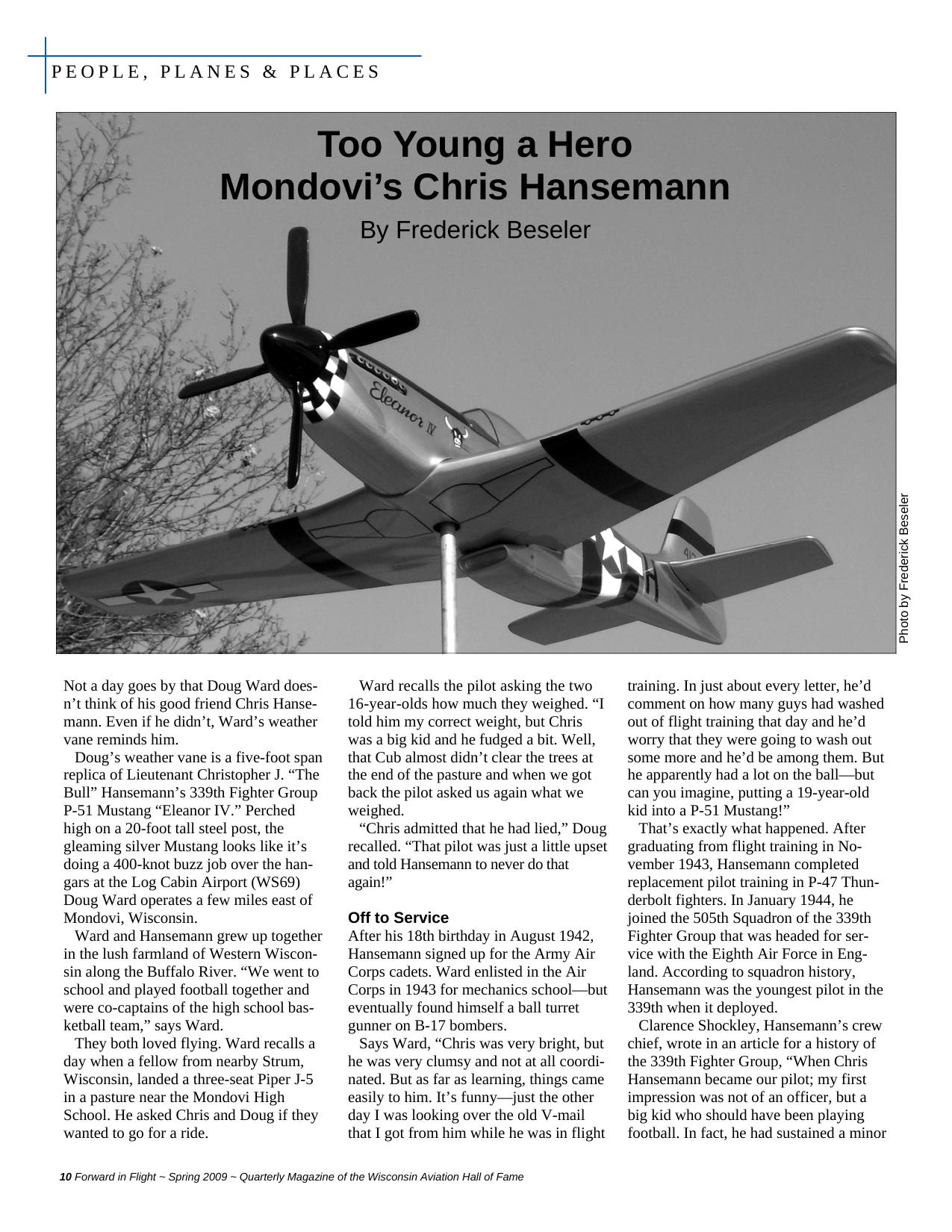
PEOPLE, PLANES & PLACES Too Young a Hero Mondovi’s Chris Hansemann Photo by Frederick Beseler By Frederick Beseler Not a day goes by that Doug Ward doesn’t think of his good friend Chris Hansemann. Even if he didn’t, Ward’s weather vane reminds him. Doug’s weather vane is a five-foot span replica of Lieutenant Christopher J. “The Bull” Hansemann’s 339th Fighter Group P-51 Mustang “Eleanor IV.” Perched high on a 20-foot tall steel post, the gleaming silver Mustang looks like it’s doing a 400-knot buzz job over the hangars at the Log Cabin Airport (WS69) Doug Ward operates a few miles east of Mondovi, Wisconsin. Ward and Hansemann grew up together in the lush farmland of Western Wisconsin along the Buffalo River. “We went to school and played football together and were co-captains of the high school basketball team,” says Ward. They both loved flying. Ward recalls a day when a fellow from nearby Strum, Wisconsin, landed a three-seat Piper J-5 in a pasture near the Mondovi High School. He asked Chris and Doug if they wanted to go for a ride. Ward recalls the pilot asking the two 16-year-olds how much they weighed. “I told him my correct weight, but Chris was a big kid and he fudged a bit. Well, that Cub almost didn’t clear the trees at the end of the pasture and when we got back the pilot asked us again what we weighed. “Chris admitted that he had lied,” Doug recalled. “That pilot was just a little upset and told Hansemann to never do that again!” Off to Service After his 18th birthday in August 1942, Hansemann signed up for the Army Air Corps cadets. Ward enlisted in the Air Corps in 1943 for mechanics school—but eventually found himself a ball turret gunner on B-17 bombers. Says Ward, “Chris was very bright, but he was very clumsy and not at all coordinated. But as far as learning, things came easily to him. It’s funny—just the other day I was looking over the old V-mail that I got from him while he was in flight 10 Forward in Flight ~ Spring 2009 ~ Quarterly Magazine of the Wisconsin Aviation Hall of Fame training. In just about every letter, he’d comment on how many guys had washed out of flight training that day and he’d worry that they were going to wash out some more and he’d be among them. But he apparently had a lot on the ball—but can you imagine, putting a 19-year-old kid into a P-51 Mustang!” That’s exactly what happened. After graduating from flight training in November 1943, Hansemann completed replacement pilot training in P-47 Thunderbolt fighters. In January 1944, he joined the 505th Squadron of the 339th Fighter Group that was headed for service with the Eighth Air Force in England. According to squadron history, Hansemann was the youngest pilot in the 339th when it deployed. Clarence Shockley, Hansemann’s crew chief, wrote in an article for a history of the 339th Fighter Group, “When Chris Hansemann became our pilot; my first impression was not of an officer, but a big kid who should have been playing football. In fact, he had sustained a minor
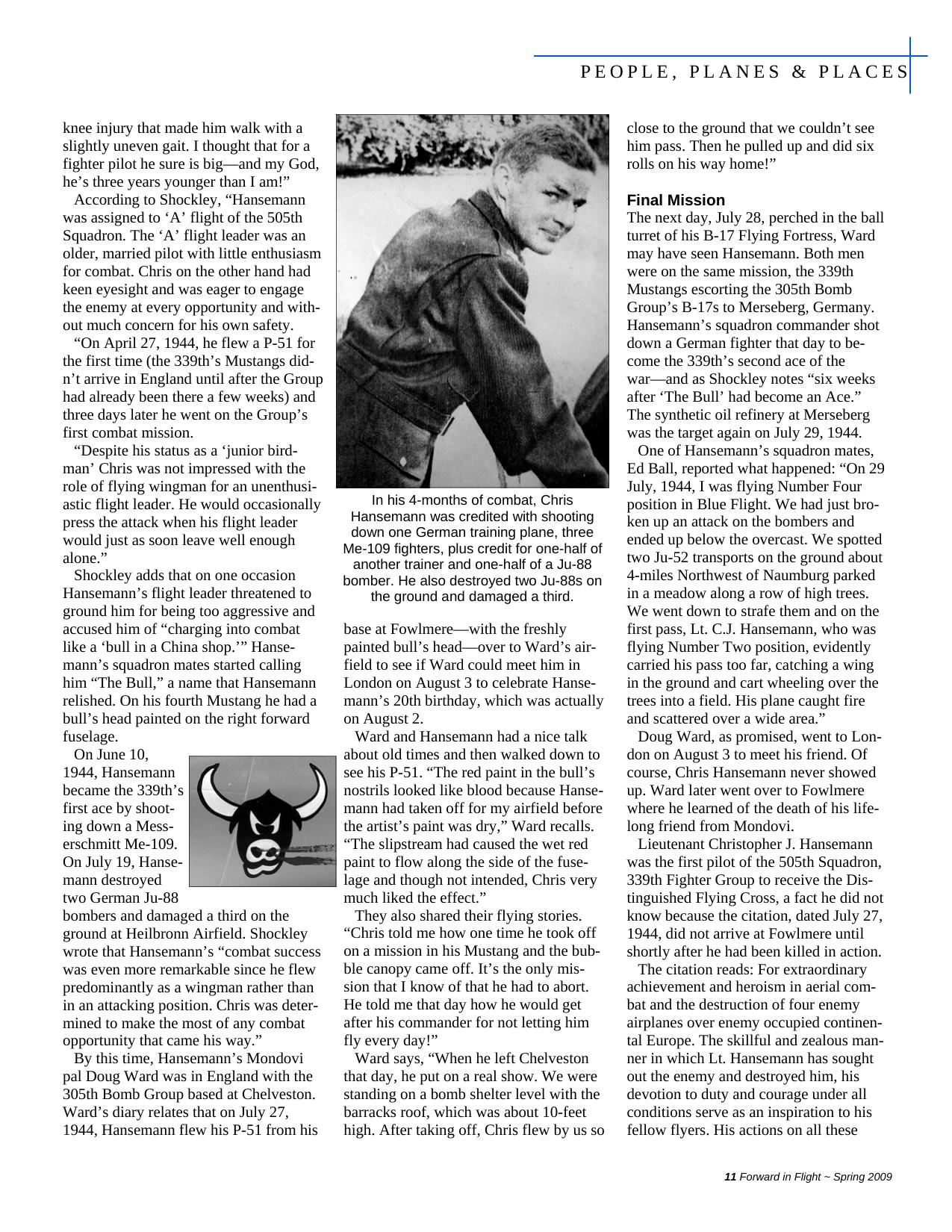
PEOPLE, PLANES & PLACES knee injury that made him walk with a slightly uneven gait. I thought that for a fighter pilot he sure is big—and my God, he’s three years younger than I am!” According to Shockley, “Hansemann was assigned to ‘A’ flight of the 505th Squadron. The ‘A’ flight leader was an older, married pilot with little enthusiasm for combat. Chris on the other hand had keen eyesight and was eager to engage the enemy at every opportunity and without much concern for his own safety. “On April 27, 1944, he flew a P-51 for the first time (the 339th’s Mustangs didn’t arrive in England until after the Group had already been there a few weeks) and three days later he went on the Group’s first combat mission. “Despite his status as a ‘junior birdman’ Chris was not impressed with the role of flying wingman for an unenthusiastic flight leader. He would occasionally press the attack when his flight leader would just as soon leave well enough alone.” Shockley adds that on one occasion Hansemann’s flight leader threatened to ground him for being too aggressive and accused him of “charging into combat like a ‘bull in a China shop.’” Hansemann’s squadron mates started calling him “The Bull,” a name that Hansemann relished. On his fourth Mustang he had a bull’s head painted on the right forward fuselage. On June 10, 1944, Hansemann became the 339th’s first ace by shooting down a Messerschmitt Me-109. On July 19, Hansemann destroyed two German Ju-88 bombers and damaged a third on the ground at Heilbronn Airfield. Shockley wrote that Hansemann’s “combat success was even more remarkable since he flew predominantly as a wingman rather than in an attacking position. Chris was determined to make the most of any combat opportunity that came his way.” By this time, Hansemann’s Mondovi pal Doug Ward was in England with the 305th Bomb Group based at Chelveston. Ward’s diary relates that on July 27, 1944, Hansemann flew his P-51 from his close to the ground that we couldn’t see him pass. Then he pulled up and did six rolls on his way home!” In his 4-months of combat, Chris Hansemann was credited with shooting down one German training plane, three Me-109 fighters, plus credit for one-half of another trainer and one-half of a Ju-88 bomber. He also destroyed two Ju-88s on the ground and damaged a third. base at Fowlmere—with the freshly painted bull’s head—over to Ward’s airfield to see if Ward could meet him in London on August 3 to celebrate Hansemann’s 20th birthday, which was actually on August 2. Ward and Hansemann had a nice talk about old times and then walked down to see his P-51. “The red paint in the bull’s nostrils looked like blood because Hansemann had taken off for my airfield before the artist’s paint was dry,” Ward recalls. “The slipstream had caused the wet red paint to flow along the side of the fuselage and though not intended, Chris very much liked the effect.” They also shared their flying stories. “Chris told me how one time he took off on a mission in his Mustang and the bubble canopy came off. It’s the only mission that I know of that he had to abort. He told me that day how he would get after his commander for not letting him fly every day!” Ward says, “When he left Chelveston that day, he put on a real show. We were standing on a bomb shelter level with the barracks roof, which was about 10-feet high. After taking off, Chris flew by us so Final Mission The next day, July 28, perched in the ball turret of his B-17 Flying Fortress, Ward may have seen Hansemann. Both men were on the same mission, the 339th Mustangs escorting the 305th Bomb Group’s B-17s to Merseberg, Germany. Hansemann’s squadron commander shot down a German fighter that day to become the 339th’s second ace of the war—and as Shockley notes “six weeks after ‘The Bull’ had become an Ace.” The synthetic oil refinery at Merseberg was the target again on July 29, 1944. One of Hansemann’s squadron mates, Ed Ball, reported what happened: “On 29 July, 1944, I was flying Number Four position in Blue Flight. We had just broken up an attack on the bombers and ended up below the overcast. We spotted two Ju-52 transports on the ground about 4-miles Northwest of Naumburg parked in a meadow along a row of high trees. We went down to strafe them and on the first pass, Lt. C.J. Hansemann, who was flying Number Two position, evidently carried his pass too far, catching a wing in the ground and cart wheeling over the trees into a field. His plane caught fire and scattered over a wide area.” Doug Ward, as promised, went to London on August 3 to meet his friend. Of course, Chris Hansemann never showed up. Ward later went over to Fowlmere where he learned of the death of his lifelong friend from Mondovi. Lieutenant Christopher J. Hansemann was the first pilot of the 505th Squadron, 339th Fighter Group to receive the Distinguished Flying Cross, a fact he did not know because the citation, dated July 27, 1944, did not arrive at Fowlmere until shortly after he had been killed in action. The citation reads: For extraordinary achievement and heroism in aerial combat and the destruction of four enemy airplanes over enemy occupied continental Europe. The skillful and zealous manner in which Lt. Hansemann has sought out the enemy and destroyed him, his devotion to duty and courage under all conditions serve as an inspiration to his fellow flyers. His actions on all these 11 Forward in Flight ~ Spring 2009
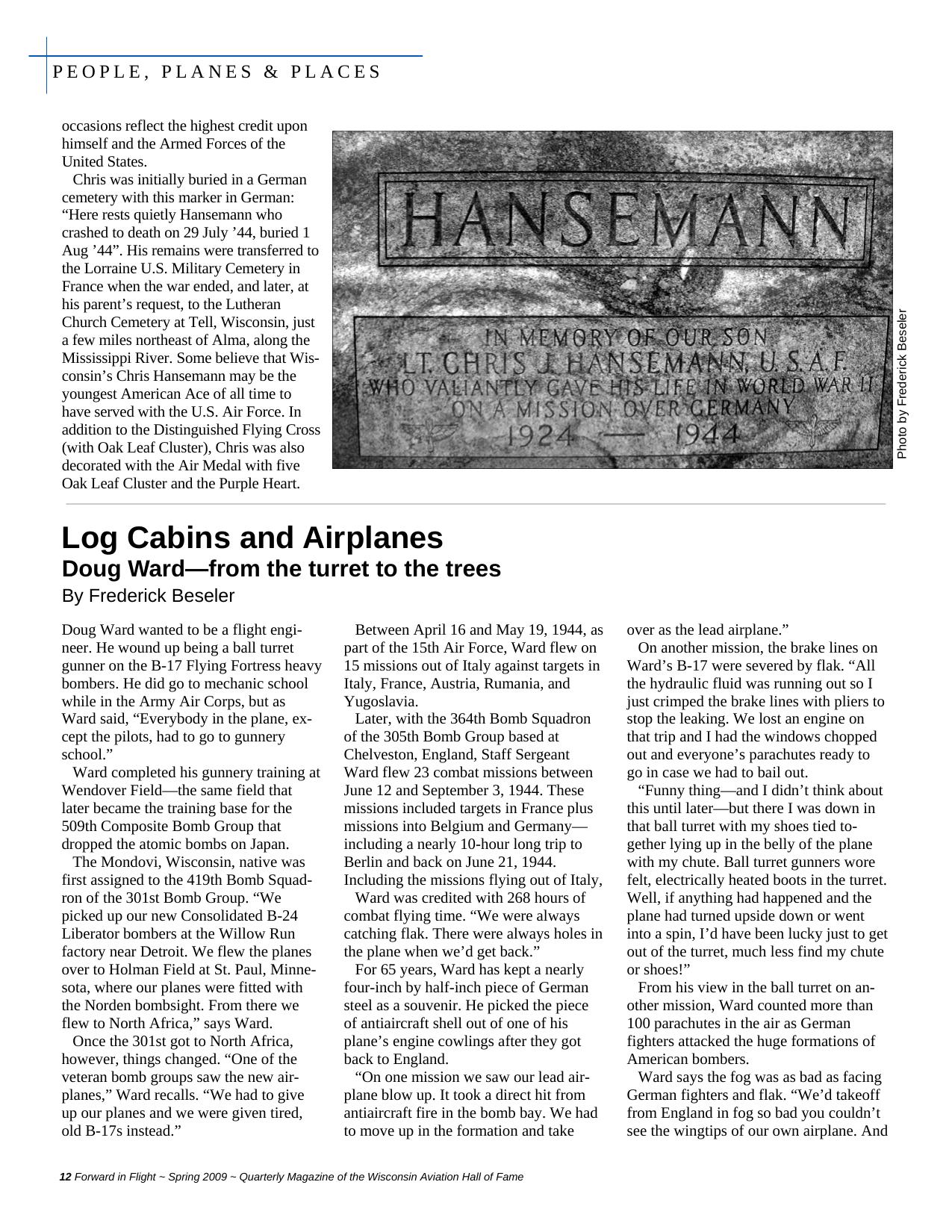
PEOPLE, PLANES & PLACES Photo by Frederick Beseler occasions reflect the highest credit upon himself and the Armed Forces of the United States. Chris was initially buried in a German cemetery with this marker in German: “Here rests quietly Hansemann who crashed to death on 29 July ’44, buried 1 Aug ’44”. His remains were transferred to the Lorraine U.S. Military Cemetery in France when the war ended, and later, at his parent’s request, to the Lutheran Church Cemetery at Tell, Wisconsin, just a few miles northeast of Alma, along the Mississippi River. Some believe that Wisconsin’s Chris Hansemann may be the youngest American Ace of all time to have served with the U.S. Air Force. In addition to the Distinguished Flying Cross (with Oak Leaf Cluster), Chris was also decorated with the Air Medal with five Oak Leaf Cluster and the Purple Heart. Log Cabins and Airplanes Doug Ward—from the turret to the trees By Frederick Beseler Doug Ward wanted to be a flight engineer. He wound up being a ball turret gunner on the B-17 Flying Fortress heavy bombers. He did go to mechanic school while in the Army Air Corps, but as Ward said, “Everybody in the plane, except the pilots, had to go to gunnery school.” Ward completed his gunnery training at Wendover Field—the same field that later became the training base for the 509th Composite Bomb Group that dropped the atomic bombs on Japan. The Mondovi, Wisconsin, native was first assigned to the 419th Bomb Squadron of the 301st Bomb Group. “We picked up our new Consolidated B-24 Liberator bombers at the Willow Run factory near Detroit. We flew the planes over to Holman Field at St. Paul, Minnesota, where our planes were fitted with the Norden bombsight. From there we flew to North Africa,” says Ward. Once the 301st got to North Africa, however, things changed. “One of the veteran bomb groups saw the new airplanes,” Ward recalls. “We had to give up our planes and we were given tired, old B-17s instead.” Between April 16 and May 19, 1944, as part of the 15th Air Force, Ward flew on 15 missions out of Italy against targets in Italy, France, Austria, Rumania, and Yugoslavia. Later, with the 364th Bomb Squadron of the 305th Bomb Group based at Chelveston, England, Staff Sergeant Ward flew 23 combat missions between June 12 and September 3, 1944. These missions included targets in France plus missions into Belgium and Germany— including a nearly 10-hour long trip to Berlin and back on June 21, 1944. Including the missions flying out of Italy, Ward was credited with 268 hours of combat flying time. “We were always catching flak. There were always holes in the plane when we’d get back.” For 65 years, Ward has kept a nearly four-inch by half-inch piece of German steel as a souvenir. He picked the piece of antiaircraft shell out of one of his plane’s engine cowlings after they got back to England. “On one mission we saw our lead airplane blow up. It took a direct hit from antiaircraft fire in the bomb bay. We had to move up in the formation and take 12 Forward in Flight ~ Spring 2009 ~ Quarterly Magazine of the Wisconsin Aviation Hall of Fame over as the lead airplane.” On another mission, the brake lines on Ward’s B-17 were severed by flak. “All the hydraulic fluid was running out so I just crimped the brake lines with pliers to stop the leaking. We lost an engine on that trip and I had the windows chopped out and everyone’s parachutes ready to go in case we had to bail out. “Funny thing—and I didn’t think about this until later—but there I was down in that ball turret with my shoes tied together lying up in the belly of the plane with my chute. Ball turret gunners wore felt, electrically heated boots in the turret. Well, if anything had happened and the plane had turned upside down or went into a spin, I’d have been lucky just to get out of the turret, much less find my chute or shoes!” From his view in the ball turret on another mission, Ward counted more than 100 parachutes in the air as German fighters attacked the huge formations of American bombers. Ward says the fog was as bad as facing German fighters and flak. “We’d takeoff from England in fog so bad you couldn’t see the wingtips of our own airplane. And
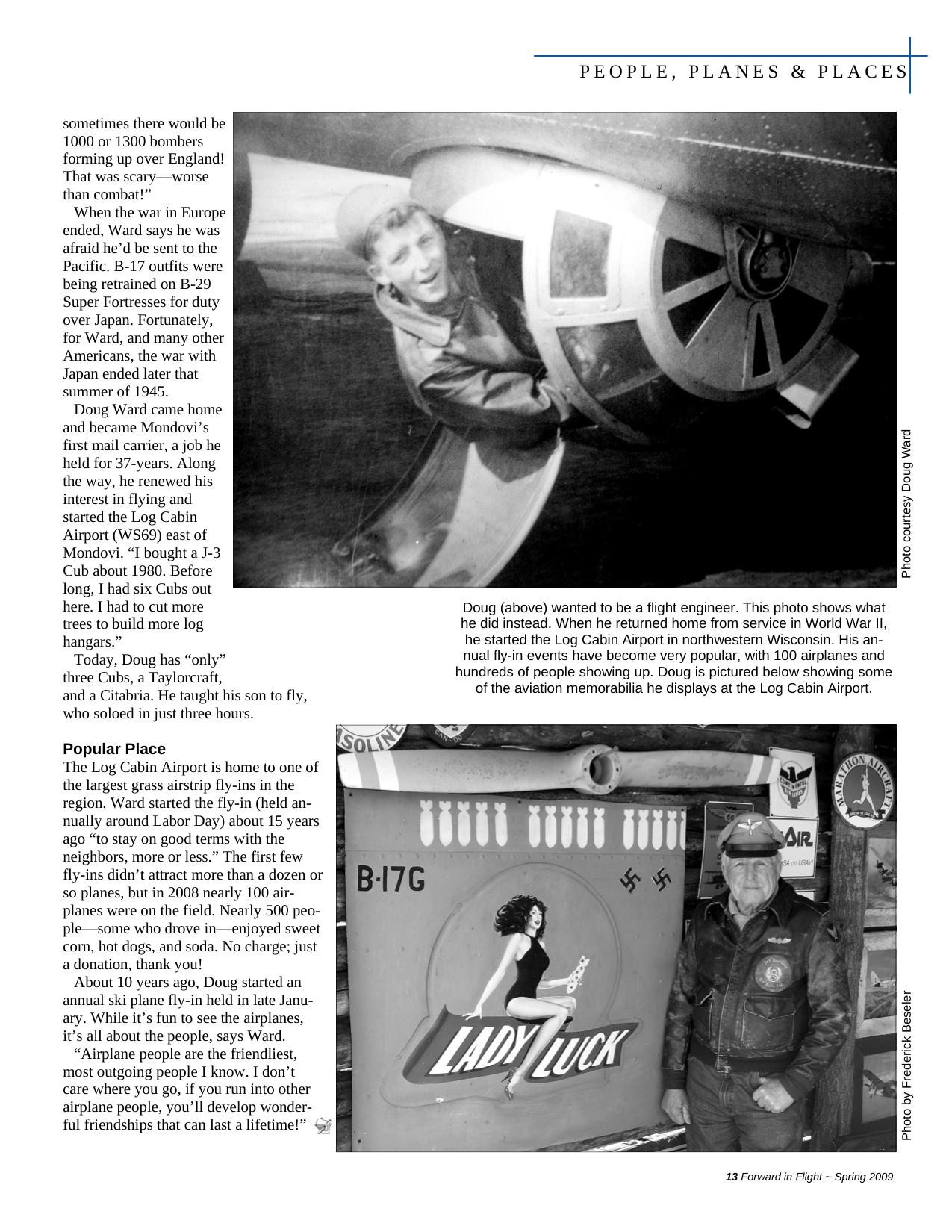
sometimes there would be 1000 or 1300 bombers forming up over England! That was scary—worse than combat!” When the war in Europe ended, Ward says he was afraid he’d be sent to the Pacific. B-17 outfits were being retrained on B-29 Super Fortresses for duty over Japan. Fortunately, for Ward, and many other Americans, the war with Japan ended later that summer of 1945. Doug Ward came home and became Mondovi’s first mail carrier, a job he held for 37-years. Along the way, he renewed his interest in flying and started the Log Cabin Airport (WS69) east of Mondovi. “I bought a J-3 Cub about 1980. Before long, I had six Cubs out here. I had to cut more trees to build more log hangars.” Today, Doug has “only” three Cubs, a Taylorcraft, and a Citabria. He taught his son to fly, who soloed in just three hours. Photo courtesy Doug Ward PEOPLE, PLANES & PLACES Doug (above) wanted to be a flight engineer. This photo shows what he did instead. When he returned home from service in World War II, he started the Log Cabin Airport in northwestern Wisconsin. His annual fly-in events have become very popular, with 100 airplanes and hundreds of people showing up. Doug is pictured below showing some of the aviation memorabilia he displays at the Log Cabin Airport. Photo by Frederick Beseler Popular Place The Log Cabin Airport is home to one of the largest grass airstrip fly-ins in the region. Ward started the fly-in (held annually around Labor Day) about 15 years ago “to stay on good terms with the neighbors, more or less.” The first few fly-ins didn’t attract more than a dozen or so planes, but in 2008 nearly 100 airplanes were on the field. Nearly 500 people—some who drove in—enjoyed sweet corn, hot dogs, and soda. No charge; just a donation, thank you! About 10 years ago, Doug started an annual ski plane fly-in held in late January. While it’s fun to see the airplanes, it’s all about the people, says Ward. “Airplane people are the friendliest, most outgoing people I know. I don’t care where you go, if you run into other airplane people, you’ll develop wonderful friendships that can last a lifetime!” 13 Forward in Flight ~ Spring 2009
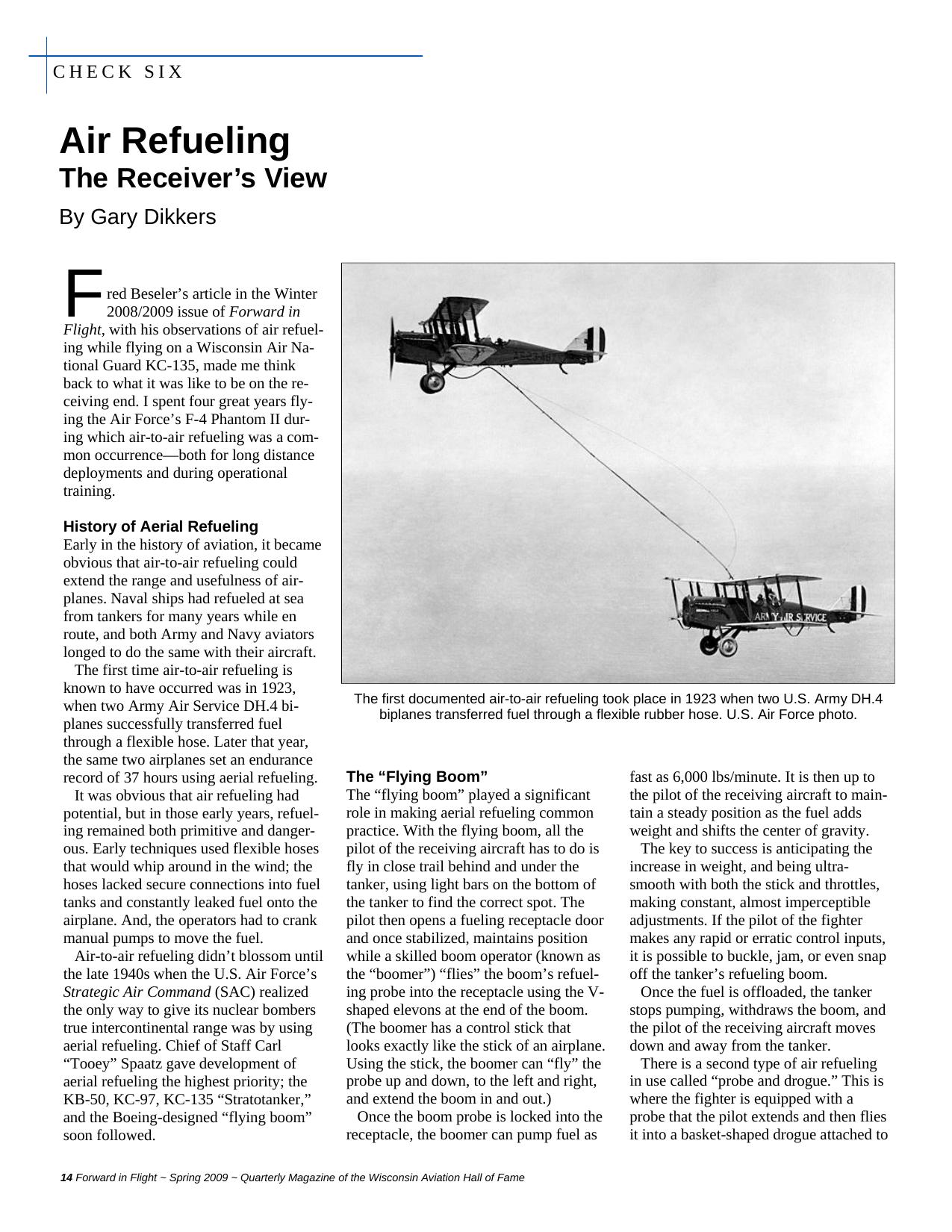
CHECK SIX Air Refueling The Receiver’s View By Gary Dikkers F red Beseler’s article in the Winter 2008/2009 issue of Forward in Flight, with his observations of air refueling while flying on a Wisconsin Air National Guard KC-135, made me think back to what it was like to be on the receiving end. I spent four great years flying the Air Force’s F-4 Phantom II during which air-to-air refueling was a common occurrence—both for long distance deployments and during operational training. History of Aerial Refueling Early in the history of aviation, it became obvious that air-to-air refueling could extend the range and usefulness of airplanes. Naval ships had refueled at sea from tankers for many years while en route, and both Army and Navy aviators longed to do the same with their aircraft. The first time air-to-air refueling is known to have occurred was in 1923, when two Army Air Service DH.4 biplanes successfully transferred fuel through a flexible hose. Later that year, the same two airplanes set an endurance record of 37 hours using aerial refueling. It was obvious that air refueling had potential, but in those early years, refueling remained both primitive and dangerous. Early techniques used flexible hoses that would whip around in the wind; the hoses lacked secure connections into fuel tanks and constantly leaked fuel onto the airplane. And, the operators had to crank manual pumps to move the fuel. Air-to-air refueling didn’t blossom until the late 1940s when the U.S. Air Force’s Strategic Air Command (SAC) realized the only way to give its nuclear bombers true intercontinental range was by using aerial refueling. Chief of Staff Carl “Tooey” Spaatz gave development of aerial refueling the highest priority; the KB-50, KC-97, KC-135 “Stratotanker,” and the Boeing-designed “flying boom” soon followed. The first documented air-to-air refueling took place in 1923 when two U.S. Army DH.4 biplanes transferred fuel through a flexible rubber hose. U.S. Air Force photo. The “Flying Boom” The “flying boom” played a significant role in making aerial refueling common practice. With the flying boom, all the pilot of the receiving aircraft has to do is fly in close trail behind and under the tanker, using light bars on the bottom of the tanker to find the correct spot. The pilot then opens a fueling receptacle door and once stabilized, maintains position while a skilled boom operator (known as the “boomer”) “flies” the boom’s refueling probe into the receptacle using the Vshaped elevons at the end of the boom. (The boomer has a control stick that looks exactly like the stick of an airplane. Using the stick, the boomer can “fly” the probe up and down, to the left and right, and extend the boom in and out.) Once the boom probe is locked into the receptacle, the boomer can pump fuel as 14 Forward in Flight ~ Spring 2009 ~ Quarterly Magazine of the Wisconsin Aviation Hall of Fame fast as 6,000 lbs/minute. It is then up to the pilot of the receiving aircraft to maintain a steady position as the fuel adds weight and shifts the center of gravity. The key to success is anticipating the increase in weight, and being ultrasmooth with both the stick and throttles, making constant, almost imperceptible adjustments. If the pilot of the fighter makes any rapid or erratic control inputs, it is possible to buckle, jam, or even snap off the tanker’s refueling boom. Once the fuel is offloaded, the tanker stops pumping, withdraws the boom, and the pilot of the receiving aircraft moves down and away from the tanker. There is a second type of air refueling in use called “probe and drogue.” This is where the fighter is equipped with a probe that the pilot extends and then flies it into a basket-shaped drogue attached to
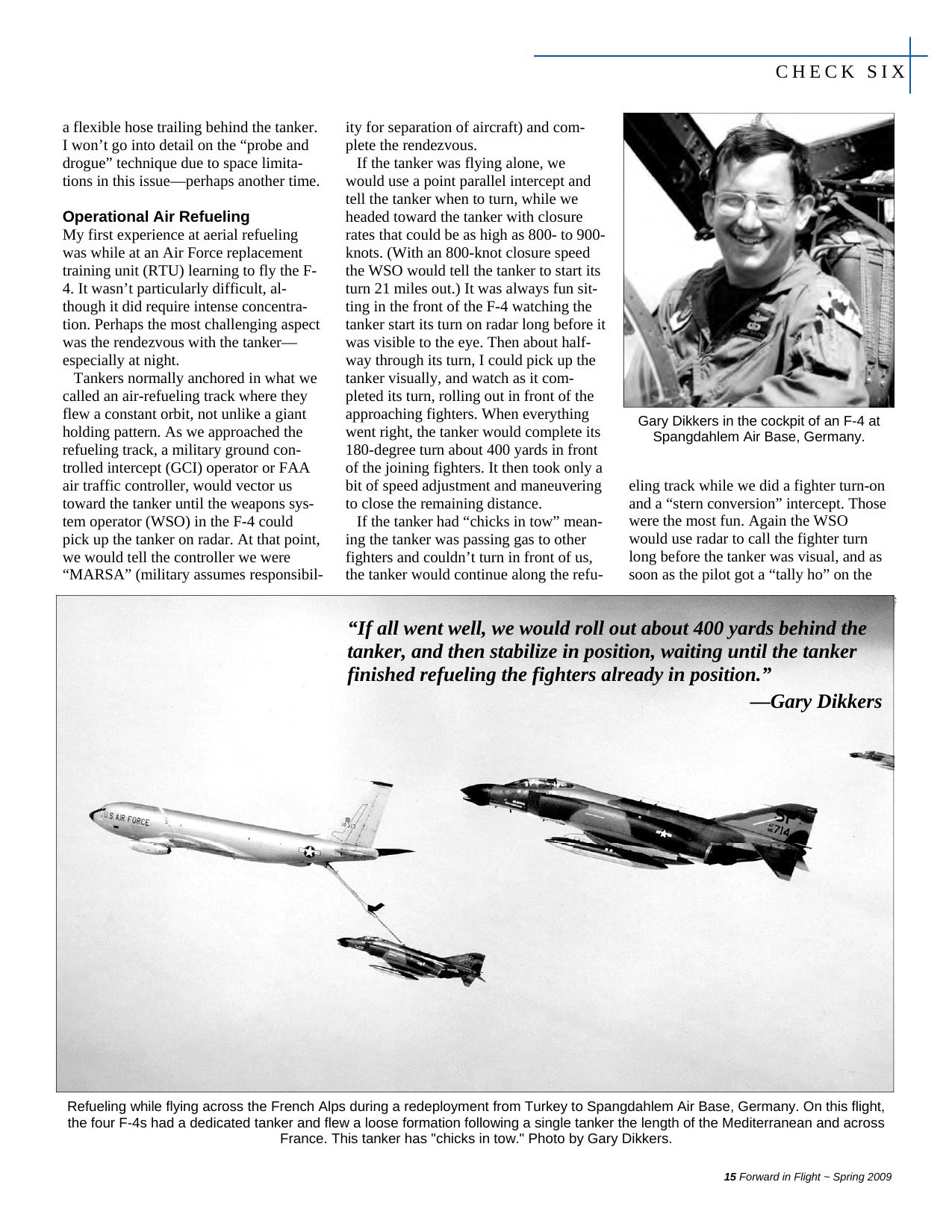
CHECK SIX a flexible hose trailing behind the tanker. I won’t go into detail on the “probe and drogue” technique due to space limitations in this issue—perhaps another time. Operational Air Refueling My first experience at aerial refueling was while at an Air Force replacement training unit (RTU) learning to fly the F4. It wasn’t particularly difficult, although it did require intense concentration. Perhaps the most challenging aspect was the rendezvous with the tanker— especially at night. Tankers normally anchored in what we called an air-refueling track where they flew a constant orbit, not unlike a giant holding pattern. As we approached the refueling track, a military ground controlled intercept (GCI) operator or FAA air traffic controller, would vector us toward the tanker until the weapons system operator (WSO) in the F-4 could pick up the tanker on radar. At that point, we would tell the controller we were “MARSA” (military assumes responsibil- ity for separation of aircraft) and complete the rendezvous. If the tanker was flying alone, we would use a point parallel intercept and tell the tanker when to turn, while we headed toward the tanker with closure rates that could be as high as 800- to 900knots. (With an 800-knot closure speed the WSO would tell the tanker to start its turn 21 miles out.) It was always fun sitting in the front of the F-4 watching the tanker start its turn on radar long before it was visible to the eye. Then about halfway through its turn, I could pick up the tanker visually, and watch as it completed its turn, rolling out in front of the approaching fighters. When everything went right, the tanker would complete its 180-degree turn about 400 yards in front of the joining fighters. It then took only a bit of speed adjustment and maneuvering to close the remaining distance. If the tanker had “chicks in tow” meaning the tanker was passing gas to other fighters and couldn’t turn in front of us, the tanker would continue along the refu- Gary Dikkers in the cockpit of an F-4 at Spangdahlem Air Base, Germany. eling track while we did a fighter turn-on and a “stern conversion” intercept. Those were the most fun. Again the WSO would use radar to call the fighter turn long before the tanker was visual, and as soon as the pilot got a “tally ho” on the “If all went well, we would roll out about 400 yards behind the tanker, and then stabilize in position, waiting until the tanker finished refueling the fighters already in position.” —Gary Dikkers Refueling while flying across the French Alps during a redeployment from Turkey to Spangdahlem Air Base, Germany. On this flight, the four F-4s had a dedicated tanker and flew a loose formation following a single tanker the length of the Mediterranean and across France. This tanker has "chicks in tow." Photo by Gary Dikkers. 15 Forward in Flight ~ Spring 2009
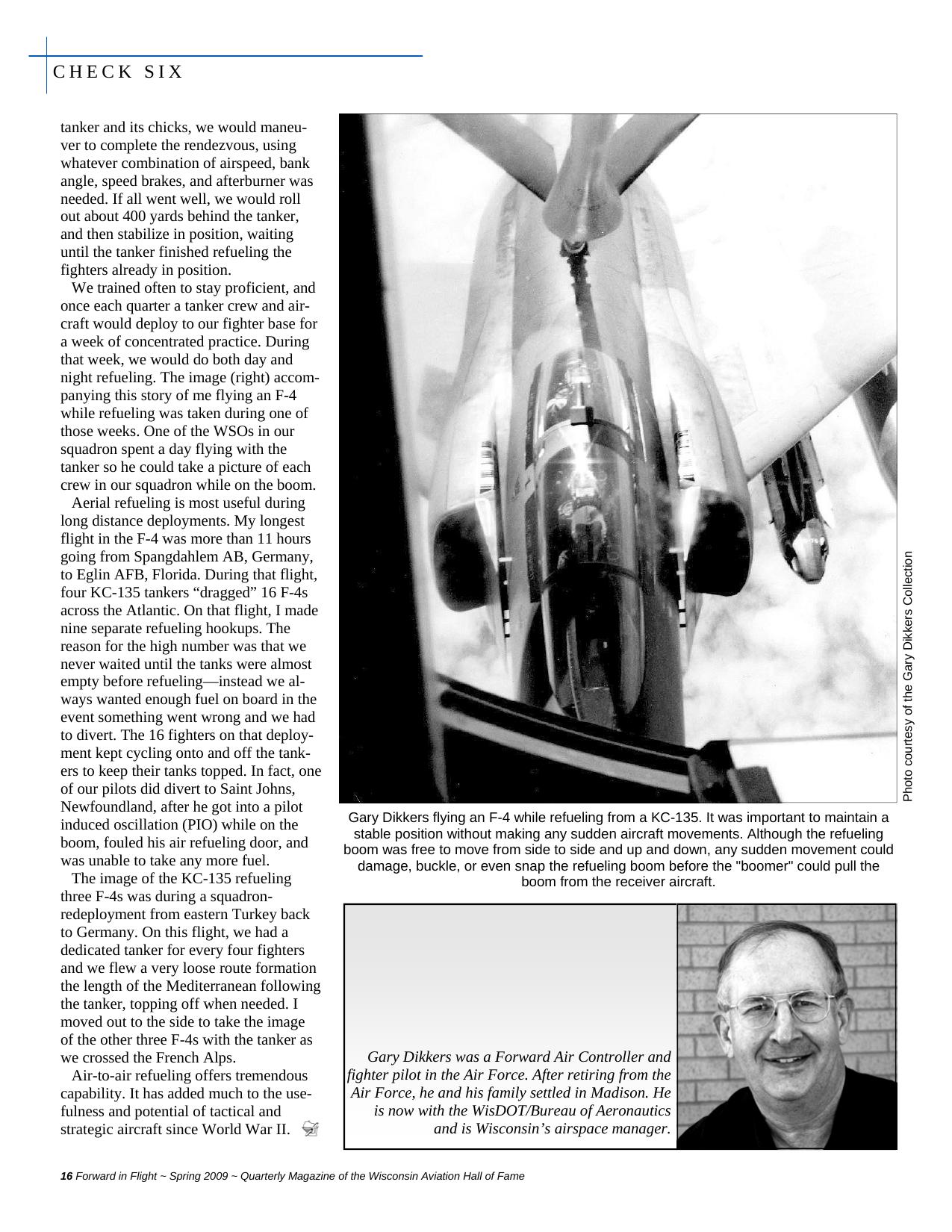
tanker and its chicks, we would maneuver to complete the rendezvous, using whatever combination of airspeed, bank angle, speed brakes, and afterburner was needed. If all went well, we would roll out about 400 yards behind the tanker, and then stabilize in position, waiting until the tanker finished refueling the fighters already in position. We trained often to stay proficient, and once each quarter a tanker crew and aircraft would deploy to our fighter base for a week of concentrated practice. During that week, we would do both day and night refueling. The image (right) accompanying this story of me flying an F-4 while refueling was taken during one of those weeks. One of the WSOs in our squadron spent a day flying with the tanker so he could take a picture of each crew in our squadron while on the boom. Aerial refueling is most useful during long distance deployments. My longest flight in the F-4 was more than 11 hours going from Spangdahlem AB, Germany, to Eglin AFB, Florida. During that flight, four KC-135 tankers “dragged” 16 F-4s across the Atlantic. On that flight, I made nine separate refueling hookups. The reason for the high number was that we never waited until the tanks were almost empty before refueling—instead we always wanted enough fuel on board in the event something went wrong and we had to divert. The 16 fighters on that deployment kept cycling onto and off the tankers to keep their tanks topped. In fact, one of our pilots did divert to Saint Johns, Newfoundland, after he got into a pilot induced oscillation (PIO) while on the boom, fouled his air refueling door, and was unable to take any more fuel. The image of the KC-135 refueling three F-4s was during a squadronredeployment from eastern Turkey back to Germany. On this flight, we had a dedicated tanker for every four fighters and we flew a very loose route formation the length of the Mediterranean following the tanker, topping off when needed. I moved out to the side to take the image of the other three F-4s with the tanker as we crossed the French Alps. Air-to-air refueling offers tremendous capability. It has added much to the usefulness and potential of tactical and strategic aircraft since World War II. Photo courtesy of the Gary Dikkers Collection CHECK SIX Gary Dikkers flying an F-4 while refueling from a KC-135. It was important to maintain a stable position without making any sudden aircraft movements. Although the refueling boom was free to move from side to side and up and down, any sudden movement could damage, buckle, or even snap the refueling boom before the "boomer" could pull the boom from the receiver aircraft. Gary Dikkers was a Forward Air Controller and fighter pilot in the Air Force. After retiring from the Air Force, he and his family settled in Madison. He is now with the WisDOT/Bureau of Aeronautics and is Wisconsin’s airspace manager. 16 Forward in Flight ~ Spring 2009 ~ Quarterly Magazine of the Wisconsin Aviation Hall of Fame
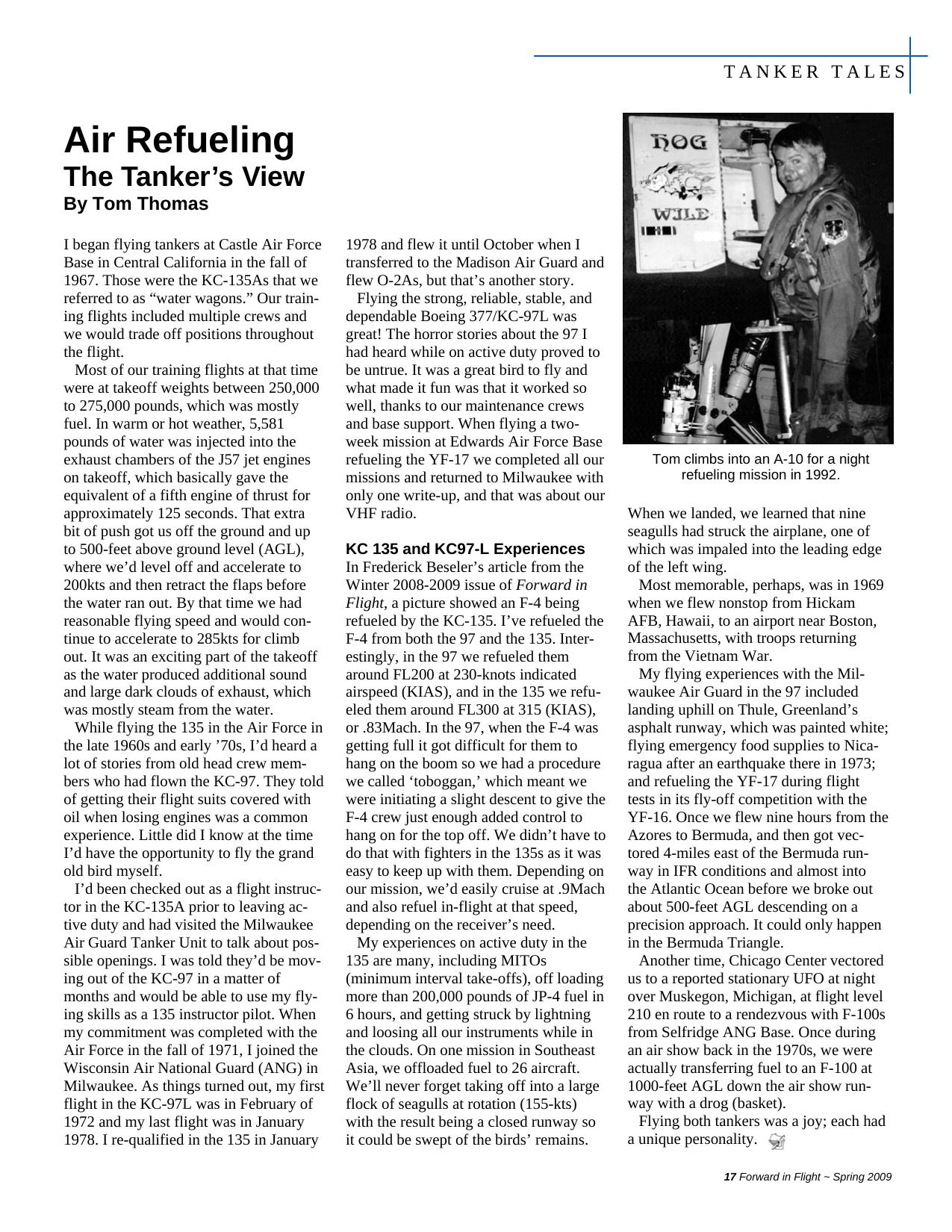
TANKER TALES Air Refueling The Tanker’s View By Tom Thomas I began flying tankers at Castle Air Force Base in Central California in the fall of 1967. Those were the KC-135As that we referred to as “water wagons.” Our training flights included multiple crews and we would trade off positions throughout the flight. Most of our training flights at that time were at takeoff weights between 250,000 to 275,000 pounds, which was mostly fuel. In warm or hot weather, 5,581 pounds of water was injected into the exhaust chambers of the J57 jet engines on takeoff, which basically gave the equivalent of a fifth engine of thrust for approximately 125 seconds. That extra bit of push got us off the ground and up to 500-feet above ground level (AGL), where we’d level off and accelerate to 200kts and then retract the flaps before the water ran out. By that time we had reasonable flying speed and would continue to accelerate to 285kts for climb out. It was an exciting part of the takeoff as the water produced additional sound and large dark clouds of exhaust, which was mostly steam from the water. While flying the 135 in the Air Force in the late 1960s and early ’70s, I’d heard a lot of stories from old head crew members who had flown the KC-97. They told of getting their flight suits covered with oil when losing engines was a common experience. Little did I know at the time I’d have the opportunity to fly the grand old bird myself. I’d been checked out as a flight instructor in the KC-135A prior to leaving active duty and had visited the Milwaukee Air Guard Tanker Unit to talk about possible openings. I was told they’d be moving out of the KC-97 in a matter of months and would be able to use my flying skills as a 135 instructor pilot. When my commitment was completed with the Air Force in the fall of 1971, I joined the Wisconsin Air National Guard (ANG) in Milwaukee. As things turned out, my first flight in the KC-97L was in February of 1972 and my last flight was in January 1978. I re-qualified in the 135 in January 1978 and flew it until October when I transferred to the Madison Air Guard and flew O-2As, but that’s another story. Flying the strong, reliable, stable, and dependable Boeing 377/KC-97L was great! The horror stories about the 97 I had heard while on active duty proved to be untrue. It was a great bird to fly and what made it fun was that it worked so well, thanks to our maintenance crews and base support. When flying a twoweek mission at Edwards Air Force Base refueling the YF-17 we completed all our missions and returned to Milwaukee with only one write-up, and that was about our VHF radio. KC 135 and KC97-L Experiences In Frederick Beseler’s article from the Winter 2008-2009 issue of Forward in Flight, a picture showed an F-4 being refueled by the KC-135. I’ve refueled the F-4 from both the 97 and the 135. Interestingly, in the 97 we refueled them around FL200 at 230-knots indicated airspeed (KIAS), and in the 135 we refueled them around FL300 at 315 (KIAS), or .83Mach. In the 97, when the F-4 was getting full it got difficult for them to hang on the boom so we had a procedure we called ‘toboggan,’ which meant we were initiating a slight descent to give the F-4 crew just enough added control to hang on for the top off. We didn’t have to do that with fighters in the 135s as it was easy to keep up with them. Depending on our mission, we’d easily cruise at .9Mach and also refuel in-flight at that speed, depending on the receiver’s need. My experiences on active duty in the 135 are many, including MITOs (minimum interval take-offs), off loading more than 200,000 pounds of JP-4 fuel in 6 hours, and getting struck by lightning and loosing all our instruments while in the clouds. On one mission in Southeast Asia, we offloaded fuel to 26 aircraft. We’ll never forget taking off into a large flock of seagulls at rotation (155-kts) with the result being a closed runway so it could be swept of the birds’ remains. Tom climbs into an A-10 for a night refueling mission in 1992. When we landed, we learned that nine seagulls had struck the airplane, one of which was impaled into the leading edge of the left wing. Most memorable, perhaps, was in 1969 when we flew nonstop from Hickam AFB, Hawaii, to an airport near Boston, Massachusetts, with troops returning from the Vietnam War. My flying experiences with the Milwaukee Air Guard in the 97 included landing uphill on Thule, Greenland’s asphalt runway, which was painted white; flying emergency food supplies to Nicaragua after an earthquake there in 1973; and refueling the YF-17 during flight tests in its fly-off competition with the YF-16. Once we flew nine hours from the Azores to Bermuda, and then got vectored 4-miles east of the Bermuda runway in IFR conditions and almost into the Atlantic Ocean before we broke out about 500-feet AGL descending on a precision approach. It could only happen in the Bermuda Triangle. Another time, Chicago Center vectored us to a reported stationary UFO at night over Muskegon, Michigan, at flight level 210 en route to a rendezvous with F-100s from Selfridge ANG Base. Once during an air show back in the 1970s, we were actually transferring fuel to an F-100 at 1000-feet AGL down the air show runway with a drog (basket). Flying both tankers was a joy; each had a unique personality. 17 Forward in Flight ~ Spring 2009
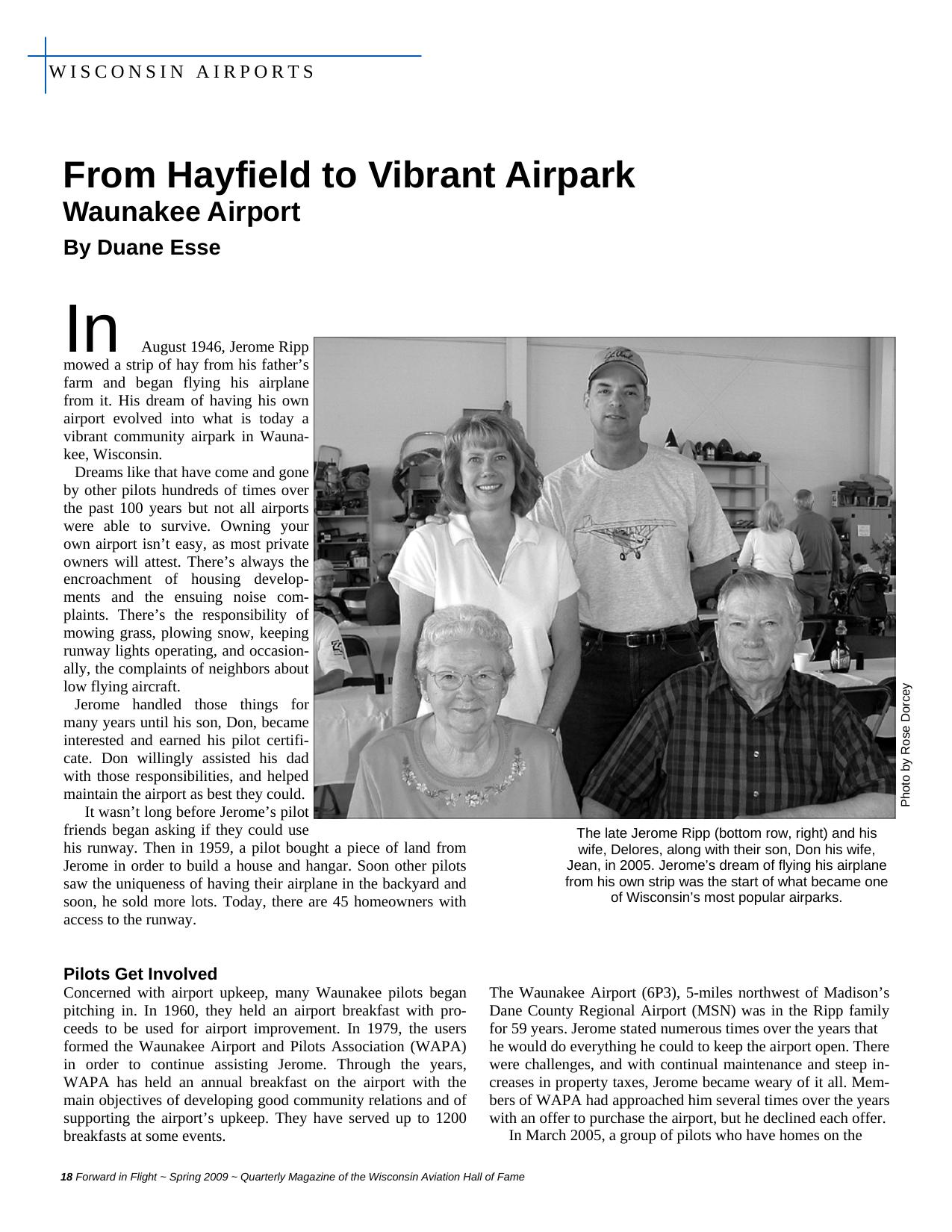
WISCONSIN AIRPORTS From Hayfield to Vibrant Airpark Waunakee Airport By Duane Esse In Photo by Rose Dorcey August 1946, Jerome Ripp mowed a strip of hay from his father’s farm and began flying his airplane from it. His dream of having his own airport evolved into what is today a vibrant community airpark in Waunakee, Wisconsin. Dreams like that have come and gone by other pilots hundreds of times over the past 100 years but not all airports were able to survive. Owning your own airport isn’t easy, as most private owners will attest. There’s always the encroachment of housing developments and the ensuing noise complaints. There’s the responsibility of mowing grass, plowing snow, keeping runway lights operating, and occasionally, the complaints of neighbors about low flying aircraft. Jerome handled those things for many years until his son, Don, became interested and earned his pilot certificate. Don willingly assisted his dad with those responsibilities, and helped maintain the airport as best they could. It wasn’t long before Jerome’s pilot friends began asking if they could use his runway. Then in 1959, a pilot bought a piece of land from Jerome in order to build a house and hangar. Soon other pilots saw the uniqueness of having their airplane in the backyard and soon, he sold more lots. Today, there are 45 homeowners with access to the runway. The late Jerome Ripp (bottom row, right) and his wife, Delores, along with their son, Don his wife, Jean, in 2005. Jerome’s dream of flying his airplane from his own strip was the start of what became one of Wisconsin’s most popular airparks. Pilots Get Involved Concerned with airport upkeep, many Waunakee pilots began pitching in. In 1960, they held an airport breakfast with proceeds to be used for airport improvement. In 1979, the users formed the Waunakee Airport and Pilots Association (WAPA) in order to continue assisting Jerome. Through the years, WAPA has held an annual breakfast on the airport with the main objectives of developing good community relations and of supporting the airport’s upkeep. They have served up to 1200 breakfasts at some events. The Waunakee Airport (6P3), 5-miles northwest of Madison’s Dane County Regional Airport (MSN) was in the Ripp family for 59 years. Jerome stated numerous times over the years that he would do everything he could to keep the airport open. There were challenges, and with continual maintenance and steep increases in property taxes, Jerome became weary of it all. Members of WAPA had approached him several times over the years with an offer to purchase the airport, but he declined each offer. In March 2005, a group of pilots who have homes on the 18 Forward in Flight ~ Spring 2009 ~ Quarterly Magazine of the Wisconsin Aviation Hall of Fame
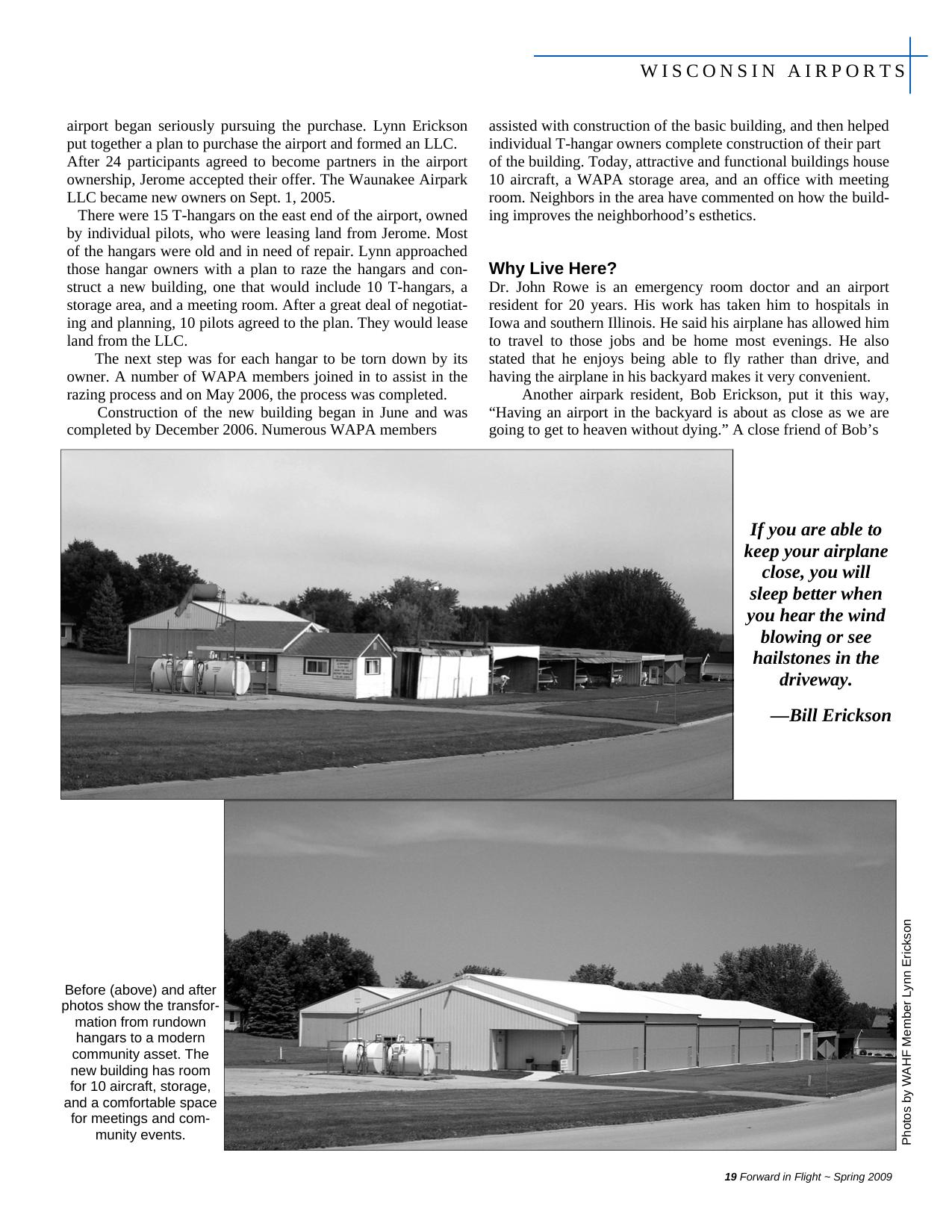
WISCONSIN AIRPORTS airport began seriously pursuing the purchase. Lynn Erickson put together a plan to purchase the airport and formed an LLC. After 24 participants agreed to become partners in the airport ownership, Jerome accepted their offer. The Waunakee Airpark LLC became new owners on Sept. 1, 2005. There were 15 T-hangars on the east end of the airport, owned by individual pilots, who were leasing land from Jerome. Most of the hangars were old and in need of repair. Lynn approached those hangar owners with a plan to raze the hangars and construct a new building, one that would include 10 T-hangars, a storage area, and a meeting room. After a great deal of negotiating and planning, 10 pilots agreed to the plan. They would lease land from the LLC. The next step was for each hangar to be torn down by its owner. A number of WAPA members joined in to assist in the razing process and on May 2006, the process was completed. Construction of the new building began in June and was completed by December 2006. Numerous WAPA members assisted with construction of the basic building, and then helped individual T-hangar owners complete construction of their part of the building. Today, attractive and functional buildings house 10 aircraft, a WAPA storage area, and an office with meeting room. Neighbors in the area have commented on how the building improves the neighborhood’s esthetics. Why Live Here? Dr. John Rowe is an emergency room doctor and an airport resident for 20 years. His work has taken him to hospitals in Iowa and southern Illinois. He said his airplane has allowed him to travel to those jobs and be home most evenings. He also stated that he enjoys being able to fly rather than drive, and having the airplane in his backyard makes it very convenient. Another airpark resident, Bob Erickson, put it this way, “Having an airport in the backyard is about as close as we are going to get to heaven without dying.” A close friend of Bob’s If you are able to keep your airplane close, you will sleep better when you hear the wind blowing or see hailstones in the driveway. Photos by WAHF Member Lynn Erickson —Bill Erickson Before (above) and after photos show the transformation from rundown hangars to a modern community asset. The new building has room for 10 aircraft, storage, and a comfortable space for meetings and community events. 19 Forward in Flight ~ Spring 2009
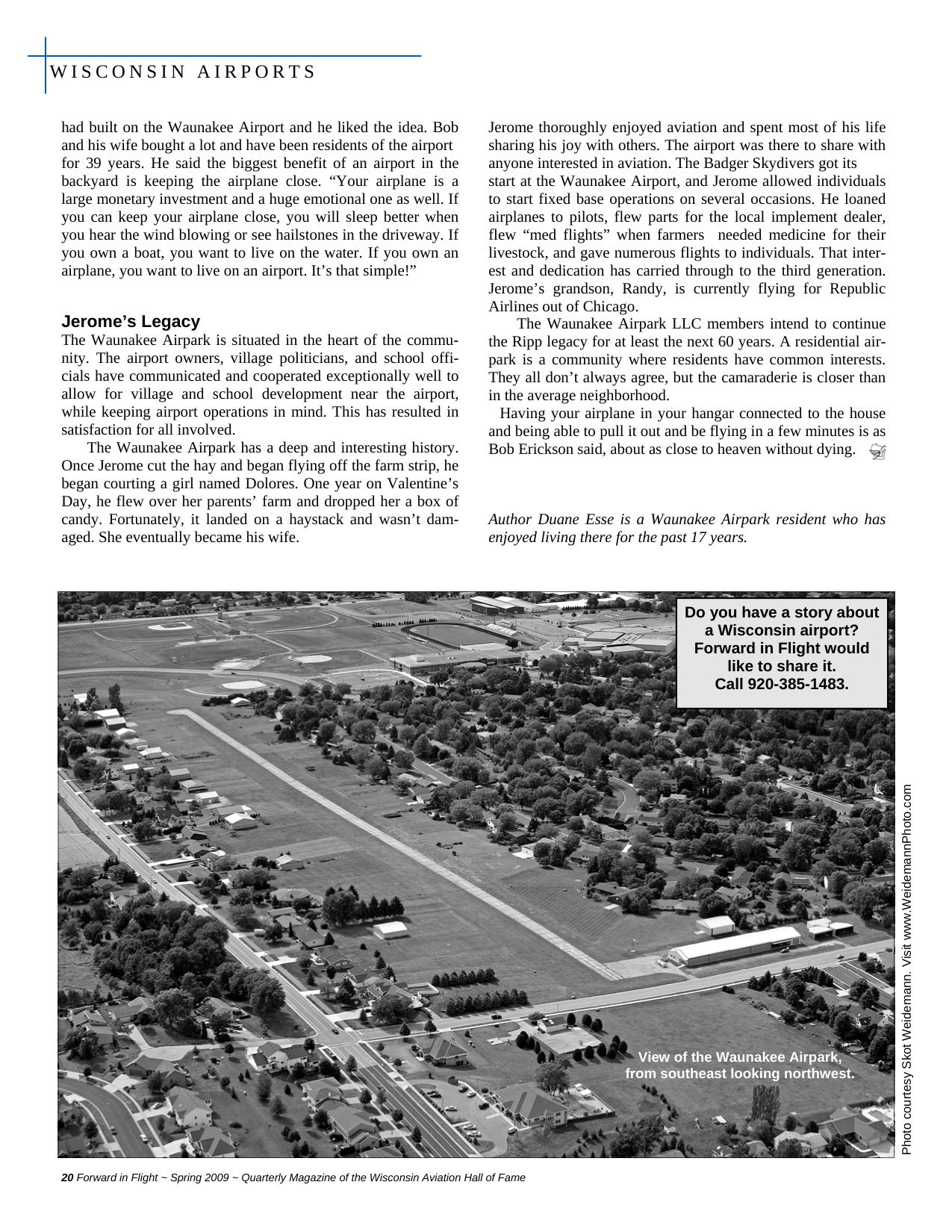
WISCONSIN AIRPORTS had built on the Waunakee Airport and he liked the idea. Bob and his wife bought a lot and have been residents of the airport for 39 years. He said the biggest benefit of an airport in the backyard is keeping the airplane close. “Your airplane is a large monetary investment and a huge emotional one as well. If you can keep your airplane close, you will sleep better when you hear the wind blowing or see hailstones in the driveway. If you own a boat, you want to live on the water. If you own an airplane, you want to live on an airport. It’s that simple!” Jerome’s Legacy The Waunakee Airpark is situated in the heart of the community. The airport owners, village politicians, and school officials have communicated and cooperated exceptionally well to allow for village and school development near the airport, while keeping airport operations in mind. This has resulted in satisfaction for all involved. The Waunakee Airpark has a deep and interesting history. Once Jerome cut the hay and began flying off the farm strip, he began courting a girl named Dolores. One year on Valentine’s Day, he flew over her parents’ farm and dropped her a box of candy. Fortunately, it landed on a haystack and wasn’t damaged. She eventually became his wife. Jerome thoroughly enjoyed aviation and spent most of his life sharing his joy with others. The airport was there to share with anyone interested in aviation. The Badger Skydivers got its start at the Waunakee Airport, and Jerome allowed individuals to start fixed base operations on several occasions. He loaned airplanes to pilots, flew parts for the local implement dealer, flew “med flights” when farmers needed medicine for their livestock, and gave numerous flights to individuals. That interest and dedication has carried through to the third generation. Jerome’s grandson, Randy, is currently flying for Republic Airlines out of Chicago. The Waunakee Airpark LLC members intend to continue the Ripp legacy for at least the next 60 years. A residential airpark is a community where residents have common interests. They all don’t always agree, but the camaraderie is closer than in the average neighborhood. Having your airplane in your hangar connected to the house and being able to pull it out and be flying in a few minutes is as Bob Erickson said, about as close to heaven without dying. Author Duane Esse is a Waunakee Airpark resident who has enjoyed living there for the past 17 years. View of the Waunakee Airpark, from southeast looking northwest. 20 Forward in Flight ~ Spring 2009 ~ Quarterly Magazine of the Wisconsin Aviation Hall of Fame Photo courtesy Skot Weidemann. Visit www.WeidemannPhoto.com Do you have a story about a Wisconsin airport? Forward in Flight would like to share it. Call 920-385-1483.
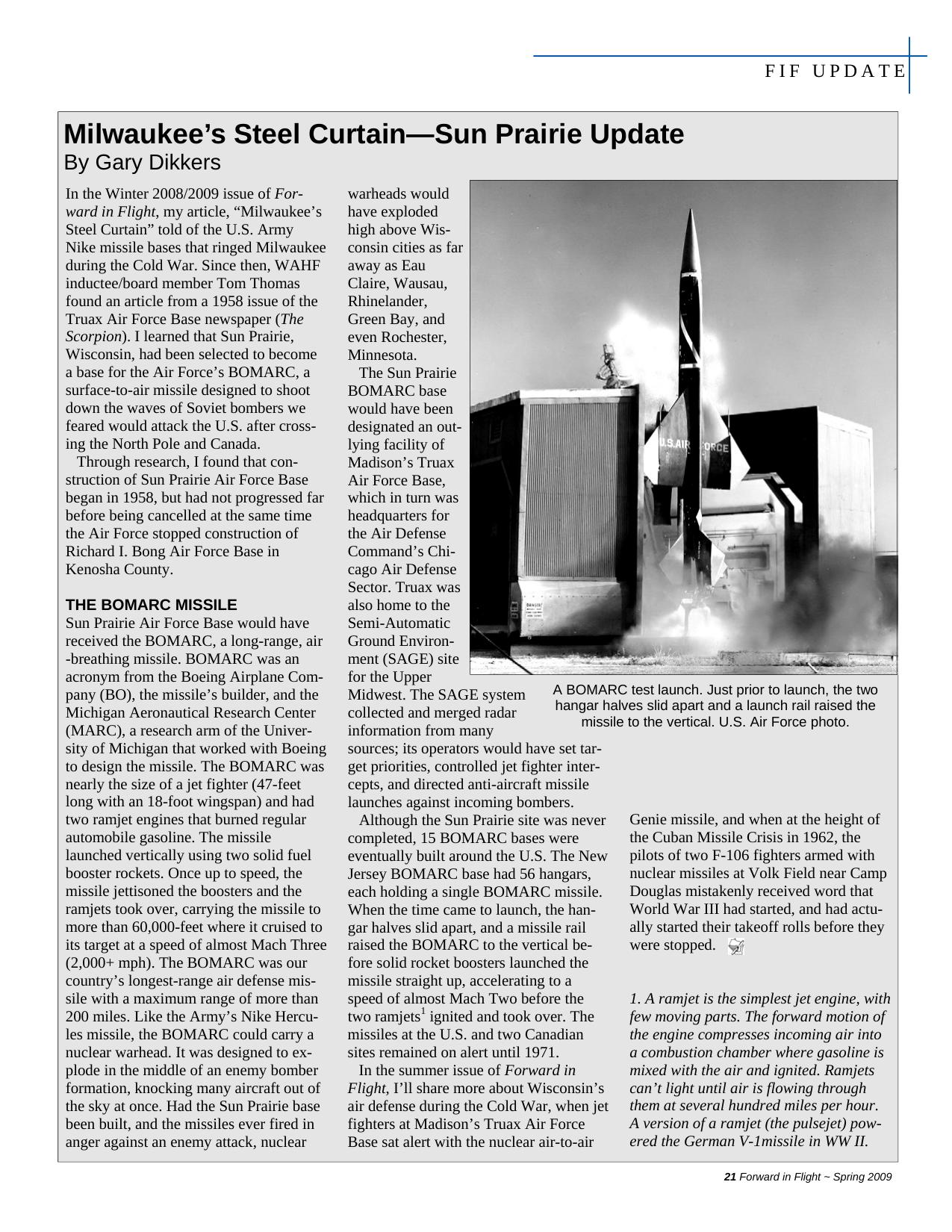
FIF UPDATE Milwaukee’s Steel Curtain—Sun Prairie Update By Gary Dikkers In the Winter 2008/2009 issue of Forward in Flight, my article, “Milwaukee’s Steel Curtain” told of the U.S. Army Nike missile bases that ringed Milwaukee during the Cold War. Since then, WAHF inductee/board member Tom Thomas found an article from a 1958 issue of the Truax Air Force Base newspaper (The Scorpion). I learned that Sun Prairie, Wisconsin, had been selected to become a base for the Air Force’s BOMARC, a surface-to-air missile designed to shoot down the waves of Soviet bombers we feared would attack the U.S. after crossing the North Pole and Canada. Through research, I found that construction of Sun Prairie Air Force Base began in 1958, but had not progressed far before being cancelled at the same time the Air Force stopped construction of Richard I. Bong Air Force Base in Kenosha County. THE BOMARC MISSILE Sun Prairie Air Force Base would have received the BOMARC, a long-range, air -breathing missile. BOMARC was an acronym from the Boeing Airplane Company (BO), the missile’s builder, and the Michigan Aeronautical Research Center (MARC), a research arm of the University of Michigan that worked with Boeing to design the missile. The BOMARC was nearly the size of a jet fighter (47-feet long with an 18-foot wingspan) and had two ramjet engines that burned regular automobile gasoline. The missile launched vertically using two solid fuel booster rockets. Once up to speed, the missile jettisoned the boosters and the ramjets took over, carrying the missile to more than 60,000-feet where it cruised to its target at a speed of almost Mach Three (2,000+ mph). The BOMARC was our country’s longest-range air defense missile with a maximum range of more than 200 miles. Like the Army’s Nike Hercules missile, the BOMARC could carry a nuclear warhead. It was designed to explode in the middle of an enemy bomber formation, knocking many aircraft out of the sky at once. Had the Sun Prairie base been built, and the missiles ever fired in anger against an enemy attack, nuclear warheads would have exploded high above Wisconsin cities as far away as Eau Claire, Wausau, Rhinelander, Green Bay, and even Rochester, Minnesota. The Sun Prairie BOMARC base would have been designated an outlying facility of Madison’s Truax Air Force Base, which in turn was headquarters for the Air Defense Command’s Chicago Air Defense Sector. Truax was also home to the Semi-Automatic Ground Environment (SAGE) site for the Upper A BOMARC test launch. Just prior to launch, the two Midwest. The SAGE system hangar halves slid apart and a launch rail raised the collected and merged radar missile to the vertical. U.S. Air Force photo. information from many sources; its operators would have set target priorities, controlled jet fighter intercepts, and directed anti-aircraft missile launches against incoming bombers. Genie missile, and when at the height of Although the Sun Prairie site was never the Cuban Missile Crisis in 1962, the completed, 15 BOMARC bases were eventually built around the U.S. The New pilots of two F-106 fighters armed with nuclear missiles at Volk Field near Camp Jersey BOMARC base had 56 hangars, Douglas mistakenly received word that each holding a single BOMARC missile. World War III had started, and had actuWhen the time came to launch, the hanally started their takeoff rolls before they gar halves slid apart, and a missile rail were stopped. raised the BOMARC to the vertical before solid rocket boosters launched the missile straight up, accelerating to a 1. A ramjet is the simplest jet engine, with speed of almost Mach Two before the few moving parts. The forward motion of two ramjets1 ignited and took over. The the engine compresses incoming air into missiles at the U.S. and two Canadian a combustion chamber where gasoline is sites remained on alert until 1971. mixed with the air and ignited. Ramjets In the summer issue of Forward in can’t light until air is flowing through Flight, I’ll share more about Wisconsin’s air defense during the Cold War, when jet them at several hundred miles per hour. A version of a ramjet (the pulsejet) powfighters at Madison’s Truax Air Force ered the German V-1missile in WW II. Base sat alert with the nuclear air-to-air 21 Forward in Flight ~ Spring 2009
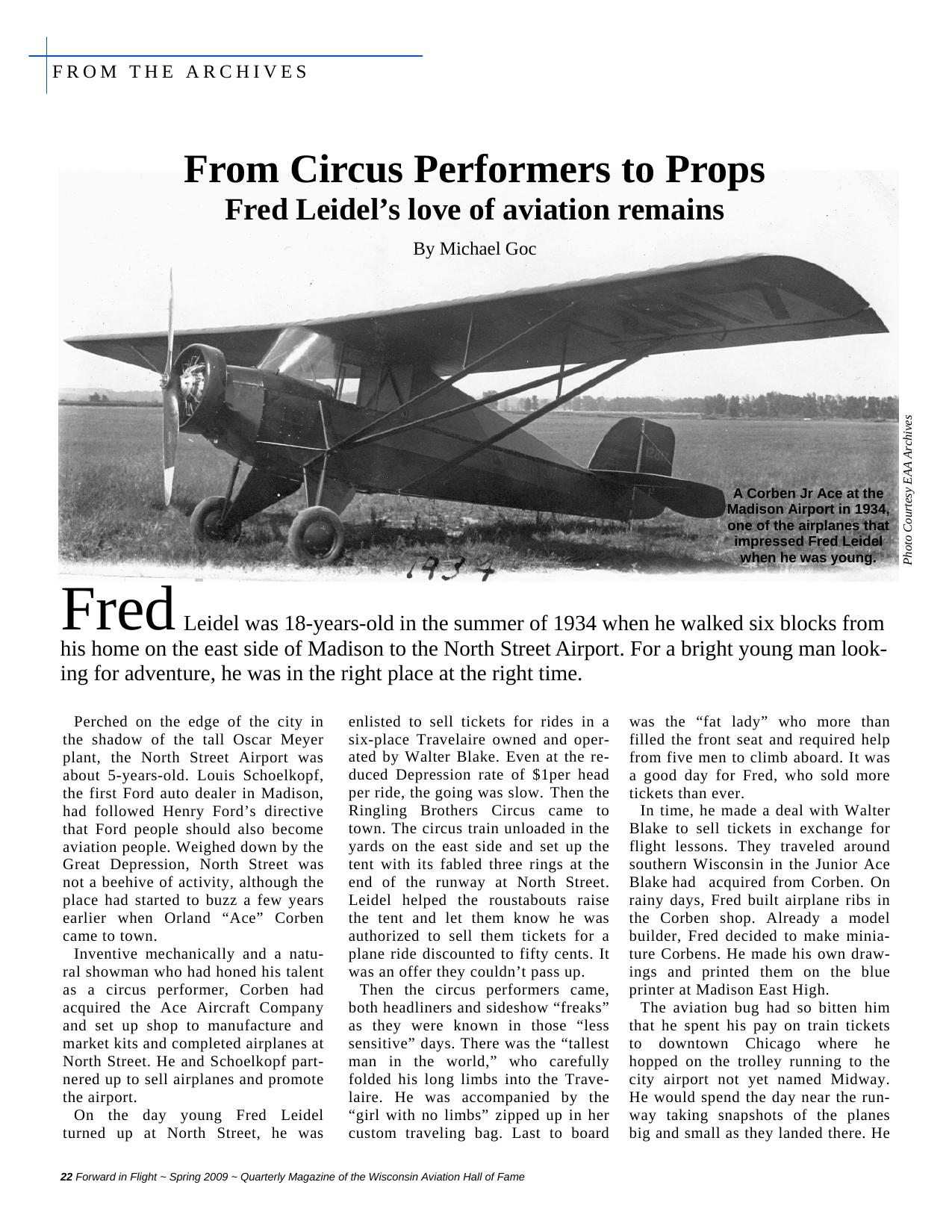
FROM THE ARCHIVES From Circus Performers to Props Fred Leidel’s love of aviation remains A Corben Jr Ace at the Madison Airport in 1934, one of the airplanes that impressed Fred Leidel when he was young. Fred Leidel was 18-years-old in the summer of 1934 when he walked six blocks from his home on the east side of Madison to the North Street Airport. For a bright young man looking for adventure, he was in the right place at the right time. Perched on the edge of the city in the shadow of the tall Oscar Meyer plant, the North Street Airport was about 5-years-old. Louis Schoelkopf, the first Ford auto dealer in Madison, had followed Henry Ford’s directive that Ford people should also become aviation people. Weighed down by the Great Depression, North Street was not a beehive of activity, although the place had started to buzz a few years earlier when Orland “Ace” Corben came to town. Inventive mechanically and a natural showman who had honed his talent as a circus performer, Corben had acquired the Ace Aircraft Company and set up shop to manufacture and market kits and completed airplanes at North Street. He and Schoelkopf partnered up to sell airplanes and promote the airport. On the day young Fred Leidel turned up at North Street, he was enlisted to sell tickets for rides in a six-place Travelaire owned and operated by Walter Blake. Even at the reduced Depression rate of $1per head per ride, the going was slow. Then the Ringling Brothers Circus came to town. The circus train unloaded in the yards on the east side and set up the tent with its fabled three rings at the end of the runway at North Street. Leidel helped the roustabouts raise the tent and let them know he was authorized to sell them tickets for a plane ride discounted to fifty cents. It was an offer they couldn’t pass up. Then the circus performers came, both headliners and sideshow “freaks” as they were known in those “less sensitive” days. There was the “tallest man in the world,” who carefully folded his long limbs into the Travelaire. He was accompanied by the “girl with no limbs” zipped up in her custom traveling bag. Last to board 22 Forward in Flight ~ Spring 2009 ~ Quarterly Magazine of the Wisconsin Aviation Hall of Fame was the “fat lady” who more than filled the front seat and required help from five men to climb aboard. It was a good day for Fred, who sold more tickets than ever. In time, he made a deal with Walter Blake to sell tickets in exchange for flight lessons. They traveled around southern Wisconsin in the Junior Ace Blake had acquired from Corben. On rainy days, Fred built airplane ribs in the Corben shop. Already a model builder, Fred decided to make miniature Corbens. He made his own drawings and printed them on the blue printer at Madison East High. The aviation bug had so bitten him that he spent his pay on train tickets to downtown Chicago where he hopped on the trolley running to the city airport not yet named Midway. He would spend the day near the runway taking snapshots of the planes big and small as they landed there. He Photo Courtesy EAA Archives By Michael Goc
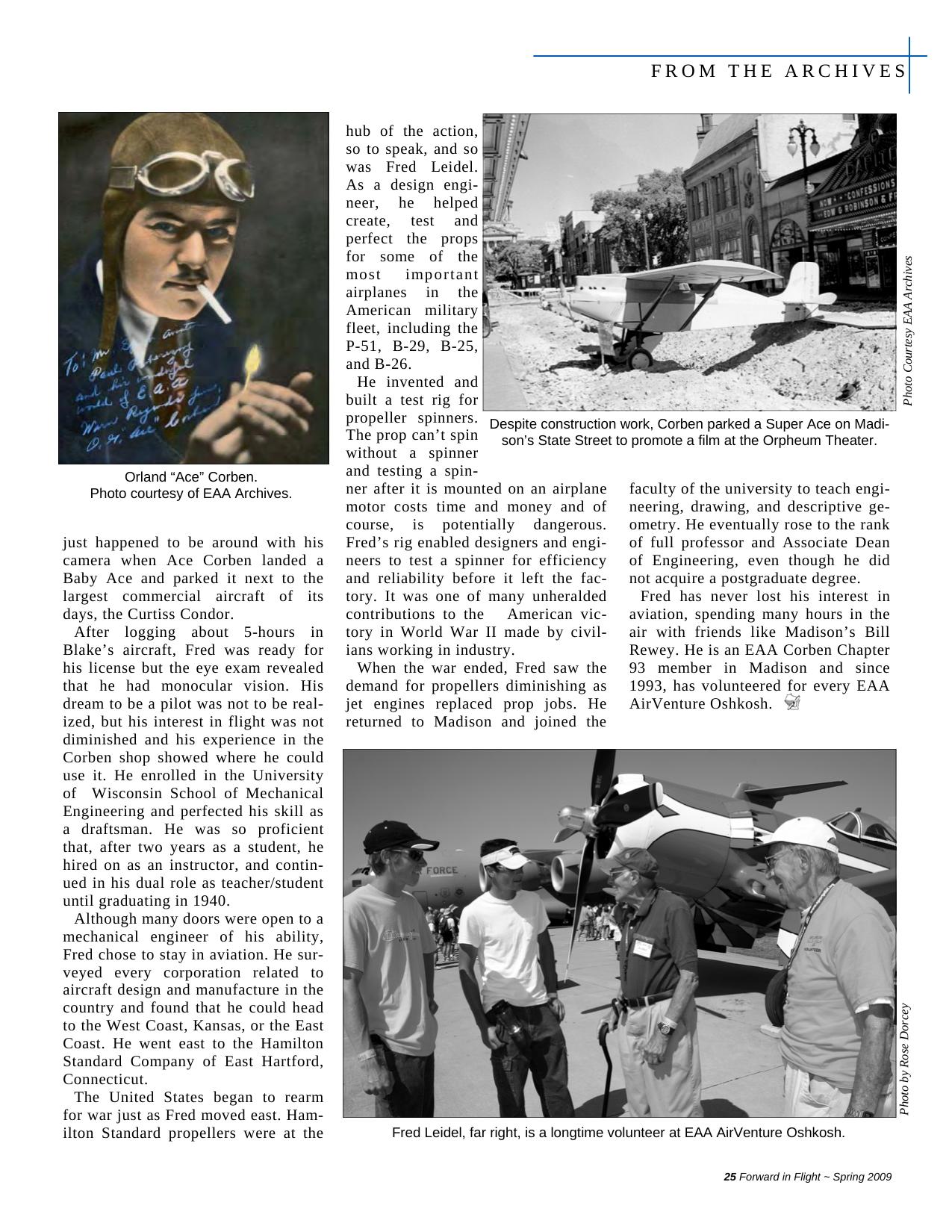
just happened to be around with his camera when Ace Corben landed a Baby Ace and parked it next to the largest commercial aircraft of its days, the Curtiss Condor. After logging about 5-hours in Blake’s aircraft, Fred was ready for his license but the eye exam revealed that he had monocular vision. His dream to be a pilot was not to be realized, but his interest in flight was not diminished and his experience in the Corben shop showed where he could use it. He enrolled in the University of Wisconsin School of Mechanical Engineering and perfected his skill as a draftsman. He was so proficient that, after two years as a student, he hired on as an instructor, and continued in his dual role as teacher/student until graduating in 1940. Although many doors were open to a mechanical engineer of his ability, Fred chose to stay in aviation. He surveyed every corporation related to aircraft design and manufacture in the country and found that he could head to the West Coast, Kansas, or the East Coast. He went east to the Hamilton Standard Company of East Hartford, Connecticut. The United States began to rearm for war just as Fred moved east. Hamilton Standard propellers were at the Photo by Rose Dorcey Orland “Ace” Corben. Photo courtesy of EAA Archives. hub of the action, so to speak, and so was Fred Leidel. As a design engineer, he helped create, test and perfect the props for some of the most imp ortant airplanes in the American military fleet, including the P-51, B-29, B-25, and B-26. He invented and built a test rig for propeller spinners. Despite construction work, Corben parked a Super Ace on MadiThe prop can’t spin son’s State Street to promote a film at the Orpheum Theater. without a spinner and testing a spinner after it is mounted on an airplane faculty of the university to teach engimotor costs time and money and of neering, drawing, and descriptive gecourse, is potentially dangerous. ometry. He eventually rose to the rank Fred’s rig enabled designers and engi- of full professor and Associate Dean neers to test a spinner for efficiency of Engineering, even though he did and reliability before it left the fac- not acquire a postgraduate degree. tory. It was one of many unheralded Fred has never lost his interest in contributions to the American vic- aviation, spending many hours in the tory in World War II made by civil- air with friends like Madison’s Bill ians working in industry. Rewey. He is an EAA Corben Chapter When the war ended, Fred saw the 93 member in Madison and since demand for propellers diminishing as 1993, has volunteered for every EAA jet engines replaced prop jobs. He AirVenture Oshkosh. returned to Madison and joined the Photo Courtesy EAA Archives FROM THE ARCHIVES Fred Leidel, far right, is a longtime volunteer at EAA AirVenture Oshkosh. 25 Forward in Flight ~ Spring 2009
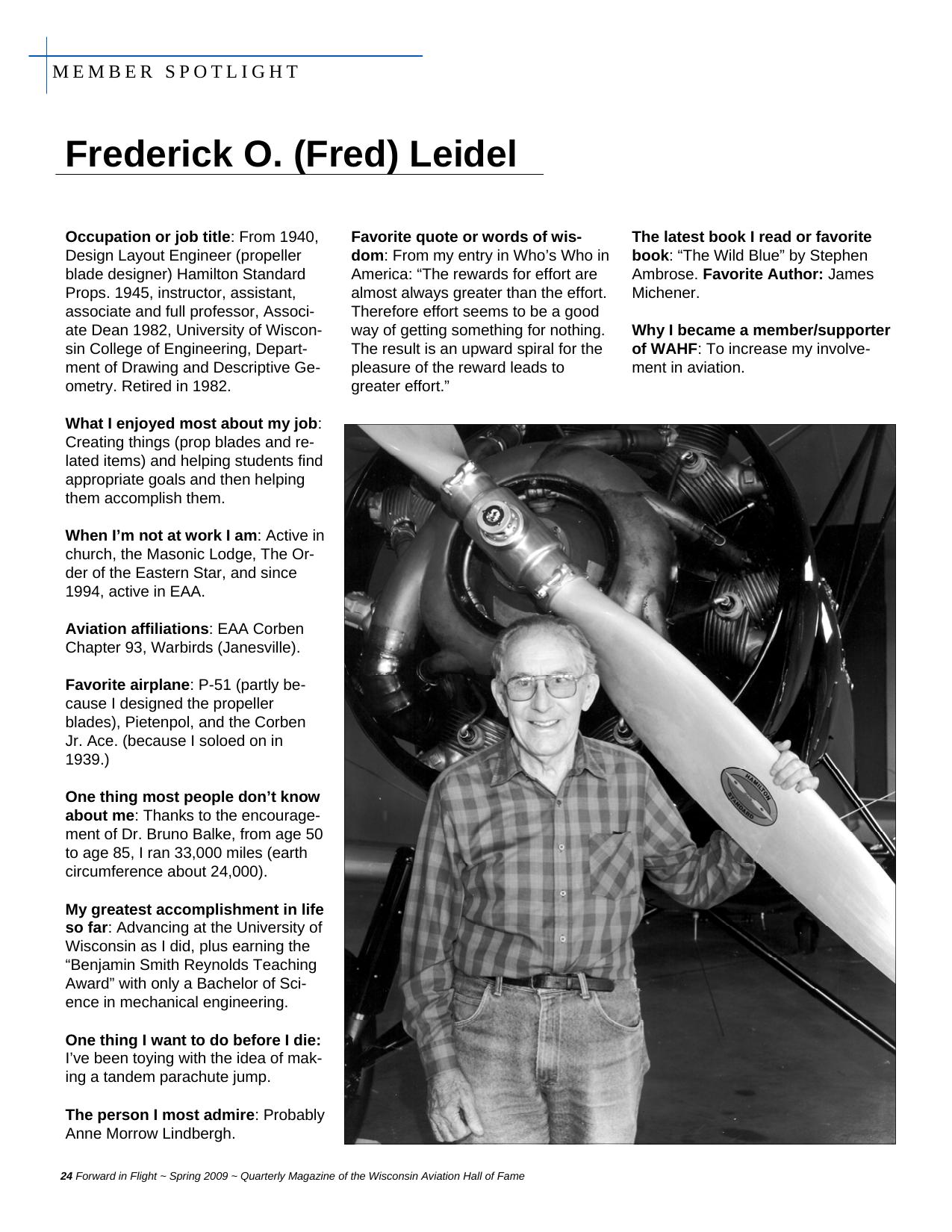
MEMBER SPOTLIGHT Frederick O. (Fred) Leidel Occupation or job title: From 1940, Design Layout Engineer (propeller blade designer) Hamilton Standard Props. 1945, instructor, assistant, associate and full professor, Associate Dean 1982, University of Wisconsin College of Engineering, Department of Drawing and Descriptive Geometry. Retired in 1982. Favorite quote or words of wisdom: From my entry in Who’s Who in America: “The rewards for effort are almost always greater than the effort. Therefore effort seems to be a good way of getting something for nothing. The result is an upward spiral for the pleasure of the reward leads to greater effort.” What I enjoyed most about my job: Creating things (prop blades and related items) and helping students find appropriate goals and then helping them accomplish them. When I’m not at work I am: Active in church, the Masonic Lodge, The Order of the Eastern Star, and since 1994, active in EAA. Aviation affiliations: EAA Corben Chapter 93, Warbirds (Janesville). Favorite airplane: P-51 (partly because I designed the propeller blades), Pietenpol, and the Corben Jr. Ace. (because I soloed on in 1939.) One thing most people don’t know about me: Thanks to the encouragement of Dr. Bruno Balke, from age 50 to age 85, I ran 33,000 miles (earth circumference about 24,000). My greatest accomplishment in life so far: Advancing at the University of Wisconsin as I did, plus earning the “Benjamin Smith Reynolds Teaching Award” with only a Bachelor of Science in mechanical engineering. One thing I want to do before I die: I’ve been toying with the idea of making a tandem parachute jump. The person I most admire: Probably Anne Morrow Lindbergh. 24 Forward in Flight ~ Spring 2009 ~ Quarterly Magazine of the Wisconsin Aviation Hall of Fame The latest book I read or favorite book: “The Wild Blue” by Stephen Ambrose. Favorite Author: James Michener. Why I became a member/supporter of WAHF: To increase my involvement in aviation.
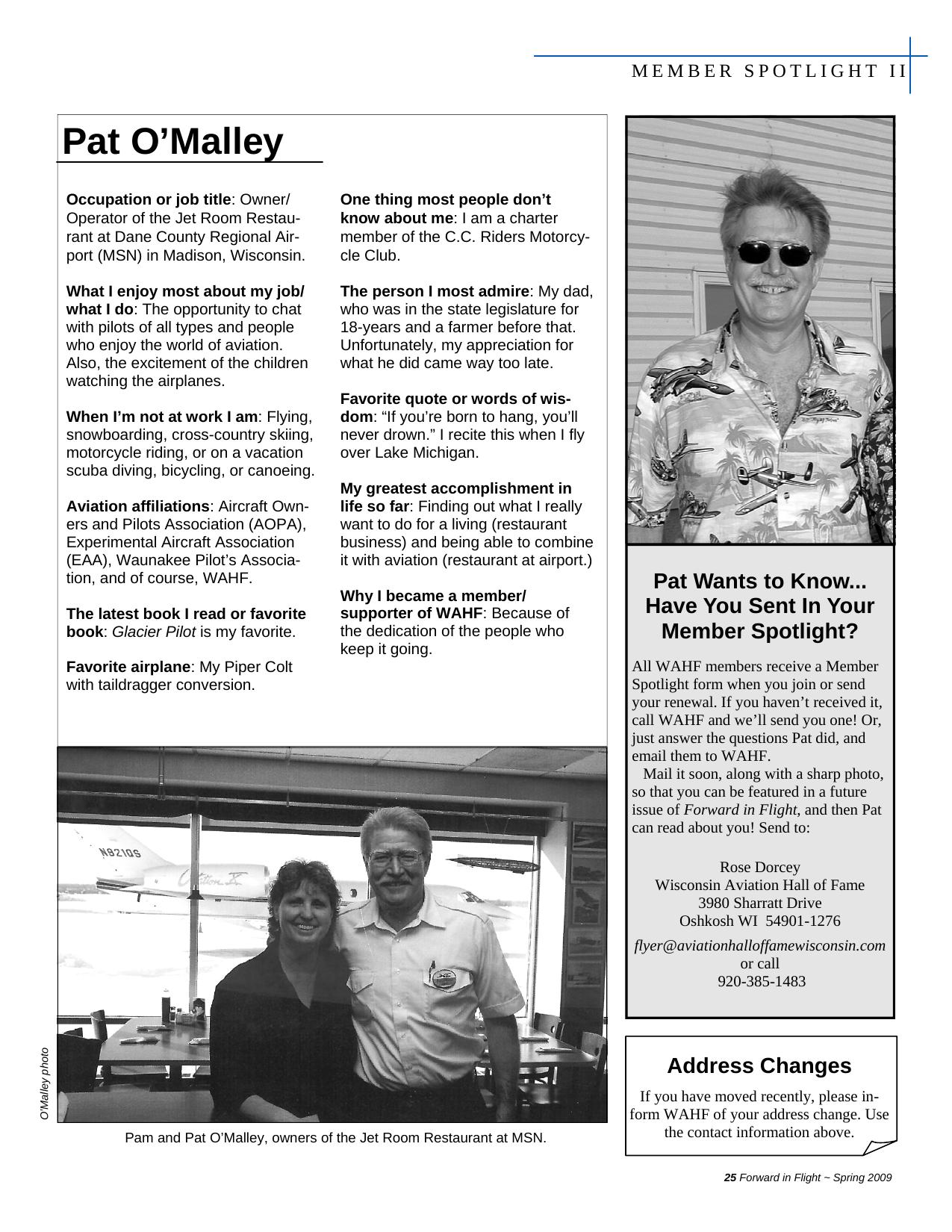
MEMBER SPOTLIGHT II Pat O’Malley Occupation or job title: Owner/ Operator of the Jet Room Restaurant at Dane County Regional Airport (MSN) in Madison, Wisconsin. One thing most people don’t know about me: I am a charter member of the C.C. Riders Motorcycle Club. What I enjoy most about my job/ what I do: The opportunity to chat with pilots of all types and people who enjoy the world of aviation. Also, the excitement of the children watching the airplanes. The person I most admire: My dad, who was in the state legislature for 18-years and a farmer before that. Unfortunately, my appreciation for what he did came way too late. When I’m not at work I am: Flying, snowboarding, cross-country skiing, motorcycle riding, or on a vacation scuba diving, bicycling, or canoeing. Aviation affiliations: Aircraft Owners and Pilots Association (AOPA), Experimental Aircraft Association (EAA), Waunakee Pilot’s Association, and of course, WAHF. The latest book I read or favorite book: Glacier Pilot is my favorite. Favorite quote or words of wisdom: “If you’re born to hang, you’ll never drown.” I recite this when I fly over Lake Michigan. My greatest accomplishment in life so far: Finding out what I really want to do for a living (restaurant business) and being able to combine it with aviation (restaurant at airport.) Why I became a member/ supporter of WAHF: Because of the dedication of the people who keep it going. Favorite airplane: My Piper Colt with taildragger conversion. Pat Wants to Know... Have You Sent In Your Member Spotlight? All WAHF members receive a Member Spotlight form when you join or send your renewal. If you haven’t received it, call WAHF and we’ll send you one! Or, just answer the questions Pat did, and email them to WAHF. Mail it soon, along with a sharp photo, so that you can be featured in a future issue of Forward in Flight, and then Pat can read about you! Send to: Rose Dorcey Wisconsin Aviation Hall of Fame 3980 Sharratt Drive Oshkosh WI 54901-1276 O’Malley photo flyer@aviationhalloffamewisconsin.com or call 920-385-1483 Address Changes Pam and Pat O’Malley, owners of the Jet Room Restaurant at MSN. If you have moved recently, please inform WAHF of your address change. Use the contact information above. 25 Forward in Flight ~ Spring 2009
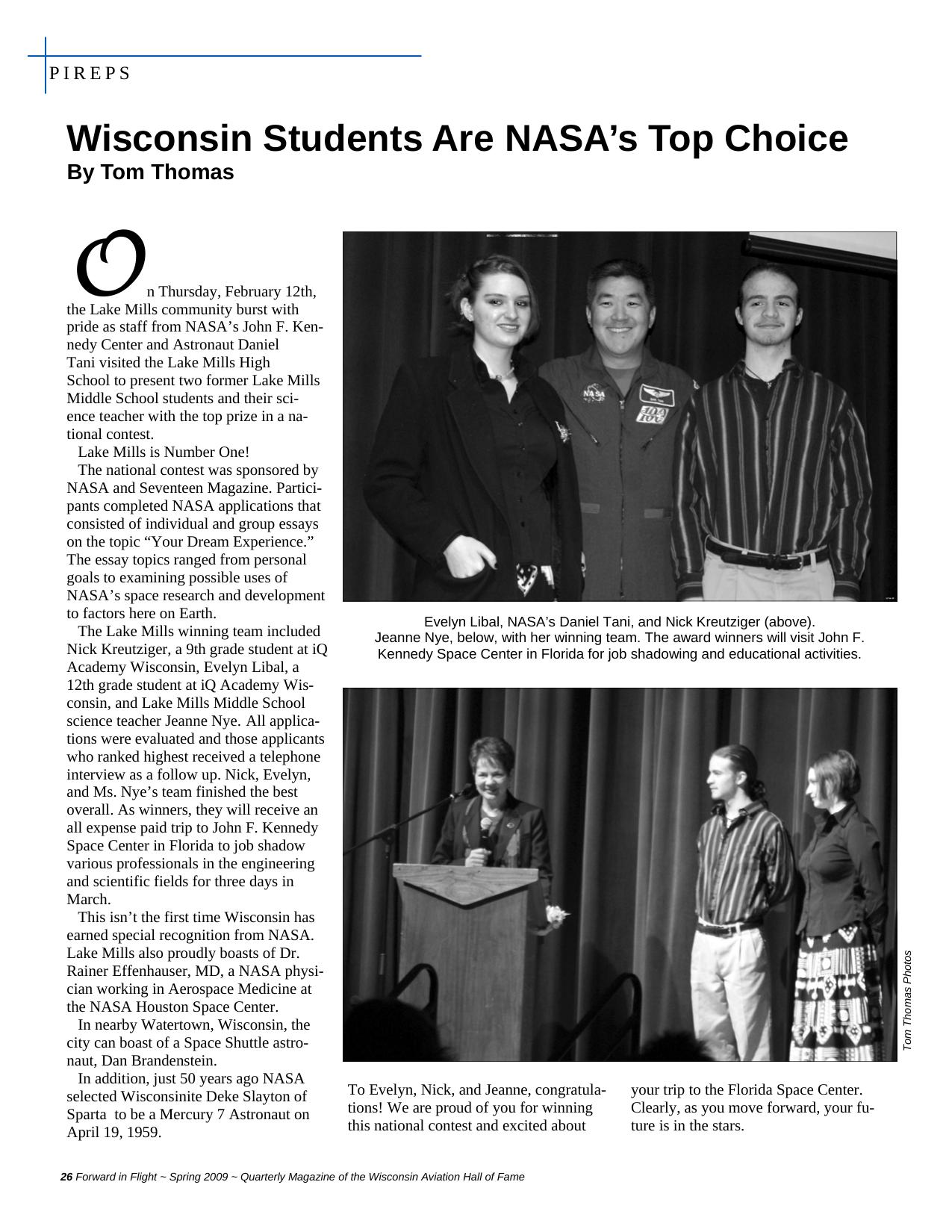
PIREPS Wisconsin Students Are NASA’s Top Choice By Tom Thomas O Evelyn Libal, NASA’s Daniel Tani, and Nick Kreutziger (above). Jeanne Nye, below, with her winning team. The award winners will visit John F. Kennedy Space Center in Florida for job shadowing and educational activities. Tom Thomas Photos n Thursday, February 12th, the Lake Mills community burst with pride as staff from NASA’s John F. Kennedy Center and Astronaut Daniel Tani visited the Lake Mills High School to present two former Lake Mills Middle School students and their science teacher with the top prize in a national contest. Lake Mills is Number One! The national contest was sponsored by NASA and Seventeen Magazine. Participants completed NASA applications that consisted of individual and group essays on the topic “Your Dream Experience.” The essay topics ranged from personal goals to examining possible uses of NASA’s space research and development to factors here on Earth. The Lake Mills winning team included Nick Kreutziger, a 9th grade student at iQ Academy Wisconsin, Evelyn Libal, a 12th grade student at iQ Academy Wisconsin, and Lake Mills Middle School science teacher Jeanne Nye. All applications were evaluated and those applicants who ranked highest received a telephone interview as a follow up. Nick, Evelyn, and Ms. Nye’s team finished the best overall. As winners, they will receive an all expense paid trip to John F. Kennedy Space Center in Florida to job shadow various professionals in the engineering and scientific fields for three days in March. This isn’t the first time Wisconsin has earned special recognition from NASA. Lake Mills also proudly boasts of Dr. Rainer Effenhauser, MD, a NASA physician working in Aerospace Medicine at the NASA Houston Space Center. In nearby Watertown, Wisconsin, the city can boast of a Space Shuttle astronaut, Dan Brandenstein. In addition, just 50 years ago NASA selected Wisconsinite Deke Slayton of Sparta to be a Mercury 7 Astronaut on April 19, 1959. To Evelyn, Nick, and Jeanne, congratulations! We are proud of you for winning this national contest and excited about 26 Forward in Flight ~ Spring 2009 ~ Quarterly Magazine of the Wisconsin Aviation Hall of Fame your trip to the Florida Space Center. Clearly, as you move forward, your future is in the stars.
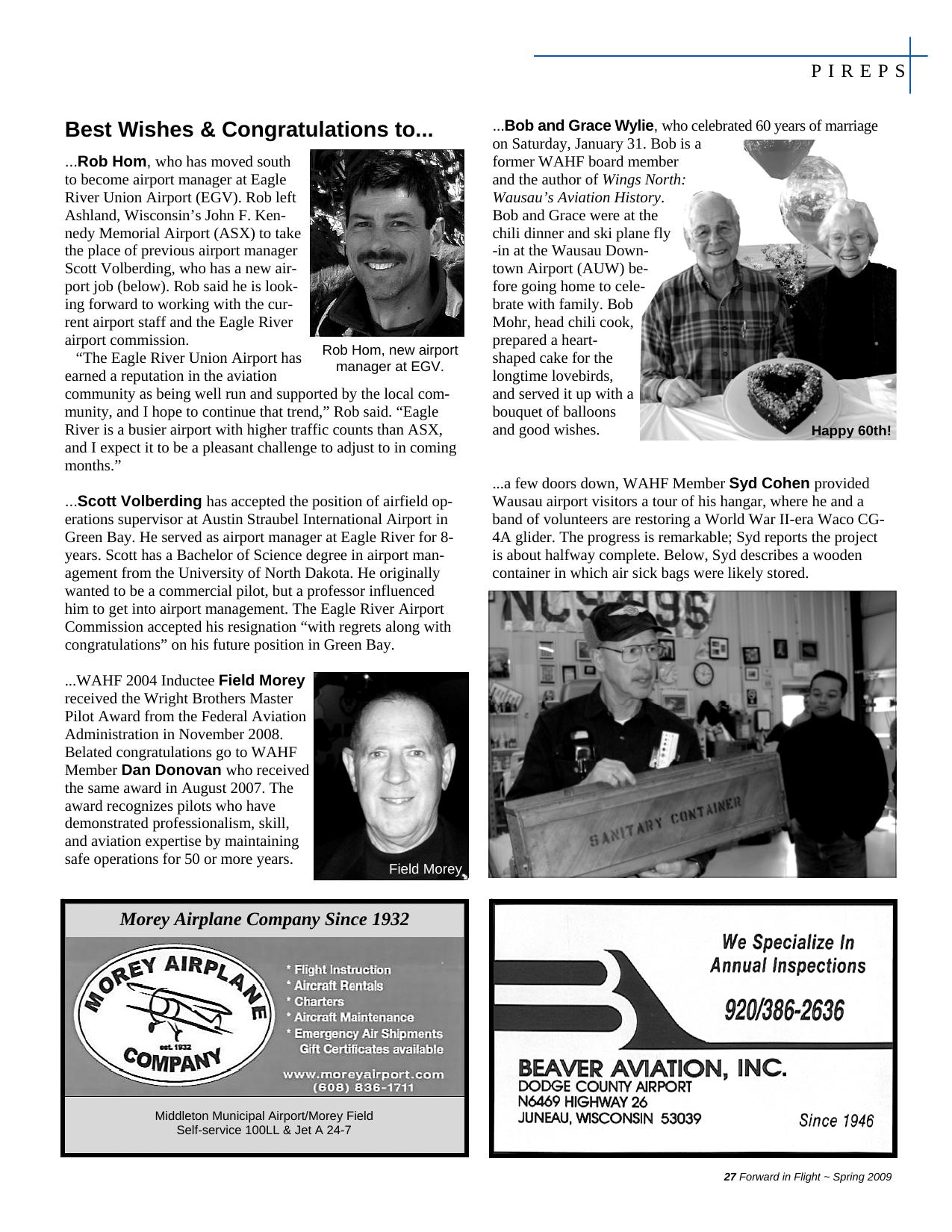
PIREPS Best Wishes & Congratulations to... ...Rob Hom, who has moved south to become airport manager at Eagle River Union Airport (EGV). Rob left Ashland, Wisconsin’s John F. Kennedy Memorial Airport (ASX) to take the place of previous airport manager Scott Volberding, who has a new airport job (below). Rob said he is looking forward to working with the current airport staff and the Eagle River airport commission. Rob Hom, new airport “The Eagle River Union Airport has manager at EGV. earned a reputation in the aviation community as being well run and supported by the local community, and I hope to continue that trend,” Rob said. “Eagle River is a busier airport with higher traffic counts than ASX, and I expect it to be a pleasant challenge to adjust to in coming months.” ...Scott Volberding has accepted the position of airfield operations supervisor at Austin Straubel International Airport in Green Bay. He served as airport manager at Eagle River for 8years. Scott has a Bachelor of Science degree in airport management from the University of North Dakota. He originally wanted to be a commercial pilot, but a professor influenced him to get into airport management. The Eagle River Airport Commission accepted his resignation “with regrets along with congratulations” on his future position in Green Bay. ...WAHF 2004 Inductee Field Morey received the Wright Brothers Master Pilot Award from the Federal Aviation Administration in November 2008. Belated congratulations go to WAHF Member Dan Donovan who received the same award in August 2007. The award recognizes pilots who have demonstrated professionalism, skill, and aviation expertise by maintaining safe operations for 50 or more years. ...Bob and Grace Wylie, who celebrated 60 years of marriage on Saturday, January 31. Bob is a former WAHF board member and the author of Wings North: Wausau’s Aviation History. Bob and Grace were at the chili dinner and ski plane fly -in at the Wausau Downtown Airport (AUW) before going home to celebrate with family. Bob Mohr, head chili cook, prepared a heartshaped cake for the longtime lovebirds, and served it up with a bouquet of balloons and good wishes. Happy 60th! ...a few doors down, WAHF Member Syd Cohen provided Wausau airport visitors a tour of his hangar, where he and a band of volunteers are restoring a World War II-era Waco CG4A glider. The progress is remarkable; Syd reports the project is about halfway complete. Below, Syd describes a wooden container in which air sick bags were likely stored. Field Morey Morey Airplane Company Since 1932 Middleton Municipal Airport/Morey Field Self-service 100LL & Jet A 24-7 27 Forward in Flight ~ Spring 2009
FROM THE AIRWAYS Wisconsin Aviation Conference Learn TAFs with Aviation Tutorials Midwest Sport Named Flightmaster Distributor The 54th Annual Wisconsin Aviation Conference will be held May 4-6, 2009 at the Ramada Inn Convention Center in Eau Claire, Wisconsin. The conference is cosponsored by the Wisconsin Airport Management Association, Wisconsin Aviation Trades Association, the Wisconsin Business Aviation Association, and consultants and suppliers. The conference will feature educational sessions, exhibits, award presentations, and more. For more information, visit www.Wiama.org. Aviation Tutorials Company, LLC has released Weather Statement Groundschool 3.0, an interactive course on METARs, TAFs, and Pilot Reports, available on CD-ROM or by computer download. Nearly 3 hours of interactive training is provided, with a focus on the new 30-hour TAF weather forecasts that became effective in November 2008. Weather Statement Groundschool 3.0 promotes learning through interaction— not just rote memorization, featuring interactive weather controls that enable the user to “control the weather.” For example, the user can specify wind speed, gust factor, direction, and other variables, and then view how the weather statement displays this information. Visit www.AviationTutorials.com, or call the Franklin, Wisconsin, based company at 414-525-8005. Midwest Sport Aviation, LLC, based at Richland Airport (93C) in Richland Center, Wisconsin, has been named the exclusive worldwide distributor of FlightMaster Aviation GPS Software that works on Palm OS-based devices such as Palm TX, Treo phones, and Palm Centro phones. As a result of this agreement, the AeroPalm brand Midwest Sport has been marketing will be discontinued. The company will continue to support existing AeroPalm customers and will provide a free migration for those who switch to FlightMaster. Features include terrain and conflict display, configurable maps and timers, voice commands, HIS, turn anticipation, waypoint search, and more. Learn more by calling 608-467-0233 or visit www.FlightMaster.aero or www.MWSportAviation.com. Advanced Composite MT Propellers Now Available at Knot’s2U Flight Resource, LLC; a distributor of MT Propellers, has named Knots2U, Ltd., Burlington, Wisconsin, as an authorized sales representative for its composite MT Propeller STCs. “Flight Resource is pleased to have Knots2U join our sales network for the MT Propellers,” said John Nielsen, Flight Resource’s Senior Partner. “In joining forces, Flight Resource and Knots2U will be able to continue to improve the speed and efficiency of Beech, Cessna, and Piper aircraft and bring even more utility to their owners and pilots.” Knot’s2U has long been a supplier of STCs and PMAd parts and equipment. The company currently has more than 70 STC modifications and more than 30,000 kits installed worldwide. “Now, our customers have access to an even larger variety of the excellent advanced technology available in the marketplace today,” said John Bailey, Knot’s2U general manager. “Everyone is looking to improve their bottom line, and pilots are no exception,” Neilson added. “We look forward to a long and rewarding relationship with Knots2U in providing pilots more opportunities for a more efficient aircraft.” Learn more at www.Flight-Resource.com. Free Movie Night: The Blue Max at Aviation Heritage Center The Aviation Heritage Center of Sheboygan County is sponsoring a free movie night on Friday, March 13. The Blue Max will play on the Center’s 36-foot wide screen. The SHARKS (Sheboygan Area Radio Kontrol Society) will provide pre-movie entertainment with expert indoor flying demonstrations. Doors open at 6:30 p.m. A local historian will introduce the film and provide interesting film facts at 7 p.m. The hangar is climate controlled for your comfort and freshly popped popcorn, candy, and soda will be available for purchase. Call Lorri at 920-467-2043, email Lorri.R@SheboyganAviation.com or visit www.SheboyganAviation.com for more information. 28 Forward in Flight ~ Spring 2009 ~ Quarterly Magazine of the Wisconsin Aviation Hall of Fame
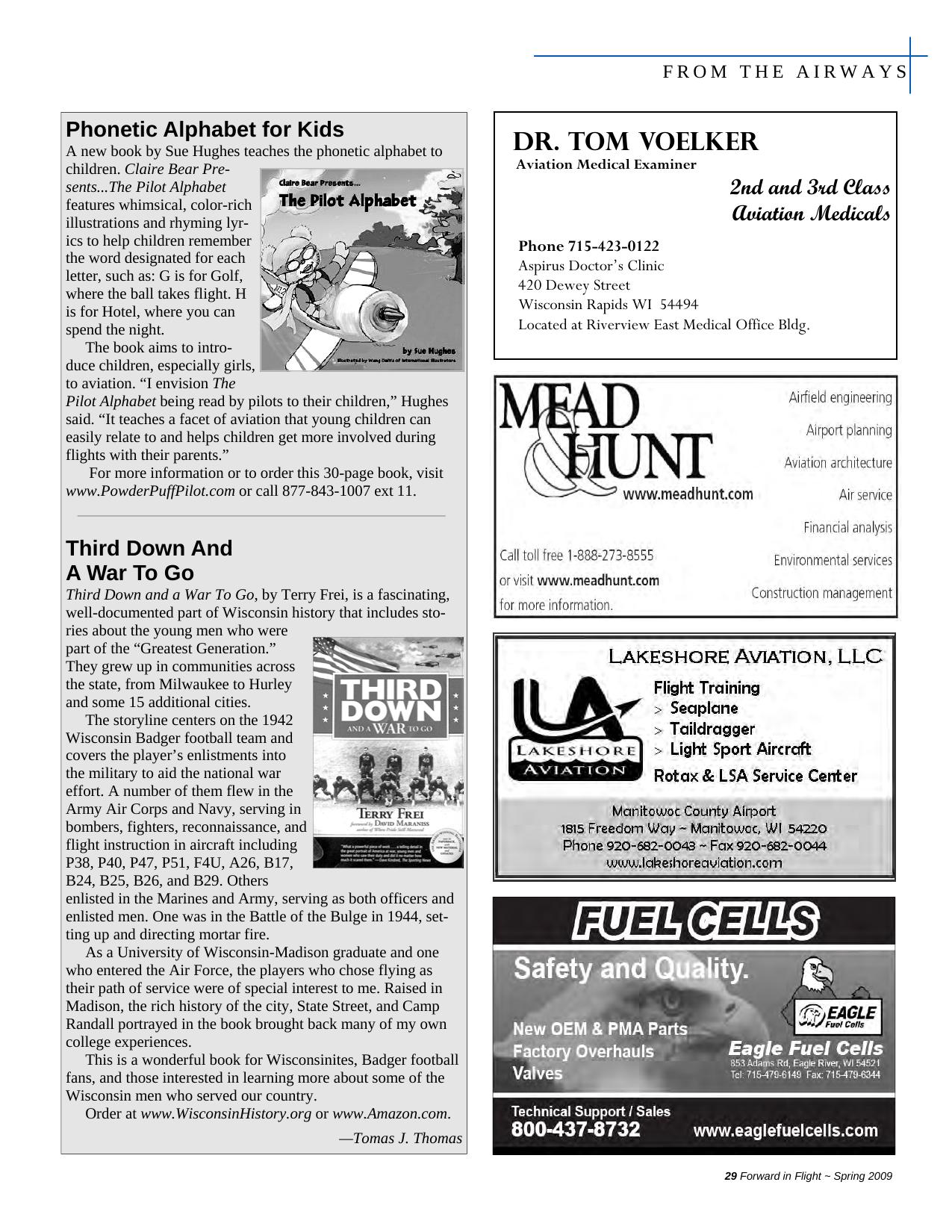
FROM THE AIRWAYS Phonetic Alphabet for Kids A new book by Sue Hughes teaches the phonetic alphabet to children. Claire Bear Presents...The Pilot Alphabet features whimsical, color-rich illustrations and rhyming lyrics to help children remember the word designated for each letter, such as: G is for Golf, where the ball takes flight. H is for Hotel, where you can spend the night. The book aims to introduce children, especially girls, to aviation. “I envision The Pilot Alphabet being read by pilots to their children,” Hughes said. “It teaches a facet of aviation that young children can easily relate to and helps children get more involved during flights with their parents.” For more information or to order this 30-page book, visit www.PowderPuffPilot.com or call 877-843-1007 ext 11. DR. TOM VOELKER Aviation Medical Examiner 2nd and 3rd Class Aviation Medicals Phone 715-423-0122 Aspirus Doctor’s Clinic 420 Dewey Street Wisconsin Rapids WI 54494 Located at Riverview East Medical Office Bldg. Third Down And A War To Go Third Down and a War To Go, by Terry Frei, is a fascinating, well-documented part of Wisconsin history that includes stories about the young men who were part of the “Greatest Generation.” They grew up in communities across the state, from Milwaukee to Hurley and some 15 additional cities. The storyline centers on the 1942 Wisconsin Badger football team and covers the player’s enlistments into the military to aid the national war effort. A number of them flew in the Army Air Corps and Navy, serving in bombers, fighters, reconnaissance, and flight instruction in aircraft including P38, P40, P47, P51, F4U, A26, B17, B24, B25, B26, and B29. Others enlisted in the Marines and Army, serving as both officers and enlisted men. One was in the Battle of the Bulge in 1944, setting up and directing mortar fire. As a University of Wisconsin-Madison graduate and one who entered the Air Force, the players who chose flying as their path of service were of special interest to me. Raised in Madison, the rich history of the city, State Street, and Camp Randall portrayed in the book brought back many of my own college experiences. This is a wonderful book for Wisconsinites, Badger football fans, and those interested in learning more about some of the Wisconsin men who served our country. Order at www.WisconsinHistory.org or www.Amazon.com. —Tomas J. Thomas 29 Forward in Flight ~ Spring 2009
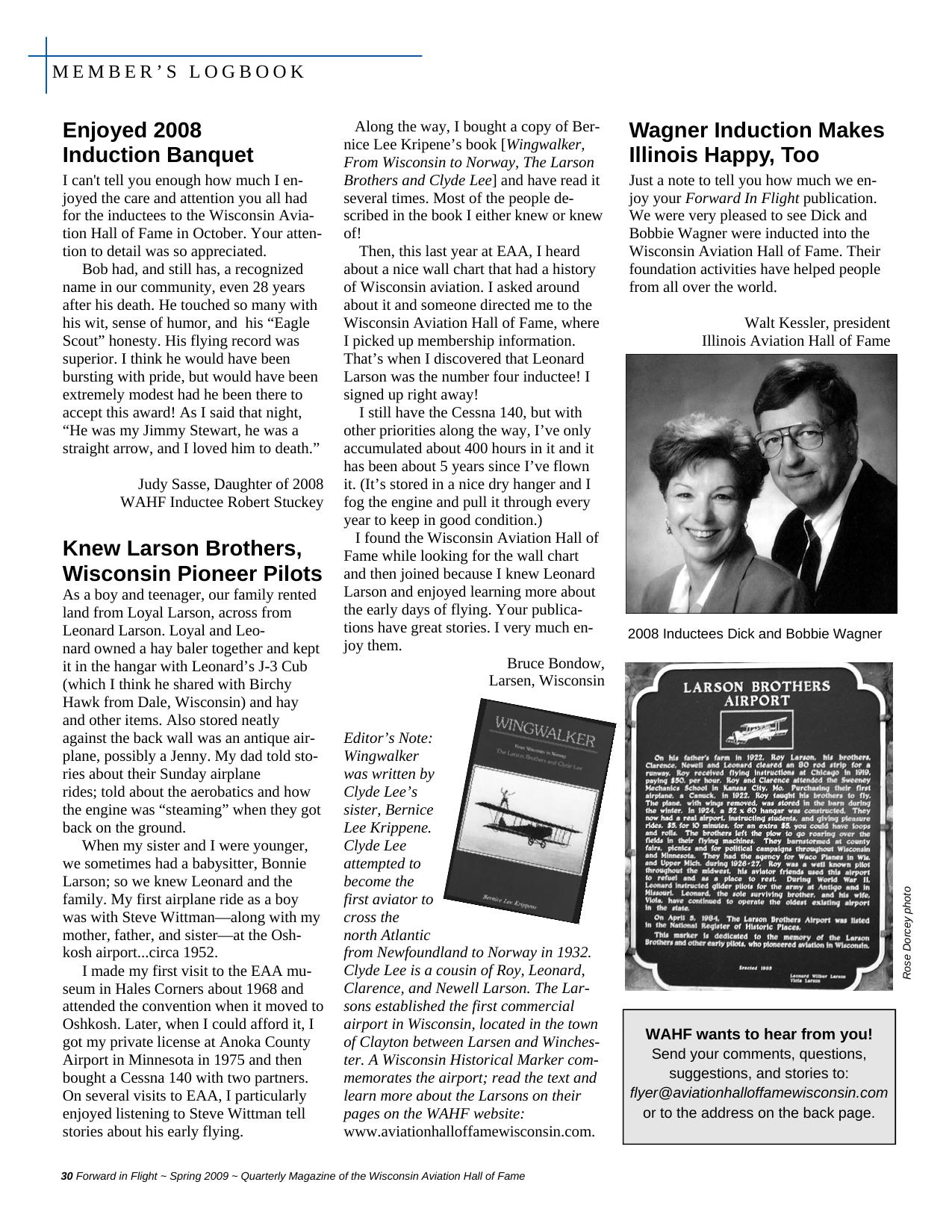
MEMBER’S LOGBOOK I can't tell you enough how much I enjoyed the care and attention you all had for the inductees to the Wisconsin Aviation Hall of Fame in October. Your attention to detail was so appreciated. Bob had, and still has, a recognized name in our community, even 28 years after his death. He touched so many with his wit, sense of humor, and his “Eagle Scout” honesty. His flying record was superior. I think he would have been bursting with pride, but would have been extremely modest had he been there to accept this award! As I said that night, “He was my Jimmy Stewart, he was a straight arrow, and I loved him to death.” Judy Sasse, Daughter of 2008 WAHF Inductee Robert Stuckey Knew Larson Brothers, Wisconsin Pioneer Pilots As a boy and teenager, our family rented land from Loyal Larson, across from Leonard Larson. Loyal and Leonard owned a hay baler together and kept it in the hangar with Leonard’s J-3 Cub (which I think he shared with Birchy Hawk from Dale, Wisconsin) and hay and other items. Also stored neatly against the back wall was an antique airplane, possibly a Jenny. My dad told stories about their Sunday airplane rides; told about the aerobatics and how the engine was “steaming” when they got back on the ground. When my sister and I were younger, we sometimes had a babysitter, Bonnie Larson; so we knew Leonard and the family. My first airplane ride as a boy was with Steve Wittman—along with my mother, father, and sister—at the Oshkosh airport...circa 1952. I made my first visit to the EAA museum in Hales Corners about 1968 and attended the convention when it moved to Oshkosh. Later, when I could afford it, I got my private license at Anoka County Airport in Minnesota in 1975 and then bought a Cessna 140 with two partners. On several visits to EAA, I particularly enjoyed listening to Steve Wittman tell stories about his early flying. Along the way, I bought a copy of Bernice Lee Kripene’s book [Wingwalker, From Wisconsin to Norway, The Larson Brothers and Clyde Lee] and have read it several times. Most of the people described in the book I either knew or knew of! Then, this last year at EAA, I heard about a nice wall chart that had a history of Wisconsin aviation. I asked around about it and someone directed me to the Wisconsin Aviation Hall of Fame, where I picked up membership information. That’s when I discovered that Leonard Larson was the number four inductee! I signed up right away! I still have the Cessna 140, but with other priorities along the way, I’ve only accumulated about 400 hours in it and it has been about 5 years since I’ve flown it. (It’s stored in a nice dry hanger and I fog the engine and pull it through every year to keep in good condition.) I found the Wisconsin Aviation Hall of Fame while looking for the wall chart and then joined because I knew Leonard Larson and enjoyed learning more about the early days of flying. Your publications have great stories. I very much enjoy them. Bruce Bondow, Larsen, Wisconsin Editor’s Note: Wingwalker was written by Clyde Lee’s sister, Bernice Lee Krippene. Clyde Lee attempted to become the first aviator to cross the north Atlantic from Newfoundland to Norway in 1932. Clyde Lee is a cousin of Roy, Leonard, Clarence, and Newell Larson. The Larsons established the first commercial airport in Wisconsin, located in the town of Clayton between Larsen and Winchester. A Wisconsin Historical Marker commemorates the airport; read the text and learn more about the Larsons on their pages on the WAHF website: www.aviationhalloffamewisconsin.com. 30 Forward in Flight ~ Spring 2009 ~ Quarterly Magazine of the Wisconsin Aviation Hall of Fame Wagner Induction Makes Illinois Happy, Too Just a note to tell you how much we enjoy your Forward In Flight publication. We were very pleased to see Dick and Bobbie Wagner were inducted into the Wisconsin Aviation Hall of Fame. Their foundation activities have helped people from all over the world. Walt Kessler, president Illinois Aviation Hall of Fame 2008 Inductees Dick and Bobbie Wagner Rose Dorcey photo Enjoyed 2008 Induction Banquet WAHF wants to hear from you! Send your comments, questions, suggestions, and stories to: flyer@aviationhalloffamewisconsin.com or to the address on the back page.
MEMBERSHIP MATTERS Renewal Reminder! New Twist To ’09 Membership Renewal Effort WAHF Creates Blog—Share Your Wisconsin Aviation Stories What? There are still a few WAHF members who haven’t sent renewals? Good heavens, we need to get them current again! This year has never been a better year to be a supporter of WAHF, due to the prize-winning opportunities 2009 brings. We know you send in your $20 every year because you believe in and support the mission of the Wisconsin Aviation Hall of Fame, which is to collect, preserve, and share Wisconsin aviation history. We know you want to be a part of an organization that recognizes men and women for their outstanding contributions to aviation. We know that you don’t want to miss an issue of Forward in Flight, WAHF’s quarterly magazine that has become so popular because of your kind words and contributions. We also know you don’t support WAHF for a chance to win prizes...but this year, if you’re current, your name will be in a drawing to win some nifty prizes anyway. WAHF has put together a Wisconsin Centennial of Flight Member Reward Program that includes all current members. Read more about it on page 5, and then fill out the form below and get your renewal sent in! Good luck and thank you. Interaction, discussion, and sharing are the goals. WAHF has joined the blogging world—and you should be a part of it. The Wisconsin Aviation History blog was created so that WAHF members and friends can share stories about their aviation memories—whether recent, or not so recent. Tell us about your role in aviation, and read about the roles of others. Bloggers are invited to comment on postings of others and to share their own stories by sending them to WAHF for posting. It’s easy...Links are provided on the blog page that allow you to comment or send an email. Visit the blog soon to start interacting with aviation fans...you don’t have to be a pilot to join in and almost any aviation topic is appropriate. If you have an interest in aviation, from today or yesterday, we want to hear from you. Ask your friends to become WAHF supporters. Give them the form below, or visit: www.aviationhalloffamewisconsin.com Advertise in Forward In Flight... http://aviationhalloffamewisconsin.com/blog Start blogging soon! We look forward to sharing—and learning—your Wisconsin aviation stories. Call 920-385-1483 or email flyer@aviationhalloffamewisconsin.com Subscribe to Forward…in Flight today! (Annual subscription includes one-year WAHF membership) Membership Benefits: Quarterly subscription (4 issues) of Forward in Flight, packed full of Wisconsin aviation news, events, state aviation history, and stories about your aviation colleagues Free pass to Deke Slayton Museum Invitation to annual induction banquet The opportunity to nominate aviation leaders for induction! Name Address City State Zip Phone Number Email Address Referred By Just $20, and you’ll be supporting an aviation organization dedicated to collecting, preserving, and sharing Wisconsin’s aviation history. With Forward in Flight, you’ll learn about aviation history makers—the people, places, and happenings that distinguish our state and also be in touch with current Wisconsin aviation news and events! This form can be used for renewals, as well. Send your check today! Please write check to: Wisconsin Aviation Hall of Fame, Inc. Mail to: John Dorcey, Treasurer Wisconsin Aviation Hall of Fame 3980 Sharratt Drive Oshkosh WI 54901-1276 Great Gift! 31 Forward in Flight ~ Spring 2009
PRSRT STD US Postage Paid Wisc Rapids WI Permit 98 WISCONSIN AVIATION HALL OF FAME 3980 SHARRATT DRIVE OSHKOSH WI 54901-1276 Preserving Wisconsin’s Aviation History Return Service Requested Welcome New Members: Claude McFarlane David Linton Richard Lieven Fred Leidel Antony Wojnar Neil Robinson Martine Hammonds John Rowe Anna Dubois Dick Adduci John A. Poppy Tom Keunn Tanya Cunningham Arthur Simpson Bernard Micke, MD Beverly Pingel Savanna Seeliger James Hammonds Norm Poberezny —Thanks for coming on board! We hope to see you at a WAHF event soon. Past issues of Forward in Flight ...are available! If you would like to order, contact WAHF. Just $2 each including shipping. See WAHF merchandise, including hats and pins, at www.aviationhalloffamewisconsin.com. Events: 16th Annual Ultralight and Sport Pilot Safety Seminar. Saturday March 7, 2009, Wisconsin Rapids at Hotel Mead from 9 to 4. FAA Wings Qualifier. For more information on this free event, call 715-536-8828 or 715-854-2111, or visit www.AV8Safe.org. Wisconsin Aviation Conference May 4-6, 2009. Ramada Inn Convention Center, Eau Claire, Wisconsin. Learn more at www.wiama.org. Southern Wisconsin AirFest The ABC Supply Southern Wisconsin AirFEST will host the U.S. Navy Blue Angels and U.S. Army Golden Knights May 30 - 31, 2009. Learn more at www.SWAirFest.org. Wisconsin Aviation Hall of Fame Induction Banquet Saturday, October 17, 2009. EAA Museum, Oshkosh, Wisconsin. Watch for more details. Wisconsin Aviation Hall of Fame Officers and Board of Directors Rose Dorcey, President Michael Goc, Vice President John Dorcey, Secretary/Treasurer Duane Esse Keith Glasshof Tom Thomas Charles Swain LaFonda Kinnaman Staber “Bill” Reese Charles Marotske, Honorary Chairman of the Board Wisconsin Aviation Hall of Fame 3980 Sharratt Drive Oshkosh WI 54901-1276 Become a supporter today! For information call Rose Dorcey at 920-385-1483 www.aviationhalloffamewisconsin.com flyer@aviationhalloffamewisconsin.com