Volume 8, Issue 1
🗞️ Download Issue (PDF)
Forward in Flight - Spring 2010
Contents Association News 4 Announcing our 2010 Inductees Meet five inspiring aviators AirDoc’s Medical Matters 8 Safety in the Sky It’s what your FAA medical is all about Dr. Tom Voelker, AME People, Planes, & Places 10 Meet an Inspirational Aviatrix Celebrate Women’s History Month Rose Dorcey 12 Brief History of the Hamilton Metalplane Frederick Beseler 14 Lindbergh’s Final Approach Tom Thomas 15 Capt. Lance Sijan Honored Check Six 16 How Wisconsin’s Woods Helped Win the War Plywood vs. the Third Reich Gary Dikkers From the Archives 22 Milwaukee’s Centurama Air Show Michael Goc Several books, several women, all sure to inspire You’ve read that one was sold, now read the history Artwork by Arvo Vercamer Special Feature 25 Why I Fly Hal Bryan 24 Member Spotlight—Hal Bryan 27 Gone West 28 From the Airways 30 Member’s Logbook The ironies and industries that led to Allied victory Forward in Flight Sharing Wisconsin aviation stories—past and present Rose Dorcey, editor 3980 Sharratt Drive Oshkosh WI 54901-1276 Phone: 920-385-1483 or 920-279-6029 flyer@aviationhalloffamewisconsin.com On the cover: A visitor examines Sara Witter-Connor’s “Wisconsin’s Flying Trees” exhibit during a recent visit to Marshfield Municipal Airport (MFI). The 23-foot, 10-panel exhibit has been traveling throughout the United States since 2007, educating people on the Wisconsin plywood industry’s contributions to World War II. On pages 16-21, read Gary Dikkers’ article about a Marshfield plywood company’s role in World War II, and the airplanes it supplied wood for, including the “Timber Terror” and the “Spruce Goose.” The Wisconsin Aviation Hall of Fame is a membership organization with a mission to collect and preserve the history of aviation in Wisconsin, recognize those who made that history, inform others of it, and promote aviation educa- Photo by Jeff Gaier tion for future generations.
President’s Message ~ by Rose Dorcey The Wisconsin Aviation Hall of Fame is celebrating a milestone in 2010—our 25th anniversary! WAHF has plenty of memories from the past quarter-century, and we’re sure that you do, too. In January, your WAHF board members met to discuss ways to celebrate. Realizing that WAHF wouldn’t be the thriving organization it is today without the support of our members, we decided to put the focus on you. We want to hear your stories; your aviation memories from the past 25 years. Then, later this year, we’ll produce a special 25th anniversary edition of Forward in Flight, and include some passages from your stories. I’ve made a list of ideas (page 27) to inspire your creativity, but don’t let that list limit you. We know that many of you have great stories to share, and your opportunity is now! Also as part of this celebration, your WAHF board members are boosting their efforts at sharing Wisconsin aviation history throughout the state. We hope that many of you will consider inviting a WAHF speaker to your aviation club meeting or event. Speakers present on a variety of topics, such as Billy Mitchell’s life in Milwaukee, Capt. Lance Sijan’s heroism, or a collection of our most popular subjects. Presentations can even be tailored to your group’s area of interest, and in most cases, we can bring along an aviation history display to enhance the presentation. We hope to visit you in your city this year! Don’t limit your invitations to aviation events, just this week WAHF Board Member and Inductee Tom Thomas shared aviation stories with members of the Noon Rotary in Wisconsin Rapids. I understand it was a lively, well-liked presentation. Speaking of WAHF’s presentations and displays, we hope that you’ll visit us at locations that have already been scheduled this year, in Eau Claire, Eagle River, and Waukesha. See page 7. Now that I have business items Rose Dorcey out of the way, I want to tell you about an exciting event that I intend to participate in next week. On March 8, 1910, Raymonde De Laroche, an experienced French balloonist, was the first woman worldwide to earn a pilot license. To celebrate the Centennial of Licensed Women Pilots and Women’s Day, women pilots from around the world will attempt to set a worldwide flying record: the most women introduced to flying by women pilots in a single day, March 8, and in a single week, March 6 to March 12. (More at www.CentennialofWomenPilots.com) I love events like these for several reasons; mainly because they have the potential to encourage more women, and men, to become pilots or enter aviation careers. EAA’s International Learn to Fly Day on May 15, 2010, will do the same. I encourage you to make it a goal to introduce someone to aviation this year...it could become your aviation memory that you write in to tell us about. Reading about aviation, and specifically aviation history as often as I do, a feeling has penetrated my being—a feeling of responsibility to pass aviation forward. Just as our earliest pioneers introduced airplanes and the beauty of flight to others, we must do so, too. Their accomplishments made it possible for us to fly, so we should do the same, pass on their legacy by inviting someone new to learn what aviation is all about. 3 Forward in Flight ~ Spring 2010
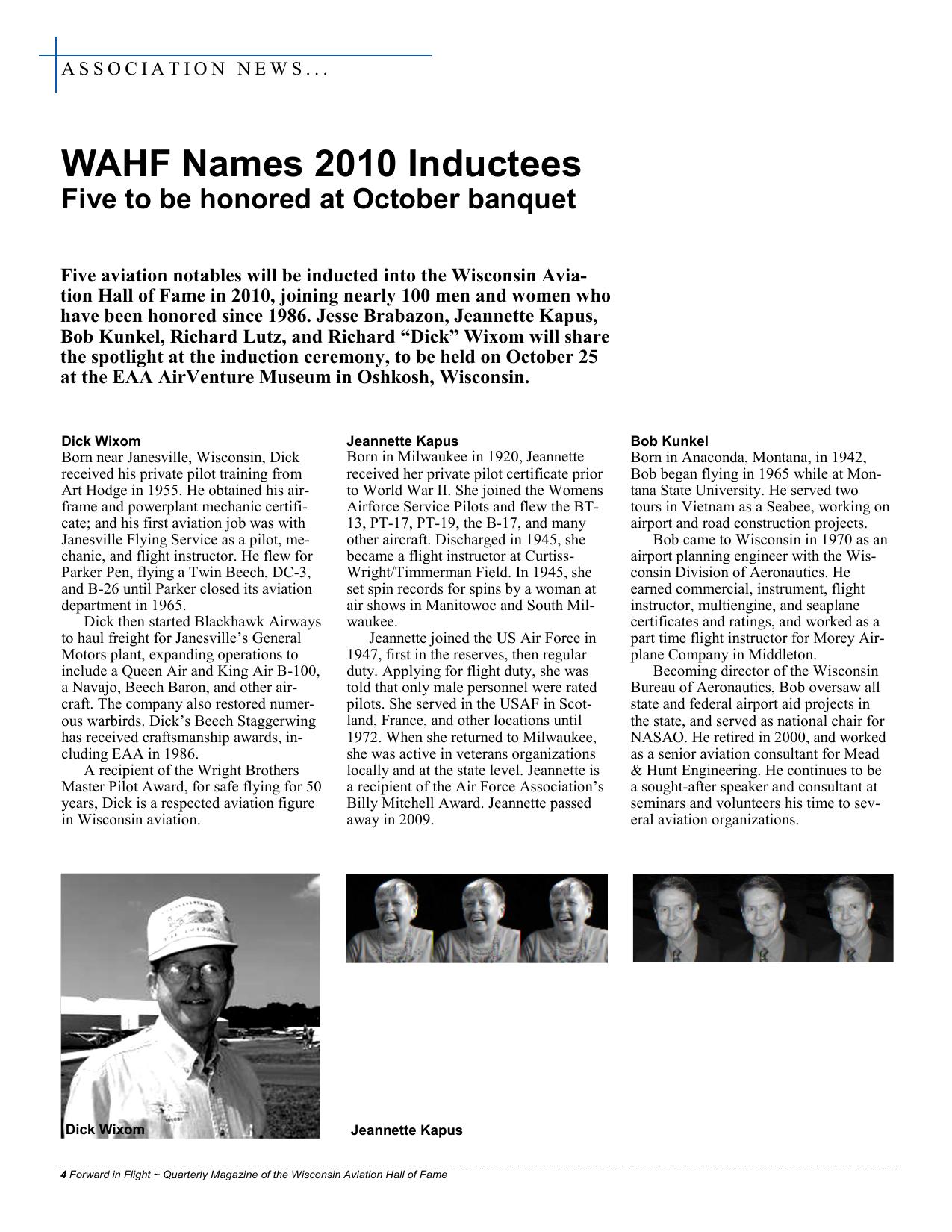
ASSOCIATION NEWS... WAHF Names 2010 Inductees Five to be honored at October banquet Five aviation notables will be inducted into the Wisconsin Aviation Hall of Fame in 2010, joining nearly 100 men and women who have been honored since 1986. Jesse Brabazon, Jeannette Kapus, Bob Kunkel, Richard Lutz, and Richard “Dick” Wixom will share the spotlight at the induction ceremony, to be held on October 25 at the EAA AirVenture Museum in Oshkosh, Wisconsin. Dick Wixom Jeannette Kapus Bob Kunkel Dick Wixom Jeannette Kapus Bob Kunkel Born near Janesville, Wisconsin, Dick received his private pilot training from Art Hodge in 1955. He obtained his airframe and powerplant mechanic certificate; and his first aviation job was with Janesville Flying Service as a pilot, mechanic, and flight instructor. He flew for Parker Pen, flying a Twin Beech, DC-3, and B-26 until Parker closed its aviation department in 1965. Dick then started Blackhawk Airways to haul freight for Janesville’s General Motors plant, expanding operations to include a Queen Air and King Air B-100, a Navajo, Beech Baron, and other aircraft. The company also restored numerous warbirds. Dick’s Beech Staggerwing has received craftsmanship awards, including EAA in 1986. A recipient of the Wright Brothers Master Pilot Award, for safe flying for 50 years, Dick is a respected aviation figure in Wisconsin aviation. Born in Milwaukee in 1920, Jeannette received her private pilot certificate prior to World War II. She joined the Womens Airforce Service Pilots and flew the BT13, PT-17, PT-19, the B-17, and many other aircraft. Discharged in 1945, she became a flight instructor at CurtissWright/Timmerman Field. In 1945, she set spin records for spins by a woman at air shows in Manitowoc and South Milwaukee. Jeannette joined the US Air Force in 1947, first in the reserves, then regular duty. Applying for flight duty, she was told that only male personnel were rated pilots. She served in the USAF in Scotland, France, and other locations until 1972. When she returned to Milwaukee, she was active in veterans organizations locally and at the state level. Jeannette is a recipient of the Air Force Association’s Billy Mitchell Award. Jeannette passed away in 2009. 4 Forward in Flight ~ Quarterly Magazine of the Wisconsin Aviation Hall of Fame Born in Anaconda, Montana, in 1942, Bob began flying in 1965 while at Montana State University. He served two tours in Vietnam as a Seabee, working on airport and road construction projects. Bob came to Wisconsin in 1970 as an airport planning engineer with the Wisconsin Division of Aeronautics. He earned commercial, instrument, flight instructor, multiengine, and seaplane certificates and ratings, and worked as a part time flight instructor for Morey Airplane Company in Middleton. Becoming director of the Wisconsin Bureau of Aeronautics, Bob oversaw all state and federal airport aid projects in the state, and served as national chair for NASAO. He retired in 2000, and worked as a senior aviation consultant for Mead & Hunt Engineering. He continues to be a sought-after speaker and consultant at seminars and volunteers his time to several aviation organizations.
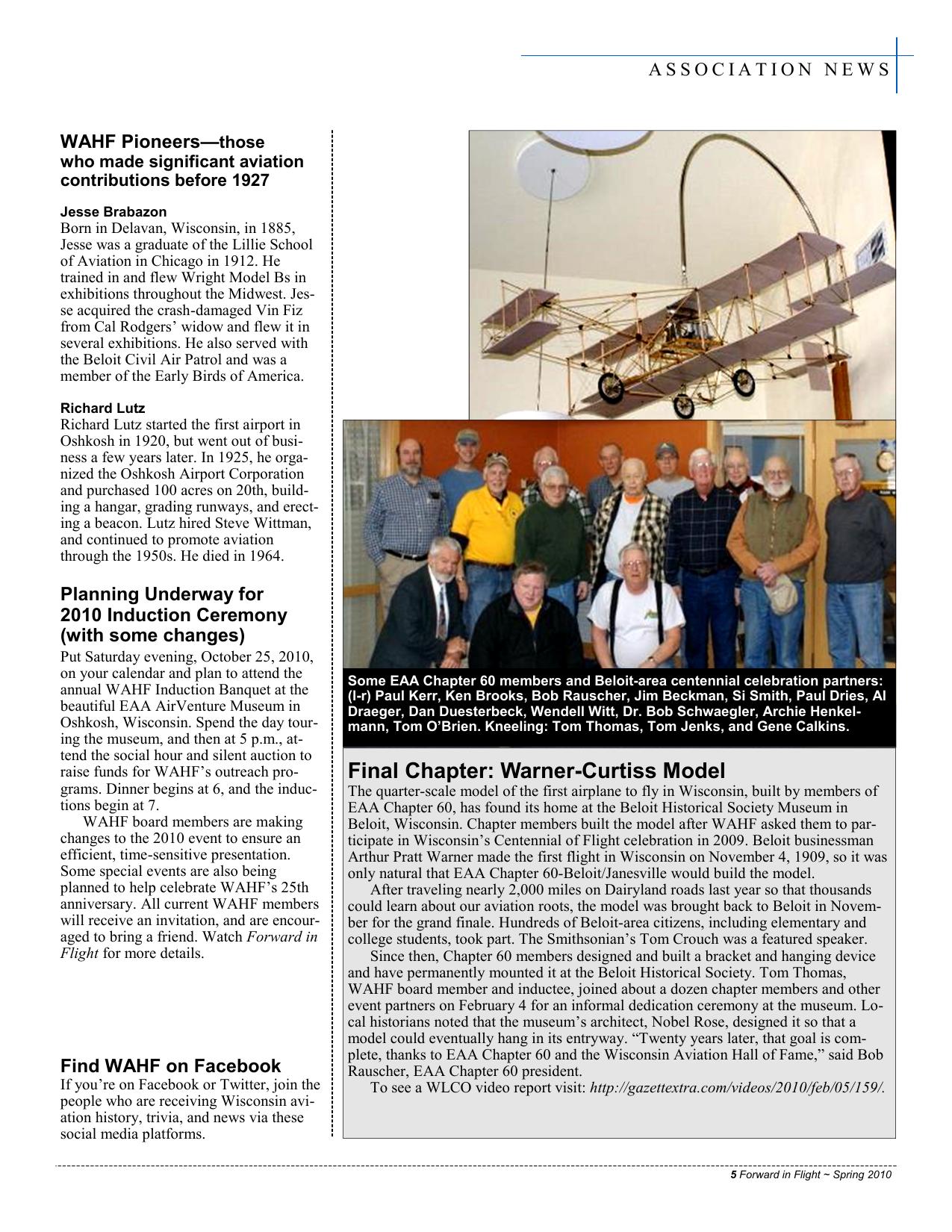
ASSOCIATION NEWS WAHF Pioneers—those who made significant aviation contributions before 1927 Jesse Brabazon Born in Delavan, Wisconsin, in 1885, Jesse was a graduate of the Lillie School of Aviation in Chicago in 1912. He trained in and flew Wright Model Bs in exhibitions throughout the Midwest. Jesse acquired the crash-damaged Vin Fiz from Cal Rodgers’ widow and flew it in several exhibitions. He also served with the Beloit Civil Air Patrol and was a member of the Early Birds of America. Richard Lutz Richard Lutz started the first airport in Oshkosh in 1920, but went out of business a few years later. In 1925, he organized the Oshkosh Airport Corporation and purchased 100 acres on 20th, building a hangar, grading runways, and erecting a beacon. Lutz hired Steve Wittman, and continued to promote aviation through the 1950s. He died in 1964. Planning Underway for 2010 Induction Ceremony (with some changes) Put Saturday evening, October 25, 2010, on your calendar and plan to attend the annual WAHF Induction Banquet at the beautiful EAA AirVenture Museum in Oshkosh, Wisconsin. Spend the day touring the museum, and then at 5 p.m., attend the social hour and silent auction to raise funds for WAHF’s outreach programs. Dinner begins at 6, and the inductions begin at 7. WAHF board members are making changes to the 2010 event to ensure an efficient, time-sensitive presentation. Some special events are also being planned to help celebrate WAHF’s 25th anniversary. All current WAHF members will receive an invitation, and are encouraged to bring a friend. Watch Forward in Flight for more details. Find WAHF on Facebook If you’re on Facebook or Twitter, join the people who are receiving Wisconsin aviation history, trivia, and news via these social media platforms. Some EAA Chapter 60 members and Beloit-area centennial celebration partners: (l-r) Paul Kerr, Ken Brooks, Bob Rauscher, Jim Beckman, Si Smith, Paul Dries, Al Draeger, Dan Duesterbeck, Wendell Witt, Dr. Bob Schwaegler, Archie Henkelmann, Tom O’Brien. Kneeling: Tom Thomas, Tom Jenks, and Gene Calkins. Final Chapter: Warner-Curtiss Model The quarter-scale model of the first airplane to fly in Wisconsin, built by members of EAA Chapter 60, has found its home at the Beloit Historical Society Museum in Beloit, Wisconsin. Chapter members built the model after WAHF asked them to participate in Wisconsin’s Centennial of Flight celebration in 2009. Beloit businessman Arthur Pratt Warner made the first flight in Wisconsin on November 4, 1909, so it was only natural that EAA Chapter 60-Beloit/Janesville would build the model. After traveling nearly 2,000 miles on Dairyland roads last year so that thousands could learn about our aviation roots, the model was brought back to Beloit in November for the grand finale. Hundreds of Beloit-area citizens, including elementary and college students, took part. The Smithsonian’s Tom Crouch was a featured speaker. Since then, Chapter 60 members designed and built a bracket and hanging device and have permanently mounted it at the Beloit Historical Society. Tom Thomas, WAHF board member and inductee, joined about a dozen chapter members and other event partners on February 4 for an informal dedication ceremony at the museum. Local historians noted that the museum’s architect, Nobel Rose, designed it so that a model could eventually hang in its entryway. “Twenty years later, that goal is complete, thanks to EAA Chapter 60 and the Wisconsin Aviation Hall of Fame,” said Bob Rauscher, EAA Chapter 60 president. To see a WLCO video report visit: http://gazettextra.com/videos/2010/feb/05/159/. 5 Forward in Flight ~ Spring 2010
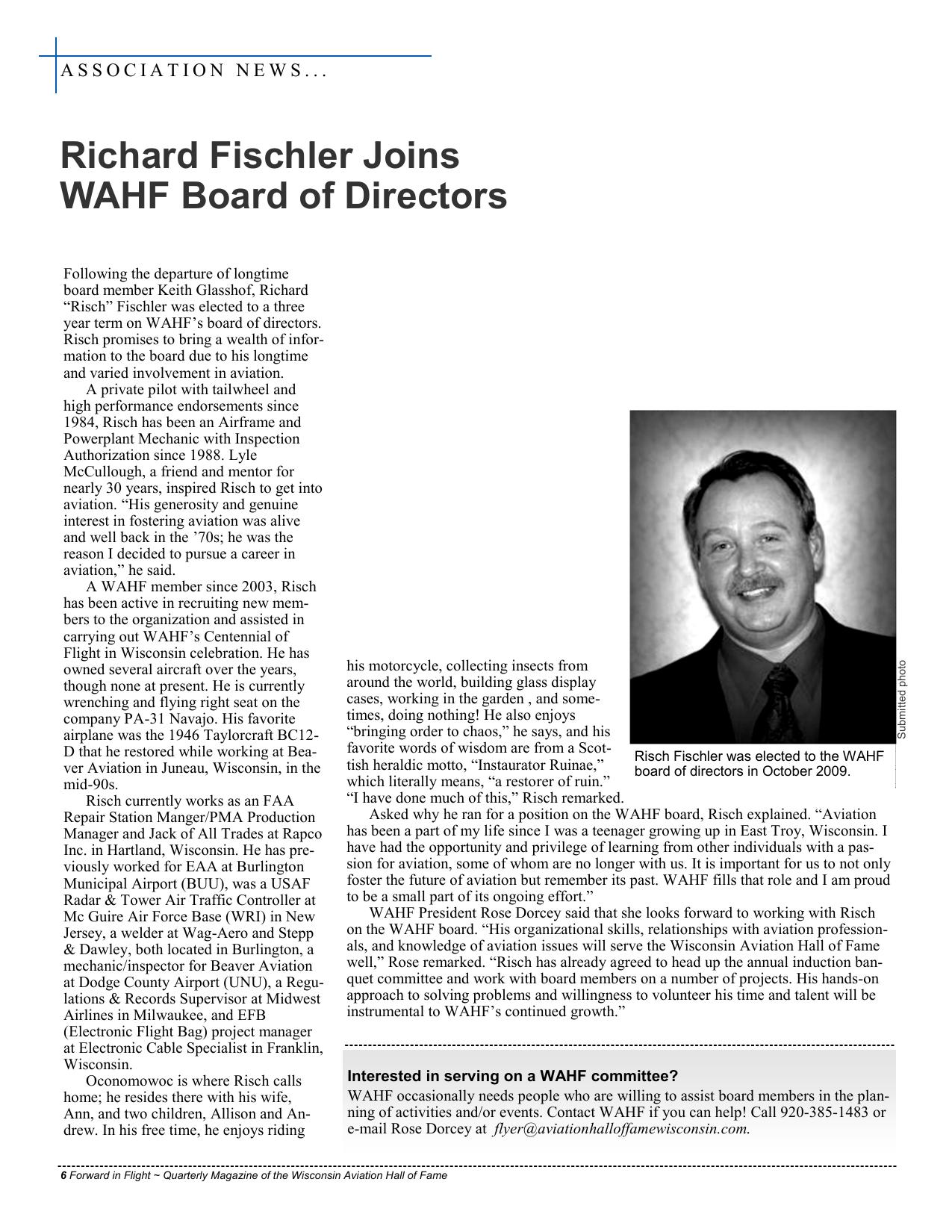
ASSOCIATION NEWS... Following the departure of longtime board member Keith Glasshof, Richard “Risch” Fischler was elected to a three year term on WAHF’s board of directors. Risch promises to bring a wealth of information to the board due to his longtime and varied involvement in aviation. A private pilot with tailwheel and high performance endorsements since 1984, Risch has been an Airframe and Powerplant Mechanic with Inspection Authorization since 1988. Lyle McCullough, a friend and mentor for nearly 30 years, inspired Risch to get into aviation. “His generosity and genuine interest in fostering aviation was alive and well back in the ’70s; he was the reason I decided to pursue a career in aviation,” he said. A WAHF member since 2003, Risch has been active in recruiting new members to the organization and assisted in carrying out WAHF’s Centennial of Flight in Wisconsin celebration. He has owned several aircraft over the years, though none at present. He is currently wrenching and flying right seat on the company PA-31 Navajo. His favorite airplane was the 1946 Taylorcraft BC12D that he restored while working at Beaver Aviation in Juneau, Wisconsin, in the mid-90s. Risch currently works as an FAA Repair Station Manger/PMA Production Manager and Jack of All Trades at Rapco Inc. in Hartland, Wisconsin. He has previously worked for EAA at Burlington Municipal Airport (BUU), was a USAF Radar & Tower Air Traffic Controller at Mc Guire Air Force Base (WRI) in New Jersey, a welder at Wag-Aero and Stepp & Dawley, both located in Burlington, a mechanic/inspector for Beaver Aviation at Dodge County Airport (UNU), a Regulations & Records Supervisor at Midwest Airlines in Milwaukee, and EFB (Electronic Flight Bag) project manager at Electronic Cable Specialist in Franklin, Wisconsin. Oconomowoc is where Risch calls home; he resides there with his wife, Ann, and two children, Allison and Andrew. In his free time, he enjoys riding his motorcycle, collecting insects from around the world, building glass display cases, working in the garden , and sometimes, doing nothing! He also enjoys “bringing order to chaos,” he says, and his favorite words of wisdom are from a ScotRisch Fischler was elected to the WAHF tish heraldic motto, “Instaurator Ruinae,” board of directors in October 2009. which literally means, “a restorer of ruin.” “I have done much of this,” Risch remarked. Asked why he ran for a position on the WAHF board, Risch explained. “Aviation has been a part of my life since I was a teenager growing up in East Troy, Wisconsin. I have had the opportunity and privilege of learning from other individuals with a passion for aviation, some of whom are no longer with us. It is important for us to not only foster the future of aviation but remember its past. WAHF fills that role and I am proud to be a small part of its ongoing effort.” WAHF President Rose Dorcey said that she looks forward to working with Risch on the WAHF board. “His organizational skills, relationships with aviation professionals, and knowledge of aviation issues will serve the Wisconsin Aviation Hall of Fame well,” Rose remarked. “Risch has already agreed to head up the annual induction banquet committee and work with board members on a number of projects. His hands-on approach to solving problems and willingness to volunteer his time and talent will be instrumental to WAHF’s continued growth.” Interested in serving on a WAHF committee? WAHF occasionally needs people who are willing to assist board members in the planning of activities and/or events. Contact WAHF if you can help! Call 920-385-1483 or e-mail Rose Dorcey at flyer@aviationhalloffamewisconsin.com. 6 Forward in Flight ~ Quarterly Magazine of the Wisconsin Aviation Hall of Fame Submitted photo Richard Fischler Joins WAHF Board of Directors
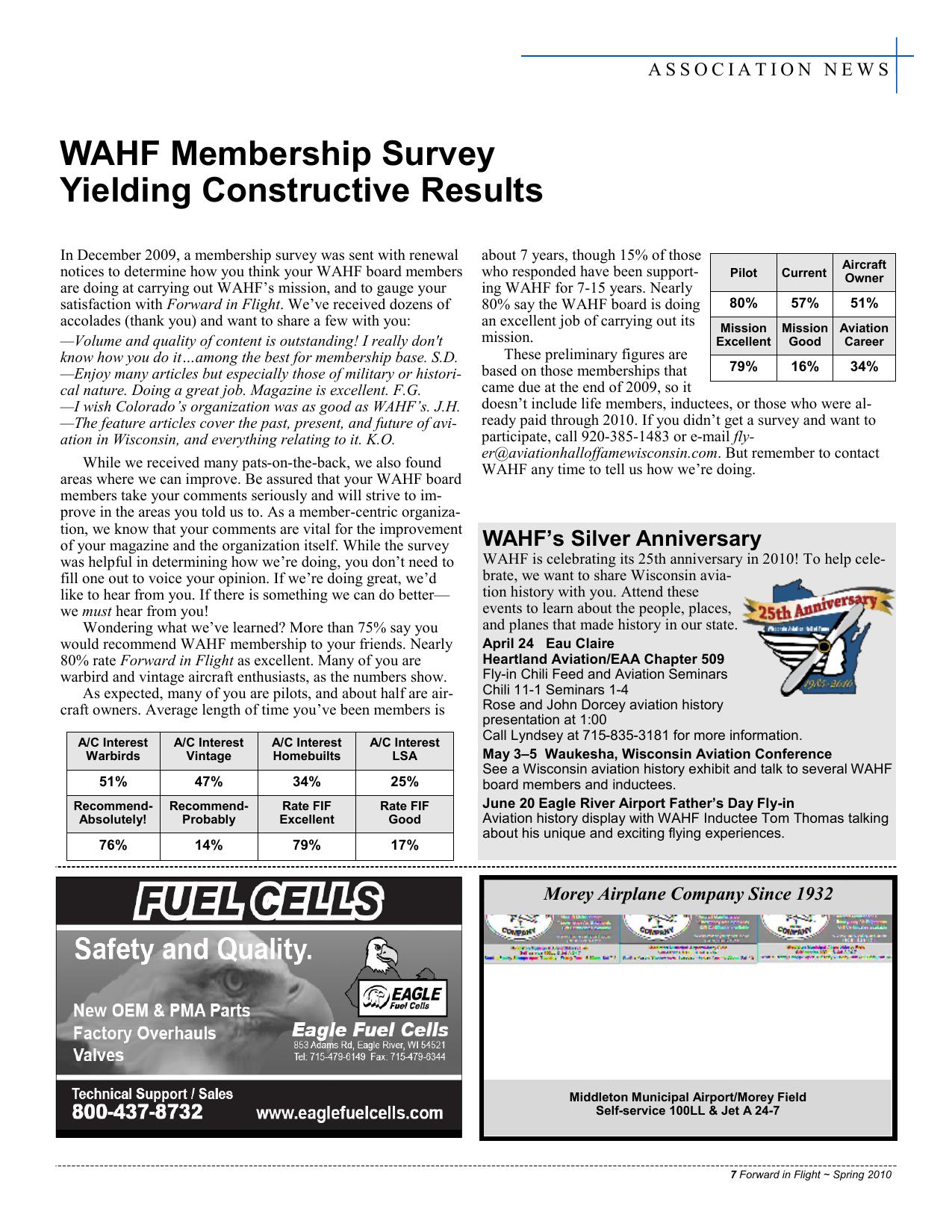
ASSOCIATION NEWS WAHF Membership Survey Yielding Constructive Results In December 2009, a membership survey was sent with renewal notices to determine how you think your WAHF board members are doing at carrying out WAHF’s mission, and to gauge your satisfaction with Forward in Flight. We’ve received dozens of accolades (thank you) and want to share a few with you: —Volume and quality of content is outstanding! I really don't know how you do it…among the best for membership base. S.D. —Enjoy many articles but especially those of military or historical nature. Doing a great job. Magazine is excellent. F.G. —I wish Colorado’s organization was as good as WAHF’s. J.H. —The feature articles cover the past, present, and future of aviation in Wisconsin, and everything relating to it. K.O. While we received many pats-on-the-back, we also found areas where we can improve. Be assured that your WAHF board members take your comments seriously and will strive to improve in the areas you told us to. As a member-centric organization, we know that your comments are vital for the improvement of your magazine and the organization itself. While the survey was helpful in determining how we’re doing, you don’t need to fill one out to voice your opinion. If we’re doing great, we’d like to hear from you. If there is something we can do better— we must hear from you! Wondering what we’ve learned? More than 75% say you would recommend WAHF membership to your friends. Nearly 80% rate Forward in Flight as excellent. Many of you are warbird and vintage aircraft enthusiasts, as the numbers show. As expected, many of you are pilots, and about half are aircraft owners. Average length of time you’ve been members is A/C Interest Warbirds A/C Interest Vintage A/C Interest Homebuilts A/C Interest LSA 51% 47% 34% 25% RecommendAbsolutely! RecommendProbably Rate FIF Excellent Rate FIF Good 76% 14% 79% 17% about 7 years, though 15% of those Aircraft who responded have been supportPilot Current Owner ing WAHF for 7-15 years. Nearly 80% 57% 51% 80% say the WAHF board is doing an excellent job of carrying out its Mission Mission Aviation mission. Excellent Good Career These preliminary figures are 79% 16% 34% based on those memberships that came due at the end of 2009, so it doesn’t include life members, inductees, or those who were already paid through 2010. If you didn’t get a survey and want to participate, call 920-385-1483 or e-mail flyer@aviationhalloffamewisconsin.com. But remember to contact WAHF any time to tell us how we’re doing. WAHF’s Silver Anniversary WAHF is celebrating its 25th anniversary in 2010! To help celebrate, we want to share Wisconsin aviation history with you. Attend these events to learn about the people, places, and planes that made history in our state. April 24 Eau Claire Heartland Aviation/EAA Chapter 509 Fly-in Chili Feed and Aviation Seminars Chili 11-1 Seminars 1-4 Rose and John Dorcey aviation history presentation at 1:00 Call Lyndsey at 715-835-3181 for more information. May 3–5 Waukesha, Wisconsin Aviation Conference See a Wisconsin aviation history exhibit and talk to several WAHF board members and inductees. June 20 Eagle River Airport Father’s Day Fly-in Aviation history display with WAHF Inductee Tom Thomas talking about his unique and exciting flying experiences. Morey Airplane Company Since 1932 Middleton Municipal Airport/Morey Field Self-service 100LL & Jet A 24-7 7 Forward in Flight ~ Spring 2010
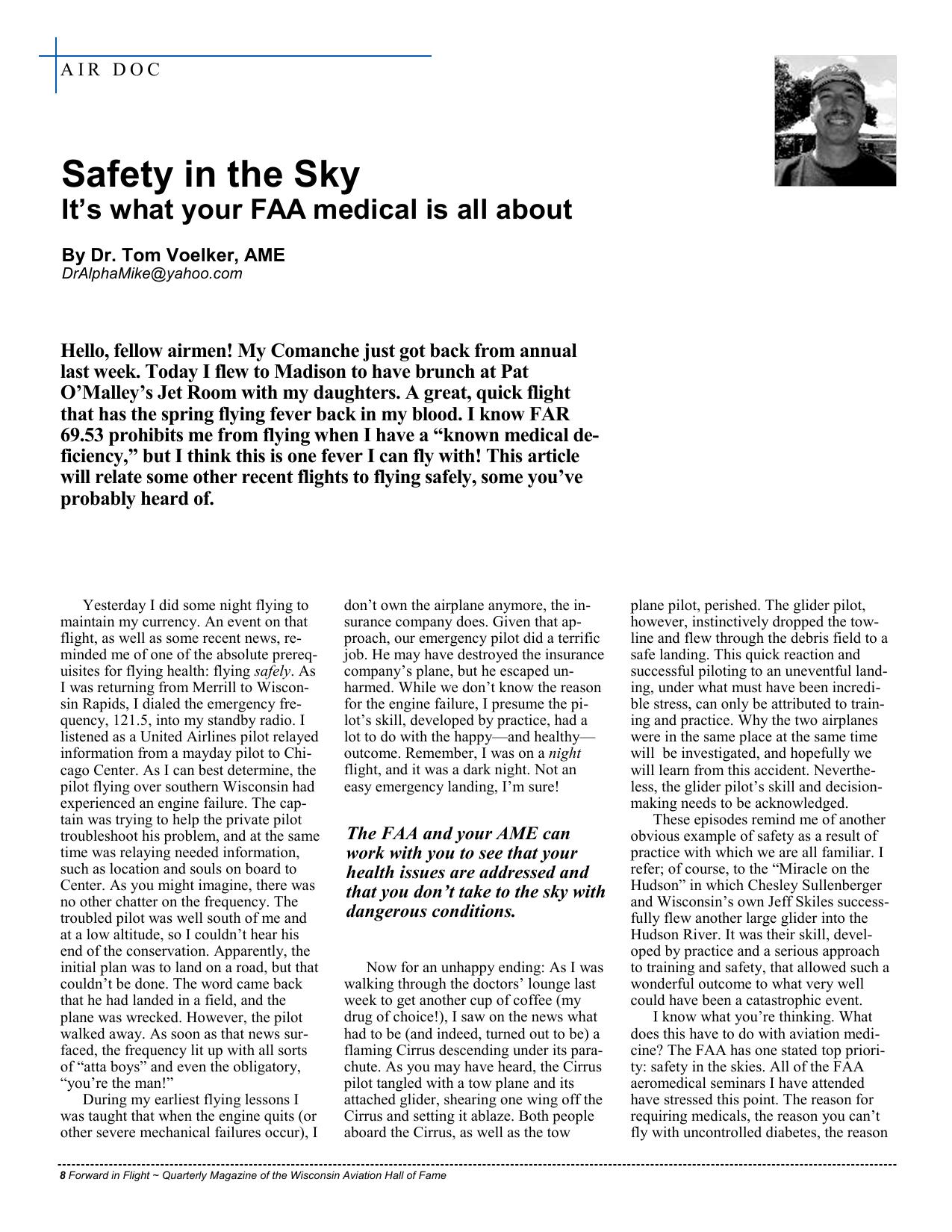
AIR DOC Safety in the Sky It’s what your FAA medical is all about By Dr. Tom Voelker, AME DrAlphaMike@yahoo.com Hello, fellow airmen! My Comanche just got back from annual last week. Today I flew to Madison to have brunch at Pat O’Malley’s Jet Room with my daughters. A great, quick flight that has the spring flying fever back in my blood. I know FAR 69.53 prohibits me from flying when I have a “known medical deficiency,” but I think this is one fever I can fly with! This article will relate some other recent flights to flying safely, some you’ve probably heard of. Yesterday I did some night flying to maintain my currency. An event on that flight, as well as some recent news, reminded me of one of the absolute prerequisites for flying health: flying safely. As I was returning from Merrill to Wisconsin Rapids, I dialed the emergency frequency, 121.5, into my standby radio. I listened as a United Airlines pilot relayed information from a mayday pilot to Chicago Center. As I can best determine, the pilot flying over southern Wisconsin had experienced an engine failure. The captain was trying to help the private pilot troubleshoot his problem, and at the same time was relaying needed information, such as location and souls on board to Center. As you might imagine, there was no other chatter on the frequency. The troubled pilot was well south of me and at a low altitude, so I couldn’t hear his end of the conservation. Apparently, the initial plan was to land on a road, but that couldn’t be done. The word came back that he had landed in a field, and the plane was wrecked. However, the pilot walked away. As soon as that news surfaced, the frequency lit up with all sorts of “atta boys” and even the obligatory, “you’re the man!” During my earliest flying lessons I was taught that when the engine quits (or other severe mechanical failures occur), I don’t own the airplane anymore, the insurance company does. Given that approach, our emergency pilot did a terrific job. He may have destroyed the insurance company’s plane, but he escaped unharmed. While we don’t know the reason for the engine failure, I presume the pilot’s skill, developed by practice, had a lot to do with the happy—and healthy— outcome. Remember, I was on a night flight, and it was a dark night. Not an easy emergency landing, I’m sure! The FAA and your AME can work with you to see that your health issues are addressed and that you don’t take to the sky with dangerous conditions. Now for an unhappy ending: As I was walking through the doctors’ lounge last week to get another cup of coffee (my drug of choice!), I saw on the news what had to be (and indeed, turned out to be) a flaming Cirrus descending under its parachute. As you may have heard, the Cirrus pilot tangled with a tow plane and its attached glider, shearing one wing off the Cirrus and setting it ablaze. Both people aboard the Cirrus, as well as the tow 8 Forward in Flight ~ Quarterly Magazine of the Wisconsin Aviation Hall of Fame plane pilot, perished. The glider pilot, however, instinctively dropped the towline and flew through the debris field to a safe landing. This quick reaction and successful piloting to an uneventful landing, under what must have been incredible stress, can only be attributed to training and practice. Why the two airplanes were in the same place at the same time will be investigated, and hopefully we will learn from this accident. Nevertheless, the glider pilot’s skill and decisionmaking needs to be acknowledged. These episodes remind me of another obvious example of safety as a result of practice with which we are all familiar. I refer; of course, to the “Miracle on the Hudson” in which Chesley Sullenberger and Wisconsin’s own Jeff Skiles successfully flew another large glider into the Hudson River. It was their skill, developed by practice and a serious approach to training and safety, that allowed such a wonderful outcome to what very well could have been a catastrophic event. I know what you’re thinking. What does this have to do with aviation medicine? The FAA has one stated top priority: safety in the skies. All of the FAA aeromedical seminars I have attended have stressed this point. The reason for requiring medicals, the reason you can’t fly with uncontrolled diabetes, the reason
AIR DOC The FAA has one stated top priority: safety in the sky. you need to wait eight hours (at least) after drinking before piloting an aircraft, is just that: safety. The FAA and your AME can work with you to see that your health issues are addressed and that you don’t take to the sky with dangerous conditions. There are regulations to keep those who shouldn’t be flying out of the cockpit. Your AME, and even columns such as AirDoc, can help you make better decisions about your health and flying. But no matter how good your health is, we can’t fly the plane for you! Spring Flying This is a great time to commit to some remedial training. I see many pilots for their flight physicals this time of year who haven’t flown all winter. If this is you, maybe you could commit to a couple of hours of refresher time with a CFI. Or, if you’re instrument rated, get a safety pilot and shoot some practice approaches. Don’t just shoot for “legal” currency, try for true proficiency. I have my own proficiency flight plan that I like to go through at least a couple of times a year. I give myself a private pilot checkride. This is easy and inexpensive. Just get a copy of the PTS (practical test standards) for the rating and go flying, performing each of the maneuvers as if you were taking the check ride all over again. You’d be surprised how much fun it is to relive that flight from many years ago. As a bonus, you’ll find out where your flying skills are a little rusty, and nobody is there to flunk you! Work on your weak spots until you are on top of your game. Now we’re talking about some seriously safe flying! MedXPress There are a couple more points I want to discuss in this issue. First, I want to continue to push for the FAA’s electronic flight physical application: MedXPress. I have more airmen coming in with this form completed and it is working very well. This is a great way to fill out your flight physical form (what we AMEs call the 8500-8). You do it at home ahead of time, and the form makes sure you don’t miss any questions. After completing the application just copy your confirmation number and bring it in to your flight physical. This process is much easier for you and saves your AME a lot of time. Thanks to those of you who are already using MedXPress! All you need is an email address to log-in; to find the website, visit https://medxpress.faa.gov. The FAA has also changed the way we AMEs have to handle the dreaded “question 18v” on the application form: arrests or convictions for DUI. Even one prior occurrence requires us, for the most part, to defer the application to Oklahoma City. While one real concern is allowing alcoholics to fly, a larger concern is the airman’s judgment. If you think you are “probably sober enough to drive” or you “probably won’t get caught,” might you think the same when you are contemplating flying? I think the FAA has a valid point. Don’t mix drinking and driving and you won’t have anything to worry about. With those thoughts it’s time again to bid you adieu. Get that plane out of the hangar and get the rust out of your joints. It’s time to fly, to fly healthy, and most importantly, to fly safely! —Alpha Mike Echo In “real” life, Alpha Mike Echo is Dr. Tom Voelker, AME, a family practioner in Wisconsin Rapids. He and his wife, Kathy, are the parents of four daughters. Tom flies N6224P, a Comanche 250, out of Alexander Field, South Wood County Airport (ISW). 9 Forward in Flight ~ Spring 2010
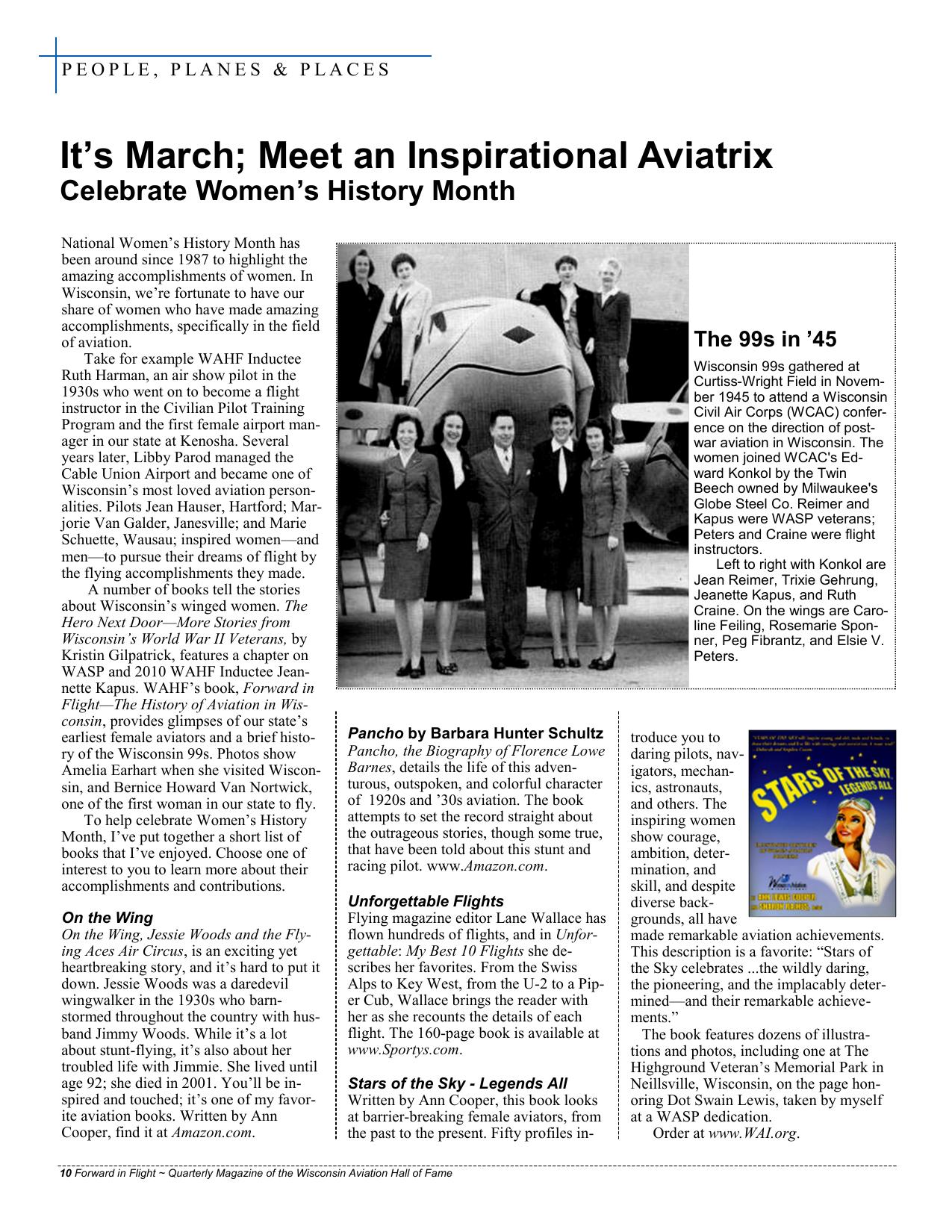
PEOPLE, PLANES & PLACES It’s March; Meet an Inspirational Aviatrix Celebrate Women’s History Month National Women’s History Month has been around since 1987 to highlight the amazing accomplishments of women. In Wisconsin, we’re fortunate to have our share of women who have made amazing accomplishments, specifically in the field of aviation. Take for example WAHF Inductee Ruth Harman, an air show pilot in the 1930s who went on to become a flight instructor in the Civilian Pilot Training Program and the first female airport manager in our state at Kenosha. Several years later, Libby Parod managed the Cable Union Airport and became one of Wisconsin’s most loved aviation personalities. Pilots Jean Hauser, Hartford; Marjorie Van Galder, Janesville; and Marie Schuette, Wausau; inspired women—and men—to pursue their dreams of flight by the flying accomplishments they made. A number of books tell the stories about Wisconsin’s winged women. The Hero Next Door—More Stories from Wisconsin’s World War II Veterans, by Kristin Gilpatrick, features a chapter on WASP and 2010 WAHF Inductee Jeannette Kapus. WAHF’s book, Forward in Flight—The History of Aviation in Wisconsin, provides glimpses of our state’s earliest female aviators and a brief history of the Wisconsin 99s. Photos show Amelia Earhart when she visited Wisconsin, and Bernice Howard Van Nortwick, one of the first woman in our state to fly. To help celebrate Women’s History Month, I’ve put together a short list of books that I’ve enjoyed. Choose one of interest to you to learn more about their accomplishments and contributions. On the Wing On the Wing, Jessie Woods and the Flying Aces Air Circus, is an exciting yet heartbreaking story, and it’s hard to put it down. Jessie Woods was a daredevil wingwalker in the 1930s who barnstormed throughout the country with husband Jimmy Woods. While it’s a lot about stunt-flying, it’s also about her troubled life with Jimmie. She lived until age 92; she died in 2001. You’ll be inspired and touched; it’s one of my favorite aviation books. Written by Ann Cooper, find it at Amazon.com. The 99s in ’45 Wisconsin 99s gathered at Curtiss-Wright Field in November 1945 to attend a Wisconsin Civil Air Corps (WCAC) conference on the direction of postwar aviation in Wisconsin. The women joined WCAC's Edward Konkol by the Twin Beech owned by Milwaukee's Globe Steel Co. Reimer and Kapus were WASP veterans; Peters and Craine were flight instructors. Left to right with Konkol are Jean Reimer, Trixie Gehrung, Jeanette Kapus, and Ruth Craine. On the wings are Caroline Feiling, Rosemarie Sponner, Peg Fibrantz, and Elsie V. Peters. Pancho by Barbara Hunter Schultz Pancho, the Biography of Florence Lowe Barnes, details the life of this adventurous, outspoken, and colorful character of 1920s and ’30s aviation. The book attempts to set the record straight about the outrageous stories, though some true, that have been told about this stunt and racing pilot. www.Amazon.com. Unforgettable Flights Flying magazine editor Lane Wallace has flown hundreds of flights, and in Unforgettable: My Best 10 Flights she describes her favorites. From the Swiss Alps to Key West, from the U-2 to a Piper Cub, Wallace brings the reader with her as she recounts the details of each flight. The 160-page book is available at www.Sportys.com. Stars of the Sky - Legends All Written by Ann Cooper, this book looks at barrier-breaking female aviators, from the past to the present. Fifty profiles in- 10 Forward in Flight ~ Quarterly Magazine of the Wisconsin Aviation Hall of Fame troduce you to daring pilots, navigators, mechanics, astronauts, and others. The inspiring women show courage, ambition, determination, and skill, and despite diverse backgrounds, all have made remarkable aviation achievements. This description is a favorite: “Stars of the Sky celebrates ...the wildly daring, the pioneering, and the implacably determined—and their remarkable achievements.” The book features dozens of illustrations and photos, including one at The Highground Veteran’s Memorial Park in Neillsville, Wisconsin, on the page honoring Dot Swain Lewis, taken by myself at a WASP dedication. Order at www.WAI.org.
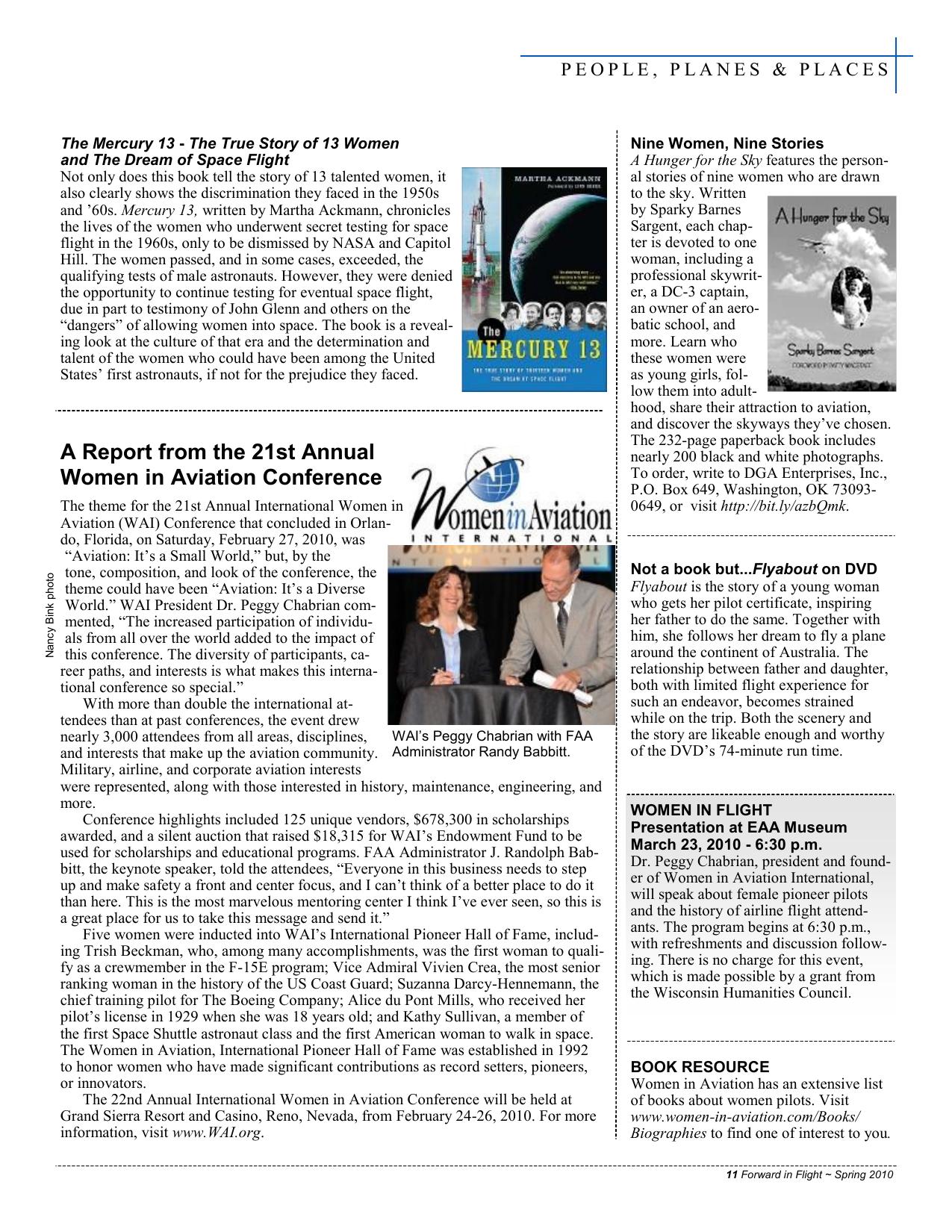
PEOPLE, PLANES & PLACES The Mercury 13 - The True Story of 13 Women and The Dream of Space Flight Not only does this book tell the story of 13 talented women, it also clearly shows the discrimination they faced in the 1950s and ’60s. Mercury 13, written by Martha Ackmann, chronicles the lives of the women who underwent secret testing for space flight in the 1960s, only to be dismissed by NASA and Capitol Hill. The women passed, and in some cases, exceeded, the qualifying tests of male astronauts. However, they were denied the opportunity to continue testing for eventual space flight, due in part to testimony of John Glenn and others on the “dangers” of allowing women into space. The book is a revealing look at the culture of that era and the determination and talent of the women who could have been among the United States’ first astronauts, if not for the prejudice they faced. Nancy Bink photo A Report from the 21st Annual Women in Aviation Conference The theme for the 21st Annual International Women in Aviation (WAI) Conference that concluded in Orlando, Florida, on Saturday, February 27, 2010, was “Aviation: It’s a Small World,” but, by the tone, composition, and look of the conference, the theme could have been “Aviation: It’s a Diverse World.” WAI President Dr. Peggy Chabrian commented, “The increased participation of individuals from all over the world added to the impact of this conference. The diversity of participants, career paths, and interests is what makes this international conference so special.” With more than double the international attendees than at past conferences, the event drew WAI’s Peggy Chabrian with FAA nearly 3,000 attendees from all areas, disciplines, and interests that make up the aviation community. Administrator Randy Babbitt. Military, airline, and corporate aviation interests were represented, along with those interested in history, maintenance, engineering, and more. Conference highlights included 125 unique vendors, $678,300 in scholarships awarded, and a silent auction that raised $18,315 for WAI’s Endowment Fund to be used for scholarships and educational programs. FAA Administrator J. Randolph Babbitt, the keynote speaker, told the attendees, “Everyone in this business needs to step up and make safety a front and center focus, and I can’t think of a better place to do it than here. This is the most marvelous mentoring center I think I’ve ever seen, so this is a great place for us to take this message and send it.” Five women were inducted into WAI’s International Pioneer Hall of Fame, including Trish Beckman, who, among many accomplishments, was the first woman to qualify as a crewmember in the F-15E program; Vice Admiral Vivien Crea, the most senior ranking woman in the history of the US Coast Guard; Suzanna Darcy-Hennemann, the chief training pilot for The Boeing Company; Alice du Pont Mills, who received her pilot’s license in 1929 when she was 18 years old; and Kathy Sullivan, a member of the first Space Shuttle astronaut class and the first American woman to walk in space. The Women in Aviation, International Pioneer Hall of Fame was established in 1992 to honor women who have made significant contributions as record setters, pioneers, or innovators. The 22nd Annual International Women in Aviation Conference will be held at Grand Sierra Resort and Casino, Reno, Nevada, from February 24-26, 2010. For more information, visit www.WAI.org. Nine Women, Nine Stories A Hunger for the Sky features the personal stories of nine women who are drawn to the sky. Written by Sparky Barnes Sargent, each chapter is devoted to one woman, including a professional skywriter, a DC-3 captain, an owner of an aerobatic school, and more. Learn who these women were as young girls, follow them into adulthood, share their attraction to aviation, and discover the skyways they’ve chosen. The 232-page paperback book includes nearly 200 black and white photographs. To order, write to DGA Enterprises, Inc., P.O. Box 649, Washington, OK 730930649, or visit http://bit.ly/azbQmk. Not a book but...Flyabout on DVD Flyabout is the story of a young woman who gets her pilot certificate, inspiring her father to do the same. Together with him, she follows her dream to fly a plane around the continent of Australia. The relationship between father and daughter, both with limited flight experience for such an endeavor, becomes strained while on the trip. Both the scenery and the story are likeable enough and worthy of the DVD’s 74-minute run time. WOMEN IN FLIGHT Presentation at EAA Museum March 23, 2010 - 6:30 p.m. Dr. Peggy Chabrian, president and founder of Women in Aviation International, will speak about female pioneer pilots and the history of airline flight attendants. The program begins at 6:30 p.m., with refreshments and discussion following. There is no charge for this event, which is made possible by a grant from the Wisconsin Humanities Council. BOOK RESOURCE Women in Aviation has an extensive list of books about women pilots. Visit www.women-in-aviation.com/Books/ Biographies to find one of interest to you. 11 Forward in Flight ~ Spring 2010
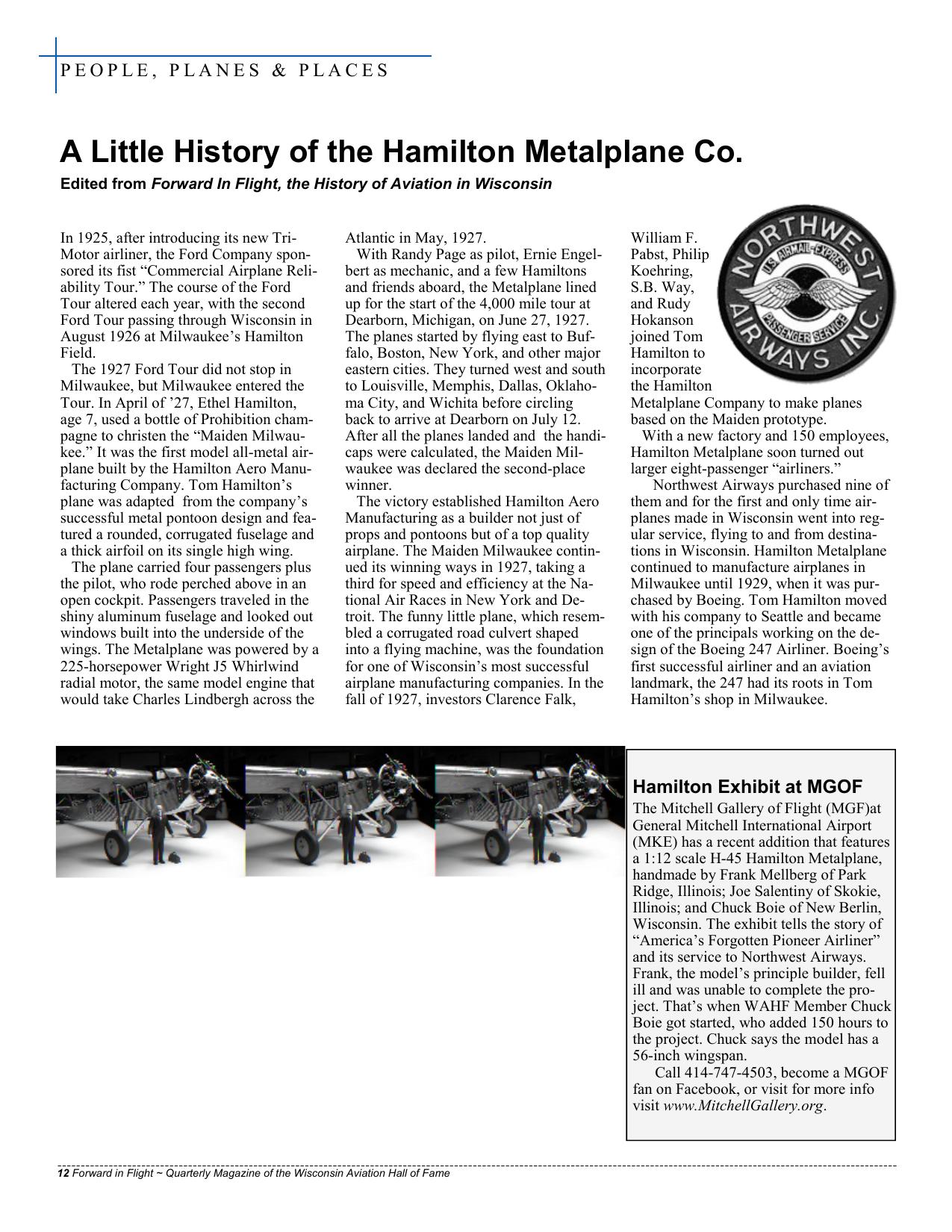
PEOPLE, PLANES & PLACES A Little History of the Hamilton Metalplane Co. Edited from Forward In Flight, the History of Aviation in Wisconsin In 1925, after introducing its new TriMotor airliner, the Ford Company sponsored its fist “Commercial Airplane Reliability Tour.” The course of the Ford Tour altered each year, with the second Ford Tour passing through Wisconsin in August 1926 at Milwaukee’s Hamilton Field. The 1927 Ford Tour did not stop in Milwaukee, but Milwaukee entered the Tour. In April of ’27, Ethel Hamilton, age 7, used a bottle of Prohibition champagne to christen the “Maiden Milwaukee.” It was the first model all-metal airplane built by the Hamilton Aero Manufacturing Company. Tom Hamilton’s plane was adapted from the company’s successful metal pontoon design and featured a rounded, corrugated fuselage and a thick airfoil on its single high wing. The plane carried four passengers plus the pilot, who rode perched above in an open cockpit. Passengers traveled in the shiny aluminum fuselage and looked out windows built into the underside of the wings. The Metalplane was powered by a 225-horsepower Wright J5 Whirlwind radial motor, the same model engine that would take Charles Lindbergh across the Atlantic in May, 1927. With Randy Page as pilot, Ernie Engelbert as mechanic, and a few Hamiltons and friends aboard, the Metalplane lined up for the start of the 4,000 mile tour at Dearborn, Michigan, on June 27, 1927. The planes started by flying east to Buffalo, Boston, New York, and other major eastern cities. They turned west and south to Louisville, Memphis, Dallas, Oklahoma City, and Wichita before circling back to arrive at Dearborn on July 12. After all the planes landed and the handicaps were calculated, the Maiden Milwaukee was declared the second-place winner. The victory established Hamilton Aero Manufacturing as a builder not just of props and pontoons but of a top quality airplane. The Maiden Milwaukee continued its winning ways in 1927, taking a third for speed and efficiency at the National Air Races in New York and Detroit. The funny little plane, which resembled a corrugated road culvert shaped into a flying machine, was the foundation for one of Wisconsin’s most successful airplane manufacturing companies. In the fall of 1927, investors Clarence Falk, William F. Pabst, Philip Koehring, S.B. Way, and Rudy Hokanson joined Tom Hamilton to incorporate the Hamilton Metalplane Company to make planes based on the Maiden prototype. With a new factory and 150 employees, Hamilton Metalplane soon turned out larger eight-passenger “airliners.” Northwest Airways purchased nine of them and for the first and only time airplanes made in Wisconsin went into regular service, flying to and from destinations in Wisconsin. Hamilton Metalplane continued to manufacture airplanes in Milwaukee until 1929, when it was purchased by Boeing. Tom Hamilton moved with his company to Seattle and became one of the principals working on the design of the Boeing 247 Airliner. Boeing’s first successful airliner and an aviation landmark, the 247 had its roots in Tom Hamilton’s shop in Milwaukee. Hamilton Exhibit at MGOF The Mitchell Gallery of Flight (MGF)at General Mitchell International Airport (MKE) has a recent addition that features a 1:12 scale H-45 Hamilton Metalplane, handmade by Frank Mellberg of Park Ridge, Illinois; Joe Salentiny of Skokie, Illinois; and Chuck Boie of New Berlin, Wisconsin. The exhibit tells the story of “America’s Forgotten Pioneer Airliner” and its service to Northwest Airways. Frank, the model’s principle builder, fell ill and was unable to complete the project. That’s when WAHF Member Chuck Boie got started, who added 150 hours to the project. Chuck says the model has a 56-inch wingspan. Call 414-747-4503, become a MGOF fan on Facebook, or visit for more info visit www.MitchellGallery.org. 12 Forward in Flight ~ Quarterly Magazine of the Wisconsin Aviation Hall of Fame
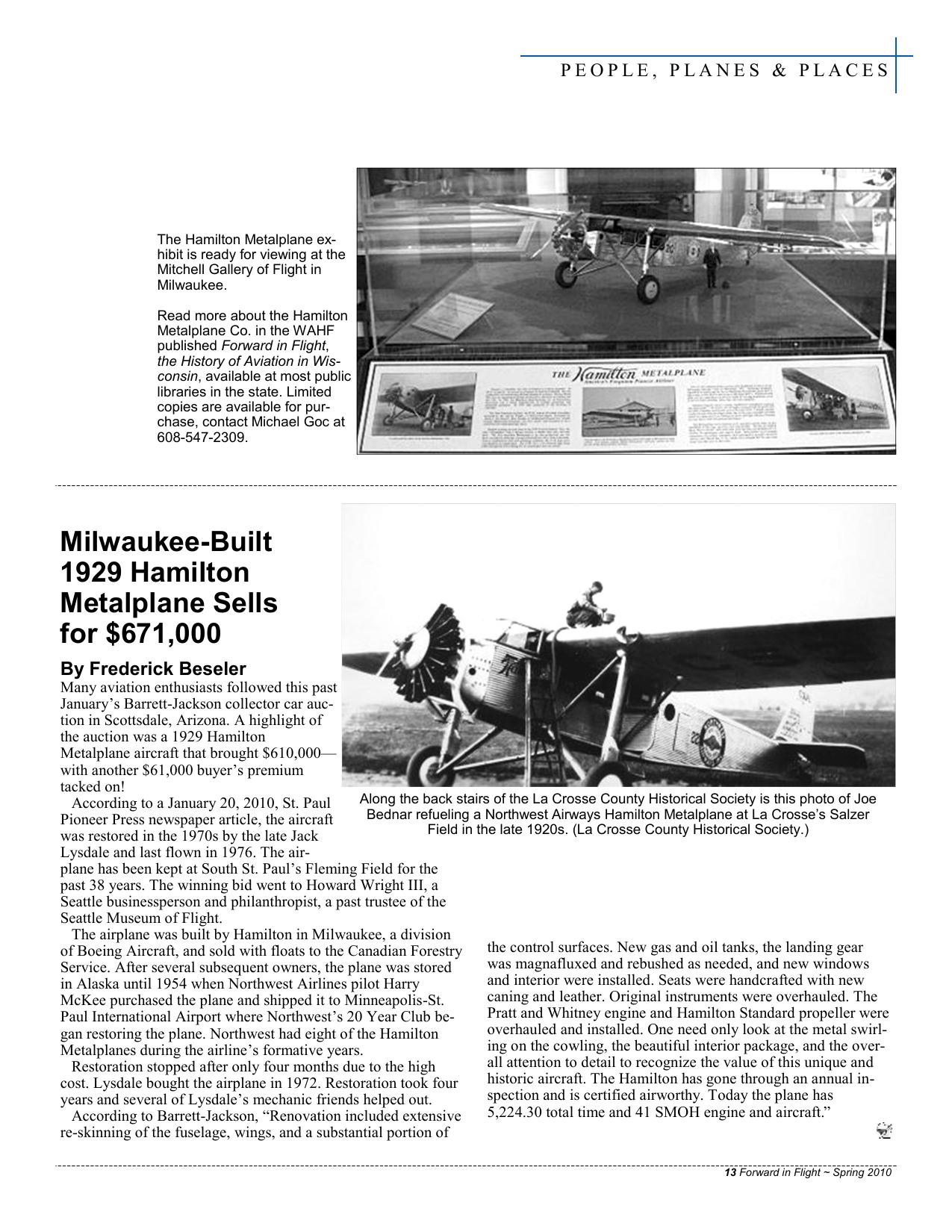
PEOPLE, PLANES & PLACES The Hamilton Metalplane exhibit is ready for viewing at the Mitchell Gallery of Flight in Milwaukee. Read more about the Hamilton Metalplane Co. in the WAHF published Forward in Flight, the History of Aviation in Wisconsin, available at most public libraries in the state. Limited copies are available for purchase, contact Michael Goc at 608-547-2309. Milwaukee-Built 1929 Hamilton Metalplane Sells for $671,000 By Frederick Beseler Many aviation enthusiasts followed this past January’s Barrett-Jackson collector car auction in Scottsdale, Arizona. A highlight of the auction was a 1929 Hamilton Metalplane aircraft that brought $610,000— with another $61,000 buyer’s premium tacked on! Along the back stairs of the La Crosse County Historical Society is this photo of Joe According to a January 20, 2010, St. Paul Bednar refueling a Northwest Airways Hamilton Metalplane at La Crosse’s Salzer Pioneer Press newspaper article, the aircraft Field in the late 1920s. (La Crosse County Historical Society.) was restored in the 1970s by the late Jack Lysdale and last flown in 1976. The airplane has been kept at South St. Paul’s Fleming Field for the past 38 years. The winning bid went to Howard Wright III, a Seattle businessperson and philanthropist, a past trustee of the Seattle Museum of Flight. The airplane was built by Hamilton in Milwaukee, a division the control surfaces. New gas and oil tanks, the landing gear of Boeing Aircraft, and sold with floats to the Canadian Forestry was magnafluxed and rebushed as needed, and new windows Service. After several subsequent owners, the plane was stored and interior were installed. Seats were handcrafted with new in Alaska until 1954 when Northwest Airlines pilot Harry caning and leather. Original instruments were overhauled. The McKee purchased the plane and shipped it to Minneapolis-St. Pratt and Whitney engine and Hamilton Standard propeller were Paul International Airport where Northwest’s 20 Year Club beoverhauled and installed. One need only look at the metal swirlgan restoring the plane. Northwest had eight of the Hamilton ing on the cowling, the beautiful interior package, and the overMetalplanes during the airline’s formative years. all attention to detail to recognize the value of this unique and Restoration stopped after only four months due to the high historic aircraft. The Hamilton has gone through an annual incost. Lysdale bought the airplane in 1972. Restoration took four spection and is certified airworthy. Today the plane has years and several of Lysdale’s mechanic friends helped out. 5,224.30 total time and 41 SMOH engine and aircraft.” According to Barrett-Jackson, “Renovation included extensive re-skinning of the fuselage, wings, and a substantial portion of 13 Forward in Flight ~ Spring 2010
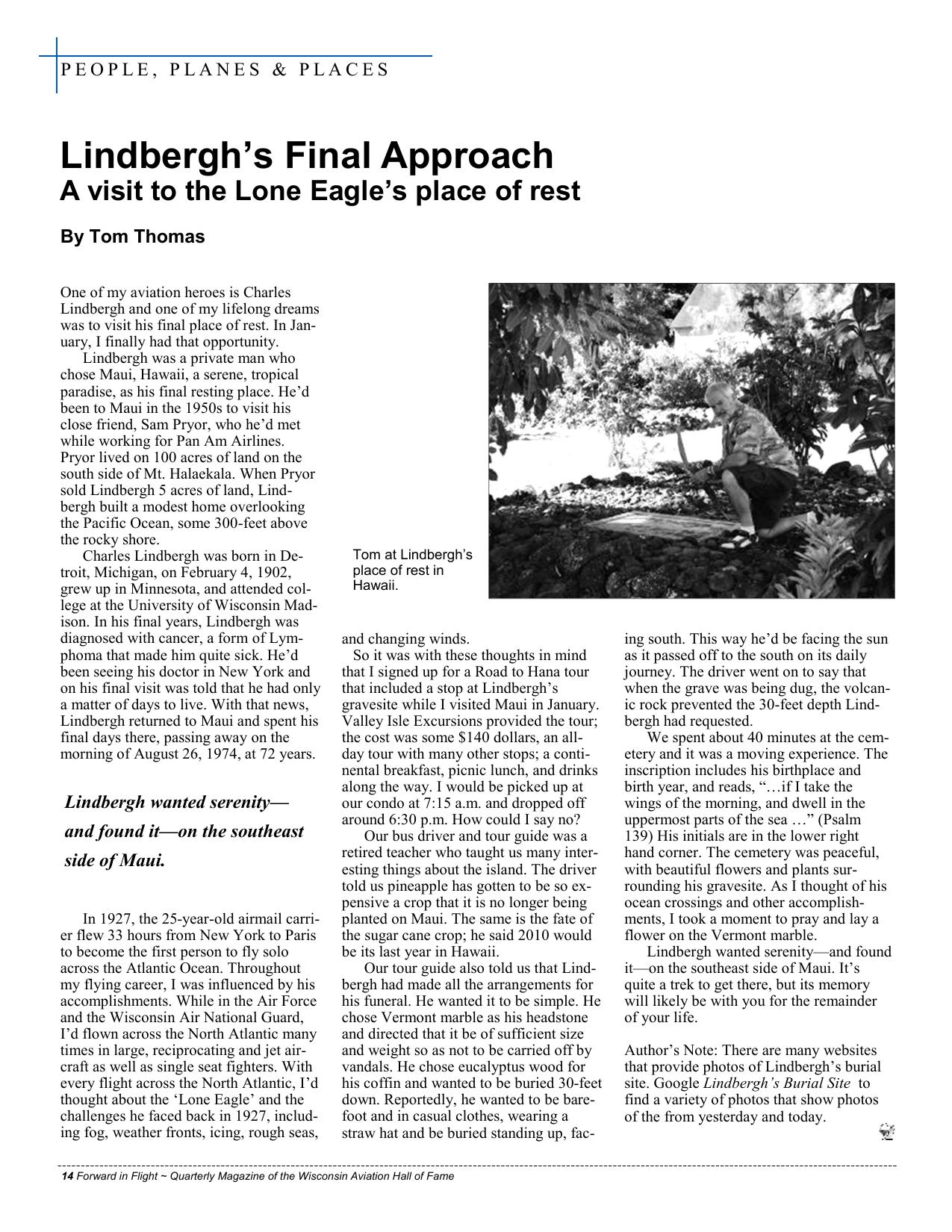
PEOPLE, PLANES & PLACES Lindbergh’s Final Approach A visit to the Lone Eagle’s place of rest By Tom Thomas One of my aviation heroes is Charles Lindbergh and one of my lifelong dreams was to visit his final place of rest. In January, I finally had that opportunity. Lindbergh was a private man who chose Maui, Hawaii, a serene, tropical paradise, as his final resting place. He’d been to Maui in the 1950s to visit his close friend, Sam Pryor, who he’d met while working for Pan Am Airlines. Pryor lived on 100 acres of land on the south side of Mt. Halaekala. When Pryor sold Lindbergh 5 acres of land, Lindbergh built a modest home overlooking the Pacific Ocean, some 300-feet above the rocky shore. Charles Lindbergh was born in Detroit, Michigan, on February 4, 1902, grew up in Minnesota, and attended college at the University of Wisconsin Madison. In his final years, Lindbergh was diagnosed with cancer, a form of Lymphoma that made him quite sick. He’d been seeing his doctor in New York and on his final visit was told that he had only a matter of days to live. With that news, Lindbergh returned to Maui and spent his final days there, passing away on the morning of August 26, 1974, at 72 years. Lindbergh wanted serenity— and found it—on the southeast side of Maui. In 1927, the 25-year-old airmail carrier flew 33 hours from New York to Paris to become the first person to fly solo across the Atlantic Ocean. Throughout my flying career, I was influenced by his accomplishments. While in the Air Force and the Wisconsin Air National Guard, I’d flown across the North Atlantic many times in large, reciprocating and jet aircraft as well as single seat fighters. With every flight across the North Atlantic, I’d thought about the ‘Lone Eagle’ and the challenges he faced back in 1927, including fog, weather fronts, icing, rough seas, Tom at Lindbergh’s place of rest in Hawaii. and changing winds. So it was with these thoughts in mind that I signed up for a Road to Hana tour that included a stop at Lindbergh’s gravesite while I visited Maui in January. Valley Isle Excursions provided the tour; the cost was some $140 dollars, an allday tour with many other stops; a continental breakfast, picnic lunch, and drinks along the way. I would be picked up at our condo at 7:15 a.m. and dropped off around 6:30 p.m. How could I say no? Our bus driver and tour guide was a retired teacher who taught us many interesting things about the island. The driver told us pineapple has gotten to be so expensive a crop that it is no longer being planted on Maui. The same is the fate of the sugar cane crop; he said 2010 would be its last year in Hawaii. Our tour guide also told us that Lindbergh had made all the arrangements for his funeral. He wanted it to be simple. He chose Vermont marble as his headstone and directed that it be of sufficient size and weight so as not to be carried off by vandals. He chose eucalyptus wood for his coffin and wanted to be buried 30-feet down. Reportedly, he wanted to be barefoot and in casual clothes, wearing a straw hat and be buried standing up, fac- 14 Forward in Flight ~ Quarterly Magazine of the Wisconsin Aviation Hall of Fame ing south. This way he’d be facing the sun as it passed off to the south on its daily journey. The driver went on to say that when the grave was being dug, the volcanic rock prevented the 30-feet depth Lindbergh had requested. We spent about 40 minutes at the cemetery and it was a moving experience. The inscription includes his birthplace and birth year, and reads, “…if I take the wings of the morning, and dwell in the uppermost parts of the sea …” (Psalm 139) His initials are in the lower right hand corner. The cemetery was peaceful, with beautiful flowers and plants surrounding his gravesite. As I thought of his ocean crossings and other accomplishments, I took a moment to pray and lay a flower on the Vermont marble. Lindbergh wanted serenity—and found it—on the southeast side of Maui. It’s quite a trek to get there, but its memory will likely be with you for the remainder of your life. Author’s Note: There are many websites that provide photos of Lindbergh’s burial site. Google Lindbergh’s Burial Site to find a variety of photos that show photos of the from yesterday and today.
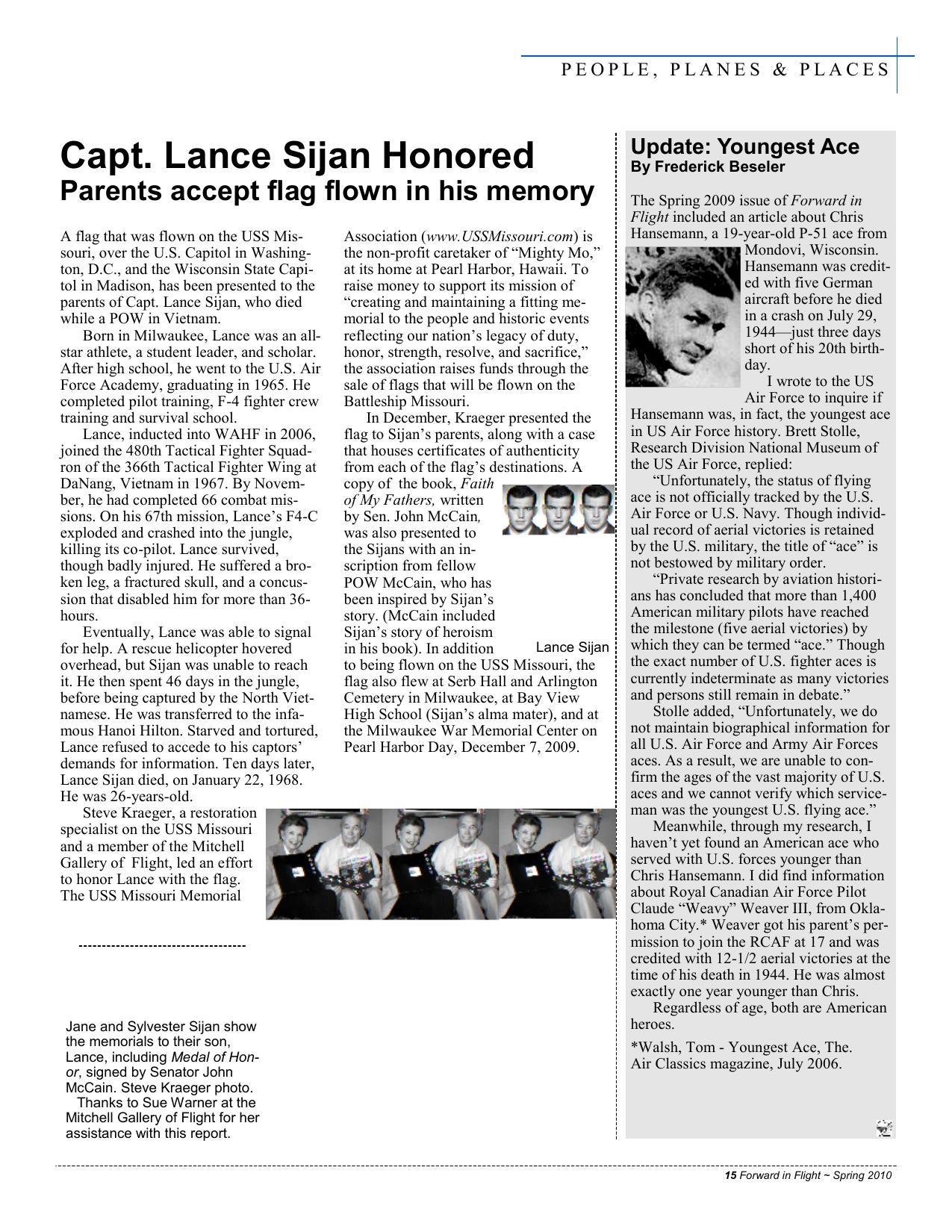
PEOPLE, PLANES & PLACES Capt. Lance Sijan Honored Parents accept flag flown in his memory A flag that was flown on the USS Missouri, over the U.S. Capitol in Washington, D.C., and the Wisconsin State Capitol in Madison, has been presented to the parents of Capt. Lance Sijan, who died while a POW in Vietnam. Born in Milwaukee, Lance was an allstar athlete, a student leader, and scholar. After high school, he went to the U.S. Air Force Academy, graduating in 1965. He completed pilot training, F-4 fighter crew training and survival school. Lance, inducted into WAHF in 2006, joined the 480th Tactical Fighter Squadron of the 366th Tactical Fighter Wing at DaNang, Vietnam in 1967. By November, he had completed 66 combat missions. On his 67th mission, Lance’s F4-C exploded and crashed into the jungle, killing its co-pilot. Lance survived, though badly injured. He suffered a broken leg, a fractured skull, and a concussion that disabled him for more than 36hours. Eventually, Lance was able to signal for help. A rescue helicopter hovered overhead, but Sijan was unable to reach it. He then spent 46 days in the jungle, before being captured by the North Vietnamese. He was transferred to the infamous Hanoi Hilton. Starved and tortured, Lance refused to accede to his captors’ demands for information. Ten days later, Lance Sijan died, on January 22, 1968. He was 26-years-old. Steve Kraeger, a restoration specialist on the USS Missouri and a member of the Mitchell Gallery of Flight, led an effort to honor Lance with the flag. The USS Missouri Memorial Jane and Sylvester Sijan show the memorials to their son, Lance, including Medal of Honor, signed by Senator John McCain. Steve Kraeger photo. Thanks to Sue Warner at the Mitchell Gallery of Flight for her assistance with this report. Association (www.USSMissouri.com) is the non-profit caretaker of “Mighty Mo,” at its home at Pearl Harbor, Hawaii. To raise money to support its mission of “creating and maintaining a fitting memorial to the people and historic events reflecting our nation’s legacy of duty, honor, strength, resolve, and sacrifice,” the association raises funds through the sale of flags that will be flown on the Battleship Missouri. In December, Kraeger presented the flag to Sijan’s parents, along with a case that houses certificates of authenticity from each of the flag’s destinations. A copy of the book, Faith of My Fathers, written by Sen. John McCain, was also presented to the Sijans with an inscription from fellow POW McCain, who has been inspired by Sijan’s story. (McCain included Sijan’s story of heroism Lance Sijan in his book). In addition to being flown on the USS Missouri, the flag also flew at Serb Hall and Arlington Cemetery in Milwaukee, at Bay View High School (Sijan’s alma mater), and at the Milwaukee War Memorial Center on Pearl Harbor Day, December 7, 2009. Update: Youngest Ace By Frederick Beseler The Spring 2009 issue of Forward in Flight included an article about Chris Hansemann, a 19-year-old P-51 ace from Mondovi, Wisconsin. Hansemann was credited with five German aircraft before he died in a crash on July 29, 1944—just three days short of his 20th birthday. I wrote to the US Air Force to inquire if Hansemann was, in fact, the youngest ace in US Air Force history. Brett Stolle, Research Division National Museum of the US Air Force, replied: “Unfortunately, the status of flying ace is not officially tracked by the U.S. Air Force or U.S. Navy. Though individual record of aerial victories is retained by the U.S. military, the title of “ace” is not bestowed by military order. “Private research by aviation historians has concluded that more than 1,400 American military pilots have reached the milestone (five aerial victories) by which they can be termed “ace.” Though the exact number of U.S. fighter aces is currently indeterminate as many victories and persons still remain in debate.” Stolle added, “Unfortunately, we do not maintain biographical information for all U.S. Air Force and Army Air Forces aces. As a result, we are unable to confirm the ages of the vast majority of U.S. aces and we cannot verify which serviceman was the youngest U.S. flying ace.” Meanwhile, through my research, I haven’t yet found an American ace who served with U.S. forces younger than Chris Hansemann. I did find information about Royal Canadian Air Force Pilot Claude “Weavy” Weaver III, from Oklahoma City.* Weaver got his parent’s permission to join the RCAF at 17 and was credited with 12-1/2 aerial victories at the time of his death in 1944. He was almost exactly one year younger than Chris. Regardless of age, both are American heroes. *Walsh, Tom - Youngest Ace, The. Air Classics magazine, July 2006. 15 Forward in Flight ~ Spring 2010
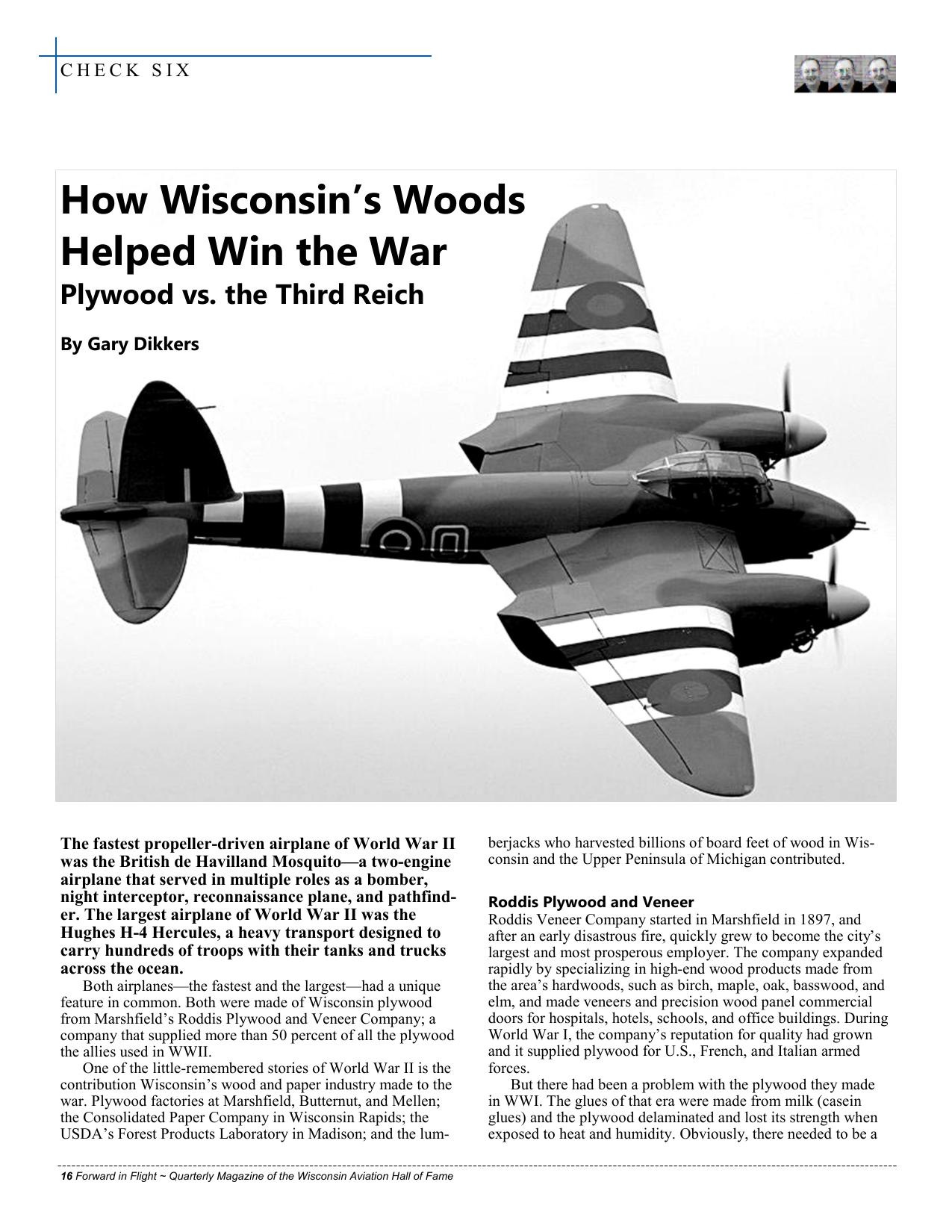
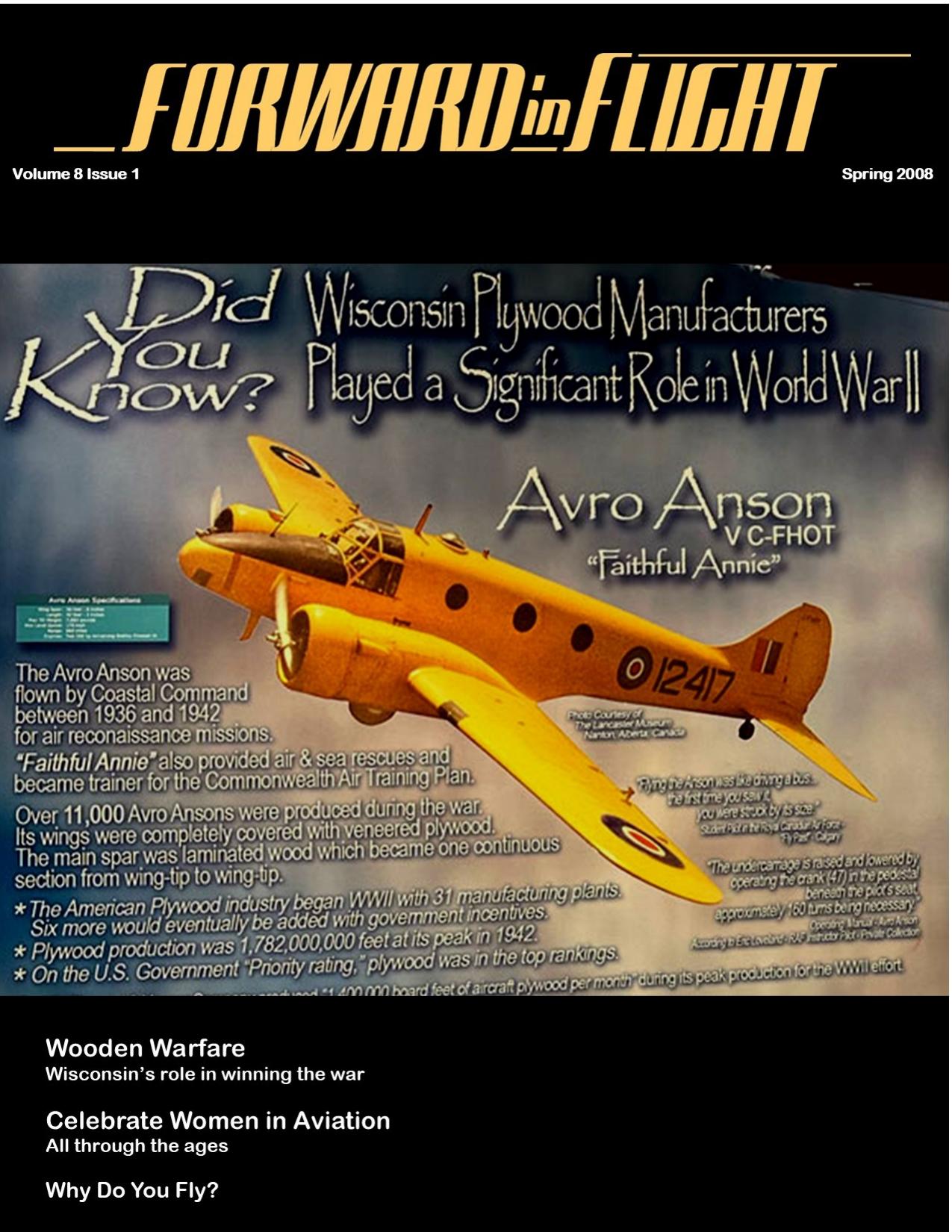
CHECK SIX How Wisconsin’s Woods Helped Win the War Plywood vs. the Third Reich By Gary Dikkers The fastest propeller-driven airplane of World War II was the British de Havilland Mosquito—a two-engine airplane that served in multiple roles as a bomber, night interceptor, reconnaissance plane, and pathfinder. The largest airplane of World War II was the Hughes H-4 Hercules, a heavy transport designed to carry hundreds of troops with their tanks and trucks across the ocean. Both airplanes—the fastest and the largest—had a unique feature in common. Both were made of Wisconsin plywood from Marshfield’s Roddis Plywood and Veneer Company; a company that supplied more than 50 percent of all the plywood the allies used in WWII. One of the little-remembered stories of World War II is the contribution Wisconsin’s wood and paper industry made to the war. Plywood factories at Marshfield, Butternut, and Mellen; the Consolidated Paper Company in Wisconsin Rapids; the USDA’s Forest Products Laboratory in Madison; and the lum16 Forward in Flight ~ Quarterly Magazine of the Wisconsin Aviation Hall of Fame berjacks who harvested billions of board feet of wood in Wisconsin and the Upper Peninsula of Michigan contributed. Roddis Plywood and Veneer Roddis Veneer Company started in Marshfield in 1897, and after an early disastrous fire, quickly grew to become the city’s largest and most prosperous employer. The company expanded rapidly by specializing in high-end wood products made from the area’s hardwoods, such as birch, maple, oak, basswood, and elm, and made veneers and precision wood panel commercial doors for hospitals, hotels, schools, and office buildings. During World War I, the company’s reputation for quality had grown and it supplied plywood for U.S., French, and Italian armed forces. But there had been a problem with the plywood they made in WWI. The glues of that era were made from milk (casein glues) and the plywood delaminated and lost its strength when exposed to heat and humidity. Obviously, there needed to be a
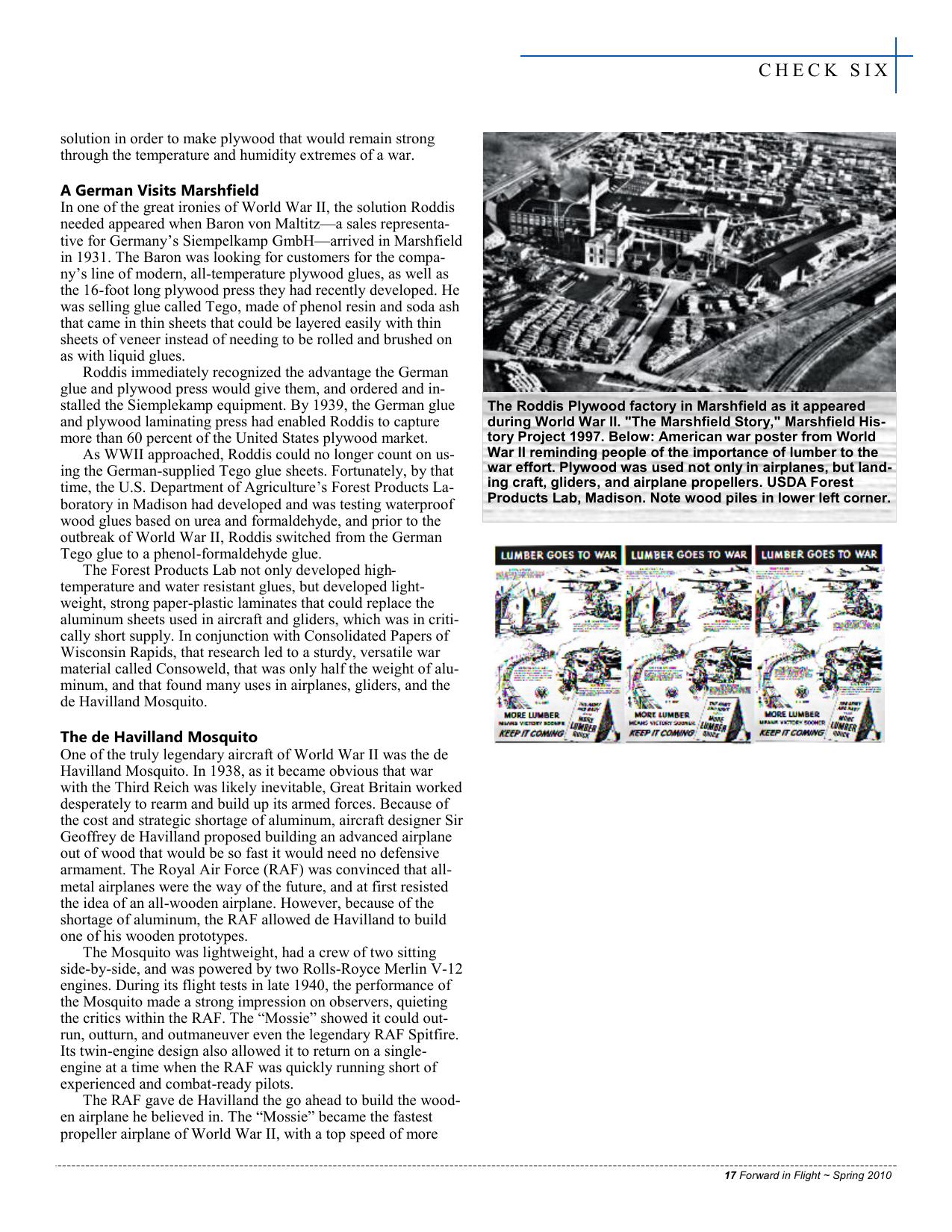
CHECK SIX solution in order to make plywood that would remain strong through the temperature and humidity extremes of a war. A German Visits Marshfield In one of the great ironies of World War II, the solution Roddis needed appeared when Baron von Maltitz—a sales representative for Germany’s Siempelkamp GmbH—arrived in Marshfield in 1931. The Baron was looking for customers for the company’s line of modern, all-temperature plywood glues, as well as the 16-foot long plywood press they had recently developed. He was selling glue called Tego, made of phenol resin and soda ash that came in thin sheets that could be layered easily with thin sheets of veneer instead of needing to be rolled and brushed on as with liquid glues. Roddis immediately recognized the advantage the German glue and plywood press would give them, and ordered and installed the Siemplekamp equipment. By 1939, the German glue and plywood laminating press had enabled Roddis to capture more than 60 percent of the United States plywood market. As WWII approached, Roddis could no longer count on using the German-supplied Tego glue sheets. Fortunately, by that time, the U.S. Department of Agriculture’s Forest Products Laboratory in Madison had developed and was testing waterproof wood glues based on urea and formaldehyde, and prior to the outbreak of World War II, Roddis switched from the German Tego glue to a phenol-formaldehyde glue. The Forest Products Lab not only developed hightemperature and water resistant glues, but developed lightweight, strong paper-plastic laminates that could replace the aluminum sheets used in aircraft and gliders, which was in critically short supply. In conjunction with Consolidated Papers of Wisconsin Rapids, that research led to a sturdy, versatile war material called Consoweld, that was only half the weight of aluminum, and that found many uses in airplanes, gliders, and the de Havilland Mosquito. The Roddis Plywood factory in Marshfield as it appeared during World War II. "The Marshfield Story," Marshfield History Project 1997. Below: American war poster from World War II reminding people of the importance of lumber to the war effort. Plywood was used not only in airplanes, but landing craft, gliders, and airplane propellers. USDA Forest Products Lab, Madison. Note wood piles in lower left corner. The de Havilland Mosquito One of the truly legendary aircraft of World War II was the de Havilland Mosquito. In 1938, as it became obvious that war with the Third Reich was likely inevitable, Great Britain worked desperately to rearm and build up its armed forces. Because of the cost and strategic shortage of aluminum, aircraft designer Sir Geoffrey de Havilland proposed building an advanced airplane out of wood that would be so fast it would need no defensive armament. The Royal Air Force (RAF) was convinced that allmetal airplanes were the way of the future, and at first resisted the idea of an all-wooden airplane. However, because of the shortage of aluminum, the RAF allowed de Havilland to build one of his wooden prototypes. The Mosquito was lightweight, had a crew of two sitting side-by-side, and was powered by two Rolls-Royce Merlin V-12 engines. During its flight tests in late 1940, the performance of the Mosquito made a strong impression on observers, quieting the critics within the RAF. The “Mossie” showed it could outrun, outturn, and outmaneuver even the legendary RAF Spitfire. Its twin-engine design also allowed it to return on a singleengine at a time when the RAF was quickly running short of experienced and combat-ready pilots. The RAF gave de Havilland the go ahead to build the wooden airplane he believed in. The “Mossie” became the fastest propeller airplane of World War II, with a top speed of more 17 Forward in Flight ~ Spring 2010
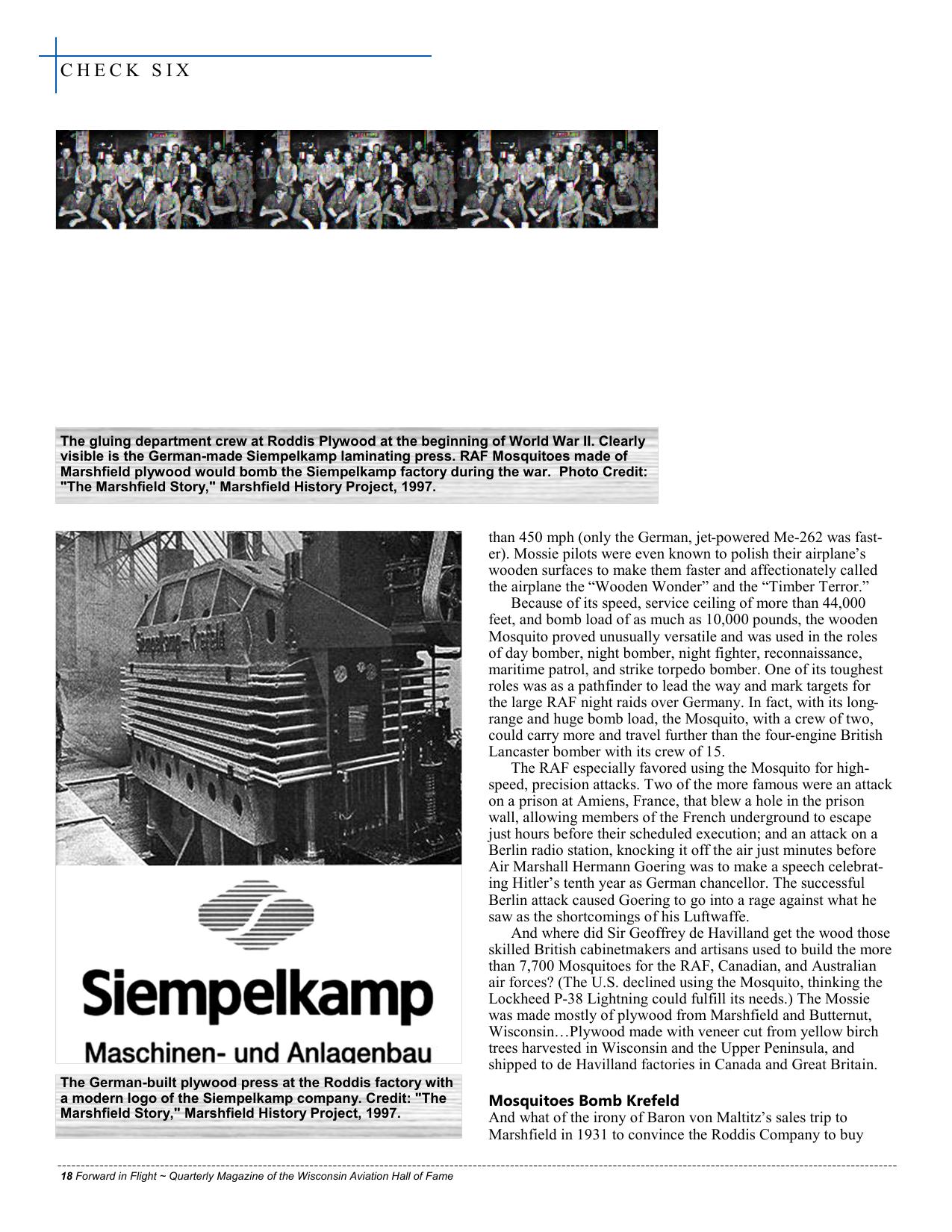
CHECK SIX The gluing department crew at Roddis Plywood at the beginning of World War II. Clearly visible is the German-made Siempelkamp laminating press. RAF Mosquitoes made of Marshfield plywood would bomb the Siempelkamp factory during the war. Photo Credit: "The Marshfield Story," Marshfield History Project, 1997. than 450 mph (only the German, jet-powered Me-262 was faster). Mossie pilots were even known to polish their airplane’s wooden surfaces to make them faster and affectionately called the airplane the “Wooden Wonder” and the “Timber Terror.” Because of its speed, service ceiling of more than 44,000 feet, and bomb load of as much as 10,000 pounds, the wooden Mosquito proved unusually versatile and was used in the roles of day bomber, night bomber, night fighter, reconnaissance, maritime patrol, and strike torpedo bomber. One of its toughest roles was as a pathfinder to lead the way and mark targets for the large RAF night raids over Germany. In fact, with its longrange and huge bomb load, the Mosquito, with a crew of two, could carry more and travel further than the four-engine British Lancaster bomber with its crew of 15. The RAF especially favored using the Mosquito for highspeed, precision attacks. Two of the more famous were an attack on a prison at Amiens, France, that blew a hole in the prison wall, allowing members of the French underground to escape just hours before their scheduled execution; and an attack on a Berlin radio station, knocking it off the air just minutes before Air Marshall Hermann Goering was to make a speech celebrating Hitler’s tenth year as German chancellor. The successful Berlin attack caused Goering to go into a rage against what he saw as the shortcomings of his Luftwaffe. And where did Sir Geoffrey de Havilland get the wood those skilled British cabinetmakers and artisans used to build the more than 7,700 Mosquitoes for the RAF, Canadian, and Australian air forces? (The U.S. declined using the Mosquito, thinking the Lockheed P-38 Lightning could fulfill its needs.) The Mossie was made mostly of plywood from Marshfield and Butternut, Wisconsin…Plywood made with veneer cut from yellow birch trees harvested in Wisconsin and the Upper Peninsula, and shipped to de Havilland factories in Canada and Great Britain. The German-built plywood press at the Roddis factory with a modern logo of the Siempelkamp company. Credit: "The Marshfield Story," Marshfield History Project, 1997. 18 Forward in Flight ~ Quarterly Magazine of the Wisconsin Aviation Hall of Fame Mosquitoes Bomb Krefeld And what of the irony of Baron von Maltitz’s sales trip to Marshfield in 1931 to convince the Roddis Company to buy
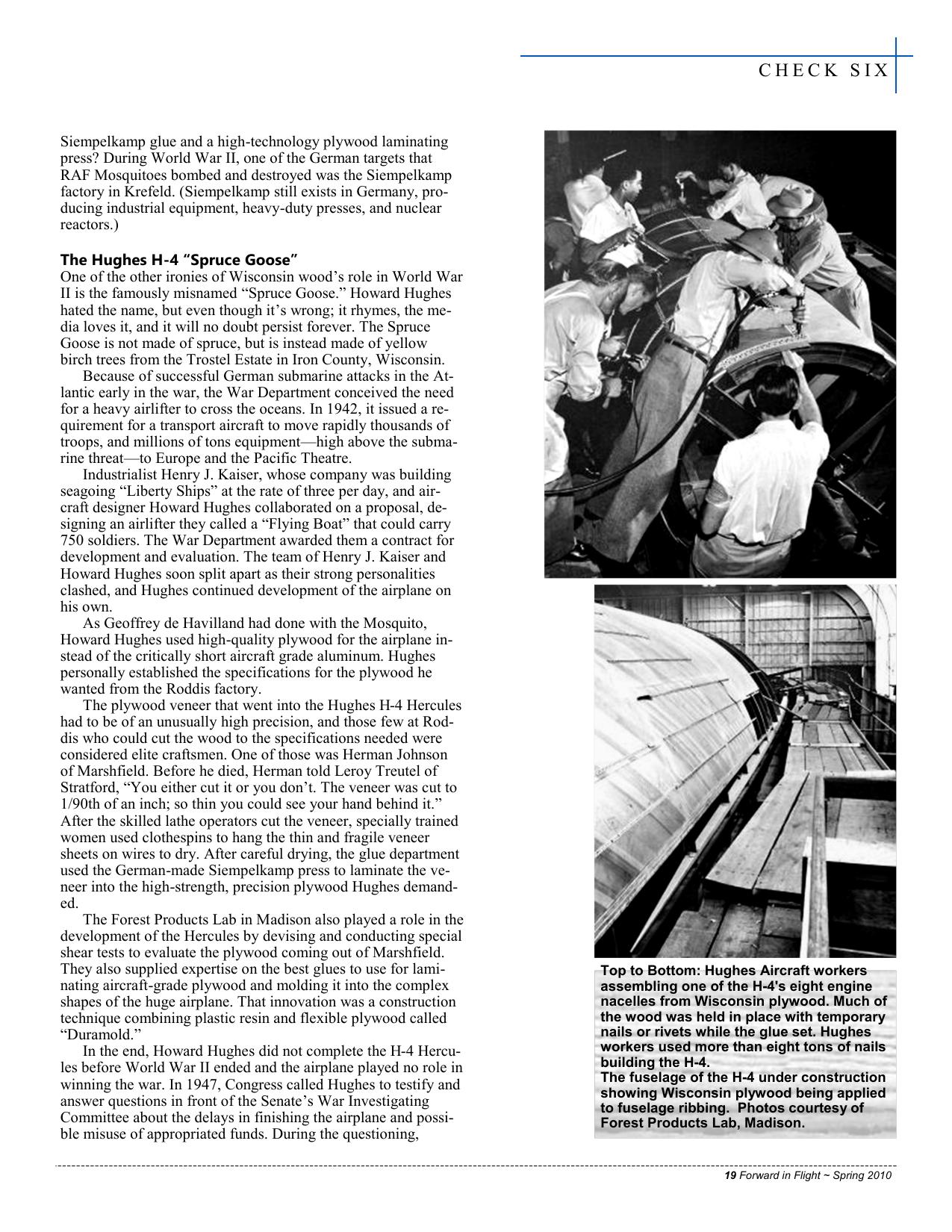
CHECK SIX Siempelkamp glue and a high-technology plywood laminating press? During World War II, one of the German targets that RAF Mosquitoes bombed and destroyed was the Siempelkamp factory in Krefeld. (Siempelkamp still exists in Germany, producing industrial equipment, heavy-duty presses, and nuclear reactors.) The Hughes H-4 “Spruce Goose” One of the other ironies of Wisconsin wood’s role in World War II is the famously misnamed “Spruce Goose.” Howard Hughes hated the name, but even though it’s wrong; it rhymes, the media loves it, and it will no doubt persist forever. The Spruce Goose is not made of spruce, but is instead made of yellow birch trees from the Trostel Estate in Iron County, Wisconsin. Because of successful German submarine attacks in the Atlantic early in the war, the War Department conceived the need for a heavy airlifter to cross the oceans. In 1942, it issued a requirement for a transport aircraft to move rapidly thousands of troops, and millions of tons equipment—high above the submarine threat—to Europe and the Pacific Theatre. Industrialist Henry J. Kaiser, whose company was building seagoing “Liberty Ships” at the rate of three per day, and aircraft designer Howard Hughes collaborated on a proposal, designing an airlifter they called a “Flying Boat” that could carry 750 soldiers. The War Department awarded them a contract for development and evaluation. The team of Henry J. Kaiser and Howard Hughes soon split apart as their strong personalities clashed, and Hughes continued development of the airplane on his own. As Geoffrey de Havilland had done with the Mosquito, Howard Hughes used high-quality plywood for the airplane instead of the critically short aircraft grade aluminum. Hughes personally established the specifications for the plywood he wanted from the Roddis factory. The plywood veneer that went into the Hughes H-4 Hercules had to be of an unusually high precision, and those few at Roddis who could cut the wood to the specifications needed were considered elite craftsmen. One of those was Herman Johnson of Marshfield. Before he died, Herman told Leroy Treutel of Stratford, “You either cut it or you don’t. The veneer was cut to 1/90th of an inch; so thin you could see your hand behind it.” After the skilled lathe operators cut the veneer, specially trained women used clothespins to hang the thin and fragile veneer sheets on wires to dry. After careful drying, the glue department used the German-made Siempelkamp press to laminate the veneer into the high-strength, precision plywood Hughes demanded. The Forest Products Lab in Madison also played a role in the development of the Hercules by devising and conducting special shear tests to evaluate the plywood coming out of Marshfield. They also supplied expertise on the best glues to use for laminating aircraft-grade plywood and molding it into the complex shapes of the huge airplane. That innovation was a construction technique combining plastic resin and flexible plywood called “Duramold.” In the end, Howard Hughes did not complete the H-4 Hercules before World War II ended and the airplane played no role in winning the war. In 1947, Congress called Hughes to testify and answer questions in front of the Senate’s War Investigating Committee about the delays in finishing the airplane and possible misuse of appropriated funds. During the questioning, Top to Bottom: Hughes Aircraft workers assembling one of the H-4's eight engine nacelles from Wisconsin plywood. Much of the wood was held in place with temporary nails or rivets while the glue set. Hughes workers used more than eight tons of nails building the H-4. The fuselage of the H-4 under construction showing Wisconsin plywood being applied to fuselage ribbing. Photos courtesy of Forest Products Lab, Madison. 19 Forward in Flight ~ Spring 2010
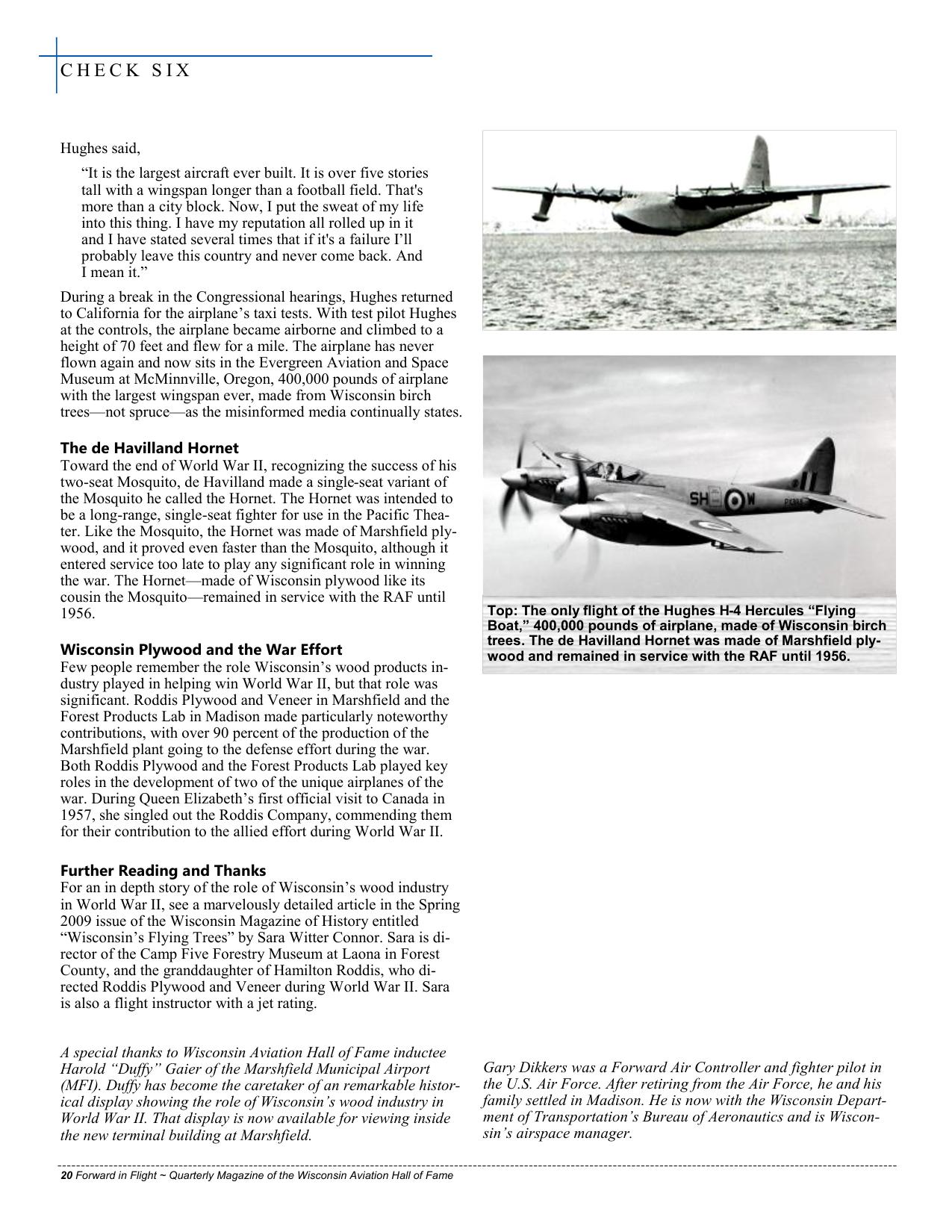
CHECK SIX Hughes said, “It is the largest aircraft ever built. It is over five stories tall with a wingspan longer than a football field. That's more than a city block. Now, I put the sweat of my life into this thing. I have my reputation all rolled up in it and I have stated several times that if it's a failure I’ll probably leave this country and never come back. And I mean it.” During a break in the Congressional hearings, Hughes returned to California for the airplane’s taxi tests. With test pilot Hughes at the controls, the airplane became airborne and climbed to a height of 70 feet and flew for a mile. The airplane has never flown again and now sits in the Evergreen Aviation and Space Museum at McMinnville, Oregon, 400,000 pounds of airplane with the largest wingspan ever, made from Wisconsin birch trees—not spruce—as the misinformed media continually states. The de Havilland Hornet Toward the end of World War II, recognizing the success of his two-seat Mosquito, de Havilland made a single-seat variant of the Mosquito he called the Hornet. The Hornet was intended to be a long-range, single-seat fighter for use in the Pacific Theater. Like the Mosquito, the Hornet was made of Marshfield plywood, and it proved even faster than the Mosquito, although it entered service too late to play any significant role in winning the war. The Hornet—made of Wisconsin plywood like its cousin the Mosquito—remained in service with the RAF until 1956. Wisconsin Plywood and the War Effort Few people remember the role Wisconsin’s wood products industry played in helping win World War II, but that role was significant. Roddis Plywood and Veneer in Marshfield and the Forest Products Lab in Madison made particularly noteworthy contributions, with over 90 percent of the production of the Marshfield plant going to the defense effort during the war. Both Roddis Plywood and the Forest Products Lab played key roles in the development of two of the unique airplanes of the war. During Queen Elizabeth’s first official visit to Canada in 1957, she singled out the Roddis Company, commending them for their contribution to the allied effort during World War II. Top: The only flight of the Hughes H-4 Hercules “Flying Boat,” 400,000 pounds of airplane, made of Wisconsin birch trees. The de Havilland Hornet was made of Marshfield plywood and remained in service with the RAF until 1956. Further Reading and Thanks For an in depth story of the role of Wisconsin’s wood industry in World War II, see a marvelously detailed article in the Spring 2009 issue of the Wisconsin Magazine of History entitled “Wisconsin’s Flying Trees” by Sara Witter Connor. Sara is director of the Camp Five Forestry Museum at Laona in Forest County, and the granddaughter of Hamilton Roddis, who directed Roddis Plywood and Veneer during World War II. Sara is also a flight instructor with a jet rating. A special thanks to Wisconsin Aviation Hall of Fame inductee Harold “Duffy” Gaier of the Marshfield Municipal Airport (MFI). Duffy has become the caretaker of an remarkable historical display showing the role of Wisconsin’s wood industry in World War II. That display is now available for viewing inside the new terminal building at Marshfield. 20 Forward in Flight ~ Quarterly Magazine of the Wisconsin Aviation Hall of Fame Gary Dikkers was a Forward Air Controller and fighter pilot in the U.S. Air Force. After retiring from the Air Force, he and his family settled in Madison. He is now with the Wisconsin Department of Transportation’s Bureau of Aeronautics and is Wisconsin’s airspace manager.
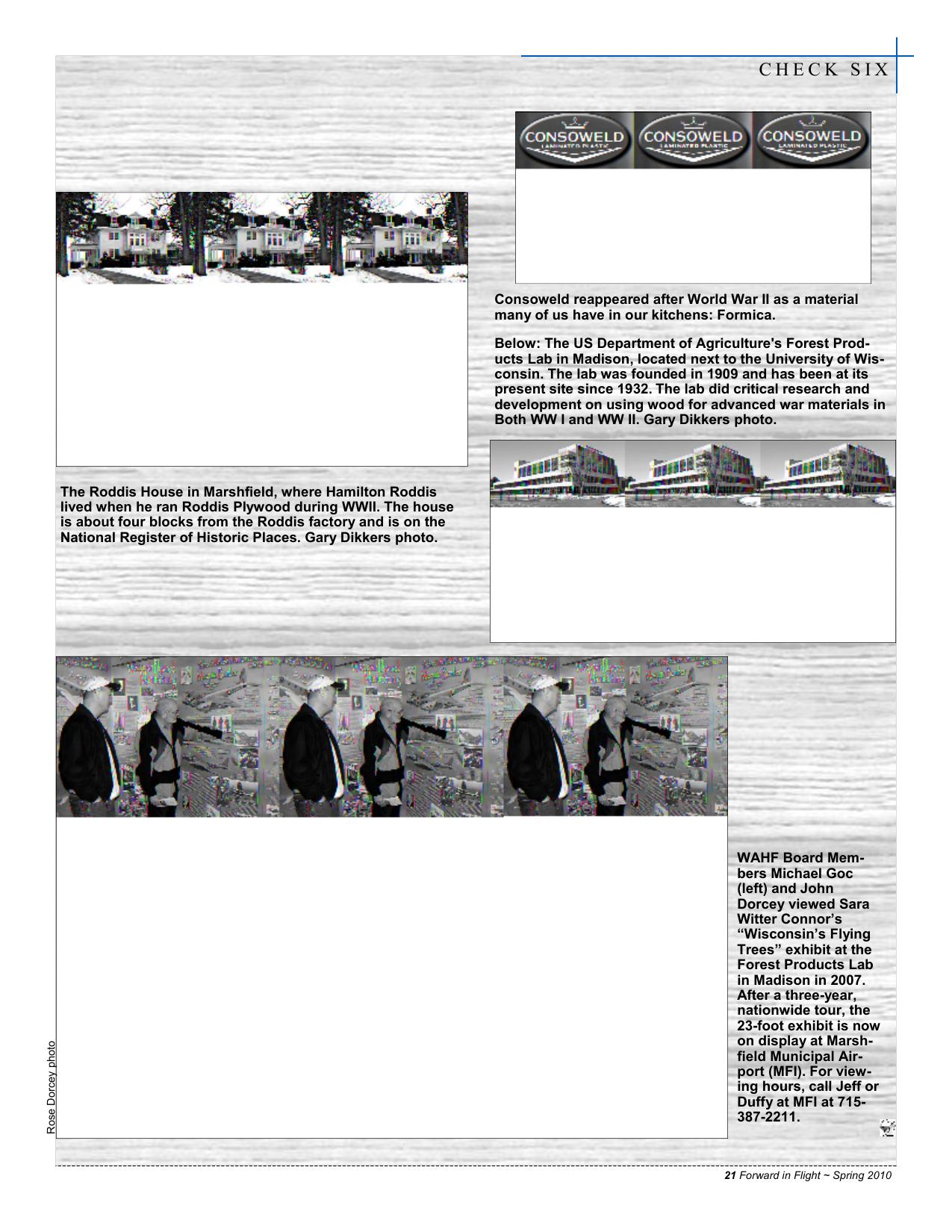
CHECK SIX Consoweld reappeared after World War II as a material many of us have in our kitchens: Formica. Below: The US Department of Agriculture's Forest Products Lab in Madison, located next to the University of Wisconsin. The lab was founded in 1909 and has been at its present site since 1932. The lab did critical research and development on using wood for advanced war materials in Both WW I and WW II. Gary Dikkers photo. Rose Dorcey photo The Roddis House in Marshfield, where Hamilton Roddis lived when he ran Roddis Plywood during WWII. The house is about four blocks from the Roddis factory and is on the National Register of Historic Places. Gary Dikkers photo. WAHF Board Members Michael Goc (left) and John Dorcey viewed Sara Witter Connor’s “Wisconsin’s Flying Trees” exhibit at the Forest Products Lab in Madison in 2007. After a three-year, nationwide tour, the 23-foot exhibit is now on display at Marshfield Municipal Airport (MFI). For viewing hours, call Jeff or Duffy at MFI at 715387-2211. 21 Forward in Flight ~ Spring 2010
FROM THE ARCHIVES Milwaukee’s Centurama Air Show By Michael Goc Milwaukee celebrated its centennial as a city in 1946 with a lakefront festival that included, “the largest—and by far the most sensational—aviation exposition in the nation’s history.” It was large—a month long fair featuring displays of military and civilian aircraft, including a Grumman Avenger, Vought Corsair, Grumman Hellcat, and Culver Model V, plus a cutaway exhibit of a B-29 Stratofortress. Displays of the new technology developed during World War II—radar, “buzz bombs,” and a cutaway model of an atomic bomb—were present in the exhibition tents that filled the southern portion of Juneau Park and spilled onto Maitland Field airport. It was sensational too—with a “giant Army Air Force armada” roaring up the lakefront to celebrate the 39th birthday of army aviation and climaxing with a “jet-propelled P-80” piloted by a young fellow identified only as Captain Charles E. “Yaeger” of West Virginia. That a city should celebrate a centennial was not unusual and Milwaukee’s event was typical in many ways. An amphitheater was constructed in Juneau Park, just about where the art museum stands today. It hosted Centurama performances by veteran vaudevillian Eddie Cantor, Hollywood’s Donald O’Connor, classical vocalist Jan Peerce, and others. There were industrial, agricultural, and commercial exhibits, carnival rides and games, parades and fireworks, plus all the food anyone could expect. Since it was on the lakefront, sail and power boat races were on the program and, since World War II had ended only a year before, so were naval vessels, including the U.S. sub chaser Ripley. Just as close as the lake was Maitland Field, the downtown airport that had fallen idle during the Depression and war years. The presence of Maitland Field, the availability of military aircraft after the war, and the promotional efforts of an active civil aviation organization kept airplanes and flight on Centurama’s program every day. Founded in 1930, the Wisconsin Civil Air Corps (WCAC) was headed by Gordon D. Leonard and headquartered in Sturgeon Bay. Its goal was “to promote aviation and safe flying,” and claimed to be “instrumental in establishing airports in many of Wisconsin’s cities, both large and small.” The first issue of its monthly magazine, Badger Flying, appeared in September 1945, a time of great promise for aviation. The war was over, releasing more experienced pilots than any time in history, with thousands more to come out of G.I. Bill-financed training programs. The federal government had pledged to grant millions of dollars to the states for airport construction, prompting Wisconsin to establish an Aeronautics Commission to administer its share of the earmarks. When the Centurama opened on Friday, July 12, 40,000 people were on hand to see WCAC fill the sky with civilian airplanes that landed at Maitland Field. After the ribbons were cut and the politicians had their say, Colonel David C. Schilling, commander of operations at Selfridge Field in Michigan, took the microphone and described what was happening in the air. A dozen P-47s and P-51s came down the lakeshore from the north four abreast and “peeled off at high altitude and skimmed 25 22 Forward in Flight ~ Quarterly Magazine of the Wisconsin Aviation Hall of Fame feet in front of the Centurama throng.” A second wave of a dozen more joined the first and “all put on an exhibition of simulated strafing and bombing.” The Army yielded the air to naval aircraft from Great Lakes Naval Air Station on the following weekend, but came back with a roar on August 1. In between, WCAC sponsored a fly-in banquet at the Pfister Hotel. Three-hundred aviators and friends from all over the country landed at Maitland before the dinner. One of the planes was a Beechcraft 18 fresh out of the factory in Wichita, Kansas. The pilot was tall, dark, and handsome Hollywood heartthrob Tyrone Power, who shared the cockpit with the hunky LatinAmerican star, Cesar Romero. The next day, the actors and other pilots took off for Wausaukee where they enjoyed a barbecue at the White Clay Farm of tannery magnate Francis J. Trecker. Also that week, the WCAC announced the winner of its “jingle contest.” The challenge was to complete the following lines of a promotional ditty for Maitland Field: Our Maitland Field is right downtown/A blessing to us all/The air show thrills the crowd there now…The winning entry, contributed by Earl Smith of Milwaukee, makes sense if read slowly: So, Mate, land here and call. For his effort, Smith was awarded an Aeronca
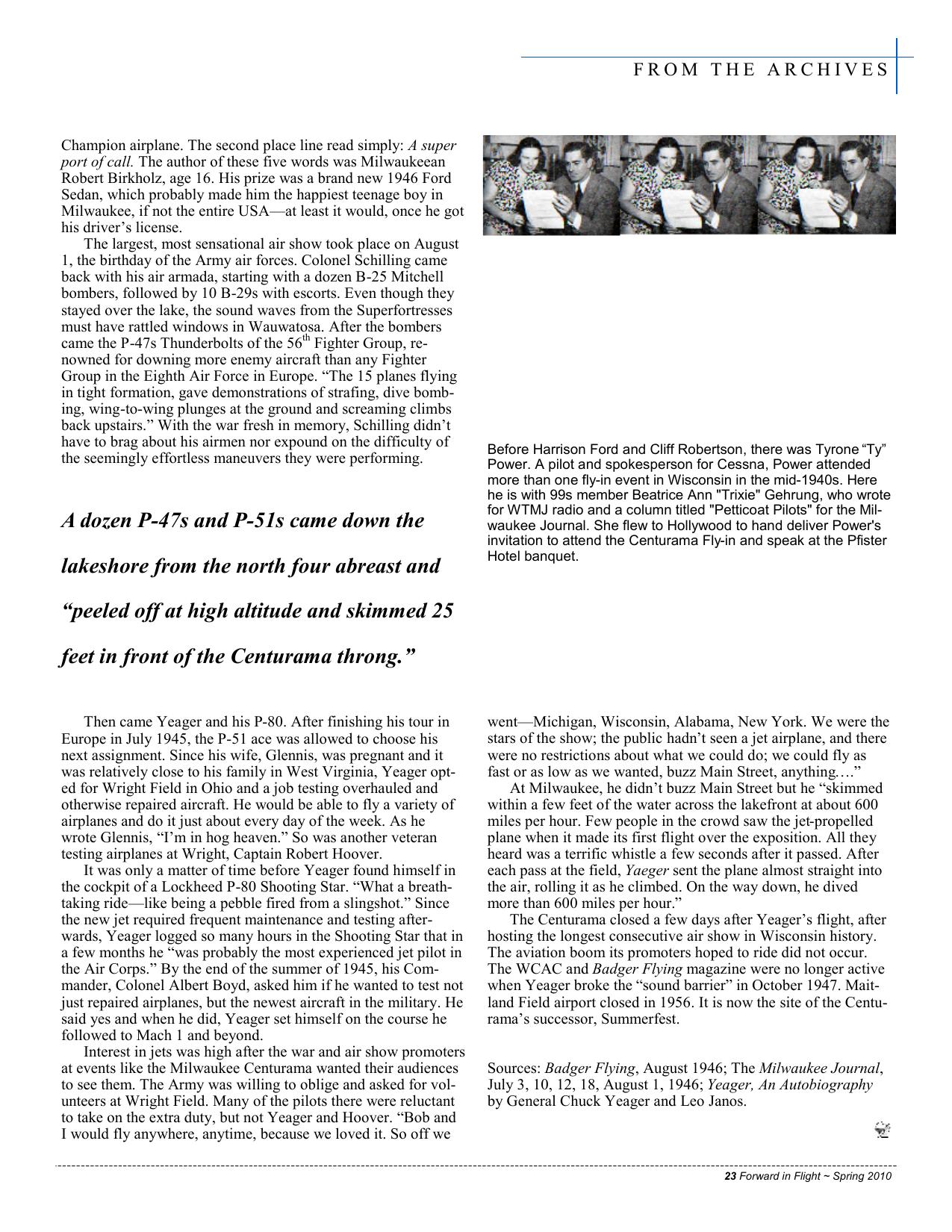
FROM THE ARCHIVES Champion airplane. The second place line read simply: A super port of call. The author of these five words was Milwaukeean Robert Birkholz, age 16. His prize was a brand new 1946 Ford Sedan, which probably made him the happiest teenage boy in Milwaukee, if not the entire USA—at least it would, once he got his driver’s license. The largest, most sensational air show took place on August 1, the birthday of the Army air forces. Colonel Schilling came back with his air armada, starting with a dozen B-25 Mitchell bombers, followed by 10 B-29s with escorts. Even though they stayed over the lake, the sound waves from the Superfortresses must have rattled windows in Wauwatosa. After the bombers came the P-47s Thunderbolts of the 56th Fighter Group, renowned for downing more enemy aircraft than any Fighter Group in the Eighth Air Force in Europe. “The 15 planes flying in tight formation, gave demonstrations of strafing, dive bombing, wing-to-wing plunges at the ground and screaming climbs back upstairs.” With the war fresh in memory, Schilling didn’t have to brag about his airmen nor expound on the difficulty of the seemingly effortless maneuvers they were performing. A dozen P-47s and P-51s came down the lakeshore from the north four abreast and Before Harrison Ford and Cliff Robertson, there was Tyrone “Ty” Power. A pilot and spokesperson for Cessna, Power attended more than one fly-in event in Wisconsin in the mid-1940s. Here he is with 99s member Beatrice Ann "Trixie" Gehrung, who wrote for WTMJ radio and a column titled "Petticoat Pilots" for the Milwaukee Journal. She flew to Hollywood to hand deliver Power's invitation to attend the Centurama Fly-in and speak at the Pfister Hotel banquet. “peeled off at high altitude and skimmed 25 feet in front of the Centurama throng.” Then came Yeager and his P-80. After finishing his tour in Europe in July 1945, the P-51 ace was allowed to choose his next assignment. Since his wife, Glennis, was pregnant and it was relatively close to his family in West Virginia, Yeager opted for Wright Field in Ohio and a job testing overhauled and otherwise repaired aircraft. He would be able to fly a variety of airplanes and do it just about every day of the week. As he wrote Glennis, “I’m in hog heaven.” So was another veteran testing airplanes at Wright, Captain Robert Hoover. It was only a matter of time before Yeager found himself in the cockpit of a Lockheed P-80 Shooting Star. “What a breathtaking ride—like being a pebble fired from a slingshot.” Since the new jet required frequent maintenance and testing afterwards, Yeager logged so many hours in the Shooting Star that in a few months he “was probably the most experienced jet pilot in the Air Corps.” By the end of the summer of 1945, his Commander, Colonel Albert Boyd, asked him if he wanted to test not just repaired airplanes, but the newest aircraft in the military. He said yes and when he did, Yeager set himself on the course he followed to Mach 1 and beyond. Interest in jets was high after the war and air show promoters at events like the Milwaukee Centurama wanted their audiences to see them. The Army was willing to oblige and asked for volunteers at Wright Field. Many of the pilots there were reluctant to take on the extra duty, but not Yeager and Hoover. “Bob and I would fly anywhere, anytime, because we loved it. So off we went—Michigan, Wisconsin, Alabama, New York. We were the stars of the show; the public hadn’t seen a jet airplane, and there were no restrictions about what we could do; we could fly as fast or as low as we wanted, buzz Main Street, anything….” At Milwaukee, he didn’t buzz Main Street but he “skimmed within a few feet of the water across the lakefront at about 600 miles per hour. Few people in the crowd saw the jet-propelled plane when it made its first flight over the exposition. All they heard was a terrific whistle a few seconds after it passed. After each pass at the field, Yaeger sent the plane almost straight into the air, rolling it as he climbed. On the way down, he dived more than 600 miles per hour.” The Centurama closed a few days after Yeager’s flight, after hosting the longest consecutive air show in Wisconsin history. The aviation boom its promoters hoped to ride did not occur. The WCAC and Badger Flying magazine were no longer active when Yeager broke the “sound barrier” in October 1947. Maitland Field airport closed in 1956. It is now the site of the Centurama’s successor, Summerfest. Sources: Badger Flying, August 1946; The Milwaukee Journal, July 3, 10, 12, 18, August 1, 1946; Yeager, An Autobiography by General Chuck Yeager and Leo Janos. 23 Forward in Flight ~ Spring 2010
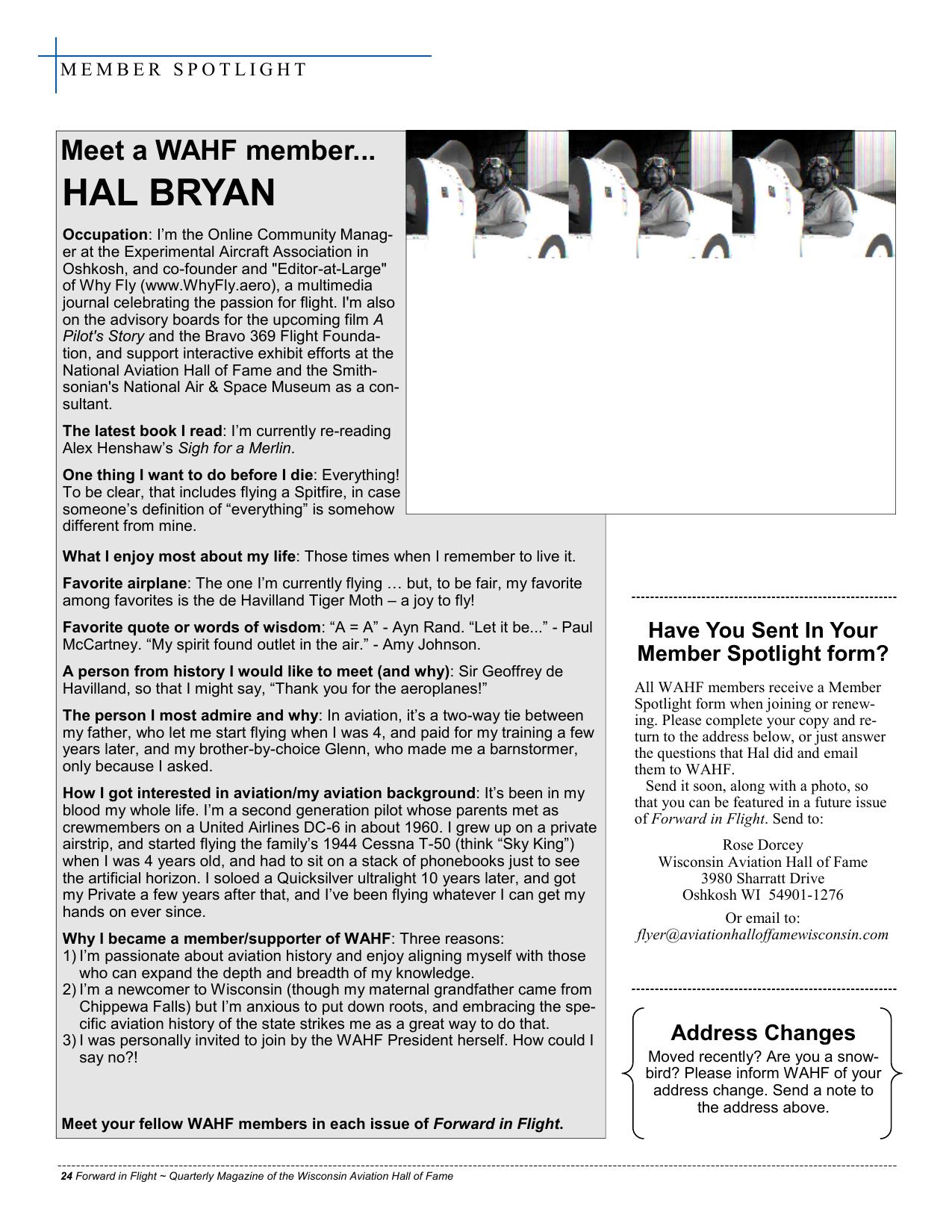
MEMBER SPOTLIGHT Meet a WAHF member... HAL BRYAN Occupation: I’m the Online Community Manager at the Experimental Aircraft Association in Oshkosh, and co-founder and "Editor-at-Large" of Why Fly (www.WhyFly.aero), a multimedia journal celebrating the passion for flight. I'm also on the advisory boards for the upcoming film A Pilot's Story and the Bravo 369 Flight Foundation, and support interactive exhibit efforts at the National Aviation Hall of Fame and the Smithsonian's National Air & Space Museum as a consultant. The latest book I read: I’m currently re-reading Alex Henshaw’s Sigh for a Merlin. One thing I want to do before I die: Everything! To be clear, that includes flying a Spitfire, in case someone’s definition of “everything” is somehow different from mine. What I enjoy most about my life: Those times when I remember to live it. Favorite airplane: The one I’m currently flying … but, to be fair, my favorite among favorites is the de Havilland Tiger Moth – a joy to fly! Favorite quote or words of wisdom: “A = A” - Ayn Rand. “Let it be...” - Paul McCartney. “My spirit found outlet in the air.” - Amy Johnson. A person from history I would like to meet (and why): Sir Geoffrey de Havilland, so that I might say, “Thank you for the aeroplanes!” The person I most admire and why: In aviation, it’s a two-way tie between my father, who let me start flying when I was 4, and paid for my training a few years later, and my brother-by-choice Glenn, who made me a barnstormer, only because I asked. How I got interested in aviation/my aviation background: It’s been in my blood my whole life. I’m a second generation pilot whose parents met as crewmembers on a United Airlines DC-6 in about 1960. I grew up on a private airstrip, and started flying the family’s 1944 Cessna T-50 (think “Sky King”) when I was 4 years old, and had to sit on a stack of phonebooks just to see the artificial horizon. I soloed a Quicksilver ultralight 10 years later, and got my Private a few years after that, and I’ve been flying whatever I can get my hands on ever since. Why I became a member/supporter of WAHF: Three reasons: 1) I’m passionate about aviation history and enjoy aligning myself with those who can expand the depth and breadth of my knowledge. 2) I’m a newcomer to Wisconsin (though my maternal grandfather came from Chippewa Falls) but I’m anxious to put down roots, and embracing the specific aviation history of the state strikes me as a great way to do that. 3) I was personally invited to join by the WAHF President herself. How could I say no?! Meet your fellow WAHF members in each issue of Forward in Flight. 24 Forward in Flight ~ Quarterly Magazine of the Wisconsin Aviation Hall of Fame Have You Sent In Your Member Spotlight form? All WAHF members receive a Member Spotlight form when joining or renewing. Please complete your copy and return to the address below, or just answer the questions that Hal did and email them to WAHF. Send it soon, along with a photo, so that you can be featured in a future issue of Forward in Flight. Send to: Rose Dorcey Wisconsin Aviation Hall of Fame 3980 Sharratt Drive Oshkosh WI 54901-1276 Or email to: flyer@aviationhalloffamewisconsin.com Address Changes Moved recently? Are you a snowbird? Please inform WAHF of your address change. Send a note to the address above.
SPECIAL FEATURE Why do I fly? That’s a harder question than it first appears. It is tempting, seductively so, to just finish this right now with five words, and then walk away whistling, hands in pockets, hoping nobody notices: “Because it’s fun. The End.” But let’s assume, for the sake of discussion anyway, that I can come up with something a little better, or at least a little longer than that. By Hal Bryan You could say that flying is in my blood, as I’m a second-generation pilot, periodically following in the vortices of my father, an airline pilot who began his career in a DC-3 and retired in a 747. My parents met on an airplane, a DC-6— dad the captain, mom the stewardess—in an era when it was not only okay to call her that, it was company policy that she be fired when she got married. I was even named after an airplane, at least after a fashion. My parents had been considering names for me, and one their choices was Harald, the name and its spelling an acknowledgment of the Scandinavian halves of their ancestry. They took a trip to Copenhagen while my mom was expecting me, and they flew on SAS, aboard a DC-8-55 named Harald Viking. Of course, a lot of nurture sprang from those bits of nature; flying and flying machines were a constant thread in childhood. There were pictures of airplanes on the walls and books about them on the shelves. My first pedal-car, shared with my older brothers, was an airplane. And it even “flew”, thanks to a wellstrung wire that started up the hill above our house and ended with the airplane making a perfect carrier-style landing on our deck. My toys were rubber-band-powered North Pacific Sleek-Streeks and Skeeters, Vertibirds and U-Fly-It, foam Delta Darts, and die-cast Hurricanes and Spitfires from Dinky. If it flew, or looked like it should, or might, I encouraged it. Encouraged it, that is, by throwing it, and, if necessary, pointing my hands at it like a cartoon genie and yelling “Fly!” My powers peaked on airplane-watching trips to nearby airports, when I learned that even mighty jetliners would fly at my well-timed command, but were ignominiously retired in what’s known as “the dinner plate incident.” 25 Forward in Flight ~ Spring 2010
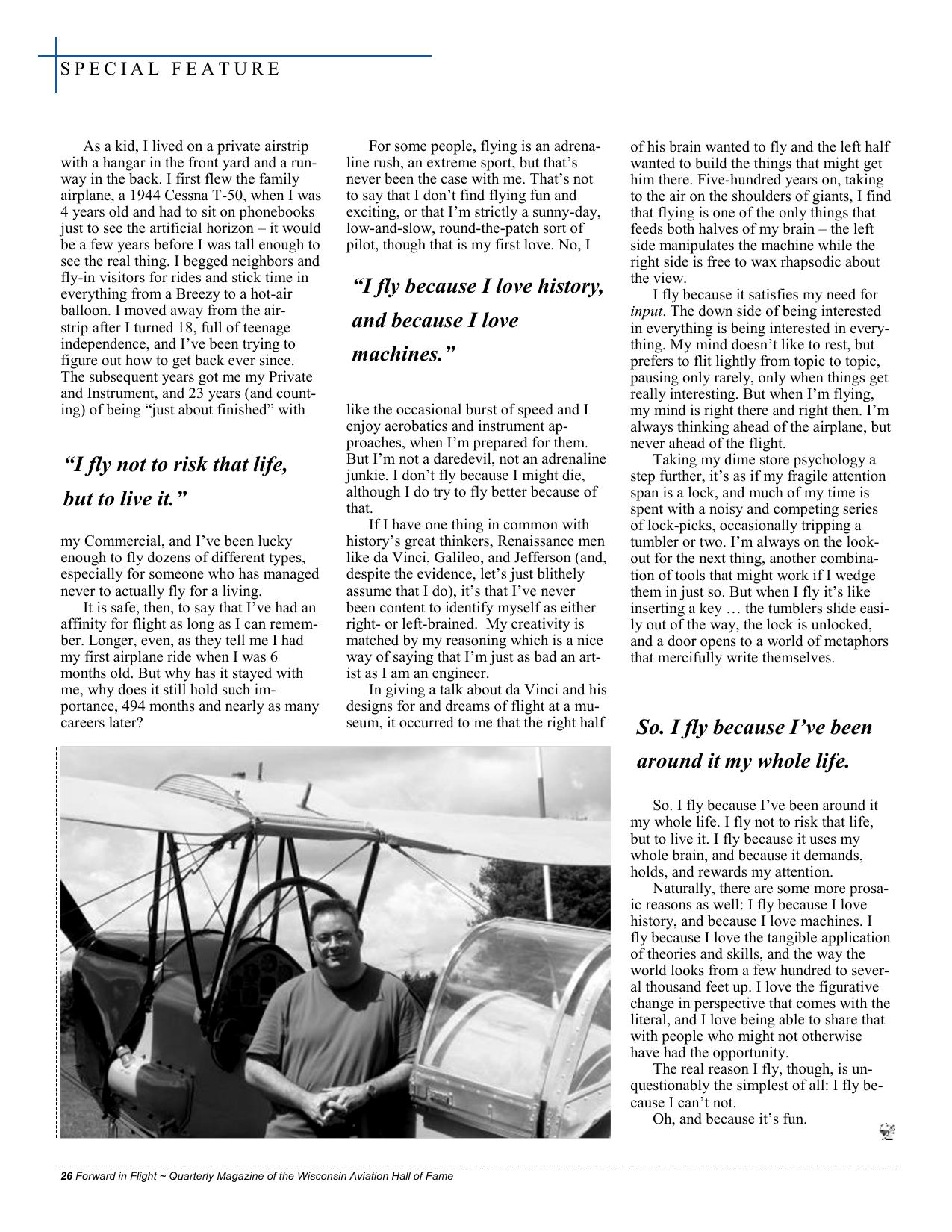
SPECIAL FEATURE As a kid, I lived on a private airstrip with a hangar in the front yard and a runway in the back. I first flew the family airplane, a 1944 Cessna T-50, when I was 4 years old and had to sit on phonebooks just to see the artificial horizon – it would be a few years before I was tall enough to see the real thing. I begged neighbors and fly-in visitors for rides and stick time in everything from a Breezy to a hot-air balloon. I moved away from the airstrip after I turned 18, full of teenage independence, and I’ve been trying to figure out how to get back ever since. The subsequent years got me my Private and Instrument, and 23 years (and counting) of being “just about finished” with “I fly not to risk that life, but to live it.” my Commercial, and I’ve been lucky enough to fly dozens of different types, especially for someone who has managed never to actually fly for a living. It is safe, then, to say that I’ve had an affinity for flight as long as I can remember. Longer, even, as they tell me I had my first airplane ride when I was 6 months old. But why has it stayed with me, why does it still hold such importance, 494 months and nearly as many careers later? For some people, flying is an adrenaline rush, an extreme sport, but that’s never been the case with me. That’s not to say that I don’t find flying fun and exciting, or that I’m strictly a sunny-day, low-and-slow, round-the-patch sort of pilot, though that is my first love. No, I “I fly because I love history, and because I love machines.” like the occasional burst of speed and I enjoy aerobatics and instrument approaches, when I’m prepared for them. But I’m not a daredevil, not an adrenaline junkie. I don’t fly because I might die, although I do try to fly better because of that. If I have one thing in common with history’s great thinkers, Renaissance men like da Vinci, Galileo, and Jefferson (and, despite the evidence, let’s just blithely assume that I do), it’s that I’ve never been content to identify myself as either right- or left-brained. My creativity is matched by my reasoning which is a nice way of saying that I’m just as bad an artist as I am an engineer. In giving a talk about da Vinci and his designs for and dreams of flight at a museum, it occurred to me that the right half of his brain wanted to fly and the left half wanted to build the things that might get him there. Five-hundred years on, taking to the air on the shoulders of giants, I find that flying is one of the only things that feeds both halves of my brain – the left side manipulates the machine while the right side is free to wax rhapsodic about the view. I fly because it satisfies my need for input. The down side of being interested in everything is being interested in everything. My mind doesn’t like to rest, but prefers to flit lightly from topic to topic, pausing only rarely, only when things get really interesting. But when I’m flying, my mind is right there and right then. I’m always thinking ahead of the airplane, but never ahead of the flight. Taking my dime store psychology a step further, it’s as if my fragile attention span is a lock, and much of my time is spent with a noisy and competing series of lock-picks, occasionally tripping a tumbler or two. I’m always on the lookout for the next thing, another combination of tools that might work if I wedge them in just so. But when I fly it’s like inserting a key … the tumblers slide easily out of the way, the lock is unlocked, and a door opens to a world of metaphors that mercifully write themselves. So. I fly because I’ve been around it my whole life. So. I fly because I’ve been around it my whole life. I fly not to risk that life, but to live it. I fly because it uses my whole brain, and because it demands, holds, and rewards my attention. Naturally, there are some more prosaic reasons as well: I fly because I love history, and because I love machines. I fly because I love the tangible application of theories and skills, and the way the world looks from a few hundred to several thousand feet up. I love the figurative change in perspective that comes with the literal, and I love being able to share that with people who might not otherwise have had the opportunity. The real reason I fly, though, is unquestionably the simplest of all: I fly because I can’t not. Oh, and because it’s fun. 26 Forward in Flight ~ Quarterly Magazine of the Wisconsin Aviation Hall of Fame
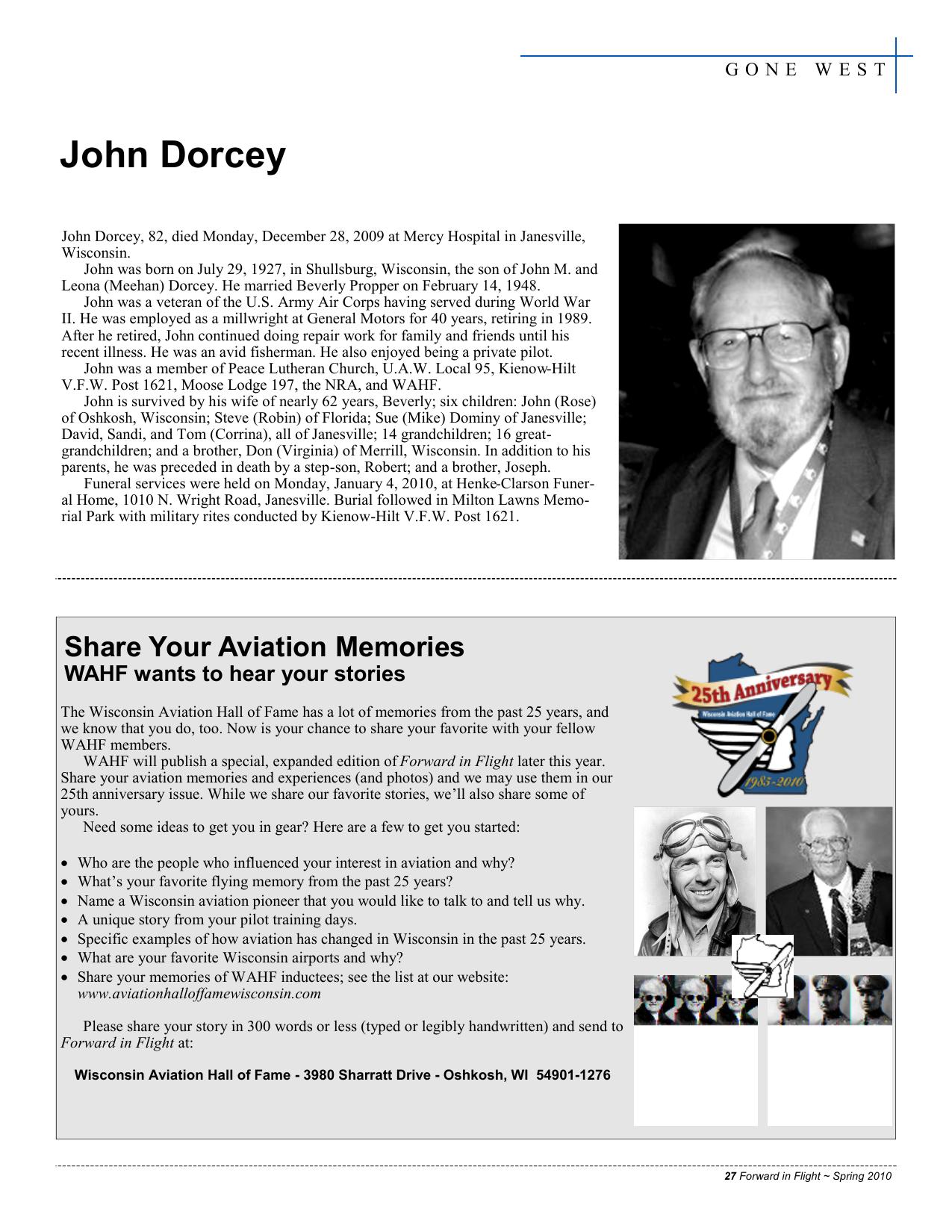
GONE WEST John Dorcey John Dorcey, 82, died Monday, December 28, 2009 at Mercy Hospital in Janesville, Wisconsin. John was born on July 29, 1927, in Shullsburg, Wisconsin, the son of John M. and Leona (Meehan) Dorcey. He married Beverly Propper on February 14, 1948. John was a veteran of the U.S. Army Air Corps having served during World War II. He was employed as a millwright at General Motors for 40 years, retiring in 1989. After he retired, John continued doing repair work for family and friends until his recent illness. He was an avid fisherman. He also enjoyed being a private pilot. John was a member of Peace Lutheran Church, U.A.W. Local 95, Kienow-Hilt V.F.W. Post 1621, Moose Lodge 197, the NRA, and WAHF. John is survived by his wife of nearly 62 years, Beverly; six children: John (Rose) of Oshkosh, Wisconsin; Steve (Robin) of Florida; Sue (Mike) Dominy of Janesville; David, Sandi, and Tom (Corrina), all of Janesville; 14 grandchildren; 16 greatgrandchildren; and a brother, Don (Virginia) of Merrill, Wisconsin. In addition to his parents, he was preceded in death by a step-son, Robert; and a brother, Joseph. Funeral services were held on Monday, January 4, 2010, at Henke-Clarson Funeral Home, 1010 N. Wright Road, Janesville. Burial followed in Milton Lawns Memorial Park with military rites conducted by Kienow-Hilt V.F.W. Post 1621. Share Your Aviation Memories WAHF wants to hear your stories The Wisconsin Aviation Hall of Fame has a lot of memories from the past 25 years, and we know that you do, too. Now is your chance to share your favorite with your fellow WAHF members. WAHF will publish a special, expanded edition of Forward in Flight later this year. Share your aviation memories and experiences (and photos) and we may use them in our 25th anniversary issue. While we share our favorite stories, we’ll also share some of yours. Need some ideas to get you in gear? Here are a few to get you started: · Who are the people who influenced your interest in aviation and why? · What’s your favorite flying memory from the past 25 years? · Name a Wisconsin aviation pioneer that you would like to talk to and tell us why. · A unique story from your pilot training days. · Specific examples of how aviation has changed in Wisconsin in the past 25 years. · What are your favorite Wisconsin airports and why? · Share your memories of WAHF inductees; see the list at our website: www.aviationhalloffamewisconsin.com Please share your story in 300 words or less (typed or legibly handwritten) and send to Forward in Flight at: Wisconsin Aviation Hall of Fame - 3980 Sharratt Drive - Oshkosh, WI 54901-1276 27 Forward in Flight ~ Spring 2010
FROM THE AIRWAYS Register Now for Wisconsin Aviation Conference 55th annual event scheduled for May 3 - 5 in Waukesha The 55th Annual Wisconsin Aviation Conference will be held at Waukesha’s Country Springs Inn from May 3–5, 2010. The conference committee is planning an informative conference of interest to all areas of the aviation community, from private pilots and corporate flight departments to general aviation and air carrier airports with airport management and commissioners, fixed base operators, and other aviation service providers. “The conference planning committee is committed to developing a quality conference,” said John Reed, president of the Wisconsin Airport Management (WAMA), one of the event’s co-hosts, along with the Wisconsin Aviation Trades Association and the Wisconsin Business Aviation Association. The conference kicks off on Monday, May 3 with two fun-filled events, including golf or a round of sporting clays. To learn more, email Pete Drahn at daredem@verizon.net. Registration forms and more conference information is available on the WAMA website at www.WIAMA.org. Jeffrey Davis has been named general manager of Wisconsin Aviation in Madison. A employee for 10-years and a native of Beaver Dam, Davis had previously been serving as Ground Operations Manager. As general manager, he will oversee fueling operations, buildings and facilities, ground service equipment operations, customer service, and tenant relations. Grant Goetsch, vice president of flight operations, was also General Manager, until Davis’ appointment. “This move completes a companywide restructuring, which began in 2008,” said Baum. Visit www.WisconsinAviation.com. Buettner Receives Wright Brothers Master Pilot Award William (Bill) “Max” Buettner was presented with the Wright Brothers Master Pilot award in October 2009. WAHF Member Jim Szaikovics presented the award to Bill twice, once at an aviation club meeting and again at an EAA Chapter 1158 meeting in West Bend, Wisconsin. Bill is the 23rd pilot in Wisconsin to receive the award, out of approximately 10,000 certificated airmen in the state. The Wright Brothers Master Pilot Award recognizes pilots who have demonstrated professionalism, skill, and aviation expertise by maintaining safe operations for 50 or more years. Megan Bohn Awarded ‘From Rose to Rise’ Scholarship Megan Bohn, a student at Dubuque University and a native of Port Edwards, Wisconsin, is the 2010 recipient of the From Rose to Rise Scholarship. Megan was presented with the $500 scholarship at the 21st Annual International Women in Aviation Conference on February 25, 2010. Her career goal is to become a flight dispatcher. WAHF Member Kelly Nelson received a $500 Special Recognition Scholarship at the conference. The scholarship will enable Kelly to complete a flight review and earn a tailwheel endorsement. Kelly is president of the Oshkosh chapter of Women in Aviation. Helio Couriers to Gather at Wausau Downtown Airport See the amazing Helio Courier aircraft perform up close! A Helio Fly-In and Conference will be held at the Wausau Downtown Airport, May 21-23, 2010, hosted by Wausau Flying Service, Inc. As of press time, five Helios are attending, one of which is the mighty Helio Stallion Serial No. 001. Stephen Ruby, event organizer, expects 10-15 aircraft. The Helio is “still the only FAA certified airplane that can take-off from the space of a tennis court.” Stay up-to-date on the event by becoming a fan of Helio Courier on Facebook, or visit WausauFlyingService.com. 28 Forward in Flight ~ Quarterly Magazine of the Wisconsin Aviation Hall of Fame Nancy Bink photo Davis Appointed Manager at Wisconsin Aviation - MSN WAHF Member Kelly Nelson (left) and Megan Bohn received $500 scholarships at the 21st Annual International Women in Aviation Conference last month.
BOOK REVIEW Highest Duty Nothing extraordinary about Captain Chesley “Sully” Sullenberger’s life, but his book, Highest Duty, My Search for What Really Matters, was a delight to read. Propelled from obscurity to become an overnight hero as captain of US Airways Flight 1549, by making an emergency landing in the Hudson River on January 15, 2009, Sullenberger articulately recounts the story of his life. You’ll learn of his upbringing in Texas, his flight training in a crop duster’s airplane, his Air Force flying in an F-4 Phantom, and his airline career. More than a book about aviation though, you’ll also learn of the personal tragedies that struck him and influenced his life and relationships later on. He shares candidly about life with wife, Lorri; their financial troubles and the adoption of two daughters. You’ll laugh at some parts, such as how he annoys Lorri by rearranging dishes in the dishwasher after returning home from several weeks away, and be moved by other parts, such as the obvious affection he feels for his wife and family. As you read about the Flight 1549 crewmembers, including Wisconsin’s Jeff Skiles, you build up to the details of the ditching. By the time you get there, you’ll just know (though you already do) that they’ll succeed, because you’ve learned that “Sully” is as cool-headed as they come, serious about personal responsibility, and committed to service to others. The book is strangely calming, and if you’ve ever heard him speak, you’ll “hear” his words, his speaking eloquence and composure. A great read for anyone who wants to get to know this safetyconscience pilot and decent human being. —Reviewed by Rose Dorcey Welcome our latest advertiser There’s room for your ad, too! Call 920-385-1483 or email flyer@aviationhalloffamewisconsin.com DR. TOM VOELKER Aviation Medical Examiner 2nd and 3rd Class Aviation Medicals Phone 715-423-0122 Aspirus Doctor’s Clinic 420 Dewey Street Wisconsin Rapids WI 54494 Located at Riverview East Medical Office Bldg. 29 Forward in Flight ~ Spring 2010
MEMBER’S LOGBOOK Huggins Legacy Most Wisconsin Aviation Hall of Fame members have a story behind why they became members. I initially joined because membership was necessary to nominate my grandfather and great-uncle, Ralph and Robert Huggins, for consideration in the Hall of Fame. These two men had developed sort of folklore status in my childhood, growing up with my father telling many stories about his uncle and dad building airplanes, and dope and fabric smells and sounds around the house. As a child, I was able to visit Uncle Bob’s shop a few times at Capital Drive Airport and was given airplane rides by the locals. Although I can remember the visits, I was really too young to fully appreciate all the airplane building, instruction, and maintenance in which Uncle Bob was involved. Fast forward 40 years and I am now the co-owner of a Maule M-5 235C. I had wanted a high performance taildragger with a decent payload and airspeed because much of the flying I enjoy is in the backcountry strips of Oregon, Idaho, and Montana. In 2006, my airplane partner found a plane being sold by the Maule factory that seemed as if it might work for us as a flying project plane. I headed off to Moultrie, Georgia, made the transaction, and miraculously flew the plane home. Miraculously, because the plane, upon closer inspection on its arrival in Oregon, turned out to be more project than flying. With a bit of tender loving care we flew the plane 165 hours and about a year and a half until it was obvious the plane needed to be recovered. The picture today shows the result of the latest generation of Huggins learning to do tube and fabric work. In the spirit of learning what my grandfather and great-uncle did, I wanted to do the project myself. With the supervision of an IA friend, my partner and I completely stripped the plane, sanded, and recovered it. We replaced the old wood stringers with new steel stringers, completed a 2500 pound up-gross kit, recovered the top aluminum wing skin on the right wing, installed patroller windows and doors, added vortex generators, installed quick release kits for the seats, improved the seatbelt situation, installed a new interior and headliner, repaired/welded new tubing to cure some corrosion problems, installed new wing-tip strobes, and added all new hardware, cables, and pulleys in the plane. The project started in early November 2007 and we completed it on June 5, 2009. While this project is not even close to building airplanes and wings from scratch like my Uncle Bob and grandfather did, it certainly gave me a great appreciation for their early endeavors in airplane building in Southeast Wisconsin. —Stephen Huggins Eagle Creek, Oregon Propeller Request The Mitchell Gallery of Flight (MGF) aviation museum, located inside the terminal at Milwaukee’s General Mitchell International Airport (MKE), is seeking the loan or Stephenof Huggins donation historicwith two-bladed propellers to replace three props currently on display. his restored Maule M-5. 30 Forward in Flight ~ Quarterly Magazine of the Wisconsin Aviation Hall of Fame The EAA Foundation has requested return of three propellers that have been on loan to the MGF since the mid-1980s: a 1919 Hamilton, brass-tipped wood; a 1927 Hamilton, blue, brass-tipped wood, and a 1937 Maynard-Di-Cesare metal offset blade propeller. Propellers currently on display include a PARAGON, made by Spencer Heath Co., a 1946 Sensenich Brothers, a 1918 Matthews Brothers, and a 1930 Hamilton Standard metal propeller. Any suitable propeller of historic interest would be greatly appreciated. As a non-profit, charitable organization, all donations are fully tax deductible. Please contact Chuck Boie, president, Friends of the Mitchell Gallery of Flight at 262-786-5245, or Tony Snieg, Deputy Director, Gen. Mitchell International Airport at 414-747-5703, or e-mail tsnieg@mitchellairport.com. —Chuck Boie New Berlin, Wisconsin Send your letters, comments, story suggestions, and news releases to flyer@aviationhalloffamewisconsin.com or to our Oshkosh mailing address.
MEMBER’S LOGBOOK Ulithi, Not Ulitihi I’m a new member of WAHF and have just read through the Winter edition of Forward in Flight. I enjoy this publication very much. One of the articles in the winter edition was written by Rick Wolf about his father, Fritz, who I knew from my DOT days. In that article I spotted a few errors and while it’s nothing but a type thing, I figured that if the article is to be reprinted then those misspellings could be corrected. One of the words, Ulithi, was spelled Ulitihi. While I’m the world’s worst proofreader, I caught those errors simply because I spent six months at Ulithi as a Navy weather observer in 1946-7. The other miscue was also in that last paragraph, last sentence, and used “give” instead of five as the number of planes Fritz shot down. I am delighted to have joined this organization and look forward to future events. —Frank Potts Madison, Wisconsin Thanks, Frank, we appreciate your correction of our misspelling of Ulithi and that you’ve become a member/supporter of the Wisconsin Aviation Hall of Fame. And, we would like to hear more about your experiences at Ulithi. —Editor More Than 50 Years of Flying Thanks for the birthday wishes and mention of my Wright Brothers Master Pilot award in the Winter 2009 issue of Forward in Flight. I continue to try to fly once a week. I’m sending photos of my 1973 pressurized Skymaster. It is equipped with approach-certified GPS coupled to the autopilot, etc. and is a great instrument and cross country airplane. At mid-teen altitudes I cruise at approximately 185 knots at 60-65 percent power and about 22-23 gph. Can carry about 770 pounds with full fuel. Super safe multiengine aircraft. Contrary to legend, it is relatively low maintenance, if one stays on top of it. I live on a private airport, Cielo Dorado (TA50), located in southern New Mexico just outside of El Paso, Texas. Thank you for all your effort in making the Wisconsin Aviation Hall of Fame such a success. —George Cudahy Cielo Lindo, New Mexico Duffy creates pilots… Designated pilot examiner Harold “Duffy” Gaier has conducted more than 4,000 flight checks, logged more than 14,000 hours of flight time, improved both the Neillsville and Marshfield, Wisconsin, airports, and has become one of aviation’s best friends. We’re proud to share his story, and that he’s an inductee. ...You can help honor him. Subscribe to Forward in Flight Your $20 membership subscription helps ensure that together we can continue to honor the men and women who enhance and advance aviation in Wisconsin. Name Address City State Phone Number Email Address Referred By Zip Membership Benefits: · Quarterly subscription (4 issues) of Forward in Flight, packed full of Wisconsin aviation news, events, history, and stories about your aviation colleagues · Invitation to annual induction banquet · Free pass to the Deke Slayton Museum · Privilege of submitting WAHF nominations Send to: John Dorcey - Wisconsin Aviation Hall of Fame - 3980 Sharratt Dr.- Oshkosh WI 54901 31 Forward in Flight ~ Spring 2010
PRSRT STD US Postage Paid Wisc Rapids WI Permit 98 WISCONSIN AVIATION HALL OF FAME 3980 SHARRATT DRIVE OSHKOSH WI 54901-1276 Preserving and Sharing Wisconsin’s Aviation History Change Service Requested Welcome New WAHF Member/Supporters: James A. Becker Timothy Dixon John Reed Terry Sheafor —Thanks for coming on board! Keith Gerard Jeff Stockinger Jill Mann Allan Summers Renewed your WAHF membership? Every member is important to us! Reminder post cards will be sent soon if your membership is due. Save us a stamp—please renew today. FAA Aviation News is changing its name to FAA Safety Briefing, starting with the March/ April 2010 issue, to more accurately reflect the magazine’s mission: safety. The EAA AirVenture Museum in Oshkosh, Wisconsin, is hosting a series of free history workshops, funded by a grant from the Wisconsin Humanities Council. These workshops will discuss the human elements of the story of flight in America. Presentations begin at 6:30pm in the SkyScape Theater. Post-lecture discussion with refreshments. April 22, 2010 The Business of Flight: Aviation Innovation and Entrepreneurship Joseph J. Corn, Stanford University professor and social and cultural historian, discusses explorations of the past, present, and future of the commercial air industry with break out session on developing educational resources about the business of flight. May 19, 2010 Artisans and Aircraft June 17, 2010 Winged Defense: The History of American Air Power Jeffrey Pickron, University of Wisconsin Oshkosh historian, digs into the often unsung and untold stories about the craftsmen who have and continue to build airplanes. Henry M. Holden, aviation historian and author, explores the aviation aspects of United States military history centered on the career of Wisconsinite Billy Mitchell (1879–1936), who was a strident advocate for air power. Wisconsin Aviation Hall of Fame Officers and Board of Directors Rose Dorcey, President Michael Goc, Vice President John Dorcey, Secretary/Treasurer Duane Esse Rich Fischler Tom Thomas Charles Swain LaFonda Kinnaman Staber “Bill” Reese Charles Marotske, Honorary Chairman of the Board Wisconsin Aviation Hall of Fame 3980 Sharratt Drive Oshkosh WI 54901-1276 Become a supporter today! For information call Rose Dorcey at 920-385-1483 www.aviationhalloffamewisconsin.com flyer@aviationhalloffamewisconsin.com