Volume 9, Issue 1
🗞️ Download Issue (PDF)
Forward in Flight - Spring 2011
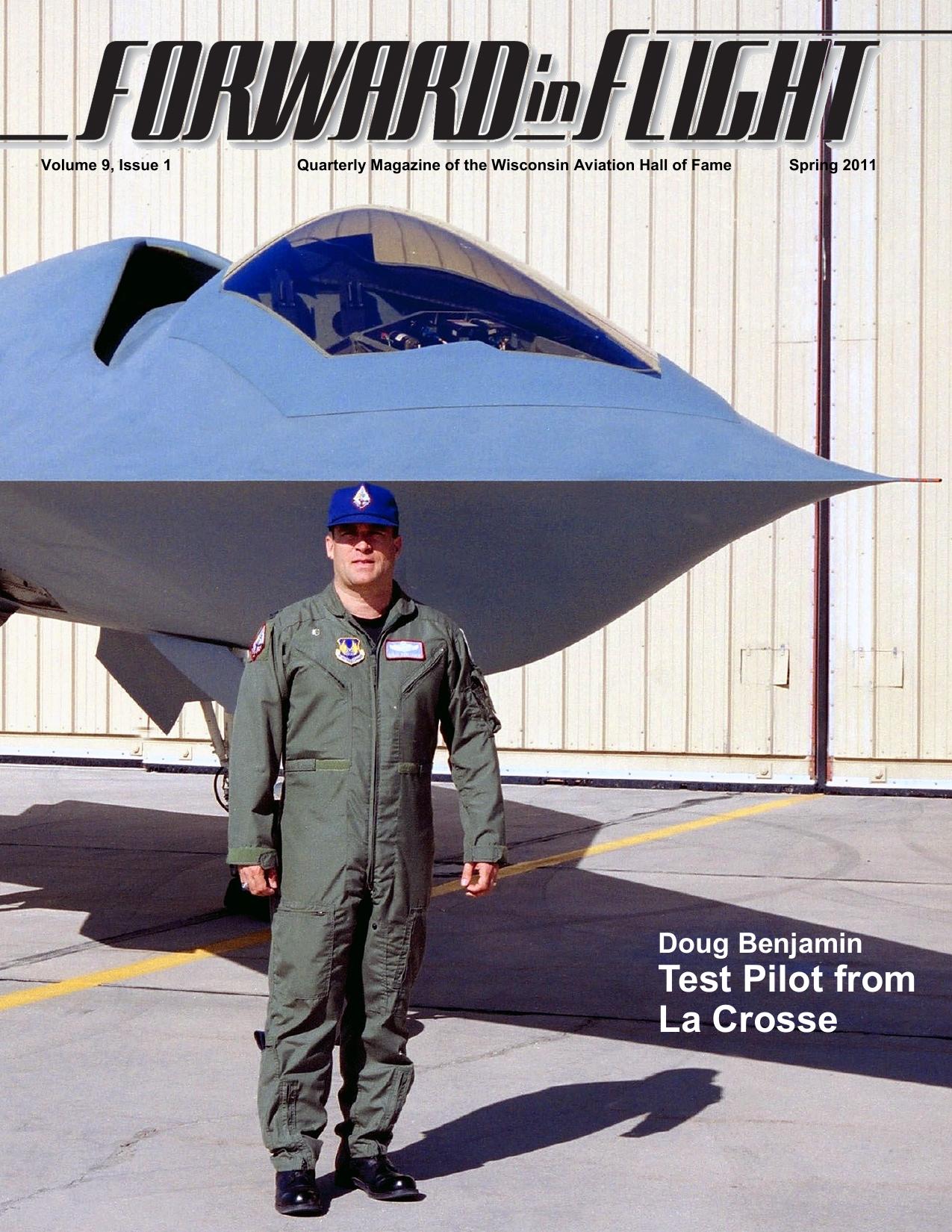
Volume 9, Issue 1 Quarterly Magazine of the Wisconsin Aviation Hall of Fame Spring 2011 Doug Benjamin Test Pilot from La Crosse
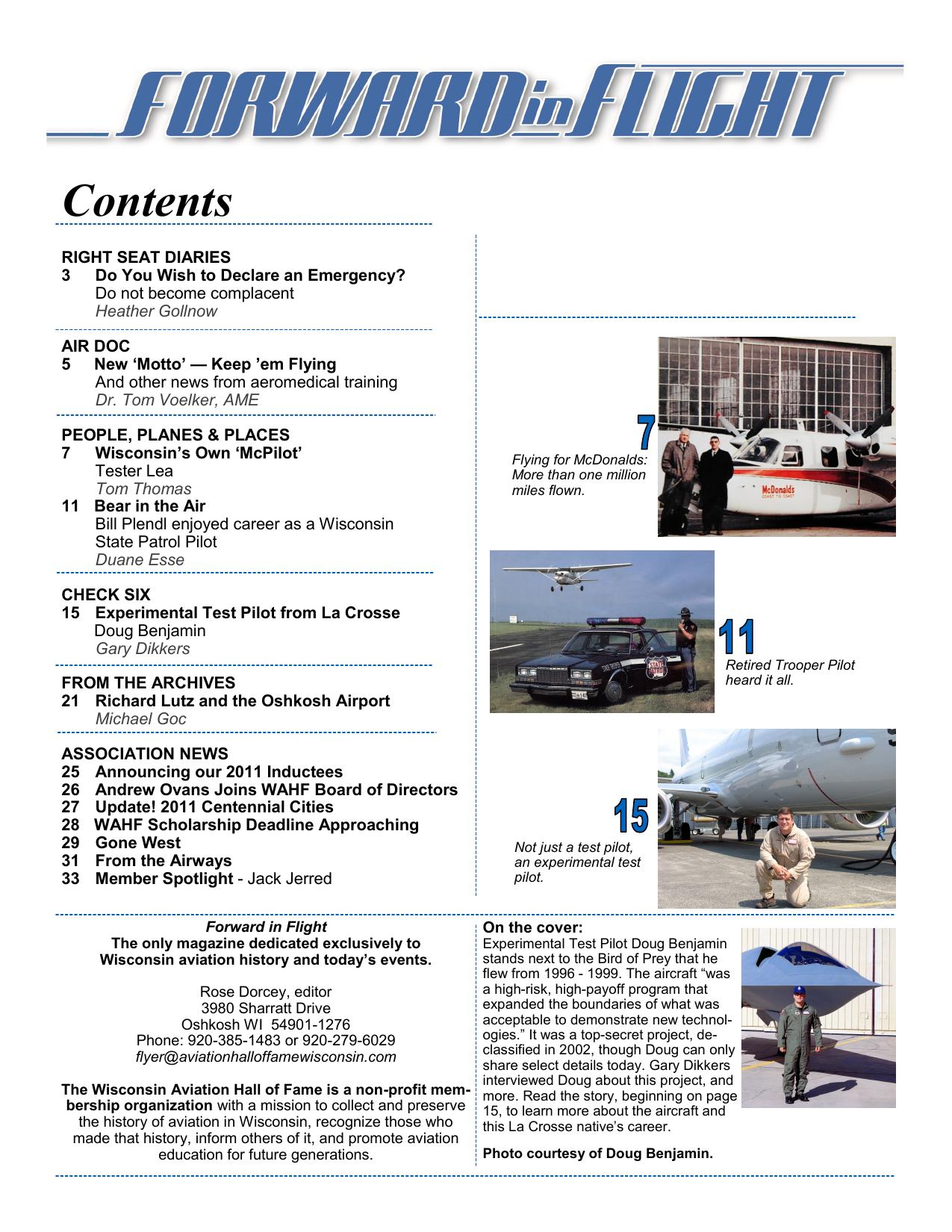
Contents RIGHT SEAT DIARIES 3 Do You Wish to Declare an Emergency? Do not become complacent Heather Gollnow AIR DOC 5 New ‘Motto’ — Keep ’em Flying And other news from aeromedical training Dr. Tom Voelker, AME PEOPLE, PLANES & PLACES 7 Wisconsin’s Own ‘McPilot’ Tester Lea Tom Thomas 11 Bear in the Air Bill Plendl enjoyed career as a Wisconsin State Patrol Pilot Duane Esse Flying for McDonalds: More than one million miles flown. CHECK SIX 15 Experimental Test Pilot from La Crosse 21 Doug Benjamin Gary Dikkers Retired Trooper Pilot heard it all. FROM THE ARCHIVES 21 Richard Lutz and the Oshkosh Airport Michael Goc ASSOCIATION NEWS 25 Announcing our 2011 Inductees 26 Andrew Ovans Joins WAHF Board of Directors 27 Update! 2011 Centennial Cities 28 WAHF Scholarship Deadline Approaching 29 Gone West 31 From the Airways 33 Member Spotlight - Jack Jerred Forward in Flight The only magazine dedicated exclusively to Wisconsin aviation history and today’s events. Not just a test pilot, an experimental test pilot. On the cover: Experimental Test Pilot Doug Benjamin stands next to the Bird of Prey that he flew from 1996 - 1999. The aircraft “was a high-risk, high-payoff program that Rose Dorcey, editor expanded the boundaries of what was 3980 Sharratt Drive acceptable to demonstrate new technolOshkosh WI 54901-1276 ogies.” It was a top-secret project, dePhone: 920-385-1483 or 920-279-6029 classified in 2002, though Doug can only flyer@aviationhalloffamewisconsin.com share select details today. Gary Dikkers interviewed Doug about this project, and The Wisconsin Aviation Hall of Fame is a non-profit mem- more. Read the story, beginning on page bership organization with a mission to collect and preserve 15, to learn more about the aircraft and the history of aviation in Wisconsin, recognize those who this La Crosse native’s career. made that history, inform others of it, and promote aviation education for future generations. Photo courtesy of Doug Benjamin.
President’s Message ~ by Rose Dorcey vol un teer (verb) To do charitable or helpful work without receiving pay for it; to perform, or offer to perform, work of your own free will. Over the past several weeks, I’ve had the opportunity to attend a number of aviation-minded meetings. As I looked around at these meetings, I thought about the positive consequences that often come about because of the dedicated people who give of their time—who volunteer their talent and sometimes, financial resources—to ensure that the mission of an organization is fulfilled. Thousands of aviation businesses, educational facilities, and organizations have done much good for aviation, and many of them provide platforms for volunteers who give freely of their time in support of something they love. These volunteers are the heroes of the aviation industry. April is National Volunteer Month. Around you are many volunteers, and it’s likely that you’re a volunteer yourself. I am proud to have met so many fine men and women who work in the aviation industry, but especially proud to know those who do more than earn income in their chosen field. Volunteers are people who give their time to local, state, and national organizations; those who are happy to answer a phone call or an email from colleagues seeking advice; those who serve on aviation advisory committees for up-and-coming programs and projects; those who organize special events, and those who give of themselves to encourage others to follow their dreams. They do it on their own time, not expecting any more reward than to see the good that comes from their efforts. These are the folks I’m most proud to know, for the example and inspiration they provide are shining examples we can all emulate. This April, thank the volunteers you know for the charitable work they do. Not only those in aviation, but those who take their commitment to volunteerism seriously in any area. The WAHF board members know many people who are leaders in volunteerism. I wish we could name them all here, but the list is long, so, a general thank you will have to do. Know that the WAHF board appreciates your efforts. The Spring issue of Forward in Flight is an exciting one each year because it’s when we announce the current slate of inductees. We have another great group of aviators to honor this year: Dan DoRose Dorcey novan, Bill Rewey (speaking of the spirit of volunteerism), Brig. Gen. Dennis Sullivan (ret.), and posthumously, Admiral Marc Mitscher and Steve Shalbreck. We’re looking forward to meeting them, and their family and friends, at our annual induction ceremony this fall. We’ll announce additional details about the banquet in the summer issue of Forward in Flight, and you’ll also be able to find more information on our website, on our Facebook page, and through announcements on Twitter. (Lots of ways to keep in touch with WAHF and other Wisconsin aviation activities!) Also in this issue, I’m excited to announce that WAHF Member Heather Gollnow is debuting her new, regular column in Forward in Flight, Right Seat Diaries. As a flight instructor, Heather will share her experiences in the right seat in hopes that she will encourage more people to become pilots, that current pilots will continue their training, and most importantly, that all will become safer pilots. In the Winter 2010 issue, Heather wrote about the people who encouraged her in aviation when she was young, and many readers enjoyed hearing her story. Her column in this issue, “Do You Wish to Declare an Emergency” has a completely different message, but one that will leave you with a clear reminder to not become complacent in the cockpit, the same message I heard recently at two FAA safety seminars. One more item and then I’ll let you go so you can read all the fine stories in this magazine by our volunteer writers. Thank you to Jet Air Group, who contacted us about supporting WAHF in the form of an advertisement (below). Advertisers help keep membership costs low and allow WAHF to spend critical resources on programs that share Wisconsin aviation history with both youth and adults throughout the state. Please remember all WAHF advertisers when you are in need of their products and services. 2 Forward in Flight ~ Spring 2011
RIGHT SEAT DIARIES Do You Wish to Declare an Emergency? Do not become complacent By Heather Gollnow In 14 years of flying, I have declared an emergency twice. Both had successful outcomes and I learned something about safer flying. Maybe you have encountered an in-flight emergency, maybe not. If you have, I encourage you to share your experience with other pilots so that they can discover what you faced. My most recent experience and my thought process during the emergency are detailed below so you can learn from it. In early February 2011, I declared an emergency. It was calm; a peaceful winter morning in northern Wisconsin and the air was smooth as glass. A pilot friend and I decided to fly from Austin Straubel International Airport (KGRB) in Green Bay to northern Michigan for a quick touch and go. Since I am always on the lookout for suitable offfield landing spots while flying, I mentioned there were many wooded areas. Most of the lakes were frozen over and would be suitable landing spots if needed. On our We did our engine checks: Fuel on fullest tank, way back inbound to KGRB, we dialed in ATIS, called Green Bay approach, and informed the controller that we mixture full, props full forward, fuel pump on. were 25 miles north inbound. We were told to expect a right base for Runway 24. At this point, I started to smell These changes made the engine run worse. a slight hint of fuel in the cockpit. Obviously, this is not normal and I decided to keep a closer eye on the engine gauges and monitor the odor. About 10 minutes later, I was looking out the window at a snow-covered cornfield (good potential landing spot) and I felt my arm start to vibrate as it was resting on the armrest. I immediately looked over to check the manifold pressure and RPMs. All good. I checked oil temperature and pressure. All good. My friend told me he didn’t like that vibration. I didn’t either. We did our engine checks: Fuel on fullest tank, mixture full, props full forward, fuel pump on. These changes made the engine run worse. I shut the fuel pump off and told my friend to pull the props back a bit. “Aviate, Navigate, Communicate,” I kept repeating to myself. I knew that the cornfield I had just spotted would make a good landing spot and I noted that the ruts ran north and south. Off to our left was the Bay of Green Bay, which was frozen over with no people, cars, houses, or potential crops to damage—another suitable landing spot. KGRB was off to our 1:00 and 10 miles at this point. Since we still had power to the engine, I suggested to my friend that we request an immediate landing and head for the airport. He asked Air Traffic Control (ATC) for an immediate, straightin landing on Runway 18 since the engine was misfiring and losing power. Green Bay approach asked, “Do you wish to declare an emergency?” He responded, “Yes, I’m declaring an emergency. Our engine is misfiring pretty badly.” We were cleared for an immediate, straight-in landing on 18 and the fire trucks would be prepared for us on the 3 Forward in Flight ~ Quarterly Magazine of the Wisconsin Aviation Hall of Fame
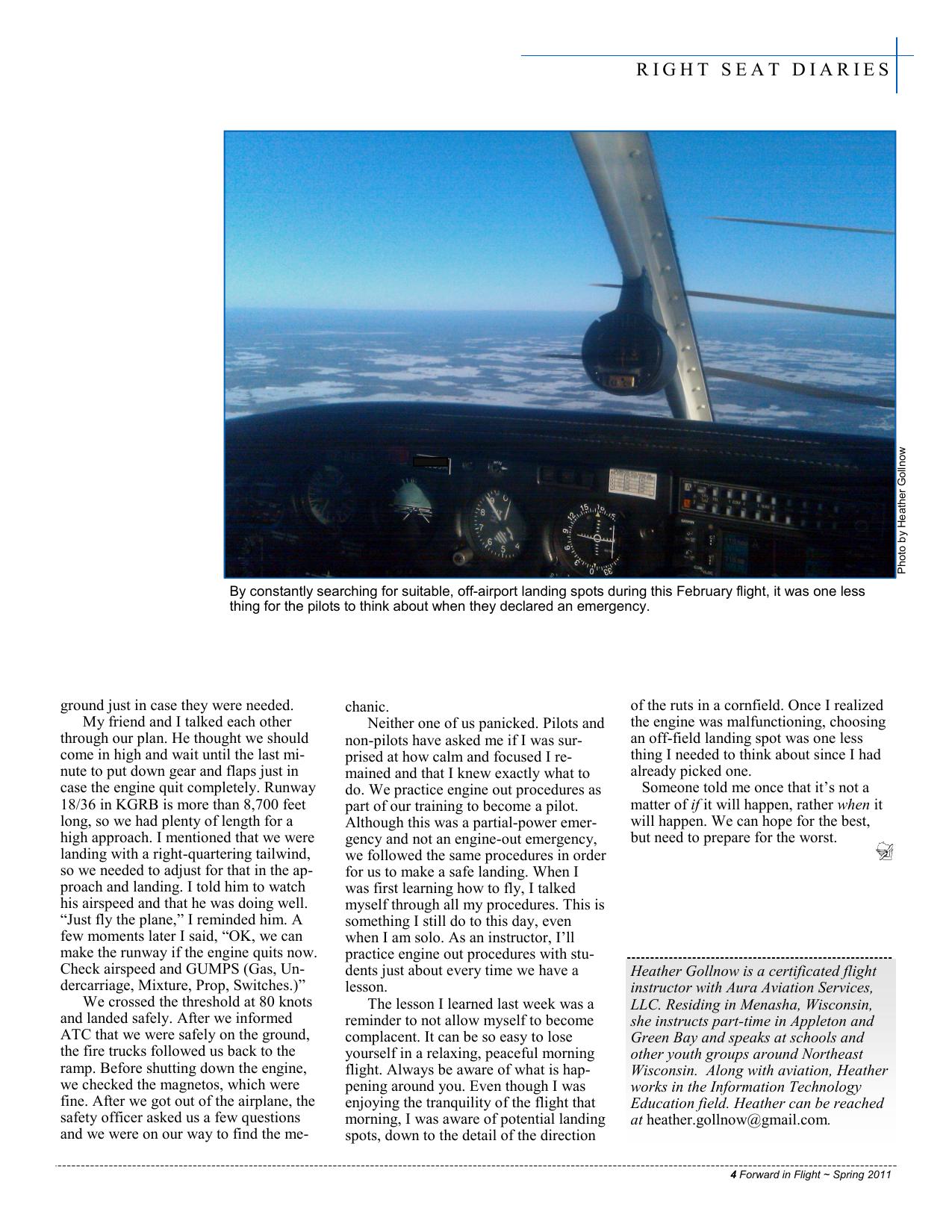
Photo by Heather Gollnow RIGHT SEAT DIARIES By constantly searching for suitable, off-airport landing spots during this February flight, it was one less thing for the pilots to think about when they declared an emergency. ground just in case they were needed. My friend and I talked each other through our plan. He thought we should come in high and wait until the last minute to put down gear and flaps just in case the engine quit completely. Runway 18/36 in KGRB is more than 8,700 feet long, so we had plenty of length for a high approach. I mentioned that we were landing with a right-quartering tailwind, so we needed to adjust for that in the approach and landing. I told him to watch his airspeed and that he was doing well. “Just fly the plane,” I reminded him. A few moments later I said, “OK, we can make the runway if the engine quits now. Check airspeed and GUMPS (Gas, Undercarriage, Mixture, Prop, Switches.)” We crossed the threshold at 80 knots and landed safely. After we informed ATC that we were safely on the ground, the fire trucks followed us back to the ramp. Before shutting down the engine, we checked the magnetos, which were fine. After we got out of the airplane, the safety officer asked us a few questions and we were on our way to find the me- chanic. Neither one of us panicked. Pilots and non-pilots have asked me if I was surprised at how calm and focused I remained and that I knew exactly what to do. We practice engine out procedures as part of our training to become a pilot. Although this was a partial-power emergency and not an engine-out emergency, we followed the same procedures in order for us to make a safe landing. When I was first learning how to fly, I talked myself through all my procedures. This is something I still do to this day, even when I am solo. As an instructor, I’ll practice engine out procedures with students just about every time we have a lesson. The lesson I learned last week was a reminder to not allow myself to become complacent. It can be so easy to lose yourself in a relaxing, peaceful morning flight. Always be aware of what is happening around you. Even though I was enjoying the tranquility of the flight that morning, I was aware of potential landing spots, down to the detail of the direction of the ruts in a cornfield. Once I realized the engine was malfunctioning, choosing an off-field landing spot was one less thing I needed to think about since I had already picked one. Someone told me once that it’s not a matter of if it will happen, rather when it will happen. We can hope for the best, but need to prepare for the worst. Heather Gollnow is a certificated flight instructor with Aura Aviation Services, LLC. Residing in Menasha, Wisconsin, she instructs part-time in Appleton and Green Bay and speaks at schools and other youth groups around Northeast Wisconsin. Along with aviation, Heather works in the Information Technology Education field. Heather can be reached at heather.gollnow@gmail.com. 4 Forward in Flight ~ Spring 2011
AIR DOC New ‘Motto’ — Keep ’em Flying And other news from aeromedical training Dr. Tom Voelker, AME DrAlphaMike@yahoo.com Hello, Airmen. I’m Alpha Mike, and I’m tired of winter! I have had more canceled flights, missed approaches, and diversions this winter than any I can remember. And when the sky was clear, it seemed too cold to go to the hangar and pre-flight. But, weather or not, there was one flight I did feel compelled to make. Last November I was due for my three-year, continuing education seminar with the FAA as an Aviation Medical Examiner. We usually have several locations to choose from for these conferences. I had never been to Kansas City, and as it was an easy non-stop flight in the Comanche, that is where my wife, Kathy, and I decided to go. The flight there was uneventful, but the return leg included a missed approach in dense IFR in Wisconsin Rapids, followed by a successful low IFR approach into Madison. Our daughter drove us home, and I don’t even remember how I got back to Madison the next day to retrieve the plane, but ’42-Papa did get home. That flight is not what I want to write about, however. It’s what I learned in the three days with the FAA that I would like to share with you. I certainly got the impression that we have a “kinder, gentler FAA” than we had in the past. They presented an interesting statistic: of 391,572 medical applications in 2009, there were only 431 (0.11%) that resulted in a final denial. Dr. Fred Tilton, the Federal Air Surgeon (the “top dog” in the aeromedical branch of the FAA) spoke to us and was available for individual conversations throughout the weekend. He clearly stated the message of the “new” FAA medical certification division, “Keep ’em flying!” The motto I was left with during my initial AME certification conference six years ago was, “When in doubt, defer.” This meant that if I had any question that an airman might not be qualified to receive a medical certificate, I was to defer the application to OKC, and as you know, that meant a six-month visit to FAA purgatory for your application. Hopefully, the application was eventually approved. The system certainly wasn’t friendly to pilots. The new motto given at this conference is much better, “If at all possible, issue.” The FAA is placing much more responsibility on the shoulders of the AME. If we docs think you should be able to fly, we are encouraged to get the necessary supporting information from the airman and call the Regional Flight Surgeon (RFS). Often, this conversation can result in the authority to issue the medical certificate at the time of the application, even for conditions that might be considered disqualifying. One caveat, though. If the AME needs more information from the airman or his or her doctor before the calling the RFS, he or she only has two weeks to get it. Take any longer than that and it’s off to purgatory! With this approach, the backlog of new applications awaiting certification in OKC has decreased from several thousand just two years ago to now less than 100! That was the main message of the conference. 5 Forward in Flight ~ Quarterly Magazine of the Wisconsin Aviation Hall of Fame However, we learned much more about medical certification and the certification process. I’ll mention some of the new information here, in no particular order. First, thanks for using MedXPress! This system is a tremendous asset to both the airman applicant and the AME. Consider using this feature for your next flight physical. I’ve mentioned it before, but here’s a quick refresher. You can log on at https://medxpress.faa.gov and fill out your application in the convenience of your home. Bring the confirmation number with you. (We AMEs can’t get your application on the FAA system without this number.) We can then import your application. You won’t need to remember all of your life’s history in the doctor’s exam room, and I won’t have to retype everything you wrote! It makes the process much smoother and easier for all of us. Some of the AMEs at the conference won’t perform a flight physical if the applicant hasn’t completed the MedXPress form. There has been some mention in the flying publications about possibly doing away with flight physicals entirely for third class operations. The thought is that the drivers license as a medical for Sport Pilot privileges would also be adequate for Private Pilots. Sorry folks, don’t get your hopes up. If the medical branch of the FAA has any say, it probably won’t happen. There is no formal policy, but the speakers present made it clear that they were not in favor of this change. I should add that a large majority of the
AIR DOC He clearly stated the message of the “new” FAA medical certification division, “Keep ’em flying.” AMEs attending the conference, almost none of whom work for the government or the FAA, were strongly opposed to the idea as well. There’s a new disease on the block as well. Obstructive Sleep Apnea, or OSA, has been getting more attention recently, and the FAA hasn’t overlooked this condition. From a medical standpoint, we are learning more about the detrimental effects of OSA on many organ systems, especially the heart. In addition to these effects, however, the FAA has noticed an increase in implication of OSA in aircraft accidents and incidents. This is probably because of the associated severe fatigue and daytime sleepiness associated with OSA. You can expect that you may be asked about this condition at your next medical. As long as it is treated, OSA is not disqualifying for flight, even for pilots with first class medicals. The FAA has produced a brochure about this condition. You can order it for free through the FAA.gov website. There are safety brochures available on many flight safety topics, medical and nonmedical. Visit http://www.faa.gov/pilots/ safety/pilotsafetybrochures. By the way, did you know that the FAA, as a government site, doesn’t copyright any of their publications? Virtually all of their publications, including the Federal Aviation Regulations (FAR), the Aeronautical Information Manual (AIM), and the Instrument Flying Handbook can be downloaded free of charge! Pilots often ask me for the FAA “acceptable medication list.” You can get an idea of what is allowable on other sites, such as AOPA, and that information is probably reliable. However, as we were reminded at the conference, the FAA doesn’t have such a list and probably never will. This is because a particular medication may be allowable for flight, but the underlying condition for which the medication is being taken may be disqualifying. A good example is the common blood pressure medication, Metoprolol. When this drug is being used for hypertension, and the blood pressure is well controlled, the airman should be able to get his or her medical certificate, probably at the time of the physical. However, if that same medication is being used for a history of a heart attack (coronary artery disease), then the AME would have to deny or defer the application, unless the airman has already gone through the special issuance process with the FAA in Oklahoma City. Pilots often ask me for the FAA “acceptable medication list.” ...the FAA doesn’t have such a list and probably never will. The presenters did, however, give us an incomplete list of “unacceptable medications.” The listed medications are almost exclusively either sedating, or they are “centrally acting,” meaning that they exert their effects directly on the brain. An airman on one of these medications is disqualified from flying unless the underlying condition is able to be controlled off of such medications. I had one such unfortunate encounter a few weeks ago. A high school student was excited about a career in aviation, and he had applied for acceptance to an aviation program at a Wisconsin tech- nical college. The school suggested that he get a second class medical before he enrolled. When I reviewed his application, I was obligated to inform him that he would not be eligible for a medical certificate because he was taking Gabapentin, a medication used for various neurological conditions. In his case, the medication is disqualifying, and the underlying condition, if not controlled, would be as well. He spoke to his neurologist who said that he needed to stay on this medication if he wanted to control the condition. I encouraged this student to appeal the FAA’s denial, but the decision was final, and this unfortunate young man will not be flying. He will be one of the 400 or so final denials of 2011. Finally, I got to meet the new Regional Flight Surgeon of the FAA Great Lakes Region. Dr. David Shaw comes with extensive military aviation background, and he is excited about helping the airmen under his jurisdiction. He is very personable and I look forward to working with him. While most of you will have no personal interaction with Dr. Shaw, as I noted earlier, your AME will be interacting much more frequently with the RFS in the future. It’s great to have met the one with whom I will be working to get and keep you, the Wisconsin aviators, safely up in the air! Stay warm and fly safely! In “real” life, Alpha Mike Echo is Dr. Tom Voelker, AME, a family practitioner in Wisconsin Rapids. He and his wife, Kathy, are the parents of four daughters. Tom flies N6224P, a Comanche 250, out of Alexander Field, South Wood County Airport (ISW). 6 Forward in Flight ~ Spring 2011
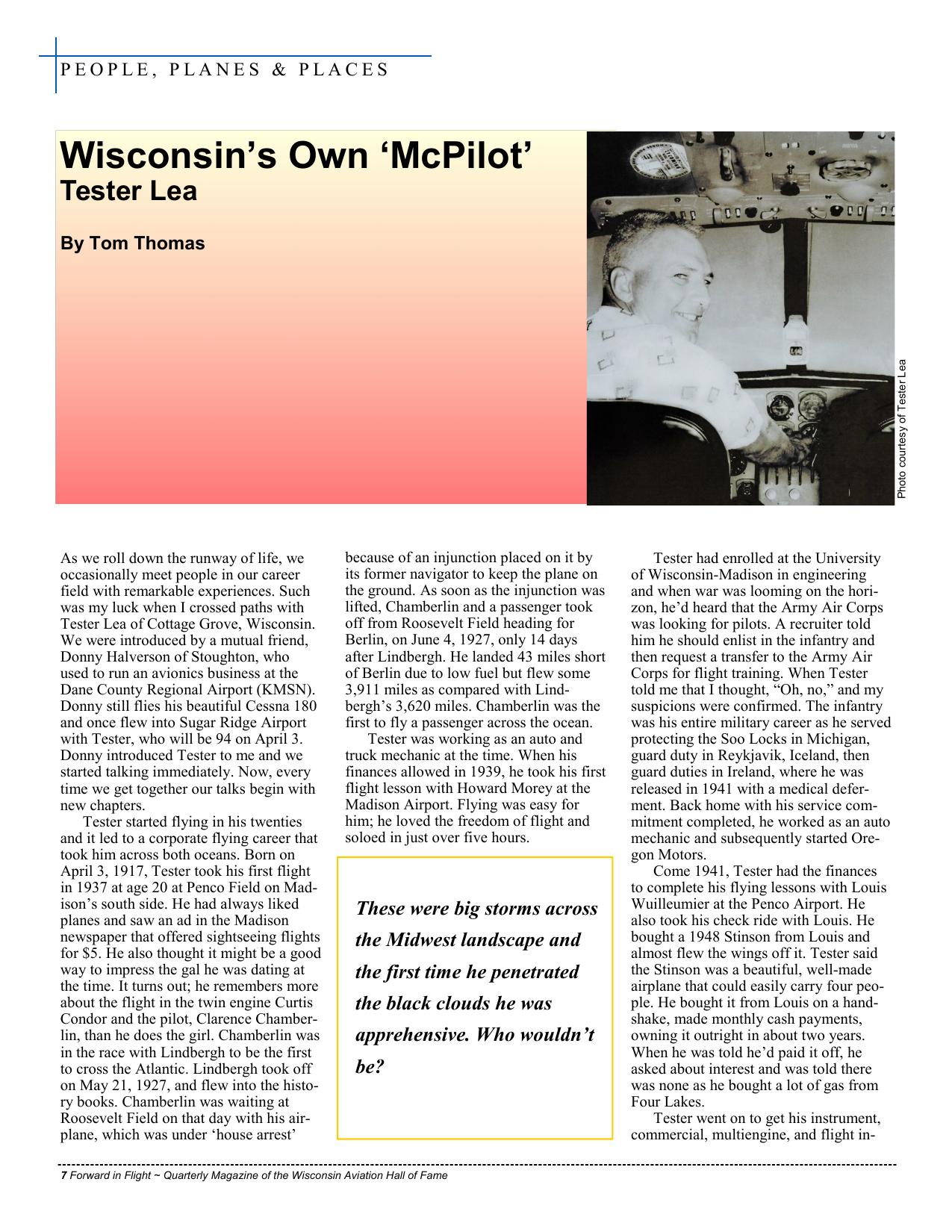
PEOPLE, PLANES & PLACES Wisconsin’s Own ‘McPilot’ Tester Lea Photo courtesy of Tester Lea By Tom Thomas As we roll down the runway of life, we occasionally meet people in our career field with remarkable experiences. Such was my luck when I crossed paths with Tester Lea of Cottage Grove, Wisconsin. We were introduced by a mutual friend, Donny Halverson of Stoughton, who used to run an avionics business at the Dane County Regional Airport (KMSN). Donny still flies his beautiful Cessna 180 and once flew into Sugar Ridge Airport with Tester, who will be 94 on April 3. Donny introduced Tester to me and we started talking immediately. Now, every time we get together our talks begin with new chapters. Tester started flying in his twenties and it led to a corporate flying career that took him across both oceans. Born on April 3, 1917, Tester took his first flight in 1937 at age 20 at Penco Field on Madison’s south side. He had always liked planes and saw an ad in the Madison newspaper that offered sightseeing flights for $5. He also thought it might be a good way to impress the gal he was dating at the time. It turns out; he remembers more about the flight in the twin engine Curtis Condor and the pilot, Clarence Chamberlin, than he does the girl. Chamberlin was in the race with Lindbergh to be the first to cross the Atlantic. Lindbergh took off on May 21, 1927, and flew into the history books. Chamberlin was waiting at Roosevelt Field on that day with his airplane, which was under ‘house arrest’ because of an injunction placed on it by its former navigator to keep the plane on the ground. As soon as the injunction was lifted, Chamberlin and a passenger took off from Roosevelt Field heading for Berlin, on June 4, 1927, only 14 days after Lindbergh. He landed 43 miles short of Berlin due to low fuel but flew some 3,911 miles as compared with Lindbergh’s 3,620 miles. Chamberlin was the first to fly a passenger across the ocean. Tester was working as an auto and truck mechanic at the time. When his finances allowed in 1939, he took his first flight lesson with Howard Morey at the Madison Airport. Flying was easy for him; he loved the freedom of flight and soloed in just over five hours. These were big storms across the Midwest landscape and the first time he penetrated the black clouds he was apprehensive. Who wouldn’t be? 7 Forward in Flight ~ Quarterly Magazine of the Wisconsin Aviation Hall of Fame Tester had enrolled at the University of Wisconsin-Madison in engineering and when war was looming on the horizon, he’d heard that the Army Air Corps was looking for pilots. A recruiter told him he should enlist in the infantry and then request a transfer to the Army Air Corps for flight training. When Tester told me that I thought, “Oh, no,” and my suspicions were confirmed. The infantry was his entire military career as he served protecting the Soo Locks in Michigan, guard duty in Reykjavik, Iceland, then guard duties in Ireland, where he was released in 1941 with a medical deferment. Back home with his service commitment completed, he worked as an auto mechanic and subsequently started Oregon Motors. Come 1941, Tester had the finances to complete his flying lessons with Louis Wuilleumier at the Penco Airport. He also took his check ride with Louis. He bought a 1948 Stinson from Louis and almost flew the wings off it. Tester said the Stinson was a beautiful, well-made airplane that could easily carry four people. He bought it from Louis on a handshake, made monthly cash payments, owning it outright in about two years. When he was told he’d paid it off, he asked about interest and was told there was none as he bought a lot of gas from Four Lakes. Tester went on to get his instrument, commercial, multiengine, and flight in-
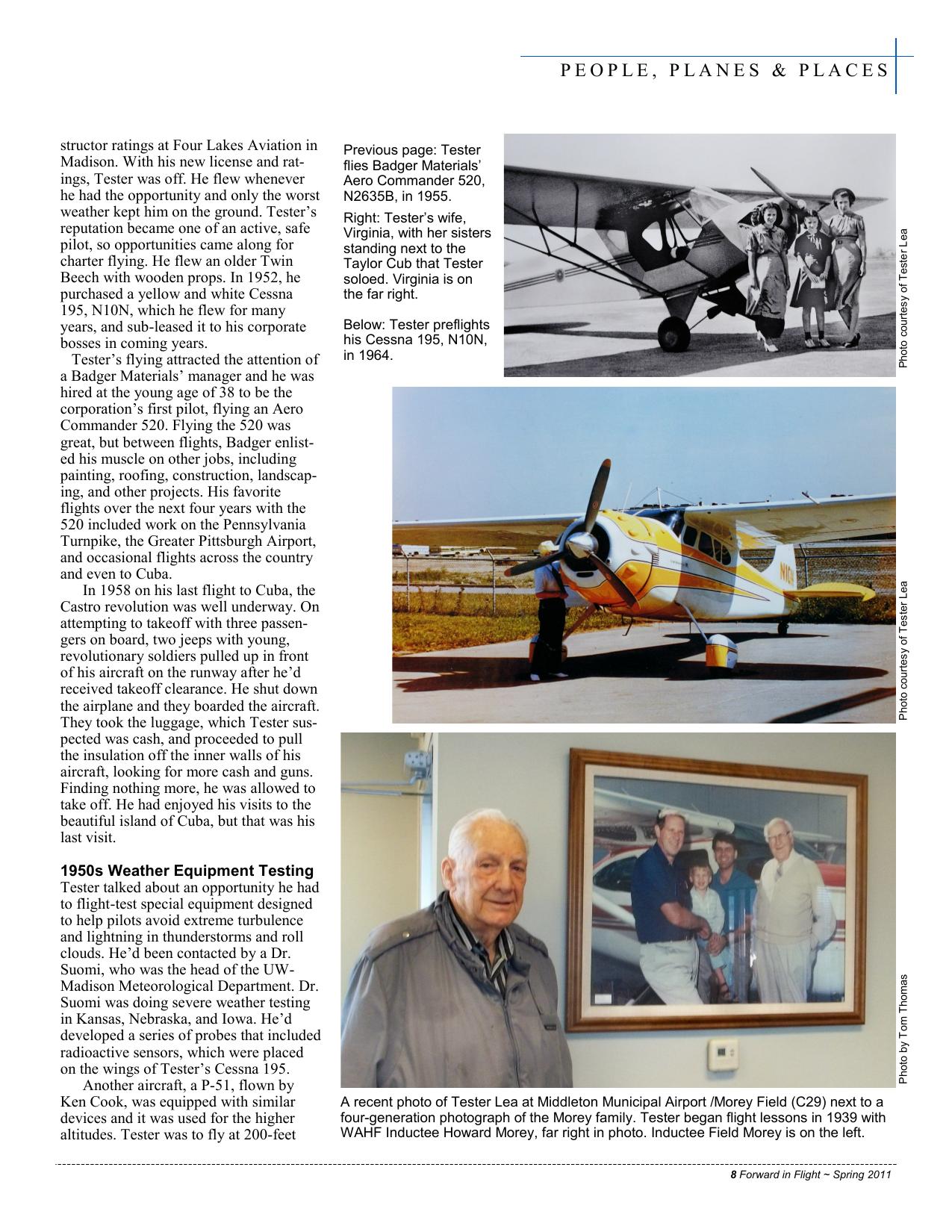
PEOPLE, PLANES & PLACES 1950s Weather Equipment Testing Tester talked about an opportunity he had to flight-test special equipment designed to help pilots avoid extreme turbulence and lightning in thunderstorms and roll clouds. He’d been contacted by a Dr. Suomi, who was the head of the UWMadison Meteorological Department. Dr. Suomi was doing severe weather testing in Kansas, Nebraska, and Iowa. He’d developed a series of probes that included radioactive sensors, which were placed on the wings of Tester’s Cessna 195. Another aircraft, a P-51, flown by Ken Cook, was equipped with similar devices and it was used for the higher altitudes. Tester was to fly at 200-feet Previous page: Tester flies Badger Materials’ Aero Commander 520, N2635B, in 1955. Photo courtesy of Tester Lea Right: Tester’s wife, Virginia, with her sisters standing next to the Taylor Cub that Tester soloed. Virginia is on the far right. Photo courtesy of Tester Lea Below: Tester preflights his Cessna 195, N10N, in 1964. Photo by Tom Thomas structor ratings at Four Lakes Aviation in Madison. With his new license and ratings, Tester was off. He flew whenever he had the opportunity and only the worst weather kept him on the ground. Tester’s reputation became one of an active, safe pilot, so opportunities came along for charter flying. He flew an older Twin Beech with wooden props. In 1952, he purchased a yellow and white Cessna 195, N10N, which he flew for many years, and sub-leased it to his corporate bosses in coming years. Tester’s flying attracted the attention of a Badger Materials’ manager and he was hired at the young age of 38 to be the corporation’s first pilot, flying an Aero Commander 520. Flying the 520 was great, but between flights, Badger enlisted his muscle on other jobs, including painting, roofing, construction, landscaping, and other projects. His favorite flights over the next four years with the 520 included work on the Pennsylvania Turnpike, the Greater Pittsburgh Airport, and occasional flights across the country and even to Cuba. In 1958 on his last flight to Cuba, the Castro revolution was well underway. On attempting to takeoff with three passengers on board, two jeeps with young, revolutionary soldiers pulled up in front of his aircraft on the runway after he’d received takeoff clearance. He shut down the airplane and they boarded the aircraft. They took the luggage, which Tester suspected was cash, and proceeded to pull the insulation off the inner walls of his aircraft, looking for more cash and guns. Finding nothing more, he was allowed to take off. He had enjoyed his visits to the beautiful island of Cuba, but that was his last visit. A recent photo of Tester Lea at Middleton Municipal Airport /Morey Field (C29) next to a four-generation photograph of the Morey family. Tester began flight lessons in 1939 with WAHF Inductee Howard Morey, far right in photo. Inductee Field Morey is on the left. 8 Forward in Flight ~ Spring 2011
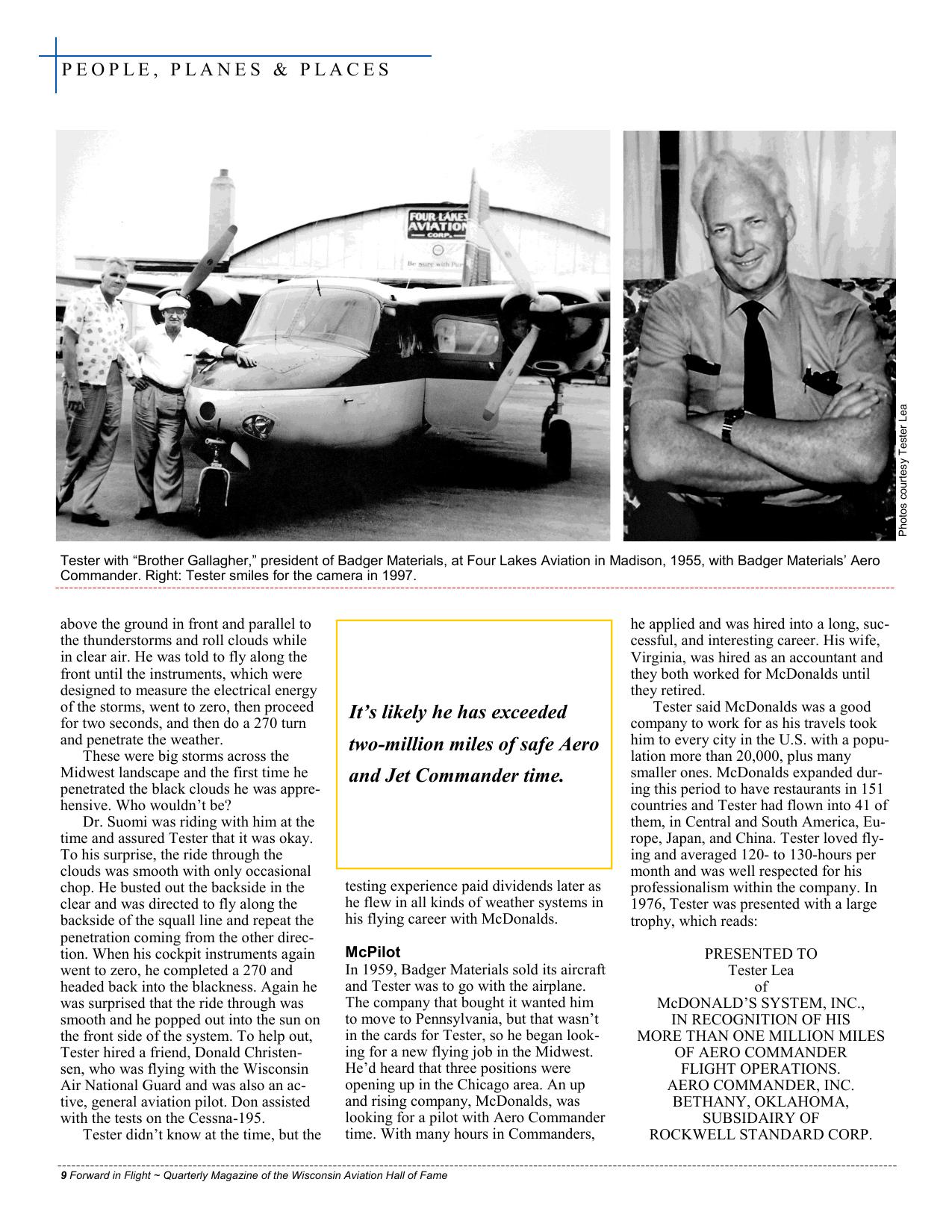
Photos courtesy Tester Lea PEOPLE, PLANES & PLACES Tester with “Brother Gallagher,” president of Badger Materials, at Four Lakes Aviation in Madison, 1955, with Badger Materials’ Aero Commander. Right: Tester smiles for the camera in 1997. above the ground in front and parallel to the thunderstorms and roll clouds while in clear air. He was told to fly along the front until the instruments, which were designed to measure the electrical energy of the storms, went to zero, then proceed for two seconds, and then do a 270 turn and penetrate the weather. These were big storms across the Midwest landscape and the first time he penetrated the black clouds he was apprehensive. Who wouldn’t be? Dr. Suomi was riding with him at the time and assured Tester that it was okay. To his surprise, the ride through the clouds was smooth with only occasional chop. He busted out the backside in the clear and was directed to fly along the backside of the squall line and repeat the penetration coming from the other direction. When his cockpit instruments again went to zero, he completed a 270 and headed back into the blackness. Again he was surprised that the ride through was smooth and he popped out into the sun on the front side of the system. To help out, Tester hired a friend, Donald Christensen, who was flying with the Wisconsin Air National Guard and was also an active, general aviation pilot. Don assisted with the tests on the Cessna-195. Tester didn’t know at the time, but the testing experience paid dividends later as he flew in all kinds of weather systems in his flying career with McDonalds. he applied and was hired into a long, successful, and interesting career. His wife, Virginia, was hired as an accountant and they both worked for McDonalds until they retired. Tester said McDonalds was a good company to work for as his travels took him to every city in the U.S. with a population more than 20,000, plus many smaller ones. McDonalds expanded during this period to have restaurants in 151 countries and Tester had flown into 41 of them, in Central and South America, Europe, Japan, and China. Tester loved flying and averaged 120- to 130-hours per month and was well respected for his professionalism within the company. In 1976, Tester was presented with a large trophy, which reads: McPilot In 1959, Badger Materials sold its aircraft and Tester was to go with the airplane. The company that bought it wanted him to move to Pennsylvania, but that wasn’t in the cards for Tester, so he began looking for a new flying job in the Midwest. He’d heard that three positions were opening up in the Chicago area. An up and rising company, McDonalds, was looking for a pilot with Aero Commander time. With many hours in Commanders, PRESENTED TO Tester Lea of McDONALD’S SYSTEM, INC., IN RECOGNITION OF HIS MORE THAN ONE MILLION MILES OF AERO COMMANDER FLIGHT OPERATIONS. AERO COMMANDER, INC. BETHANY, OKLAHOMA, SUBSIDAIRY OF ROCKWELL STANDARD CORP. It’s likely he has exceeded two-million miles of safe Aero and Jet Commander time. 9 Forward in Flight ~ Quarterly Magazine of the Wisconsin Aviation Hall of Fame
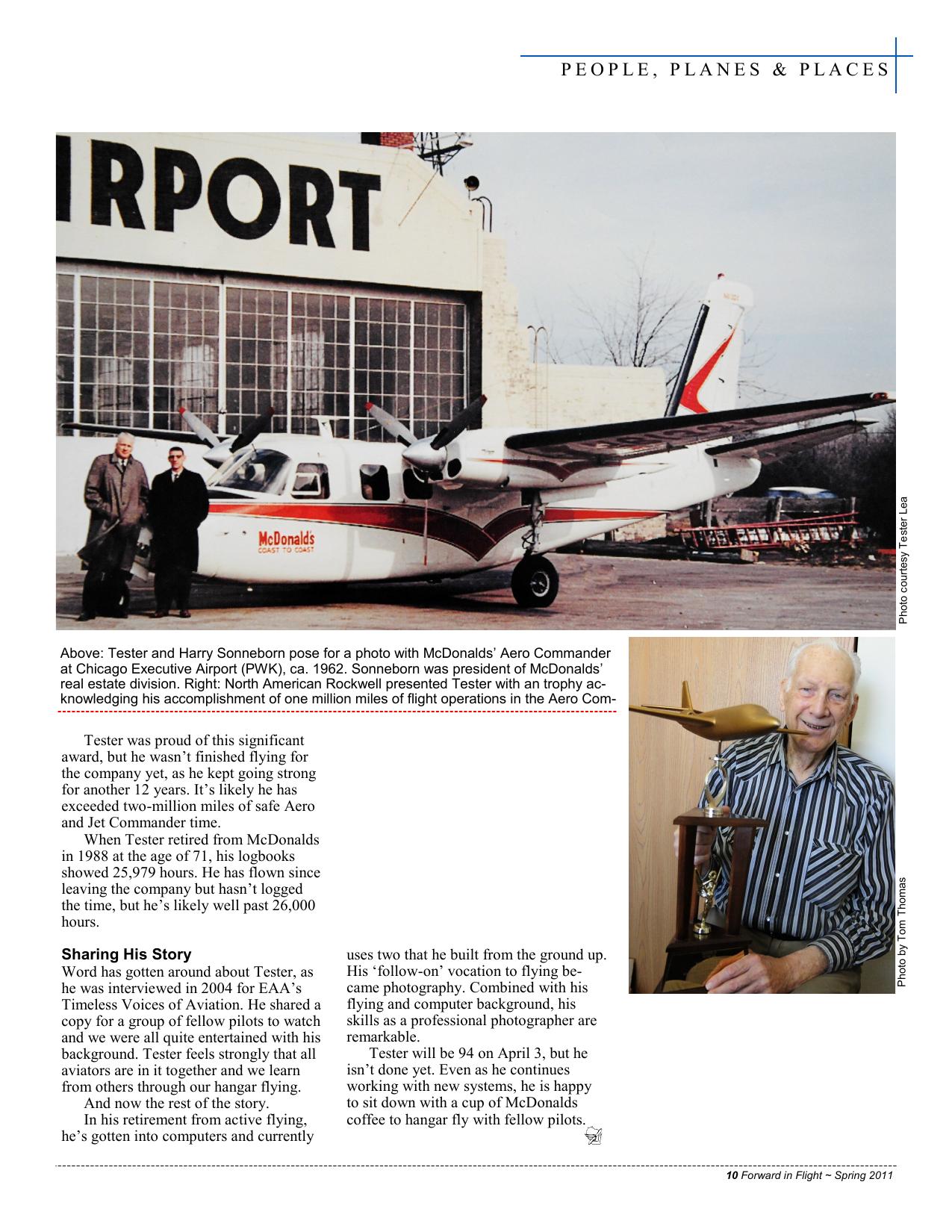
Photo courtesy Tester Lea PEOPLE, PLANES & PLACES Above: Tester and Harry Sonneborn pose for a photo with McDonalds’ Aero Commander at Chicago Executive Airport (PWK), ca. 1962. Sonneborn was president of McDonalds’ real estate division. Right: North American Rockwell presented Tester with an trophy acknowledging his accomplishment of one million miles of flight operations in the Aero Com- Sharing His Story Word has gotten around about Tester, as he was interviewed in 2004 for EAA’s Timeless Voices of Aviation. He shared a copy for a group of fellow pilots to watch and we were all quite entertained with his background. Tester feels strongly that all aviators are in it together and we learn from others through our hangar flying. And now the rest of the story. In his retirement from active flying, he’s gotten into computers and currently Photo by Tom Thomas Tester was proud of this significant award, but he wasn’t finished flying for the company yet, as he kept going strong for another 12 years. It’s likely he has exceeded two-million miles of safe Aero and Jet Commander time. When Tester retired from McDonalds in 1988 at the age of 71, his logbooks showed 25,979 hours. He has flown since leaving the company but hasn’t logged the time, but he’s likely well past 26,000 hours. uses two that he built from the ground up. His ‘follow-on’ vocation to flying became photography. Combined with his flying and computer background, his skills as a professional photographer are remarkable. Tester will be 94 on April 3, but he isn’t done yet. Even as he continues working with new systems, he is happy to sit down with a cup of McDonalds coffee to hangar fly with fellow pilots. 10 Forward in Flight ~ Spring 2011
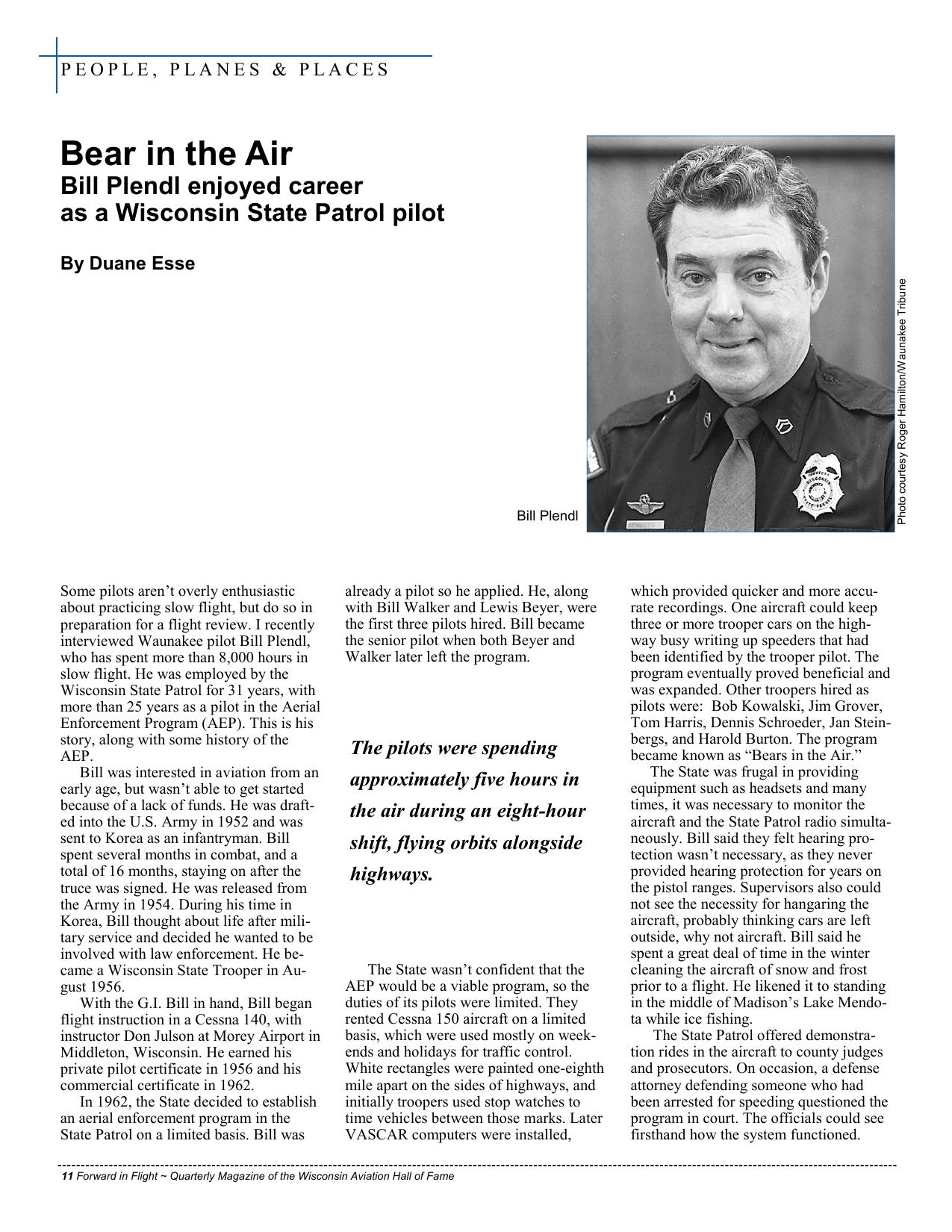
PEOPLE, PLANES & PLACES Bear in the Air Bill Plendl enjoyed career as a Wisconsin State Patrol pilot Photo courtesy Roger Hamilton/Waunakee Tribune By Duane Esse Bill Plendl Some pilots aren’t overly enthusiastic about practicing slow flight, but do so in preparation for a flight review. I recently interviewed Waunakee pilot Bill Plendl, who has spent more than 8,000 hours in slow flight. He was employed by the Wisconsin State Patrol for 31 years, with more than 25 years as a pilot in the Aerial Enforcement Program (AEP). This is his story, along with some history of the AEP. Bill was interested in aviation from an early age, but wasn’t able to get started because of a lack of funds. He was drafted into the U.S. Army in 1952 and was sent to Korea as an infantryman. Bill spent several months in combat, and a total of 16 months, staying on after the truce was signed. He was released from the Army in 1954. During his time in Korea, Bill thought about life after military service and decided he wanted to be involved with law enforcement. He became a Wisconsin State Trooper in August 1956. With the G.I. Bill in hand, Bill began flight instruction in a Cessna 140, with instructor Don Julson at Morey Airport in Middleton, Wisconsin. He earned his private pilot certificate in 1956 and his commercial certificate in 1962. In 1962, the State decided to establish an aerial enforcement program in the State Patrol on a limited basis. Bill was already a pilot so he applied. He, along with Bill Walker and Lewis Beyer, were the first three pilots hired. Bill became the senior pilot when both Beyer and Walker later left the program. The pilots were spending approximately five hours in the air during an eight-hour shift, flying orbits alongside highways. The State wasn’t confident that the AEP would be a viable program, so the duties of its pilots were limited. They rented Cessna 150 aircraft on a limited basis, which were used mostly on weekends and holidays for traffic control. White rectangles were painted one-eighth mile apart on the sides of highways, and initially troopers used stop watches to time vehicles between those marks. Later VASCAR computers were installed, 11 Forward in Flight ~ Quarterly Magazine of the Wisconsin Aviation Hall of Fame which provided quicker and more accurate recordings. One aircraft could keep three or more trooper cars on the highway busy writing up speeders that had been identified by the trooper pilot. The program eventually proved beneficial and was expanded. Other troopers hired as pilots were: Bob Kowalski, Jim Grover, Tom Harris, Dennis Schroeder, Jan Steinbergs, and Harold Burton. The program became known as “Bears in the Air.” The State was frugal in providing equipment such as headsets and many times, it was necessary to monitor the aircraft and the State Patrol radio simultaneously. Bill said they felt hearing protection wasn’t necessary, as they never provided hearing protection for years on the pistol ranges. Supervisors also could not see the necessity for hangaring the aircraft, probably thinking cars are left outside, why not aircraft. Bill said he spent a great deal of time in the winter cleaning the aircraft of snow and frost prior to a flight. He likened it to standing in the middle of Madison’s Lake Mendota while ice fishing. The State Patrol offered demonstration rides in the aircraft to county judges and prosecutors. On occasion, a defense attorney defending someone who had been arrested for speeding questioned the program in court. The officials could see firsthand how the system functioned.
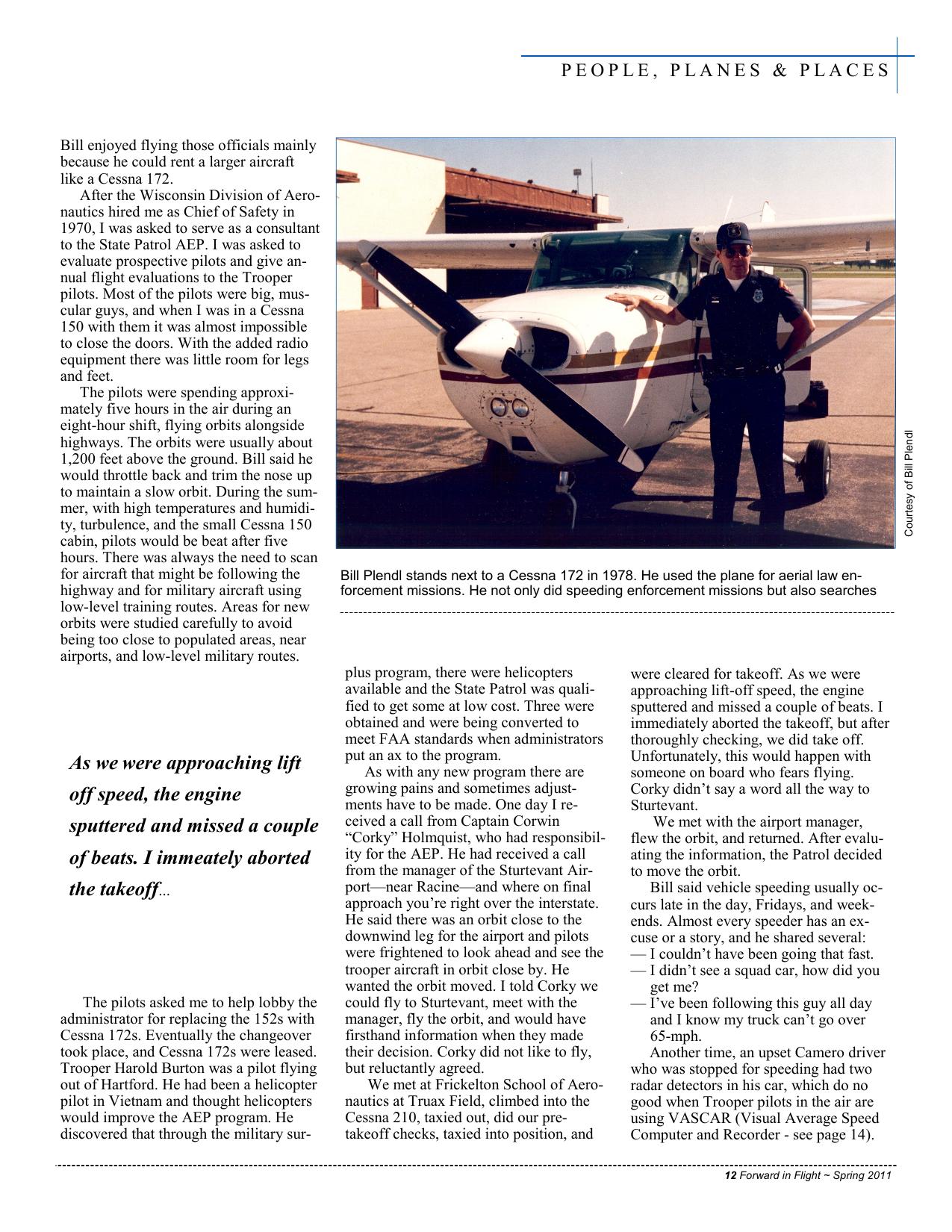
Bill enjoyed flying those officials mainly because he could rent a larger aircraft like a Cessna 172. After the Wisconsin Division of Aeronautics hired me as Chief of Safety in 1970, I was asked to serve as a consultant to the State Patrol AEP. I was asked to evaluate prospective pilots and give annual flight evaluations to the Trooper pilots. Most of the pilots were big, muscular guys, and when I was in a Cessna 150 with them it was almost impossible to close the doors. With the added radio equipment there was little room for legs and feet. The pilots were spending approximately five hours in the air during an eight-hour shift, flying orbits alongside highways. The orbits were usually about 1,200 feet above the ground. Bill said he would throttle back and trim the nose up to maintain a slow orbit. During the summer, with high temperatures and humidity, turbulence, and the small Cessna 150 cabin, pilots would be beat after five hours. There was always the need to scan for aircraft that might be following the highway and for military aircraft using low-level training routes. Areas for new orbits were studied carefully to avoid being too close to populated areas, near airports, and low-level military routes. As we were approaching lift off speed, the engine sputtered and missed a couple of beats. I immeately aborted the takeoff... The pilots asked me to help lobby the administrator for replacing the 152s with Cessna 172s. Eventually the changeover took place, and Cessna 172s were leased. Trooper Harold Burton was a pilot flying out of Hartford. He had been a helicopter pilot in Vietnam and thought helicopters would improve the AEP program. He discovered that through the military sur- Courtesy of Bill Plendl PEOPLE, PLANES & PLACES Bill Plendl stands next to a Cessna 172 in 1978. He used the plane for aerial law enforcement missions. He not only did speeding enforcement missions but also searches plus program, there were helicopters available and the State Patrol was qualified to get some at low cost. Three were obtained and were being converted to meet FAA standards when administrators put an ax to the program. As with any new program there are growing pains and sometimes adjustments have to be made. One day I received a call from Captain Corwin “Corky” Holmquist, who had responsibility for the AEP. He had received a call from the manager of the Sturtevant Airport—near Racine—and where on final approach you’re right over the interstate. He said there was an orbit close to the downwind leg for the airport and pilots were frightened to look ahead and see the trooper aircraft in orbit close by. He wanted the orbit moved. I told Corky we could fly to Sturtevant, meet with the manager, fly the orbit, and would have firsthand information when they made their decision. Corky did not like to fly, but reluctantly agreed. We met at Frickelton School of Aeronautics at Truax Field, climbed into the Cessna 210, taxied out, did our pretakeoff checks, taxied into position, and were cleared for takeoff. As we were approaching lift-off speed, the engine sputtered and missed a couple of beats. I immediately aborted the takeoff, but after thoroughly checking, we did take off. Unfortunately, this would happen with someone on board who fears flying. Corky didn’t say a word all the way to Sturtevant. We met with the airport manager, flew the orbit, and returned. After evaluating the information, the Patrol decided to move the orbit. Bill said vehicle speeding usually occurs late in the day, Fridays, and weekends. Almost every speeder has an excuse or a story, and he shared several: — I couldn’t have been going that fast. — I didn’t see a squad car, how did you get me? — I’ve been following this guy all day and I know my truck can’t go over 65-mph. Another time, an upset Camero driver who was stopped for speeding had two radar detectors in his car, which do no good when Trooper pilots in the air are using VASCAR (Visual Average Speed Computer and Recorder - see page 14). 12 Forward in Flight ~ Spring 2011
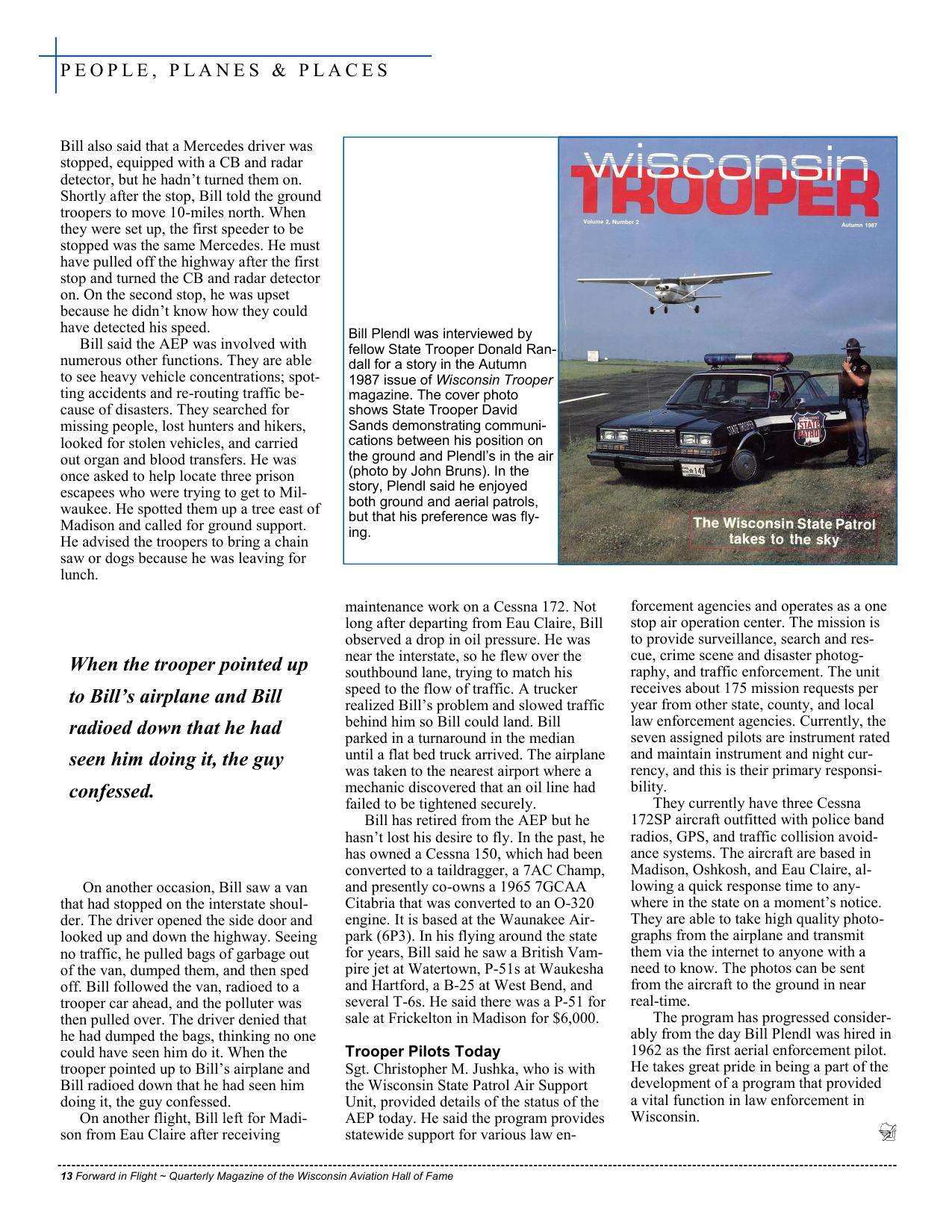
PEOPLE, PLANES & PLACES Bill also said that a Mercedes driver was stopped, equipped with a CB and radar detector, but he hadn’t turned them on. Shortly after the stop, Bill told the ground troopers to move 10-miles north. When they were set up, the first speeder to be stopped was the same Mercedes. He must have pulled off the highway after the first stop and turned the CB and radar detector on. On the second stop, he was upset because he didn’t know how they could have detected his speed. Bill said the AEP was involved with numerous other functions. They are able to see heavy vehicle concentrations; spotting accidents and re-routing traffic because of disasters. They searched for missing people, lost hunters and hikers, looked for stolen vehicles, and carried out organ and blood transfers. He was once asked to help locate three prison escapees who were trying to get to Milwaukee. He spotted them up a tree east of Madison and called for ground support. He advised the troopers to bring a chain saw or dogs because he was leaving for lunch. When the trooper pointed up to Bill’s airplane and Bill radioed down that he had seen him doing it, the guy confessed. On another occasion, Bill saw a van that had stopped on the interstate shoulder. The driver opened the side door and looked up and down the highway. Seeing no traffic, he pulled bags of garbage out of the van, dumped them, and then sped off. Bill followed the van, radioed to a trooper car ahead, and the polluter was then pulled over. The driver denied that he had dumped the bags, thinking no one could have seen him do it. When the trooper pointed up to Bill’s airplane and Bill radioed down that he had seen him doing it, the guy confessed. On another flight, Bill left for Madison from Eau Claire after receiving Bill Plendl was interviewed by fellow State Trooper Donald Randall for a story in the Autumn 1987 issue of Wisconsin Trooper magazine. The cover photo shows State Trooper David Sands demonstrating communications between his position on the ground and Plendl’s in the air (photo by John Bruns). In the story, Plendl said he enjoyed both ground and aerial patrols, but that his preference was flying. maintenance work on a Cessna 172. Not long after departing from Eau Claire, Bill observed a drop in oil pressure. He was near the interstate, so he flew over the southbound lane, trying to match his speed to the flow of traffic. A trucker realized Bill’s problem and slowed traffic behind him so Bill could land. Bill parked in a turnaround in the median until a flat bed truck arrived. The airplane was taken to the nearest airport where a mechanic discovered that an oil line had failed to be tightened securely. Bill has retired from the AEP but he hasn’t lost his desire to fly. In the past, he has owned a Cessna 150, which had been converted to a taildragger, a 7AC Champ, and presently co-owns a 1965 7GCAA Citabria that was converted to an O-320 engine. It is based at the Waunakee Airpark (6P3). In his flying around the state for years, Bill said he saw a British Vampire jet at Watertown, P-51s at Waukesha and Hartford, a B-25 at West Bend, and several T-6s. He said there was a P-51 for sale at Frickelton in Madison for $6,000. Trooper Pilots Today Sgt. Christopher M. Jushka, who is with the Wisconsin State Patrol Air Support Unit, provided details of the status of the AEP today. He said the program provides statewide support for various law en- 13 Forward in Flight ~ Quarterly Magazine of the Wisconsin Aviation Hall of Fame forcement agencies and operates as a one stop air operation center. The mission is to provide surveillance, search and rescue, crime scene and disaster photography, and traffic enforcement. The unit receives about 175 mission requests per year from other state, county, and local law enforcement agencies. Currently, the seven assigned pilots are instrument rated and maintain instrument and night currency, and this is their primary responsibility. They currently have three Cessna 172SP aircraft outfitted with police band radios, GPS, and traffic collision avoidance systems. The aircraft are based in Madison, Oshkosh, and Eau Claire, allowing a quick response time to anywhere in the state on a moment’s notice. They are able to take high quality photographs from the airplane and transmit them via the internet to anyone with a need to know. The photos can be sent from the aircraft to the ground in near real-time. The program has progressed considerably from the day Bill Plendl was hired in 1962 as the first aerial enforcement pilot. He takes great pride in being a part of the development of a program that provided a vital function in law enforcement in Wisconsin.
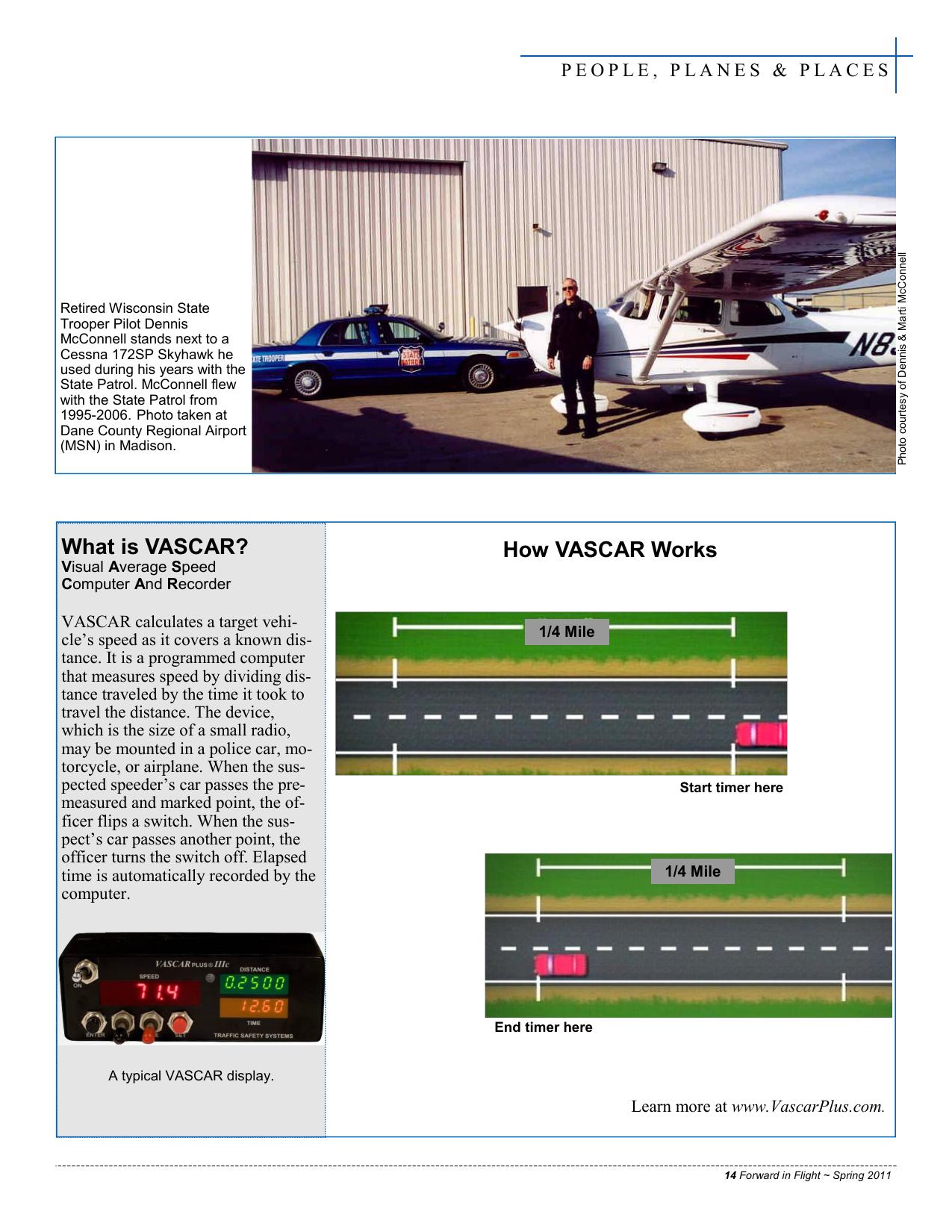
Photo courtesy of Dennis & Marti McConnell PEOPLE, PLANES & PLACES Retired Wisconsin State Trooper Pilot Dennis McConnell stands next to a Cessna 172SP Skyhawk he used during his years with the State Patrol. McConnell flew with the State Patrol from 1995-2006. Photo taken at Dane County Regional Airport (MSN) in Madison. What is VASCAR? Visual Average Speed Computer And Recorder VASCAR calculates a target vehicle’s speed as it covers a known distance. It is a programmed computer that measures speed by dividing distance traveled by the time it took to travel the distance. The device, which is the size of a small radio, may be mounted in a police car, motorcycle, or airplane. When the suspected speeder’s car passes the premeasured and marked point, the officer flips a switch. When the suspect’s car passes another point, the officer turns the switch off. Elapsed time is automatically recorded by the computer. How VASCAR Works 1/4 Mile Start timer here 1/4 Mile End timer here A typical VASCAR display. Learn more at www.VascarPlus.com. 14 Forward in Flight ~ Spring 2011
CHECK SIX Doug Benjamin Experimental Test Pilot from La Crosse Doug Benjamin Collection By Gary Dikkers In February 2010, the U.S. Air Force and a Boeing-led industry team shot down a ballistic missile shortly after its launch using the high-powered Chemical Oxygen-Iodine Laser (COIL) mounted in a Boeing 747-400F known as the YAL-1 Airborne Laser Test Bed. The pilot of that 747 during that historic aerospace first was test pilot Doug Benjamin of La Crosse. Looking at his roots, it’s easy to understand how Doug went from La Crosse’s Central High School in 1974, to the US Air Force Academy, to become one of the premier experimental test pilots in the US Air Force, and after retiring from the Air Force, an engineering test pilot for The Boeing Company in Seattle, Washington. Test Pilot Destiny Doug was born at Davis-Monthan Air Force Base in Arizona while his father, Clyde, was training to become an Air Force pilot. Doug says that some of his earliest memories are growing up and watching jets fly. At the time, his father flew one of the hottest jet fighters in the Air Force, the F-100 Super Sabre. As a young boy, Doug also met some of aviation’s most famous pilots. In the years his father flew the “Hun,” jet jocks at his father’s base included Chuck Yeager—possibly the most famous experimental test pilot of all time—and Joe Engle, a good friend of Doug’s father. Joe became the only person to qualify for astronaut wings twice: First as a pilot of the X-15 rocket research plane by soaring more than 50 miles above the earth, and again in 1981 as commander of the space shuttle Columbia. 15 Forward in Flight ~ Quarterly Magazine of the Wisconsin Aviation Hall of Fame Doug grew to know Joe Engle so well he considers him his godfather, and decided in the fourth grade to emulate Engle’s career by becoming an experimental test pilot. La Crosse Upbringing After leaving the Air Force, Doug’s father Clyde took a position with La Crosse’s Trane Company, where he worked for 40 years, retiring as manager of the factory where Trane builds centrifugal chilling air conditioners. His mother, Nancy, served on the National Ski Patrol at the Mt. La Crosse ski area for 25 years. Doug says he is a proud Red Raider from La Crosse’s Central High School, and credits much of his success to his La Crosse education. He has always felt La Crosse was a special place, and that their school system prepared him well for the Air Force Academy and to becoming a test pilot. He still refers to the Mississippi River Valley and the coulees around La Crosse as, “God’s Country.” He gives special credit to his fifth grade teacher, Mrs. Lennartz, who taught him that learning could be fun, and Mr. Robarge, his math instructor through three years of high school. Doug also singles out his French teacher, Mme Diane Seiler, for the inspiration she provided. The French language skill he began developing in La Crosse was significant to his future success. Having long known he wanted to fly jets, Doug decided to attend the US Air Force Academy (USAFA). He applied to Congressman Vernon Thompson, who represented the La Crosse area, and Senator Gaylord Nelson. Doug finished the
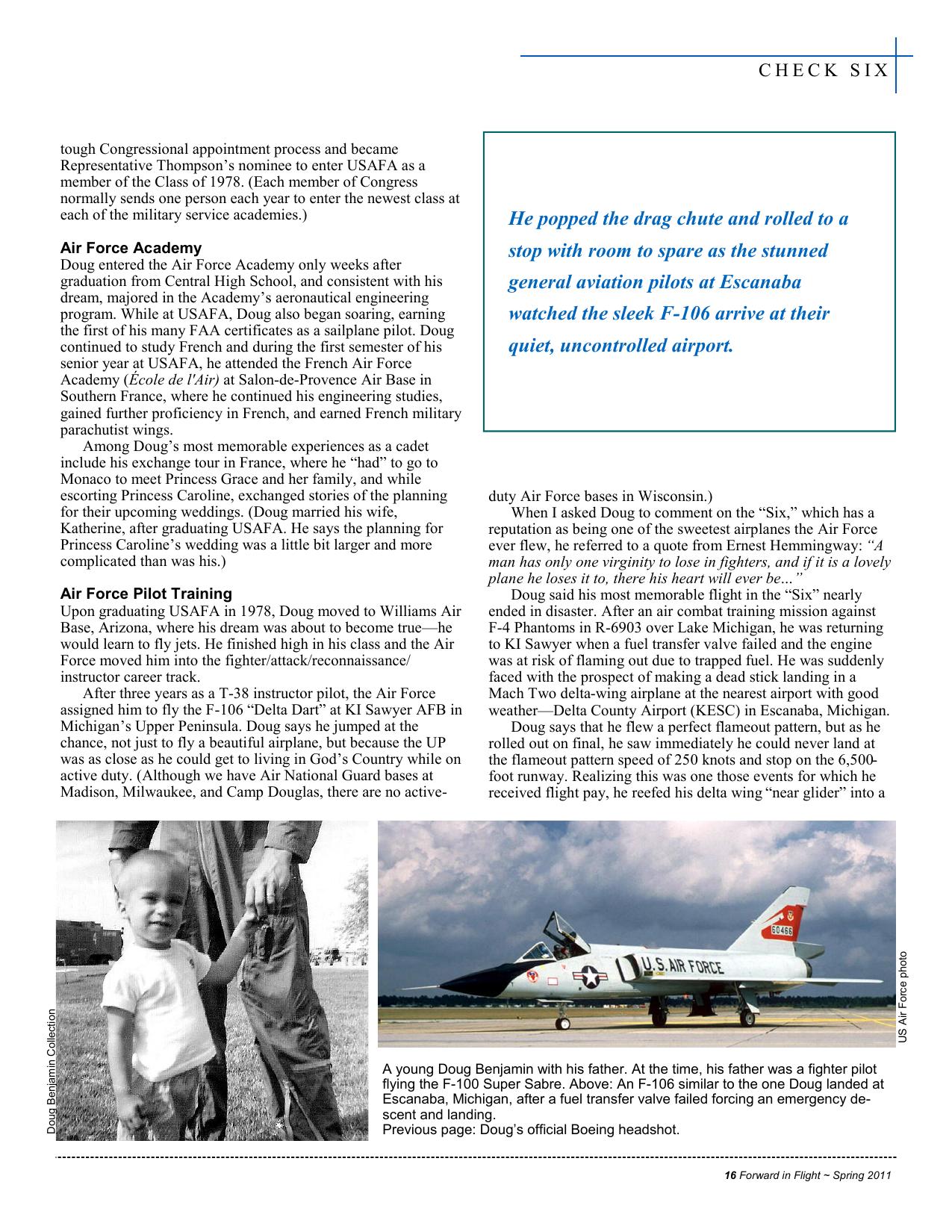
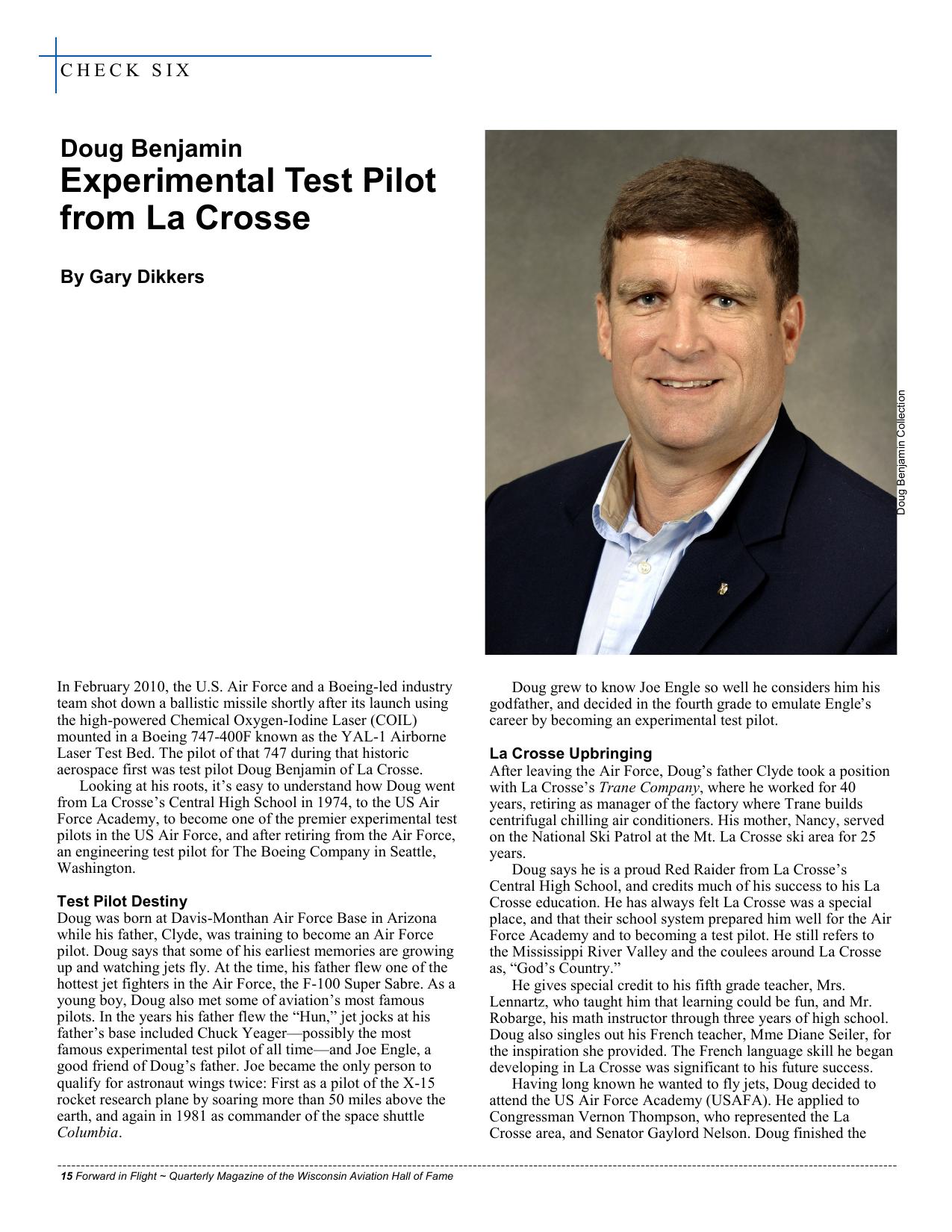
CHECK SIX tough Congressional appointment process and became Representative Thompson’s nominee to enter USAFA as a member of the Class of 1978. (Each member of Congress normally sends one person each year to enter the newest class at each of the military service academies.) Air Force Academy Doug entered the Air Force Academy only weeks after graduation from Central High School, and consistent with his dream, majored in the Academy’s aeronautical engineering program. While at USAFA, Doug also began soaring, earning the first of his many FAA certificates as a sailplane pilot. Doug continued to study French and during the first semester of his senior year at USAFA, he attended the French Air Force Academy (École de l'Air) at Salon-de-Provence Air Base in Southern France, where he continued his engineering studies, gained further proficiency in French, and earned French military parachutist wings. Among Doug’s most memorable experiences as a cadet include his exchange tour in France, where he “had” to go to Monaco to meet Princess Grace and her family, and while escorting Princess Caroline, exchanged stories of the planning for their upcoming weddings. (Doug married his wife, Katherine, after graduating USAFA. He says the planning for Princess Caroline’s wedding was a little bit larger and more complicated than was his.) stop with room to spare as the stunned general aviation pilots at Escanaba watched the sleek F-106 arrive at their quiet, uncontrolled airport. duty Air Force bases in Wisconsin.) When I asked Doug to comment on the “Six,” which has a reputation as being one of the sweetest airplanes the Air Force ever flew, he referred to a quote from Ernest Hemmingway: “A man has only one virginity to lose in fighters, and if it is a lovely plane he loses it to, there his heart will ever be…” Doug said his most memorable flight in the “Six” nearly ended in disaster. After an air combat training mission against F-4 Phantoms in R-6903 over Lake Michigan, he was returning to KI Sawyer when a fuel transfer valve failed and the engine was at risk of flaming out due to trapped fuel. He was suddenly faced with the prospect of making a dead stick landing in a Mach Two delta-wing airplane at the nearest airport with good weather—Delta County Airport (KESC) in Escanaba, Michigan. Doug says that he flew a perfect flameout pattern, but as he rolled out on final, he saw immediately he could never land at the flameout pattern speed of 250 knots and stop on the 6,500foot runway. Realizing this was one those events for which he received flight pay, he reefed his delta wing “near glider” into a US Air Force photo Doug Benjamin Collection Air Force Pilot Training Upon graduating USAFA in 1978, Doug moved to Williams Air Base, Arizona, where his dream was about to become true—he would learn to fly jets. He finished high in his class and the Air Force moved him into the fighter/attack/reconnaissance/ instructor career track. After three years as a T-38 instructor pilot, the Air Force assigned him to fly the F-106 “Delta Dart” at KI Sawyer AFB in Michigan’s Upper Peninsula. Doug says he jumped at the chance, not just to fly a beautiful airplane, but because the UP was as close as he could get to living in God’s Country while on active duty. (Although we have Air National Guard bases at Madison, Milwaukee, and Camp Douglas, there are no active- He popped the drag chute and rolled to a A young Doug Benjamin with his father. At the time, his father was a fighter pilot flying the F-100 Super Sabre. Above: An F-106 similar to the one Doug landed at Escanaba, Michigan, after a fuel transfer valve failed forcing an emergency descent and landing. Previous page: Doug’s official Boeing headshot. 16 Forward in Flight ~ Spring 2011
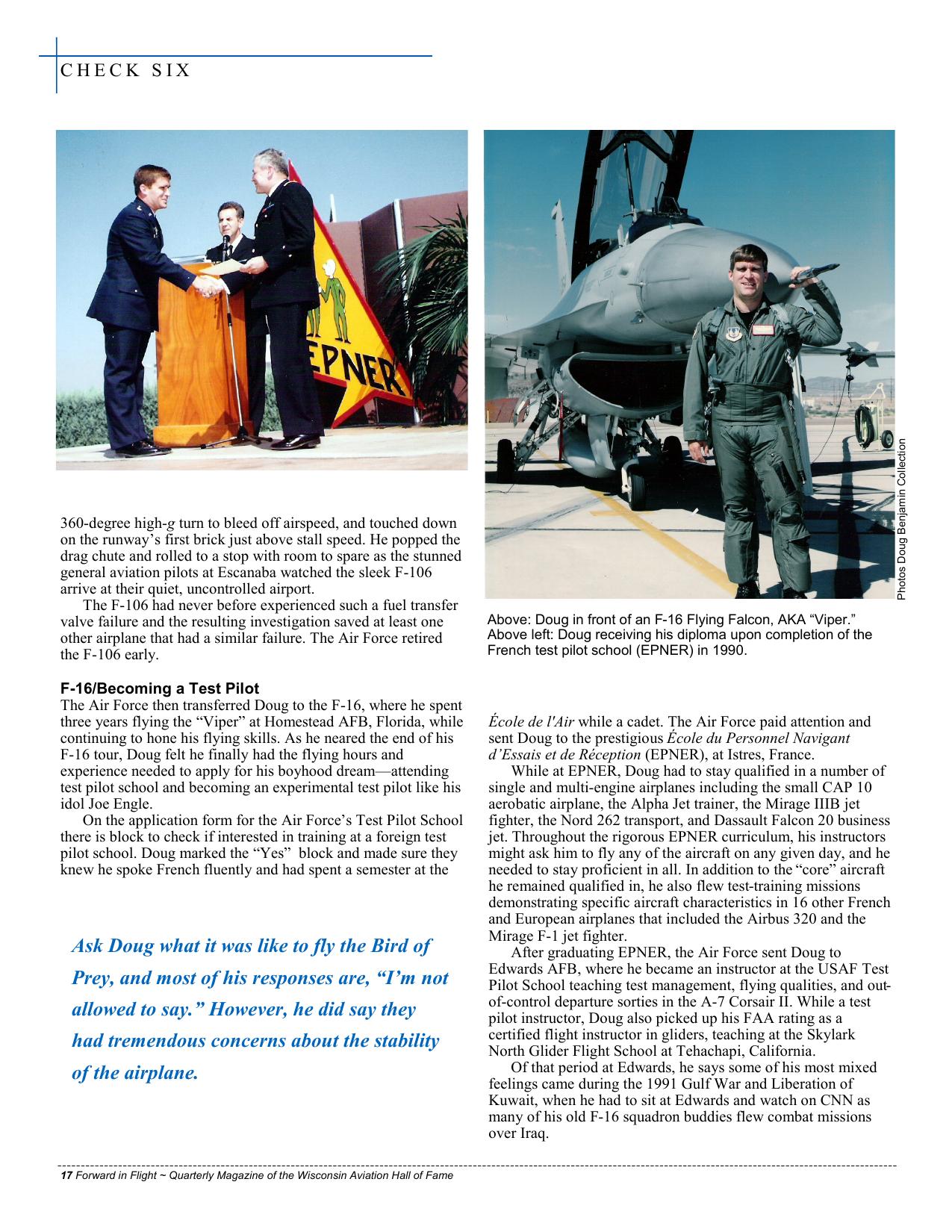
360-degree high-g turn to bleed off airspeed, and touched down on the runway’s first brick just above stall speed. He popped the drag chute and rolled to a stop with room to spare as the stunned general aviation pilots at Escanaba watched the sleek F-106 arrive at their quiet, uncontrolled airport. The F-106 had never before experienced such a fuel transfer valve failure and the resulting investigation saved at least one other airplane that had a similar failure. The Air Force retired the F-106 early. F-16/Becoming a Test Pilot The Air Force then transferred Doug to the F-16, where he spent three years flying the “Viper” at Homestead AFB, Florida, while continuing to hone his flying skills. As he neared the end of his F-16 tour, Doug felt he finally had the flying hours and experience needed to apply for his boyhood dream—attending test pilot school and becoming an experimental test pilot like his idol Joe Engle. On the application form for the Air Force’s Test Pilot School there is block to check if interested in training at a foreign test pilot school. Doug marked the “Yes” block and made sure they knew he spoke French fluently and had spent a semester at the Ask Doug what it was like to fly the Bird of Prey, and most of his responses are, “I’m not allowed to say.” However, he did say they had tremendous concerns about the stability of the airplane. 17 Forward in Flight ~ Quarterly Magazine of the Wisconsin Aviation Hall of Fame Photos Doug Benjamin Collection CHECK SIX Above: Doug in front of an F-16 Flying Falcon, AKA “Viper.” Above left: Doug receiving his diploma upon completion of the French test pilot school (EPNER) in 1990. École de l'Air while a cadet. The Air Force paid attention and sent Doug to the prestigious École du Personnel Navigant d’Essais et de Réception (EPNER), at Istres, France. While at EPNER, Doug had to stay qualified in a number of single and multi-engine airplanes including the small CAP 10 aerobatic airplane, the Alpha Jet trainer, the Mirage IIIB jet fighter, the Nord 262 transport, and Dassault Falcon 20 business jet. Throughout the rigorous EPNER curriculum, his instructors might ask him to fly any of the aircraft on any given day, and he needed to stay proficient in all. In addition to the “core” aircraft he remained qualified in, he also flew test-training missions demonstrating specific aircraft characteristics in 16 other French and European airplanes that included the Airbus 320 and the Mirage F-1 jet fighter. After graduating EPNER, the Air Force sent Doug to Edwards AFB, where he became an instructor at the USAF Test Pilot School teaching test management, flying qualities, and outof-control departure sorties in the A-7 Corsair II. While a test pilot instructor, Doug also picked up his FAA rating as a certified flight instructor in gliders, teaching at the Skylark North Glider Flight School at Tehachapi, California. Of that period at Edwards, he says some of his most mixed feelings came during the 1991 Gulf War and Liberation of Kuwait, when he had to sit at Edwards and watch on CNN as many of his old F-16 squadron buddies flew combat missions over Iraq.
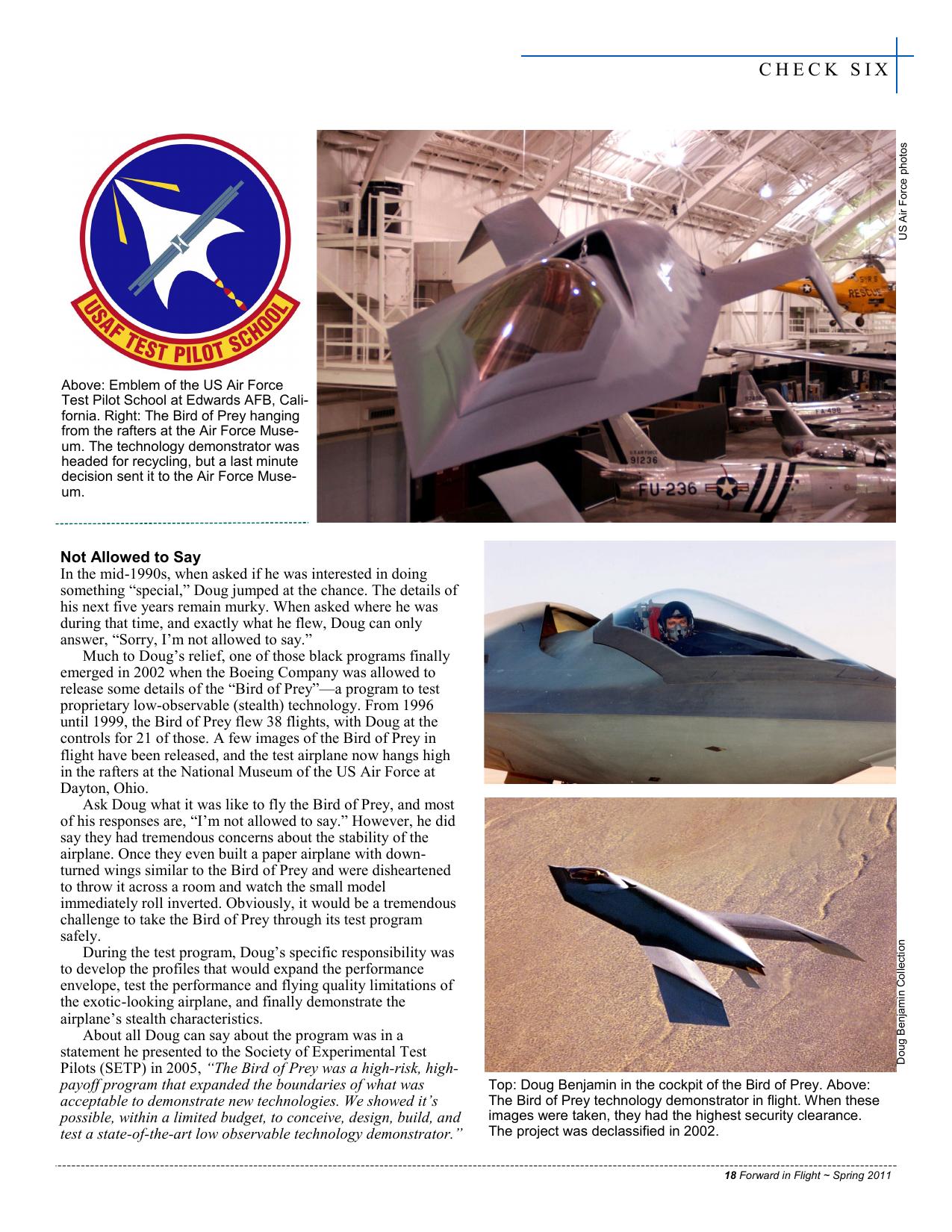
US Air Force photos CHECK SIX Not Allowed to Say In the mid-1990s, when asked if he was interested in doing something “special,” Doug jumped at the chance. The details of his next five years remain murky. When asked where he was during that time, and exactly what he flew, Doug can only answer, “Sorry, I’m not allowed to say.” Much to Doug’s relief, one of those black programs finally emerged in 2002 when the Boeing Company was allowed to release some details of the “Bird of Prey”—a program to test proprietary low-observable (stealth) technology. From 1996 until 1999, the Bird of Prey flew 38 flights, with Doug at the controls for 21 of those. A few images of the Bird of Prey in flight have been released, and the test airplane now hangs high in the rafters at the National Museum of the US Air Force at Dayton, Ohio. Ask Doug what it was like to fly the Bird of Prey, and most of his responses are, “I’m not allowed to say.” However, he did say they had tremendous concerns about the stability of the airplane. Once they even built a paper airplane with downturned wings similar to the Bird of Prey and were disheartened to throw it across a room and watch the small model immediately roll inverted. Obviously, it would be a tremendous challenge to take the Bird of Prey through its test program safely. During the test program, Doug’s specific responsibility was to develop the profiles that would expand the performance envelope, test the performance and flying quality limitations of the exotic-looking airplane, and finally demonstrate the airplane’s stealth characteristics. About all Doug can say about the program was in a statement he presented to the Society of Experimental Test Pilots (SETP) in 2005, “The Bird of Prey was a high-risk, highpayoff program that expanded the boundaries of what was acceptable to demonstrate new technologies. We showed it’s possible, within a limited budget, to conceive, design, build, and test a state-of-the-art low observable technology demonstrator.” Doug Benjamin Collection Above: Emblem of the US Air Force Test Pilot School at Edwards AFB, California. Right: The Bird of Prey hanging from the rafters at the Air Force Museum. The technology demonstrator was headed for recycling, but a last minute decision sent it to the Air Force Museum. Top: Doug Benjamin in the cockpit of the Bird of Prey. Above: The Bird of Prey technology demonstrator in flight. When these images were taken, they had the highest security clearance. The project was declassified in 2002. 18 Forward in Flight ~ Spring 2011
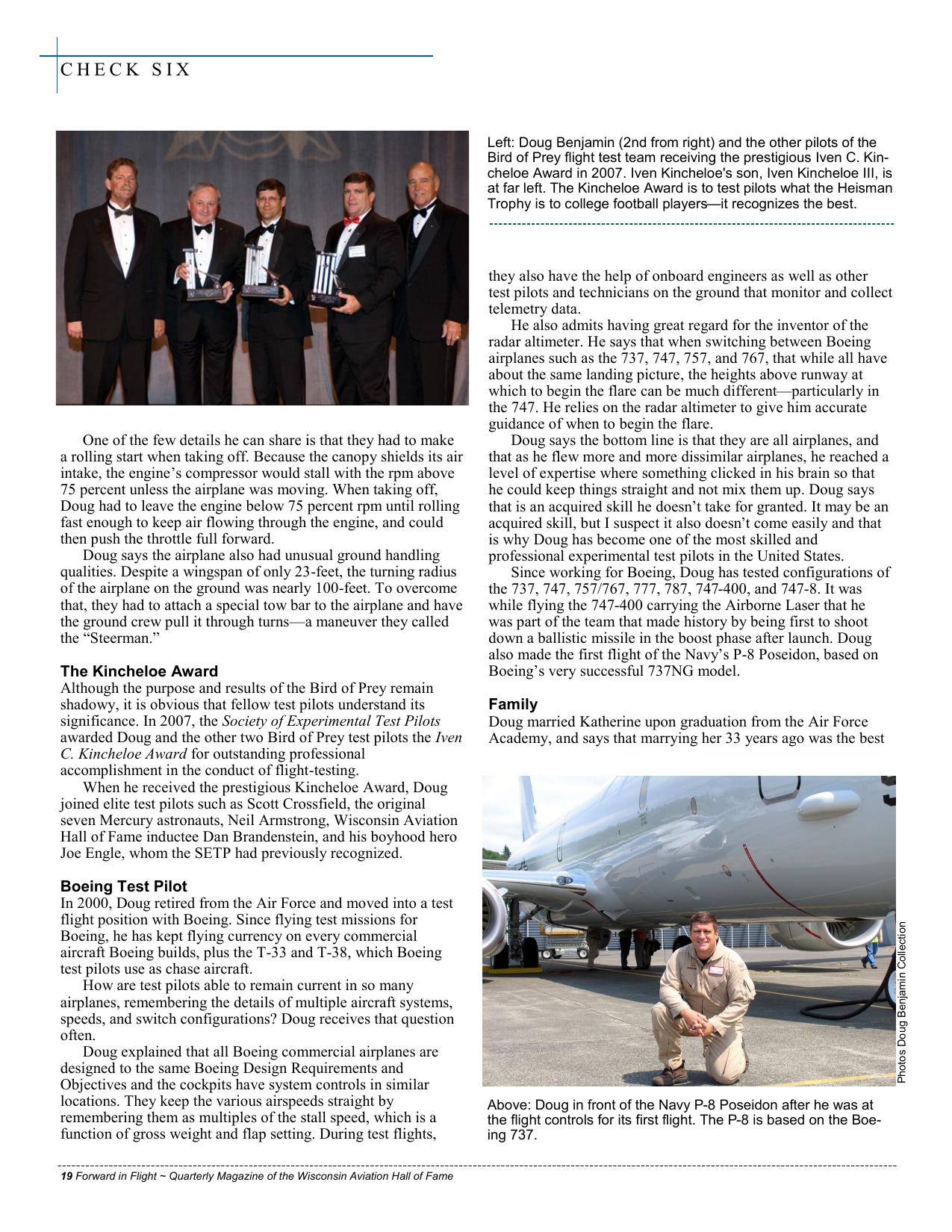
CHECK SIX Left: Doug Benjamin (2nd from right) and the other pilots of the Bird of Prey flight test team receiving the prestigious Iven C. Kincheloe Award in 2007. Iven Kincheloe's son, Iven Kincheloe III, is at far left. The Kincheloe Award is to test pilots what the Heisman Trophy is to college football players—it recognizes the best. The Kincheloe Award Although the purpose and results of the Bird of Prey remain shadowy, it is obvious that fellow test pilots understand its significance. In 2007, the Society of Experimental Test Pilots awarded Doug and the other two Bird of Prey test pilots the Iven C. Kincheloe Award for outstanding professional accomplishment in the conduct of flight-testing. When he received the prestigious Kincheloe Award, Doug joined elite test pilots such as Scott Crossfield, the original seven Mercury astronauts, Neil Armstrong, Wisconsin Aviation Hall of Fame inductee Dan Brandenstein, and his boyhood hero Joe Engle, whom the SETP had previously recognized. Boeing Test Pilot In 2000, Doug retired from the Air Force and moved into a test flight position with Boeing. Since flying test missions for Boeing, he has kept flying currency on every commercial aircraft Boeing builds, plus the T-33 and T-38, which Boeing test pilots use as chase aircraft. How are test pilots able to remain current in so many airplanes, remembering the details of multiple aircraft systems, speeds, and switch configurations? Doug receives that question often. Doug explained that all Boeing commercial airplanes are designed to the same Boeing Design Requirements and Objectives and the cockpits have system controls in similar locations. They keep the various airspeeds straight by remembering them as multiples of the stall speed, which is a function of gross weight and flap setting. During test flights, 19 Forward in Flight ~ Quarterly Magazine of the Wisconsin Aviation Hall of Fame Family Doug married Katherine upon graduation from the Air Force Academy, and says that marrying her 33 years ago was the best Photos Doug Benjamin Collection One of the few details he can share is that they had to make a rolling start when taking off. Because the canopy shields its air intake, the engine’s compressor would stall with the rpm above 75 percent unless the airplane was moving. When taking off, Doug had to leave the engine below 75 percent rpm until rolling fast enough to keep air flowing through the engine, and could then push the throttle full forward. Doug says the airplane also had unusual ground handling qualities. Despite a wingspan of only 23-feet, the turning radius of the airplane on the ground was nearly 100-feet. To overcome that, they had to attach a special tow bar to the airplane and have the ground crew pull it through turns—a maneuver they called the “Steerman.” they also have the help of onboard engineers as well as other test pilots and technicians on the ground that monitor and collect telemetry data. He also admits having great regard for the inventor of the radar altimeter. He says that when switching between Boeing airplanes such as the 737, 747, 757, and 767, that while all have about the same landing picture, the heights above runway at which to begin the flare can be much different—particularly in the 747. He relies on the radar altimeter to give him accurate guidance of when to begin the flare. Doug says the bottom line is that they are all airplanes, and that as he flew more and more dissimilar airplanes, he reached a level of expertise where something clicked in his brain so that he could keep things straight and not mix them up. Doug says that is an acquired skill he doesn’t take for granted. It may be an acquired skill, but I suspect it also doesn’t come easily and that is why Doug has become one of the most skilled and professional experimental test pilots in the United States. Since working for Boeing, Doug has tested configurations of the 737, 747, 757/767, 777, 787, 747-400, and 747-8. It was while flying the 747-400 carrying the Airborne Laser that he was part of the team that made history by being first to shoot down a ballistic missile in the boost phase after launch. Doug also made the first flight of the Navy’s P-8 Poseidon, based on Boeing’s very successful 737NG model. Above: Doug in front of the Navy P-8 Poseidon after he was at the flight controls for its first flight. The P-8 is based on the Boeing 737.
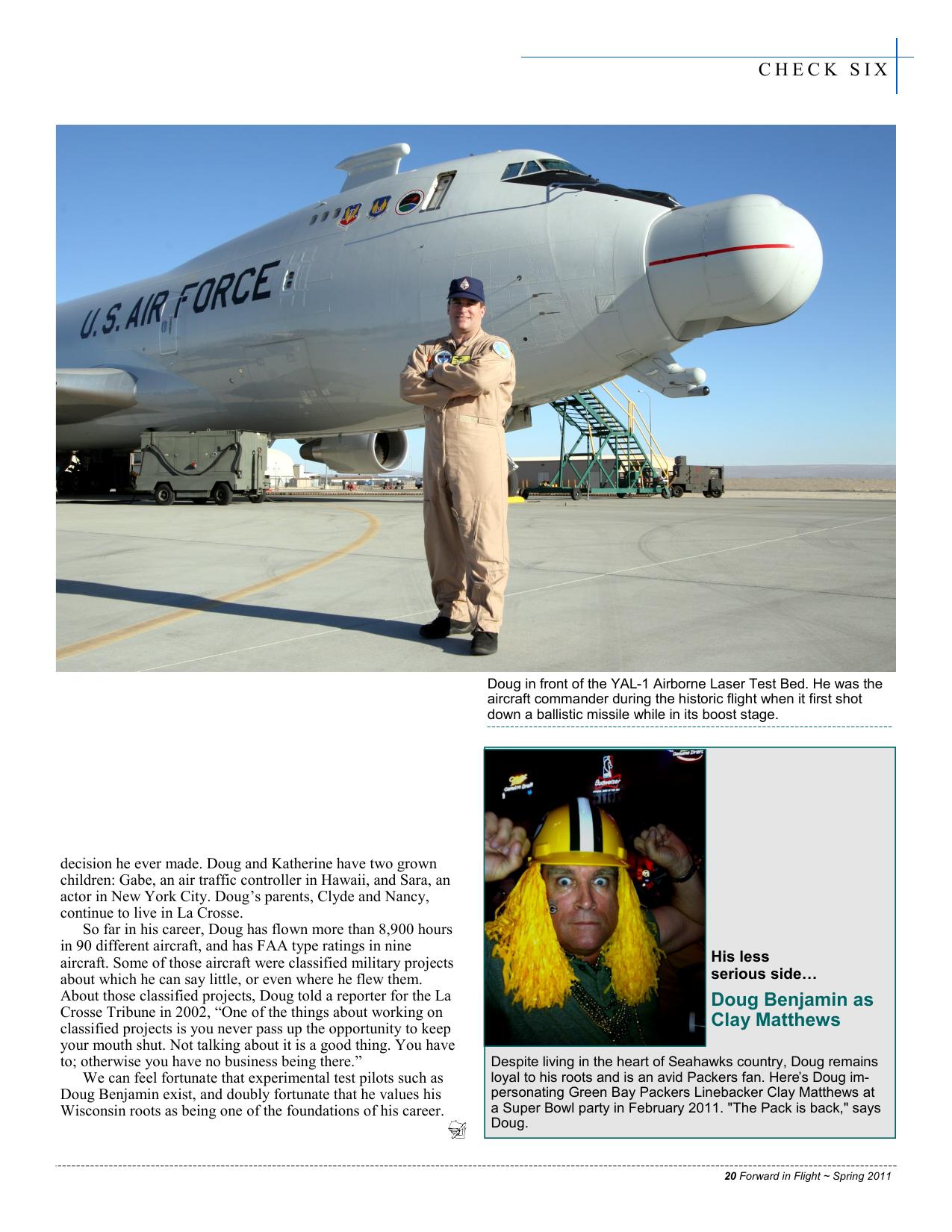
CHECK SIX Doug in front of the YAL-1 Airborne Laser Test Bed. He was the aircraft commander during the historic flight when it first shot down a ballistic missile while in its boost stage. decision he ever made. Doug and Katherine have two grown children: Gabe, an air traffic controller in Hawaii, and Sara, an actor in New York City. Doug’s parents, Clyde and Nancy, continue to live in La Crosse. So far in his career, Doug has flown more than 8,900 hours in 90 different aircraft, and has FAA type ratings in nine aircraft. Some of those aircraft were classified military projects about which he can say little, or even where he flew them. About those classified projects, Doug told a reporter for the La Crosse Tribune in 2002, “One of the things about working on classified projects is you never pass up the opportunity to keep your mouth shut. Not talking about it is a good thing. You have to; otherwise you have no business being there.” We can feel fortunate that experimental test pilots such as Doug Benjamin exist, and doubly fortunate that he values his Wisconsin roots as being one of the foundations of his career. His less serious side… Doug Benjamin as Clay Matthews Despite living in the heart of Seahawks country, Doug remains loyal to his roots and is an avid Packers fan. Here’s Doug impersonating Green Bay Packers Linebacker Clay Matthews at a Super Bowl party in February 2011. "The Pack is back," says Doug. 20 Forward in Flight ~ Spring 2011
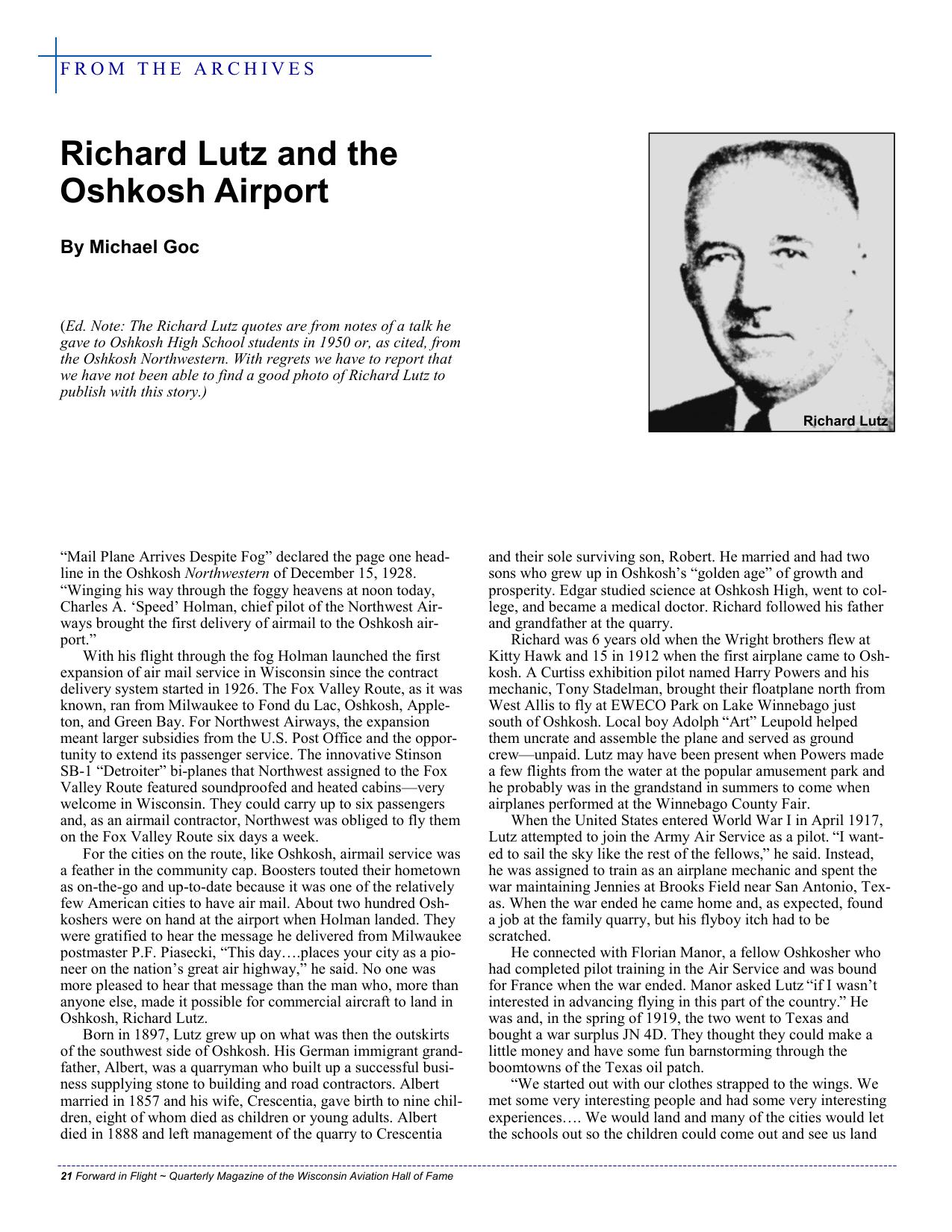
FROM THE ARCHIVES Richard Lutz and the Oshkosh Airport By Michael Goc (Ed. Note: The Richard Lutz quotes are from notes of a talk he gave to Oshkosh High School students in 1950 or, as cited, from the Oshkosh Northwestern. With regrets we have to report that we have not been able to find a good photo of Richard Lutz to publish with this story.) Richard Lutz “Mail Plane Arrives Despite Fog” declared the page one headline in the Oshkosh Northwestern of December 15, 1928. “Winging his way through the foggy heavens at noon today, Charles A. ‘Speed’ Holman, chief pilot of the Northwest Airways brought the first delivery of airmail to the Oshkosh airport.” With his flight through the fog Holman launched the first expansion of air mail service in Wisconsin since the contract delivery system started in 1926. The Fox Valley Route, as it was known, ran from Milwaukee to Fond du Lac, Oshkosh, Appleton, and Green Bay. For Northwest Airways, the expansion meant larger subsidies from the U.S. Post Office and the opportunity to extend its passenger service. The innovative Stinson SB-1 “Detroiter” bi-planes that Northwest assigned to the Fox Valley Route featured soundproofed and heated cabins—very welcome in Wisconsin. They could carry up to six passengers and, as an airmail contractor, Northwest was obliged to fly them on the Fox Valley Route six days a week. For the cities on the route, like Oshkosh, airmail service was a feather in the community cap. Boosters touted their hometown as on-the-go and up-to-date because it was one of the relatively few American cities to have air mail. About two hundred Oshkoshers were on hand at the airport when Holman landed. They were gratified to hear the message he delivered from Milwaukee postmaster P.F. Piasecki, “This day….places your city as a pioneer on the nation’s great air highway,” he said. No one was more pleased to hear that message than the man who, more than anyone else, made it possible for commercial aircraft to land in Oshkosh, Richard Lutz. Born in 1897, Lutz grew up on what was then the outskirts of the southwest side of Oshkosh. His German immigrant grandfather, Albert, was a quarryman who built up a successful business supplying stone to building and road contractors. Albert married in 1857 and his wife, Crescentia, gave birth to nine children, eight of whom died as children or young adults. Albert died in 1888 and left management of the quarry to Crescentia 21 Forward in Flight ~ Quarterly Magazine of the Wisconsin Aviation Hall of Fame and their sole surviving son, Robert. He married and had two sons who grew up in Oshkosh’s “golden age” of growth and prosperity. Edgar studied science at Oshkosh High, went to college, and became a medical doctor. Richard followed his father and grandfather at the quarry. Richard was 6 years old when the Wright brothers flew at Kitty Hawk and 15 in 1912 when the first airplane came to Oshkosh. A Curtiss exhibition pilot named Harry Powers and his mechanic, Tony Stadelman, brought their floatplane north from West Allis to fly at EWECO Park on Lake Winnebago just south of Oshkosh. Local boy Adolph “Art” Leupold helped them uncrate and assemble the plane and served as ground crew—unpaid. Lutz may have been present when Powers made a few flights from the water at the popular amusement park and he probably was in the grandstand in summers to come when airplanes performed at the Winnebago County Fair. When the United States entered World War I in April 1917, Lutz attempted to join the Army Air Service as a pilot. “I wanted to sail the sky like the rest of the fellows,” he said. Instead, he was assigned to train as an airplane mechanic and spent the war maintaining Jennies at Brooks Field near San Antonio, Texas. When the war ended he came home and, as expected, found a job at the family quarry, but his flyboy itch had to be scratched. He connected with Florian Manor, a fellow Oshkosher who had completed pilot training in the Air Service and was bound for France when the war ended. Manor asked Lutz “if I wasn’t interested in advancing flying in this part of the country.” He was and, in the spring of 1919, the two went to Texas and bought a war surplus JN 4D. They thought they could make a little money and have some fun barnstorming through the boomtowns of the Texas oil patch. “We started out with our clothes strapped to the wings. We met some very interesting people and had some very interesting experiences…. We would land and many of the cities would let the schools out so the children could come out and see us land
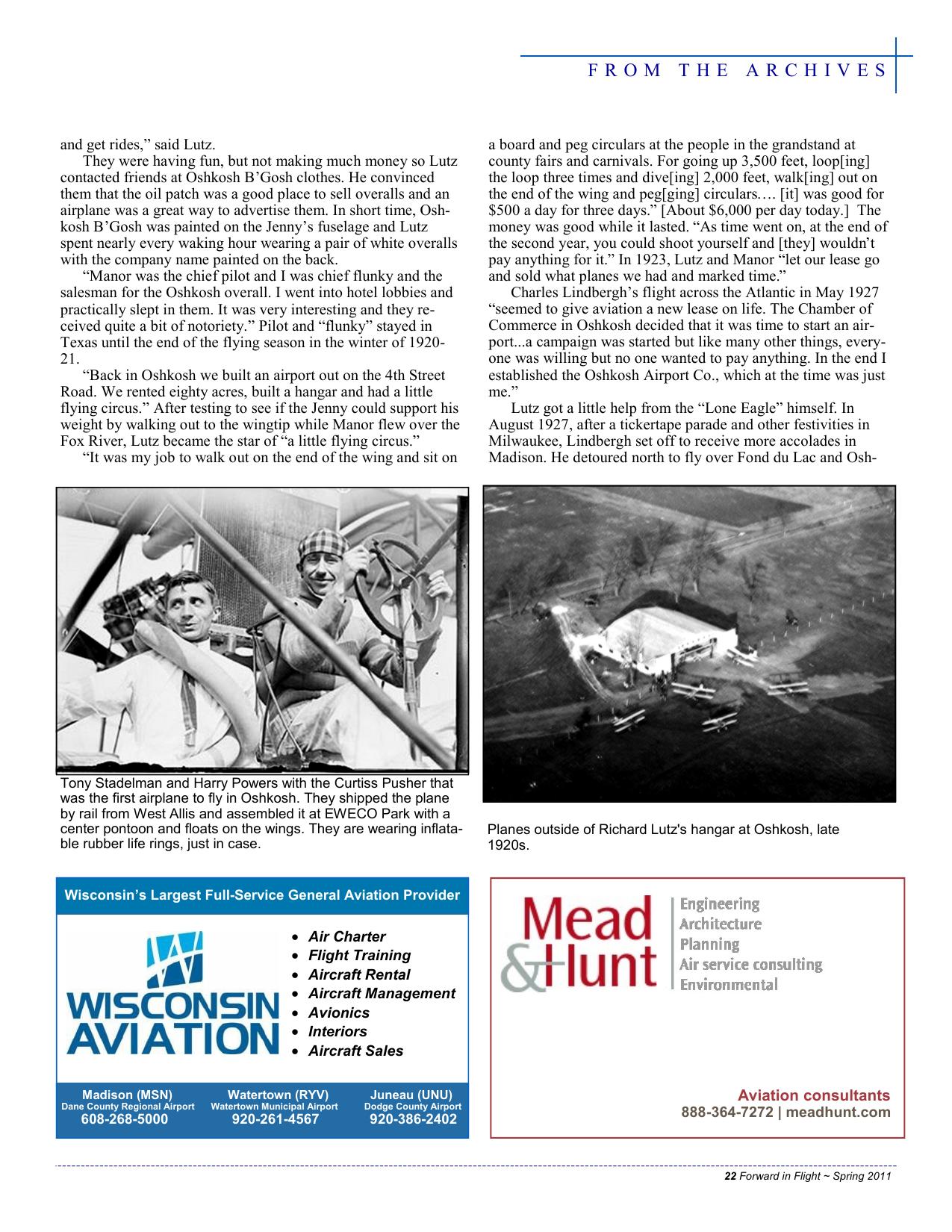
FROM THE ARCHIVES and get rides,” said Lutz. They were having fun, but not making much money so Lutz contacted friends at Oshkosh B’Gosh clothes. He convinced them that the oil patch was a good place to sell overalls and an airplane was a great way to advertise them. In short time, Oshkosh B’Gosh was painted on the Jenny’s fuselage and Lutz spent nearly every waking hour wearing a pair of white overalls with the company name painted on the back. “Manor was the chief pilot and I was chief flunky and the salesman for the Oshkosh overall. I went into hotel lobbies and practically slept in them. It was very interesting and they received quite a bit of notoriety.” Pilot and “flunky” stayed in Texas until the end of the flying season in the winter of 192021. “Back in Oshkosh we built an airport out on the 4th Street Road. We rented eighty acres, built a hangar and had a little flying circus.” After testing to see if the Jenny could support his weight by walking out to the wingtip while Manor flew over the Fox River, Lutz became the star of “a little flying circus.” “It was my job to walk out on the end of the wing and sit on a board and peg circulars at the people in the grandstand at county fairs and carnivals. For going up 3,500 feet, loop[ing] the loop three times and dive[ing] 2,000 feet, walk[ing] out on the end of the wing and peg[ging] circulars…. [it] was good for $500 a day for three days.” [About $6,000 per day today.] The money was good while it lasted. “As time went on, at the end of the second year, you could shoot yourself and [they] wouldn’t pay anything for it.” In 1923, Lutz and Manor “let our lease go and sold what planes we had and marked time.” Charles Lindbergh’s flight across the Atlantic in May 1927 “seemed to give aviation a new lease on life. The Chamber of Commerce in Oshkosh decided that it was time to start an airport...a campaign was started but like many other things, everyone was willing but no one wanted to pay anything. In the end I established the Oshkosh Airport Co., which at the time was just me.” Lutz got a little help from the “Lone Eagle” himself. In August 1927, after a tickertape parade and other festivities in Milwaukee, Lindbergh set off to receive more accolades in Madison. He detoured north to fly over Fond du Lac and Osh- Tony Stadelman and Harry Powers with the Curtiss Pusher that was the first airplane to fly in Oshkosh. They shipped the plane by rail from West Allis and assembled it at EWECO Park with a center pontoon and floats on the wings. They are wearing inflatable rubber life rings, just in case. Planes outside of Richard Lutz's hangar at Oshkosh, late 1920s. Wisconsin’s Largest Full-Service General Aviation Provider · Air Charter · Flight Training · Aircraft Rental · Aircraft Management · Avionics · Interiors · Aircraft Sales Madison (MSN) Dane County Regional Airport 608-268-5000 Watertown (RYV) Watertown Municipal Airport 920-261-4567 Juneau (UNU) Dodge County Airport 920-386-2402 Aviation consultants 888-364-7272 | meadhunt.com 22 Forward in Flight ~ Spring 2011
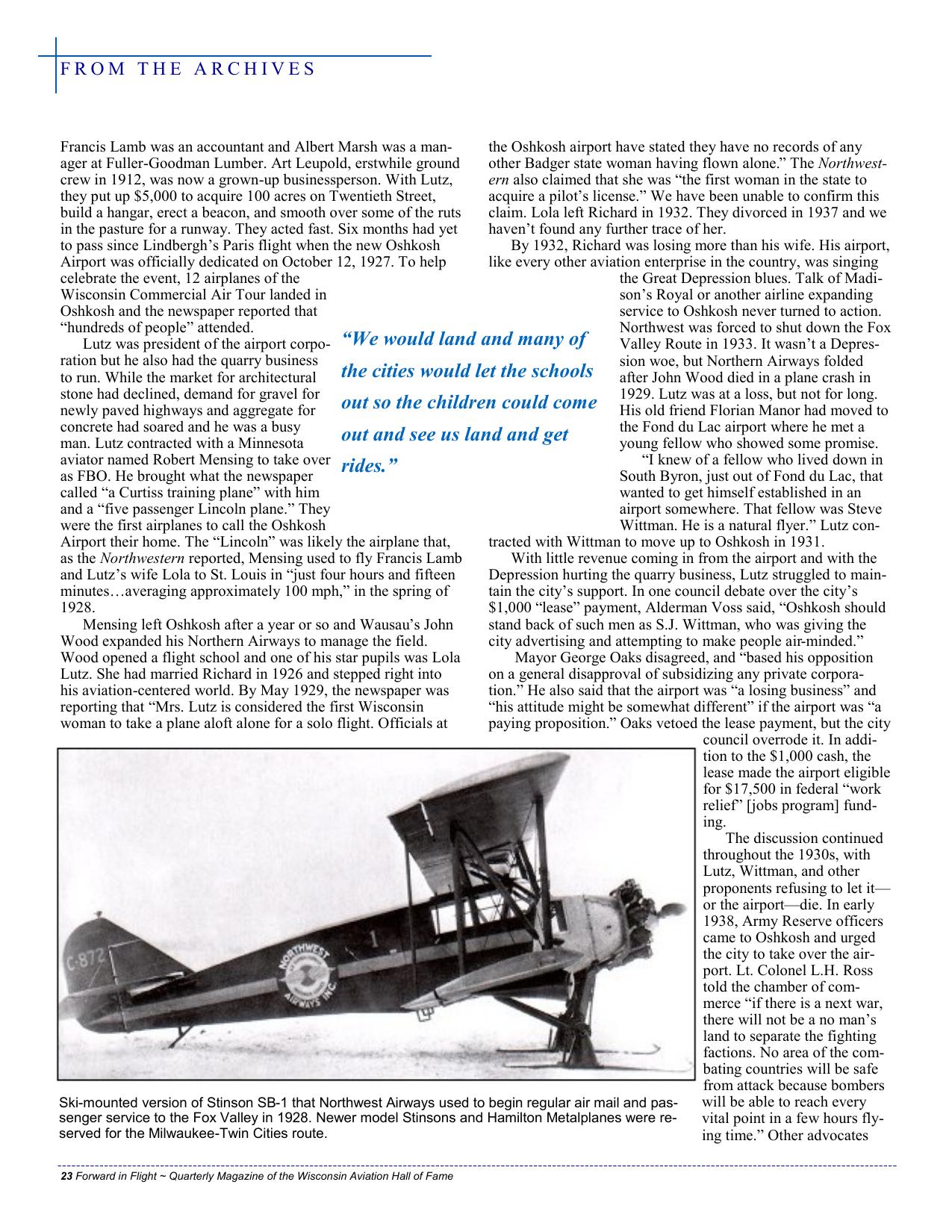
FROM THE ARCHIVES Francis Lamb was an accountant and Albert Marsh was a manthe Oshkosh airport have stated they have no records of any ager at Fuller-Goodman Lumber. Art Leupold, erstwhile ground other Badger state woman having flown alone.” The Northwestcrew in 1912, was now a grown-up businessperson. With Lutz, ern also claimed that she was “the first woman in the state to they put up $5,000 to acquire 100 acres on Twentieth Street, acquire a pilot’s license.” We have been unable to confirm this build a hangar, erect a beacon, and smooth over some of the ruts claim. Lola left Richard in 1932. They divorced in 1937 and we in the pasture for a runway. They acted fast. Six months had yet haven’t found any further trace of her. to pass since Lindbergh’s Paris flight when the new Oshkosh By 1932, Richard was losing more than his wife. His airport, Airport was officially dedicated on October 12, 1927. To help like every other aviation enterprise in the country, was singing celebrate the event, 12 airplanes of the the Great Depression blues. Talk of MadiWisconsin Commercial Air Tour landed in son’s Royal or another airline expanding Oshkosh and the newspaper reported that service to Oshkosh never turned to action. “hundreds of people” attended. Northwest was forced to shut down the Fox Lutz was president of the airport corpo- “We would land and many of Valley Route in 1933. It wasn’t a Depresration but he also had the quarry business sion woe, but Northern Airways folded the cities would let the schools after John Wood died in a plane crash in to run. While the market for architectural stone had declined, demand for gravel for 1929. Lutz was at a loss, but not for long. out so the children could come His old friend Florian Manor had moved to newly paved highways and aggregate for concrete had soared and he was a busy the Fond du Lac airport where he met a out and see us land and get man. Lutz contracted with a Minnesota young fellow who showed some promise. aviator named Robert Mensing to take over rides.” “I knew of a fellow who lived down in as FBO. He brought what the newspaper South Byron, just out of Fond du Lac, that called “a Curtiss training plane” with him wanted to get himself established in an and a “five passenger Lincoln plane.” They airport somewhere. That fellow was Steve were the first airplanes to call the Oshkosh Wittman. He is a natural flyer.” Lutz conAirport their home. The “Lincoln” was likely the airplane that, tracted with Wittman to move up to Oshkosh in 1931. as the Northwestern reported, Mensing used to fly Francis Lamb With little revenue coming in from the airport and with the and Lutz’s wife Lola to St. Louis in “just four hours and fifteen Depression hurting the quarry business, Lutz struggled to mainminutes…averaging approximately 100 mph,” in the spring of tain the city’s support. In one council debate over the city’s 1928. $1,000 “lease” payment, Alderman Voss said, “Oshkosh should Mensing left Oshkosh after a year or so and Wausau’s John stand back of such men as S.J. Wittman, who was giving the Wood expanded his Northern Airways to manage the field. city advertising and attempting to make people air-minded.” Wood opened a flight school and one of his star pupils was Lola Mayor George Oaks disagreed, and “based his opposition Lutz. She had married Richard in 1926 and stepped right into on a general disapproval of subsidizing any private corporahis aviation-centered world. By May 1929, the newspaper was tion.” He also said that the airport was “a losing business” and reporting that “Mrs. Lutz is considered the first Wisconsin “his attitude might be somewhat different” if the airport was “a woman to take a plane aloft alone for a solo flight. Officials at paying proposition.” Oaks vetoed the lease payment, but the city council overrode it. In addition to the $1,000 cash, the lease made the airport eligible for $17,500 in federal “work relief” [jobs program] funding. The discussion continued throughout the 1930s, with Lutz, Wittman, and other proponents refusing to let it— or the airport—die. In early 1938, Army Reserve officers came to Oshkosh and urged the city to take over the airport. Lt. Colonel L.H. Ross told the chamber of commerce “if there is a next war, there will not be a no man’s land to separate the fighting factions. No area of the combating countries will be safe from attack because bombers will be able to reach every Ski-mounted version of Stinson SB-1 that Northwest Airways used to begin regular air mail and passenger service to the Fox Valley in 1928. Newer model Stinsons and Hamilton Metalplanes were revital point in a few hours flyserved for the Milwaukee-Twin Cities route. ing time.” Other advocates 23 Forward in Flight ~ Quarterly Magazine of the Wisconsin Aviation Hall of Fame
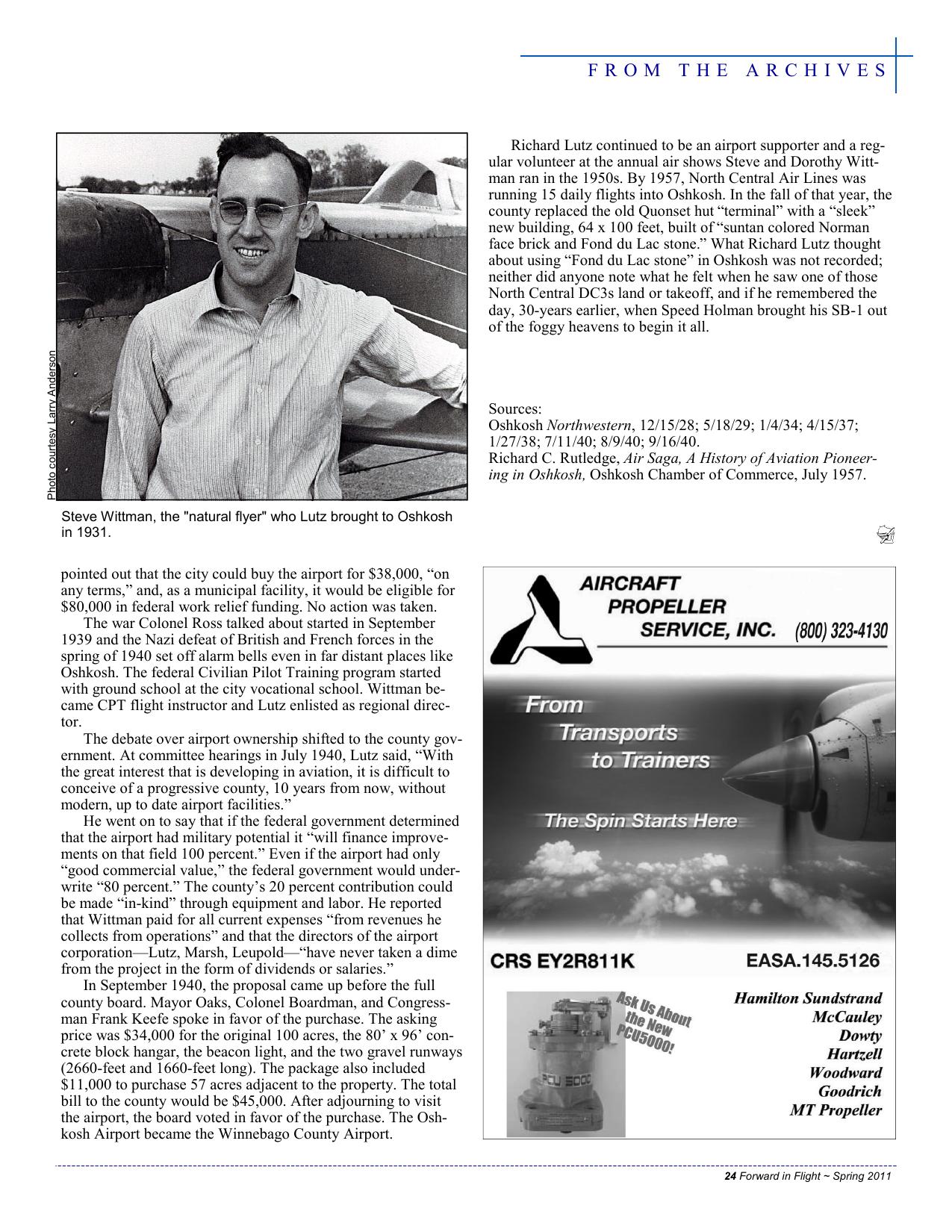
FROM THE ARCHIVES Photo courtesy Larry Anderson Richard Lutz continued to be an airport supporter and a regular volunteer at the annual air shows Steve and Dorothy Wittman ran in the 1950s. By 1957, North Central Air Lines was running 15 daily flights into Oshkosh. In the fall of that year, the county replaced the old Quonset hut “terminal” with a “sleek” new building, 64 x 100 feet, built of “suntan colored Norman face brick and Fond du Lac stone.” What Richard Lutz thought about using “Fond du Lac stone” in Oshkosh was not recorded; neither did anyone note what he felt when he saw one of those North Central DC3s land or takeoff, and if he remembered the day, 30-years earlier, when Speed Holman brought his SB-1 out of the foggy heavens to begin it all. Sources: Oshkosh Northwestern, 12/15/28; 5/18/29; 1/4/34; 4/15/37; 1/27/38; 7/11/40; 8/9/40; 9/16/40. Richard C. Rutledge, Air Saga, A History of Aviation Pioneering in Oshkosh, Oshkosh Chamber of Commerce, July 1957. Steve Wittman, the "natural flyer" who Lutz brought to Oshkosh in 1931. pointed out that the city could buy the airport for $38,000, “on any terms,” and, as a municipal facility, it would be eligible for $80,000 in federal work relief funding. No action was taken. The war Colonel Ross talked about started in September 1939 and the Nazi defeat of British and French forces in the spring of 1940 set off alarm bells even in far distant places like Oshkosh. The federal Civilian Pilot Training program started with ground school at the city vocational school. Wittman became CPT flight instructor and Lutz enlisted as regional director. The debate over airport ownership shifted to the county government. At committee hearings in July 1940, Lutz said, “With the great interest that is developing in aviation, it is difficult to conceive of a progressive county, 10 years from now, without modern, up to date airport facilities.” He went on to say that if the federal government determined that the airport had military potential it “will finance improvements on that field 100 percent.” Even if the airport had only “good commercial value,” the federal government would underwrite “80 percent.” The county’s 20 percent contribution could be made “in-kind” through equipment and labor. He reported that Wittman paid for all current expenses “from revenues he collects from operations” and that the directors of the airport corporation—Lutz, Marsh, Leupold—“have never taken a dime from the project in the form of dividends or salaries.” In September 1940, the proposal came up before the full county board. Mayor Oaks, Colonel Boardman, and Congressman Frank Keefe spoke in favor of the purchase. The asking price was $34,000 for the original 100 acres, the 80’ x 96’ concrete block hangar, the beacon light, and the two gravel runways (2660-feet and 1660-feet long). The package also included $11,000 to purchase 57 acres adjacent to the property. The total bill to the county would be $45,000. After adjourning to visit the airport, the board voted in favor of the purchase. The Oshkosh Airport became the Winnebago County Airport. 24 Forward in Flight ~ Spring 2011
ASSOCIATION NEWS WAHF Names 2011 Inductees Five will be honored at fall banquet The Wisconsin Aviation Hall of Fame has announced its slate of 2011 inductees who will be honored for their accomplishments and significant contributions to aviation. Daniel Donovan, Bill Rewey, Dennis Sullivan, and, posthumously, Marc Mitscher and Steve Shalbreck, will be honored at a ceremony this fall. Daniel Donovan Nominated by Jim Szajkovics, with endorsements from members of the Civil Air Patrol and colleagues at the Air Line Pilots Association (ALPA), Dan Donovan was chosen for his longtime commitment to aviation. Born in Green Bay, Wisconsin in 1927, Dan soloed at 16 and soon after, entered the US Navy. He worked as a flight instructor at Gran Aire at Lawrence Timmerman Field and then became a pilot for Republic/Northwest Airlines from 1954-1986. Dan has served as an aviation safety counselor and was a member of ALPA’s National Accident Investigation Board. He has been active with the Civil Air Patrol’s safety training programs since 1980. Induction into WAHF is just another of Dan’s accomplishments. Dan has received ALPA’s Air Safety Award and the FAA’s Wright Brother’s Master Pilot Award for 65 years of accident-free flying. When he retired from Republic in 1987, the editor of “The Line Pilot” newsletter said of Dan, “He has been our teacher and helper in the finest sense of the word for 27 years and our professional environment is a safer one because of Dan.” Bill Rewey Born in Marshfield, Wisconsin, in 1928, Bill flew the F4U while in the US Navy after World War II. He continued to fly as a civilian, and has become known as “Mr. Pietenpol.” He has built three Pietenpols, and has advised and assisted in the construction of dozens more. He has published many how-to articles on building Pietenpols and served as a coordinator for Pietenpol events that take place at Brodhead and EAA AirVenture Oshkosh. Photos by Rose Dorcey Bill Rewey Dan Donovan Brig. Gen. Dennis Sullivan (Ret.) Born in Chippewa Falls, Wisconsin, in 1927, Brig. Gen. Dennis Sullivan is a 1950 Naval Academy graduate. In 1962, he was chosen for the Central Intelligence Agency’s Project OxCart to pilot a Mach 3-plus A-12 reconnaissance airplane to replace the U-2. He was the only one of 16 finalists to be selected. For five years he flew top-secret missions, some of these were combat missions in “Project Black Shield” over North Vi- 25 Forward in Flight ~ Quarterly Magazine of the Wisconsin Aviation Hall of Fame etnam. He returned to regular Air Force duties in 1968, accumulating 7,000 hours in dozens of aircraft. Pioneer Category WAHF recognizes the men and women who were making aviation accomplishments before 1927. The 2011 Pioneer Inductees: Admiral Marc Mitscher Though Mitscher qualifies as both a pioneer and non-pioneer for his long career, he will be inducted with Steve Shalbreck in the pioneer category. Born in Hillsboro, Wisconsin, Mitscher grew up in Oklahoma and Washington, DC. He became Naval Aviator Number 33 in 1916 and was a crewmember on a Navy transatlantic flight in 1919. Mitscher made his first takeoff and landing from the USS Saratoga in 1928. Mitscher also served as the First Commander of the USS Hornet in 1941, launching Jimmy Doolittle’s raid on Tokyo. He served at Midway, Guadalcanal and at Leyte, Iwo Jima, and Okinawa. Mitscher died in 1947. Steve Shalbreck Steve was born in Pine Lake, Wisconsin, in 1901, and served the airport in Rhinelander from 1925-1959. He was the first manager of the Rhinelander airport at its present site, and instrumental to the development of Rhinelander’s first air strips. He operated Rhinelander Airways and was an active flight instructor. Shalbreck ran the first air ambulance service in northern Wisconsin and was wellknown for flying polio victims for treatment. He passed away in 1986. 2011 Induction Ceremony Planning is underway for the 2011 banquet, where each inductee will be honored. Watch Forward in Flight and the WAHF website for details about the date, location, and time of the banquet. All current WAHF members will receive an invitation to the event.
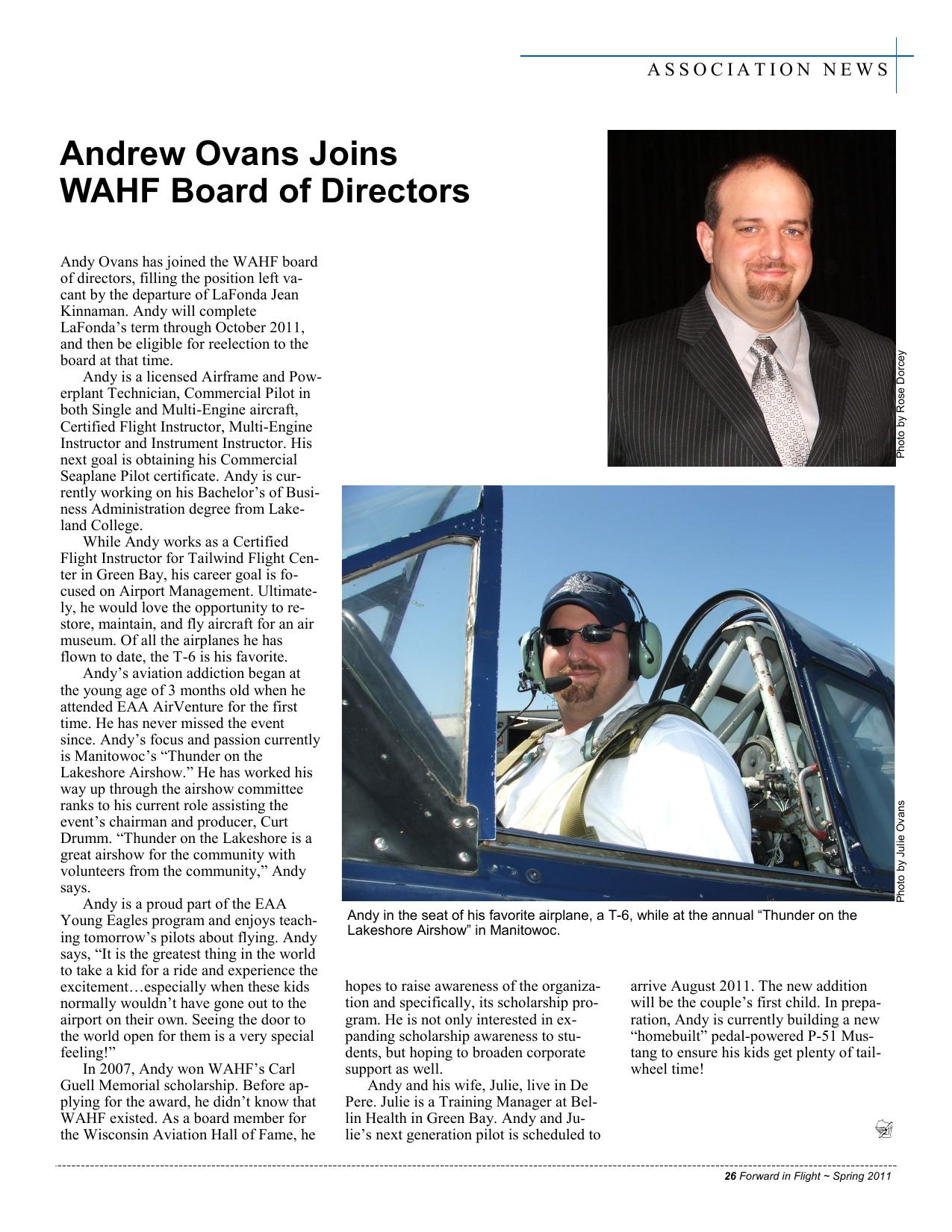
ASSOCIATION NEWS Photo by Julie Ovans Andy Ovans has joined the WAHF board of directors, filling the position left vacant by the departure of LaFonda Jean Kinnaman. Andy will complete LaFonda’s term through October 2011, and then be eligible for reelection to the board at that time. Andy is a licensed Airframe and Powerplant Technician, Commercial Pilot in both Single and Multi-Engine aircraft, Certified Flight Instructor, Multi-Engine Instructor and Instrument Instructor. His next goal is obtaining his Commercial Seaplane Pilot certificate. Andy is currently working on his Bachelor’s of Business Administration degree from Lakeland College. While Andy works as a Certified Flight Instructor for Tailwind Flight Center in Green Bay, his career goal is focused on Airport Management. Ultimately, he would love the opportunity to restore, maintain, and fly aircraft for an air museum. Of all the airplanes he has flown to date, the T-6 is his favorite. Andy’s aviation addiction began at the young age of 3 months old when he attended EAA AirVenture for the first time. He has never missed the event since. Andy’s focus and passion currently is Manitowoc’s “Thunder on the Lakeshore Airshow.” He has worked his way up through the airshow committee ranks to his current role assisting the event’s chairman and producer, Curt Drumm. “Thunder on the Lakeshore is a great airshow for the community with volunteers from the community,” Andy says. Andy is a proud part of the EAA Young Eagles program and enjoys teaching tomorrow’s pilots about flying. Andy says, “It is the greatest thing in the world to take a kid for a ride and experience the excitement…especially when these kids normally wouldn’t have gone out to the airport on their own. Seeing the door to the world open for them is a very special feeling!” In 2007, Andy won WAHF’s Carl Guell Memorial scholarship. Before applying for the award, he didn’t know that WAHF existed. As a board member for the Wisconsin Aviation Hall of Fame, he Photo by Rose Dorcey Andrew Ovans Joins WAHF Board of Directors Andy in the seat of his favorite airplane, a T-6, while at the annual “Thunder on the Lakeshore Airshow” in Manitowoc. hopes to raise awareness of the organization and specifically, its scholarship program. He is not only interested in expanding scholarship awareness to students, but hoping to broaden corporate support as well. Andy and his wife, Julie, live in De Pere. Julie is a Training Manager at Bellin Health in Green Bay. Andy and Julie’s next generation pilot is scheduled to arrive August 2011. The new addition will be the couple’s first child. In preparation, Andy is currently building a new “homebuilt” pedal-powered P-51 Mustang to ensure his kids get plenty of tailwheel time! 26 Forward in Flight ~ Spring 2011
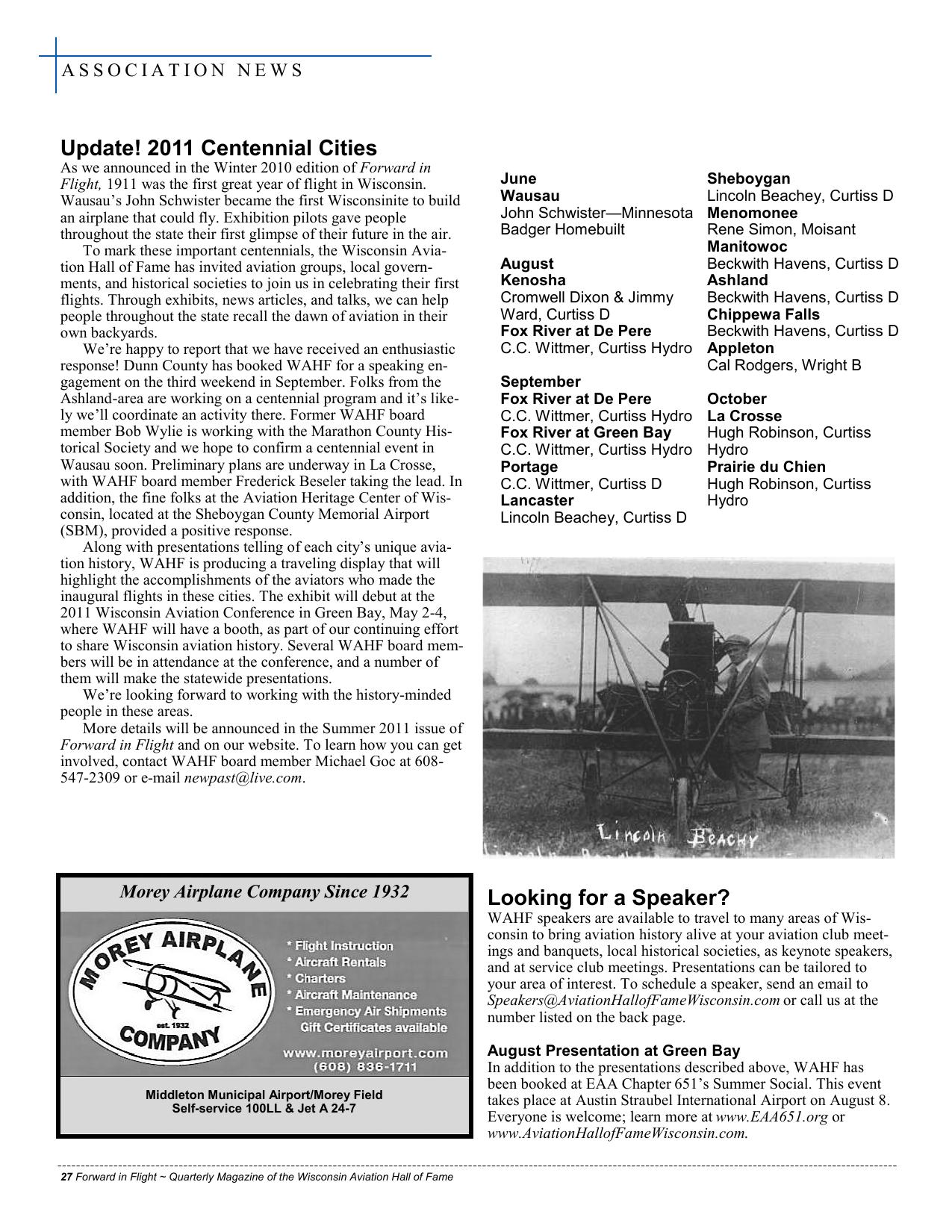
ASSOCIATION NEWS Update! 2011 Centennial Cities As we announced in the Winter 2010 edition of Forward in Flight, 1911 was the first great year of flight in Wisconsin. Wausau’s John Schwister became the first Wisconsinite to build an airplane that could fly. Exhibition pilots gave people throughout the state their first glimpse of their future in the air. To mark these important centennials, the Wisconsin Aviation Hall of Fame has invited aviation groups, local governments, and historical societies to join us in celebrating their first flights. Through exhibits, news articles, and talks, we can help people throughout the state recall the dawn of aviation in their own backyards. We’re happy to report that we have received an enthusiastic response! Dunn County has booked WAHF for a speaking engagement on the third weekend in September. Folks from the Ashland-area are working on a centennial program and it’s likely we’ll coordinate an activity there. Former WAHF board member Bob Wylie is working with the Marathon County Historical Society and we hope to confirm a centennial event in Wausau soon. Preliminary plans are underway in La Crosse, with WAHF board member Frederick Beseler taking the lead. In addition, the fine folks at the Aviation Heritage Center of Wisconsin, located at the Sheboygan County Memorial Airport (SBM), provided a positive response. Along with presentations telling of each city’s unique aviation history, WAHF is producing a traveling display that will highlight the accomplishments of the aviators who made the inaugural flights in these cities. The exhibit will debut at the 2011 Wisconsin Aviation Conference in Green Bay, May 2-4, where WAHF will have a booth, as part of our continuing effort to share Wisconsin aviation history. Several WAHF board members will be in attendance at the conference, and a number of them will make the statewide presentations. We’re looking forward to working with the history-minded people in these areas. More details will be announced in the Summer 2011 issue of Forward in Flight and on our website. To learn how you can get involved, contact WAHF board member Michael Goc at 608547-2309 or e-mail newpast@live.com. Morey Airplane Company Since 1932 June Wausau John Schwister—Minnesota Badger Homebuilt Sheboygan Lincoln Beachey, Curtiss D Menomonee Rene Simon, Moisant Manitowoc August Beckwith Havens, Curtiss D Kenosha Ashland Cromwell Dixon & Jimmy Beckwith Havens, Curtiss D Ward, Curtiss D Chippewa Falls Fox River at De Pere Beckwith Havens, Curtiss D C.C. Wittmer, Curtiss Hydro Appleton Cal Rodgers, Wright B September Fox River at De Pere October C.C. Wittmer, Curtiss Hydro La Crosse Fox River at Green Bay Hugh Robinson, Curtiss C.C. Wittmer, Curtiss Hydro Hydro Portage Prairie du Chien C.C. Wittmer, Curtiss D Hugh Robinson, Curtiss Lancaster Hydro Lincoln Beachey, Curtiss D Looking for a Speaker? WAHF speakers are available to travel to many areas of Wisconsin to bring aviation history alive at your aviation club meetings and banquets, local historical societies, as keynote speakers, and at service club meetings. Presentations can be tailored to your area of interest. To schedule a speaker, send an email to Speakers@AviationHallofFameWisconsin.com or call us at the number listed on the back page. Middleton Municipal Airport/Morey Field Self-service 100LL & Jet A 24-7 27 Forward in Flight ~ Quarterly Magazine of the Wisconsin Aviation Hall of Fame August Presentation at Green Bay In addition to the presentations described above, WAHF has been booked at EAA Chapter 651’s Summer Social. This event takes place at Austin Straubel International Airport on August 8. Everyone is welcome; learn more at www.EAA651.org or www.AviationHallofFameWisconsin.com.
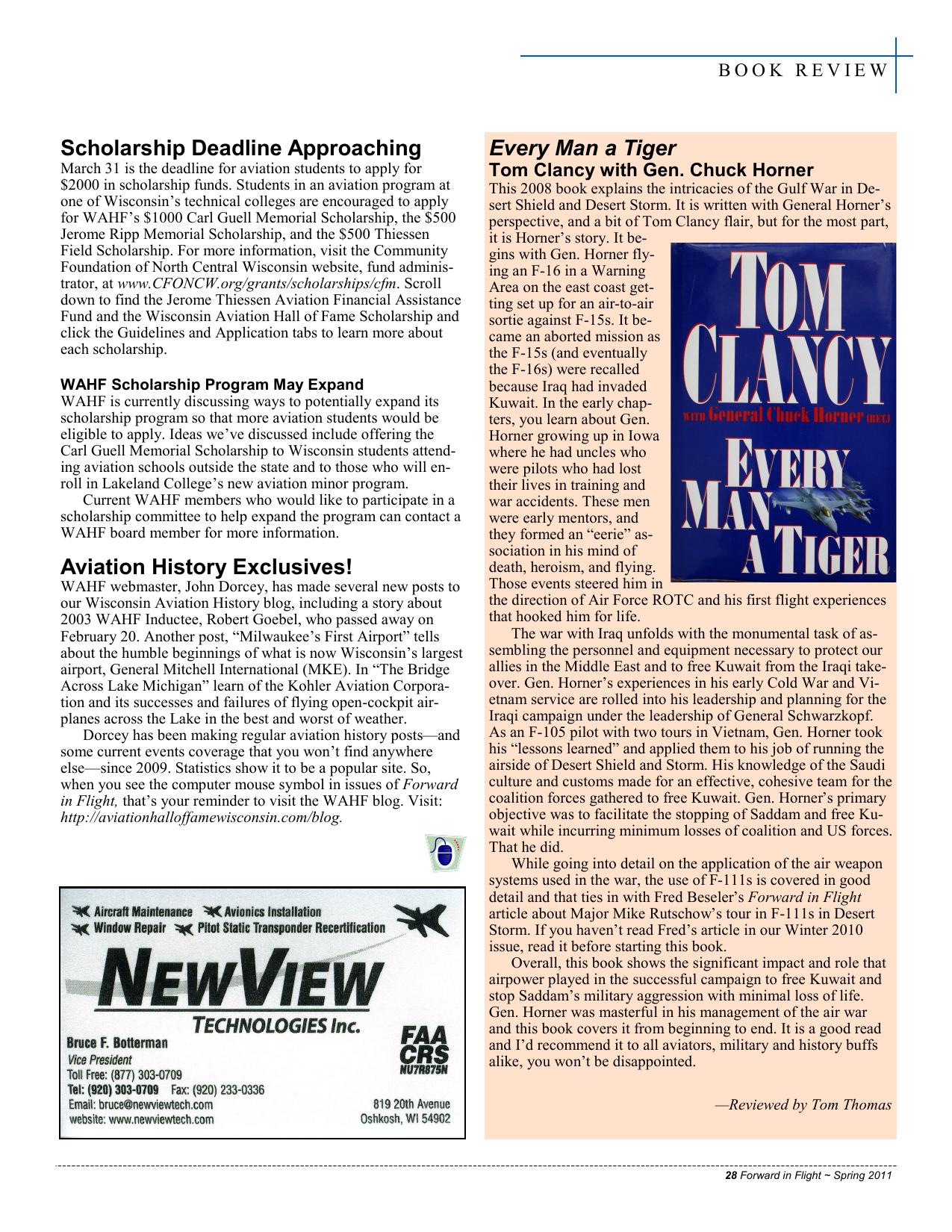
BOOK REVIEW Scholarship Deadline Approaching March 31 is the deadline for aviation students to apply for $2000 in scholarship funds. Students in an aviation program at one of Wisconsin’s technical colleges are encouraged to apply for WAHF’s $1000 Carl Guell Memorial Scholarship, the $500 Jerome Ripp Memorial Scholarship, and the $500 Thiessen Field Scholarship. For more information, visit the Community Foundation of North Central Wisconsin website, fund administrator, at www.CFONCW.org/grants/scholarships/cfm. Scroll down to find the Jerome Thiessen Aviation Financial Assistance Fund and the Wisconsin Aviation Hall of Fame Scholarship and click the Guidelines and Application tabs to learn more about each scholarship. WAHF Scholarship Program May Expand WAHF is currently discussing ways to potentially expand its scholarship program so that more aviation students would be eligible to apply. Ideas we’ve discussed include offering the Carl Guell Memorial Scholarship to Wisconsin students attending aviation schools outside the state and to those who will enroll in Lakeland College’s new aviation minor program. Current WAHF members who would like to participate in a scholarship committee to help expand the program can contact a WAHF board member for more information. Aviation History Exclusives! WAHF webmaster, John Dorcey, has made several new posts to our Wisconsin Aviation History blog, including a story about 2003 WAHF Inductee, Robert Goebel, who passed away on February 20. Another post, “Milwaukee’s First Airport” tells about the humble beginnings of what is now Wisconsin’s largest airport, General Mitchell International (MKE). In “The Bridge Across Lake Michigan” learn of the Kohler Aviation Corporation and its successes and failures of flying open-cockpit airplanes across the Lake in the best and worst of weather. Dorcey has been making regular aviation history posts—and some current events coverage that you won’t find anywhere else—since 2009. Statistics show it to be a popular site. So, when you see the computer mouse symbol in issues of Forward in Flight, that’s your reminder to visit the WAHF blog. Visit: http://aviationhalloffamewisconsin.com/blog. Every Man a Tiger Tom Clancy with Gen. Chuck Horner This 2008 book explains the intricacies of the Gulf War in Desert Shield and Desert Storm. It is written with General Horner’s perspective, and a bit of Tom Clancy flair, but for the most part, it is Horner’s story. It begins with Gen. Horner flying an F-16 in a Warning Area on the east coast getting set up for an air-to-air sortie against F-15s. It became an aborted mission as the F-15s (and eventually the F-16s) were recalled because Iraq had invaded Kuwait. In the early chapters, you learn about Gen. Horner growing up in Iowa where he had uncles who were pilots who had lost their lives in training and war accidents. These men were early mentors, and they formed an “eerie” association in his mind of death, heroism, and flying. Those events steered him in the direction of Air Force ROTC and his first flight experiences that hooked him for life. The war with Iraq unfolds with the monumental task of assembling the personnel and equipment necessary to protect our allies in the Middle East and to free Kuwait from the Iraqi takeover. Gen. Horner’s experiences in his early Cold War and Vietnam service are rolled into his leadership and planning for the Iraqi campaign under the leadership of General Schwarzkopf. As an F-105 pilot with two tours in Vietnam, Gen. Horner took his “lessons learned” and applied them to his job of running the airside of Desert Shield and Storm. His knowledge of the Saudi culture and customs made for an effective, cohesive team for the coalition forces gathered to free Kuwait. Gen. Horner’s primary objective was to facilitate the stopping of Saddam and free Kuwait while incurring minimum losses of coalition and US forces. That he did. While going into detail on the application of the air weapon systems used in the war, the use of F-111s is covered in good detail and that ties in with Fred Beseler’s Forward in Flight article about Major Mike Rutschow’s tour in F-111s in Desert Storm. If you haven’t read Fred’s article in our Winter 2010 issue, read it before starting this book. Overall, this book shows the significant impact and role that airpower played in the successful campaign to free Kuwait and stop Saddam’s military aggression with minimal loss of life. Gen. Horner was masterful in his management of the air war and this book covers it from beginning to end. It is a good read and I’d recommend it to all aviators, military and history buffs alike, you won’t be disappointed. —Reviewed by Tom Thomas 28 Forward in Flight ~ Spring 2011
GONE WEST Staber W. “Bill” Reese Photo by Rose Dorcey Staber W. “Bill” Reese Jr., a longtime resident of Minocqua and formerly of Eagle River, died Saturday, January 29, 2011, at Seasons of Life Hospice in Woodruff. He was 73. Mr. Reese was born April 26, 1937, in Green Bay, the son of Staber and Mary (nee Davis) Reese Sr. He married Audrey Murray December 29, 1962, in Eagle River and was a member of the U.S. Navy Reserves. His hobbies included aviation, ham radio, and fly-fishing. Mr. Reese was preceded in death by one brother, Collins Follett; and one sister, Mary Jane. In addition to his wife, survivors include one daughter, Kerry (Paul) Resch of Missoula, Montana; one sister, Jill (Mike) Page of Milwaukee; and five grandchildren. A private memorial service will be held at a later date. Editor’s Note: Bill served on the WAHF board of directors for seven years, retiring in October 2010. He actively promoted WAHF in the Northwoods and many people became WAHF supporters through his efforts. RIP Bill. Bill Reese Karl A. Kerscher Karl A. Kerscher passed on June 19, 2010, in Denver, Colorado. He was a longtime resident on Lac Vieux Desert, Phelps, Wisconsin. Karl was born in Evanston, Illinois, in 1938, the son of Anton and Marie Kerscher, and grew up in Northbrook, Illinois, where his folks owned and operated the Chalet . Karl attended Northwestern Military Academy and earned a degree in finance at Colorado State University. In 1961, he served in the U.S. Army as a 2nd Lieutenant. In 1965, he became a pilot for United Airlines. He loved flying and thus owned and restored a number of airplanes. In 1967, he married Christina (Longfellow) Kerscher and moved to Lac Vieux Desert, where they raised their two sons, David and Christopher. While there, they owned and operated a dealership for Buick and Chevrolet in Phelps. In the 1980s, they moved to Mequon, Wisconsin, where they owned and operated five Burger King restaurants in the Milwaukee area. In retirement, they moved back to Lac Vieux Desert, where Karl restored the Land O’ Lakes Airport. Karl was a member/supporter of the Wisconsin Aviation 29 Forward in Flight ~ Quarterly Magazine of the Wisconsin Aviation Hall of Fame Hall of Fame. Karl is survived by his wife, Christina; and two sons, David and his wife, Lisa, of Denver, Colorado, and Christopher and his wife, Heidi, of San Francisco, California. He had four grandchildren, William, Harrison, and Shepard of Denver, and Grace of San Francisco. He was preceded in death by his parents and his brother, Richard. Memorials can be made to the Land O’ Lakes Airport. Those who knew him well, know that he is flying high above the clouds of blue, where never a lark, or even an eagle flew, touching the hand of God.
GONE WEST Lt. Col. Bob Goebel, USAF (ret), left this life surrounded by family on Sunday, February 20, 2011 at his home in Torrance, California, where he has resided for almost 50 years. Born and raised in Racine, Wisconsin, he joins his loving wife, June (Meany) Goebel, also of Racine, who has been with the Lord since March 2006. Col. Goebel joined the Army Air Corps in 1942 at the age of 19. As a young fighter pilot in World War II he was stationed in San Severo, Italy, with the 308th Fighter Squadron, where he distinguished himself in combat flying the P51 Mustang. He was credited with 11 victories, earning the status of double ace, and was 21 years old at the end of his combat tour. After retiring from the military, Col. Goebel worked as a quality control engineer in the aerospace industry in California. In 2003 he was inducted into the Wisconsin Aviation Hall of Fame. He is also the author of the book Mustang Ace. Col. Goebel is survived by his nine children: son Gary of Maple Valley, Washington, daughter Suzanne Rechs of Grass Valley, California, son Robert, Jr. of Seattle, Washington, daughter Patricia Arritt of Priest River, Idaho, daughter Therese Silveria of Yuba City, California, daughter Thomasine Goebel of Long Beach, California, son Mark of Moreno Valley, California, son James of Torrance, California, and daughter Karen Satterlee of Auburn, California. He is also survived by 27 grandchildren and 37 great grandchildren. Funeral services were held on February 24, 2011 at St. Lawrence Martyr Catholic Church in Redondo Beach. Photo by Rose Dorcey WAHF Inductee, WWII Ace Robert Goebel Robert Goebel Visit WAHF’s Aviation History Blog to read more about Robert Goebel:http:// aviationhalloffamewisconsin.com/blog William George “Bill” Wenkman Bill also received the Federal Aviation Administration’s Wright Brothers Master Pilot award, recognizing 50 years of flight without an accident or citation. Bill’s FAA licenses include ATP, CFII, Multi-Engine Land and Sea, and A&P. Over his 73 years spent in the field of aviation, he has promoted aviation to men and women of all ages. Bill is survived by his two daughters and two sons from his first wife, Mary Frances: Marcia (Dale) Thompson of Wisconsin Dells and Cape Coral, Florida, and Anne (Mark) Beard of Baraboo, Gregory (Tracy) Wenkman of Naples, Florida, and Mark (Diana) Wenkman of Lake Delton; six grandchildren, William (Tana) Wenkman of Waunakee, Jeffrey (Marci) Morris of Wisconsin Dells, Jason Morris of Wisconsin Dells, Shawn (Ashley) Wenkman of Lake Delton, Justin (Nicole) Beard of Sauk City and Brandon Beard of Baraboo; eight greatgrandchildren; a sister-in-law, Delia Wenkman; and brothers-in-law, Thaddeus (Lynn) Schattner and Jonathan (Fey) Schattner, along with many nieces and nephews and pilot friends. He was preceded in death by his par- ents; two wives, Mary and Georgia; two brothers, Jim and Jack, and two sisters, Lorraine and Dorothy. A Memorial Mass of Christian Burial was held on Saturday, December 4, at St. Cecilia Catholic Church in Wisconsin Dells with Monsignor Felix Oehrlein officiating. The Picha Funeral Home of Wisconsin Dells assisted with arrangements. Photo by Rose Dorcey William George Wenkman, 88, of Wisconsin Dells, died Saturday morning, November 27, 2010 at St. Clare Hospital in Baraboo. Bill was born April 3, 1922 in Wisconsin Dells, the son of Henry and Ina Rae Banfield Wenkman. Bill graduated from Wisconsin Dells High School in 1940. On April 3, 1945, he married Mary Frances Hillebrandt at St. Cecilia’s Church. Bill later married Georgia Schattner on March 15, 1969 and just lost his beloved wife of 41 years this last March 31. Bill’s first love was flying, and he was an accomplished air transportlicensed pilot. He started flying at 16 and became a flight instructor teaching all facets of flying, including basic, instrument, and multi-engine. Bill also joined the Army Air Corps but was unable to fly because of a knee injury. Bill did later become an airline pilot and then a corporate pilot. Over the years he received several awards including one from the National Association of Flight Instructors in which they cite Bill as having been a member and a flight instructor for 55 continuous years. Bill Wenkman 30 Forward in Flight ~ Spring 2011
FROM THE AIRWAYS Hatz Offers Aircraft Maintenance Services at Wausau Downtown Airport Lyman Hatz now offers aircraft maintenance services through his new business, Aircraft Maintenance of Wausau, LLC, located at the Wausau Downtown Airport (AUW). Lyman has been an A&P since 1975 and held an IA for 20 years. He’s an active pilot and has logged more than 14,000 hours of flying experience both personally and as a corporate pilot. Hatz said that weekend work is available by appointment and that he welcomes most owner assisted maintenance. Contact Lyman during normal business hours Monday through Friday at 715-218-2782 or stop at Corporate Hangar #2. Am I High Aviation Announces Summer/Fall Ground School Schedule Wisconsin Aviation Presents ‘Safety in High Risk Environments’ Featuring Race Pilot Michael Goulian Wisconsin Aviation, Sony, and Goulian Aerosports invite you to attend a special event featuring world-renowned aerobatic champion and Red Bull Air Race Pilot Michael Goulian. This educational—but entertaining—presentation will focus on operating safely in the flight environment. Michael will speak about his personal experiences and will reveal safety failures that lead to close calls in his thrilling aerobatic and racing endeavors. Michael is a CFII and ATP with multiple jet aircraft type ratings. He has spent the last 15 years entertaining millions at airshows around North America, and he has also raced in the Red Bull Air Race World Championships, winning the prestigious Budapest Race. The event takes place on Monday, March 21 from 6-7p.m. at Wisconsin Aviation, 3606 Corben Court, located at Dane County Regional Airport (MSN) in Madison. For more information, call Wisconsin Aviation at 800-594-5359. Lyman Hatz Wanda Zuege of Am I High Aviation has announced her company’s ground school schedule, for those looking for sport, private, instrument, and runway incursion avoidance instruction. All events take place at the Stevens Point Municipal Airport (STE) unless noted. Private/Sport Pilot Weekend Ground School $290 April 2-3. May 14-15. June 11-12. August 6-7. September 1617. October 8-9. December 3-4. Runway Incursions Avoidance. 8:30-Noon. Free. April 2. May 14. June 11. August 6-7. September 16. October 8. December 3. Earn three credits toward FAA Wings program. Airports, Airspace, and Airmanship 8:30-Noon. Free. April 2. May 14. June 11. August 6-7. September 16. October 8. December 3. Earn three credits toward FAA Wings program. Visit www.AmiHighAviation.com/weekend-ground-school for more classes and information. 31 Forward in Flight ~ Quarterly Magazine of the Wisconsin Aviation Hall of Fame Isely Earns Wright Brothers Master Pilot Award Eldon Isely, of Plymouth, Wisconsin, was presented with the FAA Wright Brothers Master Pilot Award on February 17 at the Aviation Heritage Center of Wisconsin in Sheboygan Falls. The Wright Brothers Master Pilot Award recognizes pilots who have demonstrated professionalism, skill, and aviation expertise by maintaining safe operations for 50 or more years. Eldon’s first solo flight was on August 3, 1958 in an Aeronca 7AC Champ. He earned his private pilot certificate on November 11, 1959. Isley went on to earn the Air Transport Pilot certificate and became a flight instructor, along with other ratings. Bill Law, FAASTeam Program Manager, presented the award. ‘Saving the Ghost Birds: A Celebration of Human Accomplishment’ “Saving the Ghost Birds: A Celebration of Human Accomplishment,” a documentary by David Sakrison, Jack Christ, and Video Age Productions, presents in words and images the groundbreaking international efforts to save one of North America’s most significant creatures, the Whooping Crane. Through insightful interviews, stunning video footage and a lively soundtrack, the documentary offers a behind-the-scenes glimpse into the process of breeding cranes in captivity, raising them without human contact, teaching them to migrate, and releasing them back into the wild. “Saving the Ghost Birds: A Celebration of Human Accomplishment” World Premier, April 28, 2011 at the Stefanie H. Weill Center for the Performing Arts, Sheboygan, Wisconsin. Documentary begins promptly at 6:30 p.m. For more information or to order general admission tickets visit the Weill Center online at www.WeillCenter.com or call the Weill Center Box Office at 920-208-3243. Author David may be scheduled for speaking, please email him at savingtheghostbirds@gmail.com.
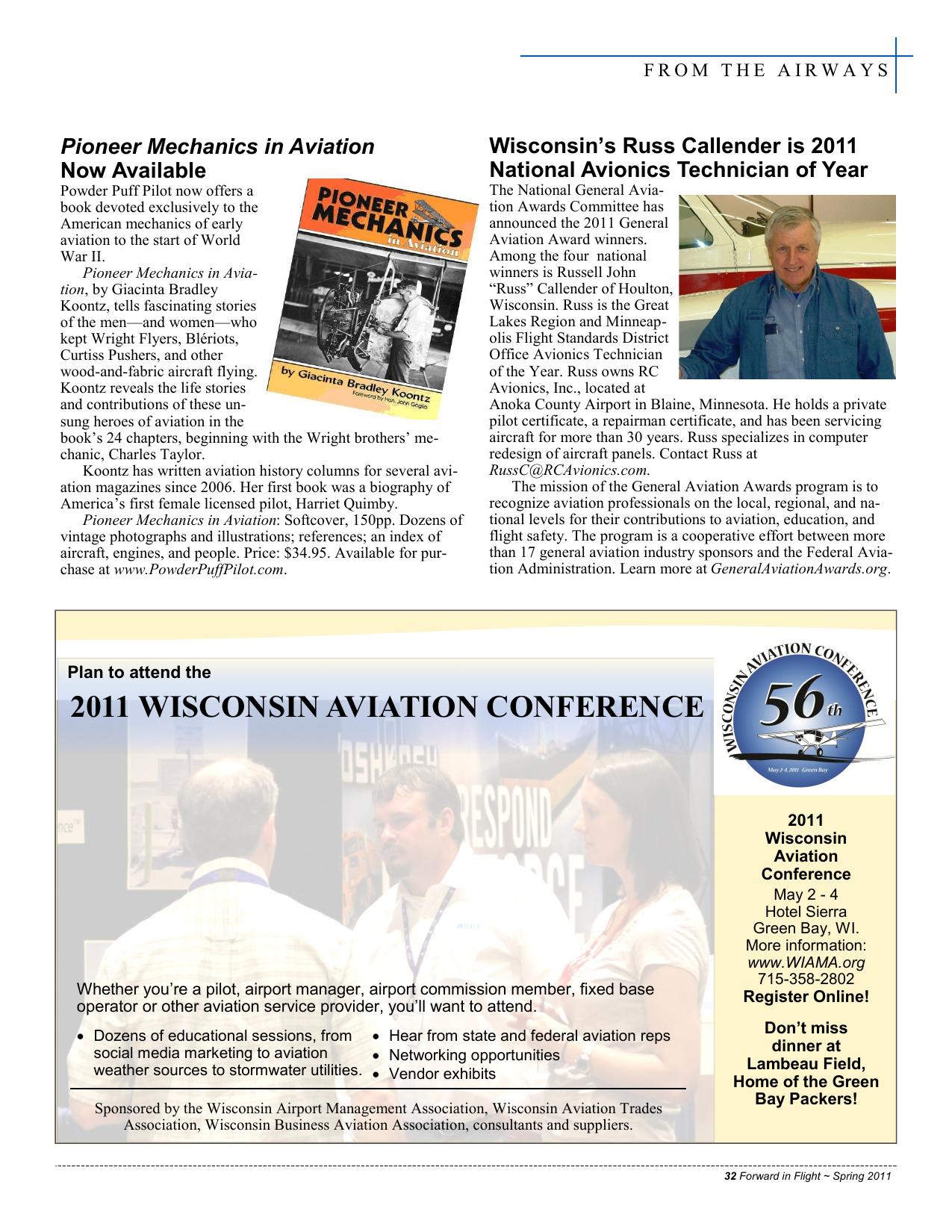
FROM THE AIRWAYS Pioneer Mechanics in Aviation Now Available Powder Puff Pilot now offers a book devoted exclusively to the American mechanics of early aviation to the start of World War II. Pioneer Mechanics in Aviation, by Giacinta Bradley Koontz, tells fascinating stories of the men—and women—who kept Wright Flyers, Blériots, Curtiss Pushers, and other wood-and-fabric aircraft flying. Koontz reveals the life stories and contributions of these unsung heroes of aviation in the book’s 24 chapters, beginning with the Wright brothers’ mechanic, Charles Taylor. Koontz has written aviation history columns for several aviation magazines since 2006. Her first book was a biography of America’s first female licensed pilot, Harriet Quimby. Pioneer Mechanics in Aviation: Softcover, 150pp. Dozens of vintage photographs and illustrations; references; an index of aircraft, engines, and people. Price: $34.95. Available for purchase at www.PowderPuffPilot.com. Wisconsin’s Russ Callender is 2011 National Avionics Technician of Year The National General Aviation Awards Committee has announced the 2011 General Aviation Award winners. Among the four national winners is Russell John “Russ” Callender of Houlton, Wisconsin. Russ is the Great Lakes Region and Minneapolis Flight Standards District Office Avionics Technician of the Year. Russ owns RC Avionics, Inc., located at Anoka County Airport in Blaine, Minnesota. He holds a private pilot certificate, a repairman certificate, and has been servicing aircraft for more than 30 years. Russ specializes in computer redesign of aircraft panels. Contact Russ at RussC@RCAvionics.com. The mission of the General Aviation Awards program is to recognize aviation professionals on the local, regional, and national levels for their contributions to aviation, education, and flight safety. The program is a cooperative effort between more than 17 general aviation industry sponsors and the Federal Aviation Administration. Learn more at GeneralAviationAwards.org. Plan to attend the 2011 WISCONSIN AVIATION CONFERENCE 2011 Wisconsin Aviation Conference Whether you’re a pilot, airport manager, airport commission member, fixed base operator or other aviation service provider, you’ll want to attend. · Dozens of educational sessions, from · Hear from state and federal aviation reps social media marketing to aviation · Networking opportunities weather sources to stormwater utilities. · Vendor exhibits Sponsored by the Wisconsin Airport Management Association, Wisconsin Aviation Trades Association, Wisconsin Business Aviation Association, consultants and suppliers. May 2 - 4 Hotel Sierra Green Bay, WI. More information: www.WIAMA.org 715-358-2802 Register Online! Don’t miss dinner at Lambeau Field, Home of the Green Bay Packers! 32 Forward in Flight ~ Spring 2011
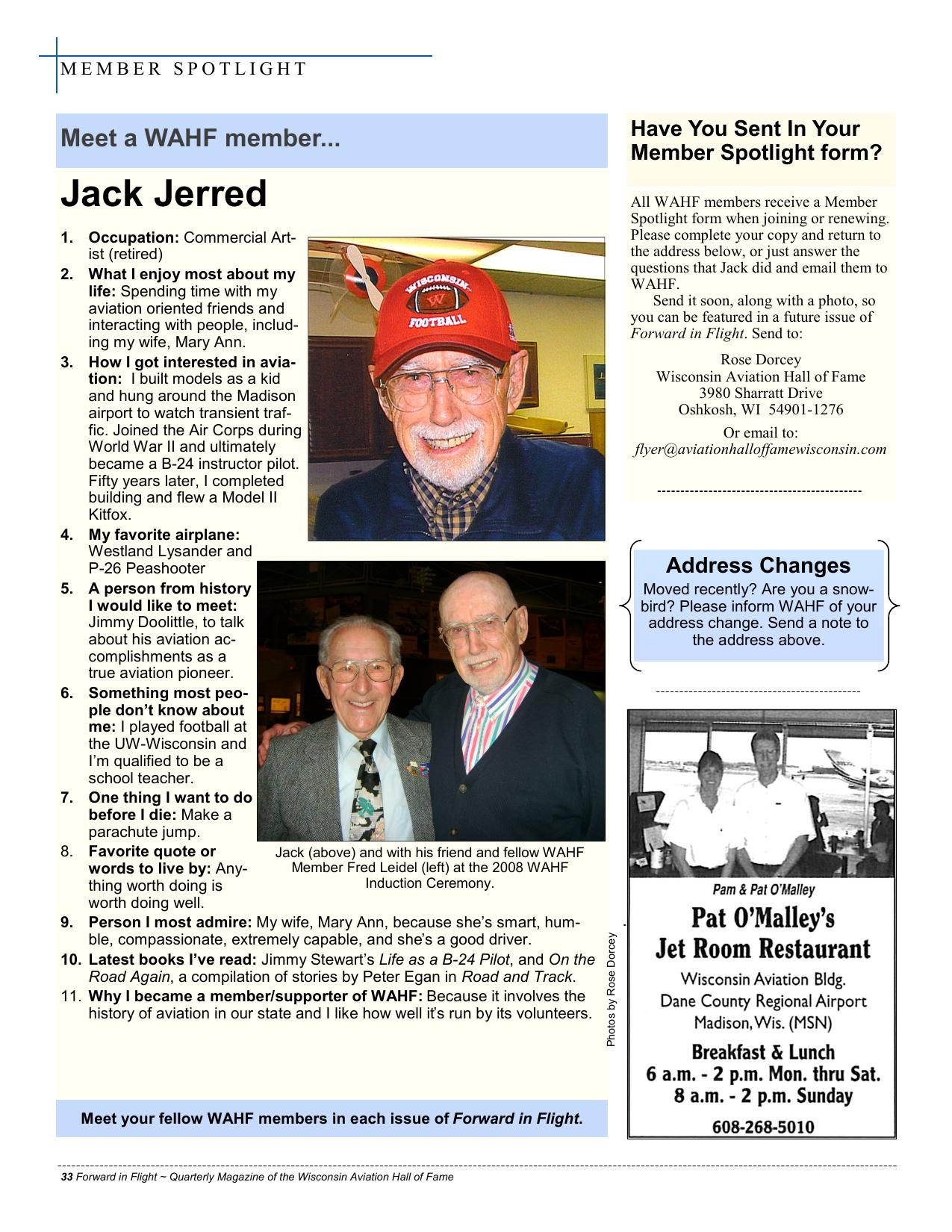
MEMBER SPOTLIGHT Have You Sent In Your Member Spotlight form? Meet a WAHF member... Jack Jerred Meet your fellow WAHF members in each issue of Forward in Flight. 33 Forward in Flight ~ Quarterly Magazine of the Wisconsin Aviation Hall of Fame Rose Dorcey Wisconsin Aviation Hall of Fame 3980 Sharratt Drive Oshkosh, WI 54901-1276 Or email to: flyer@aviationhalloffamewisconsin.com Address Changes Moved recently? Are you a snowbird? Please inform WAHF of your address change. Send a note to the address above. Photos by Rose Dorcey 1. Occupation: Commercial Artist (retired) 2. What I enjoy most about my life: Spending time with my aviation oriented friends and interacting with people, including my wife, Mary Ann. 3. How I got interested in aviation: I built models as a kid and hung around the Madison airport to watch transient traffic. Joined the Air Corps during World War II and ultimately became a B-24 instructor pilot. Fifty years later, I completed building and flew a Model II Kitfox. 4. My favorite airplane: Westland Lysander and P-26 Peashooter 5. A person from history I would like to meet: Jimmy Doolittle, to talk about his aviation accomplishments as a true aviation pioneer. 6. Something most people don’t know about me: I played football at the UW-Wisconsin and I’m qualified to be a school teacher. 7. One thing I want to do before I die: Make a parachute jump. 8. Favorite quote or Jack (above) and with his friend and fellow WAHF Member Fred Leidel (left) at the 2008 WAHF words to live by: AnyInduction Ceremony. thing worth doing is worth doing well. 9. Person I most admire: My wife, Mary Ann, because she’s smart, humble, compassionate, extremely capable, and she’s a good driver. 10. Latest books I’ve read: Jimmy Stewart’s Life as a B-24 Pilot, and On the Road Again, a compilation of stories by Peter Egan in Road and Track. 11. Why I became a member/supporter of WAHF: Because it involves the history of aviation in our state and I like how well it’s run by its volunteers. All WAHF members receive a Member Spotlight form when joining or renewing. Please complete your copy and return to the address below, or just answer the questions that Jack did and email them to WAHF. Send it soon, along with a photo, so you can be featured in a future issue of Forward in Flight. Send to:
Subscribe to Forward in Flight today! (Annual subscription includes one-year WAHF membership) Membership Benefits: u Quarterly subscription (4 issues) of u Forward in Flight, packed full of Wisconsin aviation news, events, state aviation history, and stories about your aviation colleagues u Free pass to Deke Slayton Museum u Invitation to annual induction banquet u The opportunity to nominate aviation leaders for induction! Name Address City State Zip Phone Number Email Address Referred By Just $20, and you’ll be supporting an aviation organization dedicated to collecting, preserving, and sharing Wisconsin’s aviation history. With Forward in Flight, you’ll learn about aviation history makers—the people, places, and happenings that distinguish our state and also be in touch with current Wisconsin aviation news and events. This form can be used for renewals, as well. Send your check today! Please write check to: Wisconsin Aviation Hall of Fame, Inc. Mail to: John Dorcey, Treasurer Wisconsin Aviation Hall of Fame 3980 Sharratt Drive Oshkosh WI 54901-1276 GREAT GIFT! 34 Forward in Flight ~ Spring 2011
PRSRT STD US Postage Paid Wisc Rapids WI Permit 98 WISCONSIN AVIATION HALL OF FAME 3980 SHARRATT DRIVE OSHKOSH WI 54901-1276 Preserving and Sharing Wisconsin’s Aviation History Change Service Requested Welcome WAHF Member/Supporters: Gene Calkins* Gene Donegan Rita Hanusa* Bill Plendl —Thanks for coming on board! *Upgrade to Lifetime Membership Brian Field Richard Quale R ichard Hanusa* Roy Stuart* WAHF is on Facebook and Twitter! Follow WAHF on Facebook and Twitter to get information and updates on inductees, events, photos, video links, and Wisconsin aviation history and trivia. www.Facebook.com/WisAviationHallofFame Twitter @WAHF The 56th Annual Wisconsin Aviation Conference will be held May 2-4, 2011 at Hotel Sierra in Green Bay. The conference committee is planning an exciting and informative conference of interest to all facets of the aviation community. WAHF will exhibit at this conference. To learn more, visit www.WIAMA.org. Congratulations to WAHF Member Mike Dean, who soloed an Ercoupe 415-C (N3174H) on Saturday, January 29. Mike landed four times at Watertown Municipal Airport (KRYV). Longtime WAHF Member Ron Dentinger has published Dear Ron, available from Amazon. “For 20 years I did a column I called ‘Down Time’ in the Dodgeville Chronicle. Now and then I would have some fictitious reader write for advice. The book is a 178-page compilation of the advice I gave in my stupid replies,” Ron explained. In the back of the book, Ron included a section entitled, ‘A Serious Look at Humor.’ “It talks about laughter, why we laugh, and how to use humor in front of a group,” says Ron. Order the book at www.amazon.co.uk/Dear-Ron-Dentinger/dp/1456330012. Wisconsin Aviation Hall of Fame Officers and Board of Directors Rose Dorcey, President Michael Goc, Vice President John Dorcey, Secretary/Treasurer Frederick Beseler Duane Esse Rich Fischler Andrew Ovans Charles Swain Tom Thomas Charles Marotske, Honorary Chairman of the Board Wisconsin Aviation Hall of Fame 3980 Sharratt Drive Oshkosh WI 54901-1276 Become a supporter today! For information call Rose Dorcey at 920-385-1483 www.aviationhalloffamewisconsin.com flyer@aviationhalloffamewisconsin.com