Forward in Flight - Spring 2012
Volume 10, Issue 1 Quarterly Magazine of the Wisconsin Aviation Hall of Fame Spring 2012 Who is Wisconsin’s... No. 2 Ace? Still Helping Pilots Jim Szajkovics Warthog As Transporter Williams’ humanitarian mission Flying Washing Machine? Not quite, but it must have been a sight
Contents Vol. 10 Issue 1/Spring 2012 RIGHT SEAT DIARIES 3 Back Into Flying Tips for safely returning to flight Heather Gollnow, CFI AIR DOC 5 Rocks, a Smoky Fire, and a Pole Surviving a forced landing Dr. Tom Voelker, AME A publication of the Wisconsin Aviation Hall of Fame 20 23 24 27 29 Book Review Lightning Strike Gone West Richard Wagner Association News WAHF’s 2012 Inductees From the Airways New Fritz Wolf Exhibit Member Spotlight Claude Sime PLANES & PLACES 7 How to Fly a Washing Machine It happened in La Crosse Frederick Beseler FROM THE ARCHIVES 9 Wisconsin Women in Aviation What we know, and don’t know Michael Goc WISCONSIN AVIATORS 12 Here to Help Jim Szajkovics’ career helped pilots Duane Esse CHECK SIX 17 Wisconsin’s No. 2 Ace George “Pop” Doersch Gary Dikkers TALESPINS 21 Mission of Mercy Wynne Williams played key role in humanitarian flight Tom “Talespin” Thomas • Lt. Col. Wynne Williams pulling a strafing pass at Hardwood Range, north of Volk Field, in an A-10. Total Aviation Services Aircraft Fuel ~ Heated Hangar ~ Maintenance Avionics ~ Flight Training ~ Air Charter AME on Staff 1921 Airport Drive Green Bay, WI 54313 866.676.7835 www.jetairgroup.com Aviation consultants 888-364-7272 | meadhunt.com
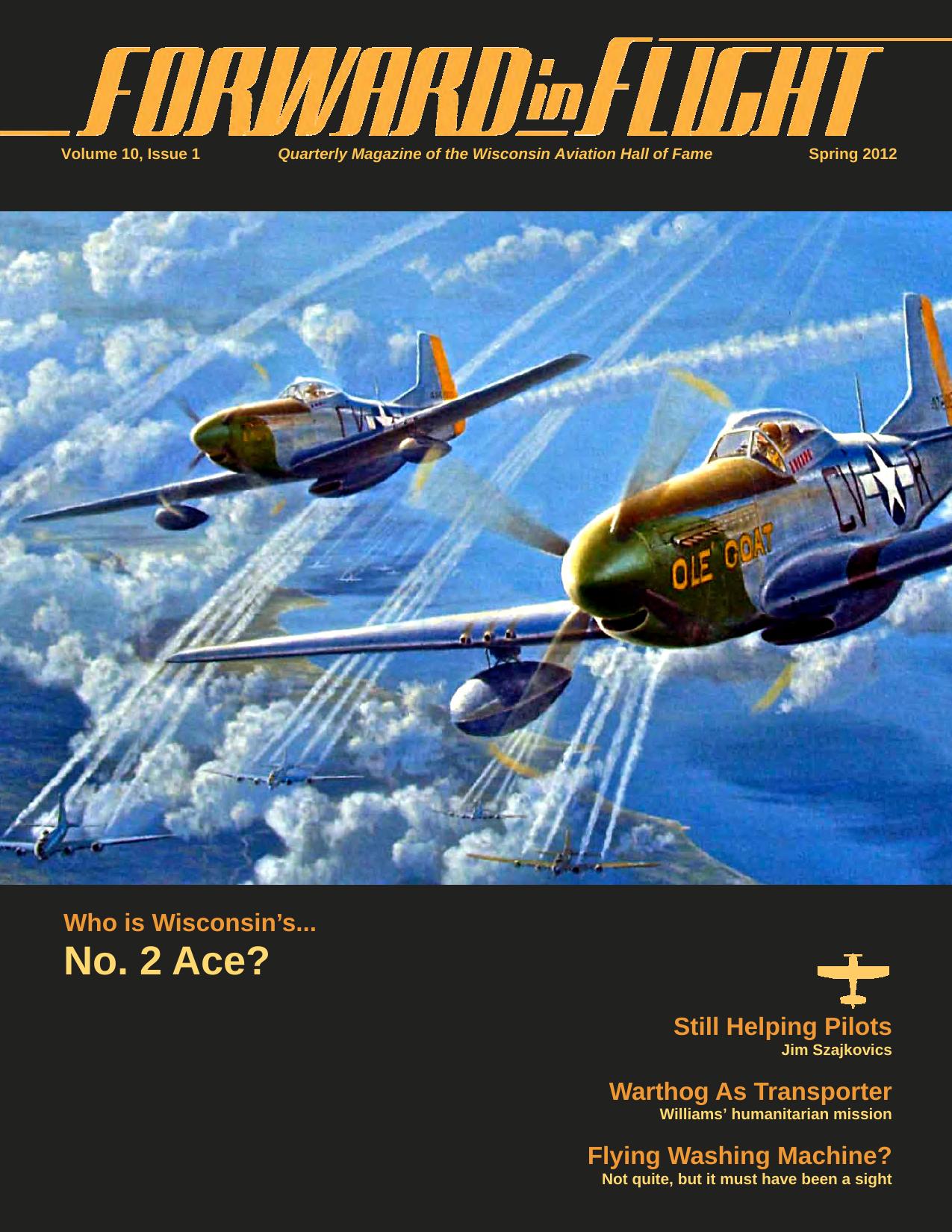
President’s Message ~ by Rose Dorcey S ometimes all we need to get involved with a new activity or mission is to be asked. That was certainly the case for me when I became a sturgeon spearing fisherperson two years ago. Some friends asked if I wanted to try it, and as someone who’s always willing to try something new, I quickly said yes. Today I own a shack and can explain what it takes to get involved, the equipment you need, and how to cut a 3-foot x 5-foot hole in 24-inch thick ice. Sadly, I can’t tell you what it feels like to actually spear one. Perhaps next season. Sitting alone in a dark shack for six hours a day, hoping for an elusive sturgeon to poke its nose at my decoy in murky Lake Winnebago offers quiet time to think. The Wisconsin Aviation Hall of Fame is never far from my mind, so I asked myself what short term goals I would like the organization to meet. It’s long been a personal goal of mine to reach 500 members, and we are getting closer. I’m hoping that 2012 will be the year that happens. Many people don’t realize how important membership is to us, for many reasons, number one being the friendships we board members have made with many of you. But of course, we must necessarily look at the financial wellbeing of the organization. Your $20 membership dues cover our day-to-day expenses. Your dues, plus advertising income, covers the cost of this magazine. We consider ourselves frugal, we spend dollars responsibly and carefully consider our expenditures. Many of you send donations along with your renewals, anywhere from $5 to several hundred. These sources are extremely important to us and we’re very appreciative of them. Occasionally we become the recipient of grants that help further our goals. Because of all this, I can happily report that we are doing well. We will be around for decades! But in order to continue our mission of collecting, preserving, and sharing Wisconsin aviation history, and honoring those who made it, our membership must grow. WAHF board members travel throughout the state, on their own dime, to share our rich aviation history, and through these events, we meet many people who, when they learn about the programs we have supported, the seriousness of our mission, the scholarships, and the Forward in Flight The only magazine dedicated exclusively to Wisconsin aviation history and events. Rose Dorcey, editor 3980 Sharratt Drive Oshkosh, WI 54901-1276 Phone: 920-385-1483 · 920-279-6029 skyword@new.rr.com The Wisconsin Aviation Hall of Fame is a non-profit membership organization with a mission to collect and preserve the history of aviation in Wisconsin, recognize those who made that history, inform others of it, and promote aviation education for future generations. great stories they’ll find in Forward in Flight, come on board as member/supporters. Rose Dorcey While the personal contacts by our board members are vital to our growth, we need you to help, too. Many WAHF members have asked me how they can help the organization, and this is one of the most important things to do. So today, just like my friends asked me to get involved, I’m “asking you to ask.” Ask your friends to join the Wisconsin Aviation Hall of Fame. If you value your WAHF membership and believe in the work we do, if you enjoy your subscription to Forward in Flight and think others will too, and if you want to be a part of our growth, share these things with your fellow aviators, coworkers, friends, and aviation/history enthusiasts. Ask them to send in $20 to become a supporter. Ask yourself, “Who can I ask?” So today, just like my friends asked me to get involved, I’m “asking you to ask.” At our last board meeting in January, we approved a soft membership drive, one that offers prizes to new members. Beginning January 1, we keeping track of the next 25 people who become new members. The 25th person will receive a prize. (We’re already at three.) Then we’ll offer a prize to the 50th new member, the 75th, and the 100th person who becomes a new member/supporter. It doesn’t matter if we meet a goal of 100 new members in 2012 or 2013, the prizes will be offered until that goal is met. I’m hoping that with your help, I can soon announce who our 25th new member/prizewinner will be. With your help, we can continue to grow, improve the programs we offer, and if all goes well, add some new ones. Together we can do it, and all it takes is a question to a friend, such as, “Would you support the Wisconsin Aviation Hall of Fame?” It’s easy, and they’ll probably thank you for it, once they become a part of preserving our aviation history. Thank you. On the cover: Wisconsin’s George “Pop” Doersch finished World War II with 10.5 aerial victories, plus the thanks of the pilots in the squadron he commanded. He flew “Ole’ Goat” named in part for his “advanced” age of 22 and the respect his experience commanded. Read more on pages 17 - 20. Art courtesy of Steven Heyen www.StevenHeyenArt.com.
RIGHT SEAT DIARIES Back Into Flying Tips for safely returning to flight By Heather Gollnow Several years ago, I got busy with life. I was in college, started my career, then went to graduate school, and so on. Before I knew it, several years had passed since I had last flown. We all know that flying is a skill; the longer we go without practicing a skill, well, you know the rest… In the past six months, I’ve been receiving a lot of requests for information on how to get back into flying. The answer isn’t to just hop in an airplane to go for a Sunday afternoon flight! There are a few things you can and should do to prepare yourself and to dust off the cobwebs. It’s like riding a bike; the skill is still there, we just need to wake it up. I’ve put together a list of things I suggest when people are getting back into flying. Some of these may or may not apply to you, but they’re good to consider as you get back into flying. have last flown, you will need to renew it before acting as PIC again. To find a medical examiner in your area, go to the FAA’s website at www.faa.gov/pilots/ amelocator. Of course, this is only a requirement for FAA certificates that require a valid medical certificate. When I went into the doctor’s office to get my medical renewed for the first time in a few years, I started feeling like a pilot again. It was inspiring and I loved talking about aviation with the doctor. I left there feeling even more motivated to return to flying. Do Some Reading Remember that you will most likely pay an instructor by the hour, so do as much work as you can on your own. If you still have all of your books from when you were first learning to fly, those are a great place to start as long as the information is up-to -date. You may not know what’s changed in the world of aviation since you stopped flying, so I always suggest going to AOPA’s website to get this information. This website is a great resource for learning all of the changes that have occurred since you last flew. FAA-H-8083-3, Airplane Flying Handbook, and FAA-H8083-25, Pilot’s Handbook of Aeronautical Knowledge are both great resources to refresh your memory. Make sure to get an updated copy of the FAR/AIM, Practical Test Standards, and the Pilot Operating Handbook for the aircraft you plan to fly. You can also check with your local flight school about taking a VFR refresher course. If it’s been a very long time, taking a written exam prep course isn’t a bad idea. In addition to on-site courses at your flight schools, a great resource for free and lowcost online courses is through the FAA. I also suggest participating in online forums. You can just “lurk” or participate in the conversations. Either way, it will get you thinking like a pilot again. Get a Plastic Pilot Certificate Effective March 31, 2010, the FAA required all certificates to be upgraded to the new plastic certificate. If you still have a paper certificate, you can request a new certificate from the FAA online. The new plastic certificate is more resistant to counterfeiting and also includes the new English proficiency endorsement. Unless you are Orville or Wilbur, your picture is not on the certificate! Renew your Medical, if Needed If it’s been long enough that your medical has expired since you 3 Forward in Flight ~ Quarterly Magazine of the Wisconsin Aviation Hall of Fame Find the Right Flight Instructor First, really think about what you want and don’t want in an instructor. Remember that you are in charge of deciding who you want as an instructor. Most of us probably have a story or two about an “incident” with an instructor. Think about past experiences to really figure out the qualities you like and don’t like in an instructor. Once you’ve determined what type of instructor you are looking for, use your network of other pilots to find the right flight instructor. If you’re finding it to be difficult to find the right instructor,
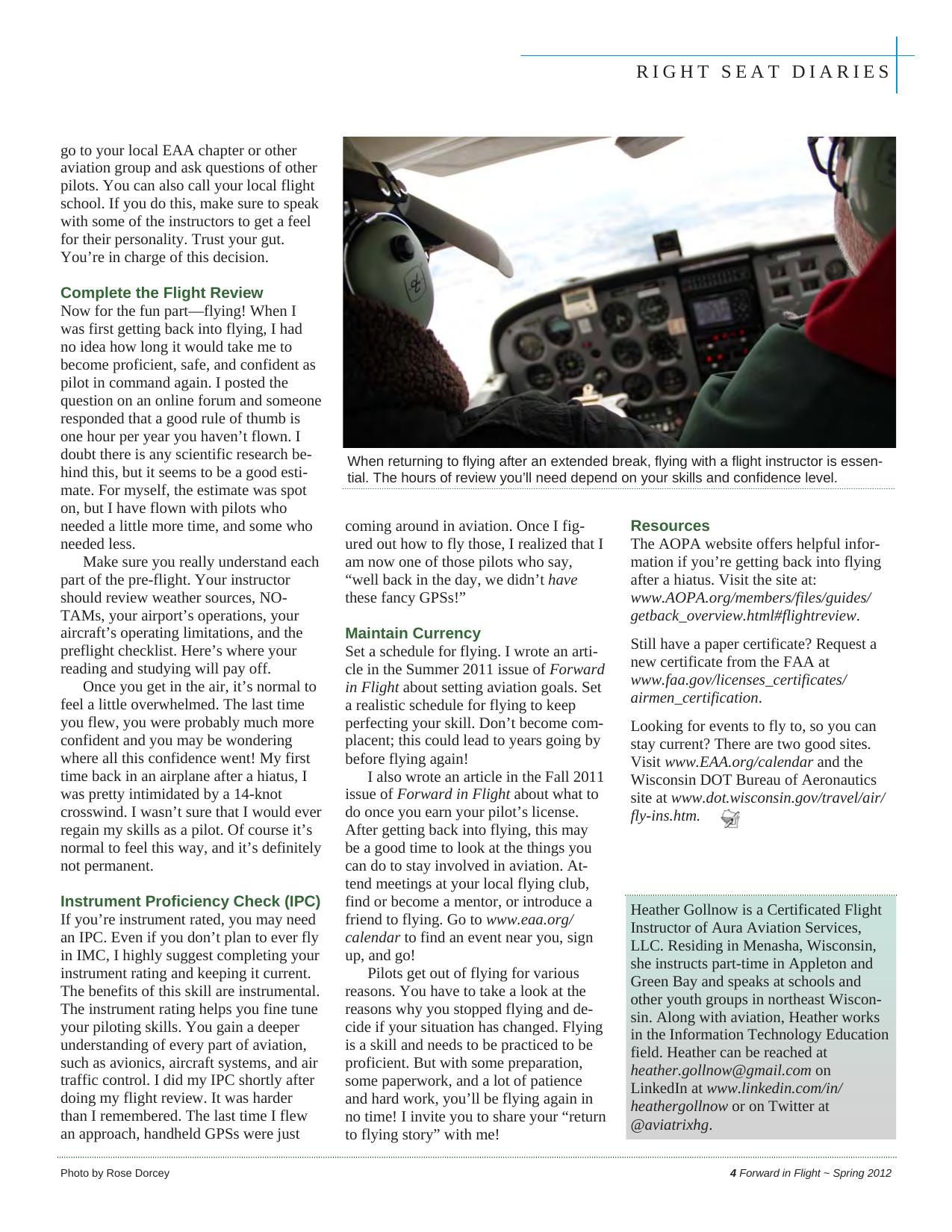
RIGHT SEAT DIARIES go to your local EAA chapter or other aviation group and ask questions of other pilots. You can also call your local flight school. If you do this, make sure to speak with some of the instructors to get a feel for their personality. Trust your gut. You’re in charge of this decision. Complete the Flight Review Now for the fun part—flying! When I was first getting back into flying, I had no idea how long it would take me to become proficient, safe, and confident as pilot in command again. I posted the question on an online forum and someone responded that a good rule of thumb is one hour per year you haven’t flown. I doubt there is any scientific research behind this, but it seems to be a good estimate. For myself, the estimate was spot on, but I have flown with pilots who needed a little more time, and some who needed less. Make sure you really understand each part of the pre-flight. Your instructor should review weather sources, NOTAMs, your airport’s operations, your aircraft’s operating limitations, and the preflight checklist. Here’s where your reading and studying will pay off. Once you get in the air, it’s normal to feel a little overwhelmed. The last time you flew, you were probably much more confident and you may be wondering where all this confidence went! My first time back in an airplane after a hiatus, I was pretty intimidated by a 14-knot crosswind. I wasn’t sure that I would ever regain my skills as a pilot. Of course it’s normal to feel this way, and it’s definitely not permanent. Instrument Proficiency Check (IPC) If you’re instrument rated, you may need an IPC. Even if you don’t plan to ever fly in IMC, I highly suggest completing your instrument rating and keeping it current. The benefits of this skill are instrumental. The instrument rating helps you fine tune your piloting skills. You gain a deeper understanding of every part of aviation, such as avionics, aircraft systems, and air traffic control. I did my IPC shortly after doing my flight review. It was harder than I remembered. The last time I flew an approach, handheld GPSs were just Photo by Rose Dorcey When returning to flying after an extended break, flying with a flight instructor is essential. The hours of review you’ll need depend on your skills and confidence level. coming around in aviation. Once I figured out how to fly those, I realized that I am now one of those pilots who say, “well back in the day, we didn’t have these fancy GPSs!” Maintain Currency Set a schedule for flying. I wrote an article in the Summer 2011 issue of Forward in Flight about setting aviation goals. Set a realistic schedule for flying to keep perfecting your skill. Don’t become complacent; this could lead to years going by before flying again! I also wrote an article in the Fall 2011 issue of Forward in Flight about what to do once you earn your pilot’s license. After getting back into flying, this may be a good time to look at the things you can do to stay involved in aviation. Attend meetings at your local flying club, find or become a mentor, or introduce a friend to flying. Go to www.eaa.org/ calendar to find an event near you, sign up, and go! Pilots get out of flying for various reasons. You have to take a look at the reasons why you stopped flying and decide if your situation has changed. Flying is a skill and needs to be practiced to be proficient. But with some preparation, some paperwork, and a lot of patience and hard work, you’ll be flying again in no time! I invite you to share your “return to flying story” with me! Resources The AOPA website offers helpful information if you’re getting back into flying after a hiatus. Visit the site at: www.AOPA.org/members/files/guides/ getback_overview.html#flightreview. Still have a paper certificate? Request a new certificate from the FAA at www.faa.gov/licenses_certificates/ airmen_certification. Looking for events to fly to, so you can stay current? There are two good sites. Visit www.EAA.org/calendar and the Wisconsin DOT Bureau of Aeronautics site at www.dot.wisconsin.gov/travel/air/ fly-ins.htm. Heather Gollnow is a Certificated Flight Instructor of Aura Aviation Services, LLC. Residing in Menasha, Wisconsin, she instructs part-time in Appleton and Green Bay and speaks at schools and other youth groups in northeast Wisconsin. Along with aviation, Heather works in the Information Technology Education field. Heather can be reached at heather.gollnow@gmail.com on LinkedIn at www.linkedin.com/in/ heathergollnow or on Twitter at @aviatrixhg. 4 Forward in Flight ~ Spring 2012
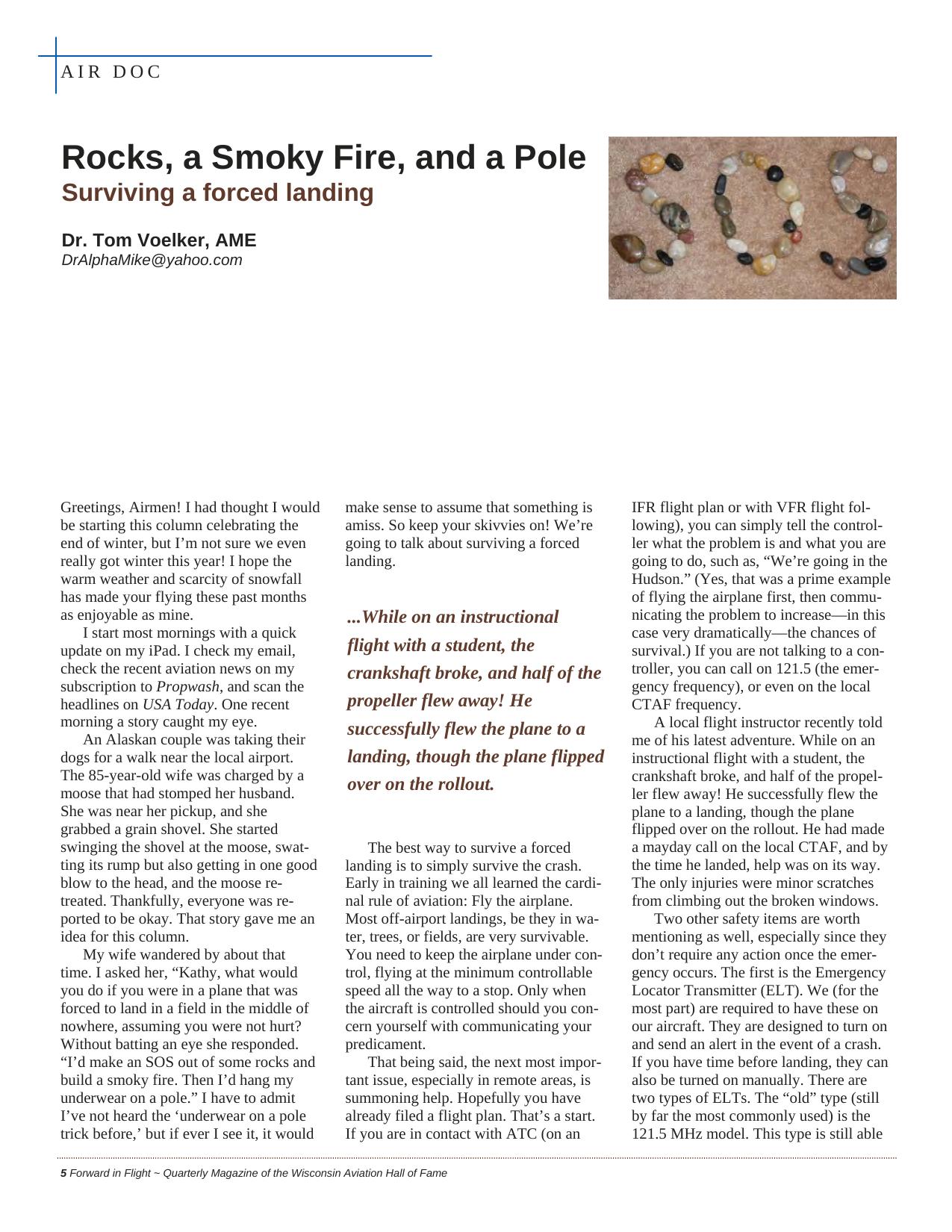
AIR DOC Rocks, a Smoky Fire, and a Pole Surviving a forced landing Dr. Tom Voelker, AME DrAlphaMike@yahoo.com Greetings, Airmen! I had thought I would be starting this column celebrating the end of winter, but I’m not sure we even really got winter this year! I hope the warm weather and scarcity of snowfall has made your flying these past months as enjoyable as mine. I start most mornings with a quick update on my iPad. I check my email, check the recent aviation news on my subscription to Propwash, and scan the headlines on USA Today. One recent morning a story caught my eye. An Alaskan couple was taking their dogs for a walk near the local airport. The 85-year-old wife was charged by a moose that had stomped her husband. She was near her pickup, and she grabbed a grain shovel. She started swinging the shovel at the moose, swatting its rump but also getting in one good blow to the head, and the moose retreated. Thankfully, everyone was reported to be okay. That story gave me an idea for this column. My wife wandered by about that time. I asked her, “Kathy, what would you do if you were in a plane that was forced to land in a field in the middle of nowhere, assuming you were not hurt? Without batting an eye she responded. “I’d make an SOS out of some rocks and build a smoky fire. Then I’d hang my underwear on a pole.” I have to admit I’ve not heard the ‘underwear on a pole trick before,’ but if ever I see it, it would make sense to assume that something is amiss. So keep your skivvies on! We’re going to talk about surviving a forced landing. ...While on an instructional flight with a student, the crankshaft broke, and half of the propeller flew away! He successfully flew the plane to a landing, though the plane flipped over on the rollout. The best way to survive a forced landing is to simply survive the crash. Early in training we all learned the cardinal rule of aviation: Fly the airplane. Most off-airport landings, be they in water, trees, or fields, are very survivable. You need to keep the airplane under control, flying at the minimum controllable speed all the way to a stop. Only when the aircraft is controlled should you concern yourself with communicating your predicament. That being said, the next most important issue, especially in remote areas, is summoning help. Hopefully you have already filed a flight plan. That’s a start. If you are in contact with ATC (on an 5 Forward in Flight ~ Quarterly Magazine of the Wisconsin Aviation Hall of Fame IFR flight plan or with VFR flight following), you can simply tell the controller what the problem is and what you are going to do, such as, “We’re going in the Hudson.” (Yes, that was a prime example of flying the airplane first, then communicating the problem to increase—in this case very dramatically—the chances of survival.) If you are not talking to a controller, you can call on 121.5 (the emergency frequency), or even on the local CTAF frequency. A local flight instructor recently told me of his latest adventure. While on an instructional flight with a student, the crankshaft broke, and half of the propeller flew away! He successfully flew the plane to a landing, though the plane flipped over on the rollout. He had made a mayday call on the local CTAF, and by the time he landed, help was on its way. The only injuries were minor scratches from climbing out the broken windows. Two other safety items are worth mentioning as well, especially since they don’t require any action once the emergency occurs. The first is the Emergency Locator Transmitter (ELT). We (for the most part) are required to have these on our aircraft. They are designed to turn on and send an alert in the event of a crash. If you have time before landing, they can also be turned on manually. There are two types of ELTs. The “old” type (still by far the most commonly used) is the 121.5 MHz model. This type is still able
AIR DOC to be searched by the Civil Air Patrol, the group that may come looking for you if you don’t show up to close your flight plan. However, far superior is the new 406 MHz variety. This unit, once activated, sends a signal to a satellite, including current GPS coordinates, and that information is transmitted to rescue personnel. The drawback of the 406 model is that it is very costly. The benefit, though, is outstanding, and it may keep you from being left “out standing in your field” after a crash! When you need to update your current ELT battery, consider upgrading to a 406. The price should be coming down in the future as well, since in the next few years it will be required equipment. The other electronic safety item is a portable GPS locator. There are several models and manufacturers. The most common unit used in aviation is the SPOT locator (www.findmespot.com). I carry one in the Comanche all the time. It is small, and simply sits on the glareshield. I turn it on before each flight and turn it off after I land. There is a “911” button to activate an emergency signal when you are going down. Otherwise it emits your GPS coordinates every 15 minutes, and anyone with your login number can follow your flight on a computer. The cost is about $100, with an annual subscription fee of $100. Okay, you made it down safely, and now you’re waiting for help. What should you have with you on your flight? That depends on your mission and location. In Alaska a gun is a must (for Grizzlies), but that’s probably unnecessary around Wisconsin. There are commercially available survival kits. A quick look at Sporty’s showed prices starting at $50, going up to as much as $2500! You can also find many articles detailing homemade survival kits. The most important items are clothing and water. Bring (or wear) adequate clothing for your destination as well as for the terrain over which you will be flying. Including a raincoat or poncho would be a good idea. (The disposable $2 poncho sold at sporting events is a great lightweight idea.) This may already be in your luggage. Alternatively, you might throw together a “permanent” survival bag with old clothes that can stay packed and thrown in the plane for your trip. If you do have an emergency landing, I don’t think the wrinkles will matter! The most important items are clothing and water. Bring (or wear) adequate clothing for your destination as well as for the terrain over which you will be flying. Including a raincoat or poncho would be a good idea. Add to your kit a couple liters of bottled water. That should be sufficient for immediate needs. Top it off with a water purification system and you’ll be set. You can get a purification filter system for about $100, or water purification tablets for about $5. There are two last items. Bring along a jackknife. It could come in handy. And unlike the airlines, you can carry it on board legally! Finally, put some matches in a waterproof container. Those evenings can get quite cool. The rocks will be on the ground. Green leaves will make your fire smoky. You can use your knife to make a pole out of a branch. And if Kathy and I are flying over and see your underwear on the pole, you can bet we’ll radio for help! MedXpress Update Last month I had my first site visit by the FAA. I had a pleasant, though brief, visit with Randy Read of the Great Lakes Regional Flight Surgeon’s office. Randy is tasked with visiting all of the AMEs in the Great Lakes region. The FAA is trying to “weed out” fly-by-night (no pun intended!) operations that run out of a doctor’s basement, so Randy came to see that I really do have an office, a stethoscope, a chart for colorblindness, and the other equipment I need to perform a flight physical. He even took pictures of my office and equipment—including the eye chart! He noted that the Feds are holding the FAA accountable for the quality of the AME exams, and this is their way of proving that we are doing what we say we have done. The visit went well. Randy found no deficiencies. He even saw the latest copy of Forward in Flight sitting on my desk. He reviewed my latest column (on aging in pilots) and brought a copy back with him to Chicago. From there it went to our regional flight surgeon, Dr. Dave Schall, and he forwarded it to Dr. Fred Tilton, the Federal Air Surgeon. Fred is the “top dog” of the FAA medical branch, and he was giving a talk on that same subject at the Department of Transportation in Washington. It looks as though I’m going to have to watch what I’m writing! The one piece of news brought to me by Randy (and welcome news to me, though some of you may not be as thrilled) was that beginning October 1, 2012, the FAA will only accept flight physical applications submitted by “MedXpress.” As I’ve previously written, this is an electronic version of the “form 8500-8”, the medical application we all fill out for our flight physicals. It can be filled out ahead of time in your home or office, and you bring in the confirmation number to your exam, and we AMEs can access the application right on the computer. It saves us time, and mistakes are minimized. If this all sounds new to you, you might want to contact your AME before your next exam. (You can access the site at faa.medxpress.gov.) If you show up after October 1 expecting to fill out your application in the office, you will probably be sent home with MedXpress instructions and a rescheduled appointment. Until next time, fly, fly high, and above all, fly safely! —Alpha Mike Echo In “real” life, Alpha Mike Echo is Dr. Tom Voelker, AME, a family practitioner in Wisconsin Rapids. He and his wife, Kathy, are the parents of four daughters. Tom flies N6224P, a Comanche 250, out of Alexander Field, South Wood County Airport (ISW). 6 Forward in Flight ~ Spring 2012
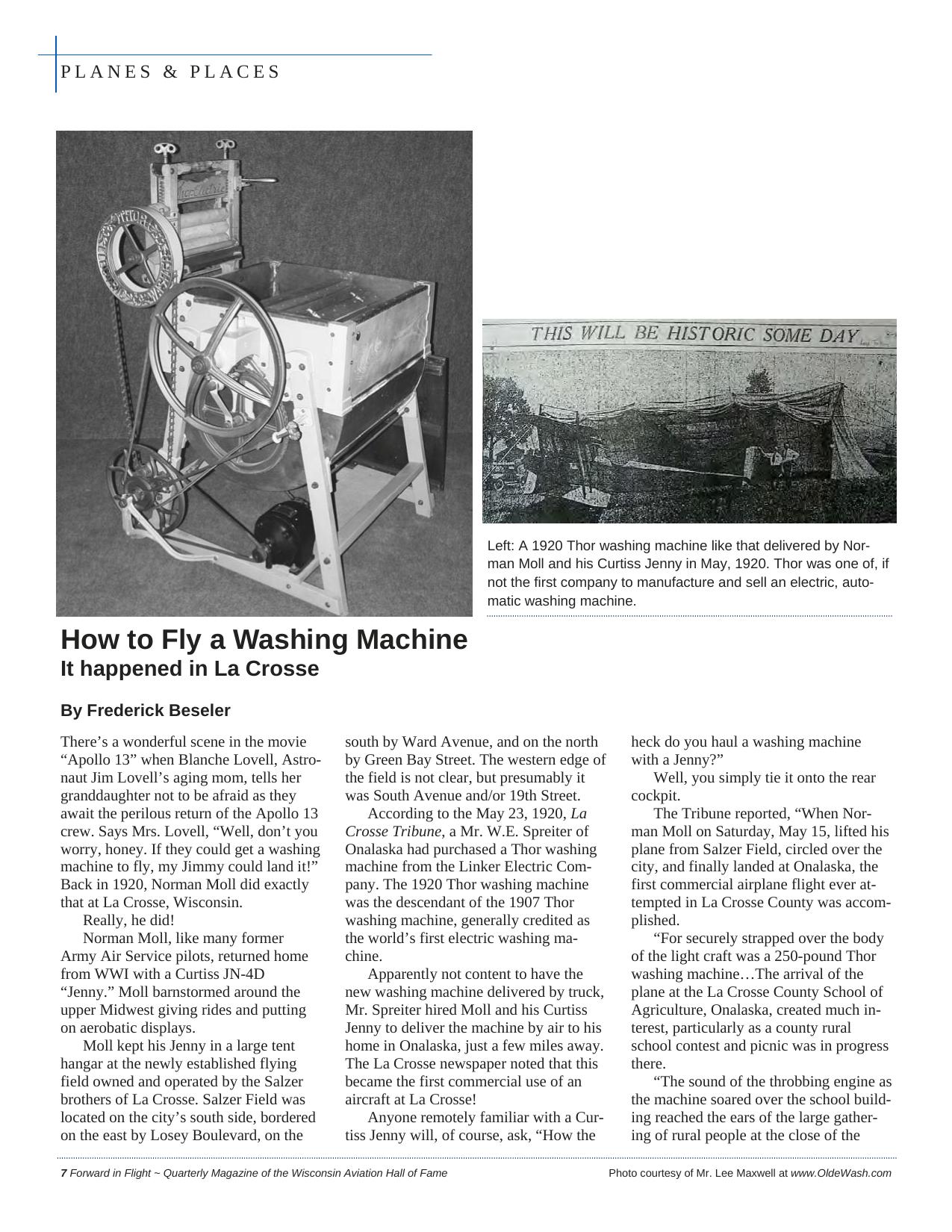
PLANES & PLACES Left: A 1920 Thor washing machine like that delivered by Norman Moll and his Curtiss Jenny in May, 1920. Thor was one of, if not the first company to manufacture and sell an electric, automatic washing machine. How to Fly a Washing Machine It happened in La Crosse By Frederick Beseler There’s a wonderful scene in the movie “Apollo 13” when Blanche Lovell, Astronaut Jim Lovell’s aging mom, tells her granddaughter not to be afraid as they await the perilous return of the Apollo 13 crew. Says Mrs. Lovell, “Well, don’t you worry, honey. If they could get a washing machine to fly, my Jimmy could land it!” Back in 1920, Norman Moll did exactly that at La Crosse, Wisconsin. Really, he did! Norman Moll, like many former Army Air Service pilots, returned home from WWI with a Curtiss JN-4D “Jenny.” Moll barnstormed around the upper Midwest giving rides and putting on aerobatic displays. Moll kept his Jenny in a large tent hangar at the newly established flying field owned and operated by the Salzer brothers of La Crosse. Salzer Field was located on the city’s south side, bordered on the east by Losey Boulevard, on the south by Ward Avenue, and on the north by Green Bay Street. The western edge of the field is not clear, but presumably it was South Avenue and/or 19th Street. According to the May 23, 1920, La Crosse Tribune, a Mr. W.E. Spreiter of Onalaska had purchased a Thor washing machine from the Linker Electric Company. The 1920 Thor washing machine was the descendant of the 1907 Thor washing machine, generally credited as the world’s first electric washing machine. Apparently not content to have the new washing machine delivered by truck, Mr. Spreiter hired Moll and his Curtiss Jenny to deliver the machine by air to his home in Onalaska, just a few miles away. The La Crosse newspaper noted that this became the first commercial use of an aircraft at La Crosse! Anyone remotely familiar with a Curtiss Jenny will, of course, ask, “How the 7 Forward in Flight ~ Quarterly Magazine of the Wisconsin Aviation Hall of Fame heck do you haul a washing machine with a Jenny?” Well, you simply tie it onto the rear cockpit. The Tribune reported, “When Norman Moll on Saturday, May 15, lifted his plane from Salzer Field, circled over the city, and finally landed at Onalaska, the first commercial airplane flight ever attempted in La Crosse County was accomplished. “For securely strapped over the body of the light craft was a 250-pound Thor washing machine…The arrival of the plane at the La Crosse County School of Agriculture, Onalaska, created much interest, particularly as a county rural school contest and picnic was in progress there. “The sound of the throbbing engine as the machine soared over the school building reached the ears of the large gathering of rural people at the close of the Photo courtesy of Mr. Lee Maxwell at www.OldeWash.com
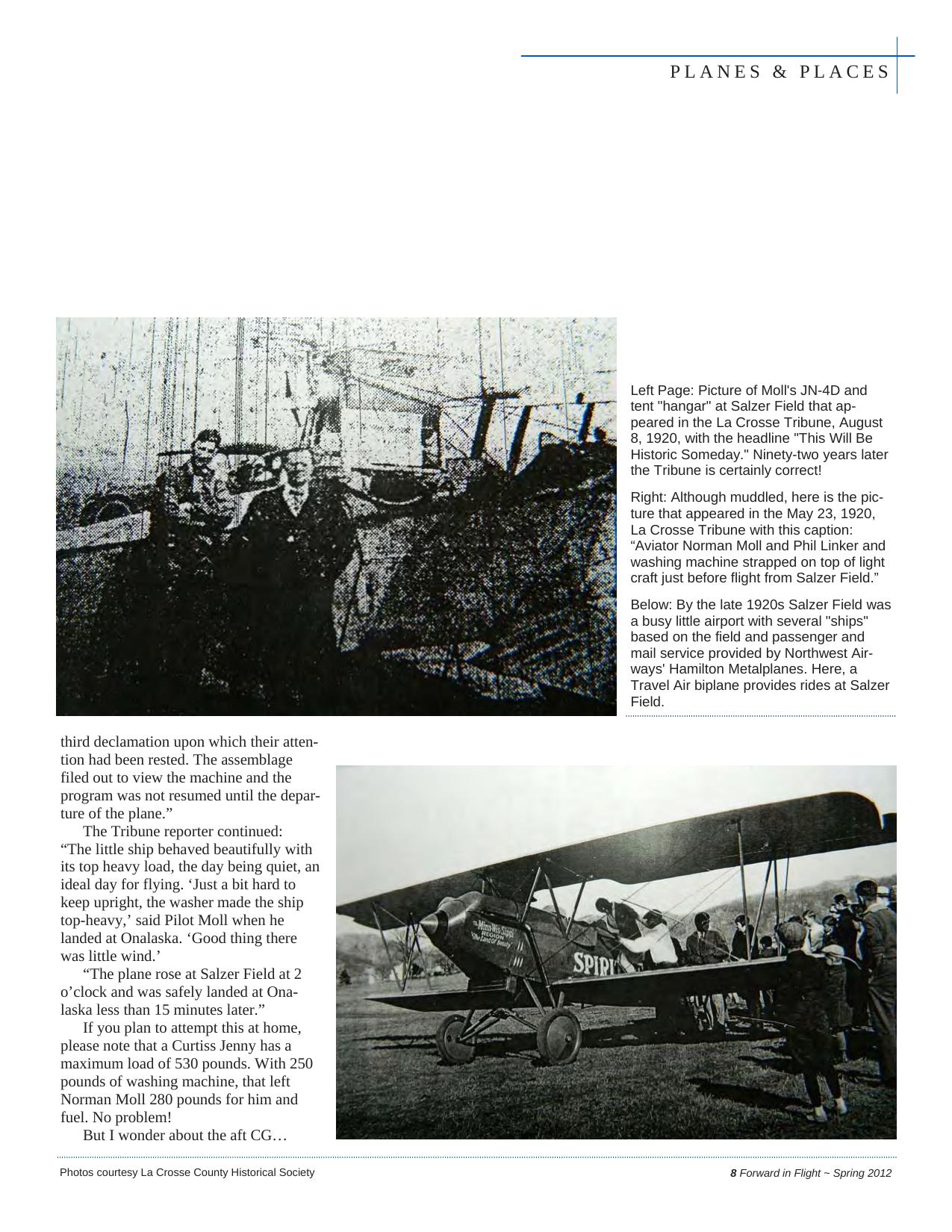
PLANES & PLACES Left Page: Picture of Moll's JN-4D and tent "hangar" at Salzer Field that appeared in the La Crosse Tribune, August 8, 1920, with the headline "This Will Be Historic Someday." Ninety-two years later the Tribune is certainly correct! Right: Although muddled, here is the picture that appeared in the May 23, 1920, La Crosse Tribune with this caption: “Aviator Norman Moll and Phil Linker and washing machine strapped on top of light craft just before flight from Salzer Field.” r Below: By the late 1920s Salzer Field was a busy little airport with several "ships" based on the field and passenger and mail service provided by Northwest Airways' Hamilton Metalplanes. Here, a Travel Air biplane provides rides at Salzer Field. third declamation upon which their attention had been rested. The assemblage filed out to view the machine and the program was not resumed until the departure of the plane.” The Tribune reporter continued: “The little ship behaved beautifully with its top heavy load, the day being quiet, an ideal day for flying. ‘Just a bit hard to keep upright, the washer made the ship top-heavy,’ said Pilot Moll when he landed at Onalaska. ‘Good thing there was little wind.’ “The plane rose at Salzer Field at 2 o’clock and was safely landed at Onalaska less than 15 minutes later.” If you plan to attempt this at home, please note that a Curtiss Jenny has a maximum load of 530 pounds. With 250 pounds of washing machine, that left Norman Moll 280 pounds for him and fuel. No problem! But I wonder about the aft CG… Photos courtesy La Crosse County Historical Society 8 Forward in Flight ~ Spring 2012
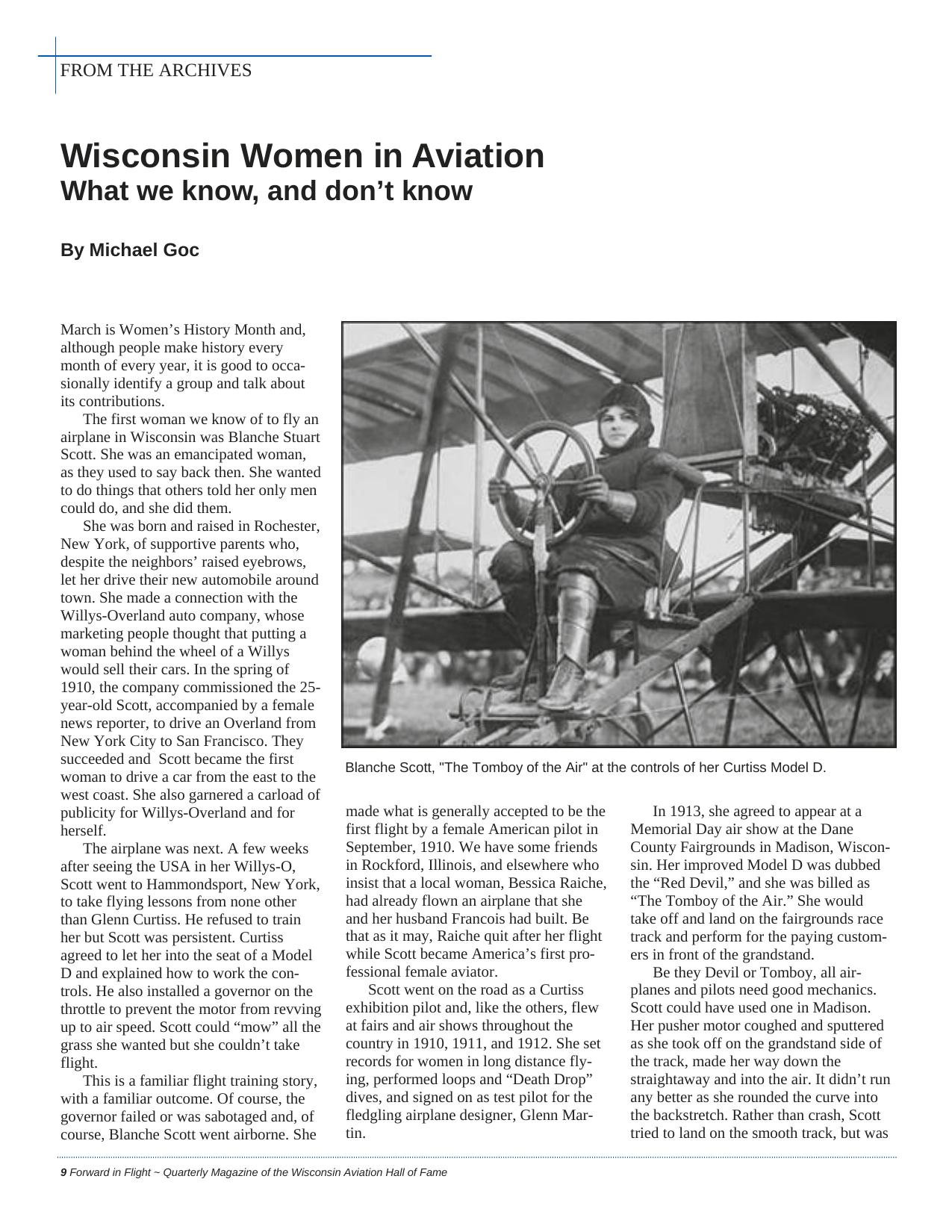
FROM THE ARCHIVES Wisconsin Women in Aviation What we know, and don’t know By Michael Goc March is Women’s History Month and, although people make history every month of every year, it is good to occasionally identify a group and talk about its contributions. The first woman we know of to fly an airplane in Wisconsin was Blanche Stuart Scott. She was an emancipated woman, as they used to say back then. She wanted to do things that others told her only men could do, and she did them. She was born and raised in Rochester, New York, of supportive parents who, despite the neighbors’ raised eyebrows, let her drive their new automobile around town. She made a connection with the Willys-Overland auto company, whose marketing people thought that putting a woman behind the wheel of a Willys would sell their cars. In the spring of 1910, the company commissioned the 25year-old Scott, accompanied by a female news reporter, to drive an Overland from New York City to San Francisco. They succeeded and Scott became the first woman to drive a car from the east to the west coast. She also garnered a carload of publicity for Willys-Overland and for herself. The airplane was next. A few weeks after seeing the USA in her Willys-O, Scott went to Hammondsport, New York, to take flying lessons from none other than Glenn Curtiss. He refused to train her but Scott was persistent. Curtiss agreed to let her into the seat of a Model D and explained how to work the controls. He also installed a governor on the throttle to prevent the motor from revving up to air speed. Scott could “mow” all the grass she wanted but she couldn’t take flight. This is a familiar flight training story, with a familiar outcome. Of course, the governor failed or was sabotaged and, of course, Blanche Scott went airborne. She Blanche Scott, "The Tomboy of the Air" at the controls of her Curtiss Model D. made what is generally accepted to be the first flight by a female American pilot in September, 1910. We have some friends in Rockford, Illinois, and elsewhere who insist that a local woman, Bessica Raiche, had already flown an airplane that she and her husband Francois had built. Be that as it may, Raiche quit after her flight while Scott became America’s first professional female aviator. Scott went on the road as a Curtiss exhibition pilot and, like the others, flew at fairs and air shows throughout the country in 1910, 1911, and 1912. She set records for women in long distance flying, performed loops and “Death Drop” dives, and signed on as test pilot for the fledgling airplane designer, Glenn Martin. 9 Forward in Flight ~ Quarterly Magazine of the Wisconsin Aviation Hall of Fame In 1913, she agreed to appear at a Memorial Day air show at the Dane County Fairgrounds in Madison, Wisconsin. Her improved Model D was dubbed the “Red Devil,” and she was billed as “The Tomboy of the Air.” She would take off and land on the fairgrounds race track and perform for the paying customers in front of the grandstand. Be they Devil or Tomboy, all airplanes and pilots need good mechanics. Scott could have used one in Madison. Her pusher motor coughed and sputtered as she took off on the grandstand side of the track, made her way down the straightaway and into the air. It didn’t run any better as she rounded the curve into the backstretch. Rather than crash, Scott tried to land on the smooth track, but was
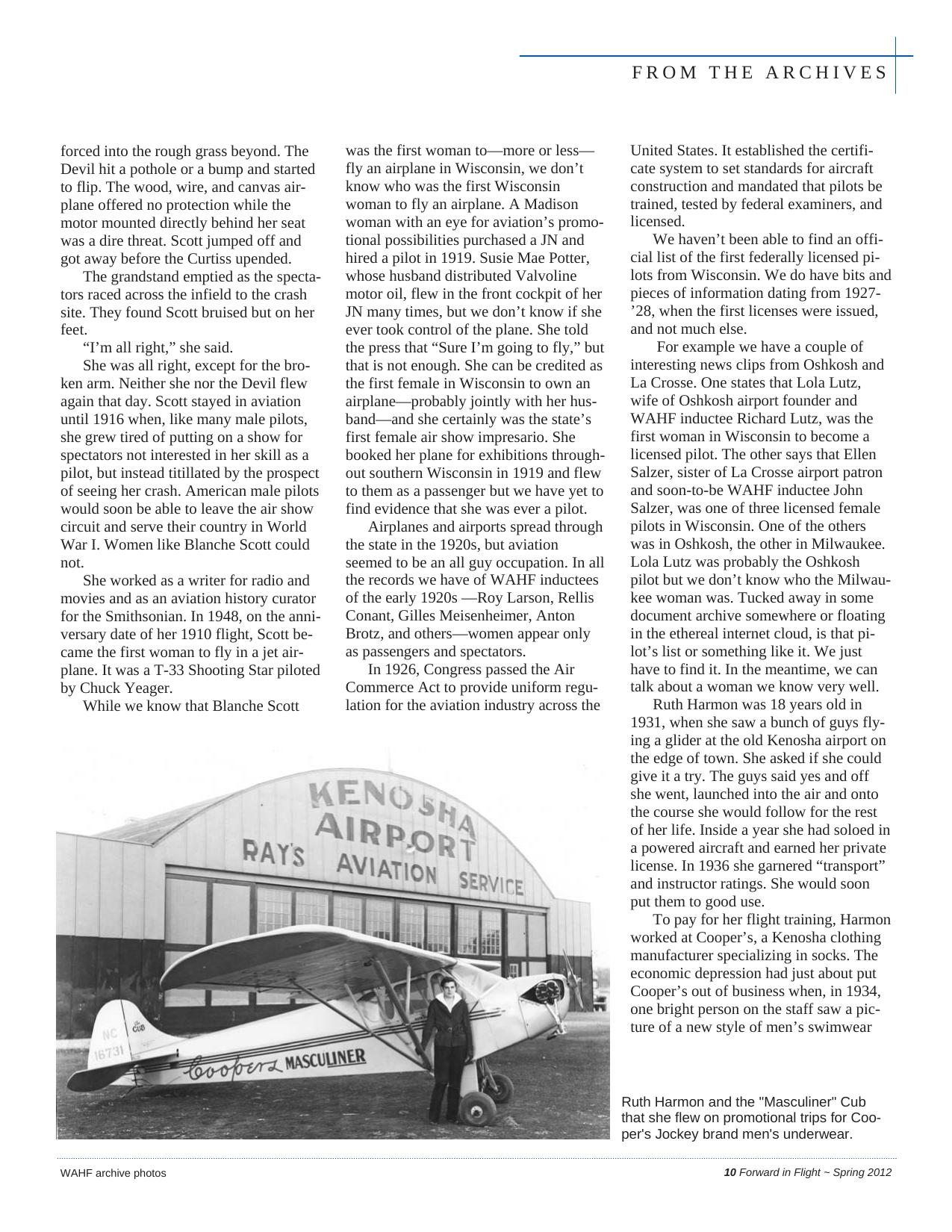
FROM THE ARCHIVES forced into the rough grass beyond. The Devil hit a pothole or a bump and started to flip. The wood, wire, and canvas airplane offered no protection while the motor mounted directly behind her seat was a dire threat. Scott jumped off and got away before the Curtiss upended. The grandstand emptied as the spectators raced across the infield to the crash site. They found Scott bruised but on her feet. “I’m all right,” she said. She was all right, except for the broken arm. Neither she nor the Devil flew again that day. Scott stayed in aviation until 1916 when, like many male pilots, she grew tired of putting on a show for spectators not interested in her skill as a pilot, but instead titillated by the prospect of seeing her crash. American male pilots would soon be able to leave the air show circuit and serve their country in World War I. Women like Blanche Scott could not. She worked as a writer for radio and movies and as an aviation history curator for the Smithsonian. In 1948, on the anniversary date of her 1910 flight, Scott became the first woman to fly in a jet airplane. It was a T-33 Shooting Star piloted by Chuck Yeager. While we know that Blanche Scott was the first woman to—more or less— fly an airplane in Wisconsin, we don’t know who was the first Wisconsin woman to fly an airplane. A Madison woman with an eye for aviation’s promotional possibilities purchased a JN and hired a pilot in 1919. Susie Mae Potter, whose husband distributed Valvoline motor oil, flew in the front cockpit of her JN many times, but we don’t know if she ever took control of the plane. She told the press that “Sure I’m going to fly,” but that is not enough. She can be credited as the first female in Wisconsin to own an airplane—probably jointly with her husband—and she certainly was the state’s first female air show impresario. She booked her plane for exhibitions throughout southern Wisconsin in 1919 and flew to them as a passenger but we have yet to find evidence that she was ever a pilot. Airplanes and airports spread through the state in the 1920s, but aviation seemed to be an all guy occupation. In all the records we have of WAHF inductees of the early 1920s —Roy Larson, Rellis Conant, Gilles Meisenheimer, Anton Brotz, and others—women appear only as passengers and spectators. In 1926, Congress passed the Air Commerce Act to provide uniform regulation for the aviation industry across the United States. It established the certificate system to set standards for aircraft construction and mandated that pilots be trained, tested by federal examiners, and licensed. We haven’t been able to find an official list of the first federally licensed pilots from Wisconsin. We do have bits and pieces of information dating from 1927’28, when the first licenses were issued, and not much else. For example we have a couple of interesting news clips from Oshkosh and La Crosse. One states that Lola Lutz, wife of Oshkosh airport founder and WAHF inductee Richard Lutz, was the first woman in Wisconsin to become a licensed pilot. The other says that Ellen Salzer, sister of La Crosse airport patron and soon-to-be WAHF inductee John Salzer, was one of three licensed female pilots in Wisconsin. One of the others was in Oshkosh, the other in Milwaukee. Lola Lutz was probably the Oshkosh pilot but we don’t know who the Milwaukee woman was. Tucked away in some document archive somewhere or floating in the ethereal internet cloud, is that pilot’s list or something like it. We just have to find it. In the meantime, we can talk about a woman we know very well. Ruth Harmon was 18 years old in 1931, when she saw a bunch of guys flying a glider at the old Kenosha airport on the edge of town. She asked if she could give it a try. The guys said yes and off she went, launched into the air and onto the course she would follow for the rest of her life. Inside a year she had soloed in a powered aircraft and earned her private license. In 1936 she garnered “transport” and instructor ratings. She would soon put them to good use. To pay for her flight training, Harmon worked at Cooper’s, a Kenosha clothing manufacturer specializing in socks. The economic depression had just about put Cooper’s out of business when, in 1934, one bright person on the staff saw a picture of a new style of men’s swimwear Ruth Harmon and the "Masculiner" Cub that she flew on promotional trips for Cooper's Jockey brand men's underwear. WAHF archive photos 10 Forward in Flight ~ Spring 2012
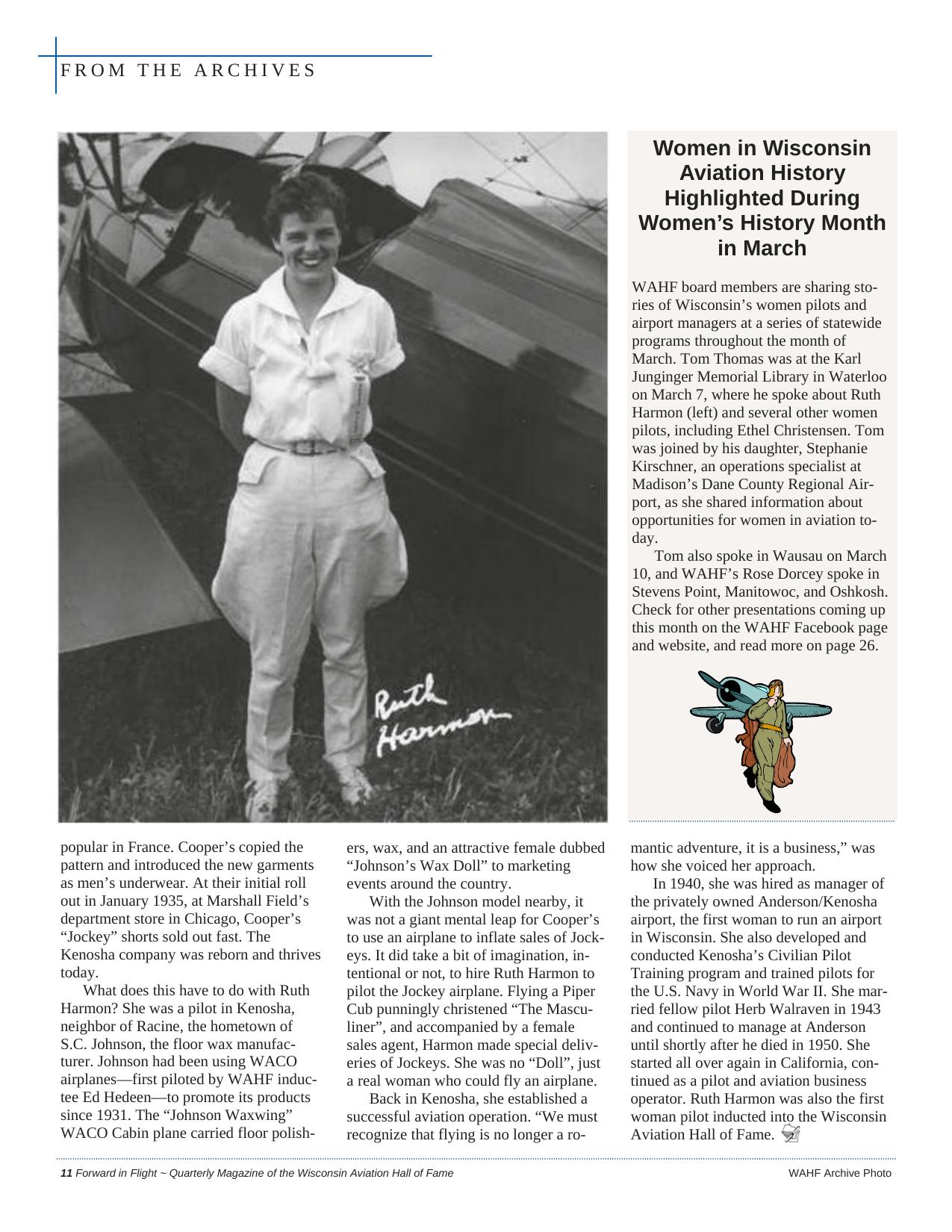
FROM THE ARCHIVES Women in Wisconsin Aviation History Highlighted During Women’s History Month in March WAHF board members are sharing stories of Wisconsin’s women pilots and airport managers at a series of statewide programs throughout the month of March. Tom Thomas was at the Karl Junginger Memorial Library in Waterloo on March 7, where he spoke about Ruth Harmon (left) and several other women pilots, including Ethel Christensen. Tom was joined by his daughter, Stephanie Kirschner, an operations specialist at Madison’s Dane County Regional Airport, as she shared information about opportunities for women in aviation today. Tom also spoke in Wausau on March 10, and WAHF’s Rose Dorcey spoke in Stevens Point, Manitowoc, and Oshkosh. Check for other presentations coming up this month on the WAHF Facebook page and website, and read more on page 26. popular in France. Cooper’s copied the pattern and introduced the new garments as men’s underwear. At their initial roll out in January 1935, at Marshall Field’s department store in Chicago, Cooper’s “Jockey” shorts sold out fast. The Kenosha company was reborn and thrives today. What does this have to do with Ruth Harmon? She was a pilot in Kenosha, neighbor of Racine, the hometown of S.C. Johnson, the floor wax manufacturer. Johnson had been using WACO airplanes—first piloted by WAHF inductee Ed Hedeen—to promote its products since 1931. The “Johnson Waxwing” WACO Cabin plane carried floor polish- ers, wax, and an attractive female dubbed “Johnson’s Wax Doll” to marketing events around the country. With the Johnson model nearby, it was not a giant mental leap for Cooper’s to use an airplane to inflate sales of Jockeys. It did take a bit of imagination, intentional or not, to hire Ruth Harmon to pilot the Jockey airplane. Flying a Piper Cub punningly christened “The Masculiner”, and accompanied by a female sales agent, Harmon made special deliveries of Jockeys. She was no “Doll”, just a real woman who could fly an airplane. Back in Kenosha, she established a successful aviation operation. “We must recognize that flying is no longer a ro- 11 Forward in Flight ~ Quarterly Magazine of the Wisconsin Aviation Hall of Fame mantic adventure, it is a business,” was how she voiced her approach. In 1940, she was hired as manager of the privately owned Anderson/Kenosha airport, the first woman to run an airport in Wisconsin. She also developed and conducted Kenosha’s Civilian Pilot Training program and trained pilots for the U.S. Navy in World War II. She married fellow pilot Herb Walraven in 1943 and continued to manage at Anderson until shortly after he died in 1950. She started all over again in California, continued as a pilot and aviation business operator. Ruth Harmon was also the first woman pilot inducted into the Wisconsin Aviation Hall of Fame. WAHF Archive Photo
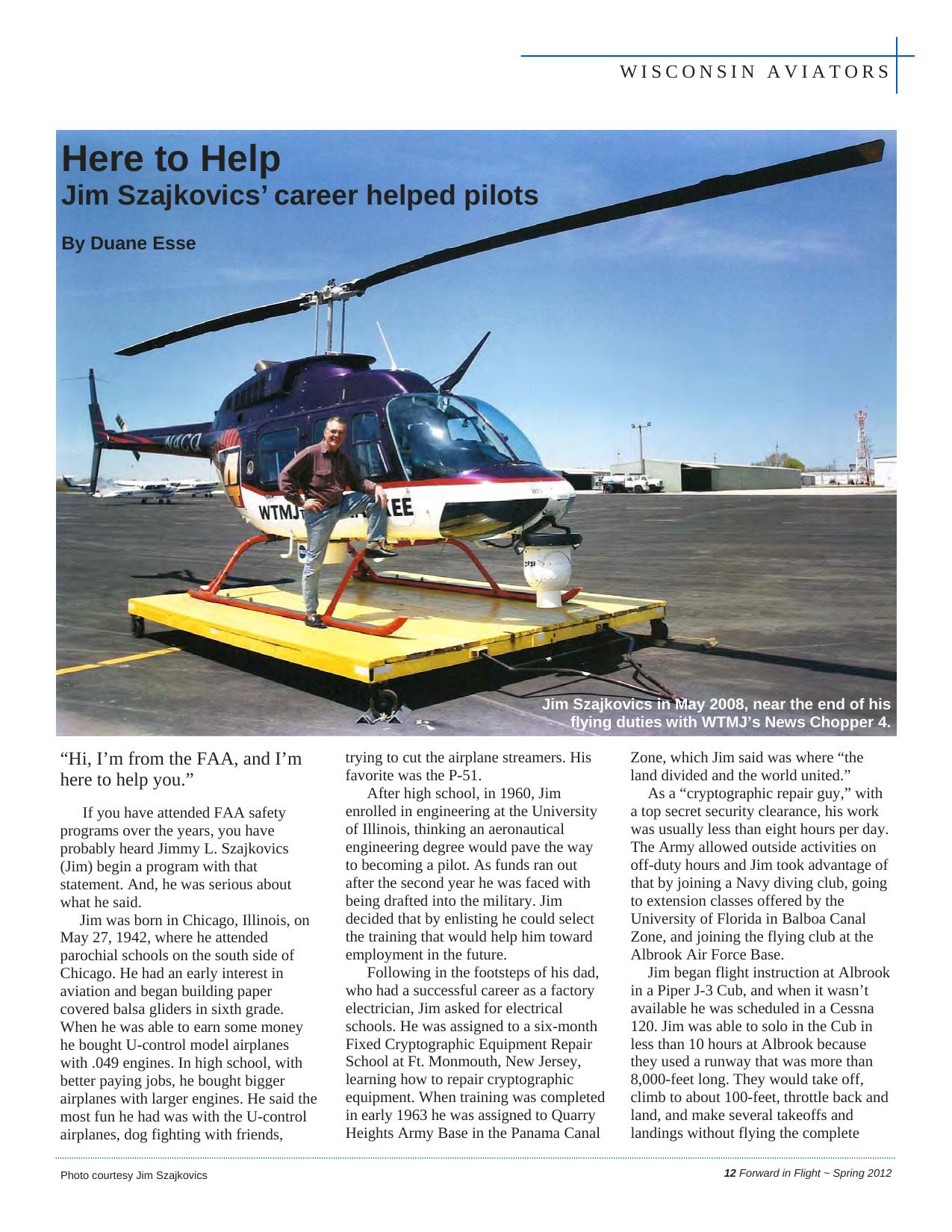
WISCONSIN AVIATORS Here to Help Jim Szajkovics’ career helped pilots By Duane Esse Jim Szajkovics in May 2008, near the end of his flying duties with WTMJ’s News Chopper 4. “Hi, I’m from the FAA, and I’m here to help you.” If you have attended FAA safety programs over the years, you have probably heard Jimmy L. Szajkovics (Jim) begin a program with that statement. And, he was serious about what he said. Jim was born in Chicago, Illinois, on May 27, 1942, where he attended parochial schools on the south side of Chicago. He had an early interest in aviation and began building paper covered balsa gliders in sixth grade. When he was able to earn some money he bought U-control model airplanes with .049 engines. In high school, with better paying jobs, he bought bigger airplanes with larger engines. He said the most fun he had was with the U-control airplanes, dog fighting with friends, Photo courtesy Jim Szajkovics trying to cut the airplane streamers. His favorite was the P-51. After high school, in 1960, Jim enrolled in engineering at the University of Illinois, thinking an aeronautical engineering degree would pave the way to becoming a pilot. As funds ran out after the second year he was faced with being drafted into the military. Jim decided that by enlisting he could select the training that would help him toward employment in the future. Following in the footsteps of his dad, who had a successful career as a factory electrician, Jim asked for electrical schools. He was assigned to a six-month Fixed Cryptographic Equipment Repair School at Ft. Monmouth, New Jersey, learning how to repair cryptographic equipment. When training was completed in early 1963 he was assigned to Quarry Heights Army Base in the Panama Canal Zone, which Jim said was where “the land divided and the world united.” As a “cryptographic repair guy,” with a top secret security clearance, his work was usually less than eight hours per day. The Army allowed outside activities on off-duty hours and Jim took advantage of that by joining a Navy diving club, going to extension classes offered by the University of Florida in Balboa Canal Zone, and joining the flying club at the Albrook Air Force Base. Jim began flight instruction at Albrook in a Piper J-3 Cub, and when it wasn’t available he was scheduled in a Cessna 120. Jim was able to solo in the Cub in less than 10 hours at Albrook because they used a runway that was more than 8,000-feet long. They would take off, climb to about 100-feet, throttle back and land, and make several takeoffs and landings without flying the complete 12 Forward in Flight ~ Spring 2012
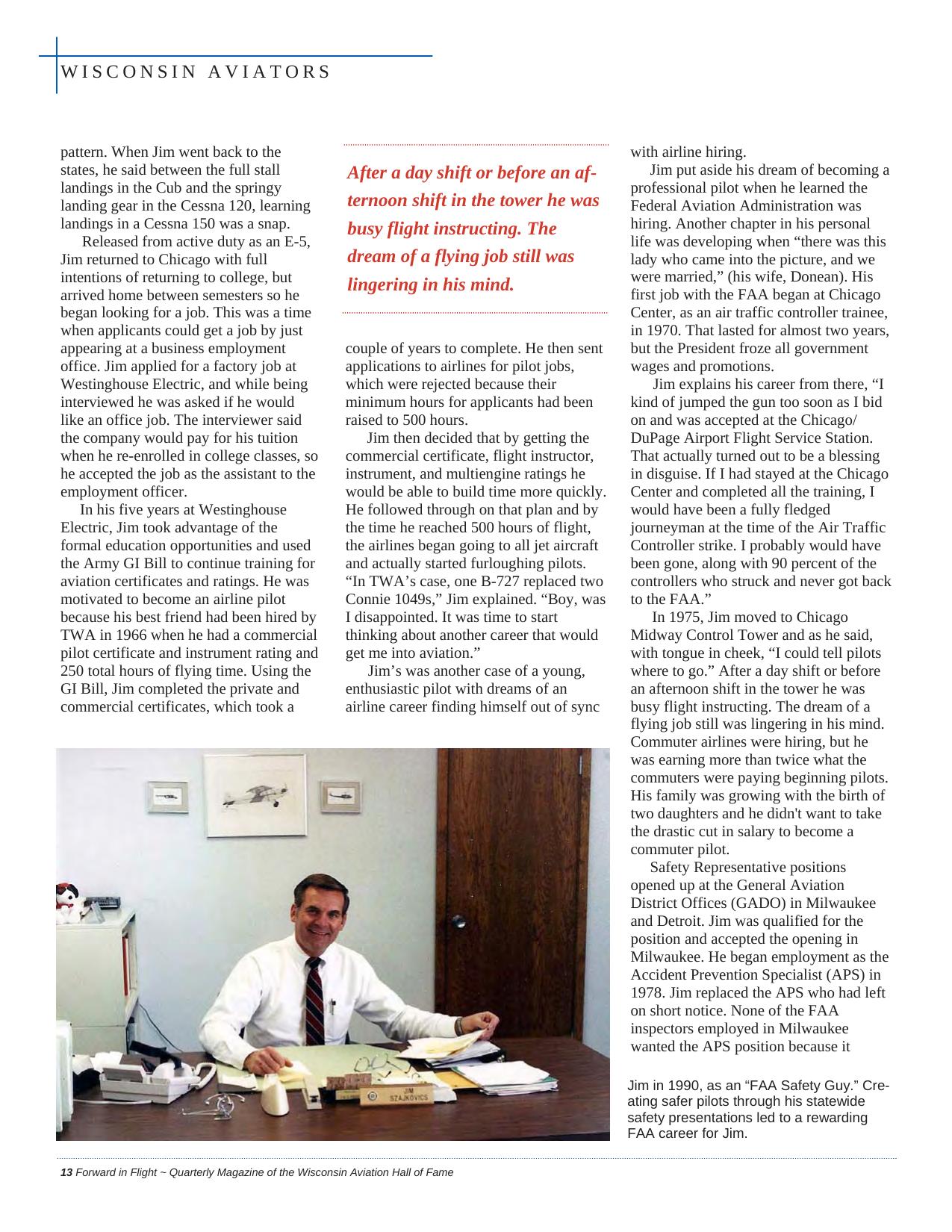
WISCONSIN AVIATORS pattern. When Jim went back to the states, he said between the full stall landings in the Cub and the springy landing gear in the Cessna 120, learning landings in a Cessna 150 was a snap. Released from active duty as an E-5, Jim returned to Chicago with full intentions of returning to college, but arrived home between semesters so he began looking for a job. This was a time when applicants could get a job by just appearing at a business employment office. Jim applied for a factory job at Westinghouse Electric, and while being interviewed he was asked if he would like an office job. The interviewer said the company would pay for his tuition when he re-enrolled in college classes, so he accepted the job as the assistant to the employment officer. In his five years at Westinghouse Electric, Jim took advantage of the formal education opportunities and used the Army GI Bill to continue training for aviation certificates and ratings. He was motivated to become an airline pilot because his best friend had been hired by TWA in 1966 when he had a commercial pilot certificate and instrument rating and 250 total hours of flying time. Using the GI Bill, Jim completed the private and commercial certificates, which took a After a day shift or before an afternoon shift in the tower he was busy flight instructing. The dream of a flying job still was lingering in his mind. couple of years to complete. He then sent applications to airlines for pilot jobs, which were rejected because their minimum hours for applicants had been raised to 500 hours. Jim then decided that by getting the commercial certificate, flight instructor, instrument, and multiengine ratings he would be able to build time more quickly. He followed through on that plan and by the time he reached 500 hours of flight, the airlines began going to all jet aircraft and actually started furloughing pilots. “In TWA’s case, one B-727 replaced two Connie 1049s,” Jim explained. “Boy, was I disappointed. It was time to start thinking about another career that would get me into aviation.” Jim’s was another case of a young, enthusiastic pilot with dreams of an airline career finding himself out of sync with airline hiring. Jim put aside his dream of becoming a professional pilot when he learned the Federal Aviation Administration was hiring. Another chapter in his personal life was developing when “there was this lady who came into the picture, and we were married,” (his wife, Donean). His first job with the FAA began at Chicago Center, as an air traffic controller trainee, in 1970. That lasted for almost two years, but the President froze all government wages and promotions. Jim explains his career from there, “I kind of jumped the gun too soon as I bid on and was accepted at the Chicago/ DuPage Airport Flight Service Station. That actually turned out to be a blessing in disguise. If I had stayed at the Chicago Center and completed all the training, I would have been a fully fledged journeyman at the time of the Air Traffic Controller strike. I probably would have been gone, along with 90 percent of the controllers who struck and never got back to the FAA.” In 1975, Jim moved to Chicago Midway Control Tower and as he said, with tongue in cheek, “I could tell pilots where to go.” After a day shift or before an afternoon shift in the tower he was busy flight instructing. The dream of a flying job still was lingering in his mind. Commuter airlines were hiring, but he was earning more than twice what the commuters were paying beginning pilots. His family was growing with the birth of two daughters and he didn't want to take the drastic cut in salary to become a commuter pilot. Safety Representative positions opened up at the General Aviation District Offices (GADO) in Milwaukee and Detroit. Jim was qualified for the position and accepted the opening in Milwaukee. He began employment as the Accident Prevention Specialist (APS) in 1978. Jim replaced the APS who had left on short notice. None of the FAA inspectors employed in Milwaukee wanted the APS position because it Jim in 1990, as an “FAA Safety Guy.” Creating safer pilots through his statewide safety presentations led to a rewarding FAA career for Jim. 13 Forward in Flight ~ Quarterly Magazine of the Wisconsin Aviation Hall of Fame
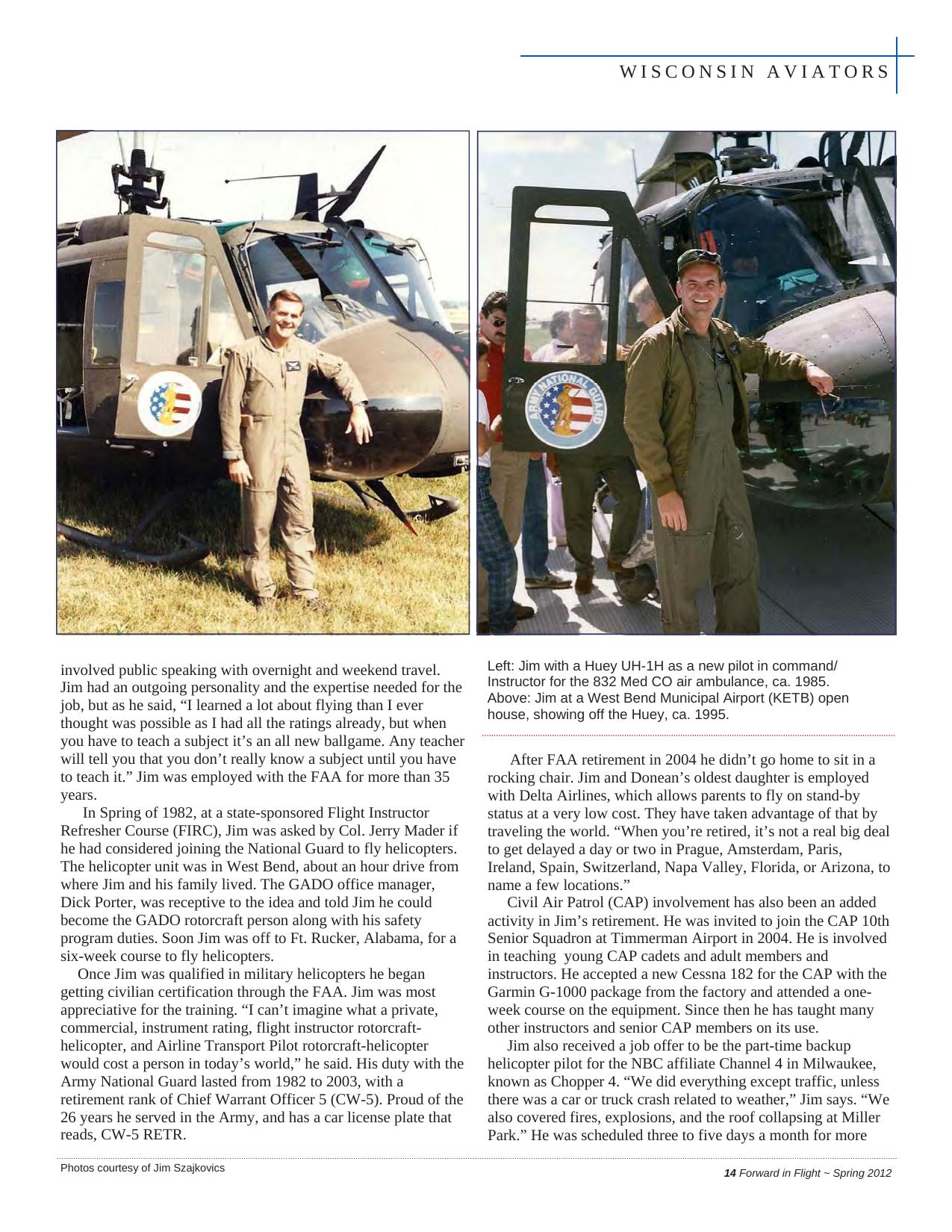
WISCONSIN AVIATORS involved public speaking with overnight and weekend travel. Jim had an outgoing personality and the expertise needed for the job, but as he said, “I learned a lot about flying than I ever thought was possible as I had all the ratings already, but when you have to teach a subject it’s an all new ballgame. Any teacher will tell you that you don’t really know a subject until you have to teach it.” Jim was employed with the FAA for more than 35 years. In Spring of 1982, at a state-sponsored Flight Instructor Refresher Course (FIRC), Jim was asked by Col. Jerry Mader if he had considered joining the National Guard to fly helicopters. The helicopter unit was in West Bend, about an hour drive from where Jim and his family lived. The GADO office manager, Dick Porter, was receptive to the idea and told Jim he could become the GADO rotorcraft person along with his safety program duties. Soon Jim was off to Ft. Rucker, Alabama, for a six-week course to fly helicopters. Once Jim was qualified in military helicopters he began getting civilian certification through the FAA. Jim was most appreciative for the training. “I can’t imagine what a private, commercial, instrument rating, flight instructor rotorcrafthelicopter, and Airline Transport Pilot rotorcraft-helicopter would cost a person in today’s world,” he said. His duty with the Army National Guard lasted from 1982 to 2003, with a retirement rank of Chief Warrant Officer 5 (CW-5). Proud of the 26 years he served in the Army, and has a car license plate that reads, CW-5 RETR. Photos courtesy of Jim Szajkovics Left: Jim with a Huey UH-1H as a new pilot in command/ Instructor for the 832 Med CO air ambulance, ca. 1985. Above: Jim at a West Bend Municipal Airport (KETB) open house, showing off the Huey, ca. 1995. After FAA retirement in 2004 he didn’t go home to sit in a rocking chair. Jim and Donean’s oldest daughter is employed with Delta Airlines, which allows parents to fly on stand-by status at a very low cost. They have taken advantage of that by traveling the world. “When you’re retired, it’s not a real big deal to get delayed a day or two in Prague, Amsterdam, Paris, Ireland, Spain, Switzerland, Napa Valley, Florida, or Arizona, to name a few locations.” Civil Air Patrol (CAP) involvement has also been an added activity in Jim’s retirement. He was invited to join the CAP 10th Senior Squadron at Timmerman Airport in 2004. He is involved in teaching young CAP cadets and adult members and instructors. He accepted a new Cessna 182 for the CAP with the Garmin G-1000 package from the factory and attended a oneweek course on the equipment. Since then he has taught many other instructors and senior CAP members on its use. Jim also received a job offer to be the part-time backup helicopter pilot for the NBC affiliate Channel 4 in Milwaukee, known as Chopper 4. “We did everything except traffic, unless there was a car or truck crash related to weather,” Jim says. “We also covered fires, explosions, and the roof collapsing at Miller Park.” He was scheduled three to five days a month for more 14 Forward in Flight ~ Spring 2012
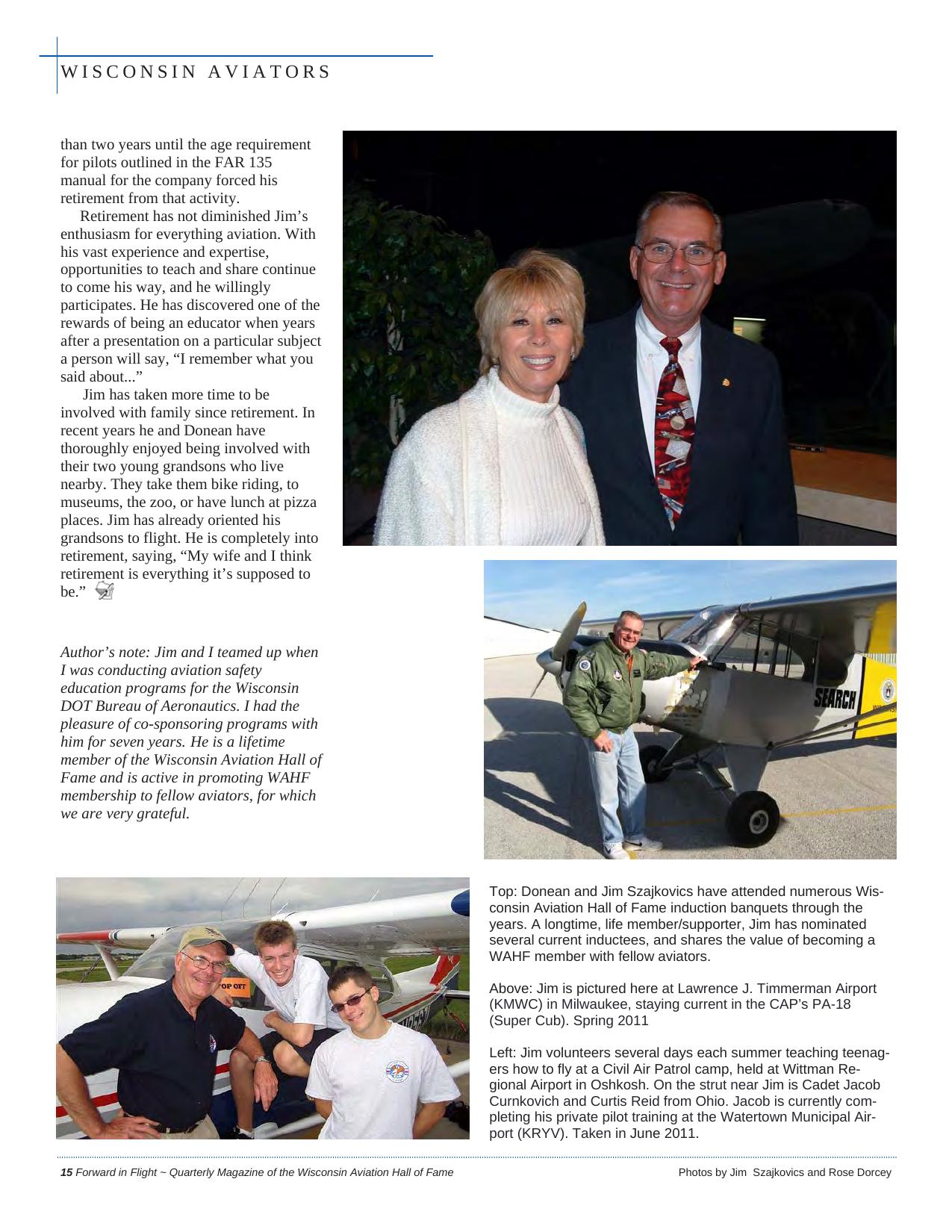
WISCONSIN AVIATORS than two years until the age requirement for pilots outlined in the FAR 135 manual for the company forced his retirement from that activity. Retirement has not diminished Jim’s enthusiasm for everything aviation. With his vast experience and expertise, opportunities to teach and share continue to come his way, and he willingly participates. He has discovered one of the rewards of being an educator when years after a presentation on a particular subject a person will say, “I remember what you said about...” Jim has taken more time to be involved with family since retirement. In recent years he and Donean have thoroughly enjoyed being involved with their two young grandsons who live nearby. They take them bike riding, to museums, the zoo, or have lunch at pizza places. Jim has already oriented his grandsons to flight. He is completely into retirement, saying, “My wife and I think retirement is everything it’s supposed to be.” Author’s note: Jim and I teamed up when I was conducting aviation safety education programs for the Wisconsin DOT Bureau of Aeronautics. I had the pleasure of co-sponsoring programs with him for seven years. He is a lifetime member of the Wisconsin Aviation Hall of Fame and is active in promoting WAHF membership to fellow aviators, for which we are very grateful. Top: Donean and Jim Szajkovics have attended numerous Wisconsin Aviation Hall of Fame induction banquets through the years. A longtime, life member/supporter, Jim has nominated several current inductees, and shares the value of becoming a WAHF member with fellow aviators. Above: Jim is pictured here at Lawrence J. Timmerman Airport (KMWC) in Milwaukee, staying current in the CAP’s PA-18 (Super Cub). Spring 2011 Left: Jim volunteers several days each summer teaching teenagers how to fly at a Civil Air Patrol camp, held at Wittman Regional Airport in Oshkosh. On the strut near Jim is Cadet Jacob Curnkovich and Curtis Reid from Ohio. Jacob is currently completing his private pilot training at the Watertown Municipal Airport (KRYV). Taken in June 2011. 15 Forward in Flight ~ Quarterly Magazine of the Wisconsin Aviation Hall of Fame Photos by Jim Szajkovics and Rose Dorcey
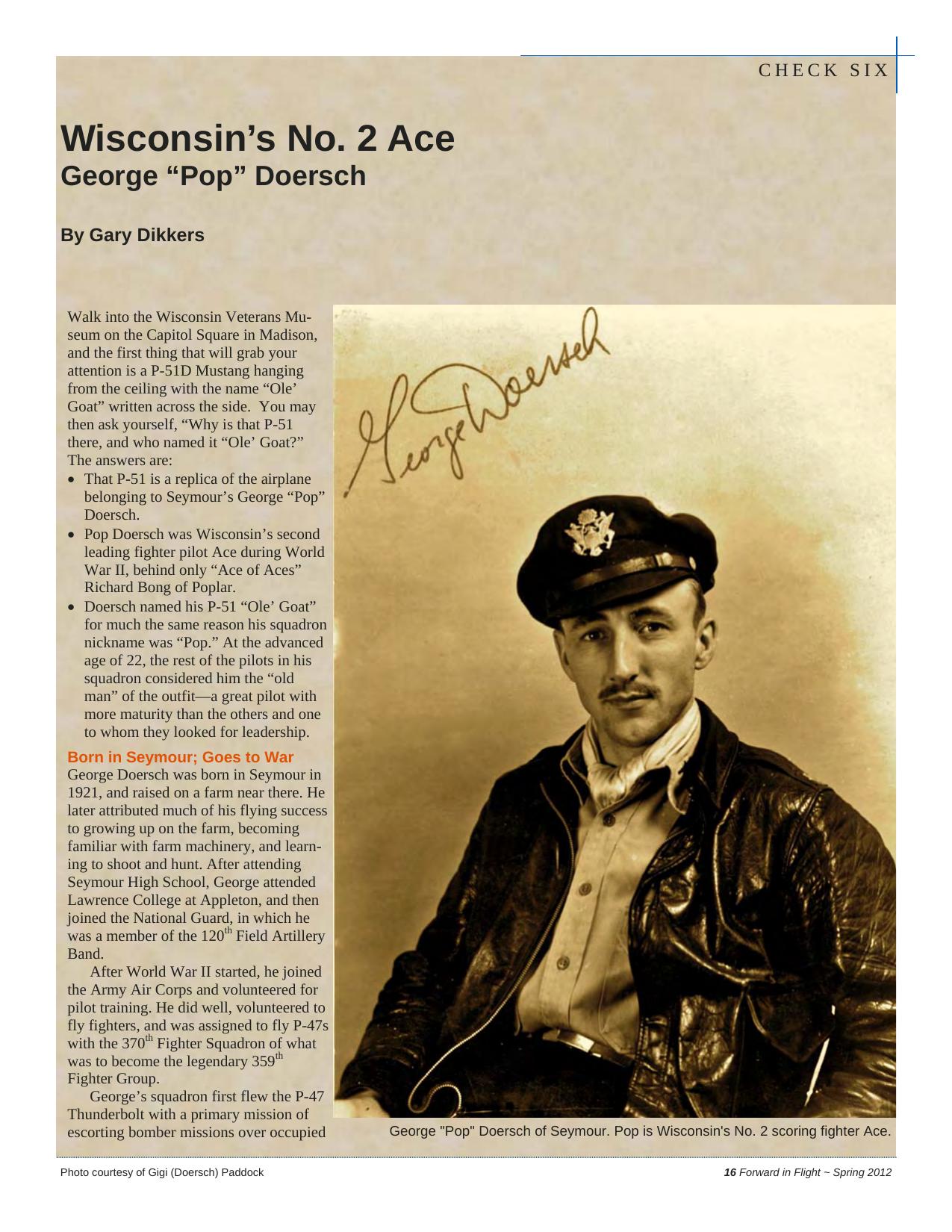
CHECK SIX Wisconsin’s No. 2 Ace George “Pop” Doersch By Gary Dikkers Walk into the Wisconsin Veterans Museum on the Capitol Square in Madison, and the first thing that will grab your attention is a P-51D Mustang hanging from the ceiling with the name “Ole’ Goat” written across the side. You may then ask yourself, “Why is that P-51 there, and who named it “Ole’ Goat?” The answers are: That P-51 is a replica of the airplane belonging to Seymour’s George “Pop” Doersch. Pop Doersch was Wisconsin’s second leading fighter pilot Ace during World War II, behind only “Ace of Aces” Richard Bong of Poplar. Doersch named his P-51 “Ole’ Goat” for much the same reason his squadron nickname was “Pop.” At the advanced age of 22, the rest of the pilots in his squadron considered him the “old man” of the outfit—a great pilot with more maturity than the others and one to whom they looked for leadership. Born in Seymour; Goes to War George Doersch was born in Seymour in 1921, and raised on a farm near there. He later attributed much of his flying success to growing up on the farm, becoming familiar with farm machinery, and learning to shoot and hunt. After attending Seymour High School, George attended Lawrence College at Appleton, and then joined the National Guard, in which he was a member of the 120th Field Artillery Band. After World War II started, he joined the Army Air Corps and volunteered for pilot training. He did well, volunteered to fly fighters, and was assigned to fly P-47s with the 370th Fighter Squadron of what was to become the legendary 359th Fighter Group. George’s squadron first flew the P-47 Thunderbolt with a primary mission of escorting bomber missions over occupied Photo courtesy of Gigi (Doersch) Paddock George "Pop" Doersch of Seymour. Pop is Wisconsin's No. 2 scoring fighter Ace. 16 Forward in Flight ~ Spring 2012
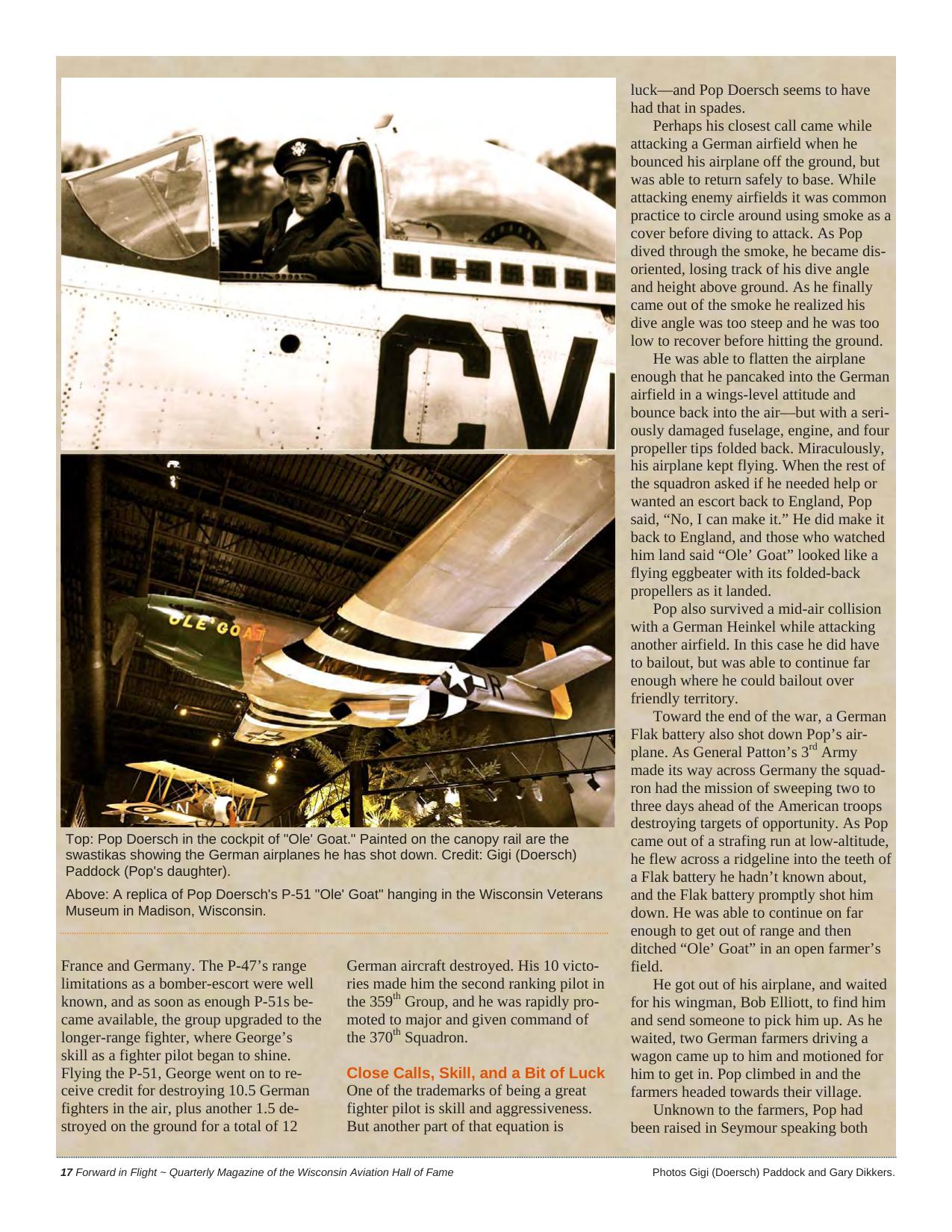
Top: Pop Doersch in the cockpit of "Ole' Goat." Painted on the canopy rail are the swastikas showing the German airplanes he has shot down. Credit: Gigi (Doersch) Paddock (Pop's daughter). Above: A replica of Pop Doersch's P-51 "Ole' Goat" hanging in the Wisconsin Veterans Museum in Madison, Wisconsin. France and Germany. The P-47’s range limitations as a bomber-escort were well known, and as soon as enough P-51s became available, the group upgraded to the longer-range fighter, where George’s skill as a fighter pilot began to shine. Flying the P-51, George went on to receive credit for destroying 10.5 German fighters in the air, plus another 1.5 destroyed on the ground for a total of 12 German aircraft destroyed. His 10 victories made him the second ranking pilot in the 359th Group, and he was rapidly promoted to major and given command of the 370th Squadron. Close Calls, Skill, and a Bit of Luck One of the trademarks of being a great fighter pilot is skill and aggressiveness. But another part of that equation is 17 Forward in Flight ~ Quarterly Magazine of the Wisconsin Aviation Hall of Fame luck—and Pop Doersch seems to have had that in spades. Perhaps his closest call came while attacking a German airfield when he bounced his airplane off the ground, but was able to return safely to base. While attacking enemy airfields it was common practice to circle around using smoke as a cover before diving to attack. As Pop dived through the smoke, he became disoriented, losing track of his dive angle and height above ground. As he finally came out of the smoke he realized his dive angle was too steep and he was too low to recover before hitting the ground. He was able to flatten the airplane enough that he pancaked into the German airfield in a wings-level attitude and bounce back into the air—but with a seriously damaged fuselage, engine, and four propeller tips folded back. Miraculously, his airplane kept flying. When the rest of the squadron asked if he needed help or wanted an escort back to England, Pop said, “No, I can make it.” He did make it back to England, and those who watched him land said “Ole’ Goat” looked like a flying eggbeater with its folded-back propellers as it landed. Pop also survived a mid-air collision with a German Heinkel while attacking another airfield. In this case he did have to bailout, but was able to continue far enough where he could bailout over friendly territory. Toward the end of the war, a German Flak battery also shot down Pop’s airplane. As General Patton’s 3rd Army made its way across Germany the squadron had the mission of sweeping two to three days ahead of the American troops destroying targets of opportunity. As Pop came out of a strafing run at low-altitude, he flew across a ridgeline into the teeth of a Flak battery he hadn’t known about, and the Flak battery promptly shot him down. He was able to continue on far enough to get out of range and then ditched “Ole’ Goat” in an open farmer’s field. He got out of his airplane, and waited for his wingman, Bob Elliott, to find him and send someone to pick him up. As he waited, two German farmers driving a wagon came up to him and motioned for him to get in. Pop climbed in and the farmers headed towards their village. Unknown to the farmers, Pop had been raised in Seymour speaking both Photos Gigi (Doersch) Paddock and Gary Dikkers.
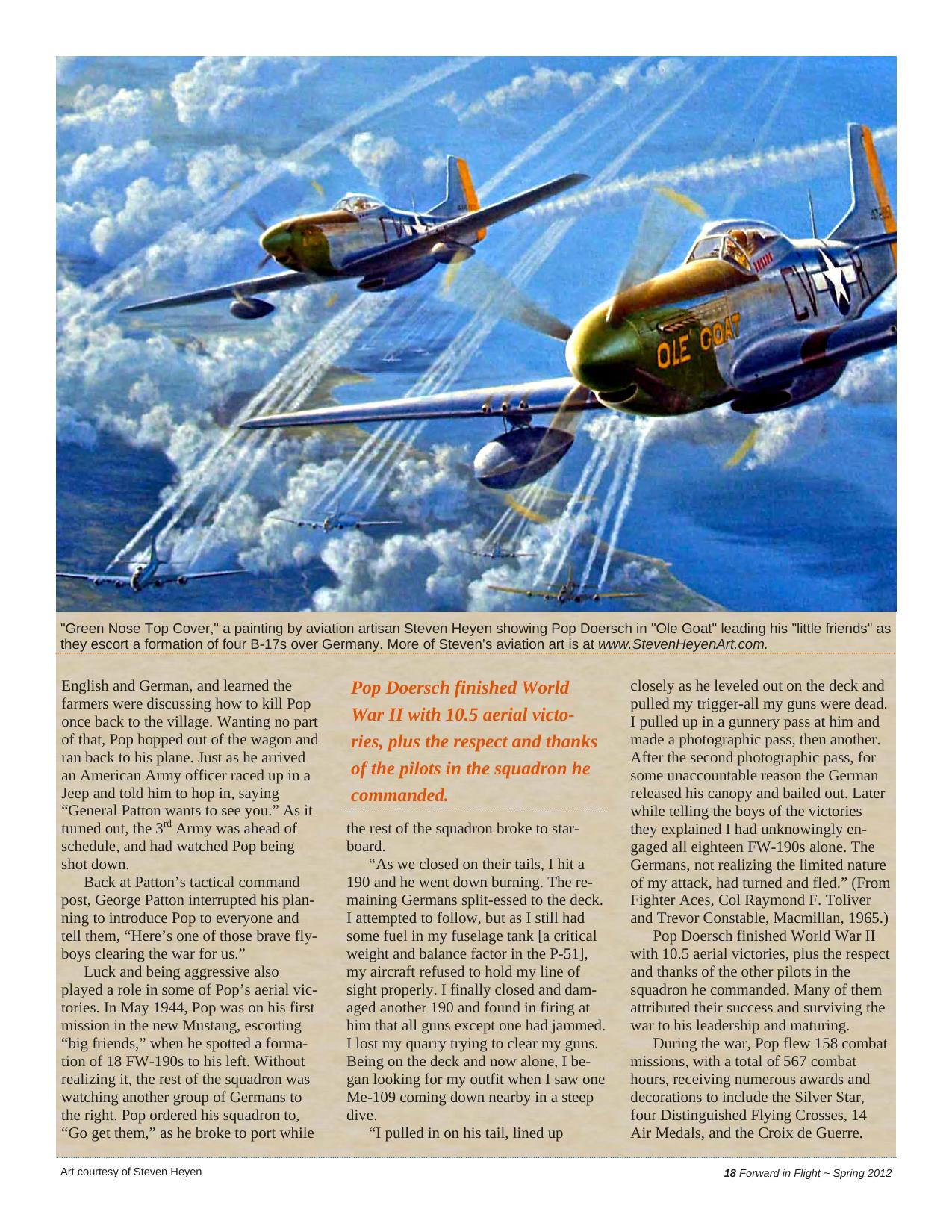
"Green Nose Top Cover," a painting by aviation artisan Steven Heyen showing Pop Doersch in "Ole Goat" leading his "little friends" as they escort a formation of four B-17s over Germany. More of Steven’s aviation art is at www.StevenHeyenArt.com. English and German, and learned the farmers were discussing how to kill Pop once back to the village. Wanting no part of that, Pop hopped out of the wagon and ran back to his plane. Just as he arrived an American Army officer raced up in a Jeep and told him to hop in, saying “General Patton wants to see you.” As it turned out, the 3rd Army was ahead of schedule, and had watched Pop being shot down. Back at Patton’s tactical command post, George Patton interrupted his planning to introduce Pop to everyone and tell them, “Here’s one of those brave flyboys clearing the war for us.” Luck and being aggressive also played a role in some of Pop’s aerial victories. In May 1944, Pop was on his first mission in the new Mustang, escorting “big friends,” when he spotted a formation of 18 FW-190s to his left. Without realizing it, the rest of the squadron was watching another group of Germans to the right. Pop ordered his squadron to, “Go get them,” as he broke to port while Art courtesy of Steven Heyen Pop Doersch finished World War II with 10.5 aerial victories, plus the respect and thanks of the pilots in the squadron he commanded. the rest of the squadron broke to starboard. “As we closed on their tails, I hit a 190 and he went down burning. The remaining Germans split-essed to the deck. I attempted to follow, but as I still had some fuel in my fuselage tank [a critical weight and balance factor in the P-51], my aircraft refused to hold my line of sight properly. I finally closed and damaged another 190 and found in firing at him that all guns except one had jammed. I lost my quarry trying to clear my guns. Being on the deck and now alone, I began looking for my outfit when I saw one Me-109 coming down nearby in a steep dive. “I pulled in on his tail, lined up closely as he leveled out on the deck and pulled my trigger-all my guns were dead. I pulled up in a gunnery pass at him and made a photographic pass, then another. After the second photographic pass, for some unaccountable reason the German released his canopy and bailed out. Later while telling the boys of the victories they explained I had unknowingly engaged all eighteen FW-190s alone. The Germans, not realizing the limited nature of my attack, had turned and fled.” (From Fighter Aces, Col Raymond F. Toliver and Trevor Constable, Macmillan, 1965.) Pop Doersch finished World War II with 10.5 aerial victories, plus the respect and thanks of the other pilots in the squadron he commanded. Many of them attributed their success and surviving the war to his leadership and maturing. During the war, Pop flew 158 combat missions, with a total of 567 combat hours, receiving numerous awards and decorations to include the Silver Star, four Distinguished Flying Crosses, 14 Air Medals, and the Croix de Guerre. 18 Forward in Flight ~ Spring 2012
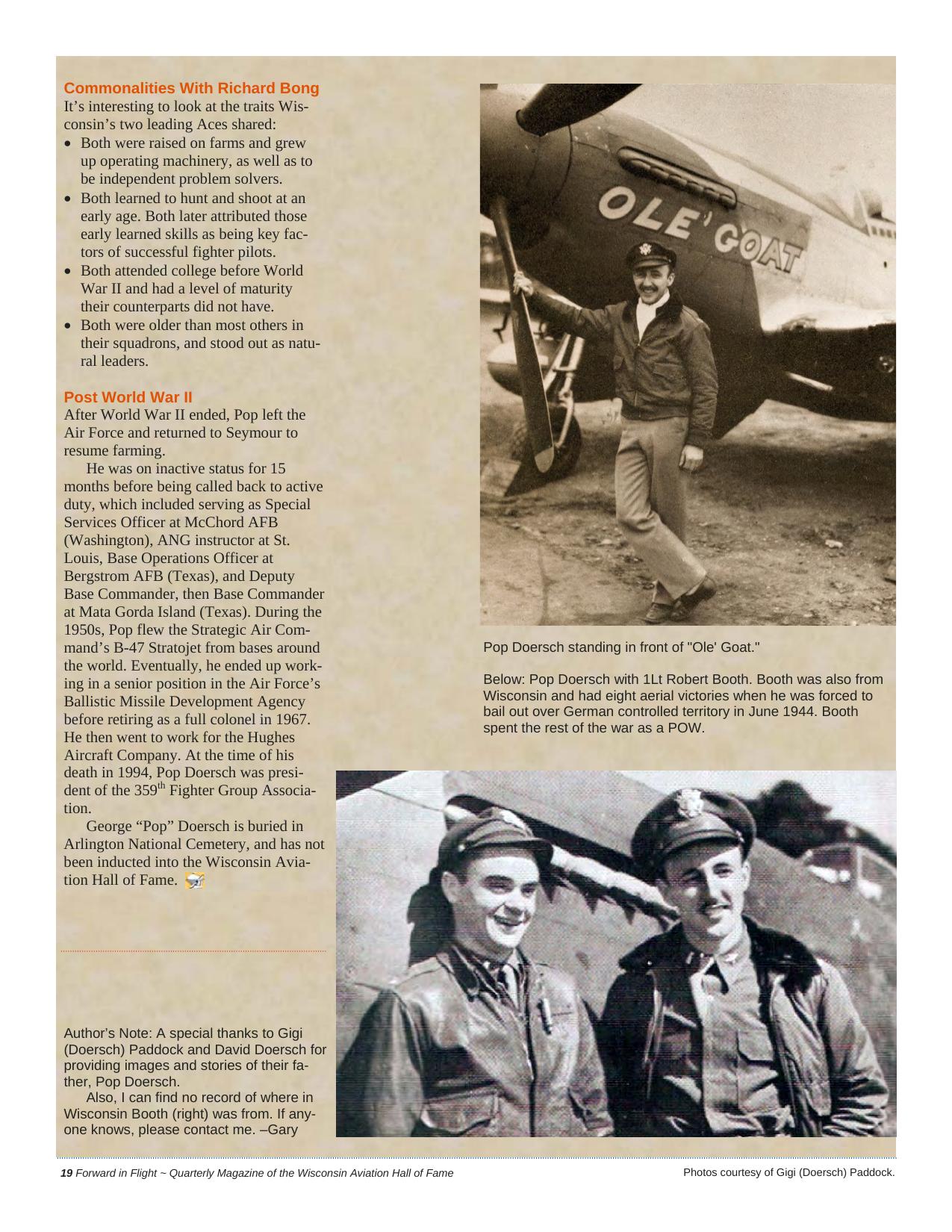
Commonalities With Richard Bong It’s interesting to look at the traits Wisconsin’s two leading Aces shared: Both were raised on farms and grew up operating machinery, as well as to be independent problem solvers. Both learned to hunt and shoot at an early age. Both later attributed those early learned skills as being key factors of successful fighter pilots. Both attended college before World War II and had a level of maturity their counterparts did not have. Both were older than most others in their squadrons, and stood out as natural leaders. Post World War II After World War II ended, Pop left the Air Force and returned to Seymour to resume farming. He was on inactive status for 15 months before being called back to active duty, which included serving as Special Services Officer at McChord AFB (Washington), ANG instructor at St. Louis, Base Operations Officer at Bergstrom AFB (Texas), and Deputy Base Commander, then Base Commander at Mata Gorda Island (Texas). During the 1950s, Pop flew the Strategic Air Command’s B-47 Stratojet from bases around the world. Eventually, he ended up working in a senior position in the Air Force’s Ballistic Missile Development Agency before retiring as a full colonel in 1967. He then went to work for the Hughes Aircraft Company. At the time of his death in 1994, Pop Doersch was president of the 359th Fighter Group Association. George “Pop” Doersch is buried in Arlington National Cemetery, and has not been inducted into the Wisconsin Aviation Hall of Fame. Pop Doersch standing in front of "Ole' Goat." Below: Pop Doersch with 1Lt Robert Booth. Booth was also from Wisconsin and had eight aerial victories when he was forced to bail out over German controlled territory in June 1944. Booth spent the rest of the war as a POW. Author’s Note: A special thanks to Gigi (Doersch) Paddock and David Doersch for providing images and stories of their father, Pop Doersch. Also, I can find no record of where in Wisconsin Booth (right) was from. If anyone knows, please contact me. –Gary 19 Forward in Flight ~ Quarterly Magazine of the Wisconsin Aviation Hall of Fame Photos courtesy of Gigi (Doersch) Paddock.
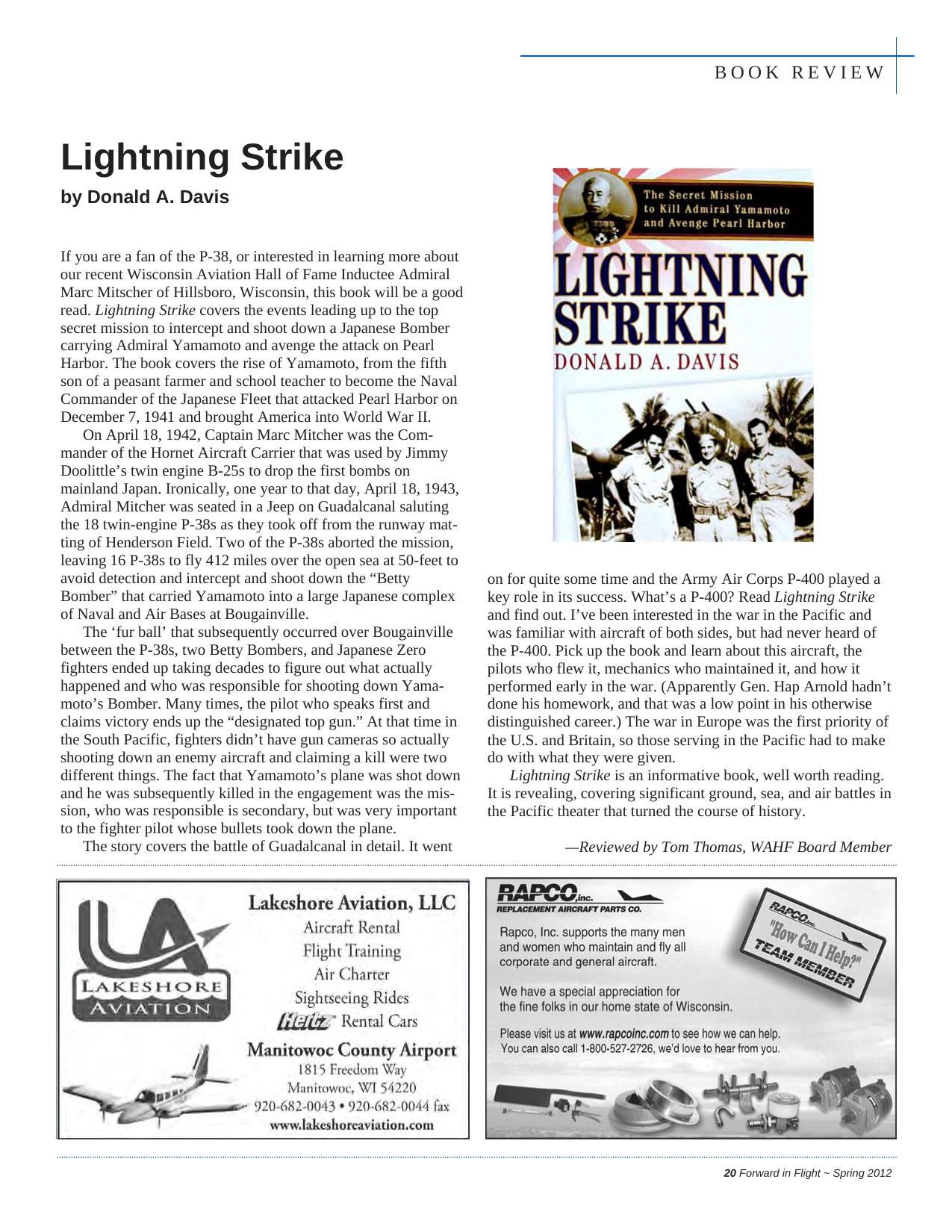
BOOK REVIEW Lightning Strike by Donald A. Davis If you are a fan of the P-38, or interested in learning more about our recent Wisconsin Aviation Hall of Fame Inductee Admiral Marc Mitscher of Hillsboro, Wisconsin, this book will be a good read. Lightning Strike covers the events leading up to the top secret mission to intercept and shoot down a Japanese Bomber carrying Admiral Yamamoto and avenge the attack on Pearl Harbor. The book covers the rise of Yamamoto, from the fifth son of a peasant farmer and school teacher to become the Naval Commander of the Japanese Fleet that attacked Pearl Harbor on December 7, 1941 and brought America into World War II. On April 18, 1942, Captain Marc Mitcher was the Commander of the Hornet Aircraft Carrier that was used by Jimmy Doolittle’s twin engine B-25s to drop the first bombs on mainland Japan. Ironically, one year to that day, April 18, 1943, Admiral Mitcher was seated in a Jeep on Guadalcanal saluting the 18 twin-engine P-38s as they took off from the runway matting of Henderson Field. Two of the P-38s aborted the mission, leaving 16 P-38s to fly 412 miles over the open sea at 50-feet to avoid detection and intercept and shoot down the “Betty Bomber” that carried Yamamoto into a large Japanese complex of Naval and Air Bases at Bougainville. The ‘fur ball’ that subsequently occurred over Bougainville between the P-38s, two Betty Bombers, and Japanese Zero fighters ended up taking decades to figure out what actually happened and who was responsible for shooting down Yamamoto’s Bomber. Many times, the pilot who speaks first and claims victory ends up the “designated top gun.” At that time in the South Pacific, fighters didn’t have gun cameras so actually shooting down an enemy aircraft and claiming a kill were two different things. The fact that Yamamoto’s plane was shot down and he was subsequently killed in the engagement was the mission, who was responsible is secondary, but was very important to the fighter pilot whose bullets took down the plane. The story covers the battle of Guadalcanal in detail. It went on for quite some time and the Army Air Corps P-400 played a key role in its success. What’s a P-400? Read Lightning Strike and find out. I’ve been interested in the war in the Pacific and was familiar with aircraft of both sides, but had never heard of the P-400. Pick up the book and learn about this aircraft, the pilots who flew it, mechanics who maintained it, and how it performed early in the war. (Apparently Gen. Hap Arnold hadn’t done his homework, and that was a low point in his otherwise distinguished career.) The war in Europe was the first priority of the U.S. and Britain, so those serving in the Pacific had to make do with what they were given. Lightning Strike is an informative book, well worth reading. It is revealing, covering significant ground, sea, and air battles in the Pacific theater that turned the course of history. —Reviewed by Tom Thomas, WAHF Board Member 20 Forward in Flight ~ Spring 2012
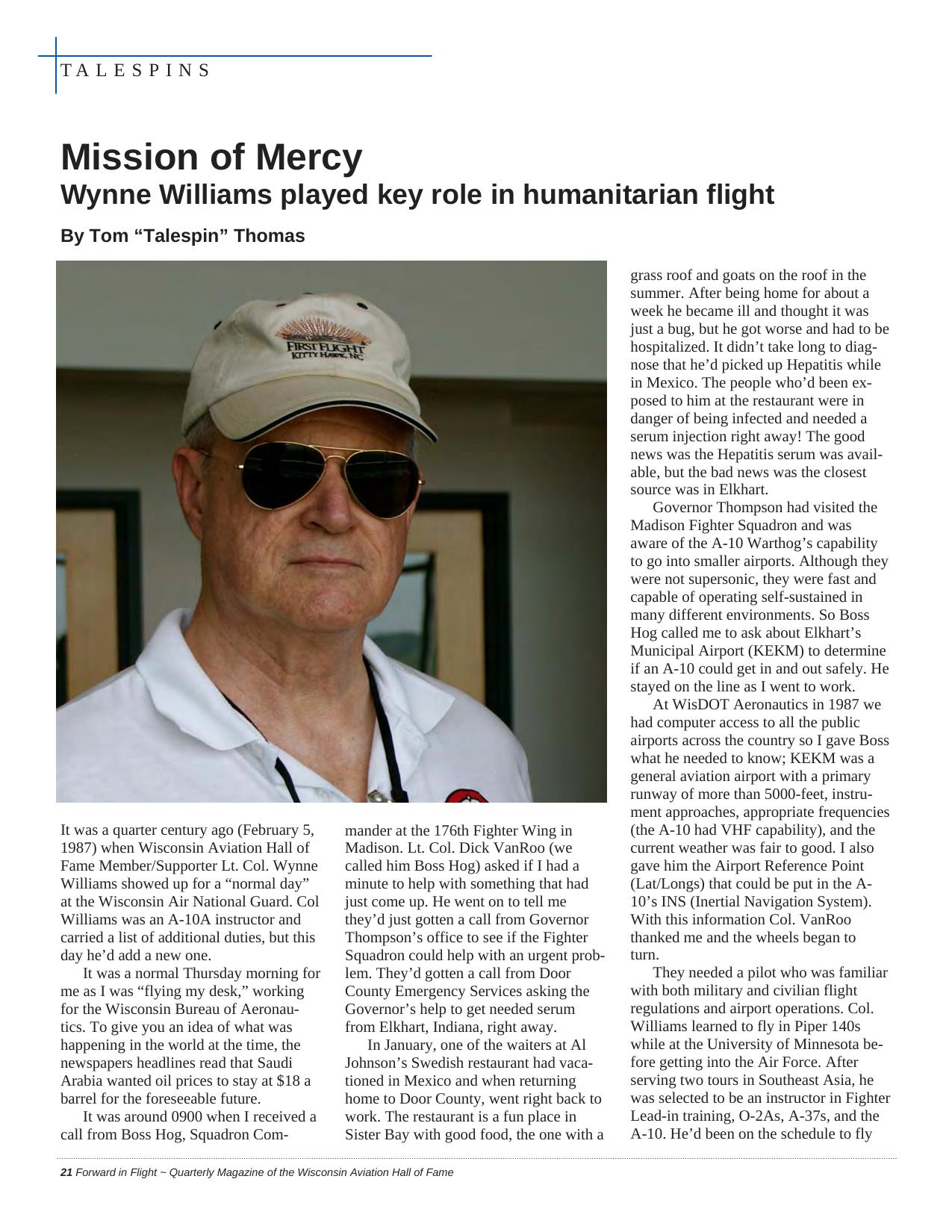
TA L E S P I N S Mission of Mercy Wynne Williams played key role in humanitarian flight By Tom “Talespin” Thomas It was a quarter century ago (February 5, 1987) when Wisconsin Aviation Hall of Fame Member/Supporter Lt. Col. Wynne Williams showed up for a “normal day” at the Wisconsin Air National Guard. Col Williams was an A-10A instructor and carried a list of additional duties, but this day he’d add a new one. It was a normal Thursday morning for me as I was “flying my desk,” working for the Wisconsin Bureau of Aeronautics. To give you an idea of what was happening in the world at the time, the newspapers headlines read that Saudi Arabia wanted oil prices to stay at $18 a barrel for the foreseeable future. It was around 0900 when I received a call from Boss Hog, Squadron Com- mander at the 176th Fighter Wing in Madison. Lt. Col. Dick VanRoo (we called him Boss Hog) asked if I had a minute to help with something that had just come up. He went on to tell me they’d just gotten a call from Governor Thompson’s office to see if the Fighter Squadron could help with an urgent problem. They’d gotten a call from Door County Emergency Services asking the Governor’s help to get needed serum from Elkhart, Indiana, right away. In January, one of the waiters at Al Johnson’s Swedish restaurant had vacationed in Mexico and when returning home to Door County, went right back to work. The restaurant is a fun place in Sister Bay with good food, the one with a 21 Forward in Flight ~ Quarterly Magazine of the Wisconsin Aviation Hall of Fame grass roof and goats on the roof in the summer. After being home for about a week he became ill and thought it was just a bug, but he got worse and had to be hospitalized. It didn’t take long to diagnose that he’d picked up Hepatitis while in Mexico. The people who’d been exposed to him at the restaurant were in danger of being infected and needed a serum injection right away! The good news was the Hepatitis serum was available, but the bad news was the closest source was in Elkhart. Governor Thompson had visited the Madison Fighter Squadron and was aware of the A-10 Warthog’s capability to go into smaller airports. Although they were not supersonic, they were fast and capable of operating self-sustained in many different environments. So Boss Hog called me to ask about Elkhart’s Municipal Airport (KEKM) to determine if an A-10 could get in and out safely. He stayed on the line as I went to work. At WisDOT Aeronautics in 1987 we had computer access to all the public airports across the country so I gave Boss what he needed to know; KEKM was a general aviation airport with a primary runway of more than 5000-feet, instrument approaches, appropriate frequencies (the A-10 had VHF capability), and the current weather was fair to good. I also gave him the Airport Reference Point (Lat/Longs) that could be put in the A10’s INS (Inertial Navigation System). With this information Col. VanRoo thanked me and the wheels began to turn. They needed a pilot who was familiar with both military and civilian flight regulations and airport operations. Col. Williams learned to fly in Piper 140s while at the University of Minnesota before getting into the Air Force. After serving two tours in Southeast Asia, he was selected to be an instructor in Fighter Lead-in training, O-2As, A-37s, and the A-10. He’d been on the schedule to fly
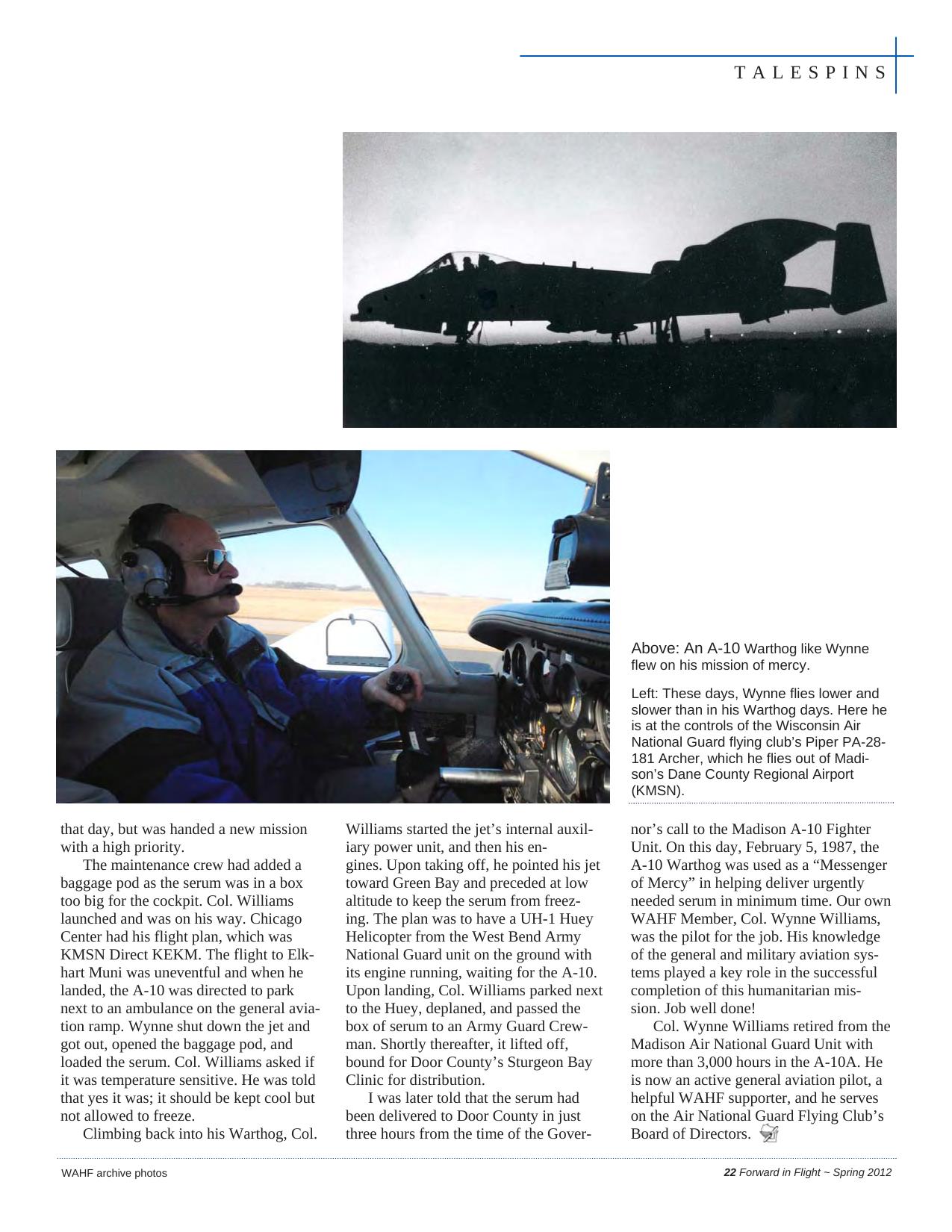
TALESPINS Above: An A-10 Warthog like Wynne flew on his mission of mercy. Left: These days, Wynne flies lower and slower than in his Warthog days. Here he is at the controls of the Wisconsin Air National Guard flying club’s Piper PA-28181 Archer, which he flies out of Madison’s Dane County Regional Airport (KMSN). that day, but was handed a new mission with a high priority. The maintenance crew had added a baggage pod as the serum was in a box too big for the cockpit. Col. Williams launched and was on his way. Chicago Center had his flight plan, which was KMSN Direct KEKM. The flight to Elkhart Muni was uneventful and when he landed, the A-10 was directed to park next to an ambulance on the general aviation ramp. Wynne shut down the jet and got out, opened the baggage pod, and loaded the serum. Col. Williams asked if it was temperature sensitive. He was told that yes it was; it should be kept cool but not allowed to freeze. Climbing back into his Warthog, Col. WAHF archive photos Williams started the jet’s internal auxiliary power unit, and then his engines. Upon taking off, he pointed his jet toward Green Bay and preceded at low altitude to keep the serum from freezing. The plan was to have a UH-1 Huey Helicopter from the West Bend Army National Guard unit on the ground with its engine running, waiting for the A-10. Upon landing, Col. Williams parked next to the Huey, deplaned, and passed the box of serum to an Army Guard Crewman. Shortly thereafter, it lifted off, bound for Door County’s Sturgeon Bay Clinic for distribution. I was later told that the serum had been delivered to Door County in just three hours from the time of the Gover- nor’s call to the Madison A-10 Fighter Unit. On this day, February 5, 1987, the A-10 Warthog was used as a “Messenger of Mercy” in helping deliver urgently needed serum in minimum time. Our own WAHF Member, Col. Wynne Williams, was the pilot for the job. His knowledge of the general and military aviation systems played a key role in the successful completion of this humanitarian mission. Job well done! Col. Wynne Williams retired from the Madison Air National Guard Unit with more than 3,000 hours in the A-10A. He is now an active general aviation pilot, a helpful WAHF supporter, and he serves on the Air National Guard Flying Club’s Board of Directors. 22 Forward in Flight ~ Spring 2012
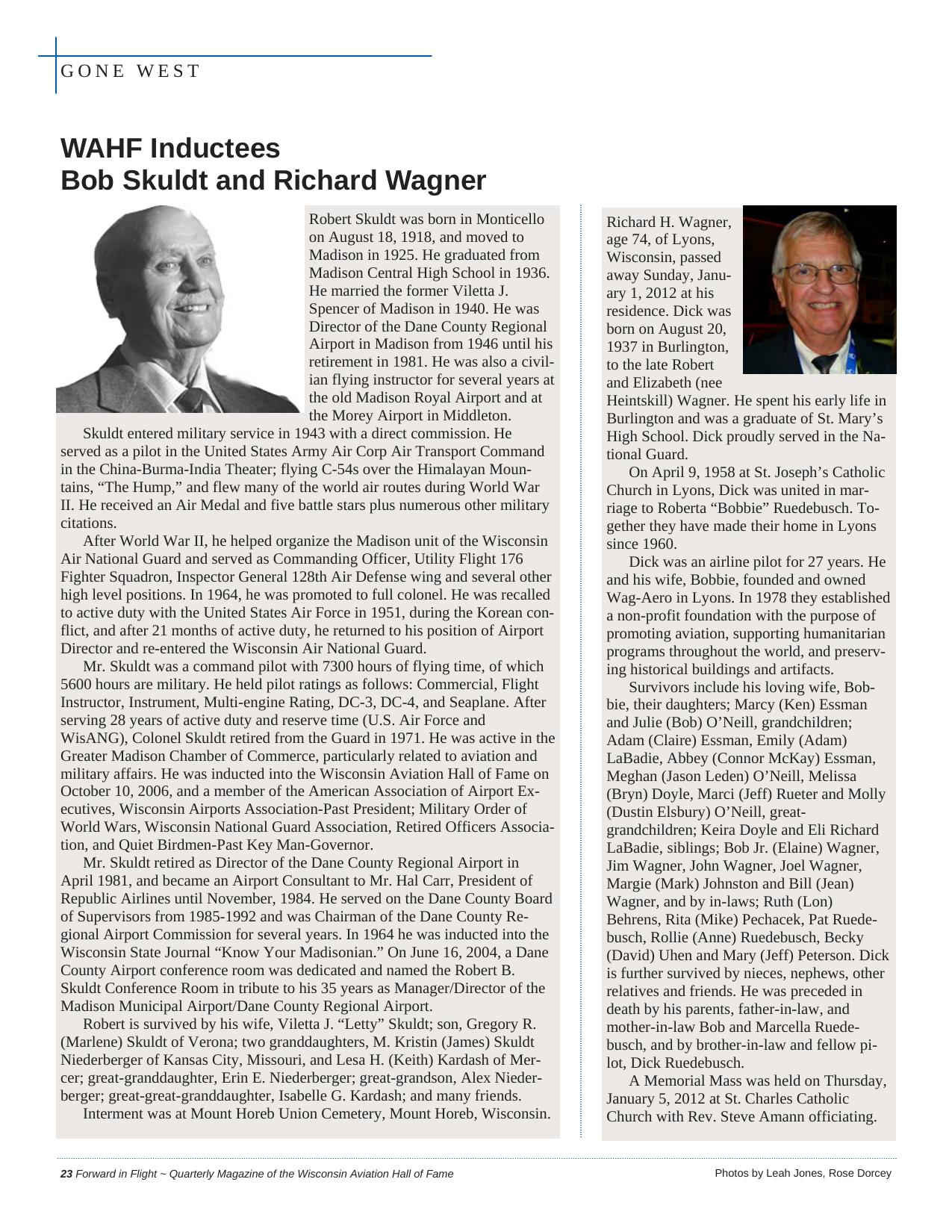
GONE WEST WAHF Inductees Bob Skuldt and Richard Wagner Robert Skuldt was born in Monticello on August 18, 1918, and moved to Madison in 1925. He graduated from Madison Central High School in 1936. He married the former Viletta J. Spencer of Madison in 1940. He was Director of the Dane County Regional Airport in Madison from 1946 until his retirement in 1981. He was also a civilian flying instructor for several years at the old Madison Royal Airport and at the Morey Airport in Middleton. Skuldt entered military service in 1943 with a direct commission. He served as a pilot in the United States Army Air Corp Air Transport Command in the China-Burma-India Theater; flying C-54s over the Himalayan Mountains, “The Hump,” and flew many of the world air routes during World War II. He received an Air Medal and five battle stars plus numerous other military citations. After World War II, he helped organize the Madison unit of the Wisconsin Air National Guard and served as Commanding Officer, Utility Flight 176 Fighter Squadron, Inspector General 128th Air Defense wing and several other high level positions. In 1964, he was promoted to full colonel. He was recalled to active duty with the United States Air Force in 1951, during the Korean conflict, and after 21 months of active duty, he returned to his position of Airport Director and re-entered the Wisconsin Air National Guard. Mr. Skuldt was a command pilot with 7300 hours of flying time, of which 5600 hours are military. He held pilot ratings as follows: Commercial, Flight Instructor, Instrument, Multi-engine Rating, DC-3, DC-4, and Seaplane. After serving 28 years of active duty and reserve time (U.S. Air Force and WisANG), Colonel Skuldt retired from the Guard in 1971. He was active in the Greater Madison Chamber of Commerce, particularly related to aviation and military affairs. He was inducted into the Wisconsin Aviation Hall of Fame on October 10, 2006, and a member of the American Association of Airport Executives, Wisconsin Airports Association-Past President; Military Order of World Wars, Wisconsin National Guard Association, Retired Officers Association, and Quiet Birdmen-Past Key Man-Governor. Mr. Skuldt retired as Director of the Dane County Regional Airport in April 1981, and became an Airport Consultant to Mr. Hal Carr, President of Republic Airlines until November, 1984. He served on the Dane County Board of Supervisors from 1985-1992 and was Chairman of the Dane County Regional Airport Commission for several years. In 1964 he was inducted into the Wisconsin State Journal “Know Your Madisonian.” On June 16, 2004, a Dane County Airport conference room was dedicated and named the Robert B. Skuldt Conference Room in tribute to his 35 years as Manager/Director of the Madison Municipal Airport/Dane County Regional Airport. Robert is survived by his wife, Viletta J. “Letty” Skuldt; son, Gregory R. (Marlene) Skuldt of Verona; two granddaughters, M. Kristin (James) Skuldt Niederberger of Kansas City, Missouri, and Lesa H. (Keith) Kardash of Mercer; great-granddaughter, Erin E. Niederberger; great-grandson, Alex Niederberger; great-great-granddaughter, Isabelle G. Kardash; and many friends. Interment was at Mount Horeb Union Cemetery, Mount Horeb, Wisconsin. 23 Forward in Flight ~ Quarterly Magazine of the Wisconsin Aviation Hall of Fame Richard H. Wagner, age 74, of Lyons, Wisconsin, passed away Sunday, January 1, 2012 at his residence. Dick was born on August 20, 1937 in Burlington, to the late Robert and Elizabeth (nee Heintskill) Wagner. He spent his early life in Burlington and was a graduate of St. Mary’s High School. Dick proudly served in the National Guard. On April 9, 1958 at St. Joseph’s Catholic Church in Lyons, Dick was united in marriage to Roberta “Bobbie” Ruedebusch. Together they have made their home in Lyons since 1960. Dick was an airline pilot for 27 years. He and his wife, Bobbie, founded and owned Wag-Aero in Lyons. In 1978 they established a non-profit foundation with the purpose of promoting aviation, supporting humanitarian programs throughout the world, and preserving historical buildings and artifacts. Survivors include his loving wife, Bobbie, their daughters; Marcy (Ken) Essman and Julie (Bob) O’Neill, grandchildren; Adam (Claire) Essman, Emily (Adam) LaBadie, Abbey (Connor McKay) Essman, Meghan (Jason Leden) O’Neill, Melissa (Bryn) Doyle, Marci (Jeff) Rueter and Molly (Dustin Elsbury) O’Neill, greatgrandchildren; Keira Doyle and Eli Richard LaBadie, siblings; Bob Jr. (Elaine) Wagner, Jim Wagner, John Wagner, Joel Wagner, Margie (Mark) Johnston and Bill (Jean) Wagner, and by in-laws; Ruth (Lon) Behrens, Rita (Mike) Pechacek, Pat Ruedebusch, Rollie (Anne) Ruedebusch, Becky (David) Uhen and Mary (Jeff) Peterson. Dick is further survived by nieces, nephews, other relatives and friends. He was preceded in death by his parents, father-in-law, and mother-in-law Bob and Marcella Ruedebusch, and by brother-in-law and fellow pilot, Dick Ruedebusch. A Memorial Mass was held on Thursday, January 5, 2012 at St. Charles Catholic Church with Rev. Steve Amann officiating. Photos by Leah Jones, Rose Dorcey
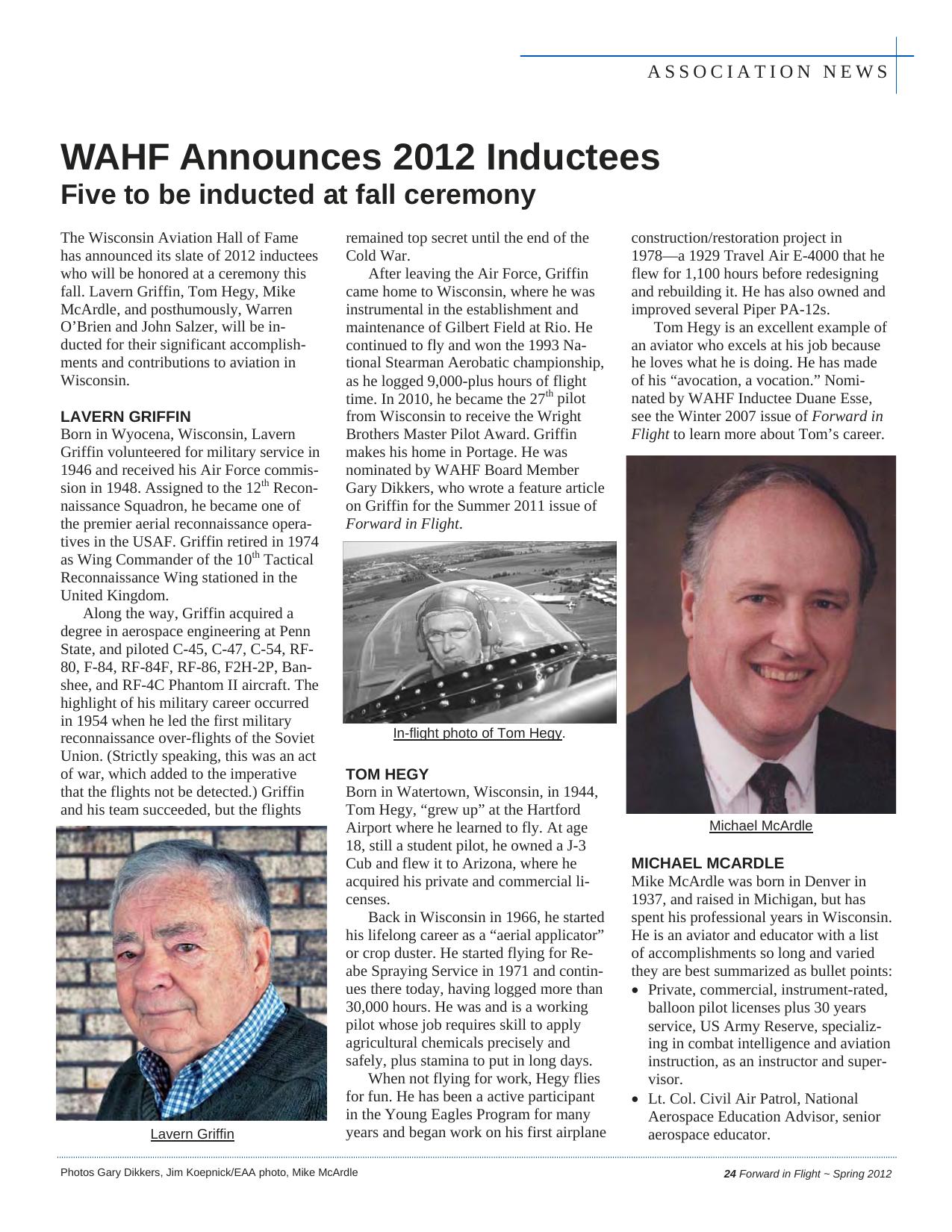
ASSOCIATION NEWS WAHF Announces 2012 Inductees Five to be inducted at fall ceremony The Wisconsin Aviation Hall of Fame has announced its slate of 2012 inductees who will be honored at a ceremony this fall. Lavern Griffin, Tom Hegy, Mike McArdle, and posthumously, Warren O’Brien and John Salzer, will be inducted for their significant accomplishments and contributions to aviation in Wisconsin. LAVERN GRIFFIN Born in Wyocena, Wisconsin, Lavern Griffin volunteered for military service in 1946 and received his Air Force commission in 1948. Assigned to the 12th Reconnaissance Squadron, he became one of the premier aerial reconnaissance operatives in the USAF. Griffin retired in 1974 as Wing Commander of the 10th Tactical Reconnaissance Wing stationed in the United Kingdom. Along the way, Griffin acquired a degree in aerospace engineering at Penn State, and piloted C-45, C-47, C-54, RF80, F-84, RF-84F, RF-86, F2H-2P, Banshee, and RF-4C Phantom II aircraft. The highlight of his military career occurred in 1954 when he led the first military reconnaissance over-flights of the Soviet Union. (Strictly speaking, this was an act of war, which added to the imperative that the flights not be detected.) Griffin and his team succeeded, but the flights Lavern Griffin remained top secret until the end of the Cold War. After leaving the Air Force, Griffin came home to Wisconsin, where he was instrumental in the establishment and maintenance of Gilbert Field at Rio. He continued to fly and won the 1993 National Stearman Aerobatic championship, as he logged 9,000-plus hours of flight time. In 2010, he became the 27th pilot from Wisconsin to receive the Wright Brothers Master Pilot Award. Griffin makes his home in Portage. He was nominated by WAHF Board Member Gary Dikkers, who wrote a feature article on Griffin for the Summer 2011 issue of Forward in Flight. construction/restoration project in 1978—a 1929 Travel Air E-4000 that he flew for 1,100 hours before redesigning and rebuilding it. He has also owned and improved several Piper PA-12s. Tom Hegy is an excellent example of an aviator who excels at his job because he loves what he is doing. He has made of his “avocation, a vocation.” Nominated by WAHF Inductee Duane Esse, see the Winter 2007 issue of Forward in Flight to learn more about Tom’s career. In-flight photo of Tom Hegy. TOM HEGY Born in Watertown, Wisconsin, in 1944, Tom Hegy, “grew up” at the Hartford Airport where he learned to fly. At age 18, still a student pilot, he owned a J-3 Cub and flew it to Arizona, where he acquired his private and commercial licenses. Back in Wisconsin in 1966, he started his lifelong career as a “aerial applicator” or crop duster. He started flying for Reabe Spraying Service in 1971 and continues there today, having logged more than 30,000 hours. He was and is a working pilot whose job requires skill to apply agricultural chemicals precisely and safely, plus stamina to put in long days. When not flying for work, Hegy flies for fun. He has been a active participant in the Young Eagles Program for many years and began work on his first airplane Photos Gary Dikkers, Jim Koepnick/EAA photo, Mike McArdle Michael McArdle MICHAEL MCARDLE Mike McArdle was born in Denver in 1937, and raised in Michigan, but has spent his professional years in Wisconsin. He is an aviator and educator with a list of accomplishments so long and varied they are best summarized as bullet points: Private, commercial, instrument-rated, balloon pilot licenses plus 30 years service, US Army Reserve, specializing in combat intelligence and aviation instruction, as an instructor and supervisor. Lt. Col. Civil Air Patrol, National Aerospace Education Advisor, senior aerospace educator. 24 Forward in Flight ~ Spring 2012
ASSOCIATION NEWS Recipient of numerous state and national education awards, including the Crown Circle Award of the National Conference on Aviation and Space Education. As a Phd student at UW-Madison, (1960s-’70s) he acquired a Cessna 175 to better perform his job as supervisor of public school interns (practice teachers) throughout the state, flying instead of driving. As a teacher in the Madison Schools in 1972, he persuaded the school board to incorporate airplane experience in the curriculum for students of geography and aviation—first of its kind in Wisconsin. He revised the curriculum to allow students to study aviation related subjects for five years, more than any school system in the state. As a successful, lifelong educator, McArdle has created a legacy of people who have made aviation their life’s work because of the education, training, and inspiration they received at his hands. He lives in Madison and was also featured in a past issue of Forward in Flight, Summer 2011. Warren O’Brien and John Salzer will be inducted in WAHF’s Pioneer category, for aviators who made significant accomplishments and contributions to aviation before 1927. JOHN P. SALZER John Salzer was a prominent La Crosse businessman with an early interest in aviation. In 1911, he led the effort for La Crosse to take part in Hugh Robinson’s Mississippi Valley flight and welcomed him when Robinson landed. Property he and his family owned on the edge of La Crosse (now Trane Co.) was used as a landing field by touring aviators as early as 1918. In 1919, the Salzers leased the property to the city for an airport. It was one of the first municipal airports in Wisconsin. The airport was one of two places in Wisconsin on the “experimental” air mail route of 1919-1921. Salzer was also elected president of the local chapter of the Aero Club, the national aviation booster club. Salzer is worthy of induction as a pioneer, not as an aviator himself, but as a community leader who supported aviation in its fledgling days. WARREN O’BRIEN Aerial photography was a novel and hazardous undertaking when Waukesha photographer Warren O’Brien began taking pictures from the cockpit of a JN in 1924. He later mastered wing-walking and took photos while perched on the wing. In time he acquired a movie camera and shot motion pictures while aloft. A professional who made his living as a commercial photographer, O’Brien loved flying. He was a pilot and one of the founders of the Waukesha Flying (Aviation) Club, which survives today. He was an advocate for construction of an airport at Waukesha. A historian also, O’Brien researched, wrote, supplied the photos for, and published several books on aviation in Waukesha County. He left behind an archive with hundreds of photos depicting the aviation history of Waukesha and Wisconsin. As a photographer who made a commitment to aviation in the mid-1920s, O’Brien is a pioneer of aviation in our state. 2012 INDUCTION CEREMONY Details on this year’s induction banquet, which will be held in fall, will be announced in the Summer 2012 issue of Forward in Flight. The event includes dinner, music, and presentation of our 2012 scholarships, along with a silent auction, in addition to the induction ceremony. All current WAHF members will receive an invitation and encouraged to attend. Wisconsin’s Largest Full-Service General Aviation Provider Air Charter Flight Training Aircraft Rental Aircraft Management Avionics Interiors Aircraft Sales 25 Forward in Flight ~ Quarterly Magazine of the Wisconsin Aviation Hall of Fame Madison (MSN) Watertown (RYV) Dane County Regional Airport Watertown Municipal Airport Dodge County Airport Juneau (UNU) 608-268-5000 920-261-4567 920-386-2402
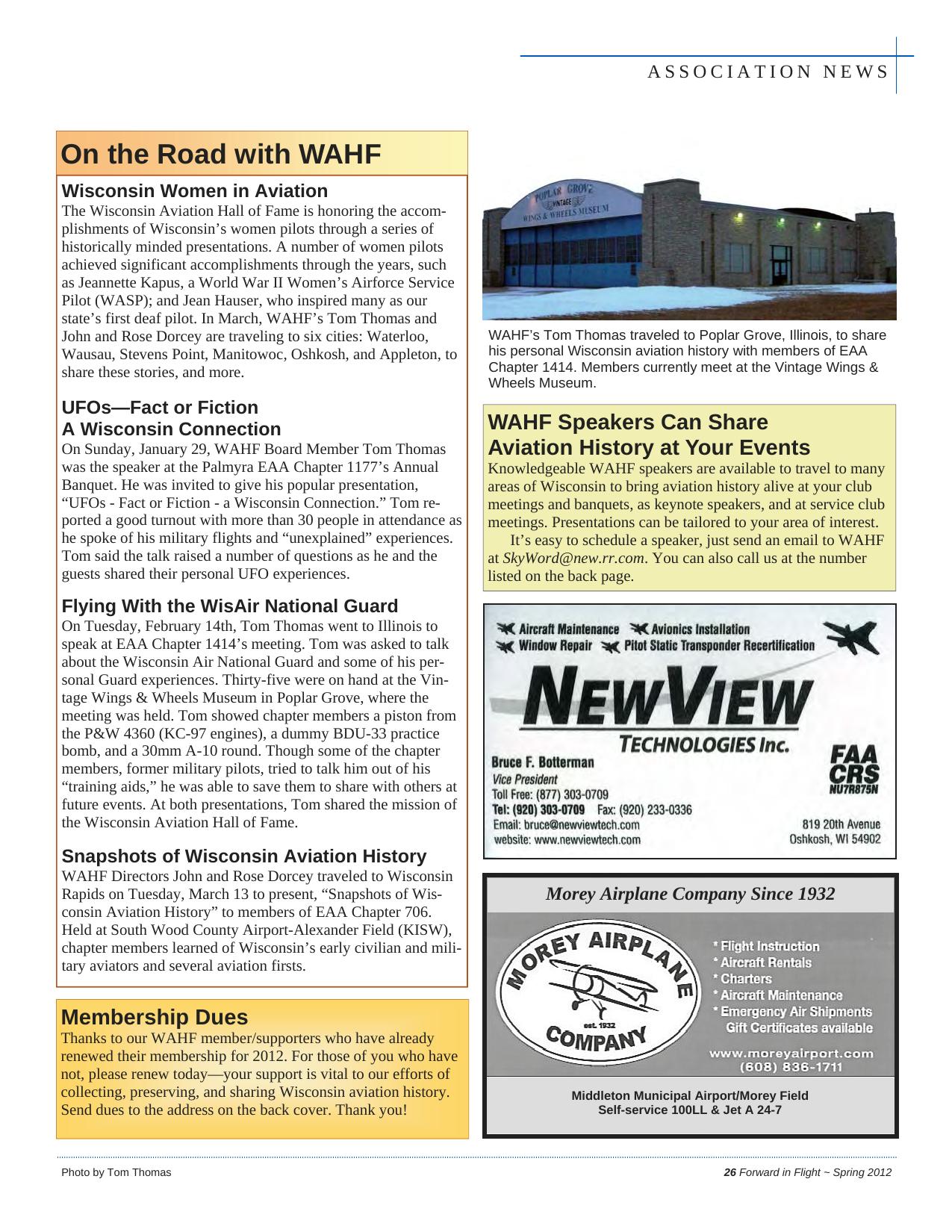
ASSOCIATION NEWS On the Road with WAHF Wisconsin Women in Aviation The Wisconsin Aviation Hall of Fame is honoring the accomplishments of Wisconsin’s women pilots through a series of historically minded presentations. A number of women pilots achieved significant accomplishments through the years, such as Jeannette Kapus, a World War II Women’s Airforce Service Pilot (WASP); and Jean Hauser, who inspired many as our state’s first deaf pilot. In March, WAHF’s Tom Thomas and John and Rose Dorcey are traveling to six cities: Waterloo, Wausau, Stevens Point, Manitowoc, Oshkosh, and Appleton, to share these stories, and more. UFOs—Fact or Fiction A Wisconsin Connection On Sunday, January 29, WAHF Board Member Tom Thomas was the speaker at the Palmyra EAA Chapter 1177’s Annual Banquet. He was invited to give his popular presentation, “UFOs - Fact or Fiction - a Wisconsin Connection.” Tom reported a good turnout with more than 30 people in attendance as he spoke of his military flights and “unexplained” experiences. Tom said the talk raised a number of questions as he and the guests shared their personal UFO experiences. WAHF’s Tom Thomas traveled to Poplar Grove, Illinois, to share his personal Wisconsin aviation history with members of EAA Chapter 1414. Members currently meet at the Vintage Wings & Wheels Museum. WAHF Speakers Can Share Aviation History at Your Events Knowledgeable WAHF speakers are available to travel to many areas of Wisconsin to bring aviation history alive at your club meetings and banquets, as keynote speakers, and at service club meetings. Presentations can be tailored to your area of interest. It’s easy to schedule a speaker, just send an email to WAHF at SkyWord@new.rr.com. You can also call us at the number listed on the back page. Flying With the WisAir National Guard On Tuesday, February 14th, Tom Thomas went to Illinois to speak at EAA Chapter 1414’s meeting. Tom was asked to talk about the Wisconsin Air National Guard and some of his personal Guard experiences. Thirty-five were on hand at the Vintage Wings & Wheels Museum in Poplar Grove, where the meeting was held. Tom showed chapter members a piston from the P&W 4360 (KC-97 engines), a dummy BDU-33 practice bomb, and a 30mm A-10 round. Though some of the chapter members, former military pilots, tried to talk him out of his “training aids,” he was able to save them to share with others at future events. At both presentations, Tom shared the mission of the Wisconsin Aviation Hall of Fame. Snapshots of Wisconsin Aviation History WAHF Directors John and Rose Dorcey traveled to Wisconsin Rapids on Tuesday, March 13 to present, “Snapshots of Wisconsin Aviation History” to members of EAA Chapter 706. Held at South Wood County Airport-Alexander Field (KISW), chapter members learned of Wisconsin’s early civilian and military aviators and several aviation firsts. Morey Airplane Company Since 1932 Membership Dues Thanks to our WAHF member/supporters who have already renewed their membership for 2012. For those of you who have not, please renew today—your support is vital to our efforts of collecting, preserving, and sharing Wisconsin aviation history. Send dues to the address on the back cover. Thank you! Photo by Tom Thomas Middleton Municipal Airport/Morey Field Self-service 100LL & Jet A 24-7 26 Forward in Flight ~ Spring 2012
FROM THE AIRWAYS Oshkosh Women in Aviation Sets Date for 2012 ‘Frosting for Flight’ Cupcake Competition The Oshkosh Women in Aviation Chapter has set the date for its second annual Frosting for Flight cupcake competition to raise funds for its $500 Spirit of Flight Scholarship. Mark your calendar for Saturday, October 6, to taste a variety of cupcakes and help the chapter meet its fundraising goals. The event will be held at Wittman Regional Airport (KOSH) in Oshkosh, Wisconsin, from 1 - 4 p.m. A panel of judges will determine the overall winner, while a $5 entry fee allows guests to sample all of the cupcakes and vote for the crowd favorite. In 2011, eight teams competed in the competition. Teams were instructed to choose a flavor and then carry out a theme through table decoration and costume. The teams chose widely varied themes and flavors, including Lemon-Cranberry, TequilaLime, Tiramisu, and Boston Crème cupcakes. For more details on the 2012 Frosting for Flight Cupcake Competition or the Spirit of Flight Scholarship, visit www.WAIOshkosh.org. Charles Boie to present ‘History of MKE’ program in West Allis WAHF Member/Supporter Charles Boie will make a presentation on the history of Milwaukee’s General Mitchell International Airport (KMKE) at the West Allis Historical Society on Monday, April 16, 2012. The presentation begins at 7 p.m. and is open to the public. Located at the corner of South 84th Street and West National Avenue, at 8405 West National Avenue, West Allis, the historical society is located in a historic schoolhouse. Their website can be found at www.WestAllisHistory.org. Wisconsin Aviation Conference Set for May 7-9 The 57th Annual Wisconsin Aviation Conference will be held at the Chula Vista Resort in Wisconsin Dells from May 7-9, 2012. The conference features a number of informational sessions of interest to airport managers, airport commission members, pilots, and those engaged in aviation trades. In addition, a number of awards will be presented. To register, visit www.WIAMA.org or call Wisconsin Airport Management Association Executive Director Peter Drahn for more information, at 715-358-2802. FAA Safety Seminar in Oshkosh The Winnebago Flying Club will host an FAA safety seminar on Saturday, April 28 from 9 a.m.-12 p.m. Wisconsin FAASTeam representatives Keith Myers, Tim Lemke, and John Dorcey present these topics: Getting Started in Flying, Tips to Reduce the Cost of Flying, and Staying Current as a Pilot. The event takes place in the Wittman Regional Airport Terminal Conference Room. The club will provide breakfast items. For more information, call Keith Myers at 715-754-2824. Kestrel Aircraft to Locate in Superior Kestrel Aircraft Corporation will locate its headquarters and manufacturing facilities in Superior, Wisconsin. Kestrel will begin construction of its Winter Street composite plant this spring and in 2013 will begin construction of its assembly plant at the Richard I. Bong Airport (KSUW) in Superior. The Kestrel Aircraft Project (the “Kestrel K-350” or “K-350”) is expected to provide the State of Wisconsin a company that will generate up to 600 permanent, non-seasonal jobs in a high tech industry by 2016. Kestrel Aircraft is a new airplane company led by general aviation entrepreneur, Alan Klapmeier. Based on the original work done by Farnborough Aircraft, the Kestrel airplane will be a six to eight seat, all composite, single-engine turboprop aircraft with the newest technologies available in personal and business aircraft. For more information visit www.kestrel.aero. 27 Forward in Flight ~ Quarterly Magazine of the Wisconsin Aviation Hall of Fame
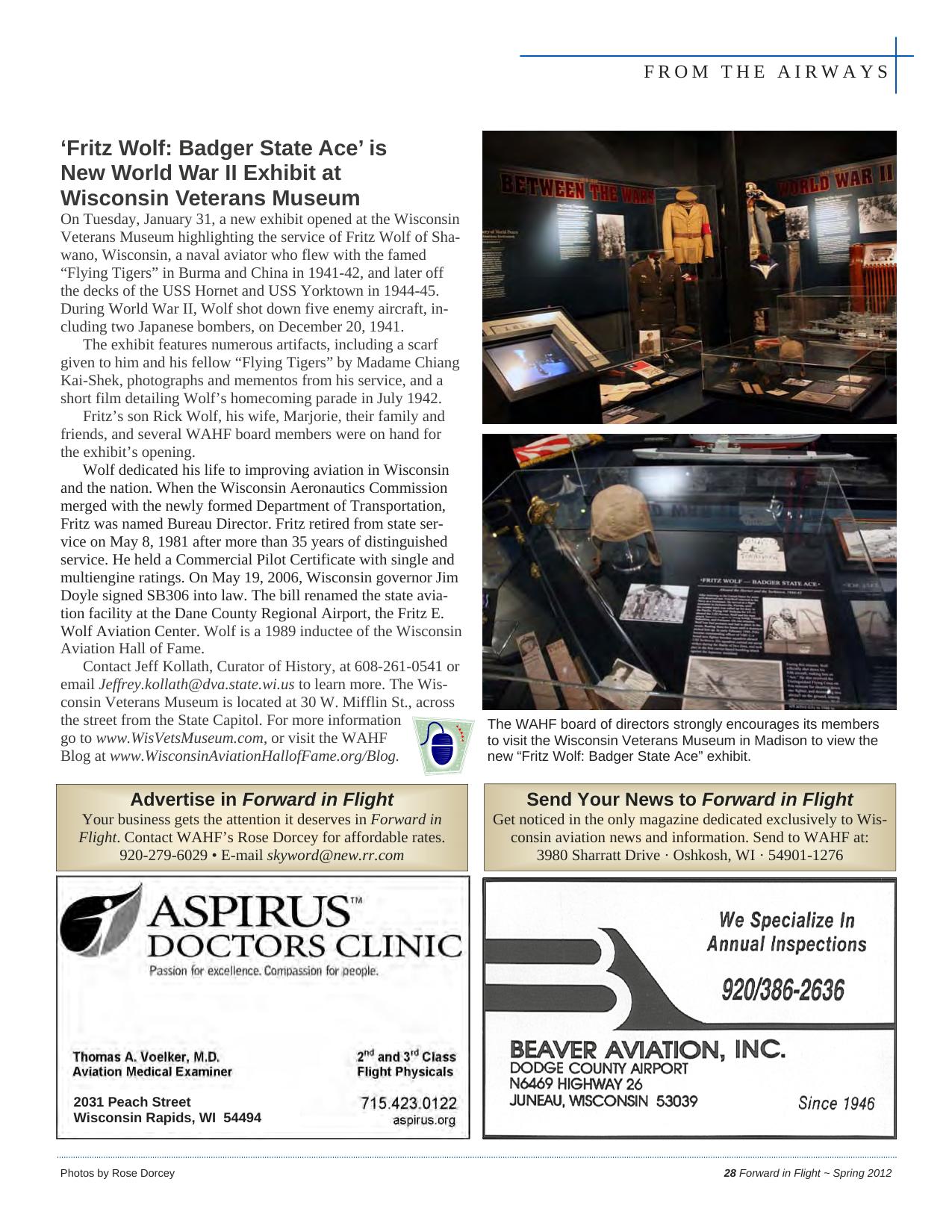
FROM THE AIRWAYS ‘Fritz Wolf: Badger State Ace’ is New World War II Exhibit at Wisconsin Veterans Museum On Tuesday, January 31, a new exhibit opened at the Wisconsin Veterans Museum highlighting the service of Fritz Wolf of Shawano, Wisconsin, a naval aviator who flew with the famed “Flying Tigers” in Burma and China in 1941-42, and later off the decks of the USS Hornet and USS Yorktown in 1944-45. During World War II, Wolf shot down five enemy aircraft, including two Japanese bombers, on December 20, 1941. The exhibit features numerous artifacts, including a scarf given to him and his fellow “Flying Tigers” by Madame Chiang Kai-Shek, photographs and mementos from his service, and a short film detailing Wolf’s homecoming parade in July 1942. Fritz’s son Rick Wolf, his wife, Marjorie, their family and friends, and several WAHF board members were on hand for the exhibit’s opening. Wolf dedicated his life to improving aviation in Wisconsin and the nation. When the Wisconsin Aeronautics Commission merged with the newly formed Department of Transportation, Fritz was named Bureau Director. Fritz retired from state service on May 8, 1981 after more than 35 years of distinguished service. He held a Commercial Pilot Certificate with single and multiengine ratings. On May 19, 2006, Wisconsin governor Jim Doyle signed SB306 into law. The bill renamed the state aviation facility at the Dane County Regional Airport, the Fritz E. Wolf Aviation Center. Wolf is a 1989 inductee of the Wisconsin Aviation Hall of Fame. Contact Jeff Kollath, Curator of History, at 608-261-0541 or email Jeffrey.kollath@dva.state.wi.us to learn more. The Wisconsin Veterans Museum is located at 30 W. Mifflin St., across the street from the State Capitol. For more information go to www.WisVetsMuseum.com, or visit the WAHF Blog at www.WisconsinAviationHallofFame.org/Blog. The WAHF board of directors strongly encourages its members to visit the Wisconsin Veterans Museum in Madison to view the new “Fritz Wolf: Badger State Ace” exhibit. Advertise in Forward in Flight Send Your News to Forward in Flight Your business gets the attention it deserves in Forward in Flight. Contact WAHF’s Rose Dorcey for affordable rates. 920-279-6029 • E-mail skyword@new.rr.com Get noticed in the only magazine dedicated exclusively to Wisconsin aviation news and information. Send to WAHF at: 3980 Sharratt Drive · Oshkosh, WI · 54901-1276 2031 Peach Street Wisconsin Rapids, WI 54494 Photos by Rose Dorcey 28 Forward in Flight ~ Spring 2012
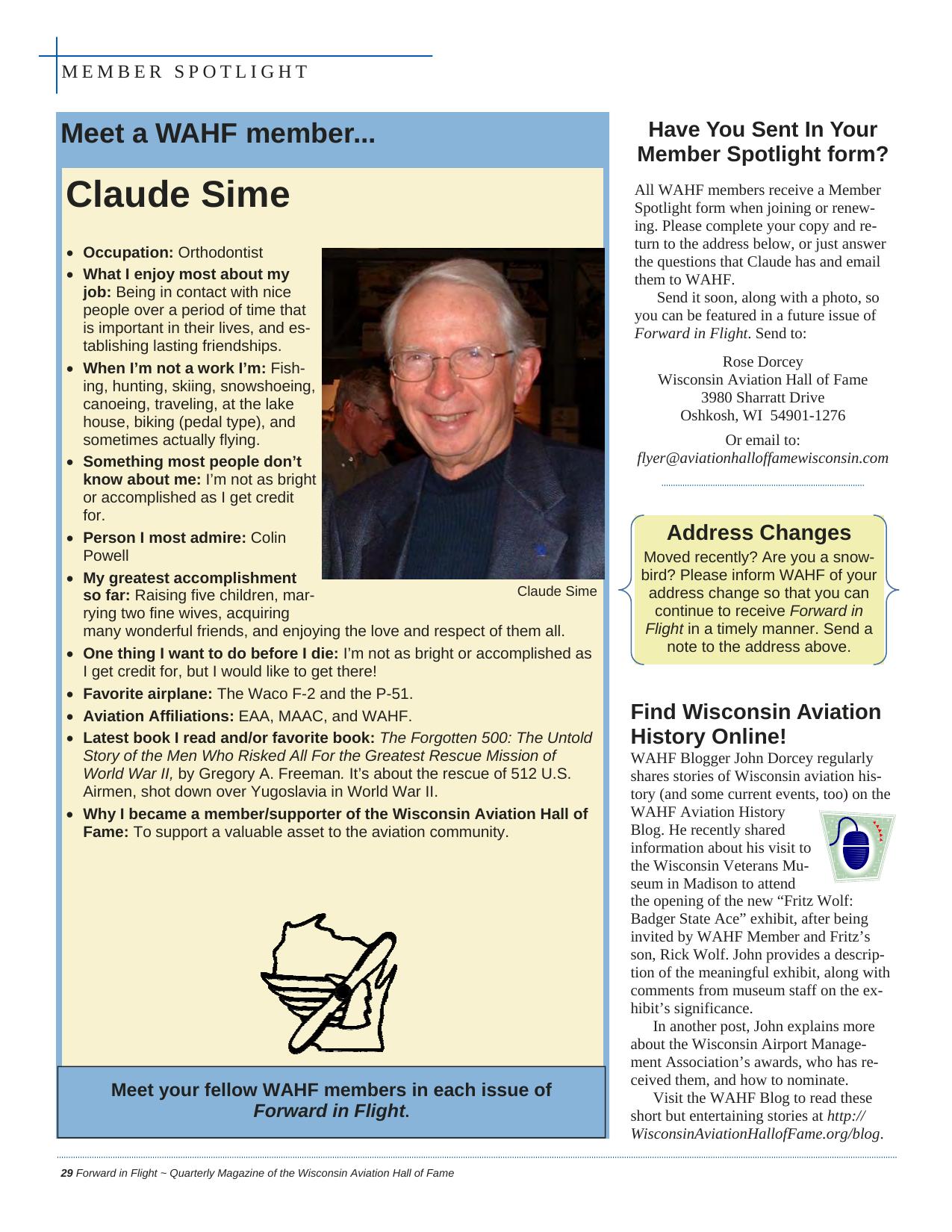
MEMBER SPOTLIGHT Meet a WAHF member... Have You Sent In Your Member Spotlight form? Claude Sime All WAHF members receive a Member Spotlight form when joining or renewing. Please complete your copy and return to the address below, or just answer the questions that Claude has and email them to WAHF. Send it soon, along with a photo, so you can be featured in a future issue of Forward in Flight. Send to: Occupation: Orthodontist What I enjoy most about my job: Being in contact with nice people over a period of time that is important in their lives, and establishing lasting friendships. When I’m not a work I’m: Fishing, hunting, skiing, snowshoeing, canoeing, traveling, at the lake house, biking (pedal type), and sometimes actually flying. Something most people don’t know about me: I’m not as bright or accomplished as I get credit for. Person I most admire: Colin Powell My greatest accomplishment Claude Sime so far: Raising five children, marrying two fine wives, acquiring many wonderful friends, and enjoying the love and respect of them all. One thing I want to do before I die: I’m not as bright or accomplished as I get credit for, but I would like to get there! Favorite airplane: The Waco F-2 and the P-51. Aviation Affiliations: EAA, MAAC, and WAHF. Latest book I read and/or favorite book: The Forgotten 500: The Untold Story of the Men Who Risked All For the Greatest Rescue Mission of World War II, by Gregory A. Freeman. It’s about the rescue of 512 U.S. Airmen, shot down over Yugoslavia in World War II. Why I became a member/supporter of the Wisconsin Aviation Hall of Fame: To support a valuable asset to the aviation community. Meet your fellow WAHF members in each issue of Forward in Flight. 29 Forward in Flight ~ Quarterly Magazine of the Wisconsin Aviation Hall of Fame Rose Dorcey Wisconsin Aviation Hall of Fame 3980 Sharratt Drive Oshkosh, WI 54901-1276 Or email to: flyer@aviationhalloffamewisconsin.com Address Changes Moved recently? Are you a snowbird? Please inform WAHF of your address change so that you can continue to receive Forward in Flight in a timely manner. Send a note to the address above. Find Wisconsin Aviation History Online! WAHF Blogger John Dorcey regularly shares stories of Wisconsin aviation history (and some current events, too) on the WAHF Aviation History Blog. He recently shared information about his visit to the Wisconsin Veterans Museum in Madison to attend the opening of the new “Fritz Wolf: Badger State Ace” exhibit, after being invited by WAHF Member and Fritz’s son, Rick Wolf. John provides a description of the meaningful exhibit, along with comments from museum staff on the exhibit’s significance. In another post, John explains more about the Wisconsin Airport Management Association’s awards, who has received them, and how to nominate. Visit the WAHF Blog to read these short but entertaining stories at http:// WisconsinAviationHallofFame.org/blog.
Subscribe to Forward in Flight today! Annual subscription includes one-year WAHF membership Membership Benefits: Quarterly subscription (4 issues) of Forward in Flight, packed full of Wisconsin aviation news, events, state aviation history, and stories about your aviation colleagues Free pass to Deke Slayton Museum Invitation to annual induction banquet Name Address City State Zip Pam & Pat O’Malley Phone Number Pat O’Malley’s Email Jet Room Restaurant Referred By Just $20, and you’ll be supporting an aviation organization dedicated to collecting, preserving, and sharing Wisconsin’s aviation history. With Forward in Flight, you’ll learn about aviation history makers—the people, places, and events that distinguish our state and also be in touch with current Wisconsin aviation news and information. Send your check today! Please write check to: Wisconsin Aviation Hall of Fame, Inc. Mail to: John Dorcey, Treasurer Wisconsin Aviation Hall of Fame 3980 Sharratt Drive Oshkosh WI 54901-1276 Wisconsin Aviation Bldg. Dane County Regional Airport Madison, Wis. (MSN) Breakfast & Lunch 6 a.m. - 2 p.m. Mon. thru Sat. 8 a.m. - 2 p.m. Sunday 608-268-5010 www.JetRoomRestaurant.com Plan to attend the 2012 WISCONSIN AVIATION CONFERENCE 2012 Wisconsin Aviation Conference May 7 - 9 Chula Vista Resort Wisconsin Dells More information: www.WIAMA.org Whether you’re a pilot, airport manager, airport commission member, fixed base operator or other aviation service provider, you’ll want to attend. Educational sessions, from social me- Hear from state and federal aviation reps dia marketing to student pilot retention Networking opportunities to airport/FBO insurance. Vendor exhibits and aviation awards Sponsored by the Wisconsin Airport Management Association, Wisconsin Aviation Trades Association, Wisconsin Business Aviation Association, consultants and suppliers. Register Online Or call Pete Drahn at 715-358-2802 for more information. Welcome Activities Golf Tournament Sporting Clays Shoot Don’t miss it! 30 Forward in Flight ~ Spring 2012
PRSRT STD US Postage Paid Wisc Rapids WI Permit 98 WISCONSIN AVIATION HALL OF FAME 3980 SHARRATT DRIVE OSHKOSH WI 54901-1276 Wisconsin Aviation Hall of Fame A Membership Organization Dedicated to Preserving the Past Fostering the Future of Flight Change Service Requested Welcome WAHF Member/Supporters: William K. Adams Belinda Adams Keith Mathews Bill Plendl *Upgrade to Lifetime Membership Bret Esse Allan Lomer* —Thanks for coming on board WAHF Renewals—If you haven’t already, please renew today! There are still a handful of members who haven’t renewed WAHF membership for 2012. Please consider sending your renewal dues today, as membership dues are truly the lifeblood of this organization. Plus, don’t let this issue of Forward in Flight be your last, please renew today! If you have questions about your membership, please call Rose at 920-385-1483. Congratulations to Jet Air—Offering New Services in Green Bay Jet Air Services, located at Austin Straubel International Airport (KGRB) in Green Bay, Wisconsin, now offers a Robinson R-22 helicopter for training and other missions. For more information, contact Certified Flight Instructor Eliot Sprague at 920-498-2669 ext. 139. WOW—Women Over Wisconsin There’s still time to see a presentation in March—Women’s History Month—about Wisconsin’s earliest woman pilots and airport managers, their challenges and accomplishments. On Tuesday, March 20, WAHF’s Rose Dorcey will present, “WOW, Women Over Wisconsin,” at the Oshkosh Women in Aviation chapter meeting. The event begins at 6 p.m. in the conference room at Wittman Regional Airport in Oshkosh. Then on Monday, March 26, Rose will give a similar presentation at The History Museum at the Castle in Appleton, beginning at 6:30 p.m. The History Museum at the Castle is located at 330 East College Avenue. Both events are open to the public and no admission will be charged. Wisconsin Aviation Hall of Fame Officers and Board of Directors Rose Dorcey, President Michael Goc, Vice President John Dorcey, Secretary/Treasurer Frederick Beseler Gary Dikkers Rich Fischler Andrew Ovans Charles Swain Tom Thomas Charles Marotske, Honorary Chairman of the Board Wisconsin Aviation Hall of Fame 3980 Sharratt Drive Oshkosh WI 54901-1276 Become a supporter today! For information call Rose Dorcey at 920-385-1483 www.wisconsinaviationhalloffame.org flyer@wisconsinaviationhalloffame.org