Volume 11, Issue 1
🗞️ Download Issue (PDF)
Forward in Flight - Spring 2013
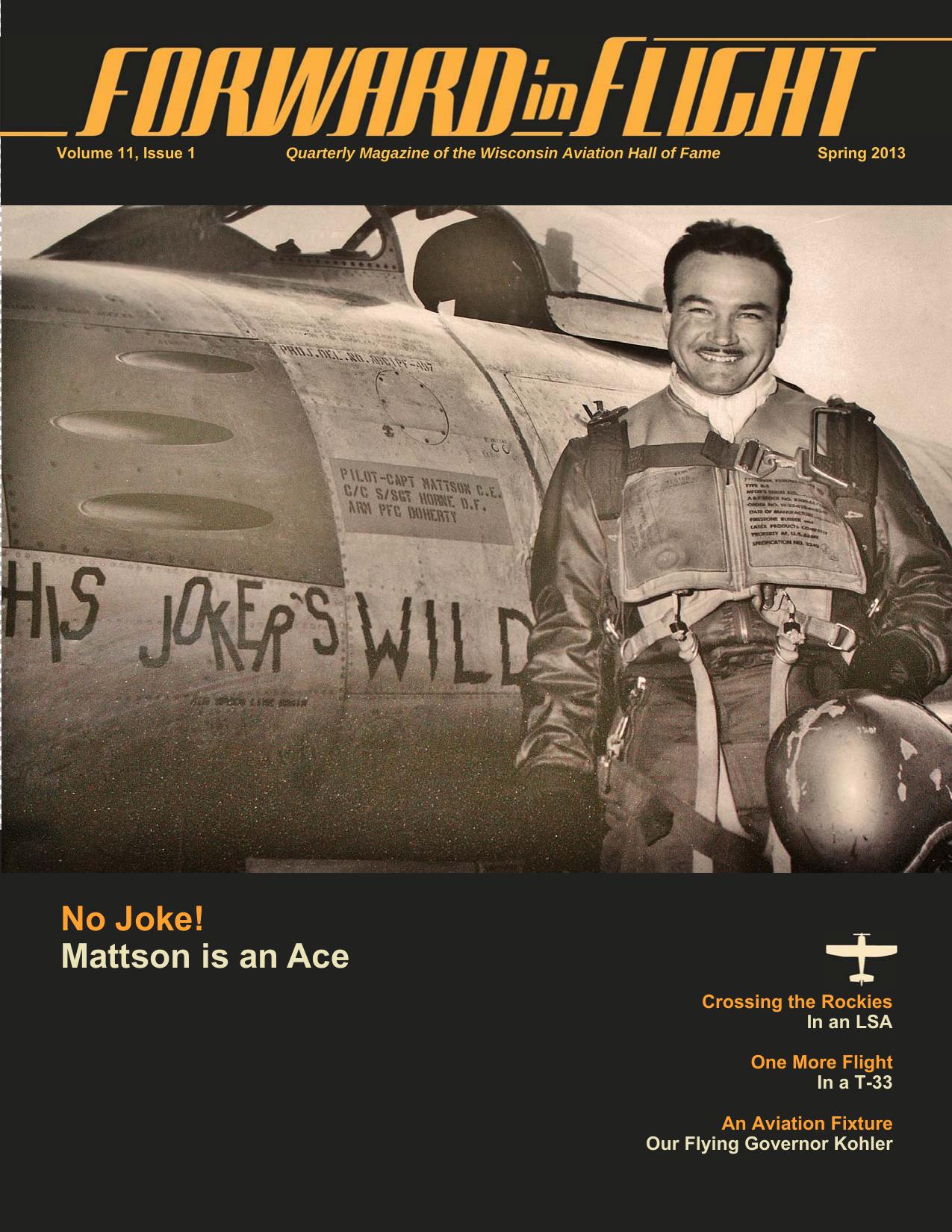
Volume 11, Issue 1 Quarterly Magazine of the Wisconsin Aviation Hall of Fame Spring 2013 No Joke! Mattson is an Ace Crossing the Rockies In an LSA One More Flight In a T-33 An Aviation Fixture Our Flying Governor Kohler
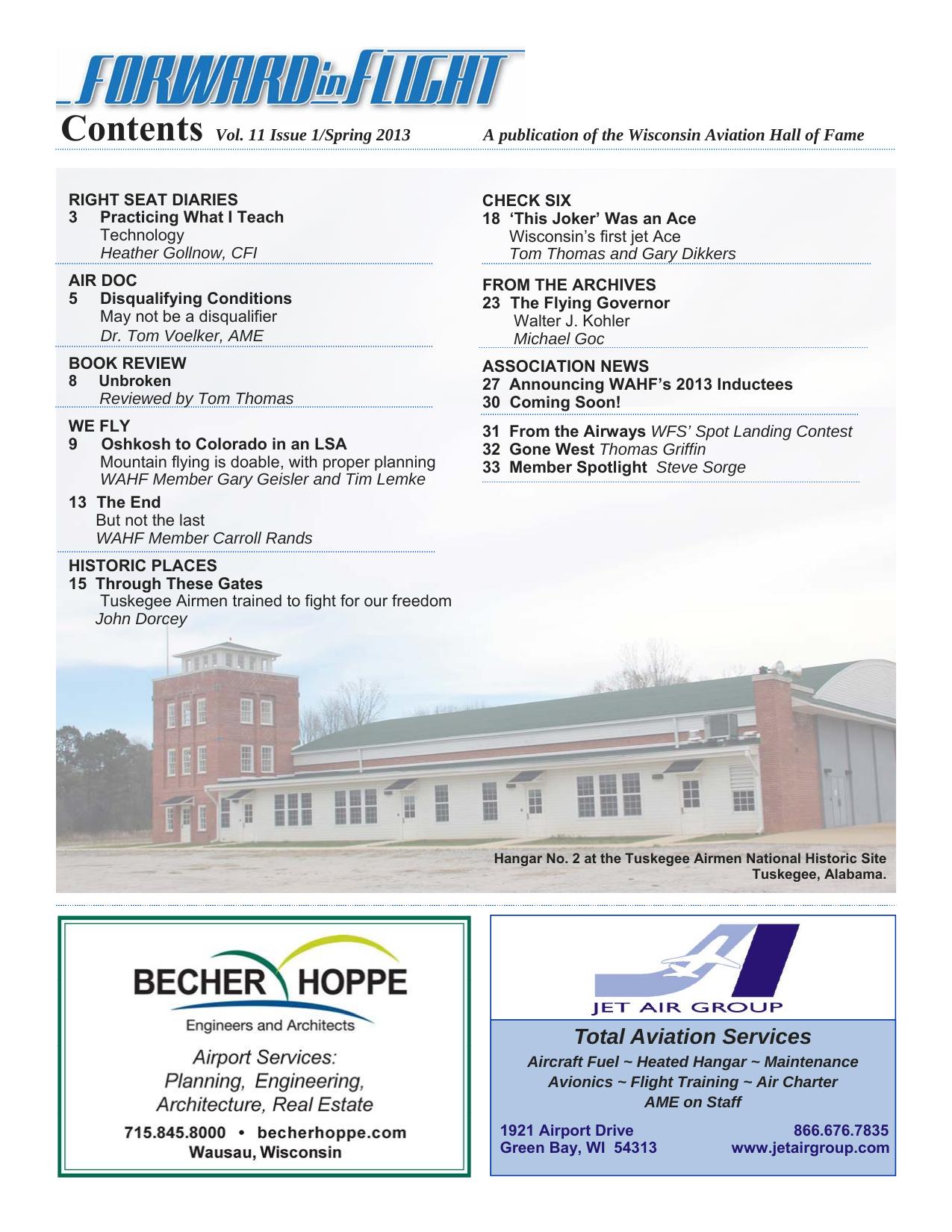
Contents Vol. 11 Issue 1/Spring 2013 A publication of the Wisconsin Aviation Hall of Fame RIGHT SEAT DIARIES 3 Practicing What I Teach Technology Heather Gollnow, CFI CHECK SIX 18 ‘This Joker’ Was an Ace Wisconsin’s first jet Ace Tom Thomas and Gary Dikkers AIR DOC 5 Disqualifying Conditions May not be a disqualifier Dr. Tom Voelker, AME FROM THE ARCHIVES 23 The Flying Governor Walter J. Kohler Michael Goc BOOK REVIEW 8 Unbroken Reviewed by Tom Thomas ASSOCIATION NEWS 27 Announcing WAHF’s 2013 Inductees 30 Coming Soon! WE FLY 9 Oshkosh to Colorado in an LSA Mountain flying is doable, with proper planning WAHF Member Gary Geisler and Tim Lemke 13 The End But not the last WAHF Member Carroll Rands 31 From the Airways WFS’ Spot Landing Contest 32 Gone West Thomas Griffin 33 Member Spotlight Steve Sorge HISTORIC PLACES 15 Through These Gates Tuskegee Airmen trained to fight for our freedom John Dorcey Hangar No. 2 at the Tuskegee Airmen National Historic Site Tuskegee, Alabama. Total Aviation Services Aircraft Fuel ~ Heated Hangar ~ Maintenance Avionics ~ Flight Training ~ Air Charter AME on Staff 1921 Airport Drive Green Bay, WI 54313 866.676.7835 www.jetairgroup.com
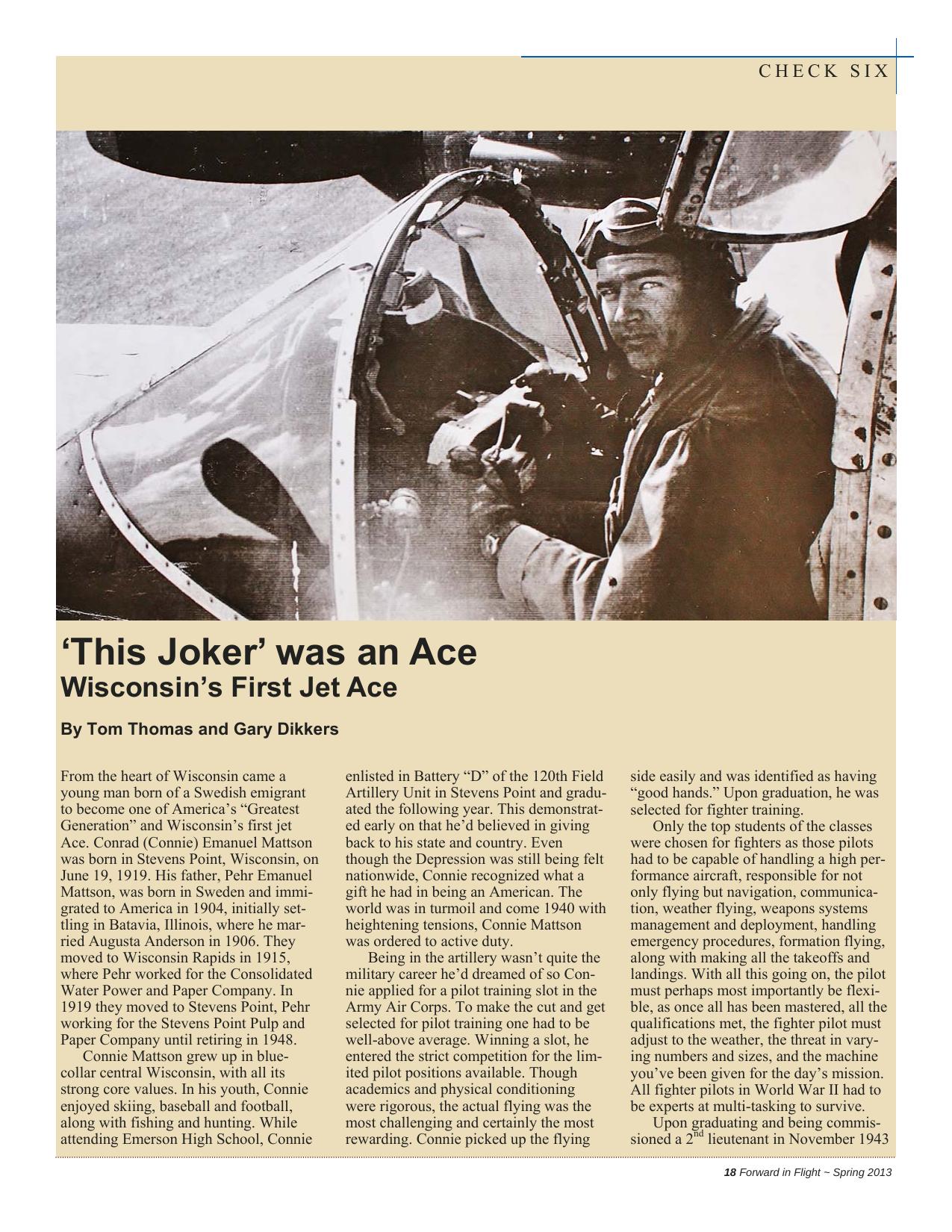
President’s Message ~ by Rose Dorcey My husband, John, and I are big fans of museums. We’ve been to many, and not just aviation museums. On a recent trip through the south, we visited Don Garlits’ Museum of Drag Racing, Paquette’s Historical Farmall Museum (with more than 200 tractors!), both near Ocala, Florida; the Foley Railroad Museum in Alabama; the National Prisoner of War Museum in Andersonville, Georgia; and the Cornell Fine Arts Museum in Winter Park, Florida. We learned a lot, and certainly enjoyed it. But two stood out: the USS Alabama Battleship in Mobile, Alabama, and the Tuskegee Airmen National Historic Site in Tuskegee. Why? The displays and exhibits concisely put into perspective the challenges faced by those who served there. At the USS Alabama, we walked on the weathered deck, climbed inside a cramped, 16-inch gun turret, walked carefully through the engine room, viewed the crew quarters, and gained a much better appreciation of what conditions were like for the young men who called it home. We had a leisurely visit, no worries, but the crewmembers who served there were literally fighting for their lives when they were onboard. It was a beautiful day when we visited the “Mighty A,” and dozens of people, all ages, were there. As I looked around, I wondered how many of them put themselves in the shoes of the 2,500-man crew. I gazed through the machine gun sights and pictured what it must have been like for a young man in fear as he attempted to shoot down enemy aircraft during World War II. It was a sobering experience as we took time to honor those who served there. Still, it was gratifying to learn that the “Mighty A” was also known as the “Lucky A,” as the ship lost no American lives aboard her due to enemy fire. Our experience at Tuskegee Airmen National Historic Site was similar. While another building is scheduled to open there later this year, we did enjoy our visit. The intense nature of the Tuskegee Airmen’s battles, both at home and abroad, are difficult to fully comprehend, but you’ll leave knowing more about how they coped and their many contributions to the war effort. As I said earlier, we’ve visited dozens of museums and memorials through the years, but the Tuskegee site is done so well, in my opinion, because it’s not overdone. The site’s signage succinctly tells their story. The buildings, some original, some reconstructed, some just an outline of their former glory, help us Forward in Flight The only magazine dedicated exclusively to Wisconsin aviation history and today’s events. Rose Dorcey, editor 3980 Sharratt Drive Oshkosh, WI 54901-1276 Phone: 920-385-1483 · 920-279-6029 rdorcey@wisconsinaviationhallofame.org The Wisconsin Aviation Hall of Fame is a non-profit membership organization with a mission to collect and preserve the history of aviation in Wisconsin, recognize those who made that history, inform others of it, and promote aviation education for future generations. Rose Dorcey visualize exactly where their training took place. It was a moving experience. Perhaps it was the old dirt road and brick gate, the simplicity of an old hangar, the audio messages of Tuskegee Airmen, recorded for posterity so we could better understand their experiences. Maybe it was seeing an airplane take off from Moton Field and imagining it was a fledgling airman on his first solo, proving to himself and others that the “military experiment” to see “if Negros could be trained to be pilots” was a success. The intense nature of the Tuskegee Airmen’s battles, both at home and abroad, are difficult to fully comprehend, but you’ll leave knowing more about how they coped. The combination of what we read and saw and heard shed no light on how the Tuskegee Airmen could be victims of such horrifying racial bias, especially after serving our country with honor. But we left with a greater understanding of their bravery and sacrifices, the honors they received, and how others can honor them today by visiting this wonderful place. Read more in John’s story on pages 15 - 17. In my last message I asked you to please send in your renewals, and many of you have...thank you! There are a few more who haven’t done so. I hope you will, as memberships are what keeps this organization going! If you have a question about your due date, just give me a call, or send an email to me at rdorcey@wisconsinaviationhalloffame.org. Thanks! On the cover: Conrad Mattson by his F86E This Joker’s Wild, courtesy of his daughter, Jill Reichman. Mattson was a native of Stevens Point who became our state’s first jet Ace. Tom Thomas and Gary Dikkers collaborated on an article that tells his story, from his humble beginnings in Central Wisconsin to his service during World War II and the Korean War, beginning on page 18.
RIGHT SEAT DIARIES Practicing What I Teach Technology By Heather Gollnow, CFI Since my background is in technology, I’d like to share some of my favorite technology items as they relate to aviation. There’s so much out there that I can’t fit it all into just one article, so please check back in the future for additional technology highlights. The websites I have listed are some of my favorites and are often sites to which I refer students because they contain helpful, useful information. Some are well-known within the aviation community yet I included them as a helpful guide for newcomers. FAA Safety Briefing www.faa.gov/news/safety_briefing The FAA Safety Briefing is an online magazine published bimonthly. You can download it in a variety of formats depending on your e-reader or in PDF format to read on most platforms. The most recent issue focuses on aerospace medicine. You can also read many years of previous issues for free. I downloaded a few copies on my Nook and they are a great read while flying commercially—plus there’s a lot to learn. LiveATC.net Liveatc.net rebroadcasts real-time atc transmissions from many airports in the world. This website works by using some pretty simple technology by an individual living near an airport. Using a scanner physically located within receiving distance of an airport, liveatc.net rebroadcasts radio transmissions from a scanner via the Internet. Not every airport is available on this site, but you’re sure to find one that interests you! I highly suggest those just learning radio communications or those who aren’t comfortable with radio communications to listen in. Find an airport close to you that you might fly into, or even find one that’s the same class airspace. Spend some time listening to the radio transmissions. This is a great way to build confidence in your communication skills! FlightAware.com If you haven’t tried it out already, you’ll find that FlightAware is so much fun. You can track flights in real-time. I’ve used it to watch my friends as they arrive into Oshkosh so I know when to expect them. Some have even flown various patterns in order to create a shape or saying on flight trackers! Some privacy advocates have had concerns with this site, so there is a method for you to have your flights excluded from being tracked. 3 Forward in Flight ~ Quarterly Magazine of the Wisconsin Aviation Hall of Fame AVweb.com This website is one of the best sites to get all of your aviation news. I highly recommend that all general aviation enthusiasts check out this site at least monthly. It’s easy to keep up-to-date with regulatory changes, happenings in the FAA, and some excellent podcasts on a variety of topics of interest to the general aviation pilot. PilotsofAmerica.com I love PilotsofAmerica! It’s one of those sites I can spend hours on, which I have done several nights! Pilots of America is an online message board where pilots, mechanics, air traffic controllers, and other aviation enthusiasts can gather online. It’s great for people at all levels to engage in discussion, ask questions, and perhaps arrange for an in-person meeting at a fly-in! Duats.com I use Duats to file my flight plans. I do remember the first time I used it; I wasn’t completely convinced that my flight plan actually saved. I was extremely relieved when I tried to open my flight plan and it actually worked! My point is, if you’re not sure if something worked, don’t wait until you’re in the cockpit to test it out. Make sure everything is good before you leave the ground. eBay.com/Craigslist.com While not true aviation websites, eBay and Craigslist are fantastic sites for finding aviation treasures. You can search all of Craigslist throughout the country or just target your local area. It’s like going on a treasure hunt since you never know
RIGHT SEAT DIARIES what you will be able to find. My mother found a transcript of Amelia Earhart’s radio communications on her last flight. It was a unique gift that she just happened to stumble upon when surfing eBay. Airnav.com Airnav is a great site to quickly look up airport information. I like to use it to do a quick check on the distance between two airports. Since I’m living in a new area of the country, I’m not as familiar with the airports in my area. This site also provides some pretty good guidance on for fuel prices. Some of the airports have a link to vfrmap.com. This site also comes in handy if you’re near a computer and need quick access to a VFR sectional. Equipped.com “Survivalist” is definitely not a word that people often use to describe me. I’m pretty used to flying around the upper Midwest in the dead of winter, and I like to think that I’m prepared to at least survive a few hours in the cold. I’ll bring a few granola bars and some water with me while flying, along with some extra clothing to keep warm. This site will provide you with all sorts of survival gear, should you ever find yourself in this situation! They even provide survival kits and courses. It’s probably not a bad idea to have some training if you’re flying in an isolated area! I use Duats to file my flight plans. I do remember the first time I used it. I wasn’t completely convinced that my flight plan actually saved. Changes From the Feds In addition to these great websites, I also want to share with you a few recent technology changes in the federal regulations. First, paper pilot and mechanic certificates are still going away! Paper pilot certificates should already be replaced so if you are still carrying around a paper pilot certificate in your wallet, you will not be able to exercise your privileges. Mechanic’s certificates need to be replaced as well. Any paper mechanic certificate not replaced by March 31 will no Aviation websites provide useful information, networking opportunities, gift ideas, and entertainment. Some keep you up-to-date on changes that will keep you flying safely and in compliance with FAA standards. longer be valid! According to the FAA’s website, it takes 4 to 6 weeks for mail processing. You’re much better off registering and requesting a replacement certificate online, which takes 7 to 10 days. Request it at: www.faa.gov/ licenses_certificates/ airmen_certification/ certificate_replacement. Hurry up and complete this today so you don’t lose any of your privileges! Effective November 15, 2012, all flight plans must follow the ICAO 2012 format. The FAA implemented these changes in order to align more closely with international airspace standards. Fields 10 and 18 on the flight plan were changed to properly identify the Communication, Navigation, and Surveillance systems of the aircraft as indicated by the equipment and authorization codes on the flight plan. Separation standards in the New York Oceanic Airspace are being changed based on operational capability of the aircraft. Reduced separation requirements will be determined by the codes entered in fields 10 and 18 of the ICAO 2012 flight plan. It’s imperative that pilots use the correct codes as this can result in loss of adequate separation. In addition, these changes also allow for pilots to file flight plans up to 120 hours in advance. The FAA has put together a comprehensive guide explaining these changes and I urge each of you to read through these changes in more detail. www.faa.gov/about/office_org/ headquarters_offices/ato/service_units/ enroute/flight_plan_filing/general/ icao_2012. What are some of your favorite aviationrelated websites? Apps? Gadgets? I’d love to hear about the pieces of technology that you are using. Heather Gollnow is a Certificated Flight Instructor residing in Baltimore, Maryland. Along with aviation, Heather works in the field of higher education. Heather can be reached at heather.gollnow@gmail.com on LinkedIn at www.linkedin.com/in/ heathergollnow or on Twitter at @aviatrixhg. 4 Forward in Flight ~ Spring 2013
AIR DOC Disqualifying Conditions May not be a disqualifier Dr. Tom Voelker, AME DrAlphaMike@yahoo.com Hello again, fellow airmen. I’ve got some great news! As I write this edition of “Air Doc,” the entire Brewers team is arriving in Phoenix! That can only mean two things. First, baseball (my favorite terrestrial pastime) is here. And second, spring is really coming! I’m an absolute nut about baseball. One of my last flights last summer was a hop across the pond to see the Wisconsin Rapids Rafters (our summer collegiate baseball team) play the Battle Creek (Michigan) Bombers. It was a wonderful day. The flight to Michigan was great, and so was the game. Our Rafters taught those Michigan fans a thing or two about the game, and came home victorious. To top it off, the flight home was as pretty and calm as you could imagine, clipping along at 12,000 feet on a clear, moonlit night. More important to you readers, I would imagine, is that spring is near. I’ve only had a few flights after the Battle Creek trip, and I’m itching to get in the air again. The Comanche is down for an engine overhaul, so for the last two months I have been grounded. But if “42 Papa” had been flyable, I still don’t think I would have been in the air much. This winter the weather has been un-flyable more that most I can remember. Yes, spring is coming, and I like spring! Spring is the season for renewals of all types. The flowers emerge, blooming shortly thereafter. Rivers are once again flowing. I get to watch those baseballs fly. And promises made to oneself begin to materialize. I know at least three aspiring pilots who promised this would be the year they learn to fly. How do they make that happen? Who should teach them? And perhaps above all, are they healthy enough to get a medical certificate? I see many student pilots for their flight physicals well before their first solos, that magical moment that is not possible without a medical certificate in the back pocket. These people quite understandably want to ensure that they will not be denied a medical before they start pumping money into the flight training system. Often pilots call me to see if a condition they might have would disqualify them from being pilot in command. I often inform them of the FAA’s list of 15 disqualifying conditions. I would like to share this list with you, along with some pertinent comments. More commonly, we see pilots who have had heart attacks or chest pain proven to be coming from their hearts. We AMEs need to defer the certification of these men and women to OKC, but the majority of them do fly again. First, though, I should explain what “disqualify” means. If we were dealing with anyone other than the government, I would propose to use the Merriam Webster definition: to deprive of the required qualities, properties, or conditions; make unfit. However, to the FAA, the meaning is a little fuzzier. If you have a disqualifying condition, your AME cannot certi- 5 Forward in Flight ~ Quarterly Magazine of the Wisconsin Aviation Hall of Fame fy you medically fit to fly. However, the good folks at Oklahoma City do have that authority, as long as certain conditions are met. FIFTEEN DISQUALIFIERS The list: First come six cardiac conditions, some of which are closely related: Angina pectoris (chest pain originating from the heart, due to a blockage in an artery) Cardiac valve replacement Coronary heart disease that causes symptoms (essentially the same as angina pectoris) Heart replacement (transplant) Myocardial infarction (heart attack) Permanent cardiac pacemaker It may surprise you, but there are currently about four airmen actively flying in the United States, with the blessing of the FAA, who have had heart transplants! More commonly, we see pilots who have had heart attacks or chest pain proven to be coming from their hearts. We AMEs need to defer the certification of these men and women to OKC, but the majority of them do fly again. They need to be adequately treated and free of symptoms. There must be an adequate waiting period after the event, and diagnostic testing must show that the risk of further occurrence is very small. NEUROLOGICAL The next group of disqualifiers represents neurologic problems: Unexplained disturbance (or loss) of consciousness Epilepsy Transient loss of nervous system

AIR DOC functions, without satisfactory explanation of cause. The aeromedical personnel at the FAA are understandably concerned about any airman who is prone to seizures (which almost always come on without warning) or are otherwise prone to becoming suddenly incapacitated or unconscious. Having someone with a condition like this at the controls could turn short final into just plain final! The next batch of disqualifying conditions is loosely categorized as psychiatric conditions: Bipolar disease (often called manicdepressive disorder) Personality disorder Psychosis Substance abuse Substance dependence Most of these conditions are absolutely disqualifying. This is because of either the medications needed to treat the condition being disallowed in flight, or the condition itself causing the person to make unsafe decisions or to lack judgment. Don’t expect the AME to disqualify the affected airman, however. In most cases we will still defer to OKC, if for no other reason than to make the FAA the “bad guy.” A few years ago I had one pilot applying for his medical who could only be described as a creepy, scary guy. In fact, that is exactly how my technician described him after performing his eye exam. I was at least a little worried that if I disqualified him he might come after me! I simply deferred, and the FAA denied him a medical a couple of months later, due to the diagnosis of antisocial personality disorder. DIABETES The last disqualifying condition that is specifically listed as such in the regulations is: Diabetes mellitus requiring hypoglycemic medications There are thousands of diabetics flying these days, and they are flying safely (at least from a medical standpoint). Most diabetics can fly, as long as their control is good, and as long as they are not having symptoms from the condition or the medications. There are also Consulting with an aviation medical examiner before you begin flying, especially if you have one of the conditions listed, may be the best advice to begin (or continue) your flying. several Type I diabetics (insulin dependent) flying, although this condition is limited to a 3rd class medical and has very stringent requirements regarding blood sugar testing before and during flight. Most diabetics can fly, as long as their control is good, and as long as they are not having symptoms from the condition or the medications. There are many other conditions that could also preclude issuance of a medical. However, those mentioned above will always require the involvement of the OKC at the time of the initial application. For subsequent medical certificate applications, the airman will often bring in a letter from the FAA which will allow the AME to issue the medical himself, as long as certain very specific conditions are met. So, what is the aspiring pilot with one of the above conditions to do? To me that is easy. These conditions are the ones that are most likely to lead to a final denial of a medical application. If you have one of these diseases or conditions and are thinking of starting flying lessons, see your AME first. He or she may be able to guide your decision to pursue flying or to spend your money on another pursuit. It would also be worthwhile to talk to an AME before applying for the medical. And don’t complete the “MedXpress” internet medical application (see below) until you are reasonably sure that you will qualify for your ticket. If you do apply and are ultimately turned down, you will have lost your chance to fly with a light sport license. CERTIFICATION UPDATES I would also like to provide an update from the medical certification front. Last October the FAA began requiring all applications for medicals to be entered on the electronic MedXpress form over the internet, rather than on the paper 8500-8 form that we were all used to completing at the doctor’s office. Overall, this process is going extremely well. I know that we AMEs like the electronic form. (With the previous paper form, everything you as the applicant wrote on 6 Forward in Flight ~ Spring 2013

AIRDOC paper needed to be typed onto the FAA’s electronic version by me as the AME. That was a lot of work!) When an airman shows up at my office for a flight physical without the “confirmation number” (which MedXpress will give you when you sign the electronic form), my policy is to cancel the appointment and reschedule the visit. Fortunately that has happened only once so far, but I am sure it will happen again. But never fear—you have been informed, so it won’t happen to you! There is one more thing to point out about the MedXpress application. If you complete the form online but never see an AME for a medical exam, the FAA will never know that you even completed the form. It is only when your AME enters your confirmation number into the system that the electronic form makes its way to the FAA. If you have any doubt that you might not get approved for you medical, see your AME before he or she enters the confirmation number. That way you can avoid turning over to the FAA information that will only lead to a denial. Well, it’s time to stop typing and think about preflighting the Comanche for my annual spring “refresher” flight that I wrote about one year ago. The Comanche is slated to be put back together soon. I can’t wait! I’ll tell you how the old bird flies with the new engine. I can see a flight to the Rafters game in Waterloo in my future. Fly high, fly often, and above all, fly safely. —Alpha Mike Echo In “real” life, Alpha Mike Echo is Dr. Tom Voelker, AME, a family practitioner in Wisconsin Rapids. He and his wife, Kathy, are the parents of four daughters. Tom flies N6224P, a Comanche 250, out of Alexander Field, South Wood County Airport (ISW). 2031 Peach Street Wisconsin Rapids, WI 54494 7 Forward in Flight ~ Quarterly Magazine of the Wisconsin Aviation Hall of Fame Membership Renewal Reminder! If you haven’t yet renewed your membership, please... Renew Online Now www.WisconsinAviationHallofFame.org or fill out form on page 30 and send a check to WAHF at: 3980 Sharratt Drive, Oshkosh, WI 54901-1276
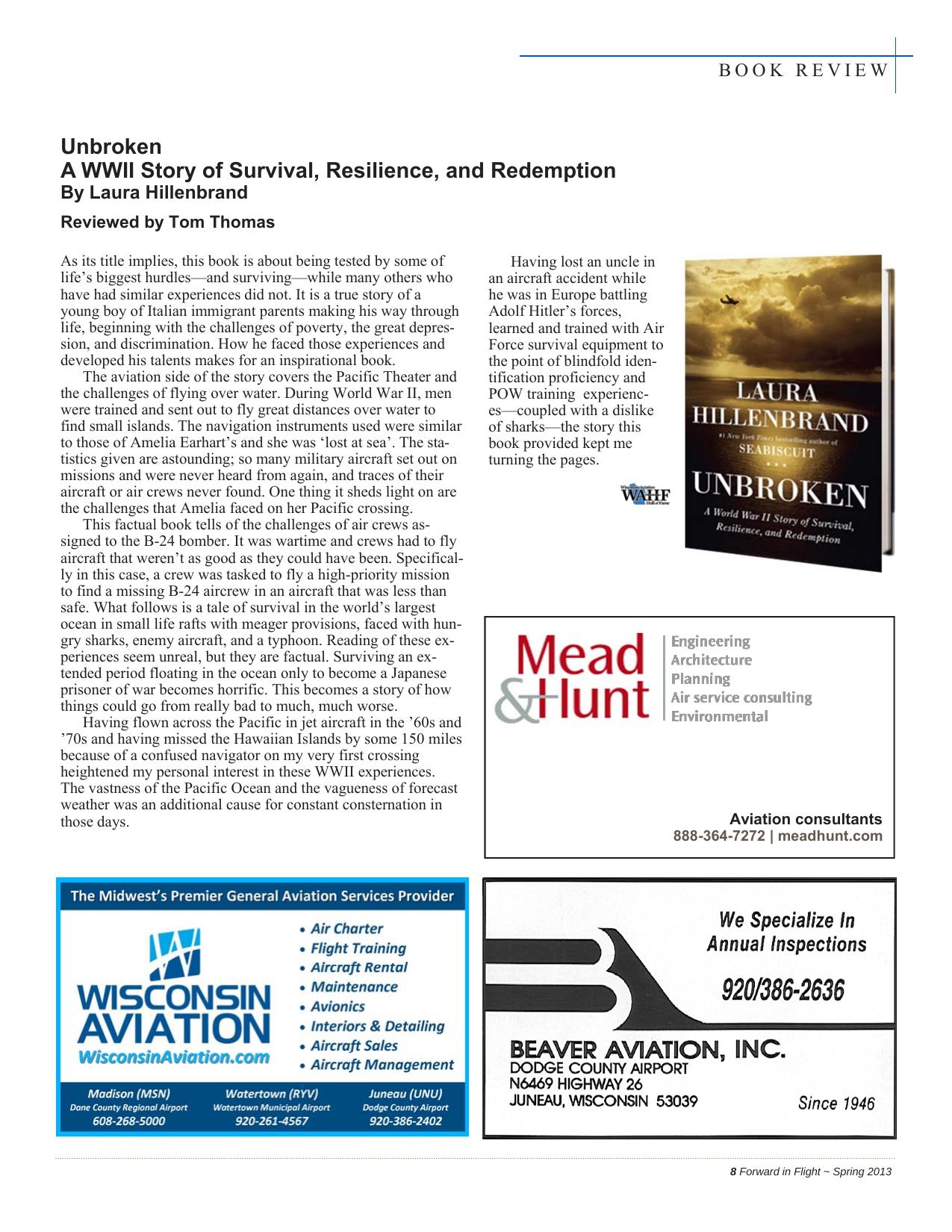
BOOK REVIEW Unbroken A WWII Story of Survival, Resilience, and Redemption By Laura Hillenbrand Reviewed by Tom Thomas As its title implies, this book is about being tested by some of life’s biggest hurdles—and surviving—while many others who have had similar experiences did not. It is a true story of a young boy of Italian immigrant parents making his way through life, beginning with the challenges of poverty, the great depression, and discrimination. How he faced those experiences and developed his talents makes for an inspirational book. The aviation side of the story covers the Pacific Theater and the challenges of flying over water. During World War II, men were trained and sent out to fly great distances over water to find small islands. The navigation instruments used were similar to those of Amelia Earhart’s and she was ‘lost at sea’. The statistics given are astounding; so many military aircraft set out on missions and were never heard from again, and traces of their aircraft or air crews never found. One thing it sheds light on are the challenges that Amelia faced on her Pacific crossing. This factual book tells of the challenges of air crews assigned to the B-24 bomber. It was wartime and crews had to fly aircraft that weren’t as good as they could have been. Specifically in this case, a crew was tasked to fly a high-priority mission to find a missing B-24 aircrew in an aircraft that was less than safe. What follows is a tale of survival in the world’s largest ocean in small life rafts with meager provisions, faced with hungry sharks, enemy aircraft, and a typhoon. Reading of these experiences seem unreal, but they are factual. Surviving an extended period floating in the ocean only to become a Japanese prisoner of war becomes horrific. This becomes a story of how things could go from really bad to much, much worse. Having flown across the Pacific in jet aircraft in the ’60s and ’70s and having missed the Hawaiian Islands by some 150 miles because of a confused navigator on my very first crossing heightened my personal interest in these WWII experiences. The vastness of the Pacific Ocean and the vagueness of forecast weather was an additional cause for constant consternation in those days. Having lost an uncle in an aircraft accident while he was in Europe battling Adolf Hitler’s forces, learned and trained with Air Force survival equipment to the point of blindfold identification proficiency and POW training experiences—coupled with a dislike of sharks—the story this book provided kept me turning the pages. Aviation consultants 888-364-7272 | meadhunt.com 8 Forward in Flight ~ Spring 2013
WE FLY Oshkosh to Colorado in an LSA Mountain flying is doable, with proper planning By WAHF Member Gary Geisler and Tim Lemke, CFI GARY’S PERSPECTIVE I had been thinking about flying to Steamboat Springs, Colorado, since 2007, after our son, Adam, moved there. In 2005, my wife, Karen, and I flew the Oshkosh-based Winnebago Flying Club’s Cessna 172, N7770G, to visit Adam when he was living in Boulder. A trip to Steamboat Springs (KSBS) would be much different. I would be landing and taking off at a higher elevation than ever before—elevation at SBS is 6,882. It would include mountain flying, since SBS is on a western slope of the Rocky Mountains; Boulder is on the Front Range, at 5,288 feet. And, I would be flying a light-sport airplane (LSA), a Czech Aircraft Works SportCruiser. On previous driving visits to Steamboat Springs, I went to the airport and talked to some flight instructors, asking their advice for my trip from Oshkosh. They advised me to study mountain flying, spend some time with a flight instructor, and be on the ground by 11 a.m., before the winds pick up. The main concern here is downdrafts on the eastern slopes, caused by the westerly winds coming over the mountains. They recommended I fly to Cheyenne, Wyoming, and then follow a major power line that would take me to SBS. I would be going through Buffalo Pass, elevation 10,500-feet. PLANNING BEGINS When I plotted the trip on sectional charts and completed a nowind flight plan on DUATS, the preliminary plan showed eight hours of total flying time. Most of the trip followed federal air9 Forward in Flight ~ Quarterly Magazine of the Wisconsin Aviation Hall of Fame ways and at least three fuel stops would be required. Going west, we would need to allow for headwinds. And, it would be a two-day trip, as we would fly to Sidney, Nebraska, spend the night, and get up early for the remaining two hours of flight time to Steamboat Springs. I also attended mountain flying seminars at EAA AirVenture and completed FAA online safety courses. Now I needed to make sure I could make the trip, operating within the capability of the SportCruiser. To allow a 2000-foot margin for safety, I wanted to fly at 12,500-feet, over and back, through Buffalo Pass. Before the trip, and with the help of flight instructor Tim Lemke, I conducted a high-altitude test flight in the vicinity of Wittman Regional Airport (KOSH) during which we climbed up to 12,500-feet. I wanted to see what the climb rate would be at that altitude. The climb rate went down to 100to 200-feet per minute! But what a view—from above the Oshkosh airport we could see across Lake Michigan, to the western shore of Michigan! Even so, being more than 11,000-feet above ground level, I did get a bit of a queasy feeling, even though I knew I was perfectly safe. The remaining item I needed was a capable co-pilot. About this time, Tim was retiring from Gulfstream. He is one of our flying club’s flight instructors, and coincidently, was one of my high school teachers. He agreed to go on the adventure with me. This would be a real learning experience—with some dual instruction. Photos by Gary Geisler
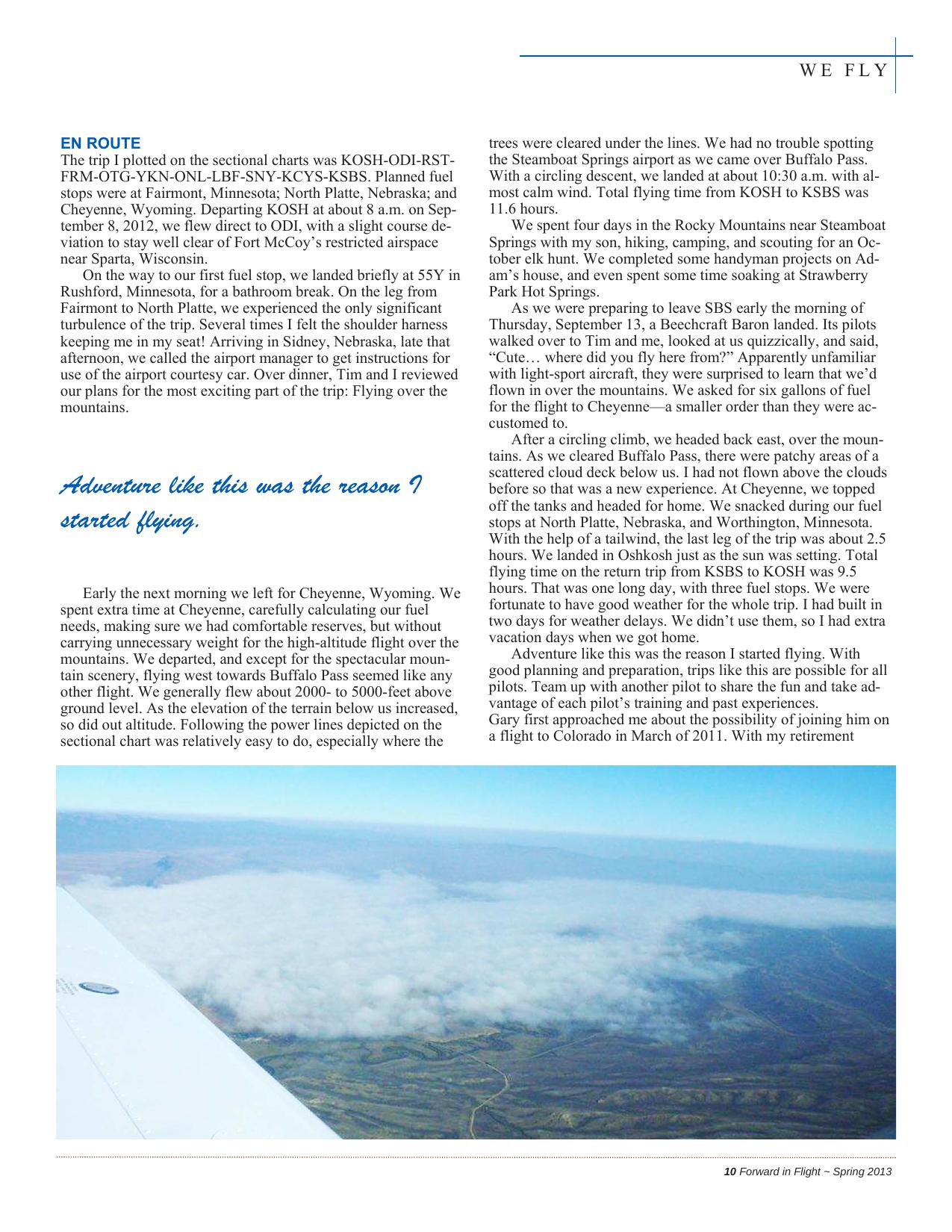
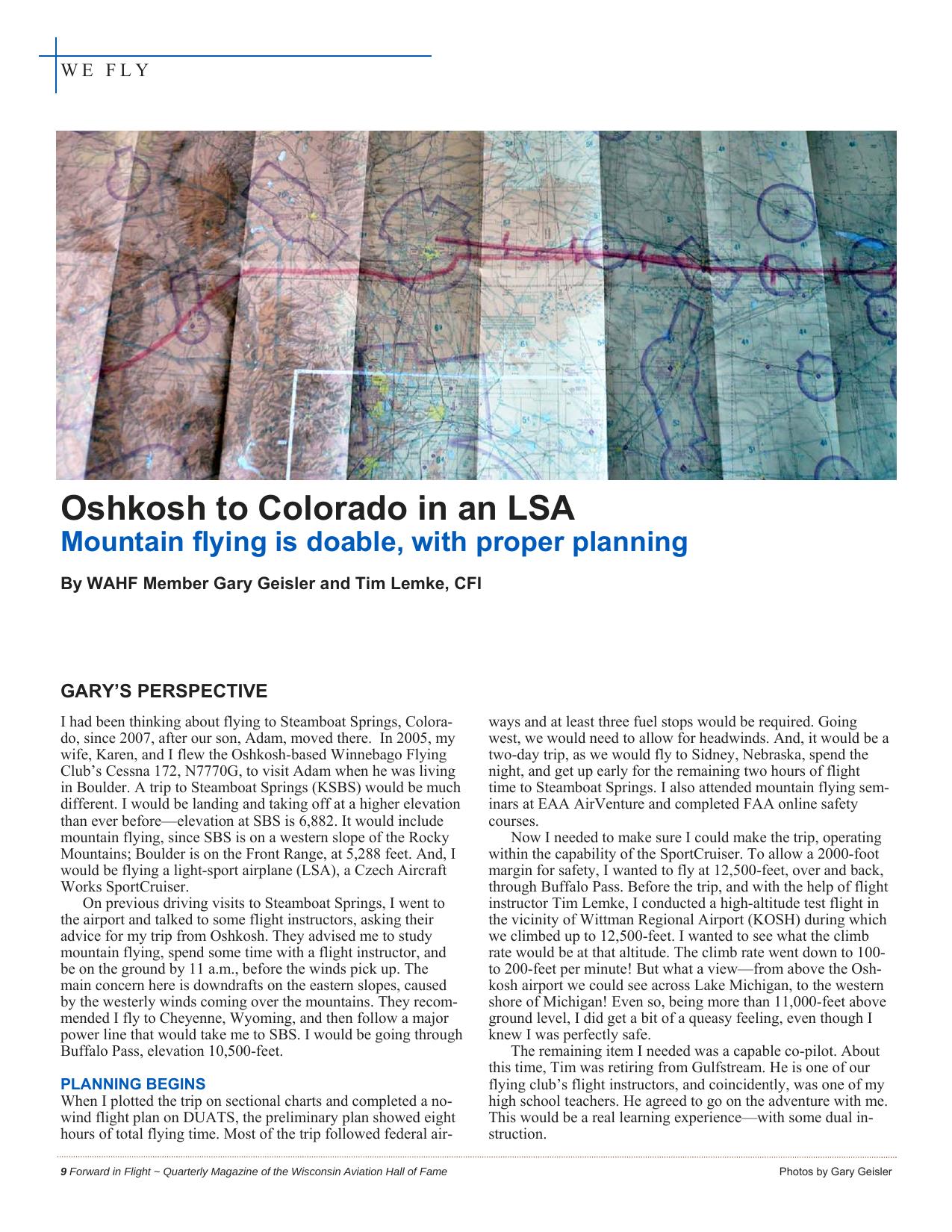
WE FLY EN ROUTE The trip I plotted on the sectional charts was KOSH-ODI-RSTFRM-OTG-YKN-ONL-LBF-SNY-KCYS-KSBS. Planned fuel stops were at Fairmont, Minnesota; North Platte, Nebraska; and Cheyenne, Wyoming. Departing KOSH at about 8 a.m. on September 8, 2012, we flew direct to ODI, with a slight course deviation to stay well clear of Fort McCoy’s restricted airspace near Sparta, Wisconsin. On the way to our first fuel stop, we landed briefly at 55Y in Rushford, Minnesota, for a bathroom break. On the leg from Fairmont to North Platte, we experienced the only significant turbulence of the trip. Several times I felt the shoulder harness keeping me in my seat! Arriving in Sidney, Nebraska, late that afternoon, we called the airport manager to get instructions for use of the airport courtesy car. Over dinner, Tim and I reviewed our plans for the most exciting part of the trip: Flying over the mountains. Early the next morning we left for Cheyenne, Wyoming. We spent extra time at Cheyenne, carefully calculating our fuel needs, making sure we had comfortable reserves, but without carrying unnecessary weight for the high-altitude flight over the mountains. We departed, and except for the spectacular mountain scenery, flying west towards Buffalo Pass seemed like any other flight. We generally flew about 2000- to 5000-feet above ground level. As the elevation of the terrain below us increased, so did out altitude. Following the power lines depicted on the sectional chart was relatively easy to do, especially where the trees were cleared under the lines. We had no trouble spotting the Steamboat Springs airport as we came over Buffalo Pass. With a circling descent, we landed at about 10:30 a.m. with almost calm wind. Total flying time from KOSH to KSBS was 11.6 hours. We spent four days in the Rocky Mountains near Steamboat Springs with my son, hiking, camping, and scouting for an October elk hunt. We completed some handyman projects on Adam’s house, and even spent some time soaking at Strawberry Park Hot Springs. As we were preparing to leave SBS early the morning of Thursday, September 13, a Beechcraft Baron landed. Its pilots walked over to Tim and me, looked at us quizzically, and said, “Cute… where did you fly here from?” Apparently unfamiliar with light-sport aircraft, they were surprised to learn that we’d flown in over the mountains. We asked for six gallons of fuel for the flight to Cheyenne—a smaller order than they were accustomed to. After a circling climb, we headed back east, over the mountains. As we cleared Buffalo Pass, there were patchy areas of a scattered cloud deck below us. I had not flown above the clouds before so that was a new experience. At Cheyenne, we topped off the tanks and headed for home. We snacked during our fuel stops at North Platte, Nebraska, and Worthington, Minnesota. With the help of a tailwind, the last leg of the trip was about 2.5 hours. We landed in Oshkosh just as the sun was setting. Total flying time on the return trip from KSBS to KOSH was 9.5 hours. That was one long day, with three fuel stops. We were fortunate to have good weather for the whole trip. I had built in two days for weather delays. We didn’t use them, so I had extra vacation days when we got home. Adventure like this was the reason I started flying. With good planning and preparation, trips like this are possible for all pilots. Team up with another pilot to share the fun and take advantage of each pilot’s training and past experiences. Gary first approached me about the possibility of joining him on a flight to Colorado in March of 2011. With my retirement 10 Forward in Flight ~ Spring 2013
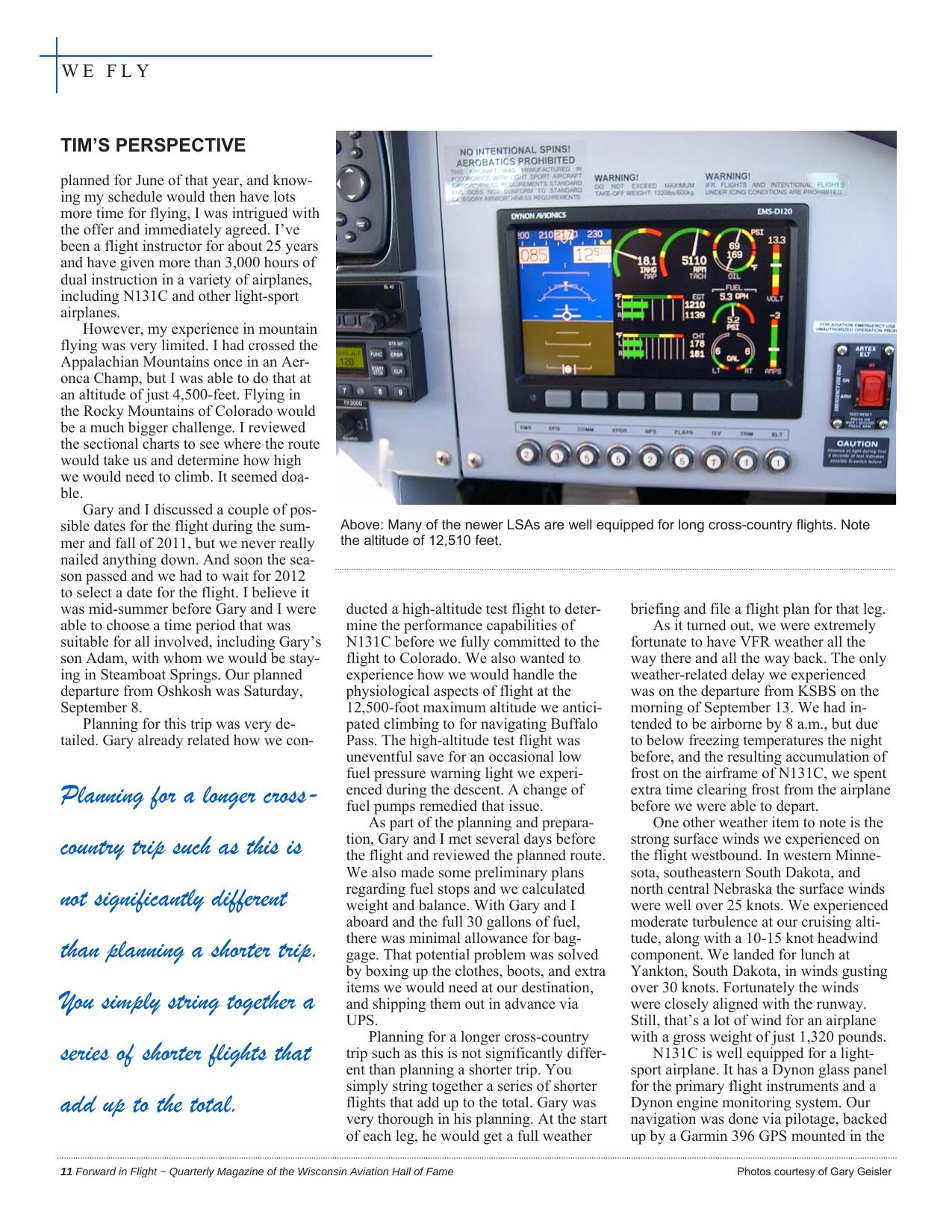
WE FLY TIM’S PERSPECTIVE planned for June of that year, and knowing my schedule would then have lots more time for flying, I was intrigued with the offer and immediately agreed. I’ve been a flight instructor for about 25 years and have given more than 3,000 hours of dual instruction in a variety of airplanes, including N131C and other light-sport airplanes. However, my experience in mountain flying was very limited. I had crossed the Appalachian Mountains once in an Aeronca Champ, but I was able to do that at an altitude of just 4,500-feet. Flying in the Rocky Mountains of Colorado would be a much bigger challenge. I reviewed the sectional charts to see where the route would take us and determine how high we would need to climb. It seemed doable. Gary and I discussed a couple of possible dates for the flight during the summer and fall of 2011, but we never really nailed anything down. And soon the season passed and we had to wait for 2012 to select a date for the flight. I believe it was mid-summer before Gary and I were able to choose a time period that was suitable for all involved, including Gary’s son Adam, with whom we would be staying in Steamboat Springs. Our planned departure from Oshkosh was Saturday, September 8. Planning for this trip was very detailed. Gary already related how we con- Planning for a longer crosscountry trip such as this is not significantly different than planning a shorter trip. You simply string together a series of shorter flights that add up to the total. Above: Many of the newer LSAs are well equipped for long cross-country flights. Note the altitude of 12,510 feet. ducted a high-altitude test flight to determine the performance capabilities of N131C before we fully committed to the flight to Colorado. We also wanted to experience how we would handle the physiological aspects of flight at the 12,500-foot maximum altitude we anticipated climbing to for navigating Buffalo Pass. The high-altitude test flight was uneventful save for an occasional low fuel pressure warning light we experienced during the descent. A change of fuel pumps remedied that issue. As part of the planning and preparation, Gary and I met several days before the flight and reviewed the planned route. We also made some preliminary plans regarding fuel stops and we calculated weight and balance. With Gary and I aboard and the full 30 gallons of fuel, there was minimal allowance for baggage. That potential problem was solved by boxing up the clothes, boots, and extra items we would need at our destination, and shipping them out in advance via UPS. Planning for a longer cross-country trip such as this is not significantly different than planning a shorter trip. You simply string together a series of shorter flights that add up to the total. Gary was very thorough in his planning. At the start of each leg, he would get a full weather 11 Forward in Flight ~ Quarterly Magazine of the Wisconsin Aviation Hall of Fame briefing and file a flight plan for that leg. As it turned out, we were extremely fortunate to have VFR weather all the way there and all the way back. The only weather-related delay we experienced was on the departure from KSBS on the morning of September 13. We had intended to be airborne by 8 a.m., but due to below freezing temperatures the night before, and the resulting accumulation of frost on the airframe of N131C, we spent extra time clearing frost from the airplane before we were able to depart. One other weather item to note is the strong surface winds we experienced on the flight westbound. In western Minnesota, southeastern South Dakota, and north central Nebraska the surface winds were well over 25 knots. We experienced moderate turbulence at our cruising altitude, along with a 10-15 knot headwind component. We landed for lunch at Yankton, South Dakota, in winds gusting over 30 knots. Fortunately the winds were closely aligned with the runway. Still, that’s a lot of wind for an airplane with a gross weight of just 1,320 pounds. N131C is well equipped for a lightsport airplane. It has a Dynon glass panel for the primary flight instruments and a Dynon engine monitoring system. Our navigation was done via pilotage, backed up by a Garmin 396 GPS mounted in the Photos courtesy of Gary Geisler
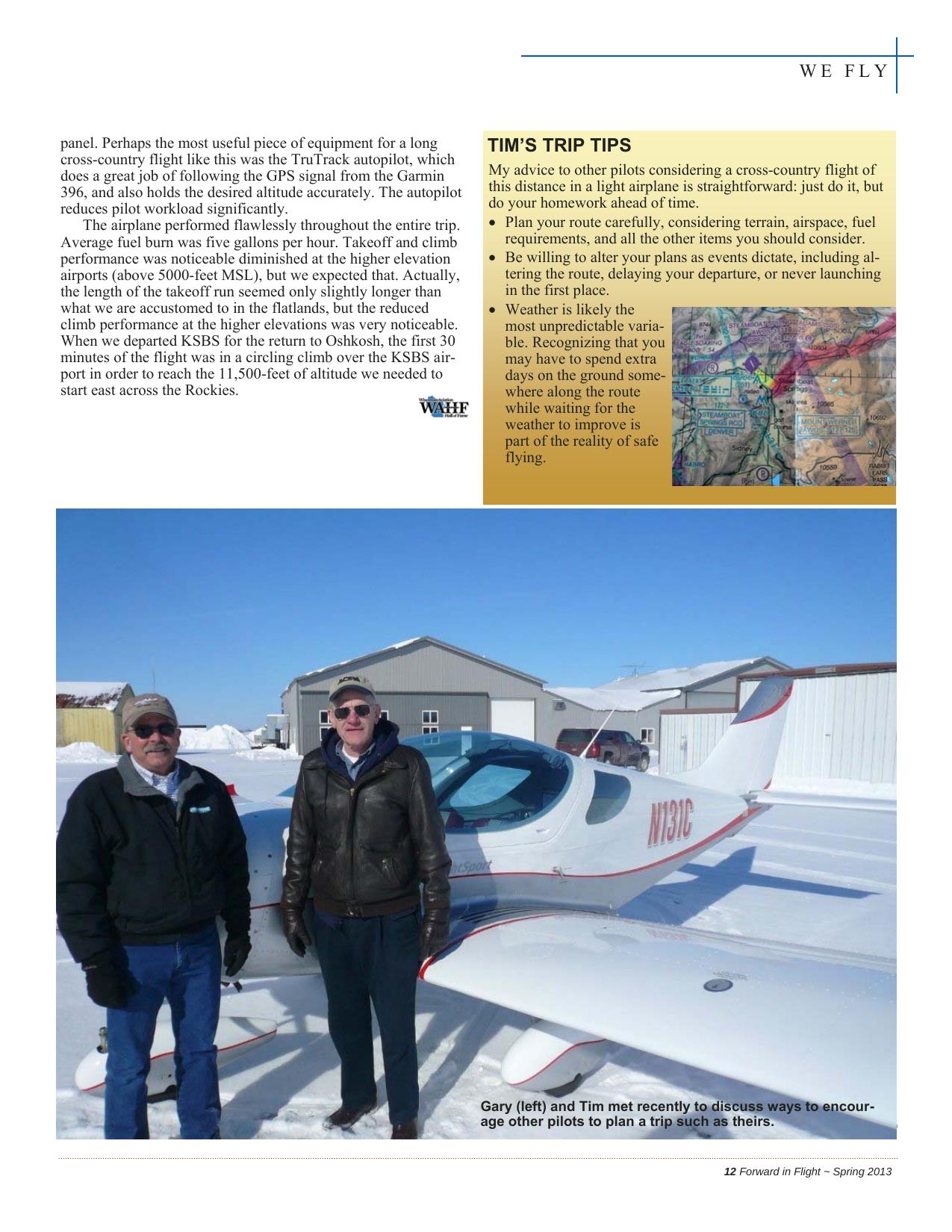
WE FLY panel. Perhaps the most useful piece of equipment for a long cross-country flight like this was the TruTrack autopilot, which does a great job of following the GPS signal from the Garmin 396, and also holds the desired altitude accurately. The autopilot reduces pilot workload significantly. The airplane performed flawlessly throughout the entire trip. Average fuel burn was five gallons per hour. Takeoff and climb performance was noticeable diminished at the higher elevation airports (above 5000-feet MSL), but we expected that. Actually, the length of the takeoff run seemed only slightly longer than what we are accustomed to in the flatlands, but the reduced climb performance at the higher elevations was very noticeable. When we departed KSBS for the return to Oshkosh, the first 30 minutes of the flight was in a circling climb over the KSBS airport in order to reach the 11,500-feet of altitude we needed to start east across the Rockies. TIM’S TRIP TIPS My advice to other pilots considering a cross-country flight of this distance in a light airplane is straightforward: just do it, but do your homework ahead of time. Plan your route carefully, considering terrain, airspace, fuel requirements, and all the other items you should consider. Be willing to alter your plans as events dictate, including altering the route, delaying your departure, or never launching in the first place. Weather is likely the most unpredictable variable. Recognizing that you may have to spend extra days on the ground somewhere along the route while waiting for the weather to improve is part of the reality of safe flying. Gary (left) and Tim met recently to discuss ways to encourage other pilots to plan a trip such as theirs. 12 Forward in Flight ~ Spring 2013
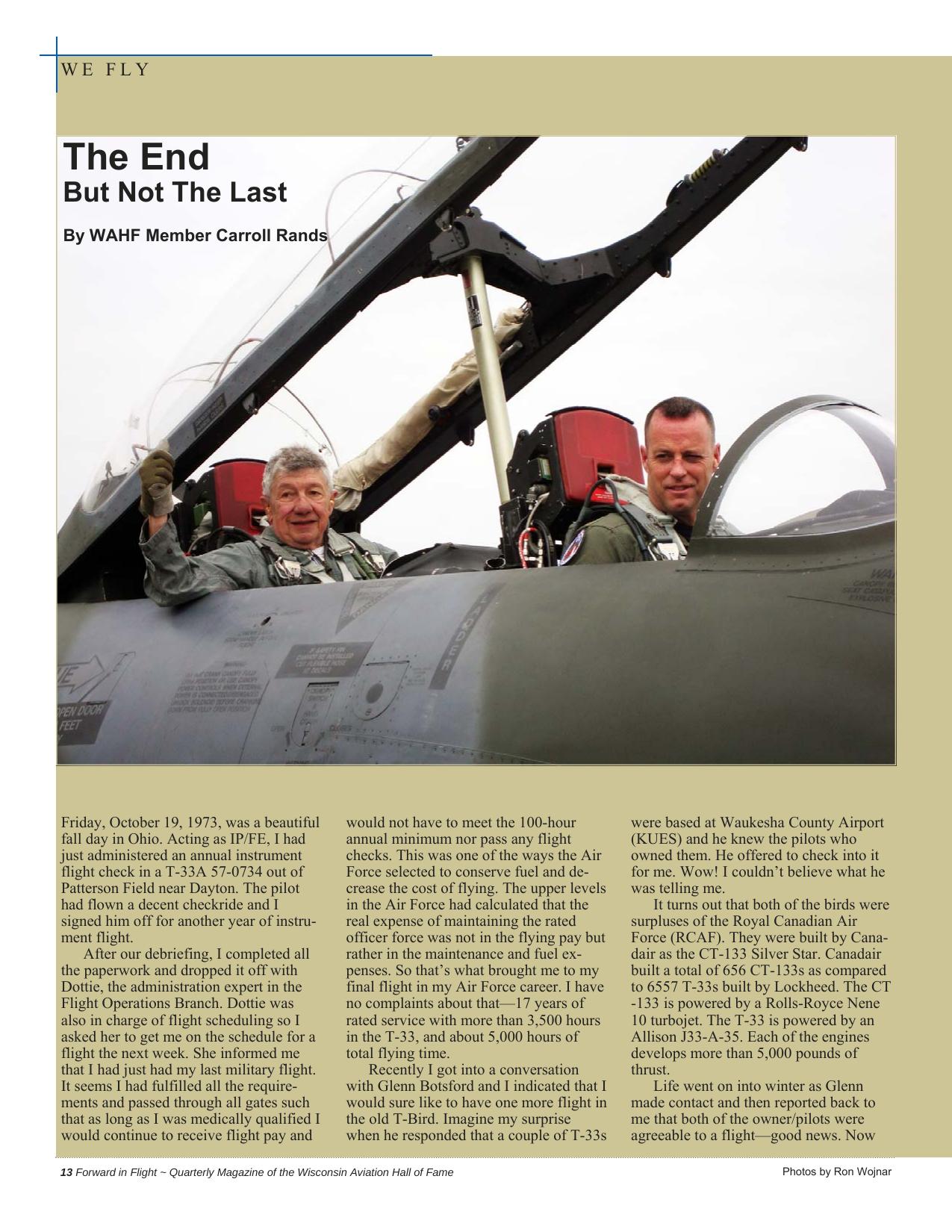
WE FLY The End But Not The Last By WAHF Member Carroll Rands Friday, October 19, 1973, was a beautiful fall day in Ohio. Acting as IP/FE, I had just administered an annual instrument flight check in a T-33A 57-0734 out of Patterson Field near Dayton. The pilot had flown a decent checkride and I signed him off for another year of instrument flight. After our debriefing, I completed all the paperwork and dropped it off with Dottie, the administration expert in the Flight Operations Branch. Dottie was also in charge of flight scheduling so I asked her to get me on the schedule for a flight the next week. She informed me that I had just had my last military flight. It seems I had fulfilled all the requirements and passed through all gates such that as long as I was medically qualified I would continue to receive flight pay and would not have to meet the 100-hour annual minimum nor pass any flight checks. This was one of the ways the Air Force selected to conserve fuel and decrease the cost of flying. The upper levels in the Air Force had calculated that the real expense of maintaining the rated officer force was not in the flying pay but rather in the maintenance and fuel expenses. So that’s what brought me to my final flight in my Air Force career. I have no complaints about that—17 years of rated service with more than 3,500 hours in the T-33, and about 5,000 hours of total flying time. Recently I got into a conversation with Glenn Botsford and I indicated that I would sure like to have one more flight in the old T-Bird. Imagine my surprise when he responded that a couple of T-33s 13 Forward in Flight ~ Quarterly Magazine of the Wisconsin Aviation Hall of Fame were based at Waukesha County Airport (KUES) and he knew the pilots who owned them. He offered to check into it for me. Wow! I couldn’t believe what he was telling me. It turns out that both of the birds were surpluses of the Royal Canadian Air Force (RCAF). They were built by Canadair as the CT-133 Silver Star. Canadair built a total of 656 CT-133s as compared to 6557 T-33s built by Lockheed. The CT -133 is powered by a Rolls-Royce Nene 10 turbojet. The T-33 is powered by an Allison J33-A-35. Each of the engines develops more than 5,000 pounds of thrust. Life went on into winter as Glenn made contact and then reported back to me that both of the owner/pilots were agreeable to a flight—good news. Now Photos by Ron Wojnar
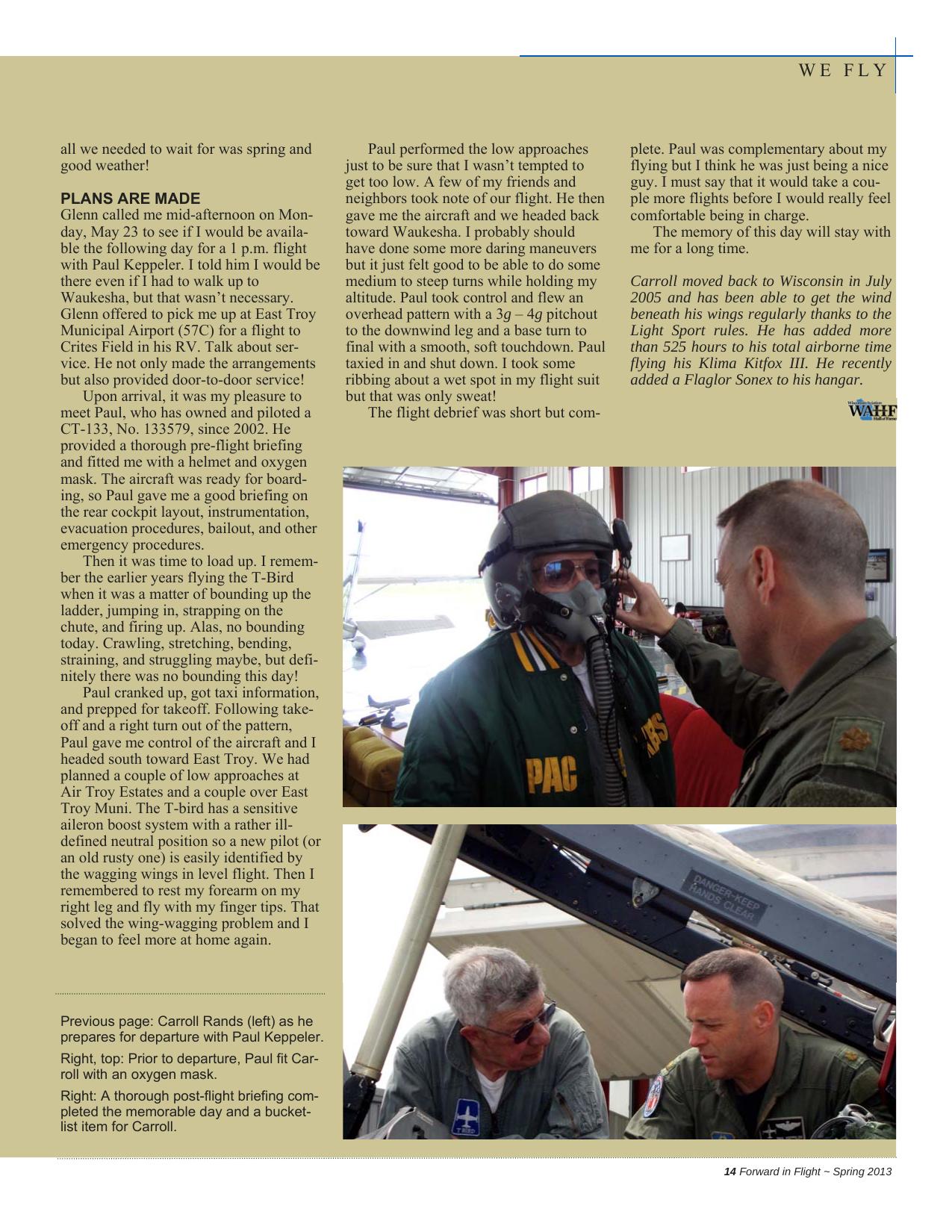
WE FLY all we needed to wait for was spring and good weather! PLANS ARE MADE Glenn called me mid-afternoon on Monday, May 23 to see if I would be available the following day for a 1 p.m. flight with Paul Keppeler. I told him I would be there even if I had to walk up to Waukesha, but that wasn’t necessary. Glenn offered to pick me up at East Troy Municipal Airport (57C) for a flight to Crites Field in his RV. Talk about service. He not only made the arrangements but also provided door-to-door service! Upon arrival, it was my pleasure to meet Paul, who has owned and piloted a CT-133, No. 133579, since 2002. He provided a thorough pre-flight briefing and fitted me with a helmet and oxygen mask. The aircraft was ready for boarding, so Paul gave me a good briefing on the rear cockpit layout, instrumentation, evacuation procedures, bailout, and other emergency procedures. Then it was time to load up. I remember the earlier years flying the T-Bird when it was a matter of bounding up the ladder, jumping in, strapping on the chute, and firing up. Alas, no bounding today. Crawling, stretching, bending, straining, and struggling maybe, but definitely there was no bounding this day! Paul cranked up, got taxi information, and prepped for takeoff. Following takeoff and a right turn out of the pattern, Paul gave me control of the aircraft and I headed south toward East Troy. We had planned a couple of low approaches at Air Troy Estates and a couple over East Troy Muni. The T-bird has a sensitive aileron boost system with a rather illdefined neutral position so a new pilot (or an old rusty one) is easily identified by the wagging wings in level flight. Then I remembered to rest my forearm on my right leg and fly with my finger tips. That solved the wing-wagging problem and I began to feel more at home again. Paul performed the low approaches just to be sure that I wasn’t tempted to get too low. A few of my friends and neighbors took note of our flight. He then gave me the aircraft and we headed back toward Waukesha. I probably should have done some more daring maneuvers but it just felt good to be able to do some medium to steep turns while holding my altitude. Paul took control and flew an overhead pattern with a 3g – 4g pitchout to the downwind leg and a base turn to final with a smooth, soft touchdown. Paul taxied in and shut down. I took some ribbing about a wet spot in my flight suit but that was only sweat! The flight debrief was short but com- plete. Paul was complementary about my flying but I think he was just being a nice guy. I must say that it would take a couple more flights before I would really feel comfortable being in charge. The memory of this day will stay with me for a long time. Carroll moved back to Wisconsin in July 2005 and has been able to get the wind beneath his wings regularly thanks to the Light Sport rules. He has added more than 525 hours to his total airborne time flying his Klima Kitfox III. He recently added a Flaglor Sonex to his hangar. Previous page: Carroll Rands (left) as he prepares for departure with Paul Keppeler. Right, top: Prior to departure, Paul fit Carroll with an oxygen mask. Right: A thorough post-flight briefing completed the memorable day and a bucketlist item for Carroll. 14 Forward in Flight ~ Spring 2013
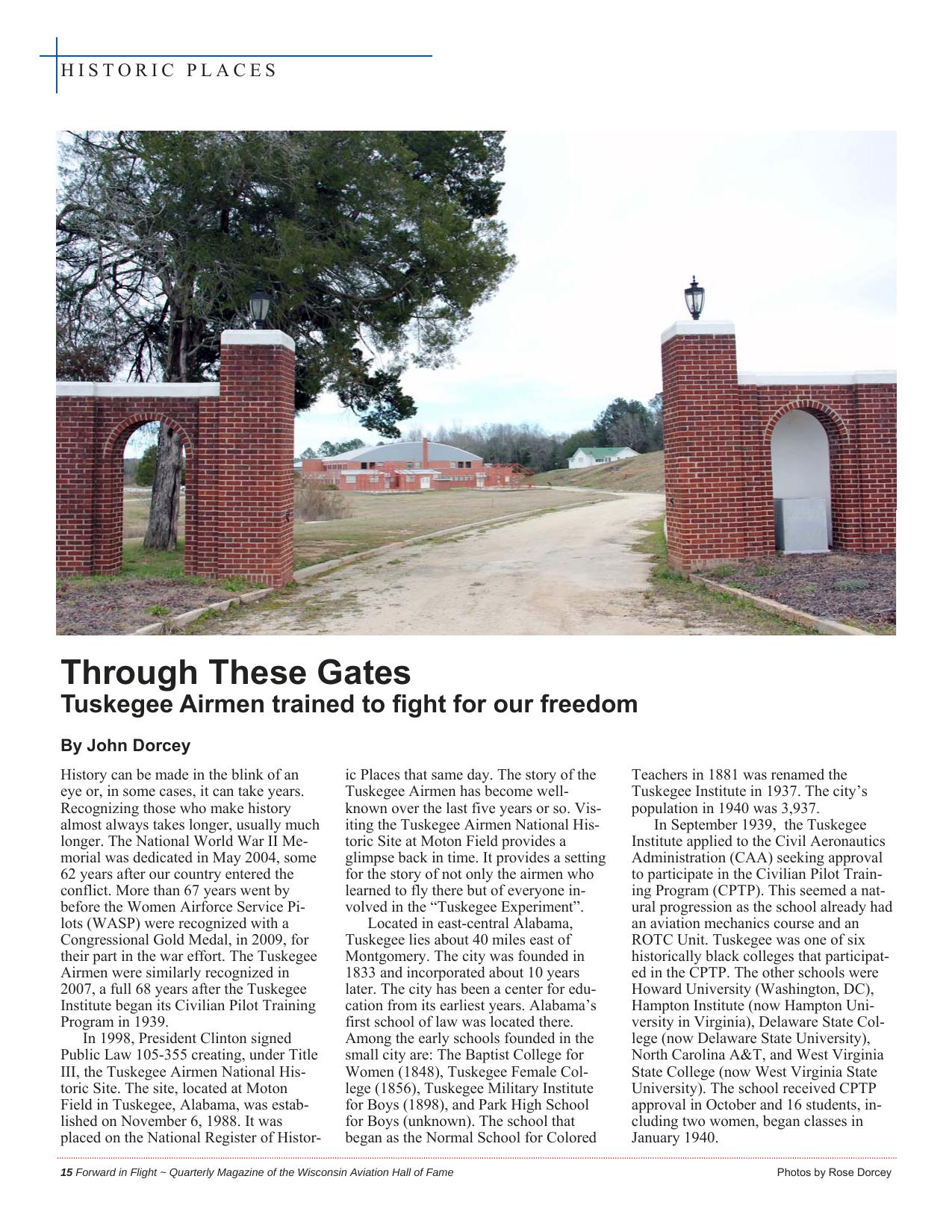
HISTORIC PLACES Through These Gates Tuskegee Airmen trained to fight for our freedom By John Dorcey History can be made in the blink of an eye or, in some cases, it can take years. Recognizing those who make history almost always takes longer, usually much longer. The National World War II Memorial was dedicated in May 2004, some 62 years after our country entered the conflict. More than 67 years went by before the Women Airforce Service Pilots (WASP) were recognized with a Congressional Gold Medal, in 2009, for their part in the war effort. The Tuskegee Airmen were similarly recognized in 2007, a full 68 years after the Tuskegee Institute began its Civilian Pilot Training Program in 1939. In 1998, President Clinton signed Public Law 105-355 creating, under Title III, the Tuskegee Airmen National Historic Site. The site, located at Moton Field in Tuskegee, Alabama, was established on November 6, 1988. It was placed on the National Register of Histor- ic Places that same day. The story of the Tuskegee Airmen has become wellknown over the last five years or so. Visiting the Tuskegee Airmen National Historic Site at Moton Field provides a glimpse back in time. It provides a setting for the story of not only the airmen who learned to fly there but of everyone involved in the “Tuskegee Experiment”. Located in east-central Alabama, Tuskegee lies about 40 miles east of Montgomery. The city was founded in 1833 and incorporated about 10 years later. The city has been a center for education from its earliest years. Alabama’s first school of law was located there. Among the early schools founded in the small city are: The Baptist College for Women (1848), Tuskegee Female College (1856), Tuskegee Military Institute for Boys (1898), and Park High School for Boys (unknown). The school that began as the Normal School for Colored 15 Forward in Flight ~ Quarterly Magazine of the Wisconsin Aviation Hall of Fame Teachers in 1881 was renamed the Tuskegee Institute in 1937. The city’s population in 1940 was 3,937. In September 1939, the Tuskegee Institute applied to the Civil Aeronautics Administration (CAA) seeking approval to participate in the Civilian Pilot Training Program (CPTP). This seemed a natural progression as the school already had an aviation mechanics course and an ROTC Unit. Tuskegee was one of six historically black colleges that participated in the CPTP. The other schools were Howard University (Washington, DC), Hampton Institute (now Hampton University in Virginia), Delaware State College (now Delaware State University), North Carolina A&T, and West Virginia State College (now West Virginia State University). The school received CPTP approval in October and 16 students, including two women, began classes in January 1940. Photos by Rose Dorcey
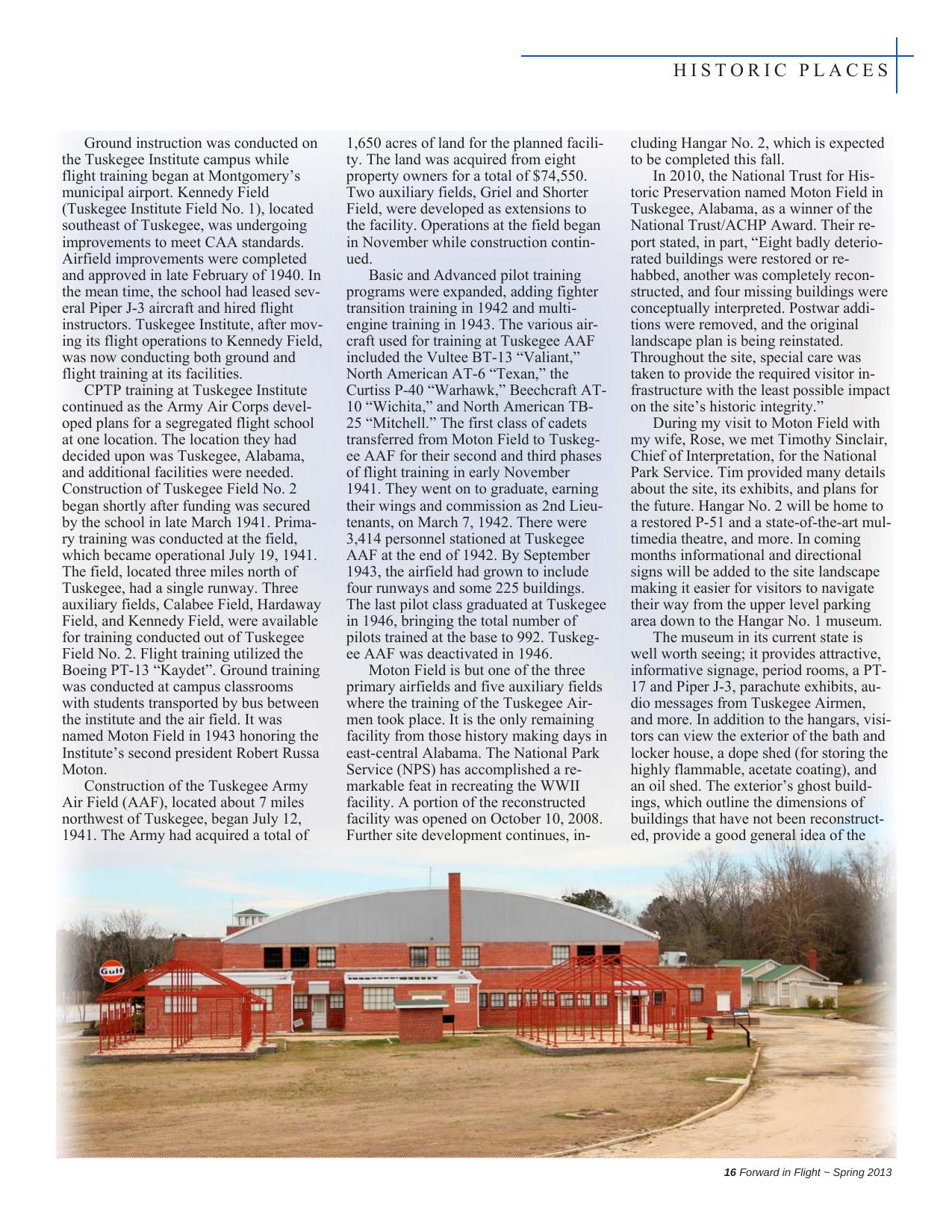
HISTORIC PLACES Ground instruction was conducted on the Tuskegee Institute campus while flight training began at Montgomery’s municipal airport. Kennedy Field (Tuskegee Institute Field No. 1), located southeast of Tuskegee, was undergoing improvements to meet CAA standards. Airfield improvements were completed and approved in late February of 1940. In the mean time, the school had leased several Piper J-3 aircraft and hired flight instructors. Tuskegee Institute, after moving its flight operations to Kennedy Field, was now conducting both ground and flight training at its facilities. CPTP training at Tuskegee Institute continued as the Army Air Corps developed plans for a segregated flight school at one location. The location they had decided upon was Tuskegee, Alabama, and additional facilities were needed. Construction of Tuskegee Field No. 2 began shortly after funding was secured by the school in late March 1941. Primary training was conducted at the field, which became operational July 19, 1941. The field, located three miles north of Tuskegee, had a single runway. Three auxiliary fields, Calabee Field, Hardaway Field, and Kennedy Field, were available for training conducted out of Tuskegee Field No. 2. Flight training utilized the Boeing PT-13 “Kaydet”. Ground training was conducted at campus classrooms with students transported by bus between the institute and the air field. It was named Moton Field in 1943 honoring the Institute’s second president Robert Russa Moton. Construction of the Tuskegee Army Air Field (AAF), located about 7 miles northwest of Tuskegee, began July 12, 1941. The Army had acquired a total of 1,650 acres of land for the planned facility. The land was acquired from eight property owners for a total of $74,550. Two auxiliary fields, Griel and Shorter Field, were developed as extensions to the facility. Operations at the field began in November while construction continued. Basic and Advanced pilot training programs were expanded, adding fighter transition training in 1942 and multiengine training in 1943. The various aircraft used for training at Tuskegee AAF included the Vultee BT-13 “Valiant,” North American AT-6 “Texan,” the Curtiss P-40 “Warhawk,” Beechcraft AT10 “Wichita,” and North American TB25 “Mitchell.” The first class of cadets transferred from Moton Field to Tuskegee AAF for their second and third phases of flight training in early November 1941. They went on to graduate, earning their wings and commission as 2nd Lieutenants, on March 7, 1942. There were 3,414 personnel stationed at Tuskegee AAF at the end of 1942. By September 1943, the airfield had grown to include four runways and some 225 buildings. The last pilot class graduated at Tuskegee in 1946, bringing the total number of pilots trained at the base to 992. Tuskegee AAF was deactivated in 1946. Moton Field is but one of the three primary airfields and five auxiliary fields where the training of the Tuskegee Airmen took place. It is the only remaining facility from those history making days in east-central Alabama. The National Park Service (NPS) has accomplished a remarkable feat in recreating the WWII facility. A portion of the reconstructed facility was opened on October 10, 2008. Further site development continues, in- cluding Hangar No. 2, which is expected to be completed this fall. In 2010, the National Trust for Historic Preservation named Moton Field in Tuskegee, Alabama, as a winner of the National Trust/ACHP Award. Their report stated, in part, “Eight badly deteriorated buildings were restored or rehabbed, another was completely reconstructed, and four missing buildings were conceptually interpreted. Postwar additions were removed, and the original landscape plan is being reinstated. Throughout the site, special care was taken to provide the required visitor infrastructure with the least possible impact on the site’s historic integrity.” During my visit to Moton Field with my wife, Rose, we met Timothy Sinclair, Chief of Interpretation, for the National Park Service. Tim provided many details about the site, its exhibits, and plans for the future. Hangar No. 2 will be home to a restored P-51 and a state-of-the-art multimedia theatre, and more. In coming months informational and directional signs will be added to the site landscape making it easier for visitors to navigate their way from the upper level parking area down to the Hangar No. 1 museum. The museum in its current state is well worth seeing; it provides attractive, informative signage, period rooms, a PT17 and Piper J-3, parachute exhibits, audio messages from Tuskegee Airmen, and more. In addition to the hangars, visitors can view the exterior of the bath and locker house, a dope shed (for storing the highly flammable, acetate coating), and an oil shed. The exterior’s ghost buildings, which outline the dimensions of buildings that have not been reconstructed, provide a good general idea of the 16 Forward in Flight ~ Spring 2013
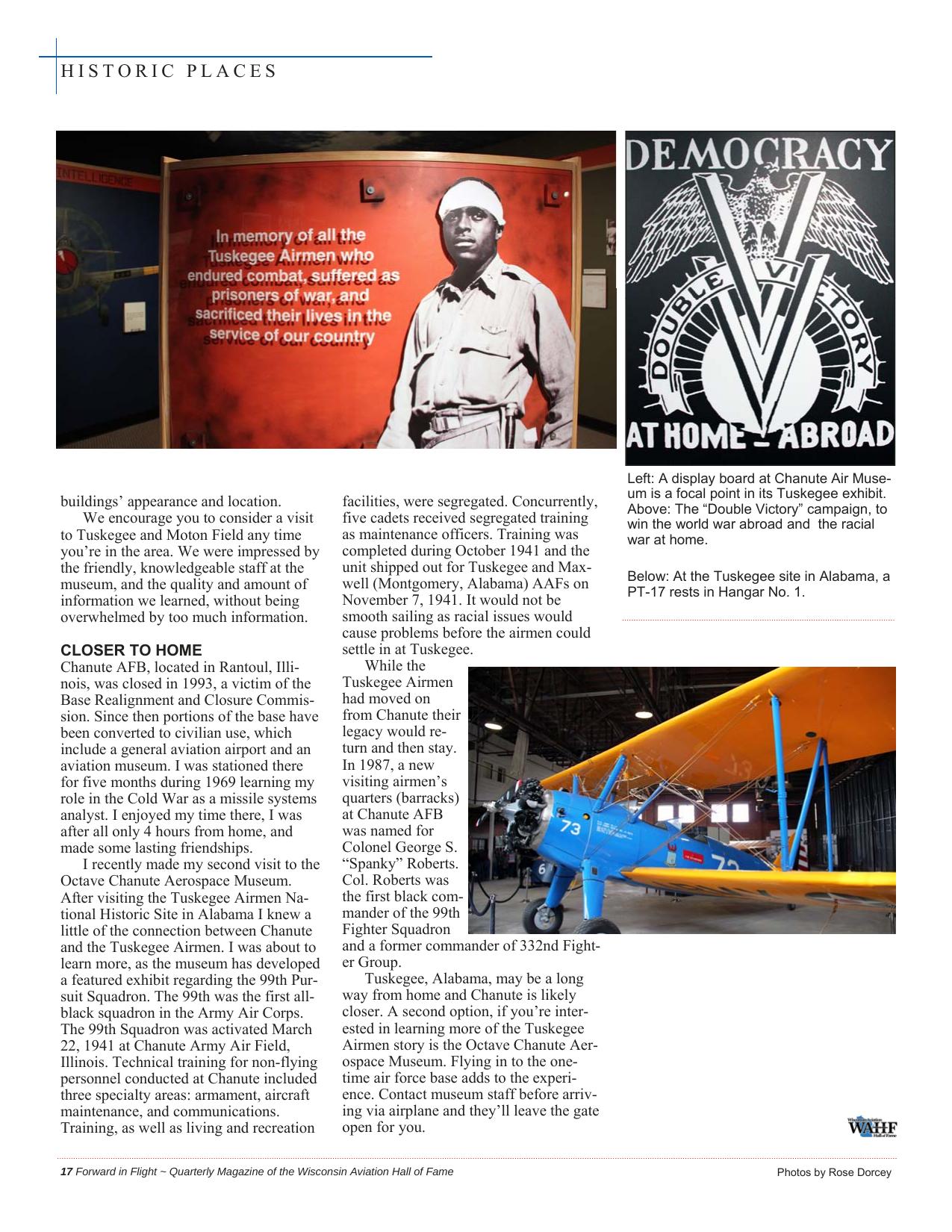
HISTORIC PLACES buildings’ appearance and location. We encourage you to consider a visit to Tuskegee and Moton Field any time you’re in the area. We were impressed by the friendly, knowledgeable staff at the museum, and the quality and amount of information we learned, without being overwhelmed by too much information. CLOSER TO HOME Chanute AFB, located in Rantoul, Illinois, was closed in 1993, a victim of the Base Realignment and Closure Commission. Since then portions of the base have been converted to civilian use, which include a general aviation airport and an aviation museum. I was stationed there for five months during 1969 learning my role in the Cold War as a missile systems analyst. I enjoyed my time there, I was after all only 4 hours from home, and made some lasting friendships. I recently made my second visit to the Octave Chanute Aerospace Museum. After visiting the Tuskegee Airmen National Historic Site in Alabama I knew a little of the connection between Chanute and the Tuskegee Airmen. I was about to learn more, as the museum has developed a featured exhibit regarding the 99th Pursuit Squadron. The 99th was the first allblack squadron in the Army Air Corps. The 99th Squadron was activated March 22, 1941 at Chanute Army Air Field, Illinois. Technical training for non-flying personnel conducted at Chanute included three specialty areas: armament, aircraft maintenance, and communications. Training, as well as living and recreation facilities, were segregated. Concurrently, five cadets received segregated training as maintenance officers. Training was completed during October 1941 and the unit shipped out for Tuskegee and Maxwell (Montgomery, Alabama) AAFs on November 7, 1941. It would not be smooth sailing as racial issues would cause problems before the airmen could settle in at Tuskegee. While the Tuskegee Airmen had moved on from Chanute their legacy would return and then stay. In 1987, a new visiting airmen’s quarters (barracks) at Chanute AFB was named for Colonel George S. “Spanky” Roberts. Col. Roberts was the first black commander of the 99th Fighter Squadron and a former commander of 332nd Fighter Group. Tuskegee, Alabama, may be a long way from home and Chanute is likely closer. A second option, if you’re interested in learning more of the Tuskegee Airmen story is the Octave Chanute Aerospace Museum. Flying in to the onetime air force base adds to the experience. Contact museum staff before arriving via airplane and they’ll leave the gate open for you. 17 Forward in Flight ~ Quarterly Magazine of the Wisconsin Aviation Hall of Fame Left: A display board at Chanute Air Museum is a focal point in its Tuskegee exhibit. Above: The “Double Victory” campaign, to win the world war abroad and the racial war at home. Below: At the Tuskegee site in Alabama, a PT-17 rests in Hangar No. 1. Photos by Rose Dorcey
CHECK SIX ‘This Joker’ was an Ace Wisconsin’s First Jet Ace By Tom Thomas and Gary Dikkers From the heart of Wisconsin came a young man born of a Swedish emigrant to become one of America’s “Greatest Generation” and Wisconsin’s first jet Ace. Conrad (Connie) Emanuel Mattson was born in Stevens Point, Wisconsin, on June 19, 1919. His father, Pehr Emanuel Mattson, was born in Sweden and immigrated to America in 1904, initially settling in Batavia, Illinois, where he married Augusta Anderson in 1906. They moved to Wisconsin Rapids in 1915, where Pehr worked for the Consolidated Water Power and Paper Company. In 1919 they moved to Stevens Point, Pehr working for the Stevens Point Pulp and Paper Company until retiring in 1948. Connie Mattson grew up in bluecollar central Wisconsin, with all its strong core values. In his youth, Connie enjoyed skiing, baseball and football, along with fishing and hunting. While attending Emerson High School, Connie enlisted in Battery “D” of the 120th Field Artillery Unit in Stevens Point and graduated the following year. This demonstrated early on that he’d believed in giving back to his state and country. Even though the Depression was still being felt nationwide, Connie recognized what a gift he had in being an American. The world was in turmoil and come 1940 with heightening tensions, Connie Mattson was ordered to active duty. Being in the artillery wasn’t quite the military career he’d dreamed of so Connie applied for a pilot training slot in the Army Air Corps. To make the cut and get selected for pilot training one had to be well-above average. Winning a slot, he entered the strict competition for the limited pilot positions available. Though academics and physical conditioning were rigorous, the actual flying was the most challenging and certainly the most rewarding. Connie picked up the flying side easily and was identified as having “good hands.” Upon graduation, he was selected for fighter training. Only the top students of the classes were chosen for fighters as those pilots had to be capable of handling a high performance aircraft, responsible for not only flying but navigation, communication, weather flying, weapons systems management and deployment, handling emergency procedures, formation flying, along with making all the takeoffs and landings. With all this going on, the pilot must perhaps most importantly be flexible, as once all has been mastered, all the qualifications met, the fighter pilot must adjust to the weather, the threat in varying numbers and sizes, and the machine you’ve been given for the day’s mission. All fighter pilots in World War II had to be experts at multi-tasking to survive. Upon graduating and being commissioned a 2nd lieutenant in November 1943 18 Forward in Flight ~ Spring 2013
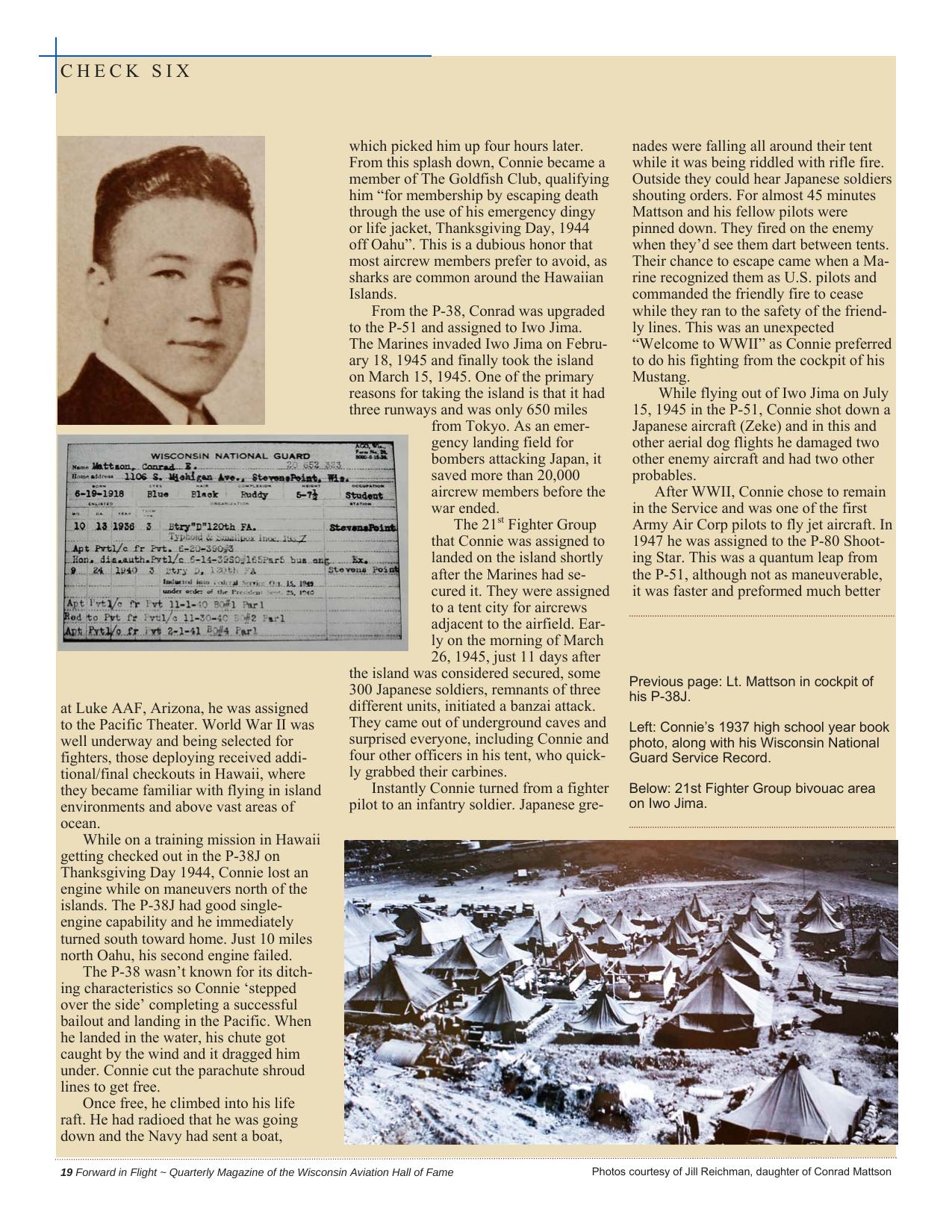
CHECK SIX at Luke AAF, Arizona, he was assigned to the Pacific Theater. World War II was well underway and being selected for fighters, those deploying received additional/final checkouts in Hawaii, where they became familiar with flying in island environments and above vast areas of ocean. While on a training mission in Hawaii getting checked out in the P-38J on Thanksgiving Day 1944, Connie lost an engine while on maneuvers north of the islands. The P-38J had good singleengine capability and he immediately turned south toward home. Just 10 miles north Oahu, his second engine failed. The P-38 wasn’t known for its ditching characteristics so Connie ‘stepped over the side’ completing a successful bailout and landing in the Pacific. When he landed in the water, his chute got caught by the wind and it dragged him under. Connie cut the parachute shroud lines to get free. Once free, he climbed into his life raft. He had radioed that he was going down and the Navy had sent a boat, which picked him up four hours later. From this splash down, Connie became a member of The Goldfish Club, qualifying him “for membership by escaping death through the use of his emergency dingy or life jacket, Thanksgiving Day, 1944 off Oahu”. This is a dubious honor that most aircrew members prefer to avoid, as sharks are common around the Hawaiian Islands. From the P-38, Conrad was upgraded to the P-51 and assigned to Iwo Jima. The Marines invaded Iwo Jima on February 18, 1945 and finally took the island on March 15, 1945. One of the primary reasons for taking the island is that it had three runways and was only 650 miles from Tokyo. As an emergency landing field for bombers attacking Japan, it saved more than 20,000 aircrew members before the war ended. The 21st Fighter Group that Connie was assigned to landed on the island shortly after the Marines had secured it. They were assigned to a tent city for aircrews adjacent to the airfield. Early on the morning of March 26, 1945, just 11 days after the island was considered secured, some 300 Japanese soldiers, remnants of three different units, initiated a banzai attack. They came out of underground caves and surprised everyone, including Connie and four other officers in his tent, who quickly grabbed their carbines. Instantly Connie turned from a fighter pilot to an infantry soldier. Japanese gre- 19 Forward in Flight ~ Quarterly Magazine of the Wisconsin Aviation Hall of Fame nades were falling all around their tent while it was being riddled with rifle fire. Outside they could hear Japanese soldiers shouting orders. For almost 45 minutes Mattson and his fellow pilots were pinned down. They fired on the enemy when they’d see them dart between tents. Their chance to escape came when a Marine recognized them as U.S. pilots and commanded the friendly fire to cease while they ran to the safety of the friendly lines. This was an unexpected “Welcome to WWII” as Connie preferred to do his fighting from the cockpit of his Mustang. While flying out of Iwo Jima on July 15, 1945 in the P-51, Connie shot down a Japanese aircraft (Zeke) and in this and other aerial dog flights he damaged two other enemy aircraft and had two other probables. After WWII, Connie chose to remain in the Service and was one of the first Army Air Corp pilots to fly jet aircraft. In 1947 he was assigned to the P-80 Shooting Star. This was a quantum leap from the P-51, although not as maneuverable, it was faster and preformed much better Previous page: Lt. Mattson in cockpit of his P-38J. Left: Connie’s 1937 high school year book photo, along with his Wisconsin National Guard Service Record. Below: 21st Fighter Group bivouac area on Iwo Jima. Photos courtesy of Jill Reichman, daughter of Conrad Mattson
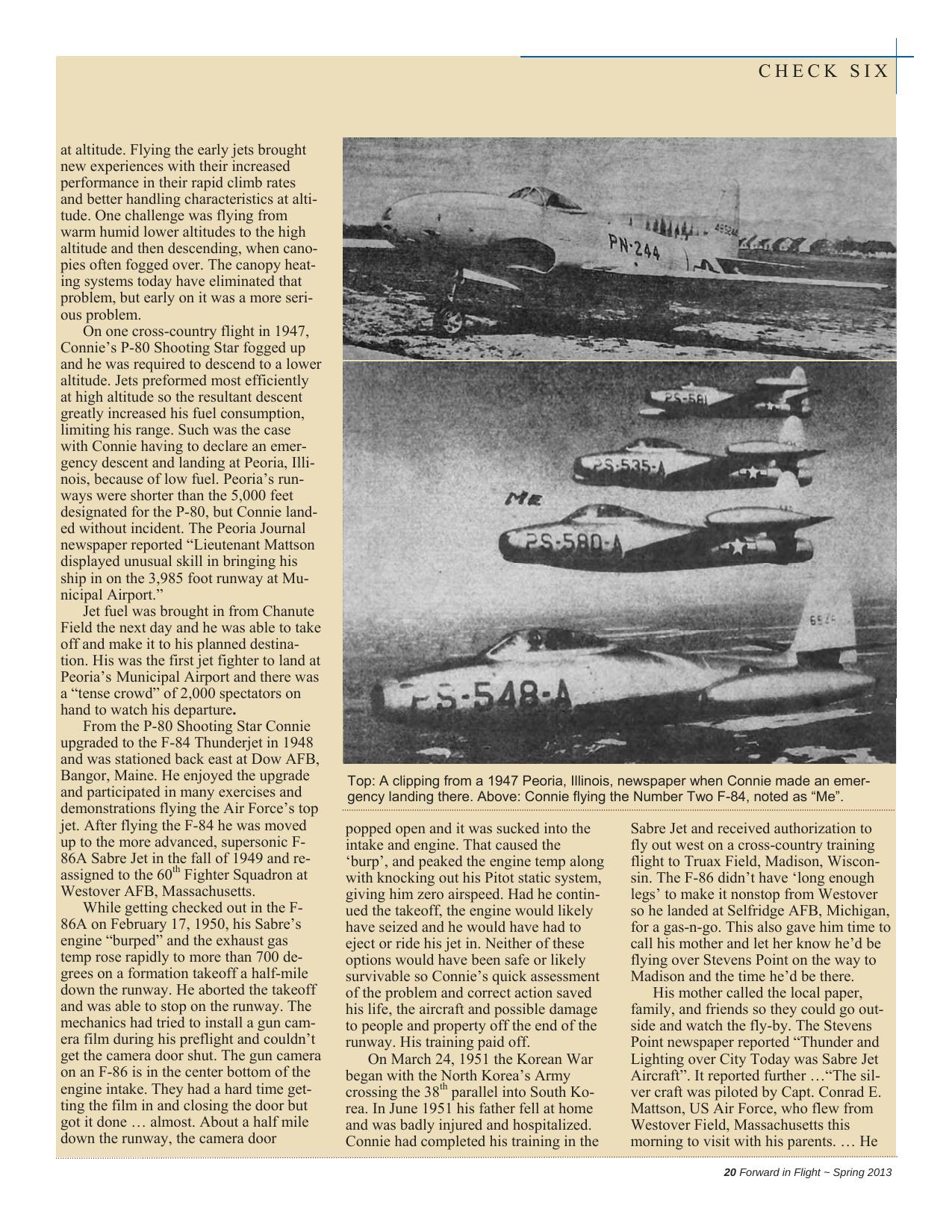
CHECK SIX at altitude. Flying the early jets brought new experiences with their increased performance in their rapid climb rates and better handling characteristics at altitude. One challenge was flying from warm humid lower altitudes to the high altitude and then descending, when canopies often fogged over. The canopy heating systems today have eliminated that problem, but early on it was a more serious problem. On one cross-country flight in 1947, Connie’s P-80 Shooting Star fogged up and he was required to descend to a lower altitude. Jets preformed most efficiently at high altitude so the resultant descent greatly increased his fuel consumption, limiting his range. Such was the case with Connie having to declare an emergency descent and landing at Peoria, Illinois, because of low fuel. Peoria’s runways were shorter than the 5,000 feet designated for the P-80, but Connie landed without incident. The Peoria Journal newspaper reported “Lieutenant Mattson displayed unusual skill in bringing his ship in on the 3,985 foot runway at Municipal Airport.” Jet fuel was brought in from Chanute Field the next day and he was able to take off and make it to his planned destination. His was the first jet fighter to land at Peoria’s Municipal Airport and there was a “tense crowd” of 2,000 spectators on hand to watch his departure. From the P-80 Shooting Star Connie upgraded to the F-84 Thunderjet in 1948 and was stationed back east at Dow AFB, Bangor, Maine. He enjoyed the upgrade and participated in many exercises and demonstrations flying the Air Force’s top jet. After flying the F-84 he was moved up to the more advanced, supersonic F86A Sabre Jet in the fall of 1949 and reassigned to the 60th Fighter Squadron at Westover AFB, Massachusetts. While getting checked out in the F86A on February 17, 1950, his Sabre’s engine “burped” and the exhaust gas temp rose rapidly to more than 700 degrees on a formation takeoff a half-mile down the runway. He aborted the takeoff and was able to stop on the runway. The mechanics had tried to install a gun camera film during his preflight and couldn’t get the camera door shut. The gun camera on an F-86 is in the center bottom of the engine intake. They had a hard time getting the film in and closing the door but got it done … almost. About a half mile down the runway, the camera door Top: A clipping from a 1947 Peoria, Illinois, newspaper when Connie made an emergency landing there. Above: Connie flying the Number Two F-84, noted as “Me”. popped open and it was sucked into the intake and engine. That caused the ‘burp’, and peaked the engine temp along with knocking out his Pitot static system, giving him zero airspeed. Had he continued the takeoff, the engine would likely have seized and he would have had to eject or ride his jet in. Neither of these options would have been safe or likely survivable so Connie’s quick assessment of the problem and correct action saved his life, the aircraft and possible damage to people and property off the end of the runway. His training paid off. On March 24, 1951 the Korean War began with the North Korea’s Army crossing the 38th parallel into South Korea. In June 1951 his father fell at home and was badly injured and hospitalized. Connie had completed his training in the Sabre Jet and received authorization to fly out west on a cross-country training flight to Truax Field, Madison, Wisconsin. The F-86 didn’t have ‘long enough legs’ to make it nonstop from Westover so he landed at Selfridge AFB, Michigan, for a gas-n-go. This also gave him time to call his mother and let her know he’d be flying over Stevens Point on the way to Madison and the time he’d be there. His mother called the local paper, family, and friends so they could go outside and watch the fly-by. The Stevens Point newspaper reported “Thunder and Lighting over City Today was Sabre Jet Aircraft”. It reported further …“The silver craft was piloted by Capt. Conrad E. Mattson, US Air Force, who flew from Westover Field, Massachusetts this morning to visit with his parents. … He 20 Forward in Flight ~ Spring 2013
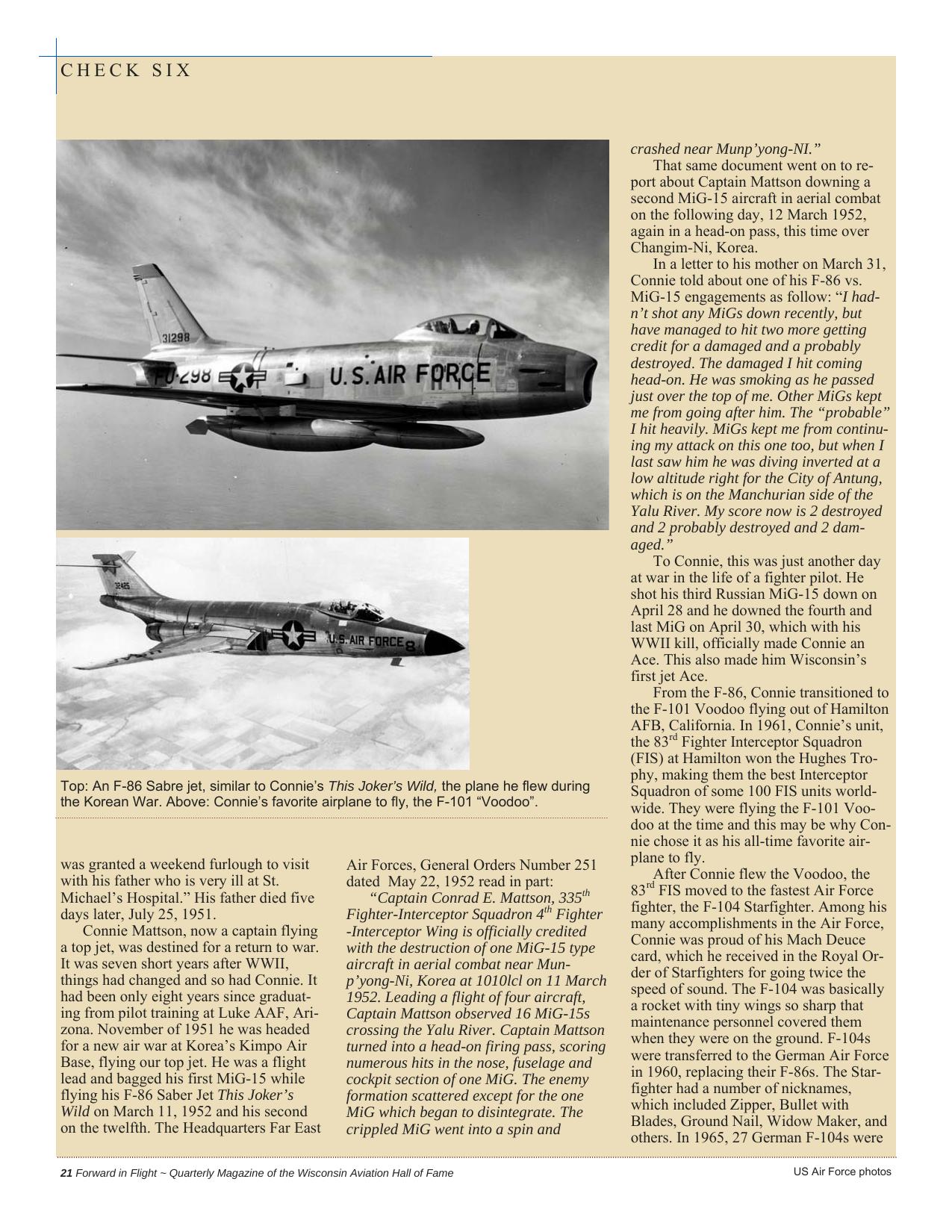
CHECK SIX Top: An F-86 Sabre jet, similar to Connie’s This Joker’s Wild, the plane he flew during the Korean War. Above: Connie’s favorite airplane to fly, the F-101 “Voodoo”. was granted a weekend furlough to visit with his father who is very ill at St. Michael’s Hospital.” His father died five days later, July 25, 1951. Connie Mattson, now a captain flying a top jet, was destined for a return to war. It was seven short years after WWII, things had changed and so had Connie. It had been only eight years since graduating from pilot training at Luke AAF, Arizona. November of 1951 he was headed for a new air war at Korea’s Kimpo Air Base, flying our top jet. He was a flight lead and bagged his first MiG-15 while flying his F-86 Saber Jet This Joker’s Wild on March 11, 1952 and his second on the twelfth. The Headquarters Far East Air Forces, General Orders Number 251 dated May 22, 1952 read in part: “Captain Conrad E. Mattson, 335th Fighter-Interceptor Squadron 4th Fighter -Interceptor Wing is officially credited with the destruction of one MiG-15 type aircraft in aerial combat near Munp’yong-Ni, Korea at 1010lcl on 11 March 1952. Leading a flight of four aircraft, Captain Mattson observed 16 MiG-15s crossing the Yalu River. Captain Mattson turned into a head-on firing pass, scoring numerous hits in the nose, fuselage and cockpit section of one MiG. The enemy formation scattered except for the one MiG which began to disintegrate. The crippled MiG went into a spin and 21 Forward in Flight ~ Quarterly Magazine of the Wisconsin Aviation Hall of Fame crashed near Munp’yong-NI.” That same document went on to report about Captain Mattson downing a second MiG-15 aircraft in aerial combat on the following day, 12 March 1952, again in a head-on pass, this time over Changim-Ni, Korea. In a letter to his mother on March 31, Connie told about one of his F-86 vs. MiG-15 engagements as follow: “I hadn’t shot any MiGs down recently, but have managed to hit two more getting credit for a damaged and a probably destroyed. The damaged I hit coming head-on. He was smoking as he passed just over the top of me. Other MiGs kept me from going after him. The “probable” I hit heavily. MiGs kept me from continuing my attack on this one too, but when I last saw him he was diving inverted at a low altitude right for the City of Antung, which is on the Manchurian side of the Yalu River. My score now is 2 destroyed and 2 probably destroyed and 2 damaged.” To Connie, this was just another day at war in the life of a fighter pilot. He shot his third Russian MiG-15 down on April 28 and he downed the fourth and last MiG on April 30, which with his WWII kill, officially made Connie an Ace. This also made him Wisconsin’s first jet Ace. From the F-86, Connie transitioned to the F-101 Voodoo flying out of Hamilton AFB, California. In 1961, Connie’s unit, the 83rd Fighter Interceptor Squadron (FIS) at Hamilton won the Hughes Trophy, making them the best Interceptor Squadron of some 100 FIS units worldwide. They were flying the F-101 Voodoo at the time and this may be why Connie chose it as his all-time favorite airplane to fly. After Connie flew the Voodoo, the 83rd FIS moved to the fastest Air Force fighter, the F-104 Starfighter. Among his many accomplishments in the Air Force, Connie was proud of his Mach Deuce card, which he received in the Royal Order of Starfighters for going twice the speed of sound. The F-104 was basically a rocket with tiny wings so sharp that maintenance personnel covered them when they were on the ground. F-104s were transferred to the German Air Force in 1960, replacing their F-86s. The Starfighter had a number of nicknames, which included Zipper, Bullet with Blades, Ground Nail, Widow Maker, and others. In 1965, 27 German F-104s were US Air Force photos
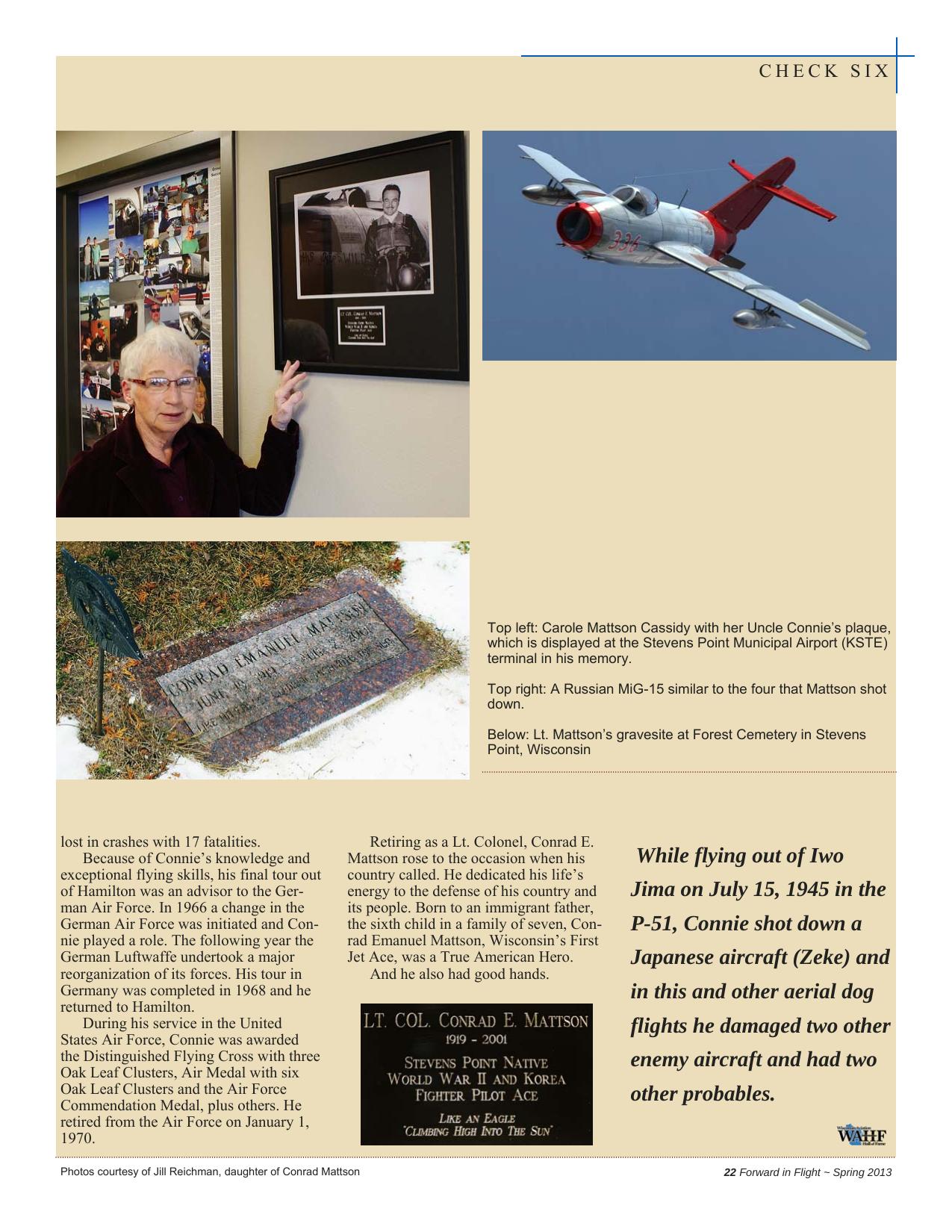
CHECK SIX Top left: Carole Mattson Cassidy with her Uncle Connie’s plaque, which is displayed at the Stevens Point Municipal Airport (KSTE) terminal in his memory. Top right: A Russian MiG-15 similar to the four that Mattson shot down. Below: Lt. Mattson’s gravesite at Forest Cemetery in Stevens Point, Wisconsin lost in crashes with 17 fatalities. Because of Connie’s knowledge and exceptional flying skills, his final tour out of Hamilton was an advisor to the German Air Force. In 1966 a change in the German Air Force was initiated and Connie played a role. The following year the German Luftwaffe undertook a major reorganization of its forces. His tour in Germany was completed in 1968 and he returned to Hamilton. During his service in the United States Air Force, Connie was awarded the Distinguished Flying Cross with three Oak Leaf Clusters, Air Medal with six Oak Leaf Clusters and the Air Force Commendation Medal, plus others. He retired from the Air Force on January 1, 1970. Retiring as a Lt. Colonel, Conrad E. Mattson rose to the occasion when his country called. He dedicated his life’s energy to the defense of his country and its people. Born to an immigrant father, the sixth child in a family of seven, Conrad Emanuel Mattson, Wisconsin’s First Jet Ace, was a True American Hero. And he also had good hands. Photos courtesy of Jill Reichman, daughter of Conrad Mattson While flying out of Iwo Jima on July 15, 1945 in the P-51, Connie shot down a Japanese aircraft (Zeke) and in this and other aerial dog flights he damaged two other enemy aircraft and had two other probables. 22 Forward in Flight ~ Spring 2013
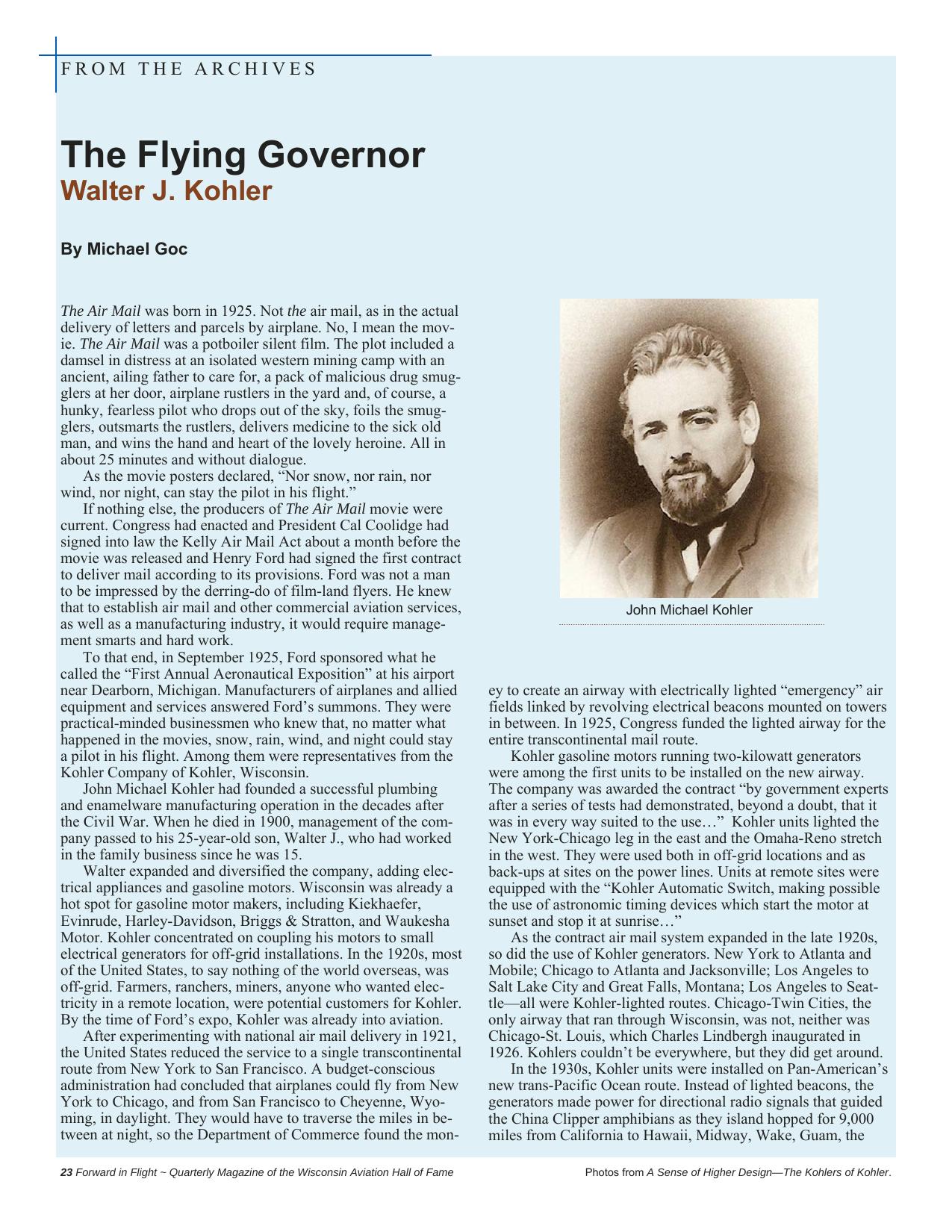
FROM THE ARCHIVES The Flying Governor Walter J. Kohler By Michael Goc The Air Mail was born in 1925. Not the air mail, as in the actual delivery of letters and parcels by airplane. No, I mean the movie. The Air Mail was a potboiler silent film. The plot included a damsel in distress at an isolated western mining camp with an ancient, ailing father to care for, a pack of malicious drug smugglers at her door, airplane rustlers in the yard and, of course, a hunky, fearless pilot who drops out of the sky, foils the smugglers, outsmarts the rustlers, delivers medicine to the sick old man, and wins the hand and heart of the lovely heroine. All in about 25 minutes and without dialogue. As the movie posters declared, “Nor snow, nor rain, nor wind, nor night, can stay the pilot in his flight.” If nothing else, the producers of The Air Mail movie were current. Congress had enacted and President Cal Coolidge had signed into law the Kelly Air Mail Act about a month before the movie was released and Henry Ford had signed the first contract to deliver mail according to its provisions. Ford was not a man to be impressed by the derring-do of film-land flyers. He knew that to establish air mail and other commercial aviation services, as well as a manufacturing industry, it would require management smarts and hard work. To that end, in September 1925, Ford sponsored what he called the “First Annual Aeronautical Exposition” at his airport near Dearborn, Michigan. Manufacturers of airplanes and allied equipment and services answered Ford’s summons. They were practical-minded businessmen who knew that, no matter what happened in the movies, snow, rain, wind, and night could stay a pilot in his flight. Among them were representatives from the Kohler Company of Kohler, Wisconsin. John Michael Kohler had founded a successful plumbing and enamelware manufacturing operation in the decades after the Civil War. When he died in 1900, management of the company passed to his 25-year-old son, Walter J., who had worked in the family business since he was 15. Walter expanded and diversified the company, adding electrical appliances and gasoline motors. Wisconsin was already a hot spot for gasoline motor makers, including Kiekhaefer, Evinrude, Harley-Davidson, Briggs & Stratton, and Waukesha Motor. Kohler concentrated on coupling his motors to small electrical generators for off-grid installations. In the 1920s, most of the United States, to say nothing of the world overseas, was off-grid. Farmers, ranchers, miners, anyone who wanted electricity in a remote location, were potential customers for Kohler. By the time of Ford’s expo, Kohler was already into aviation. After experimenting with national air mail delivery in 1921, the United States reduced the service to a single transcontinental route from New York to San Francisco. A budget-conscious administration had concluded that airplanes could fly from New York to Chicago, and from San Francisco to Cheyenne, Wyoming, in daylight. They would have to traverse the miles in between at night, so the Department of Commerce found the mon23 Forward in Flight ~ Quarterly Magazine of the Wisconsin Aviation Hall of Fame John Michael Kohler ey to create an airway with electrically lighted “emergency” air fields linked by revolving electrical beacons mounted on towers in between. In 1925, Congress funded the lighted airway for the entire transcontinental mail route. Kohler gasoline motors running two-kilowatt generators were among the first units to be installed on the new airway. The company was awarded the contract “by government experts after a series of tests had demonstrated, beyond a doubt, that it was in every way suited to the use…” Kohler units lighted the New York-Chicago leg in the east and the Omaha-Reno stretch in the west. They were used both in off-grid locations and as back-ups at sites on the power lines. Units at remote sites were equipped with the “Kohler Automatic Switch, making possible the use of astronomic timing devices which start the motor at sunset and stop it at sunrise…” As the contract air mail system expanded in the late 1920s, so did the use of Kohler generators. New York to Atlanta and Mobile; Chicago to Atlanta and Jacksonville; Los Angeles to Salt Lake City and Great Falls, Montana; Los Angeles to Seattle—all were Kohler-lighted routes. Chicago-Twin Cities, the only airway that ran through Wisconsin, was not, neither was Chicago-St. Louis, which Charles Lindbergh inaugurated in 1926. Kohlers couldn’t be everywhere, but they did get around. In the 1930s, Kohler units were installed on Pan-American’s new trans-Pacific Ocean route. Instead of lighted beacons, the generators made power for directional radio signals that guided the China Clipper amphibians as they island hopped for 9,000 miles from California to Hawaii, Midway, Wake, Guam, the Photos from A Sense of Higher Design—The Kohlers of Kohler.
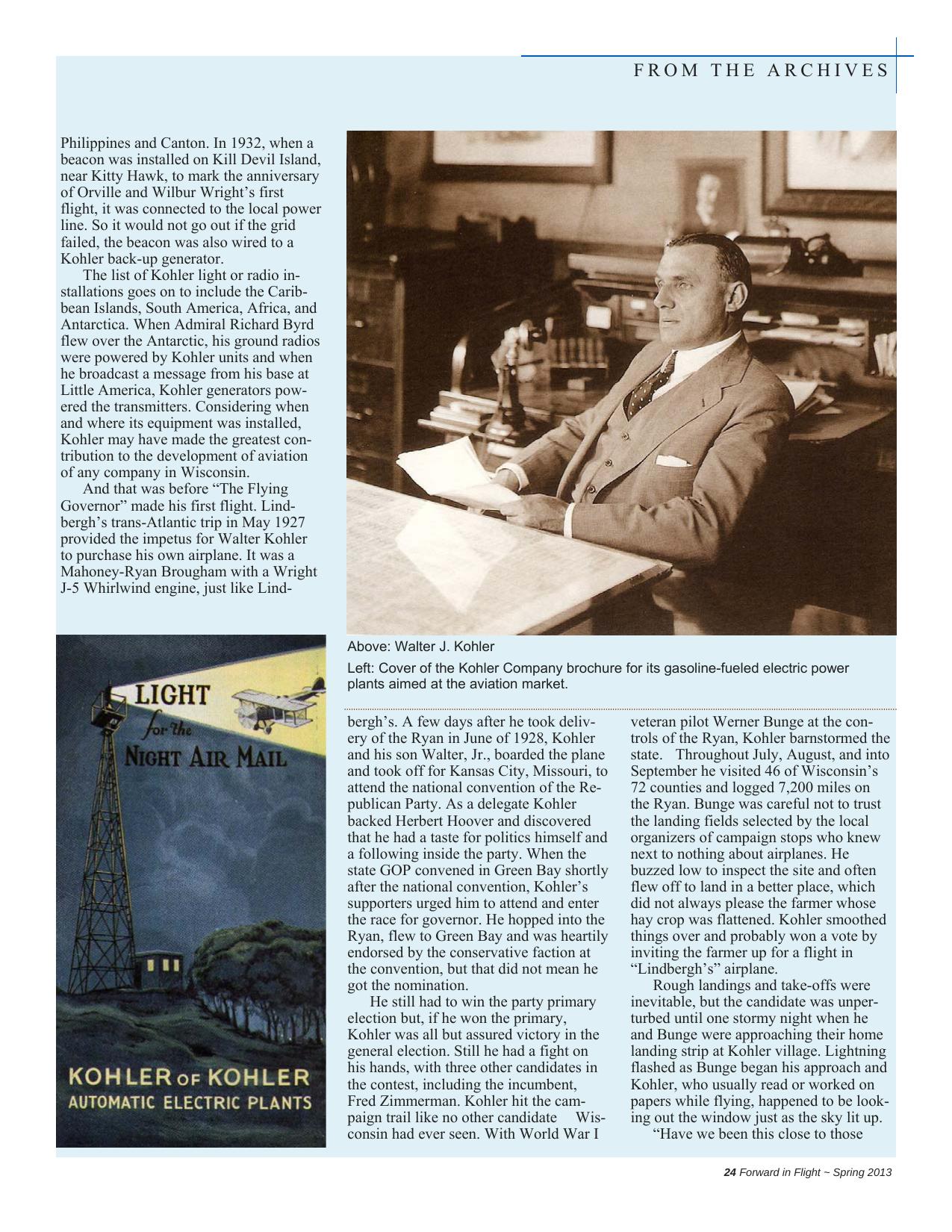
FROM THE ARCHIVES Philippines and Canton. In 1932, when a beacon was installed on Kill Devil Island, near Kitty Hawk, to mark the anniversary of Orville and Wilbur Wright’s first flight, it was connected to the local power line. So it would not go out if the grid failed, the beacon was also wired to a Kohler back-up generator. The list of Kohler light or radio installations goes on to include the Caribbean Islands, South America, Africa, and Antarctica. When Admiral Richard Byrd flew over the Antarctic, his ground radios were powered by Kohler units and when he broadcast a message from his base at Little America, Kohler generators powered the transmitters. Considering when and where its equipment was installed, Kohler may have made the greatest contribution to the development of aviation of any company in Wisconsin. And that was before “The Flying Governor” made his first flight. Lindbergh’s trans-Atlantic trip in May 1927 provided the impetus for Walter Kohler to purchase his own airplane. It was a Mahoney-Ryan Brougham with a Wright J-5 Whirlwind engine, just like Lind- Above: Walter J. Kohler Left: Cover of the Kohler Company brochure for its gasoline-fueled electric power plants aimed at the aviation market. bergh’s. A few days after he took delivery of the Ryan in June of 1928, Kohler and his son Walter, Jr., boarded the plane and took off for Kansas City, Missouri, to attend the national convention of the Republican Party. As a delegate Kohler backed Herbert Hoover and discovered that he had a taste for politics himself and a following inside the party. When the state GOP convened in Green Bay shortly after the national convention, Kohler’s supporters urged him to attend and enter the race for governor. He hopped into the Ryan, flew to Green Bay and was heartily endorsed by the conservative faction at the convention, but that did not mean he got the nomination. He still had to win the party primary election but, if he won the primary, Kohler was all but assured victory in the general election. Still he had a fight on his hands, with three other candidates in the contest, including the incumbent, Fred Zimmerman. Kohler hit the campaign trail like no other candidate Wisconsin had ever seen. With World War I veteran pilot Werner Bunge at the controls of the Ryan, Kohler barnstormed the state. Throughout July, August, and into September he visited 46 of Wisconsin’s 72 counties and logged 7,200 miles on the Ryan. Bunge was careful not to trust the landing fields selected by the local organizers of campaign stops who knew next to nothing about airplanes. He buzzed low to inspect the site and often flew off to land in a better place, which did not always please the farmer whose hay crop was flattened. Kohler smoothed things over and probably won a vote by inviting the farmer up for a flight in “Lindbergh’s” airplane. Rough landings and take-offs were inevitable, but the candidate was unperturbed until one stormy night when he and Bunge were approaching their home landing strip at Kohler village. Lightning flashed as Bunge began his approach and Kohler, who usually read or worked on papers while flying, happened to be looking out the window just as the sky lit up. “Have we been this close to those 24 Forward in Flight ~ Spring 2013
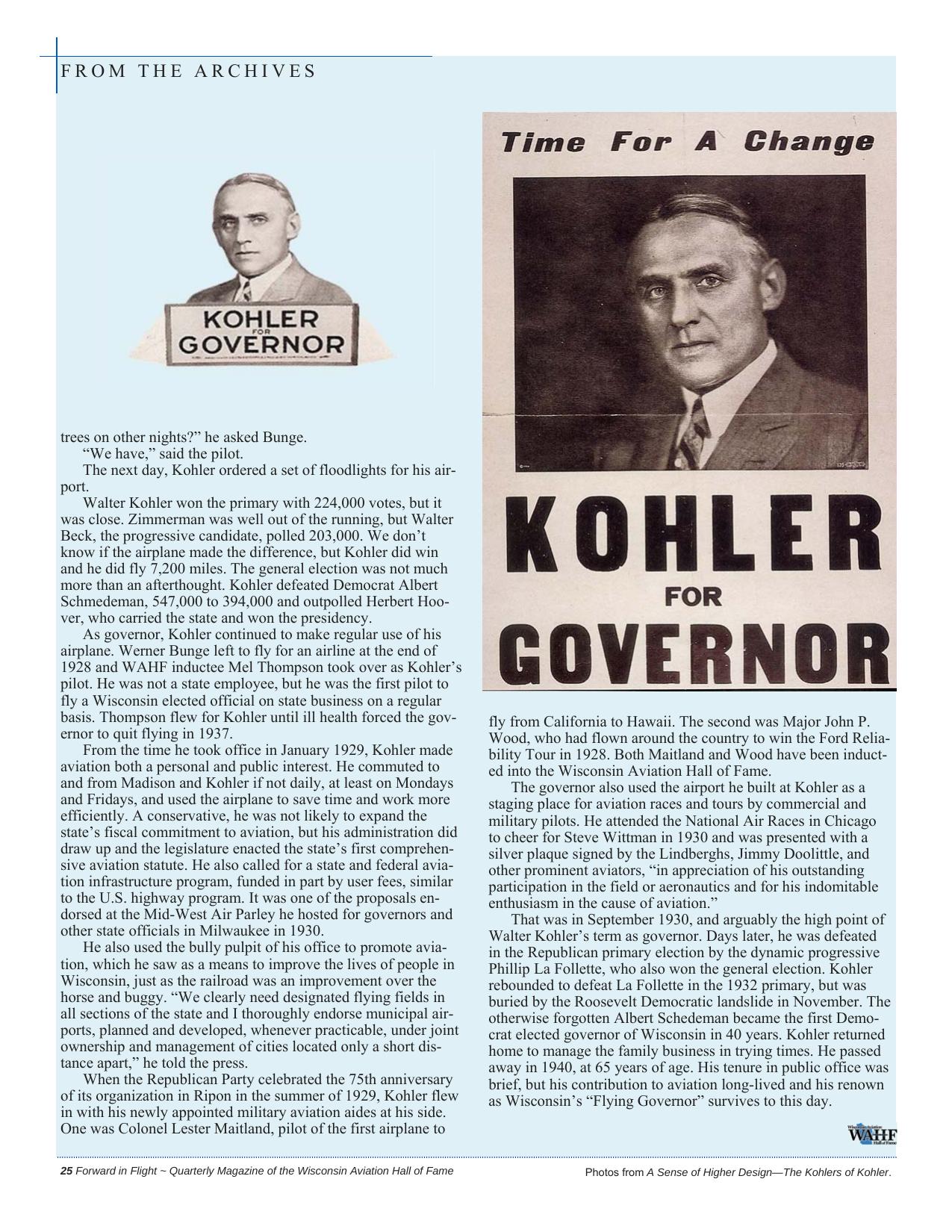
FROM THE ARCHIVES trees on other nights?” he asked Bunge. “We have,” said the pilot. The next day, Kohler ordered a set of floodlights for his airport. Walter Kohler won the primary with 224,000 votes, but it was close. Zimmerman was well out of the running, but Walter Beck, the progressive candidate, polled 203,000. We don’t know if the airplane made the difference, but Kohler did win and he did fly 7,200 miles. The general election was not much more than an afterthought. Kohler defeated Democrat Albert Schmedeman, 547,000 to 394,000 and outpolled Herbert Hoover, who carried the state and won the presidency. As governor, Kohler continued to make regular use of his airplane. Werner Bunge left to fly for an airline at the end of 1928 and WAHF inductee Mel Thompson took over as Kohler’s pilot. He was not a state employee, but he was the first pilot to fly a Wisconsin elected official on state business on a regular basis. Thompson flew for Kohler until ill health forced the governor to quit flying in 1937. From the time he took office in January 1929, Kohler made aviation both a personal and public interest. He commuted to and from Madison and Kohler if not daily, at least on Mondays and Fridays, and used the airplane to save time and work more efficiently. A conservative, he was not likely to expand the state’s fiscal commitment to aviation, but his administration did draw up and the legislature enacted the state’s first comprehensive aviation statute. He also called for a state and federal aviation infrastructure program, funded in part by user fees, similar to the U.S. highway program. It was one of the proposals endorsed at the Mid-West Air Parley he hosted for governors and other state officials in Milwaukee in 1930. He also used the bully pulpit of his office to promote aviation, which he saw as a means to improve the lives of people in Wisconsin, just as the railroad was an improvement over the horse and buggy. “We clearly need designated flying fields in all sections of the state and I thoroughly endorse municipal airports, planned and developed, whenever practicable, under joint ownership and management of cities located only a short distance apart,” he told the press. When the Republican Party celebrated the 75th anniversary of its organization in Ripon in the summer of 1929, Kohler flew in with his newly appointed military aviation aides at his side. One was Colonel Lester Maitland, pilot of the first airplane to 25 Forward in Flight ~ Quarterly Magazine of the Wisconsin Aviation Hall of Fame fly from California to Hawaii. The second was Major John P. Wood, who had flown around the country to win the Ford Reliability Tour in 1928. Both Maitland and Wood have been inducted into the Wisconsin Aviation Hall of Fame. The governor also used the airport he built at Kohler as a staging place for aviation races and tours by commercial and military pilots. He attended the National Air Races in Chicago to cheer for Steve Wittman in 1930 and was presented with a silver plaque signed by the Lindberghs, Jimmy Doolittle, and other prominent aviators, “in appreciation of his outstanding participation in the field or aeronautics and for his indomitable enthusiasm in the cause of aviation.” That was in September 1930, and arguably the high point of Walter Kohler’s term as governor. Days later, he was defeated in the Republican primary election by the dynamic progressive Phillip La Follette, who also won the general election. Kohler rebounded to defeat La Follette in the 1932 primary, but was buried by the Roosevelt Democratic landslide in November. The otherwise forgotten Albert Schedeman became the first Democrat elected governor of Wisconsin in 40 years. Kohler returned home to manage the family business in trying times. He passed away in 1940, at 65 years of age. His tenure in public office was brief, but his contribution to aviation long-lived and his renown as Wisconsin’s “Flying Governor” survives to this day. Photos from A Sense of Higher Design—The Kohlers of Kohler.
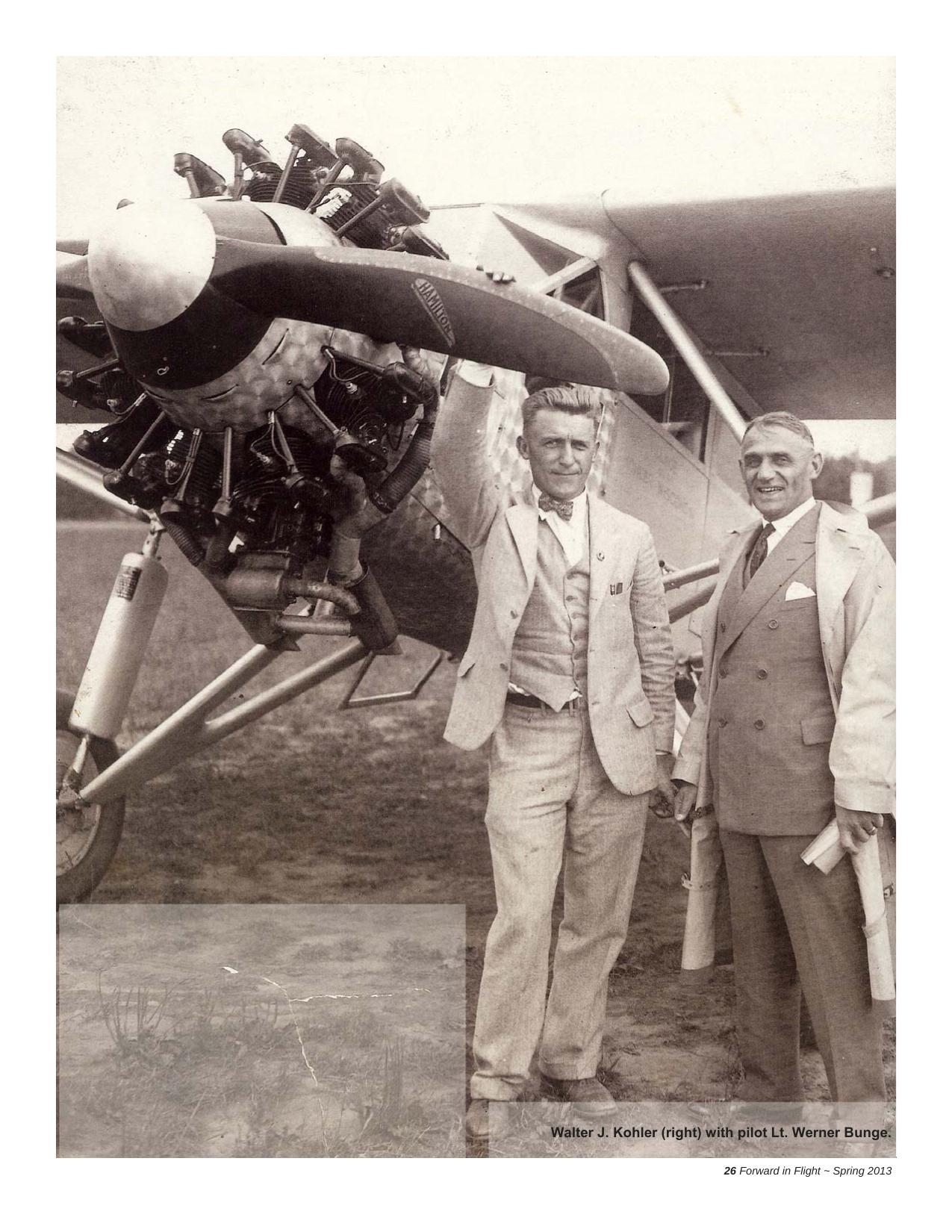
Walter J. Kohler (right) with pilot Lt. Werner Bunge. 26 Forward in Flight ~ Spring 2013
ASSOCIATION NEWS WAHF’s 2013 Inductees Five to be inducted this fall The Wisconsin Aviation Hall of Fame (WAHF) will induct five aviators at a ceremony this fall. Bill Adams, Jeff Baum, Arnold Ebneter, Ron Scott, and Walter Kohler will be honored for their achievements and significant contributions to aviation in Wisconsin. WAHF’s Michael Goc, chairman of the inductee selection committee said, “It’s with great pleasure that we announce our 2013 inductees, all of whom have contributed greatly to the development and growth of aviation in our state.” Bill Adams Born in Watertown, Wisconsin, in 1925 and raised on a farm, he began flight instruction in the 1940s, earning his private and commercial certificates. He began work as a crop-duster, and in 1948 saw the Cole Brothers Air Show. In the early ’50s, he bought and converted a stock Stearman to 450-hp, like the Coles. Bill started as an air show pilot with the Cole Brothers in 1952, and by 1960, had flown in 150 Cole shows. Throughout the ’60s, he flew in his own Bill Adams Air Shows and became a nationally known stunt flier, competing in national and international competitions. He died in 1966 in an airplane crash. Bill was inducted into the International Council of Air Show’s Hall of Fame in 2012. Jeff Baum Jeff Baum is one of Wisconsin’s most successful aviation entrepreneurs and business operators—and has been for the past 30 years. He is the founder of Wisconsin Aviation, a company he started in 1981 that became the state’s largest full-service, fixedbase operator (FBO) and provider of general aviation services including charter, flight training, aircraft rental, aircraft sales, maintenance, avionics, interiors, and line services, with locations at Dane County Regional Airport (KMSN) in Madison, Watertown Municipal Airport (KRYV), and Dodge County Airport (KUNU) in Juneau. Baum has served on numerous state and national aviation committees and through Baum’s leadership, Wisconsin Aviation has received numerous local and regional awards, as well as Runway 3/21 - 6,028 x 120 Runway 12/30 - 3,635 x 75 ILS, GPS, and VOR Approaches 100LL, JetA, 24-hour self service Jason Draheim, Manager Phone 715-345-8989 27 Forward in Flight ~ Quarterly Magazine of the Wisconsin Aviation Hall of Fame national recognition for outstanding service. For his achievements in Wisconsin’s aviation industry, Jeff was named “Business Person of the Year” (1988, 1997) by the Wisconsin Aviation Transportation Association and “Aviation Person of the Year” (2003) by the Wisconsin Airport Management Association. In 2008, Corporate Report held its “Best of Wisconsin Business Awards” and Wisconsin Aviation was awarded one of the “Best Air Charter Companies” in Wisconsin. On December 3, 2002, Wisconsin Aviation dedicated its new $2.5 million, state-of-the-art, general aviation terminal on the east side of the Dane County Regional Airport. Through Jeff’s career as a pilot he has logged more than 17,000 hours of flight time. Wisconsin Aviation has grown from a handful of employees in 1981 to more than 165. Jeff resides in Watertown with his wife, Krys. Ron Scott Born in Peoria, Illinois, in 1933, Ron moved to Tomah, Wisconsin, at age 13. He enlisted in the US Air Force in 1952, and served as a crewmember flying nuclear bombs to bases in Eng-
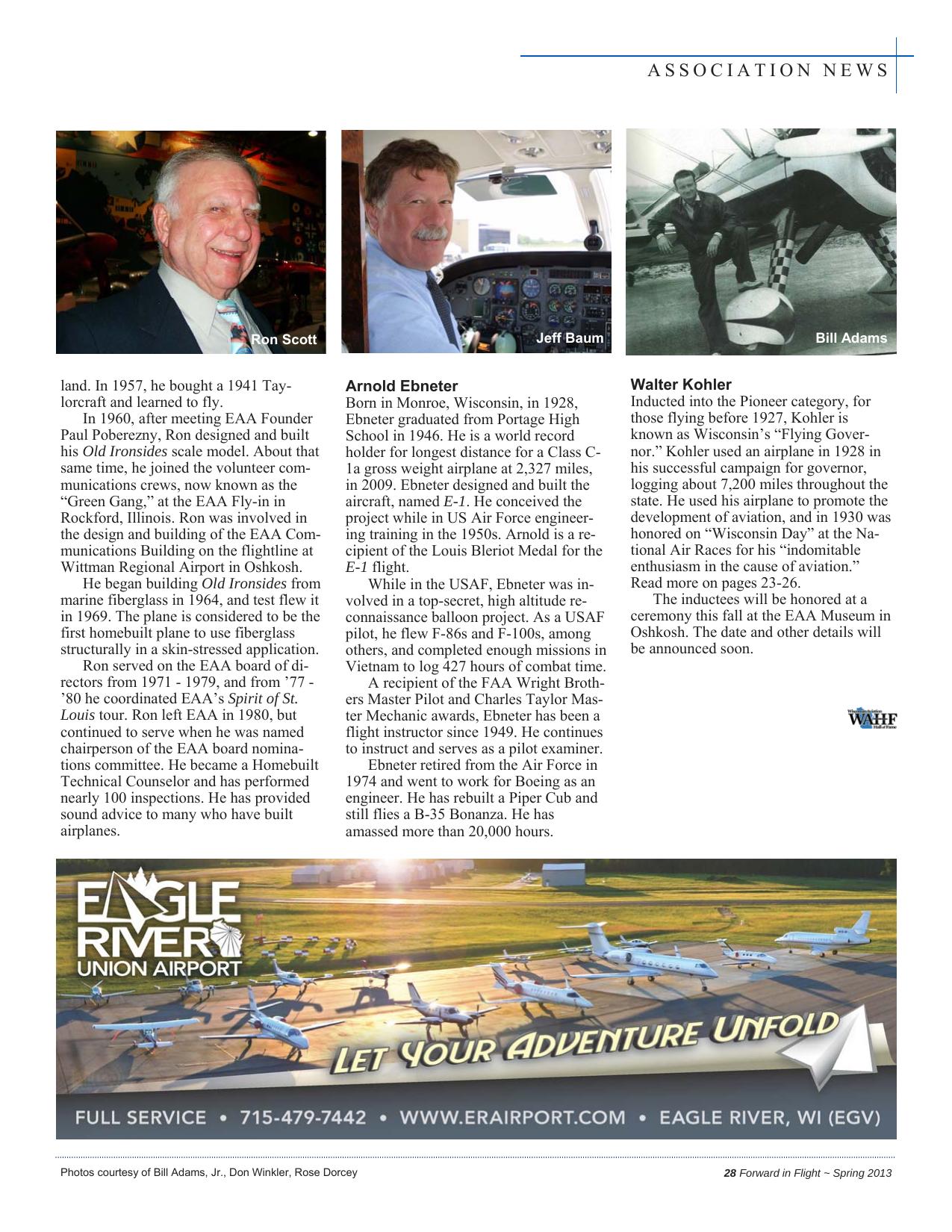
ASSOCIATION NEWS Ron Scott Jeff Baum Bill Adams land. In 1957, he bought a 1941 Taylorcraft and learned to fly. In 1960, after meeting EAA Founder Paul Poberezny, Ron designed and built his Old Ironsides scale model. About that same time, he joined the volunteer communications crews, now known as the “Green Gang,” at the EAA Fly-in in Rockford, Illinois. Ron was involved in the design and building of the EAA Communications Building on the flightline at Wittman Regional Airport in Oshkosh. He began building Old Ironsides from marine fiberglass in 1964, and test flew it in 1969. The plane is considered to be the first homebuilt plane to use fiberglass structurally in a skin-stressed application. Ron served on the EAA board of directors from 1971 - 1979, and from ’77 ’80 he coordinated EAA’s Spirit of St. Louis tour. Ron left EAA in 1980, but continued to serve when he was named chairperson of the EAA board nominations committee. He became a Homebuilt Technical Counselor and has performed nearly 100 inspections. He has provided sound advice to many who have built airplanes. Arnold Ebneter Born in Monroe, Wisconsin, in 1928, Ebneter graduated from Portage High School in 1946. He is a world record holder for longest distance for a Class C1a gross weight airplane at 2,327 miles, in 2009. Ebneter designed and built the aircraft, named E-1. He conceived the project while in US Air Force engineering training in the 1950s. Arnold is a recipient of the Louis Bleriot Medal for the E-1 flight. While in the USAF, Ebneter was involved in a top-secret, high altitude reconnaissance balloon project. As a USAF pilot, he flew F-86s and F-100s, among others, and completed enough missions in Vietnam to log 427 hours of combat time. A recipient of the FAA Wright Brothers Master Pilot and Charles Taylor Master Mechanic awards, Ebneter has been a flight instructor since 1949. He continues to instruct and serves as a pilot examiner. Ebneter retired from the Air Force in 1974 and went to work for Boeing as an engineer. He has rebuilt a Piper Cub and still flies a B-35 Bonanza. He has amassed more than 20,000 hours. Walter Kohler Inducted into the Pioneer category, for those flying before 1927, Kohler is known as Wisconsin’s “Flying Governor.” Kohler used an airplane in 1928 in his successful campaign for governor, logging about 7,200 miles throughout the state. He used his airplane to promote the development of aviation, and in 1930 was honored on “Wisconsin Day” at the National Air Races for his “indomitable enthusiasm in the cause of aviation.” Read more on pages 23-26. The inductees will be honored at a ceremony this fall at the EAA Museum in Oshkosh. The date and other details will be announced soon. Photos courtesy of Bill Adams, Jr., Don Winkler, Rose Dorcey 28 Forward in Flight ~ Spring 2013
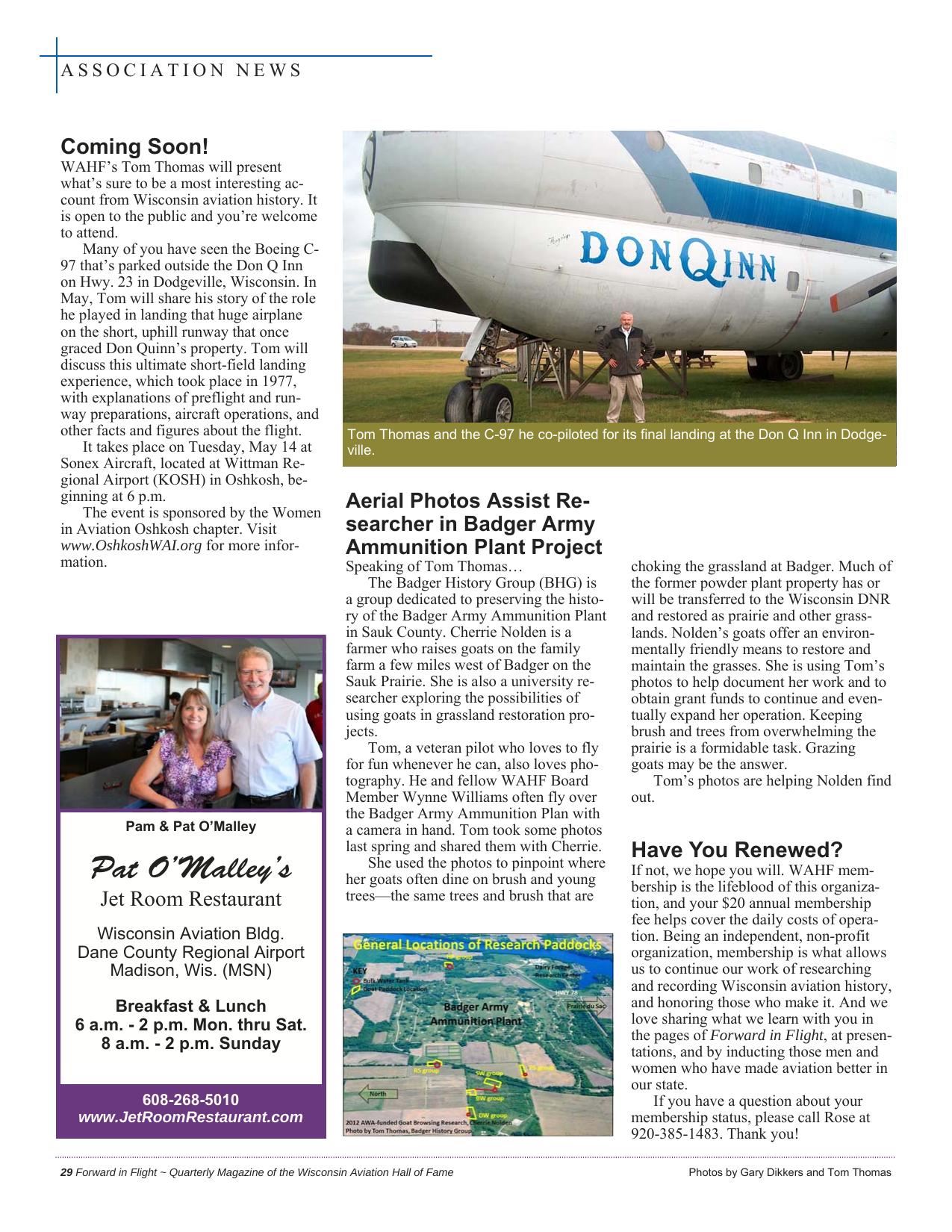
ASSOCIATION NEWS Coming Soon! WAHF’s Tom Thomas will present what’s sure to be a most interesting account from Wisconsin aviation history. It is open to the public and you’re welcome to attend. Many of you have seen the Boeing C97 that’s parked outside the Don Q Inn on Hwy. 23 in Dodgeville, Wisconsin. In May, Tom will share his story of the role he played in landing that huge airplane on the short, uphill runway that once graced Don Quinn’s property. Tom will discuss this ultimate short-field landing experience, which took place in 1977, with explanations of preflight and runway preparations, aircraft operations, and other facts and figures about the flight. It takes place on Tuesday, May 14 at Sonex Aircraft, located at Wittman Regional Airport (KOSH) in Oshkosh, beginning at 6 p.m. The event is sponsored by the Women in Aviation Oshkosh chapter. Visit www.OshkoshWAI.org for more information. Pam & Pat O’Malley Pat O’Malley’s Jet Room Restaurant Tom Thomas and the C-97 he co-piloted for its final landing at the Don Q Inn in Dodgeville. Aerial Photos Assist Researcher in Badger Army Ammunition Plant Project Speaking of Tom Thomas… The Badger History Group (BHG) is a group dedicated to preserving the history of the Badger Army Ammunition Plant in Sauk County. Cherrie Nolden is a farmer who raises goats on the family farm a few miles west of Badger on the Sauk Prairie. She is also a university researcher exploring the possibilities of using goats in grassland restoration projects. Tom, a veteran pilot who loves to fly for fun whenever he can, also loves photography. He and fellow WAHF Board Member Wynne Williams often fly over the Badger Army Ammunition Plan with a camera in hand. Tom took some photos last spring and shared them with Cherrie. She used the photos to pinpoint where her goats often dine on brush and young trees—the same trees and brush that are Wisconsin Aviation Bldg. Dane County Regional Airport Madison, Wis. (MSN) Breakfast & Lunch 6 a.m. - 2 p.m. Mon. thru Sat. 8 a.m. - 2 p.m. Sunday 608-268-5010 www.JetRoomRestaurant.com 29 Forward in Flight ~ Quarterly Magazine of the Wisconsin Aviation Hall of Fame choking the grassland at Badger. Much of the former powder plant property has or will be transferred to the Wisconsin DNR and restored as prairie and other grasslands. Nolden’s goats offer an environmentally friendly means to restore and maintain the grasses. She is using Tom’s photos to help document her work and to obtain grant funds to continue and eventually expand her operation. Keeping brush and trees from overwhelming the prairie is a formidable task. Grazing goats may be the answer. Tom’s photos are helping Nolden find out. Have You Renewed? If not, we hope you will. WAHF membership is the lifeblood of this organization, and your $20 annual membership fee helps cover the daily costs of operation. Being an independent, non-profit organization, membership is what allows us to continue our work of researching and recording Wisconsin aviation history, and honoring those who make it. And we love sharing what we learn with you in the pages of Forward in Flight, at presentations, and by inducting those men and women who have made aviation better in our state. If you have a question about your membership status, please call Rose at 920-385-1483. Thank you! Photos by Gary Dikkers and Tom Thomas
ASSOCIATION NEWS Changes to WAHF’s Scholarship WAHF has awarded 25 scholarships since the inception of its scholarship program in 2002. The program was designed to make annual awards to students in aviation programs at Wisconsin’s technical colleges. When the program began, four Wisconsin technical colleges provided six aviation courses of study. Today there are fewer courses and the potential for fewer schools in the future. In addition to the reduction in schools and programs in our state’s tech schools, WAHF member/supporters, inductees, former scholarship recipients, and program benefactors made comments and suggestions. A committee was formed about nine months ago to study the program and, if needed, draft a revised program. The committee presented their completed work at the most recent board meeting. The board adopted the program revisions by unanimous vote. Program revisions include: Residency. Scholarship applicants must prove a minimum five-year Wisconsin residency prior to enrollment in the program of study. Schools. Continuing students in an aviation or aerospace related program at either a 2-year or 4-year accredited school may apply for an award. Award term. Continuing students may apply for an award over multiple years. Morey Airplane Company Since 1932 WAHF has one endowed award, the Carl Guell Memorial Scholarship, a $1000 award. The organization distributes two other awards. The Theissen Field Scholarship provided by WAHF Member/Supporter Jerome Theissen. This $500 award is also endowed. Jerry places need over scholastic achievement on this scholarship. Family and friends of the late Jerome Ripp established a $500 award as a memorial. This award is not endowed at present. Available funds will provide for several more scholarships if no additional deposits are made. Scholarships can be created and endowed at various levels. A $5000 endowment results in a $250 annual award. Increased endowment amounts provide for higher awards. WAHF and its scholarship administrator, the Community Foundation of North Central Wisconsin (CFONCW) are ready to answer any questions you may have about developing award. You can find program documents and application materials on CFONCW’s website. Just scan the QR code, or visit www.cfoncw.org/ grants/scholarships.cfm to learn more. Subscribe to Forward in Flight today! Subscription includes one-year WAHF membership. Membership Benefits: Quarterly subscription (four Middleton Municipal Airport/Morey Field Self-service 100LL & Jet A 24-7 issues) of Forward in Flight, packed full of Wisconsin aviation news, events, state aviation history, and stories about your aviation colleagues Free pass to the Deke Slayton Museum Invitation to annual induction banquet Just $20 and you’ll be sup- porting an aviation organization dedicated to collecting, preserving, and sharing Wisconsin aviation history. With Forward in Flight, you’ll learn about aviation history makers—the people, places, and events that distinguish our state and also be in touch with current Wisconsin aviation news and information. Name Address City State Zip Phone Number Email Referred By 30 Forward in Flight ~ Spring 2013
FROM THE AIRWAYS Wausau Flying Service Presents ‘How to Win a Spot Landing Contest’ Wausau Flying Service will sponsor a free seminar entitled, “How to Win A Spot Landing Contest—or—Learn to Land Where You Want To.” Presented by CFIs Gil Buettner and John Chmiel, all pilots and aviation enthusiasts are welcome to attend. The one-hour seminar offers FAA WINGS credit and takes place on Saturday, April 6 from 9 - 10 a.m. Wausau Flying Service is located at Wausau Downtown Airport (KAUW). Contact John or Gil for more information at 715 845-3400, email taildraggerflyer@yahoo.com. Visit www.FlyWausau.com. ‘Landings For Lunches’ Contest Event details follow: Entry fee for each landing attempt is $1 plus one nonperishable good, or $2. From each entry $1 is put in the pot for the spot landing contest winner Winner’s name will be engraved on a trophy The other $1 or perishable food will be donated to The Neighbor’s Place on behalf of the Wausau Downtown Airport Additional food and/or monetary donations will be accepted Aviators must pre-pay for each judged landing attempt Pilots from all airports are encouraged to participate Pilots will pay for and fly a minimum of two attempts Attempt closest to the line will be scored The closest second attempt will be used to break any ties that may occur Pilots are encouraged to participate as many times as they like Judged landings must be on or beyond the line Landings beyond 100 feet will be disqualified (DQ) Landings before the line will DQ Bounces before the line will DQ Go-arounds without touching down will not DQ Wausau Flying Service will display and maintain a participant list in the FBO lobby Food donations will be on display in the Wausau Flying Service lobby until the donations are made Weather conditions will be at the discretion of the participant AND the judge on duty Judges decisions are final. Additional contest rules can be found at www.FlyWausau.com. 2013 Regional General Aviation Awards Winners Named The National General Aviation Awards Committee has announced this year’s regional General Aviation Awards winners. They are all finalists for the national awards. Among the regional winners is Lynwood “Woody” Minar of Wisconsin, in the 2013 Regional FAASTeam Representatives of the Year category. Lynwood Karl “Woody” Minar, a four-time Master CFI in Dresser, Wisconsin, represented the Minneapolis FSDO and the Great Lakes Region. Woody is chief instructor at Osceola Aero Sport. “These awards highlight the important role played by these individuals in promoting aviation education and flight safety,” said JoAnn Hill, GAAwds Committee co- chair. “The awards program sponsors and supporters are pleased that these outstanding aviation professionals are receiving the recognition they so richly deserve.” The GA Awards program is a cooperative effort between more than 18 general aviation industry sponsors and the Federal Aviation Administration (FAA). Nominations for 2014 will be accepted beginning in August. “Everyone knows a worthy aviation professional. I encourage you to submit a nomination for your favorite flight instructor, maintenance technician, or FAASTeam representative,” urged John Teipen, GAAwds cochair. The mission of the General Aviation Awards program is to recognize individual aviation professionals on the local, regional, and national levels for their contributions to aviation, education, and flight safety. 31 Forward in Flight ~ Quarterly Magazine of the Wisconsin Aviation Hall of Fame
GONE WEST Doolittle Raider and WWII hero Thomas Griffin dies; Four survivors of historic mission remain Thomas Griffin, navigator on the No. 9 B-25 bomber Whirling Dervish in the Doolittle Raid on Japan on April 18, 1942, passed away Tuesday, February 26, in Cincinnati, Ohio. He was 96 and is survived by two sons. Griffin was born on July 10, 1916, in Green Bay, Wisconsin, and raised in Chicago. He graduated from the University of Alabama with a bachelor’s degree in political science in 1939, then entered service on July 5 that year as a Second Lieutenant, Coast Artillery, but enlisted as a Flying Cadet in 1940. He was rated as a navigator, and recommissioned on July 1, 1940. Mr. Griffin was one of 80 men who volunteered for the bombing run on mainland Japan just four months after the sneak attack on Pearl Harbor. It’s credited for helping to boost American morale when it was at its lowest point. Mr. Griffin’s passing leaves just four survivors of the mission: Edward Saylor, Richard Cole, Robert Hite and David Thatcher. The raid was planned and carried out in extreme secrecy. Mr. Griffin and his fellow Raiders understood that it was possible, even likely, that some of them wouldn’t make it back. After the Tokyo raid, Griffin was assigned to B-26s with the 319th Bomb Group in North Africa, where he served until being shot down and captured by the Germans on July 3, 1943. He remained a prisoner of war for the next 22 months in the infamous Stalag Luft III until liberated in April 1945. Decorations include the Distinguished Flying Cross, Air Medal with three oak leaf clusters, and the Chinese Army, Navy, and Air Corps Medal, Class A, First Grade. In the years since the mission, the surviving Raiders have reunited each April 18. Last year, Mr. Griffin joined three of them—Mr. Hite was too ill to attend—at Wright-Patterson Air Force Base in Dayton, Ohio, as part of a 70th anniversary celebration that drew thousands of friends, family, military veterans, and others who wished to honor the brave men. Before dying in 1993, Lt. Col. James H. “Jimmy” Doolittle, who led the raid and flew the first of 16 B25 bombers that took off from a Navy aircraft carrier, gave the surviving Raiders a bottle of HenTom Griffin at EAA in March 2007. nessy Very Special Cognac. The bottle is to be opened by the final two living Raiders. The 71st Doolittle Raiders Reunion, an event being billed as the final reunion of Doolittle’s Raiders, is scheduled for April 17-20 in Fort Walton Beach, Florida. While the Raiders found fame and recognition for their bombing of Japan, some of Mr. Griffin’s most trying moments came years later. His plane was shot down in 1943 and he was taken captive by the Nazis. He remained in Germany until being freed by Allied forces in 1945. Griffin participated in the EAA Timeless Voices project. You can view his interview here: www.eaavideo.org/ video.aspx?v=1317867882. 2013 Wisconsin Aviation Conference Returns to Middleton The 58th annual Wisconsin Aviation Conference returns to the Madison Marriott West Hotel and Conference Center April 28 May 1, 2013. Several exciting networking events are offered, including golf and a round of sporting clays, before getting down to business with more than a dozen informative sessions. Several FAA representatives will share updates, including FAA Great Lakes Region Administrator Barry Cooper. Also on the agenda is David Greene, WisDOT Bureau of Aeronautics director, who will provide a “state-of-the-state” address. Alan Klapmeier, founder and CEO of Kestral Aircraft Company, is the banquet speaker on Tuesday evening. Sponsored by the Wisconsin Airport Management Association, session topics include airport planning and marketing, cockpit iPad usage, user fees, development of instrument approach procedures, and more. The conference is open to anyone with an interest in aviation, airport management, or piloting. Registration is now open. All conference materials are online; to register as a vendor or for general registration, visit Photo by Rose Dorcey www.wiama.org, or call WAMA Executive Director Bob O’Brien at 815757-2869. Advertise in Forward in Flight! Reach Wisconsin pilots and aircraft owners with an affordable ad in Forward in Flight. It’s easy to get started; call Rose at 920-279-6029 or email rdorcey@wisconsinaviationhalloffame.org. 32 Forward in Flight ~ Spring 2013
MEMBER LOGBOOK MAILBOX Member Mail Meet a WAHF member... Steve Sorge Occupation: Founder/Director of 88CHARLIES Inc – A not for profit, aviation based, educational organization that uses aircraft operations and aircraft restoration activities to promote further learning of Science, Technology, Engineering, and Math. Our student body is comprised of middle school and high school students. (My day job is a mechanical engineer for General Electric.) What I enjoy most about what I do: Sharing my love of aviation and engineering disciplines with our students and their parents, just about anybody not currently involved in aviation. They’ll leave; “involved.” In my free time I: Race motorcycles and raise beef cattle. Hey, nice photo of Tom Thomas and Mr. Paul Poberezny on the cover of the Winter 2012 issue of Forward in Flight! And I always enjoy the well researched and written articles. Good to see Gary Dikkers awarded the Presidential award—well deserved. Keep up the good work. The passion you folks have is so apparent. Brad Volker Rice Lake, Wisconsin Steve Sorge Aviation affiliations: WAHF, 88CHARLIES, EAA, AAA, AOPA, MAAC, NBA. Aircraft owner and pilot since 1981 (owner first, then pilot!) The last book I read or favorite book: The Lexus and the Olive Tree by Thomas L. Friedman. One thing most people don’t know about me: Not much, I tend to share with others everything I do. In the last three years; of 350 hours of flight time as PIC – 20 hours were solo. Get out there and share it! My greatest accomplishment in life so far: Married 26 years to my first bride, and raising four fantastic kids. The person I most admire: Paul Poberezny One thing I want to do before I die: Done it all, time to start over ...another few trips to the North Slope of Alaska and the Diomede Islands with my kids would be nice. Favorite quote or words of wisdom: “Talent is like a dull knife; it has little effect unless wielded with great force”. —Pat Travers Why I became a member/supporter of WAHF: I believe in their mission. Meet your fellow WAHF members in each issue of Forward in Flight. Enjoyed Winter 2012 Forward in Flight Voland’s ‘Rest of the Story’ I enjoyed reading your article about Lois Truchinski in the Winter 2012 issue of Forward in Flight. Thank you for presenting that story. Now as Paul Harvey would say “the rest of the story”. Lois's husband Larry is my first cousin and was my inspiration when taking flying lessons while attending college in 1953 at Iowa State University. I stopped at their little airport on the west side of Nekoosa on one of my trips back home with the club Cessna 140 before getting my Private license. Larry even found a tired Piper Cruiser that he said he would help me get airworthy if I could come up with $250, but my parents would not let me buy the aircraft. They said that my education came first and after graduating I could pursue my aviation interests. I did that by spending 5-1/2 years on active duty in the USAF. I would stop to visit Larry and Lois at their home in Wisconsin Rapids when we used to have the Wisconsin Aviation Conference there. I have not seen them for several years. Don Voland East Troy, Wisconsin Editor’s Note: We just learned that Larry Truchinski passed away on Saturday, March 6, age 86. Our condolences to his wife, Lois, and family. Thank you Brad and Don for your letters. We don’t publish them all, but we love hearing from our readers. 33 Forward in Flight ~ Quarterly Magazine of the Wisconsin Aviation Hall of Fame

Wittman Regional Airport Oshkosh So much history ...and still making it! From the legacy of Steve Wittman to Warren Basler’s DC-3 conversions, we’re proud to support and contribute to Wisconsin aviation history. FLY TO OSHKOSH wittmanairport.com @wittmanairport Plan to attend the 2013 WISCONSIN AVIATION CONFERENCE For pilots, airport managers, airport commission members, fixed base operators, or anyone interested in aviation. 2013 Wisconsin Aviation Conference April 29 - May 1 Madison Marriott West Middleton Speakers Alan Klapmeier, President/CEO Kestral Aircraft Barry Cooper, FAA Great Lakes Region Administrator Sue Schalk, FAA Regional Airports Division Manager Mark Gottleib, WisDOT Secretary David Greene, WisDOT Aeronautics Director And more! Topics Tips for Engaging Your Customer Base Developing Instrument Approaches Impact of User Fees and Fuel Taxes Anti-Icing and Deicing Decisions New Developments in Airport Planning Airport Wildlife Management iPads in the Cockpit And more! Hosted by the Wisconsin Airport Management Association, Wisconsin Aviation Trades Association, Wisconsin Business Aviation Association, Consultants, Suppliers, and Sponsors. Special Events Welcome Reception and Dinner Buffet at Capital Brewery Awards Luncheon Golf and Sporting Clays Tournaments Just $85 for registration and meals! Register Online Or call Bob O’Brien at 815-757-2869 More information: www.WIAMA.org 34 Forward in Flight ~ Spring 2013

PRSRT STD US Postage Paid Wisc Rapids WI Permit 98 3980 SHARRATT DRIVE OSHKOSH WI 54901-1276 The Wisconsin Aviation Hall of Fame is a non-profit membership organization dedicated to preserving the past and fostering the future of flight. Welcome WAHF Member/Supporters: Mark Anesko Adele Hallstrand Chris Hallstrand Kim Loresch Kathy Pollard Mary Rhomberg Becky Schollian Linda Valentine Bart Van Roo —Thanks for coming on board. We hope to see you at a WAHF event soon! Tailwind Flight Center in Appleton is sponsoring a VFR refresher clinic on March 30 from 9-12. Registration fee is $30, including pizza! The program helps pilots review VFR operating procedures and regulations. Sign up online at http://tailwindflightcenter.com/flightinstruction/vfr-refresher-clinic/ The 58th Annual Wisconsin Aviation Conference is set for April 29 -May 1, 2013 at the Madison Marriot West Hotel and Conference Center in Middleton. Conference registration is now open and the early registration deadline of just $85 is April 17. See more information on page 32, and visit www.Wiama.org. EAA Chapter 60 will hold its Spring Fling Pancake Breakfast Fly-in on Saturday, May 18 at the Beloit Airport (44C) from 7 a.m. - 11 a.m. All you can eat pancakes, served with sausage. FMI: Contact Bob Rauscher, chapter president, at 608-752-9025 or 608 -335-6536. The Sport Aviation Olympics will take place at Northport Airport (38WI) in Royalton on June 22 from 10 a.m. until 2 p.m. Flour bombing, spot landing contests, and torpedo runs will take place. Prizes and refreshments available. For more information or to register call 920-225-9881 or email sportaviationolympics@yahoo.com. It’s hard to find a better lunch than what’s served up nearly every Friday at Central County Airport (68C). You’ll also find great aviation fellowship. You don’t even need to check the menu before you go—it’s that good—just plan to arrive early. Lunch is served at noon. Wisconsin Aviation Hall of Fame Officers and Board of Directors Rose Dorcey, President Michael Goc, Vice President John Dorcey, Secretary/Treasurer Frederick Beseler Bruce Botterman Andrew Ovans Charles Swain Tom Thomas Wynne Williams Charles Marotske, Honorary Chairman of the Board Wisconsin Aviation Hall of Fame 3980 Sharratt Drive Oshkosh, WI 54901-1276 Become a supporter today! For information call Rose Dorcey at 920-385-1483 www.wisconsinaviationhalloffame.org rdorcey@wisconsinaviationhalloffame.org