Volume 12, Issue 1
🗞️ Download Issue (PDF)
Forward in Flight - Spring 2014
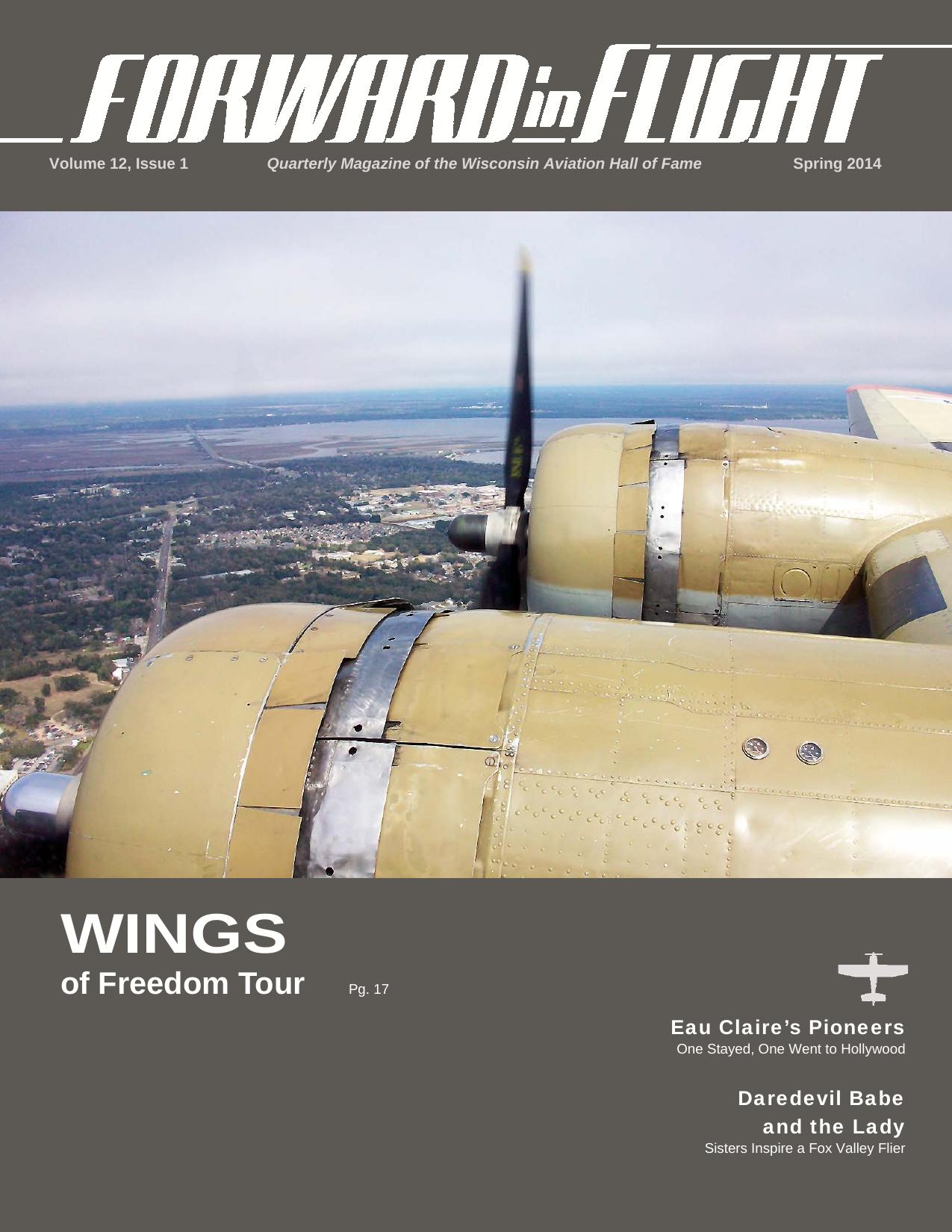
Volume 12, Issue 1 Quarterly Magazine of the Wisconsin Aviation Hall of Fame Spring 2014 WINGS of Freedom Tour Pg. 17 Eau Claire’s Pioneers One Stayed, One Went to Hollywood Daredevil Babe and the Lady Sisters Inspire a Fox Valley Flier
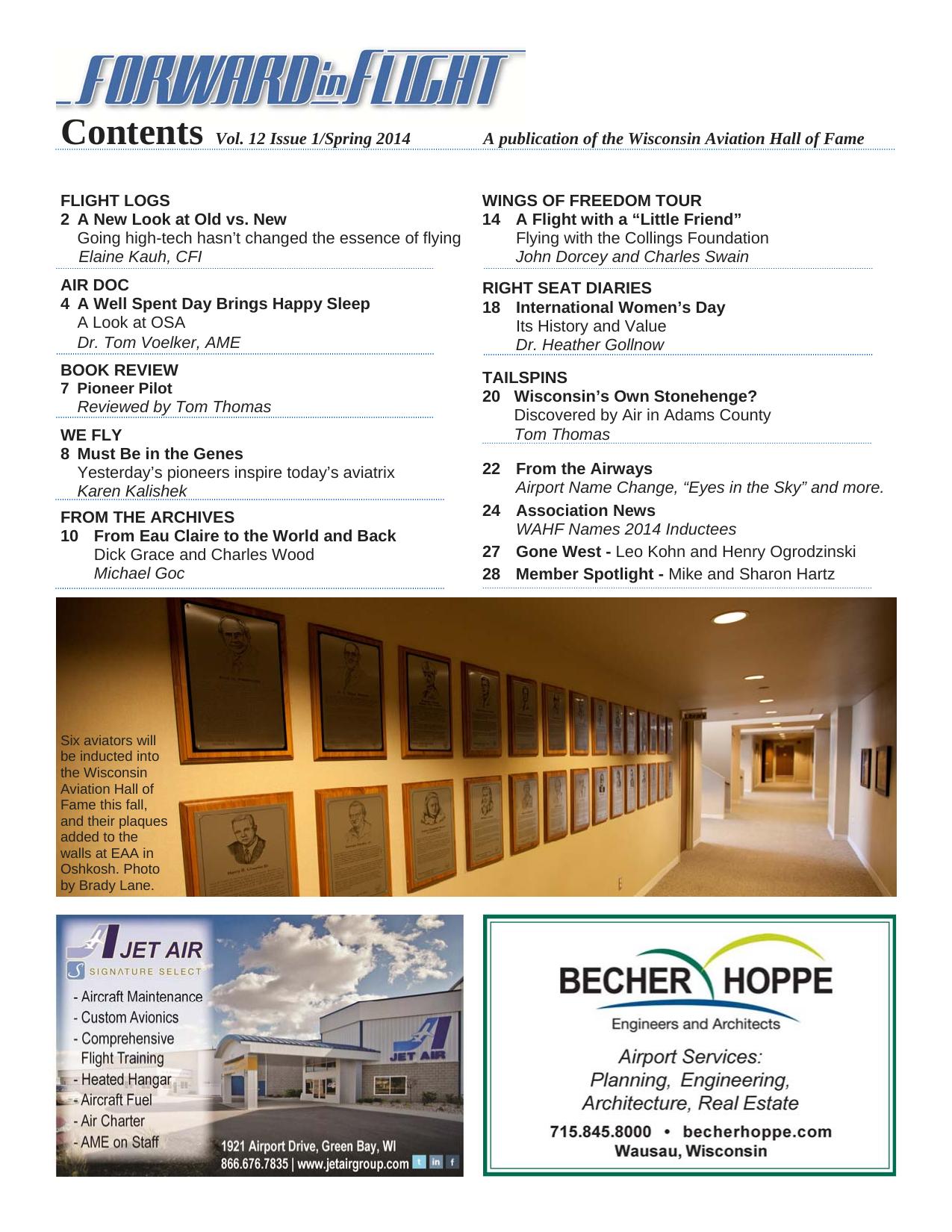
Contents Vol. 12 Issue 1/Spring 2014 A publication of the Wisconsin Aviation Hall of Fame FLIGHT LOGS 2 A New Look at Old vs. New Going high-tech hasn’t changed the essence of flying Elaine Kauh, CFI WINGS OF FREEDOM TOUR 14 A Flight with a “Little Friend” Flying with the Collings Foundation John Dorcey and Charles Swain AIR DOC 4 A Well Spent Day Brings Happy Sleep A Look at OSA Dr. Tom Voelker, AME RIGHT SEAT DIARIES 18 International Women’s Day Its History and Value Dr. Heather Gollnow BOOK REVIEW 7 Pioneer Pilot Reviewed by Tom Thomas TAILSPINS 20 Wisconsin’s Own Stonehenge? Discovered by Air in Adams County Tom Thomas WE FLY 8 Must Be in the Genes Yesterday’s pioneers inspire today’s aviatrix Karen Kalishek FROM THE ARCHIVES 10 From Eau Claire to the World and Back Dick Grace and Charles Wood Michael Goc Six aviators will be inducted into the Wisconsin Aviation Hall of Fame this fall, and their plaques added to the walls at EAA in Oshkosh. Photo by Brady Lane. 22 From the Airways Airport Name Change, “Eyes in the Sky” and more. 24 Association News WAHF Names 2014 Inductees 27 Gone West - Leo Kohn and Henry Ogrodzinski 28 Member Spotlight - Mike and Sharon Hartz
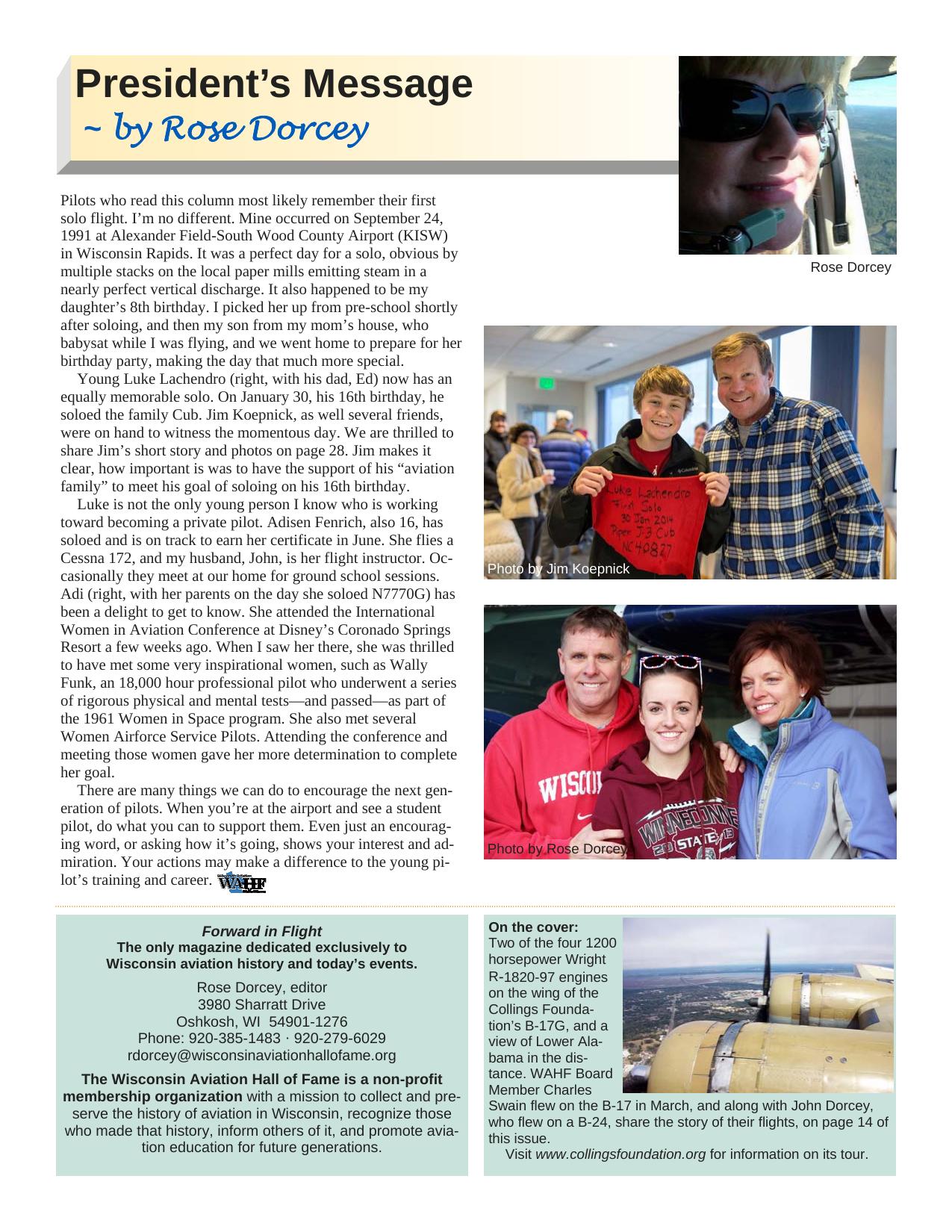
President’s Message ~ by Rose Dorcey Pilots who read this column most likely remember their first solo flight. I’m no different. Mine occurred on September 24, 1991 at Alexander Field-South Wood County Airport (KISW) in Wisconsin Rapids. It was a perfect day for a solo, obvious by multiple stacks on the local paper mills emitting steam in a nearly perfect vertical discharge. It also happened to be my daughter’s 8th birthday. I picked her up from pre-school shortly after soloing, and then my son from my mom’s house, who babysat while I was flying, and we went home to prepare for her birthday party, making the day that much more special. Young Luke Lachendro (right, with his dad, Ed) now has an equally memorable solo. On January 30, his 16th birthday, he soloed the family Cub. Jim Koepnick, as well several friends, were on hand to witness the momentous day. We are thrilled to share Jim’s short story and photos on page 28. Jim makes it clear, how important is was to have the support of his “aviation family” to meet his goal of soloing on his 16th birthday. Luke is not the only young person I know who is working toward becoming a private pilot. Adisen Fenrich, also 16, has soloed and is on track to earn her certificate in June. She flies a Cessna 172, and my husband, John, is her flight instructor. Occasionally they meet at our home for ground school sessions. Adi (right, with her parents on the day she soloed N7770G) has been a delight to get to know. She attended the International Women in Aviation Conference at Disney’s Coronado Springs Resort a few weeks ago. When I saw her there, she was thrilled to have met some very inspirational women, such as Wally Funk, an 18,000 hour professional pilot who underwent a series of rigorous physical and mental tests—and passed—as part of the 1961 Women in Space program. She also met several Women Airforce Service Pilots. Attending the conference and meeting those women gave her more determination to complete her goal. There are many things we can do to encourage the next generation of pilots. When you’re at the airport and see a student pilot, do what you can to support them. Even just an encouraging word, or asking how it’s going, shows your interest and admiration. Your actions may make a difference to the young pilot’s training and career. Forward in Flight The only magazine dedicated exclusively to Wisconsin aviation history and today’s events. Rose Dorcey, editor 3980 Sharratt Drive Oshkosh, WI 54901-1276 Phone: 920-385-1483 · 920-279-6029 rdorcey@wisconsinaviationhallofame.org The Wisconsin Aviation Hall of Fame is a non-profit membership organization with a mission to collect and preserve the history of aviation in Wisconsin, recognize those who made that history, inform others of it, and promote aviation education for future generations. Rose Dorcey Photo by Jim Koepnick Photo by Rose Dorcey On the cover: Two of the four 1200 horsepower Wright R-1820-97 engines on the wing of the Collings Foundation’s B-17G, and a view of Lower Alabama in the distance. WAHF Board Member Charles Swain flew on the B-17 in March, and along with John Dorcey, who flew on a B-24, share the story of their flights, on page 14 of this issue. Visit www.collingsfoundation.org for information on its tour.
FLIGHT LOGS A New Look at Old vs. New Going high-tech hasn’t changed the essence of flying By Elaine Kauh It’s amazing how personal flight has advanced in such a short time. Today airplanes are built with materials and features unheard of a few years ago. We can carry 50 states of sectionals in a tablet that’s not much bigger than one folded chart. And more conveniences are emerging by the day. Yet the act of flying an airplane, harnessing the air to move up, down, and around, is neither old nor new. It just is and it never changes. While autopilots have long offered the ease of occasional hands-off operation, there are phases of flight that require us to use our hands and feet to maneuver the airplane. So in truth, what’s really new is the number of options we have to perform other pilot duties. We must navigate. We must check the condition of our engine. We must watch the weather. We must manage our risks. No matter what tools we use, these tasks are a constant, like flight itself. This is a recurring theme in the work I do as a professional pilot and teacher of flight. It doesn’t matter if I’m flying with a future pilot in a Cessna 152 or delivering a Cirrus SR22 to another airport. We can choose to use, or not use, any resource we have to make each flight safe, educational, and fun. Much of my instructing work is dedicated to transitioning pilots into new equipment, such as glass panels. Before delving into the avionics, I emphasize that all the information you’re used to seeing in a legacy (aka six-pack) panel is still there, and pretty much in the same places. Remember this, and the digital panel isn’t as baffling as it was at first glance. Start at the top left corner: Airspeed. Move to the right: Attitude. Then, altimeter. Sound familiar? The sequence is broken a bit from there; find the turn coordinator and “ball” in the center, along with the heading indicator, right where we’d expect it. The VSI is in the bottom right. The instruments will look different, but they present the same information. In some cases they give you more. However, these are simply extra tools that are optional to the pilot. Take this mindset and you’ll transition with ease. Next is VFR air work, including steep turns, various types of stalls, slow flight, and glides. The horizon outside is your reference, just as it is in any other aircraft for these maneuvers. In most cases, particularly when I see the pilot distracted by the large color screens, I’ll dim the lighting (they’ll get nearly black) and have him or her remember the basics of using the outside horizon, then supplementing that with the airplane’s round backup dials for airspeed, attitude, and altimeter. Once the pilot’s training kicks back in, the maneuvers look great. That’s when it’s time to introduce the additional tools that make airplanes like this terrific traveling machines. Once I had a checkpoint on the ground and knew my airport was at 12 o’clock and 10 miles, I tucked away the tablet, ignored the GPS, and simply flew. Need I say that these were the best parts of the trip? During cruise we’ll introduce the autopilot and GPS navigation, applying what we covered in ground class. Again, we treat these as additional tools to help us fly the airplane and not as mechanisms that fly the airplane for us. A technologically advanced aircraft flies just as well with nothing turned on as it does with everything turned on, provided the pilot remains true to her first duty. Now the flip side. I also spend a good deal of my flying time enjoying legacy airplanes and am especially fond of taildraggers. When instructing in any of these, the pilot’s toolbox can contain anything from a single paper sectional and a compass to a certified IFR GPS with 2 Forward in Flight ~ Quarterly Magazine of the Wisconsin Aviation Hall of Fame digital charts displaying weather. Regardless of the arrangements, my theme is the same; I choose the tools I want to help with in-flight duties. Sometimes we don’t need the GPS, sometimes we don’t need to pull up a particular chart. Sometimes we’re glad to have it all. As it happened, I got to put my theme to the test during a long ferry flight that took place in late December. I combined some new gadgets with a vintage-style airplane and the results were fantastic. The mission was to deliver a pristine 2007 American Champion 7EC from Wisconsin to Waco, Texas, where the new owner planned to pick it up with his instructor and fly it home to California. The Champ, built much like its predecessors from 60 years ago, came with a nice portable GPS running on the ship’s power. I brought along my tablet, which offered a backup GPS plus all the charts and airport information to cover many states, including the five I would be flying in from start to finish. If I had the luxuries of spare time, funds, and summertime daylight, I would have skipped the GPS altogether and flown by pilotage, perhaps even meandering to land on grass strips that beckoned from below. But this was a for-hire flight in the middle of winter, and so my two bright little boxes kept my trip efficient and safe. (I also borrowed a palm-sized personal satellite tracker, which gave everyone involved extra peace of mind.) On top of that, the conditions were less than ideal for a long cross-country in this kind of airplane, lovely as it was to float off a freshly plowed runway in Wisconsin. The winds aloft on day 1 (exactly opposite my course, naturally) were worse than the forecast, and resulted in a GPS ground speed of no more than 54 miles per hour. So much for the flight plan, which was supposed to get me to southwestern Illinois for our first stop. Champs are fuel-sippers and can go for a while on its one tank. But the cars were passing me on the highway below, and the GPS confirmed that even the two
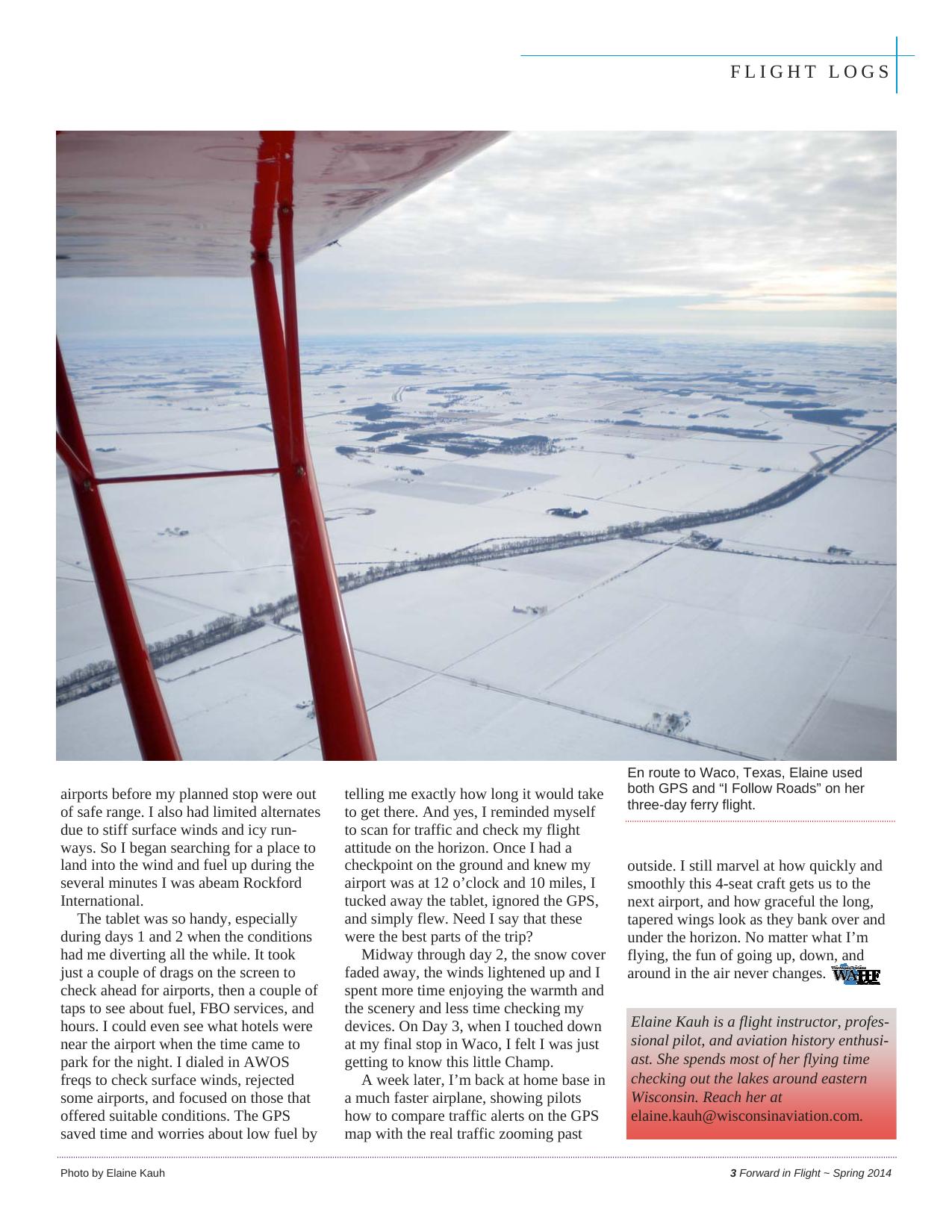
FLIGHT LOGS airports before my planned stop were out of safe range. I also had limited alternates due to stiff surface winds and icy runways. So I began searching for a place to land into the wind and fuel up during the several minutes I was abeam Rockford International. The tablet was so handy, especially during days 1 and 2 when the conditions had me diverting all the while. It took just a couple of drags on the screen to check ahead for airports, then a couple of taps to see about fuel, FBO services, and hours. I could even see what hotels were near the airport when the time came to park for the night. I dialed in AWOS freqs to check surface winds, rejected some airports, and focused on those that offered suitable conditions. The GPS saved time and worries about low fuel by Photo by Elaine Kauh telling me exactly how long it would take to get there. And yes, I reminded myself to scan for traffic and check my flight attitude on the horizon. Once I had a checkpoint on the ground and knew my airport was at 12 o’clock and 10 miles, I tucked away the tablet, ignored the GPS, and simply flew. Need I say that these were the best parts of the trip? Midway through day 2, the snow cover faded away, the winds lightened up and I spent more time enjoying the warmth and the scenery and less time checking my devices. On Day 3, when I touched down at my final stop in Waco, I felt I was just getting to know this little Champ. A week later, I’m back at home base in a much faster airplane, showing pilots how to compare traffic alerts on the GPS map with the real traffic zooming past En route to Waco, Texas, Elaine used both GPS and “I Follow Roads” on her three-day ferry flight. outside. I still marvel at how quickly and smoothly this 4-seat craft gets us to the next airport, and how graceful the long, tapered wings look as they bank over and under the horizon. No matter what I’m flying, the fun of going up, down, and around in the air never changes. Elaine Kauh is a flight instructor, professional pilot, and aviation history enthusiast. She spends most of her flying time checking out the lakes around eastern Wisconsin. Reach her at elaine.kauh@wisconsinaviation.com. 3 Forward in Flight ~ Spring 2014
AIR DOC A well-spent day brings happy sleep But not if it happens while you’re flying A look at Obstructive Sleep Apnea Dr. Tom Voelker, AME DrAlphaMike@yahoo.com Hello, again airmen. Welcome to… can it really be? Spring! As I look outside the snow is actually melting, something I haven’t seen for months! Hopefully by the time you read this you will be able to get into the sky without preheating your engine or sliding off the taxiway! And hopefully you will not be grounded as spring approaches, with your “winter weight” pushing your BMI (body mass index) over 40, necessitating a sleep study before you can fly. As I promised last issue, today we will review Obstructive Sleep Apnea (OSA), both from a medical certification standpoint and from a physiological standpoint. As mentioned in the last edition, the FAA aeromedical folks want to introduce new OSA screening protocols for all airmen at their flight physicals. The initial plan is to require sleep studies (see below) for all airmen with a BMI of 40 or more, classified as “very obese” or with a neck size of larger than 17 inches. As examples, a 5’4” person weighing 232 pounds or a 6’0” pilot who clocks in at 294 pounds would have a BMI of 40. Your AME would be required to calculate your BMI at your physical, and if you meet the above criteria, your application would need to be deferred to Oklahoma City. You would not be able to fly until you were cleared with a sleep study or until a board-certified sleep medicine specialist stated that your sleep apnea is adequately treated. To see where you might stand in this regard, Google “BMI” and you will find a simple calculator that will give you your BMI based on your height and weight. This plan has raised political uproar from all of the aviation alphabet groups. At question is not whether pilots with sleep apnea should or should not fly. The current regulations are very clear that someone with OSA is medically disquali- fied, and a Special Issuance is required from the aeromedical folks at OKC before they can exercise PIC privileges. What is in question is whether all heavy airmen should be grounded until it is determined that they do not have the condition. In a survey of airline pilots, a full 80 per cent noted “nodding off” in flight at one time or another. These episodes could have been due to other causes of fatigue ... but some of them were undoubtedly caused by OSA. Since my last column, the whole issue is on hold. The FAA would like to proceed with their plans, but the lobbying of groups such as AOPA and EAA, among others, has led to legislation in congress that will require the usual “rule-making process” of the FAA before any change is enacted. This process would ensure that all concerns are heard. I think it’s safe to say that nothing is going to affect your certification in the next couple of months, but this is clearly an issue that you will want to keep on your radar. If it makes you feel any better, pilots are not the only ones affected by changes in policy regarding OSA. The DOT has already instituted changes in certification of commercial truck drivers. These changes, very similar to the requirements being considered for pilots, are scheduled to go into effect in the next three months. So why the concern? What can possibly happen to a pilot with OSA that would affect flight duties? Have there been any aircraft accidents or incidents caused by OSA? It turns out there are 4 Forward in Flight ~ Quarterly Magazine of the Wisconsin Aviation Hall of Fame several well-founded concerns. Several years ago a Go Airlines flight in Hawaii overflew its destination. About 26 miles later a stewardess noted the destination island drifting farther and farther behind her. She went into the cockpit and found both pilot and copilot fast asleep! (Thank God for autopilots.) The pilots were ultimately diagnosed with OSA, and this condition was found to be the cause of the incident. In a survey of airline pilots, a full 80 per cent noted “nodding off” in flight at one time or another. These episodes could have been due to other causes of fatigue (most notably simple sleep deprivation), but some of them were undoubtedly caused by OSA. Other non-aviation disasters that have been found to be caused by sleep deprivation are the Chernobyl power plant accident and the grounding of the Exxon Valdez tanker. While there have not been any aviation accidents to date that have been definitively attributed to OSA, the FAA feels strongly that this condition is ready to rear its ugly head, and they don’t want to wait for an accident to get ahead of the problem. The data suggests that anyone with a BMI of greater than 32 (significantly less than the BMI of 40 noted above) has a 75 per cent chance of having OSA. This is a surprisingly common condition. It is estimated that 20 per cent of the general population has OSA, making the condition even more common than diabetes, another condition closely related to obesity. A majority of these people with sleep apnea are currently undiagnosed. DEFINING SLEEP APNEA Sleep apnea is a condition in which a person stops breathing at night. This is usually due to the tissues in the back of the throat and mouth “collapsing” and
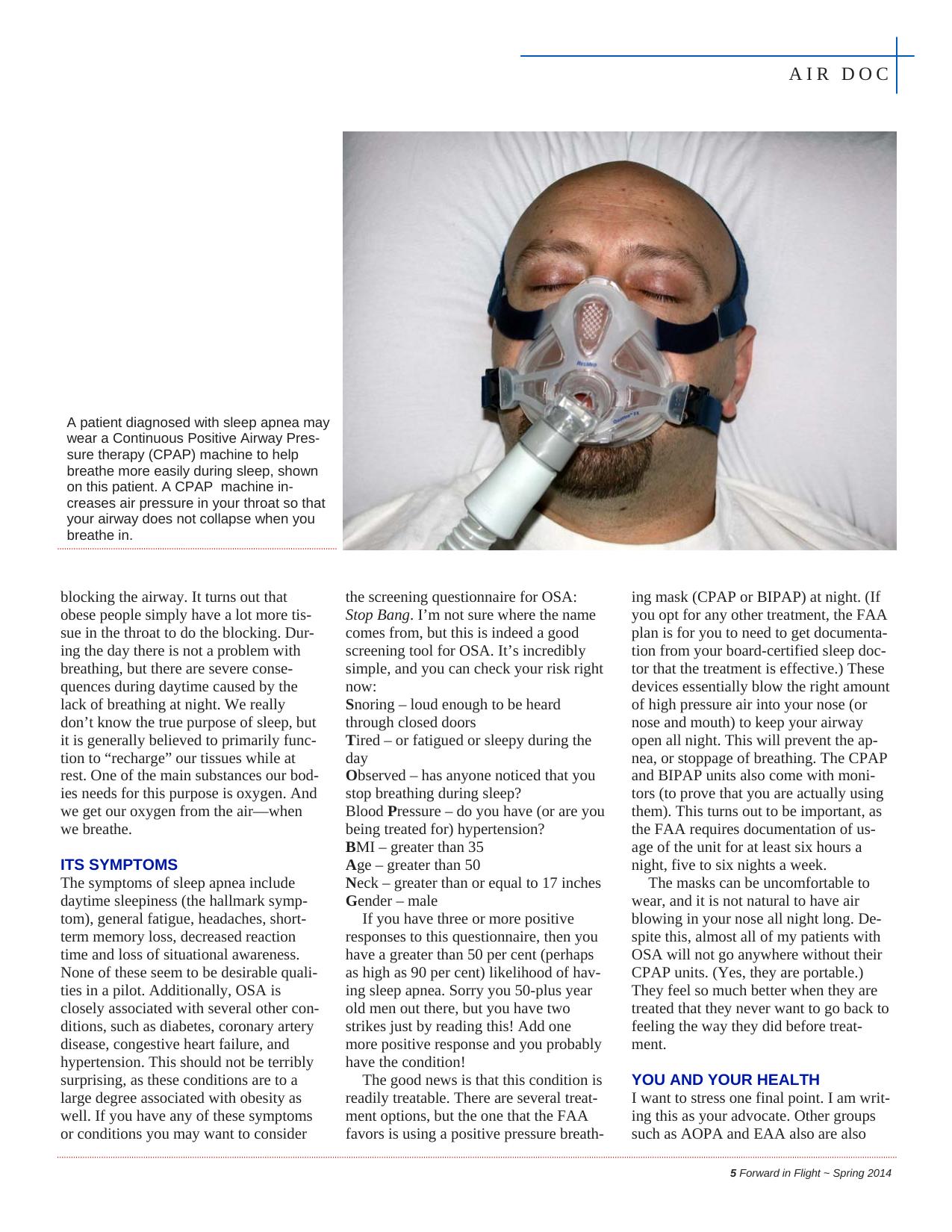
AIR DOC A patient diagnosed with sleep apnea may wear a Continuous Positive Airway Pressure therapy (CPAP) machine to help breathe more easily during sleep, shown on this patient. A CPAP machine increases air pressure in your throat so that your airway does not collapse when you breathe in. blocking the airway. It turns out that obese people simply have a lot more tissue in the throat to do the blocking. During the day there is not a problem with breathing, but there are severe consequences during daytime caused by the lack of breathing at night. We really don’t know the true purpose of sleep, but it is generally believed to primarily function to “recharge” our tissues while at rest. One of the main substances our bodies needs for this purpose is oxygen. And we get our oxygen from the air—when we breathe. ITS SYMPTOMS The symptoms of sleep apnea include daytime sleepiness (the hallmark symptom), general fatigue, headaches, shortterm memory loss, decreased reaction time and loss of situational awareness. None of these seem to be desirable qualities in a pilot. Additionally, OSA is closely associated with several other conditions, such as diabetes, coronary artery disease, congestive heart failure, and hypertension. This should not be terribly surprising, as these conditions are to a large degree associated with obesity as well. If you have any of these symptoms or conditions you may want to consider the screening questionnaire for OSA: Stop Bang. I’m not sure where the name comes from, but this is indeed a good screening tool for OSA. It’s incredibly simple, and you can check your risk right now: Snoring – loud enough to be heard through closed doors Tired – or fatigued or sleepy during the day Observed – has anyone noticed that you stop breathing during sleep? Blood Pressure – do you have (or are you being treated for) hypertension? BMI – greater than 35 Age – greater than 50 Neck – greater than or equal to 17 inches Gender – male If you have three or more positive responses to this questionnaire, then you have a greater than 50 per cent (perhaps as high as 90 per cent) likelihood of having sleep apnea. Sorry you 50-plus year old men out there, but you have two strikes just by reading this! Add one more positive response and you probably have the condition! The good news is that this condition is readily treatable. There are several treatment options, but the one that the FAA favors is using a positive pressure breath- ing mask (CPAP or BIPAP) at night. (If you opt for any other treatment, the FAA plan is for you to need to get documentation from your board-certified sleep doctor that the treatment is effective.) These devices essentially blow the right amount of high pressure air into your nose (or nose and mouth) to keep your airway open all night. This will prevent the apnea, or stoppage of breathing. The CPAP and BIPAP units also come with monitors (to prove that you are actually using them). This turns out to be important, as the FAA requires documentation of usage of the unit for at least six hours a night, five to six nights a week. The masks can be uncomfortable to wear, and it is not natural to have air blowing in your nose all night long. Despite this, almost all of my patients with OSA will not go anywhere without their CPAP units. (Yes, they are portable.) They feel so much better when they are treated that they never want to go back to feeling the way they did before treatment. YOU AND YOUR HEALTH I want to stress one final point. I am writing this as your advocate. Other groups such as AOPA and EAA also are also 5 Forward in Flight ~ Spring 2014
AIR DOC advocating for pilots, especially general aviation pilots. Sometimes, however, it seems these groups argue against any regulation that might restrict their members, whether or not the changes make sense. In this case, I strongly believe the FAA’s requirements regarding treatment and monitoring of OSA treatment is appropriate, although their plans for “mass screening” and “mass grounding” may be misguided or at least overly aggressive. Now is the time for you to turn to your most important advocate when it comes to matters of your health—you! Take an honest appraisal of your health, including your BMI, and if you are at risk for OSA see your doctor. Yes, if you are diagnosed with the condition you will need to document your treatment to the FAA’s satisfaction to continue flying. It’s best to go ahead and get this evaluation and treatment underway right away, so when you have your next flight physical you can show your AME the information and get recertified right away. First and foremost, take care of your own health. Until next time, fly high and fly often, and stay healthy. Oh, and one more thing: breathe deeply all night long! —Alpha Mike “Alpha Mike Echo” is Dr. Tom Voelker, AME, a family practitioner in Wisconsin Rapids. He and his wife, Kathy, are the parents of four daughters. Tom flies N6224P, a Comanche 250, out of Alexander Field, South Wood County Airport (ISW). 2031 Peach Street Wisconsin Rapids, WI 54494 Advertise in Forward in Flight! Reach Wisconsin pilots, aircraft owners, and airport managers with an affordable ad in Forward in Flight. It’s easy to get started; call Rose at 920-279-6029 or email rdorcey@wisconsinaviationhalloffame.org. 6 Forward in Flight ~ Quarterly Magazine of the Wisconsin Aviation Hall of Fame
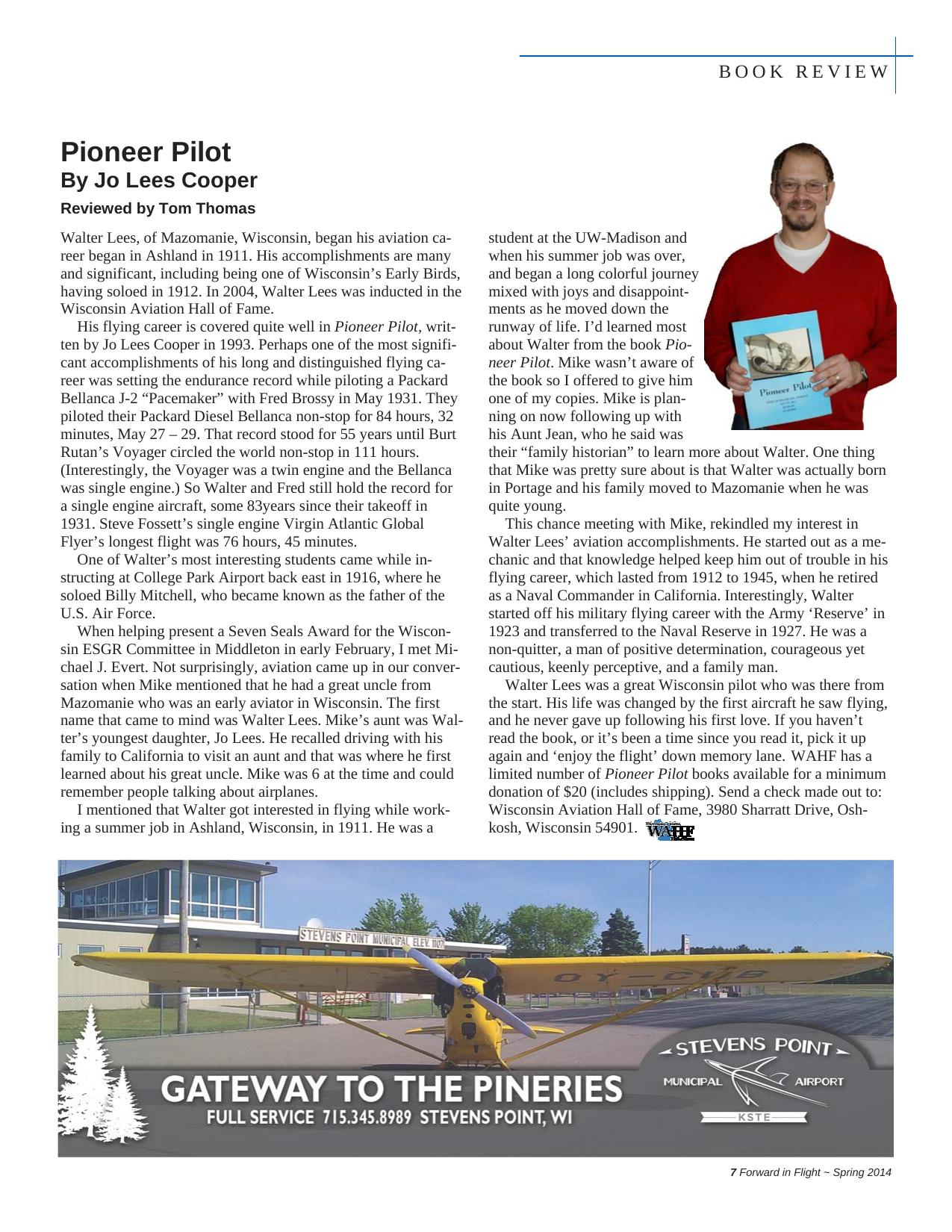
BOOK REVIEW Pioneer Pilot By Jo Lees Cooper Reviewed by Tom Thomas Walter Lees, of Mazomanie, Wisconsin, began his aviation career began in Ashland in 1911. His accomplishments are many and significant, including being one of Wisconsin’s Early Birds, having soloed in 1912. In 2004, Walter Lees was inducted in the Wisconsin Aviation Hall of Fame. His flying career is covered quite well in Pioneer Pilot, written by Jo Lees Cooper in 1993. Perhaps one of the most significant accomplishments of his long and distinguished flying career was setting the endurance record while piloting a Packard Bellanca J-2 “Pacemaker” with Fred Brossy in May 1931. They piloted their Packard Diesel Bellanca non-stop for 84 hours, 32 minutes, May 27 – 29. That record stood for 55 years until Burt Rutan’s Voyager circled the world non-stop in 111 hours. (Interestingly, the Voyager was a twin engine and the Bellanca was single engine.) So Walter and Fred still hold the record for a single engine aircraft, some 83years since their takeoff in 1931. Steve Fossett’s single engine Virgin Atlantic Global Flyer’s longest flight was 76 hours, 45 minutes. One of Walter’s most interesting students came while instructing at College Park Airport back east in 1916, where he soloed Billy Mitchell, who became known as the father of the U.S. Air Force. When helping present a Seven Seals Award for the Wisconsin ESGR Committee in Middleton in early February, I met Michael J. Evert. Not surprisingly, aviation came up in our conversation when Mike mentioned that he had a great uncle from Mazomanie who was an early aviator in Wisconsin. The first name that came to mind was Walter Lees. Mike’s aunt was Walter’s youngest daughter, Jo Lees. He recalled driving with his family to California to visit an aunt and that was where he first learned about his great uncle. Mike was 6 at the time and could remember people talking about airplanes. I mentioned that Walter got interested in flying while working a summer job in Ashland, Wisconsin, in 1911. He was a student at the UW-Madison and when his summer job was over, and began a long colorful journey mixed with joys and disappointments as he moved down the runway of life. I’d learned most about Walter from the book Pioneer Pilot. Mike wasn’t aware of the book so I offered to give him one of my copies. Mike is planning on now following up with his Aunt Jean, who he said was their “family historian” to learn more about Walter. One thing that Mike was pretty sure about is that Walter was actually born in Portage and his family moved to Mazomanie when he was quite young. This chance meeting with Mike, rekindled my interest in Walter Lees’ aviation accomplishments. He started out as a mechanic and that knowledge helped keep him out of trouble in his flying career, which lasted from 1912 to 1945, when he retired as a Naval Commander in California. Interestingly, Walter started off his military flying career with the Army ‘Reserve’ in 1923 and transferred to the Naval Reserve in 1927. He was a non-quitter, a man of positive determination, courageous yet cautious, keenly perceptive, and a family man. Walter Lees was a great Wisconsin pilot who was there from the start. His life was changed by the first aircraft he saw flying, and he never gave up following his first love. If you haven’t read the book, or it’s been a time since you read it, pick it up again and ‘enjoy the flight’ down memory lane. WAHF has a limited number of Pioneer Pilot books available for a minimum donation of $20 (includes shipping). Send a check made out to: Wisconsin Aviation Hall of Fame, 3980 Sharratt Drive, Oshkosh, Wisconsin 54901. 7 Forward in Flight ~ Spring 2014
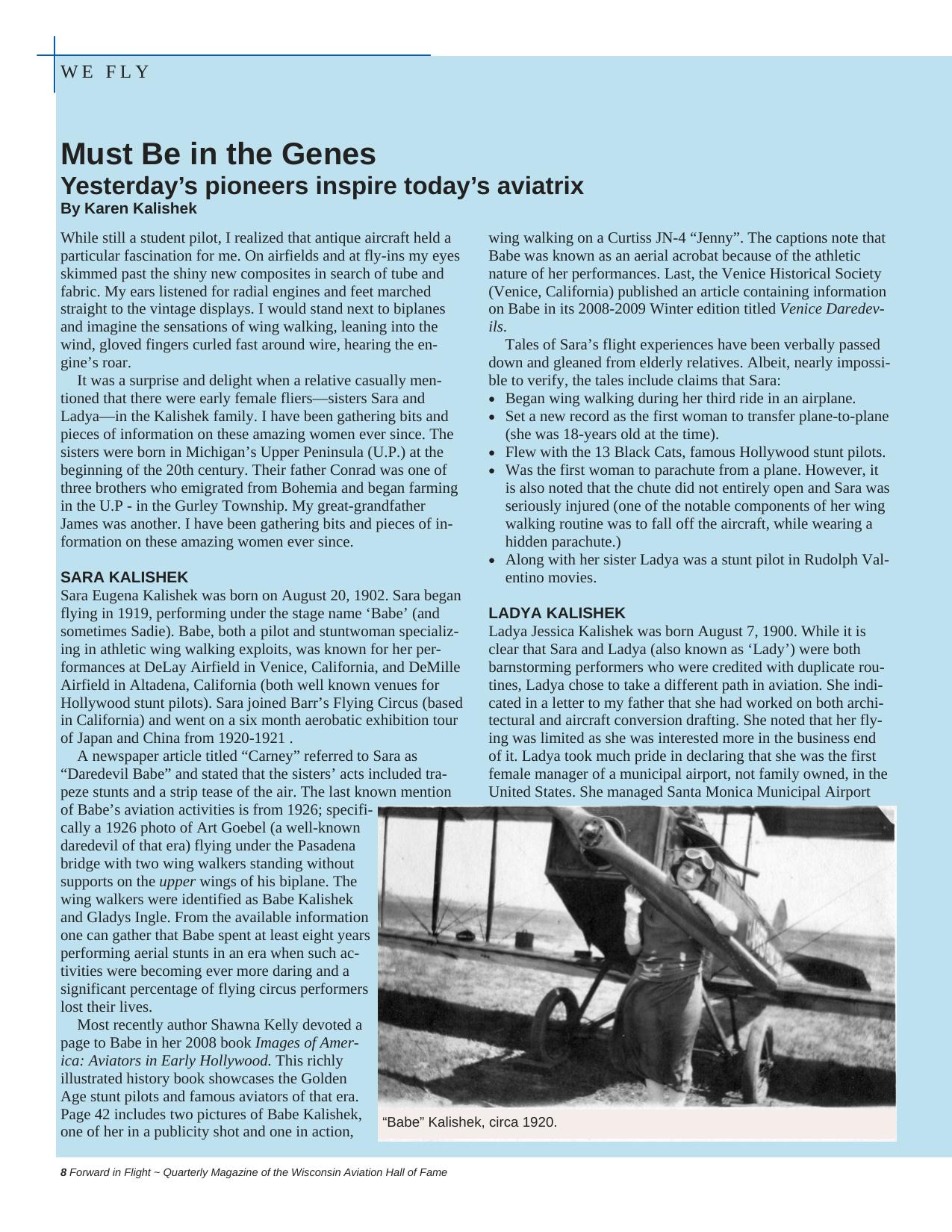
WE FLY Must Be in the Genes Yesterday’s pioneers inspire today’s aviatrix By Karen Kalishek While still a student pilot, I realized that antique aircraft held a particular fascination for me. On airfields and at fly-ins my eyes skimmed past the shiny new composites in search of tube and fabric. My ears listened for radial engines and feet marched straight to the vintage displays. I would stand next to biplanes and imagine the sensations of wing walking, leaning into the wind, gloved fingers curled fast around wire, hearing the engine’s roar. It was a surprise and delight when a relative casually mentioned that there were early female fliers—sisters Sara and Ladya—in the Kalishek family. I have been gathering bits and pieces of information on these amazing women ever since. The sisters were born in Michigan’s Upper Peninsula (U.P.) at the beginning of the 20th century. Their father Conrad was one of three brothers who emigrated from Bohemia and began farming in the U.P - in the Gurley Township. My great-grandfather James was another. I have been gathering bits and pieces of information on these amazing women ever since. wing walking on a Curtiss JN-4 “Jenny”. The captions note that Babe was known as an aerial acrobat because of the athletic nature of her performances. Last, the Venice Historical Society (Venice, California) published an article containing information on Babe in its 2008-2009 Winter edition titled Venice Daredevils. Tales of Sara’s flight experiences have been verbally passed down and gleaned from elderly relatives. Albeit, nearly impossible to verify, the tales include claims that Sara: Began wing walking during her third ride in an airplane. Set a new record as the first woman to transfer plane-to-plane (she was 18-years old at the time). Flew with the 13 Black Cats, famous Hollywood stunt pilots. Was the first woman to parachute from a plane. However, it is also noted that the chute did not entirely open and Sara was seriously injured (one of the notable components of her wing walking routine was to fall off the aircraft, while wearing a hidden parachute.) Along with her sister Ladya was a stunt pilot in Rudolph Valentino movies. SARA KALISHEK Sara Eugena Kalishek was born on August 20, 1902. Sara began flying in 1919, performing under the stage name ‘Babe’ (and LADYA KALISHEK sometimes Sadie). Babe, both a pilot and stuntwoman specializLadya Jessica Kalishek was born August 7, 1900. While it is ing in athletic wing walking exploits, was known for her perclear that Sara and Ladya (also known as ‘Lady’) were both formances at DeLay Airfield in Venice, California, and DeMille barnstorming performers who were credited with duplicate rouAirfield in Altadena, California (both well known venues for tines, Ladya chose to take a different path in aviation. She indiHollywood stunt pilots). Sara joined Barr’s Flying Circus (based cated in a letter to my father that she had worked on both archiin California) and went on a six month aerobatic exhibition tour tectural and aircraft conversion drafting. She noted that her flyof Japan and China from 1920-1921 . ing was limited as she was interested more in the business end A newspaper article titled “Carney” referred to Sara as of it. Ladya took much pride in declaring that she was the first “Daredevil Babe” and stated that the sisters’ acts included trafemale manager of a municipal airport, not family owned, in the peze stunts and a strip tease of the air. The last known mention United States. She managed Santa Monica Municipal Airport of Babe’s aviation activities is from 1926; specifically a 1926 photo of Art Goebel (a well-known daredevil of that era) flying under the Pasadena bridge with two wing walkers standing without supports on the upper wings of his biplane. The wing walkers were identified as Babe Kalishek and Gladys Ingle. From the available information one can gather that Babe spent at least eight years performing aerial stunts in an era when such activities were becoming ever more daring and a significant percentage of flying circus performers lost their lives. Most recently author Shawna Kelly devoted a page to Babe in her 2008 book Images of America: Aviators in Early Hollywood. This richly illustrated history book showcases the Golden Age stunt pilots and famous aviators of that era. Page 42 includes two pictures of Babe Kalishek, “Babe” Kalishek, circa 1920. one of her in a publicity shot and one in action, 8 Forward in Flight ~ Quarterly Magazine of the Wisconsin Aviation Hall of Fame
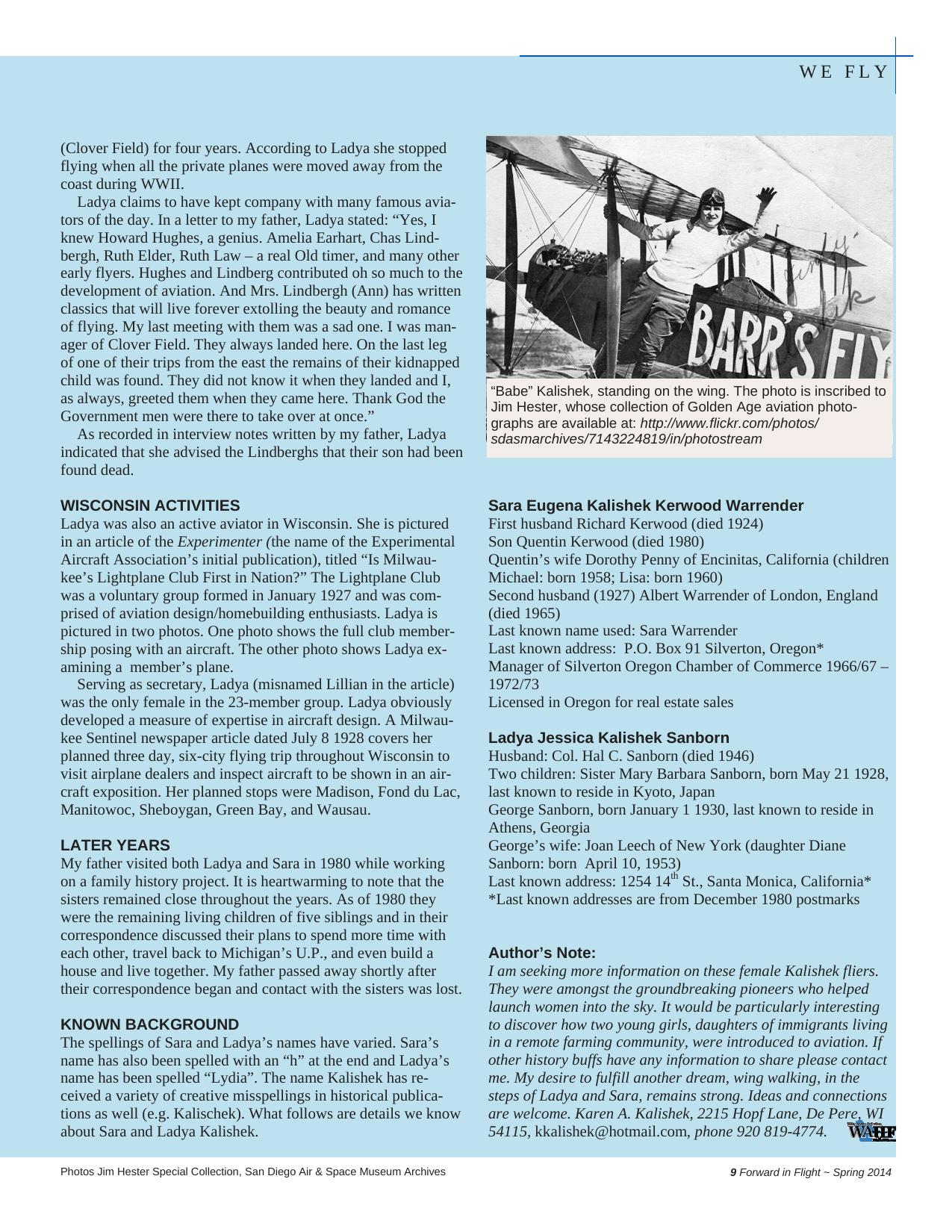
WE FLY (Clover Field) for four years. According to Ladya she stopped flying when all the private planes were moved away from the coast during WWII. Ladya claims to have kept company with many famous aviators of the day. In a letter to my father, Ladya stated: “Yes, I knew Howard Hughes, a genius. Amelia Earhart, Chas Lindbergh, Ruth Elder, Ruth Law – a real Old timer, and many other early flyers. Hughes and Lindberg contributed oh so much to the development of aviation. And Mrs. Lindbergh (Ann) has written classics that will live forever extolling the beauty and romance of flying. My last meeting with them was a sad one. I was manager of Clover Field. They always landed here. On the last leg of one of their trips from the east the remains of their kidnapped child was found. They did not know it when they landed and I, as always, greeted them when they came here. Thank God the Government men were there to take over at once.” As recorded in interview notes written by my father, Ladya indicated that she advised the Lindberghs that their son had been found dead. WISCONSIN ACTIVITIES Ladya was also an active aviator in Wisconsin. She is pictured in an article of the Experimenter (the name of the Experimental Aircraft Association’s initial publication), titled “Is Milwaukee’s Lightplane Club First in Nation?” The Lightplane Club was a voluntary group formed in January 1927 and was comprised of aviation design/homebuilding enthusiasts. Ladya is pictured in two photos. One photo shows the full club membership posing with an aircraft. The other photo shows Ladya examining a member’s plane. Serving as secretary, Ladya (misnamed Lillian in the article) was the only female in the 23-member group. Ladya obviously developed a measure of expertise in aircraft design. A Milwaukee Sentinel newspaper article dated July 8 1928 covers her planned three day, six-city flying trip throughout Wisconsin to visit airplane dealers and inspect aircraft to be shown in an aircraft exposition. Her planned stops were Madison, Fond du Lac, Manitowoc, Sheboygan, Green Bay, and Wausau. LATER YEARS My father visited both Ladya and Sara in 1980 while working on a family history project. It is heartwarming to note that the sisters remained close throughout the years. As of 1980 they were the remaining living children of five siblings and in their correspondence discussed their plans to spend more time with each other, travel back to Michigan’s U.P., and even build a house and live together. My father passed away shortly after their correspondence began and contact with the sisters was lost. KNOWN BACKGROUND The spellings of Sara and Ladya’s names have varied. Sara’s name has also been spelled with an “h” at the end and Ladya’s name has been spelled “Lydia”. The name Kalishek has received a variety of creative misspellings in historical publications as well (e.g. Kalischek). What follows are details we know about Sara and Ladya Kalishek. Photos Jim Hester Special Collection, San Diego Air & Space Museum Archives “Babe” Kalishek, standing on the wing. The photo is inscribed to Jim Hester, whose collection of Golden Age aviation photographs are available at: http://www.flickr.com/photos/ sdasmarchives/7143224819/in/photostream Sara Eugena Kalishek Kerwood Warrender First husband Richard Kerwood (died 1924) Son Quentin Kerwood (died 1980) Quentin’s wife Dorothy Penny of Encinitas, California (children Michael: born 1958; Lisa: born 1960) Second husband (1927) Albert Warrender of London, England (died 1965) Last known name used: Sara Warrender Last known address: P.O. Box 91 Silverton, Oregon* Manager of Silverton Oregon Chamber of Commerce 1966/67 – 1972/73 Licensed in Oregon for real estate sales Ladya Jessica Kalishek Sanborn Husband: Col. Hal C. Sanborn (died 1946) Two children: Sister Mary Barbara Sanborn, born May 21 1928, last known to reside in Kyoto, Japan George Sanborn, born January 1 1930, last known to reside in Athens, Georgia George’s wife: Joan Leech of New York (daughter Diane Sanborn: born April 10, 1953) Last known address: 1254 14th St., Santa Monica, California* *Last known addresses are from December 1980 postmarks Author’s Note: I am seeking more information on these female Kalishek fliers. They were amongst the groundbreaking pioneers who helped launch women into the sky. It would be particularly interesting to discover how two young girls, daughters of immigrants living in a remote farming community, were introduced to aviation. If other history buffs have any information to share please contact me. My desire to fulfill another dream, wing walking, in the steps of Ladya and Sara, remains strong. Ideas and connections are welcome. Karen A. Kalishek, 2215 Hopf Lane, De Pere, WI 54115, kkalishek@hotmail.com, phone 920 819-4774. 9 Forward in Flight ~ Spring 2014
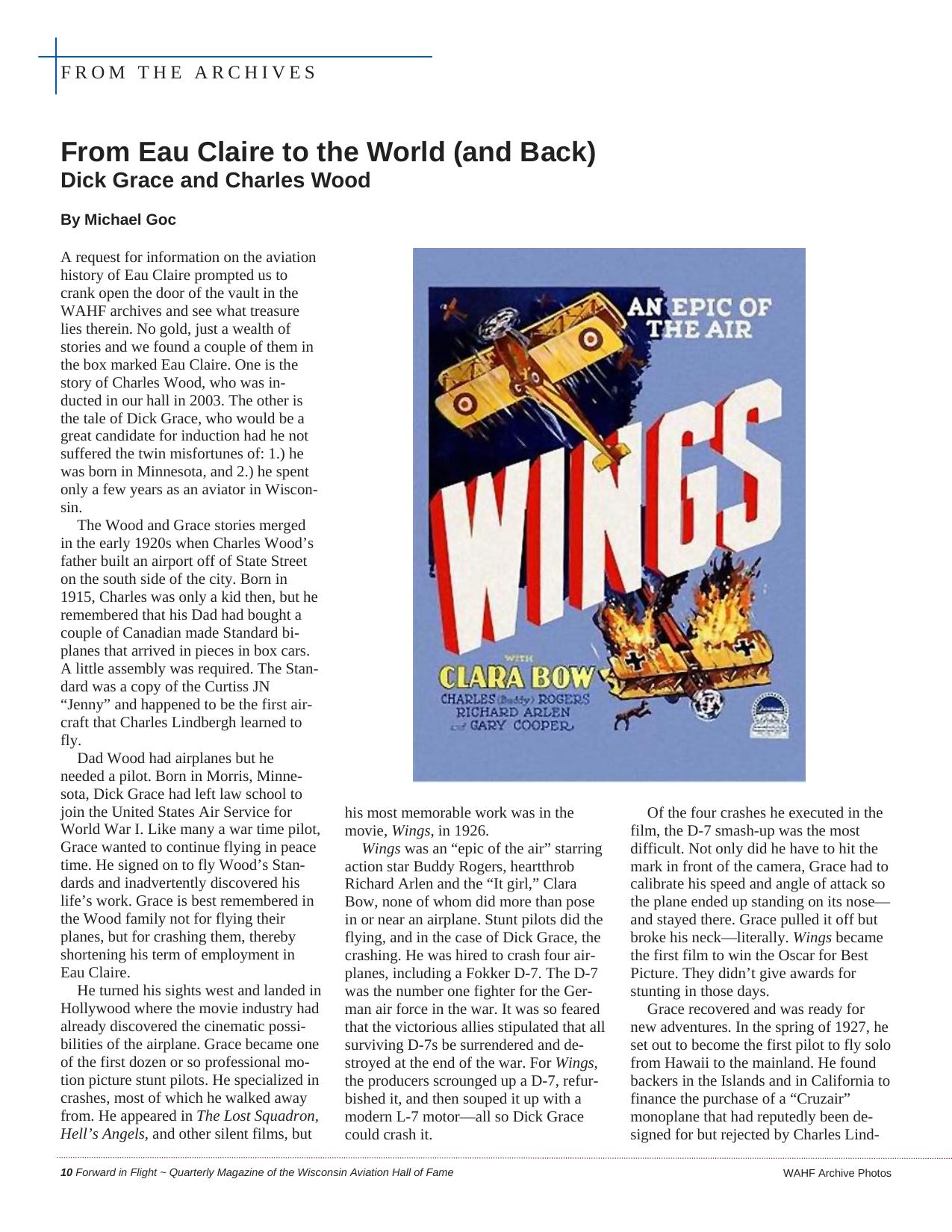
FROM THE ARCHIVES From Eau Claire to the World (and Back) Dick Grace and Charles Wood By Michael Goc A request for information on the aviation history of Eau Claire prompted us to crank open the door of the vault in the WAHF archives and see what treasure lies therein. No gold, just a wealth of stories and we found a couple of them in the box marked Eau Claire. One is the story of Charles Wood, who was inducted in our hall in 2003. The other is the tale of Dick Grace, who would be a great candidate for induction had he not suffered the twin misfortunes of: 1.) he was born in Minnesota, and 2.) he spent only a few years as an aviator in Wisconsin. The Wood and Grace stories merged in the early 1920s when Charles Wood’s father built an airport off of State Street on the south side of the city. Born in 1915, Charles was only a kid then, but he remembered that his Dad had bought a couple of Canadian made Standard biplanes that arrived in pieces in box cars. A little assembly was required. The Standard was a copy of the Curtiss JN “Jenny” and happened to be the first aircraft that Charles Lindbergh learned to fly. Dad Wood had airplanes but he needed a pilot. Born in Morris, Minnesota, Dick Grace had left law school to join the United States Air Service for World War I. Like many a war time pilot, Grace wanted to continue flying in peace time. He signed on to fly Wood’s Standards and inadvertently discovered his life’s work. Grace is best remembered in the Wood family not for flying their planes, but for crashing them, thereby shortening his term of employment in Eau Claire. He turned his sights west and landed in Hollywood where the movie industry had already discovered the cinematic possibilities of the airplane. Grace became one of the first dozen or so professional motion picture stunt pilots. He specialized in crashes, most of which he walked away from. He appeared in The Lost Squadron, Hell’s Angels, and other silent films, but his most memorable work was in the movie, Wings, in 1926. Wings was an “epic of the air” starring action star Buddy Rogers, heartthrob Richard Arlen and the “It girl,” Clara Bow, none of whom did more than pose in or near an airplane. Stunt pilots did the flying, and in the case of Dick Grace, the crashing. He was hired to crash four airplanes, including a Fokker D-7. The D-7 was the number one fighter for the German air force in the war. It was so feared that the victorious allies stipulated that all surviving D-7s be surrendered and destroyed at the end of the war. For Wings, the producers scrounged up a D-7, refurbished it, and then souped it up with a modern L-7 motor—all so Dick Grace could crash it. 10 Forward in Flight ~ Quarterly Magazine of the Wisconsin Aviation Hall of Fame Of the four crashes he executed in the film, the D-7 smash-up was the most difficult. Not only did he have to hit the mark in front of the camera, Grace had to calibrate his speed and angle of attack so the plane ended up standing on its nose— and stayed there. Grace pulled it off but broke his neck—literally. Wings became the first film to win the Oscar for Best Picture. They didn’t give awards for stunting in those days. Grace recovered and was ready for new adventures. In the spring of 1927, he set out to become the first pilot to fly solo from Hawaii to the mainland. He found backers in the Islands and in California to finance the purchase of a “Cruzair” monoplane that had reputedly been designed for but rejected by Charles LindWAHF Archive Photos
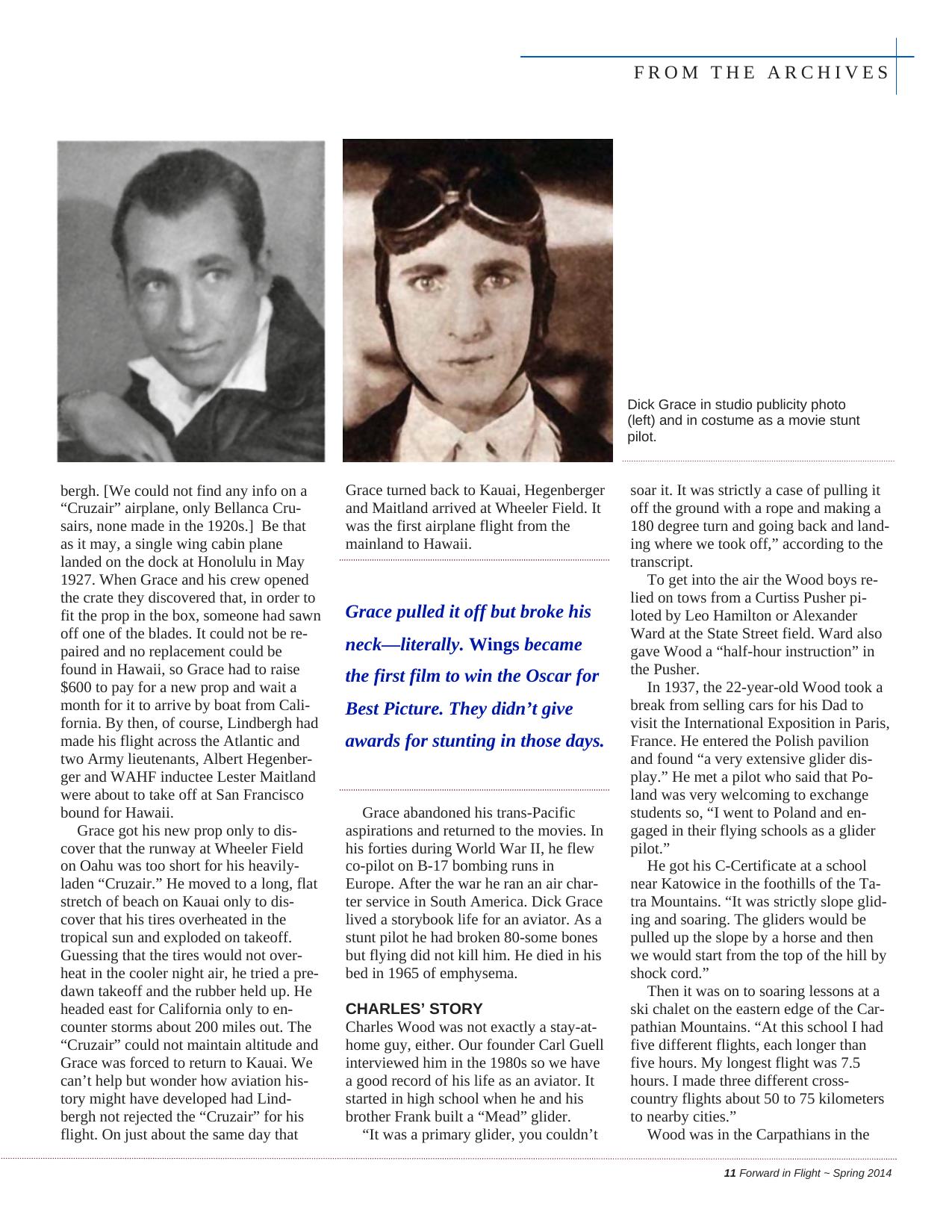
FROM THE ARCHIVES Dick Grace in studio publicity photo (left) and in costume as a movie stunt pilot. bergh. [We could not find any info on a “Cruzair” airplane, only Bellanca Crusairs, none made in the 1920s.] Be that as it may, a single wing cabin plane landed on the dock at Honolulu in May 1927. When Grace and his crew opened the crate they discovered that, in order to fit the prop in the box, someone had sawn off one of the blades. It could not be repaired and no replacement could be found in Hawaii, so Grace had to raise $600 to pay for a new prop and wait a month for it to arrive by boat from California. By then, of course, Lindbergh had made his flight across the Atlantic and two Army lieutenants, Albert Hegenberger and WAHF inductee Lester Maitland were about to take off at San Francisco bound for Hawaii. Grace got his new prop only to discover that the runway at Wheeler Field on Oahu was too short for his heavilyladen “Cruzair.” He moved to a long, flat stretch of beach on Kauai only to discover that his tires overheated in the tropical sun and exploded on takeoff. Guessing that the tires would not overheat in the cooler night air, he tried a predawn takeoff and the rubber held up. He headed east for California only to encounter storms about 200 miles out. The “Cruzair” could not maintain altitude and Grace was forced to return to Kauai. We can’t help but wonder how aviation history might have developed had Lindbergh not rejected the “Cruzair” for his flight. On just about the same day that Grace turned back to Kauai, Hegenberger and Maitland arrived at Wheeler Field. It was the first airplane flight from the mainland to Hawaii. Grace pulled it off but broke his neck—literally. Wings became the first film to win the Oscar for Best Picture. They didn’t give awards for stunting in those days. Grace abandoned his trans-Pacific aspirations and returned to the movies. In his forties during World War II, he flew co-pilot on B-17 bombing runs in Europe. After the war he ran an air charter service in South America. Dick Grace lived a storybook life for an aviator. As a stunt pilot he had broken 80-some bones but flying did not kill him. He died in his bed in 1965 of emphysema. CHARLES’ STORY Charles Wood was not exactly a stay-athome guy, either. Our founder Carl Guell interviewed him in the 1980s so we have a good record of his life as an aviator. It started in high school when he and his brother Frank built a “Mead” glider. “It was a primary glider, you couldn’t soar it. It was strictly a case of pulling it off the ground with a rope and making a 180 degree turn and going back and landing where we took off,” according to the transcript. To get into the air the Wood boys relied on tows from a Curtiss Pusher piloted by Leo Hamilton or Alexander Ward at the State Street field. Ward also gave Wood a “half-hour instruction” in the Pusher. In 1937, the 22-year-old Wood took a break from selling cars for his Dad to visit the International Exposition in Paris, France. He entered the Polish pavilion and found “a very extensive glider display.” He met a pilot who said that Poland was very welcoming to exchange students so, “I went to Poland and engaged in their flying schools as a glider pilot.” He got his C-Certificate at a school near Katowice in the foothills of the Tatra Mountains. “It was strictly slope gliding and soaring. The gliders would be pulled up the slope by a horse and then we would start from the top of the hill by shock cord.” Then it was on to soaring lessons at a ski chalet on the eastern edge of the Carpathian Mountains. “At this school I had five different flights, each longer than five hours. My longest flight was 7.5 hours. I made three different crosscountry flights about 50 to 75 kilometers to nearby cities.” Wood was in the Carpathians in the 11 Forward in Flight ~ Spring 2014
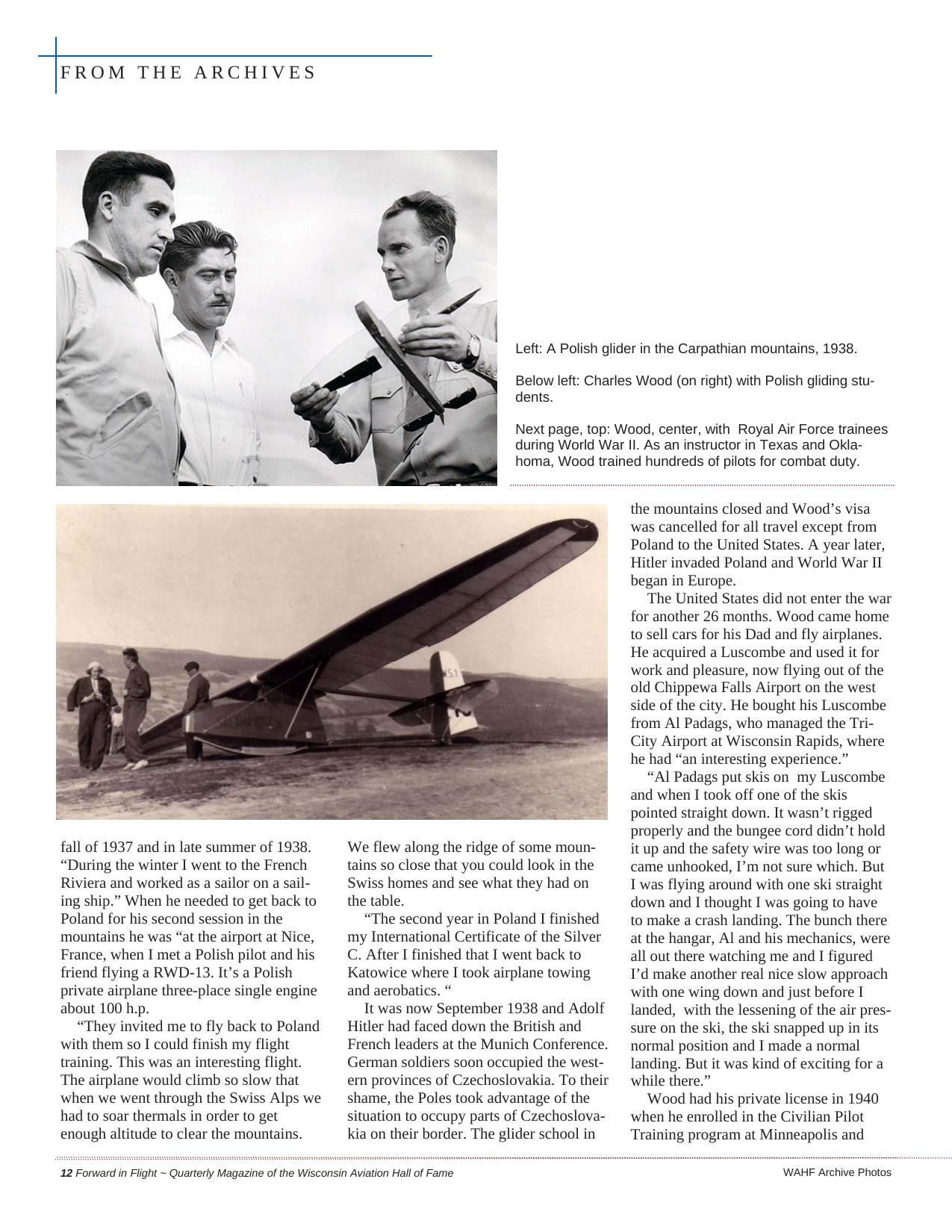
FROM THE ARCHIVES Left: A Polish glider in the Carpathian mountains, 1938. Below left: Charles Wood (on right) with Polish gliding students. Next page, top: Wood, center, with Royal Air Force trainees during World War II. As an instructor in Texas and Oklahoma, Wood trained hundreds of pilots for combat duty. fall of 1937 and in late summer of 1938. “During the winter I went to the French Riviera and worked as a sailor on a sailing ship.” When he needed to get back to Poland for his second session in the mountains he was “at the airport at Nice, France, when I met a Polish pilot and his friend flying a RWD-13. It’s a Polish private airplane three-place single engine about 100 h.p. “They invited me to fly back to Poland with them so I could finish my flight training. This was an interesting flight. The airplane would climb so slow that when we went through the Swiss Alps we had to soar thermals in order to get enough altitude to clear the mountains. We flew along the ridge of some mountains so close that you could look in the Swiss homes and see what they had on the table. “The second year in Poland I finished my International Certificate of the Silver C. After I finished that I went back to Katowice where I took airplane towing and aerobatics. “ It was now September 1938 and Adolf Hitler had faced down the British and French leaders at the Munich Conference. German soldiers soon occupied the western provinces of Czechoslovakia. To their shame, the Poles took advantage of the situation to occupy parts of Czechoslovakia on their border. The glider school in 12 Forward in Flight ~ Quarterly Magazine of the Wisconsin Aviation Hall of Fame the mountains closed and Wood’s visa was cancelled for all travel except from Poland to the United States. A year later, Hitler invaded Poland and World War II began in Europe. The United States did not enter the war for another 26 months. Wood came home to sell cars for his Dad and fly airplanes. He acquired a Luscombe and used it for work and pleasure, now flying out of the old Chippewa Falls Airport on the west side of the city. He bought his Luscombe from Al Padags, who managed the TriCity Airport at Wisconsin Rapids, where he had “an interesting experience.” “Al Padags put skis on my Luscombe and when I took off one of the skis pointed straight down. It wasn’t rigged properly and the bungee cord didn’t hold it up and the safety wire was too long or came unhooked, I’m not sure which. But I was flying around with one ski straight down and I thought I was going to have to make a crash landing. The bunch there at the hangar, Al and his mechanics, were all out there watching me and I figured I’d make another real nice slow approach with one wing down and just before I landed, with the lessening of the air pressure on the ski, the ski snapped up in its normal position and I made a normal landing. But it was kind of exciting for a while there.” Wood had his private license in 1940 when he enrolled in the Civilian Pilot Training program at Minneapolis and WAHF Archive Photos
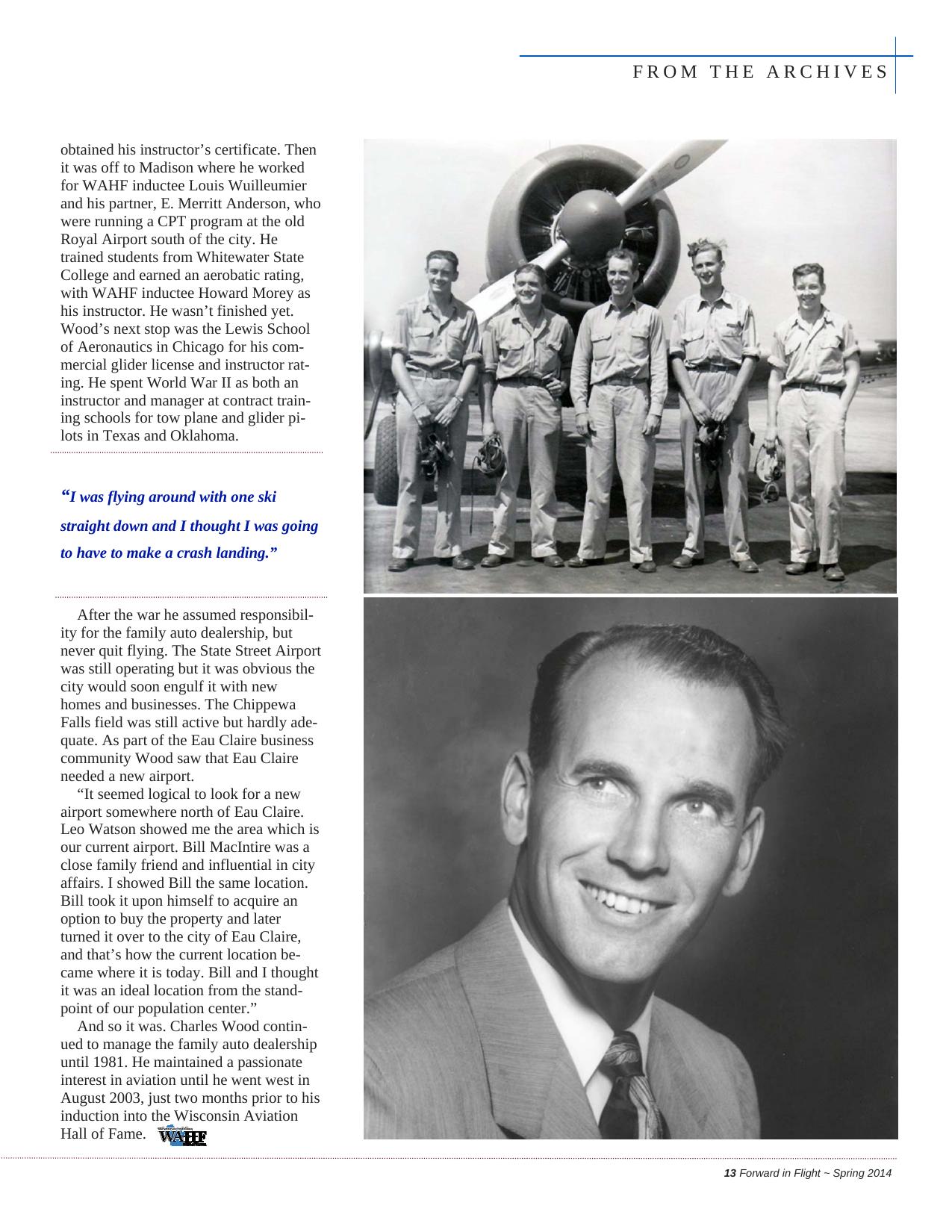
FROM THE ARCHIVES obtained his instructor’s certificate. Then it was off to Madison where he worked for WAHF inductee Louis Wuilleumier and his partner, E. Merritt Anderson, who were running a CPT program at the old Royal Airport south of the city. He trained students from Whitewater State College and earned an aerobatic rating, with WAHF inductee Howard Morey as his instructor. He wasn’t finished yet. Wood’s next stop was the Lewis School of Aeronautics in Chicago for his commercial glider license and instructor rating. He spent World War II as both an instructor and manager at contract training schools for tow plane and glider pilots in Texas and Oklahoma. “I was flying around with one ski straight down and I thought I was going to have to make a crash landing.” After the war he assumed responsibility for the family auto dealership, but never quit flying. The State Street Airport was still operating but it was obvious the city would soon engulf it with new homes and businesses. The Chippewa Falls field was still active but hardly adequate. As part of the Eau Claire business community Wood saw that Eau Claire needed a new airport. “It seemed logical to look for a new airport somewhere north of Eau Claire. Leo Watson showed me the area which is our current airport. Bill MacIntire was a close family friend and influential in city affairs. I showed Bill the same location. Bill took it upon himself to acquire an option to buy the property and later turned it over to the city of Eau Claire, and that’s how the current location became where it is today. Bill and I thought it was an ideal location from the standpoint of our population center.” And so it was. Charles Wood continued to manage the family auto dealership until 1981. He maintained a passionate interest in aviation until he went west in August 2003, just two months prior to his induction into the Wisconsin Aviation Hall of Fame. 13 Forward in Flight ~ Spring 2014
WINGS OF FREEDOM TOUR A Flight with a “Little Friend” Flying with the Collings Foundation By John Dorcey It was a cool morning; the low clouds pushed along rapidly on a brisk north wind. The weather forecast had called for showers but the wind, strong and biting, was unexpected. Ground crewmen, hurried by the chill, rushed about completing last minute details. The flight crews, delayed by the weather, had broken into two groups. The pilots, huddled in the flight planning room, studied each updated weather report. Other crewmembers were spread throughout the ready room. A friend and I sipped our coffee and talked about the morning’s mission. Next to us, other crewmen silently watched the flag as it whipped and snapped about, gripped in the wind’s fury. Then, in a rush, the pilots made for the door as they called to their crews, “It’s a go, let’s do this.” Everyone stood up, moved silently towards the door, and walked to their respective aircraft. Improving weather at both departure and destination airports meant the mission was on! The mission, a short repositioning 14 Forward in Flight ~ Quarterly Magazine of the Wisconsin Aviation Hall of Fame flight, involved only three aircraft—a mixed bag—two bombers and a “little friend.” The P-51 would serve as escort while the B-17 and B-24 were returning to base and their home squadrons. The crews were also a mixed bag, mostly older, experienced men who had seen much in their flying careers. A few replacements, new guys, had a different look about them. Our crew met at the left side of the B24 and, after the requisite safety briefing by the pilot, we entered the airplane Photos by Charles Swain and Rose Dorcey
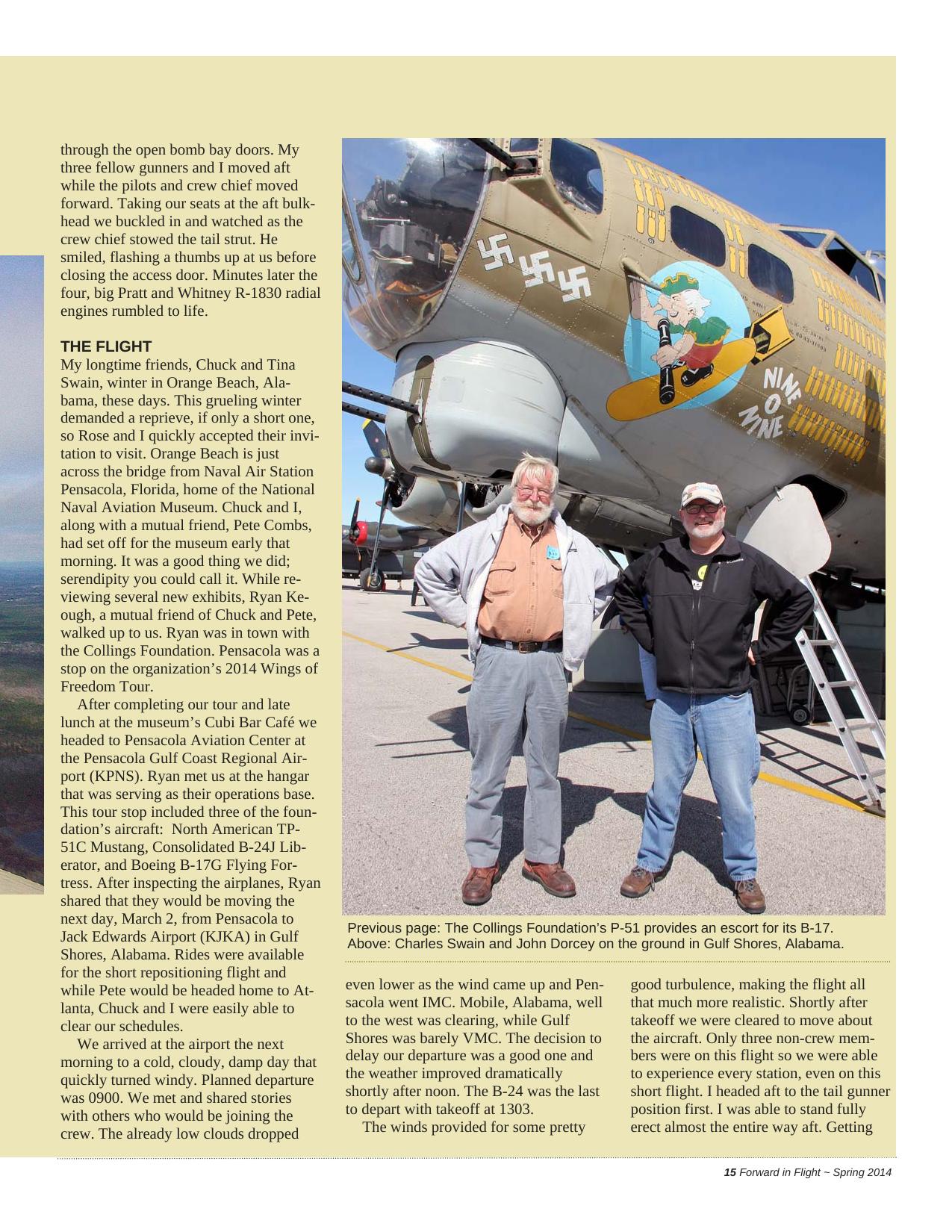
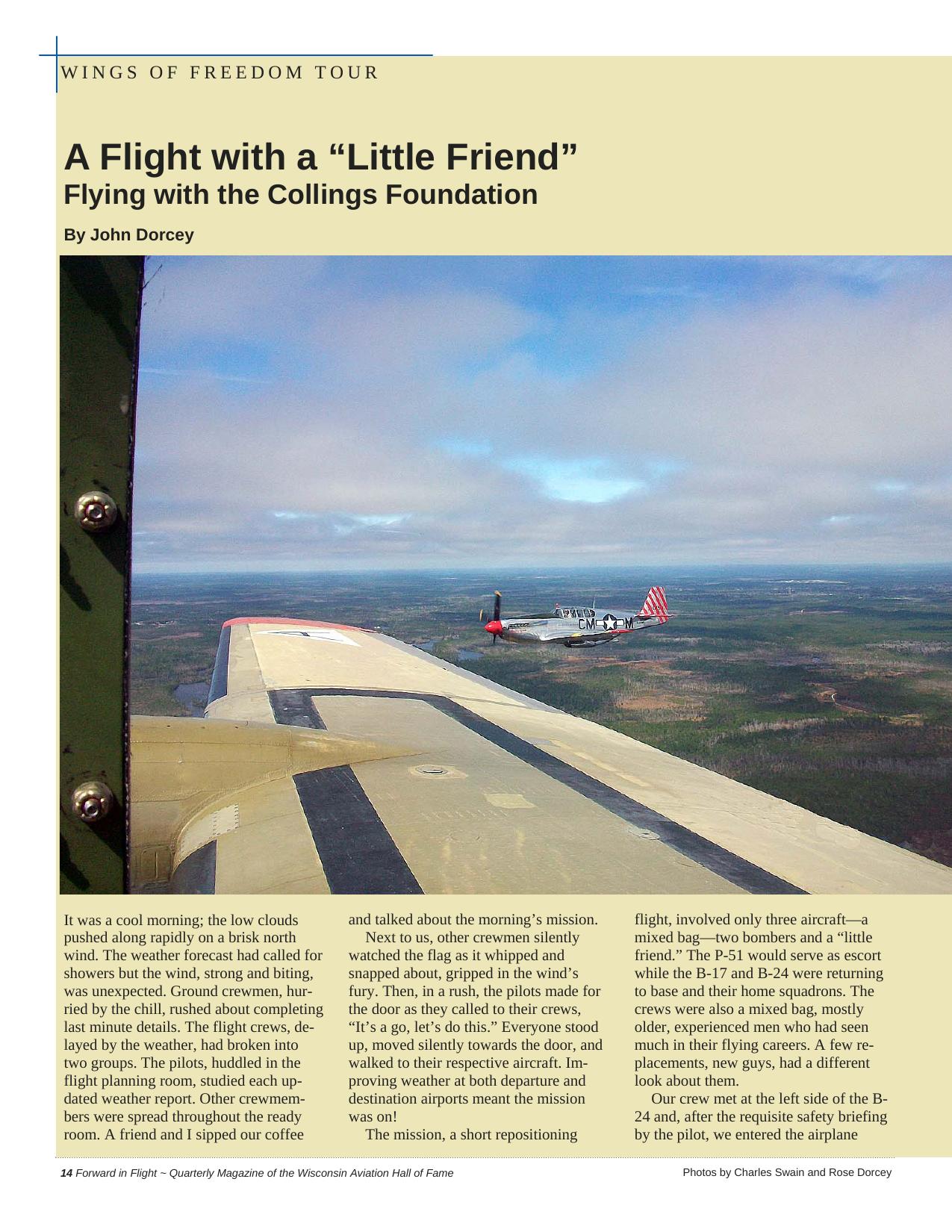
through the open bomb bay doors. My three fellow gunners and I moved aft while the pilots and crew chief moved forward. Taking our seats at the aft bulkhead we buckled in and watched as the crew chief stowed the tail strut. He smiled, flashing a thumbs up at us before closing the access door. Minutes later the four, big Pratt and Whitney R-1830 radial engines rumbled to life. THE FLIGHT My longtime friends, Chuck and Tina Swain, winter in Orange Beach, Alabama, these days. This grueling winter demanded a reprieve, if only a short one, so Rose and I quickly accepted their invitation to visit. Orange Beach is just across the bridge from Naval Air Station Pensacola, Florida, home of the National Naval Aviation Museum. Chuck and I, along with a mutual friend, Pete Combs, had set off for the museum early that morning. It was a good thing we did; serendipity you could call it. While reviewing several new exhibits, Ryan Keough, a mutual friend of Chuck and Pete, walked up to us. Ryan was in town with the Collings Foundation. Pensacola was a stop on the organization’s 2014 Wings of Freedom Tour. After completing our tour and late lunch at the museum’s Cubi Bar Café we headed to Pensacola Aviation Center at the Pensacola Gulf Coast Regional Airport (KPNS). Ryan met us at the hangar that was serving as their operations base. This tour stop included three of the foundation’s aircraft: North American TP51C Mustang, Consolidated B-24J Liberator, and Boeing B-17G Flying Fortress. After inspecting the airplanes, Ryan shared that they would be moving the next day, March 2, from Pensacola to Jack Edwards Airport (KJKA) in Gulf Shores, Alabama. Rides were available for the short repositioning flight and while Pete would be headed home to Atlanta, Chuck and I were easily able to clear our schedules. We arrived at the airport the next morning to a cold, cloudy, damp day that quickly turned windy. Planned departure was 0900. We met and shared stories with others who would be joining the crew. The already low clouds dropped Previous page: The Collings Foundation’s P-51 provides an escort for its B-17. Above: Charles Swain and John Dorcey on the ground in Gulf Shores, Alabama. even lower as the wind came up and Pensacola went IMC. Mobile, Alabama, well to the west was clearing, while Gulf Shores was barely VMC. The decision to delay our departure was a good one and the weather improved dramatically shortly after noon. The B-24 was the last to depart with takeoff at 1303. The winds provided for some pretty good turbulence, making the flight all that much more realistic. Shortly after takeoff we were cleared to move about the aircraft. Only three non-crew members were on this flight so we were able to experience every station, even on this short flight. I headed aft to the tail gunner position first. I was able to stand fully erect almost the entire way aft. Getting 15 Forward in Flight ~ Spring 2014
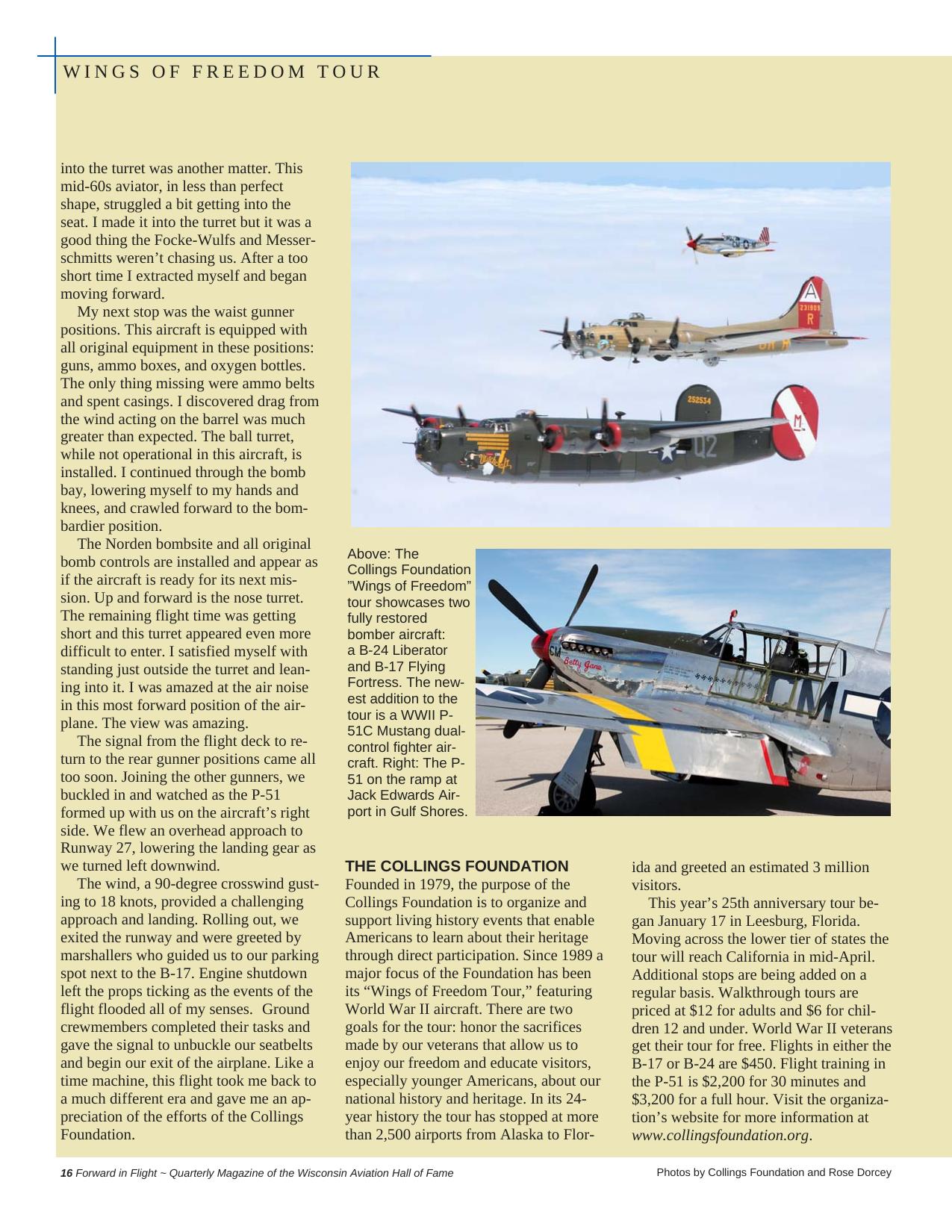
WINGS OF FREEDOM TOUR into the turret was another matter. This mid-60s aviator, in less than perfect shape, struggled a bit getting into the seat. I made it into the turret but it was a good thing the Focke-Wulfs and Messerschmitts weren’t chasing us. After a too short time I extracted myself and began moving forward. My next stop was the waist gunner positions. This aircraft is equipped with all original equipment in these positions: guns, ammo boxes, and oxygen bottles. The only thing missing were ammo belts and spent casings. I discovered drag from the wind acting on the barrel was much greater than expected. The ball turret, while not operational in this aircraft, is installed. I continued through the bomb bay, lowering myself to my hands and knees, and crawled forward to the bombardier position. The Norden bombsite and all original bomb controls are installed and appear as if the aircraft is ready for its next mission. Up and forward is the nose turret. The remaining flight time was getting short and this turret appeared even more difficult to enter. I satisfied myself with standing just outside the turret and leaning into it. I was amazed at the air noise in this most forward position of the airplane. The view was amazing. The signal from the flight deck to return to the rear gunner positions came all too soon. Joining the other gunners, we buckled in and watched as the P-51 formed up with us on the aircraft’s right side. We flew an overhead approach to Runway 27, lowering the landing gear as we turned left downwind. The wind, a 90-degree crosswind gusting to 18 knots, provided a challenging approach and landing. Rolling out, we exited the runway and were greeted by marshallers who guided us to our parking spot next to the B-17. Engine shutdown left the props ticking as the events of the flight flooded all of my senses. Ground crewmembers completed their tasks and gave the signal to unbuckle our seatbelts and begin our exit of the airplane. Like a time machine, this flight took me back to a much different era and gave me an appreciation of the efforts of the Collings Foundation. Above: The Collings Foundation ”Wings of Freedom” tour showcases two fully restored bomber aircraft: a B-24 Liberator and B-17 Flying Fortress. The newest addition to the tour is a WWII P51C Mustang dualcontrol fighter aircraft. Right: The P51 on the ramp at Jack Edwards Airport in Gulf Shores. THE COLLINGS FOUNDATION Founded in 1979, the purpose of the Collings Foundation is to organize and support living history events that enable Americans to learn about their heritage through direct participation. Since 1989 a major focus of the Foundation has been its “Wings of Freedom Tour,” featuring World War II aircraft. There are two goals for the tour: honor the sacrifices made by our veterans that allow us to enjoy our freedom and educate visitors, especially younger Americans, about our national history and heritage. In its 24year history the tour has stopped at more than 2,500 airports from Alaska to Flor- 16 Forward in Flight ~ Quarterly Magazine of the Wisconsin Aviation Hall of Fame ida and greeted an estimated 3 million visitors. This year’s 25th anniversary tour began January 17 in Leesburg, Florida. Moving across the lower tier of states the tour will reach California in mid-April. Additional stops are being added on a regular basis. Walkthrough tours are priced at $12 for adults and $6 for children 12 and under. World War II veterans get their tour for free. Flights in either the B-17 or B-24 are $450. Flight training in the P-51 is $2,200 for 30 minutes and $3,200 for a full hour. Visit the organization’s website for more information at www.collingsfoundation.org. Photos by Collings Foundation and Rose Dorcey
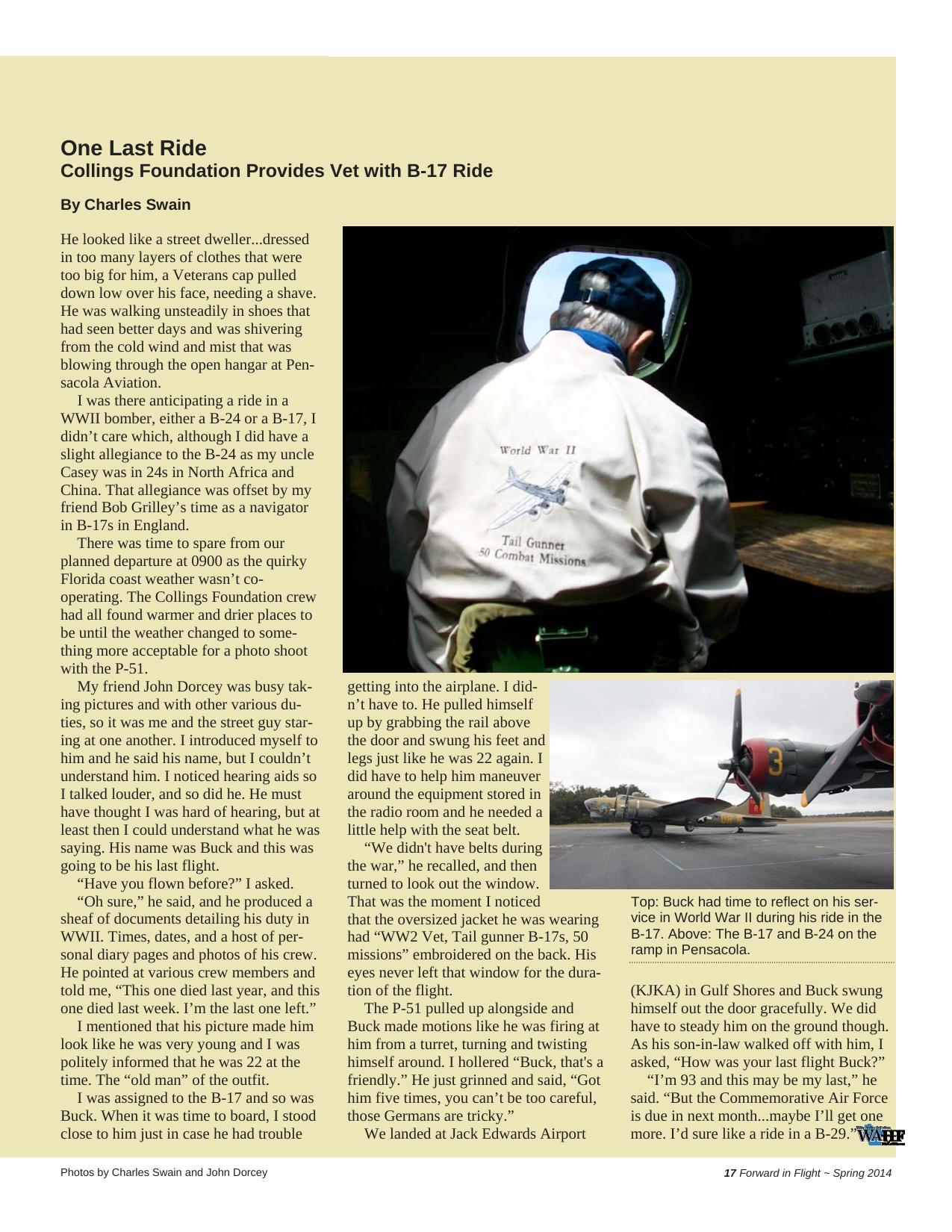
One Last Ride Collings Foundation Provides Vet with B-17 Ride By Charles Swain He looked like a street dweller...dressed in too many layers of clothes that were too big for him, a Veterans cap pulled down low over his face, needing a shave. He was walking unsteadily in shoes that had seen better days and was shivering from the cold wind and mist that was blowing through the open hangar at Pensacola Aviation. I was there anticipating a ride in a WWII bomber, either a B-24 or a B-17, I didn’t care which, although I did have a slight allegiance to the B-24 as my uncle Casey was in 24s in North Africa and China. That allegiance was offset by my friend Bob Grilley’s time as a navigator in B-17s in England. There was time to spare from our planned departure at 0900 as the quirky Florida coast weather wasn’t cooperating. The Collings Foundation crew had all found warmer and drier places to be until the weather changed to something more acceptable for a photo shoot with the P-51. My friend John Dorcey was busy taking pictures and with other various duties, so it was me and the street guy staring at one another. I introduced myself to him and he said his name, but I couldn’t understand him. I noticed hearing aids so I talked louder, and so did he. He must have thought I was hard of hearing, but at least then I could understand what he was saying. His name was Buck and this was going to be his last flight. “Have you flown before?” I asked. “Oh sure,” he said, and he produced a sheaf of documents detailing his duty in WWII. Times, dates, and a host of personal diary pages and photos of his crew. He pointed at various crew members and told me, “This one died last year, and this one died last week. I’m the last one left.” I mentioned that his picture made him look like he was very young and I was politely informed that he was 22 at the time. The “old man” of the outfit. I was assigned to the B-17 and so was Buck. When it was time to board, I stood close to him just in case he had trouble Photos by Charles Swain and John Dorcey getting into the airplane. I didn’t have to. He pulled himself up by grabbing the rail above the door and swung his feet and legs just like he was 22 again. I did have to help him maneuver around the equipment stored in the radio room and he needed a little help with the seat belt. “We didn't have belts during the war,” he recalled, and then turned to look out the window. That was the moment I noticed that the oversized jacket he was wearing had “WW2 Vet, Tail gunner B-17s, 50 missions” embroidered on the back. His eyes never left that window for the duration of the flight. The P-51 pulled up alongside and Buck made motions like he was firing at him from a turret, turning and twisting himself around. I hollered “Buck, that's a friendly.” He just grinned and said, “Got him five times, you can’t be too careful, those Germans are tricky.” We landed at Jack Edwards Airport Top: Buck had time to reflect on his service in World War II during his ride in the B-17. Above: The B-17 and B-24 on the ramp in Pensacola. (KJKA) in Gulf Shores and Buck swung himself out the door gracefully. We did have to steady him on the ground though. As his son-in-law walked off with him, I asked, “How was your last flight Buck?” “I’m 93 and this may be my last,” he said. “But the Commemorative Air Force is due in next month...maybe I’ll get one more. I’d sure like a ride in a B-29.” 17 Forward in Flight ~ Spring 2014
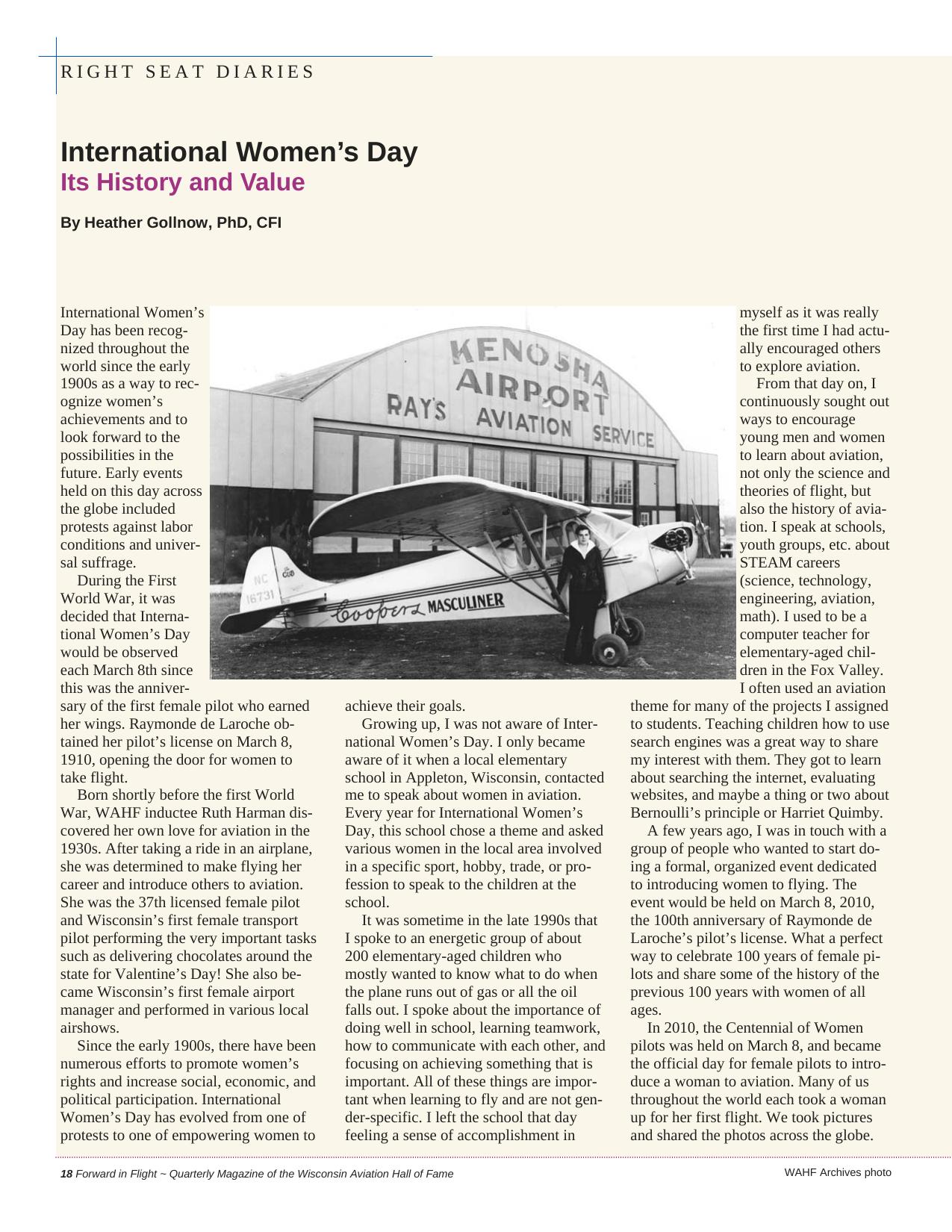
RIGHT SEAT DIARIES International Women’s Day Its History and Value By Heather Gollnow, PhD, CFI International Women’s Day has been recognized throughout the world since the early 1900s as a way to recognize women’s achievements and to look forward to the possibilities in the future. Early events held on this day across the globe included protests against labor conditions and universal suffrage. During the First World War, it was decided that International Women’s Day would be observed each March 8th since this was the anniversary of the first female pilot who earned her wings. Raymonde de Laroche obtained her pilot’s license on March 8, 1910, opening the door for women to take flight. Born shortly before the first World War, WAHF inductee Ruth Harman discovered her own love for aviation in the 1930s. After taking a ride in an airplane, she was determined to make flying her career and introduce others to aviation. She was the 37th licensed female pilot and Wisconsin’s first female transport pilot performing the very important tasks such as delivering chocolates around the state for Valentine’s Day! She also became Wisconsin’s first female airport manager and performed in various local airshows. Since the early 1900s, there have been numerous efforts to promote women’s rights and increase social, economic, and political participation. International Women’s Day has evolved from one of protests to one of empowering women to achieve their goals. Growing up, I was not aware of International Women’s Day. I only became aware of it when a local elementary school in Appleton, Wisconsin, contacted me to speak about women in aviation. Every year for International Women’s Day, this school chose a theme and asked various women in the local area involved in a specific sport, hobby, trade, or profession to speak to the children at the school. It was sometime in the late 1990s that I spoke to an energetic group of about 200 elementary-aged children who mostly wanted to know what to do when the plane runs out of gas or all the oil falls out. I spoke about the importance of doing well in school, learning teamwork, how to communicate with each other, and focusing on achieving something that is important. All of these things are important when learning to fly and are not gender-specific. I left the school that day feeling a sense of accomplishment in 18 Forward in Flight ~ Quarterly Magazine of the Wisconsin Aviation Hall of Fame myself as it was really the first time I had actually encouraged others to explore aviation. From that day on, I continuously sought out ways to encourage young men and women to learn about aviation, not only the science and theories of flight, but also the history of aviation. I speak at schools, youth groups, etc. about STEAM careers (science, technology, engineering, aviation, math). I used to be a computer teacher for elementary-aged children in the Fox Valley. I often used an aviation theme for many of the projects I assigned to students. Teaching children how to use search engines was a great way to share my interest with them. They got to learn about searching the internet, evaluating websites, and maybe a thing or two about Bernoulli’s principle or Harriet Quimby. A few years ago, I was in touch with a group of people who wanted to start doing a formal, organized event dedicated to introducing women to flying. The event would be held on March 8, 2010, the 100th anniversary of Raymonde de Laroche’s pilot’s license. What a perfect way to celebrate 100 years of female pilots and share some of the history of the previous 100 years with women of all ages. In 2010, the Centennial of Women pilots was held on March 8, and became the official day for female pilots to introduce a woman to aviation. Many of us throughout the world each took a woman up for her first flight. We took pictures and shared the photos across the globe. WAHF Archives photo
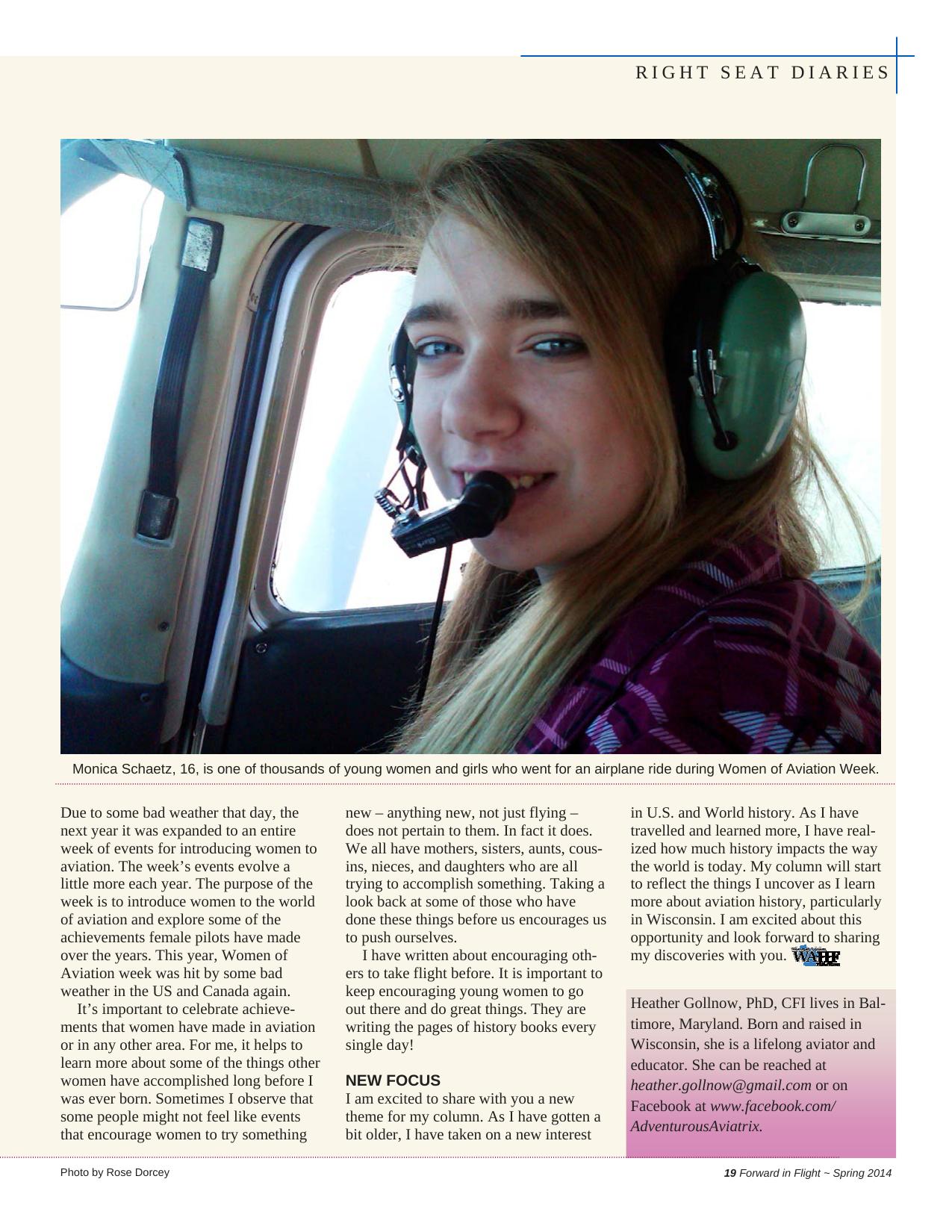
RIGHT SEAT DIARIES Monica Schaetz, 16, is one of thousands of young women and girls who went for an airplane ride during Women of Aviation Week. Due to some bad weather that day, the next year it was expanded to an entire week of events for introducing women to aviation. The week’s events evolve a little more each year. The purpose of the week is to introduce women to the world of aviation and explore some of the achievements female pilots have made over the years. This year, Women of Aviation week was hit by some bad weather in the US and Canada again. It’s important to celebrate achievements that women have made in aviation or in any other area. For me, it helps to learn more about some of the things other women have accomplished long before I was ever born. Sometimes I observe that some people might not feel like events that encourage women to try something Photo by Rose Dorcey new – anything new, not just flying – does not pertain to them. In fact it does. We all have mothers, sisters, aunts, cousins, nieces, and daughters who are all trying to accomplish something. Taking a look back at some of those who have done these things before us encourages us to push ourselves. I have written about encouraging others to take flight before. It is important to keep encouraging young women to go out there and do great things. They are writing the pages of history books every single day! NEW FOCUS I am excited to share with you a new theme for my column. As I have gotten a bit older, I have taken on a new interest in U.S. and World history. As I have travelled and learned more, I have realized how much history impacts the way the world is today. My column will start to reflect the things I uncover as I learn more about aviation history, particularly in Wisconsin. I am excited about this opportunity and look forward to sharing my discoveries with you. Heather Gollnow, PhD, CFI lives in Baltimore, Maryland. Born and raised in Wisconsin, she is a lifelong aviator and educator. She can be reached at heather.gollnow@gmail.com or on Facebook at www.facebook.com/ AdventurousAviatrix. 19 Forward in Flight ~ Spring 2014
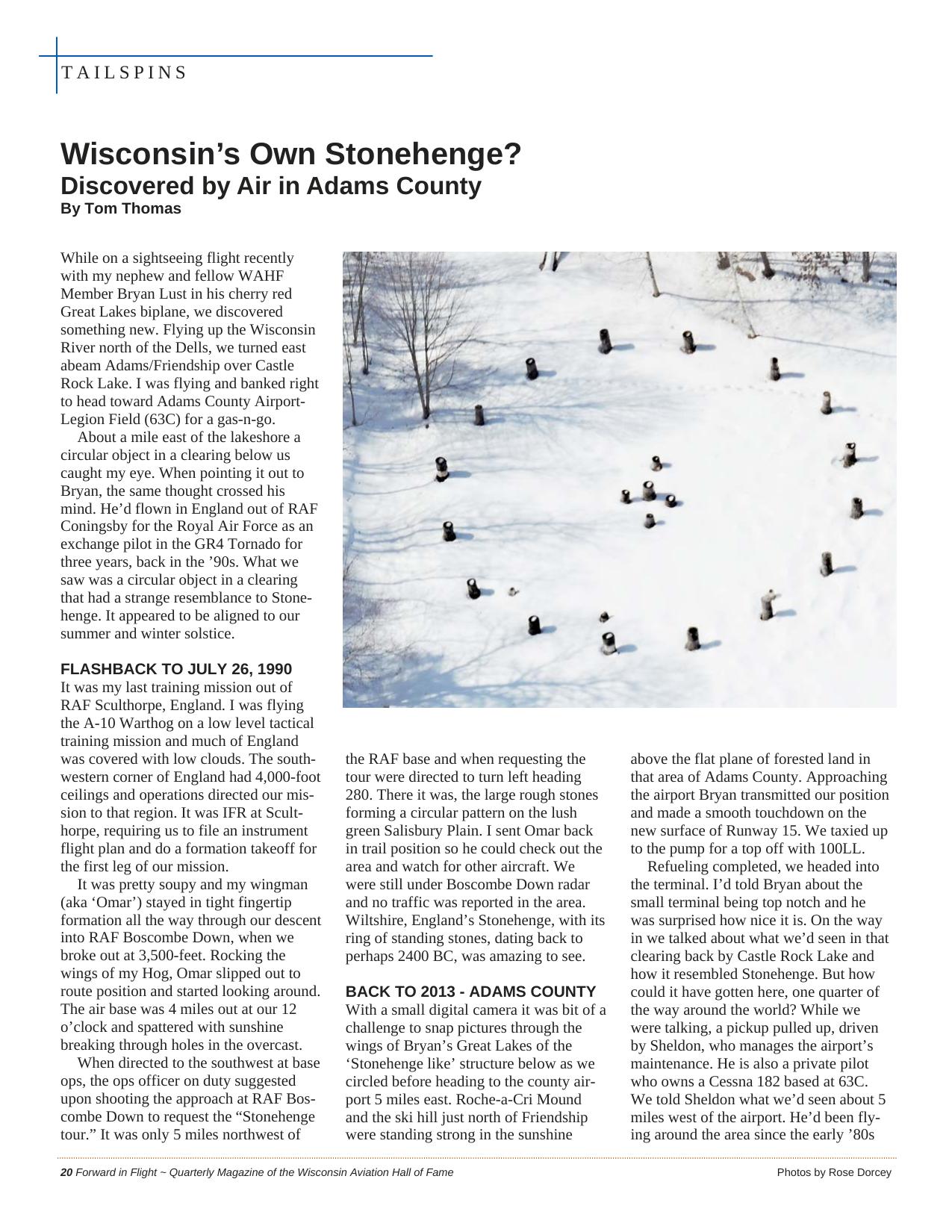
TAILSPINS Wisconsin’s Own Stonehenge? Discovered by Air in Adams County By Tom Thomas While on a sightseeing flight recently with my nephew and fellow WAHF Member Bryan Lust in his cherry red Great Lakes biplane, we discovered something new. Flying up the Wisconsin River north of the Dells, we turned east abeam Adams/Friendship over Castle Rock Lake. I was flying and banked right to head toward Adams County AirportLegion Field (63C) for a gas-n-go. About a mile east of the lakeshore a circular object in a clearing below us caught my eye. When pointing it out to Bryan, the same thought crossed his mind. He’d flown in England out of RAF Coningsby for the Royal Air Force as an exchange pilot in the GR4 Tornado for three years, back in the ’90s. What we saw was a circular object in a clearing that had a strange resemblance to Stonehenge. It appeared to be aligned to our summer and winter solstice. FLASHBACK TO JULY 26, 1990 It was my last training mission out of RAF Sculthorpe, England. I was flying the A-10 Warthog on a low level tactical training mission and much of England was covered with low clouds. The southwestern corner of England had 4,000-foot ceilings and operations directed our mission to that region. It was IFR at Sculthorpe, requiring us to file an instrument flight plan and do a formation takeoff for the first leg of our mission. It was pretty soupy and my wingman (aka ‘Omar’) stayed in tight fingertip formation all the way through our descent into RAF Boscombe Down, when we broke out at 3,500-feet. Rocking the wings of my Hog, Omar slipped out to route position and started looking around. The air base was 4 miles out at our 12 o’clock and spattered with sunshine breaking through holes in the overcast. When directed to the southwest at base ops, the ops officer on duty suggested upon shooting the approach at RAF Boscombe Down to request the “Stonehenge tour.” It was only 5 miles northwest of the RAF base and when requesting the tour were directed to turn left heading 280. There it was, the large rough stones forming a circular pattern on the lush green Salisbury Plain. I sent Omar back in trail position so he could check out the area and watch for other aircraft. We were still under Boscombe Down radar and no traffic was reported in the area. Wiltshire, England’s Stonehenge, with its ring of standing stones, dating back to perhaps 2400 BC, was amazing to see. BACK TO 2013 - ADAMS COUNTY With a small digital camera it was bit of a challenge to snap pictures through the wings of Bryan’s Great Lakes of the ‘Stonehenge like’ structure below as we circled before heading to the county airport 5 miles east. Roche-a-Cri Mound and the ski hill just north of Friendship were standing strong in the sunshine 20 Forward in Flight ~ Quarterly Magazine of the Wisconsin Aviation Hall of Fame above the flat plane of forested land in that area of Adams County. Approaching the airport Bryan transmitted our position and made a smooth touchdown on the new surface of Runway 15. We taxied up to the pump for a top off with 100LL. Refueling completed, we headed into the terminal. I’d told Bryan about the small terminal being top notch and he was surprised how nice it is. On the way in we talked about what we’d seen in that clearing back by Castle Rock Lake and how it resembled Stonehenge. But how could it have gotten here, one quarter of the way around the world? While we were talking, a pickup pulled up, driven by Sheldon, who manages the airport’s maintenance. He is also a private pilot who owns a Cessna 182 based at 63C. We told Sheldon what we’d seen about 5 miles west of the airport. He’d been flying around the area since the early ’80s Photos by Rose Dorcey
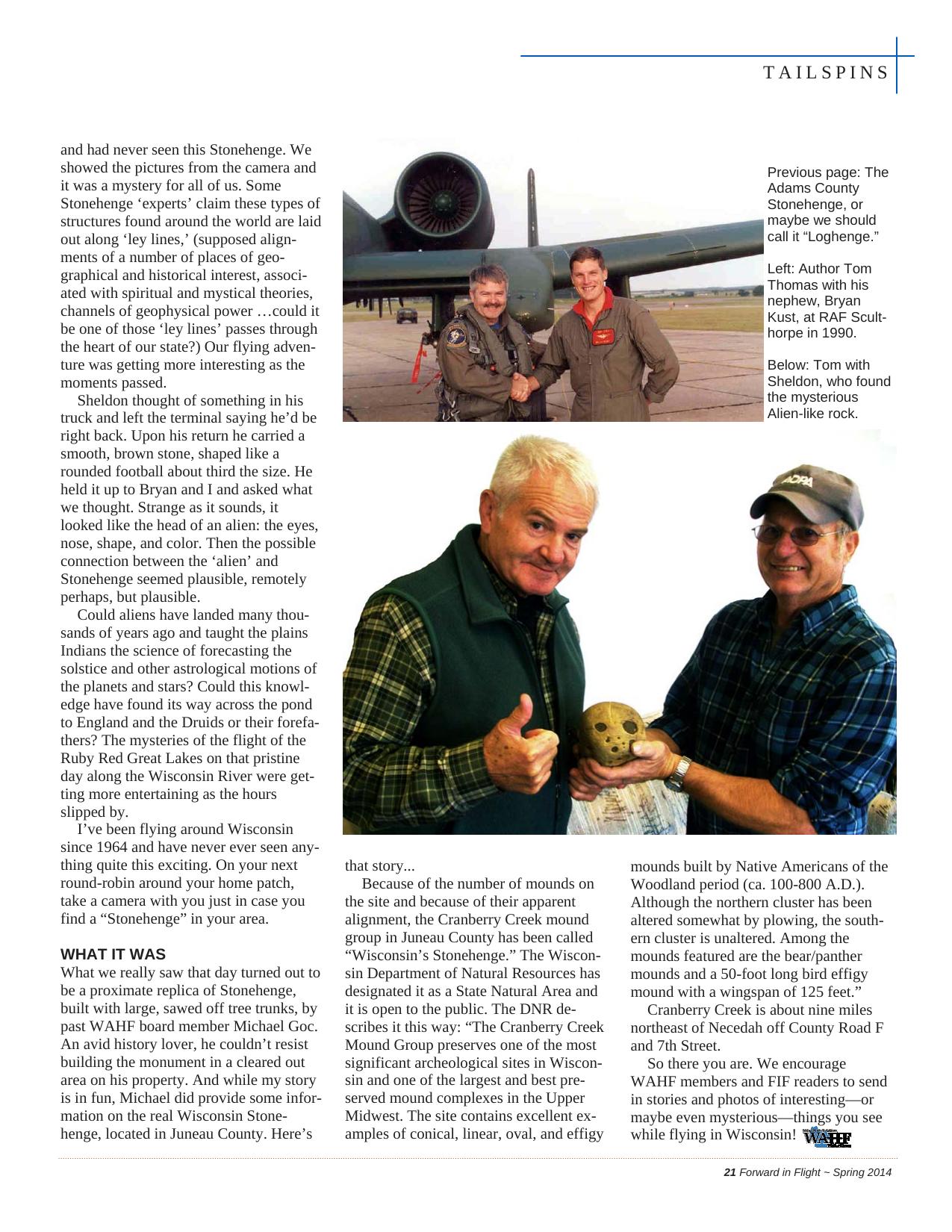
TAILSPINS and had never seen this Stonehenge. We showed the pictures from the camera and it was a mystery for all of us. Some Stonehenge ‘experts’ claim these types of structures found around the world are laid out along ‘ley lines,’ (supposed alignments of a number of places of geographical and historical interest, associated with spiritual and mystical theories, channels of geophysical power …could it be one of those ‘ley lines’ passes through the heart of our state?) Our flying adventure was getting more interesting as the moments passed. Sheldon thought of something in his truck and left the terminal saying he’d be right back. Upon his return he carried a smooth, brown stone, shaped like a rounded football about third the size. He held it up to Bryan and I and asked what we thought. Strange as it sounds, it looked like the head of an alien: the eyes, nose, shape, and color. Then the possible connection between the ‘alien’ and Stonehenge seemed plausible, remotely perhaps, but plausible. Could aliens have landed many thousands of years ago and taught the plains Indians the science of forecasting the solstice and other astrological motions of the planets and stars? Could this knowledge have found its way across the pond to England and the Druids or their forefathers? The mysteries of the flight of the Ruby Red Great Lakes on that pristine day along the Wisconsin River were getting more entertaining as the hours slipped by. I’ve been flying around Wisconsin since 1964 and have never ever seen anything quite this exciting. On your next round-robin around your home patch, take a camera with you just in case you find a “Stonehenge” in your area. WHAT IT WAS What we really saw that day turned out to be a proximate replica of Stonehenge, built with large, sawed off tree trunks, by past WAHF board member Michael Goc. An avid history lover, he couldn’t resist building the monument in a cleared out area on his property. And while my story is in fun, Michael did provide some information on the real Wisconsin Stonehenge, located in Juneau County. Here’s Previous page: The Adams County Stonehenge, or maybe we should call it “Loghenge.” Left: Author Tom Thomas with his nephew, Bryan Kust, at RAF Sculthorpe in 1990. Below: Tom with Sheldon, who found the mysterious Alien-like rock. that story... Because of the number of mounds on the site and because of their apparent alignment, the Cranberry Creek mound group in Juneau County has been called “Wisconsin’s Stonehenge.” The Wisconsin Department of Natural Resources has designated it as a State Natural Area and it is open to the public. The DNR describes it this way: “The Cranberry Creek Mound Group preserves one of the most significant archeological sites in Wisconsin and one of the largest and best preserved mound complexes in the Upper Midwest. The site contains excellent examples of conical, linear, oval, and effigy mounds built by Native Americans of the Woodland period (ca. 100-800 A.D.). Although the northern cluster has been altered somewhat by plowing, the southern cluster is unaltered. Among the mounds featured are the bear/panther mounds and a 50-foot long bird effigy mound with a wingspan of 125 feet.” Cranberry Creek is about nine miles northeast of Necedah off County Road F and 7th Street. So there you are. We encourage WAHF members and FIF readers to send in stories and photos of interesting—or maybe even mysterious—things you see while flying in Wisconsin! 21 Forward in Flight ~ Spring 2014
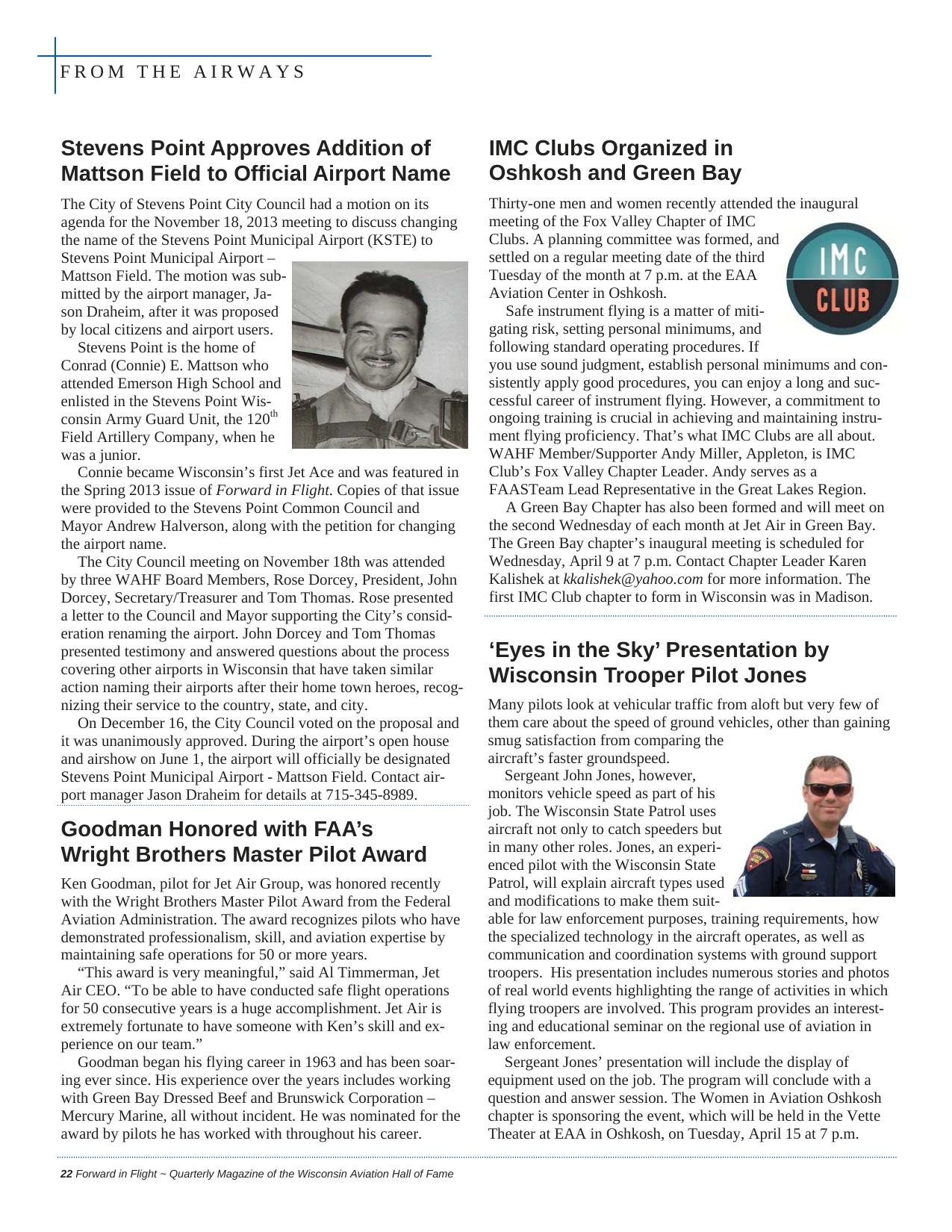
FROM THE AIRWAYS Stevens Point Approves Addition of Mattson Field to Official Airport Name IMC Clubs Organized in Oshkosh and Green Bay The City of Stevens Point City Council had a motion on its agenda for the November 18, 2013 meeting to discuss changing the name of the Stevens Point Municipal Airport (KSTE) to Stevens Point Municipal Airport – Mattson Field. The motion was submitted by the airport manager, Jason Draheim, after it was proposed by local citizens and airport users. Stevens Point is the home of Conrad (Connie) E. Mattson who attended Emerson High School and enlisted in the Stevens Point Wisconsin Army Guard Unit, the 120th Field Artillery Company, when he was a junior. Connie became Wisconsin’s first Jet Ace and was featured in the Spring 2013 issue of Forward in Flight. Copies of that issue were provided to the Stevens Point Common Council and Mayor Andrew Halverson, along with the petition for changing the airport name. The City Council meeting on November 18th was attended by three WAHF Board Members, Rose Dorcey, President, John Dorcey, Secretary/Treasurer and Tom Thomas. Rose presented a letter to the Council and Mayor supporting the City’s consideration renaming the airport. John Dorcey and Tom Thomas presented testimony and answered questions about the process covering other airports in Wisconsin that have taken similar action naming their airports after their home town heroes, recognizing their service to the country, state, and city. On December 16, the City Council voted on the proposal and it was unanimously approved. During the airport’s open house and airshow on June 1, the airport will officially be designated Stevens Point Municipal Airport - Mattson Field. Contact airport manager Jason Draheim for details at 715-345-8989. Thirty-one men and women recently attended the inaugural meeting of the Fox Valley Chapter of IMC Clubs. A planning committee was formed, and settled on a regular meeting date of the third Tuesday of the month at 7 p.m. at the EAA Aviation Center in Oshkosh. Safe instrument flying is a matter of mitigating risk, setting personal minimums, and following standard operating procedures. If you use sound judgment, establish personal minimums and consistently apply good procedures, you can enjoy a long and successful career of instrument flying. However, a commitment to ongoing training is crucial in achieving and maintaining instrument flying proficiency. That’s what IMC Clubs are all about. WAHF Member/Supporter Andy Miller, Appleton, is IMC Club’s Fox Valley Chapter Leader. Andy serves as a FAASTeam Lead Representative in the Great Lakes Region. A Green Bay Chapter has also been formed and will meet on the second Wednesday of each month at Jet Air in Green Bay. The Green Bay chapter’s inaugural meeting is scheduled for Wednesday, April 9 at 7 p.m. Contact Chapter Leader Karen Kalishek at kkalishek@yahoo.com for more information. The first IMC Club chapter to form in Wisconsin was in Madison. Goodman Honored with FAA’s Wright Brothers Master Pilot Award Ken Goodman, pilot for Jet Air Group, was honored recently with the Wright Brothers Master Pilot Award from the Federal Aviation Administration. The award recognizes pilots who have demonstrated professionalism, skill, and aviation expertise by maintaining safe operations for 50 or more years. “This award is very meaningful,” said Al Timmerman, Jet Air CEO. “To be able to have conducted safe flight operations for 50 consecutive years is a huge accomplishment. Jet Air is extremely fortunate to have someone with Ken’s skill and experience on our team.” Goodman began his flying career in 1963 and has been soaring ever since. His experience over the years includes working with Green Bay Dressed Beef and Brunswick Corporation – Mercury Marine, all without incident. He was nominated for the award by pilots he has worked with throughout his career. 22 Forward in Flight ~ Quarterly Magazine of the Wisconsin Aviation Hall of Fame ‘Eyes in the Sky’ Presentation by Wisconsin Trooper Pilot Jones Many pilots look at vehicular traffic from aloft but very few of them care about the speed of ground vehicles, other than gaining smug satisfaction from comparing the aircraft’s faster groundspeed. Sergeant John Jones, however, monitors vehicle speed as part of his job. The Wisconsin State Patrol uses aircraft not only to catch speeders but in many other roles. Jones, an experienced pilot with the Wisconsin State Patrol, will explain aircraft types used and modifications to make them suitable for law enforcement purposes, training requirements, how the specialized technology in the aircraft operates, as well as communication and coordination systems with ground support troopers. His presentation includes numerous stories and photos of real world events highlighting the range of activities in which flying troopers are involved. This program provides an interesting and educational seminar on the regional use of aviation in law enforcement. Sergeant Jones’ presentation will include the display of equipment used on the job. The program will conclude with a question and answer session. The Women in Aviation Oshkosh chapter is sponsoring the event, which will be held in the Vette Theater at EAA in Oshkosh, on Tuesday, April 15 at 7 p.m.
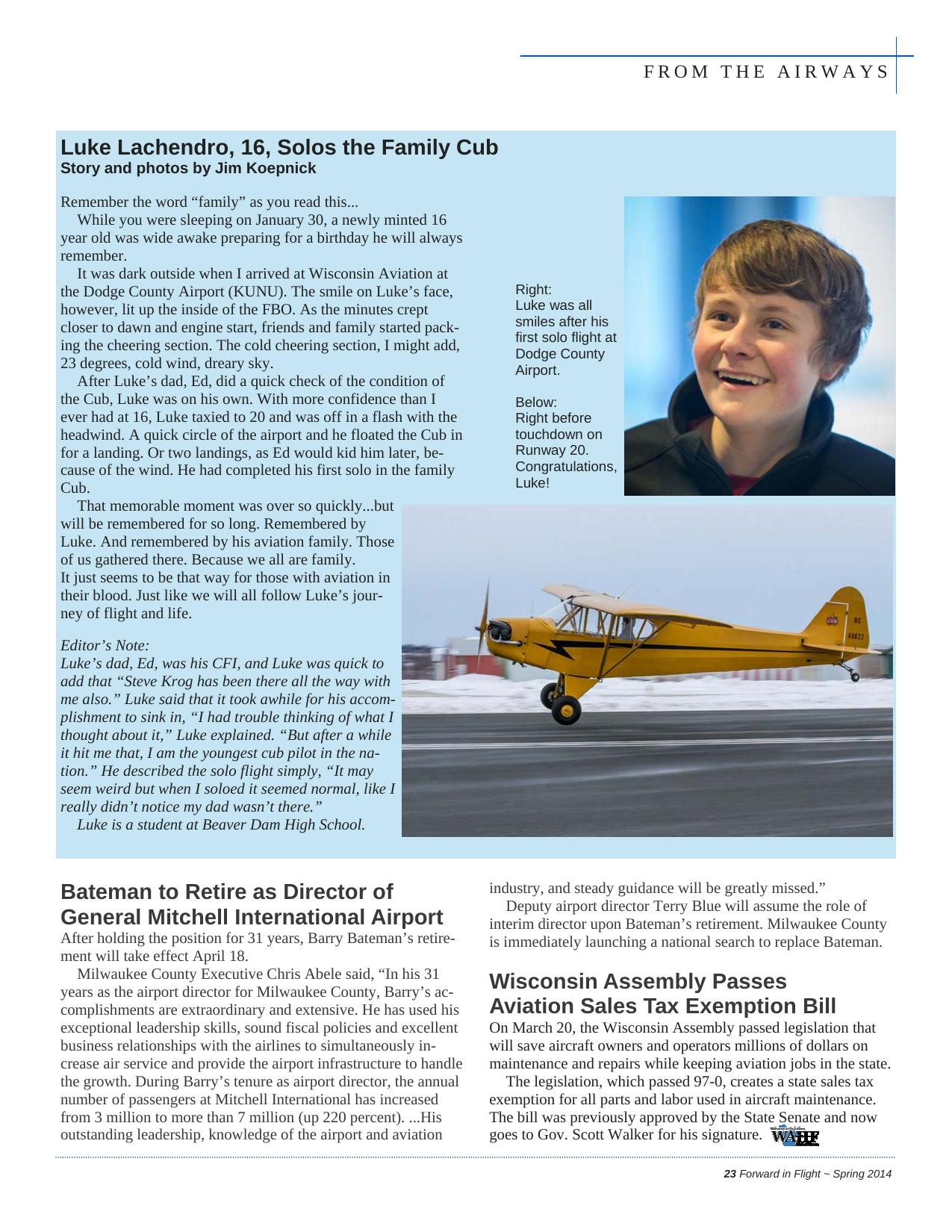
FROM THE AIRWAYS Luke Lachendro, 16, Solos the Family Cub Story and photos by Jim Koepnick Remember the word “family” as you read this... While you were sleeping on January 30, a newly minted 16 year old was wide awake preparing for a birthday he will always remember. It was dark outside when I arrived at Wisconsin Aviation at the Dodge County Airport (KUNU). The smile on Luke’s face, however, lit up the inside of the FBO. As the minutes crept closer to dawn and engine start, friends and family started packing the cheering section. The cold cheering section, I might add, 23 degrees, cold wind, dreary sky. After Luke’s dad, Ed, did a quick check of the condition of the Cub, Luke was on his own. With more confidence than I ever had at 16, Luke taxied to 20 and was off in a flash with the headwind. A quick circle of the airport and he floated the Cub in for a landing. Or two landings, as Ed would kid him later, because of the wind. He had completed his first solo in the family Cub. That memorable moment was over so quickly...but will be remembered for so long. Remembered by Luke. And remembered by his aviation family. Those of us gathered there. Because we all are family. It just seems to be that way for those with aviation in their blood. Just like we will all follow Luke’s journey of flight and life. Right: Luke was all smiles after his first solo flight at Dodge County Airport. Below: Right before touchdown on Runway 20. Congratulations, Luke! Editor’s Note: Luke’s dad, Ed, was his CFI, and Luke was quick to add that “Steve Krog has been there all the way with me also.” Luke said that it took awhile for his accomplishment to sink in, “I had trouble thinking of what I thought about it,” Luke explained. “But after a while it hit me that, I am the youngest cub pilot in the nation.” He described the solo flight simply, “It may seem weird but when I soloed it seemed normal, like I really didn’t notice my dad wasn’t there.” Luke is a student at Beaver Dam High School. Bateman to Retire as Director of General Mitchell International Airport After holding the position for 31 years, Barry Bateman’s retirement will take effect April 18. Milwaukee County Executive Chris Abele said, “In his 31 years as the airport director for Milwaukee County, Barry’s accomplishments are extraordinary and extensive. He has used his exceptional leadership skills, sound fiscal policies and excellent business relationships with the airlines to simultaneously increase air service and provide the airport infrastructure to handle the growth. During Barry’s tenure as airport director, the annual number of passengers at Mitchell International has increased from 3 million to more than 7 million (up 220 percent). ...His outstanding leadership, knowledge of the airport and aviation industry, and steady guidance will be greatly missed.” Deputy airport director Terry Blue will assume the role of interim director upon Bateman’s retirement. Milwaukee County is immediately launching a national search to replace Bateman. Wisconsin Assembly Passes Aviation Sales Tax Exemption Bill On March 20, the Wisconsin Assembly passed legislation that will save aircraft owners and operators millions of dollars on maintenance and repairs while keeping aviation jobs in the state. The legislation, which passed 97-0, creates a state sales tax exemption for all parts and labor used in aircraft maintenance. The bill was previously approved by the State Senate and now goes to Gov. Scott Walker for his signature. 23 Forward in Flight ~ Spring 2014
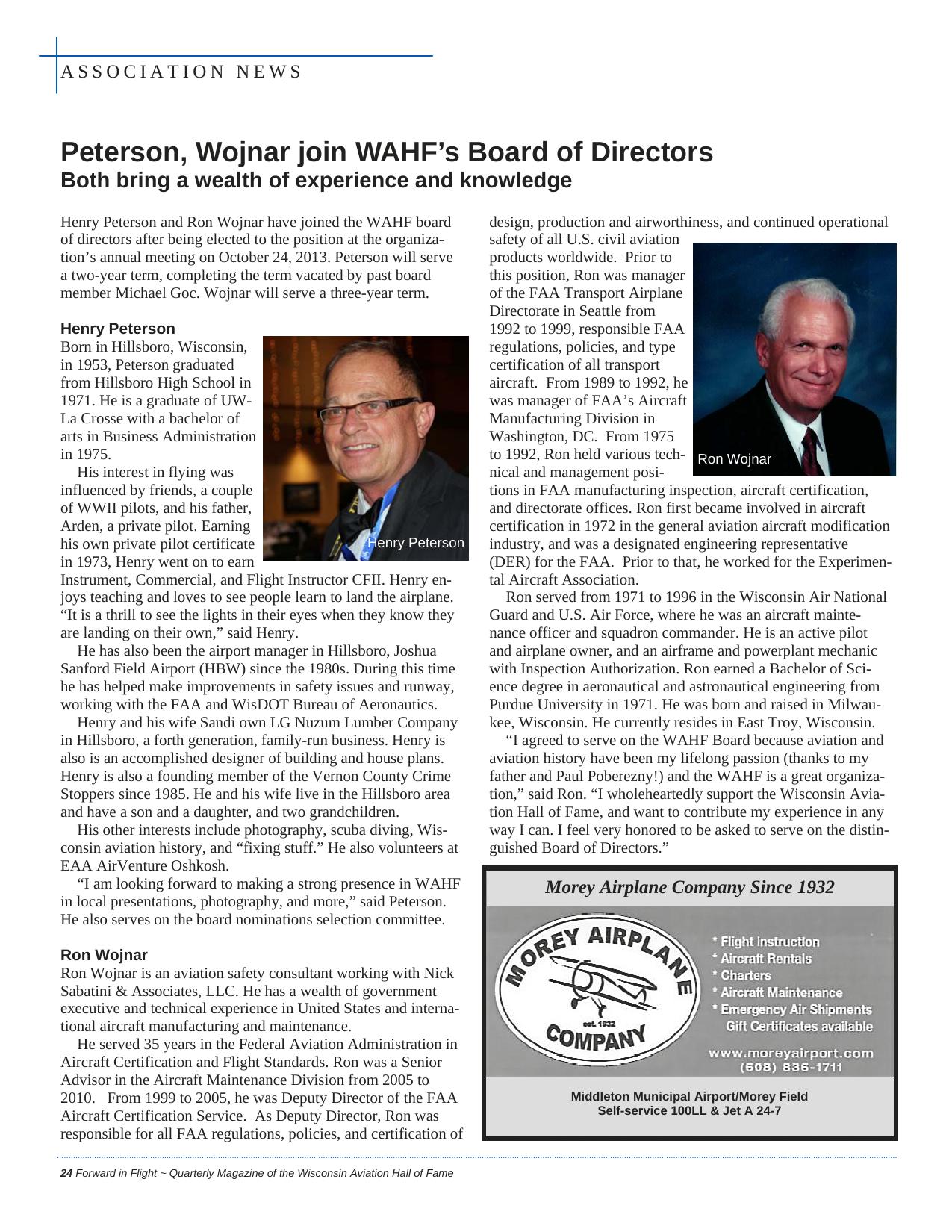
ASSOCIATION NEWS Peterson, Wojnar join WAHF’s Board of Directors Both bring a wealth of experience and knowledge Henry Peterson and Ron Wojnar have joined the WAHF board of directors after being elected to the position at the organization’s annual meeting on October 24, 2013. Peterson will serve a two-year term, completing the term vacated by past board member Michael Goc. Wojnar will serve a three-year term. Henry Peterson Born in Hillsboro, Wisconsin, in 1953, Peterson graduated from Hillsboro High School in 1971. He is a graduate of UWLa Crosse with a bachelor of arts in Business Administration in 1975. His interest in flying was influenced by friends, a couple of WWII pilots, and his father, Arden, a private pilot. Earning Henry Peterson his own private pilot certificate in 1973, Henry went on to earn Instrument, Commercial, and Flight Instructor CFII. Henry enjoys teaching and loves to see people learn to land the airplane. “It is a thrill to see the lights in their eyes when they know they are landing on their own,” said Henry. He has also been the airport manager in Hillsboro, Joshua Sanford Field Airport (HBW) since the 1980s. During this time he has helped make improvements in safety issues and runway, working with the FAA and WisDOT Bureau of Aeronautics. Henry and his wife Sandi own LG Nuzum Lumber Company in Hillsboro, a forth generation, family-run business. Henry is also is an accomplished designer of building and house plans. Henry is also a founding member of the Vernon County Crime Stoppers since 1985. He and his wife live in the Hillsboro area and have a son and a daughter, and two grandchildren. His other interests include photography, scuba diving, Wisconsin aviation history, and “fixing stuff.” He also volunteers at EAA AirVenture Oshkosh. “I am looking forward to making a strong presence in WAHF in local presentations, photography, and more,” said Peterson. He also serves on the board nominations selection committee. Ron Wojnar Ron Wojnar is an aviation safety consultant working with Nick Sabatini & Associates, LLC. He has a wealth of government executive and technical experience in United States and international aircraft manufacturing and maintenance. He served 35 years in the Federal Aviation Administration in Aircraft Certification and Flight Standards. Ron was a Senior Advisor in the Aircraft Maintenance Division from 2005 to 2010. From 1999 to 2005, he was Deputy Director of the FAA Aircraft Certification Service. As Deputy Director, Ron was responsible for all FAA regulations, policies, and certification of 24 Forward in Flight ~ Quarterly Magazine of the Wisconsin Aviation Hall of Fame design, production and airworthiness, and continued operational safety of all U.S. civil aviation products worldwide. Prior to this position, Ron was manager of the FAA Transport Airplane Directorate in Seattle from 1992 to 1999, responsible FAA regulations, policies, and type certification of all transport aircraft. From 1989 to 1992, he was manager of FAA’s Aircraft Manufacturing Division in Washington, DC. From 1975 to 1992, Ron held various tech- Ron Wojnar nical and management positions in FAA manufacturing inspection, aircraft certification, and directorate offices. Ron first became involved in aircraft certification in 1972 in the general aviation aircraft modification industry, and was a designated engineering representative (DER) for the FAA. Prior to that, he worked for the Experimental Aircraft Association. Ron served from 1971 to 1996 in the Wisconsin Air National Guard and U.S. Air Force, where he was an aircraft maintenance officer and squadron commander. He is an active pilot and airplane owner, and an airframe and powerplant mechanic with Inspection Authorization. Ron earned a Bachelor of Science degree in aeronautical and astronautical engineering from Purdue University in 1971. He was born and raised in Milwaukee, Wisconsin. He currently resides in East Troy, Wisconsin. “I agreed to serve on the WAHF Board because aviation and aviation history have been my lifelong passion (thanks to my father and Paul Poberezny!) and the WAHF is a great organization,” said Ron. “I wholeheartedly support the Wisconsin Aviation Hall of Fame, and want to contribute my experience in any way I can. I feel very honored to be asked to serve on the distinguished Board of Directors.” Morey Airplane Company Since 1932 Middleton Municipal Airport/Morey Field Self-service 100LL & Jet A 24-7
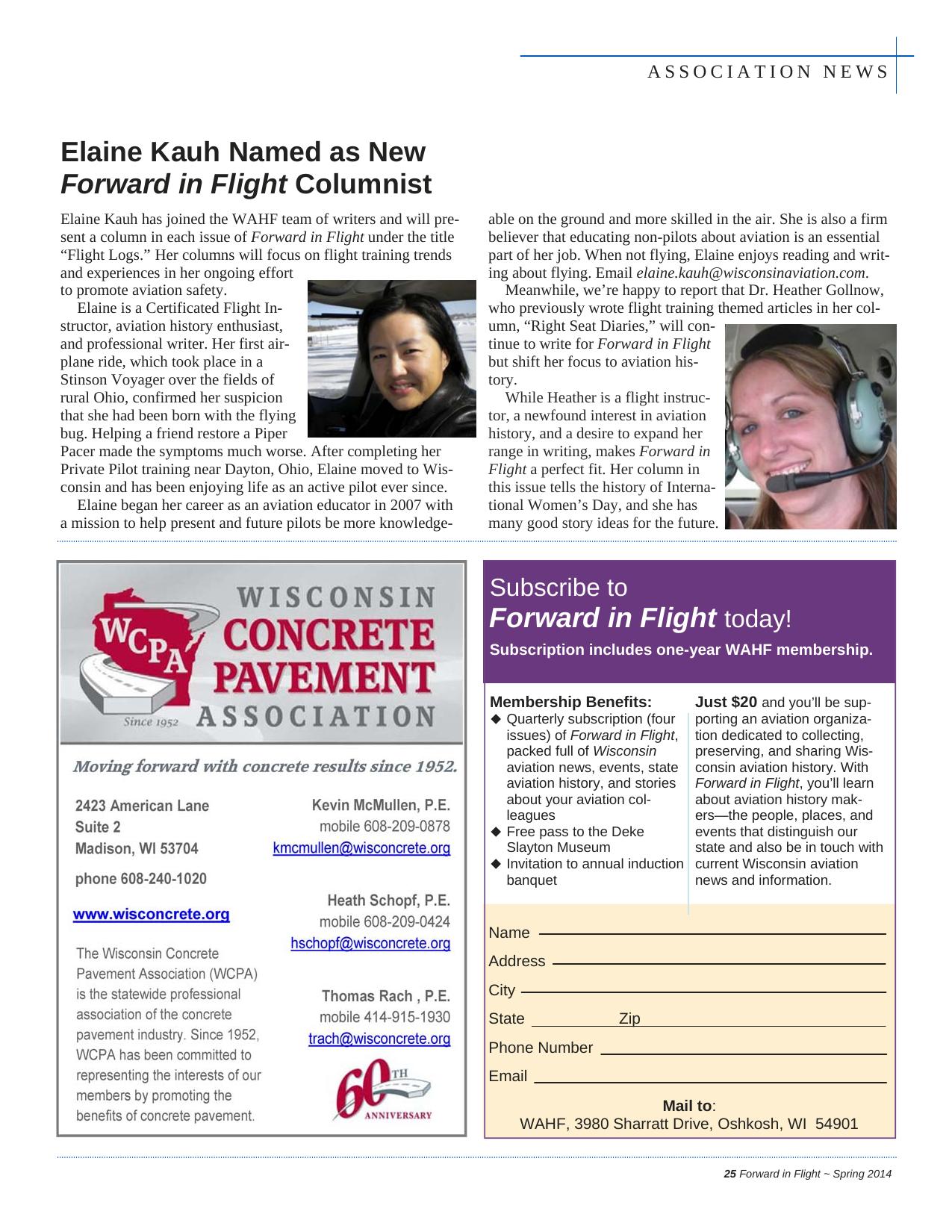
ASSOCIATION NEWS Elaine Kauh Named as New Forward in Flight Columnist Elaine Kauh has joined the WAHF team of writers and will present a column in each issue of Forward in Flight under the title “Flight Logs.” Her columns will focus on flight training trends and experiences in her ongoing effort to promote aviation safety. Elaine is a Certificated Flight Instructor, aviation history enthusiast, and professional writer. Her first airplane ride, which took place in a Stinson Voyager over the fields of rural Ohio, confirmed her suspicion that she had been born with the flying bug. Helping a friend restore a Piper Pacer made the symptoms much worse. After completing her Private Pilot training near Dayton, Ohio, Elaine moved to Wisconsin and has been enjoying life as an active pilot ever since. Elaine began her career as an aviation educator in 2007 with a mission to help present and future pilots be more knowledge- able on the ground and more skilled in the air. She is also a firm believer that educating non-pilots about aviation is an essential part of her job. When not flying, Elaine enjoys reading and writing about flying. Email elaine.kauh@wisconsinaviation.com. Meanwhile, we’re happy to report that Dr. Heather Gollnow, who previously wrote flight training themed articles in her column, “Right Seat Diaries,” will continue to write for Forward in Flight but shift her focus to aviation history. While Heather is a flight instructor, a newfound interest in aviation history, and a desire to expand her range in writing, makes Forward in Flight a perfect fit. Her column in this issue tells the history of International Women’s Day, and she has many good story ideas for the future. Subscribe to Forward in Flight today! Subscription includes one-year WAHF membership. Membership Benefits: Just $20 and you’ll be sup- Quarterly subscription (four porting an aviation organization dedicated to collecting, preserving, and sharing Wisconsin aviation history. With Forward in Flight, you’ll learn about aviation history makers—the people, places, and events that distinguish our state and also be in touch with current Wisconsin aviation news and information. issues) of Forward in Flight, packed full of Wisconsin aviation news, events, state aviation history, and stories about your aviation colleagues Free pass to the Deke Slayton Museum Invitation to annual induction banquet Name Address City State Zip Phone Number Email Mail to: WAHF, 3980 Sharratt Drive, Oshkosh, WI 54901 25 Forward in Flight ~ Spring 2014
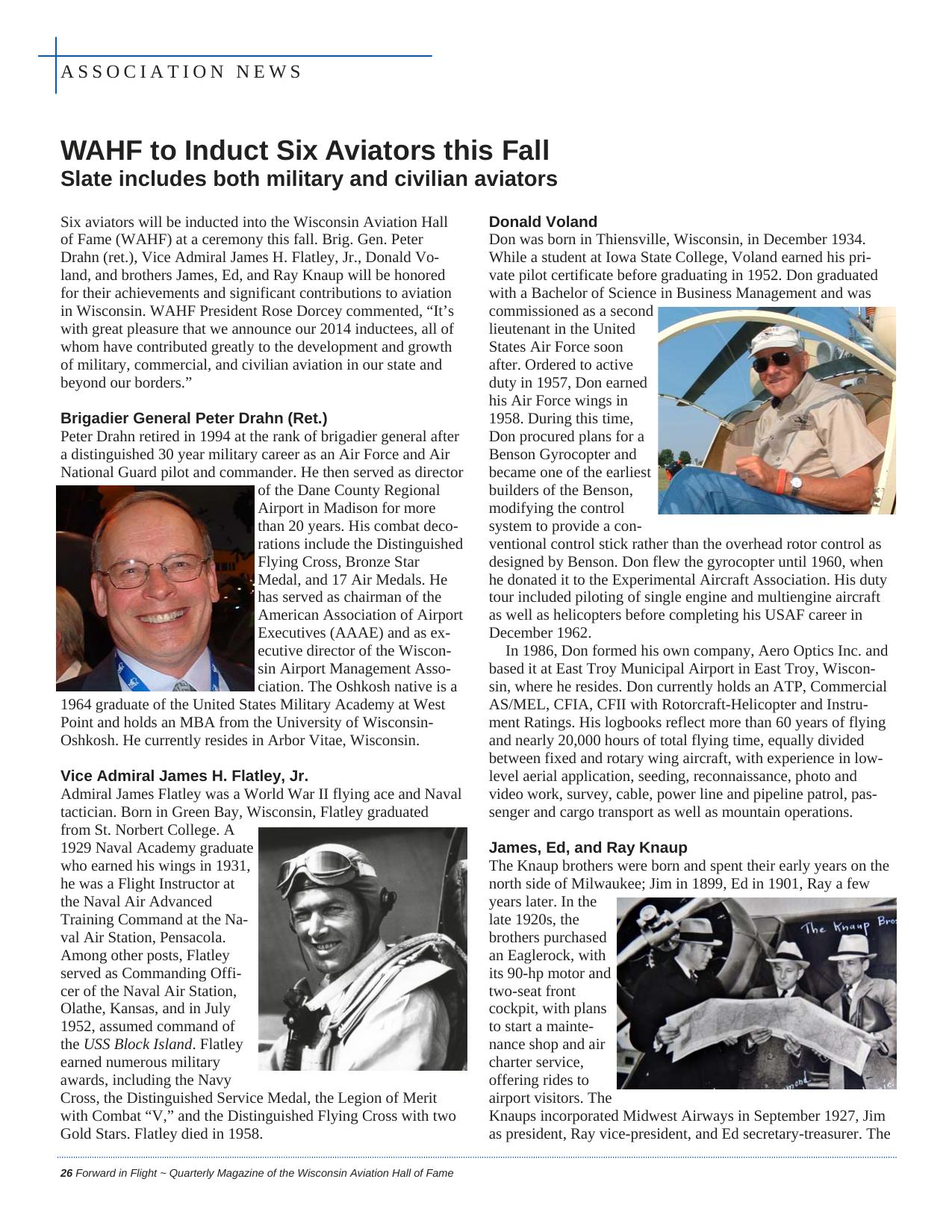
ASSOCIATION NEWS WAHF to Induct Six Aviators this Fall Slate includes both military and civilian aviators Six aviators will be inducted into the Wisconsin Aviation Hall of Fame (WAHF) at a ceremony this fall. Brig. Gen. Peter Drahn (ret.), Vice Admiral James H. Flatley, Jr., Donald Voland, and brothers James, Ed, and Ray Knaup will be honored for their achievements and significant contributions to aviation in Wisconsin. WAHF President Rose Dorcey commented, “It’s with great pleasure that we announce our 2014 inductees, all of whom have contributed greatly to the development and growth of military, commercial, and civilian aviation in our state and beyond our borders.” Brigadier General Peter Drahn (Ret.) Peter Drahn retired in 1994 at the rank of brigadier general after a distinguished 30 year military career as an Air Force and Air National Guard pilot and commander. He then served as director of the Dane County Regional Airport in Madison for more than 20 years. His combat decorations include the Distinguished Flying Cross, Bronze Star Medal, and 17 Air Medals. He has served as chairman of the American Association of Airport Executives (AAAE) and as executive director of the Wisconsin Airport Management Association. The Oshkosh native is a 1964 graduate of the United States Military Academy at West Point and holds an MBA from the University of WisconsinOshkosh. He currently resides in Arbor Vitae, Wisconsin. Vice Admiral James H. Flatley, Jr. Admiral James Flatley was a World War II flying ace and Naval tactician. Born in Green Bay, Wisconsin, Flatley graduated from St. Norbert College. A 1929 Naval Academy graduate who earned his wings in 1931, he was a Flight Instructor at the Naval Air Advanced Training Command at the Naval Air Station, Pensacola. Among other posts, Flatley served as Commanding Officer of the Naval Air Station, Olathe, Kansas, and in July 1952, assumed command of the USS Block Island. Flatley earned numerous military awards, including the Navy Cross, the Distinguished Service Medal, the Legion of Merit with Combat “V,” and the Distinguished Flying Cross with two Gold Stars. Flatley died in 1958. 26 Forward in Flight ~ Quarterly Magazine of the Wisconsin Aviation Hall of Fame Donald Voland Don was born in Thiensville, Wisconsin, in December 1934. While a student at Iowa State College, Voland earned his private pilot certificate before graduating in 1952. Don graduated with a Bachelor of Science in Business Management and was commissioned as a second lieutenant in the United States Air Force soon after. Ordered to active duty in 1957, Don earned his Air Force wings in 1958. During this time, Don procured plans for a Benson Gyrocopter and became one of the earliest builders of the Benson, modifying the control system to provide a conventional control stick rather than the overhead rotor control as designed by Benson. Don flew the gyrocopter until 1960, when he donated it to the Experimental Aircraft Association. His duty tour included piloting of single engine and multiengine aircraft as well as helicopters before completing his USAF career in December 1962. In 1986, Don formed his own company, Aero Optics Inc. and based it at East Troy Municipal Airport in East Troy, Wisconsin, where he resides. Don currently holds an ATP, Commercial AS/MEL, CFIA, CFII with Rotorcraft-Helicopter and Instrument Ratings. His logbooks reflect more than 60 years of flying and nearly 20,000 hours of total flying time, equally divided between fixed and rotary wing aircraft, with experience in lowlevel aerial application, seeding, reconnaissance, photo and video work, survey, cable, power line and pipeline patrol, passenger and cargo transport as well as mountain operations. James, Ed, and Ray Knaup The Knaup brothers were born and spent their early years on the north side of Milwaukee; Jim in 1899, Ed in 1901, Ray a few years later. In the late 1920s, the brothers purchased an Eaglerock, with its 90-hp motor and two-seat front cockpit, with plans to start a maintenance shop and air charter service, offering rides to airport visitors. The Knaups incorporated Midwest Airways in September 1927, Jim as president, Ray vice-president, and Ed secretary-treasurer. The
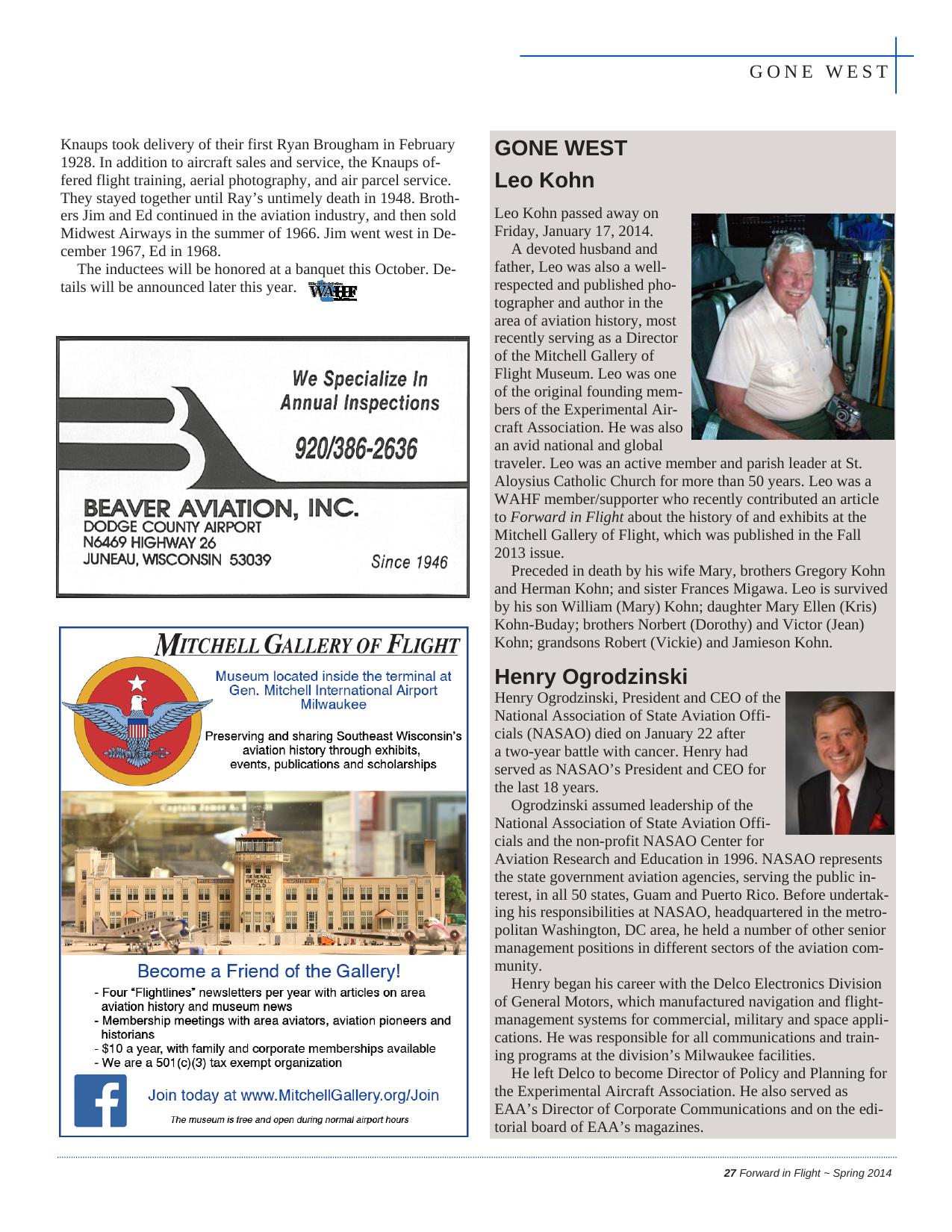
GONE WEST Knaups took delivery of their first Ryan Brougham in February 1928. In addition to aircraft sales and service, the Knaups offered flight training, aerial photography, and air parcel service. They stayed together until Ray’s untimely death in 1948. Brothers Jim and Ed continued in the aviation industry, and then sold Midwest Airways in the summer of 1966. Jim went west in December 1967, Ed in 1968. The inductees will be honored at a banquet this October. Details will be announced later this year. GONE WEST Leo Kohn Leo Kohn passed away on Friday, January 17, 2014. A devoted husband and father, Leo was also a wellrespected and published photographer and author in the area of aviation history, most recently serving as a Director of the Mitchell Gallery of Flight Museum. Leo was one of the original founding members of the Experimental Aircraft Association. He was also an avid national and global traveler. Leo was an active member and parish leader at St. Aloysius Catholic Church for more than 50 years. Leo was a WAHF member/supporter who recently contributed an article to Forward in Flight about the history of and exhibits at the Mitchell Gallery of Flight, which was published in the Fall 2013 issue. Preceded in death by his wife Mary, brothers Gregory Kohn and Herman Kohn; and sister Frances Migawa. Leo is survived by his son William (Mary) Kohn; daughter Mary Ellen (Kris) Kohn-Buday; brothers Norbert (Dorothy) and Victor (Jean) Kohn; grandsons Robert (Vickie) and Jamieson Kohn. Henry Ogrodzinski Henry Ogrodzinski, President and CEO of the National Association of State Aviation Officials (NASAO) died on January 22 after a two-year battle with cancer. Henry had served as NASAO’s President and CEO for the last 18 years. Ogrodzinski assumed leadership of the National Association of State Aviation Officials and the non-profit NASAO Center for Aviation Research and Education in 1996. NASAO represents the state government aviation agencies, serving the public interest, in all 50 states, Guam and Puerto Rico. Before undertaking his responsibilities at NASAO, headquartered in the metropolitan Washington, DC area, he held a number of other senior management positions in different sectors of the aviation community. Henry began his career with the Delco Electronics Division of General Motors, which manufactured navigation and flightmanagement systems for commercial, military and space applications. He was responsible for all communications and training programs at the division’s Milwaukee facilities. He left Delco to become Director of Policy and Planning for the Experimental Aircraft Association. He also served as EAA’s Director of Corporate Communications and on the editorial board of EAA’s magazines. 27 Forward in Flight ~ Spring 2014
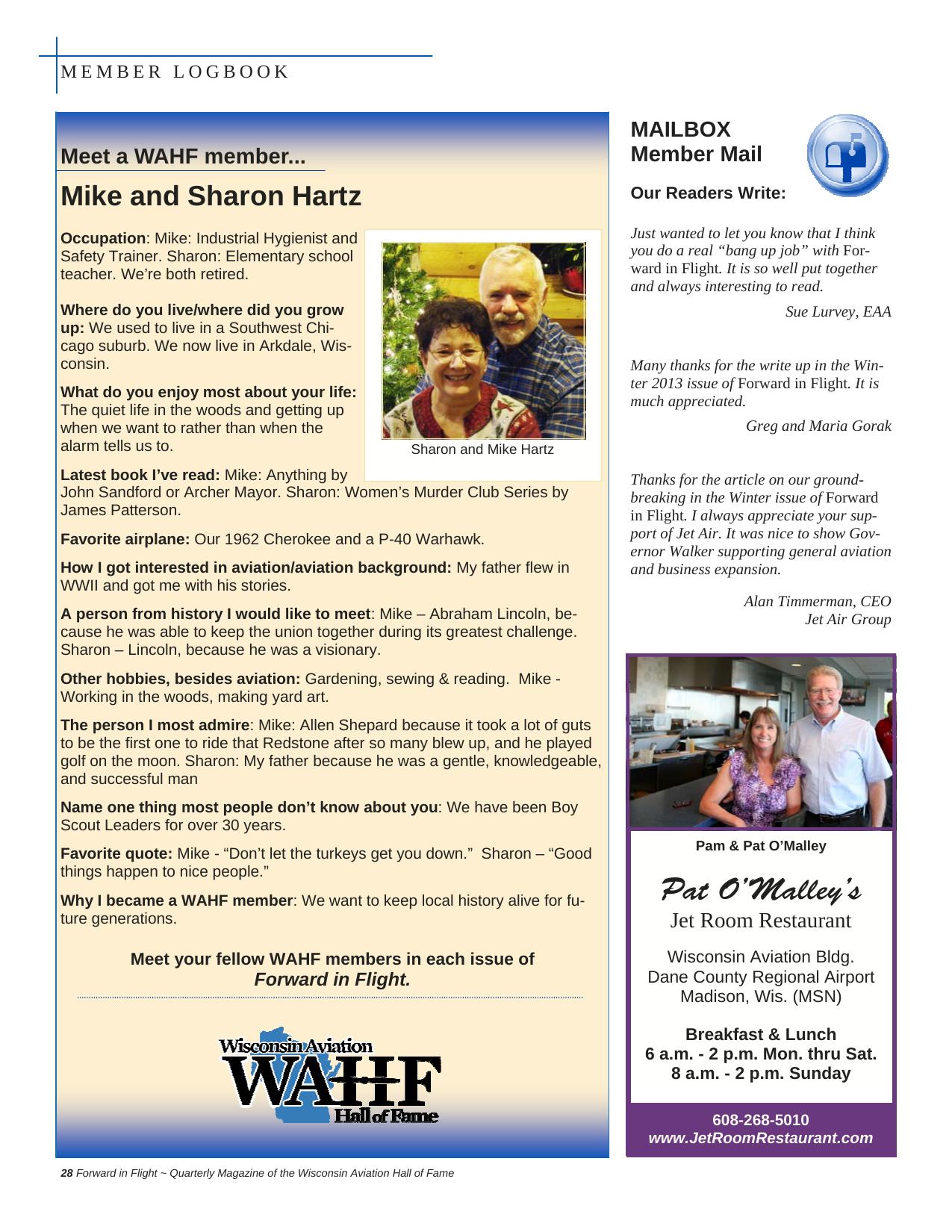
MEMBER LOGBOOK MAILBOX Member Mail Meet a WAHF member... Mike and Sharon Hartz Our Readers Write: Occupation: Mike: Industrial Hygienist and Safety Trainer. Sharon: Elementary school teacher. We’re both retired. Just wanted to let you know that I think you do a real “bang up job” with Forward in Flight. It is so well put together and always interesting to read. Where do you live/where did you grow up: We used to live in a Southwest Chicago suburb. We now live in Arkdale, Wisconsin. What do you enjoy most about your life: The quiet life in the woods and getting up when we want to rather than when the alarm tells us to. Sue Lurvey, EAA Many thanks for the write up in the Winter 2013 issue of Forward in Flight. It is much appreciated. Greg and Maria Gorak Sharon and Mike Hartz Latest book I’ve read: Mike: Anything by John Sandford or Archer Mayor. Sharon: Women’s Murder Club Series by James Patterson. Favorite airplane: Our 1962 Cherokee and a P-40 Warhawk. How I got interested in aviation/aviation background: My father flew in WWII and got me with his stories. A person from history I would like to meet: Mike – Abraham Lincoln, because he was able to keep the union together during its greatest challenge. Sharon – Lincoln, because he was a visionary. Thanks for the article on our groundbreaking in the Winter issue of Forward in Flight. I always appreciate your support of Jet Air. It was nice to show Governor Walker supporting general aviation and business expansion. Alan Timmerman, CEO Jet Air Group Other hobbies, besides aviation: Gardening, sewing & reading. Mike Working in the woods, making yard art. The person I most admire: Mike: Allen Shepard because it took a lot of guts to be the first one to ride that Redstone after so many blew up, and he played golf on the moon. Sharon: My father because he was a gentle, knowledgeable, and successful man Name one thing most people don’t know about you: We have been Boy Scout Leaders for over 30 years. Favorite quote: Mike - “Don’t let the turkeys get you down.” Sharon – “Good things happen to nice people.” Why I became a WAHF member: We want to keep local history alive for future generations. Meet your fellow WAHF members in each issue of Forward in Flight. Pam & Pat O’Malley Pat O’Malley’s Jet Room Restaurant Wisconsin Aviation Bldg. Dane County Regional Airport Madison, Wis. (MSN) Breakfast & Lunch 6 a.m. - 2 p.m. Mon. thru Sat. 8 a.m. - 2 p.m. Sunday 608-268-5010 www.JetRoomRestaurant.com 28 Forward in Flight ~ Quarterly Magazine of the Wisconsin Aviation Hall of Fame
Wittman Regional Airport Oshkosh So much history ...and still making it! From the legacy of Steve Wittman to Warren Basler’s DC-3 conversions, we’re proud to support and contribute to Wisconsin aviation history. FLY TO OSHKOSH wittmanairport.com @wittmanairport 59th Annual Wisconsin Aviation Conference May 5 - 7, 2014 Patriot Center Wausau/Rothschild Topics Conference Speakers Registration Wildlife Hazards at Airports Aviation Apps: New Technology for Barry Cooper, FAA Regional $85 (before April 17) includes all Administrator, Great Lakes Region Sue Schalk, FAA Regional Airports Division Manager David Greene, Wisconsin Aeronautics Director And more meals and receptions (registration fee after April 17 is $130) Complimentary Registration for Airport Commissioner/Board Member with paid staff registration For registration information, visit the Wisconsin Airport Management Association’s website at www.WIAMA.org Contact Bob O’Brien, Executive Director, WAMA, at 815-757-2869 or email bob@thewisconsinriver.com the Airfield and Cockpit Airline Service Forecast for Wisconsin Airports NOTAM Technology: Change Is In The Air Wisconsin Aerospace Consortium Wisconsin Flying Hamburger Social Wisconsin Sales Tax Exemption Legislation for FBOs and Other Aeronautical Entities NextGen: Coming Soon GA Hangars: Private Investment, Development, and Ownership Special Events Welcome Reception Awards Luncheon Banquet Golf Tournament Sporting Clays Tournament Hosted by WAMA - Wisconsin Airport Management Association WATA - Wisconsin Aviation Trades Association WBAA - Wisconsin Business Aviation Association Consultants, Suppliers and Sponsors
PRSRT STD US Postage Paid Wisc Rapids WI Permit 98 3980 SHARRATT DRIVE OSHKOSH WI 54901-1276 The Wisconsin Aviation Hall of Fame is a non-profit membership organization dedicated to preserving the past and fostering the future of flight. Welcome WAHF Member/Supporters: Jeff Baker John Caine Nolan Caine Clem Dahlke Alan Georgia Michael Hartz Sharon Hartz Dixie Igou Gail Jahnke Frank Juedes Kathleen Kluby James Lins Kurt Mehre Oshkosh Airport Products Julie Ovans Peter Rench Larry Scheckle Kurt Stanich Dorothy Sullivan Marjorie Wolf —Thanks for coming on board. We hope to see you at a WAHF event soon! AVIATION EVENT — OSHKOSH: Thursday, May 15, 7 p.m. - WAHF Board Member/Inductee Tom Thomas will present “Landing a C-97 at Dodgeville” at the EAA Museum in Oshkosh. Many of you have seen the C-97 that’s parked outside the Don Q Inn on Hwy. 23 in Dodgeville, Wisconsin. Tom Thomas will share his story of the role he played in landing that huge airplane on the short, uphill runway that once graced the Don Quinn property. Tom will discuss this ultimate short field landing experience, which took place in 1977, with explanations of preflight and runway preparations, aircraft operations, and other facts and figures about the flight and its crewmembers. There is no admission charge, and a beyond-the-ropes museum tour will follow the presentation. For more information, call 920426-6108 or visit www.AirVentureMuseum.org. Wisconsin Aviation Hall of Fame Officers and Board of Directors Rose Dorcey, President Tom Thomas, Vice-President John Dorcey, Secretary/Treasurer Bruce Botterman Andrew Ovans Henry Peterson Charles Swain Tom Thomas Wynne Williams Charles Marotske, Honorary Chairman of the Board Wisconsin Aviation Hall of Fame 3980 Sharratt Drive Oshkosh, WI 54901-1276 Become a supporter today! For information call Rose Dorcey at 920-385-1483 www.wisconsinaviationhalloffame.org rdorcey@wisconsinaviationhalloffame.org