Volume 13, Issue 1
🗞️ Download Issue (PDF)
Forward in Flight - Spring 2015
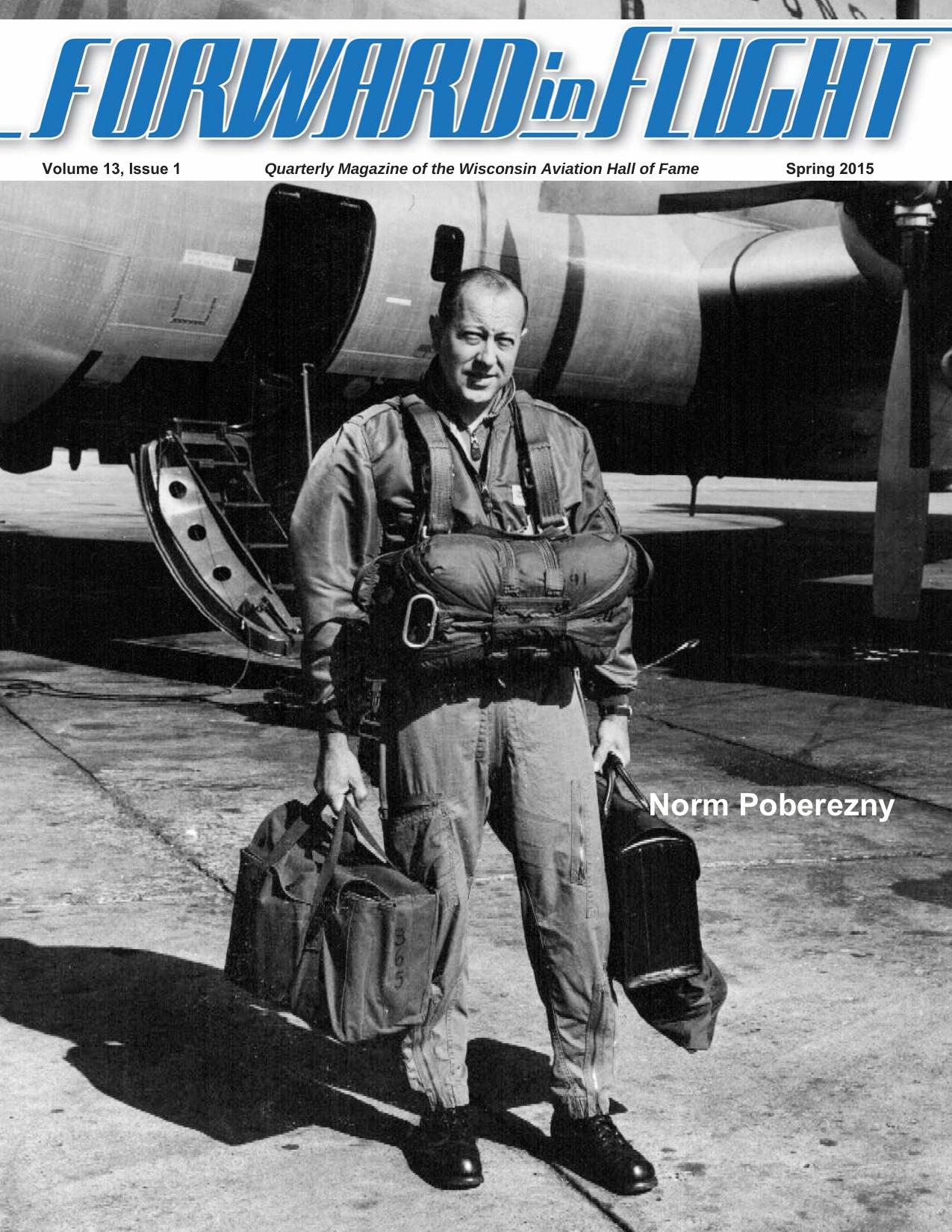
Volume 13, Issue 1 Quarterly Magazine of the Wisconsin Aviation Hall of Fame Spring 2015 Norm Poberezny
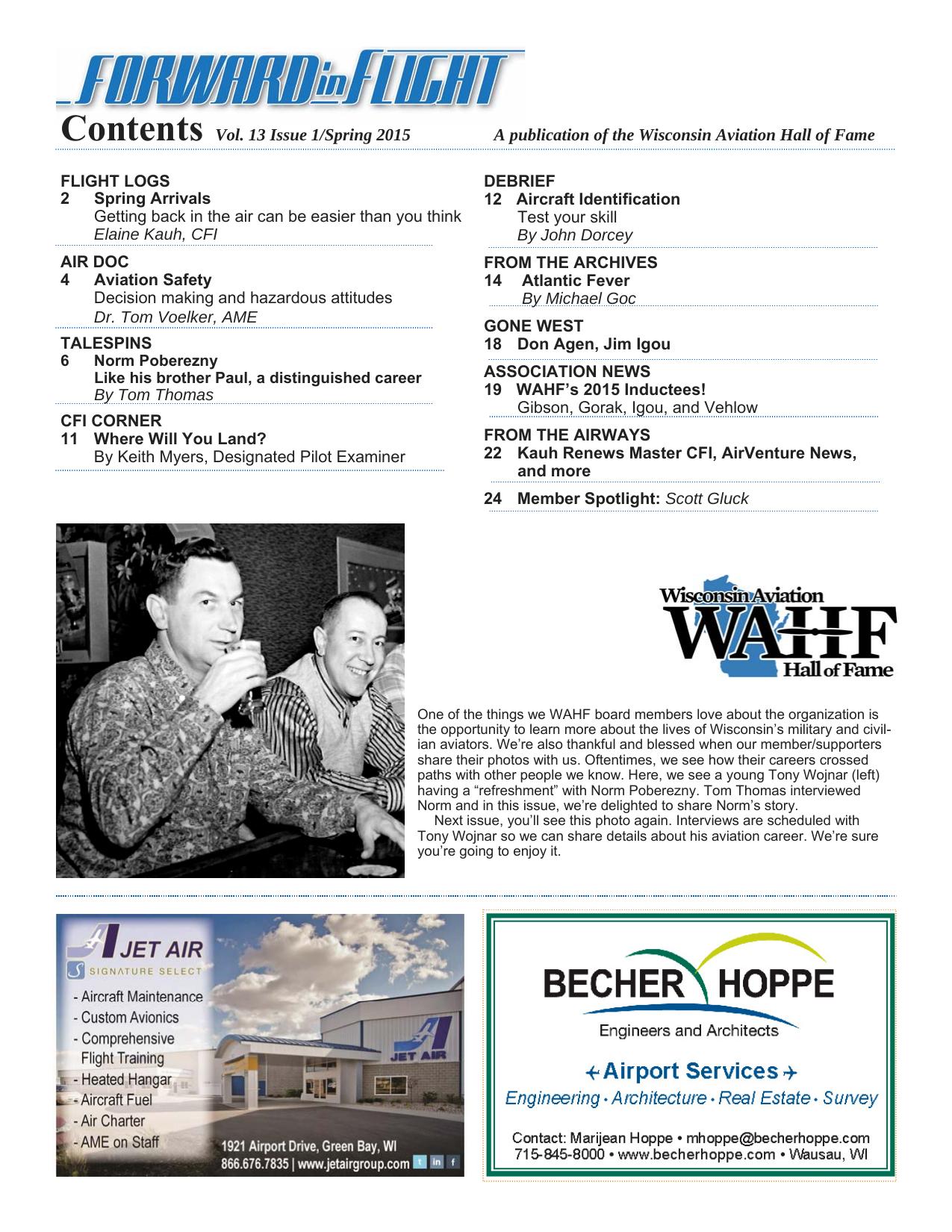
Contents Vol. 13 Issue 1/Spring 2015 A publication of the Wisconsin Aviation Hall of Fame FLIGHT LOGS 2 Spring Arrivals Getting back in the air can be easier than you think Elaine Kauh, CFI DEBRIEF 12 Aircraft Identification Test your skill By John Dorcey AIR DOC 4 Aviation Safety Decision making and hazardous attitudes Dr. Tom Voelker, AME FROM THE ARCHIVES 14 Atlantic Fever By Michael Goc TALESPINS 6 Norm Poberezny Like his brother Paul, a distinguished career By Tom Thomas CFI CORNER 11 Where Will You Land? By Keith Myers, Designated Pilot Examiner GONE WEST 18 Don Agen, Jim Igou ASSOCIATION NEWS 19 WAHF’s 2015 Inductees! Gibson, Gorak, Igou, and Vehlow FROM THE AIRWAYS 22 Kauh Renews Master CFI, AirVenture News, and more 24 Member Spotlight: Scott Gluck One of the things we WAHF board members love about the organization is the opportunity to learn more about the lives of Wisconsin’s military and civilian aviators. We’re also thankful and blessed when our member/supporters share their photos with us. Oftentimes, we see how their careers crossed paths with other people we know. Here, we see a young Tony Wojnar (left) having a “refreshment” with Norm Poberezny. Tom Thomas interviewed Norm and in this issue, we’re delighted to share Norm’s story. Next issue, you’ll see this photo again. Interviews are scheduled with Tony Wojnar so we can share details about his aviation career. We’re sure you’re going to enjoy it.
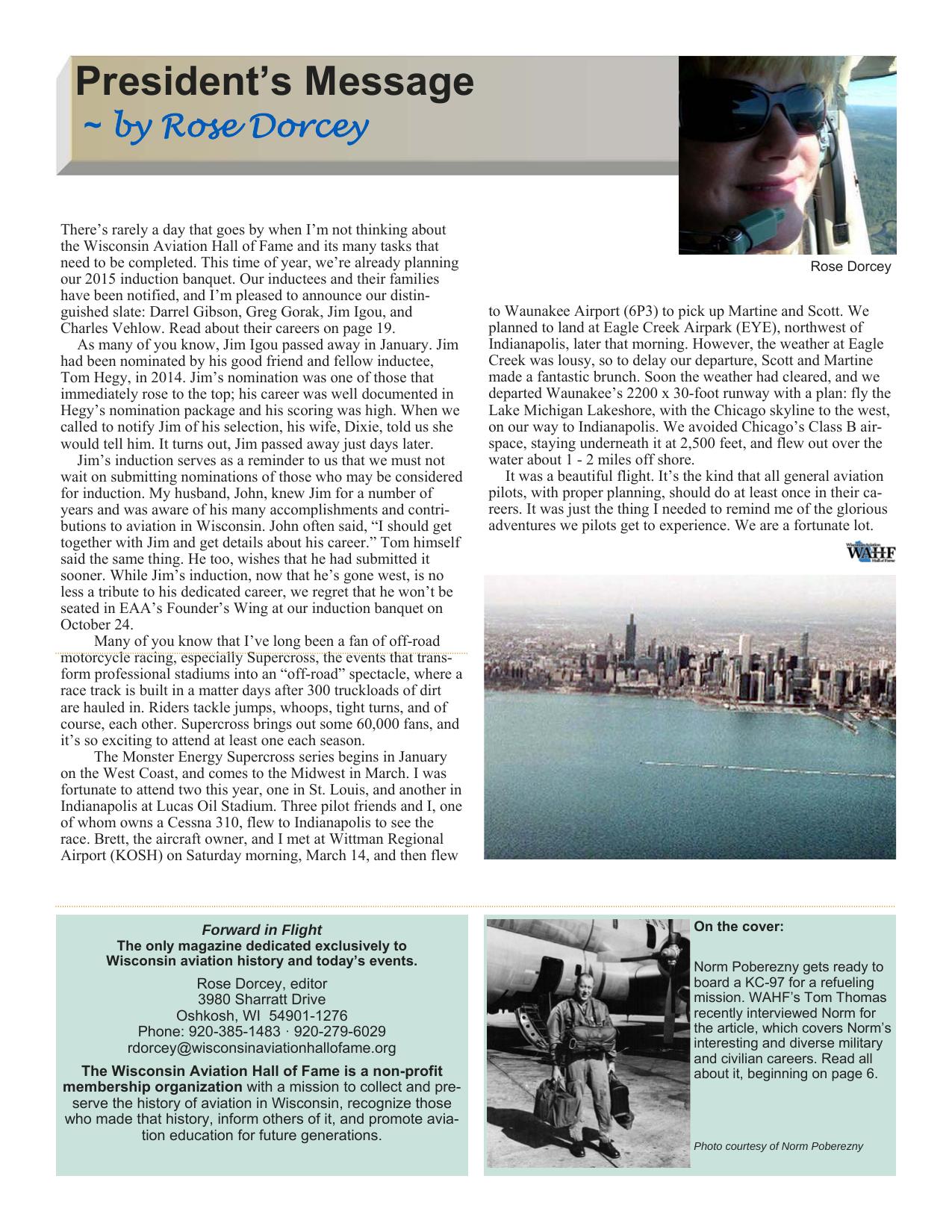
President’s Message ~ by Rose Dorcey There’s rarely a day that goes by when I’m not thinking about the Wisconsin Aviation Hall of Fame and its many tasks that need to be completed. This time of year, we’re already planning our 2015 induction banquet. Our inductees and their families have been notified, and I’m pleased to announce our distinguished slate: Darrel Gibson, Greg Gorak, Jim Igou, and Charles Vehlow. Read about their careers on page 19. As many of you know, Jim Igou passed away in January. Jim had been nominated by his good friend and fellow inductee, Tom Hegy, in 2014. Jim’s nomination was one of those that immediately rose to the top; his career was well documented in Hegy’s nomination package and his scoring was high. When we called to notify Jim of his selection, his wife, Dixie, told us she would tell him. It turns out, Jim passed away just days later. Jim’s induction serves as a reminder to us that we must not wait on submitting nominations of those who may be considered for induction. My husband, John, knew Jim for a number of years and was aware of his many accomplishments and contributions to aviation in Wisconsin. John often said, “I should get together with Jim and get details about his career.” Tom himself said the same thing. He too, wishes that he had submitted it sooner. While Jim’s induction, now that he’s gone west, is no less a tribute to his dedicated career, we regret that he won’t be seated in EAA’s Founder’s Wing at our induction banquet on October 24. Many of you know that I’ve long been a fan of off-road motorcycle racing, especially Supercross, the events that transform professional stadiums into an “off-road” spectacle, where a race track is built in a matter days after 300 truckloads of dirt are hauled in. Riders tackle jumps, whoops, tight turns, and of course, each other. Supercross brings out some 60,000 fans, and it’s so exciting to attend at least one each season. The Monster Energy Supercross series begins in January on the West Coast, and comes to the Midwest in March. I was fortunate to attend two this year, one in St. Louis, and another in Indianapolis at Lucas Oil Stadium. Three pilot friends and I, one of whom owns a Cessna 310, flew to Indianapolis to see the race. Brett, the aircraft owner, and I met at Wittman Regional Airport (KOSH) on Saturday morning, March 14, and then flew Forward in Flight The only magazine dedicated exclusively to Wisconsin aviation history and today’s events. Rose Dorcey, editor 3980 Sharratt Drive Oshkosh, WI 54901-1276 Phone: 920-385-1483 · 920-279-6029 rdorcey@wisconsinaviationhallofame.org The Wisconsin Aviation Hall of Fame is a non-profit membership organization with a mission to collect and preserve the history of aviation in Wisconsin, recognize those who made that history, inform others of it, and promote aviation education for future generations. Rose Dorcey to Waunakee Airport (6P3) to pick up Martine and Scott. We planned to land at Eagle Creek Airpark (EYE), northwest of Indianapolis, later that morning. However, the weather at Eagle Creek was lousy, so to delay our departure, Scott and Martine made a fantastic brunch. Soon the weather had cleared, and we departed Waunakee’s 2200 x 30-foot runway with a plan: fly the Lake Michigan Lakeshore, with the Chicago skyline to the west, on our way to Indianapolis. We avoided Chicago’s Class B airspace, staying underneath it at 2,500 feet, and flew out over the water about 1 - 2 miles off shore. It was a beautiful flight. It’s the kind that all general aviation pilots, with proper planning, should do at least once in their careers. It was just the thing I needed to remind me of the glorious adventures we pilots get to experience. We are a fortunate lot. On the cover: Norm Poberezny gets ready to board a KC-97 for a refueling mission. WAHF’s Tom Thomas recently interviewed Norm for the article, which covers Norm’s interesting and diverse military and civilian careers. Read all about it, beginning on page 6. Photo courtesy of Norm Poberezny
FLIGHT LOGS Spring Arrivals Getting back in the air can be easier than you think By Elaine Kauh We never know when it will happen— somewhere between March and June, no kidding—but when it does, it’s that perfect day. It’s warm and dry, giving us a clear horizon, a comfortable breeze, and sunshine that lingers through the evening. We can fly (mostly) free of the threats of slipping around a snowy runway or icing up in the clouds. And when the turf strips shed their brown winter coats and start turning green again, we’re out in our little two-seat birds playing on the grass. Two days later, it’ll snow again, but that’s spring in Wisconsin. Week by week, there are more of those desirable days and the changes are drastic at the airports around here. Off come the engine heater plug-ins and the big blankets. Off come the puffy parkas and gloves that barely make preflighting outside tolerable. More airplanes saunter in and park on the ramp; people are actually walking around out there peeking into each others’ cockpits instead of making a beeline for the lobby. We bring our coffee outside and watch takeoffs and landings and the fresh air feels good for a change. We no longer see our breath as we chat about the weather. Another sign of spring is that pilots and planes reuniting after weeks or even months need some time to get reacquainted. This is commonly known as “knocking the rust off” or “clearing the cobwebs,” but I prefer not to think of people or aircraft in those terms. Let’s call it coming home from vacation. Pilots who put flying on hold over the winter have taken a break from it and focused their attention on other things—work, family, holidays, and indoor projects— and so haven’t spent much time rehearsing their preflight planning or thinking about their pattern work. All of those tasks and mental checklists are still forged in the mind, but they’ve gotten a bit stale along with the muscle memory. Come early spring, the thought of bring- There’s plenty to do, believe me, and there’s no better way to spend the hours you aren’t flying than preparing for that day when you’ll fly again. ing the complexities of flying back together in one smooth flow can be daunting, if not discomforting. Meanwhile, many airplanes are essentially coming out of cold storage. Their engines are dry from sitting still, their tires are mushy, and moveable parts are stiff. Fixing everything up is a great way for pilot and plane to return to flying together. Before the snow has fully melted, there are plenty of things you can do in the comfort of home to prepare. Open up the maintenance logs and review the schedule for the new year. Make a list of things to fix and clean. In the pilot’s operating handbook, review items like weight and balance and performance. Take the checklist and see if it needs revising (I highly recommend annual aircraft and pilot checklist reviews while an airplane undergoes its annual inspection). This is a great way to review procedures from preflight to parking as well as emergencies. Keep extra copies of manuals and checklists at home so you don’t need to remove them from the aircraft, and they’re always right there for you. This is a great time because we’re getting back to regular flying, but it’s also the period when we often need to work the hardest to return to true proficiency so that we can spend the short warm sea- 2 Forward in Flight ~ Quarterly Magazine of the Wisconsin Aviation Hall of Fame son staying safe and having fun. Some pilots still manage to fly a few hours over the winter, so they’re on their way, but it’s still a fraction of what they do the rest of the year. And there’s more to getting back into condition than simply going around the patch a few times. Whether we realize it or not, just a few weeks’ hiatus means our knowledge and skills have degraded to a level that could hurt us should something unexpected occur. After all, when we were up there flying every week during the summer, how often did we rehearse challenging crosswind landings, engine failures, electrical fires, or adverse weather diversions? Not enough. So when the basics need refreshing, everything else deserves the same attention, and then some. I like to see everyone flying year-round, doing some training and emergency rehearsals at least once a month. It’s not possible in many cases, but doing these sessions on the ground is just as, if not more, useful. Many knowledge areas suffer neglect if they’re not practiced regularly. Adjusting to the seasons does add more to the complexities of aviating, but when done properly and with the right mindset, it makes us better pilots. We know so much more about weather and its effects on us and our airplanes, and we have the versatility to fly in a broad range of conditions. Since the weather often grounds us given our climate, the next best alternative is to keep your pilot’s cap on every day, no matter what. Stay acquainted with the airplane you like to fly and get to know it better. There’s plenty to do, believe me, and there’s no better way to spend the hours you aren’t flying than preparing for that day when you’ll fly again. I can never emphasize enough the valuable payoff that comes from rehearsing your flying year-round. For those who have had to put it aside for more than one
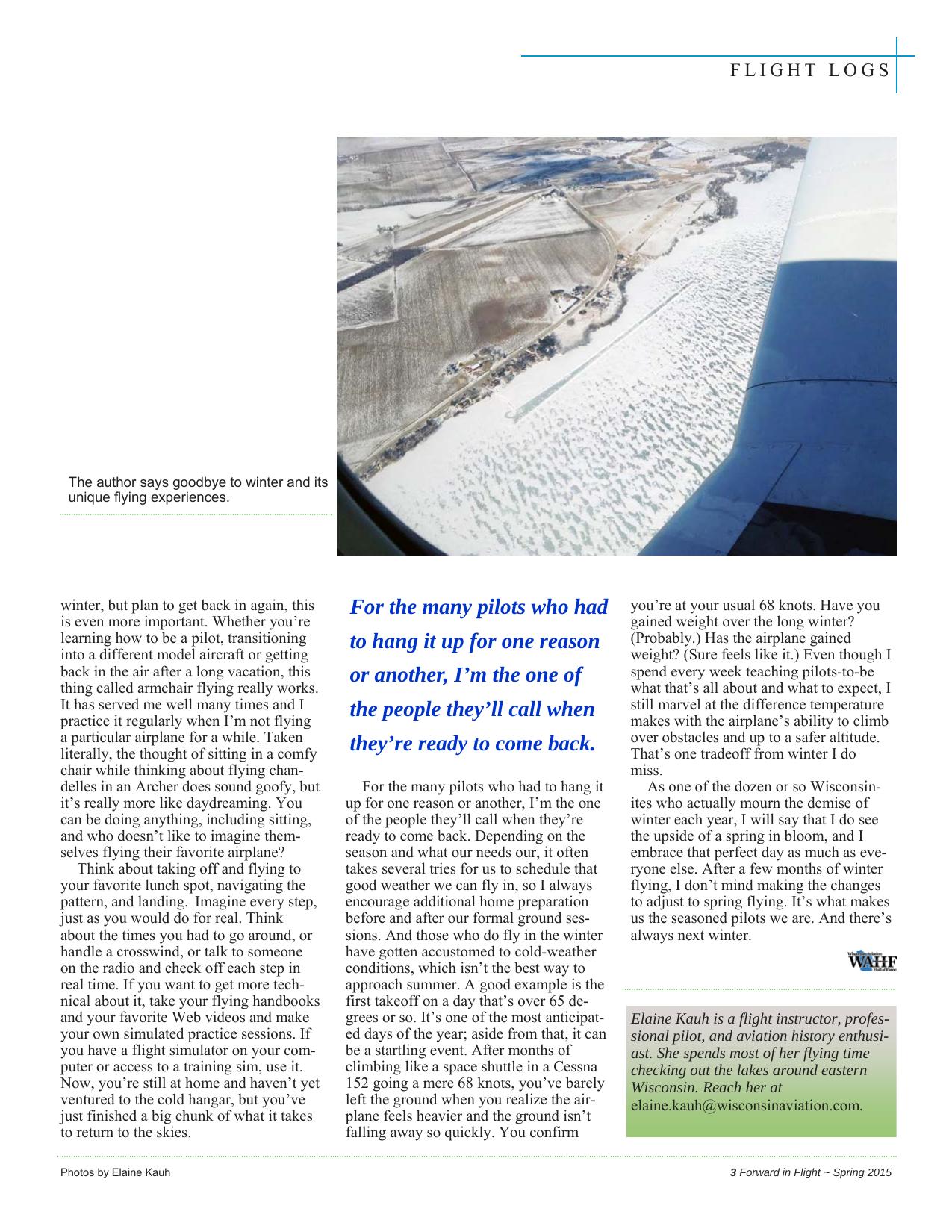
FLIGHT LOGS The author says goodbye to winter and its unique flying experiences. winter, but plan to get back in again, this is even more important. Whether you’re learning how to be a pilot, transitioning into a different model aircraft or getting back in the air after a long vacation, this thing called armchair flying really works. It has served me well many times and I practice it regularly when I’m not flying a particular airplane for a while. Taken literally, the thought of sitting in a comfy chair while thinking about flying chandelles in an Archer does sound goofy, but it’s really more like daydreaming. You can be doing anything, including sitting, and who doesn’t like to imagine themselves flying their favorite airplane? Think about taking off and flying to your favorite lunch spot, navigating the pattern, and landing. Imagine every step, just as you would do for real. Think about the times you had to go around, or handle a crosswind, or talk to someone on the radio and check off each step in real time. If you want to get more technical about it, take your flying handbooks and your favorite Web videos and make your own simulated practice sessions. If you have a flight simulator on your computer or access to a training sim, use it. Now, you’re still at home and haven’t yet ventured to the cold hangar, but you’ve just finished a big chunk of what it takes to return to the skies. Photos by Elaine Kauh For the many pilots who had to hang it up for one reason or another, I’m the one of the people they’ll call when they’re ready to come back. For the many pilots who had to hang it up for one reason or another, I’m the one of the people they’ll call when they’re ready to come back. Depending on the season and what our needs our, it often takes several tries for us to schedule that good weather we can fly in, so I always encourage additional home preparation before and after our formal ground sessions. And those who do fly in the winter have gotten accustomed to cold-weather conditions, which isn’t the best way to approach summer. A good example is the first takeoff on a day that’s over 65 degrees or so. It’s one of the most anticipated days of the year; aside from that, it can be a startling event. After months of climbing like a space shuttle in a Cessna 152 going a mere 68 knots, you’ve barely left the ground when you realize the airplane feels heavier and the ground isn’t falling away so quickly. You confirm you’re at your usual 68 knots. Have you gained weight over the long winter? (Probably.) Has the airplane gained weight? (Sure feels like it.) Even though I spend every week teaching pilots-to-be what that’s all about and what to expect, I still marvel at the difference temperature makes with the airplane’s ability to climb over obstacles and up to a safer altitude. That’s one tradeoff from winter I do miss. As one of the dozen or so Wisconsinites who actually mourn the demise of winter each year, I will say that I do see the upside of a spring in bloom, and I embrace that perfect day as much as everyone else. After a few months of winter flying, I don’t mind making the changes to adjust to spring flying. It’s what makes us the seasoned pilots we are. And there’s always next winter. Elaine Kauh is a flight instructor, professional pilot, and aviation history enthusiast. She spends most of her flying time checking out the lakes around eastern Wisconsin. Reach her at elaine.kauh@wisconsinaviation.com. 3 Forward in Flight ~ Spring 2015
AIR DOC Aviation Safety Decision making and hazardous attitudes Dr. Tom Voelker, AME Voelkerta@yahoo.com Hello again, fellow Airmen! By the time this edition of Forward in Flight reaches you, I expect the Polar Vortex will have left us, and the only vortex we will need to concern ourselves with is that coming off the wingtip of the preceding aircraft! I’m sure warm weather will arrive eventually. And as it gets warmer, we will also be presented with more opportunities to fly. As we plan our flights, we will be presented with decisions. We will also have the chance to make poor decisions! This issue I will discuss decision making in the realm of aviation, and particularly why we make some of the questionable decisions we do. Also, stay tuned to the end of this column. I will give you all the latest and greatest (and apparently final) news from the FAA Aeromedical team regarding OSA, or obstructive sleep apnea, the condition about which I wrote just over a year ago. Within the last month or two, I have been quite troubled by the aircraft accidents about which I am too often reading. Several of these seem to involve pilots doing what I unscientifically call “dumb stuff.” In the span of two weeks there were two aircraft that “ran out of fuel” (kind of makes it sound like the airplane’s fault, doesn’t it?) and needed to ditch off Hawaii. In my mind, there are not very many good reasons for “running out of gas” in an airplane. During that same period there was also a Cessna 182 that crashed in North Central Wisconsin after picking up a lot of ice, killing one of the passengers. What the news stories didn’t report was that the weather was terrible that day. There was a widespread overcast with low clouds. I was driving in the same area that day, and I was fighting freezing mist on my windshield the whole trip. I wasn’t in that aircraft that day, and I don’t know the anti-icing capabilities the plane may have had, but at first glance, it would appear that a route around the weather, or perhaps even a decision not to fly at all, would have been more appropriate. I am not intending to criticize the decision making of these particular pilots. I don’t know enough of the details to pass judgment. But I do know that they did need to make decisions regarding their flights, and that with the decisions made, things didn’t work out all that well. These three accidents, along with a few others, have caused me to ponder why we make the decisions we do, especially the decisions that don’t seem all that wise. It is my premise that almost all pilots go through training learning the hazards of poor decision-making. We learn about fuel planning, weather, aircraft performance, and many other subjects. At the time I got my ticket, I would hear of someone experiencing an aircraft accident due to fuel exhaustion, and I would comment to other pilots that “I would never let that happen.” If my premise is right, the pilots involved in these (and similar) accidents used to think that way as well, but for some reason they changed their standards. Why would that happen? As you probably know by now, I do take aviation safety very seriously. I once heard from Bob, a flight instructor, a brief list of nevers – things that, as a pilot, he would absolutely never do. As you probably know by now, I do take aviation safety very seriously. I once heard from Bob, a flight instructor, a brief list of nevers – things that, as a pilot, he would absolutely never do. He acknowledged that everyone violates their personal standards a little bit at times (such as, in his case, taking off a few pounds overweight) but there were some things that were absolutes. His point was that these things are so im- 4 Forward in Flight ~ Quarterly Magazine of the Wisconsin Aviation Hall of Fame portant that violating them puts us (and our passengers) at very high risk. His list included three items which, taken together, should go a long way to keep him safe. He stated that he would never: Bust an altitude on an instrument approach Violate any part of the alcohol regulations, even a little, or Continue a flight when he got down to his fuel minimum (for him, one hour of fuel remaining), except to continue directly to the next available fuel stop. So, if the pilots involved in these (and similar) accidents had the same safetyfirst attitudes early in their flying careers, why did they change? It turns out the FAA has done some work on this. I wrote about this a few years ago when I was discussing anxiety, but a refresher never hurts. The problem lies in improper “Aeronautical Decision Making.” And the major players are attitude, judgment, and situational awareness. When we fly, or even when we are planning a flight, we are faced with decisions. Our attitudes may change when a conflict arises (bad weather, unanticipated headwinds, the inherent danger and need for more conservative fuel calculations for prolonged overwater flight, for example). The key is that we need to identify and acknowledge when we are developing one of these attitudes, and we need to consciously attack the attitude with the “antidote,” or to complete the above thought, with “good judgment.” (See the FAA publication noted below for specifics.) For example, if you are flying into weather in a non-icing-equipped aircraft and you start to pick up “just a little bit of ice” but find yourself thinking “I’ve been in ice before, this isn’t that bad, I’ll be fine” (rather than the “I have to make a 180 to get out of this ice right away” that we were all trained to think) you are experiencing the “Invulnerablity” attitude. The cure for this is to recognize this attitude and immediately state the antidote – “It could happen to me!” That
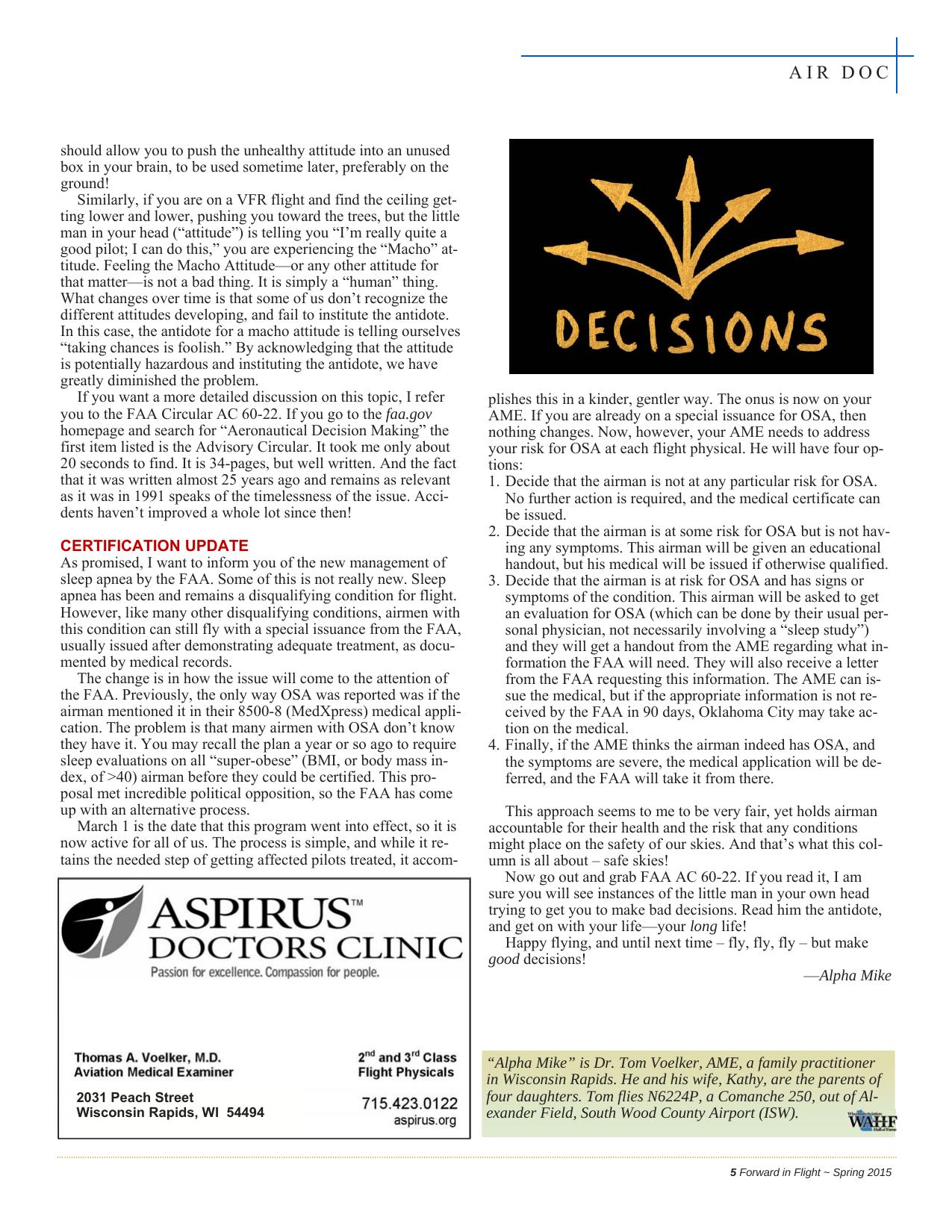
AIR DOC should allow you to push the unhealthy attitude into an unused box in your brain, to be used sometime later, preferably on the ground! Similarly, if you are on a VFR flight and find the ceiling getting lower and lower, pushing you toward the trees, but the little man in your head (“attitude”) is telling you “I’m really quite a good pilot; I can do this,” you are experiencing the “Macho” attitude. Feeling the Macho Attitude—or any other attitude for that matter—is not a bad thing. It is simply a “human” thing. What changes over time is that some of us don’t recognize the different attitudes developing, and fail to institute the antidote. In this case, the antidote for a macho attitude is telling ourselves “taking chances is foolish.” By acknowledging that the attitude is potentially hazardous and instituting the antidote, we have greatly diminished the problem. If you want a more detailed discussion on this topic, I refer you to the FAA Circular AC 60-22. If you go to the faa.gov homepage and search for “Aeronautical Decision Making” the first item listed is the Advisory Circular. It took me only about 20 seconds to find. It is 34-pages, but well written. And the fact that it was written almost 25 years ago and remains as relevant as it was in 1991 speaks of the timelessness of the issue. Accidents haven’t improved a whole lot since then! CERTIFICATION UPDATE As promised, I want to inform you of the new management of sleep apnea by the FAA. Some of this is not really new. Sleep apnea has been and remains a disqualifying condition for flight. However, like many other disqualifying conditions, airmen with this condition can still fly with a special issuance from the FAA, usually issued after demonstrating adequate treatment, as documented by medical records. The change is in how the issue will come to the attention of the FAA. Previously, the only way OSA was reported was if the airman mentioned it in their 8500-8 (MedXpress) medical application. The problem is that many airmen with OSA don’t know they have it. You may recall the plan a year or so ago to require sleep evaluations on all “super-obese” (BMI, or body mass index, of >40) airman before they could be certified. This proposal met incredible political opposition, so the FAA has come up with an alternative process. March 1 is the date that this program went into effect, so it is now active for all of us. The process is simple, and while it retains the needed step of getting affected pilots treated, it accom- 2031 Peach Street Wisconsin Rapids, WI 54494 plishes this in a kinder, gentler way. The onus is now on your AME. If you are already on a special issuance for OSA, then nothing changes. Now, however, your AME needs to address your risk for OSA at each flight physical. He will have four options: 1. Decide that the airman is not at any particular risk for OSA. No further action is required, and the medical certificate can be issued. 2. Decide that the airman is at some risk for OSA but is not having any symptoms. This airman will be given an educational handout, but his medical will be issued if otherwise qualified. 3. Decide that the airman is at risk for OSA and has signs or symptoms of the condition. This airman will be asked to get an evaluation for OSA (which can be done by their usual personal physician, not necessarily involving a “sleep study”) and they will get a handout from the AME regarding what information the FAA will need. They will also receive a letter from the FAA requesting this information. The AME can issue the medical, but if the appropriate information is not received by the FAA in 90 days, Oklahoma City may take action on the medical. 4. Finally, if the AME thinks the airman indeed has OSA, and the symptoms are severe, the medical application will be deferred, and the FAA will take it from there. This approach seems to me to be very fair, yet holds airman accountable for their health and the risk that any conditions might place on the safety of our skies. And that’s what this column is all about – safe skies! Now go out and grab FAA AC 60-22. If you read it, I am sure you will see instances of the little man in your own head trying to get you to make bad decisions. Read him the antidote, and get on with your life—your long life! Happy flying, and until next time – fly, fly, fly – but make good decisions! —Alpha Mike “Alpha Mike” is Dr. Tom Voelker, AME, a family practitioner in Wisconsin Rapids. He and his wife, Kathy, are the parents of four daughters. Tom flies N6224P, a Comanche 250, out of Alexander Field, South Wood County Airport (ISW). 5 Forward in Flight ~ Spring 2015
TALESPINS Norm Poberezny Like his brother Paul, a distinguished career By Tom “Talespin” Thomas Norm was born in Milwaukee, Wisconsin, March 16, 1928, the third child to Peter and Jetta Poberezny. He had an older sister, Martha, and his older brother, Paul. Paul was eight years older and was Norm’s mentor while growing up. Paul’s love affair for aviation became one of Norm’s as well. As WWII approached, Paul enlisted in the Army Air Force and became an instructor teaching new aviation cadet to fly. He was only 21 at the time and Norm was just 14. As with young boys across the country with older brothers serving America fighting the war, Norm also wanted to serve but was of course, too young. Paul bought his first plane, an American Eagle, with a loan from his father. He got it going and Norm was one of his early passengers. Norm was 11 then and remembers taking off and watching the small cars driving on the roads below. With the outbreak of war, young men in America were eager to serve and defend their country. Some were held back because they didn’t pass the physical requirements, but most of the younger ones like Norm were held back because of age. The minimum age was 18 and in some cases 17, with their parents’ written consent. Norm Sets Sail Norm Poberezny was one of those not yet 18 who wanted join the fight to defend America. As many a young man at the time, Norm adjusted his birth certificate to show that he was 18 and that qualified him for getting a job with the Great Lakes Car Ferry to get a sailing license. Once he had the rating of SO (Sailor Ordinary) he took a bus to New York and went down to the docks. As a member of ‘the merchant marine union’, he went to the Union House facility, logged in as a SO, and waited to be called for a ship. Norm’s first ship was a convoy freighter hauling supplies to Europe in 1944. Not a day out of port, it blew a boiler and returned to New York for repairs. Norm went back to the union facility and waited to be called for another ship. In a matter of days he was hired on the SS Cor- nell, a PS T2 tanker, as an SO and departed Hoboken, New Jersey, for Puerto Rico. After refueling, they headed for the Panama Canal and the Pacific. Norm recalled going through the canal and the lush tropical jungle coming right down to the canal’s edge. They slowly made their way up through the three locks it took before reaching the big water. WWII, here we come! In the Pacific, they always refueled while underway, which required that the ships sail in formation while transferring the scheduled diesel fuel. Their customers included aircraft carriers, battleships, cruisers, destroyers, military cargo ships, and submarines. They didn’t just refuel American ships but also those of our Allies supporting the war efforts in the Pacific. Norm had layovers in Hawaii, Marianas, Philippines, India, Thailand, and China. Throughout their travels, the seas got rough from time to time. His most harrowing time was riding out a typhoon for about a week. The ship rocked from side to side and bobbed through the large swells. During the peak of the storm, Norm recalls being locked/sealed in their rooms. This was the hardest part of his Pacific cruise. He was lucky that he never encountered any enemy ships or aircraft—and only one typhoon. The SS Cornell was armed with fore and aft guns as well as port and starboard sides, plus depth charges. Tankers were prize targets for enemy submarines and US Coast Guard personnel were on board the tanker to operate the armament. Upon completing his tour with the war ending, he received an Honorable Discharge from the United States Coast Guard on August 15, 1945.He had not yet reached his 18th birthday. They landed in San Francisco where he was released from the Merchant Marines and took a train home to Milwaukee, arriving in October. Back home in Milwaukee, he got a job driving for the Veteran Cab Company as a taxi driver for a year or so. Norm said the money was good and he got to know lots of customers working in factories, making it a fun experience. Family was always important to Norm and from time 6 Forward in Flight ~ Quarterly Magazine of the Wisconsin Aviation Hall of Fame to time he’d take his sister Martha with him on the cab rides around town. Those were fun times as they’d pick different restaurants to eat at and they got to know the city quite well. Moving on from being a taxi driver, Norm took a job working under his father in the construction business as a general laborer. The pay was good but it was hard work. On a big project they were working on one day laying pipe along a road, the sheathing along the side of the large trench collapsed when a rock he hadn’t noticed broke through, landing on the pipe and breaking it. His father was the foreman and made an example out of Norm, firing him on the spot and sending him home. Norm found out later that was his father’s way of getting him out of the job so he would experience more in his life. As 1948 rolled along, Norm joined the newly formed Wisconsin Air National Guard in Milwaukee as an aircraft mechanic. They had P-51 Mustangs at that time and in 1949 his unit became the first Air National Guard Unit in the country to receive jet fighters, the P-80 Shooting Star.
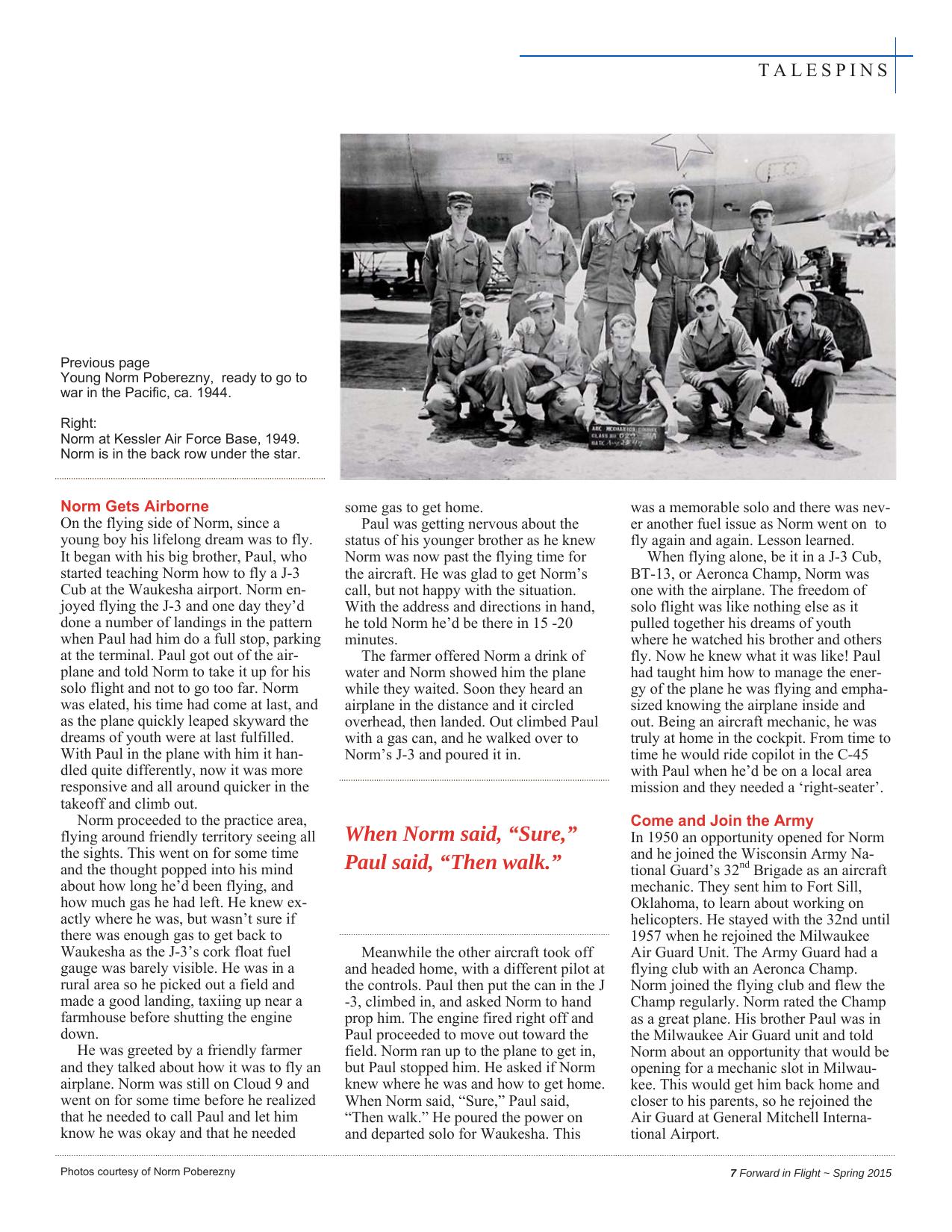
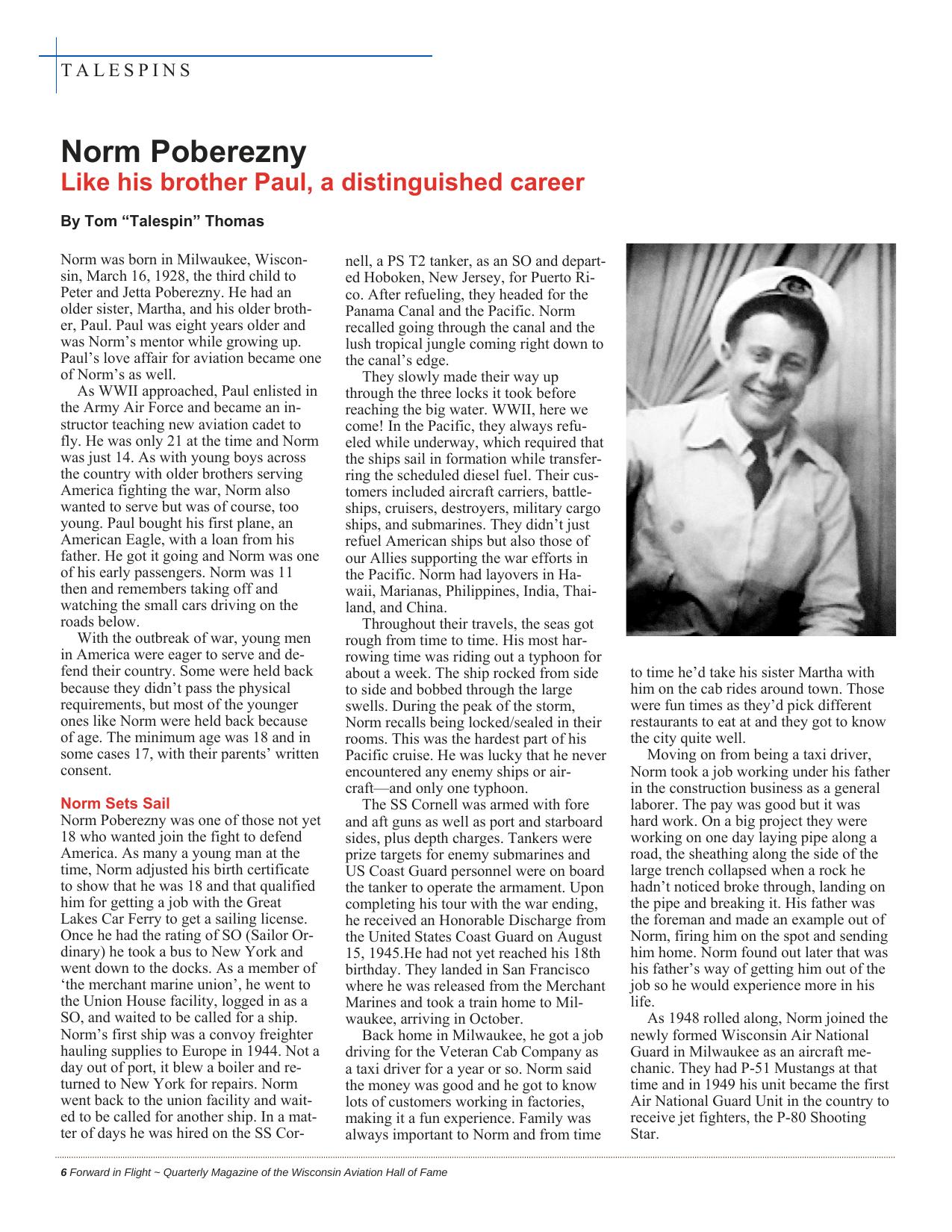
TALESPINS Previous page Young Norm Poberezny, ready to go to war in the Pacific, ca. 1944. Right: Norm at Kessler Air Force Base, 1949. Norm is in the back row under the star. Norm Gets Airborne On the flying side of Norm, since a young boy his lifelong dream was to fly. It began with his big brother, Paul, who started teaching Norm how to fly a J-3 Cub at the Waukesha airport. Norm enjoyed flying the J-3 and one day they’d done a number of landings in the pattern when Paul had him do a full stop, parking at the terminal. Paul got out of the airplane and told Norm to take it up for his solo flight and not to go too far. Norm was elated, his time had come at last, and as the plane quickly leaped skyward the dreams of youth were at last fulfilled. With Paul in the plane with him it handled quite differently, now it was more responsive and all around quicker in the takeoff and climb out. Norm proceeded to the practice area, flying around friendly territory seeing all the sights. This went on for some time and the thought popped into his mind about how long he’d been flying, and how much gas he had left. He knew exactly where he was, but wasn’t sure if there was enough gas to get back to Waukesha as the J-3’s cork float fuel gauge was barely visible. He was in a rural area so he picked out a field and made a good landing, taxiing up near a farmhouse before shutting the engine down. He was greeted by a friendly farmer and they talked about how it was to fly an airplane. Norm was still on Cloud 9 and went on for some time before he realized that he needed to call Paul and let him know he was okay and that he needed Photos courtesy of Norm Poberezny some gas to get home. Paul was getting nervous about the status of his younger brother as he knew Norm was now past the flying time for the aircraft. He was glad to get Norm’s call, but not happy with the situation. With the address and directions in hand, he told Norm he’d be there in 15 -20 minutes. The farmer offered Norm a drink of water and Norm showed him the plane while they waited. Soon they heard an airplane in the distance and it circled overhead, then landed. Out climbed Paul with a gas can, and he walked over to Norm’s J-3 and poured it in. When Norm said, “Sure,” Paul said, “Then walk.” Meanwhile the other aircraft took off and headed home, with a different pilot at the controls. Paul then put the can in the J -3, climbed in, and asked Norm to hand prop him. The engine fired right off and Paul proceeded to move out toward the field. Norm ran up to the plane to get in, but Paul stopped him. He asked if Norm knew where he was and how to get home. When Norm said, “Sure,” Paul said, “Then walk.” He poured the power on and departed solo for Waukesha. This was a memorable solo and there was never another fuel issue as Norm went on to fly again and again. Lesson learned. When flying alone, be it in a J-3 Cub, BT-13, or Aeronca Champ, Norm was one with the airplane. The freedom of solo flight was like nothing else as it pulled together his dreams of youth where he watched his brother and others fly. Now he knew what it was like! Paul had taught him how to manage the energy of the plane he was flying and emphasized knowing the airplane inside and out. Being an aircraft mechanic, he was truly at home in the cockpit. From time to time he would ride copilot in the C-45 with Paul when he’d be on a local area mission and they needed a ‘right-seater’. Come and Join the Army In 1950 an opportunity opened for Norm and he joined the Wisconsin Army National Guard’s 32nd Brigade as an aircraft mechanic. They sent him to Fort Sill, Oklahoma, to learn about working on helicopters. He stayed with the 32nd until 1957 when he rejoined the Milwaukee Air Guard Unit. The Army Guard had a flying club with an Aeronca Champ. Norm joined the flying club and flew the Champ regularly. Norm rated the Champ as a great plane. His brother Paul was in the Milwaukee Air Guard unit and told Norm about an opportunity that would be opening for a mechanic slot in Milwaukee. This would get him back home and closer to his parents, so he rejoined the Air Guard at General Mitchell International Airport. 7 Forward in Flight ~ Spring 2015
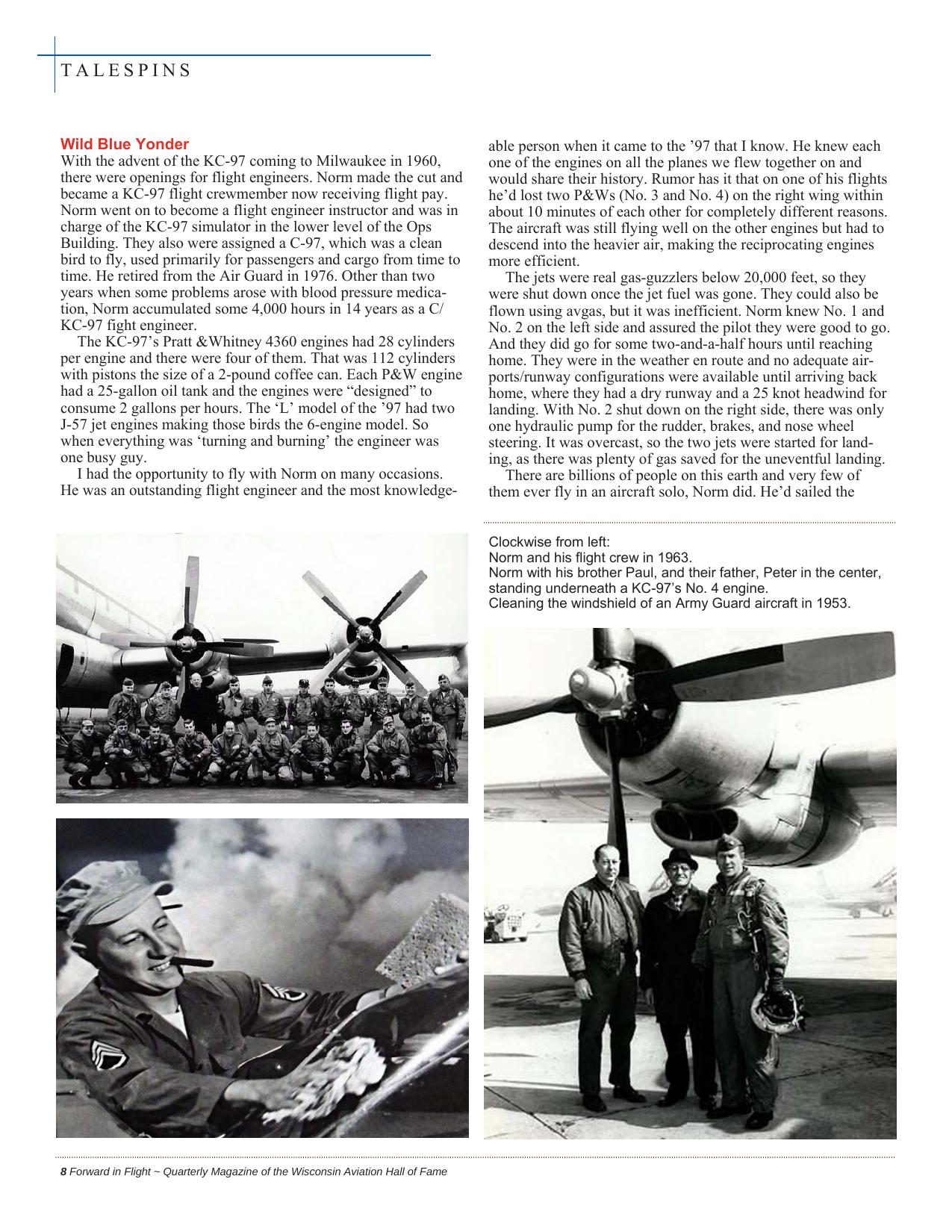
TALESPINS Wild Blue Yonder With the advent of the KC-97 coming to Milwaukee in 1960, there were openings for flight engineers. Norm made the cut and became a KC-97 flight crewmember now receiving flight pay. Norm went on to become a flight engineer instructor and was in charge of the KC-97 simulator in the lower level of the Ops Building. They also were assigned a C-97, which was a clean bird to fly, used primarily for passengers and cargo from time to time. He retired from the Air Guard in 1976. Other than two years when some problems arose with blood pressure medication, Norm accumulated some 4,000 hours in 14 years as a C/ KC-97 fight engineer. The KC-97’s Pratt &Whitney 4360 engines had 28 cylinders per engine and there were four of them. That was 112 cylinders with pistons the size of a 2-pound coffee can. Each P&W engine had a 25-gallon oil tank and the engines were “designed” to consume 2 gallons per hours. The ‘L’ model of the ’97 had two J-57 jet engines making those birds the 6-engine model. So when everything was ‘turning and burning’ the engineer was one busy guy. I had the opportunity to fly with Norm on many occasions. He was an outstanding flight engineer and the most knowledge- able person when it came to the ’97 that I know. He knew each one of the engines on all the planes we flew together on and would share their history. Rumor has it that on one of his flights he’d lost two P&Ws (No. 3 and No. 4) on the right wing within about 10 minutes of each other for completely different reasons. The aircraft was still flying well on the other engines but had to descend into the heavier air, making the reciprocating engines more efficient. The jets were real gas-guzzlers below 20,000 feet, so they were shut down once the jet fuel was gone. They could also be flown using avgas, but it was inefficient. Norm knew No. 1 and No. 2 on the left side and assured the pilot they were good to go. And they did go for some two-and-a-half hours until reaching home. They were in the weather en route and no adequate airports/runway configurations were available until arriving back home, where they had a dry runway and a 25 knot headwind for landing. With No. 2 shut down on the right side, there was only one hydraulic pump for the rudder, brakes, and nose wheel steering. It was overcast, so the two jets were started for landing, as there was plenty of gas saved for the uneventful landing. There are billions of people on this earth and very few of them ever fly in an aircraft solo, Norm did. He’d sailed the Clockwise from left: Norm and his flight crew in 1963. Norm with his brother Paul, and their father, Peter in the center, standing underneath a KC-97’s No. 4 engine. Cleaning the windshield of an Army Guard aircraft in 1953. 8 Forward in Flight ~ Quarterly Magazine of the Wisconsin Aviation Hall of Fame
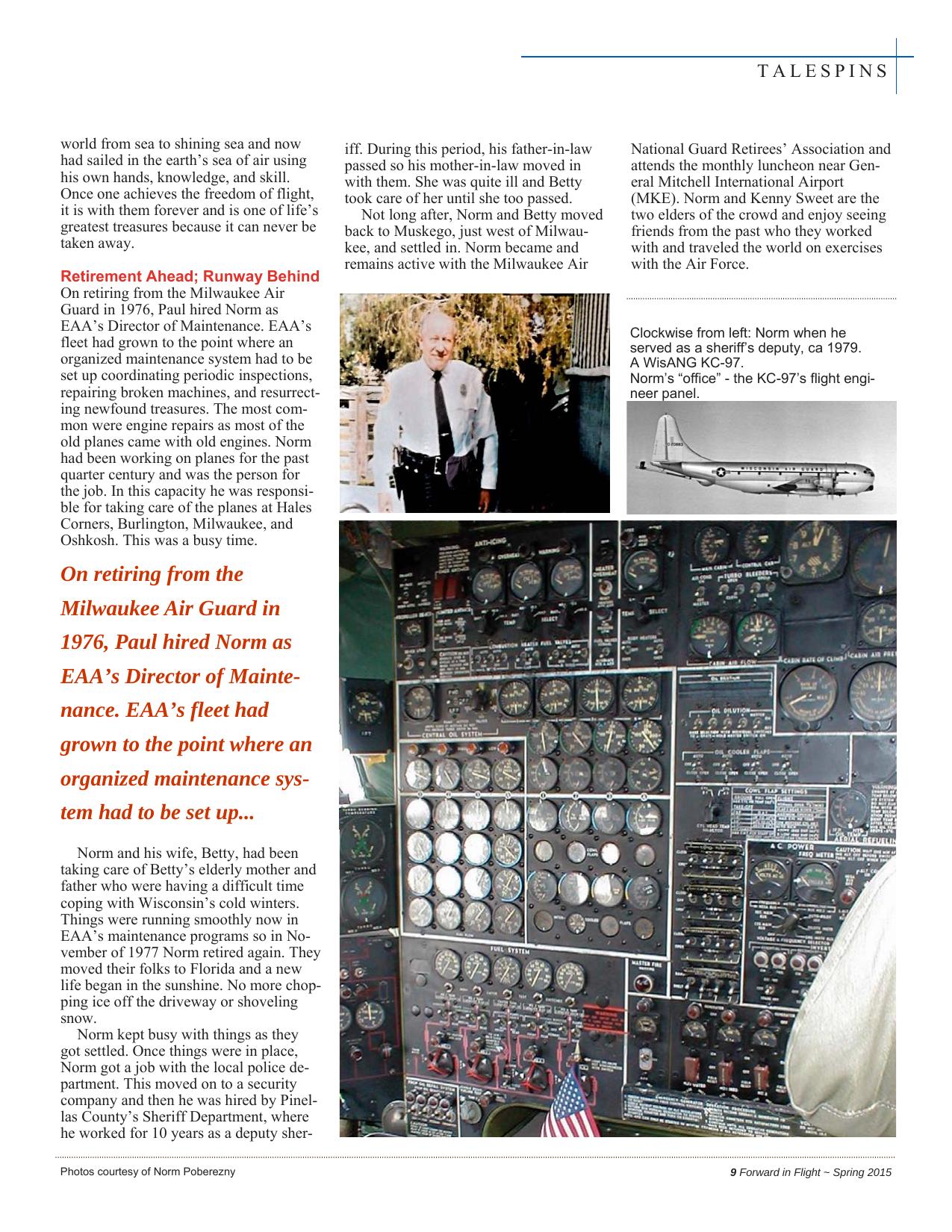
TALESPINS world from sea to shining sea and now had sailed in the earth’s sea of air using his own hands, knowledge, and skill. Once one achieves the freedom of flight, it is with them forever and is one of life’s greatest treasures because it can never be taken away. Retirement Ahead; Runway Behind On retiring from the Milwaukee Air Guard in 1976, Paul hired Norm as EAA’s Director of Maintenance. EAA’s fleet had grown to the point where an organized maintenance system had to be set up coordinating periodic inspections, repairing broken machines, and resurrecting newfound treasures. The most common were engine repairs as most of the old planes came with old engines. Norm had been working on planes for the past quarter century and was the person for the job. In this capacity he was responsible for taking care of the planes at Hales Corners, Burlington, Milwaukee, and Oshkosh. This was a busy time. iff. During this period, his father-in-law passed so his mother-in-law moved in with them. She was quite ill and Betty took care of her until she too passed. Not long after, Norm and Betty moved back to Muskego, just west of Milwaukee, and settled in. Norm became and remains active with the Milwaukee Air National Guard Retirees’ Association and attends the monthly luncheon near General Mitchell International Airport (MKE). Norm and Kenny Sweet are the two elders of the crowd and enjoy seeing friends from the past who they worked with and traveled the world on exercises with the Air Force. Clockwise from left: Norm when he served as a sheriff’s deputy, ca 1979. A WisANG KC-97. Norm’s “office” - the KC-97’s flight engineer panel. On retiring from the Milwaukee Air Guard in 1976, Paul hired Norm as EAA’s Director of Maintenance. EAA’s fleet had grown to the point where an organized maintenance system had to be set up... Norm and his wife, Betty, had been taking care of Betty’s elderly mother and father who were having a difficult time coping with Wisconsin’s cold winters. Things were running smoothly now in EAA’s maintenance programs so in November of 1977 Norm retired again. They moved their folks to Florida and a new life began in the sunshine. No more chopping ice off the driveway or shoveling snow. Norm kept busy with things as they got settled. Once things were in place, Norm got a job with the local police department. This moved on to a security company and then he was hired by Pinellas County’s Sheriff Department, where he worked for 10 years as a deputy sherPhotos courtesy of Norm Poberezny 9 Forward in Flight ~ Spring 2015
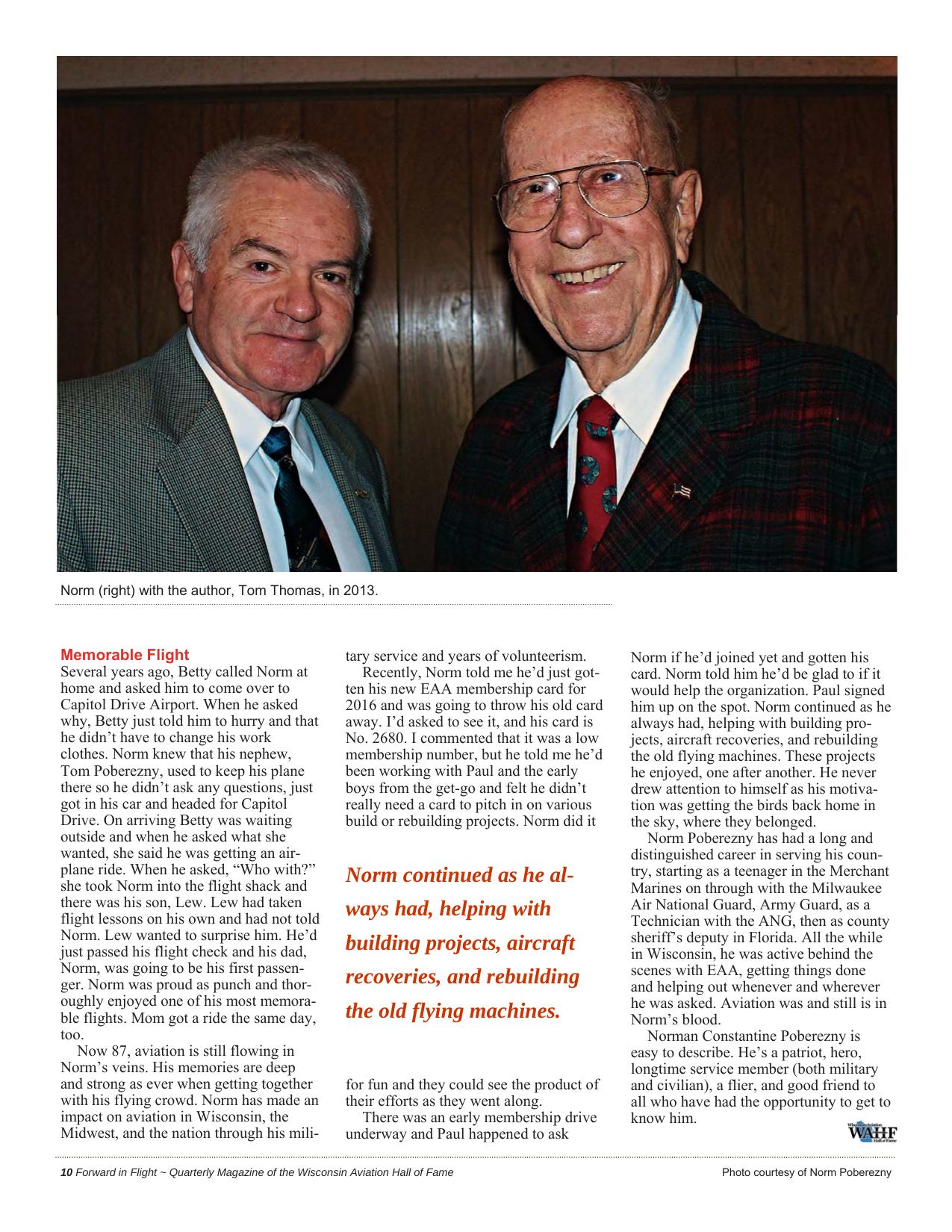
Norm (right) with the author, Tom Thomas, in 2013. Memorable Flight Several years ago, Betty called Norm at home and asked him to come over to Capitol Drive Airport. When he asked why, Betty just told him to hurry and that he didn’t have to change his work clothes. Norm knew that his nephew, Tom Poberezny, used to keep his plane there so he didn’t ask any questions, just got in his car and headed for Capitol Drive. On arriving Betty was waiting outside and when he asked what she wanted, she said he was getting an airplane ride. When he asked, “Who with?” she took Norm into the flight shack and there was his son, Lew. Lew had taken flight lessons on his own and had not told Norm. Lew wanted to surprise him. He’d just passed his flight check and his dad, Norm, was going to be his first passenger. Norm was proud as punch and thoroughly enjoyed one of his most memorable flights. Mom got a ride the same day, too. Now 87, aviation is still flowing in Norm’s veins. His memories are deep and strong as ever when getting together with his flying crowd. Norm has made an impact on aviation in Wisconsin, the Midwest, and the nation through his mili- tary service and years of volunteerism. Recently, Norm told me he’d just gotten his new EAA membership card for 2016 and was going to throw his old card away. I’d asked to see it, and his card is No. 2680. I commented that it was a low membership number, but he told me he’d been working with Paul and the early boys from the get-go and felt he didn’t really need a card to pitch in on various build or rebuilding projects. Norm did it Norm continued as he always had, helping with building projects, aircraft recoveries, and rebuilding the old flying machines. for fun and they could see the product of their efforts as they went along. There was an early membership drive underway and Paul happened to ask 10 Forward in Flight ~ Quarterly Magazine of the Wisconsin Aviation Hall of Fame Norm if he’d joined yet and gotten his card. Norm told him he’d be glad to if it would help the organization. Paul signed him up on the spot. Norm continued as he always had, helping with building projects, aircraft recoveries, and rebuilding the old flying machines. These projects he enjoyed, one after another. He never drew attention to himself as his motivation was getting the birds back home in the sky, where they belonged. Norm Poberezny has had a long and distinguished career in serving his country, starting as a teenager in the Merchant Marines on through with the Milwaukee Air National Guard, Army Guard, as a Technician with the ANG, then as county sheriff’s deputy in Florida. All the while in Wisconsin, he was active behind the scenes with EAA, getting things done and helping out whenever and wherever he was asked. Aviation was and still is in Norm’s blood. Norman Constantine Poberezny is easy to describe. He’s a patriot, hero, longtime service member (both military and civilian), a flier, and good friend to all who have had the opportunity to get to know him. Photo courtesy of Norm Poberezny
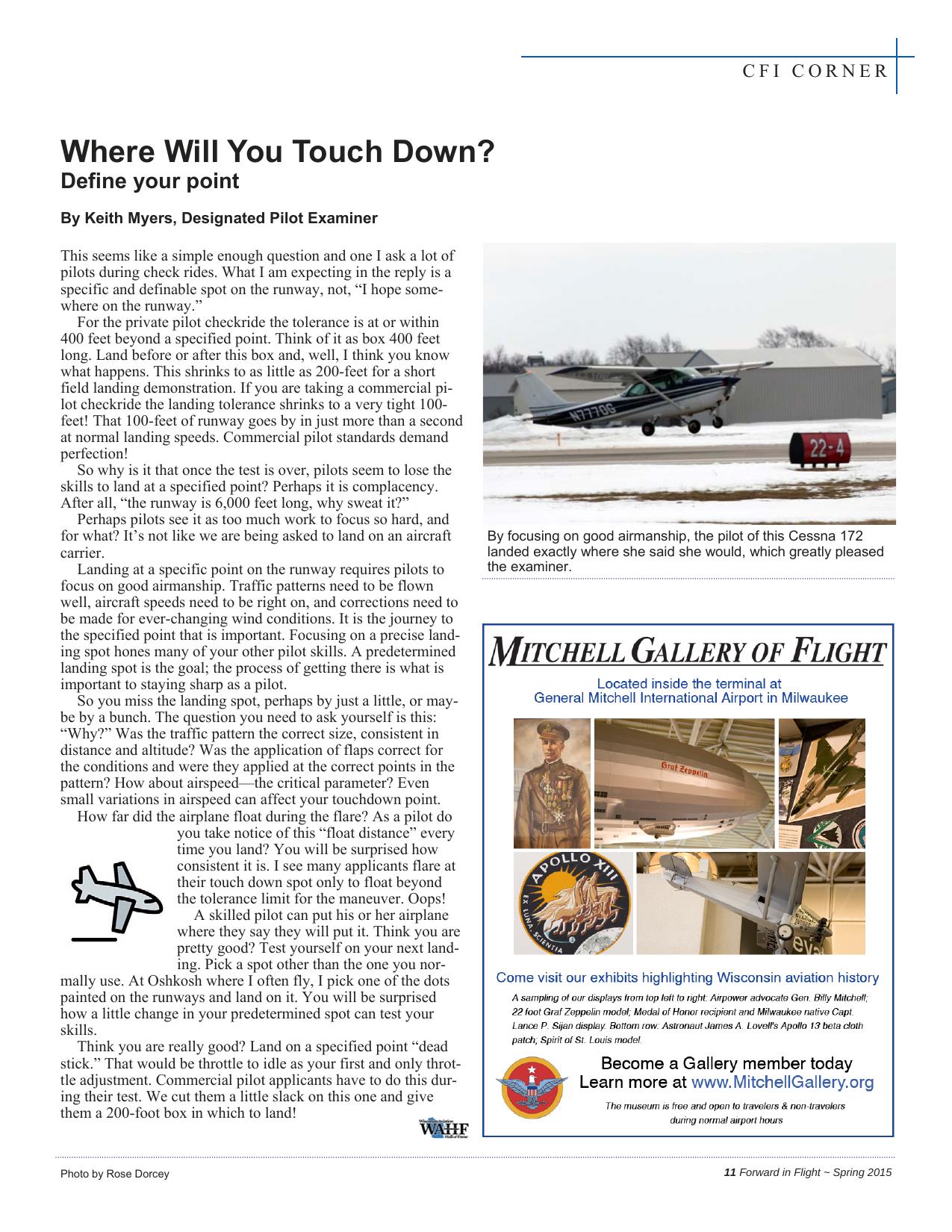
CFI CORNER Where Will You Touch Down? Define your point By Keith Myers, Designated Pilot Examiner This seems like a simple enough question and one I ask a lot of pilots during check rides. What I am expecting in the reply is a specific and definable spot on the runway, not, “I hope somewhere on the runway.” For the private pilot checkride the tolerance is at or within 400 feet beyond a specified point. Think of it as box 400 feet long. Land before or after this box and, well, I think you know what happens. This shrinks to as little as 200-feet for a short field landing demonstration. If you are taking a commercial pilot checkride the landing tolerance shrinks to a very tight 100feet! That 100-feet of runway goes by in just more than a second at normal landing speeds. Commercial pilot standards demand perfection! So why is it that once the test is over, pilots seem to lose the skills to land at a specified point? Perhaps it is complacency. After all, “the runway is 6,000 feet long, why sweat it?” Perhaps pilots see it as too much work to focus so hard, and for what? It’s not like we are being asked to land on an aircraft carrier. Landing at a specific point on the runway requires pilots to focus on good airmanship. Traffic patterns need to be flown well, aircraft speeds need to be right on, and corrections need to be made for ever-changing wind conditions. It is the journey to the specified point that is important. Focusing on a precise landing spot hones many of your other pilot skills. A predetermined landing spot is the goal; the process of getting there is what is important to staying sharp as a pilot. So you miss the landing spot, perhaps by just a little, or maybe by a bunch. The question you need to ask yourself is this: “Why?” Was the traffic pattern the correct size, consistent in distance and altitude? Was the application of flaps correct for the conditions and were they applied at the correct points in the pattern? How about airspeed—the critical parameter? Even small variations in airspeed can affect your touchdown point. How far did the airplane float during the flare? As a pilot do you take notice of this “float distance” every time you land? You will be surprised how consistent it is. I see many applicants flare at their touch down spot only to float beyond the tolerance limit for the maneuver. Oops! A skilled pilot can put his or her airplane where they say they will put it. Think you are pretty good? Test yourself on your next landing. Pick a spot other than the one you normally use. At Oshkosh where I often fly, I pick one of the dots painted on the runways and land on it. You will be surprised how a little change in your predetermined spot can test your skills. Think you are really good? Land on a specified point “dead stick.” That would be throttle to idle as your first and only throttle adjustment. Commercial pilot applicants have to do this during their test. We cut them a little slack on this one and give them a 200-foot box in which to land! Photo by Rose Dorcey By focusing on good airmanship, the pilot of this Cessna 172 landed exactly where she said she would, which greatly pleased the examiner. 11 Forward in Flight ~ Spring 2015
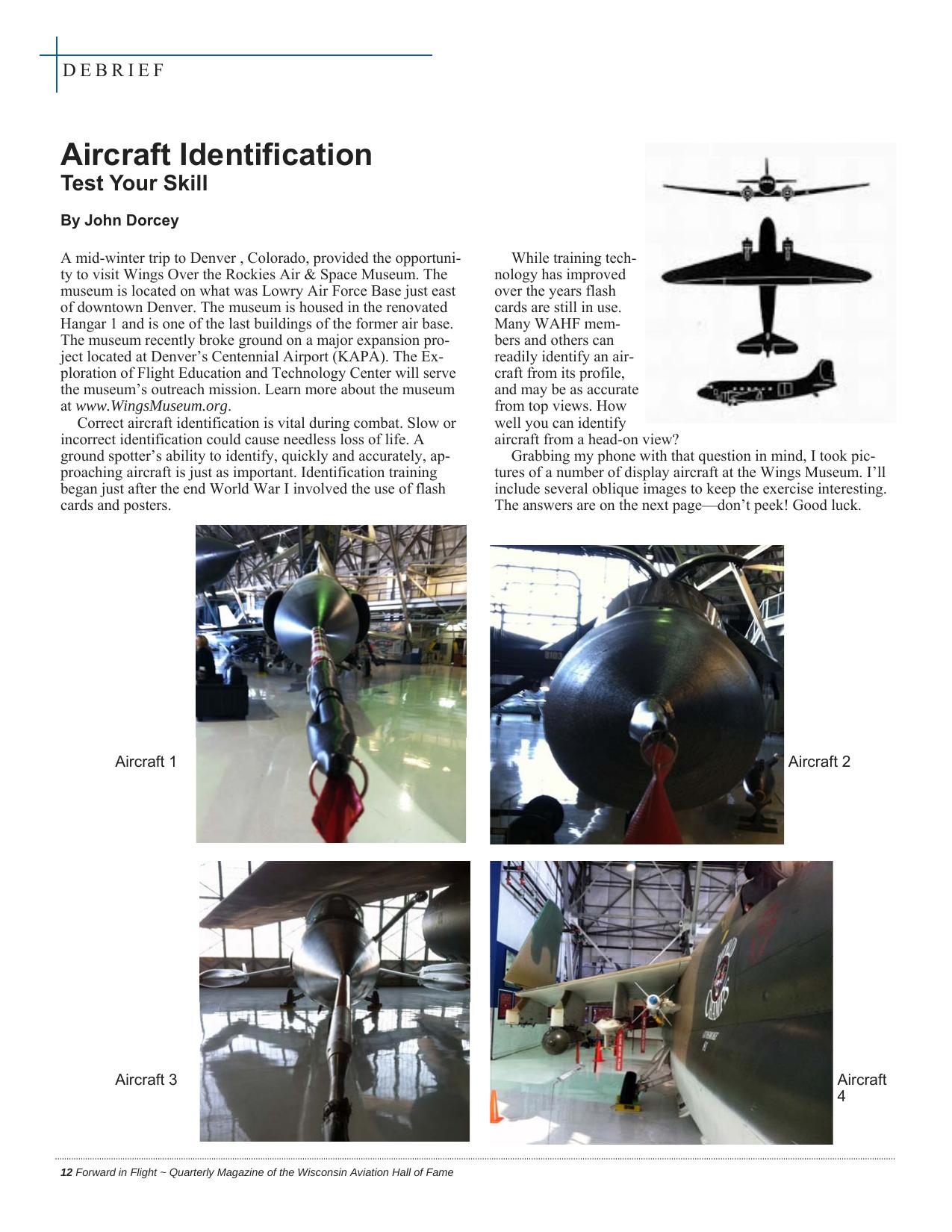
DEBRIEF Aircraft Identification Test Your Skill By John Dorcey A mid-winter trip to Denver , Colorado, provided the opportunity to visit Wings Over the Rockies Air & Space Museum. The museum is located on what was Lowry Air Force Base just east of downtown Denver. The museum is housed in the renovated Hangar 1 and is one of the last buildings of the former air base. The museum recently broke ground on a major expansion project located at Denver’s Centennial Airport (KAPA). The Exploration of Flight Education and Technology Center will serve the museum’s outreach mission. Learn more about the museum at www.WingsMuseum.org. Correct aircraft identification is vital during combat. Slow or incorrect identification could cause needless loss of life. A ground spotter’s ability to identify, quickly and accurately, approaching aircraft is just as important. Identification training began just after the end World War I involved the use of flash cards and posters. Aircraft 1 Aircraft 3 12 Forward in Flight ~ Quarterly Magazine of the Wisconsin Aviation Hall of Fame While training technology has improved over the years flash cards are still in use. Many WAHF members and others can readily identify an aircraft from its profile, and may be as accurate from top views. How well you can identify aircraft from a head-on view? Grabbing my phone with that question in mind, I took pictures of a number of display aircraft at the Wings Museum. I’ll include several oblique images to keep the exercise interesting. The answers are on the next page—don’t peek! Good luck. Aircraft 2 Aircraft 4
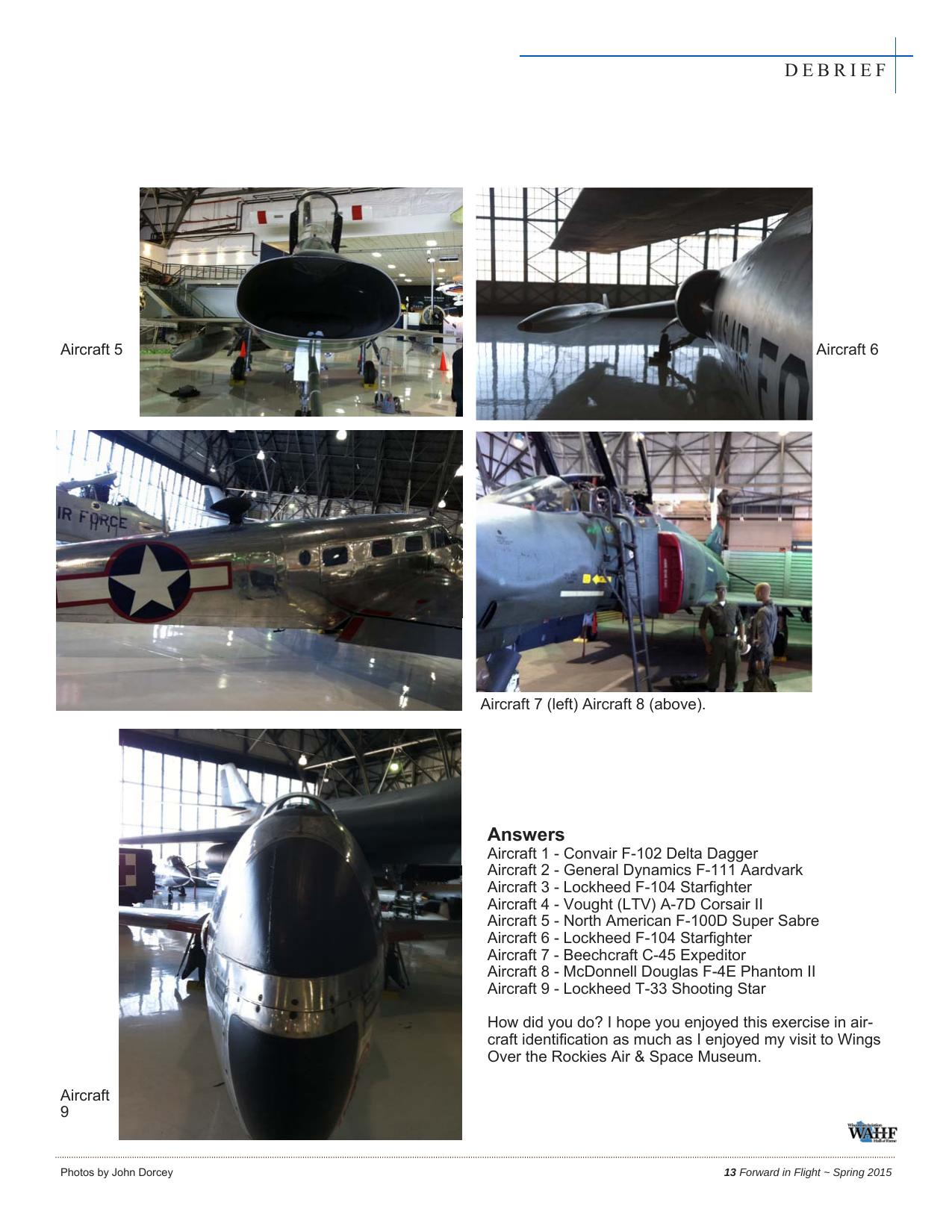
DEBRIEF Aircraft 5 Aircraft 6 Aircraft 7 (left) Aircraft 8 (above). Answers Aircraft 1 - Convair F-102 Delta Dagger Aircraft 2 - General Dynamics F-111 Aardvark Aircraft 3 - Lockheed F-104 Starfighter Aircraft 4 - Vought (LTV) A-7D Corsair II Aircraft 5 - North American F-100D Super Sabre Aircraft 6 - Lockheed F-104 Starfighter Aircraft 7 - Beechcraft C-45 Expeditor Aircraft 8 - McDonnell Douglas F-4E Phantom II Aircraft 9 - Lockheed T-33 Shooting Star How did you do? I hope you enjoyed this exercise in aircraft identification as much as I enjoyed my visit to Wings Over the Rockies Air & Space Museum. Aircraft 9 Photos by John Dorcey 13 Forward in Flight ~ Spring 2015
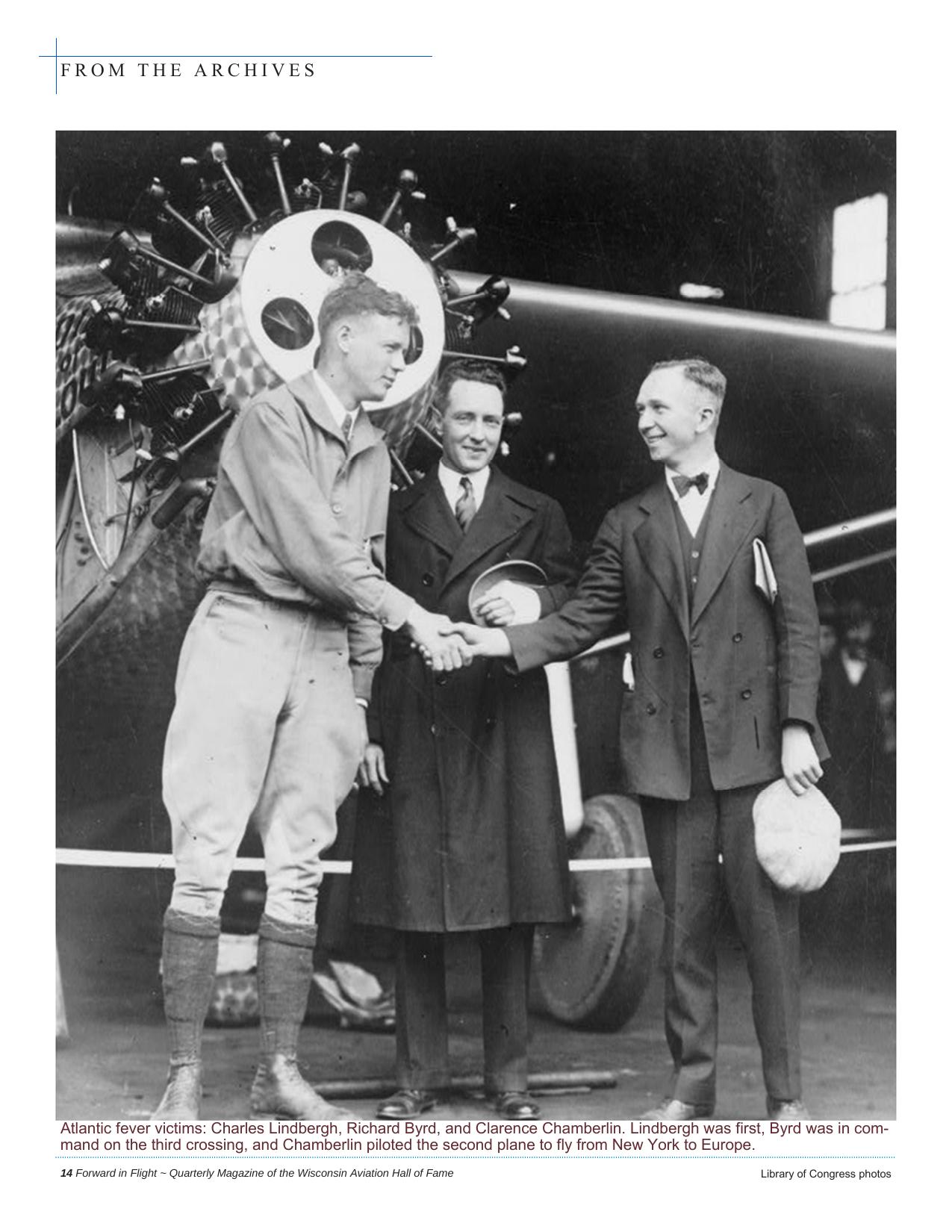
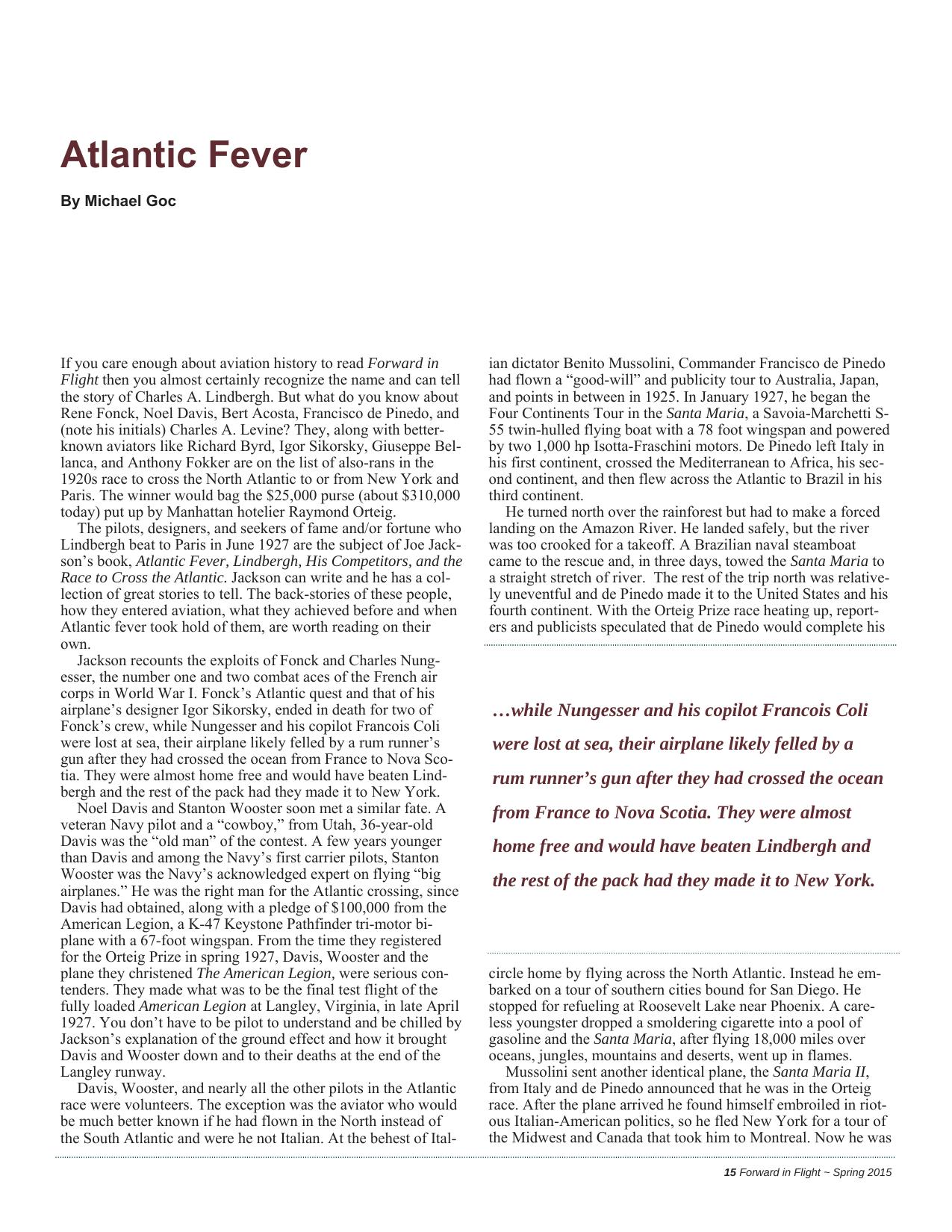
FROM THE ARCHIVES Atlantic fever victims: Charles Lindbergh, Richard Byrd, and Clarence Chamberlin. Lindbergh was first, Byrd was in command on the third crossing, and Chamberlin piloted the second plane to fly from New York to Europe. 14 Forward in Flight ~ Quarterly Magazine of the Wisconsin Aviation Hall of Fame Library of Congress photos
Atlantic Fever By Michael Goc If you care enough about aviation history to read Forward in Flight then you almost certainly recognize the name and can tell the story of Charles A. Lindbergh. But what do you know about Rene Fonck, Noel Davis, Bert Acosta, Francisco de Pinedo, and (note his initials) Charles A. Levine? They, along with betterknown aviators like Richard Byrd, Igor Sikorsky, Giuseppe Bellanca, and Anthony Fokker are on the list of also-rans in the 1920s race to cross the North Atlantic to or from New York and Paris. The winner would bag the $25,000 purse (about $310,000 today) put up by Manhattan hotelier Raymond Orteig. The pilots, designers, and seekers of fame and/or fortune who Lindbergh beat to Paris in June 1927 are the subject of Joe Jackson’s book, Atlantic Fever, Lindbergh, His Competitors, and the Race to Cross the Atlantic. Jackson can write and he has a collection of great stories to tell. The back-stories of these people, how they entered aviation, what they achieved before and when Atlantic fever took hold of them, are worth reading on their own. Jackson recounts the exploits of Fonck and Charles Nungesser, the number one and two combat aces of the French air corps in World War I. Fonck’s Atlantic quest and that of his airplane’s designer Igor Sikorsky, ended in death for two of Fonck’s crew, while Nungesser and his copilot Francois Coli were lost at sea, their airplane likely felled by a rum runner’s gun after they had crossed the ocean from France to Nova Scotia. They were almost home free and would have beaten Lindbergh and the rest of the pack had they made it to New York. Noel Davis and Stanton Wooster soon met a similar fate. A veteran Navy pilot and a “cowboy,” from Utah, 36-year-old Davis was the “old man” of the contest. A few years younger than Davis and among the Navy’s first carrier pilots, Stanton Wooster was the Navy’s acknowledged expert on flying “big airplanes.” He was the right man for the Atlantic crossing, since Davis had obtained, along with a pledge of $100,000 from the American Legion, a K-47 Keystone Pathfinder tri-motor biplane with a 67-foot wingspan. From the time they registered for the Orteig Prize in spring 1927, Davis, Wooster and the plane they christened The American Legion, were serious contenders. They made what was to be the final test flight of the fully loaded American Legion at Langley, Virginia, in late April 1927. You don’t have to be pilot to understand and be chilled by Jackson’s explanation of the ground effect and how it brought Davis and Wooster down and to their deaths at the end of the Langley runway. Davis, Wooster, and nearly all the other pilots in the Atlantic race were volunteers. The exception was the aviator who would be much better known if he had flown in the North instead of the South Atlantic and were he not Italian. At the behest of Ital- ian dictator Benito Mussolini, Commander Francisco de Pinedo had flown a “good-will” and publicity tour to Australia, Japan, and points in between in 1925. In January 1927, he began the Four Continents Tour in the Santa Maria, a Savoia-Marchetti S55 twin-hulled flying boat with a 78 foot wingspan and powered by two 1,000 hp Isotta-Fraschini motors. De Pinedo left Italy in his first continent, crossed the Mediterranean to Africa, his second continent, and then flew across the Atlantic to Brazil in his third continent. He turned north over the rainforest but had to make a forced landing on the Amazon River. He landed safely, but the river was too crooked for a takeoff. A Brazilian naval steamboat came to the rescue and, in three days, towed the Santa Maria to a straight stretch of river. The rest of the trip north was relatively uneventful and de Pinedo made it to the United States and his fourth continent. With the Orteig Prize race heating up, reporters and publicists speculated that de Pinedo would complete his …while Nungesser and his copilot Francois Coli were lost at sea, their airplane likely felled by a rum runner’s gun after they had crossed the ocean from France to Nova Scotia. They were almost home free and would have beaten Lindbergh and the rest of the pack had they made it to New York. circle home by flying across the North Atlantic. Instead he embarked on a tour of southern cities bound for San Diego. He stopped for refueling at Roosevelt Lake near Phoenix. A careless youngster dropped a smoldering cigarette into a pool of gasoline and the Santa Maria, after flying 18,000 miles over oceans, jungles, mountains and deserts, went up in flames. Mussolini sent another identical plane, the Santa Maria II, from Italy and de Pinedo announced that he was in the Orteig race. After the plane arrived he found himself embroiled in riotous Italian-American politics, so he fled New York for a tour of the Midwest and Canada that took him to Montreal. Now he was 15 Forward in Flight ~ Spring 2015
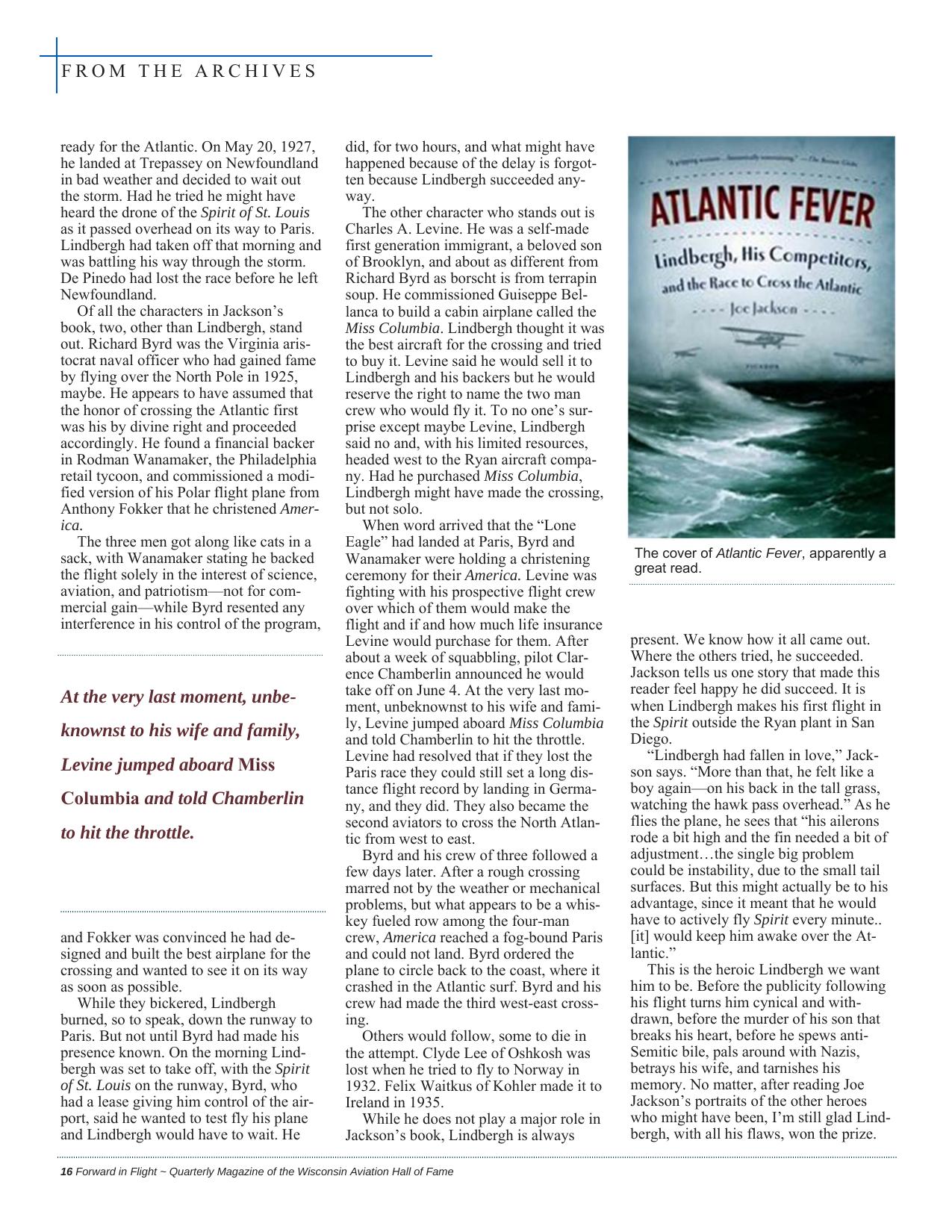
FROM THE ARCHIVES ready for the Atlantic. On May 20, 1927, he landed at Trepassey on Newfoundland in bad weather and decided to wait out the storm. Had he tried he might have heard the drone of the Spirit of St. Louis as it passed overhead on its way to Paris. Lindbergh had taken off that morning and was battling his way through the storm. De Pinedo had lost the race before he left Newfoundland. Of all the characters in Jackson’s book, two, other than Lindbergh, stand out. Richard Byrd was the Virginia aristocrat naval officer who had gained fame by flying over the North Pole in 1925, maybe. He appears to have assumed that the honor of crossing the Atlantic first was his by divine right and proceeded accordingly. He found a financial backer in Rodman Wanamaker, the Philadelphia retail tycoon, and commissioned a modified version of his Polar flight plane from Anthony Fokker that he christened America. The three men got along like cats in a sack, with Wanamaker stating he backed the flight solely in the interest of science, aviation, and patriotism—not for commercial gain—while Byrd resented any interference in his control of the program, At the very last moment, unbeknownst to his wife and family, Levine jumped aboard Miss Columbia and told Chamberlin to hit the throttle. and Fokker was convinced he had designed and built the best airplane for the crossing and wanted to see it on its way as soon as possible. While they bickered, Lindbergh burned, so to speak, down the runway to Paris. But not until Byrd had made his presence known. On the morning Lindbergh was set to take off, with the Spirit of St. Louis on the runway, Byrd, who had a lease giving him control of the airport, said he wanted to test fly his plane and Lindbergh would have to wait. He did, for two hours, and what might have happened because of the delay is forgotten because Lindbergh succeeded anyway. The other character who stands out is Charles A. Levine. He was a self-made first generation immigrant, a beloved son of Brooklyn, and about as different from Richard Byrd as borscht is from terrapin soup. He commissioned Guiseppe Bellanca to build a cabin airplane called the Miss Columbia. Lindbergh thought it was the best aircraft for the crossing and tried to buy it. Levine said he would sell it to Lindbergh and his backers but he would reserve the right to name the two man crew who would fly it. To no one’s surprise except maybe Levine, Lindbergh said no and, with his limited resources, headed west to the Ryan aircraft company. Had he purchased Miss Columbia, Lindbergh might have made the crossing, but not solo. When word arrived that the “Lone Eagle” had landed at Paris, Byrd and Wanamaker were holding a christening ceremony for their America. Levine was fighting with his prospective flight crew over which of them would make the flight and if and how much life insurance Levine would purchase for them. After about a week of squabbling, pilot Clarence Chamberlin announced he would take off on June 4. At the very last moment, unbeknownst to his wife and family, Levine jumped aboard Miss Columbia and told Chamberlin to hit the throttle. Levine had resolved that if they lost the Paris race they could still set a long distance flight record by landing in Germany, and they did. They also became the second aviators to cross the North Atlantic from west to east. Byrd and his crew of three followed a few days later. After a rough crossing marred not by the weather or mechanical problems, but what appears to be a whiskey fueled row among the four-man crew, America reached a fog-bound Paris and could not land. Byrd ordered the plane to circle back to the coast, where it crashed in the Atlantic surf. Byrd and his crew had made the third west-east crossing. Others would follow, some to die in the attempt. Clyde Lee of Oshkosh was lost when he tried to fly to Norway in 1932. Felix Waitkus of Kohler made it to Ireland in 1935. While he does not play a major role in Jackson’s book, Lindbergh is always 16 Forward in Flight ~ Quarterly Magazine of the Wisconsin Aviation Hall of Fame The cover of Atlantic Fever, apparently a great read. present. We know how it all came out. Where the others tried, he succeeded. Jackson tells us one story that made this reader feel happy he did succeed. It is when Lindbergh makes his first flight in the Spirit outside the Ryan plant in San Diego. “Lindbergh had fallen in love,” Jackson says. “More than that, he felt like a boy again—on his back in the tall grass, watching the hawk pass overhead.” As he flies the plane, he sees that “his ailerons rode a bit high and the fin needed a bit of adjustment…the single big problem could be instability, due to the small tail surfaces. But this might actually be to his advantage, since it meant that he would have to actively fly Spirit every minute.. [it] would keep him awake over the Atlantic.” This is the heroic Lindbergh we want him to be. Before the publicity following his flight turns him cynical and withdrawn, before the murder of his son that breaks his heart, before he spews antiSemitic bile, pals around with Nazis, betrays his wife, and tarnishes his memory. No matter, after reading Joe Jackson’s portraits of the other heroes who might have been, I’m still glad Lindbergh, with all his flaws, won the prize.
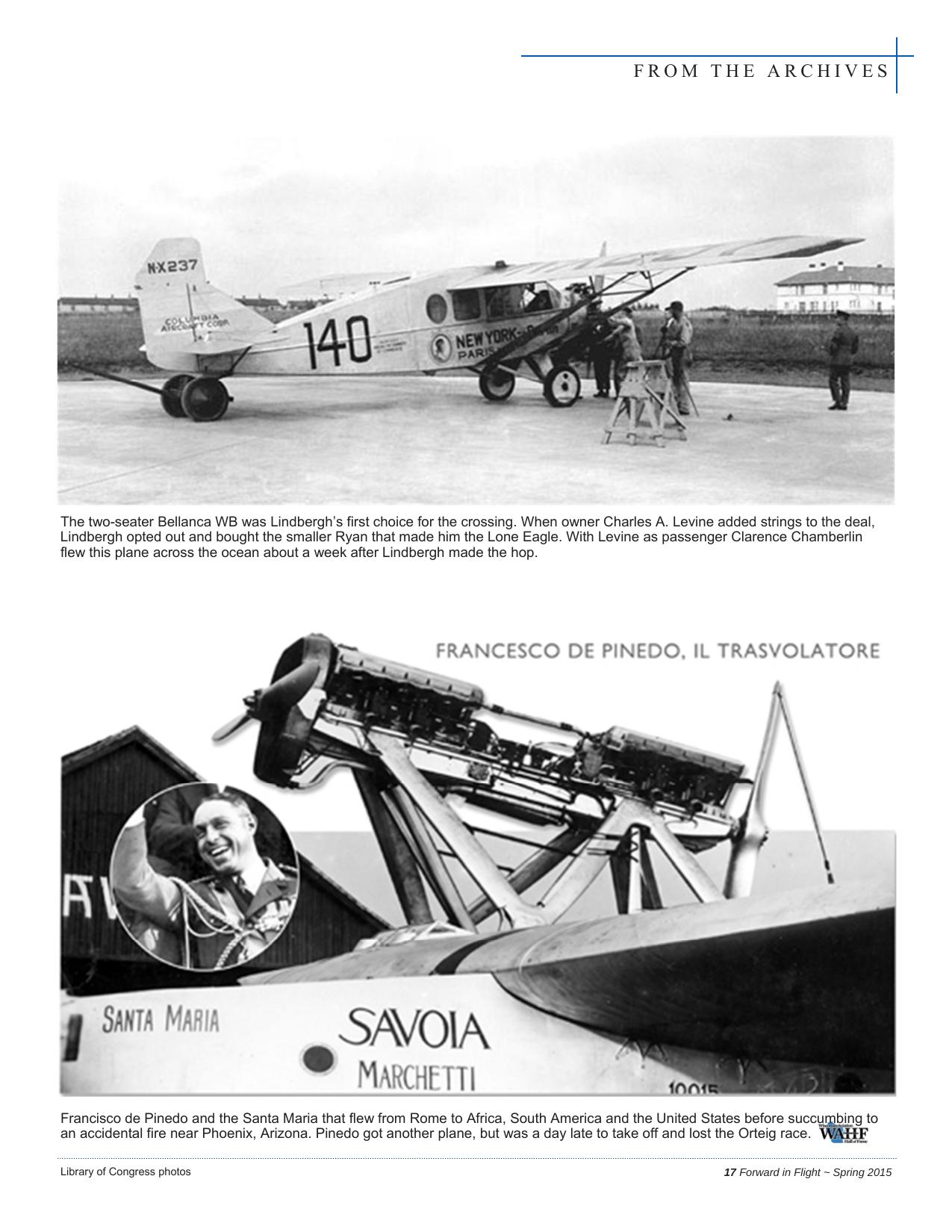
FROM THE ARCHIVES The two-seater Bellanca WB was Lindbergh’s first choice for the crossing. When owner Charles A. Levine added strings to the deal, Lindbergh opted out and bought the smaller Ryan that made him the Lone Eagle. With Levine as passenger Clarence Chamberlin flew this plane across the ocean about a week after Lindbergh made the hop. Francisco de Pinedo and the Santa Maria that flew from Rome to Africa, South America and the United States before succumbing to an accidental fire near Phoenix, Arizona. Pinedo got another plane, but was a day late to take off and lost the Orteig race. Library of Congress photos 17 Forward in Flight ~ Spring 2015
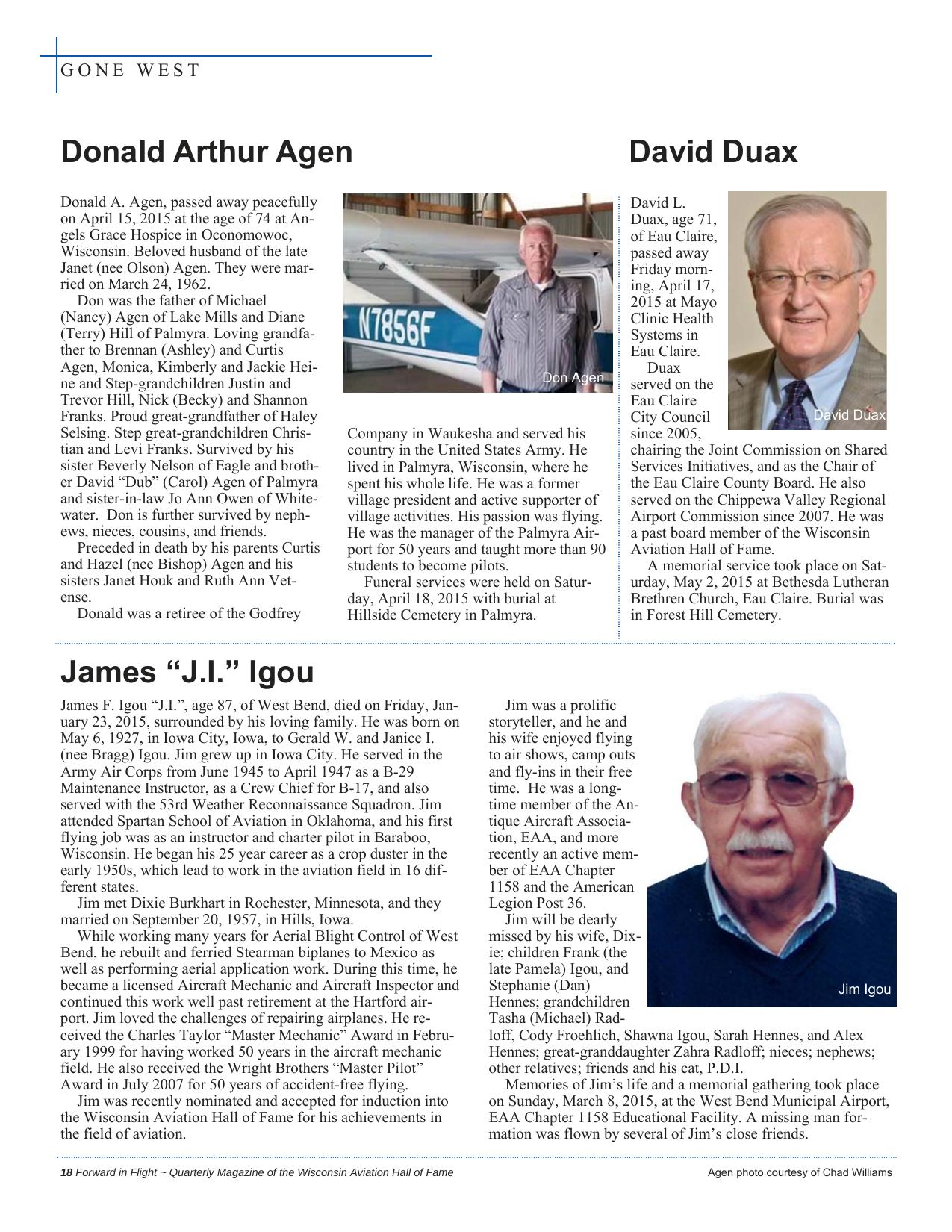
GONE WEST Donald Arthur Agen David Duax Donald A. Agen, passed away peacefully on April 15, 2015 at the age of 74 at Angels Grace Hospice in Oconomowoc, Wisconsin. Beloved husband of the late Janet (nee Olson) Agen. They were married on March 24, 1962. Don was the father of Michael (Nancy) Agen of Lake Mills and Diane (Terry) Hill of Palmyra. Loving grandfather to Brennan (Ashley) and Curtis Agen, Monica, Kimberly and Jackie Heine and Step-grandchildren Justin and Trevor Hill, Nick (Becky) and Shannon Franks. Proud great-grandfather of Haley Selsing. Step great-grandchildren Christian and Levi Franks. Survived by his sister Beverly Nelson of Eagle and brother David “Dub” (Carol) Agen of Palmyra and sister-in-law Jo Ann Owen of Whitewater. Don is further survived by nephews, nieces, cousins, and friends. Preceded in death by his parents Curtis and Hazel (nee Bishop) Agen and his sisters Janet Houk and Ruth Ann Vetense. Donald was a retiree of the Godfrey David L. Duax, age 71, of Eau Claire, passed away Friday morning, April 17, 2015 at Mayo Clinic Health Systems in Eau Claire. Duax served on the Eau Claire David Duax City Council since 2005, chairing the Joint Commission on Shared Services Initiatives, and as the Chair of the Eau Claire County Board. He also served on the Chippewa Valley Regional Airport Commission since 2007. He was a past board member of the Wisconsin Aviation Hall of Fame. A memorial service took place on Saturday, May 2, 2015 at Bethesda Lutheran Brethren Church, Eau Claire. Burial was in Forest Hill Cemetery. Don Agen Company in Waukesha and served his country in the United States Army. He lived in Palmyra, Wisconsin, where he spent his whole life. He was a former village president and active supporter of village activities. His passion was flying. He was the manager of the Palmyra Airport for 50 years and taught more than 90 students to become pilots. Funeral services were held on Saturday, April 18, 2015 with burial at Hillside Cemetery in Palmyra. James “J.I.” Igou James F. Igou “J.I.”, age 87, of West Bend, died on Friday, January 23, 2015, surrounded by his loving family. He was born on May 6, 1927, in Iowa City, Iowa, to Gerald W. and Janice I. (nee Bragg) Igou. Jim grew up in Iowa City. He served in the Army Air Corps from June 1945 to April 1947 as a B-29 Maintenance Instructor, as a Crew Chief for B-17, and also served with the 53rd Weather Reconnaissance Squadron. Jim attended Spartan School of Aviation in Oklahoma, and his first flying job was as an instructor and charter pilot in Baraboo, Wisconsin. He began his 25 year career as a crop duster in the early 1950s, which lead to work in the aviation field in 16 different states. Jim met Dixie Burkhart in Rochester, Minnesota, and they married on September 20, 1957, in Hills, Iowa. While working many years for Aerial Blight Control of West Bend, he rebuilt and ferried Stearman biplanes to Mexico as well as performing aerial application work. During this time, he became a licensed Aircraft Mechanic and Aircraft Inspector and continued this work well past retirement at the Hartford airport. Jim loved the challenges of repairing airplanes. He received the Charles Taylor “Master Mechanic” Award in February 1999 for having worked 50 years in the aircraft mechanic field. He also received the Wright Brothers “Master Pilot” Award in July 2007 for 50 years of accident-free flying. Jim was recently nominated and accepted for induction into the Wisconsin Aviation Hall of Fame for his achievements in the field of aviation. Jim was a prolific storyteller, and he and his wife enjoyed flying to air shows, camp outs and fly-ins in their free time. He was a longtime member of the Antique Aircraft Association, EAA, and more recently an active member of EAA Chapter 1158 and the American Legion Post 36. Jim will be dearly missed by his wife, Dixie; children Frank (the late Pamela) Igou, and Stephanie (Dan) Jim Igou Hennes; grandchildren Tasha (Michael) Radloff, Cody Froehlich, Shawna Igou, Sarah Hennes, and Alex Hennes; great-granddaughter Zahra Radloff; nieces; nephews; other relatives; friends and his cat, P.D.I. Memories of Jim’s life and a memorial gathering took place on Sunday, March 8, 2015, at the West Bend Municipal Airport, EAA Chapter 1158 Educational Facility. A missing man formation was flown by several of Jim’s close friends. 18 Forward in Flight ~ Quarterly Magazine of the Wisconsin Aviation Hall of Fame Agen photo courtesy of Chad Williams
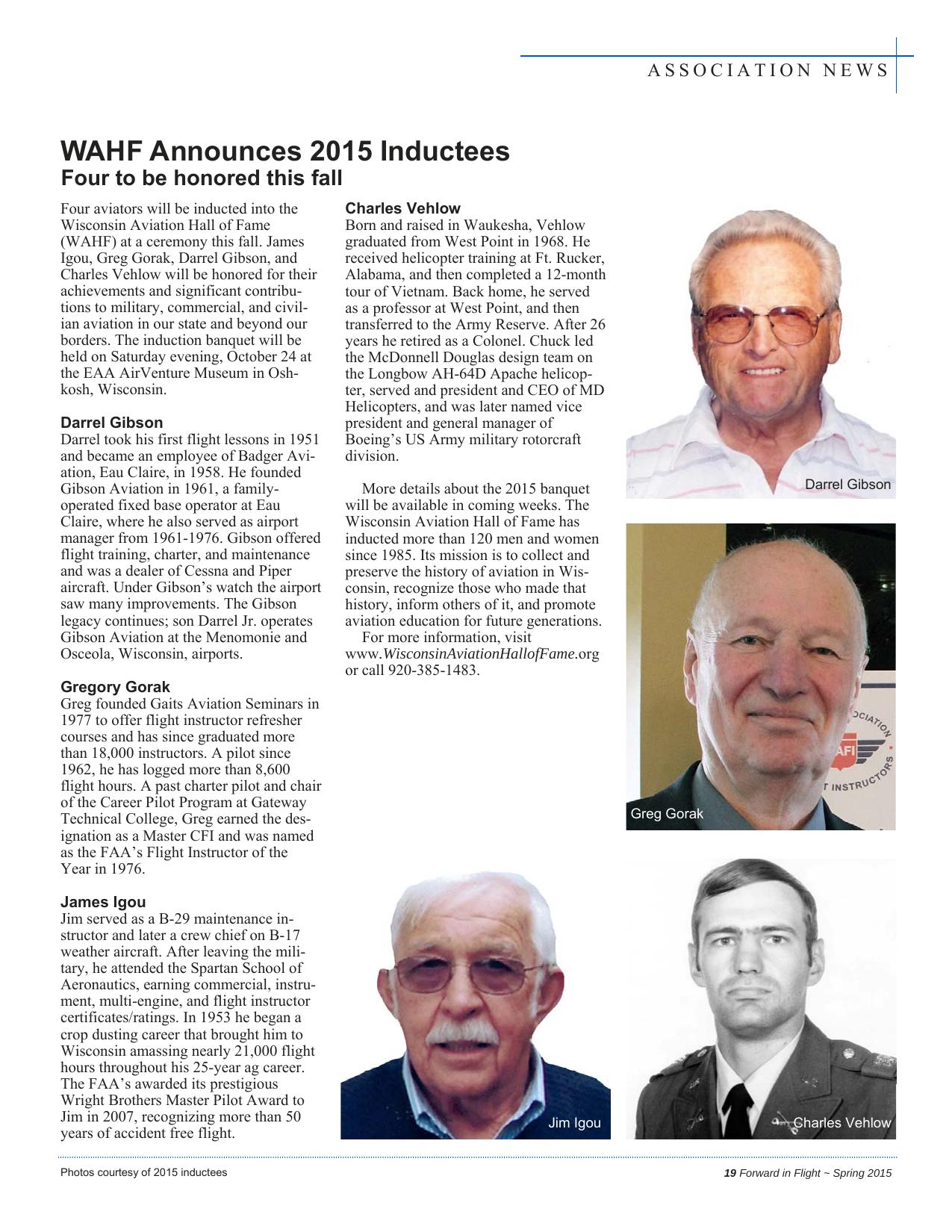
ASSOCIATION NEWS WAHF Announces 2015 Inductees Four to be honored this fall Four aviators will be inducted into the Wisconsin Aviation Hall of Fame (WAHF) at a ceremony this fall. James Igou, Greg Gorak, Darrel Gibson, and Charles Vehlow will be honored for their achievements and significant contributions to military, commercial, and civilian aviation in our state and beyond our borders. The induction banquet will be held on Saturday evening, October 24 at the EAA AirVenture Museum in Oshkosh, Wisconsin. Darrel Gibson Darrel took his first flight lessons in 1951 and became an employee of Badger Aviation, Eau Claire, in 1958. He founded Gibson Aviation in 1961, a familyoperated fixed base operator at Eau Claire, where he also served as airport manager from 1961-1976. Gibson offered flight training, charter, and maintenance and was a dealer of Cessna and Piper aircraft. Under Gibson’s watch the airport saw many improvements. The Gibson legacy continues; son Darrel Jr. operates Gibson Aviation at the Menomonie and Osceola, Wisconsin, airports. Gregory Gorak Greg founded Gaits Aviation Seminars in 1977 to offer flight instructor refresher courses and has since graduated more than 18,000 instructors. A pilot since 1962, he has logged more than 8,600 flight hours. A past charter pilot and chair of the Career Pilot Program at Gateway Technical College, Greg earned the designation as a Master CFI and was named as the FAA’s Flight Instructor of the Year in 1976. James Igou Jim served as a B-29 maintenance instructor and later a crew chief on B-17 weather aircraft. After leaving the military, he attended the Spartan School of Aeronautics, earning commercial, instrument, multi-engine, and flight instructor certificates/ratings. In 1953 he began a crop dusting career that brought him to Wisconsin amassing nearly 21,000 flight hours throughout his 25-year ag career. The FAA’s awarded its prestigious Wright Brothers Master Pilot Award to Jim in 2007, recognizing more than 50 years of accident free flight. Photos courtesy of 2015 inductees Charles Vehlow Born and raised in Waukesha, Vehlow graduated from West Point in 1968. He received helicopter training at Ft. Rucker, Alabama, and then completed a 12-month tour of Vietnam. Back home, he served as a professor at West Point, and then transferred to the Army Reserve. After 26 years he retired as a Colonel. Chuck led the McDonnell Douglas design team on the Longbow AH-64D Apache helicopter, served and president and CEO of MD Helicopters, and was later named vice president and general manager of Boeing’s US Army military rotorcraft division. Darrel Gibson More details about the 2015 banquet will be available in coming weeks. The Wisconsin Aviation Hall of Fame has inducted more than 120 men and women since 1985. Its mission is to collect and preserve the history of aviation in Wisconsin, recognize those who made that history, inform others of it, and promote aviation education for future generations. For more information, visit www.WisconsinAviationHallofFame.org or call 920-385-1483. Greg Gorak Jim Igou Charles Vehlow 19 Forward in Flight ~ Spring 2015
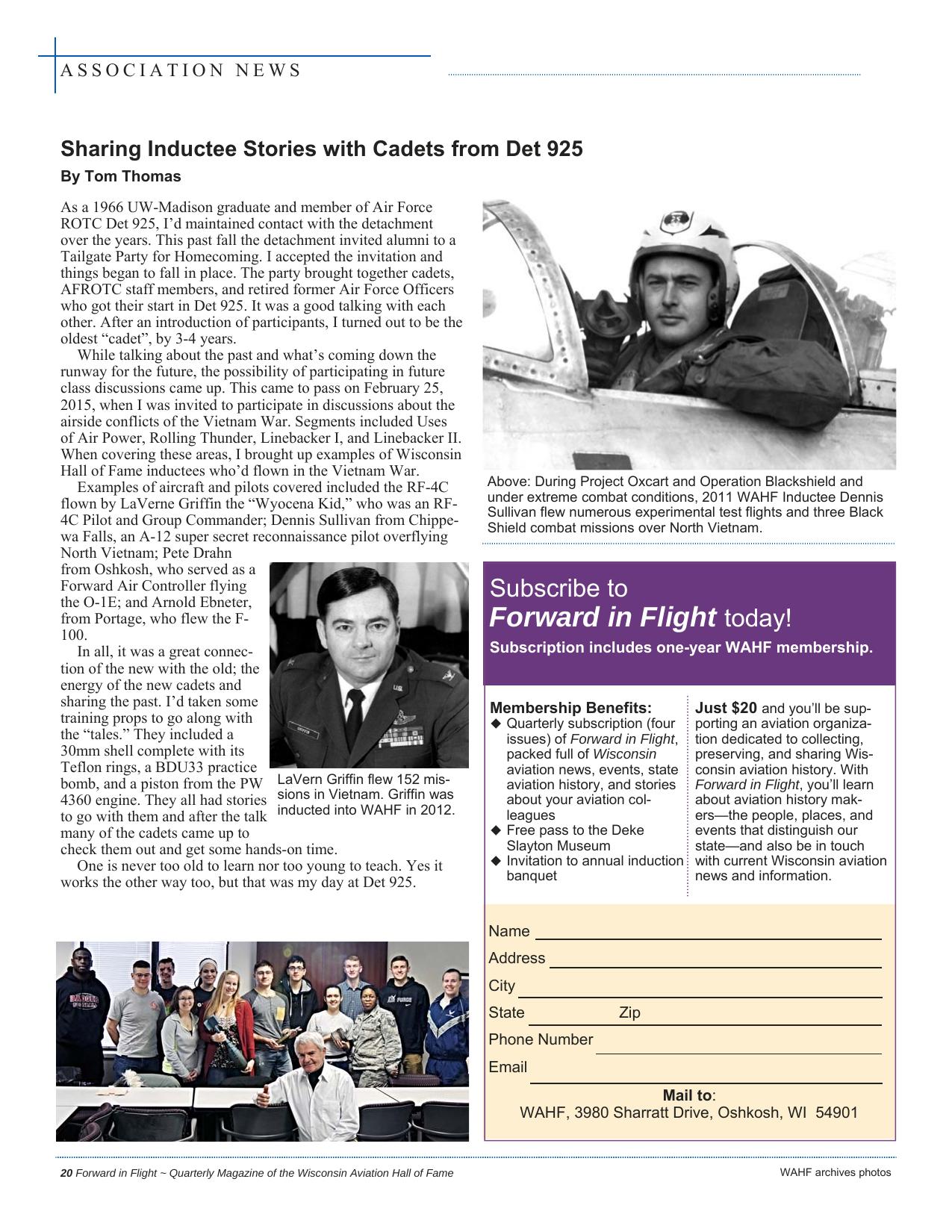
ASSOCIATION NEWS Sharing Inductee Stories with Cadets from Det 925 By Tom Thomas As a 1966 UW-Madison graduate and member of Air Force ROTC Det 925, I’d maintained contact with the detachment over the years. This past fall the detachment invited alumni to a Tailgate Party for Homecoming. I accepted the invitation and things began to fall in place. The party brought together cadets, AFROTC staff members, and retired former Air Force Officers who got their start in Det 925. It was a good talking with each other. After an introduction of participants, I turned out to be the oldest “cadet”, by 3-4 years. While talking about the past and what’s coming down the runway for the future, the possibility of participating in future class discussions came up. This came to pass on February 25, 2015, when I was invited to participate in discussions about the airside conflicts of the Vietnam War. Segments included Uses of Air Power, Rolling Thunder, Linebacker I, and Linebacker II. When covering these areas, I brought up examples of Wisconsin Hall of Fame inductees who’d flown in the Vietnam War. Examples of aircraft and pilots covered included the RF-4C flown by LaVerne Griffin the “Wyocena Kid,” who was an RF4C Pilot and Group Commander; Dennis Sullivan from Chippewa Falls, an A-12 super secret reconnaissance pilot overflying North Vietnam; Pete Drahn from Oshkosh, who served as a Forward Air Controller flying the O-1E; and Arnold Ebneter, from Portage, who flew the F100. In all, it was a great connection of the new with the old; the energy of the new cadets and sharing the past. I’d taken some training props to go along with the “tales.” They included a 30mm shell complete with its Teflon rings, a BDU33 practice bomb, and a piston from the PW LaVern Griffin flew 152 mis4360 engine. They all had stories sions in Vietnam. Griffin was to go with them and after the talk inducted into WAHF in 2012. many of the cadets came up to check them out and get some hands-on time. One is never too old to learn nor too young to teach. Yes it works the other way too, but that was my day at Det 925. Above: During Project Oxcart and Operation Blackshield and under extreme combat conditions, 2011 WAHF Inductee Dennis Sullivan flew numerous experimental test flights and three Black Shield combat missions over North Vietnam. Subscribe to Forward in Flight today! Subscription includes one-year WAHF membership. Membership Benefits: Quarterly subscription (four issues) of Forward in Flight, packed full of Wisconsin aviation news, events, state aviation history, and stories about your aviation colleagues Free pass to the Deke Slayton Museum Invitation to annual induction banquet Just $20 and you’ll be sup- porting an aviation organization dedicated to collecting, preserving, and sharing Wisconsin aviation history. With Forward in Flight, you’ll learn about aviation history makers—the people, places, and events that distinguish our state—and also be in touch with current Wisconsin aviation news and information. Name Address City State Zip Phone Number Email Mail to: WAHF, 3980 Sharratt Drive, Oshkosh, WI 54901 20 Forward in Flight ~ Quarterly Magazine of the Wisconsin Aviation Hall of Fame WAHF archives photos
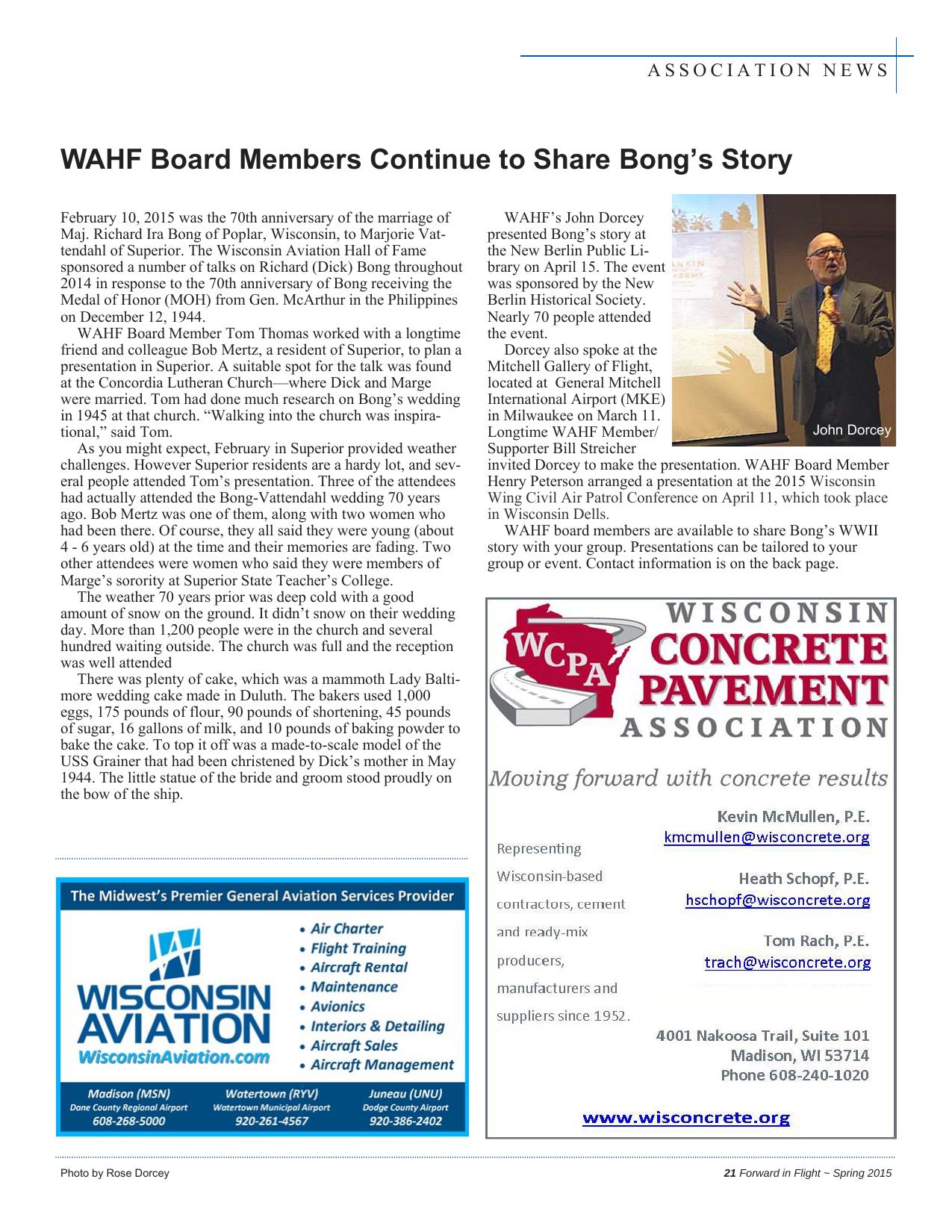
ASSOCIATION NEWS WAHF Board Members Continue to Share Bong’s Story February 10, 2015 was the 70th anniversary of the marriage of Maj. Richard Ira Bong of Poplar, Wisconsin, to Marjorie Vattendahl of Superior. The Wisconsin Aviation Hall of Fame sponsored a number of talks on Richard (Dick) Bong throughout 2014 in response to the 70th anniversary of Bong receiving the Medal of Honor (MOH) from Gen. McArthur in the Philippines on December 12, 1944. WAHF Board Member Tom Thomas worked with a longtime friend and colleague Bob Mertz, a resident of Superior, to plan a presentation in Superior. A suitable spot for the talk was found at the Concordia Lutheran Church—where Dick and Marge were married. Tom had done much research on Bong’s wedding in 1945 at that church. “Walking into the church was inspirational,” said Tom. As you might expect, February in Superior provided weather challenges. However Superior residents are a hardy lot, and several people attended Tom’s presentation. Three of the attendees had actually attended the Bong-Vattendahl wedding 70 years ago. Bob Mertz was one of them, along with two women who had been there. Of course, they all said they were young (about 4 - 6 years old) at the time and their memories are fading. Two other attendees were women who said they were members of Marge’s sorority at Superior State Teacher’s College. The weather 70 years prior was deep cold with a good amount of snow on the ground. It didn’t snow on their wedding day. More than 1,200 people were in the church and several hundred waiting outside. The church was full and the reception was well attended There was plenty of cake, which was a mammoth Lady Baltimore wedding cake made in Duluth. The bakers used 1,000 eggs, 175 pounds of flour, 90 pounds of shortening, 45 pounds of sugar, 16 gallons of milk, and 10 pounds of baking powder to bake the cake. To top it off was a made-to-scale model of the USS Grainer that had been christened by Dick’s mother in May 1944. The little statue of the bride and groom stood proudly on the bow of the ship. Photo by Rose Dorcey WAHF’s John Dorcey presented Bong’s story at the New Berlin Public Library on April 15. The event was sponsored by the New Berlin Historical Society. Nearly 70 people attended the event. Dorcey also spoke at the Mitchell Gallery of Flight, located at General Mitchell International Airport (MKE) in Milwaukee on March 11. John Dorcey Longtime WAHF Member/ Supporter Bill Streicher invited Dorcey to make the presentation. WAHF Board Member Henry Peterson arranged a presentation at the 2015 Wisconsin Wing Civil Air Patrol Conference on April 11, which took place in Wisconsin Dells. WAHF board members are available to share Bong’s WWII story with your group. Presentations can be tailored to your group or event. Contact information is on the back page. 21 Forward in Flight ~ Spring 2015
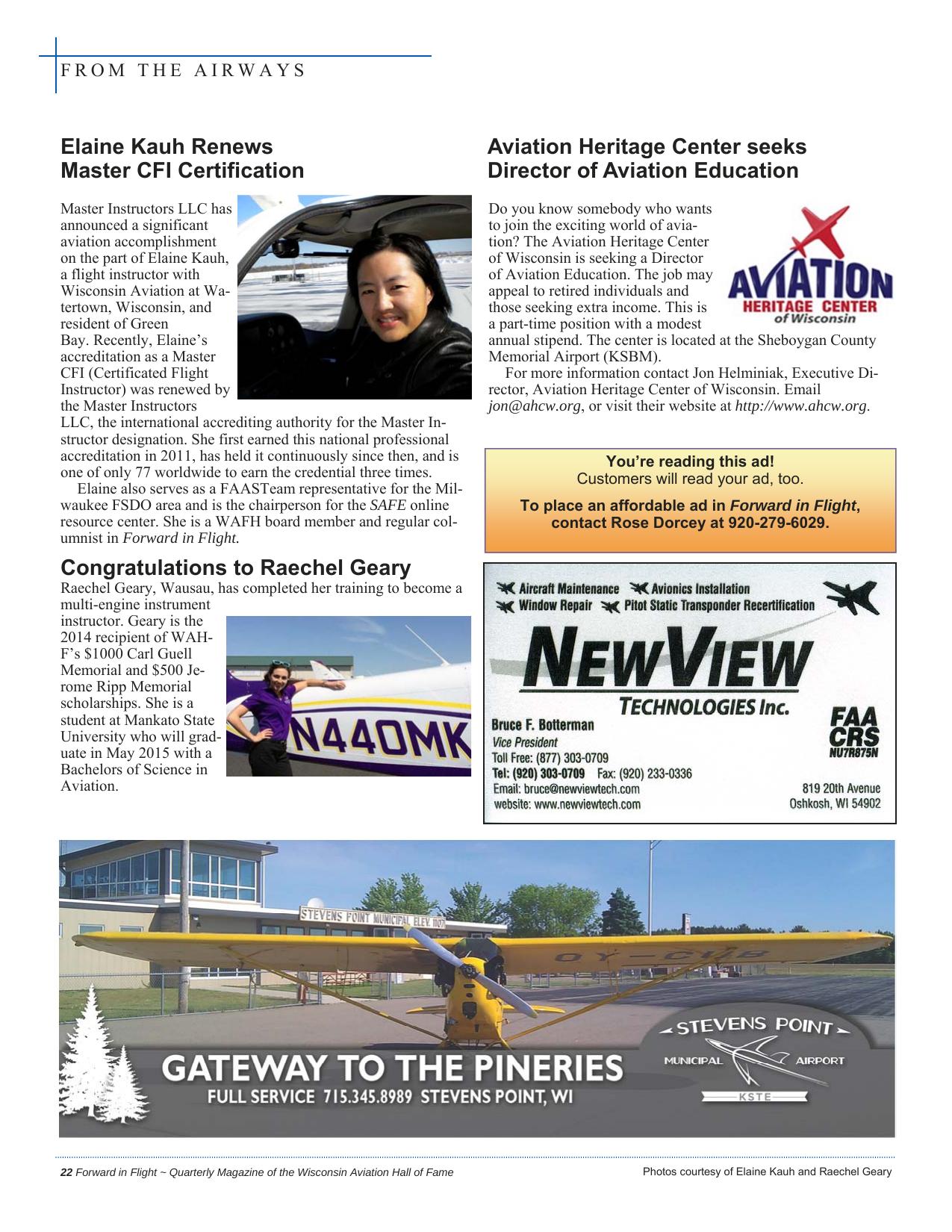
FROM THE AIRWAYS Elaine Kauh Renews Master CFI Certification Aviation Heritage Center seeks Director of Aviation Education Master Instructors LLC has announced a significant aviation accomplishment on the part of Elaine Kauh, a flight instructor with Wisconsin Aviation at Watertown, Wisconsin, and resident of Green Bay. Recently, Elaine’s accreditation as a Master CFI (Certificated Flight Instructor) was renewed by the Master Instructors LLC, the international accrediting authority for the Master Instructor designation. She first earned this national professional accreditation in 2011, has held it continuously since then, and is one of only 77 worldwide to earn the credential three times. Elaine also serves as a FAASTeam representative for the Milwaukee FSDO area and is the chairperson for the SAFE online resource center. She is a WAFH board member and regular columnist in Forward in Flight. Do you know somebody who wants to join the exciting world of aviation? The Aviation Heritage Center of Wisconsin is seeking a Director of Aviation Education. The job may appeal to retired individuals and those seeking extra income. This is a part-time position with a modest annual stipend. The center is located at the Sheboygan County Memorial Airport (KSBM). For more information contact Jon Helminiak, Executive Director, Aviation Heritage Center of Wisconsin. Email jon@ahcw.org, or visit their website at http://www.ahcw.org. You’re reading this ad! Customers will read your ad, too. To place an affordable ad in Forward in Flight, contact Rose Dorcey at 920-279-6029. Congratulations to Raechel Geary Raechel Geary, Wausau, has completed her training to become a multi-engine instrument instructor. Geary is the 2014 recipient of WAHF’s $1000 Carl Guell Memorial and $500 Jerome Ripp Memorial scholarships. She is a student at Mankato State University who will graduate in May 2015 with a Bachelors of Science in Aviation. 22 Forward in Flight ~ Quarterly Magazine of the Wisconsin Aviation Hall of Fame Photos courtesy of Elaine Kauh and Raechel Geary
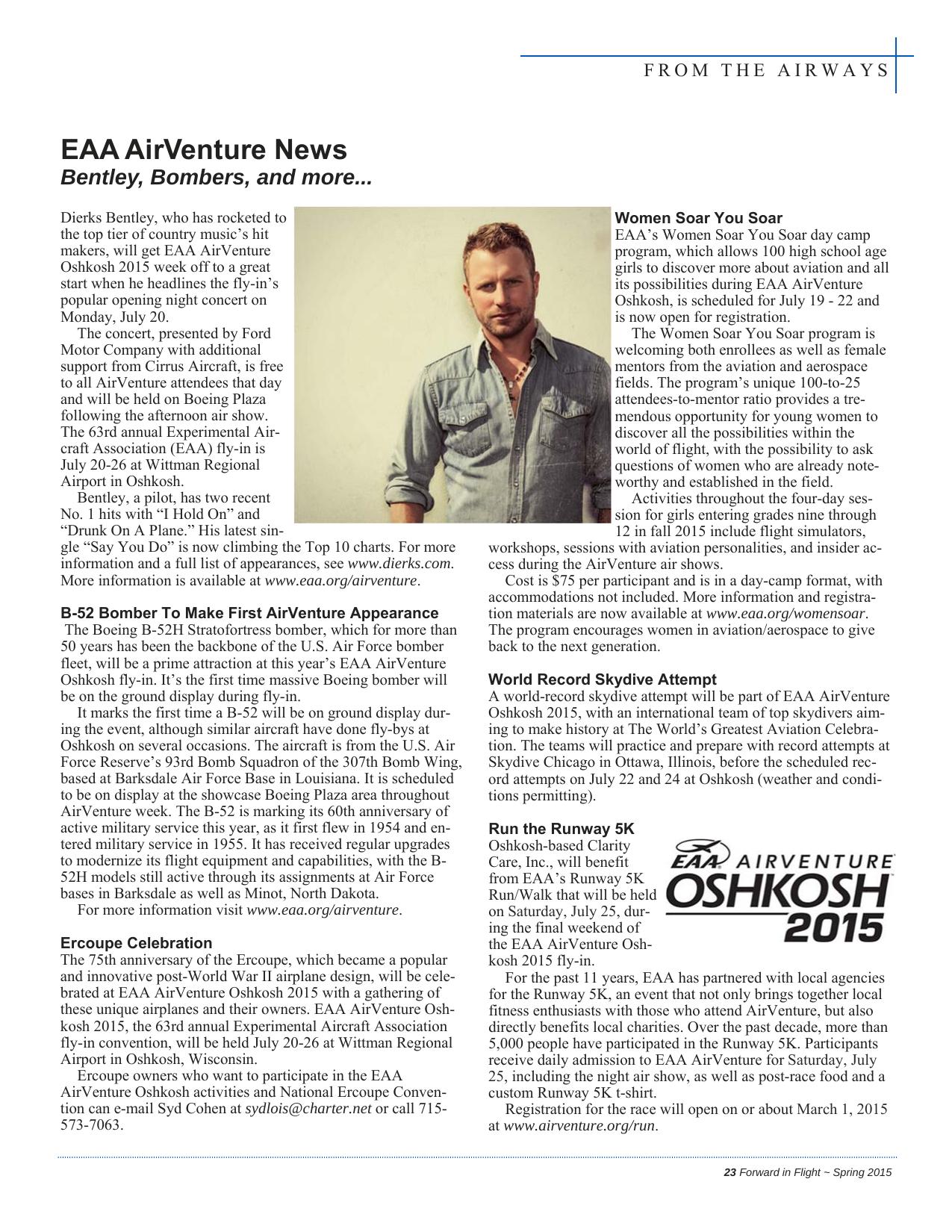
FROM THE AIRWAYS EAA AirVenture News Bentley, Bombers, and more... Dierks Bentley, who has rocketed to the top tier of country music’s hit makers, will get EAA AirVenture Oshkosh 2015 week off to a great start when he headlines the fly-in’s popular opening night concert on Monday, July 20. The concert, presented by Ford Motor Company with additional support from Cirrus Aircraft, is free to all AirVenture attendees that day and will be held on Boeing Plaza following the afternoon air show. The 63rd annual Experimental Aircraft Association (EAA) fly-in is July 20-26 at Wittman Regional Airport in Oshkosh. Bentley, a pilot, has two recent No. 1 hits with “I Hold On” and “Drunk On A Plane.” His latest single “Say You Do” is now climbing the Top 10 charts. For more information and a full list of appearances, see www.dierks.com. More information is available at www.eaa.org/airventure. B-52 Bomber To Make First AirVenture Appearance The Boeing B-52H Stratofortress bomber, which for more than 50 years has been the backbone of the U.S. Air Force bomber fleet, will be a prime attraction at this year’s EAA AirVenture Oshkosh fly-in. It’s the first time massive Boeing bomber will be on the ground display during fly-in. It marks the first time a B-52 will be on ground display during the event, although similar aircraft have done fly-bys at Oshkosh on several occasions. The aircraft is from the U.S. Air Force Reserve’s 93rd Bomb Squadron of the 307th Bomb Wing, based at Barksdale Air Force Base in Louisiana. It is scheduled to be on display at the showcase Boeing Plaza area throughout AirVenture week. The B-52 is marking its 60th anniversary of active military service this year, as it first flew in 1954 and entered military service in 1955. It has received regular upgrades to modernize its flight equipment and capabilities, with the B52H models still active through its assignments at Air Force bases in Barksdale as well as Minot, North Dakota. For more information visit www.eaa.org/airventure. Ercoupe Celebration The 75th anniversary of the Ercoupe, which became a popular and innovative post-World War II airplane design, will be celebrated at EAA AirVenture Oshkosh 2015 with a gathering of these unique airplanes and their owners. EAA AirVenture Oshkosh 2015, the 63rd annual Experimental Aircraft Association fly-in convention, will be held July 20-26 at Wittman Regional Airport in Oshkosh, Wisconsin. Ercoupe owners who want to participate in the EAA AirVenture Oshkosh activities and National Ercoupe Convention can e-mail Syd Cohen at sydlois@charter.net or call 715573-7063. Women Soar You Soar EAA’s Women Soar You Soar day camp program, which allows 100 high school age girls to discover more about aviation and all its possibilities during EAA AirVenture Oshkosh, is scheduled for July 19 - 22 and is now open for registration. The Women Soar You Soar program is welcoming both enrollees as well as female mentors from the aviation and aerospace fields. The program’s unique 100-to-25 attendees-to-mentor ratio provides a tremendous opportunity for young women to discover all the possibilities within the world of flight, with the possibility to ask questions of women who are already noteworthy and established in the field. Activities throughout the four-day session for girls entering grades nine through 12 in fall 2015 include flight simulators, workshops, sessions with aviation personalities, and insider access during the AirVenture air shows. Cost is $75 per participant and is in a day-camp format, with accommodations not included. More information and registration materials are now available at www.eaa.org/womensoar. The program encourages women in aviation/aerospace to give back to the next generation. World Record Skydive Attempt A world-record skydive attempt will be part of EAA AirVenture Oshkosh 2015, with an international team of top skydivers aiming to make history at The World’s Greatest Aviation Celebration. The teams will practice and prepare with record attempts at Skydive Chicago in Ottawa, Illinois, before the scheduled record attempts on July 22 and 24 at Oshkosh (weather and conditions permitting). Run the Runway 5K Oshkosh-based Clarity Care, Inc., will benefit from EAA’s Runway 5K Run/Walk that will be held on Saturday, July 25, during the final weekend of the EAA AirVenture Oshkosh 2015 fly-in. For the past 11 years, EAA has partnered with local agencies for the Runway 5K, an event that not only brings together local fitness enthusiasts with those who attend AirVenture, but also directly benefits local charities. Over the past decade, more than 5,000 people have participated in the Runway 5K. Participants receive daily admission to EAA AirVenture for Saturday, July 25, including the night air show, as well as post-race food and a custom Runway 5K t-shirt. Registration for the race will open on or about March 1, 2015 at www.airventure.org/run. 23 Forward in Flight ~ Spring 2015
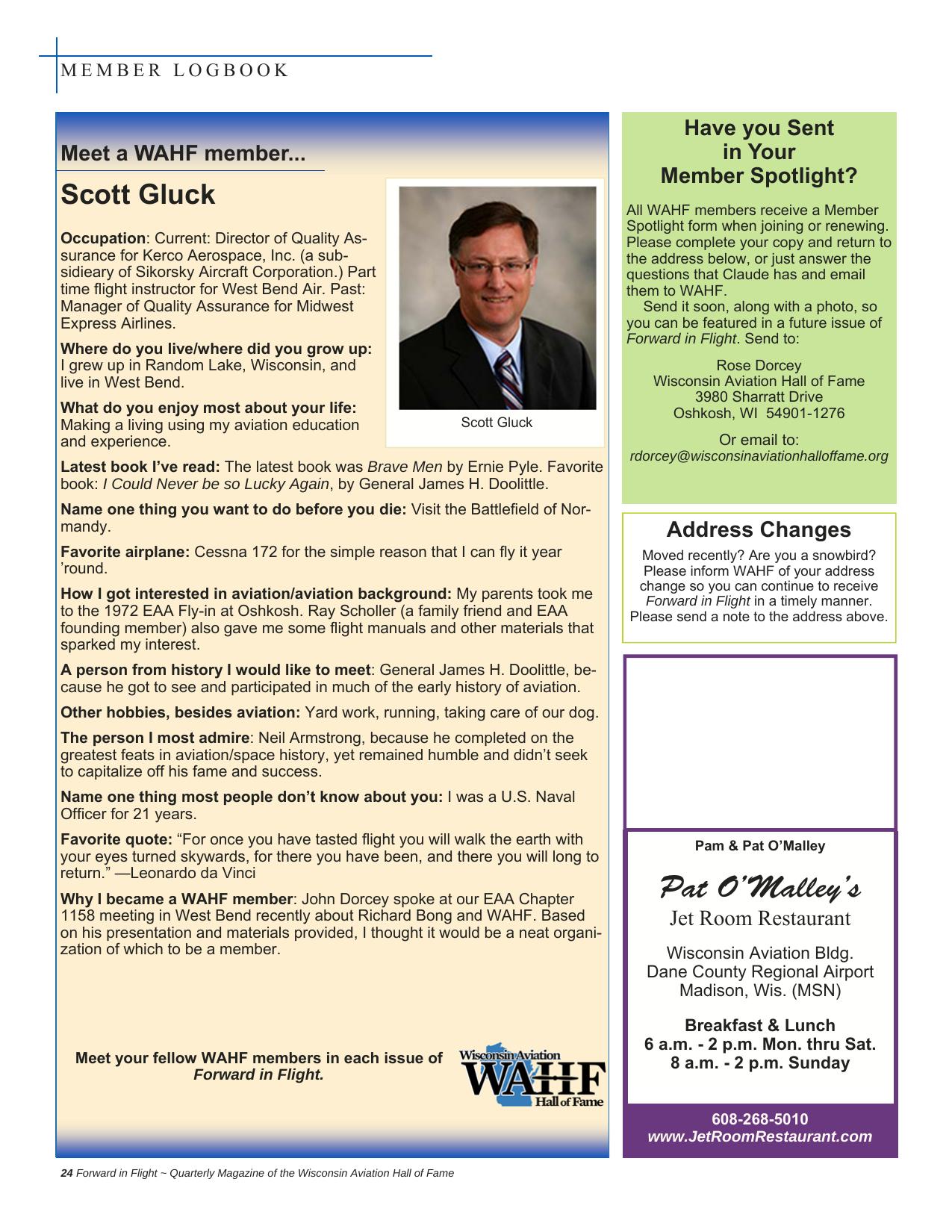
MEMBER LOGBOOK Have you Sent in Your Member Spotlight? Meet a WAHF member... Scott Gluck All WAHF members receive a Member Spotlight form when joining or renewing. Please complete your copy and return to the address below, or just answer the questions that Claude has and email them to WAHF. Send it soon, along with a photo, so you can be featured in a future issue of Forward in Flight. Send to: Occupation: Current: Director of Quality Assurance for Kerco Aerospace, Inc. (a subsidieary of Sikorsky Aircraft Corporation.) Part time flight instructor for West Bend Air. Past: Manager of Quality Assurance for Midwest Express Airlines. Where do you live/where did you grow up: I grew up in Random Lake, Wisconsin, and live in West Bend. What do you enjoy most about your life: Making a living using my aviation education and experience. Scott Gluck Latest book I’ve read: The latest book was Brave Men by Ernie Pyle. Favorite book: I Could Never be so Lucky Again, by General James H. Doolittle. Name one thing you want to do before you die: Visit the Battlefield of Normandy. Favorite airplane: Cessna 172 for the simple reason that I can fly it year ’round. How I got interested in aviation/aviation background: My parents took me to the 1972 EAA Fly-in at Oshkosh. Ray Scholler (a family friend and EAA founding member) also gave me some flight manuals and other materials that sparked my interest. Rose Dorcey Wisconsin Aviation Hall of Fame 3980 Sharratt Drive Oshkosh, WI 54901-1276 Or email to: rdorcey@wisconsinaviationhalloffame.org Address Changes Moved recently? Are you a snowbird? Please inform WAHF of your address change so you can continue to receive Forward in Flight in a timely manner. Please send a note to the address above. A person from history I would like to meet: General James H. Doolittle, because he got to see and participated in much of the early history of aviation. Other hobbies, besides aviation: Yard work, running, taking care of our dog. The person I most admire: Neil Armstrong, because he completed on the greatest feats in aviation/space history, yet remained humble and didn’t seek to capitalize off his fame and success. Name one thing most people don’t know about you: I was a U.S. Naval Officer for 21 years. Favorite quote: “For once you have tasted flight you will walk the earth with your eyes turned skywards, for there you have been, and there you will long to return.” —Leonardo da Vinci Why I became a WAHF member: John Dorcey spoke at our EAA Chapter 1158 meeting in West Bend recently about Richard Bong and WAHF. Based on his presentation and materials provided, I thought it would be a neat organization of which to be a member. Meet your fellow WAHF members in each issue of Forward in Flight. Pam & Pat O’Malley Pat O’Malley’s Jet Room Restaurant Wisconsin Aviation Bldg. Dane County Regional Airport Madison, Wis. (MSN) Breakfast & Lunch 6 a.m. - 2 p.m. Mon. thru Sat. 8 a.m. - 2 p.m. Sunday 608-268-5010 www.JetRoomRestaurant.com 24 Forward in Flight ~ Quarterly Magazine of the Wisconsin Aviation Hall of Fame

Wittman Regional Airport Oshkosh So much history ...and still making it! From the legacy of Steve Wittman to Warren Basler’s DC-3 conversions, we’re proud to support and contribute to Wisconsin aviation history. FLY TO OSHKOSH wittmanairport.com @wittmanairport

PRSRT STD US Postage Paid Wisc Rapids WI Permit 98 3980 SHARRATT DRIVE OSHKOSH WI 54901-1276 The Wisconsin Aviation Hall of Fame is a non-profit membership organization dedicated to preserving the past and fostering the future of flight. Welcome WAHF Member/Supporters Robert Bruley Scott Gluck Dan Spencer Linda Valentine Bob Mertz Dean Zakos Roger Small —Thanks for coming on board. We hope to see you at a WAHF event soon! AVIATION EVENTS: May 11 – 13, Wisconsin Aviation Conference - Radisson Hotel, La Crosse. 60th annual conference, hosted by the Wisconsin Airport Management Association, Wisconsin Aviation Trades Association, Wisconsin Business Aviation Association, and numerous consultants and vendors. Numerous networking opportunities and diverse topics, such as pilot retention and growth, airport revenues and relationships, etc. Visit www.WIAMA.org for more information. May 16, 2015—Beloit/Janesville EAA Chapter 60 Breakfast, Beloit Airport (44C), 7 a.m. 11 a.m. All you can eat pancakes and sausage. Adults $6, Kids (5-11) $4. Flea market and car show. Contact Phil Owens at powens1937@gmail.com for more information. May 17, 2015—Community Breakfast Day, Brodhead Airport (C37), 7 a.m. - Noon. Brodhead, Wisconsin. All you can eat pancakes, two sausages, scrambled eggs and beverage choice. Adults $6, children under 10, $4. Indoor and outdoor seating. Contact Pat Weeden for more information at 608-897-1175 or email: webmaster@eaa431.org. June 21, 2015 Wings & Wheels Rain or Shine - 8 a.m. to 3 p.m. Sheboygan County Memorial Airport (SBM) - Sheboygan Falls, Wisconsin. Sponsored by Sheboygan EAA Chapter 766, the Aviation Heritage Center hosts more than 70 vintage automobiles and 30 unique aircraft every year on Father’s Day. Here’s your chance to get a close-up look at oneof-a-kind cars and airplanes. Meet pilots and car owners while enjoying food and beverages sold by local vendors. No admission charge. Wisconsin Aviation Hall of Fame Officers Rose Dorcey, President Tom Thomas, Vice-President John Dorcey, Secretary/Treasurer Board of Directors Elaine Kauh Henry Peterson Brendan Stormo Charles Swain Wynne Williams Ron Wojnar Charles Marotske, Honorary Chairman of the Board Wisconsin Aviation Hall of Fame 3980 Sharratt Drive Oshkosh, WI 54901-1276 Become a supporter today! For information call Rose Dorcey at 920-385-1483 www.wisconsinaviationhalloffame.org rdorcey@wisconsinaviationhalloffame.org