Volume 14, Issue 1
🗞️ Download Issue (PDF)
Forward in Flight - Spring 2016
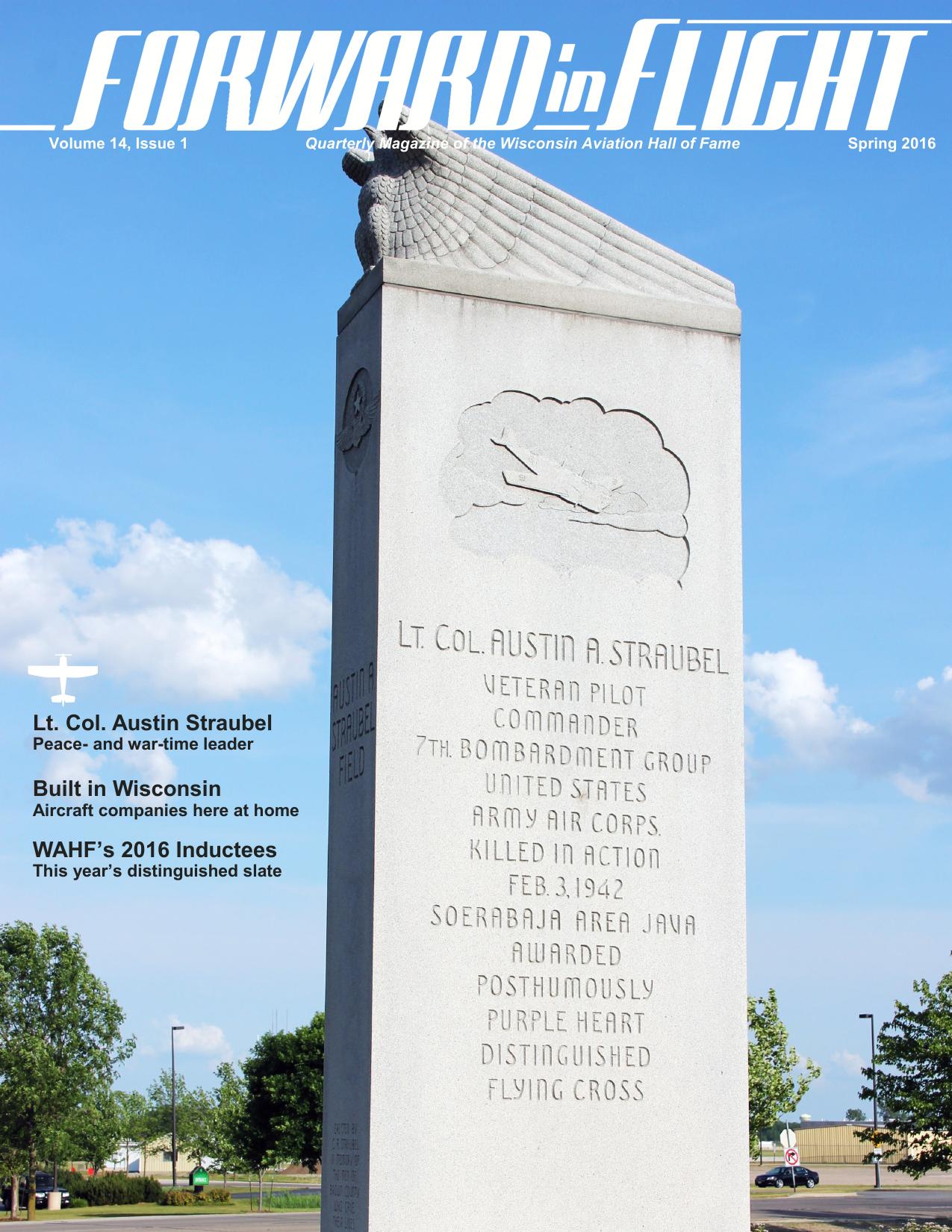
Volume 14, Issue 1 Lt. Col. Austin Straubel Peace- and war-time leader Built in Wisconsin Aircraft companies here at home WAHF’s 2016 Inductees This year’s distinguished slate Quarterly Magazine of the Wisconsin Aviation Hall of Fame Spring 2016
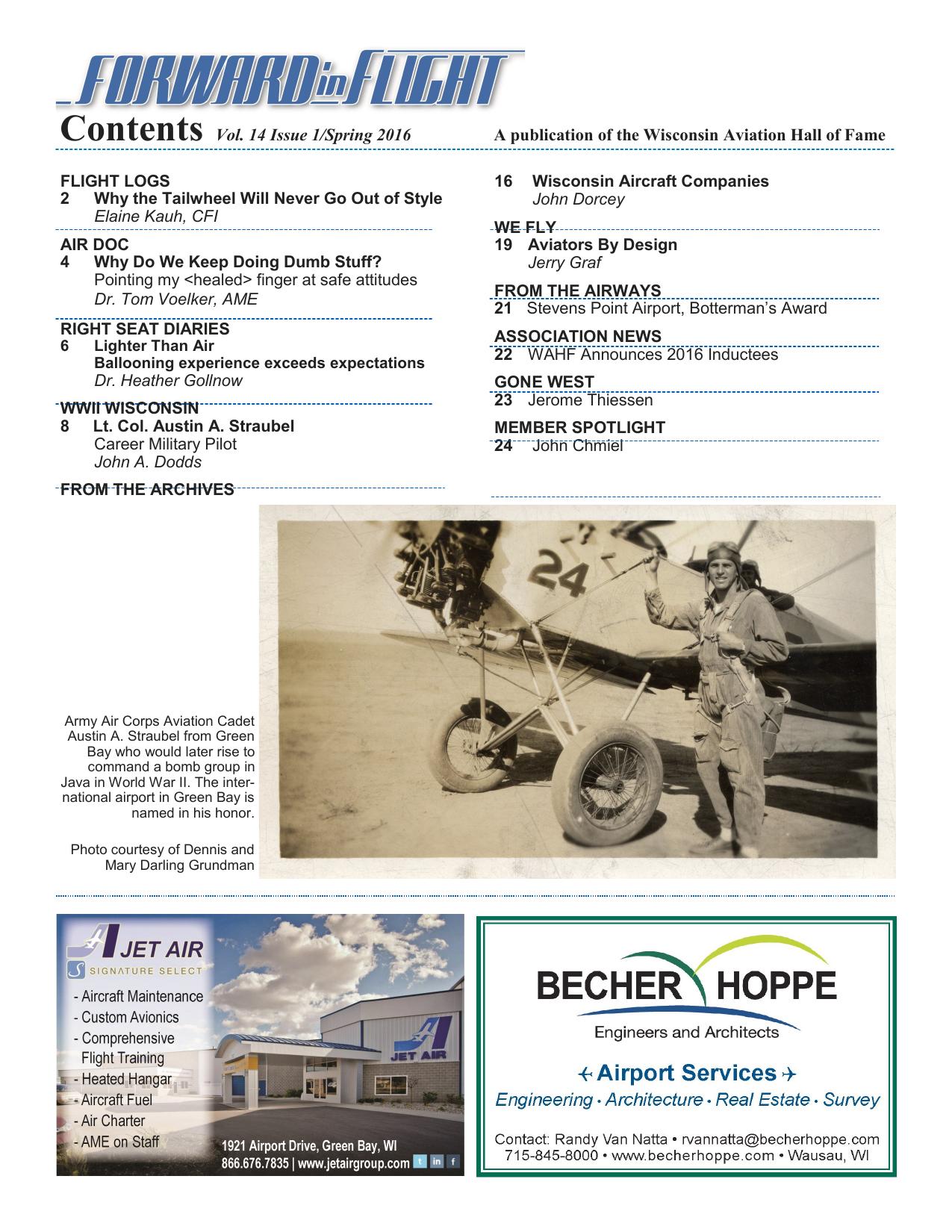
Contents Vol. 14 Issue 1/Spring 2016 FLIGHT LOGS 2 Why the Tailwheel Will Never Go Out of Style Elaine Kauh, CFI AIR DOC 4 Why Do We Keep Doing Dumb Stuff? Pointing my <healed> finger at safe attitudes Dr. Tom Voelker, AME RIGHT SEAT DIARIES 6 Lighter Than Air Ballooning experience exceeds expectations Dr. Heather Gollnow WWII WISCONSIN 8 Lt. Col. Austin A. Straubel Career Military Pilot John A. Dodds FROM THE ARCHIVES Army Air Corps Aviation Cadet Austin A. Straubel from Green Bay who would later rise to command a bomb group in Java in World War II. The international airport in Green Bay is named in his honor. Photo courtesy of Dennis and Mary Darling Grundman A publication of the Wisconsin Aviation Hall of Fame 16 Wisconsin Aircraft Companies John Dorcey WE FLY 19 Aviators By Design Jerry Graf FROM THE AIRWAYS 21 Stevens Point Airport, Botterman’s Award ASSOCIATION NEWS 22 WAHF Announces 2016 Inductees GONE WEST 23 Jerome Thiessen MEMBER SPOTLIGHT 24 John Chmiel
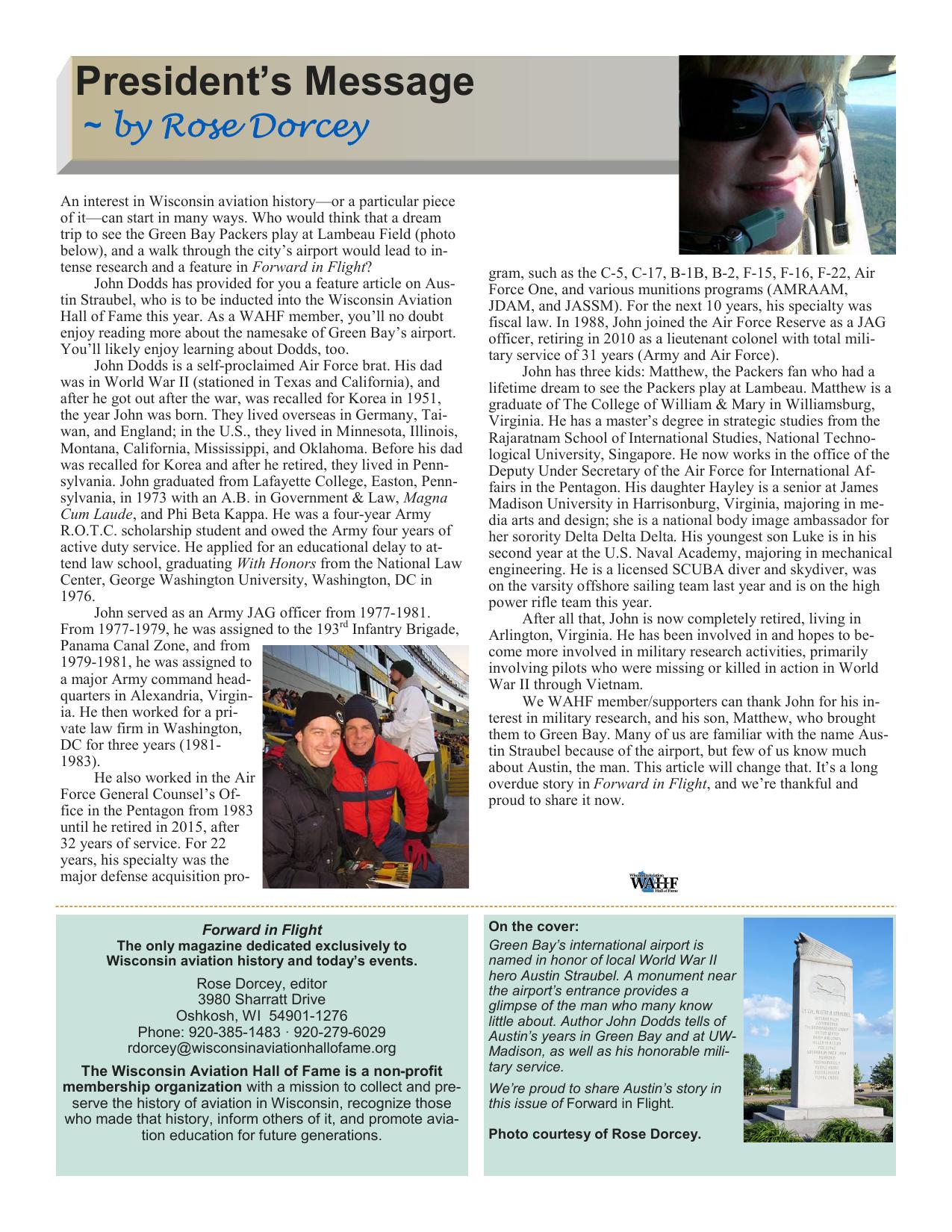
President’s Message ~ by Rose Dorcey An interest in Wisconsin aviation history—or a particular piece of it—can start in many ways. Who would think that a dream trip to see the Green Bay Packers play at Lambeau Field (photo below), and a walk through the city’s airport would lead to intense research and a feature in Forward in Flight? John Dodds has provided for you a feature article on Austin Straubel, who is to be inducted into the Wisconsin Aviation Hall of Fame this year. As a WAHF member, you’ll no doubt enjoy reading more about the namesake of Green Bay’s airport. You’ll likely enjoy learning about Dodds, too. John Dodds is a self-proclaimed Air Force brat. His dad was in World War II (stationed in Texas and California), and after he got out after the war, was recalled for Korea in 1951, the year John was born. They lived overseas in Germany, Taiwan, and England; in the U.S., they lived in Minnesota, Illinois, Montana, California, Mississippi, and Oklahoma. Before his dad was recalled for Korea and after he retired, they lived in Pennsylvania. John graduated from Lafayette College, Easton, Pennsylvania, in 1973 with an A.B. in Government & Law, Magna Cum Laude, and Phi Beta Kappa. He was a four-year Army R.O.T.C. scholarship student and owed the Army four years of active duty service. He applied for an educational delay to attend law school, graduating With Honors from the National Law Center, George Washington University, Washington, DC in 1976. John served as an Army JAG officer from 1977-1981. From 1977-1979, he was assigned to the 193rd Infantry Brigade, Panama Canal Zone, and from 1979-1981, he was assigned to a major Army command headquarters in Alexandria, Virginia. He then worked for a private law firm in Washington, DC for three years (19811983). He also worked in the Air Force General Counsel’s Office in the Pentagon from 1983 until he retired in 2015, after 32 years of service. For 22 years, his specialty was the major defense acquisition proForward in Flight The only magazine dedicated exclusively to Wisconsin aviation history and today’s events. Rose Dorcey, editor 3980 Sharratt Drive Oshkosh, WI 54901-1276 Phone: 920-385-1483 920-279-6029 rdorcey@wisconsinaviationhallofame.org The Wisconsin Aviation Hall of Fame is a non-profit membership organization with a mission to collect and preserve the history of aviation in Wisconsin, recognize those who made that history, inform others of it, and promote aviation education for future generations. gram, such as the C-5, C-17, B-1B, B-2, F-15, F-16, F-22, Air Force One, and various munitions programs (AMRAAM, JDAM, and JASSM). For the next 10 years, his specialty was fiscal law. In 1988, John joined the Air Force Reserve as a JAG officer, retiring in 2010 as a lieutenant colonel with total military service of 31 years (Army and Air Force). John has three kids: Matthew, the Packers fan who had a lifetime dream to see the Packers play at Lambeau. Matthew is a graduate of The College of William & Mary in Williamsburg, Virginia. He has a master’s degree in strategic studies from the Rajaratnam School of International Studies, National Technological University, Singapore. He now works in the office of the Deputy Under Secretary of the Air Force for International Affairs in the Pentagon. His daughter Hayley is a senior at James Madison University in Harrisonburg, Virginia, majoring in media arts and design; she is a national body image ambassador for her sorority Delta Delta Delta. His youngest son Luke is in his second year at the U.S. Naval Academy, majoring in mechanical engineering. He is a licensed SCUBA diver and skydiver, was on the varsity offshore sailing team last year and is on the high power rifle team this year. After all that, John is now completely retired, living in Arlington, Virginia. He has been involved in and hopes to become more involved in military research activities, primarily involving pilots who were missing or killed in action in World War II through Vietnam. We WAHF member/supporters can thank John for his interest in military research, and his son, Matthew, who brought them to Green Bay. Many of us are familiar with the name Austin Straubel because of the airport, but few of us know much about Austin, the man. This article will change that. It’s a long overdue story in Forward in Flight, and we’re thankful and proud to share it now. On the cover: Green Bay’s international airport is named in honor of local World War II hero Austin Straubel. A monument near the airport’s entrance provides a glimpse of the man who many know little about. Author John Dodds tells of Austin’s years in Green Bay and at UWMadison, as well as his honorable military service. We’re proud to share Austin’s story in this issue of Forward in Flight. Photo courtesy of Rose Dorcey.
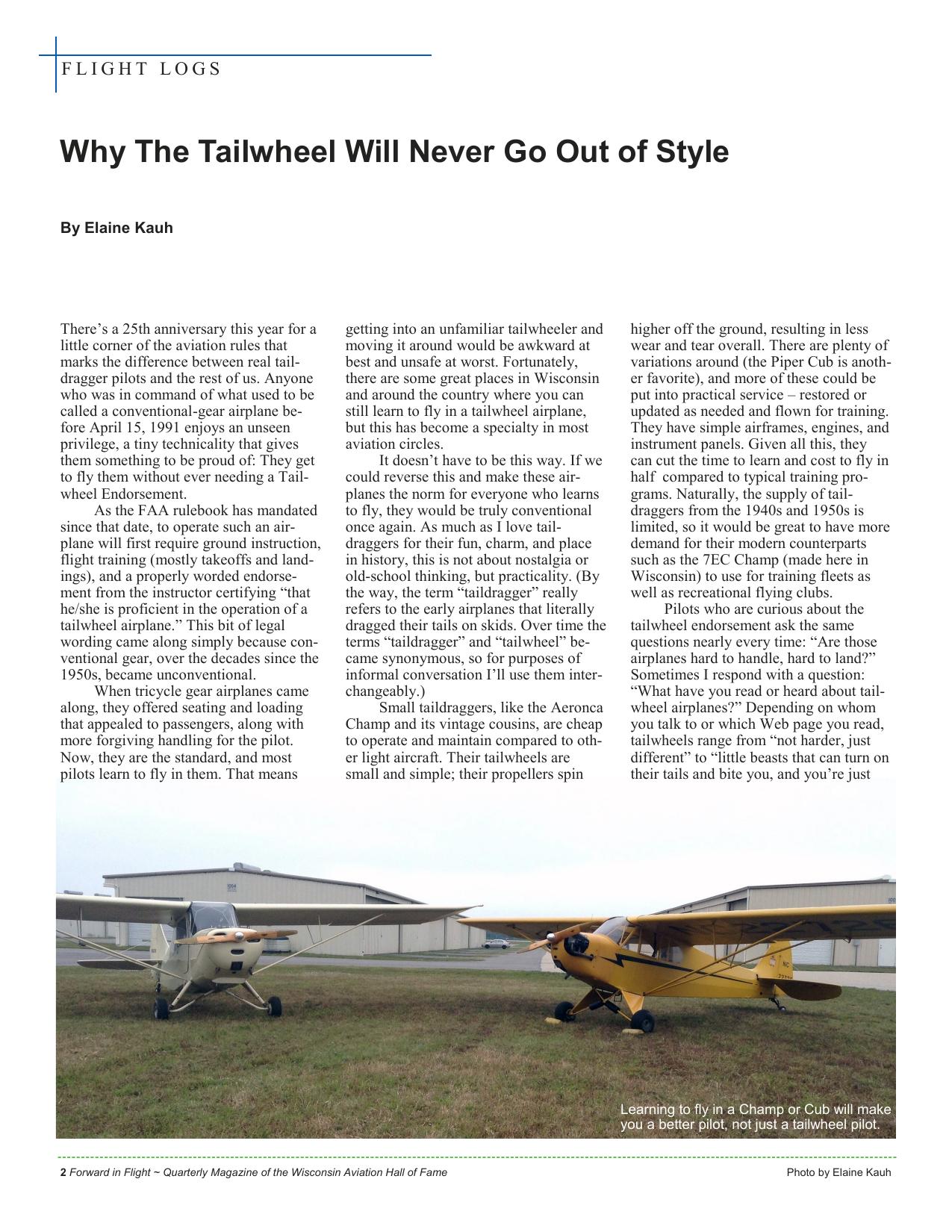
FLIGHT LOGS Why The Tailwheel Will Never Go Out of Style By Elaine Kauh There’s a 25th anniversary this year for a little corner of the aviation rules that marks the difference between real taildragger pilots and the rest of us. Anyone who was in command of what used to be called a conventional-gear airplane before April 15, 1991 enjoys an unseen privilege, a tiny technicality that gives them something to be proud of: They get to fly them without ever needing a Tailwheel Endorsement. As the FAA rulebook has mandated since that date, to operate such an airplane will first require ground instruction, flight training (mostly takeoffs and landings), and a properly worded endorsement from the instructor certifying “that he/she is proficient in the operation of a tailwheel airplane.” This bit of legal wording came along simply because conventional gear, over the decades since the 1950s, became unconventional. When tricycle gear airplanes came along, they offered seating and loading that appealed to passengers, along with more forgiving handling for the pilot. Now, they are the standard, and most pilots learn to fly in them. That means getting into an unfamiliar tailwheeler and moving it around would be awkward at best and unsafe at worst. Fortunately, there are some great places in Wisconsin and around the country where you can still learn to fly in a tailwheel airplane, but this has become a specialty in most aviation circles. It doesn’t have to be this way. If we could reverse this and make these airplanes the norm for everyone who learns to fly, they would be truly conventional once again. As much as I love taildraggers for their fun, charm, and place in history, this is not about nostalgia or old-school thinking, but practicality. (By the way, the term “taildragger” really refers to the early airplanes that literally dragged their tails on skids. Over time the terms “taildragger” and “tailwheel” became synonymous, so for purposes of informal conversation I’ll use them interchangeably.) Small taildraggers, like the Aeronca Champ and its vintage cousins, are cheap to operate and maintain compared to other light aircraft. Their tailwheels are small and simple; their propellers spin higher off the ground, resulting in less wear and tear overall. There are plenty of variations around (the Piper Cub is another favorite), and more of these could be put into practical service – restored or updated as needed and flown for training. They have simple airframes, engines, and instrument panels. Given all this, they can cut the time to learn and cost to fly in half compared to typical training programs. Naturally, the supply of taildraggers from the 1940s and 1950s is limited, so it would be great to have more demand for their modern counterparts such as the 7EC Champ (made here in Wisconsin) to use for training fleets as well as recreational flying clubs. Pilots who are curious about the tailwheel endorsement ask the same questions nearly every time: “Are those airplanes hard to handle, hard to land?” Sometimes I respond with a question: “What have you read or heard about tailwheel airplanes?” Depending on whom you talk to or which Web page you read, tailwheels range from “not harder, just different” to “little beasts that can turn on their tails and bite you, and you’re just Learning to fly in a Champ or Cub will make you a better pilot, not just a tailwheel pilot. 2 Forward in Flight ~ Quarterly Magazine of the Wisconsin Aviation Hall of Fame Photo by Elaine Kauh
FLIGHT LOGS along for the ride.” In the end I say this: It can be all of that, but it’s no different from all the things you had to learn to be a pilot. Certain topics were harder than others to master, especially those with which you had no previous experience. Learning how to manage the wind’s behavior as you maneuver the airplane isn’t hard to do, but it requires a certain understanding. And the wind will bite you if you’re not doing things right. Learning how to manage a small engine while taxiing and flying isn’t hard, but there’s a lot to understand, from preventive maintenance to troubleshooting. Not knowing what to do – and when to do it – can bite you in a hurry. For tailwheels, what can bite you is the ground loop. Most of the study materials for tailwheel training review the ground loop for what it is – simple physics in action. A taildragger’s center of gravity is behind the two main wheels, making it a bit unstable; the airplane is prone to becoming a swiveling weathervane if you’re not accurately controlling it with the rudder and stick. As with any loss of control on the ground or in flight, prevention is the key. Once a ground loop begins due to sloppy or weak control on your part, inertia can overpower your efforts to correct it, and then it’s too late. A minor ground loop can be a good lesson; you swing a quarter -circle on the ground and you scare yourself. At worst, a big one has enough momentum to tip you over on a wing. The main problem is that you don’t know how far it will go once it starts, so stay in control. Flying tailwheels does require extra care on the ground to avoid mishaps, but I’d argue that this should not be a concern for any pilot who has the right mindset to piloting. This and proper training means you’ll be that pilot who has learned to be on top of things. I’d also argue that you’ll be a safer pilot overall in the end, because you will have developed a healthy respect for weather, aerodynamics, and limits – yours and the airplane’s. All in all, this is far more important than any endorsement. I’m often asked by prospective pi- lots around here if it’s better to learn in a tailwheel. I never hesitate to say: “Yes! It’s better in a lot of ways.” It can be much less expensive overall as previously noted, and it can be a way to pack a lot more skill-building in the same amount of time spent in the airplane. Here’s why. First, you will learn stick-andrudder skills to a higher level. While learning to flying in a nosewheel will teach you the same skills, not everyone will be equally exposed to the importance of paying full attention to the wind and flight controls. This is why it can be more difficult for a current pilot to transition into taildraggers than for those who learn with them from the start. In the air, while the difference is not so great compared to Grass runways are plentiful and long, paved runways are even more so – imagine all the things you can do with 5,000 feet of concrete. nosewheels, you’ll have the mindset of always, always being rudder-ready. This results in more precision when maneuvering in the air. And because using the rudder well requires good coordination with the stick, your overall skills will be quite good. Second, you’ll be a more versatile pilot. Not only will you be able to fly both tailwheel and nosewheel airplanes, you’ll fly both well. In fact, you can learn to fly in a tailwheel and later on, if you want to fly a nosewheel model, you’ll find it an easy transition, all things being equal. Or, if you decide to learn to fly a different tailwheel airplane, you’ll find that the transfer of basic skills will make the change easier compared to a pilot who is new to tailwheel flying. And third, you will have more fun, which also enhances learning and reten- tion. Your experience flying a taildragger will be more intense and more in the moment. Tailwheel airplanes require the pilot to have an active flying mindset, even before leaving the ground. Starting up the engine and getting ready to go is a lively experience that never gets stale. As a bonus, you’ll enjoy that extra bit of ramp appeal that comes with piloting a taildragger. Most of these airplanes are simple in shape and construction, yet they have a certain sophisticated look that turns heads even when just sitting there. As I once told a future tailwheel pilot, “I feel like a million bucks just taxiing this around.” I’m glad to be flying and instructing in this region, where the landscapes and seasons allow us to fully appreciate what taildraggers have to offer. Grass runways are plentiful and long, paved runways are even more so – imagine all the things you can do with 5,000 feet of concrete. You can turn your taildragger into a skiplane in the winter, a seaplane in the summer, and still have plenty of places to land. What’s more, it’s easy to navigate around the state flying low and slow. Around here, it doesn’t seem to be so much a specialty as a way of life. Elaine Kauh is a flight instructor and aviation writer who enjoys flying taildraggers around eastern Wisconsin. Email Elaine at: ekauh@wisconsinaviationhalloffame.org 3 Forward in Flight ~ Spring 2016
AIR DOC Why do we keep doing dumb stuff? Pointing my <healed> finger at safe attitudes Dr. Tom Voelker, AME Voelkerta@yahoo.com Hello again, airmen. I’ve missed you! As some of you learned when you picked up your Winter 2015 issue of Forward in Flight, I was out of commission for a while. It was nothing all that serious in the long run, but it could have been disastrous. I’ll explain shortly. For now, suffice it to say that I’m absolutely thrilled to be able to type this edition’s column. I’ll never understand why people, especially pilots, do “dumb stuff.” I know a pilot who flew his Bonanza A-36 back to central Wisconsin from Washington DC. He was so proud that he flew nonstop – and still had seven gallons of fuel when he landed. That’s less than 30 minutes, well under even the VFR reserve (even though this pilot was flying under IFR rules)! Proud indeed. I’m not sure his wife would have been “proud” of his flying skills if he had experienced a few more knots of headwind on the flight home. Another pilot, this one in a Cessna 182 on a long crosscountry trip to EAA in Oshkosh a few years ago, ran out of fuel upon landing. He stopped traffic flow at the busiest airport in the world as his plane was towed off the runway. In the AirVenture paper the next day he was extolling the virtues of his exemplary fuel calculations. And the scenario that we all have heard about is near and dear to my flying heart. A Google search of the tail number of my Comanche 250 will lead you to a photo of that plane on the runway, with the pilot looking in disbelief, wondering how he landed “gear-up.” (No, that wasn’t me. It was a previous owner. I don’t do “dumb stuff,” do I?) Finally, I have one more. This phenomenon doesn’t always involve aircraft. There was a guy I know, also a pilot, who was using a log splitter. You probably know what is coming. His dad always preached safety around power tools, and he took that advice to heart. Except this time. A brief instant of carelessness lead to a pinch in the left index finger. Upon removing the glove he found that he had nearly completely amputated his fingertip right through the bone! Fortunately I have a pilot friend who is also an excellent orthopedic surgeon, and after 12 short weeks I’m all put back together and almost as good as new! Could it be that I am the “dumbest” of all? At least you now know why I was not able to type last edition’s column! So why did all of these events (and near-misses, and many like them) occur? I certainly didn’t make a decision to cut corners while using the log splitter. My pilot acquaintance with the Bonanza wasn’t out to set a record. The Cessna pilot certainly hadn’t decided that safety wasn’t really that important after all. The previous owner of my Comanche didn’t have an overwhelming desire to talk to his insurance agent. But something caused all of them (I mean all of us) to lower our collective guard. What is that something? I believe that almost all pilots are taught with a strong emphasis on safety. We put that attitude into practice in our early flying experiences. Yet some of us lose that safety-first orienta4 Forward in Flight ~ Quarterly Magazine of the Wisconsin Aviation Hall of Fame tion. The reason this can happen, in my opinion, is twofold: complacency and lack of focus. We get complacent when we have the same experiences time after time. If we always take the same flight, often only in safe fair weather conditions (as most of us did when we first got our ticket), we begin to expect the same outcome. In a way we are a victim of our own success. We have learned that nothing bad happens when we fly, so we always expect a safe outcome. When we get complacent we tend to cut corners. Perhaps the checklist is less important, as there has never been a substantial problem found while going through the list. Perhaps dipping the fuel tanks is not necessary, as the flight is a short one anyway. Perhaps that cold medicine is okay to take just this once. After all, it’s not making me all that drowsy, is it? When we get complacent it is easy to lose focus. A safety first attitude is essential for a long and happy flying career. This is so ingrained into our flight training that we all start with safety at the forefront of our flight operations. As our careers or flying experiences continue, we need to consciously put our safety attitudes out in front. “Can I make it all the way to central Wisconsin without refueling?” becomes “Where is the point that I will need to commit to a safety fuel stop if I don’t have at least two hours of fuel in my tanks at that time?”All of our flying questions and decisions need to be addressed or asked “with our safety caps on.” There is one other method to overcome complacency. Get out of your comfort zone! If your good-weather flights to the same $100 hamburger destination always start and end the same, mix it up! Fly to another location. Gradually work to increase your comfort with different flight conditions. Get an instructor to go with you when the weather is marginal (by your standards) yet safe by the CFI’s standards. And to really perk up When we get complacent it is easy to lose focus. A safety first attitude is essential for a long and happy flying career. your safety factor as a VFR only pilot, get that CFII and spend some time in the clouds! If your plane is IFR certified, your instructor can file IFR and you can get the experience. You’ve likely heard me say before that I think all private pilots should get some experience flying in the clouds. Certification Update I should also devote some of this column to the aeromedical de-
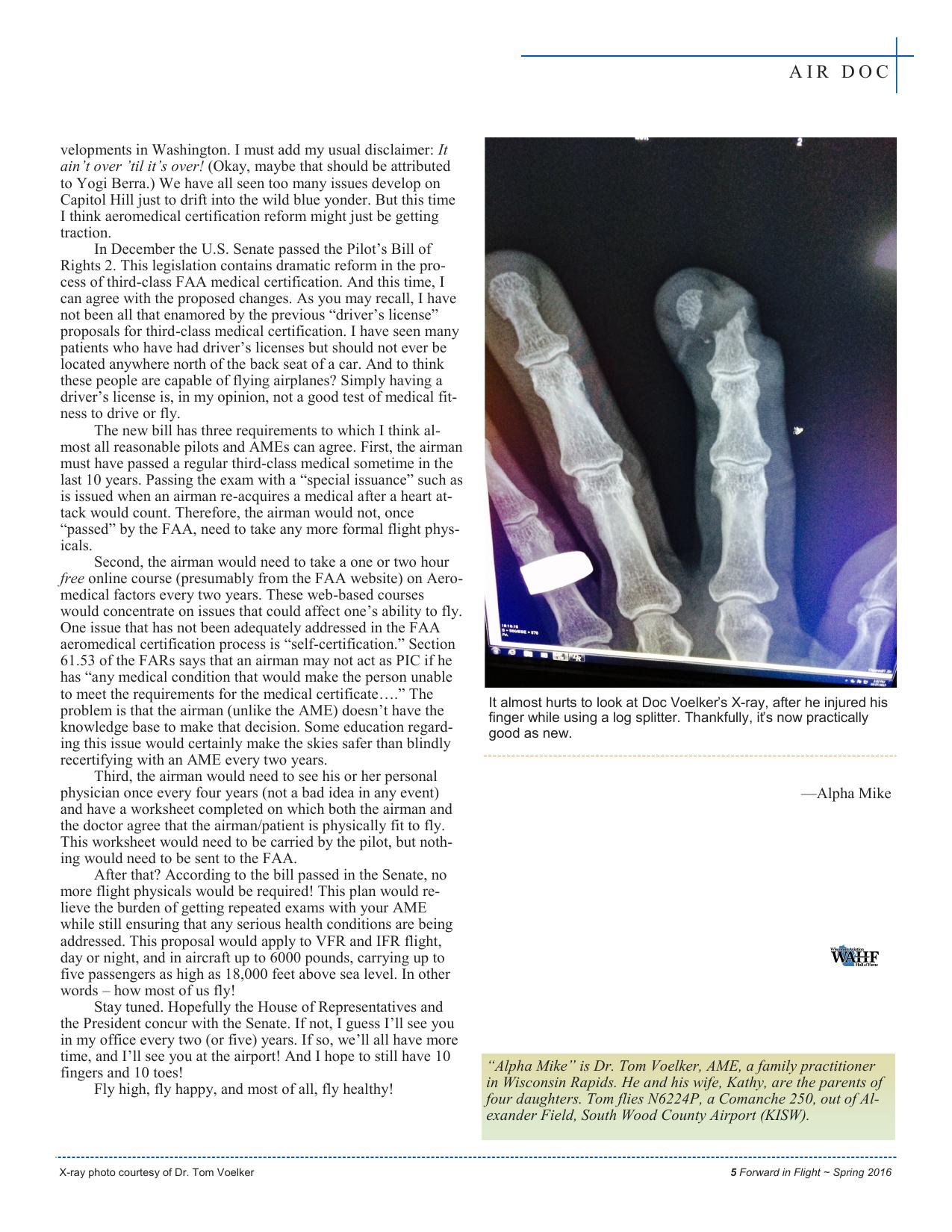
AIR DOC velopments in Washington. I must add my usual disclaimer: It ain’t over ’til it’s over! (Okay, maybe that should be attributed to Yogi Berra.) We have all seen too many issues develop on Capitol Hill just to drift into the wild blue yonder. But this time I think aeromedical certification reform might just be getting traction. In December the U.S. Senate passed the Pilot’s Bill of Rights 2. This legislation contains dramatic reform in the process of third-class FAA medical certification. And this time, I can agree with the proposed changes. As you may recall, I have not been all that enamored by the previous “driver’s license” proposals for third-class medical certification. I have seen many patients who have had driver’s licenses but should not ever be located anywhere north of the back seat of a car. And to think these people are capable of flying airplanes? Simply having a driver’s license is, in my opinion, not a good test of medical fitness to drive or fly. The new bill has three requirements to which I think almost all reasonable pilots and AMEs can agree. First, the airman must have passed a regular third-class medical sometime in the last 10 years. Passing the exam with a “special issuance” such as is issued when an airman re-acquires a medical after a heart attack would count. Therefore, the airman would not, once “passed” by the FAA, need to take any more formal flight physicals. Second, the airman would need to take a one or two hour free online course (presumably from the FAA website) on Aeromedical factors every two years. These web-based courses would concentrate on issues that could affect one’s ability to fly. One issue that has not been adequately addressed in the FAA aeromedical certification process is “self-certification.” Section 61.53 of the FARs says that an airman may not act as PIC if he has “any medical condition that would make the person unable to meet the requirements for the medical certificate….” The problem is that the airman (unlike the AME) doesn’t have the knowledge base to make that decision. Some education regarding this issue would certainly make the skies safer than blindly recertifying with an AME every two years. Third, the airman would need to see his or her personal physician once every four years (not a bad idea in any event) and have a worksheet completed on which both the airman and the doctor agree that the airman/patient is physically fit to fly. This worksheet would need to be carried by the pilot, but nothing would need to be sent to the FAA. After that? According to the bill passed in the Senate, no more flight physicals would be required! This plan would relieve the burden of getting repeated exams with your AME while still ensuring that any serious health conditions are being addressed. This proposal would apply to VFR and IFR flight, day or night, and in aircraft up to 6000 pounds, carrying up to five passengers as high as 18,000 feet above sea level. In other words – how most of us fly! Stay tuned. Hopefully the House of Representatives and the President concur with the Senate. If not, I guess I’ll see you in my office every two (or five) years. If so, we’ll all have more time, and I’ll see you at the airport! And I hope to still have 10 fingers and 10 toes! Fly high, fly happy, and most of all, fly healthy! X-ray photo courtesy of Dr. Tom Voelker It almost hurts to look at Doc Voelker’s X-ray, after he injured his finger while using a log splitter. Thankfully, it’s now practically good as new. —Alpha Mike “Alpha Mike” is Dr. Tom Voelker, AME, a family practitioner in Wisconsin Rapids. He and his wife, Kathy, are the parents of four daughters. Tom flies N6224P, a Comanche 250, out of Alexander Field, South Wood County Airport (KISW). 5 Forward in Flight ~ Spring 2016
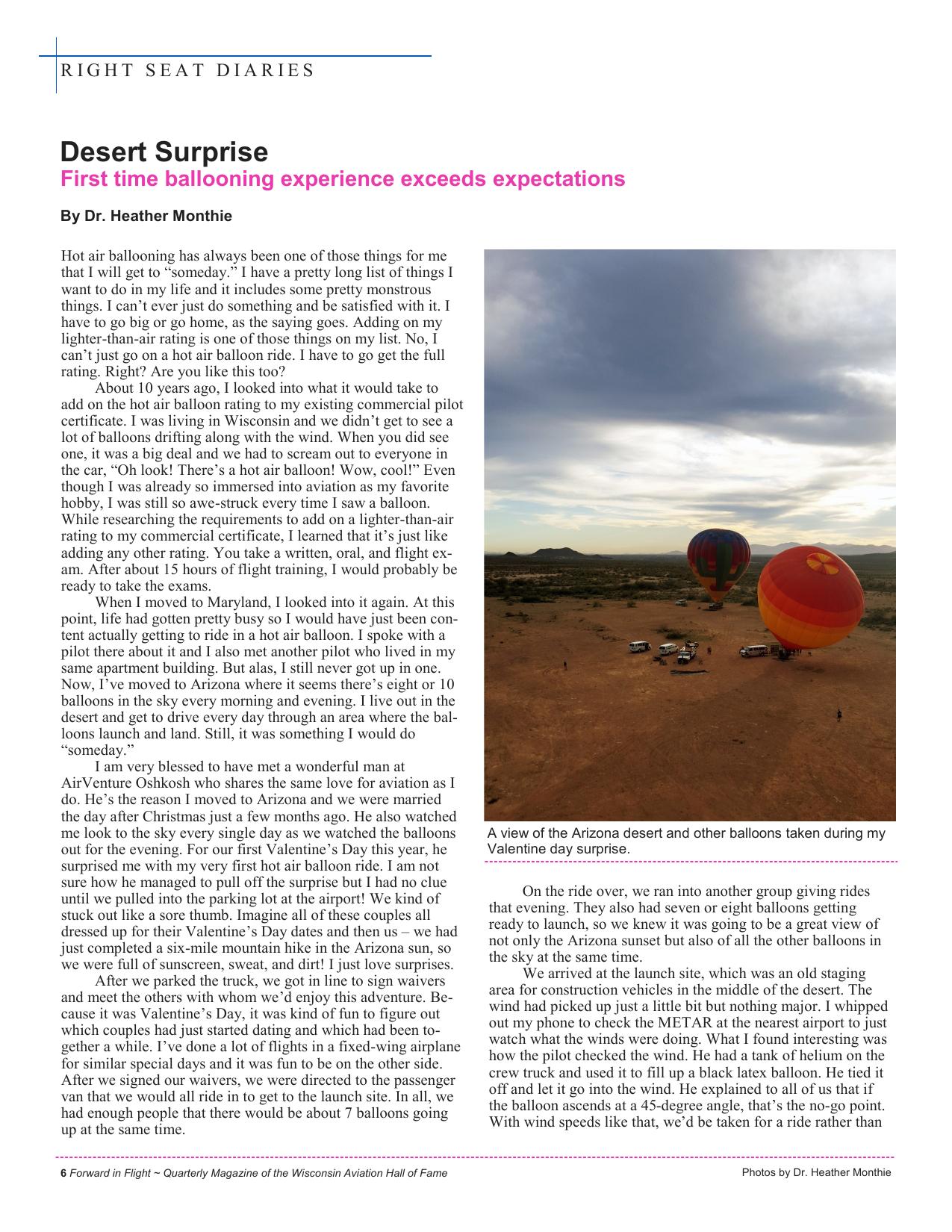
RIGHT SEAT DIARIES Desert Surprise First time ballooning experience exceeds expectations By Dr. Heather Monthie Hot air ballooning has always been one of those things for me that I will get to “someday.” I have a pretty long list of things I want to do in my life and it includes some pretty monstrous things. I can’t ever just do something and be satisfied with it. I have to go big or go home, as the saying goes. Adding on my lighter-than-air rating is one of those things on my list. No, I can’t just go on a hot air balloon ride. I have to go get the full rating. Right? Are you like this too? About 10 years ago, I looked into what it would take to add on the hot air balloon rating to my existing commercial pilot certificate. I was living in Wisconsin and we didn’t get to see a lot of balloons drifting along with the wind. When you did see one, it was a big deal and we had to scream out to everyone in the car, “Oh look! There’s a hot air balloon! Wow, cool!” Even though I was already so immersed into aviation as my favorite hobby, I was still so awe-struck every time I saw a balloon. While researching the requirements to add on a lighter-than-air rating to my commercial certificate, I learned that it’s just like adding any other rating. You take a written, oral, and flight exam. After about 15 hours of flight training, I would probably be ready to take the exams. When I moved to Maryland, I looked into it again. At this point, life had gotten pretty busy so I would have just been content actually getting to ride in a hot air balloon. I spoke with a pilot there about it and I also met another pilot who lived in my same apartment building. But alas, I still never got up in one. Now, I’ve moved to Arizona where it seems there’s eight or 10 balloons in the sky every morning and evening. I live out in the desert and get to drive every day through an area where the balloons launch and land. Still, it was something I would do “someday.” I am very blessed to have met a wonderful man at AirVenture Oshkosh who shares the same love for aviation as I do. He’s the reason I moved to Arizona and we were married the day after Christmas just a few months ago. He also watched me look to the sky every single day as we watched the balloons out for the evening. For our first Valentine’s Day this year, he surprised me with my very first hot air balloon ride. I am not sure how he managed to pull off the surprise but I had no clue until we pulled into the parking lot at the airport! We kind of stuck out like a sore thumb. Imagine all of these couples all dressed up for their Valentine’s Day dates and then us – we had just completed a six-mile mountain hike in the Arizona sun, so we were full of sunscreen, sweat, and dirt! I just love surprises. After we parked the truck, we got in line to sign waivers and meet the others with whom we’d enjoy this adventure. Because it was Valentine’s Day, it was kind of fun to figure out which couples had just started dating and which had been together a while. I’ve done a lot of flights in a fixed-wing airplane for similar special days and it was fun to be on the other side. After we signed our waivers, we were directed to the passenger van that we would all ride in to get to the launch site. In all, we had enough people that there would be about 7 balloons going up at the same time. 6 Forward in Flight ~ Quarterly Magazine of the Wisconsin Aviation Hall of Fame A view of the Arizona desert and other balloons taken during my Valentine day surprise. On the ride over, we ran into another group giving rides that evening. They also had seven or eight balloons getting ready to launch, so we knew it was going to be a great view of not only the Arizona sunset but also of all the other balloons in the sky at the same time. We arrived at the launch site, which was an old staging area for construction vehicles in the middle of the desert. The wind had picked up just a little bit but nothing major. I whipped out my phone to check the METAR at the nearest airport to just watch what the winds were doing. What I found interesting was how the pilot checked the wind. He had a tank of helium on the crew truck and used it to fill up a black latex balloon. He tied it off and let it go into the wind. He explained to all of us that if the balloon ascends at a 45-degree angle, that’s the no-go point. With wind speeds like that, we’d be taken for a ride rather than Photos by Dr. Heather Monthie
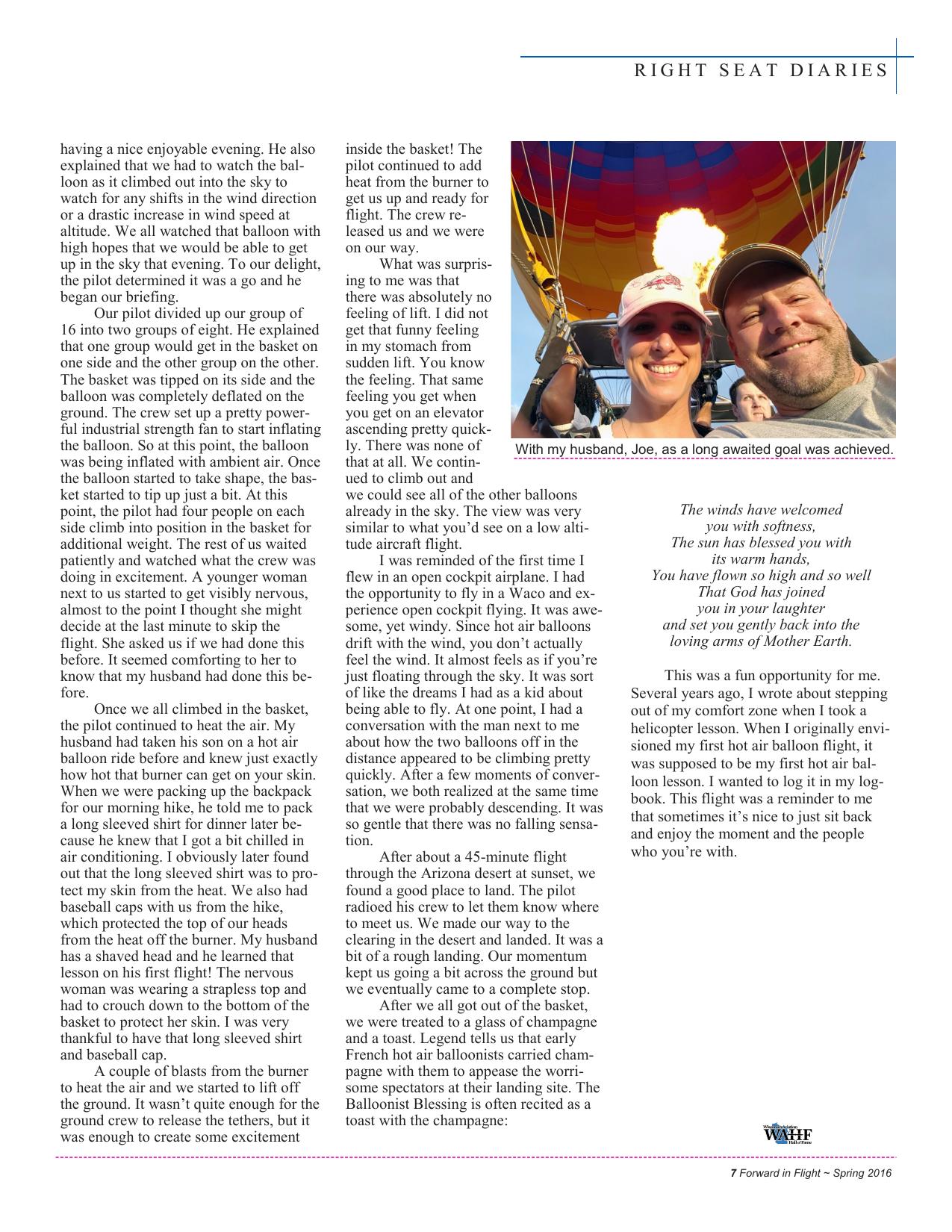
RIGHT SEAT DIARIES having a nice enjoyable evening. He also explained that we had to watch the balloon as it climbed out into the sky to watch for any shifts in the wind direction or a drastic increase in wind speed at altitude. We all watched that balloon with high hopes that we would be able to get up in the sky that evening. To our delight, the pilot determined it was a go and he began our briefing. Our pilot divided up our group of 16 into two groups of eight. He explained that one group would get in the basket on one side and the other group on the other. The basket was tipped on its side and the balloon was completely deflated on the ground. The crew set up a pretty powerful industrial strength fan to start inflating the balloon. So at this point, the balloon was being inflated with ambient air. Once the balloon started to take shape, the basket started to tip up just a bit. At this point, the pilot had four people on each side climb into position in the basket for additional weight. The rest of us waited patiently and watched what the crew was doing in excitement. A younger woman next to us started to get visibly nervous, almost to the point I thought she might decide at the last minute to skip the flight. She asked us if we had done this before. It seemed comforting to her to know that my husband had done this before. Once we all climbed in the basket, the pilot continued to heat the air. My husband had taken his son on a hot air balloon ride before and knew just exactly how hot that burner can get on your skin. When we were packing up the backpack for our morning hike, he told me to pack a long sleeved shirt for dinner later because he knew that I got a bit chilled in air conditioning. I obviously later found out that the long sleeved shirt was to protect my skin from the heat. We also had baseball caps with us from the hike, which protected the top of our heads from the heat off the burner. My husband has a shaved head and he learned that lesson on his first flight! The nervous woman was wearing a strapless top and had to crouch down to the bottom of the basket to protect her skin. I was very thankful to have that long sleeved shirt and baseball cap. A couple of blasts from the burner to heat the air and we started to lift off the ground. It wasn’t quite enough for the ground crew to release the tethers, but it was enough to create some excitement inside the basket! The pilot continued to add heat from the burner to get us up and ready for flight. The crew released us and we were on our way. What was surprising to me was that there was absolutely no feeling of lift. I did not get that funny feeling in my stomach from sudden lift. You know the feeling. That same feeling you get when you get on an elevator ascending pretty quickly. There was none of With my husband, Joe, as a long awaited goal was achieved. that at all. We continued to climb out and we could see all of the other balloons The winds have welcomed already in the sky. The view was very you with softness, similar to what you’d see on a low altiThe sun has blessed you with tude aircraft flight. its warm hands, I was reminded of the first time I You have flown so high and so well flew in an open cockpit airplane. I had That God has joined the opportunity to fly in a Waco and exyou in your laughter perience open cockpit flying. It was aweand set you gently back into the some, yet windy. Since hot air balloons loving arms of Mother Earth. drift with the wind, you don’t actually feel the wind. It almost feels as if you’re This was a fun opportunity for me. just floating through the sky. It was sort of like the dreams I had as a kid about Several years ago, I wrote about stepping being able to fly. At one point, I had a out of my comfort zone when I took a conversation with the man next to me helicopter lesson. When I originally enviabout how the two balloons off in the sioned my first hot air balloon flight, it distance appeared to be climbing pretty was supposed to be my first hot air balquickly. After a few moments of converloon lesson. I wanted to log it in my logsation, we both realized at the same time book. This flight was a reminder to me that we were probably descending. It was that sometimes it’s nice to just sit back so gentle that there was no falling sensaand enjoy the moment and the people tion. who you’re with. After about a 45-minute flight through the Arizona desert at sunset, we found a good place to land. The pilot radioed his crew to let them know where to meet us. We made our way to the clearing in the desert and landed. It was a bit of a rough landing. Our momentum kept us going a bit across the ground but we eventually came to a complete stop. After we all got out of the basket, we were treated to a glass of champagne and a toast. Legend tells us that early French hot air balloonists carried champagne with them to appease the worrisome spectators at their landing site. The Balloonist Blessing is often recited as a toast with the champagne: 7 Forward in Flight ~ Spring 2016
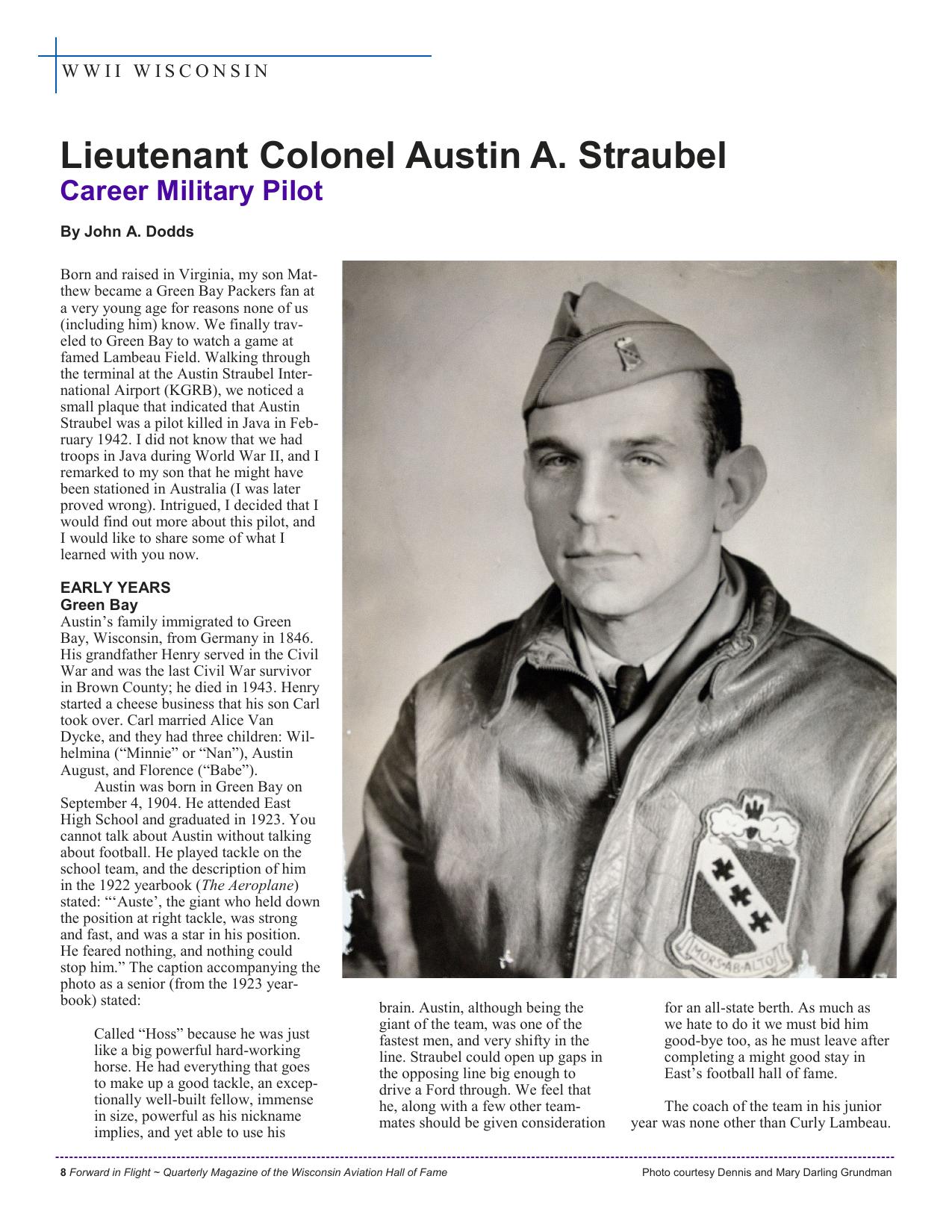
WWII WISCONSIN Lieutenant Colonel Austin A. Straubel Career Military Pilot By John A. Dodds Born and raised in Virginia, my son Matthew became a Green Bay Packers fan at a very young age for reasons none of us (including him) know. We finally traveled to Green Bay to watch a game at famed Lambeau Field. Walking through the terminal at the Austin Straubel International Airport (KGRB), we noticed a small plaque that indicated that Austin Straubel was a pilot killed in Java in February 1942. I did not know that we had troops in Java during World War II, and I remarked to my son that he might have been stationed in Australia (I was later proved wrong). Intrigued, I decided that I would find out more about this pilot, and I would like to share some of what I learned with you now. EARLY YEARS Green Bay Austin’s family immigrated to Green Bay, Wisconsin, from Germany in 1846. His grandfather Henry served in the Civil War and was the last Civil War survivor in Brown County; he died in 1943. Henry started a cheese business that his son Carl took over. Carl married Alice Van Dycke, and they had three children: Wilhelmina (“Minnie” or “Nan”), Austin August, and Florence (“Babe”). Austin was born in Green Bay on September 4, 1904. He attended East High School and graduated in 1923. You cannot talk about Austin without talking about football. He played tackle on the school team, and the description of him in the 1922 yearbook (The Aeroplane) stated: “‘Auste’, the giant who held down the position at right tackle, was strong and fast, and was a star in his position. He feared nothing, and nothing could stop him.” The caption accompanying the photo as a senior (from the 1923 yearbook) stated: Called “Hoss” because he was just like a big powerful hard-working horse. He had everything that goes to make up a good tackle, an exceptionally well-built fellow, immense in size, powerful as his nickname implies, and yet able to use his brain. Austin, although being the giant of the team, was one of the fastest men, and very shifty in the line. Straubel could open up gaps in the opposing line big enough to drive a Ford through. We feel that he, along with a few other teammates should be given consideration 8 Forward in Flight ~ Quarterly Magazine of the Wisconsin Aviation Hall of Fame for an all-state berth. As much as we hate to do it we must bid him good-bye too, as he must leave after completing a might good stay in East’s football hall of fame. The coach of the team in his junior year was none other than Curly Lambeau. Photo courtesy Dennis and Mary Darling Grundman
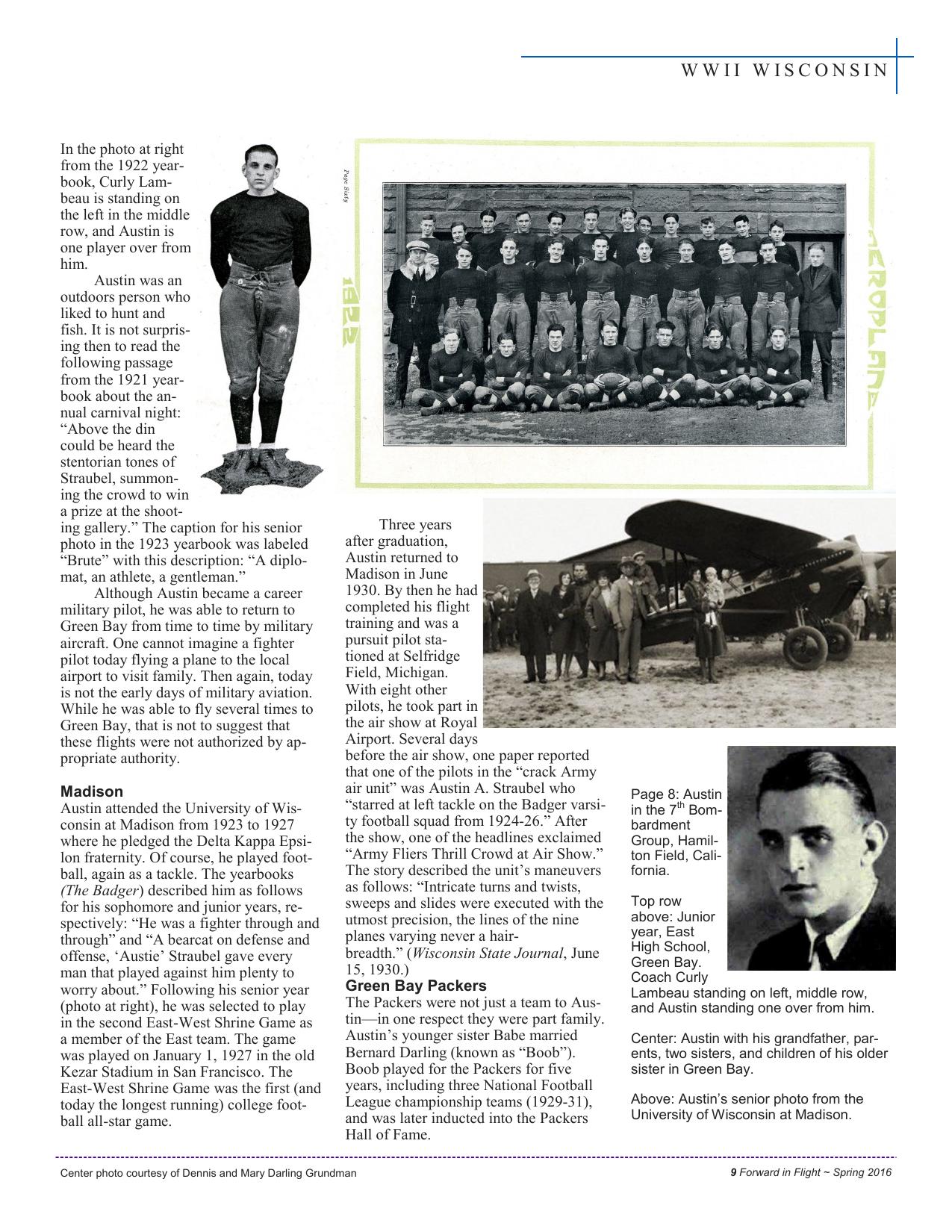
WWII WISCONSIN In the photo at right from the 1922 yearbook, Curly Lambeau is standing on the left in the middle row, and Austin is one player over from him. Austin was an outdoors person who liked to hunt and fish. It is not surprising then to read the following passage from the 1921 yearbook about the annual carnival night: “Above the din could be heard the stentorian tones of Straubel, summoning the crowd to win a prize at the shooting gallery.” The caption for his senior photo in the 1923 yearbook was labeled “Brute” with this description: “A diplomat, an athlete, a gentleman.” Although Austin became a career military pilot, he was able to return to Green Bay from time to time by military aircraft. One cannot imagine a fighter pilot today flying a plane to the local airport to visit family. Then again, today is not the early days of military aviation. While he was able to fly several times to Green Bay, that is not to suggest that these flights were not authorized by appropriate authority. Madison Austin attended the University of Wisconsin at Madison from 1923 to 1927 where he pledged the Delta Kappa Epsilon fraternity. Of course, he played football, again as a tackle. The yearbooks (The Badger) described him as follows for his sophomore and junior years, respectively: “He was a fighter through and through” and “A bearcat on defense and offense, ‘Austie’ Straubel gave every man that played against him plenty to worry about.” Following his senior year (photo at right), he was selected to play in the second East-West Shrine Game as a member of the East team. The game was played on January 1, 1927 in the old Kezar Stadium in San Francisco. The East-West Shrine Game was the first (and today the longest running) college football all-star game. Three years after graduation, Austin returned to Madison in June 1930. By then he had completed his flight training and was a pursuit pilot stationed at Selfridge Field, Michigan. With eight other pilots, he took part in the air show at Royal Airport. Several days before the air show, one paper reported that one of the pilots in the “crack Army air unit” was Austin A. Straubel who “starred at left tackle on the Badger varsity football squad from 1924-26.” After the show, one of the headlines exclaimed “Army Fliers Thrill Crowd at Air Show.” The story described the unit’s maneuvers as follows: “Intricate turns and twists, sweeps and slides were executed with the utmost precision, the lines of the nine planes varying never a hairbreadth.” (Wisconsin State Journal, June 15, 1930.) Green Bay Packers The Packers were not just a team to Austin—in one respect they were part family. Austin’s younger sister Babe married Bernard Darling (known as “Boob”). Boob played for the Packers for five years, including three National Football League championship teams (1929-31), and was later inducted into the Packers Hall of Fame. Center photo courtesy of Dennis and Mary Darling Grundman Page 8: Austin in the 7th Bombardment Group, Hamilton Field, California. Top row above: Junior year, East High School, Green Bay. Coach Curly Lambeau standing on left, middle row, and Austin standing one over from him. Center: Austin with his grandfather, parents, two sisters, and children of his older sister in Green Bay. Above: Austin’s senior photo from the University of Wisconsin at Madison. 9 Forward in Flight ~ Spring 2016
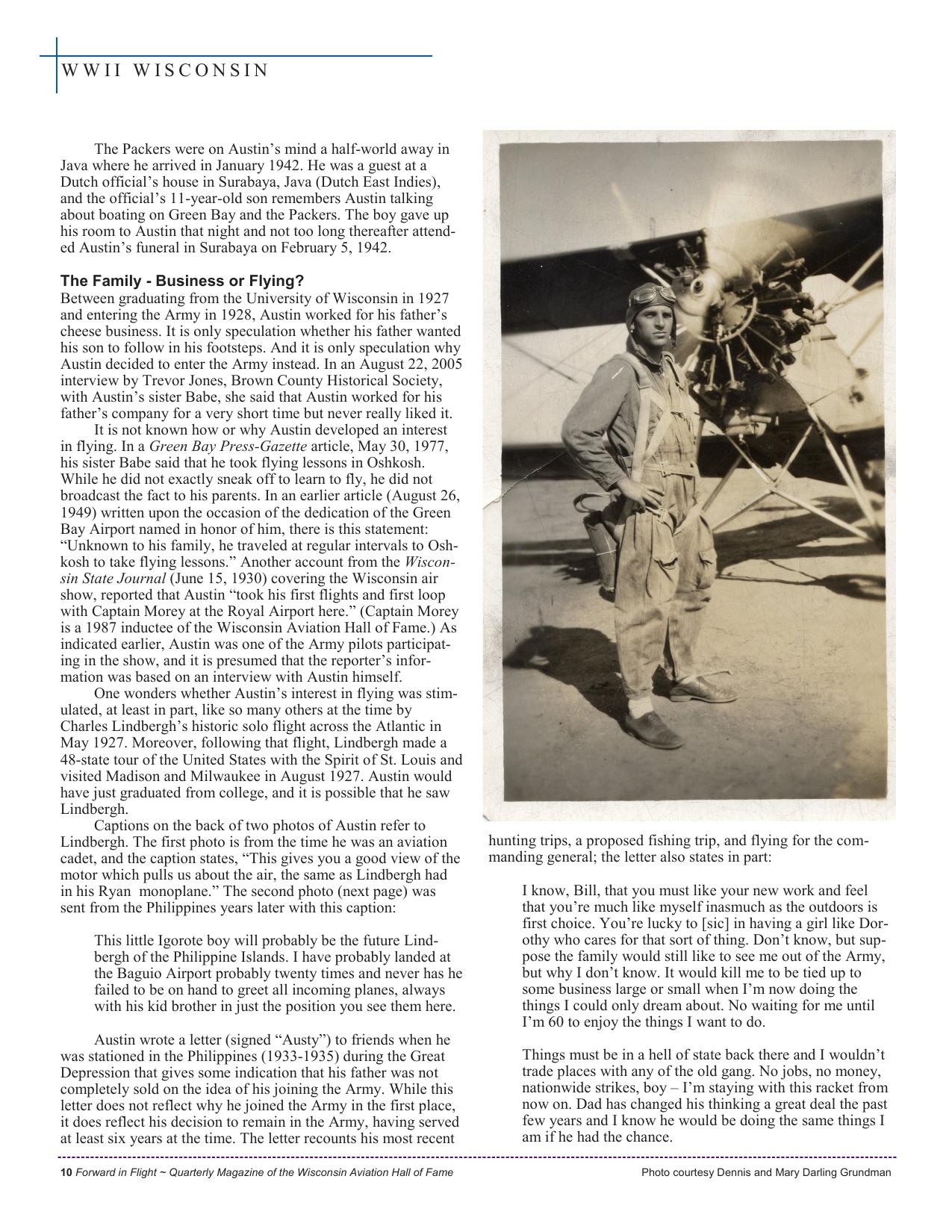
WWII WISCONSIN The Packers were on Austin’s mind a half-world away in Java where he arrived in January 1942. He was a guest at a Dutch official’s house in Surabaya, Java (Dutch East Indies), and the official’s 11-year-old son remembers Austin talking about boating on Green Bay and the Packers. The boy gave up his room to Austin that night and not too long thereafter attended Austin’s funeral in Surabaya on February 5, 1942. The Family - Business or Flying? Between graduating from the University of Wisconsin in 1927 and entering the Army in 1928, Austin worked for his father’s cheese business. It is only speculation whether his father wanted his son to follow in his footsteps. And it is only speculation why Austin decided to enter the Army instead. In an August 22, 2005 interview by Trevor Jones, Brown County Historical Society, with Austin’s sister Babe, she said that Austin worked for his father’s company for a very short time but never really liked it. It is not known how or why Austin developed an interest in flying. In a Green Bay Press-Gazette article, May 30, 1977, his sister Babe said that he took flying lessons in Oshkosh. While he did not exactly sneak off to learn to fly, he did not broadcast the fact to his parents. In an earlier article (August 26, 1949) written upon the occasion of the dedication of the Green Bay Airport named in honor of him, there is this statement: “Unknown to his family, he traveled at regular intervals to Oshkosh to take flying lessons.” Another account from the Wisconsin State Journal (June 15, 1930) covering the Wisconsin air show, reported that Austin “took his first flights and first loop with Captain Morey at the Royal Airport here.” (Captain Morey is a 1987 inductee of the Wisconsin Aviation Hall of Fame.) As indicated earlier, Austin was one of the Army pilots participating in the show, and it is presumed that the reporter’s information was based on an interview with Austin himself. One wonders whether Austin’s interest in flying was stimulated, at least in part, like so many others at the time by Charles Lindbergh’s historic solo flight across the Atlantic in May 1927. Moreover, following that flight, Lindbergh made a 48-state tour of the United States with the Spirit of St. Louis and visited Madison and Milwaukee in August 1927. Austin would have just graduated from college, and it is possible that he saw Lindbergh. Captions on the back of two photos of Austin refer to Lindbergh. The first photo is from the time he was an aviation cadet, and the caption states, “This gives you a good view of the motor which pulls us about the air, the same as Lindbergh had in his Ryan monoplane.” The second photo (next page) was sent from the Philippines years later with this caption: This little Igorote boy will probably be the future Lindbergh of the Philippine Islands. I have probably landed at the Baguio Airport probably twenty times and never has he failed to be on hand to greet all incoming planes, always with his kid brother in just the position you see them here. hunting trips, a proposed fishing trip, and flying for the commanding general; the letter also states in part: I know, Bill, that you must like your new work and feel that you’re much like myself inasmuch as the outdoors is first choice. You’re lucky to [sic] in having a girl like Dorothy who cares for that sort of thing. Don’t know, but suppose the family would still like to see me out of the Army, but why I don’t know. It would kill me to be tied up to some business large or small when I’m now doing the things I could only dream about. No waiting for me until I’m 60 to enjoy the things I want to do. Austin wrote a letter (signed “Austy”) to friends when he was stationed in the Philippines (1933-1935) during the Great Depression that gives some indication that his father was not completely sold on the idea of his joining the Army. While this letter does not reflect why he joined the Army in the first place, it does reflect his decision to remain in the Army, having served at least six years at the time. The letter recounts his most recent Things must be in a hell of state back there and I wouldn’t trade places with any of the old gang. No jobs, no money, nationwide strikes, boy – I’m staying with this racket from now on. Dad has changed his thinking a great deal the past few years and I know he would be doing the same things I am if he had the chance. 10 Forward in Flight ~ Quarterly Magazine of the Wisconsin Aviation Hall of Fame Photo courtesy Dennis and Mary Darling Grundman
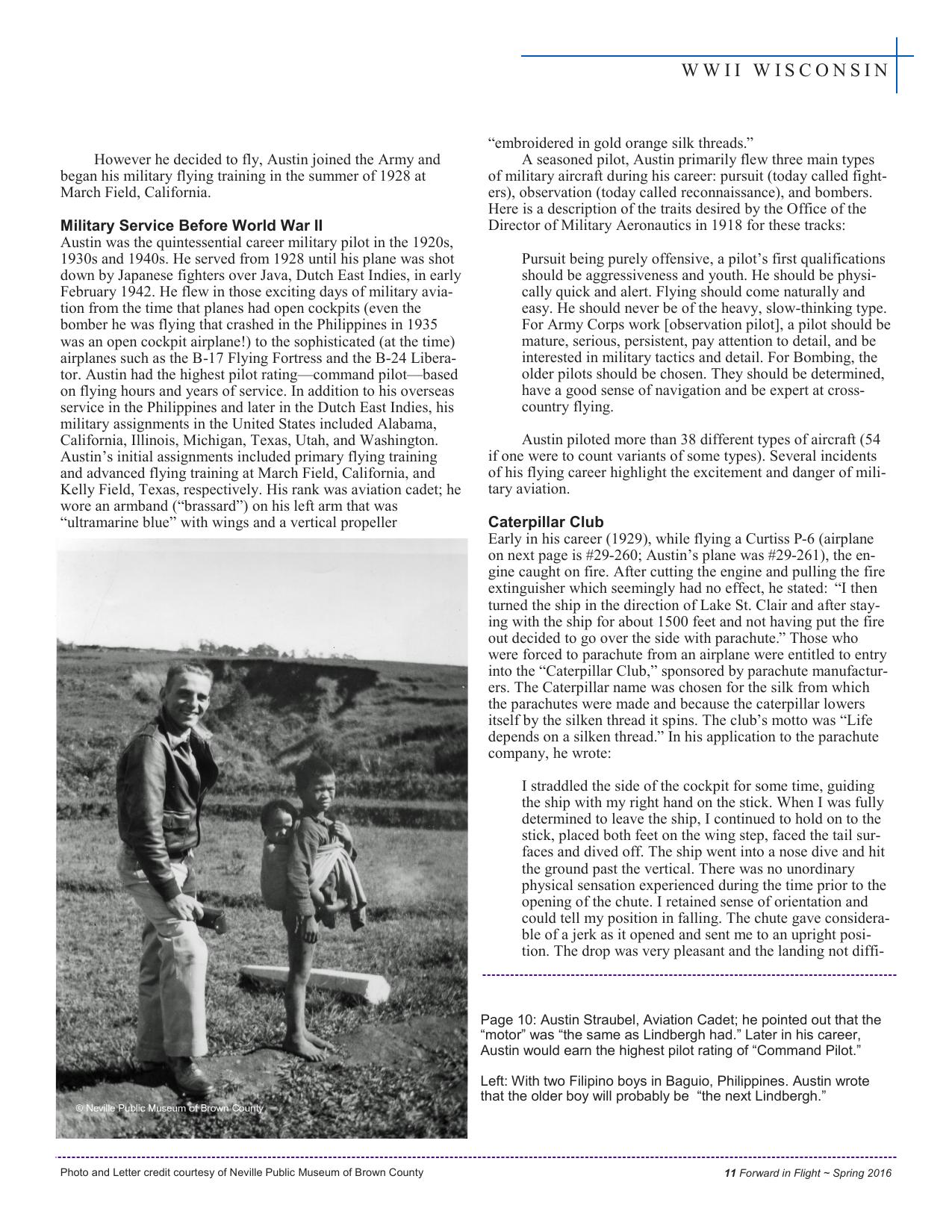
WWII WISCONSIN However he decided to fly, Austin joined the Army and began his military flying training in the summer of 1928 at March Field, California. Military Service Before World War II Austin was the quintessential career military pilot in the 1920s, 1930s and 1940s. He served from 1928 until his plane was shot down by Japanese fighters over Java, Dutch East Indies, in early February 1942. He flew in those exciting days of military aviation from the time that planes had open cockpits (even the bomber he was flying that crashed in the Philippines in 1935 was an open cockpit airplane!) to the sophisticated (at the time) airplanes such as the B-17 Flying Fortress and the B-24 Liberator. Austin had the highest pilot rating—command pilot—based on flying hours and years of service. In addition to his overseas service in the Philippines and later in the Dutch East Indies, his military assignments in the United States included Alabama, California, Illinois, Michigan, Texas, Utah, and Washington. Austin’s initial assignments included primary flying training and advanced flying training at March Field, California, and Kelly Field, Texas, respectively. His rank was aviation cadet; he wore an armband (“brassard”) on his left arm that was “ultramarine blue” with wings and a vertical propeller “embroidered in gold orange silk threads.” A seasoned pilot, Austin primarily flew three main types of military aircraft during his career: pursuit (today called fighters), observation (today called reconnaissance), and bombers. Here is a description of the traits desired by the Office of the Director of Military Aeronautics in 1918 for these tracks: Pursuit being purely offensive, a pilot’s first qualifications should be aggressiveness and youth. He should be physically quick and alert. Flying should come naturally and easy. He should never be of the heavy, slow-thinking type. For Army Corps work [observation pilot], a pilot should be mature, serious, persistent, pay attention to detail, and be interested in military tactics and detail. For Bombing, the older pilots should be chosen. They should be determined, have a good sense of navigation and be expert at crosscountry flying. Austin piloted more than 38 different types of aircraft (54 if one were to count variants of some types). Several incidents of his flying career highlight the excitement and danger of military aviation. Caterpillar Club Early in his career (1929), while flying a Curtiss P-6 (airplane on next page is #29-260; Austin’s plane was #29-261), the engine caught on fire. After cutting the engine and pulling the fire extinguisher which seemingly had no effect, he stated: “I then turned the ship in the direction of Lake St. Clair and after staying with the ship for about 1500 feet and not having put the fire out decided to go over the side with parachute.” Those who were forced to parachute from an airplane were entitled to entry into the “Caterpillar Club,” sponsored by parachute manufacturers. The Caterpillar name was chosen for the silk from which the parachutes were made and because the caterpillar lowers itself by the silken thread it spins. The club’s motto was “Life depends on a silken thread.” In his application to the parachute company, he wrote: I straddled the side of the cockpit for some time, guiding the ship with my right hand on the stick. When I was fully determined to leave the ship, I continued to hold on to the stick, placed both feet on the wing step, faced the tail surfaces and dived off. The ship went into a nose dive and hit the ground past the vertical. There was no unordinary physical sensation experienced during the time prior to the opening of the chute. I retained sense of orientation and could tell my position in falling. The chute gave considerable of a jerk as it opened and sent me to an upright position. The drop was very pleasant and the landing not diffi- Page 10: Austin Straubel, Aviation Cadet; he pointed out that the “motor” was “the same as Lindbergh had.” Later in his career, Austin would earn the highest pilot rating of “Command Pilot.” Left: With two Filipino boys in Baguio, Philippines. Austin wrote that the older boy will probably be “the next Lindbergh.” Photo and Letter credit courtesy of Neville Public Museum of Brown County 11 Forward in Flight ~ Spring 2016
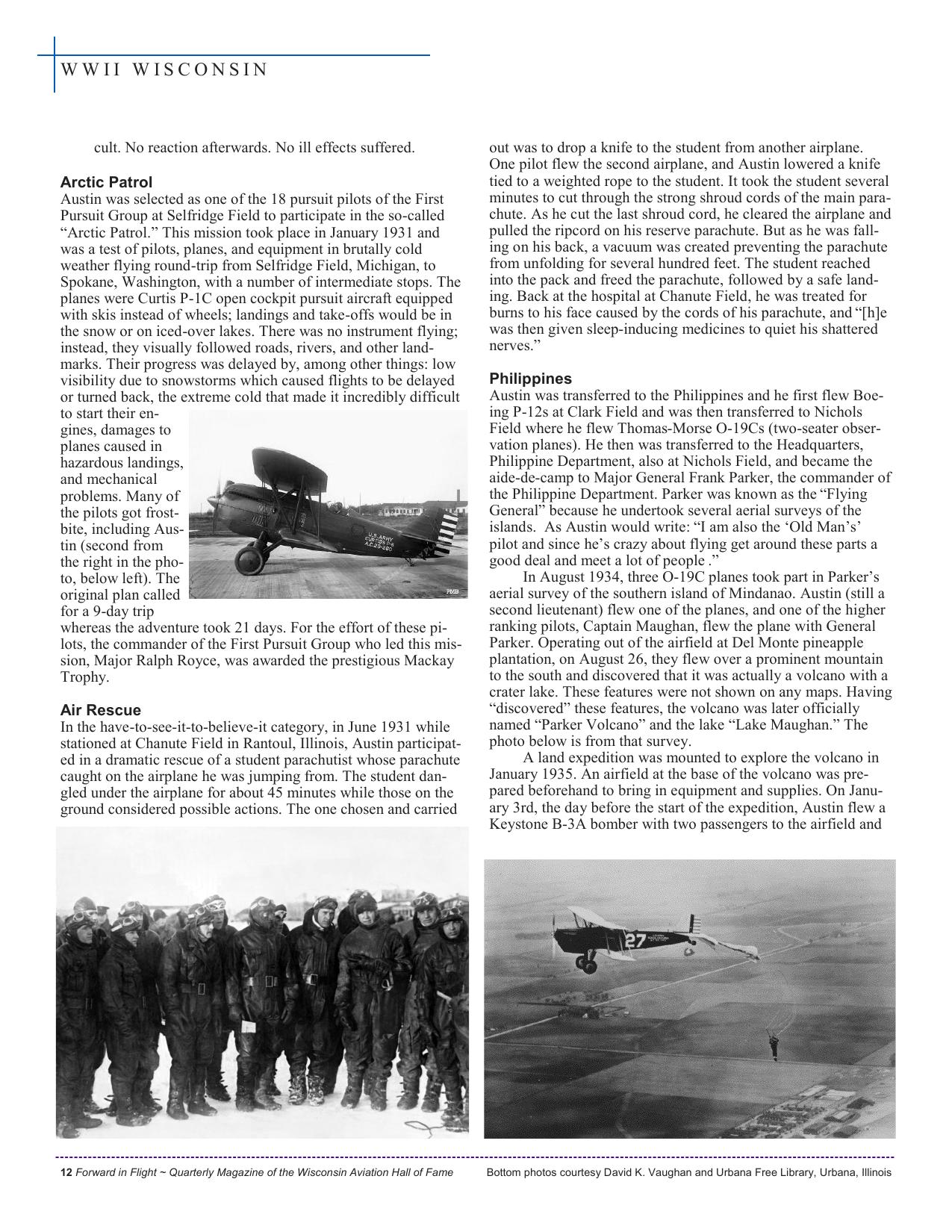
WWII WISCONSIN cult. No reaction afterwards. No ill effects suffered. Arctic Patrol Austin was selected as one of the 18 pursuit pilots of the First Pursuit Group at Selfridge Field to participate in the so-called “Arctic Patrol.” This mission took place in January 1931 and was a test of pilots, planes, and equipment in brutally cold weather flying round-trip from Selfridge Field, Michigan, to Spokane, Washington, with a number of intermediate stops. The planes were Curtis P-1C open cockpit pursuit aircraft equipped with skis instead of wheels; landings and take-offs would be in the snow or on iced-over lakes. There was no instrument flying; instead, they visually followed roads, rivers, and other landmarks. Their progress was delayed by, among other things: low visibility due to snowstorms which caused flights to be delayed or turned back, the extreme cold that made it incredibly difficult to start their engines, damages to planes caused in hazardous landings, and mechanical problems. Many of the pilots got frostbite, including Austin (second from the right in the photo, below left). The original plan called for a 9-day trip whereas the adventure took 21 days. For the effort of these pilots, the commander of the First Pursuit Group who led this mission, Major Ralph Royce, was awarded the prestigious Mackay Trophy. Air Rescue In the have-to-see-it-to-believe-it category, in June 1931 while stationed at Chanute Field in Rantoul, Illinois, Austin participated in a dramatic rescue of a student parachutist whose parachute caught on the airplane he was jumping from. The student dangled under the airplane for about 45 minutes while those on the ground considered possible actions. The one chosen and carried 12 Forward in Flight ~ Quarterly Magazine of the Wisconsin Aviation Hall of Fame out was to drop a knife to the student from another airplane. One pilot flew the second airplane, and Austin lowered a knife tied to a weighted rope to the student. It took the student several minutes to cut through the strong shroud cords of the main parachute. As he cut the last shroud cord, he cleared the airplane and pulled the ripcord on his reserve parachute. But as he was falling on his back, a vacuum was created preventing the parachute from unfolding for several hundred feet. The student reached into the pack and freed the parachute, followed by a safe landing. Back at the hospital at Chanute Field, he was treated for burns to his face caused by the cords of his parachute, and “[h]e was then given sleep-inducing medicines to quiet his shattered nerves.” Philippines Austin was transferred to the Philippines and he first flew Boeing P-12s at Clark Field and was then transferred to Nichols Field where he flew Thomas-Morse O-19Cs (two-seater observation planes). He then was transferred to the Headquarters, Philippine Department, also at Nichols Field, and became the aide-de-camp to Major General Frank Parker, the commander of the Philippine Department. Parker was known as the “Flying General” because he undertook several aerial surveys of the islands. As Austin would write: “I am also the ‘Old Man’s’ pilot and since he’s crazy about flying get around these parts a good deal and meet a lot of people .” In August 1934, three O-19C planes took part in Parker’s aerial survey of the southern island of Mindanao. Austin (still a second lieutenant) flew one of the planes, and one of the higher ranking pilots, Captain Maughan, flew the plane with General Parker. Operating out of the airfield at Del Monte pineapple plantation, on August 26, they flew over a prominent mountain to the south and discovered that it was actually a volcano with a crater lake. These features were not shown on any maps. Having “discovered” these features, the volcano was later officially named “Parker Volcano” and the lake “Lake Maughan.” The photo below is from that survey. A land expedition was mounted to explore the volcano in January 1935. An airfield at the base of the volcano was prepared beforehand to bring in equipment and supplies. On January 3rd, the day before the start of the expedition, Austin flew a Keystone B-3A bomber with two passengers to the airfield and Bottom photos courtesy David K. Vaughan and Urbana Free Library, Urbana, Illinois
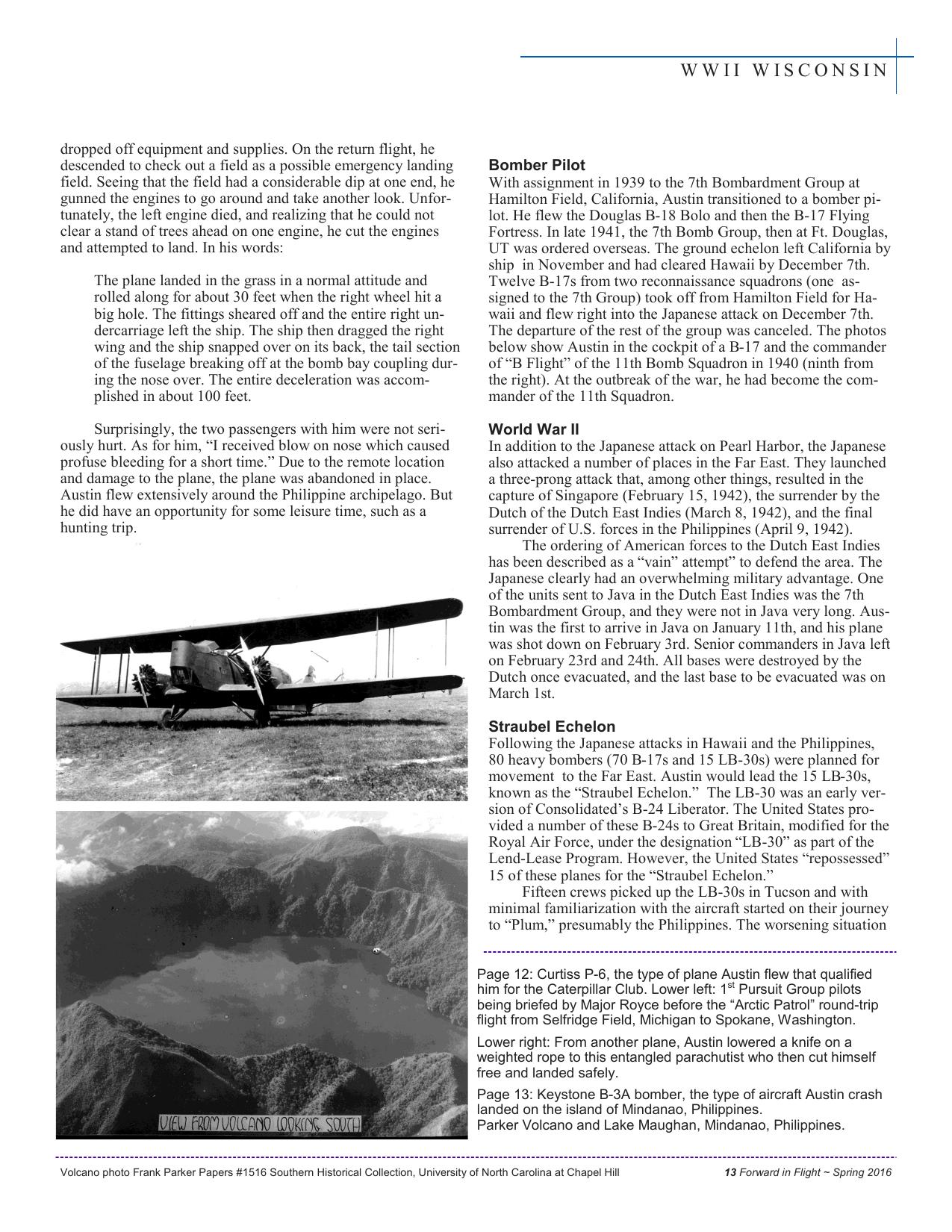
WWII WISCONSIN dropped off equipment and supplies. On the return flight, he descended to check out a field as a possible emergency landing field. Seeing that the field had a considerable dip at one end, he gunned the engines to go around and take another look. Unfortunately, the left engine died, and realizing that he could not clear a stand of trees ahead on one engine, he cut the engines and attempted to land. In his words: The plane landed in the grass in a normal attitude and rolled along for about 30 feet when the right wheel hit a big hole. The fittings sheared off and the entire right undercarriage left the ship. The ship then dragged the right wing and the ship snapped over on its back, the tail section of the fuselage breaking off at the bomb bay coupling during the nose over. The entire deceleration was accomplished in about 100 feet. Surprisingly, the two passengers with him were not seriously hurt. As for him, “I received blow on nose which caused profuse bleeding for a short time.” Due to the remote location and damage to the plane, the plane was abandoned in place. Austin flew extensively around the Philippine archipelago. But he did have an opportunity for some leisure time, such as a hunting trip. Bomber Pilot With assignment in 1939 to the 7th Bombardment Group at Hamilton Field, California, Austin transitioned to a bomber pilot. He flew the Douglas B-18 Bolo and then the B-17 Flying Fortress. In late 1941, the 7th Bomb Group, then at Ft. Douglas, UT was ordered overseas. The ground echelon left California by ship in November and had cleared Hawaii by December 7th. Twelve B-17s from two reconnaissance squadrons (one assigned to the 7th Group) took off from Hamilton Field for Hawaii and flew right into the Japanese attack on December 7th. The departure of the rest of the group was canceled. The photos below show Austin in the cockpit of a B-17 and the commander of “B Flight” of the 11th Bomb Squadron in 1940 (ninth from the right). At the outbreak of the war, he had become the commander of the 11th Squadron. World War II In addition to the Japanese attack on Pearl Harbor, the Japanese also attacked a number of places in the Far East. They launched a three-prong attack that, among other things, resulted in the capture of Singapore (February 15, 1942), the surrender by the Dutch of the Dutch East Indies (March 8, 1942), and the final surrender of U.S. forces in the Philippines (April 9, 1942). The ordering of American forces to the Dutch East Indies has been described as a “vain” attempt” to defend the area. The Japanese clearly had an overwhelming military advantage. One of the units sent to Java in the Dutch East Indies was the 7th Bombardment Group, and they were not in Java very long. Austin was the first to arrive in Java on January 11th, and his plane was shot down on February 3rd. Senior commanders in Java left on February 23rd and 24th. All bases were destroyed by the Dutch once evacuated, and the last base to be evacuated was on March 1st. Straubel Echelon Following the Japanese attacks in Hawaii and the Philippines, 80 heavy bombers (70 B-17s and 15 LB-30s) were planned for movement to the Far East. Austin would lead the 15 LB-30s, known as the “Straubel Echelon.” The LB-30 was an early version of Consolidated’s B-24 Liberator. The United States provided a number of these B-24s to Great Britain, modified for the Royal Air Force, under the designation “LB-30” as part of the Lend-Lease Program. However, the United States “repossessed” 15 of these planes for the “Straubel Echelon.” Fifteen crews picked up the LB-30s in Tucson and with minimal familiarization with the aircraft started on their journey to “Plum,” presumably the Philippines. The worsening situation Page 12: Curtiss P-6, the type of plane Austin flew that qualified him for the Caterpillar Club. Lower left: 1st Pursuit Group pilots being briefed by Major Royce before the “Arctic Patrol” round-trip flight from Selfridge Field, Michigan to Spokane, Washington. Lower right: From another plane, Austin lowered a knife on a weighted rope to this entangled parachutist who then cut himself free and landed safely. Page 13: Keystone B-3A bomber, the type of aircraft Austin crash landed on the island of Mindanao, Philippines. Parker Volcano and Lake Maughan, Mindanao, Philippines. Volcano photo Frank Parker Papers #1516 Southern Historical Collection, University of North Carolina at Chapel Hill 13 Forward in Flight ~ Spring 2016
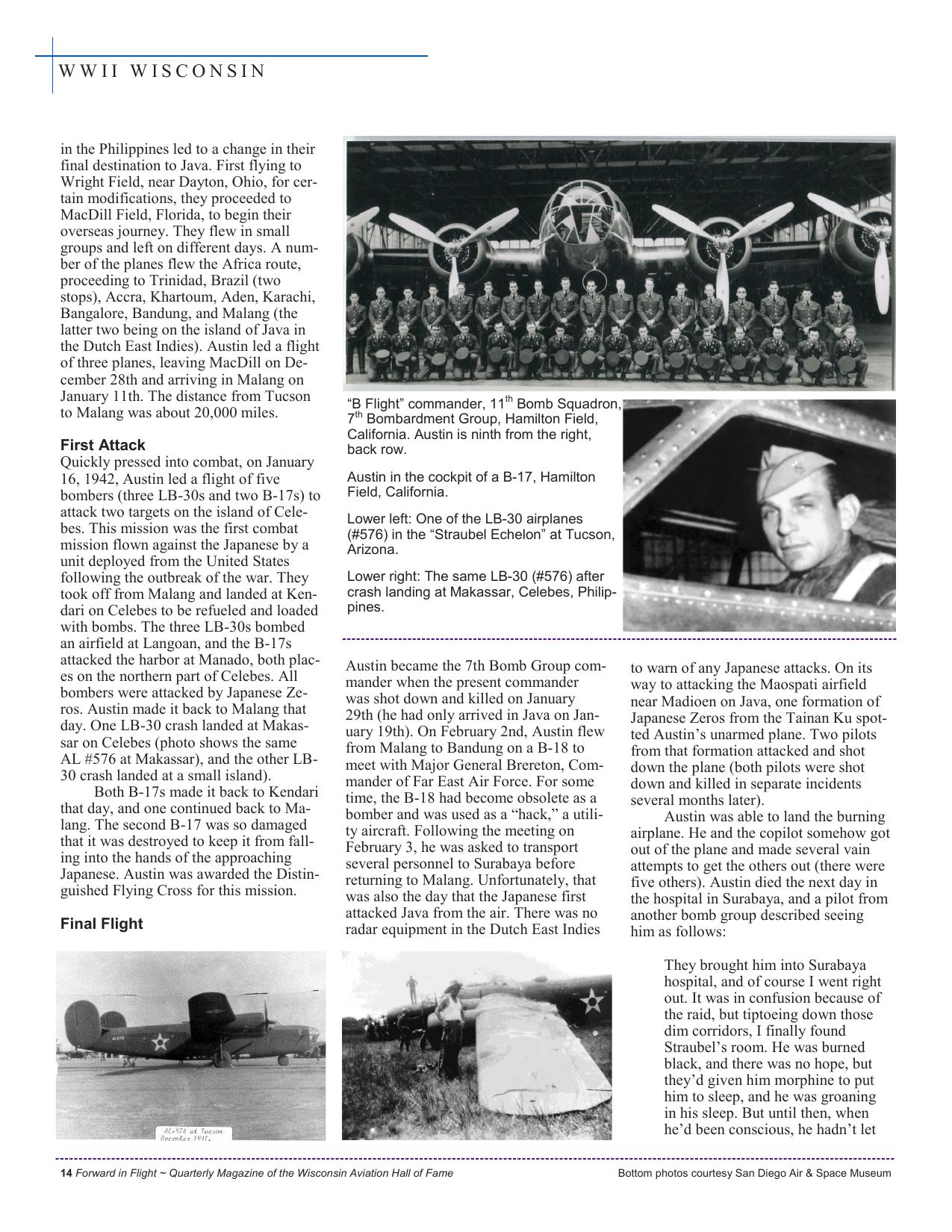
WWII WISCONSIN in the Philippines led to a change in their final destination to Java. First flying to Wright Field, near Dayton, Ohio, for certain modifications, they proceeded to MacDill Field, Florida, to begin their overseas journey. They flew in small groups and left on different days. A number of the planes flew the Africa route, proceeding to Trinidad, Brazil (two stops), Accra, Khartoum, Aden, Karachi, Bangalore, Bandung, and Malang (the latter two being on the island of Java in the Dutch East Indies). Austin led a flight of three planes, leaving MacDill on December 28th and arriving in Malang on January 11th. The distance from Tucson to Malang was about 20,000 miles. First Attack Quickly pressed into combat, on January 16, 1942, Austin led a flight of five bombers (three LB-30s and two B-17s) to attack two targets on the island of Celebes. This mission was the first combat mission flown against the Japanese by a unit deployed from the United States following the outbreak of the war. They took off from Malang and landed at Kendari on Celebes to be refueled and loaded with bombs. The three LB-30s bombed an airfield at Langoan, and the B-17s attacked the harbor at Manado, both places on the northern part of Celebes. All bombers were attacked by Japanese Zeros. Austin made it back to Malang that day. One LB-30 crash landed at Makassar on Celebes (photo shows the same AL #576 at Makassar), and the other LB30 crash landed at a small island). Both B-17s made it back to Kendari that day, and one continued back to Malang. The second B-17 was so damaged that it was destroyed to keep it from falling into the hands of the approaching Japanese. Austin was awarded the Distinguished Flying Cross for this mission. Final Flight “B Flight” commander, 11th Bomb Squadron, 7th Bombardment Group, Hamilton Field, California. Austin is ninth from the right, back row. Austin in the cockpit of a B-17, Hamilton Field, California. Lower left: One of the LB-30 airplanes (#576) in the “Straubel Echelon” at Tucson, Arizona. Lower right: The same LB-30 (#576) after crash landing at Makassar, Celebes, Philippines. Austin became the 7th Bomb Group commander when the present commander was shot down and killed on January 29th (he had only arrived in Java on January 19th). On February 2nd, Austin flew from Malang to Bandung on a B-18 to meet with Major General Brereton, Commander of Far East Air Force. For some time, the B-18 had become obsolete as a bomber and was used as a “hack,” a utility aircraft. Following the meeting on February 3, he was asked to transport several personnel to Surabaya before returning to Malang. Unfortunately, that was also the day that the Japanese first attacked Java from the air. There was no radar equipment in the Dutch East Indies to warn of any Japanese attacks. On its way to attacking the Maospati airfield near Madioen on Java, one formation of Japanese Zeros from the Tainan Ku spotted Austin’s unarmed plane. Two pilots from that formation attacked and shot down the plane (both pilots were shot down and killed in separate incidents several months later). Austin was able to land the burning airplane. He and the copilot somehow got out of the plane and made several vain attempts to get the others out (there were five others). Austin died the next day in the hospital in Surabaya, and a pilot from another bomb group described seeing him as follows: They brought him into Surabaya hospital, and of course I went right out. It was in confusion because of the raid, but tiptoeing down those dim corridors, I finally found Straubel’s room. He was burned black, and there was no hope, but they’d given him morphine to put him to sleep, and he was groaning in his sleep. But until then, when he’d been conscious, he hadn’t let 14 Forward in Flight ~ Quarterly Magazine of the Wisconsin Aviation Hall of Fame Bottom photos courtesy San Diego Air & Space Museum
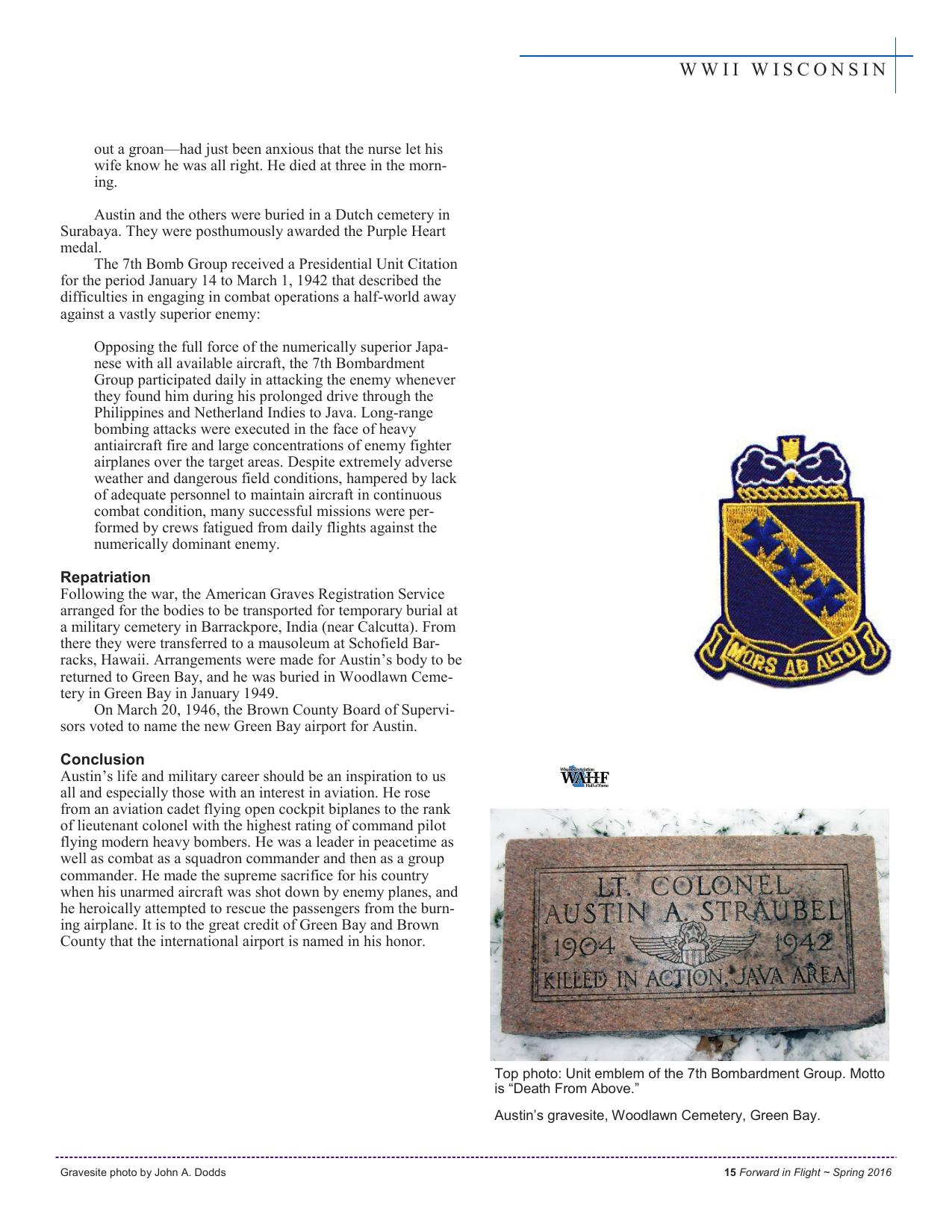
WWII WISCONSIN out a groan—had just been anxious that the nurse let his wife know he was all right. He died at three in the morning. Austin and the others were buried in a Dutch cemetery in Surabaya. They were posthumously awarded the Purple Heart medal. The 7th Bomb Group received a Presidential Unit Citation for the period January 14 to March 1, 1942 that described the difficulties in engaging in combat operations a half-world away against a vastly superior enemy: Opposing the full force of the numerically superior Japanese with all available aircraft, the 7th Bombardment Group participated daily in attacking the enemy whenever they found him during his prolonged drive through the Philippines and Netherland Indies to Java. Long‑range bombing attacks were executed in the face of heavy antiaircraft fire and large concentrations of enemy fighter airplanes over the target areas. Despite extremely adverse weather and dangerous field conditions, hampered by lack of adequate personnel to maintain aircraft in continuous combat condition, many successful missions were performed by crews fatigued from daily flights against the numerically dominant enemy. Repatriation Following the war, the American Graves Registration Service arranged for the bodies to be transported for temporary burial at a military cemetery in Barrackpore, India (near Calcutta). From there they were transferred to a mausoleum at Schofield Barracks, Hawaii. Arrangements were made for Austin’s body to be returned to Green Bay, and he was buried in Woodlawn Cemetery in Green Bay in January 1949. On March 20, 1946, the Brown County Board of Supervisors voted to name the new Green Bay airport for Austin. Conclusion Austin’s life and military career should be an inspiration to us all and especially those with an interest in aviation. He rose from an aviation cadet flying open cockpit biplanes to the rank of lieutenant colonel with the highest rating of command pilot flying modern heavy bombers. He was a leader in peacetime as well as combat as a squadron commander and then as a group commander. He made the supreme sacrifice for his country when his unarmed aircraft was shot down by enemy planes, and he heroically attempted to rescue the passengers from the burning airplane. It is to the great credit of Green Bay and Brown County that the international airport is named in his honor. Top photo: Unit emblem of the 7th Bombardment Group. Motto is “Death From Above.” Austin’s gravesite, Woodlawn Cemetery, Green Bay. Gravesite photo by John A. Dodds 15 Forward in Flight ~ Spring 2016
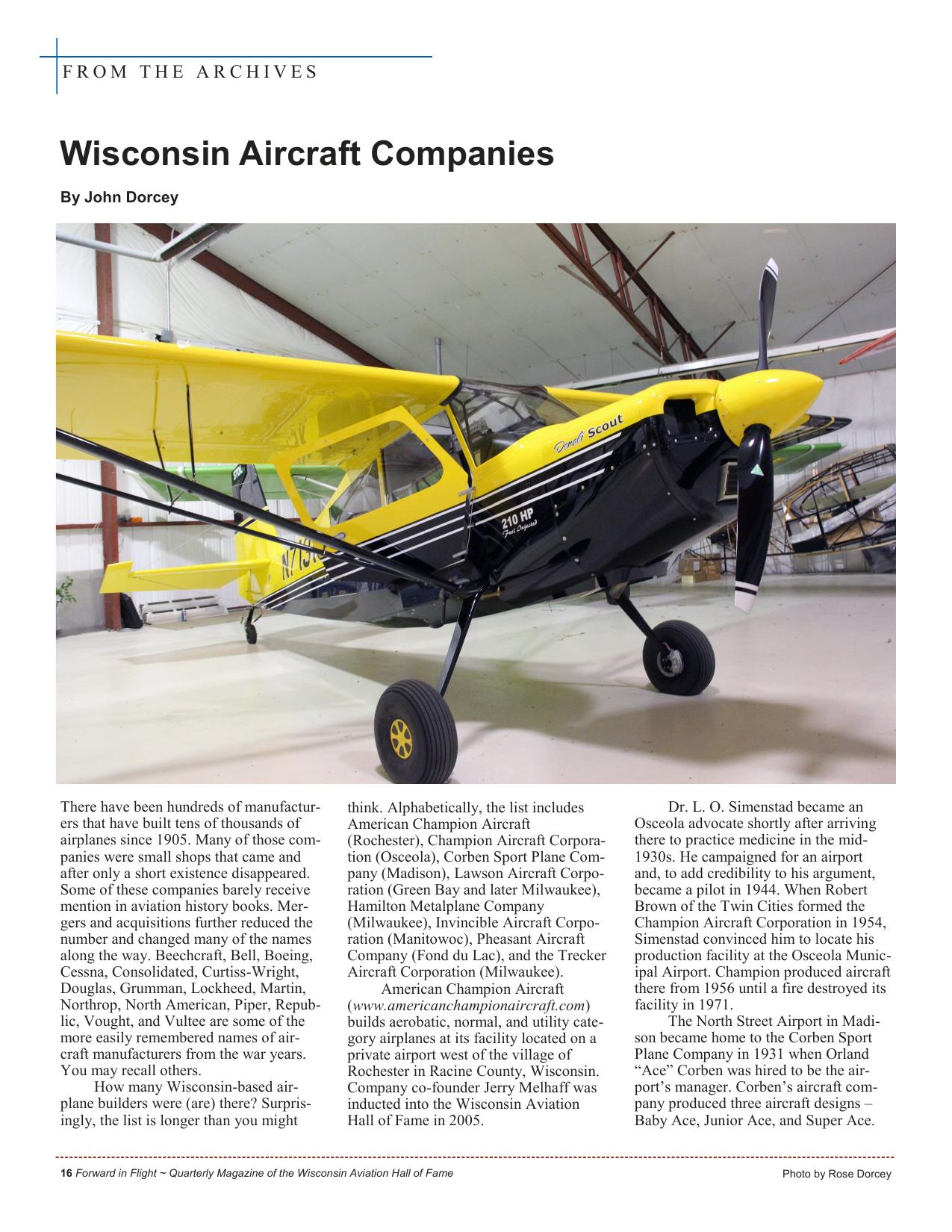
FROM THE ARCHIVES Wisconsin Aircraft Companies By John Dorcey There have been hundreds of manufacturers that have built tens of thousands of airplanes since 1905. Many of those companies were small shops that came and after only a short existence disappeared. Some of these companies barely receive mention in aviation history books. Mergers and acquisitions further reduced the number and changed many of the names along the way. Beechcraft, Bell, Boeing, Cessna, Consolidated, Curtiss-Wright, Douglas, Grumman, Lockheed, Martin, Northrop, North American, Piper, Republic, Vought, and Vultee are some of the more easily remembered names of aircraft manufacturers from the war years. You may recall others. How many Wisconsin-based airplane builders were (are) there? Surprisingly, the list is longer than you might think. Alphabetically, the list includes American Champion Aircraft (Rochester), Champion Aircraft Corporation (Osceola), Corben Sport Plane Company (Madison), Lawson Aircraft Corporation (Green Bay and later Milwaukee), Hamilton Metalplane Company (Milwaukee), Invincible Aircraft Corporation (Manitowoc), Pheasant Aircraft Company (Fond du Lac), and the Trecker Aircraft Corporation (Milwaukee). American Champion Aircraft (www.americanchampionaircraft.com) builds aerobatic, normal, and utility category airplanes at its facility located on a private airport west of the village of Rochester in Racine County, Wisconsin. Company co-founder Jerry Melhaff was inducted into the Wisconsin Aviation Hall of Fame in 2005. 16 Forward in Flight ~ Quarterly Magazine of the Wisconsin Aviation Hall of Fame Dr. L. O. Simenstad became an Osceola advocate shortly after arriving there to practice medicine in the mid1930s. He campaigned for an airport and, to add credibility to his argument, became a pilot in 1944. When Robert Brown of the Twin Cities formed the Champion Aircraft Corporation in 1954, Simenstad convinced him to locate his production facility at the Osceola Municipal Airport. Champion produced aircraft there from 1956 until a fire destroyed its facility in 1971. The North Street Airport in Madison became home to the Corben Sport Plane Company in 1931 when Orland “Ace” Corben was hired to be the airport’s manager. Corben’s aircraft company produced three aircraft designs – Baby Ace, Junior Ace, and Super Ace. Photo by Rose Dorcey
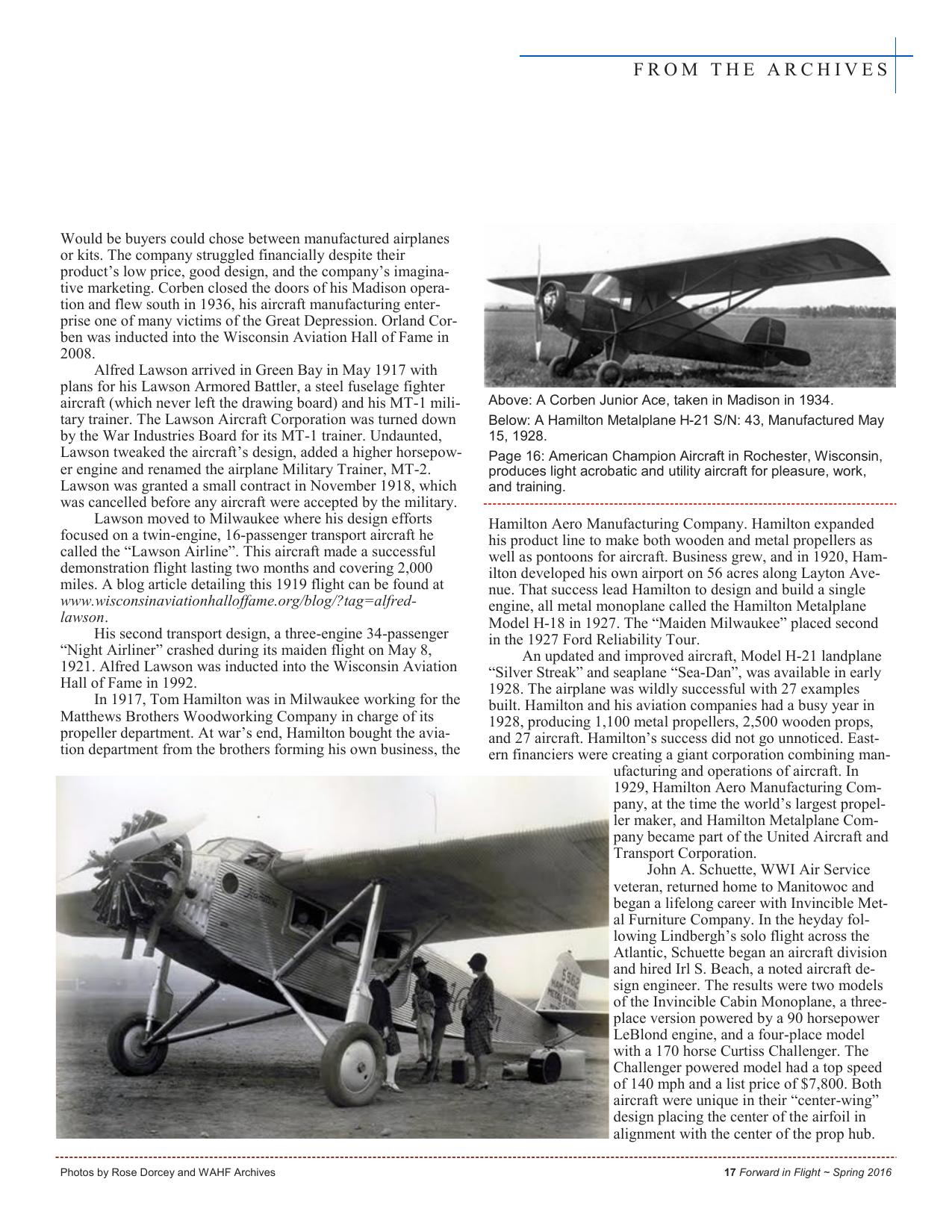
FROM THE ARCHIVES Would be buyers could chose between manufactured airplanes or kits. The company struggled financially despite their product’s low price, good design, and the company’s imaginative marketing. Corben closed the doors of his Madison operation and flew south in 1936, his aircraft manufacturing enterprise one of many victims of the Great Depression. Orland Corben was inducted into the Wisconsin Aviation Hall of Fame in 2008. Alfred Lawson arrived in Green Bay in May 1917 with plans for his Lawson Armored Battler, a steel fuselage fighter aircraft (which never left the drawing board) and his MT-1 military trainer. The Lawson Aircraft Corporation was turned down by the War Industries Board for its MT-1 trainer. Undaunted, Lawson tweaked the aircraft’s design, added a higher horsepower engine and renamed the airplane Military Trainer, MT-2. Lawson was granted a small contract in November 1918, which was cancelled before any aircraft were accepted by the military. Lawson moved to Milwaukee where his design efforts focused on a twin-engine, 16-passenger transport aircraft he called the “Lawson Airline”. This aircraft made a successful demonstration flight lasting two months and covering 2,000 miles. A blog article detailing this 1919 flight can be found at www.wisconsinaviationhalloffame.org/blog/?tag=alfredlawson. His second transport design, a three-engine 34-passenger “Night Airliner” crashed during its maiden flight on May 8, 1921. Alfred Lawson was inducted into the Wisconsin Aviation Hall of Fame in 1992. In 1917, Tom Hamilton was in Milwaukee working for the Matthews Brothers Woodworking Company in charge of its propeller department. At war’s end, Hamilton bought the aviation department from the brothers forming his own business, the Photos by Rose Dorcey and WAHF Archives Above: A Corben Junior Ace, taken in Madison in 1934. Below: A Hamilton Metalplane H-21 S/N: 43, Manufactured May 15, 1928. Page 16: American Champion Aircraft in Rochester, Wisconsin, produces light acrobatic and utility aircraft for pleasure, work, and training. Hamilton Aero Manufacturing Company. Hamilton expanded his product line to make both wooden and metal propellers as well as pontoons for aircraft. Business grew, and in 1920, Hamilton developed his own airport on 56 acres along Layton Avenue. That success lead Hamilton to design and build a single engine, all metal monoplane called the Hamilton Metalplane Model H-18 in 1927. The “Maiden Milwaukee” placed second in the 1927 Ford Reliability Tour. An updated and improved aircraft, Model H-21 landplane “Silver Streak” and seaplane “Sea-Dan”, was available in early 1928. The airplane was wildly successful with 27 examples built. Hamilton and his aviation companies had a busy year in 1928, producing 1,100 metal propellers, 2,500 wooden props, and 27 aircraft. Hamilton’s success did not go unnoticed. Eastern financiers were creating a giant corporation combining manufacturing and operations of aircraft. In 1929, Hamilton Aero Manufacturing Company, at the time the world’s largest propeller maker, and Hamilton Metalplane Company became part of the United Aircraft and Transport Corporation. John A. Schuette, WWI Air Service veteran, returned home to Manitowoc and began a lifelong career with Invincible Metal Furniture Company. In the heyday following Lindbergh’s solo flight across the Atlantic, Schuette began an aircraft division and hired Irl S. Beach, a noted aircraft design engineer. The results were two models of the Invincible Cabin Monoplane, a threeplace version powered by a 90 horsepower LeBlond engine, and a four-place model with a 170 horse Curtiss Challenger. The Challenger powered model had a top speed of 140 mph and a list price of $7,800. Both aircraft were unique in their “center-wing” design placing the center of the airfoil in alignment with the center of the prop hub. 17 Forward in Flight ~ Spring 2016
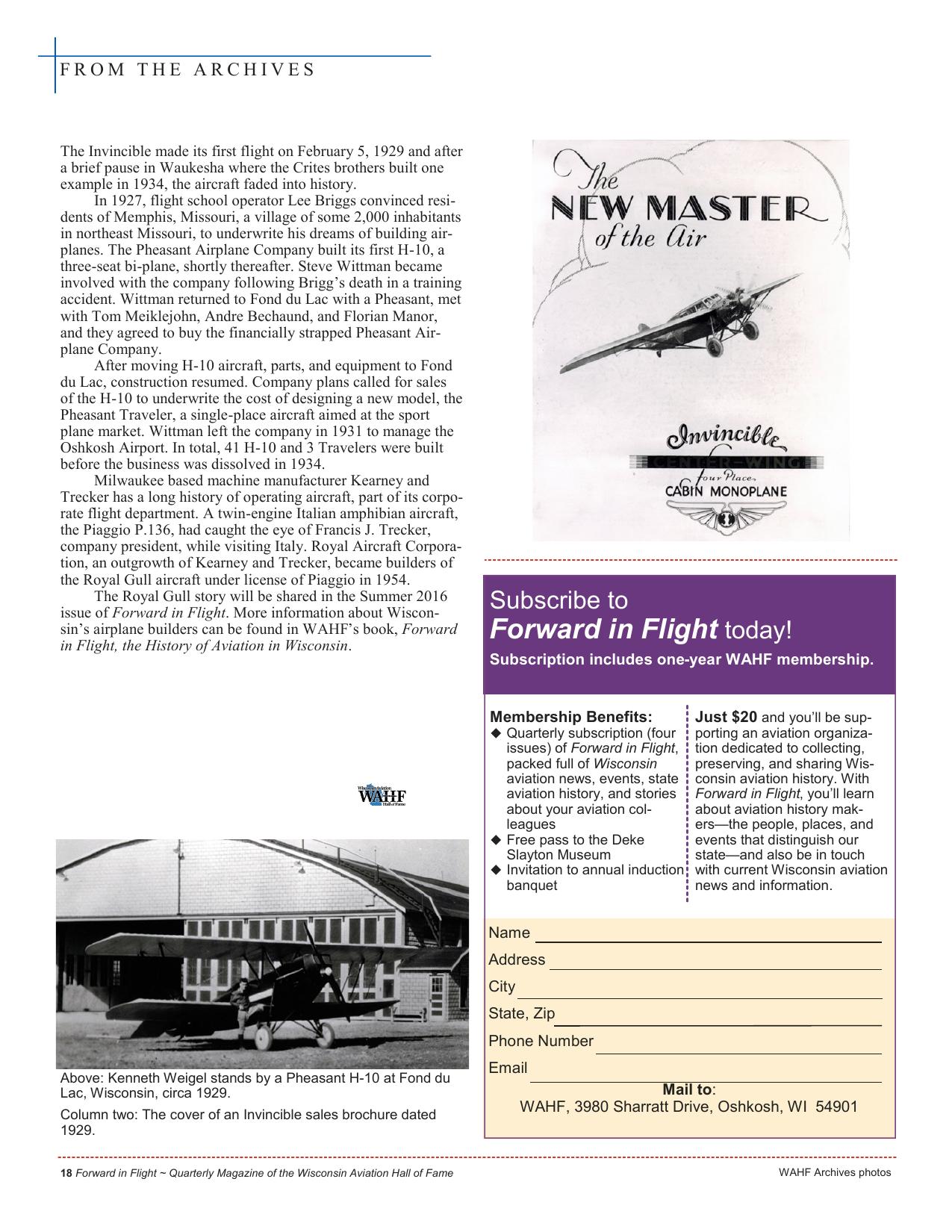
FROM THE ARCHIVES The Invincible made its first flight on February 5, 1929 and after a brief pause in Waukesha where the Crites brothers built one example in 1934, the aircraft faded into history. In 1927, flight school operator Lee Briggs convinced residents of Memphis, Missouri, a village of some 2,000 inhabitants in northeast Missouri, to underwrite his dreams of building airplanes. The Pheasant Airplane Company built its first H-10, a three-seat bi-plane, shortly thereafter. Steve Wittman became involved with the company following Brigg’s death in a training accident. Wittman returned to Fond du Lac with a Pheasant, met with Tom Meiklejohn, Andre Bechaund, and Florian Manor, and they agreed to buy the financially strapped Pheasant Airplane Company. After moving H-10 aircraft, parts, and equipment to Fond du Lac, construction resumed. Company plans called for sales of the H-10 to underwrite the cost of designing a new model, the Pheasant Traveler, a single-place aircraft aimed at the sport plane market. Wittman left the company in 1931 to manage the Oshkosh Airport. In total, 41 H-10 and 3 Travelers were built before the business was dissolved in 1934. Milwaukee based machine manufacturer Kearney and Trecker has a long history of operating aircraft, part of its corporate flight department. A twin-engine Italian amphibian aircraft, the Piaggio P.136, had caught the eye of Francis J. Trecker, company president, while visiting Italy. Royal Aircraft Corporation, an outgrowth of Kearney and Trecker, became builders of the Royal Gull aircraft under license of Piaggio in 1954. The Royal Gull story will be shared in the Summer 2016 issue of Forward in Flight. More information about Wisconsin’s airplane builders can be found in WAHF’s book, Forward in Flight, the History of Aviation in Wisconsin. Subscribe to Forward in Flight today! Subscription includes one-year WAHF membership. Membership Benefits: u Quarterly subscription (four issues) of Forward in Flight, packed full of Wisconsin aviation news, events, state aviation history, and stories about your aviation colleagues u Free pass to the Deke Slayton Museum u Invitation to annual induction banquet Just $20 and you’ll be sup- porting an aviation organization dedicated to collecting, preserving, and sharing Wisconsin aviation history. With Forward in Flight, you’ll learn about aviation history makers—the people, places, and events that distinguish our state—and also be in touch with current Wisconsin aviation news and information. Name Address City State, Zip Phone Number Above: Kenneth Weigel stands by a Pheasant H-10 at Fond du Lac, Wisconsin, circa 1929. Column two: The cover of an Invincible sales brochure dated 1929. 18 Forward in Flight ~ Quarterly Magazine of the Wisconsin Aviation Hall of Fame Email Mail to: WAHF, 3980 Sharratt Drive, Oshkosh, WI 54901 WAHF Archives photos
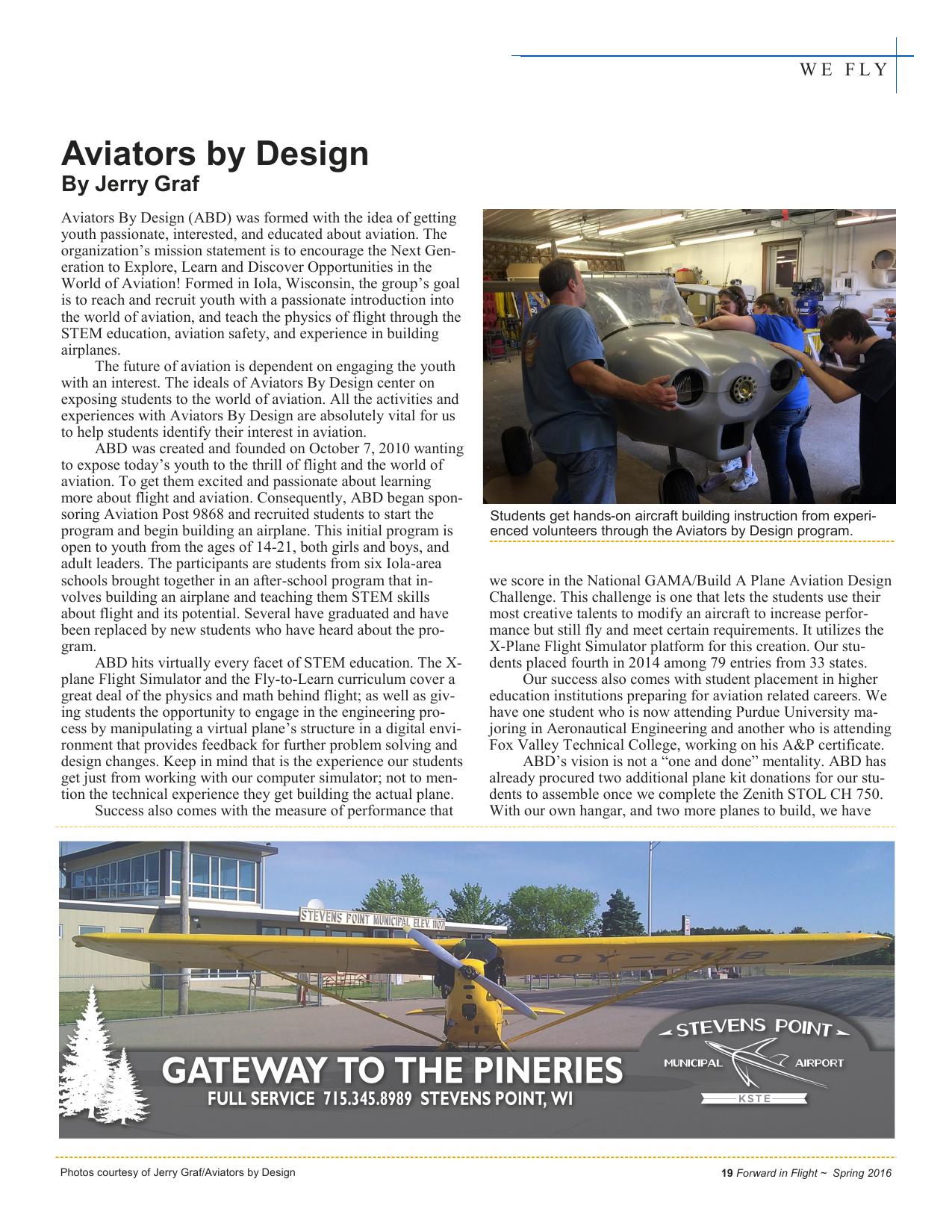
WE FLY Aviators by Design By Jerry Graf Aviators By Design (ABD) was formed with the idea of getting youth passionate, interested, and educated about aviation. The organization’s mission statement is to encourage the Next Generation to Explore, Learn and Discover Opportunities in the World of Aviation! Formed in Iola, Wisconsin, the group’s goal is to reach and recruit youth with a passionate introduction into the world of aviation, and teach the physics of flight through the STEM education, aviation safety, and experience in building airplanes. The future of aviation is dependent on engaging the youth with an interest. The ideals of Aviators By Design center on exposing students to the world of aviation. All the activities and experiences with Aviators By Design are absolutely vital for us to help students identify their interest in aviation. ABD was created and founded on October 7, 2010 wanting to expose today’s youth to the thrill of flight and the world of aviation. To get them excited and passionate about learning more about flight and aviation. Consequently, ABD began sponsoring Aviation Post 9868 and recruited students to start the program and begin building an airplane. This initial program is open to youth from the ages of 14-21, both girls and boys, and adult leaders. The participants are students from six Iola-area schools brought together in an after-school program that involves building an airplane and teaching them STEM skills about flight and its potential. Several have graduated and have been replaced by new students who have heard about the program. ABD hits virtually every facet of STEM education. The Xplane Flight Simulator and the Fly-to-Learn curriculum cover a great deal of the physics and math behind flight; as well as giving students the opportunity to engage in the engineering process by manipulating a virtual plane’s structure in a digital environment that provides feedback for further problem solving and design changes. Keep in mind that is the experience our students get just from working with our computer simulator; not to mention the technical experience they get building the actual plane. Success also comes with the measure of performance that Photos courtesy of Jerry Graf/Aviators by Design Students get hands-on aircraft building instruction from experienced volunteers through the Aviators by Design program. we score in the National GAMA/Build A Plane Aviation Design Challenge. This challenge is one that lets the students use their most creative talents to modify an aircraft to increase performance but still fly and meet certain requirements. It utilizes the X-Plane Flight Simulator platform for this creation. Our students placed fourth in 2014 among 79 entries from 33 states. Our success also comes with student placement in higher education institutions preparing for aviation related careers. We have one student who is now attending Purdue University majoring in Aeronautical Engineering and another who is attending Fox Valley Technical College, working on his A&P certificate. ABD’s vision is not a “one and done” mentality. ABD has already procured two additional plane kit donations for our students to assemble once we complete the Zenith STOL CH 750. With our own hangar, and two more planes to build, we have 19 Forward in Flight ~ Spring 2016
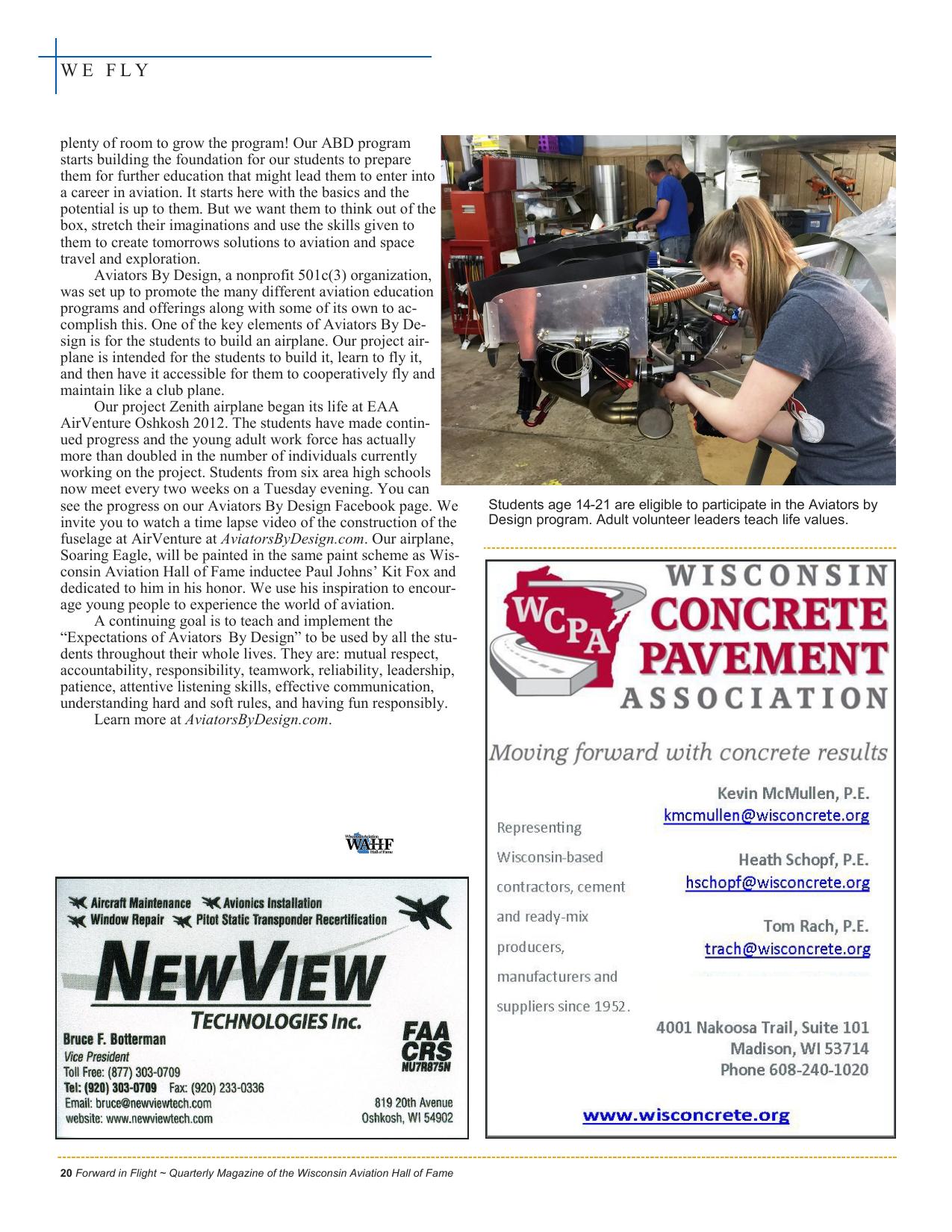
WE FLY plenty of room to grow the program! Our ABD program starts building the foundation for our students to prepare them for further education that might lead them to enter into a career in aviation. It starts here with the basics and the potential is up to them. But we want them to think out of the box, stretch their imaginations and use the skills given to them to create tomorrows solutions to aviation and space travel and exploration. Aviators By Design, a nonprofit 501c(3) organization, was set up to promote the many different aviation education programs and offerings along with some of its own to accomplish this. One of the key elements of Aviators By Design is for the students to build an airplane. Our project airplane is intended for the students to build it, learn to fly it, and then have it accessible for them to cooperatively fly and maintain like a club plane. Our project Zenith airplane began its life at EAA AirVenture Oshkosh 2012. The students have made continued progress and the young adult work force has actually more than doubled in the number of individuals currently working on the project. Students from six area high schools now meet every two weeks on a Tuesday evening. You can see the progress on our Aviators By Design Facebook page. We invite you to watch a time lapse video of the construction of the fuselage at AirVenture at AviatorsByDesign.com. Our airplane, Soaring Eagle, will be painted in the same paint scheme as Wisconsin Aviation Hall of Fame inductee Paul Johns’ Kit Fox and dedicated to him in his honor. We use his inspiration to encourage young people to experience the world of aviation. A continuing goal is to teach and implement the “Expectations of Aviators By Design” to be used by all the students throughout their whole lives. They are: mutual respect, accountability, responsibility, teamwork, reliability, leadership, patience, attentive listening skills, effective communication, understanding hard and soft rules, and having fun responsibly. Learn more at AviatorsByDesign.com. 20 Forward in Flight ~ Quarterly Magazine of the Wisconsin Aviation Hall of Fame Students age 14-21 are eligible to participate in the Aviators by Design program. Adult volunteer leaders teach life values.
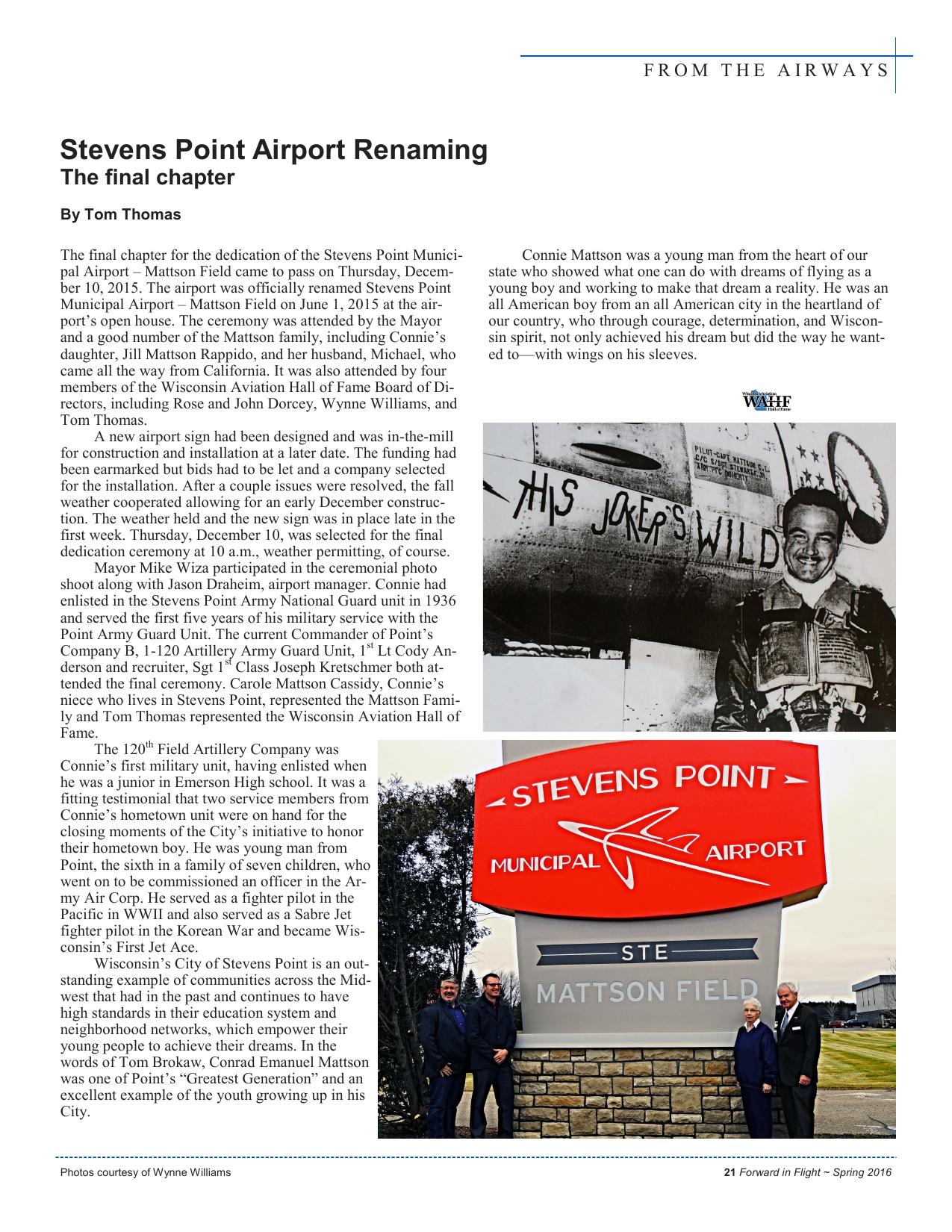
FROM THE AIRWAYS Stevens Point Airport Renaming The final chapter By Tom Thomas The final chapter for the dedication of the Stevens Point Municipal Airport – Mattson Field came to pass on Thursday, December 10, 2015. The airport was officially renamed Stevens Point Municipal Airport – Mattson Field on June 1, 2015 at the airport’s open house. The ceremony was attended by the Mayor and a good number of the Mattson family, including Connie’s daughter, Jill Mattson Rappido, and her husband, Michael, who came all the way from California. It was also attended by four members of the Wisconsin Aviation Hall of Fame Board of Directors, including Rose and John Dorcey, Wynne Williams, and Tom Thomas. A new airport sign had been designed and was in-the-mill for construction and installation at a later date. The funding had been earmarked but bids had to be let and a company selected for the installation. After a couple issues were resolved, the fall weather cooperated allowing for an early December construction. The weather held and the new sign was in place late in the first week. Thursday, December 10, was selected for the final dedication ceremony at 10 a.m., weather permitting, of course. Mayor Mike Wiza participated in the ceremonial photo shoot along with Jason Draheim, airport manager. Connie had enlisted in the Stevens Point Army National Guard unit in 1936 and served the first five years of his military service with the Point Army Guard Unit. The current Commander of Point’s Company B, 1-120 Artillery Army Guard Unit, 1st Lt Cody Anderson and recruiter, Sgt 1st Class Joseph Kretschmer both attended the final ceremony. Carole Mattson Cassidy, Connie’s niece who lives in Stevens Point, represented the Mattson Family and Tom Thomas represented the Wisconsin Aviation Hall of Fame. The 120th Field Artillery Company was Connie’s first military unit, having enlisted when he was a junior in Emerson High school. It was a fitting testimonial that two service members from Connie’s hometown unit were on hand for the closing moments of the City’s initiative to honor their hometown boy. He was young man from Point, the sixth in a family of seven children, who went on to be commissioned an officer in the Army Air Corp. He served as a fighter pilot in the Pacific in WWII and also served as a Sabre Jet fighter pilot in the Korean War and became Wisconsin’s First Jet Ace. Wisconsin’s City of Stevens Point is an outstanding example of communities across the Midwest that had in the past and continues to have high standards in their education system and neighborhood networks, which empower their young people to achieve their dreams. In the words of Tom Brokaw, Conrad Emanuel Mattson was one of Point’s “Greatest Generation” and an excellent example of the youth growing up in his City. Photos courtesy of Wynne Williams Connie Mattson was a young man from the heart of our state who showed what one can do with dreams of flying as a young boy and working to make that dream a reality. He was an all American boy from an all American city in the heartland of our country, who through courage, determination, and Wisconsin spirit, not only achieved his dream but did the way he wanted to—with wings on his sleeves. 21 Forward in Flight ~ Spring 2016
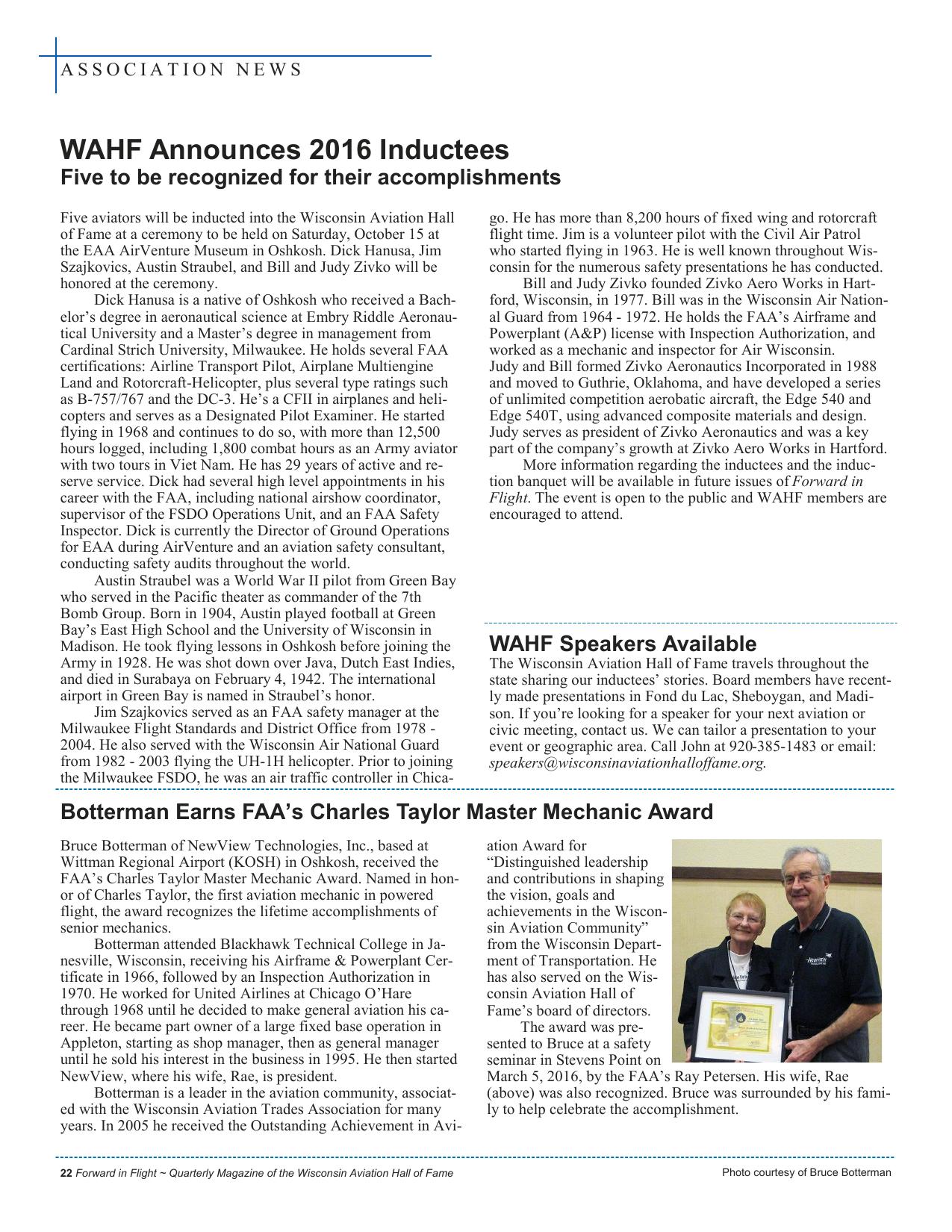
ASSOCIATION NEWS WAHF Announces 2016 Inductees Five to be recognized for their accomplishments Five aviators will be inducted into the Wisconsin Aviation Hall of Fame at a ceremony to be held on Saturday, October 15 at the EAA AirVenture Museum in Oshkosh. Dick Hanusa, Jim Szajkovics, Austin Straubel, and Bill and Judy Zivko will be honored at the ceremony. Dick Hanusa is a native of Oshkosh who received a Bachelor’s degree in aeronautical science at Embry Riddle Aeronautical University and a Master’s degree in management from Cardinal Strich University, Milwaukee. He holds several FAA certifications: Airline Transport Pilot, Airplane Multiengine Land and Rotorcraft-Helicopter, plus several type ratings such as B-757/767 and the DC-3. He’s a CFII in airplanes and helicopters and serves as a Designated Pilot Examiner. He started flying in 1968 and continues to do so, with more than 12,500 hours logged, including 1,800 combat hours as an Army aviator with two tours in Viet Nam. He has 29 years of active and reserve service. Dick had several high level appointments in his career with the FAA, including national airshow coordinator, supervisor of the FSDO Operations Unit, and an FAA Safety Inspector. Dick is currently the Director of Ground Operations for EAA during AirVenture and an aviation safety consultant, conducting safety audits throughout the world. Austin Straubel was a World War II pilot from Green Bay who served in the Pacific theater as commander of the 7th Bomb Group. Born in 1904, Austin played football at Green Bay’s East High School and the University of Wisconsin in Madison. He took flying lessons in Oshkosh before joining the Army in 1928. He was shot down over Java, Dutch East Indies, and died in Surabaya on February 4, 1942. The international airport in Green Bay is named in Straubel’s honor. Jim Szajkovics served as an FAA safety manager at the Milwaukee Flight Standards and District Office from 1978 2004. He also served with the Wisconsin Air National Guard from 1982 - 2003 flying the UH-1H helicopter. Prior to joining the Milwaukee FSDO, he was an air traffic controller in Chica- go. He has more than 8,200 hours of fixed wing and rotorcraft flight time. Jim is a volunteer pilot with the Civil Air Patrol who started flying in 1963. He is well known throughout Wisconsin for the numerous safety presentations he has conducted. Bill and Judy Zivko founded Zivko Aero Works in Hartford, Wisconsin, in 1977. Bill was in the Wisconsin Air National Guard from 1964 - 1972. He holds the FAA’s Airframe and Powerplant (A&P) license with Inspection Authorization, and worked as a mechanic and inspector for Air Wisconsin. Judy and Bill formed Zivko Aeronautics Incorporated in 1988 and moved to Guthrie, Oklahoma, and have developed a series of unlimited competition aerobatic aircraft, the Edge 540 and Edge 540T, using advanced composite materials and design. Judy serves as president of Zivko Aeronautics and was a key part of the company’s growth at Zivko Aero Works in Hartford. More information regarding the inductees and the induction banquet will be available in future issues of Forward in Flight. The event is open to the public and WAHF members are encouraged to attend. WAHF Speakers Available The Wisconsin Aviation Hall of Fame travels throughout the state sharing our inductees’ stories. Board members have recently made presentations in Fond du Lac, Sheboygan, and Madison. If you’re looking for a speaker for your next aviation or civic meeting, contact us. We can tailor a presentation to your event or geographic area. Call John at 920-385-1483 or email: speakers@wisconsinaviationhalloffame.org. Botterman Earns FAA’s Charles Taylor Master Mechanic Award Bruce Botterman of NewView Technologies, Inc., based at Wittman Regional Airport (KOSH) in Oshkosh, received the FAA’s Charles Taylor Master Mechanic Award. Named in honor of Charles Taylor, the first aviation mechanic in powered flight, the award recognizes the lifetime accomplishments of senior mechanics. Botterman attended Blackhawk Technical College in Janesville, Wisconsin, receiving his Airframe & Powerplant Certificate in 1966, followed by an Inspection Authorization in 1970. He worked for United Airlines at Chicago O’Hare through 1968 until he decided to make general aviation his career. He became part owner of a large fixed base operation in Appleton, starting as shop manager, then as general manager until he sold his interest in the business in 1995. He then started NewView, where his wife, Rae, is president. Botterman is a leader in the aviation community, associated with the Wisconsin Aviation Trades Association for many years. In 2005 he received the Outstanding Achievement in Avi22 Forward in Flight ~ Quarterly Magazine of the Wisconsin Aviation Hall of Fame ation Award for “Distinguished leadership and contributions in shaping the vision, goals and achievements in the Wisconsin Aviation Community” from the Wisconsin Department of Transportation. He has also served on the Wisconsin Aviation Hall of Fame’s board of directors. The award was presented to Bruce at a safety seminar in Stevens Point on March 5, 2016, by the FAA’s Ray Petersen. His wife, Rae (above) was also recognized. Bruce was surrounded by his family to help celebrate the accomplishment. Photo courtesy of Bruce Botterman
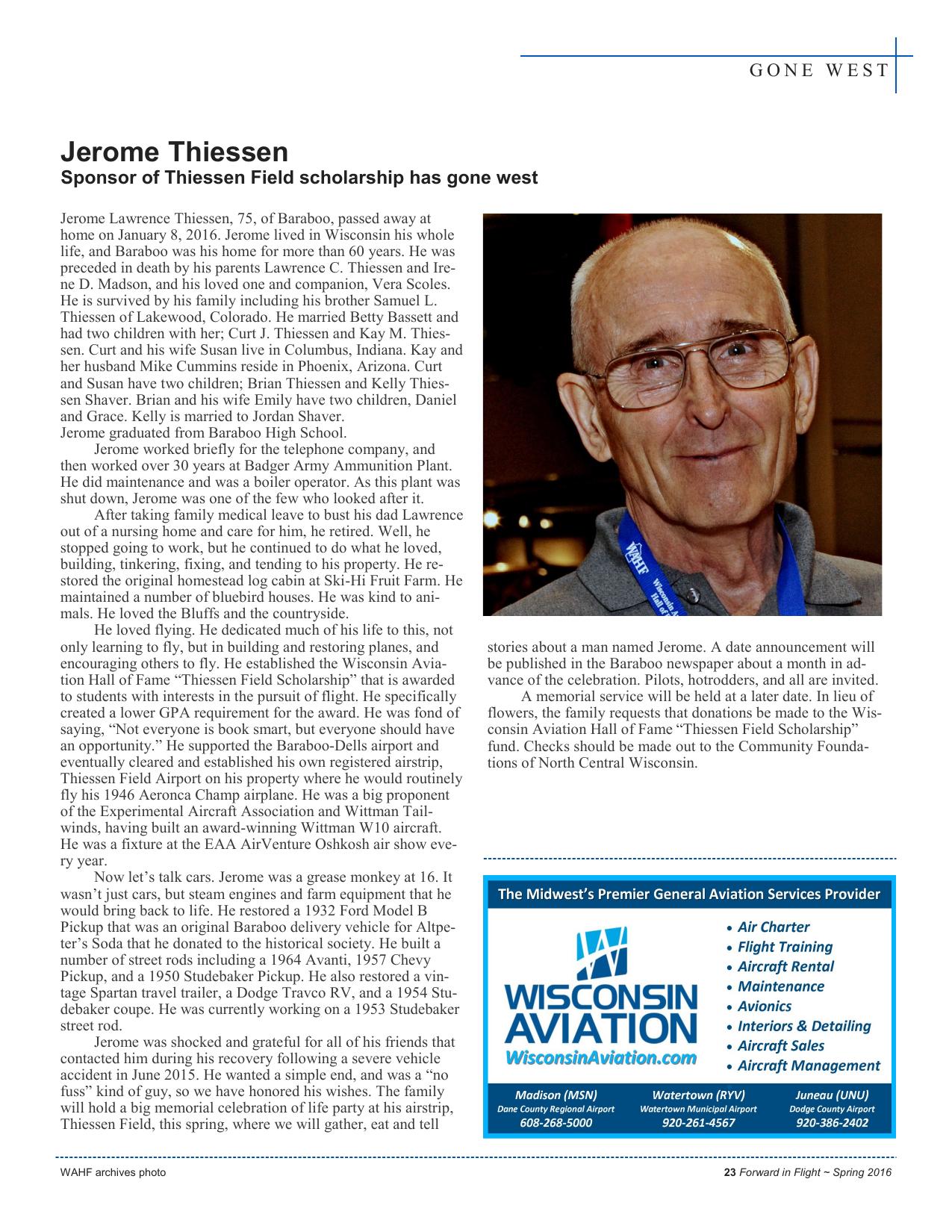
GONE WEST Jerome Thiessen Sponsor of Thiessen Field scholarship has gone west Jerome Lawrence Thiessen, 75, of Baraboo, passed away at home on January 8, 2016. Jerome lived in Wisconsin his whole life, and Baraboo was his home for more than 60 years. He was preceded in death by his parents Lawrence C. Thiessen and Irene D. Madson, and his loved one and companion, Vera Scoles. He is survived by his family including his brother Samuel L. Thiessen of Lakewood, Colorado. He married Betty Bassett and had two children with her; Curt J. Thiessen and Kay M. Thiessen. Curt and his wife Susan live in Columbus, Indiana. Kay and her husband Mike Cummins reside in Phoenix, Arizona. Curt and Susan have two children; Brian Thiessen and Kelly Thiessen Shaver. Brian and his wife Emily have two children, Daniel and Grace. Kelly is married to Jordan Shaver. Jerome graduated from Baraboo High School. Jerome worked briefly for the telephone company, and then worked over 30 years at Badger Army Ammunition Plant. He did maintenance and was a boiler operator. As this plant was shut down, Jerome was one of the few who looked after it. After taking family medical leave to bust his dad Lawrence out of a nursing home and care for him, he retired. Well, he stopped going to work, but he continued to do what he loved, building, tinkering, fixing, and tending to his property. He restored the original homestead log cabin at Ski-Hi Fruit Farm. He maintained a number of bluebird houses. He was kind to animals. He loved the Bluffs and the countryside. He loved flying. He dedicated much of his life to this, not only learning to fly, but in building and restoring planes, and encouraging others to fly. He established the Wisconsin Aviation Hall of Fame “Thiessen Field Scholarship” that is awarded to students with interests in the pursuit of flight. He specifically created a lower GPA requirement for the award. He was fond of saying, “Not everyone is book smart, but everyone should have an opportunity.” He supported the Baraboo-Dells airport and eventually cleared and established his own registered airstrip, Thiessen Field Airport on his property where he would routinely fly his 1946 Aeronca Champ airplane. He was a big proponent of the Experimental Aircraft Association and Wittman Tailwinds, having built an award-winning Wittman W10 aircraft. He was a fixture at the EAA AirVenture Oshkosh air show every year. Now let’s talk cars. Jerome was a grease monkey at 16. It wasn’t just cars, but steam engines and farm equipment that he would bring back to life. He restored a 1932 Ford Model B Pickup that was an original Baraboo delivery vehicle for Altpeter’s Soda that he donated to the historical society. He built a number of street rods including a 1964 Avanti, 1957 Chevy Pickup, and a 1950 Studebaker Pickup. He also restored a vintage Spartan travel trailer, a Dodge Travco RV, and a 1954 Studebaker coupe. He was currently working on a 1953 Studebaker street rod. Jerome was shocked and grateful for all of his friends that contacted him during his recovery following a severe vehicle accident in June 2015. He wanted a simple end, and was a “no fuss” kind of guy, so we have honored his wishes. The family will hold a big memorial celebration of life party at his airstrip, Thiessen Field, this spring, where we will gather, eat and tell WAHF archives photo stories about a man named Jerome. A date announcement will be published in the Baraboo newspaper about a month in advance of the celebration. Pilots, hotrodders, and all are invited. A memorial service will be held at a later date. In lieu of flowers, the family requests that donations be made to the Wisconsin Aviation Hall of Fame “Thiessen Field Scholarship” fund. Checks should be made out to the Community Foundations of North Central Wisconsin. 23 Forward in Flight ~ Spring 2016
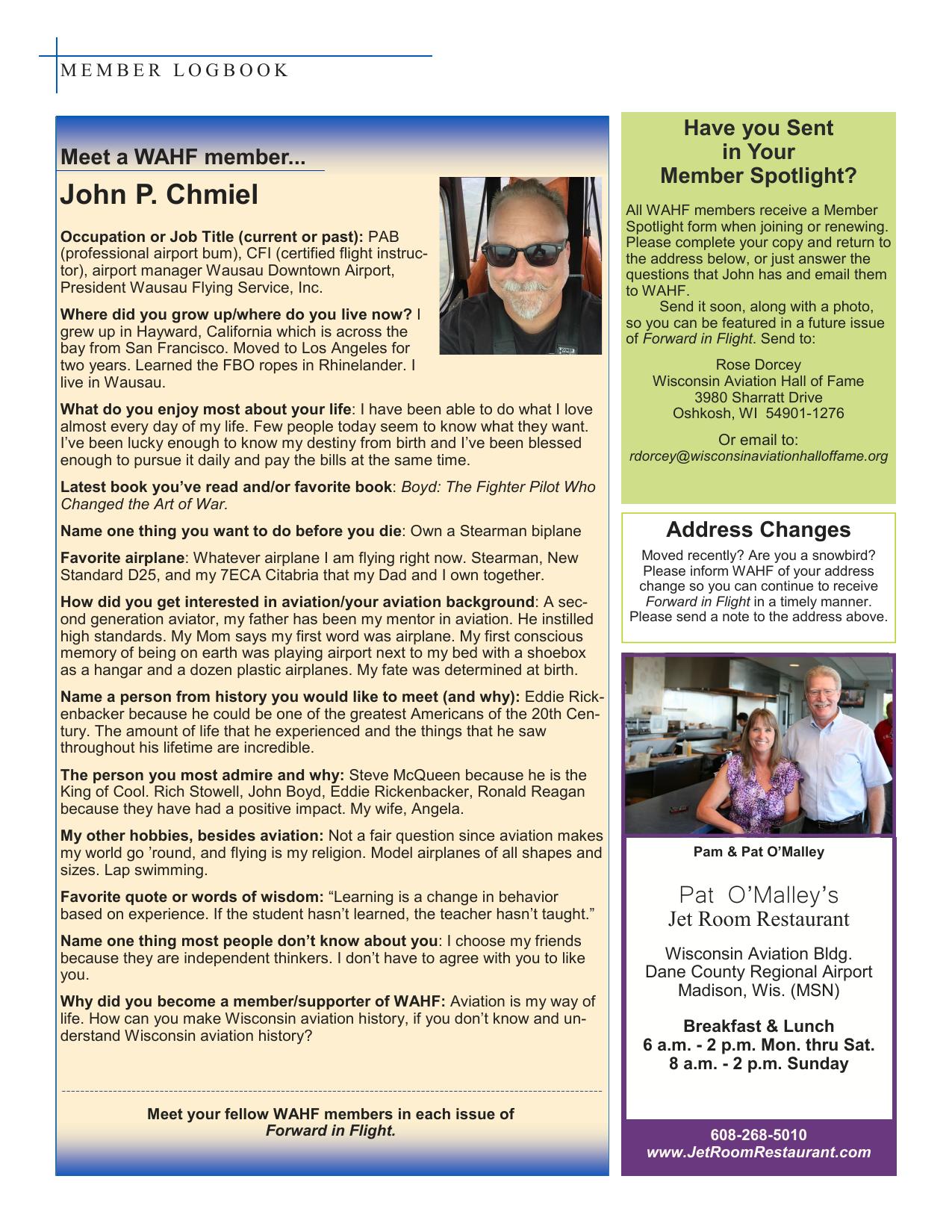
MEMBER LOGBOOK Meet a WAHF member... John P. Chmiel Occupation or Job Title (current or past): PAB (professional airport bum), CFI (certified flight instructor), airport manager Wausau Downtown Airport, President Wausau Flying Service, Inc. Where did you grow up/where do you live now? RogerI Small grew up in Hayward, California which is across the bay from San Francisco. Moved to Los Angeles for two years. Learned the FBO ropes in Rhinelander. I live in Wausau. What do you enjoy most about your life: I have been able to do what I love almost every day of my life. Few people today seem to know what they want. I’ve been lucky enough to know my destiny from birth and I’ve been blessed enough to pursue it daily and pay the bills at the same time. Have you Sent in Your Member Spotlight? All WAHF members receive a Member Spotlight form when joining or renewing. Please complete your copy and return to the address below, or just answer the questions that John has and email them to WAHF. Send it soon, along with a photo, so you can be featured in a future issue of Forward in Flight. Send to: Rose Dorcey Wisconsin Aviation Hall of Fame 3980 Sharratt Drive Oshkosh, WI 54901-1276 Or email to: rdorcey@wisconsinaviationhalloffame.org Latest book you’ve read and/or favorite book: Boyd: The Fighter Pilot Who Changed the Art of War. Name one thing you want to do before you die: Own a Stearman biplane Address Changes Favorite airplane: Whatever airplane I am flying right now. Stearman, New Standard D25, and my 7ECA Citabria that my Dad and I own together. Moved recently? Are you a snowbird? Please inform WAHF of your address change so you can continue to receive Forward in Flight in a timely manner. Please send a note to the address above. How did you get interested in aviation/your aviation background: A second generation aviator, my father has been my mentor in aviation. He instilled high standards. My Mom says my first word was airplane. My first conscious memory of being on earth was playing airport next to my bed with a shoebox as a hangar and a dozen plastic airplanes. My fate was determined at birth. Name a person from history you would like to meet (and why): Eddie Rickenbacker because he could be one of the greatest Americans of the 20th Century. The amount of life that he experienced and the things that he saw throughout his lifetime are incredible. The person you most admire and why: Steve McQueen because he is the King of Cool. Rich Stowell, John Boyd, Eddie Rickenbacker, Ronald Reagan because they have had a positive impact. My wife, Angela. My other hobbies, besides aviation: Not a fair question since aviation makes my world go ’round, and flying is my religion. Model airplanes of all shapes and sizes. Lap swimming. Favorite quote or words of wisdom: “Learning is a change in behavior based on experience. If the student hasn’t learned, the teacher hasn’t taught.” Name one thing most people don’t know about you: I choose my friends because they are independent thinkers. I don’t have to agree with you to like you. Why did you become a member/supporter of WAHF: Aviation is my way of life. How can you make Wisconsin aviation history, if you don’t know and understand Wisconsin aviation history? Meet your fellow WAHF members in each issue of Forward in Flight. Pam & Pat O’Malley Pat O’Malley’s Jet Room Restaurant Wisconsin Aviation Bldg. Dane County Regional Airport Madison, Wis. (MSN) Breakfast & Lunch 6 a.m. - 2 p.m. Mon. thru Sat. 8 a.m. - 2 p.m. Sunday 608-268-5010 www.JetRoomRestaurant.com

Wittman Regional Airport Oshkosh So much history ...and still making it! From the legacy of Steve Wittman to Warren Basler’s DC-3 conversions, we’re proud to support and contribute to Wisconsin aviation history. FLY TO OSHKOSH wittmanairport.com @wittmanairport 61st annual Wisconsin Aviation Conference May 2 - 4, 2016 Best Western Premier Waterfront Hotel & Convention Center Oshkosh, Wisconsin Topics · Drones · Airports 101 - Ops and Safety · Airports 201 - Management · Third Class Medical - Why and When · Part 77 Issues & Resources · Aviation Issues Panel Discussion · Certification of Plans & Specs: how they affect the AIP process · Airport Lighting · Pilot shortages Face to Face Meetings · Wisconsin Bureau of Aeronautics · FAA’s Chicago Airport District Office · Call Bob to schedule Special Events · Tour of Basler Turbo Conversions · Tour of EAA AirVenture Museum · Banquet in EAA’s Founder’s Wing · Social event at The Waters/Oshkosh Yacht Club · Golf Tournament · Sporting Clays Tournament Nearly 40 exhibitors! Hosted by WAMA - Wisconsin Airport Management Association WATA - Wisconsin Aviation Trades Association WBAA - Wisconsin Business Aviation Association Consultants, Suppliers, and Sponsors Registration · $125 Member Rate - includes all meals and receptions (rate extended to WAMA, WATA, WBAA, FAA and State of Wisconsin) · $175 Non-Member Rate, includes all meals and receptions · For registration information, visit the Wisconsin Airport Management Association’s website at www.WIAMA.org · Contact Bob O’Brien, Executive Director, WAMA, at 608-739-2011 or email bob@thewisconsinriver.com
PRSRT STD US Postage Paid Wisc Rapids WI Permit 98 3980 SHARRATT DRIVE OSHKOSH WI 54901-1276 The Wisconsin Aviation Hall of Fame is a non-profit membership organization dedicated to preserving the past and fostering the future of flight. CHANGE SERVICE REQUESTED Welcome New WAHF Member/Supporters Nicholas Enea Kelch Aviation Museum Carl Krumhardt Thanks for coming on board. We hope to see you at a WAHF event soon! WAHF to Exhibit at Wisconsin Aviation Conference WAHF board members will attend the 61st annual Wisconsin Aviation Conference May 2 - 4 in Oshkosh. Stop and see us at our exhibit booth. On August 21, 2016, the Waunakee Airpark will celebrate its 70th anniversary at its annual Airport and Community Pancake Breakfast. Watch for more details in the next issue of Forward in Flight. 2015 Banquet Video Available The Wisconsin Aviation Hall of Fame has contracted with Front Room Photography to produce a video of our 2015 banquet. This is a wonderful keepsake item and many friends and family members who were inducted or attended would enjoy receiving it. The cost is $35 per DVD. Please contact Rose Dorcey to order at 920385-1483 or email rdorcey@wisconsinaviationhalloffame.org. Membership Dues are Due! If you have not yet renewed your WAHF membership for 2016 we hope you will do so soon. Membership is the lifeblood of the Wisconsin Aviation Hall of Fame. Still just $20 for your annual membership. To save postage costs, for you and us, renew easily and safely online at: www.WisconsinAviationHallofFame.org. Or fill out the form on page 18 and return to the address at right. Thank you! Wisconsin Aviation Hall of Fame Officers Rose Dorcey, President Tom Thomas, Vice-President John Dorcey, Secretary/Treasurer Board of Directors Elaine Kauh Kurt Stanich Brendan Stormo Charles Swain Wynne Williams Ron Wojnar Charles Marotske, Honorary Chairman of the Board Wisconsin Aviation Hall of Fame 3980 Sharratt Drive Oshkosh, WI 54901-1276 Become a supporter today! For information call Rose Dorcey at 920-385-1483 www.wisconsinaviationhalloffame.org rdorcey@wisconsinaviationhalloffame.org