Volume 21, Issue 1
🗞️ Download Issue (PDF)
Forward in Flight - Spring 2023
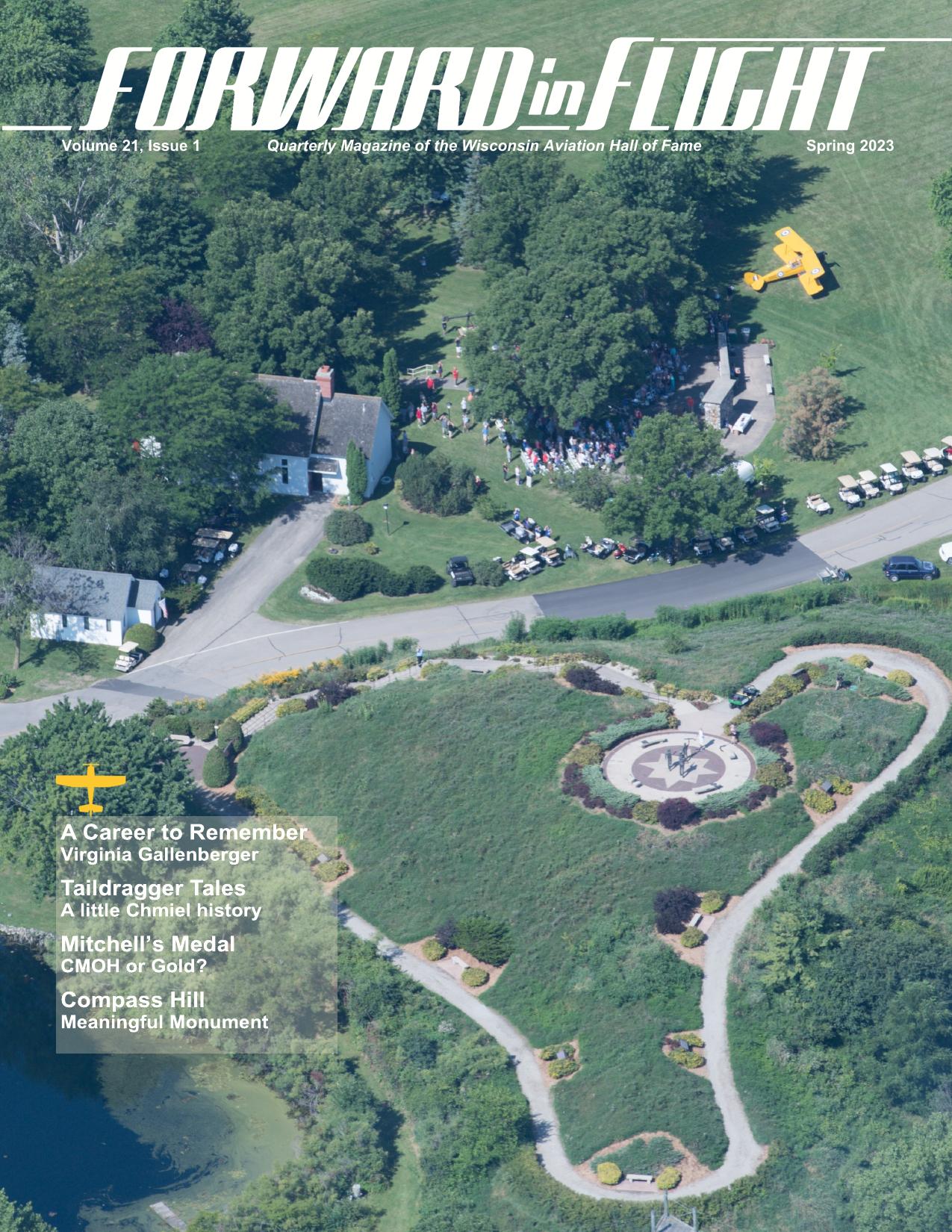
Volume 21, Issue 1 Quarterly Magazine of the Wisconsin Aviation Hall of Fame Spring 2023
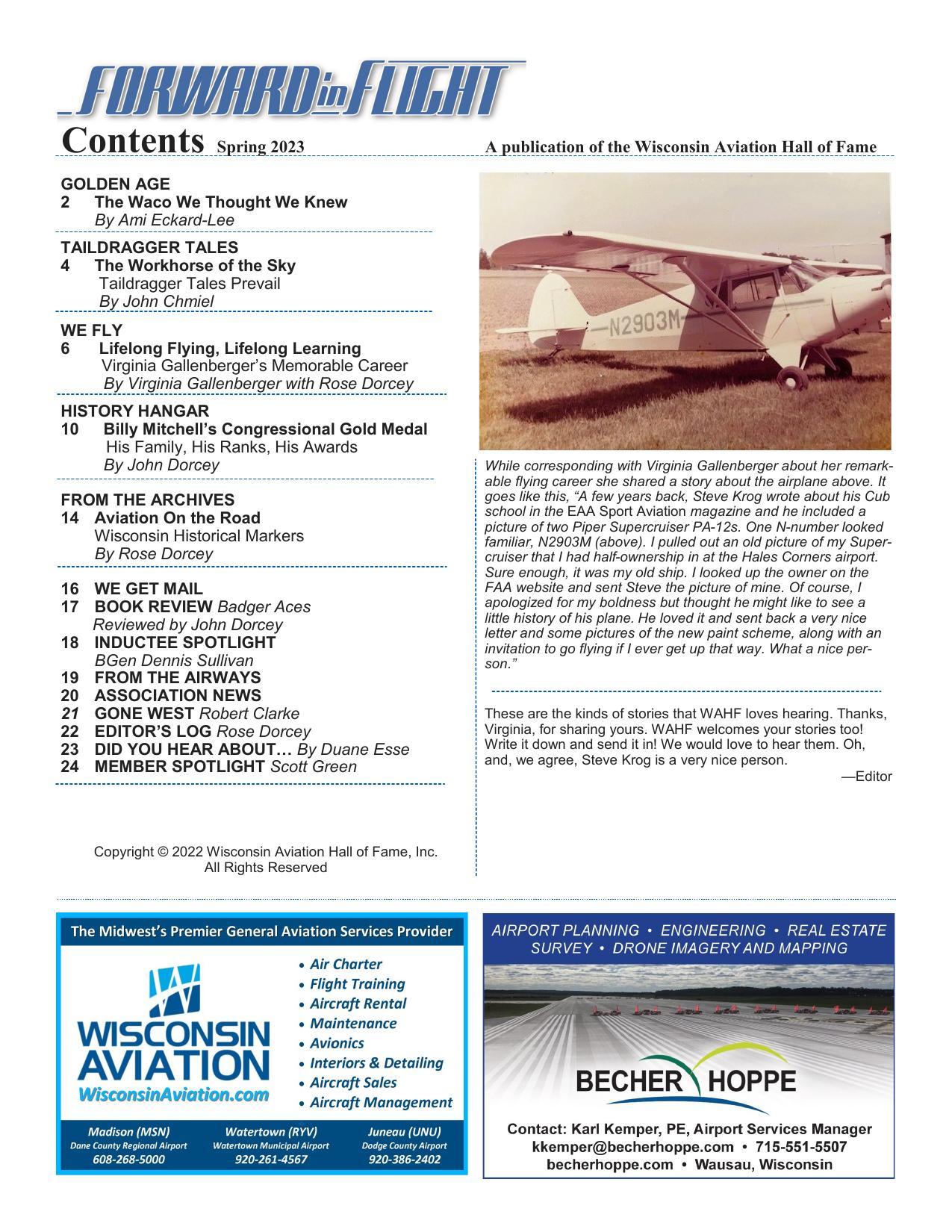
Contents Spring 2023 A publication of the Wisconsin Aviation Hall of Fame GOLDEN AGE 2 The Waco We Thought We Knew By Ami Eckard-Lee TAILDRAGGER TALES 4 The Workhorse of the Sky Taildragger Tales Prevail By John Chmiel WE FLY 6 Lifelong Flying, Lifelong Learning Virginia Gallenberger’s Memorable Career By Virginia Gallenberger with Rose Dorcey HISTORY HANGAR 10 Billy Mitchell’s Congressional Gold Medal His Family, His Ranks, His Awards By John Dorcey FROM THE ARCHIVES 14 Aviation On the Road Wisconsin Historical Markers By Rose Dorcey 16 WE GET MAIL 17 BOOK REVIEW Badger Aces Reviewed by John Dorcey 18 INDUCTEE SPOTLIGHT BGen Dennis Sullivan 19 FROM THE AIRWAYS 20 ASSOCIATION NEWS 21 GONE WEST Robert Clarke 22 EDITOR’S LOG Rose Dorcey 23 DID YOU HEAR ABOUT… By Duane Esse 24 MEMBER SPOTLIGHT Scott Green Copyright © 2022 Wisconsin Aviation Hall of Fame, Inc. All Rights Reserved While corresponding with Virginia Gallenberger about her remarkable flying career she shared a story about the airplane above. It goes like this, “A few years back, Steve Krog wrote about his Cub school in the EAA Sport Aviation magazine and he included a picture of two Piper Supercruiser PA-12s. One N-number looked familiar, N2903M (above). I pulled out an old picture of my Supercruiser that I had half-ownership in at the Hales Corners airport. Sure enough, it was my old ship. I looked up the owner on the FAA website and sent Steve the picture of mine. Of course, I apologized for my boldness but thought he might like to see a little history of his plane. He loved it and sent back a very nice letter and some pictures of the new paint scheme, along with an invitation to go flying if I ever get up that way. What a nice person.” These are the kinds of stories that WAHF loves hearing. Thanks, Virginia, for sharing yours. WAHF welcomes your stories too! Write it down and send it in! We would love to hear them. Oh, and, we agree, Steve Krog is a very nice person. —Editor
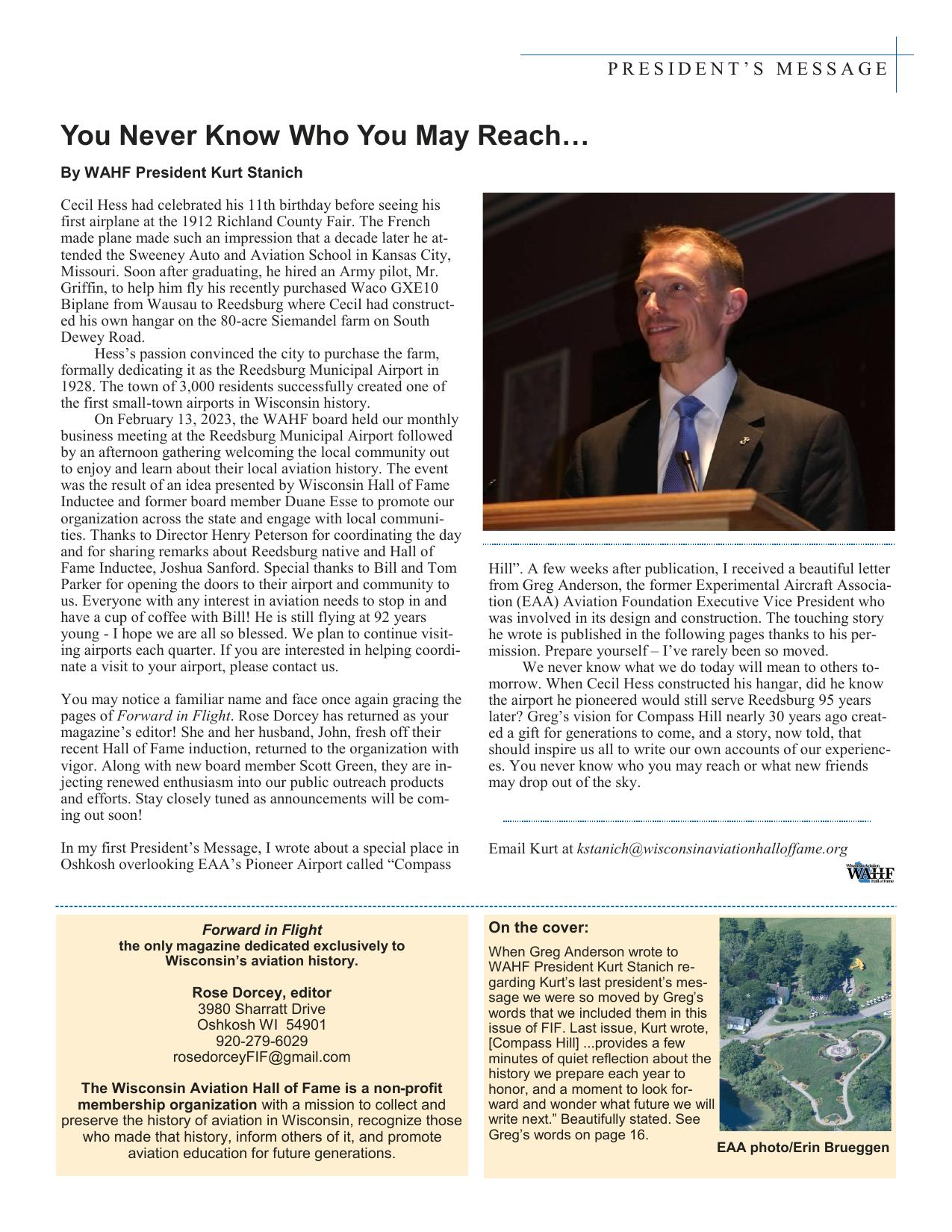
PRESIDENT’S MESSAGE You Never Know Who You May Reach… By WAHF President Kurt Stanich Cecil Hess had celebrated his 11th birthday before seeing his first airplane at the 1912 Richland County Fair. The French made plane made such an impression that a decade later he attended the Sweeney Auto and Aviation School in Kansas City, Missouri. Soon after graduating, he hired an Army pilot, Mr. Griffin, to help him fly his recently purchased Waco GXE10 Biplane from Wausau to Reedsburg where Cecil had constructed his own hangar on the 80-acre Siemandel farm on South Dewey Road. Hess’s passion convinced the city to purchase the farm, formally dedicating it as the Reedsburg Municipal Airport in 1928. The town of 3,000 residents successfully created one of the first small-town airports in Wisconsin history. On February 13, 2023, the WAHF board held our monthly business meeting at the Reedsburg Municipal Airport followed by an afternoon gathering welcoming the local community out to enjoy and learn about their local aviation history. The event was the result of an idea presented by Wisconsin Hall of Fame Inductee and former board member Duane Esse to promote our organization across the state and engage with local communities. Thanks to Director Henry Peterson for coordinating the day and for sharing remarks about Reedsburg native and Hall of Fame Inductee, Joshua Sanford. Special thanks to Bill and Tom Parker for opening the doors to their airport and community to us. Everyone with any interest in aviation needs to stop in and have a cup of coffee with Bill! He is still flying at 92 years young - I hope we are all so blessed. We plan to continue visiting airports each quarter. If you are interested in helping coordinate a visit to your airport, please contact us. You may notice a familiar name and face once again gracing the pages of Forward in Flight. Rose Dorcey has returned as your magazine’s editor! She and her husband, John, fresh off their recent Hall of Fame induction, returned to the organization with vigor. Along with new board member Scott Green, they are injecting renewed enthusiasm into our public outreach products and efforts. Stay closely tuned as announcements will be coming out soon! In my first President’s Message, I wrote about a special place in Oshkosh overlooking EAA’s Pioneer Airport called “Compass Forward in Flight the only magazine dedicated exclusively to Wisconsin’s aviation history. Rose Dorcey, editor 3980 Sharratt Drive Oshkosh WI 54901 920-279-6029 rosedorceyFIF@gmail.com The Wisconsin Aviation Hall of Fame is a non-profit membership organization with a mission to collect and preserve the history of aviation in Wisconsin, recognize those who made that history, inform others of it, and promote aviation education for future generations. Hill”. A few weeks after publication, I received a beautiful letter from Greg Anderson, the former Experimental Aircraft Association (EAA) Aviation Foundation Executive Vice President who was involved in its design and construction. The touching story he wrote is published in the following pages thanks to his permission. Prepare yourself – I’ve rarely been so moved. We never know what we do today will mean to others tomorrow. When Cecil Hess constructed his hangar, did he know the airport he pioneered would still serve Reedsburg 95 years later? Greg’s vision for Compass Hill nearly 30 years ago created a gift for generations to come, and a story, now told, that should inspire us all to write our own accounts of our experiences. You never know who you may reach or what new friends may drop out of the sky. Email Kurt at kstanich@wisconsinaviationhalloffame.org On the cover: When Greg Anderson wrote to WAHF President Kurt Stanich regarding Kurt’s last president’s message we were so moved by Greg’s words that we included them in this issue of FIF. Last issue, Kurt wrote, [Compass Hill] ...provides a few minutes of quiet reflection about the history we prepare each year to honor, and a moment to look forward and wonder what future we will write next.” Beautifully stated. See Greg’s words on page 16. EAA photo/Erin Brueggen
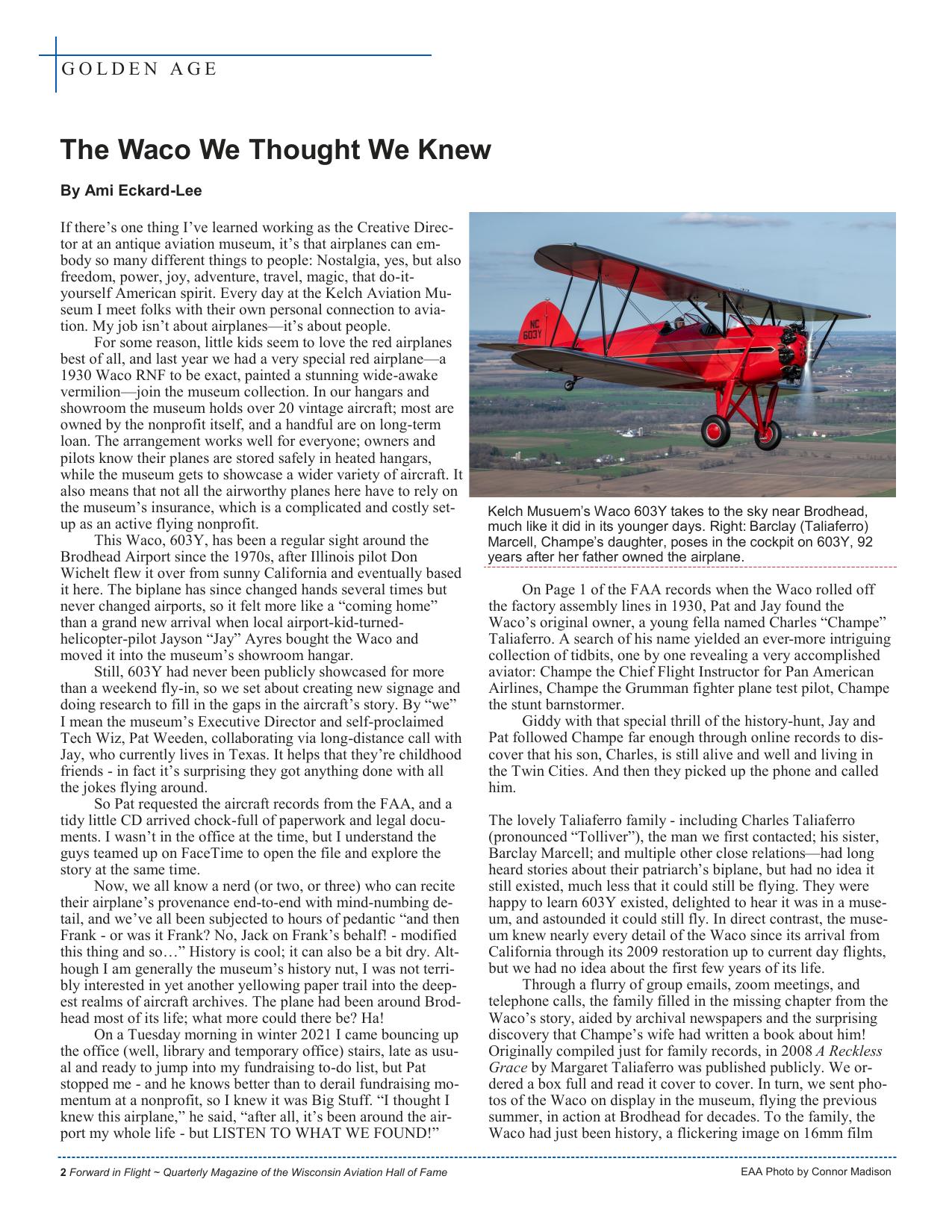
GOLDEN AGE The Waco We Thought We Knew By Ami Eckard-Lee If there’s one thing I’ve learned working as the Creative Director at an antique aviation museum, it’s that airplanes can embody so many different things to people: Nostalgia, yes, but also freedom, power, joy, adventure, travel, magic, that do-ityourself American spirit. Every day at the Kelch Aviation Museum I meet folks with their own personal connection to aviation. My job isn’t about airplanes—it’s about people. For some reason, little kids seem to love the red airplanes best of all, and last year we had a very special red airplane—a 1930 Waco RNF to be exact, painted a stunning wide-awake vermilion—join the museum collection. In our hangars and showroom the museum holds over 20 vintage aircraft; most are owned by the nonprofit itself, and a handful are on long-term loan. The arrangement works well for everyone; owners and pilots know their planes are stored safely in heated hangars, while the museum gets to showcase a wider variety of aircraft. It also means that not all the airworthy planes here have to rely on the museum’s insurance, which is a complicated and costly setup as an active flying nonprofit. This Waco, 603Y, has been a regular sight around the Brodhead Airport since the 1970s, after Illinois pilot Don Wichelt flew it over from sunny California and eventually based it here. The biplane has since changed hands several times but never changed airports, so it felt more like a “coming home” than a grand new arrival when local airport-kid-turnedhelicopter-pilot Jayson “Jay” Ayres bought the Waco and moved it into the museum’s showroom hangar. Still, 603Y had never been publicly showcased for more than a weekend fly-in, so we set about creating new signage and doing research to fill in the gaps in the aircraft’s story. By “we” I mean the museum’s Executive Director and self-proclaimed Tech Wiz, Pat Weeden, collaborating via long-distance call with Jay, who currently lives in Texas. It helps that they’re childhood friends - in fact it’s surprising they got anything done with all the jokes flying around. So Pat requested the aircraft records from the FAA, and a tidy little CD arrived chock-full of paperwork and legal documents. I wasn’t in the office at the time, but I understand the guys teamed up on FaceTime to open the file and explore the story at the same time. Now, we all know a nerd (or two, or three) who can recite their airplane’s provenance end-to-end with mind-numbing detail, and we’ve all been subjected to hours of pedantic “and then Frank - or was it Frank? No, Jack on Frank’s behalf! - modified this thing and so…” History is cool; it can also be a bit dry. Although I am generally the museum’s history nut, I was not terribly interested in yet another yellowing paper trail into the deepest realms of aircraft archives. The plane had been around Brodhead most of its life; what more could there be? Ha! On a Tuesday morning in winter 2021 I came bouncing up the office (well, library and temporary office) stairs, late as usual and ready to jump into my fundraising to-do list, but Pat stopped me - and he knows better than to derail fundraising momentum at a nonprofit, so I knew it was Big Stuff. “I thought I knew this airplane,” he said, “after all, it’s been around the airport my whole life - but LISTEN TO WHAT WE FOUND!” 2 Forward in Flight ~ Quarterly Magazine of the Wisconsin Aviation Hall of Fame Kelch Musuem’s Waco 603Y takes to the sky near Brodhead, much like it did in its younger days. Right: Barclay (Taliaferro) Marcell, Champe’s daughter, poses in the cockpit on 603Y, 92 years after her father owned the airplane. On Page 1 of the FAA records when the Waco rolled off the factory assembly lines in 1930, Pat and Jay found the Waco’s original owner, a young fella named Charles “Champe” Taliaferro. A search of his name yielded an ever-more intriguing collection of tidbits, one by one revealing a very accomplished aviator: Champe the Chief Flight Instructor for Pan American Airlines, Champe the Grumman fighter plane test pilot, Champe the stunt barnstormer. Giddy with that special thrill of the history-hunt, Jay and Pat followed Champe far enough through online records to discover that his son, Charles, is still alive and well and living in the Twin Cities. And then they picked up the phone and called him. The lovely Taliaferro family - including Charles Taliaferro (pronounced “Tolliver”), the man we first contacted; his sister, Barclay Marcell; and multiple other close relations—had long heard stories about their patriarch’s biplane, but had no idea it still existed, much less that it could still be flying. They were happy to learn 603Y existed, delighted to hear it was in a museum, and astounded it could still fly. In direct contrast, the museum knew nearly every detail of the Waco since its arrival from California through its 2009 restoration up to current day flights, but we had no idea about the first few years of its life. Through a flurry of group emails, zoom meetings, and telephone calls, the family filled in the missing chapter from the Waco’s story, aided by archival newspapers and the surprising discovery that Champe’s wife had written a book about him! Originally compiled just for family records, in 2008 A Reckless Grace by Margaret Taliaferro was published publicly. We ordered a box full and read it cover to cover. In turn, we sent photos of the Waco on display in the museum, flying the previous summer, in action at Brodhead for decades. To the family, the Waco had just been history, a flickering image on 16mm film EAA Photo by Connor Madison
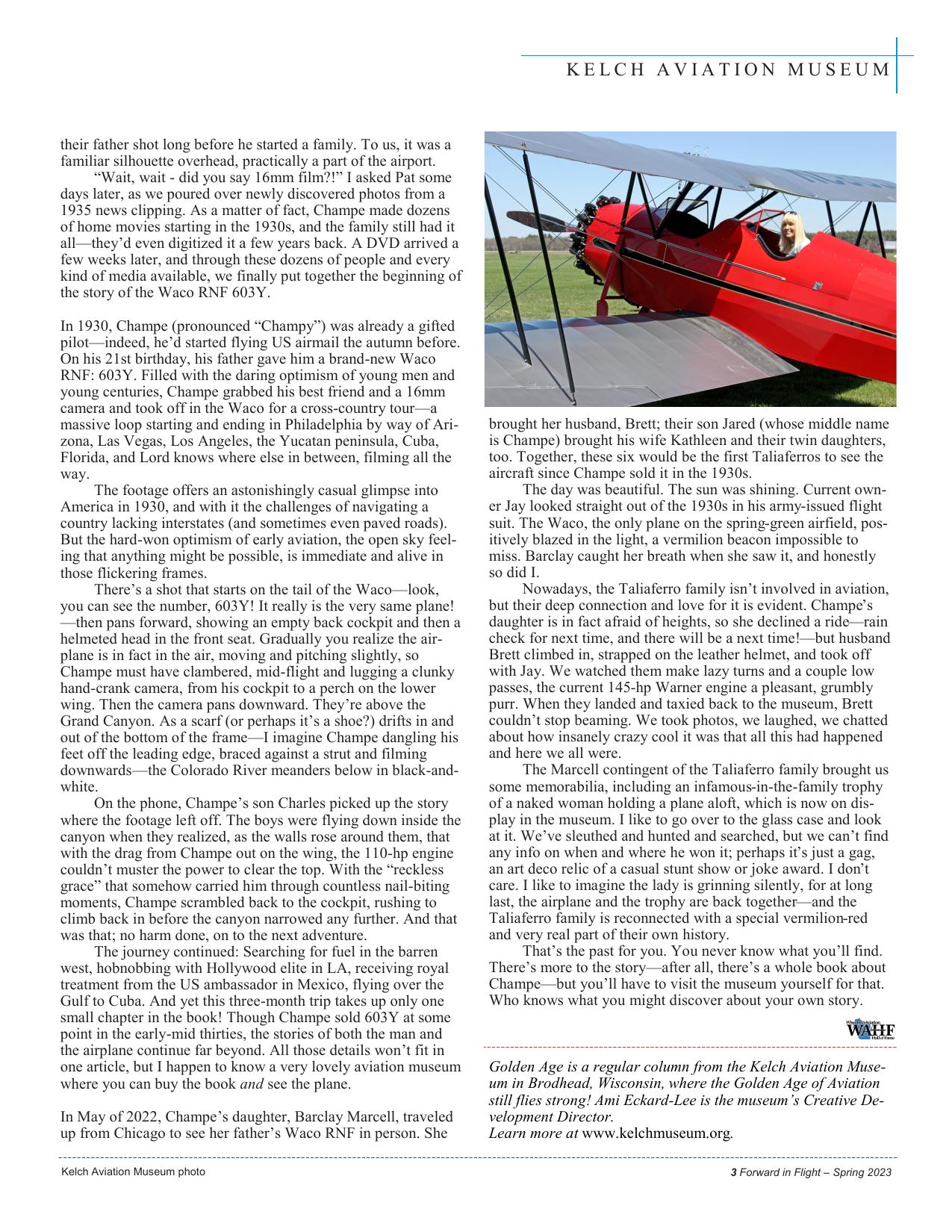
KELCH AVIATION MUSEUM their father shot long before he started a family. To us, it was a familiar silhouette overhead, practically a part of the airport. “Wait, wait - did you say 16mm film?!” I asked Pat some days later, as we poured over newly discovered photos from a 1935 news clipping. As a matter of fact, Champe made dozens of home movies starting in the 1930s, and the family still had it all—they’d even digitized it a few years back. A DVD arrived a few weeks later, and through these dozens of people and every kind of media available, we finally put together the beginning of the story of the Waco RNF 603Y. In 1930, Champe (pronounced “Champy”) was already a gifted pilot—indeed, he’d started flying US airmail the autumn before. On his 21st birthday, his father gave him a brand-new Waco RNF: 603Y. Filled with the daring optimism of young men and young centuries, Champe grabbed his best friend and a 16mm camera and took off in the Waco for a cross-country tour—a massive loop starting and ending in Philadelphia by way of Arizona, Las Vegas, Los Angeles, the Yucatan peninsula, Cuba, Florida, and Lord knows where else in between, filming all the way. The footage offers an astonishingly casual glimpse into America in 1930, and with it the challenges of navigating a country lacking interstates (and sometimes even paved roads). But the hard-won optimism of early aviation, the open sky feeling that anything might be possible, is immediate and alive in those flickering frames. There’s a shot that starts on the tail of the Waco—look, you can see the number, 603Y! It really is the very same plane! —then pans forward, showing an empty back cockpit and then a helmeted head in the front seat. Gradually you realize the airplane is in fact in the air, moving and pitching slightly, so Champe must have clambered, mid-flight and lugging a clunky hand-crank camera, from his cockpit to a perch on the lower wing. Then the camera pans downward. They’re above the Grand Canyon. As a scarf (or perhaps it’s a shoe?) drifts in and out of the bottom of the frame—I imagine Champe dangling his feet off the leading edge, braced against a strut and filming downwards—the Colorado River meanders below in black-andwhite. On the phone, Champe’s son Charles picked up the story where the footage left off. The boys were flying down inside the canyon when they realized, as the walls rose around them, that with the drag from Champe out on the wing, the 110-hp engine couldn’t muster the power to clear the top. With the “reckless grace” that somehow carried him through countless nail-biting moments, Champe scrambled back to the cockpit, rushing to climb back in before the canyon narrowed any further. And that was that; no harm done, on to the next adventure. The journey continued: Searching for fuel in the barren west, hobnobbing with Hollywood elite in LA, receiving royal treatment from the US ambassador in Mexico, flying over the Gulf to Cuba. And yet this three-month trip takes up only one small chapter in the book! Though Champe sold 603Y at some point in the early-mid thirties, the stories of both the man and the airplane continue far beyond. All those details won’t fit in one article, but I happen to know a very lovely aviation museum where you can buy the book and see the plane. In May of 2022, Champe’s daughter, Barclay Marcell, traveled up from Chicago to see her father’s Waco RNF in person. She Kelch Aviation Museum photo brought her husband, Brett; their son Jared (whose middle name is Champe) brought his wife Kathleen and their twin daughters, too. Together, these six would be the first Taliaferros to see the aircraft since Champe sold it in the 1930s. The day was beautiful. The sun was shining. Current owner Jay looked straight out of the 1930s in his army-issued flight suit. The Waco, the only plane on the spring-green airfield, positively blazed in the light, a vermilion beacon impossible to miss. Barclay caught her breath when she saw it, and honestly so did I. Nowadays, the Taliaferro family isn’t involved in aviation, but their deep connection and love for it is evident. Champe’s daughter is in fact afraid of heights, so she declined a ride—rain check for next time, and there will be a next time!—but husband Brett climbed in, strapped on the leather helmet, and took off with Jay. We watched them make lazy turns and a couple low passes, the current 145-hp Warner engine a pleasant, grumbly purr. When they landed and taxied back to the museum, Brett couldn’t stop beaming. We took photos, we laughed, we chatted about how insanely crazy cool it was that all this had happened and here we all were. The Marcell contingent of the Taliaferro family brought us some memorabilia, including an infamous-in-the-family trophy of a naked woman holding a plane aloft, which is now on display in the museum. I like to go over to the glass case and look at it. We’ve sleuthed and hunted and searched, but we can’t find any info on when and where he won it; perhaps it’s just a gag, an art deco relic of a casual stunt show or joke award. I don’t care. I like to imagine the lady is grinning silently, for at long last, the airplane and the trophy are back together—and the Taliaferro family is reconnected with a special vermilion-red and very real part of their own history. That’s the past for you. You never know what you’ll find. There’s more to the story—after all, there’s a whole book about Champe—but you’ll have to visit the museum yourself for that. Who knows what you might discover about your own story. Golden Age is a regular column from the Kelch Aviation Museum in Brodhead, Wisconsin, where the Golden Age of Aviation still flies strong! Ami Eckard-Lee is the museum’s Creative Development Director. Learn more at www.kelchmuseum.org. 3 Forward in Flight – Spring 2023
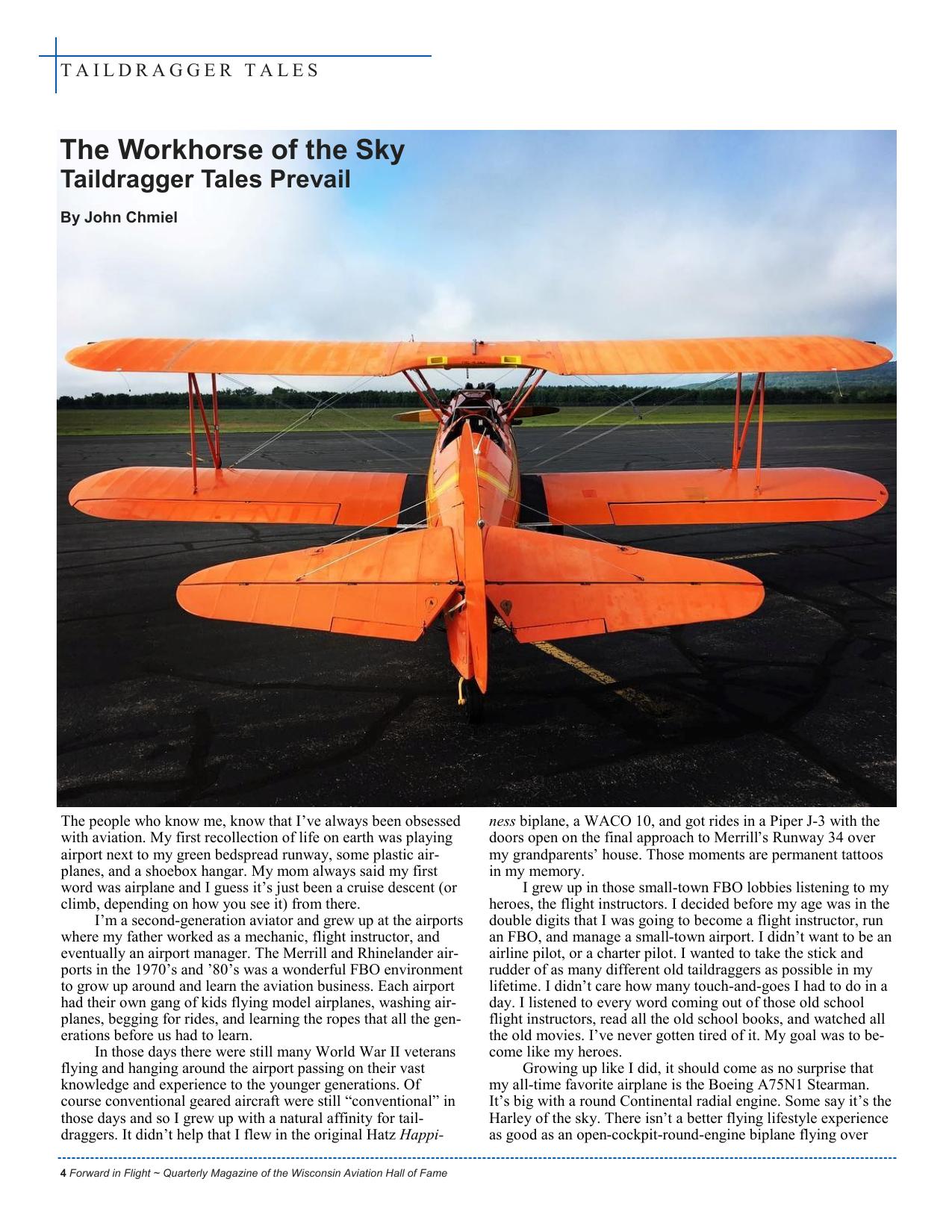
TAILDRAGGER TALES The Workhorse of the Sky Taildragger Tales Prevail By John Chmiel The people who know me, know that I’ve always been obsessed with aviation. My first recollection of life on earth was playing airport next to my green bedspread runway, some plastic airplanes, and a shoebox hangar. My mom always said my first word was airplane and I guess it’s just been a cruise descent (or climb, depending on how you see it) from there. I’m a second-generation aviator and grew up at the airports where my father worked as a mechanic, flight instructor, and eventually an airport manager. The Merrill and Rhinelander airports in the 1970’s and ’80’s was a wonderful FBO environment to grow up around and learn the aviation business. Each airport had their own gang of kids flying model airplanes, washing airplanes, begging for rides, and learning the ropes that all the generations before us had to learn. In those days there were still many World War II veterans flying and hanging around the airport passing on their vast knowledge and experience to the younger generations. Of course conventional geared aircraft were still “conventional” in those days and so I grew up with a natural affinity for taildraggers. It didn’t help that I flew in the original Hatz Happi4 Forward in Flight ~ Quarterly Magazine of the Wisconsin Aviation Hall of Fame ness biplane, a WACO 10, and got rides in a Piper J-3 with the doors open on the final approach to Merrill’s Runway 34 over my grandparents’ house. Those moments are permanent tattoos in my memory. I grew up in those small-town FBO lobbies listening to my heroes, the flight instructors. I decided before my age was in the double digits that I was going to become a flight instructor, run an FBO, and manage a small-town airport. I didn’t want to be an airline pilot, or a charter pilot. I wanted to take the stick and rudder of as many different old taildraggers as possible in my lifetime. I didn’t care how many touch-and-goes I had to do in a day. I listened to every word coming out of those old school flight instructors, read all the old school books, and watched all the old movies. I’ve never gotten tired of it. My goal was to become like my heroes. Growing up like I did, it should come as no surprise that my all-time favorite airplane is the Boeing A75N1 Stearman. It’s big with a round Continental radial engine. Some say it’s the Harley of the sky. There isn’t a better flying lifestyle experience as good as an open-cockpit-round-engine biplane flying over
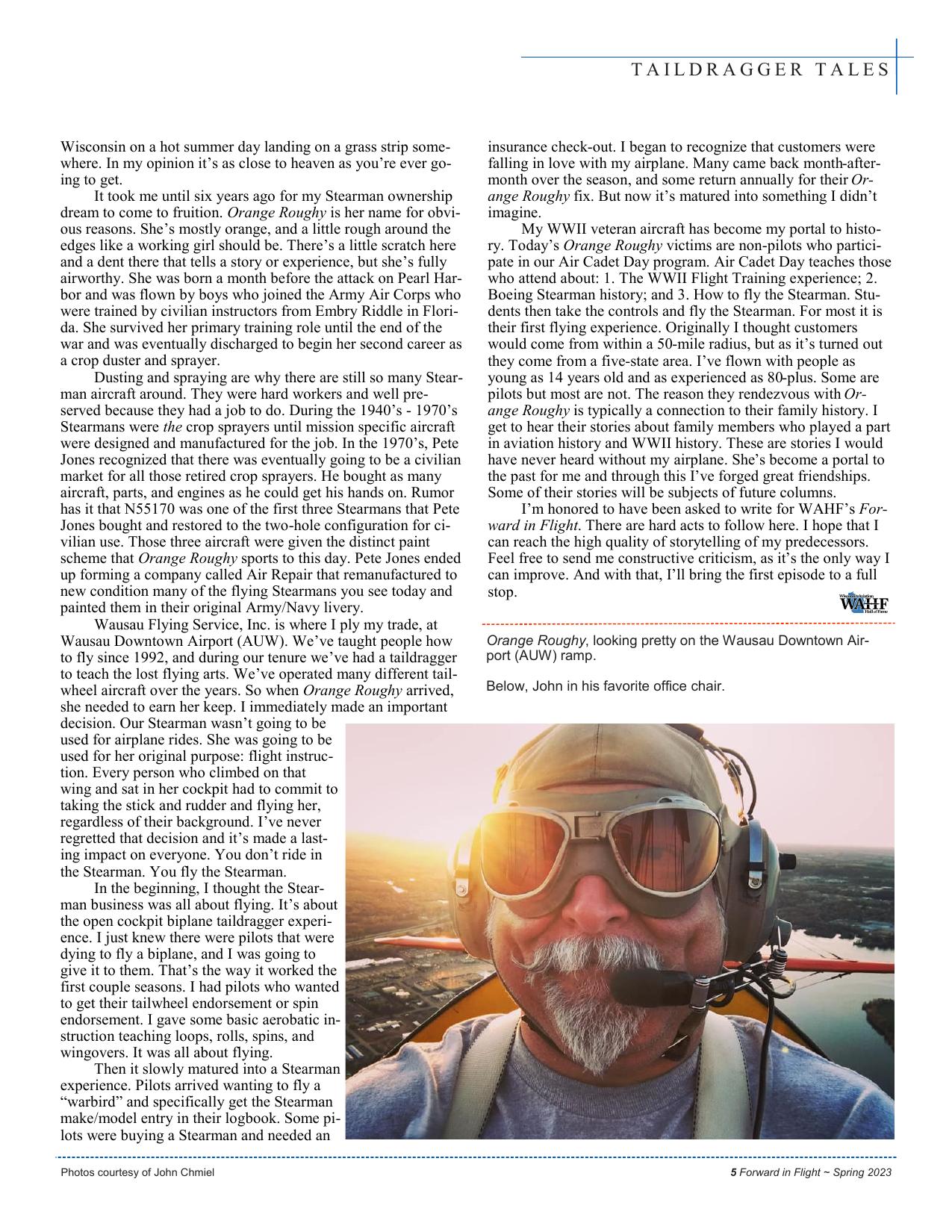
TAILDRAGGER TALES Wisconsin on a hot summer day landing on a grass strip somewhere. In my opinion it’s as close to heaven as you’re ever going to get. It took me until six years ago for my Stearman ownership dream to come to fruition. Orange Roughy is her name for obvious reasons. She’s mostly orange, and a little rough around the edges like a working girl should be. There’s a little scratch here and a dent there that tells a story or experience, but she’s fully airworthy. She was born a month before the attack on Pearl Harbor and was flown by boys who joined the Army Air Corps who were trained by civilian instructors from Embry Riddle in Florida. She survived her primary training role until the end of the war and was eventually discharged to begin her second career as a crop duster and sprayer. Dusting and spraying are why there are still so many Stearman aircraft around. They were hard workers and well preserved because they had a job to do. During the 1940’s - 1970’s Stearmans were the crop sprayers until mission specific aircraft were designed and manufactured for the job. In the 1970’s, Pete Jones recognized that there was eventually going to be a civilian market for all those retired crop sprayers. He bought as many aircraft, parts, and engines as he could get his hands on. Rumor has it that N55170 was one of the first three Stearmans that Pete Jones bought and restored to the two-hole configuration for civilian use. Those three aircraft were given the distinct paint scheme that Orange Roughy sports to this day. Pete Jones ended up forming a company called Air Repair that remanufactured to new condition many of the flying Stearmans you see today and painted them in their original Army/Navy livery. Wausau Flying Service, Inc. is where I ply my trade, at Wausau Downtown Airport (AUW). We’ve taught people how to fly since 1992, and during our tenure we’ve had a taildragger to teach the lost flying arts. We’ve operated many different tailwheel aircraft over the years. So when Orange Roughy arrived, she needed to earn her keep. I immediately made an important decision. Our Stearman wasn’t going to be used for airplane rides. She was going to be used for her original purpose: flight instruction. Every person who climbed on that wing and sat in her cockpit had to commit to taking the stick and rudder and flying her, regardless of their background. I’ve never regretted that decision and it’s made a lasting impact on everyone. You don’t ride in the Stearman. You fly the Stearman. In the beginning, I thought the Stearman business was all about flying. It’s about the open cockpit biplane taildragger experience. I just knew there were pilots that were dying to fly a biplane, and I was going to give it to them. That’s the way it worked the first couple seasons. I had pilots who wanted to get their tailwheel endorsement or spin endorsement. I gave some basic aerobatic instruction teaching loops, rolls, spins, and wingovers. It was all about flying. Then it slowly matured into a Stearman experience. Pilots arrived wanting to fly a “warbird” and specifically get the Stearman make/model entry in their logbook. Some pilots were buying a Stearman and needed an Photos courtesy of John Chmiel insurance check-out. I began to recognize that customers were falling in love with my airplane. Many came back month-aftermonth over the season, and some return annually for their Orange Roughy fix. But now it’s matured into something I didn’t imagine. My WWII veteran aircraft has become my portal to history. Today’s Orange Roughy victims are non-pilots who participate in our Air Cadet Day program. Air Cadet Day teaches those who attend about: 1. The WWII Flight Training experience; 2. Boeing Stearman history; and 3. How to fly the Stearman. Students then take the controls and fly the Stearman. For most it is their first flying experience. Originally I thought customers would come from within a 50-mile radius, but as it’s turned out they come from a five-state area. I’ve flown with people as young as 14 years old and as experienced as 80-plus. Some are pilots but most are not. The reason they rendezvous with Orange Roughy is typically a connection to their family history. I get to hear their stories about family members who played a part in aviation history and WWII history. These are stories I would have never heard without my airplane. She’s become a portal to the past for me and through this I’ve forged great friendships. Some of their stories will be subjects of future columns. I’m honored to have been asked to write for WAHF’s Forward in Flight. There are hard acts to follow here. I hope that I can reach the high quality of storytelling of my predecessors. Feel free to send me constructive criticism, as it’s the only way I can improve. And with that, I’ll bring the first episode to a full stop. Orange Roughy, looking pretty on the Wausau Downtown Airport (AUW) ramp. Below, John in his favorite office chair. 5 Forward in Flight ~ Spring 2023
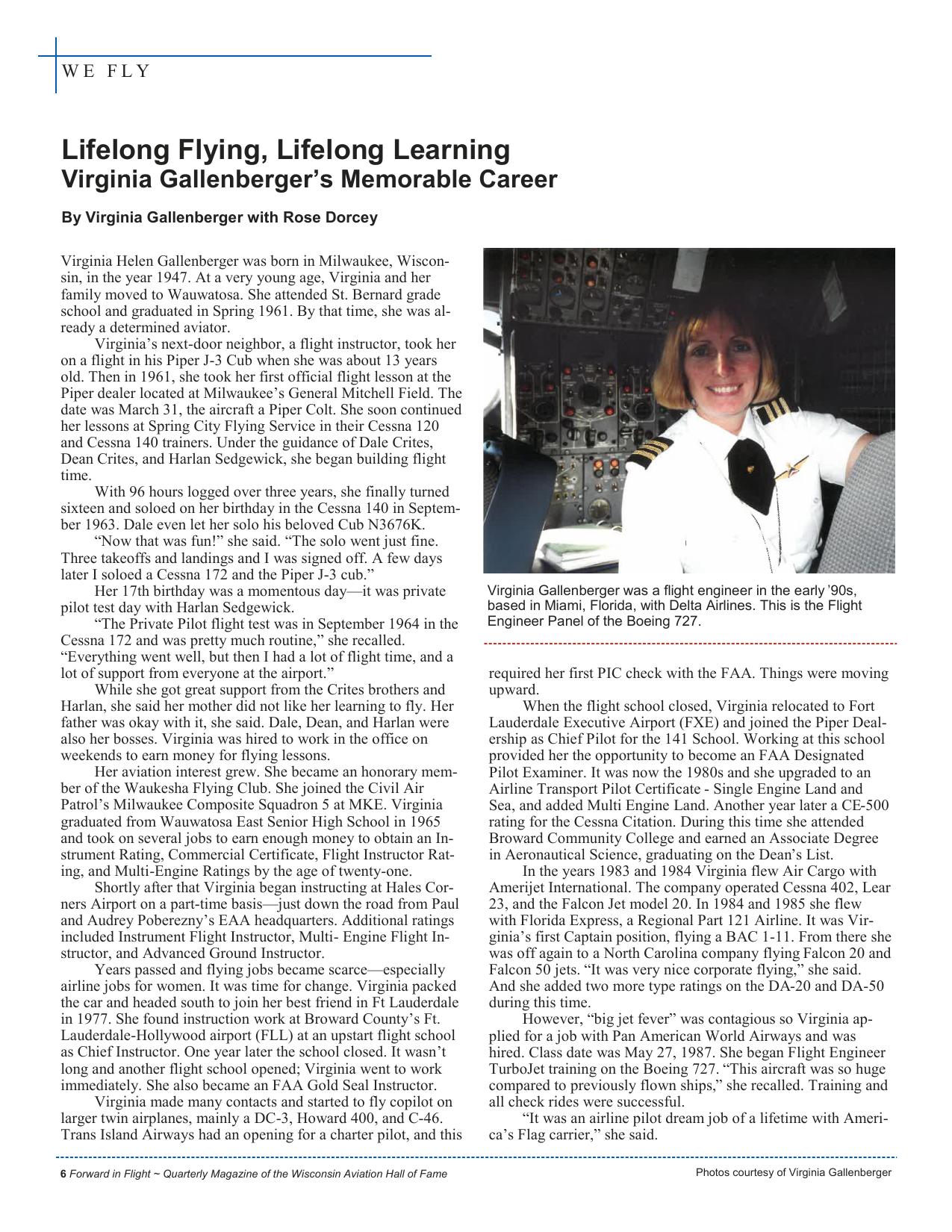
WE FLY Lifelong Flying, Lifelong Learning Virginia Gallenberger’s Memorable Career By Virginia Gallenberger with Rose Dorcey Virginia Helen Gallenberger was born in Milwaukee, Wisconsin, in the year 1947. At a very young age, Virginia and her family moved to Wauwatosa. She attended St. Bernard grade school and graduated in Spring 1961. By that time, she was already a determined aviator. Virginia’s next-door neighbor, a flight instructor, took her on a flight in his Piper J-3 Cub when she was about 13 years old. Then in 1961, she took her first official flight lesson at the Piper dealer located at Milwaukee’s General Mitchell Field. The date was March 31, the aircraft a Piper Colt. She soon continued her lessons at Spring City Flying Service in their Cessna 120 and Cessna 140 trainers. Under the guidance of Dale Crites, Dean Crites, and Harlan Sedgewick, she began building flight time. With 96 hours logged over three years, she finally turned sixteen and soloed on her birthday in the Cessna 140 in September 1963. Dale even let her solo his beloved Cub N3676K. “Now that was fun!” she said. “The solo went just fine. Three takeoffs and landings and I was signed off. A few days later I soloed a Cessna 172 and the Piper J-3 cub.” Her 17th birthday was a momentous day—it was private pilot test day with Harlan Sedgewick. “The Private Pilot flight test was in September 1964 in the Cessna 172 and was pretty much routine,” she recalled. “Everything went well, but then I had a lot of flight time, and a lot of support from everyone at the airport.” While she got great support from the Crites brothers and Harlan, she said her mother did not like her learning to fly. Her father was okay with it, she said. Dale, Dean, and Harlan were also her bosses. Virginia was hired to work in the office on weekends to earn money for flying lessons. Her aviation interest grew. She became an honorary member of the Waukesha Flying Club. She joined the Civil Air Patrol’s Milwaukee Composite Squadron 5 at MKE. Virginia graduated from Wauwatosa East Senior High School in 1965 and took on several jobs to earn enough money to obtain an Instrument Rating, Commercial Certificate, Flight Instructor Rating, and Multi-Engine Ratings by the age of twenty-one. Shortly after that Virginia began instructing at Hales Corners Airport on a part-time basis—just down the road from Paul and Audrey Poberezny’s EAA headquarters. Additional ratings included Instrument Flight Instructor, Multi- Engine Flight Instructor, and Advanced Ground Instructor. Years passed and flying jobs became scarce—especially airline jobs for women. It was time for change. Virginia packed the car and headed south to join her best friend in Ft Lauderdale in 1977. She found instruction work at Broward County’s Ft. Lauderdale-Hollywood airport (FLL) at an upstart flight school as Chief Instructor. One year later the school closed. It wasn’t long and another flight school opened; Virginia went to work immediately. She also became an FAA Gold Seal Instructor. Virginia made many contacts and started to fly copilot on larger twin airplanes, mainly a DC-3, Howard 400, and C-46. Trans Island Airways had an opening for a charter pilot, and this 6 Forward in Flight ~ Quarterly Magazine of the Wisconsin Aviation Hall of Fame Virginia Gallenberger was a flight engineer in the early ’90s, based in Miami, Florida, with Delta Airlines. This is the Flight Engineer Panel of the Boeing 727. required her first PIC check with the FAA. Things were moving upward. When the flight school closed, Virginia relocated to Fort Lauderdale Executive Airport (FXE) and joined the Piper Dealership as Chief Pilot for the 141 School. Working at this school provided her the opportunity to become an FAA Designated Pilot Examiner. It was now the 1980s and she upgraded to an Airline Transport Pilot Certificate - Single Engine Land and Sea, and added Multi Engine Land. Another year later a CE-500 rating for the Cessna Citation. During this time she attended Broward Community College and earned an Associate Degree in Aeronautical Science, graduating on the Dean’s List. In the years 1983 and 1984 Virginia flew Air Cargo with Amerijet International. The company operated Cessna 402, Lear 23, and the Falcon Jet model 20. In 1984 and 1985 she flew with Florida Express, a Regional Part 121 Airline. It was Virginia’s first Captain position, flying a BAC 1-11. From there she was off again to a North Carolina company flying Falcon 20 and Falcon 50 jets. “It was very nice corporate flying,” she said. And she added two more type ratings on the DA-20 and DA-50 during this time. However, “big jet fever” was contagious so Virginia applied for a job with Pan American World Airways and was hired. Class date was May 27, 1987. She began Flight Engineer TurboJet training on the Boeing 727. “This aircraft was so huge compared to previously flown ships,” she recalled. Training and all check rides were successful. “It was an airline pilot dream job of a lifetime with America’s Flag carrier,” she said. Photos courtesy of Virginia Gallenberger
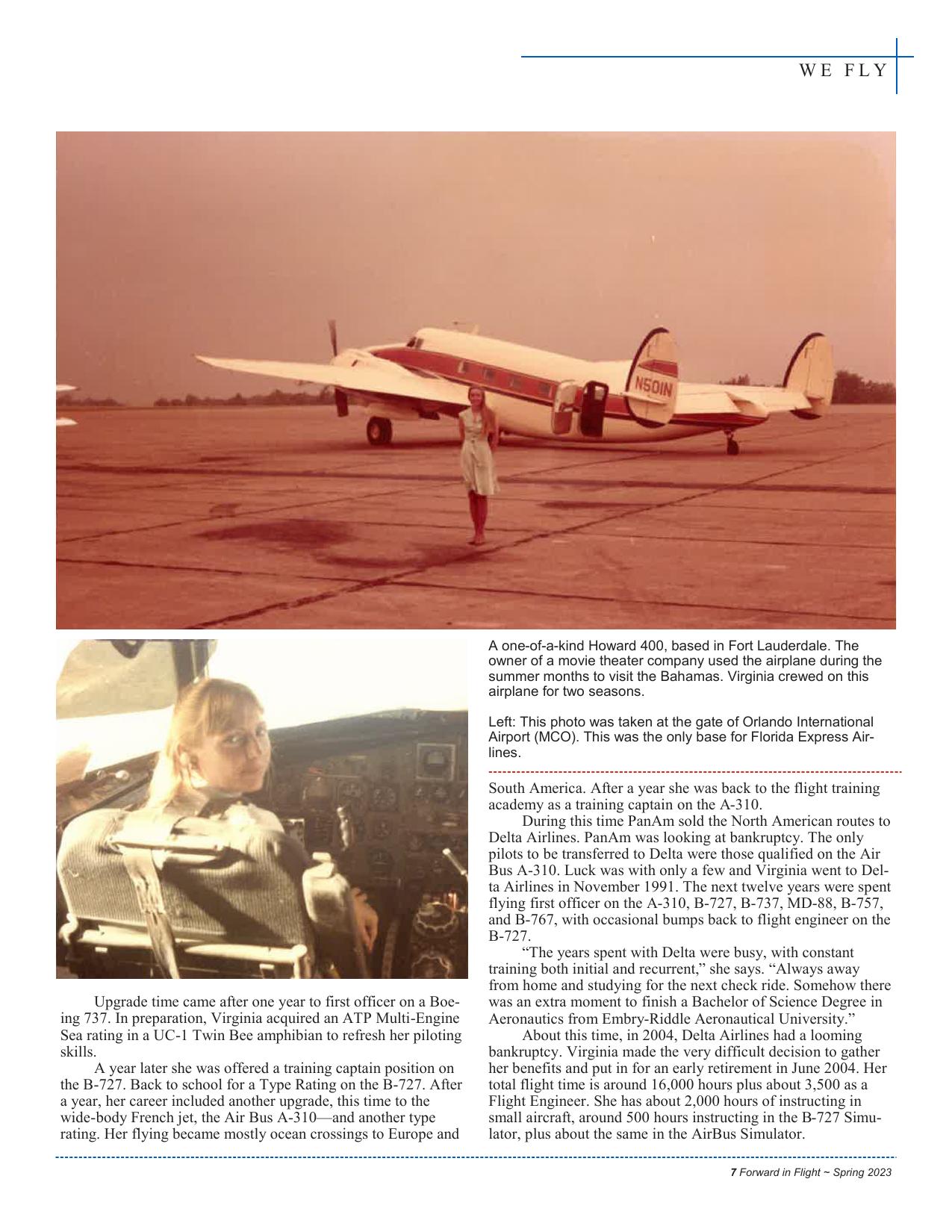
WE FLY A one-of-a-kind Howard 400, based in Fort Lauderdale. The owner of a movie theater company used the airplane during the summer months to visit the Bahamas. Virginia crewed on this airplane for two seasons. Left: This photo was taken at the gate of Orlando International Airport (MCO). This was the only base for Florida Express Airlines. Upgrade time came after one year to first officer on a Boeing 737. In preparation, Virginia acquired an ATP Multi-Engine Sea rating in a UC-1 Twin Bee amphibian to refresh her piloting skills. A year later she was offered a training captain position on the B-727. Back to school for a Type Rating on the B-727. After a year, her career included another upgrade, this time to the wide-body French jet, the Air Bus A-310—and another type rating. Her flying became mostly ocean crossings to Europe and South America. After a year she was back to the flight training academy as a training captain on the A-310. During this time PanAm sold the North American routes to Delta Airlines. PanAm was looking at bankruptcy. The only pilots to be transferred to Delta were those qualified on the Air Bus A-310. Luck was with only a few and Virginia went to Delta Airlines in November 1991. The next twelve years were spent flying first officer on the A-310, B-727, B-737, MD-88, B-757, and B-767, with occasional bumps back to flight engineer on the B-727. “The years spent with Delta were busy, with constant training both initial and recurrent,” she says. “Always away from home and studying for the next check ride. Somehow there was an extra moment to finish a Bachelor of Science Degree in Aeronautics from Embry-Riddle Aeronautical University.” About this time, in 2004, Delta Airlines had a looming bankruptcy. Virginia made the very difficult decision to gather her benefits and put in for an early retirement in June 2004. Her total flight time is around 16,000 hours plus about 3,500 as a Flight Engineer. She has about 2,000 hours of instructing in small aircraft, around 500 hours instructing in the B-727 Simulator, plus about the same in the AirBus Simulator. 7 Forward in Flight ~ Spring 2023
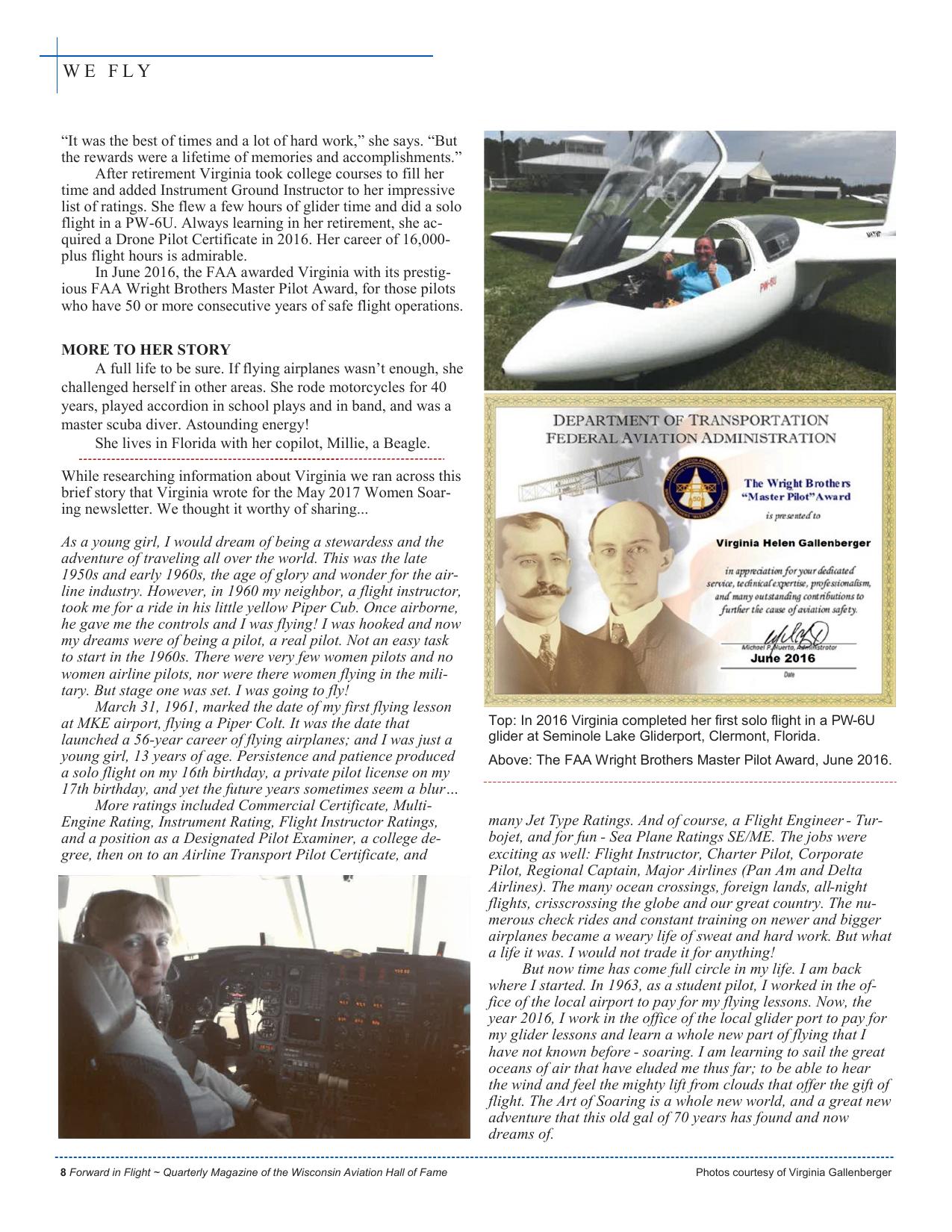
WE FLY “It was the best of times and a lot of hard work,” she says. “But the rewards were a lifetime of memories and accomplishments.” After retirement Virginia took college courses to fill her time and added Instrument Ground Instructor to her impressive list of ratings. She flew a few hours of glider time and did a solo flight in a PW-6U. Always learning in her retirement, she acquired a Drone Pilot Certificate in 2016. Her career of 16,000plus flight hours is admirable. In June 2016, the FAA awarded Virginia with its prestigious FAA Wright Brothers Master Pilot Award, for those pilots who have 50 or more consecutive years of safe flight operations. MORE TO HER STORY A full life to be sure. If flying airplanes wasn’t enough, she challenged herself in other areas. She rode motorcycles for 40 years, played accordion in school plays and in band, and was a master scuba diver. Astounding energy! She lives in Florida with her copilot, Millie, a Beagle. While researching information about Virginia we ran across this brief story that Virginia wrote for the May 2017 Women Soaring newsletter. We thought it worthy of sharing... As a young girl, I would dream of being a stewardess and the adventure of traveling all over the world. This was the late 1950s and early 1960s, the age of glory and wonder for the airline industry. However, in 1960 my neighbor, a flight instructor, took me for a ride in his little yellow Piper Cub. Once airborne, he gave me the controls and I was flying! I was hooked and now my dreams were of being a pilot, a real pilot. Not an easy task to start in the 1960s. There were very few women pilots and no women airline pilots, nor were there women flying in the military. But stage one was set. I was going to fly! March 31, 1961, marked the date of my first flying lesson at MKE airport, flying a Piper Colt. It was the date that launched a 56-year career of flying airplanes; and I was just a young girl, 13 years of age. Persistence and patience produced a solo flight on my 16th birthday, a private pilot license on my 17th birthday, and yet the future years sometimes seem a blur… More ratings included Commercial Certificate, MultiEngine Rating, Instrument Rating, Flight Instructor Ratings, and a position as a Designated Pilot Examiner, a college degree, then on to an Airline Transport Pilot Certificate, and 8 Forward in Flight ~ Quarterly Magazine of the Wisconsin Aviation Hall of Fame Top: In 2016 Virginia completed her first solo flight in a PW-6U glider at Seminole Lake Gliderport, Clermont, Florida. Above: The FAA Wright Brothers Master Pilot Award, June 2016. many Jet Type Ratings. And of course, a Flight Engineer - Turbojet, and for fun - Sea Plane Ratings SE/ME. The jobs were exciting as well: Flight Instructor, Charter Pilot, Corporate Pilot, Regional Captain, Major Airlines (Pan Am and Delta Airlines). The many ocean crossings, foreign lands, all-night flights, crisscrossing the globe and our great country. The numerous check rides and constant training on newer and bigger airplanes became a weary life of sweat and hard work. But what a life it was. I would not trade it for anything! But now time has come full circle in my life. I am back where I started. In 1963, as a student pilot, I worked in the office of the local airport to pay for my flying lessons. Now, the year 2016, I work in the office of the local glider port to pay for my glider lessons and learn a whole new part of flying that I have not known before - soaring. I am learning to sail the great oceans of air that have eluded me thus far; to be able to hear the wind and feel the mighty lift from clouds that offer the gift of flight. The Art of Soaring is a whole new world, and a great new adventure that this old gal of 70 years has found and now dreams of. Photos courtesy of Virginia Gallenberger
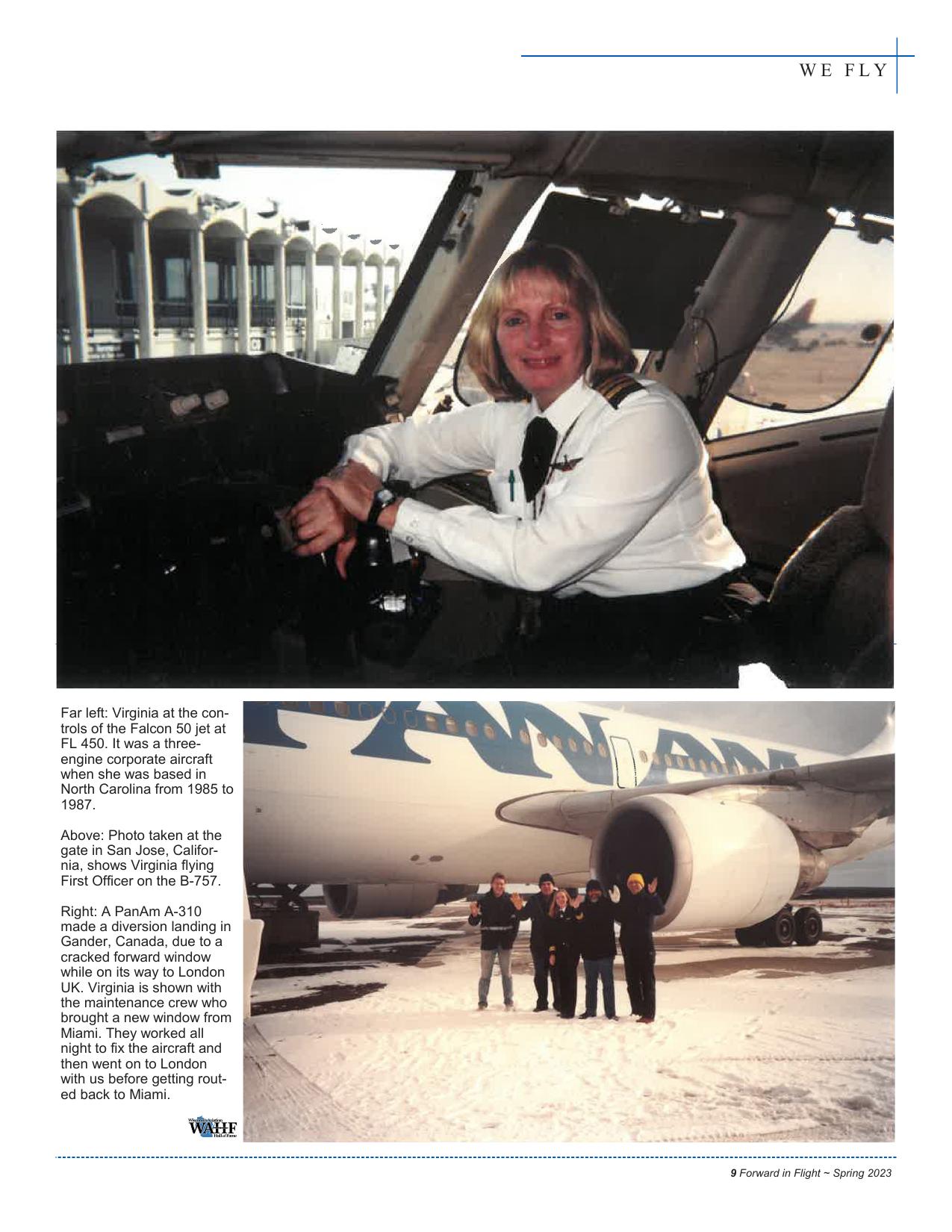
WE FLY Far left: Virginia at the controls of the Falcon 50 jet at FL 450. It was a threeengine corporate aircraft when she was based in North Carolina from 1985 to 1987. Above: Photo taken at the gate in San Jose, California, shows Virginia flying First Officer on the B-757. Right: A PanAm A-310 made a diversion landing in Gander, Canada, due to a cracked forward window while on its way to London UK. Virginia is shown with the maintenance crew who brought a new window from Miami. They worked all night to fix the aircraft and then went on to London with us before getting routed back to Miami. 9 Forward in Flight ~ Spring 2023
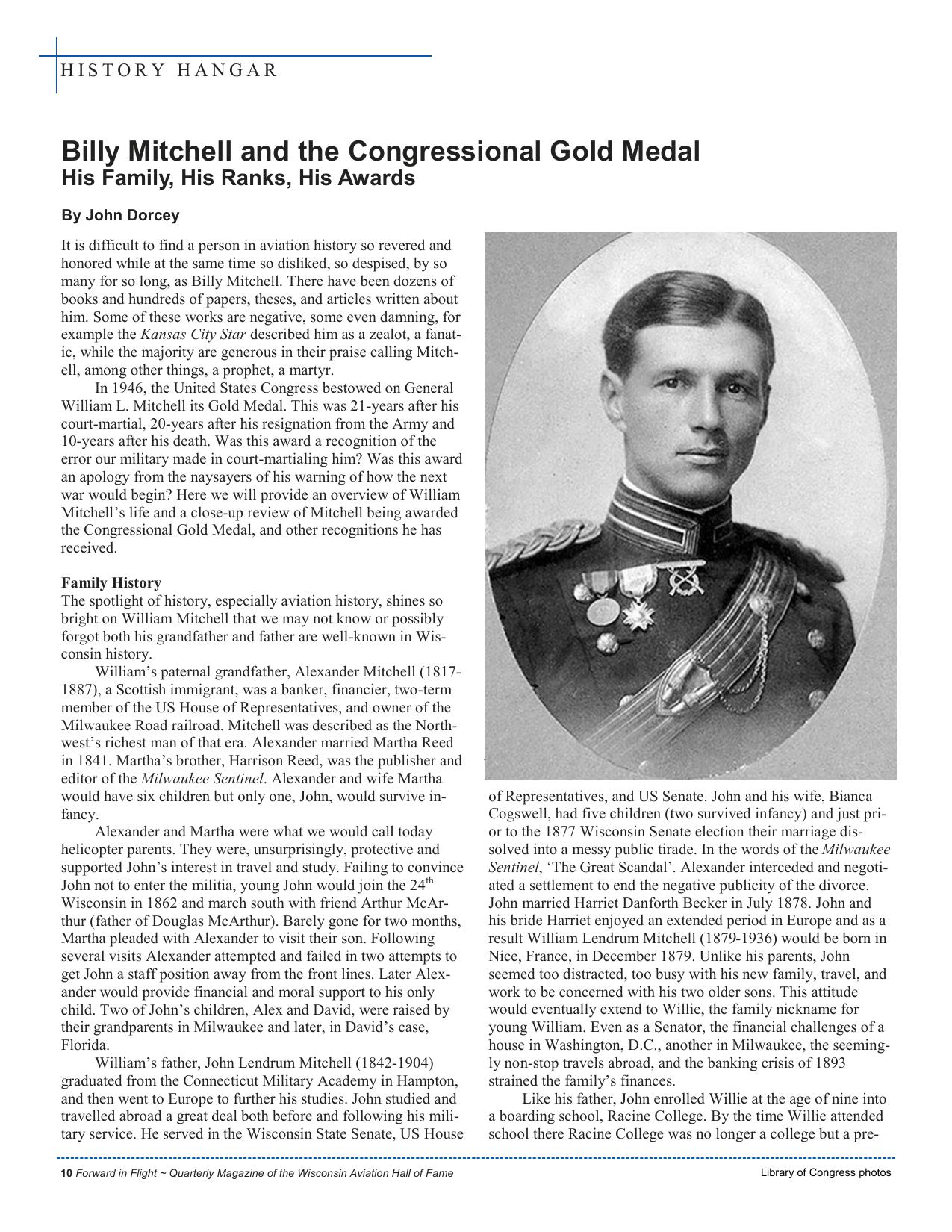
HISTORY HANGAR Billy Mitchell and the Congressional Gold Medal His Family, His Ranks, His Awards By John Dorcey It is difficult to find a person in aviation history so revered and honored while at the same time so disliked, so despised, by so many for so long, as Billy Mitchell. There have been dozens of books and hundreds of papers, theses, and articles written about him. Some of these works are negative, some even damning, for example the Kansas City Star described him as a zealot, a fanatic, while the majority are generous in their praise calling Mitchell, among other things, a prophet, a martyr. In 1946, the United States Congress bestowed on General William L. Mitchell its Gold Medal. This was 21-years after his court-martial, 20-years after his resignation from the Army and 10-years after his death. Was this award a recognition of the error our military made in court-martialing him? Was this award an apology from the naysayers of his warning of how the next war would begin? Here we will provide an overview of William Mitchell’s life and a close-up review of Mitchell being awarded the Congressional Gold Medal, and other recognitions he has received. Family History The spotlight of history, especially aviation history, shines so bright on William Mitchell that we may not know or possibly forgot both his grandfather and father are well-known in Wisconsin history. William’s paternal grandfather, Alexander Mitchell (18171887), a Scottish immigrant, was a banker, financier, two-term member of the US House of Representatives, and owner of the Milwaukee Road railroad. Mitchell was described as the Northwest’s richest man of that era. Alexander married Martha Reed in 1841. Martha’s brother, Harrison Reed, was the publisher and editor of the Milwaukee Sentinel. Alexander and wife Martha would have six children but only one, John, would survive infancy. Alexander and Martha were what we would call today helicopter parents. They were, unsurprisingly, protective and supported John’s interest in travel and study. Failing to convince John not to enter the militia, young John would join the 24th Wisconsin in 1862 and march south with friend Arthur McArthur (father of Douglas McArthur). Barely gone for two months, Martha pleaded with Alexander to visit their son. Following several visits Alexander attempted and failed in two attempts to get John a staff position away from the front lines. Later Alexander would provide financial and moral support to his only child. Two of John’s children, Alex and David, were raised by their grandparents in Milwaukee and later, in David’s case, Florida. William’s father, John Lendrum Mitchell (1842-1904) graduated from the Connecticut Military Academy in Hampton, and then went to Europe to further his studies. John studied and travelled abroad a great deal both before and following his military service. He served in the Wisconsin State Senate, US House 10 Forward in Flight ~ Quarterly Magazine of the Wisconsin Aviation Hall of Fame of Representatives, and US Senate. John and his wife, Bianca Cogswell, had five children (two survived infancy) and just prior to the 1877 Wisconsin Senate election their marriage dissolved into a messy public tirade. In the words of the Milwaukee Sentinel, ‘The Great Scandal’. Alexander interceded and negotiated a settlement to end the negative publicity of the divorce. John married Harriet Danforth Becker in July 1878. John and his bride Harriet enjoyed an extended period in Europe and as a result William Lendrum Mitchell (1879-1936) would be born in Nice, France, in December 1879. Unlike his parents, John seemed too distracted, too busy with his new family, travel, and work to be concerned with his two older sons. This attitude would eventually extend to Willie, the family nickname for young William. Even as a Senator, the financial challenges of a house in Washington, D.C., another in Milwaukee, the seemingly non-stop travels abroad, and the banking crisis of 1893 strained the family’s finances. Like his father, John enrolled Willie at the age of nine into a boarding school, Racine College. By the time Willie attended school there Racine College was no longer a college but a preLibrary of Congress photos
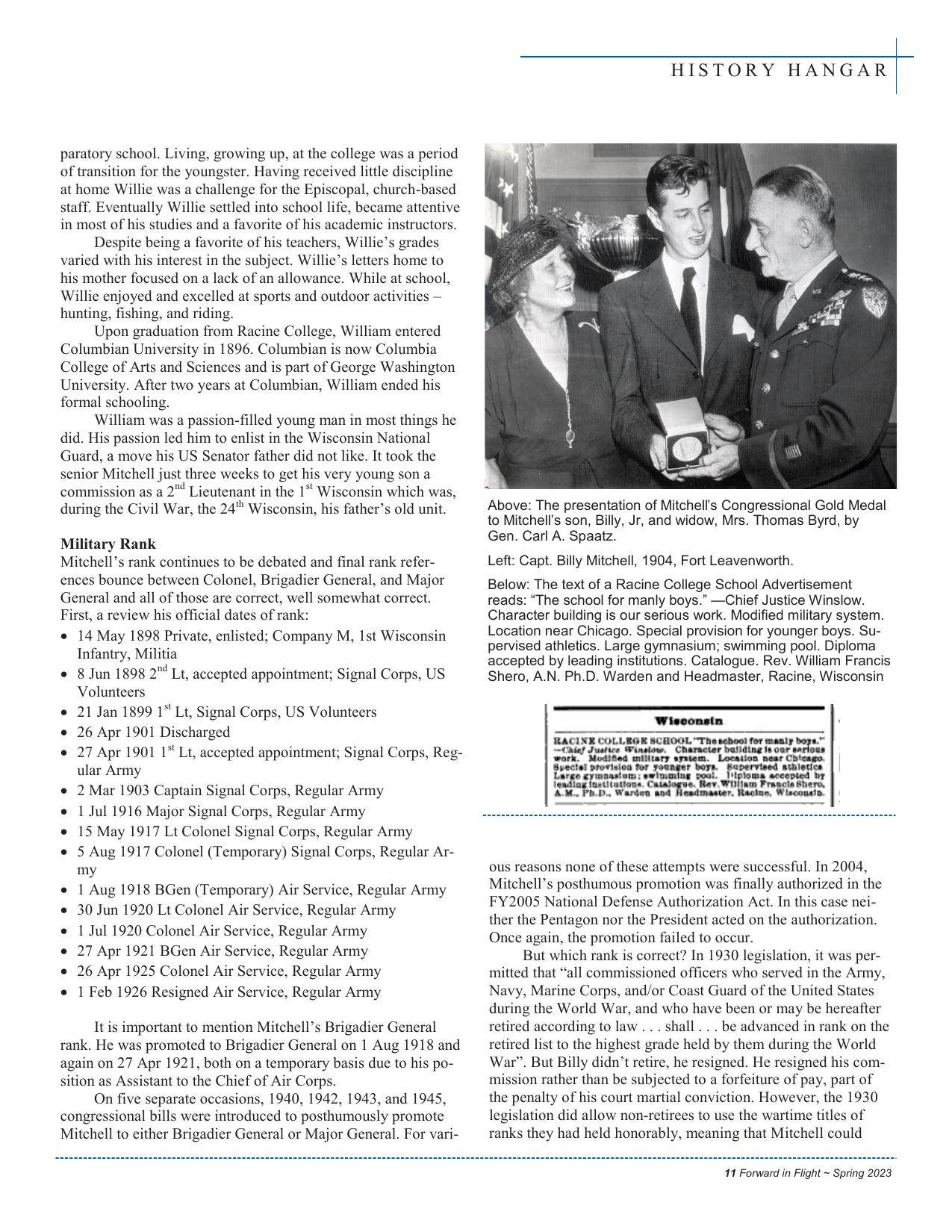
HISTORY HANGAR paratory school. Living, growing up, at the college was a period of transition for the youngster. Having received little discipline at home Willie was a challenge for the Episcopal, church-based staff. Eventually Willie settled into school life, became attentive in most of his studies and a favorite of his academic instructors. Despite being a favorite of his teachers, Willie’s grades varied with his interest in the subject. Willie’s letters home to his mother focused on a lack of an allowance. While at school, Willie enjoyed and excelled at sports and outdoor activities – hunting, fishing, and riding. Upon graduation from Racine College, William entered Columbian University in 1896. Columbian is now Columbia College of Arts and Sciences and is part of George Washington University. After two years at Columbian, William ended his formal schooling. William was a passion-filled young man in most things he did. His passion led him to enlist in the Wisconsin National Guard, a move his US Senator father did not like. It took the senior Mitchell just three weeks to get his very young son a commission as a 2nd Lieutenant in the 1st Wisconsin which was, during the Civil War, the 24th Wisconsin, his father’s old unit. Military Rank Mitchell’s rank continues to be debated and final rank references bounce between Colonel, Brigadier General, and Major General and all of those are correct, well somewhat correct. First, a review his official dates of rank: · 14 May 1898 Private, enlisted; Company M, 1st Wisconsin Infantry, Militia · 8 Jun 1898 2nd Lt, accepted appointment; Signal Corps, US Volunteers · 21 Jan 1899 1st Lt, Signal Corps, US Volunteers · 26 Apr 1901 Discharged · 27 Apr 1901 1st Lt, accepted appointment; Signal Corps, Regular Army · 2 Mar 1903 Captain Signal Corps, Regular Army · 1 Jul 1916 Major Signal Corps, Regular Army · 15 May 1917 Lt Colonel Signal Corps, Regular Army · 5 Aug 1917 Colonel (Temporary) Signal Corps, Regular Army · 1 Aug 1918 BGen (Temporary) Air Service, Regular Army · 30 Jun 1920 Lt Colonel Air Service, Regular Army · 1 Jul 1920 Colonel Air Service, Regular Army · 27 Apr 1921 BGen Air Service, Regular Army · 26 Apr 1925 Colonel Air Service, Regular Army · 1 Feb 1926 Resigned Air Service, Regular Army It is important to mention Mitchell’s Brigadier General rank. He was promoted to Brigadier General on 1 Aug 1918 and again on 27 Apr 1921, both on a temporary basis due to his position as Assistant to the Chief of Air Corps. On five separate occasions, 1940, 1942, 1943, and 1945, congressional bills were introduced to posthumously promote Mitchell to either Brigadier General or Major General. For vari- Above: The presentation of Mitchell’s Congressional Gold Medal to Mitchell’s son, Billy, Jr, and widow, Mrs. Thomas Byrd, by Gen. Carl A. Spaatz. Left: Capt. Billy Mitchell, 1904, Fort Leavenworth. Below: The text of a Racine College School Advertisement reads: “The school for manly boys.” —Chief Justice Winslow. Character building is our serious work. Modified military system. Location near Chicago. Special provision for younger boys. Supervised athletics. Large gymnasium; swimming pool. Diploma accepted by leading institutions. Catalogue. Rev. William Francis Shero, A.N. Ph.D. Warden and Headmaster, Racine, Wisconsin ous reasons none of these attempts were successful. In 2004, Mitchell’s posthumous promotion was finally authorized in the FY2005 National Defense Authorization Act. In this case neither the Pentagon nor the President acted on the authorization. Once again, the promotion failed to occur. But which rank is correct? In 1930 legislation, it was permitted that “all commissioned officers who served in the Army, Navy, Marine Corps, and/or Coast Guard of the United States during the World War, and who have been or may be hereafter retired according to law . . . shall . . . be advanced in rank on the retired list to the highest grade held by them during the World War”. But Billy didn’t retire, he resigned. He resigned his commission rather than be subjected to a forfeiture of pay, part of the penalty of his court martial conviction. However, the 1930 legislation did allow non-retirees to use the wartime titles of ranks they had held honorably, meaning that Mitchell could 11 Forward in Flight ~ Spring 2023
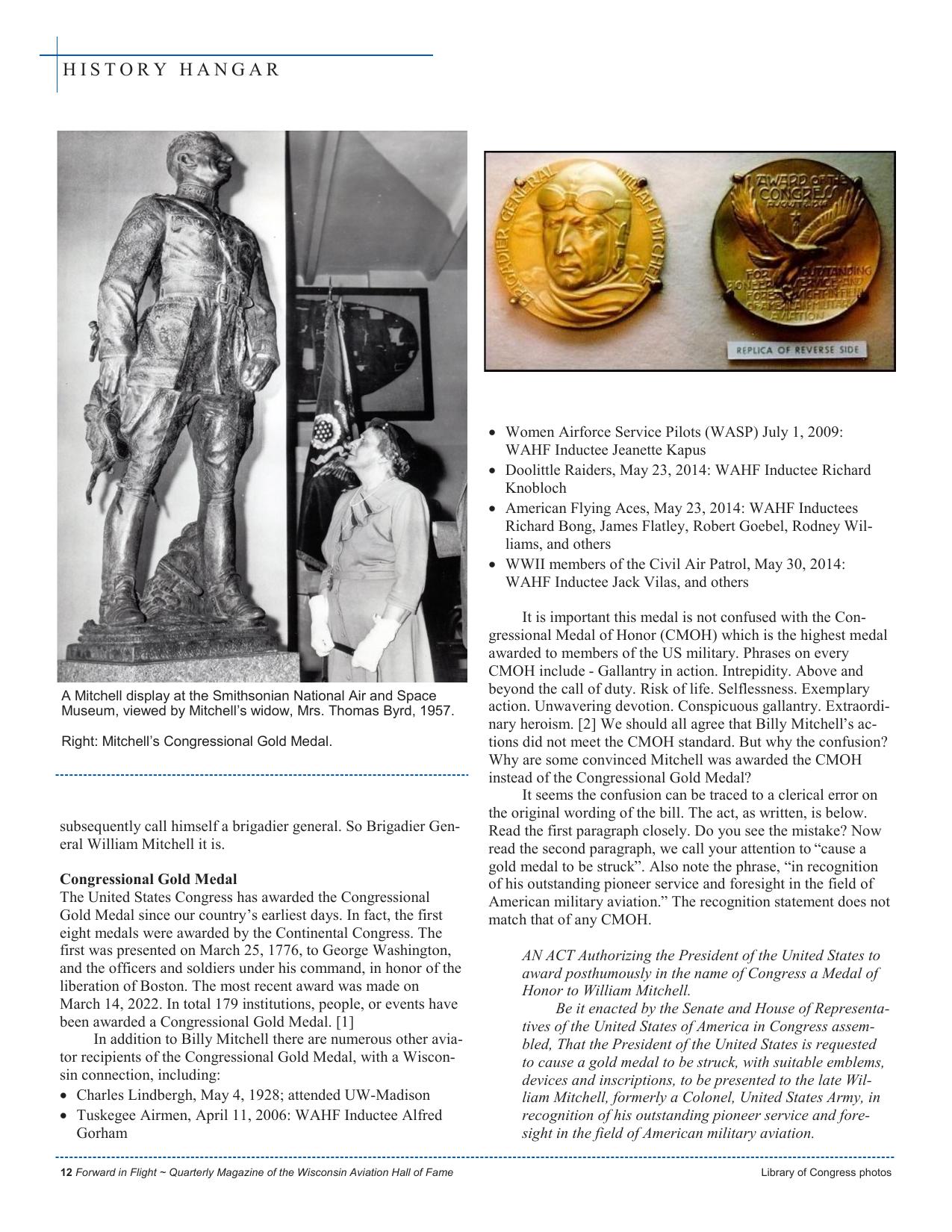
HISTORY HANGAR · Women Airforce Service Pilots (WASP) July 1, 2009: WAHF Inductee Jeanette Kapus · Doolittle Raiders, May 23, 2014: WAHF Inductee Richard Knobloch · American Flying Aces, May 23, 2014: WAHF Inductees Richard Bong, James Flatley, Robert Goebel, Rodney Williams, and others · WWII members of the Civil Air Patrol, May 30, 2014: WAHF Inductee Jack Vilas, and others A Mitchell display at the Smithsonian National Air and Space Museum, viewed by Mitchell’s widow, Mrs. Thomas Byrd, 1957. Right: Mitchell’s Congressional Gold Medal. subsequently call himself a brigadier general. So Brigadier General William Mitchell it is. Congressional Gold Medal The United States Congress has awarded the Congressional Gold Medal since our country’s earliest days. In fact, the first eight medals were awarded by the Continental Congress. The first was presented on March 25, 1776, to George Washington, and the officers and soldiers under his command, in honor of the liberation of Boston. The most recent award was made on March 14, 2022. In total 179 institutions, people, or events have been awarded a Congressional Gold Medal. [1] In addition to Billy Mitchell there are numerous other aviator recipients of the Congressional Gold Medal, with a Wisconsin connection, including: · Charles Lindbergh, May 4, 1928; attended UW-Madison · Tuskegee Airmen, April 11, 2006: WAHF Inductee Alfred Gorham 12 Forward in Flight ~ Quarterly Magazine of the Wisconsin Aviation Hall of Fame It is important this medal is not confused with the Congressional Medal of Honor (CMOH) which is the highest medal awarded to members of the US military. Phrases on every CMOH include - Gallantry in action. Intrepidity. Above and beyond the call of duty. Risk of life. Selflessness. Exemplary action. Unwavering devotion. Conspicuous gallantry. Extraordinary heroism. [2] We should all agree that Billy Mitchell’s actions did not meet the CMOH standard. But why the confusion? Why are some convinced Mitchell was awarded the CMOH instead of the Congressional Gold Medal? It seems the confusion can be traced to a clerical error on the original wording of the bill. The act, as written, is below. Read the first paragraph closely. Do you see the mistake? Now read the second paragraph, we call your attention to “cause a gold medal to be struck”. Also note the phrase, “in recognition of his outstanding pioneer service and foresight in the field of American military aviation.” The recognition statement does not match that of any CMOH. AN ACT Authorizing the President of the United States to award posthumously in the name of Congress a Medal of Honor to William Mitchell. Be it enacted by the Senate and House of Representatives of the United States of America in Congress assembled, That the President of the United States is requested to cause a gold medal to be struck, with suitable emblems, devices and inscriptions, to be presented to the late William Mitchell, formerly a Colonel, United States Army, in recognition of his outstanding pioneer service and foresight in the field of American military aviation. Library of Congress photos
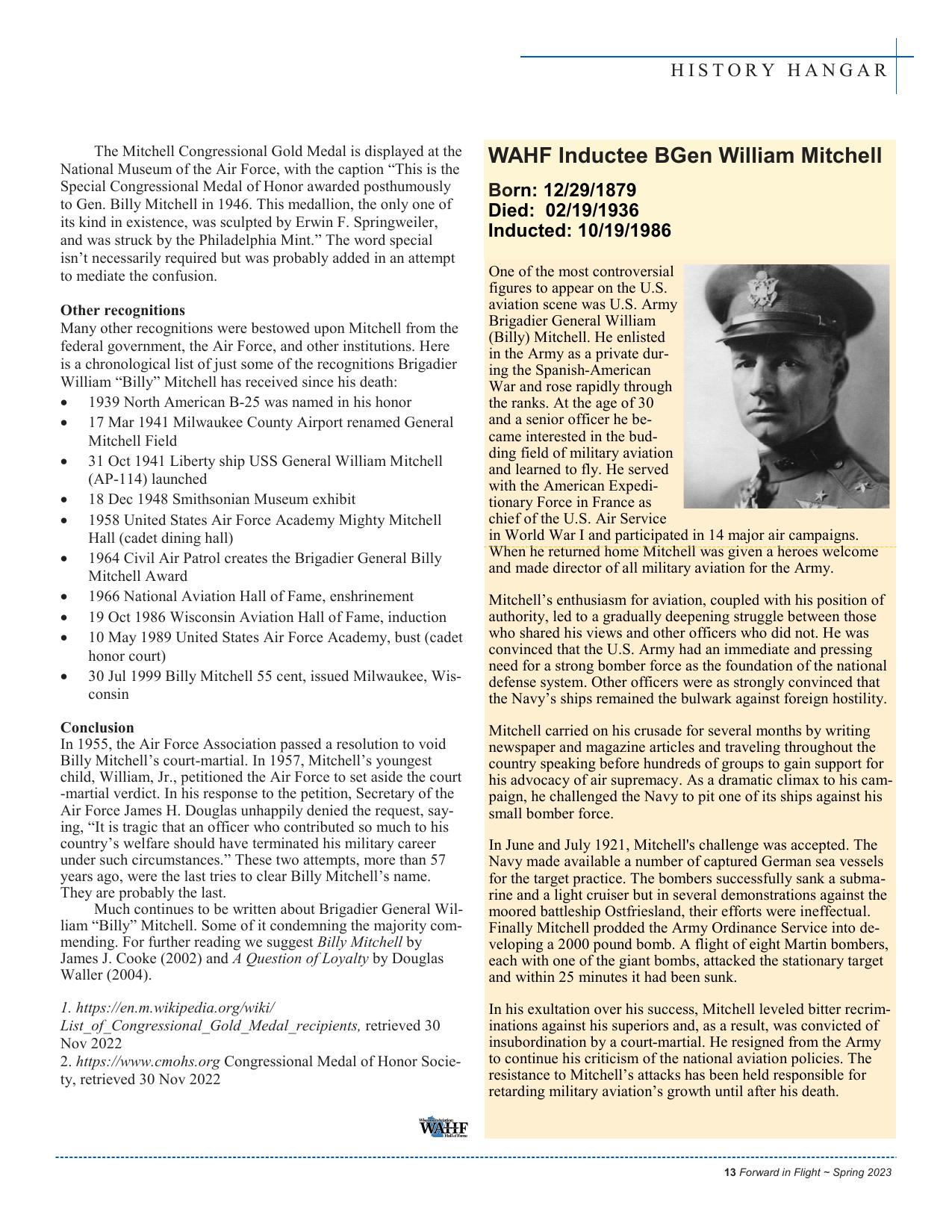
HISTORY HANGAR The Mitchell Congressional Gold Medal is displayed at the National Museum of the Air Force, with the caption “This is the Special Congressional Medal of Honor awarded posthumously to Gen. Billy Mitchell in 1946. This medallion, the only one of its kind in existence, was sculpted by Erwin F. Springweiler, and was struck by the Philadelphia Mint.” The word special isn’t necessarily required but was probably added in an attempt to mediate the confusion. Other recognitions Many other recognitions were bestowed upon Mitchell from the federal government, the Air Force, and other institutions. Here is a chronological list of just some of the recognitions Brigadier William “Billy” Mitchell has received since his death: · 1939 North American B-25 was named in his honor · 17 Mar 1941 Milwaukee County Airport renamed General Mitchell Field · 31 Oct 1941 Liberty ship USS General William Mitchell (AP-114) launched · 18 Dec 1948 Smithsonian Museum exhibit · 1958 United States Air Force Academy Mighty Mitchell Hall (cadet dining hall) · 1964 Civil Air Patrol creates the Brigadier General Billy Mitchell Award · 1966 National Aviation Hall of Fame, enshrinement · 19 Oct 1986 Wisconsin Aviation Hall of Fame, induction · 10 May 1989 United States Air Force Academy, bust (cadet honor court) · 30 Jul 1999 Billy Mitchell 55 cent, issued Milwaukee, Wisconsin WAHF Inductee BGen William Mitchell Born: 12/29/1879 Died: 02/19/1936 Inducted: 10/19/1986 One of the most controversial figures to appear on the U.S. aviation scene was U.S. Army Brigadier General William (Billy) Mitchell. He enlisted in the Army as a private during the Spanish-American War and rose rapidly through the ranks. At the age of 30 and a senior officer he became interested in the budding field of military aviation and learned to fly. He served with the American Expeditionary Force in France as chief of the U.S. Air Service in World War I and participated in 14 major air campaigns. When he returned home Mitchell was given a heroes welcome and made director of all military aviation for the Army. Mitchell’s enthusiasm for aviation, coupled with his position of authority, led to a gradually deepening struggle between those who shared his views and other officers who did not. He was convinced that the U.S. Army had an immediate and pressing need for a strong bomber force as the foundation of the national defense system. Other officers were as strongly convinced that the Navy’s ships remained the bulwark against foreign hostility. Conclusion In 1955, the Air Force Association passed a resolution to void Billy Mitchell’s court-martial. In 1957, Mitchell’s youngest child, William, Jr., petitioned the Air Force to set aside the court -martial verdict. In his response to the petition, Secretary of the Air Force James H. Douglas unhappily denied the request, saying, “It is tragic that an officer who contributed so much to his country’s welfare should have terminated his military career under such circumstances.” These two attempts, more than 57 years ago, were the last tries to clear Billy Mitchell’s name. They are probably the last. Much continues to be written about Brigadier General William “Billy” Mitchell. Some of it condemning the majority commending. For further reading we suggest Billy Mitchell by James J. Cooke (2002) and A Question of Loyalty by Douglas Waller (2004). Mitchell carried on his crusade for several months by writing newspaper and magazine articles and traveling throughout the country speaking before hundreds of groups to gain support for his advocacy of air supremacy. As a dramatic climax to his campaign, he challenged the Navy to pit one of its ships against his small bomber force. 1. https://en.m.wikipedia.org/wiki/ List_of_Congressional_Gold_Medal_recipients, retrieved 30 Nov 2022 2. https://www.cmohs.org Congressional Medal of Honor Society, retrieved 30 Nov 2022 In his exultation over his success, Mitchell leveled bitter recriminations against his superiors and, as a result, was convicted of insubordination by a court-martial. He resigned from the Army to continue his criticism of the national aviation policies. The resistance to Mitchell’s attacks has been held responsible for retarding military aviation’s growth until after his death. In June and July 1921, Mitchell's challenge was accepted. The Navy made available a number of captured German sea vessels for the target practice. The bombers successfully sank a submarine and a light cruiser but in several demonstrations against the moored battleship Ostfriesland, their efforts were ineffectual. Finally Mitchell prodded the Army Ordinance Service into developing a 2000 pound bomb. A flight of eight Martin bombers, each with one of the giant bombs, attacked the stationary target and within 25 minutes it had been sunk. 13 Forward in Flight ~ Spring 2023
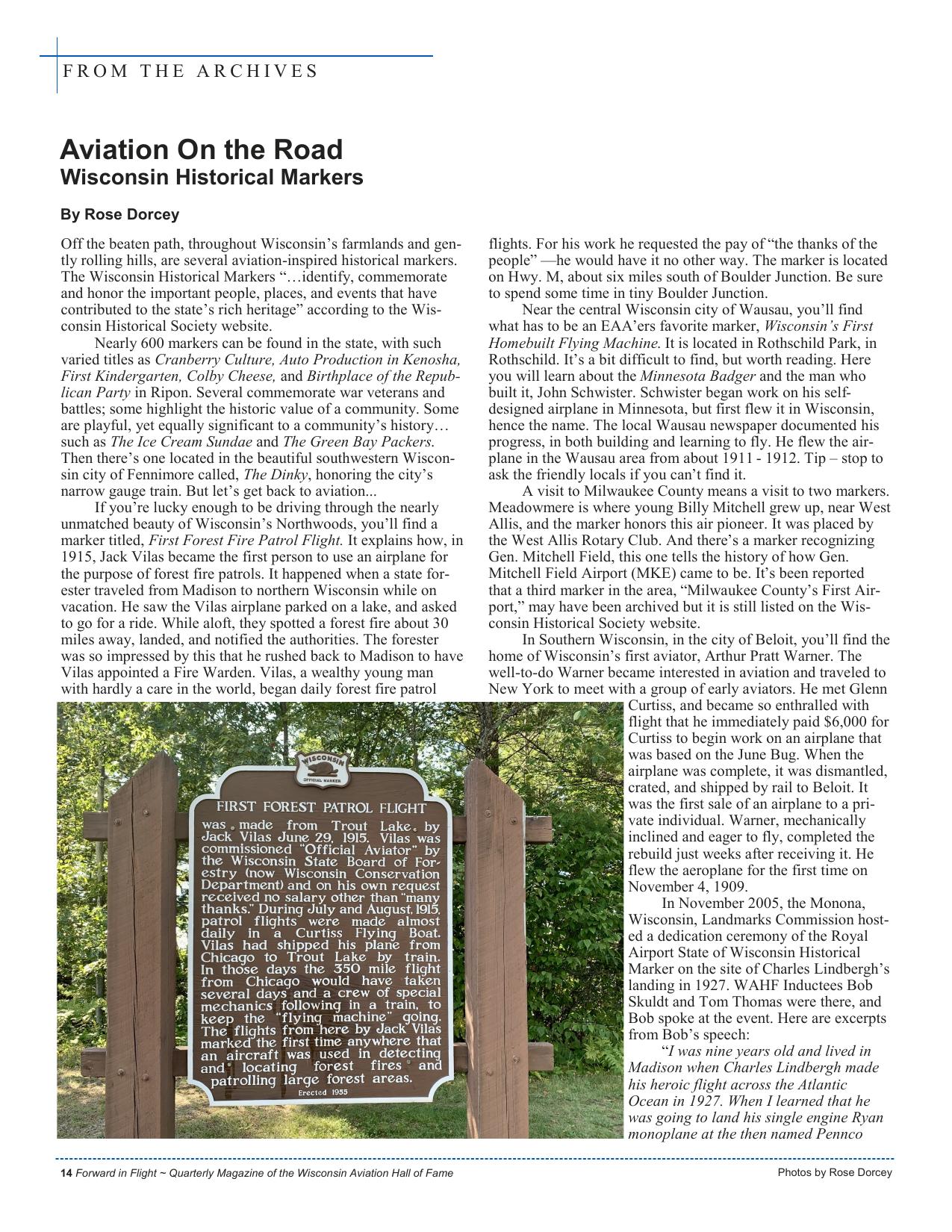
FROM THE ARCHIVES Aviation On the Road Wisconsin Historical Markers By Rose Dorcey Off the beaten path, throughout Wisconsin’s farmlands and gently rolling hills, are several aviation-inspired historical markers. The Wisconsin Historical Markers “…identify, commemorate and honor the important people, places, and events that have contributed to the state’s rich heritage” according to the Wisconsin Historical Society website. Nearly 600 markers can be found in the state, with such varied titles as Cranberry Culture, Auto Production in Kenosha, First Kindergarten, Colby Cheese, and Birthplace of the Republican Party in Ripon. Several commemorate war veterans and battles; some highlight the historic value of a community. Some are playful, yet equally significant to a community’s history… such as The Ice Cream Sundae and The Green Bay Packers. Then there’s one located in the beautiful southwestern Wisconsin city of Fennimore called, The Dinky, honoring the city’s narrow gauge train. But let’s get back to aviation... If you’re lucky enough to be driving through the nearly unmatched beauty of Wisconsin’s Northwoods, you’ll find a marker titled, First Forest Fire Patrol Flight. It explains how, in 1915, Jack Vilas became the first person to use an airplane for the purpose of forest fire patrols. It happened when a state forester traveled from Madison to northern Wisconsin while on vacation. He saw the Vilas airplane parked on a lake, and asked to go for a ride. While aloft, they spotted a forest fire about 30 miles away, landed, and notified the authorities. The forester was so impressed by this that he rushed back to Madison to have Vilas appointed a Fire Warden. Vilas, a wealthy young man with hardly a care in the world, began daily forest fire patrol 14 Forward in Flight ~ Quarterly Magazine of the Wisconsin Aviation Hall of Fame flights. For his work he requested the pay of “the thanks of the people” —he would have it no other way. The marker is located on Hwy. M, about six miles south of Boulder Junction. Be sure to spend some time in tiny Boulder Junction. Near the central Wisconsin city of Wausau, you’ll find what has to be an EAA’ers favorite marker, Wisconsin’s First Homebuilt Flying Machine. It is located in Rothschild Park, in Rothschild. It’s a bit difficult to find, but worth reading. Here you will learn about the Minnesota Badger and the man who built it, John Schwister. Schwister began work on his selfdesigned airplane in Minnesota, but first flew it in Wisconsin, hence the name. The local Wausau newspaper documented his progress, in both building and learning to fly. He flew the airplane in the Wausau area from about 1911 - 1912. Tip – stop to ask the friendly locals if you can’t find it. A visit to Milwaukee County means a visit to two markers. Meadowmere is where young Billy Mitchell grew up, near West Allis, and the marker honors this air pioneer. It was placed by the West Allis Rotary Club. And there’s a marker recognizing Gen. Mitchell Field, this one tells the history of how Gen. Mitchell Field Airport (MKE) came to be. It’s been reported that a third marker in the area, “Milwaukee County’s First Airport,” may have been archived but it is still listed on the Wisconsin Historical Society website. In Southern Wisconsin, in the city of Beloit, you’ll find the home of Wisconsin’s first aviator, Arthur Pratt Warner. The well-to-do Warner became interested in aviation and traveled to New York to meet with a group of early aviators. He met Glenn Curtiss, and became so enthralled with flight that he immediately paid $6,000 for Curtiss to begin work on an airplane that was based on the June Bug. When the airplane was complete, it was dismantled, crated, and shipped by rail to Beloit. It was the first sale of an airplane to a private individual. Warner, mechanically inclined and eager to fly, completed the rebuild just weeks after receiving it. He flew the aeroplane for the first time on November 4, 1909. In November 2005, the Monona, Wisconsin, Landmarks Commission hosted a dedication ceremony of the Royal Airport State of Wisconsin Historical Marker on the site of Charles Lindbergh’s landing in 1927. WAHF Inductees Bob Skuldt and Tom Thomas were there, and Bob spoke at the event. Here are excerpts from Bob’s speech: “I was nine years old and lived in Madison when Charles Lindbergh made his heroic flight across the Atlantic Ocean in 1927. When I learned that he was going to land his single engine Ryan monoplane at the then named Pennco Photos by Rose Dorcey
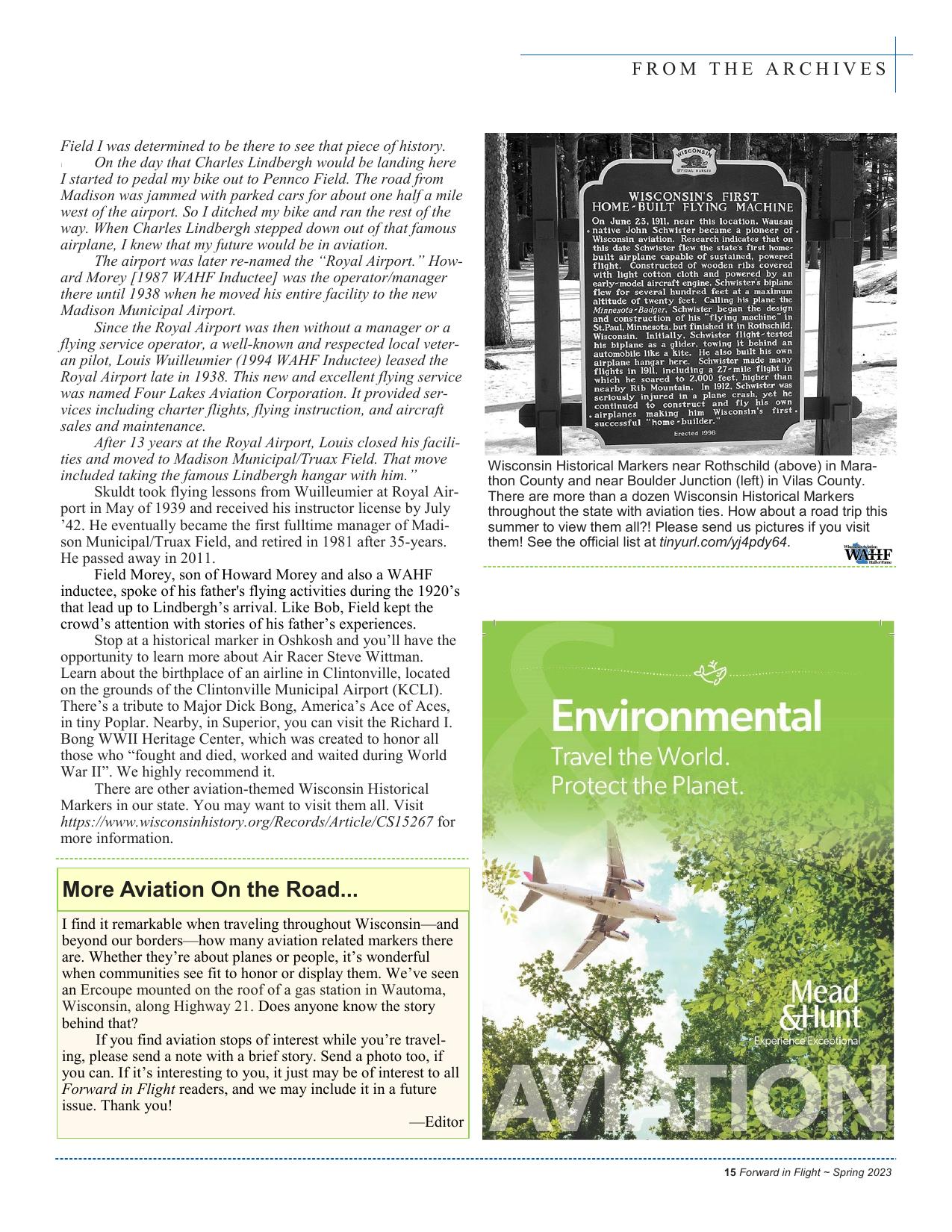
FROM THE ARCHIVES Field I was determined to be there to see that piece of history. On the day that Charles Lindbergh would be landing here I started to pedal my bike out to Pennco Field. The road from Madison was jammed with parked cars for about one half a mile west of the airport. So I ditched my bike and ran the rest of the way. When Charles Lindbergh stepped down out of that famous airplane, I knew that my future would be in aviation. The airport was later re-named the “Royal Airport.” Howard Morey [1987 WAHF Inductee] was the operator/manager there until 1938 when he moved his entire facility to the new Madison Municipal Airport. Since the Royal Airport was then without a manager or a flying service operator, a well-known and respected local veteran pilot, Louis Wuilleumier (1994 WAHF Inductee) leased the Royal Airport late in 1938. This new and excellent flying service was named Four Lakes Aviation Corporation. It provided services including charter flights, flying instruction, and aircraft sales and maintenance. After 13 years at the Royal Airport, Louis closed his facilities and moved to Madison Municipal/Truax Field. That move included taking the famous Lindbergh hangar with him.” Skuldt took flying lessons from Wuilleumier at Royal Airport in May of 1939 and received his instructor license by July ’42. He eventually became the first fulltime manager of Madison Municipal/Truax Field, and retired in 1981 after 35-years. He passed away in 2011. Field Morey, son of Howard Morey and also a WAHF inductee, spoke of his father's flying activities during the 1920’s that lead up to Lindbergh’s arrival. Like Bob, Field kept the crowd’s attention with stories of his father’s experiences. Stop at a historical marker in Oshkosh and you’ll have the opportunity to learn more about Air Racer Steve Wittman. Learn about the birthplace of an airline in Clintonville, located on the grounds of the Clintonville Municipal Airport (KCLI). There’s a tribute to Major Dick Bong, America’s Ace of Aces, in tiny Poplar. Nearby, in Superior, you can visit the Richard I. Bong WWII Heritage Center, which was created to honor all those who “fought and died, worked and waited during World War II”. We highly recommend it. There are other aviation-themed Wisconsin Historical Markers in our state. You may want to visit them all. Visit https://www.wisconsinhistory.org/Records/Article/CS15267 for more information. \ Wisconsin Historical Markers near Rothschild (above) in Marathon County and near Boulder Junction (left) in Vilas County. There are more than a dozen Wisconsin Historical Markers throughout the state with aviation ties. How about a road trip this summer to view them all?! Please send us pictures if you visit them! See the official list at tinyurl.com/yj4pdy64. More Aviation On the Road... I find it remarkable when traveling throughout Wisconsin—and beyond our borders—how many aviation related markers there are. Whether they’re about planes or people, it’s wonderful when communities see fit to honor or display them. We’ve seen an Ercoupe mounted on the roof of a gas station in Wautoma, Wisconsin, along Highway 21. Does anyone know the story behind that? If you find aviation stops of interest while you’re traveling, please send a note with a brief story. Send a photo too, if you can. If it’s interesting to you, it just may be of interest to all Forward in Flight readers, and we may include it in a future issue. Thank you! —Editor 15 Forward in Flight ~ Spring 2023
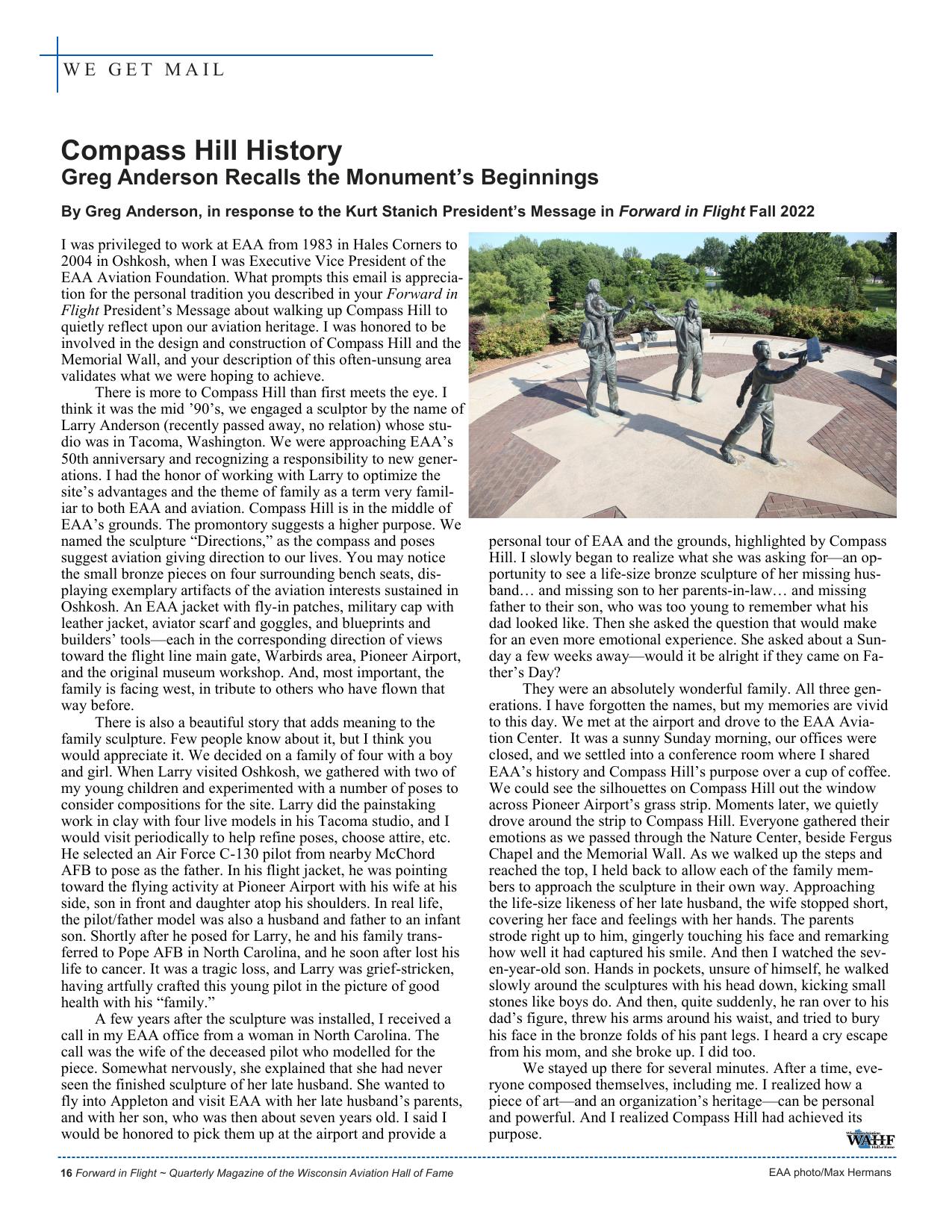
WE GET MAIL Compass Hill History Greg Anderson Recalls the Monument’s Beginnings By Greg Anderson, in response to the Kurt Stanich President’s Message in Forward in Flight Fall 2022 I was privileged to work at EAA from 1983 in Hales Corners to 2004 in Oshkosh, when I was Executive Vice President of the EAA Aviation Foundation. What prompts this email is appreciation for the personal tradition you described in your Forward in Flight President’s Message about walking up Compass Hill to quietly reflect upon our aviation heritage. I was honored to be involved in the design and construction of Compass Hill and the Memorial Wall, and your description of this often-unsung area validates what we were hoping to achieve. There is more to Compass Hill than first meets the eye. I think it was the mid ’90’s, we engaged a sculptor by the name of Larry Anderson (recently passed away, no relation) whose studio was in Tacoma, Washington. We were approaching EAA’s 50th anniversary and recognizing a responsibility to new generations. I had the honor of working with Larry to optimize the site’s advantages and the theme of family as a term very familiar to both EAA and aviation. Compass Hill is in the middle of EAA’s grounds. The promontory suggests a higher purpose. We named the sculpture “Directions,” as the compass and poses suggest aviation giving direction to our lives. You may notice the small bronze pieces on four surrounding bench seats, displaying exemplary artifacts of the aviation interests sustained in Oshkosh. An EAA jacket with fly-in patches, military cap with leather jacket, aviator scarf and goggles, and blueprints and builders’ tools—each in the corresponding direction of views toward the flight line main gate, Warbirds area, Pioneer Airport, and the original museum workshop. And, most important, the family is facing west, in tribute to others who have flown that way before. There is also a beautiful story that adds meaning to the family sculpture. Few people know about it, but I think you would appreciate it. We decided on a family of four with a boy and girl. When Larry visited Oshkosh, we gathered with two of my young children and experimented with a number of poses to consider compositions for the site. Larry did the painstaking work in clay with four live models in his Tacoma studio, and I would visit periodically to help refine poses, choose attire, etc. He selected an Air Force C-130 pilot from nearby McChord AFB to pose as the father. In his flight jacket, he was pointing toward the flying activity at Pioneer Airport with his wife at his side, son in front and daughter atop his shoulders. In real life, the pilot/father model was also a husband and father to an infant son. Shortly after he posed for Larry, he and his family transferred to Pope AFB in North Carolina, and he soon after lost his life to cancer. It was a tragic loss, and Larry was grief-stricken, having artfully crafted this young pilot in the picture of good health with his “family.” A few years after the sculpture was installed, I received a call in my EAA office from a woman in North Carolina. The call was the wife of the deceased pilot who modelled for the piece. Somewhat nervously, she explained that she had never seen the finished sculpture of her late husband. She wanted to fly into Appleton and visit EAA with her late husband’s parents, and with her son, who was then about seven years old. I said I would be honored to pick them up at the airport and provide a 16 Forward in Flight ~ Quarterly Magazine of the Wisconsin Aviation Hall of Fame personal tour of EAA and the grounds, highlighted by Compass Hill. I slowly began to realize what she was asking for—an opportunity to see a life-size bronze sculpture of her missing husband… and missing son to her parents-in-law… and missing father to their son, who was too young to remember what his dad looked like. Then she asked the question that would make for an even more emotional experience. She asked about a Sunday a few weeks away—would it be alright if they came on Father’s Day? They were an absolutely wonderful family. All three generations. I have forgotten the names, but my memories are vivid to this day. We met at the airport and drove to the EAA Aviation Center. It was a sunny Sunday morning, our offices were closed, and we settled into a conference room where I shared EAA’s history and Compass Hill’s purpose over a cup of coffee. We could see the silhouettes on Compass Hill out the window across Pioneer Airport’s grass strip. Moments later, we quietly drove around the strip to Compass Hill. Everyone gathered their emotions as we passed through the Nature Center, beside Fergus Chapel and the Memorial Wall. As we walked up the steps and reached the top, I held back to allow each of the family members to approach the sculpture in their own way. Approaching the life-size likeness of her late husband, the wife stopped short, covering her face and feelings with her hands. The parents strode right up to him, gingerly touching his face and remarking how well it had captured his smile. And then I watched the seven-year-old son. Hands in pockets, unsure of himself, he walked slowly around the sculptures with his head down, kicking small stones like boys do. And then, quite suddenly, he ran over to his dad’s figure, threw his arms around his waist, and tried to bury his face in the bronze folds of his pant legs. I heard a cry escape from his mom, and she broke up. I did too. We stayed up there for several minutes. After a time, everyone composed themselves, including me. I realized how a piece of art—and an organization’s heritage—can be personal and powerful. And I realized Compass Hill had achieved its purpose. EAA photo/Max Hermans
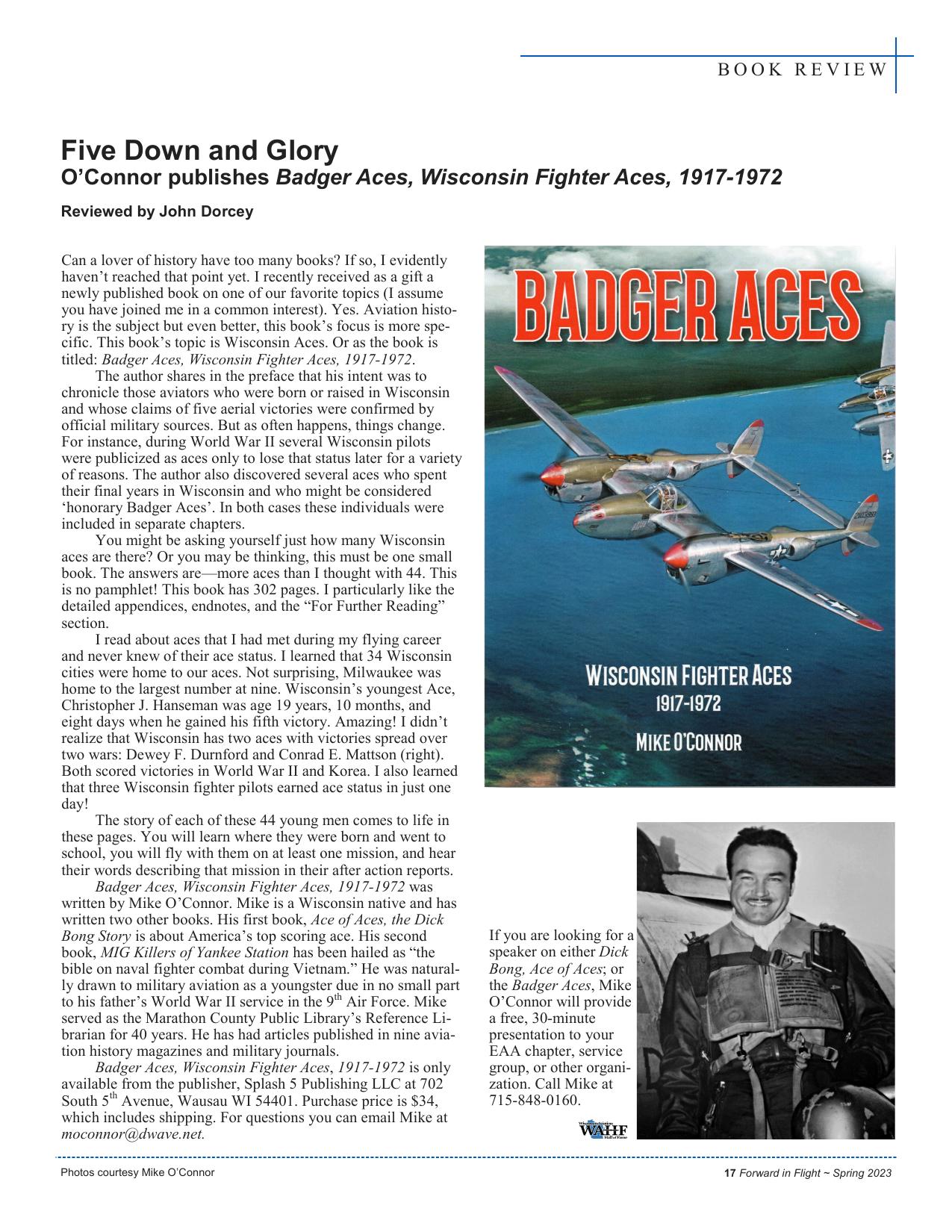
BOOK REVIEW Five Down and Glory O’Connor publishes Badger Aces, Wisconsin Fighter Aces, 1917-1972 Reviewed by John Dorcey Can a lover of history have too many books? If so, I evidently haven’t reached that point yet. I recently received as a gift a newly published book on one of our favorite topics (I assume you have joined me in a common interest). Yes. Aviation history is the subject but even better, this book’s focus is more specific. This book’s topic is Wisconsin Aces. Or as the book is titled: Badger Aces, Wisconsin Fighter Aces, 1917-1972. The author shares in the preface that his intent was to chronicle those aviators who were born or raised in Wisconsin and whose claims of five aerial victories were confirmed by official military sources. But as often happens, things change. For instance, during World War II several Wisconsin pilots were publicized as aces only to lose that status later for a variety of reasons. The author also discovered several aces who spent their final years in Wisconsin and who might be considered ‘honorary Badger Aces’. In both cases these individuals were included in separate chapters. You might be asking yourself just how many Wisconsin aces are there? Or you may be thinking, this must be one small book. The answers are—more aces than I thought with 44. This is no pamphlet! This book has 302 pages. I particularly like the detailed appendices, endnotes, and the “For Further Reading” section. I read about aces that I had met during my flying career and never knew of their ace status. I learned that 34 Wisconsin cities were home to our aces. Not surprising, Milwaukee was home to the largest number at nine. Wisconsin’s youngest Ace, Christopher J. Hanseman was age 19 years, 10 months, and eight days when he gained his fifth victory. Amazing! I didn’t realize that Wisconsin has two aces with victories spread over two wars: Dewey F. Durnford and Conrad E. Mattson (right). Both scored victories in World War II and Korea. I also learned that three Wisconsin fighter pilots earned ace status in just one day! The story of each of these 44 young men comes to life in these pages. You will learn where they were born and went to school, you will fly with them on at least one mission, and hear their words describing that mission in their after action reports. Badger Aces, Wisconsin Fighter Aces, 1917-1972 was written by Mike O’Connor. Mike is a Wisconsin native and has written two other books. His first book, Ace of Aces, the Dick Bong Story is about America’s top scoring ace. His second book, MIG Killers of Yankee Station has been hailed as “the bible on naval fighter combat during Vietnam.” He was naturally drawn to military aviation as a youngster due in no small part to his father’s World War II service in the 9th Air Force. Mike served as the Marathon County Public Library’s Reference Librarian for 40 years. He has had articles published in nine aviation history magazines and military journals. Badger Aces, Wisconsin Fighter Aces, 1917-1972 is only available from the publisher, Splash 5 Publishing LLC at 702 South 5th Avenue, Wausau WI 54401. Purchase price is $34, which includes shipping. For questions you can email Mike at moconnor@dwave.net. Photos courtesy Mike O’Connor If you are looking for a speaker on either Dick Bong, Ace of Aces; or the Badger Aces, Mike O’Connor will provide a free, 30-minute presentation to your EAA chapter, service group, or other organization. Call Mike at 715-848-0160. 17 Forward in Flight ~ Spring 2023
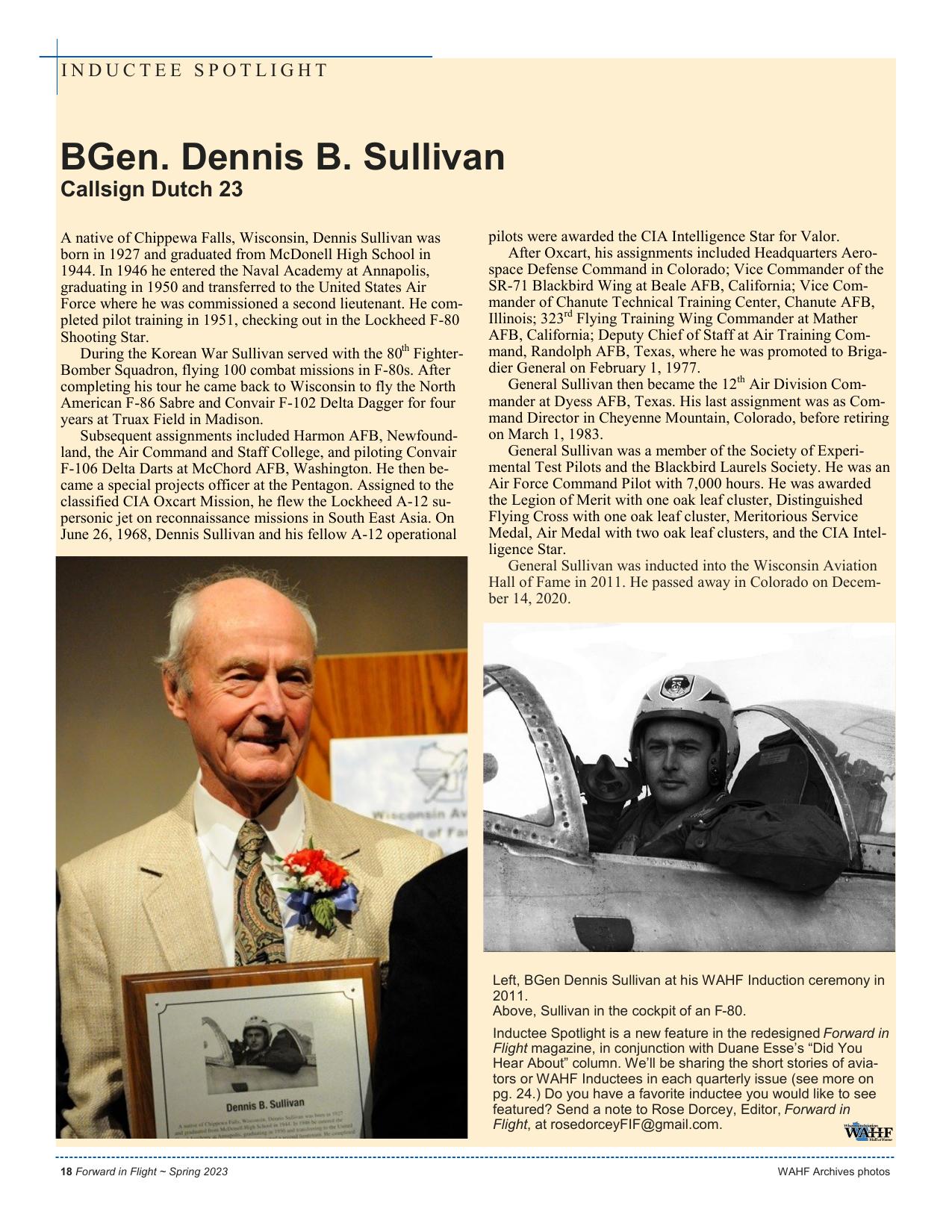
INDUCTEE SPOTLIGHT BGen. Dennis B. Sullivan Callsign Dutch 23 A native of Chippewa Falls, Wisconsin, Dennis Sullivan was born in 1927 and graduated from McDonell High School in 1944. In 1946 he entered the Naval Academy at Annapolis, graduating in 1950 and transferred to the United States Air Force where he was commissioned a second lieutenant. He completed pilot training in 1951, checking out in the Lockheed F-80 Shooting Star. During the Korean War Sullivan served with the 80th FighterBomber Squadron, flying 100 combat missions in F-80s. After completing his tour he came back to Wisconsin to fly the North American F-86 Sabre and Convair F-102 Delta Dagger for four years at Truax Field in Madison. Subsequent assignments included Harmon AFB, Newfoundland, the Air Command and Staff College, and piloting Convair F-106 Delta Darts at McChord AFB, Washington. He then became a special projects officer at the Pentagon. Assigned to the classified CIA Oxcart Mission, he flew the Lockheed A-12 supersonic jet on reconnaissance missions in South East Asia. On June 26, 1968, Dennis Sullivan and his fellow A-12 operational pilots were awarded the CIA Intelligence Star for Valor. After Oxcart, his assignments included Headquarters Aerospace Defense Command in Colorado; Vice Commander of the SR-71 Blackbird Wing at Beale AFB, California; Vice Commander of Chanute Technical Training Center, Chanute AFB, Illinois; 323rd Flying Training Wing Commander at Mather AFB, California; Deputy Chief of Staff at Air Training Command, Randolph AFB, Texas, where he was promoted to Brigadier General on February 1, 1977. General Sullivan then became the 12th Air Division Commander at Dyess AFB, Texas. His last assignment was as Command Director in Cheyenne Mountain, Colorado, before retiring on March 1, 1983. General Sullivan was a member of the Society of Experimental Test Pilots and the Blackbird Laurels Society. He was an Air Force Command Pilot with 7,000 hours. He was awarded the Legion of Merit with one oak leaf cluster, Distinguished Flying Cross with one oak leaf cluster, Meritorious Service Medal, Air Medal with two oak leaf clusters, and the CIA Intelligence Star. General Sullivan was inducted into the Wisconsin Aviation Hall of Fame in 2011. He passed away in Colorado on December 14, 2020. Left, BGen Dennis Sullivan at his WAHF Induction ceremony in 2011. Above, Sullivan in the cockpit of an F-80. Inductee Spotlight is a new feature in the redesigned Forward in Flight magazine, in conjunction with Duane Esse’s “Did You Hear About” column. We’ll be sharing the short stories of aviators or WAHF Inductees in each quarterly issue (see more on pg. 24.) Do you have a favorite inductee you would like to see featured? Send a note to Rose Dorcey, Editor, Forward in Flight, at rosedorceyFIF@gmail.com. 18 Forward in Flight ~ Spring 2023 WAHF Archives photos
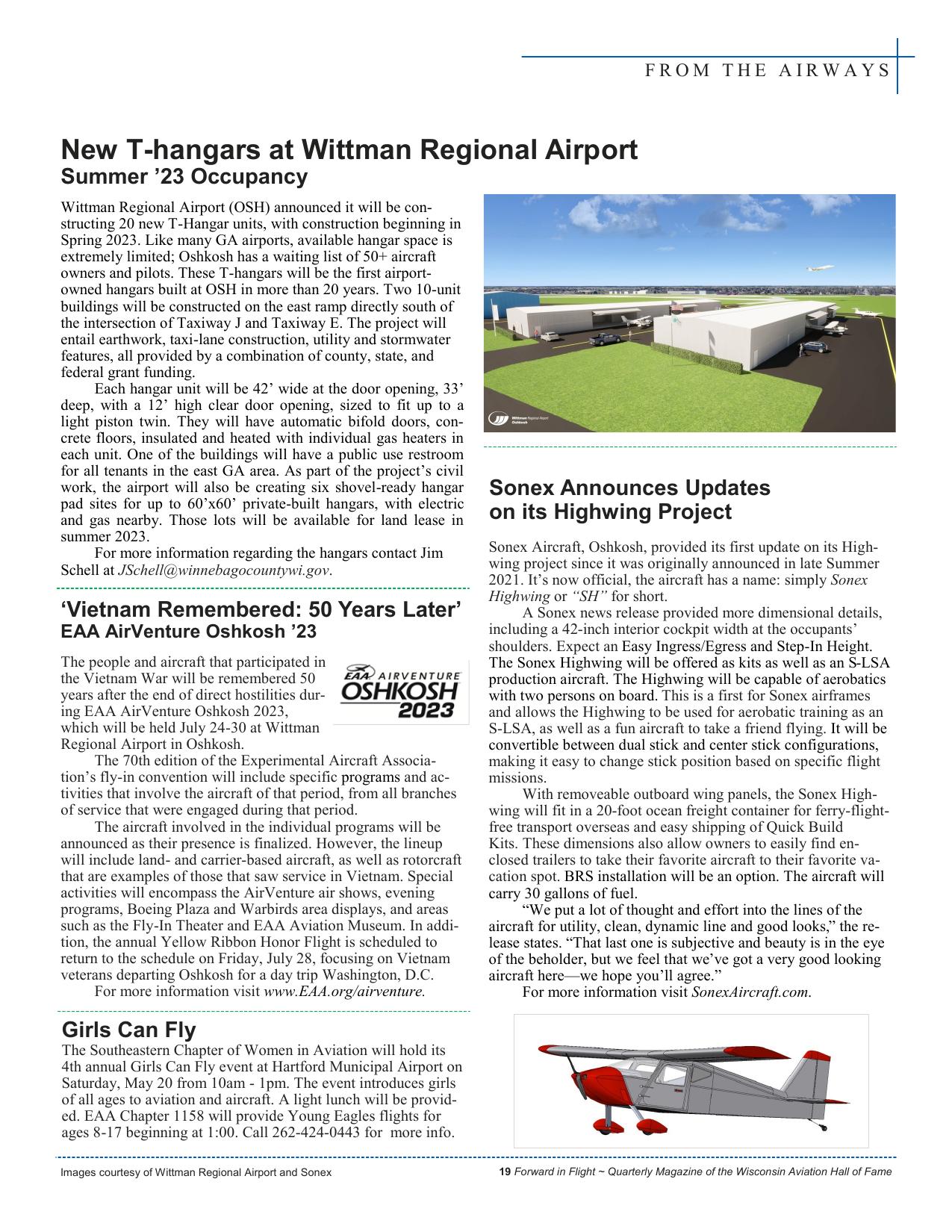
FROM THE AIRWAYS New T-hangars at Wittman Regional Airport Summer ’23 Occupancy Wittman Regional Airport (OSH) announced it will be constructing 20 new T-Hangar units, with construction beginning in Spring 2023. Like many GA airports, available hangar space is extremely limited; Oshkosh has a waiting list of 50+ aircraft owners and pilots. These T-hangars will be the first airportowned hangars built at OSH in more than 20 years. Two 10-unit buildings will be constructed on the east ramp directly south of the intersection of Taxiway J and Taxiway E. The project will entail earthwork, taxi-lane construction, utility and stormwater features, all provided by a combination of county, state, and federal grant funding. Each hangar unit will be 42’ wide at the door opening, 33’ deep, with a 12’ high clear door opening, sized to fit up to a light piston twin. They will have automatic bifold doors, concrete floors, insulated and heated with individual gas heaters in each unit. One of the buildings will have a public use restroom for all tenants in the east GA area. As part of the project’s civil work, the airport will also be creating six shovel-ready hangar pad sites for up to 60’x60’ private-built hangars, with electric and gas nearby. Those lots will be available for land lease in summer 2023. For more information regarding the hangars contact Jim Schell at JSchell@winnebagocountywi.gov. ‘Vietnam Remembered: 50 Years Later’ EAA AirVenture Oshkosh ’23 The people and aircraft that participated in the Vietnam War will be remembered 50 years after the end of direct hostilities during EAA AirVenture Oshkosh 2023, which will be held July 24-30 at Wittman Regional Airport in Oshkosh. The 70th edition of the Experimental Aircraft Association’s fly-in convention will include specific programs and activities that involve the aircraft of that period, from all branches of service that were engaged during that period. The aircraft involved in the individual programs will be announced as their presence is finalized. However, the lineup will include land- and carrier-based aircraft, as well as rotorcraft that are examples of those that saw service in Vietnam. Special activities will encompass the AirVenture air shows, evening programs, Boeing Plaza and Warbirds area displays, and areas such as the Fly-In Theater and EAA Aviation Museum. In addition, the annual Yellow Ribbon Honor Flight is scheduled to return to the schedule on Friday, July 28, focusing on Vietnam veterans departing Oshkosh for a day trip Washington, D.C. For more information visit www.EAA.org/airventure. Sonex Announces Updates on its Highwing Project Sonex Aircraft, Oshkosh, provided its first update on its Highwing project since it was originally announced in late Summer 2021. It’s now official, the aircraft has a name: simply Sonex Highwing or “SH” for short. A Sonex news release provided more dimensional details, including a 42-inch interior cockpit width at the occupants’ shoulders. Expect an Easy Ingress/Egress and Step-In Height. The Sonex Highwing will be offered as kits as well as an S-LSA production aircraft. The Highwing will be capable of aerobatics with two persons on board. This is a first for Sonex airframes and allows the Highwing to be used for aerobatic training as an S-LSA, as well as a fun aircraft to take a friend flying. It will be convertible between dual stick and center stick configurations, making it easy to change stick position based on specific flight missions. With removeable outboard wing panels, the Sonex Highwing will fit in a 20-foot ocean freight container for ferry-flightfree transport overseas and easy shipping of Quick Build Kits. These dimensions also allow owners to easily find enclosed trailers to take their favorite aircraft to their favorite vacation spot. BRS installation will be an option. The aircraft will carry 30 gallons of fuel. “We put a lot of thought and effort into the lines of the aircraft for utility, clean, dynamic line and good looks,” the release states. “That last one is subjective and beauty is in the eye of the beholder, but we feel that we’ve got a very good looking aircraft here—we hope you’ll agree.” For more information visit SonexAircraft.com. Girls Can Fly The Southeastern Chapter of Women in Aviation will hold its 4th annual Girls Can Fly event at Hartford Municipal Airport on Saturday, May 20 from 10am - 1pm. The event introduces girls of all ages to aviation and aircraft. A light lunch will be provided. EAA Chapter 1158 will provide Young Eagles flights for ages 8-17 beginning at 1:00. Call 262-424-0443 for more info. Images courtesy of Wittman Regional Airport and Sonex 19 Forward in Flight ~ Quarterly Magazine of the Wisconsin Aviation Hall of Fame
ASSOCIATION NEWS WAHF Board Meeting/Open House Reedsburg Muni Airport Hosts WAHF The Reedsburg Municipal Airport (C35), in partnership with the Wisconsin Aviation Hall of Fame, held an open house on Wednesday, February 15 to provide awareness of Wisconsin’s rich aviation history, introduce the community to the services offered by the Reedsburg airport, and introduce the public to WAHF’s mission. Wisconsin Aviation Hall of Fame and airport representatives, along with Hall of Fame Inductee Duane Esse, were on hand to greet guests and share some of their adventures during their careers in aviation. WAHF Board Member Henry Peterson delivered a moving tribute to WAHF inductee Joshua Sanford at the event. Joshua was an exemplary American with an inspiring story; he served as a WWII combat pilot with General Chenault's famous Flying Tigers. “Our open house was a great way to present Wisconsin’s aviation history and encourage community interest in important contributions provided by Reedsburg’s Airport along with the mission of the WAHF organization,” said Henry Peterson, Secretary of the Wisconsin Aviation Hall of Fame. This is the first of potentially more similar events throughout the state. The afternoon event included refreshments and door prizes. See more photos on the WAHF Facebook page. To partner with WAHF regarding an event contact WAHF president Kurt Stanich at kstanich@wisconsinhalloffame.org. Ramping Up WAHF’s Online Presence If you’re on Facebook, Instagram, Twitter, or YouTube you may have seen us there. We’ve started a new marketing committee and part of the purpose is to continue the organization’s mission of sharing Wisconsin aviation history and recognizing the people who make it. Let’s talk about Facebook today. Facebook reports indicate we’ve engaged 21,447 users in the last 90 days that have generated 1,183 page visits, as of mid February. Using social media to fulfill our mission is the perfect way to reach an entirely new generation of aviation history buffs, aviators, and aspiring aviators. “When posts are liked and shared it gives them more exposure so we’re asking WAHF Members to please like and share our posts,” said committee member Scott Green. One post, which featured a sign in Byron, Wisconsin, commemorating Steve Wittman’s contribution to aircraft design and racing, received 14 shares, which resulted in over 6,000 engagements. What a great way to expand our audience. Watch for more posts that will encourage Facebook users to submit photos and stories about their aviation experiences. It won’t be long and you’ll see YouTube videos, a larger presence on Instagram, and WAHF tweets on Twitter. All in the name of carrying out our mission! Please like us on Facebook to see our most active social media efforts. 20 Forward in Flight ~ Quarterly Magazine of the Wisconsin Aviation Hall of Fame WAHF President Kurt Stanich talks with a guest during an open house at Reedsburg Municipal Airport. The event brought people from the community to learn about the airport and the mission of the Wisconsin Aviation Hall of Fame. Above, a roadside sign photo garnered a lot of attention on WAHF’s Facebook page. Morey Airplane Company Since 1932 Middleton Municipal Airport/Morey Field Self-service 100LL & Jet A 24-7 Photos by Scott Green and Rose Dorcey
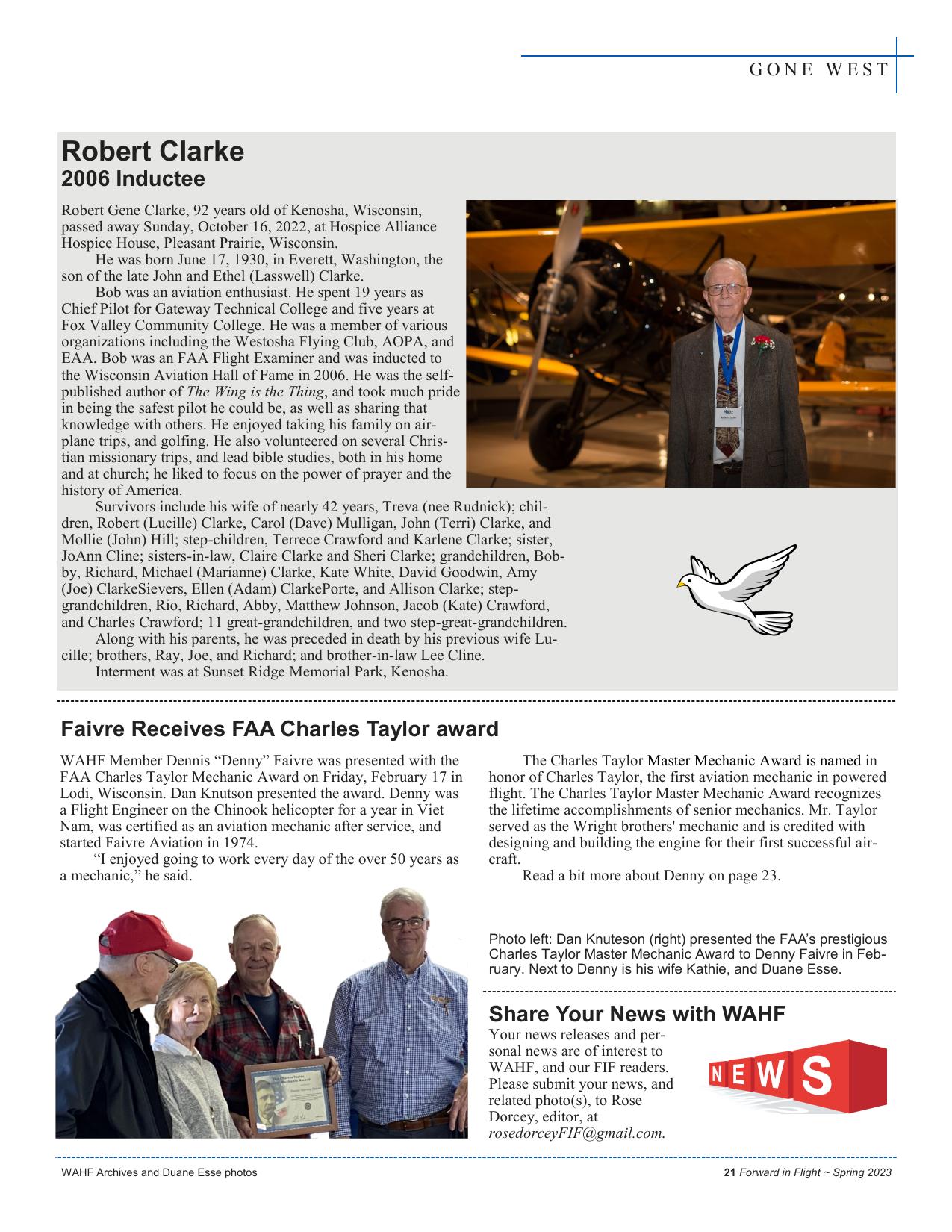
GONE WEST Robert Clarke 2006 Inductee Robert Gene Clarke, 92 years old of Kenosha, Wisconsin, passed away Sunday, October 16, 2022, at Hospice Alliance Hospice House, Pleasant Prairie, Wisconsin. He was born June 17, 1930, in Everett, Washington, the son of the late John and Ethel (Lasswell) Clarke. Bob was an aviation enthusiast. He spent 19 years as Chief Pilot for Gateway Technical College and five years at Fox Valley Community College. He was a member of various organizations including the Westosha Flying Club, AOPA, and EAA. Bob was an FAA Flight Examiner and was inducted to the Wisconsin Aviation Hall of Fame in 2006. He was the selfpublished author of The Wing is the Thing, and took much pride in being the safest pilot he could be, as well as sharing that knowledge with others. He enjoyed taking his family on airplane trips, and golfing. He also volunteered on several Christian missionary trips, and lead bible studies, both in his home and at church; he liked to focus on the power of prayer and the history of America. Survivors include his wife of nearly 42 years, Treva (nee Rudnick); children, Robert (Lucille) Clarke, Carol (Dave) Mulligan, John (Terri) Clarke, and Mollie (John) Hill; step-children, Terrece Crawford and Karlene Clarke; sister, JoAnn Cline; sisters-in-law, Claire Clarke and Sheri Clarke; grandchildren, Bobby, Richard, Michael (Marianne) Clarke, Kate White, David Goodwin, Amy (Joe) ClarkeSievers, Ellen (Adam) ClarkePorte, and Allison Clarke; stepgrandchildren, Rio, Richard, Abby, Matthew Johnson, Jacob (Kate) Crawford, and Charles Crawford; 11 great-grandchildren, and two step-great-grandchildren. Along with his parents, he was preceded in death by his previous wife Lucille; brothers, Ray, Joe, and Richard; and brother-in-law Lee Cline. Interment was at Sunset Ridge Memorial Park, Kenosha. Inductee Robert Clarke at the October 2017 WAHF Induction Banquet, Oshkosh. Faivre Receives FAA Charles Taylor award WAHF Member Dennis “Denny” Faivre was presented with the FAA Charles Taylor Mechanic Award on Friday, February 17 in Lodi, Wisconsin. Dan Knutson presented the award. Denny was a Flight Engineer on the Chinook helicopter for a year in Viet Nam, was certified as an aviation mechanic after service, and started Faivre Aviation in 1974. “I enjoyed going to work every day of the over 50 years as a mechanic,” he said. The Charles Taylor Master Mechanic Award is named in honor of Charles Taylor, the first aviation mechanic in powered flight. The Charles Taylor Master Mechanic Award recognizes the lifetime accomplishments of senior mechanics. Mr. Taylor served as the Wright brothers' mechanic and is credited with designing and building the engine for their first successful aircraft. Read a bit more about Denny on page 23. Photo left: Dan Knuteson (right) presented the FAA’s prestigious Charles Taylor Master Mechanic Award to Denny Faivre in February. Next to Denny is his wife Kathie, and Duane Esse. Share Your News with WAHF Your news releases and personal news are of interest to WAHF, and our FIF readers. Please submit your news, and related photo(s), to Rose Dorcey, editor, at rosedorceyFIF@gmail.com. WAHF Archives and Duane Esse photos 21 Forward in Flight ~ Spring 2023
EDITOR’S LOG I’m Back… Returning to Something I've Loved You may have noted a fresh, new look to this issue of Forward in Flight. In reality, it’s a return to the magazine’s roots. Several years ago the then WAHF Board of Directors gave me the opportunity to create a publication for WAHF members. It started in 2003 with a four-page, black & white newsletter. Soon writers came on board, such as Michael Goc and Gary Dikkers. The newsletter expanded to a dozen pages, and then more. Supporters came on board as advertisers. Soon it expanded to up to 36 pages. It became a full-color magazine! It was a true labor of love for me, sharing the stories of past and present aviators, planes, and events. But for health reasons, I stepped away from my responsibilities to WAHF and Forward in Flight about six years ago. But God is so good—I am doing well and confident that coming back as editor at this time is the right thing to do. I am thankful for the work that Tom Eisele and Chris Campbell did to keep the magazine alive in my absence. Going forward, look for more stories that make aviation in Wisconsin so great! The most important thing to share today is that I welcome your suggestions on FIF content, along with your contributions. Send pictures, fill out the member spotlight form, share your likes and dislikes. Along those same lines, do you have a story about your aviation history that should be told? Do you know someone we should write about or consider for induction? Please let us know. Are there events happening at your local 22 Forward in Flight ~ Quarterly Magazine of the Wisconsin Aviation Hall of Fame airport with aviation history ties? How about a unique plane or restoration? We might want to include that—we are all about sharing the stories of current and past Wisconsin aviators. The pages of Forward in Flight can serve as a record for future generations about the aviation scene today. That’s why several local historical societies have asked for and see the value of keeping this magazine in their archives. I’m thrilled to welcome John Chmiel as a regular columnist. He’s as passionate about aviation history as most of us involved with WAHF duties. WAHF Inductee Duane Esse is back too. My husband John will contribute articles as well. Noted author Michael Goc has promised to occasionally participate. Your magazine will be better with these talented writers contributing to it. I’m also so grateful to the good people you see advertising in the magazine. Their return is a great means of support of Forward in Flight. Please thank them when you see them at the airport! And most importantly, thank you, WAHF Members, for your support of the organization and magazine. We have such gratitude for you. It’s been a pleasure being a part of the Wisconsin Aviation Hall of Fame and serving as FIF editor over the years. You’ve probably noticed—I’m so excited to be back!
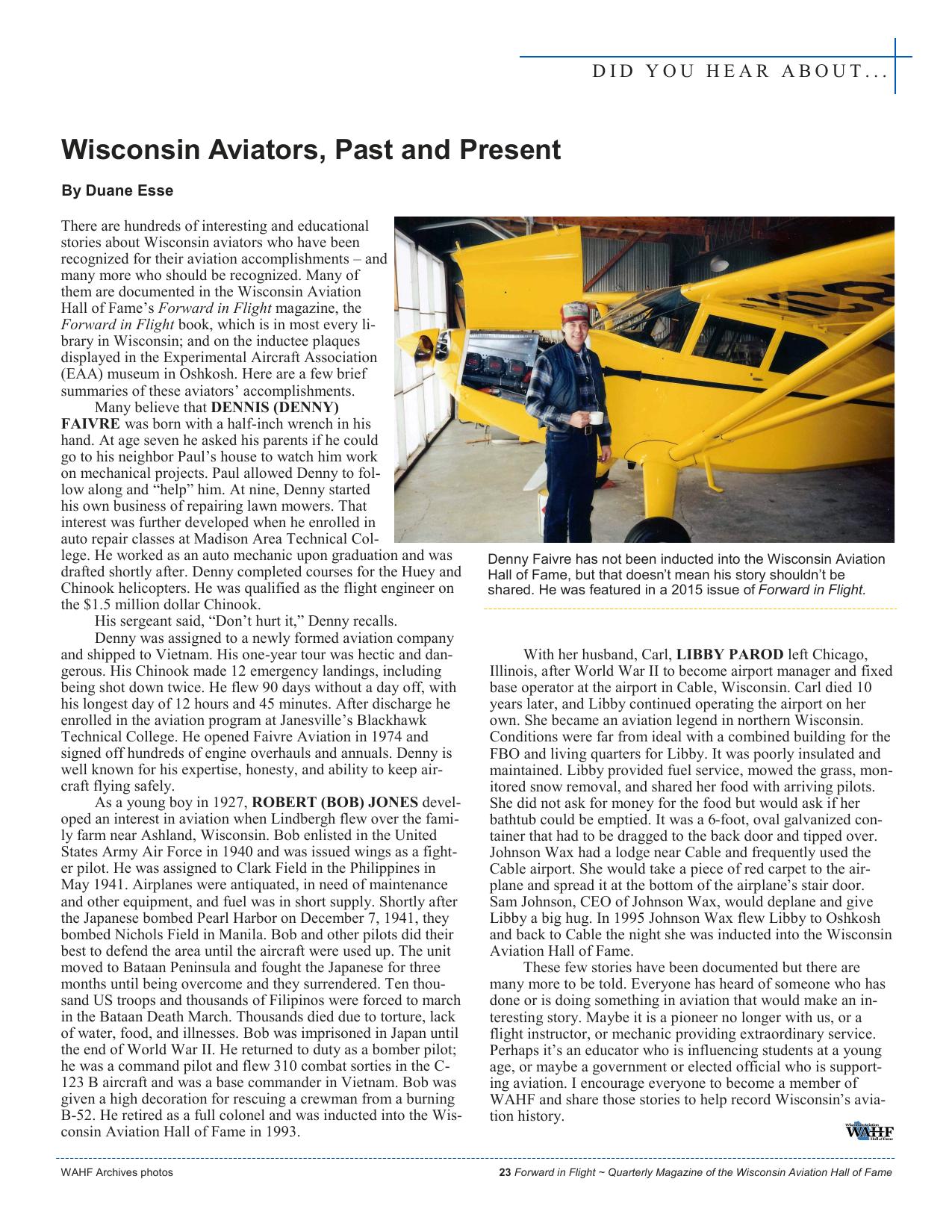
DID YOU HEAR ABOUT... Wisconsin Aviators, Past and Present By Duane Esse There are hundreds of interesting and educational stories about Wisconsin aviators who have been recognized for their aviation accomplishments – and many more who should be recognized. Many of them are documented in the Wisconsin Aviation Hall of Fame’s Forward in Flight magazine, the Forward in Flight book, which is in most every library in Wisconsin; and on the inductee plaques displayed in the Experimental Aircraft Association (EAA) museum in Oshkosh. Here are a few brief summaries of these aviators’ accomplishments. Many believe that DENNIS (DENNY) FAIVRE was born with a half-inch wrench in his hand. At age seven he asked his parents if he could go to his neighbor Paul’s house to watch him work on mechanical projects. Paul allowed Denny to follow along and “help” him. At nine, Denny started his own business of repairing lawn mowers. That interest was further developed when he enrolled in auto repair classes at Madison Area Technical College. He worked as an auto mechanic upon graduation and was drafted shortly after. Denny completed courses for the Huey and Chinook helicopters. He was qualified as the flight engineer on the $1.5 million dollar Chinook. His sergeant said, “Don’t hurt it,” Denny recalls. Denny was assigned to a newly formed aviation company and shipped to Vietnam. His one-year tour was hectic and dangerous. His Chinook made 12 emergency landings, including being shot down twice. He flew 90 days without a day off, with his longest day of 12 hours and 45 minutes. After discharge he enrolled in the aviation program at Janesville’s Blackhawk Technical College. He opened Faivre Aviation in 1974 and signed off hundreds of engine overhauls and annuals. Denny is well known for his expertise, honesty, and ability to keep aircraft flying safely. As a young boy in 1927, ROBERT (BOB) JONES developed an interest in aviation when Lindbergh flew over the family farm near Ashland, Wisconsin. Bob enlisted in the United States Army Air Force in 1940 and was issued wings as a fighter pilot. He was assigned to Clark Field in the Philippines in May 1941. Airplanes were antiquated, in need of maintenance and other equipment, and fuel was in short supply. Shortly after the Japanese bombed Pearl Harbor on December 7, 1941, they bombed Nichols Field in Manila. Bob and other pilots did their best to defend the area until the aircraft were used up. The unit moved to Bataan Peninsula and fought the Japanese for three months until being overcome and they surrendered. Ten thousand US troops and thousands of Filipinos were forced to march in the Bataan Death March. Thousands died due to torture, lack of water, food, and illnesses. Bob was imprisoned in Japan until the end of World War II. He returned to duty as a bomber pilot; he was a command pilot and flew 310 combat sorties in the C123 B aircraft and was a base commander in Vietnam. Bob was given a high decoration for rescuing a crewman from a burning B-52. He retired as a full colonel and was inducted into the Wisconsin Aviation Hall of Fame in 1993. WAHF Archives photos Denny Faivre has not been inducted into the Wisconsin Aviation Hall of Fame, but that doesn’t mean his story shouldn’t be shared. He was featured in a 2015 issue of Forward in Flight. With her husband, Carl, LIBBY PAROD left Chicago, Illinois, after World War II to become airport manager and fixed base operator at the airport in Cable, Wisconsin. Carl died 10 years later, and Libby continued operating the airport on her own. She became an aviation legend in northern Wisconsin. Conditions were far from ideal with a combined building for the FBO and living quarters for Libby. It was poorly insulated and maintained. Libby provided fuel service, mowed the grass, monitored snow removal, and shared her food with arriving pilots. She did not ask for money for the food but would ask if her bathtub could be emptied. It was a 6-foot, oval galvanized container that had to be dragged to the back door and tipped over. Johnson Wax had a lodge near Cable and frequently used the Cable airport. She would take a piece of red carpet to the airplane and spread it at the bottom of the airplane’s stair door. Sam Johnson, CEO of Johnson Wax, would deplane and give Libby a big hug. In 1995 Johnson Wax flew Libby to Oshkosh and back to Cable the night she was inducted into the Wisconsin Aviation Hall of Fame. These few stories have been documented but there are many more to be told. Everyone has heard of someone who has done or is doing something in aviation that would make an interesting story. Maybe it is a pioneer no longer with us, or a flight instructor, or mechanic providing extraordinary service. Perhaps it’s an educator who is influencing students at a young age, or maybe a government or elected official who is supporting aviation. I encourage everyone to become a member of WAHF and share those stories to help record Wisconsin’s aviation history. 23 Forward in Flight ~ Quarterly Magazine of the Wisconsin Aviation Hall of Fame
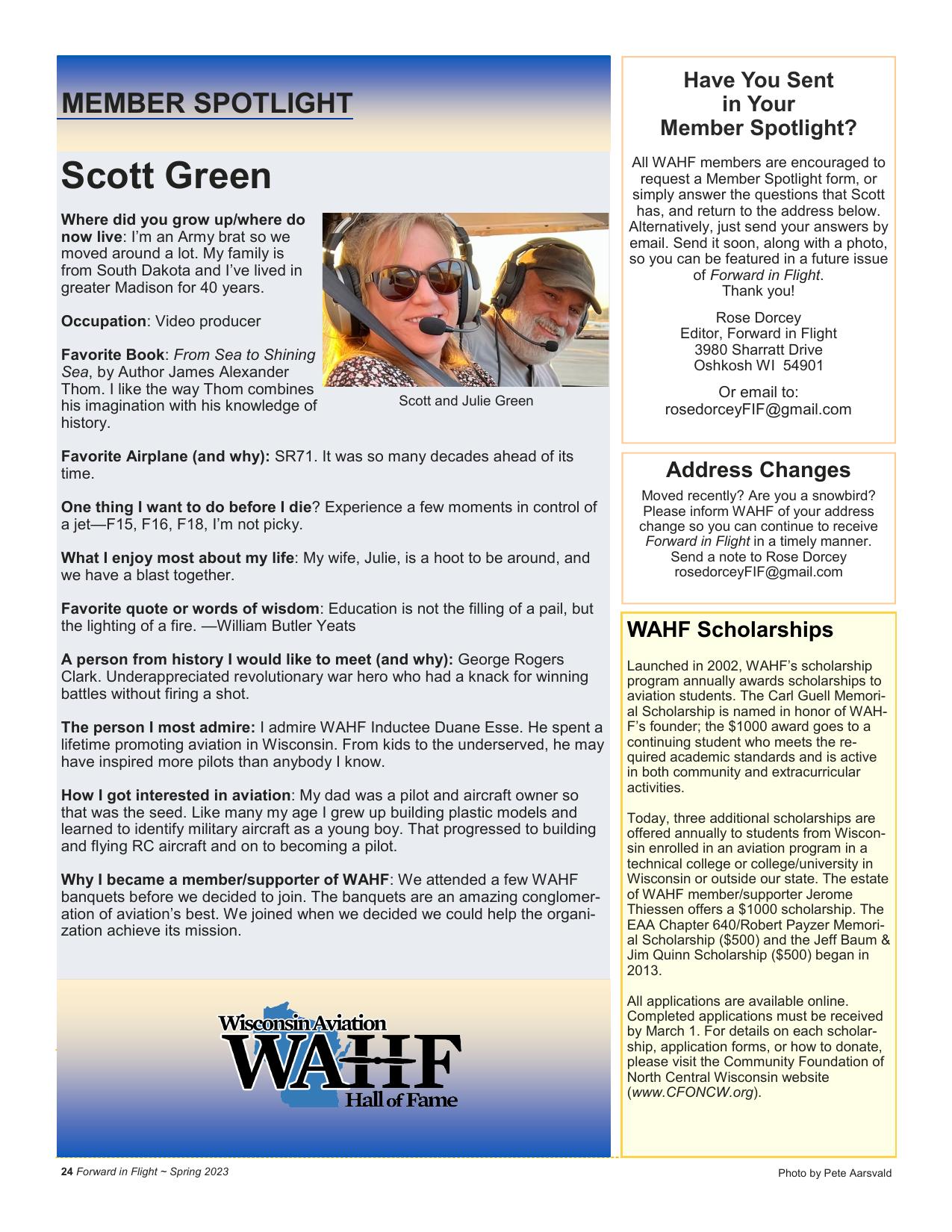
Have You Sent in Your Member Spotlight? MEMBER SPOTLIGHT All WAHF members are encouraged to request a Member Spotlight form, or simply answer the questions that Scott has, and return to the address below. Alternatively, just send your answers by email. Send it soon, along with a photo, so you can be featured in a future issue of Forward in Flight. Thank you! Scott Green Where did you grow up/where do now live: I’m an Army brat so we moved around a lot. My family is from South Dakota and I’ve lived in greater Madison for 40 years. Rose Dorcey Editor, Forward in Flight 3980 Sharratt Drive Oshkosh WI 54901 Occupation: Video producer Favorite Book: From Sea to Shining Sea, by Author James Alexander Thom. I like the way Thom combines his imagination with his knowledge of history. Scott and Julie Green Favorite Airplane (and why): SR71. It was so many decades ahead of its time. One thing I want to do before I die? Experience a few moments in control of a jet—F15, F16, F18, I’m not picky. What I enjoy most about my life: My wife, Julie, is a hoot to be around, and we have a blast together. Favorite quote or words of wisdom: Education is not the filling of a pail, but the lighting of a fire. —William Butler Yeats A person from history I would like to meet (and why): George Rogers Clark. Underappreciated revolutionary war hero who had a knack for winning battles without firing a shot. The person I most admire: I admire WAHF Inductee Duane Esse. He spent a lifetime promoting aviation in Wisconsin. From kids to the underserved, he may have inspired more pilots than anybody I know. How I got interested in aviation: My dad was a pilot and aircraft owner so that was the seed. Like many my age I grew up building plastic models and learned to identify military aircraft as a young boy. That progressed to building and flying RC aircraft and on to becoming a pilot. Why I became a member/supporter of WAHF: We attended a few WAHF banquets before we decided to join. The banquets are an amazing conglomeration of aviation’s best. We joined when we decided we could help the organization achieve its mission. Or email to: rosedorceyFIF@gmail.com Address Changes Moved recently? Are you a snowbird? Please inform WAHF of your address change so you can continue to receive Forward in Flight in a timely manner. Send a note to Rose Dorcey rosedorceyFIF@gmail.com WAHF Scholarships Launched in 2002, WAHF’s scholarship program annually awards scholarships to aviation students. The Carl Guell Memorial Scholarship is named in honor of WAHF’s founder; the $1000 award goes to a continuing student who meets the required academic standards and is active in both community and extracurricular activities. Today, three additional scholarships are offered annually to students from Wisconsin enrolled in an aviation program in a technical college or college/university in Wisconsin or outside our state. The estate of WAHF member/supporter Jerome Thiessen offers a $1000 scholarship. The EAA Chapter 640/Robert Payzer Memorial Scholarship ($500) and the Jeff Baum & Jim Quinn Scholarship ($500) began in 2013. All applications are available online. Completed applications must be received by March 1. For details on each scholarship, application forms, or how to donate, please visit the Community Foundation of North Central Wisconsin website (www.CFONCW.org). 24 Forward in Flight ~ Spring 2023 Photo by Pete Aarsvald
Anytime of year is the right time to join, renew, or give a gift membership to the Wisconsin Aviation Hall of Fame! ANNUAL MEMBERSHIP LEVELS Name________________________________________ _____ Youth (Under age 18) _____ Individual (Annual) _____ Couple (Annual) _____ Lifetime (Individual) _____ Lifetime (Couple) Address______________________________________ $10 $30 $40 $500 $750 City__________________________________________ State, Zip_____________________________________ Phone_______________________________________ TAX DEDUCTIBLE CONTRIBUTIONS Your contributions help ensure Wisconsin’s aviation pioneers and outstanding students in aviation education will continue to be recognized. Your contributions, in any amount, are appreciated. WAHF Supporting Contribution $___________ (General operating/events programming fund) WAHF Scholarship Fund* $___________ *for scholarship donations please make a separate check payable to Community Foundation of North Central Wisconsin or visit www.CFONCW.org. Email________________________________________ Members receive WAHF’s quarterly magazine Forward in Flight! Visit WAHF at www.WisconsinAviationHallofFame.org The Wisconsin Aviation Hall of Fame is a 501(c)(3) organization. Mail this form, along with your check payable to: Wisconsin Aviation Hall of Fame Send to: Rose Dorcey, Membership 3980 Sharratt Drive Oshkosh WI 54901
PRSRT STD US Postage Paid Wisc Rapids WI Permit 98 Forward in Flight c/o Rose Dorcey 3980 Sharratt Drive Oshkosh WI 54901-1276 The Wisconsin Aviation Hall of Fame is a non-profit membership organization dedicated to preserving the past and fostering the future of flight. New WAHF Member/Supporters Michael Haubrich Cindy Pokorny Thanks for coming on board! Thank you to our Supporting and Scholarship Fund Contributors Jeff & Cheryl Baker Robert Bowen Don Brinkmeier David Cummings John & Rose Dorcey Sune & Jean Ericson Howard Rand Dan Simpson Larry Stys Chris Campbell Dixie Igou Jim Szajkovics CONGRATULATIONS and Happy Birthday to WAHF Inductee Harold “Duffy” Gaier, who celebrated his 93rd birthday in January. And to fellow inductee Tom Thomas, who turned 80 in December 2022. Inductees Jim Szajkovics and Tom Hegy have birthdays in May—please wish them a happy birthday when you see them at the airport. DID YOU MISS the 2022 WAHF Induction banquet? View it online! Visit air2airtv.com or type in this url: tinyurl.com/5he3zbh4 LOOKING TO SUPPORT WAHF? The Wisconsin Aviation Hall of Fame has a number of opportunities that support the organization. Support can be as simple as giving a gift membership, placing an ad in Forward in Flight, scholarship donations, or a sponsorship at our annual induction banquet. FROM THE FAAST BLAST… “High-powered laser pointers can incapacitate pilots flying airplanes. To combat the threat, Acting FAA Administrator Billy Nolen requested laser manufacturers add a warning label to their packaging to make consumers aware of the safety risks and federal laws when using lasers. Pilots reported nearly 9,500 laser strikes to the FAA in 2022. Two hundred, seventyeight pilots have reported an injury from a laser strike to the FAA since 2010. People who shine lasers at aircraft face FAA fines of up to $11,000 per violation and up to $30,800 for multiple laser incidents. The FAA issued $120,000 in fines for laser strikes in 2021. For more information, visit the FAA’s website at faa.gov/go/lasers and the fact sheet here faa.gov/ newsroom/lasers-0. Please report laser strikes to the FAA and local law enforcement agencies here faa.gov/aircraft/safety/report/laserinfo.” John and I know this is a concerning phenomenon. A pilot we know had this happen to him in Oshkosh. He said It was quite distracting, but he made a safe landing. And, while John and I were geocaching near the Montgomery Regional Airport recently, an airport security officer stopped to see what we were up to. He wanted to be sure we weren’t trying to shine a laser at an airplane. John explained that we were geocaching, and that we are pilots who know of the danger of shining lasers at planes. John thanked him for keeping pilots safe, and the officer went on his merry way! —Editor Wisconsin Aviation Hall of Fame Officers Kurt Stanich, President James Zuelsdorf, Vice-President Henry Peterson, Secretary Board of Directors John Dorcey Scott Green Jill Mann Jim Szajkovics Patrick Weeden Wynne Williams Wisconsin Aviation Hall of Fame Membership Info: c/o Rose Dorcey 3980 Sharratt Drive Oshkosh WI 54901 920-279-6029 Become a member/supporter today! www.wisconsinaviationhalloffame.org Join the conversation… Like and Follow WAHF Online!