Volume 22, Issue 1
🗞️ Download Issue (PDF)
Forward in Flight - Spring 2024
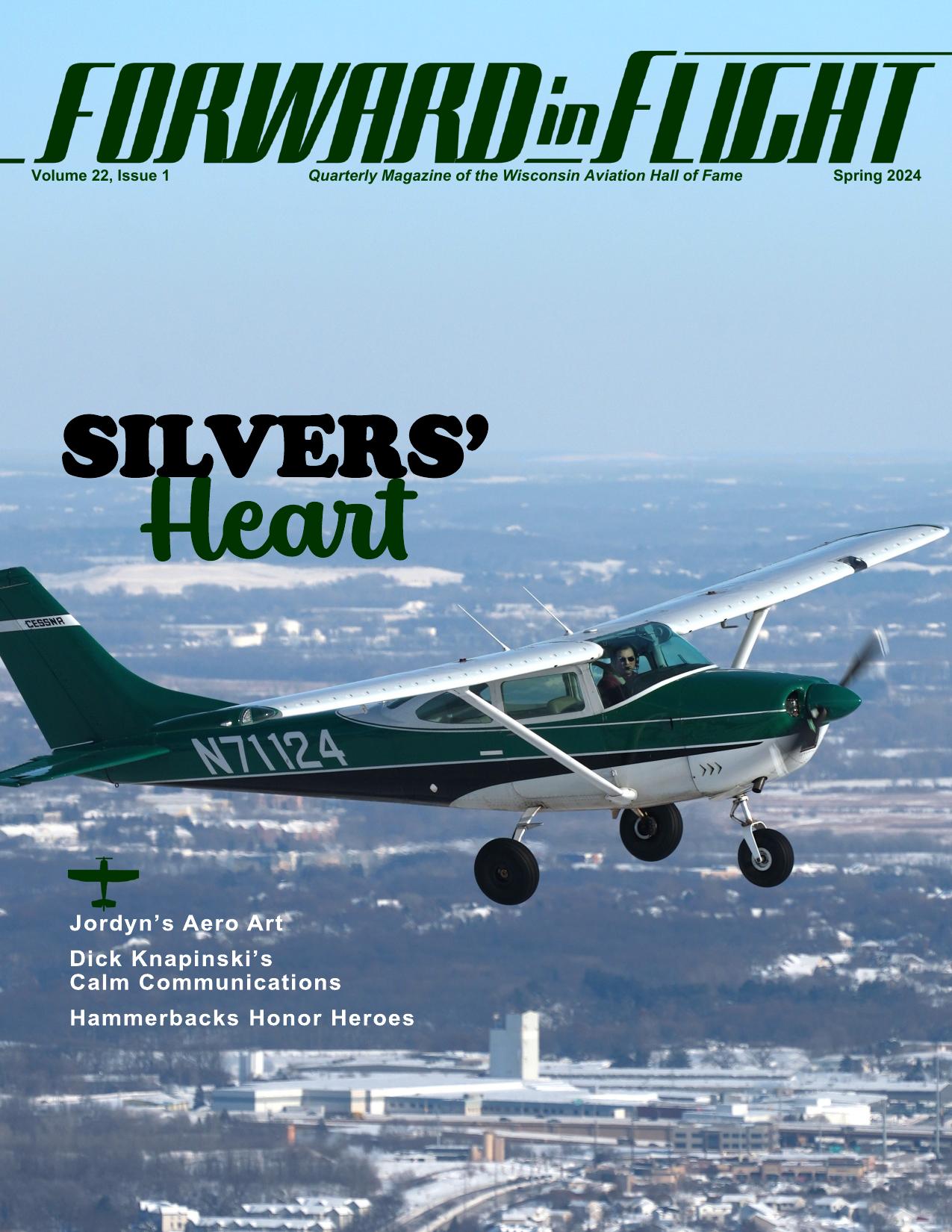
Volume 22, Issue 1 Quarterly Magazine of the Wisconsin Aviation Hall of Fame SILVERS’ Heart Spring 2024
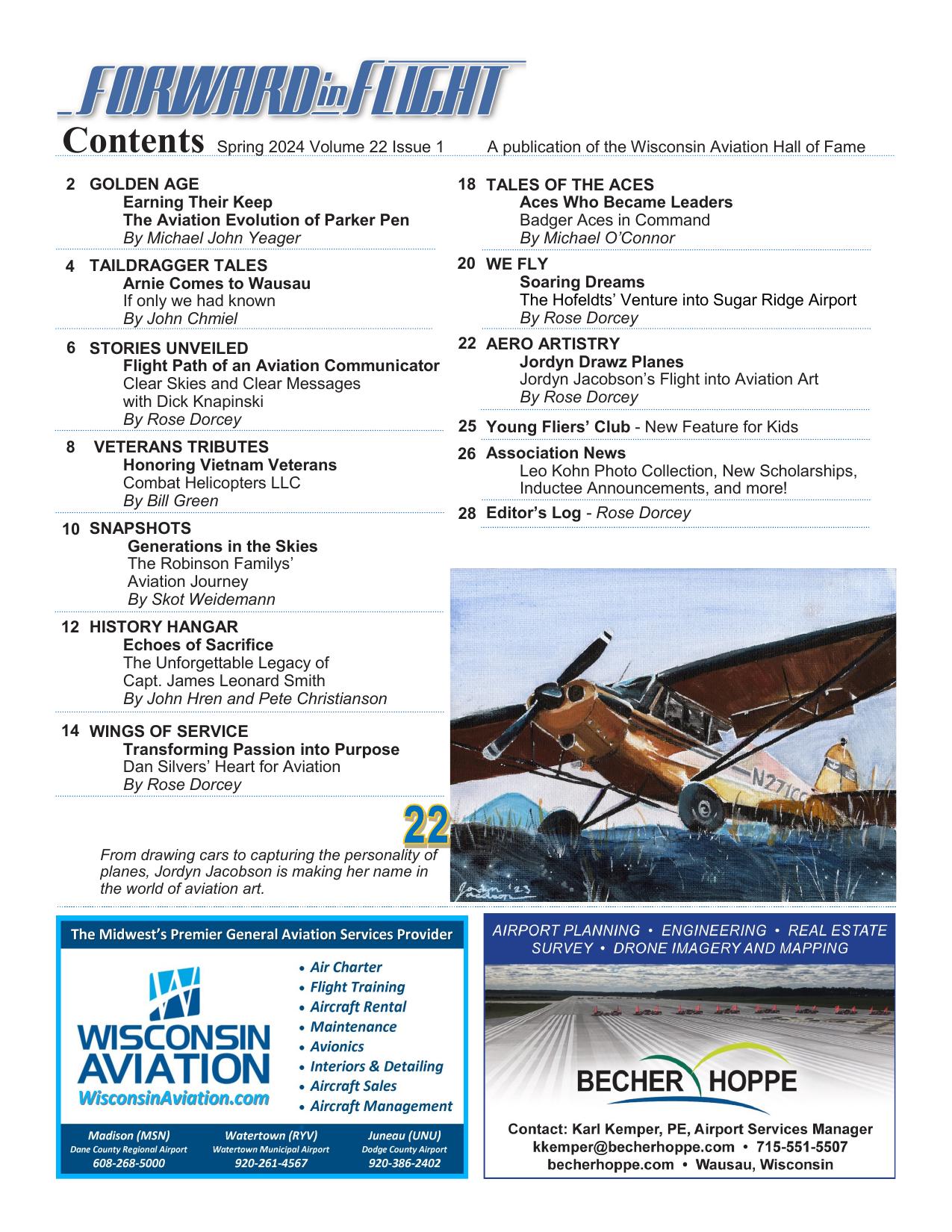
Contents Spring 2024 Volume 22 Issue 1 A publication of the Wisconsin Aviation Hall of Fame 2 GOLDEN AGE Earning Their Keep The Aviation Evolution of Parker Pen By Michael John Yeager 18 TALES OF THE ACES Aces Who Became Leaders Badger Aces in Command By Michael O’Connor 4 TAILDRAGGER TALES Arnie Comes to Wausau If only we had known By John Chmiel 20 WE FLY Soaring Dreams The Hofeldts’ Venture into Sugar Ridge Airport By Rose Dorcey 6 STORIES UNVEILED Flight Path of an Aviation Communicator Clear Skies and Clear Messages with Dick Knapinski By Rose Dorcey 22 AERO ARTISTRY Jordyn Drawz Planes Jordyn Jacobson’s Flight into Aviation Art By Rose Dorcey 8 VETERANS TRIBUTES Honoring Vietnam Veterans Combat Helicopters LLC By Bill Green 10 SNAPSHOTS Generations in the Skies The Robinson Familys’ Aviation Journey By Skot Weidemann 12 HISTORY HANGAR Echoes of Sacrifice The Unforgettable Legacy of Capt. James Leonard Smith By John Hren and Pete Christianson 14 WINGS OF SERVICE Transforming Passion into Purpose Dan Silvers’ Heart for Aviation By Rose Dorcey From drawing cars to capturing the personality of planes, Jordyn Jacobson is making her name in the world of aviation art. 25 Young Fliers’ Club - New Feature for Kids 26 Association News Leo Kohn Photo Collection, New Scholarships, Inductee Announcements, and more! 28 Editor’s Log - Rose Dorcey
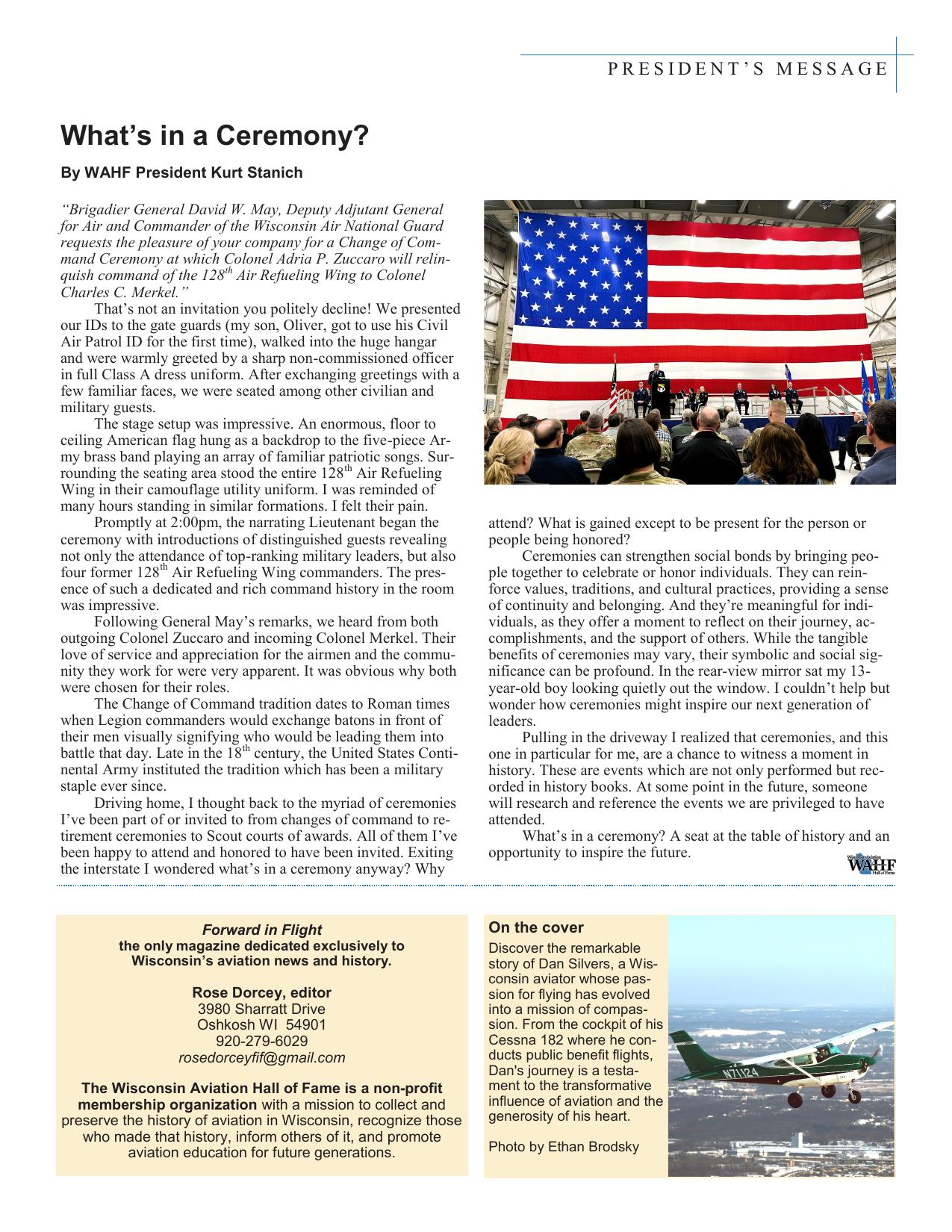
PRESIDENT’S MESSAGE What’s in a Ceremony? By WAHF President Kurt Stanich “Brigadier General David W. May, Deputy Adjutant General for Air and Commander of the Wisconsin Air National Guard requests the pleasure of your company for a Change of Command Ceremony at which Colonel Adria P. Zuccaro will relinquish command of the 128th Air Refueling Wing to Colonel Charles C. Merkel.” That’s not an invitation you politely decline! We presented our IDs to the gate guards (my son, Oliver, got to use his Civil Air Patrol ID for the first time), walked into the huge hangar and were warmly greeted by a sharp non-commissioned officer in full Class A dress uniform. After exchanging greetings with a few familiar faces, we were seated among other civilian and military guests. The stage setup was impressive. An enormous, floor to ceiling American flag hung as a backdrop to the five-piece Army brass band playing an array of familiar patriotic songs. Surrounding the seating area stood the entire 128 th Air Refueling Wing in their camouflage utility uniform. I was reminded of many hours standing in similar formations. I felt their pain. Promptly at 2:00pm, the narrating Lieutenant began the ceremony with introductions of distinguished guests revealing not only the attendance of top-ranking military leaders, but also four former 128th Air Refueling Wing commanders. The presence of such a dedicated and rich command history in the room was impressive. Following General May’s remarks, we heard from both outgoing Colonel Zuccaro and incoming Colonel Merkel. Their love of service and appreciation for the airmen and the community they work for were very apparent. It was obvious why both were chosen for their roles. The Change of Command tradition dates to Roman times when Legion commanders would exchange batons in front of their men visually signifying who would be leading them into battle that day. Late in the 18th century, the United States Continental Army instituted the tradition which has been a military staple ever since. Driving home, I thought back to the myriad of ceremonies I’ve been part of or invited to from changes of command to retirement ceremonies to Scout courts of awards. All of them I’ve been happy to attend and honored to have been invited. Exiting the interstate I wondered what’s in a ceremony anyway? Why Forward in Flight the only magazine dedicated exclusively to Wisconsin’s aviation news and history. Rose Dorcey, editor 3980 Sharratt Drive Oshkosh WI 54901 920-279-6029 rosedorceyfif@gmail.com The Wisconsin Aviation Hall of Fame is a non-profit membership organization with a mission to collect and preserve the history of aviation in Wisconsin, recognize those who made that history, inform others of it, and promote aviation education for future generations. attend? What is gained except to be present for the person or people being honored? Ceremonies can strengthen social bonds by bringing people together to celebrate or honor individuals. They can reinforce values, traditions, and cultural practices, providing a sense of continuity and belonging. And they’re meaningful for individuals, as they offer a moment to reflect on their journey, accomplishments, and the support of others. While the tangible benefits of ceremonies may vary, their symbolic and social significance can be profound. In the rear-view mirror sat my 13year-old boy looking quietly out the window. I couldn’t help but wonder how ceremonies might inspire our next generation of leaders. Pulling in the driveway I realized that ceremonies, and this one in particular for me, are a chance to witness a moment in history. These are events which are not only performed but recorded in history books. At some point in the future, someone will research and reference the events we are privileged to have attended. What’s in a ceremony? A seat at the table of history and an opportunity to inspire the future. On the cover Discover the remarkable story of Dan Silvers, a Wisconsin aviator whose passion for flying has evolved into a mission of compassion. From the cockpit of his Cessna 182 where he conducts public benefit flights, Dan's journey is a testament to the transformative influence of aviation and the generosity of his heart. Photo by Ethan Brodsky
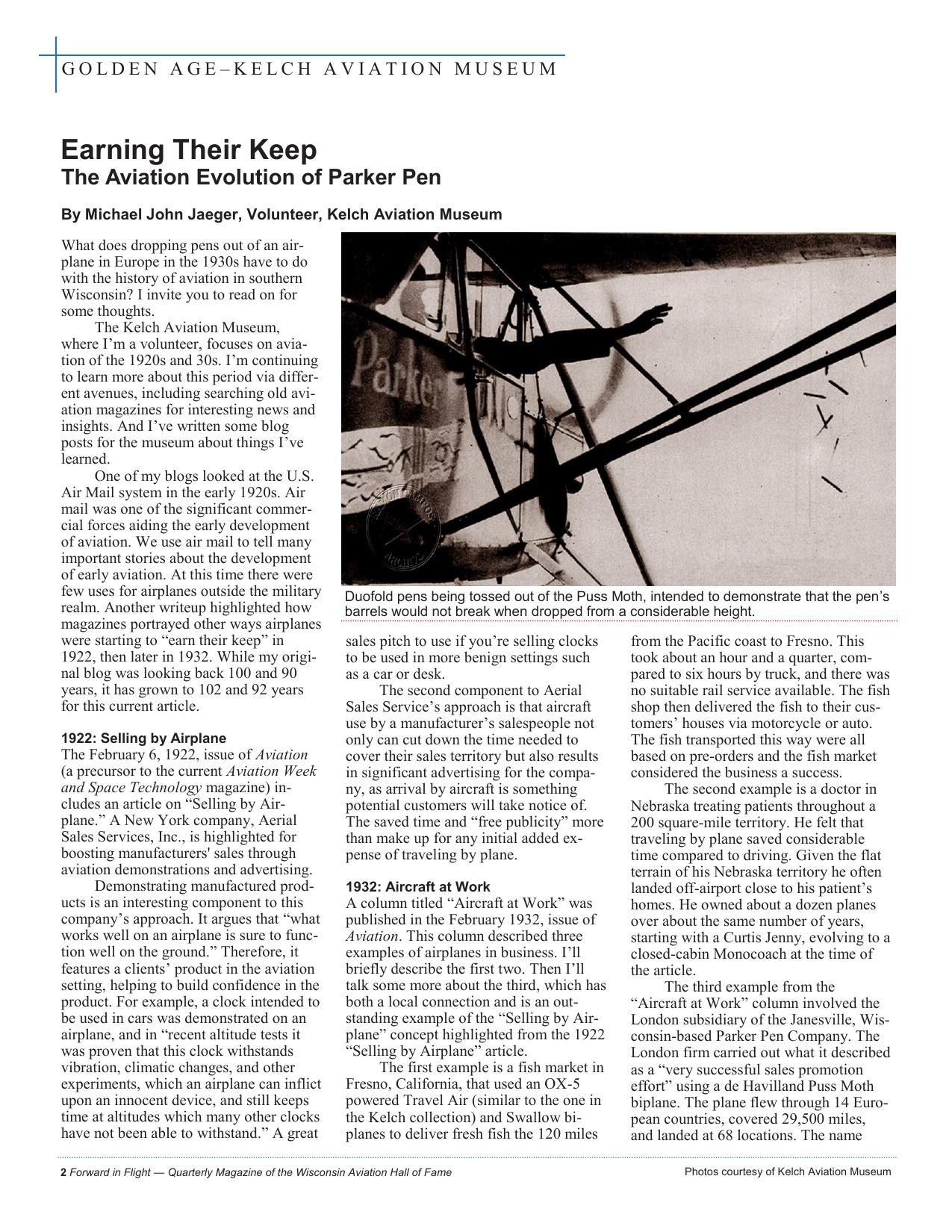
GOLDEN AGE–KELCH AVIATION MUSEUM Earning Their Keep The Aviation Evolution of Parker Pen By Michael John Jaeger, Volunteer, Kelch Aviation Museum What does dropping pens out of an airplane in Europe in the 1930s have to do with the history of aviation in southern Wisconsin? I invite you to read on for some thoughts. The Kelch Aviation Museum, where I’m a volunteer, focuses on aviation of the 1920s and 30s. I’m continuing to learn more about this period via different avenues, including searching old aviation magazines for interesting news and insights. And I’ve written some blog posts for the museum about things I’ve learned. One of my blogs looked at the U.S. Air Mail system in the early 1920s. Air mail was one of the significant commercial forces aiding the early development of aviation. We use air mail to tell many important stories about the development of early aviation. At this time there were few uses for airplanes outside the military realm. Another writeup highlighted how magazines portrayed other ways airplanes were starting to “earn their keep” in 1922, then later in 1932. While my original blog was looking back 100 and 90 years, it has grown to 102 and 92 years for this current article. 1922: Selling by Airplane The February 6, 1922, issue of Aviation (a precursor to the current Aviation Week and Space Technology magazine) includes an article on “Selling by Airplane.” A New York company, Aerial Sales Services, Inc., is highlighted for boosting manufacturers' sales through aviation demonstrations and advertising. Demonstrating manufactured products is an interesting component to this company’s approach. It argues that “what works well on an airplane is sure to function well on the ground.” Therefore, it features a clients’ product in the aviation setting, helping to build confidence in the product. For example, a clock intended to be used in cars was demonstrated on an airplane, and in “recent altitude tests it was proven that this clock withstands vibration, climatic changes, and other experiments, which an airplane can inflict upon an innocent device, and still keeps time at altitudes which many other clocks have not been able to withstand.” A great Duofold pens being tossed out of the Puss Moth, intended to demonstrate that the pen’s barrels would not break when dropped from a considerable height. sales pitch to use if you’re selling clocks to be used in more benign settings such as a car or desk. The second component to Aerial Sales Service’s approach is that aircraft use by a manufacturer’s salespeople not only can cut down the time needed to cover their sales territory but also results in significant advertising for the company, as arrival by aircraft is something potential customers will take notice of. The saved time and “free publicity” more than make up for any initial added expense of traveling by plane. 1932: Aircraft at Work A column titled “Aircraft at Work” was published in the February 1932, issue of Aviation. This column described three examples of airplanes in business. I’ll briefly describe the first two. Then I’ll talk some more about the third, which has both a local connection and is an outstanding example of the “Selling by Airplane” concept highlighted from the 1922 “Selling by Airplane” article. The first example is a fish market in Fresno, California, that used an OX-5 powered Travel Air (similar to the one in the Kelch collection) and Swallow biplanes to deliver fresh fish the 120 miles 2 Forward in Flight — Quarterly Magazine of the Wisconsin Aviation Hall of Fame from the Pacific coast to Fresno. This took about an hour and a quarter, compared to six hours by truck, and there was no suitable rail service available. The fish shop then delivered the fish to their customers’ houses via motorcycle or auto. The fish transported this way were all based on pre-orders and the fish market considered the business a success. The second example is a doctor in Nebraska treating patients throughout a 200 square-mile territory. He felt that traveling by plane saved considerable time compared to driving. Given the flat terrain of his Nebraska territory he often landed off-airport close to his patient’s homes. He owned about a dozen planes over about the same number of years, starting with a Curtis Jenny, evolving to a closed-cabin Monocoach at the time of the article. The third example from the “Aircraft at Work” column involved the London subsidiary of the Janesville, Wisconsin-based Parker Pen Company. The London firm carried out what it described as a “very successful sales promotion effort” using a de Havilland Puss Moth biplane. The plane flew through 14 European countries, covered 29,500 miles, and landed at 68 locations. The name Photos courtesy of Kelch Aviation Museum
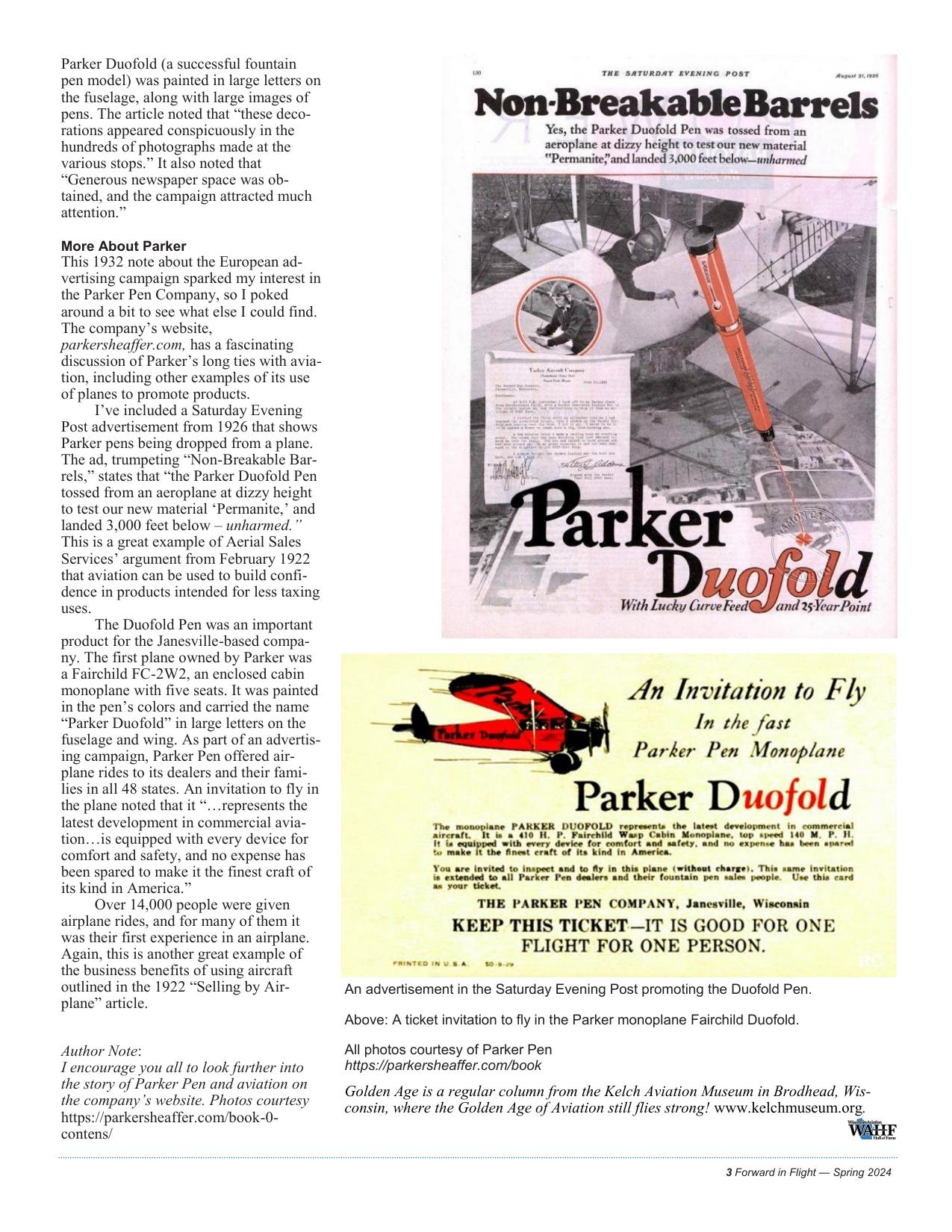
Parker Duofold (a successful fountain pen model) was painted in large letters on the fuselage, along with large images of pens. The article noted that “these decorations appeared conspicuously in the hundreds of photographs made at the various stops.” It also noted that “Generous newspaper space was obtained, and the campaign attracted much attention.” More About Parker This 1932 note about the European advertising campaign sparked my interest in the Parker Pen Company, so I poked around a bit to see what else I could find. The company’s website, parkersheaffer.com, has a fascinating discussion of Parker’s long ties with aviation, including other examples of its use of planes to promote products. I’ve included a Saturday Evening Post advertisement from 1926 that shows Parker pens being dropped from a plane. The ad, trumpeting “Non-Breakable Barrels,” states that “the Parker Duofold Pen tossed from an aeroplane at dizzy height to test our new material ‘Permanite,’ and landed 3,000 feet below – unharmed.” This is a great example of Aerial Sales Services’ argument from February 1922 that aviation can be used to build confidence in products intended for less taxing uses. The Duofold Pen was an important product for the Janesville-based company. The first plane owned by Parker was a Fairchild FC-2W2, an enclosed cabin monoplane with five seats. It was painted in the pen’s colors and carried the name “Parker Duofold” in large letters on the fuselage and wing. As part of an advertising campaign, Parker Pen offered airplane rides to its dealers and their families in all 48 states. An invitation to fly in the plane noted that it “…represents the latest development in commercial aviation…is equipped with every device for comfort and safety, and no expense has been spared to make it the finest craft of its kind in America.” Over 14,000 people were given airplane rides, and for many of them it was their first experience in an airplane. Again, this is another great example of the business benefits of using aircraft outlined in the 1922 “Selling by Airplane” article. Author Note: I encourage you all to look further into the story of Parker Pen and aviation on the company’s website. Photos courtesy https://parkersheaffer.com/book-0contens/ An advertisement in the Saturday Evening Post promoting the Duofold Pen. Above: A ticket invitation to fly in the Parker monoplane Fairchild Duofold. All photos courtesy of Parker Pen https://parkersheaffer.com/book Golden Age is a regular column from the Kelch Aviation Museum in Brodhead, Wisconsin, where the Golden Age of Aviation still flies strong! www.kelchmuseum.org. 3 Forward in Flight — Spring 2024
TAILDRAGGER TALES Arnie Comes to Wausau If only we had known… By John Chmiel Secure your seatbelts and hold on tight because this episode is going to maneuver in more directions than a biplane during a Sean Tucker airshow demonstration. Every pilot has a story to tell. Sometimes we get to hear those stories, especially if we hang out long enough in the airport lobby and befriend the airport regulars. Logging couch time also gives you the chance to meet the transients. Some of the best stories I’ve ever heard were over a hot cup of joe with aviators who diverted to Wausau for whatever reason and were able to stay a while. That’s one of the things I love about the airport lifestyle. In the FBO lobby or hangar you never know who you’re going to meet, and it’s your mistake if you don’t get to know them. The airport is probably one of the easiest environments in which to strike up a conversation with a stranger—who turns out to be your comrade in aviation. Every airplane has a story too. Each airplane you witness take-off, land, and taxi through your aerodrome has had unique flying experiences. Airplanes speak to you when you fly them if you’ve been taught how to listen, feel, see, and smell them. But on the ground when they are not moving you’ve got to do some homework and research to pull the stories out of them. Every time I see an airplane, I wonder about the flights it’s been on, the weather it has flown through, its neardeath experiences that its pilot that day never spoke a word of, the first solo flights, who owned it, the pilots who’ve flown it, the missions it has been on, etc. You can peek into a specific airplane’s story by looking through its logbooks, ordering the FAA ownership and maintenance history, by researching NTSB reports, and talking to previous owners. If it’s a military airplane you can order the aircraft’s military history while in service. It can be a fun journey if you enjoy history. And that’s how I got to know Arnie, through our Wausau Downtown Airport Guardian A-7 Corsair. My daily commute past the A-7 Corsair fighter at its first home at the VFW along the Wisconsin River eventually got the best of me. I finally stopped for my own up close and personal view of the warbird. Next to the A-7 Corsair were two weathered placards; one addressed the Corsair’s aircraft performance, and another gave a brief description of the pilot who flew the airplane in combat. This guardian was painted to represent the aircraft flown by Air Force Major Colin Arnold “Arnie” Clarke during the Vietnam conflict. His plaque with a faded picture of him briefly indicated that Major Clarke had been decorated with the Air Force Cross, the Silver Star, and three Distinguished Flying Crosses while serving four tours in Vietnam between 1962-1973 flying F-100s and the A-7 Corsair. But there was no indication that Major Clarke had any connection to Wausau or the area. Once we knew the VFW A-7 had been secured to serve as the guardian at the Wausau Airport, it immediately renewed my interest in the Arnie Clarke story. Now that we had arrived in the 2000s Google made researching his story a much easier task. I immediately found the following at the website valor.militarytimes.com: Colin Arnold “Arnie” Clarke DATE OF BIRTH: August 31, 1935 PLACE OF BIRTH: Seattle, Washington Colin Clarke served in the U.S. Naval Reserve while completing his bachelor’s degree at the University of Washington. After graduation he was discharged in order to attend the Air Force OTS program, earning his commission and subsequently earning his wings. He served his first tour of duty in Vietnam in 1962-63, and a second tour in 1964-65. He earned the Silver Star on his third Vietnam tour in 1968-69, and the Air Force Cross during his fourth tour in Vietnam in 1972-73. In all he completed 385 combat missions in Southeast Asia, was shot down, rescued. TWICE. He later served with the Military Assistance Advisory Group in Tehran, Iran, until he was evacuated due to the revolution that led to the Iranian hostage crisis. He retired from the Air Force on August 1, 1981. We don’t have enough room for the stories of how he earned his individual 4 Forward in Flight — Quarterly Magazine of the Wisconsin Aviation Hall of Fame awards in this issue, but they are detailed on the website. But then, the Google information began to intrigue me even further with the stories about Arnie’s life after August of 1981. Upon his military retirement, Clarke moved to Wenatchee, Washington, and served as the airport manager at Pangborn Airport for the next 22 years. The airport’s namesake was Clyde “Upsidedown” Pangborn who was a pioneer aviator, chief pilot for Gates Flying Circus, and world-renowned crosscountry air racer. One of Pangborn's most notable achievements (among many) was being the first pilot to cross the Pacific Ocean non-stop from Japan to the United States. Pangborn and his co-pilot Hugh Herndon flew from Sabishiro Beach, Misawa, Japan, across the northern Pacific and landed in the hills of East Wenatchee, Washington, following a 41hour flight in their Bellanca CH-400 named Miss Veedol. The Bellanca had been Lindbergh’s original consideration to be used for his Transatlantic flight, until Lindy was told by Bellanca that he could buy the airplane but not fly it across the ocean. Bellanca had already chosen its pilots for the job. Once Lindbergh broke the New York to Paris record in his Ryan, with the Bellanca still available, Pangborn and Herndon set out to break new records. While in second place behind Wylie Post on a round the world race, Pangborn and Herndon decided to detour and head for Japan to plan their record-breaking flight. This is another great aviation history story but it's too much for this episode (you’ll have to look up details for yourself) and so I’ll jump to the end. Wenatchee, Washington, was where Pangborn, Herndon, and Miss Veedol successfully belly landed as planned, forever placing the community of Wenatchee in the aviation history books. The new airport manager, Arnie Clarke, wasn’t lost on the airport’s deep aviation history and he was determined to honor it properly. Instead of the small airplane model in the corner of the airport terminal building presently on display for the public, Arnie used his larger-than-life personality to organize the community
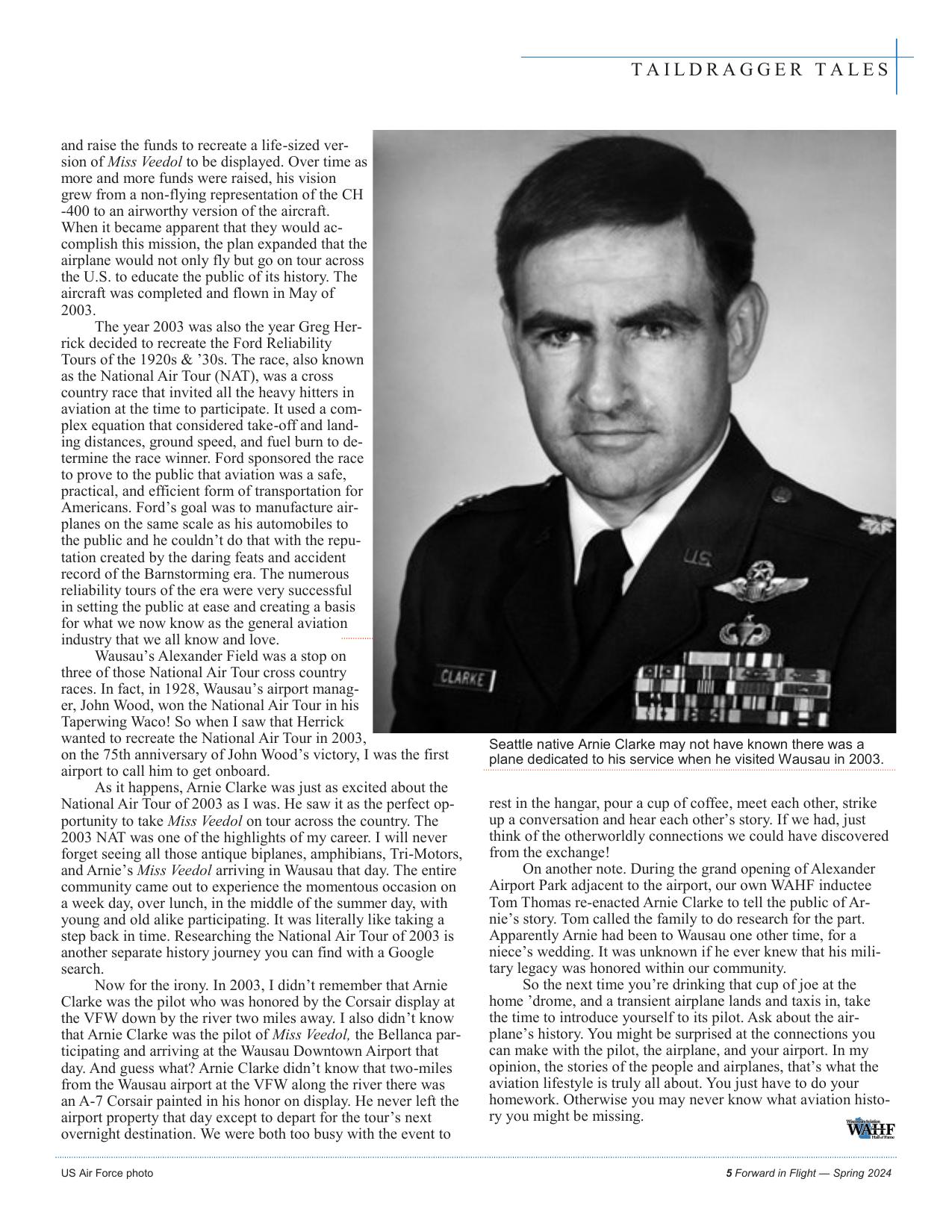
TAILDRAGGER TALES and raise the funds to recreate a life-sized version of Miss Veedol to be displayed. Over time as more and more funds were raised, his vision grew from a non-flying representation of the CH -400 to an airworthy version of the aircraft. When it became apparent that they would accomplish this mission, the plan expanded that the airplane would not only fly but go on tour across the U.S. to educate the public of its history. The aircraft was completed and flown in May of 2003. The year 2003 was also the year Greg Herrick decided to recreate the Ford Reliability Tours of the 1920s & ’30s. The race, also known as the National Air Tour (NAT), was a cross country race that invited all the heavy hitters in aviation at the time to participate. It used a complex equation that considered take-off and landing distances, ground speed, and fuel burn to determine the race winner. Ford sponsored the race to prove to the public that aviation was a safe, practical, and efficient form of transportation for Americans. Ford’s goal was to manufacture airplanes on the same scale as his automobiles to the public and he couldn’t do that with the reputation created by the daring feats and accident record of the Barnstorming era. The numerous reliability tours of the era were very successful in setting the public at ease and creating a basis for what we now know as the general aviation industry that we all know and love. Wausau’s Alexander Field was a stop on three of those National Air Tour cross country races. In fact, in 1928, Wausau’s airport manager, John Wood, won the National Air Tour in his Taperwing Waco! So when I saw that Herrick wanted to recreate the National Air Tour in 2003, on the 75th anniversary of John Wood’s victory, I was the first airport to call him to get onboard. As it happens, Arnie Clarke was just as excited about the National Air Tour of 2003 as I was. He saw it as the perfect opportunity to take Miss Veedol on tour across the country. The 2003 NAT was one of the highlights of my career. I will never forget seeing all those antique biplanes, amphibians, Tri-Motors, and Arnie’s Miss Veedol arriving in Wausau that day. The entire community came out to experience the momentous occasion on a week day, over lunch, in the middle of the summer day, with young and old alike participating. It was literally like taking a step back in time. Researching the National Air Tour of 2003 is another separate history journey you can find with a Google search. Now for the irony. In 2003, I didn’t remember that Arnie Clarke was the pilot who was honored by the Corsair display at the VFW down by the river two miles away. I also didn’t know that Arnie Clarke was the pilot of Miss Veedol, the Bellanca participating and arriving at the Wausau Downtown Airport that day. And guess what? Arnie Clarke didn’t know that two-miles from the Wausau airport at the VFW along the river there was an A-7 Corsair painted in his honor on display. He never left the airport property that day except to depart for the tour’s next overnight destination. We were both too busy with the event to US Air Force photo Seattle native Arnie Clarke may not have known there was a plane dedicated to his service when he visited Wausau in 2003. rest in the hangar, pour a cup of coffee, meet each other, strike up a conversation and hear each other’s story. If we had, just think of the otherworldly connections we could have discovered from the exchange! On another note. During the grand opening of Alexander Airport Park adjacent to the airport, our own WAHF inductee Tom Thomas re-enacted Arnie Clarke to tell the public of Arnie’s story. Tom called the family to do research for the part. Apparently Arnie had been to Wausau one other time, for a niece’s wedding. It was unknown if he ever knew that his military legacy was honored within our community. So the next time you’re drinking that cup of joe at the home ’drome, and a transient airplane lands and taxis in, take the time to introduce yourself to its pilot. Ask about the airplane’s history. You might be surprised at the connections you can make with the pilot, the airplane, and your airport. In my opinion, the stories of the people and airplanes, that’s what the aviation lifestyle is truly all about. You just have to do your homework. Otherwise you may never know what aviation history you might be missing. 5 Forward in Flight — Spring 2024
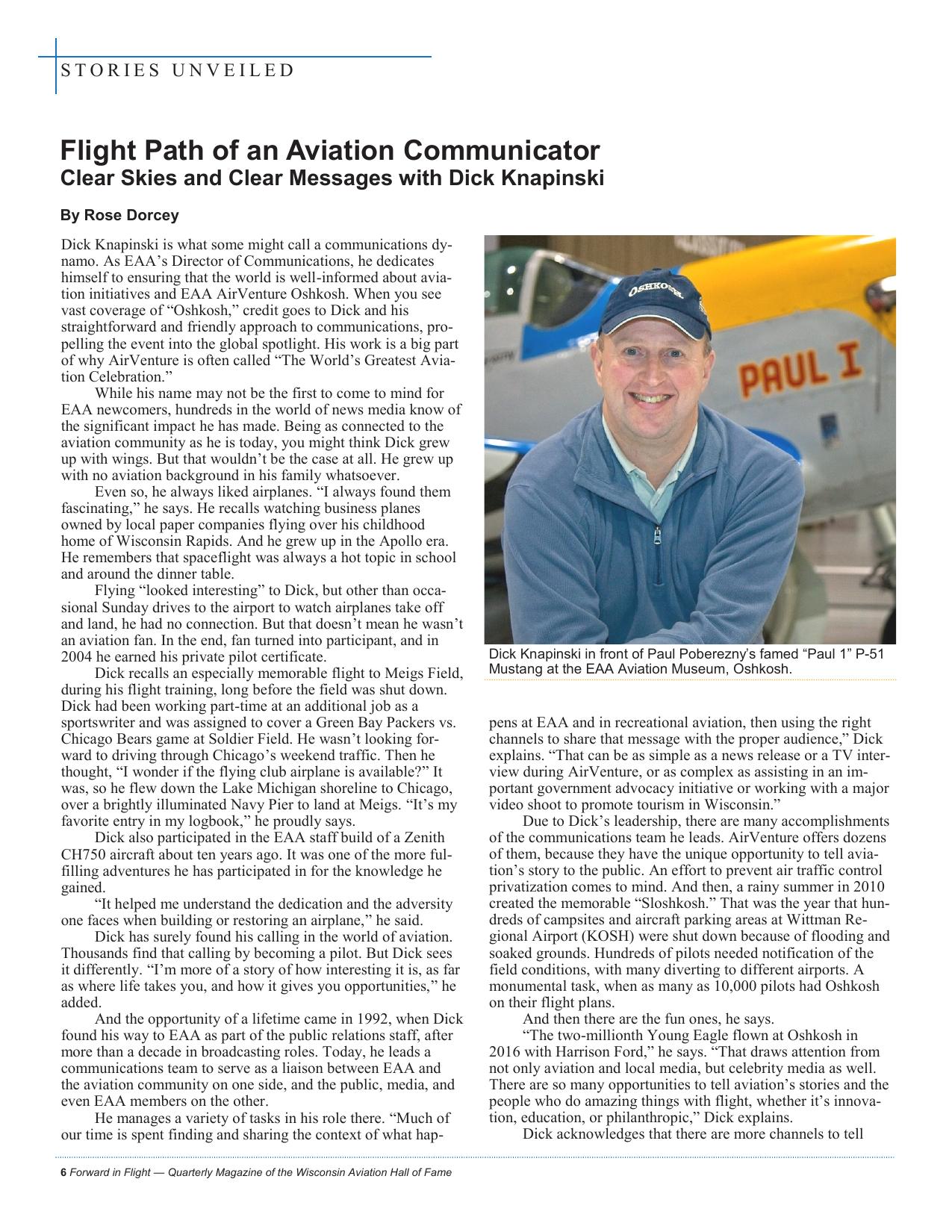
STORIES UNVEILED Flight Path of an Aviation Communicator Clear Skies and Clear Messages with Dick Knapinski By Rose Dorcey Dick Knapinski is what some might call a communications dynamo. As EAA’s Director of Communications, he dedicates himself to ensuring that the world is well-informed about aviation initiatives and EAA AirVenture Oshkosh. When you see vast coverage of “Oshkosh,” credit goes to Dick and his straightforward and friendly approach to communications, propelling the event into the global spotlight. His work is a big part of why AirVenture is often called “The World’s Greatest Aviation Celebration.” While his name may not be the first to come to mind for EAA newcomers, hundreds in the world of news media know of the significant impact he has made. Being as connected to the aviation community as he is today, you might think Dick grew up with wings. But that wouldn’t be the case at all. He grew up with no aviation background in his family whatsoever. Even so, he always liked airplanes. “I always found them fascinating,” he says. He recalls watching business planes owned by local paper companies flying over his childhood home of Wisconsin Rapids. And he grew up in the Apollo era. He remembers that spaceflight was always a hot topic in school and around the dinner table. Flying “looked interesting” to Dick, but other than occasional Sunday drives to the airport to watch airplanes take off and land, he had no connection. But that doesn’t mean he wasn’t an aviation fan. In the end, fan turned into participant, and in 2004 he earned his private pilot certificate. Dick recalls an especially memorable flight to Meigs Field, during his flight training, long before the field was shut down. Dick had been working part-time at an additional job as a sportswriter and was assigned to cover a Green Bay Packers vs. Chicago Bears game at Soldier Field. He wasn’t looking forward to driving through Chicago’s weekend traffic. Then he thought, “I wonder if the flying club airplane is available?” It was, so he flew down the Lake Michigan shoreline to Chicago, over a brightly illuminated Navy Pier to land at Meigs. “It’s my favorite entry in my logbook,” he proudly says. Dick also participated in the EAA staff build of a Zenith CH750 aircraft about ten years ago. It was one of the more fulfilling adventures he has participated in for the knowledge he gained. “It helped me understand the dedication and the adversity one faces when building or restoring an airplane,” he said. Dick has surely found his calling in the world of aviation. Thousands find that calling by becoming a pilot. But Dick sees it differently. “I’m more of a story of how interesting it is, as far as where life takes you, and how it gives you opportunities,” he added. And the opportunity of a lifetime came in 1992, when Dick found his way to EAA as part of the public relations staff, after more than a decade in broadcasting roles. Today, he leads a communications team to serve as a liaison between EAA and the aviation community on one side, and the public, media, and even EAA members on the other. He manages a variety of tasks in his role there. “Much of our time is spent finding and sharing the context of what hap6 Forward in Flight — Quarterly Magazine of the Wisconsin Aviation Hall of Fame Dick Knapinski in front of Paul Poberezny’s famed “Paul 1” P-51 Mustang at the EAA Aviation Museum, Oshkosh. pens at EAA and in recreational aviation, then using the right channels to share that message with the proper audience,” Dick explains. “That can be as simple as a news release or a TV interview during AirVenture, or as complex as assisting in an important government advocacy initiative or working with a major video shoot to promote tourism in Wisconsin.” Due to Dick’s leadership, there are many accomplishments of the communications team he leads. AirVenture offers dozens of them, because they have the unique opportunity to tell aviation’s story to the public. An effort to prevent air traffic control privatization comes to mind. And then, a rainy summer in 2010 created the memorable “Sloshkosh.” That was the year that hundreds of campsites and aircraft parking areas at Wittman Regional Airport (KOSH) were shut down because of flooding and soaked grounds. Hundreds of pilots needed notification of the field conditions, with many diverting to different airports. A monumental task, when as many as 10,000 pilots had Oshkosh on their flight plans. And then there are the fun ones, he says. “The two-millionth Young Eagle flown at Oshkosh in 2016 with Harrison Ford,” he says. “That draws attention from not only aviation and local media, but celebrity media as well. There are so many opportunities to tell aviation’s stories and the people who do amazing things with flight, whether it’s innovation, education, or philanthropic,” Dick explains. Dick acknowledges that there are more channels to tell
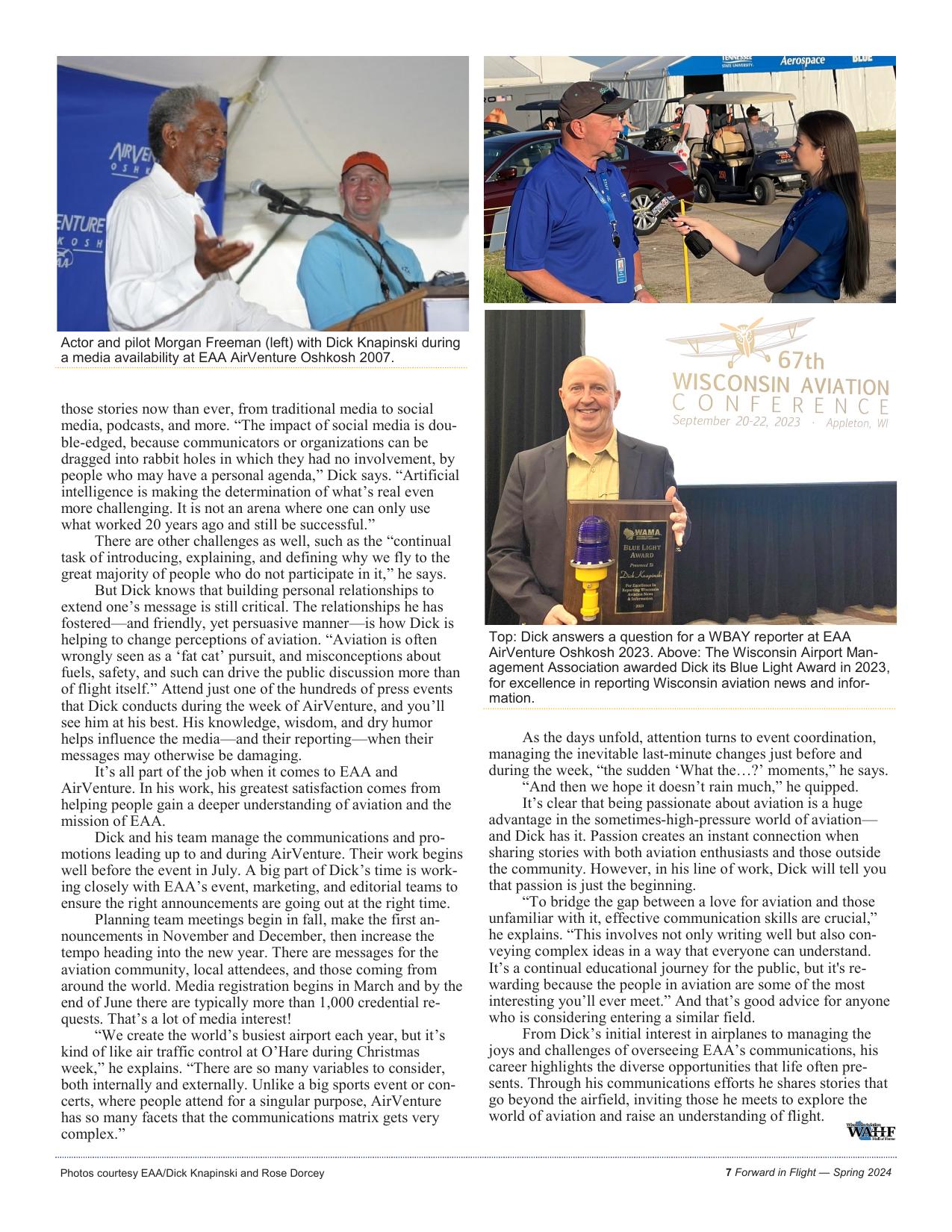
Actor and pilot Morgan Freeman (left) with Dick Knapinski during a media availability at EAA AirVenture Oshkosh 2007. those stories now than ever, from traditional media to social media, podcasts, and more. “The impact of social media is double-edged, because communicators or organizations can be dragged into rabbit holes in which they had no involvement, by people who may have a personal agenda,” Dick says. “Artificial intelligence is making the determination of what’s real even more challenging. It is not an arena where one can only use what worked 20 years ago and still be successful.” There are other challenges as well, such as the “continual task of introducing, explaining, and defining why we fly to the great majority of people who do not participate in it,” he says. But Dick knows that building personal relationships to extend one’s message is still critical. The relationships he has fostered—and friendly, yet persuasive manner—is how Dick is helping to change perceptions of aviation. “Aviation is often wrongly seen as a ‘fat cat’ pursuit, and misconceptions about fuels, safety, and such can drive the public discussion more than of flight itself.” Attend just one of the hundreds of press events that Dick conducts during the week of AirVenture, and you’ll see him at his best. His knowledge, wisdom, and dry humor helps influence the media—and their reporting—when their messages may otherwise be damaging. It’s all part of the job when it comes to EAA and AirVenture. In his work, his greatest satisfaction comes from helping people gain a deeper understanding of aviation and the mission of EAA. Dick and his team manage the communications and promotions leading up to and during AirVenture. Their work begins well before the event in July. A big part of Dick’s time is working closely with EAA’s event, marketing, and editorial teams to ensure the right announcements are going out at the right time. Planning team meetings begin in fall, make the first announcements in November and December, then increase the tempo heading into the new year. There are messages for the aviation community, local attendees, and those coming from around the world. Media registration begins in March and by the end of June there are typically more than 1,000 credential requests. That’s a lot of media interest! “We create the world’s busiest airport each year, but it’s kind of like air traffic control at O’Hare during Christmas week,” he explains. “There are so many variables to consider, both internally and externally. Unlike a big sports event or concerts, where people attend for a singular purpose, AirVenture has so many facets that the communications matrix gets very complex.” Photos courtesy EAA/Dick Knapinski and Rose Dorcey Top: Dick answers a question for a WBAY reporter at EAA AirVenture Oshkosh 2023. Above: The Wisconsin Airport Management Association awarded Dick its Blue Light Award in 2023, for excellence in reporting Wisconsin aviation news and information. As the days unfold, attention turns to event coordination, managing the inevitable last-minute changes just before and during the week, “the sudden ‘What the…?’ moments,” he says. “And then we hope it doesn’t rain much,” he quipped. It’s clear that being passionate about aviation is a huge advantage in the sometimes-high-pressure world of aviation— and Dick has it. Passion creates an instant connection when sharing stories with both aviation enthusiasts and those outside the community. However, in his line of work, Dick will tell you that passion is just the beginning. “To bridge the gap between a love for aviation and those unfamiliar with it, effective communication skills are crucial,” he explains. “This involves not only writing well but also conveying complex ideas in a way that everyone can understand. It’s a continual educational journey for the public, but it's rewarding because the people in aviation are some of the most interesting you’ll ever meet.” And that’s good advice for anyone who is considering entering a similar field. From Dick’s initial interest in airplanes to managing the joys and challenges of overseeing EAA’s communications, his career highlights the diverse opportunities that life often presents. Through his communications efforts he shares stories that go beyond the airfield, inviting those he meets to explore the world of aviation and raise an understanding of flight. 7 Forward in Flight — Spring 2024
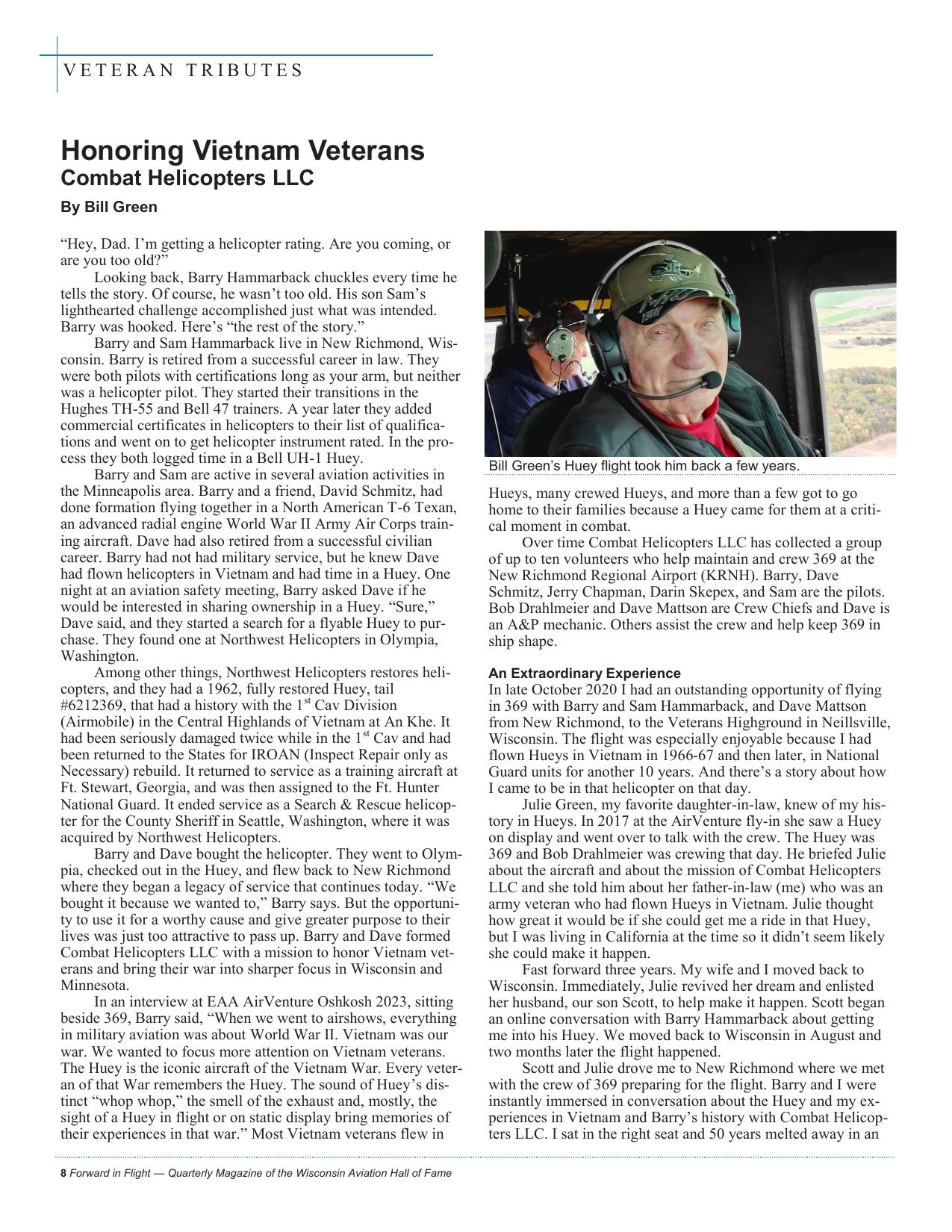
VETERAN TRIBUTES Honoring Vietnam Veterans Combat Helicopters LLC By Bill Green “Hey, Dad. I’m getting a helicopter rating. Are you coming, or are you too old?” Looking back, Barry Hammarback chuckles every time he tells the story. Of course, he wasn’t too old. His son Sam’s lighthearted challenge accomplished just what was intended. Barry was hooked. Here’s “the rest of the story.” Barry and Sam Hammarback live in New Richmond, Wisconsin. Barry is retired from a successful career in law. They were both pilots with certifications long as your arm, but neither was a helicopter pilot. They started their transitions in the Hughes TH-55 and Bell 47 trainers. A year later they added commercial certificates in helicopters to their list of qualifications and went on to get helicopter instrument rated. In the process they both logged time in a Bell UH-1 Huey. Barry and Sam are active in several aviation activities in the Minneapolis area. Barry and a friend, David Schmitz, had done formation flying together in a North American T-6 Texan, an advanced radial engine World War II Army Air Corps training aircraft. Dave had also retired from a successful civilian career. Barry had not had military service, but he knew Dave had flown helicopters in Vietnam and had time in a Huey. One night at an aviation safety meeting, Barry asked Dave if he would be interested in sharing ownership in a Huey. “Sure,” Dave said, and they started a search for a flyable Huey to purchase. They found one at Northwest Helicopters in Olympia, Washington. Among other things, Northwest Helicopters restores helicopters, and they had a 1962, fully restored Huey, tail #6212369, that had a history with the 1st Cav Division (Airmobile) in the Central Highlands of Vietnam at An Khe. It had been seriously damaged twice while in the 1 st Cav and had been returned to the States for IROAN (Inspect Repair only as Necessary) rebuild. It returned to service as a training aircraft at Ft. Stewart, Georgia, and was then assigned to the Ft. Hunter National Guard. It ended service as a Search & Rescue helicopter for the County Sheriff in Seattle, Washington, where it was acquired by Northwest Helicopters. Barry and Dave bought the helicopter. They went to Olympia, checked out in the Huey, and flew back to New Richmond where they began a legacy of service that continues today. “We bought it because we wanted to,” Barry says. But the opportunity to use it for a worthy cause and give greater purpose to their lives was just too attractive to pass up. Barry and Dave formed Combat Helicopters LLC with a mission to honor Vietnam veterans and bring their war into sharper focus in Wisconsin and Minnesota. In an interview at EAA AirVenture Oshkosh 2023, sitting beside 369, Barry said, “When we went to airshows, everything in military aviation was about World War II. Vietnam was our war. We wanted to focus more attention on Vietnam veterans. The Huey is the iconic aircraft of the Vietnam War. Every veteran of that War remembers the Huey. The sound of Huey’s distinct “whop whop,” the smell of the exhaust and, mostly, the sight of a Huey in flight or on static display bring memories of their experiences in that war.” Most Vietnam veterans flew in 8 Forward in Flight — Quarterly Magazine of the Wisconsin Aviation Hall of Fame Bill Green’s Huey flight took him back a few years. Hueys, many crewed Hueys, and more than a few got to go home to their families because a Huey came for them at a critical moment in combat. Over time Combat Helicopters LLC has collected a group of up to ten volunteers who help maintain and crew 369 at the New Richmond Regional Airport (KRNH). Barry, Dave Schmitz, Jerry Chapman, Darin Skepex, and Sam are the pilots. Bob Drahlmeier and Dave Mattson are Crew Chiefs and Dave is an A&P mechanic. Others assist the crew and help keep 369 in ship shape. An Extraordinary Experience In late October 2020 I had an outstanding opportunity of flying in 369 with Barry and Sam Hammarback, and Dave Mattson from New Richmond, to the Veterans Highground in Neillsville, Wisconsin. The flight was especially enjoyable because I had flown Hueys in Vietnam in 1966-67 and then later, in National Guard units for another 10 years. And there’s a story about how I came to be in that helicopter on that day. Julie Green, my favorite daughter-in-law, knew of my history in Hueys. In 2017 at the AirVenture fly-in she saw a Huey on display and went over to talk with the crew. The Huey was 369 and Bob Drahlmeier was crewing that day. He briefed Julie about the aircraft and about the mission of Combat Helicopters LLC and she told him about her father-in-law (me) who was an army veteran who had flown Hueys in Vietnam. Julie thought how great it would be if she could get me a ride in that Huey, but I was living in California at the time so it didn’t seem likely she could make it happen. Fast forward three years. My wife and I moved back to Wisconsin. Immediately, Julie revived her dream and enlisted her husband, our son Scott, to help make it happen. Scott began an online conversation with Barry Hammarback about getting me into his Huey. We moved back to Wisconsin in August and two months later the flight happened. Scott and Julie drove me to New Richmond where we met with the crew of 369 preparing for the flight. Barry and I were instantly immersed in conversation about the Huey and my experiences in Vietnam and Barry’s history with Combat Helicopters LLC. I sat in the right seat and 50 years melted away in an
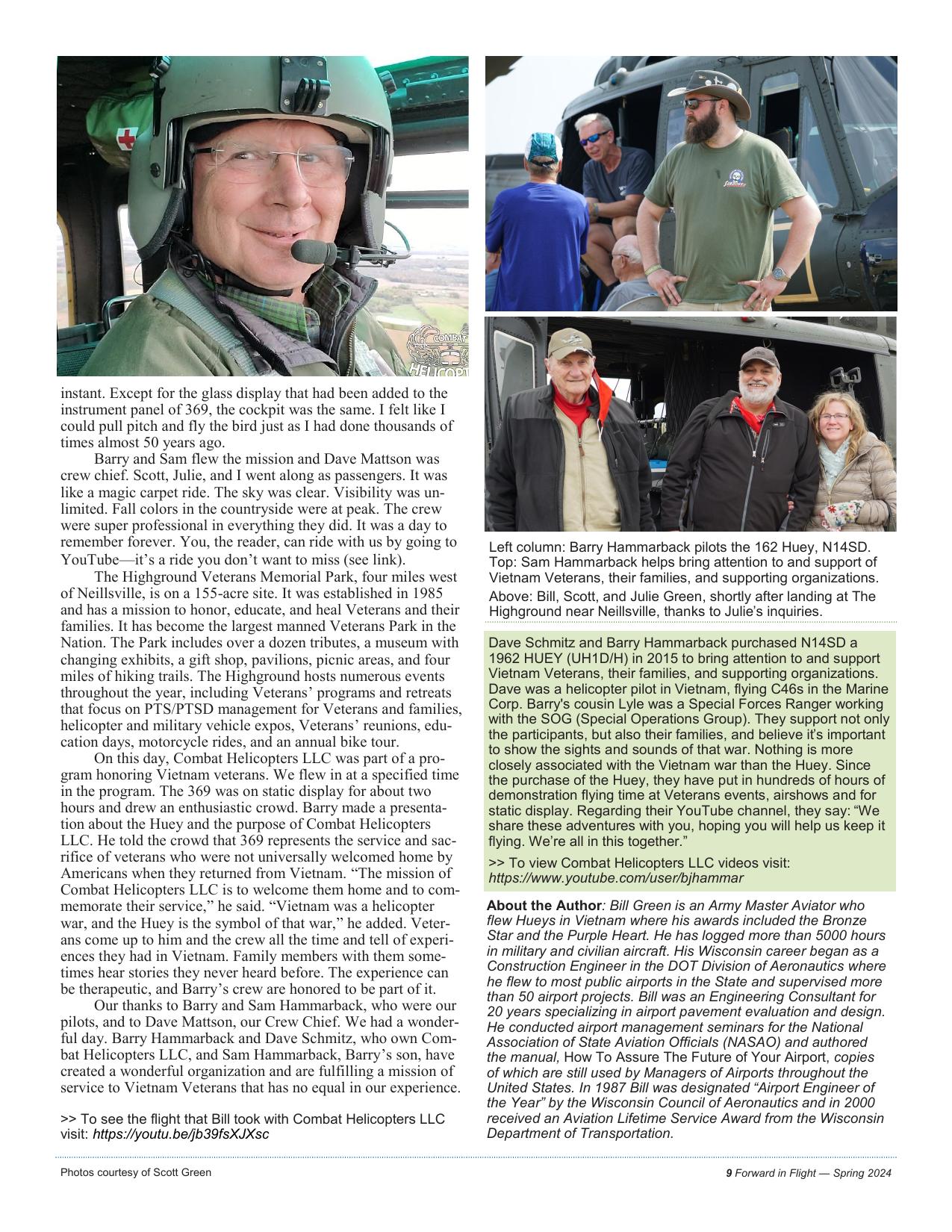
instant. Except for the glass display that had been added to the instrument panel of 369, the cockpit was the same. I felt like I could pull pitch and fly the bird just as I had done thousands of times almost 50 years ago. Barry and Sam flew the mission and Dave Mattson was crew chief. Scott, Julie, and I went along as passengers. It was like a magic carpet ride. The sky was clear. Visibility was unlimited. Fall colors in the countryside were at peak. The crew were super professional in everything they did. It was a day to remember forever. You, the reader, can ride with us by going to YouTube—it’s a ride you don’t want to miss (see link). The Highground Veterans Memorial Park, four miles west of Neillsville, is on a 155-acre site. It was established in 1985 and has a mission to honor, educate, and heal Veterans and their families. It has become the largest manned Veterans Park in the Nation. The Park includes over a dozen tributes, a museum with changing exhibits, a gift shop, pavilions, picnic areas, and four miles of hiking trails. The Highground hosts numerous events throughout the year, including Veterans’ programs and retreats that focus on PTS/PTSD management for Veterans and families, helicopter and military vehicle expos, Veterans’ reunions, education days, motorcycle rides, and an annual bike tour. On this day, Combat Helicopters LLC was part of a program honoring Vietnam veterans. We flew in at a specified time in the program. The 369 was on static display for about two hours and drew an enthusiastic crowd. Barry made a presentation about the Huey and the purpose of Combat Helicopters LLC. He told the crowd that 369 represents the service and sacrifice of veterans who were not universally welcomed home by Americans when they returned from Vietnam. “The mission of Combat Helicopters LLC is to welcome them home and to commemorate their service,” he said. “Vietnam was a helicopter war, and the Huey is the symbol of that war,” he added. Veterans come up to him and the crew all the time and tell of experiences they had in Vietnam. Family members with them sometimes hear stories they never heard before. The experience can be therapeutic, and Barry’s crew are honored to be part of it. Our thanks to Barry and Sam Hammarback, who were our pilots, and to Dave Mattson, our Crew Chief. We had a wonderful day. Barry Hammarback and Dave Schmitz, who own Combat Helicopters LLC, and Sam Hammarback, Barry’s son, have created a wonderful organization and are fulfilling a mission of service to Vietnam Veterans that has no equal in our experience. >> To see the flight that Bill took with Combat Helicopters LLC visit: https://youtu.be/jb39fsXJXsc Photos courtesy of Scott Green Left column: Barry Hammarback pilots the 162 Huey, N14SD. Top: Sam Hammarback helps bring attention to and support of Vietnam Veterans, their families, and supporting organizations. Above: Bill, Scott, and Julie Green, shortly after landing at The Highground near Neillsville, thanks to Julie’s inquiries. Dave Schmitz and Barry Hammarback purchased N14SD a 1962 HUEY (UH1D/H) in 2015 to bring attention to and support Vietnam Veterans, their families, and supporting organizations. Dave was a helicopter pilot in Vietnam, flying C46s in the Marine Corp. Barry's cousin Lyle was a Special Forces Ranger working with the SOG (Special Operations Group). They support not only the participants, but also their families, and believe it’s important to show the sights and sounds of that war. Nothing is more closely associated with the Vietnam war than the Huey. Since the purchase of the Huey, they have put in hundreds of hours of demonstration flying time at Veterans events, airshows and for static display. Regarding their YouTube channel, they say: “We share these adventures with you, hoping you will help us keep it flying. We’re all in this together.” >> To view Combat Helicopters LLC videos visit: https://www.youtube.com/user/bjhammar About the Author: Bill Green is an Army Master Aviator who flew Hueys in Vietnam where his awards included the Bronze Star and the Purple Heart. He has logged more than 5000 hours in military and civilian aircraft. His Wisconsin career began as a Construction Engineer in the DOT Division of Aeronautics where he flew to most public airports in the State and supervised more than 50 airport projects. Bill was an Engineering Consultant for 20 years specializing in airport pavement evaluation and design. He conducted airport management seminars for the National Association of State Aviation Officials (NASAO) and authored the manual, How To Assure The Future of Your Airport, copies of which are still used by Managers of Airports throughout the United States. In 1987 Bill was designated “Airport Engineer of the Year” by the Wisconsin Council of Aeronautics and in 2000 received an Aviation Lifetime Service Award from the Wisconsin Department of Transportation. 9 Forward in Flight — Spring 2024
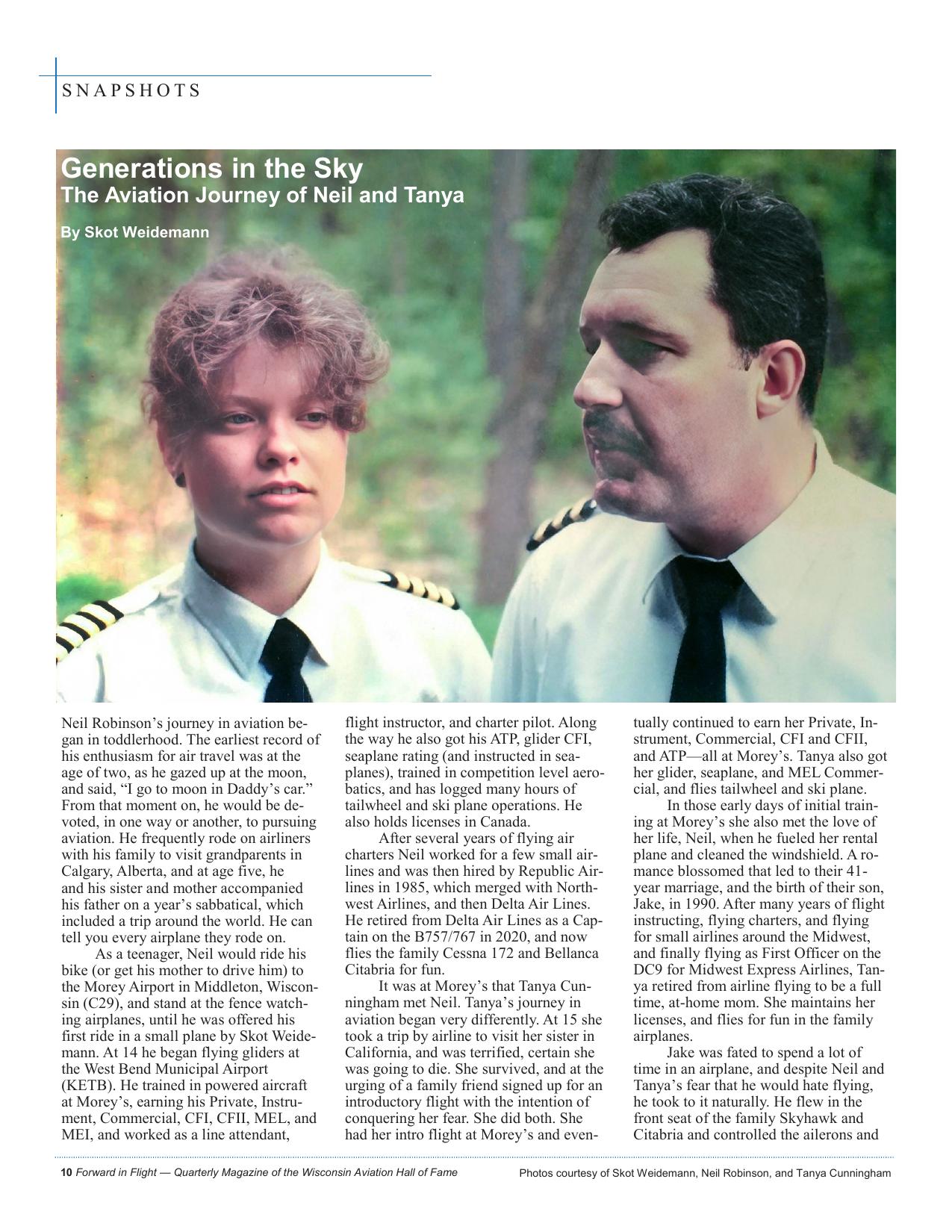
SNAPSHOTS Generations in the Sky The Aviation Journey of Neil and Tanya By Skot Weidemann Neil Robinson’s journey in aviation began in toddlerhood. The earliest record of his enthusiasm for air travel was at the age of two, as he gazed up at the moon, and said, “I go to moon in Daddy’s car.” From that moment on, he would be devoted, in one way or another, to pursuing aviation. He frequently rode on airliners with his family to visit grandparents in Calgary, Alberta, and at age five, he and his sister and mother accompanied his father on a year’s sabbatical, which included a trip around the world. He can tell you every airplane they rode on. As a teenager, Neil would ride his bike (or get his mother to drive him) to the Morey Airport in Middleton, Wisconsin (C29), and stand at the fence watching airplanes, until he was offered his first ride in a small plane by Skot Weidemann. At 14 he began flying gliders at the West Bend Municipal Airport (KETB). He trained in powered aircraft at Morey’s, earning his Private, Instrument, Commercial, CFI, CFII, MEL, and MEI, and worked as a line attendant, flight instructor, and charter pilot. Along the way he also got his ATP, glider CFI, seaplane rating (and instructed in seaplanes), trained in competition level aerobatics, and has logged many hours of tailwheel and ski plane operations. He also holds licenses in Canada. After several years of flying air charters Neil worked for a few small airlines and was then hired by Republic Airlines in 1985, which merged with Northwest Airlines, and then Delta Air Lines. He retired from Delta Air Lines as a Captain on the B757/767 in 2020, and now flies the family Cessna 172 and Bellanca Citabria for fun. It was at Morey’s that Tanya Cunningham met Neil. Tanya’s journey in aviation began very differently. At 15 she took a trip by airline to visit her sister in California, and was terrified, certain she was going to die. She survived, and at the urging of a family friend signed up for an introductory flight with the intention of conquering her fear. She did both. She had her intro flight at Morey’s and even- 10 Forward in Flight — Quarterly Magazine of the Wisconsin Aviation Hall of Fame tually continued to earn her Private, Instrument, Commercial, CFI and CFII, and ATP—all at Morey’s. Tanya also got her glider, seaplane, and MEL Commercial, and flies tailwheel and ski plane. In those early days of initial training at Morey’s she also met the love of her life, Neil, when he fueled her rental plane and cleaned the windshield. A romance blossomed that led to their 41year marriage, and the birth of their son, Jake, in 1990. After many years of flight instructing, flying charters, and flying for small airlines around the Midwest, and finally flying as First Officer on the DC9 for Midwest Express Airlines, Tanya retired from airline flying to be a full time, at-home mom. She maintains her licenses, and flies for fun in the family airplanes. Jake was fated to spend a lot of time in an airplane, and despite Neil and Tanya’s fear that he would hate flying, he took to it naturally. He flew in the front seat of the family Skyhawk and Citabria and controlled the ailerons and Photos courtesy of Skot Weidemann, Neil Robinson, and Tanya Cunningham
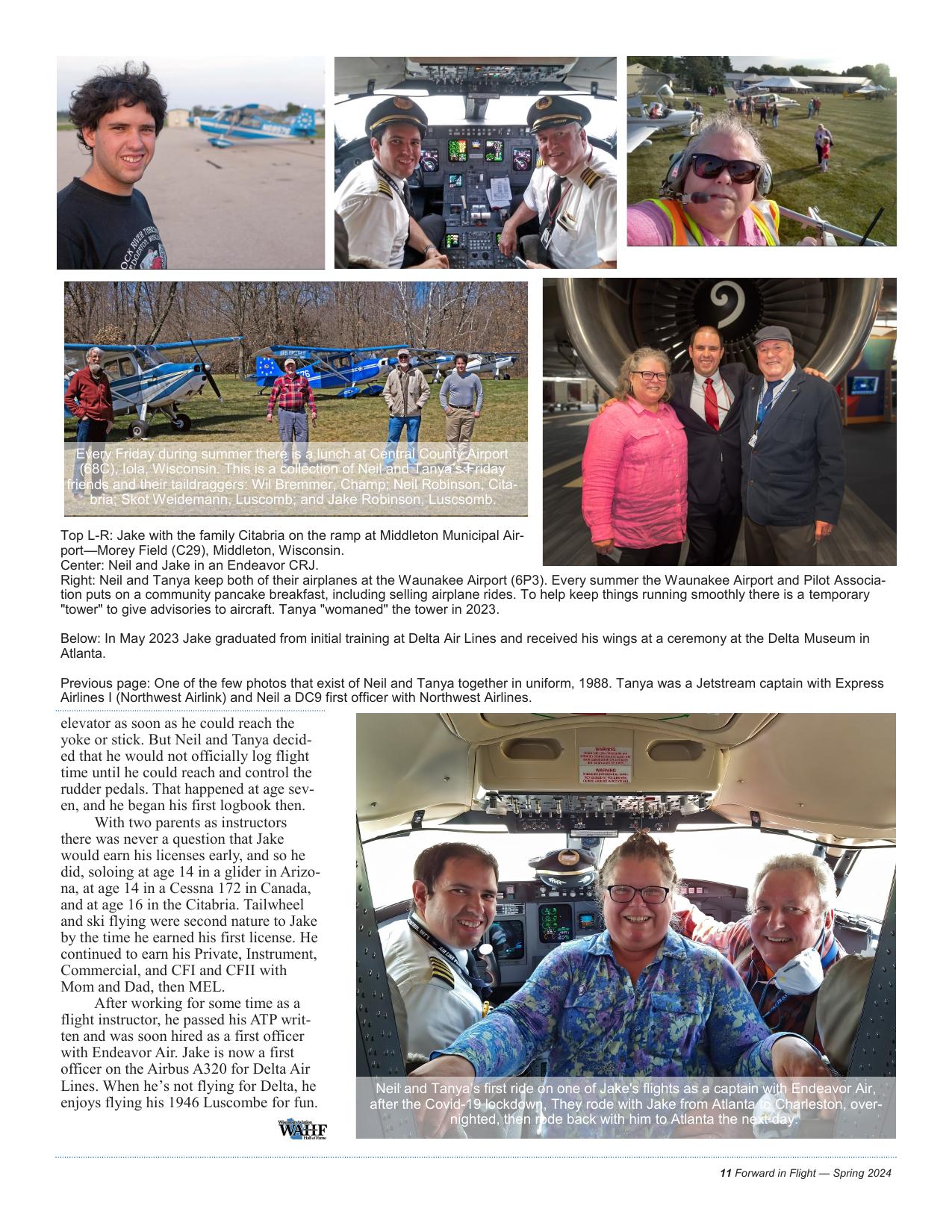
Every Friday during summer there is a lunch at Central County Airport (68C), Iola, Wisconsin. This is a collection of Neil and Tanya’s Friday friends and their taildraggers: Wil Bremmer, Champ; Neil Robinson, Citabria; Skot Weidemann, Luscomb; and Jake Robinson, Luscsomb. Top L-R: Jake with the family Citabria on the ramp at Middleton Municipal Airport—Morey Field (C29), Middleton, Wisconsin. Center: Neil and Jake in an Endeavor CRJ. Right: Neil and Tanya keep both of their airplanes at the Waunakee Airport (6P3). Every summer the Waunakee Airport and Pilot Association puts on a community pancake breakfast, including selling airplane rides. To help keep things running smoothly there is a temporary "tower" to give advisories to aircraft. Tanya "womaned" the tower in 2023. Below: In May 2023 Jake graduated from initial training at Delta Air Lines and received his wings at a ceremony at the Delta Museum in Atlanta. Previous page: One of the few photos that exist of Neil and Tanya together in uniform, 1988. Tanya was a Jetstream captain with Express Airlines I (Northwest Airlink) and Neil a DC9 first officer with Northwest Airlines. elevator as soon as he could reach the yoke or stick. But Neil and Tanya decided that he would not officially log flight time until he could reach and control the rudder pedals. That happened at age seven, and he began his first logbook then. With two parents as instructors there was never a question that Jake would earn his licenses early, and so he did, soloing at age 14 in a glider in Arizona, at age 14 in a Cessna 172 in Canada, and at age 16 in the Citabria. Tailwheel and ski flying were second nature to Jake by the time he earned his first license. He continued to earn his Private, Instrument, Commercial, and CFI and CFII with Mom and Dad, then MEL. After working for some time as a flight instructor, he passed his ATP written and was soon hired as a first officer with Endeavor Air. Jake is now a first officer on the Airbus A320 for Delta Air Lines. When he’s not flying for Delta, he enjoys flying his 1946 Luscombe for fun. Neil and Tanya’s first ride on one of Jake's flights as a captain with Endeavor Air, after the Covid-19 lockdown, They rode with Jake from Atlanta to Charleston, overnighted, then rode back with him to Atlanta the next day. 11 Forward in Flight — Spring 2024
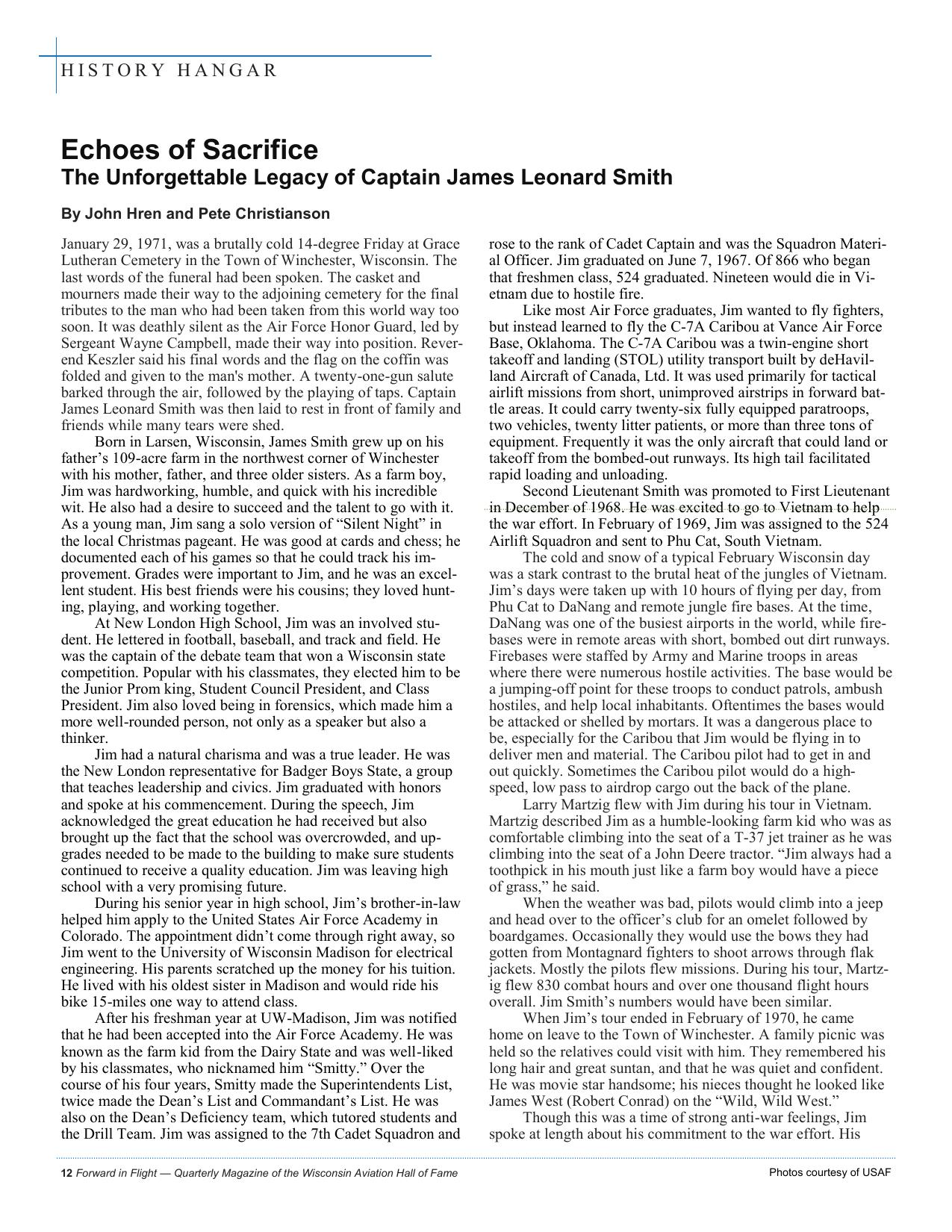
HISTORY HANGAR Echoes of Sacrifice The Unforgettable Legacy of Captain James Leonard Smith By John Hren and Pete Christianson January 29, 1971, was a brutally cold 14-degree Friday at Grace Lutheran Cemetery in the Town of Winchester, Wisconsin. The last words of the funeral had been spoken. The casket and mourners made their way to the adjoining cemetery for the final tributes to the man who had been taken from this world way too soon. It was deathly silent as the Air Force Honor Guard, led by Sergeant Wayne Campbell, made their way into position. Reverend Keszler said his final words and the flag on the coffin was folded and given to the man's mother. A twenty-one-gun salute barked through the air, followed by the playing of taps. Captain James Leonard Smith was then laid to rest in front of family and friends while many tears were shed. Born in Larsen, Wisconsin, James Smith grew up on his father’s 109-acre farm in the northwest corner of Winchester with his mother, father, and three older sisters. As a farm boy, Jim was hardworking, humble, and quick with his incredible wit. He also had a desire to succeed and the talent to go with it. As a young man, Jim sang a solo version of “Silent Night” in the local Christmas pageant. He was good at cards and chess; he documented each of his games so that he could track his improvement. Grades were important to Jim, and he was an excellent student. His best friends were his cousins; they loved hunting, playing, and working together. At New London High School, Jim was an involved student. He lettered in football, baseball, and track and field. He was the captain of the debate team that won a Wisconsin state competition. Popular with his classmates, they elected him to be the Junior Prom king, Student Council President, and Class President. Jim also loved being in forensics, which made him a more well-rounded person, not only as a speaker but also a thinker. Jim had a natural charisma and was a true leader. He was the New London representative for Badger Boys State, a group that teaches leadership and civics. Jim graduated with honors and spoke at his commencement. During the speech, Jim acknowledged the great education he had received but also brought up the fact that the school was overcrowded, and upgrades needed to be made to the building to make sure students continued to receive a quality education. Jim was leaving high school with a very promising future. During his senior year in high school, Jim’s brother-in-law helped him apply to the United States Air Force Academy in Colorado. The appointment didn’t come through right away, so Jim went to the University of Wisconsin Madison for electrical engineering. His parents scratched up the money for his tuition. He lived with his oldest sister in Madison and would ride his bike 15-miles one way to attend class. After his freshman year at UW-Madison, Jim was notified that he had been accepted into the Air Force Academy. He was known as the farm kid from the Dairy State and was well-liked by his classmates, who nicknamed him “Smitty.” Over the course of his four years, Smitty made the Superintendents List, twice made the Dean’s List and Commandant’s List. He was also on the Dean’s Deficiency team, which tutored students and the Drill Team. Jim was assigned to the 7th Cadet Squadron and rose to the rank of Cadet Captain and was the Squadron Material Officer. Jim graduated on June 7, 1967. Of 866 who began that freshmen class, 524 graduated. Nineteen would die in Vietnam due to hostile fire. Like most Air Force graduates, Jim wanted to fly fighters, but instead learned to fly the C-7A Caribou at Vance Air Force Base, Oklahoma. The C-7A Caribou was a twin-engine short takeoff and landing (STOL) utility transport built by deHavilland Aircraft of Canada, Ltd. It was used primarily for tactical airlift missions from short, unimproved airstrips in forward battle areas. It could carry twenty-six fully equipped paratroops, two vehicles, twenty litter patients, or more than three tons of equipment. Frequently it was the only aircraft that could land or takeoff from the bombed-out runways. Its high tail facilitated rapid loading and unloading. Second Lieutenant Smith was promoted to First Lieutenant in December of 1968. He was excited to go to Vietnam to help the war effort. In February of 1969, Jim was assigned to the 524 Airlift Squadron and sent to Phu Cat, South Vietnam. The cold and snow of a typical February Wisconsin day was a stark contrast to the brutal heat of the jungles of Vietnam. Jim’s days were taken up with 10 hours of flying per day, from Phu Cat to DaNang and remote jungle fire bases. At the time, DaNang was one of the busiest airports in the world, while firebases were in remote areas with short, bombed out dirt runways. Firebases were staffed by Army and Marine troops in areas where there were numerous hostile activities. The base would be a jumping-off point for these troops to conduct patrols, ambush hostiles, and help local inhabitants. Oftentimes the bases would be attacked or shelled by mortars. It was a dangerous place to be, especially for the Caribou that Jim would be flying in to deliver men and material. The Caribou pilot had to get in and out quickly. Sometimes the Caribou pilot would do a highspeed, low pass to airdrop cargo out the back of the plane. Larry Martzig flew with Jim during his tour in Vietnam. Martzig described Jim as a humble-looking farm kid who was as comfortable climbing into the seat of a T-37 jet trainer as he was climbing into the seat of a John Deere tractor. “Jim always had a toothpick in his mouth just like a farm boy would have a piece of grass,” he said. When the weather was bad, pilots would climb into a jeep and head over to the officer’s club for an omelet followed by boardgames. Occasionally they would use the bows they had gotten from Montagnard fighters to shoot arrows through flak jackets. Mostly the pilots flew missions. During his tour, Martzig flew 830 combat hours and over one thousand flight hours overall. Jim Smith’s numbers would have been similar. When Jim’s tour ended in February of 1970, he came home on leave to the Town of Winchester. A family picnic was held so the relatives could visit with him. They remembered his long hair and great suntan, and that he was quiet and confident. He was movie star handsome; his nieces thought he looked like James West (Robert Conrad) on the “Wild, Wild West.” Though this was a time of strong anti-war feelings, Jim spoke at length about his commitment to the war effort. His 12 Forward in Flight — Quarterly Magazine of the Wisconsin Aviation Hall of Fame Photos courtesy of USAF
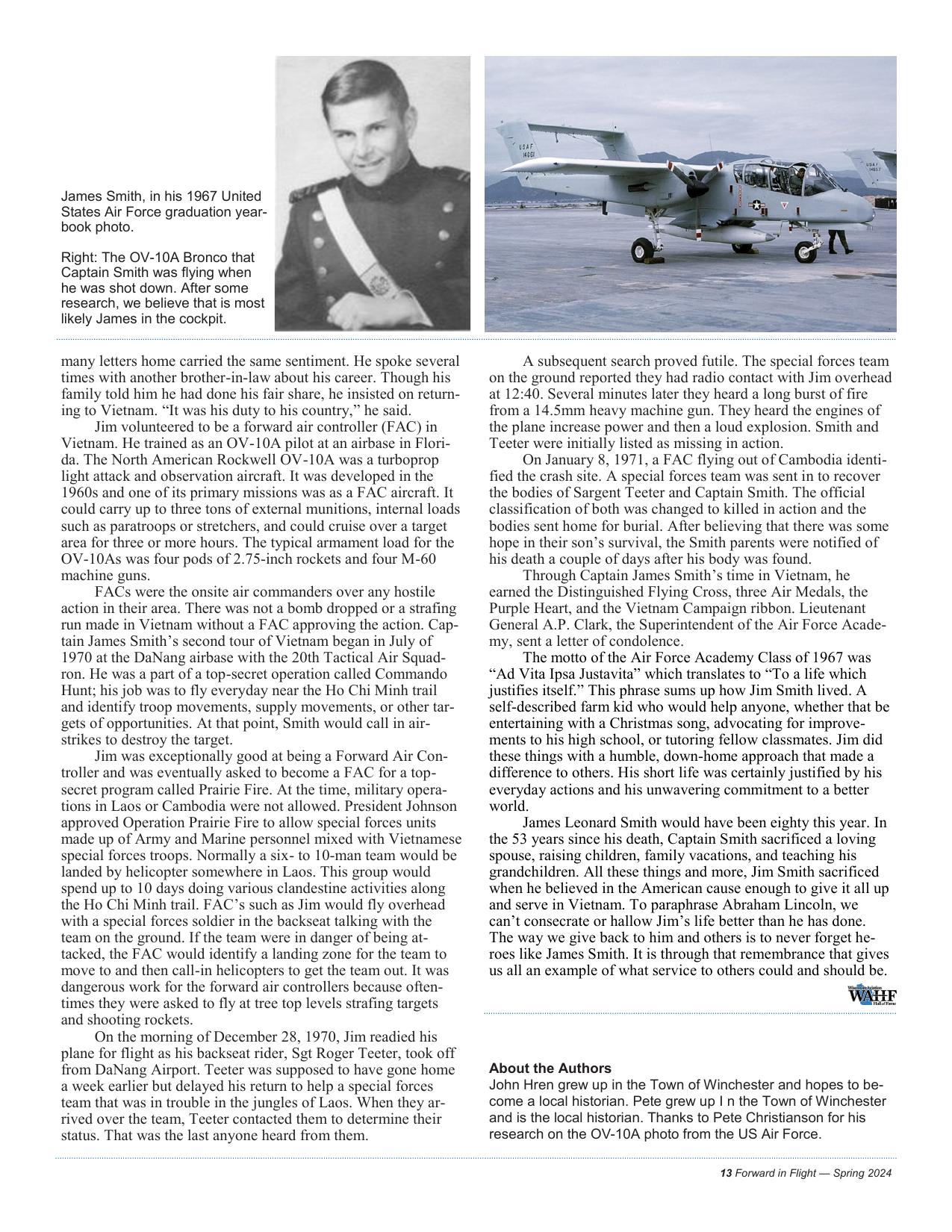
James Smith, in his 1967 United States Air Force graduation yearbook photo. Right: The OV-10A Bronco that Captain Smith was flying when he was shot down. After some research, we believe that is most likely James in the cockpit. many letters home carried the same sentiment. He spoke several times with another brother-in-law about his career. Though his family told him he had done his fair share, he insisted on returning to Vietnam. “It was his duty to his country,” he said. Jim volunteered to be a forward air controller (FAC) in Vietnam. He trained as an OV-10A pilot at an airbase in Florida. The North American Rockwell OV-10A was a turboprop light attack and observation aircraft. It was developed in the 1960s and one of its primary missions was as a FAC aircraft. It could carry up to three tons of external munitions, internal loads such as paratroops or stretchers, and could cruise over a target area for three or more hours. The typical armament load for the OV-10As was four pods of 2.75-inch rockets and four M-60 machine guns. FACs were the onsite air commanders over any hostile action in their area. There was not a bomb dropped or a strafing run made in Vietnam without a FAC approving the action. Captain James Smith’s second tour of Vietnam began in July of 1970 at the DaNang airbase with the 20th Tactical Air Squadron. He was a part of a top-secret operation called Commando Hunt; his job was to fly everyday near the Ho Chi Minh trail and identify troop movements, supply movements, or other targets of opportunities. At that point, Smith would call in airstrikes to destroy the target. Jim was exceptionally good at being a Forward Air Controller and was eventually asked to become a FAC for a topsecret program called Prairie Fire. At the time, military operations in Laos or Cambodia were not allowed. President Johnson approved Operation Prairie Fire to allow special forces units made up of Army and Marine personnel mixed with Vietnamese special forces troops. Normally a six- to 10-man team would be landed by helicopter somewhere in Laos. This group would spend up to 10 days doing various clandestine activities along the Ho Chi Minh trail. FAC’s such as Jim would fly overhead with a special forces soldier in the backseat talking with the team on the ground. If the team were in danger of being attacked, the FAC would identify a landing zone for the team to move to and then call-in helicopters to get the team out. It was dangerous work for the forward air controllers because oftentimes they were asked to fly at tree top levels strafing targets and shooting rockets. On the morning of December 28, 1970, Jim readied his plane for flight as his backseat rider, Sgt Roger Teeter, took off from DaNang Airport. Teeter was supposed to have gone home a week earlier but delayed his return to help a special forces team that was in trouble in the jungles of Laos. When they arrived over the team, Teeter contacted them to determine their status. That was the last anyone heard from them. A subsequent search proved futile. The special forces team on the ground reported they had radio contact with Jim overhead at 12:40. Several minutes later they heard a long burst of fire from a 14.5mm heavy machine gun. They heard the engines of the plane increase power and then a loud explosion. Smith and Teeter were initially listed as missing in action. On January 8, 1971, a FAC flying out of Cambodia identified the crash site. A special forces team was sent in to recover the bodies of Sargent Teeter and Captain Smith. The official classification of both was changed to killed in action and the bodies sent home for burial. After believing that there was some hope in their son’s survival, the Smith parents were notified of his death a couple of days after his body was found. Through Captain James Smith’s time in Vietnam, he earned the Distinguished Flying Cross, three Air Medals, the Purple Heart, and the Vietnam Campaign ribbon. Lieutenant General A.P. Clark, the Superintendent of the Air Force Academy, sent a letter of condolence. The motto of the Air Force Academy Class of 1967 was “Ad Vita Ipsa Justavita” which translates to “To a life which justifies itself.” This phrase sums up how Jim Smith lived. A self-described farm kid who would help anyone, whether that be entertaining with a Christmas song, advocating for improvements to his high school, or tutoring fellow classmates. Jim did these things with a humble, down-home approach that made a difference to others. His short life was certainly justified by his everyday actions and his unwavering commitment to a better world. James Leonard Smith would have been eighty this year. In the 53 years since his death, Captain Smith sacrificed a loving spouse, raising children, family vacations, and teaching his grandchildren. All these things and more, Jim Smith sacrificed when he believed in the American cause enough to give it all up and serve in Vietnam. To paraphrase Abraham Lincoln, we can’t consecrate or hallow Jim’s life better than he has done. The way we give back to him and others is to never forget heroes like James Smith. It is through that remembrance that gives us all an example of what service to others could and should be. About the Authors John Hren grew up in the Town of Winchester and hopes to become a local historian. Pete grew up I n the Town of Winchester and is the local historian. Thanks to Pete Christianson for his research on the OV-10A photo from the US Air Force. 13 Forward in Flight — Spring 2024
WINGS OF SERVICE Transforming Passion into Purpose Dan Silvers’ Heart for Aviation Written by Rose Dorcey; Photo by Ethan Brodsky N early three decades ago young Dan Silvers saw a book in a gift shop at the Smithsonian National Air and Space Museum in Washington, DC. After touring the museum with his parents and seeing the planes, the book, How to Become a Pilot, an FAA publication, caught his eye. Though he’s unsure how much of an influence the book had on him then, it sits on his bookshelf to this day. It may have taught the fundamentals of flight, but it could never teach what Dan now has: a charitable heart, giving countless hours to a handful of non-profits, and having some grand adventures along the way. It wasn’t a direct route from the Smithsonian to the cockpit of a small airplane. That came several years later, in 2012. One evening he was talking with a friend, Mark Ratzburg, and Mark said he was going for a flight lesson in the morning. Intrigued, Dan tagged along, taking his first flight lesson. “I really liked it; I liked the challenge,” Dan says of his first lesson. Living near Madison at the time, he began flight training immediately, at Morey Airplane Company, located at Middleton Municipal Airport – Morey Field (C29), and a year later he was a licensed pilot. It was a flight of discovery that opened his eyes to the joy and opportunities that aviation can bring. “I didn’t know it was something that normal people do until those first flights,” he explains. He went to the next level of training by going after his instrument rating, in 2013. He did it in an exciting way—a Morey West Coast Adventure with WAHF Inductee Field Morey. It was an adventure that Dan would recommend to anyone. “Being in the system, in instrument conditions, you’re using 90 percent of your brain capacity when you’re flying IFR,” he said. He and his friend, Mark, flew to Medford, Oregon, to train with Field. As part of their training they flew to airports in Oregon, Washington, Montana, Idaho, and to Aspen, Colorado. Using G1000s in a Cessna 182, they continued to satellite airports near Los Angeles, and then back up the coast to Medford. “It was a fantastic experience flying with Field, in actual weather, the mountain flying, and flying California tech routes; it made for a well-rounded learning experience,” Dan said. “Field is such a great instructor, very patient and humble and he lets you make mistakes,” he said. “And he tells amazing stories while we’re having dinner.” With the intense training behind him, Dan set a goal of landing at every Wisconsin paved runway in the state. He did so in record time, but that was before the Wisconsin DOT Bureau of Aeronautics announced its Fly Wisconsin Airport Passport program, which promotes safety and education by encouraging recreational flights to Wisconsin’s 126 public use airports. Even so, Dan was not to be denied, he flew to those 100-plus airports all over again, becoming one of the very first pilots—the fifth person—to complete the program, in 2020. A NEW CHAPTER BEGINS When Dan joined Madison’s Capitol City Flyers flying club he met club member Martine Moran. One day Martine made a Facebook post about a neighbor’s house going up for sale at Waunakee Airport (6P3). Dan and his wife, Heidi, homeowners in Cottage Grove at the time, made an offer, and purchased the home. That was four years ago, and they reside there now with their daughters, Emma, 8, and Nora, 5. They’re having the time of their lives in the vibrant airport community. It’s not just living at the airport they enjoy – it’s the entire Village of Waunakee. “We love it here,” Dan said. “The school district here is amazing, and we’re within walking distance to the schools.” With a hangar by the east/west, 2,300-foot runway, it’s the perfect place to house Dan’s “tricked out” 1968 Cessna 182, N71124, that he bought in 2015. It’s an airplane he always wanted after flying out west. He likes its speed, payload, and comfort. He’s made some upgrades to his, such as a P.Ponk engine rebuild for 35 additional horsepower. Being a fan of backcountry flying, he has installed vortex generators, a Sportsman STOL kit, plus larger tires and brakes. For greater visibility he has installed the Stene Aviation QUASAR Cx integrated LED lighting system; state-of-the-art “wig-wags” on the wingtips, plus strobes and recognition lights. “That’s around 300 watts of forward-facing lights,” he said. The airplane mods came in handy when Dan flew to Alaska in August 2015. He flew his fully prepped plane from Madison, Wisconsin, to Bellingham, Washington, with stops in South Dakota and Montana. From Bellingham he overflew Canada on his way to Ketchikan, Alaska. His next destination was Sitka, and then he made an overnight stop in Yakutat. That’s where a peculiar coincidence happened. While Dan was having lunch at the airport restaurant he noticed two fellows on the ramp, taking pictures of his airplane. “Pretty soon, the guy comes in and asks, ‘Who owns this airplane?’” Dan said. “Turns out the guy was from Pennsylvania and had owned my plane, two owners back.” Dan then continued to Merrill Field, in Anchorage, where he met Heidi. She had flown to Anchorage via the airlines and rented a car for a drive south to Homer, Alaska, to visit family. When Dan and Heidi parted, Dan flew to Homer to meet with Heidi again. Pilots being a mobile lot, Dan met his old friend and flight instructor, Field Morey, in Homer for breakfast before his return flight home. Dan “flew the highway” home, clearing customs in Whitehorse, Canada, northwest of Canada’s Yukon Territory. That’s where the weather “got weird.” With little radar available, Dan met with the typical weather challenges flying the area can bring. He could see a line of thunderstorms with lightning and spent the night in Ft. Nelson, British Columbia. From there he flew to North Dakota, and with the stresses of a long flight Dan bounced his landing and did a go-around. When Dan 14 Forward in Flight — Quarterly Magazine of the Wisconsin Aviation Hall of Fame
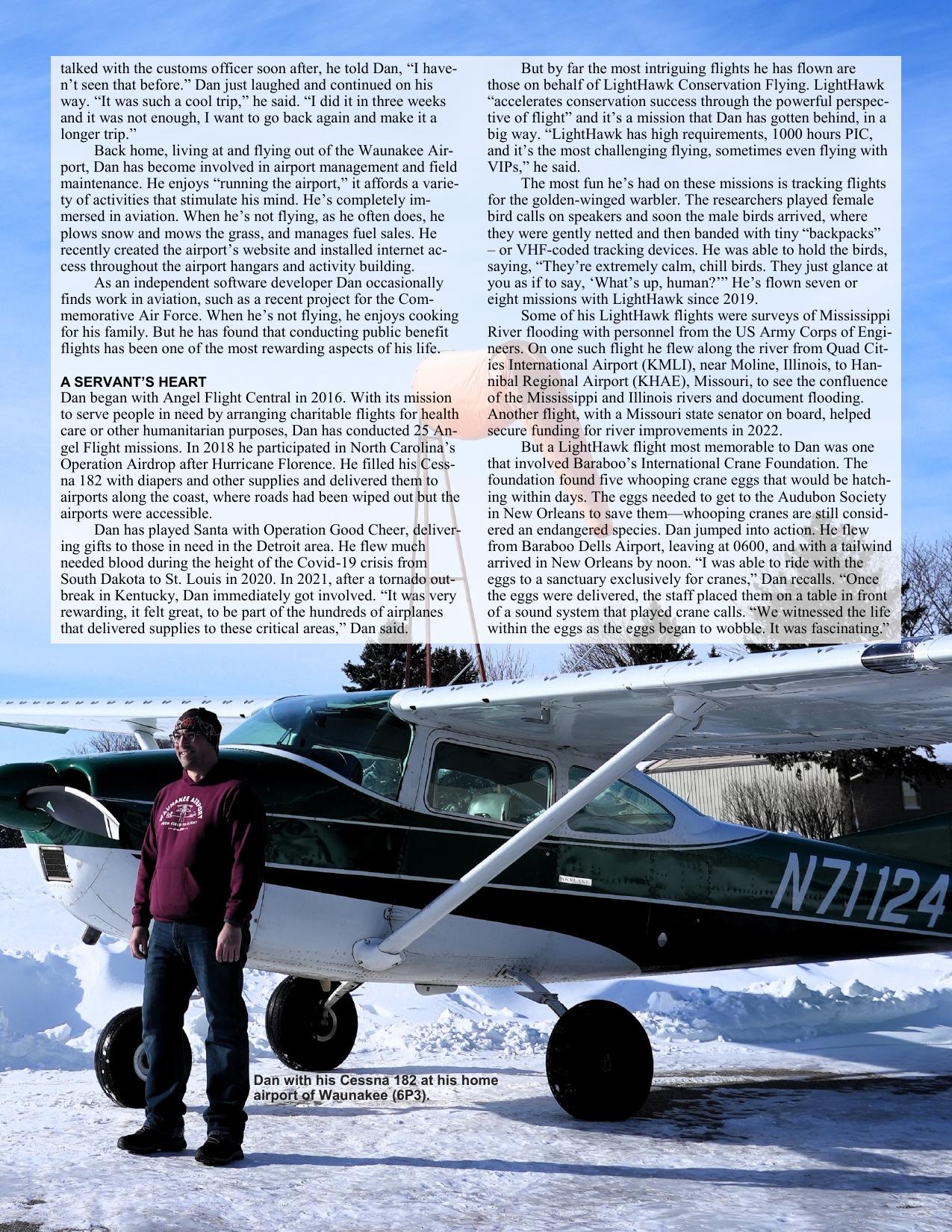
talked with the customs officer soon after, he told Dan, “I haven’t seen that before.” Dan just laughed and continued on his way. “It was such a cool trip,” he said. “I did it in three weeks and it was not enough, I want to go back again and make it a longer trip.” Back home, living at and flying out of the Waunakee Airport, Dan has become involved in airport management and field maintenance. He enjoys “running the airport,” it affords a variety of activities that stimulate his mind. He’s completely immersed in aviation. When he’s not flying, as he often does, he plows snow and mows the grass, and manages fuel sales. He recently created the airport’s website and installed internet access throughout the airport hangars and activity building. As an independent software developer Dan occasionally finds work in aviation, such as a recent project for the Commemorative Air Force. When he’s not flying, he enjoys cooking for his family. But he has found that conducting public benefit flights has been one of the most rewarding aspects of his life. A SERVANT’S HEART Dan began with Angel Flight Central in 2016. With its mission to serve people in need by arranging charitable flights for health care or other humanitarian purposes, Dan has conducted 25 Angel Flight missions. In 2018 he participated in North Carolina’s Operation Airdrop after Hurricane Florence. He filled his Cessna 182 with diapers and other supplies and delivered them to airports along the coast, where roads had been wiped out but the airports were accessible. Dan has played Santa with Operation Good Cheer, delivering gifts to those in need in the Detroit area. He flew much needed blood during the height of the Covid-19 crisis from South Dakota to St. Louis in 2020. In 2021, after a tornado outbreak in Kentucky, Dan immediately got involved. “It was very rewarding, it felt great, to be part of the hundreds of airplanes that delivered supplies to these critical areas,” Dan said. But by far the most intriguing flights he has flown are those on behalf of LightHawk Conservation Flying. LightHawk “accelerates conservation success through the powerful perspective of flight” and it’s a mission that Dan has gotten behind, in a big way. “LightHawk has high requirements, 1000 hours PIC, and it’s the most challenging flying, sometimes even flying with VIPs,” he said. The most fun he’s had on these missions is tracking flights for the golden-winged warbler. The researchers played female bird calls on speakers and soon the male birds arrived, where they were gently netted and then banded with tiny “backpacks” – or VHF-coded tracking devices. He was able to hold the birds, saying, “They’re extremely calm, chill birds. They just glance at you as if to say, ‘What’s up, human?’” He’s flown seven or eight missions with LightHawk since 2019. Some of his LightHawk flights were surveys of Mississippi River flooding with personnel from the US Army Corps of Engineers. On one such flight he flew along the river from Quad Cities International Airport (KMLI), near Moline, Illinois, to Hannibal Regional Airport (KHAE), Missouri, to see the confluence of the Mississippi and Illinois rivers and document flooding. Another flight, with a Missouri state senator on board, helped secure funding for river improvements in 2022. But a LightHawk flight most memorable to Dan was one that involved Baraboo’s International Crane Foundation. The foundation found five whooping crane eggs that would be hatching within days. The eggs needed to get to the Audubon Society in New Orleans to save them—whooping cranes are still considered an endangered species. Dan jumped into action. He flew from Baraboo Dells Airport, leaving at 0600, and with a tailwind arrived in New Orleans by noon. “I was able to ride with the eggs to a sanctuary exclusively for cranes,” Dan recalls. “Once the eggs were delivered, the staff placed them on a table in front of a sound system that played crane calls. “We witnessed the life within the eggs as the eggs began to wobble. It was fascinating.” Dan with his Cessna 182 at his home airport of Waunakee (6P3). 15 Forward in Flight — Spring 2024
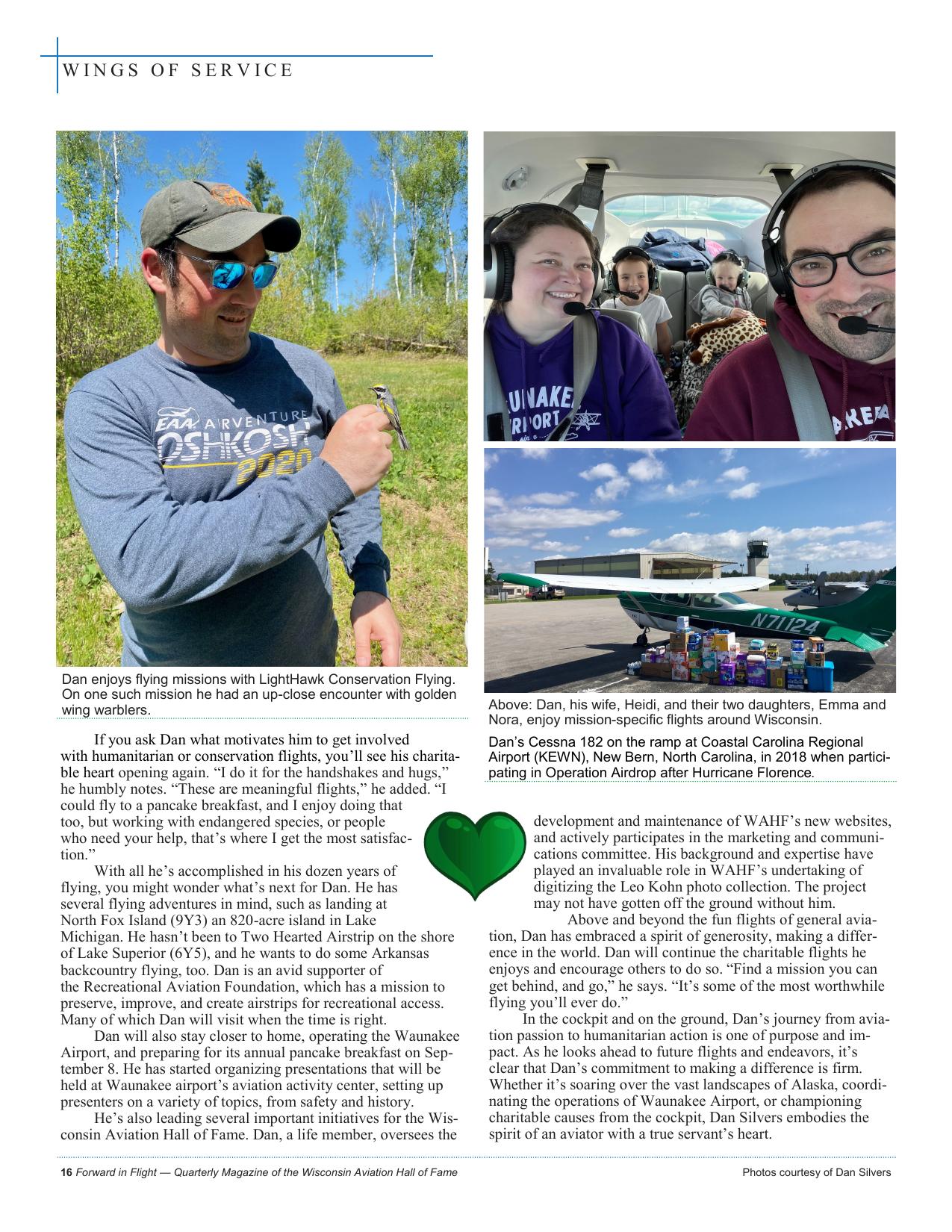
WINGS OF SERVICE Dan enjoys flying missions with LightHawk Conservation Flying. On one such mission he had an up-close encounter with golden wing warblers. Above: Dan, his wife, Heidi, and their two daughters, Emma and Nora, enjoy mission-specific flights around Wisconsin. If you ask Dan what motivates him to get involved with humanitarian or conservation flights, you’ll see his charitable heart opening again. “I do it for the handshakes and hugs,” he humbly notes. “These are meaningful flights,” he added. “I could fly to a pancake breakfast, and I enjoy doing that too, but working with endangered species, or people who need your help, that’s where I get the most satisfaction.” With all he’s accomplished in his dozen years of flying, you might wonder what’s next for Dan. He has several flying adventures in mind, such as landing at North Fox Island (9Y3) an 820-acre island in Lake Michigan. He hasn’t been to Two Hearted Airstrip on the shore of Lake Superior (6Y5), and he wants to do some Arkansas backcountry flying, too. Dan is an avid supporter of the Recreational Aviation Foundation, which has a mission to preserve, improve, and create airstrips for recreational access. Many of which Dan will visit when the time is right. Dan will also stay closer to home, operating the Waunakee Airport, and preparing for its annual pancake breakfast on September 8. He has started organizing presentations that will be held at Waunakee airport’s aviation activity center, setting up presenters on a variety of topics, from safety and history. He’s also leading several important initiatives for the Wisconsin Aviation Hall of Fame. Dan, a life member, oversees the Dan’s Cessna 182 on the ramp at Coastal Carolina Regional Airport (KEWN), New Bern, North Carolina, in 2018 when participating in Operation Airdrop after Hurricane Florence. 16 Forward in Flight — Quarterly Magazine of the Wisconsin Aviation Hall of Fame Photos courtesy of Dan Silvers development and maintenance of WAHF’s new websites, and actively participates in the marketing and communications committee. His background and expertise have played an invaluable role in WAHF’s undertaking of digitizing the Leo Kohn photo collection. The project may not have gotten off the ground without him. Above and beyond the fun flights of general aviation, Dan has embraced a spirit of generosity, making a difference in the world. Dan will continue the charitable flights he enjoys and encourage others to do so. “Find a mission you can get behind, and go,” he says. “It’s some of the most worthwhile flying you’ll ever do.” In the cockpit and on the ground, Dan’s journey from aviation passion to humanitarian action is one of purpose and impact. As he looks ahead to future flights and endeavors, it’s clear that Dan’s commitment to making a difference is firm. Whether it’s soaring over the vast landscapes of Alaska, coordinating the operations of Waunakee Airport, or championing charitable causes from the cockpit, Dan Silvers embodies the spirit of an aviator with a true servant’s heart.
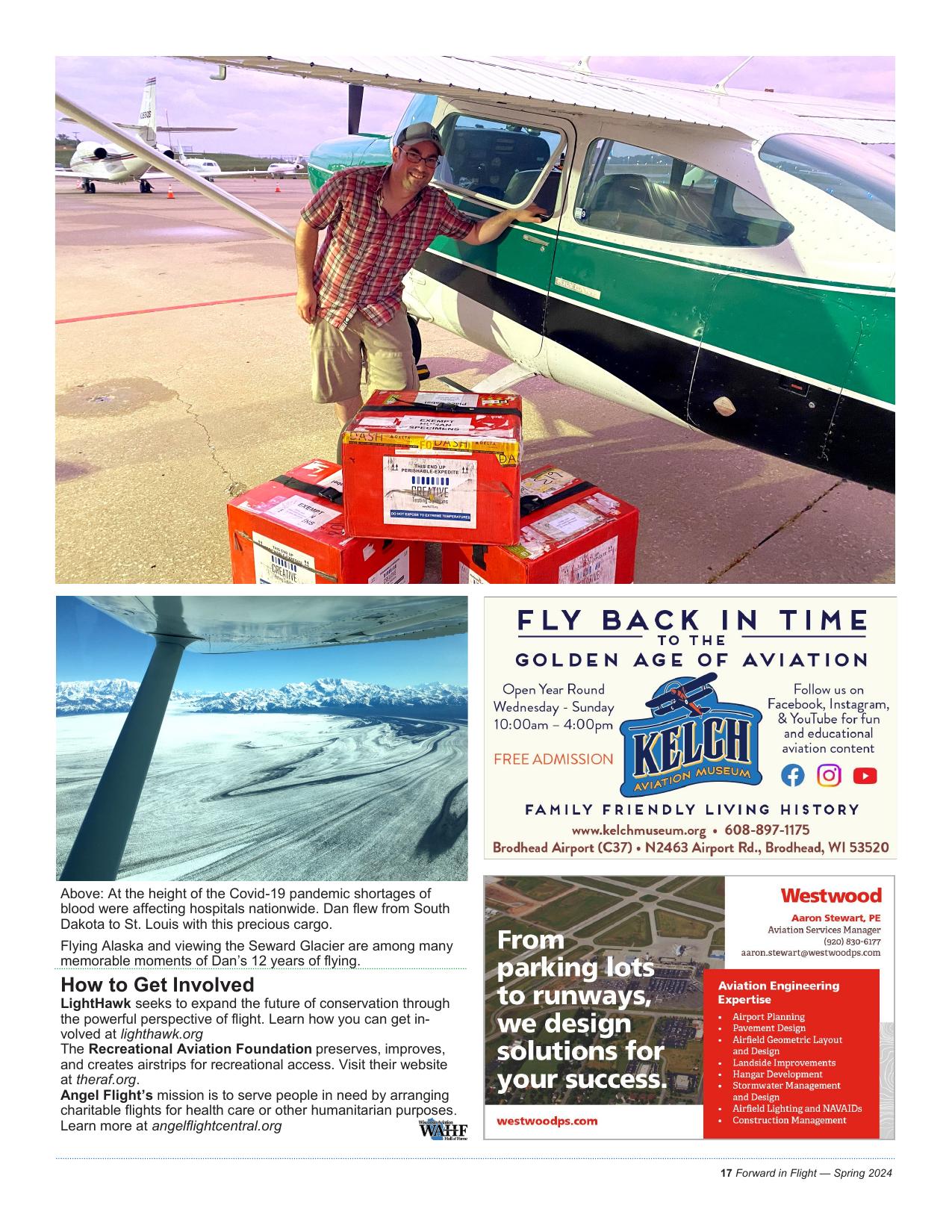
Above: At the height of the Covid-19 pandemic shortages of blood were affecting hospitals nationwide. Dan flew from South Dakota to St. Louis with this precious cargo. Flying Alaska and viewing the Seward Glacier are among many memorable moments of Dan’s 12 years of flying. How to Get Involved LightHawk seeks to expand the future of conservation through the powerful perspective of flight. Learn how you can get involved at lighthawk.org The Recreational Aviation Foundation preserves, improves, and creates airstrips for recreational access. Visit their website at theraf.org. Angel Flight’s mission is to serve people in need by arranging charitable flights for health care or other humanitarian purposes. Learn more at angelflightcentral.org 17 Forward in Flight — Spring 2024
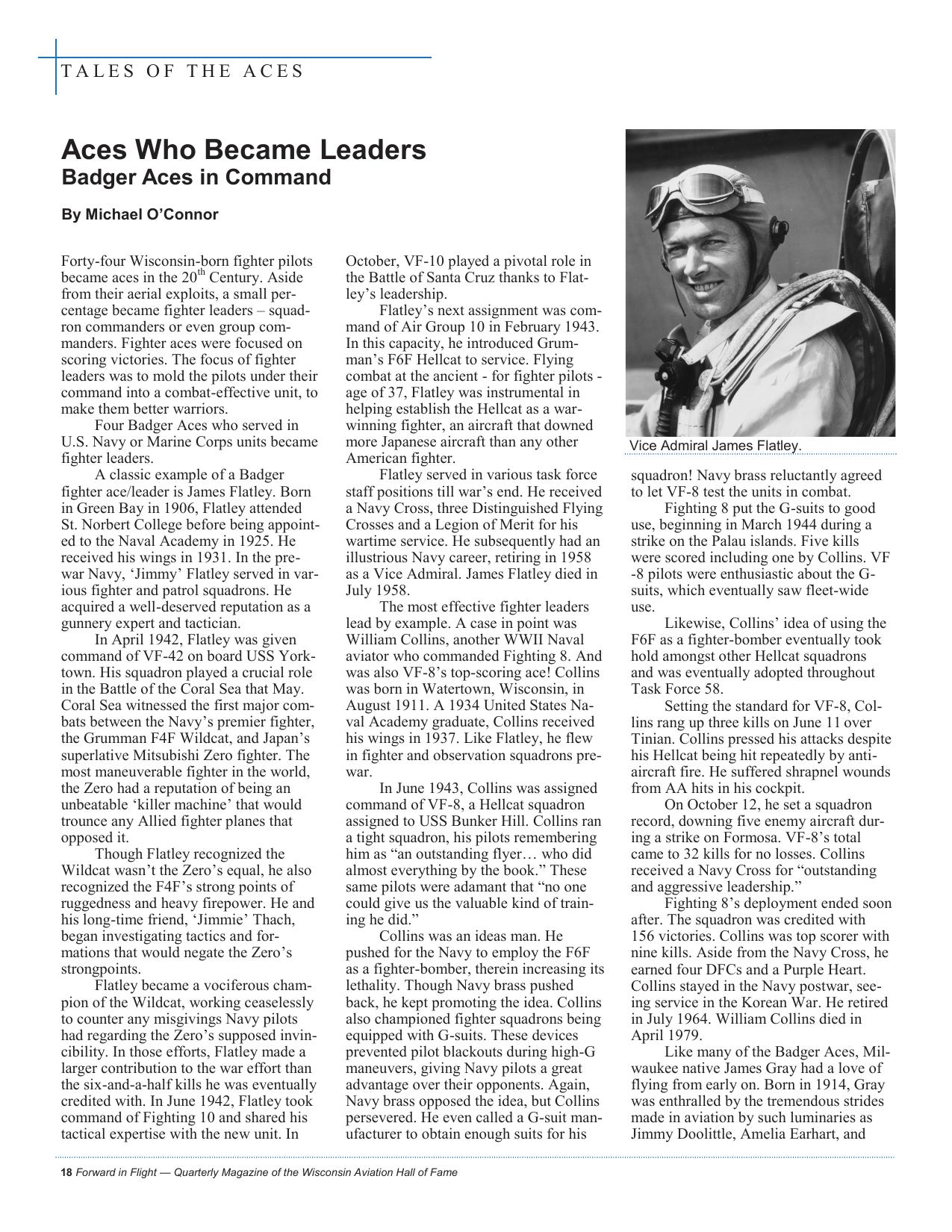
TALES OF THE ACES Aces Who Became Leaders Badger Aces in Command By Michael O’Connor Forty-four Wisconsin-born fighter pilots became aces in the 20th Century. Aside from their aerial exploits, a small percentage became fighter leaders – squadron commanders or even group commanders. Fighter aces were focused on scoring victories. The focus of fighter leaders was to mold the pilots under their command into a combat-effective unit, to make them better warriors. Four Badger Aces who served in U.S. Navy or Marine Corps units became fighter leaders. A classic example of a Badger fighter ace/leader is James Flatley. Born in Green Bay in 1906, Flatley attended St. Norbert College before being appointed to the Naval Academy in 1925. He received his wings in 1931. In the prewar Navy, ‘Jimmy’ Flatley served in various fighter and patrol squadrons. He acquired a well-deserved reputation as a gunnery expert and tactician. In April 1942, Flatley was given command of VF-42 on board USS Yorktown. His squadron played a crucial role in the Battle of the Coral Sea that May. Coral Sea witnessed the first major combats between the Navy’s premier fighter, the Grumman F4F Wildcat, and Japan’s superlative Mitsubishi Zero fighter. The most maneuverable fighter in the world, the Zero had a reputation of being an unbeatable ‘killer machine’ that would trounce any Allied fighter planes that opposed it. Though Flatley recognized the Wildcat wasn’t the Zero’s equal, he also recognized the F4F’s strong points of ruggedness and heavy firepower. He and his long-time friend, ‘Jimmie’ Thach, began investigating tactics and formations that would negate the Zero’s strongpoints. Flatley became a vociferous champion of the Wildcat, working ceaselessly to counter any misgivings Navy pilots had regarding the Zero’s supposed invincibility. In those efforts, Flatley made a larger contribution to the war effort than the six-and-a-half kills he was eventually credited with. In June 1942, Flatley took command of Fighting 10 and shared his tactical expertise with the new unit. In October, VF-10 played a pivotal role in the Battle of Santa Cruz thanks to Flatley’s leadership. Flatley’s next assignment was command of Air Group 10 in February 1943. In this capacity, he introduced Grumman’s F6F Hellcat to service. Flying combat at the ancient - for fighter pilots age of 37, Flatley was instrumental in helping establish the Hellcat as a warwinning fighter, an aircraft that downed more Japanese aircraft than any other American fighter. Flatley served in various task force staff positions till war’s end. He received a Navy Cross, three Distinguished Flying Crosses and a Legion of Merit for his wartime service. He subsequently had an illustrious Navy career, retiring in 1958 as a Vice Admiral. James Flatley died in July 1958. The most effective fighter leaders lead by example. A case in point was William Collins, another WWII Naval aviator who commanded Fighting 8. And was also VF-8’s top-scoring ace! Collins was born in Watertown, Wisconsin, in August 1911. A 1934 United States Naval Academy graduate, Collins received his wings in 1937. Like Flatley, he flew in fighter and observation squadrons prewar. In June 1943, Collins was assigned command of VF-8, a Hellcat squadron assigned to USS Bunker Hill. Collins ran a tight squadron, his pilots remembering him as “an outstanding flyer… who did almost everything by the book.” These same pilots were adamant that “no one could give us the valuable kind of training he did.” Collins was an ideas man. He pushed for the Navy to employ the F6F as a fighter-bomber, therein increasing its lethality. Though Navy brass pushed back, he kept promoting the idea. Collins also championed fighter squadrons being equipped with G-suits. These devices prevented pilot blackouts during high-G maneuvers, giving Navy pilots a great advantage over their opponents. Again, Navy brass opposed the idea, but Collins persevered. He even called a G-suit manufacturer to obtain enough suits for his 18 Forward in Flight — Quarterly Magazine of the Wisconsin Aviation Hall of Fame Vice Admiral James Flatley. squadron! Navy brass reluctantly agreed to let VF-8 test the units in combat. Fighting 8 put the G-suits to good use, beginning in March 1944 during a strike on the Palau islands. Five kills were scored including one by Collins. VF -8 pilots were enthusiastic about the Gsuits, which eventually saw fleet-wide use. Likewise, Collins’ idea of using the F6F as a fighter-bomber eventually took hold amongst other Hellcat squadrons and was eventually adopted throughout Task Force 58. Setting the standard for VF-8, Collins rang up three kills on June 11 over Tinian. Collins pressed his attacks despite his Hellcat being hit repeatedly by antiaircraft fire. He suffered shrapnel wounds from AA hits in his cockpit. On October 12, he set a squadron record, downing five enemy aircraft during a strike on Formosa. VF-8’s total came to 32 kills for no losses. Collins received a Navy Cross for “outstanding and aggressive leadership.” Fighting 8’s deployment ended soon after. The squadron was credited with 156 victories. Collins was top scorer with nine kills. Aside from the Navy Cross, he earned four DFCs and a Purple Heart. Collins stayed in the Navy postwar, seeing service in the Korean War. He retired in July 1964. William Collins died in April 1979. Like many of the Badger Aces, Milwaukee native James Gray had a love of flying from early on. Born in 1914, Gray was enthralled by the tremendous strides made in aviation by such luminaries as Jimmy Doolittle, Amelia Earhart, and
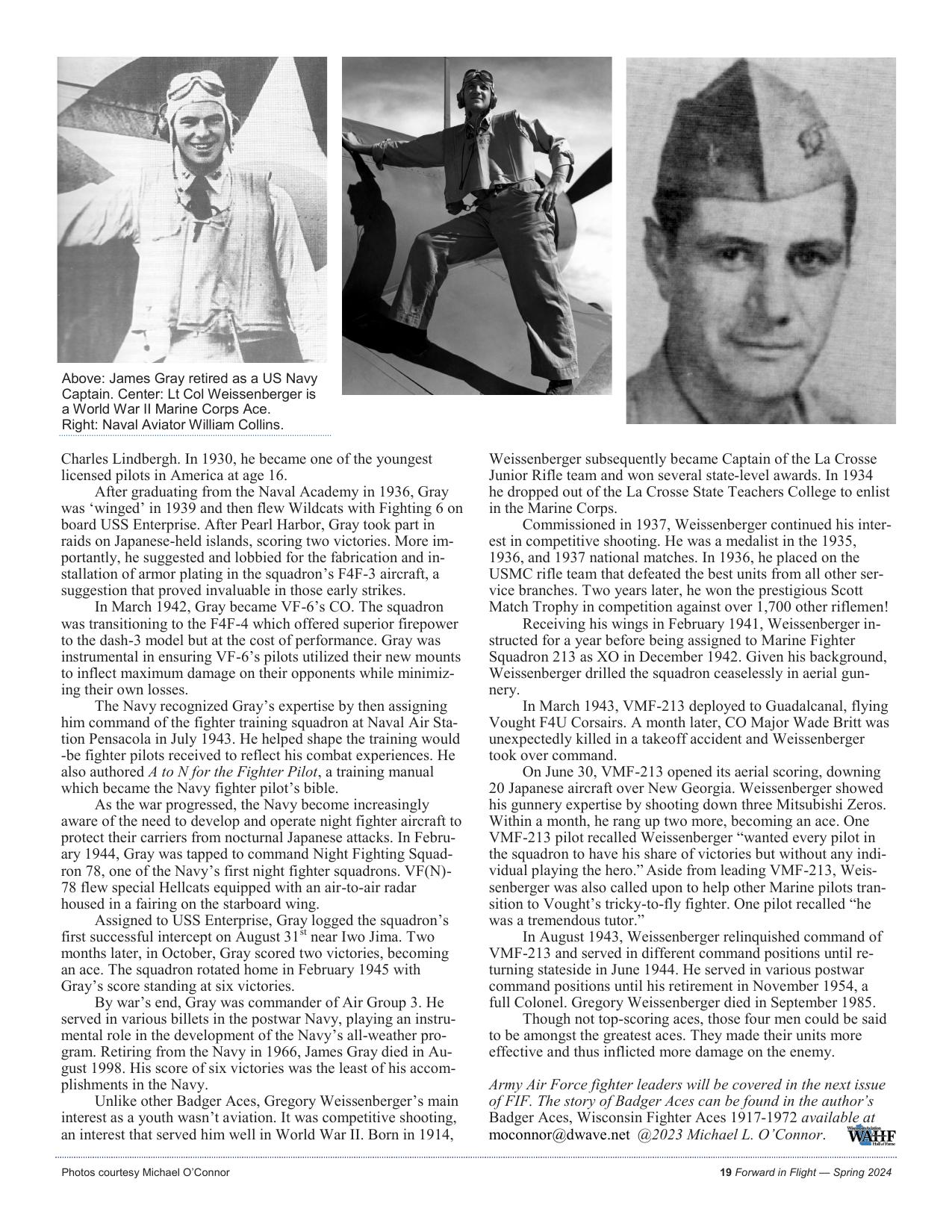
Above: James Gray retired as a US Navy Captain. Center: Lt Col Weissenberger is a World War II Marine Corps Ace. Right: Naval Aviator William Collins. Charles Lindbergh. In 1930, he became one of the youngest licensed pilots in America at age 16. After graduating from the Naval Academy in 1936, Gray was ‘winged’ in 1939 and then flew Wildcats with Fighting 6 on board USS Enterprise. After Pearl Harbor, Gray took part in raids on Japanese-held islands, scoring two victories. More importantly, he suggested and lobbied for the fabrication and installation of armor plating in the squadron’s F4F-3 aircraft, a suggestion that proved invaluable in those early strikes. In March 1942, Gray became VF-6’s CO. The squadron was transitioning to the F4F-4 which offered superior firepower to the dash-3 model but at the cost of performance. Gray was instrumental in ensuring VF-6’s pilots utilized their new mounts to inflect maximum damage on their opponents while minimizing their own losses. The Navy recognized Gray’s expertise by then assigning him command of the fighter training squadron at Naval Air Station Pensacola in July 1943. He helped shape the training would -be fighter pilots received to reflect his combat experiences. He also authored A to N for the Fighter Pilot, a training manual which became the Navy fighter pilot’s bible. As the war progressed, the Navy become increasingly aware of the need to develop and operate night fighter aircraft to protect their carriers from nocturnal Japanese attacks. In February 1944, Gray was tapped to command Night Fighting Squadron 78, one of the Navy’s first night fighter squadrons. VF(N)78 flew special Hellcats equipped with an air-to-air radar housed in a fairing on the starboard wing. Assigned to USS Enterprise, Gray logged the squadron’s first successful intercept on August 31st near Iwo Jima. Two months later, in October, Gray scored two victories, becoming an ace. The squadron rotated home in February 1945 with Gray’s score standing at six victories. By war’s end, Gray was commander of Air Group 3. He served in various billets in the postwar Navy, playing an instrumental role in the development of the Navy’s all-weather program. Retiring from the Navy in 1966, James Gray died in August 1998. His score of six victories was the least of his accomplishments in the Navy. Unlike other Badger Aces, Gregory Weissenberger’s main interest as a youth wasn’t aviation. It was competitive shooting, an interest that served him well in World War II. Born in 1914, Photos courtesy Michael O’Connor Weissenberger subsequently became Captain of the La Crosse Junior Rifle team and won several state-level awards. In 1934 he dropped out of the La Crosse State Teachers College to enlist in the Marine Corps. Commissioned in 1937, Weissenberger continued his interest in competitive shooting. He was a medalist in the 1935, 1936, and 1937 national matches. In 1936, he placed on the USMC rifle team that defeated the best units from all other service branches. Two years later, he won the prestigious Scott Match Trophy in competition against over 1,700 other riflemen! Receiving his wings in February 1941, Weissenberger instructed for a year before being assigned to Marine Fighter Squadron 213 as XO in December 1942. Given his background, Weissenberger drilled the squadron ceaselessly in aerial gunnery. In March 1943, VMF-213 deployed to Guadalcanal, flying Vought F4U Corsairs. A month later, CO Major Wade Britt was unexpectedly killed in a takeoff accident and Weissenberger took over command. On June 30, VMF-213 opened its aerial scoring, downing 20 Japanese aircraft over New Georgia. Weissenberger showed his gunnery expertise by shooting down three Mitsubishi Zeros. Within a month, he rang up two more, becoming an ace. One VMF-213 pilot recalled Weissenberger “wanted every pilot in the squadron to have his share of victories but without any individual playing the hero.” Aside from leading VMF-213, Weissenberger was also called upon to help other Marine pilots transition to Vought’s tricky-to-fly fighter. One pilot recalled “he was a tremendous tutor.” In August 1943, Weissenberger relinquished command of VMF-213 and served in different command positions until returning stateside in June 1944. He served in various postwar command positions until his retirement in November 1954, a full Colonel. Gregory Weissenberger died in September 1985. Though not top-scoring aces, those four men could be said to be amongst the greatest aces. They made their units more effective and thus inflicted more damage on the enemy. Army Air Force fighter leaders will be covered in the next issue of FIF. The story of Badger Aces can be found in the author’s Badger Aces, Wisconsin Fighter Aces 1917-1972 available at moconnor@dwave.net @2023 Michael L. O’Connor. 19 Forward in Flight — Spring 2024
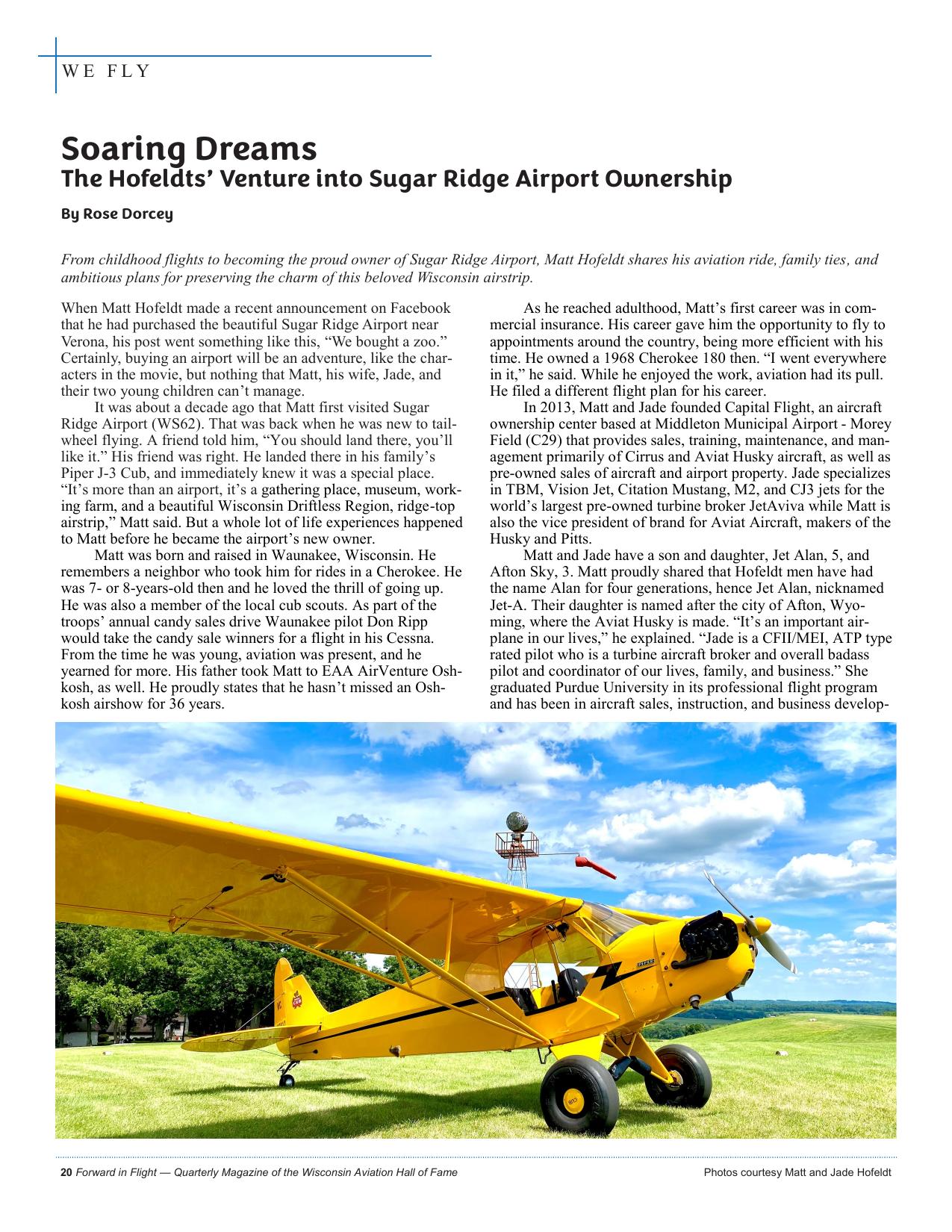
WE FLY Soaring Dreams The Hofeldts’ Venture into Sugar Ridge Airport Ownership By Rose Dorcey From childhood flights to becoming the proud owner of Sugar Ridge Airport, Matt Hofeldt shares his aviation ride, family ties, and ambitious plans for preserving the charm of this beloved Wisconsin airstrip. When Matt Hofeldt made a recent announcement on Facebook that he had purchased the beautiful Sugar Ridge Airport near Verona, his post went something like this, “We bought a zoo.” Certainly, buying an airport will be an adventure, like the characters in the movie, but nothing that Matt, his wife, Jade, and their two young children can’t manage. It was about a decade ago that Matt first visited Sugar Ridge Airport (WS62). That was back when he was new to tailwheel flying. A friend told him, “You should land there, you’ll like it.” His friend was right. He landed there in his family’s Piper J-3 Cub, and immediately knew it was a special place. “It’s more than an airport, it’s a gathering place, museum, working farm, and a beautiful Wisconsin Driftless Region, ridge-top airstrip,” Matt said. But a whole lot of life experiences happened to Matt before he became the airport’s new owner. Matt was born and raised in Waunakee, Wisconsin. He remembers a neighbor who took him for rides in a Cherokee. He was 7- or 8-years-old then and he loved the thrill of going up. He was also a member of the local cub scouts. As part of the troops’ annual candy sales drive Waunakee pilot Don Ripp would take the candy sale winners for a flight in his Cessna. From the time he was young, aviation was present, and he yearned for more. His father took Matt to EAA AirVenture Oshkosh, as well. He proudly states that he hasn’t missed an Oshkosh airshow for 36 years. As he reached adulthood, Matt’s first career was in commercial insurance. His career gave him the opportunity to fly to appointments around the country, being more efficient with his time. He owned a 1968 Cherokee 180 then. “I went everywhere in it,” he said. While he enjoyed the work, aviation had its pull. He filed a different flight plan for his career. In 2013, Matt and Jade founded Capital Flight, an aircraft ownership center based at Middleton Municipal Airport - Morey Field (C29) that provides sales, training, maintenance, and management primarily of Cirrus and Aviat Husky aircraft, as well as pre-owned sales of aircraft and airport property. Jade specializes in TBM, Vision Jet, Citation Mustang, M2, and CJ3 jets for the world’s largest pre-owned turbine broker JetAviva while Matt is also the vice president of brand for Aviat Aircraft, makers of the Husky and Pitts. Matt and Jade have a son and daughter, Jet Alan, 5, and Afton Sky, 3. Matt proudly shared that Hofeldt men have had the name Alan for four generations, hence Jet Alan, nicknamed Jet-A. Their daughter is named after the city of Afton, Wyoming, where the Aviat Husky is made. “It’s an important airplane in our lives,” he explained. “Jade is a CFII/MEI, ATP type rated pilot who is a turbine aircraft broker and overall badass pilot and coordinator of our lives, family, and business.” She graduated Purdue University in its professional flight program and has been in aircraft sales, instruction, and business develop- 20 Forward in Flight — Quarterly Magazine of the Wisconsin Aviation Hall of Fame Photos courtesy Matt and Jade Hofeldt
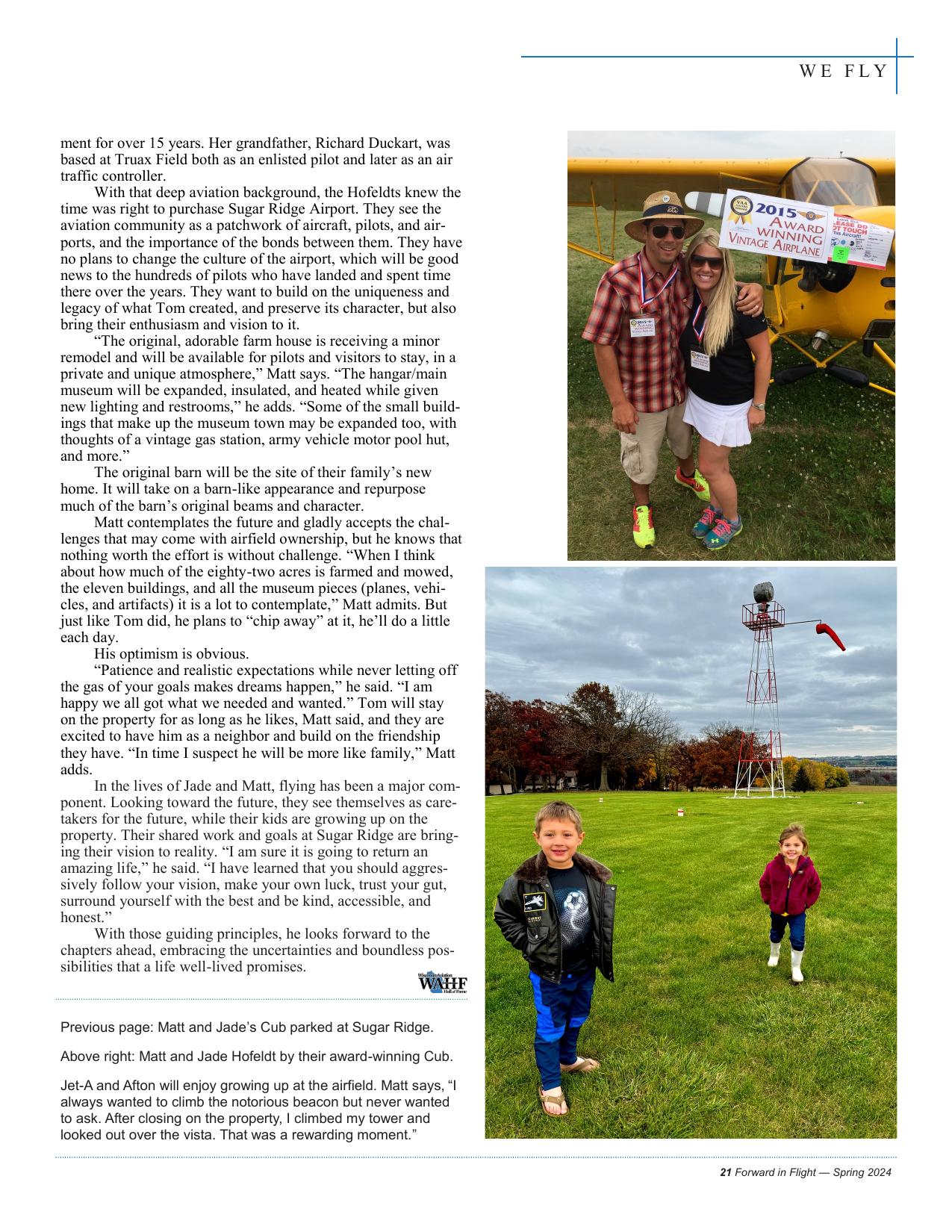
WE FLY ment for over 15 years. Her grandfather, Richard Duckart, was based at Truax Field both as an enlisted pilot and later as an air traffic controller. With that deep aviation background, the Hofeldts knew the time was right to purchase Sugar Ridge Airport. They see the aviation community as a patchwork of aircraft, pilots, and airports, and the importance of the bonds between them. They have no plans to change the culture of the airport, which will be good news to the hundreds of pilots who have landed and spent time there over the years. They want to build on the uniqueness and legacy of what Tom created, and preserve its character, but also bring their enthusiasm and vision to it. “The original, adorable farm house is receiving a minor remodel and will be available for pilots and visitors to stay, in a private and unique atmosphere,” Matt says. “The hangar/main museum will be expanded, insulated, and heated while given new lighting and restrooms,” he adds. “Some of the small buildings that make up the museum town may be expanded too, with thoughts of a vintage gas station, army vehicle motor pool hut, and more.” The original barn will be the site of their family’s new home. It will take on a barn-like appearance and repurpose much of the barn’s original beams and character. Matt contemplates the future and gladly accepts the challenges that may come with airfield ownership, but he knows that nothing worth the effort is without challenge. “When I think about how much of the eighty-two acres is farmed and mowed, the eleven buildings, and all the museum pieces (planes, vehicles, and artifacts) it is a lot to contemplate,” Matt admits. But just like Tom did, he plans to “chip away” at it, he’ll do a little each day. His optimism is obvious. “Patience and realistic expectations while never letting off the gas of your goals makes dreams happen,” he said. “I am happy we all got what we needed and wanted.” Tom will stay on the property for as long as he likes, Matt said, and they are excited to have him as a neighbor and build on the friendship they have. “In time I suspect he will be more like family,” Matt adds. In the lives of Jade and Matt, flying has been a major component. Looking toward the future, they see themselves as caretakers for the future, while their kids are growing up on the property. Their shared work and goals at Sugar Ridge are bringing their vision to reality. “I am sure it is going to return an amazing life,” he said. “I have learned that you should aggressively follow your vision, make your own luck, trust your gut, surround yourself with the best and be kind, accessible, and honest.” With those guiding principles, he looks forward to the chapters ahead, embracing the uncertainties and boundless possibilities that a life well-lived promises. Previous page: Matt and Jade’s Cub parked at Sugar Ridge. Above right: Matt and Jade Hofeldt by their award-winning Cub. Jet-A and Afton will enjoy growing up at the airfield. Matt says, “I always wanted to climb the notorious beacon but never wanted to ask. After closing on the property, I climbed my tower and looked out over the vista. That was a rewarding moment.” 21 Forward in Flight — Spring 2024
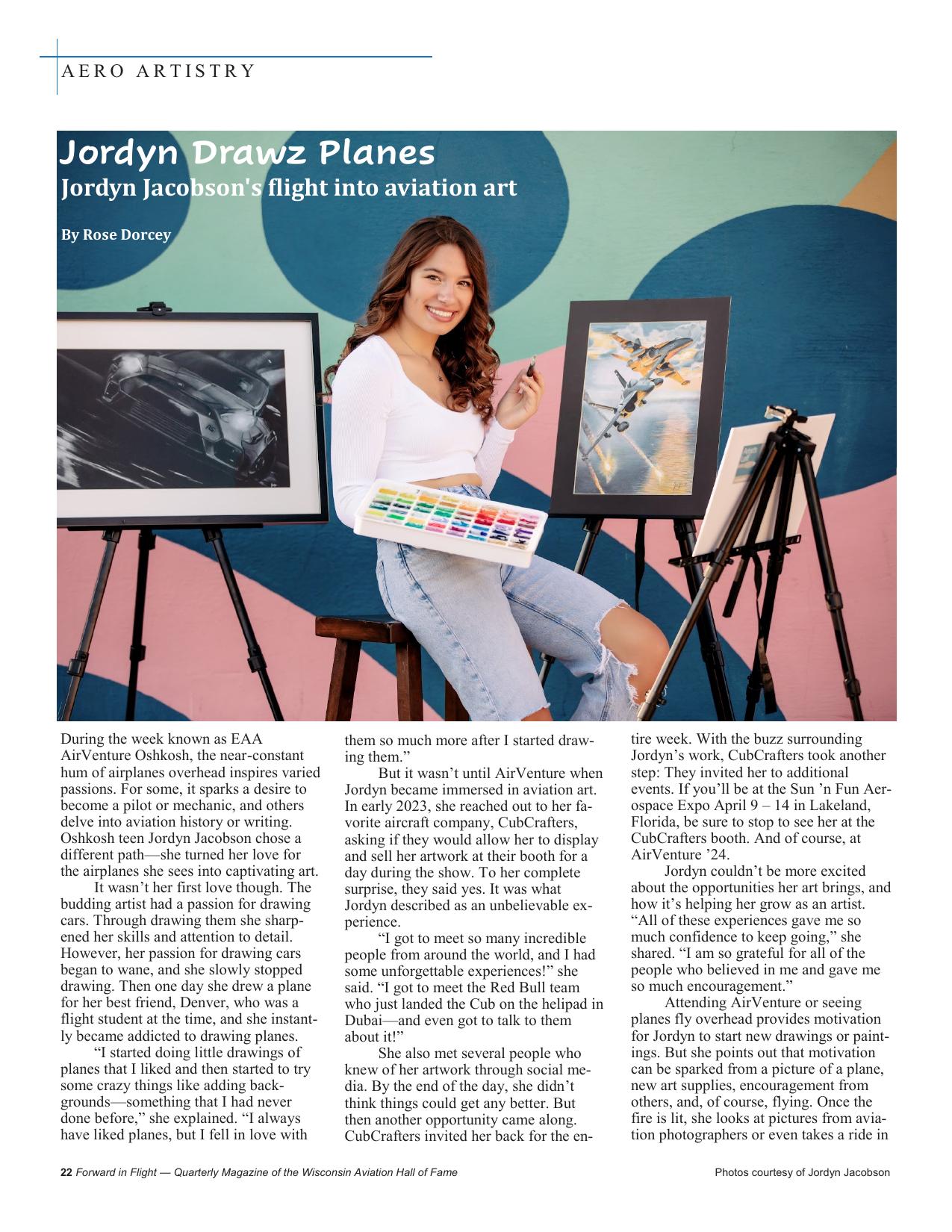
AERO ARTISTRY Jordyn Drawz Planes Jordyn Jacobson's flight into aviation art By Rose Dorcey During the week known as EAA AirVenture Oshkosh, the near-constant hum of airplanes overhead inspires varied passions. For some, it sparks a desire to become a pilot or mechanic, and others delve into aviation history or writing. Oshkosh teen Jordyn Jacobson chose a different path—she turned her love for the airplanes she sees into captivating art. It wasn’t her first love though. The budding artist had a passion for drawing cars. Through drawing them she sharpened her skills and attention to detail. However, her passion for drawing cars began to wane, and she slowly stopped drawing. Then one day she drew a plane for her best friend, Denver, who was a flight student at the time, and she instantly became addicted to drawing planes. “I started doing little drawings of planes that I liked and then started to try some crazy things like adding backgrounds—something that I had never done before,” she explained. “I always have liked planes, but I fell in love with them so much more after I started drawing them.” But it wasn’t until AirVenture when Jordyn became immersed in aviation art. In early 2023, she reached out to her favorite aircraft company, CubCrafters, asking if they would allow her to display and sell her artwork at their booth for a day during the show. To her complete surprise, they said yes. It was what Jordyn described as an unbelievable experience. “I got to meet so many incredible people from around the world, and I had some unforgettable experiences!” she said. “I got to meet the Red Bull team who just landed the Cub on the helipad in Dubai—and even got to talk to them about it!” She also met several people who knew of her artwork through social media. By the end of the day, she didn’t think things could get any better. But then another opportunity came along. CubCrafters invited her back for the en- 22 Forward in Flight — Quarterly Magazine of the Wisconsin Aviation Hall of Fame tire week. With the buzz surrounding Jordyn’s work, CubCrafters took another step: They invited her to additional events. If you’ll be at the Sun ’n Fun Aerospace Expo April 9 – 14 in Lakeland, Florida, be sure to stop to see her at the CubCrafters booth. And of course, at AirVenture ’24. Jordyn couldn’t be more excited about the opportunities her art brings, and how it’s helping her grow as an artist. “All of these experiences gave me so much confidence to keep going,” she shared. “I am so grateful for all of the people who believed in me and gave me so much encouragement.” Attending AirVenture or seeing planes fly overhead provides motivation for Jordyn to start new drawings or paintings. But she points out that motivation can be sparked from a picture of a plane, new art supplies, encouragement from others, and, of course, flying. Once the fire is lit, she looks at pictures from aviation photographers or even takes a ride in Photos courtesy of Jordyn Jacobson
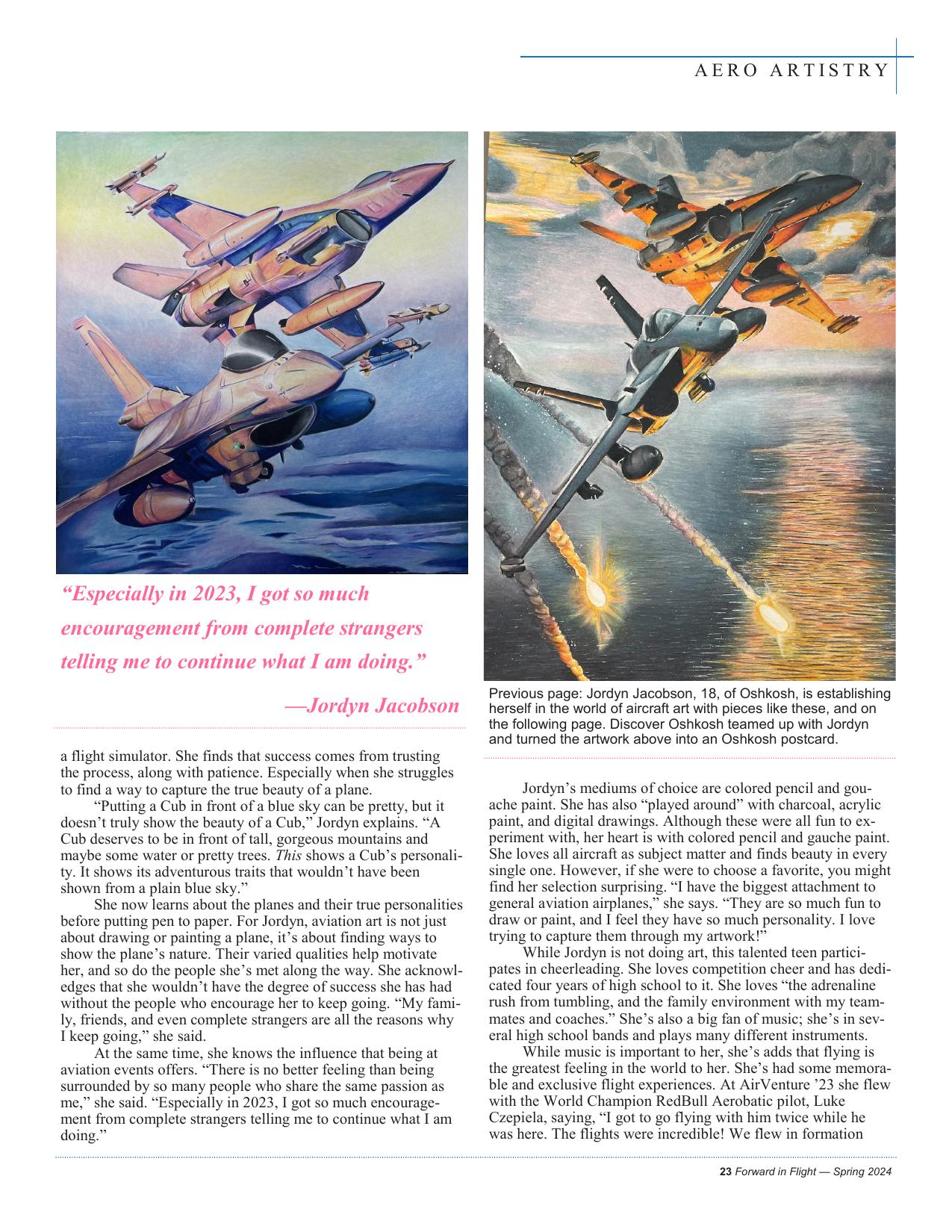
AERO ARTISTRY “Especially in 2023, I got so much encouragement from complete strangers telling me to continue what I am doing.” —Jordyn Jacobson a flight simulator. She finds that success comes from trusting the process, along with patience. Especially when she struggles to find a way to capture the true beauty of a plane. “Putting a Cub in front of a blue sky can be pretty, but it doesn’t truly show the beauty of a Cub,” Jordyn explains. “A Cub deserves to be in front of tall, gorgeous mountains and maybe some water or pretty trees. This shows a Cub’s personality. It shows its adventurous traits that wouldn’t have been shown from a plain blue sky.” She now learns about the planes and their true personalities before putting pen to paper. For Jordyn, aviation art is not just about drawing or painting a plane, it’s about finding ways to show the plane’s nature. Their varied qualities help motivate her, and so do the people she’s met along the way. She acknowledges that she wouldn’t have the degree of success she has had without the people who encourage her to keep going. “My family, friends, and even complete strangers are all the reasons why I keep going,” she said. At the same time, she knows the influence that being at aviation events offers. “There is no better feeling than being surrounded by so many people who share the same passion as me,” she said. “Especially in 2023, I got so much encouragement from complete strangers telling me to continue what I am doing.” Previous page: Jordyn Jacobson, 18, of Oshkosh, is establishing herself in the world of aircraft art with pieces like these, and on the following page. Discover Oshkosh teamed up with Jordyn and turned the artwork above into an Oshkosh postcard. Jordyn’s mediums of choice are colored pencil and gouache paint. She has also “played around” with charcoal, acrylic paint, and digital drawings. Although these were all fun to experiment with, her heart is with colored pencil and gauche paint. She loves all aircraft as subject matter and finds beauty in every single one. However, if she were to choose a favorite, you might find her selection surprising. “I have the biggest attachment to general aviation airplanes,” she says. “They are so much fun to draw or paint, and I feel they have so much personality. I love trying to capture them through my artwork!” While Jordyn is not doing art, this talented teen participates in cheerleading. She loves competition cheer and has dedicated four years of high school to it. She loves “the adrenaline rush from tumbling, and the family environment with my teammates and coaches.” She’s also a big fan of music; she’s in several high school bands and plays many different instruments. While music is important to her, she’s adds that flying is the greatest feeling in the world to her. She’s had some memorable and exclusive flight experiences. At AirVenture ’23 she flew with the World Champion RedBull Aerobatic pilot, Luke Czepiela, saying, “I got to go flying with him twice while he was here. The flights were incredible! We flew in formation 23 Forward in Flight — Spring 2024
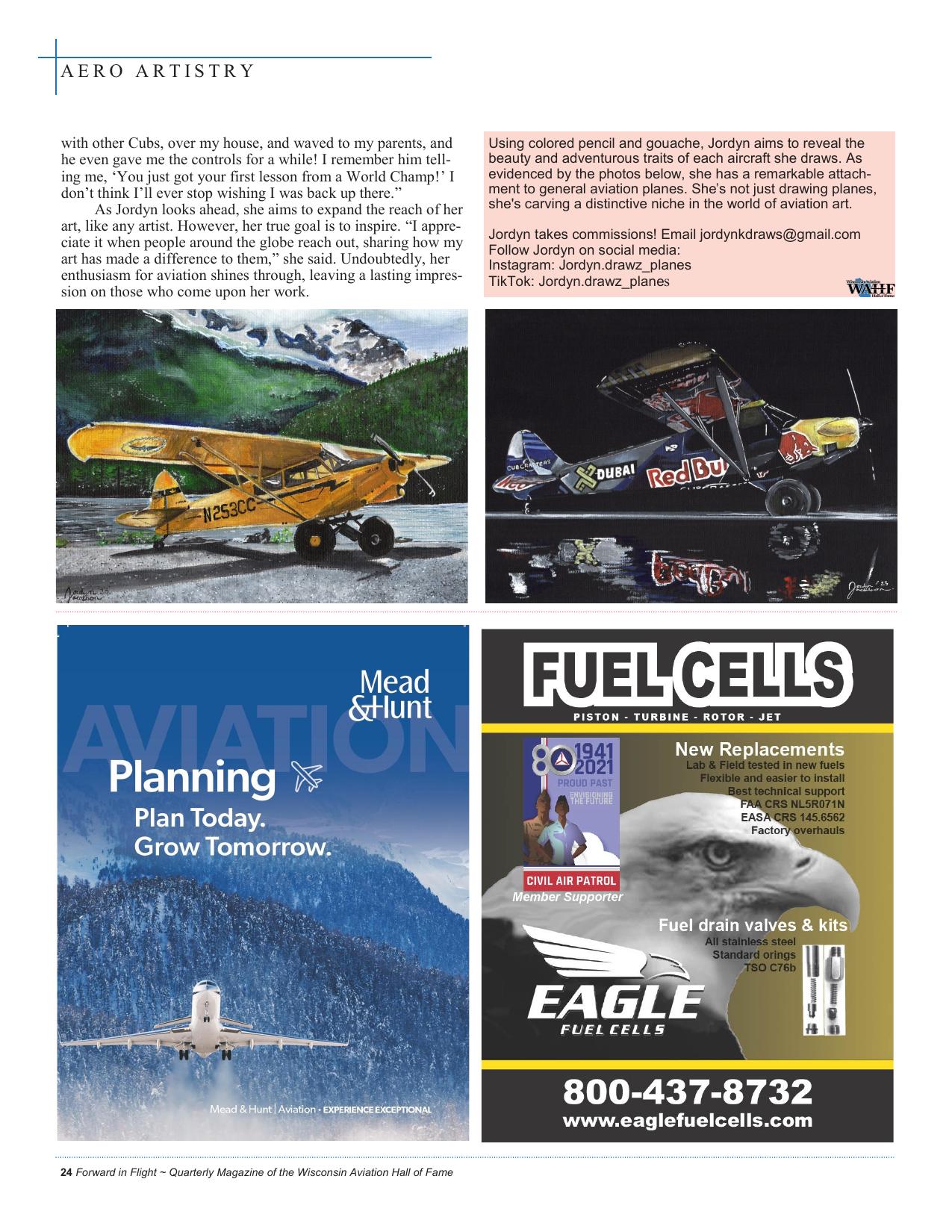
AERO ARTISTRY with other Cubs, over my house, and waved to my parents, and he even gave me the controls for a while! I remember him telling me, ‘You just got your first lesson from a World Champ!’ I don’t think I’ll ever stop wishing I was back up there.” As Jordyn looks ahead, she aims to expand the reach of her art, like any artist. However, her true goal is to inspire. “I appreciate it when people around the globe reach out, sharing how my art has made a difference to them,” she said. Undoubtedly, her enthusiasm for aviation shines through, leaving a lasting impression on those who come upon her work. 24 Forward in Flight ~ Quarterly Magazine of the Wisconsin Aviation Hall of Fame Using colored pencil and gouache, Jordyn aims to reveal the beauty and adventurous traits of each aircraft she draws. As evidenced by the photos below, she has a remarkable attachment to general aviation planes. She’s not just drawing planes, she's carving a distinctive niche in the world of aviation art. Jordyn takes commissions! Email jordynkdraws@gmail.com Follow Jordyn on social media: Instagram: Jordyn.drawz_planes TikTok: Jordyn.drawz_planes
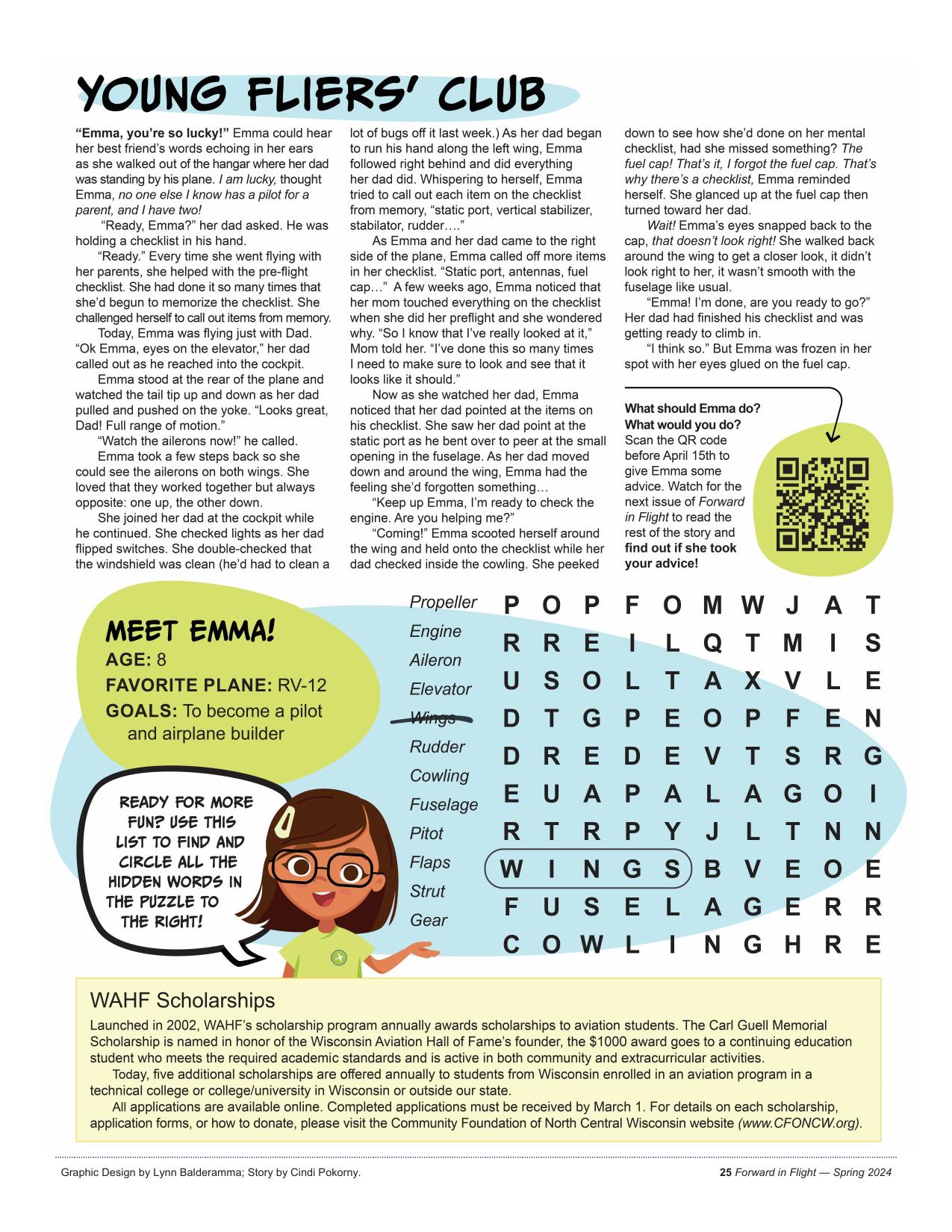
Graphic Design by Lynn Balderamma; Story by Cindi Pokorny. 25 Forward in Flight — Spring 2024
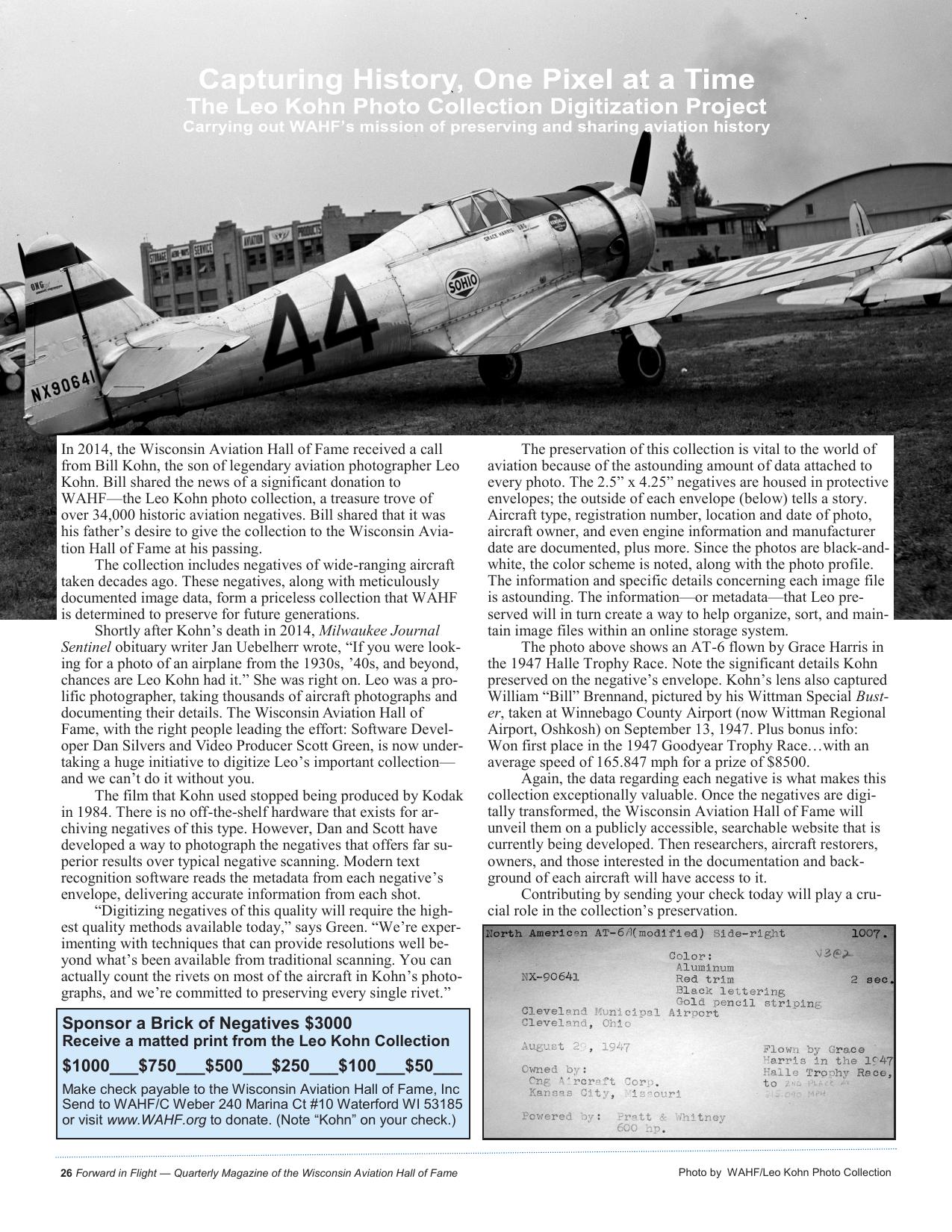
In 2014, the Wisconsin Aviation Hall of Fame received a call from Bill Kohn, the son of legendary aviation photographer Leo Kohn. Bill shared the news of a significant donation to WAHF—the Leo Kohn photo collection, a treasure trove of over 34,000 historic aviation negatives. Bill shared that it was his father’s desire to give the collection to the Wisconsin Aviation Hall of Fame at his passing. The collection includes negatives of wide-ranging aircraft taken decades ago. These negatives, along with meticulously documented image data, form a priceless collection that WAHF is determined to preserve for future generations. Shortly after Kohn’s death in 2014, Milwaukee Journal Sentinel obituary writer Jan Uebelherr wrote, “If you were looking for a photo of an airplane from the 1930s, ’40s, and beyond, chances are Leo Kohn had it.” She was right on. Leo was a prolific photographer, taking thousands of aircraft photographs and documenting their details. The Wisconsin Aviation Hall of Fame, with the right people leading the effort: Software Developer Dan Silvers and Video Producer Scott Green, is now undertaking a huge initiative to digitize Leo’s important collection— and we can’t do it without you. The film that Kohn used stopped being produced by Kodak in 1984. There is no off-the-shelf hardware that exists for archiving negatives of this type. However, Dan and Scott have developed a way to photograph the negatives that offers far superior results over typical negative scanning. Modern text recognition software reads the metadata from each negative’s envelope, delivering accurate information from each shot. “Digitizing negatives of this quality will require the highest quality methods available today,” says Green. “We’re experimenting with techniques that can provide resolutions well beyond what’s been available from traditional scanning. You can actually count the rivets on most of the aircraft in Kohn’s photographs, and we’re committed to preserving every single rivet.” The preservation of this collection is vital to the world of aviation because of the astounding amount of data attached to every photo. The 2.5” x 4.25” negatives are housed in protective envelopes; the outside of each envelope (below) tells a story. Aircraft type, registration number, location and date of photo, aircraft owner, and even engine information and manufacturer date are documented, plus more. Since the photos are black-andwhite, the color scheme is noted, along with the photo profile. The information and specific details concerning each image file is astounding. The information—or metadata—that Leo preserved will in turn create a way to help organize, sort, and maintain image files within an online storage system. The photo above shows an AT-6 flown by Grace Harris in the 1947 Halle Trophy Race. Note the significant details Kohn preserved on the negative’s envelope. Kohn’s lens also captured William “Bill” Brennand, pictured by his Wittman Special Buster, taken at Winnebago County Airport (now Wittman Regional Airport, Oshkosh) on September 13, 1947. Plus bonus info: Won first place in the 1947 Goodyear Trophy Race…with an average speed of 165.847 mph for a prize of $8500. Again, the data regarding each negative is what makes this collection exceptionally valuable. Once the negatives are digitally transformed, the Wisconsin Aviation Hall of Fame will unveil them on a publicly accessible, searchable website that is currently being developed. Then researchers, aircraft restorers, owners, and those interested in the documentation and background of each aircraft will have access to it. Contributing by sending your check today will play a crucial role in the collection’s preservation. Sponsor a Brick of Negatives $3000 Receive a matted print from the Leo Kohn Collection $1000___$750___$500___$250___$100___$50___ Make check payable to the Wisconsin Aviation Hall of Fame, Inc Send to WAHF/C Weber 240 Marina Ct #10 Waterford WI 53185 or visit www.WAHF.org to donate. (Note “Kohn” on your check.) 26 Forward in Flight — Quarterly Magazine of the Wisconsin Aviation Hall of Fame Photo by WAHF/Leo Kohn Photo Collection
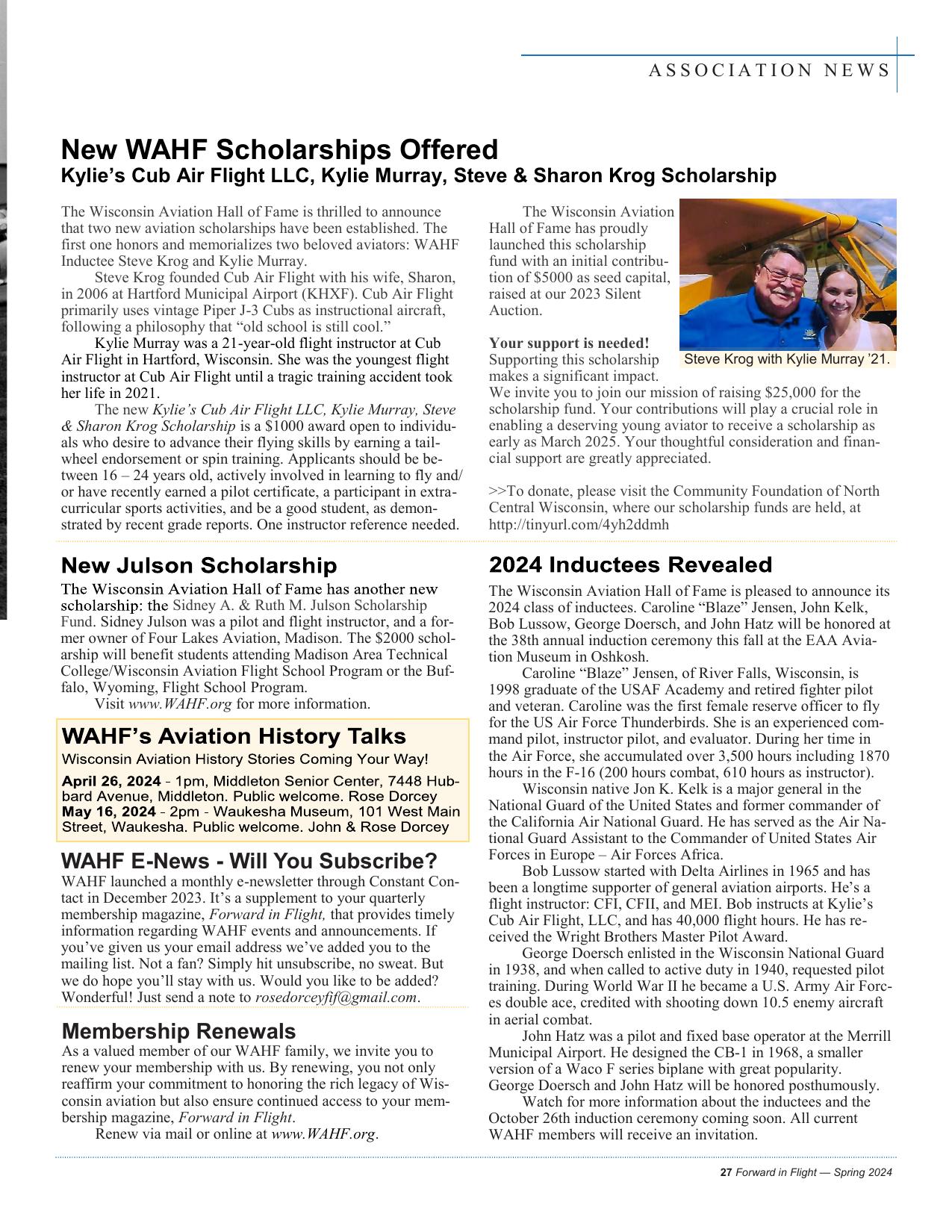
ASSOCIATION NEWS New WAHF Scholarships Offered Kylie’s Cub Air Flight LLC, Kylie Murray, Steve & Sharon Krog Scholarship The Wisconsin Aviation Hall of Fame is thrilled to announce that two new aviation scholarships have been established. The first one honors and memorializes two beloved aviators: WAHF Inductee Steve Krog and Kylie Murray. Steve Krog founded Cub Air Flight with his wife, Sharon, in 2006 at Hartford Municipal Airport (KHXF). Cub Air Flight primarily uses vintage Piper J-3 Cubs as instructional aircraft, following a philosophy that “old school is still cool.” Kylie Murray was a 21-year-old flight instructor at Cub Air Flight in Hartford, Wisconsin. She was the youngest flight instructor at Cub Air Flight until a tragic training accident took her life in 2021. The new Kylie’s Cub Air Flight LLC, Kylie Murray, Steve & Sharon Krog Scholarship is a $1000 award open to individuals who desire to advance their flying skills by earning a tailwheel endorsement or spin training. Applicants should be between 16 – 24 years old, actively involved in learning to fly and/ or have recently earned a pilot certificate, a participant in extracurricular sports activities, and be a good student, as demonstrated by recent grade reports. One instructor reference needed. Sidney A. & Ruth M. Julson Scholarship Fund. Sidney Julson was a pilot and flight instructor, and a former owner of Four Lakes Aviation, Madison. The $2000 scholarship will benefit students attending Madison Area Technical College/Wisconsin Aviation Flight School Program or the Buffalo, Wyoming, Flight School Program. Visit www.WAHF.org for more information. WAHF E-News - Will You Subscribe? WAHF launched a monthly e-newsletter through Constant Contact in December 2023. It’s a supplement to your quarterly membership magazine, Forward in Flight, that provides timely information regarding WAHF events and announcements. If you’ve given us your email address we’ve added you to the mailing list. Not a fan? Simply hit unsubscribe, no sweat. But we do hope you’ll stay with us. Would you like to be added? Wonderful! Just send a note to rosedorceyfif@gmail.com. Membership Renewals As a valued member of our WAHF family, we invite you to renew your membership with us. By renewing, you not only reaffirm your commitment to honoring the rich legacy of Wisconsin aviation but also ensure continued access to your membership magazine, Forward in Flight. Renew via mail or online at www.WAHF.org. The Wisconsin Aviation Hall of Fame has proudly launched this scholarship fund with an initial contribution of $5000 as seed capital, raised at our 2023 Silent Auction. Your support is needed! Steve Krog with Kylie Murray ’21. Supporting this scholarship makes a significant impact. We invite you to join our mission of raising $25,000 for the scholarship fund. Your contributions will play a crucial role in enabling a deserving young aviator to receive a scholarship as early as March 2025. Your thoughtful consideration and financial support are greatly appreciated. >>To donate, please visit the Community Foundation of North Central Wisconsin, where our scholarship funds are held, at http://tinyurl.com/4yh2ddmh The Wisconsin Aviation Hall of Fame is pleased to announce its 2024 class of inductees. Caroline “Blaze” Jensen, John Kelk, Bob Lussow, George Doersch, and John Hatz will be honored at the 38th annual induction ceremony this fall at the EAA Aviation Museum in Oshkosh. Caroline “Blaze” Jensen, of River Falls, Wisconsin, is 1998 graduate of the USAF Academy and retired fighter pilot and veteran. Caroline was the first female reserve officer to fly for the US Air Force Thunderbirds. She is an experienced command pilot, instructor pilot, and evaluator. During her time in the Air Force, she accumulated over 3,500 hours including 1870 hours in the F-16 (200 hours combat, 610 hours as instructor). Wisconsin native Jon K. Kelk is a major general in the National Guard of the United States and former commander of the California Air National Guard. He has served as the Air National Guard Assistant to the Commander of United States Air Forces in Europe – Air Forces Africa. Bob Lussow started with Delta Airlines in 1965 and has been a longtime supporter of general aviation airports. He’s a flight instructor: CFI, CFII, and MEI. Bob instructs at Kylie’s Cub Air Flight, LLC, and has 40,000 flight hours. He has received the Wright Brothers Master Pilot Award. George Doersch enlisted in the Wisconsin National Guard in 1938, and when called to active duty in 1940, requested pilot training. During World War II he became a U.S. Army Air Forces double ace, credited with shooting down 10.5 enemy aircraft in aerial combat. John Hatz was a pilot and fixed base operator at the Merrill Municipal Airport. He designed the CB-1 in 1968, a smaller version of a Waco F series biplane with great popularity. George Doersch and John Hatz will be honored posthumously. Watch for more information about the inductees and the October 26th induction ceremony coming soon. All current WAHF members will receive an invitation. 27 Forward in Flight — Spring 2024
EDITOR’S LOG Spring updates and exciting projects Inspiration… maybe that’s why I love putting Forward in Flight together each quarter. This issue more than most I can say that I’ve been inspired to do more. To give back to the community, make time for art, and reach out to friends and strangers alike to help further WAHF’s mission of collecting, preserving, and sharing stories of Wisconsin aviators. The stories in this issue are quite varied, as you’ve likely noted. You’ve read about heroes from the Vietnam and World War II eras. You’ve read about today’s heroes: our 2024 inductees and local aviators Dan Silvers, Dick Knapinski, and Barry and Sam Hammarback, among others. In different yet equally vital ways, they contribute to aviation and humanity. And then there’s the delightful Jordyn Jacobson, whose art makes a meaningful impression on many who view it. News of aviation history preservation efforts and new scholarships are important too. We share the stories of yesterday’s and today’s trailblazers because of their potential to influence others in meaningful ways. And someday, we hope, the stories will be preserved. Twentyfive or fifty years from now, people may read about them and say, ‘Wow, pilots were doing some good things back then.’ I’ve always felt that Forward in Flight can be looked at as a record of what’s happening in the Wisconsin aviation scene at this time in history. That’s why we share what we do. There are hundreds of stories yet to be told. Sometimes, we need your help in finding or telling them. Please feel free to submit a story idea, or write one yourself. Especially if it’s about someone who has the potential to inspire others. 28 Forward in Flight — Spring 2024 You’ve also read that WAHF has a lot to be excited about. And a lot of work ahead of us! We’re ready for it. A dedicated team of key board members, member/supporters, and friends have been working diligently on two projects: fundraising for the Leo Kohn Photo Collection Digitization Project, and the new Kylie’s Cub Air Flight LLC, Kylie Murray, Steve & Sharon Krog Scholarship. Your help is needed. As we collectively immerse ourselves in the fascinating stories within these pages, we earnestly seek your support to shape future stories—and future aviators. WAHF members have always been dedicated to helping us meet our goals, and we thank you for that! Your contributions play a vital role in ensuring the continued success of projects such as those noted above, enriching Wisconsin’s aviation community for years to come. I can’t end this column without thanking Ethan Brodsky for providing both air-to-air and static photos for this issue. You’ll likely see more of his work in future issues, elevating your magazine to a higher level. Thanks so much, Ethan. Spring is always an exciting time for WAHF. Announcements of each year’s inductees is so gratifying, it’s what we do. We have another stellar class of inductees this year, and I congratulate each one, and their families, on this achievement. Often, when people fulfill their roles, they may not fully grasp the impact they’ve had until a life event like this comes along. We invite you to join us this fall as we celebrate the remarkable achievements of this year’s inductees. —Rose Dorcey

The time is right to join, renew, or give a gift membership to the Wisconsin Aviation Hall of Fame! ANNUAL MEMBERSHIP LEVELS Name________________________________________ _____ Youth (Under age 18) _____ Individual (Annual) _____ Couple (Annual) _____ Lifetime (Individual) _____ Lifetime (Couple) Address______________________________________ $10 $30 $40 $500 $750 City__________________________________________ State, Zip_____________________________________ Phone_______________________________________ TAX DEDUCTIBLE CONTRIBUTIONS Your contributions help ensure Wisconsin’s aviation pioneers and outstanding students in aviation education will continue to be recognized. Your contributions, in any amount, are appreciated. WAHF Supporting Contribution $___________ (General operating/events programming fund) WAHF Scholarship Fund* $___________ *for scholarship donations please make a separate check payable to Community Foundation of North Central Wisconsin or visit www.CFONCW.org. Email________________________________________ Members receive WAHF’s quarterly magazine Forward in Flight! Join or Donate Online! www.WAHF.org Or, mail this form, along with your check payable to: Wisconsin Aviation Hall of Fame, Inc. to: Rose Dorcey/WAHF 3980 Sharratt Drive Oshkosh WI 54901 The Wisconsin Aviation Hall of Fame is a 501(c)(3) organization. Morey Airplane Company Since 1932 Middleton Municipal Airport/Morey Field Self-service 100LL & Jet A 24-7 29 Forward in Flight—Spring 2024
PRSRT STD US Postage Paid Wisc Rapids WI Permit 98 Forward in Flight c/o Rose Dorcey 3980 Sharratt Drive Oshkosh WI 54901-1276 The Wisconsin Aviation Hall of Fame is a non-profit membership organization dedicated to preserving the past and fostering the future of flight. Welcome WAHF Member/Supporters! Lynn Balderrama Ethan Beswick John P. Chmiel Tanya Cunningham Jeff Gaier Michael Garvin* Lee Konitzer Rick Leyes Neil Robinson Dawn Troxel Thank you for coming onboard! Gerasimos Blatseas Paul DeCoursin Daniel Janusz William Nichols Jeffrey Troxel Ethan Brodsky Joe Drab Cameron Knuth Logan Parmeter *New Life Member WAHF Life Member James “Sandy” Wilson is passionate about helping aviation museums and organizations succeed. He’s also the man behind the effort to help WAHF raise funds for our new Kylie’s Cub Air Flight LLC, Kylie Murray, Steve & Sharon Krog Scholarship. We thank him for his support of this important effort. GONE WEST—Brig Gen Ralph C “Bud” Jensen. Bud, 92, was a fighter pilot and worked for the Wisconsin Air Guard for 38 years. He served as Chief of Safety and State Director of Operations before his appointment as Chief of Staff in 1985. He was a command pilot with more than 5,500 hours flying time in 13 different aircraft, from propeller-driven observation planes to jet fighters and refueling tankers. Bud was a member of the 176th Fighter Interceptor Squadron, EAA, and Chairman of the State Council of Aeronautics. Bud was a longtime member/supporter of the Wisconsin Aviation Hall of Fame. He will be missed. The Canadian Forces Snowbirds, a military aerial demonstration team will perform at EAA AirVenture 2024, returning to Oshkosh for the first time since 2016. The Frecce Tricolori, the military aerobatic team representing the Italian Air Force (ITAF), will be making its first Oshkosh appearance since 1986. The 71st edition of the Experimental Aircraft Association fly-in convention is July 22-28 at Wittman Regional Airport in Oshkosh. We’ve received a number of renewals and new memberships in recent weeks, and we sincerely thank all WAHF members for your invaluable support. Your dedication to preserving Wisconsin’s aviation heritage and inspiring future generations is deeply appreciated. With your generous support, we can continue celebrating the remarkable achievements of Wisconsin’s aviation pioneers and today aviators. Congratulations to WAHF Member Margaret Burton on earning her private pilot certificate! FIF Magazine Forward in Flight is published quarterly with new issues released in March, June, September, and December. Send press releases and advertising inquiries to rosedorceyfif@gmail.com or call 920-279-6029. Address/Email Changes Moved recently? Please inform WAHF of your address change so you can continue to receive Forward in Flight in a timely manner. Also, please send a note when your email changes or send us your email if you haven't yet provided one. Thanks! Wisconsin Aviation Hall of Fame Officers Kurt Stanich, President James Zuelsdorf, Vice-President Henry Peterson, Secretary Colleen Weber, Treasurer Board of Directors John Dorcey Scott Green Jill Mann Patrick Weeden Wynne Williams Membership Chair FIF Editor/Advertising Rose Dorcey 920-279-6029 rosedorceyfif@wahf.org Become a member/supporter today! Use form on the inside back cover and mail it in, or join securely online at www.WAHF.org Join the conversation… Like. Follow. Subscribe. WAHF Online!