Volume 23, Issue 1
🗞️ Download Issue (PDF)
Forward in Flight -Spring 2025
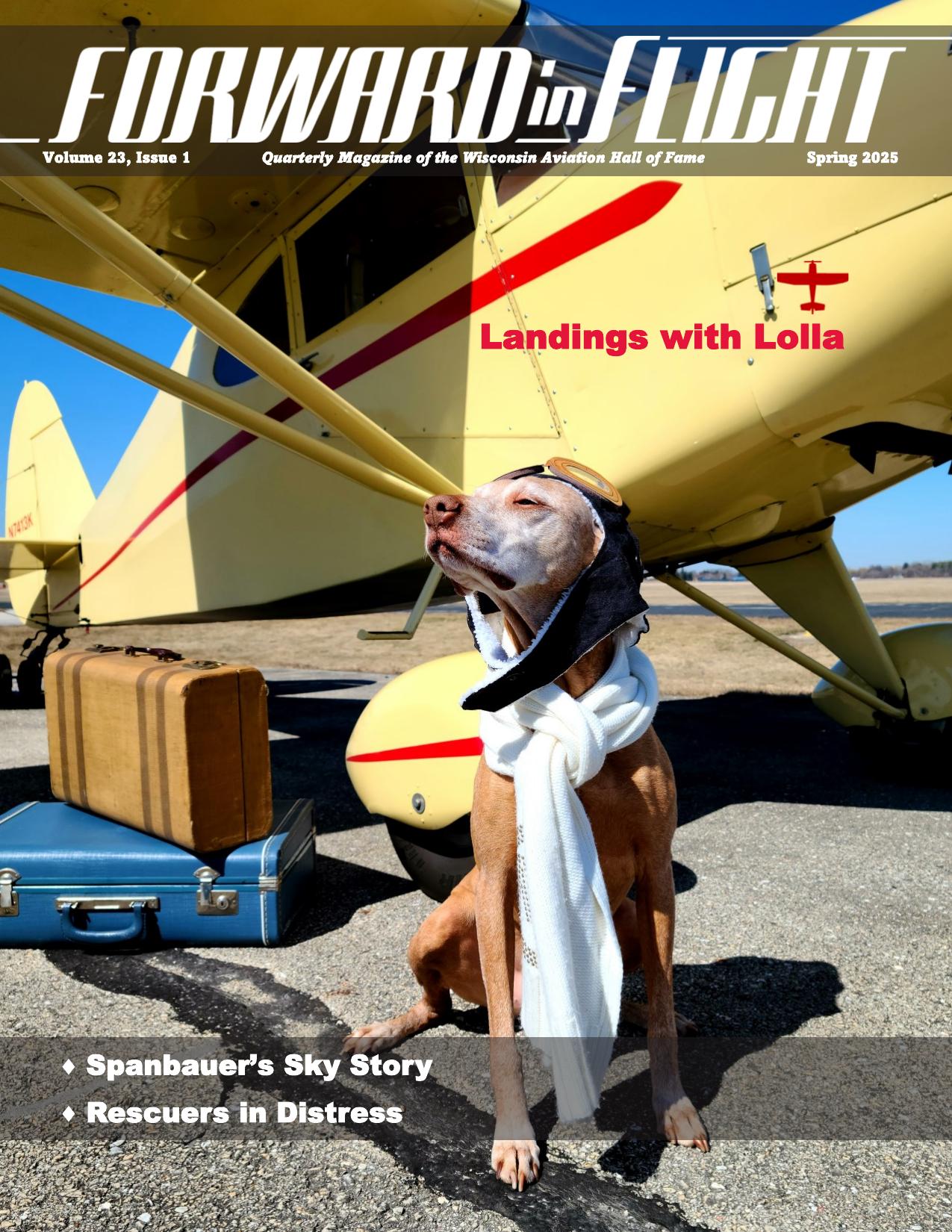
Volume 23, Issue 1 Quarterly Magazine of the Wisconsin Aviation Hall of Fame Spring 2025 Landings with Lolla Spanbauer’s Sky Story Rescuers in Distress
Spring 2025 2 GOLDEN AGE Monroe’s Nathan S. Twining, Part II By Nickolas Hein 20 TALES OF THE ACES Badger Jet Aces By Mike O’Connor 4 TAILDRAGGER TALES My Merrill Airport Days Sowing the Seeds of Aviation By John Chmiel 22 ON THE FLIGHTLINE New EAA Chapter 1710 Update! Piper Vagabond S/N 1 6 SNAPSHOTS Richard Allen Morey Wisconsin Aviation Entrepreneur Story and photos by Skot Weidemann 8 AERO ADVENTURES Touch and Go Navigating Life and Landing Dreams By Ed Becerra 12 WE FLY A Sky Full of Memories Paul Spanbauer’s Passion for Planes By Rose Dorcey 15 SHEBOYGAN AREA HISTORY Mel Thompson Barnstorming Legend By Dan Miller 24 GONE WEST Peter L. Drahn Greg Gorak 25 BOOK REVIEW Damn Lucky Reviewed by John Dorcey 26 WAHF NEWS & UPDATES 2025 Inductee Announcement Kohn Collection Digitization WAHF’s New Exhibit at MGOF 26 YOUNG FLIERS’ CLUB Crossword and Caroline 28 EDITOR’S LOG Spring Forward Milestones, Memories, and New Beginnings By Rose Dorcey 16 PLANES AND PEOPLE From Rescuers to the Rescued Major Knitter’s Heroic Mission By John Dorcey 19 FROM THE ARCHIVES A Globe “Scamper” From the Leo J. Kohn Collection WAHF Member Paul Spanbauer has long been interested in photography — and flying! He combines these hobbies when flying throughout Wisconsin, such as this recent photo of Wittman Regional Airport (KOSH) in Oshkosh. Read about Paul’s aviation obsession in this issue of Forward in Flight.
PRESIDENT’S MESSAGE Looking Back, Moving Forward A Milestone Year for WAHF By WAHF President Kurt Stanich As we approach the 40th anniversary of the Wisconsin Aviation Hall of Fame, we find ourselves at a remarkable crossroads—one where we can reflect on the achievements of the past while charting an exciting course for the future. This milestone is not just about the number of mony bring together aviation enthusiasts, historians, and years but about the impact WAHF has had on preserving industry professionals to share knowledge and build con- and celebrating Wisconsin’s rich aviation heritage. nections. And, as always, we continue to seek ways to Since our founding in 1985, we have recognized pioneers, innovators, and trailblazers who have shaped aviation in Wisconsin and beyond. Each inductee’s story grow, engage, and inspire through our programs, scholarships, and outreach. Looking ahead, we have an opportunity to ensure reminds us that progress is built on the dedication, inge- that WAHF’s next 40 years are just as impactful as the nuity, and passion of those who came before us. Their first. How do we do that? By embracing innovation while contributions fuel our mission, inspiring future genera- staying true to our mission. We’re exploring ways to tions to take to the skies. make aviation history even more accessible—through This year, as we celebrate four decades of honoring digital archives, interactive exhibits, and educational aviation’s finest, we’re planning special events and initia- partnerships that engage the next generation. We’re also tives to mark the occasion. While details are still coming looking at how we can strengthen our network, expand- together, you can expect a celebration that reflects our ing our reach to connect with new voices in the aviation deep appreciation for our inductees, members, and sup- community. porters. Whether through a special gathering, an exhibit, But the heart of WAHF has always been its people. or a new initiative to expand our outreach, we want this None of this would be possible without our members, anniversary to be meaningful for everyone who has donors, and volunteers. Your passion and generosity fuel helped shape WAHF’s success. Stay tuned for more de- everything we do. If you’ve ever considered getting more tails—this will be a year worth noting! involved—whether by attending an event, sharing a Beyond the anniversary, our work continues. Our efforts to digitize the Leo J. Kohn Aviation Photography Collection are progressing, ensuring that thousands of piece of history, or supporting a project—there’s never been a better time. Thank you for being part of WAHF’s journey. Here’s invaluable images are preserved and made accessible for to 40 years of celebrating aviation legends—and to many future generations. Events like our 2025 induction cere- more ahead! Forward in Flight the only magazine dedicated exclusively to Wisconsin’s aviation news and history. Rose Dorcey Editorial and Advertising 3980 Sharratt Drive Oshkosh WI 54901 920-279-6029 rose@wahf.org The Wisconsin Aviation Hall of Fame is a non-profit membership organization with a mission to collect and preserve the history of aviation in Wisconsin, recognize those who made that history, inform others of it, and promote aviation education for future generations. About the Cover For Lolla, flying isn’t just for the humans! Ed and Caitlin Becerra’s pup is right at home in their 1950 Piper Pacer, loving every moment in the sky. Photo by Ed Becerra
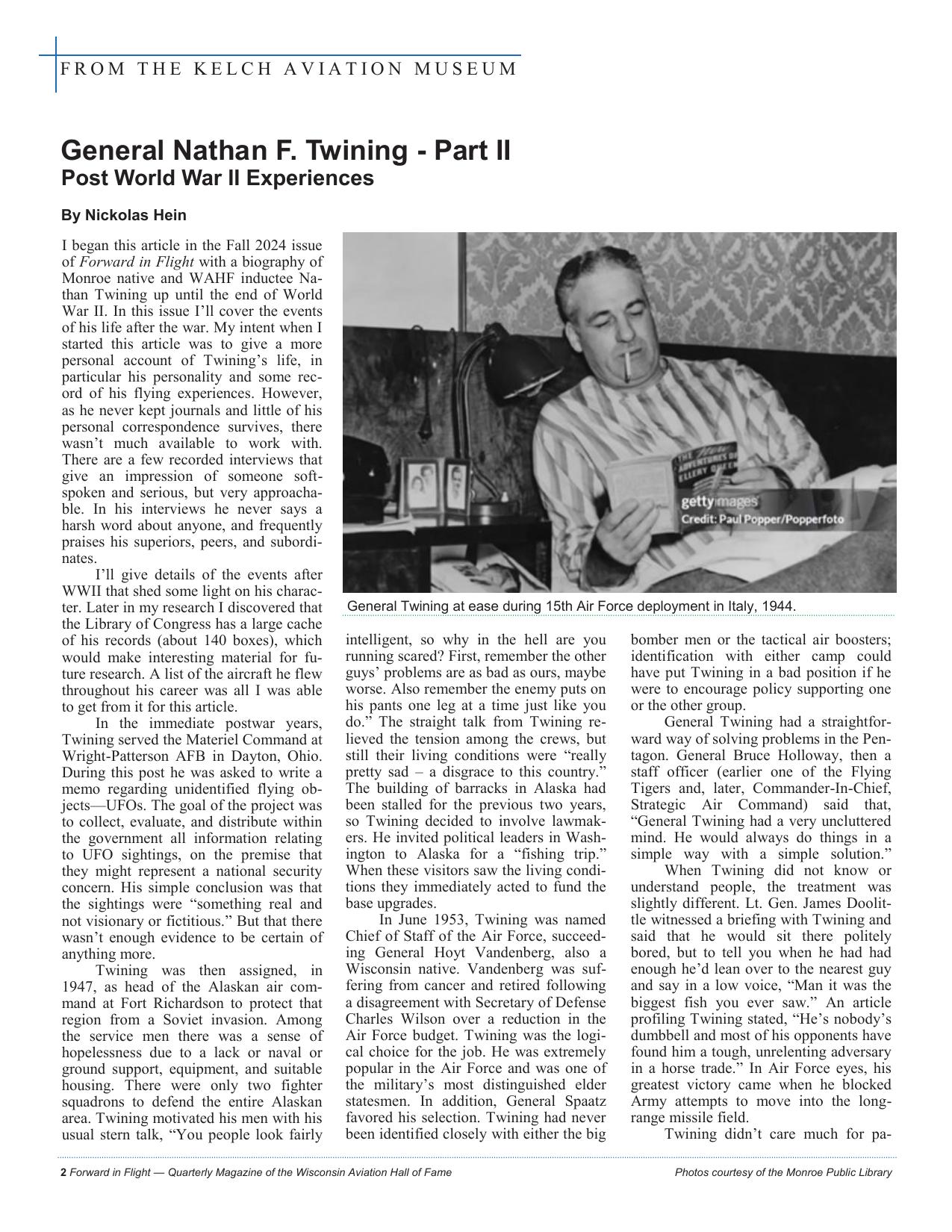
FROM THE KELCH AVIATION MUSEUM General Nathan F. Twining - Part II Post World War II Experiences By Nickolas Hein I began this article in the Fall 2024 issue of Forward in Flight with a biography of Monroe native and WAHF inductee Nathan Twining up until the end of World War II. In this issue I’ll cover the events of his life after the war. My intent when I started this article was to give a more personal account of Twining’s life, in particular his personality and some record of his flying experiences. However, as he never kept journals and little of his personal correspondence survives, there wasn’t much available to work with. There are a few recorded interviews that give an impression of someone softspoken and serious, but very approachable. In his interviews he never says a harsh word about anyone, and frequently praises his superiors, peers, and subordinates. I’ll give details of the events after WWII that shed some light on his character. Later in my research I discovered that the Library of Congress has a large cache of his records (about 140 boxes), which would make interesting material for future research. A list of the aircraft he flew throughout his career was all I was able to get from it for this article. In the immediate postwar years, Twining served the Materiel Command at Wright-Patterson AFB in Dayton, Ohio. During this post he was asked to write a memo regarding unidentified flying objects—UFOs. The goal of the project was to collect, evaluate, and distribute within the government all information relating to UFO sightings, on the premise that they might represent a national security concern. His simple conclusion was that the sightings were “something real and not visionary or fictitious.” But that there wasn’t enough evidence to be certain of anything more. Twining was then assigned, in 1947, as head of the Alaskan air command at Fort Richardson to protect that region from a Soviet invasion. Among the service men there was a sense of hopelessness due to a lack or naval or ground support, equipment, and suitable housing. There were only two fighter squadrons to defend the entire Alaskan area. Twining motivated his men with his usual stern talk, “You people look fairly General Twining at ease during 15th Air Force deployment in Italy, 1944. intelligent, so why in the hell are you running scared? First, remember the other guys’ problems are as bad as ours, maybe worse. Also remember the enemy puts on his pants one leg at a time just like you do.” The straight talk from Twining relieved the tension among the crews, but still their living conditions were “really pretty sad – a disgrace to this country.” The building of barracks in Alaska had been stalled for the previous two years, so Twining decided to involve lawmakers. He invited political leaders in Washington to Alaska for a “fishing trip.” When these visitors saw the living conditions they immediately acted to fund the base upgrades. In June 1953, Twining was named Chief of Staff of the Air Force, succeeding General Hoyt Vandenberg, also a Wisconsin native. Vandenberg was suffering from cancer and retired following a disagreement with Secretary of Defense Charles Wilson over a reduction in the Air Force budget. Twining was the logical choice for the job. He was extremely popular in the Air Force and was one of the military’s most distinguished elder statesmen. In addition, General Spaatz favored his selection. Twining had never been identified closely with either the big 2 Forward in Flight — Quarterly Magazine of the Wisconsin Aviation Hall of Fame bomber men or the tactical air boosters; identification with either camp could have put Twining in a bad position if he were to encourage policy supporting one or the other group. General Twining had a straightforward way of solving problems in the Pentagon. General Bruce Holloway, then a staff officer (earlier one of the Flying Tigers and, later, Commander-In-Chief, Strategic Air Command) said that, “General Twining had a very uncluttered mind. He would always do things in a simple way with a simple solution.” When Twining did not know or understand people, the treatment was slightly different. Lt. Gen. James Doolittle witnessed a briefing with Twining and said that he would sit there politely bored, but to tell you when he had had enough he’d lean over to the nearest guy and say in a low voice, “Man it was the biggest fish you ever saw.” An article profiling Twining stated, “He’s nobody’s dumbbell and most of his opponents have found him a tough, unrelenting adversary in a horse trade.” In Air Force eyes, his greatest victory came when he blocked Army attempts to move into the longrange missile field. Twining didn’t care much for paPhotos courtesy of the Monroe Public Library
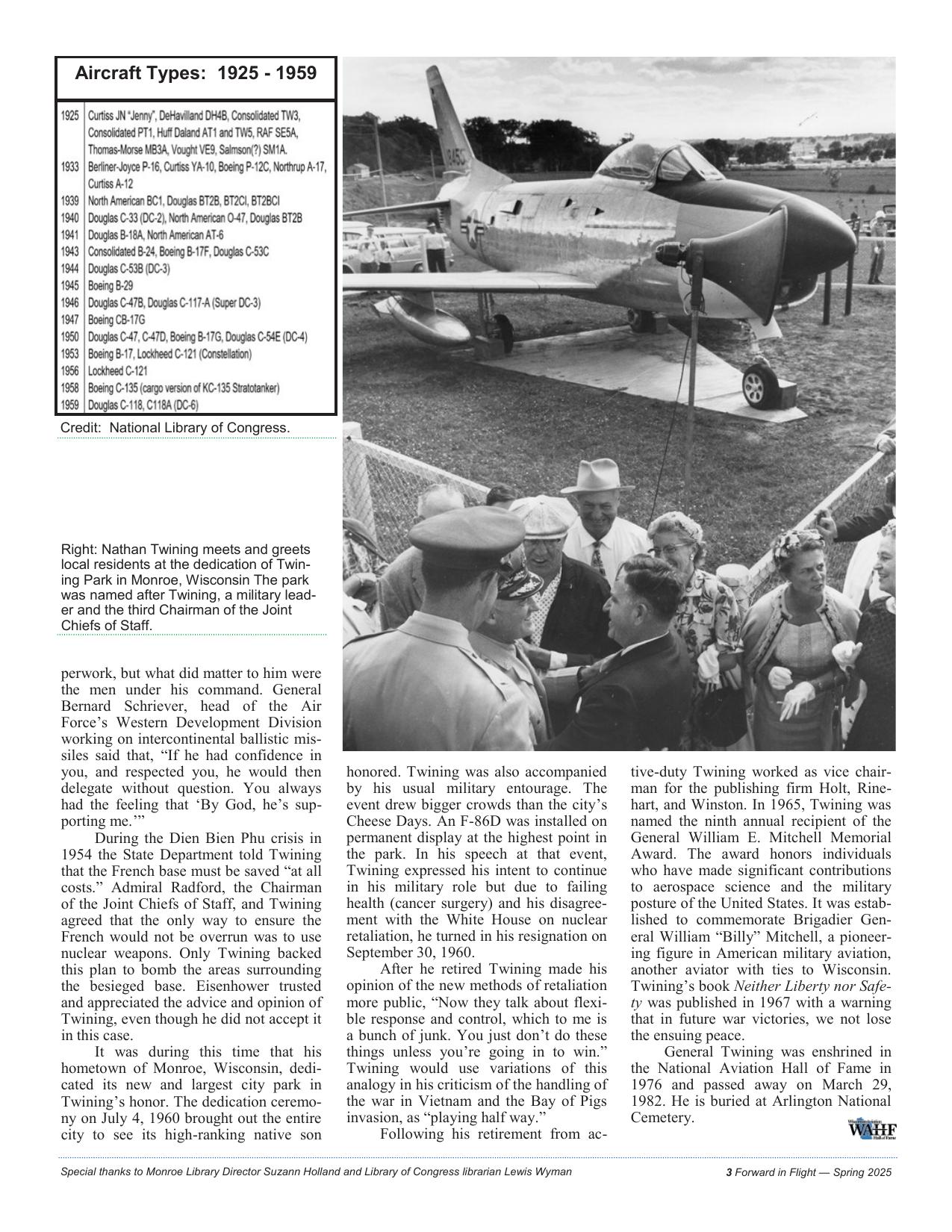
Aircraft Types: 1925 - 1959 Credit: National Library of Congress. Right: Nathan Twining meets and greets local residents at the dedication of Twining Park in Monroe, Wisconsin The park was named after Twining, a military leader and the third Chairman of the Joint Chiefs of Staff. perwork, but what did matter to him were the men under his command. General Bernard Schriever, head of the Air Force’s Western Development Division working on intercontinental ballistic missiles said that, “If he had confidence in you, and respected you, he would then delegate without question. You always had the feeling that ‘By God, he’s supporting me.’” During the Dien Bien Phu crisis in 1954 the State Department told Twining that the French base must be saved “at all costs.” Admiral Radford, the Chairman of the Joint Chiefs of Staff, and Twining agreed that the only way to ensure the French would not be overrun was to use nuclear weapons. Only Twining backed this plan to bomb the areas surrounding the besieged base. Eisenhower trusted and appreciated the advice and opinion of Twining, even though he did not accept it in this case. It was during this time that his hometown of Monroe, Wisconsin, dedicated its new and largest city park in Twining’s honor. The dedication ceremony on July 4, 1960 brought out the entire city to see its high-ranking native son honored. Twining was also accompanied by his usual military entourage. The event drew bigger crowds than the city’s Cheese Days. An F-86D was installed on permanent display at the highest point in the park. In his speech at that event, Twining expressed his intent to continue in his military role but due to failing health (cancer surgery) and his disagreement with the White House on nuclear retaliation, he turned in his resignation on September 30, 1960. After he retired Twining made his opinion of the new methods of retaliation more public, “Now they talk about flexible response and control, which to me is a bunch of junk. You just don’t do these things unless you’re going in to win.” Twining would use variations of this analogy in his criticism of the handling of the war in Vietnam and the Bay of Pigs invasion, as “playing half way.” Following his retirement from ac- Special thanks to Monroe Library Director Suzann Holland and Library of Congress librarian Lewis Wyman tive-duty Twining worked as vice chairman for the publishing firm Holt, Rinehart, and Winston. In 1965, Twining was named the ninth annual recipient of the General William E. Mitchell Memorial Award. The award honors individuals who have made significant contributions to aerospace science and the military posture of the United States. It was established to commemorate Brigadier General William “Billy” Mitchell, a pioneering figure in American military aviation, another aviator with ties to Wisconsin. Twining’s book Neither Liberty nor Safety was published in 1967 with a warning that in future war victories, we not lose the ensuing peace. General Twining was enshrined in the National Aviation Hall of Fame in 1976 and passed away on March 29, 1982. He is buried at Arlington National Cemetery. 3 Forward in Flight — Spring 2025
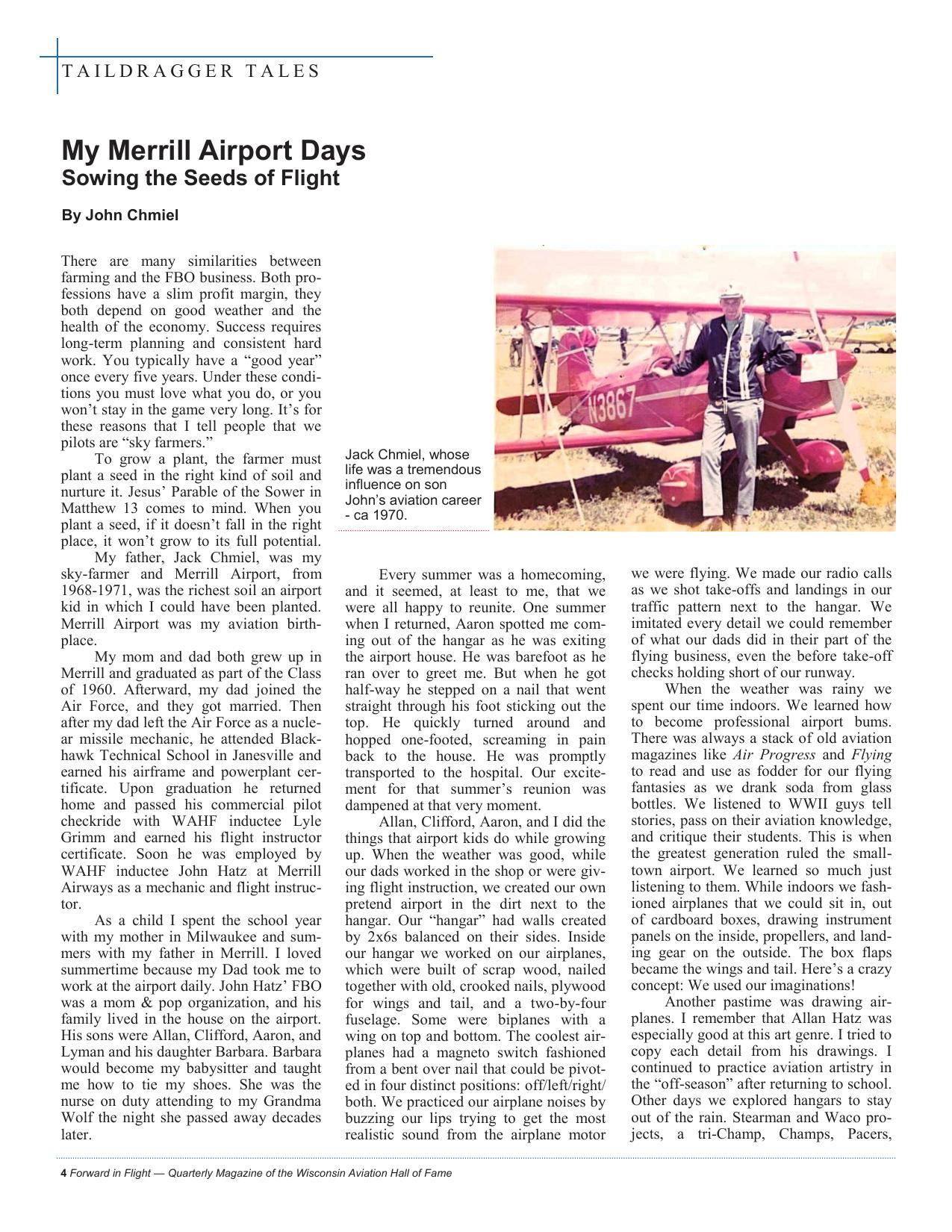
TAILDRAGGER TALES My Merrill Airport Days Sowing the Seeds of Flight By John Chmiel There are many similarities between farming and the FBO business. Both professions have a slim profit margin, they both depend on good weather and the health of the economy. Success requires long-term planning and consistent hard work. You typically have a “good year” once every five years. Under these conditions you must love what you do, or you won’t stay in the game very long. It’s for these reasons that I tell people that we pilots are “sky farmers.” To grow a plant, the farmer must plant a seed in the right kind of soil and nurture it. Jesus’ Parable of the Sower in Matthew 13 comes to mind. When you plant a seed, if it doesn’t fall in the right place, it won’t grow to its full potential. My father, Jack Chmiel, was my sky-farmer and Merrill Airport, from 1968-1971, was the richest soil an airport kid in which I could have been planted. Merrill Airport was my aviation birthplace. My mom and dad both grew up in Merrill and graduated as part of the Class of 1960. Afterward, my dad joined the Air Force, and they got married. Then after my dad left the Air Force as a nuclear missile mechanic, he attended Blackhawk Technical School in Janesville and earned his airframe and powerplant certificate. Upon graduation he returned home and passed his commercial pilot checkride with WAHF inductee Lyle Grimm and earned his flight instructor certificate. Soon he was employed by WAHF inductee John Hatz at Merrill Airways as a mechanic and flight instructor. As a child I spent the school year with my mother in Milwaukee and summers with my father in Merrill. I loved summertime because my Dad took me to work at the airport daily. John Hatz’ FBO was a mom & pop organization, and his family lived in the house on the airport. His sons were Allan, Clifford, Aaron, and Lyman and his daughter Barbara. Barbara would become my babysitter and taught me how to tie my shoes. She was the nurse on duty attending to my Grandma Wolf the night she passed away decades later. Jack Chmiel, whose life was a tremendous influence on son John’s aviation career - ca 1970. Every summer was a homecoming, and it seemed, at least to me, that we were all happy to reunite. One summer when I returned, Aaron spotted me coming out of the hangar as he was exiting the airport house. He was barefoot as he ran over to greet me. But when he got half-way he stepped on a nail that went straight through his foot sticking out the top. He quickly turned around and hopped one-footed, screaming in pain back to the house. He was promptly transported to the hospital. Our excitement for that summer’s reunion was dampened at that very moment. Allan, Clifford, Aaron, and I did the things that airport kids do while growing up. When the weather was good, while our dads worked in the shop or were giving flight instruction, we created our own pretend airport in the dirt next to the hangar. Our “hangar” had walls created by 2x6s balanced on their sides. Inside our hangar we worked on our airplanes, which were built of scrap wood, nailed together with old, crooked nails, plywood for wings and tail, and a two-by-four fuselage. Some were biplanes with a wing on top and bottom. The coolest airplanes had a magneto switch fashioned from a bent over nail that could be pivoted in four distinct positions: off/left/right/ both. We practiced our airplane noises by buzzing our lips trying to get the most realistic sound from the airplane motor 4 Forward in Flight — Quarterly Magazine of the Wisconsin Aviation Hall of Fame we were flying. We made our radio calls as we shot take-offs and landings in our traffic pattern next to the hangar. We imitated every detail we could remember of what our dads did in their part of the flying business, even the before take-off checks holding short of our runway. When the weather was rainy we spent our time indoors. We learned how to become professional airport bums. There was always a stack of old aviation magazines like Air Progress and Flying to read and use as fodder for our flying fantasies as we drank soda from glass bottles. We listened to WWII guys tell stories, pass on their aviation knowledge, and critique their students. This is when the greatest generation ruled the smalltown airport. We learned so much just listening to them. While indoors we fashioned airplanes that we could sit in, out of cardboard boxes, drawing instrument panels on the inside, propellers, and landing gear on the outside. The box flaps became the wings and tail. Here’s a crazy concept: We used our imaginations! Another pastime was drawing airplanes. I remember that Allan Hatz was especially good at this art genre. I tried to copy each detail from his drawings. I continued to practice aviation artistry in the “off-season” after returning to school. Other days we explored hangars to stay out of the rain. Stearman and Waco projects, a tri-Champ, Champs, Pacers,
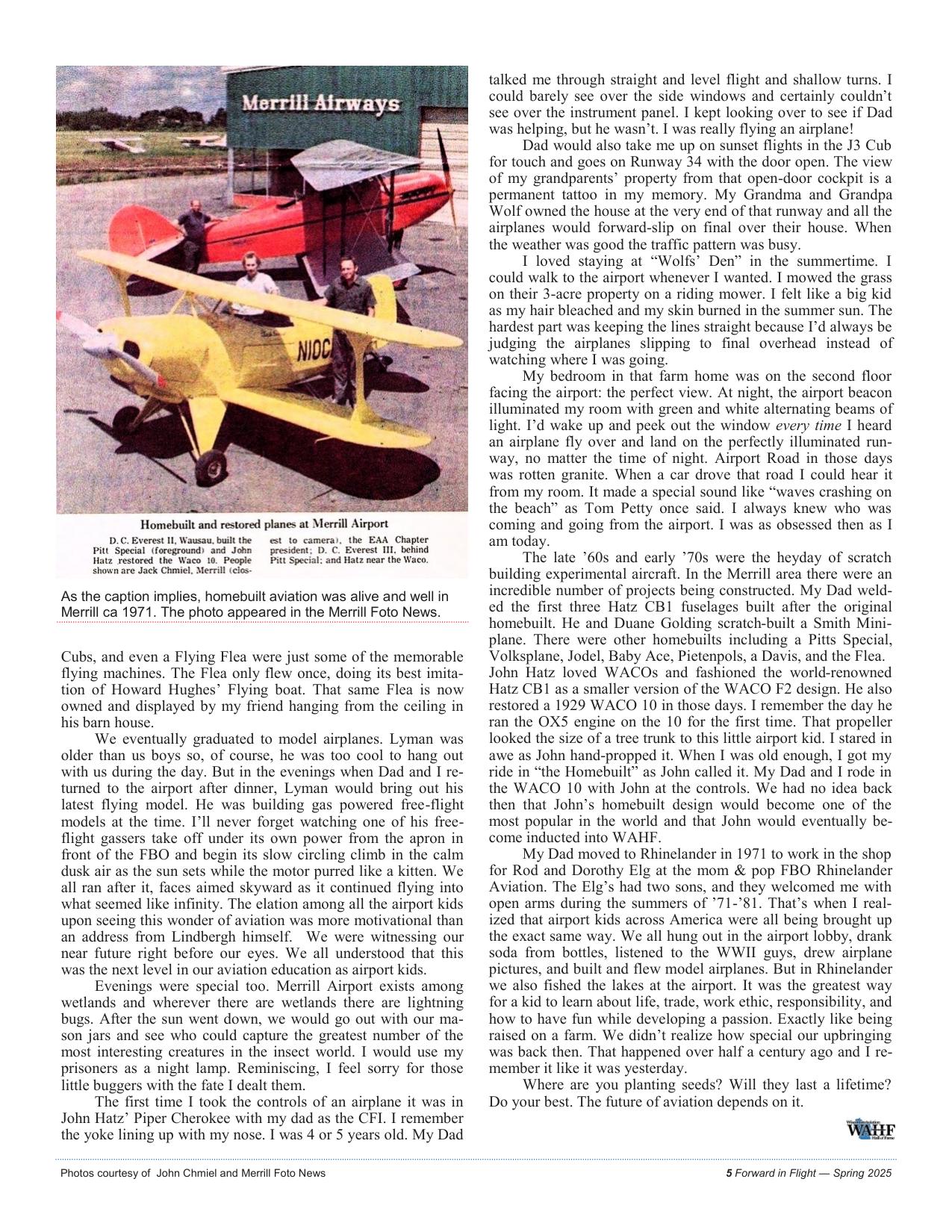
As the caption implies, homebuilt aviation was alive and well in Merrill ca 1971. The photo appeared in the Merrill Foto News. Cubs, and even a Flying Flea were just some of the memorable flying machines. The Flea only flew once, doing its best imitation of Howard Hughes’ Flying boat. That same Flea is now owned and displayed by my friend hanging from the ceiling in his barn house. We eventually graduated to model airplanes. Lyman was older than us boys so, of course, he was too cool to hang out with us during the day. But in the evenings when Dad and I returned to the airport after dinner, Lyman would bring out his latest flying model. He was building gas powered free-flight models at the time. I’ll never forget watching one of his freeflight gassers take off under its own power from the apron in front of the FBO and begin its slow circling climb in the calm dusk air as the sun sets while the motor purred like a kitten. We all ran after it, faces aimed skyward as it continued flying into what seemed like infinity. The elation among all the airport kids upon seeing this wonder of aviation was more motivational than an address from Lindbergh himself. We were witnessing our near future right before our eyes. We all understood that this was the next level in our aviation education as airport kids. Evenings were special too. Merrill Airport exists among wetlands and wherever there are wetlands there are lightning bugs. After the sun went down, we would go out with our mason jars and see who could capture the greatest number of the most interesting creatures in the insect world. I would use my prisoners as a night lamp. Reminiscing, I feel sorry for those little buggers with the fate I dealt them. The first time I took the controls of an airplane it was in John Hatz’ Piper Cherokee with my dad as the CFI. I remember the yoke lining up with my nose. I was 4 or 5 years old. My Dad Photos courtesy of John Chmiel and Merrill Foto News talked me through straight and level flight and shallow turns. I could barely see over the side windows and certainly couldn’t see over the instrument panel. I kept looking over to see if Dad was helping, but he wasn’t. I was really flying an airplane! Dad would also take me up on sunset flights in the J3 Cub for touch and goes on Runway 34 with the door open. The view of my grandparents’ property from that open-door cockpit is a permanent tattoo in my memory. My Grandma and Grandpa Wolf owned the house at the very end of that runway and all the airplanes would forward-slip on final over their house. When the weather was good the traffic pattern was busy. I loved staying at “Wolfs’ Den” in the summertime. I could walk to the airport whenever I wanted. I mowed the grass on their 3-acre property on a riding mower. I felt like a big kid as my hair bleached and my skin burned in the summer sun. The hardest part was keeping the lines straight because I’d always be judging the airplanes slipping to final overhead instead of watching where I was going. My bedroom in that farm home was on the second floor facing the airport: the perfect view. At night, the airport beacon illuminated my room with green and white alternating beams of light. I’d wake up and peek out the window every time I heard an airplane fly over and land on the perfectly illuminated runway, no matter the time of night. Airport Road in those days was rotten granite. When a car drove that road I could hear it from my room. It made a special sound like “waves crashing on the beach” as Tom Petty once said. I always knew who was coming and going from the airport. I was as obsessed then as I am today. The late ’60s and early ’70s were the heyday of scratch building experimental aircraft. In the Merrill area there were an incredible number of projects being constructed. My Dad welded the first three Hatz CB1 fuselages built after the original homebuilt. He and Duane Golding scratch-built a Smith Miniplane. There were other homebuilts including a Pitts Special, Volksplane, Jodel, Baby Ace, Pietenpols, a Davis, and the Flea. John Hatz loved WACOs and fashioned the world-renowned Hatz CB1 as a smaller version of the WACO F2 design. He also restored a 1929 WACO 10 in those days. I remember the day he ran the OX5 engine on the 10 for the first time. That propeller looked the size of a tree trunk to this little airport kid. I stared in awe as John hand-propped it. When I was old enough, I got my ride in “the Homebuilt” as John called it. My Dad and I rode in the WACO 10 with John at the controls. We had no idea back then that John’s homebuilt design would become one of the most popular in the world and that John would eventually become inducted into WAHF. My Dad moved to Rhinelander in 1971 to work in the shop for Rod and Dorothy Elg at the mom & pop FBO Rhinelander Aviation. The Elg’s had two sons, and they welcomed me with open arms during the summers of ’71-’81. That’s when I realized that airport kids across America were all being brought up the exact same way. We all hung out in the airport lobby, drank soda from bottles, listened to the WWII guys, drew airplane pictures, and built and flew model airplanes. But in Rhinelander we also fished the lakes at the airport. It was the greatest way for a kid to learn about life, trade, work ethic, responsibility, and how to have fun while developing a passion. Exactly like being raised on a farm. We didn’t realize how special our upbringing was back then. That happened over half a century ago and I remember it like it was yesterday. Where are you planting seeds? Will they last a lifetime? Do your best. The future of aviation depends on it. 5 Forward in Flight — Spring 2025
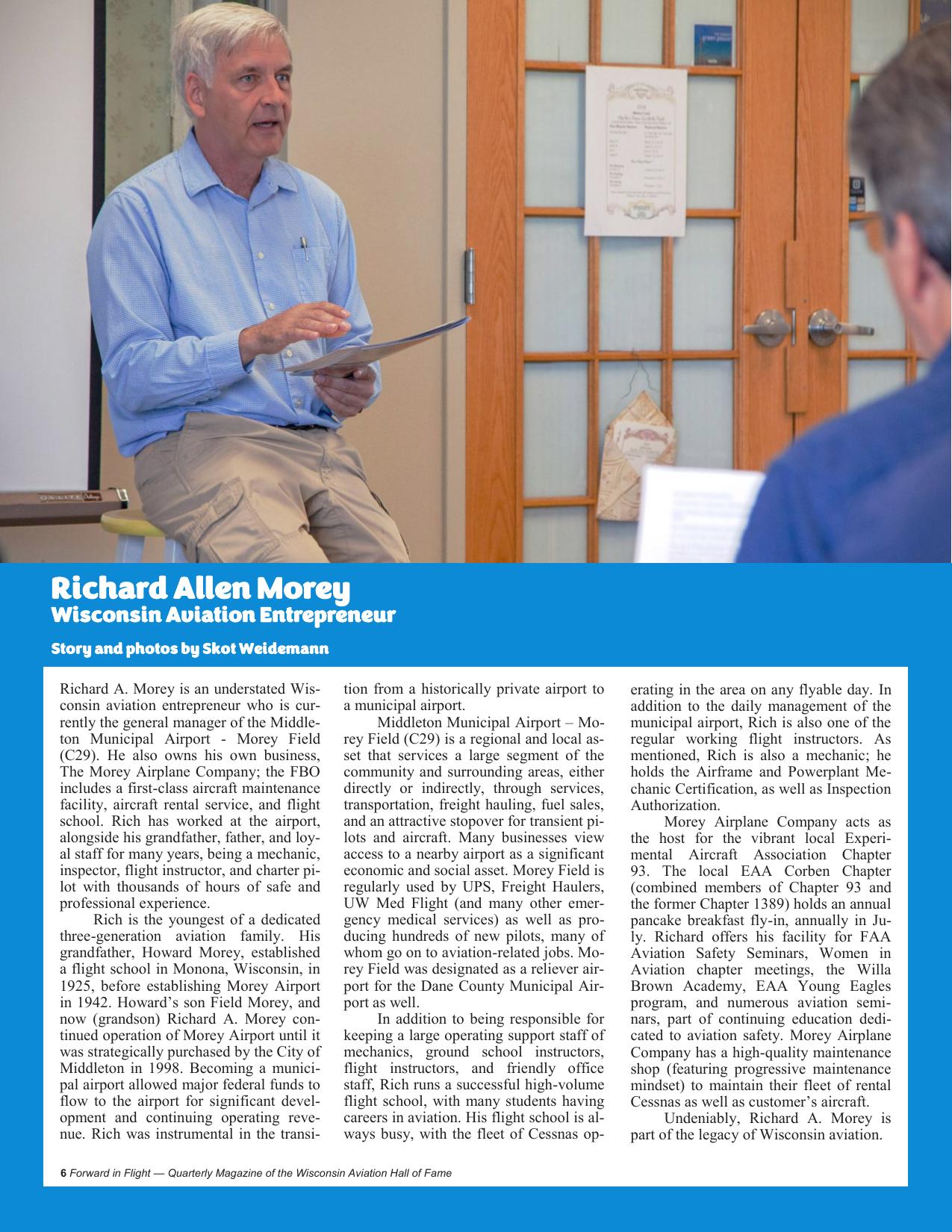
Richard Allen Morey Wisconsin Aviation Entrepreneur Story and photos by Skot Weidemann Richard A. Morey is an understated Wisconsin aviation entrepreneur who is currently the general manager of the Middleton Municipal Airport - Morey Field (C29). He also owns his own business, The Morey Airplane Company; the FBO includes a first-class aircraft maintenance facility, aircraft rental service, and flight school. Rich has worked at the airport, alongside his grandfather, father, and loyal staff for many years, being a mechanic, inspector, flight instructor, and charter pilot with thousands of hours of safe and professional experience. Rich is the youngest of a dedicated three-generation aviation family. His grandfather, Howard Morey, established a flight school in Monona, Wisconsin, in 1925, before establishing Morey Airport in 1942. Howard’s son Field Morey, and now (grandson) Richard A. Morey continued operation of Morey Airport until it was strategically purchased by the City of Middleton in 1998. Becoming a municipal airport allowed major federal funds to flow to the airport for significant development and continuing operating revenue. Rich was instrumental in the transi- tion from a historically private airport to a municipal airport. Middleton Municipal Airport – Morey Field (C29) is a regional and local asset that services a large segment of the community and surrounding areas, either directly or indirectly, through services, transportation, freight hauling, fuel sales, and an attractive stopover for transient pilots and aircraft. Many businesses view access to a nearby airport as a significant economic and social asset. Morey Field is regularly used by UPS, Freight Haulers, UW Med Flight (and many other emergency medical services) as well as producing hundreds of new pilots, many of whom go on to aviation-related jobs. Morey Field was designated as a reliever airport for the Dane County Municipal Airport as well. In addition to being responsible for keeping a large operating support staff of mechanics, ground school instructors, flight instructors, and friendly office staff, Rich runs a successful high-volume flight school, with many students having careers in aviation. His flight school is always busy, with the fleet of Cessnas op- 6 Forward in Flight — Quarterly Magazine of the Wisconsin Aviation Hall of Fame erating in the area on any flyable day. In addition to the daily management of the municipal airport, Rich is also one of the regular working flight instructors. As mentioned, Rich is also a mechanic; he holds the Airframe and Powerplant Mechanic Certification, as well as Inspection Authorization. Morey Airplane Company acts as the host for the vibrant local Experimental Aircraft Association Chapter 93. The local EAA Corben Chapter (combined members of Chapter 93 and the former Chapter 1389) holds an annual pancake breakfast fly-in, annually in July. Richard offers his facility for FAA Aviation Safety Seminars, Women in Aviation chapter meetings, the Willa Brown Academy, EAA Young Eagles program, and numerous aviation seminars, part of continuing education dedicated to aviation safety. Morey Airplane Company has a high-quality maintenance shop (featuring progressive maintenance mindset) to maintain their fleet of rental Cessnas as well as customer’s aircraft. Undeniably, Richard A. Morey is part of the legacy of Wisconsin aviation.
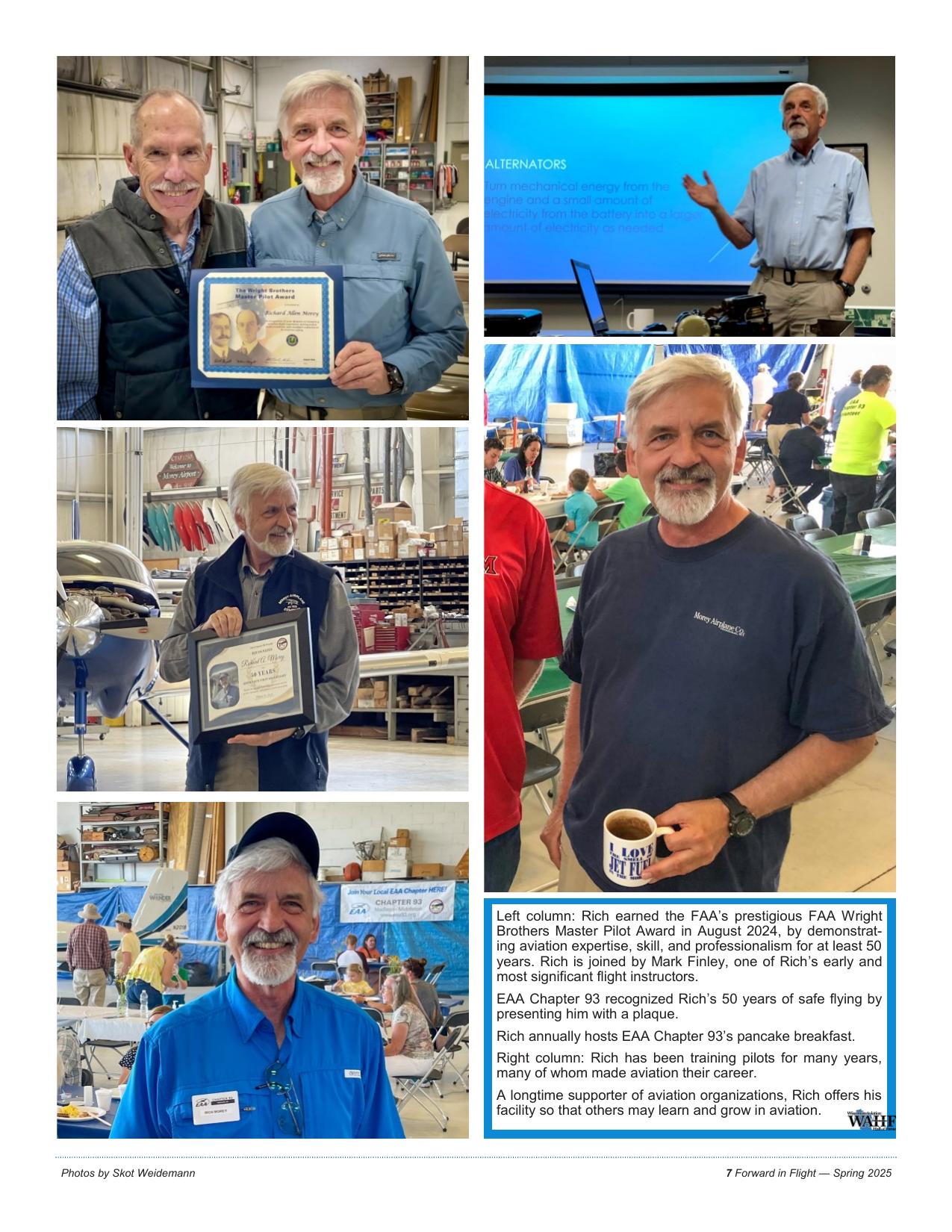
Left column: Rich earned the FAA’s prestigious FAA Wright Brothers Master Pilot Award in August 2024, by demonstrating aviation expertise, skill, and professionalism for at least 50 years. Rich is joined by Mark Finley, one of Rich’s early and most significant flight instructors. EAA Chapter 93 recognized Rich’s 50 years of safe flying by presenting him with a plaque. Rich annually hosts EAA Chapter 93’s pancake breakfast. Right column: Rich has been training pilots for many years, many of whom made aviation their career. A longtime supporter of aviation organizations, Rich offers his facility so that others may learn and grow in aviation. Photos by Skot Weidemann 7 Forward in Flight — Spring 2025
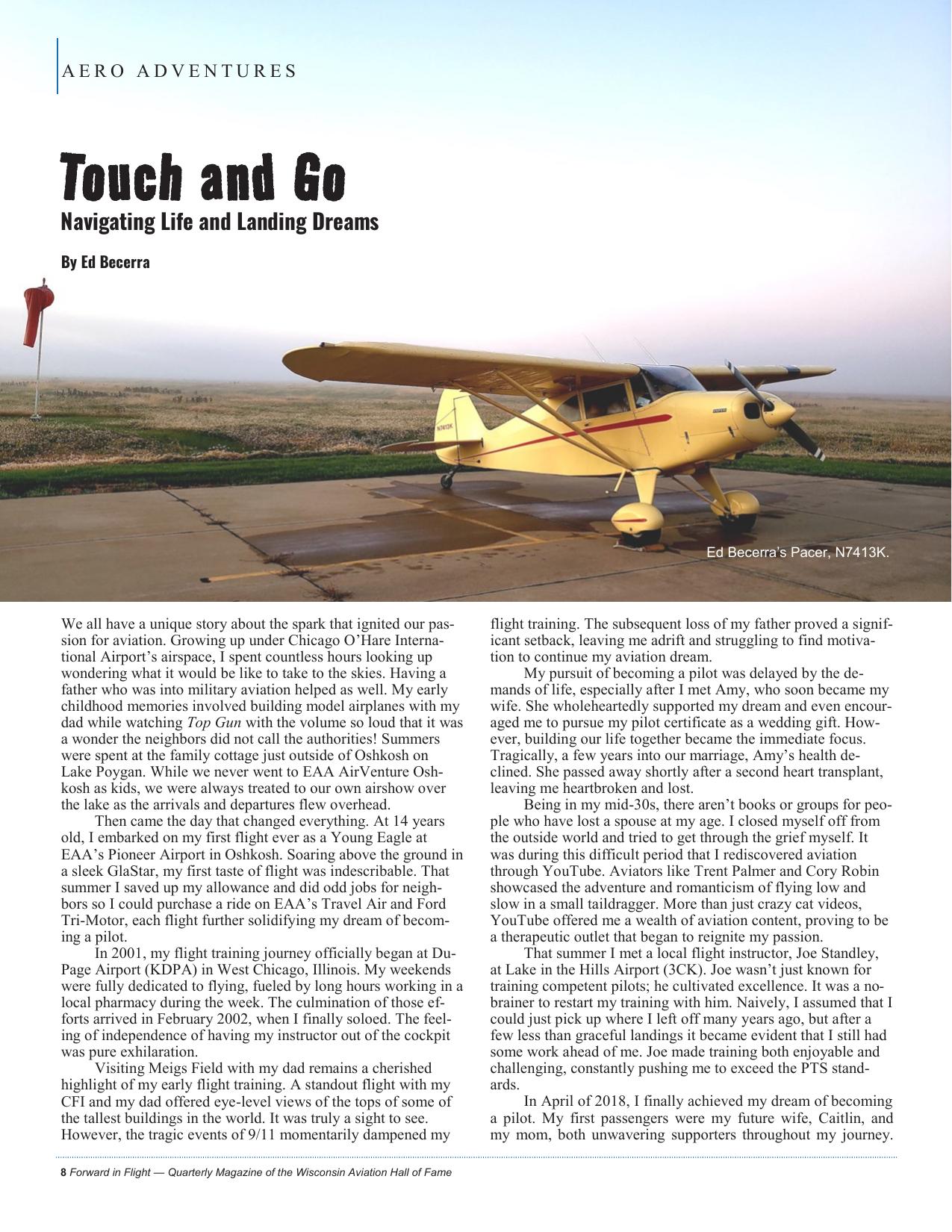
AERO ADVENTURES Touch and Go Navigating Life and Landing Dreams By Ed Becerra Ed Becerra’s Pacer, N7413K. We all have a unique story about the spark that ignited our passion for aviation. Growing up under Chicago O’Hare International Airport’s airspace, I spent countless hours looking up wondering what it would be like to take to the skies. Having a father who was into military aviation helped as well. My early childhood memories involved building model airplanes with my dad while watching Top Gun with the volume so loud that it was a wonder the neighbors did not call the authorities! Summers were spent at the family cottage just outside of Oshkosh on Lake Poygan. While we never went to EAA AirVenture Oshkosh as kids, we were always treated to our own airshow over the lake as the arrivals and departures flew overhead. Then came the day that changed everything. At 14 years old, I embarked on my first flight ever as a Young Eagle at EAA’s Pioneer Airport in Oshkosh. Soaring above the ground in a sleek GlaStar, my first taste of flight was indescribable. That summer I saved up my allowance and did odd jobs for neighbors so I could purchase a ride on EAA’s Travel Air and Ford Tri-Motor, each flight further solidifying my dream of becoming a pilot. In 2001, my flight training journey officially began at DuPage Airport (KDPA) in West Chicago, Illinois. My weekends were fully dedicated to flying, fueled by long hours working in a local pharmacy during the week. The culmination of those efforts arrived in February 2002, when I finally soloed. The feeling of independence of having my instructor out of the cockpit was pure exhilaration. Visiting Meigs Field with my dad remains a cherished highlight of my early flight training. A standout flight with my CFI and my dad offered eye-level views of the tops of some of the tallest buildings in the world. It was truly a sight to see. However, the tragic events of 9/11 momentarily dampened my 8 Forward in Flight — Quarterly Magazine of the Wisconsin Aviation Hall of Fame flight training. The subsequent loss of my father proved a significant setback, leaving me adrift and struggling to find motivation to continue my aviation dream. My pursuit of becoming a pilot was delayed by the demands of life, especially after I met Amy, who soon became my wife. She wholeheartedly supported my dream and even encouraged me to pursue my pilot certificate as a wedding gift. However, building our life together became the immediate focus. Tragically, a few years into our marriage, Amy’s health declined. She passed away shortly after a second heart transplant, leaving me heartbroken and lost. Being in my mid-30s, there aren’t books or groups for people who have lost a spouse at my age. I closed myself off from the outside world and tried to get through the grief myself. It was during this difficult period that I rediscovered aviation through YouTube. Aviators like Trent Palmer and Cory Robin showcased the adventure and romanticism of flying low and slow in a small taildragger. More than just crazy cat videos, YouTube offered me a wealth of aviation content, proving to be a therapeutic outlet that began to reignite my passion. That summer I met a local flight instructor, Joe Standley, at Lake in the Hills Airport (3CK). Joe wasn’t just known for training competent pilots; he cultivated excellence. It was a nobrainer to restart my training with him. Naively, I assumed that I could just pick up where I left off many years ago, but after a few less than graceful landings it became evident that I still had some work ahead of me. Joe made training both enjoyable and challenging, constantly pushing me to exceed the PTS standards. In April of 2018, I finally achieved my dream of becoming a pilot. My first passengers were my future wife, Caitlin, and my mom, both unwavering supporters throughout my journey.
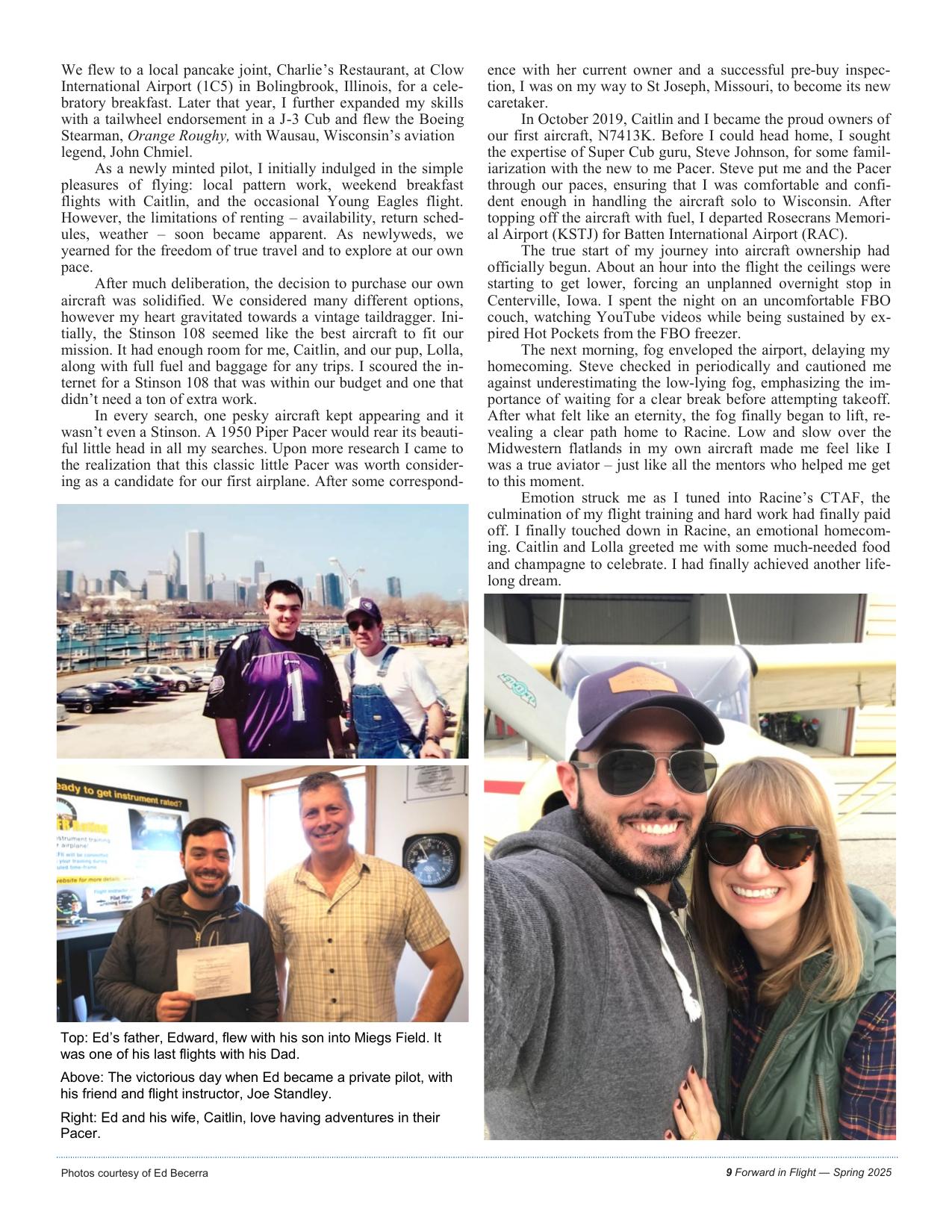
We flew to a local pancake joint, Charlie’s Restaurant, at Clow International Airport (1C5) in Bolingbrook, Illinois, for a celebratory breakfast. Later that year, I further expanded my skills with a tailwheel endorsement in a J-3 Cub and flew the Boeing Stearman, Orange Roughy, with Wausau, Wisconsin’s aviation legend, John Chmiel. As a newly minted pilot, I initially indulged in the simple pleasures of flying: local pattern work, weekend breakfast flights with Caitlin, and the occasional Young Eagles flight. However, the limitations of renting – availability, return schedules, weather – soon became apparent. As newlyweds, we yearned for the freedom of true travel and to explore at our own pace. After much deliberation, the decision to purchase our own aircraft was solidified. We considered many different options, however my heart gravitated towards a vintage taildragger. Initially, the Stinson 108 seemed like the best aircraft to fit our mission. It had enough room for me, Caitlin, and our pup, Lolla, along with full fuel and baggage for any trips. I scoured the internet for a Stinson 108 that was within our budget and one that didn’t need a ton of extra work. In every search, one pesky aircraft kept appearing and it wasn’t even a Stinson. A 1950 Piper Pacer would rear its beautiful little head in all my searches. Upon more research I came to the realization that this classic little Pacer was worth considering as a candidate for our first airplane. After some correspond- ence with her current owner and a successful pre-buy inspection, I was on my way to St Joseph, Missouri, to become its new caretaker. In October 2019, Caitlin and I became the proud owners of our first aircraft, N7413K. Before I could head home, I sought the expertise of Super Cub guru, Steve Johnson, for some familiarization with the new to me Pacer. Steve put me and the Pacer through our paces, ensuring that I was comfortable and confident enough in handling the aircraft solo to Wisconsin. After topping off the aircraft with fuel, I departed Rosecrans Memorial Airport (KSTJ) for Batten International Airport (RAC). The true start of my journey into aircraft ownership had officially begun. About an hour into the flight the ceilings were starting to get lower, forcing an unplanned overnight stop in Centerville, Iowa. I spent the night on an uncomfortable FBO couch, watching YouTube videos while being sustained by expired Hot Pockets from the FBO freezer. The next morning, fog enveloped the airport, delaying my homecoming. Steve checked in periodically and cautioned me against underestimating the low-lying fog, emphasizing the importance of waiting for a clear break before attempting takeoff. After what felt like an eternity, the fog finally began to lift, revealing a clear path home to Racine. Low and slow over the Midwestern flatlands in my own aircraft made me feel like I was a true aviator – just like all the mentors who helped me get to this moment. Emotion struck me as I tuned into Racine’s CTAF, the culmination of my flight training and hard work had finally paid off. I finally touched down in Racine, an emotional homecoming. Caitlin and Lolla greeted me with some much-needed food and champagne to celebrate. I had finally achieved another lifelong dream. Top: Ed’s father, Edward, flew with his son into Miegs Field. It was one of his last flights with his Dad. Above: The victorious day when Ed became a private pilot, with his friend and flight instructor, Joe Standley. Right: Ed and his wife, Caitlin, love having adventures in their Pacer. Photos courtesy of Ed Becerra 9 Forward in Flight — Spring 2025
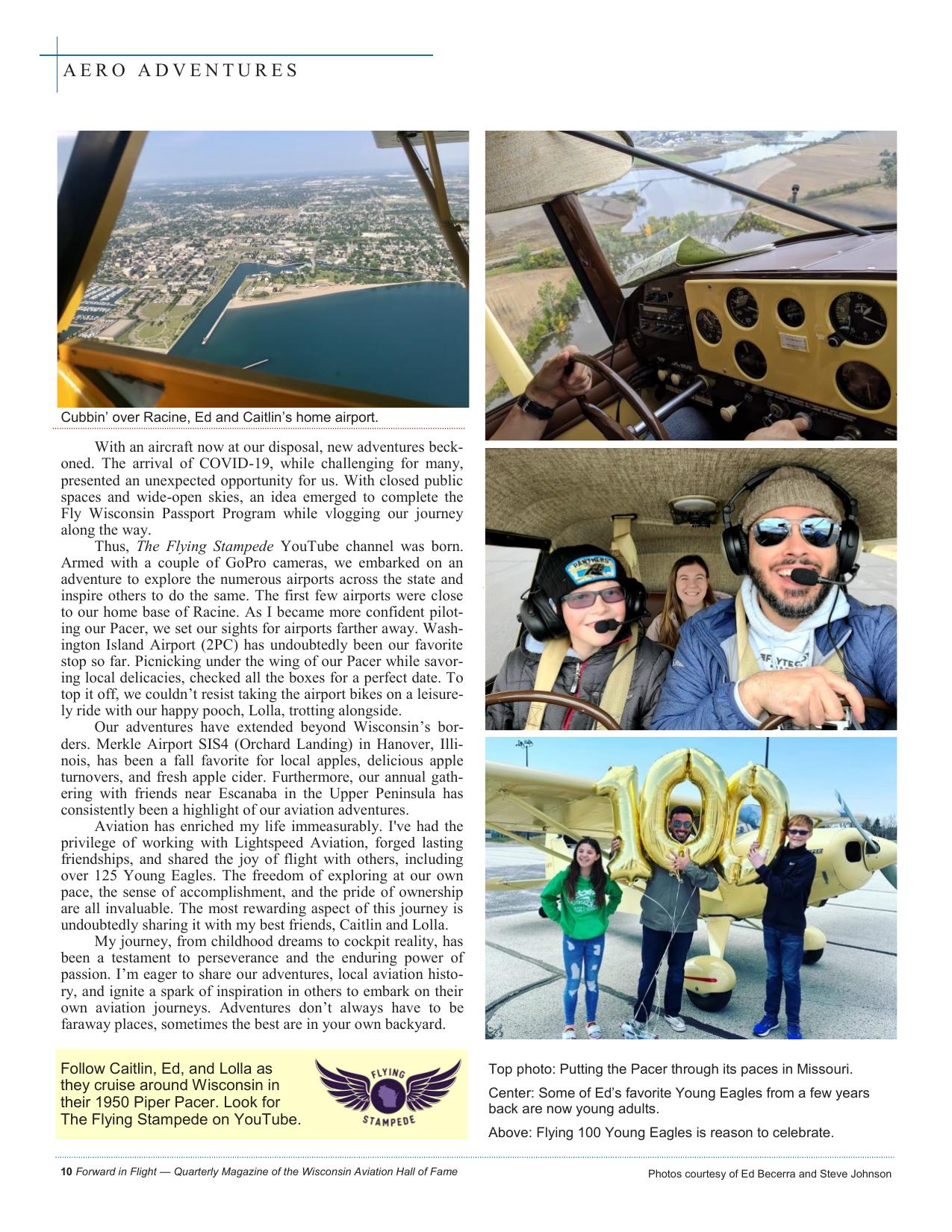
AERO ADVENTURES Cubbin’ over Racine, Ed and Caitlin’s home airport. With an aircraft now at our disposal, new adventures beckoned. The arrival of COVID-19, while challenging for many, presented an unexpected opportunity for us. With closed public spaces and wide-open skies, an idea emerged to complete the Fly Wisconsin Passport Program while vlogging our journey along the way. Thus, The Flying Stampede YouTube channel was born. Armed with a couple of GoPro cameras, we embarked on an adventure to explore the numerous airports across the state and inspire others to do the same. The first few airports were close to our home base of Racine. As I became more confident piloting our Pacer, we set our sights for airports farther away. Washington Island Airport (2PC) has undoubtedly been our favorite stop so far. Picnicking under the wing of our Pacer while savoring local delicacies, checked all the boxes for a perfect date. To top it off, we couldn’t resist taking the airport bikes on a leisurely ride with our happy pooch, Lolla, trotting alongside. Our adventures have extended beyond Wisconsin’s borders. Merkle Airport SIS4 (Orchard Landing) in Hanover, Illinois, has been a fall favorite for local apples, delicious apple turnovers, and fresh apple cider. Furthermore, our annual gathering with friends near Escanaba in the Upper Peninsula has consistently been a highlight of our aviation adventures. Aviation has enriched my life immeasurably. I've had the privilege of working with Lightspeed Aviation, forged lasting friendships, and shared the joy of flight with others, including over 125 Young Eagles. The freedom of exploring at our own pace, the sense of accomplishment, and the pride of ownership are all invaluable. The most rewarding aspect of this journey is undoubtedly sharing it with my best friends, Caitlin and Lolla. My journey, from childhood dreams to cockpit reality, has been a testament to perseverance and the enduring power of passion. I’m eager to share our adventures, local aviation history, and ignite a spark of inspiration in others to embark on their own aviation journeys. Adventures don’t always have to be faraway places, sometimes the best are in your own backyard. Follow Caitlin, Ed, and Lolla as they cruise around Wisconsin in their 1950 Piper Pacer. Look for The Flying Stampede on YouTube. 10 Forward in Flight — Quarterly Magazine of the Wisconsin Aviation Hall of Fame Top photo: Putting the Pacer through its paces in Missouri. Center: Some of Ed’s favorite Young Eagles from a few years back are now young adults. Above: Flying 100 Young Eagles is reason to celebrate. Photos courtesy of Ed Becerra and Steve Johnson
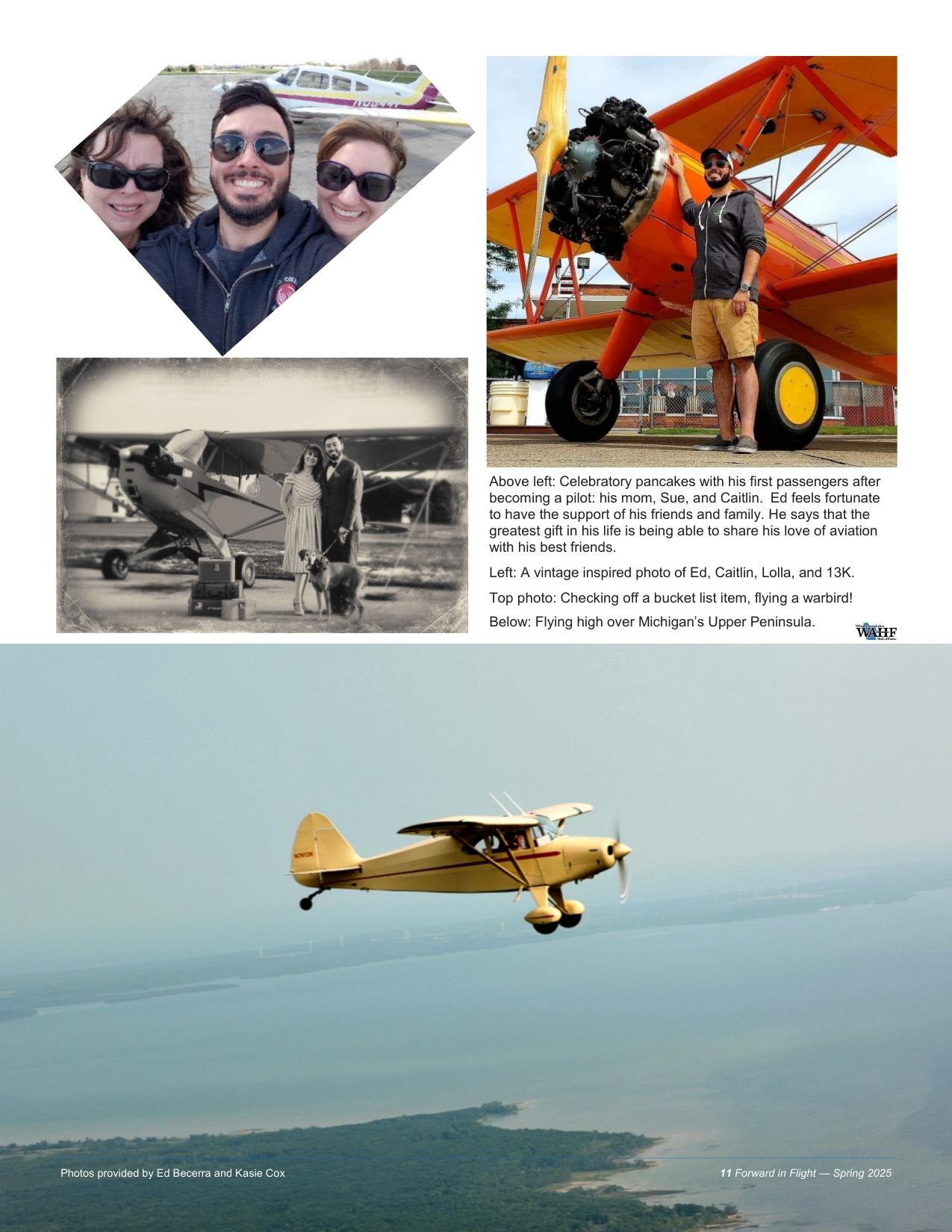
Above left: Celebratory pancakes with his first passengers after becoming a pilot: his mom, Sue, and Caitlin. Ed feels fortunate to have the support of his friends and family. He says that the greatest gift in his life is being able to share his love of aviation with his best friends. Left: A vintage inspired photo of Ed, Caitlin, Lolla, and 13K. Top photo: Checking off a bucket list item, flying a warbird! Below: Flying high over Michigan’s Upper Peninsula. Photos provided by Ed Becerra and Kasie Cox 11 Forward in Flight — Spring 2025
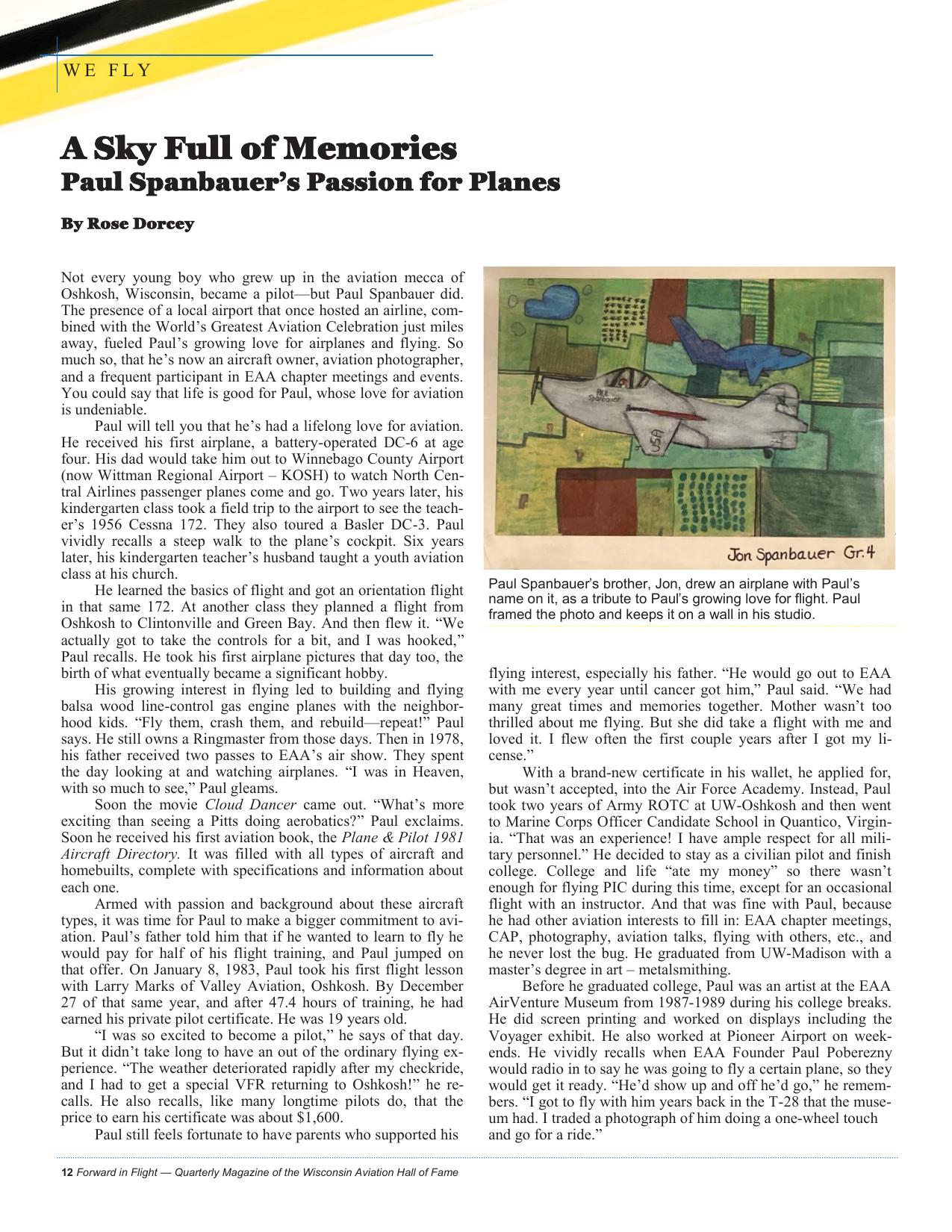
WE FLY A Sky Full of Memories Paul Spanbauer’s Passion for Planes By Rose Dorcey Not every young boy who grew up in the aviation mecca of Oshkosh, Wisconsin, became a pilot—but Paul Spanbauer did. The presence of a local airport that once hosted an airline, combined with the World’s Greatest Aviation Celebration just miles away, fueled Paul’s growing love for airplanes and flying. So much so, that he’s now an aircraft owner, aviation photographer, and a frequent participant in EAA chapter meetings and events. You could say that life is good for Paul, whose love for aviation is undeniable. Paul will tell you that he’s had a lifelong love for aviation. He received his first airplane, a battery-operated DC-6 at age four. His dad would take him out to Winnebago County Airport (now Wittman Regional Airport – KOSH) to watch North Central Airlines passenger planes come and go. Two years later, his kindergarten class took a field trip to the airport to see the teacher’s 1956 Cessna 172. They also toured a Basler DC-3. Paul vividly recalls a steep walk to the plane’s cockpit. Six years later, his kindergarten teacher’s husband taught a youth aviation class at his church. He learned the basics of flight and got an orientation flight in that same 172. At another class they planned a flight from Oshkosh to Clintonville and Green Bay. And then flew it. “We actually got to take the controls for a bit, and I was hooked,” Paul recalls. He took his first airplane pictures that day too, the birth of what eventually became a significant hobby. His growing interest in flying led to building and flying balsa wood line-control gas engine planes with the neighborhood kids. “Fly them, crash them, and rebuild—repeat!” Paul says. He still owns a Ringmaster from those days. Then in 1978, his father received two passes to EAA’s air show. They spent the day looking at and watching airplanes. “I was in Heaven, with so much to see,” Paul gleams. Soon the movie Cloud Dancer came out. “What’s more exciting than seeing a Pitts doing aerobatics?” Paul exclaims. Soon he received his first aviation book, the Plane & Pilot 1981 Aircraft Directory. It was filled with all types of aircraft and homebuilts, complete with specifications and information about each one. Armed with passion and background about these aircraft types, it was time for Paul to make a bigger commitment to aviation. Paul’s father told him that if he wanted to learn to fly he would pay for half of his flight training, and Paul jumped on that offer. On January 8, 1983, Paul took his first flight lesson with Larry Marks of Valley Aviation, Oshkosh. By December 27 of that same year, and after 47.4 hours of training, he had earned his private pilot certificate. He was 19 years old. “I was so excited to become a pilot,” he says of that day. But it didn’t take long to have an out of the ordinary flying experience. “The weather deteriorated rapidly after my checkride, and I had to get a special VFR returning to Oshkosh!” he recalls. He also recalls, like many longtime pilots do, that the price to earn his certificate was about $1,600. Paul still feels fortunate to have parents who supported his 12 Forward in Flight — Quarterly Magazine of the Wisconsin Aviation Hall of Fame Paul Spanbauer’s brother, Jon, drew an airplane with Paul’s name on it, as a tribute to Paul’s growing love for flight. Paul framed the photo and keeps it on a wall in his studio. flying interest, especially his father. “He would go out to EAA with me every year until cancer got him,” Paul said. “We had many great times and memories together. Mother wasn’t too thrilled about me flying. But she did take a flight with me and loved it. I flew often the first couple years after I got my license.” With a brand-new certificate in his wallet, he applied for, but wasn’t accepted, into the Air Force Academy. Instead, Paul took two years of Army ROTC at UW-Oshkosh and then went to Marine Corps Officer Candidate School in Quantico, Virginia. “That was an experience! I have ample respect for all military personnel.” He decided to stay as a civilian pilot and finish college. College and life “ate my money” so there wasn’t enough for flying PIC during this time, except for an occasional flight with an instructor. And that was fine with Paul, because he had other aviation interests to fill in: EAA chapter meetings, CAP, photography, aviation talks, flying with others, etc., and he never lost the bug. He graduated from UW-Madison with a master’s degree in art – metalsmithing. Before he graduated college, Paul was an artist at the EAA AirVenture Museum from 1987-1989 during his college breaks. He did screen printing and worked on displays including the Voyager exhibit. He also worked at Pioneer Airport on weekends. He vividly recalls when EAA Founder Paul Poberezny would radio in to say he was going to fly a certain plane, so they would get it ready. “He’d show up and off he’d go,” he remembers. “I got to fly with him years back in the T-28 that the museum had. I traded a photograph of him doing a one-wheel touch and go for a ride.”
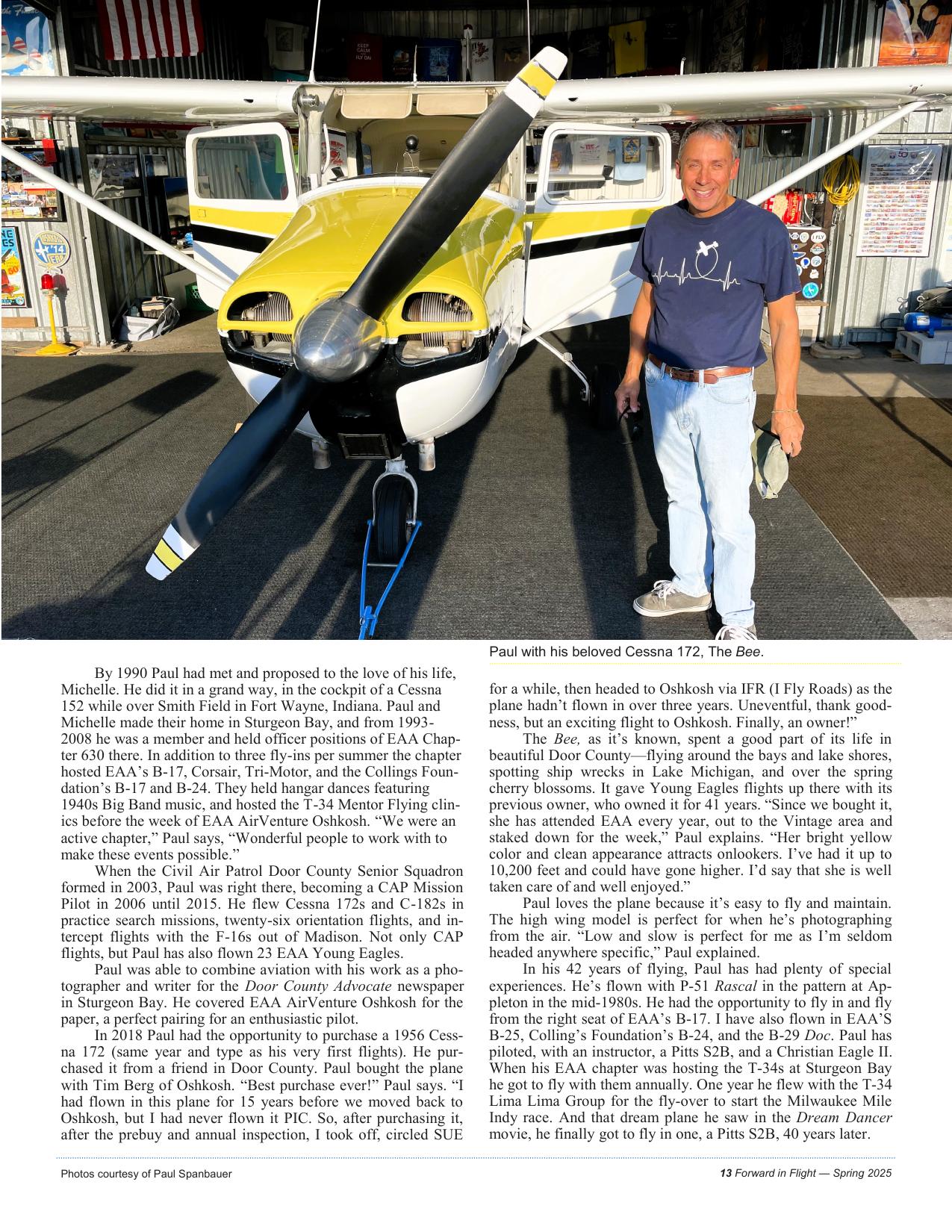
Paul with his beloved Cessna 172, The Bee. By 1990 Paul had met and proposed to the love of his life, Michelle. He did it in a grand way, in the cockpit of a Cessna 152 while over Smith Field in Fort Wayne, Indiana. Paul and Michelle made their home in Sturgeon Bay, and from 19932008 he was a member and held officer positions of EAA Chapter 630 there. In addition to three fly-ins per summer the chapter hosted EAA’s B-17, Corsair, Tri-Motor, and the Collings Foundation’s B-17 and B-24. They held hangar dances featuring 1940s Big Band music, and hosted the T-34 Mentor Flying clinics before the week of EAA AirVenture Oshkosh. “We were an active chapter,” Paul says, “Wonderful people to work with to make these events possible.” When the Civil Air Patrol Door County Senior Squadron formed in 2003, Paul was right there, becoming a CAP Mission Pilot in 2006 until 2015. He flew Cessna 172s and C-182s in practice search missions, twenty-six orientation flights, and intercept flights with the F-16s out of Madison. Not only CAP flights, but Paul has also flown 23 EAA Young Eagles. Paul was able to combine aviation with his work as a photographer and writer for the Door County Advocate newspaper in Sturgeon Bay. He covered EAA AirVenture Oshkosh for the paper, a perfect pairing for an enthusiastic pilot. In 2018 Paul had the opportunity to purchase a 1956 Cessna 172 (same year and type as his very first flights). He purchased it from a friend in Door County. Paul bought the plane with Tim Berg of Oshkosh. “Best purchase ever!” Paul says. “I had flown in this plane for 15 years before we moved back to Oshkosh, but I had never flown it PIC. So, after purchasing it, after the prebuy and annual inspection, I took off, circled SUE Photos courtesy of Paul Spanbauer for a while, then headed to Oshkosh via IFR (I Fly Roads) as the plane hadn’t flown in over three years. Uneventful, thank goodness, but an exciting flight to Oshkosh. Finally, an owner!” The Bee, as it’s known, spent a good part of its life in beautiful Door County—flying around the bays and lake shores, spotting ship wrecks in Lake Michigan, and over the spring cherry blossoms. It gave Young Eagles flights up there with its previous owner, who owned it for 41 years. “Since we bought it, she has attended EAA every year, out to the Vintage area and staked down for the week,” Paul explains. “Her bright yellow color and clean appearance attracts onlookers. I’ve had it up to 10,200 feet and could have gone higher. I’d say that she is well taken care of and well enjoyed.” Paul loves the plane because it’s easy to fly and maintain. The high wing model is perfect for when he’s photographing from the air. “Low and slow is perfect for me as I’m seldom headed anywhere specific,” Paul explained. In his 42 years of flying, Paul has had plenty of special experiences. He’s flown with P-51 Rascal in the pattern at Appleton in the mid-1980s. He had the opportunity to fly in and fly from the right seat of EAA’s B-17. I have also flown in EAA’S B-25, Colling’s Foundation’s B-24, and the B-29 Doc. Paul has piloted, with an instructor, a Pitts S2B, and a Christian Eagle II. When his EAA chapter was hosting the T-34s at Sturgeon Bay he got to fly with them annually. One year he flew with the T-34 Lima Lima Group for the fly-over to start the Milwaukee Mile Indy race. And that dream plane he saw in the Dream Dancer movie, he finally got to fly in one, a Pitts S2B, 40 years later. 13 Forward in Flight — Spring 2025
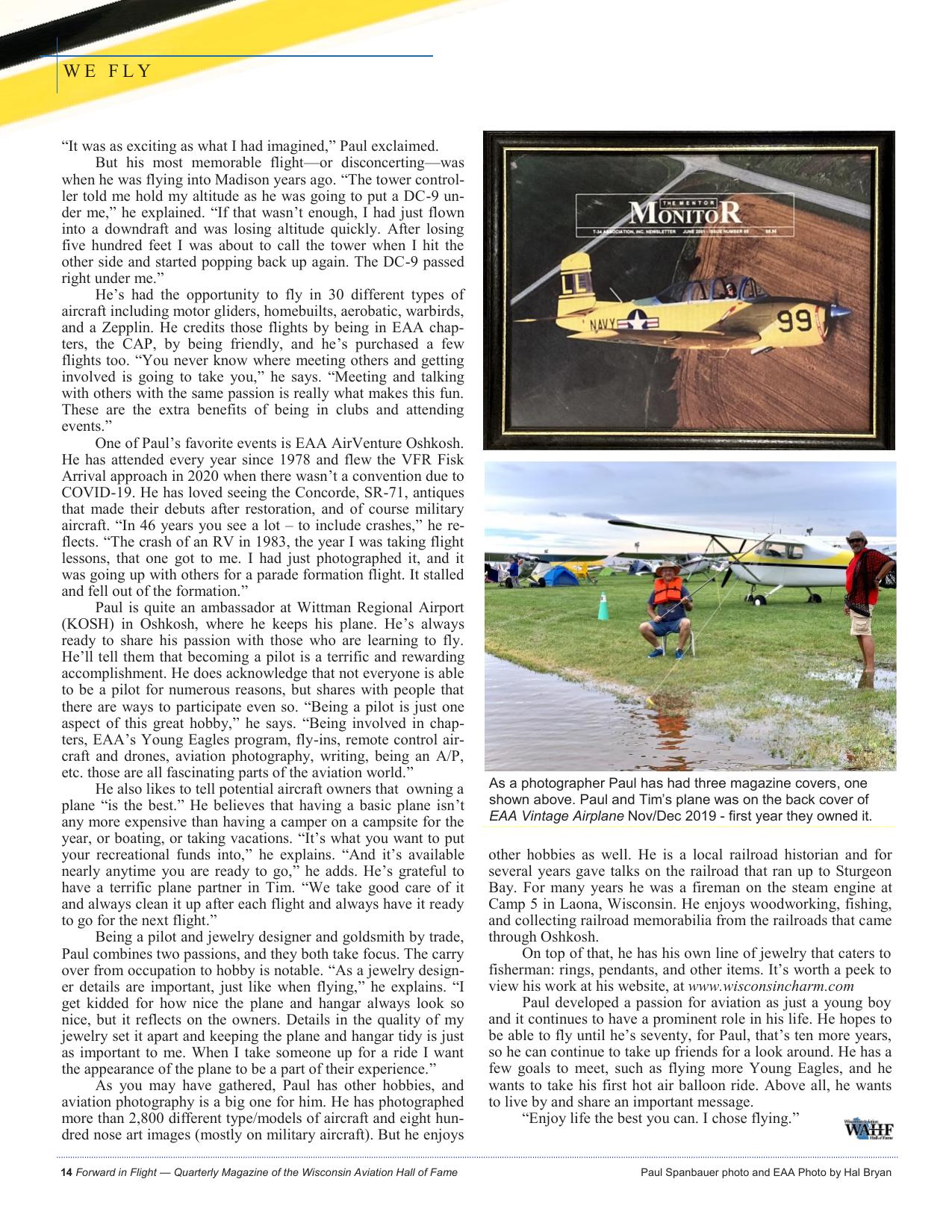
WE FLY “It was as exciting as what I had imagined,” Paul exclaimed. But his most memorable flight—or disconcerting—was when he was flying into Madison years ago. “The tower controller told me hold my altitude as he was going to put a DC-9 under me,” he explained. “If that wasn’t enough, I had just flown into a downdraft and was losing altitude quickly. After losing five hundred feet I was about to call the tower when I hit the other side and started popping back up again. The DC-9 passed right under me.” He’s had the opportunity to fly in 30 different types of aircraft including motor gliders, homebuilts, aerobatic, warbirds, and a Zepplin. He credits those flights by being in EAA chapters, the CAP, by being friendly, and he’s purchased a few flights too. “You never know where meeting others and getting involved is going to take you,” he says. “Meeting and talking with others with the same passion is really what makes this fun. These are the extra benefits of being in clubs and attending events.” One of Paul’s favorite events is EAA AirVenture Oshkosh. He has attended every year since 1978 and flew the VFR Fisk Arrival approach in 2020 when there wasn’t a convention due to COVID-19. He has loved seeing the Concorde, SR-71, antiques that made their debuts after restoration, and of course military aircraft. “In 46 years you see a lot – to include crashes,” he reflects. “The crash of an RV in 1983, the year I was taking flight lessons, that one got to me. I had just photographed it, and it was going up with others for a parade formation flight. It stalled and fell out of the formation.” Paul is quite an ambassador at Wittman Regional Airport (KOSH) in Oshkosh, where he keeps his plane. He’s always ready to share his passion with those who are learning to fly. He’ll tell them that becoming a pilot is a terrific and rewarding accomplishment. He does acknowledge that not everyone is able to be a pilot for numerous reasons, but shares with people that there are ways to participate even so. “Being a pilot is just one aspect of this great hobby,” he says. “Being involved in chapters, EAA’s Young Eagles program, fly-ins, remote control aircraft and drones, aviation photography, writing, being an A/P, etc. those are all fascinating parts of the aviation world.” He also likes to tell potential aircraft owners that owning a plane “is the best.” He believes that having a basic plane isn’t any more expensive than having a camper on a campsite for the year, or boating, or taking vacations. “It’s what you want to put your recreational funds into,” he explains. “And it’s available nearly anytime you are ready to go,” he adds. He’s grateful to have a terrific plane partner in Tim. “We take good care of it and always clean it up after each flight and always have it ready to go for the next flight.” Being a pilot and jewelry designer and goldsmith by trade, Paul combines two passions, and they both take focus. The carry over from occupation to hobby is notable. “As a jewelry designer details are important, just like when flying,” he explains. “I get kidded for how nice the plane and hangar always look so nice, but it reflects on the owners. Details in the quality of my jewelry set it apart and keeping the plane and hangar tidy is just as important to me. When I take someone up for a ride I want the appearance of the plane to be a part of their experience.” As you may have gathered, Paul has other hobbies, and aviation photography is a big one for him. He has photographed more than 2,800 different type/models of aircraft and eight hundred nose art images (mostly on military aircraft). But he enjoys 14 Forward in Flight — Quarterly Magazine of the Wisconsin Aviation Hall of Fame As a photographer Paul has had three magazine covers, one shown above. Paul and Tim’s plane was on the back cover of EAA Vintage Airplane Nov/Dec 2019 - first year they owned it. other hobbies as well. He is a local railroad historian and for several years gave talks on the railroad that ran up to Sturgeon Bay. For many years he was a fireman on the steam engine at Camp 5 in Laona, Wisconsin. He enjoys woodworking, fishing, and collecting railroad memorabilia from the railroads that came through Oshkosh. On top of that, he has his own line of jewelry that caters to fisherman: rings, pendants, and other items. It’s worth a peek to view his work at his website, at www.wisconsincharm.com Paul developed a passion for aviation as just a young boy and it continues to have a prominent role in his life. He hopes to be able to fly until he’s seventy, for Paul, that’s ten more years, so he can continue to take up friends for a look around. He has a few goals to meet, such as flying more Young Eagles, and he wants to take his first hot air balloon ride. Above all, he wants to live by and share an important message. “Enjoy life the best you can. I chose flying.” Paul Spanbauer photo and EAA Photo by Hal Bryan
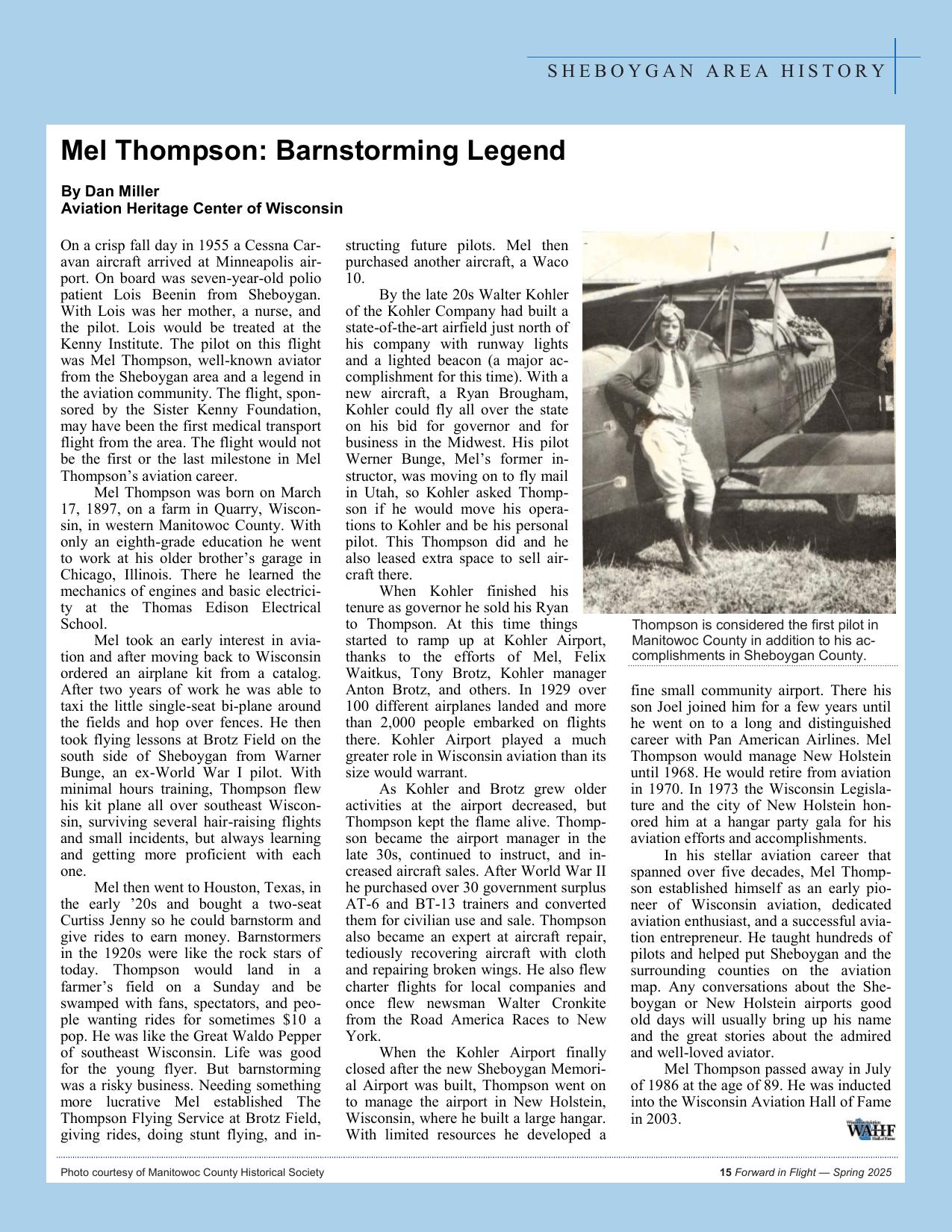
SHEBOYGAN AREA HISTORY Mel Thompson: Barnstorming Legend By Dan Miller Aviation Heritage Center of Wisconsin On a crisp fall day in 1955 a Cessna Caravan aircraft arrived at Minneapolis airport. On board was seven-year-old polio patient Lois Beenin from Sheboygan. With Lois was her mother, a nurse, and the pilot. Lois would be treated at the Kenny Institute. The pilot on this flight was Mel Thompson, well-known aviator from the Sheboygan area and a legend in the aviation community. The flight, sponsored by the Sister Kenny Foundation, may have been the first medical transport flight from the area. The flight would not be the first or the last milestone in Mel Thompson’s aviation career. Mel Thompson was born on March 17, 1897, on a farm in Quarry, Wisconsin, in western Manitowoc County. With only an eighth-grade education he went to work at his older brother’s garage in Chicago, Illinois. There he learned the mechanics of engines and basic electricity at the Thomas Edison Electrical School. Mel took an early interest in aviation and after moving back to Wisconsin ordered an airplane kit from a catalog. After two years of work he was able to taxi the little single-seat bi-plane around the fields and hop over fences. He then took flying lessons at Brotz Field on the south side of Sheboygan from Warner Bunge, an ex-World War I pilot. With minimal hours training, Thompson flew his kit plane all over southeast Wisconsin, surviving several hair-raising flights and small incidents, but always learning and getting more proficient with each one. Mel then went to Houston, Texas, in the early ’20s and bought a two-seat Curtiss Jenny so he could barnstorm and give rides to earn money. Barnstormers in the 1920s were like the rock stars of today. Thompson would land in a farmer’s field on a Sunday and be swamped with fans, spectators, and people wanting rides for sometimes $10 a pop. He was like the Great Waldo Pepper of southeast Wisconsin. Life was good for the young flyer. But barnstorming was a risky business. Needing something more lucrative Mel established The Thompson Flying Service at Brotz Field, giving rides, doing stunt flying, and inPhoto courtesy of Manitowoc County Historical Society structing future pilots. Mel then purchased another aircraft, a Waco 10. By the late 20s Walter Kohler of the Kohler Company had built a state-of-the-art airfield just north of his company with runway lights and a lighted beacon (a major accomplishment for this time). With a new aircraft, a Ryan Brougham, Kohler could fly all over the state on his bid for governor and for business in the Midwest. His pilot Werner Bunge, Mel’s former instructor, was moving on to fly mail in Utah, so Kohler asked Thompson if he would move his operations to Kohler and be his personal pilot. This Thompson did and he also leased extra space to sell aircraft there. When Kohler finished his tenure as governor he sold his Ryan to Thompson. At this time things started to ramp up at Kohler Airport, thanks to the efforts of Mel, Felix Waitkus, Tony Brotz, Kohler manager Anton Brotz, and others. In 1929 over 100 different airplanes landed and more than 2,000 people embarked on flights there. Kohler Airport played a much greater role in Wisconsin aviation than its size would warrant. As Kohler and Brotz grew older activities at the airport decreased, but Thompson kept the flame alive. Thompson became the airport manager in the late 30s, continued to instruct, and increased aircraft sales. After World War II he purchased over 30 government surplus AT-6 and BT-13 trainers and converted them for civilian use and sale. Thompson also became an expert at aircraft repair, tediously recovering aircraft with cloth and repairing broken wings. He also flew charter flights for local companies and once flew newsman Walter Cronkite from the Road America Races to New York. When the Kohler Airport finally closed after the new Sheboygan Memorial Airport was built, Thompson went on to manage the airport in New Holstein, Wisconsin, where he built a large hangar. With limited resources he developed a Thompson is considered the first pilot in Manitowoc County in addition to his accomplishments in Sheboygan County. fine small community airport. There his son Joel joined him for a few years until he went on to a long and distinguished career with Pan American Airlines. Mel Thompson would manage New Holstein until 1968. He would retire from aviation in 1970. In 1973 the Wisconsin Legislature and the city of New Holstein honored him at a hangar party gala for his aviation efforts and accomplishments. In his stellar aviation career that spanned over five decades, Mel Thompson established himself as an early pioneer of Wisconsin aviation, dedicated aviation enthusiast, and a successful aviation entrepreneur. He taught hundreds of pilots and helped put Sheboygan and the surrounding counties on the aviation map. Any conversations about the Sheboygan or New Holstein airports good old days will usually bring up his name and the great stories about the admired and well-loved aviator. Mel Thompson passed away in July of 1986 at the age of 89. He was inducted into the Wisconsin Aviation Hall of Fame in 2003. 15 Forward in Flight — Spring 2025
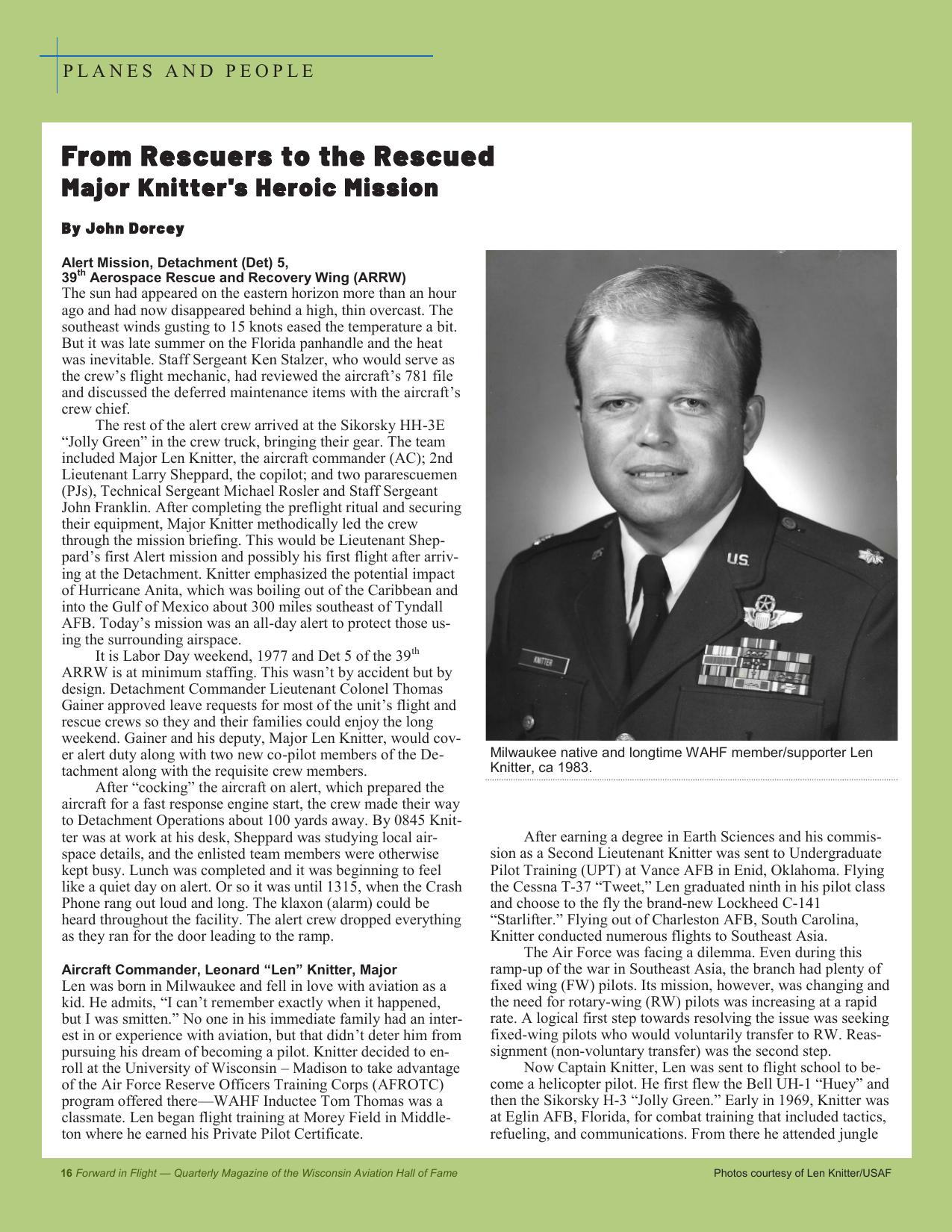
PLANES AND PEOPLE From Rescuers to the Rescued Major Knitter's Heroic Mission By John Dorcey Alert Mission, Detachment (Det) 5, 39th Aerospace Rescue and Recovery Wing (ARRW) The sun had appeared on the eastern horizon more than an hour ago and had now disappeared behind a high, thin overcast. The southeast winds gusting to 15 knots eased the temperature a bit. But it was late summer on the Florida panhandle and the heat was inevitable. Staff Sergeant Ken Stalzer, who would serve as the crew’s flight mechanic, had reviewed the aircraft’s 781 file and discussed the deferred maintenance items with the aircraft’s crew chief. The rest of the alert crew arrived at the Sikorsky HH-3E “Jolly Green” in the crew truck, bringing their gear. The team included Major Len Knitter, the aircraft commander (AC); 2nd Lieutenant Larry Sheppard, the copilot; and two pararescuemen (PJs), Technical Sergeant Michael Rosler and Staff Sergeant John Franklin. After completing the preflight ritual and securing their equipment, Major Knitter methodically led the crew through the mission briefing. This would be Lieutenant Sheppard’s first Alert mission and possibly his first flight after arriving at the Detachment. Knitter emphasized the potential impact of Hurricane Anita, which was boiling out of the Caribbean and into the Gulf of Mexico about 300 miles southeast of Tyndall AFB. Today’s mission was an all-day alert to protect those using the surrounding airspace. It is Labor Day weekend, 1977 and Det 5 of the 39 th ARRW is at minimum staffing. This wasn’t by accident but by design. Detachment Commander Lieutenant Colonel Thomas Gainer approved leave requests for most of the unit’s flight and rescue crews so they and their families could enjoy the long weekend. Gainer and his deputy, Major Len Knitter, would cover alert duty along with two new co-pilot members of the Detachment along with the requisite crew members. After “cocking” the aircraft on alert, which prepared the aircraft for a fast response engine start, the crew made their way to Detachment Operations about 100 yards away. By 0845 Knitter was at work at his desk, Sheppard was studying local airspace details, and the enlisted team members were otherwise kept busy. Lunch was completed and it was beginning to feel like a quiet day on alert. Or so it was until 1315, when the Crash Phone rang out loud and long. The klaxon (alarm) could be heard throughout the facility. The alert crew dropped everything as they ran for the door leading to the ramp. Milwaukee native and longtime WAHF member/supporter Len Knitter, ca 1983. Len was born in Milwaukee and fell in love with aviation as a kid. He admits, “I can’t remember exactly when it happened, but I was smitten.” No one in his immediate family had an interest in or experience with aviation, but that didn’t deter him from pursuing his dream of becoming a pilot. Knitter decided to enroll at the University of Wisconsin – Madison to take advantage of the Air Force Reserve Officers Training Corps (AFROTC) program offered there—WAHF Inductee Tom Thomas was a classmate. Len began flight training at Morey Field in Middleton where he earned his Private Pilot Certificate. After earning a degree in Earth Sciences and his commission as a Second Lieutenant Knitter was sent to Undergraduate Pilot Training (UPT) at Vance AFB in Enid, Oklahoma. Flying the Cessna T-37 “Tweet,” Len graduated ninth in his pilot class and choose to the fly the brand-new Lockheed C-141 “Starlifter.” Flying out of Charleston AFB, South Carolina, Knitter conducted numerous flights to Southeast Asia. The Air Force was facing a dilemma. Even during this ramp-up of the war in Southeast Asia, the branch had plenty of fixed wing (FW) pilots. Its mission, however, was changing and the need for rotary-wing (RW) pilots was increasing at a rapid rate. A logical first step towards resolving the issue was seeking fixed-wing pilots who would voluntarily transfer to RW. Reassignment (non-voluntary transfer) was the second step. Now Captain Knitter, Len was sent to flight school to become a helicopter pilot. He first flew the Bell UH-1 “Huey” and then the Sikorsky H-3 “Jolly Green.” Early in 1969, Knitter was at Eglin AFB, Florida, for combat training that included tactics, refueling, and communications. From there he attended jungle 16 Forward in Flight — Quarterly Magazine of the Wisconsin Aviation Hall of Fame Photos courtesy of Len Knitter/USAF Aircraft Commander, Leonard “Len” Knitter, Major
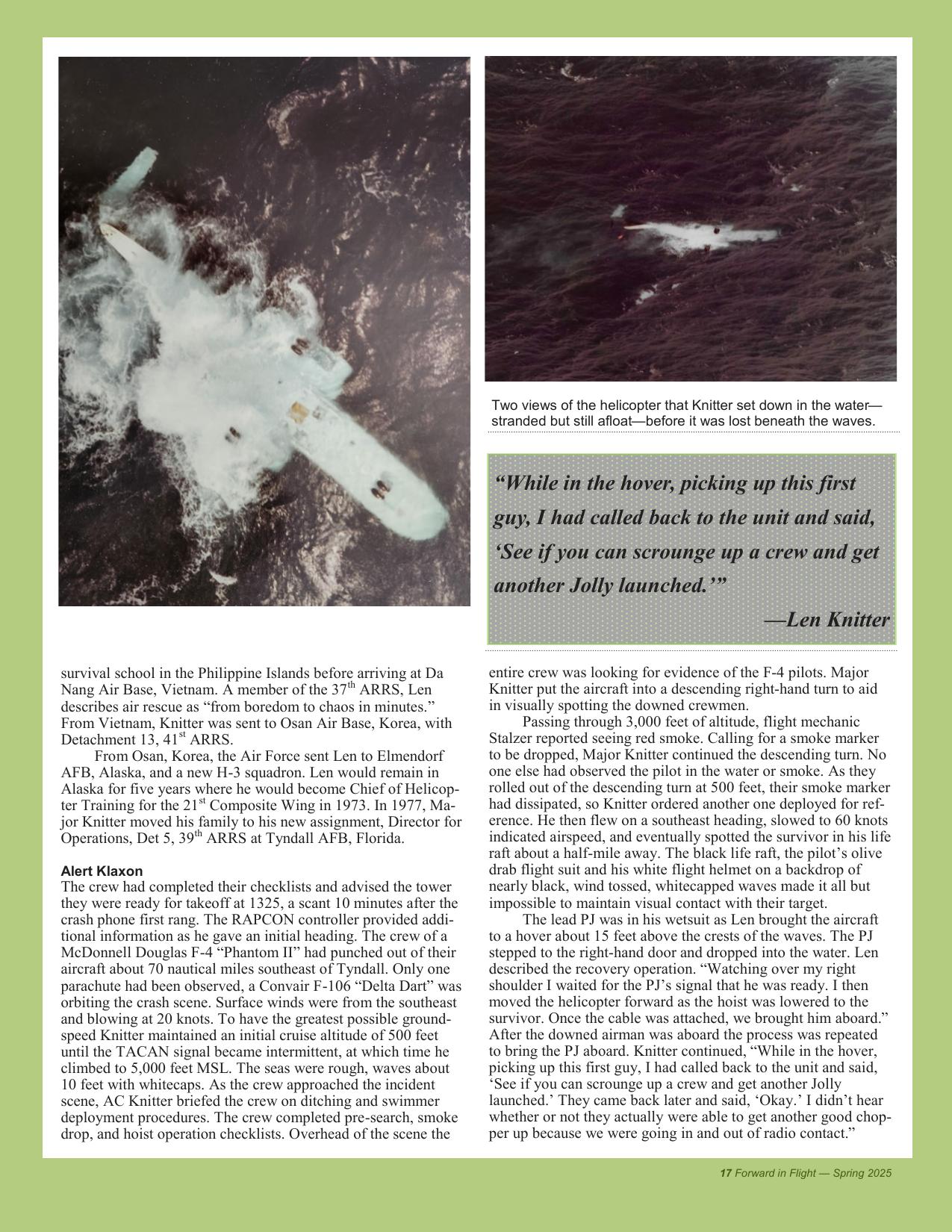
Two views of the helicopter that Knitter set down in the water— stranded but still afloat—before it was lost beneath the waves. “While in the hover, picking up this first guy, I had called back to the unit and said, ‘See if you can scrounge up a crew and get another Jolly launched.’” —Len Knitter survival school in the Philippine Islands before arriving at Da Nang Air Base, Vietnam. A member of the 37 th ARRS, Len describes air rescue as “from boredom to chaos in minutes.” From Vietnam, Knitter was sent to Osan Air Base, Korea, with Detachment 13, 41st ARRS. From Osan, Korea, the Air Force sent Len to Elmendorf AFB, Alaska, and a new H-3 squadron. Len would remain in Alaska for five years where he would become Chief of Helicopter Training for the 21st Composite Wing in 1973. In 1977, Major Knitter moved his family to his new assignment, Director for Operations, Det 5, 39th ARRS at Tyndall AFB, Florida. Alert Klaxon The crew had completed their checklists and advised the tower they were ready for takeoff at 1325, a scant 10 minutes after the crash phone first rang. The RAPCON controller provided additional information as he gave an initial heading. The crew of a McDonnell Douglas F-4 “Phantom II” had punched out of their aircraft about 70 nautical miles southeast of Tyndall. Only one parachute had been observed, a Convair F-106 “Delta Dart” was orbiting the crash scene. Surface winds were from the southeast and blowing at 20 knots. To have the greatest possible groundspeed Knitter maintained an initial cruise altitude of 500 feet until the TACAN signal became intermittent, at which time he climbed to 5,000 feet MSL. The seas were rough, waves about 10 feet with whitecaps. As the crew approached the incident scene, AC Knitter briefed the crew on ditching and swimmer deployment procedures. The crew completed pre-search, smoke drop, and hoist operation checklists. Overhead of the scene the entire crew was looking for evidence of the F-4 pilots. Major Knitter put the aircraft into a descending right-hand turn to aid in visually spotting the downed crewmen. Passing through 3,000 feet of altitude, flight mechanic Stalzer reported seeing red smoke. Calling for a smoke marker to be dropped, Major Knitter continued the descending turn. No one else had observed the pilot in the water or smoke. As they rolled out of the descending turn at 500 feet, their smoke marker had dissipated, so Knitter ordered another one deployed for reference. He then flew on a southeast heading, slowed to 60 knots indicated airspeed, and eventually spotted the survivor in his life raft about a half-mile away. The black life raft, the pilot’s olive drab flight suit and his white flight helmet on a backdrop of nearly black, wind tossed, whitecapped waves made it all but impossible to maintain visual contact with their target. The lead PJ was in his wetsuit as Len brought the aircraft to a hover about 15 feet above the crests of the waves. The PJ stepped to the right-hand door and dropped into the water. Len described the recovery operation. “Watching over my right shoulder I waited for the PJ’s signal that he was ready. I then moved the helicopter forward as the hoist was lowered to the survivor. Once the cable was attached, we brought him aboard.” After the downed airman was aboard the process was repeated to bring the PJ aboard. Knitter continued, “While in the hover, picking up this first guy, I had called back to the unit and said, ‘See if you can scrounge up a crew and get another Jolly launched.’ They came back later and said, ‘Okay.’ I didn’t hear whether or not they actually were able to get another good chopper up because we were going in and out of radio contact.” 17 Forward in Flight — Spring 2025
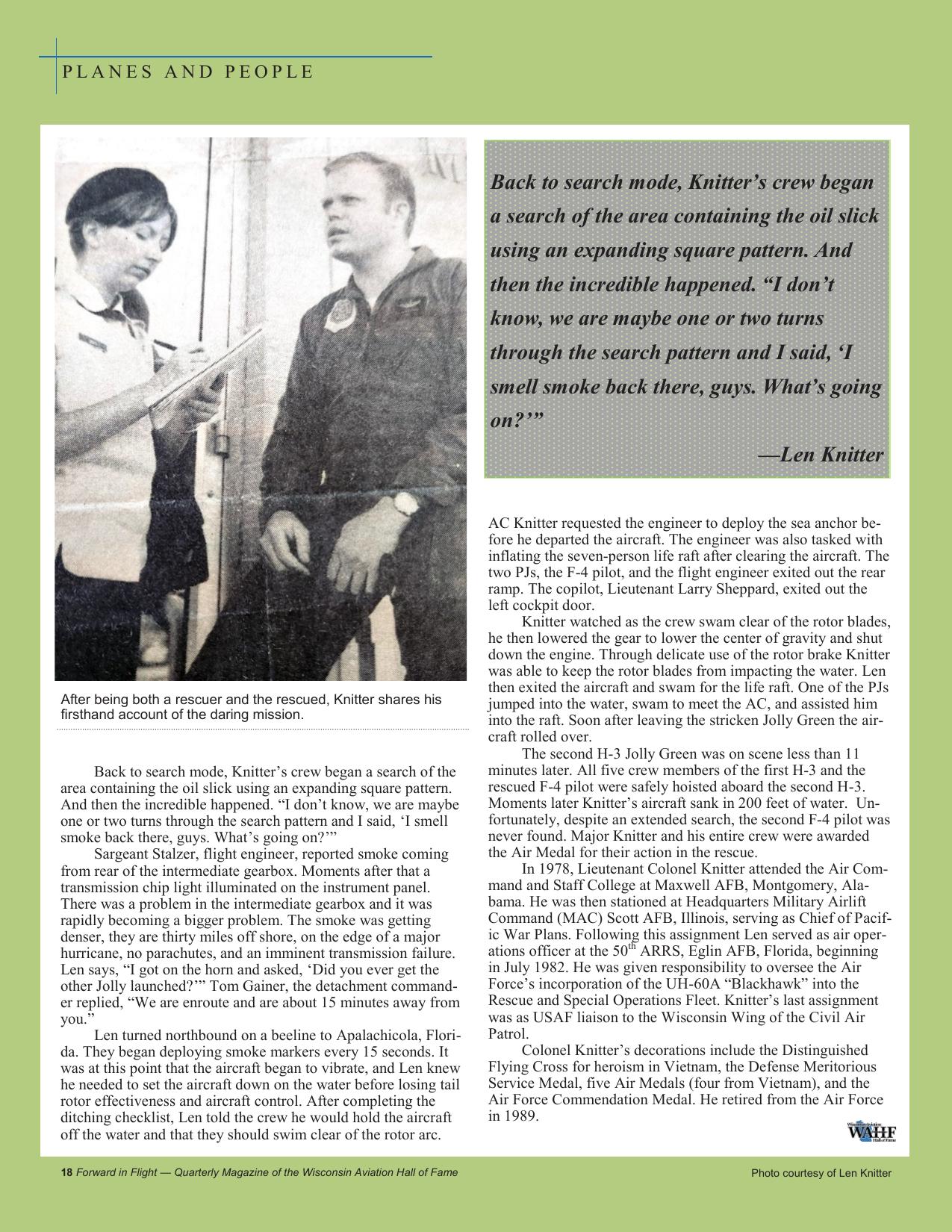
PLANES AND PEOPLE Back to search mode, Knitter’s crew began a search of the area containing the oil slick using an expanding square pattern. And then the incredible happened. “I don’t know, we are maybe one or two turns through the search pattern and I said, ‘I smell smoke back there, guys. What’s going on?’” —Len Knitter After being both a rescuer and the rescued, Knitter shares his firsthand account of the daring mission. Back to search mode, Knitter’s crew began a search of the area containing the oil slick using an expanding square pattern. And then the incredible happened. “I don’t know, we are maybe one or two turns through the search pattern and I said, ‘I smell smoke back there, guys. What’s going on?’” Sargeant Stalzer, flight engineer, reported smoke coming from rear of the intermediate gearbox. Moments after that a transmission chip light illuminated on the instrument panel. There was a problem in the intermediate gearbox and it was rapidly becoming a bigger problem. The smoke was getting denser, they are thirty miles off shore, on the edge of a major hurricane, no parachutes, and an imminent transmission failure. Len says, “I got on the horn and asked, ‘Did you ever get the other Jolly launched?’” Tom Gainer, the detachment commander replied, “We are enroute and are about 15 minutes away from you.” Len turned northbound on a beeline to Apalachicola, Florida. They began deploying smoke markers every 15 seconds. It was at this point that the aircraft began to vibrate, and Len knew he needed to set the aircraft down on the water before losing tail rotor effectiveness and aircraft control. After completing the ditching checklist, Len told the crew he would hold the aircraft off the water and that they should swim clear of the rotor arc. 18 Forward in Flight — Quarterly Magazine of the Wisconsin Aviation Hall of Fame AC Knitter requested the engineer to deploy the sea anchor before he departed the aircraft. The engineer was also tasked with inflating the seven-person life raft after clearing the aircraft. The two PJs, the F-4 pilot, and the flight engineer exited out the rear ramp. The copilot, Lieutenant Larry Sheppard, exited out the left cockpit door. Knitter watched as the crew swam clear of the rotor blades, he then lowered the gear to lower the center of gravity and shut down the engine. Through delicate use of the rotor brake Knitter was able to keep the rotor blades from impacting the water. Len then exited the aircraft and swam for the life raft. One of the PJs jumped into the water, swam to meet the AC, and assisted him into the raft. Soon after leaving the stricken Jolly Green the aircraft rolled over. The second H-3 Jolly Green was on scene less than 11 minutes later. All five crew members of the first H-3 and the rescued F-4 pilot were safely hoisted aboard the second H-3. Moments later Knitter’s aircraft sank in 200 feet of water. Unfortunately, despite an extended search, the second F-4 pilot was never found. Major Knitter and his entire crew were awarded the Air Medal for their action in the rescue. In 1978, Lieutenant Colonel Knitter attended the Air Command and Staff College at Maxwell AFB, Montgomery, Alabama. He was then stationed at Headquarters Military Airlift Command (MAC) Scott AFB, Illinois, serving as Chief of Pacific War Plans. Following this assignment Len served as air operations officer at the 50th ARRS, Eglin AFB, Florida, beginning in July 1982. He was given responsibility to oversee the Air Force’s incorporation of the UH-60A “Blackhawk” into the Rescue and Special Operations Fleet. Knitter’s last assignment was as USAF liaison to the Wisconsin Wing of the Civil Air Patrol. Colonel Knitter’s decorations include the Distinguished Flying Cross for heroism in Vietnam, the Defense Meritorious Service Medal, five Air Medals (four from Vietnam), and the Air Force Commendation Medal. He retired from the Air Force in 1989. Photo courtesy of Len Knitter
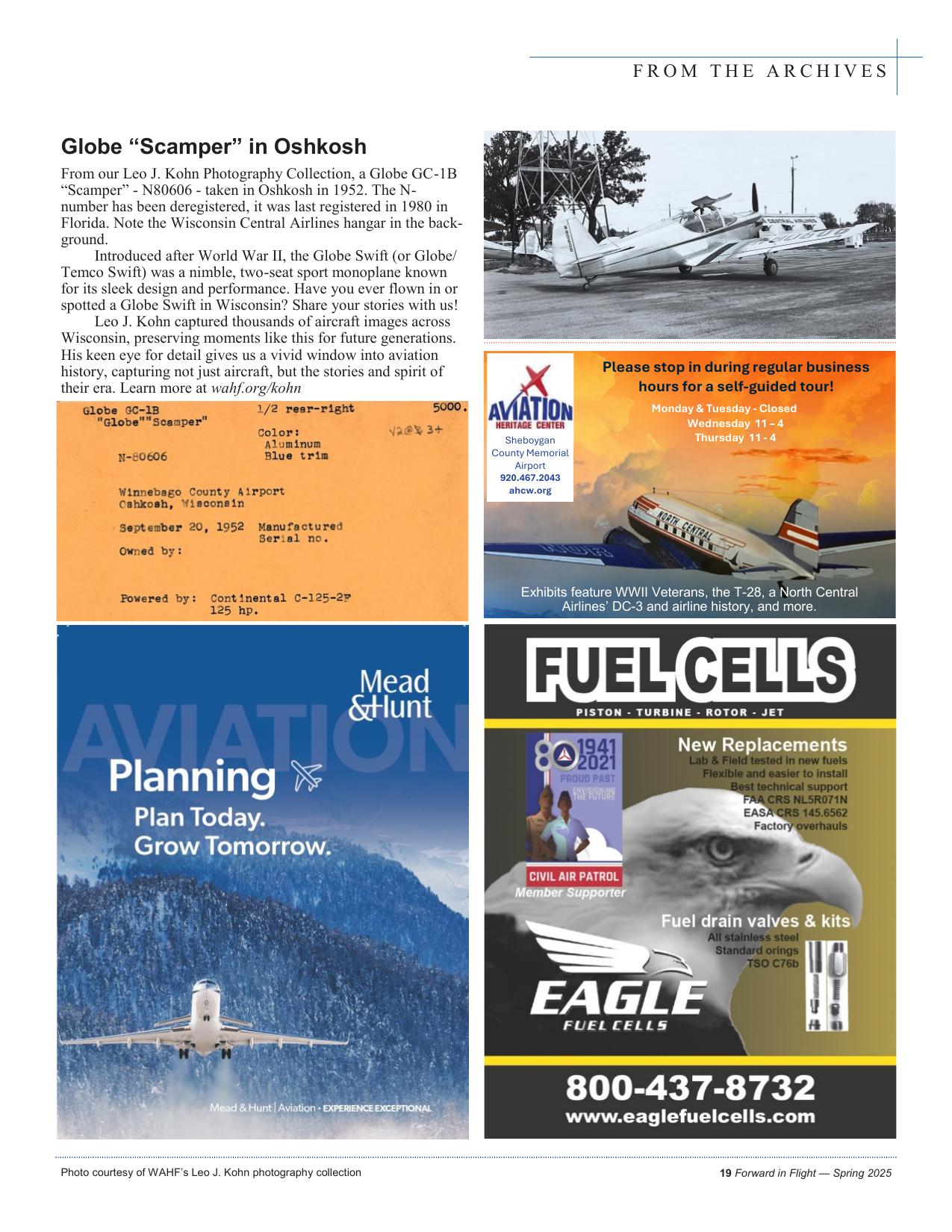
FROM THE ARCHIVES Globe “Scamper” in Oshkosh From our Leo J. Kohn Photography Collection, a Globe GC-1B “Scamper” - N80606 - taken in Oshkosh in 1952. The Nnumber has been deregistered, it was last registered in 1980 in Florida. Note the Wisconsin Central Airlines hangar in the background. Introduced after World War II, the Globe Swift (or Globe/ Temco Swift) was a nimble, two-seat sport monoplane known for its sleek design and performance. Have you ever flown in or spotted a Globe Swift in Wisconsin? Share your stories with us! Leo J. Kohn captured thousands of aircraft images across Wisconsin, preserving moments like this for future generations. His keen eye for detail gives us a vivid window into aviation history, capturing not just aircraft, but the stories and spirit of their era. Learn more at wahf.org/kohn Please stop in during regular business hours for a self-guided tour! Sheboygan County Memorial Airport 920.467.2043 ahcw.org Monday & Tuesday - Closed Wednesday 11 – 4 Thursday 11 - 4 Exhibits feature WWII Veterans, the T-28, a North Central Airlines’ DC-3 and airline history, and more. Photo courtesy of WAHF’s Leo J. Kohn photography collection 19 Forward in Flight — Spring 2025
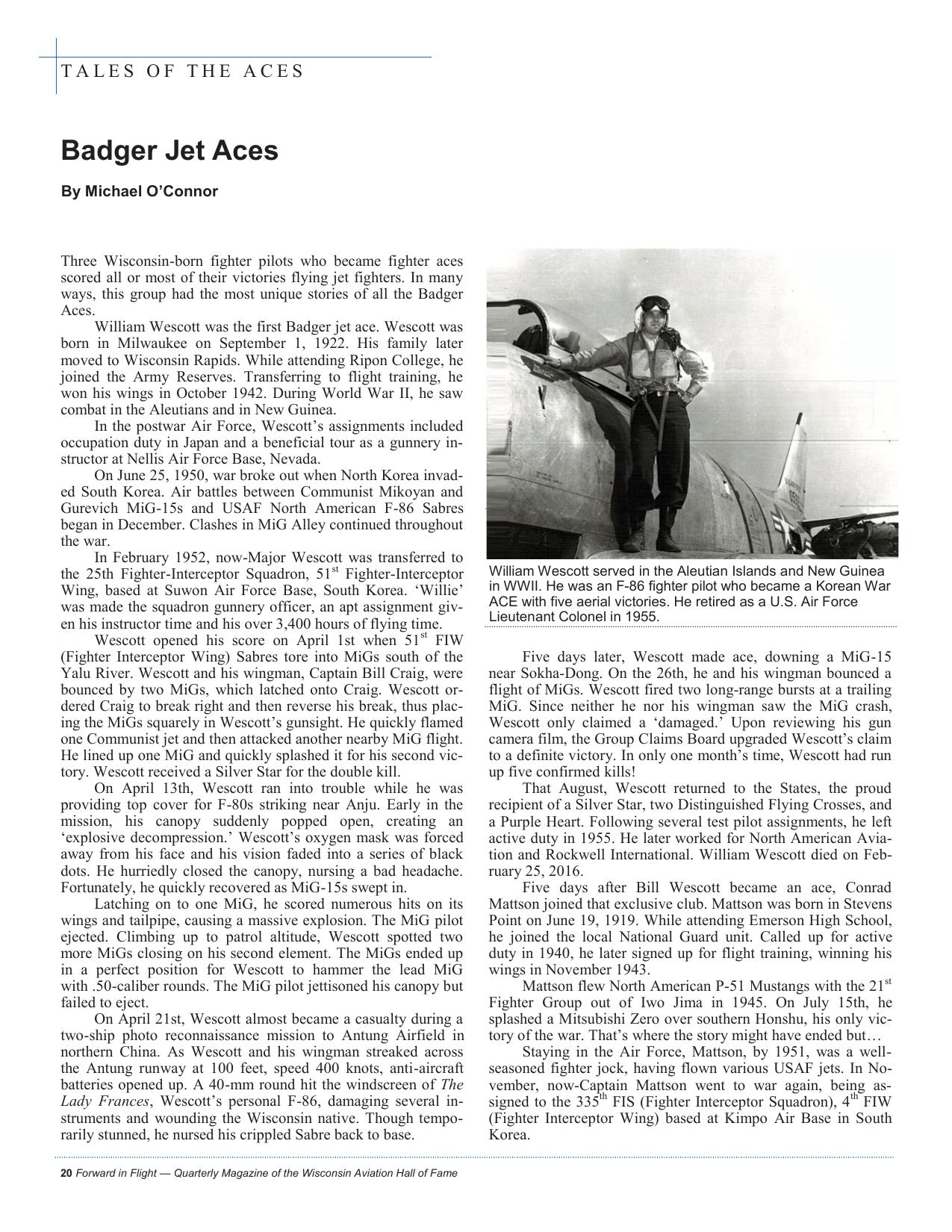
TALES OF THE ACES Badger Jet Aces By Michael O’Connor Three Wisconsin-born fighter pilots who became fighter aces scored all or most of their victories flying jet fighters. In many ways, this group had the most unique stories of all the Badger Aces. William Wescott was the first Badger jet ace. Wescott was born in Milwaukee on September 1, 1922. His family later moved to Wisconsin Rapids. While attending Ripon College, he joined the Army Reserves. Transferring to flight training, he won his wings in October 1942. During World War II, he saw combat in the Aleutians and in New Guinea. In the postwar Air Force, Wescott’s assignments included occupation duty in Japan and a beneficial tour as a gunnery instructor at Nellis Air Force Base, Nevada. On June 25, 1950, war broke out when North Korea invaded South Korea. Air battles between Communist Mikoyan and Gurevich MiG-15s and USAF North American F-86 Sabres began in December. Clashes in MiG Alley continued throughout the war. In February 1952, now-Major Wescott was transferred to the 25th Fighter-Interceptor Squadron, 51st Fighter-Interceptor Wing, based at Suwon Air Force Base, South Korea. ‘Willie’ was made the squadron gunnery officer, an apt assignment given his instructor time and his over 3,400 hours of flying time. Wescott opened his score on April 1st when 51st FIW (Fighter Interceptor Wing) Sabres tore into MiGs south of the Yalu River. Wescott and his wingman, Captain Bill Craig, were bounced by two MiGs, which latched onto Craig. Wescott ordered Craig to break right and then reverse his break, thus placing the MiGs squarely in Wescott’s gunsight. He quickly flamed one Communist jet and then attacked another nearby MiG flight. He lined up one MiG and quickly splashed it for his second victory. Wescott received a Silver Star for the double kill. On April 13th, Wescott ran into trouble while he was providing top cover for F-80s striking near Anju. Early in the mission, his canopy suddenly popped open, creating an ‘explosive decompression.’ Wescott’s oxygen mask was forced away from his face and his vision faded into a series of black dots. He hurriedly closed the canopy, nursing a bad headache. Fortunately, he quickly recovered as MiG-15s swept in. Latching on to one MiG, he scored numerous hits on its wings and tailpipe, causing a massive explosion. The MiG pilot ejected. Climbing up to patrol altitude, Wescott spotted two more MiGs closing on his second element. The MiGs ended up in a perfect position for Wescott to hammer the lead MiG with .50-caliber rounds. The MiG pilot jettisoned his canopy but failed to eject. On April 21st, Wescott almost became a casualty during a two-ship photo reconnaissance mission to Antung Airfield in northern China. As Wescott and his wingman streaked across the Antung runway at 100 feet, speed 400 knots, anti-aircraft batteries opened up. A 40-mm round hit the windscreen of The Lady Frances, Wescott’s personal F-86, damaging several instruments and wounding the Wisconsin native. Though temporarily stunned, he nursed his crippled Sabre back to base. 20 Forward in Flight — Quarterly Magazine of the Wisconsin Aviation Hall of Fame William Wescott served in the Aleutian Islands and New Guinea in WWII. He was an F-86 fighter pilot who became a Korean War ACE with five aerial victories. He retired as a U.S. Air Force Lieutenant Colonel in 1955. Five days later, Wescott made ace, downing a MiG-15 near Sokha-Dong. On the 26th, he and his wingman bounced a flight of MiGs. Wescott fired two long-range bursts at a trailing MiG. Since neither he nor his wingman saw the MiG crash, Wescott only claimed a ‘damaged.’ Upon reviewing his gun camera film, the Group Claims Board upgraded Wescott’s claim to a definite victory. In only one month’s time, Wescott had run up five confirmed kills! That August, Wescott returned to the States, the proud recipient of a Silver Star, two Distinguished Flying Crosses, and a Purple Heart. Following several test pilot assignments, he left active duty in 1955. He later worked for North American Aviation and Rockwell International. William Wescott died on February 25, 2016. Five days after Bill Wescott became an ace, Conrad Mattson joined that exclusive club. Mattson was born in Stevens Point on June 19, 1919. While attending Emerson High School, he joined the local National Guard unit. Called up for active duty in 1940, he later signed up for flight training, winning his wings in November 1943. Mattson flew North American P-51 Mustangs with the 21st Fighter Group out of Iwo Jima in 1945. On July 15th, he splashed a Mitsubishi Zero over southern Honshu, his only victory of the war. That’s where the story might have ended but… Staying in the Air Force, Mattson, by 1951, was a wellseasoned fighter jock, having flown various USAF jets. In November, now-Captain Mattson went to war again, being assigned to the 335th FIS (Fighter Interceptor Squadron), 4 th FIW (Fighter Interceptor Wing) based at Kimpo Air Base in South Korea.
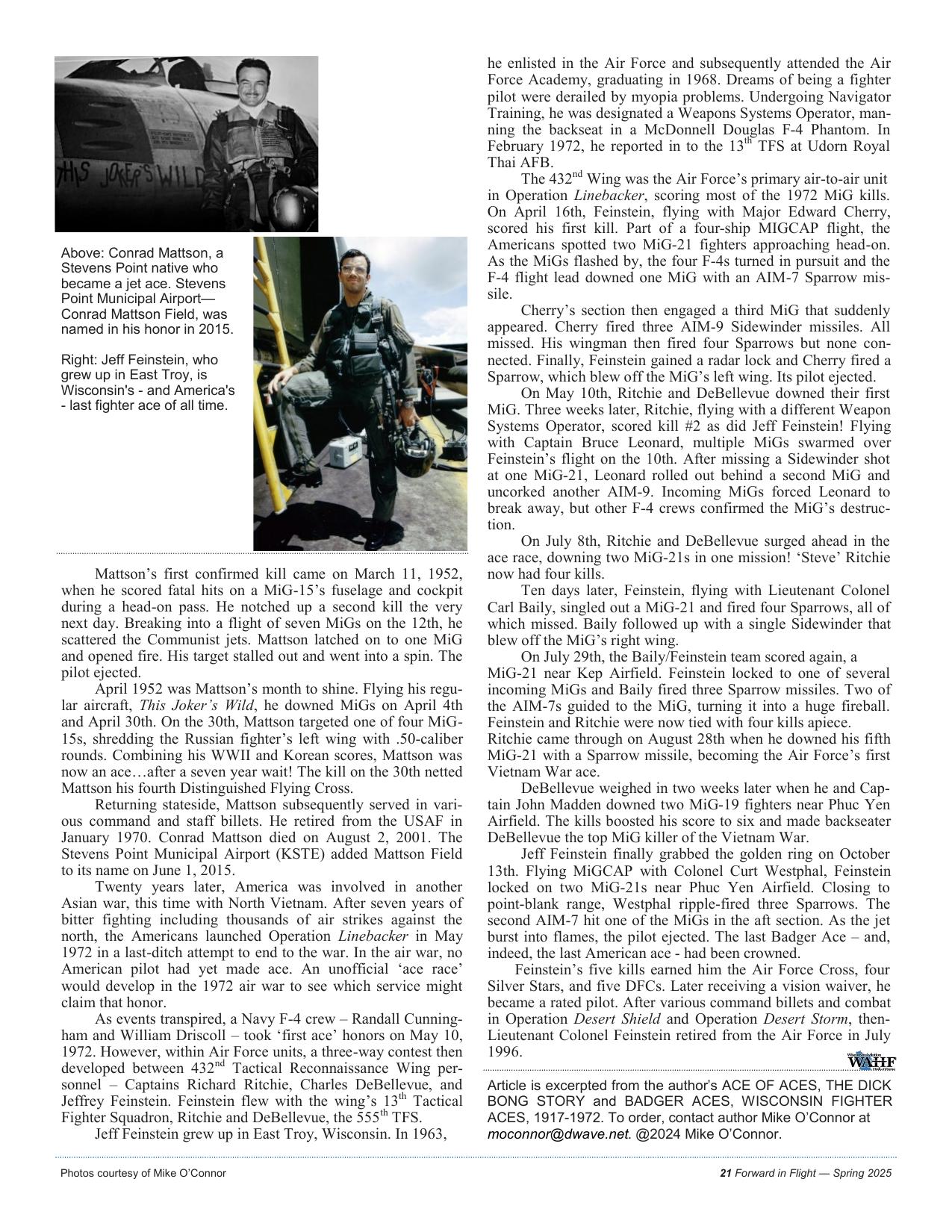
Above: Conrad Mattson, a Stevens Point native who became a jet ace. Stevens Point Municipal Airport— Conrad Mattson Field, was named in his honor in 2015. Right: Jeff Feinstein, who grew up in East Troy, is Wisconsin's - and America's - last fighter ace of all time. Mattson’s first confirmed kill came on March 11, 1952, when he scored fatal hits on a MiG-15’s fuselage and cockpit during a head-on pass. He notched up a second kill the very next day. Breaking into a flight of seven MiGs on the 12th, he scattered the Communist jets. Mattson latched on to one MiG and opened fire. His target stalled out and went into a spin. The pilot ejected. April 1952 was Mattson’s month to shine. Flying his regular aircraft, This Joker’s Wild, he downed MiGs on April 4th and April 30th. On the 30th, Mattson targeted one of four MiG15s, shredding the Russian fighter’s left wing with .50-caliber rounds. Combining his WWII and Korean scores, Mattson was now an ace…after a seven year wait! The kill on the 30th netted Mattson his fourth Distinguished Flying Cross. Returning stateside, Mattson subsequently served in various command and staff billets. He retired from the USAF in January 1970. Conrad Mattson died on August 2, 2001. The Stevens Point Municipal Airport (KSTE) added Mattson Field to its name on June 1, 2015. Twenty years later, America was involved in another Asian war, this time with North Vietnam. After seven years of bitter fighting including thousands of air strikes against the north, the Americans launched Operation Linebacker in May 1972 in a last-ditch attempt to end to the war. In the air war, no American pilot had yet made ace. An unofficial ‘ace race’ would develop in the 1972 air war to see which service might claim that honor. As events transpired, a Navy F-4 crew – Randall Cunningham and William Driscoll – took ‘first ace’ honors on May 10, 1972. However, within Air Force units, a three-way contest then developed between 432nd Tactical Reconnaissance Wing personnel – Captains Richard Ritchie, Charles DeBellevue, and Jeffrey Feinstein. Feinstein flew with the wing’s 13th Tactical Fighter Squadron, Ritchie and DeBellevue, the 555 th TFS. Jeff Feinstein grew up in East Troy, Wisconsin. In 1963, Photos courtesy of Mike O’Connor he enlisted in the Air Force and subsequently attended the Air Force Academy, graduating in 1968. Dreams of being a fighter pilot were derailed by myopia problems. Undergoing Navigator Training, he was designated a Weapons Systems Operator, manning the backseat in a McDonnell Douglas F-4 Phantom. In February 1972, he reported in to the 13th TFS at Udorn Royal Thai AFB. The 432nd Wing was the Air Force’s primary air-to-air unit in Operation Linebacker, scoring most of the 1972 MiG kills. On April 16th, Feinstein, flying with Major Edward Cherry, scored his first kill. Part of a four-ship MIGCAP flight, the Americans spotted two MiG-21 fighters approaching head-on. As the MiGs flashed by, the four F-4s turned in pursuit and the F-4 flight lead downed one MiG with an AIM-7 Sparrow missile. Cherry’s section then engaged a third MiG that suddenly appeared. Cherry fired three AIM-9 Sidewinder missiles. All missed. His wingman then fired four Sparrows but none connected. Finally, Feinstein gained a radar lock and Cherry fired a Sparrow, which blew off the MiG’s left wing. Its pilot ejected. On May 10th, Ritchie and DeBellevue downed their first MiG. Three weeks later, Ritchie, flying with a different Weapon Systems Operator, scored kill #2 as did Jeff Feinstein! Flying with Captain Bruce Leonard, multiple MiGs swarmed over Feinstein’s flight on the 10th. After missing a Sidewinder shot at one MiG-21, Leonard rolled out behind a second MiG and uncorked another AIM-9. Incoming MiGs forced Leonard to break away, but other F-4 crews confirmed the MiG’s destruction. On July 8th, Ritchie and DeBellevue surged ahead in the ace race, downing two MiG-21s in one mission! ‘Steve’ Ritchie now had four kills. Ten days later, Feinstein, flying with Lieutenant Colonel Carl Baily, singled out a MiG-21 and fired four Sparrows, all of which missed. Baily followed up with a single Sidewinder that blew off the MiG’s right wing. On July 29th, the Baily/Feinstein team scored again, a MiG-21 near Kep Airfield. Feinstein locked to one of several incoming MiGs and Baily fired three Sparrow missiles. Two of the AIM-7s guided to the MiG, turning it into a huge fireball. Feinstein and Ritchie were now tied with four kills apiece. Ritchie came through on August 28th when he downed his fifth MiG-21 with a Sparrow missile, becoming the Air Force’s first Vietnam War ace. DeBellevue weighed in two weeks later when he and Captain John Madden downed two MiG-19 fighters near Phuc Yen Airfield. The kills boosted his score to six and made backseater DeBellevue the top MiG killer of the Vietnam War. Jeff Feinstein finally grabbed the golden ring on October 13th. Flying MiGCAP with Colonel Curt Westphal, Feinstein locked on two MiG-21s near Phuc Yen Airfield. Closing to point-blank range, Westphal ripple-fired three Sparrows. The second AIM-7 hit one of the MiGs in the aft section. As the jet burst into flames, the pilot ejected. The last Badger Ace – and, indeed, the last American ace - had been crowned. Feinstein’s five kills earned him the Air Force Cross, four Silver Stars, and five DFCs. Later receiving a vision waiver, he became a rated pilot. After various command billets and combat in Operation Desert Shield and Operation Desert Storm, thenLieutenant Colonel Feinstein retired from the Air Force in July 1996. Article is excerpted from the author’s ACE OF ACES, THE DICK BONG STORY and BADGER ACES, WISCONSIN FIGHTER ACES, 1917-1972. To order, contact author Mike O’Connor at moconnor@dwave.net. @2024 Mike O’Connor. 21 Forward in Flight — Spring 2025
ON THE FLIGHTLINE CLI and EZS Uniting for a Shared Vision in Aviation Submitted by EAA Chapter 1710 In 2020, Caz Muske took on the role of airport manager at Clintonville Municipal Airport (CLI), stepping into the world of aviation with an eagerness to learn. She was fortunate to have the mentorship of Mike McCord, Clintonville’s long-time Public Works Director and a beloved community figure, who shared his expertise and passion for the airport. Mike, with his deep appreciation for CLI and extensive knowledge of public works, helped Caz understand not only the logistics but also the airport's historical significance. Mike introduced Caz to CLI’s storied past, tracing back to the demand from executives of the Four-Wheel Drive Auto Company (now Seagrave-FWD). Their need for reliable air travel led to the founding of Wisconsin Central Airlines, which later became part of Delta Airlines, marking CLI as its birthplace. However, Mike was also aware of the gradual decline in activity at CLI and encouraged Caz to consider forming a local EAA chapter as a way to reignite community involvement and aviation interest in Clintonville. In 2021, inspired by Mike’s vision, Caz began the journey of establishing an EAA chapter at CLI. Like many small communities, Clintonville faces challenges in volunteer recruitment and sustaining momentum for new initiatives. After researching successful multi-municipality EAA Chapters, Caz realized that partnerships might be essential for success. She reached out to Colin Isom, the airport manager at Shawano Municipal Airport and Seaplane Base (EZS), who understood the difficulties of building a local chapter and was eager to collaborate. With the support of EAA, Caz and Colin began reaching out to nearby airports and EAA chapters, seeking guidance and sharing ideas. This partnership marked a new chapter for CLI, driven by a shared mission to strengthen community ties, preserve aviation history, and inspire future pilots. In the summer of 2024, Mathieu Labs reached out to Caz to help promote a hamburger social for his local EAA chapter. During their conversation, they discussed the intricacies of running a successful chapter. With Mathieu’s experience in revitalizing his own chapter—from growing membership and establishing a lasting legacy—he was able to offer valuable insights. He was also preparing to leave his current chapter to pursue new aviation goals, making this a timely opportunity to assist. During a meeting with Caz and Colin, they mentioned they still needed to fill key roles, including president, treasurer, and secretary, to officially launch their chapter. Mathieu offered to take on the role of Young Eagles Coordinator, as inspiring the next generation of youth remains one of his greatest passions. However, after a month passed and no one had stepped forward to take on the role of president, he and his wife, Lauren, decided to step up and take on the responsibility. With their combined experience in various EAA chapter roles across Illinois and Wisconsin, and their volunteering at AirVenture, they knew this would be a rewarding next step. Within a couple of months, they completed the setup with EAA and hosted an open house that brought together over 50 people from neighboring communities, all sharing a passion for launch22 Forward in Flight — Quarterly Magazine of the Wisconsin Aviation Hall of Fame EAA Chapter 1710’s logo was unveiled at the chapter’s kickoff meeting, held on January 15, 2025. A large crowd attended, showing that aviation is alive in the Clintonville/Shawano area. ing this new EAA chapter. The chapter was officially established with EAA on November 18, 2024 with the following leadership team: President/Young Eagles Coordinator: Mathieu Labs, Vice President: Fran West, Treasurer: Daniel Connelly, and Secretary: Lauren Labs. EAA Chapter 1710 will meet on the third Wednesday of each month at 7 p.m., rotating between CLI and EZS airports. All are welcome to come and enjoy a great time! For information please contact: EAAChapter1710@gmail.com, call 715-250-0220 (Caz Muske), or on Facebook at EAA Chapter 1710. Photos courtesy EAA Chapter 1710
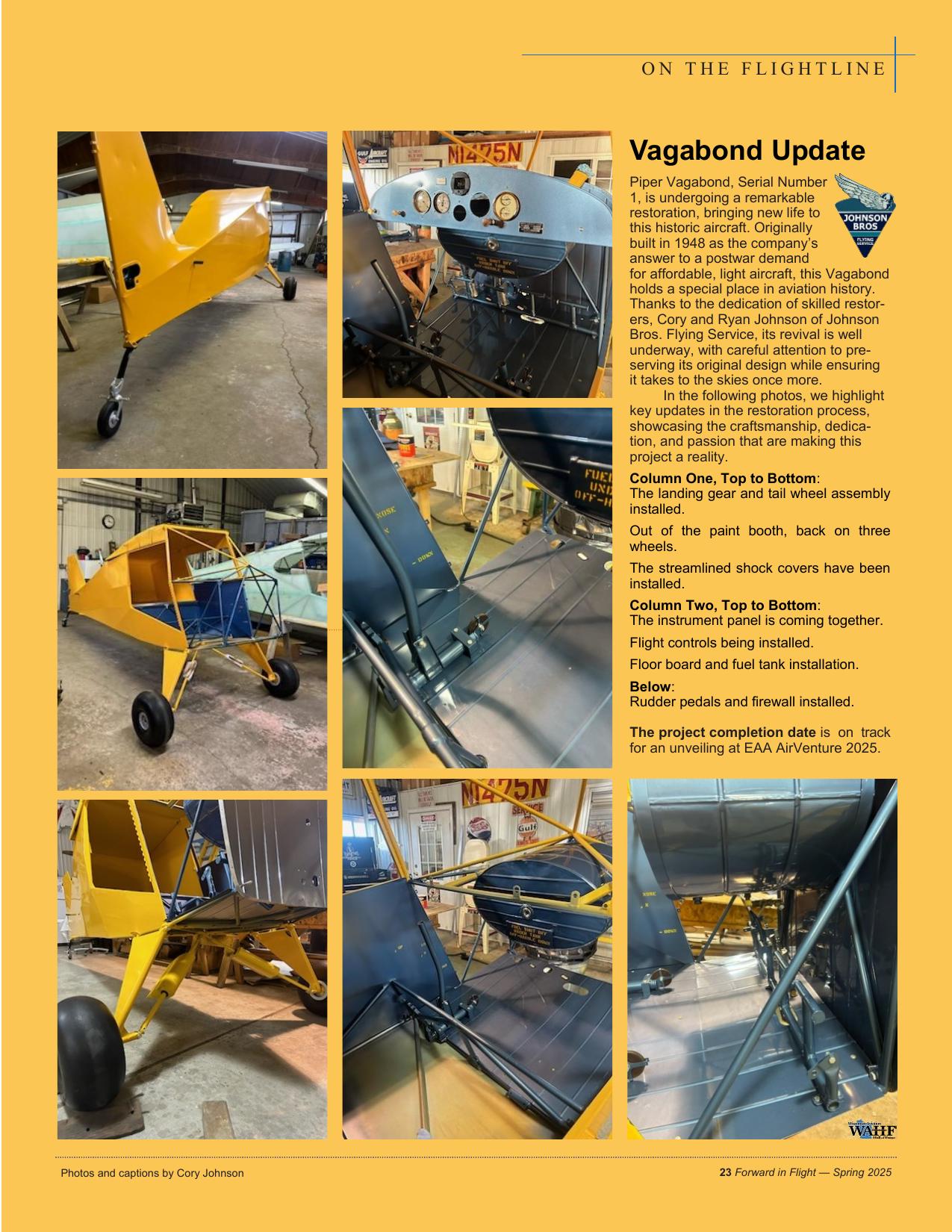
ON THE FLIGHTLINE Vagabond Update Piper Vagabond, Serial Number 1, is undergoing a remarkable restoration, bringing new life to this historic aircraft. Originally built in 1948 as the company’s answer to a postwar demand for affordable, light aircraft, this Vagabond holds a special place in aviation history. Thanks to the dedication of skilled restorers, Cory and Ryan Johnson of Johnson Bros. Flying Service, its revival is well underway, with careful attention to preserving its original design while ensuring it takes to the skies once more. In the following photos, we highlight key updates in the restoration process, showcasing the craftsmanship, dedication, and passion that are making this project a reality. Column One, Top to Bottom: The landing gear and tail wheel assembly installed. Out of the paint booth, back on three wheels. The streamlined shock covers have been installed. Column Two, Top to Bottom: The instrument panel is coming together. Flight controls being installed. Floor board and fuel tank installation. Below: Rudder pedals and firewall installed. The project completion date is on track for an unveiling at EAA AirVenture 2025. Photos and captions by Cory Johnson 23 Forward in Flight — Spring 2025
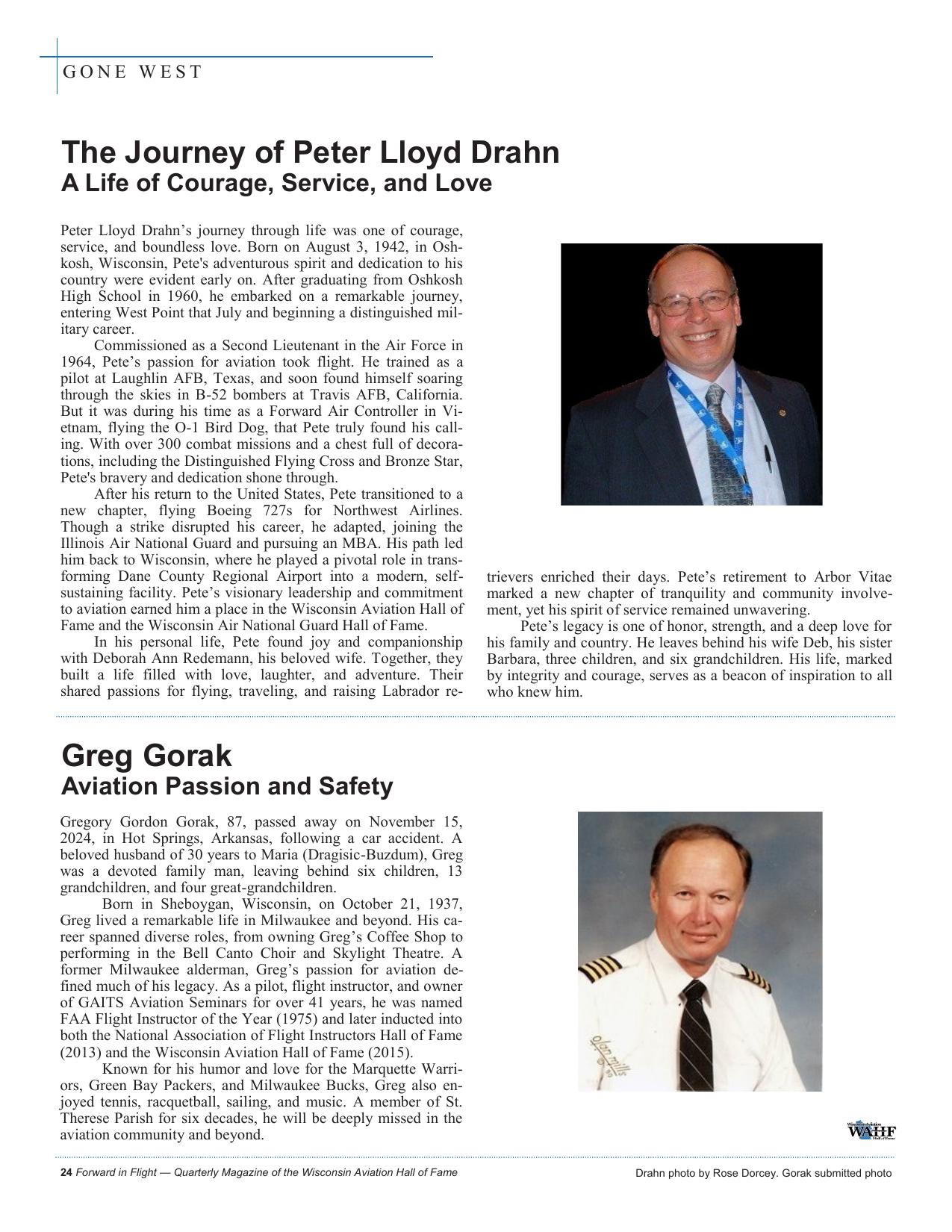
GONE WEST The Journey of Peter Lloyd Drahn A Life of Courage, Service, and Love Peter Lloyd Drahn’s journey through life was one of courage, service, and boundless love. Born on August 3, 1942, in Oshkosh, Wisconsin, Pete's adventurous spirit and dedication to his country were evident early on. After graduating from Oshkosh High School in 1960, he embarked on a remarkable journey, entering West Point that July and beginning a distinguished military career. Commissioned as a Second Lieutenant in the Air Force in 1964, Pete’s passion for aviation took flight. He trained as a pilot at Laughlin AFB, Texas, and soon found himself soaring through the skies in B-52 bombers at Travis AFB, California. But it was during his time as a Forward Air Controller in Vietnam, flying the O-1 Bird Dog, that Pete truly found his calling. With over 300 combat missions and a chest full of decorations, including the Distinguished Flying Cross and Bronze Star, Pete's bravery and dedication shone through. After his return to the United States, Pete transitioned to a new chapter, flying Boeing 727s for Northwest Airlines. Though a strike disrupted his career, he adapted, joining the Illinois Air National Guard and pursuing an MBA. His path led him back to Wisconsin, where he played a pivotal role in transforming Dane County Regional Airport into a modern, selfsustaining facility. Pete’s visionary leadership and commitment to aviation earned him a place in the Wisconsin Aviation Hall of Fame and the Wisconsin Air National Guard Hall of Fame. In his personal life, Pete found joy and companionship with Deborah Ann Redemann, his beloved wife. Together, they built a life filled with love, laughter, and adventure. Their shared passions for flying, traveling, and raising Labrador re- trievers enriched their days. Pete’s retirement to Arbor Vitae marked a new chapter of tranquility and community involvement, yet his spirit of service remained unwavering. Pete’s legacy is one of honor, strength, and a deep love for his family and country. He leaves behind his wife Deb, his sister Barbara, three children, and six grandchildren. His life, marked by integrity and courage, serves as a beacon of inspiration to all who knew him. Greg Gorak Aviation Passion and Safety Gregory Gordon Gorak, 87, passed away on November 15, 2024, in Hot Springs, Arkansas, following a car accident. A beloved husband of 30 years to Maria (Dragisic-Buzdum), Greg was a devoted family man, leaving behind six children, 13 grandchildren, and four great-grandchildren. Born in Sheboygan, Wisconsin, on October 21, 1937, Greg lived a remarkable life in Milwaukee and beyond. His career spanned diverse roles, from owning Greg’s Coffee Shop to performing in the Bell Canto Choir and Skylight Theatre. A former Milwaukee alderman, Greg’s passion for aviation defined much of his legacy. As a pilot, flight instructor, and owner of GAITS Aviation Seminars for over 41 years, he was named FAA Flight Instructor of the Year (1975) and later inducted into both the National Association of Flight Instructors Hall of Fame (2013) and the Wisconsin Aviation Hall of Fame (2015). Known for his humor and love for the Marquette Warriors, Green Bay Packers, and Milwaukee Bucks, Greg also enjoyed tennis, racquetball, sailing, and music. A member of St. Therese Parish for six decades, he will be deeply missed in the aviation community and beyond. 24 Forward in Flight — Quarterly Magazine of the Wisconsin Aviation Hall of Fame Drahn photo by Rose Dorcey. Gorak submitted photo
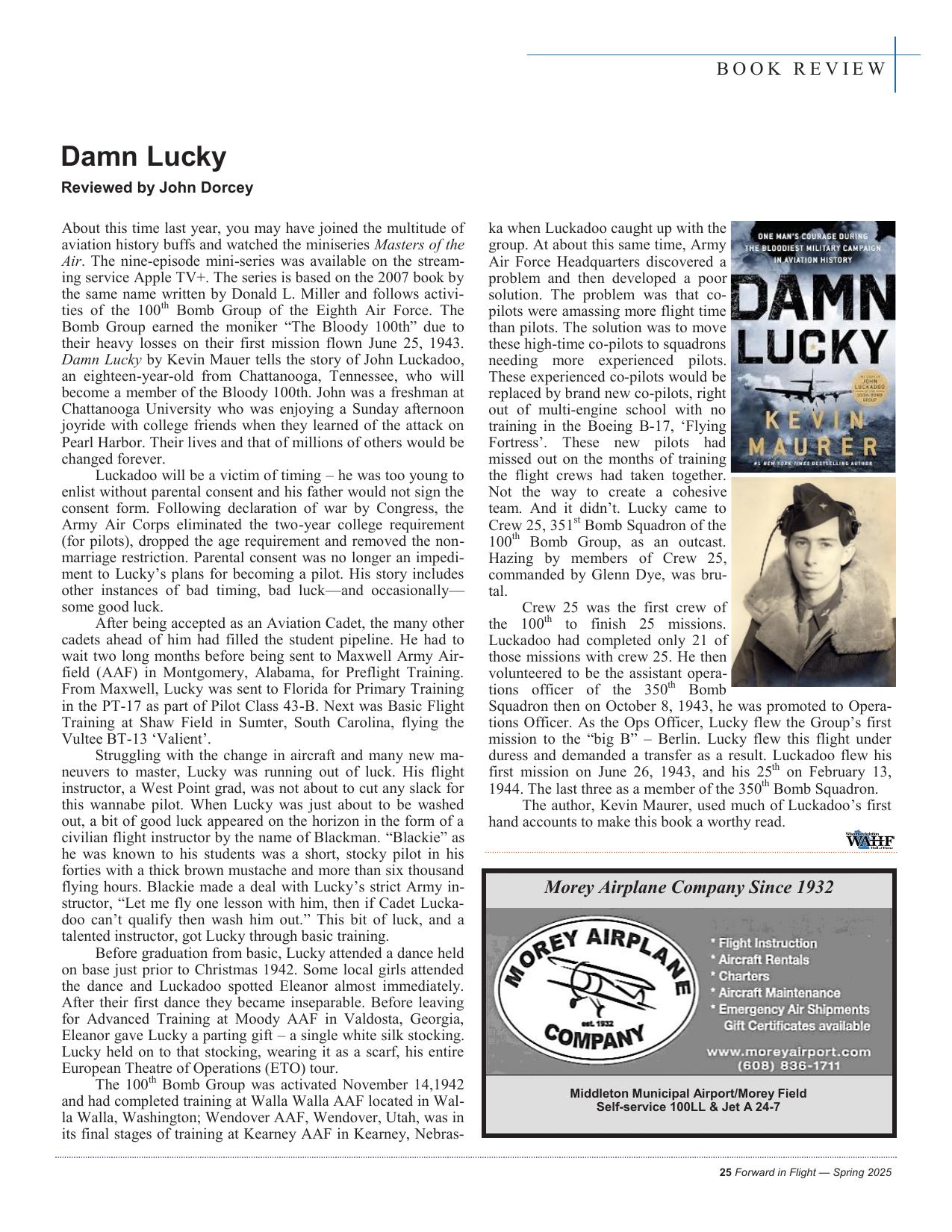
BOOK REVIEW Damn Lucky Reviewed by John Dorcey About this time last year, you may have joined the multitude of aviation history buffs and watched the miniseries Masters of the Air. The nine-episode mini-series was available on the streaming service Apple TV+. The series is based on the 2007 book by the same name written by Donald L. Miller and follows activities of the 100th Bomb Group of the Eighth Air Force. The Bomb Group earned the moniker “The Bloody 100th” due to their heavy losses on their first mission flown June 25, 1943. Damn Lucky by Kevin Mauer tells the story of John Luckadoo, an eighteen-year-old from Chattanooga, Tennessee, who will become a member of the Bloody 100th. John was a freshman at Chattanooga University who was enjoying a Sunday afternoon joyride with college friends when they learned of the attack on Pearl Harbor. Their lives and that of millions of others would be changed forever. Luckadoo will be a victim of timing – he was too young to enlist without parental consent and his father would not sign the consent form. Following declaration of war by Congress, the Army Air Corps eliminated the two-year college requirement (for pilots), dropped the age requirement and removed the nonmarriage restriction. Parental consent was no longer an impediment to Lucky’s plans for becoming a pilot. His story includes other instances of bad timing, bad luck—and occasionally— some good luck. After being accepted as an Aviation Cadet, the many other cadets ahead of him had filled the student pipeline. He had to wait two long months before being sent to Maxwell Army Airfield (AAF) in Montgomery, Alabama, for Preflight Training. From Maxwell, Lucky was sent to Florida for Primary Training in the PT-17 as part of Pilot Class 43-B. Next was Basic Flight Training at Shaw Field in Sumter, South Carolina, flying the Vultee BT-13 ‘Valient’. Struggling with the change in aircraft and many new maneuvers to master, Lucky was running out of luck. His flight instructor, a West Point grad, was not about to cut any slack for this wannabe pilot. When Lucky was just about to be washed out, a bit of good luck appeared on the horizon in the form of a civilian flight instructor by the name of Blackman. “Blackie” as he was known to his students was a short, stocky pilot in his forties with a thick brown mustache and more than six thousand flying hours. Blackie made a deal with Lucky’s strict Army instructor, “Let me fly one lesson with him, then if Cadet Luckadoo can’t qualify then wash him out.” This bit of luck, and a talented instructor, got Lucky through basic training. Before graduation from basic, Lucky attended a dance held on base just prior to Christmas 1942. Some local girls attended the dance and Luckadoo spotted Eleanor almost immediately. After their first dance they became inseparable. Before leaving for Advanced Training at Moody AAF in Valdosta, Georgia, Eleanor gave Lucky a parting gift – a single white silk stocking. Lucky held on to that stocking, wearing it as a scarf, his entire European Theatre of Operations (ETO) tour. The 100th Bomb Group was activated November 14,1942 and had completed training at Walla Walla AAF located in Walla Walla, Washington; Wendover AAF, Wendover, Utah, was in its final stages of training at Kearney AAF in Kearney, Nebras- ka when Luckadoo caught up with the group. At about this same time, Army Air Force Headquarters discovered a problem and then developed a poor solution. The problem was that copilots were amassing more flight time than pilots. The solution was to move these high-time co-pilots to squadrons needing more experienced pilots. These experienced co-pilots would be replaced by brand new co-pilots, right out of multi-engine school with no training in the Boeing B-17, ‘Flying Fortress’. These new pilots had missed out on the months of training the flight crews had taken together. Not the way to create a cohesive team. And it didn’t. Lucky came to Crew 25, 351st Bomb Squadron of the 100th Bomb Group, as an outcast. Hazing by members of Crew 25, commanded by Glenn Dye, was brutal. Crew 25 was the first crew of the 100th to finish 25 missions. Luckadoo had completed only 21 of those missions with crew 25. He then volunteered to be the assistant operations officer of the 350th Bomb Squadron then on October 8, 1943, he was promoted to Operations Officer. As the Ops Officer, Lucky flew the Group’s first mission to the “big B” – Berlin. Lucky flew this flight under duress and demanded a transfer as a result. Luckadoo flew his first mission on June 26, 1943, and his 25th on February 13, 1944. The last three as a member of the 350th Bomb Squadron. The author, Kevin Maurer, used much of Luckadoo’s first hand accounts to make this book a worthy read. Morey Airplane Company Since 1932 Middleton Municipal Airport/Morey Field Self-service 100LL & Jet A 24-7 25 Forward in Flight — Spring 2025
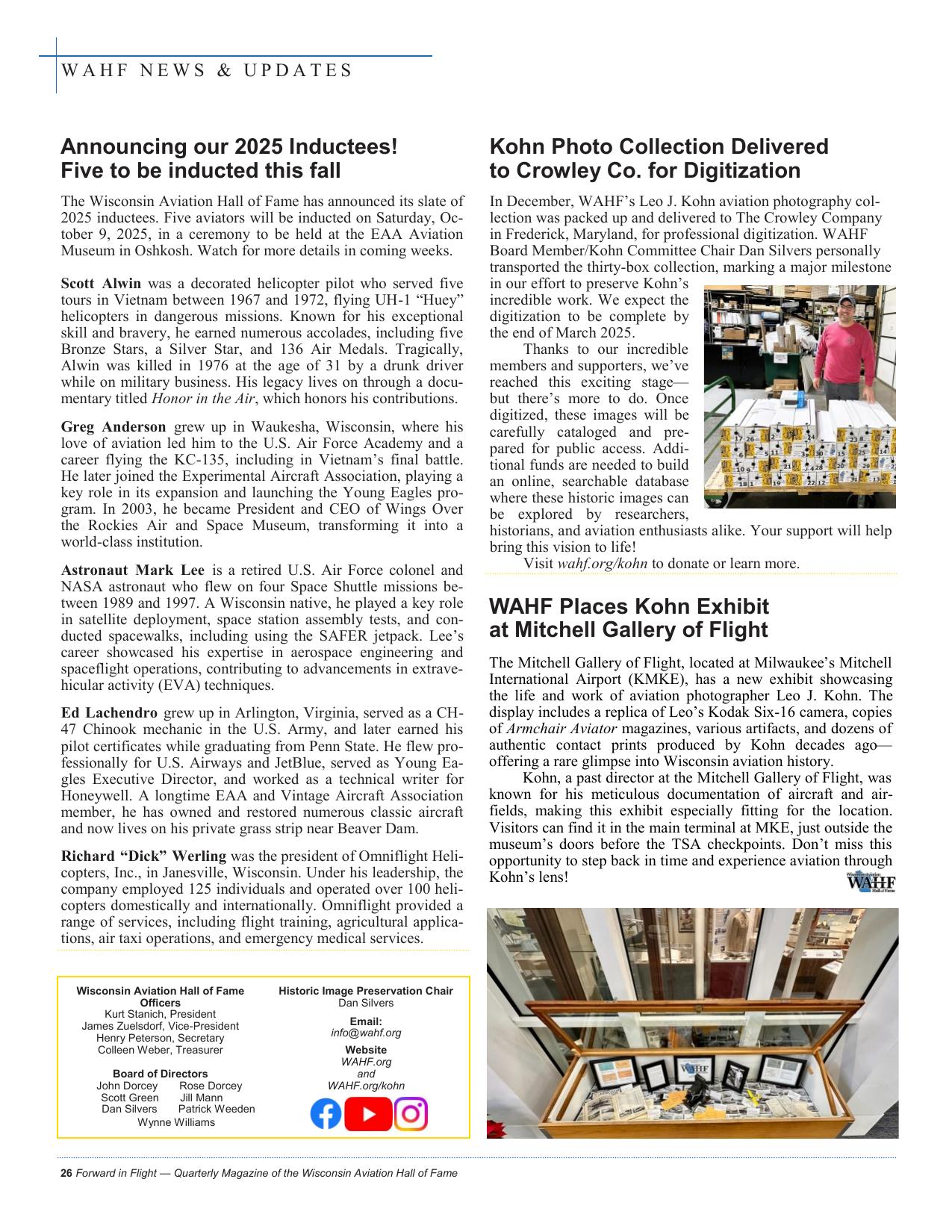
WAHF NEWS & UPDATES Announcing our 2025 Inductees! Five to be inducted this fall Kohn Photo Collection Delivered to Crowley Co. for Digitization The Wisconsin Aviation Hall of Fame has announced its slate of 2025 inductees. Five aviators will be inducted on Saturday, October 9, 2025, in a ceremony to be held at the EAA Aviation Museum in Oshkosh. Watch for more details in coming weeks. In December, WAHF’s Leo J. Kohn aviation photography collection was packed up and delivered to The Crowley Company in Frederick, Maryland, for professional digitization. WAHF Board Member/Kohn Committee Chair Dan Silvers personally transported the thirty-box collection, marking a major milestone in our effort to preserve Kohn’s incredible work. We expect the digitization to be complete by the end of March 2025. Thanks to our incredible members and supporters, we’ve reached this exciting stage— but there’s more to do. Once digitized, these images will be carefully cataloged and prepared for public access. Additional funds are needed to build an online, searchable database where these historic images can be explored by researchers, historians, and aviation enthusiasts alike. Your support will help bring this vision to life! Visit wahf.org/kohn to donate or learn more. Scott Alwin was a decorated helicopter pilot who served five tours in Vietnam between 1967 and 1972, flying UH-1 “Huey” helicopters in dangerous missions. Known for his exceptional skill and bravery, he earned numerous accolades, including five Bronze Stars, a Silver Star, and 136 Air Medals. Tragically, Alwin was killed in 1976 at the age of 31 by a drunk driver while on military business. His legacy lives on through a documentary titled Honor in the Air, which honors his contributions. Greg Anderson grew up in Waukesha, Wisconsin, where his love of aviation led him to the U.S. Air Force Academy and a career flying the KC-135, including in Vietnam’s final battle. He later joined the Experimental Aircraft Association, playing a key role in its expansion and launching the Young Eagles program. In 2003, he became President and CEO of Wings Over the Rockies Air and Space Museum, transforming it into a world-class institution. Astronaut Mark Lee is a retired U.S. Air Force colonel and NASA astronaut who flew on four Space Shuttle missions between 1989 and 1997. A Wisconsin native, he played a key role in satellite deployment, space station assembly tests, and conducted spacewalks, including using the SAFER jetpack. Lee’s career showcased his expertise in aerospace engineering and spaceflight operations, contributing to advancements in extravehicular activity (EVA) techniques. Ed Lachendro grew up in Arlington, Virginia, served as a CH47 Chinook mechanic in the U.S. Army, and later earned his pilot certificates while graduating from Penn State. He flew professionally for U.S. Airways and JetBlue, served as Young Eagles Executive Director, and worked as a technical writer for Honeywell. A longtime EAA and Vintage Aircraft Association member, he has owned and restored numerous classic aircraft and now lives on his private grass strip near Beaver Dam. Richard “Dick” Werling was the president of Omniflight Helicopters, Inc., in Janesville, Wisconsin. Under his leadership, the company employed 125 individuals and operated over 100 helicopters domestically and internationally. Omniflight provided a range of services, including flight training, agricultural applications, air taxi operations, and emergency medical services. Wisconsin Aviation Hall of Fame Officers Kurt Stanich, President James Zuelsdorf, Vice-President Henry Peterson, Secretary Colleen Weber, Treasurer Board of Directors John Dorcey Rose Dorcey Scott Green Jill Mann Dan Silvers Patrick Weeden Wynne Williams Historic Image Preservation Chair Dan Silvers Email: info@wahf.org Website WAHF.org and WAHF.org/kohn 26 Forward in Flight — Quarterly Magazine of the Wisconsin Aviation Hall of Fame WAHF Places Kohn Exhibit at Mitchell Gallery of Flight The Mitchell Gallery of Flight, located at Milwaukee’s Mitchell International Airport (KMKE), has a new exhibit showcasing the life and work of aviation photographer Leo J. Kohn. The display includes a replica of Leo’s Kodak Six-16 camera, copies of Armchair Aviator magazines, various artifacts, and dozens of authentic contact prints produced by Kohn decades ago— offering a rare glimpse into Wisconsin aviation history. Kohn, a past director at the Mitchell Gallery of Flight, was known for his meticulous documentation of aircraft and airfields, making this exhibit especially fitting for the location. Visitors can find it in the main terminal at MKE, just outside the museum’s doors before the TSA checkpoints. Don’t miss this opportunity to step back in time and experience aviation through Kohn’s lens! Friday 11 – 4 Saturday 9 – 4 Sunday 11 – 4
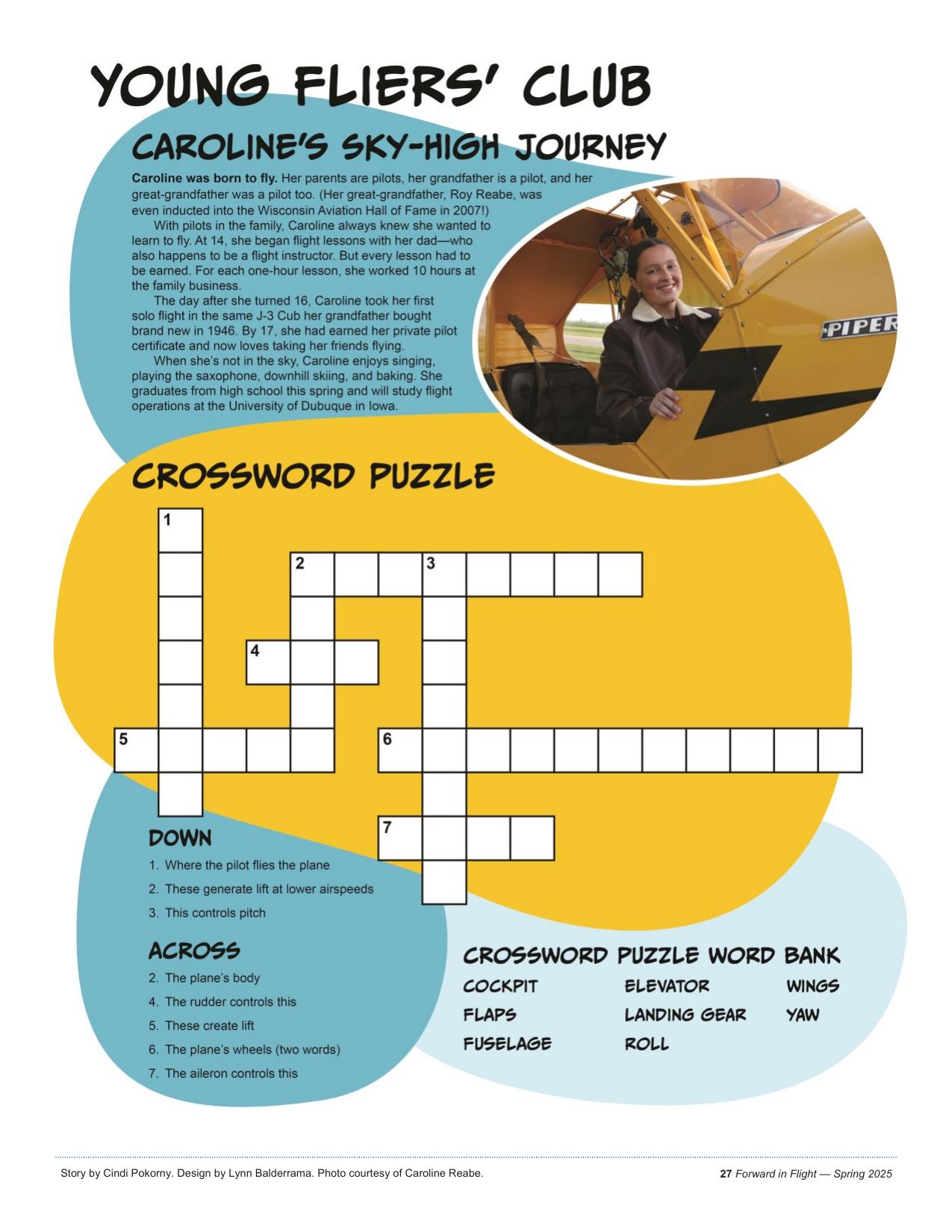
Story by Cindi Pokorny. Design by Lynn Balderrama. Photo courtesy of Caroline Reabe. 27 Forward in Flight — Spring 2025
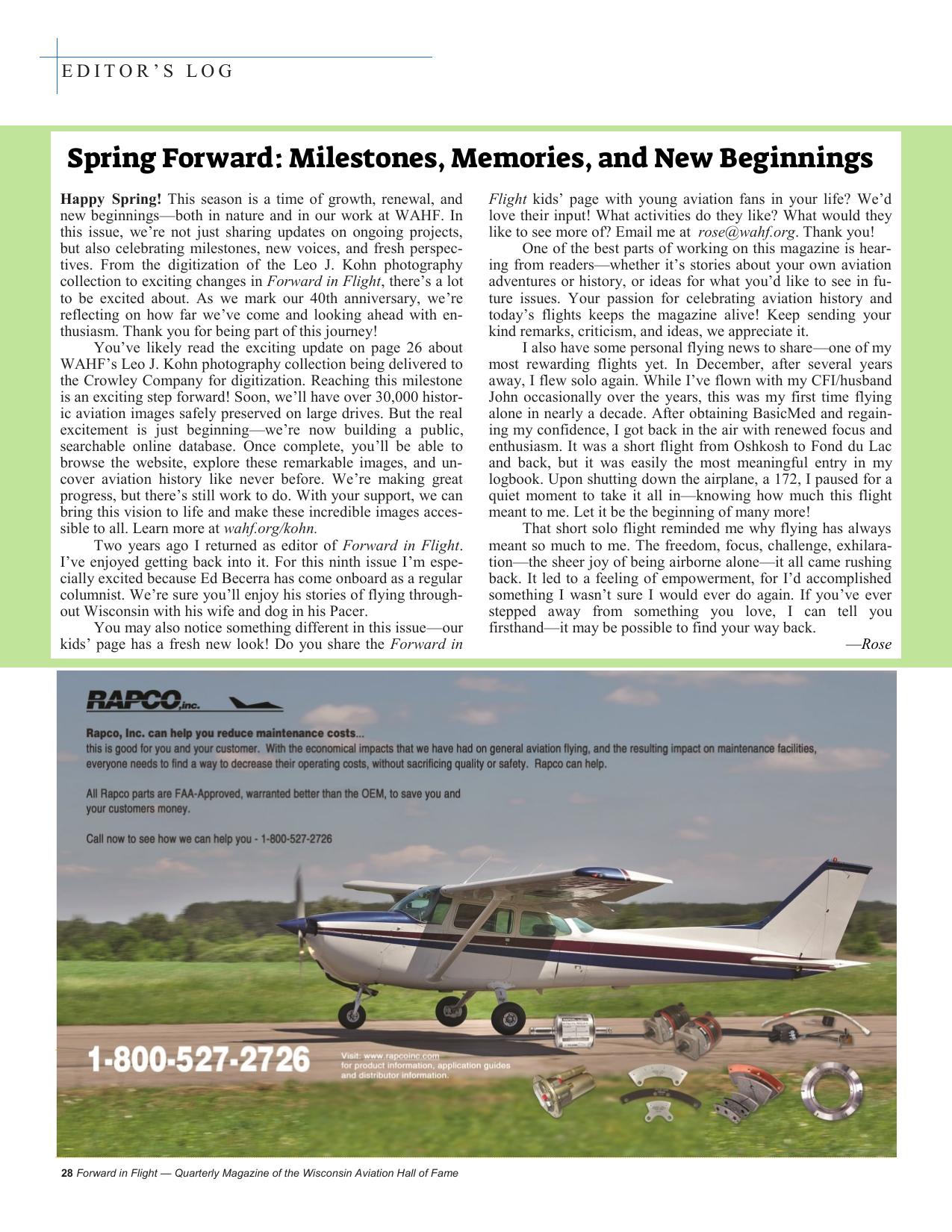
EDITOR’S LOG Spring Forward: Milestones, Memories, and New Beginnings Happy Spring! This season is a time of growth, renewal, and new beginnings—both in nature and in our work at WAHF. In this issue, we’re not just sharing updates on ongoing projects, but also celebrating milestones, new voices, and fresh perspectives. From the digitization of the Leo J. Kohn photography collection to exciting changes in Forward in Flight, there’s a lot to be excited about. As we mark our 40th anniversary, we’re reflecting on how far we’ve come and looking ahead with enthusiasm. Thank you for being part of this journey! You’ve likely read the exciting update on page 26 about WAHF’s Leo J. Kohn photography collection being delivered to the Crowley Company for digitization. Reaching this milestone is an exciting step forward! Soon, we’ll have over 30,000 historic aviation images safely preserved on large drives. But the real excitement is just beginning—we’re now building a public, searchable online database. Once complete, you’ll be able to browse the website, explore these remarkable images, and uncover aviation history like never before. We’re making great progress, but there’s still work to do. With your support, we can bring this vision to life and make these incredible images accessible to all. Learn more at wahf.org/kohn. Two years ago I returned as editor of Forward in Flight. I’ve enjoyed getting back into it. For this ninth issue I’m especially excited because Ed Becerra has come onboard as a regular columnist. We’re sure you’ll enjoy his stories of flying throughout Wisconsin with his wife and dog in his Pacer. You may also notice something different in this issue—our kids’ page has a fresh new look! Do you share the Forward in 28 Forward in Flight — Quarterly Magazine of the Wisconsin Aviation Hall of Fame Flight kids’ page with young aviation fans in your life? We’d love their input! What activities do they like? What would they like to see more of? Email me at rose@wahf.org. Thank you! One of the best parts of working on this magazine is hearing from readers—whether it’s stories about your own aviation adventures or history, or ideas for what you’d like to see in future issues. Your passion for celebrating aviation history and today’s flights keeps the magazine alive! Keep sending your kind remarks, criticism, and ideas, we appreciate it. I also have some personal flying news to share—one of my most rewarding flights yet. In December, after several years away, I flew solo again. While I’ve flown with my CFI/husband John occasionally over the years, this was my first time flying alone in nearly a decade. After obtaining BasicMed and regaining my confidence, I got back in the air with renewed focus and enthusiasm. It was a short flight from Oshkosh to Fond du Lac and back, but it was easily the most meaningful entry in my logbook. Upon shutting down the airplane, a 172, I paused for a quiet moment to take it all in—knowing how much this flight meant to me. Let it be the beginning of many more! That short solo flight reminded me why flying has always meant so much to me. The freedom, focus, challenge, exhilaration—the sheer joy of being airborne alone—it all came rushing back. It led to a feeling of empowerment, for I’d accomplished something I wasn’t sure I would ever do again. If you’ve ever stepped away from something you love, I can tell you firsthand—it may be possible to find your way back. —Rose
WAHF Membership and Donation Form Use for New Memberships and Renewals ANNUAL MEMBERSHIP LEVELS _____ Youth (Under age 18) _____ Individual (Annual) _____ Couple (Annual) _____ Lifetime (Individual) _____ Lifetime (Couple) $10 $30 $40 $500 $750 TAX DEDUCTIBLE CONTRIBUTIONS Your contributions help ensure Wisconsin’s aviation pioneers and outstanding students in aviation education will continue to be recognized. Your contributions, in any amount, are appreciated. WAHF Supporting Contribution $___________ (General operating/programming fund) Leo J. Kohn Collection Preservation Fund $___________ WAHF Scholarship Fund* $___________ *for scholarship donations please write a separate check payable to: Community Foundation of North Central Wisconsin or visit www.CFONCW.org Name________________________________________ Address______________________________________ City__________________________________________ State, Zip_____________________________________ Phone_______________________________________ Email________________________________________ Members receive WAHF’s quarterly magazine Forward in Flight! Join Online! WAHF.org Donate Online WAHF.org or WAHF.org/kohn Or, mail this form, along with your check payable to: Wisconsin Aviation Hall of Fame, Inc. Send to: Rose Dorcey/WAHF 3980 Sharratt Drive Oshkosh WI 54901 The Wisconsin Aviation Hall of Fame is a 501(c)(3) organization. 29 Forward in Flight — Spring 2025
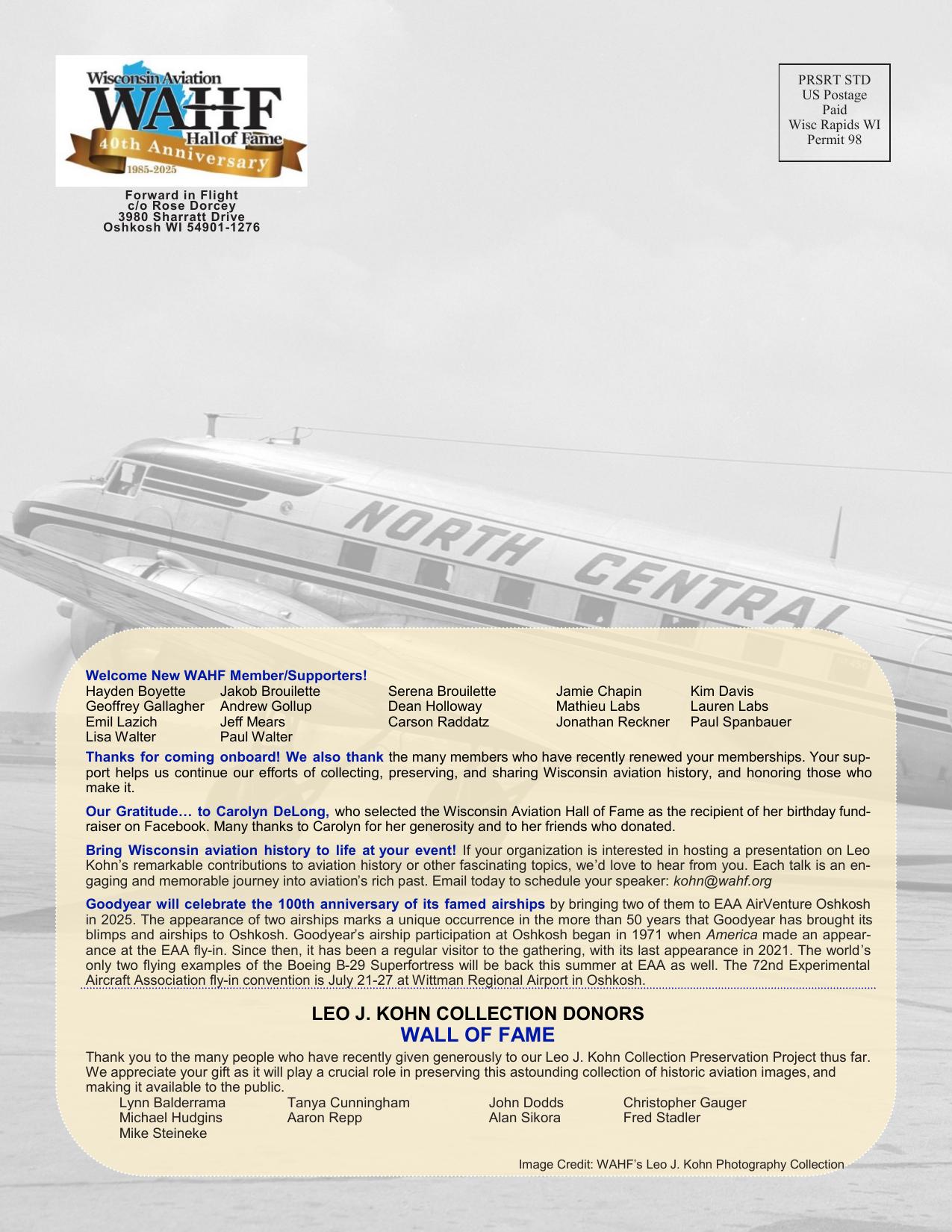
PRSRT STD US Postage Paid Wisc Rapids WI Permit 98 Forward in Flight c/o Rose Dorcey 3980 Sharratt Drive Oshkosh WI 54901-1276 Welcome New WAHF Member/Supporters! Hayden Boyette Jakob Brouilette Serena Brouilette Jamie Chapin Kim Davis Geoffrey Gallagher Andrew Gollup Dean Holloway Mathieu Labs Lauren Labs Emil Lazich Jeff Mears Carson Raddatz Jonathan Reckner Paul Spanbauer Lisa Walter Paul Walter Thanks for coming onboard! We also thank the many members who have recently renewed your memberships. Your support helps us continue our efforts of collecting, preserving, and sharing Wisconsin aviation history, and honoring those who make it. Our Gratitude… to Carolyn DeLong, who selected the Wisconsin Aviation Hall of Fame as the recipient of her birthday fundraiser on Facebook. Many thanks to Carolyn for her generosity and to her friends who donated. Bring Wisconsin aviation history to life at your event! If your organization is interested in hosting a presentation on Leo Kohn’s remarkable contributions to aviation history or other fascinating topics, we’d love to hear from you. Each talk is an engaging and memorable journey into aviation’s rich past. Email today to schedule your speaker: kohn@wahf.org Goodyear will celebrate the 100th anniversary of its famed airships by bringing two of them to EAA AirVenture Oshkosh in 2025. The appearance of two airships marks a unique occurrence in the more than 50 years that Goodyear has brought its blimps and airships to Oshkosh. Goodyear’s airship participation at Oshkosh began in 1971 when America made an appearance at the EAA fly-in. Since then, it has been a regular visitor to the gathering, with its last appearance in 2021. The world’s only two flying examples of the Boeing B-29 Superfortress will be back this summer at EAA as well. The 72nd Experimental Aircraft Association fly-in convention is July 21-27 at Wittman Regional Airport in Oshkosh. LEO J. KOHN COLLECTION DONORS WALL OF FAME Thank you to the many people who have recently given generously to our Leo J. Kohn Collection Preservation Project thus far. We appreciate your gift as it will play a crucial role in preserving this astounding collection of historic aviation images, and making it available to the public. Lynn Balderrama Tanya Cunningham John Dodds Christopher Gauger Michael Hudgins Aaron Repp Alan Sikora Fred Stadler Mike Steineke Image Credit: WAHF’s Leo J. Kohn Photography Collection