Volume 24, Issue 1
🗞️ Download Issue (PDF)
Forward in Flight - Spring 2026
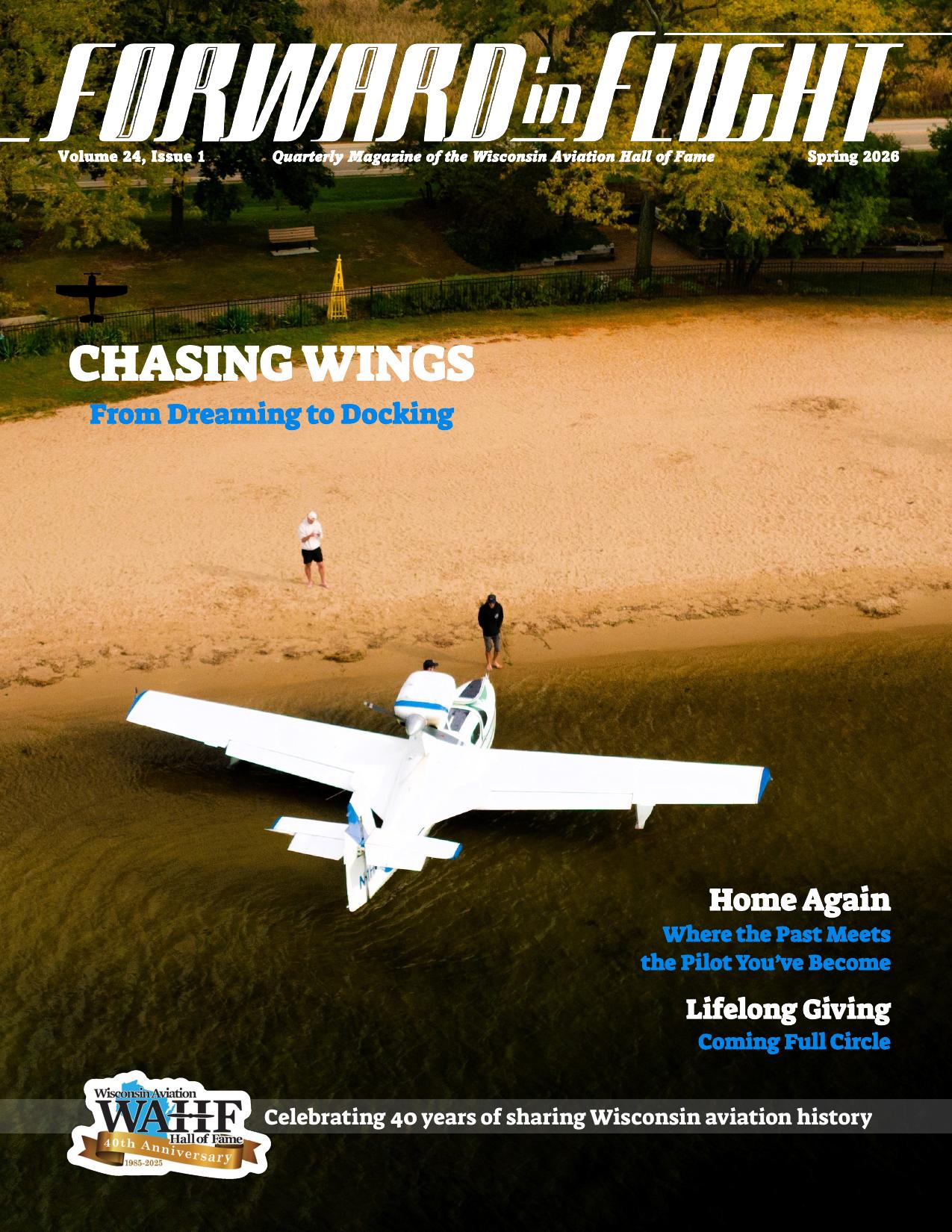
Volume 24, Issue 1 Quarterly Magazine of the Wisconsin Aviation Hall of Fame Spring 2026 CHASING WINGS From Dreaming to Docking Home Again Where the Past Meets the Pilot You’ve Become Lifelong Giving Coming Full Circle Celebrating 40 years of sharing Wisconsin aviation history
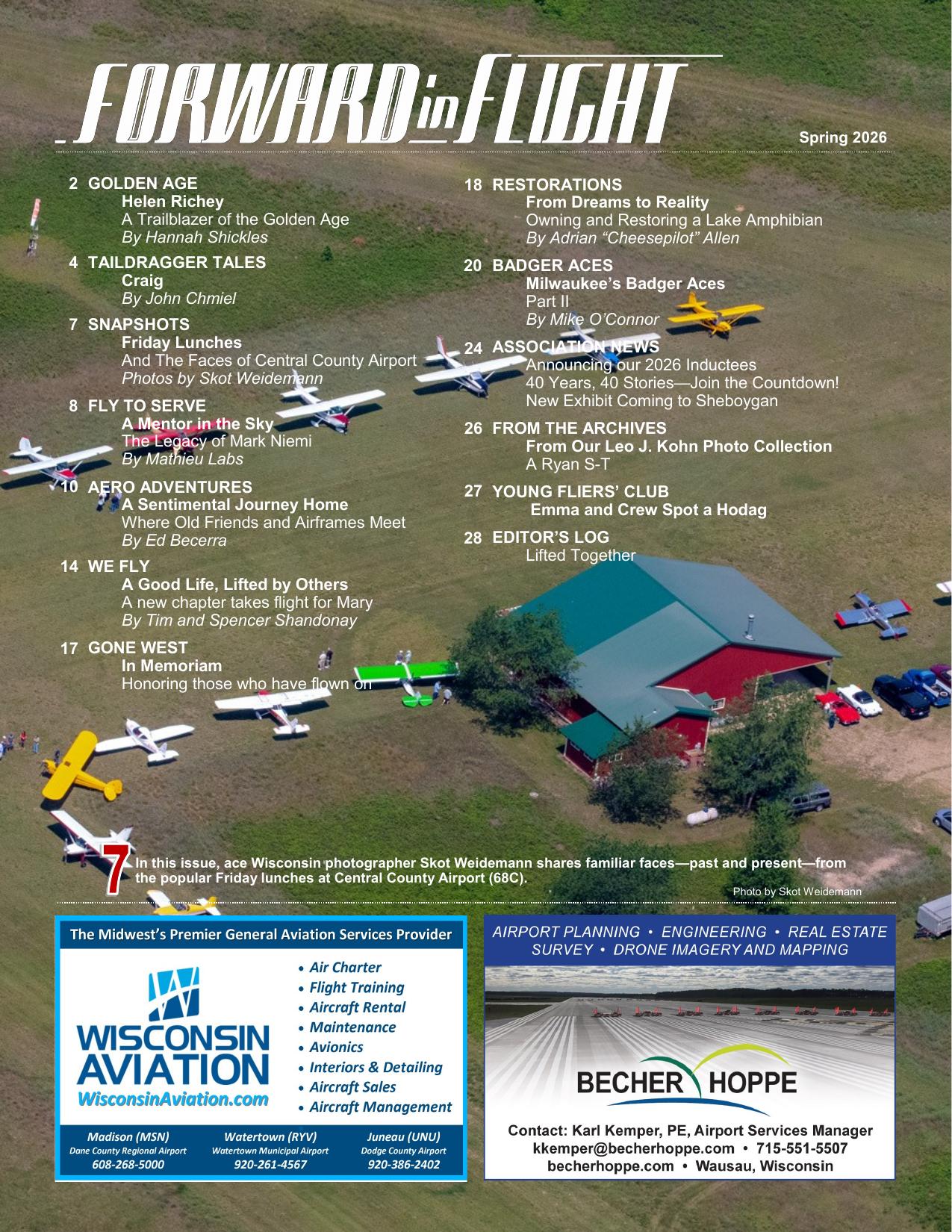
Spring 2026 2 GOLDEN AGE Helen Richey A Trailblazer of the Golden Age By Hannah Shickles 18 RESTORATIONS From Dreams to Reality Owning and Restoring a Lake Amphibian By Adrian “Cheesepilot” Allen 4 TAILDRAGGER TALES Craig By John Chmiel 20 BADGER ACES Milwaukee’s Badger Aces Part II By Mike O’Connor 7 SNAPSHOTS Friday Lunches Past and Present And The Faces of Central County Airport Photos by Skot Weidemann 8 FLY TO SERVE A Mentor in the Sky The Legacy of Mark Niemi By Mathieu Labs 10 AERO ADVENTURES A Sentimental Journey Home Where Old Friends and Airframes Meet By Ed Becerra 14 WE FLY A Good Life, Lifted by Others A new chapter takes flight for Mary By Tim and Spencer Shandonay 24 ASSOCIATION NEWS Announcing our 2026 Inductees 40 Years, 40 Stories—Join the Countdown! New Exhibit Coming to Sheboygan 26 FROM THE ARCHIVES From Our Leo J. Kohn Photo Collection A Ryan S-T 27 YOUNG FLIERS’ CLUB Emma and Crew Spot a Hodag 28 EDITOR’S LOG Lifted Together 17 GONE WEST In Memoriam Honoring those who have flown on In this issue, ace Wisconsin photographer Skot Weidemann shares familiar faces—past and present—from the popular Friday lunches at Central County Airport (68C). Photo by Skot Weidemann
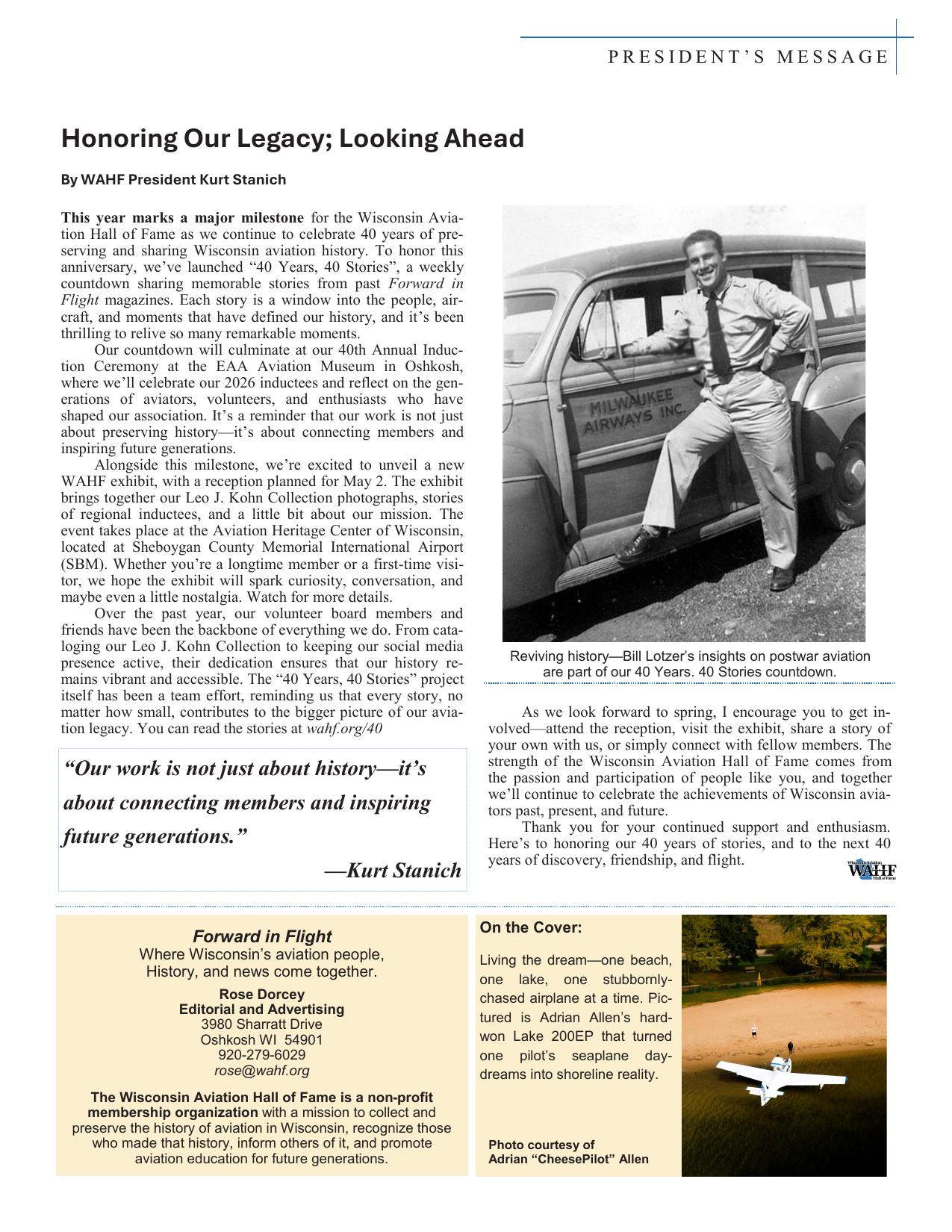
PRESIDENT’S MESSAGE Honoring Our Legacy; Looking Ahead By WAHF President Kurt Stanich This year marks a major milestone for the Wisconsin Aviation Hall of Fame as we continue to celebrate 40 years of preserving and sharing Wisconsin aviation history. To honor this anniversary, we’ve launched “40 Years, 40 Stories”, a weekly countdown sharing memorable stories from past Forward in Flight magazines. Each story is a window into the people, aircraft, and moments that have defined our history, and it’s been thrilling to relive so many remarkable moments. Our countdown will culminate at our 40th Annual Induction Ceremony at the EAA Aviation Museum in Oshkosh, where we’ll celebrate our 2026 inductees and reflect on the generations of aviators, volunteers, and enthusiasts who have shaped our association. It’s a reminder that our work is not just about preserving history—it’s about connecting members and inspiring future generations. Alongside this milestone, we’re excited to unveil a new WAHF exhibit, with a reception planned for May 2. The exhibit brings together our Leo J. Kohn Collection photographs, stories of regional inductees, and a little bit about our mission. The event takes place at the Aviation Heritage Center of Wisconsin, located at Sheboygan County Memorial International Airport (SBM). Whether you’re a longtime member or a first-time visitor, we hope the exhibit will spark curiosity, conversation, and maybe even a little nostalgia. Watch for more details. Over the past year, our volunteer board members and friends have been the backbone of everything we do. From cataloging our Leo J. Kohn Collection to keeping our social media presence active, their dedication ensures that our history remains vibrant and accessible. The “40 Years, 40 Stories” project itself has been a team effort, reminding us that every story, no matter how small, contributes to the bigger picture of our aviation legacy. You can read the stories at wahf.org/40 “Our work is not just about history—it’s about connecting members and inspiring future generations.” —Kurt Stanich Forward in Flight Where Wisconsin’s aviation people, History, and news come together. Reviving history—Bill Lotzer’s insights on postwar aviation are part of our 40 Years. 40 Stories countdown. As we look forward to spring, I encourage you to get involved—attend the reception, visit the exhibit, share a story of your own with us, or simply connect with fellow members. The strength of the Wisconsin Aviation Hall of Fame comes from the passion and participation of people like you, and together we’ll continue to celebrate the achievements of Wisconsin aviators past, present, and future. Thank you for your continued support and enthusiasm. Here’s to honoring our 40 years of stories, and to the next 40 years of discovery, friendship, and flight. On the Cover: Rose Dorcey Editorial and Advertising 3980 Sharratt Drive Oshkosh WI 54901 920-279-6029 rose@wahf.org Living the dream—one beach, one lake, one stubbornlychased airplane at a time. Pictured is Adrian Allen’s hardwon Lake 200EP that turned one pilot’s seaplane daydreams into shoreline reality. The Wisconsin Aviation Hall of Fame is a non-profit membership organization with a mission to collect and preserve the history of aviation in Wisconsin, recognize those who made that history, inform others of it, and promote aviation education for future generations. Photo by pdzzy and courtesy of Adrian “CheesePilot” Allen
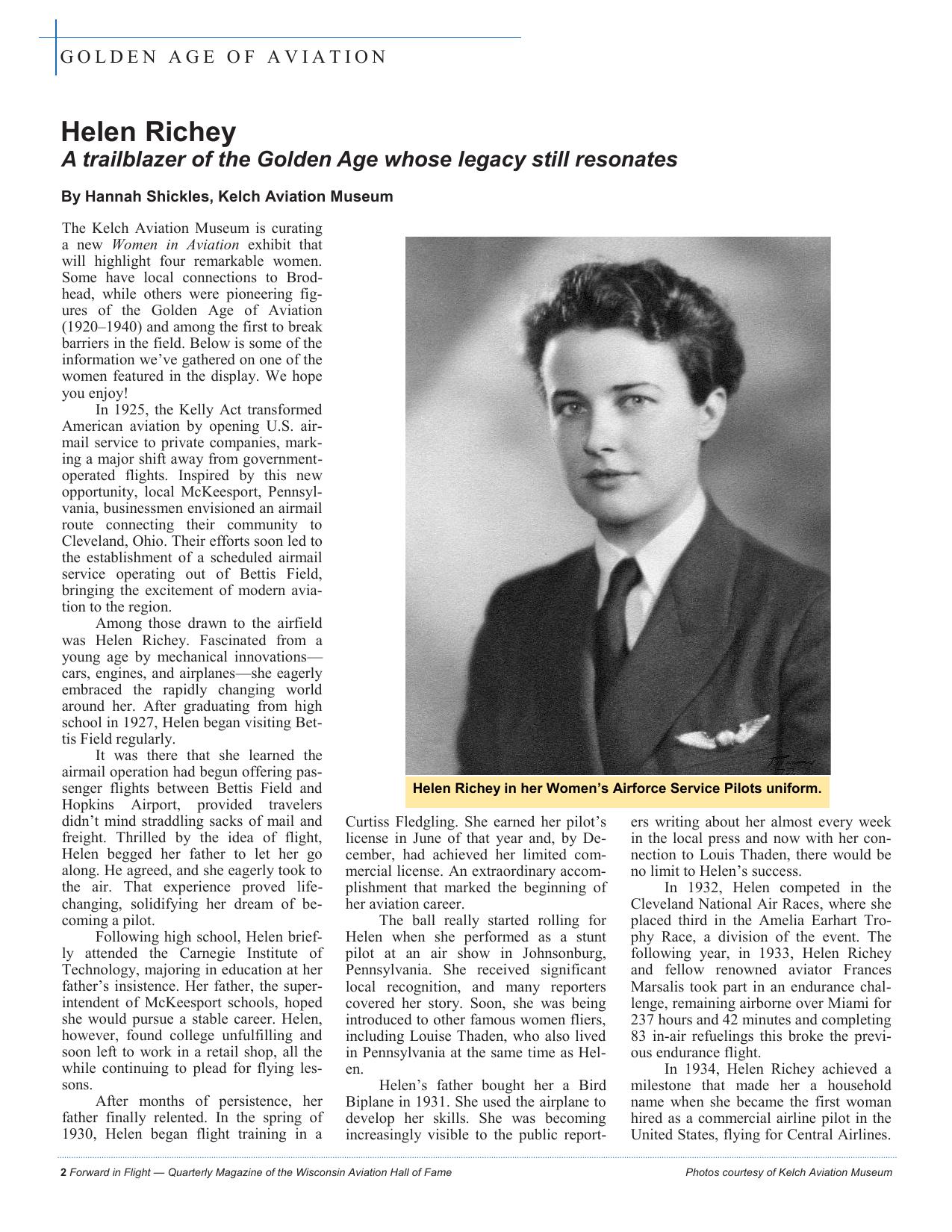
GOLDEN AGE OF AVIATION Helen Richey A trailblazer of the Golden Age whose legacy still resonates By Hannah Shickles, Kelch Aviation Museum The Kelch Aviation Museum is curating a new Women in Aviation exhibit that will highlight four remarkable women. Some have local connections to Brodhead, while others were pioneering figures of the Golden Age of Aviation (1920–1940) and among the first to break barriers in the field. Below is some of the information we’ve gathered on one of the women featured in the display. We hope you enjoy! In 1925, the Kelly Act transformed American aviation by opening U.S. airmail service to private companies, marking a major shift away from governmentoperated flights. Inspired by this new opportunity, local McKeesport, Pennsylvania, businessmen envisioned an airmail route connecting their community to Cleveland, Ohio. Their efforts soon led to the establishment of a scheduled airmail service operating out of Bettis Field, bringing the excitement of modern aviation to the region. Among those drawn to the airfield was Helen Richey. Fascinated from a young age by mechanical innovations— cars, engines, and airplanes—she eagerly embraced the rapidly changing world around her. After graduating from high school in 1927, Helen began visiting Bettis Field regularly. It was there that she learned the airmail operation had begun offering passenger flights between Bettis Field and Hopkins Airport, provided travelers didn’t mind straddling sacks of mail and freight. Thrilled by the idea of flight, Helen begged her father to let her go along. He agreed, and she eagerly took to the air. That experience proved lifechanging, solidifying her dream of becoming a pilot. Following high school, Helen briefly attended the Carnegie Institute of Technology, majoring in education at her father’s insistence. Her father, the superintendent of McKeesport schools, hoped she would pursue a stable career. Helen, however, found college unfulfilling and soon left to work in a retail shop, all the while continuing to plead for flying lessons. After months of persistence, her father finally relented. In the spring of 1930, Helen began flight training in a Helen Richey in her Women’s Airforce Service Pilots uniform. Curtiss Fledgling. She earned her pilot’s license in June of that year and, by December, had achieved her limited commercial license. An extraordinary accomplishment that marked the beginning of her aviation career. The ball really started rolling for Helen when she performed as a stunt pilot at an air show in Johnsonburg, Pennsylvania. She received significant local recognition, and many reporters covered her story. Soon, she was being introduced to other famous women fliers, including Louise Thaden, who also lived in Pennsylvania at the same time as Helen. Helen’s father bought her a Bird Biplane in 1931. She used the airplane to develop her skills. She was becoming increasingly visible to the public report- 2 Forward in Flight — Quarterly Magazine of the Wisconsin Aviation Hall of Fame ers writing about her almost every week in the local press and now with her connection to Louis Thaden, there would be no limit to Helen’s success. In 1932, Helen competed in the Cleveland National Air Races, where she placed third in the Amelia Earhart Trophy Race, a division of the event. The following year, in 1933, Helen Richey and fellow renowned aviator Frances Marsalis took part in an endurance challenge, remaining airborne over Miami for 237 hours and 42 minutes and completing 83 in-air refuelings this broke the previous endurance flight. In 1934, Helen Richey achieved a milestone that made her a household name when she became the first woman hired as a commercial airline pilot in the United States, flying for Central Airlines. Photos courtesy of Kelch Aviation Museum
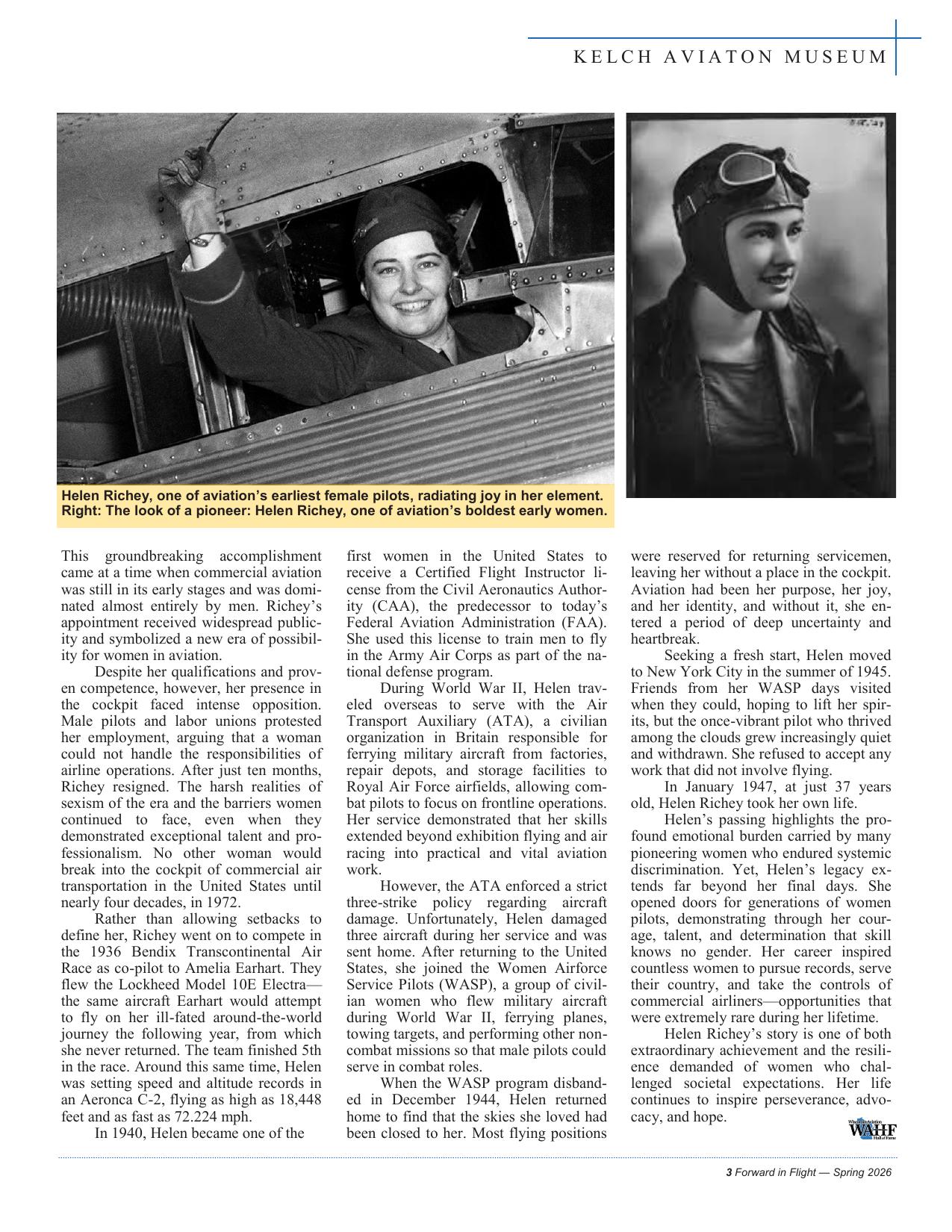
KELCH AVIATON MUSEUM Helen Richey, one of aviation’s earliest female pilots, radiating joy in her element. Right: The look of a pioneer: Helen Richey, one of aviation’s boldest early women. This groundbreaking accomplishment came at a time when commercial aviation was still in its early stages and was dominated almost entirely by men. Richey’s appointment received widespread publicity and symbolized a new era of possibility for women in aviation. Despite her qualifications and proven competence, however, her presence in the cockpit faced intense opposition. Male pilots and labor unions protested her employment, arguing that a woman could not handle the responsibilities of airline operations. After just ten months, Richey resigned. The harsh realities of sexism of the era and the barriers women continued to face, even when they demonstrated exceptional talent and professionalism. No other woman would break into the cockpit of commercial air transportation in the United States until nearly four decades, in 1972. Rather than allowing setbacks to define her, Richey went on to compete in the 1936 Bendix Transcontinental Air Race as co-pilot to Amelia Earhart. They flew the Lockheed Model 10E Electra— the same aircraft Earhart would attempt to fly on her ill-fated around-the-world journey the following year, from which she never returned. The team finished 5th in the race. Around this same time, Helen was setting speed and altitude records in an Aeronca C-2, flying as high as 18,448 feet and as fast as 72.224 mph. In 1940, Helen became one of the first women in the United States to receive a Certified Flight Instructor license from the Civil Aeronautics Authority (CAA), the predecessor to today’s Federal Aviation Administration (FAA). She used this license to train men to fly in the Army Air Corps as part of the national defense program. During World War II, Helen traveled overseas to serve with the Air Transport Auxiliary (ATA), a civilian organization in Britain responsible for ferrying military aircraft from factories, repair depots, and storage facilities to Royal Air Force airfields, allowing combat pilots to focus on frontline operations. Her service demonstrated that her skills extended beyond exhibition flying and air racing into practical and vital aviation work. However, the ATA enforced a strict three-strike policy regarding aircraft damage. Unfortunately, Helen damaged three aircraft during her service and was sent home. After returning to the United States, she joined the Women Airforce Service Pilots (WASP), a group of civilian women who flew military aircraft during World War II, ferrying planes, towing targets, and performing other noncombat missions so that male pilots could serve in combat roles. When the WASP program disbanded in December 1944, Helen returned home to find that the skies she loved had been closed to her. Most flying positions were reserved for returning servicemen, leaving her without a place in the cockpit. Aviation had been her purpose, her joy, and her identity, and without it, she entered a period of deep uncertainty and heartbreak. Seeking a fresh start, Helen moved to New York City in the summer of 1945. Friends from her WASP days visited when they could, hoping to lift her spirits, but the once-vibrant pilot who thrived among the clouds grew increasingly quiet and withdrawn. She refused to accept any work that did not involve flying. In January 1947, at just 37 years old, Helen Richey took her own life. Helen’s passing highlights the profound emotional burden carried by many pioneering women who endured systemic discrimination. Yet, Helen’s legacy extends far beyond her final days. She opened doors for generations of women pilots, demonstrating through her courage, talent, and determination that skill knows no gender. Her career inspired countless women to pursue records, serve their country, and take the controls of commercial airliners—opportunities that were extremely rare during her lifetime. Helen Richey’s story is one of both extraordinary achievement and the resilience demanded of women who challenged societal expectations. Her life continues to inspire perseverance, advocacy, and hope. 3 Forward in Flight — Spring 2026
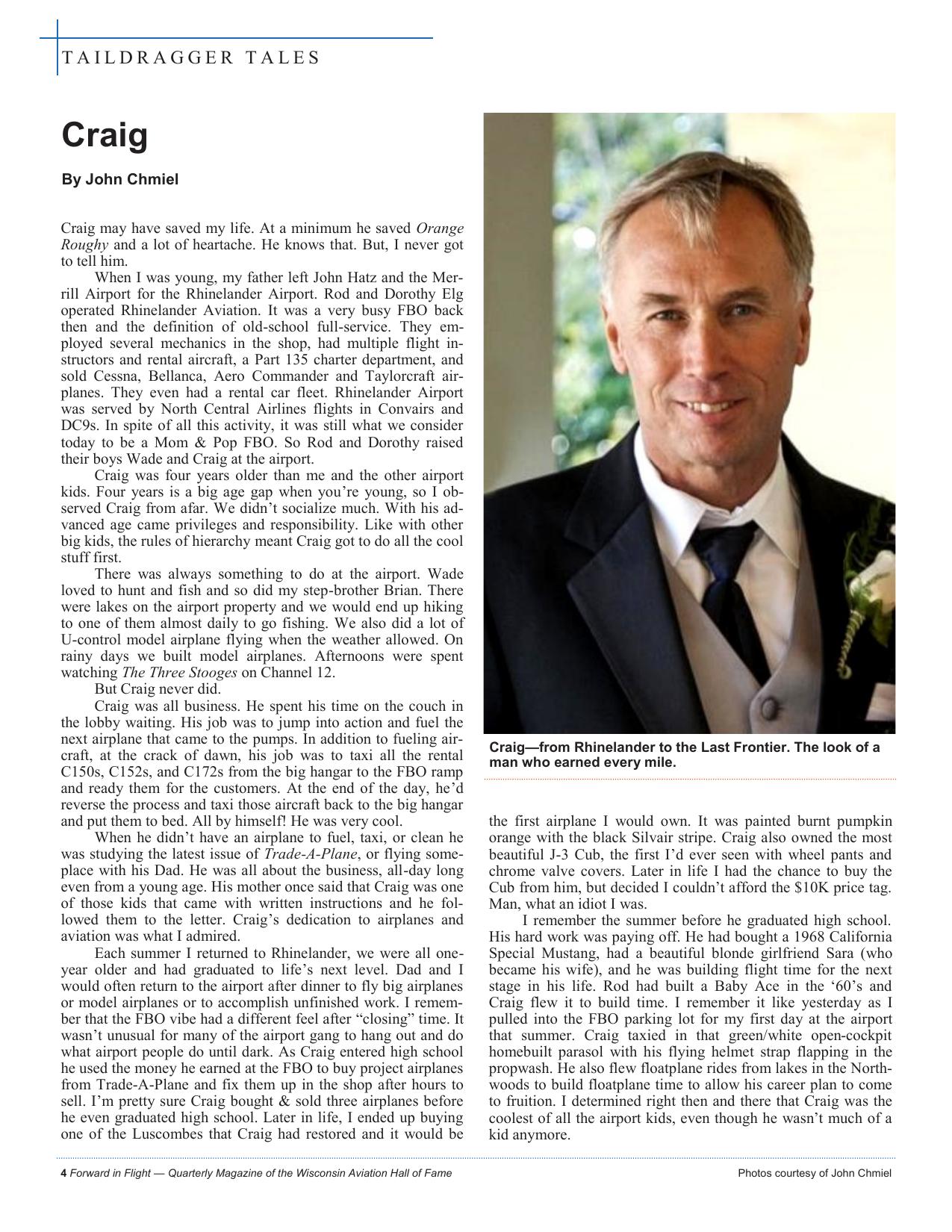
TAILDRAGGER TALES Craig By John Chmiel Craig may have saved my life. At a minimum he saved Orange Roughy and a lot of heartache. He knows that. But, I never got to tell him. When I was young, my father left John Hatz and the Merrill Airport for the Rhinelander Airport. Rod and Dorothy Elg operated Rhinelander Aviation. It was a very busy FBO back then and the definition of old-school full-service. They employed several mechanics in the shop, had multiple flight instructors and rental aircraft, a Part 135 charter department, and sold Cessna, Bellanca, Aero Commander and Taylorcraft airplanes. They even had a rental car fleet. Rhinelander Airport was served by North Central Airlines flights in Convairs and DC9s. In spite of all this activity, it was still what we consider today to be a Mom & Pop FBO. So Rod and Dorothy raised their boys Wade and Craig at the airport. Craig was four years older than me and the other airport kids. Four years is a big age gap when you’re young, so I observed Craig from afar. We didn’t socialize much. With his advanced age came privileges and responsibility. Like with other big kids, the rules of hierarchy meant Craig got to do all the cool stuff first. There was always something to do at the airport. Wade loved to hunt and fish and so did my step-brother Brian. There were lakes on the airport property and we would end up hiking to one of them almost daily to go fishing. We also did a lot of U-control model airplane flying when the weather allowed. On rainy days we built model airplanes. Afternoons were spent watching The Three Stooges on Channel 12. But Craig never did. Craig was all business. He spent his time on the couch in the lobby waiting. His job was to jump into action and fuel the next airplane that came to the pumps. In addition to fueling aircraft, at the crack of dawn, his job was to taxi all the rental C150s, C152s, and C172s from the big hangar to the FBO ramp and ready them for the customers. At the end of the day, he’d reverse the process and taxi those aircraft back to the big hangar and put them to bed. All by himself! He was very cool. When he didn’t have an airplane to fuel, taxi, or clean he was studying the latest issue of Trade-A-Plane, or flying someplace with his Dad. He was all about the business, all-day long even from a young age. His mother once said that Craig was one of those kids that came with written instructions and he followed them to the letter. Craig’s dedication to airplanes and aviation was what I admired. Each summer I returned to Rhinelander, we were all oneyear older and had graduated to life’s next level. Dad and I would often return to the airport after dinner to fly big airplanes or model airplanes or to accomplish unfinished work. I remember that the FBO vibe had a different feel after “closing” time. It wasn’t unusual for many of the airport gang to hang out and do what airport people do until dark. As Craig entered high school he used the money he earned at the FBO to buy project airplanes from Trade-A-Plane and fix them up in the shop after hours to sell. I’m pretty sure Craig bought & sold three airplanes before he even graduated high school. Later in life, I ended up buying one of the Luscombes that Craig had restored and it would be 4 Forward in Flight — Quarterly Magazine of the Wisconsin Aviation Hall of Fame Craig—from Rhinelander to the Last Frontier. The look of a man who earned every mile. the first airplane I would own. It was painted burnt pumpkin orange with the black Silvair stripe. Craig also owned the most beautiful J-3 Cub, the first I’d ever seen with wheel pants and chrome valve covers. Later in life I had the chance to buy the Cub from him, but decided I couldn’t afford the $10K price tag. Man, what an idiot I was. I remember the summer before he graduated high school. His hard work was paying off. He had bought a 1968 California Special Mustang, had a beautiful blonde girlfriend Sara (who became his wife), and he was building flight time for the next stage in his life. Rod had built a Baby Ace in the ‘60’s and Craig flew it to build time. I remember it like yesterday as I pulled into the FBO parking lot for my first day at the airport that summer. Craig taxied in that green/white open-cockpit homebuilt parasol with his flying helmet strap flapping in the propwash. He also flew floatplane rides from lakes in the Northwoods to build floatplane time to allow his career plan to come to fruition. I determined right then and there that Craig was the coolest of all the airport kids, even though he wasn’t much of a kid anymore. Photos courtesy of John Chmiel
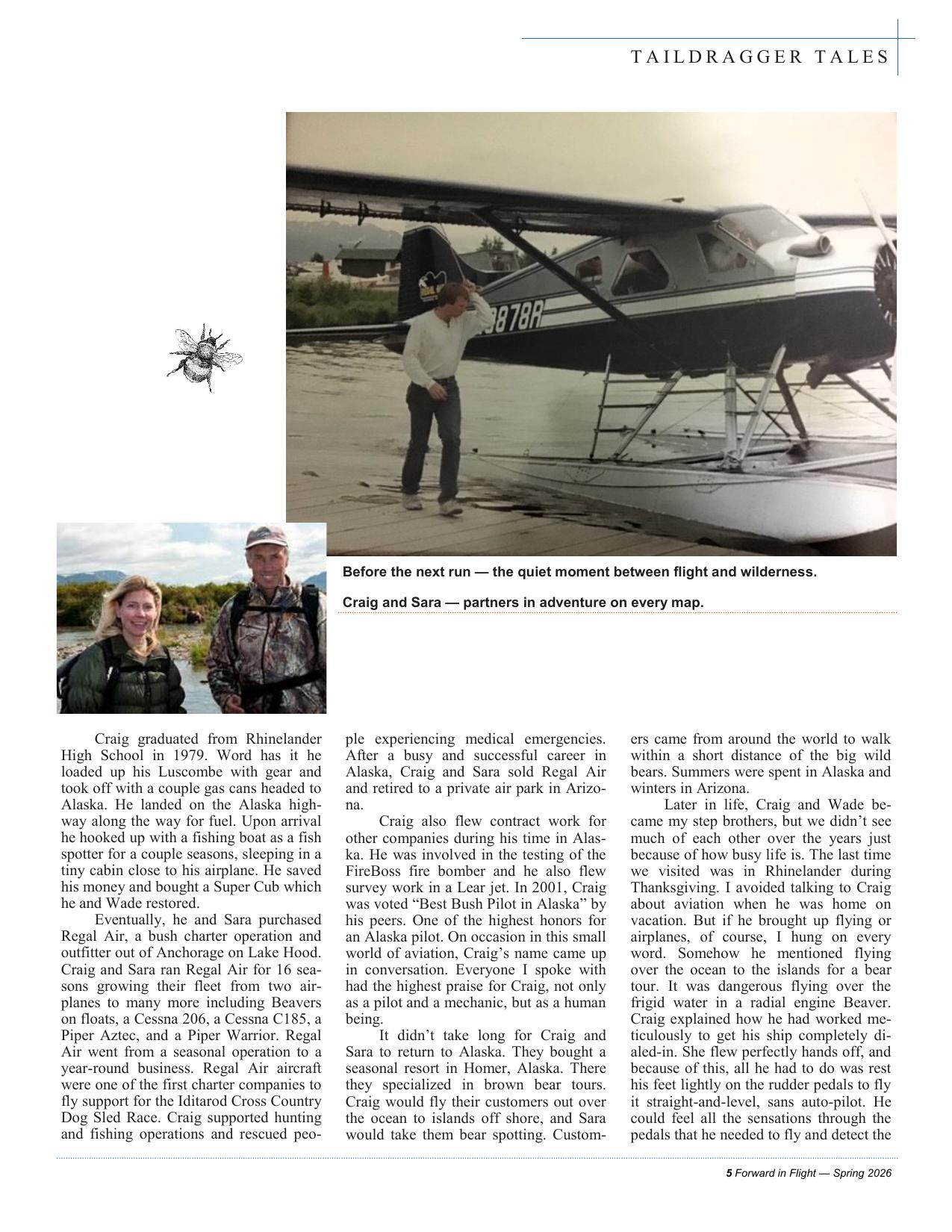
TAILDRAGGER TALES Before the next run — the quiet moment between flight and wilderness. Craig and Sara — partners in adventure on every map. Craig graduated from Rhinelander High School in 1979. Word has it he loaded up his Luscombe with gear and took off with a couple gas cans headed to Alaska. He landed on the Alaska highway along the way for fuel. Upon arrival he hooked up with a fishing boat as a fish spotter for a couple seasons, sleeping in a tiny cabin close to his airplane. He saved his money and bought a Super Cub which he and Wade restored. Eventually, he and Sara purchased Regal Air, a bush charter operation and outfitter out of Anchorage on Lake Hood. Craig and Sara ran Regal Air for 16 seasons growing their fleet from two airplanes to many more including Beavers on floats, a Cessna 206, a Cessna C185, a Piper Aztec, and a Piper Warrior. Regal Air went from a seasonal operation to a year-round business. Regal Air aircraft were one of the first charter companies to fly support for the Iditarod Cross Country Dog Sled Race. Craig supported hunting and fishing operations and rescued peo- ple experiencing medical emergencies. After a busy and successful career in Alaska, Craig and Sara sold Regal Air and retired to a private air park in Arizona. Craig also flew contract work for other companies during his time in Alaska. He was involved in the testing of the FireBoss fire bomber and he also flew survey work in a Lear jet. In 2001, Craig was voted “Best Bush Pilot in Alaska” by his peers. One of the highest honors for an Alaska pilot. On occasion in this small world of aviation, Craig’s name came up in conversation. Everyone I spoke with had the highest praise for Craig, not only as a pilot and a mechanic, but as a human being. It didn’t take long for Craig and Sara to return to Alaska. They bought a seasonal resort in Homer, Alaska. There they specialized in brown bear tours. Craig would fly their customers out over the ocean to islands off shore, and Sara would take them bear spotting. Custom- ers came from around the world to walk within a short distance of the big wild bears. Summers were spent in Alaska and winters in Arizona. Later in life, Craig and Wade became my step brothers, but we didn’t see much of each other over the years just because of how busy life is. The last time we visited was in Rhinelander during Thanksgiving. I avoided talking to Craig about aviation when he was home on vacation. But if he brought up flying or airplanes, of course, I hung on every word. Somehow he mentioned flying over the ocean to the islands for a bear tour. It was dangerous flying over the frigid water in a radial engine Beaver. Craig explained how he had worked meticulously to get his ship completely dialed-in. She flew perfectly hands off, and because of this, all he had to do was rest his feet lightly on the rudder pedals to fly it straight-and-level, sans auto-pilot. He could feel all the sensations through the pedals that he needed to fly and detect the 5 Forward in Flight — Spring 2026
TAILDRAGGER TALES health of his ship. But on one return flight to Homer something very subtle happened. He felt something. If memory serves me correctly, Craig described it as what it feels like when a bumble bee lands on your arm with its wings flapping. Just a tiny little, almost undetectable vibration. If you didn’t have the awareness, were tense, or distracted, you wouldn’t even know it happened. It lasted maybe 10 seconds. There were no abnormal engine instrument indications. Everything seemed fine. It didn’t reoccur. A new pilot who isn’t relaxed enough to “feel” an airplane in flight would never detect it. To a pilot with little experience in that airplane it would have gone unnoticed. A pilot with their feet flat on the floor wouldn’t know better. Passengers certainly had no idea. But Craig knew his ship, and he knew something was different. After landing and taking care of the passengers, Craig immediately began inspecting the Beaver and found absolutely nothing after a thorough check out. Finally he decided to pull the plug out of the oil sump. And there they were, chunks of metal from the engine’s main bearing. Not a change in sound. Not a needle had moved. No warning lights in the cockpit. The sensation of a bumble bee landing on his big toe had allowed him to avoid a future disaster. I never forgot his story. I determined right then and there that I would change the way I fly. As an old school flight instructor, I always taught my students to use all their senses to control an airplane, especially “feel”. But the feel I taught was through the stick, G-forces, coordination using the seat of your pants, slipstream. The only feel taught through the feet was rote right rudder pressure for left turning tendencies, and adverse yaw compensation. I didn’t explain more than every other flight instructor does. From that moment on I practiced how to feel every airplane I flew through the pedals. I pass on my knowledge to all the pilots I fly with. The right rudder pedal on every American made airplane that isn’t a twin should be more worn than the left. If your airplane is rigged properly and you’re not doing aerobatics or slips, you don’t need that left pedal much. Don’t push on both pedals unless you’re taxiing or need to use the brakes. Otherwise, just rest your feet or foot on the pedals. Pushing on both simultaneously removes the sensations the airplane is giving you to determine its health. If you’re in a Vx climb with full power, you learn it's the same amount of rudder pressure every time and you can feel the precise amount without looking at an instrument. You can actually perceive the increase in rudder pressure required as left turning tendencies increase if you only use your right foot. For years I practiced learning these things and more about flying with your feet. All from Craig’s story. …. a bumble bee landed on my right big toe, buzzed for 10 seconds, and took off. I immediately remembered Craig’s story. But the needles didn’t move. Nothing sounded different. …. I went into denial. 6 Forward in Flight — Quarterly Magazine of the Wisconsin Aviation Hall of Fame Then one day it happened. I was demonstrating a take-off, climbing out early in the season with an annual Orange Roughy Stearman pilot. During the demo . . . a bumble bee landed on my right big toe, buzzed for 10 seconds, and took off. I immediately remembered Craig's story. But the needles didn’t move. Nothing sounded different. The customer had no idea. I went into denial. I convinced myself I had imagined it. The flight ended an hour later with no further issues or bee encounters. It continued bothering me. When the debrief was over, I had my mechanic inspect the Roughy. A couple things that were tweaked and tightened, but nothing stood out as the source of an nearly undetectable sign. I decided to fly solo for another half hour and see if anything could be detected. A half hour later I landed after a perfect flight. But as I cleared the runway and pulled the throttle to idle, I noticed a lower than normal oil pressure indication. Then the needle jumped right to normal after adding throttle. That was the sign I needed. We immediately pulled the oil sump plug. The shiny slugs we saw weren’t diamonds, it was the engine’s main bearing metal. Craig’s bumble bee lesson had prevented harm to me, a student passenger, and Orange Roughy. Craig wasn’t feeling good that last season in Homer. But he had work to do, so he did it in spite of how he felt. When they returned to Arizona he immediately went to Mayo Clinic. Unfortunately he was diagnosed with a rapidly growing cancer. He passed a couple months later leaving his family behind. We were all gob smacked with how quickly it unfolded. During his life celebration I heard more incredible stories about Craig and his career. Craig was always one of the best and most humble pilots I’ve ever known, and everyone’s stories reinforced that. You could say Craig was one of my heros. I never told him that. We didn’t talk much. I hung on every word he uttered in my presence, and I learned from the things he did say in front of me. He tapped me on the shoulder that day straight from Heaven and I will always be grateful to him for that. Think of what I could have learned from and about Craig if I just would have had the courage to start more conversations with him. Ask yourself - who do you admire? Why not start a conversation with them? It’s as easy as smiling, asking a question, and then listening. It could save your life, or more importantly, it could make life on earth better for both of you. And when you or they move on, that opportunity will disappear.
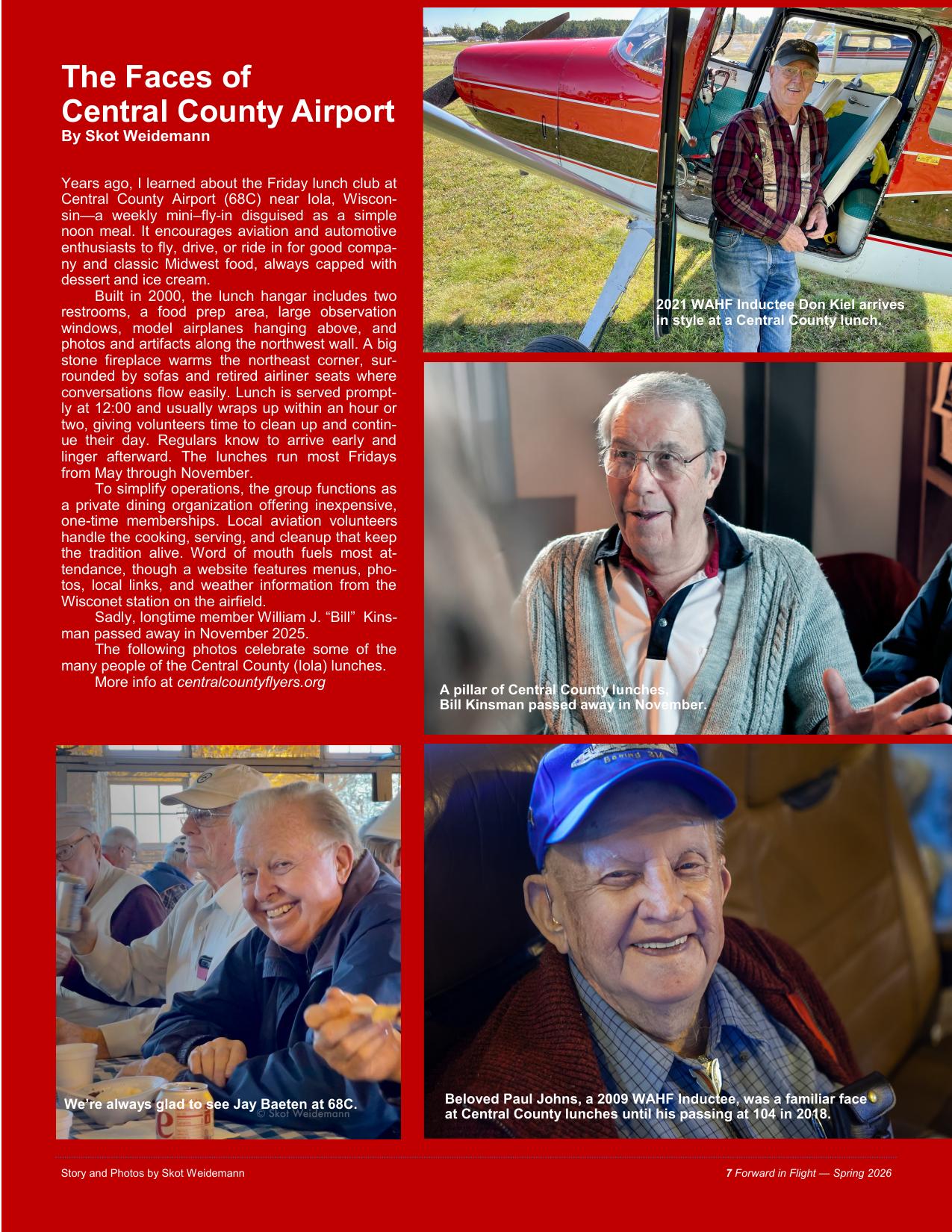
The Faces—Past and Present—of Central County Airport Story & Photos by Skot Weidemann Years ago, I learned about the Friday lunch club at Central County Airport (68C) near Iola, Wisconsin— a weekly mini–fly-in disguised as a simple noon meal. It encourages aviation and automotive enthusiasts to fly, drive, or ride in for good company and classic Midwest food, always capped with dessert and ice cream. Built in 2000, the lunch hangar includes two restrooms, a food prep area, large observation windows, model airplanes hanging above, and photos and artifacts along the northwest wall. A big stone fireplace warms the northeast corner, surrounded by sofas and retired airliner seats where conversations flow easily. Lunch is served promptly at 12:00 and usually wraps up within an hour or two, giving volunteers time to clean up and continue their day. Regulars know to arrive early and linger afterward. The lunches run most Fridays from May through November. To simplify operations, the group functions as a private dining organization offering inexpensive, one-time memberships. Local aviation volunteers handle the cooking, serving, and cleanup that keep the tradition alive. Word of mouth fuels most attendance, though a website features menus, photos, local links, and weather information from the Wisconet station on the airfield. Sadly, longtime member William J. “Bill” Kinsman passed away in November 2025. The following photos celebrate some of the many people of the Central County (Iola) lunches. More info at centralcountyflyers.org We’re always glad to see Jay Baeten at 68C. Story and Photos by Skot Weidemann 2021 WAHF Inductee Don Kiel arrives in style at a Central County lunch. A pillar of Central County lunches, Bill Kinsman passed away in November. Beloved Paul Johns, a 2009 WAHF Inductee, was a familiar face at Central County lunches until his passing at 104 in 2018. 7 Forward in Flight — Spring 2026
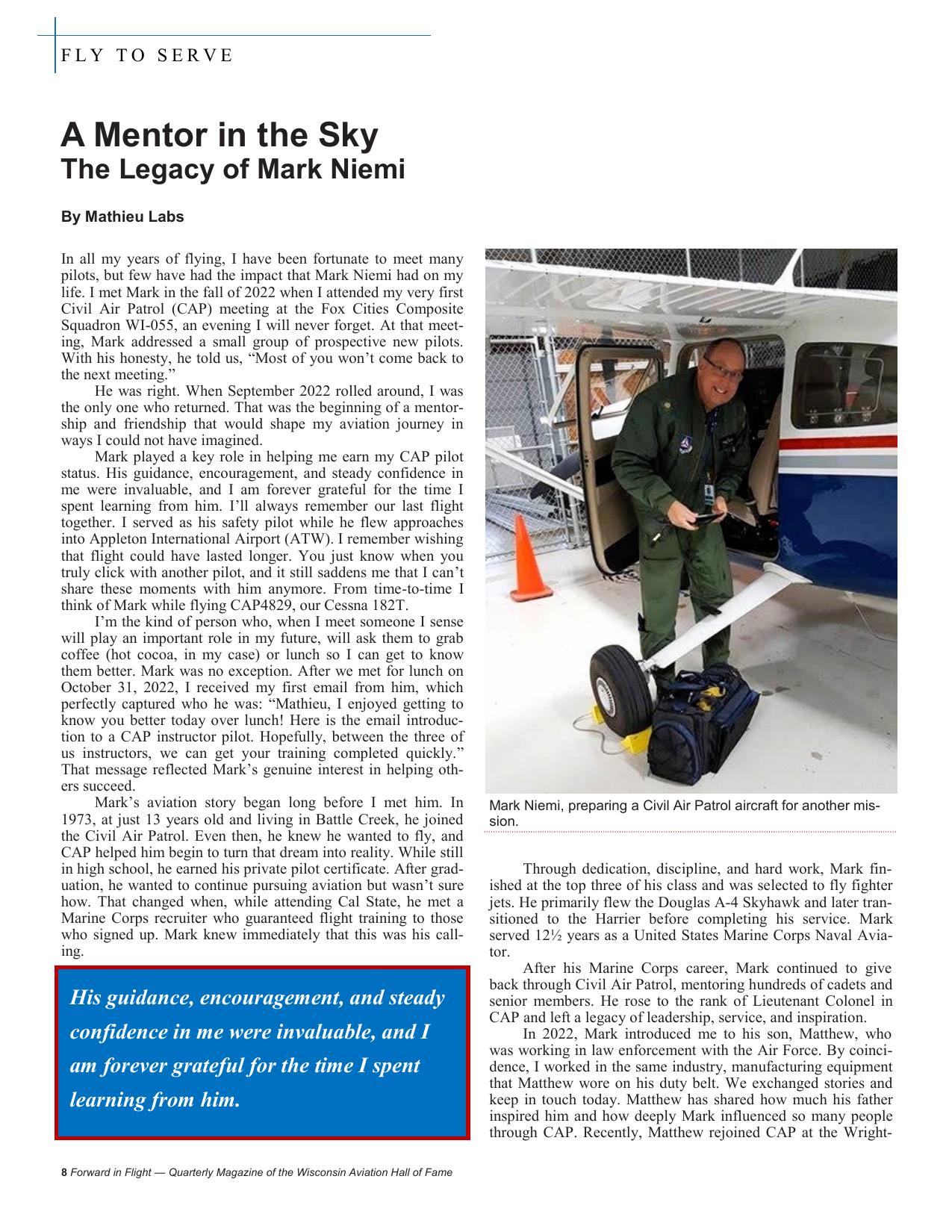
FLY TO SERVE A Mentor in the Sky The Legacy of Mark Niemi By Mathieu Labs In all my years of flying, I have been fortunate to meet many pilots, but few have had the impact that Mark Niemi had on my life. I met Mark in the fall of 2022 when I attended my very first Civil Air Patrol (CAP) meeting at the Fox Cities Composite Squadron WI-055, an evening I will never forget. At that meeting, Mark addressed a small group of prospective new pilots. With his honesty, he told us, “Most of you won’t come back to the next meeting.” He was right. When September 2022 rolled around, I was the only one who returned. That was the beginning of a mentorship and friendship that would shape my aviation journey in ways I could not have imagined. Mark played a key role in helping me earn my CAP pilot status. His guidance, encouragement, and steady confidence in me were invaluable, and I am forever grateful for the time I spent learning from him. I’ll always remember our last flight together. I served as his safety pilot while he flew approaches into Appleton International Airport (ATW). I remember wishing that flight could have lasted longer. You just know when you truly click with another pilot, and it still saddens me that I can’t share these moments with him anymore. From time-to-time I think of Mark while flying CAP4829, our Cessna 182T. I’m the kind of person who, when I meet someone I sense will play an important role in my future, will ask them to grab coffee (hot cocoa, in my case) or lunch so I can get to know them better. Mark was no exception. After we met for lunch on October 31, 2022, I received my first email from him, which perfectly captured who he was: “Mathieu, I enjoyed getting to know you better today over lunch! Here is the email introduction to a CAP instructor pilot. Hopefully, between the three of us instructors, we can get your training completed quickly.” That message reflected Mark’s genuine interest in helping others succeed. Mark’s aviation story began long before I met him. In 1973, at just 13 years old and living in Battle Creek, he joined the Civil Air Patrol. Even then, he knew he wanted to fly, and CAP helped him begin to turn that dream into reality. While still in high school, he earned his private pilot certificate. After graduation, he wanted to continue pursuing aviation but wasn’t sure how. That changed when, while attending Cal State, he met a Marine Corps recruiter who guaranteed flight training to those who signed up. Mark knew immediately that this was his calling. His guidance, encouragement, and steady confidence in me were invaluable, and I am forever grateful for the time I spent learning from him. 8 Forward in Flight — Quarterly Magazine of the Wisconsin Aviation Hall of Fame Mark Niemi, preparing a Civil Air Patrol aircraft for another mission. Through dedication, discipline, and hard work, Mark finished at the top three of his class and was selected to fly fighter jets. He primarily flew the Douglas A-4 Skyhawk and later transitioned to the Harrier before completing his service. Mark served 12½ years as a United States Marine Corps Naval Aviator. After his Marine Corps career, Mark continued to give back through Civil Air Patrol, mentoring hundreds of cadets and senior members. He rose to the rank of Lieutenant Colonel in CAP and left a legacy of leadership, service, and inspiration. In 2022, Mark introduced me to his son, Matthew, who was working in law enforcement with the Air Force. By coincidence, I worked in the same industry, manufacturing equipment that Matthew wore on his duty belt. We exchanged stories and keep in touch today. Matthew has shared how much his father inspired him and how deeply Mark influenced so many people through CAP. Recently, Matthew rejoined CAP at the Wright-
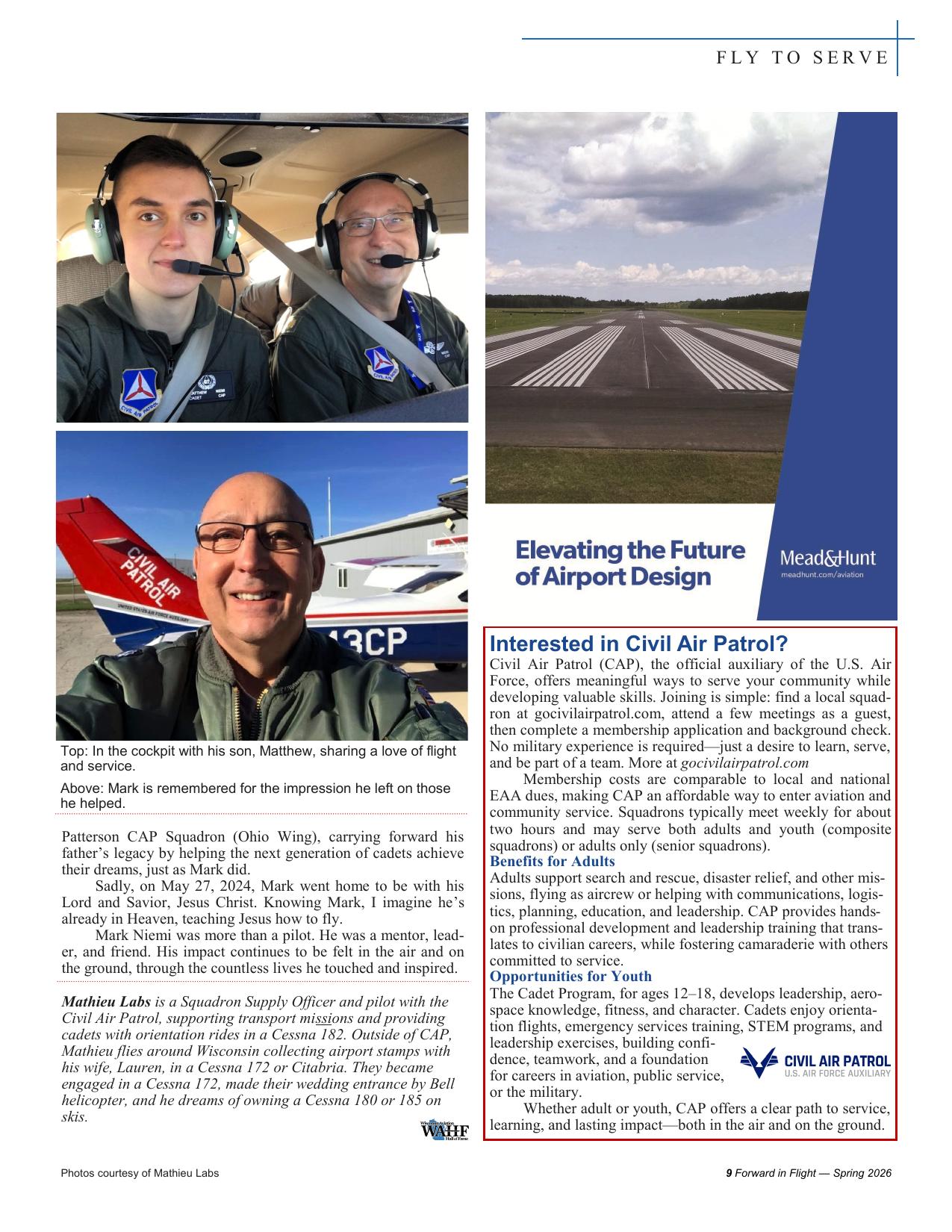
FLY TO SERVE Interested in Civil Air Patrol? Top: In the cockpit with his son, Matthew, sharing a love of flight and service. Above: Mark is remembered for the impression he left on those he helped. Patterson CAP Squadron (Ohio Wing), carrying forward his father’s legacy by helping the next generation of cadets achieve their dreams, just as Mark did. Sadly, on May 27, 2024, Mark went home to be with his Lord and Savior, Jesus Christ. Knowing Mark, I imagine he’s already in Heaven, teaching Jesus how to fly. Mark Niemi was more than a pilot. He was a mentor, leader, and friend. His impact continues to be felt in the air and on the ground, through the countless lives he touched and inspired. Mathieu Labs is a Squadron Supply Officer and pilot with the Civil Air Patrol, supporting transport missions and providing cadets with orientation rides in a Cessna 182. Outside of CAP, Mathieu flies around Wisconsin collecting airport stamps with his wife, Lauren, in a Cessna 172 or Citabria. They became engaged in a Cessna 172, made their wedding entrance by Bell helicopter, and he dreams of owning a Cessna 180 or 185 on skis. Photos courtesy of Mathieu Labs Civil Air Patrol (CAP), the official auxiliary of the U.S. Air Force, offers meaningful ways to serve your community while developing valuable skills. Joining is simple: find a local squadron at gocivilairpatrol.com, attend a few meetings as a guest, then complete a membership application and background check. No military experience is required—just a desire to learn, serve, and be part of a team. More at gocivilairpatrol.com Membership costs are comparable to local and national EAA dues, making CAP an affordable way to enter aviation and community service. Squadrons typically meet weekly for about two hours and may serve both adults and youth (composite squadrons) or adults only (senior squadrons). Benefits for Adults Adults support search and rescue, disaster relief, and other missions, flying as aircrew or helping with communications, logistics, planning, education, and leadership. CAP provides handson professional development and leadership training that translates to civilian careers, while fostering camaraderie with others committed to service. Opportunities for Youth The Cadet Program, for ages 12–18, develops leadership, aerospace knowledge, fitness, and character. Cadets enjoy orientation flights, emergency services training, STEM programs, and leadership exercises, building confidence, teamwork, and a foundation for careers in aviation, public service, or the military. Whether adult or youth, CAP offers a clear path to service, learning, and lasting impact—both in the air and on the ground. 9 Forward in Flight — Spring 2026
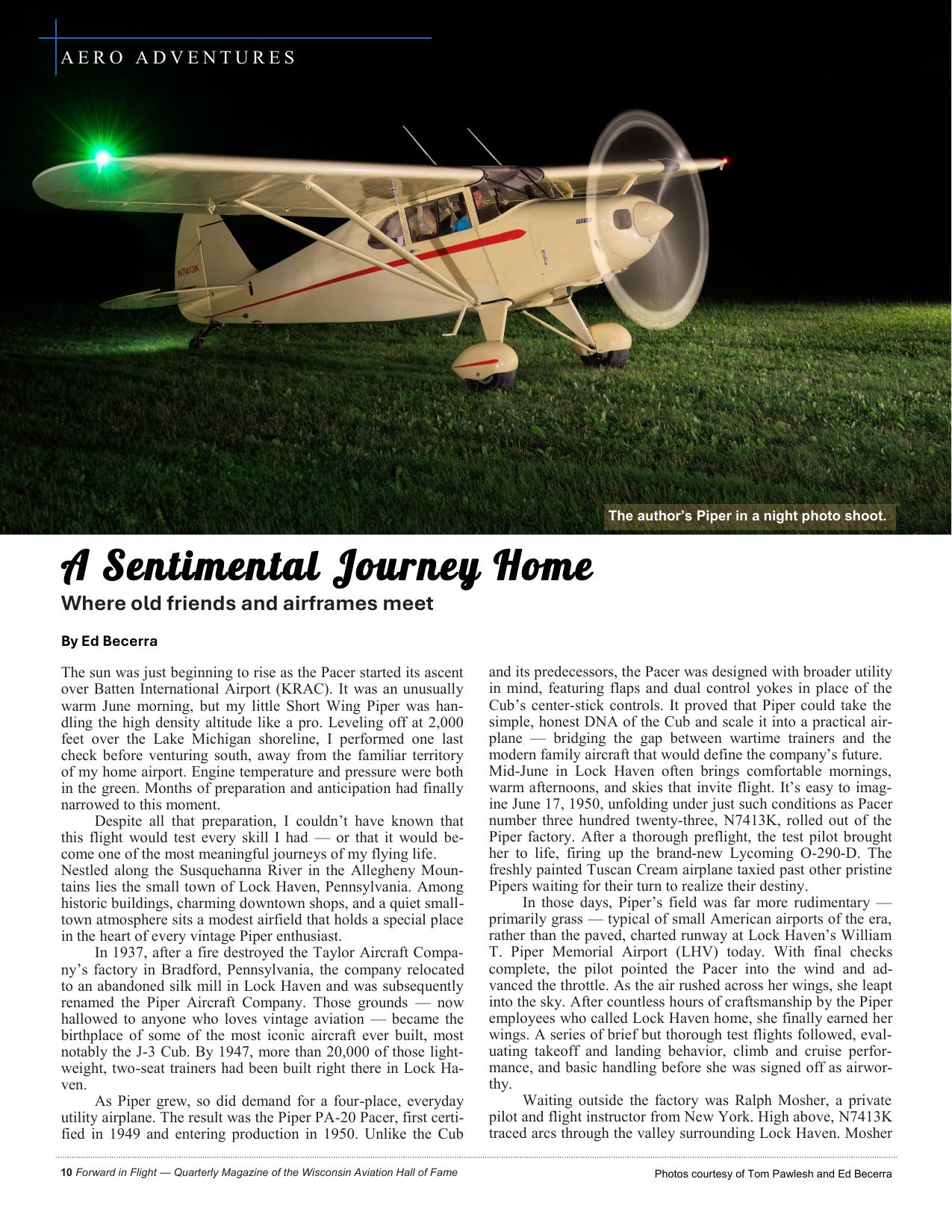
AERO ADVENTURES The author’s Piper in a night photo shoot. A Sentimental Journey Home Where old friends and airframes meet By Ed Becerra The sun was just beginning to rise as the Pacer started its ascent over Batten International Airport (KRAC). It was an unusually warm June morning, but my little Short Wing Piper was handling the high density altitude like a pro. Leveling off at 2,000 feet over the Lake Michigan shoreline, I performed one last check before venturing south, away from the familiar territory of my home airport. Engine temperature and pressure were both in the green. Months of preparation and anticipation had finally narrowed to this moment. Despite all that preparation, I couldn’t have known that this flight would test every skill I had — or that it would become one of the most meaningful journeys of my flying life. Nestled along the Susquehanna River in the Allegheny Mountains lies the small town of Lock Haven, Pennsylvania. Among historic buildings, charming downtown shops, and a quiet smalltown atmosphere sits a modest airfield that holds a special place in the heart of every vintage Piper enthusiast. In 1937, after a fire destroyed the Taylor Aircraft Company’s factory in Bradford, Pennsylvania, the company relocated to an abandoned silk mill in Lock Haven and was subsequently renamed the Piper Aircraft Company. Those grounds — now hallowed to anyone who loves vintage aviation — became the birthplace of some of the most iconic aircraft ever built, most notably the J-3 Cub. By 1947, more than 20,000 of those lightweight, two-seat trainers had been built right there in Lock Haven. As Piper grew, so did demand for a four-place, everyday utility airplane. The result was the Piper PA-20 Pacer, first certified in 1949 and entering production in 1950. Unlike the Cub and its predecessors, the Pacer was designed with broader utility in mind, featuring flaps and dual control yokes in place of the Cub’s center-stick controls. It proved that Piper could take the simple, honest DNA of the Cub and scale it into a practical airplane — bridging the gap between wartime trainers and the modern family aircraft that would define the company’s future. Mid-June in Lock Haven often brings comfortable mornings, warm afternoons, and skies that invite flight. It’s easy to imagine June 17, 1950, unfolding under just such conditions as Pacer number three hundred twenty-three, N7413K, rolled out of the Piper factory. After a thorough preflight, the test pilot brought her to life, firing up the brand-new Lycoming O-290-D. The freshly painted Tuscan Cream airplane taxied past other pristine Pipers waiting for their turn to realize their destiny. In those days, Piper’s field was far more rudimentary — primarily grass — typical of small American airports of the era, rather than the paved, charted runway at Lock Haven’s William T. Piper Memorial Airport (LHV) today. With final checks complete, the pilot pointed the Pacer into the wind and advanced the throttle. As the air rushed across her wings, she leapt into the sky. After countless hours of craftsmanship by the Piper employees who called Lock Haven home, she finally earned her wings. A series of brief but thorough test flights followed, evaluating takeoff and landing behavior, climb and cruise performance, and basic handling before she was signed off as airworthy. Waiting outside the factory was Ralph Mosher, a private pilot and flight instructor from New York. High above, N7413K traced arcs through the valley surrounding Lock Haven. Mosher 10 Forward in Flight — Quarterly Magazine of the Wisconsin Aviation Hall of Fame Photos courtesy of Tom Pawlesh and Ed Becerra
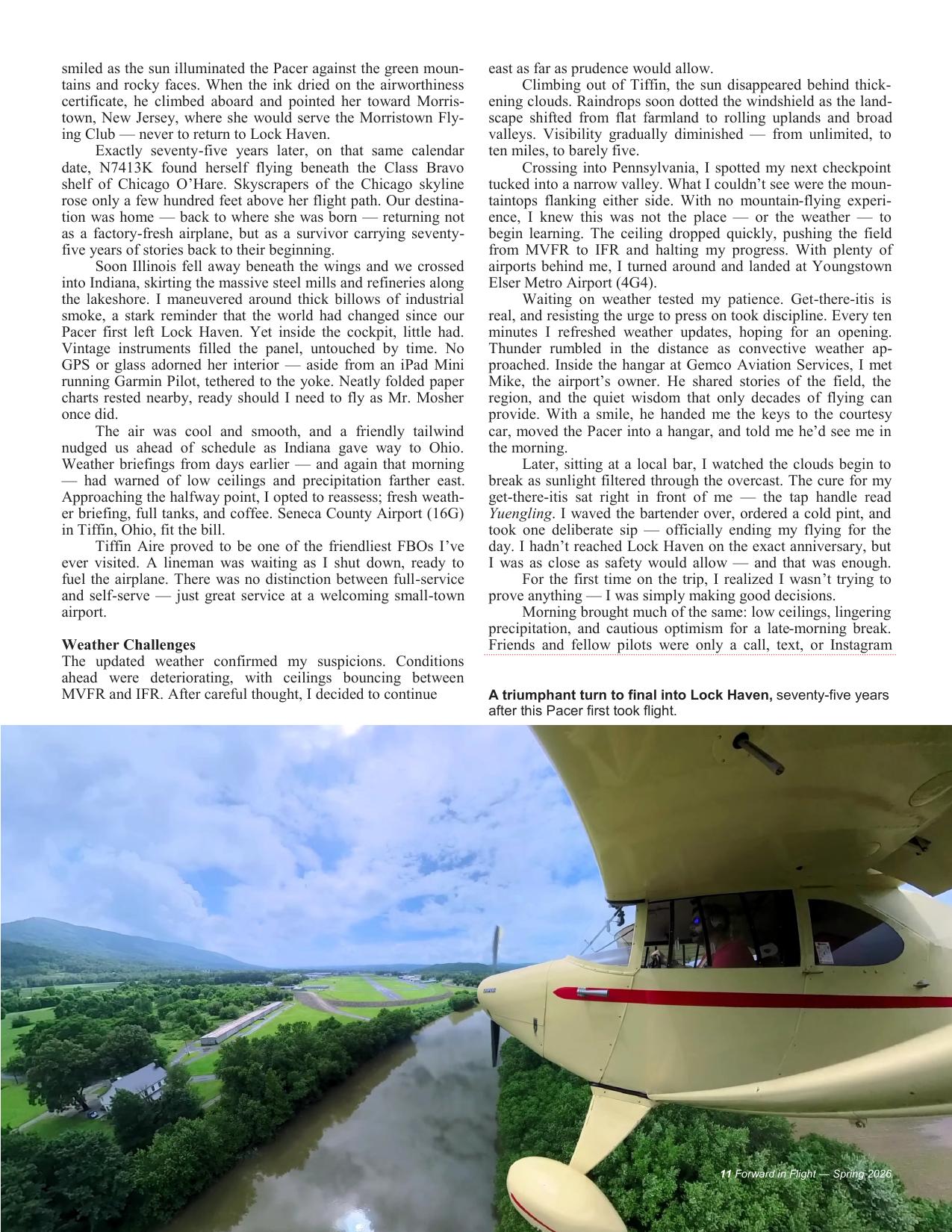
smiled as the sun illuminated the Pacer against the green mountains and rocky faces. When the ink dried on the airworthiness certificate, he climbed aboard and pointed her toward Morristown, New Jersey, where she would serve the Morristown Flying Club — never to return to Lock Haven. Exactly seventy-five years later, on that same calendar date, N7413K found herself flying beneath the Class Bravo shelf of Chicago O’Hare. Skyscrapers of the Chicago skyline rose only a few hundred feet above her flight path. Our destination was home — back to where she was born — returning not as a factory-fresh airplane, but as a survivor carrying seventyfive years of stories back to their beginning. Soon Illinois fell away beneath the wings and we crossed into Indiana, skirting the massive steel mills and refineries along the lakeshore. I maneuvered around thick billows of industrial smoke, a stark reminder that the world had changed since our Pacer first left Lock Haven. Yet inside the cockpit, little had. Vintage instruments filled the panel, untouched by time. No GPS or glass adorned her interior — aside from an iPad Mini running Garmin Pilot, tethered to the yoke. Neatly folded paper charts rested nearby, ready should I need to fly as Mr. Mosher once did. The air was cool and smooth, and a friendly tailwind nudged us ahead of schedule as Indiana gave way to Ohio. Weather briefings from days earlier — and again that morning — had warned of low ceilings and precipitation farther east. Approaching the halfway point, I opted to reassess; fresh weather briefing, full tanks, and coffee. Seneca County Airport (16G) in Tiffin, Ohio, fit the bill. Tiffin Aire proved to be one of the friendliest FBOs I’ve ever visited. A lineman was waiting as I shut down, ready to fuel the airplane. There was no distinction between full-service and self-serve — just great service at a welcoming small-town airport. Weather Challenges The updated weather confirmed my suspicions. Conditions ahead were deteriorating, with ceilings bouncing between MVFR and IFR. After careful thought, I decided to continue east as far as prudence would allow. Climbing out of Tiffin, the sun disappeared behind thickening clouds. Raindrops soon dotted the windshield as the landscape shifted from flat farmland to rolling uplands and broad valleys. Visibility gradually diminished — from unlimited, to ten miles, to barely five. Crossing into Pennsylvania, I spotted my next checkpoint tucked into a narrow valley. What I couldn’t see were the mountaintops flanking either side. With no mountain-flying experience, I knew this was not the place — or the weather — to begin learning. The ceiling dropped quickly, pushing the field from MVFR to IFR and halting my progress. With plenty of airports behind me, I turned around and landed at Youngstown Elser Metro Airport (4G4). Waiting on weather tested my patience. Get-there-itis is real, and resisting the urge to press on took discipline. Every ten minutes I refreshed weather updates, hoping for an opening. Thunder rumbled in the distance as convective weather approached. Inside the hangar at Gemco Aviation Services, I met Mike, the airport’s owner. He shared stories of the field, the region, and the quiet wisdom that only decades of flying can provide. With a smile, he handed me the keys to the courtesy car, moved the Pacer into a hangar, and told me he’d see me in the morning. Later, sitting at a local bar, I watched the clouds begin to break as sunlight filtered through the overcast. The cure for my get-there-itis sat right in front of me — the tap handle read Yuengling. I waved the bartender over, ordered a cold pint, and took one deliberate sip — officially ending my flying for the day. I hadn’t reached Lock Haven on the exact anniversary, but I was as close as safety would allow — and that was enough. For the first time on the trip, I realized I wasn’t trying to prove anything — I was simply making good decisions. Morning brought much of the same: low ceilings, lingering precipitation, and cautious optimism for a late-morning break. Friends and fellow pilots were only a call, text, or Instagram A triumphant turn to final into Lock Haven, seventy-five years after this Pacer first took flight. 11 Forward in Flight — Spring 2026
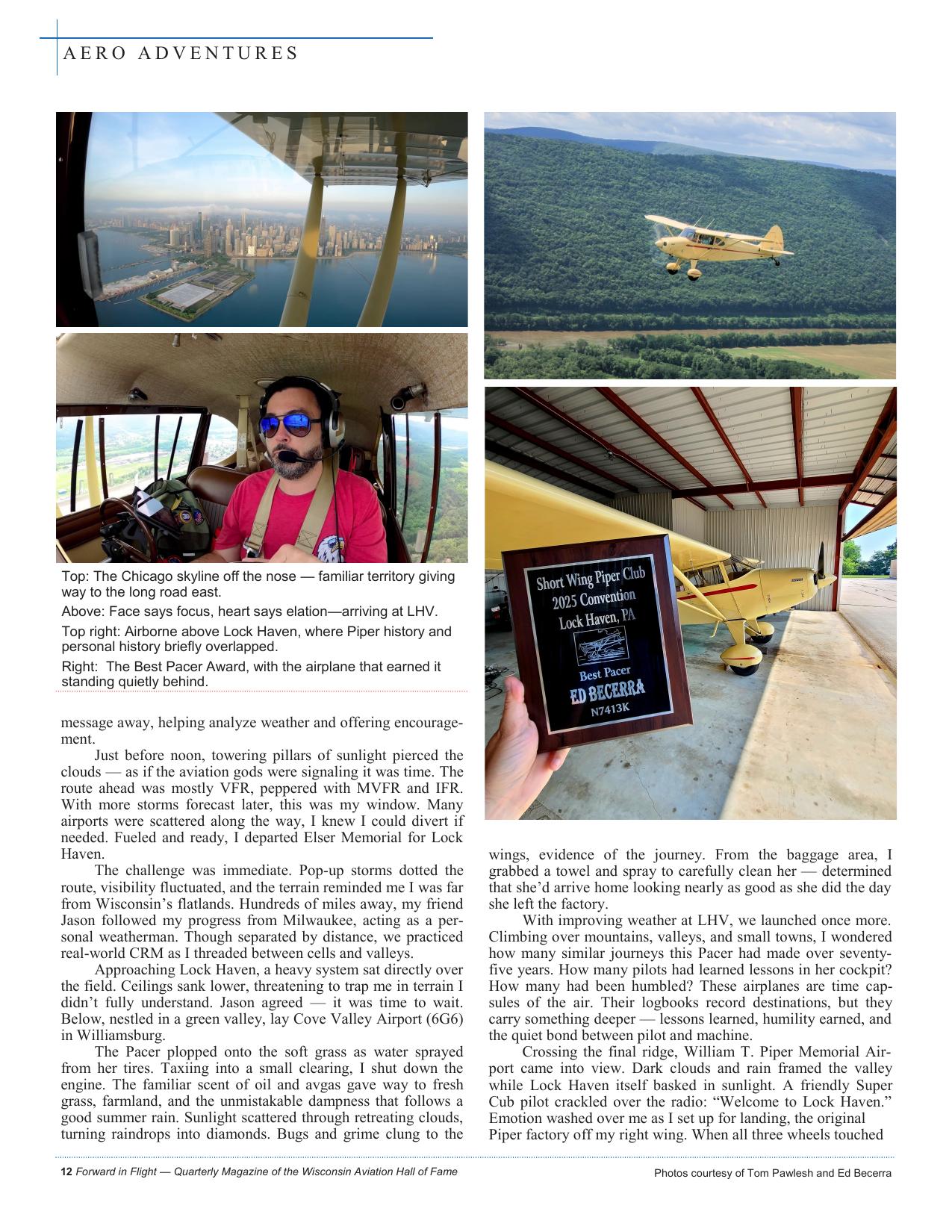
AERO ADVENTURES Top: The Chicago skyline off the nose — familiar territory giving way to the long road east. Above: Face says focus, heart says elation—arriving at LHV. Top right: Airborne above Lock Haven, where Piper history and personal history briefly overlapped. Right: The Best Pacer Award, with the airplane that earned it standing quietly behind. message away, helping analyze weather and offering encouragement. Just before noon, towering pillars of sunlight pierced the clouds — as if the aviation gods were signaling it was time. The route ahead was mostly VFR, peppered with MVFR and IFR. With more storms forecast later, this was my window. Many airports were scattered along the way, I knew I could divert if needed. Fueled and ready, I departed Elser Memorial for Lock Haven. The challenge was immediate. Pop-up storms dotted the route, visibility fluctuated, and the terrain reminded me I was far from Wisconsin’s flatlands. Hundreds of miles away, my friend Jason followed my progress from Milwaukee, acting as a personal weatherman. Though separated by distance, we practiced real-world CRM as I threaded between cells and valleys. Approaching Lock Haven, a heavy system sat directly over the field. Ceilings sank lower, threatening to trap me in terrain I didn’t fully understand. Jason agreed — it was time to wait. Below, nestled in a green valley, lay Cove Valley Airport (6G6) in Williamsburg. The Pacer plopped onto the soft grass as water sprayed from her tires. Taxiing into a small clearing, I shut down the engine. The familiar scent of oil and avgas gave way to fresh grass, farmland, and the unmistakable dampness that follows a good summer rain. Sunlight scattered through retreating clouds, turning raindrops into diamonds. Bugs and grime clung to the wings, evidence of the journey. From the baggage area, I grabbed a towel and spray to carefully clean her — determined that she’d arrive home looking nearly as good as she did the day she left the factory. With improving weather at LHV, we launched once more. Climbing over mountains, valleys, and small towns, I wondered how many similar journeys this Pacer had made over seventyfive years. How many pilots had learned lessons in her cockpit? How many had been humbled? These airplanes are time capsules of the air. Their logbooks record destinations, but they carry something deeper — lessons learned, humility earned, and the quiet bond between pilot and machine. Crossing the final ridge, William T. Piper Memorial Airport came into view. Dark clouds and rain framed the valley while Lock Haven itself basked in sunlight. A friendly Super Cub pilot crackled over the radio: “Welcome to Lock Haven.” Emotion washed over me as I set up for landing, the original Piper factory off my right wing. When all three wheels touched 12 Forward in Flight — Quarterly Magazine of the Wisconsin Aviation Hall of Fame Photos courtesy of Tom Pawlesh and Ed Becerra
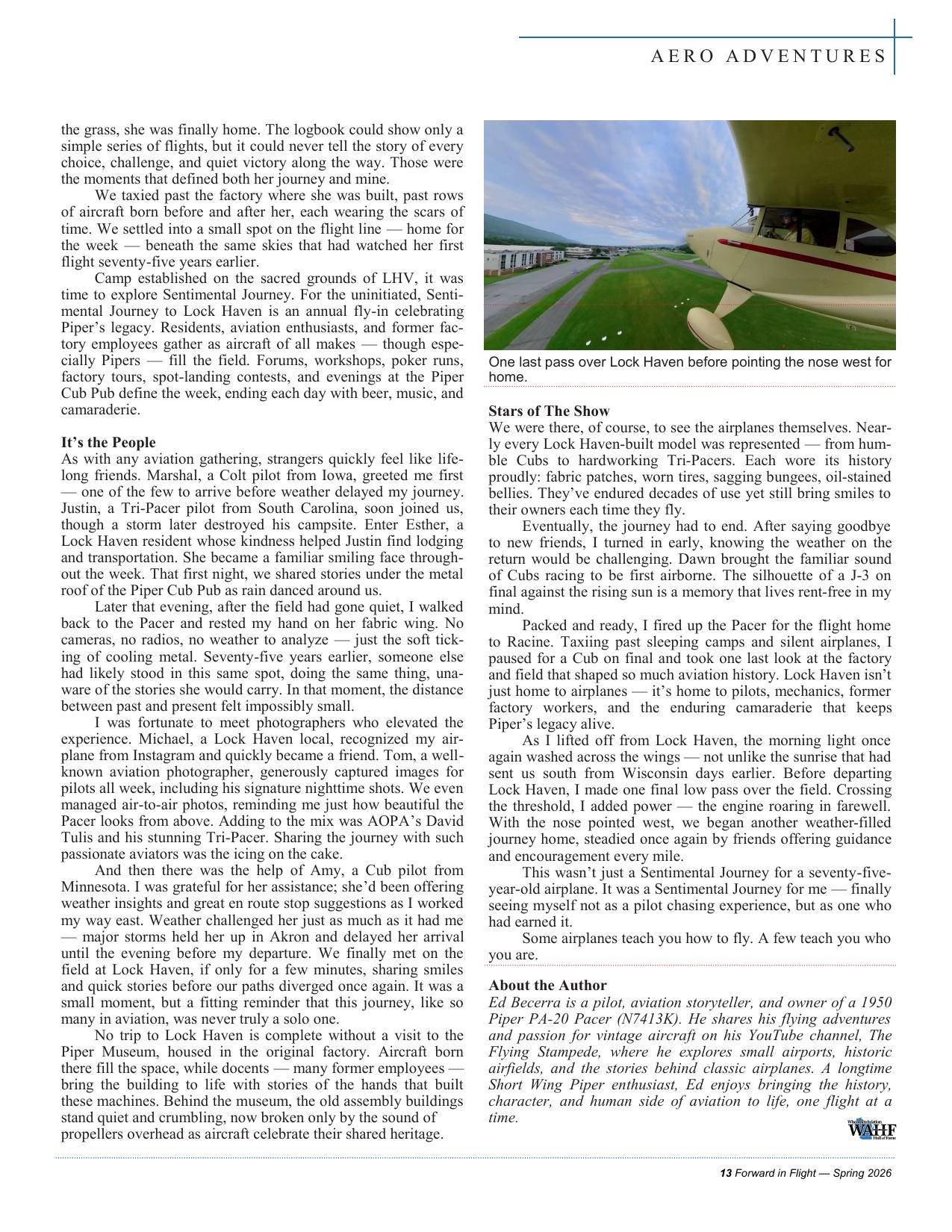
AERO ADVENTURES the grass, she was finally home. The logbook could show only a simple series of flights, but it could never tell the story of every choice, challenge, and quiet victory along the way. Those were the moments that defined both her journey and mine. We taxied past the factory where she was built, past rows of aircraft born before and after her, each wearing the scars of time. We settled into a small spot on the flight line — home for the week — beneath the same skies that had watched her first flight seventy-five years earlier. Camp established on the sacred grounds of LHV, it was time to explore Sentimental Journey. For the uninitiated, Sentimental Journey to Lock Haven is an annual fly-in celebrating Piper’s legacy. Residents, aviation enthusiasts, and former factory employees gather as aircraft of all makes — though especially Pipers — fill the field. Forums, workshops, poker runs, factory tours, spot-landing contests, and evenings at the Piper Cub Pub define the week, ending each day with beer, music, and camaraderie. It’s the People As with any aviation gathering, strangers quickly feel like lifelong friends. Marshal, a Colt pilot from Iowa, greeted me first — one of the few to arrive before weather delayed my journey. Justin, a Tri-Pacer pilot from South Carolina, soon joined us, though a storm later destroyed his campsite. Enter Esther, a Lock Haven resident whose kindness helped Justin find lodging and transportation. She became a familiar smiling face throughout the week. That first night, we shared stories under the metal roof of the Piper Cub Pub as rain danced around us. Later that evening, after the field had gone quiet, I walked back to the Pacer and rested my hand on her fabric wing. No cameras, no radios, no weather to analyze — just the soft ticking of cooling metal. Seventy-five years earlier, someone else had likely stood in this same spot, doing the same thing, unaware of the stories she would carry. In that moment, the distance between past and present felt impossibly small. I was fortunate to meet photographers who elevated the experience. Michael, a Lock Haven local, recognized my airplane from Instagram and quickly became a friend. Tom, a wellknown aviation photographer, generously captured images for pilots all week, including his signature nighttime shots. We even managed air-to-air photos, reminding me just how beautiful the Pacer looks from above. Adding to the mix was AOPA’s David Tulis and his stunning Tri-Pacer. Sharing the journey with such passionate aviators was the icing on the cake. And then there was the help of Amy, a Cub pilot from Minnesota. I was grateful for her assistance; she’d been offering weather insights and great en route stop suggestions as I worked my way east. Weather challenged her just as much as it had me — major storms held her up in Akron and delayed her arrival until the evening before my departure. We finally met on the field at Lock Haven, if only for a few minutes, sharing smiles and quick stories before our paths diverged once again. It was a small moment, but a fitting reminder that this journey, like so many in aviation, was never truly a solo one. No trip to Lock Haven is complete without a visit to the Piper Museum, housed in the original factory. Aircraft born there fill the space, while docents — many former employees — bring the building to life with stories of the hands that built these machines. Behind the museum, the old assembly buildings stand quiet and crumbling, now broken only by the sound of propellers overhead as aircraft celebrate their shared heritage. One last pass over Lock Haven before pointing the nose west for home. Stars of The Show We were there, of course, to see the airplanes themselves. Nearly every Lock Haven-built model was represented — from humble Cubs to hardworking Tri-Pacers. Each wore its history proudly: fabric patches, worn tires, sagging bungees, oil-stained bellies. They’ve endured decades of use yet still bring smiles to their owners each time they fly. Eventually, the journey had to end. After saying goodbye to new friends, I turned in early, knowing the weather on the return would be challenging. Dawn brought the familiar sound of Cubs racing to be first airborne. The silhouette of a J-3 on final against the rising sun is a memory that lives rent-free in my mind. Packed and ready, I fired up the Pacer for the flight home to Racine. Taxiing past sleeping camps and silent airplanes, I paused for a Cub on final and took one last look at the factory and field that shaped so much aviation history. Lock Haven isn’t just home to airplanes — it’s home to pilots, mechanics, former factory workers, and the enduring camaraderie that keeps Piper’s legacy alive. As I lifted off from Lock Haven, the morning light once again washed across the wings — not unlike the sunrise that had sent us south from Wisconsin days earlier. Before departing Lock Haven, I made one final low pass over the field. Crossing the threshold, I added power — the engine roaring in farewell. With the nose pointed west, we began another weather-filled journey home, steadied once again by friends offering guidance and encouragement every mile. This wasn’t just a Sentimental Journey for a seventy-fiveyear-old airplane. It was a Sentimental Journey for me — finally seeing myself not as a pilot chasing experience, but as one who had earned it. Some airplanes teach you how to fly. A few teach you who you are. About the Author Ed Becerra is a pilot, aviation storyteller, and owner of a 1950 Piper PA-20 Pacer (N7413K). He shares his flying adventures and passion for vintage aircraft on his YouTube channel, The Flying Stampede, where he explores small airports, historic airfields, and the stories behind classic airplanes. A longtime Short Wing Piper enthusiast, Ed enjoys bringing the history, character, and human side of aviation to life, one flight at a time. 13 Forward in Flight — Spring 2026
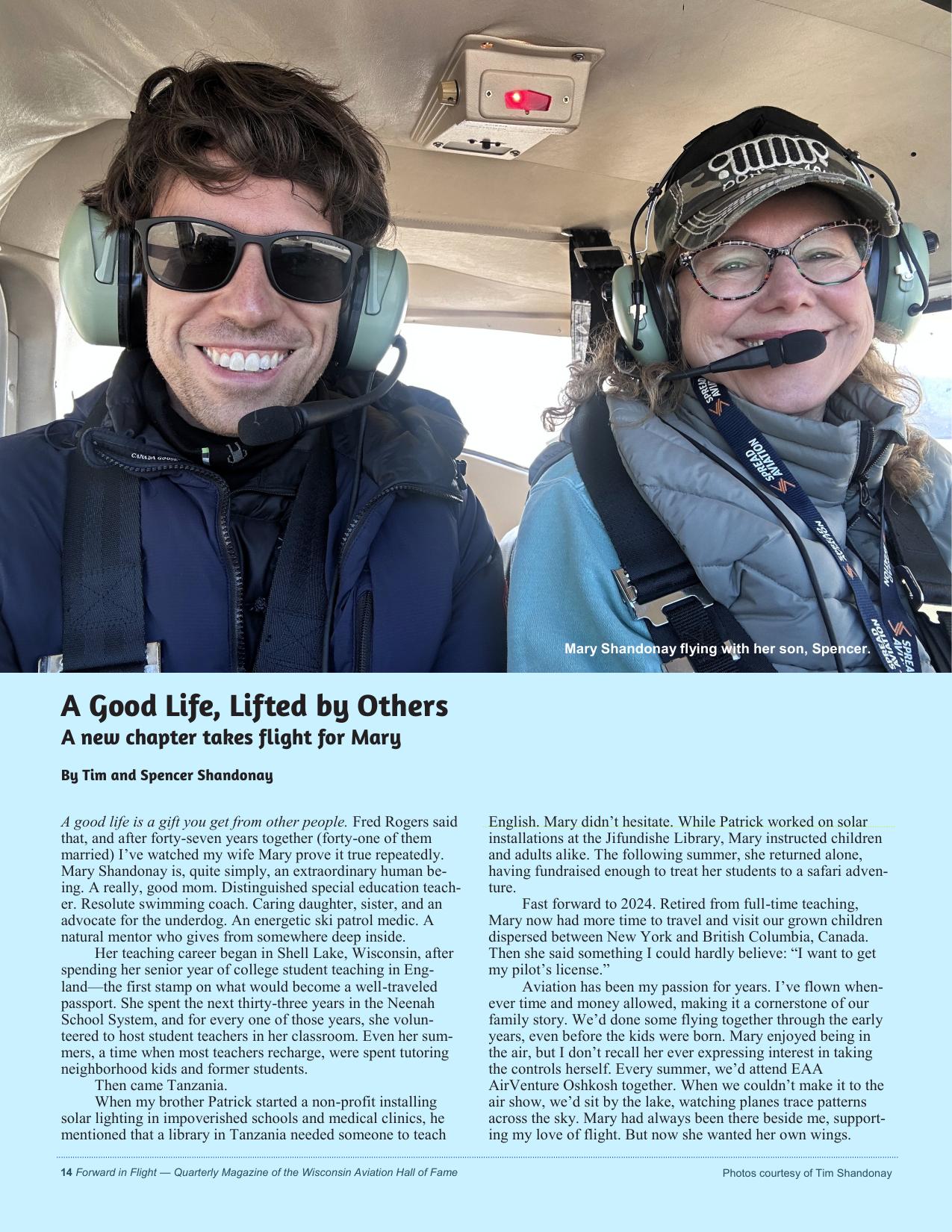
Mary Shandonay flying with her son, Spencer. A Good Life, Lifted by Others A new chapter takes flight for Mary By Tim and Spencer Shandonay A good life is a gift you get from other people. Fred Rogers said that, and after forty-seven years together (forty-one of them married) I’ve watched my wife Mary prove it true repeatedly. Mary Shandonay is, quite simply, an extraordinary human being. A really, good mom. Distinguished special education teacher. Resolute swimming coach. Caring daughter, sister, and an advocate for the underdog. An energetic ski patrol medic. A natural mentor who gives from somewhere deep inside. Her teaching career began in Shell Lake, Wisconsin, after spending her senior year of college student teaching in England—the first stamp on what would become a well-traveled passport. She spent the next thirty-three years in the Neenah School System, and for every one of those years, she volunteered to host student teachers in her classroom. Even her summers, a time when most teachers recharge, were spent tutoring neighborhood kids and former students. Then came Tanzania. When my brother Patrick started a non-profit installing solar lighting in impoverished schools and medical clinics, he mentioned that a library in Tanzania needed someone to teach English. Mary didn’t hesitate. While Patrick worked on solar installations at the Jifundishe Library, Mary instructed children and adults alike. The following summer, she returned alone, having fundraised enough to treat her students to a safari adventure. Fast forward to 2024. Retired from full-time teaching, Mary now had more time to travel and visit our grown children dispersed between New York and British Columbia, Canada. Then she said something I could hardly believe: “I want to get my pilot’s license.” Aviation has been my passion for years. I’ve flown whenever time and money allowed, making it a cornerstone of our family story. We’d done some flying together through the early years, even before the kids were born. Mary enjoyed being in the air, but I don’t recall her ever expressing interest in taking the controls herself. Every summer, we’d attend EAA AirVenture Oshkosh together. When we couldn’t make it to the air show, we’d sit by the lake, watching planes trace patterns across the sky. Mary had always been there beside me, supporting my love of flight. But now she wanted her own wings. 14 Forward in Flight — Quarterly Magazine of the Wisconsin Aviation Hall of Fame Photos courtesy of Tim Shandonay
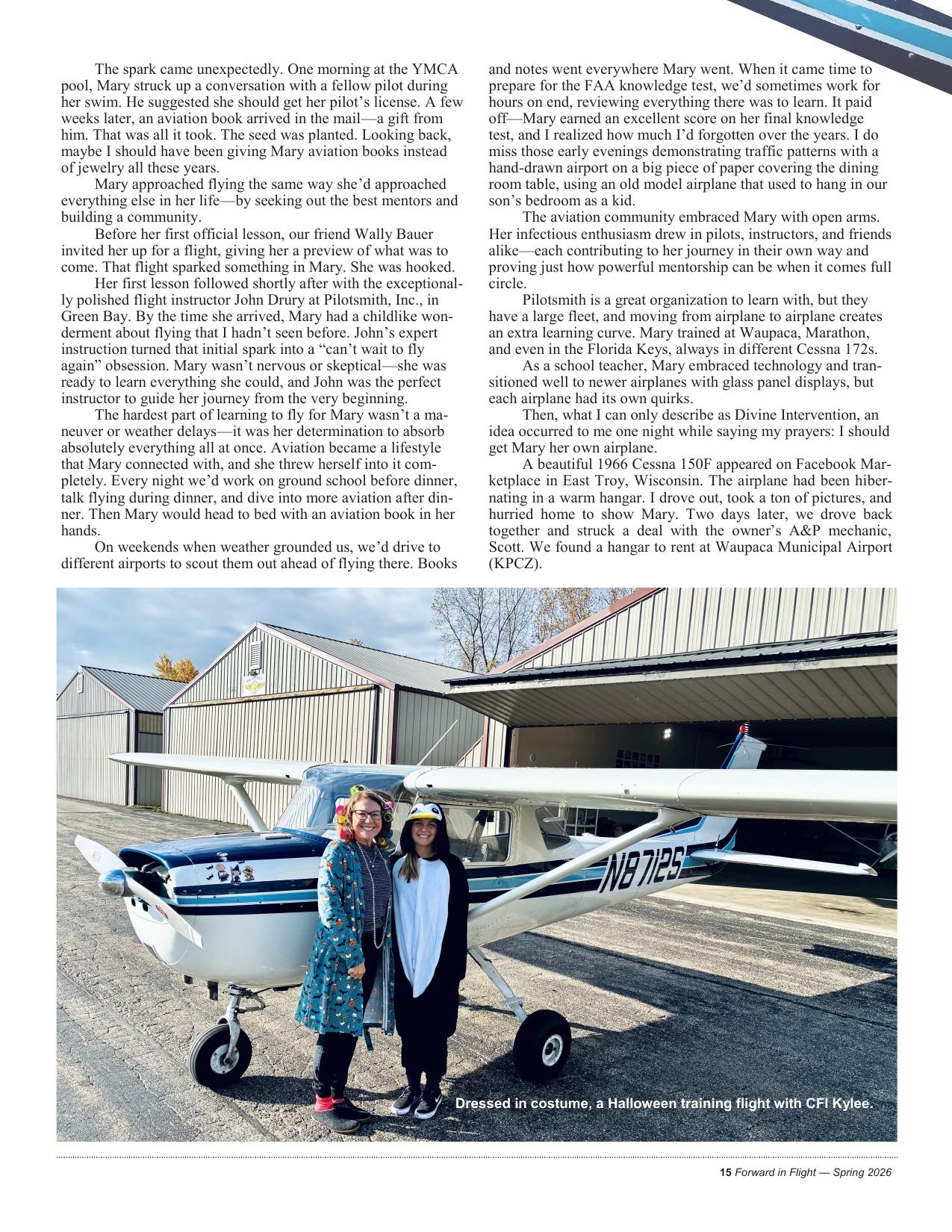
The spark came unexpectedly. One morning at the YMCA pool, Mary struck up a conversation with a fellow pilot during her swim. He suggested she should get her pilot’s license. A few weeks later, an aviation book arrived in the mail—a gift from him. That was all it took. The seed was planted. Looking back, maybe I should have been giving Mary aviation books instead of jewelry all these years. Mary approached flying the same way she’d approached everything else in her life—by seeking out the best mentors and building a community. Before her first official lesson, our friend Wally Bauer invited her up for a flight, giving her a preview of what was to come. That flight sparked something in Mary. She was hooked. Her first lesson followed shortly after with the exceptionally polished flight instructor John Drury at Pilotsmith, Inc., in Green Bay. By the time she arrived, Mary had a childlike wonderment about flying that I hadn’t seen before. John’s expert instruction turned that initial spark into a “can’t wait to fly again” obsession. Mary wasn’t nervous or skeptical—she was ready to learn everything she could, and John was the perfect instructor to guide her journey from the very beginning. The hardest part of learning to fly for Mary wasn’t a maneuver or weather delays—it was her determination to absorb absolutely everything all at once. Aviation became a lifestyle that Mary connected with, and she threw herself into it completely. Every night we’d work on ground school before dinner, talk flying during dinner, and dive into more aviation after dinner. Then Mary would head to bed with an aviation book in her hands. On weekends when weather grounded us, we’d drive to different airports to scout them out ahead of flying there. Books and notes went everywhere Mary went. When it came time to prepare for the FAA knowledge test, we’d sometimes work for hours on end, reviewing everything there was to learn. It paid off—Mary earned an excellent score on her final knowledge test, and I realized how much I’d forgotten over the years. I do miss those early evenings demonstrating traffic patterns with a hand-drawn airport on a big piece of paper covering the dining room table, using an old model airplane that used to hang in our son’s bedroom as a kid. The aviation community embraced Mary with open arms. Her infectious enthusiasm drew in pilots, instructors, and friends alike—each contributing to her journey in their own way and proving just how powerful mentorship can be when it comes full circle. Pilotsmith is a great organization to learn with, but they have a large fleet, and moving from airplane to airplane creates an extra learning curve. Mary trained at Waupaca, Marathon, and even in the Florida Keys, always in different Cessna 172s. As a school teacher, Mary embraced technology and transitioned well to newer airplanes with glass panel displays, but each airplane had its own quirks. Then, what I can only describe as Divine Intervention, an idea occurred to me one night while saying my prayers: I should get Mary her own airplane. A beautiful 1966 Cessna 150F appeared on Facebook Marketplace in East Troy, Wisconsin. The airplane had been hibernating in a warm hangar. I drove out, took a ton of pictures, and hurried home to show Mary. Two days later, we drove back together and struck a deal with the owner’s A&P mechanic, Scott. We found a hangar to rent at Waupaca Municipal Airport (KPCZ). Dressed in costume, a Halloween training flight with CFI Kylee. 15 Forward in Flight — Spring 2026
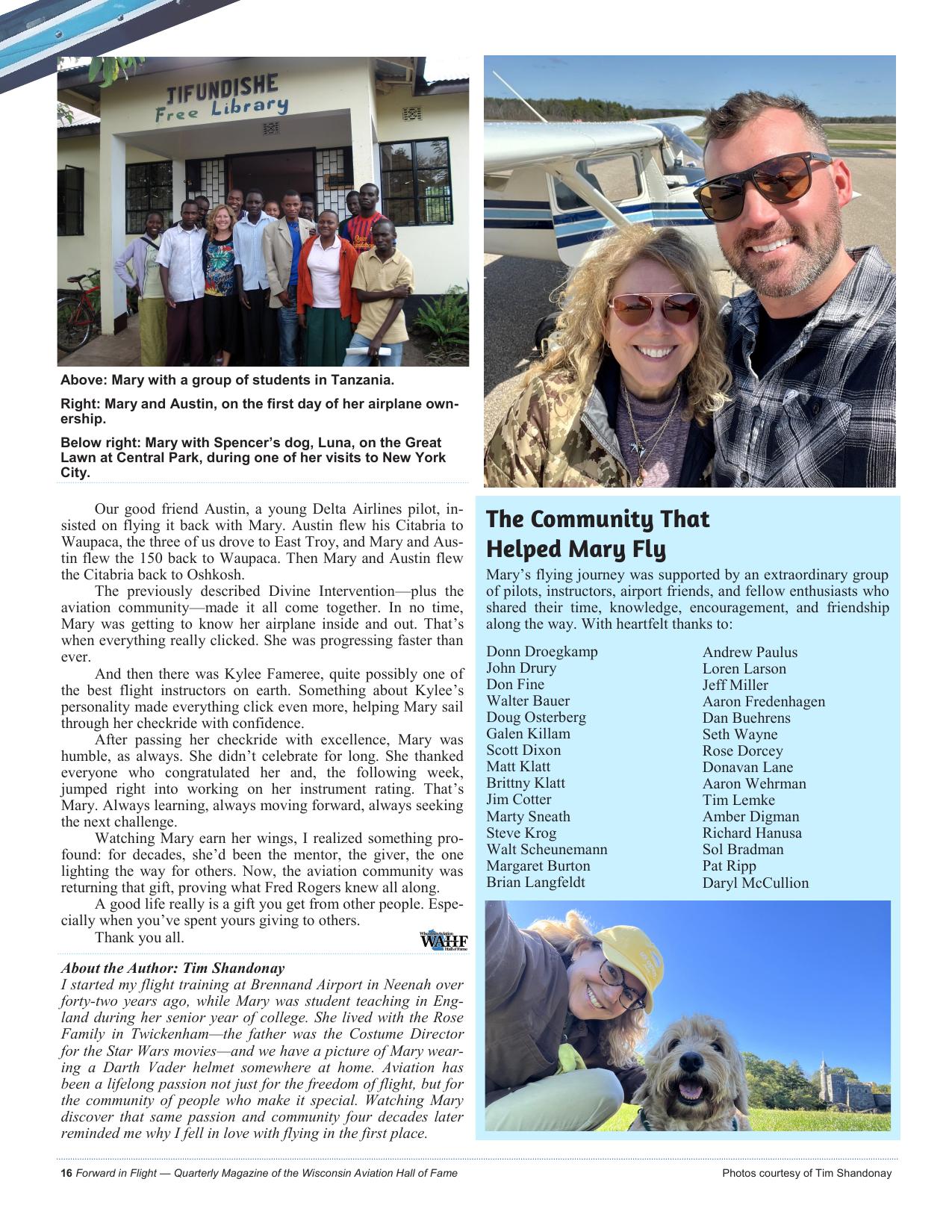
Above: Mary with a group of students in Tanzania. Right: Mary and Austin, on the first day of her airplane ownership. Below right: Mary with Spencer’s dog, Luna, on the Great Lawn at Central Park, during one of her visits to New York City. Our good friend Austin, a young Delta Airlines pilot, insisted on flying it back with Mary. Austin flew his Citabria to Waupaca, the three of us drove to East Troy, and Mary and Austin flew the 150 back to Waupaca. Then Mary and Austin flew the Citabria back to Oshkosh. The previously described Divine Intervention—plus the aviation community—made it all come together. In no time, Mary was getting to know her airplane inside and out. That’s when everything really clicked. She was progressing faster than ever. And then there was Kylee Fameree, quite possibly one of the best flight instructors on earth. Something about Kylee’s personality made everything click even more, helping Mary sail through her checkride with confidence. After passing her checkride with excellence, Mary was humble, as always. She didn’t celebrate for long. She thanked everyone who congratulated her and, the following week, jumped right into working on her instrument rating. That’s Mary. Always learning, always moving forward, always seeking the next challenge. Watching Mary earn her wings, I realized something profound: for decades, she’d been the mentor, the giver, the one lighting the way for others. Now, the aviation community was returning that gift, proving what Fred Rogers knew all along. A good life really is a gift you get from other people. Especially when you’ve spent yours giving to others. Thank you all. The Community That Helped Mary Fly Mary’s flying journey was supported by an extraordinary group of pilots, instructors, airport friends, and fellow enthusiasts who shared their time, knowledge, encouragement, and friendship along the way. With heartfelt thanks to: Donn Droegkamp John Drury Don Fine Walter Bauer Doug Osterberg Galen Killam Scott Dixon Matt Klatt Brittny Klatt Jim Cotter Marty Sneath Steve Krog Walt Scheunemann Margaret Burton Brian Langfeldt Andrew Paulus Loren Larson Jeff Miller Aaron Fredenhagen Dan Buehrens Seth Wayne Rose Dorcey Donavan Lane Aaron Wehrman Tim Lemke Amber Digman Richard Hanusa Sol Bradman Pat Ripp Daryl McCullion About the Author: Tim Shandonay I started my flight training at Brennand Airport in Neenah over forty-two years ago, while Mary was student teaching in England during her senior year of college. She lived with the Rose Family in Twickenham—the father was the Costume Director for the Star Wars movies—and we have a picture of Mary wearing a Darth Vader helmet somewhere at home. Aviation has been a lifelong passion not just for the freedom of flight, but for the community of people who make it special. Watching Mary discover that same passion and community four decades later reminded me why I fell in love with flying in the first place. 16 Forward in Flight — Quarterly Magazine of the Wisconsin Aviation Hall of Fame Photos courtesy of Tim Shandonay
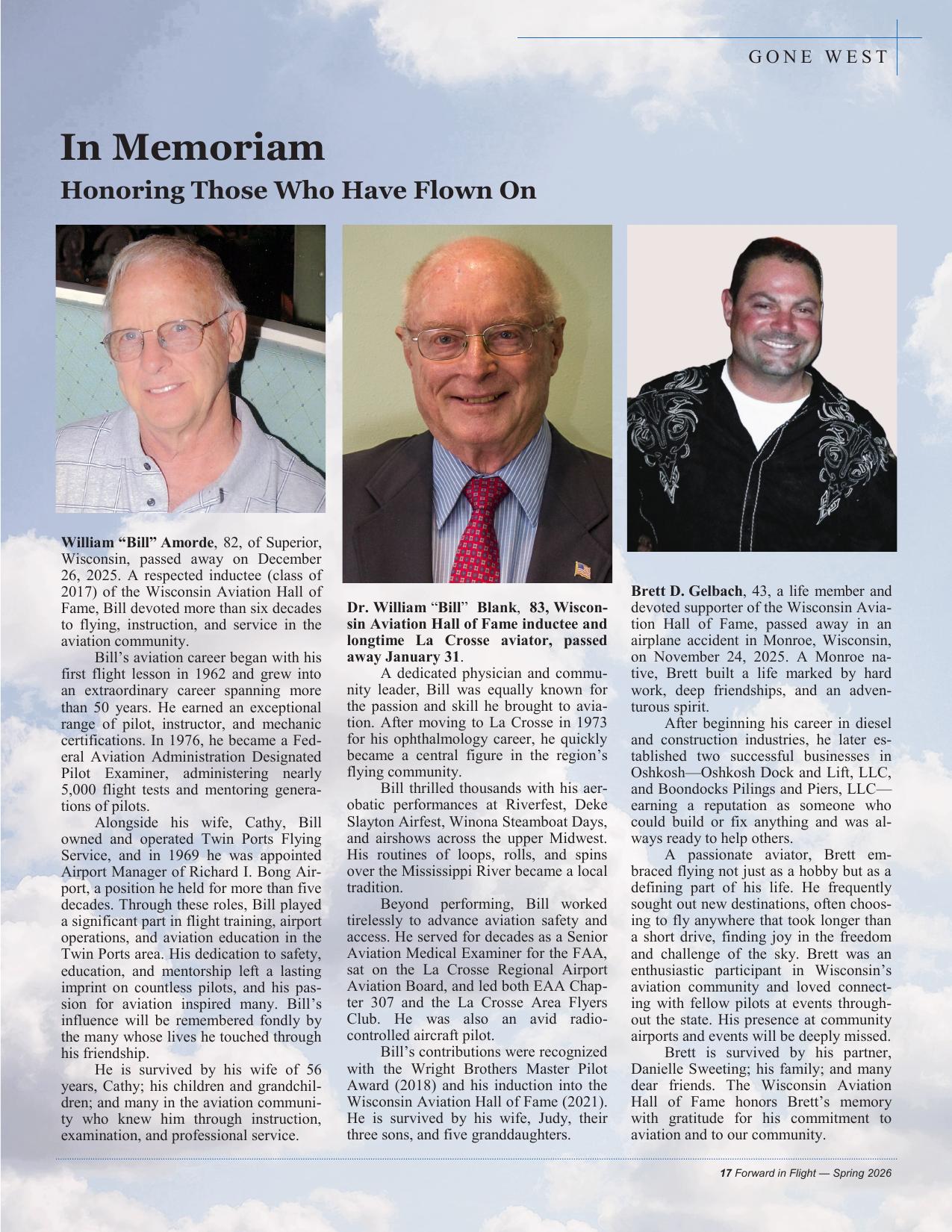
GONE WEST In Memoriam Honoring Those Who Have Flown On William “Bill” Amorde, 82, of Superior, Wisconsin, passed away on December 26, 2025. A respected inductee (class of 2017) of the Wisconsin Aviation Hall of Fame, Bill devoted more than six decades to flying, instruction, and service in the aviation community. Bill’s aviation career began with his first flight lesson in 1962 and grew into an extraordinary career spanning more than 50 years. He earned an exceptional range of pilot, instructor, and mechanic certifications. In 1976, he became a Federal Aviation Administration Designated Pilot Examiner, administering nearly 5,000 flight tests and mentoring generations of pilots. Alongside his wife, Cathy, Bill owned and operated Twin Ports Flying Service, and in 1969 he was appointed Airport Manager of Richard I. Bong Airport, a position he held for more than five decades. Through these roles, Bill played a significant part in flight training, airport operations, and aviation education in the Twin Ports area. His dedication to safety, education, and mentorship left a lasting imprint on countless pilots, and his passion for aviation inspired many. Bill’s influence will be remembered fondly by the many whose lives he touched through his friendship. He is survived by his wife of 56 years, Cathy; his children and grandchildren; and many in the aviation community who knew him through instruction, examination, and professional service. Dr. William “Bill” Blank, 83, Wisconsin Aviation Hall of Fame inductee and longtime La Crosse aviator, passed away January 31. A dedicated physician and community leader, Bill was equally known for the passion and skill he brought to aviation. After moving to La Crosse in 1973 for his ophthalmology career, he quickly became a central figure in the region’s flying community. Bill thrilled thousands with his aerobatic performances at Riverfest, Deke Slayton Airfest, Winona Steamboat Days, and airshows across the upper Midwest. His routines of loops, rolls, and spins over the Mississippi River became a local tradition. Beyond performing, Bill worked tirelessly to advance aviation safety and access. He served for decades as a Senior Aviation Medical Examiner for the FAA, sat on the La Crosse Regional Airport Aviation Board, and led both EAA Chapter 307 and the La Crosse Area Flyers Club. He was also an avid radiocontrolled aircraft pilot. Bill’s contributions were recognized with the Wright Brothers Master Pilot Award (2018) and his induction into the Wisconsin Aviation Hall of Fame (2021). He is survived by his wife, Judy, their three sons, and five granddaughters. Brett D. Gelbach, 43, a life member and devoted supporter of the Wisconsin Aviation Hall of Fame, passed away in an airplane accident in Monroe, Wisconsin, on November 24, 2025. A Monroe native, Brett built a life marked by hard work, deep friendships, and an adventurous spirit. After beginning his career in diesel and construction industries, he later established two successful businesses in Oshkosh—Oshkosh Dock and Lift, LLC, and Boondocks Pilings and Piers, LLC— earning a reputation as someone who could build or fix anything and was always ready to help others. A passionate aviator, Brett embraced flying not just as a hobby but as a defining part of his life. He frequently sought out new destinations, often choosing to fly anywhere that took longer than a short drive, finding joy in the freedom and challenge of the sky. Brett was an enthusiastic participant in Wisconsin’s aviation community and loved connecting with fellow pilots at events throughout the state. His presence at community airports and events will be deeply missed. Brett is survived by his partner, Danielle Sweeting; his family; and many dear friends. The Wisconsin Aviation Hall of Fame honors Brett’s memory with gratitude for his commitment to aviation and to our community. 17 Forward in Flight — Spring 2026
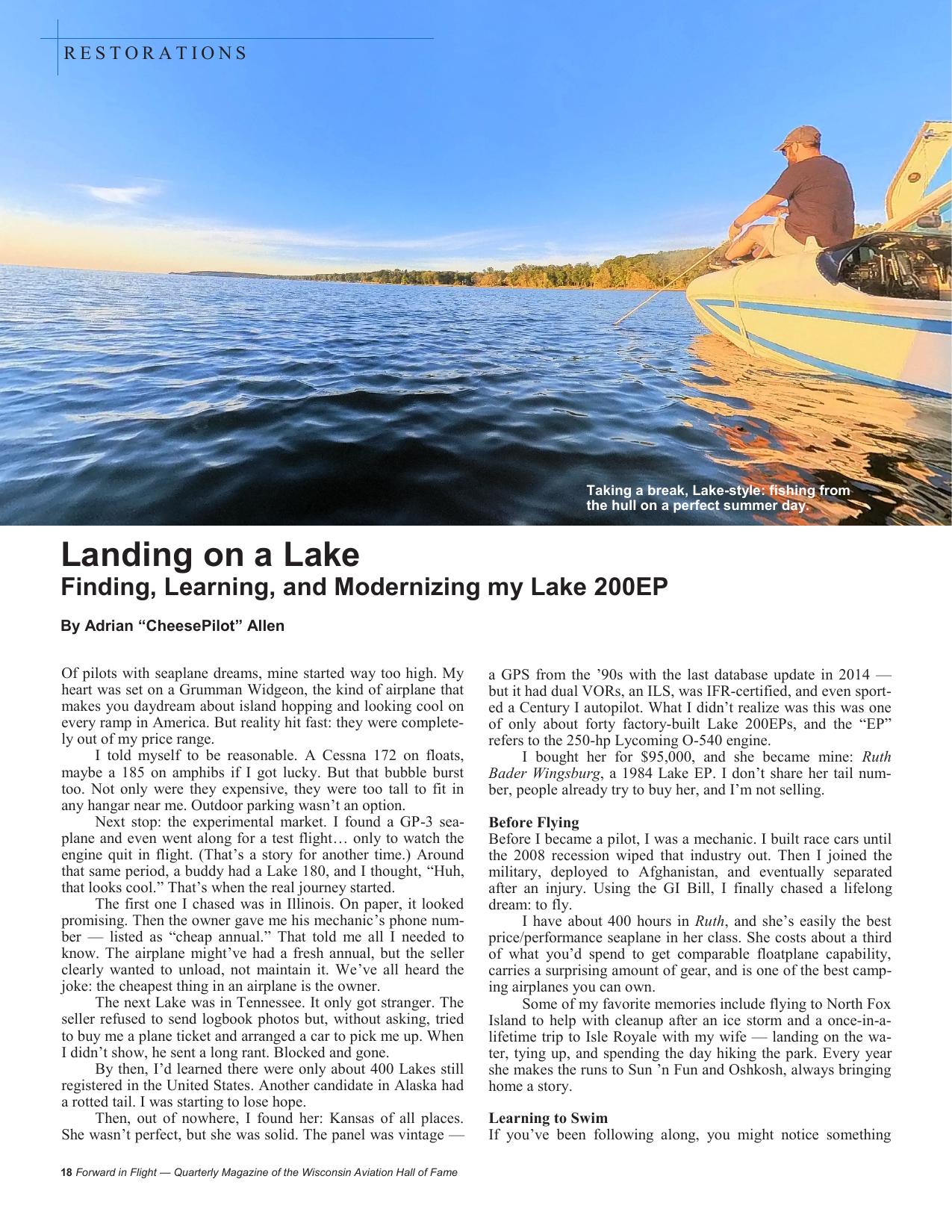
RESTORATIONS Taking a break, Lake-style: fishing from the hull on a perfect summer day. Landing on a Lake Finding, Learning, and Modernizing my Lake 200EP By Adrian “CheesePilot” Allen Of pilots with seaplane dreams, mine started way too high. My heart was set on a Grumman Widgeon, the kind of airplane that makes you daydream about island hopping and looking cool on every ramp in America. But reality hit fast: they were completely out of my price range. I told myself to be reasonable. A Cessna 172 on floats, maybe a 185 on amphibs if I got lucky. But that bubble burst too. Not only were they expensive, they were too tall to fit in any hangar near me. Outdoor parking wasn’t an option. Next stop: the experimental market. I found a GP-3 seaplane and even went along for a test flight… only to watch the engine quit in flight. (That’s a story for another time.) Around that same period, a buddy had a Lake 180, and I thought, “Huh, that looks cool.” That’s when the real journey started. The first one I chased was in Illinois. On paper, it looked promising. Then the owner gave me his mechanic’s phone number — listed as “cheap annual.” That told me all I needed to know. The airplane might’ve had a fresh annual, but the seller clearly wanted to unload, not maintain it. We’ve all heard the joke: the cheapest thing in an airplane is the owner. The next Lake was in Tennessee. It only got stranger. The seller refused to send logbook photos but, without asking, tried to buy me a plane ticket and arranged a car to pick me up. When I didn’t show, he sent a long rant. Blocked and gone. By then, I’d learned there were only about 400 Lakes still registered in the United States. Another candidate in Alaska had a rotted tail. I was starting to lose hope. Then, out of nowhere, I found her: Kansas of all places. She wasn’t perfect, but she was solid. The panel was vintage — 18 Forward in Flight — Quarterly Magazine of the Wisconsin Aviation Hall of Fame a GPS from the ’90s with the last database update in 2014 — but it had dual VORs, an ILS, was IFR-certified, and even sported a Century I autopilot. What I didn’t realize was this was one of only about forty factory-built Lake 200EPs, and the “EP” refers to the 250-hp Lycoming O-540 engine. I bought her for $95,000, and she became mine: Ruth Bader Wingsburg, a 1984 Lake EP. I don’t share her tail number, people already try to buy her, and I’m not selling. Before Flying Before I became a pilot, I was a mechanic. I built race cars until the 2008 recession wiped that industry out. Then I joined the military, deployed to Afghanistan, and eventually separated after an injury. Using the GI Bill, I finally chased a lifelong dream: to fly. I have about 400 hours in Ruth, and she’s easily the best price/performance seaplane in her class. She costs about a third of what you’d spend to get comparable floatplane capability, carries a surprising amount of gear, and is one of the best camping airplanes you can own. Some of my favorite memories include flying to North Fox Island to help with cleanup after an ice storm and a once-in-alifetime trip to Isle Royale with my wife — landing on the water, tying up, and spending the day hiking the park. Every year she makes the runs to Sun ’n Fun and Oshkosh, always bringing home a story. Learning to Swim If you’ve been following along, you might notice something
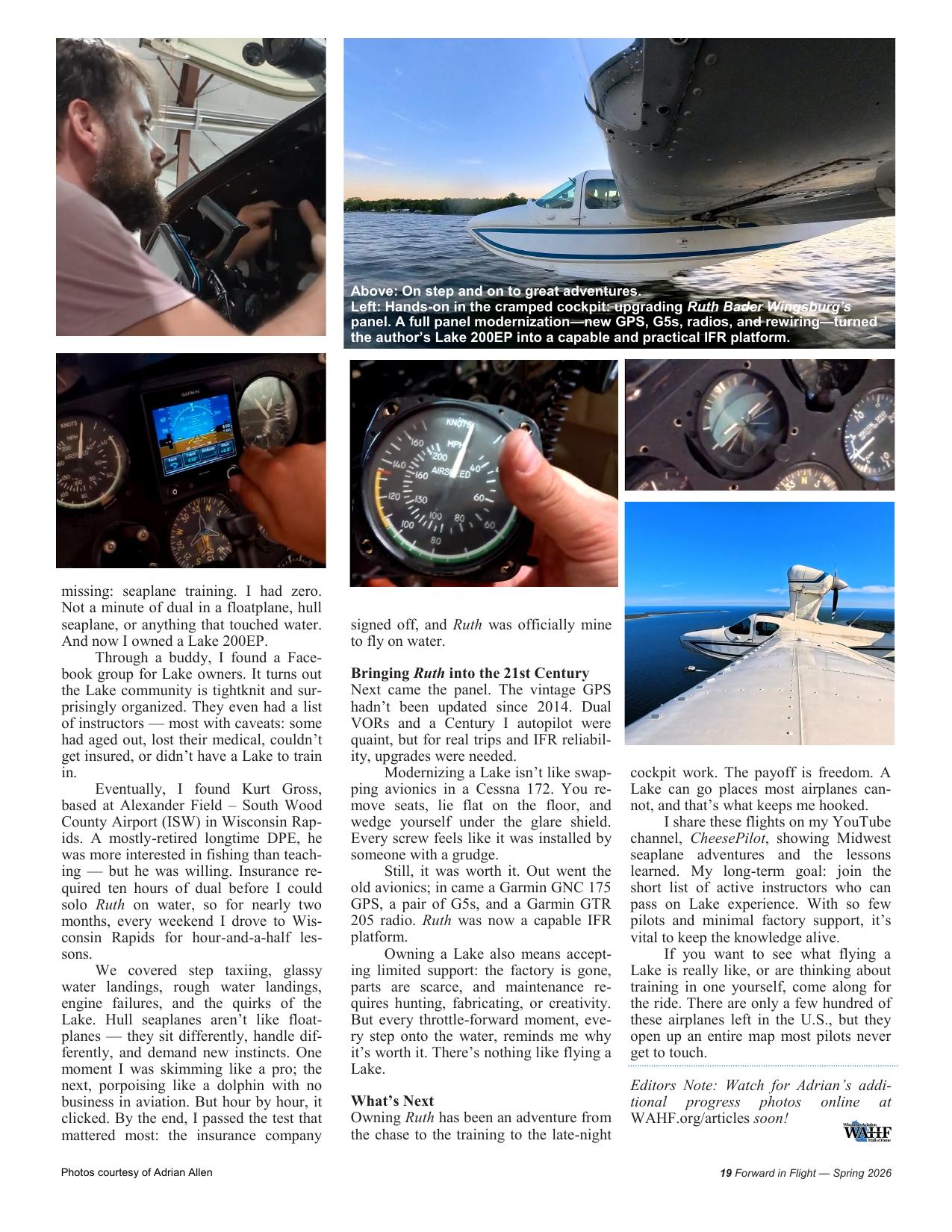
Above: On step and on to great adventures. Left: Hands-on in the cramped cockpit: upgrading Ruth Bader Wingsburg’s panel. A full panel modernization—new GPS, G5s, radios, and rewiring—turned the author’s Lake 200EP into a capable and practical IFR platform. missing: seaplane training. I had zero. Not a minute of dual in a floatplane, hull seaplane, or anything that touched water. And now I owned a Lake 200EP. Through a buddy, I found a Facebook group for Lake owners. It turns out the Lake community is tightknit and surprisingly organized. They even had a list of instructors — most with caveats: some had aged out, lost their medical, couldn’t get insured, or didn’t have a Lake to train in. Eventually, I found Kurt Gross, based at Alexander Field – South Wood County Airport (ISW) in Wisconsin Rapids. A mostly-retired longtime DPE, he was more interested in fishing than teaching — but he was willing. Insurance required ten hours of dual before I could solo Ruth on water, so for nearly two months, every weekend I drove to Wisconsin Rapids for hour-and-a-half lessons. We covered step taxiing, glassy water landings, rough water landings, engine failures, and the quirks of the Lake. Hull seaplanes aren’t like floatplanes — they sit differently, handle differently, and demand new instincts. One moment I was skimming like a pro; the next, porpoising like a dolphin with no business in aviation. But hour by hour, it clicked. By the end, I passed the test that mattered most: the insurance company Photos courtesy of Adrian Allen signed off, and Ruth was officially mine to fly on water. Bringing Ruth into the 21st Century Next came the panel. The vintage GPS hadn’t been updated since 2014. Dual VORs and a Century I autopilot were quaint, but for real trips and IFR reliability, upgrades were needed. Modernizing a Lake isn’t like swapping avionics in a Cessna 172. You remove seats, lie flat on the floor, and wedge yourself under the glare shield. Every screw feels like it was installed by someone with a grudge. Still, it was worth it. Out went the old avionics; in came a Garmin GNC 175 GPS, a pair of G5s, and a Garmin GTR 205 radio. Ruth was now a capable IFR platform. Owning a Lake also means accepting limited support: the factory is gone, parts are scarce, and maintenance requires hunting, fabricating, or creativity. But every throttle-forward moment, every step onto the water, reminds me why it’s worth it. There’s nothing like flying a Lake. What’s Next Owning Ruth has been an adventure from the chase to the training to the late-night cockpit work. The payoff is freedom. A Lake can go places most airplanes cannot, and that’s what keeps me hooked. I share these flights on my YouTube channel, CheesePilot, showing Midwest seaplane adventures and the lessons learned. My long-term goal: join the short list of active instructors who can pass on Lake experience. With so few pilots and minimal factory support, it’s vital to keep the knowledge alive. If you want to see what flying a Lake is really like, or are thinking about training in one yourself, come along for the ride. There are only a few hundred of these airplanes left in the U.S., but they open up an entire map most pilots never get to touch. Editors Note: Watch for Adrian’s additional progress photos online at WAHF.org/articles soon! 19 Forward in Flight — Spring 2026
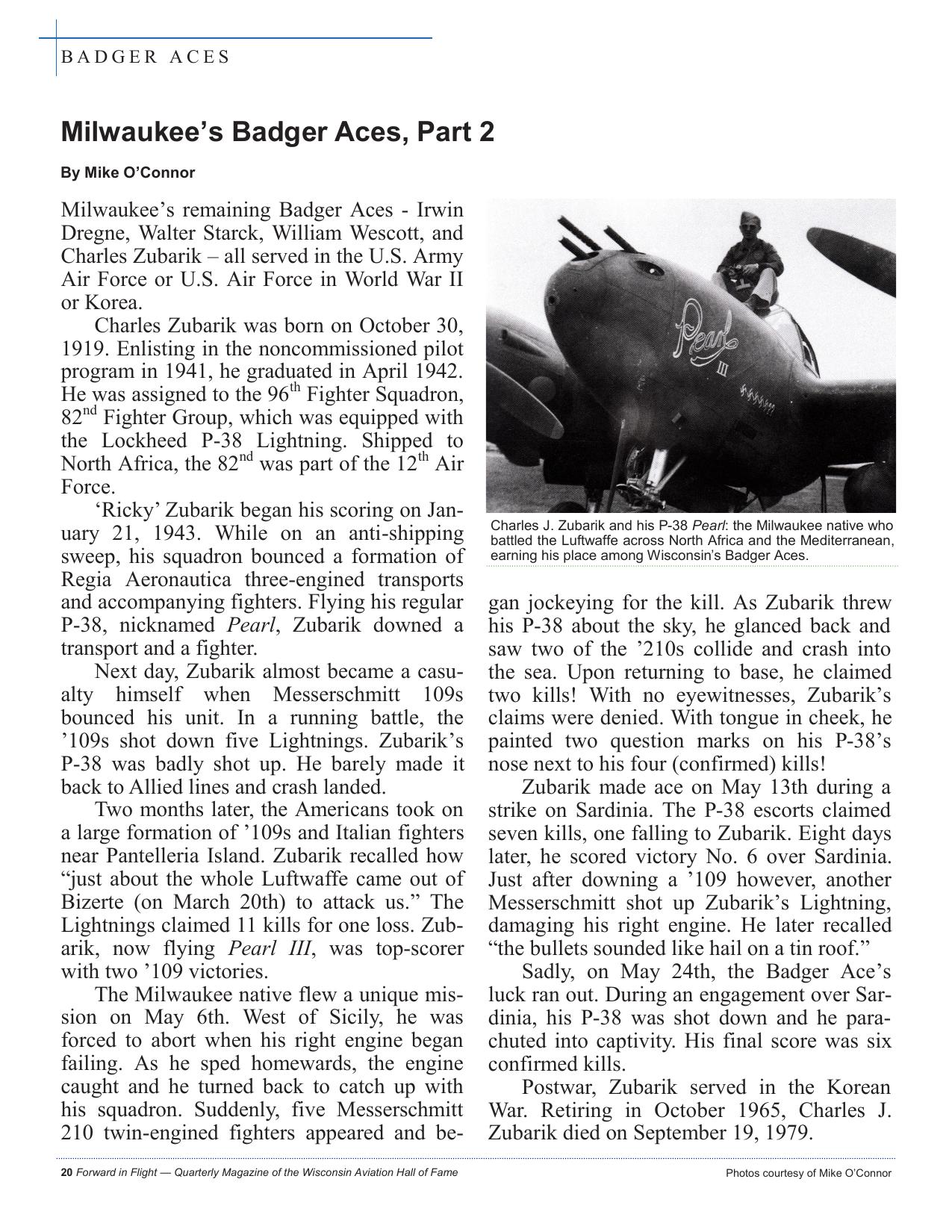
BADGER ACES Milwaukee’s Badger Aces, Part 2 By Mike O’Connor Milwaukee’s remaining Badger Aces Irwin Dregne, Walter Starck, William Wescott, and Charles Zubarik – all served in the U.S. Army Air Force or U.S. Air Force in World War II or Korea. Charles Zubarik was born on October 30, 1919. Enlisting in the noncommissioned pilot program in 1941, he graduated in April 1942. He was assigned to the 96th Fighter Squadron, 82nd Fighter Group, which was equipped with the Lockheed P-38 Lightning. Shipped to North Africa, the 82nd was part of the 12th Air Force. ‘Ricky’ Zubarik began his scoring on January 21, 1943. While on an anti-shipping sweep, his squadron bounced a formation of Regia Aeronautica three-engined transports and accompanying fighters. Flying his regular P-38, nicknamed Pearl, Zubarik downed a transport and a fighter. Next day, Zubarik almost became a casualty himself when Messerschmitt 109s bounced his unit. In a running battle, the ’109s shot down five Lightnings. Zubarik’s P-38 was badly shot up. He barely made it back to Allied lines and crash landed. Two months later, the Americans took on a large formation of ’109s and Italian fighters near Pantelleria Island. Zubarik recalled how “just about the whole Luftwaffe came out of Bizerte (on March 20th) to attack us.” The Lightnings claimed 11 kills for one loss. Zubarik, now flying Pearl III, was topscorer with two ’109 victories. The Milwaukee native flew a unique mission on May 6th. West of Sicily, he was forced to abort when his right engine began failing. As he sped homewards, the engine caught and he turned back to catch up with his squadron. Suddenly, five Messerschmitt 210 twin-engined fighters appeared and began jockeying for the kill. As Zubarik threw his P-38 about the sky, he When his claims were denied for lack of witnesses, he didn’t argue. He simply painted two question marks beside his confirmed kills—a quiet protest from a pilot who knew what he’d seen. 20 Forward in Flight — Quarterly Magazine of the Wisconsin Aviation Hall of Fame Charles J. Zubarik and his P-38 Pearl: the Milwaukee native who battled the Luftwaffe across North Africa and the Mediterranean, earning his place among Wisconsin’s Badger Aces. glanced back and saw two of the ’210s collide and crash into the sea. Upon returning to base, he claimed two kills! With no eyewitnesses, Zubarik’s claims were denied. With tongue in cheek, he painted two question marks on his P-38’s nose next to his four (confirmed) kills! Zubarik made ace on May 13th during a strike on Sardinia. The P-38 escorts claimed seven kills, one falling to Zubarik. Eight days later, he scored victory No. 6 over Sardinia. Just after downing a ’109 however, another Messerschmitt shot up Zubarik’s Lightning, damaging his right engine. He later recalled “the bullets sounded like hail on a tin roof.” Sadly, on May 24th, the Badger Ace’s luck ran out. During an engagement over Sardinia, his P-38 was shot down and he parachuted into captivity. His final score was six confirmed kills. Postwar, Zubarik served in the Korean War. Retiring in October 1965, Charles J. Zubarik died on September 19, 1979. Walter Starck Walter Starck was a Milwaukee transplant. Born in Kansas on September 2, 1920, he and his family later relocated to Milwaukee. Dropping out of college he joined the AAF in January 1942. He eventually wound up in the 487th FS, 352nd FG. Flying Republic’s behemoth P-47 Thunderbolt, the 352nd was slated for the 8th Air Force in England.
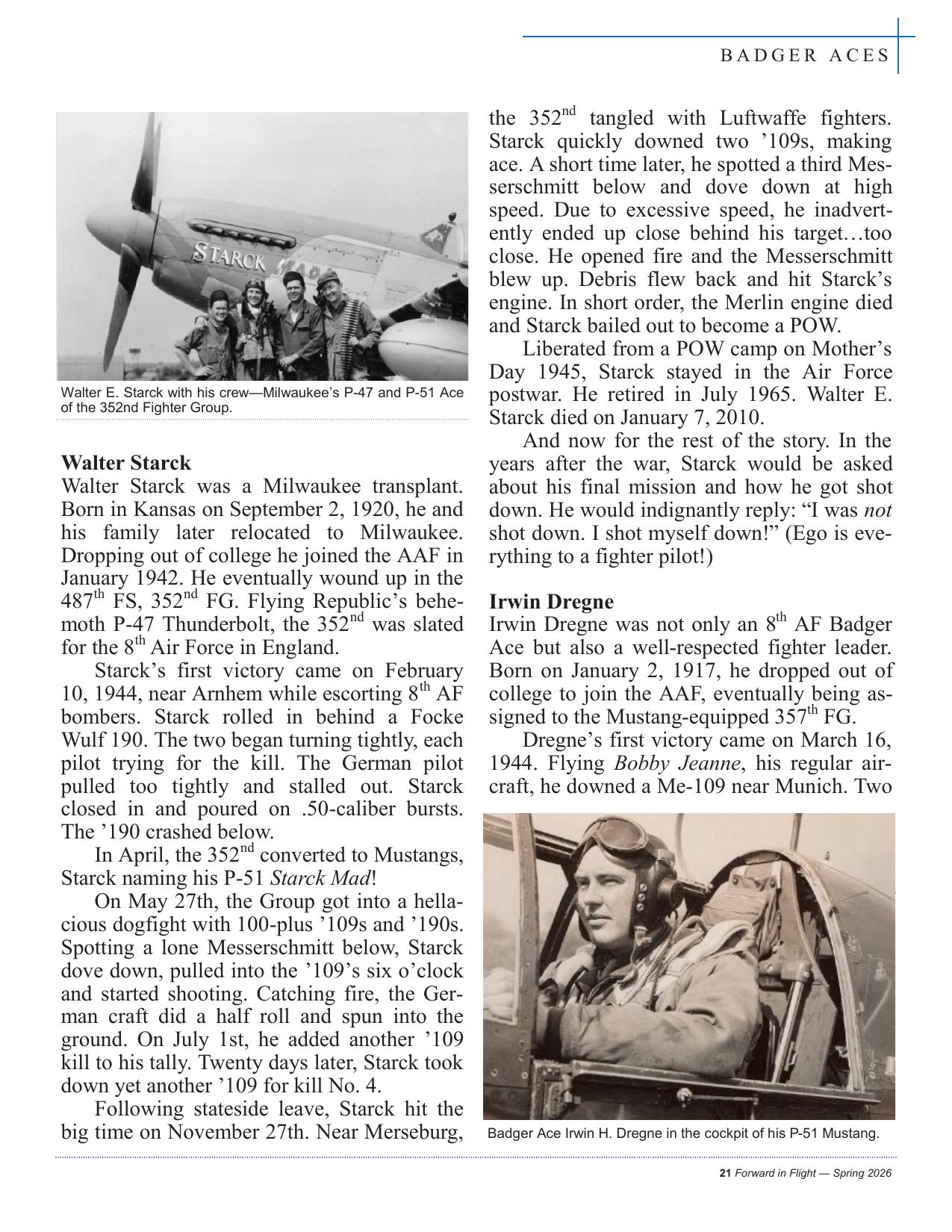
BADGER ACES Starck’s first victory came on February 10, 1944, near Arnhem while escorting 8th AF bombers. Starck rolled in behind a Focke Wulf 190. The two began turning tightly, each pilot trying for the kill. The German pilot pulled too tightly and stalled out. Starck closed in and poured on .50-caliber bursts. The ’190 crashed below. In April, the 352nd converted to Mustangs, Starck naming his P-51 Starck Mad! On May 27th, the Group got into a hellacious dogfight with 100-plus ’109s and ’190s. Spotting a lone Messerschmitt below, Starck dove down, pulled into the ’109’s six o’clock and started shooting. Catching fire, the German craft did a half roll and spun into the ground. On July 1st, he added another ’109 kill to his tally. Twenty days later, Starck took down yet another ’109 for kill No. 4. Following stateside leave, Starck hit the big time on November 27th. Near Merseburg, the 352nd tangled with Luftwaffe fighters. Starck quickly downed two ’109s, making ace. A short time later, he spotted a third Messerschmitt below and dove down at high speed. Due to excessive speed, he inadvertently ended up close behind his target…too close. He opened fire and the Messerschmitt blew up. Debris flew back and hit Starck’s engine. In short order, the Merlin engine died and Starck bailed out to become a POW. Liberated from a POW camp on Mother’s Day 1945, Starck stayed in the Air Force postwar. He retired in July 1965. Walter E. Starck died on January 7, 2010. Photos courtesy of Mike O’Connor and StardustStudios.com Top: In the thick of it: a vivid depiction of Starck’s daring missions, brought to life by Artist Troy White. Above: Walter E. Starck with his crew—Milwaukee’s P-47 and P-51 Ace of the 352nd Fighter Group. And now for the rest of the story. In the years after the war, Starck would be asked about his final mission and how he got shot down. He would indignantly reply: “I was not shot down. I shot myself down!” (Ego is everything to a fighter pilot!) 21 Forward in Flight — Spring 2026
BADGER ACES Badger Ace Irwin H. Dregne in the cockpit of his P-51 Mustang. Irwin Dregne Irwin Dregne was not only an 8th AF Badger Ace but also a well-respected fighter leader. Born on January 2, 1917, he dropped out of college to join the AAF, eventually being assigned to the Mustang-equipped 357th FG. Dregne’s first victory came on March 16, 1944. Flying Bobby Jeanne, his regular aircraft, he downed a Me-109 near Munich. Two more Messerschmitt kills came on May 12th and 19th. On the 12th, “strikes across the wings and fuselage” resulted in the ’109 pilot bailing out. Nine days later, he pressed another Messerschmitt pilot so aggressively that the pilot bailed out. In October, Dregne became Deputy Group Commander. He was noted for his exemplary leadership. One 357th Ace stated Dregne was in “a class by himself…a good guy (and) a great pilot.” Another pilot stated: “Dregne had a strong intuition about how to put a fighter group in the right spot to clobber the opposition.” In December he became Group Commander. On December 24th, Dregne led the Group on a recordsetting mission, the 357th scoring 56½ victories, an 8th AF record. Dregne made Ace in that engagement and received a Distinguished Service Cross for his leadership. Eighth Air Force commander Jimmy Doolittle praised Dregne for giving “the Hun the most humiliating beating he has ever taken in the air.” Remaining in the Air Force, Dregne served in the Korean War, earning a Legion of Merit. Irwin H. Dregne died unexpectedly on September 18, 1967, while on active duty. William Wescott William Wescott, the only Korean War Badger Ace, was born on September 1, 1922. Wescott flew attack bombers in the Pacific during World War II. He served in various billets in the postwar Air Force, including a very useful tour as a Nellis Air Force Base gunnery instructor. When war broke out in Korea in 1950, Wescott was eventually tapped for the 25th FighterInterceptor Squadron, 51st Fighter-Interceptor Group flying out of Suwon, South Korea, in February 1952. Equipped with North American F-86 Sabre jets, the 51st FIW was one of the USAF’s top MiG-killing units. Wescott jumped into the fray with both feet, downing five Communist MiG-15s in April! On April 1st, his squadron bounced 16 MiGs near Sinuiju. “We had a perfect bounce,” Wescott recalled, “and dived right down their tail pipes.” He turned in behind a pair of MiGs and downed one. Seeing another flight of North Korean fighters nearby, he quickly notched up kill No. 2. Twelve days later, Wescott logged another memorable mission. Escorting fighter bombers northward, he was startled when his canopy popped open, causing an explosive decompression. Wescott’s face mask was forced away by the windblast, and his vision began to fade. Securing his mask, Wescott closed the canopy and pressed on. Minutes later, four MiG-15s were called in. Diving down, he riddled one MiG with .50caliber rounds and the pilot ejected. Two more MiGs then closed in from behind. Turning with the enemy fighters, Wescott scored numerous hits on one MiG. The pilot jettisoned his canopy but never ejected. On April 21st, Wescott nearly became a casualty himself. During a low-level reconnaissance mission over the Antung Airfield, a 40-mm round hit the nose of March brought Dregne’s first taste of victory over Munich. By May, he had sent two more Messerschmitts spiraling to the ground, his precise strikes and fearless pursuit leaving enemy pilots with no choice but to bail out. 22 Forward in Flight — Quarterly Magazine of the Wisconsin Aviation Hall of Fame Photos courtesy of Mike O’Connor
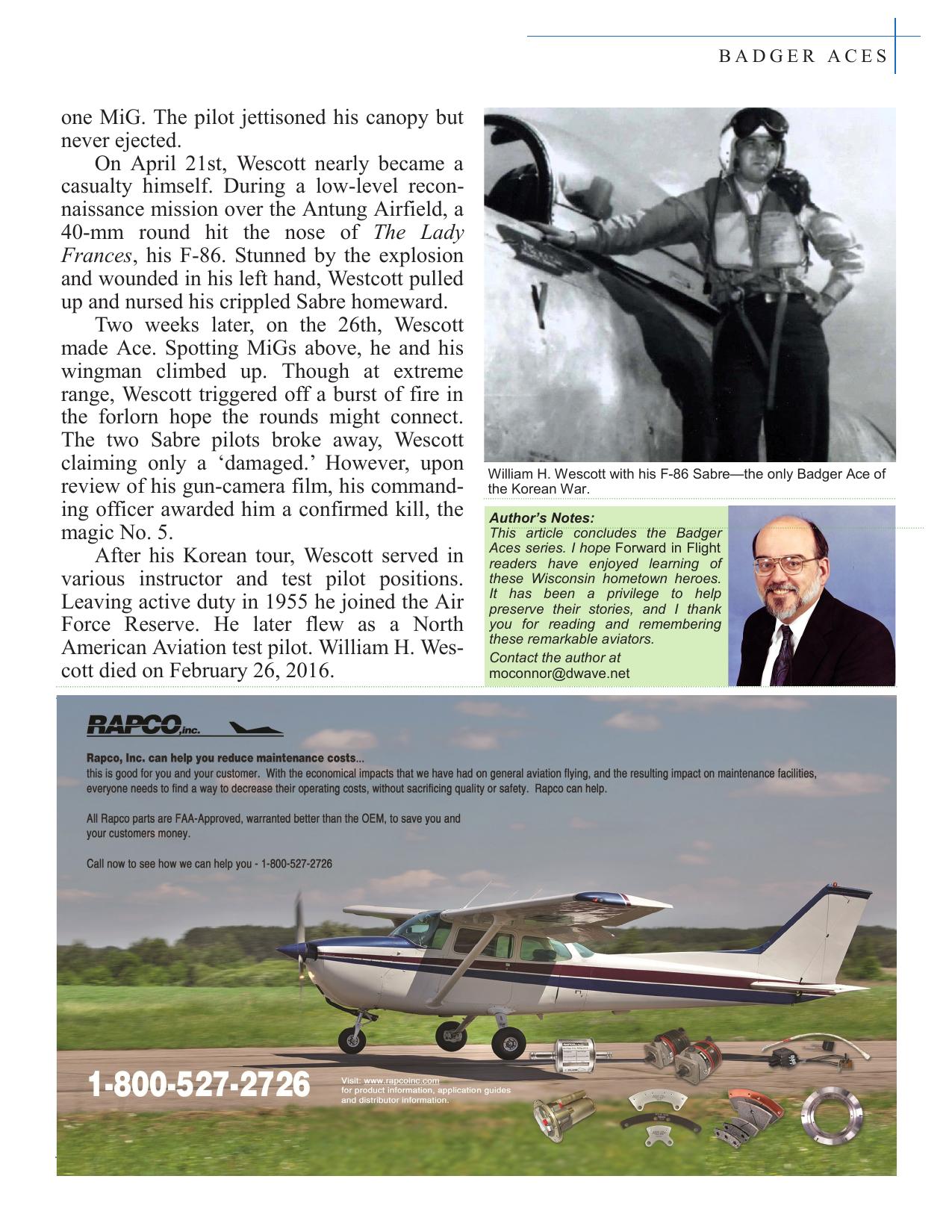
BADGER ACES After his Korean tour, Wescott served in various instructor and test pilot positions. Leaving active duty in 1955 he joined the Air Force Reserve. He later flew as a North American Aviation test pilot. William H. Wescott died on February 26, 2016. Author’s Notes: This article concludes the Badger Aces series. I hope Forward in Flight readers have enjoyed learning of these Wisconsin hometown heroes. It has been a privilege to help preserve their stories, and I thank you for reading and remembering these remarkable aviators. Contact the author at moconnor@dwave.net Wisconsin Aviation Hall of Fame Officers and Board of Directors William H. Wescott with his F-86 Sabre—the only Badger Ace of the Korean War. The Lady Frances, his F-86. Stunned by the explosion and wounded in his left hand, Westcott pulled up and nursed his crippled Sabre homeward. Two weeks later, on the 26th, Wescott made Ace. Spotting MiGs above, he and his wingman climbed up. Though at extreme range, Wescott triggered off a burst of fire in the forlorn hope the rounds might connect. The two Sabre pilots broke away, Wescott claiming only a ‘damaged.’ However, upon review of his gun-camera film, his commanding officer awarded him a confirmed kill, the magic No. 5. President: Kurt Stanich Vice President: Rose Dorcey Secretary: John Dorcey Treasurer: Colleen Weber Board Members Lynn Balderrama Scott Green Dick Hanusa Jill Mann Dan Silvers Jim Szajkovics Wynne Williams Katie Wilson Jim Zuelsdorf
ASSOCIATION NEWS WAHF Announces its 2026 Inductees The third point of the WAHF mission statement – recognizing those who made Wisconsin aviation history – remains as important today as when we held our first induction ceremony in 1986. The selection process is thorough, involving a scoring matrix and review by five dedicated volunteers. In 2025, WAHF received a record 15 nominations, which are divided into two categories: living and deceased. Typically, one or two deceased and three living nominees are inducted each year. Currently, 85 nominees await induction: 67 deceased and 18 living. To date, 170 individuals have been inducted, including three sets of brothers (Crites, Huggins, and Knaup), three husband-and-wife teams (Russell and Marjorie Van Galder, Dick and Bobbie Wagner, Bill and Judy Zivko), and one father/ daughter pair (Archie Towle with Marie Schuette). Not all of Wisconsin’s aviation history makers are inducted into the Hall of Fame. WAHF shares the stories of numerous others who have made a difference in the state’s aviation legacy, featured in our 1998 book Forward in Flight and in our quarterly membership magazine of the same name. The Class of 2026 WAHF Inductees Audrey Poberezny Audrey, EAA’s first—and arguably biggest—volunteer, was a dynamo who kept the “little” organization her husband founded on a steady flight path. From answering phones and typing letters to mimeographing copies of The Experimenter, Audrey did it all. While her husband Paul, a pilot, was often away, Audrey —mother of two—ran the office with dedication. Her role evolved as the organization grew, but her presence, input, and work remain evident to this day. Leo J. Kohn Leo is a Milwaukee native whose early interest in aviation is reflected in his childhood balsa wood models. As a teenager, Leo’s interest turned to photography, focused on aviation. He began flying lessons in 1947 and earned his private pilot certificate. Kohn joined the Milwaukee unit of the Wisconsin Air National Guard shortly after it was formed and met a pilot there named Paul Poberezny. They became fast friends. Leo was with Paul at that first meeting of what would become the Experimental Aircraft Association. In fact, he is Number 4 on the EAA membership list. Leo became EAA’s first paid employee, among other duties he served as vice-president. Leo’s camera was always nearby, and he captured tens of thousands of images of aircraft from the late 1940s into the 1970s. After leaving EAA, he founded Armchair Aviator, a picture style magazine as well as a mail order business selling, and in some cases trading, airplane images. His aviation photo collection grew to over 37,000 images. Gerhard “Gary” Buettner A Milwaukee-area native Gary entered aviation at the tender age of 14 when he helped rebuild and recover a Cessna T-50 “Bamboo Bomber.” He soon began flight training. After a fouryear stint in the USAF as a flight mechanic Gary returned home to work at Aerial Blight Control in West Bend. He then completed the A&P program at Janesville Vocational School in 1958. 24 Forward in Flight — Quarterly Magazine of the Wisconsin Aviation Hall of Fame In 1963 Gary returned to the military serving in the Air Force Reserve at Milwaukee as a flight mechanic until 1980. After completing his military career, he worked for the Defense Logistics Agency as a civilian contractor administering defense contracts throughout Wisconsin. He retired from government service with 30-years of service. Using his GI Bill benefits Gary starting his flight training in earnest acquiring the commercial pilot certificate single and multi-engine land, instrument rating, and the flight instructor certificate. He also added the inspection authorization to his aircraft mechanic credentials. In 1990, Gary went to work for EAA and supervised 10 aircraft restorations. Gary earned the FAA’s Charles E. Taylor Master Mechanic Award in 2003. Eldon Isely Eldon was born in Monroe, Wisconsin, in 1939. Upon graduation from high school, Isely took his first flight lesson at Monroe Municipal Airport. He continued to amass certificates and ratings, building his flight time until he joined the Navy in 1965. He served as an aircraft controller on the USS Wasp and as a flight instructor at NAS Glenview’s flying club. Returning home he and a partner operated Yankee Aviation providing aircraft charter, flight instruction, and maintenance. In 1982 he began a 20-year career as a corporate pilot. Isely was presented the FAA’s Wright Brothers’ Master Pilot Award in 2011. He was an aviation instructor at Sheboygan’s Lakeland College and founded the Sheboygan Flying Club in 2013. His logbook shows nearly 40,000 hours of flight time currently; he is active as a flight instructor with the flying club. Jeff Williams Jeff was born and raised on a Northwoods dairy farm in Winter, Wisconsin. He received an appointment to West Point from Senator William Proxmire. Jeff was introduced to aviation through the academy’s parachuting club. He met NASA astronaut Bob Stewart while there and was soon moving to the flight deck. Following graduation and advanced courses Williams received orders to Ft. Rucker and rotary wing flight school. Next, Jeff’s focus shifted to space flight. Earning his fixed wing credentials while attending school to obtain several advanced degrees, he was even better prepared for the astronaut corps. He applied but was not accepted. He did the next best thing; he took a NASA position as an engineer supporting the Space Shuttle program. In 1996 Jeff applied for the fifth time to be an astronaut and was accepted. Jeff’s first space flight, launched May 19, 2000, was aboard the Space Shuttle Atlantis on mission STS-101. His next three missions were via launches from Kazakhstan in the Soyuz spacecraft. Jeff retired from the US Army in 2007 with 27 years of military service. After 27 years with the agency, he retired from NASA in 2024. Jeff has logged 3,100 hours in more than 50 different aircraft. He has logged 534 days in space including 5 EVAs (extravehicular activities) lasting 34 hours. During his time in space, he served with 56 astronauts from eight countries. More information and photos will be shared soon. Visit wahf.org/rsvp to order tickets for the October 10 induction ceremony, held at the EAA Aviation Museum, Oshkosh.
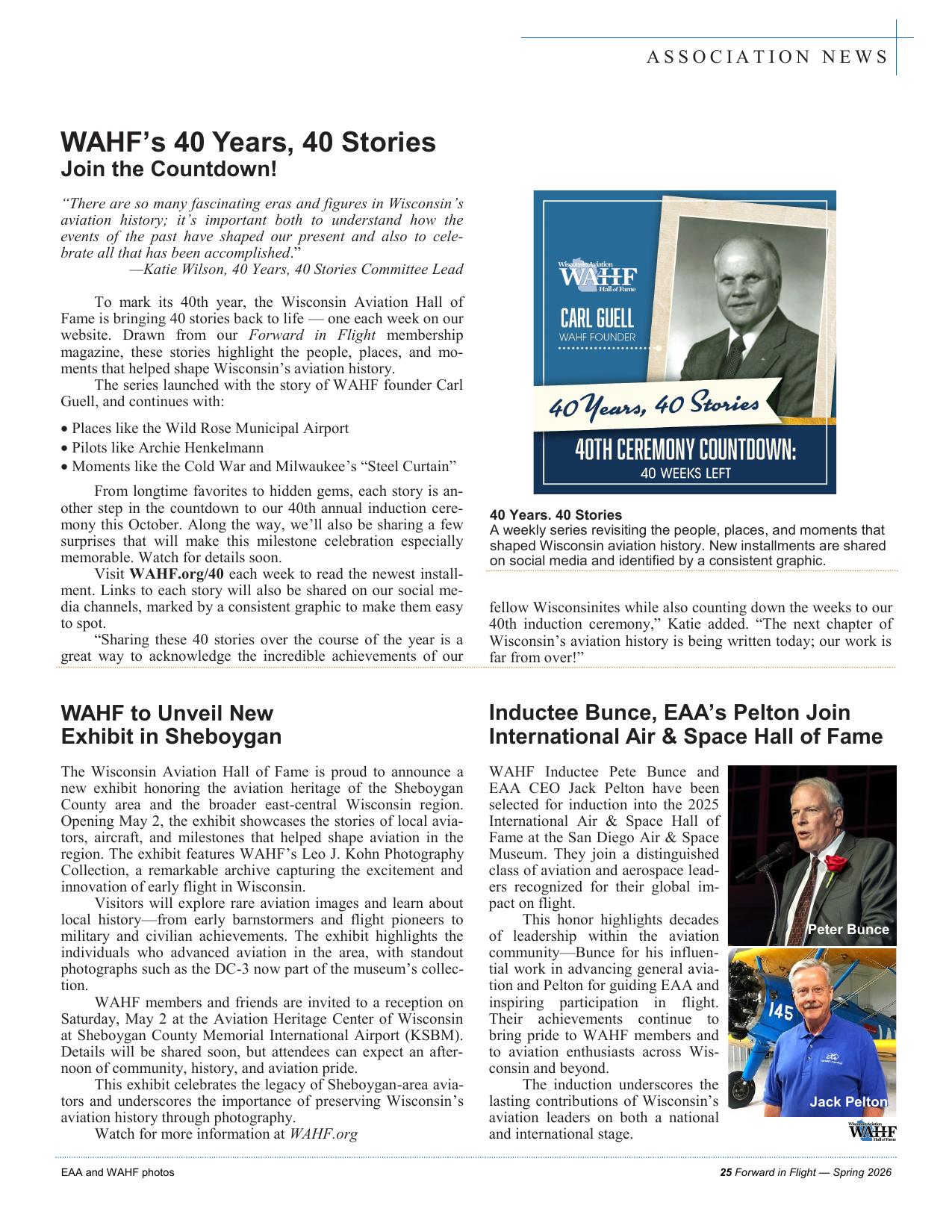
ASSOCIATION NEWS WAHF’s 40 Years, 40 Stories Join the Countdown! “There are so many fascinating eras and figures in Wisconsin’s aviation history; it’s important both to understand how the events of the past have shaped our present and also to celebrate all that has been accomplished.” —Katie Wilson, 40 Years, 40 Stories Committee Lead To mark its 40th year, the Wisconsin Aviation Hall of Fame is bringing 40 stories back to life — one each week on our website. Drawn from our Forward in Flight membership magazine, these stories highlight the people, places, and moments that helped shape Wisconsin’s aviation history. The series launched with the story of WAHF founder Carl Guell, and continues with: · Places like the Wild Rose Municipal Airport · Pilots like Archie Henkelmann · Moments like the Cold War and Milwaukee’s “Steel Curtain” From longtime favorites to hidden gems, each story is another step in the countdown to our 40th annual induction ceremony this October. Along the way, we’ll also be sharing a few surprises that will make this milestone celebration especially memorable. Watch for details soon. Visit WAHF.org/40 each week to read the newest installment. Links to each story will also be shared on our social media channels, marked by a consistent graphic to make them easy to spot. “Sharing these 40 stories over the course of the year is a great way to acknowledge the incredible achievements of our fellow Wisconsinites while also counting down the weeks to our 40th induction ceremony,” Katie added. “The next chapter of Wisconsin’s aviation history is being written today; our work is far from over!” WAHF to Unveil New Exhibit in Sheboygan Inductee Bunce, EAA’s Pelton Join International Air & Space Hall of Fame The Wisconsin Aviation Hall of Fame is proud to announce a new exhibit honoring the aviation heritage of the Sheboygan County area and the broader east-central Wisconsin region. Opening May 2, the exhibit showcases the stories of local aviators, aircraft, and milestones that helped shape aviation in the region. The exhibit features WAHF’s Leo J. Kohn Photography Collection, a remarkable archive capturing the excitement and innovation of early flight in Wisconsin. Visitors will explore rare aviation images and learn about local history—from early barnstormers and flight pioneers to military and civilian achievements. The exhibit highlights the individuals who advanced aviation in the area, with standout photographs such as the DC-3 now part of the museum’s collection. WAHF members and friends are invited to a reception on Saturday, May 2 at the Aviation Heritage Center of Wisconsin at Sheboygan County Memorial International Airport (KSBM). Details will be shared soon, but attendees can expect an afternoon of community, history, and aviation pride. This exhibit celebrates the legacy of Sheboygan-area aviators and underscores the importance of preserving Wisconsin’s aviation history through photography. Watch for more information at WAHF.org WAHF Inductee Pete Bunce and EAA CEO Jack Pelton have been selected for induction into the 2025 International Air & Space Hall of Fame at the San Diego Air & Space Museum. They join a distinguished class of aviation and aerospace leaders recognized for their global impact on flight. This honor highlights decades of leadership within the aviation community—Bunce for his influential work in advancing general aviation and Pelton for guiding EAA and inspiring participation in flight. Their achievements continue to bring pride to WAHF members and to aviation enthusiasts across Wisconsin and beyond. The induction underscores the lasting contributions of Wisconsin’s aviation leaders on both a national and international stage. EAA and WAHF photos 40 Years. 40 Stories A weekly series revisiting the people, places, and moments that shaped Wisconsin aviation history. New installments are shared on social media and identified by a consistent graphic. Peter Bunce Jack Pelton 25 Forward in Flight — Spring 2026
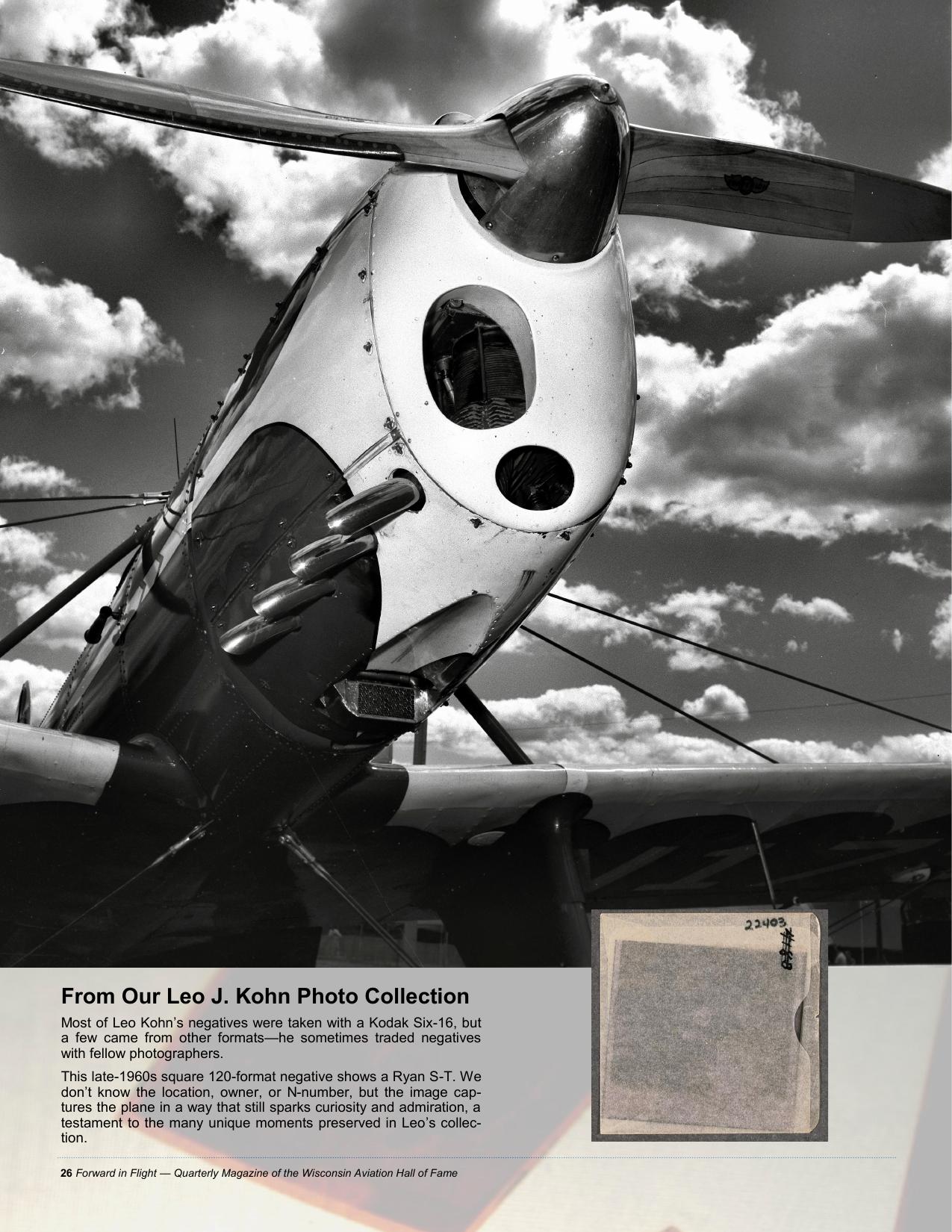
From Our Leo J. Kohn Photo Collection Most of Leo Kohn’s negatives were taken with a Kodak Six-16, but a few came from other formats—he sometimes traded negatives with fellow photographers. This late-1960s square 120-format negative shows a Ryan S-T. We don’t know the location, owner, or N-number, but the image captures the plane in a way that still sparks curiosity and admiration, a testament to the many unique moments preserved in Leo’s collection. 26 Forward in Flight — Quarterly Magazine of the Wisconsin Aviation Hall of Fame
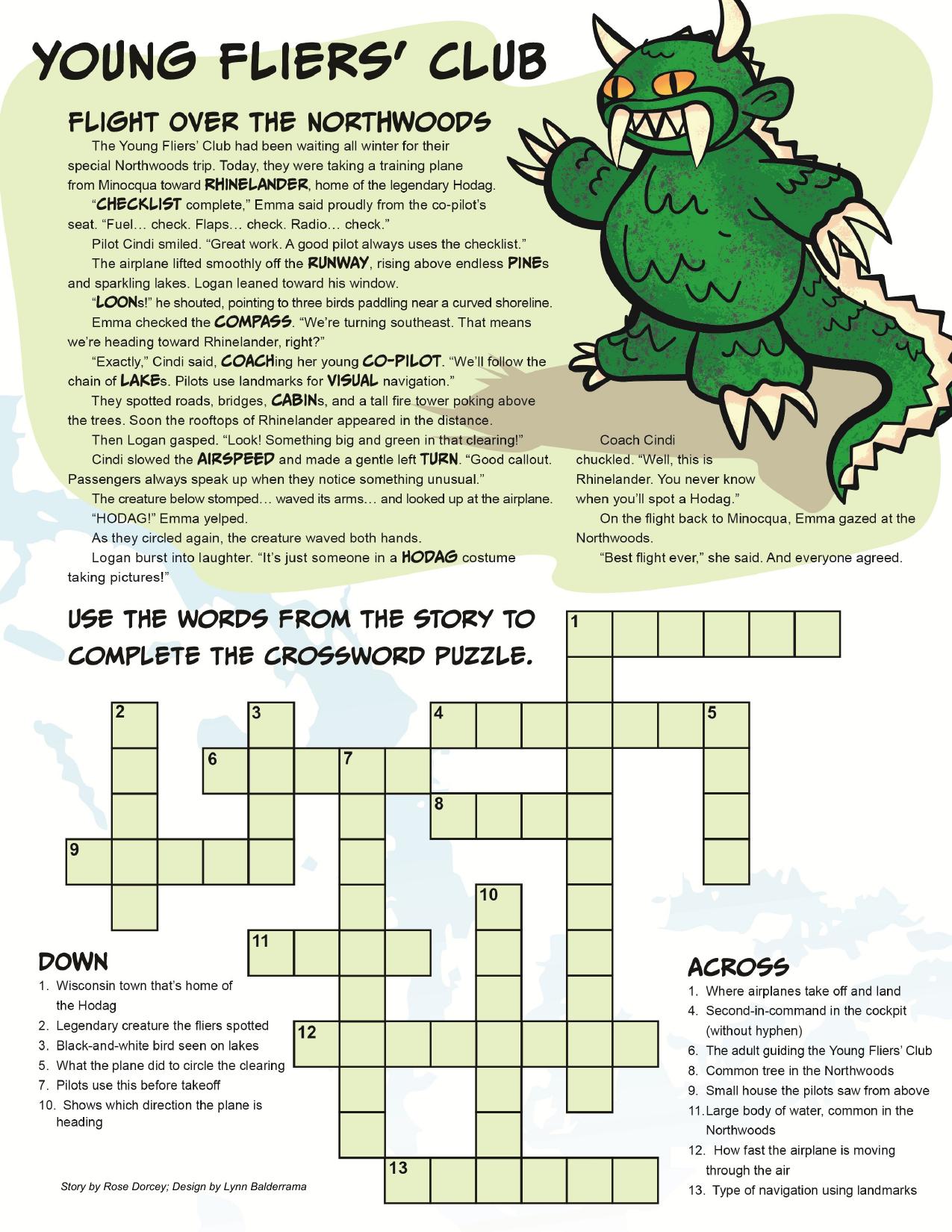
Story by Rose Dorcey; Design by Lynn Balderrama
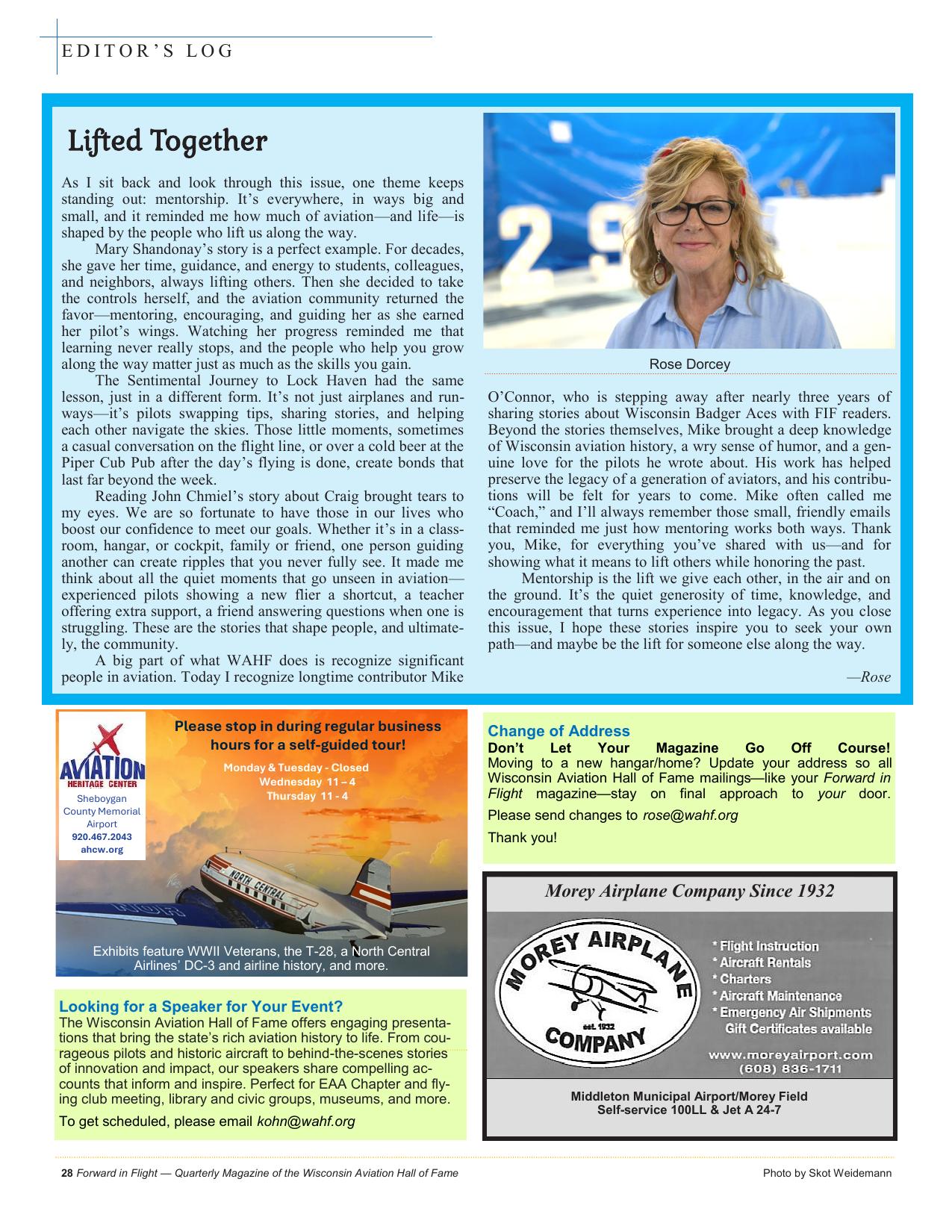
EDITOR’S LOG Lifted Together As I sit back and look through this issue, one theme keeps standing out: mentorship. It’s everywhere, in ways big and small, and it reminded me how much of aviation—and life—is shaped by the people who lift us along the way. Mary Shandonay’s story is a perfect example. For decades, she gave her time, guidance, and energy to students, colleagues, and neighbors, always lifting others. Then she decided to take the controls herself, and the aviation community returned the favor—mentoring, encouraging, and guiding her as she earned her pilot’s wings. Watching her progress reminded me that learning never really stops, and the people who help you grow along the way matter just as much as the skills you gain. The Sentimental Journey to Lock Haven had the same lesson, just in a different form. It’s not just airplanes and runways—it’s pilots swapping tips, sharing stories, and helping each other navigate the skies. Those little moments, sometimes a casual conversation on the flight line, or over a cold beer at the Piper Cub Pub after the day’s flying is done, create bonds that last far beyond the week. Reading John Chmiel’s story about Craig brought tears to my eyes. We are so fortunate to have those in our lives who boost our confidence to meet our goals. Whether it’s in a classroom, hangar, or cockpit, family or friend, one person guiding another can create ripples that you never fully see. It made me think about all the quiet moments that go unseen in aviation— experienced pilots showing a new flier a shortcut, a teacher offering extra support, a friend answering questions when one is struggling. These are the stories that shape people, and ultimately, the community. A big part of what WAHF does is recognize significant people in aviation. Today I recognize longtime contributor Mike Please stop in during regular business hours for a self-guided tour! Sheboygan County Memorial Airport 920.467.2043 ahcw.org Monday & Tuesday - Closed Wednesday 11 – 4 Thursday 11 - 4 Rose Dorcey O’Connor, who is stepping away after nearly three years of sharing stories about Wisconsin Badger Aces with FIF readers. Beyond the stories themselves, Mike brought a deep knowledge of Wisconsin aviation history, a wry sense of humor, and a genuine love for the pilots he wrote about. His work has helped preserve the legacy of a generation of aviators, and his contributions will be felt for years to come. Mike often called me “Coach,” and I’ll always remember those small, friendly emails that reminded me just how mentoring works both ways. Thank you, Mike, for everything you’ve shared with us—and for showing what it means to lift others while honoring the past. Mentorship is the lift we give each other, in the air and on the ground. It’s the quiet generosity of time, knowledge, and encouragement that turns experience into legacy. As you close this issue, I hope these stories inspire you to seek your own path—and maybe be the lift for someone else along the way. —Rose Change of Address Don’t Let Your Magazine Go Off Course! Moving to a new hangar/home? Update your address so all Wisconsin Aviation Hall of Fame mailings—like your Forward in Flight magazine—stay on final approach to your door. Please send changes to rose@wahf.org Thank you! Morey Airplane Company Since 1932 Exhibits feature WWII Veterans, the T-28, a North Central Airlines’ DC-3 and airline history, and more. Looking for a Speaker for Your Event? The Wisconsin Aviation Hall of Fame offers engaging presentations that bring the state’s rich aviation history to life. From courageous pilots and historic aircraft to behind-the-scenes stories of innovation and impact, our speakers share compelling accounts that inform and inspire. Perfect for EAA Chapter and flying club meeting, library and civic groups, museums, and more. To get scheduled, please email kohn@wahf.org 28 Forward in Flight — Quarterly Magazine of the Wisconsin Aviation Hall of Fame Middleton Municipal Airport/Morey Field Self-service 100LL & Jet A 24-7 Photo by Skot Weidemann

Membership Subscription and Donation Form Use for New Memberships and Renewals ANNUAL & LIFETIME MEMBERSHIPS Name________________________________________ _____ Individual _____ Couple _____ Corporate _____ Lifetime Address______________________________________ $30 $40 $250 $500 TAX DEDUCTIBLE CONTRIBUTIONS Your contributions help ensure Wisconsin’s aviation pioneers and outstanding students in aviation education will continue to be recognized. Your contributions, in any amount, are appreciated. WAHF Supporting Contribution $___________ (General operating/programming fund) Leo J. Kohn Collection Preservation Fund $___________ WAHF Scholarship Fund* $___________ *for scholarship donations please write a separate check payable to: Community Foundation of North Central Wisconsin or visit www.CFONCW.org City__________________________________________ State, Zip_____________________________________ Phone_______________________________________ Email________________________________________ Members receive WAHF’s quarterly magazine Forward in Flight. Join Online WAHF.org/membership Donate Online WAHF.org or WAHF.org/kohn Or, mail this form, along with your check payable to: Wisconsin Aviation Hall of Fame, Inc. Send to: Rose Dorcey/WAHF 3980 Sharratt Drive Oshkosh WI 54901 The Wisconsin Aviation Hall of Fame is a 501(c)(3) organization. 29 Forward in Flight — Spring 2026
PRSRT STD US Postage Paid Wisc Rapids WI Permit 98 Forward in Flight c/o Rose Dorcey 3980 Sharratt Drive Oshkosh WI 54901-1276 Welcome New WAHF Member/Supporters! David Ball Peter Bianco Karl Frickelton Cooper Helein Kyle Hotvedt Mark Scheuer* Mary Shandonay* James Zazas Thanks for coming onboard! Your support helps us continue our efforts of collecting, preserving, and sharing Wisconsin aviation history, and honoring those who make it. We also thank the many members who have recently renewed your memberships. We appreciate your support. *Life Membership Our Appreciation We sincerely thank the following individuals for their generous support of the Wisconsin Aviation Hall of Fame. Your contributions help preserve and share aviation history and inspire the next generation of pilots and aviation professionals: Greg Anderson Lynn Balderrama David Cummings Tanya Cunningham KD Plumbing John Dodds Jim Freeman Paul & Deb Gangwish Jon & Michele Kelk Emil Lazich Karen Maahs Timothy Meyer Steve Rehwinkel Neil Robinson Trinski LLC Jim & Donean Szajkovics Your generosity makes a real difference — thank you for being part of our mission! Events EAA Chapter 1710 presents “How to Get Started in Hot Air Ballooning” with Mike Ryszkiewicz — an introduction to the basics, training, and first steps toward becoming a balloon pilot. Clintonville Municipal Airport (KCLI) April 15, 2026, 7:00 pm - 9:00 p.m. Email EAAChapter1710@gmail.com for more information. Celebrate decades of aviation history at WAHF’s new exhibit opening in Sheboygan, featuring the Leo J. Kohn Photography Collection and more. May 2, 2026 — details coming soon. Watch for more info at WAHF.org EAA AirVenture Oshkosh, July 20-26, 2026 - Pioneers of Flight” at AirVenture 2026 Experience aviation’s early years. The “Pioneers of Flight” collection showcases original and replica aircraft from 1903–1927, including the Blériot XI and Spirit of St. Louis reproduction. Vintage forums, engine run-ups, and demonstrations bring the first milestones of flight to life. More info at eaa.org/airventure