Volume 6, Issue 2
🗞️ Download Issue (PDF)
Forward in Flight - Summer 2008
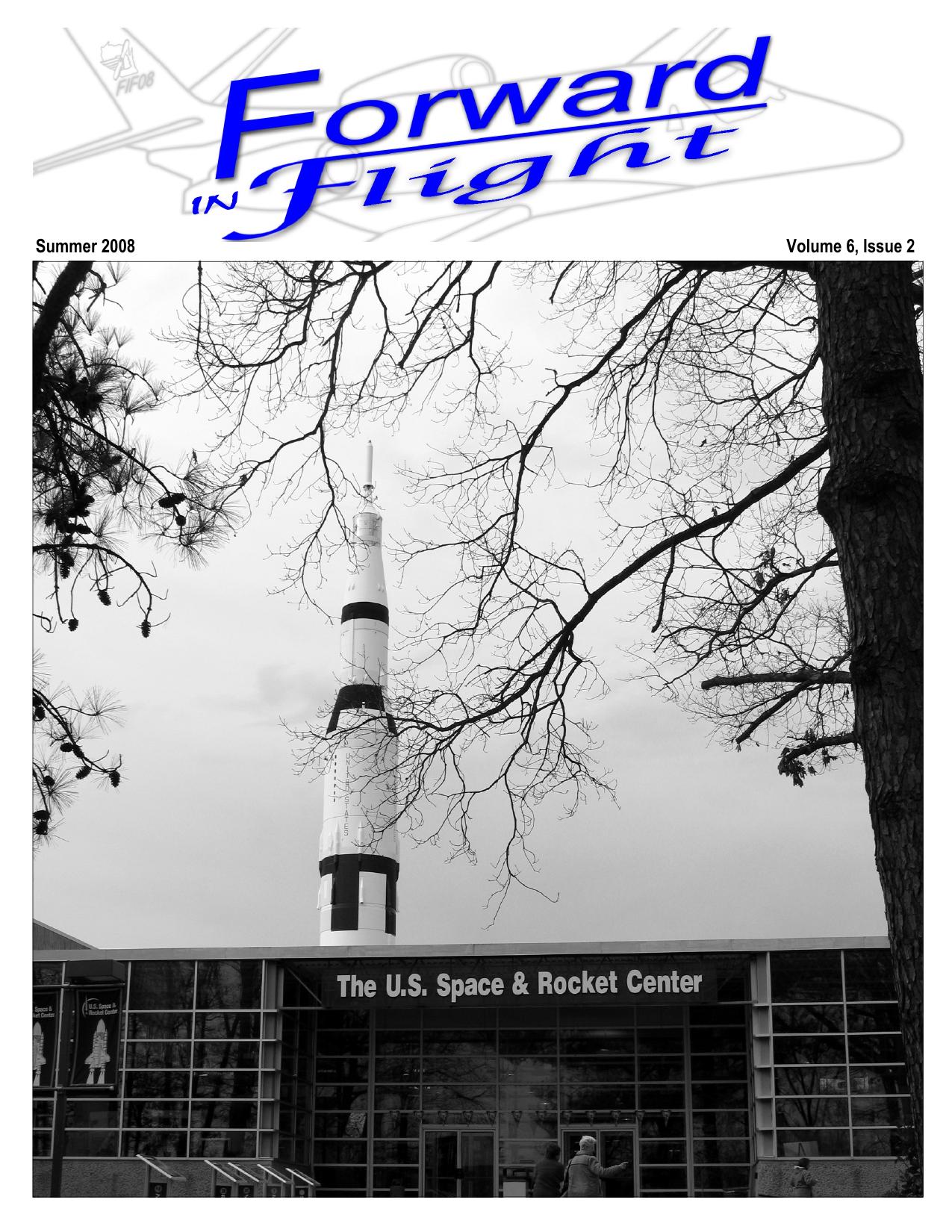
Summer 2008 Volume 6, Issue 2
This issue features... 8 Field of Dreams President’s Message 3 Association News 2008 Scholarship Recipients 4 Annual Pietenpol Fly-in at Brodhead “Is this heaven?” Repeatedly my mind answered, “No, it’s Brodhead, Wisconsin.” Air Doc Dr. Tom Voelker, AME 6 16 A Life Aloft for La Crosse Aviator Field of Dreams By Fred Beseler 8 America and the Space Age By Tomas J. Thomas 10 Exchanging Ideas and Information By Rose Dorcey 12 A Life Aloft for La Crosse Aviator By Chris Hubbuch 16 Boy General from Milwaukee By Gary Dikkers 18 Robert J. “Bob” Jones By Duane Esse 22 Hoyt S. Vandenberg Even as a four-star general at the peak of his military career, and after having been one of the principles responsible for winning the Second World War in Europe, Vandenberg’s credibility sometimes suffered because of his boyish good looks. Centennial of Flight in Wisconsin By Michael Goc 25 22 Robert J. “Bob” Jones Interview from the Past By Michael Goc 26 Gone West 28 Members in the News 30 From the Airways 32 Logbook 34 Stuckey to be inducted into WAHF It was their third flight in the two-seat wooden Barracuda that Allen had built from a kit in his garage. This time, there was trouble. 18 Boy General from Milwaukee American patriot and hero As is true of many early aviators, Robert J. “Bob” Jones saw Charles Lindbergh fly over, and at age 8, he knew he wanted to be a pilot. 26 Interview from the Past Omro’s Red Strehlow “I’ve got 6,000 logged, and of course a lot of it wasn’t logged.” Forward in Flight - sharing Wisconsin aviation stories, past and present Rose Dorcey, Editor 3980 Sharratt Drive Oshkosh WI 54901-1276 Phone: 920-385-1483 E-mail: flyer@aviationhalloffamewisconsin.com Wisconsin Aviation Hall of Fame Mission Statement To collect and preserve the history of aviation in Wisconsin, recognize those who made that history, inform others of it, and promote aviation education for future generations. On the cover... The U.S. Space & Rocket Center is located in Huntsville, Alabama. The Center includes a museum designed to showcase the hardware of the U.S. space program and the facilities of the United States Space Camp. Tom Thomas visited there recently and wrote about his experiences, including a chance meeting with Astronaut Buzz Aldrin. Cover Photo by Tom Thomas
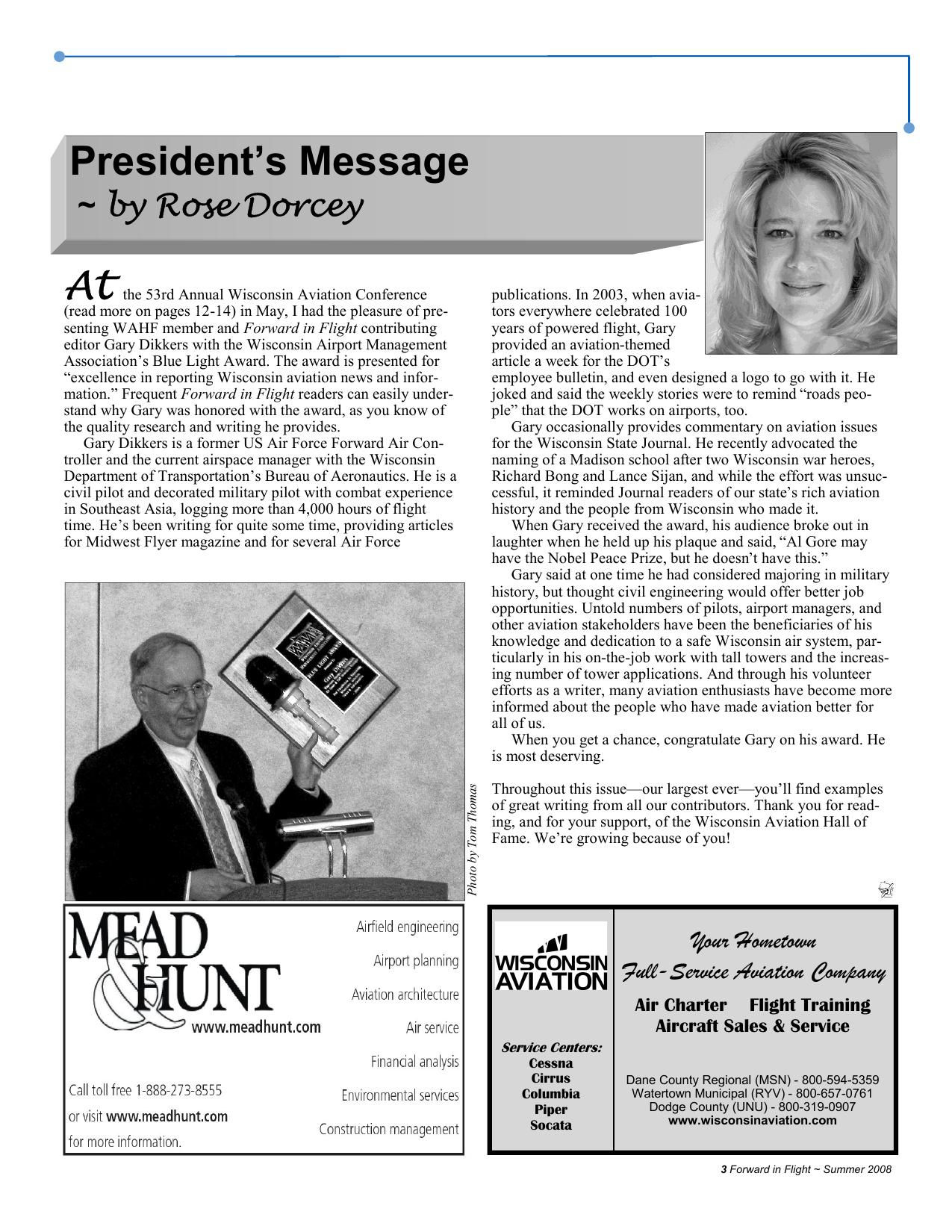
President’s Message ~ by Rose Dorcey At the 53rd Annual Wisconsin Aviation Conference (read more on pages 12-14) in May, I had the pleasure of pre- publications. In 2003, when aviators everywhere celebrated 100 years of powered flight, Gary provided an aviation-themed article a week for the DOT’s employee bulletin, and even designed a logo to go with it. He joked and said the weekly stories were to remind “roads people” that the DOT works on airports, too. Gary occasionally provides commentary on aviation issues for the Wisconsin State Journal. He recently advocated the naming of a Madison school after two Wisconsin war heroes, Richard Bong and Lance Sijan, and while the effort was unsuccessful, it reminded Journal readers of our state’s rich aviation history and the people from Wisconsin who made it. When Gary received the award, his audience broke out in laughter when he held up his plaque and said, “Al Gore may have the Nobel Peace Prize, but he doesn’t have this.” Gary said at one time he had considered majoring in military history, but thought civil engineering would offer better job opportunities. Untold numbers of pilots, airport managers, and other aviation stakeholders have been the beneficiaries of his knowledge and dedication to a safe Wisconsin air system, particularly in his on-the-job work with tall towers and the increasing number of tower applications. And through his volunteer efforts as a writer, many aviation enthusiasts have become more informed about the people who have made aviation better for all of us. When you get a chance, congratulate Gary on his award. He is most deserving. Photo by Tom Thomas senting WAHF member and Forward in Flight contributing editor Gary Dikkers with the Wisconsin Airport Management Association’s Blue Light Award. The award is presented for “excellence in reporting Wisconsin aviation news and information.” Frequent Forward in Flight readers can easily understand why Gary was honored with the award, as you know of the quality research and writing he provides. Gary Dikkers is a former US Air Force Forward Air Controller and the current airspace manager with the Wisconsin Department of Transportation’s Bureau of Aeronautics. He is a civil pilot and decorated military pilot with combat experience in Southeast Asia, logging more than 4,000 hours of flight time. He’s been writing for quite some time, providing articles for Midwest Flyer magazine and for several Air Force Throughout this issue—our largest ever—you’ll find examples of great writing from all our contributors. Thank you for reading, and for your support, of the Wisconsin Aviation Hall of Fame. We’re growing because of you! Your Hometown Full-Service Aviation Company Air Charter Flight Training Aircraft Sales & Service Service Centers: Cessna Cirrus Columbia Piper Socata Dane County Regional (MSN) - 800-594-5359 Watertown Municipal (RYV) - 800-657-0761 Dodge County (UNU) - 800-319-0907 www.wisconsinaviation.com 3 Forward in Flight ~ Summer 2008
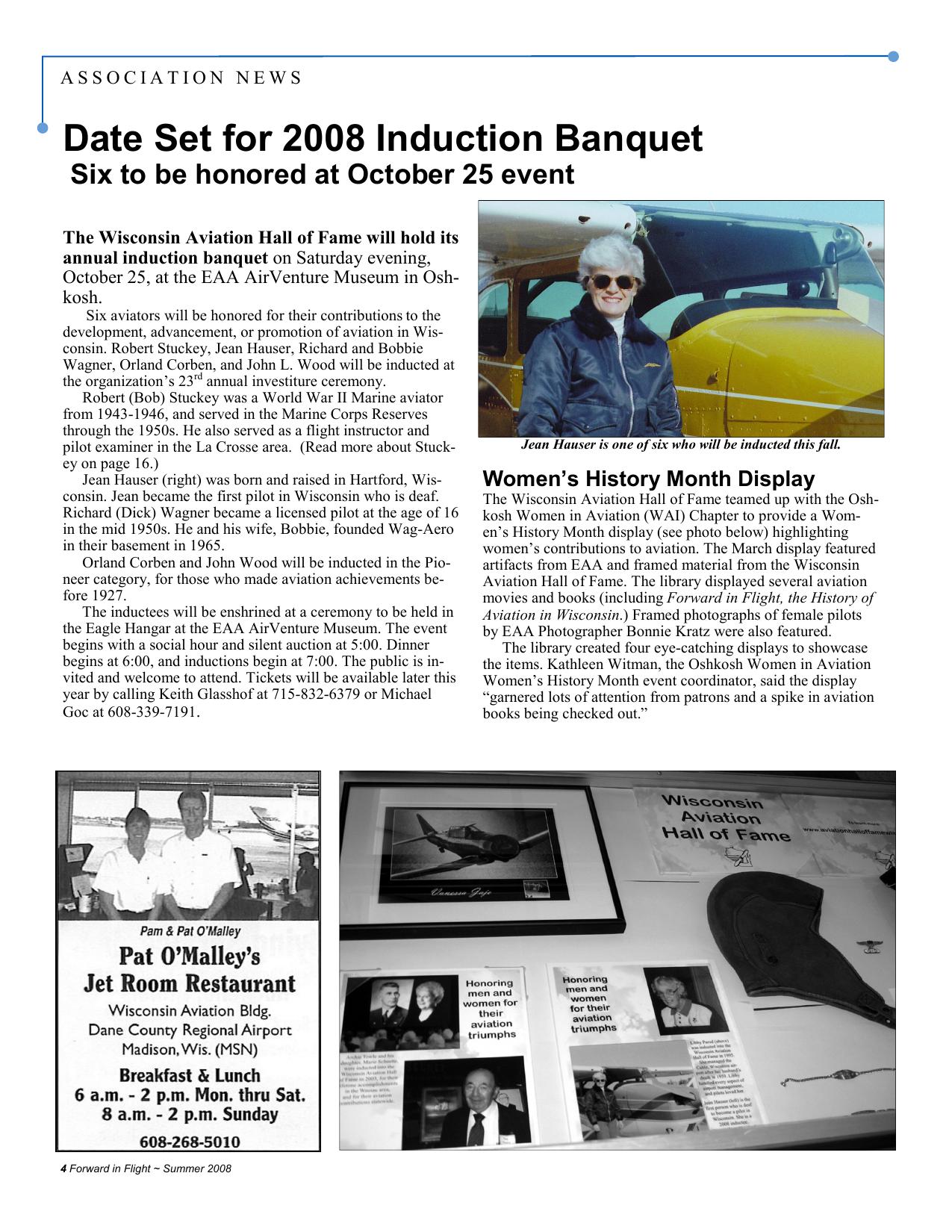
ASSOCIATION NEWS Date Set for 2008 Induction Banquet Six to be honored at October 25 event The Wisconsin Aviation Hall of Fame will hold its annual induction banquet on Saturday evening, October 25, at the EAA AirVenture Museum in Oshkosh. Six aviators will be honored for their contributions to the development, advancement, or promotion of aviation in Wisconsin. Robert Stuckey, Jean Hauser, Richard and Bobbie Wagner, Orland Corben, and John L. Wood will be inducted at the organization’s 23rd annual investiture ceremony. Robert (Bob) Stuckey was a World War II Marine aviator from 1943-1946, and served in the Marine Corps Reserves through the 1950s. He also served as a flight instructor and pilot examiner in the La Crosse area. (Read more about Stuckey on page 16.) Jean Hauser (right) was born and raised in Hartford, Wisconsin. Jean became the first pilot in Wisconsin who is deaf. Richard (Dick) Wagner became a licensed pilot at the age of 16 in the mid 1950s. He and his wife, Bobbie, founded Wag-Aero in their basement in 1965. Orland Corben and John Wood will be inducted in the Pioneer category, for those who made aviation achievements before 1927. The inductees will be enshrined at a ceremony to be held in the Eagle Hangar at the EAA AirVenture Museum. The event begins with a social hour and silent auction at 5:00. Dinner begins at 6:00, and inductions begin at 7:00. The public is invited and welcome to attend. Tickets will be available later this year by calling Keith Glasshof at 715-832-6379 or Michael Goc at 608-339-7191. 4 Forward in Flight ~ Summer 2008 Jean Hauser is one of six who will be inducted this fall. Women’s History Month Display The Wisconsin Aviation Hall of Fame teamed up with the Oshkosh Women in Aviation (WAI) Chapter to provide a Women’s History Month display (see photo below) highlighting women’s contributions to aviation. The March display featured artifacts from EAA and framed material from the Wisconsin Aviation Hall of Fame. The library displayed several aviation movies and books (including Forward in Flight, the History of Aviation in Wisconsin.) Framed photographs of female pilots by EAA Photographer Bonnie Kratz were also featured. The library created four eye-catching displays to showcase the items. Kathleen Witman, the Oshkosh Women in Aviation Women’s History Month event coordinator, said the display “garnered lots of attention from patrons and a spike in aviation books being checked out.”
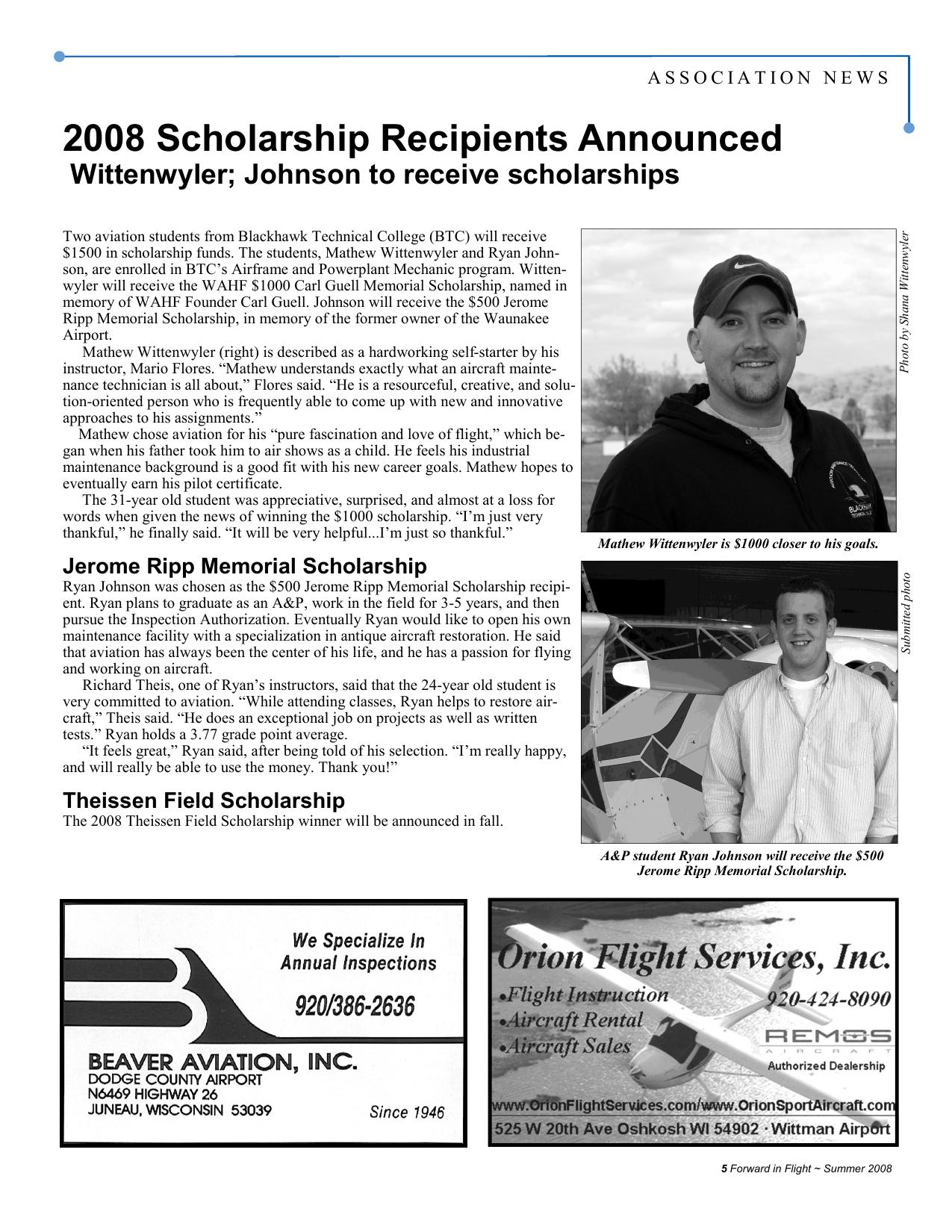
ASSOCIATION NEWS 2008 Scholarship Recipients Announced Two aviation students from Blackhawk Technical College (BTC) will receive $1500 in scholarship funds. The students, Mathew Wittenwyler and Ryan Johnson, are enrolled in BTC’s Airframe and Powerplant Mechanic program. Wittenwyler will receive the WAHF $1000 Carl Guell Memorial Scholarship, named in memory of WAHF Founder Carl Guell. Johnson will receive the $500 Jerome Ripp Memorial Scholarship, in memory of the former owner of the Waunakee Airport. Mathew Wittenwyler (right) is described as a hardworking self-starter by his instructor, Mario Flores. “Mathew understands exactly what an aircraft maintenance technician is all about,” Flores said. “He is a resourceful, creative, and solution-oriented person who is frequently able to come up with new and innovative approaches to his assignments.” Mathew chose aviation for his “pure fascination and love of flight,” which began when his father took him to air shows as a child. He feels his industrial maintenance background is a good fit with his new career goals. Mathew hopes to eventually earn his pilot certificate. The 31-year old student was appreciative, surprised, and almost at a loss for words when given the news of winning the $1000 scholarship. “I’m just very thankful,” he finally said. “It will be very helpful...I’m just so thankful.” Photo by Shana Wittenwyler Wittenwyler; Johnson to receive scholarships Mathew Wittenwyler is $1000 closer to his goals. Submitted photo Jerome Ripp Memorial Scholarship Ryan Johnson was chosen as the $500 Jerome Ripp Memorial Scholarship recipient. Ryan plans to graduate as an A&P, work in the field for 3-5 years, and then pursue the Inspection Authorization. Eventually Ryan would like to open his own maintenance facility with a specialization in antique aircraft restoration. He said that aviation has always been the center of his life, and he has a passion for flying and working on aircraft. Richard Theis, one of Ryan’s instructors, said that the 24-year old student is very committed to aviation. “While attending classes, Ryan helps to restore aircraft,” Theis said. “He does an exceptional job on projects as well as written tests.” Ryan holds a 3.77 grade point average. “It feels great,” Ryan said, after being told of his selection. “I’m really happy, and will really be able to use the money. Thank you!” Theissen Field Scholarship The 2008 Theissen Field Scholarship winner will be announced in fall. A&P student Ryan Johnson will receive the $500 Jerome Ripp Memorial Scholarship. 5 Forward in Flight ~ Summer 2008
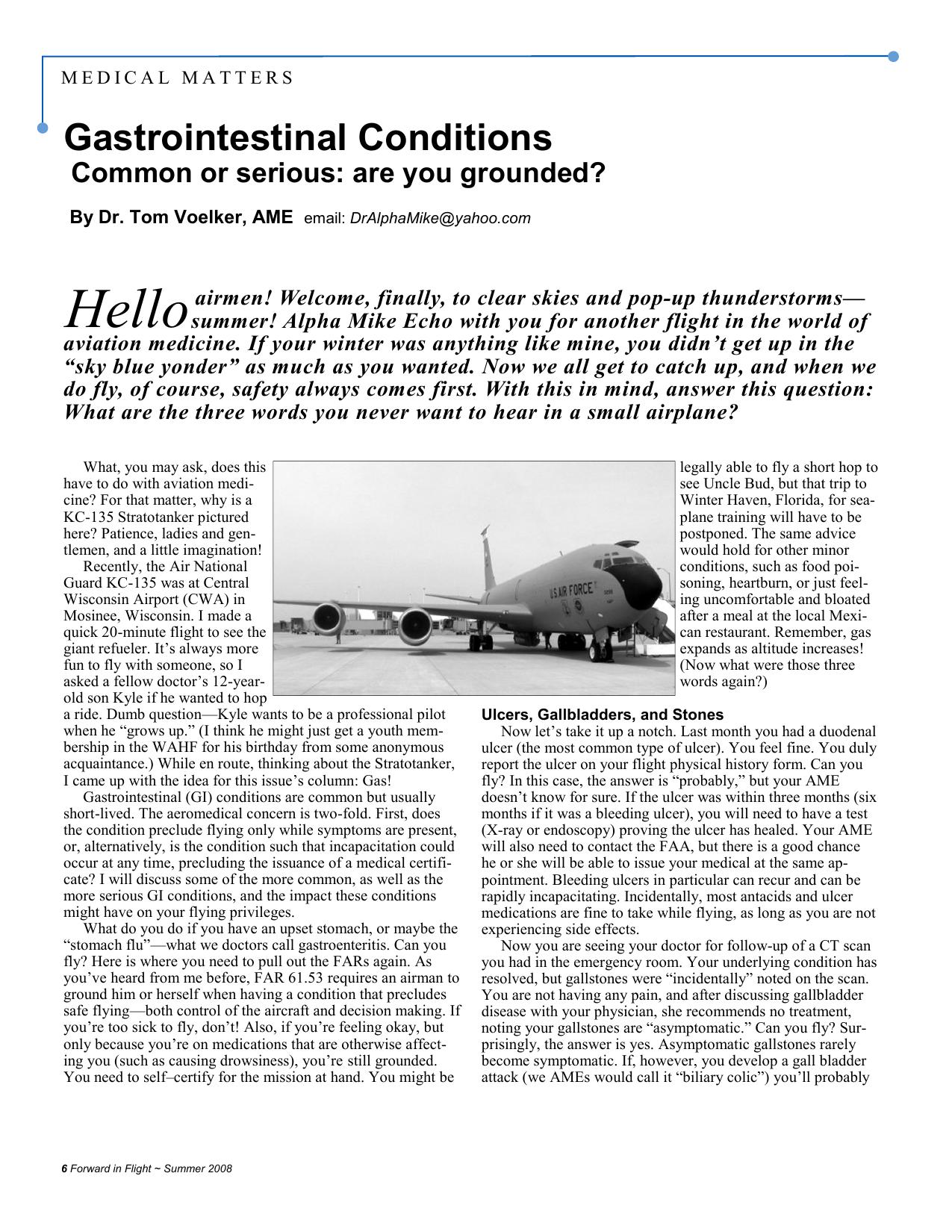
MEDICAL MATTERS Gastrointestinal Conditions Common or serious: are you grounded? By Dr. Tom Voelker, AME email: DrAlphaMike@yahoo.com Hello airmen! Welcome, finally, to clear skies and pop-up thunderstorms— summer! Alpha Mike Echo with you for another flight in the world of aviation medicine. If your winter was anything like mine, you didn’t get up in the “sky blue yonder” as much as you wanted. Now we all get to catch up, and when we do fly, of course, safety always comes first. With this in mind, answer this question: What are the three words you never want to hear in a small airplane? What, you may ask, does this have to do with aviation medicine? For that matter, why is a KC-135 Stratotanker pictured here? Patience, ladies and gentlemen, and a little imagination! Recently, the Air National Guard KC-135 was at Central Wisconsin Airport (CWA) in Mosinee, Wisconsin. I made a quick 20-minute flight to see the giant refueler. It’s always more fun to fly with someone, so I asked a fellow doctor’s 12-yearold son Kyle if he wanted to hop a ride. Dumb question—Kyle wants to be a professional pilot when he “grows up.” (I think he might just get a youth membership in the WAHF for his birthday from some anonymous acquaintance.) While en route, thinking about the Stratotanker, I came up with the idea for this issue’s column: Gas! Gastrointestinal (GI) conditions are common but usually short-lived. The aeromedical concern is two-fold. First, does the condition preclude flying only while symptoms are present, or, alternatively, is the condition such that incapacitation could occur at any time, precluding the issuance of a medical certificate? I will discuss some of the more common, as well as the more serious GI conditions, and the impact these conditions might have on your flying privileges. What do you do if you have an upset stomach, or maybe the “stomach flu”—what we doctors call gastroenteritis. Can you fly? Here is where you need to pull out the FARs again. As you’ve heard from me before, FAR 61.53 requires an airman to ground him or herself when having a condition that precludes safe flying—both control of the aircraft and decision making. If you’re too sick to fly, don’t! Also, if you’re feeling okay, but only because you’re on medications that are otherwise affecting you (such as causing drowsiness), you’re still grounded. You need to self–certify for the mission at hand. You might be 6 Forward in Flight ~ Summer 2008 legally able to fly a short hop to see Uncle Bud, but that trip to Winter Haven, Florida, for seaplane training will have to be postponed. The same advice would hold for other minor conditions, such as food poisoning, heartburn, or just feeling uncomfortable and bloated after a meal at the local Mexican restaurant. Remember, gas expands as altitude increases! (Now what were those three words again?) Ulcers, Gallbladders, and Stones Now let’s take it up a notch. Last month you had a duodenal ulcer (the most common type of ulcer). You feel fine. You duly report the ulcer on your flight physical history form. Can you fly? In this case, the answer is “probably,” but your AME doesn’t know for sure. If the ulcer was within three months (six months if it was a bleeding ulcer), you will need to have a test (X-ray or endoscopy) proving the ulcer has healed. Your AME will also need to contact the FAA, but there is a good chance he or she will be able to issue your medical at the same appointment. Bleeding ulcers in particular can recur and can be rapidly incapacitating. Incidentally, most antacids and ulcer medications are fine to take while flying, as long as you are not experiencing side effects. Now you are seeing your doctor for follow-up of a CT scan you had in the emergency room. Your underlying condition has resolved, but gallstones were “incidentally” noted on the scan. You are not having any pain, and after discussing gallbladder disease with your physician, she recommends no treatment, noting your gallstones are “asymptomatic.” Can you fly? Surprisingly, the answer is yes. Asymptomatic gallstones rarely become symptomatic. If, however, you develop a gall bladder attack (we AMEs would call it “biliary colic”) you’ll probably
MEDICAL MATTERS need to have your gallbladder removed. If symptomatic gall bladder disease is discovered on a flight physical, the AME will need to defer approval to the FAA. Up another notch You have Crohn’s disease or ulcerative colitis, the two more common forms of inflammatory bowel disease. Some people with these conditions have frequent episodes of spasm and rectal bleeding, and they can be troubled by sudden, explosive diarrhea. (Don’t you love the descriptive terms we doctors use?) These conditions will require records from your treating doctor to be sent to the FAA before your medical can be issued. Often the symptoms are controlled by medications, which are themselves disqualifying for flight. If you find yourself with one of these conditions, you may want to get your medical in hand before investing too much time, energy, and money into your flying hobby or profession. ...after discussing gallbladder disease with your physician, she recommends no treatment, noting your gallstones are “asymptomatic.” Can you fly? Let’s spend a little time on liver disease. Technically speaking, any liver disease is classified as “hepatitis,” though most people have a bleak view of that condition. The most common form is viral hepatitis. This could be associated with infectious mononucleosis, or “mono,” which essentially always resolves. The hepatitis could also be one of the “alphabet” forms: hepatitis A, B, or C. Hepatitis A is the most common and usually resolves on its own. Hepatitis B can be more serious and can become a chronic condition, possibly even leading to cirrhosis of the liver. If the hepatitis has resolved completely your AME should be able to issue your medical, but you might need to supply some records from your treating doctor. If you have a persistent form of hepatitis B, your medical application will probably be deferred to the FAA. While hepatitis is usually not acutely incapacitating, you need to remember that when the FAA issues you a medical, it is declaring that you will probably not become incapacitated during the duration of the medical certificate (which could be as long as three years). Finally, if you acquire hepatitis C, you will definitely have your medical deferred, as this condition cannot be cured and often progresses to cirrhosis. The final form of hepatitis I want to mention is alcoholic hepatitis. If your alcoholism is bad enough to cause liver damage, it will probably also ground you in and of itself. That’s a topic for another day. Cirrhosis is scarring of the liver, and is usually found in the course of alcoholism or as a result of hepatitis B or C. There are several potential complications of cirrhosis, a common one of which is sudden severe upper gastrointestinal bleeding (throwing up blood). As you might imagine, this wouldn’t be a real good problem to have occur on the procedure turn inbound! As you might expect, the FAA requires the AME to defer approval of the medical certificate if there is a history of cirrhosis. The “C” Word Lastly, I would like to mention a not too uncommon gastrointestinal condition. This condition is colorectal cancer. The easy answer here is that the FAA requires AME deferral of issuance of medical certificates in essentially all cases of cancer. If your colon cancer was 15 years ago, you were treated and considered cured, the FAA will probably issue you a medical. If your cancer was treated but you are only two years out from treatment, expect a short-term medical with requirements for frequent reports from your treating doctor at best. Either way, the FAA wants to decide for itself. More importantly, though, is the medical (as opposed to aeromedical) implication of colorectal cancer. This common cancer just doesn’t have to exist! If you are over 50, go in for a physical and request a colonoscopy. It can literally save your life! Just What Are Those Three Words? So, given this issue’s topic, what are those three little words we don’t want to hear? I thought it would be fun to let you tell me. Email me your suggestions or guesses (see below). If I get some good responses, we can have a little fun with it. It’ll be a gas! Back in the Pilot’s Seat—A Success Story Before I sign off, I want to pass on (with consent of the airman) another success story. Charles flies out of Madison, Wisconsin—at least he used to. He had an episode of angina, or heart pain, and had a coronary angioplasty. His cardiologist told him his heart is fine now, but his AME deferred his certification to Oklahoma City, as we are required to do in such cases. With the information the FAA had, Charles’ medical was denied. Charles (a WAHF member and reader of this publication) contacted me. I agreed to review his medical history and provide another flight physical, in an attempt to “start over.” I also had to “defer” his medical to the FAA, but this time with all of the proper documentation and some additional information. Both Charles and I communicated with the FAA a couple times. Three months later, I was able to deliver the good news! The FAA sends a copy of deferral decisions to the AME who performed the exam. Since Charles hadn’t yet checked his mail, I had the pleasure of telling him he can fly! If you have a similar situation, see if your AME can help you out, or find one who will. New Email Address for You Due to changes at work, I’ve opened a new email account just for you! I can be reached at DrAlphaMike@yahoo.com. Feel free to suggest topics for future installments of Alpha Mike’s musings. I’m looking forward to hearing from you! Here’s to flying safely. -Alpha Mike Echo 7 Forward in Flight ~ Summer 2008
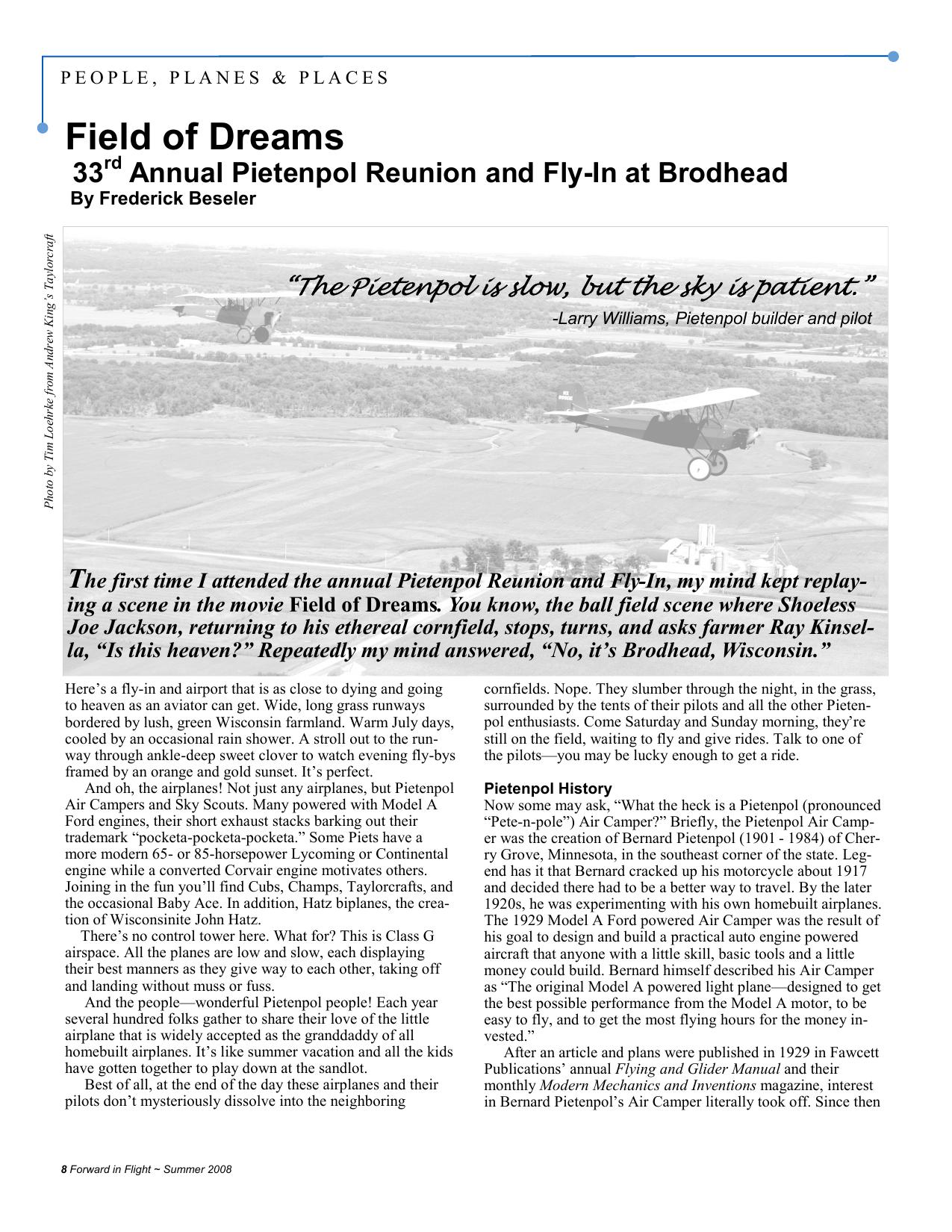
PEOPLE, PLANES & PLACES Field of Dreams 33rd Annual Pietenpol Reunion and Fly-In at Brodhead Photo by Tim Loehrke from Andrew King’s Taylorcraft By Frederick Beseler “The Pietenpol is slow, but the sky is patient.” -Larry Williams, Pietenpol builder and pilot The first time I attended the annual Pietenpol Reunion and Fly-In, my mind kept replay- ing a scene in the movie Field of Dreams. You know, the ball field scene where Shoeless Joe Jackson, returning to his ethereal cornfield, stops, turns, and asks farmer Ray Kinsella, “Is this heaven?” Repeatedly my mind answered, “No, it’s Brodhead, Wisconsin.” Here’s a fly-in and airport that is as close to dying and going to heaven as an aviator can get. Wide, long grass runways bordered by lush, green Wisconsin farmland. Warm July days, cooled by an occasional rain shower. A stroll out to the runway through ankle-deep sweet clover to watch evening fly-bys framed by an orange and gold sunset. It’s perfect. And oh, the airplanes! Not just any airplanes, but Pietenpol Air Campers and Sky Scouts. Many powered with Model A Ford engines, their short exhaust stacks barking out their trademark “pocketa-pocketa-pocketa.” Some Piets have a more modern 65- or 85-horsepower Lycoming or Continental engine while a converted Corvair engine motivates others. Joining in the fun you’ll find Cubs, Champs, Taylorcrafts, and the occasional Baby Ace. In addition, Hatz biplanes, the creation of Wisconsinite John Hatz. There’s no control tower here. What for? This is Class G airspace. All the planes are low and slow, each displaying their best manners as they give way to each other, taking off and landing without muss or fuss. And the people—wonderful Pietenpol people! Each year several hundred folks gather to share their love of the little airplane that is widely accepted as the granddaddy of all homebuilt airplanes. It’s like summer vacation and all the kids have gotten together to play down at the sandlot. Best of all, at the end of the day these airplanes and their pilots don’t mysteriously dissolve into the neighboring 8 Forward in Flight ~ Summer 2008 cornfields. Nope. They slumber through the night, in the grass, surrounded by the tents of their pilots and all the other Pietenpol enthusiasts. Come Saturday and Sunday morning, they’re still on the field, waiting to fly and give rides. Talk to one of the pilots—you may be lucky enough to get a ride. Pietenpol History Now some may ask, “What the heck is a Pietenpol (pronounced “Pete-n-pole”) Air Camper?” Briefly, the Pietenpol Air Camper was the creation of Bernard Pietenpol (1901 - 1984) of Cherry Grove, Minnesota, in the southeast corner of the state. Legend has it that Bernard cracked up his motorcycle about 1917 and decided there had to be a better way to travel. By the later 1920s, he was experimenting with his own homebuilt airplanes. The 1929 Model A Ford powered Air Camper was the result of his goal to design and build a practical auto engine powered aircraft that anyone with a little skill, basic tools and a little money could build. Bernard himself described his Air Camper as “The original Model A powered light plane—designed to get the best possible performance from the Model A motor, to be easy to fly, and to get the most flying hours for the money invested.” After an article and plans were published in 1929 in Fawcett Publications’ annual Flying and Glider Manual and their monthly Modern Mechanics and Inventions magazine, interest in Bernard Pietenpol’s Air Camper literally took off. Since then
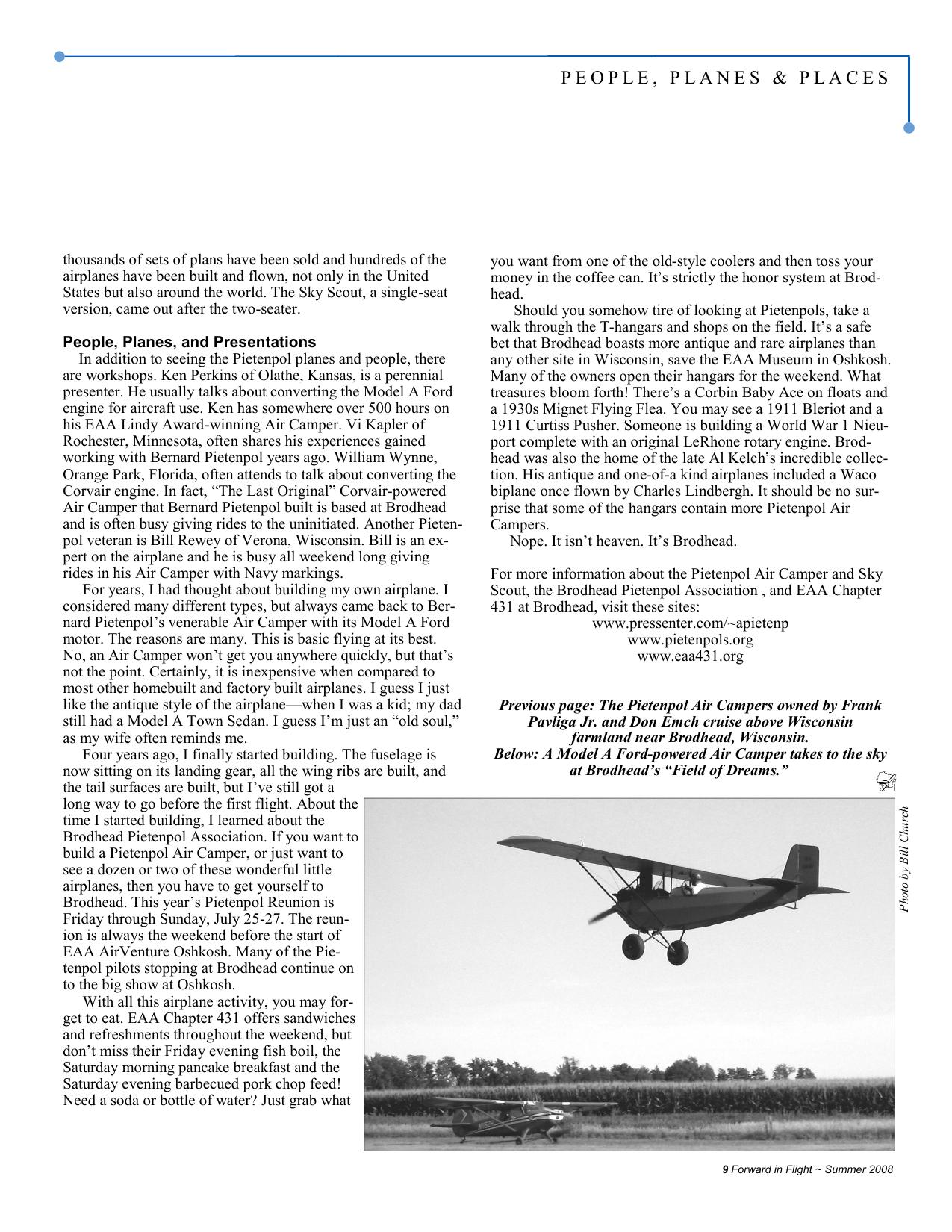
PEOPLE, PLANES & PLACES People, Planes, and Presentations In addition to seeing the Pietenpol planes and people, there are workshops. Ken Perkins of Olathe, Kansas, is a perennial presenter. He usually talks about converting the Model A Ford engine for aircraft use. Ken has somewhere over 500 hours on his EAA Lindy Award-winning Air Camper. Vi Kapler of Rochester, Minnesota, often shares his experiences gained working with Bernard Pietenpol years ago. William Wynne, Orange Park, Florida, often attends to talk about converting the Corvair engine. In fact, “The Last Original” Corvair-powered Air Camper that Bernard Pietenpol built is based at Brodhead and is often busy giving rides to the uninitiated. Another Pietenpol veteran is Bill Rewey of Verona, Wisconsin. Bill is an expert on the airplane and he is busy all weekend long giving rides in his Air Camper with Navy markings. For years, I had thought about building my own airplane. I considered many different types, but always came back to Bernard Pietenpol’s venerable Air Camper with its Model A Ford motor. The reasons are many. This is basic flying at its best. No, an Air Camper won’t get you anywhere quickly, but that’s not the point. Certainly, it is inexpensive when compared to most other homebuilt and factory built airplanes. I guess I just like the antique style of the airplane—when I was a kid; my dad still had a Model A Town Sedan. I guess I’m just an “old soul,” as my wife often reminds me. Four years ago, I finally started building. The fuselage is now sitting on its landing gear, all the wing ribs are built, and the tail surfaces are built, but I’ve still got a long way to go before the first flight. About the time I started building, I learned about the Brodhead Pietenpol Association. If you want to build a Pietenpol Air Camper, or just want to see a dozen or two of these wonderful little airplanes, then you have to get yourself to Brodhead. This year’s Pietenpol Reunion is Friday through Sunday, July 25-27. The reunion is always the weekend before the start of EAA AirVenture Oshkosh. Many of the Pietenpol pilots stopping at Brodhead continue on to the big show at Oshkosh. With all this airplane activity, you may forget to eat. EAA Chapter 431 offers sandwiches and refreshments throughout the weekend, but don’t miss their Friday evening fish boil, the Saturday morning pancake breakfast and the Saturday evening barbecued pork chop feed! Need a soda or bottle of water? Just grab what you want from one of the old-style coolers and then toss your money in the coffee can. It’s strictly the honor system at Brodhead. Should you somehow tire of looking at Pietenpols, take a walk through the T-hangars and shops on the field. It’s a safe bet that Brodhead boasts more antique and rare airplanes than any other site in Wisconsin, save the EAA Museum in Oshkosh. Many of the owners open their hangars for the weekend. What treasures bloom forth! There’s a Corbin Baby Ace on floats and a 1930s Mignet Flying Flea. You may see a 1911 Bleriot and a 1911 Curtiss Pusher. Someone is building a World War 1 Nieuport complete with an original LeRhone rotary engine. Brodhead was also the home of the late Al Kelch’s incredible collection. His antique and one-of-a kind airplanes included a Waco biplane once flown by Charles Lindbergh. It should be no surprise that some of the hangars contain more Pietenpol Air Campers. Nope. It isn’t heaven. It’s Brodhead. For more information about the Pietenpol Air Camper and Sky Scout, the Brodhead Pietenpol Association , and EAA Chapter 431 at Brodhead, visit these sites: www.pressenter.com/~apietenp www.pietenpols.org www.eaa431.org Previous page: The Pietenpol Air Campers owned by Frank Pavliga Jr. and Don Emch cruise above Wisconsin farmland near Brodhead, Wisconsin. Below: A Model A Ford-powered Air Camper takes to the sky at Brodhead’s “Field of Dreams.” Photo by Bill Church thousands of sets of plans have been sold and hundreds of the airplanes have been built and flown, not only in the United States but also around the world. The Sky Scout, a single-seat version, came out after the two-seater. 9 Forward in Flight ~ Summer 2008
PEOPLE, PLANES & PLACES America and the Space Age 50th anniversary celebration at Rocket City Story and photos by Tomas J. Thomas marks the 50th anniversary of the United States entering the space age 2008 with the launch of our first satellite, a modified Jupiter C Rocket. It was developed in Huntsville, Alabama, by a team of scientists led by Dr. Wernher von Braun. Named Explorer 1, the satellite was launched from an Air Force Station with a rocket launching site at Cape Canaveral on January 31, 1958. By a turn of fate, I found myself in Huntsville, Alabama, on January 31, 2008, for the 50th Anniversary. Excitement was in the air as a number of events were planned to celebrate the first launch. The local papers were carrying stories daily on events leading up to Explorer 1’s launch, including Sputnik 1 on October 4, 1957. Interestingly, the Russians launched Sputnik 2 on November 3, 1957. Onboard was a dog named Laika. Sadly, the dog lived only a few hours before being overcome by high temperatures and stress. Both Russian satellites were battery operated; the first transmitted for 22 days and the second one transmitted for just seven days. While in Huntsville, I’d learned that Dr. Wernher von Braun and his team had the capability to launch a satellite a year earlier in 1956, but President Eisenhower had decided to let the Navy launch the first satellite over the Army, as its intent was to be scientific research. He felt that if the Army from Huntsville launched our first satellite, it might have been considered a military threat to the rest of the world during the Cold War. The Navy’s attempted launch on December 6, 1957, was a disaster with the Vanguard Rocket exploding just after lifting a couple feet off the launch pad. With that setback, President Eisenhower directed the Huntsville team to launch a satellite as soon as possible. They did it in minimal time with Explorer 1, which was a Huntsville Redstone-managed Juno 1, a modified Jupiter C rocket. Where Sputnik was a radio transmitter sending out signals from a north to south orbit, our Explorer 1 satellite circled in a west to east orbit and performed three scientific functions. Its onboard instruments sent information back on temperatures, meteorites, and cosmic rays. Technology engineers at the Jet Propulsion Lab in Pasadena, California designed the satellite itself. It transmitted data for 136 days and remained in orbit for 12 years. 10 Forward in Flight ~ Summer 2008 A truly significant discovery was made from our first satellite, which came from a Physicist and Iowa University Professor, Dr. James Van Allen. His instruments were designed to detect high and low radiation in near space and send the data back to earth. These radioactive realms were subsequently called the Van Allen belts and gave us an initial understanding of the atmospheric phenomena aurora borealis (Northern Lights) and the way radio waves behave over long distances. Onboard was a dog named Laika. Sadly, the dog lived only a few hours before being overcome by high temperatures and stress. The highlight of my “Huntsville experience” came while visiting the US Space & Rocket Center just outside of Huntsville. I had the opportunity to chat briefly with Buzz Aldrin who was there for a book signing. After brief introductions, we talked about Wisconsin’s first astronaut, Deke Slayton. In the 1970s, Deke would fly into General Mitchell Field in a T-38 and park at the Wisconsin Air Guard Base. I was flying KC-97s there at the time and Deke always spent time in our operations
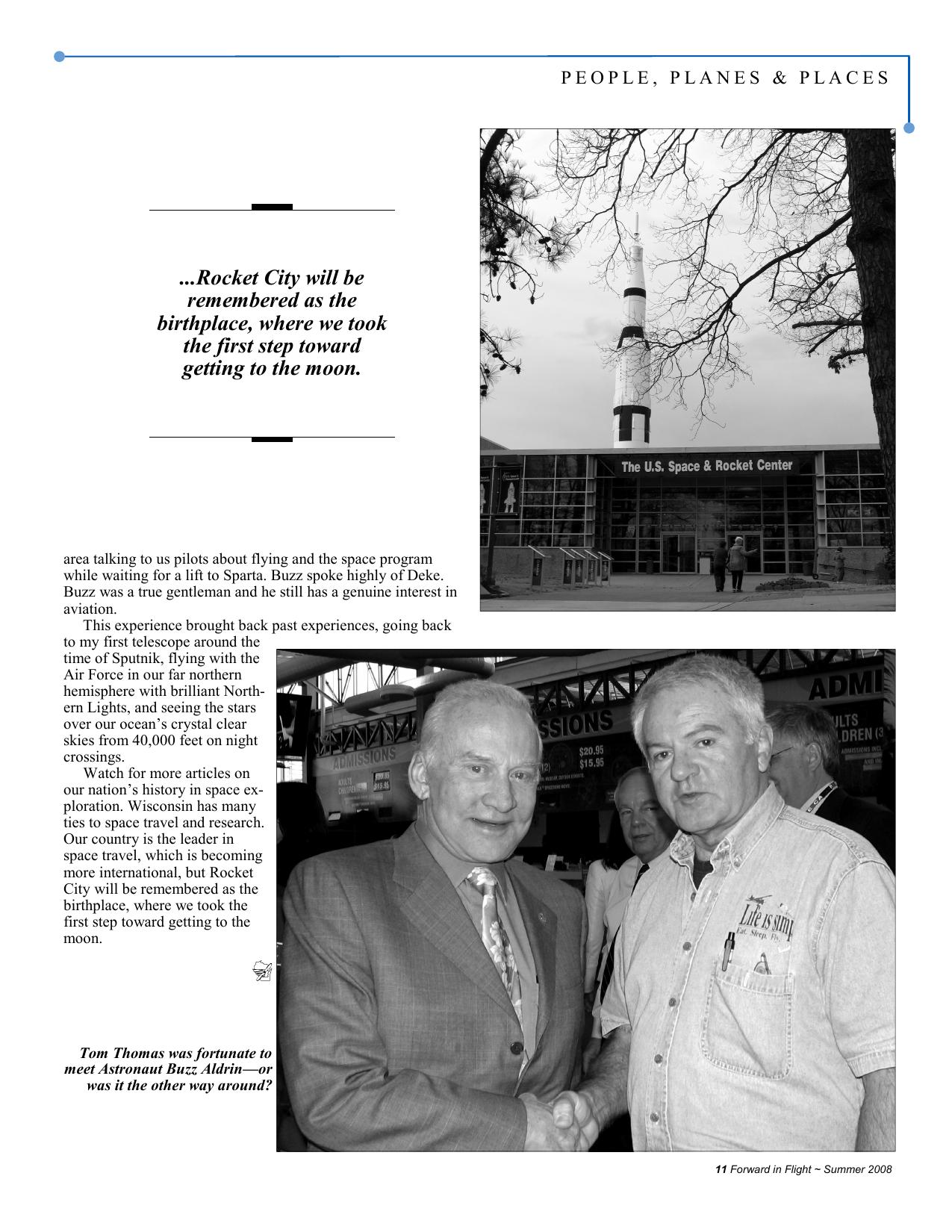
PEOPLE, PLANES & PLACES ...Rocket City will be remembered as the birthplace, where we took the first step toward getting to the moon. area talking to us pilots about flying and the space program while waiting for a lift to Sparta. Buzz spoke highly of Deke. Buzz was a true gentleman and he still has a genuine interest in aviation. This experience brought back past experiences, going back to my first telescope around the time of Sputnik, flying with the Air Force in our far northern hemisphere with brilliant Northern Lights, and seeing the stars over our ocean’s crystal clear skies from 40,000 feet on night crossings. Watch for more articles on our nation’s history in space exploration. Wisconsin has many ties to space travel and research. Our country is the leader in space travel, which is becoming more international, but Rocket City will be remembered as the birthplace, where we took the first step toward getting to the moon. Tom Thomas was fortunate to meet Astronaut Buzz Aldrin—or was it the other way around? 11 Forward in Flight ~ Summer 2008
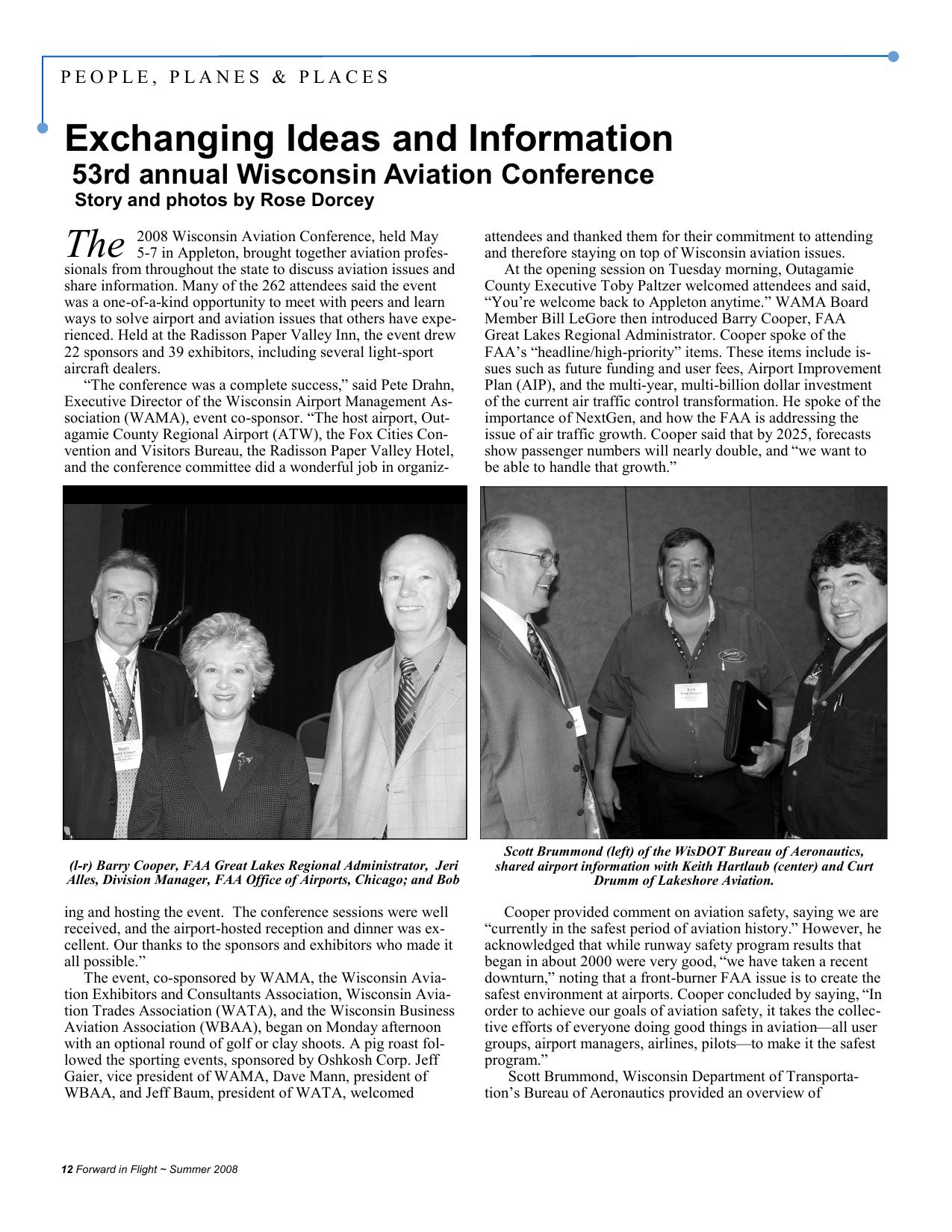
PEOPLE, PLANES & PLACES Exchanging Ideas and Information 53rd annual Wisconsin Aviation Conference Story and photos by Rose Dorcey The 2008 Wisconsin Aviation Conference, held May 5-7 in Appleton, brought together aviation professionals from throughout the state to discuss aviation issues and share information. Many of the 262 attendees said the event was a one-of-a-kind opportunity to meet with peers and learn ways to solve airport and aviation issues that others have experienced. Held at the Radisson Paper Valley Inn, the event drew 22 sponsors and 39 exhibitors, including several light-sport aircraft dealers. “The conference was a complete success,” said Pete Drahn, Executive Director of the Wisconsin Airport Management Association (WAMA), event co-sponsor. “The host airport, Outagamie County Regional Airport (ATW), the Fox Cities Convention and Visitors Bureau, the Radisson Paper Valley Hotel, and the conference committee did a wonderful job in organiz- attendees and thanked them for their commitment to attending and therefore staying on top of Wisconsin aviation issues. At the opening session on Tuesday morning, Outagamie County Executive Toby Paltzer welcomed attendees and said, “You’re welcome back to Appleton anytime.” WAMA Board Member Bill LeGore then introduced Barry Cooper, FAA Great Lakes Regional Administrator. Cooper spoke of the FAA’s “headline/high-priority” items. These items include issues such as future funding and user fees, Airport Improvement Plan (AIP), and the multi-year, multi-billion dollar investment of the current air traffic control transformation. He spoke of the importance of NextGen, and how the FAA is addressing the issue of air traffic growth. Cooper said that by 2025, forecasts show passenger numbers will nearly double, and “we want to be able to handle that growth.” (l-r) Barry Cooper, FAA Great Lakes Regional Administrator, Jeri Alles, Division Manager, FAA Office of Airports, Chicago; and Bob Scott Brummond (left) of the WisDOT Bureau of Aeronautics, shared airport information with Keith Hartlaub (center) and Curt Drumm of Lakeshore Aviation. ing and hosting the event. The conference sessions were well received, and the airport-hosted reception and dinner was excellent. Our thanks to the sponsors and exhibitors who made it all possible.” The event, co-sponsored by WAMA, the Wisconsin Aviation Exhibitors and Consultants Association, Wisconsin Aviation Trades Association (WATA), and the Wisconsin Business Aviation Association (WBAA), began on Monday afternoon with an optional round of golf or clay shoots. A pig roast followed the sporting events, sponsored by Oshkosh Corp. Jeff Gaier, vice president of WAMA, Dave Mann, president of WBAA, and Jeff Baum, president of WATA, welcomed Cooper provided comment on aviation safety, saying we are “currently in the safest period of aviation history.” However, he acknowledged that while runway safety program results that began in about 2000 were very good, “we have taken a recent downturn,” noting that a front-burner FAA issue is to create the safest environment at airports. Cooper concluded by saying, “In order to achieve our goals of aviation safety, it takes the collective efforts of everyone doing good things in aviation—all user groups, airport managers, airlines, pilots—to make it the safest program.” Scott Brummond, Wisconsin Department of Transportation’s Bureau of Aeronautics provided an overview of 12 Forward in Flight ~ Summer 2008
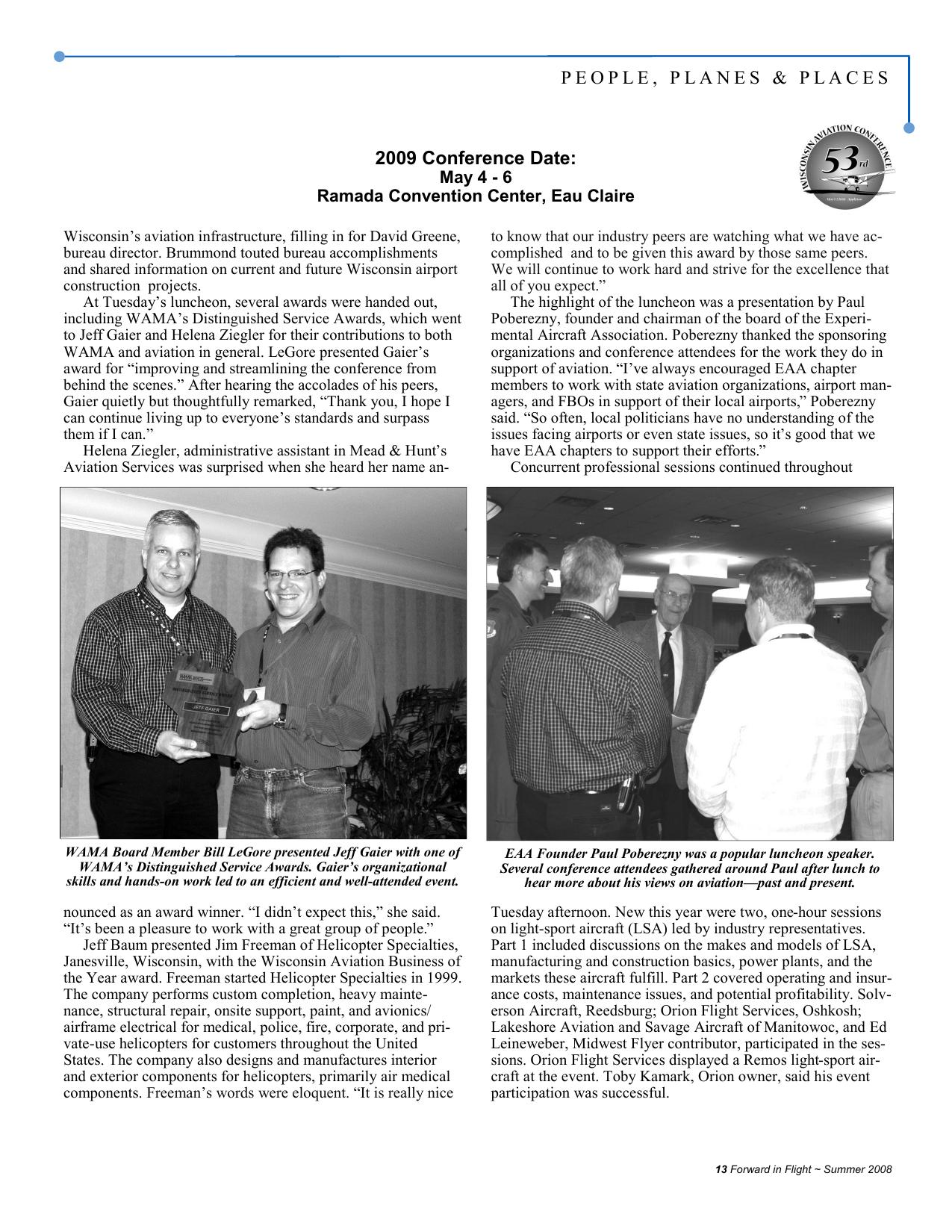
PEOPLE, PLANES & PLACES 2009 Conference Date: May 4 - 6 Ramada Convention Center, Eau Claire Wisconsin’s aviation infrastructure, filling in for David Greene, bureau director. Brummond touted bureau accomplishments and shared information on current and future Wisconsin airport construction projects. At Tuesday’s luncheon, several awards were handed out, including WAMA’s Distinguished Service Awards, which went to Jeff Gaier and Helena Ziegler for their contributions to both WAMA and aviation in general. LeGore presented Gaier’s award for “improving and streamlining the conference from behind the scenes.” After hearing the accolades of his peers, Gaier quietly but thoughtfully remarked, “Thank you, I hope I can continue living up to everyone’s standards and surpass them if I can.” Helena Ziegler, administrative assistant in Mead & Hunt’s Aviation Services was surprised when she heard her name an- to know that our industry peers are watching what we have accomplished and to be given this award by those same peers. We will continue to work hard and strive for the excellence that all of you expect.” The highlight of the luncheon was a presentation by Paul Poberezny, founder and chairman of the board of the Experimental Aircraft Association. Poberezny thanked the sponsoring organizations and conference attendees for the work they do in support of aviation. “I’ve always encouraged EAA chapter members to work with state aviation organizations, airport managers, and FBOs in support of their local airports,” Poberezny said. “So often, local politicians have no understanding of the issues facing airports or even state issues, so it’s good that we have EAA chapters to support their efforts.” Concurrent professional sessions continued throughout WAMA Board Member Bill LeGore presented Jeff Gaier with one of WAMA’s Distinguished Service Awards. Gaier’s organizational skills and hands-on work led to an efficient and well-attended event. EAA Founder Paul Poberezny was a popular luncheon speaker. Several conference attendees gathered around Paul after lunch to hear more about his views on aviation—past and present. nounced as an award winner. “I didn’t expect this,” she said. “It’s been a pleasure to work with a great group of people.” Jeff Baum presented Jim Freeman of Helicopter Specialties, Janesville, Wisconsin, with the Wisconsin Aviation Business of the Year award. Freeman started Helicopter Specialties in 1999. The company performs custom completion, heavy maintenance, structural repair, onsite support, paint, and avionics/ airframe electrical for medical, police, fire, corporate, and private-use helicopters for customers throughout the United States. The company also designs and manufactures interior and exterior components for helicopters, primarily air medical components. Freeman’s words were eloquent. “It is really nice Tuesday afternoon. New this year were two, one-hour sessions on light-sport aircraft (LSA) led by industry representatives. Part 1 included discussions on the makes and models of LSA, manufacturing and construction basics, power plants, and the markets these aircraft fulfill. Part 2 covered operating and insurance costs, maintenance issues, and potential profitability. Solverson Aircraft, Reedsburg; Orion Flight Services, Oshkosh; Lakeshore Aviation and Savage Aircraft of Manitowoc, and Ed Leineweber, Midwest Flyer contributor, participated in the sessions. Orion Flight Services displayed a Remos light-sport aircraft at the event. Toby Kamark, Orion owner, said his event participation was successful. 13 Forward in Flight ~ Summer 2008
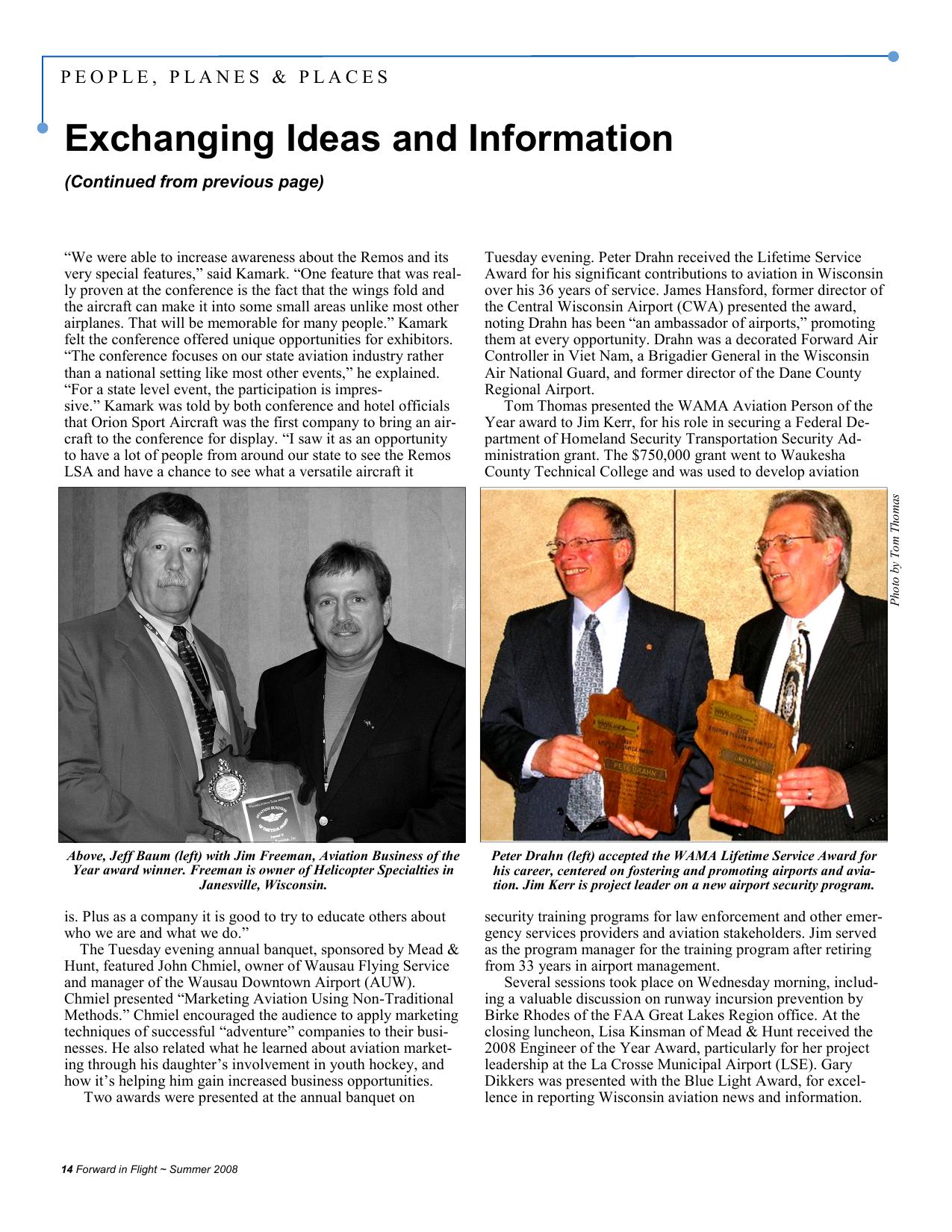
PEOPLE, PLANES & PLACES Exchanging Ideas and Information (Continued from previous page) Tuesday evening. Peter Drahn received the Lifetime Service Award for his significant contributions to aviation in Wisconsin over his 36 years of service. James Hansford, former director of the Central Wisconsin Airport (CWA) presented the award, noting Drahn has been “an ambassador of airports,” promoting them at every opportunity. Drahn was a decorated Forward Air Controller in Viet Nam, a Brigadier General in the Wisconsin Air National Guard, and former director of the Dane County Regional Airport. Tom Thomas presented the WAMA Aviation Person of the Year award to Jim Kerr, for his role in securing a Federal Department of Homeland Security Transportation Security Administration grant. The $750,000 grant went to Waukesha County Technical College and was used to develop aviation Above, Jeff Baum (left) with Jim Freeman, Aviation Business of the Year award winner. Freeman is owner of Helicopter Specialties in Janesville, Wisconsin. Peter Drahn (left) accepted the WAMA Lifetime Service Award for his career, centered on fostering and promoting airports and aviation. Jim Kerr is project leader on a new airport security program. is. Plus as a company it is good to try to educate others about who we are and what we do.” The Tuesday evening annual banquet, sponsored by Mead & Hunt, featured John Chmiel, owner of Wausau Flying Service and manager of the Wausau Downtown Airport (AUW). Chmiel presented “Marketing Aviation Using Non-Traditional Methods.” Chmiel encouraged the audience to apply marketing techniques of successful “adventure” companies to their businesses. He also related what he learned about aviation marketing through his daughter’s involvement in youth hockey, and how it’s helping him gain increased business opportunities. Two awards were presented at the annual banquet on security training programs for law enforcement and other emergency services providers and aviation stakeholders. Jim served as the program manager for the training program after retiring from 33 years in airport management. Several sessions took place on Wednesday morning, including a valuable discussion on runway incursion prevention by Birke Rhodes of the FAA Great Lakes Region office. At the closing luncheon, Lisa Kinsman of Mead & Hunt received the 2008 Engineer of the Year Award, particularly for her project leadership at the La Crosse Municipal Airport (LSE). Gary Dikkers was presented with the Blue Light Award, for excellence in reporting Wisconsin aviation news and information. Photo by Tom Thomas “We were able to increase awareness about the Remos and its very special features,” said Kamark. “One feature that was really proven at the conference is the fact that the wings fold and the aircraft can make it into some small areas unlike most other airplanes. That will be memorable for many people.” Kamark felt the conference offered unique opportunities for exhibitors. “The conference focuses on our state aviation industry rather than a national setting like most other events,” he explained. “For a state level event, the participation is impressive.” Kamark was told by both conference and hotel officials that Orion Sport Aircraft was the first company to bring an aircraft to the conference for display. “I saw it as an opportunity to have a lot of people from around our state to see the Remos LSA and have a chance to see what a versatile aircraft it 14 Forward in Flight ~ Summer 2008
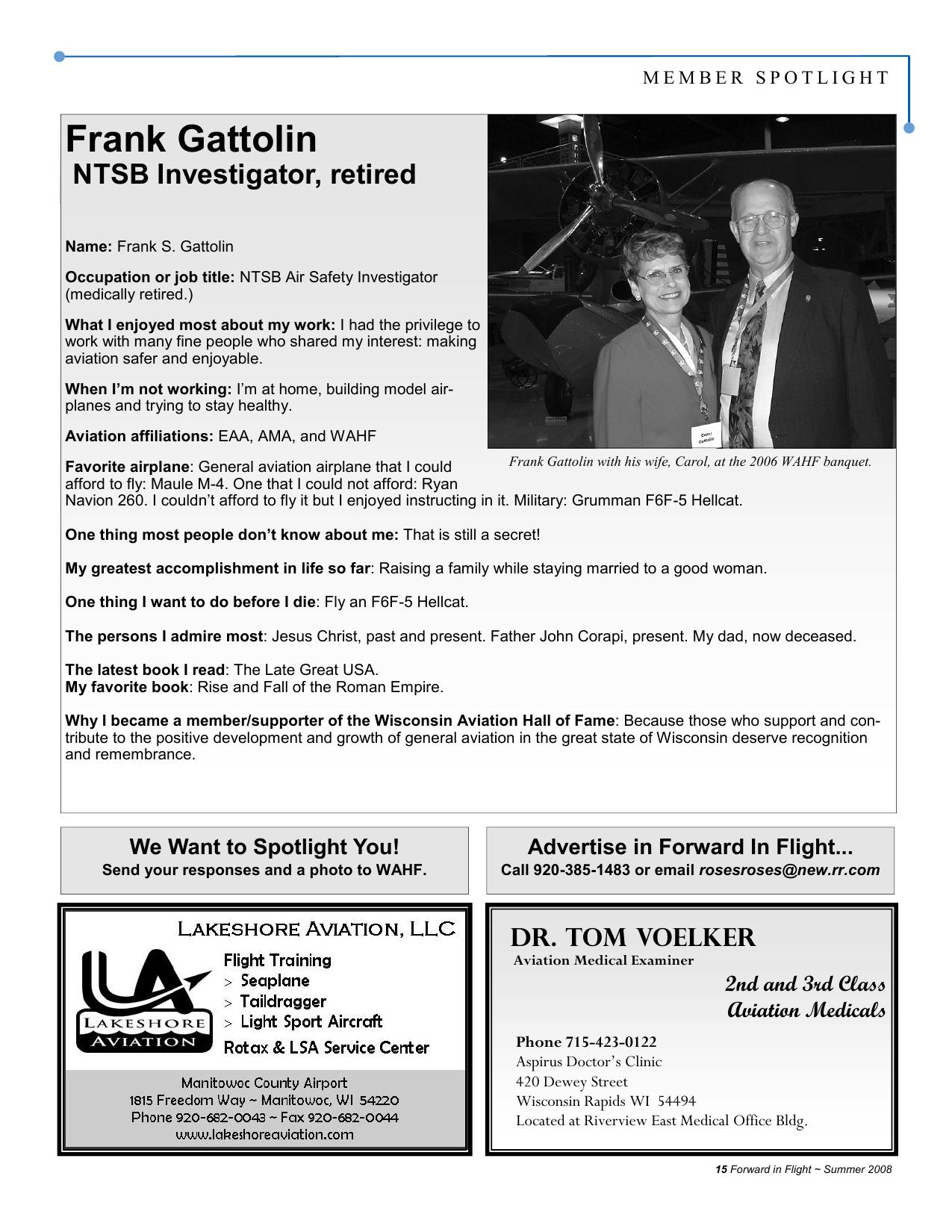
MEMBER SPOTLIGHT Frank Gattolin NTSB Investigator, retired Name: Frank S. Gattolin Occupation or job title: NTSB Air Safety Investigator (medically retired.) What I enjoyed most about my work: I had the privilege to work with many fine people who shared my interest: making aviation safer and enjoyable. When I’m not working: I’m at home, building model airplanes and trying to stay healthy. Aviation affiliations: EAA, AMA, and WAHF Frank Gattolin with his wife, Carol, at the 2006 WAHF banquet. Favorite airplane: General aviation airplane that I could afford to fly: Maule M-4. One that I could not afford: Ryan Navion 260. I couldn’t afford to fly it but I enjoyed instructing in it. Military: Grumman F6F-5 Hellcat. One thing most people don’t know about me: That is still a secret! My greatest accomplishment in life so far: Raising a family while staying married to a good woman. One thing I want to do before I die: Fly an F6F-5 Hellcat. The persons I admire most: Jesus Christ, past and present. Father John Corapi, present. My dad, now deceased. The latest book I read: The Late Great USA. My favorite book: Rise and Fall of the Roman Empire. Why I became a member/supporter of the Wisconsin Aviation Hall of Fame: Because those who support and contribute to the positive development and growth of general aviation in the great state of Wisconsin deserve recognition and remembrance. We Want to Spotlight You! Advertise in Forward In Flight... Send your responses and a photo to WAHF. Call 920-385-1483 or email rosesroses@new.rr.com DR. TOM VOELKER Aviation Medical Examiner 2nd and 3rd Class Aviation Medicals Phone 715-423-0122 Aspirus Doctor’s Clinic 420 Dewey Street Wisconsin Rapids WI 54494 Located at Riverview East Medical Office Bldg. 15 Forward in Flight ~ Summer 2008
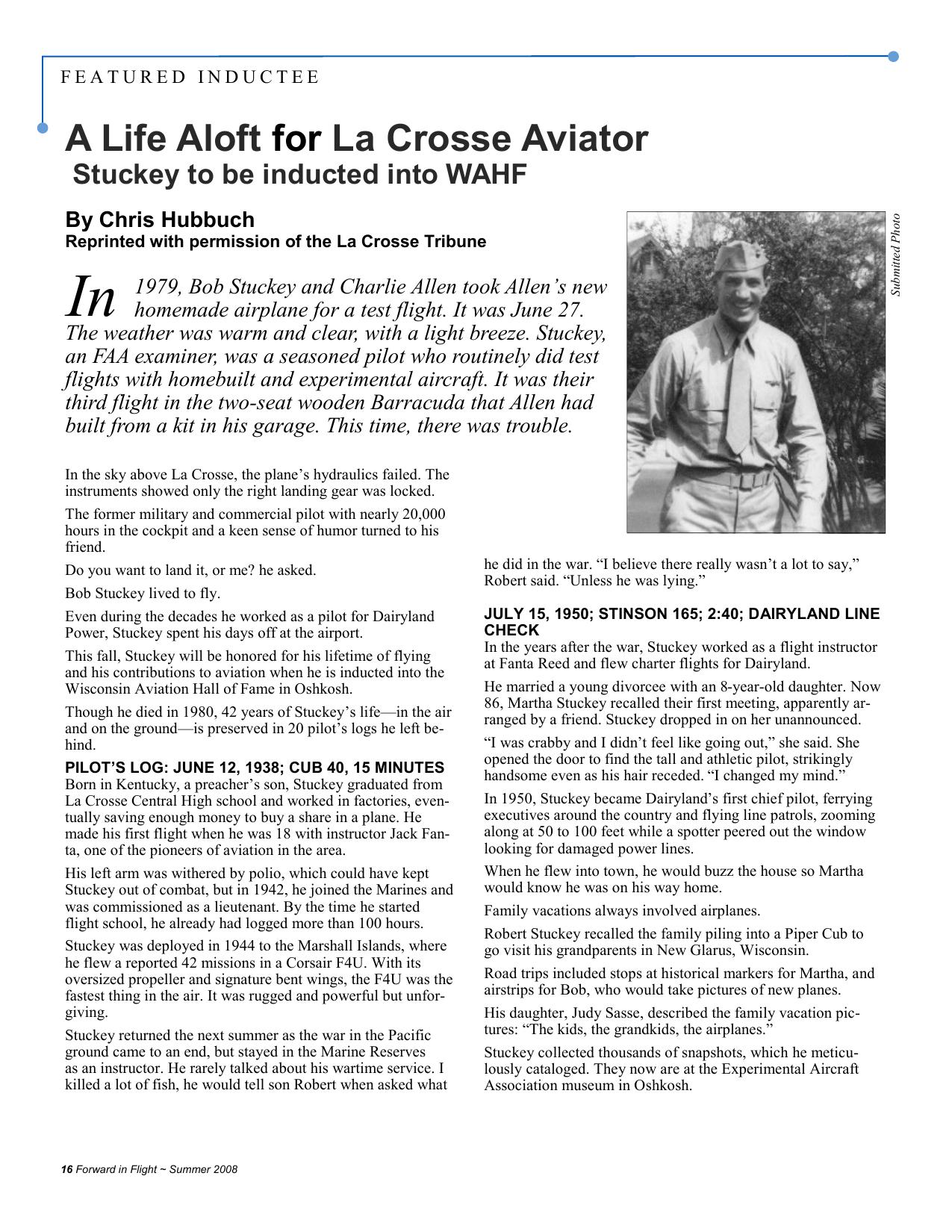
FEATURED INDUCTEE A Life Aloft for La Crosse Aviator By Chris Hubbuch Reprinted with permission of the La Crosse Tribune In 1979, Bob Stuckey and Charlie Allen took Allen’s new homemade airplane for a test flight. It was June 27. The weather was warm and clear, with a light breeze. Stuckey, an FAA examiner, was a seasoned pilot who routinely did test flights with homebuilt and experimental aircraft. It was their third flight in the two-seat wooden Barracuda that Allen had built from a kit in his garage. This time, there was trouble. In the sky above La Crosse, the plane’s hydraulics failed. The instruments showed only the right landing gear was locked. The former military and commercial pilot with nearly 20,000 hours in the cockpit and a keen sense of humor turned to his friend. Do you want to land it, or me? he asked. Bob Stuckey lived to fly. Even during the decades he worked as a pilot for Dairyland Power, Stuckey spent his days off at the airport. This fall, Stuckey will be honored for his lifetime of flying and his contributions to aviation when he is inducted into the Wisconsin Aviation Hall of Fame in Oshkosh. Though he died in 1980, 42 years of Stuckey’s life—in the air and on the ground—is preserved in 20 pilot’s logs he left behind. PILOT’S LOG: JUNE 12, 1938; CUB 40, 15 MINUTES Born in Kentucky, a preacher’s son, Stuckey graduated from La Crosse Central High school and worked in factories, eventually saving enough money to buy a share in a plane. He made his first flight when he was 18 with instructor Jack Fanta, one of the pioneers of aviation in the area. His left arm was withered by polio, which could have kept Stuckey out of combat, but in 1942, he joined the Marines and was commissioned as a lieutenant. By the time he started flight school, he already had logged more than 100 hours. Stuckey was deployed in 1944 to the Marshall Islands, where he flew a reported 42 missions in a Corsair F4U. With its oversized propeller and signature bent wings, the F4U was the fastest thing in the air. It was rugged and powerful but unforgiving. Stuckey returned the next summer as the war in the Pacific ground came to an end, but stayed in the Marine Reserves as an instructor. He rarely talked about his wartime service. I killed a lot of fish, he would tell son Robert when asked what 16 Forward in Flight ~ Summer 2008 he did in the war. “I believe there really wasn’t a lot to say,” Robert said. “Unless he was lying.” JULY 15, 1950; STINSON 165; 2:40; DAIRYLAND LINE CHECK In the years after the war, Stuckey worked as a flight instructor at Fanta Reed and flew charter flights for Dairyland. He married a young divorcee with an 8-year-old daughter. Now 86, Martha Stuckey recalled their first meeting, apparently arranged by a friend. Stuckey dropped in on her unannounced. “I was crabby and I didn’t feel like going out,” she said. She opened the door to find the tall and athletic pilot, strikingly handsome even as his hair receded. “I changed my mind.” In 1950, Stuckey became Dairyland’s first chief pilot, ferrying executives around the country and flying line patrols, zooming along at 50 to 100 feet while a spotter peered out the window looking for damaged power lines. When he flew into town, he would buzz the house so Martha would know he was on his way home. Family vacations always involved airplanes. Robert Stuckey recalled the family piling into a Piper Cub to go visit his grandparents in New Glarus, Wisconsin. Road trips included stops at historical markers for Martha, and airstrips for Bob, who would take pictures of new planes. His daughter, Judy Sasse, described the family vacation pictures: “The kids, the grandkids, the airplanes.” Stuckey collected thousands of snapshots, which he meticulously cataloged. They now are at the Experimental Aircraft Association museum in Oshkosh. Submitted Photo Stuckey to be inducted into WAHF
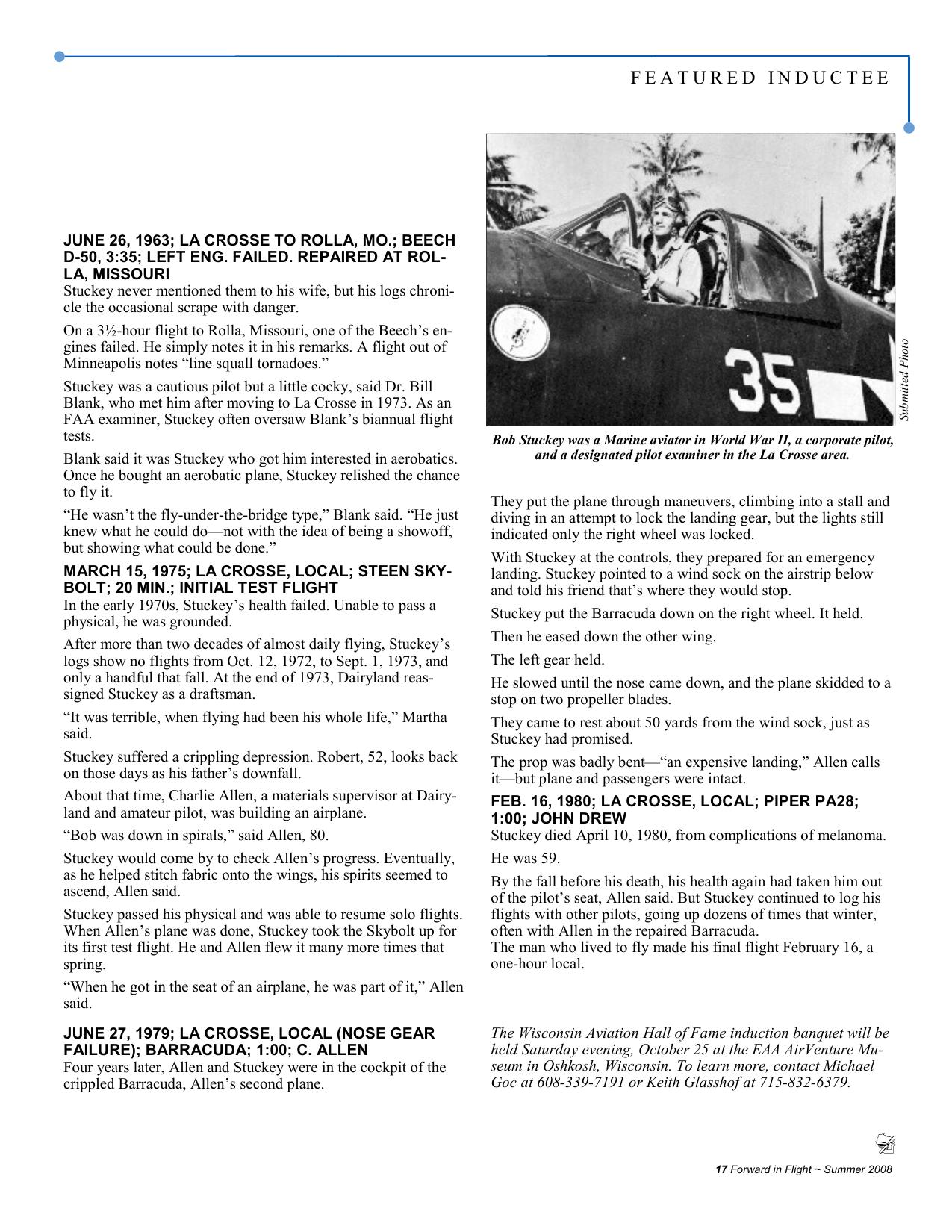
JUNE 26, 1963; LA CROSSE TO ROLLA, MO.; BEECH D-50, 3:35; LEFT ENG. FAILED. REPAIRED AT ROLLA, MISSOURI Stuckey never mentioned them to his wife, but his logs chronicle the occasional scrape with danger. On a 3½-hour flight to Rolla, Missouri, one of the Beech’s engines failed. He simply notes it in his remarks. A flight out of Minneapolis notes “line squall tornadoes.” Stuckey was a cautious pilot but a little cocky, said Dr. Bill Blank, who met him after moving to La Crosse in 1973. As an FAA examiner, Stuckey often oversaw Blank’s biannual flight tests. Blank said it was Stuckey who got him interested in aerobatics. Once he bought an aerobatic plane, Stuckey relished the chance to fly it. “He wasn’t the fly-under-the-bridge type,” Blank said. “He just knew what he could do—not with the idea of being a showoff, but showing what could be done.” MARCH 15, 1975; LA CROSSE, LOCAL; STEEN SKYBOLT; 20 MIN.; INITIAL TEST FLIGHT In the early 1970s, Stuckey’s health failed. Unable to pass a physical, he was grounded. After more than two decades of almost daily flying, Stuckey’s logs show no flights from Oct. 12, 1972, to Sept. 1, 1973, and only a handful that fall. At the end of 1973, Dairyland reassigned Stuckey as a draftsman. “It was terrible, when flying had been his whole life,” Martha said. Stuckey suffered a crippling depression. Robert, 52, looks back on those days as his father’s downfall. About that time, Charlie Allen, a materials supervisor at Dairyland and amateur pilot, was building an airplane. “Bob was down in spirals,” said Allen, 80. Stuckey would come by to check Allen’s progress. Eventually, as he helped stitch fabric onto the wings, his spirits seemed to ascend, Allen said. Stuckey passed his physical and was able to resume solo flights. When Allen’s plane was done, Stuckey took the Skybolt up for its first test flight. He and Allen flew it many more times that spring. “When he got in the seat of an airplane, he was part of it,” Allen said. JUNE 27, 1979; LA CROSSE, LOCAL (NOSE GEAR FAILURE); BARRACUDA; 1:00; C. ALLEN Four years later, Allen and Stuckey were in the cockpit of the crippled Barracuda, Allen’s second plane. Submitted Photo FEATURED INDUCTEE Bob Stuckey was a Marine aviator in World War II, a corporate pilot, and a designated pilot examiner in the La Crosse area. They put the plane through maneuvers, climbing into a stall and diving in an attempt to lock the landing gear, but the lights still indicated only the right wheel was locked. With Stuckey at the controls, they prepared for an emergency landing. Stuckey pointed to a wind sock on the airstrip below and told his friend that’s where they would stop. Stuckey put the Barracuda down on the right wheel. It held. Then he eased down the other wing. The left gear held. He slowed until the nose came down, and the plane skidded to a stop on two propeller blades. They came to rest about 50 yards from the wind sock, just as Stuckey had promised. The prop was badly bent—“an expensive landing,” Allen calls it—but plane and passengers were intact. FEB. 16, 1980; LA CROSSE, LOCAL; PIPER PA28; 1:00; JOHN DREW Stuckey died April 10, 1980, from complications of melanoma. He was 59. By the fall before his death, his health again had taken him out of the pilot’s seat, Allen said. But Stuckey continued to log his flights with other pilots, going up dozens of times that winter, often with Allen in the repaired Barracuda. The man who lived to fly made his final flight February 16, a one-hour local. The Wisconsin Aviation Hall of Fame induction banquet will be held Saturday evening, October 25 at the EAA AirVenture Museum in Oshkosh, Wisconsin. To learn more, contact Michael Goc at 608-339-7191 or Keith Glasshof at 715-832-6379. 17 Forward in Flight ~ Summer 2008
FEATURED INDUCTEE Boy General from Milwaukee General Hoyt S. Vandenberg By Gary Dikkers The United States Air Force Academy at Colorado Springs has two dormitories for the 4,000 cadets training there to become officers. Both dorms are named for Wisconsin Aviation Hall of Fame inductees: General Hoyt S. Vandenberg of Milwaukee, and Captain Lance Sijan from Milwaukee’s Bay View neighborhood. In what is perhaps an extreme quirk of fate, a third major building on the Academy campus—the cadet dining hall—is also named for a Milwaukee native and WAHF inductee: General Billy Mitchell. General Hoyt Sanford Vandenberg was born in Milwaukee in 1899, the son of a well-to-do family. At the age of seven, the family moved to Lowell, Massachusetts, where they lived much of the year, while spending winters in Florida. As he grew up, the young Vandenberg constantly switched schools between Massachusetts and Florida, hurting his academic record, although not enough to prevent him from receiving an appointment to the U.S. Military Academy at West Point, New York. At West Point, Vandenberg stood out as an athlete, but did poorly in the classroom, graduating near the bottom of his class in 1923. Upon graduation, the Army offered him a choice of becoming an infantry officer, or a pilot in the Air Service. Second Lieutenant Vandenberg jumped at the chance to go to pilot training. After completing pilot training at Kelly Field near San Antonio, he spent the next 10 years as an instructor pilot and fighter pilot, finally becoming the commander of the Sixth Pursuit Squadron at Wheeler Field in Hawaii where he gained the reputation as the squadron’s best aerial gunner—what today we would call the “Top Gun.” In 1927, with the cooperation of the Air Corps, Vandenberg stood in as the stunt double for Hollywood movie star Richard Arlen during the flying scenes of the classic Hollywood movie Wings, which told the story of two WWI pilots seeking the heart of the same woman. Wings went on to win the first ever Academy Award for Best Picture, and many film experts still consider its flying scenes to be some of the best ever filmed— even after 80 years. Through the 1930s, Vandenberg served in a number of staff positions where he proved to be an outstanding planner, staff 18 Forward in Flight ~ Summer 2008 officer, and leader. After Pearl Harbor, the War Department sent Vandenberg to the European Theater. His first assignment in Europe was as Chief of Staff of the Northwest Africa Strategic Air Forces during the North African Campaign in 1943. While in that staff position, he continued to fly combat missions over Tunisia, Italy, Sardinia, Sicily, and Pantelleria. He was awarded the Silver Star, Legion of Merit, and Distinguished Flying Cross. General Eisenhower grounded both Vandenberg and General “Tooey” Spaatz because he couldn’t afford to lose their knowledge and planning ability if they were shot down and killed or captured. After going to Moscow in 1943 to negotiate basing rights in the Soviet Union for US bombers on twoway shuttle missions across Germany, Vandenberg became the primary air planner for the 1944 invasion of France. After the D-Day invasion, Vandenberg took command of the Ninth Air Force where he led and directed 180,000 airmen and 4,000 airplanes in what was the largest air command in history. Vandenberg’s Ninth Air Force supported Generals Bradley, Patton, and Hodges as they drove across France into Germany. Ninth Air Force aircrews played major roles in the Operation Cobra breakout at St Lo, France, and in forcing back the Germans when the weather finally broke during the Battle of the Bulge. General George S. Patton later remarked that his Third Army’s drive across France from Cherbourg to the border with Germany in 1944 would have been impossible without the air support Vandenberg’s Ninth Air Force provided to cover the Third Army’s flanks and to blow holes in German defenses as the Third Army approached. World War II ended and Vandenberg had made his mark as one of the senior Army and Air Force generals responsible for
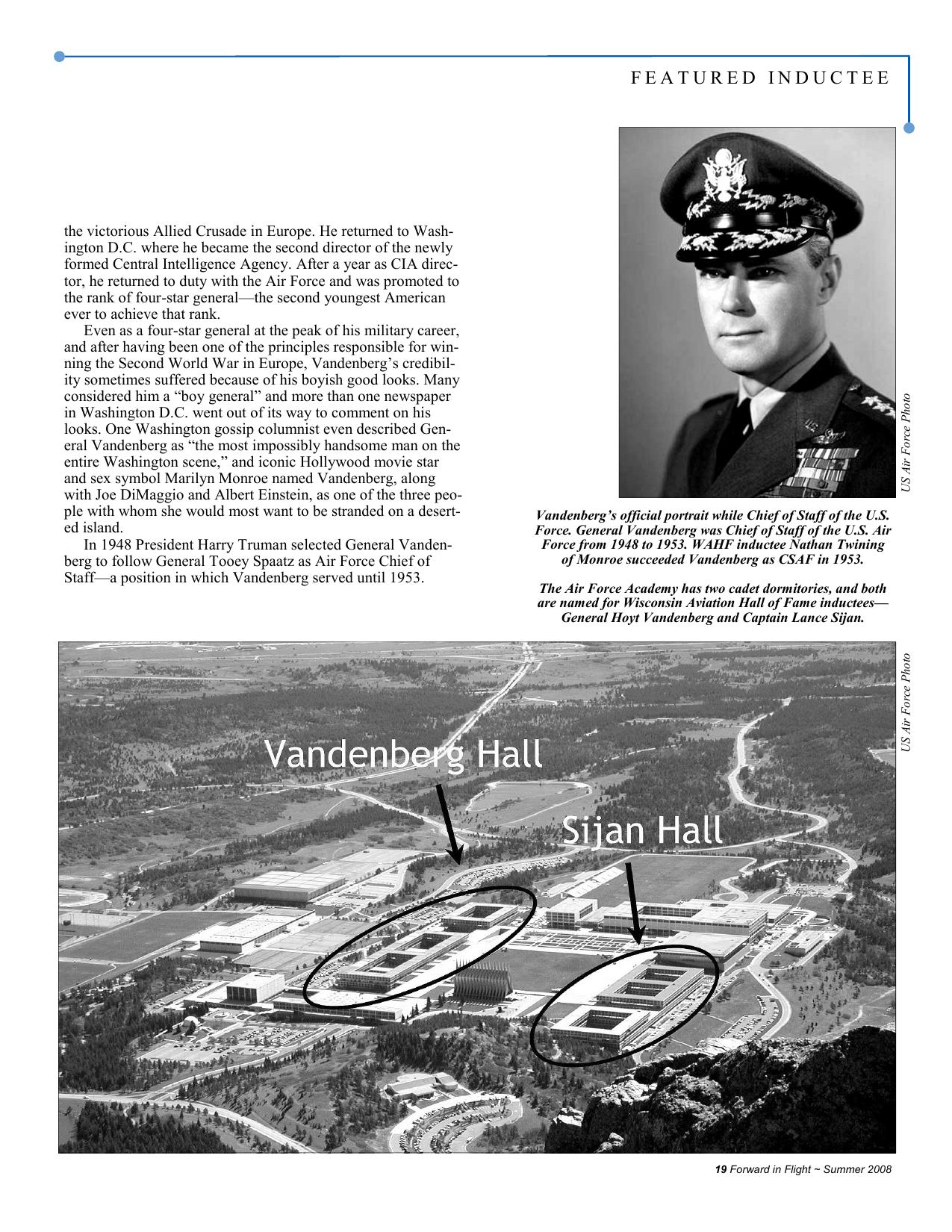
Vandenberg’s official portrait while Chief of Staff of the U.S. Force. General Vandenberg was Chief of Staff of the U.S. Air Force from 1948 to 1953. WAHF inductee Nathan Twining of Monroe succeeded Vandenberg as CSAF in 1953. The Air Force Academy has two cadet dormitories, and both are named for Wisconsin Aviation Hall of Fame inductees— General Hoyt Vandenberg and Captain Lance Sijan. US Air Force Photo the victorious Allied Crusade in Europe. He returned to Washington D.C. where he became the second director of the newly formed Central Intelligence Agency. After a year as CIA director, he returned to duty with the Air Force and was promoted to the rank of four-star general—the second youngest American ever to achieve that rank. Even as a four-star general at the peak of his military career, and after having been one of the principles responsible for winning the Second World War in Europe, Vandenberg’s credibility sometimes suffered because of his boyish good looks. Many considered him a “boy general” and more than one newspaper in Washington D.C. went out of its way to comment on his looks. One Washington gossip columnist even described General Vandenberg as “the most impossibly handsome man on the entire Washington scene,” and iconic Hollywood movie star and sex symbol Marilyn Monroe named Vandenberg, along with Joe DiMaggio and Albert Einstein, as one of the three people with whom she would most want to be stranded on a deserted island. In 1948 President Harry Truman selected General Vandenberg to follow General Tooey Spaatz as Air Force Chief of Staff—a position in which Vandenberg served until 1953. US Air Force Photo FEATURED INDUCTEE 19 Forward in Flight ~ Summer 2008
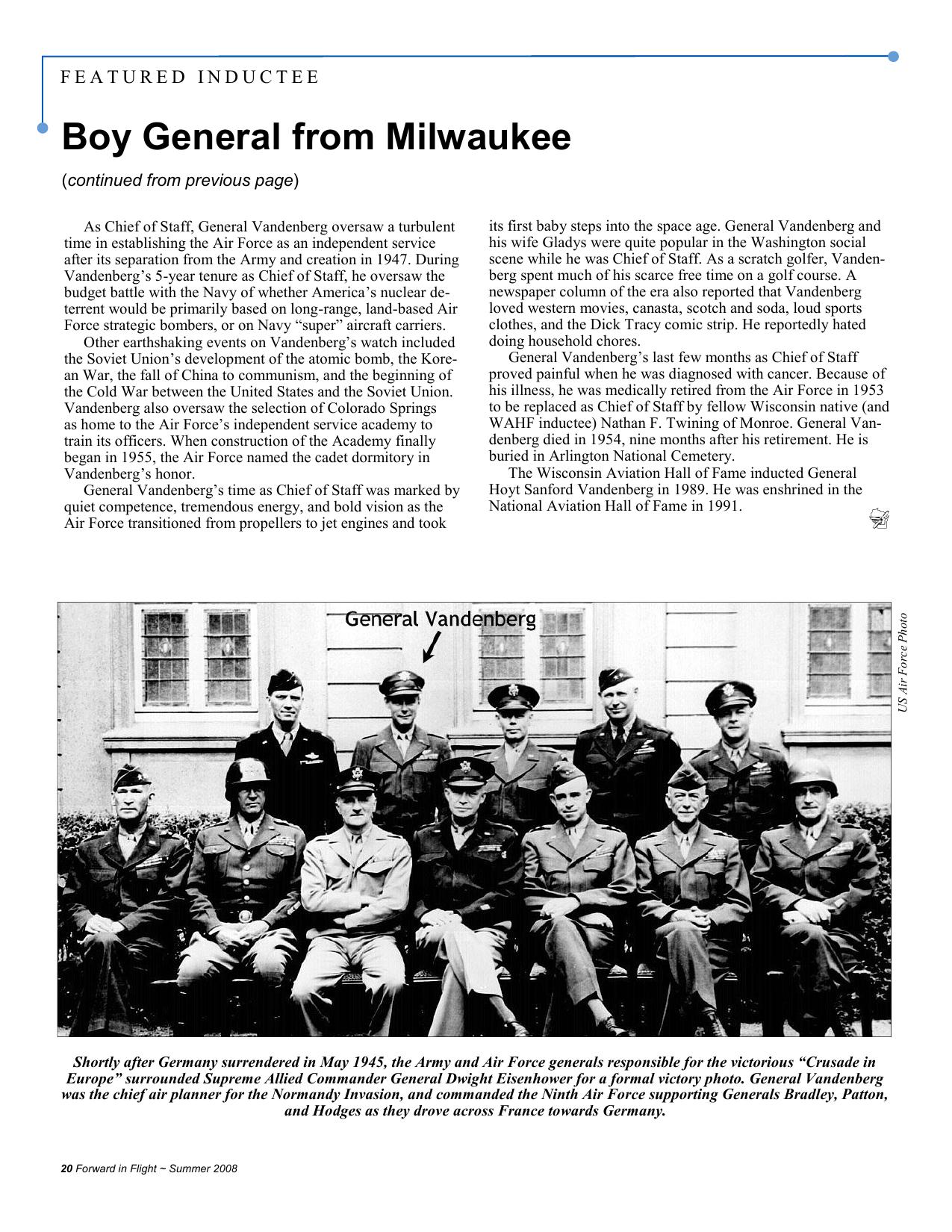
FEATURED INDUCTEE Boy General from Milwaukee (continued from previous page) its first baby steps into the space age. General Vandenberg and his wife Gladys were quite popular in the Washington social scene while he was Chief of Staff. As a scratch golfer, Vandenberg spent much of his scarce free time on a golf course. A newspaper column of the era also reported that Vandenberg loved western movies, canasta, scotch and soda, loud sports clothes, and the Dick Tracy comic strip. He reportedly hated doing household chores. General Vandenberg’s last few months as Chief of Staff proved painful when he was diagnosed with cancer. Because of his illness, he was medically retired from the Air Force in 1953 to be replaced as Chief of Staff by fellow Wisconsin native (and WAHF inductee) Nathan F. Twining of Monroe. General Vandenberg died in 1954, nine months after his retirement. He is buried in Arlington National Cemetery. The Wisconsin Aviation Hall of Fame inducted General Hoyt Sanford Vandenberg in 1989. He was enshrined in the National Aviation Hall of Fame in 1991. US Air Force Photo As Chief of Staff, General Vandenberg oversaw a turbulent time in establishing the Air Force as an independent service after its separation from the Army and creation in 1947. During Vandenberg’s 5-year tenure as Chief of Staff, he oversaw the budget battle with the Navy of whether America’s nuclear deterrent would be primarily based on long-range, land-based Air Force strategic bombers, or on Navy “super” aircraft carriers. Other earthshaking events on Vandenberg’s watch included the Soviet Union’s development of the atomic bomb, the Korean War, the fall of China to communism, and the beginning of the Cold War between the United States and the Soviet Union. Vandenberg also oversaw the selection of Colorado Springs as home to the Air Force’s independent service academy to train its officers. When construction of the Academy finally began in 1955, the Air Force named the cadet dormitory in Vandenberg’s honor. General Vandenberg’s time as Chief of Staff was marked by quiet competence, tremendous energy, and bold vision as the Air Force transitioned from propellers to jet engines and took Shortly after Germany surrendered in May 1945, the Army and Air Force generals responsible for the victorious “Crusade in Europe” surrounded Supreme Allied Commander General Dwight Eisenhower for a formal victory photo. General Vandenberg was the chief air planner for the Normandy Invasion, and commanded the Ninth Air Force supporting Generals Bradley, Patton, and Hodges as they drove across France towards Germany. 20 Forward in Flight ~ Summer 2008
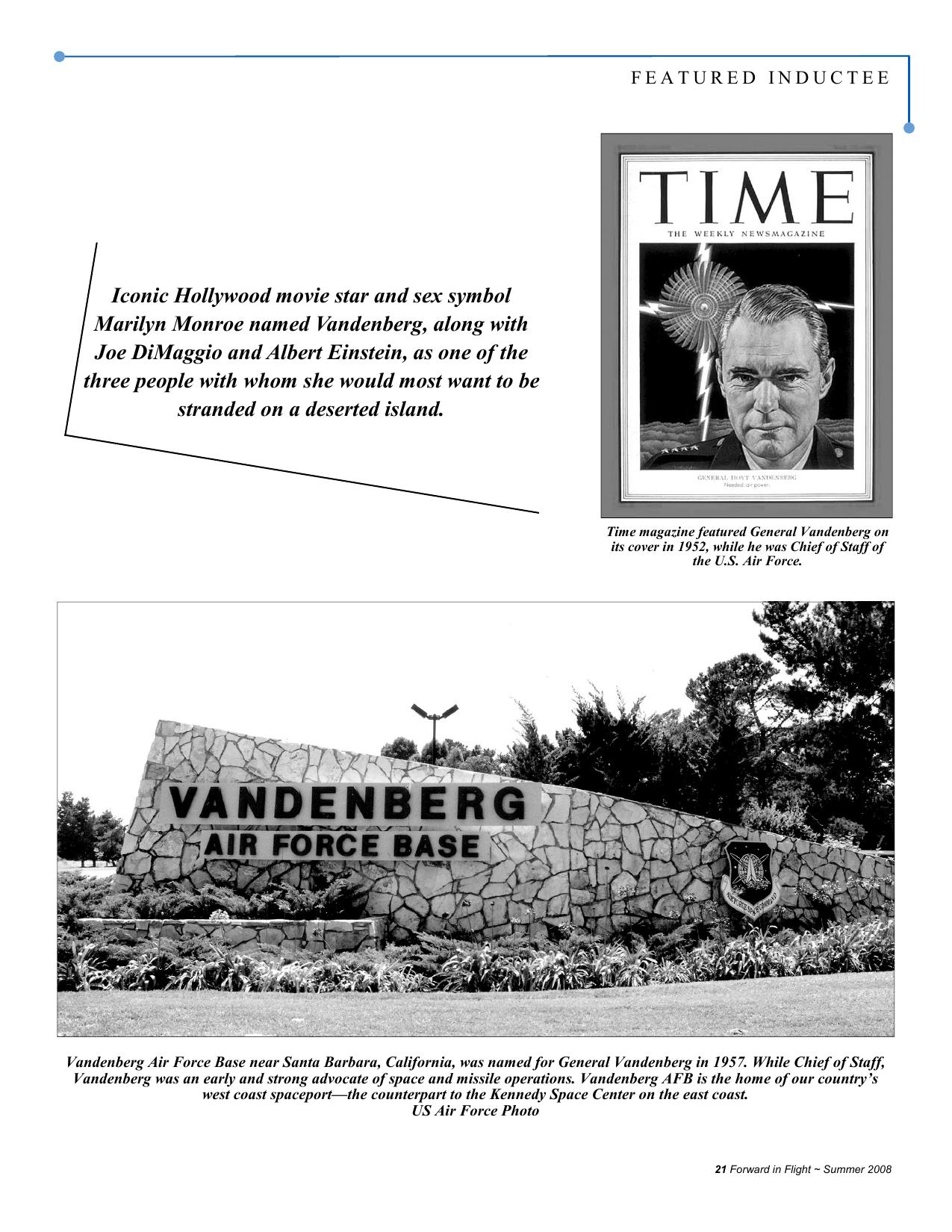
FEATURED INDUCTEE Iconic Hollywood movie star and sex symbol Marilyn Monroe named Vandenberg, along with Joe DiMaggio and Albert Einstein, as one of the three people with whom she would most want to be stranded on a deserted island. Time magazine featured General Vandenberg on its cover in 1952, while he was Chief of Staff of the U.S. Air Force. Vandenberg Air Force Base near Santa Barbara, California, was named for General Vandenberg in 1957. While Chief of Staff, Vandenberg was an early and strong advocate of space and missile operations. Vandenberg AFB is the home of our country’s west coast spaceport—the counterpart to the Kennedy Space Center on the east coast. US Air Force Photo 21 Forward in Flight ~ Summer 2008
FEATURED INDUCTEE Robert J. “Bob” Jones Patriot and American hero By Duane Esse Like many early aviators, Robert J. “Bob” Jones saw Charles Lindbergh fly overhead and at age eight, he knew he wanted to be a pilot. The Jones family was living on a small farm near Caledonia, Wisconsin, when Lindbergh, flying the Chicago to Minneapolis route, flew over their farm. Later, the Jones family moved to Ashland, Wisconsin, in 1930. 32,000 professional fighting men assembled in the Philippines There wasn’t much flying activity in the area, but on occasion in late November 1941. Some new equipment arrived, including Bob would see a barnstorming pilot. Following high school M3 tanks and new rifles, although some soldiers continued to graduation in 1936, he and his girlfriend took a ride in a Ford use antiquated World War I rifles. Tri-Motor, which reinforced Bob’s interest in flying. The United States was well aware of the Japanese buildup Bob enrolled in the UW-Madison, and sought jobs whenever of forces in the South Pacific. After the Japanese attack on Pearl he could to allow him to stay in school. He worked as a farm Harbor commanders in the Philippines wanted permission to hand, milkman, a seaman on a seagoing tug (SS Butterfield), attack the Japanese in Formosa. General Douglas MacArthur and as a lumberjack. By 1940, Bob became eligible for cadet wouldn’t allow it. Many have questioned MacArthur’s reluctraining and enlisted in the U.S. Army Air Corps. He was sent tance to attack. (Author/historian William Manchester, in his to the Spartan School of Aeronautics in Tulsa, Oklahoma, book American Caesar, writes that MacArthur was not the first where he flew the Stearman PT-13, PT-17, and PT-18 aircraft. commanding officer to freeze up at the decisive moment.) The Bob received further training at Randolph Japanese struck Clark Field, Philippines, while and Kelly Field in Texas. He flew BT-14, BCthe U.S. fleet remained on the ground. Some 1, AT-6, and received his wings March 14, bomb fragments from the attack struck Bob 1941. He was commissioned a 2nd Lieutenant. Upon graduation he was and he earned the Purple Heart. Upon graduation he was told he would be a Almost half of the aircraft were destroyed told he would be a flight flight instructor due to a shortage of instrucor damaged. were taking three or instructor due to a shortage four damagedMechanics tors. Bob didn’t like that idea, so he volunaircraft and building one good of instructors. Bob didn’t one. Bob and other pilots began flying misteered for overseas duty. He was sent to the like that idea, so he Philippines. sions around the Bataan Peninsula, the island The route to the Philippines was from New volunteered for overseas of Corregidor, and the northern part of the York through the Panama Canal to San Franisland of Manila in the B-10. Bob flew six duty. He was sent to the cisco, and on to Hawaii, Guam, and then the combat/recon missions. The situation deterioPhilippines. Philippines. They arrived May 8, 1941. Bob rated until the pilots received orders to no wanted to be a fighter or “pursuit” pilot, but longer initiate dogfights and only use aircraft was told he was too tall and would have to be a for defense purposes. bomber pilot. He eventually checked out in the Martin B-10 Supplies were limited, including guns, medicine, ammunibomber, which was antiquated at the time. tion, and food. General MacArthur ordered rations cut in half. The air presence in the Philippines consisted of only a small Fighting men accustomed to nearly 4,000 calories a day would collection of the aging B-10 bombers and P-26 fighters, airhave to get by on less than 2,000. Rations were continually cut craft long since rendered obsolete and dumped in the Philipuntil the men received two meals a day, consisting of rice, a pines because no one else wanted them. However, when the slice of bread, and a small piece of fish. Calvary horses and 48 20th and 17th Squadrons arrived, 57 P-35s and 31 P-40s came mules were eaten. They boiled iguana, lizards, monkeys, wild with them. Later, 35 B-17s joined them. pigs, pythons, and bugs large enough to eat. The men were The military build up picked up substantially and nearly weakened by dysentery and malaria, and had no medicine. 22 Forward in Flight ~ Summer 2008
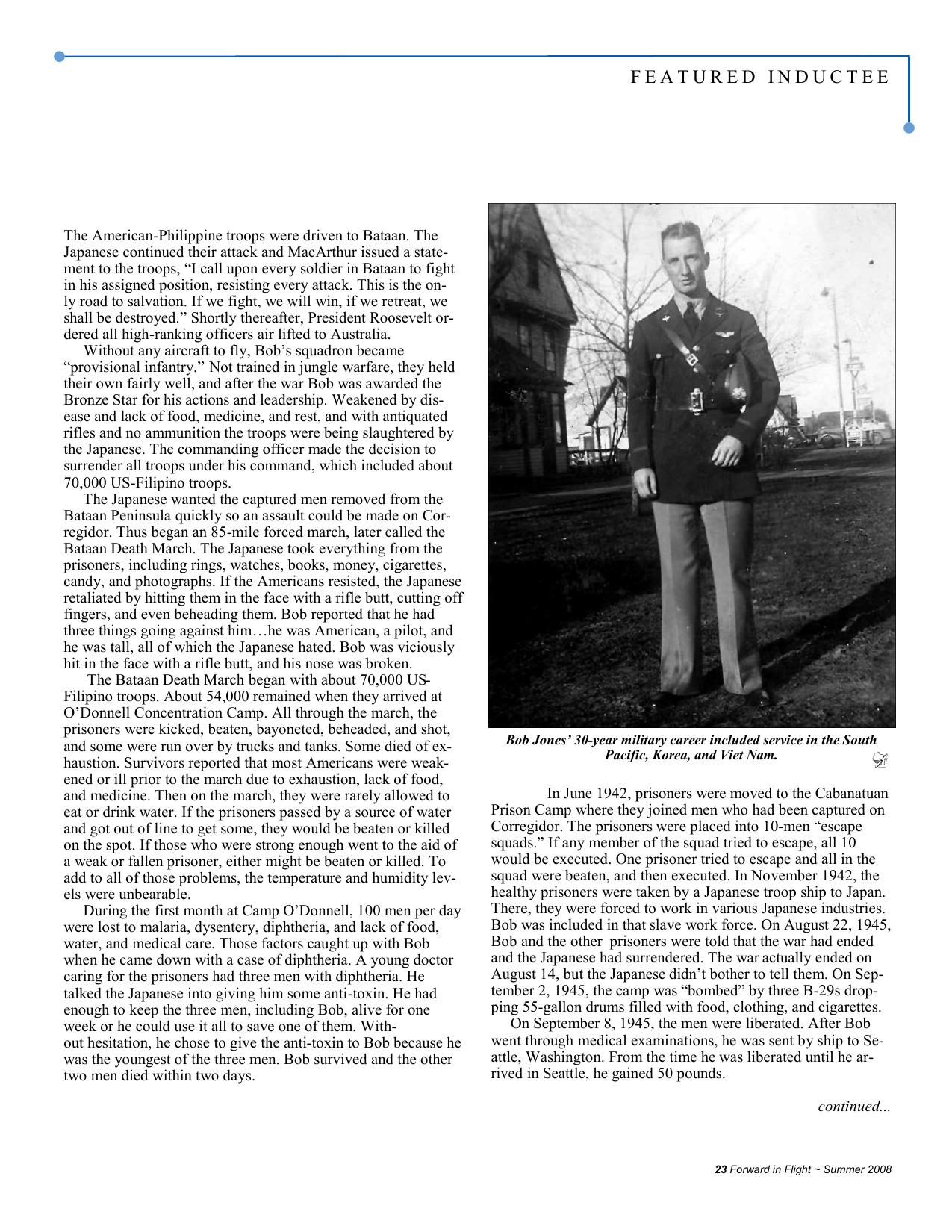
FEATURED INDUCTEE The American-Philippine troops were driven to Bataan. The Japanese continued their attack and MacArthur issued a statement to the troops, “I call upon every soldier in Bataan to fight in his assigned position, resisting every attack. This is the only road to salvation. If we fight, we will win, if we retreat, we shall be destroyed.” Shortly thereafter, President Roosevelt ordered all high-ranking officers air lifted to Australia. Without any aircraft to fly, Bob’s squadron became “provisional infantry.” Not trained in jungle warfare, they held their own fairly well, and after the war Bob was awarded the Bronze Star for his actions and leadership. Weakened by disease and lack of food, medicine, and rest, and with antiquated rifles and no ammunition the troops were being slaughtered by the Japanese. The commanding officer made the decision to surrender all troops under his command, which included about 70,000 US-Filipino troops. The Japanese wanted the captured men removed from the Bataan Peninsula quickly so an assault could be made on Corregidor. Thus began an 85-mile forced march, later called the Bataan Death March. The Japanese took everything from the prisoners, including rings, watches, books, money, cigarettes, candy, and photographs. If the Americans resisted, the Japanese retaliated by hitting them in the face with a rifle butt, cutting off fingers, and even beheading them. Bob reported that he had three things going against him…he was American, a pilot, and he was tall, all of which the Japanese hated. Bob was viciously hit in the face with a rifle butt, and his nose was broken. The Bataan Death March began with about 70,000 USFilipino troops. About 54,000 remained when they arrived at O’Donnell Concentration Camp. All through the march, the prisoners were kicked, beaten, bayoneted, beheaded, and shot, and some were run over by trucks and tanks. Some died of exhaustion. Survivors reported that most Americans were weakened or ill prior to the march due to exhaustion, lack of food, and medicine. Then on the march, they were rarely allowed to eat or drink water. If the prisoners passed by a source of water and got out of line to get some, they would be beaten or killed on the spot. If those who were strong enough went to the aid of a weak or fallen prisoner, either might be beaten or killed. To add to all of those problems, the temperature and humidity levels were unbearable. During the first month at Camp O’Donnell, 100 men per day were lost to malaria, dysentery, diphtheria, and lack of food, water, and medical care. Those factors caught up with Bob when he came down with a case of diphtheria. A young doctor caring for the prisoners had three men with diphtheria. He talked the Japanese into giving him some anti-toxin. He had enough to keep the three men, including Bob, alive for one week or he could use it all to save one of them. Without hesitation, he chose to give the anti-toxin to Bob because he was the youngest of the three men. Bob survived and the other two men died within two days. Bob Jones’ 30-year military career included service in the South Pacific, Korea, and Viet Nam. In June 1942, prisoners were moved to the Cabanatuan Prison Camp where they joined men who had been captured on Corregidor. The prisoners were placed into 10-men “escape squads.” If any member of the squad tried to escape, all 10 would be executed. One prisoner tried to escape and all in the squad were beaten, and then executed. In November 1942, the healthy prisoners were taken by a Japanese troop ship to Japan. There, they were forced to work in various Japanese industries. Bob was included in that slave work force. On August 22, 1945, Bob and the other prisoners were told that the war had ended and the Japanese had surrendered. The war actually ended on August 14, but the Japanese didn’t bother to tell them. On September 2, 1945, the camp was “bombed” by three B-29s dropping 55-gallon drums filled with food, clothing, and cigarettes. On September 8, 1945, the men were liberated. After Bob went through medical examinations, he was sent by ship to Seattle, Washington. From the time he was liberated until he arrived in Seattle, he gained 50 pounds. continued... 23 Forward in Flight ~ Summer 2008
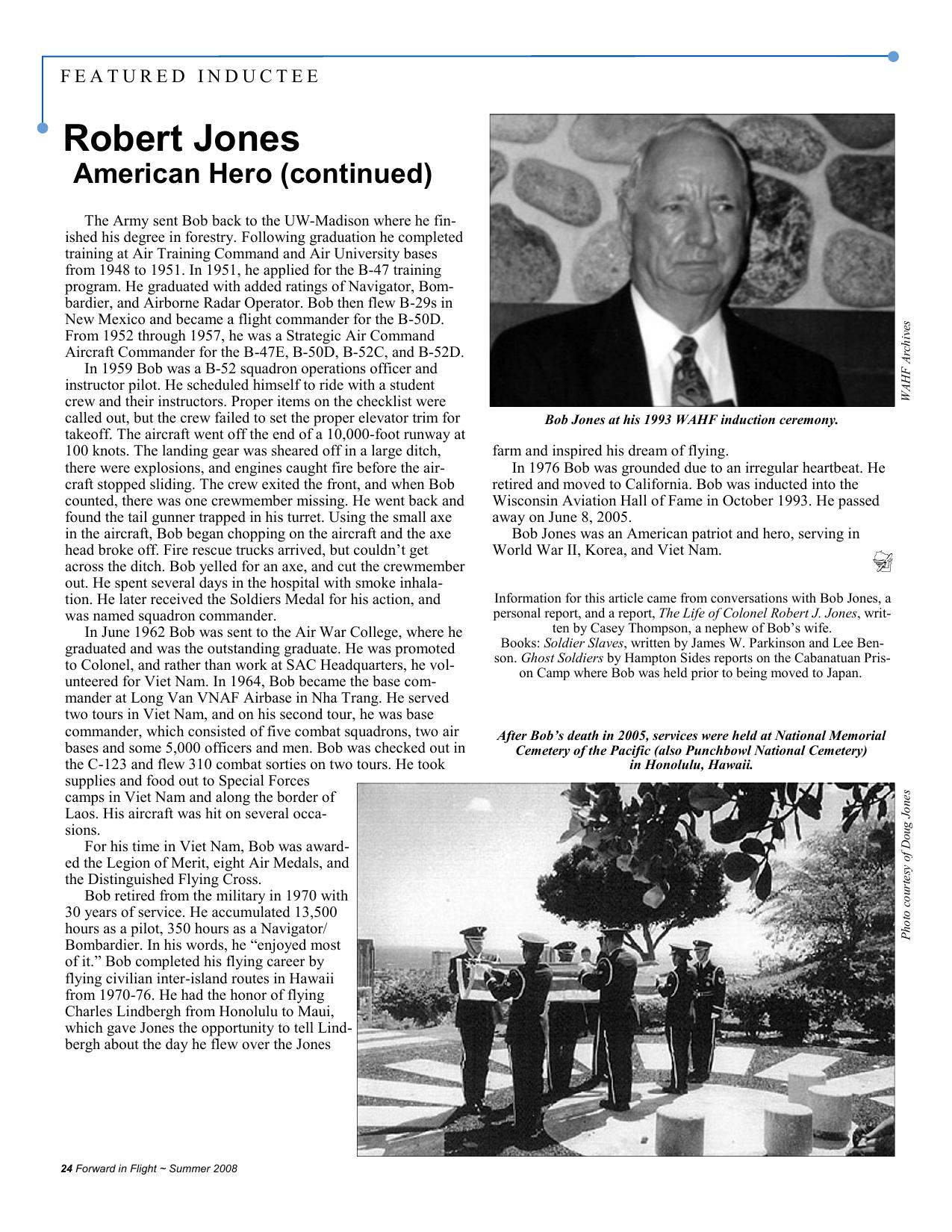
FEATURED INDUCTEE Robert Jones 24 Forward in Flight ~ Summer 2008 Bob Jones at his 1993 WAHF induction ceremony. farm and inspired his dream of flying. In 1976 Bob was grounded due to an irregular heartbeat. He retired and moved to California. Bob was inducted into the Wisconsin Aviation Hall of Fame in October 1993. He passed away on June 8, 2005. Bob Jones was an American patriot and hero, serving in World War II, Korea, and Viet Nam. Information for this article came from conversations with Bob Jones, a personal report, and a report, The Life of Colonel Robert J. Jones, written by Casey Thompson, a nephew of Bob’s wife. Books: Soldier Slaves, written by James W. Parkinson and Lee Benson. Ghost Soldiers by Hampton Sides reports on the Cabanatuan Prison Camp where Bob was held prior to being moved to Japan. After Bob’s death in 2005, services were held at National Memorial Cemetery of the Pacific (also Punchbowl National Cemetery) in Honolulu, Hawaii. Photo courtesy of Doug Jones The Army sent Bob back to the UW-Madison where he finished his degree in forestry. Following graduation he completed training at Air Training Command and Air University bases from 1948 to 1951. In 1951, he applied for the B-47 training program. He graduated with added ratings of Navigator, Bombardier, and Airborne Radar Operator. Bob then flew B-29s in New Mexico and became a flight commander for the B-50D. From 1952 through 1957, he was a Strategic Air Command Aircraft Commander for the B-47E, B-50D, B-52C, and B-52D. In 1959 Bob was a B-52 squadron operations officer and instructor pilot. He scheduled himself to ride with a student crew and their instructors. Proper items on the checklist were called out, but the crew failed to set the proper elevator trim for takeoff. The aircraft went off the end of a 10,000-foot runway at 100 knots. The landing gear was sheared off in a large ditch, there were explosions, and engines caught fire before the aircraft stopped sliding. The crew exited the front, and when Bob counted, there was one crewmember missing. He went back and found the tail gunner trapped in his turret. Using the small axe in the aircraft, Bob began chopping on the aircraft and the axe head broke off. Fire rescue trucks arrived, but couldn’t get across the ditch. Bob yelled for an axe, and cut the crewmember out. He spent several days in the hospital with smoke inhalation. He later received the Soldiers Medal for his action, and was named squadron commander. In June 1962 Bob was sent to the Air War College, where he graduated and was the outstanding graduate. He was promoted to Colonel, and rather than work at SAC Headquarters, he volunteered for Viet Nam. In 1964, Bob became the base commander at Long Van VNAF Airbase in Nha Trang. He served two tours in Viet Nam, and on his second tour, he was base commander, which consisted of five combat squadrons, two air bases and some 5,000 officers and men. Bob was checked out in the C-123 and flew 310 combat sorties on two tours. He took supplies and food out to Special Forces camps in Viet Nam and along the border of Laos. His aircraft was hit on several occasions. For his time in Viet Nam, Bob was awarded the Legion of Merit, eight Air Medals, and the Distinguished Flying Cross. Bob retired from the military in 1970 with 30 years of service. He accumulated 13,500 hours as a pilot, 350 hours as a Navigator/ Bombardier. In his words, he “enjoyed most of it.” Bob completed his flying career by flying civilian inter-island routes in Hawaii from 1970-76. He had the honor of flying Charles Lindbergh from Honolulu to Maui, which gave Jones the opportunity to tell Lindbergh about the day he flew over the Jones WAHF Archives American Hero (continued)
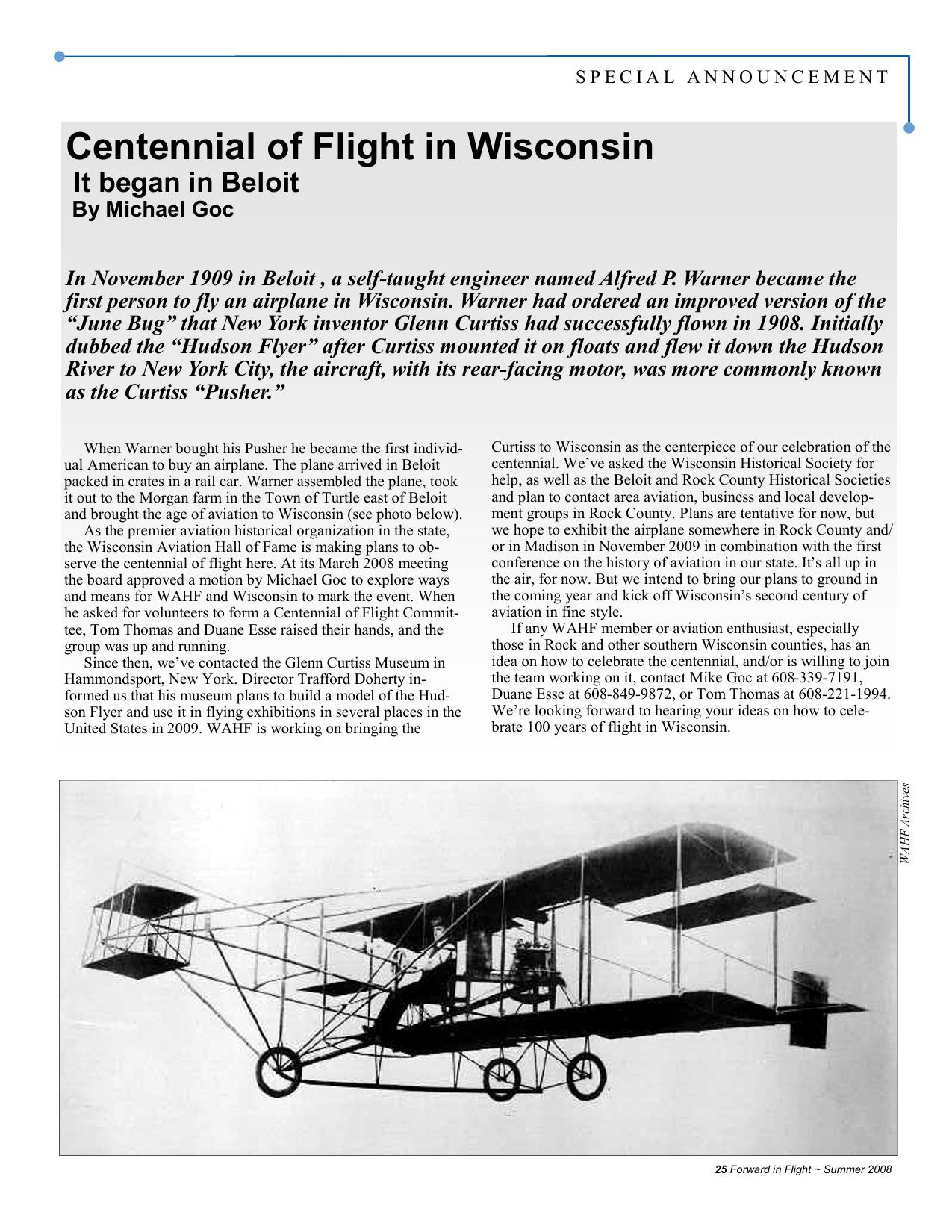
SPECIAL ANNOUNCEMENT Centennial of Flight in Wisconsin It began in Beloit By Michael Goc In November 1909 in Beloit , a self-taught engineer named Alfred P. Warner became the first person to fly an airplane in Wisconsin. Warner had ordered an improved version of the “June Bug” that New York inventor Glenn Curtiss had successfully flown in 1908. Initially dubbed the “Hudson Flyer” after Curtiss mounted it on floats and flew it down the Hudson River to New York City, the aircraft, with its rear-facing motor, was more commonly known as the Curtiss “Pusher.” Curtiss to Wisconsin as the centerpiece of our celebration of the centennial. We’ve asked the Wisconsin Historical Society for help, as well as the Beloit and Rock County Historical Societies and plan to contact area aviation, business and local development groups in Rock County. Plans are tentative for now, but we hope to exhibit the airplane somewhere in Rock County and/ or in Madison in November 2009 in combination with the first conference on the history of aviation in our state. It’s all up in the air, for now. But we intend to bring our plans to ground in the coming year and kick off Wisconsin’s second century of aviation in fine style. If any WAHF member or aviation enthusiast, especially those in Rock and other southern Wisconsin counties, has an idea on how to celebrate the centennial, and/or is willing to join the team working on it, contact Mike Goc at 608-339-7191, Duane Esse at 608-849-9872, or Tom Thomas at 608-221-1994. We’re looking forward to hearing your ideas on how to celebrate 100 years of flight in Wisconsin. WAHF Archives When Warner bought his Pusher he became the first individual American to buy an airplane. The plane arrived in Beloit packed in crates in a rail car. Warner assembled the plane, took it out to the Morgan farm in the Town of Turtle east of Beloit and brought the age of aviation to Wisconsin (see photo below). As the premier aviation historical organization in the state, the Wisconsin Aviation Hall of Fame is making plans to observe the centennial of flight here. At its March 2008 meeting the board approved a motion by Michael Goc to explore ways and means for WAHF and Wisconsin to mark the event. When he asked for volunteers to form a Centennial of Flight Committee, Tom Thomas and Duane Esse raised their hands, and the group was up and running. Since then, we’ve contacted the Glenn Curtiss Museum in Hammondsport, New York. Director Trafford Doherty informed us that his museum plans to build a model of the Hudson Flyer and use it in flying exhibitions in several places in the United States in 2009. WAHF is working on bringing the 25 Forward in Flight ~ Summer 2008
FROM THE ARCHIVES Interview from the Past Omro, Wisconsin’s Red Strehlow Edited By Michael Goc Editor’s Note: In April 1986, WAHF founder Carl Guell took his trusty tape recorder to Omro, Wisconsin, to capture the reminiscences of Louis H. Strehlow. Better known as “Red,” Strehlow helped build and then operated the Ginnow Airport near Omro for many years. Here is an edited version of their conversation. Guell: Mr. Strehlow, how did you get involved in aviation in the first place? Red: That’s kind of a long story. I was born and raised on a farm about seven or eight miles west of Omro and I needed a little money. My father was an insurance man so he gave me the insurance rates and said, “You go out and sell insurance.” In my travels I knew where there was a fellow had an airplane and I had been watching airplanes all my life, so instead of selling insurance I went over there and got a ride with him. I kind of liked it and he said, “Why don’t you go over and see Leonard Larson and learn to fly.” So the next day I was supposed to be out selling insurance but instead I went over to see Leonard Larson and started to fly. It was a morning radio program and Gordon Thomas, the disc jockey, was giving away gourd seeds and Higg Murray was the stockyards announcer. They would have a little contest [over who could give away more seeds]. One morning while they were on the air, I called them up, told them who I was, what I was doing, teaching flying. I offered one flight course complete to the one who got the most gourd seeds out in the area. That set the thing rolling. Thomas did win, but he was scared to fly, and said “I’m going to give it to Higg Murray.” That’s about the time I started to shiver. I thought they really aren’t going to come up here and do this, and lo and behold, about three, four days after that, somebody walked in the door and said, “You Red? I’m Higg Murray. I’m here to learn to fly.” I did not back out on the deal. I gave him a complete flight course as a Carl: What kind of an airplane? When did you solo and when gift from scratch on did you get your certificate? up to the private li Red: J-3 Cub 60 hp Franklin. I soloed in September cense. Then we had a of 1941 and got my private in November of 1942. I offered one flight course complete big bash out there. After I had got my private, I had ambitions to go We had about 85 or to the one who got the most gourd ahead and get a commercial. Of course, this field out 90 airplanes come in seeds out in the area. there [Ginnow’s] was known as the only flying field in for the big hamthe state of Wisconsin that was in a woods and, believe burger fly-in. They you me, it was in a woods. We hewed out the trees to brought up scads of get room. I did the blasting myself. I did a lot of work on it hamburger and wieso there was an opening for me to have a field and an airport ners and brats that were donated. We gave prizes for about evethere. That’s why I really put so much time into it and I flew rything we could think of out there and had a heck of a good from there and we did have an airport. It was clean, a very minitime. mum of 1800 feet, open ends, so we didn’t have too much to They also had a bathtub deal. One Saturday morning in worry about. If we could get her off the ground in 1800 feet, we comes Higg Murray and Gordon Thomas with two trucks of were in business. bathtubs and dumped them off on my lawn. Of course, I had I got my flight instructor rating in 1944, and from that day them arrested. This was all put up ahead of time. They threw on I taught flying there until 1955, at which time I retired from Higg Murray in the city jail that hadn’t been used in 20 years. it and went into the insurance business that my father started. Murray said “Don’t lock it. You might not be able to get it unHe kept telling me airplanes were going out and there wouldn’t locked.” We had an awful lot of fun. Little did they know that be, couldn’t be any money in them. There was a quiet spell at the farmers around the area wanted those bathtubs. They came that time. But I did teach an awful lot of people. Also in 1944, in with their pickup trucks and they used them for watering about Christmas, I became a flight examiner and I gave an awtanks. ful lot of flight tests around the area. I looked it up, I have over 125 people that I taught. Carl: The Omro Airport put the city of Omro on the map? We had three small airplanes. Three Aeronca Champs or two Red: Yes, we had a lot of fun. It also helped me quite a lot in Champs and an Aeronca Chief and a four-passenger 108 Stinmy insurance business. Another interesting thing. In 1941, I son, plus a Taylorcraft or a Cessna 120. went to the Omro Businessmen’s Association and asked them for a donation for the airport and they asked me what I wanted Carl: I seem to recall that you had an interesting experience and I said because of the airplane you should know what the with training a radio announcer to learn to fly. wind velocity is and also the barometric pressure. So they doRed: That thing all started when I became a father with my first nated a real fine anemometer. It cost $144 back in 1941 and a child, Joanne. I got to know these boys on WTMJ-Milwaukee. barometer that cost about $30 or $40. That anemometer is still 26 Forward in Flight ~ Summer 2008
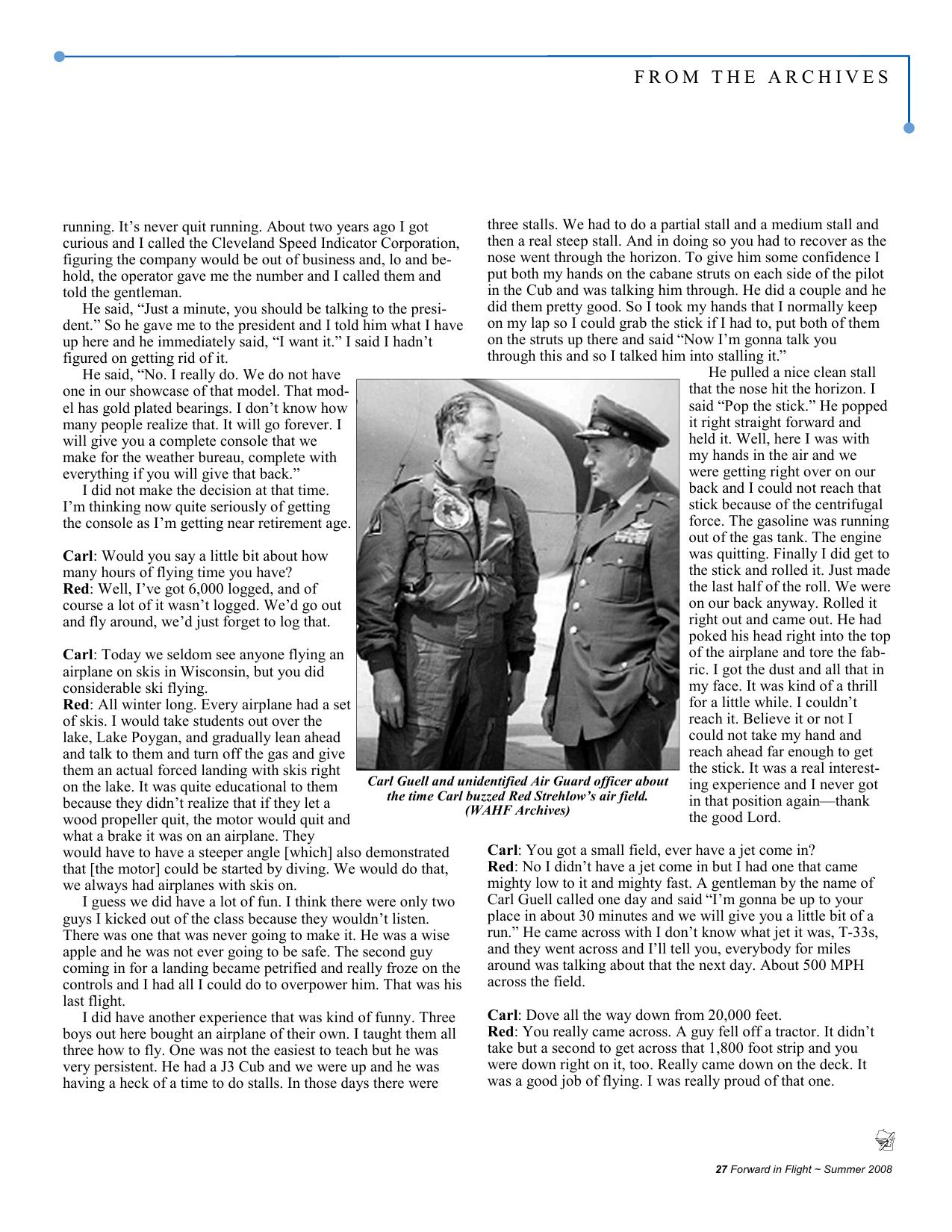
FROM THE ARCHIVES three stalls. We had to do a partial stall and a medium stall and then a real steep stall. And in doing so you had to recover as the nose went through the horizon. To give him some confidence I put both my hands on the cabane struts on each side of the pilot in the Cub and was talking him through. He did a couple and he did them pretty good. So I took my hands that I normally keep on my lap so I could grab the stick if I had to, put both of them on the struts up there and said “Now I’m gonna talk you through this and so I talked him into stalling it.” He pulled a nice clean stall that the nose hit the horizon. I said “Pop the stick.” He popped it right straight forward and held it. Well, here I was with my hands in the air and we were getting right over on our back and I could not reach that stick because of the centrifugal force. The gasoline was running out of the gas tank. The engine was quitting. Finally I did get to the stick and rolled it. Just made the last half of the roll. We were on our back anyway. Rolled it right out and came out. He had poked his head right into the top of the airplane and tore the fabric. I got the dust and all that in my face. It was kind of a thrill for a little while. I couldn’t reach it. Believe it or not I could not take my hand and reach ahead far enough to get the stick. It was a real interestCarl Guell and unidentified Air Guard officer about ing experience and I never got the time Carl buzzed Red Strehlow’s air field. in that position again—thank (WAHF Archives) the good Lord. running. It’s never quit running. About two years ago I got curious and I called the Cleveland Speed Indicator Corporation, figuring the company would be out of business and, lo and behold, the operator gave me the number and I called them and told the gentleman. He said, “Just a minute, you should be talking to the president.” So he gave me to the president and I told him what I have up here and he immediately said, “I want it.” I said I hadn’t figured on getting rid of it. He said, “No. I really do. We do not have one in our showcase of that model. That model has gold plated bearings. I don’t know how many people realize that. It will go forever. I will give you a complete console that we make for the weather bureau, complete with everything if you will give that back.” I did not make the decision at that time. I’m thinking now quite seriously of getting the console as I’m getting near retirement age. Carl: Would you say a little bit about how many hours of flying time you have? Red: Well, I’ve got 6,000 logged, and of course a lot of it wasn’t logged. We’d go out and fly around, we’d just forget to log that. Carl: Today we seldom see anyone flying an airplane on skis in Wisconsin, but you did considerable ski flying. Red: All winter long. Every airplane had a set of skis. I would take students out over the lake, Lake Poygan, and gradually lean ahead and talk to them and turn off the gas and give them an actual forced landing with skis right on the lake. It was quite educational to them because they didn’t realize that if they let a wood propeller quit, the motor would quit and what a brake it was on an airplane. They would have to have a steeper angle [which] also demonstrated that [the motor] could be started by diving. We would do that, we always had airplanes with skis on. I guess we did have a lot of fun. I think there were only two guys I kicked out of the class because they wouldn’t listen. There was one that was never going to make it. He was a wise apple and he was not ever going to be safe. The second guy coming in for a landing became petrified and really froze on the controls and I had all I could do to overpower him. That was his last flight. I did have another experience that was kind of funny. Three boys out here bought an airplane of their own. I taught them all three how to fly. One was not the easiest to teach but he was very persistent. He had a J3 Cub and we were up and he was having a heck of a time to do stalls. In those days there were Carl: You got a small field, ever have a jet come in? Red: No I didn’t have a jet come in but I had one that came mighty low to it and mighty fast. A gentleman by the name of Carl Guell called one day and said “I’m gonna be up to your place in about 30 minutes and we will give you a little bit of a run.” He came across with I don’t know what jet it was, T-33s, and they went across and I’ll tell you, everybody for miles around was talking about that the next day. About 500 MPH across the field. Carl: Dove all the way down from 20,000 feet. Red: You really came across. A guy fell off a tractor. It didn’t take but a second to get across that 1,800 foot strip and you were down right on it, too. Really came down on the deck. It was a good job of flying. I was really proud of that one. 27 Forward in Flight ~ Summer 2008
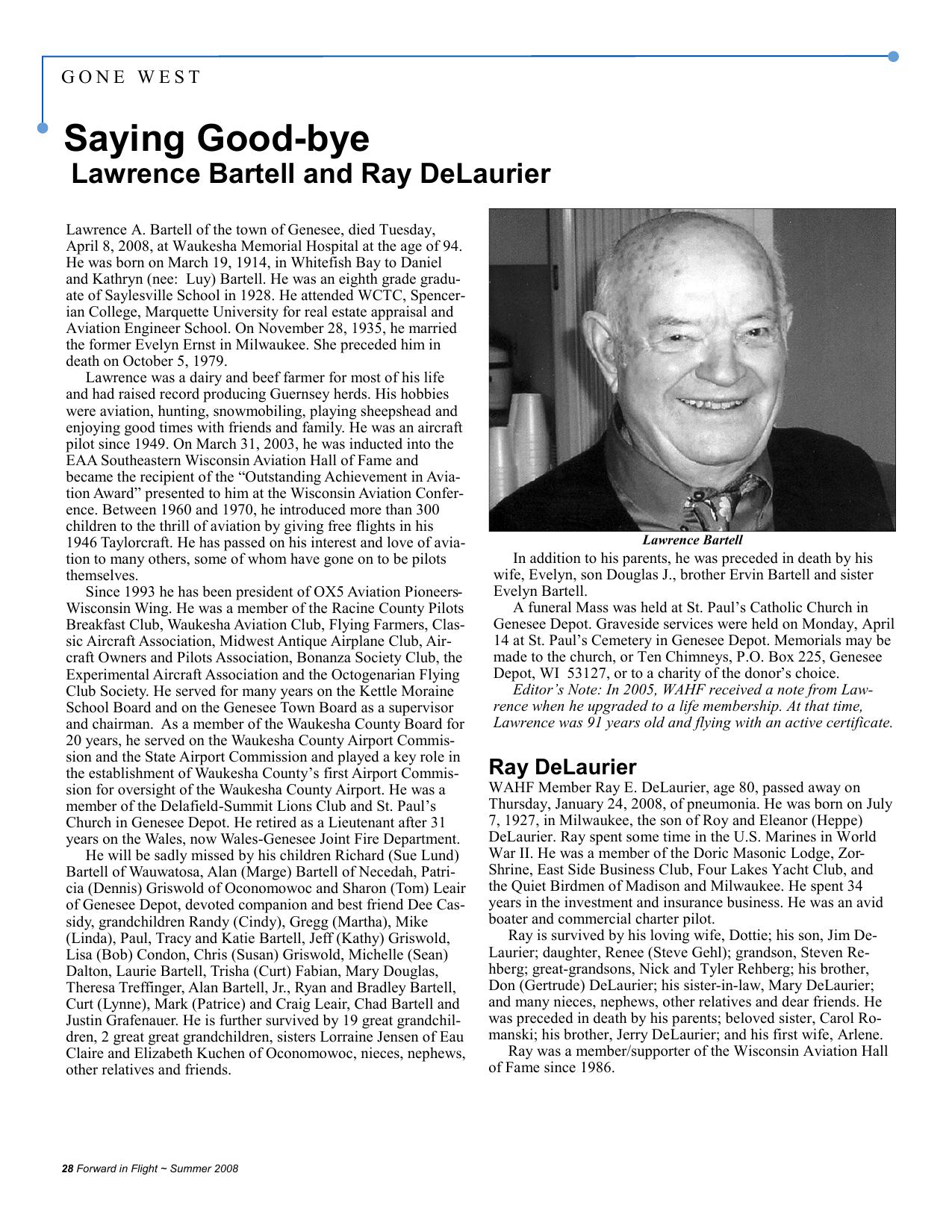
GONE WEST Saying Good-bye Lawrence Bartell and Ray DeLaurier Lawrence A. Bartell of the town of Genesee, died Tuesday, April 8, 2008, at Waukesha Memorial Hospital at the age of 94. He was born on March 19, 1914, in Whitefish Bay to Daniel and Kathryn (nee: Luy) Bartell. He was an eighth grade graduate of Saylesville School in 1928. He attended WCTC, Spencerian College, Marquette University for real estate appraisal and Aviation Engineer School. On November 28, 1935, he married the former Evelyn Ernst in Milwaukee. She preceded him in death on October 5, 1979. Lawrence was a dairy and beef farmer for most of his life and had raised record producing Guernsey herds. His hobbies were aviation, hunting, snowmobiling, playing sheepshead and enjoying good times with friends and family. He was an aircraft pilot since 1949. On March 31, 2003, he was inducted into the EAA Southeastern Wisconsin Aviation Hall of Fame and became the recipient of the “Outstanding Achievement in Aviation Award” presented to him at the Wisconsin Aviation Conference. Between 1960 and 1970, he introduced more than 300 children to the thrill of aviation by giving free flights in his 1946 Taylorcraft. He has passed on his interest and love of aviation to many others, some of whom have gone on to be pilots themselves. Since 1993 he has been president of OX5 Aviation PioneersWisconsin Wing. He was a member of the Racine County Pilots Breakfast Club, Waukesha Aviation Club, Flying Farmers, Classic Aircraft Association, Midwest Antique Airplane Club, Aircraft Owners and Pilots Association, Bonanza Society Club, the Experimental Aircraft Association and the Octogenarian Flying Club Society. He served for many years on the Kettle Moraine School Board and on the Genesee Town Board as a supervisor and chairman. As a member of the Waukesha County Board for 20 years, he served on the Waukesha County Airport Commission and the State Airport Commission and played a key role in the establishment of Waukesha County’s first Airport Commission for oversight of the Waukesha County Airport. He was a member of the Delafield-Summit Lions Club and St. Paul’s Church in Genesee Depot. He retired as a Lieutenant after 31 years on the Wales, now Wales-Genesee Joint Fire Department. He will be sadly missed by his children Richard (Sue Lund) Bartell of Wauwatosa, Alan (Marge) Bartell of Necedah, Patricia (Dennis) Griswold of Oconomowoc and Sharon (Tom) Leair of Genesee Depot, devoted companion and best friend Dee Cassidy, grandchildren Randy (Cindy), Gregg (Martha), Mike (Linda), Paul, Tracy and Katie Bartell, Jeff (Kathy) Griswold, Lisa (Bob) Condon, Chris (Susan) Griswold, Michelle (Sean) Dalton, Laurie Bartell, Trisha (Curt) Fabian, Mary Douglas, Theresa Treffinger, Alan Bartell, Jr., Ryan and Bradley Bartell, Curt (Lynne), Mark (Patrice) and Craig Leair, Chad Bartell and Justin Grafenauer. He is further survived by 19 great grandchildren, 2 great great grandchildren, sisters Lorraine Jensen of Eau Claire and Elizabeth Kuchen of Oconomowoc, nieces, nephews, other relatives and friends. 28 Forward in Flight ~ Summer 2008 Lawrence Bartell In addition to his parents, he was preceded in death by his wife, Evelyn, son Douglas J., brother Ervin Bartell and sister Evelyn Bartell. A funeral Mass was held at St. Paul’s Catholic Church in Genesee Depot. Graveside services were held on Monday, April 14 at St. Paul’s Cemetery in Genesee Depot. Memorials may be made to the church, or Ten Chimneys, P.O. Box 225, Genesee Depot, WI 53127, or to a charity of the donor’s choice. Editor’s Note: In 2005, WAHF received a note from Lawrence when he upgraded to a life membership. At that time, Lawrence was 91 years old and flying with an active certificate. Ray DeLaurier WAHF Member Ray E. DeLaurier, age 80, passed away on Thursday, January 24, 2008, of pneumonia. He was born on July 7, 1927, in Milwaukee, the son of Roy and Eleanor (Heppe) DeLaurier. Ray spent some time in the U.S. Marines in World War II. He was a member of the Doric Masonic Lodge, ZorShrine, East Side Business Club, Four Lakes Yacht Club, and the Quiet Birdmen of Madison and Milwaukee. He spent 34 years in the investment and insurance business. He was an avid boater and commercial charter pilot. Ray is survived by his loving wife, Dottie; his son, Jim DeLaurier; daughter, Renee (Steve Gehl); grandson, Steven Rehberg; great-grandsons, Nick and Tyler Rehberg; his brother, Don (Gertrude) DeLaurier; his sister-in-law, Mary DeLaurier; and many nieces, nephews, other relatives and dear friends. He was preceded in death by his parents; beloved sister, Carol Romanski; his brother, Jerry DeLaurier; and his first wife, Arlene. Ray was a member/supporter of the Wisconsin Aviation Hall of Fame since 1986.
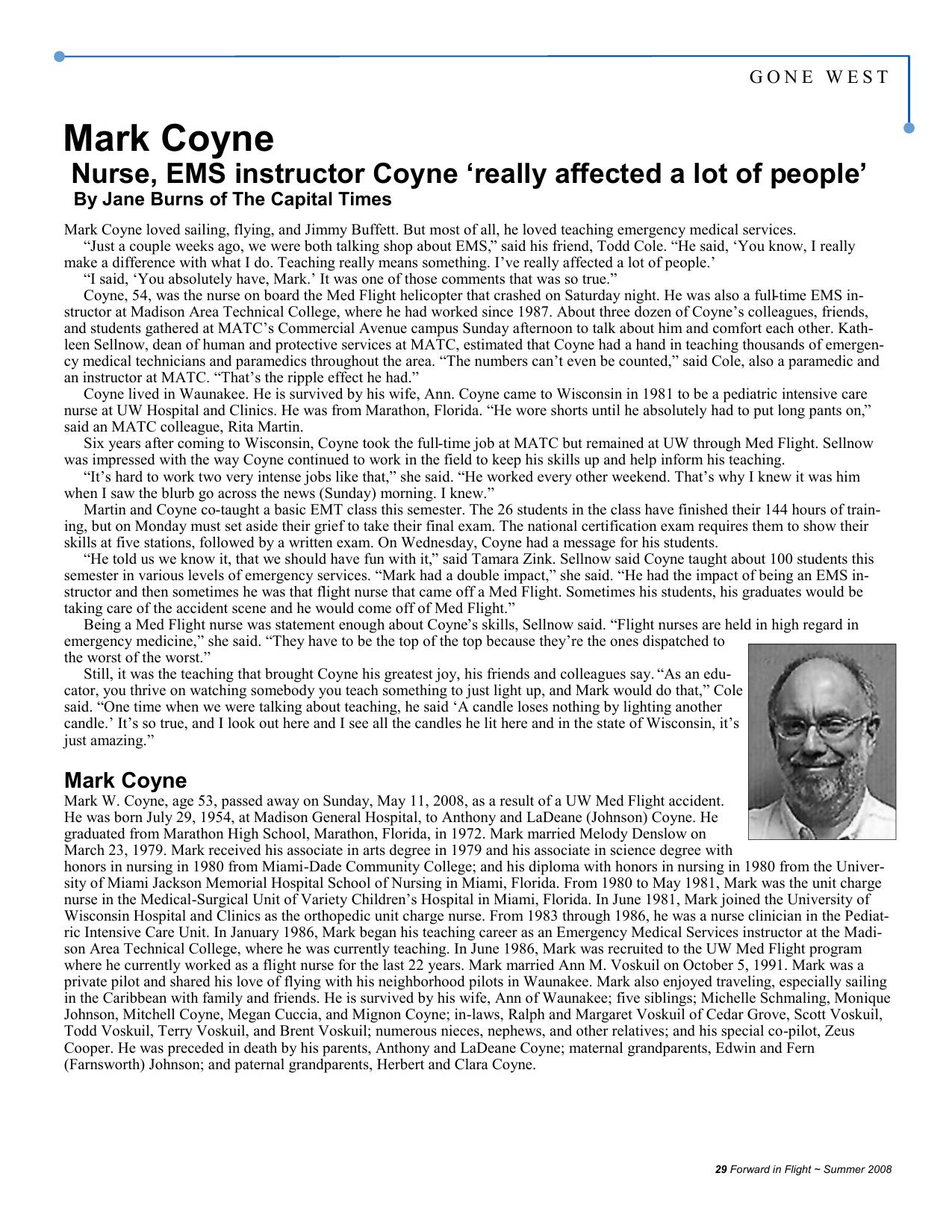
GONE WEST Mark Coyne Nurse, EMS instructor Coyne ‘really affected a lot of people’ By Jane Burns of The Capital Times Mark Coyne loved sailing, flying, and Jimmy Buffett. But most of all, he loved teaching emergency medical services. “Just a couple weeks ago, we were both talking shop about EMS,” said his friend, Todd Cole. “He said, ‘You know, I really make a difference with what I do. Teaching really means something. I’ve really affected a lot of people.’ “I said, ‘You absolutely have, Mark.’ It was one of those comments that was so true.” Coyne, 54, was the nurse on board the Med Flight helicopter that crashed on Saturday night. He was also a full-time EMS instructor at Madison Area Technical College, where he had worked since 1987. About three dozen of Coyne’s colleagues, friends, and students gathered at MATC’s Commercial Avenue campus Sunday afternoon to talk about him and comfort each other. Kathleen Sellnow, dean of human and protective services at MATC, estimated that Coyne had a hand in teaching thousands of emergency medical technicians and paramedics throughout the area. “The numbers can’t even be counted,” said Cole, also a paramedic and an instructor at MATC. “That’s the ripple effect he had.” Coyne lived in Waunakee. He is survived by his wife, Ann. Coyne came to Wisconsin in 1981 to be a pediatric intensive care nurse at UW Hospital and Clinics. He was from Marathon, Florida. “He wore shorts until he absolutely had to put long pants on,” said an MATC colleague, Rita Martin. Six years after coming to Wisconsin, Coyne took the full-time job at MATC but remained at UW through Med Flight. Sellnow was impressed with the way Coyne continued to work in the field to keep his skills up and help inform his teaching. “It’s hard to work two very intense jobs like that,” she said. “He worked every other weekend. That’s why I knew it was him when I saw the blurb go across the news (Sunday) morning. I knew.” Martin and Coyne co-taught a basic EMT class this semester. The 26 students in the class have finished their 144 hours of training, but on Monday must set aside their grief to take their final exam. The national certification exam requires them to show their skills at five stations, followed by a written exam. On Wednesday, Coyne had a message for his students. “He told us we know it, that we should have fun with it,” said Tamara Zink. Sellnow said Coyne taught about 100 students this semester in various levels of emergency services. “Mark had a double impact,” she said. “He had the impact of being an EMS instructor and then sometimes he was that flight nurse that came off a Med Flight. Sometimes his students, his graduates would be taking care of the accident scene and he would come off of Med Flight.” Being a Med Flight nurse was statement enough about Coyne’s skills, Sellnow said. “Flight nurses are held in high regard in emergency medicine,” she said. “They have to be the top of the top because they’re the ones dispatched to the worst of the worst.” Still, it was the teaching that brought Coyne his greatest joy, his friends and colleagues say. “As an educator, you thrive on watching somebody you teach something to just light up, and Mark would do that,” Cole said. “One time when we were talking about teaching, he said ‘A candle loses nothing by lighting another candle.’ It’s so true, and I look out here and I see all the candles he lit here and in the state of Wisconsin, it’s just amazing.” Mark Coyne Mark W. Coyne, age 53, passed away on Sunday, May 11, 2008, as a result of a UW Med Flight accident. He was born July 29, 1954, at Madison General Hospital, to Anthony and LaDeane (Johnson) Coyne. He graduated from Marathon High School, Marathon, Florida, in 1972. Mark married Melody Denslow on March 23, 1979. Mark received his associate in arts degree in 1979 and his associate in science degree with honors in nursing in 1980 from Miami-Dade Community College; and his diploma with honors in nursing in 1980 from the University of Miami Jackson Memorial Hospital School of Nursing in Miami, Florida. From 1980 to May 1981, Mark was the unit charge nurse in the Medical-Surgical Unit of Variety Children’s Hospital in Miami, Florida. In June 1981, Mark joined the University of Wisconsin Hospital and Clinics as the orthopedic unit charge nurse. From 1983 through 1986, he was a nurse clinician in the Pediatric Intensive Care Unit. In January 1986, Mark began his teaching career as an Emergency Medical Services instructor at the Madison Area Technical College, where he was currently teaching. In June 1986, Mark was recruited to the UW Med Flight program where he currently worked as a flight nurse for the last 22 years. Mark married Ann M. Voskuil on October 5, 1991. Mark was a private pilot and shared his love of flying with his neighborhood pilots in Waunakee. Mark also enjoyed traveling, especially sailing in the Caribbean with family and friends. He is survived by his wife, Ann of Waunakee; five siblings; Michelle Schmaling, Monique Johnson, Mitchell Coyne, Megan Cuccia, and Mignon Coyne; in-laws, Ralph and Margaret Voskuil of Cedar Grove, Scott Voskuil, Todd Voskuil, Terry Voskuil, and Brent Voskuil; numerous nieces, nephews, and other relatives; and his special co-pilot, Zeus Cooper. He was preceded in death by his parents, Anthony and LaDeane Coyne; maternal grandparents, Edwin and Fern (Farnsworth) Johnson; and paternal grandparents, Herbert and Clara Coyne. 29 Forward in Flight ~ Summer 2008
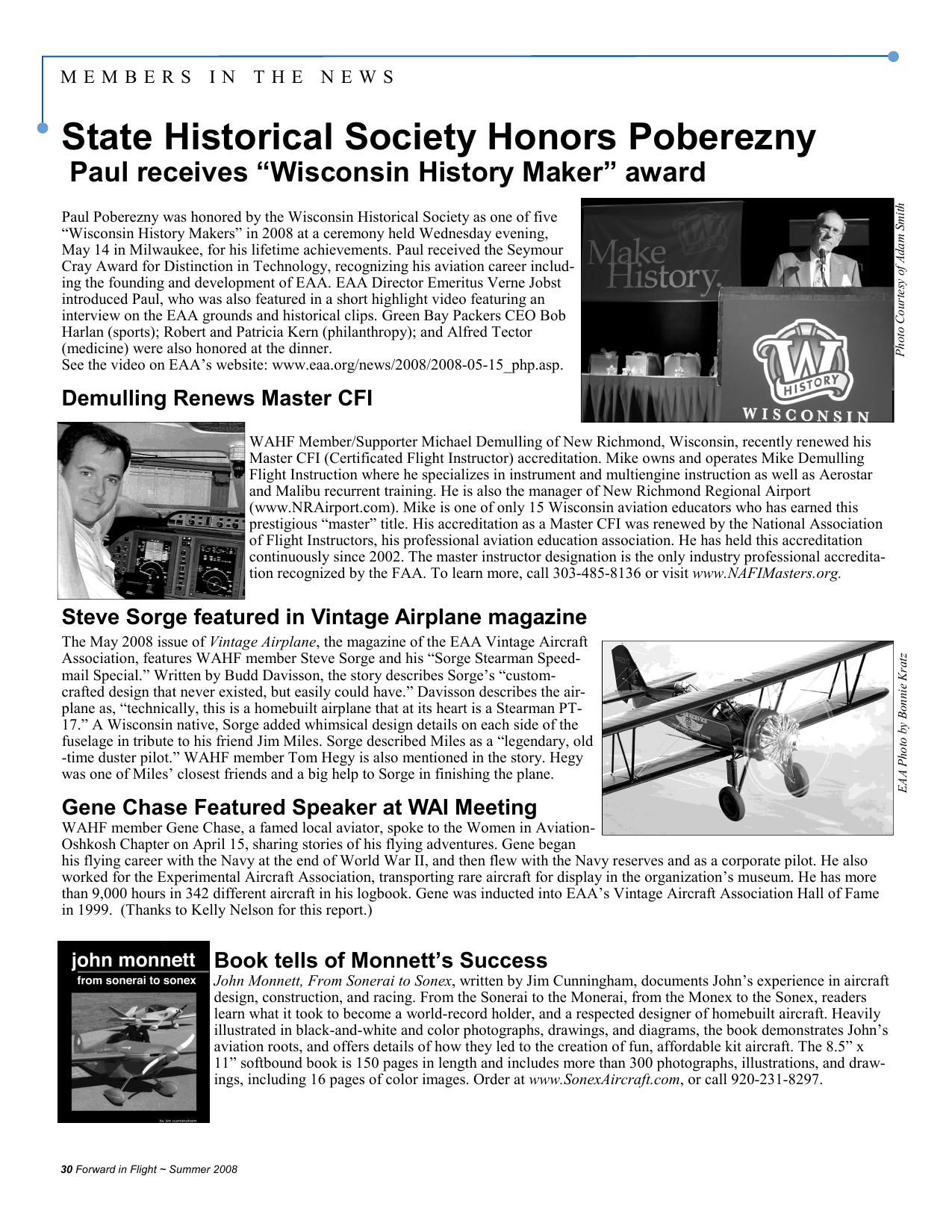
MEMBERS IN THE NEWS State Historical Society Honors Poberezny Paul Poberezny was honored by the Wisconsin Historical Society as one of five “Wisconsin History Makers” in 2008 at a ceremony held Wednesday evening, May 14 in Milwaukee, for his lifetime achievements. Paul received the Seymour Cray Award for Distinction in Technology, recognizing his aviation career including the founding and development of EAA. EAA Director Emeritus Verne Jobst introduced Paul, who was also featured in a short highlight video featuring an interview on the EAA grounds and historical clips. Green Bay Packers CEO Bob Harlan (sports); Robert and Patricia Kern (philanthropy); and Alfred Tector (medicine) were also honored at the dinner. See the video on EAA’s website: www.eaa.org/news/2008/2008-05-15_php.asp. Photo Courtesy of Adam Smith Paul receives “Wisconsin History Maker” award Demulling Renews Master CFI WAHF Member/Supporter Michael Demulling of New Richmond, Wisconsin, recently renewed his Master CFI (Certificated Flight Instructor) accreditation. Mike owns and operates Mike Demulling Flight Instruction where he specializes in instrument and multiengine instruction as well as Aerostar and Malibu recurrent training. He is also the manager of New Richmond Regional Airport (www.NRAirport.com). Mike is one of only 15 Wisconsin aviation educators who has earned this prestigious “master” title. His accreditation as a Master CFI was renewed by the National Association of Flight Instructors, his professional aviation education association. He has held this accreditation continuously since 2002. The master instructor designation is the only industry professional accreditation recognized by the FAA. To learn more, call 303-485-8136 or visit www.NAFIMasters.org. The May 2008 issue of Vintage Airplane, the magazine of the EAA Vintage Aircraft Association, features WAHF member Steve Sorge and his “Sorge Stearman Speedmail Special.” Written by Budd Davisson, the story describes Sorge’s “customcrafted design that never existed, but easily could have.” Davisson describes the airplane as, “technically, this is a homebuilt airplane that at its heart is a Stearman PT17.” A Wisconsin native, Sorge added whimsical design details on each side of the fuselage in tribute to his friend Jim Miles. Sorge described Miles as a “legendary, old -time duster pilot.” WAHF member Tom Hegy is also mentioned in the story. Hegy was one of Miles’ closest friends and a big help to Sorge in finishing the plane. Gene Chase Featured Speaker at WAI Meeting WAHF member Gene Chase, a famed local aviator, spoke to the Women in AviationOshkosh Chapter on April 15, sharing stories of his flying adventures. Gene began his flying career with the Navy at the end of World War II, and then flew with the Navy reserves and as a corporate pilot. He also worked for the Experimental Aircraft Association, transporting rare aircraft for display in the organization’s museum. He has more than 9,000 hours in 342 different aircraft in his logbook. Gene was inducted into EAA’s Vintage Aircraft Association Hall of Fame in 1999. (Thanks to Kelly Nelson for this report.) Book tells of Monnett’s Success John Monnett, From Sonerai to Sonex, written by Jim Cunningham, documents John’s experience in aircraft design, construction, and racing. From the Sonerai to the Monerai, from the Monex to the Sonex, readers learn what it took to become a world-record holder, and a respected designer of homebuilt aircraft. Heavily illustrated in black-and-white and color photographs, drawings, and diagrams, the book demonstrates John’s aviation roots, and offers details of how they led to the creation of fun, affordable kit aircraft. The 8.5” x 11” softbound book is 150 pages in length and includes more than 300 photographs, illustrations, and drawings, including 16 pages of color images. Order at www.SonexAircraft.com, or call 920-231-8297. 30 Forward in Flight ~ Summer 2008 EAA Photo by Bonnie Kratz Steve Sorge featured in Vintage Airplane magazine
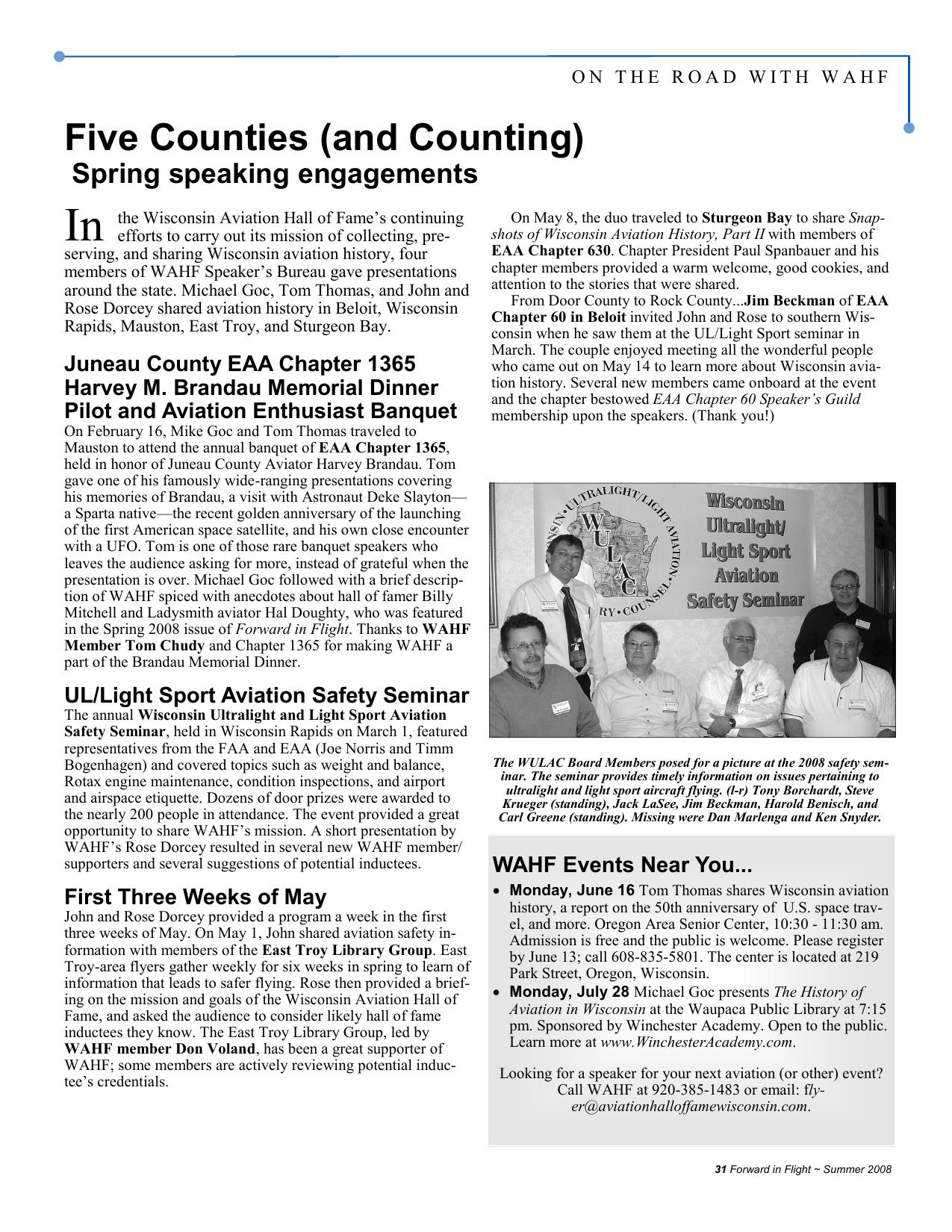
ON THE ROAD WITH WAHF Five Counties (and Counting) Spring speaking engagements In the Wisconsin Aviation Hall of Fame’s continuing efforts to carry out its mission of collecting, preserving, and sharing Wisconsin aviation history, four members of WAHF Speaker’s Bureau gave presentations around the state. Michael Goc, Tom Thomas, and John and Rose Dorcey shared aviation history in Beloit, Wisconsin Rapids, Mauston, East Troy, and Sturgeon Bay. Juneau County EAA Chapter 1365 Harvey M. Brandau Memorial Dinner Pilot and Aviation Enthusiast Banquet On February 16, Mike Goc and Tom Thomas traveled to Mauston to attend the annual banquet of EAA Chapter 1365, held in honor of Juneau County Aviator Harvey Brandau. Tom gave one of his famously wide-ranging presentations covering his memories of Brandau, a visit with Astronaut Deke Slayton— a Sparta native—the recent golden anniversary of the launching of the first American space satellite, and his own close encounter with a UFO. Tom is one of those rare banquet speakers who leaves the audience asking for more, instead of grateful when the presentation is over. Michael Goc followed with a brief description of WAHF spiced with anecdotes about hall of famer Billy Mitchell and Ladysmith aviator Hal Doughty, who was featured in the Spring 2008 issue of Forward in Flight. Thanks to WAHF Member Tom Chudy and Chapter 1365 for making WAHF a part of the Brandau Memorial Dinner. On May 8, the duo traveled to Sturgeon Bay to share Snapshots of Wisconsin Aviation History, Part II with members of EAA Chapter 630. Chapter President Paul Spanbauer and his chapter members provided a warm welcome, good cookies, and attention to the stories that were shared. From Door County to Rock County...Jim Beckman of EAA Chapter 60 in Beloit invited John and Rose to southern Wisconsin when he saw them at the UL/Light Sport seminar in March. The couple enjoyed meeting all the wonderful people who came out on May 14 to learn more about Wisconsin aviation history. Several new members came onboard at the event and the chapter bestowed EAA Chapter 60 Speaker’s Guild membership upon the speakers. (Thank you!) UL/Light Sport Aviation Safety Seminar The annual Wisconsin Ultralight and Light Sport Aviation Safety Seminar, held in Wisconsin Rapids on March 1, featured representatives from the FAA and EAA (Joe Norris and Timm Bogenhagen) and covered topics such as weight and balance, Rotax engine maintenance, condition inspections, and airport and airspace etiquette. Dozens of door prizes were awarded to the nearly 200 people in attendance. The event provided a great opportunity to share WAHF’s mission. A short presentation by WAHF’s Rose Dorcey resulted in several new WAHF member/ supporters and several suggestions of potential inductees. First Three Weeks of May John and Rose Dorcey provided a program a week in the first three weeks of May. On May 1, John shared aviation safety information with members of the East Troy Library Group. East Troy-area flyers gather weekly for six weeks in spring to learn of information that leads to safer flying. Rose then provided a briefing on the mission and goals of the Wisconsin Aviation Hall of Fame, and asked the audience to consider likely hall of fame inductees they know. The East Troy Library Group, led by WAHF member Don Voland, has been a great supporter of WAHF; some members are actively reviewing potential inductee’s credentials. The WULAC Board Members posed for a picture at the 2008 safety seminar. The seminar provides timely information on issues pertaining to ultralight and light sport aircraft flying. (l-r) Tony Borchardt, Steve Krueger (standing), Jack LaSee, Jim Beckman, Harold Benisch, and Carl Greene (standing). Missing were Dan Marlenga and Ken Snyder. WAHF Events Near You... · Monday, June 16 Tom Thomas shares Wisconsin aviation history, a report on the 50th anniversary of U.S. space travel, and more. Oregon Area Senior Center, 10:30 - 11:30 am. Admission is free and the public is welcome. Please register by June 13; call 608-835-5801. The center is located at 219 Park Street, Oregon, Wisconsin. · Monday, July 28 Michael Goc presents The History of Aviation in Wisconsin at the Waupaca Public Library at 7:15 pm. Sponsored by Winchester Academy. Open to the public. Learn more at www.WinchesterAcademy.com. Looking for a speaker for your next aviation (or other) event? Call WAHF at 920-385-1483 or email: flyer@aviationhalloffamewisconsin.com. 31 Forward in Flight ~ Summer 2008
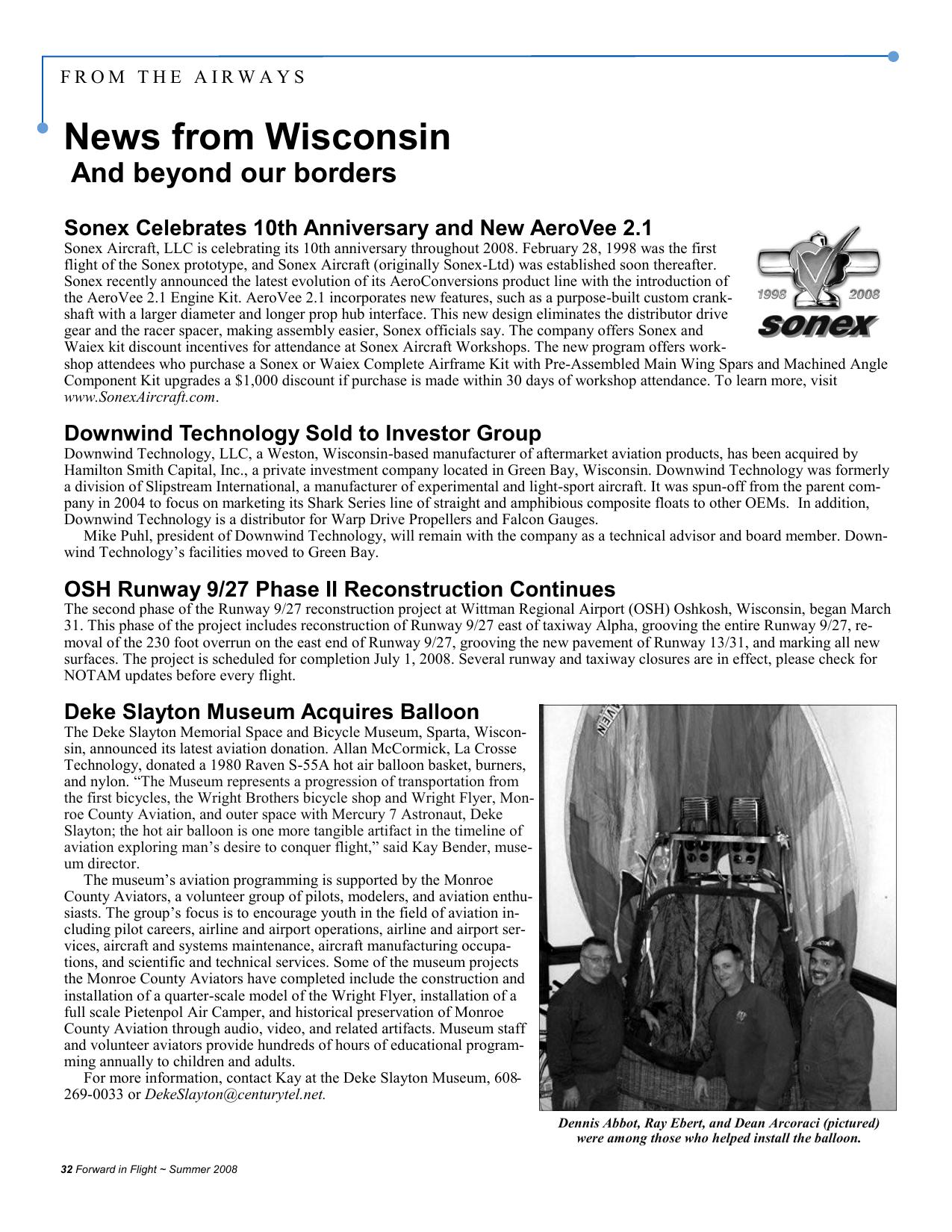
FROM THE AIRWAYS News from Wisconsin And beyond our borders Sonex Celebrates 10th Anniversary and New AeroVee 2.1 Sonex Aircraft, LLC is celebrating its 10th anniversary throughout 2008. February 28, 1998 was the first flight of the Sonex prototype, and Sonex Aircraft (originally Sonex-Ltd) was established soon thereafter. Sonex recently announced the latest evolution of its AeroConversions product line with the introduction of the AeroVee 2.1 Engine Kit. AeroVee 2.1 incorporates new features, such as a purpose-built custom crankshaft with a larger diameter and longer prop hub interface. This new design eliminates the distributor drive gear and the racer spacer, making assembly easier, Sonex officials say. The company offers Sonex and Waiex kit discount incentives for attendance at Sonex Aircraft Workshops. The new program offers workshop attendees who purchase a Sonex or Waiex Complete Airframe Kit with Pre-Assembled Main Wing Spars and Machined Angle Component Kit upgrades a $1,000 discount if purchase is made within 30 days of workshop attendance. To learn more, visit www.SonexAircraft.com. Downwind Technology Sold to Investor Group Downwind Technology, LLC, a Weston, Wisconsin-based manufacturer of aftermarket aviation products, has been acquired by Hamilton Smith Capital, Inc., a private investment company located in Green Bay, Wisconsin. Downwind Technology was formerly a division of Slipstream International, a manufacturer of experimental and light-sport aircraft. It was spun-off from the parent company in 2004 to focus on marketing its Shark Series line of straight and amphibious composite floats to other OEMs. In addition, Downwind Technology is a distributor for Warp Drive Propellers and Falcon Gauges. Mike Puhl, president of Downwind Technology, will remain with the company as a technical advisor and board member. Downwind Technology’s facilities moved to Green Bay. OSH Runway 9/27 Phase II Reconstruction Continues The second phase of the Runway 9/27 reconstruction project at Wittman Regional Airport (OSH) Oshkosh, Wisconsin, began March 31. This phase of the project includes reconstruction of Runway 9/27 east of taxiway Alpha, grooving the entire Runway 9/27, removal of the 230 foot overrun on the east end of Runway 9/27, grooving the new pavement of Runway 13/31, and marking all new surfaces. The project is scheduled for completion July 1, 2008. Several runway and taxiway closures are in effect, please check for NOTAM updates before every flight. Deke Slayton Museum Acquires Balloon The Deke Slayton Memorial Space and Bicycle Museum, Sparta, Wisconsin, announced its latest aviation donation. Allan McCormick, La Crosse Technology, donated a 1980 Raven S-55A hot air balloon basket, burners, and nylon. “The Museum represents a progression of transportation from the first bicycles, the Wright Brothers bicycle shop and Wright Flyer, Monroe County Aviation, and outer space with Mercury 7 Astronaut, Deke Slayton; the hot air balloon is one more tangible artifact in the timeline of aviation exploring man’s desire to conquer flight,” said Kay Bender, museum director. The museum’s aviation programming is supported by the Monroe County Aviators, a volunteer group of pilots, modelers, and aviation enthusiasts. The group’s focus is to encourage youth in the field of aviation including pilot careers, airline and airport operations, airline and airport services, aircraft and systems maintenance, aircraft manufacturing occupations, and scientific and technical services. Some of the museum projects the Monroe County Aviators have completed include the construction and installation of a quarter-scale model of the Wright Flyer, installation of a full scale Pietenpol Air Camper, and historical preservation of Monroe County Aviation through audio, video, and related artifacts. Museum staff and volunteer aviators provide hundreds of hours of educational programming annually to children and adults. For more information, contact Kay at the Deke Slayton Museum, 608269-0033 or DekeSlayton@centurytel.net. Dennis Abbot, Ray Ebert, and Dean Arcoraci (pictured) were among those who helped install the balloon. 32 Forward in Flight ~ Summer 2008
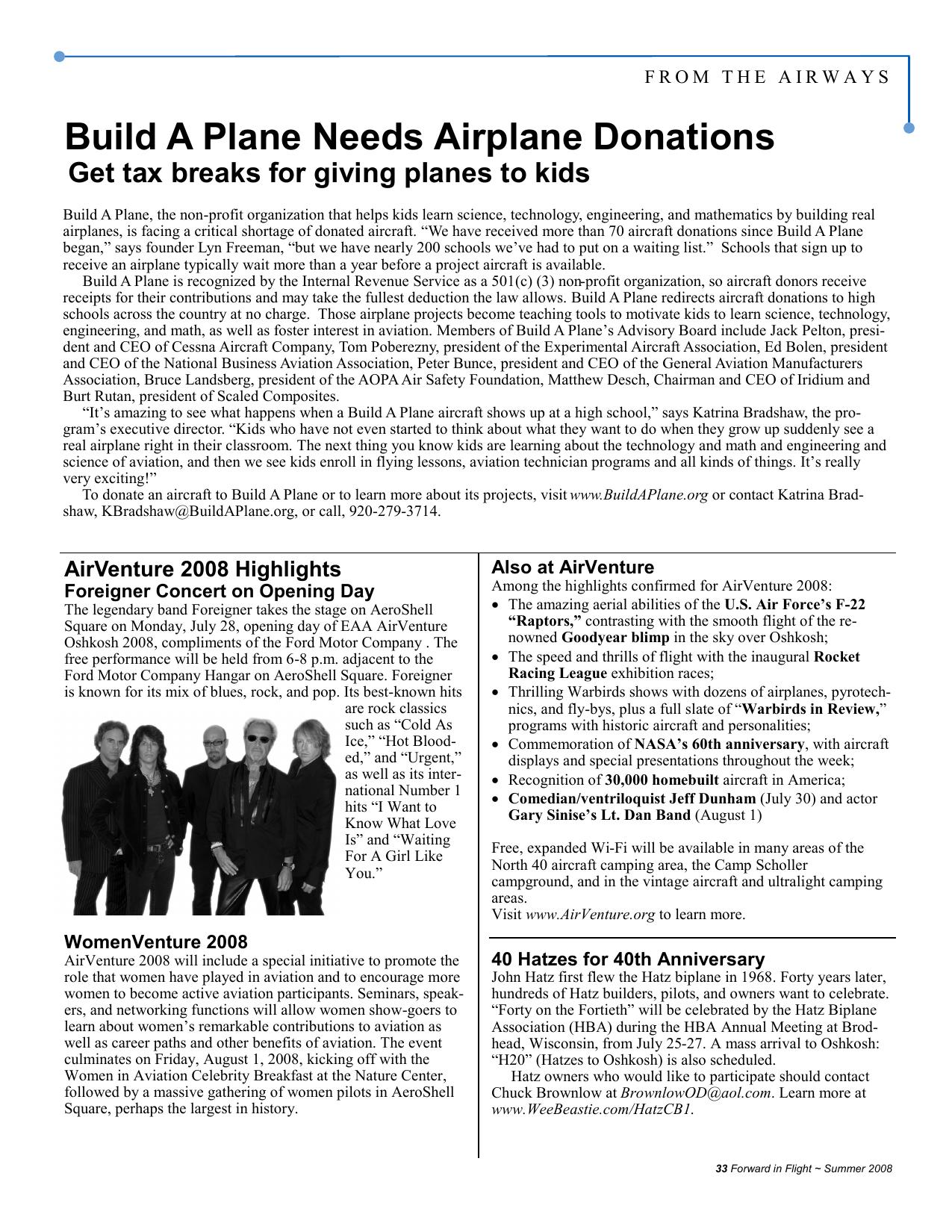
FROM THE AIRWAYS Build A Plane Needs Airplane Donations Get tax breaks for giving planes to kids Build A Plane, the non-profit organization that helps kids learn science, technology, engineering, and mathematics by building real airplanes, is facing a critical shortage of donated aircraft. “We have received more than 70 aircraft donations since Build A Plane began,” says founder Lyn Freeman, “but we have nearly 200 schools we’ve had to put on a waiting list.” Schools that sign up to receive an airplane typically wait more than a year before a project aircraft is available. Build A Plane is recognized by the Internal Revenue Service as a 501(c) (3) non-profit organization, so aircraft donors receive receipts for their contributions and may take the fullest deduction the law allows. Build A Plane redirects aircraft donations to high schools across the country at no charge. Those airplane projects become teaching tools to motivate kids to learn science, technology, engineering, and math, as well as foster interest in aviation. Members of Build A Plane’s Advisory Board include Jack Pelton, president and CEO of Cessna Aircraft Company, Tom Poberezny, president of the Experimental Aircraft Association, Ed Bolen, president and CEO of the National Business Aviation Association, Peter Bunce, president and CEO of the General Aviation Manufacturers Association, Bruce Landsberg, president of the AOPA Air Safety Foundation, Matthew Desch, Chairman and CEO of Iridium and Burt Rutan, president of Scaled Composites. “It’s amazing to see what happens when a Build A Plane aircraft shows up at a high school,” says Katrina Bradshaw, the program’s executive director. “Kids who have not even started to think about what they want to do when they grow up suddenly see a real airplane right in their classroom. The next thing you know kids are learning about the technology and math and engineering and science of aviation, and then we see kids enroll in flying lessons, aviation technician programs and all kinds of things. It’s really very exciting!” To donate an aircraft to Build A Plane or to learn more about its projects, visit www.BuildAPlane.org or contact Katrina Bradshaw, KBradshaw@BuildAPlane.org, or call, 920-279-3714. AirVenture 2008 Highlights Foreigner Concert on Opening Day The legendary band Foreigner takes the stage on AeroShell Square on Monday, July 28, opening day of EAA AirVenture Oshkosh 2008, compliments of the Ford Motor Company . The free performance will be held from 6-8 p.m. adjacent to the Ford Motor Company Hangar on AeroShell Square. Foreigner is known for its mix of blues, rock, and pop. Its best-known hits are rock classics such as “Cold As Ice,” “Hot Blooded,” and “Urgent,” as well as its international Number 1 hits “I Want to Know What Love Is” and “Waiting For A Girl Like You.” WomenVenture 2008 AirVenture 2008 will include a special initiative to promote the role that women have played in aviation and to encourage more women to become active aviation participants. Seminars, speakers, and networking functions will allow women show-goers to learn about women’s remarkable contributions to aviation as well as career paths and other benefits of aviation. The event culminates on Friday, August 1, 2008, kicking off with the Women in Aviation Celebrity Breakfast at the Nature Center, followed by a massive gathering of women pilots in AeroShell Square, perhaps the largest in history. Also at AirVenture Among the highlights confirmed for AirVenture 2008: · The amazing aerial abilities of the U.S. Air Force’s F-22 “Raptors,” contrasting with the smooth flight of the renowned Goodyear blimp in the sky over Oshkosh; · The speed and thrills of flight with the inaugural Rocket Racing League exhibition races; · Thrilling Warbirds shows with dozens of airplanes, pyrotechnics, and fly-bys, plus a full slate of “Warbirds in Review,” programs with historic aircraft and personalities; · Commemoration of NASA’s 60th anniversary, with aircraft displays and special presentations throughout the week; · Recognition of 30,000 homebuilt aircraft in America; · Comedian/ventriloquist Jeff Dunham (July 30) and actor Gary Sinise’s Lt. Dan Band (August 1) Free, expanded Wi-Fi will be available in many areas of the North 40 aircraft camping area, the Camp Scholler campground, and in the vintage aircraft and ultralight camping areas. Visit www.AirVenture.org to learn more. 40 Hatzes for 40th Anniversary John Hatz first flew the Hatz biplane in 1968. Forty years later, hundreds of Hatz builders, pilots, and owners want to celebrate. “Forty on the Fortieth” will be celebrated by the Hatz Biplane Association (HBA) during the HBA Annual Meeting at Brodhead, Wisconsin, from July 25-27. A mass arrival to Oshkosh: “H20” (Hatzes to Oshkosh) is also scheduled. Hatz owners who would like to participate should contact Chuck Brownlow at BrownlowOD@aol.com. Learn more at www.WeeBeastie.com/HatzCB1. 33 Forward in Flight ~ Summer 2008
MEMBER LOGBOOK Acknowledging Outstanding Couples Langer appreciates contributions of Baslers, Wagners A few years ago I nominated Bob Reeve to the WAHF after discussing it with our friend Carl Guell. Carl gave me a lot of encouragement and it was fun contacting the Reeve family and inviting them down for the induction. I had met most of them in Alaska, but never met Bob Reeve. He had passed away just about the time I made my first trip to Alaska. As a kid, he was one of my heroes that I enjoyed reading about. His daughter Janis became a friend of my wife and myself and we took a couple of trips with her on Reeve Aleutian Airlines while visiting up there. We also met Bob’s wife, Tillie. She and Bob were pioneers and shared a lifetime of adventures together. Earlier in the year that Warren Basler was inducted, I had written a nomination for both Warren and his wife, Pat. Maybe we weren’t yet ready to recognize the importance to aviation that Warren’s wife was to his success in promoting his field of aviation. Later I again nominated Pat, but there were many other very worthy candidates and she never was selected. I was disappointed that they were not inducted together, but that was just my feeling, as I knew that one could not have accomplished what they did without the other. The only precedent I knew of for the induction of two people at the same time was the Crites brothers. They were certainly worthy candidates. Dean gave me my first job in aviation and had a lot to do with teaching me to fly while I worked for him at the Manitowoc Airport in 1947. And wasn’t Dale something else with his Curtiss Pusher? I use to tell him that he probably had more time in a Curtiss Pusher than even Glenn Curtiss. We laughed about that. I’m sure that you know, but Dean and Dale even went to Hammondsport, New York, to celebrate Curtiss’ first flight on floats. They trailered the old Pusher out there and strapped on a float built for them that was similar to the one Curtiss used. These guys were Wisconsin pioneer aviators. Now I see that both Dick and Bobbie Wagner are about to be inducted. I am very happy about your choice and particularly happy that both husband and wife are to be inducted together since they also shared their contribution to Wisconsin 34 Forward in Flight ~ Summer 2008 aviation, just as Warren and Pat Basler had. I am proud of the Wisconsin Aviation Hall of Fame in it is now ready to acknowledge the contribution of an outstanding couple, as a couple. I have nothing but praise for the Wisconsin Aviation Hall of Fame, and your magazine. Thanks for the good work. Best Wishes, Norb Langer And thanks for your kind words, Norb. I agree, Pat Basler was integral to the success of their business. Family businesses thrive with the support of both husband and wife; the Baslers and the Wagners are remarkable examples. –Editor History comes alive for FIF reader I may sound like a broken record, but your Forward in Flight magazine just keeps getting better and better. Thank you for such a great job on the last [Spring 2008] issue. I’ve never been a “history buff,” but your articles make it come alive. Bob Kunkel Middleton, Wisconsin
MAGAZINE MATTERS Submissions Requested! Because...we can’t write about it if we’re not there Have you attended an aviation event in Wisconsin and were disappointed not to see coverage of it in Forward in Flight? If so, consider submitting a report of the next event you attend. Forward in Flight covers many current events, knowing that what happens in aviation today becomes tomorrow’s history, and this magazine is just one way of recording it. However, if we can’t be there, we can’t write about it. Have you been to an EAA chapter event, airport fly-in, or a safety or airport operations seminar that was especially interesting? Send a report, with photos. Know someone who could be featured? Send it in. We’ll be happy to consider it for a future issue of Forward in Flight. Don’t forget to send your story ideas, too. Do you have a press release to share? Drop us a line! Is there something you would like to see more of—or even, less of—then tell us. Email the editor at flyer@aviationhalloffamewisconsin.com. A Special Thanks to our Advertisers The Wisconsin Aviation Hall of Fame has received great support from several aviation businesses over the years. Without them, bringing you aviation stories, past and present, wouldn’t be possible. Thank you to Dr. Tom Voelker, Mead & Hunt, Morey Airplane Company, Wisconsin Aviation, Pat O’Malley’s Jet Room, Orion Flight Services, Lakeshore Aviation, Eagle Fuel Cells, Beaver Aviation, and NewView Technologies. Most of these businesses have been loyal advertisers for several years, and some have supported WAHF in other ways, too, including donations to support our scholarship program and other special projects. Can you support the Wisconsin Aviation Hall of Fame by placing an ad? We would love to hear from you. Please contact WAHF at 920-385-1483 or 715-570-1186. Subscribe to Forward in Flight If you received a complimentary issue of this magazine and would like to subscribe, it’s easy! Forward in Flight is a quarterly membership magazine that helps support the work of the Wisconsin Aviation Hall of Fame. As a subscriber, you become a one-year member/supporter of the organization. By becoming a supporter, you help honor the men and women who enhance aviation in Wisconsin. Send a check to the address below. Just $20 annually. Bob served his country... At age 10, Bob Skuldt skipped school and rode his bicycle to see Charles Lindbergh land at Madison’s Royal Airport. That experience led to a lifetime passion for aviation, including World War II service and a 35-year career as director of what is now the Dane County Regional Airport. We’re proud to share his story, and that he’s an inductee. ...You can help salute him. Your Forward in Flight subscription ensures that together we can continue to honor the men and women who enhance aviation in Wisconsin. Just $20 annually Wisconsin Aviation Hall of Fame Learn more at www.aviationhalloffamewisconsin.com Call 920-385-1483 for more information, or send a check to: Wisconsin Aviation Hall of Fame 3980 Sharratt Drive Oshkosh WI 54901-1276 35 Forward in Flight ~ Summer 2008
WISCONSIN AVIATION HALL OF FAME 3980 SHARRATT DRIVE OSHKOSH WI 54901-1276 Welcome New WAHF Members: Ed Haberl Don Lindemann Harold Benisch James Van Wychen John Monnett Betty Monnett David J. Noble Nooji Van Wychen Bill LeGore Bob Sigman Richard Leitner Ken Klima Bob Massie Frank Allegretti Steve Rehwinkel Michael Keegan Garner Sowle Col. Gunther Neumann Steve Sletten John Sill Dave Mann Weston Miller B.J. Bussie Patricia Osbakken Thanks for coming onboard. We hope to see you at a WAHF event soon. Thank you to Omnni Associates, for providing funding for a display unit that will be used at aviation, school, and civic events to help spread the word about Wisconsin’s rich aviation history and the people who made it. Thank you to Orion Flight Services, Oshkosh, for supporting WAHF through Forward in Flight advertising. Congratulations to WAHF members Nate and Kelly Nelson on the birth of their first child, Hunter James Nelson, born May 8, 2008. Girls’ Aviation Workshop – Ages 14-18, Wednesday, June 25, 2008 at the Aviation Heritage Center, Sheboygan County Memorial Airport. 8:30am-4:30pm. Speakers, airport tour, and workshops on aerodynamics, flight planning, weather, and more. Fifty participant limit. Visit www.SheboyganAviation.com for additional information. Thought for the day: “Doing things that matter to lots of people means that there will be many opinions of you. Some opinions will be unfavorable no matter how good a job you do.” From Favorite Thoughts of John and Martha King, www.KingSchools.com. PRSRT STD US Postage Paid Wisc Rapids WI Permit 98 Wisconsin Aviation Hall of Fame Officers and Board of Directors Rose Dorcey, President Michael Goc, Vice President John Dorcey, Secretary/Treasurer Duane Esse Keith Glasshof Tom Thomas Charles Swain LaFonda Kinnaman Staber “Bill” Reese Charles Marotske, Honorary Chairman of the Board Wisconsin Aviation Hall of Fame 3980 Sharratt Drive Oshkosh WI 54901-1276 Become a supporter today! For information call Rose Dorcey at 920-385-1483 www.aviationhalloffamewisconsin.com flyer@aviationhalloffamewisconsin.com