Volume 7, Issue 2
🗞️ Download Issue (PDF)
Forward in Flight - Summer 2009
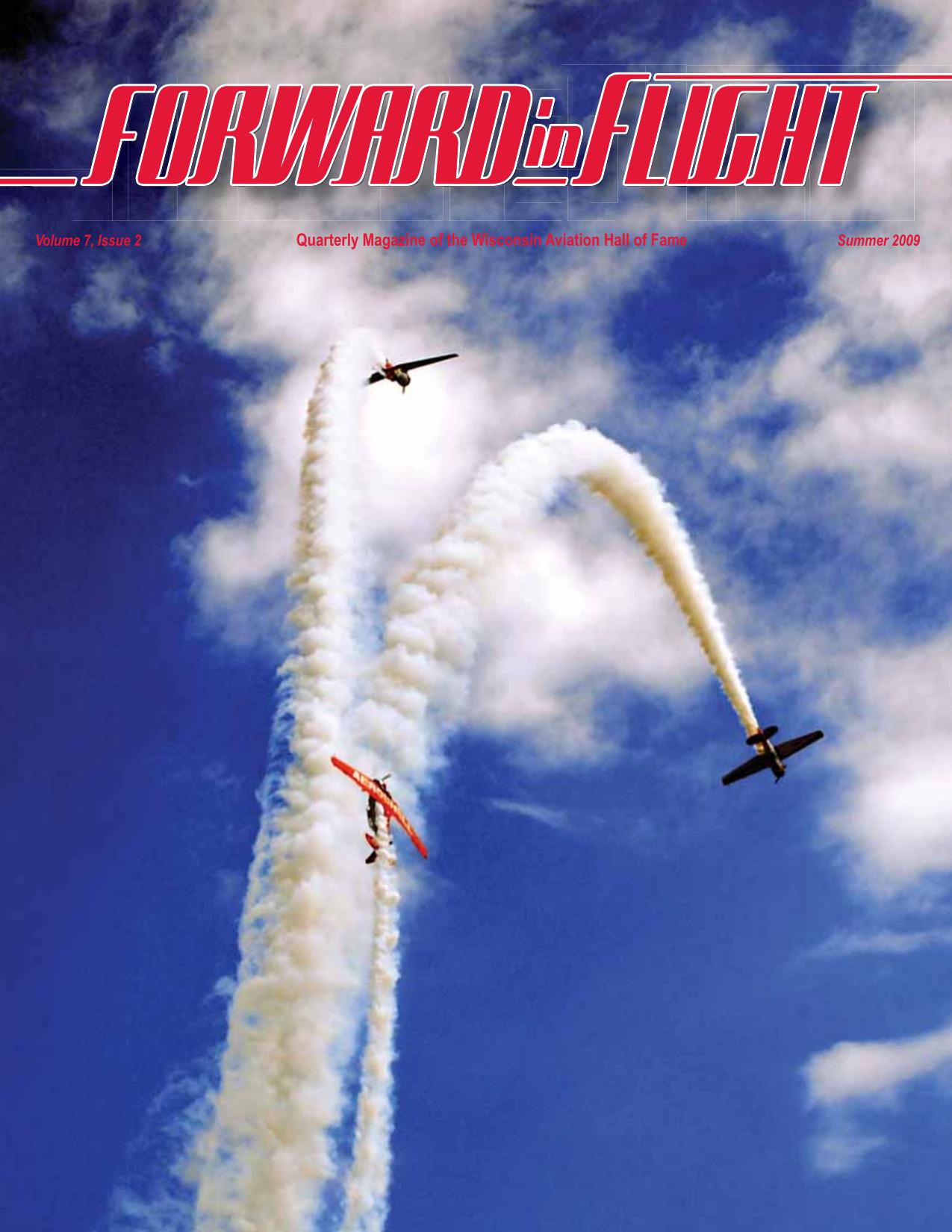
Volume 7, Issue 2 Quarterly Magazine of the Wisconsin Aviation Hall of Fame Summer 2009
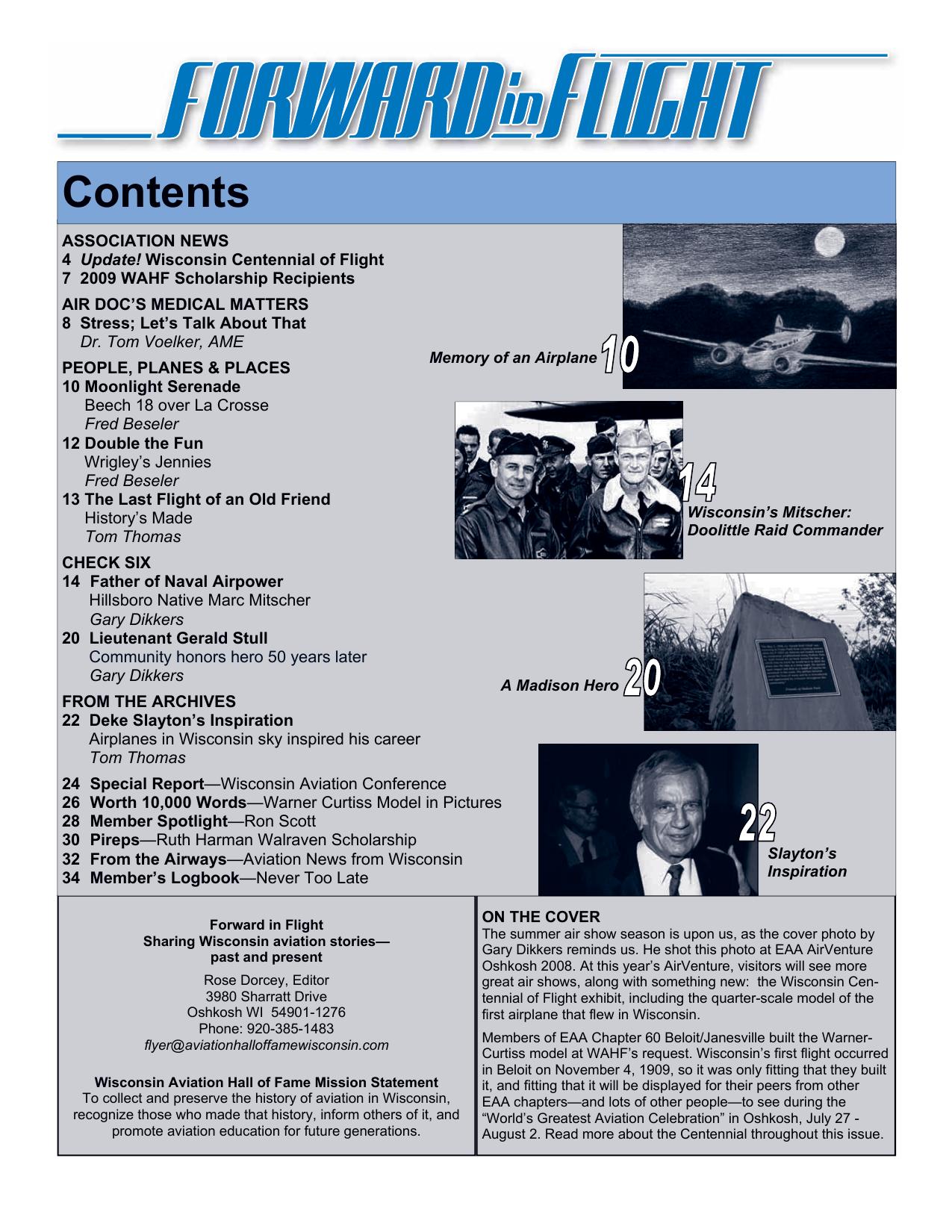
Contents ASSOCIATION NEWS 4 Update! Wisconsin Centennial of Flight 7 2009 WAHF Scholarship Recipients AIR DOC’S MEDICAL MATTERS 8 Stress; Let’s Talk About That Dr. Tom Voelker, AME PEOPLE, PLANES & PLACES 10 Moonlight Serenade Beech 18 over La Crosse Fred Beseler 12 Double the Fun Wrigley’s Jennies Fred Beseler 13 The Last Flight of an Old Friend History’s Made Tom Thomas Memory of an Airplane CHECK SIX 14 Father of Naval Airpower Hillsboro Native Marc Mitscher Gary Dikkers 20 Lieutenant Gerald Stull Community honors hero 50 years later Gary Dikkers FROM THE ARCHIVES 22 Deke Slayton’s Inspiration Airplanes in Wisconsin sky inspired his career Tom Thomas Wisconsin’s Mitscher: Doolittle Raid Commander A Madison Hero 24 Special Report—Wisconsin Aviation Conference 26 Worth 10,000 Words—Warner Curtiss Model in Pictures 28 Member Spotlight—Ron Scott 30 Pireps—Ruth Harman Walraven Scholarship 32 From the Airways—Aviation News from Wisconsin 34 Member’s Logbook—Never Too Late Forward in Flight Sharing Wisconsin aviation stories— past and present Rose Dorcey, Editor 3980 Sharratt Drive Oshkosh WI 54901-1276 Phone: 920-385-1483 flyer@aviationhalloffamewisconsin.com Wisconsin Aviation Hall of Fame Mission Statement To collect and preserve the history of aviation in Wisconsin, recognize those who made that history, inform others of it, and promote aviation education for future generations. Slayton’s Inspiration ON THE COVER The summer air show season is upon us, as the cover photo by Gary Dikkers reminds us. He shot this photo at EAA AirVenture Oshkosh 2008. At this year’s AirVenture, visitors will see more great air shows, along with something new: the Wisconsin Centennial of Flight exhibit, including the quarter-scale model of the first airplane that flew in Wisconsin. Members of EAA Chapter 60 Beloit/Janesville built the WarnerCurtiss model at WAHF’s request. Wisconsin’s first flight occurred in Beloit on November 4, 1909, so it was only fitting that they built it, and fitting that it will be displayed for their peers from other EAA chapters—and lots of other people—to see during the “World’s Greatest Aviation Celebration” in Oshkosh, July 27 August 2. Read more about the Centennial throughout this issue.
President’s Message ~ by Rose Dorcey The last time I wrote my President’s Message I was excited about the work being completed by EAA Chapter 60 members on the Warner Curtiss aircraft, a quarter-scale model of the first airplane that flew in Wisconsin. Today, I’m just as excited, because I’ve seen their finished project, and it is beautiful. Words cannot express the gratitude that myself and all the WAHF board members have for the dedication and work that these craftsmen contributed toward the successful completion of the model. As it travels on its statewide tour, we continue to hear compliments about their attention to detail and the degree of difficulty in working with the tiny nuts, bolts, turnbuckles, and other itty-bitty parts the builders worked with. If you haven’t seen it, turn to page 5 to find the summer schedule and a location near you; you’ll probably be just as proud and inspired by their work as I am. The greatest joy in attending events where the model is displayed is seeing the awe and wonder that it inspires when we tell of its history. Hundreds of men, women, and children have viewed it so far, and we’ve heard some great questions and comments, especially from the kids. These conversations lead to questions about pilot requirements and restrictions, and one young boy was delighted to find out he can be a pilot in spite of the fact he wears glasses. This highlights just one goal of WAHF Wisconsin Centennial of Flight celebration...to inspire and educate kids about the history of aviation in our state, and the opportunities that flight offers them today. So far, mission accomplished, and we’re looking forward to additional oppor- tunities to share this message with kids of all ages. If you have an idea for sharing it with kids in your area, please contact WAHF at 608-339-7191 or 920-385-1483. Of course, the Centennial Celebration wouldn’t be possible without the support of many organizations and individuals. In addition to the contributions of EAA Chapter 60 members, the Wisconsin Space Grant Consortium awarded WAHF a $2500 grant, the Beloit Jet Grant contributed $1000, and Warner Electric gave $1000. Wood Products, Co., of Darien provided labor and materials to provide a storage crate, and a handful of WAHF members have given donations, as well. The Beloit Convention and Visitor’s Bureau has been supporting this effort through its coordination of local events, and the Beloit College has offered its facility for a November presentation by Smithsonian Curator Tom Crouch. Many news and aviation organizations are helping to spread the word about these exciting Centennial events, and we are thankful to every WAHF member and friend who are doing the same, and to all who have helped in any way, large and small. WAHF board members Tom Thomas and Michael Goc have headed up the effort to mark this historic occasion, and they, like me, hope many of you will join us in celebration. A.P. Warner brought Wisconsin into the age of aviation 100 years ago, and his accomplishment led to many others that we are the benefactors of. Let’s celebrate that together! Looking for a speaker for your next aviation event? A breakfast with Jeff Skiles, co-pilot on the US Airways Flight 1549 Hudson River landing, will be held on June 25, 7 to 9 a.m. at the Sheraton on John Nolen Drive in Madison, Wisconsin. There is no charge for this fundraising event, which benefits the Boy Scouts, but an appeal will be made at the end of the presentation. Public is welcome to attend. To make reservations or learn more call Les German at 608-310-7307 or visit www.GlaciersEdge.org. Invite a WAHF speaker to share fun but factual stories about Wisconsin aviation history!* Call John at 920-385-1483 or Mike at 608-339-7191 or send an email to: speakers@aviationhalloffamewisconsin.com. *Presentations can be tailored to your area of interest. 3 Forward in Flight ~ Summer 2009
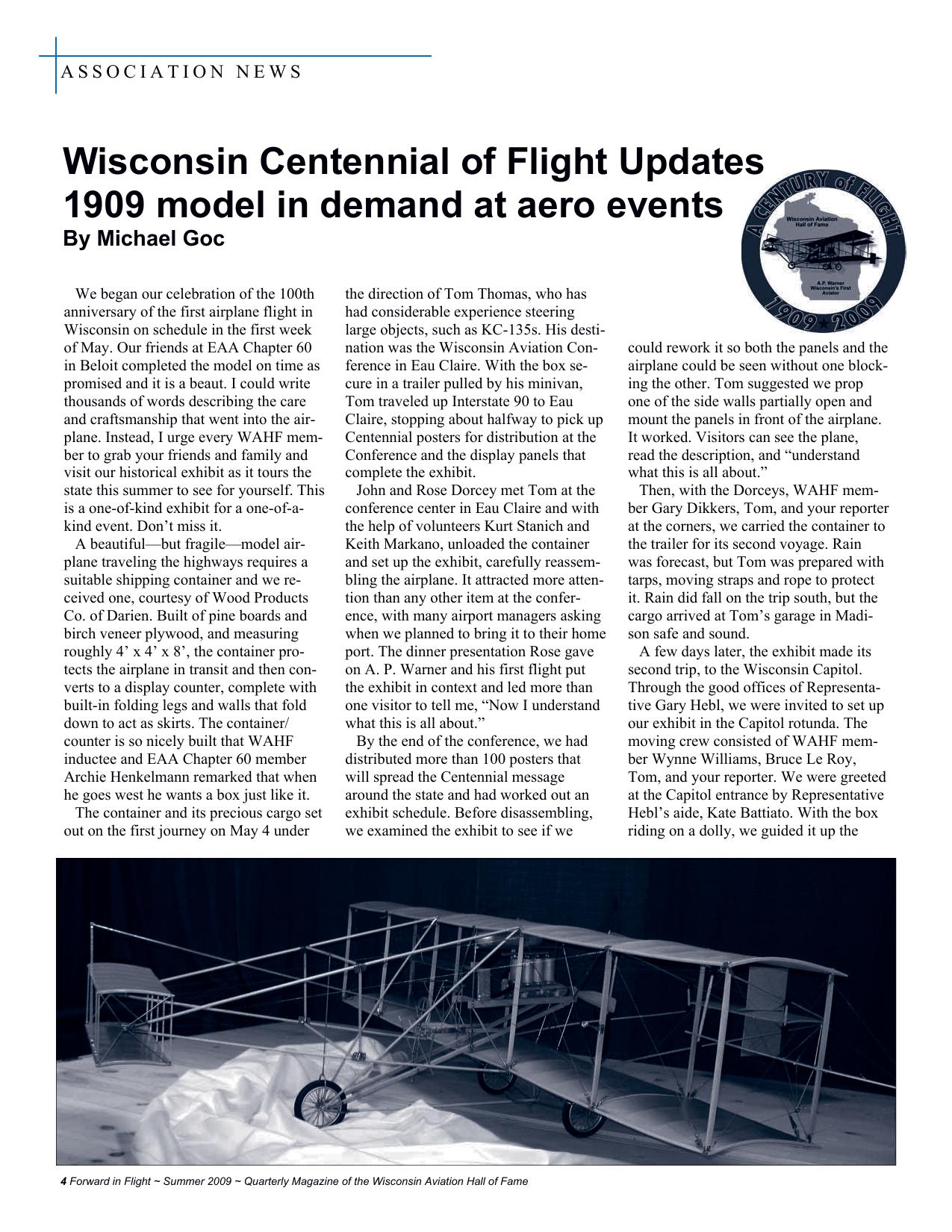
ASSOCIATION NEWS Wisconsin Centennial of Flight Updates 1909 model in demand at aero events By Michael Goc We began our celebration of the 100th anniversary of the first airplane flight in Wisconsin on schedule in the first week of May. Our friends at EAA Chapter 60 in Beloit completed the model on time as promised and it is a beaut. I could write thousands of words describing the care and craftsmanship that went into the airplane. Instead, I urge every WAHF member to grab your friends and family and visit our historical exhibit as it tours the state this summer to see for yourself. This is a one-of-kind exhibit for a one-of-akind event. Don’t miss it. A beautiful—but fragile—model airplane traveling the highways requires a suitable shipping container and we received one, courtesy of Wood Products Co. of Darien. Built of pine boards and birch veneer plywood, and measuring roughly 4’ x 4’ x 8’, the container protects the airplane in transit and then converts to a display counter, complete with built-in folding legs and walls that fold down to act as skirts. The container/ counter is so nicely built that WAHF inductee and EAA Chapter 60 member Archie Henkelmann remarked that when he goes west he wants a box just like it. The container and its precious cargo set out on the first journey on May 4 under the direction of Tom Thomas, who has had considerable experience steering large objects, such as KC-135s. His destination was the Wisconsin Aviation Conference in Eau Claire. With the box secure in a trailer pulled by his minivan, Tom traveled up Interstate 90 to Eau Claire, stopping about halfway to pick up Centennial posters for distribution at the Conference and the display panels that complete the exhibit. John and Rose Dorcey met Tom at the conference center in Eau Claire and with the help of volunteers Kurt Stanich and Keith Markano, unloaded the container and set up the exhibit, carefully reassembling the airplane. It attracted more attention than any other item at the conference, with many airport managers asking when we planned to bring it to their home port. The dinner presentation Rose gave on A. P. Warner and his first flight put the exhibit in context and led more than one visitor to tell me, “Now I understand what this is all about.” By the end of the conference, we had distributed more than 100 posters that will spread the Centennial message around the state and had worked out an exhibit schedule. Before disassembling, we examined the exhibit to see if we 4 Forward in Flight ~ Summer 2009 ~ Quarterly Magazine of the Wisconsin Aviation Hall of Fame could rework it so both the panels and the airplane could be seen without one blocking the other. Tom suggested we prop one of the side walls partially open and mount the panels in front of the airplane. It worked. Visitors can see the plane, read the description, and “understand what this is all about.” Then, with the Dorceys, WAHF member Gary Dikkers, Tom, and your reporter at the corners, we carried the container to the trailer for its second voyage. Rain was forecast, but Tom was prepared with tarps, moving straps and rope to protect it. Rain did fall on the trip south, but the cargo arrived at Tom’s garage in Madison safe and sound. A few days later, the exhibit made its second trip, to the Wisconsin Capitol. Through the good offices of Representative Gary Hebl, we were invited to set up our exhibit in the Capitol rotunda. The moving crew consisted of WAHF member Wynne Williams, Bruce Le Roy, Tom, and your reporter. We were greeted at the Capitol entrance by Representative Hebl’s aide, Kate Battiato. With the box riding on a dolly, we guided it up the
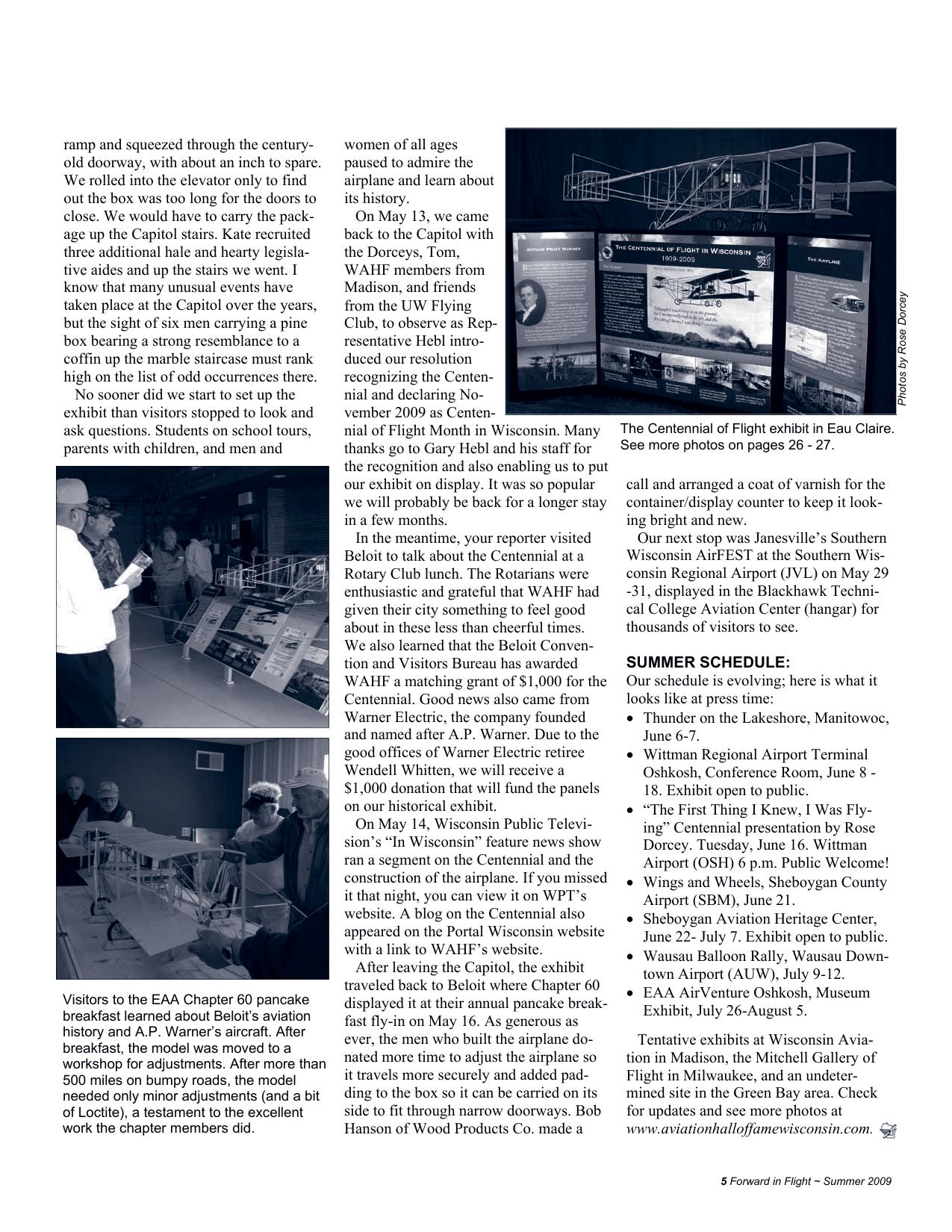
Visitors to the EAA Chapter 60 pancake breakfast learned about Beloit’s aviation history and A.P. Warner’s aircraft. After breakfast, the model was moved to a workshop for adjustments. After more than 500 miles on bumpy roads, the model needed only minor adjustments (and a bit of Loctite), a testament to the excellent work the chapter members did. women of all ages paused to admire the airplane and learn about its history. On May 13, we came back to the Capitol with the Dorceys, Tom, WAHF members from Madison, and friends from the UW Flying Club, to observe as Representative Hebl introduced our resolution recognizing the Centennial and declaring November 2009 as Centennial of Flight Month in Wisconsin. Many The Centennial of Flight exhibit in Eau Claire. See more photos on pages 26 - 27. thanks go to Gary Hebl and his staff for the recognition and also enabling us to put call and arranged a coat of varnish for the our exhibit on display. It was so popular we will probably be back for a longer stay container/display counter to keep it looking bright and new. in a few months. Our next stop was Janesville’s Southern In the meantime, your reporter visited Wisconsin AirFEST at the Southern WisBeloit to talk about the Centennial at a consin Regional Airport (JVL) on May 29 Rotary Club lunch. The Rotarians were -31, displayed in the Blackhawk Technienthusiastic and grateful that WAHF had cal College Aviation Center (hangar) for given their city something to feel good thousands of visitors to see. about in these less than cheerful times. We also learned that the Beloit ConvenSUMMER SCHEDULE: tion and Visitors Bureau has awarded WAHF a matching grant of $1,000 for the Our schedule is evolving; here is what it looks like at press time: Centennial. Good news also came from Warner Electric, the company founded • Thunder on the Lakeshore, Manitowoc, and named after A.P. Warner. Due to the June 6-7. good offices of Warner Electric retiree • Wittman Regional Airport Terminal Wendell Whitten, we will receive a Oshkosh, Conference Room, June 8 $1,000 donation that will fund the panels 18. Exhibit open to public. on our historical exhibit. • “The First Thing I Knew, I Was FlyOn May 14, Wisconsin Public Televiing” Centennial presentation by Rose sion’s “In Wisconsin” feature news show Dorcey. Tuesday, June 16. Wittman ran a segment on the Centennial and the Airport (OSH) 6 p.m. Public Welcome! construction of the airplane. If you missed • Wings and Wheels, Sheboygan County it that night, you can view it on WPT’s Airport (SBM), June 21. website. A blog on the Centennial also • Sheboygan Aviation Heritage Center, appeared on the Portal Wisconsin website June 22- July 7. Exhibit open to public. with a link to WAHF’s website. • Wausau Balloon Rally, Wausau DownAfter leaving the Capitol, the exhibit town Airport (AUW), July 9-12. traveled back to Beloit where Chapter 60 • EAA AirVenture Oshkosh, Museum displayed it at their annual pancake breakExhibit, July 26-August 5. fast fly-in on May 16. As generous as ever, the men who built the airplane doTentative exhibits at Wisconsin Avianated more time to adjust the airplane so tion in Madison, the Mitchell Gallery of it travels more securely and added padFlight in Milwaukee, and an undeterding to the box so it can be carried on its mined site in the Green Bay area. Check side to fit through narrow doorways. Bob for updates and see more photos at Hanson of Wood Products Co. made a www.aviationhalloffamewisconsin.com. 5 Forward in Flight ~ Summer 2009 Photos by Rose Dorcey ramp and squeezed through the centuryold doorway, with about an inch to spare. We rolled into the elevator only to find out the box was too long for the doors to close. We would have to carry the package up the Capitol stairs. Kate recruited three additional hale and hearty legislative aides and up the stairs we went. I know that many unusual events have taken place at the Capitol over the years, but the sight of six men carrying a pine box bearing a strong resemblance to a coffin up the marble staircase must rank high on the list of odd occurrences there. No sooner did we start to set up the exhibit than visitors stopped to look and ask questions. Students on school tours, parents with children, and men and
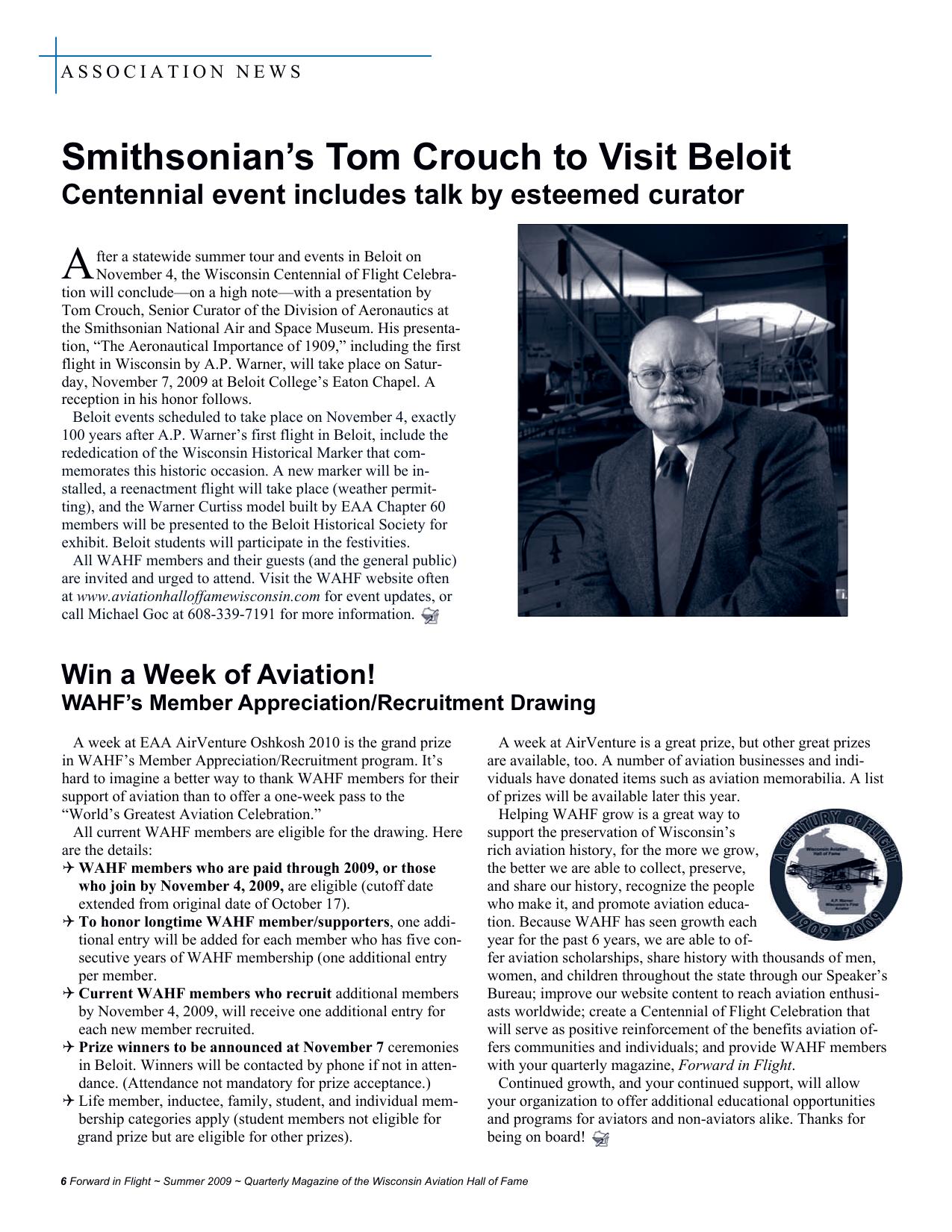
ASSOCIATION NEWS Smithsonian’s Tom Crouch to Visit Beloit Centennial event includes talk by esteemed curator A fter a statewide summer tour and events in Beloit on November 4, the Wisconsin Centennial of Flight Celebration will conclude—on a high note—with a presentation by Tom Crouch, Senior Curator of the Division of Aeronautics at the Smithsonian National Air and Space Museum. His presentation, “The Aeronautical Importance of 1909,” including the first flight in Wisconsin by A.P. Warner, will take place on Saturday, November 7, 2009 at Beloit College’s Eaton Chapel. A reception in his honor follows. Beloit events scheduled to take place on November 4, exactly 100 years after A.P. Warner’s first flight in Beloit, include the rededication of the Wisconsin Historical Marker that commemorates this historic occasion. A new marker will be installed, a reenactment flight will take place (weather permitting), and the Warner Curtiss model built by EAA Chapter 60 members will be presented to the Beloit Historical Society for exhibit. Beloit students will participate in the festivities. All WAHF members and their guests (and the general public) are invited and urged to attend. Visit the WAHF website often at www.aviationhalloffamewisconsin.com for event updates, or call Michael Goc at 608-339-7191 for more information. Win a Week of Aviation! WAHF’s Member Appreciation/Recruitment Drawing A week at EAA AirVenture Oshkosh 2010 is the grand prize in WAHF’s Member Appreciation/Recruitment program. It’s hard to imagine a better way to thank WAHF members for their support of aviation than to offer a one-week pass to the “World’s Greatest Aviation Celebration.” All current WAHF members are eligible for the drawing. Here are the details: 4 WAHF members who are paid through 2009, or those who join by November 4, 2009, are eligible (cutoff date extended from original date of October 17). 4 To honor longtime WAHF member/supporters, one additional entry will be added for each member who has five consecutive years of WAHF membership (one additional entry per member. 4 Current WAHF members who recruit additional members by November 4, 2009, will receive one additional entry for each new member recruited. 4 Prize winners to be announced at November 7 ceremonies in Beloit. Winners will be contacted by phone if not in attendance. (Attendance not mandatory for prize acceptance.) 4 Life member, inductee, family, student, and individual membership categories apply (student members not eligible for grand prize but are eligible for other prizes). A week at AirVenture is a great prize, but other great prizes are available, too. A number of aviation businesses and individuals have donated items such as aviation memorabilia. A list of prizes will be available later this year. Helping WAHF grow is a great way to support the preservation of Wisconsin’s rich aviation history, for the more we grow, the better we are able to collect, preserve, and share our history, recognize the people who make it, and promote aviation education. Because WAHF has seen growth each year for the past 6 years, we are able to offer aviation scholarships, share history with thousands of men, women, and children throughout the state through our Speaker’s Bureau; improve our website content to reach aviation enthusiasts worldwide; create a Centennial of Flight Celebration that will serve as positive reinforcement of the benefits aviation offers communities and individuals; and provide WAHF members with your quarterly magazine, Forward in Flight. Continued growth, and your continued support, will allow your organization to offer additional educational opportunities and programs for aviators and non-aviators alike. Thanks for being on board! 6 Forward in Flight ~ Summer 2009 ~ Quarterly Magazine of the Wisconsin Aviation Hall of Fame
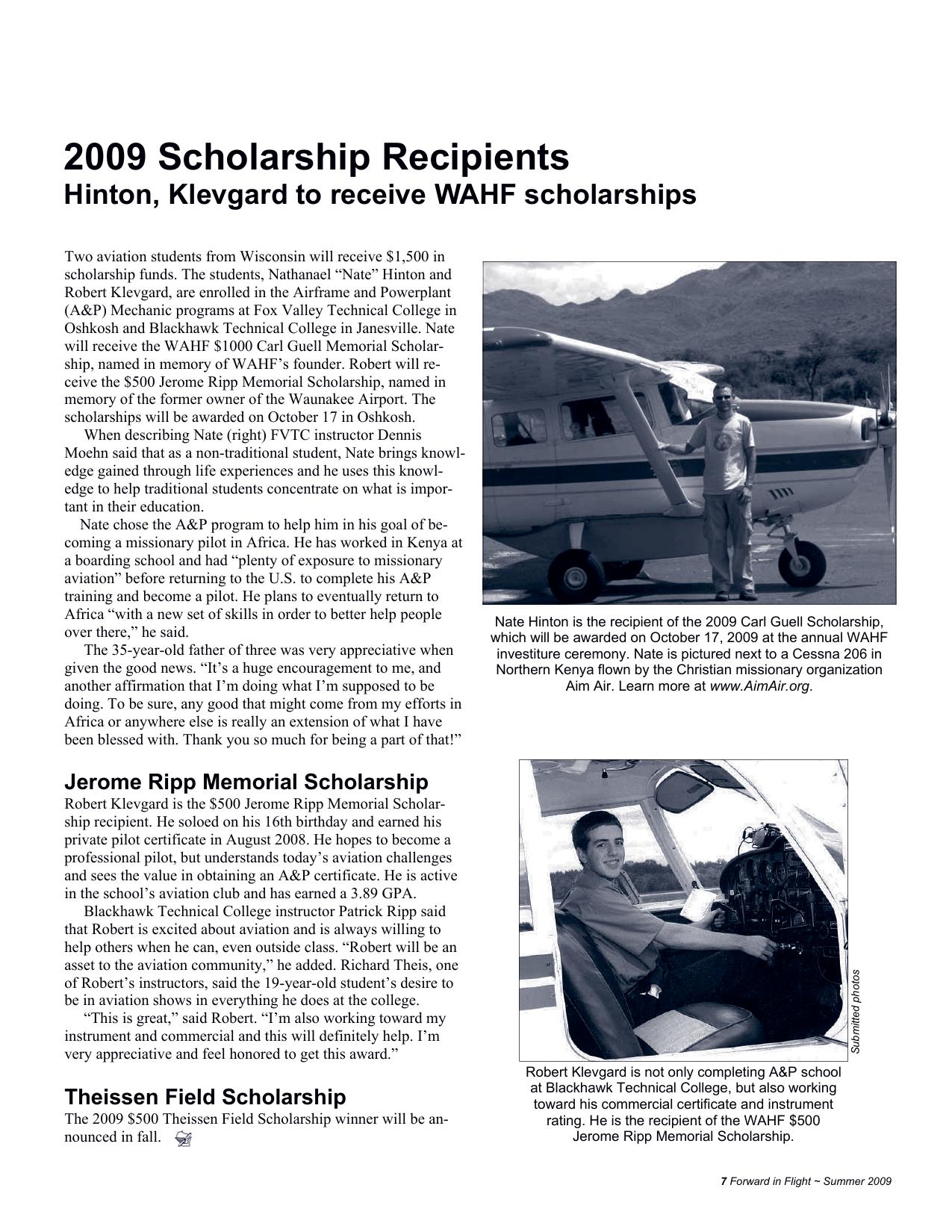
2009 Scholarship Recipients Hinton, Klevgard to receive WAHF scholarships Two aviation students from Wisconsin will receive $1,500 in scholarship funds. The students, Nathanael “Nate” Hinton and Robert Klevgard, are enrolled in the Airframe and Powerplant (A&P) Mechanic programs at Fox Valley Technical College in Oshkosh and Blackhawk Technical College in Janesville. Nate will receive the WAHF $1000 Carl Guell Memorial Scholarship, named in memory of WAHF’s founder. Robert will receive the $500 Jerome Ripp Memorial Scholarship, named in memory of the former owner of the Waunakee Airport. The scholarships will be awarded on October 17 in Oshkosh. When describing Nate (right) FVTC instructor Dennis Moehn said that as a non-traditional student, Nate brings knowledge gained through life experiences and he uses this knowledge to help traditional students concentrate on what is important in their education. Nate chose the A&P program to help him in his goal of becoming a missionary pilot in Africa. He has worked in Kenya at a boarding school and had “plenty of exposure to missionary aviation” before returning to the U.S. to complete his A&P training and become a pilot. He plans to eventually return to Africa “with a new set of skills in order to better help people over there,” he said. The 35-year-old father of three was very appreciative when given the good news. “It’s a huge encouragement to me, and another affirmation that I’m doing what I’m supposed to be doing. To be sure, any good that might come from my efforts in Africa or anywhere else is really an extension of what I have been blessed with. Thank you so much for being a part of that!” Nate Hinton is the recipient of the 2009 Carl Guell Scholarship, which will be awarded on October 17, 2009 at the annual WAHF investiture ceremony. Nate is pictured next to a Cessna 206 in Northern Kenya flown by the Christian missionary organization Aim Air. Learn more at www.AimAir.org. Jerome Ripp Memorial Scholarship Theissen Field Scholarship The 2009 $500 Theissen Field Scholarship winner will be announced in fall. Submitted photos Robert Klevgard is the $500 Jerome Ripp Memorial Scholarship recipient. He soloed on his 16th birthday and earned his private pilot certificate in August 2008. He hopes to become a professional pilot, but understands today’s aviation challenges and sees the value in obtaining an A&P certificate. He is active in the school’s aviation club and has earned a 3.89 GPA. Blackhawk Technical College instructor Patrick Ripp said that Robert is excited about aviation and is always willing to help others when he can, even outside class. “Robert will be an asset to the aviation community,” he added. Richard Theis, one of Robert’s instructors, said the 19-year-old student’s desire to be in aviation shows in everything he does at the college. “This is great,” said Robert. “I’m also working toward my instrument and commercial and this will definitely help. I’m very appreciative and feel honored to get this award.” Robert Klevgard is not only completing A&P school at Blackhawk Technical College, but also working toward his commercial certificate and instrument rating. He is the recipient of the WAHF $500 Jerome Ripp Memorial Scholarship. 7 Forward in Flight ~ Summer 2009
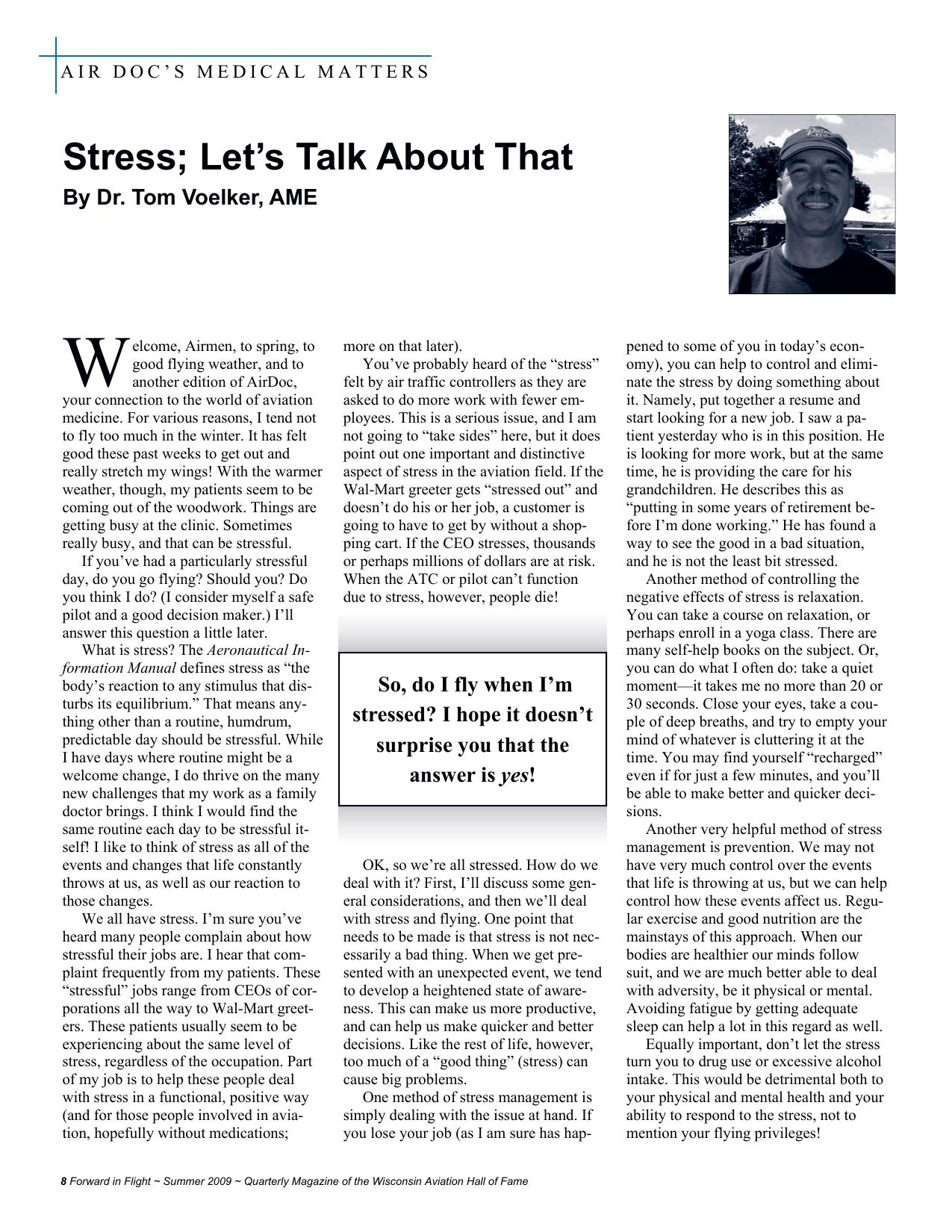
AIR DOC’S MEDICAL MATTERS Stress; Let’s Talk About That By Dr. Tom Voelker, AME W elcome, Airmen, to spring, to good flying weather, and to another edition of AirDoc, your connection to the world of aviation medicine. For various reasons, I tend not to fly too much in the winter. It has felt good these past weeks to get out and really stretch my wings! With the warmer weather, though, my patients seem to be coming out of the woodwork. Things are getting busy at the clinic. Sometimes really busy, and that can be stressful. If you’ve had a particularly stressful day, do you go flying? Should you? Do you think I do? (I consider myself a safe pilot and a good decision maker.) I’ll answer this question a little later. What is stress? The Aeronautical Information Manual defines stress as “the body’s reaction to any stimulus that disturbs its equilibrium.” That means anything other than a routine, humdrum, predictable day should be stressful. While I have days where routine might be a welcome change, I do thrive on the many new challenges that my work as a family doctor brings. I think I would find the same routine each day to be stressful itself! I like to think of stress as all of the events and changes that life constantly throws at us, as well as our reaction to those changes. We all have stress. I’m sure you’ve heard many people complain about how stressful their jobs are. I hear that complaint frequently from my patients. These “stressful” jobs range from CEOs of corporations all the way to Wal-Mart greeters. These patients usually seem to be experiencing about the same level of stress, regardless of the occupation. Part of my job is to help these people deal with stress in a functional, positive way (and for those people involved in aviation, hopefully without medications; more on that later). You’ve probably heard of the “stress” felt by air traffic controllers as they are asked to do more work with fewer employees. This is a serious issue, and I am not going to “take sides” here, but it does point out one important and distinctive aspect of stress in the aviation field. If the Wal-Mart greeter gets “stressed out” and doesn’t do his or her job, a customer is going to have to get by without a shopping cart. If the CEO stresses, thousands or perhaps millions of dollars are at risk. When the ATC or pilot can’t function due to stress, however, people die! So, do I fly when I’m stressed? I hope it doesn’t surprise you that the answer is yes! OK, so we’re all stressed. How do we deal with it? First, I’ll discuss some general considerations, and then we’ll deal with stress and flying. One point that needs to be made is that stress is not necessarily a bad thing. When we get presented with an unexpected event, we tend to develop a heightened state of awareness. This can make us more productive, and can help us make quicker and better decisions. Like the rest of life, however, too much of a “good thing” (stress) can cause big problems. One method of stress management is simply dealing with the issue at hand. If you lose your job (as I am sure has hap- 8 Forward in Flight ~ Summer 2009 ~ Quarterly Magazine of the Wisconsin Aviation Hall of Fame pened to some of you in today’s economy), you can help to control and eliminate the stress by doing something about it. Namely, put together a resume and start looking for a new job. I saw a patient yesterday who is in this position. He is looking for more work, but at the same time, he is providing the care for his grandchildren. He describes this as “putting in some years of retirement before I’m done working.” He has found a way to see the good in a bad situation, and he is not the least bit stressed. Another method of controlling the negative effects of stress is relaxation. You can take a course on relaxation, or perhaps enroll in a yoga class. There are many self-help books on the subject. Or, you can do what I often do: take a quiet moment—it takes me no more than 20 or 30 seconds. Close your eyes, take a couple of deep breaths, and try to empty your mind of whatever is cluttering it at the time. You may find yourself “recharged” even if for just a few minutes, and you’ll be able to make better and quicker decisions. Another very helpful method of stress management is prevention. We may not have very much control over the events that life is throwing at us, but we can help control how these events affect us. Regular exercise and good nutrition are the mainstays of this approach. When our bodies are healthier our minds follow suit, and we are much better able to deal with adversity, be it physical or mental. Avoiding fatigue by getting adequate sleep can help a lot in this regard as well. Equally important, don’t let the stress turn you to drug use or excessive alcohol intake. This would be detrimental both to your physical and mental health and your ability to respond to the stress, not to mention your flying privileges!
The FAA’s Word on Stress What does the FAA say about stress and anxiety? Since stress is really a part of life, it’s not surprising that most of the information emanating from the FAA involves managing stress rather than treating or eliminating it. And since flying requires you to be on top of your game, a major part of stress management is knowing when it is severe enough that you are not up to the tasks and decision making required to fly safely. Most pilots have probably heard of the “I’M SAFE” checklist, used by pilots to “self certify” as ready and able to proceed with a given planned flight. This acronym stands for Illness, Medication, Stress, Alcohol, Fatigue, and Eating. An honest assessment of each of these factors before each flight can go a long way toward eliminating the “human factors” that are at least partly responsible for upwards of 60 percent of all aircraft accidents. When we find it difficult to function due to excessive stress, then we may need more than just good nutrition and yoga. This is where professional help comes in. Seeking out a counselor (psychologist, clinical social worker, or other qualified professional) can give you more skills to deal with the stress, or to make the appropriate decisions to eliminate the stress. Another option is to see your doctor. He or she may be able to help with stress management as well, but often the treatment of choice will be medications. Be aware, though, that the FAA considers all anxiety medications to be disqualifying for flight, and if you are on Xanax, Valium, or a similar medication at the time of your medical, your AME will need to at least defer your application to Okla- homa City. Am I saying you shouldn’t be treated if your anxiety or stress response is severe? Absolutely not! If you need the treatment, get it. But perhaps a non drug treatment would be appropriate to try initially. If you have any questions, contact your AME. So, do I fly when I’m stressed? I hope it doesn’t surprise you that the answer is yes! I find flying to be so relaxing that it is one of my “stress relievers.” It’s important to remember that stresses are a normal part of life. I find that the absolute concentration on the aircraft, engine performance and monitoring, scanning (for traffic or scanning the instruments in the clouds), and communication frees my mind of all the stresses that were piling up on me only minutes earlier. (The view from “up there” doesn’t hurt, either!) But at the same time, I always pause before I climb into the cockpit of “42-Papa” to make sure “I’M SAFE.” If I find I’m stressed enough that I can’t devote my full faculties to the task of flying, I’ll stay on the ground. Not all of my flying experiences have been stress-free, however. I would bet that most of you have had an episode of stress in the plane as well. I learned early on the importance of being at the “top of my game” while flying. I also learned that stress really can increase my awareness and improve my performance. When I was flying from Wisconsin Rapids to Marshfield to take my Private Pilot check ride my instructor wanted to try “unusual attitudes” one last time. This exercise is where the student closes his eyes with his head in his lap, and the instructor “messes with” the throttle, pitch, bank angle, compass, and anything else they can think of. (At the time I didn’t know that the trim tab was fair game, too.) The student then sits up and recovers the airplane to level flight. When I opened my eyes, we were headed down in what seemed like a 75-degree nose down dive at near redline airspeed. I closed the throttle and pulled back as hard as I could (and I noticed Donna, my instructor, started to pull back too), and we were barely able to stop the descent. Talk about stress! Suffice it to say the check ride was an enjoyable, stress-free breeze! Now you know everything I do about stress. I know your life will not be free of stress, but hopefully you’ll be able to put that stress to good use! Get out there and enjoy the summer skies! Fly often, and fly safely! —Alpha Mike In “real” life, Dr. Alpha Mike Echo (AME) is Dr. Tom Voelker, a family practitioner in Wisconsin Rapids. He and his wife, Kathy, are the parents of four daughters. Tom flies N6442P, a Comanche 250, out of Alexander Field, South Wood County Airport (ISW). 9 Forward in Flight ~ Summer 2009
PEOPLE, PLANES & PLACES Moonlight Serenade Beech 18 over La Crosse By Frederick Beseler On cool, clear, full-moon nights I’m haunted by the memory of an airplane and its pilot whom I never met. Many years have passed since I used to hear an old Beech 18 airplane come chugging down the Mississippi River valley on its nightly run from Minneapolis to Chicago. At the time, I was told the plane carried checks and important documents between the Federal Reserve Banks. You could almost set your clock by the old plane, generally about 1:30 a.m. depending upon whether there was a headwind or tailwind that night. The leisurely, rumbling serenade of the Beech’s twin 450-horsepower Pratt & Whitney “Wasp” radial engines was as familiar and comforting as a warm blanket. Radial engines have a throaty growl that a hundred Harley-Davidsons can’t match on their best day. In the quiet of the night, you could hear the venerable old Beech coming for miles, the drone getting a little louder, peaking and then fading as it passed overhead at La Crosse and turned to the southeast to pick up a heading for Chicago. Some nights I would hop out of bed to watch from the bedroom window. Sure enough, there it was—red, green, and white position lights sailing along. Moonlight danced upon the wings and the silver, shimmering HamiltonStandard propellers. As the Beech disappeared over the Mississippi River valley bluffs, the soft blue flicker of the engines’ exhaust waved as if to say, “So long, until tomorrow.” I’d think about how lucky that pilot was to fly such a great, old plane in the middle of the night when skies are quiet and calm, the world sleeping below. Perhaps he or she had the ADF tuned to some soft music. Today, with global positioning, I wonder if they even make ADF systems anymore. No matter. On a clear, fullmoon night all a pilot needs is good eyes and a basic sense of direction to fly from Minneapolis to Chicago. Many nights I’d imagine myself up there in that cockpit, bathed in the dim glow of instruments and the rhythmic lullaby of synchronized engines. After taking off from Wold-Chamberlain Field (Minneapolis International’s name years ago) the shiny Mississippi illuminates our path to Hastings, Red Wing, Lake City, Alma, Winona, Trempealeau, and La Crosse. With the plane trimmed out to fly hands off, I imagine the view of the sleeping countryside sliding beneath my wings so far below across the cold, clear sky. Whatever happened on that final approach, the old Beech and its pilot ran out of altitude, airspeed, and luck all at the same time. Turning southeasterly at La Crosse, streetlights of succeeding villages guide us from town to town, like sparkling diamonds along a path. Soon Madison passes behind, then Janesville and Rockford. Minutes later Chicago’s orange glow spreads out along the horizon like welcoming arms. Watching the old Beech on those nights was like watching aviation history sail 10 Forward in Flight ~ Summer 2009 ~ Quarterly Magazine of the Wisconsin Aviation Hall of Fame by. The very first Beech Model 18 first flew in January 1937, when airplanes had piston engines, propellers, and tail wheels. Those were the days when Jimmy Doolittle, Jackie Cochran, Amelia Earhart, Wiley Post, and Roscoe Turner blazed trails across the sky. Earhart and her navigator, Fred Noonan, and their Lockheed Electra, a plane very similar to the Beech 18, disappeared over the Pacific later that year. Designers like Donald Douglas and Jack Northrop were making their marks, and airplane companies were still owned by the men who started them: Clyde Cessna, William Boeing, Claude Ryan, Walter Beech, William Piper, and others. In its day, the Beech 18 was popular with corporate executives—Dairyland Power and Trane each had one. Fledgling airlines like Midstate Airlines got their start with a Beech 18. Back then a cruising speed of about 180 miles per hour— three miles a minute—was top line. And Beech airplanes were reliable. Those Pratt & Whitney radial engines seemed to run forever, at least from the perspective of the old pilots who had learned to fly in a Curtis Jenny with a finicky OX-5 engine up front. Sure, the Beech 18’s 450-horse engines consumed fuel at a prodigious rate, but back then, avgas was relatively cheap. Radial engines used oil, too. Lots of it. A 450-horse Pratt & Whitney will burn a
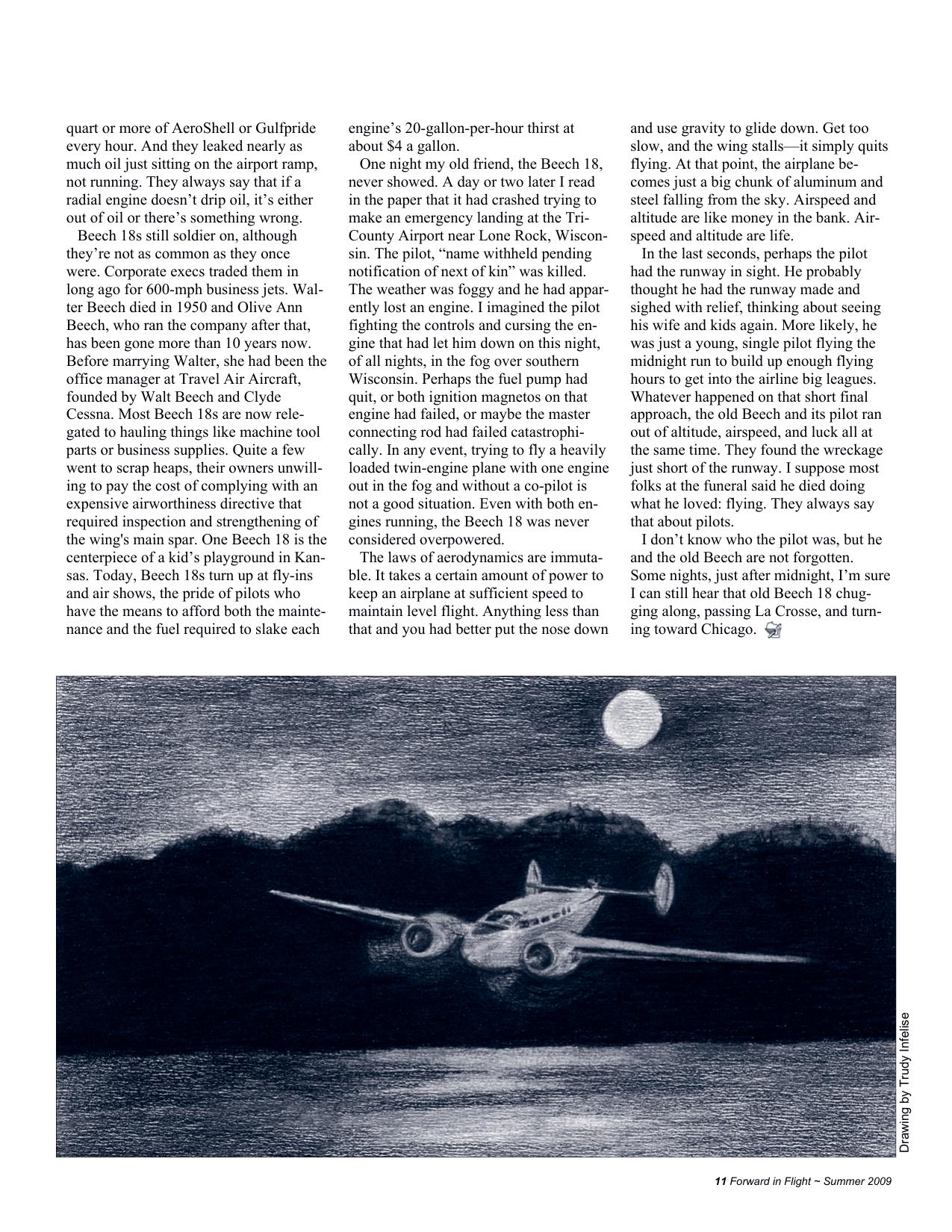
engine’s 20-gallon-per-hour thirst at about $4 a gallon. One night my old friend, the Beech 18, never showed. A day or two later I read in the paper that it had crashed trying to make an emergency landing at the TriCounty Airport near Lone Rock, Wisconsin. The pilot, “name withheld pending notification of next of kin” was killed. The weather was foggy and he had apparently lost an engine. I imagined the pilot fighting the controls and cursing the engine that had let him down on this night, of all nights, in the fog over southern Wisconsin. Perhaps the fuel pump had quit, or both ignition magnetos on that engine had failed, or maybe the master connecting rod had failed catastrophically. In any event, trying to fly a heavily loaded twin-engine plane with one engine out in the fog and without a co-pilot is not a good situation. Even with both engines running, the Beech 18 was never considered overpowered. The laws of aerodynamics are immutable. It takes a certain amount of power to keep an airplane at sufficient speed to maintain level flight. Anything less than that and you had better put the nose down and use gravity to glide down. Get too slow, and the wing stalls—it simply quits flying. At that point, the airplane becomes just a big chunk of aluminum and steel falling from the sky. Airspeed and altitude are like money in the bank. Airspeed and altitude are life. In the last seconds, perhaps the pilot had the runway in sight. He probably thought he had the runway made and sighed with relief, thinking about seeing his wife and kids again. More likely, he was just a young, single pilot flying the midnight run to build up enough flying hours to get into the airline big leagues. Whatever happened on that short final approach, the old Beech and its pilot ran out of altitude, airspeed, and luck all at the same time. They found the wreckage just short of the runway. I suppose most folks at the funeral said he died doing what he loved: flying. They always say that about pilots. I don’t know who the pilot was, but he and the old Beech are not forgotten. Some nights, just after midnight, I’m sure I can still hear that old Beech 18 chugging along, passing La Crosse, and turning toward Chicago. Drawing by Trudy Infelise quart or more of AeroShell or Gulfpride every hour. And they leaked nearly as much oil just sitting on the airport ramp, not running. They always say that if a radial engine doesn’t drip oil, it’s either out of oil or there’s something wrong. Beech 18s still soldier on, although they’re not as common as they once were. Corporate execs traded them in long ago for 600-mph business jets. Walter Beech died in 1950 and Olive Ann Beech, who ran the company after that, has been gone more than 10 years now. Before marrying Walter, she had been the office manager at Travel Air Aircraft, founded by Walt Beech and Clyde Cessna. Most Beech 18s are now relegated to hauling things like machine tool parts or business supplies. Quite a few went to scrap heaps, their owners unwilling to pay the cost of complying with an expensive airworthiness directive that required inspection and strengthening of the wing's main spar. One Beech 18 is the centerpiece of a kid’s playground in Kansas. Today, Beech 18s turn up at fly-ins and air shows, the pride of pilots who have the means to afford both the maintenance and the fuel required to slake each 11 Forward in Flight ~ Summer 2009
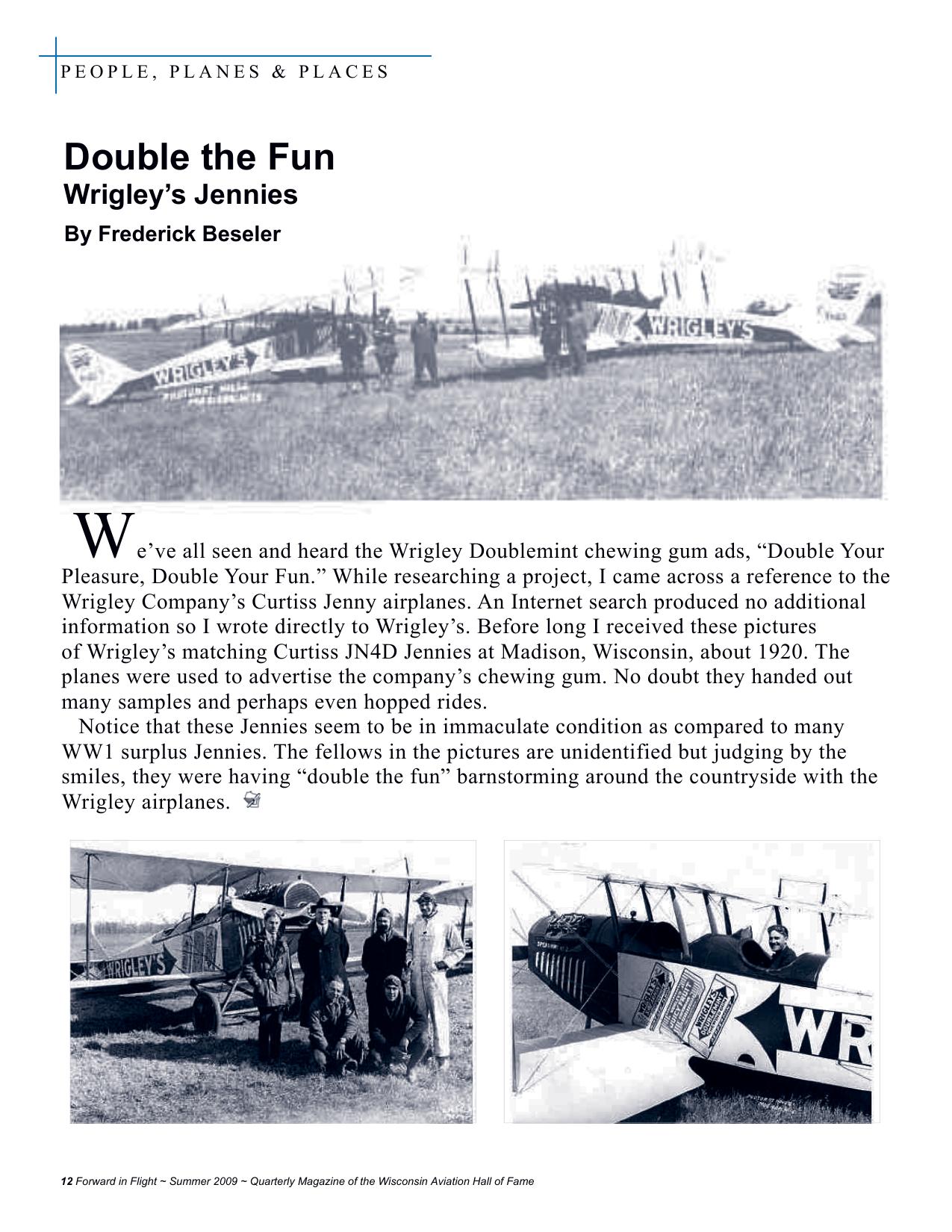
PEOPLE, PLANES & PLACES Double the Fun Wrigley’s Jennies By Frederick Beseler W e’ve all seen and heard the Wrigley Doublemint chewing gum ads, “Double Your Pleasure, Double Your Fun.” While researching a project, I came across a reference to the Wrigley Company’s Curtiss Jenny airplanes. An Internet search produced no additional information so I wrote directly to Wrigley’s. Before long I received these pictures of Wrigley’s matching Curtiss JN4D Jennies at Madison, Wisconsin, about 1920. The planes were used to advertise the company’s chewing gum. No doubt they handed out many samples and perhaps even hopped rides. Notice that these Jennies seem to be in immaculate condition as compared to many WW1 surplus Jennies. The fellows in the pictures are unidentified but judging by the smiles, they were having “double the fun” barnstorming around the countryside with the Wrigley airplanes. 12 Forward in Flight ~ Summer 2009 ~ Quarterly Magazine of the Wisconsin Aviation Hall of Fame
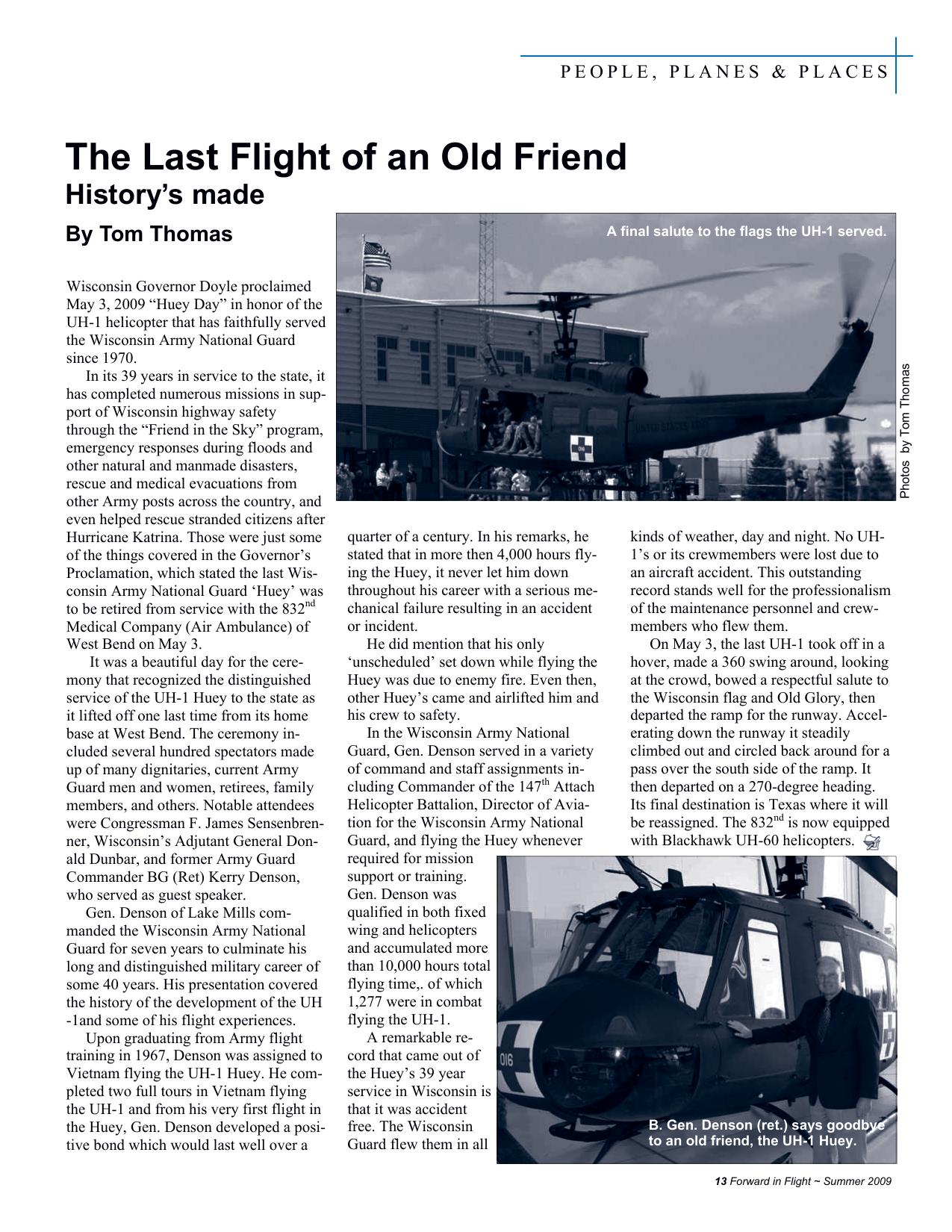
PEOPLE, PLANES & PLACES The Last Flight of an Old Friend History’s made By Tom Thomas Photos by Tom Thomas Wisconsin Governor Doyle proclaimed May 3, 2009 “Huey Day” in honor of the UH-1 helicopter that has faithfully served the Wisconsin Army National Guard since 1970. In its 39 years in service to the state, it has completed numerous missions in support of Wisconsin highway safety through the “Friend in the Sky” program, emergency responses during floods and other natural and manmade disasters, rescue and medical evacuations from other Army posts across the country, and even helped rescue stranded citizens after Hurricane Katrina. Those were just some of the things covered in the Governor’s Proclamation, which stated the last Wisconsin Army National Guard ‘Huey’ was to be retired from service with the 832nd Medical Company (Air Ambulance) of West Bend on May 3. It was a beautiful day for the ceremony that recognized the distinguished service of the UH-1 Huey to the state as it lifted off one last time from its home base at West Bend. The ceremony included several hundred spectators made up of many dignitaries, current Army Guard men and women, retirees, family members, and others. Notable attendees were Congressman F. James Sensenbrenner, Wisconsin’s Adjutant General Donald Dunbar, and former Army Guard Commander BG (Ret) Kerry Denson, who served as guest speaker. Gen. Denson of Lake Mills commanded the Wisconsin Army National Guard for seven years to culminate his long and distinguished military career of some 40 years. His presentation covered the history of the development of the UH -1and some of his flight experiences. Upon graduating from Army flight training in 1967, Denson was assigned to Vietnam flying the UH-1 Huey. He completed two full tours in Vietnam flying the UH-1 and from his very first flight in the Huey, Gen. Denson developed a positive bond which would last well over a A final salute to the flags the UH-1 served. quarter of a century. In his remarks, he stated that in more then 4,000 hours flying the Huey, it never let him down throughout his career with a serious mechanical failure resulting in an accident or incident. He did mention that his only ‘unscheduled’ set down while flying the Huey was due to enemy fire. Even then, other Huey’s came and airlifted him and his crew to safety. In the Wisconsin Army National Guard, Gen. Denson served in a variety of command and staff assignments including Commander of the 147th Attach Helicopter Battalion, Director of Aviation for the Wisconsin Army National Guard, and flying the Huey whenever required for mission support or training. Gen. Denson was qualified in both fixed wing and helicopters and accumulated more than 10,000 hours total flying time,. of which 1,277 were in combat flying the UH-1. A remarkable record that came out of the Huey’s 39 year service in Wisconsin is that it was accident free. The Wisconsin Guard flew them in all kinds of weather, day and night. No UH1’s or its crewmembers were lost due to an aircraft accident. This outstanding record stands well for the professionalism of the maintenance personnel and crewmembers who flew them. On May 3, the last UH-1 took off in a hover, made a 360 swing around, looking at the crowd, bowed a respectful salute to the Wisconsin flag and Old Glory, then departed the ramp for the runway. Accelerating down the runway it steadily climbed out and circled back around for a pass over the south side of the ramp. It then departed on a 270-degree heading. Its final destination is Texas where it will be reassigned. The 832nd is now equipped with Blackhawk UH-60 helicopters. B. Gen. Denson (ret.) says goodbye to an old friend, the UH-1 Huey. 13 Forward in Flight ~ Summer 2009
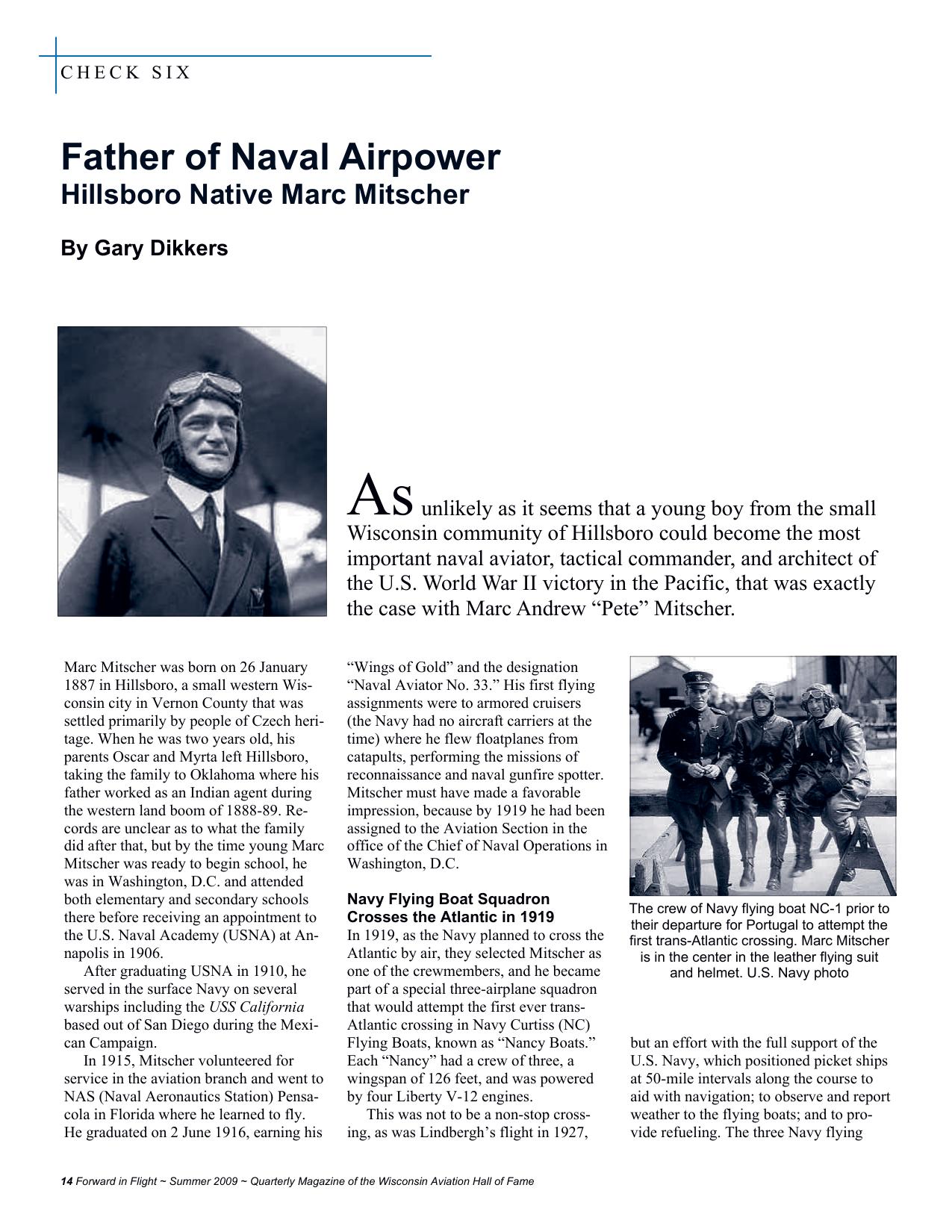
CHECK SIX Father of Naval Airpower Hillsboro Native Marc Mitscher By Gary Dikkers As unlikely as it seems that a young boy from the small Wisconsin community of Hillsboro could become the most important naval aviator, tactical commander, and architect of the U.S. World War II victory in the Pacific, that was exactly the case with Marc Andrew “Pete” Mitscher. Marc Mitscher was born on 26 January 1887 in Hillsboro, a small western Wisconsin city in Vernon County that was settled primarily by people of Czech heritage. When he was two years old, his parents Oscar and Myrta left Hillsboro, taking the family to Oklahoma where his father worked as an Indian agent during the western land boom of 1888-89. Records are unclear as to what the family did after that, but by the time young Marc Mitscher was ready to begin school, he was in Washington, D.C. and attended both elementary and secondary schools there before receiving an appointment to the U.S. Naval Academy (USNA) at Annapolis in 1906. After graduating USNA in 1910, he served in the surface Navy on several warships including the USS California based out of San Diego during the Mexican Campaign. In 1915, Mitscher volunteered for service in the aviation branch and went to NAS (Naval Aeronautics Station) Pensacola in Florida where he learned to fly. He graduated on 2 June 1916, earning his “Wings of Gold” and the designation “Naval Aviator No. 33.” His first flying assignments were to armored cruisers (the Navy had no aircraft carriers at the time) where he flew floatplanes from catapults, performing the missions of reconnaissance and naval gunfire spotter. Mitscher must have made a favorable impression, because by 1919 he had been assigned to the Aviation Section in the office of the Chief of Naval Operations in Washington, D.C. Navy Flying Boat Squadron Crosses the Atlantic in 1919 In 1919, as the Navy planned to cross the Atlantic by air, they selected Mitscher as one of the crewmembers, and he became part of a special three-airplane squadron that would attempt the first ever transAtlantic crossing in Navy Curtiss (NC) Flying Boats, known as “Nancy Boats.” Each “Nancy” had a crew of three, a wingspan of 126 feet, and was powered by four Liberty V-12 engines. This was not to be a non-stop crossing, as was Lindbergh’s flight in 1927, 14 Forward in Flight ~ Summer 2009 ~ Quarterly Magazine of the Wisconsin Aviation Hall of Fame The crew of Navy flying boat NC-1 prior to their departure for Portugal to attempt the first trans-Atlantic crossing. Marc Mitscher is in the center in the leather flying suit and helmet. U.S. Navy photo but an effort with the full support of the U.S. Navy, which positioned picket ships at 50-mile intervals along the course to aid with navigation; to observe and report weather to the flying boats; and to provide refueling. The three Navy flying
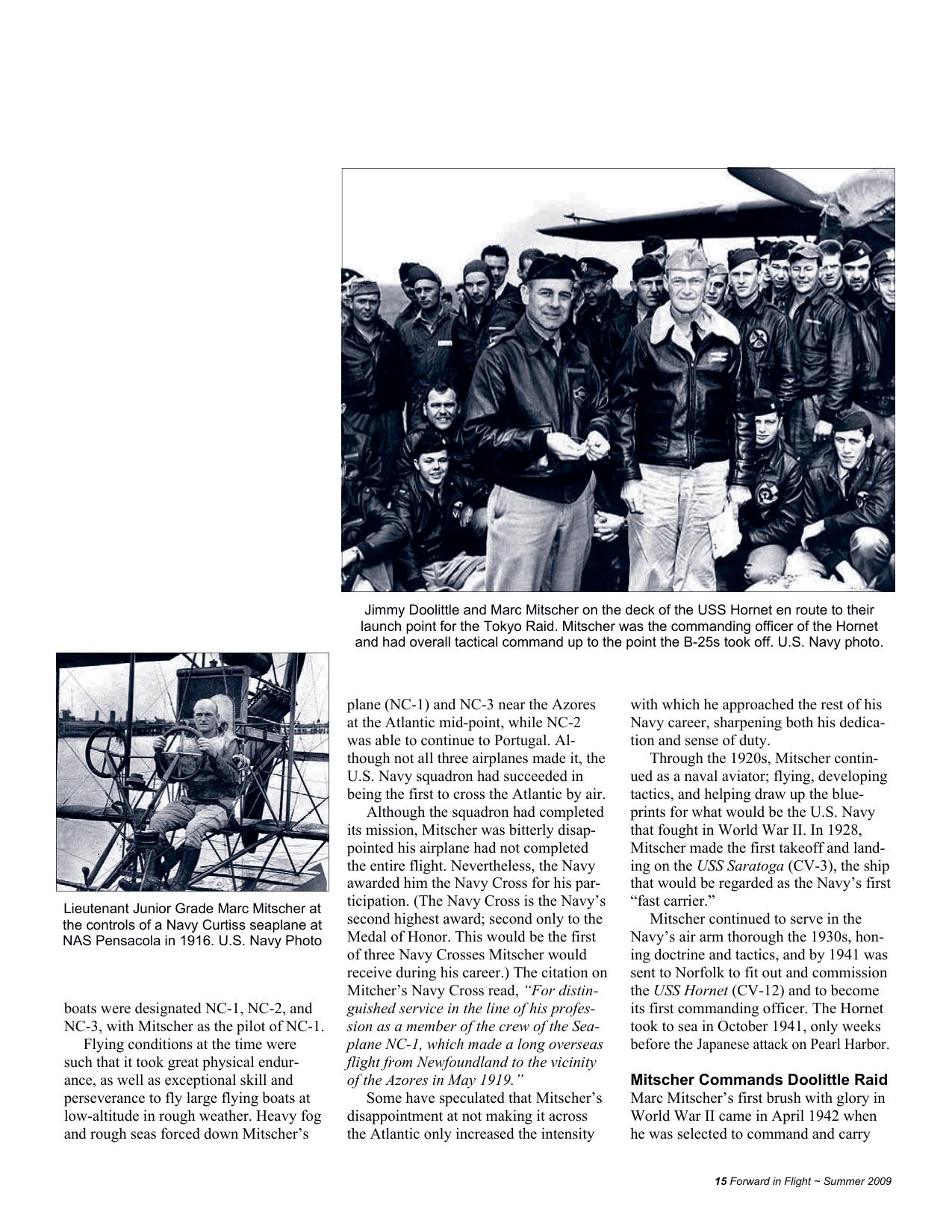
Jimmy Doolittle and Marc Mitscher on the deck of the USS Hornet en route to their launch point for the Tokyo Raid. Mitscher was the commanding officer of the Hornet and had overall tactical command up to the point the B-25s took off. U.S. Navy photo. Lieutenant Junior Grade Marc Mitscher at the controls of a Navy Curtiss seaplane at NAS Pensacola in 1916. U.S. Navy Photo boats were designated NC-1, NC-2, and NC-3, with Mitscher as the pilot of NC-1. Flying conditions at the time were such that it took great physical endurance, as well as exceptional skill and perseverance to fly large flying boats at low-altitude in rough weather. Heavy fog and rough seas forced down Mitscher’s plane (NC-1) and NC-3 near the Azores at the Atlantic mid-point, while NC-2 was able to continue to Portugal. Although not all three airplanes made it, the U.S. Navy squadron had succeeded in being the first to cross the Atlantic by air. Although the squadron had completed its mission, Mitscher was bitterly disappointed his airplane had not completed the entire flight. Nevertheless, the Navy awarded him the Navy Cross for his participation. (The Navy Cross is the Navy’s second highest award; second only to the Medal of Honor. This would be the first of three Navy Crosses Mitscher would receive during his career.) The citation on Mitcher’s Navy Cross read, “For distinguished service in the line of his profession as a member of the crew of the Seaplane NC-1, which made a long overseas flight from Newfoundland to the vicinity of the Azores in May 1919.” Some have speculated that Mitscher’s disappointment at not making it across the Atlantic only increased the intensity with which he approached the rest of his Navy career, sharpening both his dedication and sense of duty. Through the 1920s, Mitscher continued as a naval aviator; flying, developing tactics, and helping draw up the blueprints for what would be the U.S. Navy that fought in World War II. In 1928, Mitscher made the first takeoff and landing on the USS Saratoga (CV-3), the ship that would be regarded as the Navy’s first “fast carrier.” Mitscher continued to serve in the Navy’s air arm thorough the 1930s, honing doctrine and tactics, and by 1941 was sent to Norfolk to fit out and commission the USS Hornet (CV-12) and to become its first commanding officer. The Hornet took to sea in October 1941, only weeks before the Japanese attack on Pearl Harbor. Mitscher Commands Doolittle Raid Marc Mitscher’s first brush with glory in World War II came in April 1942 when he was selected to command and carry 15 Forward in Flight ~ Summer 2009
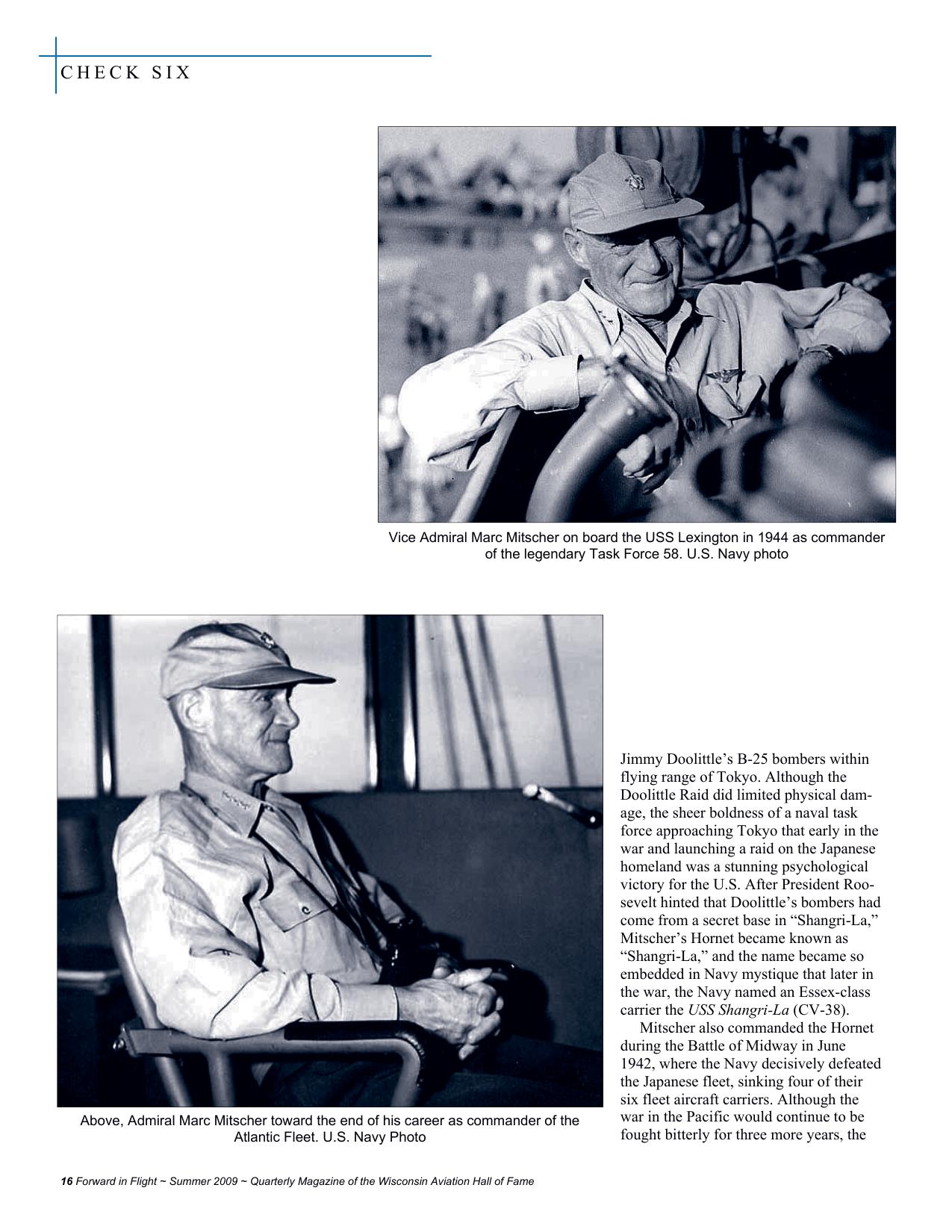
CHECK SIX Vice Admiral Marc Mitscher on board the USS Lexington in 1944 as commander of the legendary Task Force 58. U.S. Navy photo Above, Admiral Marc Mitscher toward the end of his career as commander of the Atlantic Fleet. U.S. Navy Photo 16 Forward in Flight ~ Summer 2009 ~ Quarterly Magazine of the Wisconsin Aviation Hall of Fame Jimmy Doolittle’s B-25 bombers within flying range of Tokyo. Although the Doolittle Raid did limited physical damage, the sheer boldness of a naval task force approaching Tokyo that early in the war and launching a raid on the Japanese homeland was a stunning psychological victory for the U.S. After President Roosevelt hinted that Doolittle’s bombers had come from a secret base in “Shangri-La,” Mitscher’s Hornet became known as “Shangri-La,” and the name became so embedded in Navy mystique that later in the war, the Navy named an Essex-class carrier the USS Shangri-La (CV-38). Mitscher also commanded the Hornet during the Battle of Midway in June 1942, where the Navy decisively defeated the Japanese fleet, sinking four of their six fleet aircraft carriers. Although the war in the Pacific would continue to be fought bitterly for three more years, the
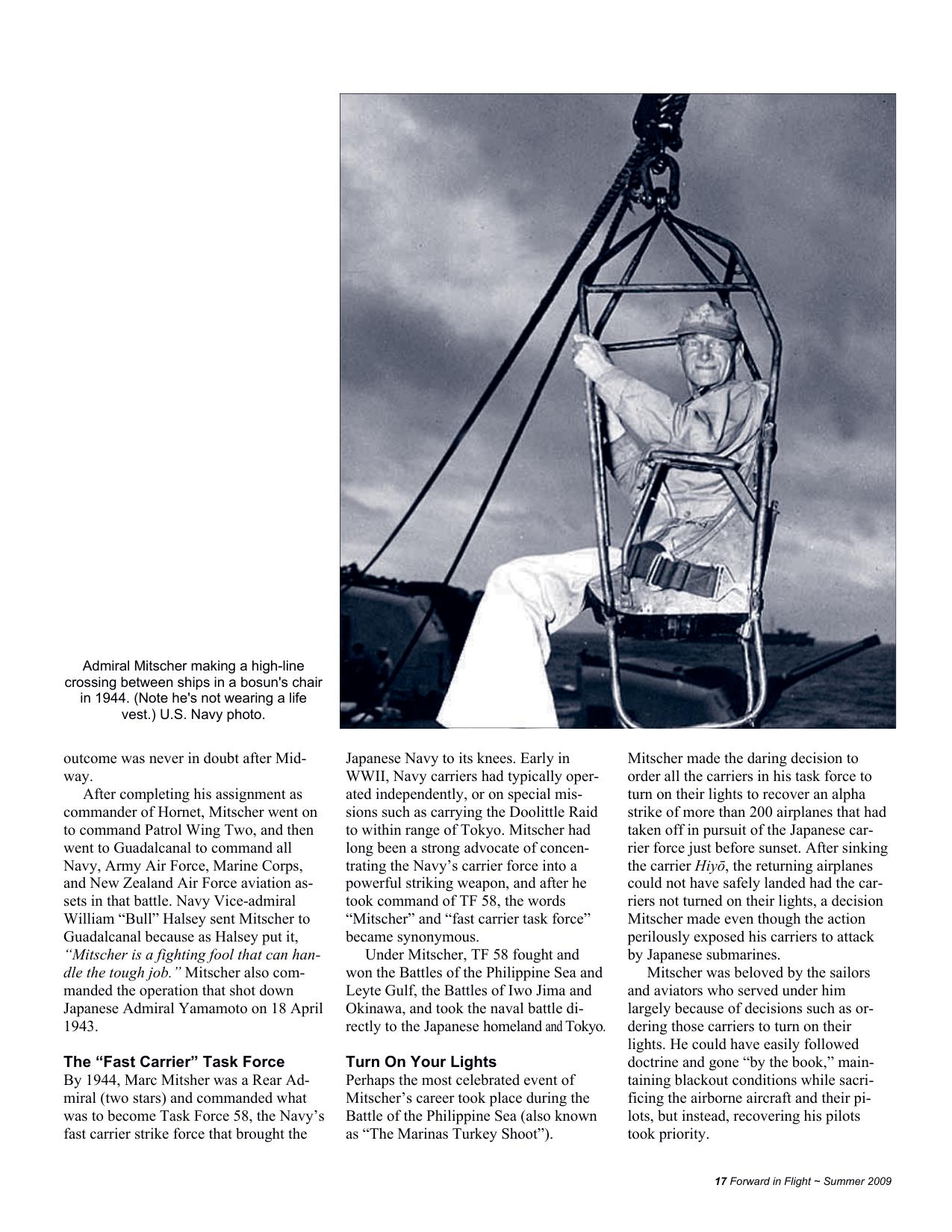
Admiral Mitscher making a high-line crossing between ships in a bosun's chair in 1944. (Note he's not wearing a life vest.) U.S. Navy photo. outcome was never in doubt after Midway. After completing his assignment as commander of Hornet, Mitscher went on to command Patrol Wing Two, and then went to Guadalcanal to command all Navy, Army Air Force, Marine Corps, and New Zealand Air Force aviation assets in that battle. Navy Vice-admiral William “Bull” Halsey sent Mitscher to Guadalcanal because as Halsey put it, “Mitscher is a fighting fool that can handle the tough job.” Mitscher also commanded the operation that shot down Japanese Admiral Yamamoto on 18 April 1943. Japanese Navy to its knees. Early in WWII, Navy carriers had typically operated independently, or on special missions such as carrying the Doolittle Raid to within range of Tokyo. Mitscher had long been a strong advocate of concentrating the Navy’s carrier force into a powerful striking weapon, and after he took command of TF 58, the words “Mitscher” and “fast carrier task force” became synonymous. Under Mitscher, TF 58 fought and won the Battles of the Philippine Sea and Leyte Gulf, the Battles of Iwo Jima and Okinawa, and took the naval battle directly to the Japanese homeland and Tokyo. The “Fast Carrier” Task Force By 1944, Marc Mitsher was a Rear Admiral (two stars) and commanded what was to become Task Force 58, the Navy’s fast carrier strike force that brought the Turn On Your Lights Perhaps the most celebrated event of Mitscher’s career took place during the Battle of the Philippine Sea (also known as “The Marinas Turkey Shoot”). Mitscher made the daring decision to order all the carriers in his task force to turn on their lights to recover an alpha strike of more than 200 airplanes that had taken off in pursuit of the Japanese carrier force just before sunset. After sinking the carrier Hiyō, the returning airplanes could not have safely landed had the carriers not turned on their lights, a decision Mitscher made even though the action perilously exposed his carriers to attack by Japanese submarines. Mitscher was beloved by the sailors and aviators who served under him largely because of decisions such as ordering those carriers to turn on their lights. He could have easily followed doctrine and gone “by the book,” maintaining blackout conditions while sacrificing the airborne aircraft and their pilots, but instead, recovering his pilots took priority. 17 Forward in Flight ~ Summer 2009
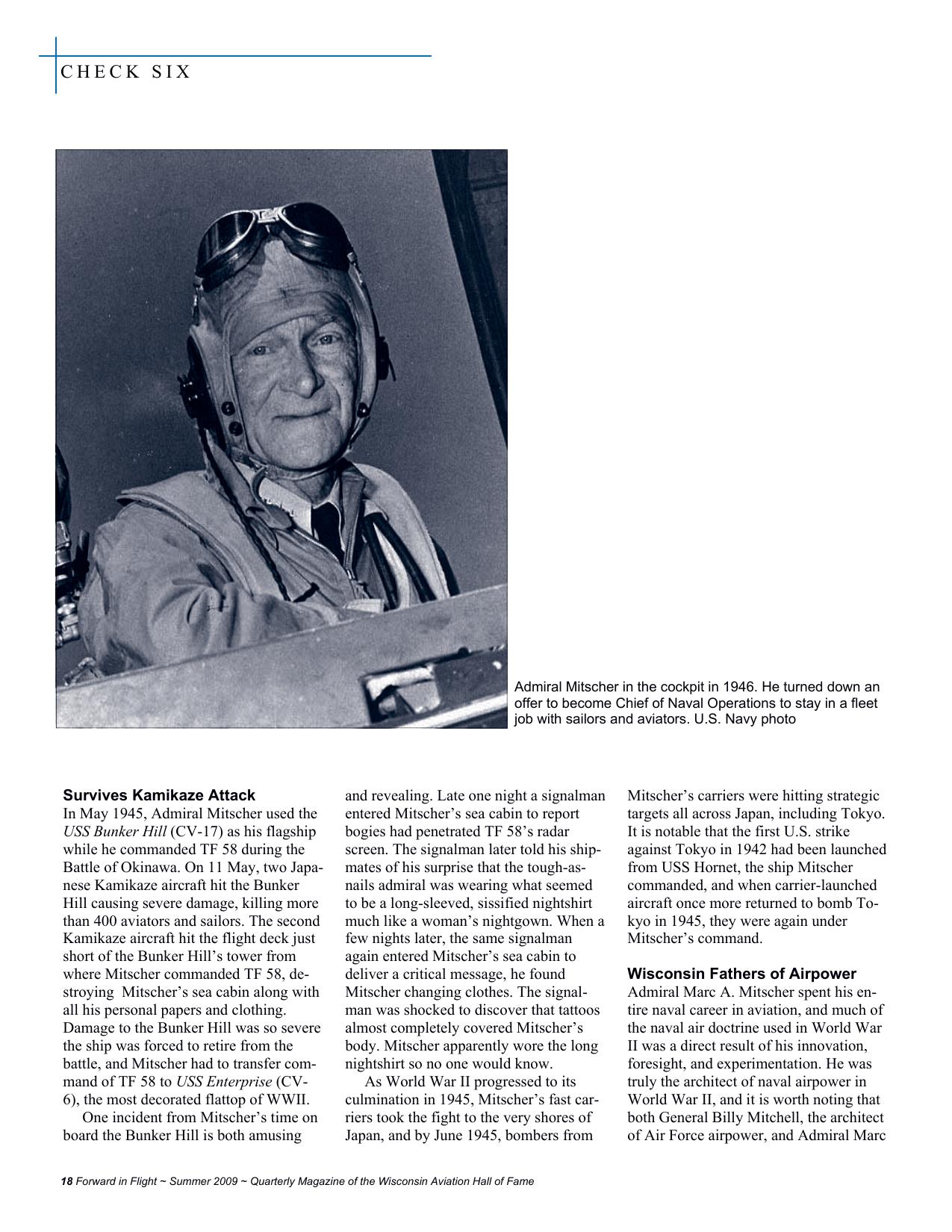
CHECK SIX Admiral Mitscher in the cockpit in 1946. He turned down an offer to become Chief of Naval Operations to stay in a fleet job with sailors and aviators. U.S. Navy photo Survives Kamikaze Attack In May 1945, Admiral Mitscher used the USS Bunker Hill (CV-17) as his flagship while he commanded TF 58 during the Battle of Okinawa. On 11 May, two Japanese Kamikaze aircraft hit the Bunker Hill causing severe damage, killing more than 400 aviators and sailors. The second Kamikaze aircraft hit the flight deck just short of the Bunker Hill’s tower from where Mitscher commanded TF 58, destroying Mitscher’s sea cabin along with all his personal papers and clothing. Damage to the Bunker Hill was so severe the ship was forced to retire from the battle, and Mitscher had to transfer command of TF 58 to USS Enterprise (CV6), the most decorated flattop of WWII. One incident from Mitscher’s time on board the Bunker Hill is both amusing and revealing. Late one night a signalman entered Mitscher’s sea cabin to report bogies had penetrated TF 58’s radar screen. The signalman later told his shipmates of his surprise that the tough-asnails admiral was wearing what seemed to be a long-sleeved, sissified nightshirt much like a woman’s nightgown. When a few nights later, the same signalman again entered Mitscher’s sea cabin to deliver a critical message, he found Mitscher changing clothes. The signalman was shocked to discover that tattoos almost completely covered Mitscher’s body. Mitscher apparently wore the long nightshirt so no one would know. As World War II progressed to its culmination in 1945, Mitscher’s fast carriers took the fight to the very shores of Japan, and by June 1945, bombers from 18 Forward in Flight ~ Summer 2009 ~ Quarterly Magazine of the Wisconsin Aviation Hall of Fame Mitscher’s carriers were hitting strategic targets all across Japan, including Tokyo. It is notable that the first U.S. strike against Tokyo in 1942 had been launched from USS Hornet, the ship Mitscher commanded, and when carrier-launched aircraft once more returned to bomb Tokyo in 1945, they were again under Mitscher’s command. Wisconsin Fathers of Airpower Admiral Marc A. Mitscher spent his entire naval career in aviation, and much of the naval air doctrine used in World War II was a direct result of his innovation, foresight, and experimentation. He was truly the architect of naval airpower in World War II, and it is worth noting that both General Billy Mitchell, the architect of Air Force airpower, and Admiral Marc
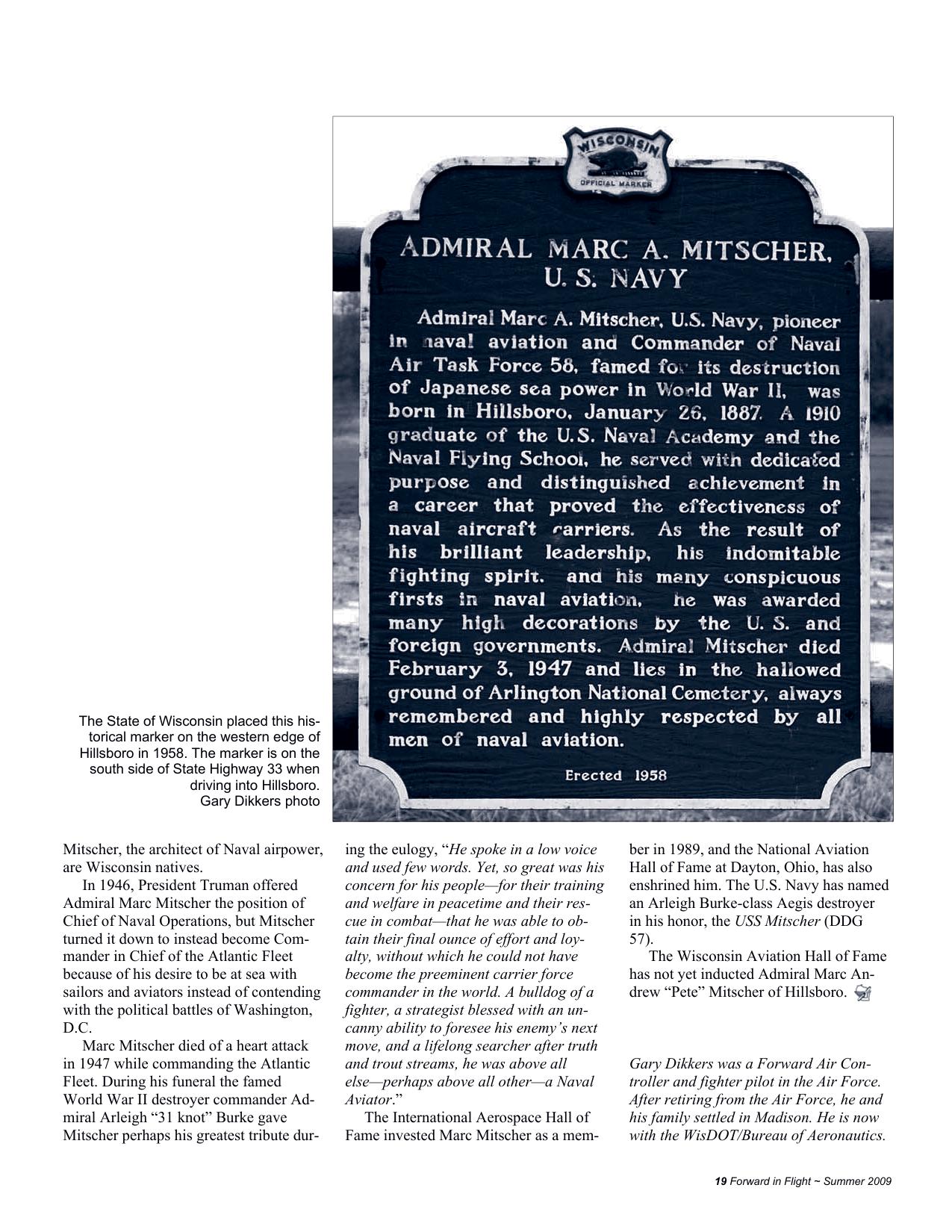
The State of Wisconsin placed this historical marker on the western edge of Hillsboro in 1958. The marker is on the south side of State Highway 33 when driving into Hillsboro. Gary Dikkers photo Mitscher, the architect of Naval airpower, are Wisconsin natives. In 1946, President Truman offered Admiral Marc Mitscher the position of Chief of Naval Operations, but Mitscher turned it down to instead become Commander in Chief of the Atlantic Fleet because of his desire to be at sea with sailors and aviators instead of contending with the political battles of Washington, D.C. Marc Mitscher died of a heart attack in 1947 while commanding the Atlantic Fleet. During his funeral the famed World War II destroyer commander Admiral Arleigh “31 knot” Burke gave Mitscher perhaps his greatest tribute dur- ing the eulogy, “He spoke in a low voice and used few words. Yet, so great was his concern for his people—for their training and welfare in peacetime and their rescue in combat—that he was able to obtain their final ounce of effort and loyalty, without which he could not have become the preeminent carrier force commander in the world. A bulldog of a fighter, a strategist blessed with an uncanny ability to foresee his enemy’s next move, and a lifelong searcher after truth and trout streams, he was above all else—perhaps above all other—a Naval Aviator.” The International Aerospace Hall of Fame invested Marc Mitscher as a mem- ber in 1989, and the National Aviation Hall of Fame at Dayton, Ohio, has also enshrined him. The U.S. Navy has named an Arleigh Burke-class Aegis destroyer in his honor, the USS Mitscher (DDG 57). The Wisconsin Aviation Hall of Fame has not yet inducted Admiral Marc Andrew “Pete” Mitscher of Hillsboro. Gary Dikkers was a Forward Air Controller and fighter pilot in the Air Force. After retiring from the Air Force, he and his family settled in Madison. He is now with the WisDOT/Bureau of Aeronautics. 19 Forward in Flight ~ Summer 2009
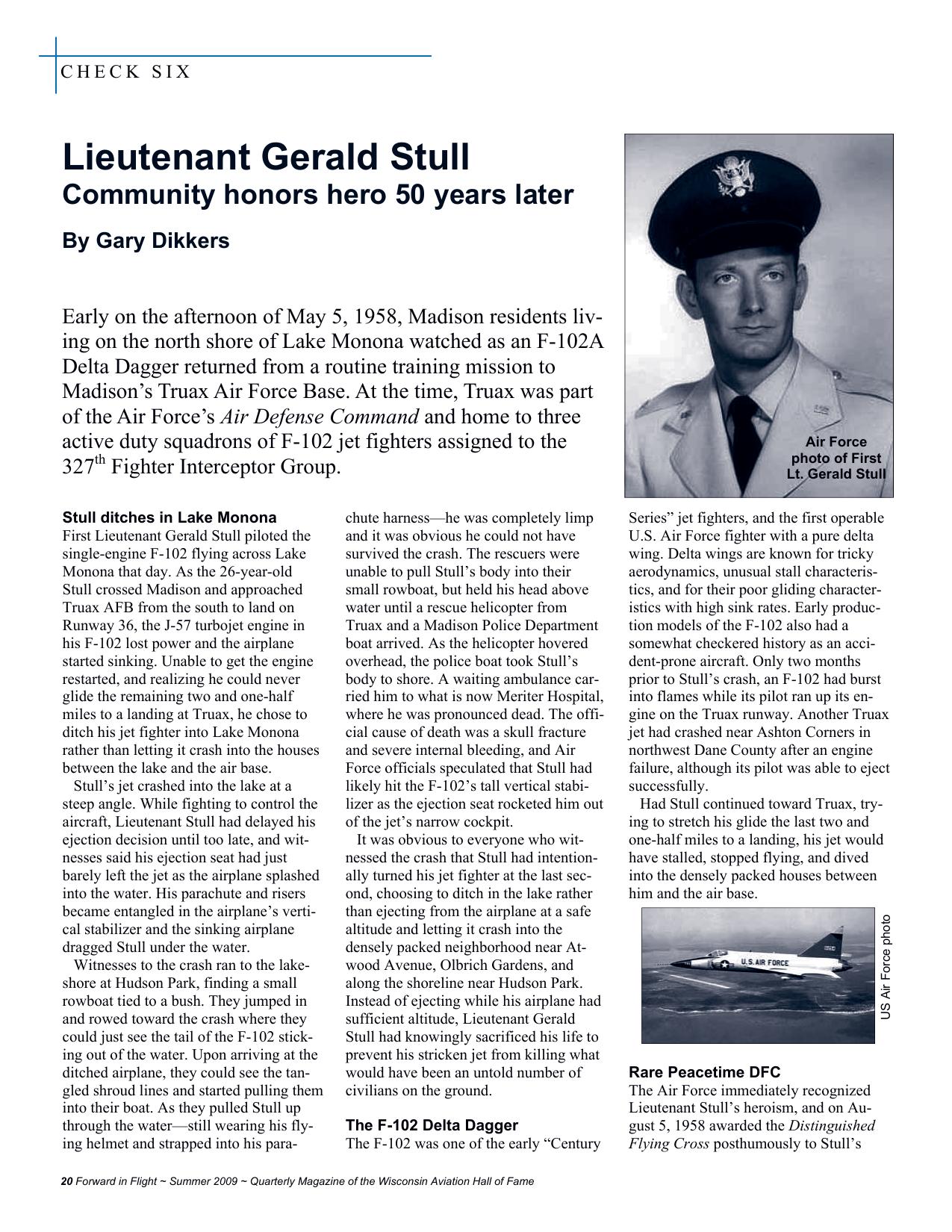
CHECK SIX Lieutenant Gerald Stull Community honors hero 50 years later By Gary Dikkers Stull ditches in Lake Monona First Lieutenant Gerald Stull piloted the single-engine F-102 flying across Lake Monona that day. As the 26-year-old Stull crossed Madison and approached Truax AFB from the south to land on Runway 36, the J-57 turbojet engine in his F-102 lost power and the airplane started sinking. Unable to get the engine restarted, and realizing he could never glide the remaining two and one-half miles to a landing at Truax, he chose to ditch his jet fighter into Lake Monona rather than letting it crash into the houses between the lake and the air base. Stull’s jet crashed into the lake at a steep angle. While fighting to control the aircraft, Lieutenant Stull had delayed his ejection decision until too late, and witnesses said his ejection seat had just barely left the jet as the airplane splashed into the water. His parachute and risers became entangled in the airplane’s vertical stabilizer and the sinking airplane dragged Stull under the water. Witnesses to the crash ran to the lakeshore at Hudson Park, finding a small rowboat tied to a bush. They jumped in and rowed toward the crash where they could just see the tail of the F-102 sticking out of the water. Upon arriving at the ditched airplane, they could see the tangled shroud lines and started pulling them into their boat. As they pulled Stull up through the water—still wearing his flying helmet and strapped into his para- chute harness—he was completely limp and it was obvious he could not have survived the crash. The rescuers were unable to pull Stull’s body into their small rowboat, but held his head above water until a rescue helicopter from Truax and a Madison Police Department boat arrived. As the helicopter hovered overhead, the police boat took Stull’s body to shore. A waiting ambulance carried him to what is now Meriter Hospital, where he was pronounced dead. The official cause of death was a skull fracture and severe internal bleeding, and Air Force officials speculated that Stull had likely hit the F-102’s tall vertical stabilizer as the ejection seat rocketed him out of the jet’s narrow cockpit. It was obvious to everyone who witnessed the crash that Stull had intentionally turned his jet fighter at the last second, choosing to ditch in the lake rather than ejecting from the airplane at a safe altitude and letting it crash into the densely packed neighborhood near Atwood Avenue, Olbrich Gardens, and along the shoreline near Hudson Park. Instead of ejecting while his airplane had sufficient altitude, Lieutenant Gerald Stull had knowingly sacrificed his life to prevent his stricken jet from killing what would have been an untold number of civilians on the ground. The F-102 Delta Dagger The F-102 was one of the early “Century 20 Forward in Flight ~ Summer 2009 ~ Quarterly Magazine of the Wisconsin Aviation Hall of Fame Air Force photo of First Lt. Gerald Stull Series” jet fighters, and the first operable U.S. Air Force fighter with a pure delta wing. Delta wings are known for tricky aerodynamics, unusual stall characteristics, and for their poor gliding characteristics with high sink rates. Early production models of the F-102 also had a somewhat checkered history as an accident-prone aircraft. Only two months prior to Stull’s crash, an F-102 had burst into flames while its pilot ran up its engine on the Truax runway. Another Truax jet had crashed near Ashton Corners in northwest Dane County after an engine failure, although its pilot was able to eject successfully. Had Stull continued toward Truax, trying to stretch his glide the last two and one-half miles to a landing, his jet would have stalled, stopped flying, and dived into the densely packed houses between him and the air base. US Air Force photo Early on the afternoon of May 5, 1958, Madison residents living on the north shore of Lake Monona watched as an F-102A Delta Dagger returned from a routine training mission to Madison’s Truax Air Force Base. At the time, Truax was part of the Air Force’s Air Defense Command and home to three active duty squadrons of F-102 jet fighters assigned to the 327th Fighter Interceptor Group. Rare Peacetime DFC The Air Force immediately recognized Lieutenant Stull’s heroism, and on August 5, 1958 awarded the Distinguished Flying Cross posthumously to Stull’s
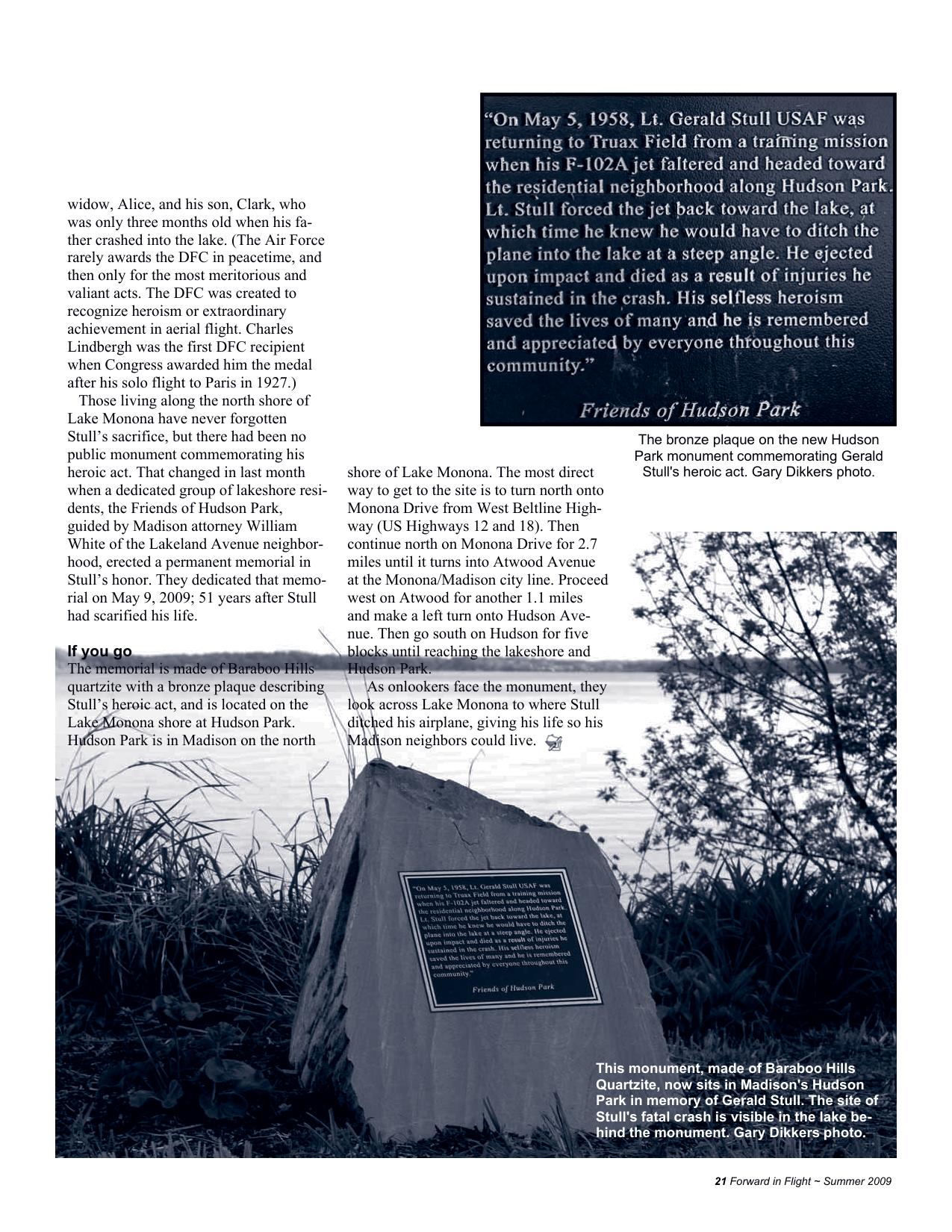
widow, Alice, and his son, Clark, who was only three months old when his father crashed into the lake. (The Air Force rarely awards the DFC in peacetime, and then only for the most meritorious and valiant acts. The DFC was created to recognize heroism or extraordinary achievement in aerial flight. Charles Lindbergh was the first DFC recipient when Congress awarded him the medal after his solo flight to Paris in 1927.) Those living along the north shore of Lake Monona have never forgotten Stull’s sacrifice, but there had been no public monument commemorating his heroic act. That changed in last month when a dedicated group of lakeshore residents, the Friends of Hudson Park, guided by Madison attorney William White of the Lakeland Avenue neighborhood, erected a permanent memorial in Stull’s honor. They dedicated that memorial on May 9, 2009; 51 years after Stull had scarified his life. If you go The memorial is made of Baraboo Hills quartzite with a bronze plaque describing Stull’s heroic act, and is located on the Lake Monona shore at Hudson Park. Hudson Park is in Madison on the north shore of Lake Monona. The most direct way to get to the site is to turn north onto Monona Drive from West Beltline Highway (US Highways 12 and 18). Then continue north on Monona Drive for 2.7 miles until it turns into Atwood Avenue at the Monona/Madison city line. Proceed west on Atwood for another 1.1 miles and make a left turn onto Hudson Avenue. Then go south on Hudson for five blocks until reaching the lakeshore and Hudson Park. As onlookers face the monument, they look across Lake Monona to where Stull ditched his airplane, giving his life so his Madison neighbors could live. View of the Waunakee Airpark, from southeast looking northwest. The bronze plaque on the new Hudson Park monument commemorating Gerald Stull's heroic act. Gary Dikkers photo. This monument, made of Baraboo Hills Quartzite, now sits in Madison's Hudson Park in memory of Gerald Stull. The site of Stull's fatal crash is visible in the lake behind the monument. Gary Dikkers photo. 21 Forward in Flight ~ Summer 2009
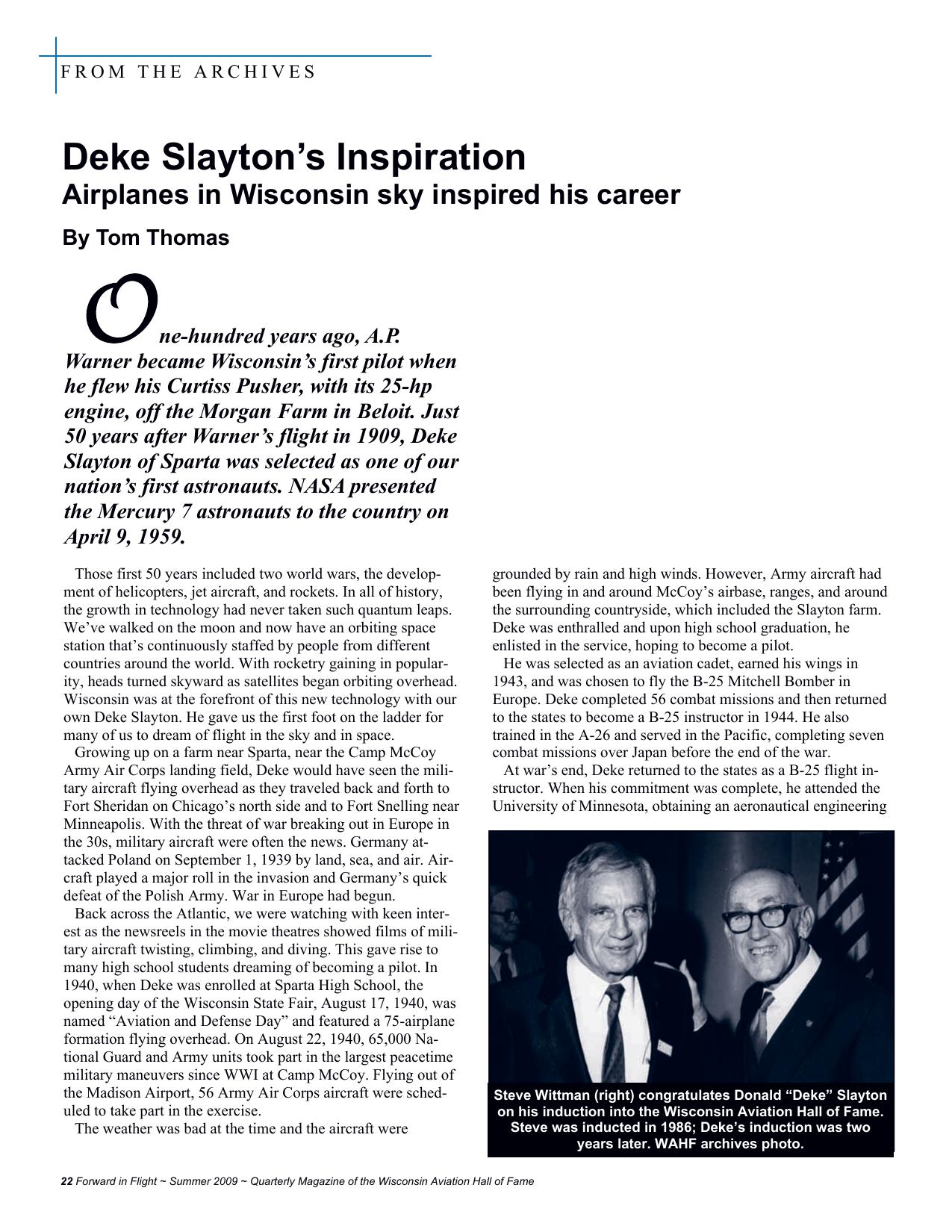
FROM THE ARCHIVES Deke Slayton’s Inspiration Airplanes in Wisconsin sky inspired his career By Tom Thomas ne-hundred years ago, A.P. Warner became Wisconsin’s first pilot when he flew his Curtiss Pusher, with its 25-hp engine, off the Morgan Farm in Beloit. Just 50 years after Warner’s flight in 1909, Deke Slayton of Sparta was selected as one of our nation’s first astronauts. NASA presented the Mercury 7 astronauts to the country on April 9, 1959. Those first 50 years included two world wars, the development of helicopters, jet aircraft, and rockets. In all of history, the growth in technology had never taken such quantum leaps. We’ve walked on the moon and now have an orbiting space station that’s continuously staffed by people from different countries around the world. With rocketry gaining in popularity, heads turned skyward as satellites began orbiting overhead. Wisconsin was at the forefront of this new technology with our own Deke Slayton. He gave us the first foot on the ladder for many of us to dream of flight in the sky and in space. Growing up on a farm near Sparta, near the Camp McCoy Army Air Corps landing field, Deke would have seen the military aircraft flying overhead as they traveled back and forth to Fort Sheridan on Chicago’s north side and to Fort Snelling near Minneapolis. With the threat of war breaking out in Europe in the 30s, military aircraft were often the news. Germany attacked Poland on September 1, 1939 by land, sea, and air. Aircraft played a major roll in the invasion and Germany’s quick defeat of the Polish Army. War in Europe had begun. Back across the Atlantic, we were watching with keen interest as the newsreels in the movie theatres showed films of military aircraft twisting, climbing, and diving. This gave rise to many high school students dreaming of becoming a pilot. In 1940, when Deke was enrolled at Sparta High School, the opening day of the Wisconsin State Fair, August 17, 1940, was named “Aviation and Defense Day” and featured a 75-airplane formation flying overhead. On August 22, 1940, 65,000 National Guard and Army units took part in the largest peacetime military maneuvers since WWI at Camp McCoy. Flying out of the Madison Airport, 56 Army Air Corps aircraft were scheduled to take part in the exercise. The weather was bad at the time and the aircraft were grounded by rain and high winds. However, Army aircraft had been flying in and around McCoy’s airbase, ranges, and around the surrounding countryside, which included the Slayton farm. Deke was enthralled and upon high school graduation, he enlisted in the service, hoping to become a pilot. He was selected as an aviation cadet, earned his wings in 1943, and was chosen to fly the B-25 Mitchell Bomber in Europe. Deke completed 56 combat missions and then returned to the states to become a B-25 instructor in 1944. He also trained in the A-26 and served in the Pacific, completing seven combat missions over Japan before the end of the war. At war’s end, Deke returned to the states as a B-25 flight instructor. When his commitment was complete, he attended the University of Minnesota, obtaining an aeronautical engineering Steve Wittman (right) congratulates Donald “Deke” Slayton on his induction into the Wisconsin Aviation Hall of Fame. Steve was inducted in 1986; Deke’s induction was two years later. WAHF archives photo. 22 Forward in Flight ~ Summer 2009 ~ Quarterly Magazine of the Wisconsin Aviation Hall of Fame
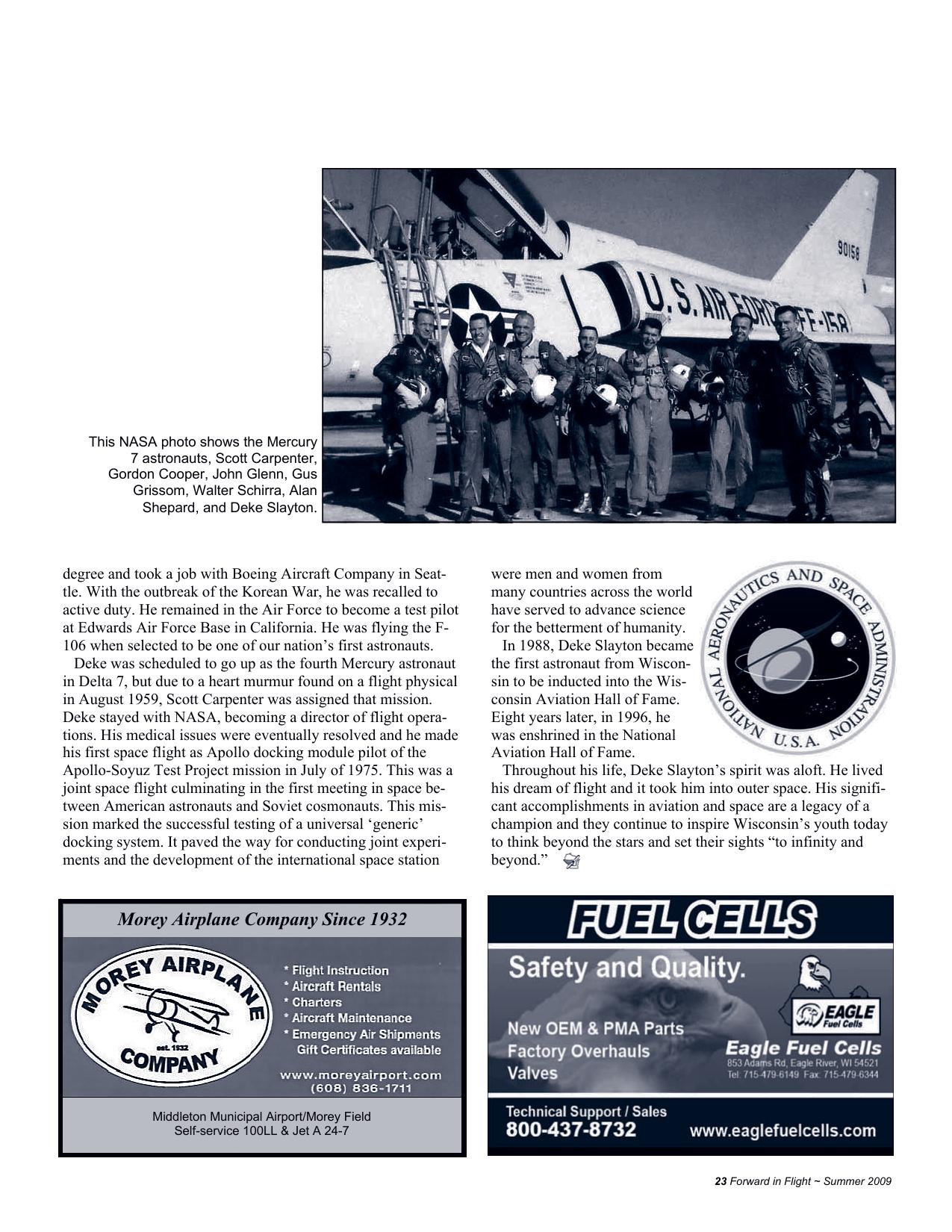
This NASA photo shows the Mercury 7 astronauts, Scott Carpenter, Gordon Cooper, John Glenn, Gus Grissom, Walter Schirra, Alan Shepard, and Deke Slayton. degree and took a job with Boeing Aircraft Company in Seattle. With the outbreak of the Korean War, he was recalled to active duty. He remained in the Air Force to become a test pilot at Edwards Air Force Base in California. He was flying the F106 when selected to be one of our nation’s first astronauts. Deke was scheduled to go up as the fourth Mercury astronaut in Delta 7, but due to a heart murmur found on a flight physical in August 1959, Scott Carpenter was assigned that mission. Deke stayed with NASA, becoming a director of flight operations. His medical issues were eventually resolved and he made his first space flight as Apollo docking module pilot of the Apollo-Soyuz Test Project mission in July of 1975. This was a joint space flight culminating in the first meeting in space between American astronauts and Soviet cosmonauts. This mission marked the successful testing of a universal ‘generic’ docking system. It paved the way for conducting joint experiments and the development of the international space station were men and women from many countries across the world have served to advance science for the betterment of humanity. In 1988, Deke Slayton became the first astronaut from Wisconsin to be inducted into the Wisconsin Aviation Hall of Fame. Eight years later, in 1996, he was enshrined in the National Aviation Hall of Fame. Throughout his life, Deke Slayton’s spirit was aloft. He lived his dream of flight and it took him into outer space. His significant accomplishments in aviation and space are a legacy of a champion and they continue to inspire Wisconsin’s youth today to think beyond the stars and set their sights “to infinity and beyond.” Morey Airplane Company Since 1932 Middleton Municipal Airport/Morey Field Self-service 100LL & Jet A 24-7 23 Forward in Flight ~ Summer 2009
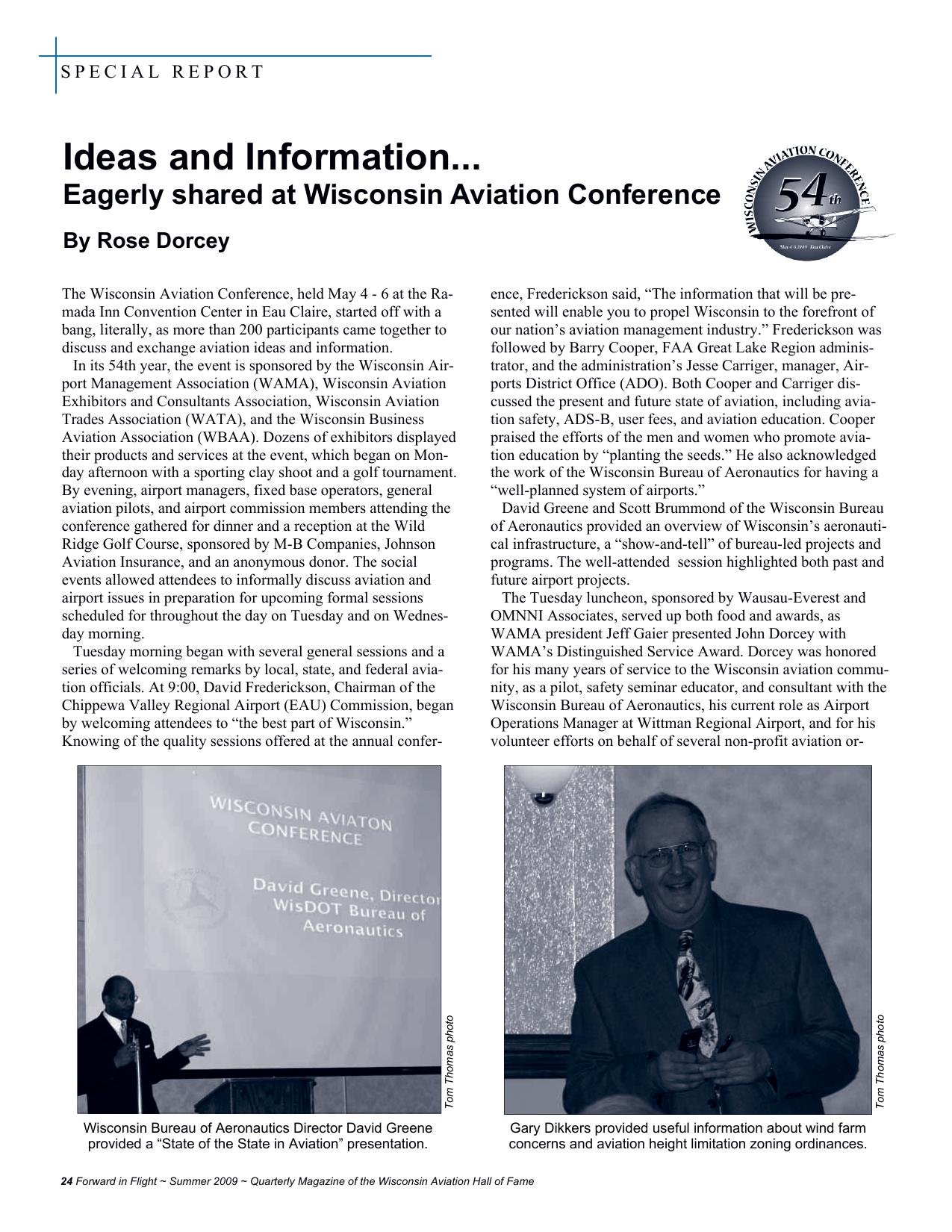
SPECIAL REPORT Ideas and Information... Eagerly shared at Wisconsin Aviation Conference By Rose Dorcey Tom Thomas photo ence, Frederickson said, “The information that will be presented will enable you to propel Wisconsin to the forefront of our nation’s aviation management industry.” Frederickson was followed by Barry Cooper, FAA Great Lake Region administrator, and the administration’s Jesse Carriger, manager, Airports District Office (ADO). Both Cooper and Carriger discussed the present and future state of aviation, including aviation safety, ADS-B, user fees, and aviation education. Cooper praised the efforts of the men and women who promote aviation education by “planting the seeds.” He also acknowledged the work of the Wisconsin Bureau of Aeronautics for having a “well-planned system of airports.” David Greene and Scott Brummond of the Wisconsin Bureau of Aeronautics provided an overview of Wisconsin’s aeronautical infrastructure, a “show-and-tell” of bureau-led projects and programs. The well-attended session highlighted both past and future airport projects. The Tuesday luncheon, sponsored by Wausau-Everest and OMNNI Associates, served up both food and awards, as WAMA president Jeff Gaier presented John Dorcey with WAMA’s Distinguished Service Award. Dorcey was honored for his many years of service to the Wisconsin aviation community, as a pilot, safety seminar educator, and consultant with the Wisconsin Bureau of Aeronautics, his current role as Airport Operations Manager at Wittman Regional Airport, and for his volunteer efforts on behalf of several non-profit aviation or- Tom Thomas photo The Wisconsin Aviation Conference, held May 4 - 6 at the Ramada Inn Convention Center in Eau Claire, started off with a bang, literally, as more than 200 participants came together to discuss and exchange aviation ideas and information. In its 54th year, the event is sponsored by the Wisconsin Airport Management Association (WAMA), Wisconsin Aviation Exhibitors and Consultants Association, Wisconsin Aviation Trades Association (WATA), and the Wisconsin Business Aviation Association (WBAA). Dozens of exhibitors displayed their products and services at the event, which began on Monday afternoon with a sporting clay shoot and a golf tournament. By evening, airport managers, fixed base operators, general aviation pilots, and airport commission members attending the conference gathered for dinner and a reception at the Wild Ridge Golf Course, sponsored by M-B Companies, Johnson Aviation Insurance, and an anonymous donor. The social events allowed attendees to informally discuss aviation and airport issues in preparation for upcoming formal sessions scheduled for throughout the day on Tuesday and on Wednesday morning. Tuesday morning began with several general sessions and a series of welcoming remarks by local, state, and federal aviation officials. At 9:00, David Frederickson, Chairman of the Chippewa Valley Regional Airport (EAU) Commission, began by welcoming attendees to “the best part of Wisconsin.” Knowing of the quality sessions offered at the annual confer- Wisconsin Bureau of Aeronautics Director David Greene provided a “State of the State in Aviation” presentation. Gary Dikkers provided useful information about wind farm concerns and aviation height limitation zoning ordinances. 24 Forward in Flight ~ Summer 2009 ~ Quarterly Magazine of the Wisconsin Aviation Hall of Fame
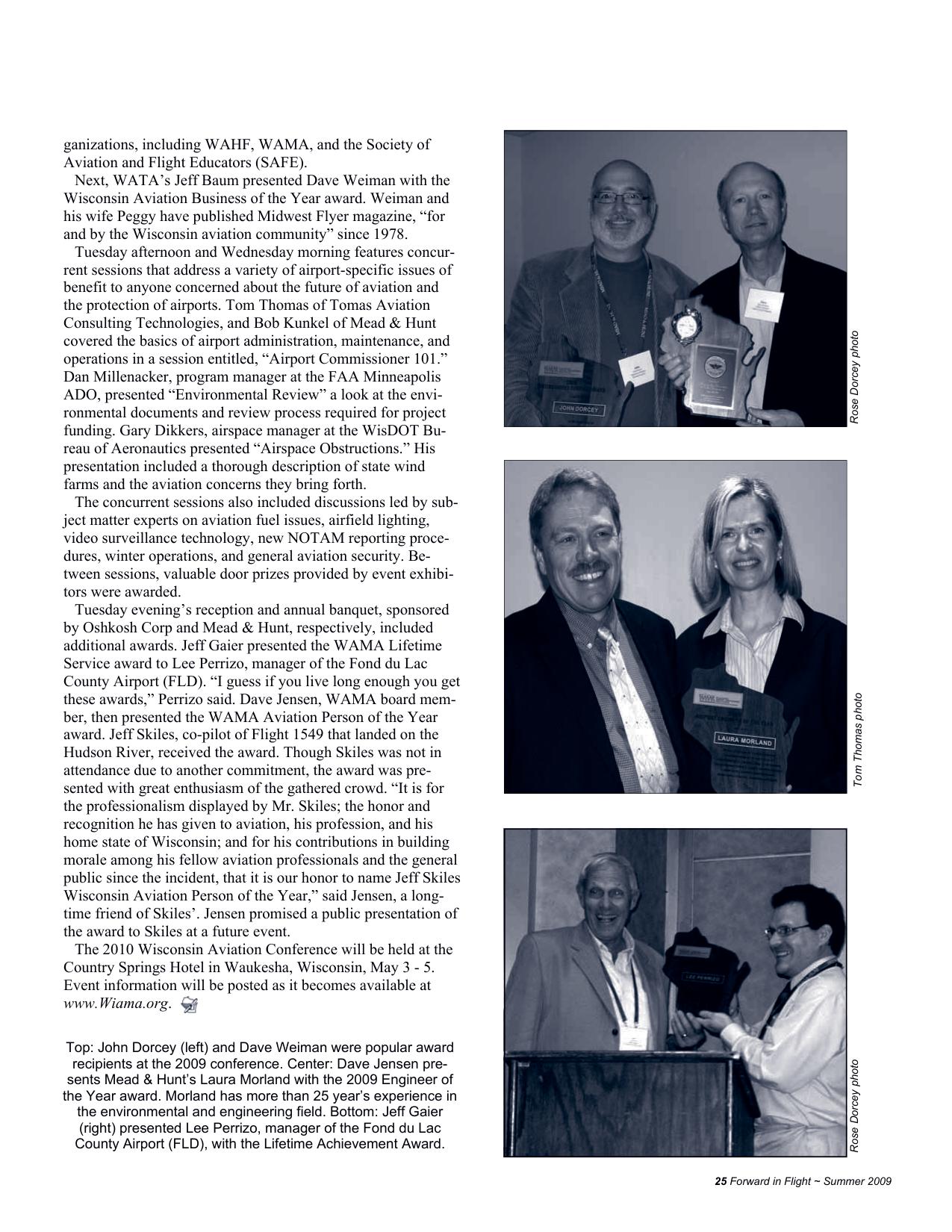
Top: John Dorcey (left) and Dave Weiman were popular award recipients at the 2009 conference. Center: Dave Jensen presents Mead & Hunt’s Laura Morland with the 2009 Engineer of the Year award. Morland has more than 25 year’s experience in the environmental and engineering field. Bottom: Jeff Gaier (right) presented Lee Perrizo, manager of the Fond du Lac County Airport (FLD), with the Lifetime Achievement Award. Rose Dorcey photo Tom Thomas photo Rose Dorcey photo ganizations, including WAHF, WAMA, and the Society of Aviation and Flight Educators (SAFE). Next, WATA’s Jeff Baum presented Dave Weiman with the Wisconsin Aviation Business of the Year award. Weiman and his wife Peggy have published Midwest Flyer magazine, “for and by the Wisconsin aviation community” since 1978. Tuesday afternoon and Wednesday morning features concurrent sessions that address a variety of airport-specific issues of benefit to anyone concerned about the future of aviation and the protection of airports. Tom Thomas of Tomas Aviation Consulting Technologies, and Bob Kunkel of Mead & Hunt covered the basics of airport administration, maintenance, and operations in a session entitled, “Airport Commissioner 101.” Dan Millenacker, program manager at the FAA Minneapolis ADO, presented “Environmental Review” a look at the environmental documents and review process required for project funding. Gary Dikkers, airspace manager at the WisDOT Bureau of Aeronautics presented “Airspace Obstructions.” His presentation included a thorough description of state wind farms and the aviation concerns they bring forth. The concurrent sessions also included discussions led by subject matter experts on aviation fuel issues, airfield lighting, video surveillance technology, new NOTAM reporting procedures, winter operations, and general aviation security. Between sessions, valuable door prizes provided by event exhibitors were awarded. Tuesday evening’s reception and annual banquet, sponsored by Oshkosh Corp and Mead & Hunt, respectively, included additional awards. Jeff Gaier presented the WAMA Lifetime Service award to Lee Perrizo, manager of the Fond du Lac County Airport (FLD). “I guess if you live long enough you get these awards,” Perrizo said. Dave Jensen, WAMA board member, then presented the WAMA Aviation Person of the Year award. Jeff Skiles, co-pilot of Flight 1549 that landed on the Hudson River, received the award. Though Skiles was not in attendance due to another commitment, the award was presented with great enthusiasm of the gathered crowd. “It is for the professionalism displayed by Mr. Skiles; the honor and recognition he has given to aviation, his profession, and his home state of Wisconsin; and for his contributions in building morale among his fellow aviation professionals and the general public since the incident, that it is our honor to name Jeff Skiles Wisconsin Aviation Person of the Year,” said Jensen, a longtime friend of Skiles’. Jensen promised a public presentation of the award to Skiles at a future event. The 2010 Wisconsin Aviation Conference will be held at the Country Springs Hotel in Waukesha, Wisconsin, May 3 - 5. Event information will be posted as it becomes available at www.Wiama.org. 25 Forward in Flight ~ Summer 2009
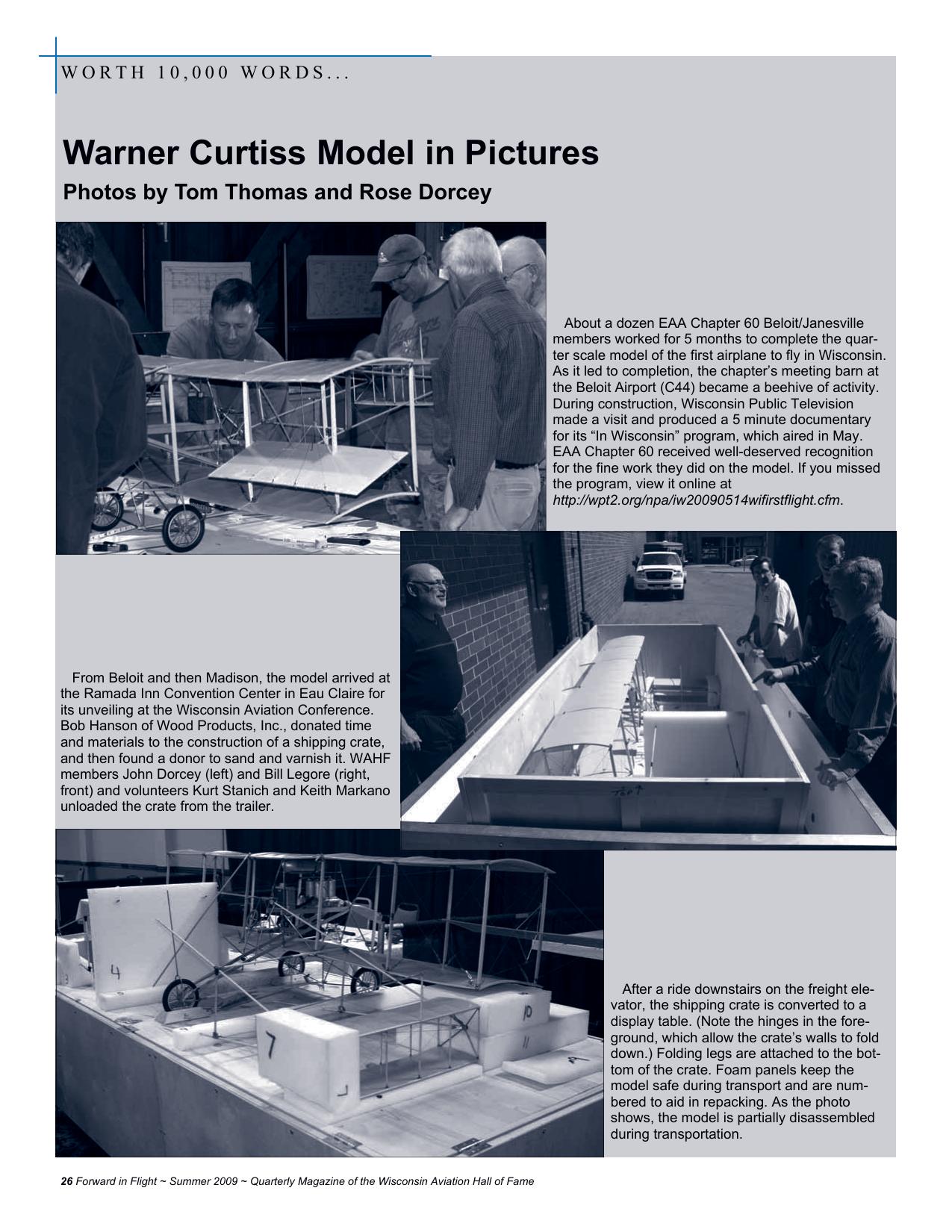
WORTH 10,000 WORDS... Warner Curtiss Model in Pictures Photos by Tom Thomas and Rose Dorcey About a dozen EAA Chapter 60 Beloit/Janesville members worked for 5 months to complete the quarter scale model of the first airplane to fly in Wisconsin. As it led to completion, the chapter’s meeting barn at the Beloit Airport (C44) became a beehive of activity. During construction, Wisconsin Public Television made a visit and produced a 5 minute documentary for its “In Wisconsin” program, which aired in May. EAA Chapter 60 received well-deserved recognition for the fine work they did on the model. If you missed the program, view it online at http://wpt2.org/npa/iw20090514wifirstflight.cfm. From Beloit and then Madison, the model arrived at the Ramada Inn Convention Center in Eau Claire for its unveiling at the Wisconsin Aviation Conference. Bob Hanson of Wood Products, Inc., donated time and materials to the construction of a shipping crate, and then found a donor to sand and varnish it. WAHF members John Dorcey (left) and Bill Legore (right, front) and volunteers Kurt Stanich and Keith Markano unloaded the crate from the trailer. After a ride downstairs on the freight elevator, the shipping crate is converted to a display table. (Note the hinges in the foreground, which allow the crate’s walls to fold down.) Folding legs are attached to the bottom of the crate. Foam panels keep the model safe during transport and are numbered to aid in repacking. As the photo shows, the model is partially disassembled during transportation. 26 Forward in Flight ~ Summer 2009 ~ Quarterly Magazine of the Wisconsin Aviation Hall of Fame
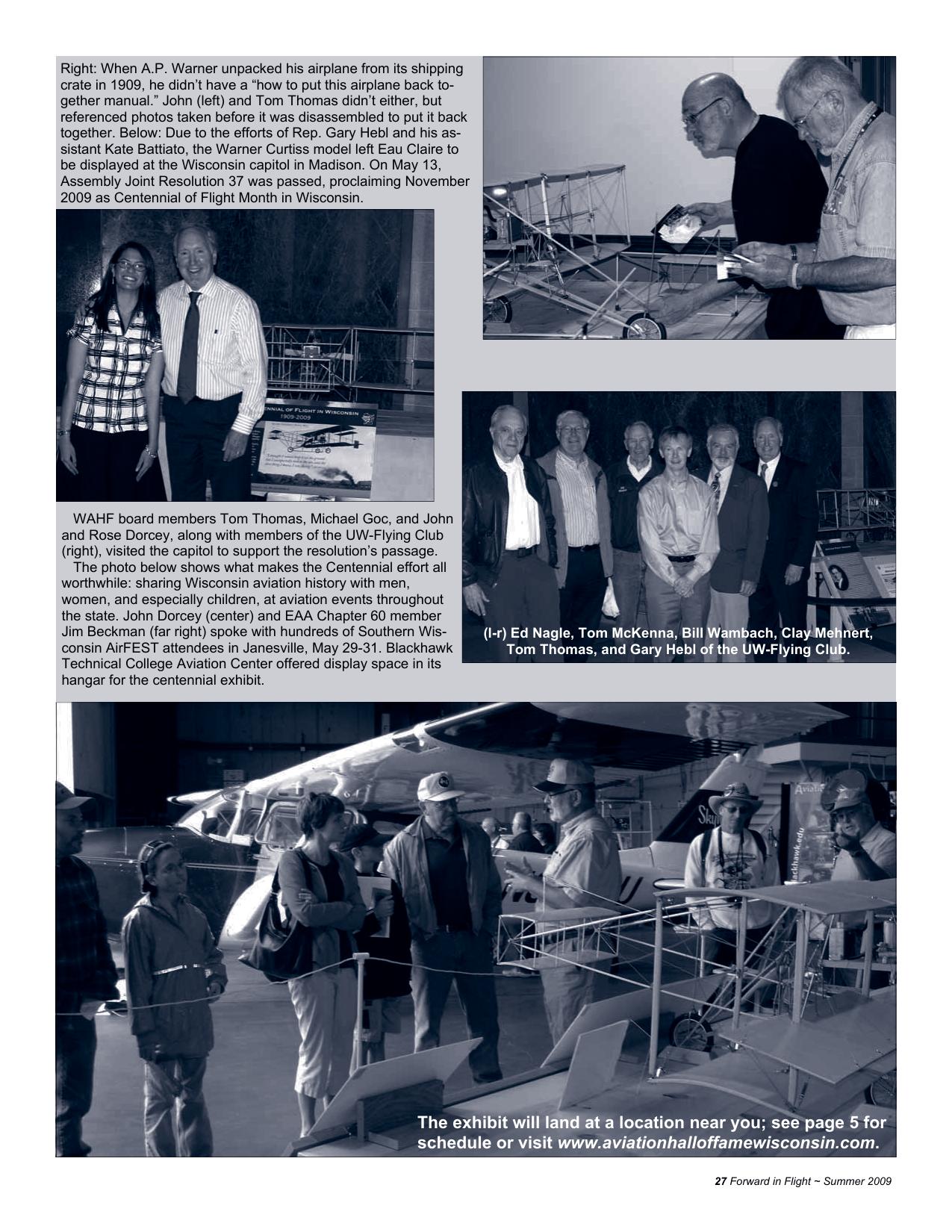
Right: When A.P. Warner unpacked his airplane from its shipping crate in 1909, he didn’t have a “how to put this airplane back together manual.” John (left) and Tom Thomas didn’t either, but referenced photos taken before it was disassembled to put it back together. Below: Due to the efforts of Rep. Gary Hebl and his assistant Kate Battiato, the Warner Curtiss model left Eau Claire to be displayed at the Wisconsin capitol in Madison. On May 13, Assembly Joint Resolution 37 was passed, proclaiming November 2009 as Centennial of Flight Month in Wisconsin. WAHF board members Tom Thomas, Michael Goc, and John and Rose Dorcey, along with members of the UW-Flying Club (right), visited the capitol to support the resolution’s passage. The photo below shows what makes the Centennial effort all worthwhile: sharing Wisconsin aviation history with men, women, and especially children, at aviation events throughout the state. John Dorcey (center) and EAA Chapter 60 member Jim Beckman (far right) spoke with hundreds of Southern Wisconsin AirFEST attendees in Janesville, May 29-31. Blackhawk Technical College Aviation Center offered display space in its hangar for the centennial exhibit. (l-r) Ed Nagle, Tom McKenna, Bill Wambach, Clay Mehnert, Tom Thomas, and Gary Hebl of the UW-Flying Club. The exhibit will land at a location near you; see page 5 for schedule or visit www.aviationhalloffamewisconsin.com. 27 Forward in Flight ~ Summer 2009
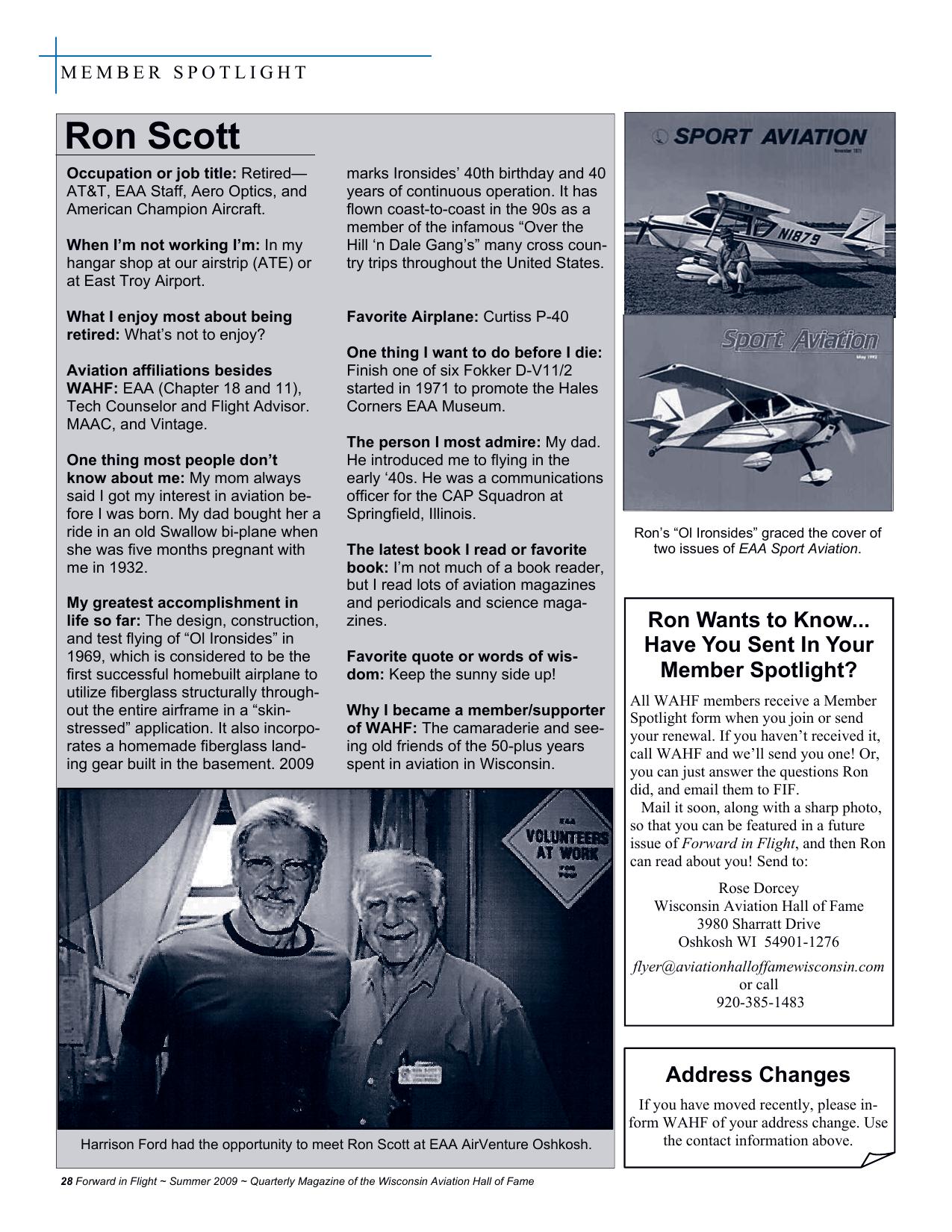
MEMBER SPOTLIGHT Ron Scott Occupation or job title: Retired— AT&T, EAA Staff, Aero Optics, and American Champion Aircraft. When I’m not working I’m: In my hangar shop at our airstrip (ATE) or at East Troy Airport. What I enjoy most about being retired: What’s not to enjoy? Aviation affiliations besides WAHF: EAA (Chapter 18 and 11), Tech Counselor and Flight Advisor. MAAC, and Vintage. One thing most people don’t know about me: My mom always said I got my interest in aviation before I was born. My dad bought her a ride in an old Swallow bi-plane when she was five months pregnant with me in 1932. My greatest accomplishment in life so far: The design, construction, and test flying of “Ol Ironsides” in 1969, which is considered to be the first successful homebuilt airplane to utilize fiberglass structurally throughout the entire airframe in a “skinstressed” application. It also incorporates a homemade fiberglass landing gear built in the basement. 2009 marks Ironsides’ 40th birthday and 40 years of continuous operation. It has flown coast-to-coast in the 90s as a member of the infamous “Over the Hill ‘n Dale Gang’s” many cross country trips throughout the United States. Favorite Airplane: Curtiss P-40 One thing I want to do before I die: Finish one of six Fokker D-V11/2 started in 1971 to promote the Hales Corners EAA Museum. The person I most admire: My dad. He introduced me to flying in the early ‘40s. He was a communications officer for the CAP Squadron at Springfield, Illinois. The latest book I read or favorite book: I’m not much of a book reader, but I read lots of aviation magazines and periodicals and science magazines. Favorite quote or words of wisdom: Keep the sunny side up! Why I became a member/supporter of WAHF: The camaraderie and seeing old friends of the 50-plus years spent in aviation in Wisconsin. Ron’s “Ol Ironsides” graced the cover of two issues of EAA Sport Aviation. Ron Wants to Know... Have You Sent In Your Member Spotlight? All WAHF members receive a Member Spotlight form when you join or send your renewal. If you haven’t received it, call WAHF and we’ll send you one! Or, you can just answer the questions Ron did, and email them to FIF. Mail it soon, along with a sharp photo, so that you can be featured in a future issue of Forward in Flight, and then Ron can read about you! Send to: Rose Dorcey Wisconsin Aviation Hall of Fame 3980 Sharratt Drive Oshkosh WI 54901-1276 flyer@aviationhalloffamewisconsin.com or call 920-385-1483 Address Changes Harrison Ford had the opportunity to meet Ron Scott at EAA AirVenture Oshkosh. 28 Forward in Flight ~ Summer 2009 ~ Quarterly Magazine of the Wisconsin Aviation Hall of Fame If you have moved recently, please inform WAHF of your address change. Use the contact information above.

SHOP TALK Hand Tool Quiz and Safety Tips The Hand Tools Institute (HTI), an association of North American hand tool manufacturers, designated the month of May as “National Hand Tool Safety Month.” Misuse of hand tools contributes to thousands of hand tool related injuries requiring emergency hospital treatment each year. If you’re confused as to how and what hand tool to use when tackling a do-it-yourself project, then you’re not alone, according to the Institute. The following true or false questions deal with hand tools commonly found in most households. Test your knowledge; 10 correct is excellent; 9 is good; 8 is fair; 7or less, poor. 1. Plastic covered handles on wire cutting pliers may be used to cut low voltage live electrical wire (True) (False) 2. When tightening a nut with an adjustable wrench, always pull the wrench away from you; never pull the wrench toward you (True) (False) 3. Claw hammers may be used to strike wood chisels (True) (False) 4. When wood splitting, the flat striking face of an axe may be used to strike a wood splitting wedge (True) (False) 5. Screwdrivers may be used for purposes other than driving or removing screws, such as prying open can lids (True) (False) 6. Vises should always be secured to the workbench with screws (True) (False) 7. Snips are permissible for cutting wire (True) (False) 8. Open end wrenches may be used to free a frozen nut (True) (False) 9. A proper use of the ball pein hammer is striking chisels and punches (True) (False) 10.Safety goggles should always be worn whenever you are using hand tools (True) (False) ANSWERS: 1. False. Plastic cover handles are for comfort only. Always cut off electrical power before cutting 2. True. The force of the pulling should be on the fixed jaw. Pushing away gives better leverage and balance 3. False. Claw hammers are for driving and removing nails only. 4. False. Only sledge hammers or woodsplitting mauls should be used to strike wood splitting wedges. 5. False. Screwdrivers must be used only to tighten or remove screws and for no other purpose. 6. False. Never screwed. Bolted is correct. 7. False. Wire cutters are correct. Snips are for cutting sheet metal. 8. False. Box open is the correct wrench. 9. True. Ball pein hammers are specifically hardened to strike chisels and punches. 10.True. Safety goggles should always be worn when working with hand tools to prevent eye injury. Correct Tools Make Home Repairs Easier The Hand Tools Institute says that with the rising labor cost of professional craftsmen, more homeowners and do-ityourselfers are making their own repairs to save money. In the process of performing the unfamiliar electrical, plumbing, or carpentry work, the novice may also be facing the task with hand tools either not suited for the job or misusing the ones he or she has. The results can be devastating, ranging from damaging work surface materials and tools to serious personal injury. This can be avoided, HTI states, if the tool user follows some simple rules. First, be certain that the hand tools used are the correct ones to do the job. For example, many people are surprised to learn that there are at least 10 different types of wrenches, more than 125 types of pliers, 12 types of screwdrivers, 15 types of hammers, and many other tools that can save hours of labor and give the job a professional look. Chances are you will be picking up a variety of tools on any given job. While some have more potential for personal injury than others, it pays to protect your eyes for the duration of the project. Here are some added pointers: • When working with a wrench, always pull the wrench, never push the wrench. • Hand sockets should never be used on power or impact wrenches. Hand sockets usually have bright finish but may have black finish. • Never use an axe to strike a wood splitting wedge; use a woodchopper’s maul or a sledge and never use the axe as a splitting wedge. • Discard any chisel or punch that is chipped or mushroomed. • Don’t use a screwdriver for prying, punching, chiseling, scoring, or scraping. Screwdrivers should only be used to drive or remove screws. • Never use an extension bar such as a length of pipe to increase leverage on a wrench. This could result in breakage of the wrench and personal injury. • Ball peen hammers of appropriate size or hand drilling hammers should be used to strike chisels, punches and star drills. Do not use the claw hammer. • Never use a C-clamp for hoisting or for supporting a scaffold or platform or for securing a load that may be carried on a vehicle or truck. Remember one tool is not enough; there are many types of wrenches, pliers, screwdriver, hammers, etc., each suitable for a specific job. Your selections should include an assortment of each of the commonly used hand tools—and always wear safety goggles. 29 Forward in Flight ~ Summer 2009
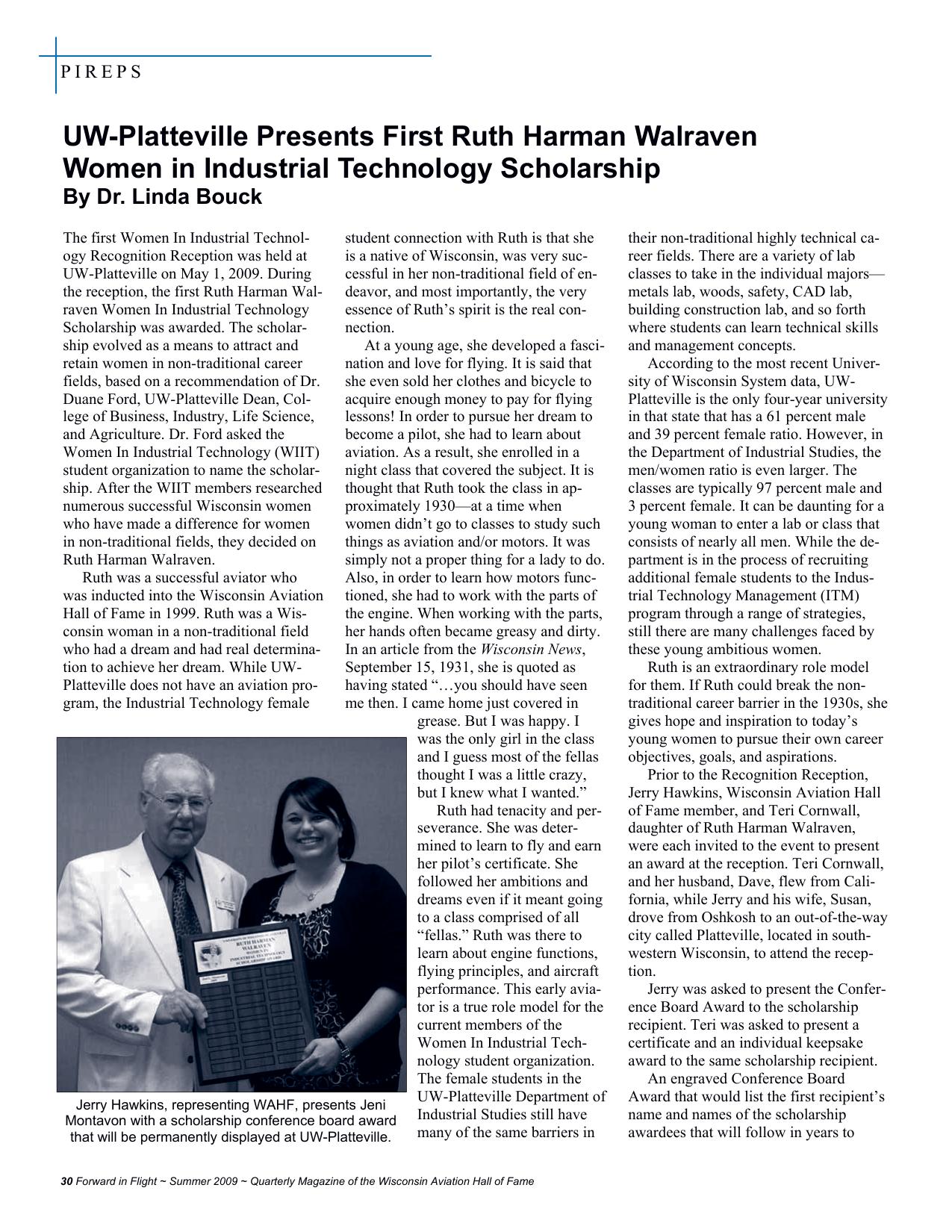
PIREPS UW-Platteville Presents First Ruth Harman Walraven Women in Industrial Technology Scholarship By Dr. Linda Bouck The first Women In Industrial Technology Recognition Reception was held at UW-Platteville on May 1, 2009. During the reception, the first Ruth Harman Walraven Women In Industrial Technology Scholarship was awarded. The scholarship evolved as a means to attract and retain women in non-traditional career fields, based on a recommendation of Dr. Duane Ford, UW-Platteville Dean, College of Business, Industry, Life Science, and Agriculture. Dr. Ford asked the Women In Industrial Technology (WIIT) student organization to name the scholarship. After the WIIT members researched numerous successful Wisconsin women who have made a difference for women in non-traditional fields, they decided on Ruth Harman Walraven. Ruth was a successful aviator who was inducted into the Wisconsin Aviation Hall of Fame in 1999. Ruth was a Wisconsin woman in a non-traditional field who had a dream and had real determination to achieve her dream. While UWPlatteville does not have an aviation program, the Industrial Technology female student connection with Ruth is that she is a native of Wisconsin, was very successful in her non-traditional field of endeavor, and most importantly, the very essence of Ruth’s spirit is the real connection. At a young age, she developed a fascination and love for flying. It is said that she even sold her clothes and bicycle to acquire enough money to pay for flying lessons! In order to pursue her dream to become a pilot, she had to learn about aviation. As a result, she enrolled in a night class that covered the subject. It is thought that Ruth took the class in approximately 1930—at a time when women didn’t go to classes to study such things as aviation and/or motors. It was simply not a proper thing for a lady to do. Also, in order to learn how motors functioned, she had to work with the parts of the engine. When working with the parts, her hands often became greasy and dirty. In an article from the Wisconsin News, September 15, 1931, she is quoted as having stated “…you should have seen me then. I came home just covered in grease. But I was happy. I was the only girl in the class and I guess most of the fellas thought I was a little crazy, but I knew what I wanted.” Ruth had tenacity and perseverance. She was determined to learn to fly and earn her pilot’s certificate. She followed her ambitions and dreams even if it meant going to a class comprised of all “fellas.” Ruth was there to learn about engine functions, flying principles, and aircraft performance. This early aviator is a true role model for the current members of the Women In Industrial Technology student organization. The female students in the UW-Platteville Department of Jerry Hawkins, representing WAHF, presents Jeni Montavon with a scholarship conference board award Industrial Studies still have many of the same barriers in that will be permanently displayed at UW-Platteville. 30 Forward in Flight ~ Summer 2009 ~ Quarterly Magazine of the Wisconsin Aviation Hall of Fame their non-traditional highly technical career fields. There are a variety of lab classes to take in the individual majors— metals lab, woods, safety, CAD lab, building construction lab, and so forth where students can learn technical skills and management concepts. According to the most recent University of Wisconsin System data, UWPlatteville is the only four-year university in that state that has a 61 percent male and 39 percent female ratio. However, in the Department of Industrial Studies, the men/women ratio is even larger. The classes are typically 97 percent male and 3 percent female. It can be daunting for a young woman to enter a lab or class that consists of nearly all men. While the department is in the process of recruiting additional female students to the Industrial Technology Management (ITM) program through a range of strategies, still there are many challenges faced by these young ambitious women. Ruth is an extraordinary role model for them. If Ruth could break the nontraditional career barrier in the 1930s, she gives hope and inspiration to today’s young women to pursue their own career objectives, goals, and aspirations. Prior to the Recognition Reception, Jerry Hawkins, Wisconsin Aviation Hall of Fame member, and Teri Cornwall, daughter of Ruth Harman Walraven, were each invited to the event to present an award at the reception. Teri Cornwall, and her husband, Dave, flew from California, while Jerry and his wife, Susan, drove from Oshkosh to an out-of-the-way city called Platteville, located in southwestern Wisconsin, to attend the reception. Jerry was asked to present the Conference Board Award to the scholarship recipient. Teri was asked to present a certificate and an individual keepsake award to the same scholarship recipient. An engraved Conference Board Award that would list the first recipient’s name and names of the scholarship awardees that will follow in years to
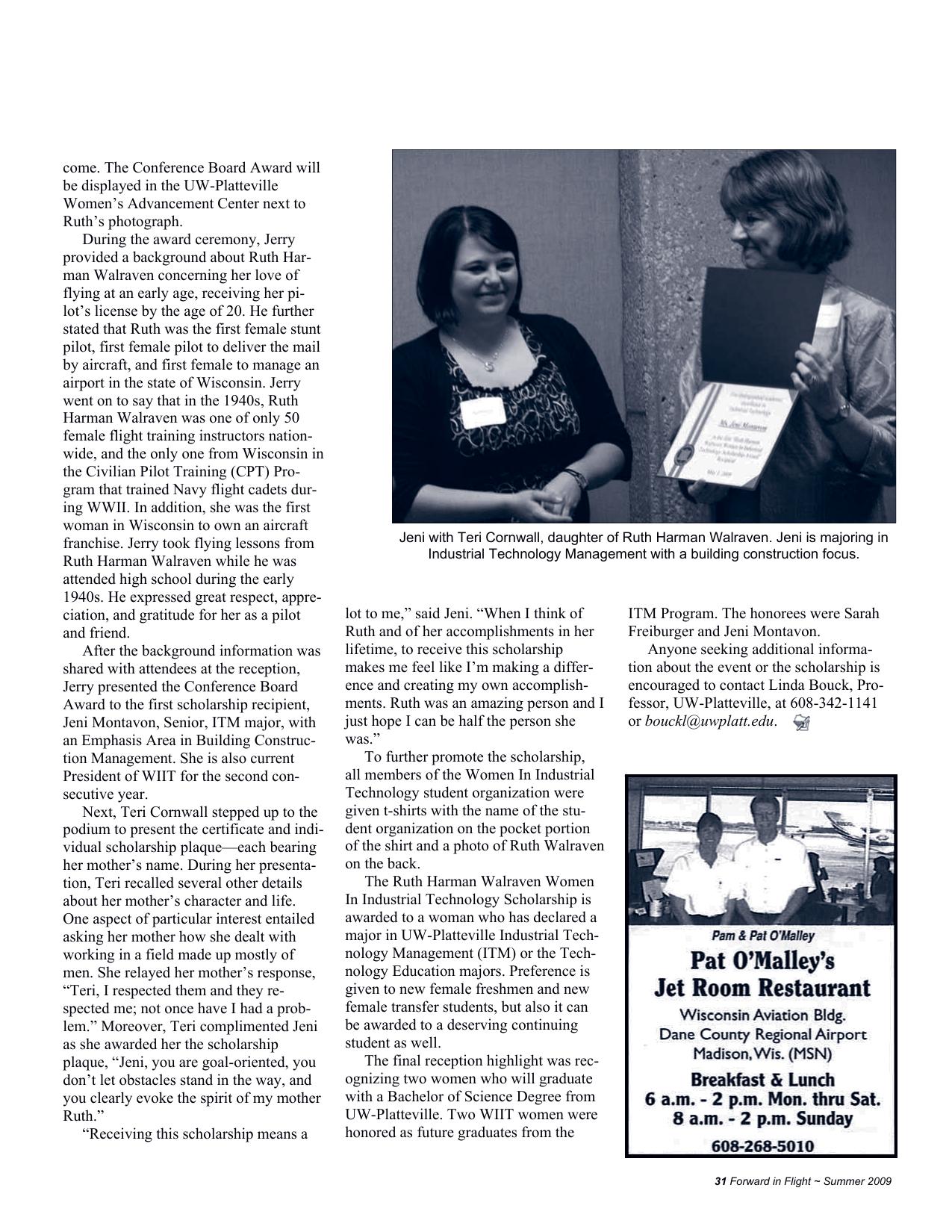
come. The Conference Board Award will be displayed in the UW-Platteville Women’s Advancement Center next to Ruth’s photograph. During the award ceremony, Jerry provided a background about Ruth Harman Walraven concerning her love of flying at an early age, receiving her pilot’s license by the age of 20. He further stated that Ruth was the first female stunt pilot, first female pilot to deliver the mail by aircraft, and first female to manage an airport in the state of Wisconsin. Jerry went on to say that in the 1940s, Ruth Harman Walraven was one of only 50 female flight training instructors nationwide, and the only one from Wisconsin in the Civilian Pilot Training (CPT) Program that trained Navy flight cadets during WWII. In addition, she was the first woman in Wisconsin to own an aircraft franchise. Jerry took flying lessons from Ruth Harman Walraven while he was attended high school during the early 1940s. He expressed great respect, appreciation, and gratitude for her as a pilot and friend. After the background information was shared with attendees at the reception, Jerry presented the Conference Board Award to the first scholarship recipient, Jeni Montavon, Senior, ITM major, with an Emphasis Area in Building Construction Management. She is also current President of WIIT for the second consecutive year. Next, Teri Cornwall stepped up to the podium to present the certificate and individual scholarship plaque—each bearing her mother’s name. During her presentation, Teri recalled several other details about her mother’s character and life. One aspect of particular interest entailed asking her mother how she dealt with working in a field made up mostly of men. She relayed her mother’s response, “Teri, I respected them and they respected me; not once have I had a problem.” Moreover, Teri complimented Jeni as she awarded her the scholarship plaque, “Jeni, you are goal-oriented, you don’t let obstacles stand in the way, and you clearly evoke the spirit of my mother Ruth.” “Receiving this scholarship means a Jeni with Teri Cornwall, daughter of Ruth Harman Walraven. Jeni is majoring in Industrial Technology Management with a building construction focus. lot to me,” said Jeni. “When I think of Ruth and of her accomplishments in her lifetime, to receive this scholarship makes me feel like I’m making a difference and creating my own accomplishments. Ruth was an amazing person and I just hope I can be half the person she was.” To further promote the scholarship, all members of the Women In Industrial Technology student organization were given t-shirts with the name of the student organization on the pocket portion of the shirt and a photo of Ruth Walraven on the back. The Ruth Harman Walraven Women In Industrial Technology Scholarship is awarded to a woman who has declared a major in UW-Platteville Industrial Technology Management (ITM) or the Technology Education majors. Preference is given to new female freshmen and new female transfer students, but also it can be awarded to a deserving continuing student as well. The final reception highlight was recognizing two women who will graduate with a Bachelor of Science Degree from UW-Platteville. Two WIIT women were honored as future graduates from the ITM Program. The honorees were Sarah Freiburger and Jeni Montavon. Anyone seeking additional information about the event or the scholarship is encouraged to contact Linda Bouck, Professor, UW-Platteville, at 608-342-1141 or bouckl@uwplatt.edu. 31 Forward in Flight ~ Summer 2009
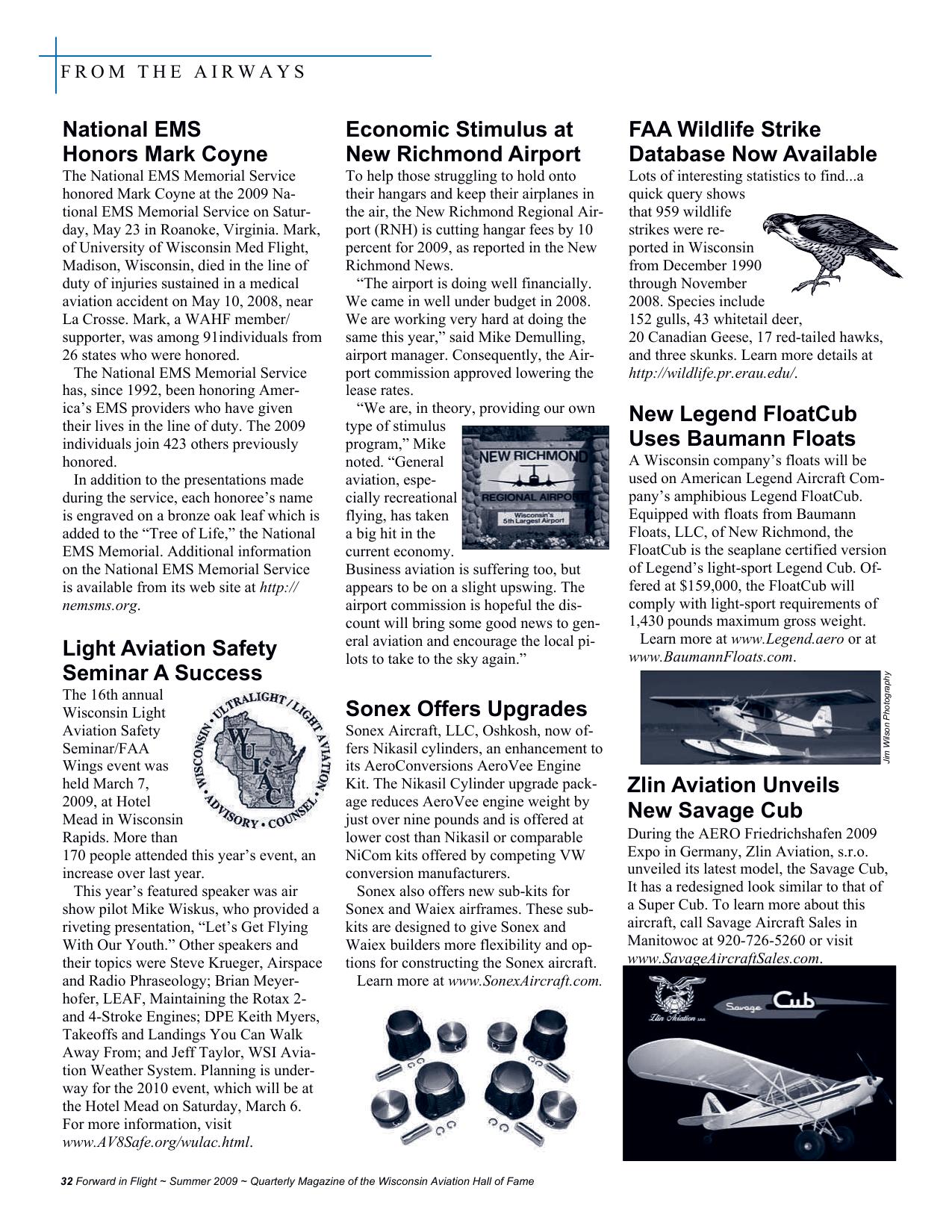
FROM THE AIRWAYS National EMS Honors Mark Coyne Economic Stimulus at New Richmond Airport FAA Wildlife Strike Database Now Available The National EMS Memorial Service honored Mark Coyne at the 2009 National EMS Memorial Service on Saturday, May 23 in Roanoke, Virginia. Mark, of University of Wisconsin Med Flight, Madison, Wisconsin, died in the line of duty of injuries sustained in a medical aviation accident on May 10, 2008, near La Crosse. Mark, a WAHF member/ supporter, was among 91individuals from 26 states who were honored. The National EMS Memorial Service has, since 1992, been honoring America’s EMS providers who have given their lives in the line of duty. The 2009 individuals join 423 others previously honored. In addition to the presentations made during the service, each honoree’s name is engraved on a bronze oak leaf which is added to the “Tree of Life,” the National EMS Memorial. Additional information on the National EMS Memorial Service is available from its web site at http:// nemsms.org. To help those struggling to hold onto their hangars and keep their airplanes in the air, the New Richmond Regional Airport (RNH) is cutting hangar fees by 10 percent for 2009, as reported in the New Richmond News. “The airport is doing well financially. We came in well under budget in 2008. We are working very hard at doing the same this year,” said Mike Demulling, airport manager. Consequently, the Airport commission approved lowering the lease rates. “We are, in theory, providing our own type of stimulus program,” Mike noted. “General aviation, especially recreational flying, has taken a big hit in the current economy. Business aviation is suffering too, but appears to be on a slight upswing. The airport commission is hopeful the discount will bring some good news to general aviation and encourage the local pilots to take to the sky again.” Lots of interesting statistics to find...a quick query shows that 959 wildlife strikes were reported in Wisconsin from December 1990 through November 2008. Species include 152 gulls, 43 whitetail deer, 20 Canadian Geese, 17 red-tailed hawks, and three skunks. Learn more details at http://wildlife.pr.erau.edu/. The 16th annual Wisconsin Light Aviation Safety Seminar/FAA Wings event was held March 7, 2009, at Hotel Mead in Wisconsin Rapids. More than 170 people attended this year’s event, an increase over last year. This year’s featured speaker was air show pilot Mike Wiskus, who provided a riveting presentation, “Let’s Get Flying With Our Youth.” Other speakers and their topics were Steve Krueger, Airspace and Radio Phraseology; Brian Meyerhofer, LEAF, Maintaining the Rotax 2and 4-Stroke Engines; DPE Keith Myers, Takeoffs and Landings You Can Walk Away From; and Jeff Taylor, WSI Aviation Weather System. Planning is underway for the 2010 event, which will be at the Hotel Mead on Saturday, March 6. For more information, visit www.AV8Safe.org/wulac.html. A Wisconsin company’s floats will be used on American Legend Aircraft Company’s amphibious Legend FloatCub. Equipped with floats from Baumann Floats, LLC, of New Richmond, the FloatCub is the seaplane certified version of Legend’s light-sport Legend Cub. Offered at $159,000, the FloatCub will comply with light-sport requirements of 1,430 pounds maximum gross weight. Learn more at www.Legend.aero or at www.BaumannFloats.com. Jim Wilson Photography Light Aviation Safety Seminar A Success New Legend FloatCub Uses Baumann Floats Sonex Offers Upgrades Sonex Aircraft, LLC, Oshkosh, now offers Nikasil cylinders, an enhancement to its AeroConversions AeroVee Engine Kit. The Nikasil Cylinder upgrade package reduces AeroVee engine weight by just over nine pounds and is offered at lower cost than Nikasil or comparable NiCom kits offered by competing VW conversion manufacturers. Sonex also offers new sub-kits for Sonex and Waiex airframes. These subkits are designed to give Sonex and Waiex builders more flexibility and options for constructing the Sonex aircraft. Learn more at www.SonexAircraft.com. 32 Forward in Flight ~ Summer 2009 ~ Quarterly Magazine of the Wisconsin Aviation Hall of Fame Zlin Aviation Unveils New Savage Cub During the AERO Friedrichshafen 2009 Expo in Germany, Zlin Aviation, s.r.o. unveiled its latest model, the Savage Cub, It has a redesigned look similar to that of a Super Cub. To learn more about this aircraft, call Savage Aircraft Sales in Manitowoc at 920-726-5260 or visit www.SavageAircraftSales.com.
Air Graphics Selected for AOPA Sweepstakes Plane Air Graphics, LLC was recently selected by the Aircraft Owners and Pilots Association (AOPA) to design and apply the graphics to the 2009 AOPA “Let’s Go Flying” Sweepstakes plane, a Cirrus SR22. The project has generated additional interest in Air Graphics products and services. Air Graphics recently broke ground on a new 18,000-squarefoot facility at the Middleton Municipal - Morey Field Airport (C29) in Middleton, Wisconsin. This state-of-the-art facility will be the new headquarters for company operations as well as its design studio and production facility. See photos and learn more at www.AirGraphics.com. Am I High’s CFIs Recognized Wanda Zuege, a two-time master certificated flight instructor (M-CFI), recently renewed her Master CFI accreditation. Wanda is the chief flight and ground instructor as well as owner of Am I High Aviation at Stevens Point Municipal Airport (STE). She also serves as a FAASTeam representative in the FAA’s Milwaukee FSDO area. Am I High’s John Thompson, M-CFI, recently completed the Cirrus Standardized Instructor Program in Duluth, Minnesota. Thompson is now qualified to teach in the technically advanced Cirrus Airplane, providing quality transition training to Cirrus owners and pilots. He has accumulated 4000 total flight hours of which 2,500 hours are instruction given. John and Wanda started Am I High Aviation, LLC, in 2005 to provide flight training opportunities for the Stevens Point community and surrounding areas. Call John or Wanda at 715-252-3326 or visit their website at www.AmIHighAviation.com. Touch n View - FBO Kiosks Provide Aviation Information In partnership with its sister company, Frankwood Technologies, Relation Systems, Inc. (RSI) is now offering Touch n View - FBO, a kiosk device for general aviation airports. The solid state touch screen hardware and service allow for an interactive display of information for airport travelers of all categories. Typical information displayed includes: • IFR Arrivals and Departures - just like at larger airports! • Government Security Levels and Alerts • Current and Outlook Weather • Local Weather Observations, Watches, and Warnings • Transportation, Lodging, Dining, and Entertainment • Local and National News Headlines • ‘Welcome’ Board • Fixed Base Operator (FBO) Home Page Each of these screens can be displayed in a rotating sequence when the device is idle. Touch n View devices are remotely configured and supported by RSI. All that’s necessary is a wired or wireless Internet connection and a power outlet - no technical knowledge is needed. Systems are available from 19 to 42 inch display sizes. Learn more at www.Relation.com or call Jim Woodring in Pewaukee, Wisconsin, at 262-244-1108. DR. TOM VOELKER Aviation Medical Examiner 2nd and 3rd Class Aviation Medicals Phone 715-423-0122 Aspirus Doctor’s Clinic 420 Dewey Street Wisconsin Rapids WI 54494 Located at Riverview East Medical Office Bldg. Send your news to Forward in Flight! flyer@aviationhalloffamewisconsin.com Or mail to 3980 Sharratt Drive Oshkosh, WI 54901-1276 33 Forward in Flight ~ Summer 2009
MEMBER’S LOGBOOK Never Too Late... Fellow WAHF Members, I’ve been flying since 1937 and at 87, I still fly my Aerostar a couple times a week. But this isn’t about me, it’s about Phil Pines, a very good friend and hangar neighbor [and WAHF member]. Phil is the owner of Great Dane Trailers. Phil’s corporate headquarters are in Chicago, Illinois, and Savannah, Georgia, with a total of nine factories scattered throughout the United States. I first met Phil in the year 2000 when he approached me at the DLL (Baraboo Dells Airport). Phil, being very gracious and exceedingly polite said, “I’m Phil Pines and I believe you may be a bit older than me at 65, but do you think I’m too old to learn to fly?” I quickly responded by saying, “Phil, you’re never too old, just do it.” Imagine my surprise when two weeks later Phil taxied to my hangar with an instructor at his side in a brand new four place Piper Archer aircraft. “Bill, I’m doing it, and loving every bit of it,” he said. Since that time Phil has owned and flown a Citabria, a 6-place Piper Saratoga and now with an instrument rating, he flies a Piper Meridian (turbo prop). Phil has a total of 1633 hours and soon will have acquired his commercial certificate. With two professional pilots in his company, Phil is awaiting delivery of a Lear 60 to replace their present Lear 45, which he has owned for six years. You truly are to be congratulated, Phil. Phil Pines (above) began flying in 2000, at age 65, after receiving encouragement from Bill Wenkman. Both Bill and Phil continue to fly and actively support the mission and goals of the Wisconsin Aviation Hall of Fame. Sincerely, Bill Wenkman Wisconsin Dells Your letters, questions, suggestions, and stories are welcome! Send to: flyer@aviationhalloffamewisconsin.com Advertise in Forward In Flight, Take advantage of FIF’s low ad/editorial ratio to Get Your Ad Noticed! Place your ad by calling 920-385-1483 or email flyer@aviationhalloffamewisconsin.com 34 Forward in Flight ~ Summer 2009 ~ Quarterly Magazine of the Wisconsin Aviation Hall of Fame
FINAL WORDS Why Do You Support WAHF? It was the least I could do for all the help WAHF board members gave me in my quest to honor my late father, Fritz E. Wolf. I am a student of history, and aviation history in particular, so I want to help support the preservation of aviation history in Wisconsin. —Rick Wolf —Joe Norris Because those who support and contribute to the positive development and growth of general aviation in the great state of Wisconsin deserve recognition and remembrance. —Frank Gattolin I admire your goals. To increase my involvement in aviation. —Pete Waggoner I enjoy aviation history, and am thankful for the contributions my predecessors in the aviation world made to advance the industry and the technology. It is important to have a way to recognize these people and thank them for their efforts. —Kelly Nelson —Fred Leidel Subscribe to Forward in Flight (Annual subscription includes one-year WAHF membership support.) Membership Benefits: Quarterly subscription (4 issues) of Forward in Flight, packed full of Wisconsin aviation news, event reports, history, and news from state aviation businesses. Invitation to annual induction banquet Free pass to Deke Slayton Museum The opportunity to nominate aviation leaders for induction! Name Address City State Zip Phone Number Email Address Referred By Just $20, and you’ll be supporting an aviation organization dedicated to collecting, preserving, and sharing Wisconsin’s aviation history. With Forward in Flight, you’ll learn about aviation history makers—the people, places, and happenings that distinguish our state and also be in touch with current Wisconsin aviation news and events! This form can be used for renewals, as well. Send your check today! Please write check to: Wisconsin Aviation Hall of Fame, Inc. Mail to: John Dorcey, Treasurer Wisconsin Aviation Hall of Fame 3980 Sharratt Drive Oshkosh WI 54901-1276 Great Gift! 35 Forward in Flight ~ Summer 2009