Volume 8, Issue 2
🗞️ Download Issue (PDF)
Forward in Flight - Summer 2010
Volume 8, Issue 2 A Publication of the Wisconsin Aviation Hall of Fame Summer 2010
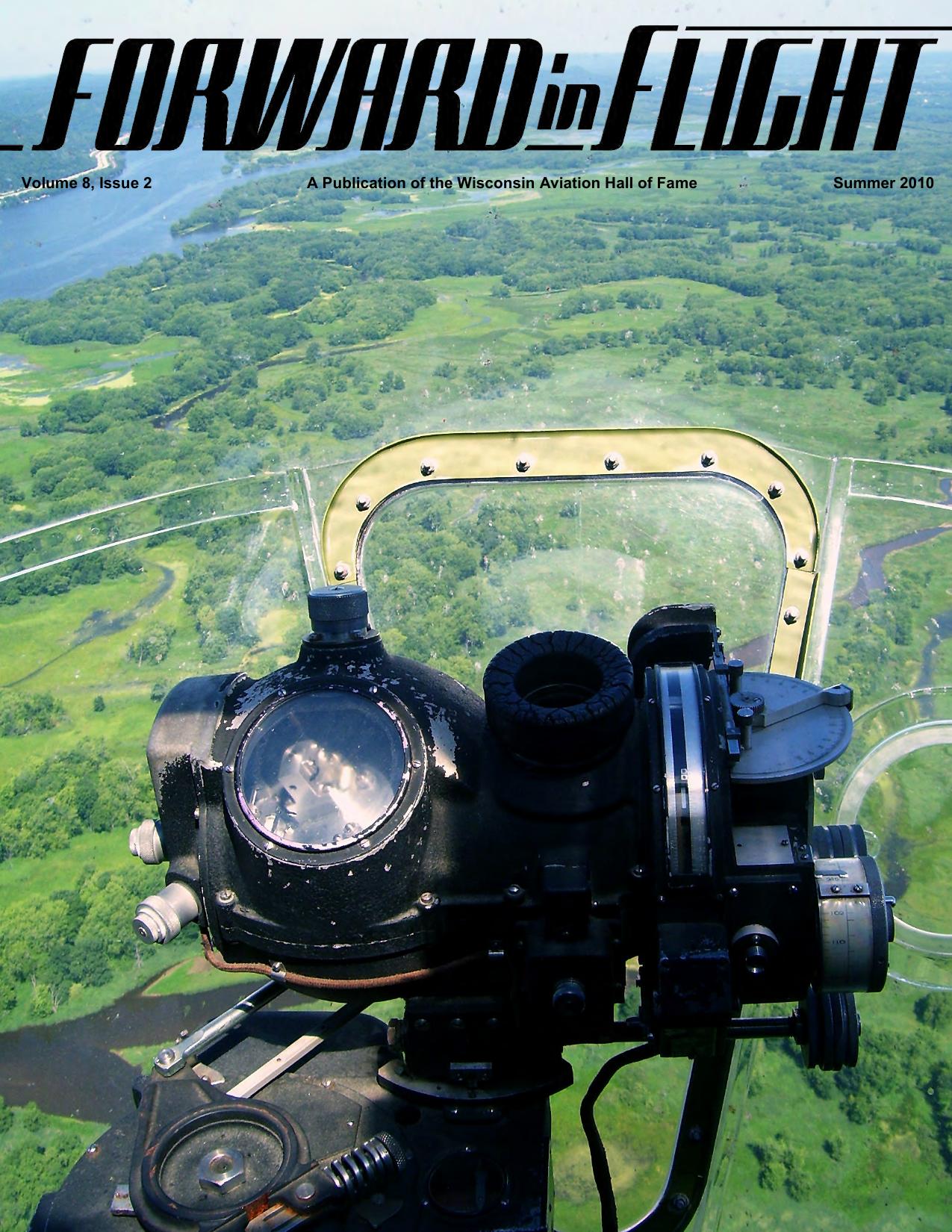
Contents Association News 4 WAHF’s 2010 Scholarship Recipients Three students share $2,000 AirDoc’s Medical Matters 6 Enjoy the Flight Tips for helping your passengers fly without fear Dr. Tom Voelker, AME Special Report 8 Wisconsin Aviation Conference 55th annual event provides crucial information Author gets chance of a lifetime...flying the Fortress People, Planes, & Places 11 Flying the Fortress Frederick Beseler 14 WASP Honored with Congressional Gold Medal Fred Beseler 17 Former UW-Madison Prof a Daredevil at 93 Doug Moe Check Six 18 Wisconsin’s Munchkin Pilot Heads West Gary Dikkers 21 Daring Young Men More than a book review Gary Dikkers WASP finally honored ...several from Wisconsin From the Archives 24 Major Mulzer Was a Promoter From the log of a Tri-Motor Pilot J. Marshall Buehler 26 Gone West 27 From the Airways 30 Member Spotlight - Bert Sasse Famous Munchkin was also a pilot, and from Wisconsin! Forward in Flight Sharing Wisconsin aviation stories—past and present Rose Dorcey, editor 3980 Sharratt Drive Oshkosh WI 54901-1276 Phone: 920-385-1483 or 920-279-6029 flyer@aviationhalloffamewisconsin.com On the cover: The view from the bombardier’s position in the nose of EAA’s Aluminum Overcast as it approaches Trempealeau, Wisconsin, along the Mississippi River. The famous Norden bombsight is in the foreground, many of which were made by AC Sparkplug/Delco in Milwaukee. Read about Fred’s ride in the B-17 on pages 11-13. The Wisconsin Aviation Hall of Fame is a membership organization with a mission to collect and preserve the history of aviation in Wisconsin, recognize those who made that history, inform others of it, and promote aviation educa- Photo by Fred Beseler tion for future generations.
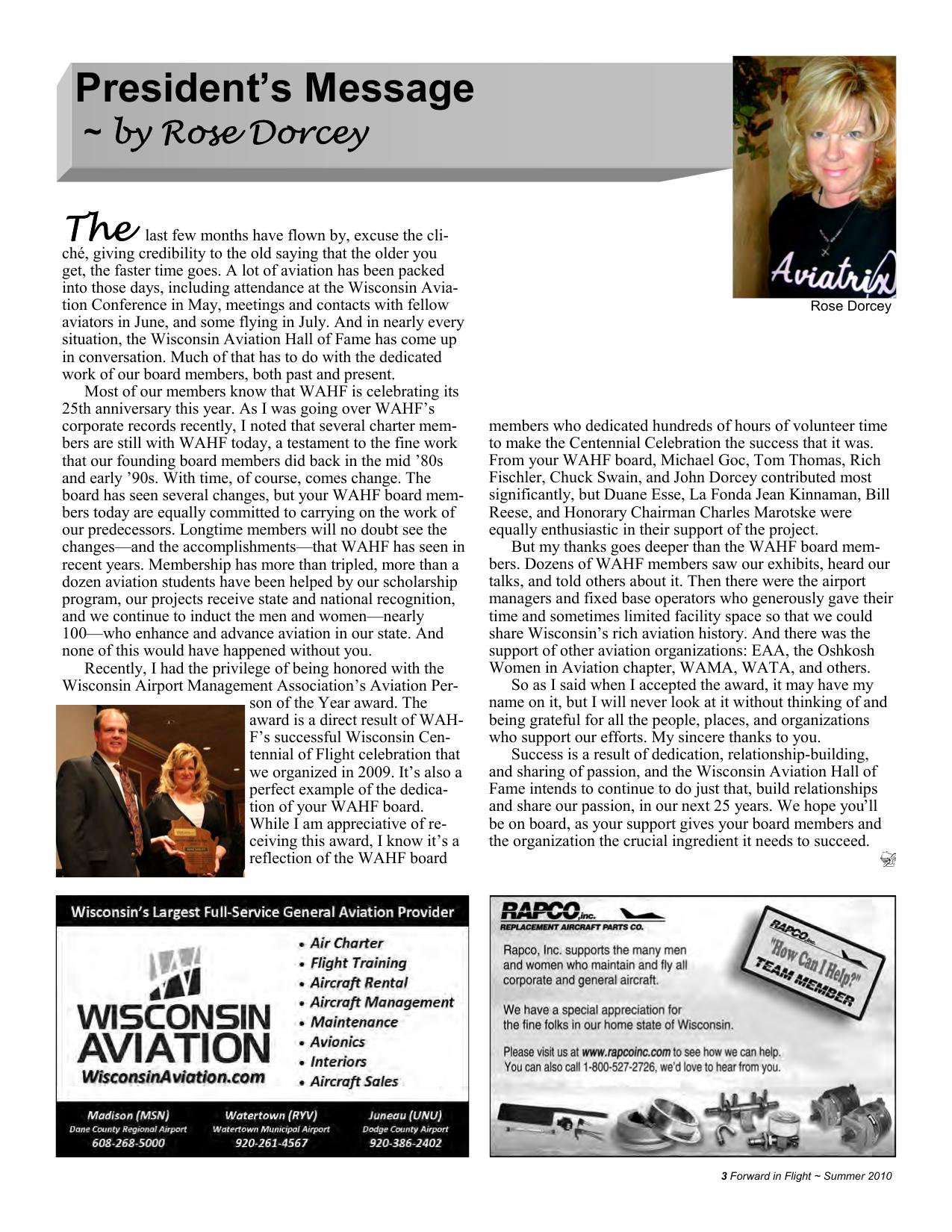
President’s Message ~ by Rose Dorcey The last few months have flown by, excuse the cli- ché, giving credibility to the old saying that the older you get, the faster time goes. A lot of aviation has been packed into those days, including attendance at the Wisconsin Aviation Conference in May, meetings and contacts with fellow aviators in June, and some flying in July. And in nearly every situation, the Wisconsin Aviation Hall of Fame has come up in conversation. Much of that has to do with the dedicated work of our board members, both past and present. Most of our members know that WAHF is celebrating its 25th anniversary this year. As I was going over WAHF’s corporate records recently, I noted that several charter members are still with WAHF today, a testament to the fine work that our founding board members did back in the mid ’80s and early ’90s. With time, of course, comes change. The board has seen several changes, but your WAHF board members today are equally committed to carrying on the work of our predecessors. Longtime members will no doubt see the changes—and the accomplishments—that WAHF has seen in recent years. Membership has more than tripled, more than a dozen aviation students have been helped by our scholarship program, our projects receive state and national recognition, and we continue to induct the men and women—nearly 100—who enhance and advance aviation in our state. And none of this would have happened without you. Recently, I had the privilege of being honored with the Wisconsin Airport Management Association’s Aviation Person of the Year award. The award is a direct result of WAHF’s successful Wisconsin Centennial of Flight celebration that we organized in 2009. It’s also a perfect example of the dedication of your WAHF board. While I am appreciative of receiving this award, I know it’s a reflection of the WAHF board Rose Dorcey members who dedicated hundreds of hours of volunteer time to make the Centennial Celebration the success that it was. From your WAHF board, Michael Goc, Tom Thomas, Rich Fischler, Chuck Swain, and John Dorcey contributed most significantly, but Duane Esse, La Fonda Jean Kinnaman, Bill Reese, and Honorary Chairman Charles Marotske were equally enthusiastic in their support of the project. But my thanks goes deeper than the WAHF board members. Dozens of WAHF members saw our exhibits, heard our talks, and told others about it. Then there were the airport managers and fixed base operators who generously gave their time and sometimes limited facility space so that we could share Wisconsin’s rich aviation history. And there was the support of other aviation organizations: EAA, the Oshkosh Women in Aviation chapter, WAMA, WATA, and others. So as I said when I accepted the award, it may have my name on it, but I will never look at it without thinking of and being grateful for all the people, places, and organizations who support our efforts. My sincere thanks to you. Success is a result of dedication, relationship-building, and sharing of passion, and the Wisconsin Aviation Hall of Fame intends to continue to do just that, build relationships and share our passion, in our next 25 years. We hope you’ll be on board, as your support gives your board members and the organization the crucial ingredient it needs to succeed. 3 Forward in Flight ~ Summer 2010
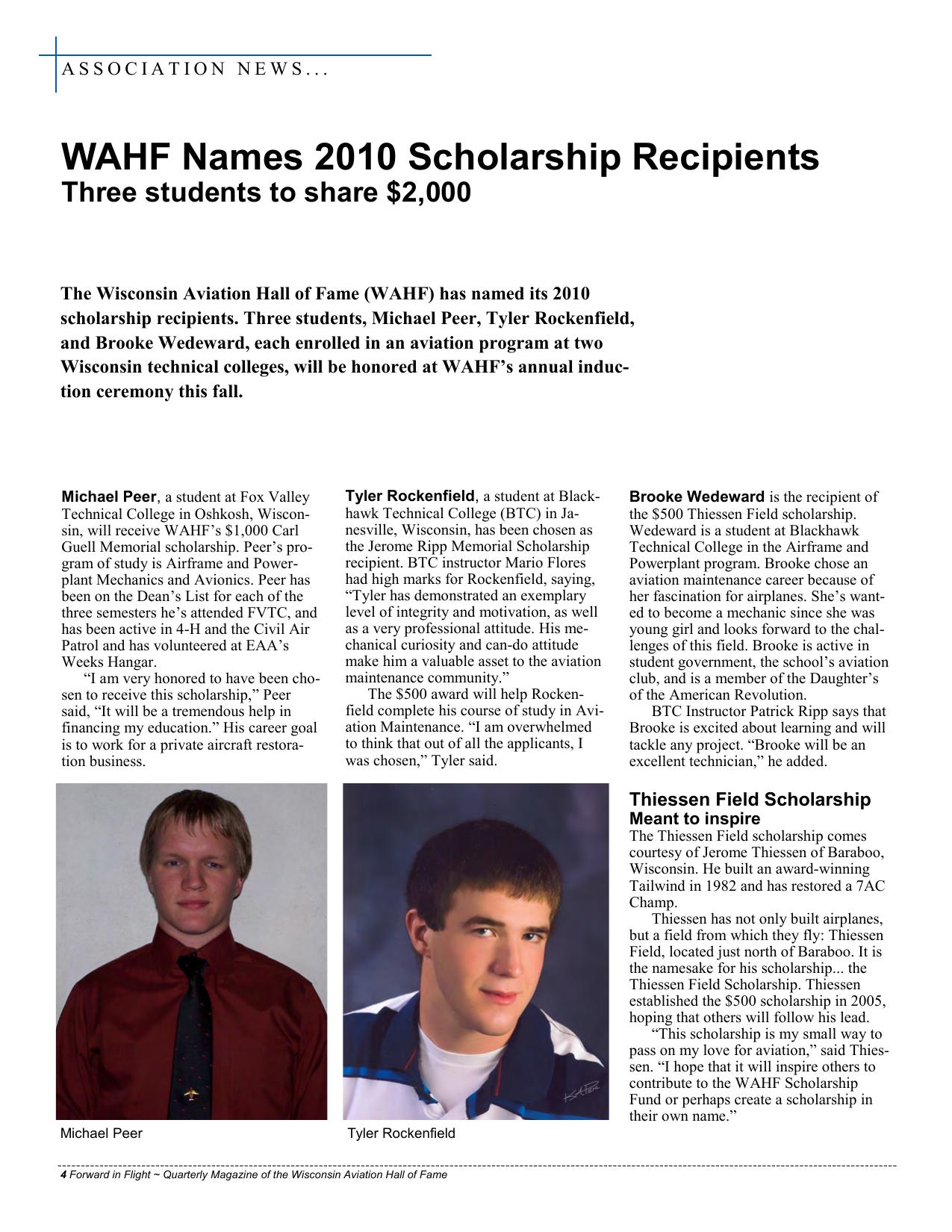
ASSOCIATION NEWS... WAHF Names 2010 Scholarship Recipients Three students to share $2,000 The Wisconsin Aviation Hall of Fame (WAHF) has named its 2010 scholarship recipients. Three students, Michael Peer, Tyler Rockenfield, and Brooke Wedeward, each enrolled in an aviation program at two Wisconsin technical colleges, will be honored at WAHF’s annual induction ceremony this fall. Michael Peer, a student at Fox Valley Technical College in Oshkosh, Wisconsin, will receive WAHF’s $1,000 Carl Guell Memorial scholarship. Peer’s program of study is Airframe and Powerplant Mechanics and Avionics. Peer has been on the Dean’s List for each of the three semesters he’s attended FVTC, and has been active in 4-H and the Civil Air Patrol and has volunteered at EAA’s Weeks Hangar. “I am very honored to have been chosen to receive this scholarship,” Peer said, “It will be a tremendous help in financing my education.” His career goal is to work for a private aircraft restoration business. Tyler Rockenfield, a student at Blackhawk Technical College (BTC) in Janesville, Wisconsin, has been chosen as the Jerome Ripp Memorial Scholarship recipient. BTC instructor Mario Flores had high marks for Rockenfield, saying, “Tyler has demonstrated an exemplary level of integrity and motivation, as well as a very professional attitude. His mechanical curiosity and can-do attitude make him a valuable asset to the aviation maintenance community.” The $500 award will help Rockenfield complete his course of study in Aviation Maintenance. “I am overwhelmed to think that out of all the applicants, I was chosen,” Tyler said. Brooke Wedeward is the recipient of the $500 Thiessen Field scholarship. Wedeward is a student at Blackhawk Technical College in the Airframe and Powerplant program. Brooke chose an aviation maintenance career because of her fascination for airplanes. She’s wanted to become a mechanic since she was young girl and looks forward to the challenges of this field. Brooke is active in student government, the school’s aviation club, and is a member of the Daughter’s of the American Revolution. BTC Instructor Patrick Ripp says that Brooke is excited about learning and will tackle any project. “Brooke will be an excellent technician,” he added. Thiessen Field Scholarship Meant to inspire The Thiessen Field scholarship comes courtesy of Jerome Thiessen of Baraboo, Wisconsin. He built an award-winning Tailwind in 1982 and has restored a 7AC Champ. Thiessen has not only built airplanes, but a field from which they fly: Thiessen Field, located just north of Baraboo. It is the namesake for his scholarship... the Thiessen Field Scholarship. Thiessen established the $500 scholarship in 2005, hoping that others will follow his lead. “This scholarship is my small way to pass on my love for aviation,” said Thiessen. “I hope that it will inspire others to contribute to the WAHF Scholarship Fund or perhaps create a scholarship in their own name.” Michael Peer Tyler Rockenfield 4 Forward in Flight ~ Quarterly Magazine of the Wisconsin Aviation Hall of Fame
ASSOCIATION NEWS WAHF Partners with Community Foundation of North Central Wisconsin for Scholarship Program The WAHF Board of Directors recently completed the first of a multiphase analysis of its scholarship program. After the committee chair position became vacant and members and benefactors made comment about the program, and eight years after the scholarship program began, WAHF began a search of Wisconsin-based foundations. The scholarship review committee found an excellent candidate in the Community Foundation of North Central Wisconsin (CFONCW). Several meetings with foundation staff provided assurance that a partnership between WAHF and CFONCW would be a mutually beneficial relationship. At its March 18 meeting, the WAHF board voted to move from its original foundation partner to the CFONCW. Online donations are the most readily apparent benefit to WAHF and its supporters. The process is easy and secure; it takes just a few mouse clicks to complete. To make a donation, visit the Community Foundation of North Central Wisconsin’s website at www.cfoncw.org/grants/scholarships.cfm and scroll down to find the Wisconsin Aviation Hall of Fame scholarship. Once there, complete the two-step process and press Verify. It’s easy to support today’s aviation students and your donation may be tax deductible. Our analysis continues as we begin reviewing other facets of our scholarship program, such as college and student participation and aviation programs eligible. Your comments about the program are encouraged. If you’re interested in more information about creating a scholarship, making a donation, or providing comment, contact John Dorcey by sending an e-mail to wipilot@new.rr.com or by calling 920-385-1483. Morey Airplane Company Since 1932 Planning Underway for 2010 Induction Ceremony Put Saturday evening, October 25, 2010, on your calendar and plan to attend the annual WAHF Induction Banquet at the beautiful EAA AirVenture Museum in Oshkosh, Wisconsin. Spend the day touring the museum, and then at 5 p.m., attend the social hour and silent auction to raise funds for WAHF’s outreach programs. Dinner begins at 6 and the induction presentations begin at 7. Five Wisconsin aviators will be inducted: Jeannette Kapus, Bob Kunkel, Dick Wixom, Jesse Brabazon, and Richard Lutz. WAHF board members are making changes to the 2010 event to ensure an efficient, time-sensitive presentation. Some special events are also being planned to help celebrate WAHF’s 25th anniversary. All current WAHF members will receive an invitation and are encouraged to attend and bring a friend. Watch your mailbox, and Forward in Flight, for more details. Find WAHF on Facebook and Twitter If you’re on Facebook or Twitter, you can start receiving Wisconsin aviation news, history, trivia, and events at WAHF’s pages on these social media sites. Visit the WAHF Facebook page at www.Facebook.com/WisAviationHallofFame. Follow WAHF on Twitter @WAHF. WAHF’s John Dorcey has also started a Wisconsin aviation history blog. Recent posts include a story about WAHF inductee Lester Maitland, along with short video clips of Maitland’s takeoff when he became the first person to complete a trans-Pacific flight in the Fokker C-2 Bird of Paradise. Find the blog at http://aviationhalloffamewisconsin.com/blog. Lester Maitland Middleton Municipal Airport/Morey Field Self-service 100LL & Jet A 24-7 Looking for a Speaker? Flying clubs and EAA chapter meetings and banquets are just some of the places WAHF Speakers Bureau members are willing to attend. WAHF speakers also spread the word about Wisconsin aviation history at service clubs, such as Rotary, and at historical museums throughout the state. If you’re interested in scheduling a WAHF speaker at your next event, please contact Rose Dorcey at speakers@aviationhalloffamewisconsin.com or call 920-385-1483. 5 Forward in Flight ~ Summer 2010
AIR DOC Enjoy the Flight Tips for helping your passengers fly without fear By Dr. Tom Voelker, AME DrAlphaMike@yahoo.com H ello again, fellow airmen! I’ve been doing quite a bit of flying over the past three months and I have had some interesting experiences in the air. As you might imagine, I find some of these experiences worth sharing with you, one in particular. My wife, Kathy, likes to do all sorts of things with me. Unfortunately, flying isn’t one of them. I have written previously about one of my peeves in flight training. When we get our ticket, we aren’t told how to share our newfound love with the other loves in our lives. So we take our families on rides just below the bumpulus clouds, at the same time showing off our prowess at steep turns and demonstrating the wonderful aircraft property of “dynamic longitudinal stability.” I took one such flight with Kathy and nearly forever instilled in her not the love of flying, but rather the fear of flying! In the 12 years since that flight, my wife has flown with me only about half a dozen times. This year, however, we decided to go to Gulf Shores, Alabama, for spring break. It turned out that none of our kids could make the trip. As it was just the two of us, Kathy agreed (to my pleasant surprise) to fly with me. The trip to Gulf Shores was uneventful. We cruised at 11,000 feet, often above those bumpy clouds, and the air was smooth as silk. Kathy was impressed and looked forward to the trip home. I planned the same route, with a fuel stop in Paducah, Kentucky, then direct Madison and on to Wisconsin Rapids. The trouble was a line of thunderstorms stretching from Louisiana to southern Wisconsin. I planned to parallel the front and penetrate the clouds (and turbulence) for the last half hour of the flight. The flight went as planned. Kathy enjoyed the first leg and she found the FBO in Paducah very welcoming. She even seemed to be enjoying the last part of the flight. As we penetrated the clouds, we picked up a little ice, which I was able to shed easily by requesting a descent to 10,000 feet. Neither the ice nor the turbulence fazed her. She was quiet as a mouse. It wasn’t until we landed that I learned the real reason for her silence. She was praying as hard as she could for the last two hours of the flight! You may recall that I wrote about anxiety in the Summer 2009 issue of Forward in Flight. That column related to Is my wife still flying with me? Six weeks after the “terrible” flight through the icy clouds, we hit the airways again, this time Nashville-bound... the anxiety and stress of the pilot. Hopefully we pilots have overcome any fear of flying long ago. So what can we do about our passengers’ fear of flight? To answer that question we need to look at how we as pilots overcame our own fears. Several years ago a friend of mine was taking flight lessons for his private 6 Forward in Flight ~ Quarterly Magazine of the Wisconsin Aviation Hall of Fame rating. He commented that he was deathly afraid of stalls. My reassurance made no difference. It was only after his instructor took him through many near stalls and several actual stalls and stall recoveries that he became comfortable with them. He finally realized that, once recognized, stalls are easy to recover, and that stall recognition is something that can be learned with repetition. I had tried to tell him that several weeks and flights (and quite a few dollars) earlier, but he had to learn it himself by exposure and repetition. In the same way, your passengers can learn to allay their fears of flying. If your passenger is afraid to fly, ask him or her about the fear. Is there a specific event of which he is scared? Has she heard of others experiencing problems, especially in a small plane? Has he ever flown before? If so, how was the flight? Just talking about the upcoming flight and showing your passenger that you care about his or her safety and comfort can be calming. If she is worried about the thunderstorms at your destination, reassure her that you won’t fly near the thunderstorms, and discuss how you will handle the situation. Discuss the weather detection equipment aboard, how Flight Service can help, and what options (such as landing short and renting a car) you have if your destination is “socked in.” You may also be able to convert an unwilling spouse or friend into a flying companion with the use of “baby steps.” You could start with a quick flight in the pattern, or maybe a 10-minute flight to the next town. Just be sure to pick a severe clear day with smooth air for this
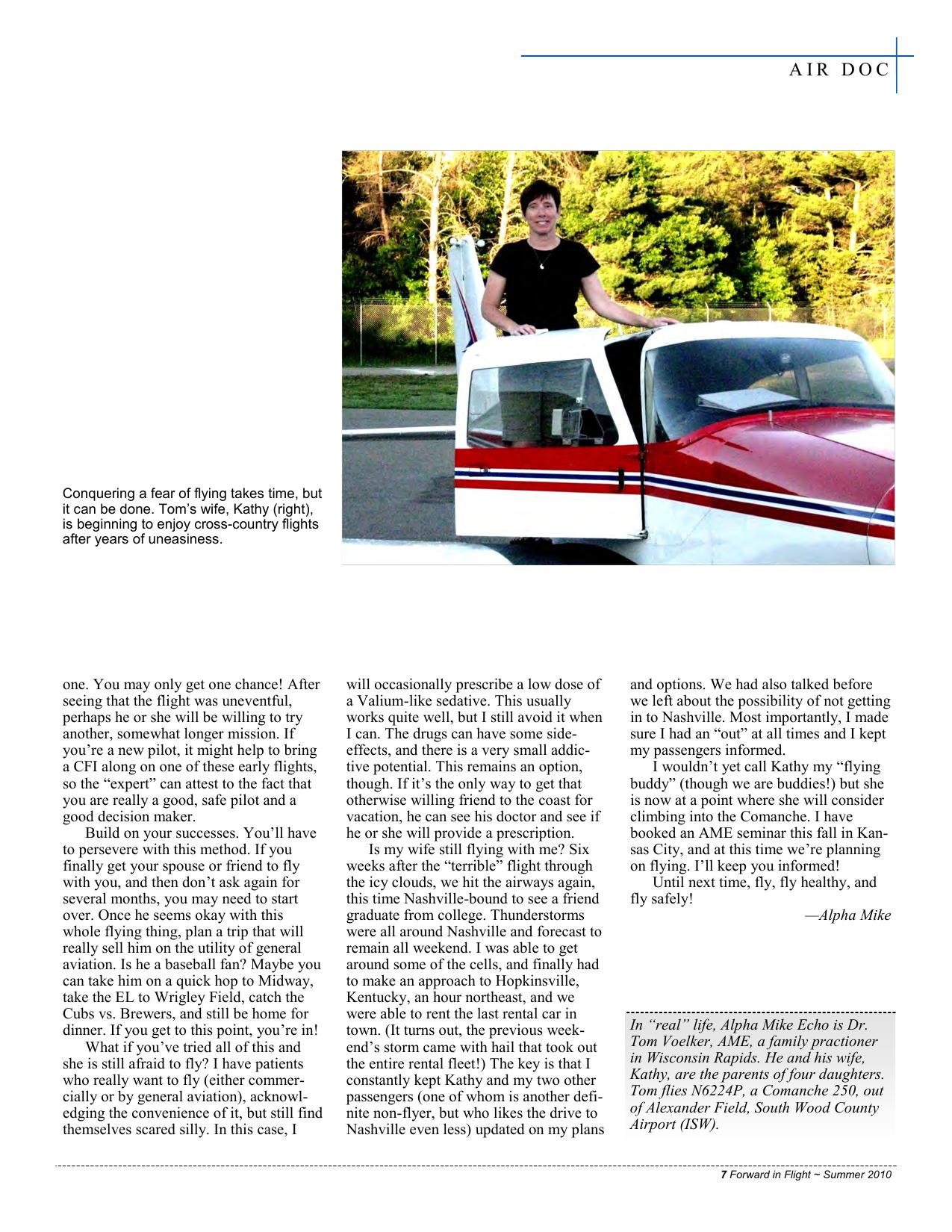
AIR DOC Conquering a fear of flying takes time, but it can be done. Tom’s wife, Kathy (right), is beginning to enjoy cross-country flights after years of uneasiness. one. You may only get one chance! After seeing that the flight was uneventful, perhaps he or she will be willing to try another, somewhat longer mission. If you’re a new pilot, it might help to bring a CFI along on one of these early flights, so the “expert” can attest to the fact that you are really a good, safe pilot and a good decision maker. Build on your successes. You’ll have to persevere with this method. If you finally get your spouse or friend to fly with you, and then don’t ask again for several months, you may need to start over. Once he seems okay with this whole flying thing, plan a trip that will really sell him on the utility of general aviation. Is he a baseball fan? Maybe you can take him on a quick hop to Midway, take the EL to Wrigley Field, catch the Cubs vs. Brewers, and still be home for dinner. If you get to this point, you’re in! What if you’ve tried all of this and she is still afraid to fly? I have patients who really want to fly (either commercially or by general aviation), acknowledging the convenience of it, but still find themselves scared silly. In this case, I will occasionally prescribe a low dose of a Valium-like sedative. This usually works quite well, but I still avoid it when I can. The drugs can have some sideeffects, and there is a very small addictive potential. This remains an option, though. If it’s the only way to get that otherwise willing friend to the coast for vacation, he can see his doctor and see if he or she will provide a prescription. Is my wife still flying with me? Six weeks after the “terrible” flight through the icy clouds, we hit the airways again, this time Nashville-bound to see a friend graduate from college. Thunderstorms were all around Nashville and forecast to remain all weekend. I was able to get around some of the cells, and finally had to make an approach to Hopkinsville, Kentucky, an hour northeast, and we were able to rent the last rental car in town. (It turns out, the previous weekend’s storm came with hail that took out the entire rental fleet!) The key is that I constantly kept Kathy and my two other passengers (one of whom is another definite non-flyer, but who likes the drive to Nashville even less) updated on my plans and options. We had also talked before we left about the possibility of not getting in to Nashville. Most importantly, I made sure I had an “out” at all times and I kept my passengers informed. I wouldn’t yet call Kathy my “flying buddy” (though we are buddies!) but she is now at a point where she will consider climbing into the Comanche. I have booked an AME seminar this fall in Kansas City, and at this time we’re planning on flying. I’ll keep you informed! Until next time, fly, fly healthy, and fly safely! —Alpha Mike In “real” life, Alpha Mike Echo is Dr. Tom Voelker, AME, a family practioner in Wisconsin Rapids. He and his wife, Kathy, are the parents of four daughters. Tom flies N6224P, a Comanche 250, out of Alexander Field, South Wood County Airport (ISW). 7 Forward in Flight ~ Summer 2010
SPECIAL REPORT Wisconsin Aviation Conference 55th annual event provides crucial information T throughout the state. When the attendees were assembled on Monday evening for a reception and dinner, WAMA President John Reed, WBAA President David Mann, and WATA’s Jeff Baum provided a lively welcome. Waukesha County Executive Daniel Vrakas provided a welcome on Tuesday morning and then mingled with attendees to learn more about the state of Wisconsin aviation. Wisconsin Bureau of Aeronautics Director David Greene, FAA Great Lakes Administration Barry Cooper, and FAA Airports District Office Manager Jesse Carriger provided updates on state and federal issues facing the aviation community at the opening general session. Greene and Carriger shared funding and airport project information, while Cooper stressed the importance of the implementation of FAA’s NextGen Jeff Gaier photo he 55th Annual Wisconsin Aviation Conference was held at the Country Springs Inn in Waukesha, from May 3 - 5, 2010. The conference, of interest to all areas of the aviation community, brought together airport managers, pilots, municipal airport committee members, aviation business owners, and state and federal officials to discuss and exchange ideas and information. The Wisconsin Airport Management Association (WAMA), Wisconsin Aviation Exhibitors and Consultants Association, Wisconsin Aviation Trades Association (WATA), and Wisconsin Business Aviation Association (WBAA) cosponsor the event. Kicking off on the afternoon of Monday, May 3 with two icebreaker events, golf or a round of sporting clays, the conference drew about 200 people from WAMA President John Reed, left, presented Barry Bateman with the Lifetime Service Award. Bateman is director at General Mitchell International Airport (MKE) in Milwaukee. 8 Forward in Flight ~ Quarterly Magazine of the Wisconsin Aviation Hall of Fame Air Transportation System. After a short break, attendees heard an excellent presentation, “Runway Safety—It’s Everyone’s Responsibility” by FAA Airport Certification/Safety Inspector Michael Stephens. His timely, crucial presentation covered runway incursion prevention, airfield marking and signage, the need for airport driver training, and proper cockpit and vehicle communications. During lunch, WAMA Vice President Charity Speich presented WAMA’s professional development scholarships. The scholarship recipients were Josh Gowey of Sparta and Scott Volberding, operations manager at Austin Straubel International Airport (GRB). Next on the agenda was the WAMA Distinguished Service award, which Reed presented to Clint Torp. He received this award in part for his recommendations and refinement of WAMA documents and its conference registration processes. Jeff Baum then presented the WATA Wisconsin Aviation Business of the Year Award to Mark Jaraczewski of Executive Air, based at Green Bay. The afternoon breakout sessions offered diverse informational topics, including an update of Volk Field airspace and operations by Col. Gary Ebben, Lt. Col. George Bacik, and Capt. Tony Hart of the Wisconsin Air National Guard. Additional sessions, such as “Defining the Value of Your Airport” and “Airport Community Outreach” provided good advice for the varied backgrounds of the conference’s participants. Tuesday evening’s awards banquet featured an inspiring presentation by Jeppesen President and CEO Mark Van Tine, who spoke of Jeppesen’s history and how the company is performing in today’s challenging aviation environment. Following Van Tine’s presentation, WAMA’s John Reed presented two awards. Barry Bateman, airport director
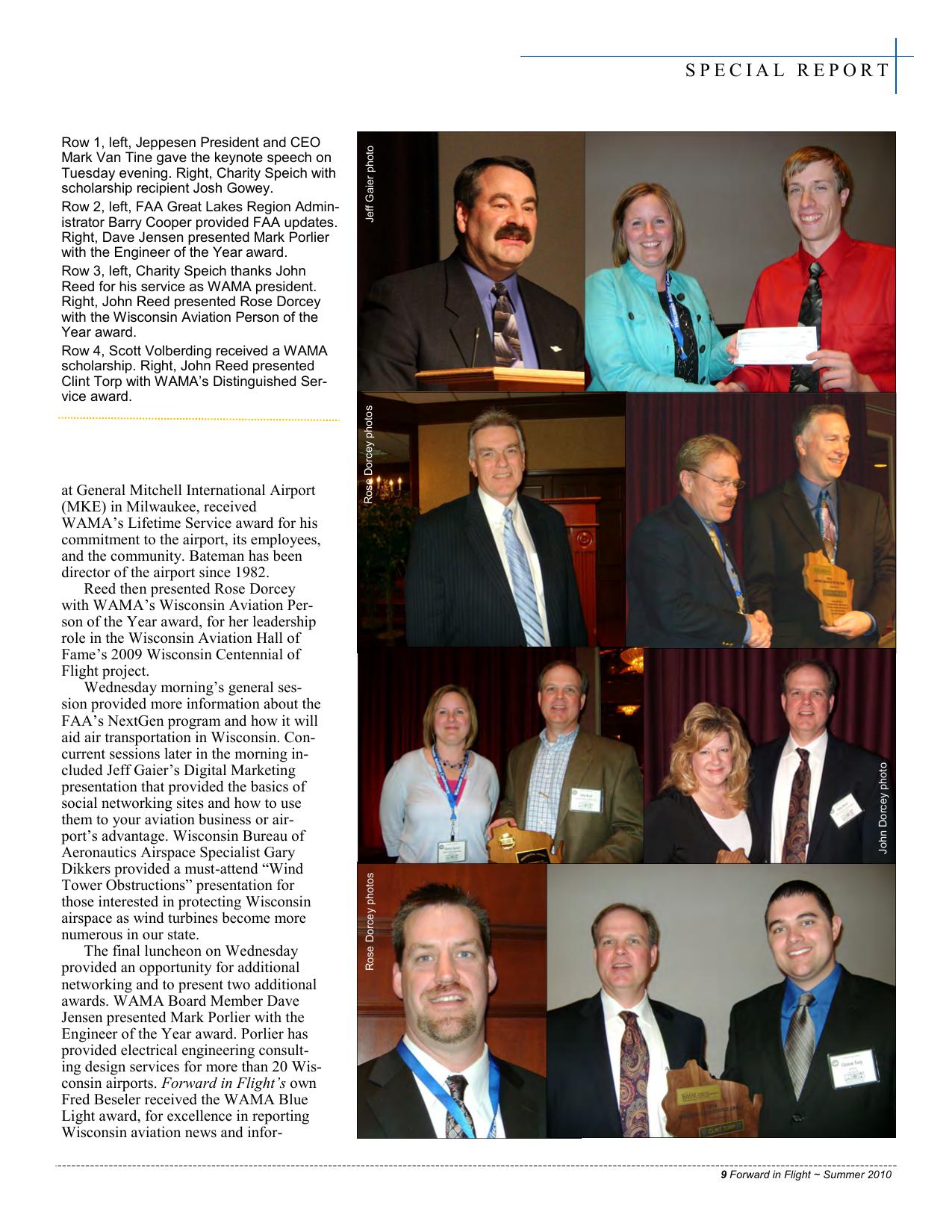
John John Dorcey Dorcey photo photo Rose Dorcey photos at General Mitchell International Airport (MKE) in Milwaukee, received WAMA’s Lifetime Service award for his commitment to the airport, its employees, and the community. Bateman has been director of the airport since 1982. Reed then presented Rose Dorcey with WAMA’s Wisconsin Aviation Person of the Year award, for her leadership role in the Wisconsin Aviation Hall of Fame’s 2009 Wisconsin Centennial of Flight project. Wednesday morning’s general session provided more information about the FAA’s NextGen program and how it will aid air transportation in Wisconsin. Concurrent sessions later in the morning included Jeff Gaier’s Digital Marketing presentation that provided the basics of social networking sites and how to use them to your aviation business or airport’s advantage. Wisconsin Bureau of Aeronautics Airspace Specialist Gary Dikkers provided a must-attend “Wind Tower Obstructions” presentation for those interested in protecting Wisconsin airspace as wind turbines become more numerous in our state. The final luncheon on Wednesday provided an opportunity for additional networking and to present two additional awards. WAMA Board Member Dave Jensen presented Mark Porlier with the Engineer of the Year award. Porlier has provided electrical engineering consulting design services for more than 20 Wisconsin airports. Forward in Flight’s own Fred Beseler received the WAMA Blue Light award, for excellence in reporting Wisconsin aviation news and infor- Rose Dorcey photos Row 1, left, Jeppesen President and CEO Mark Van Tine gave the keynote speech on Tuesday evening. Right, Charity Speich with scholarship recipient Josh Gowey. Row 2, left, FAA Great Lakes Region Administrator Barry Cooper provided FAA updates. Right, Dave Jensen presented Mark Porlier with the Engineer of the Year award. Row 3, left, Charity Speich thanks John Reed for his service as WAMA president. Right, John Reed presented Rose Dorcey with the Wisconsin Aviation Person of the Year award. Row 4, Scott Volberding received a WAMA scholarship. Right, John Reed presented Clint Torp with WAMA’s Distinguished Service award. Jeff Gaier photo SPECIAL REPORT 9 Forward in Flight ~ Summer 2010
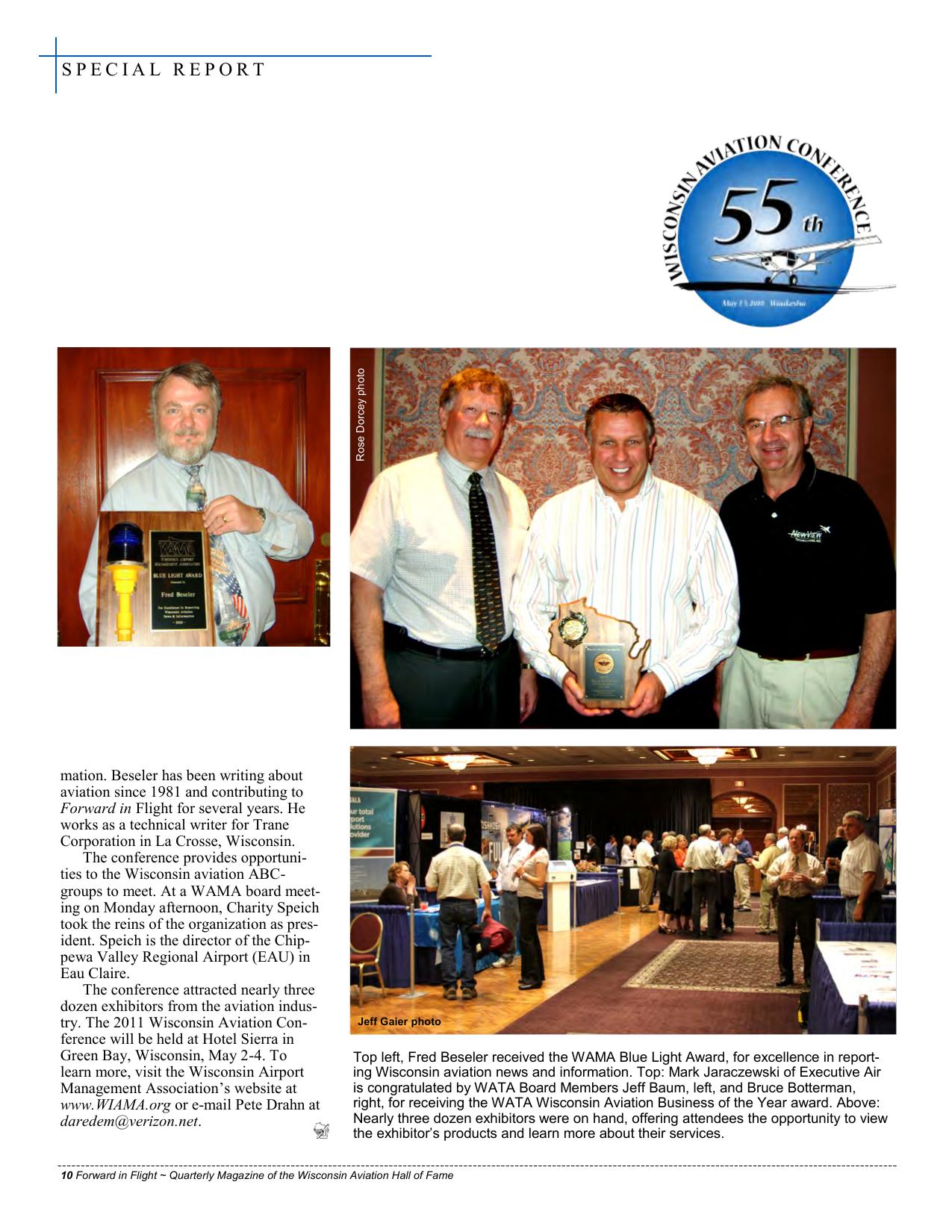
mation. Beseler has been writing about aviation since 1981 and contributing to Forward in Flight for several years. He works as a technical writer for Trane Corporation in La Crosse, Wisconsin. The conference provides opportunities to the Wisconsin aviation ABCgroups to meet. At a WAMA board meeting on Monday afternoon, Charity Speich took the reins of the organization as president. Speich is the director of the Chippewa Valley Regional Airport (EAU) in Eau Claire. The conference attracted nearly three dozen exhibitors from the aviation industry. The 2011 Wisconsin Aviation Conference will be held at Hotel Sierra in Green Bay, Wisconsin, May 2-4. To learn more, visit the Wisconsin Airport Management Association’s website at www.WIAMA.org or e-mail Pete Drahn at daredem@verizon.net. Jeff Gaier photo Rose Dorcey photo Rose Dorcey photo SPECIAL REPORT Jeff Gaier photo Top left, Fred Beseler received the WAMA Blue Light Award, for excellence in reporting Wisconsin aviation news and information. Top: Mark Jaraczewski of Executive Air is congratulated by WATA Board Members Jeff Baum, left, and Bruce Botterman, right, for receiving the WATA Wisconsin Aviation Business of the Year award. Above: Nearly three dozen exhibitors were on hand, offering attendees the opportunity to view the exhibitor’s products and learn more about their services. 10 Forward in Flight ~ Quarterly Magazine of the Wisconsin Aviation Hall of Fame
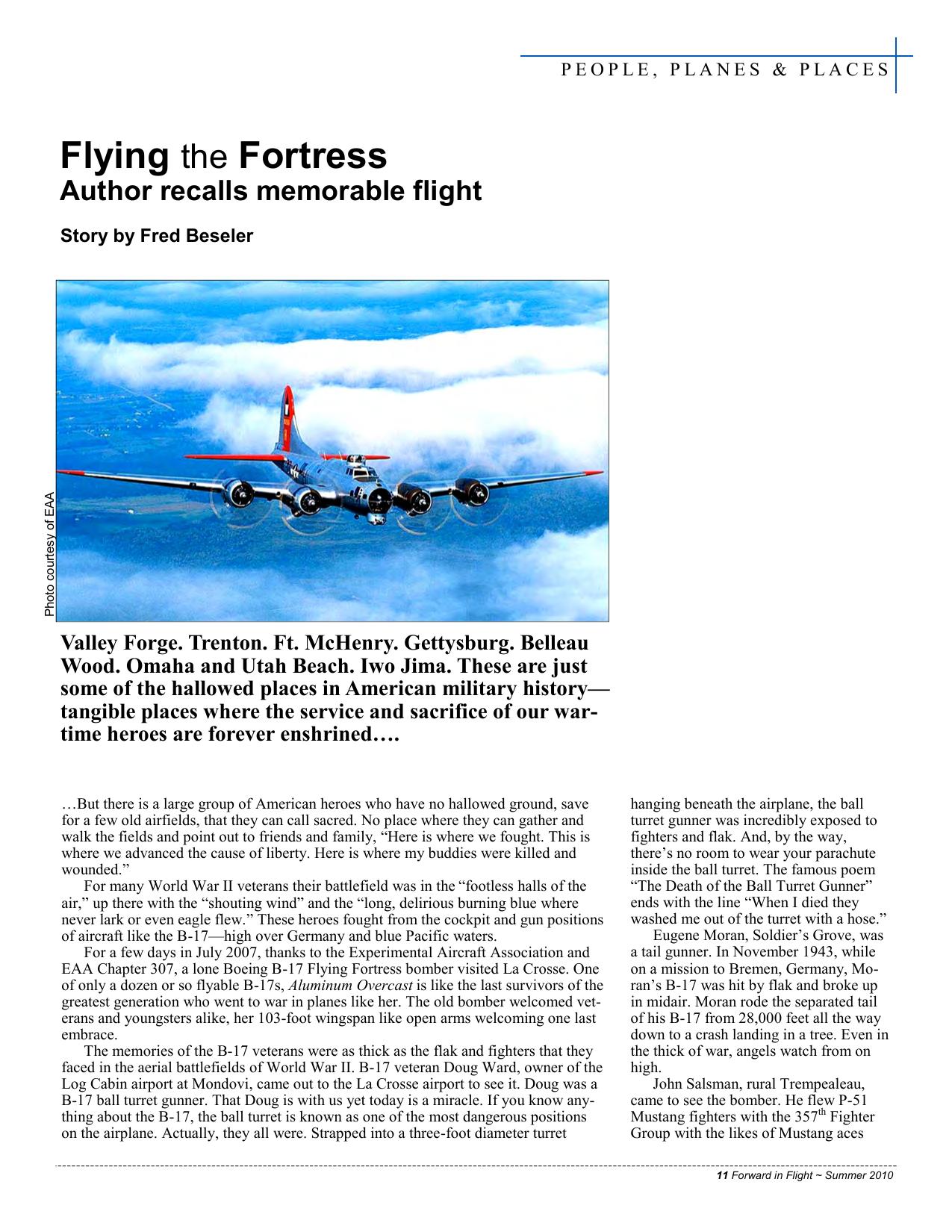
PEOPLE, PLANES & PLACES Flying the Fortress Author recalls memorable flight Photo courtesy of EAA Story by Fred Beseler Valley Forge. Trenton. Ft. McHenry. Gettysburg. Belleau Wood. Omaha and Utah Beach. Iwo Jima. These are just some of the hallowed places in American military history— tangible places where the service and sacrifice of our wartime heroes are forever enshrined…. …But there is a large group of American heroes who have no hallowed ground, save for a few old airfields, that they can call sacred. No place where they can gather and walk the fields and point out to friends and family, “Here is where we fought. This is where we advanced the cause of liberty. Here is where my buddies were killed and wounded.” For many World War II veterans their battlefield was in the “footless halls of the air,” up there with the “shouting wind” and the “long, delirious burning blue where never lark or even eagle flew.” These heroes fought from the cockpit and gun positions of aircraft like the B-17—high over Germany and blue Pacific waters. For a few days in July 2007, thanks to the Experimental Aircraft Association and EAA Chapter 307, a lone Boeing B-17 Flying Fortress bomber visited La Crosse. One of only a dozen or so flyable B-17s, Aluminum Overcast is like the last survivors of the greatest generation who went to war in planes like her. The old bomber welcomed veterans and youngsters alike, her 103-foot wingspan like open arms welcoming one last embrace. The memories of the B-17 veterans were as thick as the flak and fighters that they faced in the aerial battlefields of World War II. B-17 veteran Doug Ward, owner of the Log Cabin airport at Mondovi, came out to the La Crosse airport to see it. Doug was a B-17 ball turret gunner. That Doug is with us yet today is a miracle. If you know anything about the B-17, the ball turret is known as one of the most dangerous positions on the airplane. Actually, they all were. Strapped into a three-foot diameter turret hanging beneath the airplane, the ball turret gunner was incredibly exposed to fighters and flak. And, by the way, there’s no room to wear your parachute inside the ball turret. The famous poem “The Death of the Ball Turret Gunner” ends with the line “When I died they washed me out of the turret with a hose.” Eugene Moran, Soldier’s Grove, was a tail gunner. In November 1943, while on a mission to Bremen, Germany, Moran’s B-17 was hit by flak and broke up in midair. Moran rode the separated tail of his B-17 from 28,000 feet all the way down to a crash landing in a tree. Even in the thick of war, angels watch from on high. John Salsman, rural Trempealeau, came to see the bomber. He flew P-51 Mustang fighters with the 357th Fighter Group with the likes of Mustang aces 11 Forward in Flight ~ Summer 2010
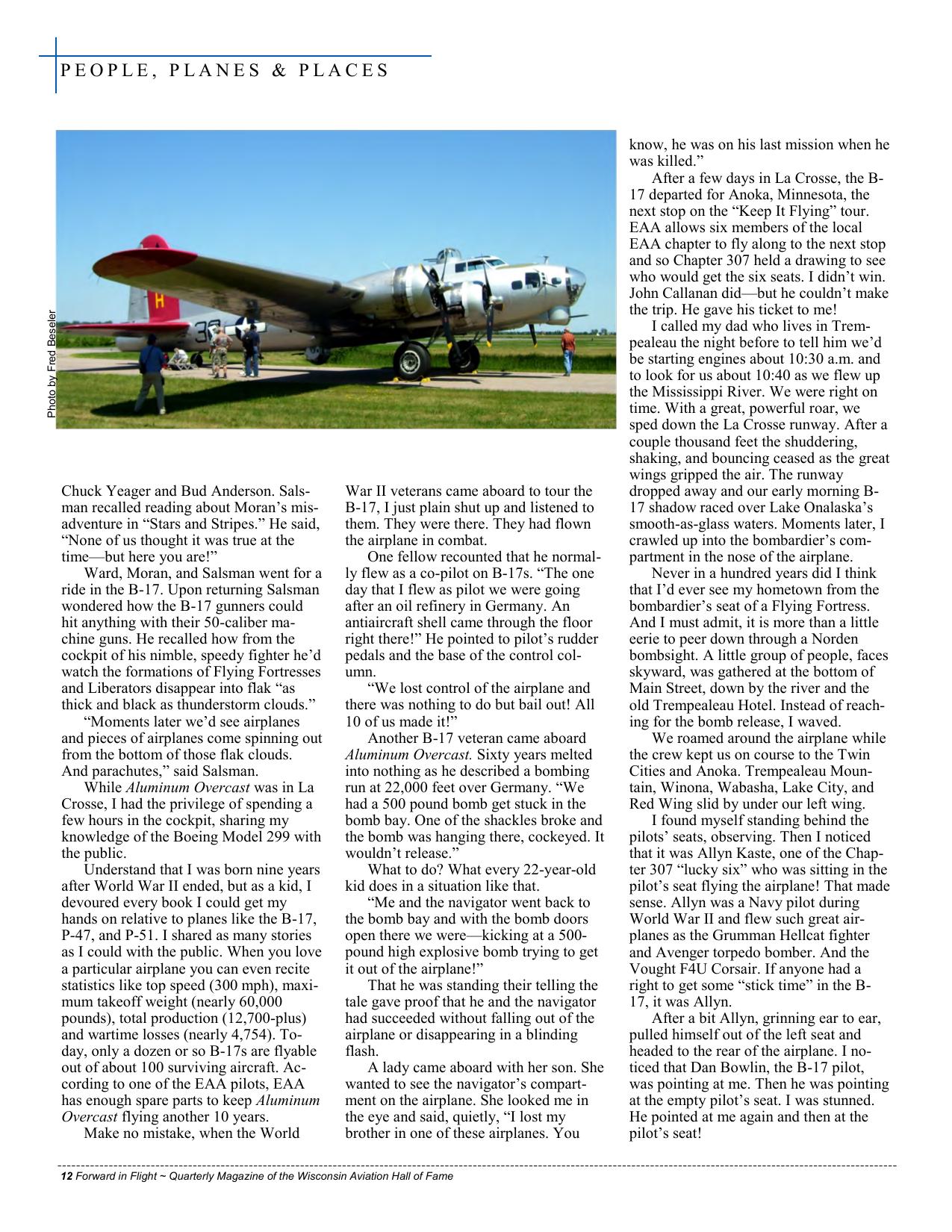
Photo by Fred Beseler PEOPLE, PLANES & PLACES Chuck Yeager and Bud Anderson. Salsman recalled reading about Moran’s misadventure in “Stars and Stripes.” He said, “None of us thought it was true at the time—but here you are!” Ward, Moran, and Salsman went for a ride in the B-17. Upon returning Salsman wondered how the B-17 gunners could hit anything with their 50-caliber machine guns. He recalled how from the cockpit of his nimble, speedy fighter he’d watch the formations of Flying Fortresses and Liberators disappear into flak “as thick and black as thunderstorm clouds.” “Moments later we’d see airplanes and pieces of airplanes come spinning out from the bottom of those flak clouds. And parachutes,” said Salsman. While Aluminum Overcast was in La Crosse, I had the privilege of spending a few hours in the cockpit, sharing my knowledge of the Boeing Model 299 with the public. Understand that I was born nine years after World War II ended, but as a kid, I devoured every book I could get my hands on relative to planes like the B-17, P-47, and P-51. I shared as many stories as I could with the public. When you love a particular airplane you can even recite statistics like top speed (300 mph), maximum takeoff weight (nearly 60,000 pounds), total production (12,700-plus) and wartime losses (nearly 4,754). Today, only a dozen or so B-17s are flyable out of about 100 surviving aircraft. According to one of the EAA pilots, EAA has enough spare parts to keep Aluminum Overcast flying another 10 years. Make no mistake, when the World War II veterans came aboard to tour the B-17, I just plain shut up and listened to them. They were there. They had flown the airplane in combat. One fellow recounted that he normally flew as a co-pilot on B-17s. “The one day that I flew as pilot we were going after an oil refinery in Germany. An antiaircraft shell came through the floor right there!” He pointed to pilot’s rudder pedals and the base of the control column. “We lost control of the airplane and there was nothing to do but bail out! All 10 of us made it!” Another B-17 veteran came aboard Aluminum Overcast. Sixty years melted into nothing as he described a bombing run at 22,000 feet over Germany. “We had a 500 pound bomb get stuck in the bomb bay. One of the shackles broke and the bomb was hanging there, cockeyed. It wouldn’t release.” What to do? What every 22-year-old kid does in a situation like that. “Me and the navigator went back to the bomb bay and with the bomb doors open there we were—kicking at a 500pound high explosive bomb trying to get it out of the airplane!” That he was standing their telling the tale gave proof that he and the navigator had succeeded without falling out of the airplane or disappearing in a blinding flash. A lady came aboard with her son. She wanted to see the navigator’s compartment on the airplane. She looked me in the eye and said, quietly, “I lost my brother in one of these airplanes. You 12 Forward in Flight ~ Quarterly Magazine of the Wisconsin Aviation Hall of Fame know, he was on his last mission when he was killed.” After a few days in La Crosse, the B17 departed for Anoka, Minnesota, the next stop on the “Keep It Flying” tour. EAA allows six members of the local EAA chapter to fly along to the next stop and so Chapter 307 held a drawing to see who would get the six seats. I didn’t win. John Callanan did—but he couldn’t make the trip. He gave his ticket to me! I called my dad who lives in Trempealeau the night before to tell him we’d be starting engines about 10:30 a.m. and to look for us about 10:40 as we flew up the Mississippi River. We were right on time. With a great, powerful roar, we sped down the La Crosse runway. After a couple thousand feet the shuddering, shaking, and bouncing ceased as the great wings gripped the air. The runway dropped away and our early morning B17 shadow raced over Lake Onalaska’s smooth-as-glass waters. Moments later, I crawled up into the bombardier’s compartment in the nose of the airplane. Never in a hundred years did I think that I’d ever see my hometown from the bombardier’s seat of a Flying Fortress. And I must admit, it is more than a little eerie to peer down through a Norden bombsight. A little group of people, faces skyward, was gathered at the bottom of Main Street, down by the river and the old Trempealeau Hotel. Instead of reaching for the bomb release, I waved. We roamed around the airplane while the crew kept us on course to the Twin Cities and Anoka. Trempealeau Mountain, Winona, Wabasha, Lake City, and Red Wing slid by under our left wing. I found myself standing behind the pilots’ seats, observing. Then I noticed that it was Allyn Kaste, one of the Chapter 307 “lucky six” who was sitting in the pilot’s seat flying the airplane! That made sense. Allyn was a Navy pilot during World War II and flew such great airplanes as the Grumman Hellcat fighter and Avenger torpedo bomber. And the Vought F4U Corsair. If anyone had a right to get some “stick time” in the B17, it was Allyn. After a bit Allyn, grinning ear to ear, pulled himself out of the left seat and headed to the rear of the airplane. I noticed that Dan Bowlin, the B-17 pilot, was pointing at me. Then he was pointing at the empty pilot’s seat. I was stunned. He pointed at me again and then at the pilot’s seat!
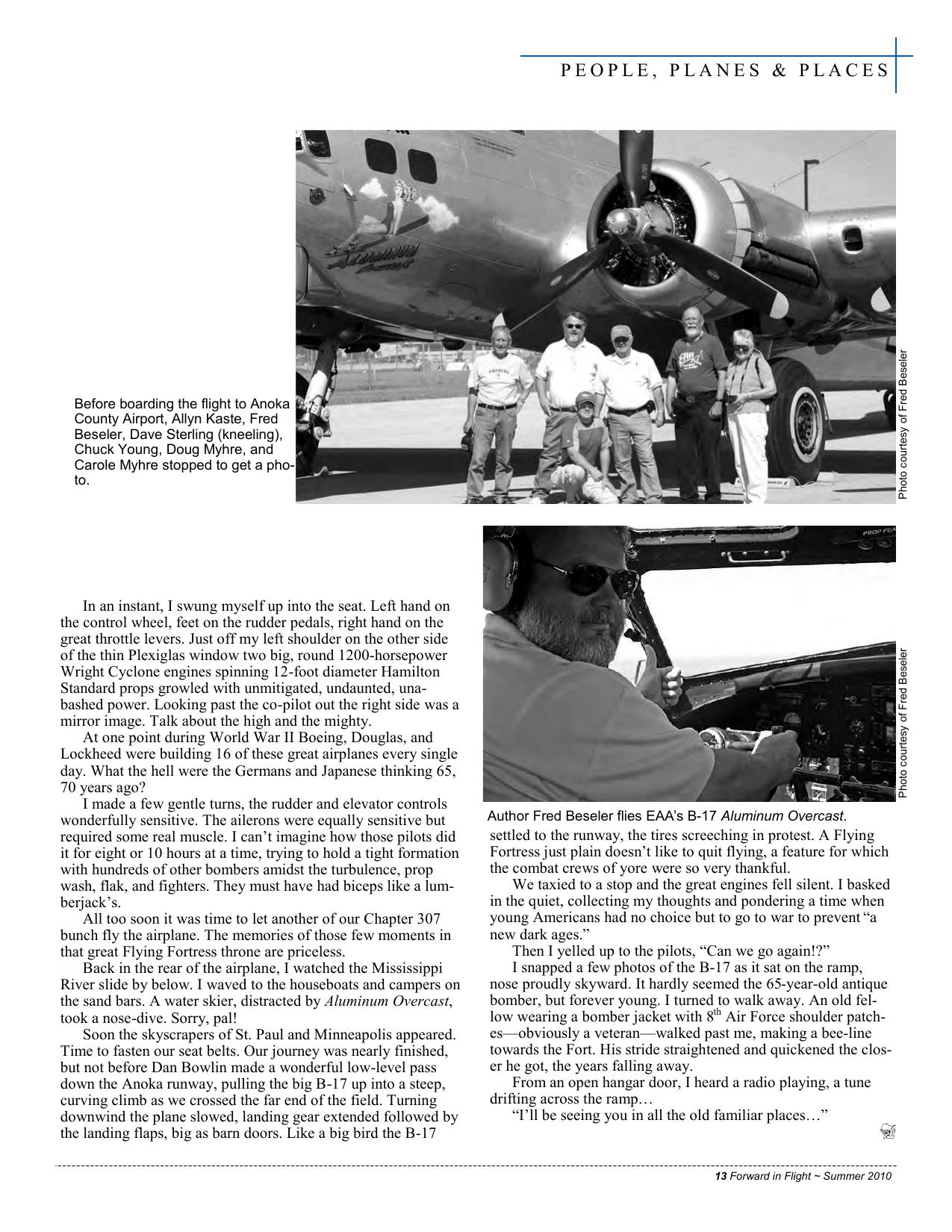
Photo courtesy of Fred Beseler PEOPLE, PLANES & PLACES In an instant, I swung myself up into the seat. Left hand on the control wheel, feet on the rudder pedals, right hand on the great throttle levers. Just off my left shoulder on the other side of the thin Plexiglas window two big, round 1200-horsepower Wright Cyclone engines spinning 12-foot diameter Hamilton Standard props growled with unmitigated, undaunted, unabashed power. Looking past the co-pilot out the right side was a mirror image. Talk about the high and the mighty. At one point during World War II Boeing, Douglas, and Lockheed were building 16 of these great airplanes every single day. What the hell were the Germans and Japanese thinking 65, 70 years ago? I made a few gentle turns, the rudder and elevator controls wonderfully sensitive. The ailerons were equally sensitive but required some real muscle. I can’t imagine how those pilots did it for eight or 10 hours at a time, trying to hold a tight formation with hundreds of other bombers amidst the turbulence, prop wash, flak, and fighters. They must have had biceps like a lumberjack’s. All too soon it was time to let another of our Chapter 307 bunch fly the airplane. The memories of those few moments in that great Flying Fortress throne are priceless. Back in the rear of the airplane, I watched the Mississippi River slide by below. I waved to the houseboats and campers on the sand bars. A water skier, distracted by Aluminum Overcast, took a nose-dive. Sorry, pal! Soon the skyscrapers of St. Paul and Minneapolis appeared. Time to fasten our seat belts. Our journey was nearly finished, but not before Dan Bowlin made a wonderful low-level pass down the Anoka runway, pulling the big B-17 up into a steep, curving climb as we crossed the far end of the field. Turning downwind the plane slowed, landing gear extended followed by the landing flaps, big as barn doors. Like a big bird the B-17 Photo courtesy of Fred Beseler Before boarding the flight to Anoka County Airport, Allyn Kaste, Fred Beseler, Dave Sterling (kneeling), Chuck Young, Doug Myhre, and Carole Myhre stopped to get a photo. Author Fred Beseler flies EAA’s B-17 Aluminum Overcast. settled to the runway, the tires screeching in protest. A Flying Fortress just plain doesn’t like to quit flying, a feature for which the combat crews of yore were so very thankful. We taxied to a stop and the great engines fell silent. I basked in the quiet, collecting my thoughts and pondering a time when young Americans had no choice but to go to war to prevent “a new dark ages.” Then I yelled up to the pilots, “Can we go again!?” I snapped a few photos of the B-17 as it sat on the ramp, nose proudly skyward. It hardly seemed the 65-year-old antique bomber, but forever young. I turned to walk away. An old fellow wearing a bomber jacket with 8th Air Force shoulder patches—obviously a veteran—walked past me, making a bee-line towards the Fort. His stride straightened and quickened the closer he got, the years falling away. From an open hangar door, I heard a radio playing, a tune drifting across the ramp… “I’ll be seeing you in all the old familiar places…” 13 Forward in Flight ~ Summer 2010
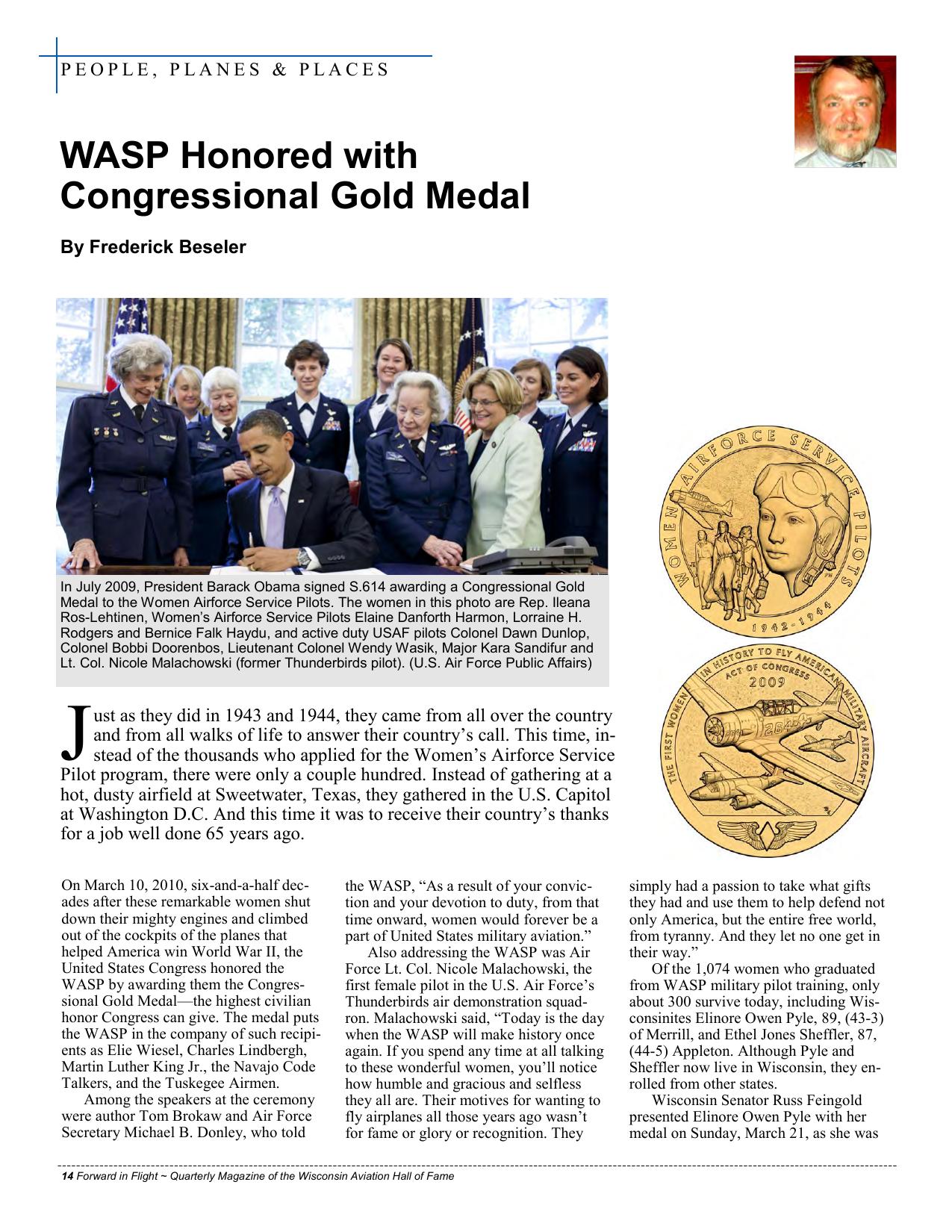
PEOPLE, PLANES & PLACES WASP Honored with Congressional Gold Medal By Frederick Beseler In July 2009, President Barack Obama signed S.614 awarding a Congressional Gold Medal to the Women Airforce Service Pilots. The women in this photo are Rep. Ileana Ros-Lehtinen, Women’s Airforce Service Pilots Elaine Danforth Harmon, Lorraine H. Rodgers and Bernice Falk Haydu, and active duty USAF pilots Colonel Dawn Dunlop, Colonel Bobbi Doorenbos, Lieutenant Colonel Wendy Wasik, Major Kara Sandifur and Lt. Col. Nicole Malachowski (former Thunderbirds pilot). (U.S. Air Force Public Affairs) J ust as they did in 1943 and 1944, they came from all over the country and from all walks of life to answer their country’s call. This time, instead of the thousands who applied for the Women’s Airforce Service Pilot program, there were only a couple hundred. Instead of gathering at a hot, dusty airfield at Sweetwater, Texas, they gathered in the U.S. Capitol at Washington D.C. And this time it was to receive their country’s thanks for a job well done 65 years ago. On March 10, 2010, six-and-a-half decades after these remarkable women shut down their mighty engines and climbed out of the cockpits of the planes that helped America win World War II, the United States Congress honored the WASP by awarding them the Congressional Gold Medal—the highest civilian honor Congress can give. The medal puts the WASP in the company of such recipients as Elie Wiesel, Charles Lindbergh, Martin Luther King Jr., the Navajo Code Talkers, and the Tuskegee Airmen. Among the speakers at the ceremony were author Tom Brokaw and Air Force Secretary Michael B. Donley, who told the WASP, “As a result of your conviction and your devotion to duty, from that time onward, women would forever be a part of United States military aviation.” Also addressing the WASP was Air Force Lt. Col. Nicole Malachowski, the first female pilot in the U.S. Air Force’s Thunderbirds air demonstration squadron. Malachowski said, “Today is the day when the WASP will make history once again. If you spend any time at all talking to these wonderful women, you’ll notice how humble and gracious and selfless they all are. Their motives for wanting to fly airplanes all those years ago wasn’t for fame or glory or recognition. They 14 Forward in Flight ~ Quarterly Magazine of the Wisconsin Aviation Hall of Fame simply had a passion to take what gifts they had and use them to help defend not only America, but the entire free world, from tyranny. And they let no one get in their way.” Of the 1,074 women who graduated from WASP military pilot training, only about 300 survive today, including Wisconsinites Elinore Owen Pyle, 89, (43-3) of Merrill, and Ethel Jones Sheffler, 87, (44-5) Appleton. Although Pyle and Sheffler now live in Wisconsin, they enrolled from other states. Wisconsin Senator Russ Feingold presented Elinore Owen Pyle with her medal on Sunday, March 21, as she was
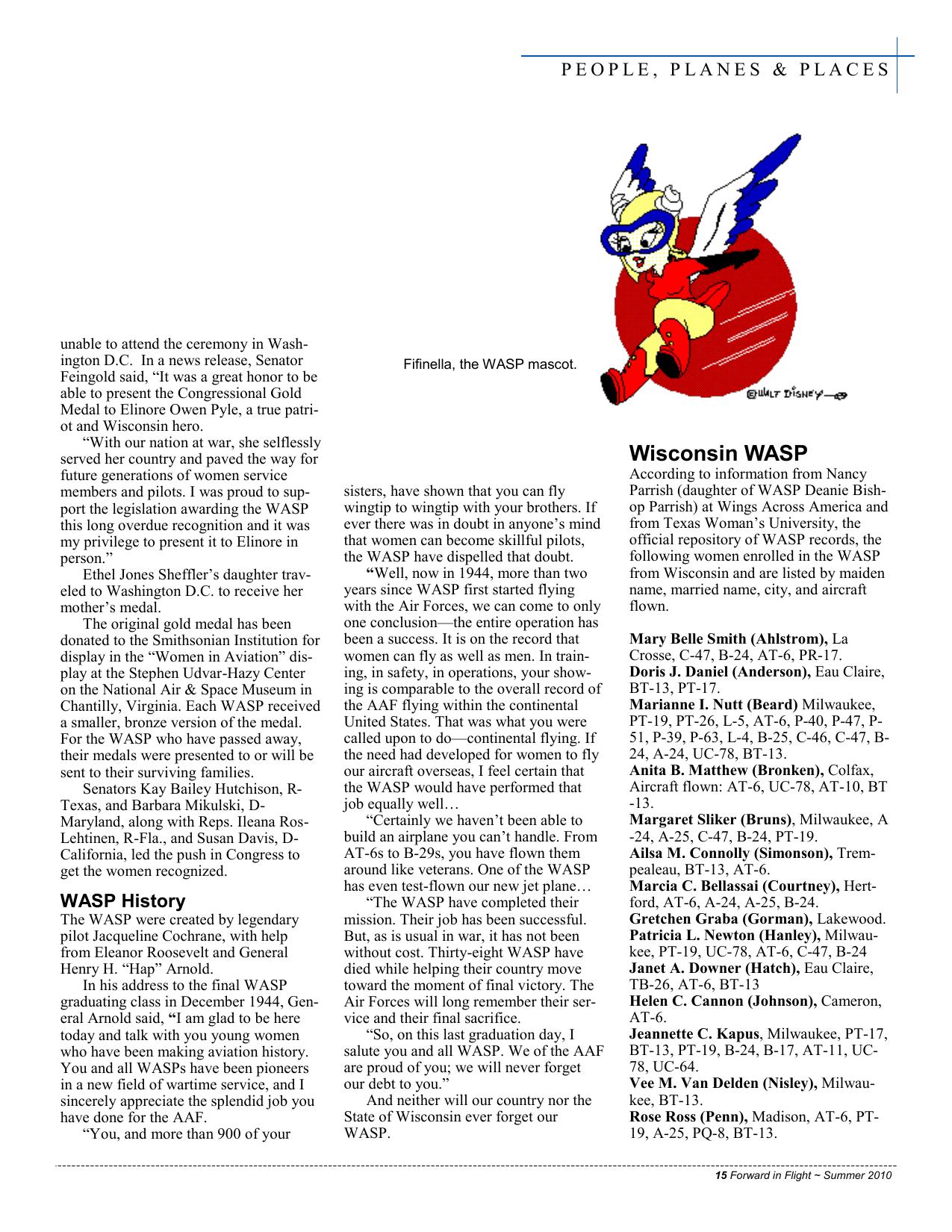
PEOPLE, PLANES & PLACES unable to attend the ceremony in Washington D.C. In a news release, Senator Feingold said, “It was a great honor to be able to present the Congressional Gold Medal to Elinore Owen Pyle, a true patriot and Wisconsin hero. “With our nation at war, she selflessly served her country and paved the way for future generations of women service members and pilots. I was proud to support the legislation awarding the WASP this long overdue recognition and it was my privilege to present it to Elinore in person.” Ethel Jones Sheffler’s daughter traveled to Washington D.C. to receive her mother’s medal. The original gold medal has been donated to the Smithsonian Institution for display in the “Women in Aviation” display at the Stephen Udvar-Hazy Center on the National Air & Space Museum in Chantilly, Virginia. Each WASP received a smaller, bronze version of the medal. For the WASP who have passed away, their medals were presented to or will be sent to their surviving families. Senators Kay Bailey Hutchison, RTexas, and Barbara Mikulski, DMaryland, along with Reps. Ileana RosLehtinen, R-Fla., and Susan Davis, DCalifornia, led the push in Congress to get the women recognized. WASP History The WASP were created by legendary pilot Jacqueline Cochrane, with help from Eleanor Roosevelt and General Henry H. “Hap” Arnold. In his address to the final WASP graduating class in December 1944, General Arnold said, “I am glad to be here today and talk with you young women who have been making aviation history. You and all WASPs have been pioneers in a new field of wartime service, and I sincerely appreciate the splendid job you have done for the AAF. “You, and more than 900 of your Fifinella, the WASP mascot. Wisconsin WASP sisters, have shown that you can fly wingtip to wingtip with your brothers. If ever there was in doubt in anyone’s mind that women can become skillful pilots, the WASP have dispelled that doubt. “Well, now in 1944, more than two years since WASP first started flying with the Air Forces, we can come to only one conclusion—the entire operation has been a success. It is on the record that women can fly as well as men. In training, in safety, in operations, your showing is comparable to the overall record of the AAF flying within the continental United States. That was what you were called upon to do—continental flying. If the need had developed for women to fly our aircraft overseas, I feel certain that the WASP would have performed that job equally well… “Certainly we haven’t been able to build an airplane you can’t handle. From AT-6s to B-29s, you have flown them around like veterans. One of the WASP has even test-flown our new jet plane… “The WASP have completed their mission. Their job has been successful. But, as is usual in war, it has not been without cost. Thirty-eight WASP have died while helping their country move toward the moment of final victory. The Air Forces will long remember their service and their final sacrifice. “So, on this last graduation day, I salute you and all WASP. We of the AAF are proud of you; we will never forget our debt to you.” And neither will our country nor the State of Wisconsin ever forget our WASP. According to information from Nancy Parrish (daughter of WASP Deanie Bishop Parrish) at Wings Across America and from Texas Woman’s University, the official repository of WASP records, the following women enrolled in the WASP from Wisconsin and are listed by maiden name, married name, city, and aircraft flown. Mary Belle Smith (Ahlstrom), La Crosse, C-47, B-24, AT-6, PR-17. Doris J. Daniel (Anderson), Eau Claire, BT-13, PT-17. Marianne I. Nutt (Beard) Milwaukee, PT-19, PT-26, L-5, AT-6, P-40, P-47, P51, P-39, P-63, L-4, B-25, C-46, C-47, B24, A-24, UC-78, BT-13. Anita B. Matthew (Bronken), Colfax, Aircraft flown: AT-6, UC-78, AT-10, BT -13. Margaret Sliker (Bruns), Milwaukee, A -24, A-25, C-47, B-24, PT-19. Ailsa M. Connolly (Simonson), Trempealeau, BT-13, AT-6. Marcia C. Bellassai (Courtney), Hertford, AT-6, A-24, A-25, B-24. Gretchen Graba (Gorman), Lakewood. Patricia L. Newton (Hanley), Milwaukee, PT-19, UC-78, AT-6, C-47, B-24 Janet A. Downer (Hatch), Eau Claire, TB-26, AT-6, BT-13 Helen C. Cannon (Johnson), Cameron, AT-6. Jeannette C. Kapus, Milwaukee, PT-17, BT-13, PT-19, B-24, B-17, AT-11, UC78, UC-64. Vee M. Van Delden (Nisley), Milwaukee, BT-13. Rose Ross (Penn), Madison, AT-6, PT19, A-25, PQ-8, BT-13. 15 Forward in Flight ~ Summer 2010
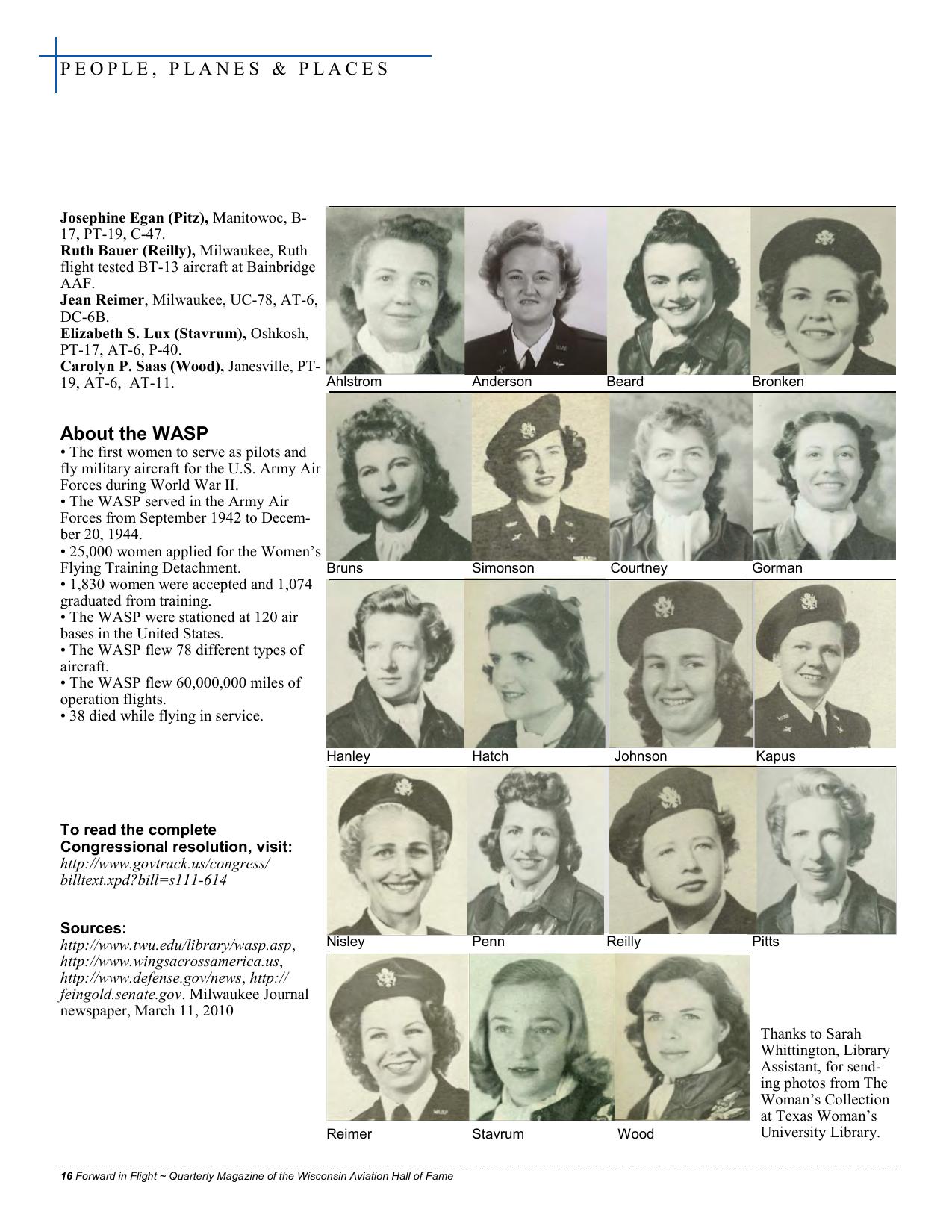
PEOPLE, PLANES & PLACES Josephine Egan (Pitz), Manitowoc, B17, PT-19, C-47. Ruth Bauer (Reilly), Milwaukee, Ruth flight tested BT-13 aircraft at Bainbridge AAF. Jean Reimer, Milwaukee, UC-78, AT-6, DC-6B. Elizabeth S. Lux (Stavrum), Oshkosh, PT-17, AT-6, P-40. Carolyn P. Saas (Wood), Janesville, PTAhlstrom 19, AT-6, AT-11. Anderson Beard Bronken Simonson Courtney Gorman Hanley Hatch Johnson Kapus Nisley Penn Reilly Pitts About the WASP • The first women to serve as pilots and fly military aircraft for the U.S. Army Air Forces during World War II. • The WASP served in the Army Air Forces from September 1942 to December 20, 1944. • 25,000 women applied for the Women’s Flying Training Detachment. Bruns • 1,830 women were accepted and 1,074 graduated from training. • The WASP were stationed at 120 air bases in the United States. • The WASP flew 78 different types of aircraft. • The WASP flew 60,000,000 miles of operation flights. • 38 died while flying in service. To read the complete Congressional resolution, visit: http://www.govtrack.us/congress/ billtext.xpd?bill=s111-614 Sources: http://www.twu.edu/library/wasp.asp, http://www.wingsacrossamerica.us, http://www.defense.gov/news, http:// feingold.senate.gov. Milwaukee Journal newspaper, March 11, 2010 Reimer 16 Forward in Flight ~ Quarterly Magazine of the Wisconsin Aviation Hall of Fame Stavrum Wood Thanks to Sarah Whittington, Library Assistant, for sending photos from The Woman’s Collection at Texas Woman’s University Library.
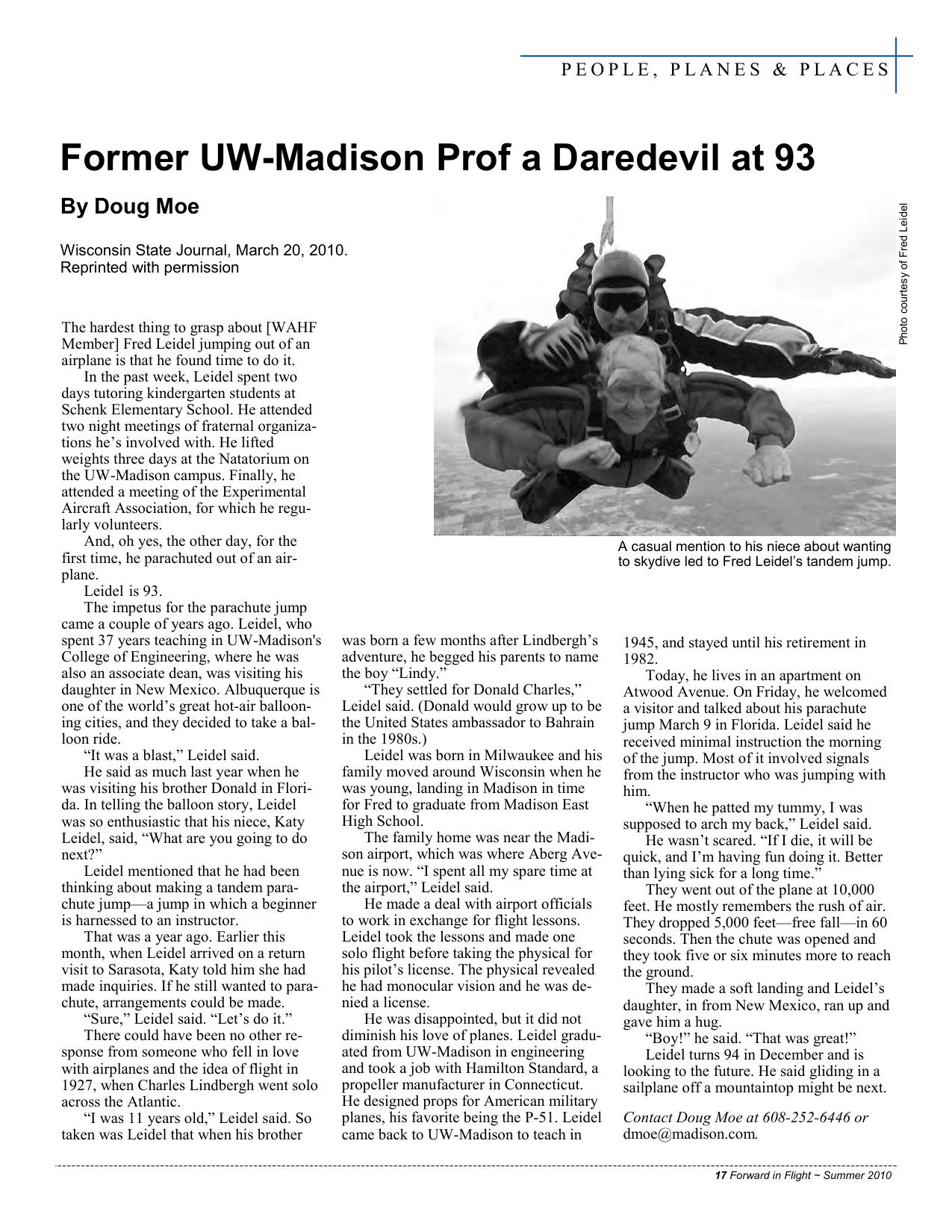
PEOPLE, PLANES & PLACES Former UW-Madison Prof a Daredevil at 93 Photo courtesy of Fred Leidel By Doug Moe Wisconsin State Journal, March 20, 2010. Reprinted with permission The hardest thing to grasp about [WAHF Member] Fred Leidel jumping out of an airplane is that he found time to do it. In the past week, Leidel spent two days tutoring kindergarten students at Schenk Elementary School. He attended two night meetings of fraternal organizations he’s involved with. He lifted weights three days at the Natatorium on the UW-Madison campus. Finally, he attended a meeting of the Experimental Aircraft Association, for which he regularly volunteers. And, oh yes, the other day, for the first time, he parachuted out of an airplane. Leidel is 93. The impetus for the parachute jump came a couple of years ago. Leidel, who spent 37 years teaching in UW-Madison's College of Engineering, where he was also an associate dean, was visiting his daughter in New Mexico. Albuquerque is one of the world’s great hot-air ballooning cities, and they decided to take a balloon ride. “It was a blast,” Leidel said. He said as much last year when he was visiting his brother Donald in Florida. In telling the balloon story, Leidel was so enthusiastic that his niece, Katy Leidel, said, “What are you going to do next?” Leidel mentioned that he had been thinking about making a tandem parachute jump—a jump in which a beginner is harnessed to an instructor. That was a year ago. Earlier this month, when Leidel arrived on a return visit to Sarasota, Katy told him she had made inquiries. If he still wanted to parachute, arrangements could be made. “Sure,” Leidel said. “Let’s do it.” There could have been no other response from someone who fell in love with airplanes and the idea of flight in 1927, when Charles Lindbergh went solo across the Atlantic. “I was 11 years old,” Leidel said. So taken was Leidel that when his brother A casual mention to his niece about wanting to skydive led to Fred Leidel’s tandem jump. was born a few months after Lindbergh’s adventure, he begged his parents to name the boy “Lindy.” “They settled for Donald Charles,” Leidel said. (Donald would grow up to be the United States ambassador to Bahrain in the 1980s.) Leidel was born in Milwaukee and his family moved around Wisconsin when he was young, landing in Madison in time for Fred to graduate from Madison East High School. The family home was near the Madison airport, which was where Aberg Avenue is now. “I spent all my spare time at the airport,” Leidel said. He made a deal with airport officials to work in exchange for flight lessons. Leidel took the lessons and made one solo flight before taking the physical for his pilot’s license. The physical revealed he had monocular vision and he was denied a license. He was disappointed, but it did not diminish his love of planes. Leidel graduated from UW-Madison in engineering and took a job with Hamilton Standard, a propeller manufacturer in Connecticut. He designed props for American military planes, his favorite being the P-51. Leidel came back to UW-Madison to teach in 1945, and stayed until his retirement in 1982. Today, he lives in an apartment on Atwood Avenue. On Friday, he welcomed a visitor and talked about his parachute jump March 9 in Florida. Leidel said he received minimal instruction the morning of the jump. Most of it involved signals from the instructor who was jumping with him. “When he patted my tummy, I was supposed to arch my back,” Leidel said. He wasn’t scared. “If I die, it will be quick, and I’m having fun doing it. Better than lying sick for a long time.” They went out of the plane at 10,000 feet. He mostly remembers the rush of air. They dropped 5,000 feet—free fall—in 60 seconds. Then the chute was opened and they took five or six minutes more to reach the ground. They made a soft landing and Leidel’s daughter, in from New Mexico, ran up and gave him a hug. “Boy!” he said. “That was great!” Leidel turns 94 in December and is looking to the future. He said gliding in a sailplane off a mountaintop might be next. Contact Doug Moe at 608-252-6446 or dmoe@madison.com. 17 Forward in Flight ~ Summer 2010
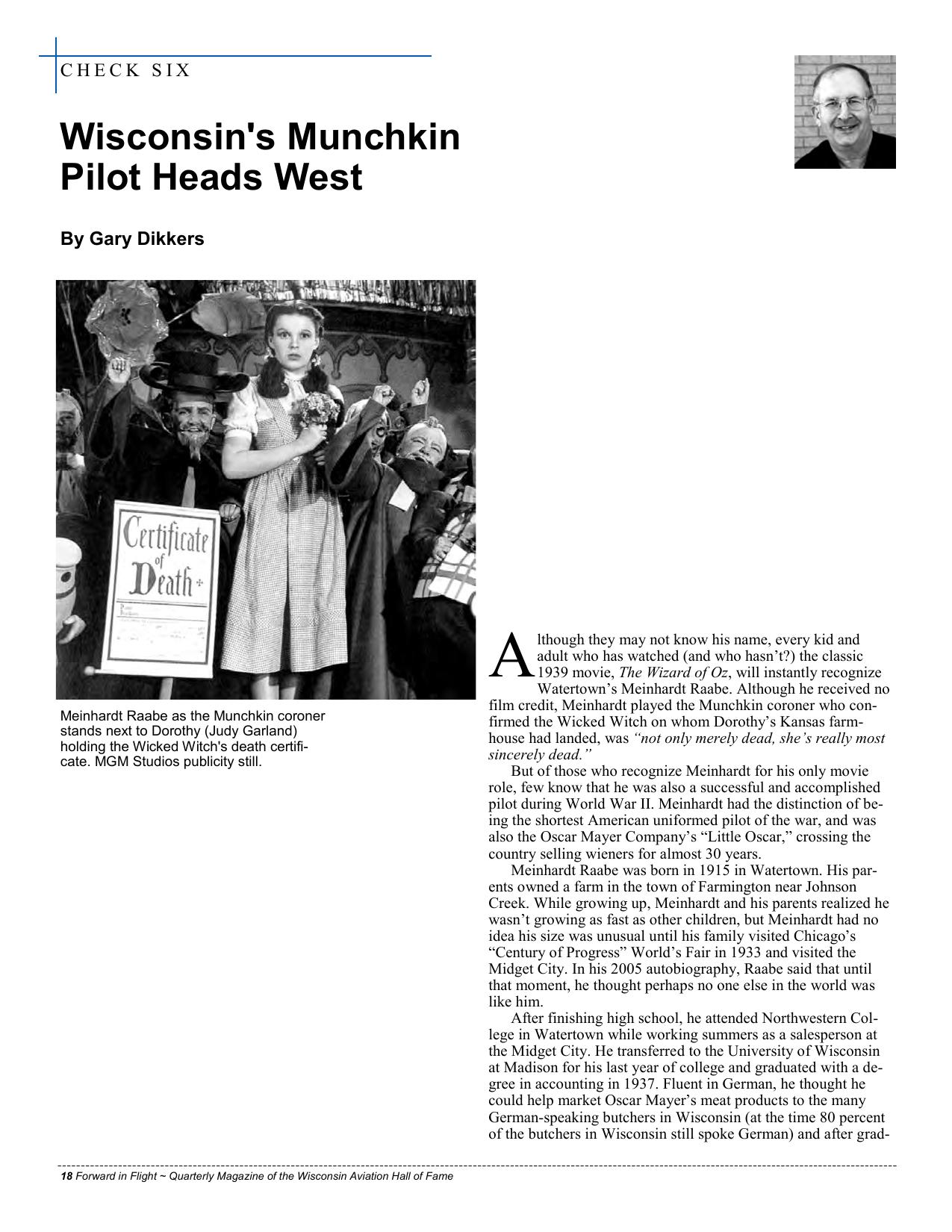
CHECK SIX Wisconsin's Munchkin Pilot Heads West By Gary Dikkers A Meinhardt Raabe as the Munchkin coroner stands next to Dorothy (Judy Garland) holding the Wicked Witch's death certificate. MGM Studios publicity still. 18 Forward in Flight ~ Quarterly Magazine of the Wisconsin Aviation Hall of Fame lthough they may not know his name, every kid and adult who has watched (and who hasn’t?) the classic 1939 movie, The Wizard of Oz, will instantly recognize Watertown’s Meinhardt Raabe. Although he received no film credit, Meinhardt played the Munchkin coroner who confirmed the Wicked Witch on whom Dorothy’s Kansas farmhouse had landed, was “not only merely dead, she’s really most sincerely dead.” But of those who recognize Meinhardt for his only movie role, few know that he was also a successful and accomplished pilot during World War II. Meinhardt had the distinction of being the shortest American uniformed pilot of the war, and was also the Oscar Mayer Company’s “Little Oscar,” crossing the country selling wieners for almost 30 years. Meinhardt Raabe was born in 1915 in Watertown. His parents owned a farm in the town of Farmington near Johnson Creek. While growing up, Meinhardt and his parents realized he wasn’t growing as fast as other children, but Meinhardt had no idea his size was unusual until his family visited Chicago’s “Century of Progress” World’s Fair in 1933 and visited the Midget City. In his 2005 autobiography, Raabe said that until that moment, he thought perhaps no one else in the world was like him. After finishing high school, he attended Northwestern College in Watertown while working summers as a salesperson at the Midget City. He transferred to the University of Wisconsin at Madison for his last year of college and graduated with a degree in accounting in 1937. Fluent in German, he thought he could help market Oscar Mayer’s meat products to the many German-speaking butchers in Wisconsin (at the time 80 percent of the butchers in Wisconsin still spoke German) and after grad-
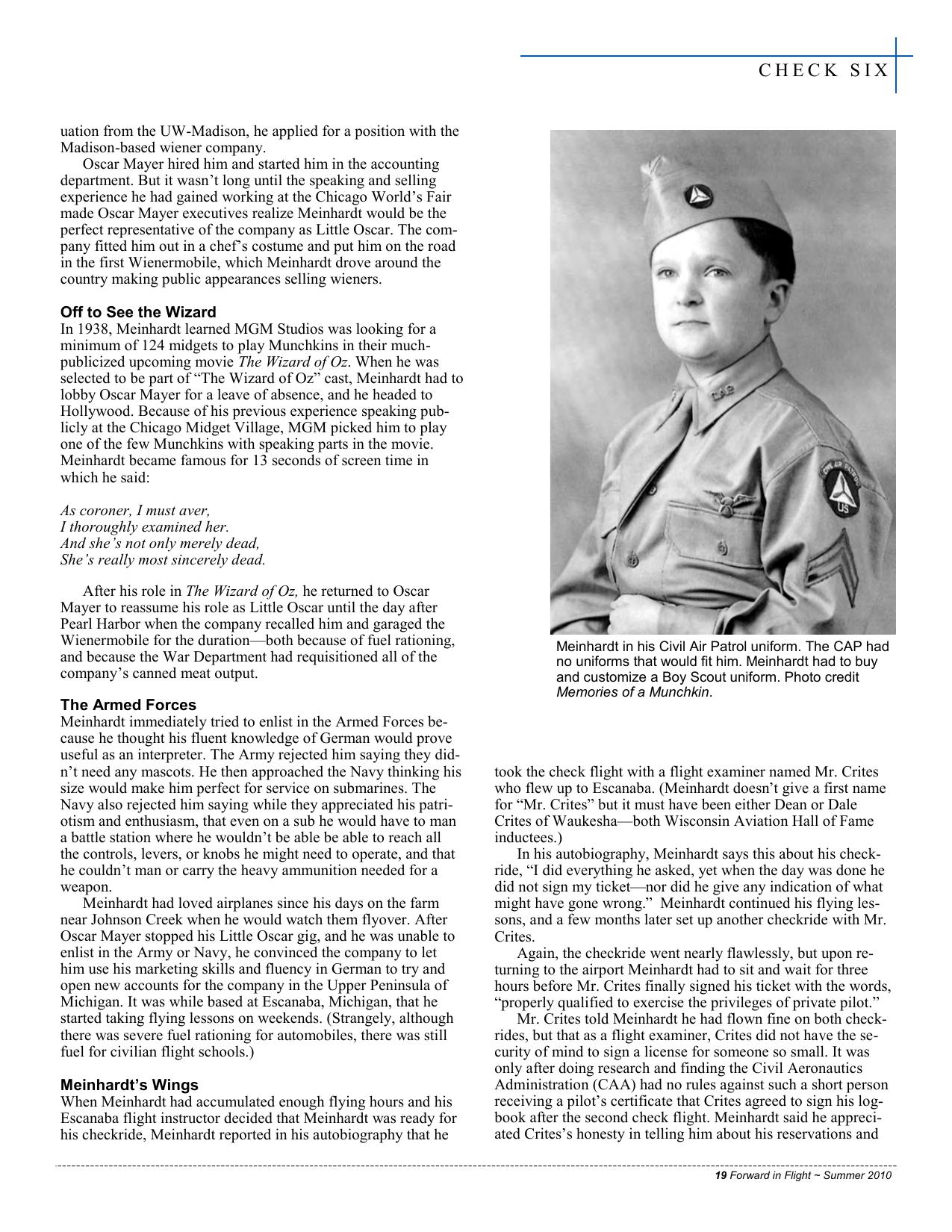
CHECK SIX uation from the UW-Madison, he applied for a position with the Madison-based wiener company. Oscar Mayer hired him and started him in the accounting department. But it wasn’t long until the speaking and selling experience he had gained working at the Chicago World’s Fair made Oscar Mayer executives realize Meinhardt would be the perfect representative of the company as Little Oscar. The company fitted him out in a chef’s costume and put him on the road in the first Wienermobile, which Meinhardt drove around the country making public appearances selling wieners. Off to See the Wizard In 1938, Meinhardt learned MGM Studios was looking for a minimum of 124 midgets to play Munchkins in their muchpublicized upcoming movie The Wizard of Oz. When he was selected to be part of “The Wizard of Oz” cast, Meinhardt had to lobby Oscar Mayer for a leave of absence, and he headed to Hollywood. Because of his previous experience speaking publicly at the Chicago Midget Village, MGM picked him to play one of the few Munchkins with speaking parts in the movie. Meinhardt became famous for 13 seconds of screen time in which he said: As coroner, I must aver, I thoroughly examined her. And she’s not only merely dead, She’s really most sincerely dead. After his role in The Wizard of Oz, he returned to Oscar Mayer to reassume his role as Little Oscar until the day after Pearl Harbor when the company recalled him and garaged the Wienermobile for the duration—both because of fuel rationing, and because the War Department had requisitioned all of the company’s canned meat output. The Armed Forces Meinhardt immediately tried to enlist in the Armed Forces because he thought his fluent knowledge of German would prove useful as an interpreter. The Army rejected him saying they didn’t need any mascots. He then approached the Navy thinking his size would make him perfect for service on submarines. The Navy also rejected him saying while they appreciated his patriotism and enthusiasm, that even on a sub he would have to man a battle station where he wouldn’t be able be able to reach all the controls, levers, or knobs he might need to operate, and that he couldn’t man or carry the heavy ammunition needed for a weapon. Meinhardt had loved airplanes since his days on the farm near Johnson Creek when he would watch them flyover. After Oscar Mayer stopped his Little Oscar gig, and he was unable to enlist in the Army or Navy, he convinced the company to let him use his marketing skills and fluency in German to try and open new accounts for the company in the Upper Peninsula of Michigan. It was while based at Escanaba, Michigan, that he started taking flying lessons on weekends. (Strangely, although there was severe fuel rationing for automobiles, there was still fuel for civilian flight schools.) Meinhardt’s Wings When Meinhardt had accumulated enough flying hours and his Escanaba flight instructor decided that Meinhardt was ready for his checkride, Meinhardt reported in his autobiography that he Meinhardt in his Civil Air Patrol uniform. The CAP had no uniforms that would fit him. Meinhardt had to buy and customize a Boy Scout uniform. Photo credit Memories of a Munchkin. took the check flight with a flight examiner named Mr. Crites who flew up to Escanaba. (Meinhardt doesn’t give a first name for “Mr. Crites” but it must have been either Dean or Dale Crites of Waukesha—both Wisconsin Aviation Hall of Fame inductees.) In his autobiography, Meinhardt says this about his checkride, “I did everything he asked, yet when the day was done he did not sign my ticket—nor did he give any indication of what might have gone wrong.” Meinhardt continued his flying lessons, and a few months later set up another checkride with Mr. Crites. Again, the checkride went nearly flawlessly, but upon returning to the airport Meinhardt had to sit and wait for three hours before Mr. Crites finally signed his ticket with the words, “properly qualified to exercise the privileges of private pilot.” Mr. Crites told Meinhardt he had flown fine on both checkrides, but that as a flight examiner, Crites did not have the security of mind to sign a license for someone so small. It was only after doing research and finding the Civil Aeronautics Administration (CAA) had no rules against such a short person receiving a pilot’s certificate that Crites agreed to sign his logbook after the second check flight. Meinhardt said he appreciated Crites’s honesty in telling him about his reservations and 19 Forward in Flight ~ Summer 2010
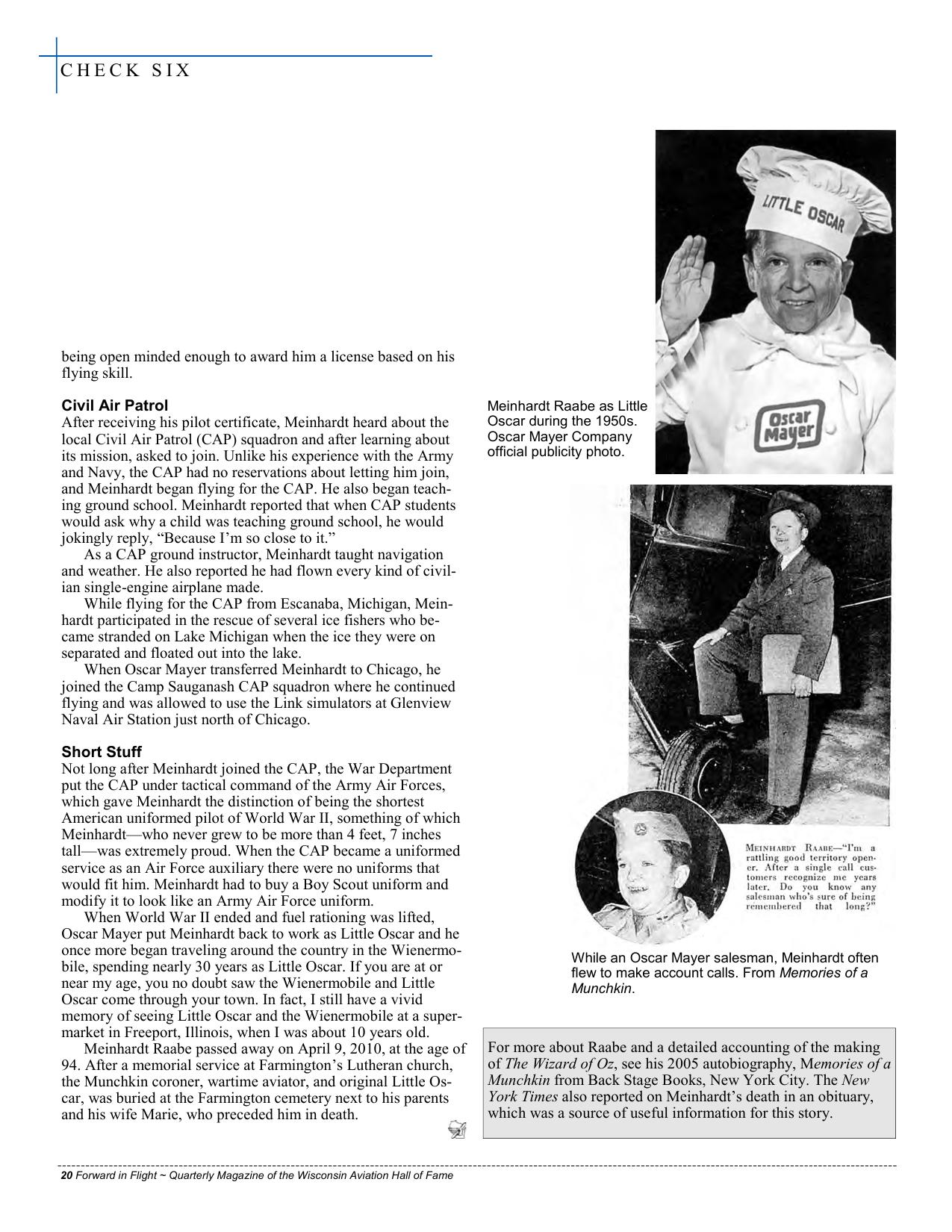
CHECK SIX being open minded enough to award him a license based on his flying skill. Civil Air Patrol After receiving his pilot certificate, Meinhardt heard about the local Civil Air Patrol (CAP) squadron and after learning about its mission, asked to join. Unlike his experience with the Army and Navy, the CAP had no reservations about letting him join, and Meinhardt began flying for the CAP. He also began teaching ground school. Meinhardt reported that when CAP students would ask why a child was teaching ground school, he would jokingly reply, “Because I’m so close to it.” As a CAP ground instructor, Meinhardt taught navigation and weather. He also reported he had flown every kind of civilian single-engine airplane made. While flying for the CAP from Escanaba, Michigan, Meinhardt participated in the rescue of several ice fishers who became stranded on Lake Michigan when the ice they were on separated and floated out into the lake. When Oscar Mayer transferred Meinhardt to Chicago, he joined the Camp Sauganash CAP squadron where he continued flying and was allowed to use the Link simulators at Glenview Naval Air Station just north of Chicago. Short Stuff Not long after Meinhardt joined the CAP, the War Department put the CAP under tactical command of the Army Air Forces, which gave Meinhardt the distinction of being the shortest American uniformed pilot of World War II, something of which Meinhardt—who never grew to be more than 4 feet, 7 inches tall—was extremely proud. When the CAP became a uniformed service as an Air Force auxiliary there were no uniforms that would fit him. Meinhardt had to buy a Boy Scout uniform and modify it to look like an Army Air Force uniform. When World War II ended and fuel rationing was lifted, Oscar Mayer put Meinhardt back to work as Little Oscar and he once more began traveling around the country in the Wienermobile, spending nearly 30 years as Little Oscar. If you are at or near my age, you no doubt saw the Wienermobile and Little Oscar come through your town. In fact, I still have a vivid memory of seeing Little Oscar and the Wienermobile at a supermarket in Freeport, Illinois, when I was about 10 years old. Meinhardt Raabe passed away on April 9, 2010, at the age of 94. After a memorial service at Farmington’s Lutheran church, the Munchkin coroner, wartime aviator, and original Little Oscar, was buried at the Farmington cemetery next to his parents and his wife Marie, who preceded him in death. 20 Forward in Flight ~ Quarterly Magazine of the Wisconsin Aviation Hall of Fame Meinhardt Raabe as Little Oscar during the 1950s. Oscar Mayer Company official publicity photo. While an Oscar Mayer salesman, Meinhardt often flew to make account calls. From Memories of a Munchkin. For more about Raabe and a detailed accounting of the making of The Wizard of Oz, see his 2005 autobiography, Memories of a Munchkin from Back Stage Books, New York City. The New York Times also reported on Meinhardt’s death in an obituary, which was a source of useful information for this story.
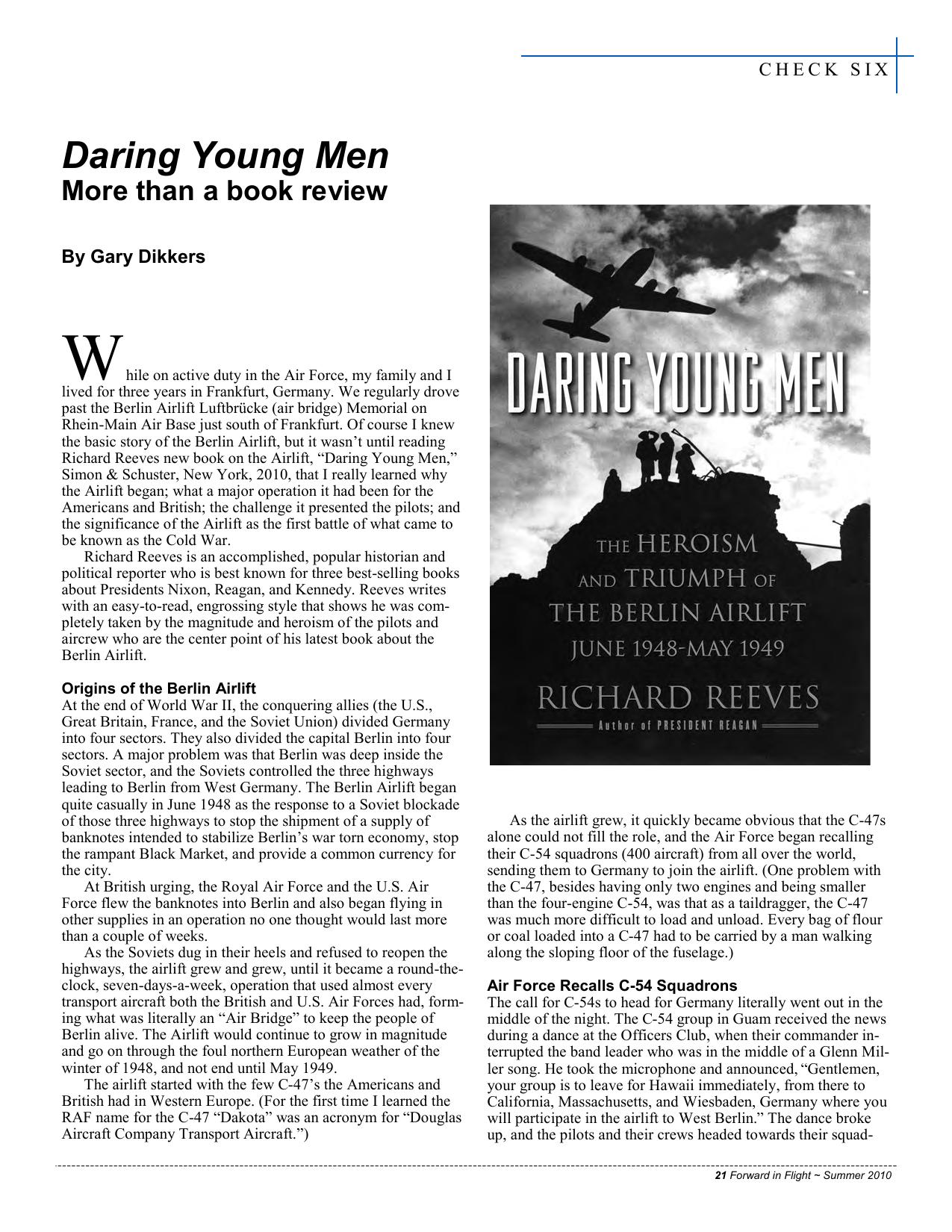
CHECK SIX Daring Young Men More than a book review By Gary Dikkers W hile on active duty in the Air Force, my family and I lived for three years in Frankfurt, Germany. We regularly drove past the Berlin Airlift Luftbrücke (air bridge) Memorial on Rhein-Main Air Base just south of Frankfurt. Of course I knew the basic story of the Berlin Airlift, but it wasn’t until reading Richard Reeves new book on the Airlift, “Daring Young Men,” Simon & Schuster, New York, 2010, that I really learned why the Airlift began; what a major operation it had been for the Americans and British; the challenge it presented the pilots; and the significance of the Airlift as the first battle of what came to be known as the Cold War. Richard Reeves is an accomplished, popular historian and political reporter who is best known for three best-selling books about Presidents Nixon, Reagan, and Kennedy. Reeves writes with an easy-to-read, engrossing style that shows he was completely taken by the magnitude and heroism of the pilots and aircrew who are the center point of his latest book about the Berlin Airlift. Origins of the Berlin Airlift At the end of World War II, the conquering allies (the U.S., Great Britain, France, and the Soviet Union) divided Germany into four sectors. They also divided the capital Berlin into four sectors. A major problem was that Berlin was deep inside the Soviet sector, and the Soviets controlled the three highways leading to Berlin from West Germany. The Berlin Airlift began quite casually in June 1948 as the response to a Soviet blockade of those three highways to stop the shipment of a supply of banknotes intended to stabilize Berlin’s war torn economy, stop the rampant Black Market, and provide a common currency for the city. At British urging, the Royal Air Force and the U.S. Air Force flew the banknotes into Berlin and also began flying in other supplies in an operation no one thought would last more than a couple of weeks. As the Soviets dug in their heels and refused to reopen the highways, the airlift grew and grew, until it became a round-theclock, seven-days-a-week, operation that used almost every transport aircraft both the British and U.S. Air Forces had, forming what was literally an “Air Bridge” to keep the people of Berlin alive. The Airlift would continue to grow in magnitude and go on through the foul northern European weather of the winter of 1948, and not end until May 1949. The airlift started with the few C-47’s the Americans and British had in Western Europe. (For the first time I learned the RAF name for the C-47 “Dakota” was an acronym for “Douglas Aircraft Company Transport Aircraft.”) As the airlift grew, it quickly became obvious that the C-47s alone could not fill the role, and the Air Force began recalling their C-54 squadrons (400 aircraft) from all over the world, sending them to Germany to join the airlift. (One problem with the C-47, besides having only two engines and being smaller than the four-engine C-54, was that as a taildragger, the C-47 was much more difficult to load and unload. Every bag of flour or coal loaded into a C-47 had to be carried by a man walking along the sloping floor of the fuselage.) Air Force Recalls C-54 Squadrons The call for C-54s to head for Germany literally went out in the middle of the night. The C-54 group in Guam received the news during a dance at the Officers Club, when their commander interrupted the band leader who was in the middle of a Glenn Miller song. He took the microphone and announced, “Gentlemen, your group is to leave for Hawaii immediately, from there to California, Massachusetts, and Wiesbaden, Germany where you will participate in the airlift to West Berlin.” The dance broke up, and the pilots and their crews headed towards their squad21 Forward in Flight ~ Summer 2010
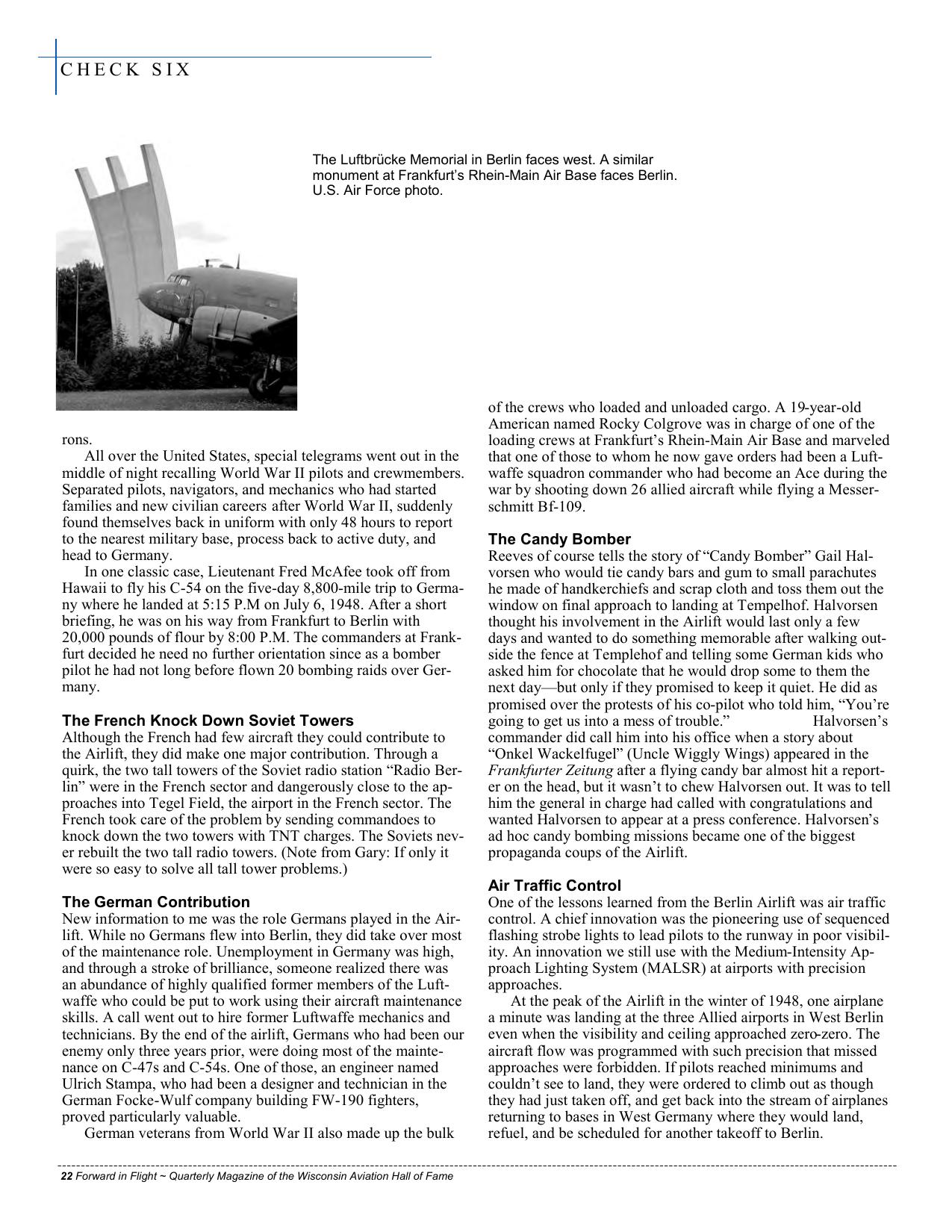
CHECK SIX The Luftbrücke Memorial in Berlin faces west. A similar monument at Frankfurt’s Rhein-Main Air Base faces Berlin. U.S. Air Force photo. rons. All over the United States, special telegrams went out in the middle of night recalling World War II pilots and crewmembers. Separated pilots, navigators, and mechanics who had started families and new civilian careers after World War II, suddenly found themselves back in uniform with only 48 hours to report to the nearest military base, process back to active duty, and head to Germany. In one classic case, Lieutenant Fred McAfee took off from Hawaii to fly his C-54 on the five-day 8,800-mile trip to Germany where he landed at 5:15 P.M on July 6, 1948. After a short briefing, he was on his way from Frankfurt to Berlin with 20,000 pounds of flour by 8:00 P.M. The commanders at Frankfurt decided he need no further orientation since as a bomber pilot he had not long before flown 20 bombing raids over Germany. The French Knock Down Soviet Towers Although the French had few aircraft they could contribute to the Airlift, they did make one major contribution. Through a quirk, the two tall towers of the Soviet radio station “Radio Berlin” were in the French sector and dangerously close to the approaches into Tegel Field, the airport in the French sector. The French took care of the problem by sending commandoes to knock down the two towers with TNT charges. The Soviets never rebuilt the two tall radio towers. (Note from Gary: If only it were so easy to solve all tall tower problems.) The German Contribution New information to me was the role Germans played in the Airlift. While no Germans flew into Berlin, they did take over most of the maintenance role. Unemployment in Germany was high, and through a stroke of brilliance, someone realized there was an abundance of highly qualified former members of the Luftwaffe who could be put to work using their aircraft maintenance skills. A call went out to hire former Luftwaffe mechanics and technicians. By the end of the airlift, Germans who had been our enemy only three years prior, were doing most of the maintenance on C-47s and C-54s. One of those, an engineer named Ulrich Stampa, who had been a designer and technician in the German Focke-Wulf company building FW-190 fighters, proved particularly valuable. German veterans from World War II also made up the bulk 22 Forward in Flight ~ Quarterly Magazine of the Wisconsin Aviation Hall of Fame of the crews who loaded and unloaded cargo. A 19-year-old American named Rocky Colgrove was in charge of one of the loading crews at Frankfurt’s Rhein-Main Air Base and marveled that one of those to whom he now gave orders had been a Luftwaffe squadron commander who had become an Ace during the war by shooting down 26 allied aircraft while flying a Messerschmitt Bf-109. The Candy Bomber Reeves of course tells the story of “Candy Bomber” Gail Halvorsen who would tie candy bars and gum to small parachutes he made of handkerchiefs and scrap cloth and toss them out the window on final approach to landing at Tempelhof. Halvorsen thought his involvement in the Airlift would last only a few days and wanted to do something memorable after walking outside the fence at Templehof and telling some German kids who asked him for chocolate that he would drop some to them the next day—but only if they promised to keep it quiet. He did as promised over the protests of his co-pilot who told him, “You’re going to get us into a mess of trouble.” Halvorsen’s commander did call him into his office when a story about “Onkel Wackelfugel” (Uncle Wiggly Wings) appeared in the Frankfurter Zeitung after a flying candy bar almost hit a reporter on the head, but it wasn’t to chew Halvorsen out. It was to tell him the general in charge had called with congratulations and wanted Halvorsen to appear at a press conference. Halvorsen’s ad hoc candy bombing missions became one of the biggest propaganda coups of the Airlift. Air Traffic Control One of the lessons learned from the Berlin Airlift was air traffic control. A chief innovation was the pioneering use of sequenced flashing strobe lights to lead pilots to the runway in poor visibility. An innovation we still use with the Medium-Intensity Approach Lighting System (MALSR) at airports with precision approaches. At the peak of the Airlift in the winter of 1948, one airplane a minute was landing at the three Allied airports in West Berlin even when the visibility and ceiling approached zero-zero. The aircraft flow was programmed with such precision that missed approaches were forbidden. If pilots reached minimums and couldn’t see to land, they were ordered to climb out as though they had just taken off, and get back into the stream of airplanes returning to bases in West Germany where they would land, refuel, and be scheduled for another takeoff to Berlin.
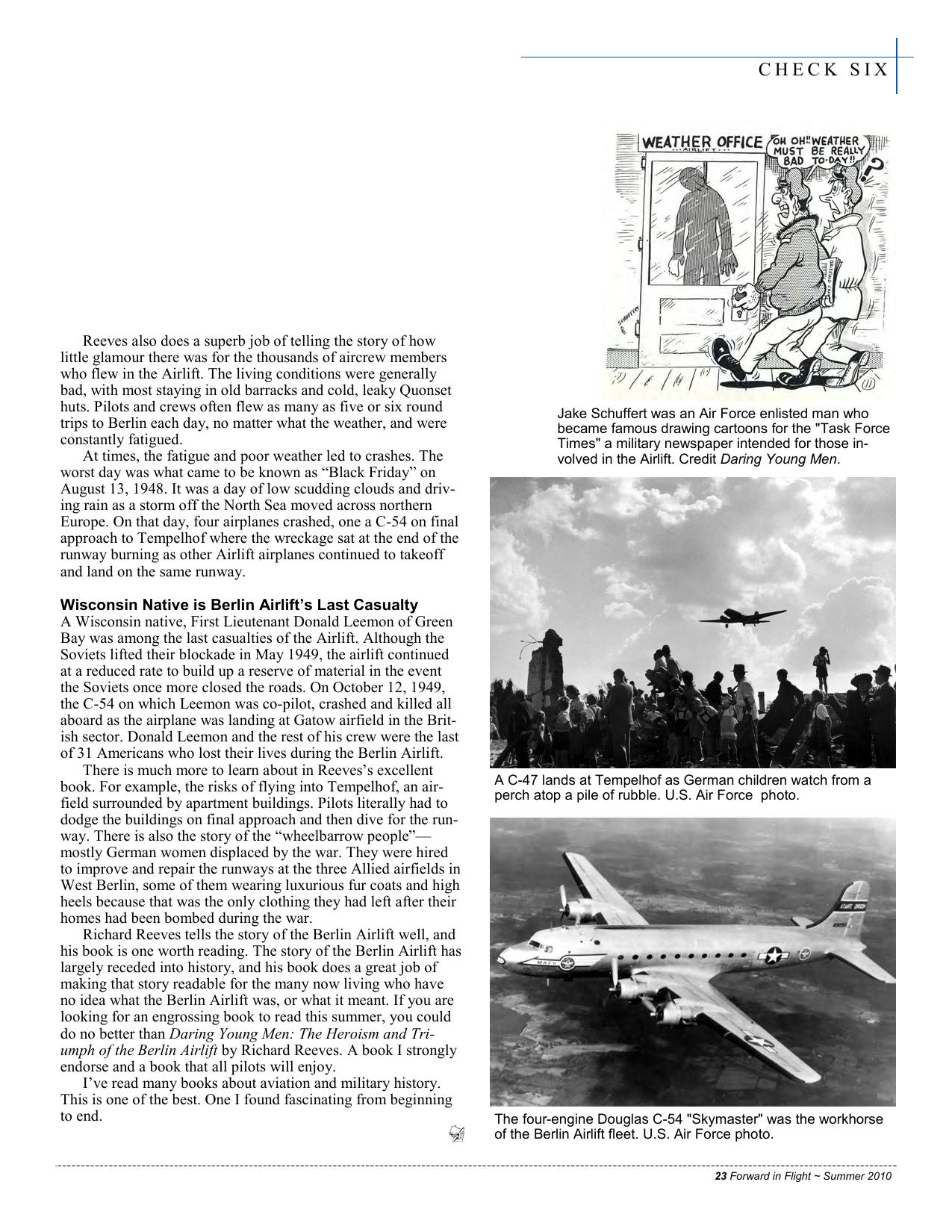
CHECK SIX Reeves also does a superb job of telling the story of how little glamour there was for the thousands of aircrew members who flew in the Airlift. The living conditions were generally bad, with most staying in old barracks and cold, leaky Quonset huts. Pilots and crews often flew as many as five or six round trips to Berlin each day, no matter what the weather, and were constantly fatigued. At times, the fatigue and poor weather led to crashes. The worst day was what came to be known as “Black Friday” on August 13, 1948. It was a day of low scudding clouds and driving rain as a storm off the North Sea moved across northern Europe. On that day, four airplanes crashed, one a C-54 on final approach to Tempelhof where the wreckage sat at the end of the runway burning as other Airlift airplanes continued to takeoff and land on the same runway. Wisconsin Native is Berlin Airlift’s Last Casualty A Wisconsin native, First Lieutenant Donald Leemon of Green Bay was among the last casualties of the Airlift. Although the Soviets lifted their blockade in May 1949, the airlift continued at a reduced rate to build up a reserve of material in the event the Soviets once more closed the roads. On October 12, 1949, the C-54 on which Leemon was co-pilot, crashed and killed all aboard as the airplane was landing at Gatow airfield in the British sector. Donald Leemon and the rest of his crew were the last of 31 Americans who lost their lives during the Berlin Airlift. There is much more to learn about in Reeves’s excellent book. For example, the risks of flying into Tempelhof, an airfield surrounded by apartment buildings. Pilots literally had to dodge the buildings on final approach and then dive for the runway. There is also the story of the “wheelbarrow people”— mostly German women displaced by the war. They were hired to improve and repair the runways at the three Allied airfields in West Berlin, some of them wearing luxurious fur coats and high heels because that was the only clothing they had left after their homes had been bombed during the war. Richard Reeves tells the story of the Berlin Airlift well, and his book is one worth reading. The story of the Berlin Airlift has largely receded into history, and his book does a great job of making that story readable for the many now living who have no idea what the Berlin Airlift was, or what it meant. If you are looking for an engrossing book to read this summer, you could do no better than Daring Young Men: The Heroism and Triumph of the Berlin Airlift by Richard Reeves. A book I strongly endorse and a book that all pilots will enjoy. I’ve read many books about aviation and military history. This is one of the best. One I found fascinating from beginning to end. Jake Schuffert was an Air Force enlisted man who became famous drawing cartoons for the "Task Force Times" a military newspaper intended for those involved in the Airlift. Credit Daring Young Men. A C-47 lands at Tempelhof as German children watch from a perch atop a pile of rubble. U.S. Air Force photo. The four-engine Douglas C-54 "Skymaster" was the workhorse of the Berlin Airlift fleet. U.S. Air Force photo. 23 Forward in Flight ~ Summer 2010
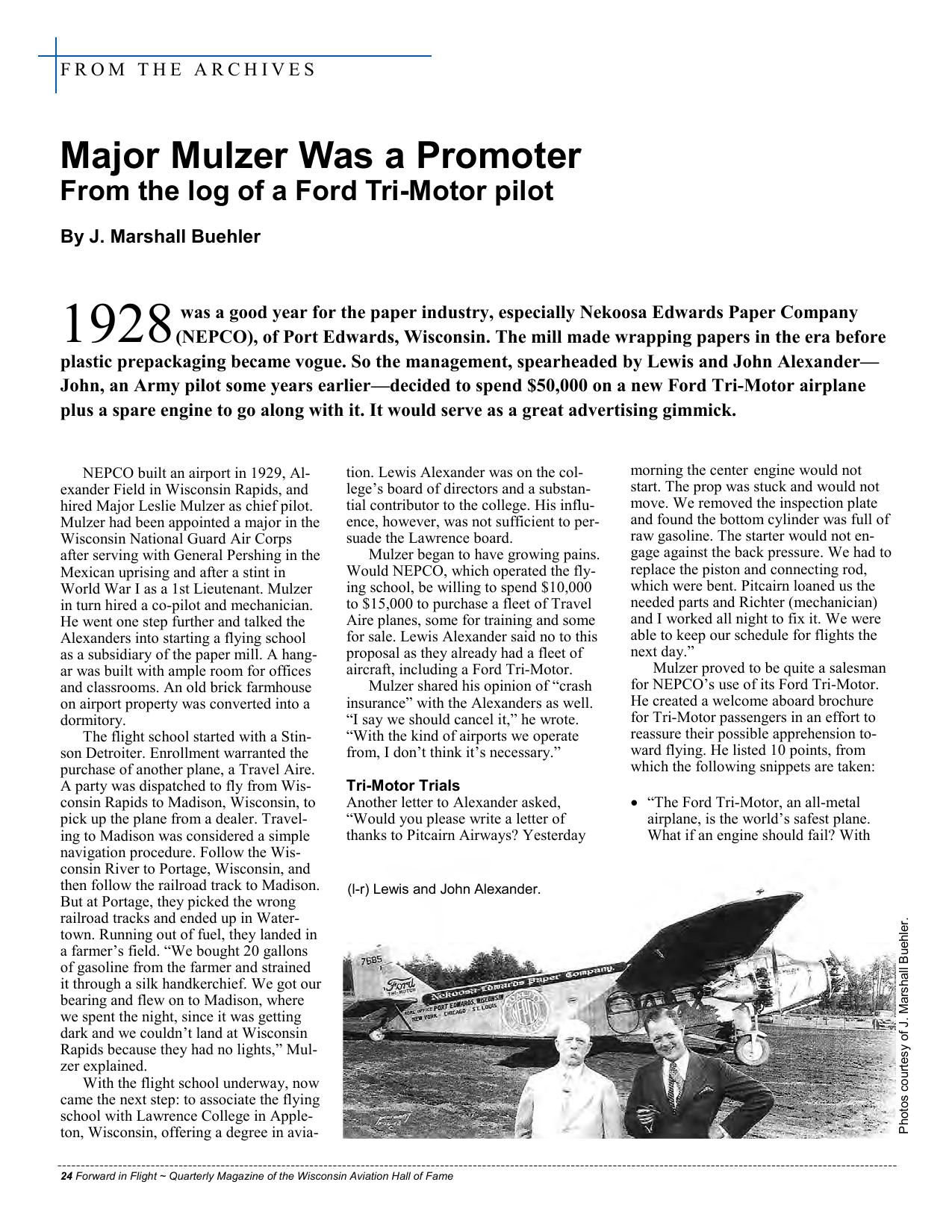
FROM THE ARCHIVES Major Mulzer Was a Promoter From the log of a Ford Tri-Motor pilot By J. Marshall Buehler 1928 was a good year for the paper industry, especially Nekoosa Edwards Paper Company (NEPCO), of Port Edwards, Wisconsin. The mill made wrapping papers in the era before plastic prepackaging became vogue. So the management, spearheaded by Lewis and John Alexander— John, an Army pilot some years earlier—decided to spend $50,000 on a new Ford Tri-Motor airplane plus a spare engine to go along with it. It would serve as a great advertising gimmick. tion. Lewis Alexander was on the college’s board of directors and a substantial contributor to the college. His influence, however, was not sufficient to persuade the Lawrence board. Mulzer began to have growing pains. Would NEPCO, which operated the flying school, be willing to spend $10,000 to $15,000 to purchase a fleet of Travel Aire planes, some for training and some for sale. Lewis Alexander said no to this proposal as they already had a fleet of aircraft, including a Ford Tri-Motor. Mulzer shared his opinion of “crash insurance” with the Alexanders as well. “I say we should cancel it,” he wrote. “With the kind of airports we operate from, I don’t think it’s necessary.” morning the center engine would not start. The prop was stuck and would not move. We removed the inspection plate and found the bottom cylinder was full of raw gasoline. The starter would not engage against the back pressure. We had to replace the piston and connecting rod, which were bent. Pitcairn loaned us the needed parts and Richter (mechanician) and I worked all night to fix it. We were able to keep our schedule for flights the next day.” Mulzer proved to be quite a salesman for NEPCO’s use of its Ford Tri-Motor. He created a welcome aboard brochure for Tri-Motor passengers in an effort to reassure their possible apprehension toward flying. He listed 10 points, from which the following snippets are taken: Tri-Motor Trials Another letter to Alexander asked, “Would you please write a letter of thanks to Pitcairn Airways? Yesterday · “The Ford Tri-Motor, an all-metal airplane, is the world’s safest plane. What if an engine should fail? With (l-r) Lewis and John Alexander. 24 Forward in Flight ~ Quarterly Magazine of the Wisconsin Aviation Hall of Fame Photos courtesy of J. Marshall Buehler. NEPCO built an airport in 1929, Alexander Field in Wisconsin Rapids, and hired Major Leslie Mulzer as chief pilot. Mulzer had been appointed a major in the Wisconsin National Guard Air Corps after serving with General Pershing in the Mexican uprising and after a stint in World War I as a 1st Lieutenant. Mulzer in turn hired a co-pilot and mechanician. He went one step further and talked the Alexanders into starting a flying school as a subsidiary of the paper mill. A hangar was built with ample room for offices and classrooms. An old brick farmhouse on airport property was converted into a dormitory. The flight school started with a Stinson Detroiter. Enrollment warranted the purchase of another plane, a Travel Aire. A party was dispatched to fly from Wisconsin Rapids to Madison, Wisconsin, to pick up the plane from a dealer. Traveling to Madison was considered a simple navigation procedure. Follow the Wisconsin River to Portage, Wisconsin, and then follow the railroad track to Madison. But at Portage, they picked the wrong railroad tracks and ended up in Watertown. Running out of fuel, they landed in a farmer’s field. “We bought 20 gallons of gasoline from the farmer and strained it through a silk handkerchief. We got our bearing and flew on to Madison, where we spent the night, since it was getting dark and we couldn’t land at Wisconsin Rapids because they had no lights,” Mulzer explained. With the flight school underway, now came the next step: to associate the flying school with Lawrence College in Appleton, Wisconsin, offering a degree in avia-
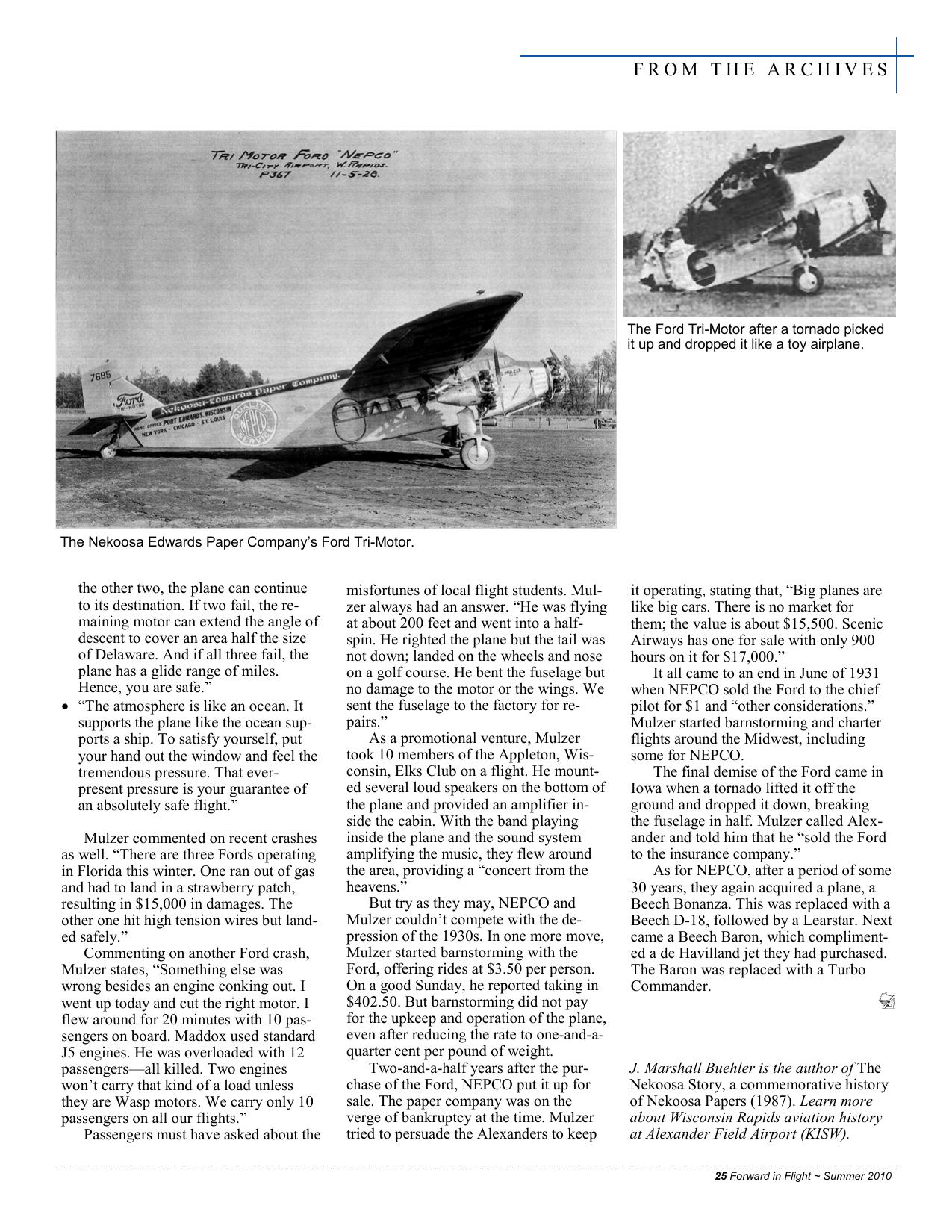
FROM THE ARCHIVES The Ford Tri-Motor after a tornado picked it up and dropped it like a toy airplane. The Nekoosa Edwards Paper Company’s Ford Tri-Motor. the other two, the plane can continue to its destination. If two fail, the remaining motor can extend the angle of descent to cover an area half the size of Delaware. And if all three fail, the plane has a glide range of miles. Hence, you are safe.” · “The atmosphere is like an ocean. It supports the plane like the ocean supports a ship. To satisfy yourself, put your hand out the window and feel the tremendous pressure. That everpresent pressure is your guarantee of an absolutely safe flight.” Mulzer commented on recent crashes as well. “There are three Fords operating in Florida this winter. One ran out of gas and had to land in a strawberry patch, resulting in $15,000 in damages. The other one hit high tension wires but landed safely.” Commenting on another Ford crash, Mulzer states, “Something else was wrong besides an engine conking out. I went up today and cut the right motor. I flew around for 20 minutes with 10 passengers on board. Maddox used standard J5 engines. He was overloaded with 12 passengers—all killed. Two engines won’t carry that kind of a load unless they are Wasp motors. We carry only 10 passengers on all our flights.” Passengers must have asked about the misfortunes of local flight students. Mulzer always had an answer. “He was flying at about 200 feet and went into a halfspin. He righted the plane but the tail was not down; landed on the wheels and nose on a golf course. He bent the fuselage but no damage to the motor or the wings. We sent the fuselage to the factory for repairs.” As a promotional venture, Mulzer took 10 members of the Appleton, Wisconsin, Elks Club on a flight. He mounted several loud speakers on the bottom of the plane and provided an amplifier inside the cabin. With the band playing inside the plane and the sound system amplifying the music, they flew around the area, providing a “concert from the heavens.” But try as they may, NEPCO and Mulzer couldn’t compete with the depression of the 1930s. In one more move, Mulzer started barnstorming with the Ford, offering rides at $3.50 per person. On a good Sunday, he reported taking in $402.50. But barnstorming did not pay for the upkeep and operation of the plane, even after reducing the rate to one-and-aquarter cent per pound of weight. Two-and-a-half years after the purchase of the Ford, NEPCO put it up for sale. The paper company was on the verge of bankruptcy at the time. Mulzer tried to persuade the Alexanders to keep it operating, stating that, “Big planes are like big cars. There is no market for them; the value is about $15,500. Scenic Airways has one for sale with only 900 hours on it for $17,000.” It all came to an end in June of 1931 when NEPCO sold the Ford to the chief pilot for $1 and “other considerations.” Mulzer started barnstorming and charter flights around the Midwest, including some for NEPCO. The final demise of the Ford came in Iowa when a tornado lifted it off the ground and dropped it down, breaking the fuselage in half. Mulzer called Alexander and told him that he “sold the Ford to the insurance company.” As for NEPCO, after a period of some 30 years, they again acquired a plane, a Beech Bonanza. This was replaced with a Beech D-18, followed by a Learstar. Next came a Beech Baron, which complimented a de Havilland jet they had purchased. The Baron was replaced with a Turbo Commander. J. Marshall Buehler is the author of The Nekoosa Story, a commemorative history of Nekoosa Papers (1987). Learn more about Wisconsin Rapids aviation history at Alexander Field Airport (KISW). 25 Forward in Flight ~ Summer 2010
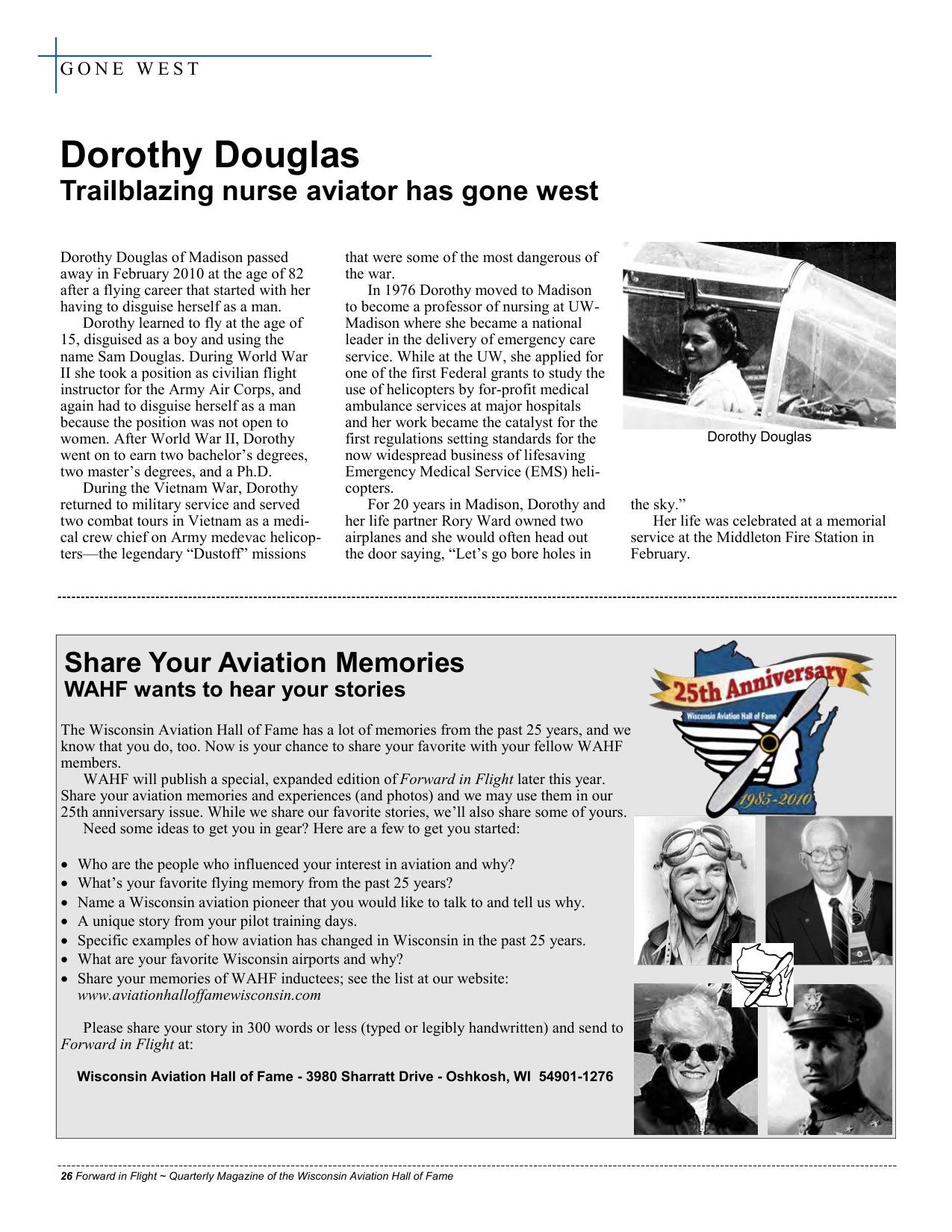
GONE WEST Dorothy Douglas Trailblazing nurse aviator has gone west Dorothy Douglas of Madison passed away in February 2010 at the age of 82 after a flying career that started with her having to disguise herself as a man. Dorothy learned to fly at the age of 15, disguised as a boy and using the name Sam Douglas. During World War II she took a position as civilian flight instructor for the Army Air Corps, and again had to disguise herself as a man because the position was not open to women. After World War II, Dorothy went on to earn two bachelor’s degrees, two master’s degrees, and a Ph.D. During the Vietnam War, Dorothy returned to military service and served two combat tours in Vietnam as a medical crew chief on Army medevac helicopters—the legendary “Dustoff” missions that were some of the most dangerous of the war. In 1976 Dorothy moved to Madison to become a professor of nursing at UWMadison where she became a national leader in the delivery of emergency care service. While at the UW, she applied for one of the first Federal grants to study the use of helicopters by for-profit medical ambulance services at major hospitals and her work became the catalyst for the first regulations setting standards for the now widespread business of lifesaving Emergency Medical Service (EMS) helicopters. For 20 years in Madison, Dorothy and her life partner Rory Ward owned two airplanes and she would often head out the door saying, “Let’s go bore holes in Dorothy Douglas the sky.” Her life was celebrated at a memorial service at the Middleton Fire Station in February. Share Your Aviation Memories WAHF wants to hear your stories The Wisconsin Aviation Hall of Fame has a lot of memories from the past 25 years, and we know that you do, too. Now is your chance to share your favorite with your fellow WAHF members. WAHF will publish a special, expanded edition of Forward in Flight later this year. Share your aviation memories and experiences (and photos) and we may use them in our 25th anniversary issue. While we share our favorite stories, we’ll also share some of yours. Need some ideas to get you in gear? Here are a few to get you started: · Who are the people who influenced your interest in aviation and why? · What’s your favorite flying memory from the past 25 years? · Name a Wisconsin aviation pioneer that you would like to talk to and tell us why. · A unique story from your pilot training days. · Specific examples of how aviation has changed in Wisconsin in the past 25 years. · What are your favorite Wisconsin airports and why? · Share your memories of WAHF inductees; see the list at our website: www.aviationhalloffamewisconsin.com Please share your story in 300 words or less (typed or legibly handwritten) and send to Forward in Flight at: Wisconsin Aviation Hall of Fame - 3980 Sharratt Drive - Oshkosh, WI 54901-1276 26 Forward in Flight ~ Quarterly Magazine of the Wisconsin Aviation Hall of Fame
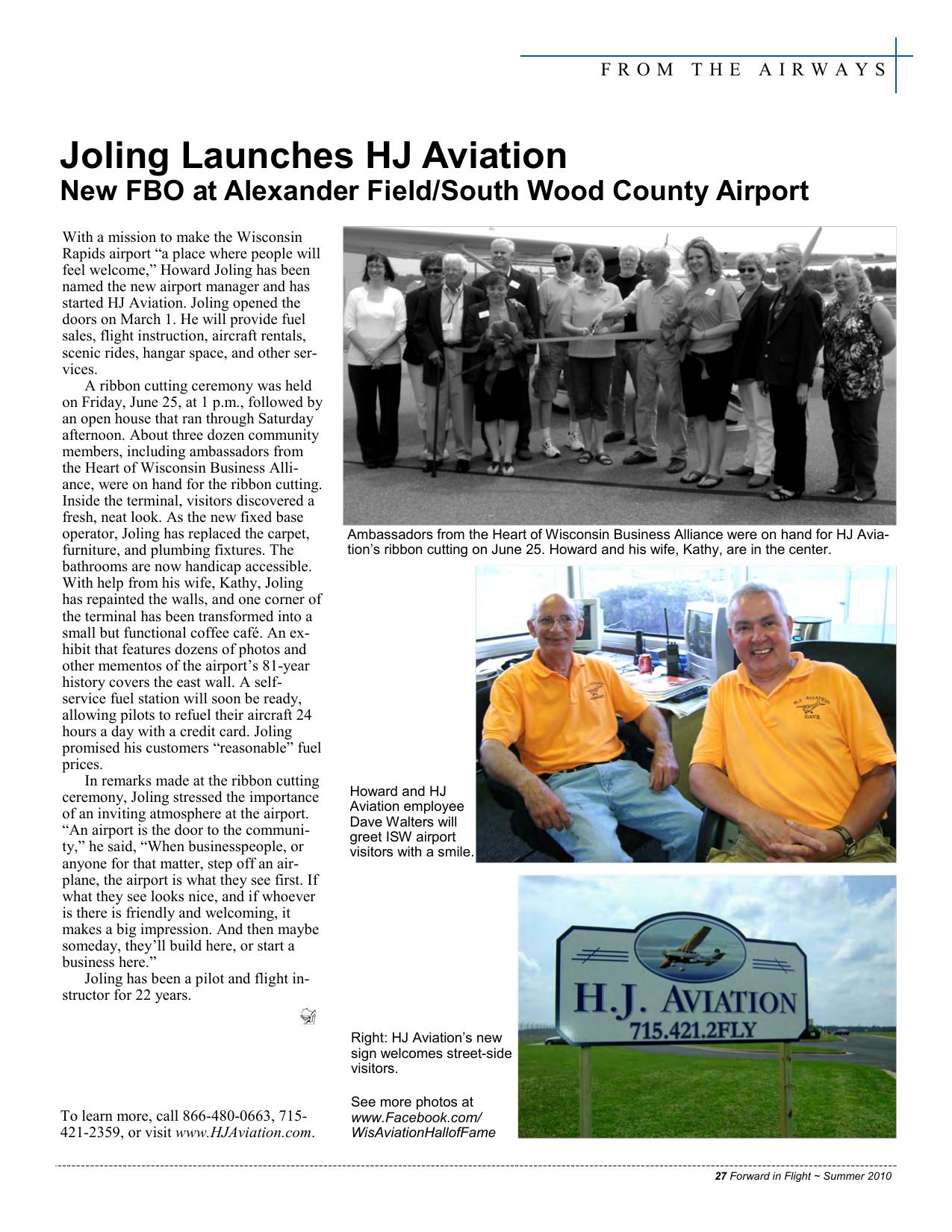
FROM THE AIRWAYS Joling Launches HJ Aviation New FBO at Alexander Field/South Wood County Airport With a mission to make the Wisconsin Rapids airport “a place where people will feel welcome,” Howard Joling has been named the new airport manager and has started HJ Aviation. Joling opened the doors on March 1. He will provide fuel sales, flight instruction, aircraft rentals, scenic rides, hangar space, and other services. A ribbon cutting ceremony was held on Friday, June 25, at 1 p.m., followed by an open house that ran through Saturday afternoon. About three dozen community members, including ambassadors from the Heart of Wisconsin Business Alliance, were on hand for the ribbon cutting. Inside the terminal, visitors discovered a fresh, neat look. As the new fixed base operator, Joling has replaced the carpet, furniture, and plumbing fixtures. The bathrooms are now handicap accessible. With help from his wife, Kathy, Joling has repainted the walls, and one corner of the terminal has been transformed into a small but functional coffee café. An exhibit that features dozens of photos and other mementos of the airport’s 81-year history covers the east wall. A selfservice fuel station will soon be ready, allowing pilots to refuel their aircraft 24 hours a day with a credit card. Joling promised his customers “reasonable” fuel prices. In remarks made at the ribbon cutting ceremony, Joling stressed the importance of an inviting atmosphere at the airport. “An airport is the door to the community,” he said, “When businesspeople, or anyone for that matter, step off an airplane, the airport is what they see first. If what they see looks nice, and if whoever is there is friendly and welcoming, it makes a big impression. And then maybe someday, they’ll build here, or start a business here.” Joling has been a pilot and flight instructor for 22 years. Ambassadors from the Heart of Wisconsin Business Alliance were on hand for HJ Aviation’s ribbon cutting on June 25. Howard and his wife, Kathy, are in the center. Howard and HJ Aviation employee Dave Walters will greet ISW airport visitors with a smile. Right: HJ Aviation’s new sign welcomes street-side visitors. To learn more, call 866-480-0663, 715421-2359, or visit www.HJAviation.com. See more photos at www.Facebook.com/ WisAviationHallofFame 27 Forward in Flight ~ Summer 2010
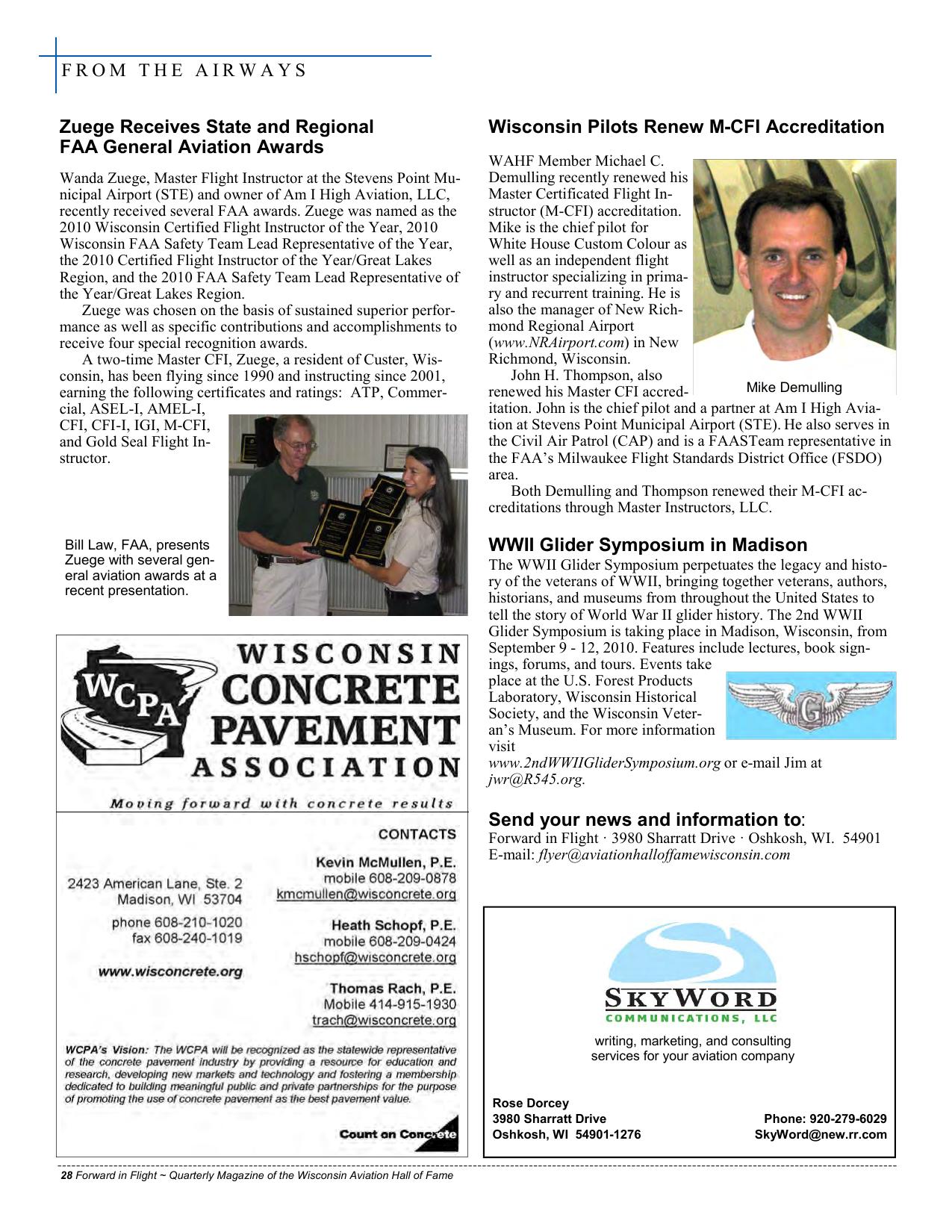
FROM THE AIRWAYS Zuege Receives State and Regional FAA General Aviation Awards Wanda Zuege, Master Flight Instructor at the Stevens Point Municipal Airport (STE) and owner of Am I High Aviation, LLC, recently received several FAA awards. Zuege was named as the 2010 Wisconsin Certified Flight Instructor of the Year, 2010 Wisconsin FAA Safety Team Lead Representative of the Year, the 2010 Certified Flight Instructor of the Year/Great Lakes Region, and the 2010 FAA Safety Team Lead Representative of the Year/Great Lakes Region. Zuege was chosen on the basis of sustained superior performance as well as specific contributions and accomplishments to receive four special recognition awards. A two-time Master CFI, Zuege, a resident of Custer, Wisconsin, has been flying since 1990 and instructing since 2001, earning the following certificates and ratings: ATP, Commercial, ASEL-I, AMEL-I, CFI, CFI-I, IGI, M-CFI, and Gold Seal Flight Instructor. Bill Law, FAA, presents Zuege with several general aviation awards at a recent presentation. Wisconsin Pilots Renew M-CFI Accreditation WAHF Member Michael C. Demulling recently renewed his Master Certificated Flight Instructor (M-CFI) accreditation. Mike is the chief pilot for White House Custom Colour as well as an independent flight instructor specializing in primary and recurrent training. He is also the manager of New Richmond Regional Airport (www.NRAirport.com) in New Richmond, Wisconsin. John H. Thompson, also Mike Demulling renewed his Master CFI accreditation. John is the chief pilot and a partner at Am I High Aviation at Stevens Point Municipal Airport (STE). He also serves in the Civil Air Patrol (CAP) and is a FAASTeam representative in the FAA’s Milwaukee Flight Standards District Office (FSDO) area. Both Demulling and Thompson renewed their M-CFI accreditations through Master Instructors, LLC. WWII Glider Symposium in Madison The WWII Glider Symposium perpetuates the legacy and history of the veterans of WWII, bringing together veterans, authors, historians, and museums from throughout the United States to tell the story of World War II glider history. The 2nd WWII Glider Symposium is taking place in Madison, Wisconsin, from September 9 - 12, 2010. Features include lectures, book signings, forums, and tours. Events take place at the U.S. Forest Products Laboratory, Wisconsin Historical Society, and the Wisconsin Veteran’s Museum. For more information visit www.2ndWWIIGliderSymposium.org or e-mail Jim at jwr@R545.org. Send your news and information to: Forward in Flight 3980 Sharratt Drive Oshkosh, WI. 54901 E-mail: flyer@aviationhalloffamewisconsin.com writing, marketing, and consulting services for your aviation company Rose Dorcey 3980 Sharratt Drive Oshkosh, WI 54901-1276 28 Forward in Flight ~ Quarterly Magazine of the Wisconsin Aviation Hall of Fame Phone: 920-279-6029 SkyWord@new.rr.com
BOOK REVIEW The Bishop’s Boys A Life of Wilbur and Orville Wright Dr. Tom Crouch’s portrayal of the life of the Wright brothers could be titled, ‘the invention of powered, controlled flight.’ It is a remarkable trip down the runway of the birth of aviation. Dr. Crouch starts with the Wright brothers’ father, Milton Wright, and his family upbringing in the early 1800s. On a trip to Denver, Milton bought Wilbur and Orville a toy helicopter designed by the French aeronautical experimenter Alphonse Penaud. This rotary-wing toy was meant to inspire Wilbur, 12, and Orville, 8, when Milton presented the gadget in 1878. Orville would later refer to this ‘gadget’ in patent litigation. Dr. Crouch’s book covers many interesting facts about the Wright brothers and the birth of powered flight. The controversy with who did what first is almost overwhelming, but this book puts it straight. The following are only a few of Dr. Crouch’s facts: DR. TOM VOELKER Aviation Medical Examiner 2nd and 3rd Class Aviation Medicals Phone 715-423-0122 Aspirus Doctor’s Clinic 420 Dewey Street Wisconsin Rapids WI 54494 Located at Riverview East Medical Office Bldg. · The last flight of the 1905 Wright Flyer was in October of 1905. The Wrights did not fly again until May 1908. · May 25, 1910 is the only day Wilbur and Orville flew together, the same day their father had his first and only flight. · In 1914, the Smithsonian Institute proclaimed Professor Langley as the inventor of flight. · The original 1903 Wright Flyer was displayed in the Science Museum of London from 1925 until after World War II. · The Smithsonian Institution did not recognize the Wright brothers as the inventors of powered controlled flight until December 3, 1942. · The original 1903 Wright Flyer was first displayed at the Smithsonian on December 17, 1948, 45 years to the day after its first flight at Kitty Hawk in 1903. For anyone interested in aviation and flight, this is a must read book. You won’t be disappointed! —Reviewed by Tom Thomas 29 Forward in Flight ~ Summer 2010
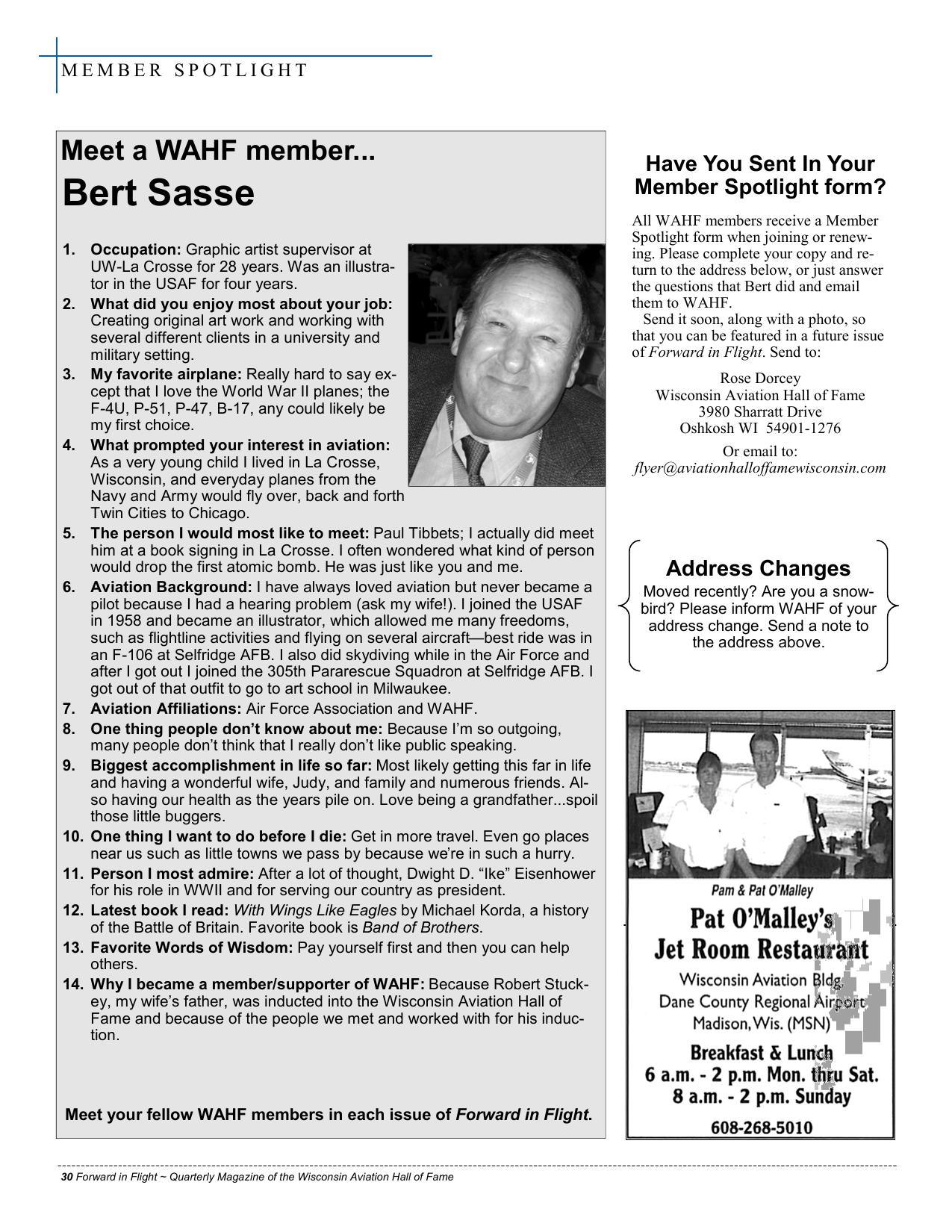
MEMBER SPOTLIGHT Meet a WAHF member... Bert Sasse 1. Occupation: Graphic artist supervisor at UW-La Crosse for 28 years. Was an illustrator in the USAF for four years. 2. What did you enjoy most about your job: Creating original art work and working with several different clients in a university and military setting. 3. My favorite airplane: Really hard to say except that I love the World War II planes; the F-4U, P-51, P-47, B-17, any could likely be my first choice. 4. What prompted your interest in aviation: As a very young child I lived in La Crosse, Wisconsin, and everyday planes from the Navy and Army would fly over, back and forth Twin Cities to Chicago. 5. The person I would most like to meet: Paul Tibbets; I actually did meet him at a book signing in La Crosse. I often wondered what kind of person would drop the first atomic bomb. He was just like you and me. 6. Aviation Background: I have always loved aviation but never became a pilot because I had a hearing problem (ask my wife!). I joined the USAF in 1958 and became an illustrator, which allowed me many freedoms, such as flightline activities and flying on several aircraft—best ride was in an F-106 at Selfridge AFB. I also did skydiving while in the Air Force and after I got out I joined the 305th Pararescue Squadron at Selfridge AFB. I got out of that outfit to go to art school in Milwaukee. 7. Aviation Affiliations: Air Force Association and WAHF. 8. One thing people don’t know about me: Because I’m so outgoing, many people don’t think that I really don’t like public speaking. 9. Biggest accomplishment in life so far: Most likely getting this far in life and having a wonderful wife, Judy, and family and numerous friends. Also having our health as the years pile on. Love being a grandfather...spoil those little buggers. 10. One thing I want to do before I die: Get in more travel. Even go places near us such as little towns we pass by because we’re in such a hurry. 11. Person I most admire: After a lot of thought, Dwight D. “Ike” Eisenhower for his role in WWII and for serving our country as president. 12. Latest book I read: With Wings Like Eagles by Michael Korda, a history of the Battle of Britain. Favorite book is Band of Brothers. 13. Favorite Words of Wisdom: Pay yourself first and then you can help others. 14. Why I became a member/supporter of WAHF: Because Robert Stuckey, my wife’s father, was inducted into the Wisconsin Aviation Hall of Fame and because of the people we met and worked with for his induction. Meet your fellow WAHF members in each issue of Forward in Flight. 30 Forward in Flight ~ Quarterly Magazine of the Wisconsin Aviation Hall of Fame Have You Sent In Your Member Spotlight form? All WAHF members receive a Member Spotlight form when joining or renewing. Please complete your copy and return to the address below, or just answer the questions that Bert did and email them to WAHF. Send it soon, along with a photo, so that you can be featured in a future issue of Forward in Flight. Send to: Rose Dorcey Wisconsin Aviation Hall of Fame 3980 Sharratt Drive Oshkosh WI 54901-1276 Or email to: flyer@aviationhalloffamewisconsin.com Address Changes Moved recently? Are you a snowbird? Please inform WAHF of your address change. Send a note to the address above.
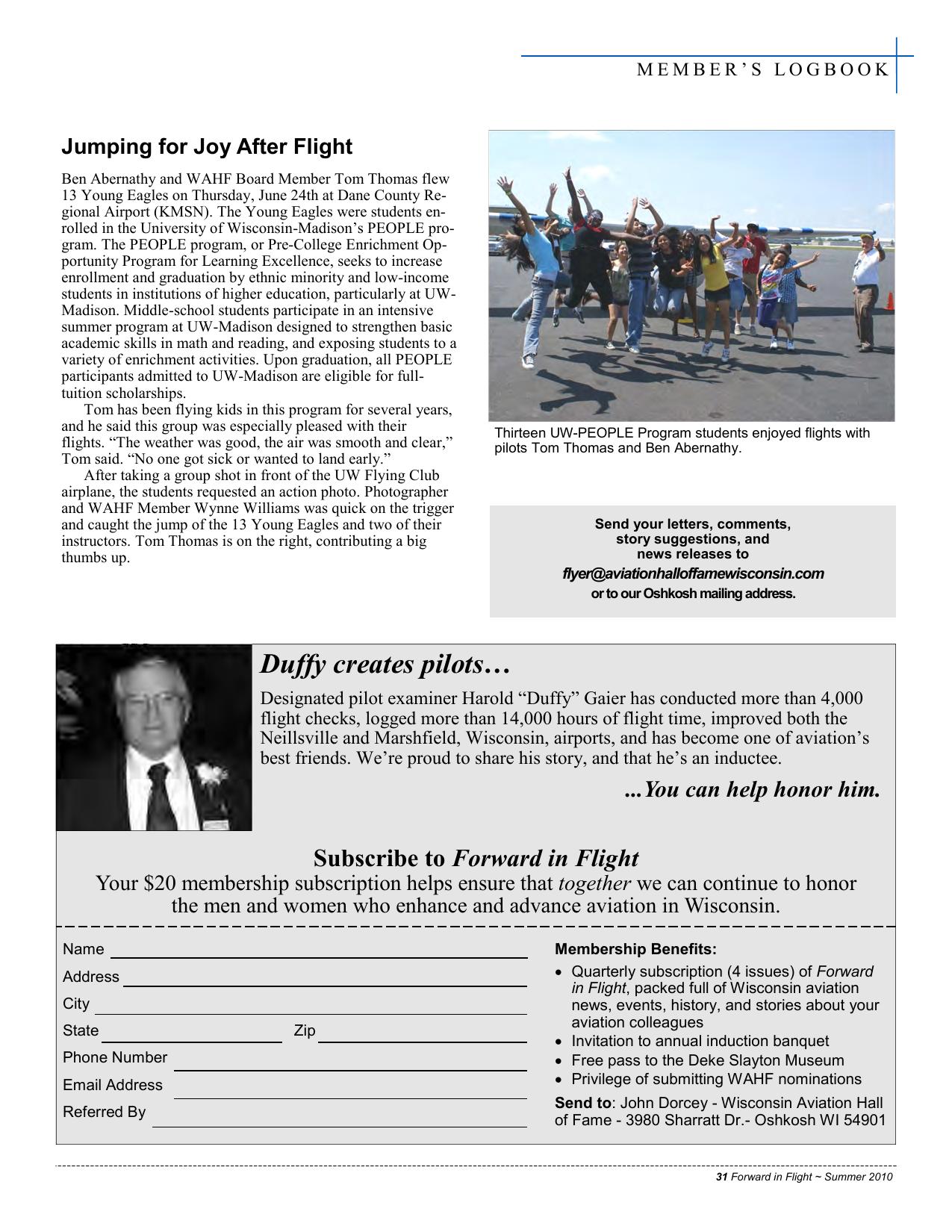
MEMBER’S LOGBOOK Jumping for Joy After Flight Ben Abernathy and WAHF Board Member Tom Thomas flew 13 Young Eagles on Thursday, June 24th at Dane County Regional Airport (KMSN). The Young Eagles were students enrolled in the University of Wisconsin-Madison’s PEOPLE program. The PEOPLE program, or Pre-College Enrichment Opportunity Program for Learning Excellence, seeks to increase enrollment and graduation by ethnic minority and low-income students in institutions of higher education, particularly at UWMadison. Middle-school students participate in an intensive summer program at UW-Madison designed to strengthen basic academic skills in math and reading, and exposing students to a variety of enrichment activities. Upon graduation, all PEOPLE participants admitted to UW-Madison are eligible for fulltuition scholarships. Tom has been flying kids in this program for several years, and he said this group was especially pleased with their flights. “The weather was good, the air was smooth and clear,” Tom said. “No one got sick or wanted to land early.” After taking a group shot in front of the UW Flying Club airplane, the students requested an action photo. Photographer and WAHF Member Wynne Williams was quick on the trigger and caught the jump of the 13 Young Eagles and two of their instructors. Tom Thomas is on the right, contributing a big thumbs up. Thirteen UW-PEOPLE Program students enjoyed flights with pilots Tom Thomas and Ben Abernathy. Send your letters, comments, story suggestions, and news releases to flyer@aviationhalloffamewisconsin.com or to our Oshkosh mailing address. Duffy creates pilots… Designated pilot examiner Harold “Duffy” Gaier has conducted more than 4,000 flight checks, logged more than 14,000 hours of flight time, improved both the Neillsville and Marshfield, Wisconsin, airports, and has become one of aviation’s best friends. We’re proud to share his story, and that he’s an inductee. ...You can help honor him. Subscribe to Forward in Flight Your $20 membership subscription helps ensure that together we can continue to honor the men and women who enhance and advance aviation in Wisconsin. Name Address City State Phone Number Email Address Referred By Zip Membership Benefits: · Quarterly subscription (4 issues) of Forward in Flight, packed full of Wisconsin aviation news, events, history, and stories about your aviation colleagues · Invitation to annual induction banquet · Free pass to the Deke Slayton Museum · Privilege of submitting WAHF nominations Send to: John Dorcey - Wisconsin Aviation Hall of Fame - 3980 Sharratt Dr.- Oshkosh WI 54901 31 Forward in Flight ~ Summer 2010
PRSRT STD US Postage Paid Wisc Rapids WI Permit 98 WISCONSIN AVIATION HALL OF FAME 3980 SHARRATT DRIVE OSHKOSH WI 54901-1276 Preserving and Sharing Wisconsin’s Aviation History Change Service Requested Welcome New WAHF Member/Supporters: Robert Brinkman Charlie Christenson Leo Kohn Bradley S. Livingston —Thanks for coming on board! * Upgrade to Lifetime Membership Rick Jelinek* Ralph Moser Jonathan Kim Brian O’Lena If You Cook It, They Will Come seems to be the idea for attracting airplanes and people to airports throughout Wisconsin. The most well known among regular “foody” attractions is Iola’s Central County Airport (68C) where the weekly Friday menu ranges from simple to elaborate: from burgers and brats to a hearty Thanksgiving-type feast. Other airports are catching on as well. Giving 68C some competition is Pizza Fridays at Ephraim-Gibralter Airport (3D2) from 11:30 - 1. If you really like pizza for lunch, fly to Marshfield Municipal Airport/Roy Shwery Field (MFI) on Thursdays, too. We’ve even heard of Burger Wednesday at Wausau Downtown Airport (AUW) but call John at Wausau Flying Service to verify before you go. For a complete listing of fly-ins and other aviation events, many that include culinary delights, visit www.dot.wisconsin.gov/travel/air/fly-ins.htm. The WWII Glider Symposium perpetuates the legacy and history of the veterans of WWII, bringing together veterans, authors, historians, and museums from throughout the United States to tell the story of World War II glider history. The 2nd WWII Glider Symposium takes place in Madison, Wisconsin, in September. See page 28 for information, visit www.2ndWWIIGliderSymposium.org, or e-mail jwr@R545.org. Put Saturday evening October 25 on your calendar and plan to attend the Wisconsin Aviation Hall of Fame’s annual induction banquet. Watch for your invitation in the mail, or contact WAHF for more information. See page 5 for general information. Wisconsin Aviation Hall of Fame Officers and Board of Directors Rose Dorcey, President Michael Goc, Vice President John Dorcey, Secretary/Treasurer Duane Esse Rich Fischler Tom Thomas Charles Swain LaFonda Kinnaman Staber “Bill” Reese Charles Marotske, Honorary Chairman of the Board Wisconsin Aviation Hall of Fame 3980 Sharratt Drive Oshkosh WI 54901-1276 Become a supporter today! For information call Rose Dorcey at 920-385-1483 www.aviationhalloffamewisconsin.com flyer@aviationhalloffamewisconsin.com