Volume 9, Issue 2
🗞️ Download Issue (PDF)
Forward in Flight - Summer 2011
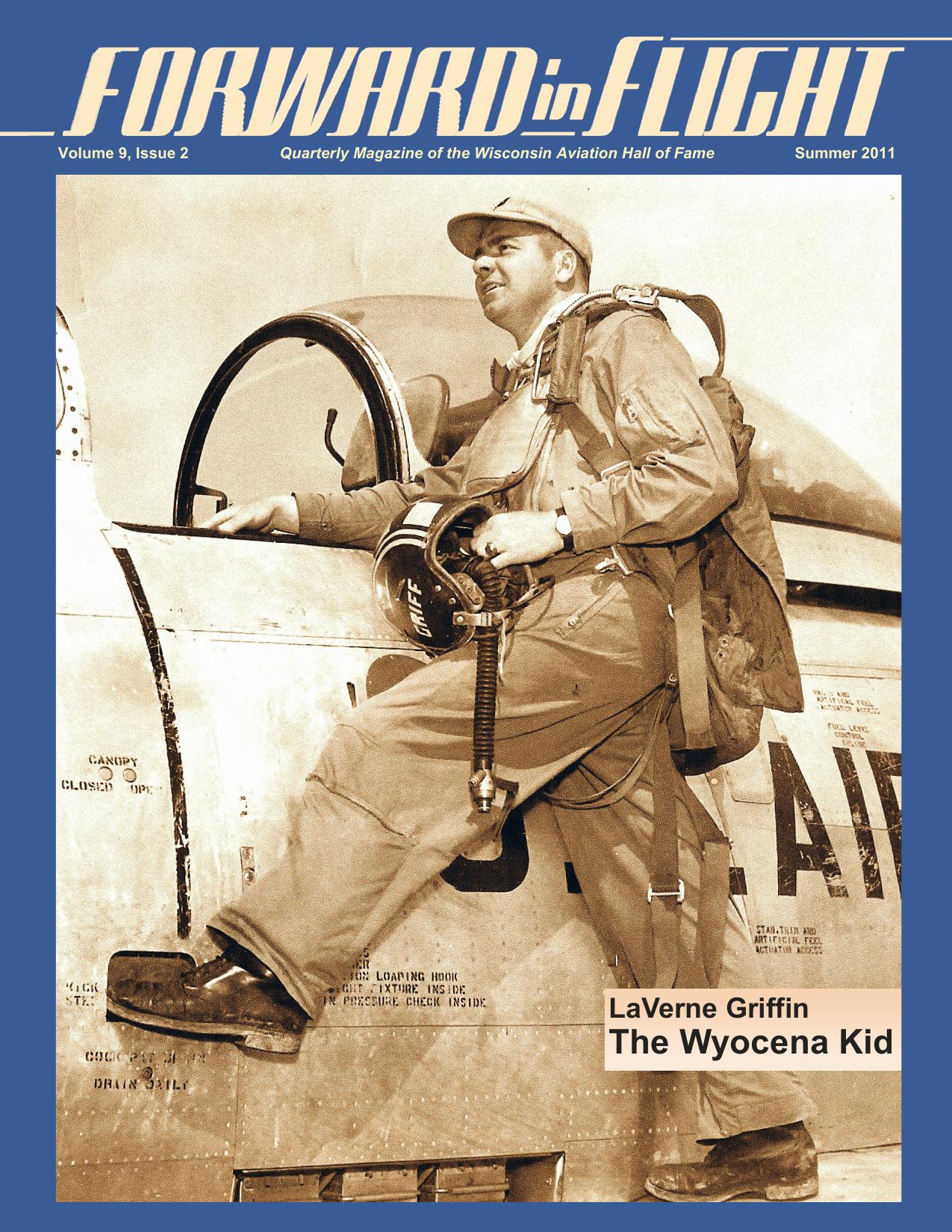
Volume 9, Issue 2 Quarterly Magazine of the Wisconsin Aviation Hall of Fame Summer 2011 LaVerne Griffin The Wyocena Kid
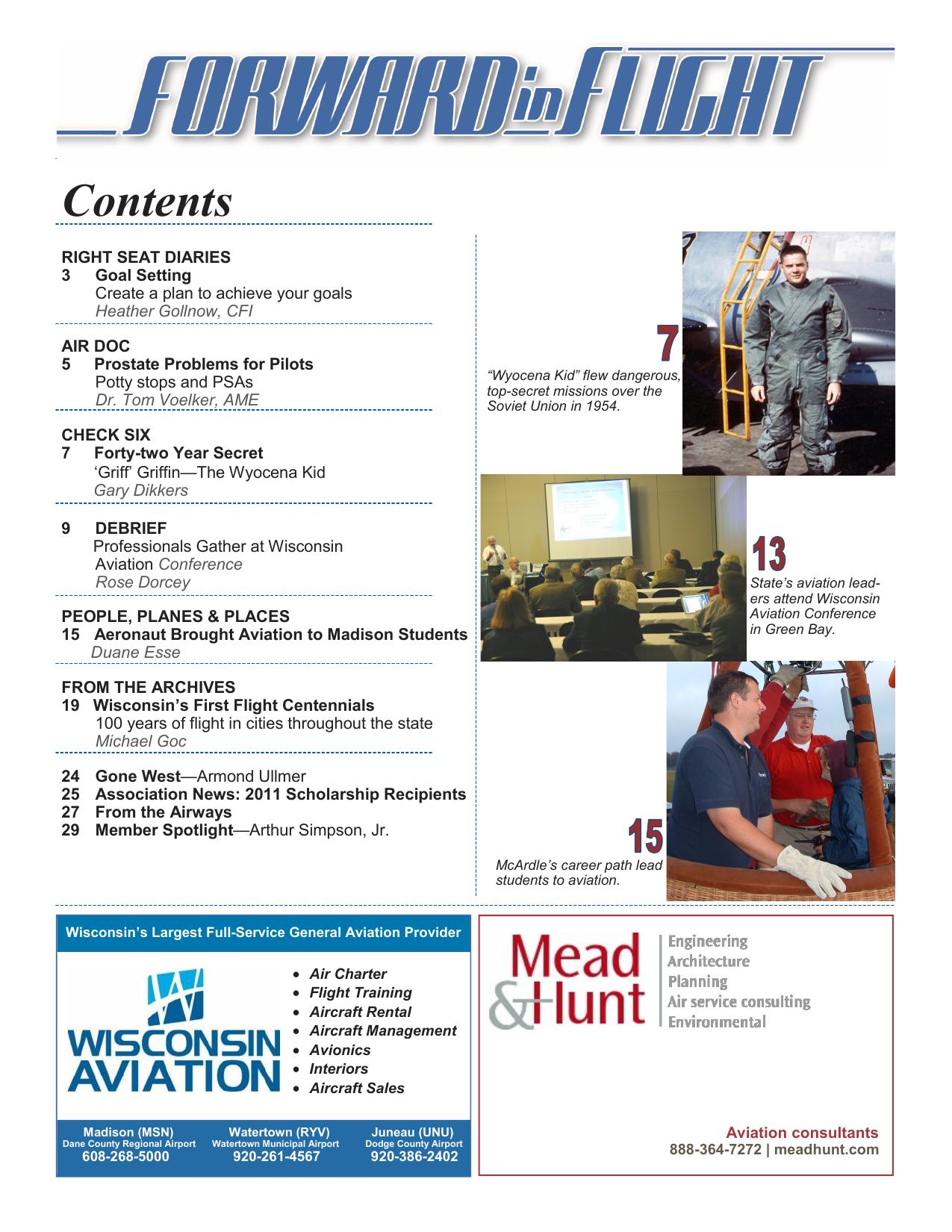
Contents RIGHT SEAT DIARIES 3 Goal Setting Create a plan to achieve your goals Heather Gollnow, CFI AIR DOC 5 Prostate Problems for Pilots Potty stops and PSAs Dr. Tom Voelker, AME “Wyocena Kid” flew dangerous, top-secret missions over the Soviet Union in 1954. CHECK SIX 7 Forty-two Year Secret 9 ‘Griff’ Griffin—The Wyocena Kid Gary Dikkers 9 DEBRIEF Professionals Gather at Wisconsin Aviation Conference Rose Dorcey State’s aviation leaders attend Wisconsin Aviation Conference in Green Bay. PEOPLE, PLANES & PLACES 15 Aeronaut Brought Aviation to Madison Students Duane Esse FROM THE ARCHIVES 19 Wisconsin’s First Flight Centennials 100 years of flight in cities throughout the state Michael Goc 24 25 27 29 Gone West—Armond Ullmer Association News: 2011 Scholarship Recipients From the Airways Member Spotlight—Arthur Simpson, Jr. McArdle’s career path lead students to aviation. Wisconsin’s Largest Full-Service General Aviation Provider · Air Charter · Flight Training · Aircraft Rental · Aircraft Management · Avionics · Interiors · Aircraft Sales Madison (MSN) Dane County Regional Airport 608-268-5000 Watertown (RYV) Watertown Municipal Airport 920-261-4567 Juneau (UNU) Dodge County Airport 920-386-2402 Aviation consultants 888-364-7272 | meadhunt.com
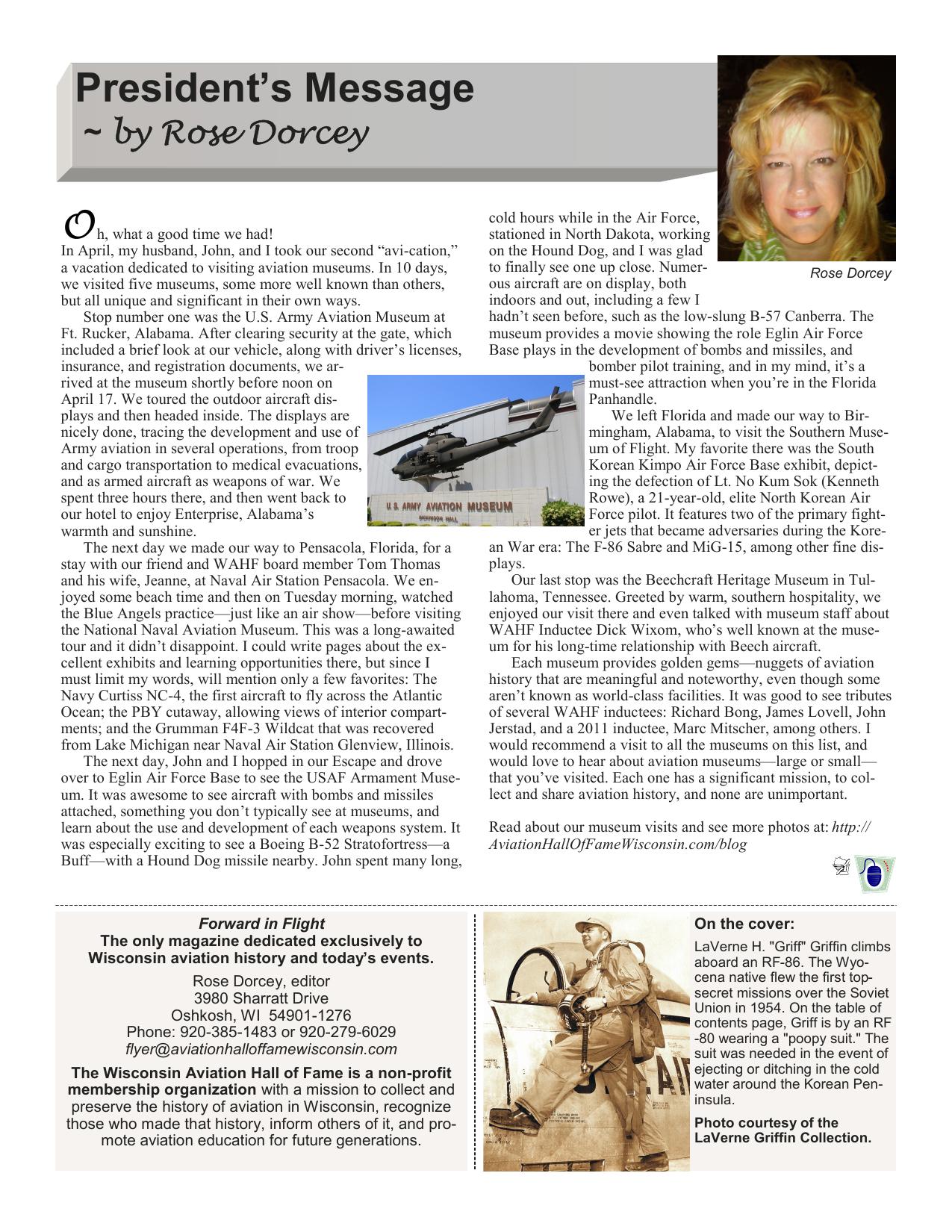
President’s Message ~ by Rose Dorcey O h, what a good time we had! In April, my husband, John, and I took our second “avi-cation,” a vacation dedicated to visiting aviation museums. In 10 days, we visited five museums, some more well known than others, but all unique and significant in their own ways. Stop number one was the U.S. Army Aviation Museum at Ft. Rucker, Alabama. After clearing security at the gate, which included a brief look at our vehicle, along with driver’s licenses, insurance, and registration documents, we arrived at the museum shortly before noon on April 17. We toured the outdoor aircraft displays and then headed inside. The displays are nicely done, tracing the development and use of Army aviation in several operations, from troop and cargo transportation to medical evacuations, and as armed aircraft as weapons of war. We spent three hours there, and then went back to our hotel to enjoy Enterprise, Alabama’s warmth and sunshine. The next day we made our way to Pensacola, Florida, for a stay with our friend and WAHF board member Tom Thomas and his wife, Jeanne, at Naval Air Station Pensacola. We enjoyed some beach time and then on Tuesday morning, watched the Blue Angels practice—just like an air show—before visiting the National Naval Aviation Museum. This was a long-awaited tour and it didn’t disappoint. I could write pages about the excellent exhibits and learning opportunities there, but since I must limit my words, will mention only a few favorites: The Navy Curtiss NC-4, the first aircraft to fly across the Atlantic Ocean; the PBY cutaway, allowing views of interior compartments; and the Grumman F4F-3 Wildcat that was recovered from Lake Michigan near Naval Air Station Glenview, Illinois. The next day, John and I hopped in our Escape and drove over to Eglin Air Force Base to see the USAF Armament Museum. It was awesome to see aircraft with bombs and missiles attached, something you don’t typically see at museums, and learn about the use and development of each weapons system. It was especially exciting to see a Boeing B-52 Stratofortress—a Buff—with a Hound Dog missile nearby. John spent many long, Forward in Flight The only magazine dedicated exclusively to Wisconsin aviation history and today’s events. Rose Dorcey, editor 3980 Sharratt Drive Oshkosh, WI 54901-1276 Phone: 920-385-1483 or 920-279-6029 flyer@aviationhalloffamewisconsin.com The Wisconsin Aviation Hall of Fame is a non-profit membership organization with a mission to collect and preserve the history of aviation in Wisconsin, recognize those who made that history, inform others of it, and promote aviation education for future generations. cold hours while in the Air Force, stationed in North Dakota, working on the Hound Dog, and I was glad to finally see one up close. NumerRose Dorcey ous aircraft are on display, both indoors and out, including a few I hadn’t seen before, such as the low-slung B-57 Canberra. The museum provides a movie showing the role Eglin Air Force Base plays in the development of bombs and missiles, and bomber pilot training, and in my mind, it’s a must-see attraction when you’re in the Florida Panhandle. We left Florida and made our way to Birmingham, Alabama, to visit the Southern Museum of Flight. My favorite there was the South Korean Kimpo Air Force Base exhibit, depicting the defection of Lt. No Kum Sok (Kenneth Rowe), a 21-year-old, elite North Korean Air Force pilot. It features two of the primary fighter jets that became adversaries during the Korean War era: The F-86 Sabre and MiG-15, among other fine displays. Our last stop was the Beechcraft Heritage Museum in Tullahoma, Tennessee. Greeted by warm, southern hospitality, we enjoyed our visit there and even talked with museum staff about WAHF Inductee Dick Wixom, who’s well known at the museum for his long-time relationship with Beech aircraft. Each museum provides golden gems—nuggets of aviation history that are meaningful and noteworthy, even though some aren’t known as world-class facilities. It was good to see tributes of several WAHF inductees: Richard Bong, James Lovell, John Jerstad, and a 2011 inductee, Marc Mitscher, among others. I would recommend a visit to all the museums on this list, and would love to hear about aviation museums—large or small— that you’ve visited. Each one has a significant mission, to collect and share aviation history, and none are unimportant. Read about our museum visits and see more photos at: http:// AviationHallOfFameWisconsin.com/blog On the cover: LaVerne H. "Griff" Griffin climbs aboard an RF-86. The Wyocena native flew the first topsecret missions over the Soviet Union in 1954. On the table of contents page, Griff is by an RF -80 wearing a "poopy suit." The suit was needed in the event of ejecting or ditching in the cold water around the Korean Peninsula. Photo courtesy of the LaVerne Griffin Collection.
RIGHT SEAT DIARIES Goal Setting Create a plan to achieve your goals By Heather Gollnow Each year right around my birthday, I come up with a list of to write it down. It becomes a constant things I want to accomplish in the next year. Some aren’t all that reminder of the goal to which you are magnificent and others are quite an undertaking. In the past, working. Whether it’s a post-it note on some of my goals have been to travel to a particular location, to your computer monitor or typed up in an continue my education, or to continue my pilot training. I have email to yourself, writing it down will never been one to shy away from a lofty goal and have learned help you get from achieving it “someday” how to align my daily life with achieving those goals. I am conto achieving it today. stantly reminded of the motivational saying: How do you eat an elephant? One bite at a time. The SMART Method Most of us have some sort of aviation-related goal. Maybe I like to use the SMART method of deit’s to finally take a discovery flight, earn a new endorsement or fining my goals. Goals need to be Specifrating, or finally fly to that particular place you’ve always wantic, Measurable, Attainable, Relevant, and ed to see. Ask yourself what you have done in the last year to Timely. There are other variations of this put yourself one step closer to achieving those goals. Be honest with yourself. “Someday”ÊisÊnotÊanÊanswerÊtoÊwhenÊyouÊwantÊ Achieving a goal takes hard work and commitment. It isn’t toÊachieveÊaÊgoal.ÊBeÊtimelyÊandÊsetÊaÊspecificÊ enough to simply want to do something. I’ve read statistics that anydate.ÊDon’tÊsetÊitÊtooÊfarÊintoÊtheÊfuture. where between 50 percent and 80 percent of people who start flying lessons do not finish. Of course that’s difficult to measure because there are people who want to take a few lessons just to say they acronym, but this is the particular method flew an airplane. There are also the people who take a few flyI like to use. If you Google “smart mething lessons, never get a student pilot certificate, and quit taking od goal setting” you will find tons of lessons. There’s no meaningful method to track these individuresources available to you. als on a national level. And then there are those who start flying Each section of this method is very lessons and life gets in the way. specific. First, the goal itself needs to be The reasons people quit flying lessons are plentiful. Financspecific. Use “what, who, when, and es are often a major obstacle for many of us to overcome. Some why” to define your goal. What do you people start flying lessons, then realize it isn’t something they want to accomplish? Who needs to be a are interested in pursuing. Although we may not have a new part of achieving your goal? When are pilot, I hope those individuals are new supporters of general you going to work on achieving your aviation. Many people do not have the support of their friends goal? Why do you want to achieve this and family. Unfortunately many of us know what it’s like to goal? Setting a specific goal makes your have a spouse or other family member who does not support the goal easily measurable. aviation addiction. (Now that’s another article for a future isGoals need to be measurable so that sue!) you know you are making progress toAviation-related or not, oftentimes we don’t achieve a goal wards that goal and so you know when simply because we haven’t created a plan for achieving it. you’ve achieved the goal. What criteria You’ve probably heard that the first step to achieving a goal is will you use to determine that you’ve 3 Forward in Flight ~ Quarterly Magazine of the Wisconsin Aviation Hall of Fame
RIGHT SEAT DIARIES achieved your goal? What method will you use to track progress towards your goal? Break your goal into smaller minigoals and set specific milestones toward reaching the goal. Creating measures to track progress toward your goal helps you to determine if your goal is attainable. Your goal must be realistic and attainable. You must define how you are going to achieve your goal. Be realistic with constraints in your life and set a realistic period. Decide what the necessary resources are that you will need to achieve this goal. What are your time and financial constraints? Realistic planning allows you to achieve almost any goal. Setting multiple goals allows you to take a more objective look at who you are as a person and what your priorities are in life. Each individual goal should be relevant to your identity and self-image. You are the only person who can decide if your goal is relevant to your own personal mission in life. Does your goal align with who you are as a person? Does your goal make you reach for the stars? Will achieving your goal give you a sense of accomplishment? Set your standards high, as motivation to achieve a tougher goal is often higher since it requires more effort. A lower goal might not require as much effort, but oftentimes we are not as motivated to achieve lower goals in the time frame that’s been determined. “Someday” is not an answer to when you want to achieve a goal. Be timely and set a specific date. Don’t set it too far off into the future. If you know you won’t be able to achieve a larger goal in the near future, set the goal but break it into smaller chunks that you can achieve in the shorter term. I heard a saying once that a task takes you as long to do as long as you have to do it. If you have two weeks to do something, it will take you two weeks. If you have a month, it will take you a month. Set your time frame but be reasonable with any constraints you may have. Each of these steps will bring you one step closer towards achieving any goal. Since there are a large number of people who start flying lessons and do not finish, let’s use this method to define a realistic goal for completing a private pilot certificate. I am going to write this as if I am an individual interested in taking flying lessons. nance, I will use to time during a cancelled flight lesson to study for the written exam. Once I pass the written exam, I will use this time to prepare for the oral exam. Specific What: My goal is to earn my private pilot certificate. Who: I need to find a good flight instructor. My friends and family need to understand my desire to earn my certificate. When: I can take flying lessons after work and on the weekends. Why: I have always had an interest in airplanes and it’s time for me to finally learn to fly. Relevant This goal is a high goal. I know that I can achieve it since it aligns with my own identity as someone who loves airplanes, adventure, and challenging myself to learn new things. Achieving this goal will give me a great sense of accomplishment. Measurable I will complete my private pilot certificate by October 31, 2011. Since that is about six months from now, my smaller mini-goals are to: · Obtain student pilot certificate by June 15, 2011. · Talk to at least three flight instructors and decide on one by June 15, 2011. · Take a discovery flight by June 30, 2011. · Solo by July 31, 2011. · Pass written exam by July 31, 2011. When I first wrote this overall goal of earning my private pilot certificate, I set my original date at December 31, 2011. By setting smaller, mini-goals I was able to see that given my constraints, I can likely achieve my goal two months sooner. Attainable I have set the money aside to complete at least half of the required flight hours. (If finances are an obstacle for you, I urge you to go through the SMART method to devise a plan to start saving up the cash or to find a method to finance such as scholarships and loans.) I will continue to set aside X amount of dollars each paycheck towards completing my private pilot certificate. I will also set aside at least 30 minutes each day for studying for the written exam. Since the weather in Wisconsin is not always safe to fly in and airplanes are known to go in for mainte- Timely I will complete my certificate my October 31, 2011. I will schedule at least three lessons per week. I understand that I may not fly each of those three times, but will use that time towards completing my goal. I urge each one of you to set an aviation-related goal to achieve this summer and take steps each day towards achieving that goal. These steps I’ve provided above are not anything new. Go to the internet and you will find forms you can download and print for organizing your goals. For myself, I just type my goals in a Word document. My birthday is in June, so I am setting new aviation goals for the year. Last year, my goal was to learn about the aerodynamics of helicopters and to take a discovery flight in one. This year, I want to ride in the B-17 at AirVenture, fly a hot-air balloon, fly a glider, and continue to introduce aviation to children and young adults. What are your aviation goals for the year? I’d love to hear them! Heather Gollnow is a certificated flight instructor with Aura Aviation Services, LLC. Residing in Menasha, Wisconsin, she instructs part-time in Appleton and Green Bay and speaks at schools and other youth groups around Northeast Wisconsin. Along with aviation, Heather works in the Information Technology Education field. Heather can be reached at heather.gollnow@gmail.com. 4 Forward in Flight ~ Spring 2011
AIR DOC Prostate Problems for Pilots Potty stops and PSAs Dr. Tom Voelker, AME DrAlphaMike@yahoo.com Hello again, airmen! Alpha Mike Echo back with you for another trip around the aeromedical traffic pattern. I write this having just returned from a beautiful evening flight from Saint Paul, Minnesota. While the surface winds made for some challenging crosswind landings, the clear air and distant city lights glimmering in the darkness made this flight memorable. It sure is wonderful to have our flying weather back! As soon as I landed, however, I had only one thing on my mind. The usual. I had to go. I have written about this before, but this time with a different twist. We are going to talk about prostate health, and, of course, the aeromedical consequences of prostate problems. My first personal exposure to prostate problems came at a medical education seminar at the Mayo Clinic, when I was in my 30s. We got a 15-minute break, and like almost everyone else in the conference room, I headed for the bathroom. This particular conference attracted as many retired doctors as those currently practicing. By retired, I mean old. I was fourth or fifth in line, but never made it to the front. I felt bad for the gentlemen who were trying to do their business. I made the comment that it just wasn’t right…a man shouldn’t have to wait to pee. Their prostates had other ideas, however. So, prostate problems happen as men get older. What kind of problems are we talking about, and what are the aeromedical implications? Three recent flight physicals that I performed give us a good launching point for this discussion. The first case occurred about a year and a half ago. I performed a physical on a 70-year-old man. The exam was unremarkable. I issued him a third class medical. He also had some lab tests that his personal physician had drawn, and these results were forwarded to the FAA with his medical application. His PSA test (a blood test that can indicate prostate problems) was slightly elevated. While this abnormality could be caused by prostate cancer, by far the most likely cause was BPH, or benign prostate overgrowth. (It’s likely that the doctors at the Mayo Clinic conference had this condition.) In any event, the FAA, more than a year after the flight physical, stumbled upon the elevated PSA test and sent the airman a letter. The letter stated that unless evidence could be provided showing that the PSA test elevation was not due to cancer, his medical certificate might be rescinded. Fortunately, the airman did get biopsies showing no cancer cells and he continues to fly. The second case involves an airman who also had a slightly elevated PSA test. He immediately sought the input of a urologist who performed biopsies on the prostate. The biopsies were all benign. This pilot also continues to fly. In this case, the biopsies and work-up were all 5 Forward in Flight ~ Quarterly Magazine of the Wisconsin Aviation Hall of Fame done by the time the airman came in for his flight physical, so I was able to clear him to fly, issuing his medical at the time of the physical. The last case involved an airman who saw me for a flight physical a few years ago. In the meantime, he developed prostate cancer. He had definitive treatment, and two years later, he has been granted his third class medical. By the time we are talking about cancer, however, the FAA has to step in and make the decision about issuing or denying the application. Let’s Start with Prostate Cancer The first thing to know is that any cancer, past or present, is disqualifying for flight. This sounds harsh, but it’s not as bad as it seems. For any of the dozen or so disqualifying conditions, the AME may not certify the airman for flight. The FAA, however, can override that disqualification, often with the help of the AME. If, for example, a person has a basal cell skin cancer that is completely removed, the AME should be able to call the Regional Flight Surgeon and with the proper authorization, the AME may be able to issue the medical certificate on the spot. If, however, the cancer is more aggressive or more advanced, and if the particular cancer has any propensity to cause sudden incapacitation (such as seizures in patients with cancers that spread to the brain), the FAA will direct the AME to defer the application to the FAA.
AIR DOC One other circumstance worth mentioning is the method of treatment for the cancer. Some chemotherapy regimens have severe side effects, particularly fatigue, and in these cases, the FAA may want to wait until the treatment is completed before allowing medical certification. Prostate cancer is the most common cancer (other than skin cancer). It can be aggressive, and in some cases, it can be so slow growing that, as I often tell my patients, “It will kill you by the time you’re 120 years old!” Up to one-third of all men in their 30s have this very slowgrowing cancer. The peak incidence of prostate cancer is in the 60s, so many of those men are destined to die of prostate cancer by the time they reach 150! With many cases of prostate cancer being so slow growing and behaving so benignly, it is no wonder that there is no real consensus on when to begin prostate cancer screening. Most doctors start screening their male patients with a DRE (digital rectal exam) to get a feel of the consistency of the prostate and evaluate for the presence of any lumps) at age 40, and then start PSA blood testing at age 50. (We’ll discuss PSA testing further in a bit.) Prostate cancer can have a predisposition to spread, or metastasize, to other tissues, especially bone. When this happens, the patient will usually have severe pain. This is why the FAA will usually want to follow the patient with prostate cancer for six to 24 months in a diseasefree state before issuing a medical certificate. In addition, prostate cancer can rarely spread to the brain, which could lead to unanticipated seizures—the very thing the FAA is hoping to avoid. Benign Prostatic Hypertrophy Benign prostatic hypertrophy, or BPH, is completely different from prostate can- cer. The prostate grows significantly, to some degree “pinching off the urine flow” in this condition. The only direct aeromedical consequence of BPH is that to which I alluded at the start of this column, frequent urination, which could turn a long cross-country flight into a flight with many short legs, each with a bathroom stop. This condition is very common, found in about 10 percent of older men. The other aeromedical concern of significance in patients with BPH is the effect of medications. There are several surgeries for BPH of which I will not go into detail here. However, most patients with significant BPH will be on medications. Most of the medications used for BPH are allowed, as long as the patient is TheÊFAAÊwillÊusuallyÊwantÊtoÊ followÊtheÊpatientÊwithÊ prostateÊcancerÊforÊsixÊtoÊ24Ê monthsÊinÊaÊdisease-freeÊstateÊ beforeÊissuingÊaÊmedicalÊ certificate. not having any side effects. Some of the medications, such as Hytrin or the generic Terazosin can cause significant dizziness when first standing up in the morning, or in the middle of the night if the BPH is bad. The FAA is going to want to know that you don’t get dizzy, and also that you are using this drug specifically for the prostate (not hypertension, or high blood pressure, as some of these meds can be used for that condition). Perhaps the largest quandary with this whole issue, both from an aeromedical standpoint and from a general medical standpoint, is whether and when to check a PSA test. PSA is a protein found in the prostate gland (or prostate tissue elsewhere, as in the case of metastatic prostate cancer). Some of the protein “leaks” into the bloodstream, and we can measure this as “PSA”. While it can be argued that the PSA should not be checked in people in their 60s or 70s (or older) as it is unlikely to yield a more aggressive cancer at that age, if the test is checked and found to be elevated, and then reported to the FAA, you should be prepared to go the next step and get the biopsies done if you want to continue to fly. My bottom-line answer to the question of whether or not you should get a PSA test done is this: ask your personal physician. He or she knows you and your health best, certainly better that the FAA. Many factors go into the decision of whether and when to get screening tests. Prostate health is another one of those conditions where you need to do what’s right for you and your health first, and worry about the possible implications on your ability to fly later. As the three cases mentioned show, prostate problems, even prostate cancer, do not necessarily mean your flying days are over. Well, that’s all for now. Stay healthy, safe, and if today’s glorious weather holds, fly! — Alpha Mike In “real” life, Alpha Mike Echo is Dr. Tom Voelker, AME, a family practitioner in Wisconsin Rapids. He and his wife, Kathy, are the parents of four daughters. Tom flies N6224P, a Comanche 250, out of Alexander Field, South Wood County Airport (ISW). 6 Forward in Flight ~ Spring 2011
CHECK SIX Forty-two Year Secret ‘Griff’ Griffin—the Wyocena Kid Doug Benjamin Collection By Gary Dikkers 7 Forward in Flight ~ Quarterly Magazine of the Wisconsin Aviation Hall of Fame
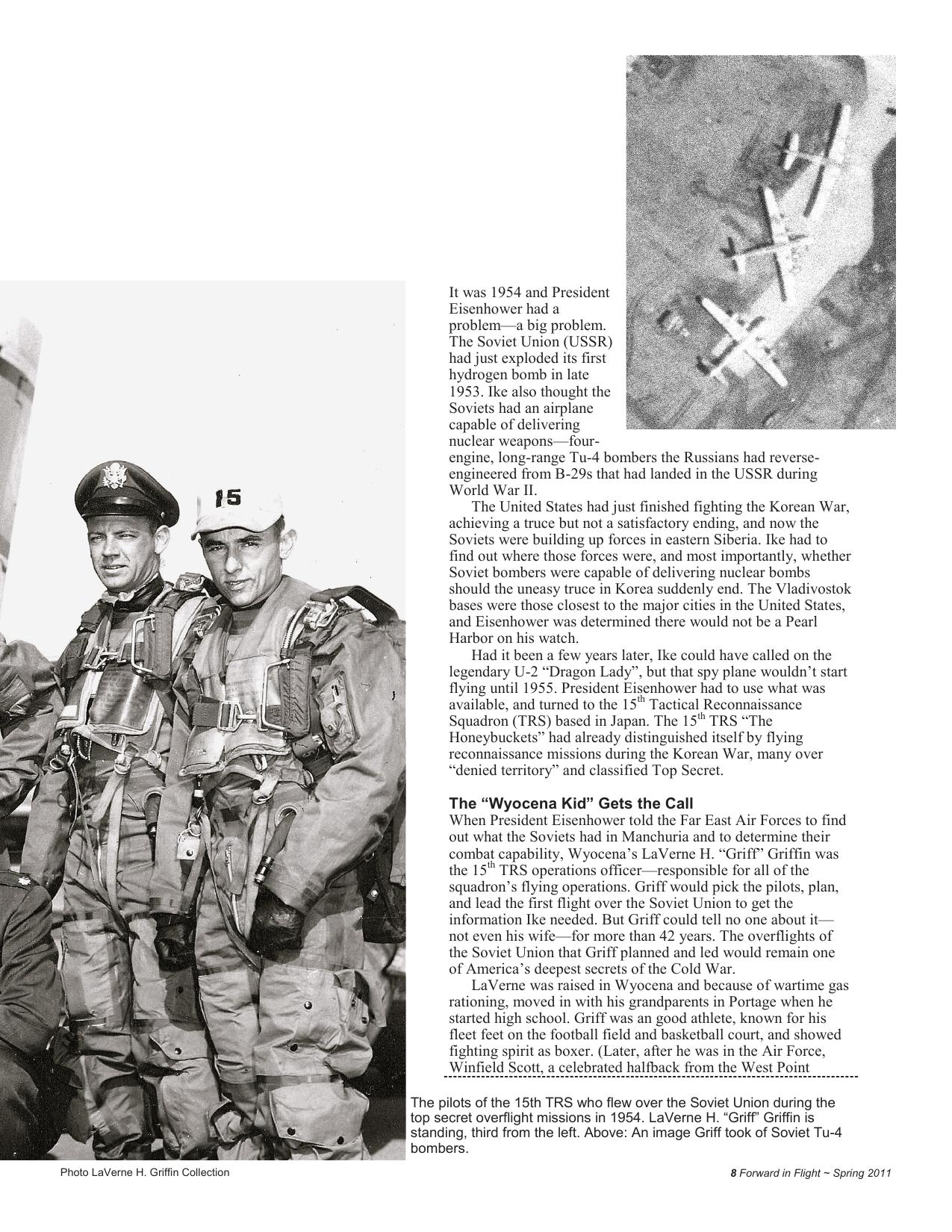
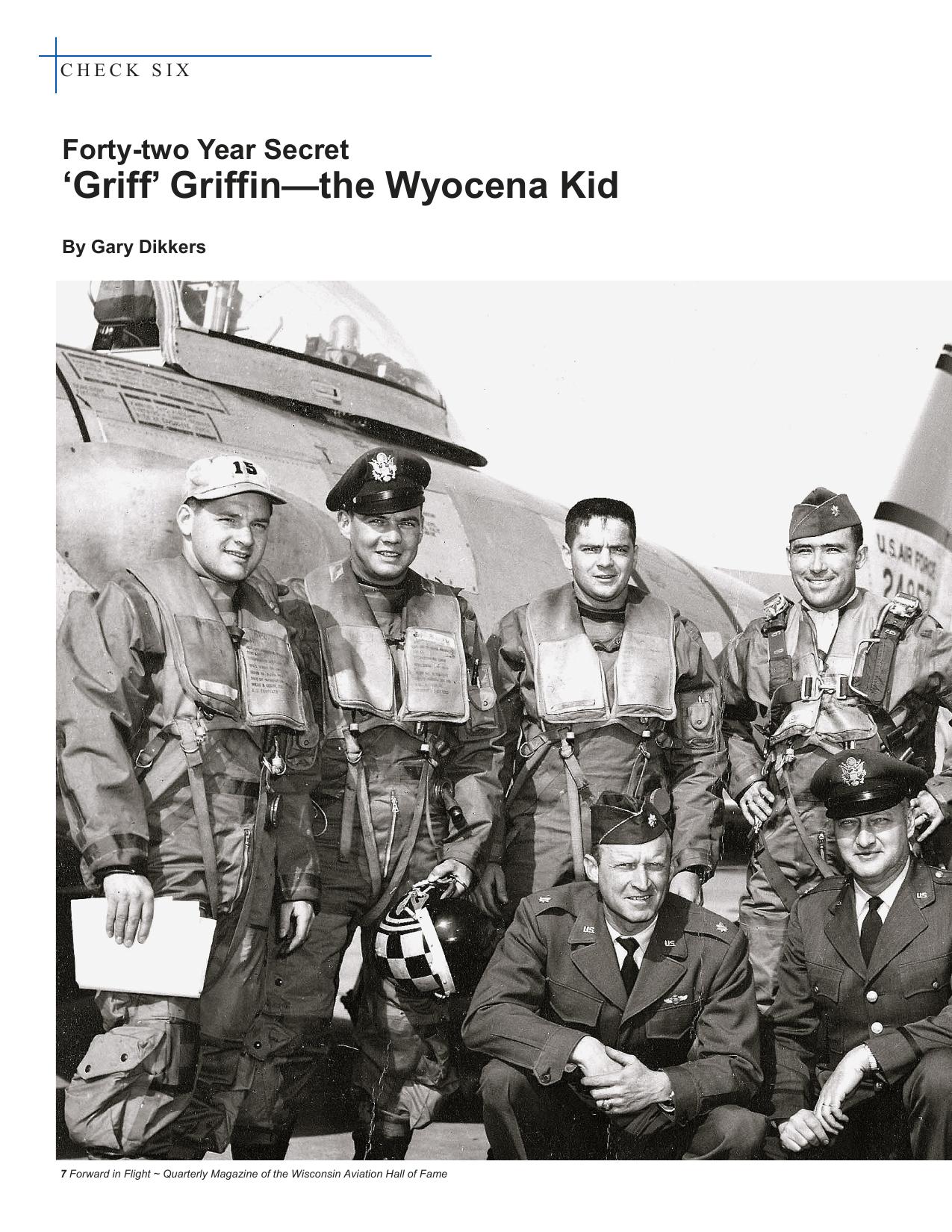
It was 1954 and President Eisenhower had a problem—a big problem. The Soviet Union (USSR) had just exploded its first hydrogen bomb in late 1953. Ike also thought the Soviets had an airplane capable of delivering nuclear weapons—fourengine, long-range Tu-4 bombers the Russians had reverseengineered from B-29s that had landed in the USSR during World War II. The United States had just finished fighting the Korean War, achieving a truce but not a satisfactory ending, and now the Soviets were building up forces in eastern Siberia. Ike had to find out where those forces were, and most importantly, whether Soviet bombers were capable of delivering nuclear bombs should the uneasy truce in Korea suddenly end. The Vladivostok bases were those closest to the major cities in the United States, and Eisenhower was determined there would not be a Pearl Harbor on his watch. Had it been a few years later, Ike could have called on the legendary U-2 “Dragon Lady”, but that spy plane wouldn’t start flying until 1955. President Eisenhower had to use what was available, and turned to the 15th Tactical Reconnaissance Squadron (TRS) based in Japan. The 15th TRS “The Honeybuckets” had already distinguished itself by flying reconnaissance missions during the Korean War, many over “denied territory” and classified Top Secret. Doug Benjamin Collection The “Wyocena Kid” Gets the Call When President Eisenhower told the Far East Air Forces to find out what the Soviets had in Manchuria and to determine their combat capability, Wyocena’s LaVerne H. “Griff” Griffin was the 15th TRS operations officer—responsible for all of the squadron’s flying operations. Griff would pick the pilots, plan, and lead the first flight over the Soviet Union to get the information Ike needed. But Griff could tell no one about it— not even his wife—for more than 42 years. The overflights of the Soviet Union that Griff planned and led would remain one of America’s deepest secrets of the Cold War. LaVerne was raised in Wyocena and because of wartime gas rationing, moved in with his grandparents in Portage when he started high school. Griff was an good athlete, known for his fleet feet on the football field and basketball court, and showed fighting spirit as boxer. (Later, after he was in the Air Force, Winfield Scott, a celebrated halfback from the West Point The pilots of the 15th TRS who flew over the Soviet Union during the top secret overflight missions in 1954. LaVerne H. “Griff” Griffin is standing, third from the left. Above: An image Griff took of Soviet Tu-4 bombers. Photo LaVerne H. Griffin Collection 8 Forward in Flight ~ Spring 2011
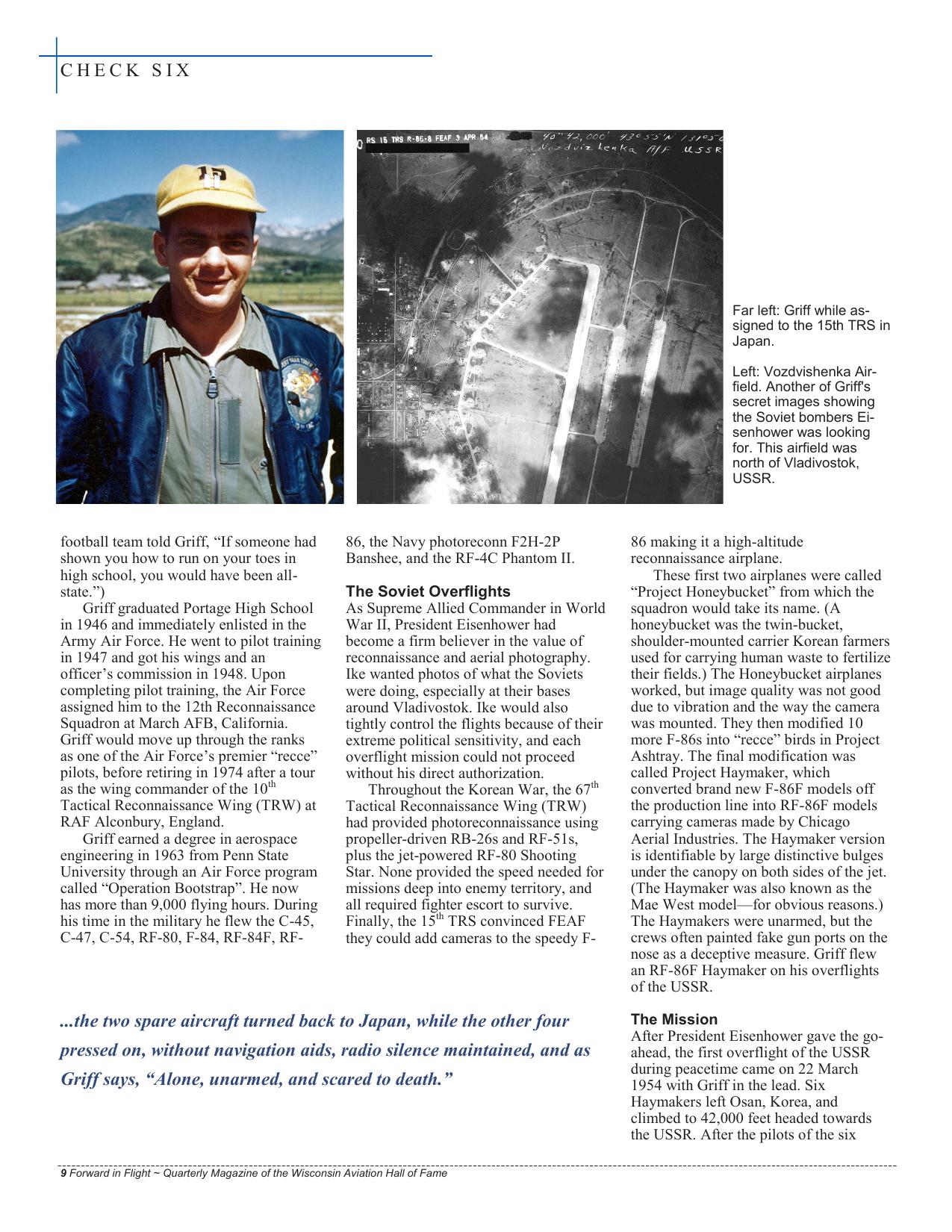
CHECK SIX Far left: Griff while assigned to the 15th TRS in Japan. Left: Vozdvishenka Airfield. Another of Griff's secret images showing the Soviet bombers Eisenhower was looking for. This airfield was north of Vladivostok, USSR. football team told Griff, “If someone had shown you how to run on your toes in high school, you would have been allstate.”) Griff graduated Portage High School in 1946 and immediately enlisted in the Army Air Force. He went to pilot training in 1947 and got his wings and an officer’s commission in 1948. Upon completing pilot training, the Air Force assigned him to the 12th Reconnaissance Squadron at March AFB, California. Griff would move up through the ranks as one of the Air Force’s premier “recce” pilots, before retiring in 1974 after a tour as the wing commander of the 10th Tactical Reconnaissance Wing (TRW) at RAF Alconbury, England. Griff earned a degree in aerospace engineering in 1963 from Penn State University through an Air Force program called “Operation Bootstrap”. He now has more than 9,000 flying hours. During his time in the military he flew the C-45, C-47, C-54, RF-80, F-84, RF-84F, RF- 86, the Navy photoreconn F2H-2P Banshee, and the RF-4C Phantom II. The Soviet Overflights As Supreme Allied Commander in World War II, President Eisenhower had become a firm believer in the value of reconnaissance and aerial photography. Ike wanted photos of what the Soviets were doing, especially at their bases around Vladivostok. Ike would also tightly control the flights because of their extreme political sensitivity, and each overflight mission could not proceed without his direct authorization. Throughout the Korean War, the 67th Tactical Reconnaissance Wing (TRW) had provided photoreconnaissance using propeller-driven RB-26s and RF-51s, plus the jet-powered RF-80 Shooting Star. None provided the speed needed for missions deep into enemy territory, and all required fighter escort to survive. Finally, the 15th TRS convinced FEAF they could add cameras to the speedy F- ...theÊtwoÊspareÊaircraftÊturnedÊbackÊtoÊJapan,ÊwhileÊtheÊotherÊfourÊ pressedÊon,ÊwithoutÊnavigationÊaids,ÊradioÊsilenceÊmaintained,ÊandÊasÊ GriffÊsays,Ê“Alone,Êunarmed,ÊandÊscaredÊtoÊdeath.” 9 Forward in Flight ~ Quarterly Magazine of the Wisconsin Aviation Hall of Fame 86 making it a high-altitude reconnaissance airplane. These first two airplanes were called “Project Honeybucket” from which the squadron would take its name. (A honeybucket was the twin-bucket, shoulder-mounted carrier Korean farmers used for carrying human waste to fertilize their fields.) The Honeybucket airplanes worked, but image quality was not good due to vibration and the way the camera was mounted. They then modified 10 more F-86s into “recce” birds in Project Ashtray. The final modification was called Project Haymaker, which converted brand new F-86F models off the production line into RF-86F models carrying cameras made by Chicago Aerial Industries. The Haymaker version is identifiable by large distinctive bulges under the canopy on both sides of the jet. (The Haymaker was also known as the Mae West model—for obvious reasons.) The Haymakers were unarmed, but the crews often painted fake gun ports on the nose as a deceptive measure. Griff flew an RF-86F Haymaker on his overflights of the USSR. The Mission After President Eisenhower gave the goahead, the first overflight of the USSR during peacetime came on 22 March 1954 with Griff in the lead. Six Haymakers left Osan, Korea, and climbed to 42,000 feet headed towards the USSR. After the pilots of the six
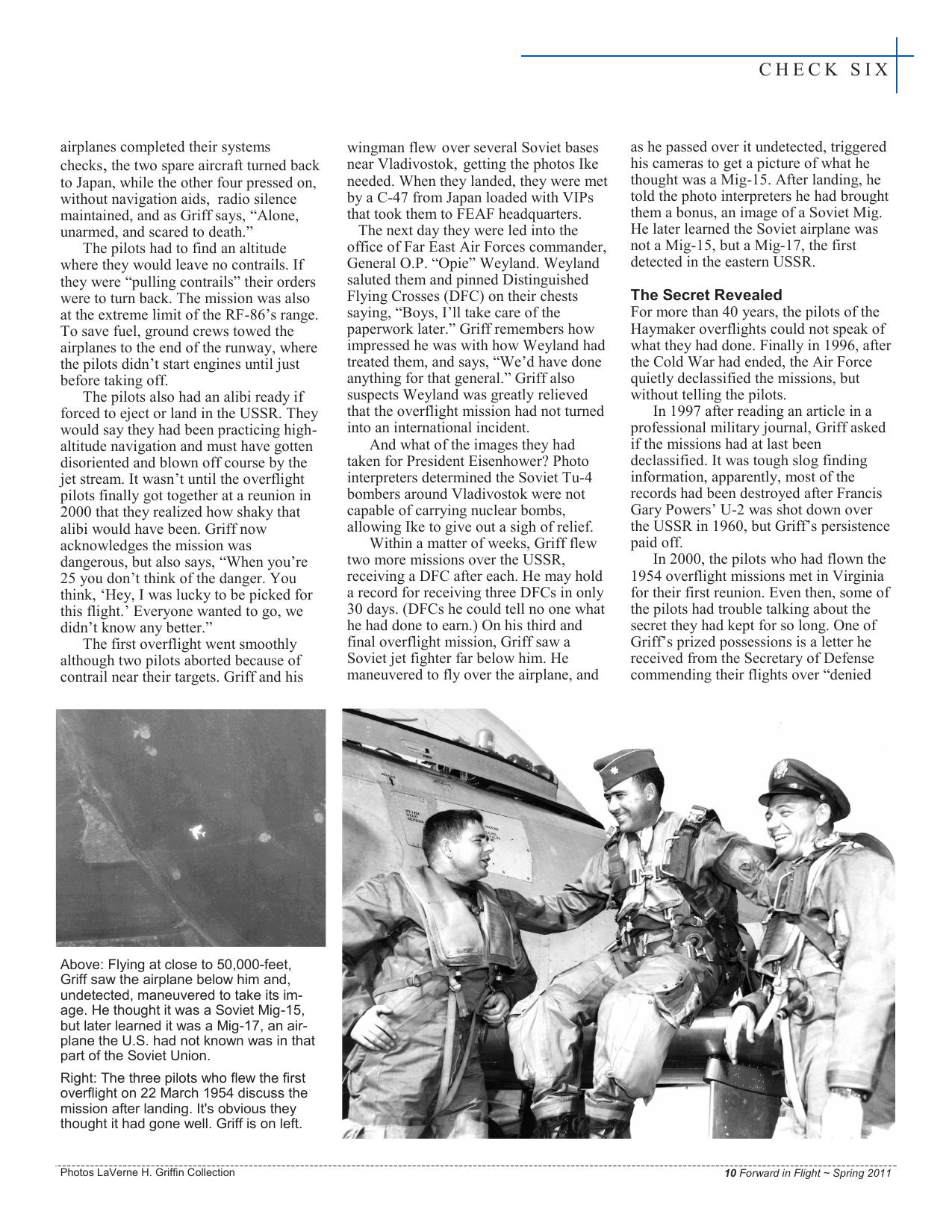
CHECK SIX airplanes completed their systems checks, the two spare aircraft turned back to Japan, while the other four pressed on, without navigation aids, radio silence maintained, and as Griff says, “Alone, unarmed, and scared to death.” The pilots had to find an altitude where they would leave no contrails. If they were “pulling contrails” their orders were to turn back. The mission was also at the extreme limit of the RF-86’s range. To save fuel, ground crews towed the airplanes to the end of the runway, where the pilots didn’t start engines until just before taking off. The pilots also had an alibi ready if forced to eject or land in the USSR. They would say they had been practicing highaltitude navigation and must have gotten disoriented and blown off course by the jet stream. It wasn’t until the overflight pilots finally got together at a reunion in 2000 that they realized how shaky that alibi would have been. Griff now acknowledges the mission was dangerous, but also says, “When you’re 25 you don’t think of the danger. You think, ‘Hey, I was lucky to be picked for this flight.’ Everyone wanted to go, we didn’t know any better.” The first overflight went smoothly although two pilots aborted because of contrail near their targets. Griff and his wingman flew over several Soviet bases near Vladivostok, getting the photos Ike needed. When they landed, they were met by a C-47 from Japan loaded with VIPs that took them to FEAF headquarters. The next day they were led into the office of Far East Air Forces commander, General O.P. “Opie” Weyland. Weyland saluted them and pinned Distinguished Flying Crosses (DFC) on their chests saying, “Boys, I’ll take care of the paperwork later.” Griff remembers how impressed he was with how Weyland had treated them, and says, “We’d have done anything for that general.” Griff also suspects Weyland was greatly relieved that the overflight mission had not turned into an international incident. And what of the images they had taken for President Eisenhower? Photo interpreters determined the Soviet Tu-4 bombers around Vladivostok were not capable of carrying nuclear bombs, allowing Ike to give out a sigh of relief. Within a matter of weeks, Griff flew two more missions over the USSR, receiving a DFC after each. He may hold a record for receiving three DFCs in only 30 days. (DFCs he could tell no one what he had done to earn.) On his third and final overflight mission, Griff saw a Soviet jet fighter far below him. He maneuvered to fly over the airplane, and as he passed over it undetected, triggered his cameras to get a picture of what he thought was a Mig-15. After landing, he told the photo interpreters he had brought them a bonus, an image of a Soviet Mig. He later learned the Soviet airplane was not a Mig-15, but a Mig-17, the first detected in the eastern USSR. The Secret Revealed For more than 40 years, the pilots of the Haymaker overflights could not speak of what they had done. Finally in 1996, after the Cold War had ended, the Air Force quietly declassified the missions, but without telling the pilots. In 1997 after reading an article in a professional military journal, Griff asked if the missions had at last been declassified. It was tough slog finding information, apparently, most of the records had been destroyed after Francis Gary Powers’ U-2 was shot down over the USSR in 1960, but Griff’s persistence paid off. In 2000, the pilots who had flown the 1954 overflight missions met in Virginia for their first reunion. Even then, some of the pilots had trouble talking about the secret they had kept for so long. One of Griff’s prized possessions is a letter he received from the Secretary of Defense commending their flights over “denied Above: Flying at close to 50,000-feet, Griff saw the airplane below him and, undetected, maneuvered to take its image. He thought it was a Soviet Mig-15, but later learned it was a Mig-17, an airplane the U.S. had not known was in that part of the Soviet Union. Right: The three pilots who flew the first overflight on 22 March 1954 discuss the mission after landing. It's obvious they thought it had gone well. Griff is on left. Photos LaVerne H. Griffin Collection 10 Forward in Flight ~ Spring 2011
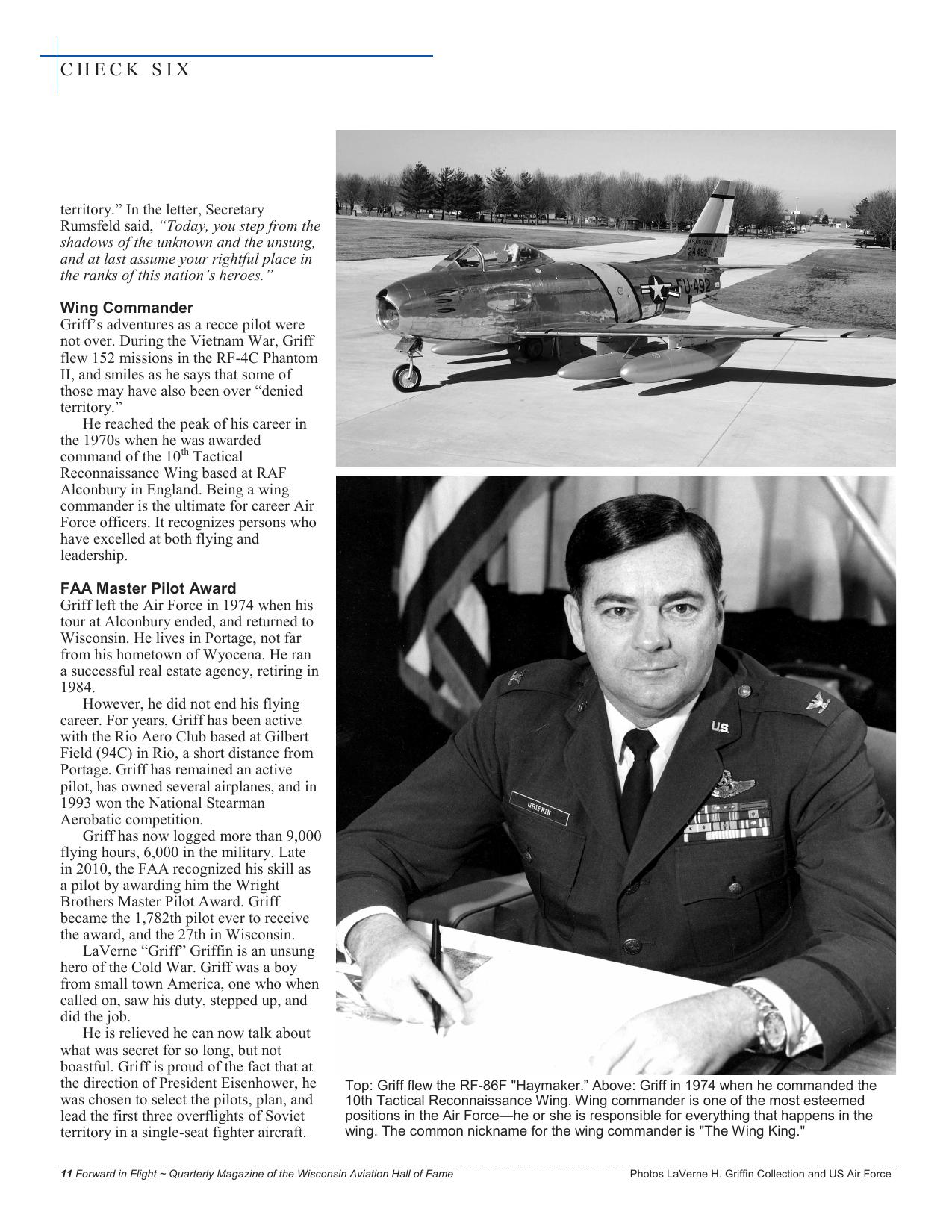
CHECK SIX territory.” In the letter, Secretary Rumsfeld said, “Today, you step from the shadows of the unknown and the unsung, and at last assume your rightful place in the ranks of this nation’s heroes.” Wing Commander Griff’s adventures as a recce pilot were not over. During the Vietnam War, Griff flew 152 missions in the RF-4C Phantom II, and smiles as he says that some of those may have also been over “denied territory.” He reached the peak of his career in the 1970s when he was awarded command of the 10th Tactical Reconnaissance Wing based at RAF Alconbury in England. Being a wing commander is the ultimate for career Air Force officers. It recognizes persons who have excelled at both flying and leadership. FAA Master Pilot Award Griff left the Air Force in 1974 when his tour at Alconbury ended, and returned to Wisconsin. He lives in Portage, not far from his hometown of Wyocena. He ran a successful real estate agency, retiring in 1984. However, he did not end his flying career. For years, Griff has been active with the Rio Aero Club based at Gilbert Field (94C) in Rio, a short distance from Portage. Griff has remained an active pilot, has owned several airplanes, and in 1993 won the National Stearman Aerobatic competition. Griff has now logged more than 9,000 flying hours, 6,000 in the military. Late in 2010, the FAA recognized his skill as a pilot by awarding him the Wright Brothers Master Pilot Award. Griff became the 1,782th pilot ever to receive the award, and the 27th in Wisconsin. LaVerne “Griff” Griffin is an unsung hero of the Cold War. Griff was a boy from small town America, one who when called on, saw his duty, stepped up, and did the job. He is relieved he can now talk about what was secret for so long, but not boastful. Griff is proud of the fact that at the direction of President Eisenhower, he was chosen to select the pilots, plan, and lead the first three overflights of Soviet territory in a single-seat fighter aircraft. Top: Griff flew the RF-86F "Haymaker.” Above: Griff in 1974 when he commanded the 10th Tactical Reconnaissance Wing. Wing commander is one of the most esteemed positions in the Air Force—he or she is responsible for everything that happens in the wing. The common nickname for the wing commander is "The Wing King." 11 Forward in Flight ~ Quarterly Magazine of the Wisconsin Aviation Hall of Fame Photos LaVerne H. Griffin Collection and US Air Force
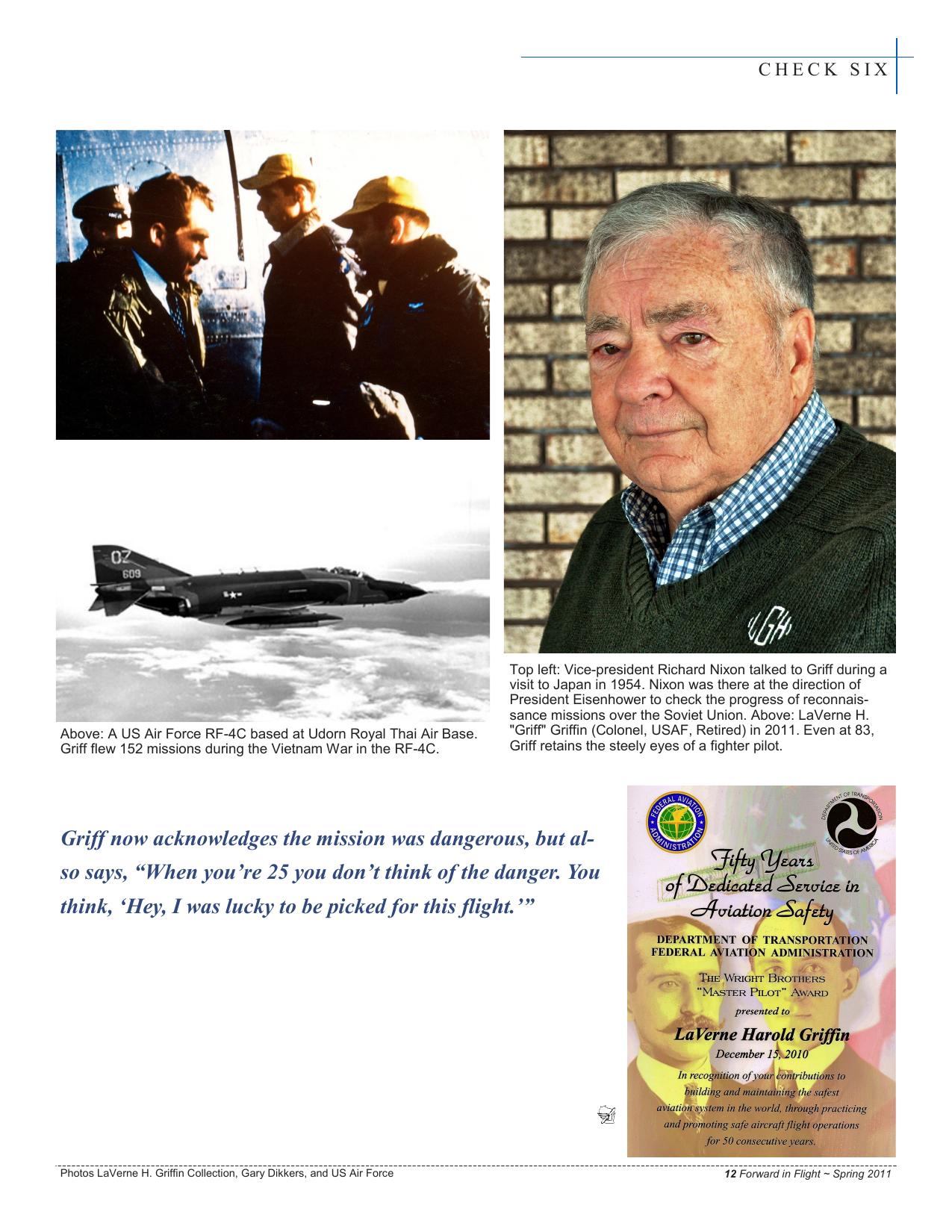
CHECK SIX Above: A US Air Force RF-4C based at Udorn Royal Thai Air Base. Griff flew 152 missions during the Vietnam War in the RF-4C. Top left: Vice-president Richard Nixon talked to Griff during a visit to Japan in 1954. Nixon was there at the direction of President Eisenhower to check the progress of reconnaissance missions over the Soviet Union. Above: LaVerne H. "Griff" Griffin (Colonel, USAF, Retired) in 2011. Even at 83, Griff retains the steely eyes of a fighter pilot. GriffÊnowÊacknowledgesÊtheÊmissionÊwasÊdangerous,ÊbutÊalsoÊsays,Ê“WhenÊyou’reÊ25ÊyouÊdon’tÊthinkÊofÊtheÊdanger.ÊYouÊ think,Ê‘Hey,ÊIÊwasÊluckyÊtoÊbeÊpickedÊforÊthisÊflight.’”Ê Photos LaVerne H. Griffin Collection, Gary Dikkers, and US Air Force 12 Forward in Flight ~ Spring 2011
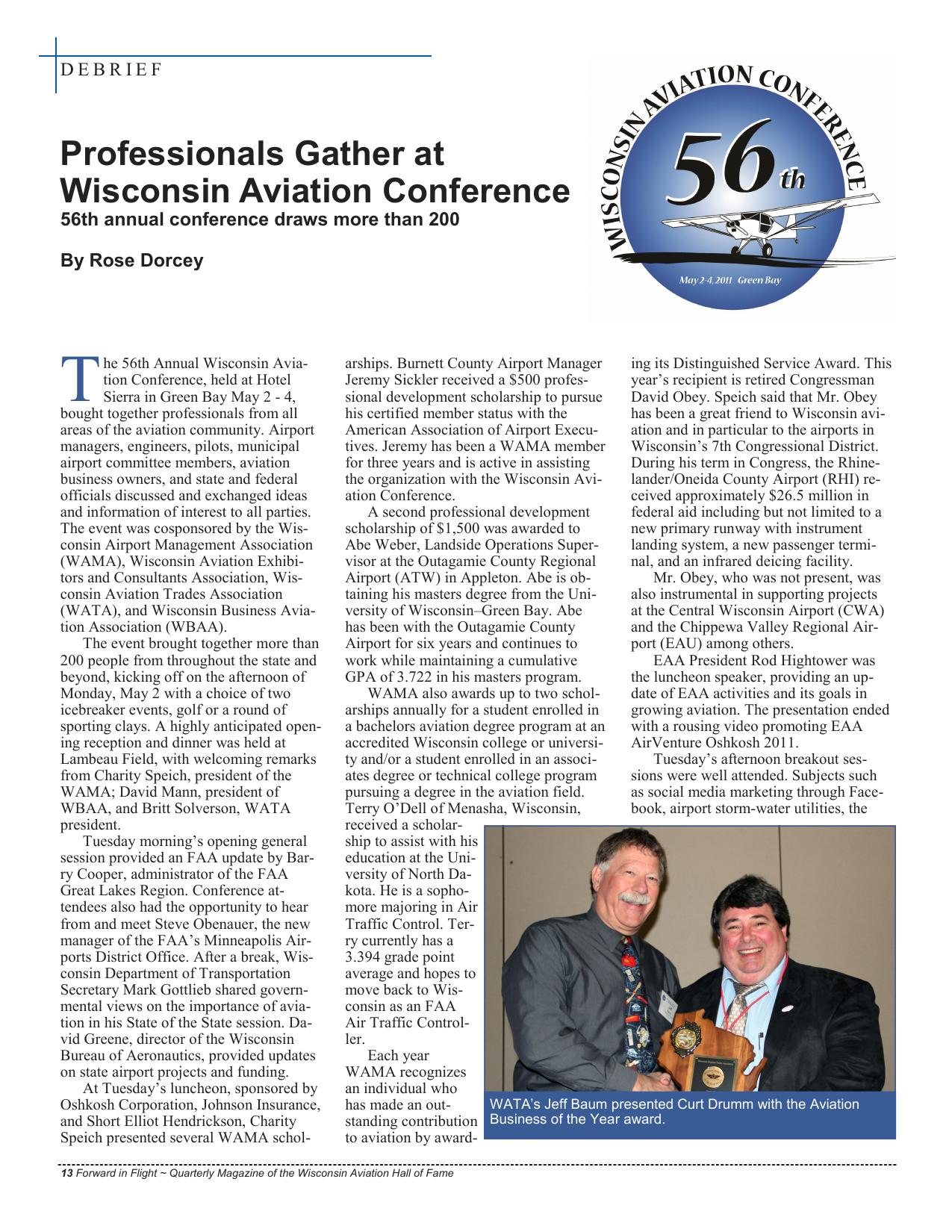
DEBRIEF Professionals Gather at Wisconsin Aviation Conference 56th annual conference draws more than 200 By Rose Dorcey T he 56th Annual Wisconsin Aviation Conference, held at Hotel Sierra in Green Bay May 2 - 4, bought together professionals from all areas of the aviation community. Airport managers, engineers, pilots, municipal airport committee members, aviation business owners, and state and federal officials discussed and exchanged ideas and information of interest to all parties. The event was cosponsored by the Wisconsin Airport Management Association (WAMA), Wisconsin Aviation Exhibitors and Consultants Association, Wisconsin Aviation Trades Association (WATA), and Wisconsin Business Aviation Association (WBAA). The event brought together more than 200 people from throughout the state and beyond, kicking off on the afternoon of Monday, May 2 with a choice of two icebreaker events, golf or a round of sporting clays. A highly anticipated opening reception and dinner was held at Lambeau Field, with welcoming remarks from Charity Speich, president of the WAMA; David Mann, president of WBAA, and Britt Solverson, WATA president. Tuesday morning’s opening general session provided an FAA update by Barry Cooper, administrator of the FAA Great Lakes Region. Conference attendees also had the opportunity to hear from and meet Steve Obenauer, the new manager of the FAA’s Minneapolis Airports District Office. After a break, Wisconsin Department of Transportation Secretary Mark Gottlieb shared governmental views on the importance of aviation in his State of the State session. David Greene, director of the Wisconsin Bureau of Aeronautics, provided updates on state airport projects and funding. At Tuesday’s luncheon, sponsored by Oshkosh Corporation, Johnson Insurance, and Short Elliot Hendrickson, Charity Speich presented several WAMA schol- arships. Burnett County Airport Manager ing its Distinguished Service Award. This Jeremy Sickler received a $500 profesyear’s recipient is retired Congressman sional development scholarship to pursue David Obey. Speich said that Mr. Obey his certified member status with the has been a great friend to Wisconsin aviAmerican Association of Airport Execuation and in particular to the airports in tives. Jeremy has been a WAMA member Wisconsin’s 7th Congressional District. for three years and is active in assisting During his term in Congress, the Rhinethe organization with the Wisconsin Avilander/Oneida County Airport (RHI) reation Conference. ceived approximately $26.5 million in A second professional development federal aid including but not limited to a scholarship of $1,500 was awarded to new primary runway with instrument Abe Weber, Landside Operations Superlanding system, a new passenger termivisor at the Outagamie County Regional nal, and an infrared deicing facility. Airport (ATW) in Appleton. Abe is obMr. Obey, who was not present, was taining his masters degree from the Unialso instrumental in supporting projects versity of Wisconsin–Green Bay. Abe at the Central Wisconsin Airport (CWA) has been with the Outagamie County and the Chippewa Valley Regional AirAirport for six years and continues to port (EAU) among others. work while maintaining a cumulative EAA President Rod Hightower was GPA of 3.722 in his masters program. the luncheon speaker, providing an upWAMA also awards up to two scholdate of EAA activities and its goals in arships annually for a student enrolled in growing aviation. The presentation ended a bachelors aviation degree program at an with a rousing video promoting EAA accredited Wisconsin college or universiAirVenture Oshkosh 2011. ty and/or a student enrolled in an associTuesday’s afternoon breakout sesates degree or technical college program sions were well attended. Subjects such pursuing a degree in the aviation field. as social media marketing through FaceTerry O’Dell of Menasha, Wisconsin, book, airport storm-water utilities, the received a scholarship to assist with his education at the University of North Dakota. He is a sophomore majoring in Air Traffic Control. Terry currently has a 3.394 grade point average and hopes to move back to Wisconsin as an FAA Air Traffic Controller. Each year WAMA recognizes an individual who WATA’s Jeff Baum presented Curt Drumm with the Aviation has made an outstanding contribution Business of the Year award. to aviation by award- 13 Forward in Flight ~ Quarterly Magazine of the Wisconsin Aviation Hall of Fame
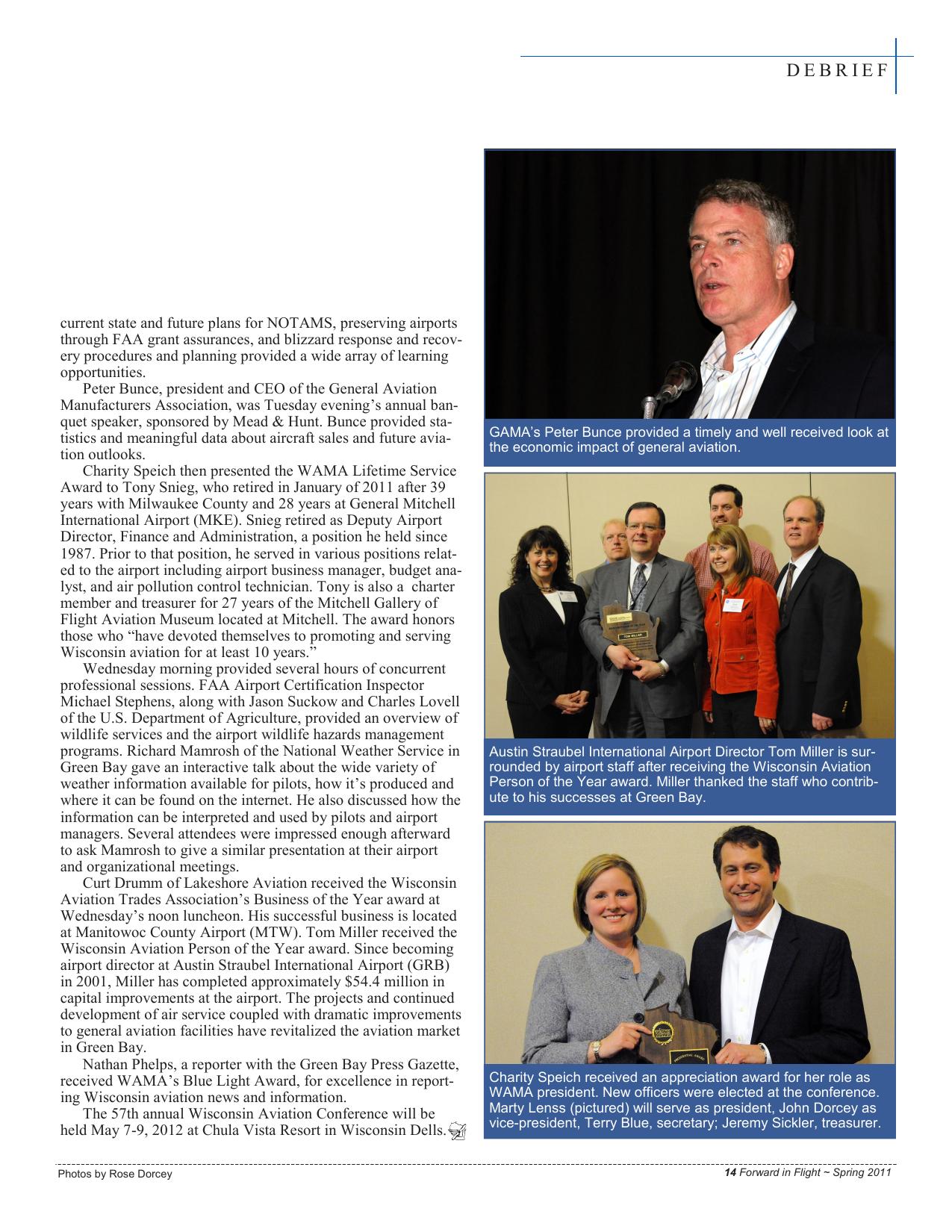
DEBRIEF current state and future plans for NOTAMS, preserving airports through FAA grant assurances, and blizzard response and recovery procedures and planning provided a wide array of learning opportunities. Peter Bunce, president and CEO of the General Aviation Manufacturers Association, was Tuesday evening’s annual banquet speaker, sponsored by Mead & Hunt. Bunce provided statistics and meaningful data about aircraft sales and future aviation outlooks. Charity Speich then presented the WAMA Lifetime Service Award to Tony Snieg, who retired in January of 2011 after 39 years with Milwaukee County and 28 years at General Mitchell International Airport (MKE). Snieg retired as Deputy Airport Director, Finance and Administration, a position he held since 1987. Prior to that position, he served in various positions related to the airport including airport business manager, budget analyst, and air pollution control technician. Tony is also a charter member and treasurer for 27 years of the Mitchell Gallery of Flight Aviation Museum located at Mitchell. The award honors those who “have devoted themselves to promoting and serving Wisconsin aviation for at least 10 years.” Wednesday morning provided several hours of concurrent professional sessions. FAA Airport Certification Inspector Michael Stephens, along with Jason Suckow and Charles Lovell of the U.S. Department of Agriculture, provided an overview of wildlife services and the airport wildlife hazards management programs. Richard Mamrosh of the National Weather Service in Green Bay gave an interactive talk about the wide variety of weather information available for pilots, how it’s produced and where it can be found on the internet. He also discussed how the information can be interpreted and used by pilots and airport managers. Several attendees were impressed enough afterward to ask Mamrosh to give a similar presentation at their airport and organizational meetings. Curt Drumm of Lakeshore Aviation received the Wisconsin Aviation Trades Association’s Business of the Year award at Wednesday’s noon luncheon. His successful business is located at Manitowoc County Airport (MTW). Tom Miller received the Wisconsin Aviation Person of the Year award. Since becoming airport director at Austin Straubel International Airport (GRB) in 2001, Miller has completed approximately $54.4 million in capital improvements at the airport. The projects and continued development of air service coupled with dramatic improvements to general aviation facilities have revitalized the aviation market in Green Bay. Nathan Phelps, a reporter with the Green Bay Press Gazette, received WAMA’s Blue Light Award, for excellence in reporting Wisconsin aviation news and information. The 57th annual Wisconsin Aviation Conference will be held May 7-9, 2012 at Chula Vista Resort in Wisconsin Dells. Photos by Rose Dorcey GAMA’s Peter Bunce provided a timely and well received look at the economic impact of general aviation. Austin Straubel International Airport Director Tom Miller is surrounded by airport staff after receiving the Wisconsin Aviation Person of the Year award. Miller thanked the staff who contribute to his successes at Green Bay. Charity Speich received an appreciation award for her role as WAMA president. New officers were elected at the conference. Marty Lenss (pictured) will serve as president, John Dorcey as vice-president, Terry Blue, secretary; Jeremy Sickler, treasurer. 14 Forward in Flight ~ Spring 2011
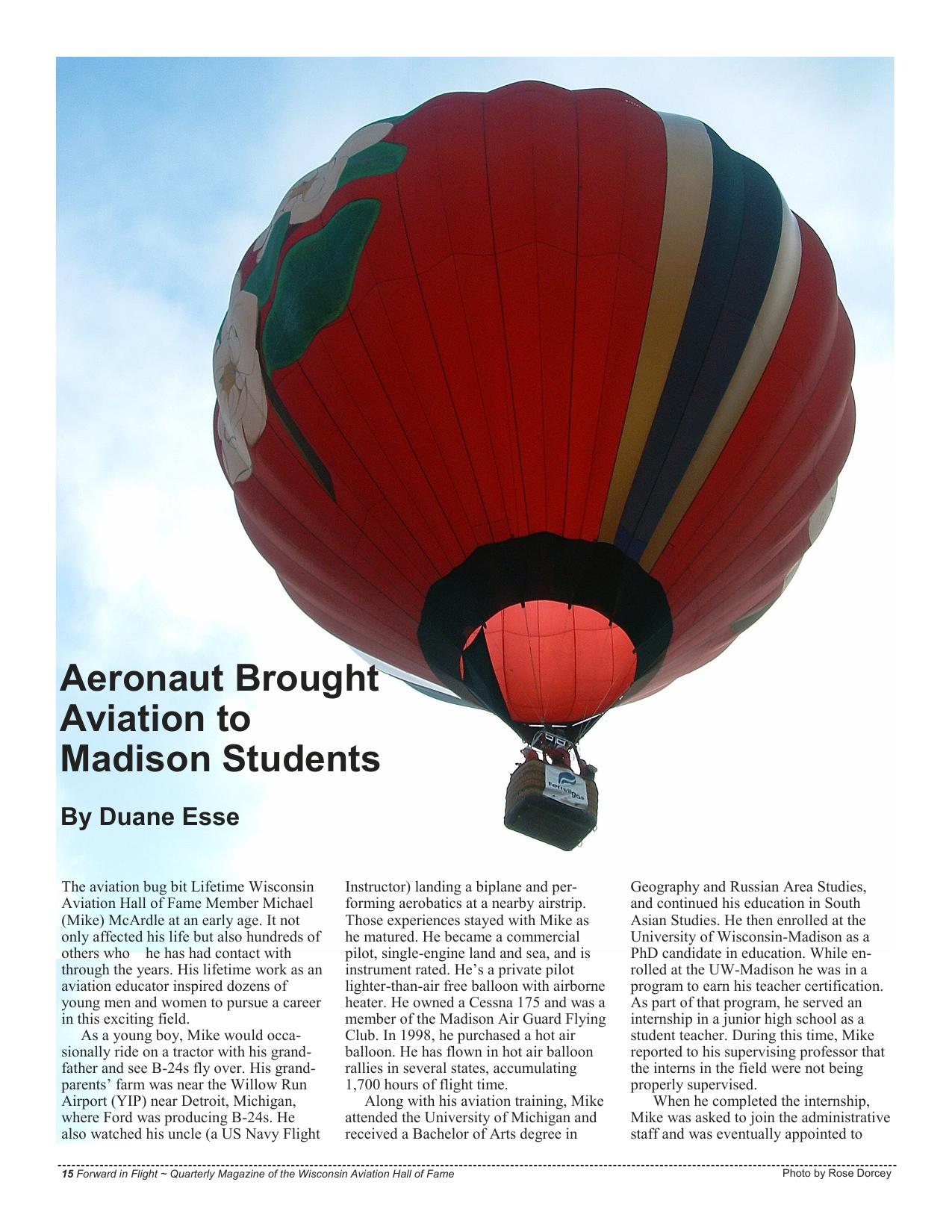
Aeronaut Brought Aviation to Madison Students By Duane Esse The aviation bug bit Lifetime Wisconsin Aviation Hall of Fame Member Michael (Mike) McArdle at an early age. It not only affected his life but also hundreds of others who he has had contact with through the years. His lifetime work as an aviation educator inspired dozens of young men and women to pursue a career in this exciting field. As a young boy, Mike would occasionally ride on a tractor with his grandfather and see B-24s fly over. His grandparents’ farm was near the Willow Run Airport (YIP) near Detroit, Michigan, where Ford was producing B-24s. He also watched his uncle (a US Navy Flight Instructor) landing a biplane and performing aerobatics at a nearby airstrip. Those experiences stayed with Mike as he matured. He became a commercial pilot, single-engine land and sea, and is instrument rated. He’s a private pilot lighter-than-air free balloon with airborne heater. He owned a Cessna 175 and was a member of the Madison Air Guard Flying Club. In 1998, he purchased a hot air balloon. He has flown in hot air balloon rallies in several states, accumulating 1,700 hours of flight time. Along with his aviation training, Mike attended the University of Michigan and received a Bachelor of Arts degree in 15 Forward in Flight ~ Quarterly Magazine of the Wisconsin Aviation Hall of Fame Geography and Russian Area Studies, and continued his education in South Asian Studies. He then enrolled at the University of Wisconsin-Madison as a PhD candidate in education. While enrolled at the UW-Madison he was in a program to earn his teacher certification. As part of that program, he served an internship in a junior high school as a student teacher. During this time, Mike reported to his supervising professor that the interns in the field were not being properly supervised. When he completed the internship, Mike was asked to join the administrative staff and was eventually appointed to Photo by Rose Dorcey
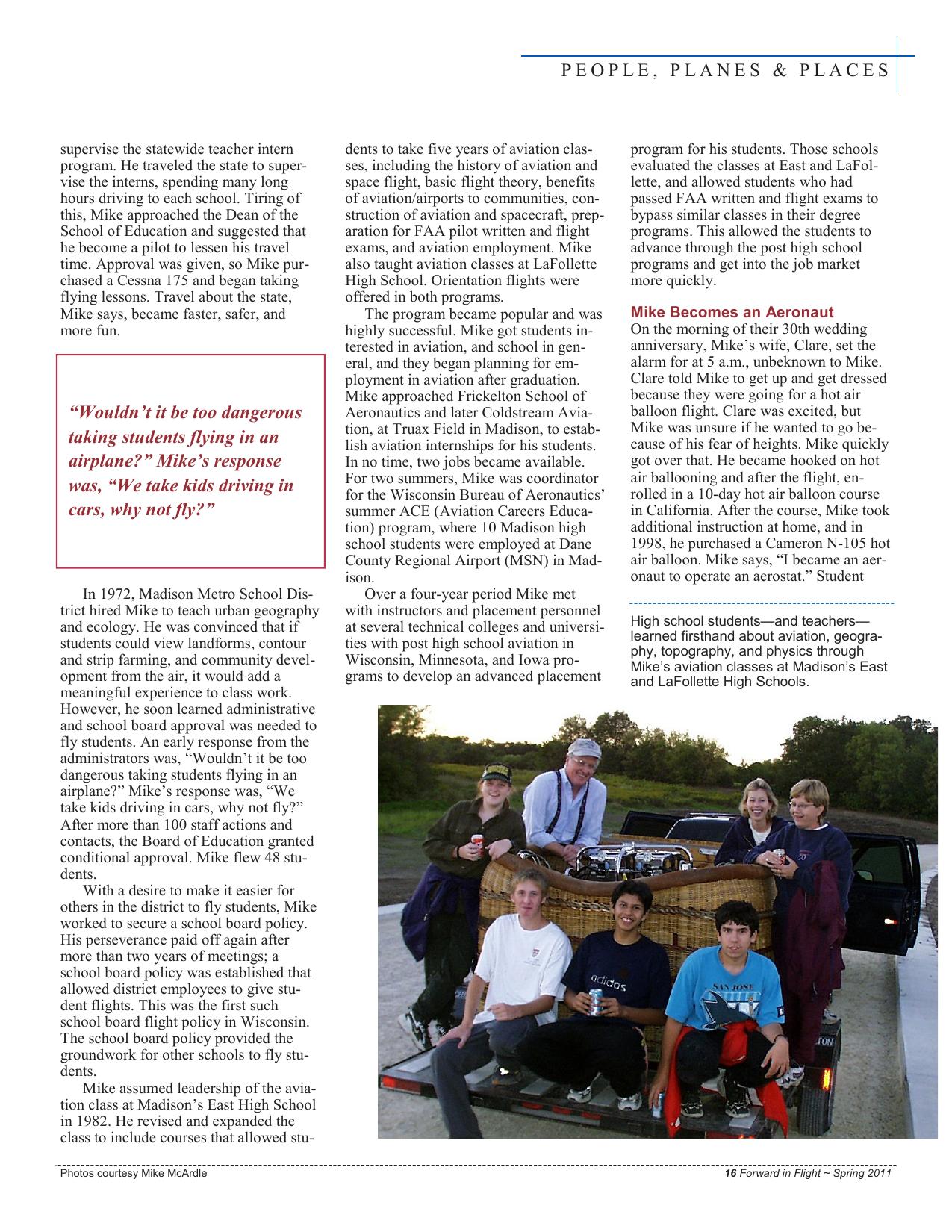
PEOPLE, PLANES & PLACES supervise the statewide teacher intern program. He traveled the state to supervise the interns, spending many long hours driving to each school. Tiring of this, Mike approached the Dean of the School of Education and suggested that he become a pilot to lessen his travel time. Approval was given, so Mike purchased a Cessna 175 and began taking flying lessons. Travel about the state, Mike says, became faster, safer, and more fun. “Wouldn’tÊitÊbeÊtooÊdangerousÊ takingÊstudentsÊflyingÊinÊanÊ airplane?”ÊMike’sÊresponseÊ was,Ê“WeÊtakeÊkidsÊdrivingÊinÊ cars,ÊwhyÊnotÊfly?”Ê In 1972, Madison Metro School District hired Mike to teach urban geography and ecology. He was convinced that if students could view landforms, contour and strip farming, and community development from the air, it would add a meaningful experience to class work. However, he soon learned administrative and school board approval was needed to fly students. An early response from the administrators was, “Wouldn’t it be too dangerous taking students flying in an airplane?” Mike’s response was, “We take kids driving in cars, why not fly?” After more than 100 staff actions and contacts, the Board of Education granted conditional approval. Mike flew 48 students. With a desire to make it easier for others in the district to fly students, Mike worked to secure a school board policy. His perseverance paid off again after more than two years of meetings; a school board policy was established that allowed district employees to give student flights. This was the first such school board flight policy in Wisconsin. The school board policy provided the groundwork for other schools to fly students. Mike assumed leadership of the aviation class at Madison’s East High School in 1982. He revised and expanded the class to include courses that allowed stuPhotos courtesy Mike McArdle dents to take five years of aviation classes, including the history of aviation and space flight, basic flight theory, benefits of aviation/airports to communities, construction of aviation and spacecraft, preparation for FAA pilot written and flight exams, and aviation employment. Mike also taught aviation classes at LaFollette High School. Orientation flights were offered in both programs. The program became popular and was highly successful. Mike got students interested in aviation, and school in general, and they began planning for employment in aviation after graduation. Mike approached Frickelton School of Aeronautics and later Coldstream Aviation, at Truax Field in Madison, to establish aviation internships for his students. In no time, two jobs became available. For two summers, Mike was coordinator for the Wisconsin Bureau of Aeronautics’ summer ACE (Aviation Careers Education) program, where 10 Madison high school students were employed at Dane County Regional Airport (MSN) in Madison. Over a four-year period Mike met with instructors and placement personnel at several technical colleges and universities with post high school aviation in Wisconsin, Minnesota, and Iowa programs to develop an advanced placement program for his students. Those schools evaluated the classes at East and LaFollette, and allowed students who had passed FAA written and flight exams to bypass similar classes in their degree programs. This allowed the students to advance through the post high school programs and get into the job market more quickly. Mike Becomes an Aeronaut On the morning of their 30th wedding anniversary, Mike’s wife, Clare, set the alarm for at 5 a.m., unbeknown to Mike. Clare told Mike to get up and get dressed because they were going for a hot air balloon flight. Clare was excited, but Mike was unsure if he wanted to go because of his fear of heights. Mike quickly got over that. He became hooked on hot air ballooning and after the flight, enrolled in a 10-day hot air balloon course in California. After the course, Mike took additional instruction at home, and in 1998, he purchased a Cameron N-105 hot air balloon. Mike says, “I became an aeronaut to operate an aerostat.” Student High school students—and teachers— learned firsthand about aviation, geography, topography, and physics through Mike’s aviation classes at Madison’s East and LaFollette High Schools. 16 Forward in Flight ~ Spring 2011
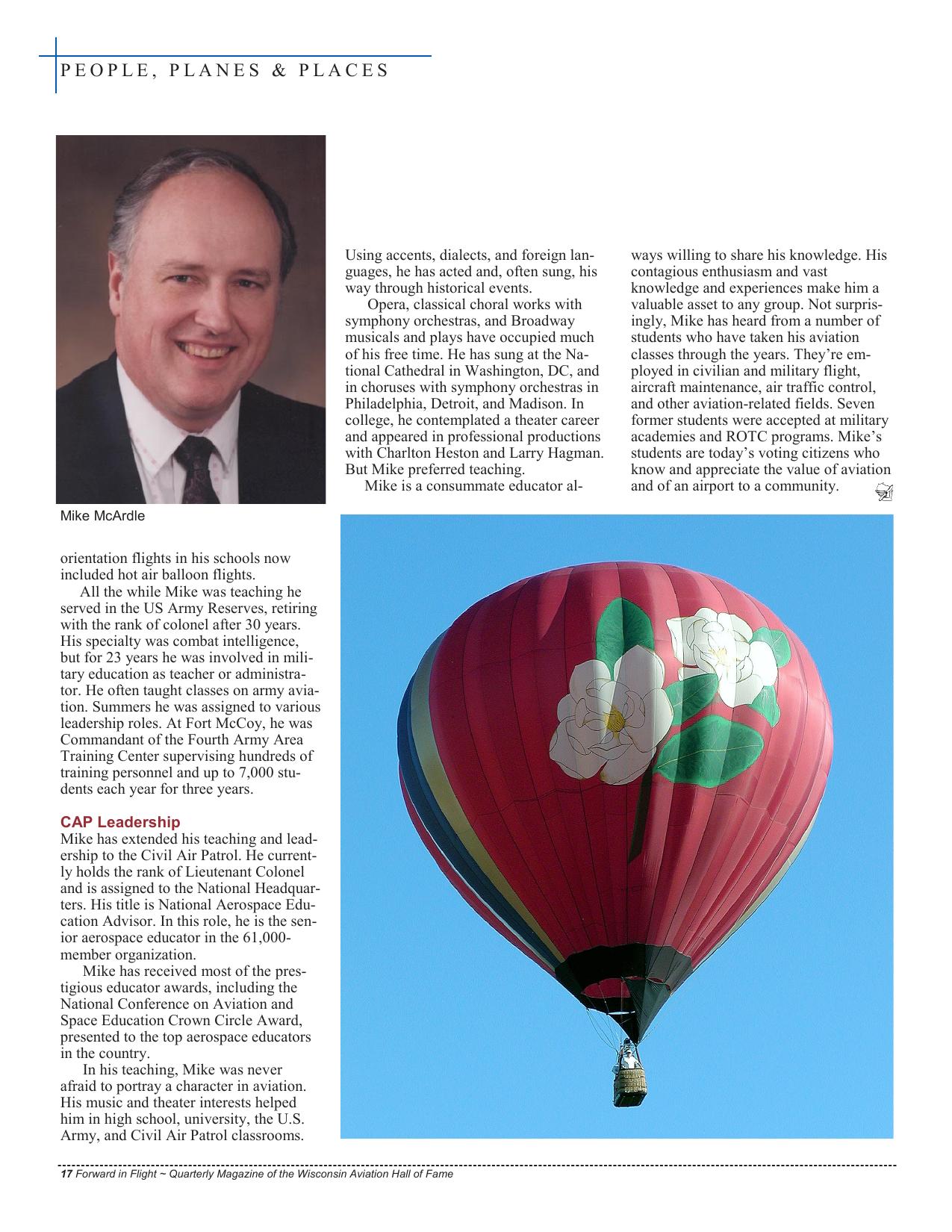
PEOPLE, PLANES & PLACES Using accents, dialects, and foreign languages, he has acted and, often sung, his way through historical events. Opera, classical choral works with symphony orchestras, and Broadway musicals and plays have occupied much of his free time. He has sung at the National Cathedral in Washington, DC, and in choruses with symphony orchestras in Philadelphia, Detroit, and Madison. In college, he contemplated a theater career and appeared in professional productions with Charlton Heston and Larry Hagman. But Mike preferred teaching. Mike is a consummate educator alMike McArdle orientation flights in his schools now included hot air balloon flights. All the while Mike was teaching he served in the US Army Reserves, retiring with the rank of colonel after 30 years. His specialty was combat intelligence, but for 23 years he was involved in military education as teacher or administrator. He often taught classes on army aviation. Summers he was assigned to various leadership roles. At Fort McCoy, he was Commandant of the Fourth Army Area Training Center supervising hundreds of training personnel and up to 7,000 students each year for three years. CAP Leadership Mike has extended his teaching and leadership to the Civil Air Patrol. He currently holds the rank of Lieutenant Colonel and is assigned to the National Headquarters. His title is National Aerospace Education Advisor. In this role, he is the senior aerospace educator in the 61,000member organization. Mike has received most of the prestigious educator awards, including the National Conference on Aviation and Space Education Crown Circle Award, presented to the top aerospace educators in the country. In his teaching, Mike was never afraid to portray a character in aviation. His music and theater interests helped him in high school, university, the U.S. Army, and Civil Air Patrol classrooms. 17 Forward in Flight ~ Quarterly Magazine of the Wisconsin Aviation Hall of Fame ways willing to share his knowledge. His contagious enthusiasm and vast knowledge and experiences make him a valuable asset to any group. Not surprisingly, Mike has heard from a number of students who have taken his aviation classes through the years. They’re employed in civilian and military flight, aircraft maintenance, air traffic control, and other aviation-related fields. Seven former students were accepted at military academies and ROTC programs. Mike’s students are today’s voting citizens who know and appreciate the value of aviation and of an airport to a community.
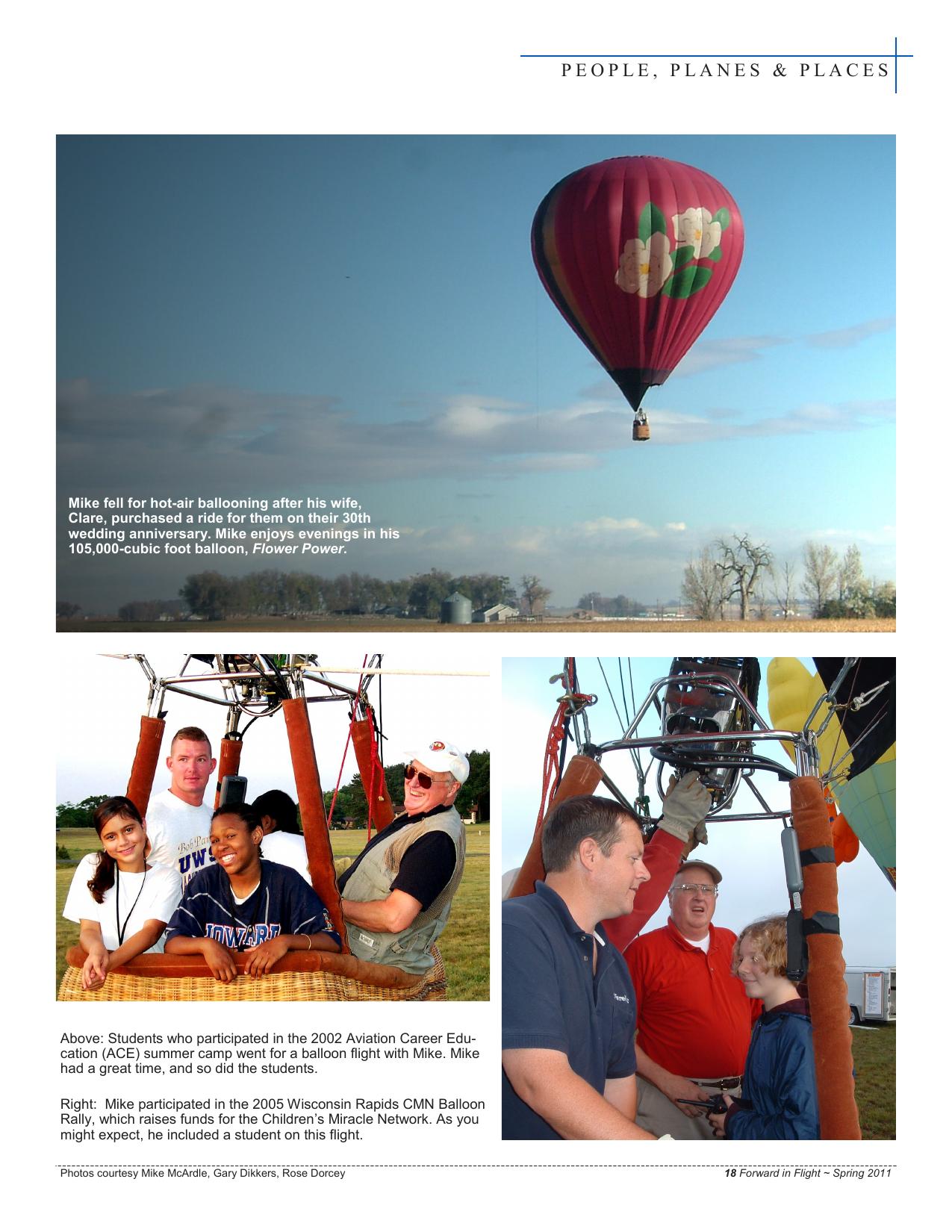
PEOPLE, PLANES & PLACES Mike fell for hot-air ballooning after his wife, Clare, purchased a ride for them on their 30th wedding anniversary. Mike enjoys evenings in his 105,000-cubic foot balloon, Flower Power. Above: Students who participated in the 2002 Aviation Career Education (ACE) summer camp went for a balloon flight with Mike. Mike had a great time, and so did the students. Right: Mike participated in the 2005 Wisconsin Rapids CMN Balloon Rally, which raises funds for the Children’s Miracle Network. As you might expect, he included a student on this flight. Photos courtesy Mike McArdle, Gary Dikkers, Rose Dorcey 18 Forward in Flight ~ Spring 2011
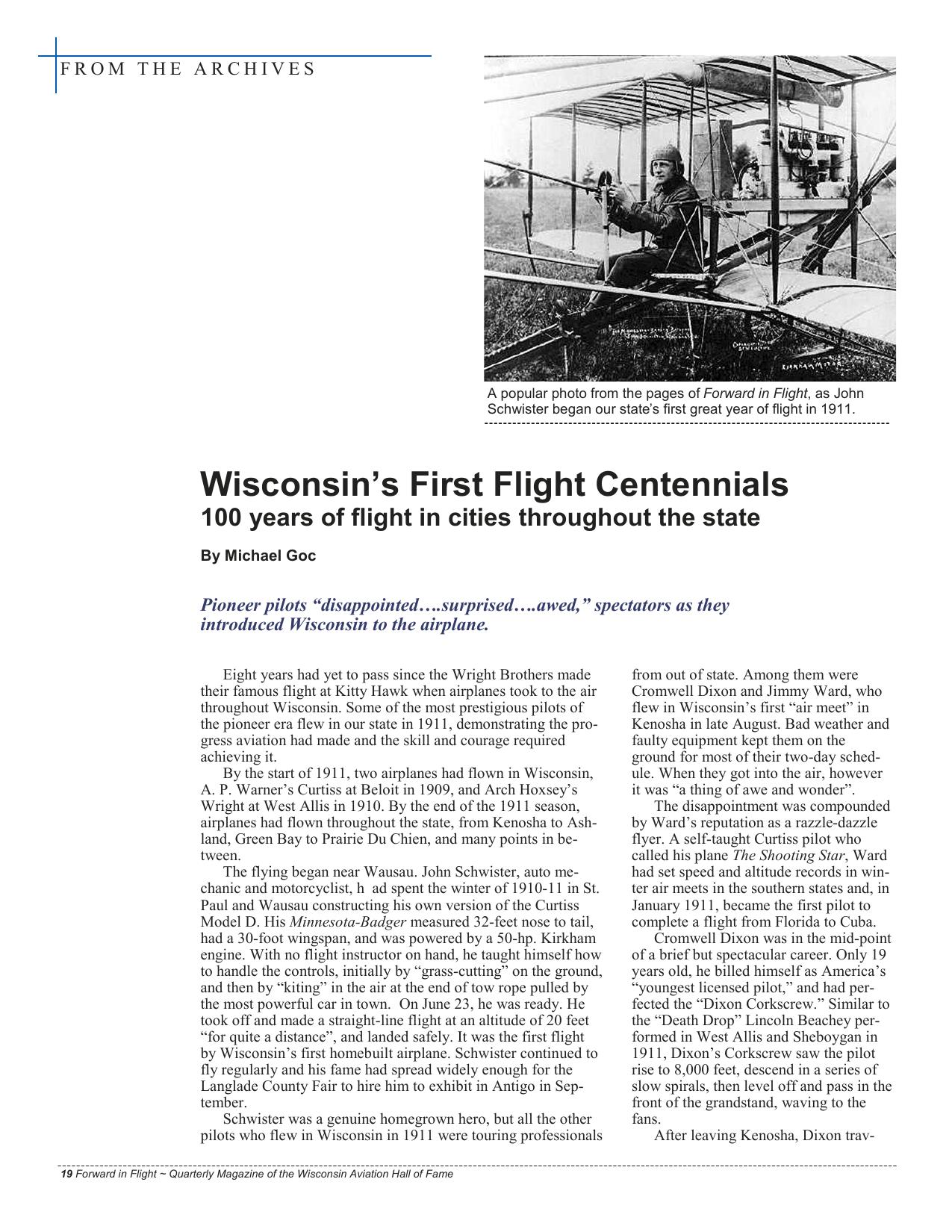
FROM THE ARCHIVES A popular photo from the pages of Forward in Flight, as John Schwister began our state’s first great year of flight in 1911. Wisconsin’s First Flight Centennials 100 years of flight in cities throughout the state By Michael Goc PioneerÊpilotsÊ“disappointed….surprised….awed,”ÊspectatorsÊasÊtheyÊ introducedÊWisconsinÊtoÊtheÊairplane. Eight years had yet to pass since the Wright Brothers made their famous flight at Kitty Hawk when airplanes took to the air throughout Wisconsin. Some of the most prestigious pilots of the pioneer era flew in our state in 1911, demonstrating the progress aviation had made and the skill and courage required achieving it. By the start of 1911, two airplanes had flown in Wisconsin, A. P. Warner’s Curtiss at Beloit in 1909, and Arch Hoxsey’s Wright at West Allis in 1910. By the end of the 1911 season, airplanes had flown throughout the state, from Kenosha to Ashland, Green Bay to Prairie Du Chien, and many points in between. The flying began near Wausau. John Schwister, auto mechanic and motorcyclist, h ad spent the winter of 1910-11 in St. Paul and Wausau constructing his own version of the Curtiss Model D. His Minnesota-Badger measured 32-feet nose to tail, had a 30-foot wingspan, and was powered by a 50-hp. Kirkham engine. With no flight instructor on hand, he taught himself how to handle the controls, initially by “grass-cutting” on the ground, and then by “kiting” in the air at the end of tow rope pulled by the most powerful car in town. On June 23, he was ready. He took off and made a straight-line flight at an altitude of 20 feet “for quite a distance”, and landed safely. It was the first flight by Wisconsin’s first homebuilt airplane. Schwister continued to fly regularly and his fame had spread widely enough for the Langlade County Fair to hire him to exhibit in Antigo in September. Schwister was a genuine homegrown hero, but all the other pilots who flew in Wisconsin in 1911 were touring professionals 19 Forward in Flight ~ Quarterly Magazine of the Wisconsin Aviation Hall of Fame from out of state. Among them were Cromwell Dixon and Jimmy Ward, who flew in Wisconsin’s first “air meet” in Kenosha in late August. Bad weather and faulty equipment kept them on the ground for most of their two-day schedule. When they got into the air, however it was “a thing of awe and wonder”. The disappointment was compounded by Ward’s reputation as a razzle-dazzle flyer. A self-taught Curtiss pilot who called his plane The Shooting Star, Ward had set speed and altitude records in winter air meets in the southern states and, in January 1911, became the first pilot to complete a flight from Florida to Cuba. Cromwell Dixon was in the mid-point of a brief but spectacular career. Only 19 years old, he billed himself as America’s “youngest licensed pilot,” and had perfected the “Dixon Corkscrew.” Similar to the “Death Drop” Lincoln Beachey performed in West Allis and Sheboygan in 1911, Dixon’s Corkscrew saw the pilot rise to 8,000 feet, descend in a series of slow spirals, then level off and pass in the front of the grandstand, waving to the fans. After leaving Kenosha, Dixon trav-
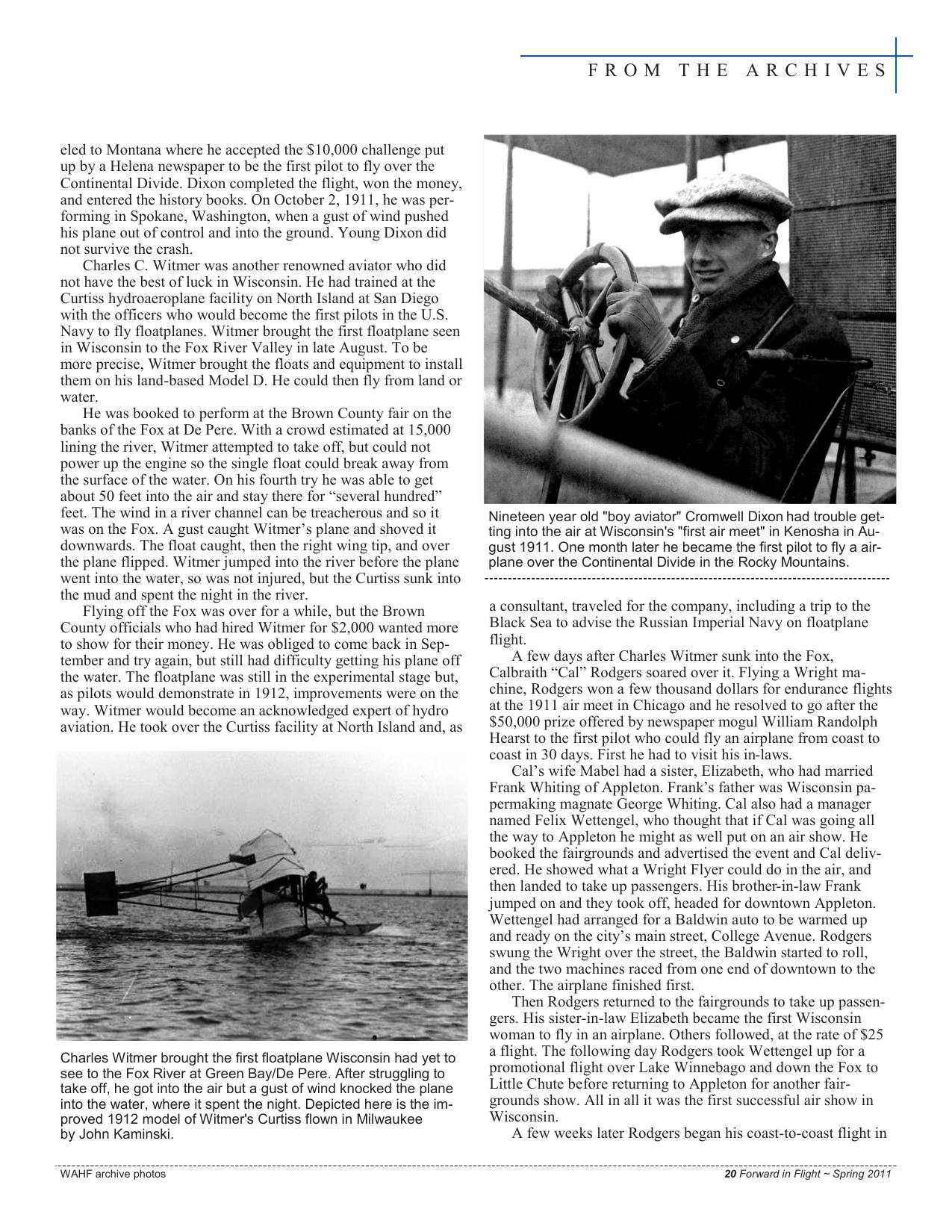
FROM THE ARCHIVES eled to Montana where he accepted the $10,000 challenge put up by a Helena newspaper to be the first pilot to fly over the Continental Divide. Dixon completed the flight, won the money, and entered the history books. On October 2, 1911, he was performing in Spokane, Washington, when a gust of wind pushed his plane out of control and into the ground. Young Dixon did not survive the crash. Charles C. Witmer was another renowned aviator who did not have the best of luck in Wisconsin. He had trained at the Curtiss hydroaeroplane facility on North Island at San Diego with the officers who would become the first pilots in the U.S. Navy to fly floatplanes. Witmer brought the first floatplane seen in Wisconsin to the Fox River Valley in late August. To be more precise, Witmer brought the floats and equipment to install them on his land-based Model D. He could then fly from land or water. He was booked to perform at the Brown County fair on the banks of the Fox at De Pere. With a crowd estimated at 15,000 lining the river, Witmer attempted to take off, but could not power up the engine so the single float could break away from the surface of the water. On his fourth try he was able to get about 50 feet into the air and stay there for “several hundred” feet. The wind in a river channel can be treacherous and so it was on the Fox. A gust caught Witmer’s plane and shoved it downwards. The float caught, then the right wing tip, and over the plane flipped. Witmer jumped into the river before the plane went into the water, so was not injured, but the Curtiss sunk into the mud and spent the night in the river. Flying off the Fox was over for a while, but the Brown County officials who had hired Witmer for $2,000 wanted more to show for their money. He was obliged to come back in September and try again, but still had difficulty getting his plane off the water. The floatplane was still in the experimental stage but, as pilots would demonstrate in 1912, improvements were on the way. Witmer would become an acknowledged expert of hydro aviation. He took over the Curtiss facility at North Island and, as Charles Witmer brought the first floatplane Wisconsin had yet to see to the Fox River at Green Bay/De Pere. After struggling to take off, he got into the air but a gust of wind knocked the plane into the water, where it spent the night. Depicted here is the improved 1912 model of Witmer's Curtiss flown in Milwaukee by John Kaminski. WAHF archive photos Nineteen year old "boy aviator" Cromwell Dixon had trouble getting into the air at Wisconsin's "first air meet" in Kenosha in August 1911. One month later he became the first pilot to fly a airplane over the Continental Divide in the Rocky Mountains. a consultant, traveled for the company, including a trip to the Black Sea to advise the Russian Imperial Navy on floatplane flight. A few days after Charles Witmer sunk into the Fox, Calbraith “Cal” Rodgers soared over it. Flying a Wright machine, Rodgers won a few thousand dollars for endurance flights at the 1911 air meet in Chicago and he resolved to go after the $50,000 prize offered by newspaper mogul William Randolph Hearst to the first pilot who could fly an airplane from coast to coast in 30 days. First he had to visit his in-laws. Cal’s wife Mabel had a sister, Elizabeth, who had married Frank Whiting of Appleton. Frank’s father was Wisconsin papermaking magnate George Whiting. Cal also had a manager named Felix Wettengel, who thought that if Cal was going all the way to Appleton he might as well put on an air show. He booked the fairgrounds and advertised the event and Cal delivered. He showed what a Wright Flyer could do in the air, and then landed to take up passengers. His brother-in-law Frank jumped on and they took off, headed for downtown Appleton. Wettengel had arranged for a Baldwin auto to be warmed up and ready on the city’s main street, College Avenue. Rodgers swung the Wright over the street, the Baldwin started to roll, and the two machines raced from one end of downtown to the other. The airplane finished first. Then Rodgers returned to the fairgrounds to take up passengers. His sister-in-law Elizabeth became the first Wisconsin woman to fly in an airplane. Others followed, at the rate of $25 a flight. The following day Rodgers took Wettengel up for a promotional flight over Lake Winnebago and down the Fox to Little Chute before returning to Appleton for another fairgrounds show. All in all it was the first successful air show in Wisconsin. A few weeks later Rodgers began his coast-to-coast flight in 20 Forward in Flight ~ Spring 2011
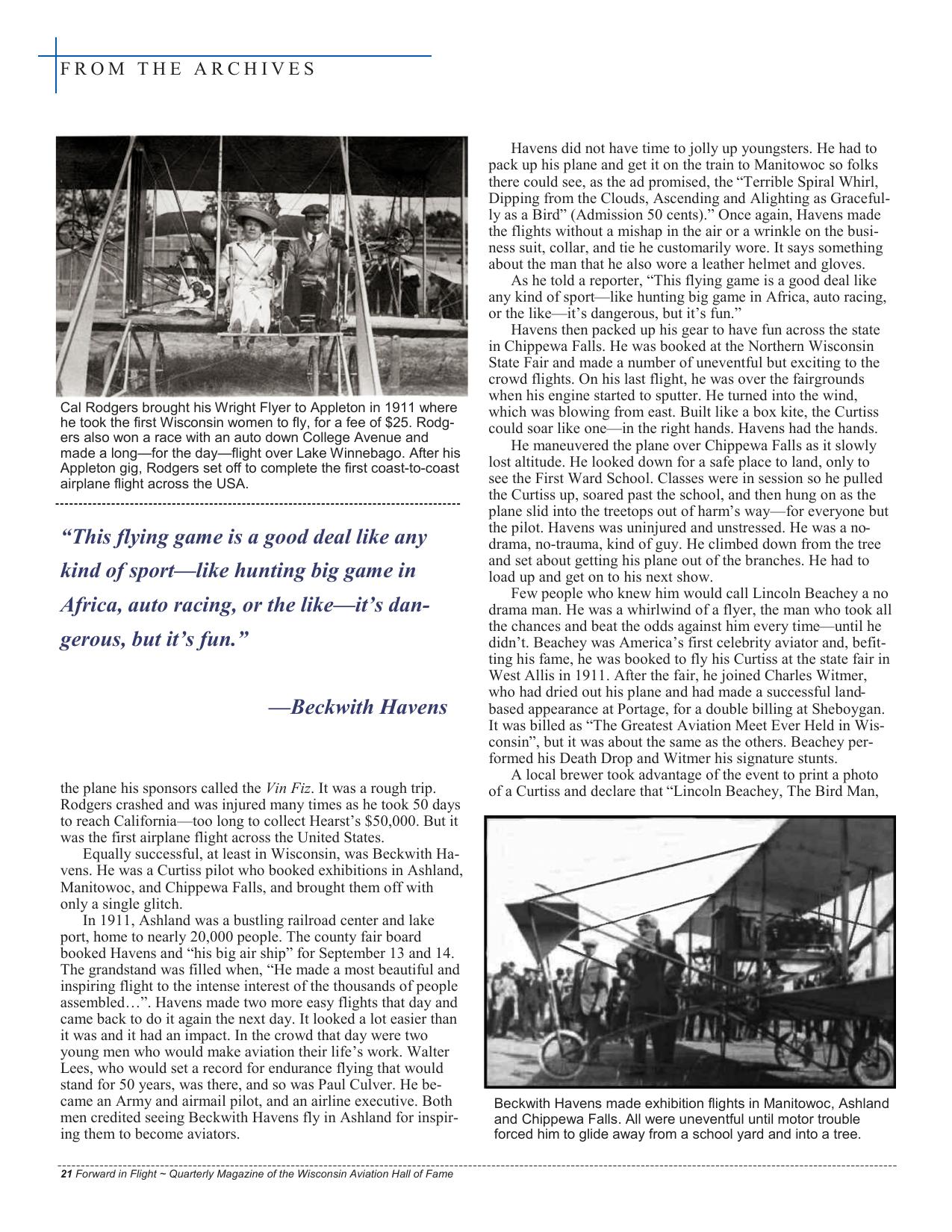
FROM THE ARCHIVES Cal Rodgers brought his Wright Flyer to Appleton in 1911 where he took the first Wisconsin women to fly, for a fee of $25. Rodgers also won a race with an auto down College Avenue and made a long—for the day—flight over Lake Winnebago. After his Appleton gig, Rodgers set off to complete the first coast-to-coast airplane flight across the USA. “ThisÊflyingÊgameÊisÊaÊgoodÊdealÊlikeÊanyÊ kindÊofÊsport—likeÊhuntingÊbigÊgameÊinÊ Africa,ÊautoÊracing,ÊorÊtheÊlike—it’sÊdangerous,ÊbutÊit’sÊfun.”Ê —BeckwithÊHavens the plane his sponsors called the Vin Fiz. It was a rough trip. Rodgers crashed and was injured many times as he took 50 days to reach California—too long to collect Hearst’s $50,000. But it was the first airplane flight across the United States. Equally successful, at least in Wisconsin, was Beckwith Havens. He was a Curtiss pilot who booked exhibitions in Ashland, Manitowoc, and Chippewa Falls, and brought them off with only a single glitch. In 1911, Ashland was a bustling railroad center and lake port, home to nearly 20,000 people. The county fair board booked Havens and “his big air ship” for September 13 and 14. The grandstand was filled when, “He made a most beautiful and inspiring flight to the intense interest of the thousands of people assembled…”. Havens made two more easy flights that day and came back to do it again the next day. It looked a lot easier than it was and it had an impact. In the crowd that day were two young men who would make aviation their life’s work. Walter Lees, who would set a record for endurance flying that would stand for 50 years, was there, and so was Paul Culver. He became an Army and airmail pilot, and an airline executive. Both men credited seeing Beckwith Havens fly in Ashland for inspiring them to become aviators. 21 Forward in Flight ~ Quarterly Magazine of the Wisconsin Aviation Hall of Fame Havens did not have time to jolly up youngsters. He had to pack up his plane and get it on the train to Manitowoc so folks there could see, as the ad promised, the “Terrible Spiral Whirl, Dipping from the Clouds, Ascending and Alighting as Gracefully as a Bird” (Admission 50 cents).” Once again, Havens made the flights without a mishap in the air or a wrinkle on the business suit, collar, and tie he customarily wore. It says something about the man that he also wore a leather helmet and gloves. As he told a reporter, “This flying game is a good deal like any kind of sport—like hunting big game in Africa, auto racing, or the like—it’s dangerous, but it’s fun.” Havens then packed up his gear to have fun across the state in Chippewa Falls. He was booked at the Northern Wisconsin State Fair and made a number of uneventful but exciting to the crowd flights. On his last flight, he was over the fairgrounds when his engine started to sputter. He turned into the wind, which was blowing from east. Built like a box kite, the Curtiss could soar like one—in the right hands. Havens had the hands. He maneuvered the plane over Chippewa Falls as it slowly lost altitude. He looked down for a safe place to land, only to see the First Ward School. Classes were in session so he pulled the Curtiss up, soared past the school, and then hung on as the plane slid into the treetops out of harm’s way—for everyone but the pilot. Havens was uninjured and unstressed. He was a nodrama, no-trauma, kind of guy. He climbed down from the tree and set about getting his plane out of the branches. He had to load up and get on to his next show. Few people who knew him would call Lincoln Beachey a no drama man. He was a whirlwind of a flyer, the man who took all the chances and beat the odds against him every time—until he didn’t. Beachey was America’s first celebrity aviator and, befitting his fame, he was booked to fly his Curtiss at the state fair in West Allis in 1911. After the fair, he joined Charles Witmer, who had dried out his plane and had made a successful landbased appearance at Portage, for a double billing at Sheboygan. It was billed as “The Greatest Aviation Meet Ever Held in Wisconsin”, but it was about the same as the others. Beachey performed his Death Drop and Witmer his signature stunts. A local brewer took advantage of the event to print a photo of a Curtiss and declare that “Lincoln Beachey, The Bird Man, Beckwith Havens made exhibition flights in Manitowoc, Ashland and Chippewa Falls. All were uneventful until motor trouble forced him to glide away from a school yard and into a tree.
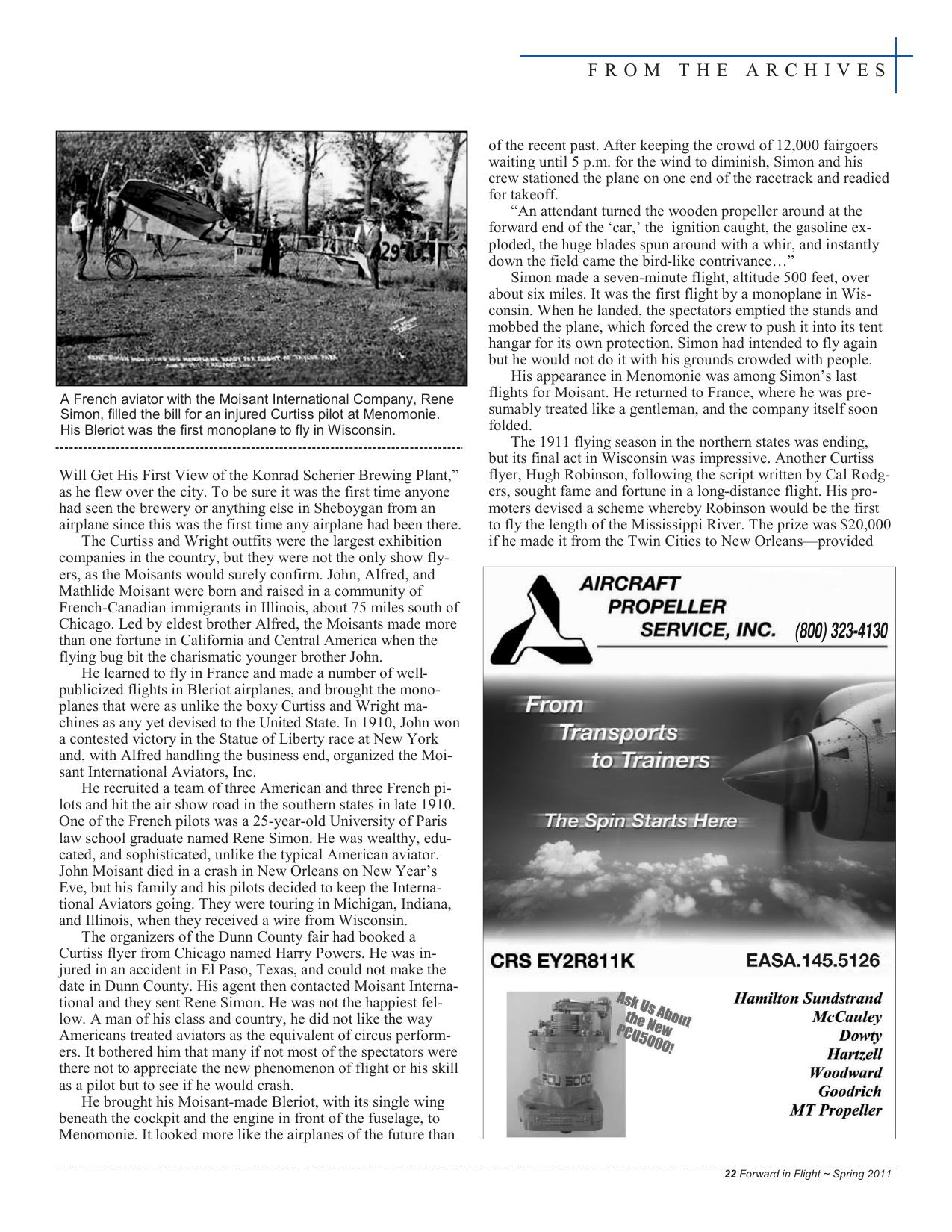
FROM THE ARCHIVES A French aviator with the Moisant International Company, Rene Simon, filled the bill for an injured Curtiss pilot at Menomonie. His Bleriot was the first monoplane to fly in Wisconsin. Will Get His First View of the Konrad Scherier Brewing Plant,” as he flew over the city. To be sure it was the first time anyone had seen the brewery or anything else in Sheboygan from an airplane since this was the first time any airplane had been there. The Curtiss and Wright outfits were the largest exhibition companies in the country, but they were not the only show flyers, as the Moisants would surely confirm. John, Alfred, and Mathlide Moisant were born and raised in a community of French-Canadian immigrants in Illinois, about 75 miles south of Chicago. Led by eldest brother Alfred, the Moisants made more than one fortune in California and Central America when the flying bug bit the charismatic younger brother John. He learned to fly in France and made a number of wellpublicized flights in Bleriot airplanes, and brought the monoplanes that were as unlike the boxy Curtiss and Wright machines as any yet devised to the United State. In 1910, John won a contested victory in the Statue of Liberty race at New York and, with Alfred handling the business end, organized the Moisant International Aviators, Inc. He recruited a team of three American and three French pilots and hit the air show road in the southern states in late 1910. One of the French pilots was a 25-year-old University of Paris law school graduate named Rene Simon. He was wealthy, educated, and sophisticated, unlike the typical American aviator. John Moisant died in a crash in New Orleans on New Year’s Eve, but his family and his pilots decided to keep the International Aviators going. They were touring in Michigan, Indiana, and Illinois, when they received a wire from Wisconsin. The organizers of the Dunn County fair had booked a Curtiss flyer from Chicago named Harry Powers. He was injured in an accident in El Paso, Texas, and could not make the date in Dunn County. His agent then contacted Moisant International and they sent Rene Simon. He was not the happiest fellow. A man of his class and country, he did not like the way Americans treated aviators as the equivalent of circus performers. It bothered him that many if not most of the spectators were there not to appreciate the new phenomenon of flight or his skill as a pilot but to see if he would crash. He brought his Moisant-made Bleriot, with its single wing beneath the cockpit and the engine in front of the fuselage, to Menomonie. It looked more like the airplanes of the future than of the recent past. After keeping the crowd of 12,000 fairgoers waiting until 5 p.m. for the wind to diminish, Simon and his crew stationed the plane on one end of the racetrack and readied for takeoff. “An attendant turned the wooden propeller around at the forward end of the ‘car,’ the ignition caught, the gasoline exploded, the huge blades spun around with a whir, and instantly down the field came the bird-like contrivance…” Simon made a seven-minute flight, altitude 500 feet, over about six miles. It was the first flight by a monoplane in Wisconsin. When he landed, the spectators emptied the stands and mobbed the plane, which forced the crew to push it into its tent hangar for its own protection. Simon had intended to fly again but he would not do it with his grounds crowded with people. His appearance in Menomonie was among Simon’s last flights for Moisant. He returned to France, where he was presumably treated like a gentleman, and the company itself soon folded. The 1911 flying season in the northern states was ending, but its final act in Wisconsin was impressive. Another Curtiss flyer, Hugh Robinson, following the script written by Cal Rodgers, sought fame and fortune in a long-distance flight. His promoters devised a scheme whereby Robinson would be the first to fly the length of the Mississippi River. The prize was $20,000 if he made it from the Twin Cities to New Orleans—provided 22 Forward in Flight ~ Spring 2011
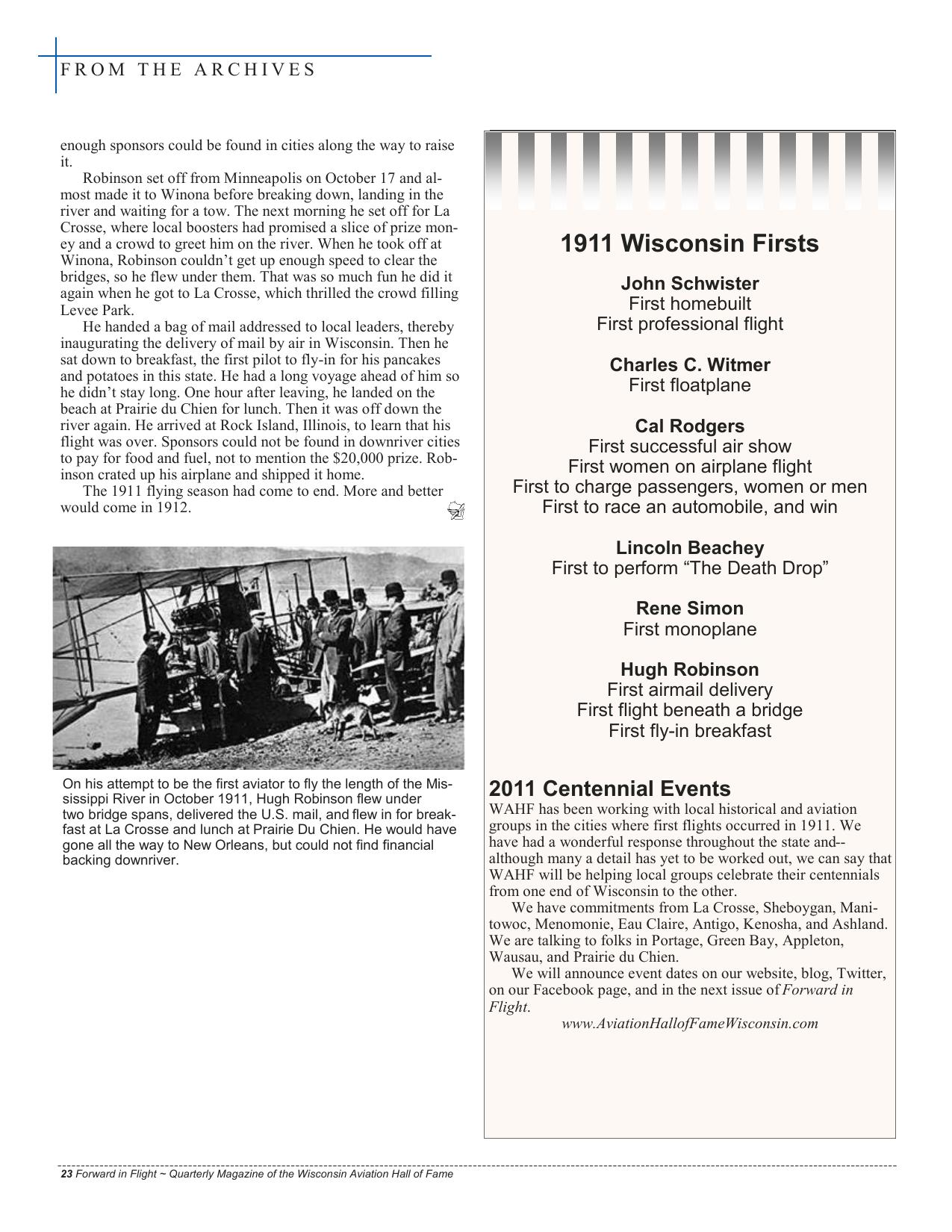
FROM THE ARCHIVES enough sponsors could be found in cities along the way to raise it. Robinson set off from Minneapolis on October 17 and almost made it to Winona before breaking down, landing in the river and waiting for a tow. The next morning he set off for La Crosse, where local boosters had promised a slice of prize money and a crowd to greet him on the river. When he took off at Winona, Robinson couldn’t get up enough speed to clear the bridges, so he flew under them. That was so much fun he did it again when he got to La Crosse, which thrilled the crowd filling Levee Park. He handed a bag of mail addressed to local leaders, thereby inaugurating the delivery of mail by air in Wisconsin. Then he sat down to breakfast, the first pilot to fly-in for his pancakes and potatoes in this state. He had a long voyage ahead of him so he didn’t stay long. One hour after leaving, he landed on the beach at Prairie du Chien for lunch. Then it was off down the river again. He arrived at Rock Island, Illinois, to learn that his flight was over. Sponsors could not be found in downriver cities to pay for food and fuel, not to mention the $20,000 prize. Robinson crated up his airplane and shipped it home. The 1911 flying season had come to end. More and better would come in 1912. 1911 Wisconsin Firsts John Schwister First homebuilt First professional flight Charles C. Witmer First floatplane Cal Rodgers First successful air show First women on airplane flight First to charge passengers, women or men First to race an automobile, and win Lincoln Beachey First to perform “The Death Drop” Rene Simon First monoplane Hugh Robinson First airmail delivery First flight beneath a bridge First fly-in breakfast On his attempt to be the first aviator to fly the length of the Mississippi River in October 1911, Hugh Robinson flew under two bridge spans, delivered the U.S. mail, and flew in for breakfast at La Crosse and lunch at Prairie Du Chien. He would have gone all the way to New Orleans, but could not find financial backing downriver. 23 Forward in Flight ~ Quarterly Magazine of the Wisconsin Aviation Hall of Fame 2011 Centennial Events WAHF has been working with local historical and aviation groups in the cities where first flights occurred in 1911. We have had a wonderful response throughout the state and-although many a detail has yet to be worked out, we can say that WAHF will be helping local groups celebrate their centennials from one end of Wisconsin to the other. We have commitments from La Crosse, Sheboygan, Manitowoc, Menomonie, Eau Claire, Antigo, Kenosha, and Ashland. We are talking to folks in Portage, Green Bay, Appleton, Wausau, and Prairie du Chien. We will announce event dates on our website, blog, Twitter, on our Facebook page, and in the next issue of Forward in Flight. www.AviationHallofFameWisconsin.com
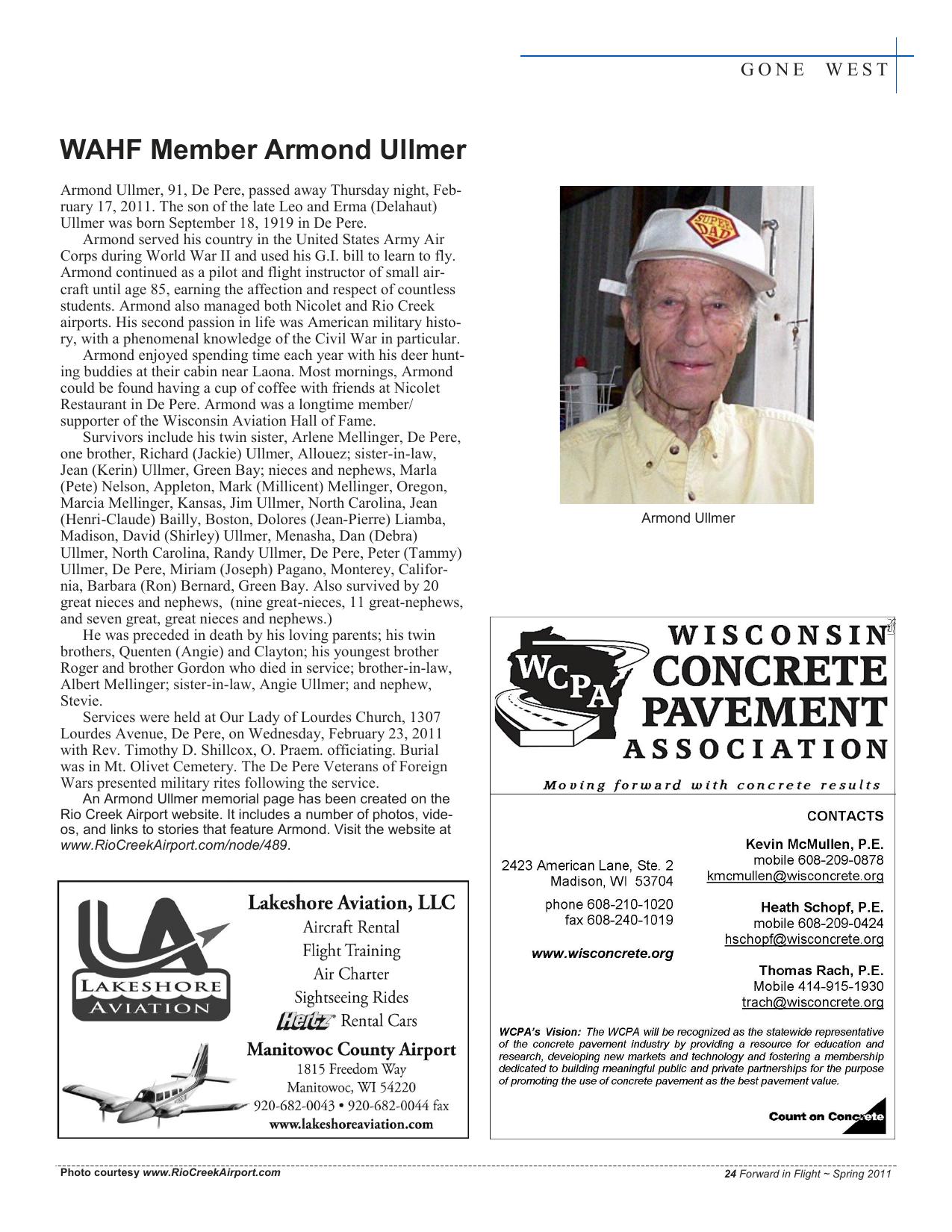
GONE WEST WAHF Member Armond Ullmer Armond Ullmer, 91, De Pere, passed away Thursday night, February 17, 2011. The son of the late Leo and Erma (Delahaut) Ullmer was born September 18, 1919 in De Pere. Armond served his country in the United States Army Air Corps during World War II and used his G.I. bill to learn to fly. Armond continued as a pilot and flight instructor of small aircraft until age 85, earning the affection and respect of countless students. Armond also managed both Nicolet and Rio Creek airports. His second passion in life was American military history, with a phenomenal knowledge of the Civil War in particular. Armond enjoyed spending time each year with his deer hunting buddies at their cabin near Laona. Most mornings, Armond could be found having a cup of coffee with friends at Nicolet Restaurant in De Pere. Armond was a longtime member/ supporter of the Wisconsin Aviation Hall of Fame. Survivors include his twin sister, Arlene Mellinger, De Pere, one brother, Richard (Jackie) Ullmer, Allouez; sister-in-law, Jean (Kerin) Ullmer, Green Bay; nieces and nephews, Marla (Pete) Nelson, Appleton, Mark (Millicent) Mellinger, Oregon, Marcia Mellinger, Kansas, Jim Ullmer, North Carolina, Jean (Henri-Claude) Bailly, Boston, Dolores (Jean-Pierre) Liamba, Madison, David (Shirley) Ullmer, Menasha, Dan (Debra) Ullmer, North Carolina, Randy Ullmer, De Pere, Peter (Tammy) Ullmer, De Pere, Miriam (Joseph) Pagano, Monterey, California, Barbara (Ron) Bernard, Green Bay. Also survived by 20 great nieces and nephews, (nine great-nieces, 11 great-nephews, and seven great, great nieces and nephews.) He was preceded in death by his loving parents; his twin brothers, Quenten (Angie) and Clayton; his youngest brother Roger and brother Gordon who died in service; brother-in-law, Albert Mellinger; sister-in-law, Angie Ullmer; and nephew, Stevie. Services were held at Our Lady of Lourdes Church, 1307 Lourdes Avenue, De Pere, on Wednesday, February 23, 2011 with Rev. Timothy D. Shillcox, O. Praem. officiating. Burial was in Mt. Olivet Cemetery. The De Pere Veterans of Foreign Wars presented military rites following the service. Armond Ullmer An Armond Ullmer memorial page has been created on the Rio Creek Airport website. It includes a number of photos, videos, and links to stories that feature Armond. Visit the website at www.RioCreekAirport.com/node/489. Photo courtesy www.RioCreekAirport.com 24 Forward in Flight ~ Spring 2011
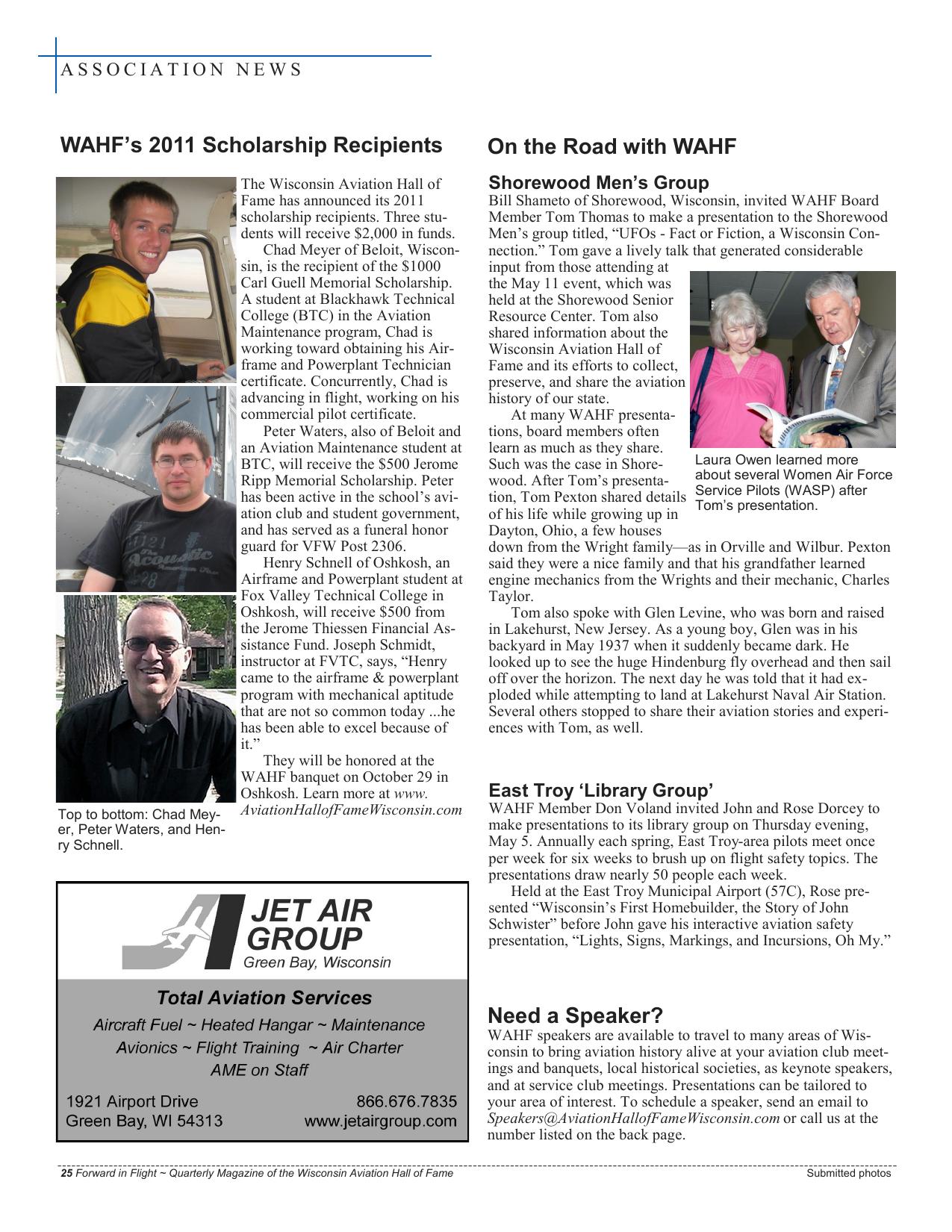
ASSOCIATION NEWS WAHF’s 2011 Scholarship Recipients Top to bottom: Chad Meyer, Peter Waters, and Henry Schnell. The Wisconsin Aviation Hall of Fame has announced its 2011 scholarship recipients. Three students will receive $2,000 in funds. Chad Meyer of Beloit, Wisconsin, is the recipient of the $1000 Carl Guell Memorial Scholarship. A student at Blackhawk Technical College (BTC) in the Aviation Maintenance program, Chad is working toward obtaining his Airframe and Powerplant Technician certificate. Concurrently, Chad is advancing in flight, working on his commercial pilot certificate. Peter Waters, also of Beloit and an Aviation Maintenance student at BTC, will receive the $500 Jerome Ripp Memorial Scholarship. Peter has been active in the school’s aviation club and student government, and has served as a funeral honor guard for VFW Post 2306. Henry Schnell of Oshkosh, an Airframe and Powerplant student at Fox Valley Technical College in Oshkosh, will receive $500 from the Jerome Thiessen Financial Assistance Fund. Joseph Schmidt, instructor at FVTC, says, “Henry came to the airframe & powerplant program with mechanical aptitude that are not so common today ...he has been able to excel because of it.” They will be honored at the WAHF banquet on October 29 in Oshkosh. Learn more at www. AviationHallofFameWisconsin.com On the Road with WAHF Shorewood Men’s Group Bill Shameto of Shorewood, Wisconsin, invited WAHF Board Member Tom Thomas to make a presentation to the Shorewood Men’s group titled, “UFOs - Fact or Fiction, a Wisconsin Connection.” Tom gave a lively talk that generated considerable input from those attending at the May 11 event, which was held at the Shorewood Senior Resource Center. Tom also shared information about the Wisconsin Aviation Hall of Fame and its efforts to collect, preserve, and share the aviation history of our state. At many WAHF presentations, board members often learn as much as they share. Laura Owen learned more Such was the case in Shoreabout several Women Air Force wood. After Tom’s presentation, Tom Pexton shared details Service Pilots (WASP) after Tom’s presentation. of his life while growing up in Dayton, Ohio, a few houses down from the Wright family—as in Orville and Wilbur. Pexton said they were a nice family and that his grandfather learned engine mechanics from the Wrights and their mechanic, Charles Taylor. Tom also spoke with Glen Levine, who was born and raised in Lakehurst, New Jersey. As a young boy, Glen was in his backyard in May 1937 when it suddenly became dark. He looked up to see the huge Hindenburg fly overhead and then sail off over the horizon. The next day he was told that it had exploded while attempting to land at Lakehurst Naval Air Station. Several others stopped to share their aviation stories and experiences with Tom, as well. East Troy ‘Library Group’ WAHF Member Don Voland invited John and Rose Dorcey to make presentations to its library group on Thursday evening, May 5. Annually each spring, East Troy-area pilots meet once per week for six weeks to brush up on flight safety topics. The presentations draw nearly 50 people each week. Held at the East Troy Municipal Airport (57C), Rose presented “Wisconsin’s First Homebuilder, the Story of John Schwister” before John gave his interactive aviation safety presentation, “Lights, Signs, Markings, and Incursions, Oh My.” Need a Speaker? WAHF speakers are available to travel to many areas of Wisconsin to bring aviation history alive at your aviation club meetings and banquets, local historical societies, as keynote speakers, and at service club meetings. Presentations can be tailored to your area of interest. To schedule a speaker, send an email to Speakers@AviationHallofFameWisconsin.com or call us at the number listed on the back page. 25 Forward in Flight ~ Quarterly Magazine of the Wisconsin Aviation Hall of Fame Submitted photos
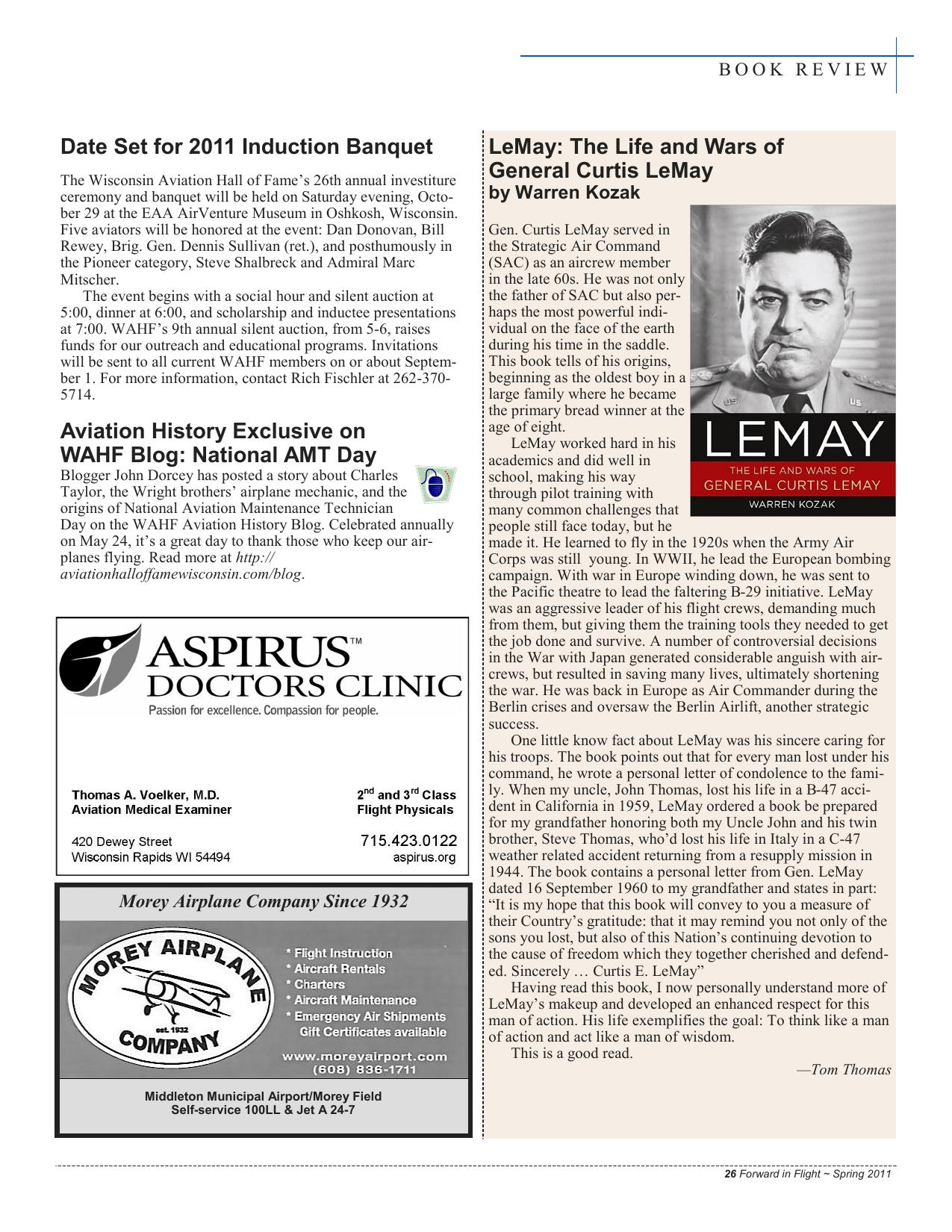
BOOK REVIEW Date Set for 2011 Induction Banquet The Wisconsin Aviation Hall of Fame’s 26th annual investiture ceremony and banquet will be held on Saturday evening, October 29 at the EAA AirVenture Museum in Oshkosh, Wisconsin. Five aviators will be honored at the event: Dan Donovan, Bill Rewey, Brig. Gen. Dennis Sullivan (ret.), and posthumously in the Pioneer category, Steve Shalbreck and Admiral Marc Mitscher. The event begins with a social hour and silent auction at 5:00, dinner at 6:00, and scholarship and inductee presentations at 7:00. WAHF’s 9th annual silent auction, from 5-6, raises funds for our outreach and educational programs. Invitations will be sent to all current WAHF members on or about September 1. For more information, contact Rich Fischler at 262-3705714. Aviation History Exclusive on WAHF Blog: National AMT Day Blogger John Dorcey has posted a story about Charles Taylor, the Wright brothers’ airplane mechanic, and the origins of National Aviation Maintenance Technician Day on the WAHF Aviation History Blog. Celebrated annually on May 24, it’s a great day to thank those who keep our airplanes flying. Read more at http:// aviationhalloffamewisconsin.com/blog. MoreyÊAirplaneÊCompanyÊSinceÊ1932 LeMay: The Life and Wars of General Curtis LeMay by Warren Kozak Gen. Curtis LeMay served in the Strategic Air Command (SAC) as an aircrew member in the late 60s. He was not only the father of SAC but also perhaps the most powerful individual on the face of the earth during his time in the saddle. This book tells of his origins, beginning as the oldest boy in a large family where he became the primary bread winner at the age of eight. LeMay worked hard in his academics and did well in school, making his way through pilot training with many common challenges that people still face today, but he made it. He learned to fly in the 1920s when the Army Air Corps was still young. In WWII, he lead the European bombing campaign. With war in Europe winding down, he was sent to the Pacific theatre to lead the faltering B-29 initiative. LeMay was an aggressive leader of his flight crews, demanding much from them, but giving them the training tools they needed to get the job done and survive. A number of controversial decisions in the War with Japan generated considerable anguish with aircrews, but resulted in saving many lives, ultimately shortening the war. He was back in Europe as Air Commander during the Berlin crises and oversaw the Berlin Airlift, another strategic success. One little know fact about LeMay was his sincere caring for his troops. The book points out that for every man lost under his command, he wrote a personal letter of condolence to the family. When my uncle, John Thomas, lost his life in a B-47 accident in California in 1959, LeMay ordered a book be prepared for my grandfather honoring both my Uncle John and his twin brother, Steve Thomas, who’d lost his life in Italy in a C-47 weather related accident returning from a resupply mission in 1944. The book contains a personal letter from Gen. LeMay dated 16 September 1960 to my grandfather and states in part: “It is my hope that this book will convey to you a measure of their Country’s gratitude: that it may remind you not only of the sons you lost, but also of this Nation’s continuing devotion to the cause of freedom which they together cherished and defended. Sincerely … Curtis E. LeMay” Having read this book, I now personally understand more of LeMay’s makeup and developed an enhanced respect for this man of action. His life exemplifies the goal: To think like a man of action and act like a man of wisdom. This is a good read. —Tom Thomas Middleton Municipal Airport/Morey Field Self-service 100LL & Jet A 24-7 26 Forward in Flight ~ Spring 2011
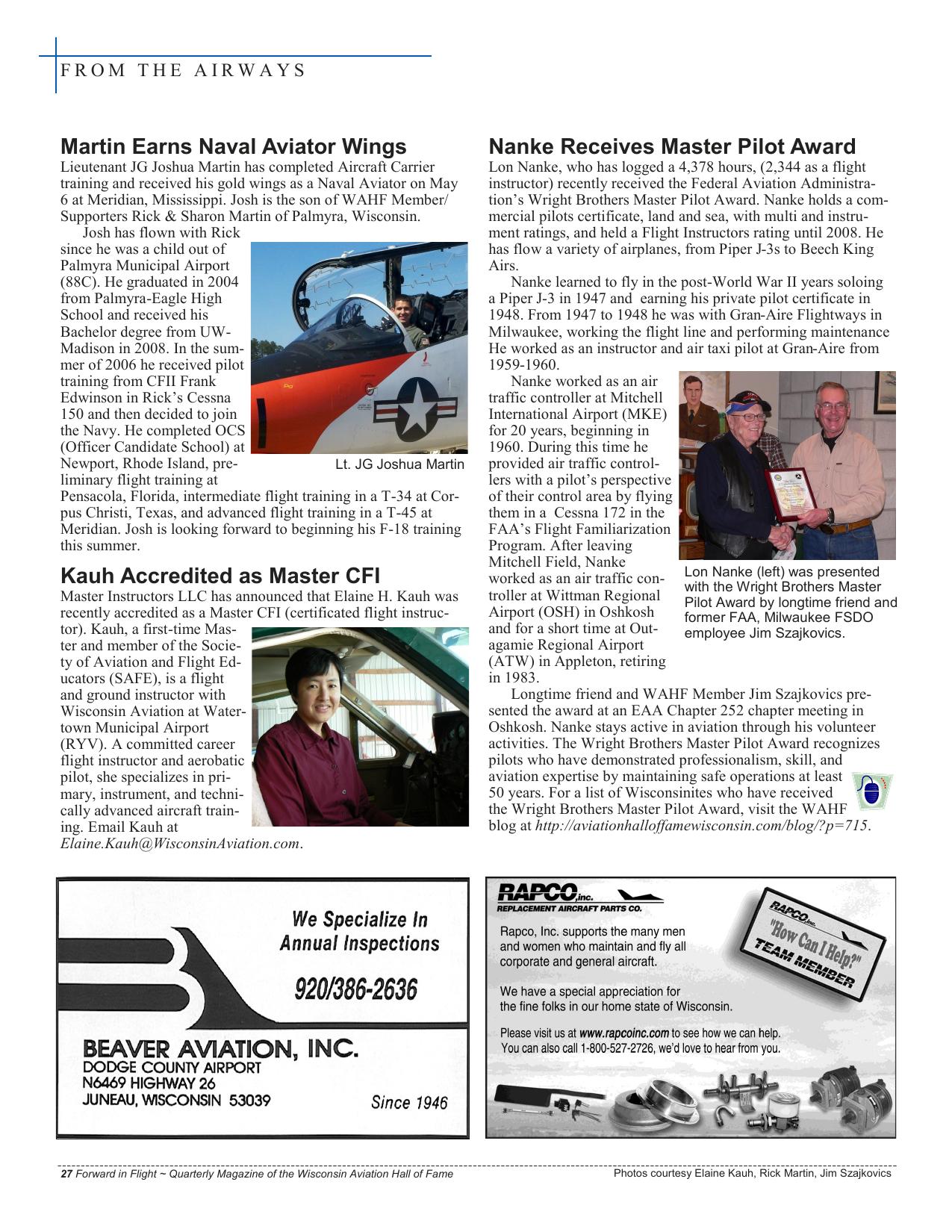
FROM THE AIRWAYS Martin Earns Naval Aviator Wings Lieutenant JG Joshua Martin has completed Aircraft Carrier training and received his gold wings as a Naval Aviator on May 6 at Meridian, Mississippi. Josh is the son of WAHF Member/ Supporters Rick & Sharon Martin of Palmyra, Wisconsin. Josh has flown with Rick since he was a child out of Palmyra Municipal Airport (88C). He graduated in 2004 from Palmyra-Eagle High School and received his Bachelor degree from UWMadison in 2008. In the summer of 2006 he received pilot training from CFII Frank Edwinson in Rick’s Cessna 150 and then decided to join the Navy. He completed OCS (Officer Candidate School) at Newport, Rhode Island, preLt. JG Joshua Martin liminary flight training at Pensacola, Florida, intermediate flight training in a T-34 at Corpus Christi, Texas, and advanced flight training in a T-45 at Meridian. Josh is looking forward to beginning his F-18 training this summer. Kauh Accredited as Master CFI Master Instructors LLC has announced that Elaine H. Kauh was recently accredited as a Master CFI (certificated flight instructor). Kauh, a first-time Master and member of the Society of Aviation and Flight Educators (SAFE), is a flight and ground instructor with Wisconsin Aviation at Watertown Municipal Airport (RYV). A committed career flight instructor and aerobatic pilot, she specializes in primary, instrument, and technically advanced aircraft training. Email Kauh at Elaine.Kauh@WisconsinAviation.com. 27 Forward in Flight ~ Quarterly Magazine of the Wisconsin Aviation Hall of Fame Nanke Receives Master Pilot Award Lon Nanke, who has logged a 4,378 hours, (2,344 as a flight instructor) recently received the Federal Aviation Administration’s Wright Brothers Master Pilot Award. Nanke holds a commercial pilots certificate, land and sea, with multi and instrument ratings, and held a Flight Instructors rating until 2008. He has flow a variety of airplanes, from Piper J-3s to Beech King Airs. Nanke learned to fly in the post-World War II years soloing a Piper J-3 in 1947 and earning his private pilot certificate in 1948. From 1947 to 1948 he was with Gran-Aire Flightways in Milwaukee, working the flight line and performing maintenance He worked as an instructor and air taxi pilot at Gran-Aire from 1959-1960. Nanke worked as an air traffic controller at Mitchell International Airport (MKE) for 20 years, beginning in 1960. During this time he provided air traffic controllers with a pilot’s perspective of their control area by flying them in a Cessna 172 in the FAA’s Flight Familiarization Program. After leaving Mitchell Field, Nanke worked as an air traffic con- Lon Nanke (left) was presented with the Wright Brothers Master troller at Wittman Regional Pilot Award by longtime friend and Airport (OSH) in Oshkosh former FAA, Milwaukee FSDO and for a short time at Outemployee Jim Szajkovics. agamie Regional Airport (ATW) in Appleton, retiring in 1983. Longtime friend and WAHF Member Jim Szajkovics presented the award at an EAA Chapter 252 chapter meeting in Oshkosh. Nanke stays active in aviation through his volunteer activities. The Wright Brothers Master Pilot Award recognizes pilots who have demonstrated professionalism, skill, and aviation expertise by maintaining safe operations at least 50 years. For a list of Wisconsinites who have received the Wright Brothers Master Pilot Award, visit the WAHF blog at http://aviationhalloffamewisconsin.com/blog/?p=715. Photos courtesy Elaine Kauh, Rick Martin, Jim Szajkovics
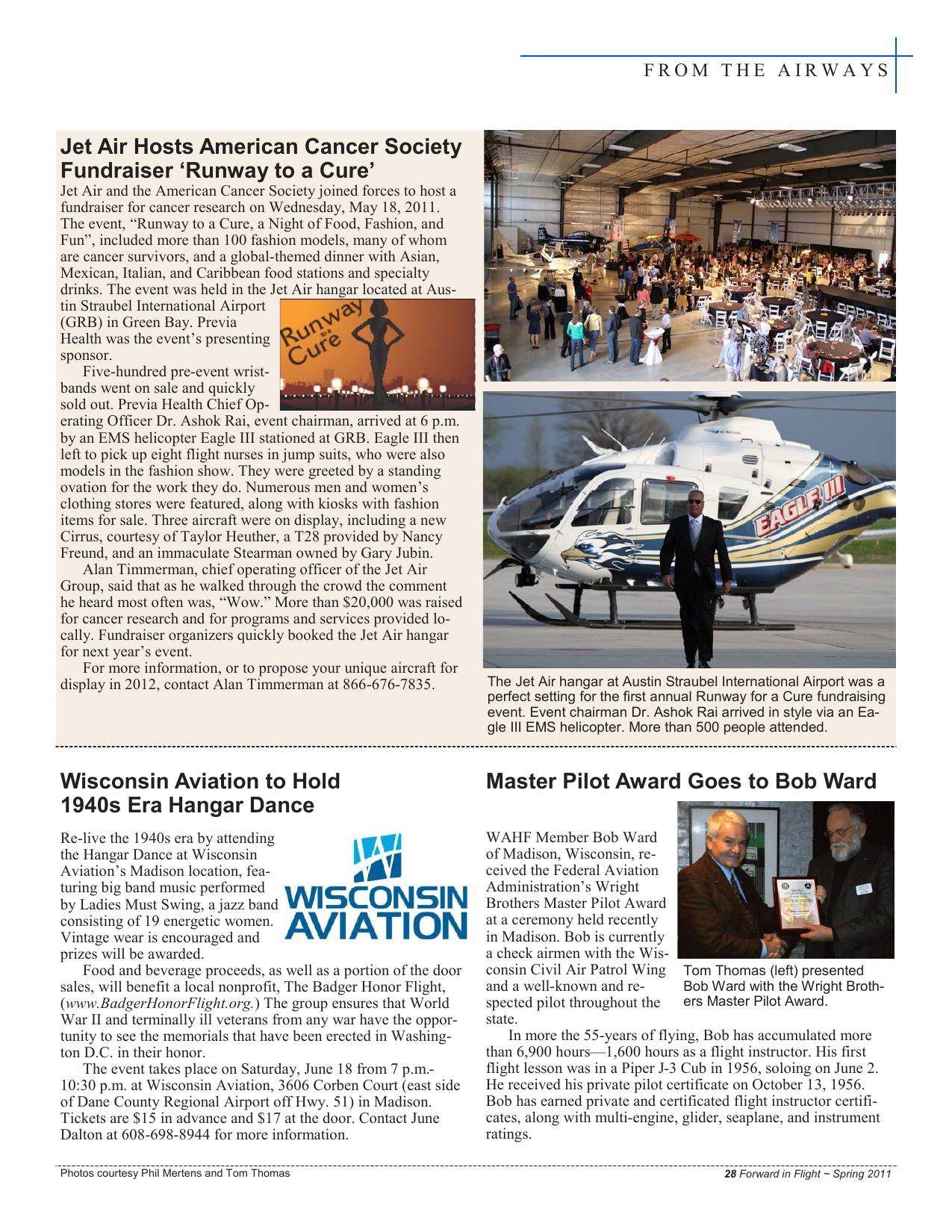
FROM THE AIRWAYS Jet Air Hosts American Cancer Society Fundraiser ‘Runway to a Cure’ Jet Air and the American Cancer Society joined forces to host a fundraiser for cancer research on Wednesday, May 18, 2011. The event, “Runway to a Cure, a Night of Food, Fashion, and Fun”, included more than 100 fashion models, many of whom are cancer survivors, and a global-themed dinner with Asian, Mexican, Italian, and Caribbean food stations and specialty drinks. The event was held in the Jet Air hangar located at Austin Straubel International Airport (GRB) in Green Bay. Previa Health was the event’s presenting sponsor. Five-hundred pre-event wristbands went on sale and quickly sold out. Previa Health Chief Operating Officer Dr. Ashok Rai, event chairman, arrived at 6 p.m. by an EMS helicopter Eagle III stationed at GRB. Eagle III then left to pick up eight flight nurses in jump suits, who were also models in the fashion show. They were greeted by a standing ovation for the work they do. Numerous men and women’s clothing stores were featured, along with kiosks with fashion items for sale. Three aircraft were on display, including a new Cirrus, courtesy of Taylor Heuther, a T28 provided by Nancy Freund, and an immaculate Stearman owned by Gary Jubin. Alan Timmerman, chief operating officer of the Jet Air Group, said that as he walked through the crowd the comment he heard most often was, “Wow.” More than $20,000 was raised for cancer research and for programs and services provided locally. Fundraiser organizers quickly booked the Jet Air hangar for next year’s event. For more information, or to propose your unique aircraft for display in 2012, contact Alan Timmerman at 866-676-7835. The Jet Air hangar at Austin Straubel International Airport was a perfect setting for the first annual Runway for a Cure fundraising event. Event chairman Dr. Ashok Rai arrived in style via an Eagle III EMS helicopter. More than 500 people attended. Wisconsin Aviation to Hold 1940s Era Hangar Dance Master Pilot Award Goes to Bob Ward Re-live the 1940s era by attending the Hangar Dance at Wisconsin Aviation’s Madison location, featuring big band music performed by Ladies Must Swing, a jazz band consisting of 19 energetic women. Vintage wear is encouraged and prizes will be awarded. Food and beverage proceeds, as well as a portion of the door sales, will benefit a local nonprofit, The Badger Honor Flight, (www.BadgerHonorFlight.org.) The group ensures that World War II and terminally ill veterans from any war have the opportunity to see the memorials that have been erected in Washington D.C. in their honor. The event takes place on Saturday, June 18 from 7 p.m.10:30 p.m. at Wisconsin Aviation, 3606 Corben Court (east side of Dane County Regional Airport off Hwy. 51) in Madison. Tickets are $15 in advance and $17 at the door. Contact June Dalton at 608-698-8944 for more information. WAHF Member Bob Ward of Madison, Wisconsin, received the Federal Aviation Administration’s Wright Brothers Master Pilot Award at a ceremony held recently in Madison. Bob is currently a check airmen with the Wisconsin Civil Air Patrol Wing Tom Thomas (left) presented and a well-known and reBob Ward with the Wright Brothspected pilot throughout the ers Master Pilot Award. state. In more the 55-years of flying, Bob has accumulated more than 6,900 hours—1,600 hours as a flight instructor. His first flight lesson was in a Piper J-3 Cub in 1956, soloing on June 2. He received his private pilot certificate on October 13, 1956. Bob has earned private and certificated flight instructor certificates, along with multi-engine, glider, seaplane, and instrument ratings. Photos courtesy Phil Mertens and Tom Thomas 28 Forward in Flight ~ Spring 2011
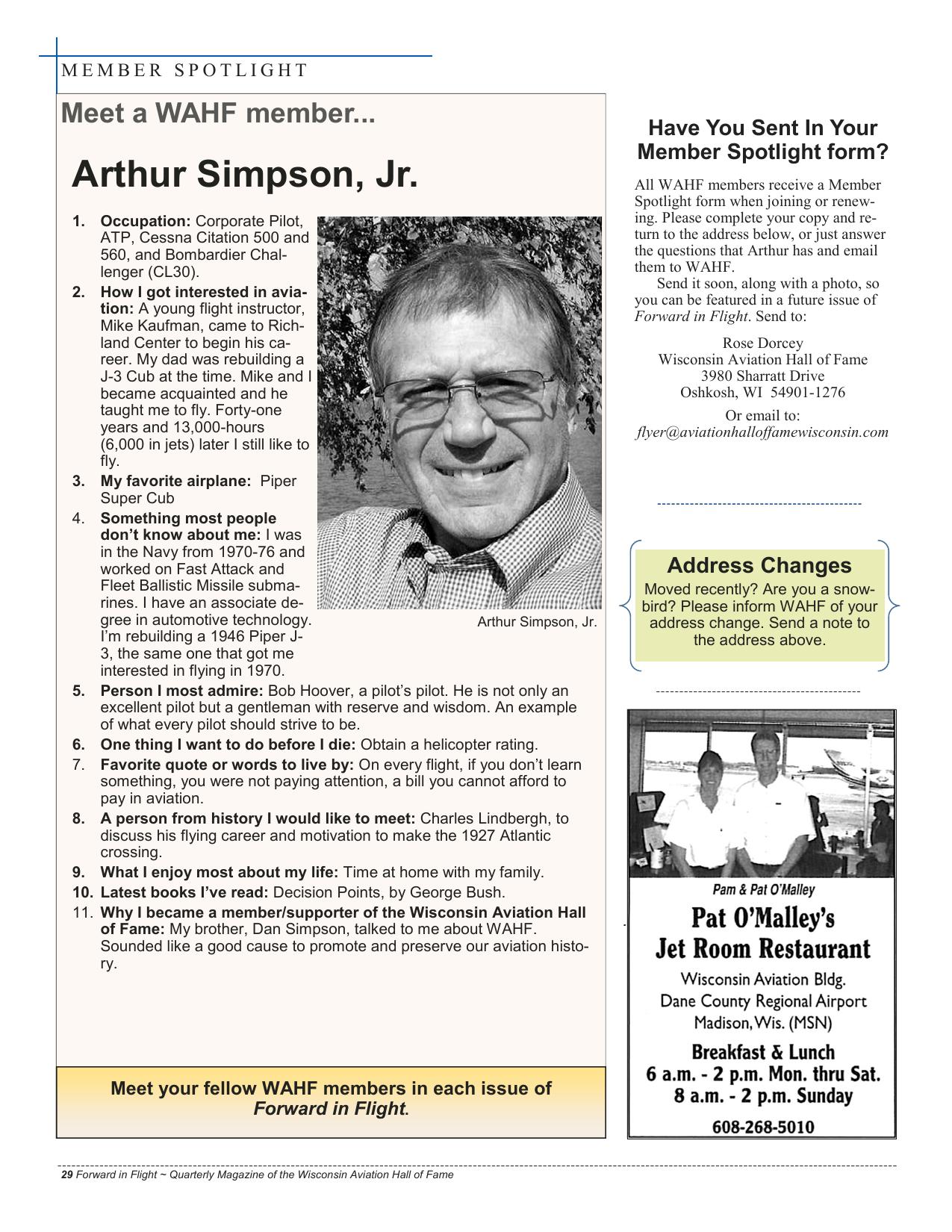
MEMBER SPOTLIGHT Meet a WAHF member... Arthur Simpson, Jr. 1. Occupation: Corporate Pilot, ATP, Cessna Citation 500 and 560, and Bombardier Challenger (CL30). 2. How I got interested in aviation: A young flight instructor, Mike Kaufman, came to Richland Center to begin his career. My dad was rebuilding a J-3 Cub at the time. Mike and I became acquainted and he taught me to fly. Forty-one years and 13,000-hours (6,000 in jets) later I still like to fly. 3. My favorite airplane: Piper Super Cub 4. Something most people don’t know about me: I was in the Navy from 1970-76 and worked on Fast Attack and Fleet Ballistic Missile submarines. I have an associate degree in automotive technology. Arthur Simpson, Jr. I’m rebuilding a 1946 Piper J3, the same one that got me interested in flying in 1970. 5. Person I most admire: Bob Hoover, a pilot’s pilot. He is not only an excellent pilot but a gentleman with reserve and wisdom. An example of what every pilot should strive to be. 6. One thing I want to do before I die: Obtain a helicopter rating. 7. Favorite quote or words to live by: On every flight, if you don’t learn something, you were not paying attention, a bill you cannot afford to pay in aviation. 8. A person from history I would like to meet: Charles Lindbergh, to discuss his flying career and motivation to make the 1927 Atlantic crossing. 9. What I enjoy most about my life: Time at home with my family. 10. Latest books I’ve read: Decision Points, by George Bush. 11. Why I became a member/supporter of the Wisconsin Aviation Hall of Fame: My brother, Dan Simpson, talked to me about WAHF. Sounded like a good cause to promote and preserve our aviation history. Meet your fellow WAHF members in each issue of Forward in Flight. 29 Forward in Flight ~ Quarterly Magazine of the Wisconsin Aviation Hall of Fame Have You Sent In Your Member Spotlight form? All WAHF members receive a Member Spotlight form when joining or renewing. Please complete your copy and return to the address below, or just answer the questions that Arthur has and email them to WAHF. Send it soon, along with a photo, so you can be featured in a future issue of Forward in Flight. Send to: Rose Dorcey Wisconsin Aviation Hall of Fame 3980 Sharratt Drive Oshkosh, WI 54901-1276 Or email to: flyer@aviationhalloffamewisconsin.com Address Changes Moved recently? Are you a snowbird? Please inform WAHF of your address change. Send a note to the address above.
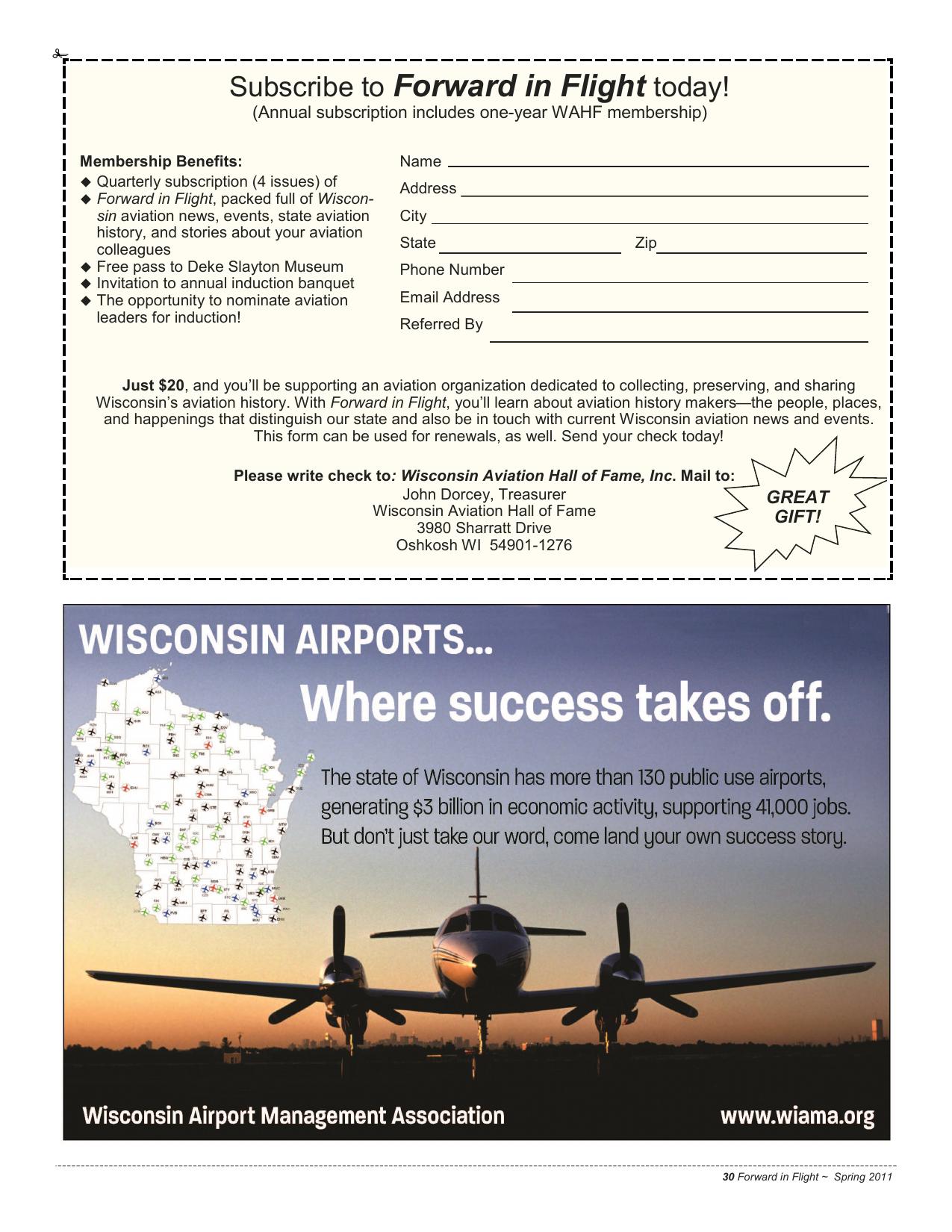
Subscribe to Forward in Flight today! (Annual subscription includes one-year WAHF membership) Membership Benefits: u Quarterly subscription (4 issues) of u Forward in Flight, packed full of Wisconsin aviation news, events, state aviation history, and stories about your aviation colleagues u Free pass to Deke Slayton Museum u Invitation to annual induction banquet u The opportunity to nominate aviation leaders for induction! Name Address City State Zip Phone Number Email Address Referred By Just $20, and you’ll be supporting an aviation organization dedicated to collecting, preserving, and sharing Wisconsin’s aviation history. With Forward in Flight, you’ll learn about aviation history makers—the people, places, and happenings that distinguish our state and also be in touch with current Wisconsin aviation news and events. This form can be used for renewals, as well. Send your check today! Please write check to: Wisconsin Aviation Hall of Fame, Inc. Mail to: John Dorcey, Treasurer Wisconsin Aviation Hall of Fame 3980 Sharratt Drive Oshkosh WI 54901-1276 GREAT GIFT! 30 Forward in Flight ~ Spring 2011
PRSRT STD US Postage Paid Wisc Rapids WI Permit 98 WISCONSIN AVIATION HALL OF FAME 3980 SHARRATT DRIVE OSHKOSH WI 54901-1276 Wisconsin Aviation Hall of Fame A Membership Organization Dedicated to Preserving the Past Fostering the Future of Flight Change Service Requested Welcome WAHF Member/Supporters: John Ames Grant Goetsch* Karen Krueger Steve Krueger John Rowe* Britt Solverson* Wanda Zuege —Thanks for coming on board! *Upgrade to Lifetime Membership Mal Gross Marty Lenss Kurt Stanich Howard Joling Bradley Livingston* Roger Wright WAHF is on Facebook and Twitter! Follow WAHF on Facebook and Twitter to get information and updates on inductees, events, photos, video links, and Wisconsin aviation history and trivia. www.Facebook.com/WisAviationHallofFame Twitter @WAHF On Father’s Day, attend the 21st Annual Fly-in and Air Show at Eagle River Union Airport (EGV) on Sunday, June 19 from 8 a.m.-3 p.m. Features include the Trojan Horsemen T-28s, Michael Vaknin’s Extra 300, Mike Love performing “yakrobatics” in a Yak-52, and military fly-bys. A ribbon cutting for Eagle River’s new ramp will also take place, and WAHF will provide an aviation history exhibit. Pancake breakfast from 8-11. Lunch from 11:30-3. Visit www.ERAirport.com for more information. Hear Aviation History in Green Bay WAHF speakers have been booked at EAA Chapter 651’s Summer Social. This event takes place at Austin Straubel International Airport (GRB) in Green Bay on August 8. All are welcome; learn more at www.EAA651.org or www.AviationHallofFameWisconsin.com. Wisconsin Aviation Hall of Fame Officers and Board of Directors Rose Dorcey, President Michael Goc, Vice President John Dorcey, Secretary/Treasurer Frederick Beseler Duane Esse Rich Fischler Andrew Ovans Charles Swain Tom Thomas Charles Marotske, Honorary Chairman of the Board Wisconsin Aviation Hall of Fame 3980 Sharratt Drive Oshkosh WI 54901-1276 Become a supporter today! For information call Rose Dorcey at 920-385-1483 www.aviationhalloffamewisconsin.com flyer@aviationhalloffamewisconsin.com