Forward in Flight - Summer 2012
Volume 10, Issue 2 Quarterly Magazine of the Wisconsin Aviation Hall of Fame Summer 2012 Ooh-rah Wisconsin’s Marine Aces Aviation Spoken Here Wisconsin Aviation Conference Home Sweet Airport Kretschman’s Sugar Ridge Hegy Fliers Tom, Ray, Ralph, and Clarence
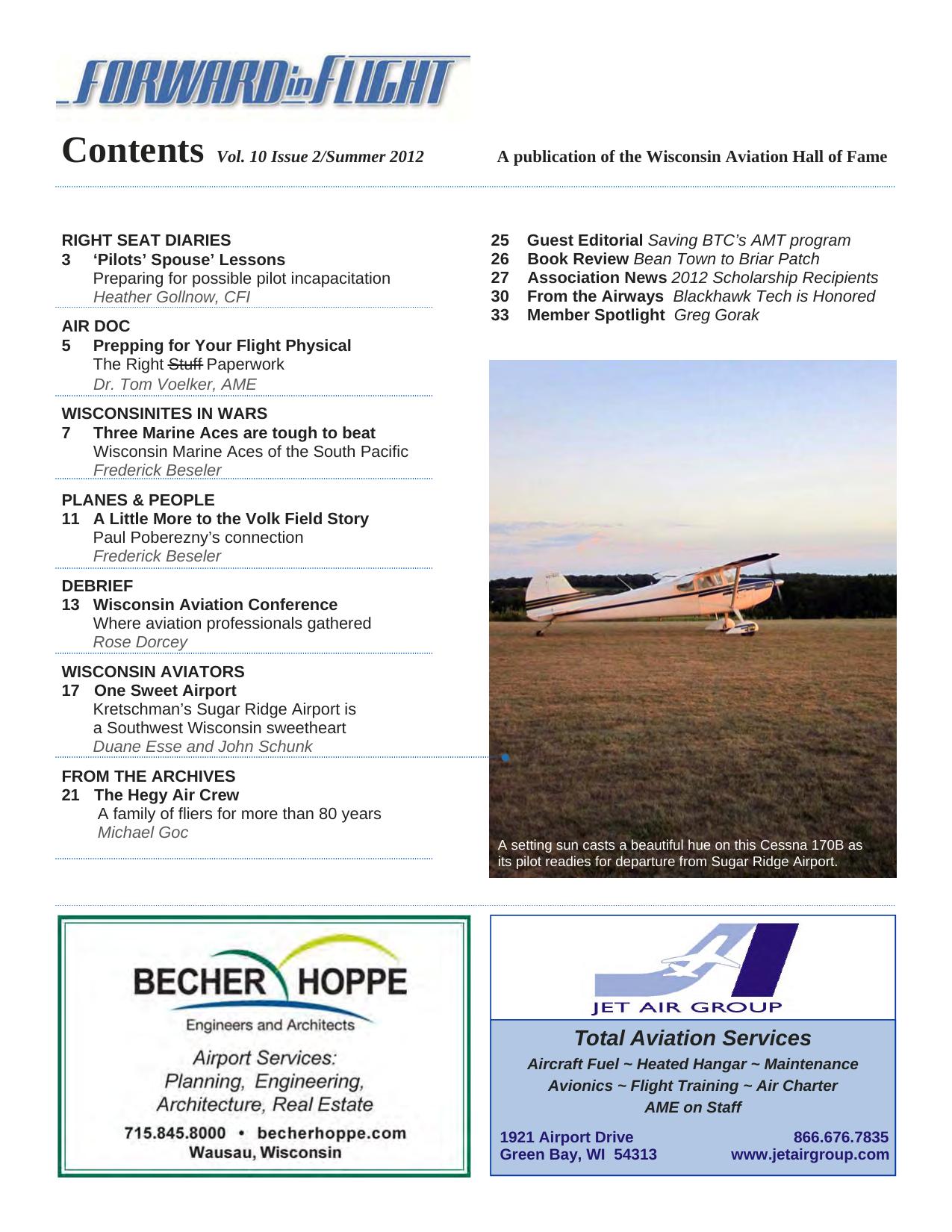
Contents Vol. 10 Issue 2/Summer 2012 RIGHT SEAT DIARIES 3 ‘Pilots’ Spouse’ Lessons Preparing for possible pilot incapacitation Heather Gollnow, CFI AIR DOC 5 Prepping for Your Flight Physical The Right Stuff Paperwork Dr. Tom Voelker, AME A publication of the Wisconsin Aviation Hall of Fame 25 26 27 30 33 Guest Editorial Saving BTC’s AMT program Book Review Bean Town to Briar Patch Association News 2012 Scholarship Recipients From the Airways Blackhawk Tech is Honored Member Spotlight Greg Gorak WISCONSINITES IN WARS 7 Three Marine Aces are tough to beat Wisconsin Marine Aces of the South Pacific Frederick Beseler PLANES & PEOPLE 11 A Little More to the Volk Field Story Paul Poberezny’s connection Frederick Beseler DEBRIEF 13 Wisconsin Aviation Conference Where aviation professionals gathered Rose Dorcey WISCONSIN AVIATORS 17 One Sweet Airport Kretschman’s Sugar Ridge Airport is a Southwest Wisconsin sweetheart Duane Esse and John Schunk FROM THE ARCHIVES 21 The Hegy Air Crew A family of fliers for more than 80 years Michael Goc • A setting sun casts a beautiful hue on this Cessna 170B as its pilot readies for departure from Sugar Ridge Airport. Total Aviation Services Aircraft Fuel ~ Heated Hangar ~ Maintenance Avionics ~ Flight Training ~ Air Charter AME on Staff 1921 Airport Drive Green Bay, WI 54313 866.676.7835 www.jetairgroup.com
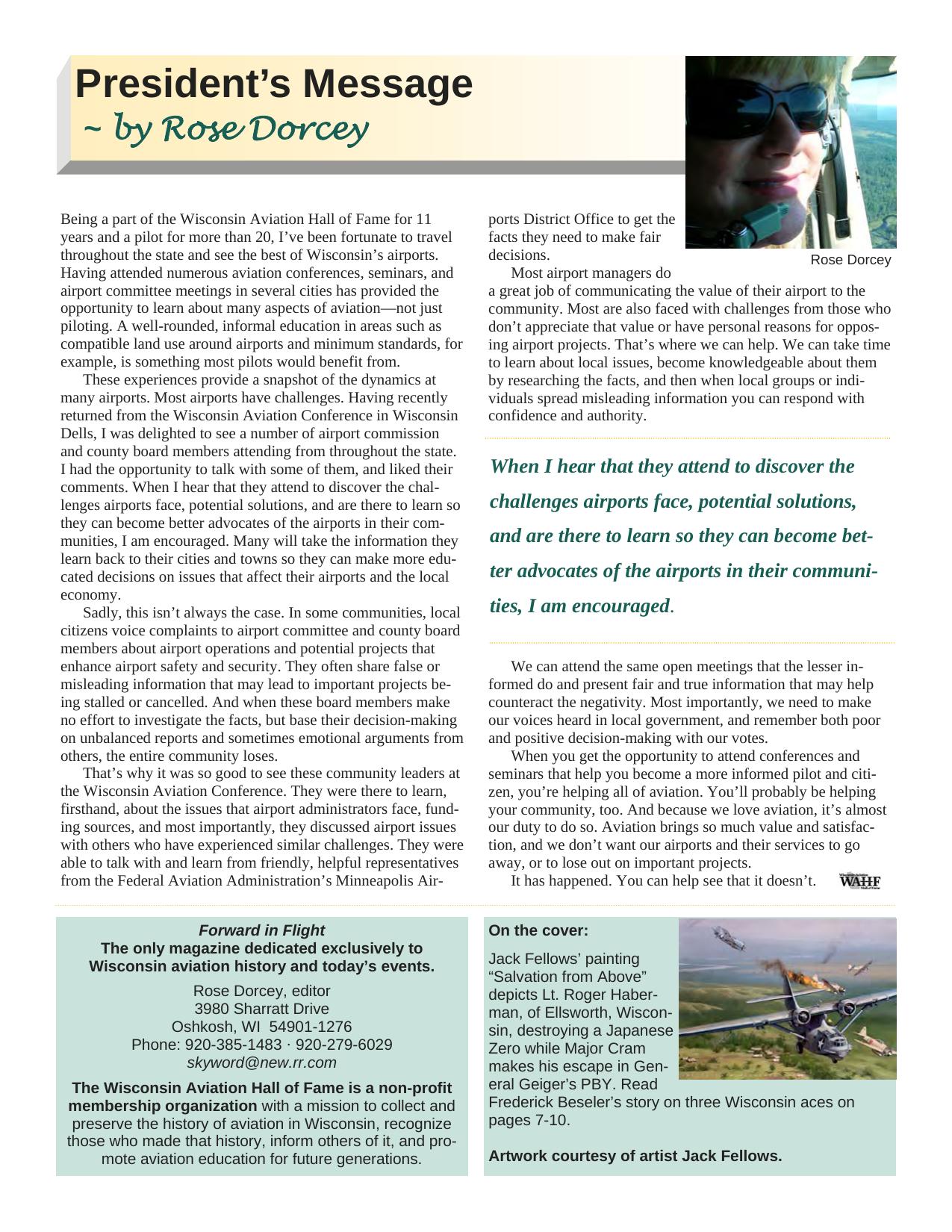
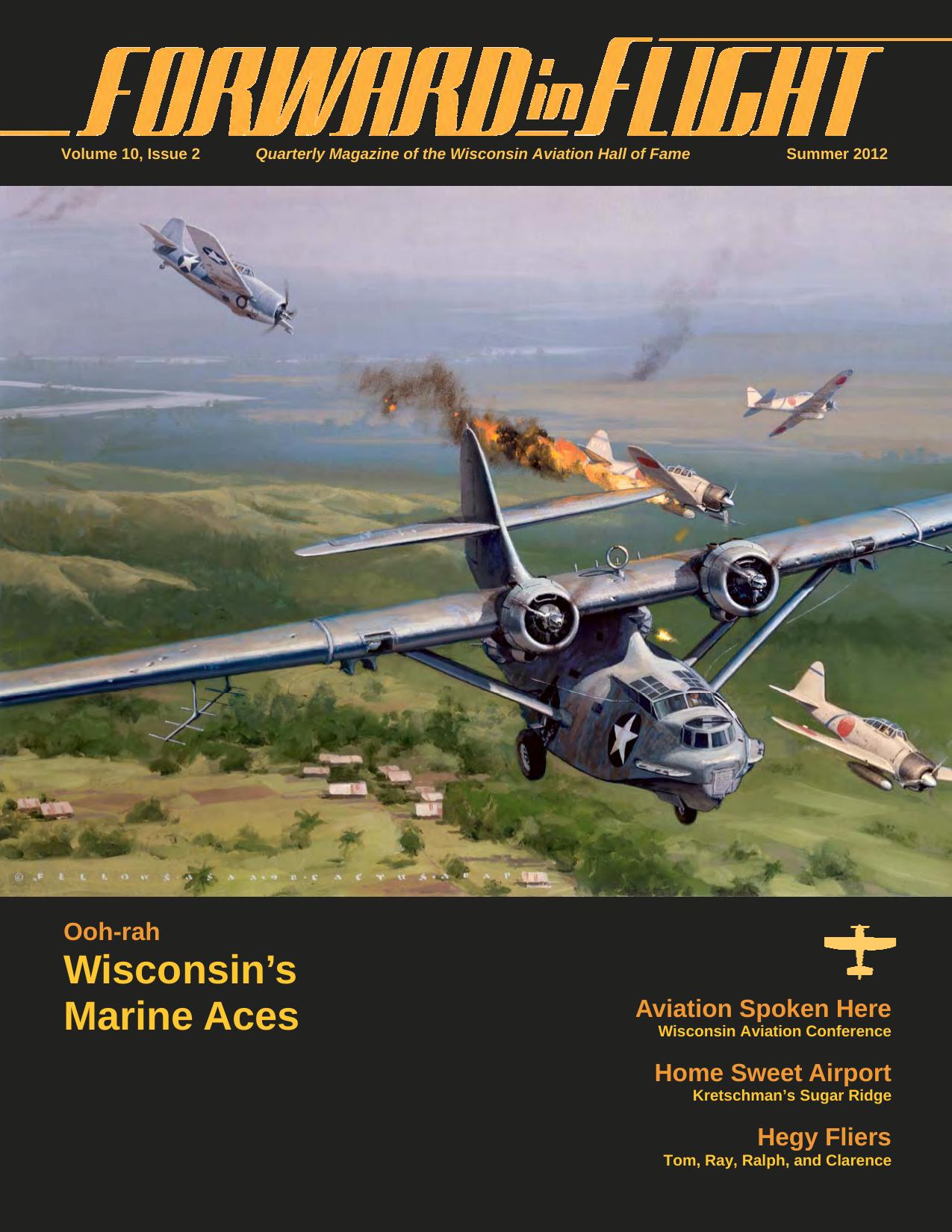
President’s Message ~ by Rose Dorcey Being a part of the Wisconsin Aviation Hall of Fame for 11 years and a pilot for more than 20, I’ve been fortunate to travel throughout the state and see the best of Wisconsin’s airports. Having attended numerous aviation conferences, seminars, and airport committee meetings in several cities has provided the opportunity to learn about many aspects of aviation—not just piloting. A well-rounded, informal education in areas such as compatible land use around airports and minimum standards, for example, is something most pilots would benefit from. These experiences provide a snapshot of the dynamics at many airports. Most airports have challenges. Having recently returned from the Wisconsin Aviation Conference in Wisconsin Dells, I was delighted to see a number of airport commission and county board members attending from throughout the state. I had the opportunity to talk with some of them, and liked their comments. When I hear that they attend to discover the challenges airports face, potential solutions, and are there to learn so they can become better advocates of the airports in their communities, I am encouraged. Many will take the information they learn back to their cities and towns so they can make more educated decisions on issues that affect their airports and the local economy. Sadly, this isn’t always the case. In some communities, local citizens voice complaints to airport committee and county board members about airport operations and potential projects that enhance airport safety and security. They often share false or misleading information that may lead to important projects being stalled or cancelled. And when these board members make no effort to investigate the facts, but base their decision-making on unbalanced reports and sometimes emotional arguments from others, the entire community loses. That’s why it was so good to see these community leaders at the Wisconsin Aviation Conference. They were there to learn, firsthand, about the issues that airport administrators face, funding sources, and most importantly, they discussed airport issues with others who have experienced similar challenges. They were able to talk with and learn from friendly, helpful representatives from the Federal Aviation Administration’s Minneapolis AirForward in Flight The only magazine dedicated exclusively to Wisconsin aviation history and today’s events. Rose Dorcey, editor 3980 Sharratt Drive Oshkosh, WI 54901-1276 Phone: 920-385-1483 · 920-279-6029 skyword@new.rr.com The Wisconsin Aviation Hall of Fame is a non-profit membership organization with a mission to collect and preserve the history of aviation in Wisconsin, recognize those who made that history, inform others of it, and promote aviation education for future generations. ports District Office to get the facts they need to make fair decisions. Rose Dorcey Most airport managers do a great job of communicating the value of their airport to the community. Most are also faced with challenges from those who don’t appreciate that value or have personal reasons for opposing airport projects. That’s where we can help. We can take time to learn about local issues, become knowledgeable about them by researching the facts, and then when local groups or individuals spread misleading information you can respond with confidence and authority. When I hear that they attend to discover the challenges airports face, potential solutions, and are there to learn so they can become better advocates of the airports in their communities, I am encouraged. We can attend the same open meetings that the lesser informed do and present fair and true information that may help counteract the negativity. Most importantly, we need to make our voices heard in local government, and remember both poor and positive decision-making with our votes. When you get the opportunity to attend conferences and seminars that help you become a more informed pilot and citizen, you’re helping all of aviation. You’ll probably be helping your community, too. And because we love aviation, it’s almost our duty to do so. Aviation brings so much value and satisfaction, and we don’t want our airports and their services to go away, or to lose out on important projects. It has happened. You can help see that it doesn’t. On the cover: Jack Fellows’ painting “Salvation from Above” depicts Lt. Roger Haberman, of Ellsworth, Wisconsin, destroying a Japanese Zero while Major Cram makes his escape in General Geiger’s PBY. Read Frederick Beseler’s story on three Wisconsin aces on pages 7-10. Artwork courtesy of artist Jack Fellows.
RIGHT SEAT DIARIES ‘Pilot’s Spouse’ Lessons Preparing for possible pilot incapacitation By Heather Gollnow There has been a lot of buzz recently in the media about pilot incapacitation while flying. Stories of spouses—mainly wives— landing the airplane are all over the place. A quick Google search leads me to several news articles about aircraft accidents in which the pilot became incapacitated. Most recently, a woman landed her husband’s twin-engine Cessna at Door County Cherryland Airport (KSUE) in Sturgeon Bay, Wisconsin, after he had a heart attack in the airplane. Another article gave details on a Cirrus pilot who possibly had hypoxia. After another pilot talked his wife through descent procedures over the radio, the pilot woke up and was able to land the airplane. According to the Aircraft Owners and Pilots Association (AOPA) only .055% of aircraft accidents between 2000 and 2004 involved pilot incapacitation. The number means it is unlikely that pilot incapacitation will happen to you. However, many people will see that number or read these news reports only to see that there is, in fact, a possibility of this happening. I have always suggested that a non-pilot who flies regularly with a pilot should have some basic aeronautical knowledge. One commonality among all the stories I read was that the passenger knew how to use the radio and had some level of knowledge of how the airplane worked. Whether or not these passengers had any sort of formal pilot training, I’m not sure. I am sure that many regular passengers do pick up on several of these skills by simple observation over the years. These skills may kick-in as soon as the passenger finds him or herself in survival mode. Training for pilots’ spouses and frequent-flying friends is essential for peace of mind for the ultimate just-in-case moment. The flight instructor in me always takes over even when I am flying with someone who has no interest in flying. First, I love to share my love of aviation. Second, you never know when a bit of knowledge will help you out in some area of your life. Sometimes, it’s difficult to get someone to fly with you who has no interest in flying. I have many male pilot friends who have wives or girlfriends who have no desire to fly with them. Some are not interested, some may be afraid, and for others it’s just not their “thing”. Hearing these complaints from several pilot friends gave me the idea a few years ago to offer “Pilot’s Wife” lessons. I figured it was a great idea to help involve women more in their loved one’s hobby. Girlfriends and wives could learn a little bit 3 Forward in Flight ~ Quarterly Magazine of the Wisconsin Aviation Hall of Fame about aviation from a female instructor, which may be less intimidating for some women. My intent was to get these women involved just a little bit so that they would not complain about how much money and time their loved one was spending on aviation. I hoped that with a better understanding of what’s going on during the flight, the women would get more enjoyment from the flight. Using what she learned, the pilot could have her help with changing radio frequencies, watching for traffic, spotting the airport, and so on. It was my own little way of helping to keep aviation going by helping other pilots to get support from their spouses. ...you never know when a bit of knowledge will help you out in some area of your life. To be more politically-correct, I now call these types of lessons “Pilot’s Spouse” lessons. Somewhere along the line, I realized I was also in the same boat. Not every boyfriend I have ever had loves aviation. Some have flat-out refused to fly with me. So yes, I have been in the same situation as many of my male counterparts. And I do know that a few lessons for a non-pilot is not always effective in changing their perspective on aviation, but I sure can try! With the recent media attention on
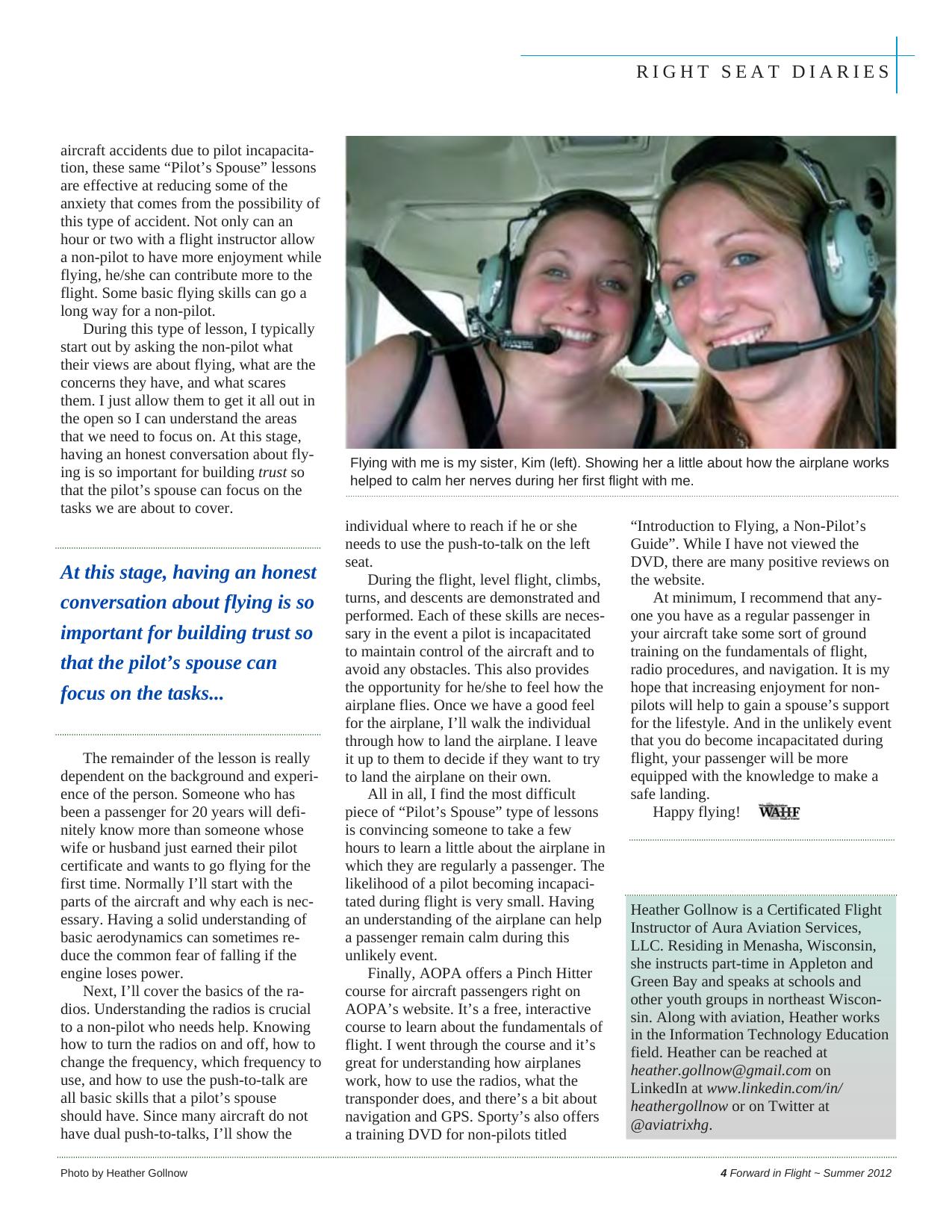
RIGHT SEAT DIARIES aircraft accidents due to pilot incapacitation, these same “Pilot’s Spouse” lessons are effective at reducing some of the anxiety that comes from the possibility of this type of accident. Not only can an hour or two with a flight instructor allow a non-pilot to have more enjoyment while flying, he/she can contribute more to the flight. Some basic flying skills can go a long way for a non-pilot. During this type of lesson, I typically start out by asking the non-pilot what their views are about flying, what are the concerns they have, and what scares them. I just allow them to get it all out in the open so I can understand the areas that we need to focus on. At this stage, having an honest conversation about flying is so important for building trust so that the pilot’s spouse can focus on the tasks we are about to cover. At this stage, having an honest conversation about flying is so important for building trust so that the pilot’s spouse can focus on the tasks... The remainder of the lesson is really dependent on the background and experience of the person. Someone who has been a passenger for 20 years will definitely know more than someone whose wife or husband just earned their pilot certificate and wants to go flying for the first time. Normally I’ll start with the parts of the aircraft and why each is necessary. Having a solid understanding of basic aerodynamics can sometimes reduce the common fear of falling if the engine loses power. Next, I’ll cover the basics of the radios. Understanding the radios is crucial to a non-pilot who needs help. Knowing how to turn the radios on and off, how to change the frequency, which frequency to use, and how to use the push-to-talk are all basic skills that a pilot’s spouse should have. Since many aircraft do not have dual push-to-talks, I’ll show the Photo by Heather Gollnow Flying with me is my sister, Kim (left). Showing her a little about how the airplane works helped to calm her nerves during her first flight with me. individual where to reach if he or she needs to use the push-to-talk on the left seat. During the flight, level flight, climbs, turns, and descents are demonstrated and performed. Each of these skills are necessary in the event a pilot is incapacitated to maintain control of the aircraft and to avoid any obstacles. This also provides the opportunity for he/she to feel how the airplane flies. Once we have a good feel for the airplane, I’ll walk the individual through how to land the airplane. I leave it up to them to decide if they want to try to land the airplane on their own. All in all, I find the most difficult piece of “Pilot’s Spouse” type of lessons is convincing someone to take a few hours to learn a little about the airplane in which they are regularly a passenger. The likelihood of a pilot becoming incapacitated during flight is very small. Having an understanding of the airplane can help a passenger remain calm during this unlikely event. Finally, AOPA offers a Pinch Hitter course for aircraft passengers right on AOPA’s website. It’s a free, interactive course to learn about the fundamentals of flight. I went through the course and it’s great for understanding how airplanes work, how to use the radios, what the transponder does, and there’s a bit about navigation and GPS. Sporty’s also offers a training DVD for non-pilots titled “Introduction to Flying, a Non-Pilot’s Guide”. While I have not viewed the DVD, there are many positive reviews on the website. At minimum, I recommend that anyone you have as a regular passenger in your aircraft take some sort of ground training on the fundamentals of flight, radio procedures, and navigation. It is my hope that increasing enjoyment for nonpilots will help to gain a spouse’s support for the lifestyle. And in the unlikely event that you do become incapacitated during flight, your passenger will be more equipped with the knowledge to make a safe landing. Happy flying! Heather Gollnow is a Certificated Flight Instructor of Aura Aviation Services, LLC. Residing in Menasha, Wisconsin, she instructs part-time in Appleton and Green Bay and speaks at schools and other youth groups in northeast Wisconsin. Along with aviation, Heather works in the Information Technology Education field. Heather can be reached at heather.gollnow@gmail.com on LinkedIn at www.linkedin.com/in/ heathergollnow or on Twitter at @aviatrixhg. 4 Forward in Flight ~ Summer 2012
AIR DOC Prepping for your flight physical The Right Stuff Paperwork Dr. Tom Voelker, AME DrAlphaMike@yahoo.com Hello again, airmen! It’s great to be back with you, even if it is four o’clock in the morning! The full moon is playing tricks on me. Two nights ago the “super moon” was showing in its full glory. The problem was that we were in cloudy Wisconsin, and the spectacular sight was quite literally “out of sight.” Then came last night. The darn whip-poor-will was crooning all night long! I like its bold but brief heralding call—but not all night long. I have often heard the repetitive call for 20 or 30 minutes, but last night it didn’t stop. That prompted me to investigate. It turns out the nocturnal bird only sings at dusk or dawn—or when the sky is bright from a full moon. Remember the super moon the night before? That’s right, the moon was full. At least I learned something. And since it is four o’clock, I may as well get on with this issue’s column. In a way, the song of the whip-poorwill, just three syllables that repeat on and on, reminds me of the approach some airmen have to the flight physical. They come back every year (commercial pilots) or two, and simply plod through the motions to once again get the little white piece of paper that allows them to fly. I do understand this mindset, especially in young, healthy people. But occasionally this attitude comes with an airman who has significant health problems, often new problems since his or her last medical. The airman shows up with a MedXPress form that dutifully reports the new condition, but little or no thought has gone into the possibility that the new condition might limit his ability to fly, or might disqualify him altogether. I would like to give you a couple of real-life examples of these cases that I have seen in the past year. The most common certification problem I run into is hypertension, or high blood pressure. This is one condition that almost never limits one’s ability to fly... The most common certification problem I run into is hypertension, or high blood pressure. This is one condition that almost never limits one’s ability to fly, but if everything is not in order, the certification process is a cumbersome one. And the FAA has gone out of its way to make the process simple. If the airman follows protocol, I can easily issue the medical at the time of the physical. If the “Ts” are not crossed, however, it can be a big problem. 5 Forward in Flight ~ Quarterly Magazine of the Wisconsin Aviation Hall of Fame The FAA allows a blood pressure on an exam of up to 155/95. Any doctor would tell you this is much too high for good health. (The newest guidelines suggest a blood pressure of no more than 130/80.) You need to remember that the FAA is interested in your health only for the duration of your certificate. If you have a stroke four years after your flight physical, while you are sitting in your living room, the FAA has not failed in its responsibility to keep our airspace safe. On the other hand, if you show up for your exam with a terrific blood pressure of 120/70, controlled with medications, but no report from your treating doctor, I will not be able to issue you a medical certificate. If this happens, as it often does, we have three choices. First, the AME could simply defer the exam to the FAA in Oklahoma City. This is the worst choice, both for the FAA and the airman. The reviewing flight surgeons in OKC will need to spend quite a bit of time on your application, when we could have had everything in order in the first place. If your application is sent to OKC for a decision, expect about a three month delay in getting your certificate. The AME has only two weeks to submit the flight physical from the date it is done. (Only one week for a student pilot applicant.) If we haven’t completed one of the other two choices listed below by then, off to Oklahoma it goes, and you don’t fly for awhile.
AIR DOC The second choice, and one that works fairly well most of the time, is to get a report from the doctor who is treating your hypertension. This could be a copy of the progress note from your most recent appointment. It will need to mention what your blood pressure was, how well in general the blood pressure is controlled, any medications taken, and the lack of side effects from the medication. Also, some meds, such as diuretics, will require a potassium and kidney blood test as well. And if the diagnosis of hypertension is new since your last flight physical, you will also need a “cardiovascular evaluation,” consisting of an EKG, a fasting cholesterol panel, a review of your cardiac risk factors, and possibly a cardiac stress test. All of this is a part of a good checkup anyway, so it shouldn’t be too onerous. The other limitation to this approach, however, is that the checkup by your doctor needs to be within six months of the flight physical. What should this pilot have done to facilitate his flight physical? The best answer is to call the AME ahead of time. The final choice, and one which is often selected by default so that the airman can “just get the darn certificate,” is to have your AME, if willing, play the role of your treating doctor and perform the hypertension checkup himself. I often do this for an airman, but it does involve scheduling a second visit just for the hypertension check. I also need to check the blood tests. If you select this route, know ahead of time that there will be another charge for this “checkup,” just as if you were a non-pilot coming in for a refill of your blood pressure medications. This approach also tends to be inconvenient for the AME if he or she has a busy practice, as this extra appointment needs to be scheduled on very short notice. I usually need to “make up” an appointment for the airman, fitting him or her into a slot that doesn’t exist. The best solution is to see your own doctor a couple of months before your flight physical is due, and to bring the appropriate records to the flight physical appointment. Another interesting case I handled a few months ago involved an airman who had glaucoma. This is a condition in which the pressure in the front of the eye is increased. It can lead to several visual conditions, but the most concerning from an aeromedical standpoint is the development of “blind spots.” See and avoid only works if you can do the “see” part first! This airman had previously reported his glaucoma, and he had gone through extensive testing before being given a special issuance, issued only by the flight surgeons at the FAA. He dutifully brought in the comprehensive examination report from his eye doctor, along with the letter from the FAA that authorizes me to issue the medical certificate (if certain conditions are met). Everything was in order, except… “And by the way, doc, I’ve been diagnosed with prostate cancer. Will that affect my ability to get a medical?” If you look back to the three options I had with the hypertensive pilot in our first example, I bet you can guess what I did. He did have some records from the diagnosis and treatment of his prostate cancer, but clearly not everything that the FAA would require. This one was easy. I completed the exam portion of the flight physical form (in AME circles, the 85008), and deferred the application. This airman is still waiting to hear from the FAA. I am sure they will need more detailed records from his treating doctors before they can make their decision. Cancer, any cancer, is disqualifying for flight. That might sound harsh, but it’s true. I’m sure many of you have had minor skin cancers and have been fine ever since. If I saw you for a flight physical and you reported removal of a small skin cancer a few years ago, I would make a quick call to the Regional Flight Surgeon’s office in Des Plaines and get you approved on the spot. But I would not be able to make that determination by myself. Cancer is certainly one of those conditions that can cause “sudden incapacitation” (from massive bleeding in the case of colon cancer, or from a seizure caused by brain metastases in the case of melanoma or our friend with prostate cancer), the very condition we AMEs and the FAA aeromedical division are trying to eliminate from the cockpit. What should this pilot have done to facilitate his flight physical? The best answer is to call the AME ahead of time. We can usually suggest a fairly complete list of the medical records the FAA will want to review, and if all of those are brought in, your AME can help expedite the process. I also would have told the airman that he could expect me to defer his exam to the FAA, and would have averted the sudden disappointment I was obliged to impose on him. In fact, whenever you have any questions about medical certification, especially as it relates to a health condition you have, the first and best step is to call your AME. As I wrap up this article, I must relate one last connection to the moon. Two nights after the whip-poor-will encounter (and with an intervening good night’s sleep – we don’t want to fly when we are overly tired!) I flew to Middleton Municipal-Morey Field Airport (C29) to pick up my daughter for a quick visit. The moon was still nearly full, the stars were brilliant, and it was an absolutely glorious flight. We aviators have the privilege of viewing the world from a perspective that others can only imagine. The next time I hear that birdsong, I’ll lie awake smiling, recalling my flight and the stunning moon—even if the chant goes on all night! Here’s to a clear sky and cool, quiet nights! —Alpha Mike Echo In “real” life, Alpha Mike Echo is Dr. Tom Voelker, AME, a family practitioner in Wisconsin Rapids. He and his wife, Kathy, are the parents of four daughters. Tom flies N6224P, a Comanche 250, out of Alexander Field, South Wood County Airport (ISW). 6 Forward in Flight ~ Summer 2012
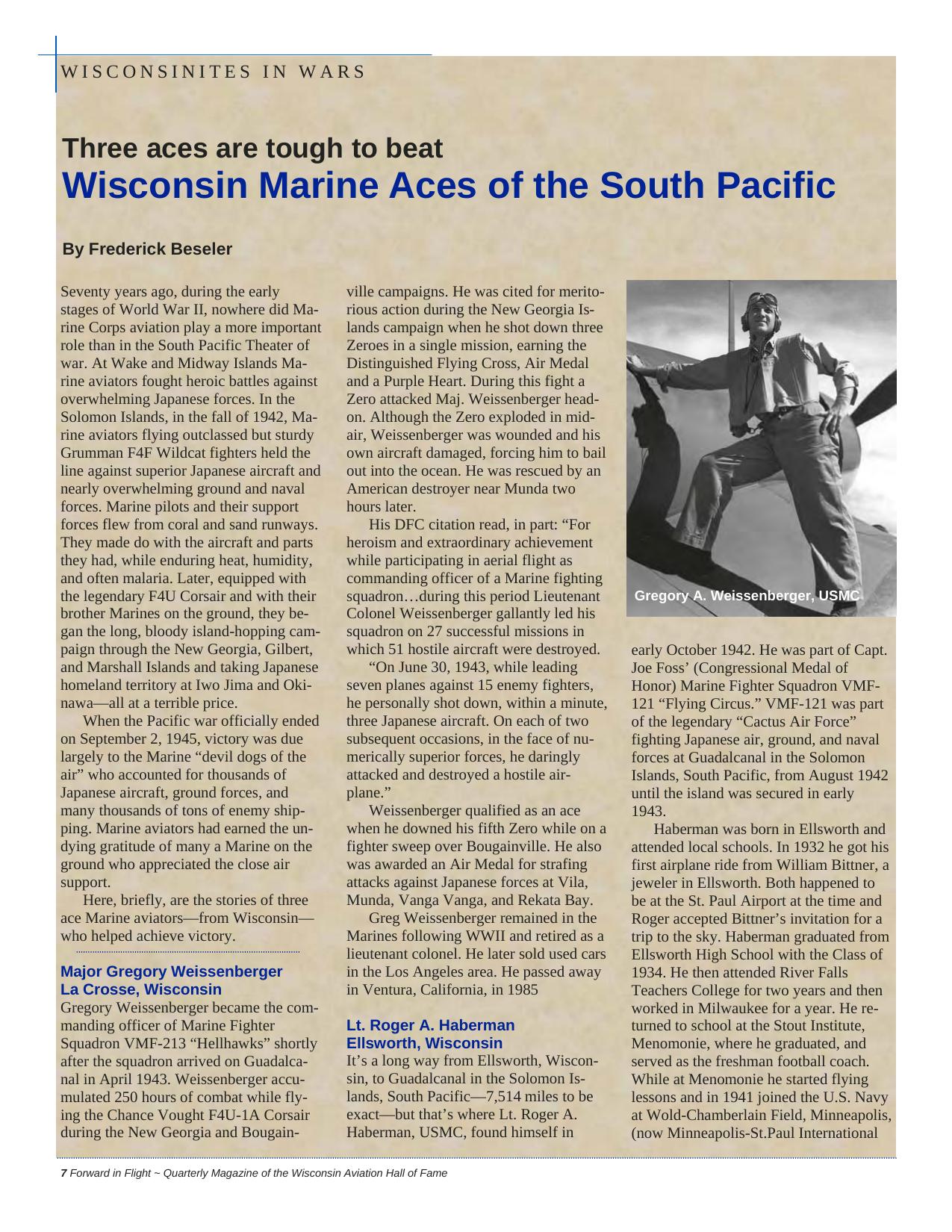
WISCONSINITES IN WARS Three aces are tough to beat Wisconsin Marine Aces of the South Pacific By Frederick Beseler Seventy years ago, during the early stages of World War II, nowhere did Marine Corps aviation play a more important role than in the South Pacific Theater of war. At Wake and Midway Islands Marine aviators fought heroic battles against overwhelming Japanese forces. In the Solomon Islands, in the fall of 1942, Marine aviators flying outclassed but sturdy Grumman F4F Wildcat fighters held the line against superior Japanese aircraft and nearly overwhelming ground and naval forces. Marine pilots and their support forces flew from coral and sand runways. They made do with the aircraft and parts they had, while enduring heat, humidity, and often malaria. Later, equipped with the legendary F4U Corsair and with their brother Marines on the ground, they began the long, bloody island-hopping campaign through the New Georgia, Gilbert, and Marshall Islands and taking Japanese homeland territory at Iwo Jima and Okinawa—all at a terrible price. When the Pacific war officially ended on September 2, 1945, victory was due largely to the Marine “devil dogs of the air” who accounted for thousands of Japanese aircraft, ground forces, and many thousands of tons of enemy shipping. Marine aviators had earned the undying gratitude of many a Marine on the ground who appreciated the close air support. Here, briefly, are the stories of three ace Marine aviators—from Wisconsin— who helped achieve victory. Major Gregory Weissenberger La Crosse, Wisconsin Gregory Weissenberger became the commanding officer of Marine Fighter Squadron VMF-213 “Hellhawks” shortly after the squadron arrived on Guadalcanal in April 1943. Weissenberger accumulated 250 hours of combat while flying the Chance Vought F4U-1A Corsair during the New Georgia and Bougain- ville campaigns. He was cited for meritorious action during the New Georgia Islands campaign when he shot down three Zeroes in a single mission, earning the Distinguished Flying Cross, Air Medal and a Purple Heart. During this fight a Zero attacked Maj. Weissenberger headon. Although the Zero exploded in midair, Weissenberger was wounded and his own aircraft damaged, forcing him to bail out into the ocean. He was rescued by an American destroyer near Munda two hours later. His DFC citation read, in part: “For heroism and extraordinary achievement while participating in aerial flight as commanding officer of a Marine fighting squadron…during this period Lieutenant Colonel Weissenberger gallantly led his squadron on 27 successful missions in which 51 hostile aircraft were destroyed. “On June 30, 1943, while leading seven planes against 15 enemy fighters, he personally shot down, within a minute, three Japanese aircraft. On each of two subsequent occasions, in the face of numerically superior forces, he daringly attacked and destroyed a hostile airplane.” Weissenberger qualified as an ace when he downed his fifth Zero while on a fighter sweep over Bougainville. He also was awarded an Air Medal for strafing attacks against Japanese forces at Vila, Munda, Vanga Vanga, and Rekata Bay. Greg Weissenberger remained in the Marines following WWII and retired as a lieutenant colonel. He later sold used cars in the Los Angeles area. He passed away in Ventura, California, in 1985 Lt. Roger A. Haberman Ellsworth, Wisconsin It’s a long way from Ellsworth, Wisconsin, to Guadalcanal in the Solomon Islands, South Pacific—7,514 miles to be exact—but that’s where Lt. Roger A. Haberman, USMC, found himself in 7 Forward in Flight ~ Quarterly Magazine of the Wisconsin Aviation Hall of Fame Gregory A. Weissenberger, USMC early October 1942. He was part of Capt. Joe Foss’ (Congressional Medal of Honor) Marine Fighter Squadron VMF121 “Flying Circus.” VMF-121 was part of the legendary “Cactus Air Force” fighting Japanese air, ground, and naval forces at Guadalcanal in the Solomon Islands, South Pacific, from August 1942 until the island was secured in early 1943. Haberman was born in Ellsworth and attended local schools. In 1932 he got his first airplane ride from William Bittner, a jeweler in Ellsworth. Both happened to be at the St. Paul Airport at the time and Roger accepted Bittner’s invitation for a trip to the sky. Haberman graduated from Ellsworth High School with the Class of 1934. He then attended River Falls Teachers College for two years and then worked in Milwaukee for a year. He returned to school at the Stout Institute, Menomonie, where he graduated, and served as the freshman football coach. While at Menomonie he started flying lessons and in 1941 joined the U.S. Navy at Wold-Chamberlain Field, Minneapolis, (now Minneapolis-St.Paul International
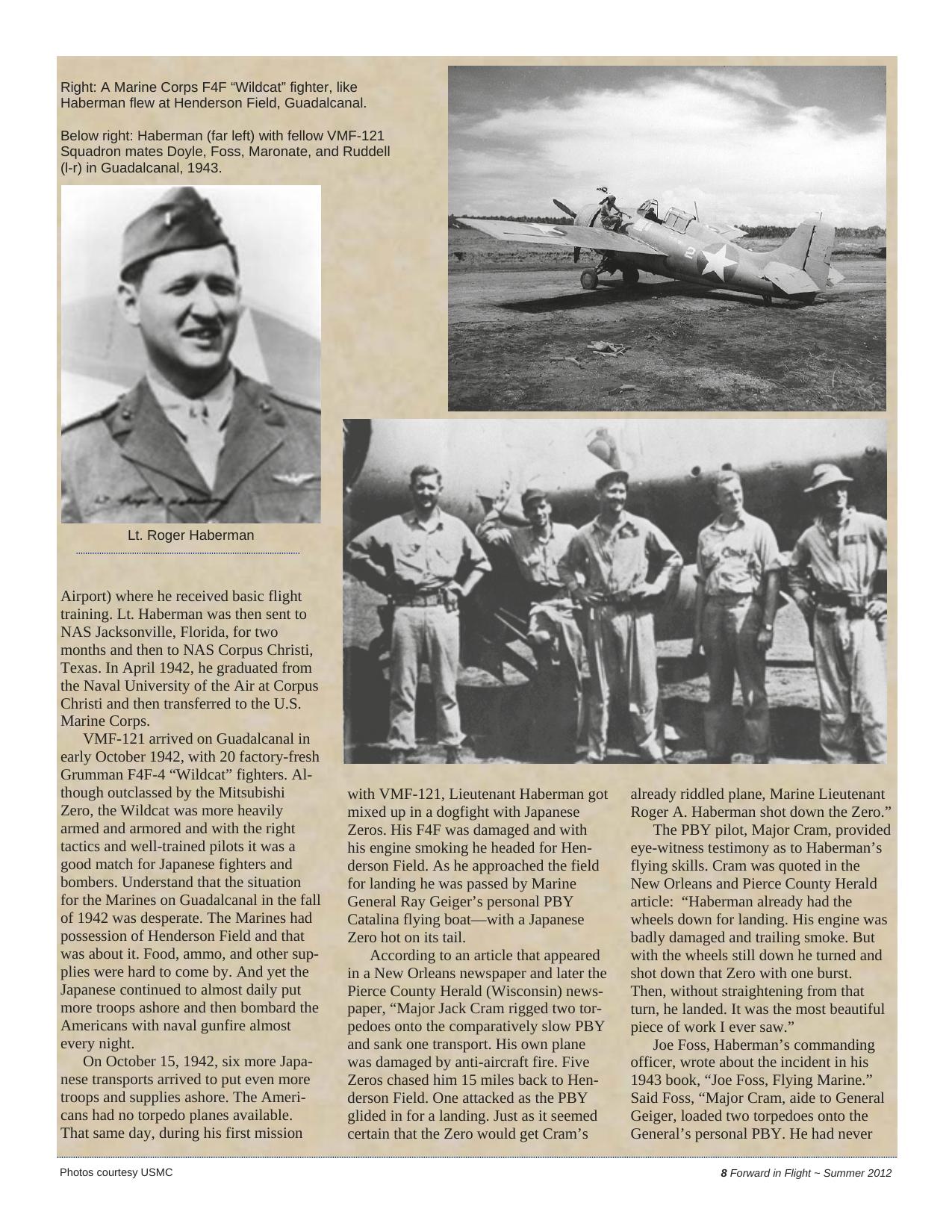
Right: A Marine Corps F4F “Wildcat” fighter, like Haberman flew at Henderson Field, Guadalcanal. Below right: Haberman (far left) with fellow VMF-121 Squadron mates Doyle, Foss, Maronate, and Ruddell (l-r) in Guadalcanal, 1943. Lt. Roger Haberman Airport) where he received basic flight training. Lt. Haberman was then sent to NAS Jacksonville, Florida, for two months and then to NAS Corpus Christi, Texas. In April 1942, he graduated from the Naval University of the Air at Corpus Christi and then transferred to the U.S. Marine Corps. VMF-121 arrived on Guadalcanal in early October 1942, with 20 factory-fresh Grumman F4F-4 “Wildcat” fighters. Although outclassed by the Mitsubishi Zero, the Wildcat was more heavily armed and armored and with the right tactics and well-trained pilots it was a good match for Japanese fighters and bombers. Understand that the situation for the Marines on Guadalcanal in the fall of 1942 was desperate. The Marines had possession of Henderson Field and that was about it. Food, ammo, and other supplies were hard to come by. And yet the Japanese continued to almost daily put more troops ashore and then bombard the Americans with naval gunfire almost every night. On October 15, 1942, six more Japanese transports arrived to put even more troops and supplies ashore. The Americans had no torpedo planes available. That same day, during his first mission Photos courtesy USMC with VMF-121, Lieutenant Haberman got mixed up in a dogfight with Japanese Zeros. His F4F was damaged and with his engine smoking he headed for Henderson Field. As he approached the field for landing he was passed by Marine General Ray Geiger’s personal PBY Catalina flying boat—with a Japanese Zero hot on its tail. According to an article that appeared in a New Orleans newspaper and later the Pierce County Herald (Wisconsin) newspaper, “Major Jack Cram rigged two torpedoes onto the comparatively slow PBY and sank one transport. His own plane was damaged by anti-aircraft fire. Five Zeros chased him 15 miles back to Henderson Field. One attacked as the PBY glided in for a landing. Just as it seemed certain that the Zero would get Cram’s already riddled plane, Marine Lieutenant Roger A. Haberman shot down the Zero.” The PBY pilot, Major Cram, provided eye-witness testimony as to Haberman’s flying skills. Cram was quoted in the New Orleans and Pierce County Herald article: “Haberman already had the wheels down for landing. His engine was badly damaged and trailing smoke. But with the wheels still down he turned and shot down that Zero with one burst. Then, without straightening from that turn, he landed. It was the most beautiful piece of work I ever saw.” Joe Foss, Haberman’s commanding officer, wrote about the incident in his 1943 book, “Joe Foss, Flying Marine.” Said Foss, “Major Cram, aide to General Geiger, loaded two torpedoes onto the General’s personal PBY. He had never 8 Forward in Flight ~ Summer 2012
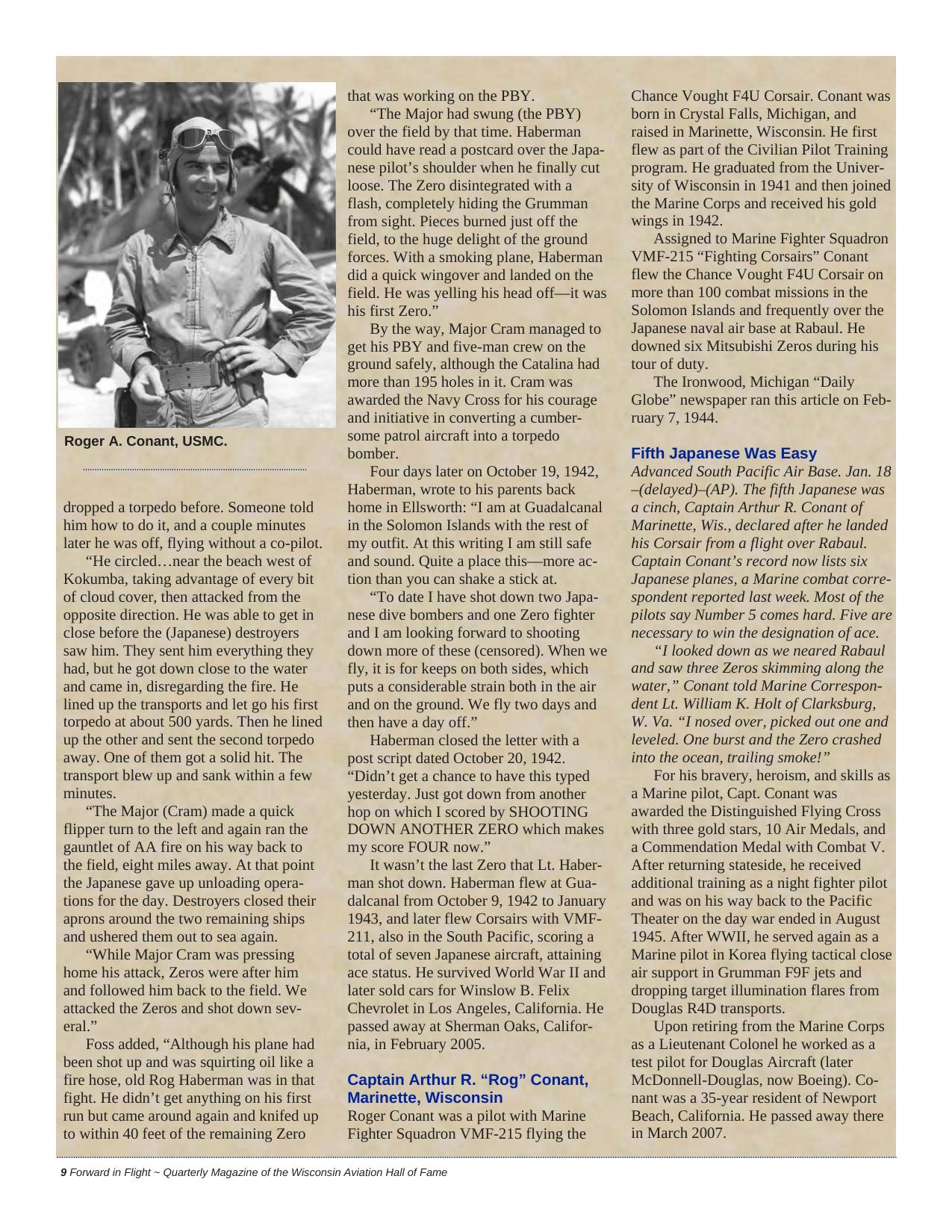
Roger A. Conant, USMC. dropped a torpedo before. Someone told him how to do it, and a couple minutes later he was off, flying without a co-pilot. “He circled…near the beach west of Kokumba, taking advantage of every bit of cloud cover, then attacked from the opposite direction. He was able to get in close before the (Japanese) destroyers saw him. They sent him everything they had, but he got down close to the water and came in, disregarding the fire. He lined up the transports and let go his first torpedo at about 500 yards. Then he lined up the other and sent the second torpedo away. One of them got a solid hit. The transport blew up and sank within a few minutes. “The Major (Cram) made a quick flipper turn to the left and again ran the gauntlet of AA fire on his way back to the field, eight miles away. At that point the Japanese gave up unloading operations for the day. Destroyers closed their aprons around the two remaining ships and ushered them out to sea again. “While Major Cram was pressing home his attack, Zeros were after him and followed him back to the field. We attacked the Zeros and shot down several.” Foss added, “Although his plane had been shot up and was squirting oil like a fire hose, old Rog Haberman was in that fight. He didn’t get anything on his first run but came around again and knifed up to within 40 feet of the remaining Zero that was working on the PBY. “The Major had swung (the PBY) over the field by that time. Haberman could have read a postcard over the Japanese pilot’s shoulder when he finally cut loose. The Zero disintegrated with a flash, completely hiding the Grumman from sight. Pieces burned just off the field, to the huge delight of the ground forces. With a smoking plane, Haberman did a quick wingover and landed on the field. He was yelling his head off—it was his first Zero.” By the way, Major Cram managed to get his PBY and five-man crew on the ground safely, although the Catalina had more than 195 holes in it. Cram was awarded the Navy Cross for his courage and initiative in converting a cumbersome patrol aircraft into a torpedo bomber. Four days later on October 19, 1942, Haberman, wrote to his parents back home in Ellsworth: “I am at Guadalcanal in the Solomon Islands with the rest of my outfit. At this writing I am still safe and sound. Quite a place this—more action than you can shake a stick at. “To date I have shot down two Japanese dive bombers and one Zero fighter and I am looking forward to shooting down more of these (censored). When we fly, it is for keeps on both sides, which puts a considerable strain both in the air and on the ground. We fly two days and then have a day off.” Haberman closed the letter with a post script dated October 20, 1942. “Didn’t get a chance to have this typed yesterday. Just got down from another hop on which I scored by SHOOTING DOWN ANOTHER ZERO which makes my score FOUR now.” It wasn’t the last Zero that Lt. Haberman shot down. Haberman flew at Guadalcanal from October 9, 1942 to January 1943, and later flew Corsairs with VMF211, also in the South Pacific, scoring a total of seven Japanese aircraft, attaining ace status. He survived World War II and later sold cars for Winslow B. Felix Chevrolet in Los Angeles, California. He passed away at Sherman Oaks, California, in February 2005. Captain Arthur R. “Rog” Conant, Marinette, Wisconsin Roger Conant was a pilot with Marine Fighter Squadron VMF-215 flying the 9 Forward in Flight ~ Quarterly Magazine of the Wisconsin Aviation Hall of Fame Chance Vought F4U Corsair. Conant was born in Crystal Falls, Michigan, and raised in Marinette, Wisconsin. He first flew as part of the Civilian Pilot Training program. He graduated from the University of Wisconsin in 1941 and then joined the Marine Corps and received his gold wings in 1942. Assigned to Marine Fighter Squadron VMF-215 “Fighting Corsairs” Conant flew the Chance Vought F4U Corsair on more than 100 combat missions in the Solomon Islands and frequently over the Japanese naval air base at Rabaul. He downed six Mitsubishi Zeros during his tour of duty. The Ironwood, Michigan “Daily Globe” newspaper ran this article on February 7, 1944. Fifth Japanese Was Easy Advanced South Pacific Air Base. Jan. 18 –(delayed)–(AP). The fifth Japanese was a cinch, Captain Arthur R. Conant of Marinette, Wis., declared after he landed his Corsair from a flight over Rabaul. Captain Conant’s record now lists six Japanese planes, a Marine combat correspondent reported last week. Most of the pilots say Number 5 comes hard. Five are necessary to win the designation of ace. “I looked down as we neared Rabaul and saw three Zeros skimming along the water,” Conant told Marine Correspondent Lt. William K. Holt of Clarksburg, W. Va. “I nosed over, picked out one and leveled. One burst and the Zero crashed into the ocean, trailing smoke!” For his bravery, heroism, and skills as a Marine pilot, Capt. Conant was awarded the Distinguished Flying Cross with three gold stars, 10 Air Medals, and a Commendation Medal with Combat V. After returning stateside, he received additional training as a night fighter pilot and was on his way back to the Pacific Theater on the day war ended in August 1945. After WWII, he served again as a Marine pilot in Korea flying tactical close air support in Grumman F9F jets and dropping target illumination flares from Douglas R4D transports. Upon retiring from the Marine Corps as a Lieutenant Colonel he worked as a test pilot for Douglas Aircraft (later McDonnell-Douglas, now Boeing). Conant was a 35-year resident of Newport Beach, California. He passed away there in March 2007.
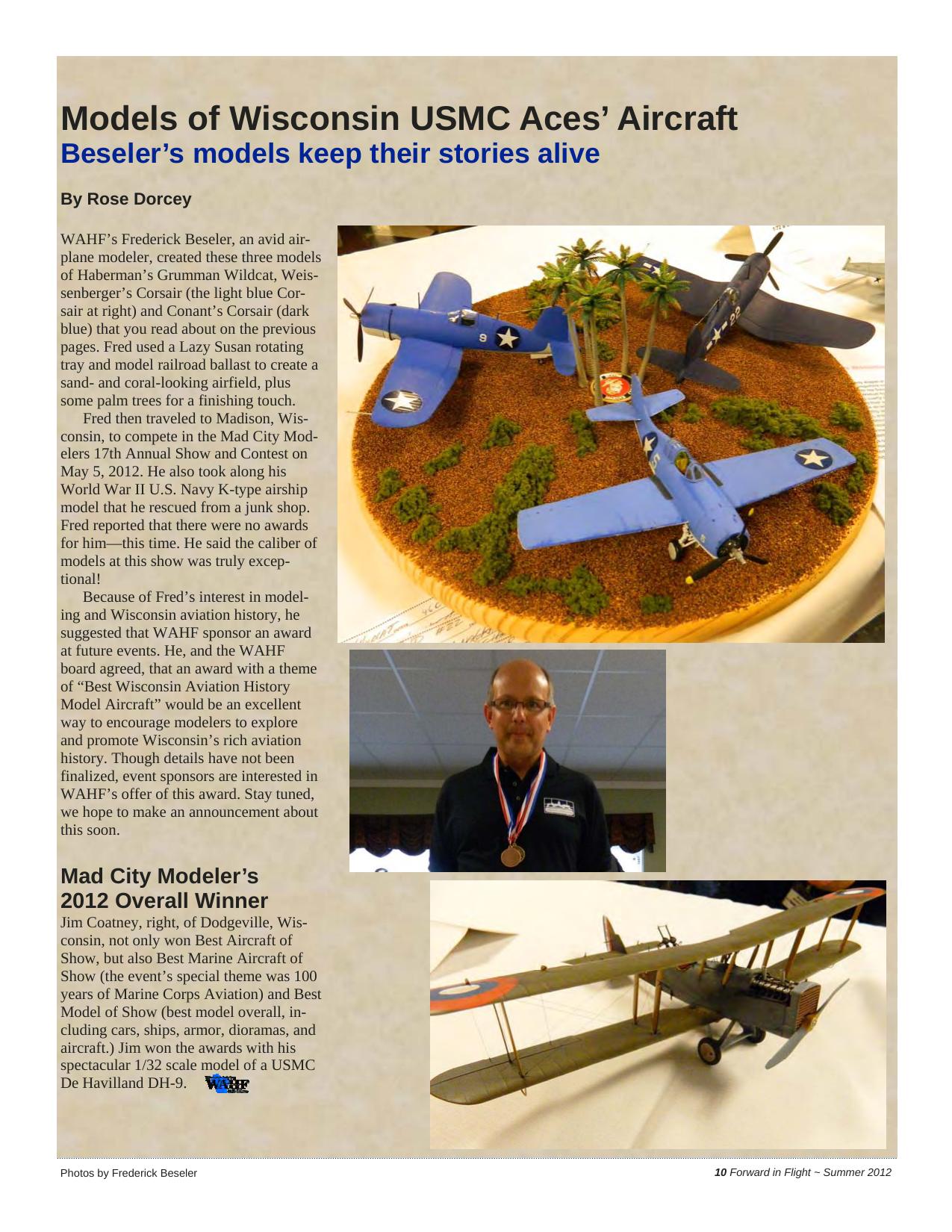
Models of Wisconsin USMC Aces’ Aircraft Beseler’s models keep their stories alive By Rose Dorcey WAHF’s Frederick Beseler, an avid airplane modeler, created these three models of Haberman’s Grumman Wildcat, Weissenberger’s Corsair (the light blue Corsair at right) and Conant’s Corsair (dark blue) that you read about on the previous pages. Fred used a Lazy Susan rotating tray and model railroad ballast to create a sand- and coral-looking airfield, plus some palm trees for a finishing touch. Fred then traveled to Madison, Wisconsin, to compete in the Mad City Modelers 17th Annual Show and Contest on May 5, 2012. He also took along his World War II U.S. Navy K-type airship model that he rescued from a junk shop. Fred reported that there were no awards for him—this time. He said the caliber of models at this show was truly exceptional! Because of Fred’s interest in modeling and Wisconsin aviation history, he suggested that WAHF sponsor an award at future events. He, and the WAHF board agreed, that an award with a theme of “Best Wisconsin Aviation History Model Aircraft” would be an excellent way to encourage modelers to explore and promote Wisconsin’s rich aviation history. Though details have not been finalized, event sponsors are interested in WAHF’s offer of this award. Stay tuned, we hope to make an announcement about this soon. Mad City Modeler’s 2012 Overall Winner Jim Coatney, right, of Dodgeville, Wisconsin, not only won Best Aircraft of Show, but also Best Marine Aircraft of Show (the event’s special theme was 100 years of Marine Corps Aviation) and Best Model of Show (best model overall, including cars, ships, armor, dioramas, and aircraft.) Jim won the awards with his spectacular 1/32 scale model of a USMC De Havilland DH-9. Photos by Frederick Beseler 10 Forward in Flight ~ Summer 2012
PLANES & PEOPLE A Little More to the Volk Field Story Paul Poberezny’s connection By Frederick Beseler It’s always gratifying for a writer to know your articles are being read. In the Winter 2011 issue of Forward in Flight I produced a short photo article about the airplanes on static display at Volk Field at the Wisconsin Air National Guard Air Readiness Training Center at Camp Douglas, Wisconsin. It was a thrill to learn that EAA Founder Paul Poberezny read my article. Via a recent phone interview he offered some of his recollections of the time he spent at Volk Field and Camp Douglas as an Army aviator with the 32nd Infantry Division, Wisconsin National Guard, and later with the Wisconsin Air National Guard. Closing in on 91 years of age, Paul recalls those days with all the clarity and precision you would expect of an experienced aviator. With the outbreak of World War II, Paul applied to the U.S. Army Air Corps but since he did not have college experience, he was turned away. He then applied for and was accepted into the War Training Service Program. Paul qualified as a glider pilot and then became an instructor at the Army’s Primary Flying School in Helena, Arkansas. After a year he became a pilot with Air Transport Command, ferrying a variety of aircraft including fighters like the P-39, P-63, P47, and P-51. In the spring of 1945, Paul was assigned to Palm Springs, California, where he was checked out in C-47 transports with the expectation that he would be sent to the China-Burma-India Theater of the war. However, the war ended before he was sent overseas. After discharge from the Army, Paul returned to Milwaukee and continued his involvement in civilian aviation. He and Dale Crites each bought a war surplus Stearman. Paul later traded his for a Vultee BT-13 and also flew numerous hours in a J-3 Cub and other light planes. And in October 1946, Paul and his wife, Audrey, celebrated the arrival of their first child, Tom. In November 1946, Paul wisely converted his wartime commission as a flight officer and service pilot to a commission in the Reserve Officer’s Corps, Air Corps, U.S. Army. In the fall of 1947, shortly after the United States Air Force was created, Paul joined the Wisconsin Air National Guard—as a staff sergeant and full-time aircraft mechanic. In his book, Poberezny: The Story Begins (1996, Red One Publishing, Oshkosh) Paul said, “We were just beginning to receive our allotment of 22 P-51D Mustangs and would later have a C-47, B-26, and several T-6s. Having flown all these planes during the war, it was heartbreaking for me to be preparing them for other officers, knowing I had so much more flying experience and hours than many of them!” Although Paul was working as a mechanic for the WisANG, to maintain his reserve pilot status with the U.S. Air Force he was required to take periodic 11 Forward in Flight ~ Quarterly Magazine of the Wisconsin Aviation Hall of Fame check rides in a T-6. When the Air Force looked over Paul’s records and flight experience, they skipped the check ride and Paul was commissioned a 2nd Lieutenant in the USAF Reserves and re-rated from Service Pilot to Pilot (his third set of military aviator wings). Not long after the Wisconsin National Guard’s 32nd Division formed a Light Aviation Division and needed somebody to head up the organization, which had been assigned two Navion L-17s and 14 L-16 liaison aircraft. With his maintenance background and flying experience—especially with light aircraft— Paul was the perfect candidate. Paul said, “We did artillery spotting work. I was the only fulltime pilot with the unit and as the maintenance base was to be at Camp Douglas, I thought I would have to move there.” Paul added that since he and Audrey were living with Audrey’s mother in Milwaukee this became an important consideration. They took a drive up to Camp Douglas and while it is a fine village, it
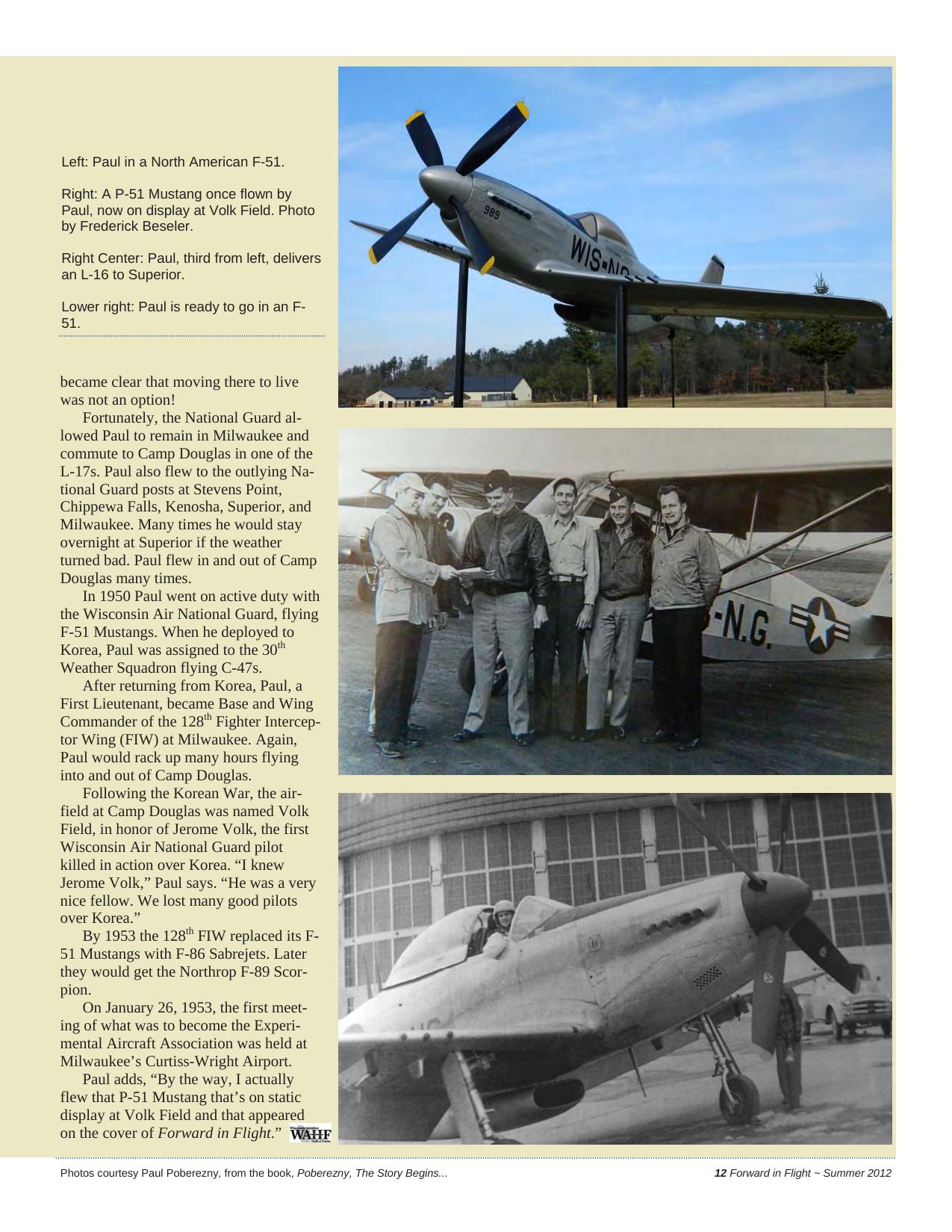
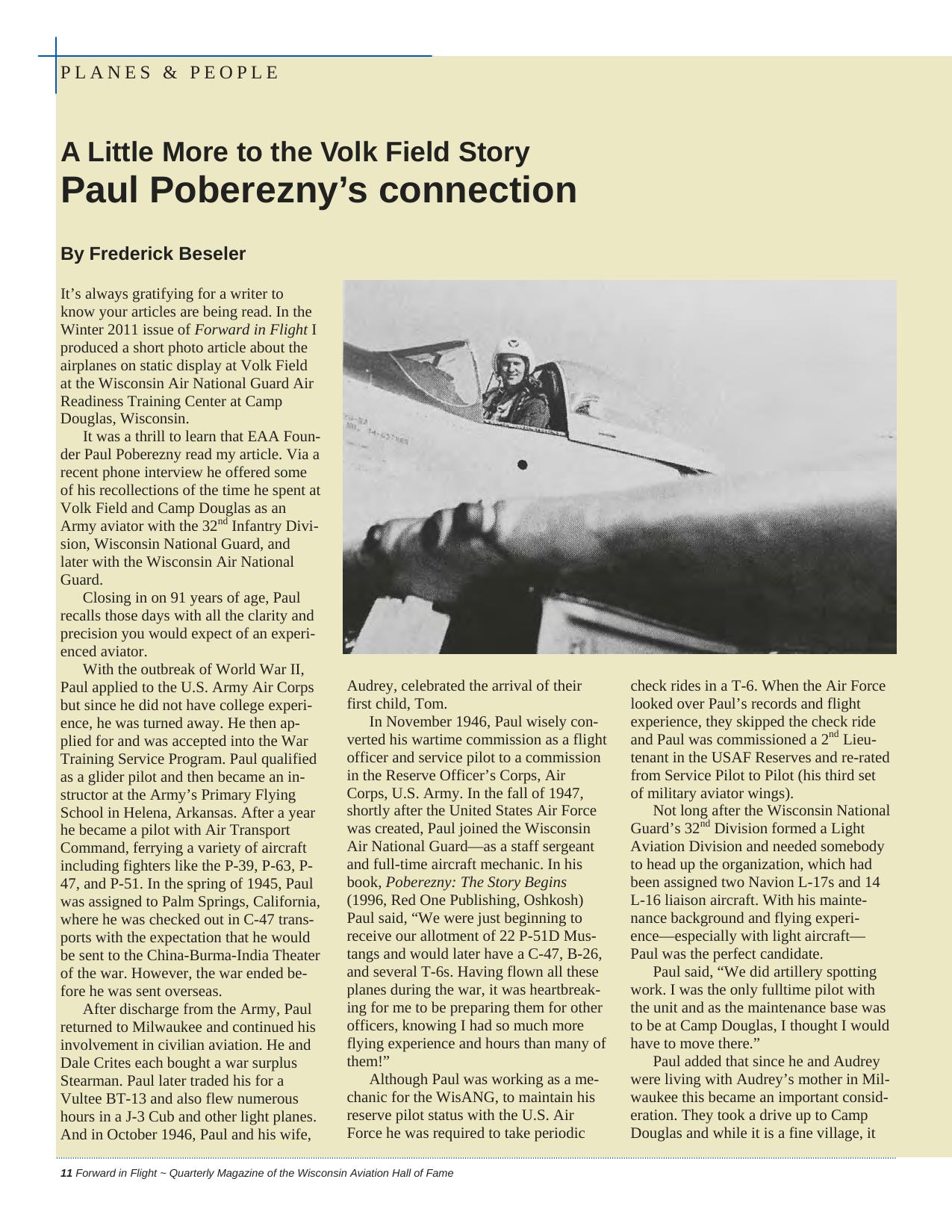
Left: Paul in a North American F-51. Right: A P-51 Mustang once flown by Paul, now on display at Volk Field. Photo by Frederick Beseler. Right Center: Paul, third from left, delivers an L-16 to Superior. Lower right: Paul is ready to go in an F51. became clear that moving there to live was not an option! Fortunately, the National Guard allowed Paul to remain in Milwaukee and commute to Camp Douglas in one of the L-17s. Paul also flew to the outlying National Guard posts at Stevens Point, Chippewa Falls, Kenosha, Superior, and Milwaukee. Many times he would stay overnight at Superior if the weather turned bad. Paul flew in and out of Camp Douglas many times. In 1950 Paul went on active duty with the Wisconsin Air National Guard, flying F-51 Mustangs. When he deployed to Korea, Paul was assigned to the 30th Weather Squadron flying C-47s. After returning from Korea, Paul, a First Lieutenant, became Base and Wing Commander of the 128th Fighter Interceptor Wing (FIW) at Milwaukee. Again, Paul would rack up many hours flying into and out of Camp Douglas. Following the Korean War, the airfield at Camp Douglas was named Volk Field, in honor of Jerome Volk, the first Wisconsin Air National Guard pilot killed in action over Korea. “I knew Jerome Volk,” Paul says. “He was a very nice fellow. We lost many good pilots over Korea.” By 1953 the 128th FIW replaced its F51 Mustangs with F-86 Sabrejets. Later they would get the Northrop F-89 Scorpion. On January 26, 1953, the first meeting of what was to become the Experimental Aircraft Association was held at Milwaukee’s Curtiss-Wright Airport. Paul adds, “By the way, I actually flew that P-51 Mustang that’s on static display at Volk Field and that appeared on the cover of Forward in Flight.” Photos courtesy Paul Poberezny, from the book, Poberezny, The Story Begins... 12 Forward in Flight ~ Summer 2012
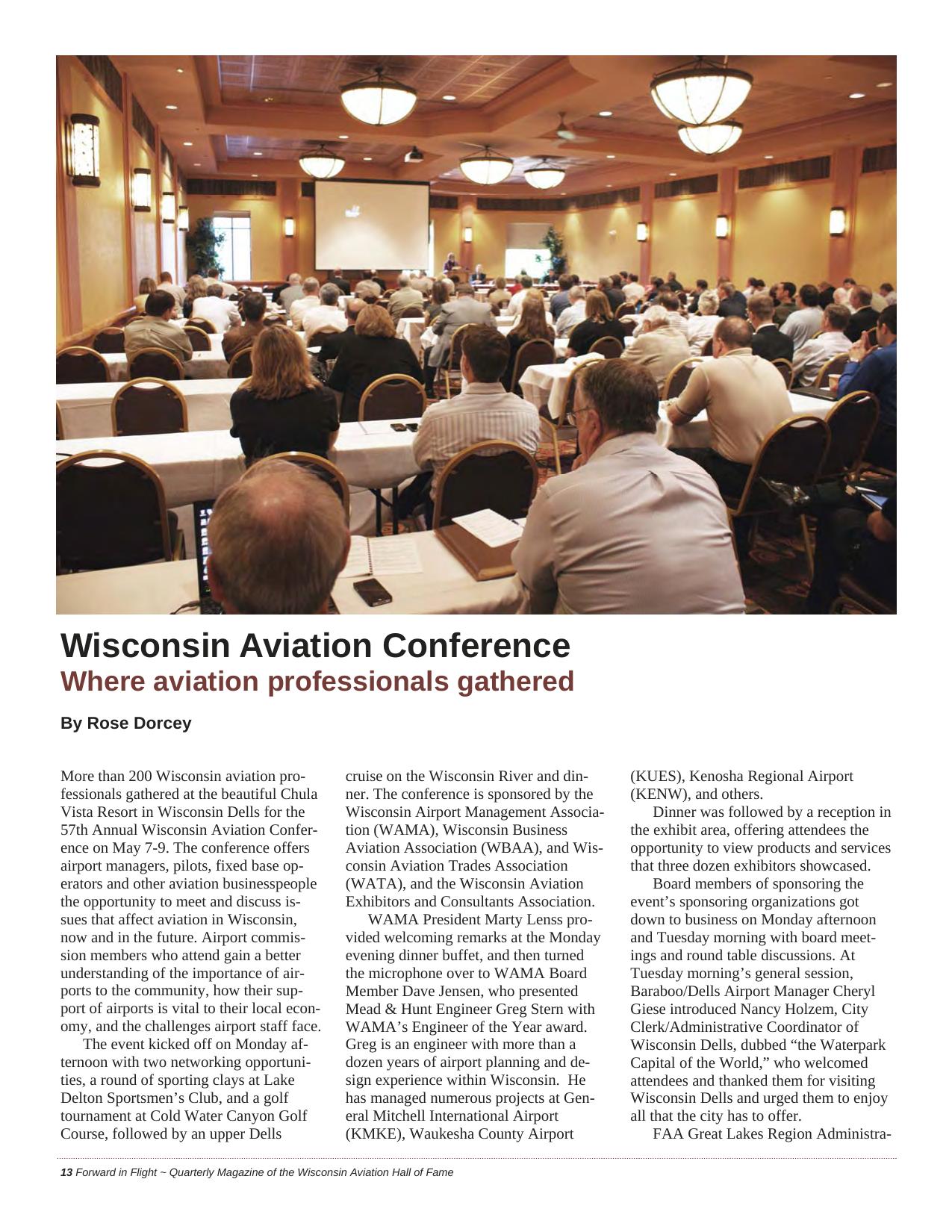
Wisconsin Aviation Conference Where aviation professionals gathered By Rose Dorcey More than 200 Wisconsin aviation professionals gathered at the beautiful Chula Vista Resort in Wisconsin Dells for the 57th Annual Wisconsin Aviation Conference on May 7-9. The conference offers airport managers, pilots, fixed base operators and other aviation businesspeople the opportunity to meet and discuss issues that affect aviation in Wisconsin, now and in the future. Airport commission members who attend gain a better understanding of the importance of airports to the community, how their support of airports is vital to their local economy, and the challenges airport staff face. The event kicked off on Monday afternoon with two networking opportunities, a round of sporting clays at Lake Delton Sportsmen’s Club, and a golf tournament at Cold Water Canyon Golf Course, followed by an upper Dells cruise on the Wisconsin River and dinner. The conference is sponsored by the Wisconsin Airport Management Association (WAMA), Wisconsin Business Aviation Association (WBAA), and Wisconsin Aviation Trades Association (WATA), and the Wisconsin Aviation Exhibitors and Consultants Association. WAMA President Marty Lenss provided welcoming remarks at the Monday evening dinner buffet, and then turned the microphone over to WAMA Board Member Dave Jensen, who presented Mead & Hunt Engineer Greg Stern with WAMA’s Engineer of the Year award. Greg is an engineer with more than a dozen years of airport planning and design experience within Wisconsin. He has managed numerous projects at General Mitchell International Airport (KMKE), Waukesha County Airport 13 Forward in Flight ~ Quarterly Magazine of the Wisconsin Aviation Hall of Fame (KUES), Kenosha Regional Airport (KENW), and others. Dinner was followed by a reception in the exhibit area, offering attendees the opportunity to view products and services that three dozen exhibitors showcased. Board members of sponsoring the event’s sponsoring organizations got down to business on Monday afternoon and Tuesday morning with board meetings and round table discussions. At Tuesday morning’s general session, Baraboo/Dells Airport Manager Cheryl Giese introduced Nancy Holzem, City Clerk/Administrative Coordinator of Wisconsin Dells, dubbed “the Waterpark Capital of the World,” who welcomed attendees and thanked them for visiting Wisconsin Dells and urged them to enjoy all that the city has to offer. FAA Great Lakes Region Administra-
DEBRIEF tor Barry Cooper provided updates on the FAA’s NextGen system, saying that the satellite-based navigation system is on schedule, with ADS-B ground station installations scheduled to be complete by 2013. Cooper also spoke about Unmanned Aircraft Systems (UAS), saying it’s a growing industry with more applications being added all the time. “The challenge is to open up airspace and maintain safety in civilian airspace,” Cooper said. Six UAS test sites will be selected by the end of the calendar year. Cooper discussed the appropriation bill authorized recently. He said there will be tough years ahead, with potential cuts in 2013 and 2014. Sue Schalk, manager of the FAA Great Lakes Region Airports Division, created interest in an FAA study entitled General Aviation Airports: A National Asset. The recently released 18-month study captures the diverse functions of general aviation (GA) airports. As a result, the general public will have a better understanding of GA airports in the community and within the national air transportation system. The study is available at http://www.faa.gov/airports/ planning_capacity/ga_study. It should be a valuable tool for aviation industry stakeholders and airport administrators. Steve Obenauer, manager of the FAA Photos by Tom Thomas Top Left: WAMA Board Member Charity Speich congratulates Matt Dubbe as he receives WAMA’s Distinguished Service Award. Top: Bruce Botterman (left) presented Jet Air CEO Alan Timmerman (with plaque) with the Wisconsin Aviation Trades Association’s Aviation Business of the Year award. Jet Air partners Joe Megna and Pepe Anderas (l-r) pose with Timmerman. Above: Tim Butcher and Howard “Hal” Davis received scholarships at the event. Airport District Office (ADO) in Minneapolis discussed the reauthorization bill, funding, and impacts on Wisconsin airports. As some ground-based navigational systems are being phased out, attendees questioned Obenauer on coverage needed for their airports. Obenauer said a list of potential VORs to be decommissioned is being compiled, and the FAA is seeking public input. Wisconsin Department of Transportation Bureau of Aeronautics Director David Greene reviewed airports projects completed in 2011 at general aviation and air-carrier airports. His PowerPoint pres- entation highlighted projects such as Shawano Municipal Airport’s perimeter fence, and an Airport Rescue and Firefighting (ARFF) building at Rhinelander. He provided information on some 2012 projects, including perimeter fencing and roads, lighting, and land acquisition at several airports throughout the state. Following the general session, attendees broke for lunch and to learn who received awards. Charity Speich, manager at Chippewa Valley Regional Airport in Eau Claire, presented WAMA’s scholarships. WAMA awards professional development assistance annually to 14 Forward in Flight ~ Summer 2012
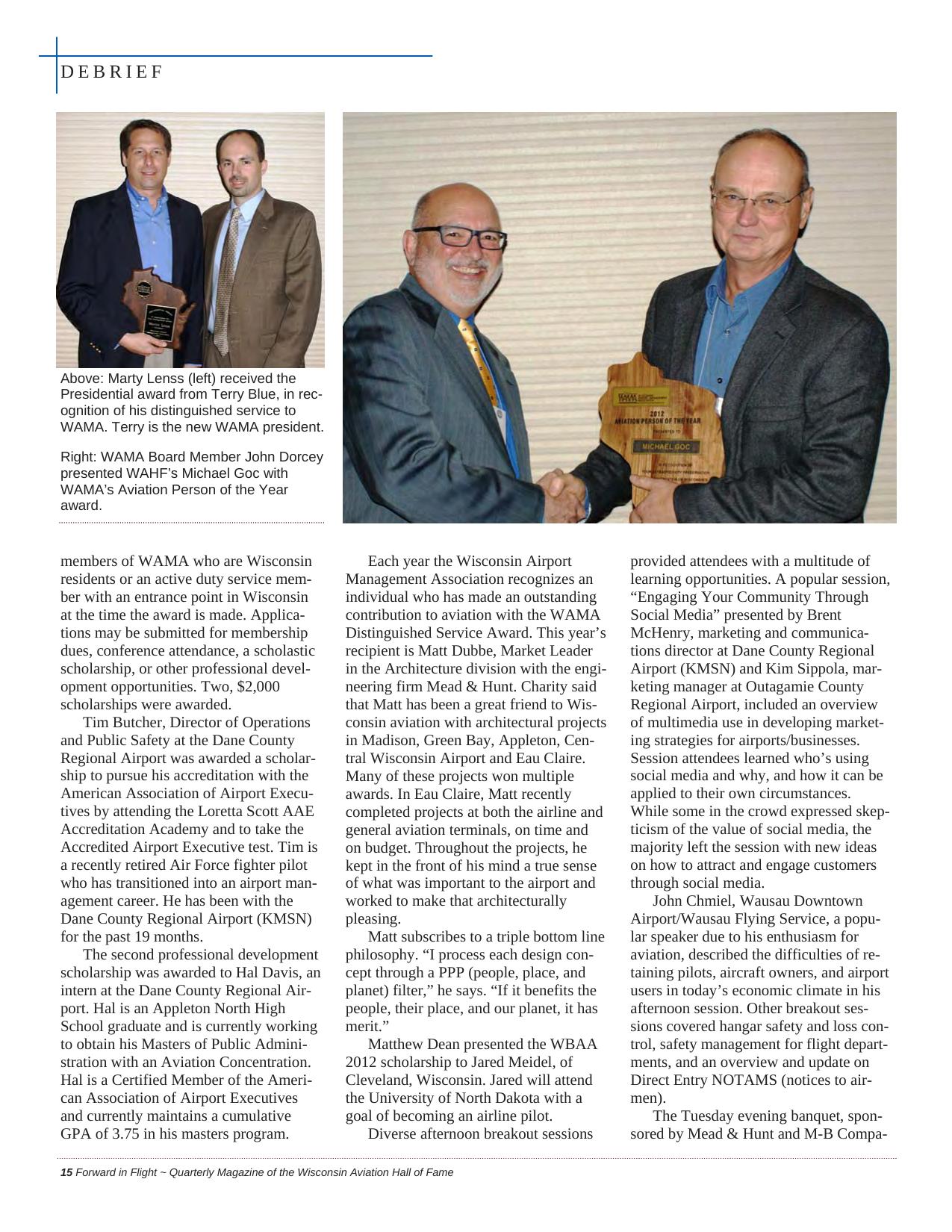
DEBRIEF Above: Marty Lenss (left) received the Presidential award from Terry Blue, in recognition of his distinguished service to WAMA. Terry is the new WAMA president. Right: WAMA Board Member John Dorcey presented WAHF’s Michael Goc with WAMA’s Aviation Person of the Year award. members of WAMA who are Wisconsin residents or an active duty service member with an entrance point in Wisconsin at the time the award is made. Applications may be submitted for membership dues, conference attendance, a scholastic scholarship, or other professional development opportunities. Two, $2,000 scholarships were awarded. Tim Butcher, Director of Operations and Public Safety at the Dane County Regional Airport was awarded a scholarship to pursue his accreditation with the American Association of Airport Executives by attending the Loretta Scott AAE Accreditation Academy and to take the Accredited Airport Executive test. Tim is a recently retired Air Force fighter pilot who has transitioned into an airport management career. He has been with the Dane County Regional Airport (KMSN) for the past 19 months. The second professional development scholarship was awarded to Hal Davis, an intern at the Dane County Regional Airport. Hal is an Appleton North High School graduate and is currently working to obtain his Masters of Public Administration with an Aviation Concentration. Hal is a Certified Member of the American Association of Airport Executives and currently maintains a cumulative GPA of 3.75 in his masters program. Each year the Wisconsin Airport Management Association recognizes an individual who has made an outstanding contribution to aviation with the WAMA Distinguished Service Award. This year’s recipient is Matt Dubbe, Market Leader in the Architecture division with the engineering firm Mead & Hunt. Charity said that Matt has been a great friend to Wisconsin aviation with architectural projects in Madison, Green Bay, Appleton, Central Wisconsin Airport and Eau Claire. Many of these projects won multiple awards. In Eau Claire, Matt recently completed projects at both the airline and general aviation terminals, on time and on budget. Throughout the projects, he kept in the front of his mind a true sense of what was important to the airport and worked to make that architecturally pleasing. Matt subscribes to a triple bottom line philosophy. “I process each design concept through a PPP (people, place, and planet) filter,” he says. “If it benefits the people, their place, and our planet, it has merit.” Matthew Dean presented the WBAA 2012 scholarship to Jared Meidel, of Cleveland, Wisconsin. Jared will attend the University of North Dakota with a goal of becoming an airline pilot. Diverse afternoon breakout sessions 15 Forward in Flight ~ Quarterly Magazine of the Wisconsin Aviation Hall of Fame provided attendees with a multitude of learning opportunities. A popular session, “Engaging Your Community Through Social Media” presented by Brent McHenry, marketing and communications director at Dane County Regional Airport (KMSN) and Kim Sippola, marketing manager at Outagamie County Regional Airport, included an overview of multimedia use in developing marketing strategies for airports/businesses. Session attendees learned who’s using social media and why, and how it can be applied to their own circumstances. While some in the crowd expressed skepticism of the value of social media, the majority left the session with new ideas on how to attract and engage customers through social media. John Chmiel, Wausau Downtown Airport/Wausau Flying Service, a popular speaker due to his enthusiasm for aviation, described the difficulties of retaining pilots, aircraft owners, and airport users in today’s economic climate in his afternoon session. Other breakout sessions covered hangar safety and loss control, safety management for flight departments, and an overview and update on Direct Entry NOTAMS (notices to airmen). The Tuesday evening banquet, sponsored by Mead & Hunt and M-B Compa-
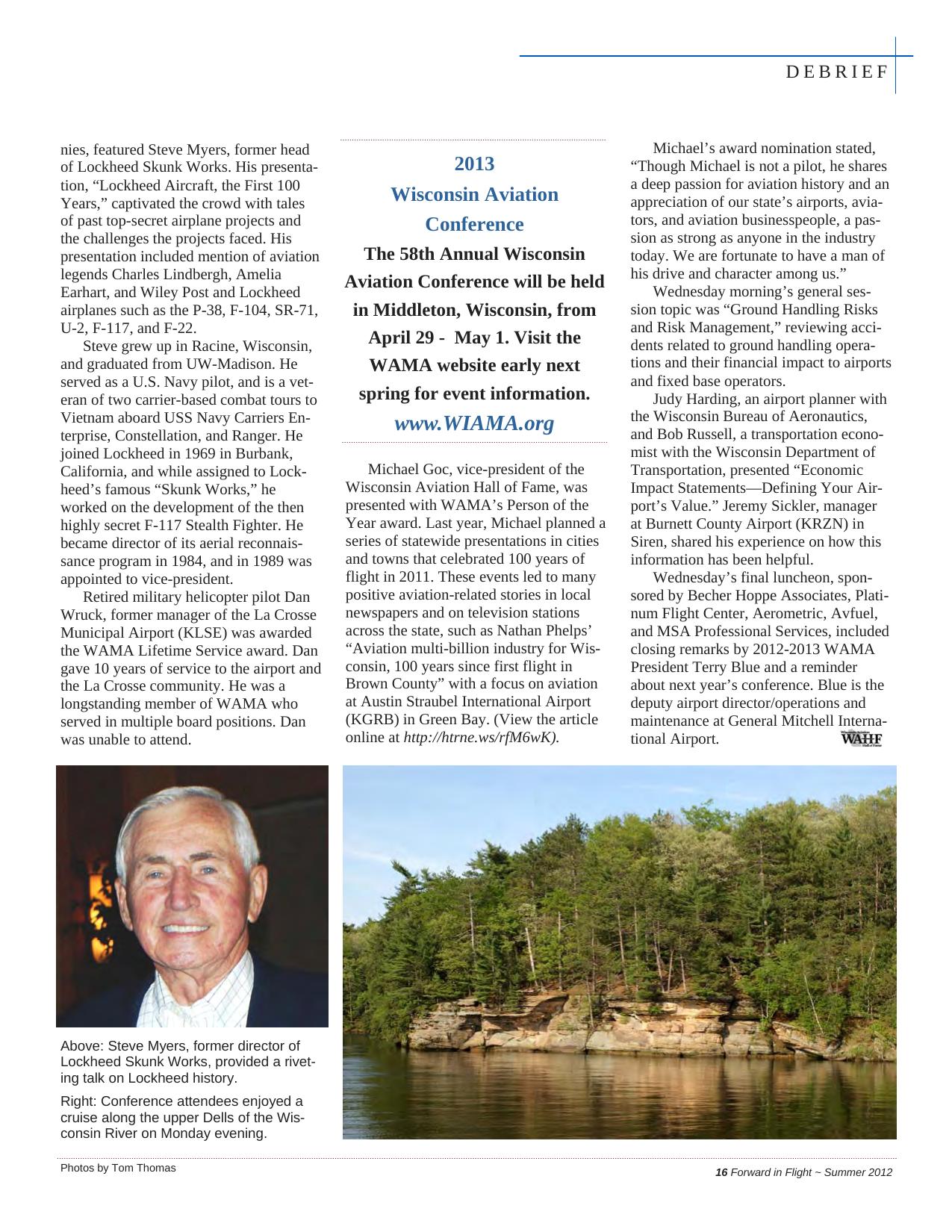
DEBRIEF nies, featured Steve Myers, former head of Lockheed Skunk Works. His presentation, “Lockheed Aircraft, the First 100 Years,” captivated the crowd with tales of past top-secret airplane projects and the challenges the projects faced. His presentation included mention of aviation legends Charles Lindbergh, Amelia Earhart, and Wiley Post and Lockheed airplanes such as the P-38, F-104, SR-71, U-2, F-117, and F-22. Steve grew up in Racine, Wisconsin, and graduated from UW-Madison. He served as a U.S. Navy pilot, and is a veteran of two carrier-based combat tours to Vietnam aboard USS Navy Carriers Enterprise, Constellation, and Ranger. He joined Lockheed in 1969 in Burbank, California, and while assigned to Lockheed’s famous “Skunk Works,” he worked on the development of the then highly secret F-117 Stealth Fighter. He became director of its aerial reconnaissance program in 1984, and in 1989 was appointed to vice-president. Retired military helicopter pilot Dan Wruck, former manager of the La Crosse Municipal Airport (KLSE) was awarded the WAMA Lifetime Service award. Dan gave 10 years of service to the airport and the La Crosse community. He was a longstanding member of WAMA who served in multiple board positions. Dan was unable to attend. 2013 Wisconsin Aviation Conference The 58th Annual Wisconsin Aviation Conference will be held in Middleton, Wisconsin, from April 29 - May 1. Visit the WAMA website early next spring for event information. www.WIAMA.org Michael Goc, vice-president of the Wisconsin Aviation Hall of Fame, was presented with WAMA’s Person of the Year award. Last year, Michael planned a series of statewide presentations in cities and towns that celebrated 100 years of flight in 2011. These events led to many positive aviation-related stories in local newspapers and on television stations across the state, such as Nathan Phelps’ “Aviation multi-billion industry for Wisconsin, 100 years since first flight in Brown County” with a focus on aviation at Austin Straubel International Airport (KGRB) in Green Bay. (View the article online at http://htrne.ws/rfM6wK). Michael’s award nomination stated, “Though Michael is not a pilot, he shares a deep passion for aviation history and an appreciation of our state’s airports, aviators, and aviation businesspeople, a passion as strong as anyone in the industry today. We are fortunate to have a man of his drive and character among us.” Wednesday morning’s general session topic was “Ground Handling Risks and Risk Management,” reviewing accidents related to ground handling operations and their financial impact to airports and fixed base operators. Judy Harding, an airport planner with the Wisconsin Bureau of Aeronautics, and Bob Russell, a transportation economist with the Wisconsin Department of Transportation, presented “Economic Impact Statements—Defining Your Airport’s Value.” Jeremy Sickler, manager at Burnett County Airport (KRZN) in Siren, shared his experience on how this information has been helpful. Wednesday’s final luncheon, sponsored by Becher Hoppe Associates, Platinum Flight Center, Aerometric, Avfuel, and MSA Professional Services, included closing remarks by 2012-2013 WAMA President Terry Blue and a reminder about next year’s conference. Blue is the deputy airport director/operations and maintenance at General Mitchell International Airport. Above: Steve Myers, former director of Lockheed Skunk Works, provided a riveting talk on Lockheed history. Right: Conference attendees enjoyed a cruise along the upper Dells of the Wisconsin River on Monday evening. Photos by Tom Thomas 16 Forward in Flight ~ Summer 2012
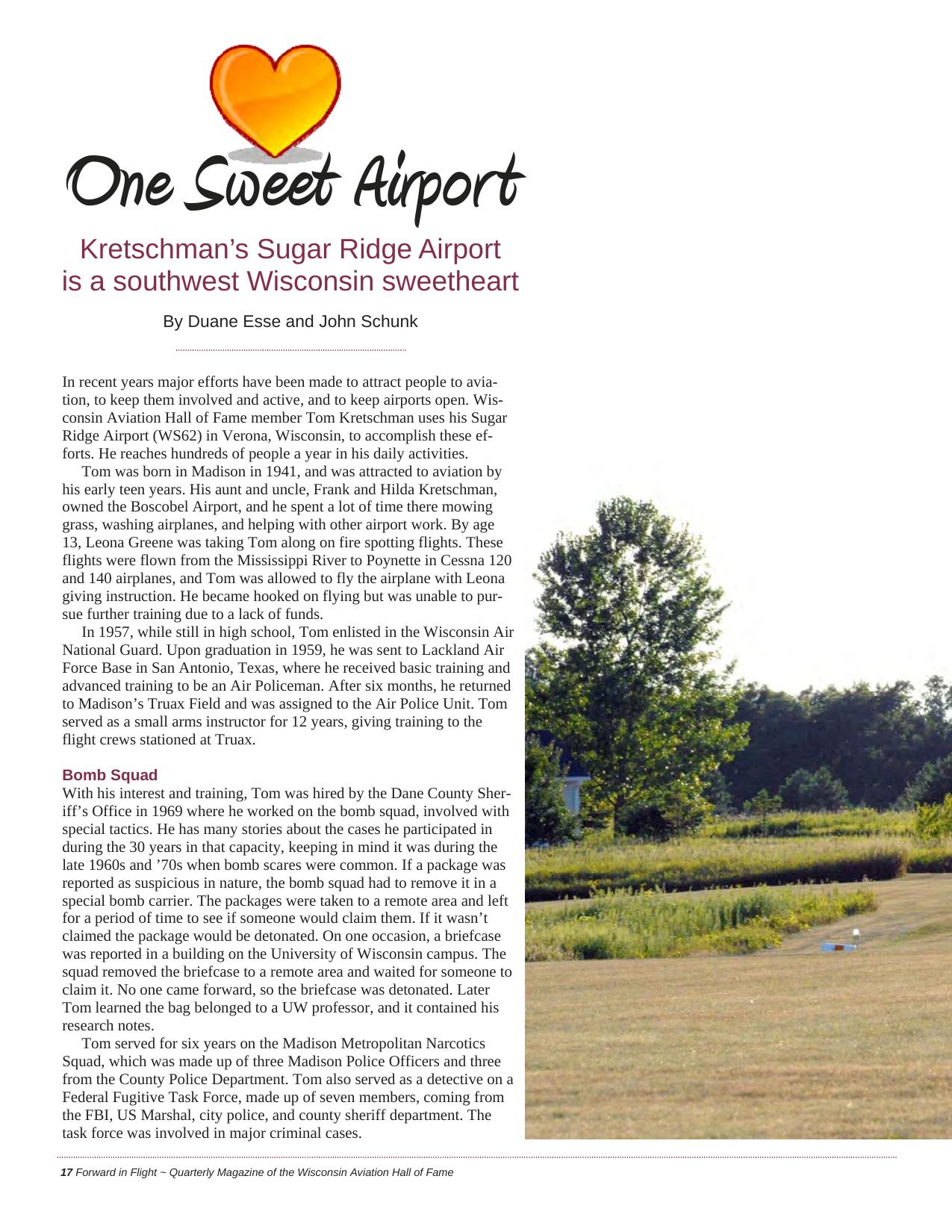
One Sweet Airport Kretschman’s Sugar Ridge Airport is a southwest Wisconsin sweetheart By Duane Esse and John Schunk In recent years major efforts have been made to attract people to aviation, to keep them involved and active, and to keep airports open. Wisconsin Aviation Hall of Fame member Tom Kretschman uses his Sugar Ridge Airport (WS62) in Verona, Wisconsin, to accomplish these efforts. He reaches hundreds of people a year in his daily activities. Tom was born in Madison in 1941, and was attracted to aviation by his early teen years. His aunt and uncle, Frank and Hilda Kretschman, owned the Boscobel Airport, and he spent a lot of time there mowing grass, washing airplanes, and helping with other airport work. By age 13, Leona Greene was taking Tom along on fire spotting flights. These flights were flown from the Mississippi River to Poynette in Cessna 120 and 140 airplanes, and Tom was allowed to fly the airplane with Leona giving instruction. He became hooked on flying but was unable to pursue further training due to a lack of funds. In 1957, while still in high school, Tom enlisted in the Wisconsin Air National Guard. Upon graduation in 1959, he was sent to Lackland Air Force Base in San Antonio, Texas, where he received basic training and advanced training to be an Air Policeman. After six months, he returned to Madison’s Truax Field and was assigned to the Air Police Unit. Tom served as a small arms instructor for 12 years, giving training to the flight crews stationed at Truax. Bomb Squad With his interest and training, Tom was hired by the Dane County Sheriff’s Office in 1969 where he worked on the bomb squad, involved with special tactics. He has many stories about the cases he participated in during the 30 years in that capacity, keeping in mind it was during the late 1960s and ’70s when bomb scares were common. If a package was reported as suspicious in nature, the bomb squad had to remove it in a special bomb carrier. The packages were taken to a remote area and left for a period of time to see if someone would claim them. If it wasn’t claimed the package would be detonated. On one occasion, a briefcase was reported in a building on the University of Wisconsin campus. The squad removed the briefcase to a remote area and waited for someone to claim it. No one came forward, so the briefcase was detonated. Later Tom learned the bag belonged to a UW professor, and it contained his research notes. Tom served for six years on the Madison Metropolitan Narcotics Squad, which was made up of three Madison Police Officers and three from the County Police Department. Tom also served as a detective on a Federal Fugitive Task Force, made up of seven members, coming from the FBI, US Marshal, city police, and county sheriff department. The task force was involved in major criminal cases. 17 Forward in Flight ~ Quarterly Magazine of the Wisconsin Aviation Hall of Fame
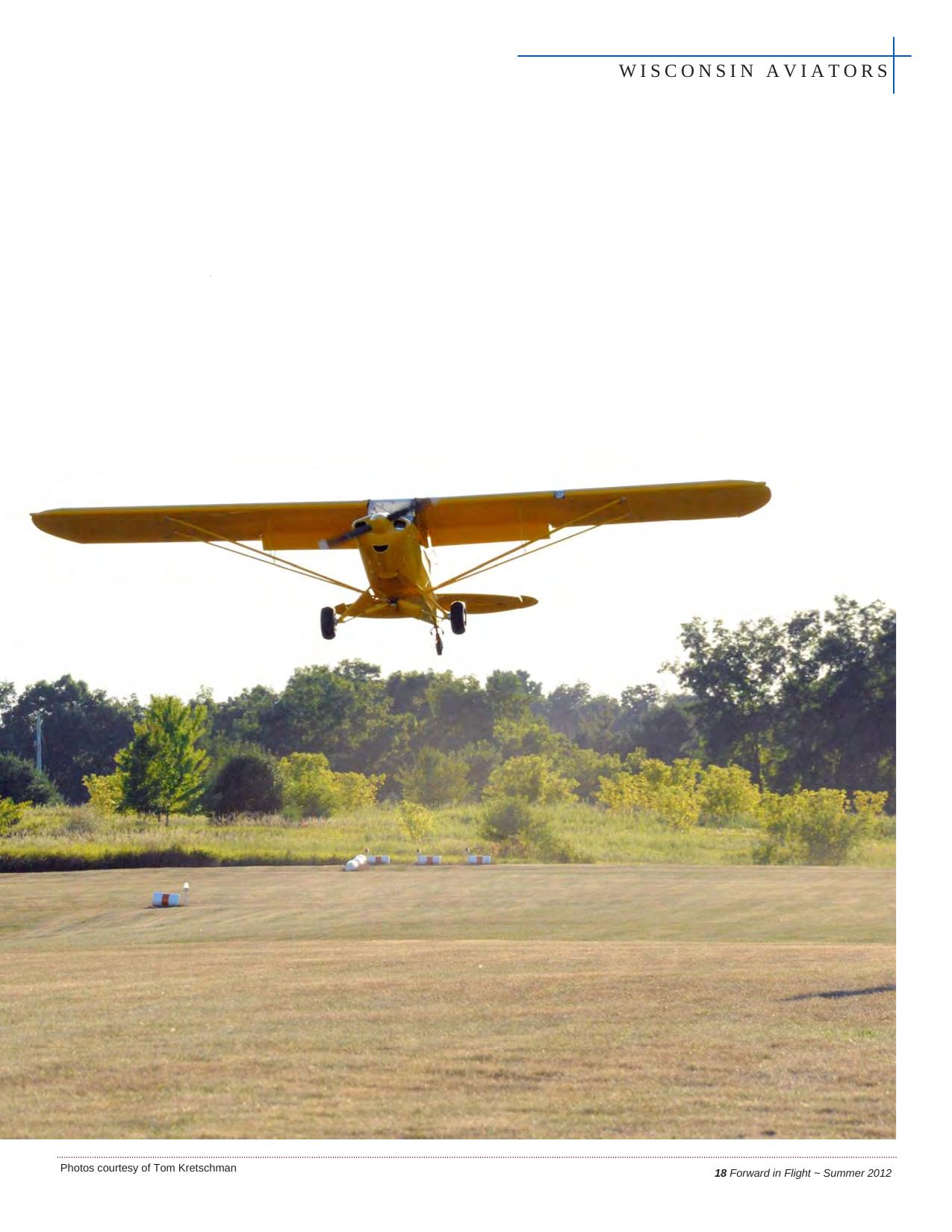
WISCONSIN AVIATORS Photos courtesy of Tom Kretschman 18 Forward in Flight ~ Summer 2012
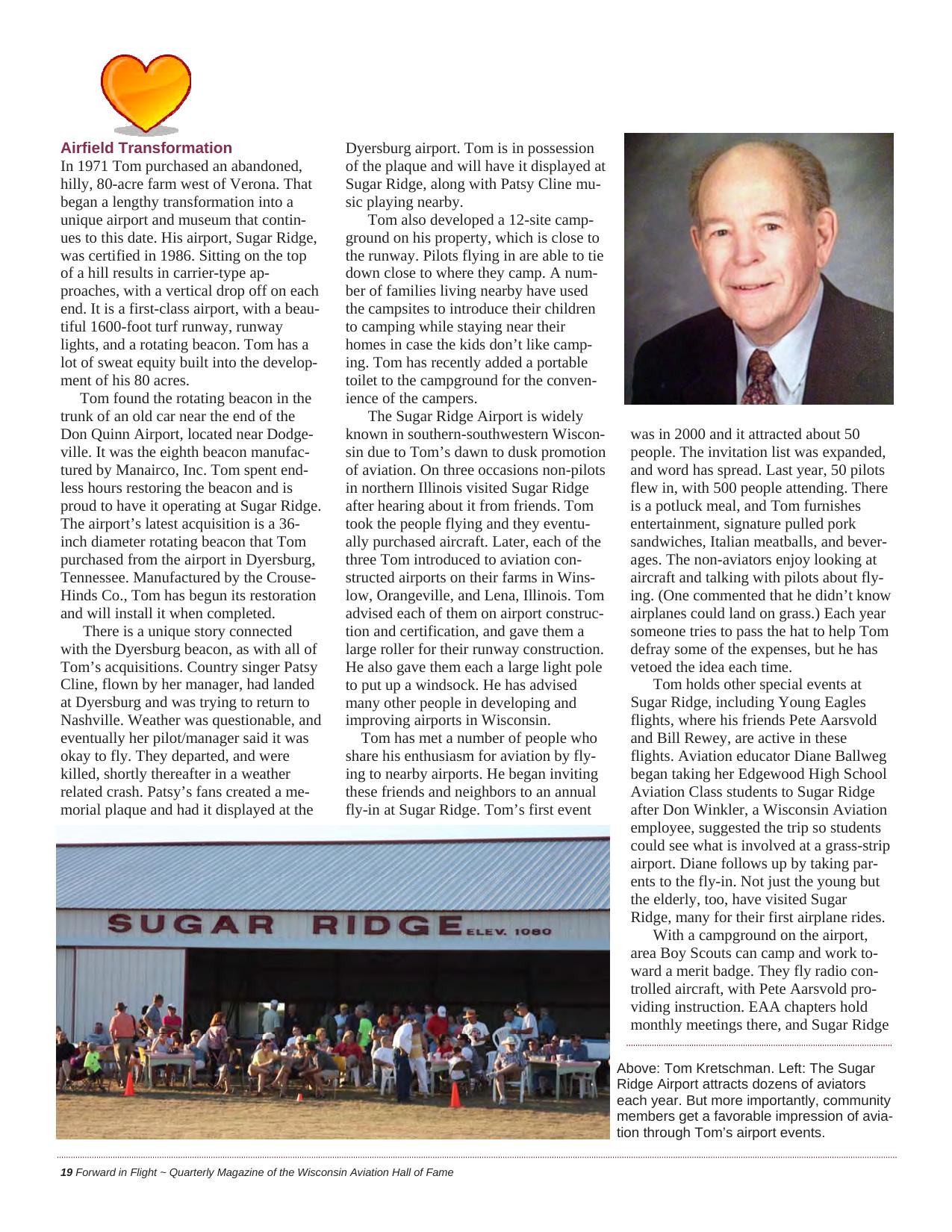
Airfield Transformation In 1971 Tom purchased an abandoned, hilly, 80-acre farm west of Verona. That began a lengthy transformation into a unique airport and museum that continues to this date. His airport, Sugar Ridge, was certified in 1986. Sitting on the top of a hill results in carrier-type approaches, with a vertical drop off on each end. It is a first-class airport, with a beautiful 1600-foot turf runway, runway lights, and a rotating beacon. Tom has a lot of sweat equity built into the development of his 80 acres. Tom found the rotating beacon in the trunk of an old car near the end of the Don Quinn Airport, located near Dodgeville. It was the eighth beacon manufactured by Manairco, Inc. Tom spent endless hours restoring the beacon and is proud to have it operating at Sugar Ridge. The airport’s latest acquisition is a 36inch diameter rotating beacon that Tom purchased from the airport in Dyersburg, Tennessee. Manufactured by the CrouseHinds Co., Tom has begun its restoration and will install it when completed. There is a unique story connected with the Dyersburg beacon, as with all of Tom’s acquisitions. Country singer Patsy Cline, flown by her manager, had landed at Dyersburg and was trying to return to Nashville. Weather was questionable, and eventually her pilot/manager said it was okay to fly. They departed, and were killed, shortly thereafter in a weather related crash. Patsy’s fans created a memorial plaque and had it displayed at the Dyersburg airport. Tom is in possession of the plaque and will have it displayed at Sugar Ridge, along with Patsy Cline music playing nearby. Tom also developed a 12-site campground on his property, which is close to the runway. Pilots flying in are able to tie down close to where they camp. A number of families living nearby have used the campsites to introduce their children to camping while staying near their homes in case the kids don’t like camping. Tom has recently added a portable toilet to the campground for the convenience of the campers. The Sugar Ridge Airport is widely known in southern-southwestern Wisconsin due to Tom’s dawn to dusk promotion of aviation. On three occasions non-pilots in northern Illinois visited Sugar Ridge after hearing about it from friends. Tom took the people flying and they eventually purchased aircraft. Later, each of the three Tom introduced to aviation constructed airports on their farms in Winslow, Orangeville, and Lena, Illinois. Tom advised each of them on airport construction and certification, and gave them a large roller for their runway construction. He also gave them each a large light pole to put up a windsock. He has advised many other people in developing and improving airports in Wisconsin. Tom has met a number of people who share his enthusiasm for aviation by flying to nearby airports. He began inviting these friends and neighbors to an annual fly-in at Sugar Ridge. Tom’s first event was in 2000 and it attracted about 50 people. The invitation list was expanded, and word has spread. Last year, 50 pilots flew in, with 500 people attending. There is a potluck meal, and Tom furnishes entertainment, signature pulled pork sandwiches, Italian meatballs, and beverages. The non-aviators enjoy looking at aircraft and talking with pilots about flying. (One commented that he didn’t know airplanes could land on grass.) Each year someone tries to pass the hat to help Tom defray some of the expenses, but he has vetoed the idea each time. Tom holds other special events at Sugar Ridge, including Young Eagles flights, where his friends Pete Aarsvold and Bill Rewey, are active in these flights. Aviation educator Diane Ballweg began taking her Edgewood High School Aviation Class students to Sugar Ridge after Don Winkler, a Wisconsin Aviation employee, suggested the trip so students could see what is involved at a grass-strip airport. Diane follows up by taking parents to the fly-in. Not just the young but the elderly, too, have visited Sugar Ridge, many for their first airplane rides. With a campground on the airport, area Boy Scouts can camp and work toward a merit badge. They fly radio controlled aircraft, with Pete Aarsvold providing instruction. EAA chapters hold monthly meetings there, and Sugar Ridge Above: Tom Kretschman. Left: The Sugar Ridge Airport attracts dozens of aviators each year. But more importantly, community members get a favorable impression of aviation through Tom’s airport events. 19 Forward in Flight ~ Quarterly Magazine of the Wisconsin Aviation Hall of Fame
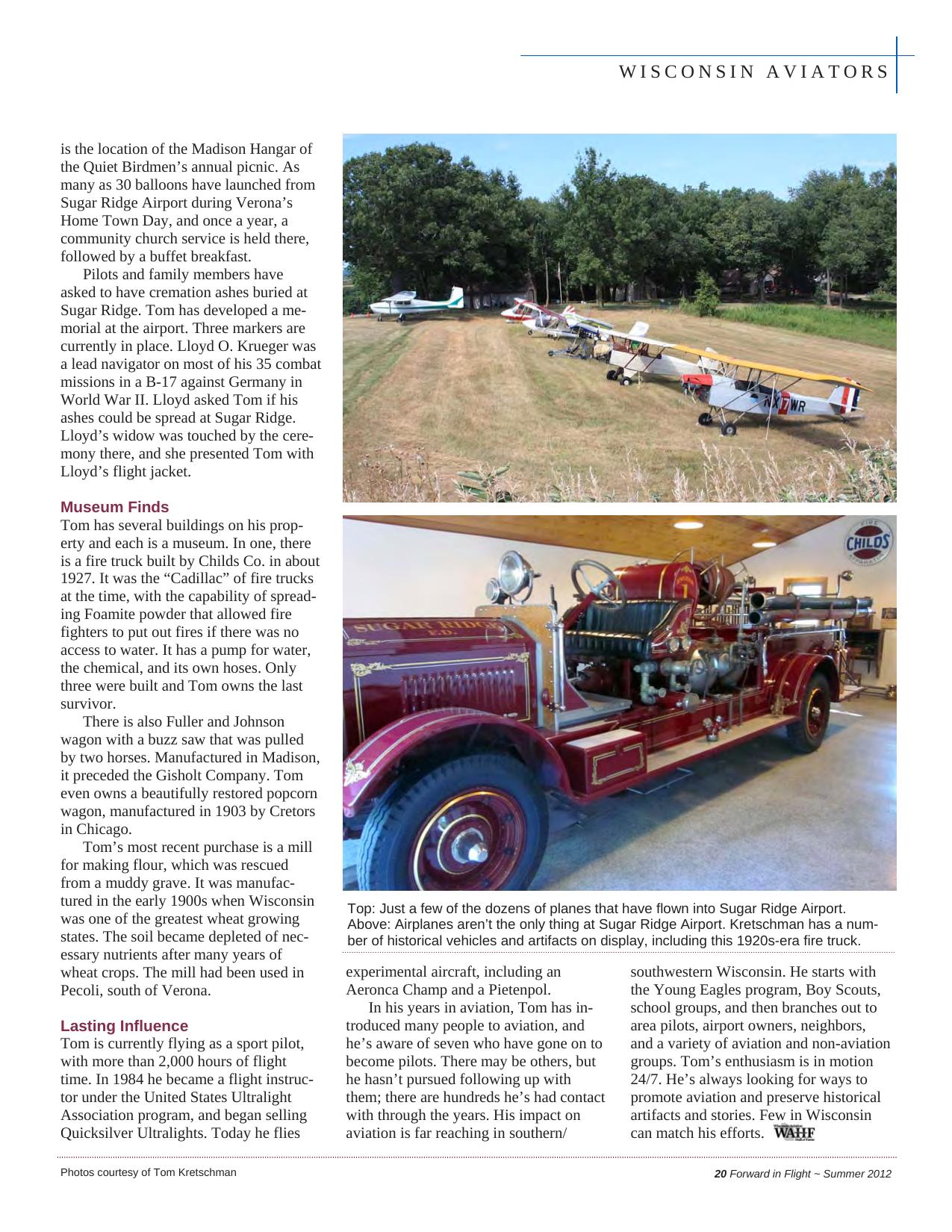
WISCONSIN AVIATORS is the location of the Madison Hangar of the Quiet Birdmen’s annual picnic. As many as 30 balloons have launched from Sugar Ridge Airport during Verona’s Home Town Day, and once a year, a community church service is held there, followed by a buffet breakfast. Pilots and family members have asked to have cremation ashes buried at Sugar Ridge. Tom has developed a memorial at the airport. Three markers are currently in place. Lloyd O. Krueger was a lead navigator on most of his 35 combat missions in a B-17 against Germany in World War II. Lloyd asked Tom if his ashes could be spread at Sugar Ridge. Lloyd’s widow was touched by the ceremony there, and she presented Tom with Lloyd’s flight jacket. Museum Finds Tom has several buildings on his property and each is a museum. In one, there is a fire truck built by Childs Co. in about 1927. It was the “Cadillac” of fire trucks at the time, with the capability of spreading Foamite powder that allowed fire fighters to put out fires if there was no access to water. It has a pump for water, the chemical, and its own hoses. Only three were built and Tom owns the last survivor. There is also Fuller and Johnson wagon with a buzz saw that was pulled by two horses. Manufactured in Madison, it preceded the Gisholt Company. Tom even owns a beautifully restored popcorn wagon, manufactured in 1903 by Cretors in Chicago. Tom’s most recent purchase is a mill for making flour, which was rescued from a muddy grave. It was manufactured in the early 1900s when Wisconsin was one of the greatest wheat growing states. The soil became depleted of necessary nutrients after many years of wheat crops. The mill had been used in Pecoli, south of Verona. Lasting Influence Tom is currently flying as a sport pilot, with more than 2,000 hours of flight time. In 1984 he became a flight instructor under the United States Ultralight Association program, and began selling Quicksilver Ultralights. Today he flies Photos courtesy of Tom Kretschman Top: Just a few of the dozens of planes that have flown into Sugar Ridge Airport. Above: Airplanes aren’t the only thing at Sugar Ridge Airport. Kretschman has a number of historical vehicles and artifacts on display, including this 1920s-era fire truck. experimental aircraft, including an Aeronca Champ and a Pietenpol. In his years in aviation, Tom has introduced many people to aviation, and he’s aware of seven who have gone on to become pilots. There may be others, but he hasn’t pursued following up with them; there are hundreds he’s had contact with through the years. His impact on aviation is far reaching in southern/ southwestern Wisconsin. He starts with the Young Eagles program, Boy Scouts, school groups, and then branches out to area pilots, airport owners, neighbors, and a variety of aviation and non-aviation groups. Tom’s enthusiasm is in motion 24/7. He’s always looking for ways to promote aviation and preserve historical artifacts and stories. Few in Wisconsin can match his efforts. 20 Forward in Flight ~ Summer 2012
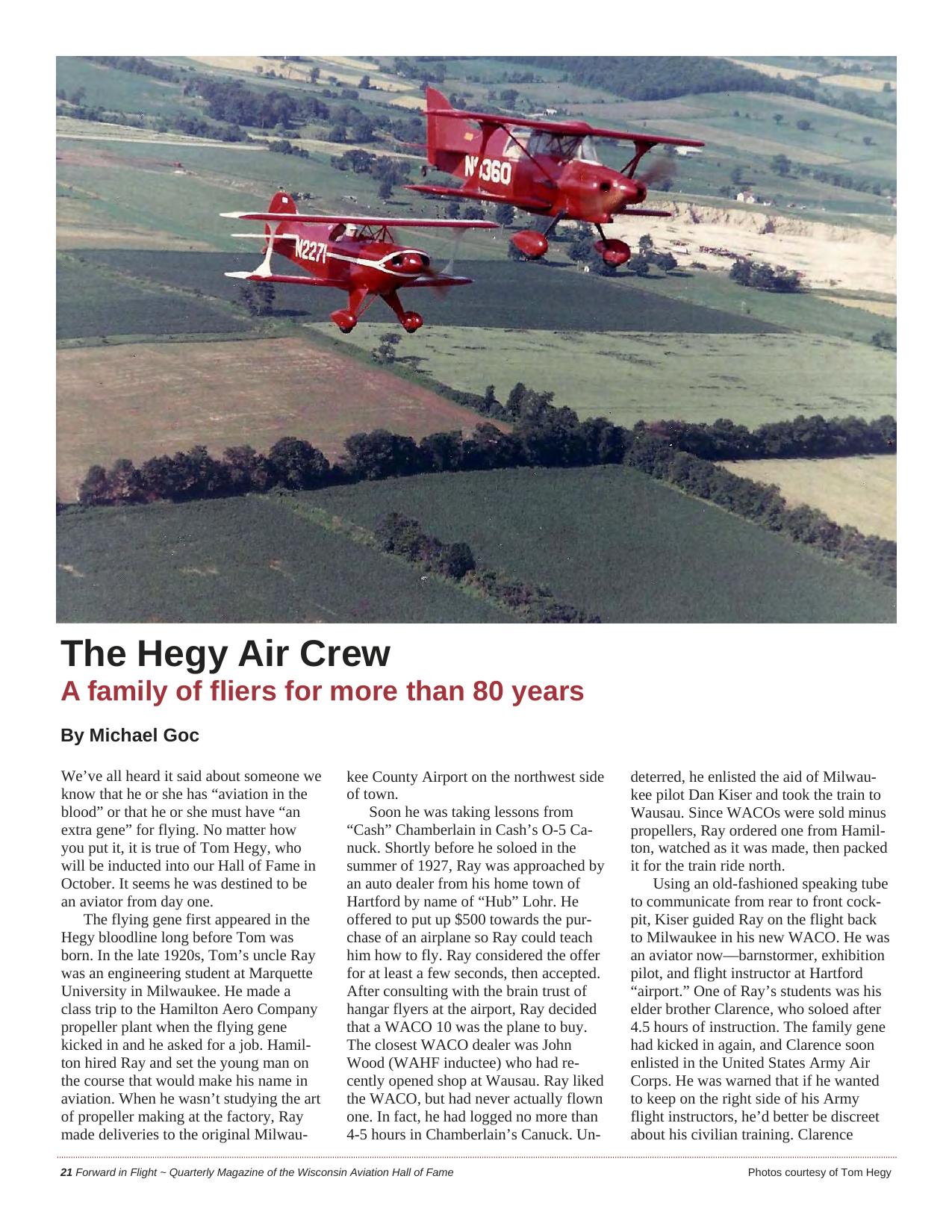
The Hegy Air Crew A family of fliers for more than 80 years By Michael Goc We’ve all heard it said about someone we know that he or she has “aviation in the blood” or that he or she must have “an extra gene” for flying. No matter how you put it, it is true of Tom Hegy, who will be inducted into our Hall of Fame in October. It seems he was destined to be an aviator from day one. The flying gene first appeared in the Hegy bloodline long before Tom was born. In the late 1920s, Tom’s uncle Ray was an engineering student at Marquette University in Milwaukee. He made a class trip to the Hamilton Aero Company propeller plant when the flying gene kicked in and he asked for a job. Hamilton hired Ray and set the young man on the course that would make his name in aviation. When he wasn’t studying the art of propeller making at the factory, Ray made deliveries to the original Milwau- kee County Airport on the northwest side of town. Soon he was taking lessons from “Cash” Chamberlain in Cash’s O-5 Canuck. Shortly before he soloed in the summer of 1927, Ray was approached by an auto dealer from his home town of Hartford by name of “Hub” Lohr. He offered to put up $500 towards the purchase of an airplane so Ray could teach him how to fly. Ray considered the offer for at least a few seconds, then accepted. After consulting with the brain trust of hangar flyers at the airport, Ray decided that a WACO 10 was the plane to buy. The closest WACO dealer was John Wood (WAHF inductee) who had recently opened shop at Wausau. Ray liked the WACO, but had never actually flown one. In fact, he had logged no more than 4-5 hours in Chamberlain’s Canuck. Un- 21 Forward in Flight ~ Quarterly Magazine of the Wisconsin Aviation Hall of Fame deterred, he enlisted the aid of Milwaukee pilot Dan Kiser and took the train to Wausau. Since WACOs were sold minus propellers, Ray ordered one from Hamilton, watched as it was made, then packed it for the train ride north. Using an old-fashioned speaking tube to communicate from rear to front cockpit, Kiser guided Ray on the flight back to Milwaukee in his new WACO. He was an aviator now—barnstormer, exhibition pilot, and flight instructor at Hartford “airport.” One of Ray’s students was his elder brother Clarence, who soloed after 4.5 hours of instruction. The family gene had kicked in again, and Clarence soon enlisted in the United States Army Air Corps. He was warned that if he wanted to keep on the right side of his Army flight instructors, he’d better be discreet about his civilian training. Clarence Photos courtesy of Tom Hegy
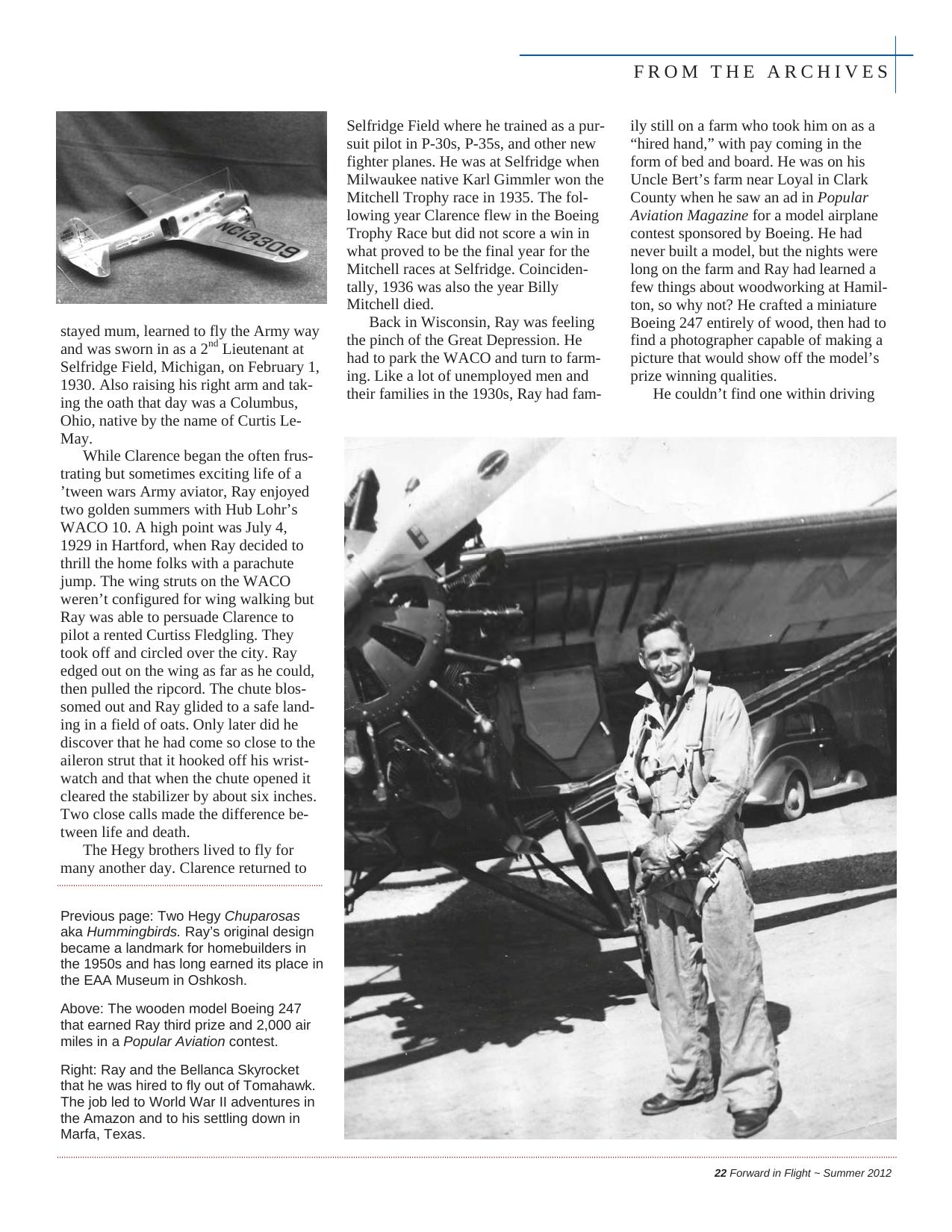
FROM THE ARCHIVES stayed mum, learned to fly the Army way and was sworn in as a 2nd Lieutenant at Selfridge Field, Michigan, on February 1, 1930. Also raising his right arm and taking the oath that day was a Columbus, Ohio, native by the name of Curtis LeMay. While Clarence began the often frustrating but sometimes exciting life of a ’tween wars Army aviator, Ray enjoyed two golden summers with Hub Lohr’s WACO 10. A high point was July 4, 1929 in Hartford, when Ray decided to thrill the home folks with a parachute jump. The wing struts on the WACO weren’t configured for wing walking but Ray was able to persuade Clarence to pilot a rented Curtiss Fledgling. They took off and circled over the city. Ray edged out on the wing as far as he could, then pulled the ripcord. The chute blossomed out and Ray glided to a safe landing in a field of oats. Only later did he discover that he had come so close to the aileron strut that it hooked off his wristwatch and that when the chute opened it cleared the stabilizer by about six inches. Two close calls made the difference between life and death. The Hegy brothers lived to fly for many another day. Clarence returned to Selfridge Field where he trained as a pursuit pilot in P-30s, P-35s, and other new fighter planes. He was at Selfridge when Milwaukee native Karl Gimmler won the Mitchell Trophy race in 1935. The following year Clarence flew in the Boeing Trophy Race but did not score a win in what proved to be the final year for the Mitchell races at Selfridge. Coincidentally, 1936 was also the year Billy Mitchell died. Back in Wisconsin, Ray was feeling the pinch of the Great Depression. He had to park the WACO and turn to farming. Like a lot of unemployed men and their families in the 1930s, Ray had fam- ily still on a farm who took him on as a “hired hand,” with pay coming in the form of bed and board. He was on his Uncle Bert’s farm near Loyal in Clark County when he saw an ad in Popular Aviation Magazine for a model airplane contest sponsored by Boeing. He had never built a model, but the nights were long on the farm and Ray had learned a few things about woodworking at Hamilton, so why not? He crafted a miniature Boeing 247 entirely of wood, then had to find a photographer capable of making a picture that would show off the model’s prize winning qualities. He couldn’t find one within driving Previous page: Two Hegy Chuparosas aka Hummingbirds. Ray’s original design became a landmark for homebuilders in the 1950s and has long earned its place in the EAA Museum in Oshkosh. Above: The wooden model Boeing 247 that earned Ray third prize and 2,000 air miles in a Popular Aviation contest. Right: Ray and the Bellanca Skyrocket that he was hired to fly out of Tomahawk. The job led to World War II adventures in the Amazon and to his settling down in Marfa, Texas. 22 Forward in Flight ~ Summer 2012
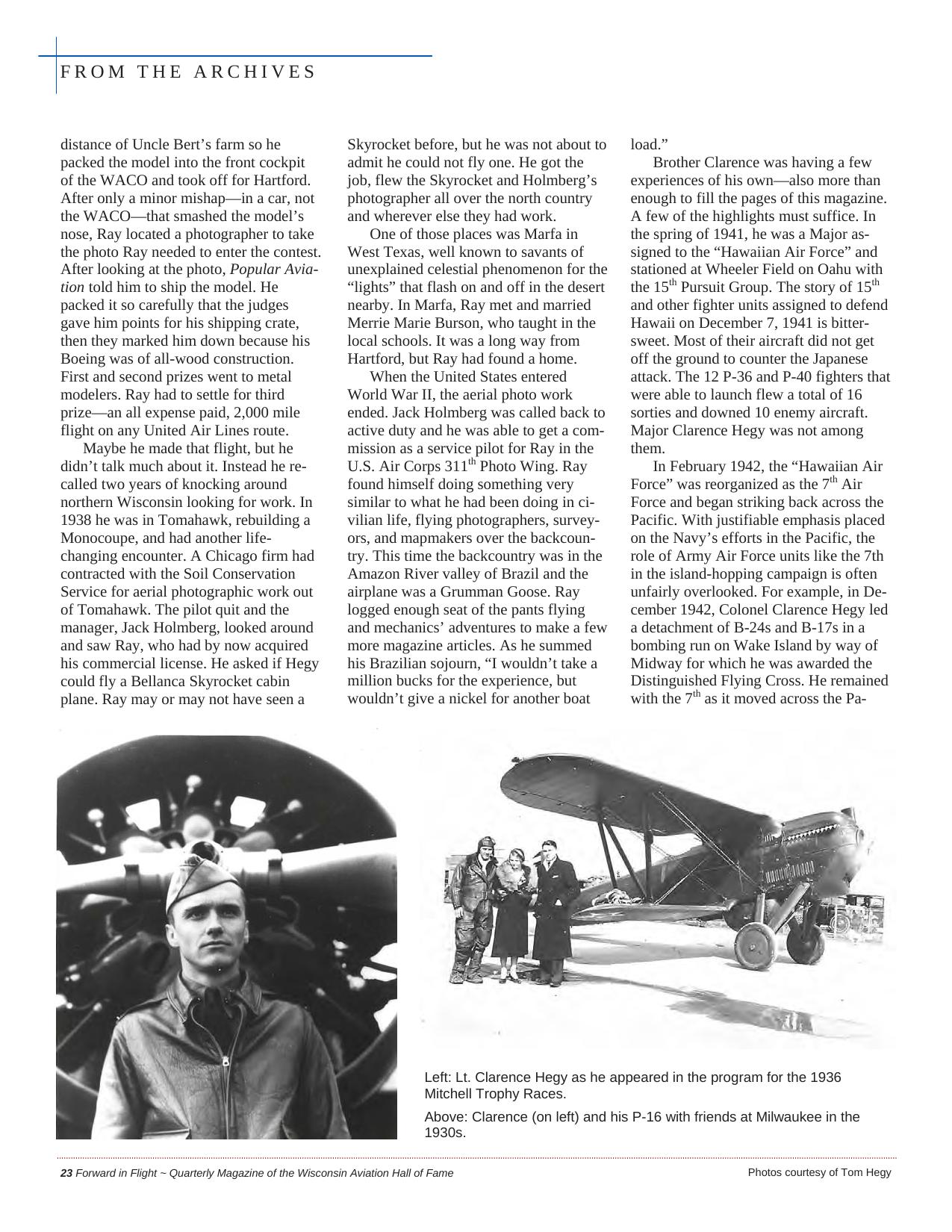
FROM THE ARCHIVES distance of Uncle Bert’s farm so he packed the model into the front cockpit of the WACO and took off for Hartford. After only a minor mishap—in a car, not the WACO—that smashed the model’s nose, Ray located a photographer to take the photo Ray needed to enter the contest. After looking at the photo, Popular Aviation told him to ship the model. He packed it so carefully that the judges gave him points for his shipping crate, then they marked him down because his Boeing was of all-wood construction. First and second prizes went to metal modelers. Ray had to settle for third prize—an all expense paid, 2,000 mile flight on any United Air Lines route. Maybe he made that flight, but he didn’t talk much about it. Instead he recalled two years of knocking around northern Wisconsin looking for work. In 1938 he was in Tomahawk, rebuilding a Monocoupe, and had another lifechanging encounter. A Chicago firm had contracted with the Soil Conservation Service for aerial photographic work out of Tomahawk. The pilot quit and the manager, Jack Holmberg, looked around and saw Ray, who had by now acquired his commercial license. He asked if Hegy could fly a Bellanca Skyrocket cabin plane. Ray may or may not have seen a Skyrocket before, but he was not about to admit he could not fly one. He got the job, flew the Skyrocket and Holmberg’s photographer all over the north country and wherever else they had work. One of those places was Marfa in West Texas, well known to savants of unexplained celestial phenomenon for the “lights” that flash on and off in the desert nearby. In Marfa, Ray met and married Merrie Marie Burson, who taught in the local schools. It was a long way from Hartford, but Ray had found a home. When the United States entered World War II, the aerial photo work ended. Jack Holmberg was called back to active duty and he was able to get a commission as a service pilot for Ray in the U.S. Air Corps 311th Photo Wing. Ray found himself doing something very similar to what he had been doing in civilian life, flying photographers, surveyors, and mapmakers over the backcountry. This time the backcountry was in the Amazon River valley of Brazil and the airplane was a Grumman Goose. Ray logged enough seat of the pants flying and mechanics’ adventures to make a few more magazine articles. As he summed his Brazilian sojourn, “I wouldn’t take a million bucks for the experience, but wouldn’t give a nickel for another boat load.” Brother Clarence was having a few experiences of his own—also more than enough to fill the pages of this magazine. A few of the highlights must suffice. In the spring of 1941, he was a Major assigned to the “Hawaiian Air Force” and stationed at Wheeler Field on Oahu with the 15th Pursuit Group. The story of 15th and other fighter units assigned to defend Hawaii on December 7, 1941 is bittersweet. Most of their aircraft did not get off the ground to counter the Japanese attack. The 12 P-36 and P-40 fighters that were able to launch flew a total of 16 sorties and downed 10 enemy aircraft. Major Clarence Hegy was not among them. In February 1942, the “Hawaiian Air Force” was reorganized as the 7th Air Force and began striking back across the Pacific. With justifiable emphasis placed on the Navy’s efforts in the Pacific, the role of Army Air Force units like the 7th in the island-hopping campaign is often unfairly overlooked. For example, in December 1942, Colonel Clarence Hegy led a detachment of B-24s and B-17s in a bombing run on Wake Island by way of Midway for which he was awarded the Distinguished Flying Cross. He remained with the 7th as it moved across the Pa- Left: Lt. Clarence Hegy as he appeared in the program for the 1936 Mitchell Trophy Races. Above: Clarence (on left) and his P-16 with friends at Milwaukee in the 1930s. 23 Forward in Flight ~ Quarterly Magazine of the Wisconsin Aviation Hall of Fame Photos courtesy of Tom Hegy
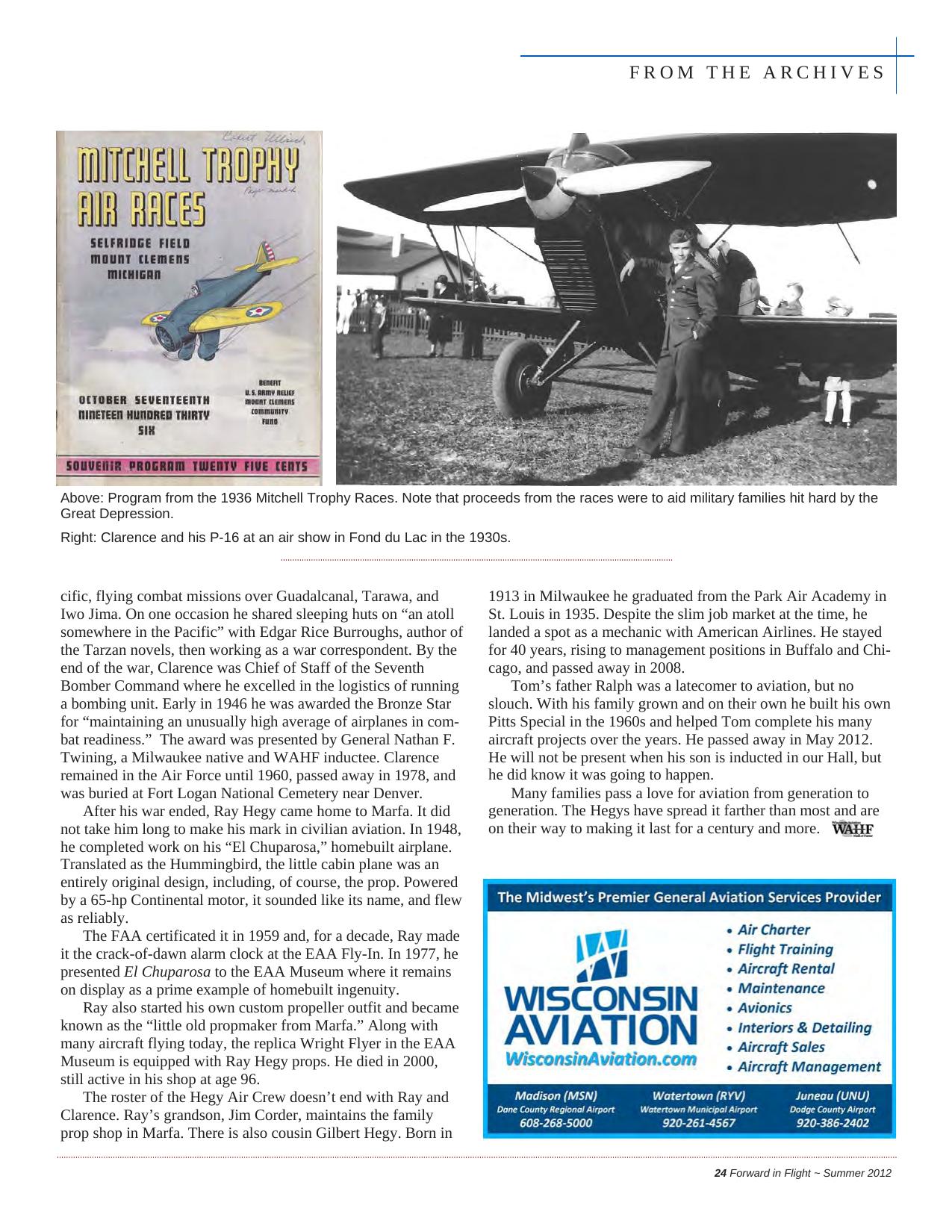
FROM THE ARCHIVES Above: Program from the 1936 Mitchell Trophy Races. Note that proceeds from the races were to aid military families hit hard by the Great Depression. Right: Clarence and his P-16 at an air show in Fond du Lac in the 1930s. cific, flying combat missions over Guadalcanal, Tarawa, and Iwo Jima. On one occasion he shared sleeping huts on “an atoll somewhere in the Pacific” with Edgar Rice Burroughs, author of the Tarzan novels, then working as a war correspondent. By the end of the war, Clarence was Chief of Staff of the Seventh Bomber Command where he excelled in the logistics of running a bombing unit. Early in 1946 he was awarded the Bronze Star for “maintaining an unusually high average of airplanes in combat readiness.” The award was presented by General Nathan F. Twining, a Milwaukee native and WAHF inductee. Clarence remained in the Air Force until 1960, passed away in 1978, and was buried at Fort Logan National Cemetery near Denver. After his war ended, Ray Hegy came home to Marfa. It did not take him long to make his mark in civilian aviation. In 1948, he completed work on his “El Chuparosa,” homebuilt airplane. Translated as the Hummingbird, the little cabin plane was an entirely original design, including, of course, the prop. Powered by a 65-hp Continental motor, it sounded like its name, and flew as reliably. The FAA certificated it in 1959 and, for a decade, Ray made it the crack-of-dawn alarm clock at the EAA Fly-In. In 1977, he presented El Chuparosa to the EAA Museum where it remains on display as a prime example of homebuilt ingenuity. Ray also started his own custom propeller outfit and became known as the “little old propmaker from Marfa.” Along with many aircraft flying today, the replica Wright Flyer in the EAA Museum is equipped with Ray Hegy props. He died in 2000, still active in his shop at age 96. The roster of the Hegy Air Crew doesn’t end with Ray and Clarence. Ray’s grandson, Jim Corder, maintains the family prop shop in Marfa. There is also cousin Gilbert Hegy. Born in 1913 in Milwaukee he graduated from the Park Air Academy in St. Louis in 1935. Despite the slim job market at the time, he landed a spot as a mechanic with American Airlines. He stayed for 40 years, rising to management positions in Buffalo and Chicago, and passed away in 2008. Tom’s father Ralph was a latecomer to aviation, but no slouch. With his family grown and on their own he built his own Pitts Special in the 1960s and helped Tom complete his many aircraft projects over the years. He passed away in May 2012. He will not be present when his son is inducted in our Hall, but he did know it was going to happen. Many families pass a love for aviation from generation to generation. The Hegys have spread it farther than most and are on their way to making it last for a century and more. 24 Forward in Flight ~ Summer 2012
GUEST EDITORIAL Saving Blackhawk Tech’s Aviation Maintenance Program How you can help By Pam Thomas The first time staff members at Blackhawk Technical College’s tion he needed. At least two Board members seemed reluctant, (BTC) Aviation Center in Janesville, Wisconsin, heard about but the majority voted to suspend the program temporarily. cost-cutting, budget holes, or the possibility of program cuts The official suspension request sent to the Wisconsin Techwas on November 1, 2011, when their Dean informed them of nical College System by Dr. Sharon Kennedy states the “Major the administration’s decision to ask the District Board to susreasons and rationale for requesting program suspension: pend the Aviation Maintenance Technician (AMT) program. Budget cuts and small in-district enrollment.” Approval was Blackhawk Technical College President Dr. Tom Eckert then granted on January 12, 2012 by WTCS Education Director sent an email on November 3 to all BTC staff informing them of Sandy Schmit and Associate Vice President, Office of Instruchis decision to suspend the program, saying, “I wanted to wait tion Annette Severson. Though there is space on the form, neion this announcement to the campus, but unfortunately the press ther included a comment indicating questions had been asked. has gotten a hold of this information and an artiThe cover letter from Ms. Severson to Dr. KenHelp save the cle will likely appear in tomorrow’s [Janesville] nedy states, “The suspension status for this proBlackhawk Technical Gazette. . . We will be placing before the Board gram will sunset on 1/12/2015. Please notify me College Aviation at the November board meeting a request to before that date if you wish to reactivate this Maintenance Technician suspend the Aviation Program . . . This recomprogram.” program! mendation will be made to the Board in order to Contact Pam Thomas deal with reduced state support and the freeze on CURRENT EFFORTS N7002 Peck Station Rd. our levy. This was a difficult decision and made A group of concerned citizens, the Friends of Elkhorn, WI 53121 only after long and careful consideration.” Blackhawk Technical College Aviation 262-642-7541 The November board meeting occurred on (FOBTCA), are trying to save this important Tuesday the 16th, and despite the short notice, The Friends of Blackhawk program. Their ultimate goal is to get the BTC the room overflowed with graduates and current Technical College Aviation District Board to reactivate Blackhawk’s Aviastudents, current and former instructors, aviation tion Maintenance Technician program. are on Facebook: business owners, parents, and other stakeA non-emotional presentation designed to Facebook.com/FOBTCA holders, many of whom pleaded with the Board detail factual information regarding BTC’s Web: www.FOBTCA.org to delay their vote until further fact-finding AMT program and address the Administration’s could be accomplished. In the days between November 3 and justifications for suspending the program is being developed, to November 16, only two Board members visited the Aviation be presented to members of the Rock and Green County Boards, Center. One indicated during her visit that she had wanted to state legislators Senator Tim Cullen and Representatives Evan question the instructors when they attended the Board meeting, Wynn, Joseph Knilans, and Amy Loudenbeck, staff and board but she had not been allowed to do so. Several asked for more members of the Wisconsin Technical College System, and anyinformation; one was not aware of the difference between a dione else with the power to influence members of the BTC Disploma and an FAA Certificate; one suggested he needed more trict Board. In-district residents of Green and Rock Counties are information but was told by Dr. Eckert he had all the informaneeded to make these presentations. Anyone in the state who supports this goal is invited to write letters, make phone calls, and sign a petition, urging those with the power to influence the BTC District Board to do so on our behalf. Contact information for the above will be on our Facebook and website pages. Help spread the word by contacting your friends and family members. Two petitions are being circulated: one to be signed only by residents of Rock or Green Counties, and one to be signed by residents of the other 70 Wisconsin counties. Anyone supporting the reactivation of Blackhawk’s AMT program is invited to circulate petitions. Please mail completed petitions to me. We are contacting every aviation organization, company, and airport in the state, asking them to write letters, make phone calls, and circulate petitions. If you know someone in the aviation industry, especially FBO owners, please send me their email addresses or other contact information. 25 Forward in Flight ~ Quarterly Magazine of the Wisconsin Aviation Hall of Fame
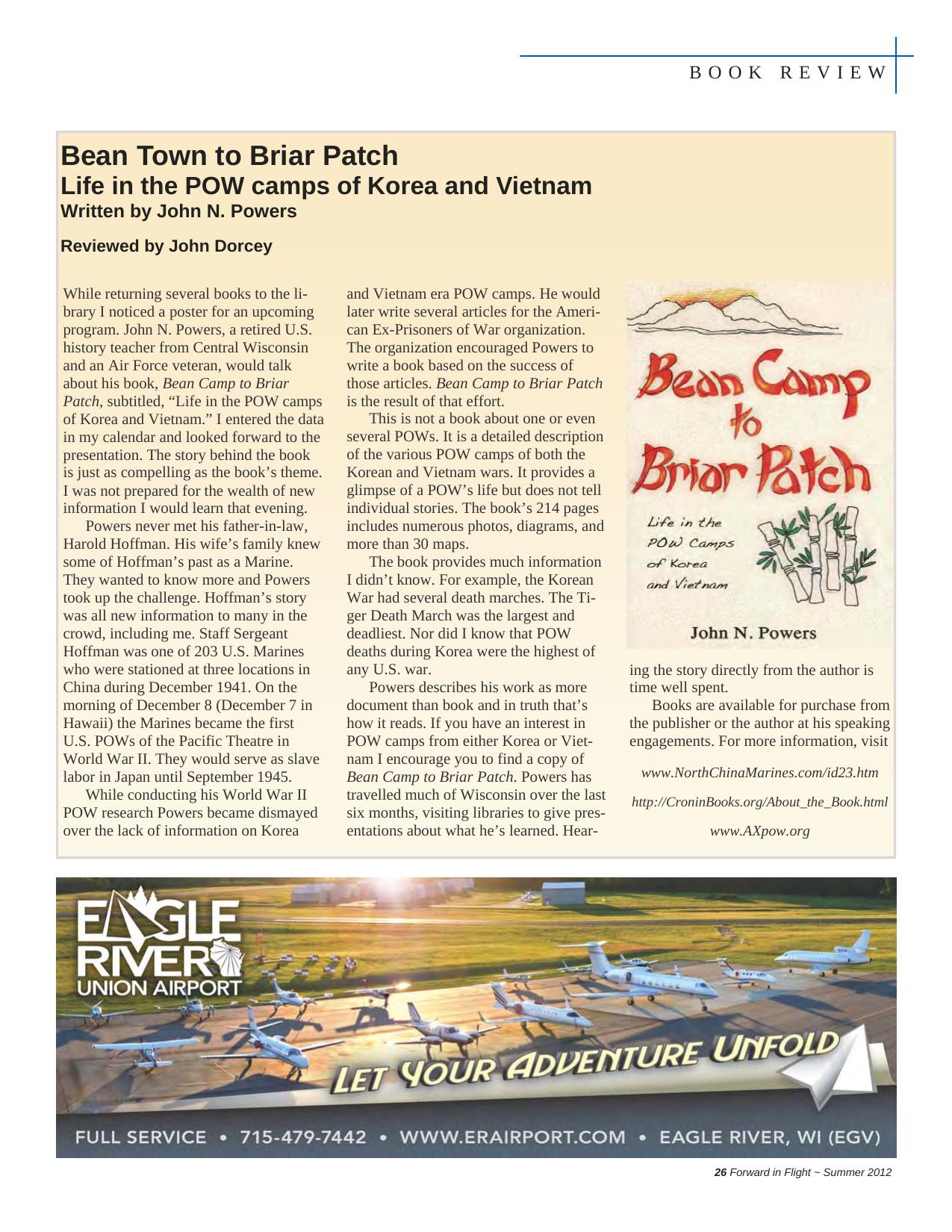
BOOK REVIEW Bean Town to Briar Patch Life in the POW camps of Korea and Vietnam Written by John N. Powers Reviewed by John Dorcey While returning several books to the library I noticed a poster for an upcoming program. John N. Powers, a retired U.S. history teacher from Central Wisconsin and an Air Force veteran, would talk about his book, Bean Camp to Briar Patch, subtitled, “Life in the POW camps of Korea and Vietnam.” I entered the data in my calendar and looked forward to the presentation. The story behind the book is just as compelling as the book’s theme. I was not prepared for the wealth of new information I would learn that evening. Powers never met his father-in-law, Harold Hoffman. His wife’s family knew some of Hoffman’s past as a Marine. They wanted to know more and Powers took up the challenge. Hoffman’s story was all new information to many in the crowd, including me. Staff Sergeant Hoffman was one of 203 U.S. Marines who were stationed at three locations in China during December 1941. On the morning of December 8 (December 7 in Hawaii) the Marines became the first U.S. POWs of the Pacific Theatre in World War II. They would serve as slave labor in Japan until September 1945. While conducting his World War II POW research Powers became dismayed over the lack of information on Korea and Vietnam era POW camps. He would later write several articles for the American Ex-Prisoners of War organization. The organization encouraged Powers to write a book based on the success of those articles. Bean Camp to Briar Patch is the result of that effort. This is not a book about one or even several POWs. It is a detailed description of the various POW camps of both the Korean and Vietnam wars. It provides a glimpse of a POW’s life but does not tell individual stories. The book’s 214 pages includes numerous photos, diagrams, and more than 30 maps. The book provides much information I didn’t know. For example, the Korean War had several death marches. The Tiger Death March was the largest and deadliest. Nor did I know that POW deaths during Korea were the highest of any U.S. war. Powers describes his work as more document than book and in truth that’s how it reads. If you have an interest in POW camps from either Korea or Vietnam I encourage you to find a copy of Bean Camp to Briar Patch. Powers has travelled much of Wisconsin over the last six months, visiting libraries to give presentations about what he’s learned. Hear- ing the story directly from the author is time well spent. Books are available for purchase from the publisher or the author at his speaking engagements. For more information, visit www.NorthChinaMarines.com/id23.htm http://CroninBooks.org/About_the_Book.html www.AXpow.org 26 Forward in Flight ~ Summer 2012
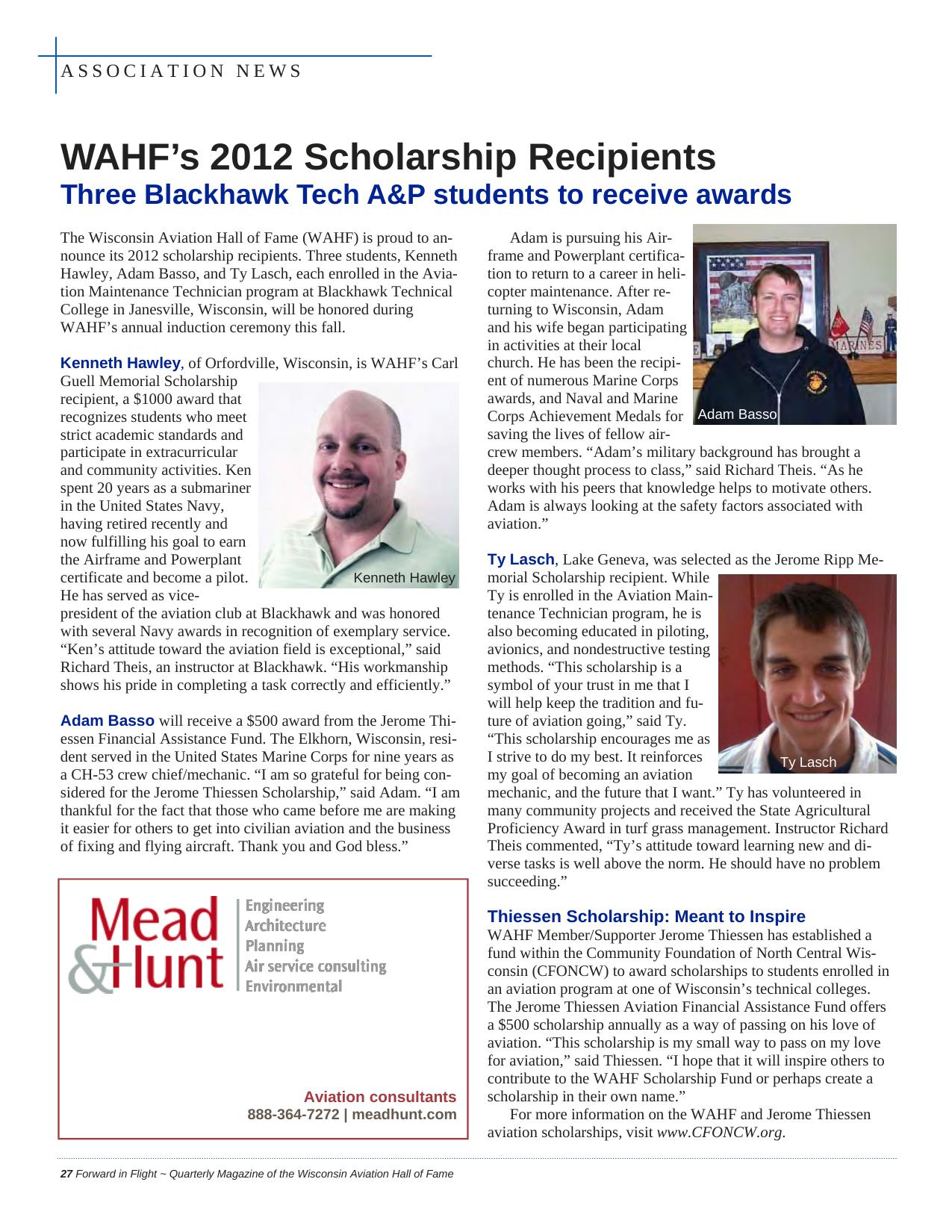
ASSOCIATION NEWS WAHF’s 2012 Scholarship Recipients Three Blackhawk Tech A&P students to receive awards The Wisconsin Aviation Hall of Fame (WAHF) is proud to announce its 2012 scholarship recipients. Three students, Kenneth Hawley, Adam Basso, and Ty Lasch, each enrolled in the Aviation Maintenance Technician program at Blackhawk Technical College in Janesville, Wisconsin, will be honored during WAHF’s annual induction ceremony this fall. Kenneth Hawley, of Orfordville, Wisconsin, is WAHF’s Carl Guell Memorial Scholarship recipient, a $1000 award that recognizes students who meet strict academic standards and participate in extracurricular and community activities. Ken spent 20 years as a submariner in the United States Navy, having retired recently and now fulfilling his goal to earn the Airframe and Powerplant Kenneth Hawley certificate and become a pilot. He has served as vicepresident of the aviation club at Blackhawk and was honored with several Navy awards in recognition of exemplary service. “Ken’s attitude toward the aviation field is exceptional,” said Richard Theis, an instructor at Blackhawk. “His workmanship shows his pride in completing a task correctly and efficiently.” Adam Basso will receive a $500 award from the Jerome Thiessen Financial Assistance Fund. The Elkhorn, Wisconsin, resident served in the United States Marine Corps for nine years as a CH-53 crew chief/mechanic. “I am so grateful for being considered for the Jerome Thiessen Scholarship,” said Adam. “I am thankful for the fact that those who came before me are making it easier for others to get into civilian aviation and the business of fixing and flying aircraft. Thank you and God bless.” Adam is pursuing his Airframe and Powerplant certification to return to a career in helicopter maintenance. After returning to Wisconsin, Adam and his wife began participating in activities at their local church. He has been the recipient of numerous Marine Corps awards, and Naval and Marine Corps Achievement Medals for Adam Basso saving the lives of fellow aircrew members. “Adam’s military background has brought a deeper thought process to class,” said Richard Theis. “As he works with his peers that knowledge helps to motivate others. Adam is always looking at the safety factors associated with aviation.” Ty Lasch, Lake Geneva, was selected as the Jerome Ripp Memorial Scholarship recipient. While Ty is enrolled in the Aviation Maintenance Technician program, he is also becoming educated in piloting, avionics, and nondestructive testing methods. “This scholarship is a symbol of your trust in me that I will help keep the tradition and future of aviation going,” said Ty. “This scholarship encourages me as I strive to do my best. It reinforces Ty Lasch my goal of becoming an aviation mechanic, and the future that I want.” Ty has volunteered in many community projects and received the State Agricultural Proficiency Award in turf grass management. Instructor Richard Theis commented, “Ty’s attitude toward learning new and diverse tasks is well above the norm. He should have no problem succeeding.” Thiessen Scholarship: Meant to Inspire Aviation consultants 888-364-7272 | meadhunt.com 27 Forward in Flight ~ Quarterly Magazine of the Wisconsin Aviation Hall of Fame WAHF Member/Supporter Jerome Thiessen has established a fund within the Community Foundation of North Central Wisconsin (CFONCW) to award scholarships to students enrolled in an aviation program at one of Wisconsin’s technical colleges. The Jerome Thiessen Aviation Financial Assistance Fund offers a $500 scholarship annually as a way of passing on his love of aviation. “This scholarship is my small way to pass on my love for aviation,” said Thiessen. “I hope that it will inspire others to contribute to the WAHF Scholarship Fund or perhaps create a scholarship in their own name.” For more information on the WAHF and Jerome Thiessen aviation scholarships, visit www.CFONCW.org.
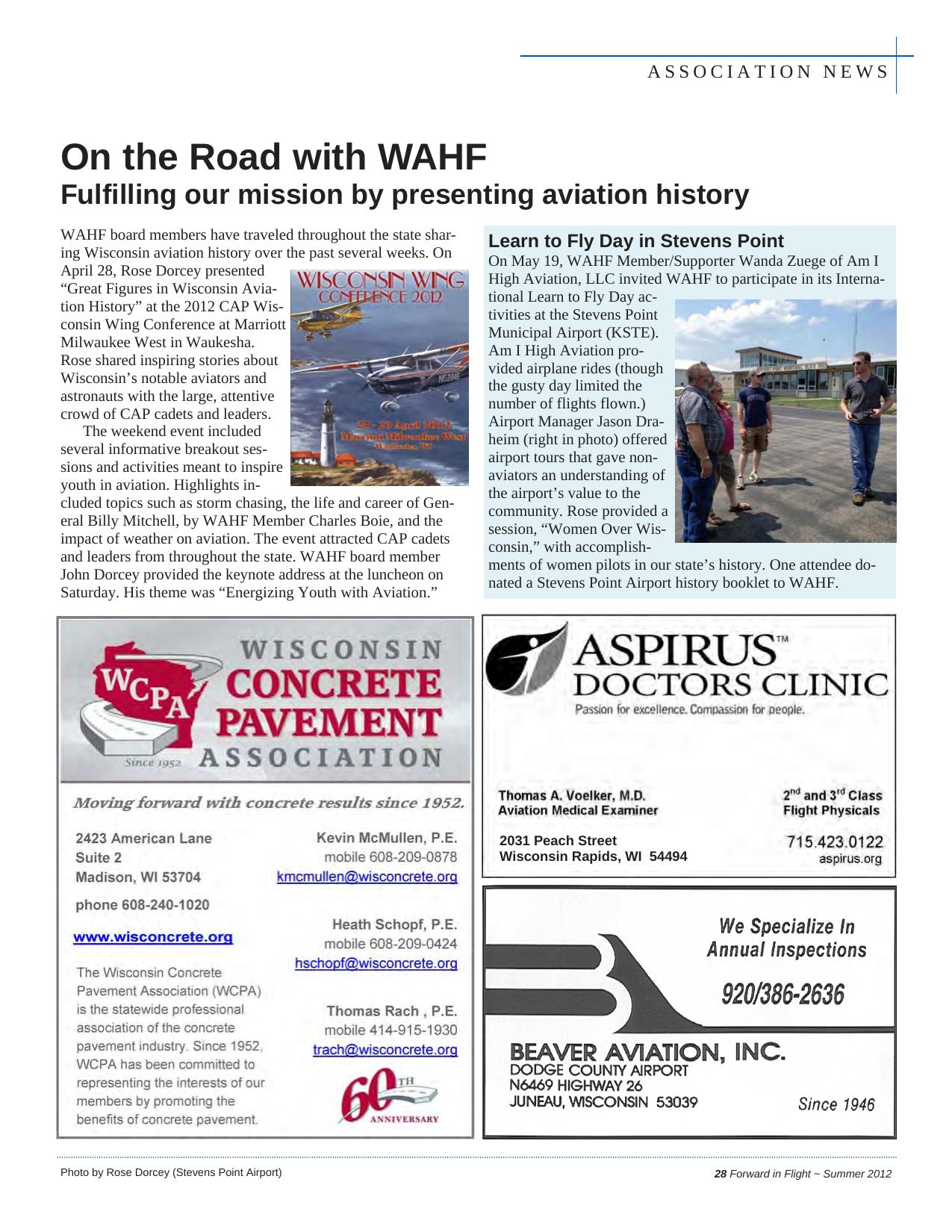
ASSOCIATION NEWS On the Road with WAHF Fulfilling our mission by presenting aviation history WAHF board members have traveled throughout the state sharing Wisconsin aviation history over the past several weeks. On April 28, Rose Dorcey presented “Great Figures in Wisconsin Aviation History” at the 2012 CAP Wisconsin Wing Conference at Marriott Milwaukee West in Waukesha. Rose shared inspiring stories about Wisconsin’s notable aviators and astronauts with the large, attentive crowd of CAP cadets and leaders. The weekend event included several informative breakout sessions and activities meant to inspire youth in aviation. Highlights included topics such as storm chasing, the life and career of General Billy Mitchell, by WAHF Member Charles Boie, and the impact of weather on aviation. The event attracted CAP cadets and leaders from throughout the state. WAHF board member John Dorcey provided the keynote address at the luncheon on Saturday. His theme was “Energizing Youth with Aviation.” Learn to Fly Day in Stevens Point On May 19, WAHF Member/Supporter Wanda Zuege of Am I High Aviation, LLC invited WAHF to participate in its International Learn to Fly Day activities at the Stevens Point Municipal Airport (KSTE). Am I High Aviation provided airplane rides (though the gusty day limited the number of flights flown.) Airport Manager Jason Draheim (right in photo) offered airport tours that gave nonaviators an understanding of the airport’s value to the community. Rose provided a session, “Women Over Wisconsin,” with accomplishments of women pilots in our state’s history. One attendee donated a Stevens Point Airport history booklet to WAHF. 2031 Peach Street Wisconsin Rapids, WI 54494 Photo by Rose Dorcey (Stevens Point Airport) 28 Forward in Flight ~ Summer 2012
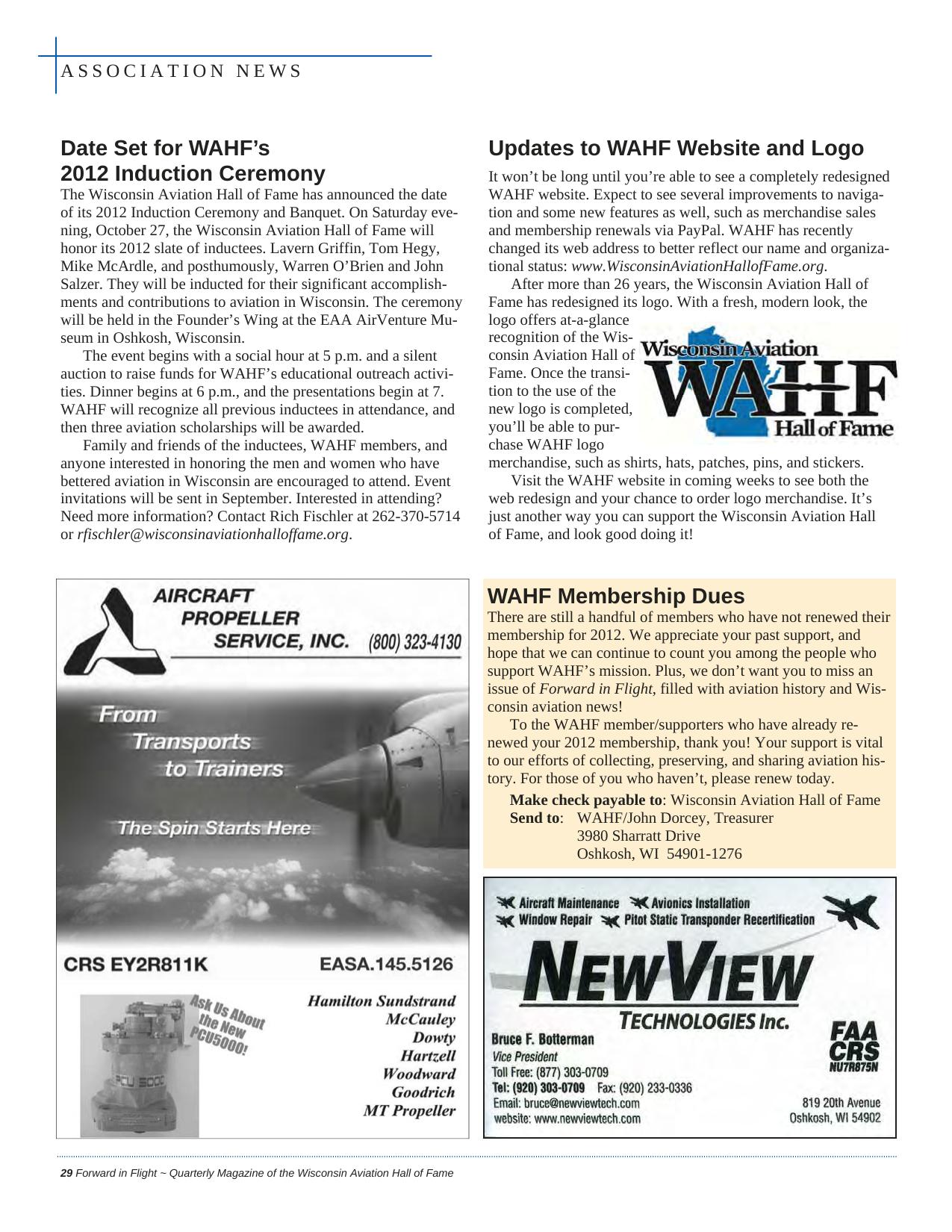
ASSOCIATION NEWS Date Set for WAHF’s 2012 Induction Ceremony The Wisconsin Aviation Hall of Fame has announced the date of its 2012 Induction Ceremony and Banquet. On Saturday evening, October 27, the Wisconsin Aviation Hall of Fame will honor its 2012 slate of inductees. Lavern Griffin, Tom Hegy, Mike McArdle, and posthumously, Warren O’Brien and John Salzer. They will be inducted for their significant accomplishments and contributions to aviation in Wisconsin. The ceremony will be held in the Founder’s Wing at the EAA AirVenture Museum in Oshkosh, Wisconsin. The event begins with a social hour at 5 p.m. and a silent auction to raise funds for WAHF’s educational outreach activities. Dinner begins at 6 p.m., and the presentations begin at 7. WAHF will recognize all previous inductees in attendance, and then three aviation scholarships will be awarded. Family and friends of the inductees, WAHF members, and anyone interested in honoring the men and women who have bettered aviation in Wisconsin are encouraged to attend. Event invitations will be sent in September. Interested in attending? Need more information? Contact Rich Fischler at 262-370-5714 or rfischler@wisconsinaviationhalloffame.org. Updates to WAHF Website and Logo It won’t be long until you’re able to see a completely redesigned WAHF website. Expect to see several improvements to navigation and some new features as well, such as merchandise sales and membership renewals via PayPal. WAHF has recently changed its web address to better reflect our name and organizational status: www.WisconsinAviationHallofFame.org. After more than 26 years, the Wisconsin Aviation Hall of Fame has redesigned its logo. With a fresh, modern look, the logo offers at-a-glance recognition of the Wisconsin Aviation Hall of Fame. Once the transition to the use of the new logo is completed, you’ll be able to purchase WAHF logo merchandise, such as shirts, hats, patches, pins, and stickers. Visit the WAHF website in coming weeks to see both the web redesign and your chance to order logo merchandise. It’s just another way you can support the Wisconsin Aviation Hall of Fame, and look good doing it! WAHF Membership Dues There are still a handful of members who have not renewed their membership for 2012. We appreciate your past support, and hope that we can continue to count you among the people who support WAHF’s mission. Plus, we don’t want you to miss an issue of Forward in Flight, filled with aviation history and Wisconsin aviation news! To the WAHF member/supporters who have already renewed your 2012 membership, thank you! Your support is vital to our efforts of collecting, preserving, and sharing aviation history. For those of you who haven’t, please renew today. Make check payable to: Wisconsin Aviation Hall of Fame Send to: WAHF/John Dorcey, Treasurer 3980 Sharratt Drive Oshkosh, WI 54901-1276 29 Forward in Flight ~ Quarterly Magazine of the Wisconsin Aviation Hall of Fame
FROM THE AIRWAYS Blackhawk Tech’s Aircraft Maintenance Technician Program Receives Civil Air Patrol Awards At the Wisconsin Wing Civil Air Patrol’s annual Wing Conference in Waukesha on April 28, Blackhawk Technical College’s revered Aviation Maintenance Technician Program was recognized for its significant, long-term contributions to the aerospace field with the prestigious Frank G. Brewer – Civil Air Patrol Memorial Aerospace Award by the Wisconsin Wing and the Great Lakes Region of the Civil Air Patrol. Patrick Ripp, one of Blackhawk’s three instructors, accepted the awards from Major General Charles L. Carr, Jr., Civil Air Patrol National Commander; Colonel Robert Karton, Great Lakes Region Commander; and Colonel Clarence Peters, Commander, Wisconsin Wing. The Brewer award is presented by CAP in commemoration of Frank G. Brewer, Sr., and his lifelong interest in aviation, youth and education to individuals or organizations that have made significant contributions to the aerospace field over a continuous period. Blackhawk Tech’s AMT program has been operational for more than 70 years and certificated by the Federal Aviation Administration (FAA) since 1949. Current instructor Rick Theis has been at Blackhawk for 20 years, Pat Ripp for 15, and Mario Flores for 12 years. Two graduates, including Archie Henkelmann and Richard Wixom, have been inducted into the Wisconsin Aviation Hall of Fame. Visitors to the Experimental Aircraft Association’s AirVenture Museum in Oshkosh see the ‘Wright Flyer’ replica on display. This replica was built by Blackhawk students under the direction of then Blackhawk AMT chief instructor, Archie Henkelmann of Janesville. The citation that accompanied Blackhawk’s nomination for the Brewer Award read in part, “Blackhawk Technical College’s Airframe and Power Plant Mechanics program has made and continues to make significant contributions to the aerospace field by providing invaluable aerospace education to the State of Wisconsin and the nation.” Pilot Companion Course Offered at Wausau Downtown Airport Ever worried about what you would do if you were riding in a small airplane and the pilot became incapacitated? Wausau Flying Service will offer a free, two-and-a-half hour ground course that covers how to ask for help on the radio, controlling an airplane, and how to land. Certified Flight Instructors John Chmiel and Gil Buettner will lead the course. The course begins at 9 a.m. on Saturday, August 4. To register, call Wausau Flying Service at 715-845-3400, or online at www.flywausau.com. Those who wish to continue with hands-on instruction in an airplane have the option of using one normally flown by their spouse, or renting an airplane from Wausau Flying Service. Wausau Downtown Airport is located at 725 Woods Place. Photo by Jeri Gonwa, Public Affairs Officer Left to right: Colonel Robert Karton, Great Lakes Region commander; Pat Ripp, Blackhawk Technical College Aircraft Maintenance Technician Instructor; Major General Charles Carr, national Civil Air Patrol commander, and Col. Clarence Peters, Wisconsin Wing commander. First Customer-Built Onex Flies Oshkosh, Wisconsin-based Sonex Aircraft, LLC has announced that the first customer-built example of the new Onex singleplace, folding-wing, aerobatic sport aircraft has taken flight. Bill Fisher of Jackson, Tennessee, flew his AeroVee powered, standard gear Onex, serial number ONX0018, for the first time on Thursday, May 10, 2012. Bill received the fourth Onex kit sold by Sonex Aircraft, shipped on August 5, 2011. Bill Fisher flew the first cusThe Onex (pronounced tomer-built Sonex Onex. One-X) is a single-seat aircraft designed to offer an economical way to build and fly a sport pilot aircraft. To learn more, visit www.SonexAircraft.com and www.AeroConversions.com. Morey Airplane Company Since 1932 Middleton Municipal Airport/Morey Field Self-service 100LL & Jet A 24-7 30 Forward in Flight ~ Summer 2012
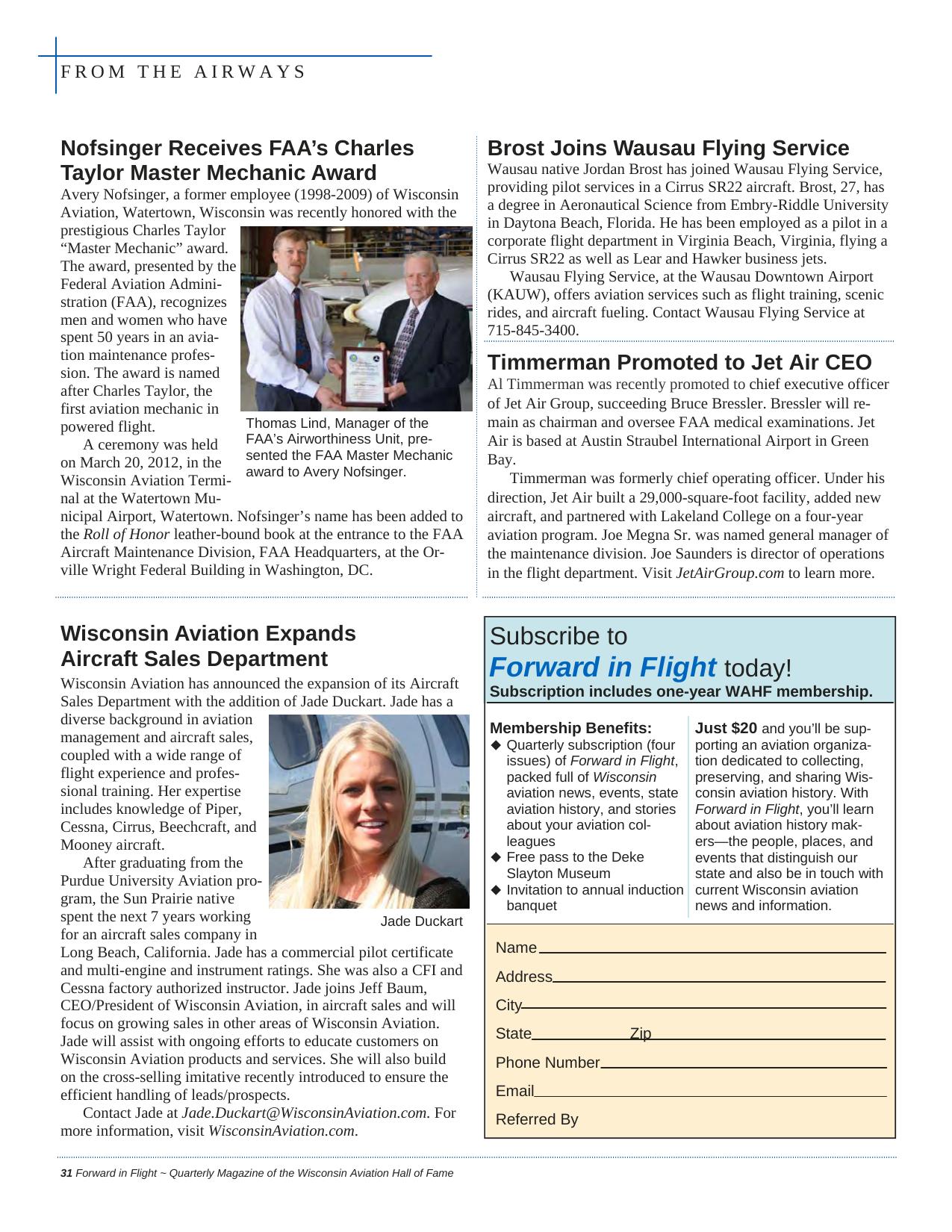
FROM THE AIRWAYS Nofsinger Receives FAA’s Charles Taylor Master Mechanic Award Avery Nofsinger, a former employee (1998-2009) of Wisconsin Aviation, Watertown, Wisconsin was recently honored with the prestigious Charles Taylor “Master Mechanic” award. The award, presented by the Federal Aviation Administration (FAA), recognizes men and women who have spent 50 years in an aviation maintenance profession. The award is named after Charles Taylor, the first aviation mechanic in Thomas Lind, Manager of the powered flight. FAA’s Airworthiness Unit, preA ceremony was held sented the FAA Master Mechanic on March 20, 2012, in the award to Avery Nofsinger. Wisconsin Aviation Terminal at the Watertown Municipal Airport, Watertown. Nofsinger’s name has been added to the Roll of Honor leather-bound book at the entrance to the FAA Aircraft Maintenance Division, FAA Headquarters, at the Orville Wright Federal Building in Washington, DC. Brost Joins Wausau Flying Service Wausau native Jordan Brost has joined Wausau Flying Service, providing pilot services in a Cirrus SR22 aircraft. Brost, 27, has a degree in Aeronautical Science from Embry-Riddle University in Daytona Beach, Florida. He has been employed as a pilot in a corporate flight department in Virginia Beach, Virginia, flying a Cirrus SR22 as well as Lear and Hawker business jets. Wausau Flying Service, at the Wausau Downtown Airport (KAUW), offers aviation services such as flight training, scenic rides, and aircraft fueling. Contact Wausau Flying Service at 715-845-3400. Timmerman Promoted to Jet Air CEO Al Timmerman was recently promoted to chief executive officer of Jet Air Group, succeeding Bruce Bressler. Bressler will remain as chairman and oversee FAA medical examinations. Jet Air is based at Austin Straubel International Airport in Green Bay. Timmerman was formerly chief operating officer. Under his direction, Jet Air built a 29,000-square-foot facility, added new aircraft, and partnered with Lakeland College on a four-year aviation program. Joe Megna Sr. was named general manager of the maintenance division. Joe Saunders is director of operations in the flight department. Visit JetAirGroup.com to learn more. Wisconsin Aviation Expands Aircraft Sales Department Subscribe to Wisconsin Aviation has announced the expansion of its Aircraft Sales Department with the addition of Jade Duckart. Jade has a diverse background in aviation management and aircraft sales, coupled with a wide range of flight experience and professional training. Her expertise includes knowledge of Piper, Cessna, Cirrus, Beechcraft, and Mooney aircraft. After graduating from the Purdue University Aviation program, the Sun Prairie native spent the next 7 years working Jade Duckart for an aircraft sales company in Long Beach, California. Jade has a commercial pilot certificate and multi-engine and instrument ratings. She was also a CFI and Cessna factory authorized instructor. Jade joins Jeff Baum, CEO/President of Wisconsin Aviation, in aircraft sales and will focus on growing sales in other areas of Wisconsin Aviation. Jade will assist with ongoing efforts to educate customers on Wisconsin Aviation products and services. She will also build on the cross-selling imitative recently introduced to ensure the efficient handling of leads/prospects. Contact Jade at Jade.Duckart@WisconsinAviation.com. For more information, visit WisconsinAviation.com. Subscription includes one-year WAHF membership. 31 Forward in Flight ~ Quarterly Magazine of the Wisconsin Aviation Hall of Fame Forward in Flight today! Membership Benefits: Just $20 and you’ll be sup- Quarterly subscription (four porting an aviation organization dedicated to collecting, preserving, and sharing Wisconsin aviation history. With Forward in Flight, you’ll learn about aviation history makers—the people, places, and events that distinguish our state and also be in touch with current Wisconsin aviation news and information. issues) of Forward in Flight, packed full of Wisconsin aviation news, events, state aviation history, and stories about your aviation colleagues Free pass to the Deke Slayton Museum Invitation to annual induction banquet Name Address City State Phone Number Email Referred By Zip
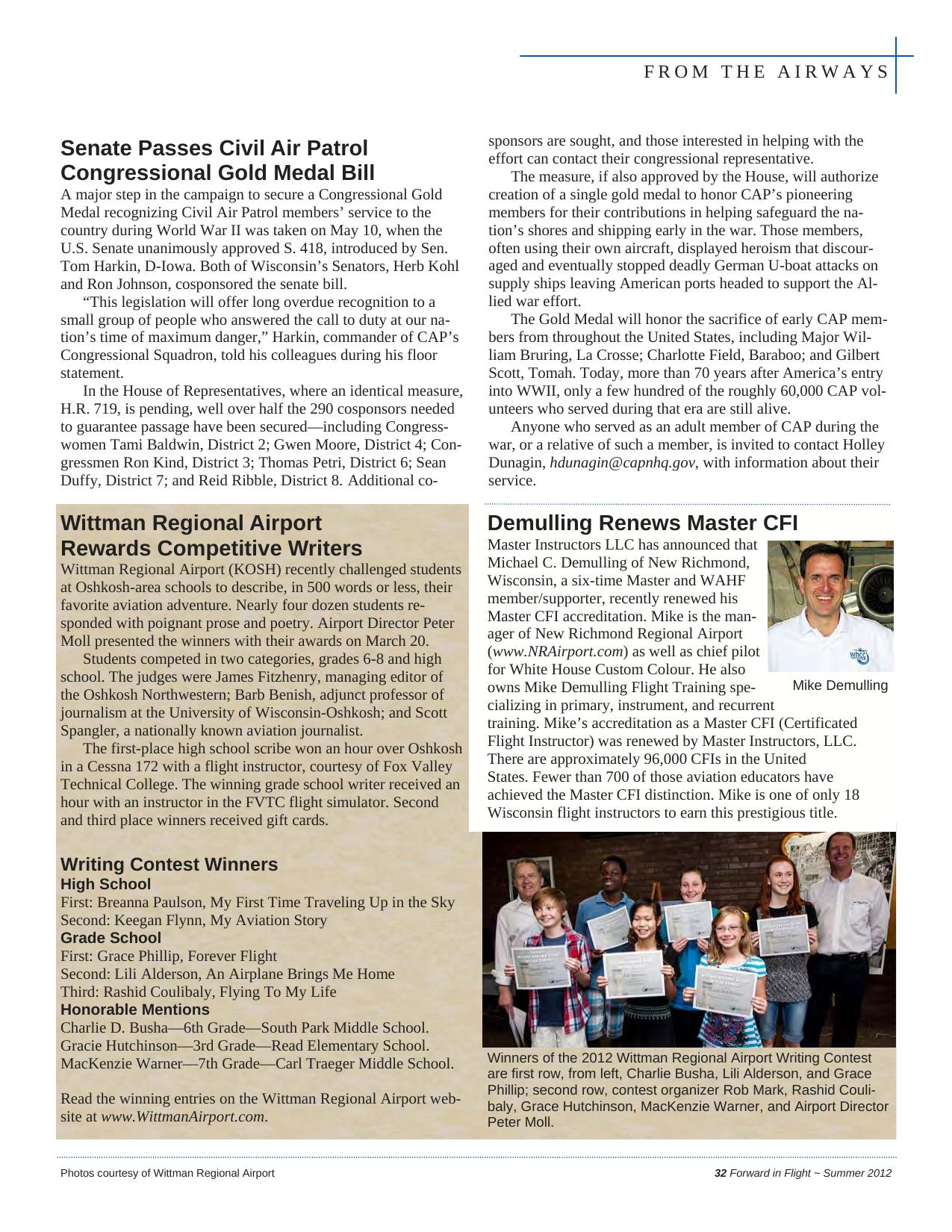
FROM THE AIRWAYS Senate Passes Civil Air Patrol Congressional Gold Medal Bill A major step in the campaign to secure a Congressional Gold Medal recognizing Civil Air Patrol members’ service to the country during World War II was taken on May 10, when the U.S. Senate unanimously approved S. 418, introduced by Sen. Tom Harkin, D-Iowa. Both of Wisconsin’s Senators, Herb Kohl and Ron Johnson, cosponsored the senate bill. “This legislation will offer long overdue recognition to a small group of people who answered the call to duty at our nation’s time of maximum danger,” Harkin, commander of CAP’s Congressional Squadron, told his colleagues during his floor statement. In the House of Representatives, where an identical measure, H.R. 719, is pending, well over half the 290 cosponsors needed to guarantee passage have been secured—including Congresswomen Tami Baldwin, District 2; Gwen Moore, District 4; Congressmen Ron Kind, District 3; Thomas Petri, District 6; Sean Duffy, District 7; and Reid Ribble, District 8. Additional co- Wittman Regional Airport Rewards Competitive Writers Wittman Regional Airport (KOSH) recently challenged students at Oshkosh-area schools to describe, in 500 words or less, their favorite aviation adventure. Nearly four dozen students responded with poignant prose and poetry. Airport Director Peter Moll presented the winners with their awards on March 20. Students competed in two categories, grades 6-8 and high school. The judges were James Fitzhenry, managing editor of the Oshkosh Northwestern; Barb Benish, adjunct professor of journalism at the University of Wisconsin-Oshkosh; and Scott Spangler, a nationally known aviation journalist. The first-place high school scribe won an hour over Oshkosh in a Cessna 172 with a flight instructor, courtesy of Fox Valley Technical College. The winning grade school writer received an hour with an instructor in the FVTC flight simulator. Second and third place winners received gift cards. sponsors are sought, and those interested in helping with the effort can contact their congressional representative. The measure, if also approved by the House, will authorize creation of a single gold medal to honor CAP’s pioneering members for their contributions in helping safeguard the nation’s shores and shipping early in the war. Those members, often using their own aircraft, displayed heroism that discouraged and eventually stopped deadly German U-boat attacks on supply ships leaving American ports headed to support the Allied war effort. The Gold Medal will honor the sacrifice of early CAP members from throughout the United States, including Major William Bruring, La Crosse; Charlotte Field, Baraboo; and Gilbert Scott, Tomah. Today, more than 70 years after America’s entry into WWII, only a few hundred of the roughly 60,000 CAP volunteers who served during that era are still alive. Anyone who served as an adult member of CAP during the war, or a relative of such a member, is invited to contact Holley Dunagin, hdunagin@capnhq.gov, with information about their service. Demulling Renews Master CFI Master Instructors LLC has announced that Michael C. Demulling of New Richmond, Wisconsin, a six-time Master and WAHF member/supporter, recently renewed his Master CFI accreditation. Mike is the manager of New Richmond Regional Airport (www.NRAirport.com) as well as chief pilot for White House Custom Colour. He also Mike Demulling owns Mike Demulling Flight Training specializing in primary, instrument, and recurrent training. Mike’s accreditation as a Master CFI (Certificated Flight Instructor) was renewed by Master Instructors, LLC. There are approximately 96,000 CFIs in the United States. Fewer than 700 of those aviation educators have achieved the Master CFI distinction. Mike is one of only 18 Wisconsin flight instructors to earn this prestigious title. Writing Contest Winners High School First: Breanna Paulson, My First Time Traveling Up in the Sky Second: Keegan Flynn, My Aviation Story Grade School First: Grace Phillip, Forever Flight Second: Lili Alderson, An Airplane Brings Me Home Third: Rashid Coulibaly, Flying To My Life Honorable Mentions Charlie D. Busha—6th Grade—South Park Middle School. Gracie Hutchinson—3rd Grade—Read Elementary School. MacKenzie Warner—7th Grade—Carl Traeger Middle School. Read the winning entries on the Wittman Regional Airport website at www.WittmanAirport.com. Photos courtesy of Wittman Regional Airport Winners of the 2012 Wittman Regional Airport Writing Contest are first row, from left, Charlie Busha, Lili Alderson, and Grace Phillip; second row, contest organizer Rob Mark, Rashid Coulibaly, Grace Hutchinson, MacKenzie Warner, and Airport Director Peter Moll. 32 Forward in Flight ~ Summer 2012
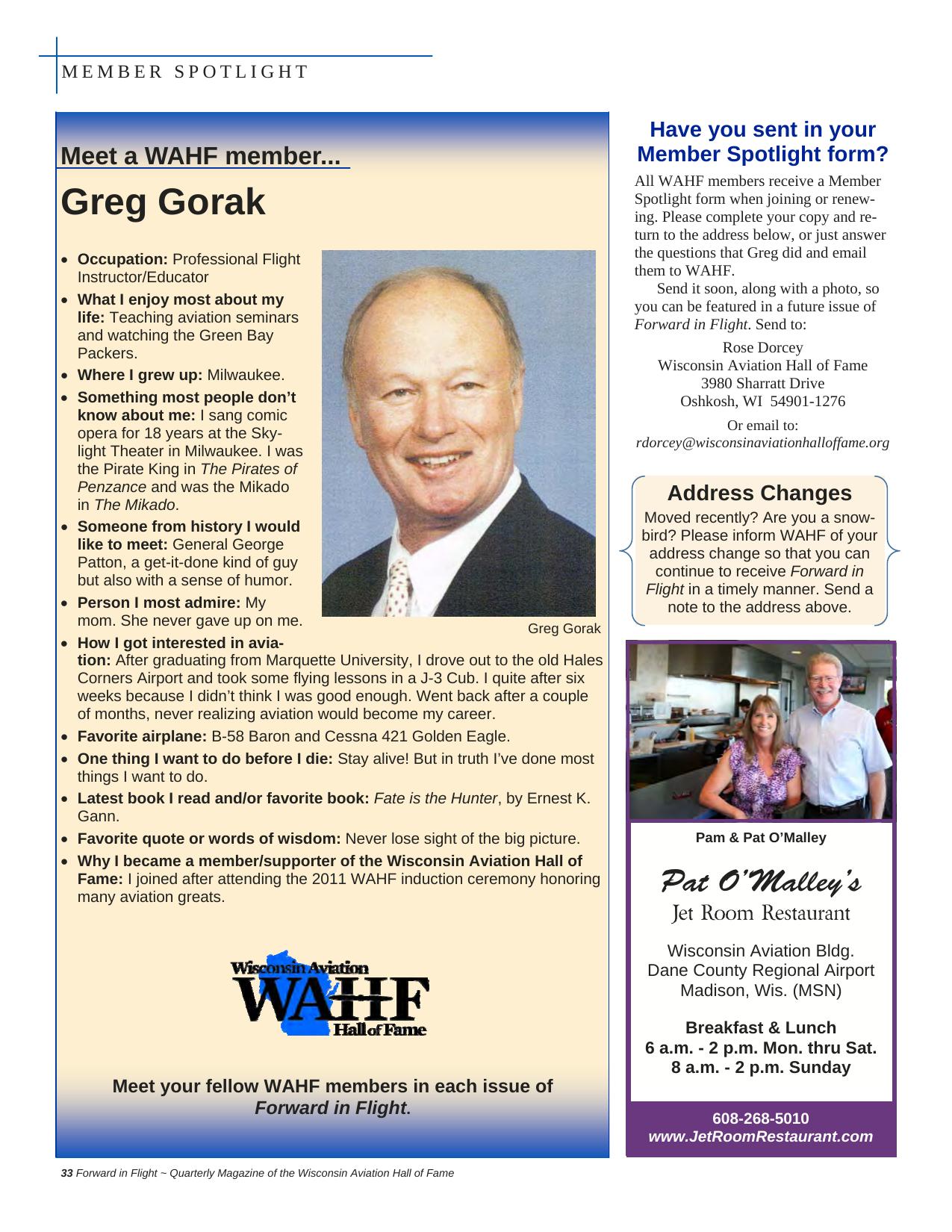
MEMBER SPOTLIGHT Meet a WAHF member... Greg Gorak Occupation: Professional Flight Instructor/Educator What I enjoy most about my life: Teaching aviation seminars and watching the Green Bay Packers. Where I grew up: Milwaukee. Something most people don’t know about me: I sang comic opera for 18 years at the Skylight Theater in Milwaukee. I was the Pirate King in The Pirates of Penzance and was the Mikado in The Mikado. Someone from history I would like to meet: General George Patton, a get-it-done kind of guy but also with a sense of humor. Person I most admire: My mom. She never gave up on me. Greg Gorak How I got interested in aviation: After graduating from Marquette University, I drove out to the old Hales Corners Airport and took some flying lessons in a J-3 Cub. I quite after six weeks because I didn’t think I was good enough. Went back after a couple of months, never realizing aviation would become my career. Favorite airplane: B-58 Baron and Cessna 421 Golden Eagle. One thing I want to do before I die: Stay alive! But in truth I’ve done most things I want to do. Latest book I read and/or favorite book: Fate is the Hunter, by Ernest K. Gann. Favorite quote or words of wisdom: Never lose sight of the big picture. Why I became a member/supporter of the Wisconsin Aviation Hall of Fame: I joined after attending the 2011 WAHF induction ceremony honoring many aviation greats. Have you sent in your Member Spotlight form? All WAHF members receive a Member Spotlight form when joining or renewing. Please complete your copy and return to the address below, or just answer the questions that Greg did and email them to WAHF. Send it soon, along with a photo, so you can be featured in a future issue of Forward in Flight. Send to: Rose Dorcey Wisconsin Aviation Hall of Fame 3980 Sharratt Drive Oshkosh, WI 54901-1276 Or email to: rdorcey@wisconsinaviationhalloffame.org Address Changes Moved recently? Are you a snowbird? Please inform WAHF of your address change so that you can continue to receive Forward in Flight in a timely manner. Send a note to the address above. Pam & Pat O’Malley Pat O’Malley’s Jet Room Restaurant Wisconsin Aviation Bldg. Dane County Regional Airport Madison, Wis. (MSN) Breakfast & Lunch 6 a.m. - 2 p.m. Mon. thru Sat. 8 a.m. - 2 p.m. Sunday Meet your fellow WAHF members in each issue of Forward in Flight. 33 Forward in Flight ~ Quarterly Magazine of the Wisconsin Aviation Hall of Fame 608-268-5010 www.JetRoomRestaurant.com

Wittman Regional Airport Oshkosh So much history ...and still making it! From the legacy of Steve Wittman to Warren Basler’s DC-3 conversions, we’re proud to support and contribute to Wisconsin aviation history. FLY TO OSHKOSH wittmanairport.com @wittmanairport 34 Forward in Flight ~ Summer 2012
PRSRT STD US Postage Paid Wisc Rapids WI Permit 98 3980 SHARRATT DRIVE OSHKOSH WI 54901-1276 The Wisconsin Aviation Hall of Fame is a non-profit membership organization dedicated to preserving the past and fostering the future of flight. Welcome WAHF Member/Supporters: Kent Aschenbrenner William Beseler Curt Carter Jim Igou Douglas Marx Dr. Pat Mattson* Richard Pedersen James Zuelsdorf —Thanks for coming on board. We hope to see you at a WAHF event soon! *Lifetime member Congratulations to Jet Air—Offering New Services in Green Bay Jet Air Services, located at Austin Straubel International Airport (KGRB) in Green Bay, Wisconsin, now offers a Robinson R-22 helicopter for training and other missions. For more information, contact Certified Flight Instructor Eliot Sprague at 920-498-2669 ext. 139. Congratulations to WAHF Member Lyman Hatz, who recently completed the National Air Transportation Association’s Safety Professional Line Service Training Course. Administered by Phillips 66, the course trains airport personnel in aircraft handling, fueling safety, emergency procedures, fuel farm management, and aviation security. Hatz is working as a line service professional at Wausau Downtown Airport and operates Aircraft Maintenance of Wausau, offering aircraft powerplant inspections, repairs, and service. Congratulations to Michael King, staff writer for The Post-Crescent in Appleton, who has received the Wisconsin Airport Management Association’s Blue Light Award, for excellence in reporting Wisconsin aviation news. Outagamie County Airport Manager Marty Lenss nominated him, stating, “Michael has demonstrated time and again fair and balanced reporting on the airports overlay and zoning project, which was an emotional and heated issue. Michael spent plenty of time sifting through the facts before reporting. He took time to research federal, state, and local laws regarding overlay and zoning. ...this was a testament to his integrity.” Read about more 2012 WAMA award winners on pages 13-16 of this issue. Wisconsin Aviation Hall of Fame Officers and Board of Directors Rose Dorcey, President Michael Goc, Vice President John Dorcey, Secretary/Treasurer Frederick Beseler Gary Dikkers Rich Fischler Andrew Ovans Charles Swain Tom Thomas Charles Marotske, Honorary Chairman of the Board Wisconsin Aviation Hall of Fame 3980 Sharratt Drive Oshkosh WI 54901-1276 Become a supporter today! For information call Rose Dorcey at 920-385-1483 www.wisconsinaviationhalloffame.org flyer@wisconsinaviationhalloffame.org