Volume 11, Issue 2
🗞️ Download Issue (PDF)
Forward in Flight - Summer 2013
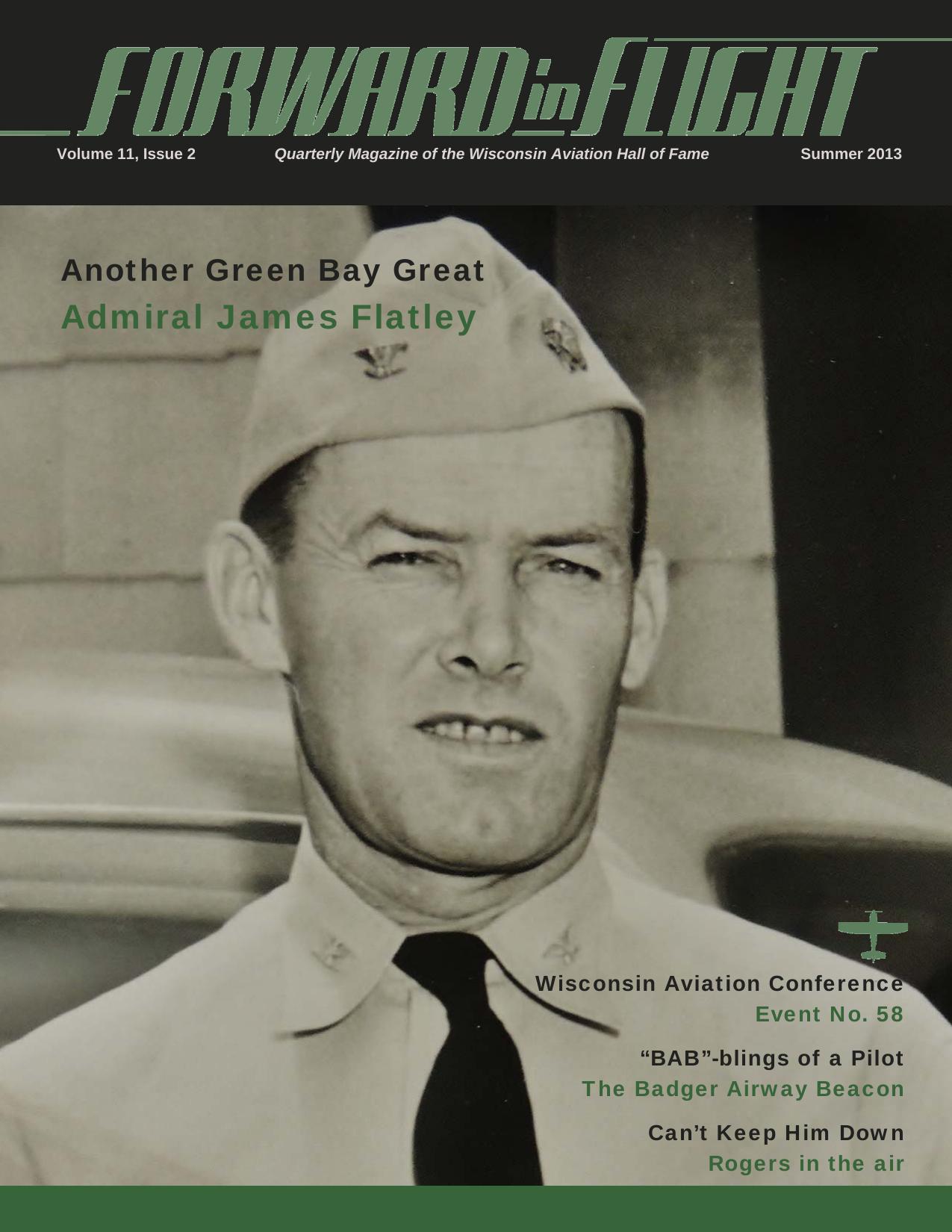
Volume 11, Issue 2 Quarterly Magazine of the Wisconsin Aviation Hall of Fame Summer 2013 Another Green Bay Great Admiral James Flatley Wisconsin Aviation Conference Event No. 58 “BAB”-blings of a Pilot The Badger Airway Beacon Can’t Keep Him Down Rogers in the air
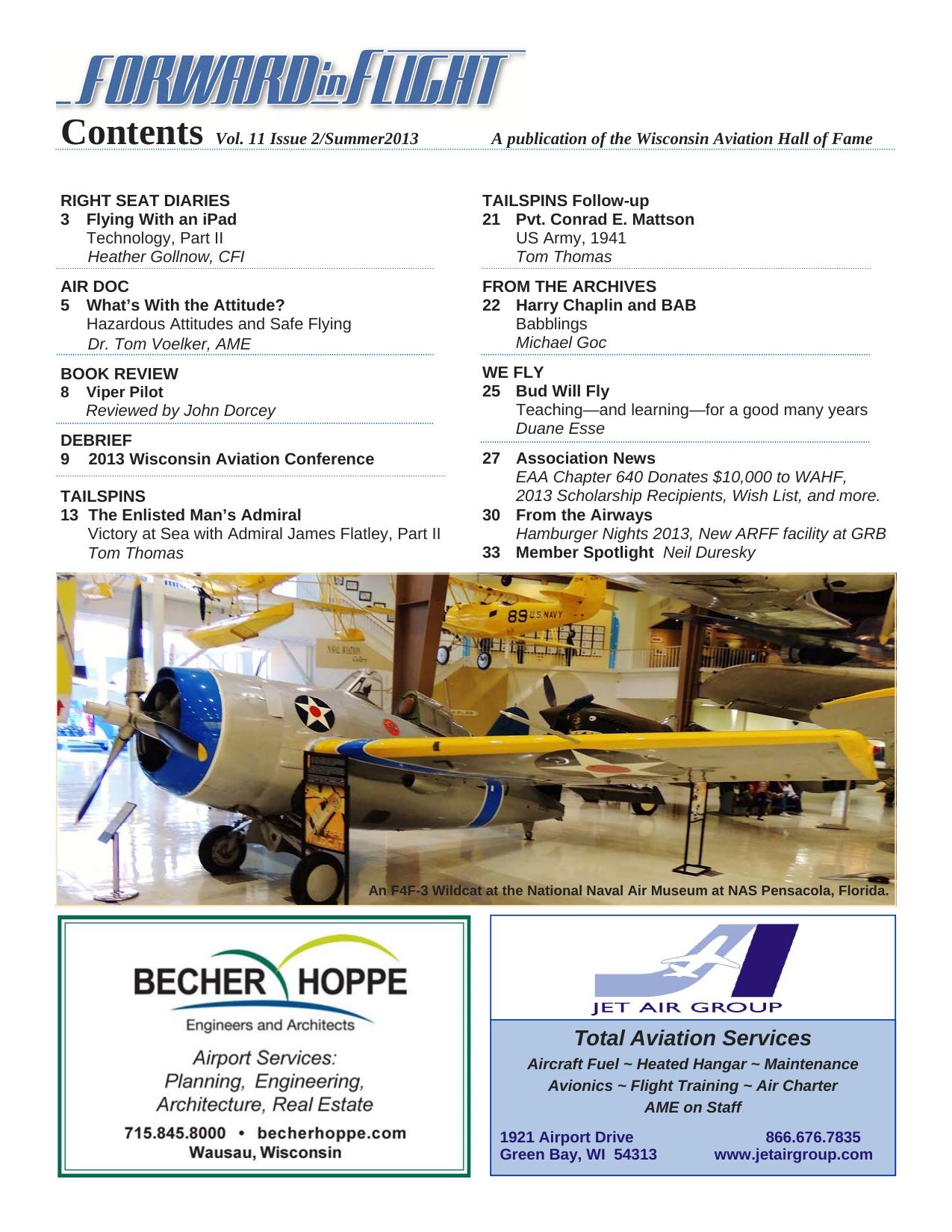
Contents Vol. 11 Issue 2/Summer2013 A publication of the Wisconsin Aviation Hall of Fame RIGHT SEAT DIARIES 3 Flying With an iPad Technology, Part II Heather Gollnow, CFI TAILSPINS Follow-up 21 Pvt. Conrad E. Mattson US Army, 1941 Tom Thomas AIR DOC 5 What’s With the Attitude? Hazardous Attitudes and Safe Flying Dr. Tom Voelker, AME FROM THE ARCHIVES 22 Harry Chaplin and BAB Babblings Michael Goc BOOK REVIEW 8 Viper Pilot Reviewed by John Dorcey WE FLY 25 Bud Will Fly Teaching—and learning—for a good many years Duane Esse DEBRIEF 9 2013 Wisconsin Aviation Conference TAILSPINS 13 The Enlisted Man’s Admiral Victory at Sea with Admiral James Flatley, Part II Tom Thomas 27 Association News EAA Chapter 640 Donates $10,000 to WAHF, 2013 Scholarship Recipients, Wish List, and more. 30 From the Airways Hamburger Nights 2013, New ARFF facility at GRB 33 Member Spotlight Neil Duresky An F4F-3 Wildcat at the National Naval Air Museum at NAS Pensacola, Florida. Total Aviation Services Aircraft Fuel ~ Heated Hangar ~ Maintenance Avionics ~ Flight Training ~ Air Charter AME on Staff 1921 Airport Drive Green Bay, WI 54313 866.676.7835 www.jetairgroup.com
President’s Message ~ by Rose Dorcey The past several weeks have been a blur of activity, and through that activity, much goodness has come to the Wisconsin Aviation Hall of Fame. I must acknowledge some very special people in this column. You’ll read my thanks, and more about some of that activity, here and in the pages of this issue. In April, we learned that EAA Chapter 640 in Wausau had voted to donate $10,000 to WAHF in order to establish a new scholarship fund. In conversations with Bob Mohr, chapter president, and Bob Wylie, chapter member, I learned that the chapter had been the beneficiary of an estate gift from Bob Payzer, a Wausau native and longtime friend of the chapter. EAA Chapter 640 members wanted to share some of that gift so that aviation students would benefit from it. Knowing of WAHF’s scholarship program, which was established in 2002, and our commitment to providing funds to aviation students, the chapter felt confident to transfer the funds to WAHF. It’s hard to express the gratitude we feel toward the chapter members in Wausau for this generous gift. The gift came with no strings attached (except that it go toward a scholarship). The WAHF board wanted to name the scholarship in honor of those who made it possible. So in 2014, we’ll offer the first $500 Robert Payzer Memorial/EAA Chapter 640 scholarship to a Wisconsin student enrolled in an aviation/aerospace program at any U.S. college or university. (Read more on page 29.) Being able to offer four scholarships to aviation students in 2014 is a deed of which we’re extremely pleased. We’ve been fortunate to be associated with many generous friends, such as Jerome Thiessen. He started a scholarship through WAHF back in 2005. When Jerry started the Thiessen Field scholarship, he said, “This scholarship is my small way to pass on my love for aviation. I hope it will inspire others to contribute to the WAHF scholarship fund, or perhaps create a scholarship in their own name.” Then in 2007, family and friends of Jerome Ripp and the Waunakee Airport (6P3) contributed funds for the establishment of the Jerome Ripp Memorial scholarship. WAHF’s annual Carl Guell Memorial scholarship began when past board member Earl Pingel gave the first donation for the establishment of a scholarship fund. Through many other donations and proceeds Forward in Flight The only magazine dedicated exclusively to Wisconsin aviation history and today’s events. Rose Dorcey, editor 3980 Sharratt Drive Oshkosh, WI 54901-1276 Phone: 920-385-1483 · 920-279-6029 rdorcey@wisconsinaviationhallofame.org The Wisconsin Aviation Hall of Fame is a non-profit membership organization with a mission to collect and preserve the history of aviation in Wisconsin, recognize those who made that history, inform others of it, and promote aviation education for future generations. Rose Dorcey from our silent auctions, we were able to reach our goal of $20,000 to endow this annual $1,000 award. We feel that the kindness of Jerome Thiessen, friends and family of Jerome Ripp, and all those who helped build WAHF’s scholarship fund, played an indirect role in EAA Chapter 640’s decision to donate this large sum to WAHF. Seeing the commitment that people have for WAHF’s scholarship program makes others feel more comfortable giving. EAA Chapter 640 members (and Robert Payzer), thank you! And thanks to all those who helped make our scholarship program possible through your support of our past fundraising efforts. It’s hard to express the gratitude we feel toward the chapter members in Wausau for this generous gift. Also in April, we received a wonderful note from Jill Reichman, daughter of Conrad Mattson, who was featured in the Spring 2013 issue of Forward in Flight. Jill wrote, “Please accept this contribution in honor of my father, Conrad Mattson. Tom Thomas and Gary Dikkers did such a bang-up job on the article. Only Air Force pilots would have the knowledge to understand Dad’s career the way these two do.” She was so grateful that her father’s story was told that she sent a check for $2,000. Thank you, Jill. Jill asked for extra copies to give to Conrad’s great grandchildren. We feel good about that, too, for reading of his accomplishments will help them know who their great granddad was, and may inspire his descendants to learn to fly. On the cover: James H. Flatley, a U.S. Navy captain at the time, while he stationed at NAS Olathe, Kansas, ca. 1951. The Green Bay native went on to become a vice admiral before passing away at the age of 52. Tom Thomas shares Part II of his story in this issue of Forward in Flight. US Air Force photo.
RIGHT SEAT DIARIES Flying with an iPad Technology, Part II By Heather Gollnow, CFI My last article summarized some of the aviation websites I like to use. I received a few emails from readers passing on a few websites that you use. Thank you for sending them and keep the links coming! This article continues along the technology lines and outlines my personal research when making the decision to convert to a paperless cockpit. I am working on my doctoral dissertation in green technology right now. I feel the need to add this information as I am still using paper charts, paper FAR/AIMs, paper AF/Ds—paper everything. When I tell people the topic of my research, I often find myself justifying my paper habit! I started flying in 1997 at the ripe age of 19 years old. I learned how to fly when it was pretty cool to have an instrument landing system (ILS). Many general aviation airplanes had nondirectional beacons (NDB). A GPS was fancy and not many people had them or could afford them yet. I used a manual plotter to chart all of my flights. This is how I learned and this is how I continued to fly for many years! After being on the West coast for a five-day flying trip using some pretty handy technology, I’ve finally decided to convert to a paperless cockpit. When I returned home from the trip, I started doing some research into flying with an iPad. It’s pretty obvious that iPads are dominating the aviation market. All of my devices are Android based, so I was hoping I would be able to find some decent aviation apps for use both onground and in-flight. Well, I didn’t find much. I am not going to go into the specifics of why Android has tanked in the aviation market. If you’re interested to learn more, Sporty’s actually wrote a nice article explaining some of the reasons why Android is plummeting in the aviation circle. You can find it here: http:// ipadpilotnews.com/2013/04/why-android-is-losing-in-aviation. When I first made this decision, I had to think about how I would use the iPad for flying. At first, I thought it would be nice to have all my charts available to me. ForeFlight is clearly the leader in this area. Anyone who already has an iPad probably knows about ForeFlight. If you don’t, well, I’m sorry. I won’t provide a review of the app here, but if you haven’t at least looked at their website, please do. Once I started doing some research, I realized that there were 3 Forward in Flight ~ Quarterly Magazine of the Wisconsin Aviation Hall of Fame many other ways to use the iPad that go beyond in-flight use. As a CFI, I am also considering ways I can use the iPad in lessons. Many test prep companies are providing apps to help students study and practice for the exams. There are apps for calculating weight and balance, completing flight planning calculations such as time, fuel, and distance to climb. This would be handy to use with students as well as for my own pre-flight planning. Another option for use on the ground is recording flights in an electronic logbook. I store my paper logbook under lock and key. If I were to convert to an electronic logbook, I would definitely keep a paper logbook as well. An electronic logbook provides you with additional information you may not catch with your paper logbook. You can set up alerts to remind you of any currency requirements or any recurrent training you may need. Books are my collection of choice. I have a ton of aviation books filling boxes in my condo in Wisconsin. When I bought my first e-reader, I thought I was in a little slice of heaven—I could grow my book collection like crazy and not take up any room! Most of the FAA publications can be downloaded in PDF format, which can be read on any e-reader or iPad. You can easily download these documents to your iPad and read them at any time. In addition, you can add your pilot’s operating manual, FAR/AIM, or any other aviation book in the proper format. The price of an iPad is not inexpen-
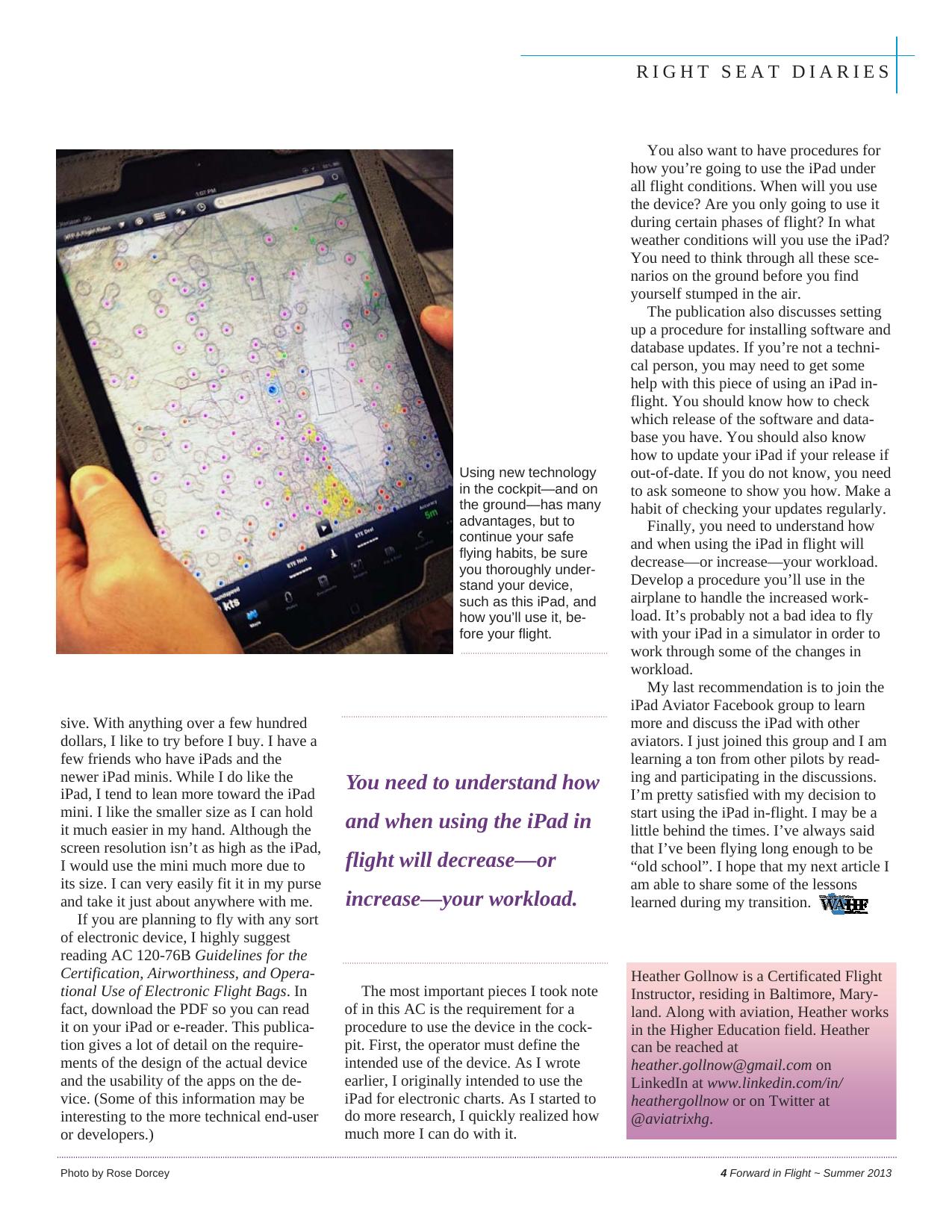
RIGHT SEAT DIARIES Using new technology in the cockpit—and on the ground—has many advantages, but to continue your safe flying habits, be sure you thoroughly understand your device, such as this iPad, and how you’ll use it, before your flight. sive. With anything over a few hundred dollars, I like to try before I buy. I have a few friends who have iPads and the newer iPad minis. While I do like the iPad, I tend to lean more toward the iPad mini. I like the smaller size as I can hold it much easier in my hand. Although the screen resolution isn’t as high as the iPad, I would use the mini much more due to its size. I can very easily fit it in my purse and take it just about anywhere with me. If you are planning to fly with any sort of electronic device, I highly suggest reading AC 120-76B Guidelines for the Certification, Airworthiness, and Operational Use of Electronic Flight Bags. In fact, download the PDF so you can read it on your iPad or e-reader. This publication gives a lot of detail on the requirements of the design of the actual device and the usability of the apps on the device. (Some of this information may be interesting to the more technical end-user or developers.) Photo by Rose Dorcey You need to understand how and when using the iPad in flight will decrease—or increase—your workload. The most important pieces I took note of in this AC is the requirement for a procedure to use the device in the cockpit. First, the operator must define the intended use of the device. As I wrote earlier, I originally intended to use the iPad for electronic charts. As I started to do more research, I quickly realized how much more I can do with it. You also want to have procedures for how you’re going to use the iPad under all flight conditions. When will you use the device? Are you only going to use it during certain phases of flight? In what weather conditions will you use the iPad? You need to think through all these scenarios on the ground before you find yourself stumped in the air. The publication also discusses setting up a procedure for installing software and database updates. If you’re not a technical person, you may need to get some help with this piece of using an iPad inflight. You should know how to check which release of the software and database you have. You should also know how to update your iPad if your release if out-of-date. If you do not know, you need to ask someone to show you how. Make a habit of checking your updates regularly. Finally, you need to understand how and when using the iPad in flight will decrease—or increase—your workload. Develop a procedure you’ll use in the airplane to handle the increased workload. It’s probably not a bad idea to fly with your iPad in a simulator in order to work through some of the changes in workload. My last recommendation is to join the iPad Aviator Facebook group to learn more and discuss the iPad with other aviators. I just joined this group and I am learning a ton from other pilots by reading and participating in the discussions. I’m pretty satisfied with my decision to start using the iPad in-flight. I may be a little behind the times. I’ve always said that I’ve been flying long enough to be “old school”. I hope that my next article I am able to share some of the lessons learned during my transition. Heather Gollnow is a Certificated Flight Instructor, residing in Baltimore, Maryland. Along with aviation, Heather works in the Higher Education field. Heather can be reached at heather.gollnow@gmail.com on LinkedIn at www.linkedin.com/in/ heathergollnow or on Twitter at @aviatrixhg. 4 Forward in Flight ~ Summer 2013
AIR DOC What’s with the attitude? Hazardous Attitudes and Safe Flying Dr. Tom Voelker, AME DrAlphaMike@yahoo.com Greetings, airmen! Spring is finally here. And the Comanche is finally back from its engine overhaul. Three months without an airplane is a long time; it’s time to fly again. I’ve regained my day and night currency (this is the first time since I got my Private Pilot certificate that I have been out of currency.) Next week I have an IPC scheduled with Bob on the Redbird simulator at the Tomahawk airport. I should then be up to speed for another year of safe flying. I take flight safety very seriously. Maybe that’s why my forehead hurts so much. Too frequently I hear or read about another aircraft accident, and many times the cause is found to be “pilot error.” When I look into these accidents, I often slap my forehead and say, “What was he (or she) thinking?” Aircraft accidents are just that, accidental. No pilot takes off with the intent of damaging a perfectly good aircraft or injuring themselves or their passengers. That wouldn’t be an accident. It would be an “on-purpose.” Too infrequently, though, these accidents are the result of pilots simply doing dumb stuff. Aircraft accidents are usually the result of a chain of unfortunate events. Breaking the chain can prevent the accident. If we add unstable (and preventable) links to the chain, the chance of an accident just goes up. My friend’s son recently experienced this phenomenon while boating. He stringed together three or four bad decisions in the matter of a couple of minutes. He wrecked two boats and was fortunate to escape without hurting anyone. He told me with a wry smile, “I broke Uncle John’s rule. I did two dumb things at once.” It turns out Uncle John is also a pilot. He had borrowed from the accident-chain theory and told this teenager that we all do stupid things at times. He then told the lad, “Just don’t do more than one dumb thing at a time.” Good advice, I think. Aircraft accidents are usually the result of a chain of unfortunate events. Breaking the chain can prevent the accident. I heard of another pilot who was flying his Comanche a few winters ago. As he was flying along, starting to gather a little ice, the engine began to run rough. As we are trained, the first thing he did was turn on the carburetor heat. The engine smoothed out nicely. But the engine doesn’t develop as much power with the carb heat on, and he knew he would need power if he got a lot of ice. So what did he do? He turned the carb heat off, of course. This time the engine quit for good. After the off-field landing, causing a lot of damage but no injuries, he 5 Forward in Flight ~ Quarterly Magazine of the Wisconsin Aviation Hall of Fame noticed the air intake was completely covered with ice. The alternate air intake in a Comanche is the carburetor heat. This situation reminds me of a good rule of thumb when something goes wrong in an airplane: Undo what you just did. And there are many other examples of “dumb” decisions that we would never have considered when we were training and during our early flying careers. We run out of fuel, even though we flew over several airports with avgas on the way to our destination. We scud run in questionable weather because we think we can make it. We bust the minimums on approach by just 50 feet or so, “just to take a peek.” We buzz our friends’ homes because it will be fun (or funny), and catch the power line in the process. We press on in the presence of possible icing, because we have get-home-itis. So, if we really don’t want to cause accidents, why do we do these things? Do we just get so comfortable with our flying and our skills that we don’t even consider the danger? The FAA has looked into this phenomenon. We took safety to heart early in our training, and somewhere down the road (or airway) we put it on the back burner. By the FAA’s analysis, it all comes down to attitude. When the aircraft’s attitude gets too steep, the plane will stall. When we get the wrong attitudes, our brains stall, and bad things can happen.
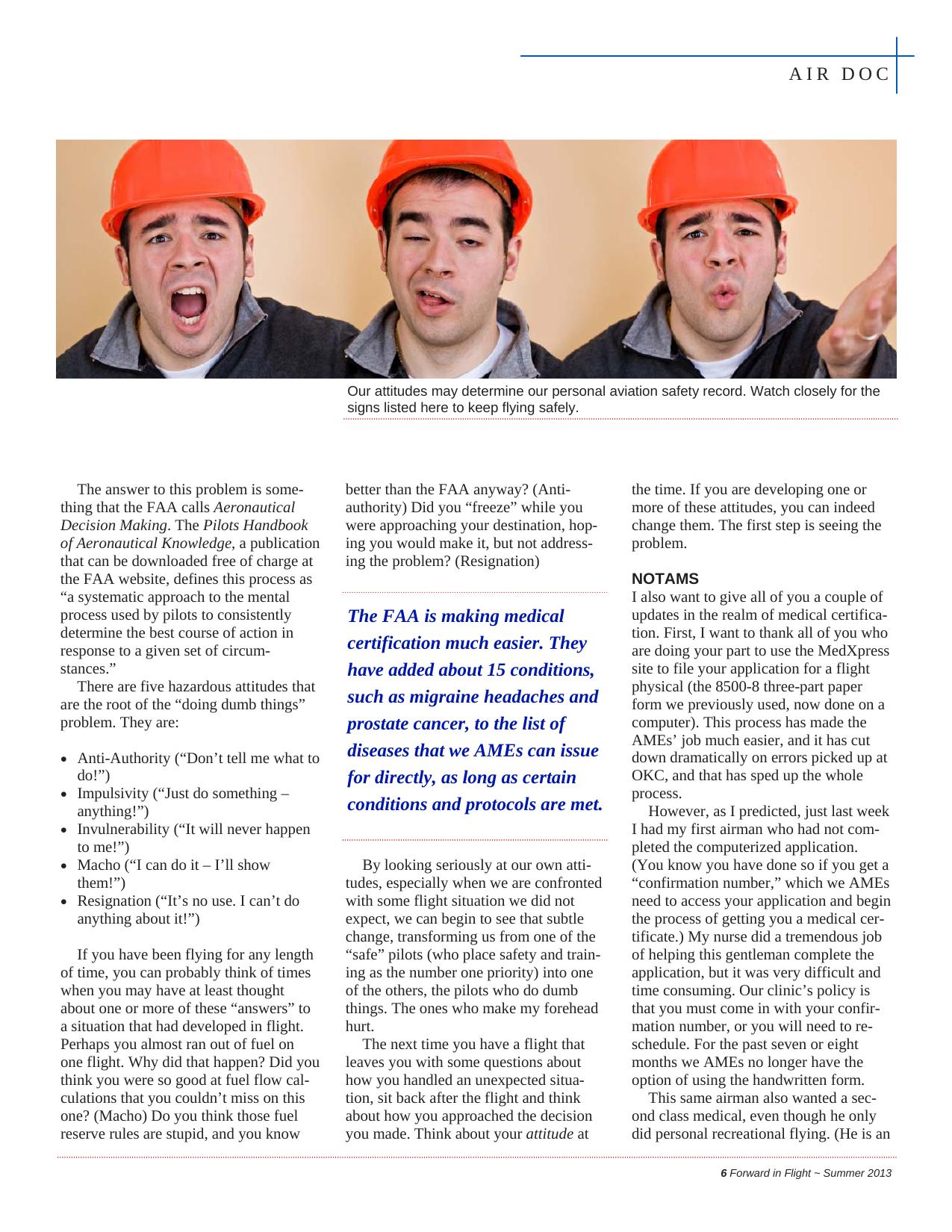
AIR DOC Our attitudes may determine our personal aviation safety record. Watch closely for the signs listed here to keep flying safely. The answer to this problem is something that the FAA calls Aeronautical Decision Making. The Pilots Handbook of Aeronautical Knowledge, a publication that can be downloaded free of charge at the FAA website, defines this process as “a systematic approach to the mental process used by pilots to consistently determine the best course of action in response to a given set of circumstances.” There are five hazardous attitudes that are the root of the “doing dumb things” problem. They are: Anti-Authority (“Don’t tell me what to do!”) Impulsivity (“Just do something – anything!”) better than the FAA anyway? (Antiauthority) Did you “freeze” while you were approaching your destination, hoping you would make it, but not addressing the problem? (Resignation) The FAA is making medical certification much easier. They have added about 15 conditions, such as migraine headaches and prostate cancer, to the list of diseases that we AMEs can issue for directly, as long as certain conditions and protocols are met. Invulnerability (“It will never happen to me!”) Macho (“I can do it – I’ll show them!”) Resignation (“It’s no use. I can’t do anything about it!”) If you have been flying for any length of time, you can probably think of times when you may have at least thought about one or more of these “answers” to a situation that had developed in flight. Perhaps you almost ran out of fuel on one flight. Why did that happen? Did you think you were so good at fuel flow calculations that you couldn’t miss on this one? (Macho) Do you think those fuel reserve rules are stupid, and you know By looking seriously at our own attitudes, especially when we are confronted with some flight situation we did not expect, we can begin to see that subtle change, transforming us from one of the “safe” pilots (who place safety and training as the number one priority) into one of the others, the pilots who do dumb things. The ones who make my forehead hurt. The next time you have a flight that leaves you with some questions about how you handled an unexpected situation, sit back after the flight and think about how you approached the decision you made. Think about your attitude at the time. If you are developing one or more of these attitudes, you can indeed change them. The first step is seeing the problem. NOTAMS I also want to give all of you a couple of updates in the realm of medical certification. First, I want to thank all of you who are doing your part to use the MedXpress site to file your application for a flight physical (the 8500-8 three-part paper form we previously used, now done on a computer). This process has made the AMEs’ job much easier, and it has cut down dramatically on errors picked up at OKC, and that has sped up the whole process. However, as I predicted, just last week I had my first airman who had not completed the computerized application. (You know you have done so if you get a “confirmation number,” which we AMEs need to access your application and begin the process of getting you a medical certificate.) My nurse did a tremendous job of helping this gentleman complete the application, but it was very difficult and time consuming. Our clinic’s policy is that you must come in with your confirmation number, or you will need to reschedule. For the past seven or eight months we AMEs no longer have the option of using the handwritten form. This same airman also wanted a second class medical, even though he only did personal recreational flying. (He is an 6 Forward in Flight ~ Summer 2013
AIR DOC ATP, or Airline Transport Pilot, the highest level of pilot certification, and he wanted to be ready if someone called wanting him to work for hire.) The problem was that his vision wasn’t perfect. I see this problem often enough that it is worth mentioning here. To get a second class medical (needed for almost any commercial operations), you will need 20/20 distance vision, in each eye separately and in both eyes. (The standard for near and intermediate vision is 20/40.) You may use your glasses or contacts to achieve this standard, but you must meet it. If you have any doubt that your eyesight is (or is corrected to) 20/20, and you are seeking a second class medical, then you may want to see an eye doctor before you come in for your medical. Finally, the FAA is making medical certification much easier. They have added about 15 conditions, such as migraine headaches and prostate cancer, to the list of diseases that we AMEs can issue for directly, as long as certain conditions and protocols are met. This will speed up the process dramatically. Previously we were required to defer the application to Oklahoma City if any of these conditions were present, and that meant an automatic three-month delay in certification. As I’ve said before, the FAA is indeed here to help! With that ends another session of my time with you. I hope you have enjoyed it. Why don’t you download or pick up a copy of the Pilot’s Handbook referred to above and look at Chapter 17, Aeronautical Decision Making. You can see in greater depth where our bad habits come from and what we can do to change them. The air carriers have been improving their accident statistics year after year, but the general aviation stats have been stagnant. With education and commitment to always flying with a safe attitude, we can all make the skies safer. “Alpha Mike Echo” is Dr. Tom Voelker, AME, a family practitioner in Wisconsin Rapids. He and his wife, Kathy, are the parents of four daughters. Tom flies N6224P, a Comanche 250, out of Alexander Field, South Wood County Airport (ISW). 2031 Peach Street Wisconsin Rapids, WI 54494 7 Forward in Flight ~ Quarterly Magazine of the Wisconsin Aviation Hall of Fame Advertise in Forward in Flight! Reach Wisconsin pilots, aircraft owners, and airport managers with an affordable ad in Forward in Flight. It’s easy to get started; call Rose at 920-279-6029 or email rdorcey@wisconsinaviationhalloffame.org.
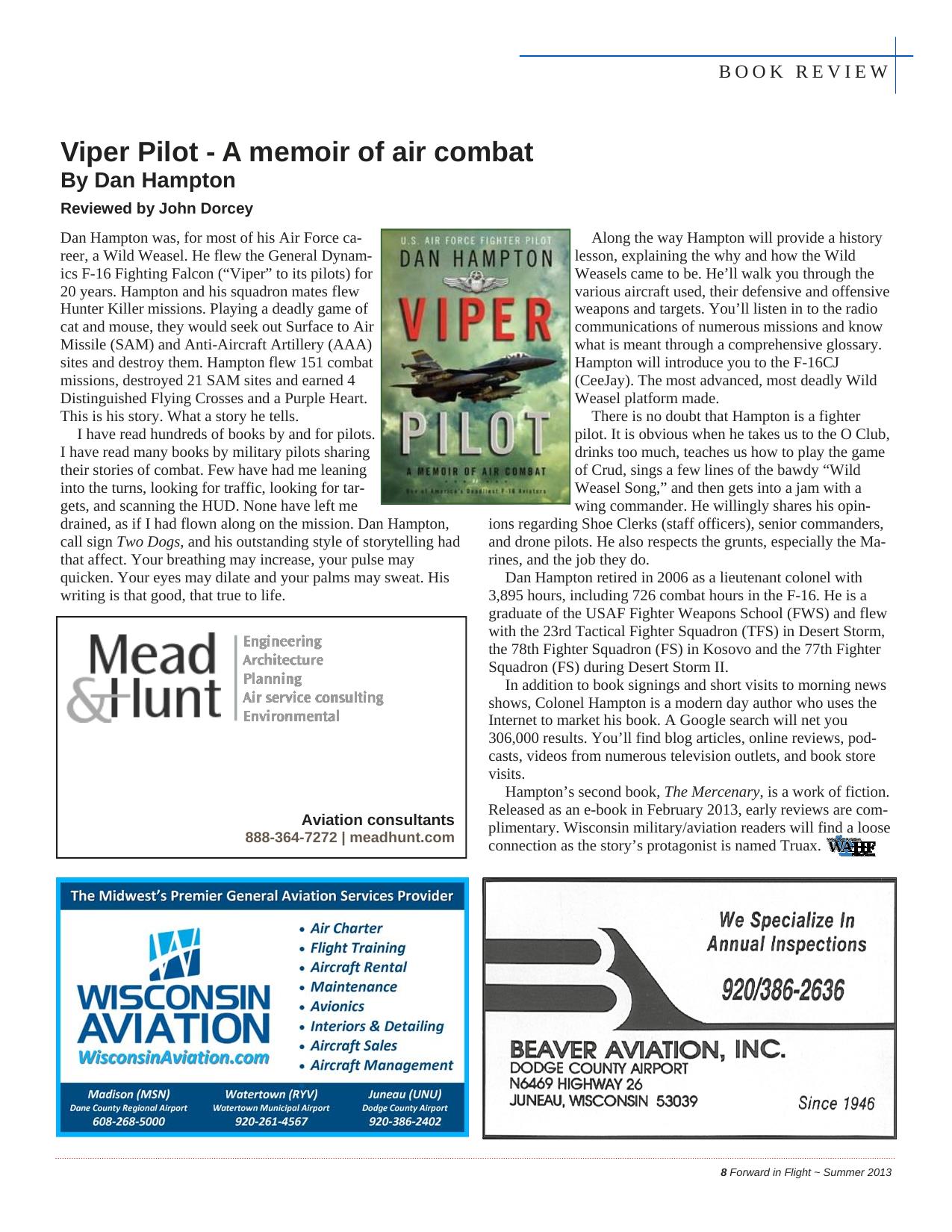
BOOK REVIEW Viper Pilot - A memoir of air combat By Dan Hampton Reviewed by John Dorcey Dan Hampton was, for most of his Air Force career, a Wild Weasel. He flew the General Dynamics F-16 Fighting Falcon (“Viper” to its pilots) for 20 years. Hampton and his squadron mates flew Hunter Killer missions. Playing a deadly game of cat and mouse, they would seek out Surface to Air Missile (SAM) and Anti-Aircraft Artillery (AAA) sites and destroy them. Hampton flew 151 combat missions, destroyed 21 SAM sites and earned 4 Distinguished Flying Crosses and a Purple Heart. This is his story. What a story he tells. I have read hundreds of books by and for pilots. I have read many books by military pilots sharing their stories of combat. Few have had me leaning into the turns, looking for traffic, looking for targets, and scanning the HUD. None have left me drained, as if I had flown along on the mission. Dan Hampton, call sign Two Dogs, and his outstanding style of storytelling had that affect. Your breathing may increase, your pulse may quicken. Your eyes may dilate and your palms may sweat. His writing is that good, that true to life. Aviation consultants 888-364-7272 | meadhunt.com Along the way Hampton will provide a history lesson, explaining the why and how the Wild Weasels came to be. He’ll walk you through the various aircraft used, their defensive and offensive weapons and targets. You’ll listen in to the radio communications of numerous missions and know what is meant through a comprehensive glossary. Hampton will introduce you to the F-16CJ (CeeJay). The most advanced, most deadly Wild Weasel platform made. There is no doubt that Hampton is a fighter pilot. It is obvious when he takes us to the O Club, drinks too much, teaches us how to play the game of Crud, sings a few lines of the bawdy “Wild Weasel Song,” and then gets into a jam with a wing commander. He willingly shares his opinions regarding Shoe Clerks (staff officers), senior commanders, and drone pilots. He also respects the grunts, especially the Marines, and the job they do. Dan Hampton retired in 2006 as a lieutenant colonel with 3,895 hours, including 726 combat hours in the F-16. He is a graduate of the USAF Fighter Weapons School (FWS) and flew with the 23rd Tactical Fighter Squadron (TFS) in Desert Storm, the 78th Fighter Squadron (FS) in Kosovo and the 77th Fighter Squadron (FS) during Desert Storm II. In addition to book signings and short visits to morning news shows, Colonel Hampton is a modern day author who uses the Internet to market his book. A Google search will net you 306,000 results. You’ll find blog articles, online reviews, podcasts, videos from numerous television outlets, and book store visits. Hampton’s second book, The Mercenary, is a work of fiction. Released as an e-book in February 2013, early reviews are complimentary. Wisconsin military/aviation readers will find a loose connection as the story’s protagonist is named Truax. 8 Forward in Flight ~ Summer 2013
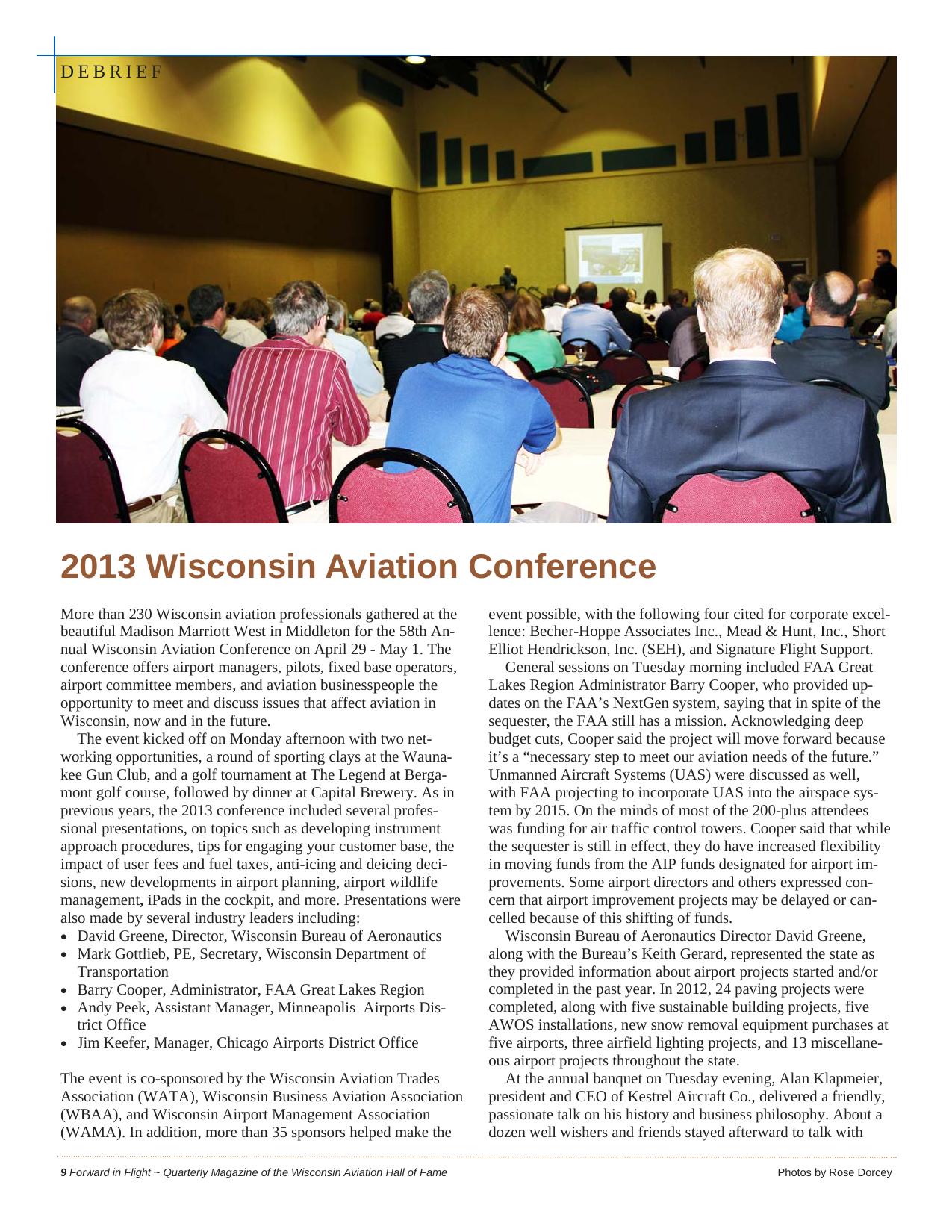
DEBRIEF 2013 Wisconsin Aviation Conference More than 230 Wisconsin aviation professionals gathered at the beautiful Madison Marriott West in Middleton for the 58th Annual Wisconsin Aviation Conference on April 29 - May 1. The conference offers airport managers, pilots, fixed base operators, airport committee members, and aviation businesspeople the opportunity to meet and discuss issues that affect aviation in Wisconsin, now and in the future. The event kicked off on Monday afternoon with two networking opportunities, a round of sporting clays at the Waunakee Gun Club, and a golf tournament at The Legend at Bergamont golf course, followed by dinner at Capital Brewery. As in previous years, the 2013 conference included several professional presentations, on topics such as developing instrument approach procedures, tips for engaging your customer base, the impact of user fees and fuel taxes, anti-icing and deicing decisions, new developments in airport planning, airport wildlife management, iPads in the cockpit, and more. Presentations were also made by several industry leaders including: David Greene, Director, Wisconsin Bureau of Aeronautics Mark Gottlieb, PE, Secretary, Wisconsin Department of Transportation Barry Cooper, Administrator, FAA Great Lakes Region Andy Peek, Assistant Manager, Minneapolis Airports District Office Jim Keefer, Manager, Chicago Airports District Office The event is co-sponsored by the Wisconsin Aviation Trades Association (WATA), Wisconsin Business Aviation Association (WBAA), and Wisconsin Airport Management Association (WAMA). In addition, more than 35 sponsors helped make the 9 Forward in Flight ~ Quarterly Magazine of the Wisconsin Aviation Hall of Fame event possible, with the following four cited for corporate excellence: Becher-Hoppe Associates Inc., Mead & Hunt, Inc., Short Elliot Hendrickson, Inc. (SEH), and Signature Flight Support. General sessions on Tuesday morning included FAA Great Lakes Region Administrator Barry Cooper, who provided updates on the FAA’s NextGen system, saying that in spite of the sequester, the FAA still has a mission. Acknowledging deep budget cuts, Cooper said the project will move forward because it’s a “necessary step to meet our aviation needs of the future.” Unmanned Aircraft Systems (UAS) were discussed as well, with FAA projecting to incorporate UAS into the airspace system by 2015. On the minds of most of the 200-plus attendees was funding for air traffic control towers. Cooper said that while the sequester is still in effect, they do have increased flexibility in moving funds from the AIP funds designated for airport improvements. Some airport directors and others expressed concern that airport improvement projects may be delayed or cancelled because of this shifting of funds. Wisconsin Bureau of Aeronautics Director David Greene, along with the Bureau’s Keith Gerard, represented the state as they provided information about airport projects started and/or completed in the past year. In 2012, 24 paving projects were completed, along with five sustainable building projects, five AWOS installations, new snow removal equipment purchases at five airports, three airfield lighting projects, and 13 miscellaneous airport projects throughout the state. At the annual banquet on Tuesday evening, Alan Klapmeier, president and CEO of Kestrel Aircraft Co., delivered a friendly, passionate talk on his history and business philosophy. About a dozen well wishers and friends stayed afterward to talk with Photos by Rose Dorcey
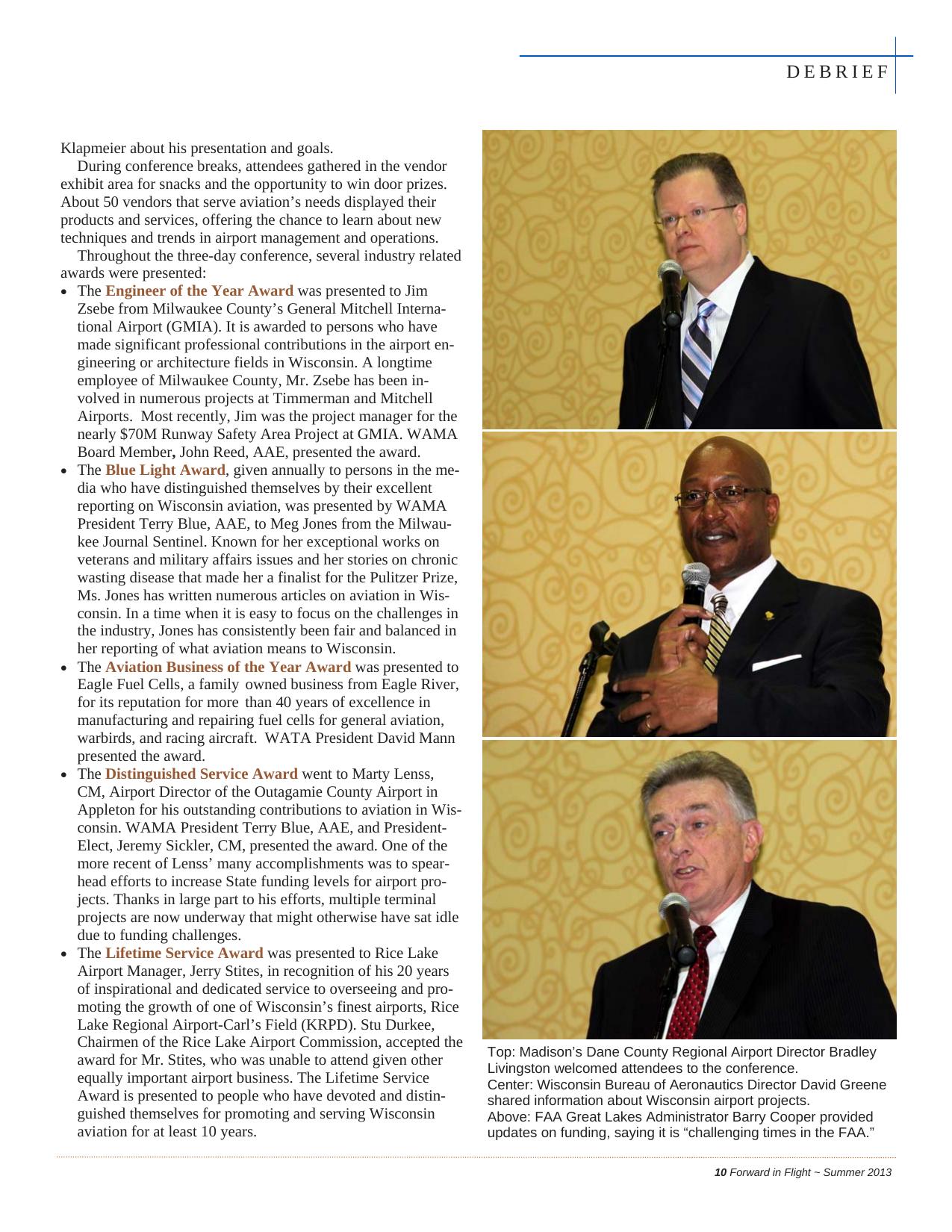
DEBRIEF Klapmeier about his presentation and goals. During conference breaks, attendees gathered in the vendor exhibit area for snacks and the opportunity to win door prizes. About 50 vendors that serve aviation’s needs displayed their products and services, offering the chance to learn about new techniques and trends in airport management and operations. Throughout the three-day conference, several industry related awards were presented: The Engineer of the Year Award was presented to Jim Zsebe from Milwaukee County’s General Mitchell International Airport (GMIA). It is awarded to persons who have made significant professional contributions in the airport engineering or architecture fields in Wisconsin. A longtime employee of Milwaukee County, Mr. Zsebe has been involved in numerous projects at Timmerman and Mitchell Airports. Most recently, Jim was the project manager for the nearly $70M Runway Safety Area Project at GMIA. WAMA Board Member, John Reed, AAE, presented the award. The Blue Light Award, given annually to persons in the media who have distinguished themselves by their excellent reporting on Wisconsin aviation, was presented by WAMA President Terry Blue, AAE, to Meg Jones from the Milwaukee Journal Sentinel. Known for her exceptional works on veterans and military affairs issues and her stories on chronic wasting disease that made her a finalist for the Pulitzer Prize, Ms. Jones has written numerous articles on aviation in Wisconsin. In a time when it is easy to focus on the challenges in the industry, Jones has consistently been fair and balanced in her reporting of what aviation means to Wisconsin. The Aviation Business of the Year Award was presented to Eagle Fuel Cells, a family owned business from Eagle River, for its reputation for more than 40 years of excellence in manufacturing and repairing fuel cells for general aviation, warbirds, and racing aircraft. WATA President David Mann presented the award. The Distinguished Service Award went to Marty Lenss, CM, Airport Director of the Outagamie County Airport in Appleton for his outstanding contributions to aviation in Wisconsin. WAMA President Terry Blue, AAE, and PresidentElect, Jeremy Sickler, CM, presented the award. One of the more recent of Lenss’ many accomplishments was to spearhead efforts to increase State funding levels for airport projects. Thanks in large part to his efforts, multiple terminal projects are now underway that might otherwise have sat idle due to funding challenges. The Lifetime Service Award was presented to Rice Lake Airport Manager, Jerry Stites, in recognition of his 20 years of inspirational and dedicated service to overseeing and promoting the growth of one of Wisconsin’s finest airports, Rice Lake Regional Airport-Carl’s Field (KRPD). Stu Durkee, Chairmen of the Rice Lake Airport Commission, accepted the award for Mr. Stites, who was unable to attend given other equally important airport business. The Lifetime Service Award is presented to people who have devoted and distinguished themselves for promoting and serving Wisconsin aviation for at least 10 years. Top: Madison’s Dane County Regional Airport Director Bradley Livingston welcomed attendees to the conference. Center: Wisconsin Bureau of Aeronautics Director David Greene shared information about Wisconsin airport projects. Above: FAA Great Lakes Administrator Barry Cooper provided updates on funding, saying it is “challenging times in the FAA.” 10 Forward in Flight ~ Summer 2013
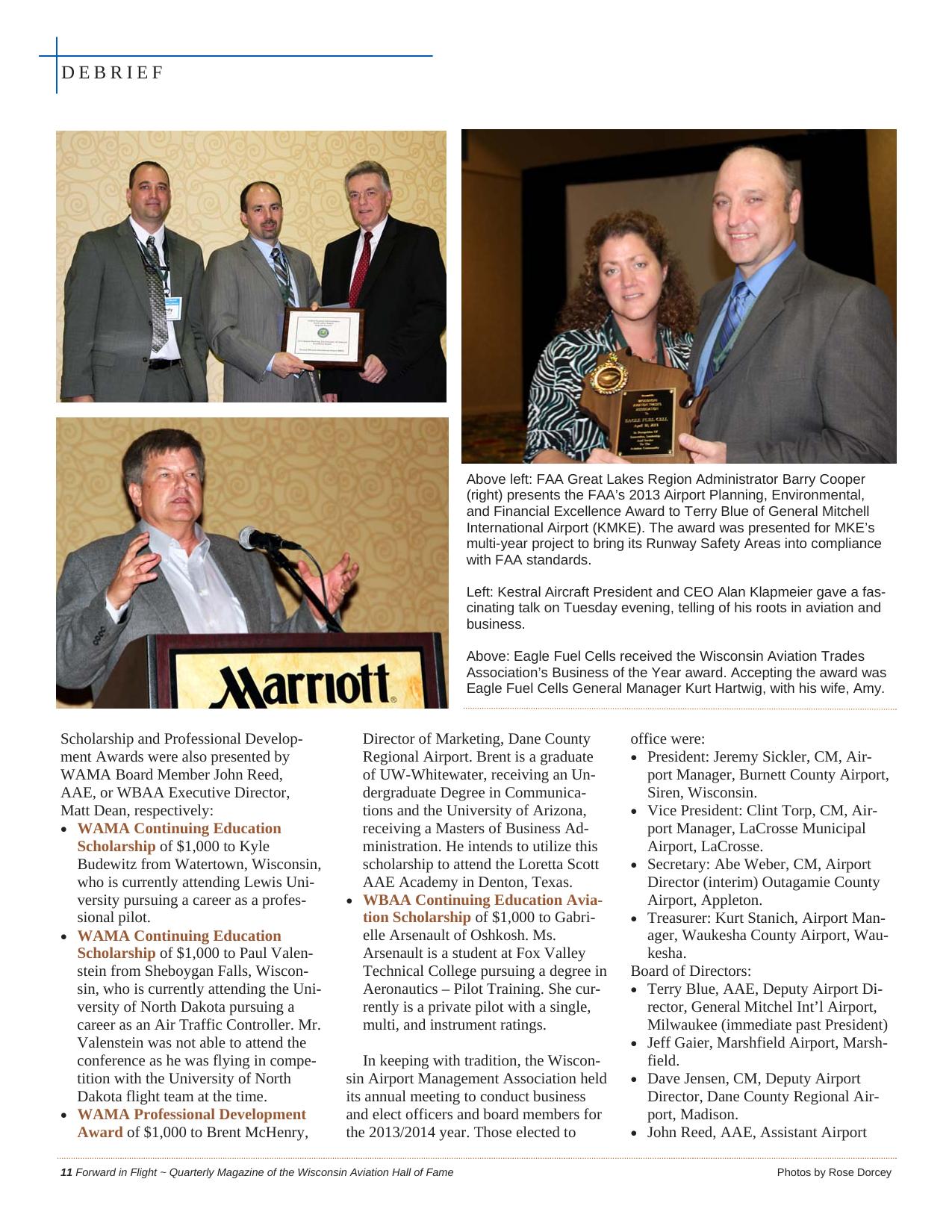
DEBRIEF Above left: FAA Great Lakes Region Administrator Barry Cooper (right) presents the FAA’s 2013 Airport Planning, Environmental, and Financial Excellence Award to Terry Blue of General Mitchell International Airport (KMKE). The award was presented for MKE’s multi-year project to bring its Runway Safety Areas into compliance with FAA standards. Left: Kestral Aircraft President and CEO Alan Klapmeier gave a fascinating talk on Tuesday evening, telling of his roots in aviation and business. Above: Eagle Fuel Cells received the Wisconsin Aviation Trades Association’s Business of the Year award. Accepting the award was Eagle Fuel Cells General Manager Kurt Hartwig, with his wife, Amy. Scholarship and Professional Development Awards were also presented by WAMA Board Member John Reed, AAE, or WBAA Executive Director, Matt Dean, respectively: WAMA Continuing Education Scholarship of $1,000 to Kyle Budewitz from Watertown, Wisconsin, who is currently attending Lewis University pursuing a career as a professional pilot. WAMA Continuing Education Scholarship of $1,000 to Paul Valenstein from Sheboygan Falls, Wisconsin, who is currently attending the University of North Dakota pursuing a career as an Air Traffic Controller. Mr. Valenstein was not able to attend the conference as he was flying in competition with the University of North Dakota flight team at the time. WAMA Professional Development Award of $1,000 to Brent McHenry, Director of Marketing, Dane County Regional Airport. Brent is a graduate of UW-Whitewater, receiving an Undergraduate Degree in Communications and the University of Arizona, receiving a Masters of Business Administration. He intends to utilize this scholarship to attend the Loretta Scott AAE Academy in Denton, Texas. WBAA Continuing Education Aviation Scholarship of $1,000 to Gabrielle Arsenault of Oshkosh. Ms. Arsenault is a student at Fox Valley Technical College pursuing a degree in Aeronautics – Pilot Training. She currently is a private pilot with a single, multi, and instrument ratings. In keeping with tradition, the Wisconsin Airport Management Association held its annual meeting to conduct business and elect officers and board members for the 2013/2014 year. Those elected to 11 Forward in Flight ~ Quarterly Magazine of the Wisconsin Aviation Hall of Fame office were: President: Jeremy Sickler, CM, Air- port Manager, Burnett County Airport, Siren, Wisconsin. Vice President: Clint Torp, CM, Airport Manager, LaCrosse Municipal Airport, LaCrosse. Secretary: Abe Weber, CM, Airport Director (interim) Outagamie County Airport, Appleton. Treasurer: Kurt Stanich, Airport Manager, Waukesha County Airport, Waukesha. Board of Directors: Terry Blue, AAE, Deputy Airport Director, General Mitchel Int’l Airport, Milwaukee (immediate past President) Jeff Gaier, Marshfield Airport, Marshfield. Dave Jensen, CM, Deputy Airport Director, Dane County Regional Airport, Madison. John Reed, AAE, Assistant Airport Photos by Rose Dorcey
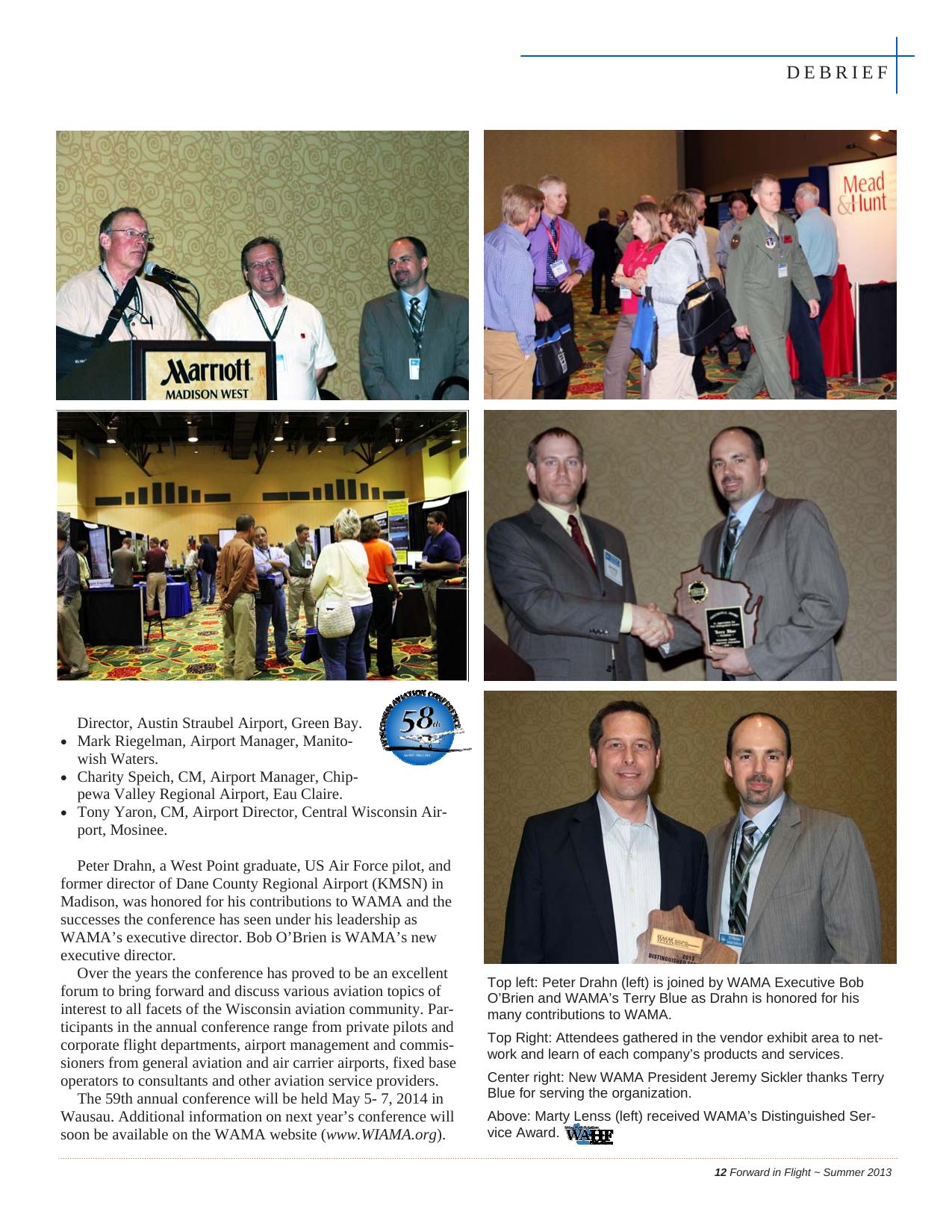
DEBRIEF Director, Austin Straubel Airport, Green Bay. Mark Riegelman, Airport Manager, Manito- wish Waters. Charity Speich, CM, Airport Manager, Chip- pewa Valley Regional Airport, Eau Claire. Tony Yaron, CM, Airport Director, Central Wisconsin Air- port, Mosinee. Peter Drahn, a West Point graduate, US Air Force pilot, and former director of Dane County Regional Airport (KMSN) in Madison, was honored for his contributions to WAMA and the successes the conference has seen under his leadership as WAMA’s executive director. Bob O’Brien is WAMA’s new executive director. Over the years the conference has proved to be an excellent forum to bring forward and discuss various aviation topics of interest to all facets of the Wisconsin aviation community. Participants in the annual conference range from private pilots and corporate flight departments, airport management and commissioners from general aviation and air carrier airports, fixed base operators to consultants and other aviation service providers. The 59th annual conference will be held May 5- 7, 2014 in Wausau. Additional information on next year’s conference will soon be available on the WAMA website (www.WIAMA.org). Top left: Peter Drahn (left) is joined by WAMA Executive Bob O’Brien and WAMA’s Terry Blue as Drahn is honored for his many contributions to WAMA. Top Right: Attendees gathered in the vendor exhibit area to network and learn of each company’s products and services. Center right: New WAMA President Jeremy Sickler thanks Terry Blue for serving the organization. Above: Marty Lenss (left) received WAMA’s Distinguished Service Award. 12 Forward in Flight ~ Summer 2013
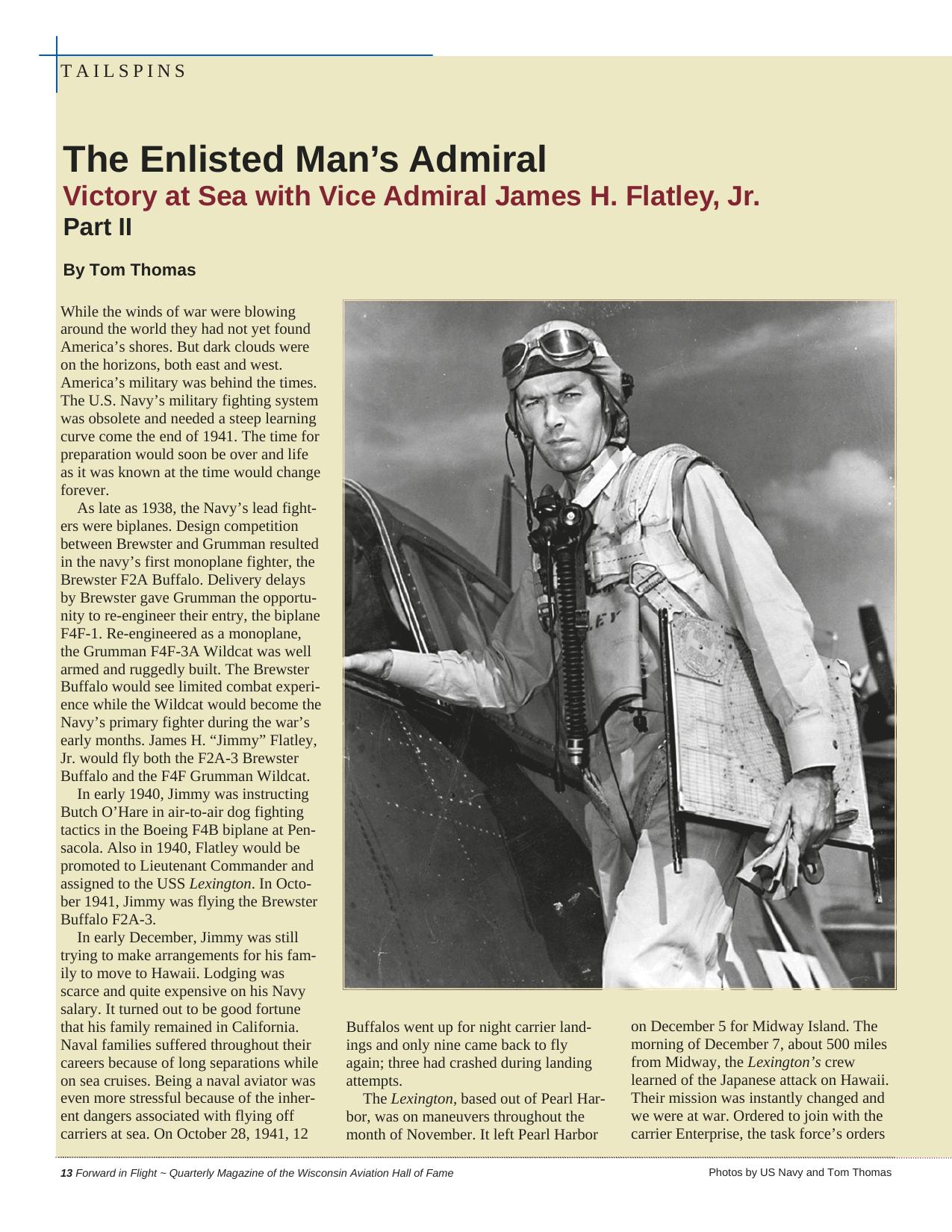
TAILSPINS The Enlisted Man’s Admiral Victory at Sea with Vice Admiral James H. Flatley, Jr. Part II By Tom Thomas While the winds of war were blowing around the world they had not yet found America’s shores. But dark clouds were on the horizons, both east and west. America’s military was behind the times. The U.S. Navy’s military fighting system was obsolete and needed a steep learning curve come the end of 1941. The time for preparation would soon be over and life as it was known at the time would change forever. As late as 1938, the Navy’s lead fighters were biplanes. Design competition between Brewster and Grumman resulted in the navy’s first monoplane fighter, the Brewster F2A Buffalo. Delivery delays by Brewster gave Grumman the opportunity to re-engineer their entry, the biplane F4F-1. Re-engineered as a monoplane, the Grumman F4F-3A Wildcat was well armed and ruggedly built. The Brewster Buffalo would see limited combat experience while the Wildcat would become the Navy’s primary fighter during the war’s early months. James H. “Jimmy” Flatley, Jr. would fly both the F2A-3 Brewster Buffalo and the F4F Grumman Wildcat. In early 1940, Jimmy was instructing Butch O’Hare in air-to-air dog fighting tactics in the Boeing F4B biplane at Pensacola. Also in 1940, Flatley would be promoted to Lieutenant Commander and assigned to the USS Lexington. In October 1941, Jimmy was flying the Brewster Buffalo F2A-3. In early December, Jimmy was still trying to make arrangements for his family to move to Hawaii. Lodging was scarce and quite expensive on his Navy salary. It turned out to be good fortune that his family remained in California. Naval families suffered throughout their careers because of long separations while on sea cruises. Being a naval aviator was even more stressful because of the inherent dangers associated with flying off carriers at sea. On October 28, 1941, 12 Buffalos went up for night carrier landings and only nine came back to fly again; three had crashed during landing attempts. The Lexington, based out of Pearl Harbor, was on maneuvers throughout the month of November. It left Pearl Harbor 13 Forward in Flight ~ Quarterly Magazine of the Wisconsin Aviation Hall of Fame on December 5 for Midway Island. The morning of December 7, about 500 miles from Midway, the Lexington’s crew learned of the Japanese attack on Hawaii. Their mission was instantly changed and we were at war. Ordered to join with the carrier Enterprise, the task force’s orders Photos by US Navy and Tom Thomas
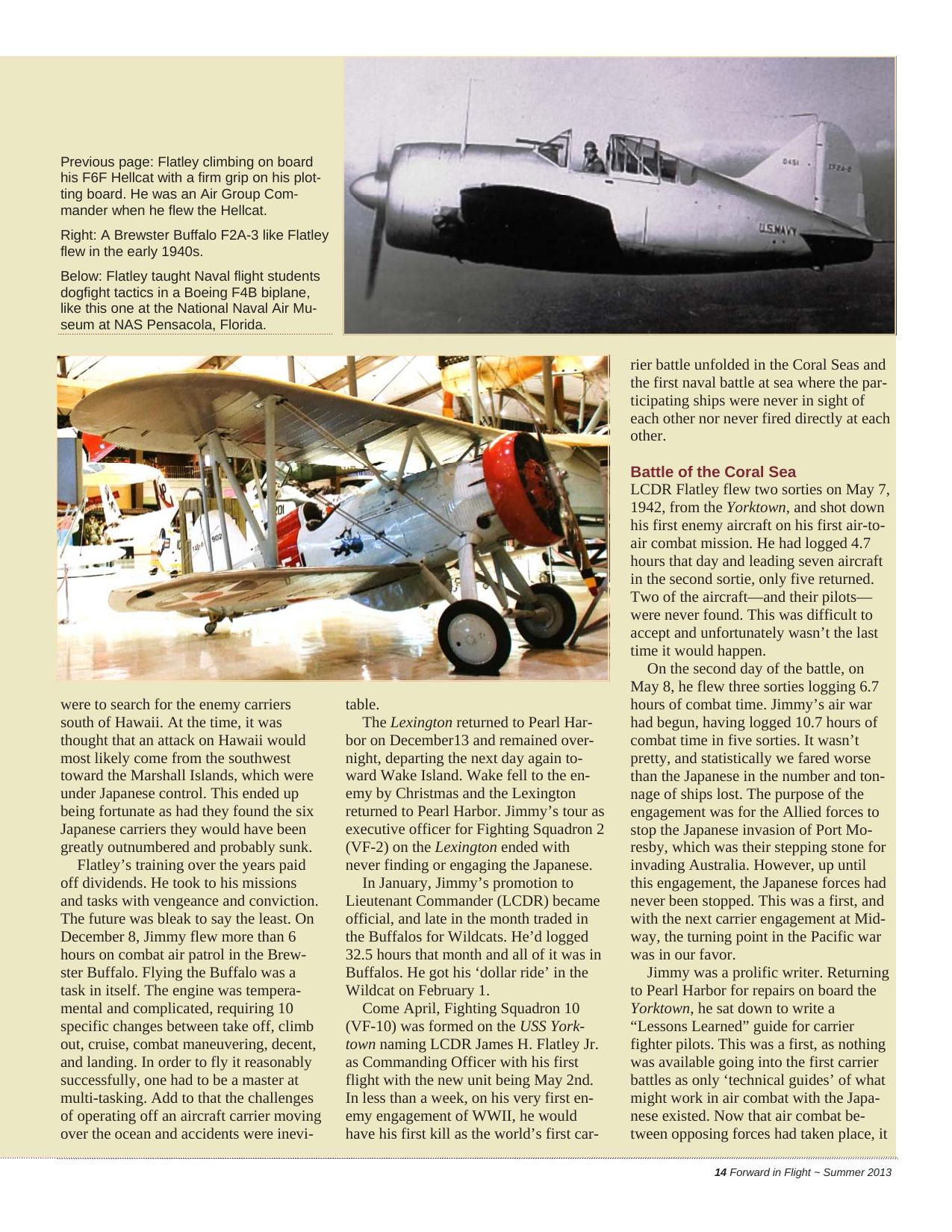
Previous page: Flatley climbing on board his F6F Hellcat with a firm grip on his plotting board. He was an Air Group Commander when he flew the Hellcat. Right: A Brewster Buffalo F2A-3 like Flatley flew in the early 1940s. Below: Flatley taught Naval flight students dogfight tactics in a Boeing F4B biplane, like this one at the National Naval Air Museum at NAS Pensacola, Florida. rier battle unfolded in the Coral Seas and the first naval battle at sea where the participating ships were never in sight of each other nor never fired directly at each other. were to search for the enemy carriers south of Hawaii. At the time, it was thought that an attack on Hawaii would most likely come from the southwest toward the Marshall Islands, which were under Japanese control. This ended up being fortunate as had they found the six Japanese carriers they would have been greatly outnumbered and probably sunk. Flatley’s training over the years paid off dividends. He took to his missions and tasks with vengeance and conviction. The future was bleak to say the least. On December 8, Jimmy flew more than 6 hours on combat air patrol in the Brewster Buffalo. Flying the Buffalo was a task in itself. The engine was temperamental and complicated, requiring 10 specific changes between take off, climb out, cruise, combat maneuvering, decent, and landing. In order to fly it reasonably successfully, one had to be a master at multi-tasking. Add to that the challenges of operating off an aircraft carrier moving over the ocean and accidents were inevi- table. The Lexington returned to Pearl Harbor on December13 and remained overnight, departing the next day again toward Wake Island. Wake fell to the enemy by Christmas and the Lexington returned to Pearl Harbor. Jimmy’s tour as executive officer for Fighting Squadron 2 (VF-2) on the Lexington ended with never finding or engaging the Japanese. In January, Jimmy’s promotion to Lieutenant Commander (LCDR) became official, and late in the month traded in the Buffalos for Wildcats. He’d logged 32.5 hours that month and all of it was in Buffalos. He got his ‘dollar ride’ in the Wildcat on February 1. Come April, Fighting Squadron 10 (VF-10) was formed on the USS Yorktown naming LCDR James H. Flatley Jr. as Commanding Officer with his first flight with the new unit being May 2nd. In less than a week, on his very first enemy engagement of WWII, he would have his first kill as the world’s first car- Battle of the Coral Sea LCDR Flatley flew two sorties on May 7, 1942, from the Yorktown, and shot down his first enemy aircraft on his first air-toair combat mission. He had logged 4.7 hours that day and leading seven aircraft in the second sortie, only five returned. Two of the aircraft—and their pilots— were never found. This was difficult to accept and unfortunately wasn’t the last time it would happen. On the second day of the battle, on May 8, he flew three sorties logging 6.7 hours of combat time. Jimmy’s air war had begun, having logged 10.7 hours of combat time in five sorties. It wasn’t pretty, and statistically we fared worse than the Japanese in the number and tonnage of ships lost. The purpose of the engagement was for the Allied forces to stop the Japanese invasion of Port Moresby, which was their stepping stone for invading Australia. However, up until this engagement, the Japanese forces had never been stopped. This was a first, and with the next carrier engagement at Midway, the turning point in the Pacific war was in our favor. Jimmy was a prolific writer. Returning to Pearl Harbor for repairs on board the Yorktown, he sat down to write a “Lessons Learned” guide for carrier fighter pilots. This was a first, as nothing was available going into the first carrier battles as only ‘technical guides’ of what might work in air combat with the Japanese existed. Now that air combat between opposing forces had taken place, it 14 Forward in Flight ~ Summer 2013
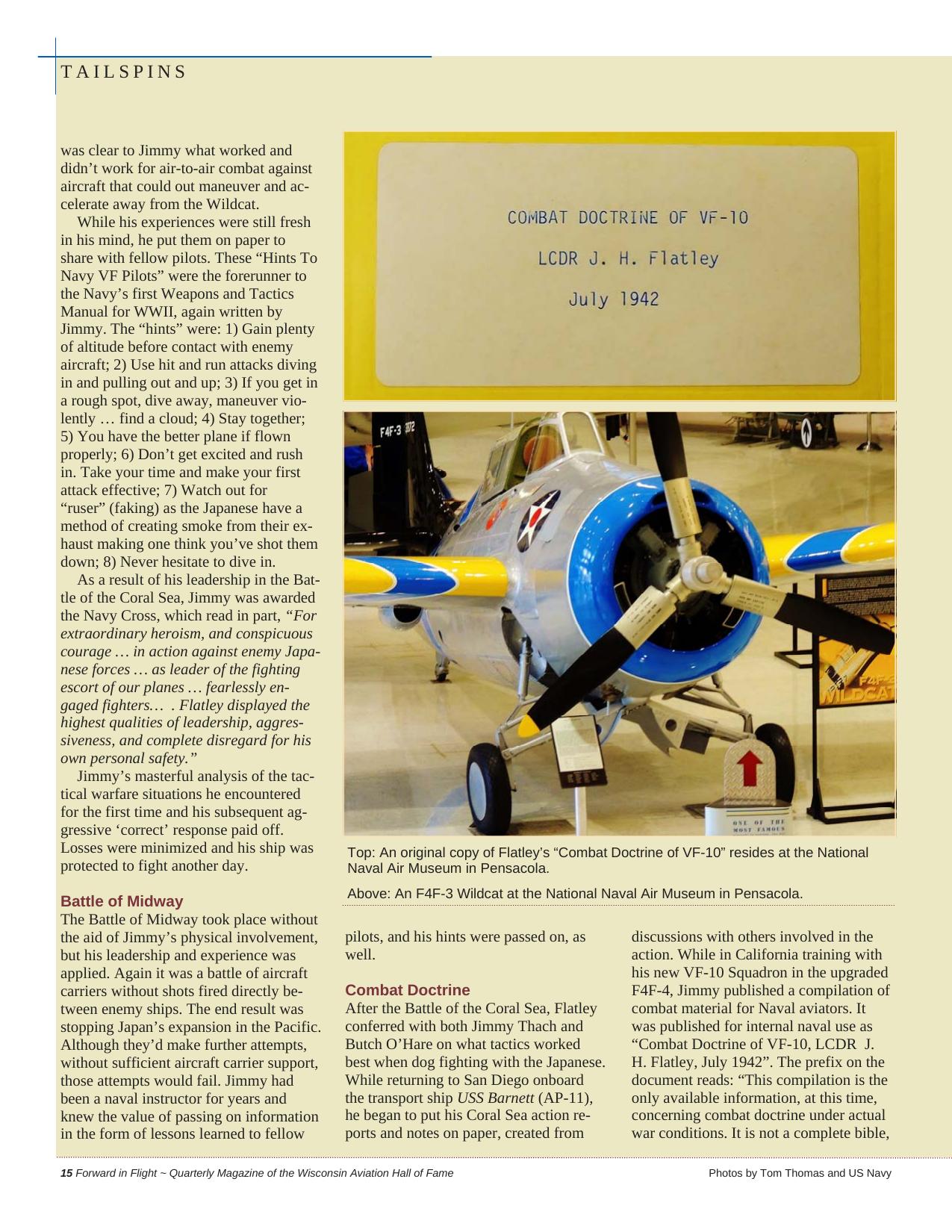
TAILSPINS was clear to Jimmy what worked and didn’t work for air-to-air combat against aircraft that could out maneuver and accelerate away from the Wildcat. While his experiences were still fresh in his mind, he put them on paper to share with fellow pilots. These “Hints To Navy VF Pilots” were the forerunner to the Navy’s first Weapons and Tactics Manual for WWII, again written by Jimmy. The “hints” were: 1) Gain plenty of altitude before contact with enemy aircraft; 2) Use hit and run attacks diving in and pulling out and up; 3) If you get in a rough spot, dive away, maneuver violently … find a cloud; 4) Stay together; 5) You have the better plane if flown properly; 6) Don’t get excited and rush in. Take your time and make your first attack effective; 7) Watch out for “ruser” (faking) as the Japanese have a method of creating smoke from their exhaust making one think you’ve shot them down; 8) Never hesitate to dive in. As a result of his leadership in the Battle of the Coral Sea, Jimmy was awarded the Navy Cross, which read in part, “For extraordinary heroism, and conspicuous courage … in action against enemy Japanese forces … as leader of the fighting escort of our planes … fearlessly engaged fighters… . Flatley displayed the highest qualities of leadership, aggressiveness, and complete disregard for his own personal safety.” Jimmy’s masterful analysis of the tactical warfare situations he encountered for the first time and his subsequent aggressive ‘correct’ response paid off. Losses were minimized and his ship was protected to fight another day. Battle of Midway The Battle of Midway took place without the aid of Jimmy’s physical involvement, but his leadership and experience was applied. Again it was a battle of aircraft carriers without shots fired directly between enemy ships. The end result was stopping Japan’s expansion in the Pacific. Although they’d make further attempts, without sufficient aircraft carrier support, those attempts would fail. Jimmy had been a naval instructor for years and knew the value of passing on information in the form of lessons learned to fellow Top: An original copy of Flatley’s “Combat Doctrine of VF-10” resides at the National Naval Air Museum in Pensacola. Above: An F4F-3 Wildcat at the National Naval Air Museum in Pensacola. pilots, and his hints were passed on, as well. Combat Doctrine After the Battle of the Coral Sea, Flatley conferred with both Jimmy Thach and Butch O’Hare on what tactics worked best when dog fighting with the Japanese. While returning to San Diego onboard the transport ship USS Barnett (AP-11), he began to put his Coral Sea action reports and notes on paper, created from 15 Forward in Flight ~ Quarterly Magazine of the Wisconsin Aviation Hall of Fame discussions with others involved in the action. While in California training with his new VF-10 Squadron in the upgraded F4F-4, Jimmy published a compilation of combat material for Naval aviators. It was published for internal naval use as “Combat Doctrine of VF-10, LCDR J. H. Flatley, July 1942”. The prefix on the document reads: “This compilation is the only available information, at this time, concerning combat doctrine under actual war conditions. It is not a complete bible, Photos by Tom Thomas and US Navy
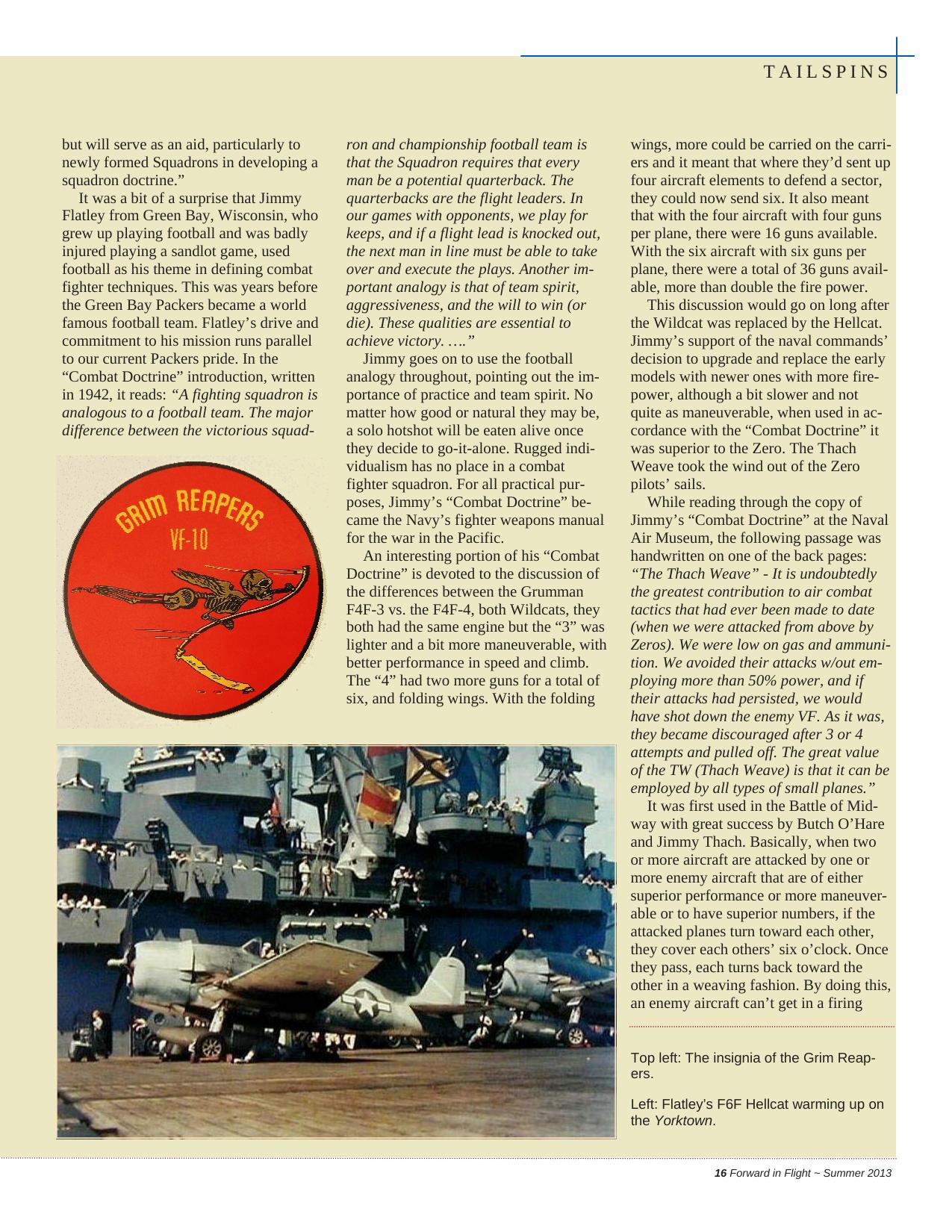
TAILSPINS but will serve as an aid, particularly to newly formed Squadrons in developing a squadron doctrine.” It was a bit of a surprise that Jimmy Flatley from Green Bay, Wisconsin, who grew up playing football and was badly injured playing a sandlot game, used football as his theme in defining combat fighter techniques. This was years before the Green Bay Packers became a world famous football team. Flatley’s drive and commitment to his mission runs parallel to our current Packers pride. In the “Combat Doctrine” introduction, written in 1942, it reads: “A fighting squadron is analogous to a football team. The major difference between the victorious squad- ron and championship football team is that the Squadron requires that every man be a potential quarterback. The quarterbacks are the flight leaders. In our games with opponents, we play for keeps, and if a flight lead is knocked out, the next man in line must be able to take over and execute the plays. Another important analogy is that of team spirit, aggressiveness, and the will to win (or die). These qualities are essential to achieve victory. ….” Jimmy goes on to use the football analogy throughout, pointing out the importance of practice and team spirit. No matter how good or natural they may be, a solo hotshot will be eaten alive once they decide to go-it-alone. Rugged individualism has no place in a combat fighter squadron. For all practical purposes, Jimmy’s “Combat Doctrine” became the Navy’s fighter weapons manual for the war in the Pacific. An interesting portion of his “Combat Doctrine” is devoted to the discussion of the differences between the Grumman F4F-3 vs. the F4F-4, both Wildcats, they both had the same engine but the “3” was lighter and a bit more maneuverable, with better performance in speed and climb. The “4” had two more guns for a total of six, and folding wings. With the folding wings, more could be carried on the carriers and it meant that where they’d sent up four aircraft elements to defend a sector, they could now send six. It also meant that with the four aircraft with four guns per plane, there were 16 guns available. With the six aircraft with six guns per plane, there were a total of 36 guns available, more than double the fire power. This discussion would go on long after the Wildcat was replaced by the Hellcat. Jimmy’s support of the naval commands’ decision to upgrade and replace the early models with newer ones with more firepower, although a bit slower and not quite as maneuverable, when used in accordance with the “Combat Doctrine” it was superior to the Zero. The Thach Weave took the wind out of the Zero pilots’ sails. While reading through the copy of Jimmy’s “Combat Doctrine” at the Naval Air Museum, the following passage was handwritten on one of the back pages: “The Thach Weave” - It is undoubtedly the greatest contribution to air combat tactics that had ever been made to date (when we were attacked from above by Zeros). We were low on gas and ammunition. We avoided their attacks w/out employing more than 50% power, and if their attacks had persisted, we would have shot down the enemy VF. As it was, they became discouraged after 3 or 4 attempts and pulled off. The great value of the TW (Thach Weave) is that it can be employed by all types of small planes.” It was first used in the Battle of Midway with great success by Butch O’Hare and Jimmy Thach. Basically, when two or more aircraft are attacked by one or more enemy aircraft that are of either superior performance or more maneuverable or to have superior numbers, if the attacked planes turn toward each other, they cover each others’ six o’clock. Once they pass, each turns back toward the other in a weaving fashion. By doing this, an enemy aircraft can’t get in a firing Top left: The insignia of the Grim Reapers. Left: Flatley’s F6F Hellcat warming up on the Yorktown. 16 Forward in Flight ~ Summer 2013
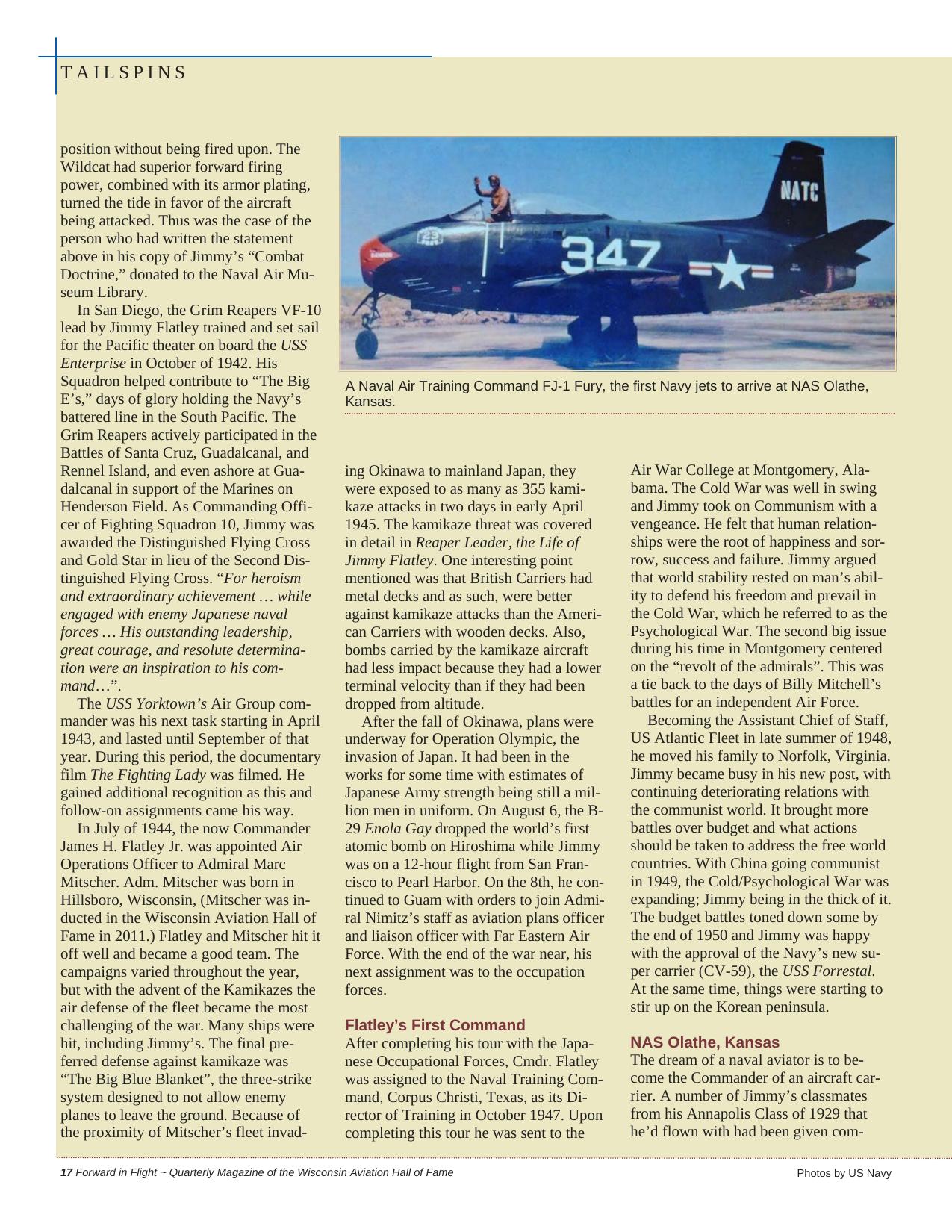
TAILSPINS position without being fired upon. The Wildcat had superior forward firing power, combined with its armor plating, turned the tide in favor of the aircraft being attacked. Thus was the case of the person who had written the statement above in his copy of Jimmy’s “Combat Doctrine,” donated to the Naval Air Museum Library. In San Diego, the Grim Reapers VF-10 lead by Jimmy Flatley trained and set sail for the Pacific theater on board the USS Enterprise in October of 1942. His Squadron helped contribute to “The Big E’s,” days of glory holding the Navy’s battered line in the South Pacific. The Grim Reapers actively participated in the Battles of Santa Cruz, Guadalcanal, and Rennel Island, and even ashore at Guadalcanal in support of the Marines on Henderson Field. As Commanding Officer of Fighting Squadron 10, Jimmy was awarded the Distinguished Flying Cross and Gold Star in lieu of the Second Distinguished Flying Cross. “For heroism and extraordinary achievement … while engaged with enemy Japanese naval forces … His outstanding leadership, great courage, and resolute determination were an inspiration to his command…”. The USS Yorktown’s Air Group commander was his next task starting in April 1943, and lasted until September of that year. During this period, the documentary film The Fighting Lady was filmed. He gained additional recognition as this and follow-on assignments came his way. In July of 1944, the now Commander James H. Flatley Jr. was appointed Air Operations Officer to Admiral Marc Mitscher. Adm. Mitscher was born in Hillsboro, Wisconsin, (Mitscher was inducted in the Wisconsin Aviation Hall of Fame in 2011.) Flatley and Mitscher hit it off well and became a good team. The campaigns varied throughout the year, but with the advent of the Kamikazes the air defense of the fleet became the most challenging of the war. Many ships were hit, including Jimmy’s. The final preferred defense against kamikaze was “The Big Blue Blanket”, the three-strike system designed to not allow enemy planes to leave the ground. Because of the proximity of Mitscher’s fleet invad- A Naval Air Training Command FJ-1 Fury, the first Navy jets to arrive at NAS Olathe, Kansas. ing Okinawa to mainland Japan, they were exposed to as many as 355 kamikaze attacks in two days in early April 1945. The kamikaze threat was covered in detail in Reaper Leader, the Life of Jimmy Flatley. One interesting point mentioned was that British Carriers had metal decks and as such, were better against kamikaze attacks than the American Carriers with wooden decks. Also, bombs carried by the kamikaze aircraft had less impact because they had a lower terminal velocity than if they had been dropped from altitude. After the fall of Okinawa, plans were underway for Operation Olympic, the invasion of Japan. It had been in the works for some time with estimates of Japanese Army strength being still a million men in uniform. On August 6, the B29 Enola Gay dropped the world’s first atomic bomb on Hiroshima while Jimmy was on a 12-hour flight from San Francisco to Pearl Harbor. On the 8th, he continued to Guam with orders to join Admiral Nimitz’s staff as aviation plans officer and liaison officer with Far Eastern Air Force. With the end of the war near, his next assignment was to the occupation forces. Flatley’s First Command After completing his tour with the Japanese Occupational Forces, Cmdr. Flatley was assigned to the Naval Training Command, Corpus Christi, Texas, as its Director of Training in October 1947. Upon completing this tour he was sent to the 17 Forward in Flight ~ Quarterly Magazine of the Wisconsin Aviation Hall of Fame Air War College at Montgomery, Alabama. The Cold War was well in swing and Jimmy took on Communism with a vengeance. He felt that human relationships were the root of happiness and sorrow, success and failure. Jimmy argued that world stability rested on man’s ability to defend his freedom and prevail in the Cold War, which he referred to as the Psychological War. The second big issue during his time in Montgomery centered on the “revolt of the admirals”. This was a tie back to the days of Billy Mitchell’s battles for an independent Air Force. Becoming the Assistant Chief of Staff, US Atlantic Fleet in late summer of 1948, he moved his family to Norfolk, Virginia. Jimmy became busy in his new post, with continuing deteriorating relations with the communist world. It brought more battles over budget and what actions should be taken to address the free world countries. With China going communist in 1949, the Cold/Psychological War was expanding; Jimmy being in the thick of it. The budget battles toned down some by the end of 1950 and Jimmy was happy with the approval of the Navy’s new super carrier (CV-59), the USS Forrestal. At the same time, things were starting to stir up on the Korean peninsula. NAS Olathe, Kansas The dream of a naval aviator is to become the Commander of an aircraft carrier. A number of Jimmy’s classmates from his Annapolis Class of 1929 that he’d flown with had been given comPhotos by US Navy
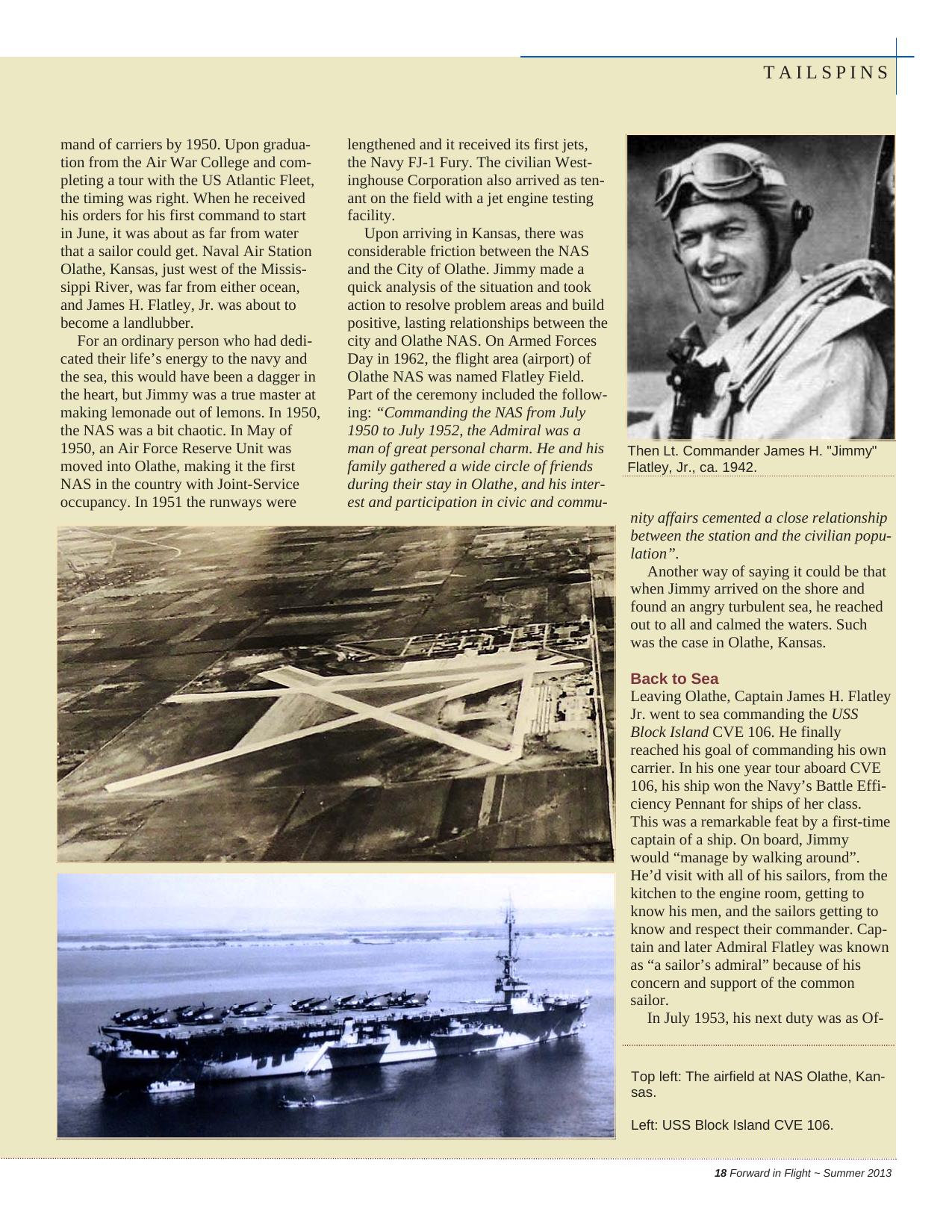
TAILSPINS mand of carriers by 1950. Upon graduation from the Air War College and completing a tour with the US Atlantic Fleet, the timing was right. When he received his orders for his first command to start in June, it was about as far from water that a sailor could get. Naval Air Station Olathe, Kansas, just west of the Mississippi River, was far from either ocean, and James H. Flatley, Jr. was about to become a landlubber. For an ordinary person who had dedicated their life’s energy to the navy and the sea, this would have been a dagger in the heart, but Jimmy was a true master at making lemonade out of lemons. In 1950, the NAS was a bit chaotic. In May of 1950, an Air Force Reserve Unit was moved into Olathe, making it the first NAS in the country with Joint-Service occupancy. In 1951 the runways were lengthened and it received its first jets, the Navy FJ-1 Fury. The civilian Westinghouse Corporation also arrived as tenant on the field with a jet engine testing facility. Upon arriving in Kansas, there was considerable friction between the NAS and the City of Olathe. Jimmy made a quick analysis of the situation and took action to resolve problem areas and build positive, lasting relationships between the city and Olathe NAS. On Armed Forces Day in 1962, the flight area (airport) of Olathe NAS was named Flatley Field. Part of the ceremony included the following: “Commanding the NAS from July 1950 to July 1952, the Admiral was a man of great personal charm. He and his family gathered a wide circle of friends during their stay in Olathe, and his interest and participation in civic and commu- Then Lt. Commander James H. "Jimmy" Flatley, Jr., ca. 1942. nity affairs cemented a close relationship between the station and the civilian population”. Another way of saying it could be that when Jimmy arrived on the shore and found an angry turbulent sea, he reached out to all and calmed the waters. Such was the case in Olathe, Kansas. Back to Sea Leaving Olathe, Captain James H. Flatley Jr. went to sea commanding the USS Block Island CVE 106. He finally reached his goal of commanding his own carrier. In his one year tour aboard CVE 106, his ship won the Navy’s Battle Efficiency Pennant for ships of her class. This was a remarkable feat by a first-time captain of a ship. On board, Jimmy would “manage by walking around”. He’d visit with all of his sailors, from the kitchen to the engine room, getting to know his men, and the sailors getting to know and respect their commander. Captain and later Admiral Flatley was known as “a sailor’s admiral” because of his concern and support of the common sailor. In July 1953, his next duty was as Of- Top left: The airfield at NAS Olathe, Kansas. Left: USS Block Island CVE 106. 18 Forward in Flight ~ Summer 2013
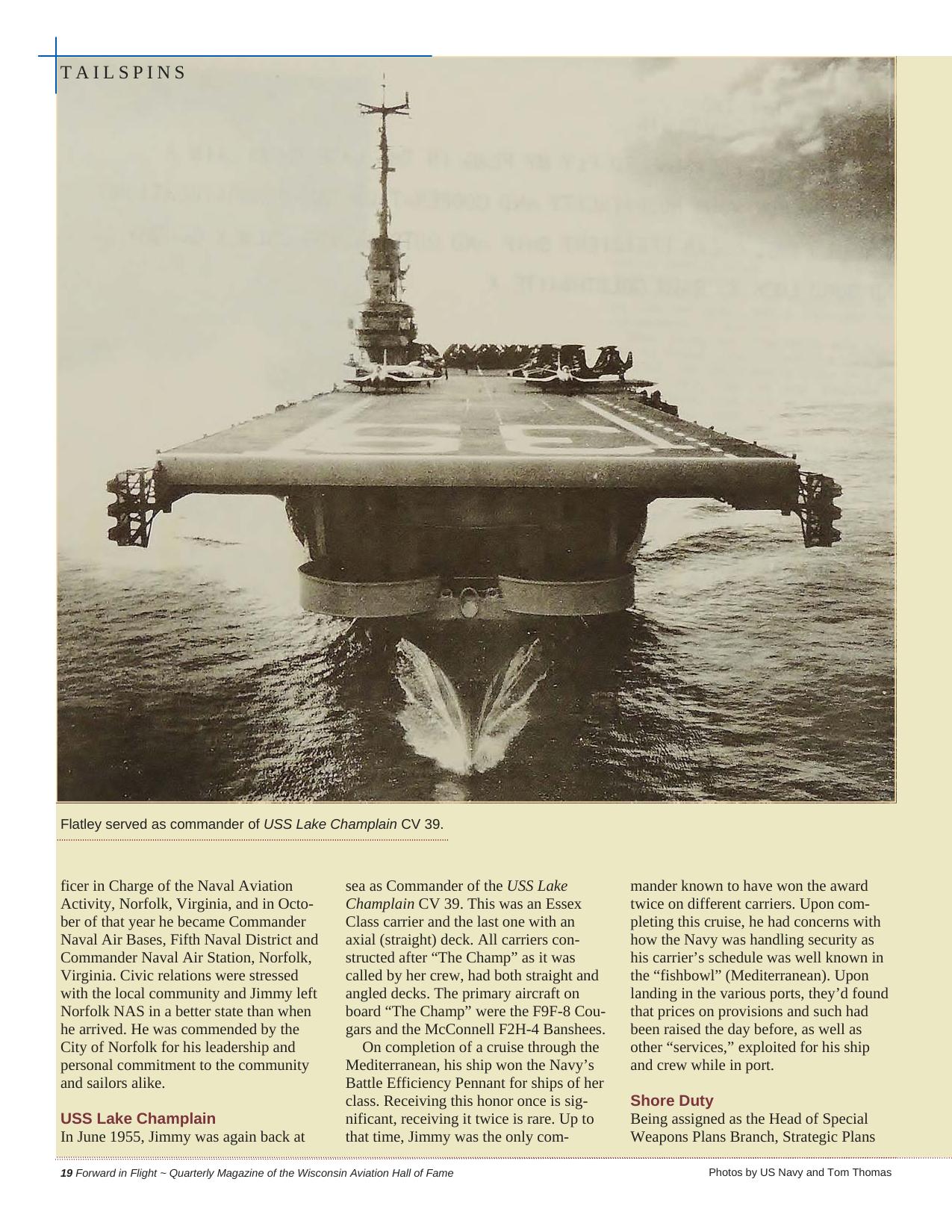
TAILSPINS Flatley served as commander of USS Lake Champlain CV 39. ficer in Charge of the Naval Aviation Activity, Norfolk, Virginia, and in October of that year he became Commander Naval Air Bases, Fifth Naval District and Commander Naval Air Station, Norfolk, Virginia. Civic relations were stressed with the local community and Jimmy left Norfolk NAS in a better state than when he arrived. He was commended by the City of Norfolk for his leadership and personal commitment to the community and sailors alike. USS Lake Champlain In June 1955, Jimmy was again back at sea as Commander of the USS Lake Champlain CV 39. This was an Essex Class carrier and the last one with an axial (straight) deck. All carriers constructed after “The Champ” as it was called by her crew, had both straight and angled decks. The primary aircraft on board “The Champ” were the F9F-8 Cougars and the McConnell F2H-4 Banshees. On completion of a cruise through the Mediterranean, his ship won the Navy’s Battle Efficiency Pennant for ships of her class. Receiving this honor once is significant, receiving it twice is rare. Up to that time, Jimmy was the only com- 19 Forward in Flight ~ Quarterly Magazine of the Wisconsin Aviation Hall of Fame mander known to have won the award twice on different carriers. Upon completing this cruise, he had concerns with how the Navy was handling security as his carrier’s schedule was well known in the “fishbowl” (Mediterranean). Upon landing in the various ports, they’d found that prices on provisions and such had been raised the day before, as well as other “services,” exploited for his ship and crew while in port. Shore Duty Being assigned as the Head of Special Weapons Plans Branch, Strategic Plans Photos by US Navy and Tom Thomas
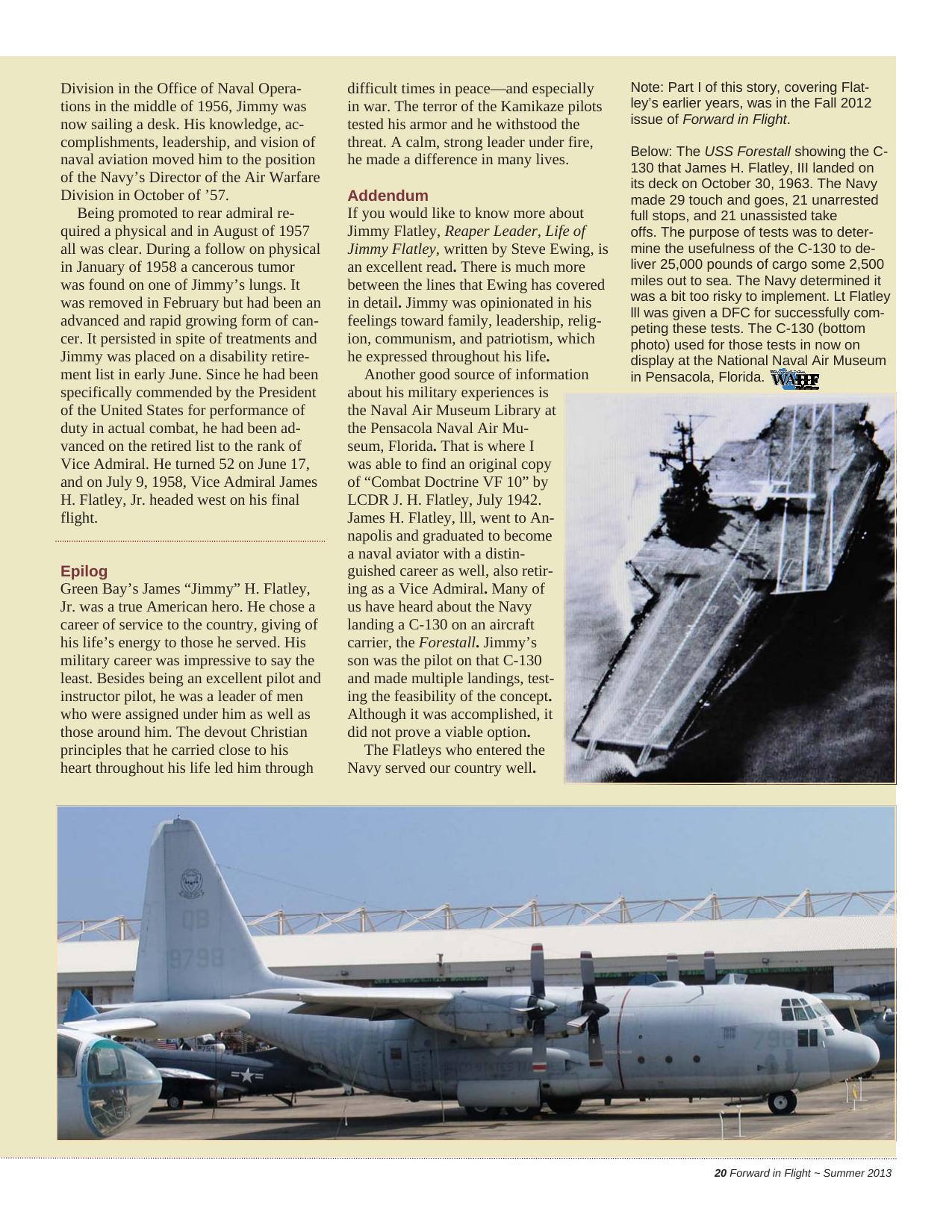
Division in the Office of Naval Operations in the middle of 1956, Jimmy was now sailing a desk. His knowledge, accomplishments, leadership, and vision of naval aviation moved him to the position of the Navy’s Director of the Air Warfare Division in October of ’57. Being promoted to rear admiral required a physical and in August of 1957 all was clear. During a follow on physical in January of 1958 a cancerous tumor was found on one of Jimmy’s lungs. It was removed in February but had been an advanced and rapid growing form of cancer. It persisted in spite of treatments and Jimmy was placed on a disability retirement list in early June. Since he had been specifically commended by the President of the United States for performance of duty in actual combat, he had been advanced on the retired list to the rank of Vice Admiral. He turned 52 on June 17, and on July 9, 1958, Vice Admiral James H. Flatley, Jr. headed west on his final flight. Epilog Green Bay’s James “Jimmy” H. Flatley, Jr. was a true American hero. He chose a career of service to the country, giving of his life’s energy to those he served. His military career was impressive to say the least. Besides being an excellent pilot and instructor pilot, he was a leader of men who were assigned under him as well as those around him. The devout Christian principles that he carried close to his heart throughout his life led him through difficult times in peace—and especially in war. The terror of the Kamikaze pilots tested his armor and he withstood the threat. A calm, strong leader under fire, he made a difference in many lives. Addendum If you would like to know more about Jimmy Flatley, Reaper Leader, Life of Jimmy Flatley, written by Steve Ewing, is an excellent read. There is much more between the lines that Ewing has covered in detail. Jimmy was opinionated in his feelings toward family, leadership, religion, communism, and patriotism, which he expressed throughout his life. Another good source of information about his military experiences is the Naval Air Museum Library at the Pensacola Naval Air Museum, Florida. That is where I was able to find an original copy of “Combat Doctrine VF 10” by LCDR J. H. Flatley, July 1942. James H. Flatley, lll, went to Annapolis and graduated to become a naval aviator with a distinguished career as well, also retiring as a Vice Admiral. Many of us have heard about the Navy landing a C-130 on an aircraft carrier, the Forestall. Jimmy’s son was the pilot on that C-130 and made multiple landings, testing the feasibility of the concept. Although it was accomplished, it did not prove a viable option. The Flatleys who entered the Navy served our country well. Note: Part I of this story, covering Flatley’s earlier years, was in the Fall 2012 issue of Forward in Flight. Below: The USS Forestall showing the C130 that James H. Flatley, III landed on its deck on October 30, 1963. The Navy made 29 touch and goes, 21 unarrested full stops, and 21 unassisted take offs. The purpose of tests was to determine the usefulness of the C-130 to deliver 25,000 pounds of cargo some 2,500 miles out to sea. The Navy determined it was a bit too risky to implement. Lt Flatley lll was given a DFC for successfully competing these tests. The C-130 (bottom photo) used for those tests in now on display at the National Naval Air Museum in Pensacola, Florida. 20 Forward in Flight ~ Summer 2013
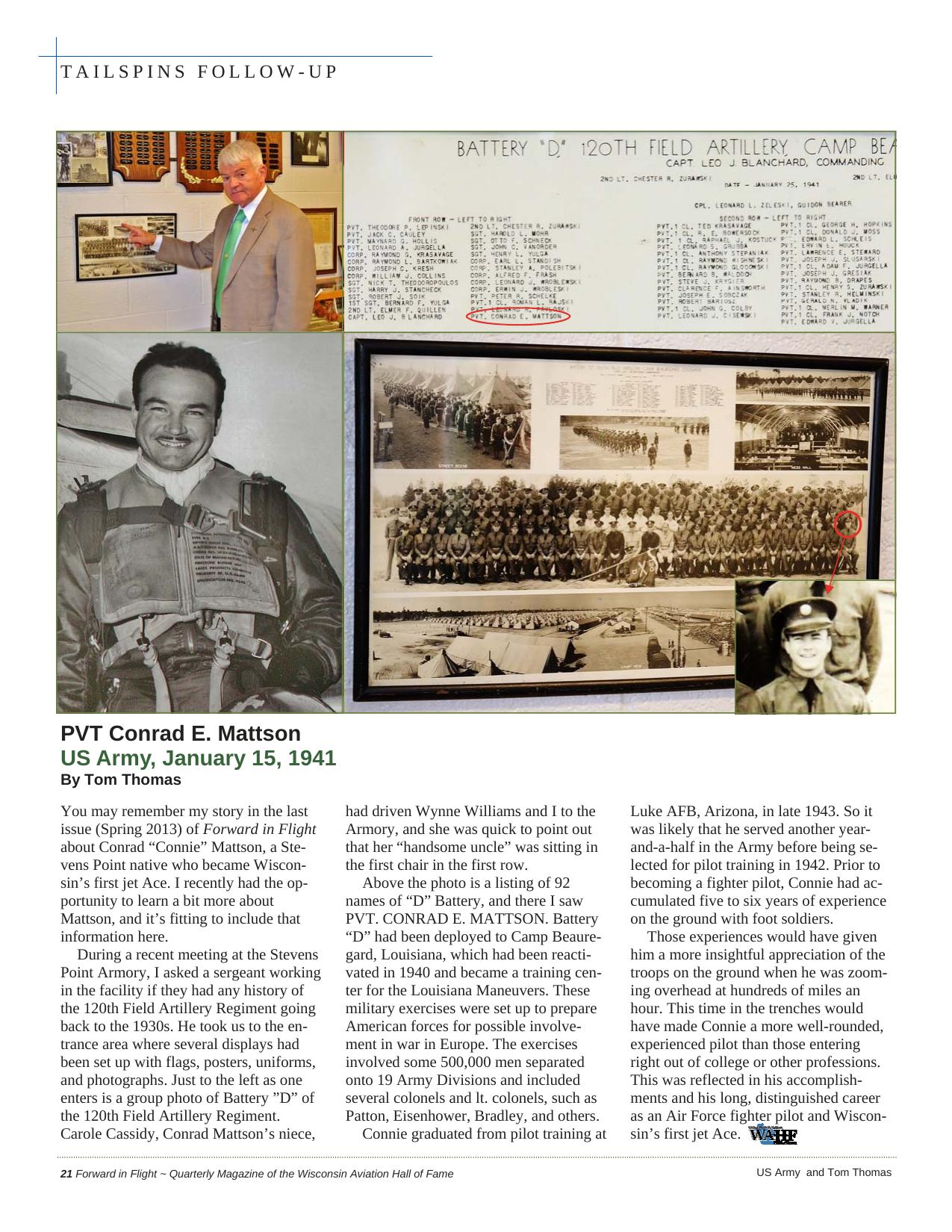
TAILSPINS FOLLOW-UP PVT Conrad E. Mattson US Army, January 15, 1941 By Tom Thomas You may remember my story in the last issue (Spring 2013) of Forward in Flight about Conrad “Connie” Mattson, a Stevens Point native who became Wisconsin’s first jet Ace. I recently had the opportunity to learn a bit more about Mattson, and it’s fitting to include that information here. During a recent meeting at the Stevens Point Armory, I asked a sergeant working in the facility if they had any history of the 120th Field Artillery Regiment going back to the 1930s. He took us to the entrance area where several displays had been set up with flags, posters, uniforms, and photographs. Just to the left as one enters is a group photo of Battery ”D” of the 120th Field Artillery Regiment. Carole Cassidy, Conrad Mattson’s niece, had driven Wynne Williams and I to the Armory, and she was quick to point out that her “handsome uncle” was sitting in the first chair in the first row. Above the photo is a listing of 92 names of “D” Battery, and there I saw PVT. CONRAD E. MATTSON. Battery “D” had been deployed to Camp Beauregard, Louisiana, which had been reactivated in 1940 and became a training center for the Louisiana Maneuvers. These military exercises were set up to prepare American forces for possible involvement in war in Europe. The exercises involved some 500,000 men separated onto 19 Army Divisions and included several colonels and lt. colonels, such as Patton, Eisenhower, Bradley, and others. Connie graduated from pilot training at 21 Forward in Flight ~ Quarterly Magazine of the Wisconsin Aviation Hall of Fame Luke AFB, Arizona, in late 1943. So it was likely that he served another yearand-a-half in the Army before being selected for pilot training in 1942. Prior to becoming a fighter pilot, Connie had accumulated five to six years of experience on the ground with foot soldiers. Those experiences would have given him a more insightful appreciation of the troops on the ground when he was zooming overhead at hundreds of miles an hour. This time in the trenches would have made Connie a more well-rounded, experienced pilot than those entering right out of college or other professions. This was reflected in his accomplishments and his long, distinguished career as an Air Force fighter pilot and Wisconsin’s first jet Ace. US Army and Tom Thomas
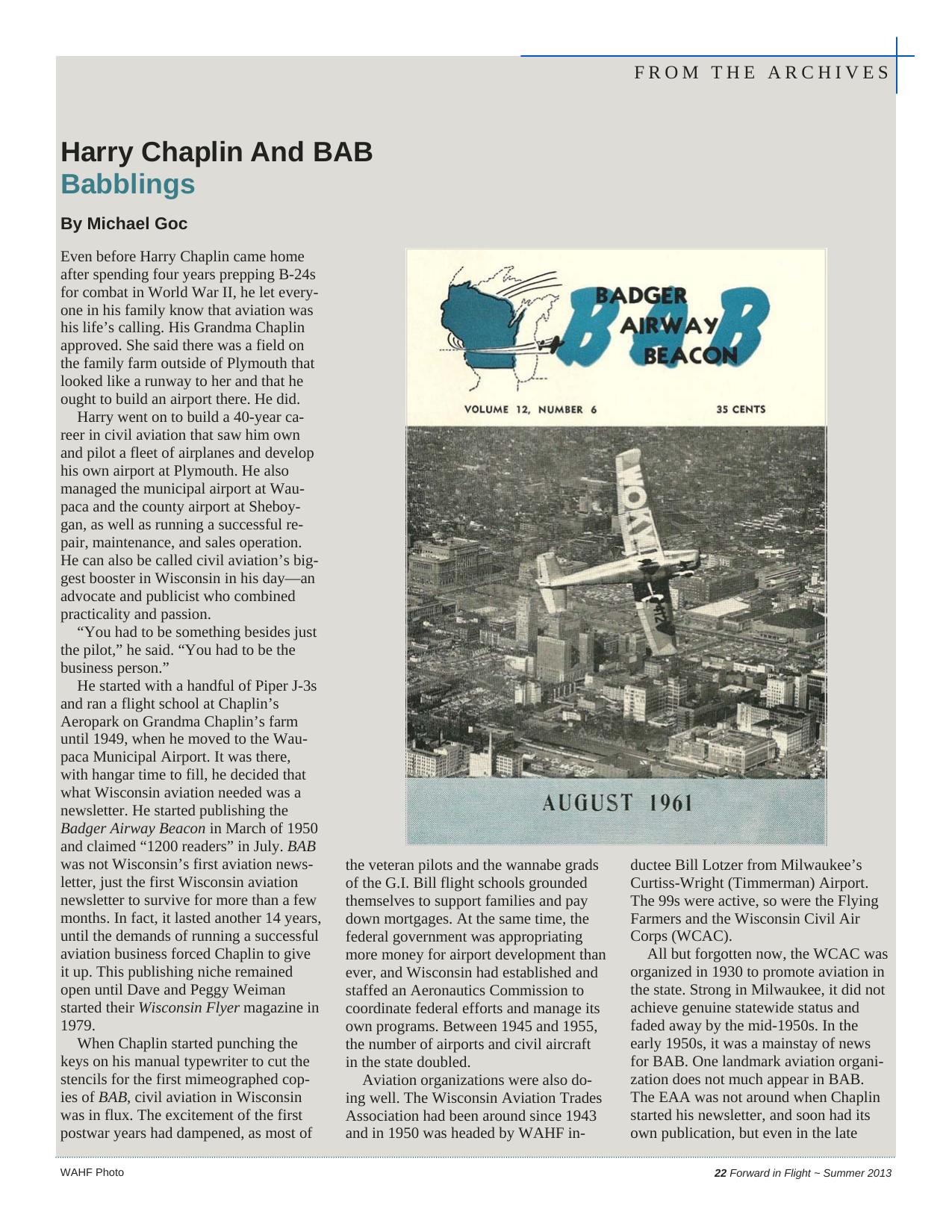
FROM THE ARCHIVES Harry Chaplin And BAB Babblings By Michael Goc Even before Harry Chaplin came home after spending four years prepping B-24s for combat in World War II, he let everyone in his family know that aviation was his life’s calling. His Grandma Chaplin approved. She said there was a field on the family farm outside of Plymouth that looked like a runway to her and that he ought to build an airport there. He did. Harry went on to build a 40-year career in civil aviation that saw him own and pilot a fleet of airplanes and develop his own airport at Plymouth. He also managed the municipal airport at Waupaca and the county airport at Sheboygan, as well as running a successful repair, maintenance, and sales operation. He can also be called civil aviation’s biggest booster in Wisconsin in his day—an advocate and publicist who combined practicality and passion. “You had to be something besides just the pilot,” he said. “You had to be the business person.” He started with a handful of Piper J-3s and ran a flight school at Chaplin’s Aeropark on Grandma Chaplin’s farm until 1949, when he moved to the Waupaca Municipal Airport. It was there, with hangar time to fill, he decided that what Wisconsin aviation needed was a newsletter. He started publishing the Badger Airway Beacon in March of 1950 and claimed “1200 readers” in July. BAB was not Wisconsin’s first aviation newsletter, just the first Wisconsin aviation newsletter to survive for more than a few months. In fact, it lasted another 14 years, until the demands of running a successful aviation business forced Chaplin to give it up. This publishing niche remained open until Dave and Peggy Weiman started their Wisconsin Flyer magazine in 1979. When Chaplin started punching the keys on his manual typewriter to cut the stencils for the first mimeographed copies of BAB, civil aviation in Wisconsin was in flux. The excitement of the first postwar years had dampened, as most of WAHF Photo the veteran pilots and the wannabe grads of the G.I. Bill flight schools grounded themselves to support families and pay down mortgages. At the same time, the federal government was appropriating more money for airport development than ever, and Wisconsin had established and staffed an Aeronautics Commission to coordinate federal efforts and manage its own programs. Between 1945 and 1955, the number of airports and civil aircraft in the state doubled. Aviation organizations were also doing well. The Wisconsin Aviation Trades Association had been around since 1943 and in 1950 was headed by WAHF in- ductee Bill Lotzer from Milwaukee’s Curtiss-Wright (Timmerman) Airport. The 99s were active, so were the Flying Farmers and the Wisconsin Civil Air Corps (WCAC). All but forgotten now, the WCAC was organized in 1930 to promote aviation in the state. Strong in Milwaukee, it did not achieve genuine statewide status and faded away by the mid-1950s. In the early 1950s, it was a mainstay of news for BAB. One landmark aviation organization does not much appear in BAB. The EAA was not around when Chaplin started his newsletter, and soon had its own publication, but even in the late 22 Forward in Flight ~ Summer 2013
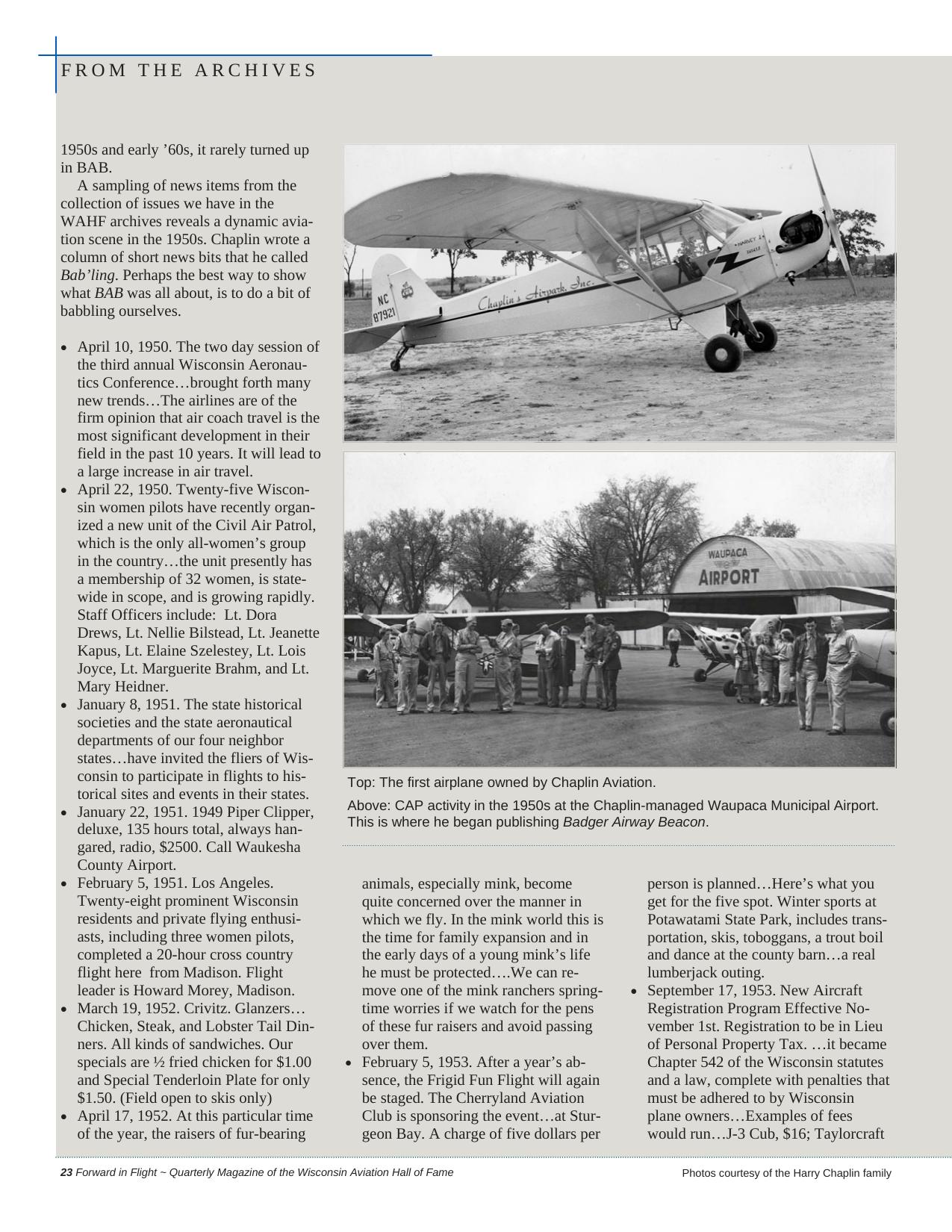
FROM THE ARCHIVES 1950s and early ’60s, it rarely turned up in BAB. A sampling of news items from the collection of issues we have in the WAHF archives reveals a dynamic aviation scene in the 1950s. Chaplin wrote a column of short news bits that he called Bab’ling. Perhaps the best way to show what BAB was all about, is to do a bit of babbling ourselves. April 10, 1950. The two day session of the third annual Wisconsin Aeronautics Conference…brought forth many new trends…The airlines are of the firm opinion that air coach travel is the most significant development in their field in the past 10 years. It will lead to a large increase in air travel. April 22, 1950. Twenty-five Wisconsin women pilots have recently organized a new unit of the Civil Air Patrol, which is the only all-women’s group in the country…the unit presently has a membership of 32 women, is statewide in scope, and is growing rapidly. Staff Officers include: Lt. Dora Drews, Lt. Nellie Bilstead, Lt. Jeanette Kapus, Lt. Elaine Szelestey, Lt. Lois Joyce, Lt. Marguerite Brahm, and Lt. Mary Heidner. January 8, 1951. The state historical societies and the state aeronautical departments of our four neighbor states…have invited the fliers of Wisconsin to participate in flights to historical sites and events in their states. January 22, 1951. 1949 Piper Clipper, deluxe, 135 hours total, always hangared, radio, $2500. Call Waukesha County Airport. February 5, 1951. Los Angeles. Twenty-eight prominent Wisconsin residents and private flying enthusiasts, including three women pilots, completed a 20-hour cross country flight here from Madison. Flight leader is Howard Morey, Madison. March 19, 1952. Crivitz. Glanzers… Chicken, Steak, and Lobster Tail Dinners. All kinds of sandwiches. Our specials are ½ fried chicken for $1.00 and Special Tenderloin Plate for only $1.50. (Field open to skis only) April 17, 1952. At this particular time of the year, the raisers of fur-bearing Top: The first airplane owned by Chaplin Aviation. Above: CAP activity in the 1950s at the Chaplin-managed Waupaca Municipal Airport. This is where he began publishing Badger Airway Beacon. animals, especially mink, become quite concerned over the manner in which we fly. In the mink world this is the time for family expansion and in the early days of a young mink’s life he must be protected….We can remove one of the mink ranchers springtime worries if we watch for the pens of these fur raisers and avoid passing over them. February 5, 1953. After a year’s absence, the Frigid Fun Flight will again be staged. The Cherryland Aviation Club is sponsoring the event…at Sturgeon Bay. A charge of five dollars per 23 Forward in Flight ~ Quarterly Magazine of the Wisconsin Aviation Hall of Fame person is planned…Here’s what you get for the five spot. Winter sports at Potawatami State Park, includes transportation, skis, toboggans, a trout boil and dance at the county barn…a real lumberjack outing. September 17, 1953. New Aircraft Registration Program Effective November 1st. Registration to be in Lieu of Personal Property Tax. …it became Chapter 542 of the Wisconsin statutes and a law, complete with penalties that must be adhered to by Wisconsin plane owners…Examples of fees would run…J-3 Cub, $16; Taylorcraft Photos courtesy of the Harry Chaplin family
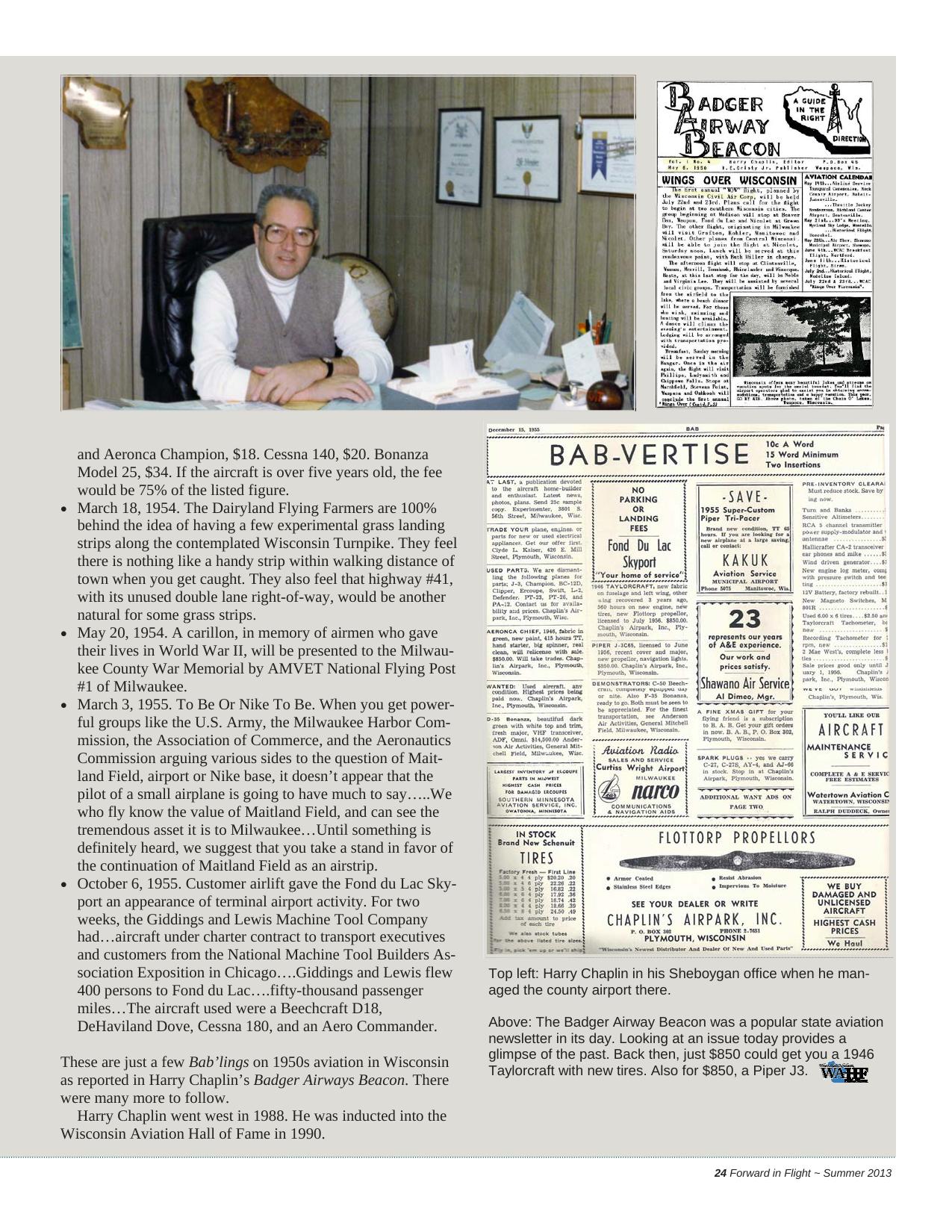
and Aeronca Champion, $18. Cessna 140, $20. Bonanza Model 25, $34. If the aircraft is over five years old, the fee would be 75% of the listed figure. March 18, 1954. The Dairyland Flying Farmers are 100% behind the idea of having a few experimental grass landing strips along the contemplated Wisconsin Turnpike. They feel there is nothing like a handy strip within walking distance of town when you get caught. They also feel that highway #41, with its unused double lane right-of-way, would be another natural for some grass strips. May 20, 1954. A carillon, in memory of airmen who gave their lives in World War II, will be presented to the Milwaukee County War Memorial by AMVET National Flying Post #1 of Milwaukee. March 3, 1955. To Be Or Nike To Be. When you get powerful groups like the U.S. Army, the Milwaukee Harbor Commission, the Association of Commerce, and the Aeronautics Commission arguing various sides to the question of Maitland Field, airport or Nike base, it doesn’t appear that the pilot of a small airplane is going to have much to say…..We who fly know the value of Maitland Field, and can see the tremendous asset it is to Milwaukee…Until something is definitely heard, we suggest that you take a stand in favor of the continuation of Maitland Field as an airstrip. October 6, 1955. Customer airlift gave the Fond du Lac Skyport an appearance of terminal airport activity. For two weeks, the Giddings and Lewis Machine Tool Company had…aircraft under charter contract to transport executives and customers from the National Machine Tool Builders Association Exposition in Chicago….Giddings and Lewis flew 400 persons to Fond du Lac….fifty-thousand passenger miles…The aircraft used were a Beechcraft D18, DeHaviland Dove, Cessna 180, and an Aero Commander. These are just a few Bab’lings on 1950s aviation in Wisconsin as reported in Harry Chaplin’s Badger Airways Beacon. There were many more to follow. Harry Chaplin went west in 1988. He was inducted into the Wisconsin Aviation Hall of Fame in 1990. Top left: Harry Chaplin in his Sheboygan office when he managed the county airport there. Above: The Badger Airway Beacon was a popular state aviation newsletter in its day. Looking at an issue today provides a glimpse of the past. Back then, just $850 could get you a 1946 Taylorcraft with new tires. Also for $850, a Piper J3. 24 Forward in Flight ~ Summer 2013
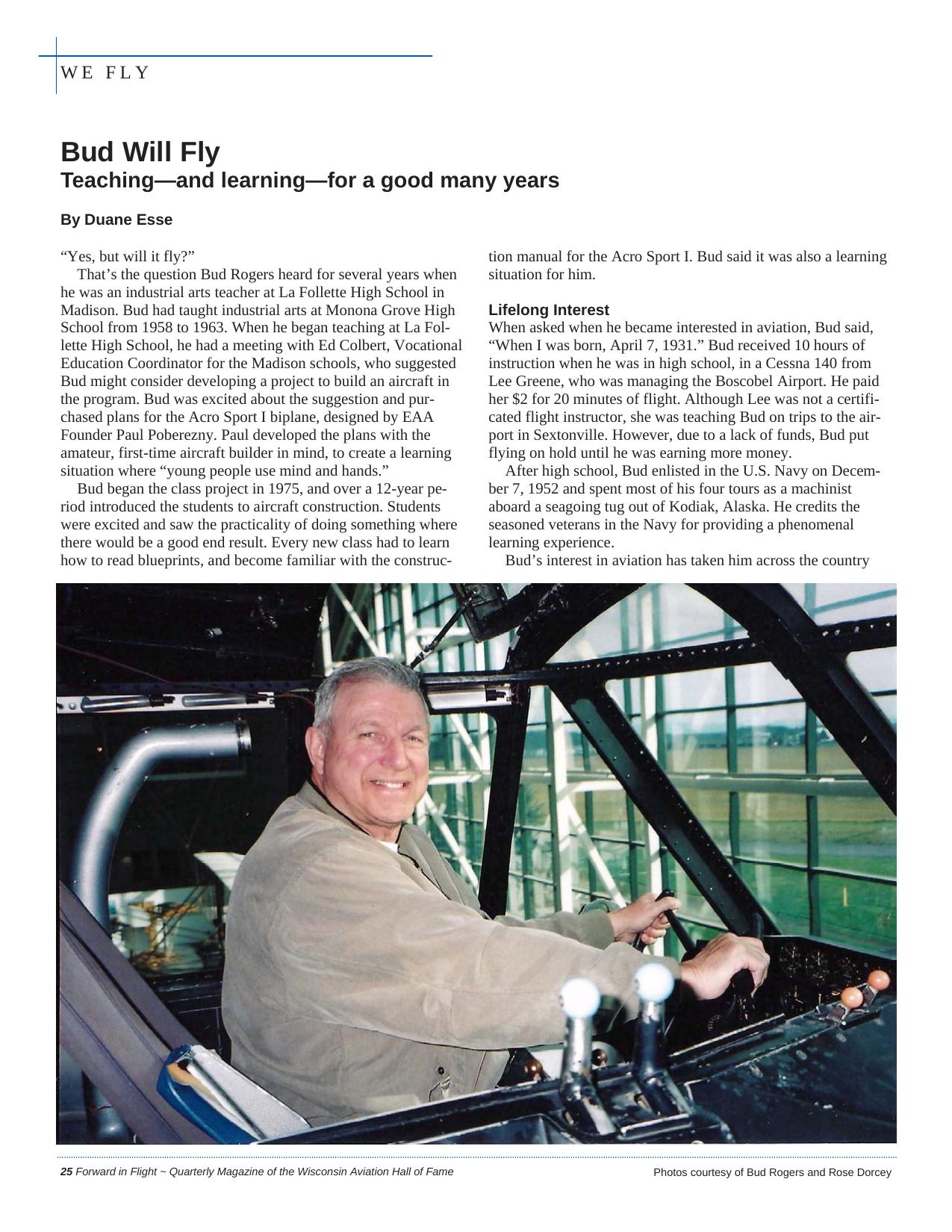
WE FLY Bud Will Fly Teaching—and learning—for a good many years By Duane Esse “Yes, but will it fly?” That’s the question Bud Rogers heard for several years when he was an industrial arts teacher at La Follette High School in Madison. Bud had taught industrial arts at Monona Grove High School from 1958 to 1963. When he began teaching at La Follette High School, he had a meeting with Ed Colbert, Vocational Education Coordinator for the Madison schools, who suggested Bud might consider developing a project to build an aircraft in the program. Bud was excited about the suggestion and purchased plans for the Acro Sport I biplane, designed by EAA Founder Paul Poberezny. Paul developed the plans with the amateur, first-time aircraft builder in mind, to create a learning situation where “young people use mind and hands.” Bud began the class project in 1975, and over a 12-year period introduced the students to aircraft construction. Students were excited and saw the practicality of doing something where there would be a good end result. Every new class had to learn how to read blueprints, and become familiar with the construc- 25 Forward in Flight ~ Quarterly Magazine of the Wisconsin Aviation Hall of Fame tion manual for the Acro Sport I. Bud said it was also a learning situation for him. Lifelong Interest When asked when he became interested in aviation, Bud said, “When I was born, April 7, 1931.” Bud received 10 hours of instruction when he was in high school, in a Cessna 140 from Lee Greene, who was managing the Boscobel Airport. He paid her $2 for 20 minutes of flight. Although Lee was not a certificated flight instructor, she was teaching Bud on trips to the airport in Sextonville. However, due to a lack of funds, Bud put flying on hold until he was earning more money. After high school, Bud enlisted in the U.S. Navy on December 7, 1952 and spent most of his four tours as a machinist aboard a seagoing tug out of Kodiak, Alaska. He credits the seasoned veterans in the Navy for providing a phenomenal learning experience. Bud’s interest in aviation has taken him across the country Photos courtesy of Bud Rogers and Rose Dorcey
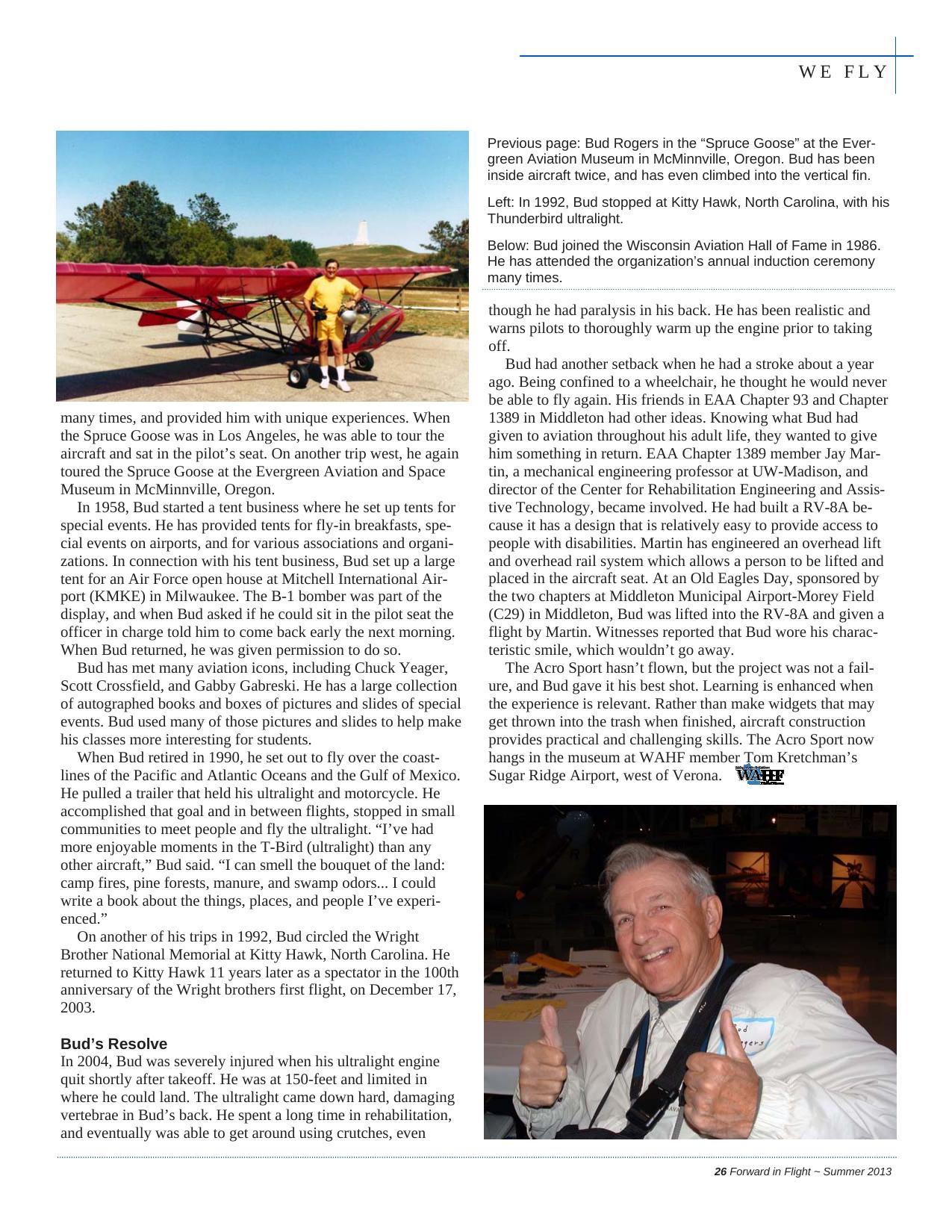
WE FLY Previous page: Bud Rogers in the “Spruce Goose” at the Evergreen Aviation Museum in McMinnville, Oregon. Bud has been inside aircraft twice, and has even climbed into the vertical fin. Left: In 1992, Bud stopped at Kitty Hawk, North Carolina, with his Thunderbird ultralight. Below: Bud joined the Wisconsin Aviation Hall of Fame in 1986. He has attended the organization’s annual induction ceremony many times. many times, and provided him with unique experiences. When the Spruce Goose was in Los Angeles, he was able to tour the aircraft and sat in the pilot’s seat. On another trip west, he again toured the Spruce Goose at the Evergreen Aviation and Space Museum in McMinnville, Oregon. In 1958, Bud started a tent business where he set up tents for special events. He has provided tents for fly-in breakfasts, special events on airports, and for various associations and organizations. In connection with his tent business, Bud set up a large tent for an Air Force open house at Mitchell International Airport (KMKE) in Milwaukee. The B-1 bomber was part of the display, and when Bud asked if he could sit in the pilot seat the officer in charge told him to come back early the next morning. When Bud returned, he was given permission to do so. Bud has met many aviation icons, including Chuck Yeager, Scott Crossfield, and Gabby Gabreski. He has a large collection of autographed books and boxes of pictures and slides of special events. Bud used many of those pictures and slides to help make his classes more interesting for students. When Bud retired in 1990, he set out to fly over the coastlines of the Pacific and Atlantic Oceans and the Gulf of Mexico. He pulled a trailer that held his ultralight and motorcycle. He accomplished that goal and in between flights, stopped in small communities to meet people and fly the ultralight. “I’ve had more enjoyable moments in the T-Bird (ultralight) than any other aircraft,” Bud said. “I can smell the bouquet of the land: camp fires, pine forests, manure, and swamp odors... I could write a book about the things, places, and people I’ve experienced.” On another of his trips in 1992, Bud circled the Wright Brother National Memorial at Kitty Hawk, North Carolina. He returned to Kitty Hawk 11 years later as a spectator in the 100th anniversary of the Wright brothers first flight, on December 17, 2003. though he had paralysis in his back. He has been realistic and warns pilots to thoroughly warm up the engine prior to taking off. Bud had another setback when he had a stroke about a year ago. Being confined to a wheelchair, he thought he would never be able to fly again. His friends in EAA Chapter 93 and Chapter 1389 in Middleton had other ideas. Knowing what Bud had given to aviation throughout his adult life, they wanted to give him something in return. EAA Chapter 1389 member Jay Martin, a mechanical engineering professor at UW-Madison, and director of the Center for Rehabilitation Engineering and Assistive Technology, became involved. He had built a RV-8A because it has a design that is relatively easy to provide access to people with disabilities. Martin has engineered an overhead lift and overhead rail system which allows a person to be lifted and placed in the aircraft seat. At an Old Eagles Day, sponsored by the two chapters at Middleton Municipal Airport-Morey Field (C29) in Middleton, Bud was lifted into the RV-8A and given a flight by Martin. Witnesses reported that Bud wore his characteristic smile, which wouldn’t go away. The Acro Sport hasn’t flown, but the project was not a failure, and Bud gave it his best shot. Learning is enhanced when the experience is relevant. Rather than make widgets that may get thrown into the trash when finished, aircraft construction provides practical and challenging skills. The Acro Sport now hangs in the museum at WAHF member Tom Kretchman’s Sugar Ridge Airport, west of Verona. Bud’s Resolve In 2004, Bud was severely injured when his ultralight engine quit shortly after takeoff. He was at 150-feet and limited in where he could land. The ultralight came down hard, damaging vertebrae in Bud’s back. He spent a long time in rehabilitation, and eventually was able to get around using crutches, even 26 Forward in Flight ~ Summer 2013
ASSOCIATION NEWS WAHF Announces 2013 Scholarship Recipients Three aviation students to receive $2,000 in funds Alex Adduci has been selected as the Wisconsin Aviation Hall of Fame’s 2013 Carl Guell Memorial scholarship recipient. Alex, from Eagle, Wisconsin, is an aeronautical engineering major at Purdue University in West Lafayette, Indiana. Before attending college, Alex learned to fly, soloing at 16 and earning his private pilot certificate and instrument at 17, and became a commercial pilot at 18, about the time he was finishing high school. Alex has participated in a number of extracurricular activities and community service projects. He is serving an internship with Gulfstream in Savannah, Georgia. “I would not be the person I am today without the wonderful support of those vested in the history and the adventure of general aviation in Wisconsin,” said Alex, upon receiving word of his selection. “This scholarship that the Wisconsin Aviation Hall of Fame has so generously offered comes as a wonderful surprise, but also makes me so very glad that we have such a dedicated group of people supporting and keeping general aviation at its finest. Thank you WAHF,” Alex added. “You have my deepest gratitude.” The Carl Guell Memorial scholarship is a $1000 award that goes to a Wisconsin student majoring in an aviation or aerospace program at any U.S. college or university. Rich Conrad, of Kiel, Wisconsin, will receive the $500 Thiessen Field scholarship. Rich has been a private pilot for 5 years. After being laid off from a yacht manufacturer 2 years ago, he decided to pursue a career as an airframe and powerplant mechanic. He is an Airframe and Powerplant/ Aircraft Avionics student at Fox Valley Technical College in Oshkosh. “I have recently completed my two-year Airframe and Powerplant training course at FVTC and earned my FAA Airframe and Powerplant Airman rating,” said Rich. “This scholarship is a great help and wonderful gift to continuing my education in the aviation field. I hope to continue on in aviation to help others realize how exciting and enjoyable this field is; the variety, age, and technology of aircraft is endless. Thank you for your support of aviation right here in Wisconsin!” Rich plans to continue his education, pursuing an associate degree in avionics. In addition to becoming a commercial pilot, Rich’s goal is to manage a repair hangar and potentially become a flight instructor. “Rich is one of the finest students we have had in the A&P program at FVTC,” said Jeffrey Anderson, one of Rich’s instructors. “He consistently demonstrates an exceptional level of 27 Forward in Flight ~ Quarterly Magazine of the Wisconsin Aviation Hall of Fame focus on his studies.” Heather Behrent, Appleton, is the recipient of the $500 Jerome Ripp Memorial scholarship. Heather is also an Airframe and Powerplant Mechanics/ Aircraft Avionics student at FVTC in Oshkosh. “I believe I will enjoy being in an environment where detail and quality are of utmost importance,” Heather explained when asked why she chose this field. “I express my sincere gratitude to all of the individuals involved in selecting me for this scholarship. Without foundations such as the Wisconsin Aviation Hall of Fame, I would not be able to fulfill my dream of finishing the Airframe and Powerplant program at Fox Valley Technical College. This scholarship has given me the wonderful opportunity of being able to be a successful leader in my field of study.” Steven Sato, Aeronautics instructor at FVTC, says of Heather, “She is an outstanding leader and student.” The recipients will be recognized at WAHF’s annual induction ceremony, to be held October 26 in Oshkosh.
ASSOCIATION NEWS A (free) Gift to Give Giving is, as they say, better than receiving. We know our WAHF members believe in our mission and goals. That’s why you maintain your membership. Will you help us tell others about the Wisconsin Aviation Hall of Fame? Each current WAHF member can now provide up to five trial memberships to give to your aviation or history-minded friends or family. You can give a gift and help your Wisconsin aviation history organization grow. The best news? It won’t cost you a dime! The process is straightforward. Each gift is a trial membership through the remainder of 2013. The trial includes a welcome letter, two current issues of our membership magazine Forward in Flight, and an invitation to our 2013 induction ceremony on October 26 in Oshkosh. The recipients of your gift will learn about WAHF’s mission and how their continued membership would support our goals. Using a piece of paper, provide the names and addresses of those to whom you would like to give a trial gift membership. Please note that it’s a trial membership. Mail it to our Oshkosh address (see back page, or email it.) About a week after we receive it, your recipients will receive a letter explaining their gift, that it came from you, and other membership details. Hurry! This gift giving opportunity ends September 1, 2013. WAHF’s Wish List Recently, several WAHF members and friends have asked how they can help the Wisconsin Aviation Hall of Fame, knowing that WAHF—and every nonprofit organization—has basic needs and wants that are essential to carrying out their mission. That’s why we’ve updated our Wish List. WAHF’s updated Wish List is an important budget-stretching and fundraising tool that offers giving opportunities for those who care about our mission of collecting, preserving, and sharing Wisconsin aviation history, and honoring those who make it. When giving from the list below, you help us carry out our work. It allows us to focus our efforts on honoring inductees, giving scholarships, and participating in educational outreach events, whether than worrying about where the funds will come from to do so. Please look over the list below and let us know how you can help. Thank you for your interest and support! Office Supplies Forever Postage Stamps Black/Color Ink Cartridges for HP Officejet Pro L7780 Number 10 Envelopes Number 9 Envelopes White 9” x 12” Catalog Envelopes Case or ream of bright white paper Silent Auction Fundraiser items Framed art Aviation books Sports memorabilia Theme gift baskets (wine, chocolate, movie night, etc.) Membership Recruitment Brochure printing - 1,000 at $200 Logo thumb drives Logo pens Exhibit Supplies Digital Exhibit Unit $3,000 - $5,000 Display/Exhibit Unit – floor size $2,000 Display/Exhibit Unit – table-top size $1,000 Retractable Tradeshow Banner $400 Updated Panels for current display unit $250 Table Cover w/logo $200 SPONSORSHIP OPPORTUNITIES Inductee plaques $2,500 Induction banquet dessert sponsorship $250 Induction banquet invitation printing $400 Website sponsorship $100 or $1,200 annually 28 Forward in Flight ~ Summer 2013
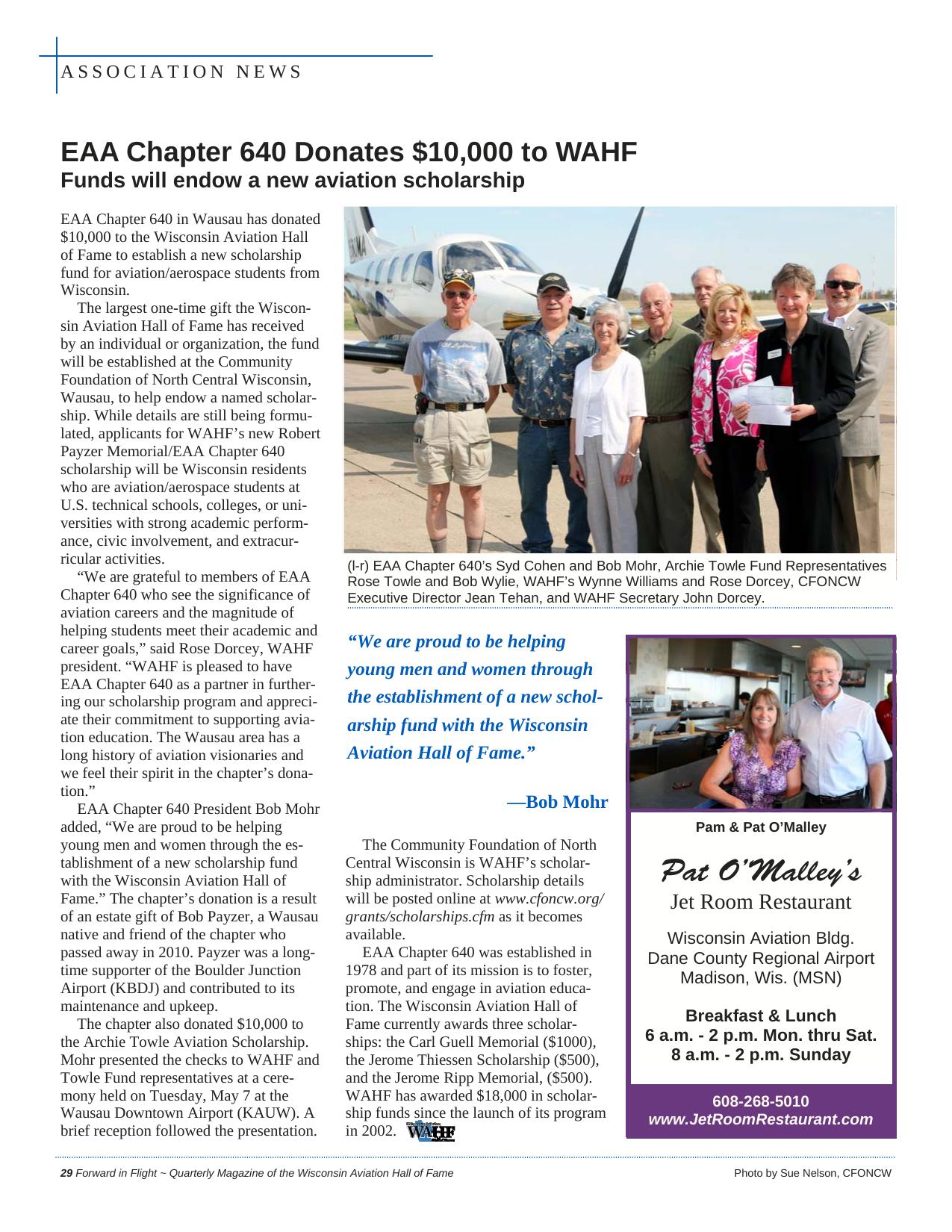
ASSOCIATION NEWS EAA Chapter 640 Donates $10,000 to WAHF Funds will endow a new aviation scholarship EAA Chapter 640 in Wausau has donated $10,000 to the Wisconsin Aviation Hall of Fame to establish a new scholarship fund for aviation/aerospace students from Wisconsin. The largest one-time gift the Wisconsin Aviation Hall of Fame has received by an individual or organization, the fund will be established at the Community Foundation of North Central Wisconsin, Wausau, to help endow a named scholarship. While details are still being formulated, applicants for WAHF’s new Robert Payzer Memorial/EAA Chapter 640 scholarship will be Wisconsin residents who are aviation/aerospace students at U.S. technical schools, colleges, or universities with strong academic performance, civic involvement, and extracurricular activities. “We are grateful to members of EAA Chapter 640 who see the significance of aviation careers and the magnitude of helping students meet their academic and career goals,” said Rose Dorcey, WAHF president. “WAHF is pleased to have EAA Chapter 640 as a partner in furthering our scholarship program and appreciate their commitment to supporting aviation education. The Wausau area has a long history of aviation visionaries and we feel their spirit in the chapter’s donation.” EAA Chapter 640 President Bob Mohr added, “We are proud to be helping young men and women through the establishment of a new scholarship fund with the Wisconsin Aviation Hall of Fame.” The chapter’s donation is a result of an estate gift of Bob Payzer, a Wausau native and friend of the chapter who passed away in 2010. Payzer was a longtime supporter of the Boulder Junction Airport (KBDJ) and contributed to its maintenance and upkeep. The chapter also donated $10,000 to the Archie Towle Aviation Scholarship. Mohr presented the checks to WAHF and Towle Fund representatives at a ceremony held on Tuesday, May 7 at the Wausau Downtown Airport (KAUW). A brief reception followed the presentation. PHOTO HERE (l-r) EAA Chapter 640’s Syd Cohen and Bob Mohr, Archie Towle Fund Representatives Rose Towle and Bob Wylie, WAHF’s Wynne Williams and Rose Dorcey, CFONCW Executive Director Jean Tehan, and WAHF Secretary John Dorcey. “We are proud to be helping young men and women through the establishment of a new scholarship fund with the Wisconsin Aviation Hall of Fame.” —Bob Mohr Pam & Pat O’Malley The Community Foundation of North Central Wisconsin is WAHF’s scholarship administrator. Scholarship details will be posted online at www.cfoncw.org/ grants/scholarships.cfm as it becomes available. EAA Chapter 640 was established in 1978 and part of its mission is to foster, promote, and engage in aviation education. The Wisconsin Aviation Hall of Fame currently awards three scholarships: the Carl Guell Memorial ($1000), the Jerome Thiessen Scholarship ($500), and the Jerome Ripp Memorial, ($500). WAHF has awarded $18,000 in scholarship funds since the launch of its program in 2002. 29 Forward in Flight ~ Quarterly Magazine of the Wisconsin Aviation Hall of Fame Pat O’Malley’s Jet Room Restaurant Wisconsin Aviation Bldg. Dane County Regional Airport Madison, Wis. (MSN) Breakfast & Lunch 6 a.m. - 2 p.m. Mon. thru Sat. 8 a.m. - 2 p.m. Sunday 608-268-5010 www.JetRoomRestaurant.com Photo by Sue Nelson, CFONCW
FROM THE AIRWAYS ‘Hamburger Nights 2013’ John Chmiel from Wausau Flying Service, and Bob Mohr, president of EAA Chapter 640 in Wausau, have put together a great program designed to get people flying more often. “Hamburger Nights 2013” is taking place at a number of airports in Central Wisconsin this summer, and it’s a great opportunity for pilots to enjoy a good meal in the company of others. Weekly through the end of August, FBOs or other organizations at nine airports will sponsor the events. The emphasis is on getting aviation minded people to the airport, getting local pilots flying, fellowship with friends, and meeting people from other local airports. Donations from participants who are partaking in the meal should cover costs that the host airports assume. Organizers hope that no host airports will drop out because they lost money. Pilots who participate should plan to arrive at the airport between 5:30-6:15 p.m. The host airport provides everything needed for an informal dinner of hamburgers (or similar) and other summer fixins’. The host airports will provide a grill and the pilots/attendees will cook the provided meat themselves. The first Hamburger Night took place at the Wausau Downtown Airport on Wednesday, May 29. The 2013 schedule: Morey Airplane Company Since 1932 Subscribe to 06/05 - KMDZ - Taylor County Airport/Medford 06/12 - KMFI - Marshfield Municipal 06/19 - KSTE - Stevens Point Municipal 06/26 - KISW - South Wood County Airport/Wisconsin Rapids 07/03 - KMDZ - Taylor County Airport/Medford 07/10 - KAUW - Wausau Downtown Airport 07/17 - KMFI - Marshfield Municipal 07/24 - KAIG - Langlade County Airport/Antigo 07/31 - NO HAMBURGER NIGHT! 08/07 - KRRL - Merrill Municipal 08/14 - 3WI4 Flying O - Flying “O” - privately owned, turf 08/21 - KMFI - Marshfield Municipal 08/28 - KAUW - Wausau Airport Remember, it is each PIC’s responsibility to determine their own personal weather minimums. There may will be bad weather on some of these nights. If that happens some may still drive and local pilots can still get together. Forward in Flight today! Subscription includes one-year WAHF membership. Middleton Municipal Airport/Morey Field Self-service 100LL & Jet A 24-7 Membership Benefits: Just $20 and you’ll be sup- Quarterly subscription (four porting an aviation organization dedicated to collecting, preserving, and sharing Wisconsin aviation history. With Forward in Flight, you’ll learn about aviation history makers—the people, places, and events that distinguish our state and also be in touch with current Wisconsin aviation news and information. issues) of Forward in Flight, packed full of Wisconsin aviation news, events, state aviation history, and stories about your aviation colleagues Free pass to the Deke Slayton Museum Invitation to annual induction banquet Name Address City State Zip Phone Number Email Mail to: WAHF, 3980 Sharratt Drive, Oshkosh, WI 54901 30 Forward in Flight ~ Summer 2013
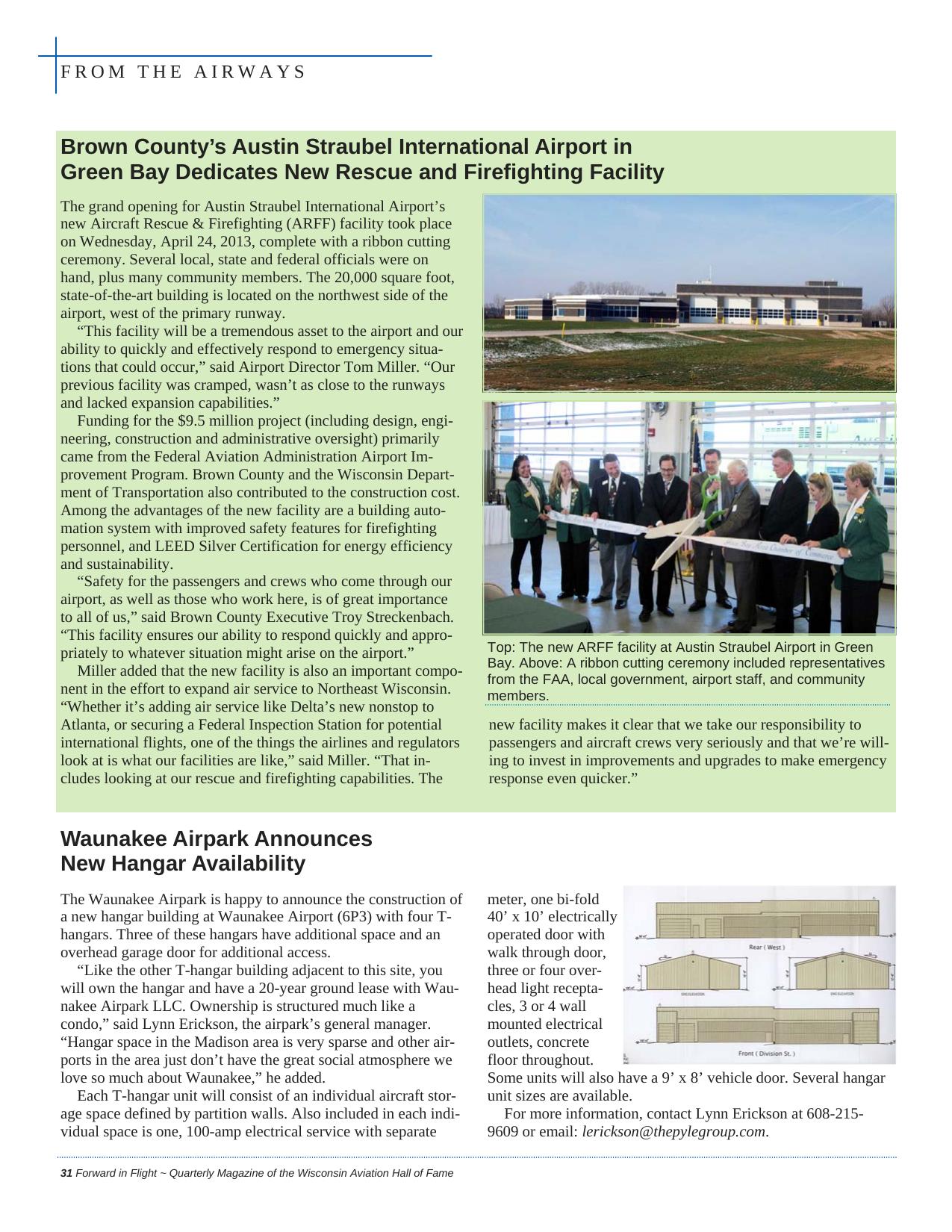
FROM THE AIRWAYS Brown County’s Austin Straubel International Airport in Green Bay Dedicates New Rescue and Firefighting Facility The grand opening for Austin Straubel International Airport’s new Aircraft Rescue & Firefighting (ARFF) facility took place on Wednesday, April 24, 2013, complete with a ribbon cutting ceremony. Several local, state and federal officials were on hand, plus many community members. The 20,000 square foot, state-of-the-art building is located on the northwest side of the airport, west of the primary runway. “This facility will be a tremendous asset to the airport and our ability to quickly and effectively respond to emergency situations that could occur,” said Airport Director Tom Miller. “Our previous facility was cramped, wasn’t as close to the runways and lacked expansion capabilities.” Funding for the $9.5 million project (including design, engineering, construction and administrative oversight) primarily came from the Federal Aviation Administration Airport Improvement Program. Brown County and the Wisconsin Department of Transportation also contributed to the construction cost. Among the advantages of the new facility are a building automation system with improved safety features for firefighting personnel, and LEED Silver Certification for energy efficiency and sustainability. “Safety for the passengers and crews who come through our airport, as well as those who work here, is of great importance to all of us,” said Brown County Executive Troy Streckenbach. “This facility ensures our ability to respond quickly and appropriately to whatever situation might arise on the airport.” Miller added that the new facility is also an important component in the effort to expand air service to Northeast Wisconsin. “Whether it’s adding air service like Delta’s new nonstop to Atlanta, or securing a Federal Inspection Station for potential international flights, one of the things the airlines and regulators look at is what our facilities are like,” said Miller. “That includes looking at our rescue and firefighting capabilities. The Top: The new ARFF facility at Austin Straubel Airport in Green Bay. Above: A ribbon cutting ceremony included representatives from the FAA, local government, airport staff, and community members. new facility makes it clear that we take our responsibility to passengers and aircraft crews very seriously and that we’re willing to invest in improvements and upgrades to make emergency response even quicker.” Waunakee Airpark Announces New Hangar Availability The Waunakee Airpark is happy to announce the construction of a new hangar building at Waunakee Airport (6P3) with four Thangars. Three of these hangars have additional space and an overhead garage door for additional access. “Like the other T-hangar building adjacent to this site, you will own the hangar and have a 20-year ground lease with Waunakee Airpark LLC. Ownership is structured much like a condo,” said Lynn Erickson, the airpark’s general manager. “Hangar space in the Madison area is very sparse and other airports in the area just don’t have the great social atmosphere we love so much about Waunakee,” he added. Each T-hangar unit will consist of an individual aircraft storage space defined by partition walls. Also included in each individual space is one, 100-amp electrical service with separate 31 Forward in Flight ~ Quarterly Magazine of the Wisconsin Aviation Hall of Fame meter, one bi-fold 40’ x 10’ electrically operated door with walk through door, three or four overhead light receptacles, 3 or 4 wall mounted electrical outlets, concrete floor throughout. Some units will also have a 9’ x 8’ vehicle door. Several hangar unit sizes are available. For more information, contact Lynn Erickson at 608-2159609 or email: lerickson@thepylegroup.com.
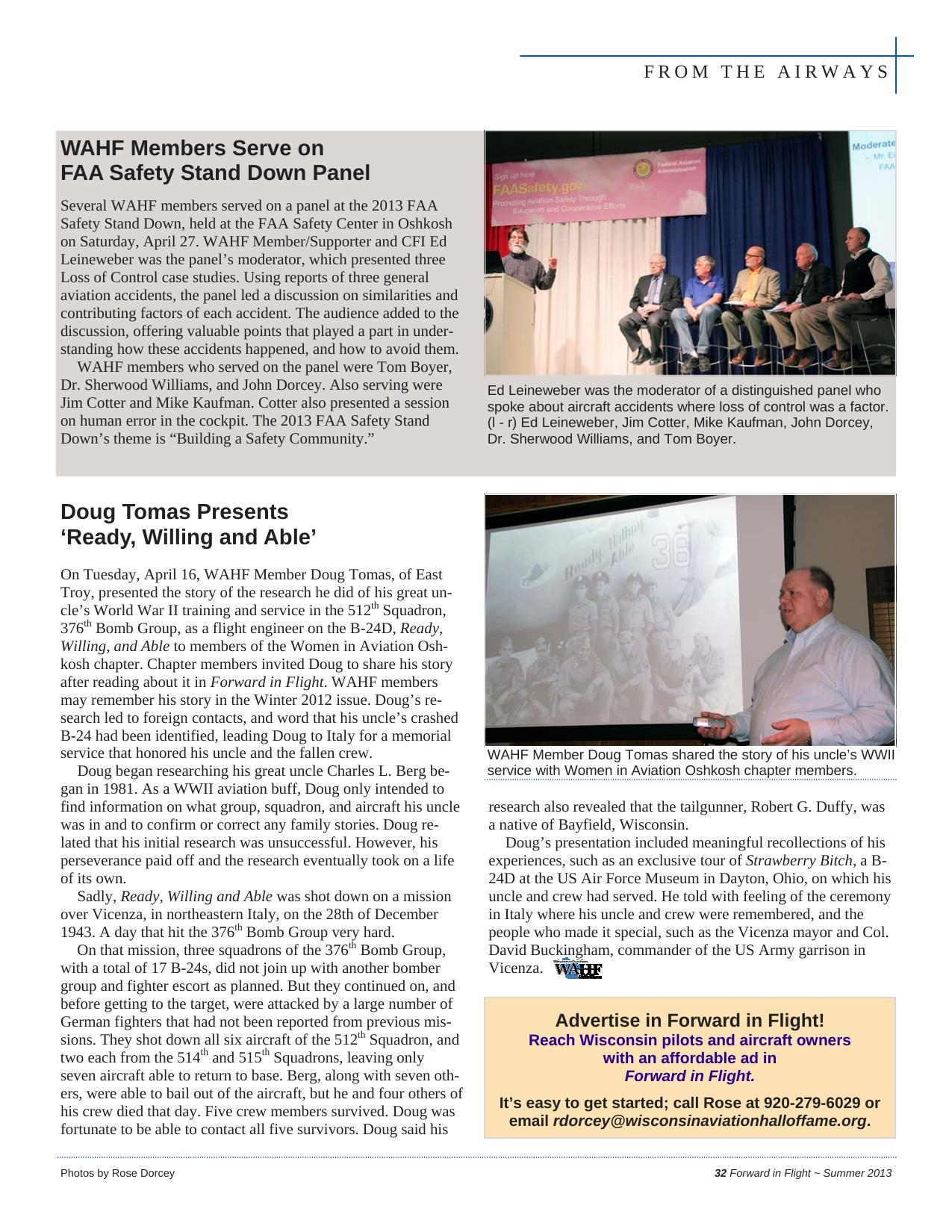
FROM THE AIRWAYS WAHF Members Serve on FAA Safety Stand Down Panel Several WAHF members served on a panel at the 2013 FAA Safety Stand Down, held at the FAA Safety Center in Oshkosh on Saturday, April 27. WAHF Member/Supporter and CFI Ed Leineweber was the panel’s moderator, which presented three Loss of Control case studies. Using reports of three general aviation accidents, the panel led a discussion on similarities and contributing factors of each accident. The audience added to the discussion, offering valuable points that played a part in understanding how these accidents happened, and how to avoid them. WAHF members who served on the panel were Tom Boyer, Dr. Sherwood Williams, and John Dorcey. Also serving were Jim Cotter and Mike Kaufman. Cotter also presented a session on human error in the cockpit. The 2013 FAA Safety Stand Down’s theme is “Building a Safety Community.” Ed Leineweber was the moderator of a distinguished panel who spoke about aircraft accidents where loss of control was a factor. (l - r) Ed Leineweber, Jim Cotter, Mike Kaufman, John Dorcey, Dr. Sherwood Williams, and Tom Boyer. Doug Tomas Presents ‘Ready, Willing and Able’ On Tuesday, April 16, WAHF Member Doug Tomas, of East Troy, presented the story of the research he did of his great uncle’s World War II training and service in the 512th Squadron, 376th Bomb Group, as a flight engineer on the B-24D, Ready, Willing, and Able to members of the Women in Aviation Oshkosh chapter. Chapter members invited Doug to share his story after reading about it in Forward in Flight. WAHF members may remember his story in the Winter 2012 issue. Doug’s research led to foreign contacts, and word that his uncle’s crashed B-24 had been identified, leading Doug to Italy for a memorial service that honored his uncle and the fallen crew. Doug began researching his great uncle Charles L. Berg began in 1981. As a WWII aviation buff, Doug only intended to find information on what group, squadron, and aircraft his uncle was in and to confirm or correct any family stories. Doug related that his initial research was unsuccessful. However, his perseverance paid off and the research eventually took on a life of its own. Sadly, Ready, Willing and Able was shot down on a mission over Vicenza, in northeastern Italy, on the 28th of December 1943. A day that hit the 376th Bomb Group very hard. On that mission, three squadrons of the 376th Bomb Group, with a total of 17 B-24s, did not join up with another bomber group and fighter escort as planned. But they continued on, and before getting to the target, were attacked by a large number of German fighters that had not been reported from previous missions. They shot down all six aircraft of the 512th Squadron, and two each from the 514th and 515th Squadrons, leaving only seven aircraft able to return to base. Berg, along with seven others, were able to bail out of the aircraft, but he and four others of his crew died that day. Five crew members survived. Doug was fortunate to be able to contact all five survivors. Doug said his Photos by Rose Dorcey WAHF Member Doug Tomas shared the story of his uncle’s WWII service with Women in Aviation Oshkosh chapter members. research also revealed that the tailgunner, Robert G. Duffy, was a native of Bayfield, Wisconsin. Doug’s presentation included meaningful recollections of his experiences, such as an exclusive tour of Strawberry Bitch, a B24D at the US Air Force Museum in Dayton, Ohio, on which his uncle and crew had served. He told with feeling of the ceremony in Italy where his uncle and crew were remembered, and the people who made it special, such as the Vicenza mayor and Col. David Buckingham, commander of the US Army garrison in Vicenza. Advertise in Forward in Flight! Reach Wisconsin pilots and aircraft owners with an affordable ad in Forward in Flight. It’s easy to get started; call Rose at 920-279-6029 or email rdorcey@wisconsinaviationhalloffame.org. 32 Forward in Flight ~ Summer 2013
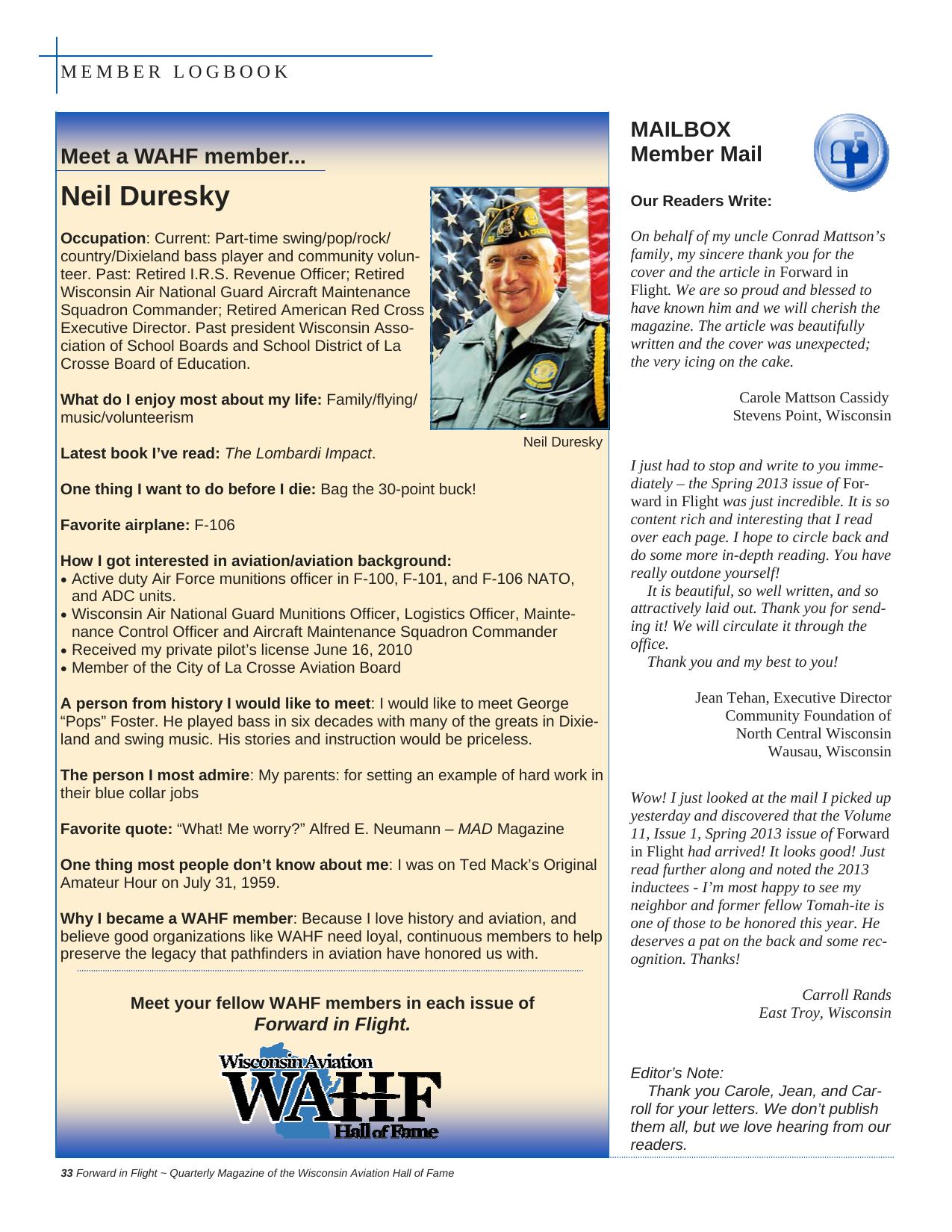
MEMBER LOGBOOK Meet a WAHF member... MAILBOX Member Mail Neil Duresky Our Readers Write: Occupation: Current: Part-time swing/pop/rock/ country/Dixieland bass player and community volunteer. Past: Retired I.R.S. Revenue Officer; Retired Wisconsin Air National Guard Aircraft Maintenance Squadron Commander; Retired American Red Cross Executive Director. Past president Wisconsin Association of School Boards and School District of La Crosse Board of Education. On behalf of my uncle Conrad Mattson’s family, my sincere thank you for the cover and the article in Forward in Flight. We are so proud and blessed to have known him and we will cherish the magazine. The article was beautifully written and the cover was unexpected; the very icing on the cake. What do I enjoy most about my life: Family/flying/ music/volunteerism Carole Mattson Cassidy Stevens Point, Wisconsin Latest book I’ve read: The Lombardi Impact. Neil Duresky One thing I want to do before I die: Bag the 30-point buck! Favorite airplane: F-106 How I got interested in aviation/aviation background: Active duty Air Force munitions officer in F-100, F-101, and F-106 NATO, and ADC units. Wisconsin Air National Guard Munitions Officer, Logistics Officer, Maintenance Control Officer and Aircraft Maintenance Squadron Commander Received my private pilot’s license June 16, 2010 Member of the City of La Crosse Aviation Board A person from history I would like to meet: I would like to meet George “Pops” Foster. He played bass in six decades with many of the greats in Dixieland and swing music. His stories and instruction would be priceless. The person I most admire: My parents: for setting an example of hard work in their blue collar jobs Favorite quote: “What! Me worry?” Alfred E. Neumann – MAD Magazine One thing most people don’t know about me: I was on Ted Mack’s Original Amateur Hour on July 31, 1959. Why I became a WAHF member: Because I love history and aviation, and believe good organizations like WAHF need loyal, continuous members to help preserve the legacy that pathfinders in aviation have honored us with. Meet your fellow WAHF members in each issue of Forward in Flight. I just had to stop and write to you immediately – the Spring 2013 issue of Forward in Flight was just incredible. It is so content rich and interesting that I read over each page. I hope to circle back and do some more in-depth reading. You have really outdone yourself! It is beautiful, so well written, and so attractively laid out. Thank you for sending it! We will circulate it through the office. Thank you and my best to you! Jean Tehan, Executive Director Community Foundation of North Central Wisconsin Wausau, Wisconsin Wow! I just looked at the mail I picked up yesterday and discovered that the Volume 11, Issue 1, Spring 2013 issue of Forward in Flight had arrived! It looks good! Just read further along and noted the 2013 inductees - I’m most happy to see my neighbor and former fellow Tomah-ite is one of those to be honored this year. He deserves a pat on the back and some recognition. Thanks! Carroll Rands East Troy, Wisconsin Editor’s Note: Thank you Carole, Jean, and Carroll for your letters. We don’t publish them all, but we love hearing from our readers. 33 Forward in Flight ~ Quarterly Magazine of the Wisconsin Aviation Hall of Fame

Wittman Regional Airport Oshkosh So much history ...and still making it! From the legacy of Steve Wittman to Warren Basler’s DC-3 conversions, we’re proud to support and contribute to Wisconsin aviation history. FLY TO OSHKOSH wittmanairport.com @wittmanairport 34 Forward in Flight ~ Summer 2013
PRSRT STD US Postage Paid Wisc Rapids WI Permit 98 3980 SHARRATT DRIVE OSHKOSH WI 54901-1276 The Wisconsin Aviation Hall of Fame is a non-profit membership organization dedicated to preserving the past and fostering the future of flight. Welcome WAHF Member/Supporters: Chris Anderson Carole Cassidy Kurt Mehre Pat Pagliaro Angie Ficker Peter Rench Chip Harper Brian Rupnow —Thanks for coming on board. We hope to see you at a WAHF event soon! Congratulations WAHF Member John Reed, AAE, assistant airport director at Austin Straubel International Airport (KRGB) in Green Bay, for attaining the Accredited Airport Executive designation from the American Association of Airport Executives. Food and Funds Collected - The first annual “Landings for Lunches” Spot Landing Con- test, sponsored by Wausau Flying Service, is now complete. The event collected more than $710 and a table full of food for the Neighbors’ Place in Wausau. Bob Mohr was the winner of the month-long event, touching down within a half-foot from the line. Rico Jaeger came in 2nd with 1-foot. Mohr donated his winnings to the Neighbors’ Place. Congratulations! WISCONSIN AVIATION EVENTS: 23rd Annual EAA 766 Wings & Wheels Father’s Day Fly-in, Sheboygan County Memorial Airport (KSBM) Sunday, June 16 from 7 - 5. All you can eat pancake breakfast 7 - 11. Airplane and helicopter rides, antique cars, tractors, hamburgers, brats, kettle corn, ice cream, and more. FMI: Glenn Valenstein 920-377-0704 or glennv@primarycompanies.com. EAA Chapter 1389 Fly-in Breakfast at Middleton Municipal Airport-Morey Field (C29) Sunday, July 14, 2013. Pancakes, eggs cooked to order, sausage, and more. Airplane rides available, antique, homebuilts, and warbirds on display. 7:30 - Noon. Call Al Barger at Morey Airplane Company 608-836-1711 or visit www.MoreyAirport.com. Heavy Bombers Over Madison, July 26 - 28 at Dane County Regional Airport (KMSN), east ramp at Wisconsin Aviation. Several vintage WWII era aircraft available for rides and ground tours. Call Pete Buffington 913-850-1522 or email avitengineer@yahoo.com. Wisconsin Aviation Hall of Fame Officers and Board of Directors Rose Dorcey, President Michael Goc, Vice President John Dorcey, Secretary/Treasurer Frederick Beseler Bruce Botterman Andrew Ovans Charles Swain Tom Thomas Wynne Williams Charles Marotske, Honorary Chairman of the Board Wisconsin Aviation Hall of Fame 3980 Sharratt Drive Oshkosh, WI 54901-1276 Become a supporter today! For information call Rose Dorcey at 920-385-1483 www.wisconsinaviationhalloffame.org rdorcey@wisconsinaviationhalloffame.org