Volume 12, Issue 2
🗞️ Download Issue (PDF)
Forward in Flight - Summer 2014
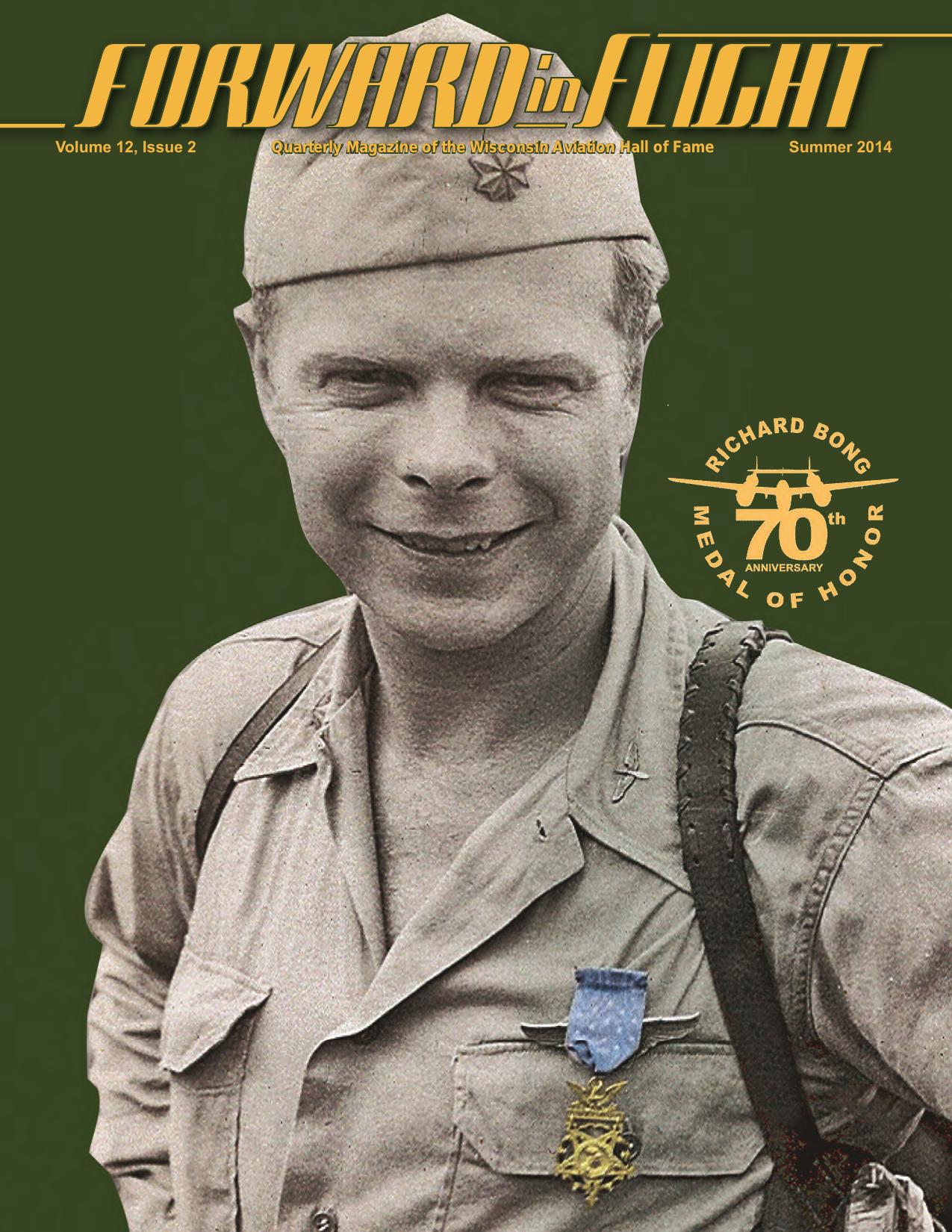
Volume 12, Issue 2 Quarterly Magazine of the Wisconsin Aviation Hall of Fame Summer 2014
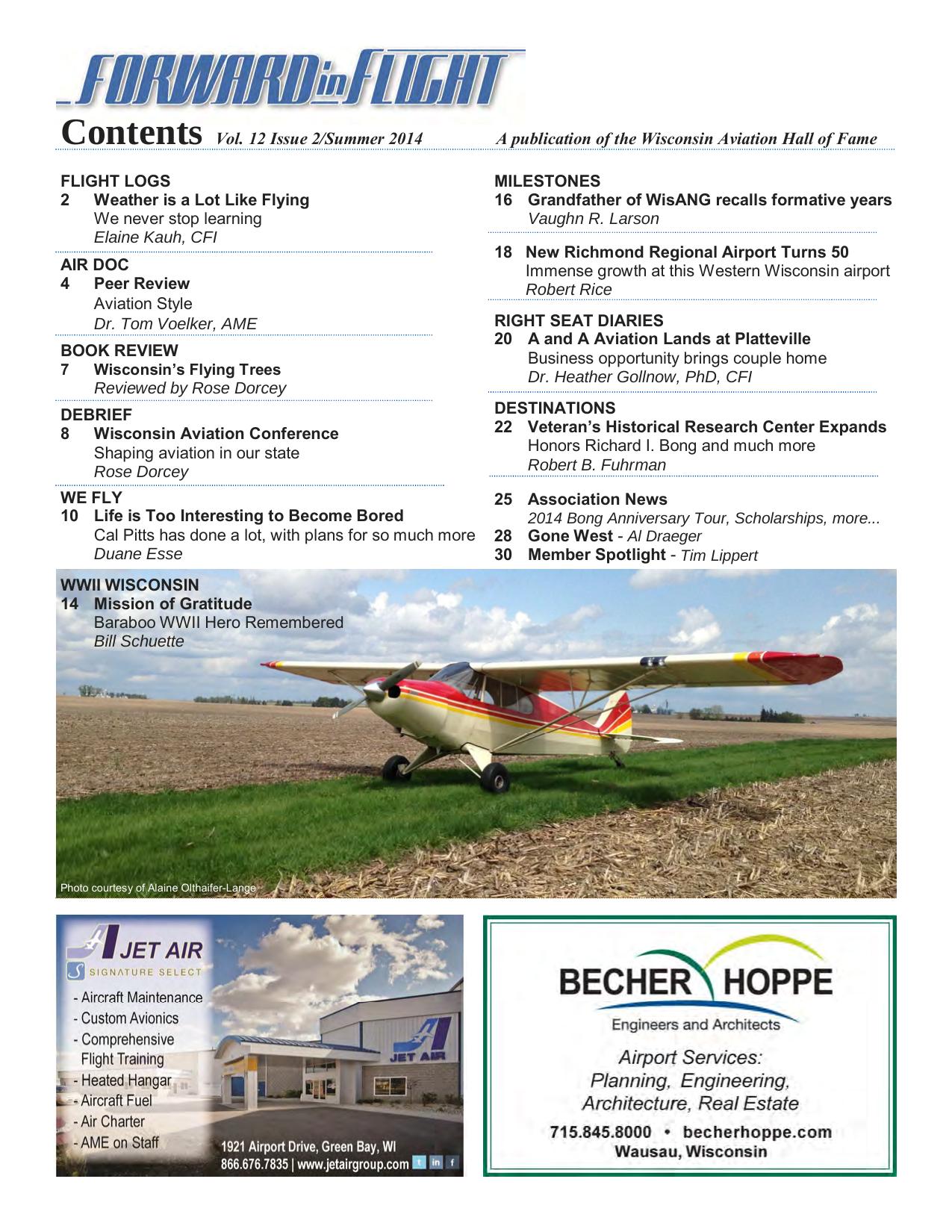
Contents Vol. 12 Issue 2/Summer 2014 A publication of the Wisconsin Aviation Hall of Fame FLIGHT LOGS 2 Weather is a Lot Like Flying We never stop learning Elaine Kauh, CFI MILESTONES 16 Grandfather of WisANG recalls formative years Vaughn R. Larson AIR DOC 4 Peer Review Aviation Style Dr. Tom Voelker, AME BOOK REVIEW 7 Wisconsin’s Flying Trees Reviewed by Rose Dorcey 18 New Richmond Regional Airport Turns 50 Immense growth at this Western Wisconsin airport Robert Rice RIGHT SEAT DIARIES 20 A and A Aviation Lands at Platteville Business opportunity brings couple home Dr. Heather Gollnow, PhD, CFI DEBRIEF 8 Wisconsin Aviation Conference Shaping aviation in our state Rose Dorcey DESTINATIONS 22 Veteran’s Historical Research Center Expands Honors Richard I. Bong and much more Robert B. Fuhrman WE FLY 10 Life is Too Interesting to Become Bored Cal Pitts has done a lot, with plans for so much more Duane Esse 25 Association News 2014 Bong Anniversary Tour, Scholarships, more... 28 Gone West - Al Draeger 30 Member Spotlight - Tim Lippert WWII WISCONSIN 14 Mission of Gratitude Baraboo WWII Hero Remembered Bill Schuette Photo courtesy of Alaine Olthaifer-Lange
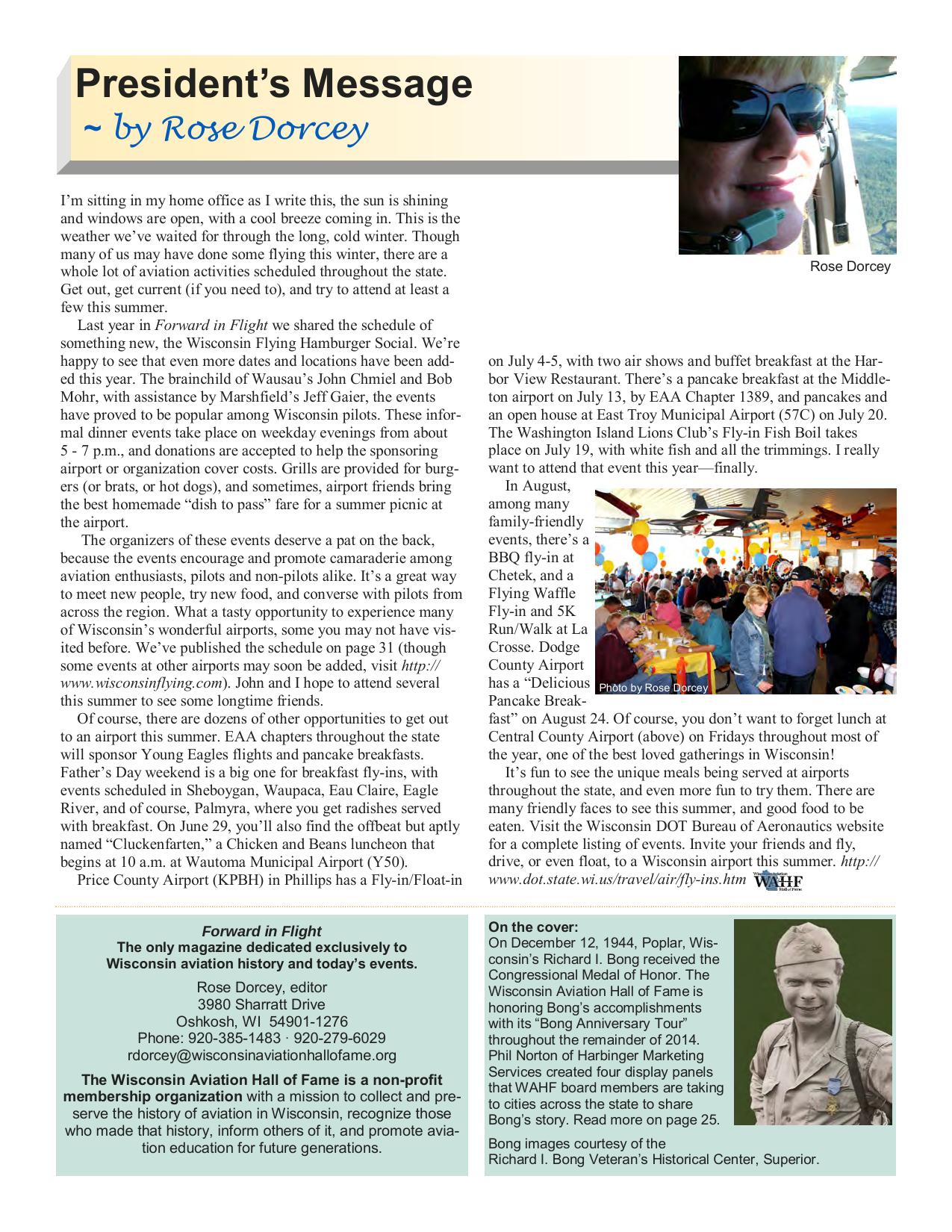
President’s Message ~ by Rose Dorcey I’m sitting in my home office as I write this, the sun is shining and windows are open, with a cool breeze coming in. This is the weather we’ve waited for through the long, cold winter. Though many of us may have done some flying this winter, there are a whole lot of aviation activities scheduled throughout the state. Get out, get current (if you need to), and try to attend at least a few this summer. Last year in Forward in Flight we shared the schedule of something new, the Wisconsin Flying Hamburger Social. We’re happy to see that even more dates and locations have been added this year. The brainchild of Wausau’s John Chmiel and Bob Mohr, with assistance by Marshfield’s Jeff Gaier, the events have proved to be popular among Wisconsin pilots. These informal dinner events take place on weekday evenings from about 5 - 7 p.m., and donations are accepted to help the sponsoring airport or organization cover costs. Grills are provided for burgers (or brats, or hot dogs), and sometimes, airport friends bring the best homemade “dish to pass” fare for a summer picnic at the airport. The organizers of these events deserve a pat on the back, because the events encourage and promote camaraderie among aviation enthusiasts, pilots and non-pilots alike. It’s a great way to meet new people, try new food, and converse with pilots from across the region. What a tasty opportunity to experience many of Wisconsin’s wonderful airports, some you may not have visited before. We’ve published the schedule on page 31 (though some events at other airports may soon be added, visit http:// www.wisconsinflying.com). John and I hope to attend several this summer to see some longtime friends. Of course, there are dozens of other opportunities to get out to an airport this summer. EAA chapters throughout the state will sponsor Young Eagles flights and pancake breakfasts. Father’s Day weekend is a big one for breakfast fly-ins, with events scheduled in Sheboygan, Waupaca, Eau Claire, Eagle River, and of course, Palmyra, where you get radishes served with breakfast. On June 29, you’ll also find the offbeat but aptly named “Cluckenfarten,” a Chicken and Beans luncheon that begins at 10 a.m. at Wautoma Municipal Airport (Y50). Price County Airport (KPBH) in Phillips has a Fly-in/Float-in Forward in Flight The only magazine dedicated exclusively to Wisconsin aviation history and today’s events. Rose Dorcey, editor 3980 Sharratt Drive Oshkosh, WI 54901-1276 Phone: 920-385-1483 · 920-279-6029 rdorcey@wisconsinaviationhallofame.org The Wisconsin Aviation Hall of Fame is a non-profit membership organization with a mission to collect and preserve the history of aviation in Wisconsin, recognize those who made that history, inform others of it, and promote aviation education for future generations. Rose Dorcey on July 4-5, with two air shows and buffet breakfast at the Harbor View Restaurant. There’s a pancake breakfast at the Middleton airport on July 13, by EAA Chapter 1389, and pancakes and an open house at East Troy Municipal Airport (57C) on July 20. The Washington Island Lions Club’s Fly-in Fish Boil takes place on July 19, with white fish and all the trimmings. I really want to attend that event this year—finally. In August, among many family-friendly events, there’s a BBQ fly-in at Chetek, and a Flying Waffle Fly-in and 5K Run/Walk at La Crosse. Dodge County Airport has a “Delicious Photo by Rose Dorcey Pancake Breakfast” on August 24. Of course, you don’t want to forget lunch at Central County Airport (above) on Fridays throughout most of the year, one of the best loved gatherings in Wisconsin! It’s fun to see the unique meals being served at airports throughout the state, and even more fun to try them. There are many friendly faces to see this summer, and good food to be eaten. Visit the Wisconsin DOT Bureau of Aeronautics website for a complete listing of events. Invite your friends and fly, drive, or even float, to a Wisconsin airport this summer. http:// www.dot.state.wi.us/travel/air/fly-ins.htm On the cover: On December 12, 1944, Poplar, Wisconsin’s Richard I. Bong received the Congressional Medal of Honor. The Wisconsin Aviation Hall of Fame is honoring Bong’s accomplishments with its “Bong Anniversary Tour” throughout the remainder of 2014. Phil Norton of Harbinger Marketing Services created four display panels that WAHF board members are taking to cities across the state to share Bong’s story. Read more on page 25. Bong images courtesy of the Richard I. Bong Veteran’s Historical Center, Superior.
FLIGHT LOGS Weather is a Lot Like Flying We never stop learning By Elaine Kauh It was like we were flying a space ship on another planet. The mist hung in the air, shimmering like gold dust. The lowslung sun cast a thick light, and everything it touched turned into gold. There I was with my future pilot, tucked into the two-seat pod of a Cessna 152, flying downwind to Runway 23 like any other springtime afternoon. Except on this day, the gentle rain shower that had passed overhead a half hour ago left us in a different world—one I don’t expect to ever see again. It’s those unique moments when I forgive the weather for all the trouble it causes me. For changing its mind without notice. For barging in unexpectedly. For losing its temper and taking it out on us pilots, when all we ask is to get from A to B and back again with relative comfort and safety. Weather really does control our flying lives. It’s the first thing we check if we’re even thinking about going up. Sometimes, the go/no-go answer is there in an instant. But most times, it’s not that simple. So we check. And wait. And check. If we decide to go, we keep checking. If we decide not to go, we wait. Sometimes for hours, sometimes for days. Now that it’s near midsummer—the longest stretch of time before we return to the dead of winter—our flying time approaches peak hours and I (one of the few who otherwise like winter) can reminisce about snowflakes and icicles without too many groans of protest. But we can never set aside our vigilance and enjoy a reprieve from the endless flight briefings, reports, and forecasts because the weather never rests. Summer can bring days of benign weather and flights free of atmospheric hazards, but we’re also in thunderstorm season. I’ve learned that in this part of the world, a forecast that seems to be confidently clear can fail us. Even when there are no storm advisories or threatening cold fronts approaching, the very act of all that hot air rising faster and faster as the day goes on is enough to pepper my practice area with pop-up cells. I’ve seen little rain showers explode within minutes into sizeable storms, fortunately with plenty of blue sky around them to divert and land safely. More waiting, more checking. This is why teaching real-life weather is a challenge. Instructors like to emphasize the importance of consistent, detailed briefings for every flight, including those that remain in the pattern. There are many reasons for this, one being the likelihood that an unexpected storm, wind shift, or cloud layer could approach and won’t be displayed by the airport weather station because it’s clear and calm right above the field. However, for all the insistence on poring over these reports and forecasts, I have to add the caveat that what you actually encounter in the air could be different—so much so that you end up scrapping your flight plan. Always watch the conditions ahead and have a solid plan B to divert or return. Also, be prepared to taxi right back in if you see an issue that puts you past your personal minimums and maximums. It’s in our nature to want to complete the flight once the prop starts turning, and it’s difficult to train pilots to overcome this. Severe haze is a great example. It’s usually more of an annoyance than a hazard, but it can become so soupy that it borders on IFR conditions. Spotting traffic gets to be a worrisome task. Finding an airport can be a challenge. In Wisconsin, I take comfort in the fact that there are plenty of lakes, marshes, and other ground-based features to teach good pilotage. Around this state, it’s hard to get lost. (Not so in the gigantic grids that make up central Illinois. There, on the clearest of days, our cross-country instruction involves spinning VOR needles with one hand while unfolding a chart and flying the airplane with the other.) I’ve had a number of instructing flights when my pilot and I would venture out on a cross-country, only to realize that we can see ahead about 3 miles. I usually wait for that 3 miles to see if he says or 2 Forward in Flight ~ Quarterly Magazine of the Wisconsin Aviation Hall of Fame does anything about this. A couple miles later, I might break the silence, “Did you see your first checkpoint?” “Yep, that highway intersection,” he replies. “OK, can you see your next one?” Meanwhile, I squint through the milk jug, knowing that the interstate is out there. “No,” says my pilot. This is the real deal: marginal VFR. After contemplating this for another mile, he decides that if it were his solo crosscountry, he’d rather not press on alone. “So you’re alone,” I say. “What can you do?” He makes a 180-degree turn, the first resort for backing up if weather ahead looks unfavorable. However, this is haze, so it looks just as bad going the other way. I see my pilot’s finger on his map, searching for something right below him he can recognize. There’s an airport—there should be—about three miles to his left. Should he turn off course? “Well, let’s say your left fuel gauge reads empty even though you departed with full tanks,” I remark, playing up the scenario. He finds the lake, then the highway, that leads to the airport. Finally, it emerges out of the haze, with a good lesson learned: A weather report that says 10 miles and clear isn’t always so once you’re aloft. For all its heat, haze, bumps, and storms, summer is the official flying season. The days are long, the grass runways are fun, and we can sit in the shade watching airplanes take off and land. Once in a while, I’m lucky enough to be one of those hanging out at a couple thousand feet, watching the sun set amid a gigantic open sky water-colored with shades of pink, orange, yellow, and red. Twice I have seen the full arcs of rainbows appear after a summertime shower, each color brilliantly displayed. Flying towards that magic doorway never gets you any closer to it, and a few minutes later the mirage has faded. When fall comes around, the haze gets milder, the airplanes climb better and the cockpits cool off. Seeing the peak colors
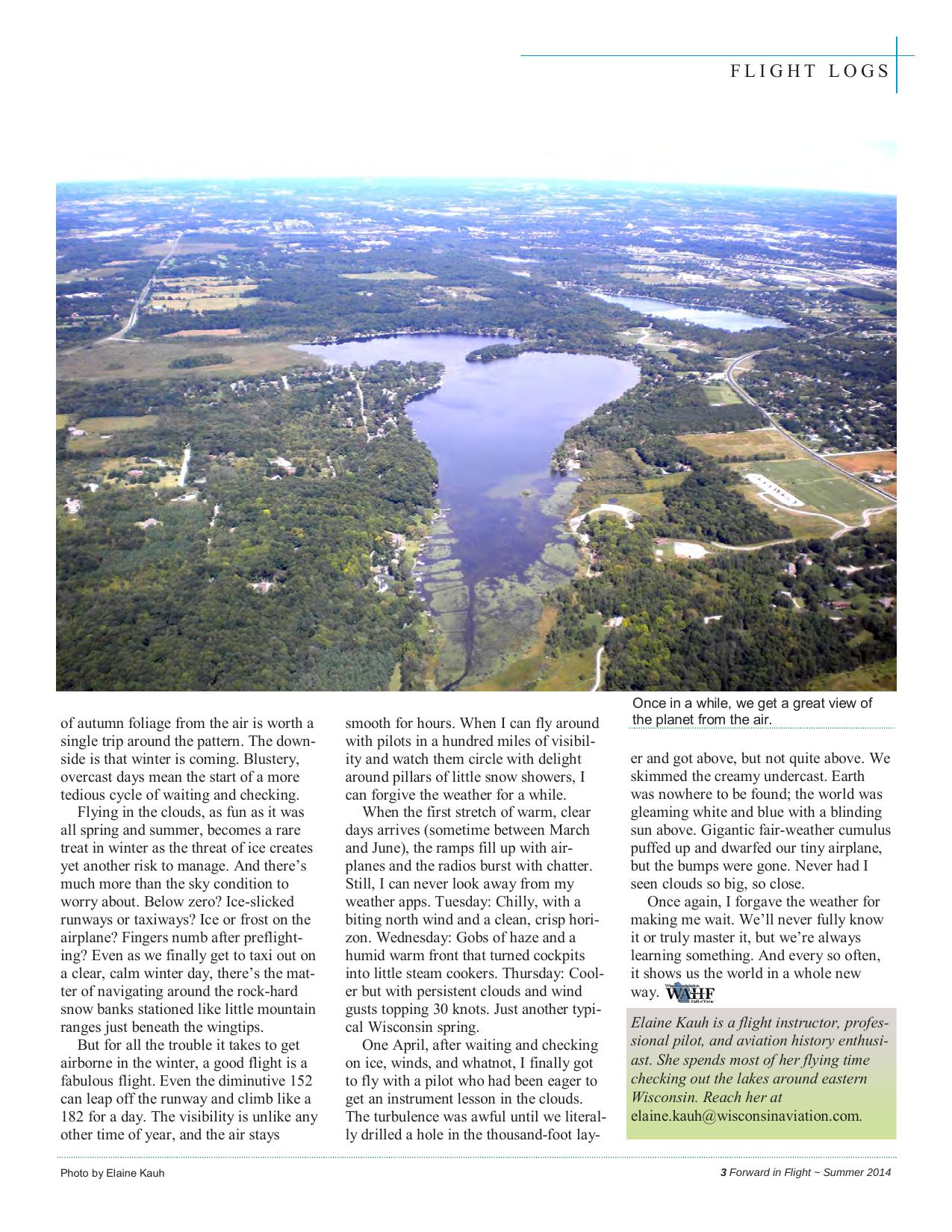
FLIGHT LOGS of autumn foliage from the air is worth a single trip around the pattern. The downside is that winter is coming. Blustery, overcast days mean the start of a more tedious cycle of waiting and checking. Flying in the clouds, as fun as it was all spring and summer, becomes a rare treat in winter as the threat of ice creates yet another risk to manage. And there’s much more than the sky condition to worry about. Below zero? Ice-slicked runways or taxiways? Ice or frost on the airplane? Fingers numb after preflighting? Even as we finally get to taxi out on a clear, calm winter day, there’s the matter of navigating around the rock-hard snow banks stationed like little mountain ranges just beneath the wingtips. But for all the trouble it takes to get airborne in the winter, a good flight is a fabulous flight. Even the diminutive 152 can leap off the runway and climb like a 182 for a day. The visibility is unlike any other time of year, and the air stays Photo by Elaine Kauh smooth for hours. When I can fly around with pilots in a hundred miles of visibility and watch them circle with delight around pillars of little snow showers, I can forgive the weather for a while. When the first stretch of warm, clear days arrives (sometime between March and June), the ramps fill up with airplanes and the radios burst with chatter. Still, I can never look away from my weather apps. Tuesday: Chilly, with a biting north wind and a clean, crisp horizon. Wednesday: Gobs of haze and a humid warm front that turned cockpits into little steam cookers. Thursday: Cooler but with persistent clouds and wind gusts topping 30 knots. Just another typical Wisconsin spring. One April, after waiting and checking on ice, winds, and whatnot, I finally got to fly with a pilot who had been eager to get an instrument lesson in the clouds. The turbulence was awful until we literally drilled a hole in the thousand-foot lay- Once in a while, we get a great view of the planet from the air. er and got above, but not quite above. We skimmed the creamy undercast. Earth was nowhere to be found; the world was gleaming white and blue with a blinding sun above. Gigantic fair-weather cumulus puffed up and dwarfed our tiny airplane, but the bumps were gone. Never had I seen clouds so big, so close. Once again, I forgave the weather for making me wait. We’ll never fully know it or truly master it, but we’re always learning something. And every so often, it shows us the world in a whole new way. Elaine Kauh is a flight instructor, professional pilot, and aviation history enthusiast. She spends most of her flying time checking out the lakes around eastern Wisconsin. Reach her at elaine.kauh@wisconsinaviation.com. 3 Forward in Flight ~ Summer 2014
AIR DOC Peer Review Aviation Style Dr. Tom Voelker, AME DrAlphaMike@yahoo.com Hello again, airmen! Welcome to the summer edition of our quarterly discussions of all things aeromedical. The past few months have been quiet in the aviation medicine business. I may have some political updates in the next few months, but so far, there is nothing new to report. That being the case, let’s talk about medicine! I am the chair of the Peer Review committee at my local hospital. Peer review is an interesting (and valuable) concept. As you might guess, this is the process of other doctors (the peers) discussing the care provided by a particular doctor on the medical staff (the review). The process generally works very well. We often have stimulating discussions regarding why a particular type of care was provided, alternative treatments that would have been available, what was discussed with the patient, and other similar issues. There is often a difference of opinion among the doctors discussing the case, and the process allows for all of us to learn from the others. The peer review process reminds me of a similar process that is practiced in Oklahoma City by the FAA’s aeromedical doctors. We AMEs get to participate too! The game is called, “Would you fly with this pilot?” Would you like to play too? You may recall that in one of the past issues I wrote about my AME refresher course in Sacramento. I need to take this three-day seminar every three years to keep up on changes in aerospace medicine and aeromedical certification. The final day always includes the “would you fly with this pilot” session. Several pilots and their medical history are presented to all of the AMEs present as well as a panel of experts. These experts are the very consultants who decide the more difficult certification cases for the FAA. After we all discuss the cases, we vote on whether or not we would issue this pilot a medical certificate. After we see our vote, the panel doctors give their opinions. Finally, we find out what really happened – whether the pilot was able to fly or not. The important thing for you to know, though, is that your AME can be your advocate if you need to go through the special issuance process. I am going to present three pilots to you. As you read the summaries (and I do realize that most of you are not doctors), try to decide if you would certify this pilot to fly. I will tender my decision at the end. The cases I am presenting are fictitious, but the conditions and medical history are typical of the actual cases we discuss at our seminars. Our first pilot is a 22 year-old man who wants to start flying recreationally. He is applying for a third class medical with student pilot certificate. This young man is generally very healthy. He has a history of a solitary seizure when he was two years old. This seizure occurred when he was sick with a fever. His moth- 4 Forward in Flight ~ Quarterly Magazine of the Wisconsin Aviation Hall of Fame er told him that the doctor called it a “fever seizure”. As you might know, seizures are one of the 15 disqualifying conditions that preclude issuing a medical. Under certain circumstances, however, Oklahoma City can “overrule” and grant a “special issuance” to allow the pilot to fly. Would you fly with this pilot? The second airman is a 56-year-old woman. She holds a commercial certificate and is applying for a second-class medical certificate. She is also generally healthy. She is overweight, but her BMI is 28, well short of the BMI of 40 that we talked about in the Spring 2014 issue. (At that weight, she would have a very high likelihood of having sleep apnea, another disqualifying condition.) The problem with her medical certification involves her eyesight. This woman was recently diagnosed with glaucoma, a condition caused by excess pressure in the front chamber of the eye. Two months ago, she was hit by a car coming from her right while she was driving. She noted that she didn’t see the car coming. The police suspected a problem with her vision and requested a comprehensive eye exam. The airman was found to have a “visual field cut”. She could not see anything in the upper outer quadrant of her right eye. She is now seeing her eye doctor and he feels the condition is well controlled with eye drops. Her visual field deficit remains, but it has not progressed in the last month and a half. Would you fly with this pilot? The final case involves a 62-year-old private pilot. He has amassed 4,500 hours in small planes. He currently flies a Mooney, often in instrument conditions,
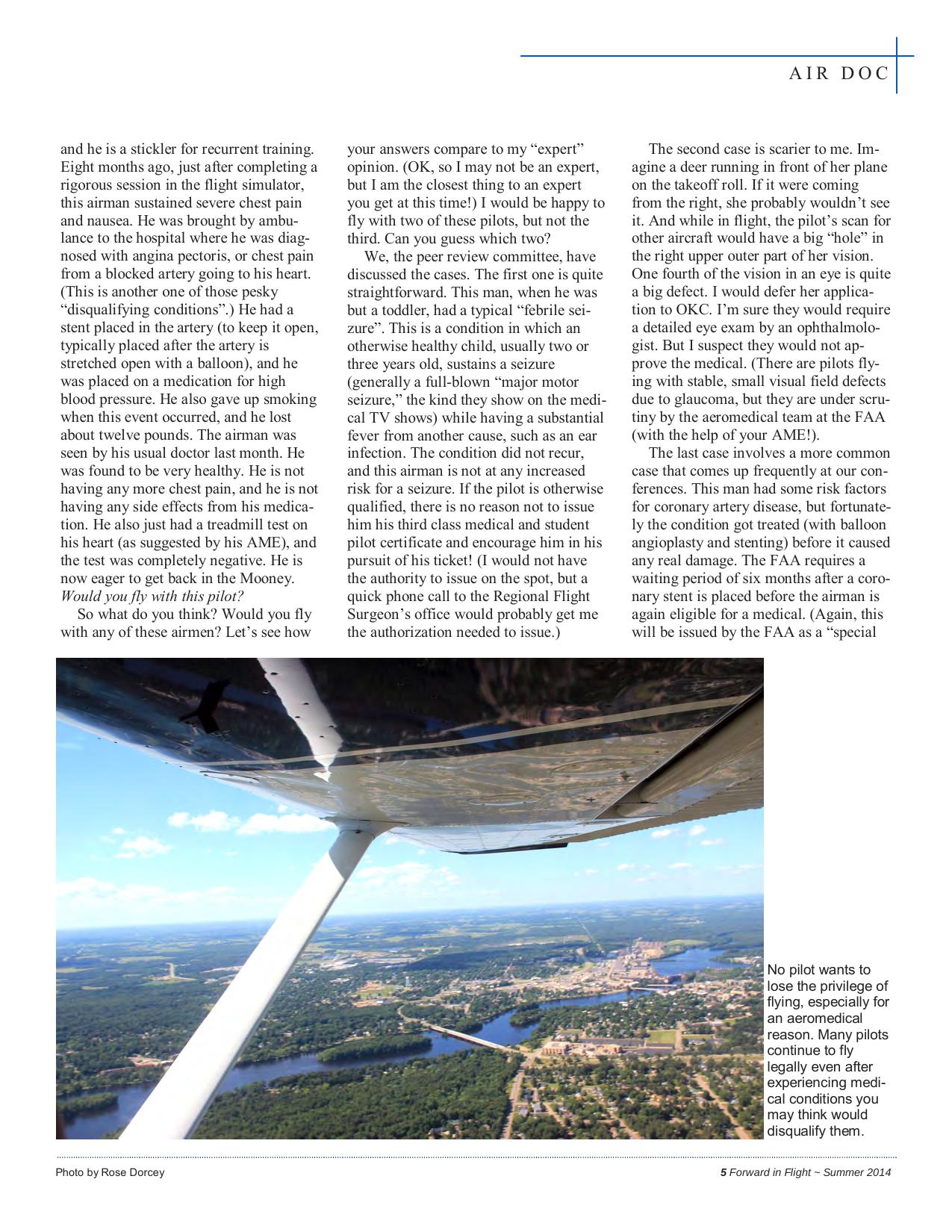
AIR DOC and he is a stickler for recurrent training. Eight months ago, just after completing a rigorous session in the flight simulator, this airman sustained severe chest pain and nausea. He was brought by ambulance to the hospital where he was diagnosed with angina pectoris, or chest pain from a blocked artery going to his heart. (This is another one of those pesky “disqualifying conditions”.) He had a stent placed in the artery (to keep it open, typically placed after the artery is stretched open with a balloon), and he was placed on a medication for high blood pressure. He also gave up smoking when this event occurred, and he lost about twelve pounds. The airman was seen by his usual doctor last month. He was found to be very healthy. He is not having any more chest pain, and he is not having any side effects from his medication. He also just had a treadmill test on his heart (as suggested by his AME), and the test was completely negative. He is now eager to get back in the Mooney. Would you fly with this pilot? So what do you think? Would you fly with any of these airmen? Let’s see how your answers compare to my “expert” opinion. (OK, so I may not be an expert, but I am the closest thing to an expert you get at this time!) I would be happy to fly with two of these pilots, but not the third. Can you guess which two? We, the peer review committee, have discussed the cases. The first one is quite straightforward. This man, when he was but a toddler, had a typical “febrile seizure”. This is a condition in which an otherwise healthy child, usually two or three years old, sustains a seizure (generally a full-blown “major motor seizure,” the kind they show on the medical TV shows) while having a substantial fever from another cause, such as an ear infection. The condition did not recur, and this airman is not at any increased risk for a seizure. If the pilot is otherwise qualified, there is no reason not to issue him his third class medical and student pilot certificate and encourage him in his pursuit of his ticket! (I would not have the authority to issue on the spot, but a quick phone call to the Regional Flight Surgeon’s office would probably get me the authorization needed to issue.) The second case is scarier to me. Imagine a deer running in front of her plane on the takeoff roll. If it were coming from the right, she probably wouldn’t see it. And while in flight, the pilot’s scan for other aircraft would have a big “hole” in the right upper outer part of her vision. One fourth of the vision in an eye is quite a big defect. I would defer her application to OKC. I’m sure they would require a detailed eye exam by an ophthalmologist. But I suspect they would not approve the medical. (There are pilots flying with stable, small visual field defects due to glaucoma, but they are under scrutiny by the aeromedical team at the FAA (with the help of your AME!). The last case involves a more common case that comes up frequently at our conferences. This man had some risk factors for coronary artery disease, but fortunately the condition got treated (with balloon angioplasty and stenting) before it caused any real damage. The FAA requires a waiting period of six months after a coronary stent is placed before the airman is again eligible for a medical. (Again, this will be issued by the FAA as a “special No pilot wants to lose the privilege of flying, especially for an aeromedical reason. Many pilots continue to fly legally even after experiencing medical conditions you may think would disqualify them. Photo by Rose Dorcey 5 Forward in Flight ~ Summer 2014
AIR DOC issuance”.) Then, with a favorable report from the treating doctor and with a normal treadmill stress test, the medical will probably be issued. The best thing about this airman, however, is that he is modifying his risk factors. He lost some weight, his hypertension (high blood pressure) is now controlled, and he quit smoking. The FAA looks very favorably on these lifestyle changes. Interestingly, these changes are just plain good for his health, too! So, how did you do? Don’t worry if you missed a couple of the cases, or even all three. I don’t nail them all at the conferences either. It is ultimately up to the expert consultants and the FAA doctors to come up with the final decision. Sometimes there is disagreement even at this level. The important thing for you to know, though, is that your AME can be your advocate if you need to go through the special issuance process. If you have a question of whether or not a medical condition, possibly one in your remote past, might cause certification problems, call your AME. That’s what we are here for! See you at Oshkosh! —Alpha Mike “Alpha Mike” is Dr. Tom Voelker, AME, a family practitioner in Wisconsin Rapids. He and his wife, Kathy, are the parents of four daughters. Tom flies N6224P, a Comanche 250, out of Alexander Field, South Wood County Airport (ISW). 2031 Peach Street Wisconsin Rapids, WI 54494 Advertise in Forward in Flight! Reach Wisconsin pilots, aircraft owners, and airport managers with an affordable ad in Forward in Flight. It’s easy to get started; call Rose at 920-279-6029 or email rdorcey@wisconsinaviationhalloffame.org. 6 Forward in Flight ~ Quarterly Magazine of the Wisconsin Aviation Hall of Fame
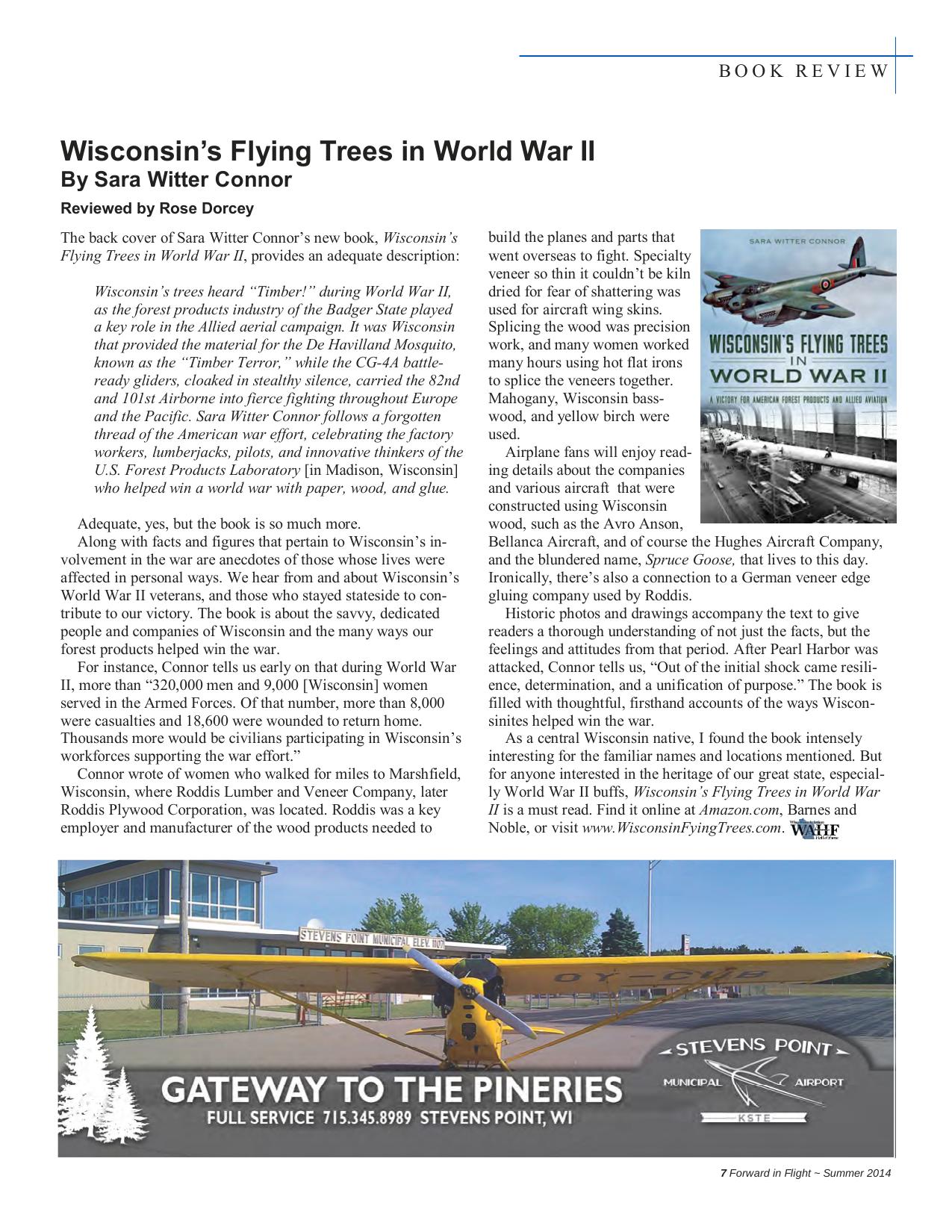
BOOK REVIEW Wisconsin’s Flying Trees in World War II By Sara Witter Connor Reviewed by Rose Dorcey The back cover of Sara Witter Connor’s new book, Wisconsin’s Flying Trees in World War II, provides an adequate description: Wisconsin’s trees heard “Timber!” during World War II, as the forest products industry of the Badger State played a key role in the Allied aerial campaign. It was Wisconsin that provided the material for the De Havilland Mosquito, known as the “Timber Terror,” while the CG-4A battleready gliders, cloaked in stealthy silence, carried the 82nd and 101st Airborne into fierce fighting throughout Europe and the Pacific. Sara Witter Connor follows a forgotten thread of the American war effort, celebrating the factory workers, lumberjacks, pilots, and innovative thinkers of the U.S. Forest Products Laboratory [in Madison, Wisconsin] who helped win a world war with paper, wood, and glue. Adequate, yes, but the book is so much more. Along with facts and figures that pertain to Wisconsin’s involvement in the war are anecdotes of those whose lives were affected in personal ways. We hear from and about Wisconsin’s World War II veterans, and those who stayed stateside to contribute to our victory. The book is about the savvy, dedicated people and companies of Wisconsin and the many ways our forest products helped win the war. For instance, Connor tells us early on that during World War II, more than “320,000 men and 9,000 [Wisconsin] women served in the Armed Forces. Of that number, more than 8,000 were casualties and 18,600 were wounded to return home. Thousands more would be civilians participating in Wisconsin’s workforces supporting the war effort.” Connor wrote of women who walked for miles to Marshfield, Wisconsin, where Roddis Lumber and Veneer Company, later Roddis Plywood Corporation, was located. Roddis was a key employer and manufacturer of the wood products needed to build the planes and parts that went overseas to fight. Specialty veneer so thin it couldn’t be kiln dried for fear of shattering was used for aircraft wing skins. Splicing the wood was precision work, and many women worked many hours using hot flat irons to splice the veneers together. Mahogany, Wisconsin basswood, and yellow birch were used. Airplane fans will enjoy reading details about the companies and various aircraft that were constructed using Wisconsin wood, such as the Avro Anson, Bellanca Aircraft, and of course the Hughes Aircraft Company, and the blundered name, Spruce Goose, that lives to this day. Ironically, there’s also a connection to a German veneer edge gluing company used by Roddis. Historic photos and drawings accompany the text to give readers a thorough understanding of not just the facts, but the feelings and attitudes from that period. After Pearl Harbor was attacked, Connor tells us, “Out of the initial shock came resilience, determination, and a unification of purpose.” The book is filled with thoughtful, firsthand accounts of the ways Wisconsinites helped win the war. As a central Wisconsin native, I found the book intensely interesting for the familiar names and locations mentioned. But for anyone interested in the heritage of our great state, especially World War II buffs, Wisconsin’s Flying Trees in World War II is a must read. Find it online at Amazon.com, Barnes and Noble, or visit www.WisconsinFyingTrees.com. 7 Forward in Flight ~ Summer 2014
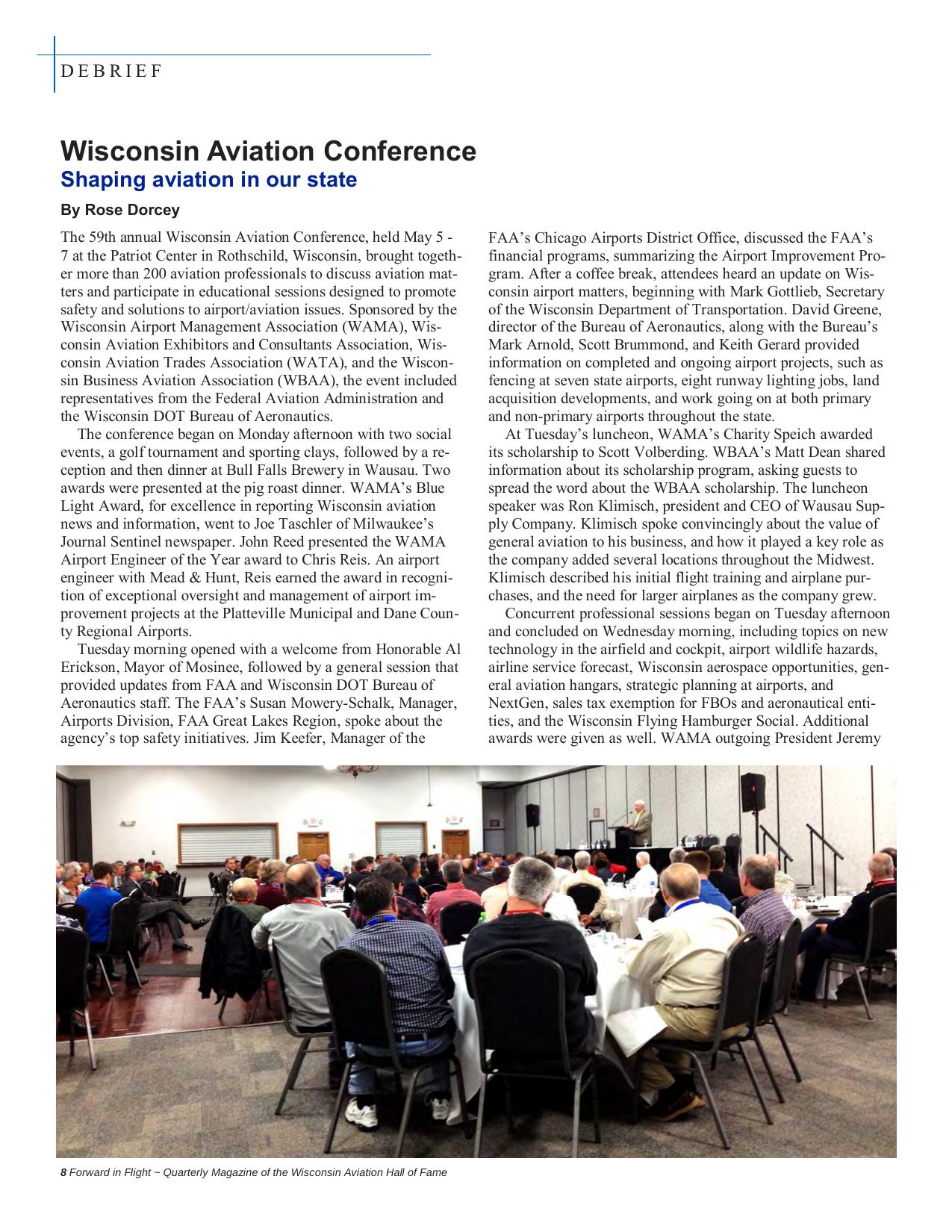
DEBRIEF Wisconsin Aviation Conference Shaping aviation in our state By Rose Dorcey The 59th annual Wisconsin Aviation Conference, held May 5 7 at the Patriot Center in Rothschild, Wisconsin, brought together more than 200 aviation professionals to discuss aviation matters and participate in educational sessions designed to promote safety and solutions to airport/aviation issues. Sponsored by the Wisconsin Airport Management Association (WAMA), Wisconsin Aviation Exhibitors and Consultants Association, Wisconsin Aviation Trades Association (WATA), and the Wisconsin Business Aviation Association (WBAA), the event included representatives from the Federal Aviation Administration and the Wisconsin DOT Bureau of Aeronautics. The conference began on Monday afternoon with two social events, a golf tournament and sporting clays, followed by a reception and then dinner at Bull Falls Brewery in Wausau. Two awards were presented at the pig roast dinner. WAMA’s Blue Light Award, for excellence in reporting Wisconsin aviation news and information, went to Joe Taschler of Milwaukee’s Journal Sentinel newspaper. John Reed presented the WAMA Airport Engineer of the Year award to Chris Reis. An airport engineer with Mead & Hunt, Reis earned the award in recognition of exceptional oversight and management of airport improvement projects at the Platteville Municipal and Dane County Regional Airports. Tuesday morning opened with a welcome from Honorable Al Erickson, Mayor of Mosinee, followed by a general session that provided updates from FAA and Wisconsin DOT Bureau of Aeronautics staff. The FAA’s Susan Mowery-Schalk, Manager, Airports Division, FAA Great Lakes Region, spoke about the agency’s top safety initiatives. Jim Keefer, Manager of the 8 Forward in Flight ~ Quarterly Magazine of the Wisconsin Aviation Hall of Fame FAA’s Chicago Airports District Office, discussed the FAA’s financial programs, summarizing the Airport Improvement Program. After a coffee break, attendees heard an update on Wisconsin airport matters, beginning with Mark Gottlieb, Secretary of the Wisconsin Department of Transportation. David Greene, director of the Bureau of Aeronautics, along with the Bureau’s Mark Arnold, Scott Brummond, and Keith Gerard provided information on completed and ongoing airport projects, such as fencing at seven state airports, eight runway lighting jobs, land acquisition developments, and work going on at both primary and non-primary airports throughout the state. At Tuesday’s luncheon, WAMA’s Charity Speich awarded its scholarship to Scott Volberding. WBAA’s Matt Dean shared information about its scholarship program, asking guests to spread the word about the WBAA scholarship. The luncheon speaker was Ron Klimisch, president and CEO of Wausau Supply Company. Klimisch spoke convincingly about the value of general aviation to his business, and how it played a key role as the company added several locations throughout the Midwest. Klimisch described his initial flight training and airplane purchases, and the need for larger airplanes as the company grew. Concurrent professional sessions began on Tuesday afternoon and concluded on Wednesday morning, including topics on new technology in the airfield and cockpit, airport wildlife hazards, airline service forecast, Wisconsin aerospace opportunities, general aviation hangars, strategic planning at airports, and NextGen, sales tax exemption for FBOs and aeronautical entities, and the Wisconsin Flying Hamburger Social. Additional awards were given as well. WAMA outgoing President Jeremy
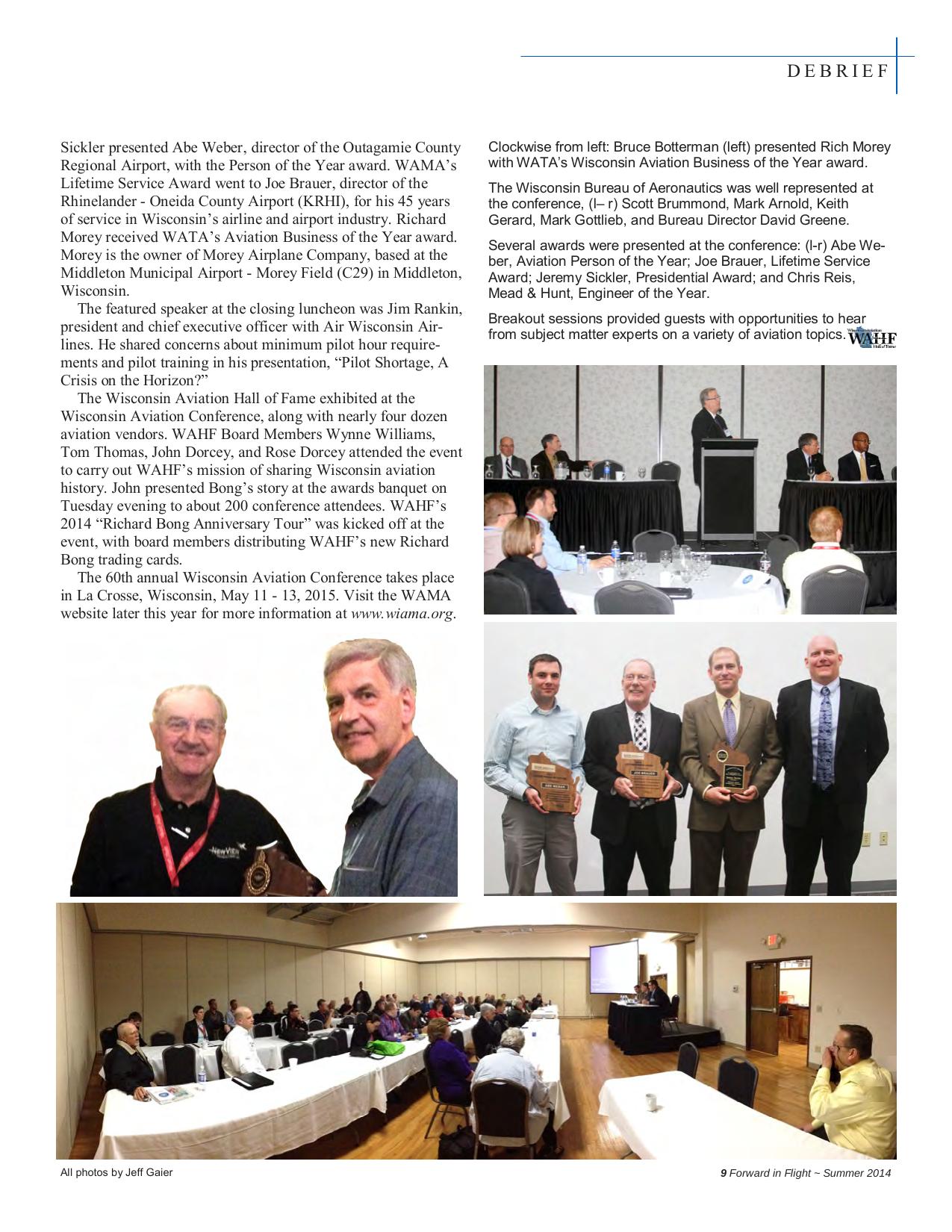
DEBRIEF Sickler presented Abe Weber, director of the Outagamie County Regional Airport, with the Person of the Year award. WAMA’s Lifetime Service Award went to Joe Brauer, director of the Rhinelander - Oneida County Airport (KRHI), for his 45 years of service in Wisconsin’s airline and airport industry. Richard Morey received WATA’s Aviation Business of the Year award. Morey is the owner of Morey Airplane Company, based at the Middleton Municipal Airport - Morey Field (C29) in Middleton, Wisconsin. The featured speaker at the closing luncheon was Jim Rankin, president and chief executive officer with Air Wisconsin Airlines. He shared concerns about minimum pilot hour requirements and pilot training in his presentation, “Pilot Shortage, A Crisis on the Horizon?” The Wisconsin Aviation Hall of Fame exhibited at the Wisconsin Aviation Conference, along with nearly four dozen aviation vendors. WAHF Board Members Wynne Williams, Tom Thomas, John Dorcey, and Rose Dorcey attended the event to carry out WAHF’s mission of sharing Wisconsin aviation history. John presented Bong’s story at the awards banquet on Tuesday evening to about 200 conference attendees. WAHF’s 2014 “Richard Bong Anniversary Tour” was kicked off at the event, with board members distributing WAHF’s new Richard Bong trading cards. The 60th annual Wisconsin Aviation Conference takes place in La Crosse, Wisconsin, May 11 - 13, 2015. Visit the WAMA website later this year for more information at www.wiama.org. All photos by Jeff Gaier Clockwise from left: Bruce Botterman (left) presented Rich Morey with WATA’s Wisconsin Aviation Business of the Year award. The Wisconsin Bureau of Aeronautics was well represented at the conference, (l– r) Scott Brummond, Mark Arnold, Keith Gerard, Mark Gottlieb, and Bureau Director David Greene. Several awards were presented at the conference: (l-r) Abe Weber, Aviation Person of the Year; Joe Brauer, Lifetime Service Award; Jeremy Sickler, Presidential Award; and Chris Reis, Mead & Hunt, Engineer of the Year. Breakout sessions provided guests with opportunities to hear from subject matter experts on a variety of aviation topics. 9 Forward in Flight ~ Summer 2014
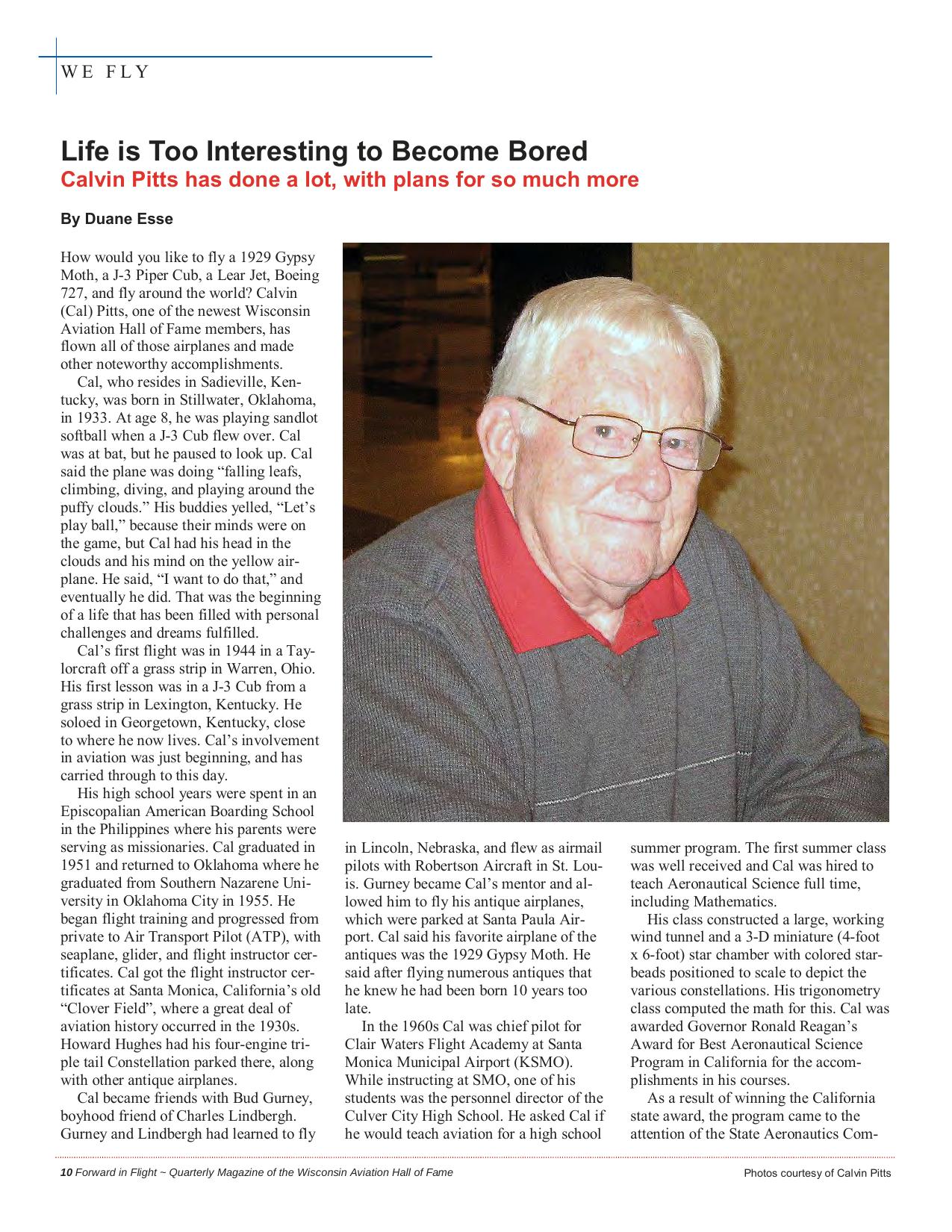
WE FLY Life is Too Interesting to Become Bored Calvin Pitts has done a lot, with plans for so much more By Duane Esse How would you like to fly a 1929 Gypsy Moth, a J-3 Piper Cub, a Lear Jet, Boeing 727, and fly around the world? Calvin (Cal) Pitts, one of the newest Wisconsin Aviation Hall of Fame members, has flown all of those airplanes and made other noteworthy accomplishments. Cal, who resides in Sadieville, Kentucky, was born in Stillwater, Oklahoma, in 1933. At age 8, he was playing sandlot softball when a J-3 Cub flew over. Cal was at bat, but he paused to look up. Cal said the plane was doing “falling leafs, climbing, diving, and playing around the puffy clouds.” His buddies yelled, “Let’s play ball,” because their minds were on the game, but Cal had his head in the clouds and his mind on the yellow airplane. He said, “I want to do that,” and eventually he did. That was the beginning of a life that has been filled with personal challenges and dreams fulfilled. Cal’s first flight was in 1944 in a Taylorcraft off a grass strip in Warren, Ohio. His first lesson was in a J-3 Cub from a grass strip in Lexington, Kentucky. He soloed in Georgetown, Kentucky, close to where he now lives. Cal’s involvement in aviation was just beginning, and has carried through to this day. His high school years were spent in an Episcopalian American Boarding School in the Philippines where his parents were serving as missionaries. Cal graduated in 1951 and returned to Oklahoma where he graduated from Southern Nazarene University in Oklahoma City in 1955. He began flight training and progressed from private to Air Transport Pilot (ATP), with seaplane, glider, and flight instructor certificates. Cal got the flight instructor certificates at Santa Monica, California’s old “Clover Field”, where a great deal of aviation history occurred in the 1930s. Howard Hughes had his four-engine triple tail Constellation parked there, along with other antique airplanes. Cal became friends with Bud Gurney, boyhood friend of Charles Lindbergh. Gurney and Lindbergh had learned to fly in Lincoln, Nebraska, and flew as airmail pilots with Robertson Aircraft in St. Louis. Gurney became Cal’s mentor and allowed him to fly his antique airplanes, which were parked at Santa Paula Airport. Cal said his favorite airplane of the antiques was the 1929 Gypsy Moth. He said after flying numerous antiques that he knew he had been born 10 years too late. In the 1960s Cal was chief pilot for Clair Waters Flight Academy at Santa Monica Municipal Airport (KSMO). While instructing at SMO, one of his students was the personnel director of the Culver City High School. He asked Cal if he would teach aviation for a high school 10 Forward in Flight ~ Quarterly Magazine of the Wisconsin Aviation Hall of Fame summer program. The first summer class was well received and Cal was hired to teach Aeronautical Science full time, including Mathematics. His class constructed a large, working wind tunnel and a 3-D miniature (4-foot x 6-foot) star chamber with colored starbeads positioned to scale to depict the various constellations. His trigonometry class computed the math for this. Cal was awarded Governor Ronald Reagan’s Award for Best Aeronautical Science Program in California for the accomplishments in his courses. As a result of winning the California state award, the program came to the attention of the State Aeronautics ComPhotos courtesy of Calvin Pitts
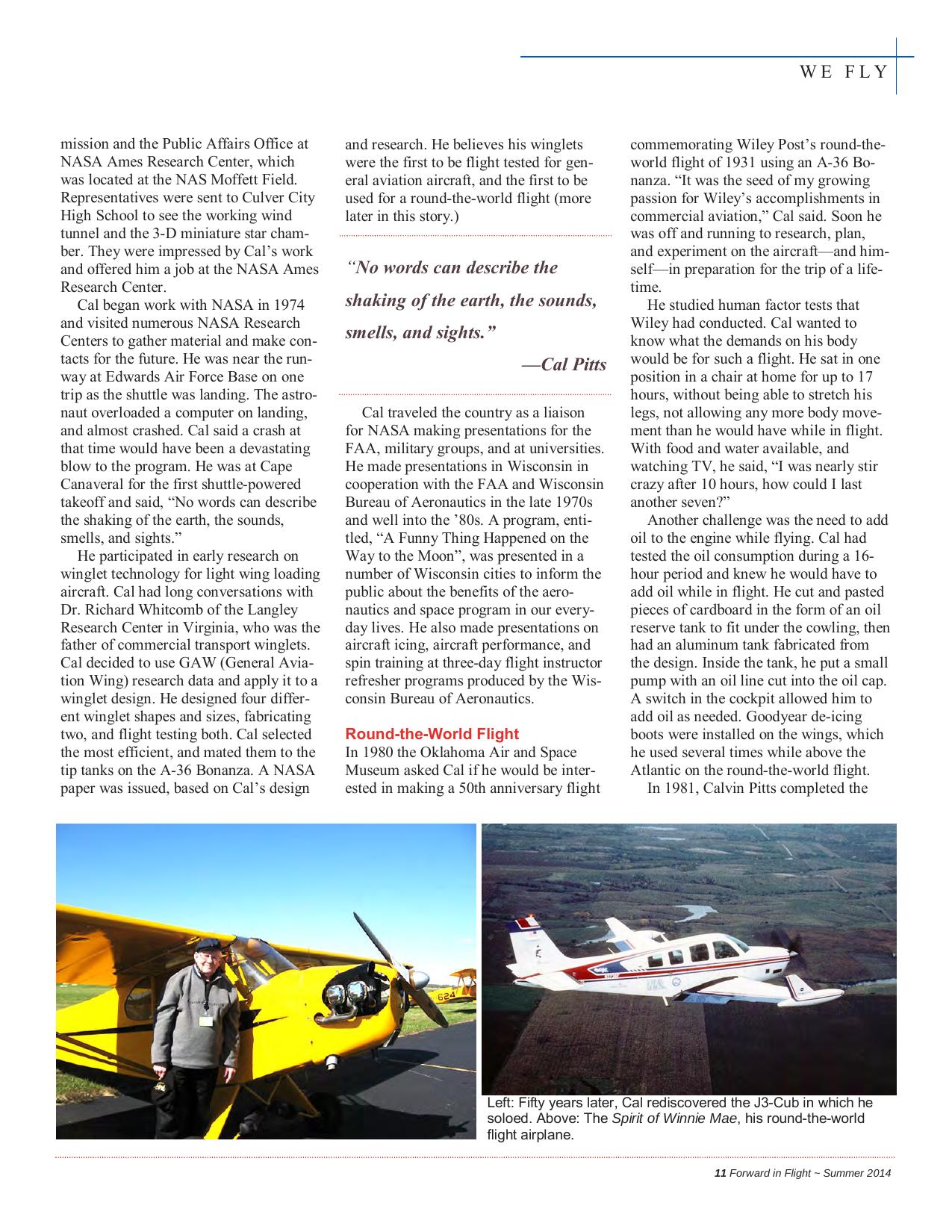
WE FLY mission and the Public Affairs Office at NASA Ames Research Center, which was located at the NAS Moffett Field. Representatives were sent to Culver City High School to see the working wind tunnel and the 3-D miniature star chamber. They were impressed by Cal’s work and offered him a job at the NASA Ames Research Center. Cal began work with NASA in 1974 and visited numerous NASA Research Centers to gather material and make contacts for the future. He was near the runway at Edwards Air Force Base on one trip as the shuttle was landing. The astronaut overloaded a computer on landing, and almost crashed. Cal said a crash at that time would have been a devastating blow to the program. He was at Cape Canaveral for the first shuttle-powered takeoff and said, “No words can describe the shaking of the earth, the sounds, smells, and sights.” He participated in early research on winglet technology for light wing loading aircraft. Cal had long conversations with Dr. Richard Whitcomb of the Langley Research Center in Virginia, who was the father of commercial transport winglets. Cal decided to use GAW (General Aviation Wing) research data and apply it to a winglet design. He designed four different winglet shapes and sizes, fabricating two, and flight testing both. Cal selected the most efficient, and mated them to the tip tanks on the A-36 Bonanza. A NASA paper was issued, based on Cal’s design and research. He believes his winglets were the first to be flight tested for general aviation aircraft, and the first to be used for a round-the-world flight (more later in this story.) “No words can describe the shaking of the earth, the sounds, smells, and sights.” —Cal Pitts Cal traveled the country as a liaison for NASA making presentations for the FAA, military groups, and at universities. He made presentations in Wisconsin in cooperation with the FAA and Wisconsin Bureau of Aeronautics in the late 1970s and well into the ’80s. A program, entitled, “A Funny Thing Happened on the Way to the Moon”, was presented in a number of Wisconsin cities to inform the public about the benefits of the aeronautics and space program in our everyday lives. He also made presentations on aircraft icing, aircraft performance, and spin training at three-day flight instructor refresher programs produced by the Wisconsin Bureau of Aeronautics. Round-the-World Flight In 1980 the Oklahoma Air and Space Museum asked Cal if he would be interested in making a 50th anniversary flight commemorating Wiley Post’s round-theworld flight of 1931 using an A-36 Bonanza. “It was the seed of my growing passion for Wiley’s accomplishments in commercial aviation,” Cal said. Soon he was off and running to research, plan, and experiment on the aircraft—and himself—in preparation for the trip of a lifetime. He studied human factor tests that Wiley had conducted. Cal wanted to know what the demands on his body would be for such a flight. He sat in one position in a chair at home for up to 17 hours, without being able to stretch his legs, not allowing any more body movement than he would have while in flight. With food and water available, and watching TV, he said, “I was nearly stir crazy after 10 hours, how could I last another seven?” Another challenge was the need to add oil to the engine while flying. Cal had tested the oil consumption during a 16hour period and knew he would have to add oil while in flight. He cut and pasted pieces of cardboard in the form of an oil reserve tank to fit under the cowling, then had an aluminum tank fabricated from the design. Inside the tank, he put a small pump with an oil line cut into the oil cap. A switch in the cockpit allowed him to add oil as needed. Goodyear de-icing boots were installed on the wings, which he used several times while above the Atlantic on the round-the-world flight. In 1981, Calvin Pitts completed the Left: Fifty years later, Cal rediscovered the J3-Cub in which he soloed. Above: The Spirit of Winnie Mae, his round-the-world flight airplane. 11 Forward in Flight ~ Summer 2014
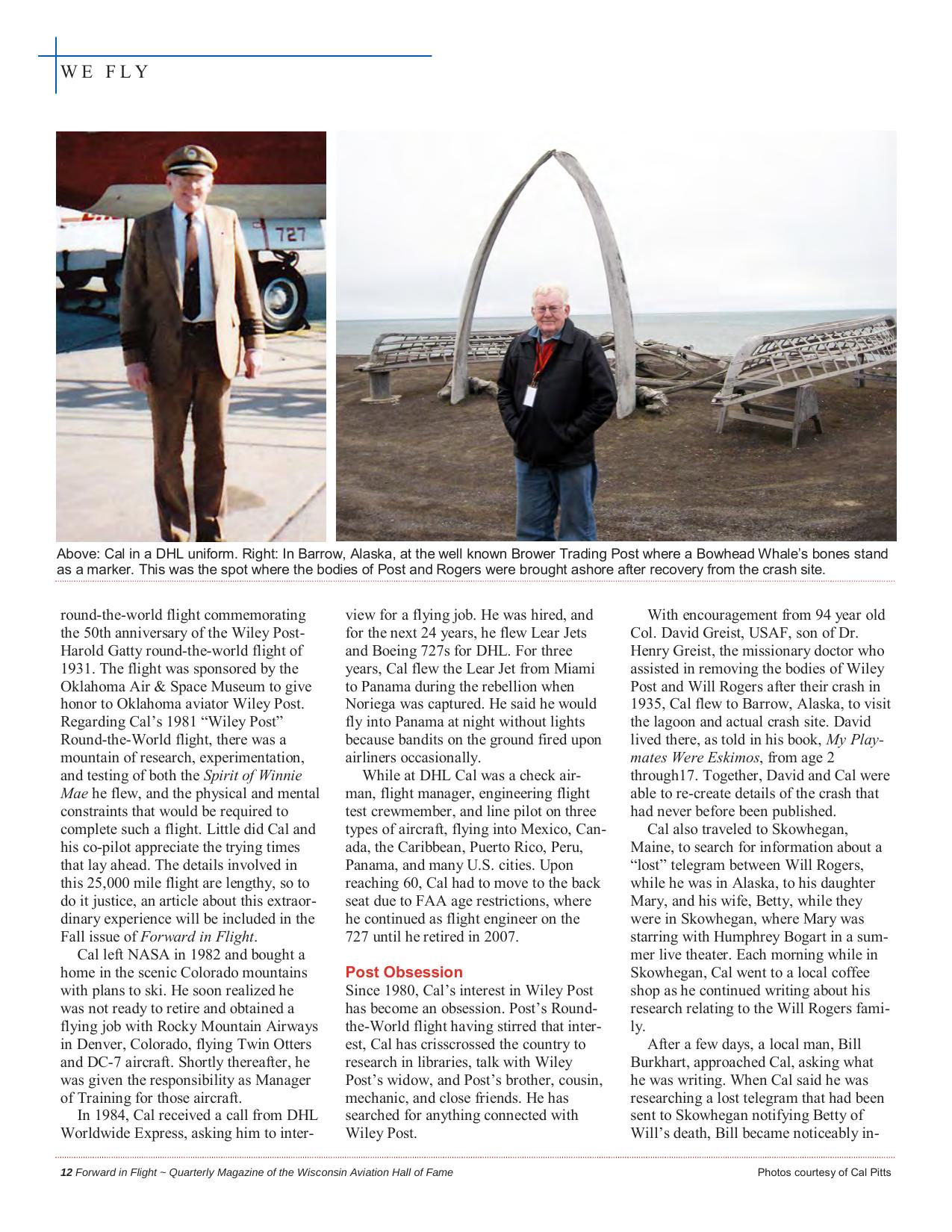
WE FLY Above: Cal in a DHL uniform. Right: In Barrow, Alaska, at the well known Brower Trading Post where a Bowhead Whale’s bones stand as a marker. This was the spot where the bodies of Post and Rogers were brought ashore after recovery from the crash site. round-the-world flight commemorating the 50th anniversary of the Wiley PostHarold Gatty round-the-world flight of 1931. The flight was sponsored by the Oklahoma Air & Space Museum to give honor to Oklahoma aviator Wiley Post. Regarding Cal’s 1981 “Wiley Post” Round-the-World flight, there was a mountain of research, experimentation, and testing of both the Spirit of Winnie Mae he flew, and the physical and mental constraints that would be required to complete such a flight. Little did Cal and his co-pilot appreciate the trying times that lay ahead. The details involved in this 25,000 mile flight are lengthy, so to do it justice, an article about this extraordinary experience will be included in the Fall issue of Forward in Flight. Cal left NASA in 1982 and bought a home in the scenic Colorado mountains with plans to ski. He soon realized he was not ready to retire and obtained a flying job with Rocky Mountain Airways in Denver, Colorado, flying Twin Otters and DC-7 aircraft. Shortly thereafter, he was given the responsibility as Manager of Training for those aircraft. In 1984, Cal received a call from DHL Worldwide Express, asking him to inter- view for a flying job. He was hired, and for the next 24 years, he flew Lear Jets and Boeing 727s for DHL. For three years, Cal flew the Lear Jet from Miami to Panama during the rebellion when Noriega was captured. He said he would fly into Panama at night without lights because bandits on the ground fired upon airliners occasionally. While at DHL Cal was a check airman, flight manager, engineering flight test crewmember, and line pilot on three types of aircraft, flying into Mexico, Canada, the Caribbean, Puerto Rico, Peru, Panama, and many U.S. cities. Upon reaching 60, Cal had to move to the back seat due to FAA age restrictions, where he continued as flight engineer on the 727 until he retired in 2007. Post Obsession Since 1980, Cal’s interest in Wiley Post has become an obsession. Post’s Roundthe-World flight having stirred that interest, Cal has crisscrossed the country to research in libraries, talk with Wiley Post’s widow, and Post’s brother, cousin, mechanic, and close friends. He has searched for anything connected with Wiley Post. 12 Forward in Flight ~ Quarterly Magazine of the Wisconsin Aviation Hall of Fame With encouragement from 94 year old Col. David Greist, USAF, son of Dr. Henry Greist, the missionary doctor who assisted in removing the bodies of Wiley Post and Will Rogers after their crash in 1935, Cal flew to Barrow, Alaska, to visit the lagoon and actual crash site. David lived there, as told in his book, My Playmates Were Eskimos, from age 2 through17. Together, David and Cal were able to re-create details of the crash that had never before been published. Cal also traveled to Skowhegan, Maine, to search for information about a “lost” telegram between Will Rogers, while he was in Alaska, to his daughter Mary, and his wife, Betty, while they were in Skowhegan, where Mary was starring with Humphrey Bogart in a summer live theater. Each morning while in Skowhegan, Cal went to a local coffee shop as he continued writing about his research relating to the Will Rogers family. After a few days, a local man, Bill Burkhart, approached Cal, asking what he was writing. When Cal said he was researching a lost telegram that had been sent to Skowhegan notifying Betty of Will’s death, Bill became noticeably inPhotos courtesy of Cal Pitts
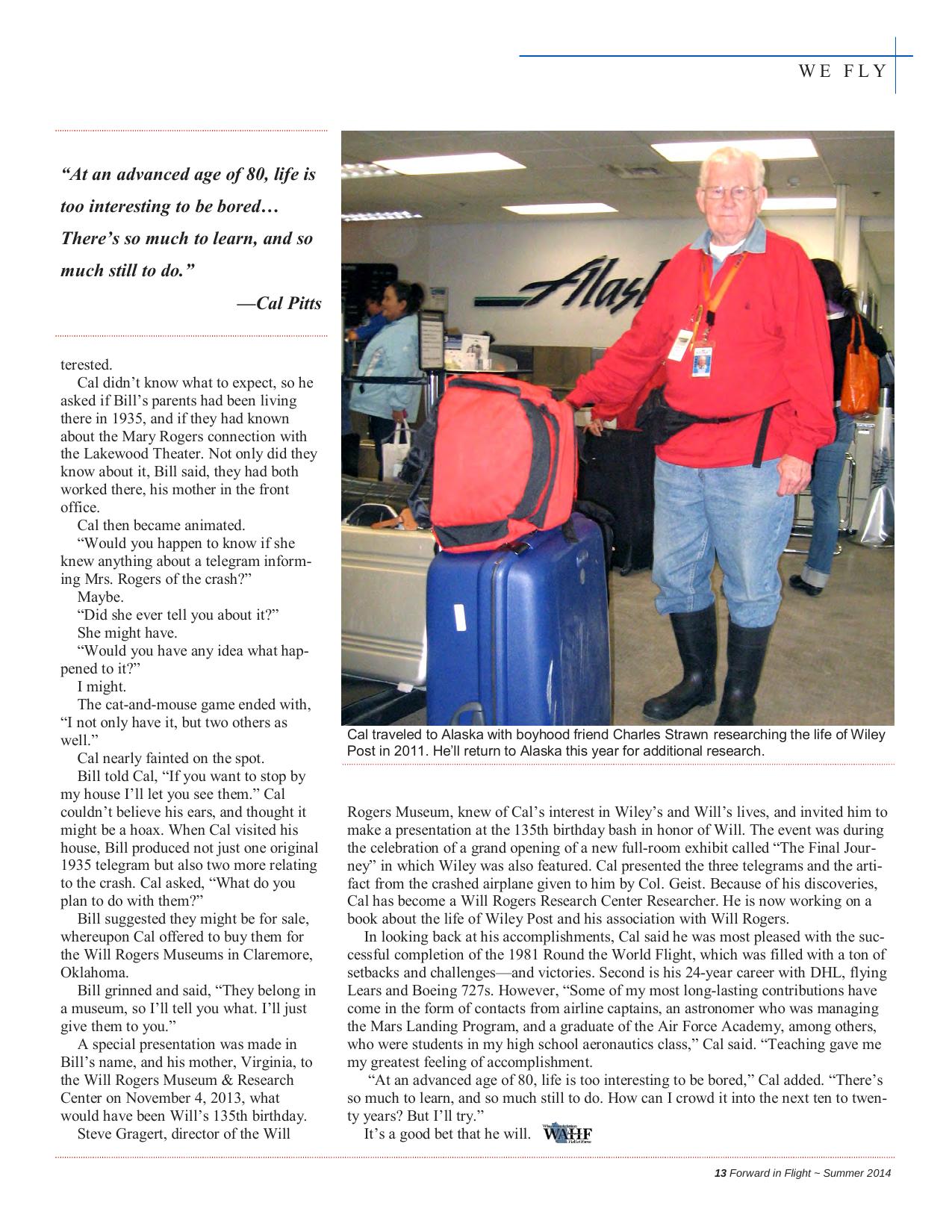
WE FLY “At an advanced age of 80, life is too interesting to be bored… There’s so much to learn, and so much still to do.” —Cal Pitts terested. Cal didn’t know what to expect, so he asked if Bill’s parents had been living there in 1935, and if they had known about the Mary Rogers connection with the Lakewood Theater. Not only did they know about it, Bill said, they had both worked there, his mother in the front office. Cal then became animated. “Would you happen to know if she knew anything about a telegram informing Mrs. Rogers of the crash?” Maybe. “Did she ever tell you about it?” She might have. “Would you have any idea what happened to it?” I might. The cat-and-mouse game ended with, “I not only have it, but two others as well.” Cal nearly fainted on the spot. Bill told Cal, “If you want to stop by my house I’ll let you see them.” Cal couldn’t believe his ears, and thought it might be a hoax. When Cal visited his house, Bill produced not just one original 1935 telegram but also two more relating to the crash. Cal asked, “What do you plan to do with them?” Bill suggested they might be for sale, whereupon Cal offered to buy them for the Will Rogers Museums in Claremore, Oklahoma. Bill grinned and said, “They belong in a museum, so I’ll tell you what. I’ll just give them to you.” A special presentation was made in Bill’s name, and his mother, Virginia, to the Will Rogers Museum & Research Center on November 4, 2013, what would have been Will’s 135th birthday. Steve Gragert, director of the Will Cal traveled to Alaska with boyhood friend Charles Strawn researching the life of Wiley Post in 2011. He’ll return to Alaska this year for additional research. Rogers Museum, knew of Cal’s interest in Wiley’s and Will’s lives, and invited him to make a presentation at the 135th birthday bash in honor of Will. The event was during the celebration of a grand opening of a new full-room exhibit called “The Final Journey” in which Wiley was also featured. Cal presented the three telegrams and the artifact from the crashed airplane given to him by Col. Geist. Because of his discoveries, Cal has become a Will Rogers Research Center Researcher. He is now working on a book about the life of Wiley Post and his association with Will Rogers. In looking back at his accomplishments, Cal said he was most pleased with the successful completion of the 1981 Round the World Flight, which was filled with a ton of setbacks and challenges—and victories. Second is his 24-year career with DHL, flying Lears and Boeing 727s. However, “Some of my most long-lasting contributions have come in the form of contacts from airline captains, an astronomer who was managing the Mars Landing Program, and a graduate of the Air Force Academy, among others, who were students in my high school aeronautics class,” Cal said. “Teaching gave me my greatest feeling of accomplishment. “At an advanced age of 80, life is too interesting to be bored,” Cal added. “There’s so much to learn, and so much still to do. How can I crowd it into the next ten to twenty years? But I’ll try.” It’s a good bet that he will. 13 Forward in Flight ~ Summer 2014
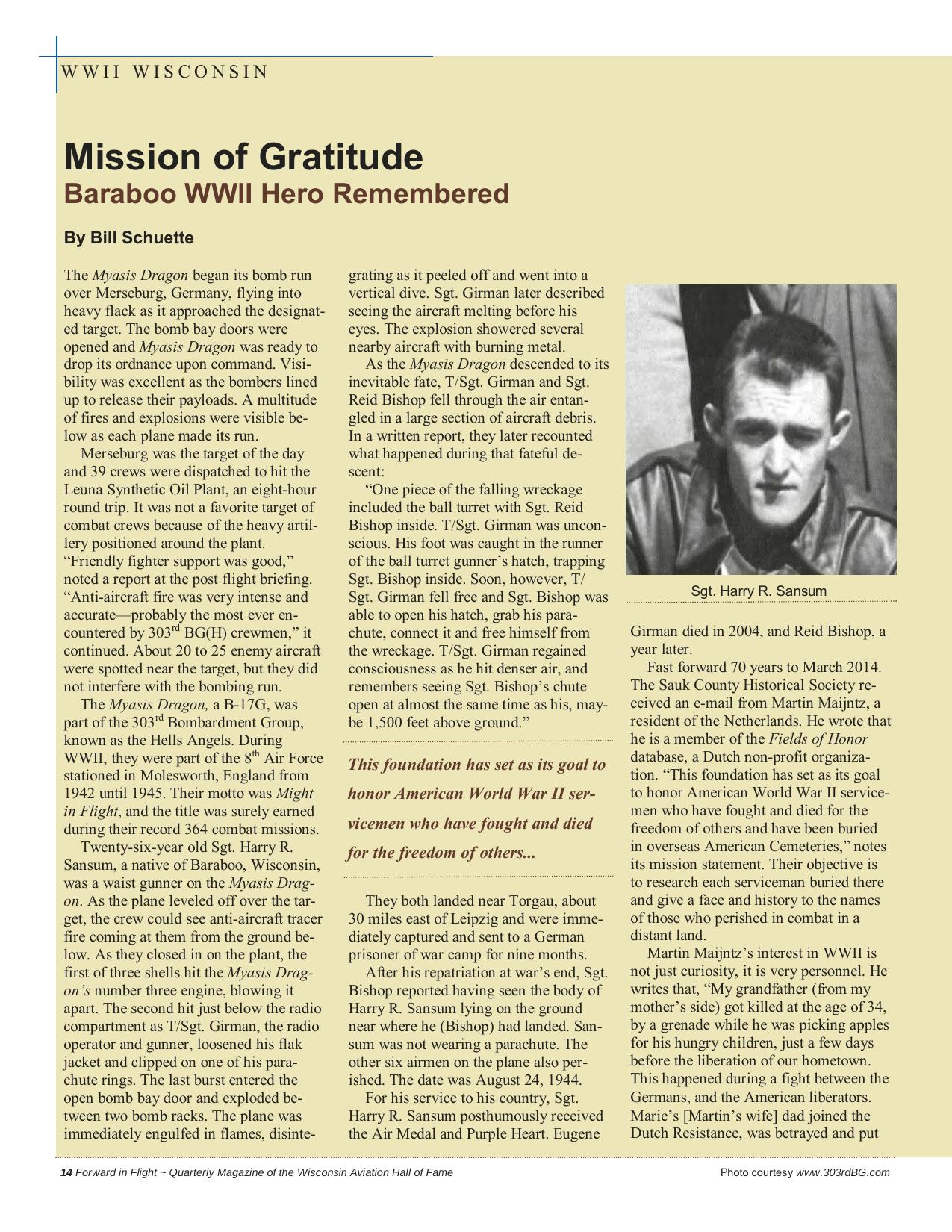
WWII WISCONSIN Mission of Gratitude Baraboo WWII Hero Remembered By Bill Schuette The Myasis Dragon began its bomb run over Merseburg, Germany, flying into heavy flack as it approached the designated target. The bomb bay doors were opened and Myasis Dragon was ready to drop its ordnance upon command. Visibility was excellent as the bombers lined up to release their payloads. A multitude of fires and explosions were visible below as each plane made its run. Merseburg was the target of the day and 39 crews were dispatched to hit the Leuna Synthetic Oil Plant, an eight-hour round trip. It was not a favorite target of combat crews because of the heavy artillery positioned around the plant. “Friendly fighter support was good,” noted a report at the post flight briefing. “Anti-aircraft fire was very intense and accurate—probably the most ever encountered by 303rd BG(H) crewmen,” it continued. About 20 to 25 enemy aircraft were spotted near the target, but they did not interfere with the bombing run. The Myasis Dragon, a B-17G, was part of the 303rd Bombardment Group, known as the Hells Angels. During WWII, they were part of the 8th Air Force stationed in Molesworth, England from 1942 until 1945. Their motto was Might in Flight, and the title was surely earned during their record 364 combat missions. Twenty-six-year old Sgt. Harry R. Sansum, a native of Baraboo, Wisconsin, was a waist gunner on the Myasis Dragon. As the plane leveled off over the target, the crew could see anti-aircraft tracer fire coming at them from the ground below. As they closed in on the plant, the first of three shells hit the Myasis Dragon’s number three engine, blowing it apart. The second hit just below the radio compartment as T/Sgt. Girman, the radio operator and gunner, loosened his flak jacket and clipped on one of his parachute rings. The last burst entered the open bomb bay door and exploded between two bomb racks. The plane was immediately engulfed in flames, disinte- grating as it peeled off and went into a vertical dive. Sgt. Girman later described seeing the aircraft melting before his eyes. The explosion showered several nearby aircraft with burning metal. As the Myasis Dragon descended to its inevitable fate, T/Sgt. Girman and Sgt. Reid Bishop fell through the air entangled in a large section of aircraft debris. In a written report, they later recounted what happened during that fateful descent: “One piece of the falling wreckage included the ball turret with Sgt. Reid Bishop inside. T/Sgt. Girman was unconscious. His foot was caught in the runner of the ball turret gunner’s hatch, trapping Sgt. Bishop inside. Soon, however, T/ Sgt. Girman fell free and Sgt. Bishop was able to open his hatch, grab his parachute, connect it and free himself from the wreckage. T/Sgt. Girman regained consciousness as he hit denser air, and remembers seeing Sgt. Bishop’s chute open at almost the same time as his, maybe 1,500 feet above ground.” This foundation has set as its goal to honor American World War II servicemen who have fought and died for the freedom of others... They both landed near Torgau, about 30 miles east of Leipzig and were immediately captured and sent to a German prisoner of war camp for nine months. After his repatriation at war’s end, Sgt. Bishop reported having seen the body of Harry R. Sansum lying on the ground near where he (Bishop) had landed. Sansum was not wearing a parachute. The other six airmen on the plane also perished. The date was August 24, 1944. For his service to his country, Sgt. Harry R. Sansum posthumously received the Air Medal and Purple Heart. Eugene 14 Forward in Flight ~ Quarterly Magazine of the Wisconsin Aviation Hall of Fame Sgt. Harry R. Sansum Girman died in 2004, and Reid Bishop, a year later. Fast forward 70 years to March 2014. The Sauk County Historical Society received an e-mail from Martin Maijntz, a resident of the Netherlands. He wrote that he is a member of the Fields of Honor database, a Dutch non-profit organization. “This foundation has set as its goal to honor American World War II servicemen who have fought and died for the freedom of others and have been buried in overseas American Cemeteries,” notes its mission statement. Their objective is to research each serviceman buried there and give a face and history to the names of those who perished in combat in a distant land. Martin Maijntz’s interest in WWII is not just curiosity, it is very personnel. He writes that, “My grandfather (from my mother’s side) got killed at the age of 34, by a grenade while he was picking apples for his hungry children, just a few days before the liberation of our hometown. This happened during a fight between the Germans, and the American liberators. Marie’s [Martin’s wife] dad joined the Dutch Resistance, was betrayed and put Photo courtesy www.303rdBG.com
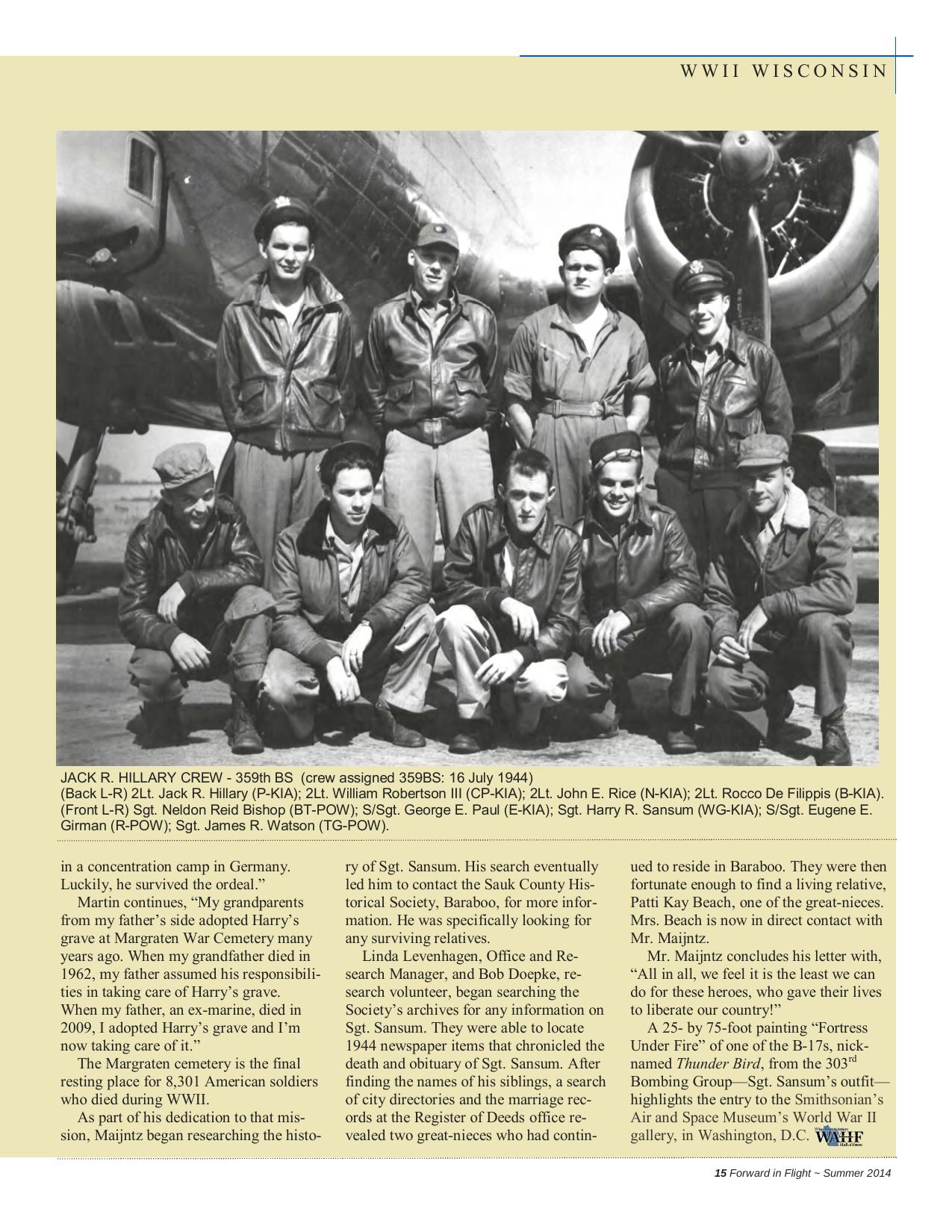
WWII WISCONSIN JACK R. HILLARY CREW - 359th BS (crew assigned 359BS: 16 July 1944) (Back L-R) 2Lt. Jack R. Hillary (P-KIA); 2Lt. William Robertson III (CP-KIA); 2Lt. John E. Rice (N-KIA); 2Lt. Rocco De Filippis (B-KIA). (Front L-R) Sgt. Neldon Reid Bishop (BT-POW); S/Sgt. George E. Paul (E-KIA); Sgt. Harry R. Sansum (WG-KIA); S/Sgt. Eugene E. Girman (R-POW); Sgt. James R. Watson (TG-POW). in a concentration camp in Germany. Luckily, he survived the ordeal.” Martin continues, “My grandparents from my father’s side adopted Harry’s grave at Margraten War Cemetery many years ago. When my grandfather died in 1962, my father assumed his responsibilities in taking care of Harry’s grave. When my father, an ex-marine, died in 2009, I adopted Harry’s grave and I’m now taking care of it.” The Margraten cemetery is the final resting place for 8,301 American soldiers who died during WWII. As part of his dedication to that mission, Maijntz began researching the histo- ry of Sgt. Sansum. His search eventually led him to contact the Sauk County Historical Society, Baraboo, for more information. He was specifically looking for any surviving relatives. Linda Levenhagen, Office and Research Manager, and Bob Doepke, research volunteer, began searching the Society’s archives for any information on Sgt. Sansum. They were able to locate 1944 newspaper items that chronicled the death and obituary of Sgt. Sansum. After finding the names of his siblings, a search of city directories and the marriage records at the Register of Deeds office revealed two great-nieces who had contin- ued to reside in Baraboo. They were then fortunate enough to find a living relative, Patti Kay Beach, one of the great-nieces. Mrs. Beach is now in direct contact with Mr. Maijntz. Mr. Maijntz concludes his letter with, “All in all, we feel it is the least we can do for these heroes, who gave their lives to liberate our country!” A 25- by 75-foot painting “Fortress Under Fire” of one of the B-17s, nicknamed Thunder Bird, from the 303rd Bombing Group—Sgt. Sansum’s outfit— highlights the entry to the Smithsonian’s Air and Space Museum’s World War II gallery, in Washington, D.C. 15 Forward in Flight ~ Summer 2014
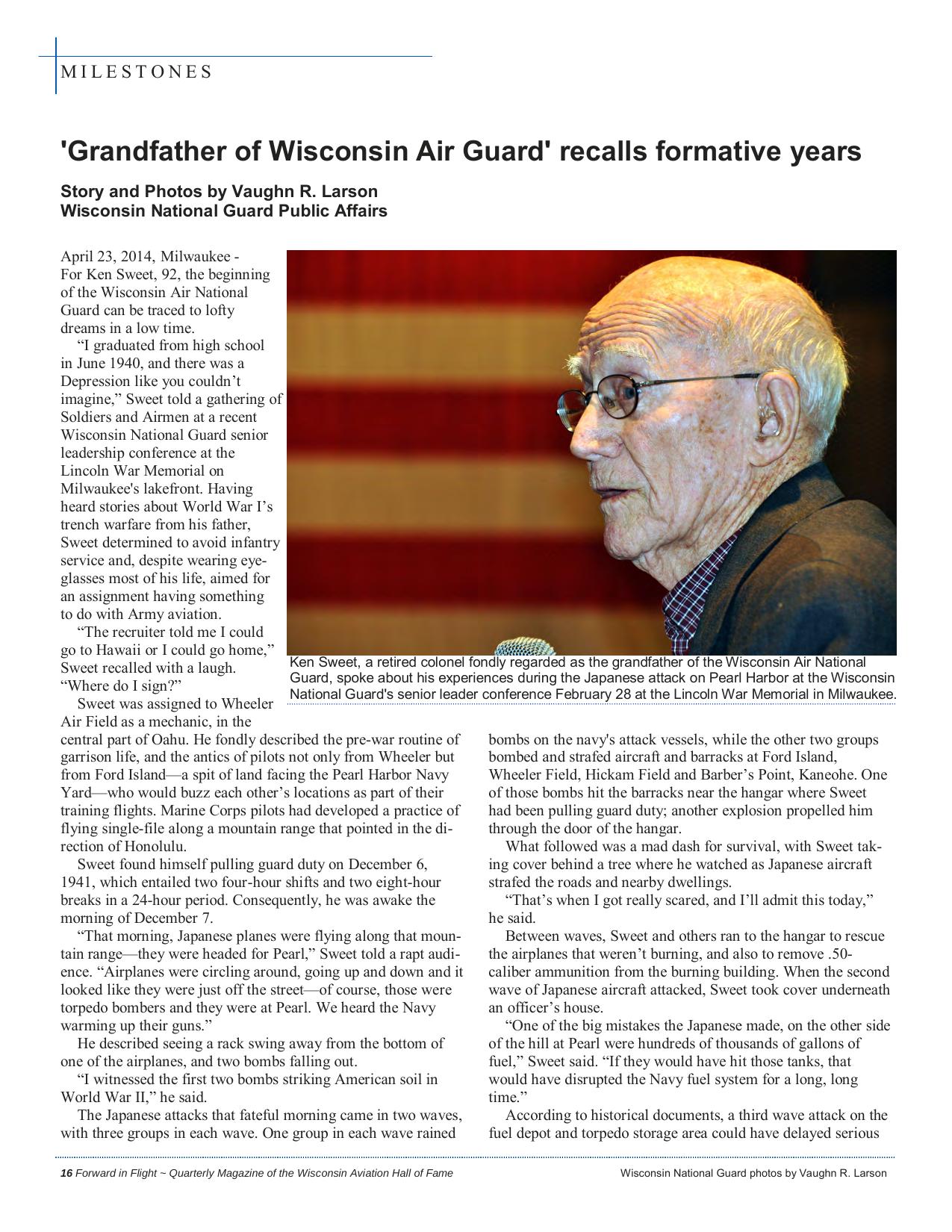
MILESTONES 'Grandfather of Wisconsin Air Guard' recalls formative years Story and Photos by Vaughn R. Larson Wisconsin National Guard Public Affairs April 23, 2014, Milwaukee For Ken Sweet, 92, the beginning of the Wisconsin Air National Guard can be traced to lofty dreams in a low time. “I graduated from high school in June 1940, and there was a Depression like you couldn’t imagine,” Sweet told a gathering of Soldiers and Airmen at a recent Wisconsin National Guard senior leadership conference at the Lincoln War Memorial on Milwaukee's lakefront. Having heard stories about World War I’s trench warfare from his father, Sweet determined to avoid infantry service and, despite wearing eyeglasses most of his life, aimed for an assignment having something to do with Army aviation. “The recruiter told me I could go to Hawaii or I could go home,” Ken Sweet, a retired colonel fondly regarded as the grandfather of the Wisconsin Air National Sweet recalled with a laugh. Guard, spoke about his experiences during the Japanese attack on Pearl Harbor at the Wisconsin “Where do I sign?” National Guard's senior leader conference February 28 at the Lincoln War Memorial in Milwaukee. Sweet was assigned to Wheeler Air Field as a mechanic, in the central part of Oahu. He fondly described the pre-war routine of bombs on the navy's attack vessels, while the other two groups garrison life, and the antics of pilots not only from Wheeler but bombed and strafed aircraft and barracks at Ford Island, from Ford Island—a spit of land facing the Pearl Harbor Navy Wheeler Field, Hickam Field and Barber’s Point, Kaneohe. One Yard—who would buzz each other’s locations as part of their of those bombs hit the barracks near the hangar where Sweet training flights. Marine Corps pilots had developed a practice of had been pulling guard duty; another explosion propelled him flying single-file along a mountain range that pointed in the dithrough the door of the hangar. rection of Honolulu. What followed was a mad dash for survival, with Sweet takSweet found himself pulling guard duty on December 6, ing cover behind a tree where he watched as Japanese aircraft 1941, which entailed two four-hour shifts and two eight-hour strafed the roads and nearby dwellings. breaks in a 24-hour period. Consequently, he was awake the “That’s when I got really scared, and I’ll admit this today,” morning of December 7. he said. “That morning, Japanese planes were flying along that mounBetween waves, Sweet and others ran to the hangar to rescue tain range—they were headed for Pearl,” Sweet told a rapt audithe airplanes that weren’t burning, and also to remove .50ence. “Airplanes were circling around, going up and down and it caliber ammunition from the burning building. When the second looked like they were just off the street—of course, those were wave of Japanese aircraft attacked, Sweet took cover underneath torpedo bombers and they were at Pearl. We heard the Navy an officer’s house. warming up their guns.” “One of the big mistakes the Japanese made, on the other side He described seeing a rack swing away from the bottom of of the hill at Pearl were hundreds of thousands of gallons of one of the airplanes, and two bombs falling out. fuel,” Sweet said. “If they would have hit those tanks, that “I witnessed the first two bombs striking American soil in would have disrupted the Navy fuel system for a long, long World War II,” he said. time.” The Japanese attacks that fateful morning came in two waves, According to historical documents, a third wave attack on the with three groups in each wave. One group in each wave rained fuel depot and torpedo storage area could have delayed serious 16 Forward in Flight ~ Quarterly Magazine of the Wisconsin Aviation Hall of Fame Wisconsin National Guard photos by Vaughn R. Larson
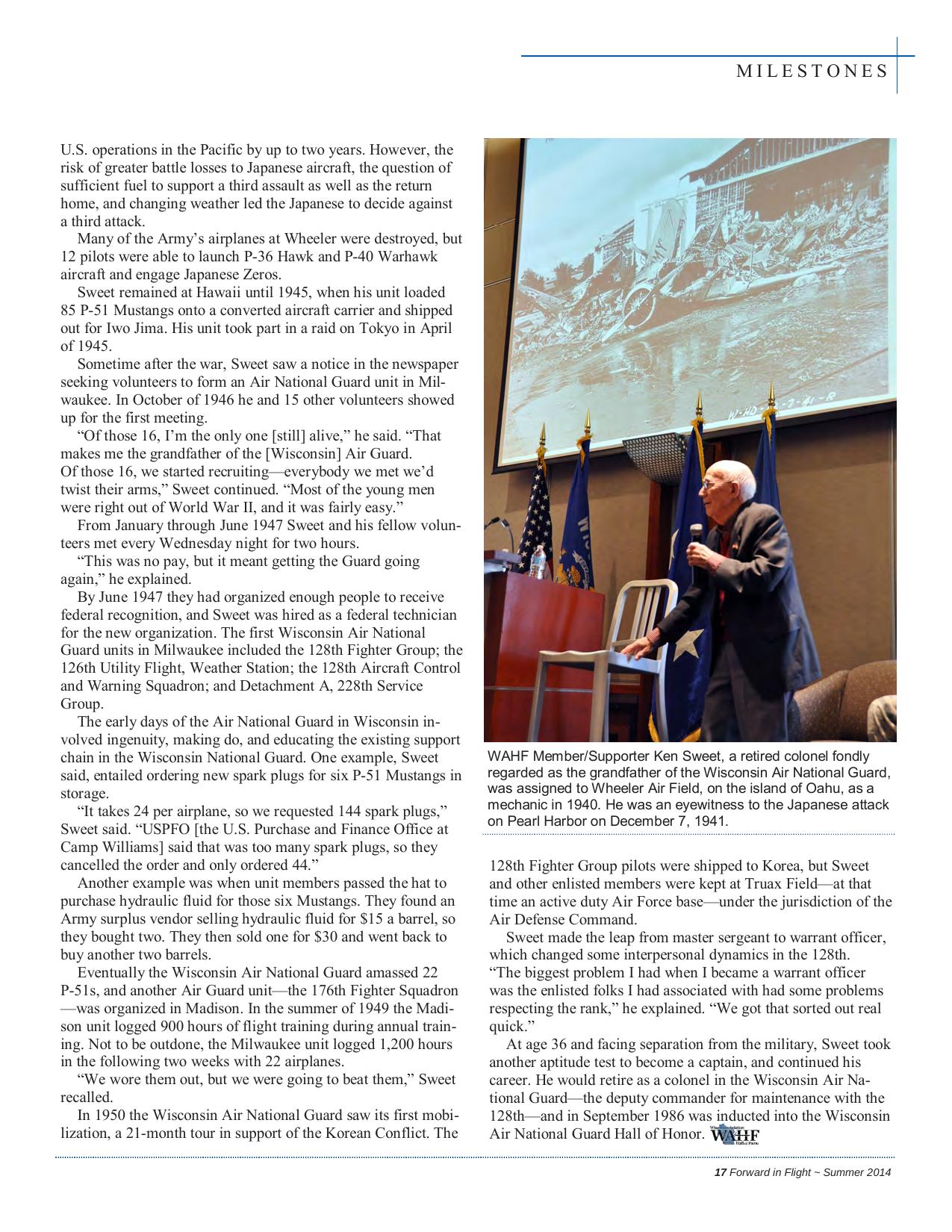
MILESTONES U.S. operations in the Pacific by up to two years. However, the risk of greater battle losses to Japanese aircraft, the question of sufficient fuel to support a third assault as well as the return home, and changing weather led the Japanese to decide against a third attack. Many of the Army’s airplanes at Wheeler were destroyed, but 12 pilots were able to launch P-36 Hawk and P-40 Warhawk aircraft and engage Japanese Zeros. Sweet remained at Hawaii until 1945, when his unit loaded 85 P-51 Mustangs onto a converted aircraft carrier and shipped out for Iwo Jima. His unit took part in a raid on Tokyo in April of 1945. Sometime after the war, Sweet saw a notice in the newspaper seeking volunteers to form an Air National Guard unit in Milwaukee. In October of 1946 he and 15 other volunteers showed up for the first meeting. “Of those 16, I’m the only one [still] alive,” he said. “That makes me the grandfather of the [Wisconsin] Air Guard. Of those 16, we started recruiting—everybody we met we’d twist their arms,” Sweet continued. “Most of the young men were right out of World War II, and it was fairly easy.” From January through June 1947 Sweet and his fellow volunteers met every Wednesday night for two hours. “This was no pay, but it meant getting the Guard going again,” he explained. By June 1947 they had organized enough people to receive federal recognition, and Sweet was hired as a federal technician for the new organization. The first Wisconsin Air National Guard units in Milwaukee included the 128th Fighter Group; the 126th Utility Flight, Weather Station; the 128th Aircraft Control and Warning Squadron; and Detachment A, 228th Service Group. The early days of the Air National Guard in Wisconsin involved ingenuity, making do, and educating the existing support chain in the Wisconsin National Guard. One example, Sweet said, entailed ordering new spark plugs for six P-51 Mustangs in storage. “It takes 24 per airplane, so we requested 144 spark plugs,” Sweet said. “USPFO [the U.S. Purchase and Finance Office at Camp Williams] said that was too many spark plugs, so they cancelled the order and only ordered 44.” Another example was when unit members passed the hat to purchase hydraulic fluid for those six Mustangs. They found an Army surplus vendor selling hydraulic fluid for $15 a barrel, so they bought two. They then sold one for $30 and went back to buy another two barrels. Eventually the Wisconsin Air National Guard amassed 22 P-51s, and another Air Guard unit—the 176th Fighter Squadron —was organized in Madison. In the summer of 1949 the Madison unit logged 900 hours of flight training during annual training. Not to be outdone, the Milwaukee unit logged 1,200 hours in the following two weeks with 22 airplanes. “We wore them out, but we were going to beat them,” Sweet recalled. In 1950 the Wisconsin Air National Guard saw its first mobilization, a 21-month tour in support of the Korean Conflict. The WAHF Member/Supporter Ken Sweet, a retired colonel fondly regarded as the grandfather of the Wisconsin Air National Guard, was assigned to Wheeler Air Field, on the island of Oahu, as a mechanic in 1940. He was an eyewitness to the Japanese attack on Pearl Harbor on December 7, 1941. 128th Fighter Group pilots were shipped to Korea, but Sweet and other enlisted members were kept at Truax Field—at that time an active duty Air Force base—under the jurisdiction of the Air Defense Command. Sweet made the leap from master sergeant to warrant officer, which changed some interpersonal dynamics in the 128th. “The biggest problem I had when I became a warrant officer was the enlisted folks I had associated with had some problems respecting the rank,” he explained. “We got that sorted out real quick.” At age 36 and facing separation from the military, Sweet took another aptitude test to become a captain, and continued his career. He would retire as a colonel in the Wisconsin Air National Guard—the deputy commander for maintenance with the 128th—and in September 1986 was inducted into the Wisconsin Air National Guard Hall of Honor. 17 Forward in Flight ~ Summer 2014
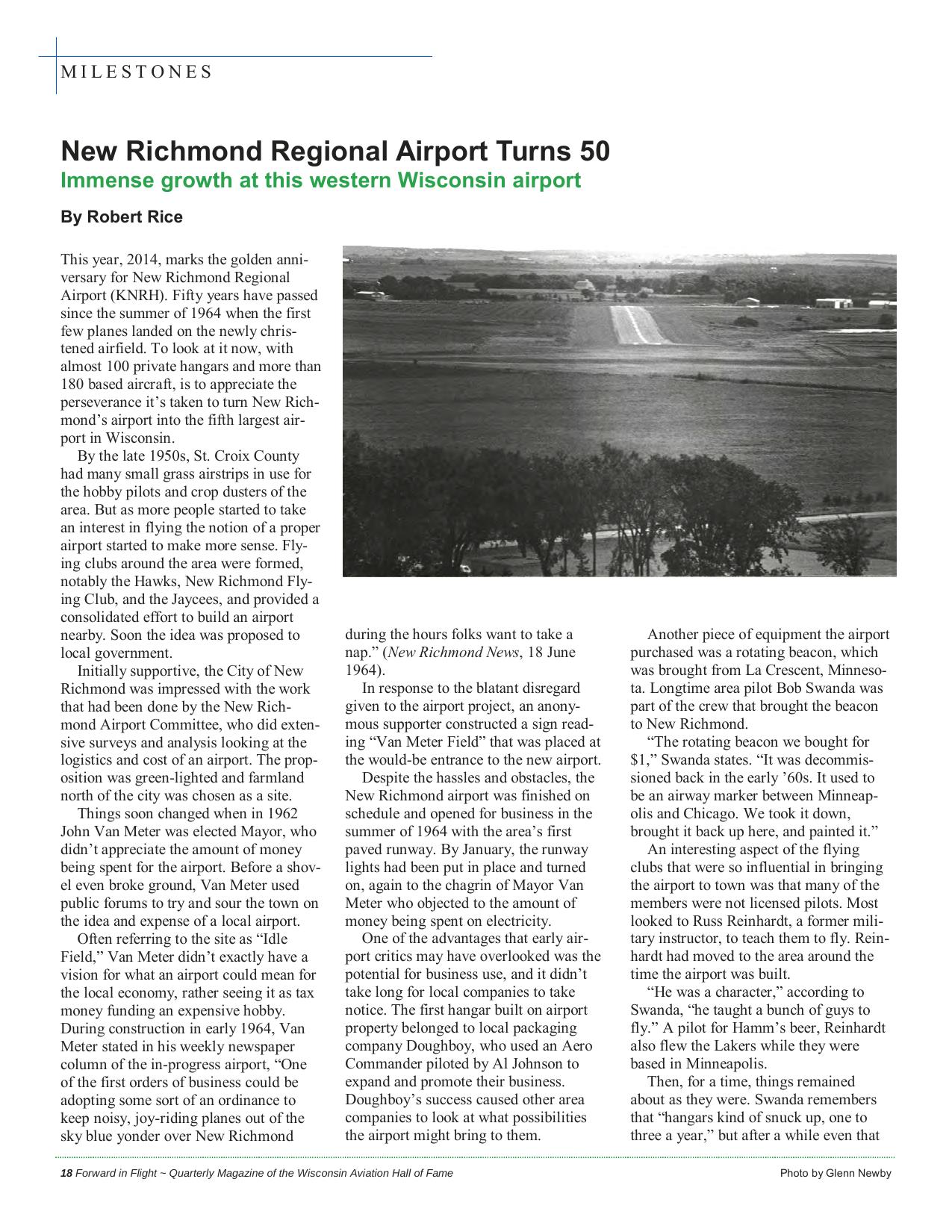
MILESTONES New Richmond Regional Airport Turns 50 Immense growth at this western Wisconsin airport By Robert Rice This year, 2014, marks the golden anniversary for New Richmond Regional Airport (KNRH). Fifty years have passed since the summer of 1964 when the first few planes landed on the newly christened airfield. To look at it now, with almost 100 private hangars and more than 180 based aircraft, is to appreciate the perseverance it’s taken to turn New Richmond’s airport into the fifth largest airport in Wisconsin. By the late 1950s, St. Croix County had many small grass airstrips in use for the hobby pilots and crop dusters of the area. But as more people started to take an interest in flying the notion of a proper airport started to make more sense. Flying clubs around the area were formed, notably the Hawks, New Richmond Flying Club, and the Jaycees, and provided a consolidated effort to build an airport nearby. Soon the idea was proposed to local government. Initially supportive, the City of New Richmond was impressed with the work that had been done by the New Richmond Airport Committee, who did extensive surveys and analysis looking at the logistics and cost of an airport. The proposition was green-lighted and farmland north of the city was chosen as a site. Things soon changed when in 1962 John Van Meter was elected Mayor, who didn’t appreciate the amount of money being spent for the airport. Before a shovel even broke ground, Van Meter used public forums to try and sour the town on the idea and expense of a local airport. Often referring to the site as “Idle Field,” Van Meter didn’t exactly have a vision for what an airport could mean for the local economy, rather seeing it as tax money funding an expensive hobby. During construction in early 1964, Van Meter stated in his weekly newspaper column of the in-progress airport, “One of the first orders of business could be adopting some sort of an ordinance to keep noisy, joy-riding planes out of the sky blue yonder over New Richmond during the hours folks want to take a nap.” (New Richmond News, 18 June 1964). In response to the blatant disregard given to the airport project, an anonymous supporter constructed a sign reading “Van Meter Field” that was placed at the would-be entrance to the new airport. Despite the hassles and obstacles, the New Richmond airport was finished on schedule and opened for business in the summer of 1964 with the area’s first paved runway. By January, the runway lights had been put in place and turned on, again to the chagrin of Mayor Van Meter who objected to the amount of money being spent on electricity. One of the advantages that early airport critics may have overlooked was the potential for business use, and it didn’t take long for local companies to take notice. The first hangar built on airport property belonged to local packaging company Doughboy, who used an Aero Commander piloted by Al Johnson to expand and promote their business. Doughboy’s success caused other area companies to look at what possibilities the airport might bring to them. 18 Forward in Flight ~ Quarterly Magazine of the Wisconsin Aviation Hall of Fame Another piece of equipment the airport purchased was a rotating beacon, which was brought from La Crescent, Minnesota. Longtime area pilot Bob Swanda was part of the crew that brought the beacon to New Richmond. “The rotating beacon we bought for $1,” Swanda states. “It was decommissioned back in the early ’60s. It used to be an airway marker between Minneapolis and Chicago. We took it down, brought it back up here, and painted it.” An interesting aspect of the flying clubs that were so influential in bringing the airport to town was that many of the members were not licensed pilots. Most looked to Russ Reinhardt, a former military instructor, to teach them to fly. Reinhardt had moved to the area around the time the airport was built. “He was a character,” according to Swanda, “he taught a bunch of guys to fly.” A pilot for Hamm’s beer, Reinhardt also flew the Lakers while they were based in Minneapolis. Then, for a time, things remained about as they were. Swanda remembers that “hangars kind of snuck up, one to three a year,” but after a while even that Photo by Glenn Newby
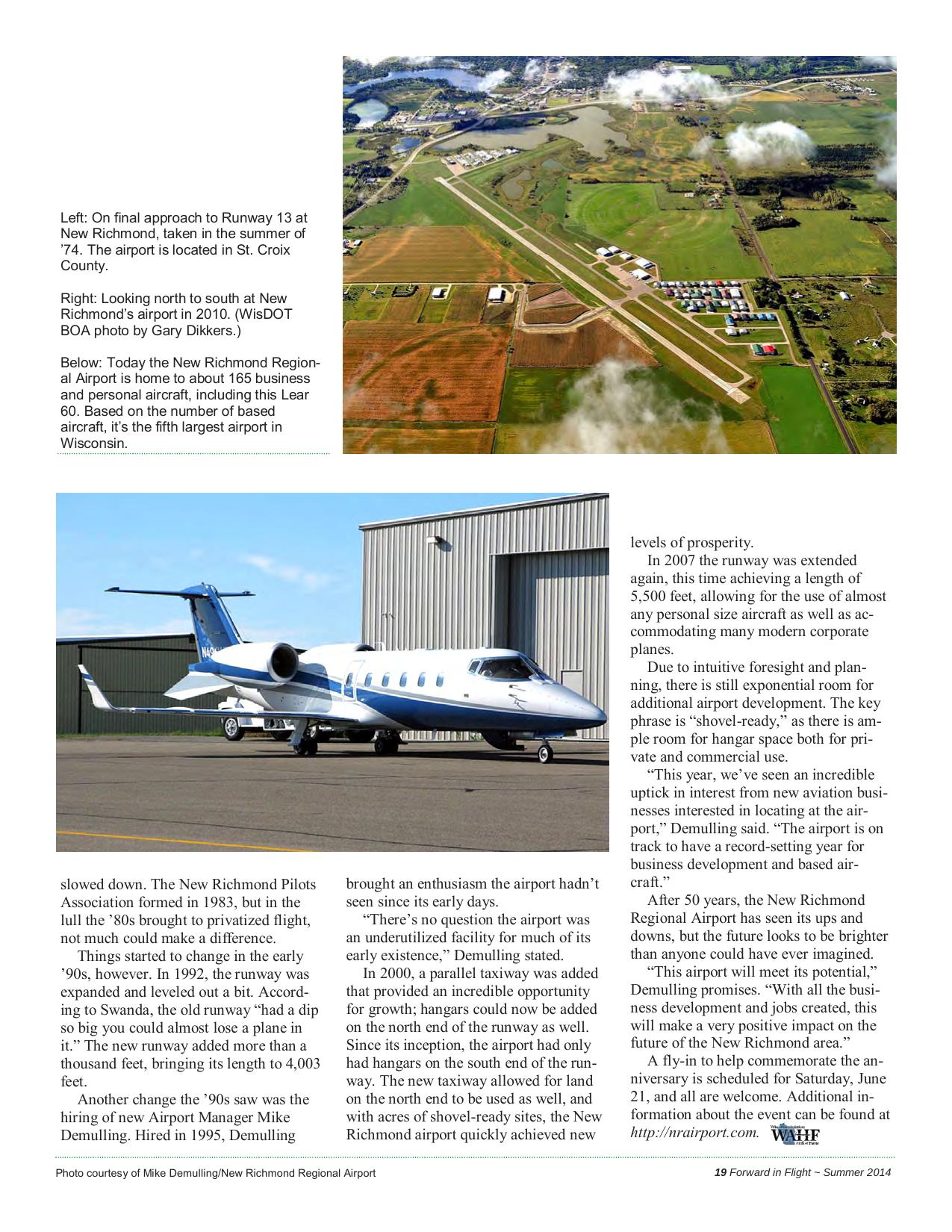
Left: On final approach to Runway 13 at New Richmond, taken in the summer of ’74. The airport is located in St. Croix County. Right: Looking north to south at New Richmond’s airport in 2010. (WisDOT BOA photo by Gary Dikkers.) Below: Today the New Richmond Regional Airport is home to about 165 business and personal aircraft, including this Lear 60. Based on the number of based aircraft, it’s the fifth largest airport in Wisconsin. slowed down. The New Richmond Pilots Association formed in 1983, but in the lull the ’80s brought to privatized flight, not much could make a difference. Things started to change in the early ’90s, however. In 1992, the runway was expanded and leveled out a bit. According to Swanda, the old runway “had a dip so big you could almost lose a plane in it.” The new runway added more than a thousand feet, bringing its length to 4,003 feet. Another change the ’90s saw was the hiring of new Airport Manager Mike Demulling. Hired in 1995, Demulling brought an enthusiasm the airport hadn’t seen since its early days. “There’s no question the airport was an underutilized facility for much of its early existence,” Demulling stated. In 2000, a parallel taxiway was added that provided an incredible opportunity for growth; hangars could now be added on the north end of the runway as well. Since its inception, the airport had only had hangars on the south end of the runway. The new taxiway allowed for land on the north end to be used as well, and with acres of shovel-ready sites, the New Richmond airport quickly achieved new Photo courtesy of Mike Demulling/New Richmond Regional Airport levels of prosperity. In 2007 the runway was extended again, this time achieving a length of 5,500 feet, allowing for the use of almost any personal size aircraft as well as accommodating many modern corporate planes. Due to intuitive foresight and planning, there is still exponential room for additional airport development. The key phrase is “shovel-ready,” as there is ample room for hangar space both for private and commercial use. “This year, we’ve seen an incredible uptick in interest from new aviation businesses interested in locating at the airport,” Demulling said. “The airport is on track to have a record-setting year for business development and based aircraft.” After 50 years, the New Richmond Regional Airport has seen its ups and downs, but the future looks to be brighter than anyone could have ever imagined. “This airport will meet its potential,” Demulling promises. “With all the business development and jobs created, this will make a very positive impact on the future of the New Richmond area.” A fly-in to help commemorate the anniversary is scheduled for Saturday, June 21, and all are welcome. Additional information about the event can be found at http://nrairport.com. 19 Forward in Flight ~ Summer 2014
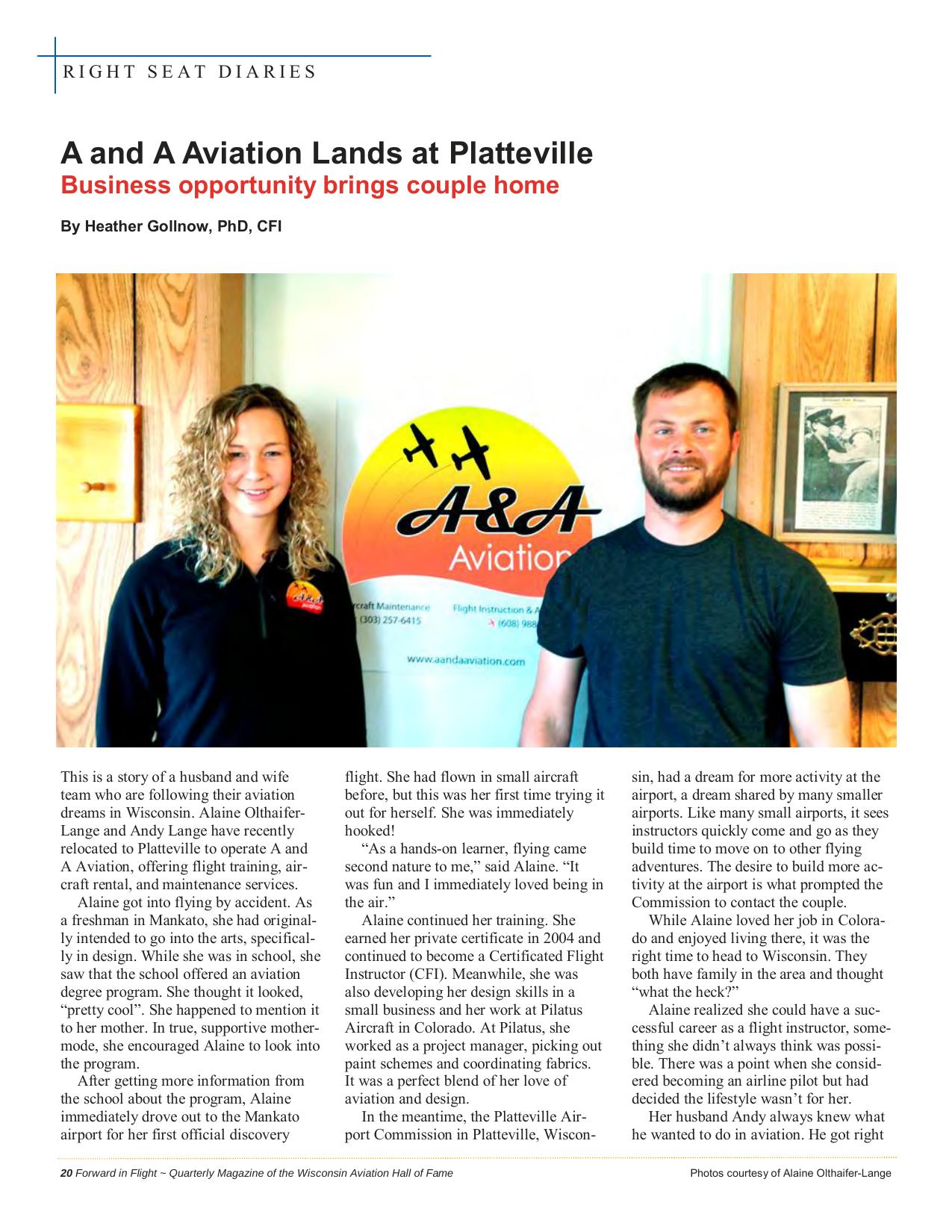
RIGHT SEAT DIARIES A and A Aviation Lands at Platteville Business opportunity brings couple home By Heather Gollnow, PhD, CFI This is a story of a husband and wife team who are following their aviation dreams in Wisconsin. Alaine OlthaiferLange and Andy Lange have recently relocated to Platteville to operate A and A Aviation, offering flight training, aircraft rental, and maintenance services. Alaine got into flying by accident. As a freshman in Mankato, she had originally intended to go into the arts, specifically in design. While she was in school, she saw that the school offered an aviation degree program. She thought it looked, “pretty cool”. She happened to mention it to her mother. In true, supportive mothermode, she encouraged Alaine to look into the program. After getting more information from the school about the program, Alaine immediately drove out to the Mankato airport for her first official discovery flight. She had flown in small aircraft before, but this was her first time trying it out for herself. She was immediately hooked! “As a hands-on learner, flying came second nature to me,” said Alaine. “It was fun and I immediately loved being in the air.” Alaine continued her training. She earned her private certificate in 2004 and continued to become a Certificated Flight Instructor (CFI). Meanwhile, she was also developing her design skills in a small business and her work at Pilatus Aircraft in Colorado. At Pilatus, she worked as a project manager, picking out paint schemes and coordinating fabrics. It was a perfect blend of her love of aviation and design. In the meantime, the Platteville Airport Commission in Platteville, Wiscon- 20 Forward in Flight ~ Quarterly Magazine of the Wisconsin Aviation Hall of Fame sin, had a dream for more activity at the airport, a dream shared by many smaller airports. Like many small airports, it sees instructors quickly come and go as they build time to move on to other flying adventures. The desire to build more activity at the airport is what prompted the Commission to contact the couple. While Alaine loved her job in Colorado and enjoyed living there, it was the right time to head to Wisconsin. They both have family in the area and thought “what the heck?” Alaine realized she could have a successful career as a flight instructor, something she didn’t always think was possible. There was a point when she considered becoming an airline pilot but had decided the lifestyle wasn’t for her. Her husband Andy always knew what he wanted to do in aviation. He got right Photos courtesy of Alaine Olthaifer-Lange
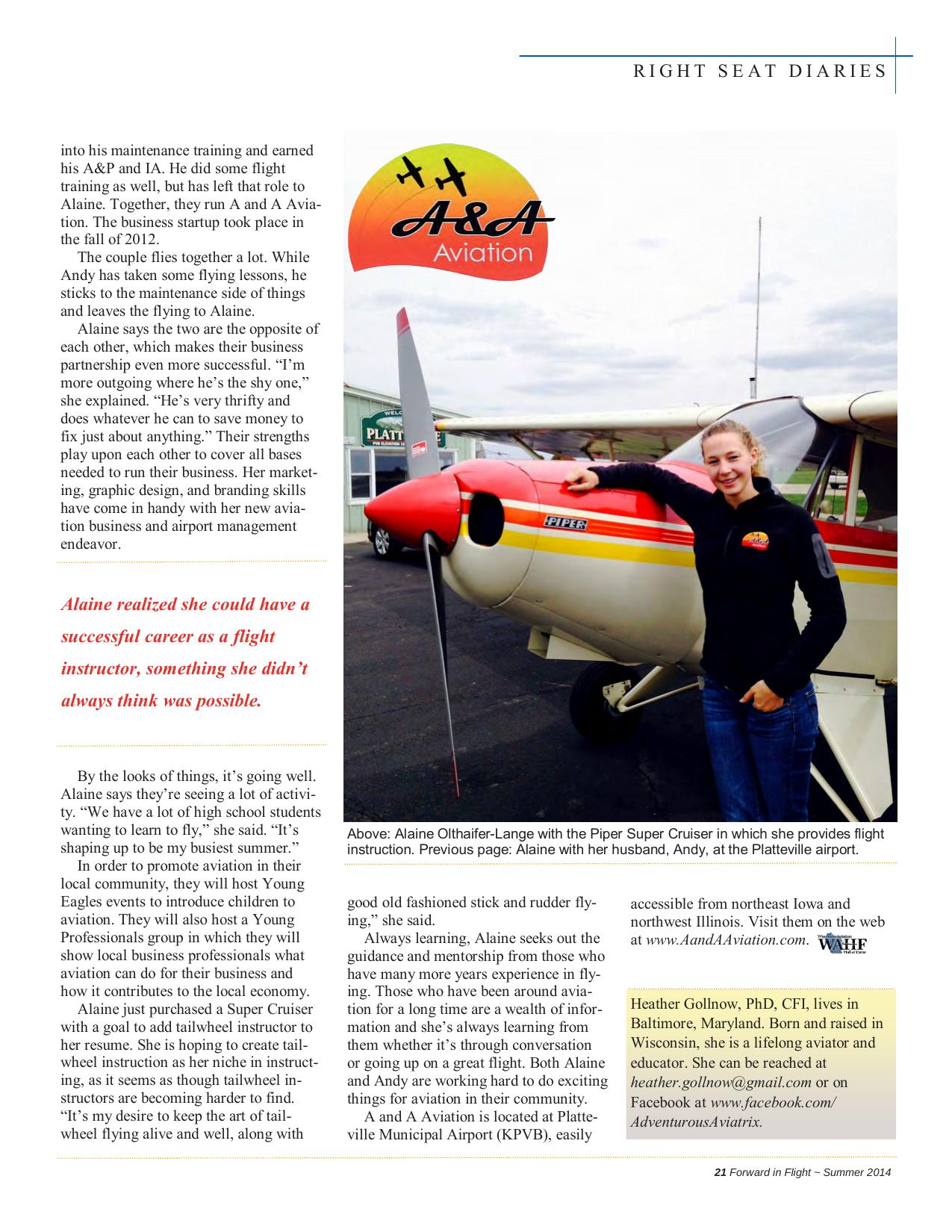
RIGHT SEAT DIARIES into his maintenance training and earned his A&P and IA. He did some flight training as well, but has left that role to Alaine. Together, they run A and A Aviation. The business startup took place in the fall of 2012. The couple flies together a lot. While Andy has taken some flying lessons, he sticks to the maintenance side of things and leaves the flying to Alaine. Alaine says the two are the opposite of each other, which makes their business partnership even more successful. “I’m more outgoing where he’s the shy one,” she explained. “He’s very thrifty and does whatever he can to save money to fix just about anything.” Their strengths play upon each other to cover all bases needed to run their business. Her marketing, graphic design, and branding skills have come in handy with her new aviation business and airport management endeavor. Alaine realized she could have a successful career as a flight instructor, something she didn’t always think was possible. By the looks of things, it’s going well. Alaine says they’re seeing a lot of activity. “We have a lot of high school students wanting to learn to fly,” she said. “It’s shaping up to be my busiest summer.” In order to promote aviation in their local community, they will host Young Eagles events to introduce children to aviation. They will also host a Young Professionals group in which they will show local business professionals what aviation can do for their business and how it contributes to the local economy. Alaine just purchased a Super Cruiser with a goal to add tailwheel instructor to her resume. She is hoping to create tailwheel instruction as her niche in instructing, as it seems as though tailwheel instructors are becoming harder to find. “It’s my desire to keep the art of tailwheel flying alive and well, along with Above: Alaine Olthaifer-Lange with the Piper Super Cruiser in which she provides flight instruction. Previous page: Alaine with her husband, Andy, at the Platteville airport. good old fashioned stick and rudder flying,” she said. Always learning, Alaine seeks out the guidance and mentorship from those who have many more years experience in flying. Those who have been around aviation for a long time are a wealth of information and she’s always learning from them whether it’s through conversation or going up on a great flight. Both Alaine and Andy are working hard to do exciting things for aviation in their community. A and A Aviation is located at Platteville Municipal Airport (KPVB), easily accessible from northeast Iowa and northwest Illinois. Visit them on the web at www.AandAAviation.com. Heather Gollnow, PhD, CFI, lives in Baltimore, Maryland. Born and raised in Wisconsin, she is a lifelong aviator and educator. She can be reached at heather.gollnow@gmail.com or on Facebook at www.facebook.com/ AdventurousAviatrix. 21 Forward in Flight ~ Summer 2014
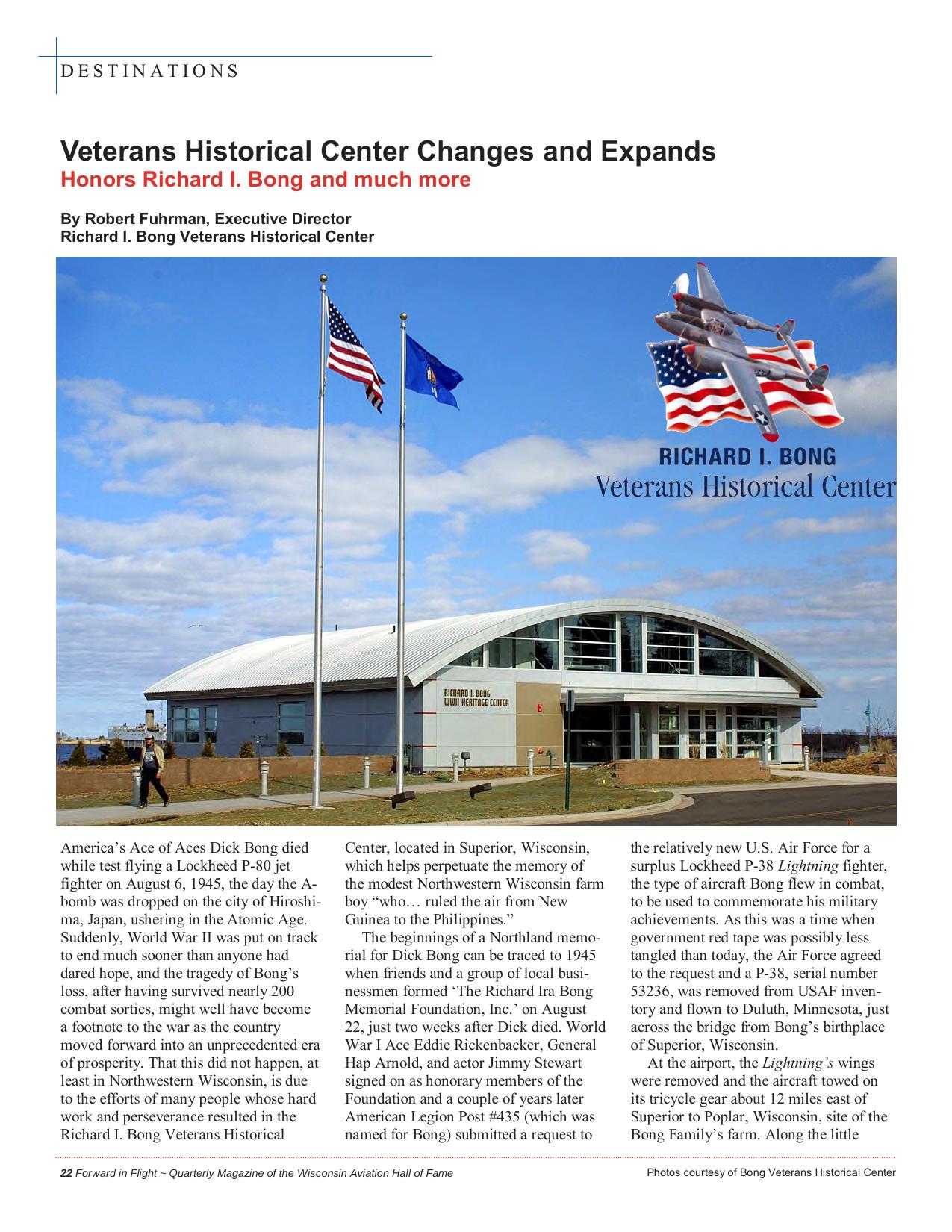
DESTINATIONS Veterans Historical Center Changes and Expands Honors Richard I. Bong and much more By Robert Fuhrman, Executive Director Richard I. Bong Veterans Historical Center America’s Ace of Aces Dick Bong died while test flying a Lockheed P-80 jet fighter on August 6, 1945, the day the Abomb was dropped on the city of Hiroshima, Japan, ushering in the Atomic Age. Suddenly, World War II was put on track to end much sooner than anyone had dared hope, and the tragedy of Bong’s loss, after having survived nearly 200 combat sorties, might well have become a footnote to the war as the country moved forward into an unprecedented era of prosperity. That this did not happen, at least in Northwestern Wisconsin, is due to the efforts of many people whose hard work and perseverance resulted in the Richard I. Bong Veterans Historical Center, located in Superior, Wisconsin, which helps perpetuate the memory of the modest Northwestern Wisconsin farm boy “who… ruled the air from New Guinea to the Philippines.” The beginnings of a Northland memorial for Dick Bong can be traced to 1945 when friends and a group of local businessmen formed ‘The Richard Ira Bong Memorial Foundation, Inc.’ on August 22, just two weeks after Dick died. World War I Ace Eddie Rickenbacker, General Hap Arnold, and actor Jimmy Stewart signed on as honorary members of the Foundation and a couple of years later American Legion Post #435 (which was named for Bong) submitted a request to 22 Forward in Flight ~ Quarterly Magazine of the Wisconsin Aviation Hall of Fame the relatively new U.S. Air Force for a surplus Lockheed P-38 Lightning fighter, the type of aircraft Bong flew in combat, to be used to commemorate his military achievements. As this was a time when government red tape was possibly less tangled than today, the Air Force agreed to the request and a P-38, serial number 53236, was removed from USAF inventory and flown to Duluth, Minnesota, just across the bridge from Bong’s birthplace of Superior, Wisconsin. At the airport, the Lightning’s wings were removed and the aircraft towed on its tricycle gear about 12 miles east of Superior to Poplar, Wisconsin, site of the Bong Family’s farm. Along the little Photos courtesy of Bong Veterans Historical Center
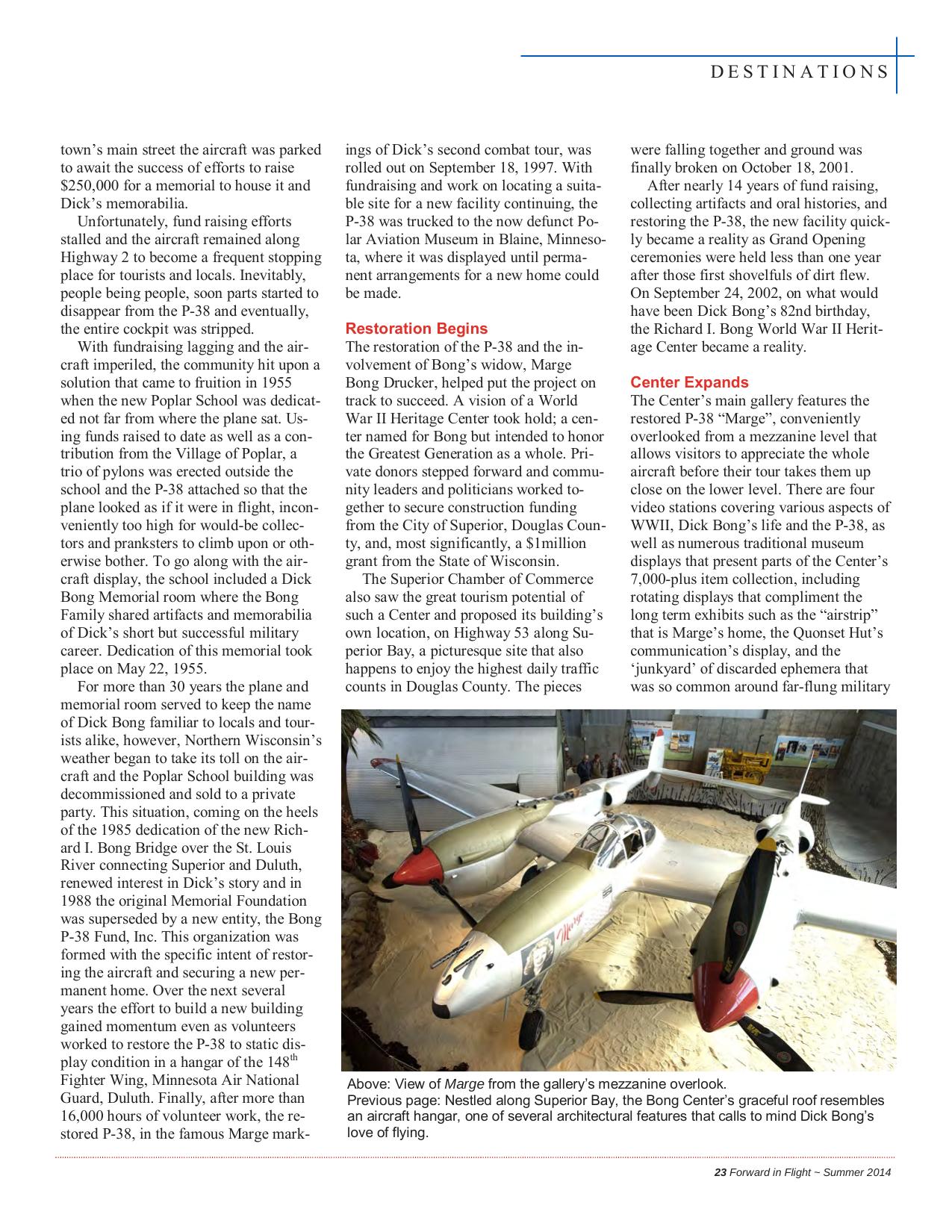
DESTINATIONS town’s main street the aircraft was parked to await the success of efforts to raise $250,000 for a memorial to house it and Dick’s memorabilia. Unfortunately, fund raising efforts stalled and the aircraft remained along Highway 2 to become a frequent stopping place for tourists and locals. Inevitably, people being people, soon parts started to disappear from the P-38 and eventually, the entire cockpit was stripped. With fundraising lagging and the aircraft imperiled, the community hit upon a solution that came to fruition in 1955 when the new Poplar School was dedicated not far from where the plane sat. Using funds raised to date as well as a contribution from the Village of Poplar, a trio of pylons was erected outside the school and the P-38 attached so that the plane looked as if it were in flight, inconveniently too high for would-be collectors and pranksters to climb upon or otherwise bother. To go along with the aircraft display, the school included a Dick Bong Memorial room where the Bong Family shared artifacts and memorabilia of Dick’s short but successful military career. Dedication of this memorial took place on May 22, 1955. For more than 30 years the plane and memorial room served to keep the name of Dick Bong familiar to locals and tourists alike, however, Northern Wisconsin’s weather began to take its toll on the aircraft and the Poplar School building was decommissioned and sold to a private party. This situation, coming on the heels of the 1985 dedication of the new Richard I. Bong Bridge over the St. Louis River connecting Superior and Duluth, renewed interest in Dick’s story and in 1988 the original Memorial Foundation was superseded by a new entity, the Bong P-38 Fund, Inc. This organization was formed with the specific intent of restoring the aircraft and securing a new permanent home. Over the next several years the effort to build a new building gained momentum even as volunteers worked to restore the P-38 to static display condition in a hangar of the 148th Fighter Wing, Minnesota Air National Guard, Duluth. Finally, after more than 16,000 hours of volunteer work, the restored P-38, in the famous Marge mark- ings of Dick’s second combat tour, was rolled out on September 18, 1997. With fundraising and work on locating a suitable site for a new facility continuing, the P-38 was trucked to the now defunct Polar Aviation Museum in Blaine, Minnesota, where it was displayed until permanent arrangements for a new home could be made. Restoration Begins The restoration of the P-38 and the involvement of Bong’s widow, Marge Bong Drucker, helped put the project on track to succeed. A vision of a World War II Heritage Center took hold; a center named for Bong but intended to honor the Greatest Generation as a whole. Private donors stepped forward and community leaders and politicians worked together to secure construction funding from the City of Superior, Douglas County, and, most significantly, a $1million grant from the State of Wisconsin. The Superior Chamber of Commerce also saw the great tourism potential of such a Center and proposed its building’s own location, on Highway 53 along Superior Bay, a picturesque site that also happens to enjoy the highest daily traffic counts in Douglas County. The pieces were falling together and ground was finally broken on October 18, 2001. After nearly 14 years of fund raising, collecting artifacts and oral histories, and restoring the P-38, the new facility quickly became a reality as Grand Opening ceremonies were held less than one year after those first shovelfuls of dirt flew. On September 24, 2002, on what would have been Dick Bong’s 82nd birthday, the Richard I. Bong World War II Heritage Center became a reality. Center Expands The Center’s main gallery features the restored P-38 “Marge”, conveniently overlooked from a mezzanine level that allows visitors to appreciate the whole aircraft before their tour takes them up close on the lower level. There are four video stations covering various aspects of WWII, Dick Bong’s life and the P-38, as well as numerous traditional museum displays that present parts of the Center’s 7,000-plus item collection, including rotating displays that compliment the long term exhibits such as the “airstrip” that is Marge’s home, the Quonset Hut’s communication’s display, and the ‘junkyard’ of discarded ephemera that was so common around far-flung military Above: View of Marge from the gallery’s mezzanine overlook. Previous page: Nestled along Superior Bay, the Bong Center’s graceful roof resembles an aircraft hangar, one of several architectural features that calls to mind Dick Bong’s love of flying. 23 Forward in Flight ~ Summer 2014
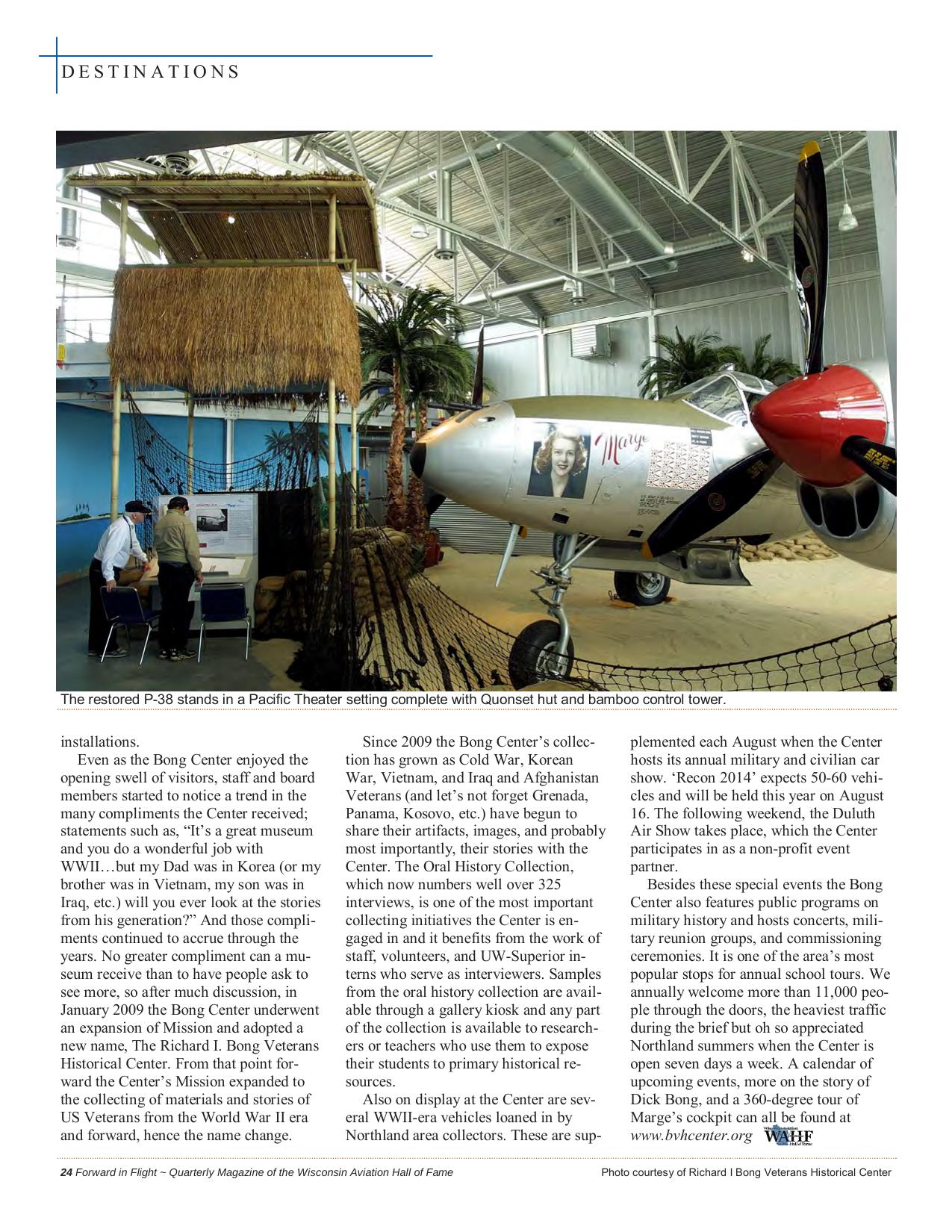
DESTINATIONS The restored P-38 stands in a Pacific Theater setting complete with Quonset hut and bamboo control tower. installations. Even as the Bong Center enjoyed the opening swell of visitors, staff and board members started to notice a trend in the many compliments the Center received; statements such as, “It’s a great museum and you do a wonderful job with WWII…but my Dad was in Korea (or my brother was in Vietnam, my son was in Iraq, etc.) will you ever look at the stories from his generation?” And those compliments continued to accrue through the years. No greater compliment can a museum receive than to have people ask to see more, so after much discussion, in January 2009 the Bong Center underwent an expansion of Mission and adopted a new name, The Richard I. Bong Veterans Historical Center. From that point forward the Center’s Mission expanded to the collecting of materials and stories of US Veterans from the World War II era and forward, hence the name change. Since 2009 the Bong Center’s collection has grown as Cold War, Korean War, Vietnam, and Iraq and Afghanistan Veterans (and let’s not forget Grenada, Panama, Kosovo, etc.) have begun to share their artifacts, images, and probably most importantly, their stories with the Center. The Oral History Collection, which now numbers well over 325 interviews, is one of the most important collecting initiatives the Center is engaged in and it benefits from the work of staff, volunteers, and UW-Superior interns who serve as interviewers. Samples from the oral history collection are available through a gallery kiosk and any part of the collection is available to researchers or teachers who use them to expose their students to primary historical resources. Also on display at the Center are several WWII-era vehicles loaned in by Northland area collectors. These are sup- 24 Forward in Flight ~ Quarterly Magazine of the Wisconsin Aviation Hall of Fame plemented each August when the Center hosts its annual military and civilian car show. ‘Recon 2014’ expects 50-60 vehicles and will be held this year on August 16. The following weekend, the Duluth Air Show takes place, which the Center participates in as a non-profit event partner. Besides these special events the Bong Center also features public programs on military history and hosts concerts, military reunion groups, and commissioning ceremonies. It is one of the area’s most popular stops for annual school tours. We annually welcome more than 11,000 people through the doors, the heaviest traffic during the brief but oh so appreciated Northland summers when the Center is open seven days a week. A calendar of upcoming events, more on the story of Dick Bong, and a 360-degree tour of Marge’s cockpit can all be found at www.bvhcenter.org Photo courtesy of Richard I Bong Veterans Historical Center
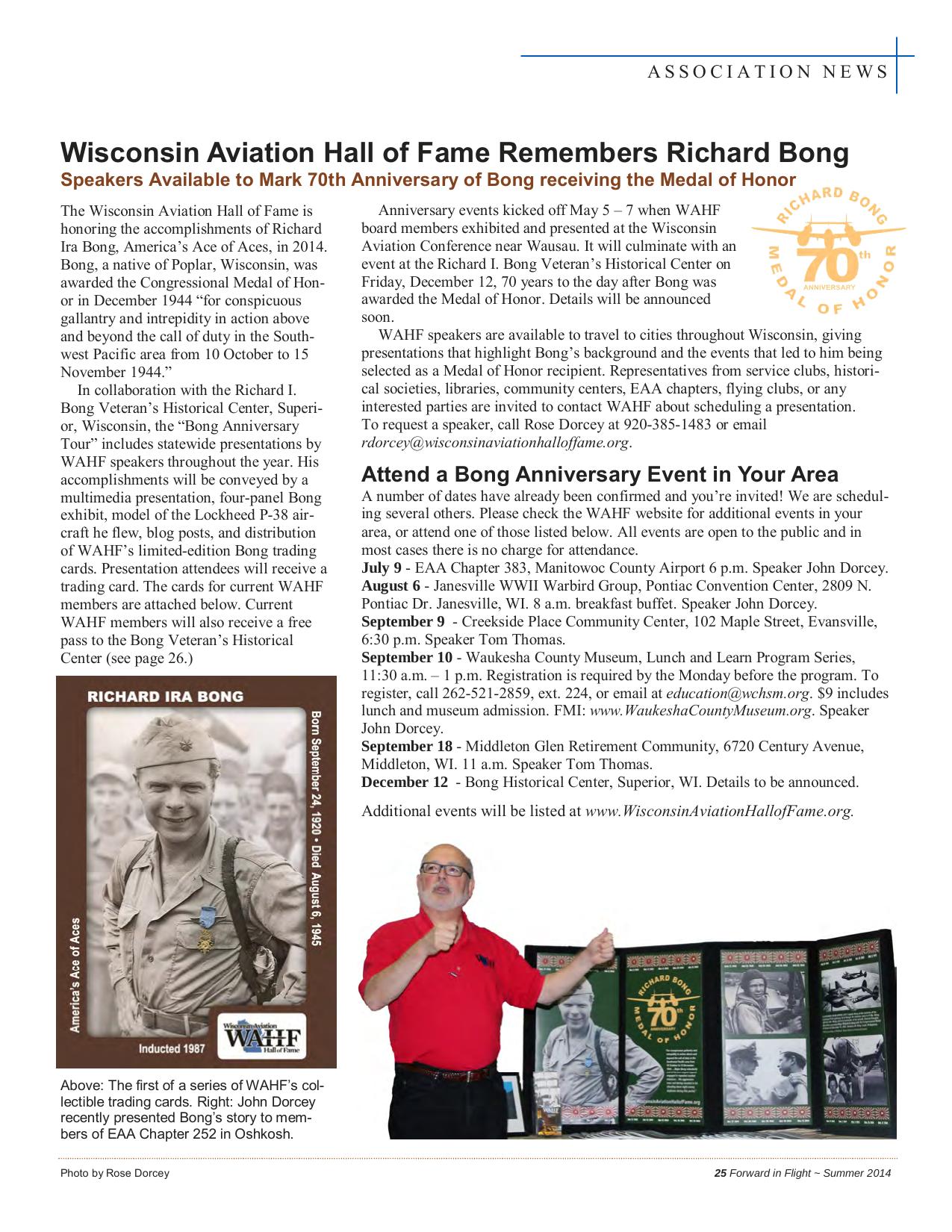
ASSOCIATION NEWS Wisconsin Aviation Hall of Fame Remembers Richard Bong Speakers Available to Mark 70th Anniversary of Bong receiving the Medal of Honor The Wisconsin Aviation Hall of Fame is honoring the accomplishments of Richard Ira Bong, America’s Ace of Aces, in 2014. Bong, a native of Poplar, Wisconsin, was awarded the Congressional Medal of Honor in December 1944 “for conspicuous gallantry and intrepidity in action above and beyond the call of duty in the Southwest Pacific area from 10 October to 15 November 1944.” In collaboration with the Richard I. Bong Veteran’s Historical Center, Superior, Wisconsin, the “Bong Anniversary Tour” includes statewide presentations by WAHF speakers throughout the year. His accomplishments will be conveyed by a multimedia presentation, four-panel Bong exhibit, model of the Lockheed P-38 aircraft he flew, blog posts, and distribution of WAHF’s limited-edition Bong trading cards. Presentation attendees will receive a trading card. The cards for current WAHF members are attached below. Current WAHF members will also receive a free pass to the Bong Veteran’s Historical Center (see page 26.) Anniversary events kicked off May 5 – 7 when WAHF board members exhibited and presented at the Wisconsin Aviation Conference near Wausau. It will culminate with an event at the Richard I. Bong Veteran’s Historical Center on Friday, December 12, 70 years to the day after Bong was awarded the Medal of Honor. Details will be announced soon. WAHF speakers are available to travel to cities throughout Wisconsin, giving presentations that highlight Bong’s background and the events that led to him being selected as a Medal of Honor recipient. Representatives from service clubs, historical societies, libraries, community centers, EAA chapters, flying clubs, or any interested parties are invited to contact WAHF about scheduling a presentation. To request a speaker, call Rose Dorcey at 920-385-1483 or email rdorcey@wisconsinaviationhalloffame.org. Attend a Bong Anniversary Event in Your Area A number of dates have already been confirmed and you’re invited! We are scheduling several others. Please check the WAHF website for additional events in your area, or attend one of those listed below. All events are open to the public and in most cases there is no charge for attendance. July 9 - EAA Chapter 383, Manitowoc County Airport 6 p.m. Speaker John Dorcey. August 6 - Janesville WWII Warbird Group, Pontiac Convention Center, 2809 N. Pontiac Dr. Janesville, WI. 8 a.m. breakfast buffet. Speaker John Dorcey. September 9 - Creekside Place Community Center, 102 Maple Street, Evansville, 6:30 p.m. Speaker Tom Thomas. September 10 - Waukesha County Museum, Lunch and Learn Program Series, 11:30 a.m. – 1 p.m. Registration is required by the Monday before the program. To register, call 262-521-2859, ext. 224, or email at education@wchsm.org. $9 includes lunch and museum admission. FMI: www.WaukeshaCountyMuseum.org. Speaker John Dorcey. September 18 - Middleton Glen Retirement Community, 6720 Century Avenue, Middleton, WI. 11 a.m. Speaker Tom Thomas. December 12 - Bong Historical Center, Superior, WI. Details to be announced. Additional events will be listed at www.WisconsinAviationHallofFame.org. Above: The first of a series of WAHF’s collectible trading cards. Right: John Dorcey recently presented Bong’s story to members of EAA Chapter 252 in Oshkosh. Photo by Rose Dorcey 25 Forward in Flight ~ Summer 2014
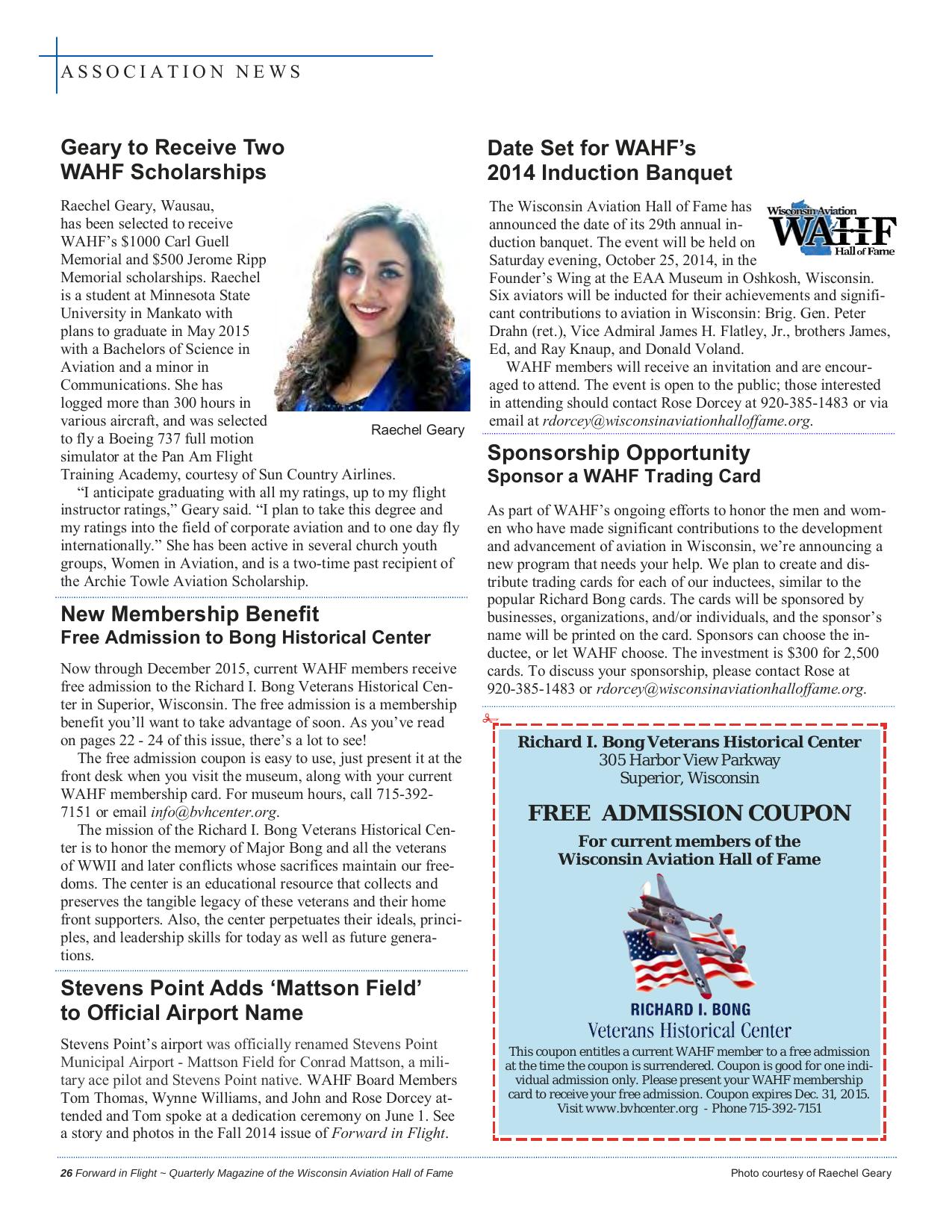
ASSOCIATION NEWS Geary to Receive Two WAHF Scholarships Date Set for WAHF’s 2014 Induction Banquet Raechel Geary, Wausau, has been selected to receive WAHF’s $1000 Carl Guell Memorial and $500 Jerome Ripp Memorial scholarships. Raechel is a student at Minnesota State University in Mankato with plans to graduate in May 2015 with a Bachelors of Science in Aviation and a minor in Communications. She has logged more than 300 hours in various aircraft, and was selected Raechel Geary to fly a Boeing 737 full motion simulator at the Pan Am Flight Training Academy, courtesy of Sun Country Airlines. “I anticipate graduating with all my ratings, up to my flight instructor ratings,” Geary said. “I plan to take this degree and my ratings into the field of corporate aviation and to one day fly internationally.” She has been active in several church youth groups, Women in Aviation, and is a two-time past recipient of the Archie Towle Aviation Scholarship. The Wisconsin Aviation Hall of Fame has announced the date of its 29th annual induction banquet. The event will be held on Saturday evening, October 25, 2014, in the Founder’s Wing at the EAA Museum in Oshkosh, Wisconsin. Six aviators will be inducted for their achievements and significant contributions to aviation in Wisconsin: Brig. Gen. Peter Drahn (ret.), Vice Admiral James H. Flatley, Jr., brothers James, Ed, and Ray Knaup, and Donald Voland. WAHF members will receive an invitation and are encouraged to attend. The event is open to the public; those interested in attending should contact Rose Dorcey at 920-385-1483 or via email at rdorcey@wisconsinaviationhalloffame.org. New Membership Benefit Free Admission to Bong Historical Center Now through December 2015, current WAHF members receive free admission to the Richard I. Bong Veterans Historical Center in Superior, Wisconsin. The free admission is a membership benefit you’ll want to take advantage of soon. As you’ve read on pages 22 - 24 of this issue, there’s a lot to see! The free admission coupon is easy to use, just present it at the front desk when you visit the museum, along with your current WAHF membership card. For museum hours, call 715-3927151 or email info@bvhcenter.org. The mission of the Richard I. Bong Veterans Historical Center is to honor the memory of Major Bong and all the veterans of WWII and later conflicts whose sacrifices maintain our freedoms. The center is an educational resource that collects and preserves the tangible legacy of these veterans and their home front supporters. Also, the center perpetuates their ideals, principles, and leadership skills for today as well as future generations. Sponsorship Opportunity Sponsor a WAHF Trading Card As part of WAHF’s ongoing efforts to honor the men and women who have made significant contributions to the development and advancement of aviation in Wisconsin, we’re announcing a new program that needs your help. We plan to create and distribute trading cards for each of our inductees, similar to the popular Richard Bong cards. The cards will be sponsored by businesses, organizations, and/or individuals, and the sponsor’s name will be printed on the card. Sponsors can choose the inductee, or let WAHF choose. The investment is $300 for 2,500 cards. To discuss your sponsorship, please contact Rose at 920-385-1483 or rdorcey@wisconsinaviationhalloffame.org. Richard I. Bong Veterans Historical Center 305 Harbor View Parkway Superior, Wisconsin FREE ADMISSION COUPON For current members of the Wisconsin Aviation Hall of Fame Stevens Point Adds ‘Mattson Field’ to Official Airport Name Stevens Point’s airport was officially renamed Stevens Point Municipal Airport - Mattson Field for Conrad Mattson, a military ace pilot and Stevens Point native. WAHF Board Members Tom Thomas, Wynne Williams, and John and Rose Dorcey attended and Tom spoke at a dedication ceremony on June 1. See a story and photos in the Fall 2014 issue of Forward in Flight. 26 Forward in Flight ~ Quarterly Magazine of the Wisconsin Aviation Hall of Fame This coupon entitles a current WAHF member to a free admission at the time the coupon is surrendered. Coupon is good for one individual admission only. Please present your WAHF membership card to receive your free admission. Coupon expires Dec. 31, 2015. Visit www.bvhcenter.org - Phone 715-392-7151 Photo courtesy of Raechel Geary
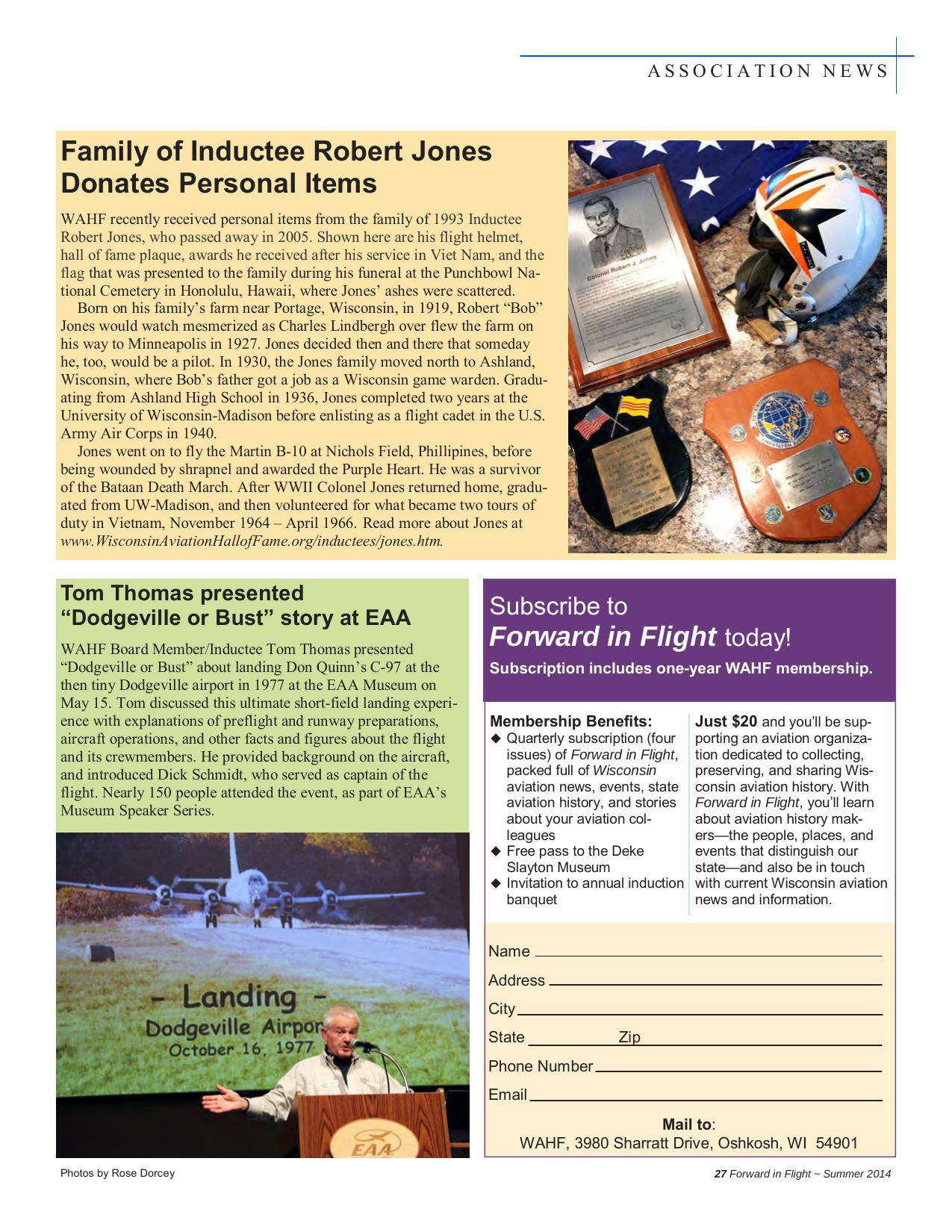
ASSOCIATION NEWS Family of Inductee Robert Jones Donates Personal Items WAHF recently received personal items from the family of 1993 Inductee Robert Jones, who passed away in 2005. Shown here are his flight helmet, hall of fame plaque, awards he received after his service in Viet Nam, and the flag that was presented to the family during his funeral at the Punchbowl National Cemetery in Honolulu, Hawaii, where Jones’ ashes were scattered. Born on his family’s farm near Portage, Wisconsin, in 1919, Robert “Bob” Jones would watch mesmerized as Charles Lindbergh over flew the farm on his way to Minneapolis in 1927. Jones decided then and there that someday he, too, would be a pilot. In 1930, the Jones family moved north to Ashland, Wisconsin, where Bob’s father got a job as a Wisconsin game warden. Graduating from Ashland High School in 1936, Jones completed two years at the University of Wisconsin-Madison before enlisting as a flight cadet in the U.S. Army Air Corps in 1940. Jones went on to fly the Martin B-10 at Nichols Field, Phillipines, before being wounded by shrapnel and awarded the Purple Heart. He was a survivor of the Bataan Death March. After WWII Colonel Jones returned home, graduated from UW-Madison, and then volunteered for what became two tours of duty in Vietnam, November 1964 – April 1966. Read more about Jones at www.WisconsinAviationHallofFame.org/inductees/jones.htm. Tom Thomas presented “Dodgeville or Bust” story at EAA WAHF Board Member/Inductee Tom Thomas presented “Dodgeville or Bust” about landing Don Quinn’s C-97 at the then tiny Dodgeville airport in 1977 at the EAA Museum on May 15. Tom discussed this ultimate short-field landing experience with explanations of preflight and runway preparations, aircraft operations, and other facts and figures about the flight and its crewmembers. He provided background on the aircraft, and introduced Dick Schmidt, who served as captain of the flight. Nearly 150 people attended the event, as part of EAA’s Museum Speaker Series. Subscribe to Forward in Flight today! Subscription includes one-year WAHF membership. Membership Benefits: Quarterly subscription (four issues) of Forward in Flight, packed full of Wisconsin aviation news, events, state aviation history, and stories about your aviation colleagues Free pass to the Deke Slayton Museum Invitation to annual induction banquet Just $20 and you’ll be sup- porting an aviation organization dedicated to collecting, preserving, and sharing Wisconsin aviation history. With Forward in Flight, you’ll learn about aviation history makers—the people, places, and events that distinguish our state—and also be in touch with current Wisconsin aviation news and information. Name Address City State Zip Phone Number Email Mail to: WAHF, 3980 Sharratt Drive, Oshkosh, WI 54901 Photos by Rose Dorcey 27 Forward in Flight ~ Summer 2014
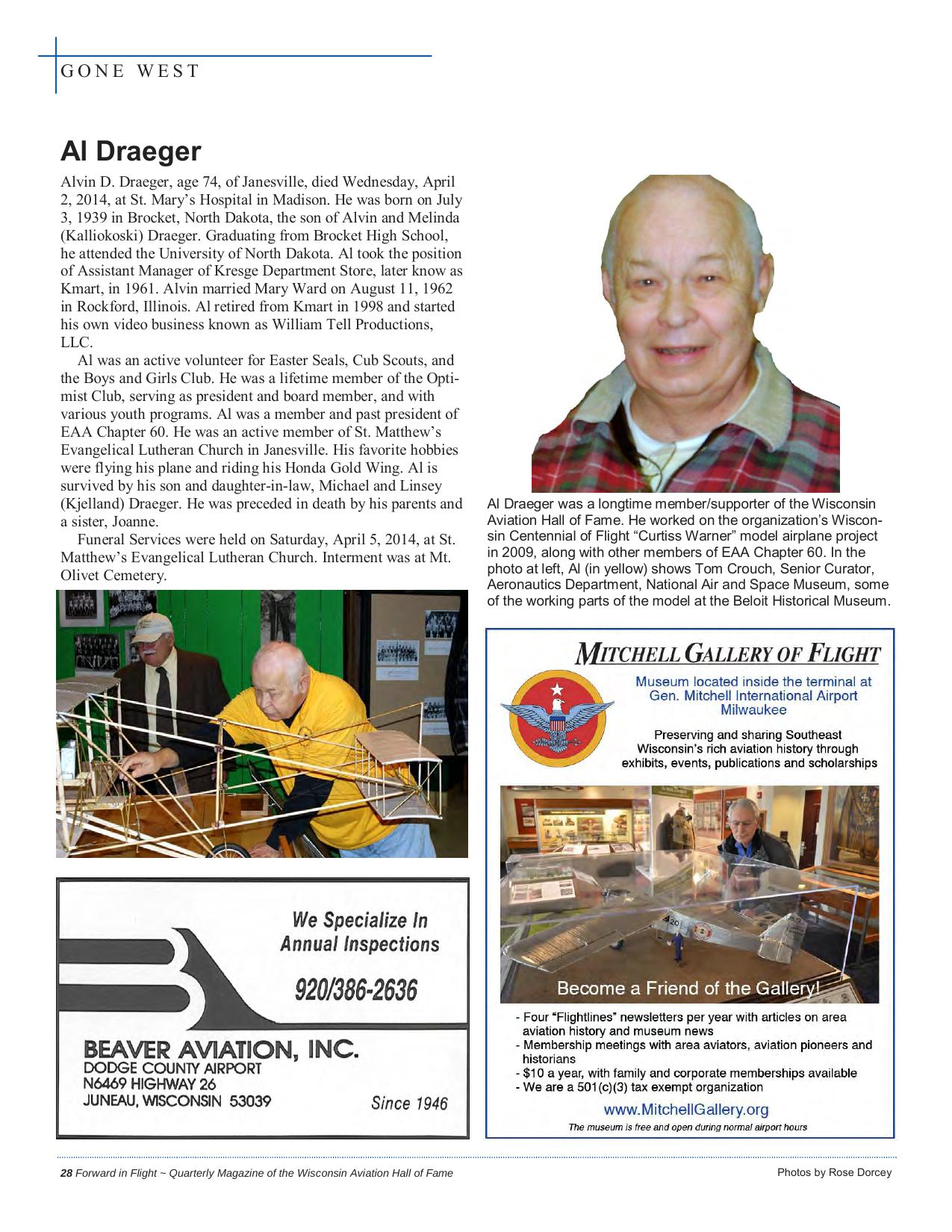
GONE WEST Al Draeger Alvin D. Draeger, age 74, of Janesville, died Wednesday, April 2, 2014, at St. Mary’s Hospital in Madison. He was born on July 3, 1939 in Brocket, North Dakota, the son of Alvin and Melinda (Kalliokoski) Draeger. Graduating from Brocket High School, he attended the University of North Dakota. Al took the position of Assistant Manager of Kresge Department Store, later know as Kmart, in 1961. Alvin married Mary Ward on August 11, 1962 in Rockford, Illinois. Al retired from Kmart in 1998 and started his own video business known as William Tell Productions, LLC. Al was an active volunteer for Easter Seals, Cub Scouts, and the Boys and Girls Club. He was a lifetime member of the Optimist Club, serving as president and board member, and with various youth programs. Al was a member and past president of EAA Chapter 60. He was an active member of St. Matthew’s Evangelical Lutheran Church in Janesville. His favorite hobbies were flying his plane and riding his Honda Gold Wing. Al is survived by his son and daughter-in-law, Michael and Linsey (Kjelland) Draeger. He was preceded in death by his parents and a sister, Joanne. Funeral Services were held on Saturday, April 5, 2014, at St. Matthew’s Evangelical Lutheran Church. Interment was at Mt. Olivet Cemetery. 28 Forward in Flight ~ Quarterly Magazine of the Wisconsin Aviation Hall of Fame Al Draeger was a longtime member/supporter of the Wisconsin Aviation Hall of Fame. He worked on the organization’s Wisconsin Centennial of Flight “Curtiss Warner” model airplane project in 2009, along with other members of EAA Chapter 60. In the photo at left, Al (in yellow) shows Tom Crouch, Senior Curator, Aeronautics Department, National Air and Space Museum, some of the working parts of the model at the Beloit Historical Museum. Photos by Rose Dorcey
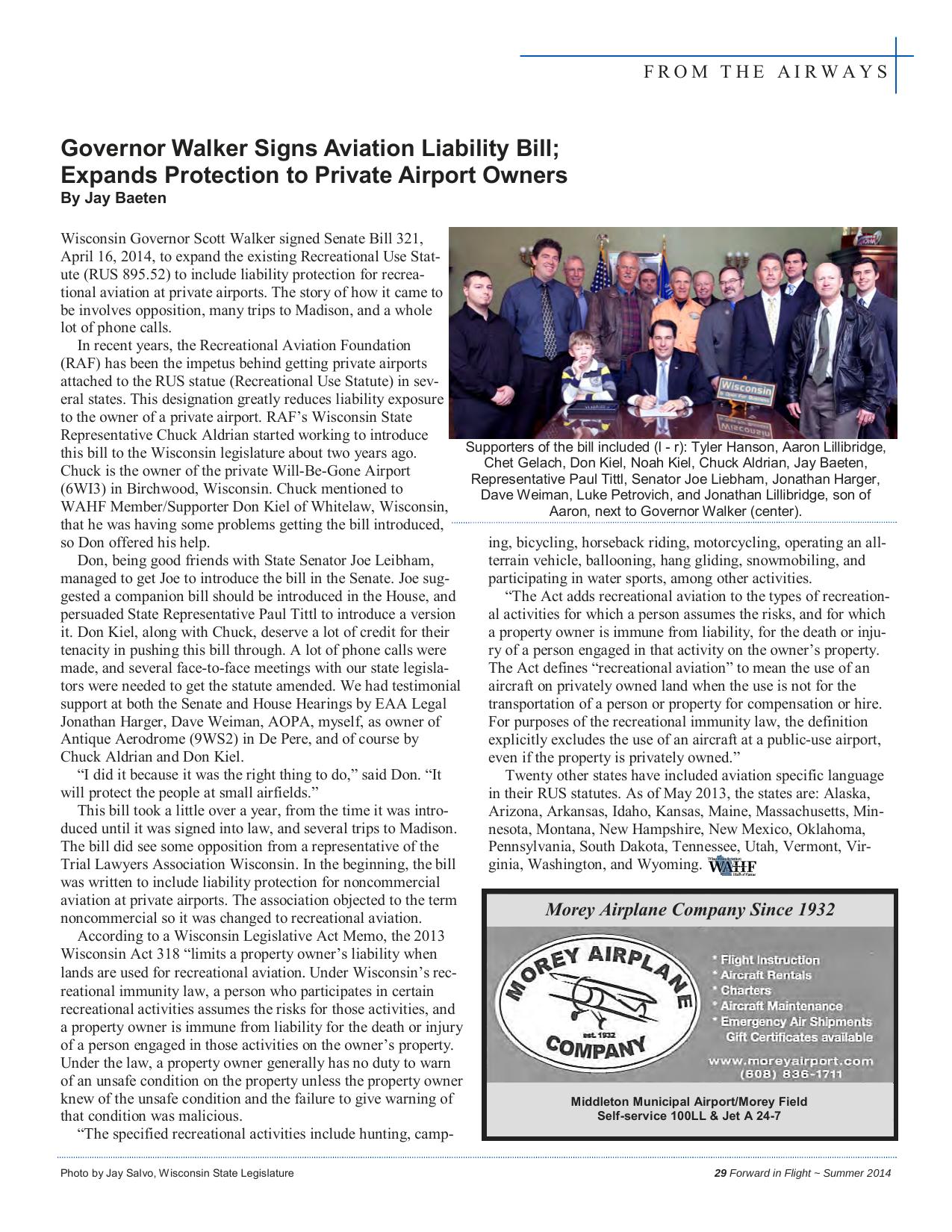
FROM THE AIRWAYS Governor Walker Signs Aviation Liability Bill; Expands Protection to Private Airport Owners By Jay Baeten Wisconsin Governor Scott Walker signed Senate Bill 321, April 16, 2014, to expand the existing Recreational Use Statute (RUS 895.52) to include liability protection for recreational aviation at private airports. The story of how it came to be involves opposition, many trips to Madison, and a whole lot of phone calls. In recent years, the Recreational Aviation Foundation (RAF) has been the impetus behind getting private airports attached to the RUS statue (Recreational Use Statute) in several states. This designation greatly reduces liability exposure to the owner of a private airport. RAF’s Wisconsin State Representative Chuck Aldrian started working to introduce Supporters of the bill included (l - r): Tyler Hanson, Aaron Lillibridge, this bill to the Wisconsin legislature about two years ago. Chet Gelach, Don Kiel, Noah Kiel, Chuck Aldrian, Jay Baeten, Chuck is the owner of the private Will-Be-Gone Airport Representative Paul Tittl, Senator Joe Liebham, Jonathan Harger, (6WI3) in Birchwood, Wisconsin. Chuck mentioned to Dave Weiman, Luke Petrovich, and Jonathan Lillibridge, son of WAHF Member/Supporter Don Kiel of Whitelaw, Wisconsin, Aaron, next to Governor Walker (center). that he was having some problems getting the bill introduced, so Don offered his help. ing, bicycling, horseback riding, motorcycling, operating an allDon, being good friends with State Senator Joe Leibham, terrain vehicle, ballooning, hang gliding, snowmobiling, and managed to get Joe to introduce the bill in the Senate. Joe sugparticipating in water sports, among other activities. gested a companion bill should be introduced in the House, and “The Act adds recreational aviation to the types of recreationpersuaded State Representative Paul Tittl to introduce a version al activities for which a person assumes the risks, and for which a property owner is immune from liability, for the death or injuit. Don Kiel, along with Chuck, deserve a lot of credit for their ry of a person engaged in that activity on the owner’s property. tenacity in pushing this bill through. A lot of phone calls were The Act defines “recreational aviation” to mean the use of an made, and several face-to-face meetings with our state legislaaircraft on privately owned land when the use is not for the tors were needed to get the statute amended. We had testimonial transportation of a person or property for compensation or hire. support at both the Senate and House Hearings by EAA Legal For purposes of the recreational immunity law, the definition Jonathan Harger, Dave Weiman, AOPA, myself, as owner of Antique Aerodrome (9WS2) in De Pere, and of course by explicitly excludes the use of an aircraft at a public-use airport, Chuck Aldrian and Don Kiel. even if the property is privately owned.” “I did it because it was the right thing to do,” said Don. “It Twenty other states have included aviation specific language will protect the people at small airfields.” in their RUS statutes. As of May 2013, the states are: Alaska, This bill took a little over a year, from the time it was introArizona, Arkansas, Idaho, Kansas, Maine, Massachusetts, Minduced until it was signed into law, and several trips to Madison. nesota, Montana, New Hampshire, New Mexico, Oklahoma, Pennsylvania, South Dakota, Tennessee, Utah, Vermont, VirThe bill did see some opposition from a representative of the ginia, Washington, and Wyoming. Trial Lawyers Association Wisconsin. In the beginning, the bill was written to include liability protection for noncommercial aviation at private airports. The association objected to the term Morey Airplane Company Since 1932 noncommercial so it was changed to recreational aviation. According to a Wisconsin Legislative Act Memo, the 2013 Wisconsin Act 318 “limits a property owner’s liability when lands are used for recreational aviation. Under Wisconsin’s recreational immunity law, a person who participates in certain recreational activities assumes the risks for those activities, and a property owner is immune from liability for the death or injury of a person engaged in those activities on the owner’s property. Under the law, a property owner generally has no duty to warn of an unsafe condition on the property unless the property owner knew of the unsafe condition and the failure to give warning of Middleton Municipal Airport/Morey Field Self-service 100LL & Jet A 24-7 that condition was malicious. “The specified recreational activities include hunting, campPhoto by Jay Salvo, Wisconsin State Legislature 29 Forward in Flight ~ Summer 2014
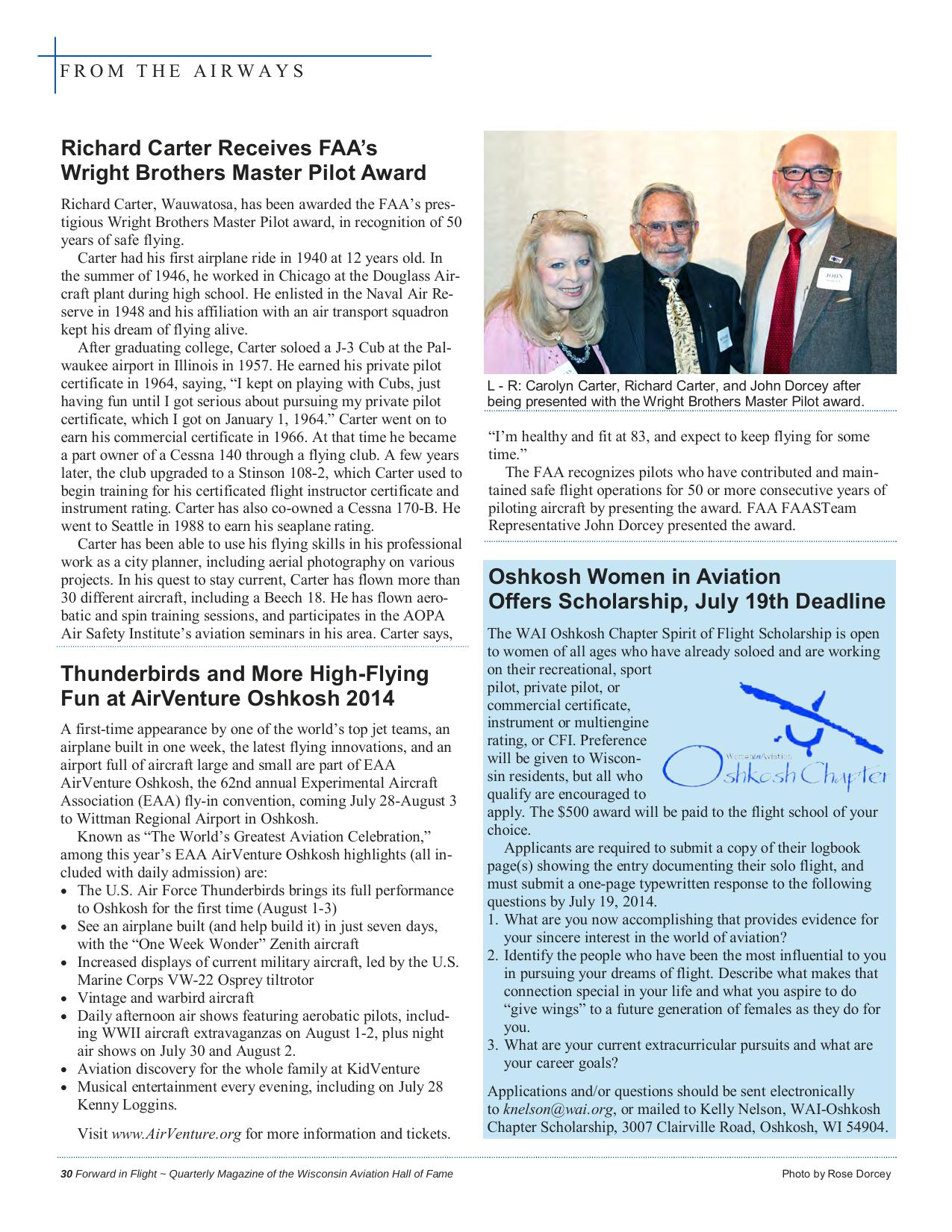
FROM THE AIRWAYS Richard Carter Receives FAA’s Wright Brothers Master Pilot Award Richard Carter, Wauwatosa, has been awarded the FAA’s prestigious Wright Brothers Master Pilot award, in recognition of 50 years of safe flying. Carter had his first airplane ride in 1940 at 12 years old. In the summer of 1946, he worked in Chicago at the Douglass Aircraft plant during high school. He enlisted in the Naval Air Reserve in 1948 and his affiliation with an air transport squadron kept his dream of flying alive. After graduating college, Carter soloed a J-3 Cub at the Palwaukee airport in Illinois in 1957. He earned his private pilot certificate in 1964, saying, “I kept on playing with Cubs, just having fun until I got serious about pursuing my private pilot certificate, which I got on January 1, 1964.” Carter went on to earn his commercial certificate in 1966. At that time he became a part owner of a Cessna 140 through a flying club. A few years later, the club upgraded to a Stinson 108-2, which Carter used to begin training for his certificated flight instructor certificate and instrument rating. Carter has also co-owned a Cessna 170-B. He went to Seattle in 1988 to earn his seaplane rating. Carter has been able to use his flying skills in his professional work as a city planner, including aerial photography on various projects. In his quest to stay current, Carter has flown more than 30 different aircraft, including a Beech 18. He has flown aerobatic and spin training sessions, and participates in the AOPA Air Safety Institute’s aviation seminars in his area. Carter says, Thunderbirds and More High-Flying Fun at AirVenture Oshkosh 2014 A first-time appearance by one of the world’s top jet teams, an airplane built in one week, the latest flying innovations, and an airport full of aircraft large and small are part of EAA AirVenture Oshkosh, the 62nd annual Experimental Aircraft Association (EAA) fly-in convention, coming July 28-August 3 to Wittman Regional Airport in Oshkosh. Known as “The World’s Greatest Aviation Celebration,” among this year’s EAA AirVenture Oshkosh highlights (all included with daily admission) are: · The U.S. Air Force Thunderbirds brings its full performance to Oshkosh for the first time (August 1-3) · See an airplane built (and help build it) in just seven days, with the “One Week Wonder” Zenith aircraft · Increased displays of current military aircraft, led by the U.S. Marine Corps VW-22 Osprey tiltrotor · Vintage and warbird aircraft · Daily afternoon air shows featuring aerobatic pilots, including WWII aircraft extravaganzas on August 1-2, plus night air shows on July 30 and August 2. · Aviation discovery for the whole family at KidVenture · Musical entertainment every evening, including on July 28 Kenny Loggins. Visit www.AirVenture.org for more information and tickets. 30 Forward in Flight ~ Quarterly Magazine of the Wisconsin Aviation Hall of Fame L - R: Carolyn Carter, Richard Carter, and John Dorcey after being presented with the Wright Brothers Master Pilot award. “I’m healthy and fit at 83, and expect to keep flying for some time.” The FAA recognizes pilots who have contributed and maintained safe flight operations for 50 or more consecutive years of piloting aircraft by presenting the award. FAA FAASTeam Representative John Dorcey presented the award. Oshkosh Women in Aviation Offers Scholarship, July 19th Deadline The WAI Oshkosh Chapter Spirit of Flight Scholarship is open to women of all ages who have already soloed and are working on their recreational, sport pilot, private pilot, or commercial certificate, instrument or multiengine rating, or CFI. Preference will be given to Wisconsin residents, but all who qualify are encouraged to apply. The $500 award will be paid to the flight school of your choice. Applicants are required to submit a copy of their logbook page(s) showing the entry documenting their solo flight, and must submit a one-page typewritten response to the following questions by July 19, 2014. 1. What are you now accomplishing that provides evidence for your sincere interest in the world of aviation? 2. Identify the people who have been the most influential to you in pursuing your dreams of flight. Describe what makes that connection special in your life and what you aspire to do “give wings” to a future generation of females as they do for you. 3. What are your current extracurricular pursuits and what are your career goals? Applications and/or questions should be sent electronically to knelson@wai.org, or mailed to Kelly Nelson, WAI-Oshkosh Chapter Scholarship, 3007 Clairville Road, Oshkosh, WI 54904. Photo by Rose Dorcey
FROM THE AIRWAYS The Wisconsin Flying Hamburger Social is Back! Choose one to attend, or several The Wisconsin Flying Hamburger Social 2014 Schedule is out and we’re happy to once again publish it here. Weekly through the summer, FBOs or other organizations at many state airports will sponsor everything needed for an informal dinner of hamburgers (or similar) and other summer fixins’. The emphasis is on getting aviation minded people to the airport, getting local pilots flying, fellowship with friends, and meeting people from other airports. All events are rain or shine. You get all this for the cost of a donation. (Please be generous to help cover costs and encourage more events.) The socials run from 5 - 7 p.m. The 2014 season kicked off on June 4 at Marshfield Municipal Airport-Roy Shwery Field (KMFI). The 2014 schedule: June 11 June 12 June 18 June 19 June 25 June 26 June 30 July 2 Wednesday Wisconsin Rapids Thursday Iron County, Ironwood, MI Wednesday Marshfield Thursday Prentice Wednesday Merrill Thursday Lakeland/Arbor Vitae Monday Sturgeon Bay Wednesday Medford (KISW) (KIWD) (KMFI) (K5N2) (KRRL) (KARV) (KSUE) (KMDZ) July 3 Thursday July 7 Monday July 9 Wednesday July 10 Thursday July 16 Wednesday July 17 Thursday July 18 Friday July 21 Monday July 23 Wednesday July 24 Thursday August 6 Wednesday August 7 Thursday August 8 Friday August 13 Wednesday August 14 Thursday August 20 Wednesday August 21 Thursday August 26 Tuesday August 27 Wednesday August 28 Thursday September 4 Thursday Crandon Walter’s Agri-Center Wausau Three Lakes Stevens Point Rhinelander Shell Lake Ephraim-Gibraltar Antigo Boulder Junction Stevens Point Eagle River Adams County Wausau Land O’ Lakes Wisconsin Rapids Phillips Eau Claire Merrill Tomahawk Manitowish Waters (KY55) (WI28) KAUW) (K40D) (KSTE ) (KRHI ) (KSSQ) (K3D2) (KAIG) (KBDJ) (KSTE) (KEGV) (K63C ) (KAUW) (KLNL) (KISW) (KPBH) (KEAU) (KRRL) (KTKV) (KD25) More info can be found at http://www.wisconsinflying.com. Aerobatic Pilot Bill Cowden Killed in Crash at Stevens Point Air Show Bill Cowden, Menomonie, was killed in a crash at the Stevens Point Air Show on Sunday, June 1. Bill was performing aerobatics in his Yak-55M when he went down into a wooded area about 1,000 feet east of the airport’s Runway 3/21. Bill’s interest in flying began in 1986 when he enlisted in the US Air Force and was trained as an aircraft mechanic. Bill flew F-16 fighter jets in the USAF before retiring in 2006, and had been flying for more than 24 years. He accumulated more than 7,000 hours in more than 85 different models of aircraft. He was an Airframe and Powerplant Mechanic and aircraft builder. Bill was employed as a first officer flying the Boeing 757/767 for Delta Airlines, based in Minneapolis. Bill is survived by his wife, Heather, and son Gunnar. Demulling Earns Seventh Master CFI Designation Master Instructors LLC has announced that Mike Demulling of New Richmond, Wisconsin, has recently renewed his Master CFI accreditation for the seventh time. Mike is the chief pilot for White House Custom Colour and manager of New Richmond Regional Airport (KRNH). Additionally, he owns Mike Demulling Flight Training, specializing in primary, instrument, and recurrent training. Photo courtesy of Mike Demulling 31 Forward in Flight ~ Summer 2014
MEMBER LOGBOOK MAILBOX Member Mail Meet a WAHF member... Tim Lippert Our Readers Write: A quick note to let you know how much I enjoy Forward in Flight every issue and to say thank you for your dedication and tireless efforts with the Wisconsin Aviation Hall of Fame! I really enjoy all the great articles and especially enjoyed John Dorcey’s and Charles Swain’s articles in the Spring issue about their flight on the Collings Foundation’s bombers. Occupation: Aviation Department Manager/Chief Pilot, OPA, LLC, flying a Cessna Citation. Where do you live/where did you grow up: I grew up in Mayville, Wisconsin. Learned to fly in Hartford. Live in Pleasant Prairie and Crandon. Randy Randal W. Van Natta, PE | President Becher-Hoppe Associates, Inc. What do you enjoy most about your life: Doing a job in flying that every pilot would like to do daily. Latest book I’ve read: Life Lessons from my Life with My Brother Timothy Cardinal Dolan, by Bob Dolan. Tim Lippert Favorite airplane: Dassault Falcon 900. How I got interested in aviation/aviation background: My father, Jack, was a WWII B-17 pilot. He flew 33 missions over Germany and Poland. He went on to a career with an insurance company in Milwaukee that owned general aviation aircraft. I’ve been around airplanes my whole life. A person from history I would like to meet: Ronald Reagan because I so respect his views and conservatism. Other hobbies, besides aviation: Taking care of my homes and all that goes with them. The person I most admire: Jesus, for obvious reasons. Name one thing most people don’t know about you: My weird sense of humor. Favorite quote: “The world is your oyster, go out and get it.” - Our world could use more people going after what they want. Why I became a WAHF member: I got involved when my good friend, Jean Hauser, was inducted into the Wisconsin Aviation Hall of Fame several years ago. Meet your fellow WAHF members in each issue of Forward in Flight. Pam & Pat O’Malley Pat O’Malley’s Jet Room Restaurant Wisconsin Aviation Bldg. Dane County Regional Airport Madison, Wis. (MSN) Breakfast & Lunch 6 a.m. - 2 p.m. Mon. thru Sat. 8 a.m. - 2 p.m. Sunday 608-268-5010 www.JetRoomRestaurant.com 32 Forward in Flight ~ Quarterly Magazine of the Wisconsin Aviation Hall of Fame Photos by Rose Dorcey

Wittman Regional Airport Oshkosh So much history ...and still making it! From the legacy of Steve Wittman to Warren Basler’s DC-3 conversions, we’re proud to support and contribute to Wisconsin aviation history. FLY TO OSHKOSH wittmanairport.com @wittmanairport
PRSRT STD US Postage Paid Wisc Rapids WI Permit 98 3980 SHARRATT DRIVE OSHKOSH WI 54901-1276 The Wisconsin Aviation Hall of Fame is a non-profit membership organization dedicated to preserving the past and fostering the future of flight. Welcome WAHF Member/Supporters: Richard Campbell Michael Dean Pam Hamman Karen Kalishek Sid Lytle Glen Phillips Dennis Smith —Thanks for coming on board. We hope to see you at a WAHF event soon! FLY-IN EVENTS: June 15 - Wings & Wheels Sheboygan County Memorial Airport (KSBM), Sheboygan Falls. Pancake breakfast 7 - 11. Sponsored by Sheboygan EAA Chapter 766, the Aviation Heritage Center hosts more than 70 vintage automobiles and 30 unique aircraft every year on Father’s Day. The show will run from 7 a.m. - 4 p.m. Get a close-up look at one-of-kind cars and airplanes and meet pilots and car owners while enjoying food/beverage by local vendors. FMI: Glenn Valenstein 920-377-0704 email: lakeshorefleet@gmail.com June 21 - 22 Menomonie Airfest & Auto Rama, Menomonie Municipal Airport (KLUM) 7 a.m. – 7 p.m. Pancake breakfast, chicken dinner, auto and air shows, kids activities, aircraft rides, and pet walk. Proceeds to benefit the Don Fanetti Memorial Aviation Scholarship. FMI: Jeff Overby 715-379-8399 or visit www.MenomonieAirFest.com. July 20 East Troy Municipal Airport (57C) Annual Open House – East Troy, WI Sponsored by Friends of East Troy Airport, 7 a.m. – 1 p.m. Pancakes, sausage, eggs, more. Airplane & Helicopter rides, Homebuilts, Warbirds & Antique Aircraft, Antique and Classic cars. Model trains on display. Skydiving demo, Raffle w/cash prizes, Trophies awarded for cars and planes. FMI: Dave Springer 262-745-7011 email: djs@fabo.com August 10 Musky Day Fly-In, Land & Seaplane, Boulder Junction Payzer Airport (BDJ) 9 a.m. – 2 p.m. Free dark chicken dinner for pilot and crew. One-of-a-kind cap for the pilot in command. Camping under your wing Saturday night. FMI: Steve Krueger 715-573-9873 email: kruegerfly@aol.com Wisconsin Aviation Hall of Fame Officers and Board of Directors Rose Dorcey, President Tom Thomas, Vice-President John Dorcey, Secretary/Treasurer Bruce Botterman Andrew Ovans Henry Peterson Charles Swain Tom Thomas Wynne Williams Charles Marotske, Honorary Chairman of the Board Wisconsin Aviation Hall of Fame 3980 Sharratt Drive Oshkosh, WI 54901-1276 Become a supporter today! For information call Rose Dorcey at 920-385-1483 www.wisconsinaviationhalloffame.org rdorcey@wisconsinaviationhalloffame.org