Volume 14, Issue 2
🗞️ Download Issue (PDF)
Forward in Flight - Summer 2016
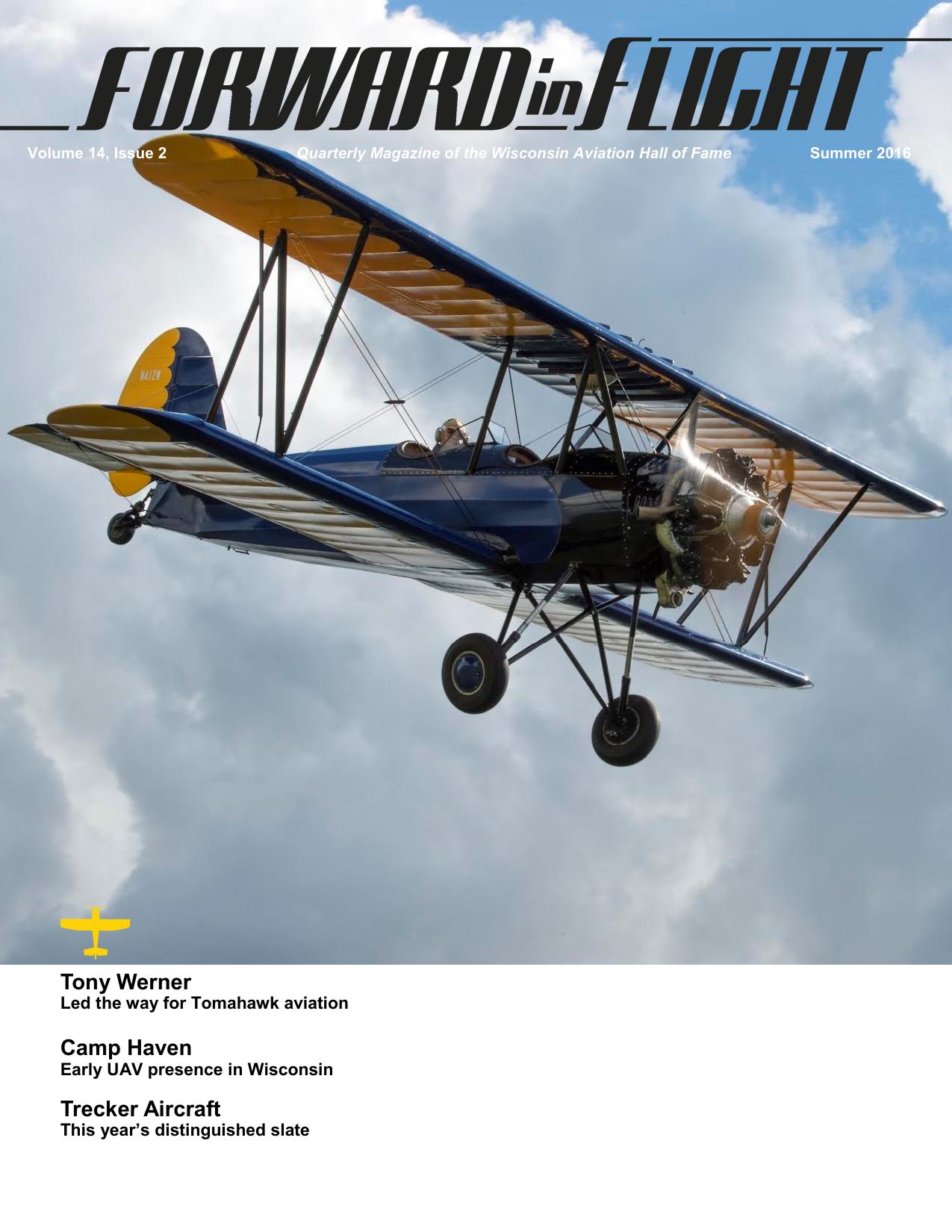
Volume 14, Issue 2 Quarterly Magazine of the Wisconsin Aviation Hall of Fame Tony Werner Led the way for Tomahawk aviation Camp Haven Early UAV presence in Wisconsin Trecker Aircraft This year’s distinguished slate Summer 2016
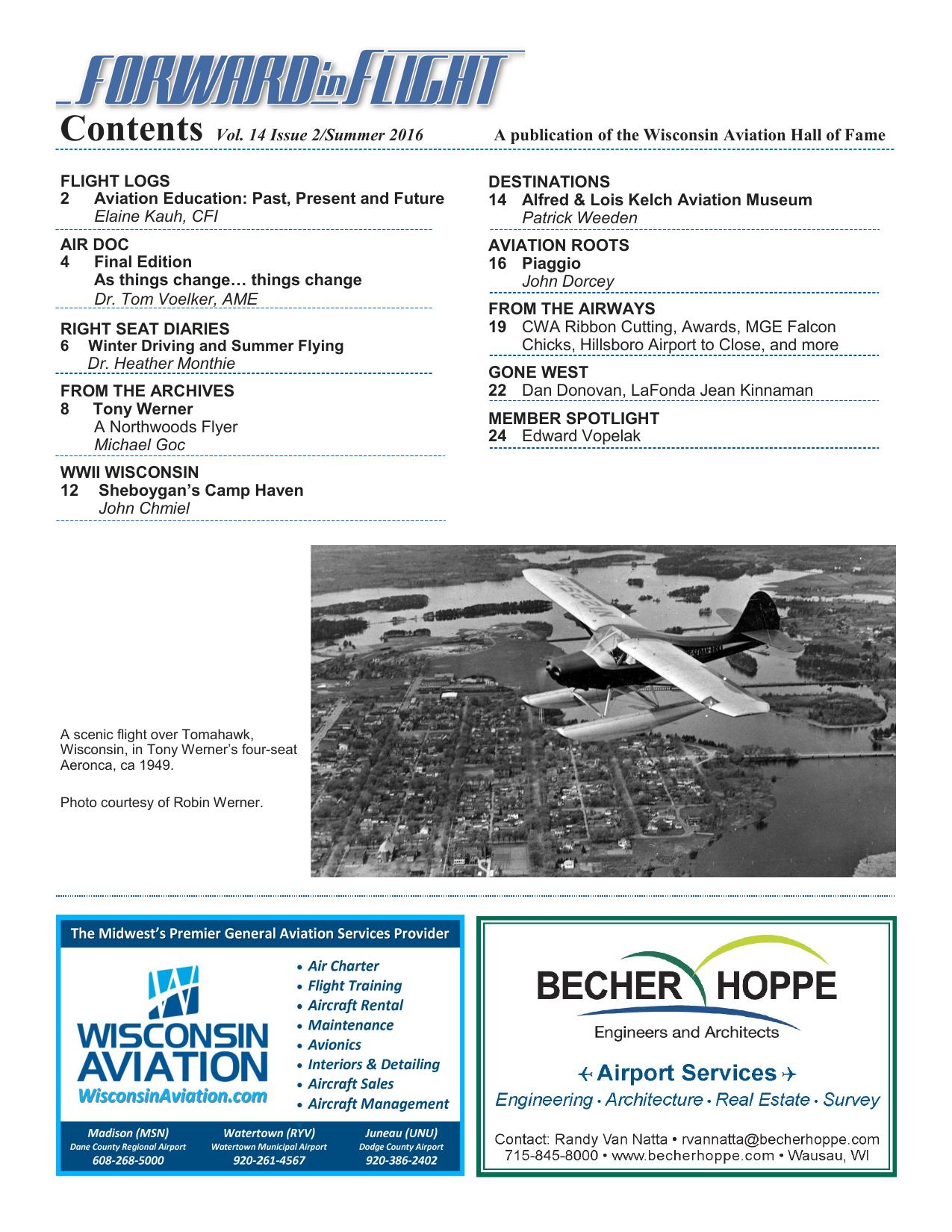
Contents Vol. 14 Issue 2/Summer 2016 A publication of the Wisconsin Aviation Hall of Fame FLIGHT LOGS 2 Aviation Education: Past, Present and Future Elaine Kauh, CFI DESTINATIONS 14 Alfred & Lois Kelch Aviation Museum Patrick Weeden AIR DOC 4 Final Edition As things change… things change Dr. Tom Voelker, AME AVIATION ROOTS 16 Piaggio John Dorcey RIGHT SEAT DIARIES 6 Winter Driving and Summer Flying Dr. Heather Monthie FROM THE ARCHIVES 8 Tony Werner A Northwoods Flyer Michael Goc WWII WISCONSIN 12 Sheboygan’s Camp Haven John Chmiel A scenic flight over Tomahawk, Wisconsin, in Tony Werner’s four-seat Aeronca, ca 1949. Photo courtesy of Robin Werner. FROM THE AIRWAYS 19 CWA Ribbon Cutting, Awards, MGE Falcon Chicks, Hillsboro Airport to Close, and more GONE WEST 22 Dan Donovan, LaFonda Jean Kinnaman MEMBER SPOTLIGHT 24 Edward Vopelak
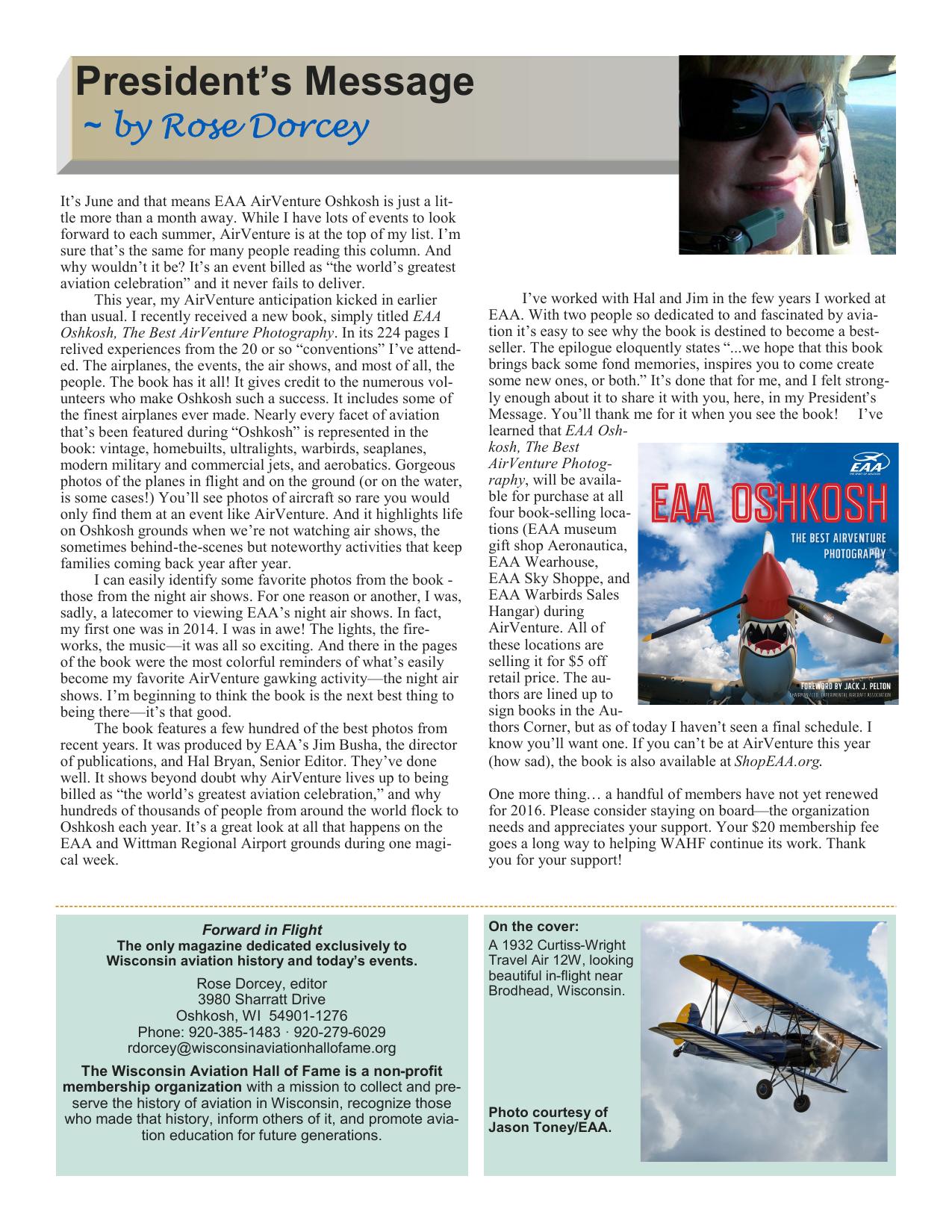
President’s Message ~ by Rose Dorcey It’s June and that means EAA AirVenture Oshkosh is just a little more than a month away. While I have lots of events to look forward to each summer, AirVenture is at the top of my list. I’m sure that’s the same for many people reading this column. And why wouldn’t it be? It’s an event billed as “the world’s greatest aviation celebration” and it never fails to deliver. This year, my AirVenture anticipation kicked in earlier than usual. I recently received a new book, simply titled EAA Oshkosh, The Best AirVenture Photography. In its 224 pages I relived experiences from the 20 or so “conventions” I’ve attended. The airplanes, the events, the air shows, and most of all, the people. The book has it all! It gives credit to the numerous volunteers who make Oshkosh such a success. It includes some of the finest airplanes ever made. Nearly every facet of aviation that’s been featured during “Oshkosh” is represented in the book: vintage, homebuilts, ultralights, warbirds, seaplanes, modern military and commercial jets, and aerobatics. Gorgeous photos of the planes in flight and on the ground (or on the water, is some cases!) You’ll see photos of aircraft so rare you would only find them at an event like AirVenture. And it highlights life on Oshkosh grounds when we’re not watching air shows, the sometimes behind-the-scenes but noteworthy activities that keep families coming back year after year. I can easily identify some favorite photos from the book those from the night air shows. For one reason or another, I was, sadly, a latecomer to viewing EAA’s night air shows. In fact, my first one was in 2014. I was in awe! The lights, the fireworks, the music—it was all so exciting. And there in the pages of the book were the most colorful reminders of what’s easily become my favorite AirVenture gawking activity—the night air shows. I’m beginning to think the book is the next best thing to being there—it’s that good. The book features a few hundred of the best photos from recent years. It was produced by EAA’s Jim Busha, the director of publications, and Hal Bryan, Senior Editor. They’ve done well. It shows beyond doubt why AirVenture lives up to being billed as “the world’s greatest aviation celebration,” and why hundreds of thousands of people from around the world flock to Oshkosh each year. It’s a great look at all that happens on the EAA and Wittman Regional Airport grounds during one magical week. Forward in Flight The only magazine dedicated exclusively to Wisconsin aviation history and today’s events. Rose Dorcey, editor 3980 Sharratt Drive Oshkosh, WI 54901-1276 Phone: 920-385-1483 920-279-6029 rdorcey@wisconsinaviationhallofame.org The Wisconsin Aviation Hall of Fame is a non-profit membership organization with a mission to collect and preserve the history of aviation in Wisconsin, recognize those who made that history, inform others of it, and promote aviation education for future generations. I’ve worked with Hal and Jim in the few years I worked at EAA. With two people so dedicated to and fascinated by aviation it’s easy to see why the book is destined to become a bestseller. The epilogue eloquently states “...we hope that this book brings back some fond memories, inspires you to come create some new ones, or both.” It’s done that for me, and I felt strongly enough about it to share it with you, here, in my President’s Message. You’ll thank me for it when you see the book! I’ve learned that EAA Oshkosh, The Best AirVenture Photography, will be available for purchase at all four book-selling locations (EAA museum gift shop Aeronautica, EAA Wearhouse, EAA Sky Shoppe, and EAA Warbirds Sales Hangar) during AirVenture. All of these locations are selling it for $5 off retail price. The authors are lined up to sign books in the Authors Corner, but as of today I haven’t seen a final schedule. I know you’ll want one. If you can’t be at AirVenture this year (how sad), the book is also available at ShopEAA.org. One more thing… a handful of members have not yet renewed for 2016. Please consider staying on board—the organization needs and appreciates your support. Your $20 membership fee goes a long way to helping WAHF continue its work. Thank you for your support! On the cover: A 1932 Curtiss-Wright Travel Air 12W, looking beautiful in-flight near Brodhead, Wisconsin. Photo courtesy of Jason Toney/EAA.
FLIGHT LOGS Aviation Education: Past, Present and Future By Elaine Kauh One of the many rewards of being an educator in general aviation is guiding teens through their initial flight training and teaching them how to be pilots. Some are even luckier! Everything—weather, airplane, and the pilot’s readiness—falls into place on a 16th birthday. What a way to start a flying career! This is also a great way to show people of all ages the crucial role the GA community plays in getting young adults involved in learning about the vast variety of career options open to them, flying airplanes notwithstanding. Whether a 16year-old goes on to earn a pilot’s license at the qualifying age of 17, learns how to build airplanes, or designs rocket engines, we’re doing much more than helping one young person. For starters, we’re helping those students set examples for the kids growing up after them and encouraging growth in the essential STEM subjects: science, technology, engineering, and math. I always stress to young people and their families that learning how to fly doesn’t always have to involve actually flying an airplane. Not everyone wants or is able to learn to fly, but most all high school students can benefit from a pilot ground school. This is because they will learn so many interesting, fun ways to explore the STEM subjects. How an airplane flies involves basic aerodynamics, plus a little bit on how an aircraft is engineered. Weather is a big topic in ground school, and students learn the science behind meteorology; what makes wind, storms, fog, and other weather phenomena. They’ll even learn a bit about forecasting weather, how meteorologists do their work and what all this means to flying an aircraft from point A to B. Navigating using maps, geography, radio signals and, of course, GPS technology, is a course in and of itself. In a private pilot ground school, we’ll take the basics of each kind of navigation technique and apply them to flying airplanes while adding some of the ground rules for flying at different altitudes and through different parcels of airspace. Aviation math at this level is not at all difficult compared to math classes in school, and flying an airplane means reallife story problems such as calculating weight and balance, flying speeds, fuel consumption, and flight times. Then, everything is tied together in planning a hypothetical cross-country flight from, say, Portland, Maine, to Oshkosh, Wisconsin, or San Francisco, California, or even Honolulu, Hawaii. However, anything that helps them see how diverse the world of aviation is and the everyday presence it has, will pay off for everyone. With all this packed into one basic course, students typically find subjects in which they take special interest. Naturally, everyone has their less-than-favored topics, but no one denies that when it comes to flying, each concept plays an essential role. Some students decide, for example, they really enjoy what they’re learning about engines and want to advance to different types of engines and how they’re designed for various aircraft. This is why aviation and its big brother, aerospace, is so ideal for the recent focus on STEM education as students progress through school, high school, and college. What’s really interesting about the latest push in aviation to emphasize the benefits related to STEM is that this is not a new thing. A few weeks ago, while doing some research on a different topic on the FAA’s website, I came across some files on aviation history. One was an article by Theresa L. Kraus, FAA Historian: “Fly or Die” – CAA “Air Conditions” America. It discussed the early years of aviation education and how the 2 Forward in Flight ~ Quarterly Magazine of the Wisconsin Aviation Hall of Fame Civil Aeronautics Authority (predecessor to the FAA) brought aviation subjects into the nation’s schools. The 1939 Civilian Pilot Training Act had a timely mission to build the nation’s air forces and prepare to strengthen its military capabilities. But recruiting future pilots was just one component of the "Air Conditioning." According to Kraus’ article, the CAA helped develop aviation textbooks for schools, using math, science, and history. Later on, the CAA had outreach programs to promote various aviation careers. Some of this tapered off in the 1950s, but the Space Race that launched later in the decade sparked renewed efforts to promote aerospace education. Throughout the following decades, the FAA continued to encourage students and educators to learn about aviation and use related topics in their classes. Kraus describes the popular Aviation Career Education programs of the 1980s that involved the Civil Air Patrol, which today has a youth cadet program that provides access to flight training in CAP aircraft. As noted in the article, funding and staffing haven’t always been available to keep some of the FAA’s initiatives going full-strength, but partnerships with private and non-profit organizations allow schools, flight schools, and higher education institutions to offer resources for anyone interested in classroom education, career opportunities and other aviation programs. These efforts continue today and, hopefully, will continue in the future. Those who desire to work towards an aviation career have plenty of options for schooling, jobs, and related interests, especially now. Airlines and the military are in great need of pilots, which means everything else (general aviation) will also need pilots to fly for transportation, training, surveying, law enforcement, emergency services, and many other functions in both the public and private sectors. Unmanned aerial systems (popularly known as drones) will be a
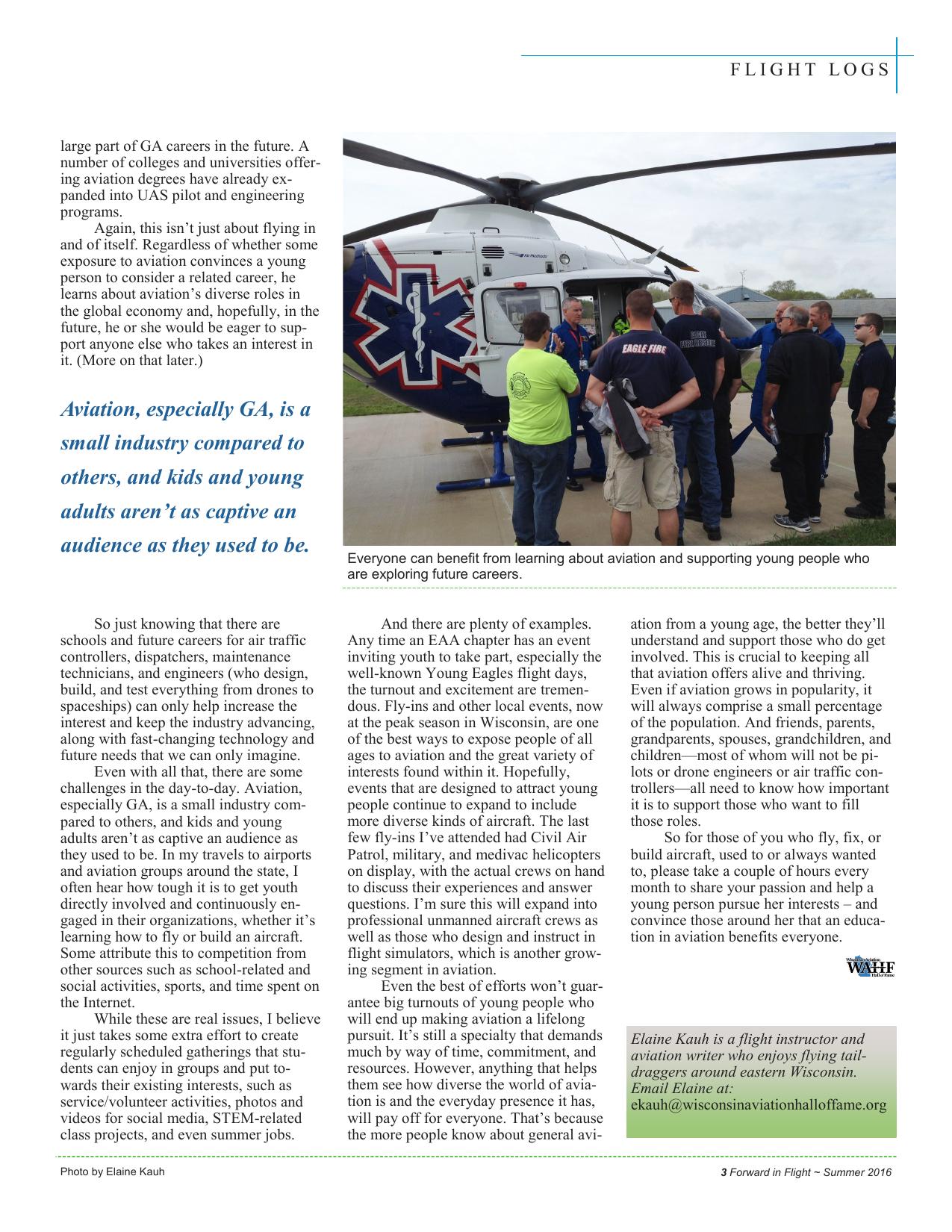
FLIGHT LOGS large part of GA careers in the future. A number of colleges and universities offering aviation degrees have already expanded into UAS pilot and engineering programs. Again, this isn’t just about flying in and of itself. Regardless of whether some exposure to aviation convinces a young person to consider a related career, he learns about aviation’s diverse roles in the global economy and, hopefully, in the future, he or she would be eager to support anyone else who takes an interest in it. (More on that later.) Aviation, especially GA, is a small industry compared to others, and kids and young adults aren’t as captive an audience as they used to be. So just knowing that there are schools and future careers for air traffic controllers, dispatchers, maintenance technicians, and engineers (who design, build, and test everything from drones to spaceships) can only help increase the interest and keep the industry advancing, along with fast-changing technology and future needs that we can only imagine. Even with all that, there are some challenges in the day-to-day. Aviation, especially GA, is a small industry compared to others, and kids and young adults aren’t as captive an audience as they used to be. In my travels to airports and aviation groups around the state, I often hear how tough it is to get youth directly involved and continuously engaged in their organizations, whether it’s learning how to fly or build an aircraft. Some attribute this to competition from other sources such as school-related and social activities, sports, and time spent on the Internet. While these are real issues, I believe it just takes some extra effort to create regularly scheduled gatherings that students can enjoy in groups and put towards their existing interests, such as service/volunteer activities, photos and videos for social media, STEM-related class projects, and even summer jobs. Photo by Elaine Kauh Everyone can benefit from learning about aviation and supporting young people who are exploring future careers. And there are plenty of examples. Any time an EAA chapter has an event inviting youth to take part, especially the well-known Young Eagles flight days, the turnout and excitement are tremendous. Fly-ins and other local events, now at the peak season in Wisconsin, are one of the best ways to expose people of all ages to aviation and the great variety of interests found within it. Hopefully, events that are designed to attract young people continue to expand to include more diverse kinds of aircraft. The last few fly-ins I’ve attended had Civil Air Patrol, military, and medivac helicopters on display, with the actual crews on hand to discuss their experiences and answer questions. I’m sure this will expand into professional unmanned aircraft crews as well as those who design and instruct in flight simulators, which is another growing segment in aviation. Even the best of efforts won’t guarantee big turnouts of young people who will end up making aviation a lifelong pursuit. It’s still a specialty that demands much by way of time, commitment, and resources. However, anything that helps them see how diverse the world of aviation is and the everyday presence it has, will pay off for everyone. That’s because the more people know about general avi- ation from a young age, the better they’ll understand and support those who do get involved. This is crucial to keeping all that aviation offers alive and thriving. Even if aviation grows in popularity, it will always comprise a small percentage of the population. And friends, parents, grandparents, spouses, grandchildren, and children—most of whom will not be pilots or drone engineers or air traffic controllers—all need to know how important it is to support those who want to fill those roles. So for those of you who fly, fix, or build aircraft, used to or always wanted to, please take a couple of hours every month to share your passion and help a young person pursue her interests – and convince those around her that an education in aviation benefits everyone. Elaine Kauh is a flight instructor and aviation writer who enjoys flying taildraggers around eastern Wisconsin. Email Elaine at: ekauh@wisconsinaviationhalloffame.org 3 Forward in Flight ~ Summer 2016
AIR DOC Air Doc—Final Edition As things change… things change Dr. Tom Voelker, AME Voelkerta@yahoo.com About 10 years ago I was called by our editor, Rose. We had known each other for many years and had flown together several times as well. Rose had taken the position of president of the Wisconsin Aviation Hall of Fame and also as editor of this publication, then known as Forward in Aviation. She was looking for new members and recruited me. I paid the $300 or so (as I recall) for my lifetime membership. I enjoyed being part of this organization and doing my small part to help preserve the history of flight in our great state, even if this was only by my monetary contribution. Then things changed. Rose called once again in early 2007, asking me to join the team. I eagerly agreed, and in March of 2007 I penned my first contribution, the inaugural AirDoc column. As a relatively new Aviation Medical Examiner, I was eager to share my newfound knowledge. I had learned on my own that many AMEs, especially those who are not pilots, do not turn out to be advocates for their clients, the pilots who come in for their flight physicals. I wanted to bring a friendly face to the pilot population of Wisconsin and help promote the cause of safety in flight. Indeed, it was stressed at my initial AME course in Oklahoma City that the major role of the Aeromedical Division of the FAA is to promote safe flight. It was then that I introduced myself to you in this publication. I have truly enjoyed our many “flights” together. We have experienced abdominal gas and heart attacks. We felt the pain of kidney stones. We toured the aeromedical vendors at EAA. We flew on an “Angel Flight” mission to a children’s camp in northern Minnesota. We’ve looked into our vision, heard about our hearing, and took a spin through the topic of vertigo. You met my wife, and you learned (unlike me) how not to scare her on her first flight. Together we removed my own “useful load” so I could fly an Aircoupe. We even took a quick flight to Germany to investigate the cost of flight training and medical certification overseas. We stressed about anxiety. We learned how to tell the truth, but not so much that it would get us in trouble. We’ve taken a quiz or two. And you even watched as I cut off my finger, had it reattached, and got back to flying. It’s been quite an adventure! Then things changed. Again. I completed my Family Practice Residency in 1987. I have lived and practiced Medicine in Wisconsin Rapids ever since. I have thoroughly enjoyed my practice. I have done, it seems, almost everything. I have come to know many, many patients, most of whom have stuck with me over the three decades of my clinical career. Through most of these years I took on various leadership roles at the clinic. Over time I found both an interest and some degree of competence in these leadership duties. In the past four or five years I have taken an ever greater interest in leadership, and I began to take formal courses in this field. When, last summer, the then current Chief Medical Officer (CMO) of our local hospital announced he was stepping down, I 4 Forward in Flight ~ Quarterly Magazine of the Wisconsin Aviation Hall of Fame decided this was the next step in my career. I applied for, was chosen for, and accepted this position. What a change! I am now a fulltime administrative doctor. That means I don’t directly take care of patients anymore. As some of my colleagues have told me, I still have my “MD” degree, but I can no longer use the initials “RD” (“real doctor”)! The one thing that continues, though, is that I still really love my job. I may not be examining and treating patients one at a time, behind a closed exam room door, but I am still fighting for the health of my patients and the entire population. I believe I can provide even more good health care to my previous patients in my new position. It’s just that these patients will not know I’m doing it! Yes, I do love my job. I only have one complaint, there are only 24 hours in a day! This job is taking so much time that I find little time to do some of the other things I would like to do in life. I still get out to fly on occasion, and I expect to spend a little time fishing later this year. But on a day-to-day basis, the only thing I always find myself short of is time. And that has brought about the last … change. Rose graciously accepted my request, and she granted me this one indulgence: I had asked for one last column to properly say good-bye to all of you. I regretfully called Rose a couple of weeks ago to inform her that I would no longer be able to write this column. The time is just not there when the deadline comes along. Rose graciously accepted my request, and she granted me this one indulgence: I had asked for one last column to properly say good-bye to all of you. I do mean it when I say I want to say “good-bye.” I feel as though I know many of you, having developed a connection with our love of flying and our connection to this publication and the aviation history of Wisconsin. I am always amazed when I meet some of you readers and you recognize me and comment on my writing. I have really appreciated your kind words. Most of all, though, I will fondly recall the many phone calls and clinic visits over the years in which I was able to help you navigate the often turbulent waters of FAA aeromedical certification. Just like my other patients over the past 29 years, I get my greatest professional pleasure in knowing that I helped maintain or improve their health, whether it be their personal
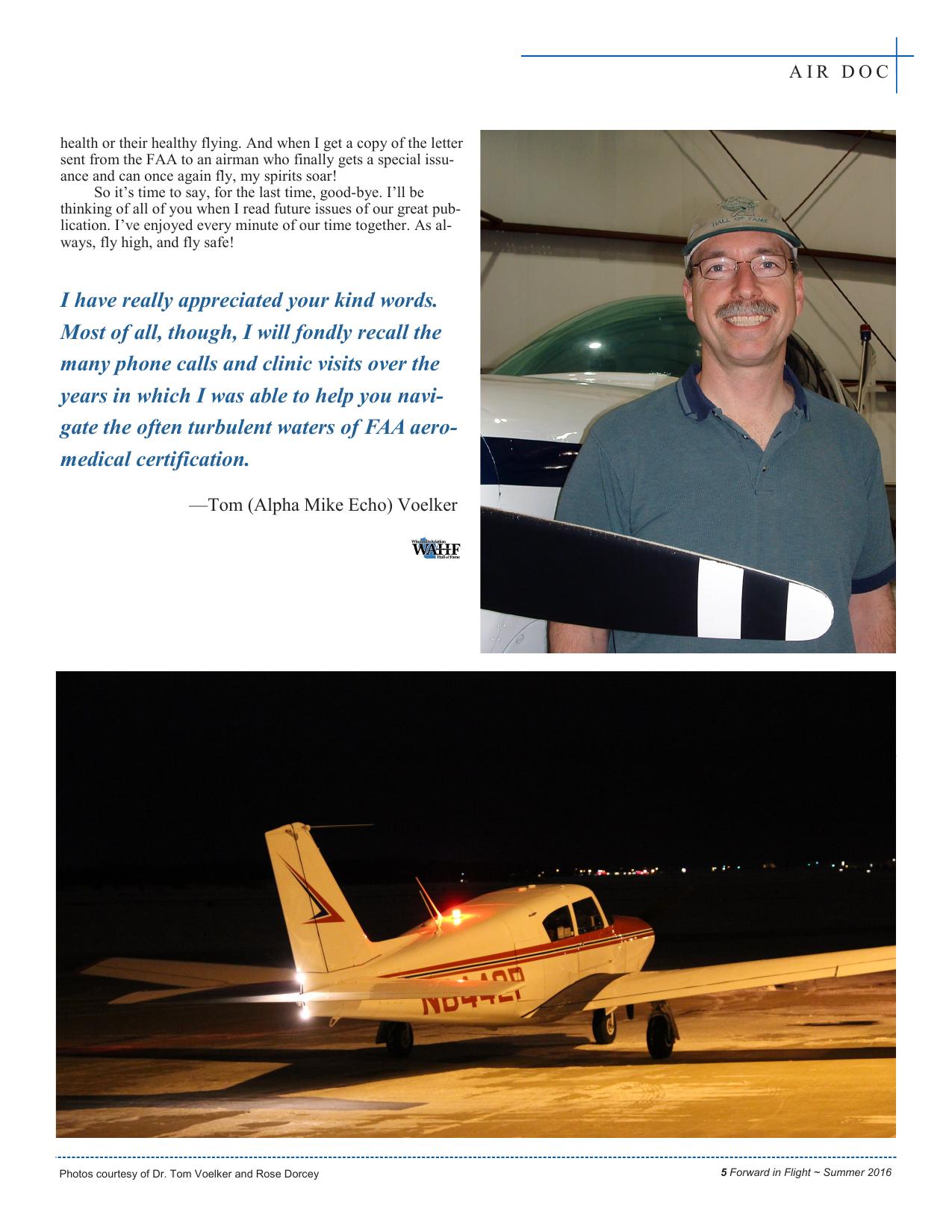
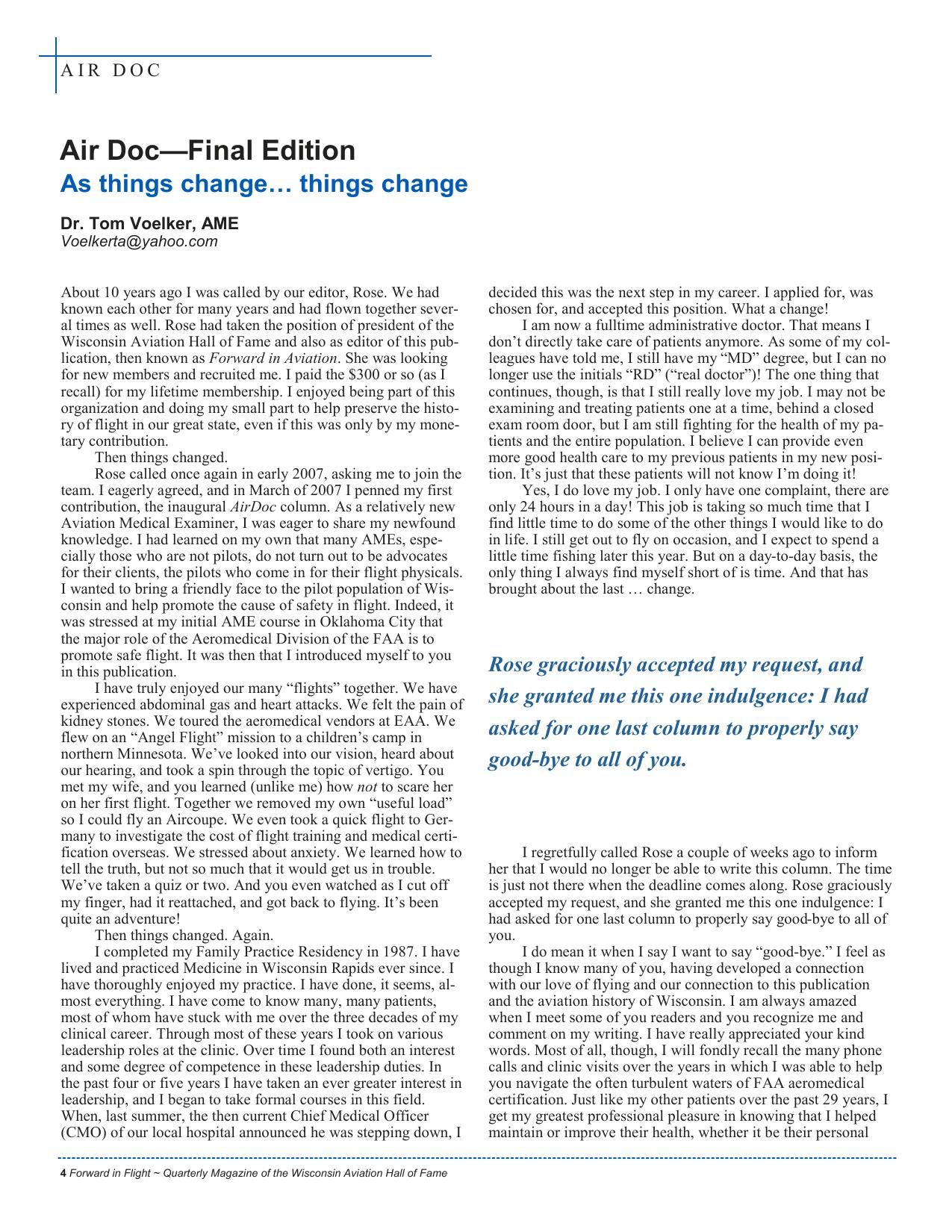
AIR DOC health or their healthy flying. And when I get a copy of the letter sent from the FAA to an airman who finally gets a special issuance and can once again fly, my spirits soar! So it’s time to say, for the last time, good-bye. I’ll be thinking of all of you when I read future issues of our great publication. I’ve enjoyed every minute of our time together. As always, fly high, and fly safe! I have really appreciated your kind words. Most of all, though, I will fondly recall the many phone calls and clinic visits over the years in which I was able to help you navigate the often turbulent waters of FAA aeromedical certification. —Tom (Alpha Mike Echo) Voelker It almost hurts to look at Doc Voelker’s X-ray, after he injured his finger while using a log splitter. Thankfully, it’s now practically good as new. Photos courtesy of Dr. Tom Voelker and Rose Dorcey 5 Forward in Flight ~ Summer 2016
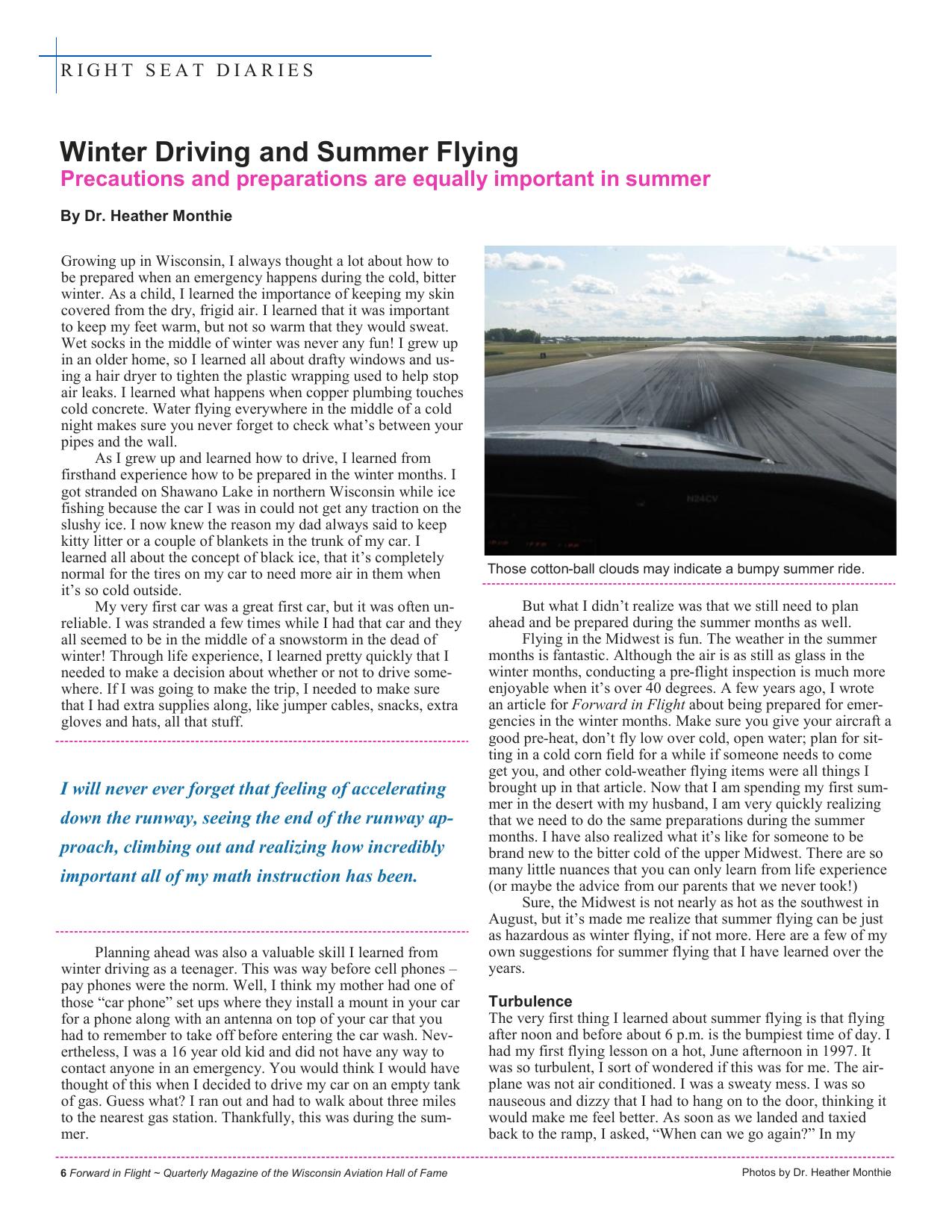
RIGHT SEAT DIARIES Winter Driving and Summer Flying Precautions and preparations are equally important in summer By Dr. Heather Monthie Growing up in Wisconsin, I always thought a lot about how to be prepared when an emergency happens during the cold, bitter winter. As a child, I learned the importance of keeping my skin covered from the dry, frigid air. I learned that it was important to keep my feet warm, but not so warm that they would sweat. Wet socks in the middle of winter was never any fun! I grew up in an older home, so I learned all about drafty windows and using a hair dryer to tighten the plastic wrapping used to help stop air leaks. I learned what happens when copper plumbing touches cold concrete. Water flying everywhere in the middle of a cold night makes sure you never forget to check what’s between your pipes and the wall. As I grew up and learned how to drive, I learned from firsthand experience how to be prepared in the winter months. I got stranded on Shawano Lake in northern Wisconsin while ice fishing because the car I was in could not get any traction on the slushy ice. I now knew the reason my dad always said to keep kitty litter or a couple of blankets in the trunk of my car. I learned all about the concept of black ice, that it’s completely normal for the tires on my car to need more air in them when it’s so cold outside. My very first car was a great first car, but it was often unreliable. I was stranded a few times while I had that car and they all seemed to be in the middle of a snowstorm in the dead of winter! Through life experience, I learned pretty quickly that I needed to make a decision about whether or not to drive somewhere. If I was going to make the trip, I needed to make sure that I had extra supplies along, like jumper cables, snacks, extra gloves and hats, all that stuff. I will never ever forget that feeling of accelerating down the runway, seeing the end of the runway approach, climbing out and realizing how incredibly important all of my math instruction has been. Planning ahead was also a valuable skill I learned from winter driving as a teenager. This was way before cell phones – pay phones were the norm. Well, I think my mother had one of those “car phone” set ups where they install a mount in your car for a phone along with an antenna on top of your car that you had to remember to take off before entering the car wash. Nevertheless, I was a 16 year old kid and did not have any way to contact anyone in an emergency. You would think I would have thought of this when I decided to drive my car on an empty tank of gas. Guess what? I ran out and had to walk about three miles to the nearest gas station. Thankfully, this was during the summer. 6 Forward in Flight ~ Quarterly Magazine of the Wisconsin Aviation Hall of Fame Those cotton-ball clouds may indicate a bumpy summer ride. But what I didn’t realize was that we still need to plan ahead and be prepared during the summer months as well. Flying in the Midwest is fun. The weather in the summer months is fantastic. Although the air is as still as glass in the winter months, conducting a pre-flight inspection is much more enjoyable when it’s over 40 degrees. A few years ago, I wrote an article for Forward in Flight about being prepared for emergencies in the winter months. Make sure you give your aircraft a good pre-heat, don’t fly low over cold, open water; plan for sitting in a cold corn field for a while if someone needs to come get you, and other cold-weather flying items were all things I brought up in that article. Now that I am spending my first summer in the desert with my husband, I am very quickly realizing that we need to do the same preparations during the summer months. I have also realized what it’s like for someone to be brand new to the bitter cold of the upper Midwest. There are so many little nuances that you can only learn from life experience (or maybe the advice from our parents that we never took!) Sure, the Midwest is not nearly as hot as the southwest in August, but it’s made me realize that summer flying can be just as hazardous as winter flying, if not more. Here are a few of my own suggestions for summer flying that I have learned over the years. Turbulence The very first thing I learned about summer flying is that flying after noon and before about 6 p.m. is the bumpiest time of day. I had my first flying lesson on a hot, June afternoon in 1997. It was so turbulent, I sort of wondered if this was for me. The airplane was not air conditioned. I was a sweaty mess. I was so nauseous and dizzy that I had to hang on to the door, thinking it would make me feel better. As soon as we landed and taxied back to the ramp, I asked, “When can we go again?” In my Photos by Dr. Heather Monthie
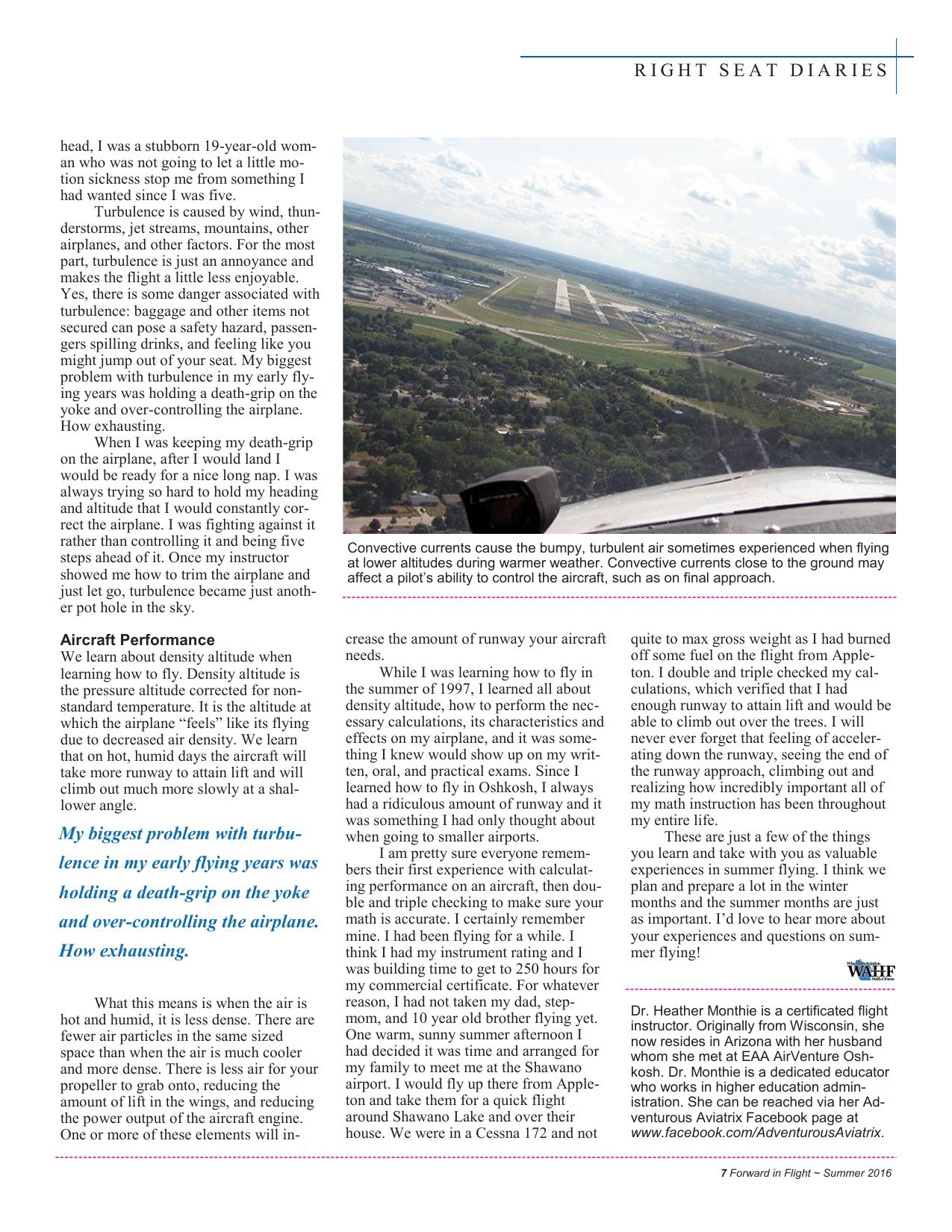
RIGHT SEAT DIARIES head, I was a stubborn 19-year-old woman who was not going to let a little motion sickness stop me from something I had wanted since I was five. Turbulence is caused by wind, thunderstorms, jet streams, mountains, other airplanes, and other factors. For the most part, turbulence is just an annoyance and makes the flight a little less enjoyable. Yes, there is some danger associated with turbulence: baggage and other items not secured can pose a safety hazard, passengers spilling drinks, and feeling like you might jump out of your seat. My biggest problem with turbulence in my early flying years was holding a death-grip on the yoke and over-controlling the airplane. How exhausting. When I was keeping my death-grip on the airplane, after I would land I would be ready for a nice long nap. I was always trying so hard to hold my heading and altitude that I would constantly correct the airplane. I was fighting against it rather than controlling it and being five steps ahead of it. Once my instructor showed me how to trim the airplane and just let go, turbulence became just another pot hole in the sky. Aircraft Performance We learn about density altitude when learning how to fly. Density altitude is the pressure altitude corrected for nonstandard temperature. It is the altitude at which the airplane “feels” like its flying due to decreased air density. We learn that on hot, humid days the aircraft will take more runway to attain lift and will climb out much more slowly at a shallower angle. My biggest problem with turbulence in my early flying years was holding a death-grip on the yoke and over-controlling the airplane. How exhausting. What this means is when the air is hot and humid, it is less dense. There are fewer air particles in the same sized space than when the air is much cooler and more dense. There is less air for your propeller to grab onto, reducing the amount of lift in the wings, and reducing the power output of the aircraft engine. One or more of these elements will in- Convective currents cause the bumpy, turbulent air sometimes experienced when flying at lower altitudes during warmer weather. Convective currents close to the ground may affect a pilot’s ability to control the aircraft, such as on final approach. crease the amount of runway your aircraft needs. While I was learning how to fly in the summer of 1997, I learned all about density altitude, how to perform the necessary calculations, its characteristics and effects on my airplane, and it was something I knew would show up on my written, oral, and practical exams. Since I learned how to fly in Oshkosh, I always had a ridiculous amount of runway and it was something I had only thought about when going to smaller airports. I am pretty sure everyone remembers their first experience with calculating performance on an aircraft, then double and triple checking to make sure your math is accurate. I certainly remember mine. I had been flying for a while. I think I had my instrument rating and I was building time to get to 250 hours for my commercial certificate. For whatever reason, I had not taken my dad, stepmom, and 10 year old brother flying yet. One warm, sunny summer afternoon I had decided it was time and arranged for my family to meet me at the Shawano airport. I would fly up there from Appleton and take them for a quick flight around Shawano Lake and over their house. We were in a Cessna 172 and not quite to max gross weight as I had burned off some fuel on the flight from Appleton. I double and triple checked my calculations, which verified that I had enough runway to attain lift and would be able to climb out over the trees. I will never ever forget that feeling of accelerating down the runway, seeing the end of the runway approach, climbing out and realizing how incredibly important all of my math instruction has been throughout my entire life. These are just a few of the things you learn and take with you as valuable experiences in summer flying. I think we plan and prepare a lot in the winter months and the summer months are just as important. I’d love to hear more about your experiences and questions on summer flying! Dr. Heather Monthie is a certificated flight instructor. Originally from Wisconsin, she now resides in Arizona with her husband whom she met at EAA AirVenture Oshkosh. Dr. Monthie is a dedicated educator who works in higher education administration. She can be reached via her Adventurous Aviatrix Facebook page at www.facebook.com/AdventurousAviatrix. 7 Forward in Flight ~ Summer 2016
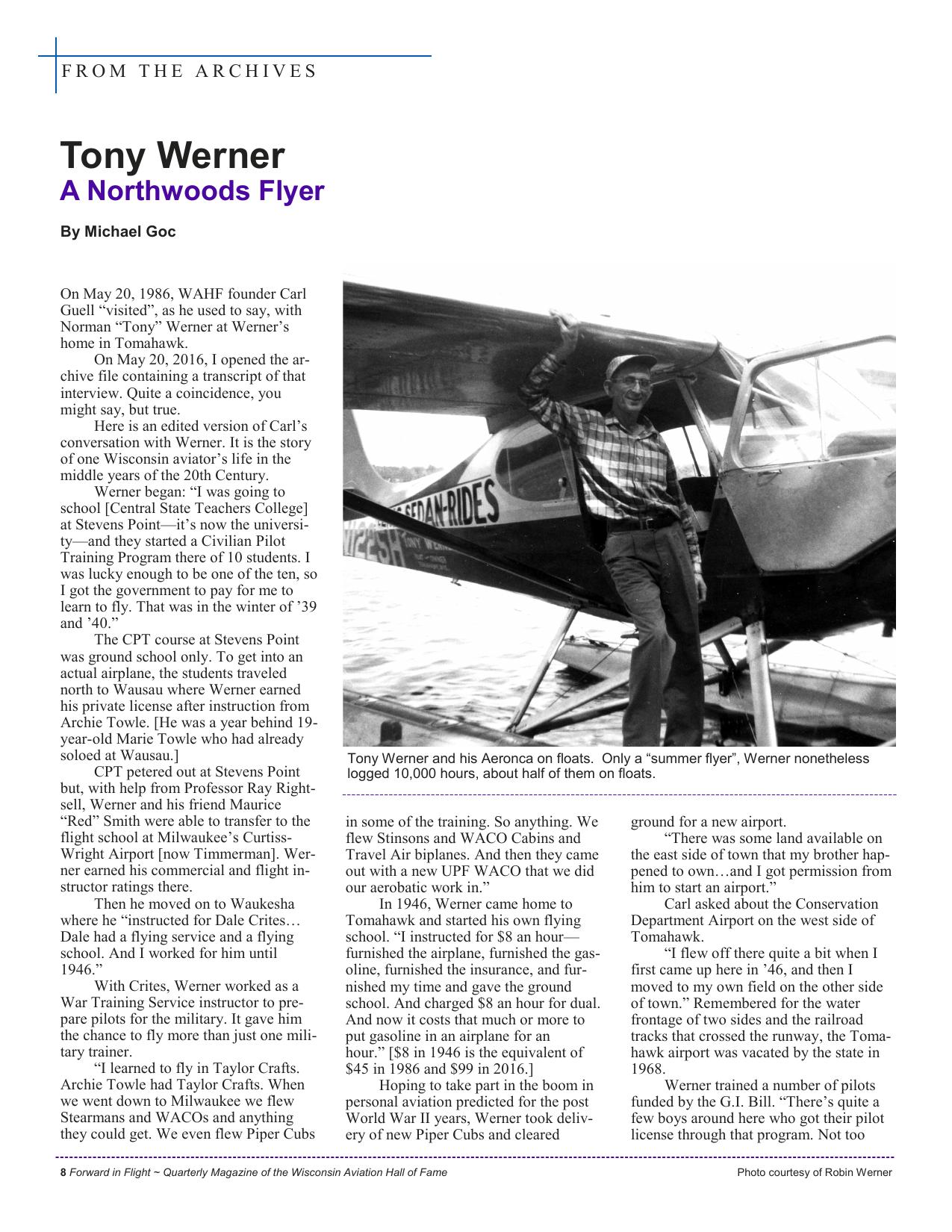
FROM THE ARCHIVES Tony Werner A Northwoods Flyer By Michael Goc On May 20, 1986, WAHF founder Carl Guell “visited”, as he used to say, with Norman “Tony” Werner at Werner’s home in Tomahawk. On May 20, 2016, I opened the archive file containing a transcript of that interview. Quite a coincidence, you might say, but true. Here is an edited version of Carl’s conversation with Werner. It is the story of one Wisconsin aviator’s life in the middle years of the 20th Century. Werner began: “I was going to school [Central State Teachers College] at Stevens Point—it’s now the university—and they started a Civilian Pilot Training Program there of 10 students. I was lucky enough to be one of the ten, so I got the government to pay for me to learn to fly. That was in the winter of ’39 and ’40.” The CPT course at Stevens Point was ground school only. To get into an actual airplane, the students traveled north to Wausau where Werner earned his private license after instruction from Archie Towle. [He was a year behind 19year-old Marie Towle who had already soloed at Wausau.] CPT petered out at Stevens Point but, with help from Professor Ray Rightsell, Werner and his friend Maurice “Red” Smith were able to transfer to the flight school at Milwaukee’s CurtissWright Airport [now Timmerman]. Werner earned his commercial and flight instructor ratings there. Then he moved on to Waukesha where he “instructed for Dale Crites… Dale had a flying service and a flying school. And I worked for him until 1946.” With Crites, Werner worked as a War Training Service instructor to prepare pilots for the military. It gave him the chance to fly more than just one military trainer. “I learned to fly in Taylor Crafts. Archie Towle had Taylor Crafts. When we went down to Milwaukee we flew Stearmans and WACOs and anything they could get. We even flew Piper Cubs Tony Werner and his Aeronca on floats. Only a “summer flyer”, Werner nonetheless logged 10,000 hours, about half of them on floats. in some of the training. So anything. We flew Stinsons and WACO Cabins and Travel Air biplanes. And then they came out with a new UPF WACO that we did our aerobatic work in.” In 1946, Werner came home to Tomahawk and started his own flying school. “I instructed for $8 an hour— furnished the airplane, furnished the gasoline, furnished the insurance, and furnished my time and gave the ground school. And charged $8 an hour for dual. And now it costs that much or more to put gasoline in an airplane for an hour.” [$8 in 1946 is the equivalent of $45 in 1986 and $99 in 2016.] Hoping to take part in the boom in personal aviation predicted for the post World War II years, Werner took delivery of new Piper Cubs and cleared 8 Forward in Flight ~ Quarterly Magazine of the Wisconsin Aviation Hall of Fame ground for a new airport. “There was some land available on the east side of town that my brother happened to own…and I got permission from him to start an airport.” Carl asked about the Conservation Department Airport on the west side of Tomahawk. “I flew off there quite a bit when I first came up here in ’46, and then I moved to my own field on the other side of town.” Remembered for the water frontage of two sides and the railroad tracks that crossed the runway, the Tomahawk airport was vacated by the state in 1968. Werner trained a number of pilots funded by the G.I. Bill. “There’s quite a few boys around here who got their pilot license through that program. Not too Photo courtesy of Robin Werner
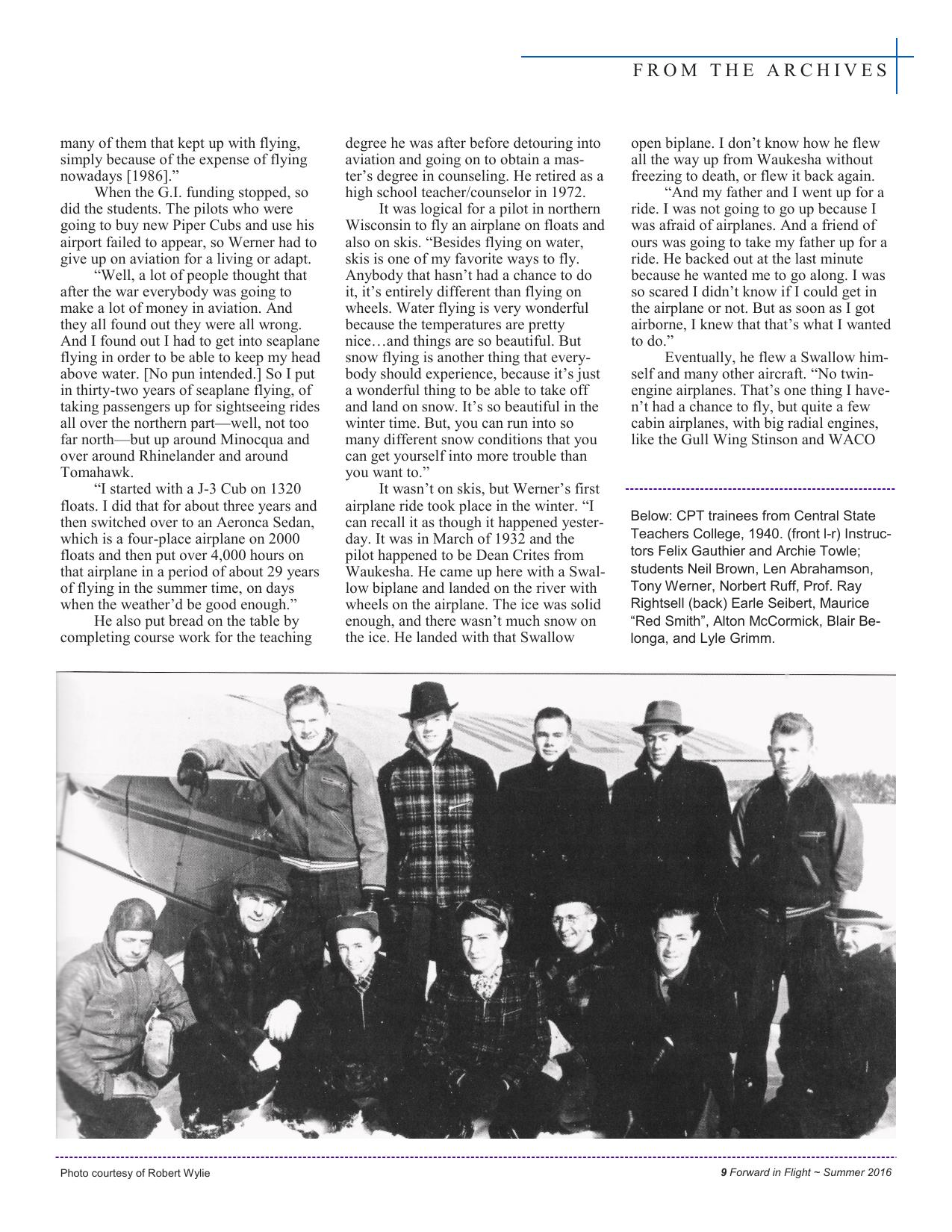
FROM THE ARCHIVES many of them that kept up with flying, simply because of the expense of flying nowadays [1986].” When the G.I. funding stopped, so did the students. The pilots who were going to buy new Piper Cubs and use his airport failed to appear, so Werner had to give up on aviation for a living or adapt. “Well, a lot of people thought that after the war everybody was going to make a lot of money in aviation. And they all found out they were all wrong. And I found out I had to get into seaplane flying in order to be able to keep my head above water. [No pun intended.] So I put in thirty-two years of seaplane flying, of taking passengers up for sightseeing rides all over the northern part—well, not too far north—but up around Minocqua and over around Rhinelander and around Tomahawk. “I started with a J-3 Cub on 1320 floats. I did that for about three years and then switched over to an Aeronca Sedan, which is a four-place airplane on 2000 floats and then put over 4,000 hours on that airplane in a period of about 29 years of flying in the summer time, on days when the weather’d be good enough.” He also put bread on the table by completing course work for the teaching Photo courtesy of Robert Wylie degree he was after before detouring into aviation and going on to obtain a master’s degree in counseling. He retired as a high school teacher/counselor in 1972. It was logical for a pilot in northern Wisconsin to fly an airplane on floats and also on skis. “Besides flying on water, skis is one of my favorite ways to fly. Anybody that hasn’t had a chance to do it, it’s entirely different than flying on wheels. Water flying is very wonderful because the temperatures are pretty nice…and things are so beautiful. But snow flying is another thing that everybody should experience, because it’s just a wonderful thing to be able to take off and land on snow. It’s so beautiful in the winter time. But, you can run into so many different snow conditions that you can get yourself into more trouble than you want to.” It wasn’t on skis, but Werner’s first airplane ride took place in the winter. “I can recall it as though it happened yesterday. It was in March of 1932 and the pilot happened to be Dean Crites from Waukesha. He came up here with a Swallow biplane and landed on the river with wheels on the airplane. The ice was solid enough, and there wasn’t much snow on the ice. He landed with that Swallow open biplane. I don’t know how he flew all the way up from Waukesha without freezing to death, or flew it back again. “And my father and I went up for a ride. I was not going to go up because I was afraid of airplanes. And a friend of ours was going to take my father up for a ride. He backed out at the last minute because he wanted me to go along. I was so scared I didn’t know if I could get in the airplane or not. But as soon as I got airborne, I knew that that’s what I wanted to do.” Eventually, he flew a Swallow himself and many other aircraft. “No twinengine airplanes. That’s one thing I haven’t had a chance to fly, but quite a few cabin airplanes, with big radial engines, like the Gull Wing Stinson and WACO Below: CPT trainees from Central State Teachers College, 1940. (front l-r) Instructors Felix Gauthier and Archie Towle; students Neil Brown, Len Abrahamson, Tony Werner, Norbert Ruff, Prof. Ray Rightsell (back) Earle Seibert, Maurice “Red Smith”, Alton McCormick, Blair Belonga, and Lyle Grimm. 9 Forward in Flight ~ Summer 2016
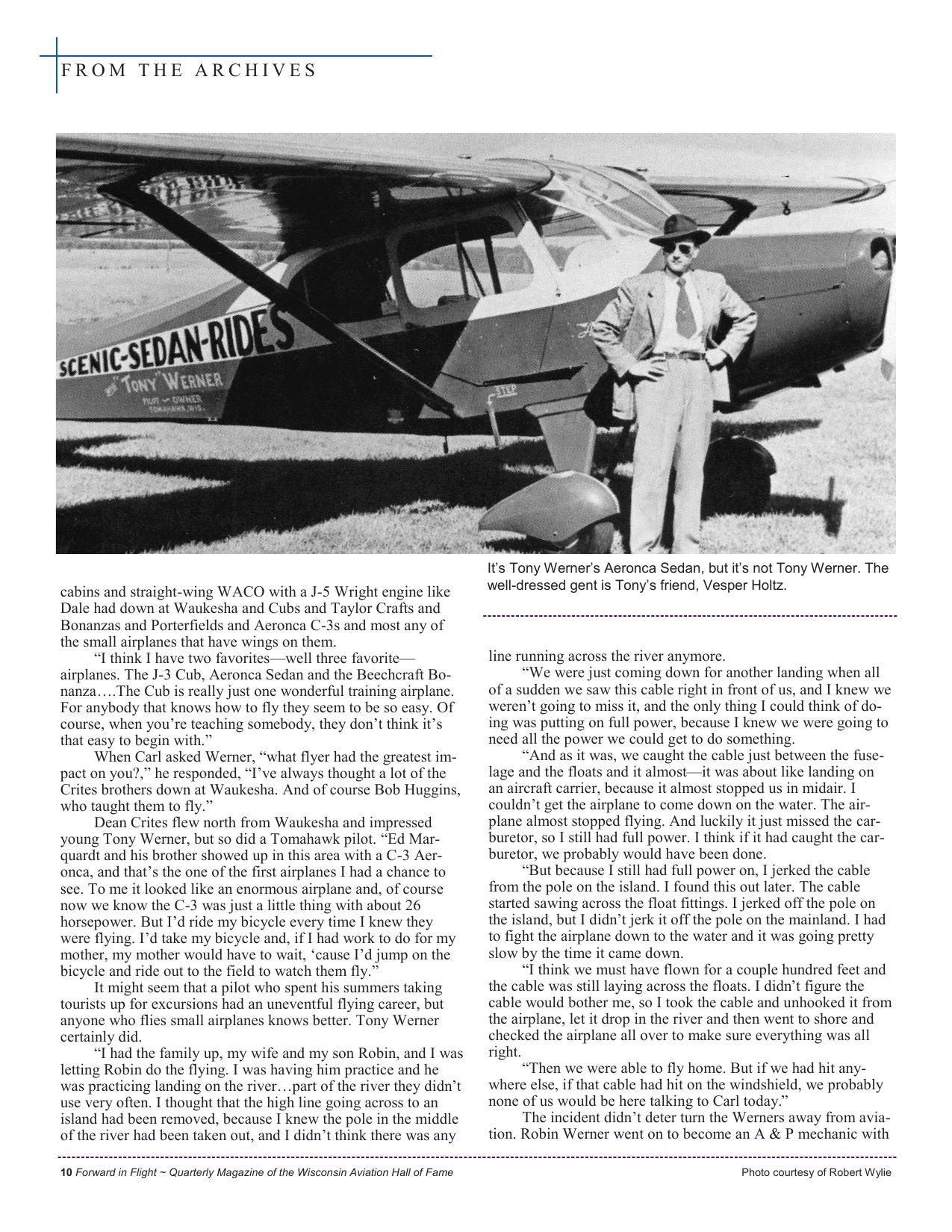
FROM THE ARCHIVES cabins and straight-wing WACO with a J-5 Wright engine like Dale had down at Waukesha and Cubs and Taylor Crafts and Bonanzas and Porterfields and Aeronca C-3s and most any of the small airplanes that have wings on them. “I think I have two favorites—well three favorite— airplanes. The J-3 Cub, Aeronca Sedan and the Beechcraft Bonanza….The Cub is really just one wonderful training airplane. For anybody that knows how to fly they seem to be so easy. Of course, when you’re teaching somebody, they don’t think it’s that easy to begin with.” When Carl asked Werner, “what flyer had the greatest impact on you?,” he responded, “I’ve always thought a lot of the Crites brothers down at Waukesha. And of course Bob Huggins, who taught them to fly.” Dean Crites flew north from Waukesha and impressed young Tony Werner, but so did a Tomahawk pilot. “Ed Marquardt and his brother showed up in this area with a C-3 Aeronca, and that’s the one of the first airplanes I had a chance to see. To me it looked like an enormous airplane and, of course now we know the C-3 was just a little thing with about 26 horsepower. But I’d ride my bicycle every time I knew they were flying. I’d take my bicycle and, if I had work to do for my mother, my mother would have to wait, ‘cause I’d jump on the bicycle and ride out to the field to watch them fly.” It might seem that a pilot who spent his summers taking tourists up for excursions had an uneventful flying career, but anyone who flies small airplanes knows better. Tony Werner certainly did. “I had the family up, my wife and my son Robin, and I was letting Robin do the flying. I was having him practice and he was practicing landing on the river…part of the river they didn’t use very often. I thought that the high line going across to an island had been removed, because I knew the pole in the middle of the river had been taken out, and I didn’t think there was any 10 Forward in Flight ~ Quarterly Magazine of the Wisconsin Aviation Hall of Fame It’s Tony Werner’s Aeronca Sedan, but it’s not Tony Werner. The well-dressed gent is Tony’s friend, Vesper Holtz. line running across the river anymore. “We were just coming down for another landing when all of a sudden we saw this cable right in front of us, and I knew we weren’t going to miss it, and the only thing I could think of doing was putting on full power, because I knew we were going to need all the power we could get to do something. “And as it was, we caught the cable just between the fuselage and the floats and it almost—it was about like landing on an aircraft carrier, because it almost stopped us in midair. I couldn’t get the airplane to come down on the water. The airplane almost stopped flying. And luckily it just missed the carburetor, so I still had full power. I think if it had caught the carburetor, we probably would have been done. “But because I still had full power on, I jerked the cable from the pole on the island. I found this out later. The cable started sawing across the float fittings. I jerked off the pole on the island, but I didn’t jerk it off the pole on the mainland. I had to fight the airplane down to the water and it was going pretty slow by the time it came down. “I think we must have flown for a couple hundred feet and the cable was still laying across the floats. I didn’t figure the cable would bother me, so I took the cable and unhooked it from the airplane, let it drop in the river and then went to shore and checked the airplane all over to make sure everything was all right. “Then we were able to fly home. But if we had hit anywhere else, if that cable had hit on the windshield, we probably none of us would be here talking to Carl today.” The incident didn’t deter turn the Werners away from aviation. Robin Werner went on to become an A & P mechanic with Photo courtesy of Robert Wylie
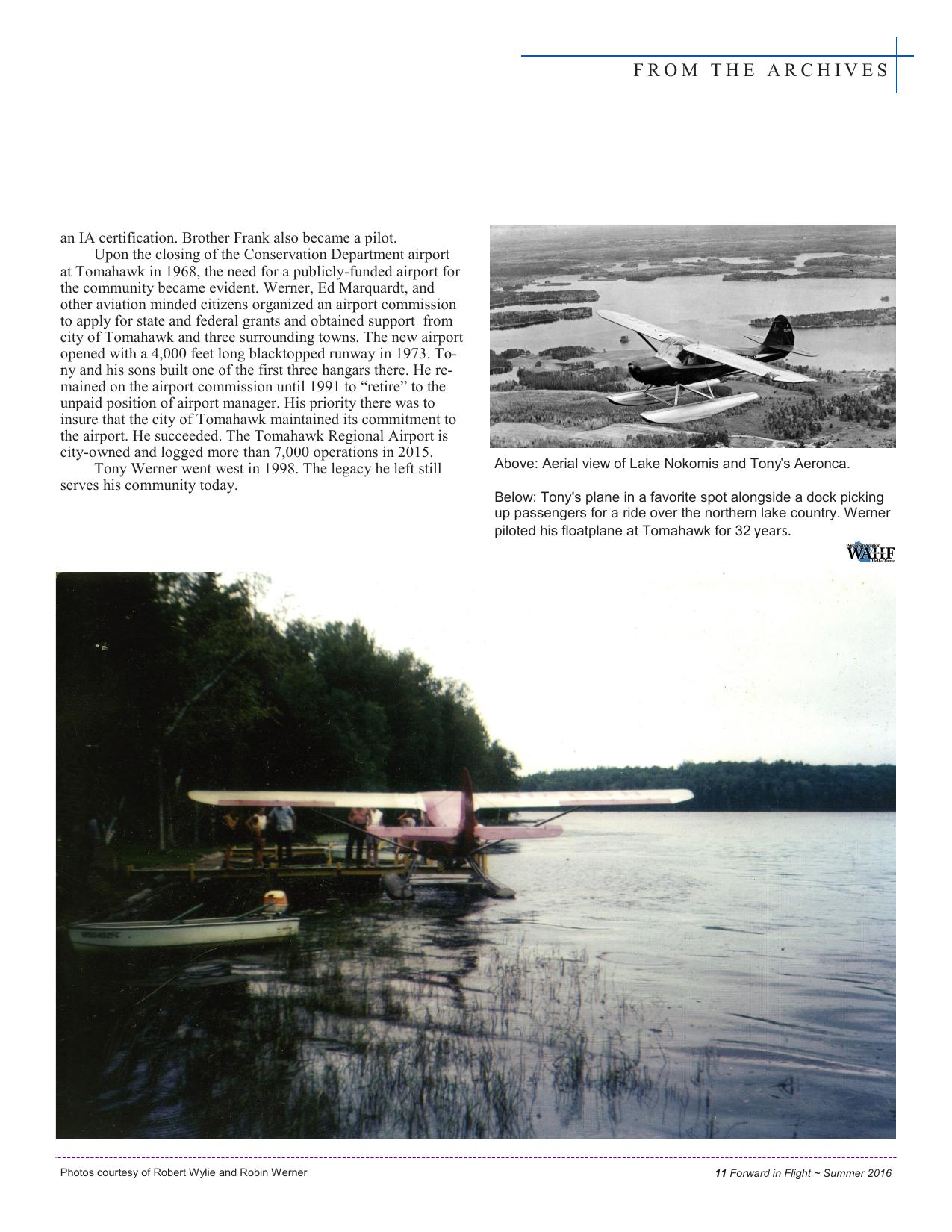
FROM THE ARCHIVES an IA certification. Brother Frank also became a pilot. Upon the closing of the Conservation Department airport at Tomahawk in 1968, the need for a publicly-funded airport for the community became evident. Werner, Ed Marquardt, and other aviation minded citizens organized an airport commission to apply for state and federal grants and obtained support from city of Tomahawk and three surrounding towns. The new airport opened with a 4,000 feet long blacktopped runway in 1973. Tony and his sons built one of the first three hangars there. He remained on the airport commission until 1991 to “retire” to the unpaid position of airport manager. His priority there was to insure that the city of Tomahawk maintained its commitment to the airport. He succeeded. The Tomahawk Regional Airport is city-owned and logged more than 7,000 operations in 2015. Tony Werner went west in 1998. The legacy he left still serves his community today. Photos courtesy of Robert Wylie and Robin Werner Above: Aerial view of Lake Nokomis and Tony’s Aeronca. Below: Tony's plane in a favorite spot alongside a dock picking up passengers for a ride over the northern lake country. Werner piloted his floatplane at Tomahawk for 32 years. 11 Forward in Flight ~ Summer 2016
WWII WISCONSIN Sheboygan County’s Camp Haven Wisconsin’s first UAV Base By John Chmiel Today drones and UAVs are in the daily news around the world. It’s not uncommon to see a hobby drone flying in fields near your neighborhood. This new technology is having impact worldwide. UAVs (unmanned aerial vehicles) operated by the military train at Fort McCoy and Volk Field in Wisconsin. But, did you know this is not the first time that military UAVs have operated over the skies of Wisconsin? Our first UAV base was established in Wisconsin more than 65 years ago. The Hollywood Connection Reginald Denny was an actor whose career began in silent movies and who later became a character actor when “talkies” came about. He was quite a successful actor in Hollywood playing alongside Greta Garbo, Katharine Hepburn, and Frank Sinatra in movies and television from the 1930s to the 1960s. Prior to his movie career, Reginald Denny had served as an observer/gunner in the RAF during WWI, and eventually became a stunt pilot in the 1920s. Denny was also an avid airplane modeler and entrepreneur who founded Reginald Denny Industries, which opened a hobby shop in 1934. The company’s major accomplishment was the development of one of the first radio controlled airplanes, the “Dennyplane”. With WWII looming on the horizon “in 1940, Denny and his partners won a US Army contract for their radio-controlled target drone, the OQ-2 Radioplane. They manufactured nearly 15,000 drones for the US Army (and Navy) during the Second World War. The company was purchased by Northrop in 1952.” The OQ-2 drones were manufactured at a plant at the Van Nuys Airport in Los Angeles where a young Norma Jeane Dougherty was employed. It was at this factory in 1945 that an Army photographer snapped a shot of the attractive young woman working on the OQ-2 assembly line. That photo led to a screen test and a whole new career for Norma Jeane, who we now know better as the movie star icon Marilyn Monroe. The Airplanes The original OQ-2s were single engine monoplanes powered by a 6-horsepower, two-cylinder, two-cycle piston engine driving two contra-rotating propellers mounted on a steel tube fuselage. The airplane had a wingspan of 146-inches and a length of 102-inches. Bendix manufactured the radio control system. Launching was by catapult and aircraft that survived target practice were recovered by parachute. Improvements in drone technology have steadily developed since the 1940s. Early developments included larger horsepower engines, improved radio control, rotary launching systems, emergency recovery systems, and even an “out-ofsight” autopilot. OQ-19s were the UAVs flown over the skies of Lake Michigan and Wisconsin. In 1945, Radioplane developed the 200 mph, OQ-19, which was capable of catapult launches, rotary launches from a circular runway, and air launches from a B-26C. If the airplane was hit or it ran out of fuel, the drone was recovered under a 32-foot diameter parachute. OQ19Ds were fitted with flotation devices to permit water recoveries. There is an OQ19 on display at the Commemorative Air Force Museum at Fleming Field. camp where Midwest units practiced anti -aircraft gunnery. “The weapons the trainees fired ranged from the heavy 120MM antiaircraft guns to 50 caliber machine guns. Also tanks and halftracks fired their weapons at air borne targets. The sound of the heavy guns could easily be heard in Sheboygan as they fired out over the lake.” When a OQ-19 drone was hit by gunfire the parachute was designed to deploy which kept the machine from being destroyed in a crash. Some of the drones landed on dry land and others crashed into the lake. Local scuba divers would later recover these aircraft. OQ-19s and target sleeves towed by airplanes were flown and were fired upon over Lake Michigan. A target sleeve, consisted of an elongated bag towed on the end of a cable approximately 200 to 300 yards long behind a twin-engine A26 bomber. It was not uncommon for a plane to return to base with a few holes. An MOA (military operations area) was created over the lake, and a “no sail zone” on the lake to protect civilians from wandering into the firing range during artillery practice. The advent of guided missiles anti-aircraft guns necessitated that the camp lower its flag for the last time on November 16, 1959. TECHNICAL NOTES: Engine: 72 hp McCulloch O-100-1 Maximum speed: 228 mph Endurance: 90 min. at sea level Ceiling: 25,000 ft. Span: 11 ft. 5 in. Length: 12 ft. 3 in. Height: 2 ft. 7 in. Weight: 319 lbs. maximum Whistling Straights Eventually the military sold the land to the Wisconsin Power and Light. The art of hitting small objects and aiming at targets is still practiced on the property, but now it’s the crack of a golf club striking a ball aimed at flag marking the hole on green that can be heard from this historic site. Today thousands of golf fans flock to see the world’s best golfers play on this PGA Championship Tournament golf course where cows once grazed, farmers grew crops, and tanks, half tracks, and antiaircraft guns shook the ground. The Whistling Straights golf course is now built on was once Camp Haven, named after the nearby village of Haven. Camp Haven In 1949 the United States Army leased 160 acres of farmland near Sheboygan. On this land the Army constructed its new training facility and anti-aircraft training range. The camp had a floating population of 500 to 700 men with 120 tents and permanent buildings on the site. Regular Army, Army Reserve, and National Guard troops trained at the new 12 Forward in Flight ~ Quarterly Magazine of the Wisconsin Aviation Hall of Fame
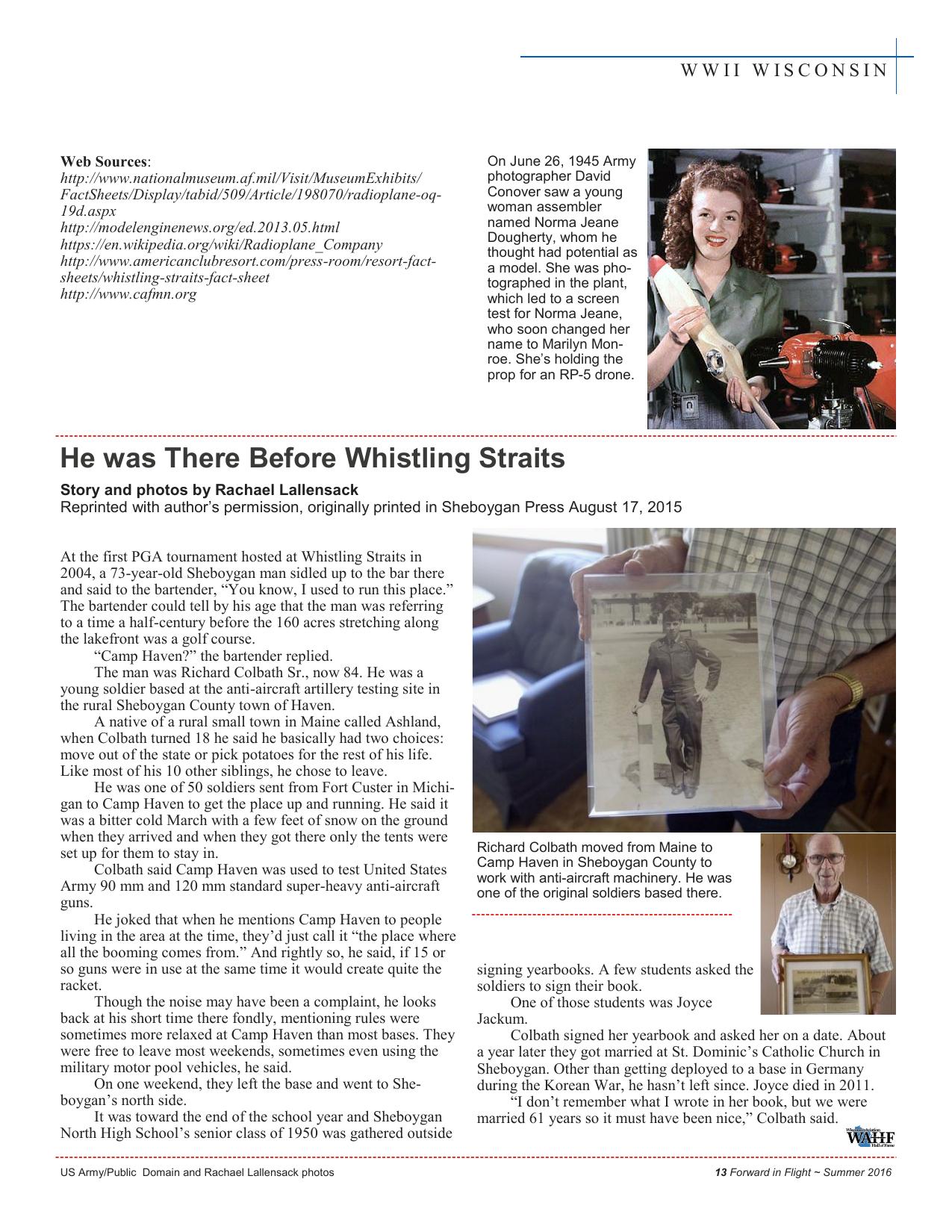
WWII WISCONSIN Web Sources: http://www.nationalmuseum.af.mil/Visit/MuseumExhibits/ FactSheets/Display/tabid/509/Article/198070/radioplane-oq19d.aspx http://modelenginenews.org/ed.2013.05.html https://en.wikipedia.org/wiki/Radioplane_Company http://www.americanclubresort.com/press-room/resort-factsheets/whistling-straits-fact-sheet http://www.cafmn.org On June 26, 1945 Army photographer David Conover saw a young woman assembler named Norma Jeane Dougherty, whom he thought had potential as a model. She was photographed in the plant, which led to a screen test for Norma Jeane, who soon changed her name to Marilyn Monroe. She’s holding the prop for an RP-5 drone. He was There Before Whistling Straits Story and photos by Rachael Lallensack Reprinted with author’s permission, originally printed in Sheboygan Press August 17, 2015 At the first PGA tournament hosted at Whistling Straits in 2004, a 73-year-old Sheboygan man sidled up to the bar there and said to the bartender, “You know, I used to run this place.” The bartender could tell by his age that the man was referring to a time a half-century before the 160 acres stretching along the lakefront was a golf course. “Camp Haven?” the bartender replied. The man was Richard Colbath Sr., now 84. He was a young soldier based at the anti-aircraft artillery testing site in the rural Sheboygan County town of Haven. A native of a rural small town in Maine called Ashland, when Colbath turned 18 he said he basically had two choices: move out of the state or pick potatoes for the rest of his life. Like most of his 10 other siblings, he chose to leave. He was one of 50 soldiers sent from Fort Custer in Michigan to Camp Haven to get the place up and running. He said it was a bitter cold March with a few feet of snow on the ground when they arrived and when they got there only the tents were set up for them to stay in. Colbath said Camp Haven was used to test United States Army 90 mm and 120 mm standard super-heavy anti-aircraft guns. He joked that when he mentions Camp Haven to people living in the area at the time, they’d just call it “the place where all the booming comes from.” And rightly so, he said, if 15 or so guns were in use at the same time it would create quite the racket. Though the noise may have been a complaint, he looks back at his short time there fondly, mentioning rules were sometimes more relaxed at Camp Haven than most bases. They were free to leave most weekends, sometimes even using the military motor pool vehicles, he said. On one weekend, they left the base and went to Sheboygan’s north side. It was toward the end of the school year and Sheboygan North High School’s senior class of 1950 was gathered outside US Army/Public Domain and Rachael Lallensack photos Richard Colbath moved from Maine to Camp Haven in Sheboygan County to work with anti-aircraft machinery. He was one of the original soldiers based there. signing yearbooks. A few students asked the soldiers to sign their book. One of those students was Joyce Jackum. Colbath signed her yearbook and asked her on a date. About a year later they got married at St. Dominic’s Catholic Church in Sheboygan. Other than getting deployed to a base in Germany during the Korean War, he hasn’t left since. Joyce died in 2011. “I don’t remember what I wrote in her book, but we were married 61 years so it must have been nice,” Colbath said. 13 Forward in Flight ~ Summer 2016
DESTINATIONS Alfred & Lois Kelch Aviation Museum, Inc. Museum finds home at Brodhead By Patrick Weeden Many folks in the vintage aircraft community know the name Al Kelch. He was an early member of the EAA Antique/ Classic division, editor of the division’s magazine, Vintage Airplane, and cocreated the core rules for judging vintage airplanes. He collected and restored a number of rare vintage aircraft and flew them from his private strip near Mequon, Wisconsin, and from his winter home in Frostproof, Florida. However, most people are not aware of the gift that Alfred and Lois Kelch gave to the aviation community, a gift that is finally becoming a reality after years of planning. Alfred Kelch was an inventor and industrialist who created Kelch Manufacturing in the 1950s and made his fortune with a number of plastics innovations, including the process for manufacturing the ubiquitous orange traffic cone and the first plastic steering wheel for the automotive trade. The company specialized and was eventually recognized for producing smart and effective fluid management systems and served markets including industrial engines, lawn and garden, recreation, and food and beverage. Lois Kelch, Al’s wife, served as the company’s executive secretary until the couple sold the company to its employees. Al was a collector of all things related to antique transportation; boats, autos, and especially aircraft. He restored and flew dozens of rare examples in a career spanning several decades. When Al Kelch moved his collection to the Brodhead Airport in early 1990s, he was joining a movement in the antique airplane community that recognized the airport as a unique location for the celebration and operation of these old airplanes. Several multi-day events for antique airplanes are held each year at the airport, which was founded 70 years ago in 1946. Before he passed away in 2004, the Alfred & Lois Kelch Charitable Trust was established to “…keep the hangars open” in order that the aviation community could continue to experience his passion for the engineering and technical advances that aviation brought to the world between the two world wars, from 1918 to 1939. Lois Kelch passed away in 2009, and in 2012, the trustees of the Kelch Charitable Trust organized the Alfred & Lois Kelch Aviation Museum, Inc. as a vehicle to create a full-scale museum from Al’s collection. Using Trust funds, a fulltime curator was hired and in 2015, 2.5 acres was purchased adjacent to the Brodhead Airport for the purpose of a museum complex. The museum will be open to the public year-round and have facilities to host educational programs and aviation related events. In March of this year, a formal $1 Million capital fund drive was launched to construct a 23,000 sq. ft. building to house the museum. In addition to the significant investment by the Kelch Charitable Trust, over $300,000 to date, contributions from individuals and foundations totaling an additional $245,000 have been received so far. The Kelch Aviation Museum is a 501c3 non-profit corporation with a mission, “To establish and operate a museum that celebrates the golden age of aviation and cultivates an appreciation of its powerful impact on science, engineering 14 Forward in Flight ~ Quarterly Magazine of the Wisconsin Aviation Hall of Fame and design, and humanity’s understanding of its own limitless potential.” The current collection of aircraft includes: · 1927 Travel Air 4000 · 1932 Franklin Sport 90 · 1931 American Eaglecraft Eaglet · 1928 Stearman C3B · 1930 Taylor E-2 Cub · 1936 Russell Light Monoplane · 1934 Texas Eaglecraft Eaglet · 1931 Curtiss-Wright Travel Air 12Q · 1932 Curtiss-Wright Travel Air 12W · 1935 Welch OW5 · 1938 Taylorcraft A · 1937 Monocoupe 70 Several other aircraft are on longterm loan on a rotating basis, including a rare Butler Blackhawk and a Fleet model 7. The collection is currently located among six hangars at Brodhead Airport and is viewable by appointment until our new building is constructed. We can accommodate most requests. Visit the museum’s website at www.kelchmuseum.org for more infor-
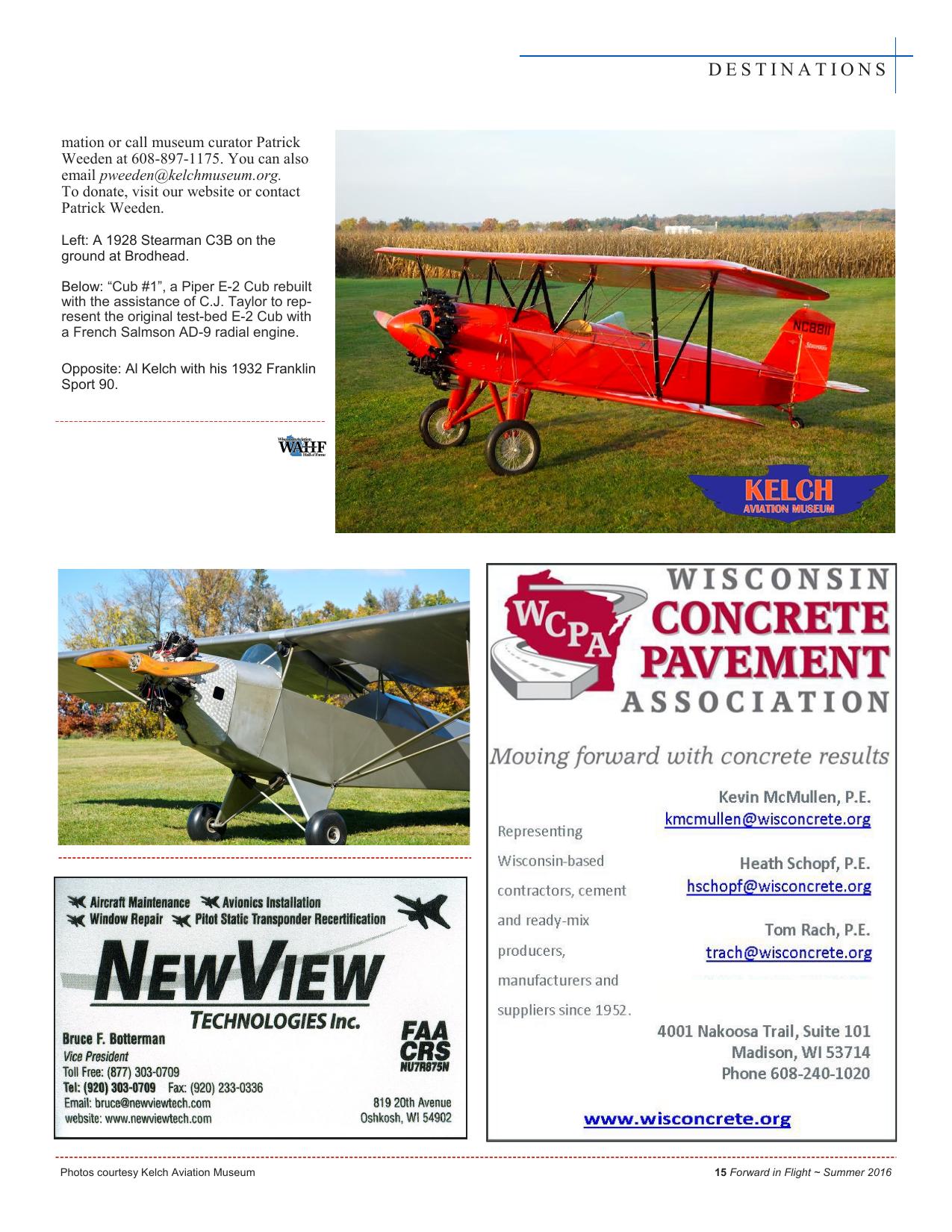
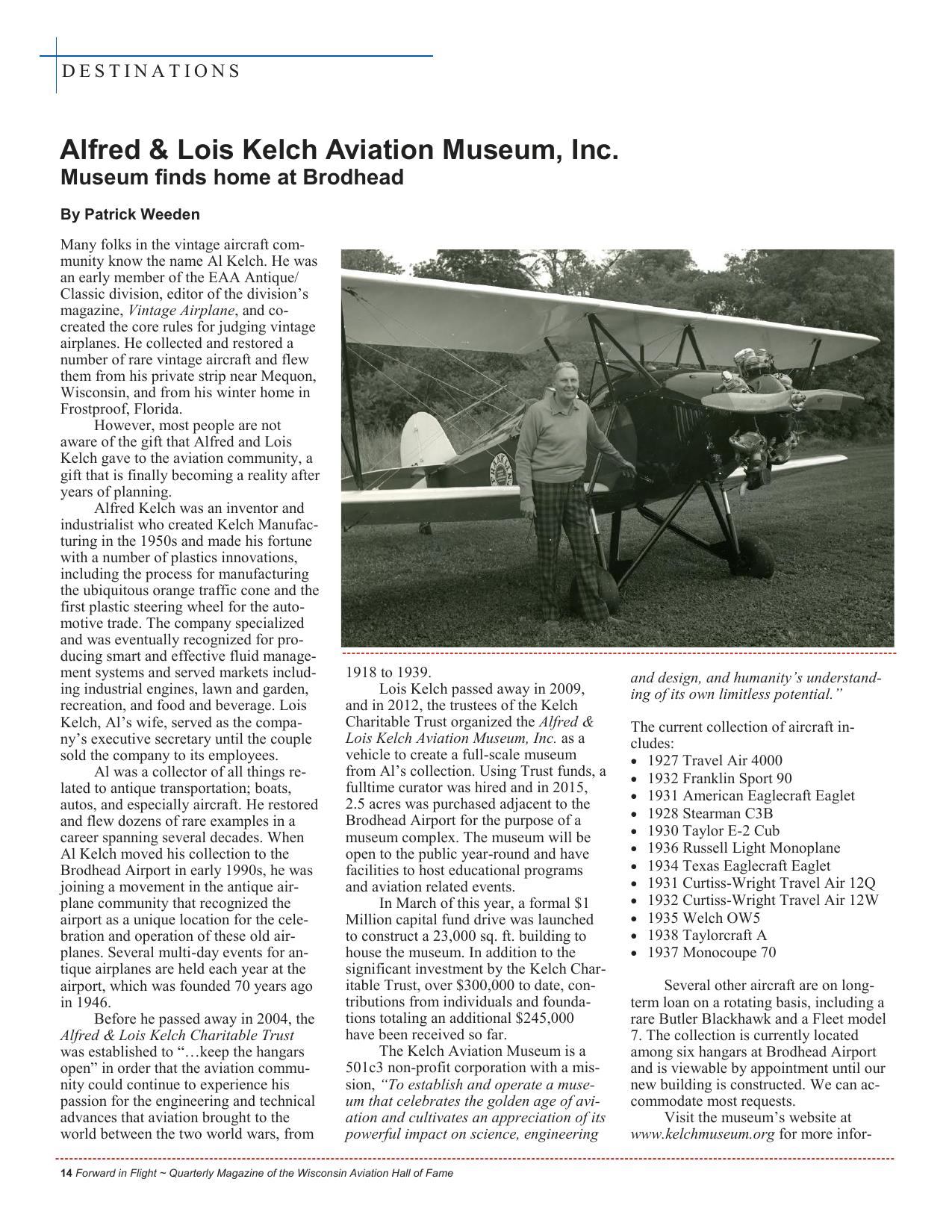
DESTINATIONS mation or call museum curator Patrick Weeden at 608-897-1175. You can also email pweeden@kelchmuseum.org. To donate, visit our website or contact Patrick Weeden. Left: A 1928 Stearman C3B on the ground at Brodhead. Below: “Cub #1”, a Piper E-2 Cub rebuilt with the assistance of C.J. Taylor to represent the original test-bed E-2 Cub with a French Salmson AD-9 radial engine. Opposite: Al Kelch with his 1932 Franklin Sport 90. Photos courtesy Kelch Aviation Museum 15 Forward in Flight ~ Summer 2016
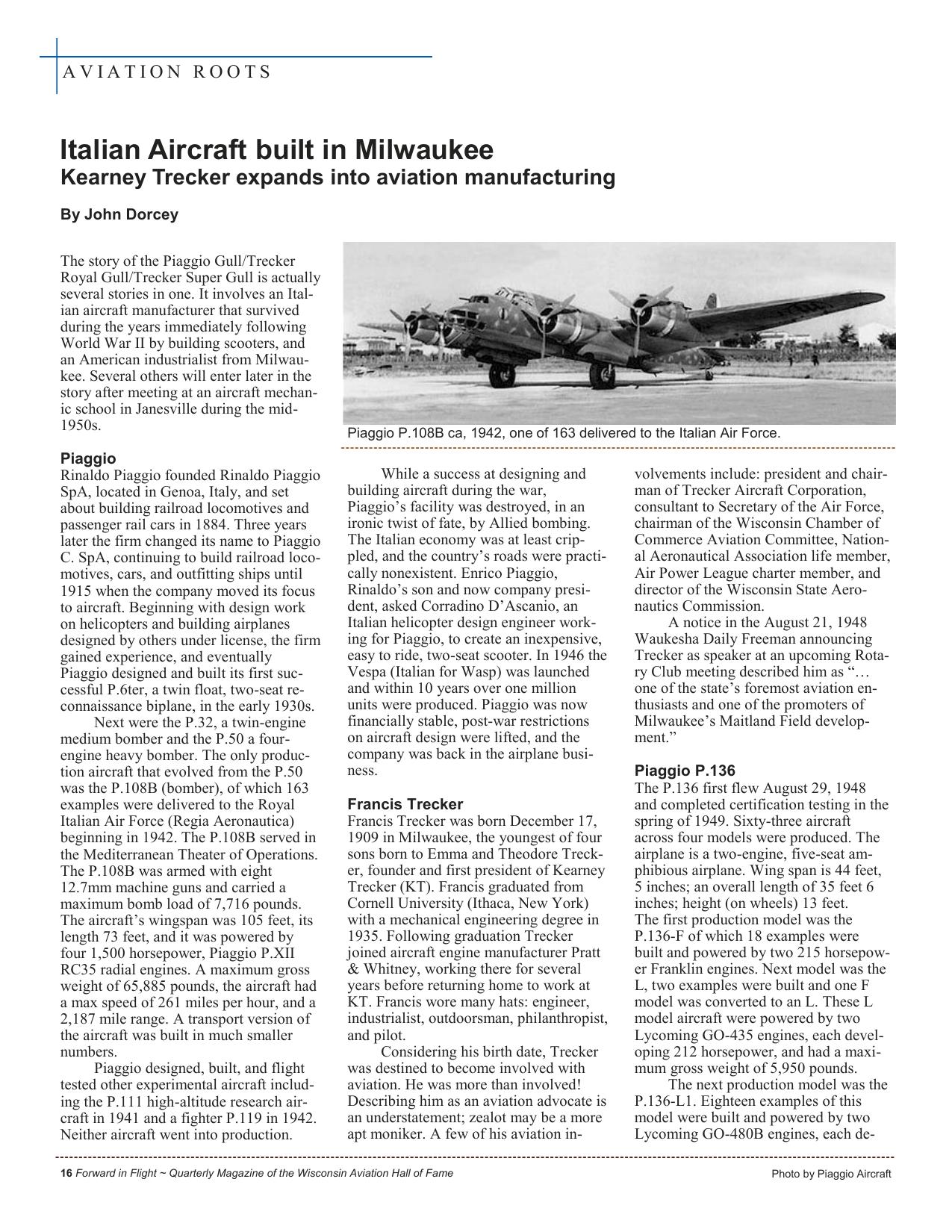
AVIATION ROOTS Italian Aircraft built in Milwaukee Kearney Trecker expands into aviation manufacturing By John Dorcey The story of the Piaggio Gull/Trecker Royal Gull/Trecker Super Gull is actually several stories in one. It involves an Italian aircraft manufacturer that survived during the years immediately following World War II by building scooters, and an American industrialist from Milwaukee. Several others will enter later in the story after meeting at an aircraft mechanic school in Janesville during the mid1950s. Piaggio Rinaldo Piaggio founded Rinaldo Piaggio SpA, located in Genoa, Italy, and set about building railroad locomotives and passenger rail cars in 1884. Three years later the firm changed its name to Piaggio C. SpA, continuing to build railroad locomotives, cars, and outfitting ships until 1915 when the company moved its focus to aircraft. Beginning with design work on helicopters and building airplanes designed by others under license, the firm gained experience, and eventually Piaggio designed and built its first successful P.6ter, a twin float, two-seat reconnaissance biplane, in the early 1930s. Next were the P.32, a twin-engine medium bomber and the P.50 a fourengine heavy bomber. The only production aircraft that evolved from the P.50 was the P.108B (bomber), of which 163 examples were delivered to the Royal Italian Air Force (Regia Aeronautica) beginning in 1942. The P.108B served in the Mediterranean Theater of Operations. The P.108B was armed with eight 12.7mm machine guns and carried a maximum bomb load of 7,716 pounds. The aircraft’s wingspan was 105 feet, its length 73 feet, and it was powered by four 1,500 horsepower, Piaggio P.XII RC35 radial engines. A maximum gross weight of 65,885 pounds, the aircraft had a max speed of 261 miles per hour, and a 2,187 mile range. A transport version of the aircraft was built in much smaller numbers. Piaggio designed, built, and flight tested other experimental aircraft including the P.111 high-altitude research aircraft in 1941 and a fighter P.119 in 1942. Neither aircraft went into production. Piaggio P.108B ca, 1942, one of 163 delivered to the Italian Air Force. While a success at designing and building aircraft during the war, Piaggio’s facility was destroyed, in an ironic twist of fate, by Allied bombing. The Italian economy was at least crippled, and the country’s roads were practically nonexistent. Enrico Piaggio, Rinaldo’s son and now company president, asked Corradino D’Ascanio, an Italian helicopter design engineer working for Piaggio, to create an inexpensive, easy to ride, two-seat scooter. In 1946 the Vespa (Italian for Wasp) was launched and within 10 years over one million units were produced. Piaggio was now financially stable, post-war restrictions on aircraft design were lifted, and the company was back in the airplane business. Francis Trecker Francis Trecker was born December 17, 1909 in Milwaukee, the youngest of four sons born to Emma and Theodore Trecker, founder and first president of Kearney Trecker (KT). Francis graduated from Cornell University (Ithaca, New York) with a mechanical engineering degree in 1935. Following graduation Trecker joined aircraft engine manufacturer Pratt & Whitney, working there for several years before returning home to work at KT. Francis wore many hats: engineer, industrialist, outdoorsman, philanthropist, and pilot. Considering his birth date, Trecker was destined to become involved with aviation. He was more than involved! Describing him as an aviation advocate is an understatement; zealot may be a more apt moniker. A few of his aviation in- 16 Forward in Flight ~ Quarterly Magazine of the Wisconsin Aviation Hall of Fame volvements include: president and chairman of Trecker Aircraft Corporation, consultant to Secretary of the Air Force, chairman of the Wisconsin Chamber of Commerce Aviation Committee, National Aeronautical Association life member, Air Power League charter member, and director of the Wisconsin State Aeronautics Commission. A notice in the August 21, 1948 Waukesha Daily Freeman announcing Trecker as speaker at an upcoming Rotary Club meeting described him as “… one of the state’s foremost aviation enthusiasts and one of the promoters of Milwaukee’s Maitland Field development.” Piaggio P.136 The P.136 first flew August 29, 1948 and completed certification testing in the spring of 1949. Sixty-three aircraft across four models were produced. The airplane is a two-engine, five-seat amphibious airplane. Wing span is 44 feet, 5 inches; an overall length of 35 feet 6 inches; height (on wheels) 13 feet. The first production model was the P.136-F of which 18 examples were built and powered by two 215 horsepower Franklin engines. Next model was the L, two examples were built and one F model was converted to an L. These L model aircraft were powered by two Lycoming GO-435 engines, each developing 212 horsepower, and had a maximum gross weight of 5,950 pounds. The next production model was the P.136-L1. Eighteen examples of this model were built and powered by two Lycoming GO-480B engines, each dePhoto by Piaggio Aircraft
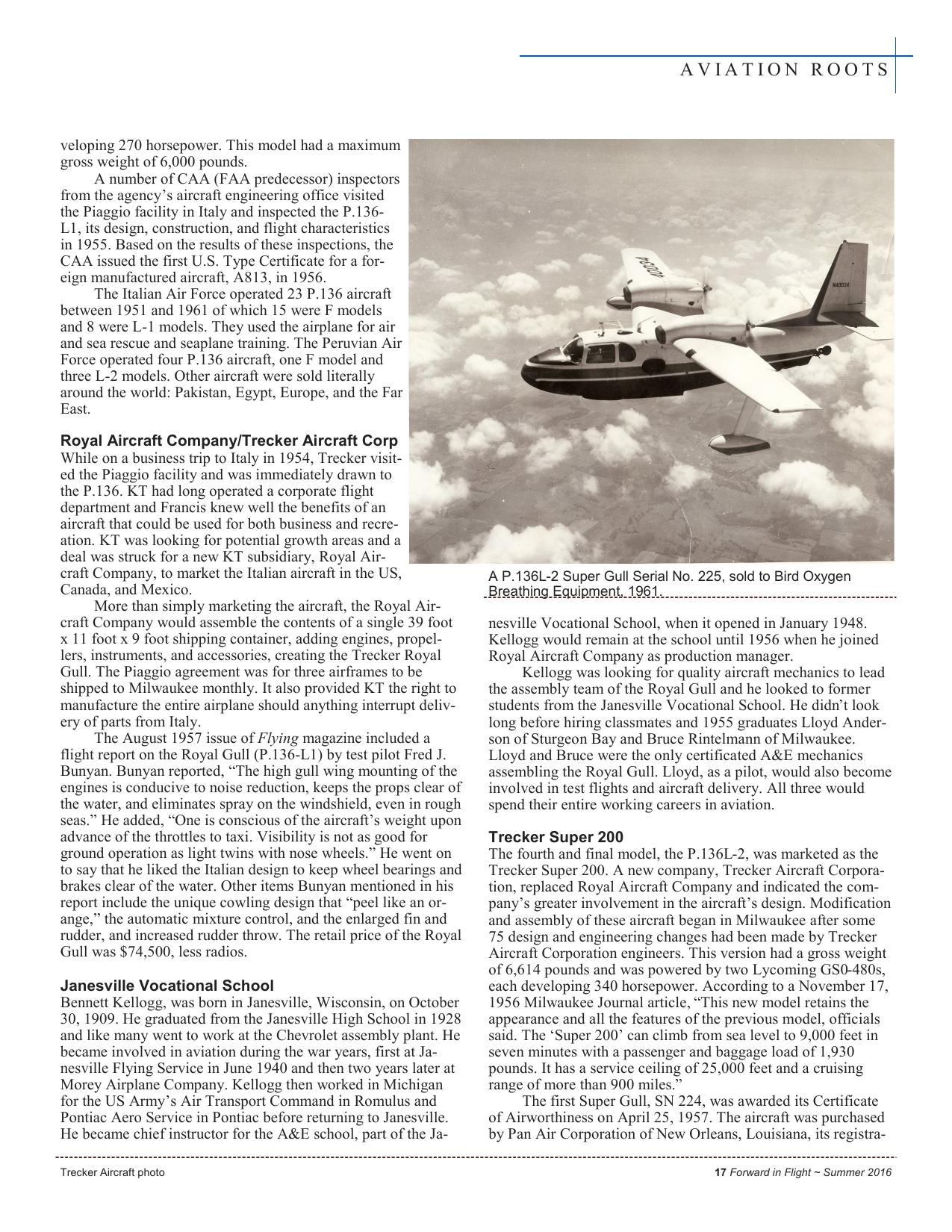
AVIATION ROOTS veloping 270 horsepower. This model had a maximum gross weight of 6,000 pounds. A number of CAA (FAA predecessor) inspectors from the agency’s aircraft engineering office visited the Piaggio facility in Italy and inspected the P.136L1, its design, construction, and flight characteristics in 1955. Based on the results of these inspections, the CAA issued the first U.S. Type Certificate for a foreign manufactured aircraft, A813, in 1956. The Italian Air Force operated 23 P.136 aircraft between 1951 and 1961 of which 15 were F models and 8 were L-1 models. They used the airplane for air and sea rescue and seaplane training. The Peruvian Air Force operated four P.136 aircraft, one F model and three L-2 models. Other aircraft were sold literally around the world: Pakistan, Egypt, Europe, and the Far East. Royal Aircraft Company/Trecker Aircraft Corp While on a business trip to Italy in 1954, Trecker visited the Piaggio facility and was immediately drawn to the P.136. KT had long operated a corporate flight department and Francis knew well the benefits of an aircraft that could be used for both business and recreation. KT was looking for potential growth areas and a deal was struck for a new KT subsidiary, Royal Aircraft Company, to market the Italian aircraft in the US, Canada, and Mexico. More than simply marketing the aircraft, the Royal Aircraft Company would assemble the contents of a single 39 foot x 11 foot x 9 foot shipping container, adding engines, propellers, instruments, and accessories, creating the Trecker Royal Gull. The Piaggio agreement was for three airframes to be shipped to Milwaukee monthly. It also provided KT the right to manufacture the entire airplane should anything interrupt delivery of parts from Italy. The August 1957 issue of Flying magazine included a flight report on the Royal Gull (P.136-L1) by test pilot Fred J. Bunyan. Bunyan reported, “The high gull wing mounting of the engines is conducive to noise reduction, keeps the props clear of the water, and eliminates spray on the windshield, even in rough seas.” He added, “One is conscious of the aircraft’s weight upon advance of the throttles to taxi. Visibility is not as good for ground operation as light twins with nose wheels.” He went on to say that he liked the Italian design to keep wheel bearings and brakes clear of the water. Other items Bunyan mentioned in his report include the unique cowling design that “peel like an orange,” the automatic mixture control, and the enlarged fin and rudder, and increased rudder throw. The retail price of the Royal Gull was $74,500, less radios. Janesville Vocational School Bennett Kellogg, was born in Janesville, Wisconsin, on October 30, 1909. He graduated from the Janesville High School in 1928 and like many went to work at the Chevrolet assembly plant. He became involved in aviation during the war years, first at Janesville Flying Service in June 1940 and then two years later at Morey Airplane Company. Kellogg then worked in Michigan for the US Army’s Air Transport Command in Romulus and Pontiac Aero Service in Pontiac before returning to Janesville. He became chief instructor for the A&E school, part of the JaTrecker Aircraft photo A P.136L-2 Super Gull Serial No. 225, sold to Bird Oxygen Breathing Equipment, 1961. nesville Vocational School, when it opened in January 1948. Kellogg would remain at the school until 1956 when he joined Royal Aircraft Company as production manager. Kellogg was looking for quality aircraft mechanics to lead the assembly team of the Royal Gull and he looked to former students from the Janesville Vocational School. He didn’t look long before hiring classmates and 1955 graduates Lloyd Anderson of Sturgeon Bay and Bruce Rintelmann of Milwaukee. Lloyd and Bruce were the only certificated A&E mechanics assembling the Royal Gull. Lloyd, as a pilot, would also become involved in test flights and aircraft delivery. All three would spend their entire working careers in aviation. Trecker Super 200 The fourth and final model, the P.136L-2, was marketed as the Trecker Super 200. A new company, Trecker Aircraft Corporation, replaced Royal Aircraft Company and indicated the company’s greater involvement in the aircraft’s design. Modification and assembly of these aircraft began in Milwaukee after some 75 design and engineering changes had been made by Trecker Aircraft Corporation engineers. This version had a gross weight of 6,614 pounds and was powered by two Lycoming GS0-480s, each developing 340 horsepower. According to a November 17, 1956 Milwaukee Journal article, “This new model retains the appearance and all the features of the previous model, officials said. The ‘Super 200’ can climb from sea level to 9,000 feet in seven minutes with a passenger and baggage load of 1,930 pounds. It has a service ceiling of 25,000 feet and a cruising range of more than 900 miles.” The first Super Gull, SN 224, was awarded its Certificate of Airworthiness on April 25, 1957. The aircraft was purchased by Pan Air Corporation of New Orleans, Louisiana, its registra17 Forward in Flight ~ Summer 2016
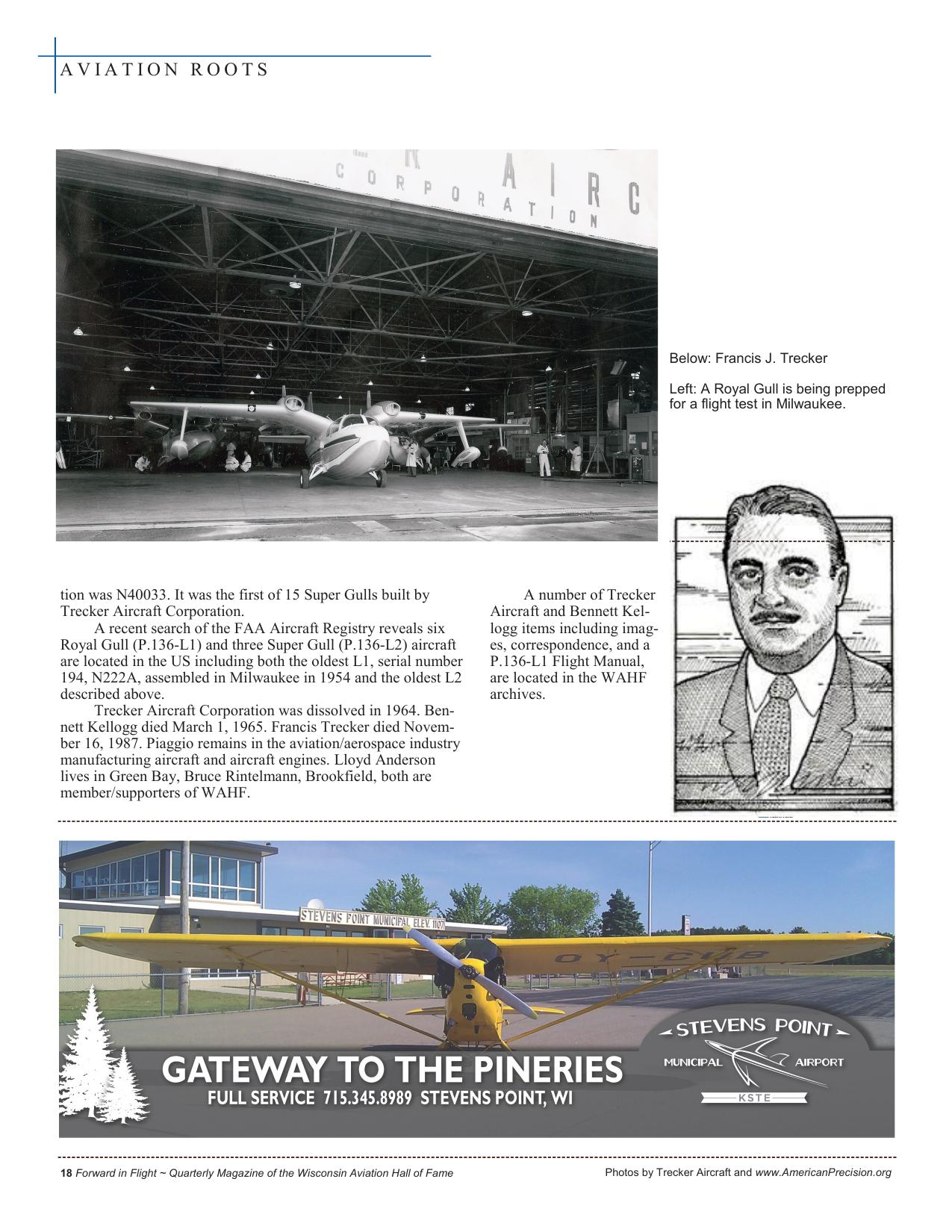
AVIATION ROOTS Below: Francis J. Trecker Left: A Royal Gull is being prepped for a flight test in Milwaukee. tion was N40033. It was the first of 15 Super Gulls built by Trecker Aircraft Corporation. A recent search of the FAA Aircraft Registry reveals six Royal Gull (P.136-L1) and three Super Gull (P.136-L2) aircraft are located in the US including both the oldest L1, serial number 194, N222A, assembled in Milwaukee in 1954 and the oldest L2 described above. Trecker Aircraft Corporation was dissolved in 1964. Bennett Kellogg died March 1, 1965. Francis Trecker died November 16, 1987. Piaggio remains in the aviation/aerospace industry manufacturing aircraft and aircraft engines. Lloyd Anderson lives in Green Bay, Bruce Rintelmann, Brookfield, both are member/supporters of WAHF. 18 Forward in Flight ~ Quarterly Magazine of the Wisconsin Aviation Hall of Fame A number of Trecker Aircraft and Bennett Kellogg items including images, correspondence, and a P.136-L1 Flight Manual, are located in the WAHF archives. Photos by Trecker Aircraft and www.AmericanPrecision.org
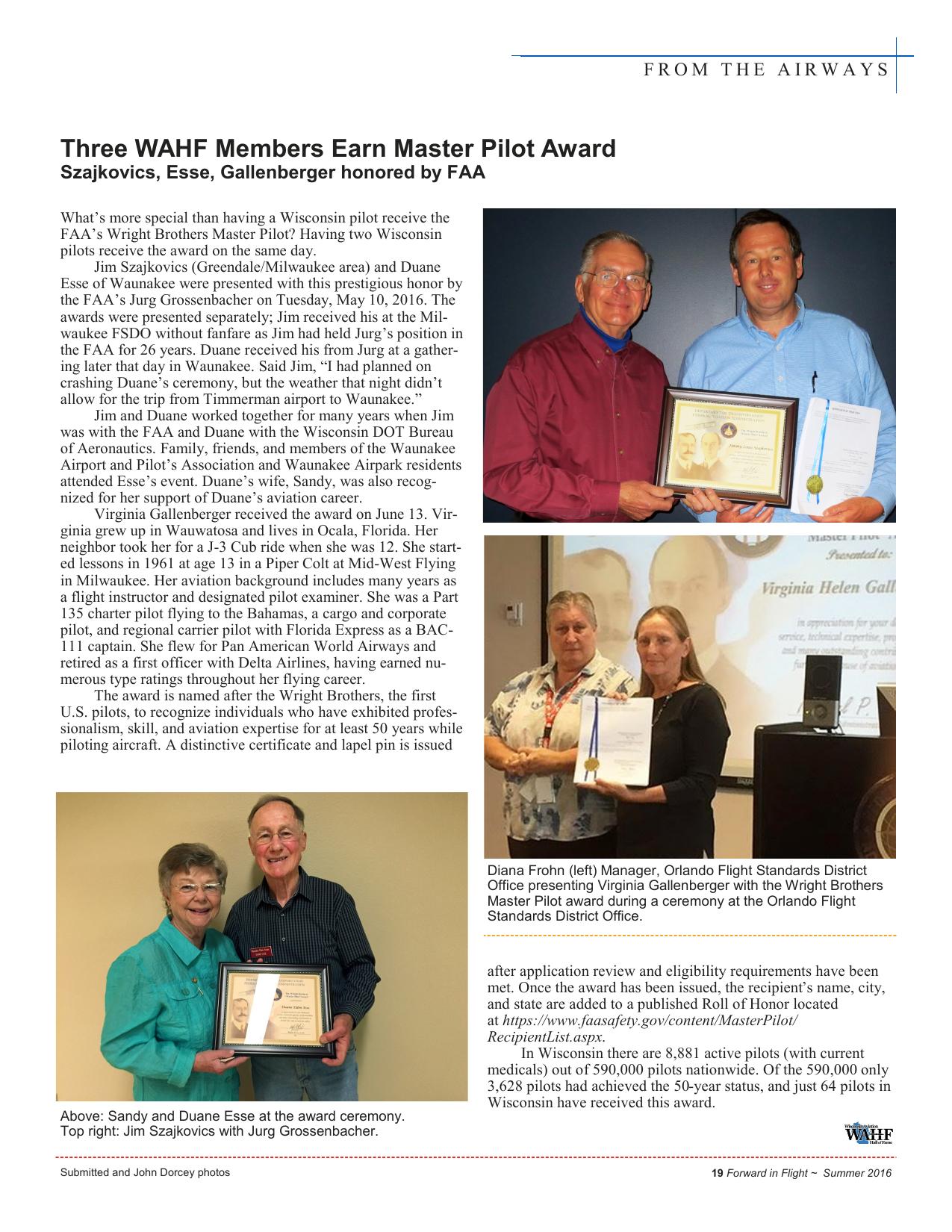
FROM THE AIRWAYS Three WAHF Members Earn Master Pilot Award Szajkovics, Esse, Gallenberger honored by FAA What’s more special than having a Wisconsin pilot receive the FAA’s Wright Brothers Master Pilot? Having two Wisconsin pilots receive the award on the same day. Jim Szajkovics (Greendale/Milwaukee area) and Duane Esse of Waunakee were presented with this prestigious honor by the FAA’s Jurg Grossenbacher on Tuesday, May 10, 2016. The awards were presented separately; Jim received his at the Milwaukee FSDO without fanfare as Jim had held Jurg’s position in the FAA for 26 years. Duane received his from Jurg at a gathering later that day in Waunakee. Said Jim, “I had planned on crashing Duane’s ceremony, but the weather that night didn’t allow for the trip from Timmerman airport to Waunakee.” Jim and Duane worked together for many years when Jim was with the FAA and Duane with the Wisconsin DOT Bureau of Aeronautics. Family, friends, and members of the Waunakee Airport and Pilot’s Association and Waunakee Airpark residents attended Esse’s event. Duane’s wife, Sandy, was also recognized for her support of Duane’s aviation career. Virginia Gallenberger received the award on June 13. Virginia grew up in Wauwatosa and lives in Ocala, Florida. Her neighbor took her for a J-3 Cub ride when she was 12. She started lessons in 1961 at age 13 in a Piper Colt at Mid-West Flying in Milwaukee. Her aviation background includes many years as a flight instructor and designated pilot examiner. She was a Part 135 charter pilot flying to the Bahamas, a cargo and corporate pilot, and regional carrier pilot with Florida Express as a BAC111 captain. She flew for Pan American World Airways and retired as a first officer with Delta Airlines, having earned numerous type ratings throughout her flying career. The award is named after the Wright Brothers, the first U.S. pilots, to recognize individuals who have exhibited professionalism, skill, and aviation expertise for at least 50 years while piloting aircraft. A distinctive certificate and lapel pin is issued Diana Frohn (left) Manager, Orlando Flight Standards District Office presenting Virginia Gallenberger with the Wright Brothers Master Pilot award during a ceremony at the Orlando Flight Standards District Office. Above: Sandy and Duane Esse at the award ceremony. Top right: Jim Szajkovics with Jurg Grossenbacher. Submitted and John Dorcey photos after application review and eligibility requirements have been met. Once the award has been issued, the recipient’s name, city, and state are added to a published Roll of Honor located at https://www.faasafety.gov/content/MasterPilot/ RecipientList.aspx. In Wisconsin there are 8,881 active pilots (with current medicals) out of 590,000 pilots nationwide. Of the 590,000 only 3,628 pilots had achieved the 50-year status, and just 64 pilots in Wisconsin have received this award. 19 Forward in Flight ~ Summer 2016
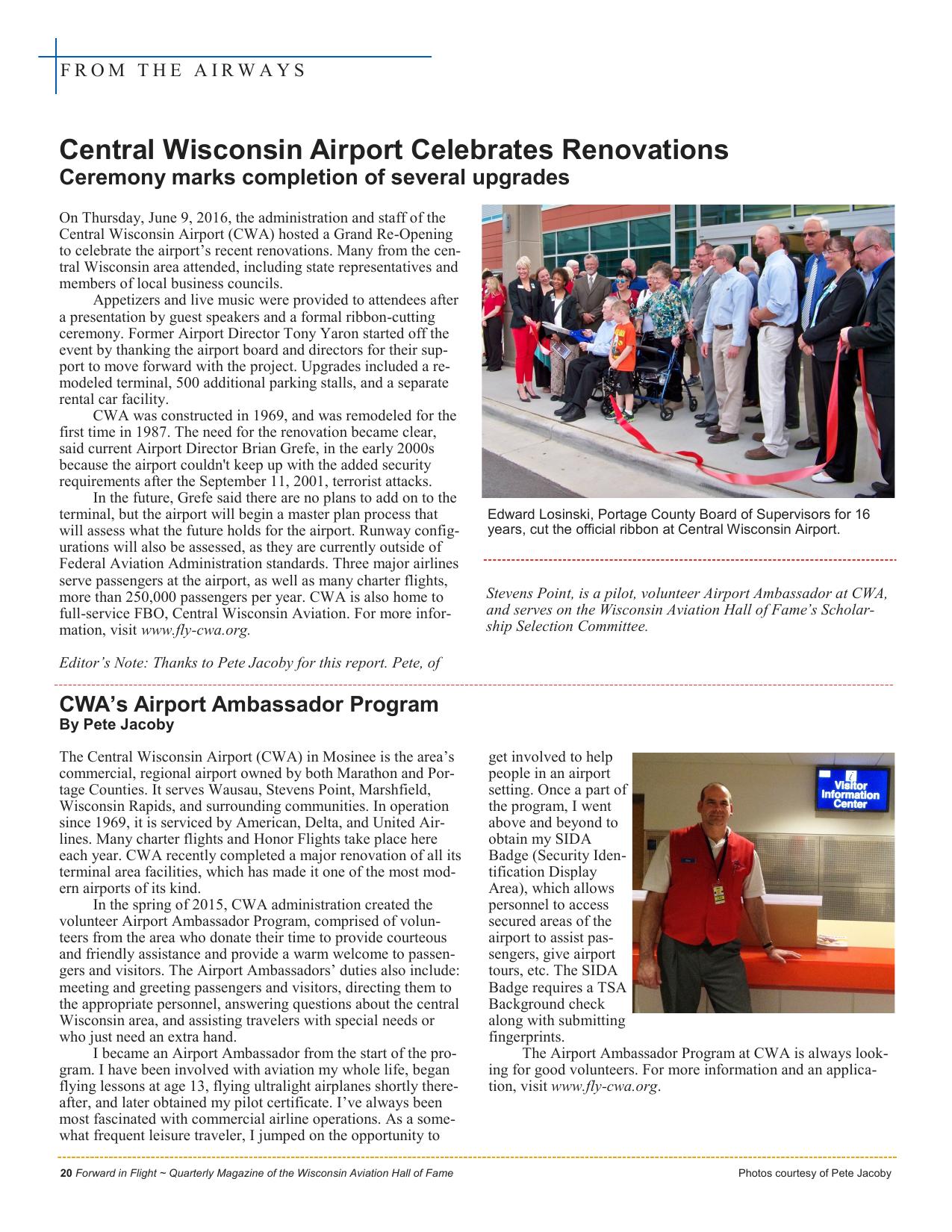
FROM THE AIRWAYS Central Wisconsin Airport Celebrates Renovations Ceremony marks completion of several upgrades On Thursday, June 9, 2016, the administration and staff of the Central Wisconsin Airport (CWA) hosted a Grand Re-Opening to celebrate the airport’s recent renovations. Many from the central Wisconsin area attended, including state representatives and members of local business councils. Appetizers and live music were provided to attendees after a presentation by guest speakers and a formal ribbon-cutting ceremony. Former Airport Director Tony Yaron started off the event by thanking the airport board and directors for their support to move forward with the project. Upgrades included a remodeled terminal, 500 additional parking stalls, and a separate rental car facility. CWA was constructed in 1969, and was remodeled for the first time in 1987. The need for the renovation became clear, said current Airport Director Brian Grefe, in the early 2000s because the airport couldn't keep up with the added security requirements after the September 11, 2001, terrorist attacks. In the future, Grefe said there are no plans to add on to the terminal, but the airport will begin a master plan process that will assess what the future holds for the airport. Runway configurations will also be assessed, as they are currently outside of Federal Aviation Administration standards. Three major airlines serve passengers at the airport, as well as many charter flights, more than 250,000 passengers per year. CWA is also home to full-service FBO, Central Wisconsin Aviation. For more information, visit www.fly-cwa.org. Edward Losinski, Portage County Board of Supervisors for 16 years, cut the official ribbon at Central Wisconsin Airport. Stevens Point, is a pilot, volunteer Airport Ambassador at CWA, and serves on the Wisconsin Aviation Hall of Fame’s Scholarship Selection Committee. Editor’s Note: Thanks to Pete Jacoby for this report. Pete, of CWA’s Airport Ambassador Program By Pete Jacoby The Central Wisconsin Airport (CWA) in Mosinee is the area’s commercial, regional airport owned by both Marathon and Portage Counties. It serves Wausau, Stevens Point, Marshfield, Wisconsin Rapids, and surrounding communities. In operation since 1969, it is serviced by American, Delta, and United Airlines. Many charter flights and Honor Flights take place here each year. CWA recently completed a major renovation of all its terminal area facilities, which has made it one of the most modern airports of its kind. In the spring of 2015, CWA administration created the volunteer Airport Ambassador Program, comprised of volunteers from the area who donate their time to provide courteous and friendly assistance and provide a warm welcome to passengers and visitors. The Airport Ambassadors’ duties also include: meeting and greeting passengers and visitors, directing them to the appropriate personnel, answering questions about the central Wisconsin area, and assisting travelers with special needs or who just need an extra hand. I became an Airport Ambassador from the start of the program. I have been involved with aviation my whole life, began flying lessons at age 13, flying ultralight airplanes shortly thereafter, and later obtained my pilot certificate. I’ve always been most fascinated with commercial airline operations. As a somewhat frequent leisure traveler, I jumped on the opportunity to 20 Forward in Flight ~ Quarterly Magazine of the Wisconsin Aviation Hall of Fame get involved to help people in an airport setting. Once a part of the program, I went above and beyond to obtain my SIDA Badge (Security Identification Display Area), which allows personnel to access secured areas of the airport to assist passengers, give airport tours, etc. The SIDA Badge requires a TSA Background check along with submitting fingerprints. The Airport Ambassador Program at CWA is always looking for good volunteers. For more information and an application, visit www.fly-cwa.org. Photos courtesy of Pete Jacoby
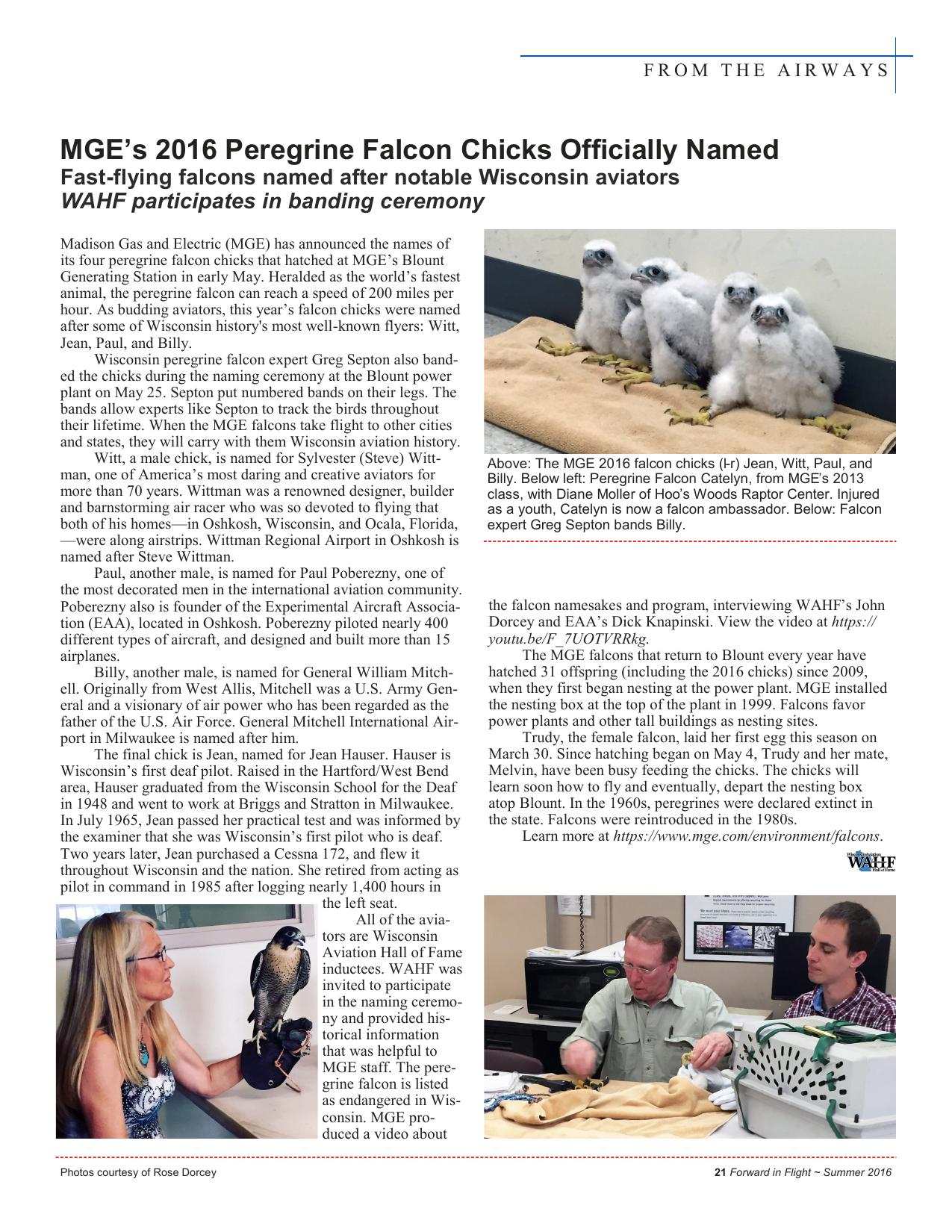
FROM THE AIRWAYS MGE’s 2016 Peregrine Falcon Chicks Officially Named Fast-flying falcons named after notable Wisconsin aviators WAHF participates in banding ceremony Madison Gas and Electric (MGE) has announced the names of its four peregrine falcon chicks that hatched at MGE’s Blount Generating Station in early May. Heralded as the world’s fastest animal, the peregrine falcon can reach a speed of 200 miles per hour. As budding aviators, this year’s falcon chicks were named after some of Wisconsin history's most well-known flyers: Witt, Jean, Paul, and Billy. Wisconsin peregrine falcon expert Greg Septon also banded the chicks during the naming ceremony at the Blount power plant on May 25. Septon put numbered bands on their legs. The bands allow experts like Septon to track the birds throughout their lifetime. When the MGE falcons take flight to other cities and states, they will carry with them Wisconsin aviation history. Witt, a male chick, is named for Sylvester (Steve) Wittman, one of America’s most daring and creative aviators for more than 70 years. Wittman was a renowned designer, builder and barnstorming air racer who was so devoted to flying that both of his homes—in Oshkosh, Wisconsin, and Ocala, Florida, —were along airstrips. Wittman Regional Airport in Oshkosh is named after Steve Wittman. Paul, another male, is named for Paul Poberezny, one of the most decorated men in the international aviation community. Poberezny also is founder of the Experimental Aircraft Association (EAA), located in Oshkosh. Poberezny piloted nearly 400 different types of aircraft, and designed and built more than 15 airplanes. Billy, another male, is named for General William Mitchell. Originally from West Allis, Mitchell was a U.S. Army General and a visionary of air power who has been regarded as the father of the U.S. Air Force. General Mitchell International Airport in Milwaukee is named after him. The final chick is Jean, named for Jean Hauser. Hauser is Wisconsin’s first deaf pilot. Raised in the Hartford/West Bend area, Hauser graduated from the Wisconsin School for the Deaf in 1948 and went to work at Briggs and Stratton in Milwaukee. In July 1965, Jean passed her practical test and was informed by the examiner that she was Wisconsin’s first pilot who is deaf. Two years later, Jean purchased a Cessna 172, and flew it throughout Wisconsin and the nation. She retired from acting as pilot in command in 1985 after logging nearly 1,400 hours in the left seat. All of the aviators are Wisconsin Aviation Hall of Fame inductees. WAHF was invited to participate in the naming ceremony and provided historical information that was helpful to MGE staff. The peregrine falcon is listed as endangered in Wisconsin. MGE produced a video about Photos courtesy of Rose Dorcey Above: The MGE 2016 falcon chicks (l-r) Jean, Witt, Paul, and Billy. Below left: Peregrine Falcon Catelyn, from MGE’s 2013 class, with Diane Moller of Hoo’s Woods Raptor Center. Injured as a youth, Catelyn is now a falcon ambassador. Below: Falcon expert Greg Septon bands Billy. the falcon namesakes and program, interviewing WAHF’s John Dorcey and EAA’s Dick Knapinski. View the video at https:// youtu.be/F_7UOTVRRkg. The MGE falcons that return to Blount every year have hatched 31 offspring (including the 2016 chicks) since 2009, when they first began nesting at the power plant. MGE installed the nesting box at the top of the plant in 1999. Falcons favor power plants and other tall buildings as nesting sites. Trudy, the female falcon, laid her first egg this season on March 30. Since hatching began on May 4, Trudy and her mate, Melvin, have been busy feeding the chicks. The chicks will learn soon how to fly and eventually, depart the nesting box atop Blount. In the 1960s, peregrines were declared extinct in the state. Falcons were reintroduced in the 1980s. Learn more at https://www.mge.com/environment/falcons. 21 Forward in Flight ~ Summer 2016
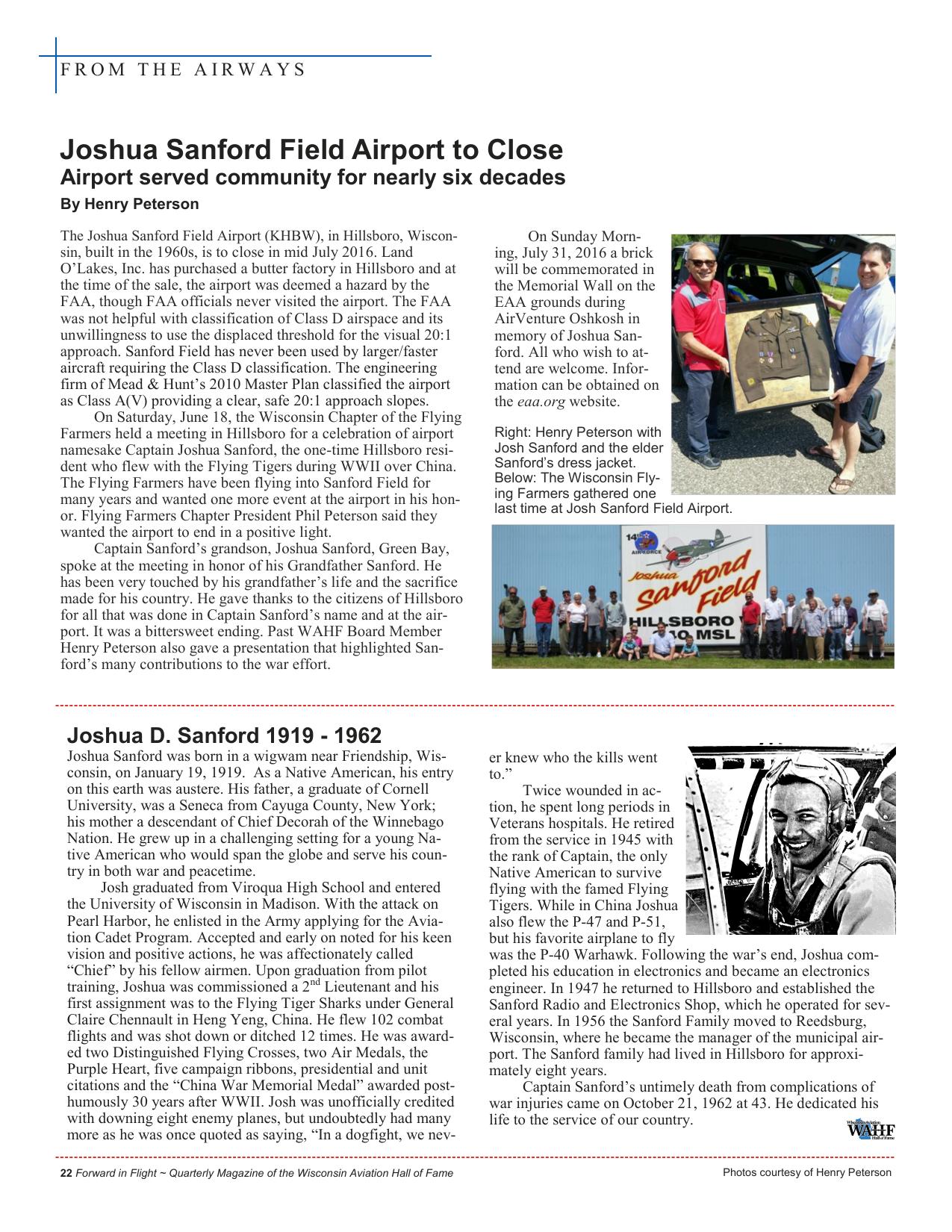
FROM THE AIRWAYS Joshua Sanford Field Airport to Close Airport served community for nearly six decades By Henry Peterson The Joshua Sanford Field Airport (KHBW), in Hillsboro, Wisconsin, built in the 1960s, is to close in mid July 2016. Land O’Lakes, Inc. has purchased a butter factory in Hillsboro and at the time of the sale, the airport was deemed a hazard by the FAA, though FAA officials never visited the airport. The FAA was not helpful with classification of Class D airspace and its unwillingness to use the displaced threshold for the visual 20:1 approach. Sanford Field has never been used by larger/faster aircraft requiring the Class D classification. The engineering firm of Mead & Hunt’s 2010 Master Plan classified the airport as Class A(V) providing a clear, safe 20:1 approach slopes. On Saturday, June 18, the Wisconsin Chapter of the Flying Farmers held a meeting in Hillsboro for a celebration of airport namesake Captain Joshua Sanford, the one-time Hillsboro resident who flew with the Flying Tigers during WWII over China. The Flying Farmers have been flying into Sanford Field for many years and wanted one more event at the airport in his honor. Flying Farmers Chapter President Phil Peterson said they wanted the airport to end in a positive light. Captain Sanford’s grandson, Joshua Sanford, Green Bay, spoke at the meeting in honor of his Grandfather Sanford. He has been very touched by his grandfather’s life and the sacrifice made for his country. He gave thanks to the citizens of Hillsboro for all that was done in Captain Sanford’s name and at the airport. It was a bittersweet ending. Past WAHF Board Member Henry Peterson also gave a presentation that highlighted Sanford’s many contributions to the war effort. On Sunday Morning, July 31, 2016 a brick will be commemorated in the Memorial Wall on the EAA grounds during AirVenture Oshkosh in memory of Joshua Sanford. All who wish to attend are welcome. Information can be obtained on the eaa.org website. Right: Henry Peterson with Josh Sanford and the elder Sanford’s dress jacket. Below: The Wisconsin Flying Farmers gathered one last time at Josh Sanford Field Airport. Joshua D. Sanford 1919 - 1962 Joshua Sanford was born in a wigwam near Friendship, Wisconsin, on January 19, 1919. As a Native American, his entry on this earth was austere. His father, a graduate of Cornell University, was a Seneca from Cayuga County, New York; his mother a descendant of Chief Decorah of the Winnebago Nation. He grew up in a challenging setting for a young Native American who would span the globe and serve his country in both war and peacetime. Josh graduated from Viroqua High School and entered the University of Wisconsin in Madison. With the attack on Pearl Harbor, he enlisted in the Army applying for the Aviation Cadet Program. Accepted and early on noted for his keen vision and positive actions, he was affectionately called “Chief” by his fellow airmen. Upon graduation from pilot training, Joshua was commissioned a 2nd Lieutenant and his first assignment was to the Flying Tiger Sharks under General Claire Chennault in Heng Yeng, China. He flew 102 combat flights and was shot down or ditched 12 times. He was awarded two Distinguished Flying Crosses, two Air Medals, the Purple Heart, five campaign ribbons, presidential and unit citations and the “China War Memorial Medal” awarded posthumously 30 years after WWII. Josh was unofficially credited with downing eight enemy planes, but undoubtedly had many more as he was once quoted as saying, “In a dogfight, we nev- er knew who the kills went to.” Twice wounded in action, he spent long periods in Veterans hospitals. He retired from the service in 1945 with the rank of Captain, the only Native American to survive flying with the famed Flying Tigers. While in China Joshua also flew the P-47 and P-51, but his favorite airplane to fly was the P-40 Warhawk. Following the war’s end, Joshua completed his education in electronics and became an electronics engineer. In 1947 he returned to Hillsboro and established the Sanford Radio and Electronics Shop, which he operated for several years. In 1956 the Sanford Family moved to Reedsburg, Wisconsin, where he became the manager of the municipal airport. The Sanford family had lived in Hillsboro for approximately eight years. Captain Sanford’s untimely death from complications of war injuries came on October 21, 1962 at 43. He dedicated his life to the service of our country. 22 Forward in Flight ~ Quarterly Magazine of the Wisconsin Aviation Hall of Fame Photos courtesy of Henry Peterson
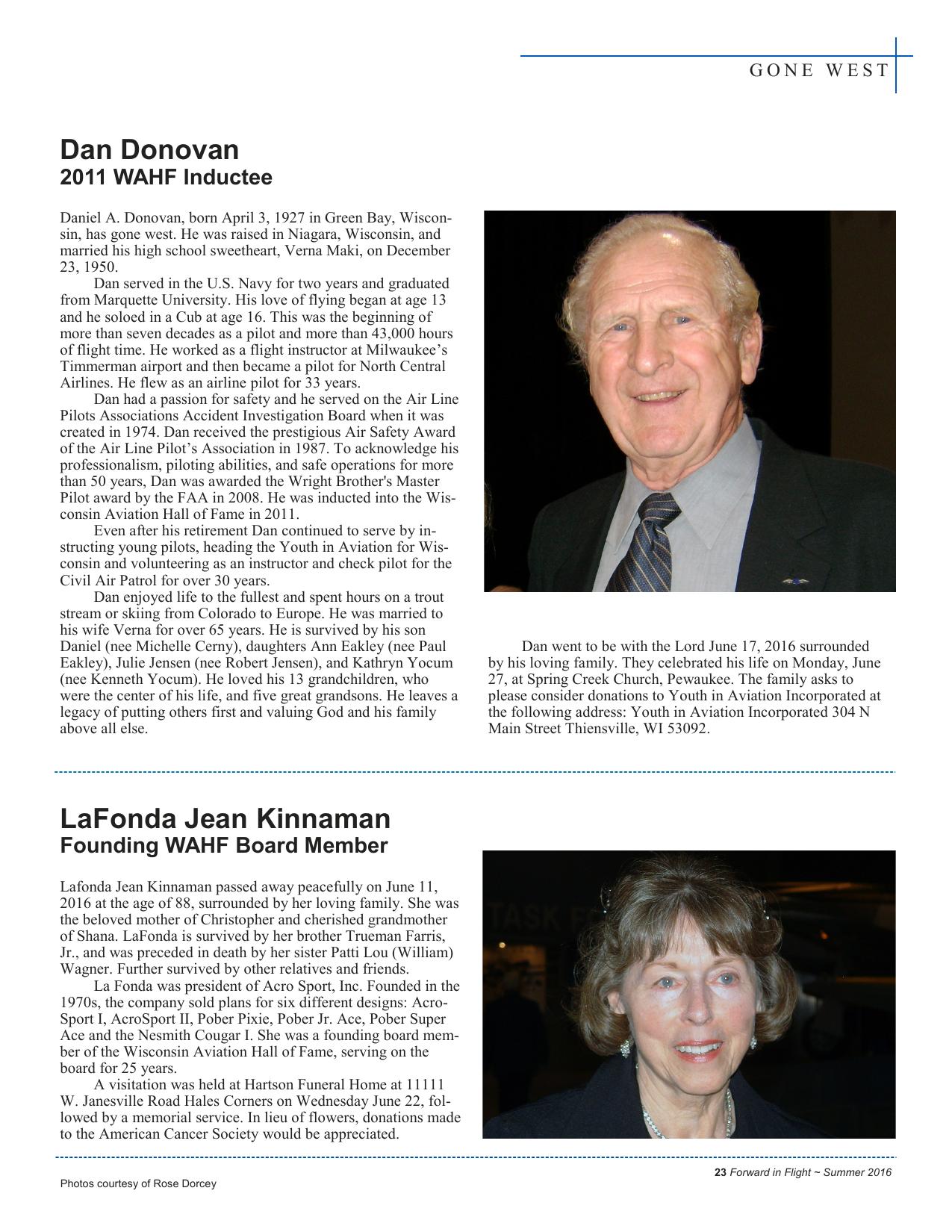
GONE WEST Dan Donovan 2011 WAHF Inductee Daniel A. Donovan, born April 3, 1927 in Green Bay, Wisconsin, has gone west. He was raised in Niagara, Wisconsin, and married his high school sweetheart, Verna Maki, on December 23, 1950. Dan served in the U.S. Navy for two years and graduated from Marquette University. His love of flying began at age 13 and he soloed in a Cub at age 16. This was the beginning of more than seven decades as a pilot and more than 43,000 hours of flight time. He worked as a flight instructor at Milwaukee’s Timmerman airport and then became a pilot for North Central Airlines. He flew as an airline pilot for 33 years. Dan had a passion for safety and he served on the Air Line Pilots Associations Accident Investigation Board when it was created in 1974. Dan received the prestigious Air Safety Award of the Air Line Pilot’s Association in 1987. To acknowledge his professionalism, piloting abilities, and safe operations for more than 50 years, Dan was awarded the Wright Brother's Master Pilot award by the FAA in 2008. He was inducted into the Wisconsin Aviation Hall of Fame in 2011. Even after his retirement Dan continued to serve by instructing young pilots, heading the Youth in Aviation for Wisconsin and volunteering as an instructor and check pilot for the Civil Air Patrol for over 30 years. Dan enjoyed life to the fullest and spent hours on a trout stream or skiing from Colorado to Europe. He was married to his wife Verna for over 65 years. He is survived by his son Daniel (nee Michelle Cerny), daughters Ann Eakley (nee Paul Eakley), Julie Jensen (nee Robert Jensen), and Kathryn Yocum (nee Kenneth Yocum). He loved his 13 grandchildren, who were the center of his life, and five great grandsons. He leaves a legacy of putting others first and valuing God and his family above all else. Dan went to be with the Lord June 17, 2016 surrounded by his loving family. They celebrated his life on Monday, June 27, at Spring Creek Church, Pewaukee. The family asks to please consider donations to Youth in Aviation Incorporated at the following address: Youth in Aviation Incorporated 304 N Main Street Thiensville, WI 53092. LaFonda Jean Kinnaman Founding WAHF Board Member Lafonda Jean Kinnaman passed away peacefully on June 11, 2016 at the age of 88, surrounded by her loving family. She was the beloved mother of Christopher and cherished grandmother of Shana. LaFonda is survived by her brother Trueman Farris, Jr., and was preceded in death by her sister Patti Lou (William) Wagner. Further survived by other relatives and friends. La Fonda was president of Acro Sport, Inc. Founded in the 1970s, the company sold plans for six different designs: AcroSport I, AcroSport II, Pober Pixie, Pober Jr. Ace, Pober Super Ace and the Nesmith Cougar I. She was a founding board member of the Wisconsin Aviation Hall of Fame, serving on the board for 25 years. A visitation was held at Hartson Funeral Home at 11111 W. Janesville Road Hales Corners on Wednesday June 22, followed by a memorial service. In lieu of flowers, donations made to the American Cancer Society would be appreciated. Photos courtesy of Rose Dorcey 23 Forward in Flight ~ Summer 2016
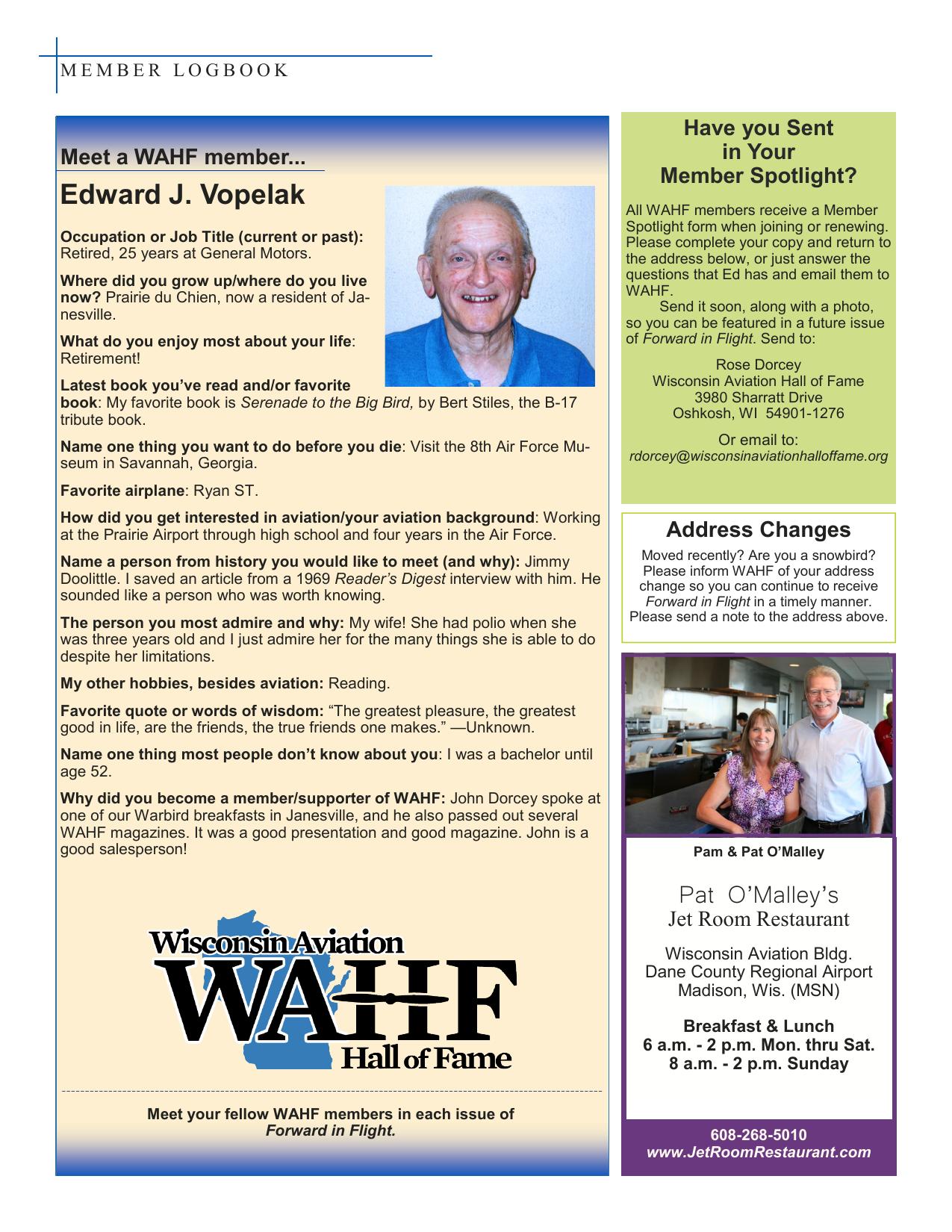
MEMBER LOGBOOK Meet a WAHF member... Edward J. Vopelak Occupation or Job Title (current or past): Retired, 25 years at General Motors. Where did you grow up/where do you live now? Prairie du Chien, now a resident of Janesville. Roger Small What do you enjoy most about your life: Retirement! Latest book you’ve read and/or favorite book: My favorite book is Serenade to the Big Bird, by Bert Stiles, the B-17 tribute book. Name one thing you want to do before you die: Visit the 8th Air Force Museum in Savannah, Georgia. Have you Sent in Your Member Spotlight? All WAHF members receive a Member Spotlight form when joining or renewing. Please complete your copy and return to the address below, or just answer the questions that Ed has and email them to WAHF. Send it soon, along with a photo, so you can be featured in a future issue of Forward in Flight. Send to: Rose Dorcey Wisconsin Aviation Hall of Fame 3980 Sharratt Drive Oshkosh, WI 54901-1276 Or email to: rdorcey@wisconsinaviationhalloffame.org Favorite airplane: Ryan ST. How did you get interested in aviation/your aviation background: Working at the Prairie Airport through high school and four years in the Air Force. Name a person from history you would like to meet (and why): Jimmy Doolittle. I saved an article from a 1969 Reader’s Digest interview with him. He sounded like a person who was worth knowing. The person you most admire and why: My wife! She had polio when she was three years old and I just admire her for the many things she is able to do despite her limitations. Address Changes Moved recently? Are you a snowbird? Please inform WAHF of your address change so you can continue to receive Forward in Flight in a timely manner. Please send a note to the address above. My other hobbies, besides aviation: Reading. Favorite quote or words of wisdom: “The greatest pleasure, the greatest good in life, are the friends, the true friends one makes.” —Unknown. Name one thing most people don’t know about you: I was a bachelor until age 52. Why did you become a member/supporter of WAHF: John Dorcey spoke at one of our Warbird breakfasts in Janesville, and he also passed out several WAHF magazines. It was a good presentation and good magazine. John is a good salesperson! Pam & Pat O’Malley Pat O’Malley’s Jet Room Restaurant Wisconsin Aviation Bldg. Dane County Regional Airport Madison, Wis. (MSN) Breakfast & Lunch 6 a.m. - 2 p.m. Mon. thru Sat. 8 a.m. - 2 p.m. Sunday Meet your fellow WAHF members in each issue of Forward in Flight. 608-268-5010 www.JetRoomRestaurant.com
Wittman Regional Airport Oshkosh So much history ...and still making it! From the legacy of Steve Wittman to Warren Basler’s DC-3 conversions, we’re proud to support and contribute to Wisconsin aviation history. FLY TO OSHKOSH wittmanairport.com @wittmanairport
PRSRT STD US Postage Paid Wisc Rapids WI Permit 98 3980 SHARRATT DRIVE OSHKOSH WI 54901-1276 The Wisconsin Aviation Hall of Fame is a non-profit membership organization dedicated to preserving the past and fostering the future of flight. CHANGE SERVICE REQUESTED Welcome New WAHF Member/Supporters Robert Dow Sean Sinette Randy Sullwold Andrea Weidner Thanks for coming on board. We hope to see you at a WAHF event soon! Congratulations... · To new WAHF members Randy Sullwold and Andrea Weidner, who have both soloed recently on their way to earning their private pilot certificates. Randy and Andrea are training together at Wittman Regional Airport (KOSH) in Oshkosh. · To WAHF Member/Supporters Jeff Gaier of Marshfield, Steve Krueger, Merrill; and Paul Richardson, Hillsboro, who recently joined the FAA Safety Team as volunteer FAASTeam representatives. Part of the FAASTeam’s mission is to improve the Nation’s aviation accident rate, and we’re thankful to these WAHF members for their participation. Have you seen the EAA AirVenture Oshkosh lineup this year? We are so excited for all that’s happening! A small sampling includes the aircraft of Desert Storm/Desert Shield gathering 25 years later, largest flying water bomber, celebrations of WWI aviation centennial, Boeing’s 100th birthday, and 100 years of the U.S. Coast Guard. Plus the Third Eye Blind concert on Monday evening, and “Star Wars: The Force Awakens” and more at the Fly-In Theater! We hope to see many WAHF members on the grounds July 25 - 31. Membership Dues are Due! If you have not yet renewed your WAHF membership for 2016 (and there are a few) we hope you will do so soon. Membership is the lifeblood of the Wisconsin Aviation Hall of Fame. Still just $20 for your annual membership, plus four issues of Forward in Flight. To save postage costs, for you and us, renew easily and safely online at: www.WisconsinAviationHallofFame.org. Wisconsin Aviation Hall of Fame Officers Rose Dorcey, President Tom Thomas, Vice-President John Dorcey, Secretary/Treasurer Board of Directors Elaine Kauh Kurt Stanich Brendan Stormo Charles Swain Wynne Williams Ron Wojnar Charles Marotske, Honorary Chairman of the Board Wisconsin Aviation Hall of Fame 3980 Sharratt Drive Oshkosh, WI 54901-1276 Become a supporter today! For information call Rose Dorcey at 920-385-1483 www.wisconsinaviationhalloffame.org rdorcey@wisconsinaviationhalloffame.org