Volume 16, Issue 2
🗞️ Download Issue (PDF)
Forward in Flight - Summer 2018
Volume 16, Issue 2 Quarterly Magazine of the Wisconsin Aviation Hall of Fame Summer 2018
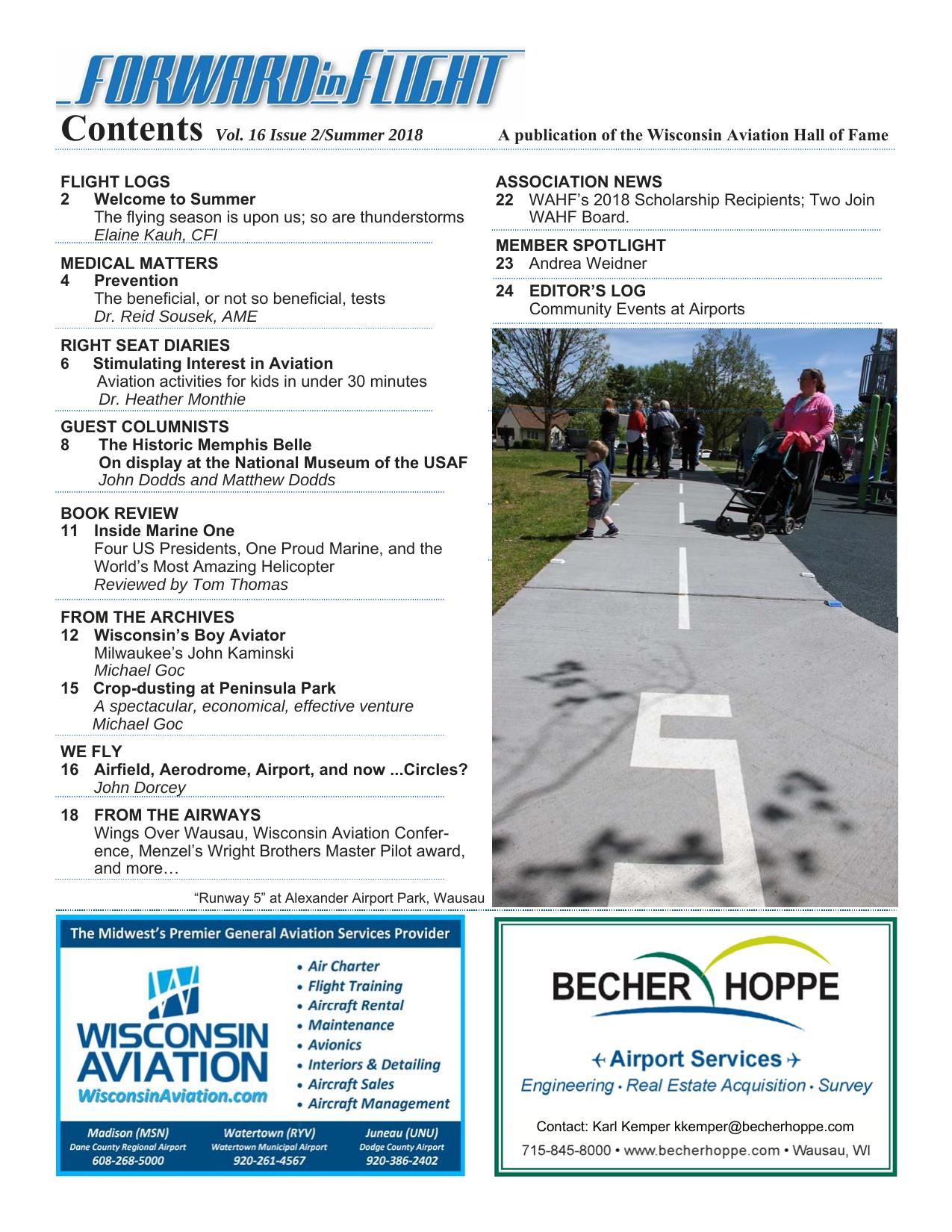
Contents Vol. 16 Issue 2/Summer 2018 FLIGHT LOGS 2 Welcome to Summer The flying season is upon us; so are thunderstorms Elaine Kauh, CFI MEDICAL MATTERS 4 Prevention The beneficial, or not so beneficial, tests Dr. Reid Sousek, AME A publication of the Wisconsin Aviation Hall of Fame ASSOCIATION NEWS 22 WAHF’s 2018 Scholarship Recipients; Two Join WAHF Board. MEMBER SPOTLIGHT 23 Andrea Weidner 24 EDITOR’S LOG Community Events at Airports RIGHT SEAT DIARIES 6 Stimulating Interest in Aviation Aviation activities for kids in under 30 minutes Dr. Heather Monthie GUEST COLUMNISTS 8 The Historic Memphis Belle On display at the National Museum of the USAF John Dodds and Matthew Dodds BOOK REVIEW 11 Inside Marine One Four US Presidents, One Proud Marine, and the World’s Most Amazing Helicopter Reviewed by Tom Thomas FROM THE ARCHIVES 12 Wisconsin’s Boy Aviator Milwaukee’s John Kaminski Michael Goc 15 Crop-dusting at Peninsula Park A spectacular, economical, effective venture Michael Goc WE FLY 16 Airfield, Aerodrome, Airport, and now ...Circles? John Dorcey 18 FROM THE AIRWAYS Wings Over Wausau, Wisconsin Aviation Conference, Menzel’s Wright Brothers Master Pilot award, and more… “Runway 5” at Alexander Airport Park, Wausau Contact: Karl Kemper kkemper@becherhoppe.com
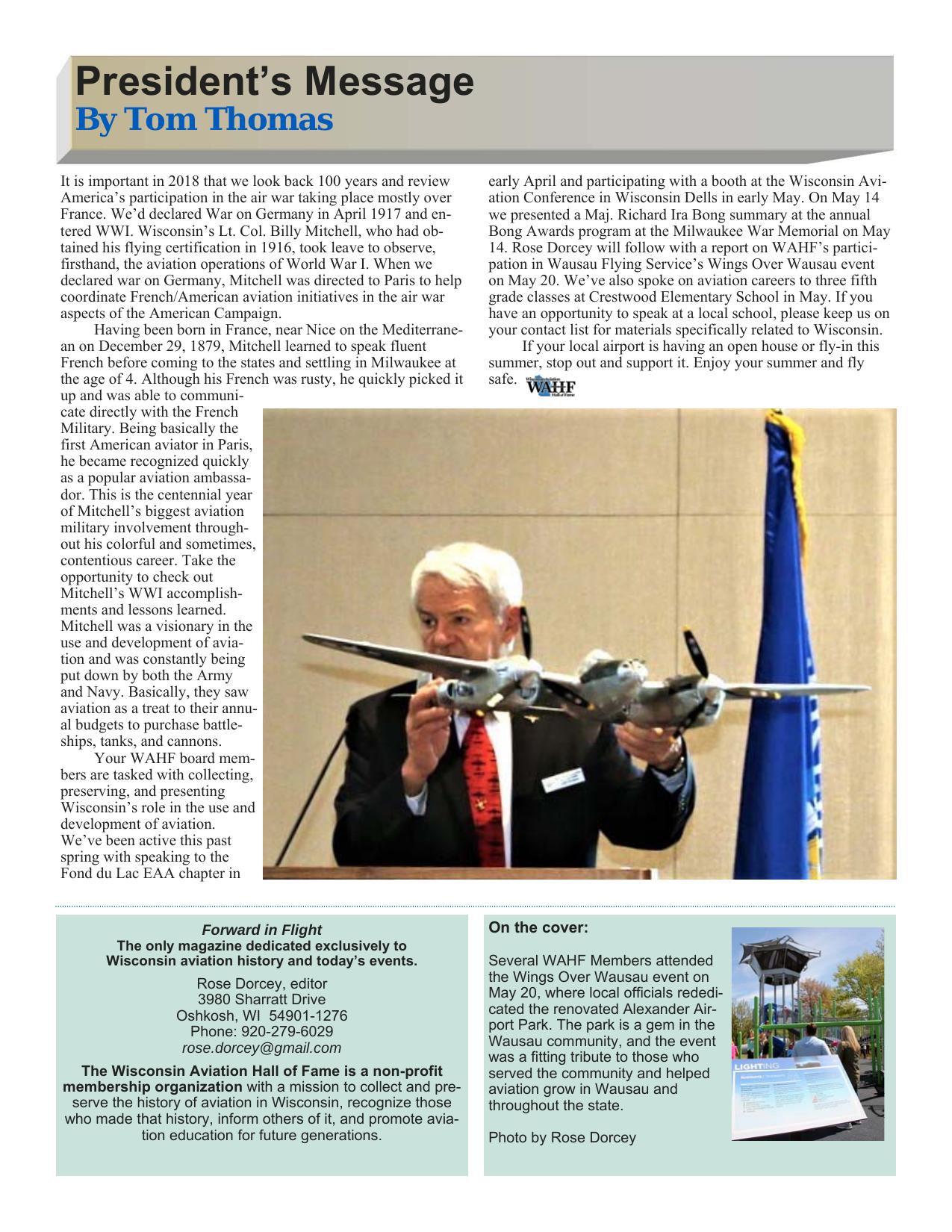
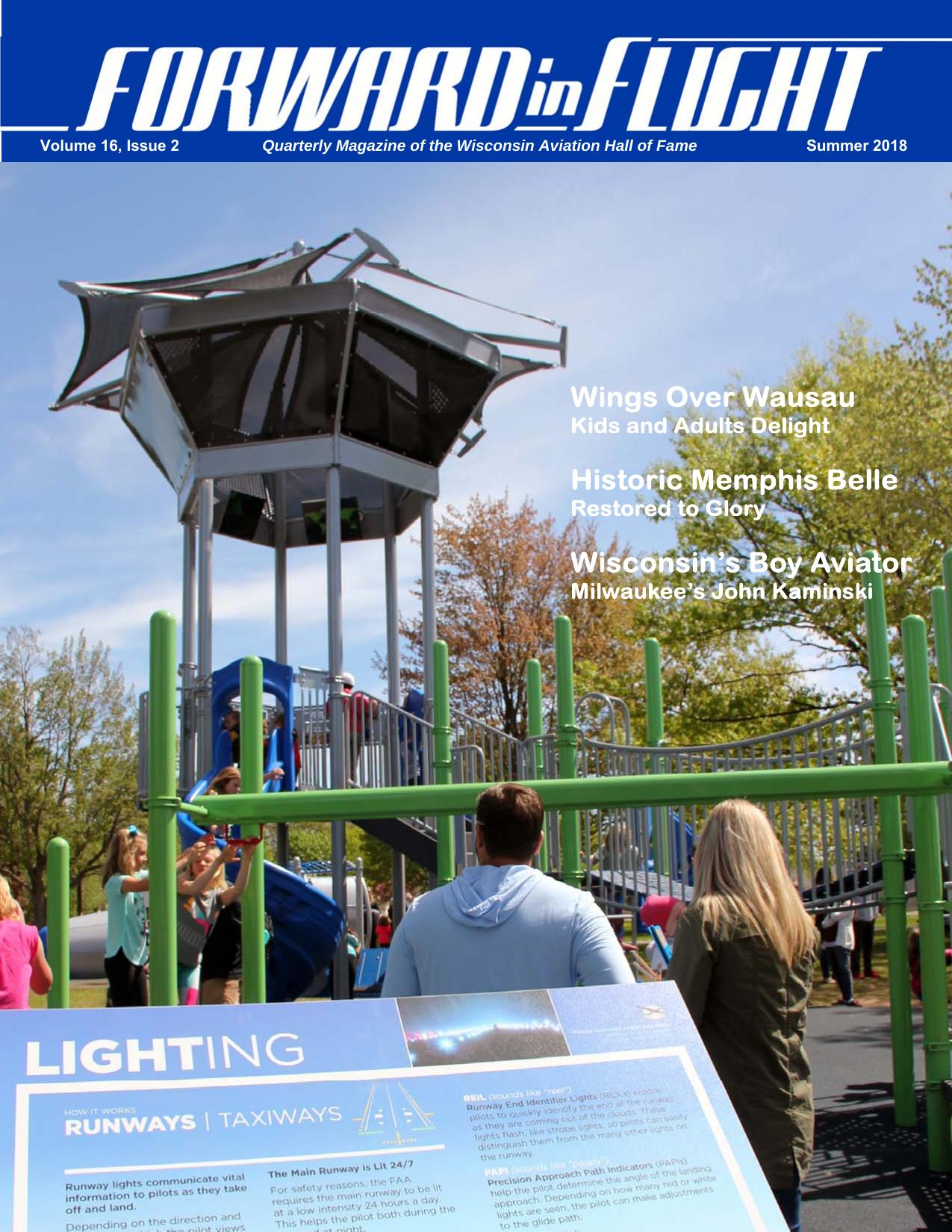
President’s Message By Tom Thomas It is important in 2018 that we look back 100 years and review America’s participation in the air war taking place mostly over France. We’d declared War on Germany in April 1917 and entered WWI. Wisconsin’s Lt. Col. Billy Mitchell, who had obtained his flying certification in 1916, took leave to observe, firsthand, the aviation operations of World War I. When we declared war on Germany, Mitchell was directed to Paris to help coordinate French/American aviation initiatives in the air war aspects of the American Campaign. Having been born in France, near Nice on the Mediterranean on December 29, 1879, Mitchell learned to speak fluent French before coming to the states and settling in Milwaukee at the age of 4. Although his French was rusty, he quickly picked it up and was able to communicate directly with the French Military. Being basically the first American aviator in Paris, he became recognized quickly as a popular aviation ambassador. This is the centennial year of Mitchell’s biggest aviation military involvement throughout his colorful and sometimes, contentious career. Take the opportunity to check out Mitchell’s WWI accomplishments and lessons learned. Mitchell was a visionary in the use and development of aviation and was constantly being put down by both the Army and Navy. Basically, they saw aviation as a treat to their annual budgets to purchase battleships, tanks, and cannons. Your WAHF board members are tasked with collecting, preserving, and presenting Wisconsin’s role in the use and development of aviation. We’ve been active this past spring with speaking to the Fond du Lac EAA chapter in Forward in Flight The only magazine dedicated exclusively to Wisconsin aviation history and today’s events. Rose Dorcey, editor 3980 Sharratt Drive Oshkosh, WI 54901-1276 Phone: 920-279-6029 rose.dorcey@gmail.com The Wisconsin Aviation Hall of Fame is a non-profit membership organization with a mission to collect and preserve the history of aviation in Wisconsin, recognize those who made that history, inform others of it, and promote aviation education for future generations. early April and participating with a booth at the Wisconsin Aviation Conference in Wisconsin Dells in early May. On May 14 we presented a Maj. Richard Ira Bong summary at the annual Bong Awards program at the Milwaukee War Memorial on May 14. Rose Dorcey will follow with a report on WAHF’s participation in Wausau Flying Service’s Wings Over Wausau event on May 20. We’ve also spoke on aviation careers to three fifth grade classes at Crestwood Elementary School in May. If you have an opportunity to speak at a local school, please keep us on your contact list for materials specifically related to Wisconsin. If your local airport is having an open house or fly-in this summer, stop out and support it. Enjoy your summer and fly safe. This F-35 flew daily at AirVenture 2016. Photo by Tom Thomas On the cover: Several WAHF Members attended the Wings Over Wausau event on May 20, where local officials rededicated the renovated Alexander Airport Park. The park is a gem in the Wausau community, and the event was a fitting tribute to those who served the community and helped aviation grow in Wausau and throughout the state. Photo by Rose Dorcey
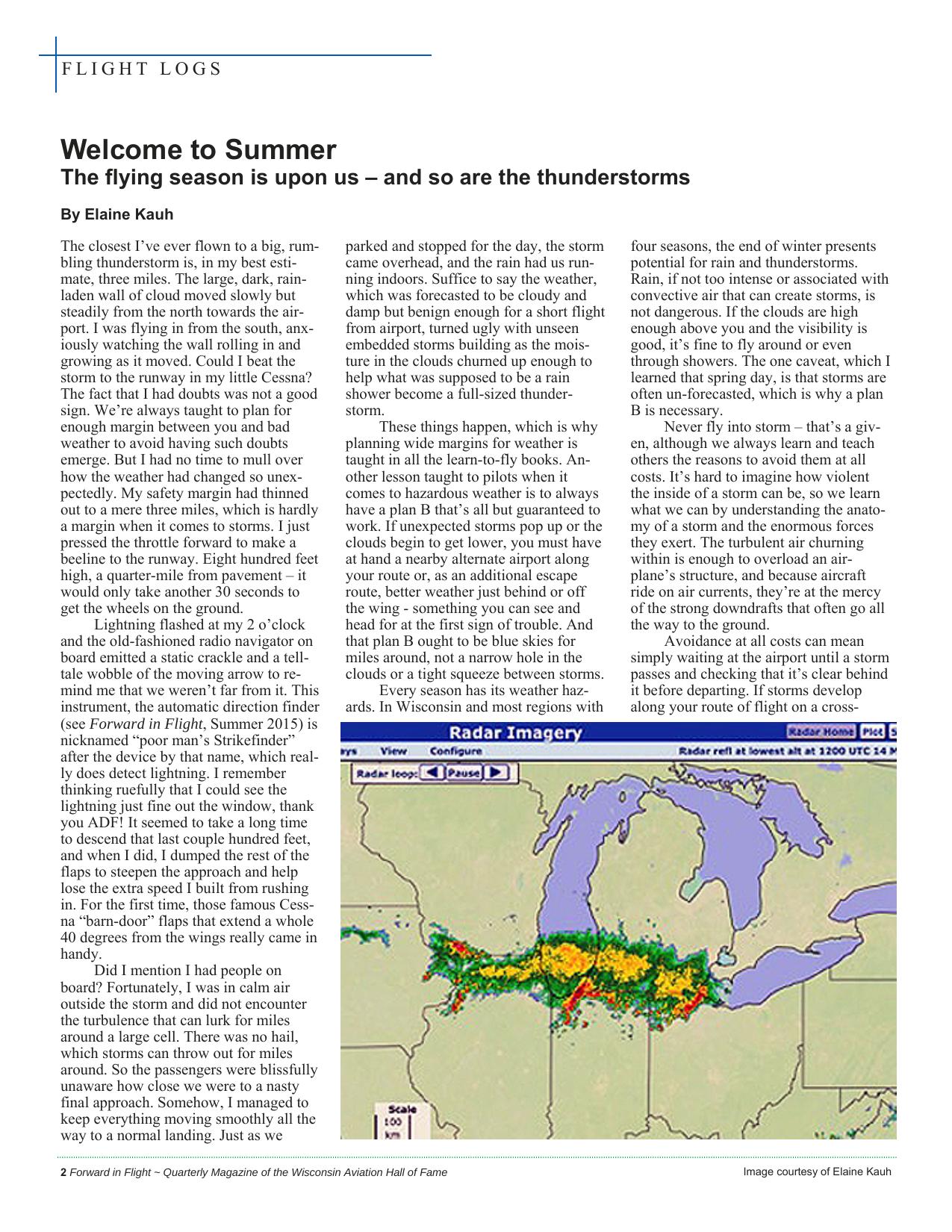
FLIGHT LOGS Welcome to Summer The flying season is upon us – and so are the thunderstorms By Elaine Kauh The closest I’ve ever flown to a big, rumbling thunderstorm is, in my best estimate, three miles. The large, dark, rainladen wall of cloud moved slowly but steadily from the north towards the airport. I was flying in from the south, anxiously watching the wall rolling in and growing as it moved. Could I beat the storm to the runway in my little Cessna? The fact that I had doubts was not a good sign. We’re always taught to plan for enough margin between you and bad weather to avoid having such doubts emerge. But I had no time to mull over how the weather had changed so unexpectedly. My safety margin had thinned out to a mere three miles, which is hardly a margin when it comes to storms. I just pressed the throttle forward to make a beeline to the runway. Eight hundred feet high, a quarter-mile from pavement – it would only take another 30 seconds to get the wheels on the ground. Lightning flashed at my 2 o’clock and the old-fashioned radio navigator on board emitted a static crackle and a telltale wobble of the moving arrow to remind me that we weren’t far from it. This instrument, the automatic direction finder (see Forward in Flight, Summer 2015) is nicknamed “poor man’s Strikefinder” after the device by that name, which really does detect lightning. I remember thinking ruefully that I could see the lightning just fine out the window, thank you ADF! It seemed to take a long time to descend that last couple hundred feet, and when I did, I dumped the rest of the flaps to steepen the approach and help lose the extra speed I built from rushing in. For the first time, those famous Cessna “barn-door” flaps that extend a whole 40 degrees from the wings really came in handy. Did I mention I had people on board? Fortunately, I was in calm air outside the storm and did not encounter the turbulence that can lurk for miles around a large cell. There was no hail, which storms can throw out for miles around. So the passengers were blissfully unaware how close we were to a nasty final approach. Somehow, I managed to keep everything moving smoothly all the way to a normal landing. Just as we parked and stopped for the day, the storm came overhead, and the rain had us running indoors. Suffice to say the weather, which was forecasted to be cloudy and damp but benign enough for a short flight from airport, turned ugly with unseen embedded storms building as the moisture in the clouds churned up enough to help what was supposed to be a rain shower become a full-sized thunderstorm. These things happen, which is why planning wide margins for weather is taught in all the learn-to-fly books. Another lesson taught to pilots when it comes to hazardous weather is to always have a plan B that’s all but guaranteed to work. If unexpected storms pop up or the clouds begin to get lower, you must have at hand a nearby alternate airport along your route or, as an additional escape route, better weather just behind or off the wing - something you can see and head for at the first sign of trouble. And that plan B ought to be blue skies for miles around, not a narrow hole in the clouds or a tight squeeze between storms. Every season has its weather hazards. In Wisconsin and most regions with 2 Forward in Flight ~ Quarterly Magazine of the Wisconsin Aviation Hall of Fame four seasons, the end of winter presents potential for rain and thunderstorms. Rain, if not too intense or associated with convective air that can create storms, is not dangerous. If the clouds are high enough above you and the visibility is good, it’s fine to fly around or even through showers. The one caveat, which I learned that spring day, is that storms are often un-forecasted, which is why a plan B is necessary. Never fly into storm – that’s a given, although we always learn and teach others the reasons to avoid them at all costs. It’s hard to imagine how violent the inside of a storm can be, so we learn what we can by understanding the anatomy of a storm and the enormous forces they exert. The turbulent air churning within is enough to overload an airplane’s structure, and because aircraft ride on air currents, they’re at the mercy of the strong downdrafts that often go all the way to the ground. Avoidance at all costs can mean simply waiting at the airport until a storm passes and checking that it’s clear behind it before departing. If storms develop along your route of flight on a cross- Image courtesy of Elaine Kauh
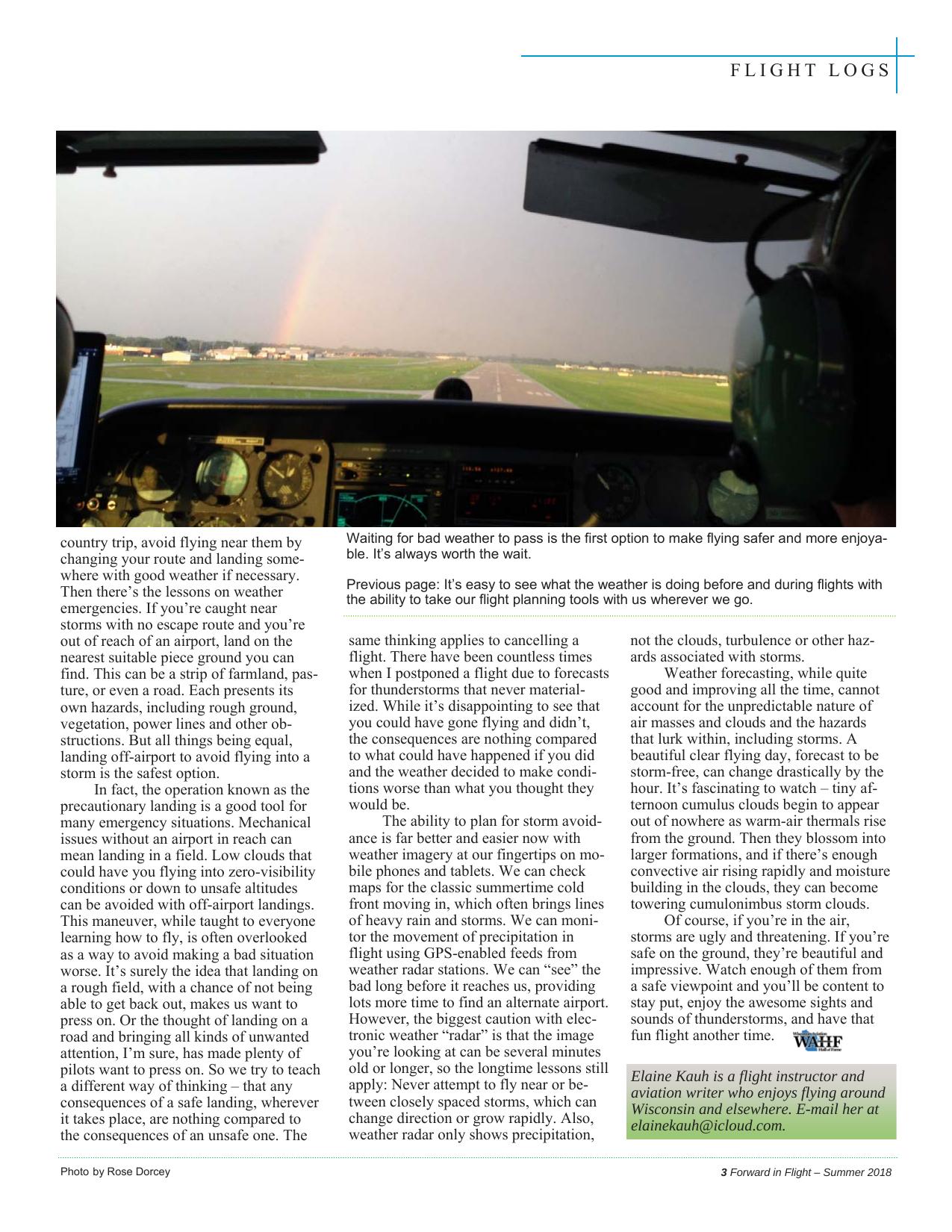
FLIGHT LOGS country trip, avoid flying near them by changing your route and landing somewhere with good weather if necessary. Then there’s the lessons on weather emergencies. If you’re caught near storms with no escape route and you’re out of reach of an airport, land on the nearest suitable piece ground you can find. This can be a strip of farmland, pasture, or even a road. Each presents its own hazards, including rough ground, vegetation, power lines and other obstructions. But all things being equal, landing off-airport to avoid flying into a storm is the safest option. In fact, the operation known as the precautionary landing is a good tool for many emergency situations. Mechanical issues without an airport in reach can mean landing in a field. Low clouds that could have you flying into zero-visibility conditions or down to unsafe altitudes can be avoided with off-airport landings. This maneuver, while taught to everyone learning how to fly, is often overlooked as a way to avoid making a bad situation worse. It’s surely the idea that landing on a rough field, with a chance of not being able to get back out, makes us want to press on. Or the thought of landing on a road and bringing all kinds of unwanted attention, I’m sure, has made plenty of pilots want to press on. So we try to teach a different way of thinking – that any consequences of a safe landing, wherever it takes place, are nothing compared to the consequences of an unsafe one. The Photo by Rose Dorcey Waiting for bad weather to pass is the first option to make flying safer and more enjoyable. It’s always worth the wait. Previous page: It’s easy to see what the weather is doing before and during flights with the ability to take our flight planning tools with us wherever we go. same thinking applies to cancelling a flight. There have been countless times when I postponed a flight due to forecasts for thunderstorms that never materialized. While it’s disappointing to see that you could have gone flying and didn’t, the consequences are nothing compared to what could have happened if you did and the weather decided to make conditions worse than what you thought they would be. The ability to plan for storm avoidance is far better and easier now with weather imagery at our fingertips on mobile phones and tablets. We can check maps for the classic summertime cold front moving in, which often brings lines of heavy rain and storms. We can monitor the movement of precipitation in flight using GPS-enabled feeds from weather radar stations. We can “see” the bad long before it reaches us, providing lots more time to find an alternate airport. However, the biggest caution with electronic weather “radar” is that the image you’re looking at can be several minutes old or longer, so the longtime lessons still apply: Never attempt to fly near or between closely spaced storms, which can change direction or grow rapidly. Also, weather radar only shows precipitation, not the clouds, turbulence or other hazards associated with storms. Weather forecasting, while quite good and improving all the time, cannot account for the unpredictable nature of air masses and clouds and the hazards that lurk within, including storms. A beautiful clear flying day, forecast to be storm-free, can change drastically by the hour. It’s fascinating to watch – tiny afternoon cumulus clouds begin to appear out of nowhere as warm-air thermals rise from the ground. Then they blossom into larger formations, and if there’s enough convective air rising rapidly and moisture building in the clouds, they can become towering cumulonimbus storm clouds. Of course, if you’re in the air, storms are ugly and threatening. If you’re safe on the ground, they’re beautiful and impressive. Watch enough of them from a safe viewpoint and you’ll be content to stay put, enjoy the awesome sights and sounds of thunderstorms, and have that fun flight another time. Elaine Kauh is a flight instructor and aviation writer who enjoys flying around Wisconsin and elsewhere. E-mail her at elainekauh@icloud.com. 3 Forward in Flight – Summer 2018
MEDICAL MATTERS Prevention The beneficial, or not so beneficial, tests your doctor may perform By Dr. Reid Sousek It might surprise you to know that you have a lot in common with your airplane. Besides a shared love for flying, you both need regular checkups. Your A&P mechanic may check some fluids, pressures, or remove access panels to get a better look. Your doctor may also analyze some fluids or check some pressures! And, while most doctors don’t remove parts during a physical, there are some “access points” to evaluate other body systems. Instead of discussing medical topics that are related to active medical issues while flying or at altitude, let’s talk about the preventive issues that may be addressed at your next wellness physical and may help keep you medically fit to fly. These apply to most people, and those interested in aviation. We will focus on recommendations for non-pregnant adults. The idea that some medical testing is unnecessary might be confusing and the intent of this article is not to have you summarily reject a test that your doctor recommends nor to have you walk into your next physical demanding 20 tests be run. Just as you don’t arbitrarily run random tests on your airplane, it helps if you understand not only when you might need “service”, but also how your doctor chooses which tests to use. Just as there may be many different sources telling you what to look for or repair on your airplane (Manufacturer’s Service Bulletin, FAA Airworthiness Directives), there are also numerous societies and medical organizations offering recommendations on screening. Take Blood Pressure screening, for example. I wrote about this in my Forward in Flight - Fall 2017 article. You can find blood pressure screening guidelines from the American Academy of Family Physicians (AAFP), or American Heart Association (AHA). In this article I will reference the United States Preventive Services Task Force (USPSTF) guidelines. These guidelines are developed after thorough review of available studies and data and, only after being publicly and peer reviewed. Anyone can access these for free at www.uspreventiveservicestaskforce.org. The USPSTF grades each recommendation as A, B, C, D, I. How does a grading system for medical testing helps the patient? With any test or procedure, the benefits need to be balanced with the risks/costs. For example, with your airplane annual, you could remove the upholstery from the seats and inspect the foam cushion. But how does that improve the safety of your airplane? In very rare circumstances, there might be a negligible value, but, more often, doing that would be a waste of time and money. Similarly, in medicine it is often not beneficial to test for an exceedingly rare condition or when a condition does not cause significant morbidity or mortality. The Grade A recommendation means that there is a high certainty that the net benefit of that testing will be substantial. The strength of recommendation decreases with each letter, so a Grade D recommends against a test or service. Grade D means that there is no net benefit in testing …or that the potential harm outweighs any benefits. The lowest grade, Grade I, is inconclusive...there is either conflicting data or not enough data to make a recommendation. This grading system is a logical method of determining the value of a given test because more testing or treatment is not al4 Forward in Flight ~ Quarterly Magazine of the Wisconsin Aviation Hall of Fame ways better. “Primum non nocere” ...first do no harm, is a fundamental ethical principle in medicine. Putting the cost of excessive testing aside, it is not always life extending or altering to find a certain condition. If we scanned everyone head-to-toe, we likely would find minor irregularities or nodules in a lot of people. And, although these are irregularities, they do not need to be further tested. However, many patients would be unduly worried about these relatively insignificant deviations and that fear might lead to increased nervousness, stress, and, in a worst-case scenario, invasive procedures or biopsies. So, it is important to be reasonable about which tests to have. It is also important to understand that some issues may have been addressed through a previous test or during a previous illness workup. (Screening tests, by the way, are a separate concept than a diagnostic test.) My hope is that, if your doctor recommends one of these tests, you will feel comfortable with whatever decision you and your doctor decide. And, more importantly to see your doctor for a preventive or wellness visit. Fortunately, many of these are often completely covered by insurance, even Medicare. So, let’s run through a few examples of how this relates to actual testing guidelines. We’ll start with one Grade A recommendation that most are familiar with...Blood Pressure screening. This guideline recommends blood pressure screening for all adults over age 18. For those under age 39, this screen should be done every 3-5 years. For those over age 40, or at increased risk of high blood pressure, yearly screening is recommended. If you have been formally diagnosed with high blood pressure, you will likely undergo more frequent monitoring. Separate guidelines are followed during pregnancy. Your A&P mechanic may check some fluids, pressures, or remove access panels to get a better look. Your doctor may also analyze some fluids or check some pressures! Alphabetically, the next Grade A recommendation is for Cervical Cancer Screening. A Pap smear is recommended every three years for women age 21 to 65. If any abnormalities are noted on this Pap, the interval will be decreased. That is no longer pure screening, but, rather disease monitoring or management. If a combination of Pap smear and Human Papillomavirus (HPV) testing is used, the intervals may be increased to every 5 years. Another Grade A recommendation is for syphilis screening in those individuals at increased risk. A digital rectal exam is not a recommended screen for colon cancer, but there are multiple other methods for colon cancer screening. For colon cancer, the USPSTF recommends starting at age 50 and continuing until age 75. A stool DNA test, Fecal Immunoassay testing (FIT) yearly, is one option. Another option is Annual FIT testing with every 10-year flexible sigmoidoscopy. A third option is colonoscopy every 10 years. Yet another possible option is CT-colonography every 10 years.
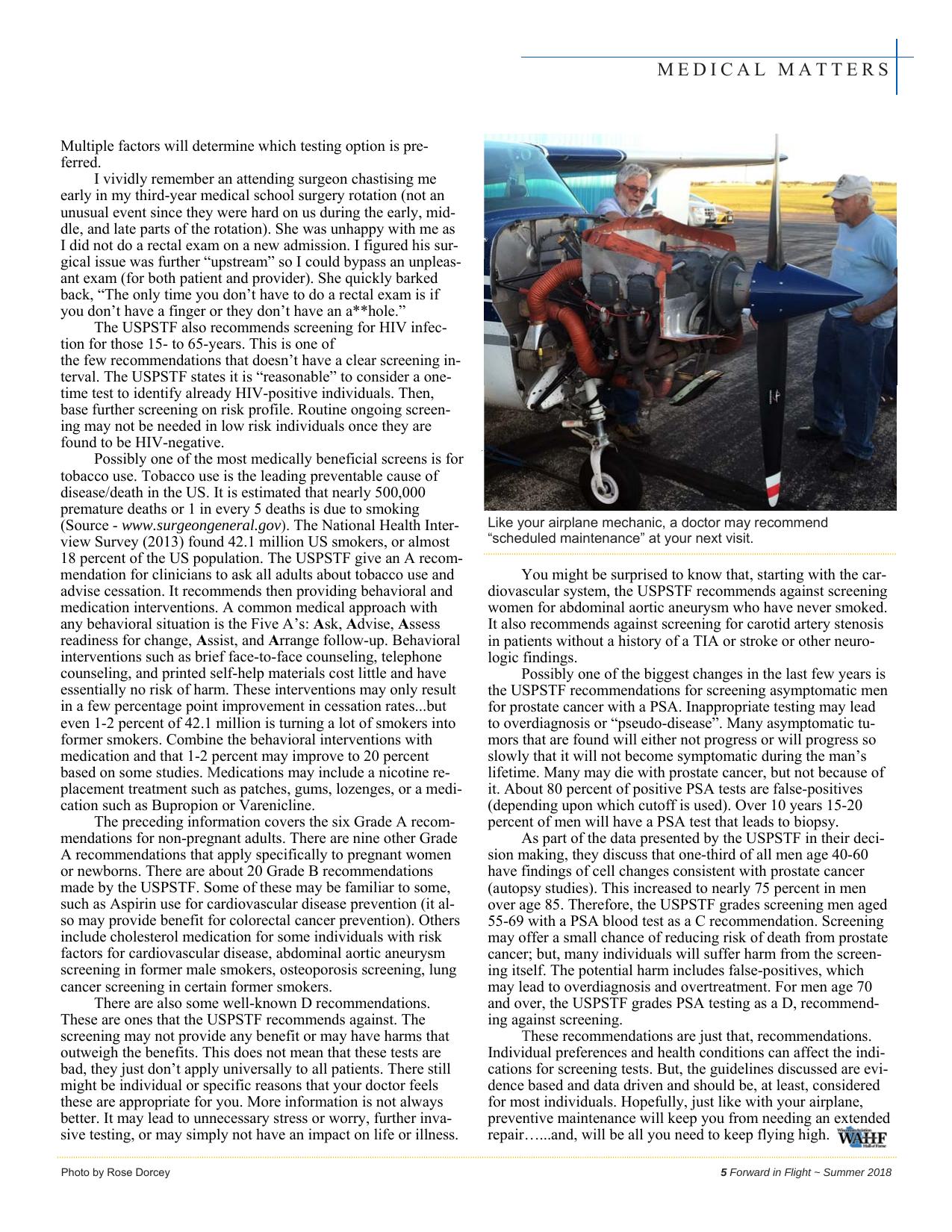
MEDICAL MATTERS Multiple factors will determine which testing option is preferred. I vividly remember an attending surgeon chastising me early in my third-year medical school surgery rotation (not an unusual event since they were hard on us during the early, middle, and late parts of the rotation). She was unhappy with me as I did not do a rectal exam on a new admission. I figured his surgical issue was further “upstream” so I could bypass an unpleasant exam (for both patient and provider). She quickly barked back, “The only time you don’t have to do a rectal exam is if you don’t have a finger or they don’t have an a**hole.” The USPSTF also recommends screening for HIV infection for those 15- to 65-years. This is one of the few recommendations that doesn’t have a clear screening interval. The USPSTF states it is “reasonable” to consider a onetime test to identify already HIV-positive individuals. Then, base further screening on risk profile. Routine ongoing screening may not be needed in low risk individuals once they are found to be HIV-negative. Possibly one of the most medically beneficial screens is for tobacco use. Tobacco use is the leading preventable cause of disease/death in the US. It is estimated that nearly 500,000 premature deaths or 1 in every 5 deaths is due to smoking (Source - www.surgeongeneral.gov). The National Health Interview Survey (2013) found 42.1 million US smokers, or almost 18 percent of the US population. The USPSTF give an A recommendation for clinicians to ask all adults about tobacco use and advise cessation. It recommends then providing behavioral and medication interventions. A common medical approach with any behavioral situation is the Five A’s: Ask, Advise, Assess readiness for change, Assist, and Arrange follow-up. Behavioral interventions such as brief face-to-face counseling, telephone counseling, and printed self-help materials cost little and have essentially no risk of harm. These interventions may only result in a few percentage point improvement in cessation rates...but even 1-2 percent of 42.1 million is turning a lot of smokers into former smokers. Combine the behavioral interventions with medication and that 1-2 percent may improve to 20 percent based on some studies. Medications may include a nicotine replacement treatment such as patches, gums, lozenges, or a medication such as Bupropion or Varenicline. The preceding information covers the six Grade A recommendations for non-pregnant adults. There are nine other Grade A recommendations that apply specifically to pregnant women or newborns. There are about 20 Grade B recommendations made by the USPSTF. Some of these may be familiar to some, such as Aspirin use for cardiovascular disease prevention (it also may provide benefit for colorectal cancer prevention). Others include cholesterol medication for some individuals with risk factors for cardiovascular disease, abdominal aortic aneurysm screening in former male smokers, osteoporosis screening, lung cancer screening in certain former smokers. There are also some well-known D recommendations. These are ones that the USPSTF recommends against. The screening may not provide any benefit or may have harms that outweigh the benefits. This does not mean that these tests are bad, they just don’t apply universally to all patients. There still might be individual or specific reasons that your doctor feels these are appropriate for you. More information is not always better. It may lead to unnecessary stress or worry, further invasive testing, or may simply not have an impact on life or illness. Photo by Rose Dorcey Above: Altitude chamber at the Civil Aerospace Medical Institute, Oklahoma City. Left, wearing an aviation oxygen mask. Like your airplane mechanic, a doctor may recommend “scheduled maintenance” at your next visit. You might be surprised to know that, starting with the cardiovascular system, the USPSTF recommends against screening women for abdominal aortic aneurysm who have never smoked. It also recommends against screening for carotid artery stenosis in patients without a history of a TIA or stroke or other neurologic findings. Possibly one of the biggest changes in the last few years is the USPSTF recommendations for screening asymptomatic men for prostate cancer with a PSA. Inappropriate testing may lead to overdiagnosis or “pseudo-disease”. Many asymptomatic tumors that are found will either not progress or will progress so slowly that it will not become symptomatic during the man’s lifetime. Many may die with prostate cancer, but not because of it. About 80 percent of positive PSA tests are false-positives (depending upon which cutoff is used). Over 10 years 15-20 percent of men will have a PSA test that leads to biopsy. As part of the data presented by the USPSTF in their decision making, they discuss that one-third of all men age 40-60 have findings of cell changes consistent with prostate cancer (autopsy studies). This increased to nearly 75 percent in men over age 85. Therefore, the USPSTF grades screening men aged 55-69 with a PSA blood test as a C recommendation. Screening may offer a small chance of reducing risk of death from prostate cancer; but, many individuals will suffer harm from the screening itself. The potential harm includes false-positives, which may lead to overdiagnosis and overtreatment. For men age 70 and over, the USPSTF grades PSA testing as a D, recommending against screening. These recommendations are just that, recommendations. Individual preferences and health conditions can affect the indications for screening tests. But, the guidelines discussed are evidence based and data driven and should be, at least, considered for most individuals. Hopefully, just like with your airplane, preventive maintenance will keep you from needing an extended repair…...and, will be all you need to keep flying high. 5 Forward in Flight ~ Summer 2018
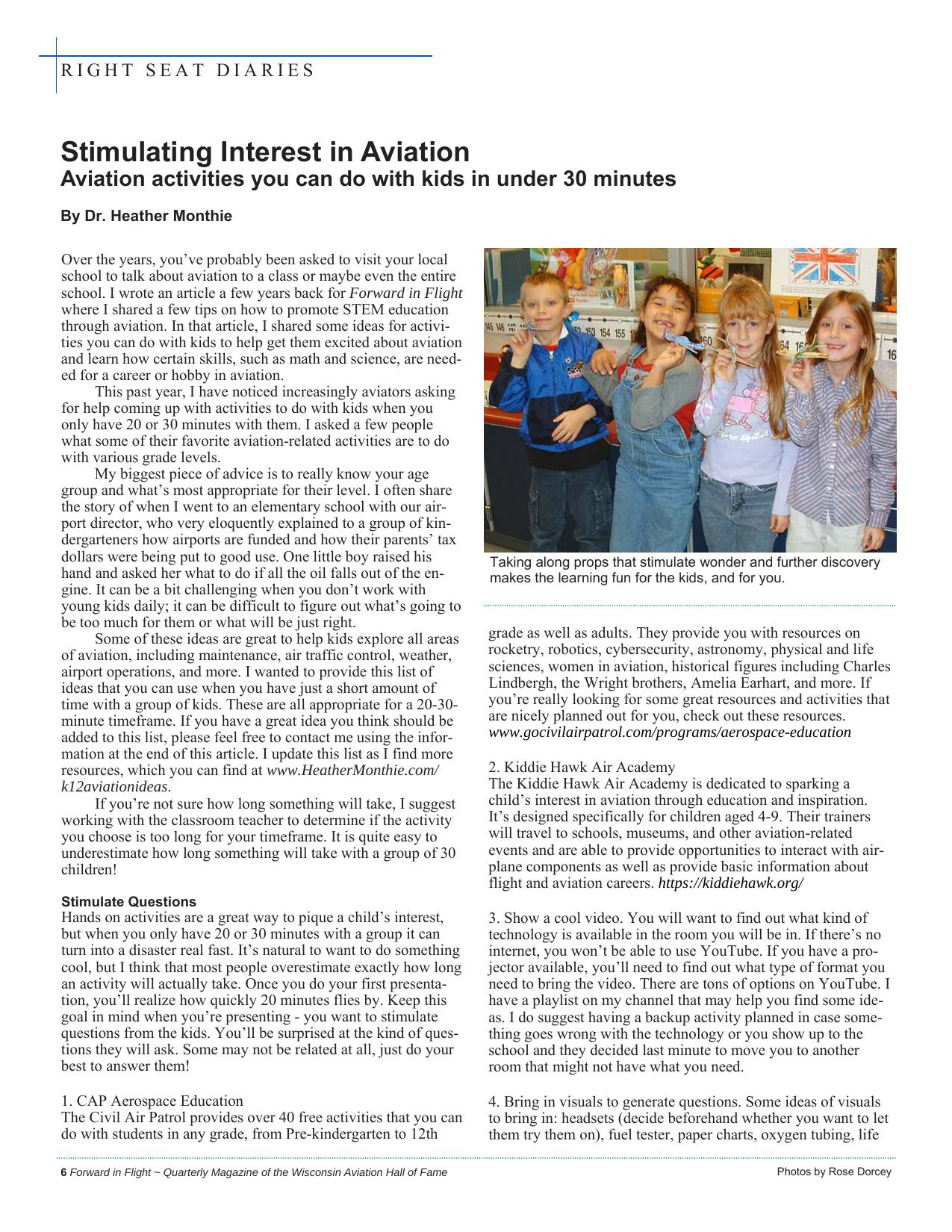
RIGHT SEAT DIARIES Stimulating Interest in Aviation Aviation activities you can do with kids in under 30 minutes By Dr. Heather Monthie Over the years, you’ve probably been asked to visit your local school to talk about aviation to a class or maybe even the entire school. I wrote an article a few years back for Forward in Flight where I shared a few tips on how to promote STEM education through aviation. In that article, I shared some ideas for activities you can do with kids to help get them excited about aviation and learn how certain skills, such as math and science, are needed for a career or hobby in aviation. This past year, I have noticed increasingly aviators asking for help coming up with activities to do with kids when you only have 20 or 30 minutes with them. I asked a few people what some of their favorite aviation-related activities are to do with various grade levels. My biggest piece of advice is to really know your age group and what’s most appropriate for their level. I often share the story of when I went to an elementary school with our airport director, who very eloquently explained to a group of kindergarteners how airports are funded and how their parents’ tax dollars were being put to good use. One little boy raised his hand and asked her what to do if all the oil falls out of the engine. It can be a bit challenging when you don’t work with young kids daily; it can be difficult to figure out what’s going to be too much for them or what will be just right. Some of these ideas are great to help kids explore all areas of aviation, including maintenance, air traffic control, weather, airport operations, and more. I wanted to provide this list of ideas that you can use when you have just a short amount of time with a group of kids. These are all appropriate for a 20-30minute timeframe. If you have a great idea you think should be added to this list, please feel free to contact me using the information at the end of this article. I update this list as I find more resources, which you can find at www.HeatherMonthie.com/ k12aviationideas. If you’re not sure how long something will take, I suggest working with the classroom teacher to determine if the activity you choose is too long for your timeframe. It is quite easy to underestimate how long something will take with a group of 30 children! Stimulate Questions Taking along props that stimulate wonder and further discovery makes the learning fun for the kids, and for you. grade as well as adults. They provide you with resources on rocketry, robotics, cybersecurity, astronomy, physical and life sciences, women in aviation, historical figures including Charles Lindbergh, the Wright brothers, Amelia Earhart, and more. If you’re really looking for some great resources and activities that are nicely planned out for you, check out these resources. www.gocivilairpatrol.com/programs/aerospace-education 2. Kiddie Hawk Air Academy The Kiddie Hawk Air Academy is dedicated to sparking a child’s interest in aviation through education and inspiration. It’s designed specifically for children aged 4-9. Their trainers will travel to schools, museums, and other aviation-related events and are able to provide opportunities to interact with airplane components as well as provide basic information about flight and aviation careers. https://kiddiehawk.org/ Hands on activities are a great way to pique a child’s interest, but when you only have 20 or 30 minutes with a group it can turn into a disaster real fast. It’s natural to want to do something cool, but I think that most people overestimate exactly how long an activity will actually take. Once you do your first presentation, you’ll realize how quickly 20 minutes flies by. Keep this goal in mind when you’re presenting - you want to stimulate questions from the kids. You’ll be surprised at the kind of questions they will ask. Some may not be related at all, just do your best to answer them! 3. Show a cool video. You will want to find out what kind of technology is available in the room you will be in. If there’s no internet, you won’t be able to use YouTube. If you have a projector available, you’ll need to find out what type of format you need to bring the video. There are tons of options on YouTube. I have a playlist on my channel that may help you find some ideas. I do suggest having a backup activity planned in case something goes wrong with the technology or you show up to the school and they decided last minute to move you to another room that might not have what you need. 1. CAP Aerospace Education The Civil Air Patrol provides over 40 free activities that you can do with students in any grade, from Pre-kindergarten to 12th 4. Bring in visuals to generate questions. Some ideas of visuals to bring in: headsets (decide beforehand whether you want to let them try them on), fuel tester, paper charts, oxygen tubing, life 6 Forward in Flight ~ Quarterly Magazine of the Wisconsin Aviation Hall of Fame Photos by Rose Dorcey
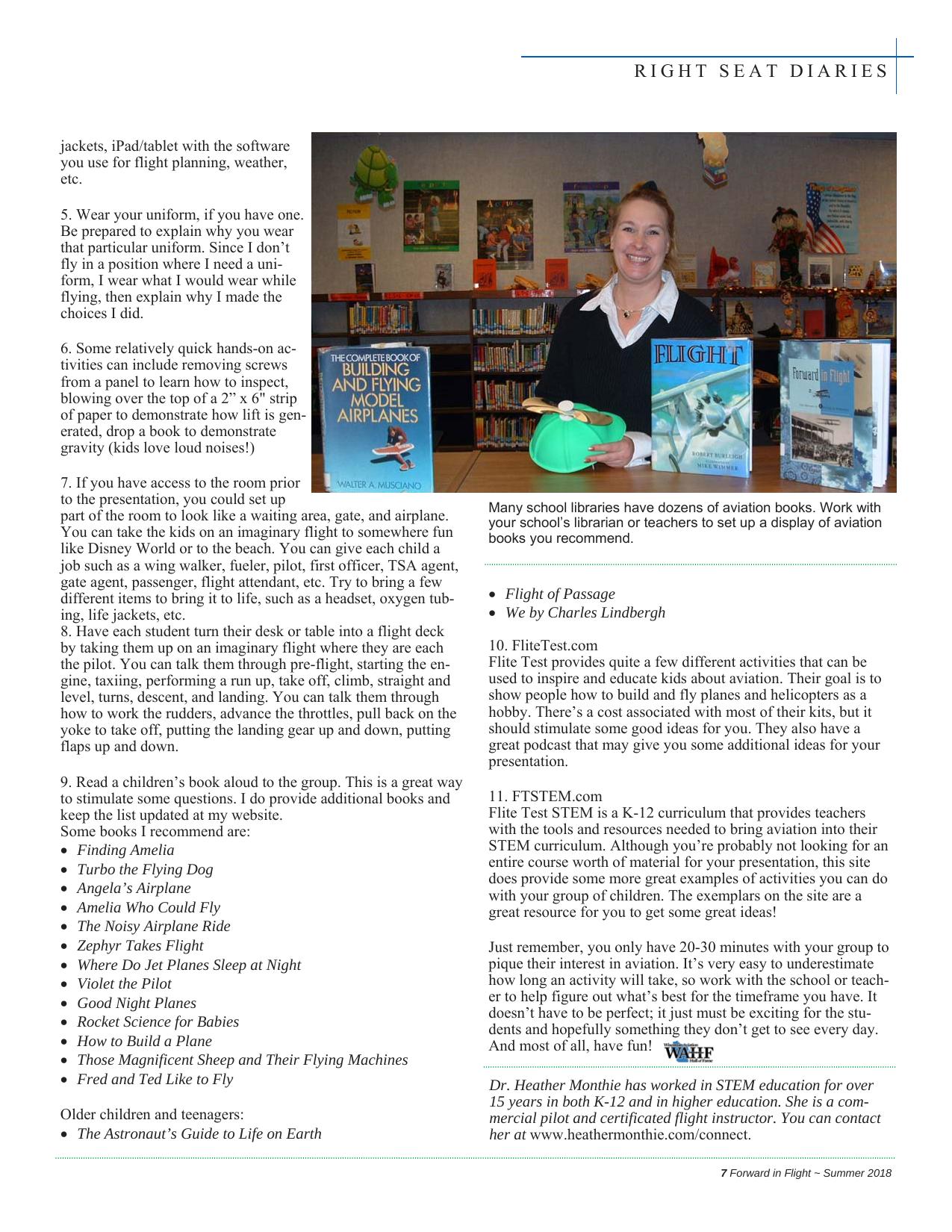
RIGHT SEAT DIARIES jackets, iPad/tablet with the software you use for flight planning, weather, etc. 5. Wear your uniform, if you have one. Be prepared to explain why you wear that particular uniform. Since I don’t fly in a position where I need a uniform, I wear what I would wear while flying, then explain why I made the choices I did. Left: Being involved in flight clubs and other groups helps keep you motivated and you’ll likely find mentors who will help you through your flight training. 6. Some relatively quick hands-on activities can include removing screws from a panel to learn how to inspect, blowing over the top of a 2” x 6" strip of paper to demonstrate how lift is generated, drop a book to demonstrate gravity (kids love loud noises!) 7. If you have access to the room prior to the presentation, you could set up part of the room to look like a waiting area, gate, and airplane. You can take the kids on an imaginary flight to somewhere fun like Disney World or to the beach. You can give each child a job such as a wing walker, fueler, pilot, first officer, TSA agent, gate agent, passenger, flight attendant, etc. Try to bring a few different items to bring it to life, such as a headset, oxygen tubing, life jackets, etc. 8. Have each student turn their desk or table into a flight deck by taking them up on an imaginary flight where they are each the pilot. You can talk them through pre-flight, starting the engine, taxiing, performing a run up, take off, climb, straight and level, turns, descent, and landing. You can talk them through how to work the rudders, advance the throttles, pull back on the yoke to take off, putting the landing gear up and down, putting flaps up and down. 9. Read a children’s book aloud to the group. This is a great way to stimulate some questions. I do provide additional books and keep the list updated at my website. Some books I recommend are: Finding Amelia Turbo the Flying Dog Angela’s Airplane Amelia Who Could Fly The Noisy Airplane Ride Zephyr Takes Flight Where Do Jet Planes Sleep at Night Violet the Pilot Good Night Planes Rocket Science for Babies How to Build a Plane Those Magnificent Sheep and Their Flying Machines Fred and Ted Like to Fly Older children and teenagers: The Astronaut’s Guide to Life on Earth Previous page: Attending FAA Safety Seminars is a good way to gain extra knowledge, even when you’re not in the sky. Many school libraries have dozens of aviation books. Work with your school’s librarian or teachers to set up a display of aviation books you recommend. Flight of Passage We by Charles Lindbergh 10. FliteTest.com Flite Test provides quite a few different activities that can be used to inspire and educate kids about aviation. Their goal is to show people how to build and fly planes and helicopters as a hobby. There’s a cost associated with most of their kits, but it should stimulate some good ideas for you. They also have a great podcast that may give you some additional ideas for your presentation. 11. FTSTEM.com Flite Test STEM is a K-12 curriculum that provides teachers with the tools and resources needed to bring aviation into their STEM curriculum. Although you’re probably not looking for an entire course worth of material for your presentation, this site does provide some more great examples of activities you can do with your group of children. The exemplars on the site are a great resource for you to get some great ideas! Just remember, you only have 20-30 minutes with your group to pique their interest in aviation. It’s very easy to underestimate how long an activity will take, so work with the school or teacher to help figure out what’s best for the timeframe you have. It doesn’t have to be perfect; it just must be exciting for the students and hopefully something they don’t get to see every day. And most of all, have fun! Dr. Heather Monthie has worked in STEM education for over 15 years in both K-12 and in higher education. She is a commercial pilot and certificated flight instructor. You can contact her at www.heathermonthie.com/connect. 7 Forward in Flight ~ Summer 2018
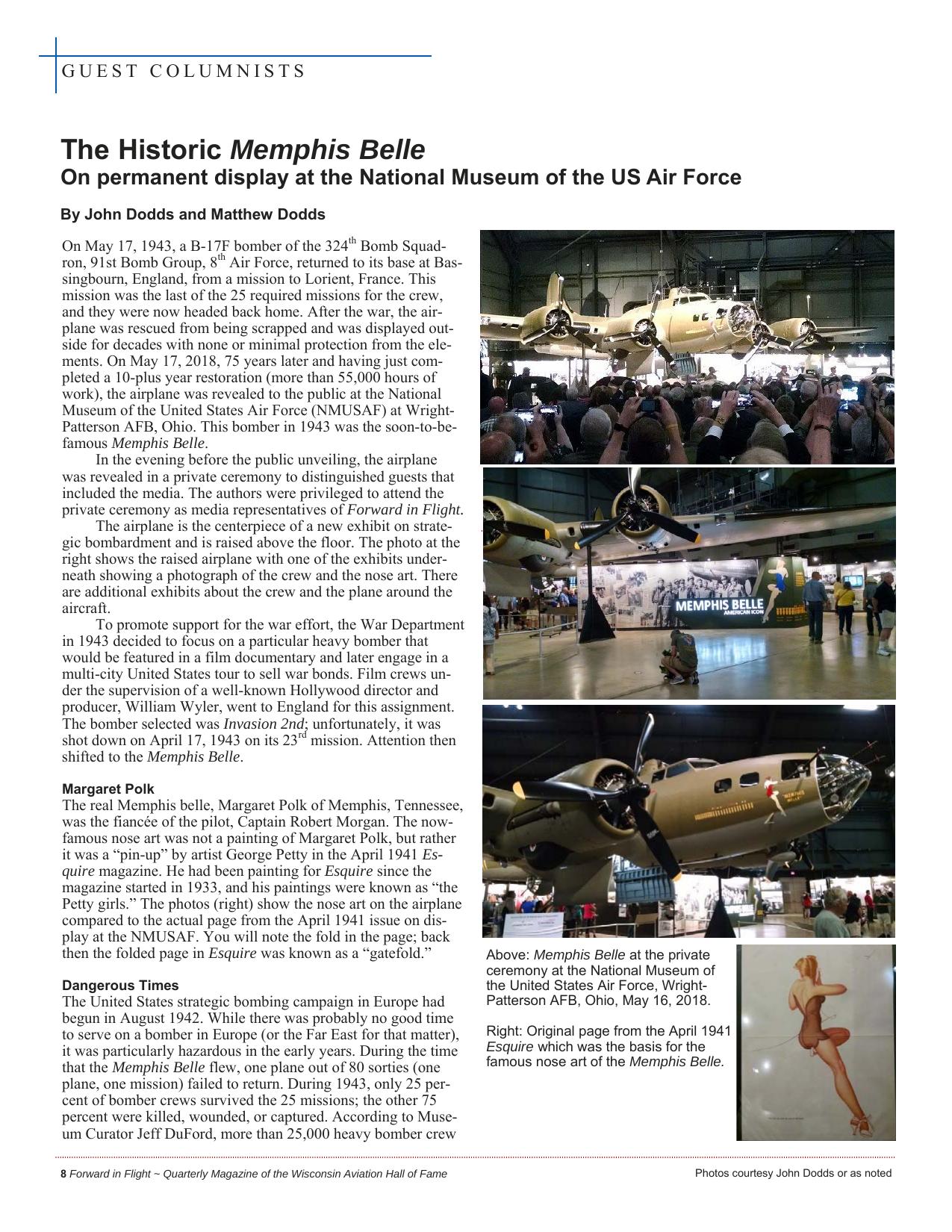
GUEST COLUMNISTS The Historic Memphis Belle On permanent display at the National Museum of the US Air Force By John Dodds and Matthew Dodds On May 17, 1943, a B-17F bomber of the 324th Bomb Squadron, 91st Bomb Group, 8th Air Force, returned to its base at Bassingbourn, England, from a mission to Lorient, France. This mission was the last of the 25 required missions for the crew, and they were now headed back home. After the war, the airplane was rescued from being scrapped and was displayed outside for decades with none or minimal protection from the elements. On May 17, 2018, 75 years later and having just completed a 10-plus year restoration (more than 55,000 hours of work), the airplane was revealed to the public at the National Museum of the United States Air Force (NMUSAF) at WrightPatterson AFB, Ohio. This bomber in 1943 was the soon-to-befamous Memphis Belle. In the evening before the public unveiling, the airplane was revealed in a private ceremony to distinguished guests that included the media. The authors were privileged to attend the private ceremony as media representatives of Forward in Flight. The airplane is the centerpiece of a new exhibit on strategic bombardment and is raised above the floor. The photo at the right shows the raised airplane with one of the exhibits underneath showing a photograph of the crew and the nose art. There are additional exhibits about the crew and the plane around the aircraft. To promote support for the war effort, the War Department in 1943 decided to focus on a particular heavy bomber that would be featured in a film documentary and later engage in a multi-city United States tour to sell war bonds. Film crews under the supervision of a well-known Hollywood director and producer, William Wyler, went to England for this assignment. The bomber selected was Invasion 2nd; unfortunately, it was shot down on April 17, 1943 on its 23rd mission. Attention then shifted to the Memphis Belle. Margaret Polk The real Memphis belle, Margaret Polk of Memphis, Tennessee, was the fiancée of the pilot, Captain Robert Morgan. The nowfamous nose art was not a painting of Margaret Polk, but rather it was a “pin-up” by artist George Petty in the April 1941 Esquire magazine. He had been painting for Esquire since the magazine started in 1933, and his paintings were known as “the Petty girls.” The photos (right) show the nose art on the airplane compared to the actual page from the April 1941 issue on display at the NMUSAF. You will note the fold in the page; back then the folded page in Esquire was known as a “gatefold.” Dangerous Times The United States strategic bombing campaign in Europe had begun in August 1942. While there was probably no good time to serve on a bomber in Europe (or the Far East for that matter), it was particularly hazardous in the early years. During the time that the Memphis Belle flew, one plane out of 80 sorties (one plane, one mission) failed to return. During 1943, only 25 percent of bomber crews survived the 25 missions; the other 75 percent were killed, wounded, or captured. According to Museum Curator Jeff DuFord, more than 25,000 heavy bomber crew 8 Forward in Flight ~ Quarterly Magazine of the Wisconsin Aviation Hall of Fame Above: Memphis Belle at the private ceremony at the National Museum of the United States Air Force, WrightPatterson AFB, Ohio, May 16, 2018. Right: Original page from the April 1941 Esquire which was the basis for the famous nose art of the Memphis Belle. Photos courtesy John Dodds or as noted
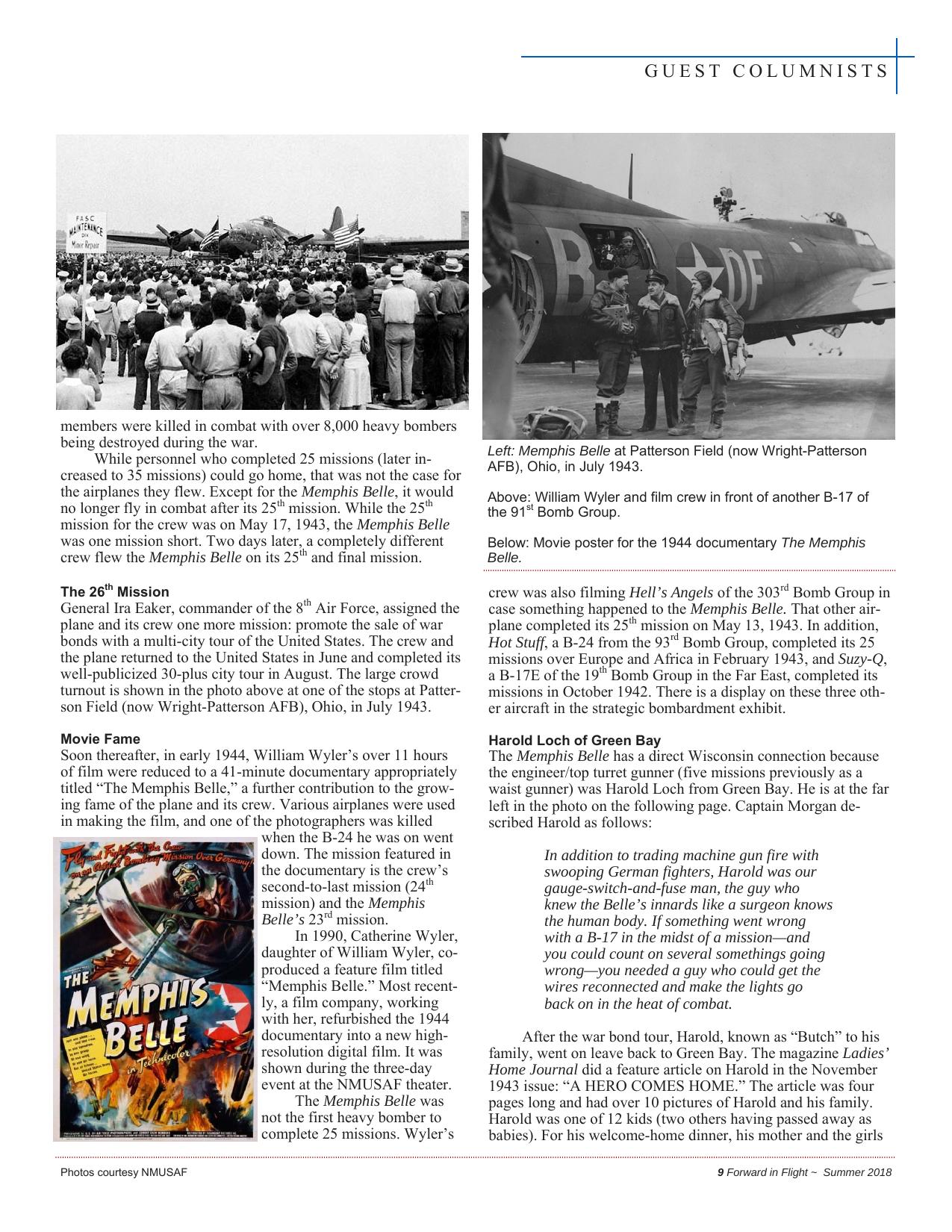
GUEST COLUMNISTS members were killed in combat with over 8,000 heavy bombers being destroyed during the war. While personnel who completed 25 missions (later increased to 35 missions) could go home, that was not the case for the airplanes they flew. Except for the Memphis Belle, it would no longer fly in combat after its 25th mission. While the 25th mission for the crew was on May 17, 1943, the Memphis Belle was one mission short. Two days later, a completely different crew flew the Memphis Belle on its 25th and final mission. Left: Memphis Belle at Patterson Field (now Wright-Patterson AFB), Ohio, in July 1943. Above: William Wyler and film crew in front of another B-17 of the 91st Bomb Group. Below: Movie poster for the 1944 documentary The Memphis Belle. General Ira Eaker, commander of the 8 Air Force, assigned the plane and its crew one more mission: promote the sale of war bonds with a multi-city tour of the United States. The crew and the plane returned to the United States in June and completed its well-publicized 30-plus city tour in August. The large crowd turnout is shown in the photo above at one of the stops at Patterson Field (now Wright-Patterson AFB), Ohio, in July 1943. crew was also filming Hell’s Angels of the 303rd Bomb Group in case something happened to the Memphis Belle. That other airplane completed its 25th mission on May 13, 1943. In addition, Hot Stuff, a B-24 from the 93rd Bomb Group, completed its 25 missions over Europe and Africa in February 1943, and Suzy-Q, a B-17E of the 19th Bomb Group in the Far East, completed its missions in October 1942. There is a display on these three other aircraft in the strategic bombardment exhibit. Movie Fame Harold Loch of Green Bay The 26th Mission th Soon thereafter, in early 1944, William Wyler’s over 11 hours of film were reduced to a 41-minute documentary appropriately titled “The Memphis Belle,” a further contribution to the growing fame of the plane and its crew. Various airplanes were used in making the film, and one of the photographers was killed when the B-24 he was on went down. The mission featured in the documentary is the crew’s second-to-last mission (24th mission) and the Memphis Belle’s 23rd mission. In 1990, Catherine Wyler, daughter of William Wyler, coproduced a feature film titled “Memphis Belle.” Most recently, a film company, working with her, refurbished the 1944 documentary into a new highresolution digital film. It was shown during the three-day event at the NMUSAF theater. The Memphis Belle was not the first heavy bomber to complete 25 missions. Wyler’s Photos courtesy NMUSAF The Memphis Belle has a direct Wisconsin connection because the engineer/top turret gunner (five missions previously as a waist gunner) was Harold Loch from Green Bay. He is at the far left in the photo on the following page. Captain Morgan described Harold as follows: In addition to trading machine gun fire with swooping German fighters, Harold was our gauge-switch-and-fuse man, the guy who knew the Belle’s innards like a surgeon knows the human body. If something went wrong with a B-17 in the midst of a mission—and you could count on several somethings going wrong—you needed a guy who could get the wires reconnected and make the lights go back on in the heat of combat. After the war bond tour, Harold, known as “Butch” to his family, went on leave back to Green Bay. The magazine Ladies’ Home Journal did a feature article on Harold in the November 1943 issue: “A HERO COMES HOME.” The article was four pages long and had over 10 pictures of Harold and his family. Harold was one of 12 kids (two others having passed away as babies). For his welcome-home dinner, his mother and the girls 9 Forward in Flight ~ Summer 2018
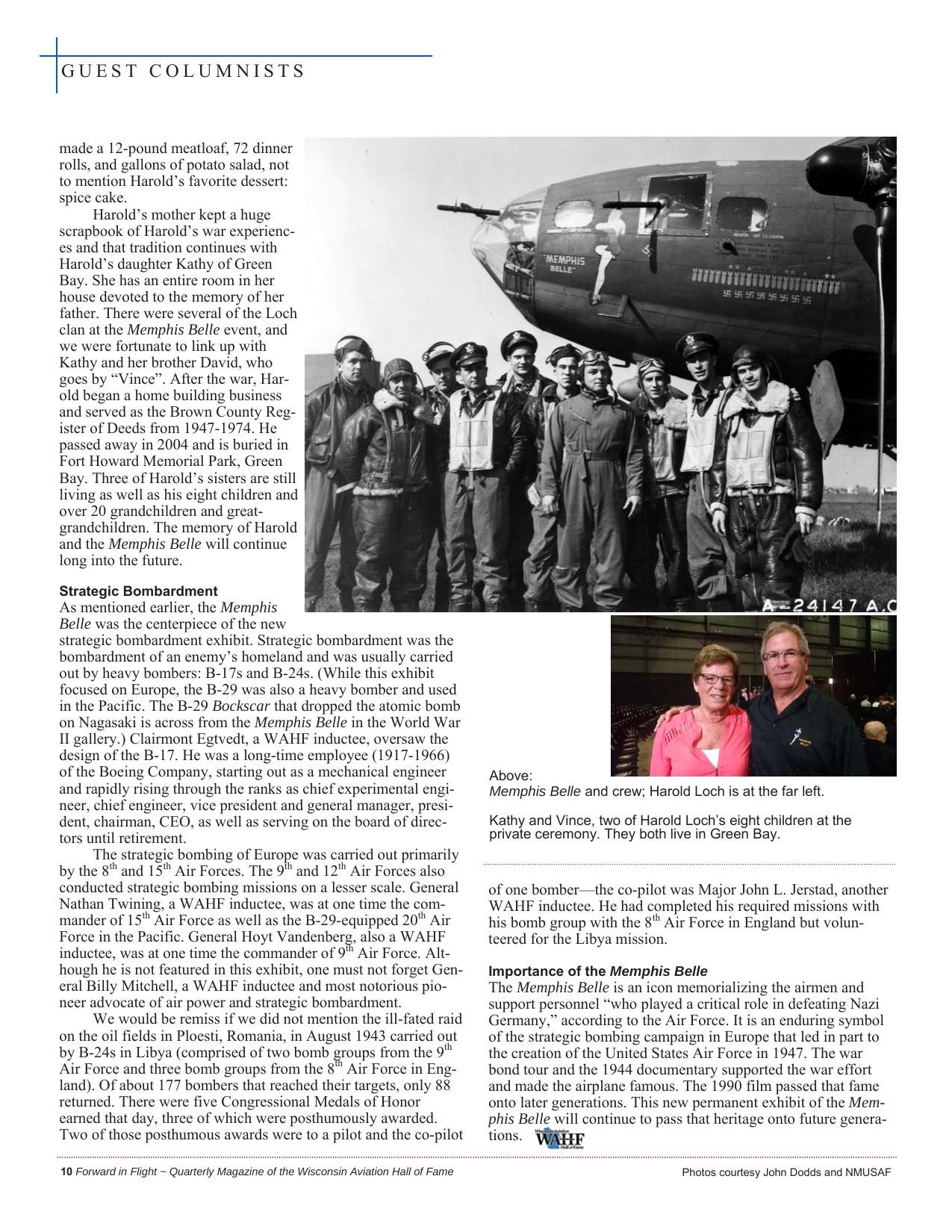
GUEST COLUMNISTS made a 12-pound meatloaf, 72 dinner rolls, and gallons of potato salad, not to mention Harold’s favorite dessert: spice cake. Harold’s mother kept a huge scrapbook of Harold’s war experiences and that tradition continues with Harold’s daughter Kathy of Green Bay. She has an entire room in her house devoted to the memory of her father. There were several of the Loch clan at the Memphis Belle event, and we were fortunate to link up with Kathy and her brother David, who goes by “Vince”. After the war, Harold began a home building business and served as the Brown County Register of Deeds from 1947-1974. He passed away in 2004 and is buried in Fort Howard Memorial Park, Green Bay. Three of Harold’s sisters are still living as well as his eight children and over 20 grandchildren and greatgrandchildren. The memory of Harold and the Memphis Belle will continue long into the future. Strategic Bombardment As mentioned earlier, the Memphis Belle was the centerpiece of the new strategic bombardment exhibit. Strategic bombardment was the bombardment of an enemy’s homeland and was usually carried out by heavy bombers: B-17s and B-24s. (While this exhibit focused on Europe, the B-29 was also a heavy bomber and used in the Pacific. The B-29 Bockscar that dropped the atomic bomb on Nagasaki is across from the Memphis Belle in the World War II gallery.) Clairmont Egtvedt, a WAHF inductee, oversaw the design of the B-17. He was a long-time employee (1917-1966) of the Boeing Company, starting out as a mechanical engineer and rapidly rising through the ranks as chief experimental engineer, chief engineer, vice president and general manager, president, chairman, CEO, as well as serving on the board of directors until retirement. The strategic bombing of Europe was carried out primarily by the 8th and 15th Air Forces. The 9th and 12th Air Forces also conducted strategic bombing missions on a lesser scale. General Nathan Twining, a WAHF inductee, was at one time the commander of 15th Air Force as well as the B-29-equipped 20th Air Force in the Pacific. General Hoyt Vandenberg, also a WAHF inductee, was at one time the commander of 9th Air Force. Although he is not featured in this exhibit, one must not forget General Billy Mitchell, a WAHF inductee and most notorious pioneer advocate of air power and strategic bombardment. We would be remiss if we did not mention the ill-fated raid on the oil fields in Ploesti, Romania, in August 1943 carried out by B-24s in Libya (comprised of two bomb groups from the 9th Air Force and three bomb groups from the 8th Air Force in England). Of about 177 bombers that reached their targets, only 88 returned. There were five Congressional Medals of Honor earned that day, three of which were posthumously awarded. Two of those posthumous awards were to a pilot and the co-pilot 10 Forward in Flight ~ Quarterly Magazine of the Wisconsin Aviation Hall of Fame Above: Memphis Belle and crew; Harold Loch is at the far left. Kathy and Vince, two of Harold Loch’s eight children at the private ceremony. They both live in Green Bay. of one bomber—the co-pilot was Major John L. Jerstad, another WAHF inductee. He had completed his required missions with his bomb group with the 8th Air Force in England but volunteered for the Libya mission. Importance of the Memphis Belle The Memphis Belle is an icon memorializing the airmen and support personnel “who played a critical role in defeating Nazi Germany,” according to the Air Force. It is an enduring symbol of the strategic bombing campaign in Europe that led in part to the creation of the United States Air Force in 1947. The war bond tour and the 1944 documentary supported the war effort and made the airplane famous. The 1990 film passed that fame onto later generations. This new permanent exhibit of the Memphis Belle will continue to pass that heritage onto future generations. Photos courtesy John Dodds and NMUSAF
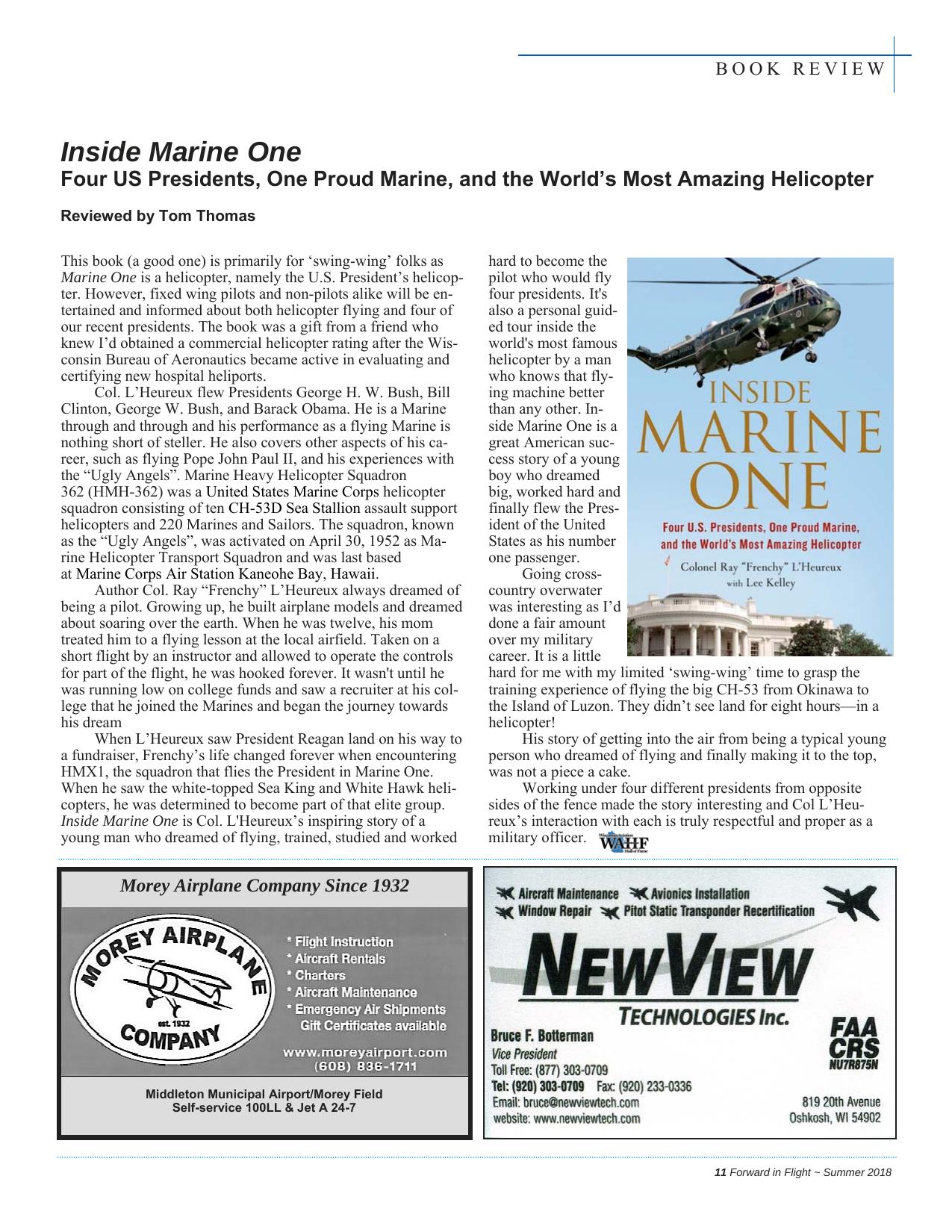
BOOK REVIEW Inside Marine One Four US Presidents, One Proud Marine, and the World’s Most Amazing Helicopter Reviewed by Tom Thomas This book (a good one) is primarily for ‘swing-wing’ folks as Marine One is a helicopter, namely the U.S. President’s helicopter. However, fixed wing pilots and non-pilots alike will be entertained and informed about both helicopter flying and four of our recent presidents. The book was a gift from a friend who knew I’d obtained a commercial helicopter rating after the Wisconsin Bureau of Aeronautics became active in evaluating and certifying new hospital heliports. Col. L’Heureux flew Presidents George H. W. Bush, Bill Clinton, George W. Bush, and Barack Obama. He is a Marine through and through and his performance as a flying Marine is nothing short of steller. He also covers other aspects of his career, such as flying Pope John Paul II, and his experiences with the “Ugly Angels”. Marine Heavy Helicopter Squadron 362 (HMH-362) was a United States Marine Corps helicopter squadron consisting of ten CH-53D Sea Stallion assault support helicopters and 220 Marines and Sailors. The squadron, known as the “Ugly Angels”, was activated on April 30, 1952 as Marine Helicopter Transport Squadron and was last based at Marine Corps Air Station Kaneohe Bay, Hawaii. Author Col. Ray “Frenchy” L’Heureux always dreamed of being a pilot. Growing up, he built airplane models and dreamed about soaring over the earth. When he was twelve, his mom treated him to a flying lesson at the local airfield. Taken on a short flight by an instructor and allowed to operate the controls for part of the flight, he was hooked forever. It wasn't until he was running low on college funds and saw a recruiter at his college that he joined the Marines and began the journey towards his dream When L’Heureux saw President Reagan land on his way to a fundraiser, Frenchy’s life changed forever when encountering HMX1, the squadron that flies the President in Marine One. When he saw the white-topped Sea King and White Hawk helicopters, he was determined to become part of that elite group. Inside Marine One is Col. L'Heureux’s inspiring story of a young man who dreamed of flying, trained, studied and worked hard to become the pilot who would fly four presidents. It's also a personal guided tour inside the world's most famous helicopter by a man who knows that flying machine better than any other. Inside Marine One is a great American success story of a young boy who dreamed big, worked hard and finally flew the President of the United States as his number one passenger. Going crosscountry overwater was interesting as I’d done a fair amount over my military career. It is a little hard for me with my limited ‘swing-wing’ time to grasp the training experience of flying the big CH-53 from Okinawa to the Island of Luzon. They didn’t see land for eight hours—in a helicopter! His story of getting into the air from being a typical young person who dreamed of flying and finally making it to the top, was not a piece a cake. Working under four different presidents from opposite sides of the fence made the story interesting and Col L’Heureux’s interaction with each is truly respectful and proper as a military officer. Morey Airplane Company Since 1932 Middleton Municipal Airport/Morey Field Self-service 100LL & Jet A 24-7 11 Forward in Flight ~ Summer 2018
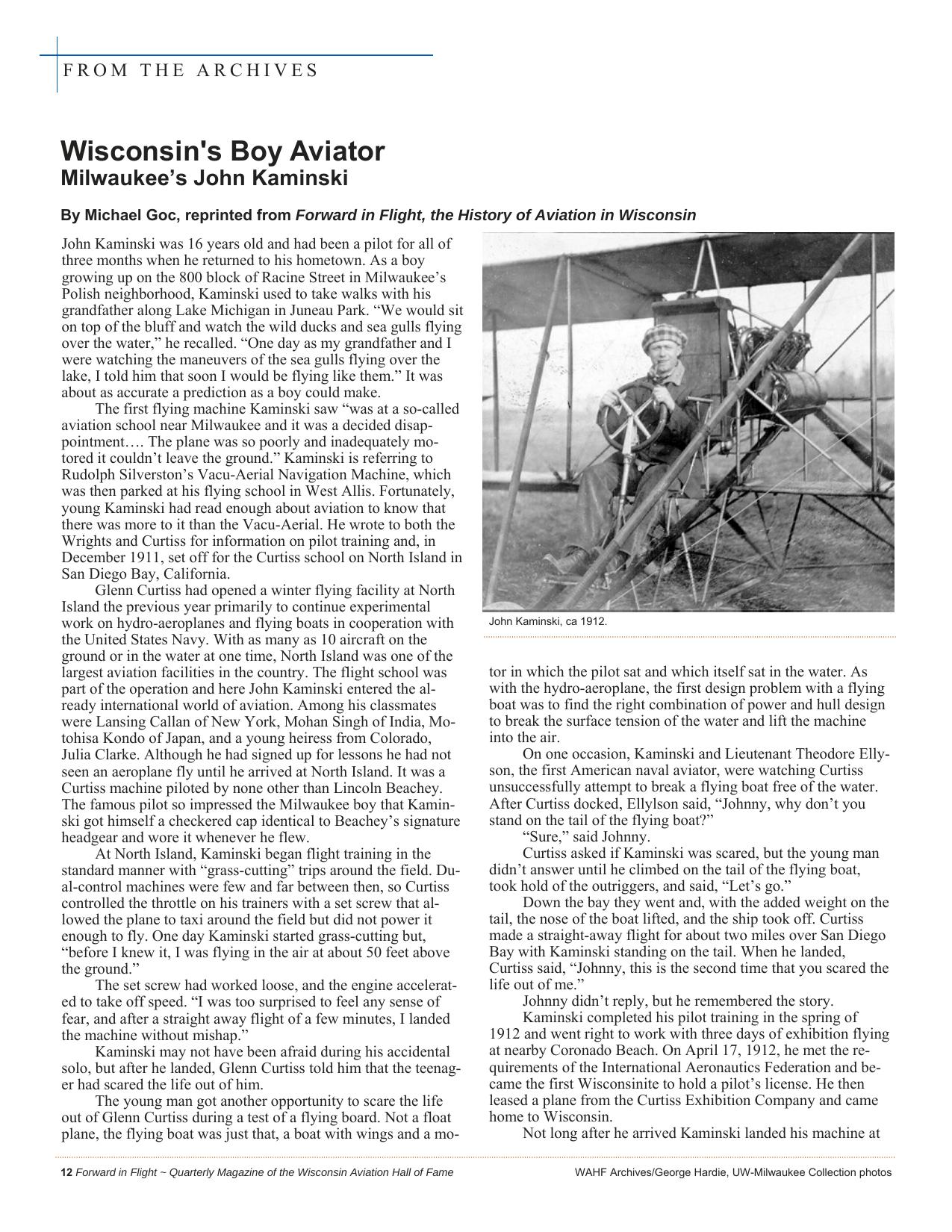
FROM THE ARCHIVES Wisconsin's Boy Aviator Milwaukee’s John Kaminski By Michael Goc, reprinted from Forward in Flight, the History of Aviation in Wisconsin John Kaminski was 16 years old and had been a pilot for all of three months when he returned to his hometown. As a boy growing up on the 800 block of Racine Street in Milwaukee’s Polish neighborhood, Kaminski used to take walks with his grandfather along Lake Michigan in Juneau Park. “We would sit on top of the bluff and watch the wild ducks and sea gulls flying over the water,” he recalled. “One day as my grandfather and I were watching the maneuvers of the sea gulls flying over the lake, I told him that soon I would be flying like them.” It was about as accurate a prediction as a boy could make. The first flying machine Kaminski saw “was at a so-called aviation school near Milwaukee and it was a decided disappointment…. The plane was so poorly and inadequately motored it couldn’t leave the ground.” Kaminski is referring to Rudolph Silverston’s Vacu-Aerial Navigation Machine, which was then parked at his flying school in West Allis. Fortunately, young Kaminski had read enough about aviation to know that there was more to it than the Vacu-Aerial. He wrote to both the Wrights and Curtiss for information on pilot training and, in December 1911, set off for the Curtiss school on North Island in San Diego Bay, California. Glenn Curtiss had opened a winter flying facility at North Island the previous year primarily to continue experimental work on hydro-aeroplanes and flying boats in cooperation with the United States Navy. With as many as 10 aircraft on the ground or in the water at one time, North Island was one of the largest aviation facilities in the country. The flight school was part of the operation and here John Kaminski entered the already international world of aviation. Among his classmates were Lansing Callan of New York, Mohan Singh of India, Motohisa Kondo of Japan, and a young heiress from Colorado, Julia Clarke. Although he had signed up for lessons he had not seen an aeroplane fly until he arrived at North Island. It was a Curtiss machine piloted by none other than Lincoln Beachey. The famous pilot so impressed the Milwaukee boy that Kaminski got himself a checkered cap identical to Beachey’s signature headgear and wore it whenever he flew. At North Island, Kaminski began flight training in the standard manner with “grass-cutting” trips around the field. Dual-control machines were few and far between then, so Curtiss controlled the throttle on his trainers with a set screw that allowed the plane to taxi around the field but did not power it enough to fly. One day Kaminski started grass-cutting but, “before I knew it, I was flying in the air at about 50 feet above the ground.” The set screw had worked loose, and the engine accelerated to take off speed. “I was too surprised to feel any sense of fear, and after a straight away flight of a few minutes, I landed the machine without mishap.” Kaminski may not have been afraid during his accidental solo, but after he landed, Glenn Curtiss told him that the teenager had scared the life out of him. The young man got another opportunity to scare the life out of Glenn Curtiss during a test of a flying board. Not a float plane, the flying boat was just that, a boat with wings and a mo12 Forward in Flight ~ Quarterly Magazine of the Wisconsin Aviation Hall of Fame John Kaminski, ca 1912. tor in which the pilot sat and which itself sat in the water. As with the hydro-aeroplane, the first design problem with a flying boat was to find the right combination of power and hull design to break the surface tension of the water and lift the machine into the air. On one occasion, Kaminski and Lieutenant Theodore Ellyson, the first American naval aviator, were watching Curtiss unsuccessfully attempt to break a flying boat free of the water. After Curtiss docked, Ellylson said, “Johnny, why don’t you stand on the tail of the flying boat?” “Sure,” said Johnny. Curtiss asked if Kaminski was scared, but the young man didn’t answer until he climbed on the tail of the flying boat, took hold of the outriggers, and said, “Let’s go.” Down the bay they went and, with the added weight on the tail, the nose of the boat lifted, and the ship took off. Curtiss made a straight-away flight for about two miles over San Diego Bay with Kaminski standing on the tail. When he landed, Curtiss said, “Johnny, this is the second time that you scared the life out of me.” Johnny didn’t reply, but he remembered the story. Kaminski completed his pilot training in the spring of 1912 and went right to work with three days of exhibition flying at nearby Coronado Beach. On April 17, 1912, he met the requirements of the International Aeronautics Federation and became the first Wisconsinite to hold a pilot’s license. He then leased a plane from the Curtiss Exhibition Company and came home to Wisconsin. Not long after he arrived Kaminski landed his machine at WAHF Archives/George Hardie, UW-Milwaukee Collection photos
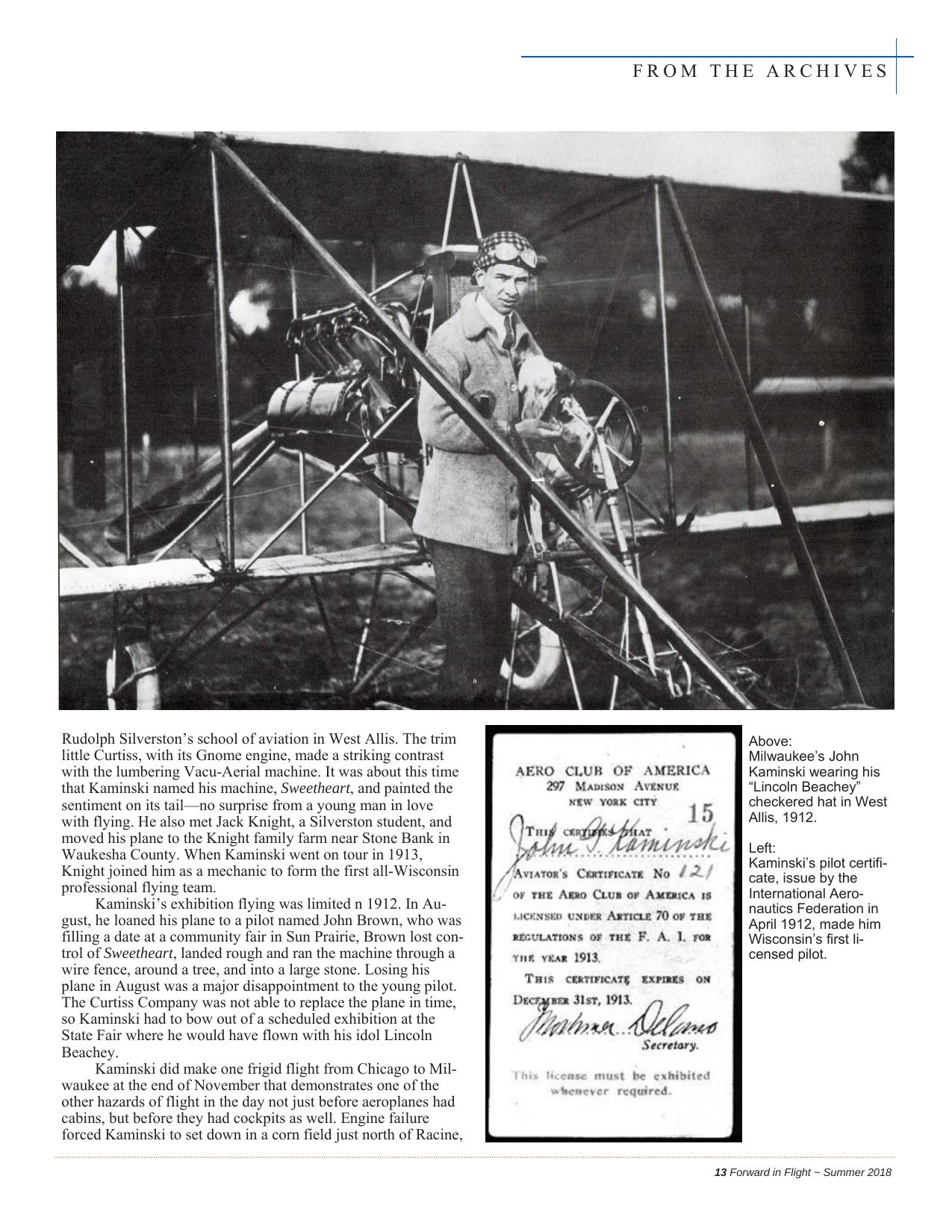
FROM THE ARCHIVES Rudolph Silverston’s school of aviation in West Allis. The trim little Curtiss, with its Gnome engine, made a striking contrast with the lumbering Vacu-Aerial machine. It was about this time that Kaminski named his machine, Sweetheart, and painted the sentiment on its tail—no surprise from a young man in love with flying. He also met Jack Knight, a Silverston student, and moved his plane to the Knight family farm near Stone Bank in Waukesha County. When Kaminski went on tour in 1913, Knight joined him as a mechanic to form the first all-Wisconsin professional flying team. Kaminski’s exhibition flying was limited n 1912. In August, he loaned his plane to a pilot named John Brown, who was filling a date at a community fair in Sun Prairie, Brown lost control of Sweetheart, landed rough and ran the machine through a wire fence, around a tree, and into a large stone. Losing his plane in August was a major disappointment to the young pilot. The Curtiss Company was not able to replace the plane in time, so Kaminski had to bow out of a scheduled exhibition at the State Fair where he would have flown with his idol Lincoln Beachey. Kaminski did make one frigid flight from Chicago to Milwaukee at the end of November that demonstrates one of the other hazards of flight in the day not just before aeroplanes had cabins, but before they had cockpits as well. Engine failure forced Kaminski to set down in a corn field just north of Racine, Above: Milwaukee’s John Kaminski wearing his “Lincoln Beachey” checkered hat in West Allis, 1912. Left: Kaminski’s pilot certificate, issue by the International Aeronautics Federation in April 1912, made him Wisconsin’s first licensed pilot. 13 Forward in Flight ~ Summer 2018
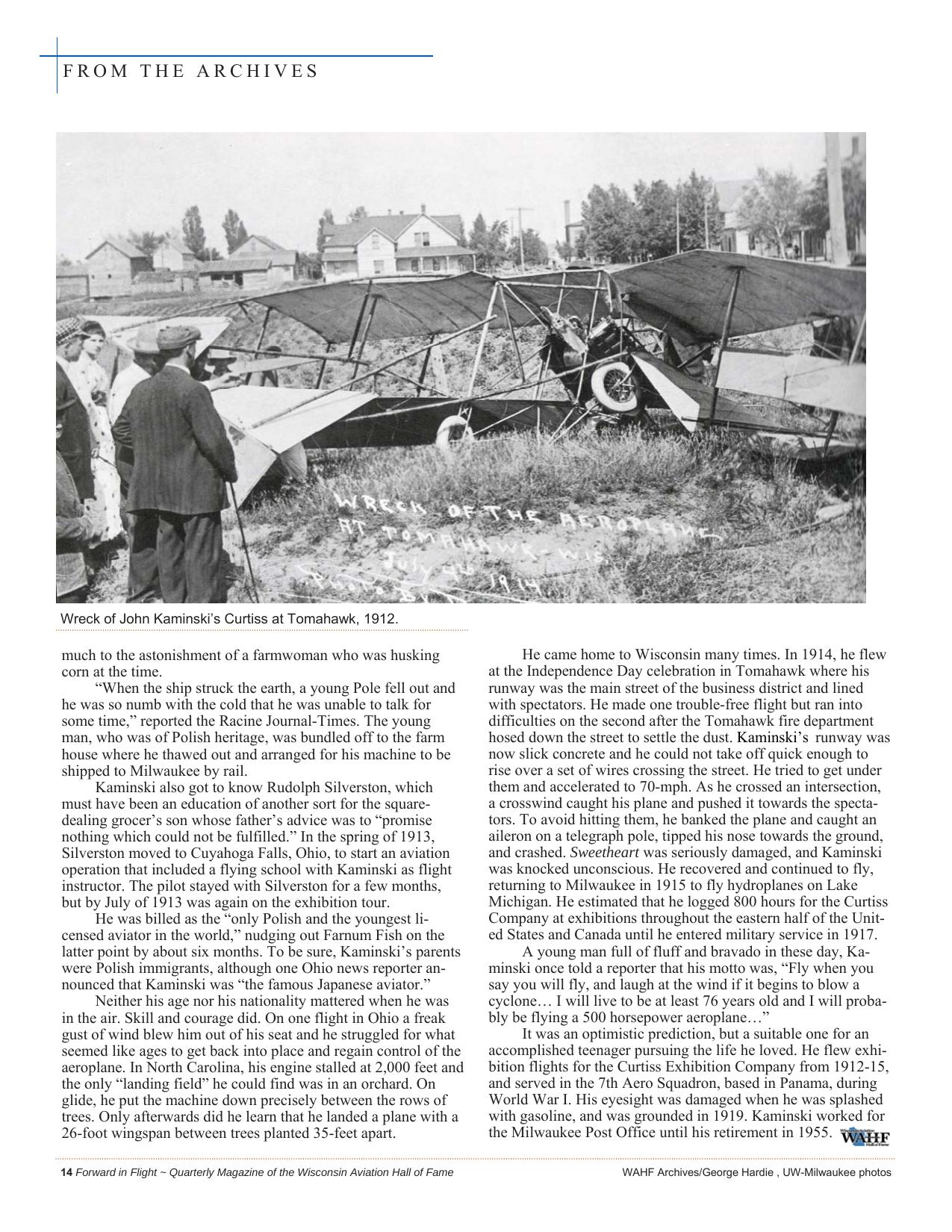
FROM THE ARCHIVES Wreck of John Kaminski’s Curtiss at Tomahawk, 1912. much to the astonishment of a farmwoman who was husking corn at the time. “When the ship struck the earth, a young Pole fell out and he was so numb with the cold that he was unable to talk for some time,” reported the Racine Journal-Times. The young man, who was of Polish heritage, was bundled off to the farm house where he thawed out and arranged for his machine to be shipped to Milwaukee by rail. Kaminski also got to know Rudolph Silverston, which must have been an education of another sort for the squaredealing grocer’s son whose father’s advice was to “promise nothing which could not be fulfilled.” In the spring of 1913, Silverston moved to Cuyahoga Falls, Ohio, to start an aviation operation that included a flying school with Kaminski as flight instructor. The pilot stayed with Silverston for a few months, but by July of 1913 was again on the exhibition tour. He was billed as the “only Polish and the youngest licensed aviator in the world,” nudging out Farnum Fish on the latter point by about six months. To be sure, Kaminski’s parents were Polish immigrants, although one Ohio news reporter announced that Kaminski was “the famous Japanese aviator.” Neither his age nor his nationality mattered when he was in the air. Skill and courage did. On one flight in Ohio a freak gust of wind blew him out of his seat and he struggled for what seemed like ages to get back into place and regain control of the aeroplane. In North Carolina, his engine stalled at 2,000 feet and the only “landing field” he could find was in an orchard. On glide, he put the machine down precisely between the rows of trees. Only afterwards did he learn that he landed a plane with a 26-foot wingspan between trees planted 35-feet apart. 14 Forward in Flight ~ Quarterly Magazine of the Wisconsin Aviation Hall of Fame He came home to Wisconsin many times. In 1914, he flew at the Independence Day celebration in Tomahawk where his runway was the main street of the business district and lined with spectators. He made one trouble-free flight but ran into difficulties on the second after the Tomahawk fire department hosed down the street to settle the dust. Kaminski’s runway was now slick concrete and he could not take off quick enough to rise over a set of wires crossing the street. He tried to get under them and accelerated to 70-mph. As he crossed an intersection, a crosswind caught his plane and pushed it towards the spectators. To avoid hitting them, he banked the plane and caught an aileron on a telegraph pole, tipped his nose towards the ground, and crashed. Sweetheart was seriously damaged, and Kaminski was knocked unconscious. He recovered and continued to fly, returning to Milwaukee in 1915 to fly hydroplanes on Lake Michigan. He estimated that he logged 800 hours for the Curtiss Company at exhibitions throughout the eastern half of the United States and Canada until he entered military service in 1917. A young man full of fluff and bravado in these day, Kaminski once told a reporter that his motto was, “Fly when you say you will fly, and laugh at the wind if it begins to blow a cyclone… I will live to be at least 76 years old and I will probably be flying a 500 horsepower aeroplane…” It was an optimistic prediction, but a suitable one for an accomplished teenager pursuing the life he loved. He flew exhibition flights for the Curtiss Exhibition Company from 1912-15, and served in the 7th Aero Squadron, based in Panama, during World War I. His eyesight was damaged when he was splashed with gasoline, and was grounded in 1919. Kaminski worked for the Milwaukee Post Office until his retirement in 1955. WAHF Archives/George Hardie , UW-Milwaukee photos
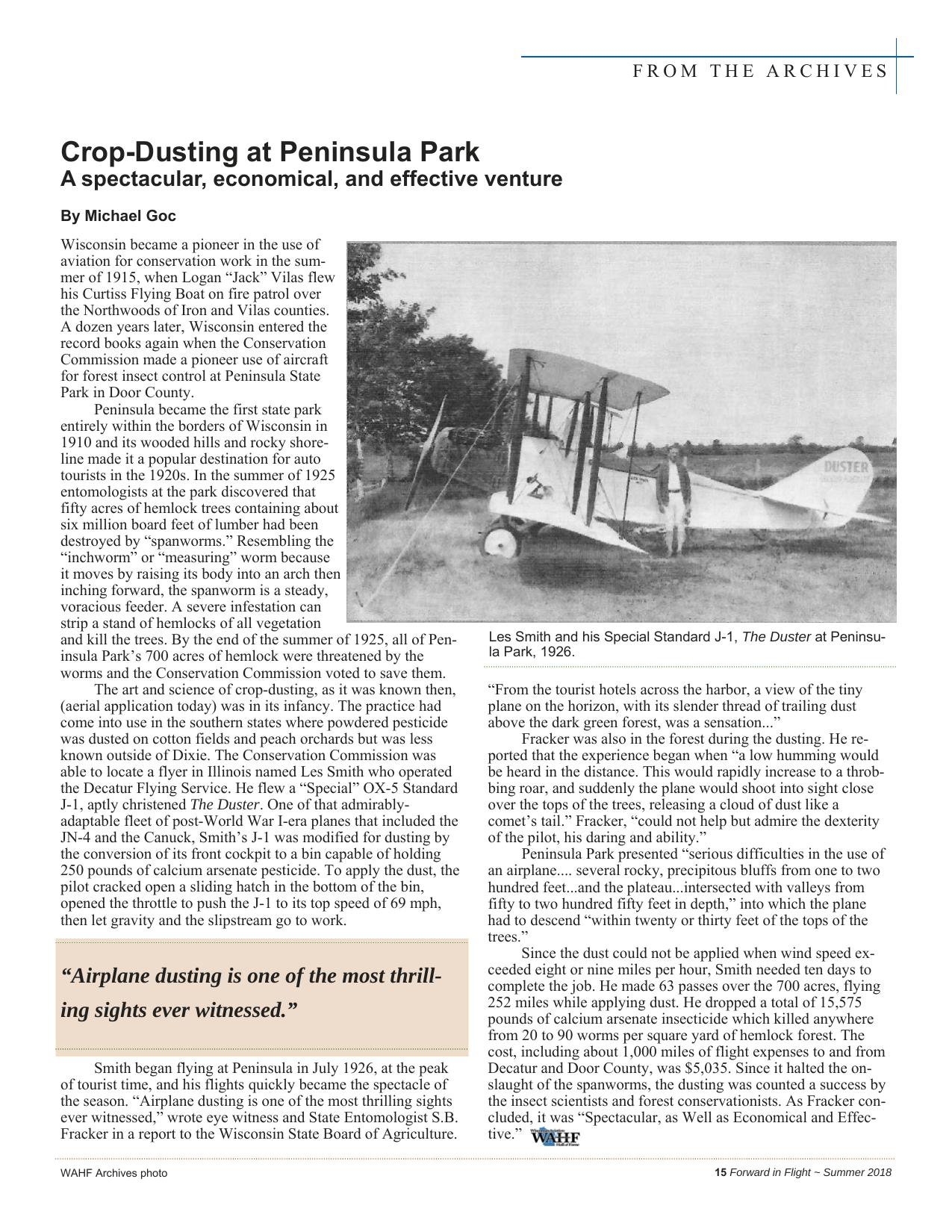
FROM THE ARCHIVES Crop-Dusting at Peninsula Park A spectacular, economical, and effective venture By Michael Goc Wisconsin became a pioneer in the use of aviation for conservation work in the summer of 1915, when Logan “Jack” Vilas flew his Curtiss Flying Boat on fire patrol over the Northwoods of Iron and Vilas counties. A dozen years later, Wisconsin entered the record books again when the Conservation Commission made a pioneer use of aircraft for forest insect control at Peninsula State Park in Door County. Peninsula became the first state park entirely within the borders of Wisconsin in 1910 and its wooded hills and rocky shoreline made it a popular destination for auto tourists in the 1920s. In the summer of 1925 entomologists at the park discovered that fifty acres of hemlock trees containing about six million board feet of lumber had been destroyed by “spanworms.” Resembling the “inchworm” or “measuring” worm because it moves by raising its body into an arch then inching forward, the spanworm is a steady, voracious feeder. A severe infestation can strip a stand of hemlocks of all vegetation and kill the trees. By the end of the summer of 1925, all of Peninsula Park’s 700 acres of hemlock were threatened by the worms and the Conservation Commission voted to save them. The art and science of crop-dusting, as it was known then, (aerial application today) was in its infancy. The practice had come into use in the southern states where powdered pesticide was dusted on cotton fields and peach orchards but was less known outside of Dixie. The Conservation Commission was able to locate a flyer in Illinois named Les Smith who operated the Decatur Flying Service. He flew a “Special” OX-5 Standard J-1, aptly christened The Duster. One of that admirablyadaptable fleet of post-World War I-era planes that included the JN-4 and the Canuck, Smith’s J-1 was modified for dusting by the conversion of its front cockpit to a bin capable of holding 250 pounds of calcium arsenate pesticide. To apply the dust, the pilot cracked open a sliding hatch in the bottom of the bin, opened the throttle to push the J-1 to its top speed of 69 mph, then let gravity and the slipstream go to work. “Airplane dusting is one of the most thrilling sights ever witnessed.” Smith began flying at Peninsula in July 1926, at the peak of tourist time, and his flights quickly became the spectacle of the season. “Airplane dusting is one of the most thrilling sights ever witnessed,” wrote eye witness and State Entomologist S.B. Fracker in a report to the Wisconsin State Board of Agriculture. WAHF Archives photo Les Smith and his Special Standard J-1, The Duster at Peninsula Park, 1926. “From the tourist hotels across the harbor, a view of the tiny plane on the horizon, with its slender thread of trailing dust above the dark green forest, was a sensation...” Fracker was also in the forest during the dusting. He reported that the experience began when “a low humming would be heard in the distance. This would rapidly increase to a throbbing roar, and suddenly the plane would shoot into sight close over the tops of the trees, releasing a cloud of dust like a comet’s tail.” Fracker, “could not help but admire the dexterity of the pilot, his daring and ability.” Peninsula Park presented “serious difficulties in the use of an airplane.... several rocky, precipitous bluffs from one to two hundred feet...and the plateau...intersected with valleys from fifty to two hundred fifty feet in depth,” into which the plane had to descend “within twenty or thirty feet of the tops of the trees.” Since the dust could not be applied when wind speed exceeded eight or nine miles per hour, Smith needed ten days to complete the job. He made 63 passes over the 700 acres, flying 252 miles while applying dust. He dropped a total of 15,575 pounds of calcium arsenate insecticide which killed anywhere from 20 to 90 worms per square yard of hemlock forest. The cost, including about 1,000 miles of flight expenses to and from Decatur and Door County, was $5,035. Since it halted the onslaught of the spanworms, the dusting was counted a success by the insect scientists and forest conservationists. As Fracker concluded, it was “Spectacular, as Well as Economical and Effective.” 15 Forward in Flight ~ Summer 2018
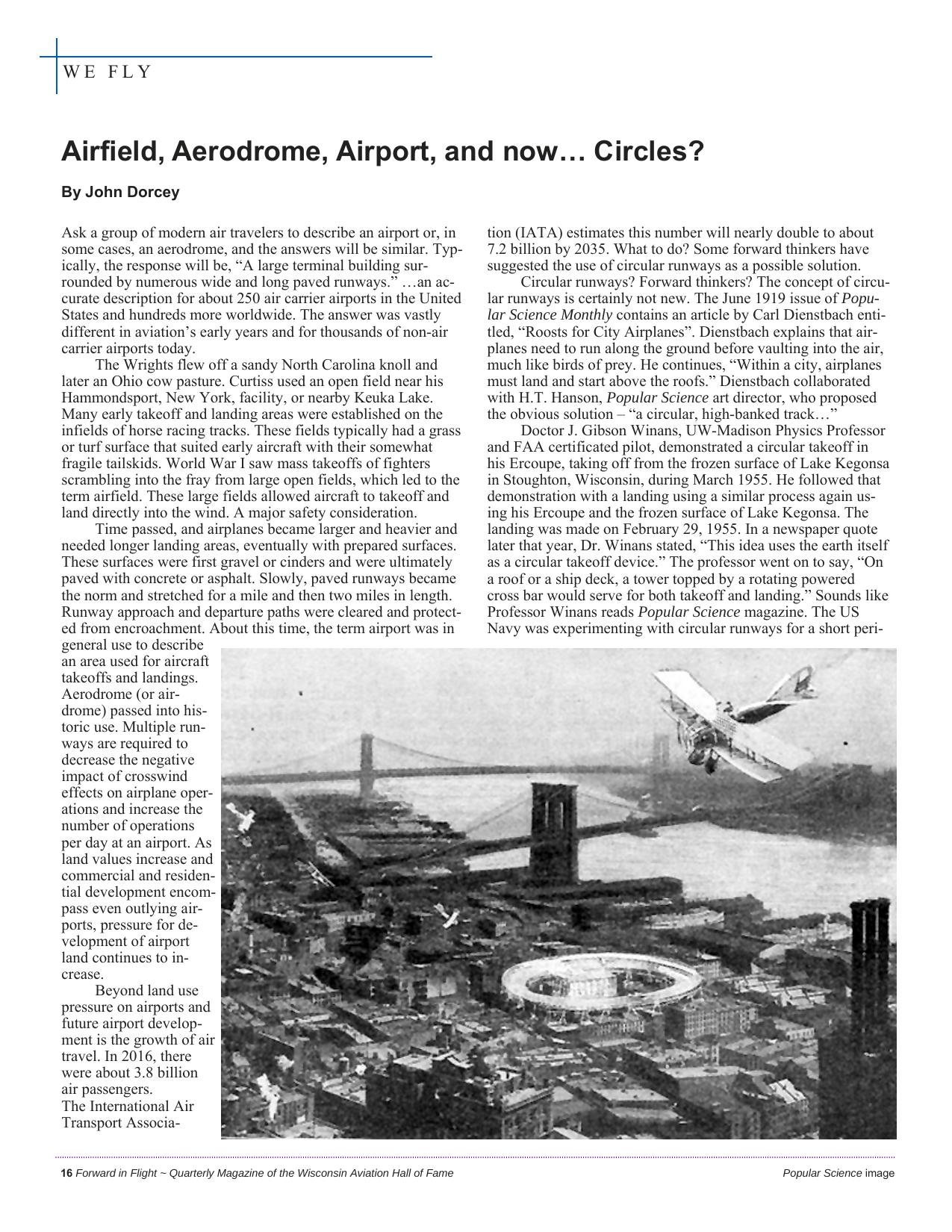
WE FLY Airfield, Aerodrome, Airport, and now… Circles? By John Dorcey Ask a group of modern air travelers to describe an airport or, in some cases, an aerodrome, and the answers will be similar. Typically, the response will be, “A large terminal building surrounded by numerous wide and long paved runways.” …an accurate description for about 250 air carrier airports in the United States and hundreds more worldwide. The answer was vastly different in aviation’s early years and for thousands of non-air carrier airports today. The Wrights flew off a sandy North Carolina knoll and later an Ohio cow pasture. Curtiss used an open field near his Hammondsport, New York, facility, or nearby Keuka Lake. Many early takeoff and landing areas were established on the infields of horse racing tracks. These fields typically had a grass or turf surface that suited early aircraft with their somewhat fragile tailskids. World War I saw mass takeoffs of fighters scrambling into the fray from large open fields, which led to the term airfield. These large fields allowed aircraft to takeoff and land directly into the wind. A major safety consideration. Time passed, and airplanes became larger and heavier and needed longer landing areas, eventually with prepared surfaces. These surfaces were first gravel or cinders and were ultimately paved with concrete or asphalt. Slowly, paved runways became the norm and stretched for a mile and then two miles in length. Runway approach and departure paths were cleared and protected from encroachment. About this time, the term airport was in general use to describe an area used for aircraft takeoffs and landings. Aerodrome (or airdrome) passed into historic use. Multiple runways are required to decrease the negative impact of crosswind effects on airplane operations and increase the number of operations per day at an airport. As land values increase and commercial and residential development encompass even outlying airports, pressure for development of airport land continues to increase. Beyond land use pressure on airports and future airport development is the growth of air travel. In 2016, there were about 3.8 billion air passengers. The International Air Transport Associa16 Forward in Flight ~ Quarterly Magazine of the Wisconsin Aviation Hall of Fame tion (IATA) estimates this number will nearly double to about 7.2 billion by 2035. What to do? Some forward thinkers have suggested the use of circular runways as a possible solution. Circular runways? Forward thinkers? The concept of circular runways is certainly not new. The June 1919 issue of Popular Science Monthly contains an article by Carl Dienstbach entitled, “Roosts for City Airplanes”. Dienstbach explains that airplanes need to run along the ground before vaulting into the air, much like birds of prey. He continues, “Within a city, airplanes must land and start above the roofs.” Dienstbach collaborated with H.T. Hanson, Popular Science art director, who proposed the obvious solution – “a circular, high-banked track…” Doctor J. Gibson Winans, UW-Madison Physics Professor and FAA certificated pilot, demonstrated a circular takeoff in his Ercoupe, taking off from the frozen surface of Lake Kegonsa in Stoughton, Wisconsin, during March 1955. He followed that demonstration with a landing using a similar process again using his Ercoupe and the frozen surface of Lake Kegonsa. The landing was made on February 29, 1955. In a newspaper quote later that year, Dr. Winans stated, “This idea uses the earth itself as a circular takeoff device.” The professor went on to say, “On a roof or a ship deck, a tower topped by a rotating powered cross bar would serve for both takeoff and landing.” Sounds like Professor Winans reads Popular Science magazine. The US Navy was experimenting with circular runways for a short peri- Popular Science image
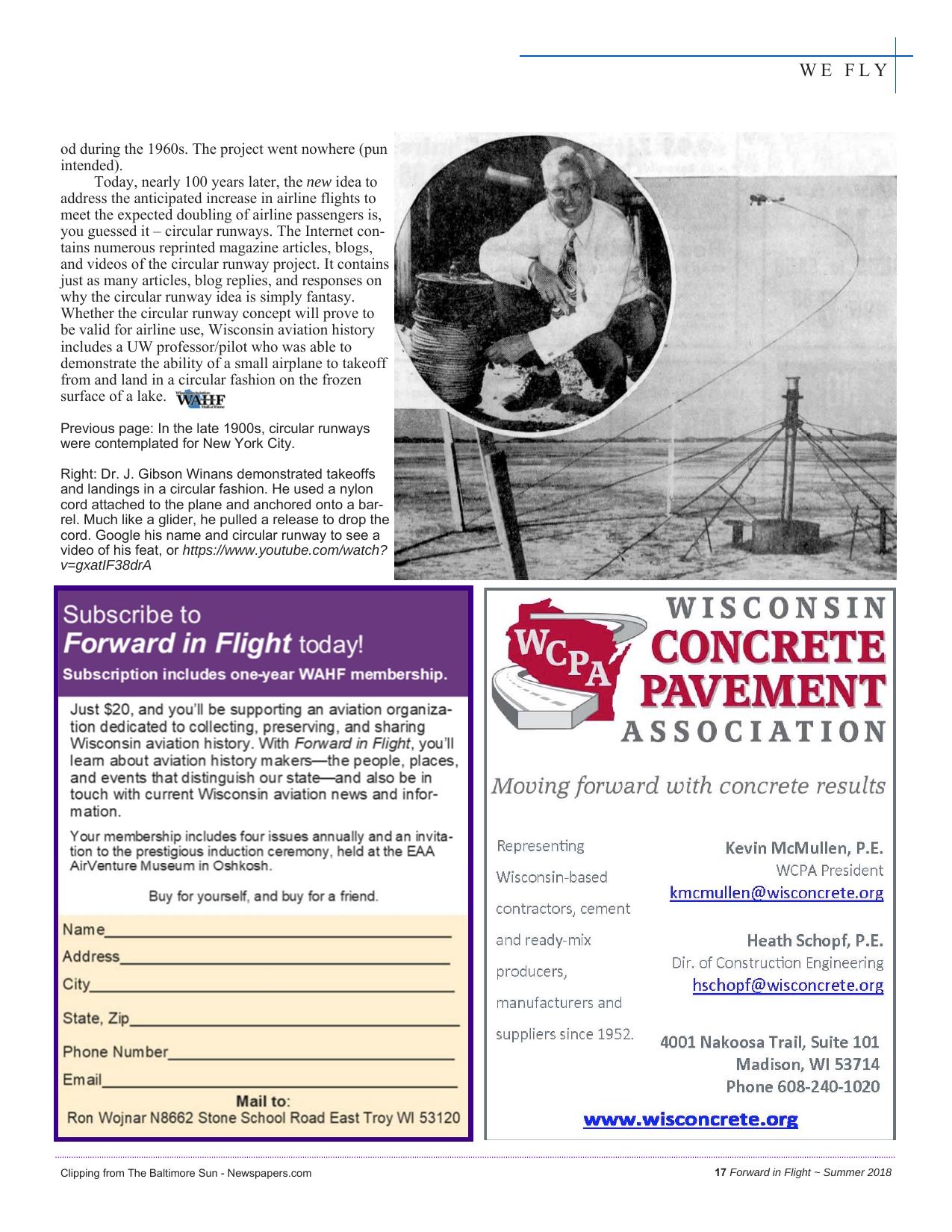
WE FLY od during the 1960s. The project went nowhere (pun intended). Today, nearly 100 years later, the new idea to address the anticipated increase in airline flights to meet the expected doubling of airline passengers is, you guessed it – circular runways. The Internet contains numerous reprinted magazine articles, blogs, and videos of the circular runway project. It contains just as many articles, blog replies, and responses on why the circular runway idea is simply fantasy. Whether the circular runway concept will prove to be valid for airline use, Wisconsin aviation history includes a UW professor/pilot who was able to demonstrate the ability of a small airplane to takeoff from and land in a circular fashion on the frozen surface of a lake. Previous page: In the late 1900s, circular runways were contemplated for New York City. Right: Dr. J. Gibson Winans demonstrated takeoffs and landings in a circular fashion. He used a nylon cord attached to the plane and anchored onto a barrel. Much like a glider, he pulled a release to drop the cord. Google his name and circular runway to see a video of his feat, or https://www.youtube.com/watch? v=gxatIF38drA Clipping from The Baltimore Sun - Newspapers.com 17 Forward in Flight ~ Summer 2018
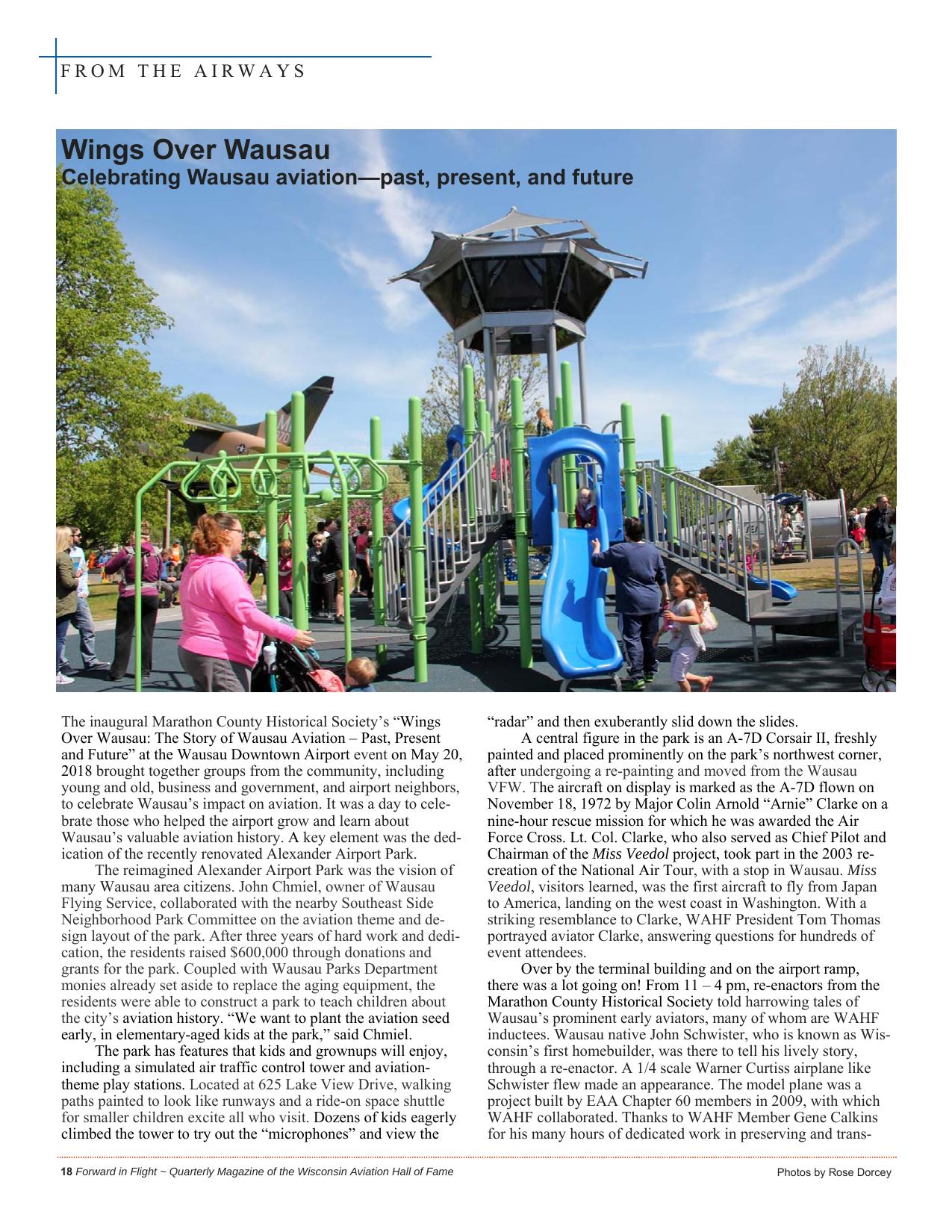
FROM THE AIRWAYS Wings Over Wausau Celebrating Wausau aviation—past, present, and future The inaugural Marathon County Historical Society’s “Wings Over Wausau: The Story of Wausau Aviation – Past, Present and Future” at the Wausau Downtown Airport event on May 20, 2018 brought together groups from the community, including young and old, business and government, and airport neighbors, to celebrate Wausau’s impact on aviation. It was a day to celebrate those who helped the airport grow and learn about Wausau’s valuable aviation history. A key element was the dedication of the recently renovated Alexander Airport Park. The reimagined Alexander Airport Park was the vision of many Wausau area citizens. John Chmiel, owner of Wausau Flying Service, collaborated with the nearby Southeast Side Neighborhood Park Committee on the aviation theme and design layout of the park. After three years of hard work and dedication, the residents raised $600,000 through donations and grants for the park. Coupled with Wausau Parks Department monies already set aside to replace the aging equipment, the residents were able to construct a park to teach children about the city’s aviation history. “We want to plant the aviation seed early, in elementary-aged kids at the park,” said Chmiel. The park has features that kids and grownups will enjoy, including a simulated air traffic control tower and aviationtheme play stations. Located at 625 Lake View Drive, walking paths painted to look like runways and a ride-on space shuttle for smaller children excite all who visit. Dozens of kids eagerly climbed the tower to try out the “microphones” and view the 18 Forward in Flight ~ Quarterly Magazine of the Wisconsin Aviation Hall of Fame “radar” and then exuberantly slid down the slides. A central figure in the park is an A-7D Corsair II, freshly painted and placed prominently on the park’s northwest corner, after undergoing a re-painting and moved from the Wausau VFW. The aircraft on display is marked as the A-7D flown on November 18, 1972 by Major Colin Arnold “Arnie” Clarke on a nine-hour rescue mission for which he was awarded the Air Force Cross. Lt. Col. Clarke, who also served as Chief Pilot and Chairman of the Miss Veedol project, took part in the 2003 recreation of the National Air Tour, with a stop in Wausau. Miss Veedol, visitors learned, was the first aircraft to fly from Japan to America, landing on the west coast in Washington. With a striking resemblance to Clarke, WAHF President Tom Thomas portrayed aviator Clarke, answering questions for hundreds of event attendees. Over by the terminal building and on the airport ramp, there was a lot going on! From 11 – 4 pm, re-enactors from the Marathon County Historical Society told harrowing tales of Wausau’s prominent early aviators, many of whom are WAHF inductees. Wausau native John Schwister, who is known as Wisconsin’s first homebuilder, was there to tell his lively story, through a re-enactor. A 1/4 scale Warner Curtiss airplane like Schwister flew made an appearance. The model plane was a project built by EAA Chapter 60 members in 2009, with which WAHF collaborated. Thanks to WAHF Member Gene Calkins for his many hours of dedicated work in preserving and transPhotos by Rose Dorcey
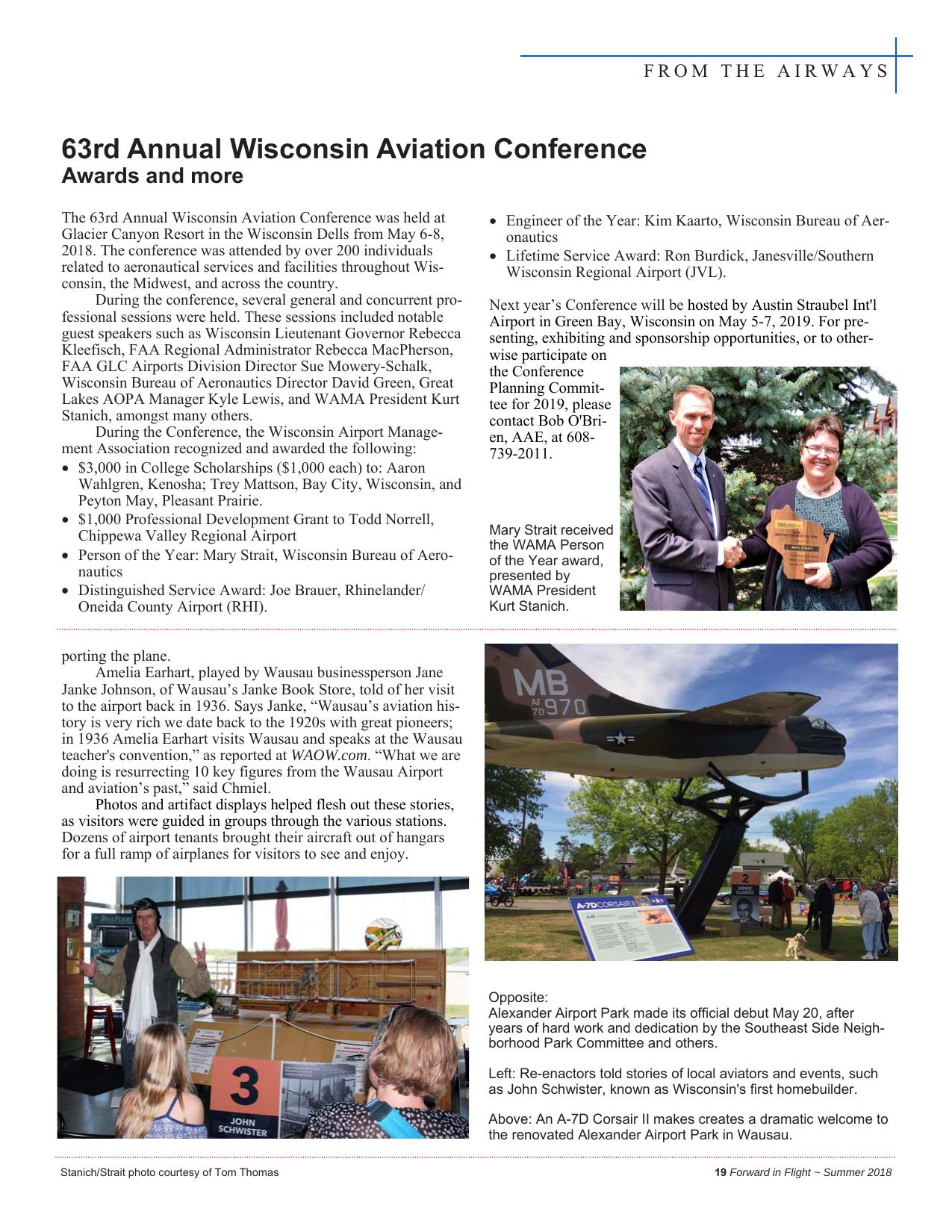
FROM THE AIRWAYS 63rd Annual Wisconsin Aviation Conference Awards and more The 63rd Annual Wisconsin Aviation Conference was held at Glacier Canyon Resort in the Wisconsin Dells from May 6-8, 2018. The conference was attended by over 200 individuals related to aeronautical services and facilities throughout Wisconsin, the Midwest, and across the country. During the conference, several general and concurrent professional sessions were held. These sessions included notable guest speakers such as Wisconsin Lieutenant Governor Rebecca Kleefisch, FAA Regional Administrator Rebecca MacPherson, FAA GLC Airports Division Director Sue Mowery-Schalk, Wisconsin Bureau of Aeronautics Director David Green, Great Lakes AOPA Manager Kyle Lewis, and WAMA President Kurt Stanich, amongst many others. During the Conference, the Wisconsin Airport Management Association recognized and awarded the following: $3,000 in College Scholarships ($1,000 each) to: Aaron Wahlgren, Kenosha; Trey Mattson, Bay City, Wisconsin, and Peyton May, Pleasant Prairie. $1,000 Professional Development Grant to Todd Norrell, Chippewa Valley Regional Airport Person of the Year: Mary Strait, Wisconsin Bureau of Aeronautics Distinguished Service Award: Joe Brauer, Rhinelander/ Oneida County Airport (RHI). Engineer of the Year: Kim Kaarto, Wisconsin Bureau of Aeronautics Lifetime Service Award: Ron Burdick, Janesville/Southern Wisconsin Regional Airport (JVL). Next year’s Conference will be hosted by Austin Straubel Int'l Airport in Green Bay, Wisconsin on May 5-7, 2019. For presenting, exhibiting and sponsorship opportunities, or to otherwise participate on the Conference Planning Committee for 2019, please contact Bob O'Brien, AAE, at 608739-2011. Mary Strait received the WAMA Person of the Year award, presented by WAMA President Kurt Stanich. porting the plane. Amelia Earhart, played by Wausau businessperson Jane Janke Johnson, of Wausau’s Janke Book Store, told of her visit to the airport back in 1936. Says Janke, “Wausau’s aviation history is very rich we date back to the 1920s with great pioneers; in 1936 Amelia Earhart visits Wausau and speaks at the Wausau teacher's convention,” as reported at WAOW.com. “What we are doing is resurrecting 10 key figures from the Wausau Airport and aviation’s past,” said Chmiel. Photos and artifact displays helped flesh out these stories, as visitors were guided in groups through the various stations. Dozens of airport tenants brought their aircraft out of hangars for a full ramp of airplanes for visitors to see and enjoy. Opposite: Alexander Airport Park made its official debut May 20, after years of hard work and dedication by the Southeast Side Neighborhood Park Committee and others. Left: Re-enactors told stories of local aviators and events, such as John Schwister, known as Wisconsin's first homebuilder. Above: An A-7D Corsair II makes creates a dramatic welcome to the renovated Alexander Airport Park in Wausau. Stanich/Strait photo courtesy of Tom Thomas 19 Forward in Flight ~ Summer 2018
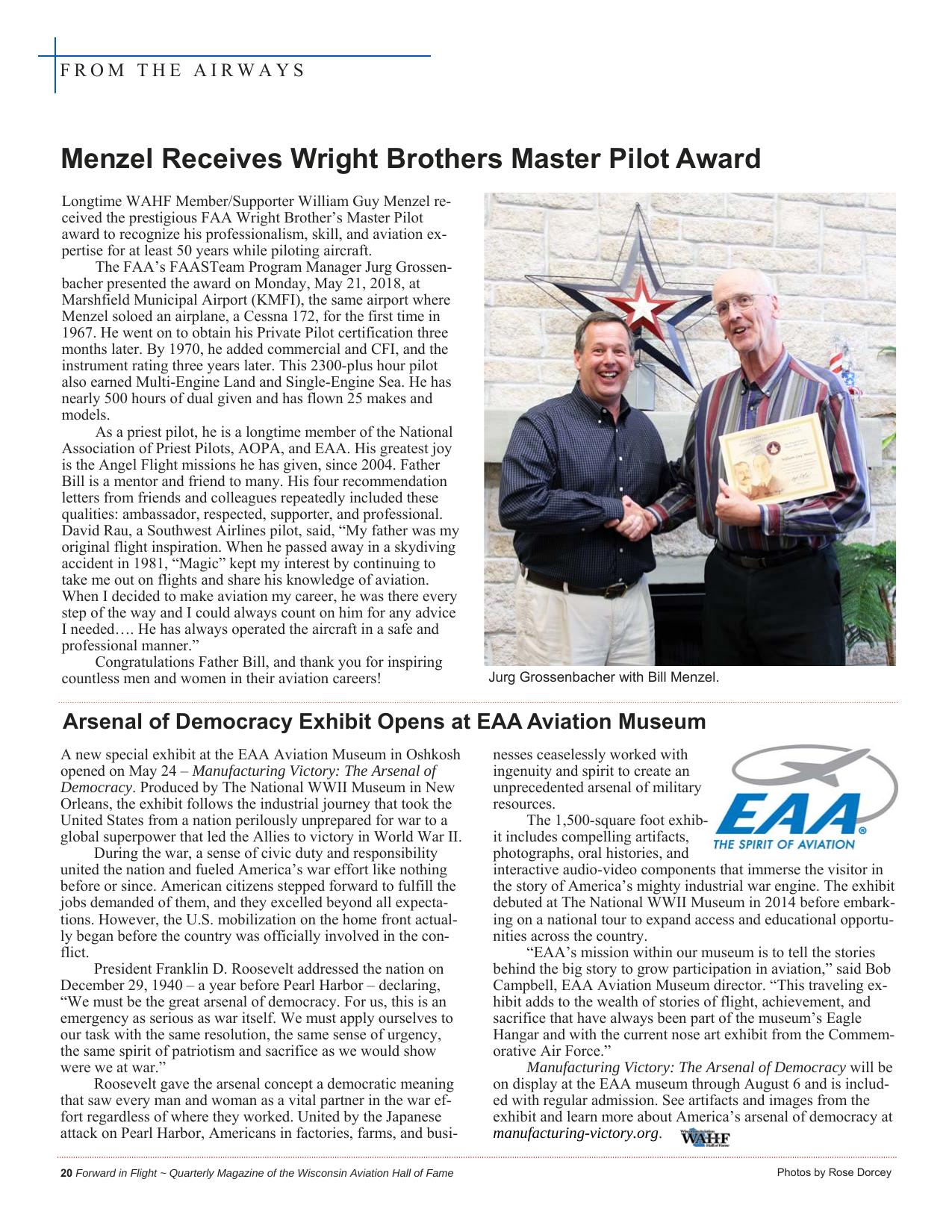
FROM THE AIRWAYS Menzel Receives Wright Brothers Master Pilot Award Longtime WAHF Member/Supporter William Guy Menzel received the prestigious FAA Wright Brother’s Master Pilot award to recognize his professionalism, skill, and aviation expertise for at least 50 years while piloting aircraft. The FAA’s FAASTeam Program Manager Jurg Grossenbacher presented the award on Monday, May 21, 2018, at Marshfield Municipal Airport (KMFI), the same airport where Menzel soloed an airplane, a Cessna 172, for the first time in 1967. He went on to obtain his Private Pilot certification three months later. By 1970, he added commercial and CFI, and the instrument rating three years later. This 2300-plus hour pilot also earned Multi-Engine Land and Single-Engine Sea. He has nearly 500 hours of dual given and has flown 25 makes and models. As a priest pilot, he is a longtime member of the National Association of Priest Pilots, AOPA, and EAA. His greatest joy is the Angel Flight missions he has given, since 2004. Father Bill is a mentor and friend to many. His four recommendation letters from friends and colleagues repeatedly included these qualities: ambassador, respected, supporter, and professional. David Rau, a Southwest Airlines pilot, said, “My father was my original flight inspiration. When he passed away in a skydiving accident in 1981, “Magic” kept my interest by continuing to take me out on flights and share his knowledge of aviation. When I decided to make aviation my career, he was there every step of the way and I could always count on him for any advice I needed…. He has always operated the aircraft in a safe and professional manner.” Congratulations Father Bill, and thank you for inspiring countless men and women in their aviation careers! Jurg Grossenbacher with Bill Menzel. Arsenal of Democracy Exhibit Opens at EAA Aviation Museum A new special exhibit at the EAA Aviation Museum in Oshkosh opened on May 24 – Manufacturing Victory: The Arsenal of Democracy. Produced by The National WWII Museum in New Orleans, the exhibit follows the industrial journey that took the United States from a nation perilously unprepared for war to a global superpower that led the Allies to victory in World War II. During the war, a sense of civic duty and responsibility united the nation and fueled America’s war effort like nothing before or since. American citizens stepped forward to fulfill the jobs demanded of them, and they excelled beyond all expectations. However, the U.S. mobilization on the home front actually began before the country was officially involved in the conflict. President Franklin D. Roosevelt addressed the nation on December 29, 1940 – a year before Pearl Harbor – declaring, “We must be the great arsenal of democracy. For us, this is an emergency as serious as war itself. We must apply ourselves to our task with the same resolution, the same sense of urgency, the same spirit of patriotism and sacrifice as we would show were we at war.” Roosevelt gave the arsenal concept a democratic meaning that saw every man and woman as a vital partner in the war effort regardless of where they worked. United by the Japanese attack on Pearl Harbor, Americans in factories, farms, and busi20 Forward in Flight ~ Quarterly Magazine of the Wisconsin Aviation Hall of Fame nesses ceaselessly worked with ingenuity and spirit to create an unprecedented arsenal of military resources. The 1,500-square foot exhibit includes compelling artifacts, photographs, oral histories, and interactive audio-video components that immerse the visitor in the story of America’s mighty industrial war engine. The exhibit debuted at The National WWII Museum in 2014 before embarking on a national tour to expand access and educational opportunities across the country. “EAA’s mission within our museum is to tell the stories behind the big story to grow participation in aviation,” said Bob Campbell, EAA Aviation Museum director. “This traveling exhibit adds to the wealth of stories of flight, achievement, and sacrifice that have always been part of the museum’s Eagle Hangar and with the current nose art exhibit from the Commemorative Air Force.” Manufacturing Victory: The Arsenal of Democracy will be on display at the EAA museum through August 6 and is included with regular admission. See artifacts and images from the exhibit and learn more about America’s arsenal of democracy at manufacturing-victory.org. Photos by Rose Dorcey
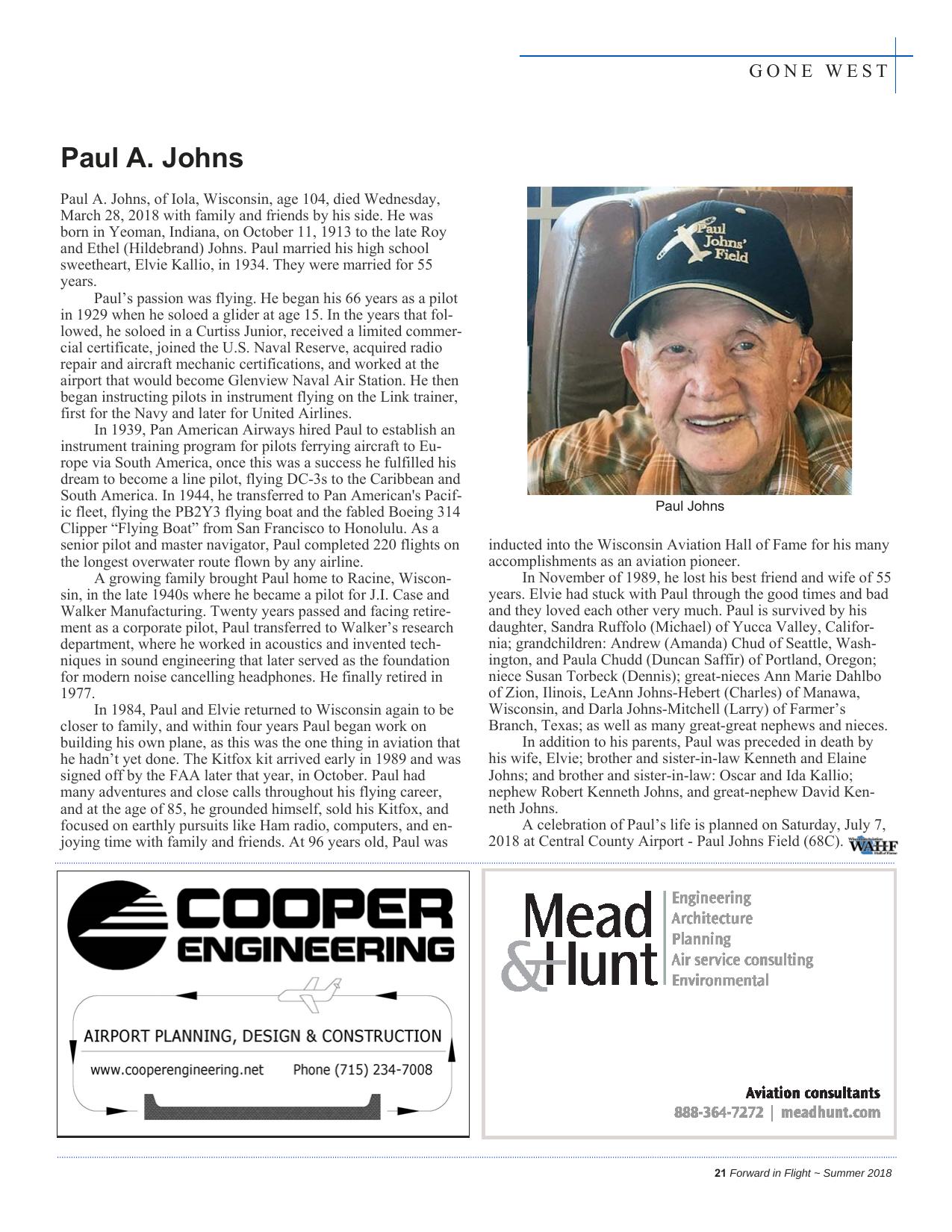
GONE WEST Paul A. Johns Paul A. Johns, of Iola, Wisconsin, age 104, died Wednesday, March 28, 2018 with family and friends by his side. He was born in Yeoman, Indiana, on October 11, 1913 to the late Roy and Ethel (Hildebrand) Johns. Paul married his high school sweetheart, Elvie Kallio, in 1934. They were married for 55 years. Paul’s passion was flying. He began his 66 years as a pilot in 1929 when he soloed a glider at age 15. In the years that followed, he soloed in a Curtiss Junior, received a limited commercial certificate, joined the U.S. Naval Reserve, acquired radio repair and aircraft mechanic certifications, and worked at the airport that would become Glenview Naval Air Station. He then began instructing pilots in instrument flying on the Link trainer, first for the Navy and later for United Airlines. In 1939, Pan American Airways hired Paul to establish an instrument training program for pilots ferrying aircraft to Europe via South America, once this was a success he fulfilled his dream to become a line pilot, flying DC-3s to the Caribbean and South America. In 1944, he transferred to Pan American's Pacific fleet, flying the PB2Y3 flying boat and the fabled Boeing 314 Clipper “Flying Boat” from San Francisco to Honolulu. As a senior pilot and master navigator, Paul completed 220 flights on the longest overwater route flown by any airline. A growing family brought Paul home to Racine, Wisconsin, in the late 1940s where he became a pilot for J.I. Case and Walker Manufacturing. Twenty years passed and facing retirement as a corporate pilot, Paul transferred to Walker’s research department, where he worked in acoustics and invented techniques in sound engineering that later served as the foundation for modern noise cancelling headphones. He finally retired in 1977. In 1984, Paul and Elvie returned to Wisconsin again to be closer to family, and within four years Paul began work on building his own plane, as this was the one thing in aviation that he hadn’t yet done. The Kitfox kit arrived early in 1989 and was signed off by the FAA later that year, in October. Paul had many adventures and close calls throughout his flying career, and at the age of 85, he grounded himself, sold his Kitfox, and focused on earthly pursuits like Ham radio, computers, and enjoying time with family and friends. At 96 years old, Paul was Paul Johns inducted into the Wisconsin Aviation Hall of Fame for his many accomplishments as an aviation pioneer. In November of 1989, he lost his best friend and wife of 55 years. Elvie had stuck with Paul through the good times and bad and they loved each other very much. Paul is survived by his daughter, Sandra Ruffolo (Michael) of Yucca Valley, California; grandchildren: Andrew (Amanda) Chud of Seattle, Washington, and Paula Chudd (Duncan Saffir) of Portland, Oregon; niece Susan Torbeck (Dennis); great-nieces Ann Marie Dahlbo of Zion, Ilinois, LeAnn Johns-Hebert (Charles) of Manawa, Wisconsin, and Darla Johns-Mitchell (Larry) of Farmer’s Branch, Texas; as well as many great-great nephews and nieces. In addition to his parents, Paul was preceded in death by his wife, Elvie; brother and sister-in-law Kenneth and Elaine Johns; and brother and sister-in-law: Oscar and Ida Kallio; nephew Robert Kenneth Johns, and great-nephew David Kenneth Johns. A celebration of Paul’s life is planned on Saturday, July 7, 2018 at Central County Airport - Paul Johns Field (68C). 21 Forward in Flight ~ Summer 2018
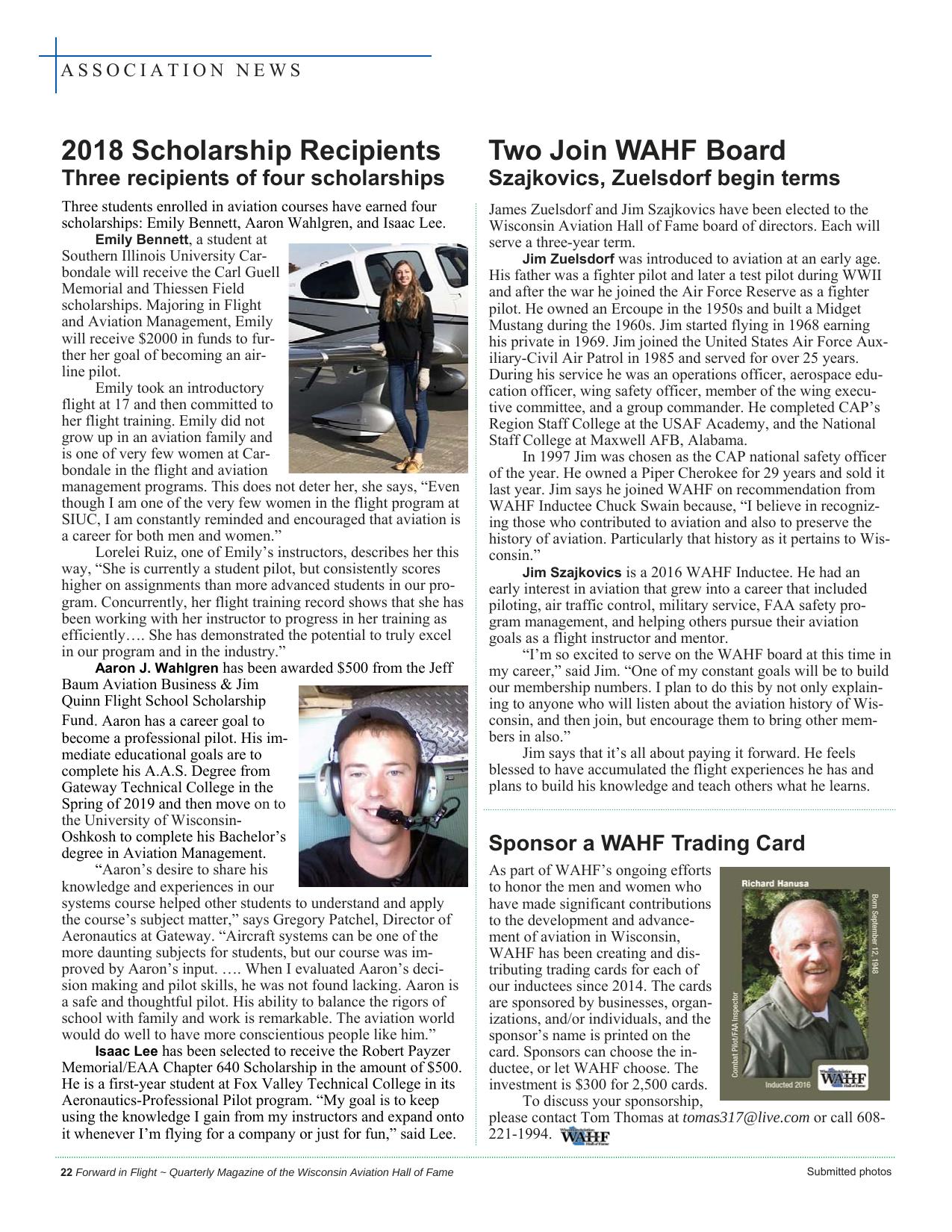
ASSOCIATION NEWS 2018 Scholarship Recipients Two Join WAHF Board Three recipients of four scholarships Szajkovics, Zuelsdorf begin terms Three students enrolled in aviation courses have earned four scholarships: Emily Bennett, Aaron Wahlgren, and Isaac Lee. Emily Bennett, a student at Southern Illinois University Carbondale will receive the Carl Guell Memorial and Thiessen Field scholarships. Majoring in Flight and Aviation Management, Emily will receive $2000 in funds to further her goal of becoming an airline pilot. Emily took an introductory flight at 17 and then committed to her flight training. Emily did not grow up in an aviation family and is one of very few women at Carbondale in the flight and aviation management programs. This does not deter her, she says, “Even though I am one of the very few women in the flight program at SIUC, I am constantly reminded and encouraged that aviation is a career for both men and women.” Lorelei Ruiz, one of Emily’s instructors, describes her this way, “She is currently a student pilot, but consistently scores higher on assignments than more advanced students in our program. Concurrently, her flight training record shows that she has been working with her instructor to progress in her training as efficiently…. She has demonstrated the potential to truly excel in our program and in the industry.” Aaron J. Wahlgren has been awarded $500 from the Jeff Baum Aviation Business & Jim Quinn Flight School Scholarship Fund. Aaron has a career goal to become a professional pilot. His immediate educational goals are to complete his A.A.S. Degree from Gateway Technical College in the Spring of 2019 and then move on to the University of WisconsinOshkosh to complete his Bachelor’s degree in Aviation Management. “Aaron’s desire to share his knowledge and experiences in our systems course helped other students to understand and apply the course’s subject matter,” says Gregory Patchel, Director of Aeronautics at Gateway. “Aircraft systems can be one of the more daunting subjects for students, but our course was improved by Aaron’s input. …. When I evaluated Aaron’s decision making and pilot skills, he was not found lacking. Aaron is a safe and thoughtful pilot. His ability to balance the rigors of school with family and work is remarkable. The aviation world would do well to have more conscientious people like him.” Isaac Lee has been selected to receive the Robert Payzer Memorial/EAA Chapter 640 Scholarship in the amount of $500. He is a first-year student at Fox Valley Technical College in its Aeronautics-Professional Pilot program. “My goal is to keep using the knowledge I gain from my instructors and expand onto it whenever I’m flying for a company or just for fun,” said Lee. James Zuelsdorf and Jim Szajkovics have been elected to the Wisconsin Aviation Hall of Fame board of directors. Each will serve a three-year term. Jim Zuelsdorf was introduced to aviation at an early age. His father was a fighter pilot and later a test pilot during WWII and after the war he joined the Air Force Reserve as a fighter pilot. He owned an Ercoupe in the 1950s and built a Midget Mustang during the 1960s. Jim started flying in 1968 earning his private in 1969. Jim joined the United States Air Force Auxiliary-Civil Air Patrol in 1985 and served for over 25 years. During his service he was an operations officer, aerospace education officer, wing safety officer, member of the wing executive committee, and a group commander. He completed CAP’s Region Staff College at the USAF Academy, and the National Staff College at Maxwell AFB, Alabama. In 1997 Jim was chosen as the CAP national safety officer of the year. He owned a Piper Cherokee for 29 years and sold it last year. Jim says he joined WAHF on recommendation from WAHF Inductee Chuck Swain because, “I believe in recognizing those who contributed to aviation and also to preserve the history of aviation. Particularly that history as it pertains to Wisconsin.” Jim Szajkovics is a 2016 WAHF Inductee. He had an early interest in aviation that grew into a career that included piloting, air traffic control, military service, FAA safety program management, and helping others pursue their aviation goals as a flight instructor and mentor. “I’m so excited to serve on the WAHF board at this time in my career,” said Jim. “One of my constant goals will be to build our membership numbers. I plan to do this by not only explaining to anyone who will listen about the aviation history of Wisconsin, and then join, but encourage them to bring other members in also.” Jim says that it’s all about paying it forward. He feels blessed to have accumulated the flight experiences he has and plans to build his knowledge and teach others what he learns. 22 Forward in Flight ~ Quarterly Magazine of the Wisconsin Aviation Hall of Fame Sponsor a WAHF Trading Card As part of WAHF’s ongoing efforts to honor the men and women who have made significant contributions to the development and advancement of aviation in Wisconsin, WAHF has been creating and distributing trading cards for each of our inductees since 2014. The cards are sponsored by businesses, organizations, and/or individuals, and the sponsor’s name is printed on the card. Sponsors can choose the inductee, or let WAHF choose. The investment is $300 for 2,500 cards. To discuss your sponsorship, please contact Tom Thomas at tomas317@live.com or call 608221-1994. Submitted photos
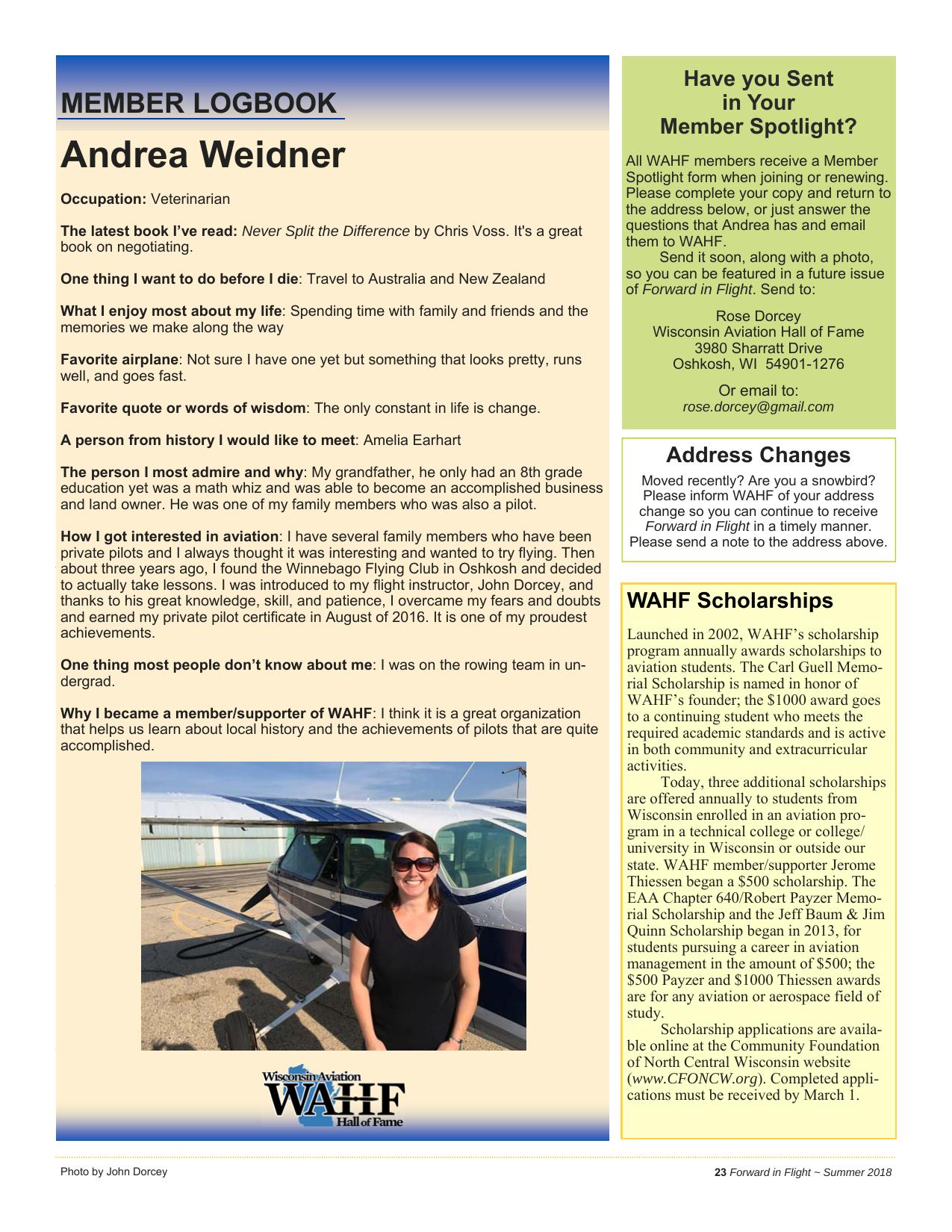
MEMBER LOGBOOK Andrea Weidner Occupation: Veterinarian The latest book I’ve read: Never Split the Difference by Chris Voss. It's a great book on negotiating. One thing I want to do before I die: Travel to Australia and New Zealand What I enjoy most about my life: Spending time with family and friends and the memories we make along the way Favorite airplane: Not sure I have one yet but something that looks pretty, runs well, and goes fast. Favorite quote or words of wisdom: The only constant in life is change. A person from history I would like to meet: Amelia Earhart The person I most admire and why: My grandfather, he only had an 8th grade education yet was a math whiz and was able to become an accomplished business and land owner. He was one of my family members who was also a pilot. How I got interested in aviation: I have several family members who have been private pilots and I always thought it was interesting and wanted to try flying. Then about three years ago, I found the Winnebago Flying Club in Oshkosh and decided to actually take lessons. I was introduced to my flight instructor, John Dorcey, and thanks to his great knowledge, skill, and patience, I overcame my fears and doubts and earned my private pilot certificate in August of 2016. It is one of my proudest achievements. One thing most people don’t know about me: I was on the rowing team in undergrad. Why I became a member/supporter of WAHF: I think it is a great organization that helps us learn about local history and the achievements of pilots that are quite accomplished. Photo by John Dorcey Have you Sent in Your Member Spotlight? All WAHF members receive a Member Spotlight form when joining or renewing. Please complete your copy and return to the address below, or just answer the questions that Andrea has and email them to WAHF. Send it soon, along with a photo, so you can be featured in a future issue of Forward in Flight. Send to: Rose Dorcey Wisconsin Aviation Hall of Fame 3980 Sharratt Drive Oshkosh, WI 54901-1276 Or email to: rose.dorcey@gmail.com Address Changes Moved recently? Are you a snowbird? Please inform WAHF of your address change so you can continue to receive Forward in Flight in a timely manner. Please send a note to the address above. WAHF Scholarships Launched in 2002, WAHF’s scholarship program annually awards scholarships to aviation students. The Carl Guell Memorial Scholarship is named in honor of WAHF’s founder; the $1000 award goes to a continuing student who meets the required academic standards and is active in both community and extracurricular activities. Today, three additional scholarships are offered annually to students from Wisconsin enrolled in an aviation program in a technical college or college/ university in Wisconsin or outside our state. WAHF member/supporter Jerome Thiessen began a $500 scholarship. The EAA Chapter 640/Robert Payzer Memorial Scholarship and the Jeff Baum & Jim Quinn Scholarship began in 2013, for students pursuing a career in aviation management in the amount of $500; the $500 Payzer and $1000 Thiessen awards are for any aviation or aerospace field of study. Scholarship applications are available online at the Community Foundation of North Central Wisconsin website (www.CFONCW.org). Completed applications must be received by March 1. 23 Forward in Flight ~ Summer 2018
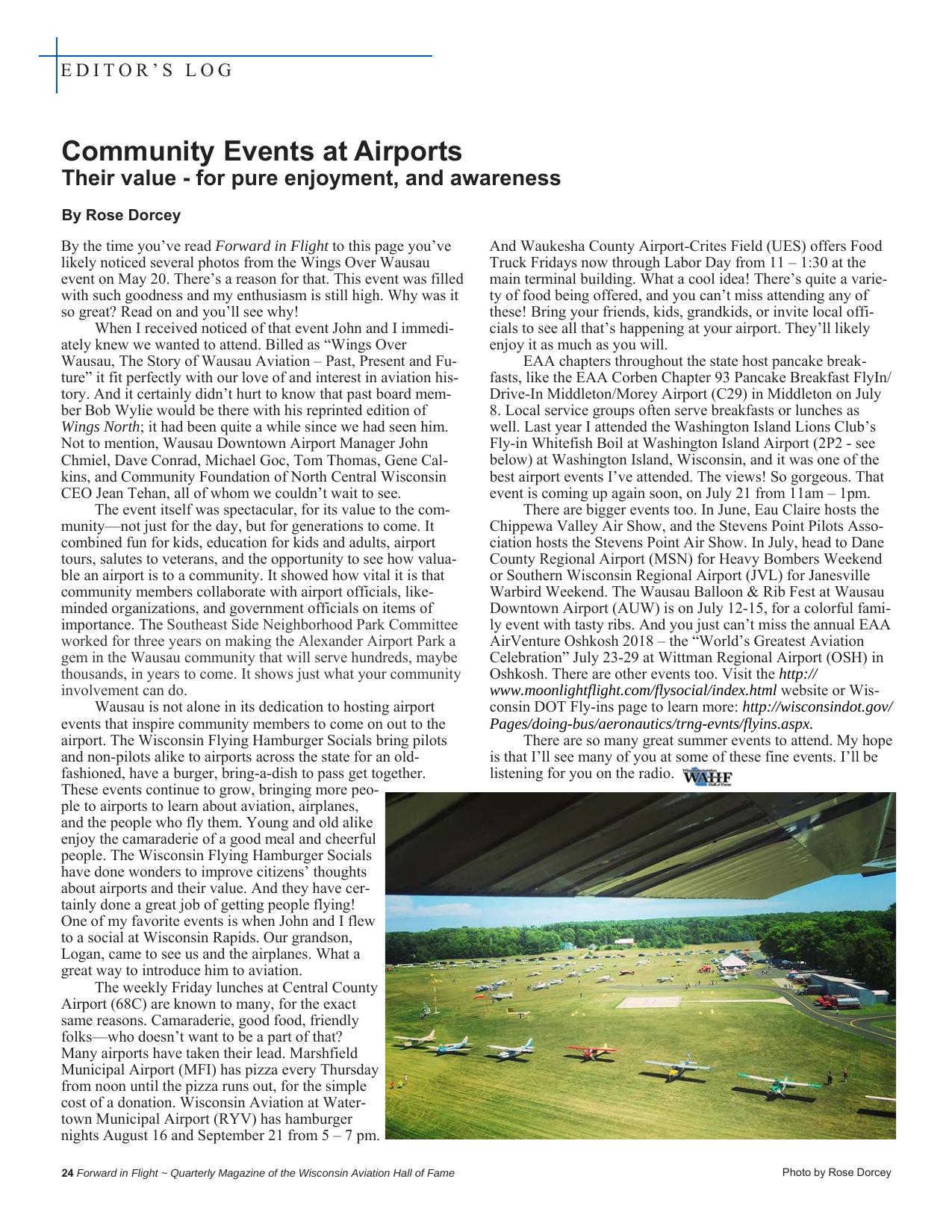
EDITOR’S LOG Community Events at Airports Their value - for pure enjoyment, and awareness By Rose Dorcey By the time you’ve read Forward in Flight to this page you’ve likely noticed several photos from the Wings Over Wausau event on May 20. There’s a reason for that. This event was filled with such goodness and my enthusiasm is still high. Why was it so great? Read on and you’ll see why! When I received noticed of that event John and I immediately knew we wanted to attend. Billed as “Wings Over Wausau, The Story of Wausau Aviation – Past, Present and Future” it fit perfectly with our love of and interest in aviation history. And it certainly didn’t hurt to know that past board member Bob Wylie would be there with his reprinted edition of Wings North; it had been quite a while since we had seen him. Not to mention, Wausau Downtown Airport Manager John Chmiel, Dave Conrad, Michael Goc, Tom Thomas, Gene Calkins, and Community Foundation of North Central Wisconsin CEO Jean Tehan, all of whom we couldn’t wait to see. The event itself was spectacular, for its value to the community—not just for the day, but for generations to come. It combined fun for kids, education for kids and adults, airport tours, salutes to veterans, and the opportunity to see how valuable an airport is to a community. It showed how vital it is that community members collaborate with airport officials, likeminded organizations, and government officials on items of importance. The Southeast Side Neighborhood Park Committee worked for three years on making the Alexander Airport Park a gem in the Wausau community that will serve hundreds, maybe thousands, in years to come. It shows just what your community involvement can do. Wausau is not alone in its dedication to hosting airport events that inspire community members to come on out to the airport. The Wisconsin Flying Hamburger Socials bring pilots and non-pilots alike to airports across the state for an oldfashioned, have a burger, bring-a-dish to pass get together. These events continue to grow, bringing more people to airports to learn about aviation, airplanes, and the people who fly them. Young and old alike enjoy the camaraderie of a good meal and cheerful people. The Wisconsin Flying Hamburger Socials have done wonders to improve citizens’ thoughts about airports and their value. And they have certainly done a great job of getting people flying! One of my favorite events is when John and I flew to a social at Wisconsin Rapids. Our grandson, Logan, came to see us and the airplanes. What a great way to introduce him to aviation. The weekly Friday lunches at Central County Airport (68C) are known to many, for the exact same reasons. Camaraderie, good food, friendly folks—who doesn’t want to be a part of that? Many airports have taken their lead. Marshfield Municipal Airport (MFI) has pizza every Thursday from noon until the pizza runs out, for the simple cost of a donation. Wisconsin Aviation at Watertown Municipal Airport (RYV) has hamburger nights August 16 and September 21 from 5 – 7 pm. 24 Forward in Flight ~ Quarterly Magazine of the Wisconsin Aviation Hall of Fame And Waukesha County Airport-Crites Field (UES) offers Food Truck Fridays now through Labor Day from 11 – 1:30 at the main terminal building. What a cool idea! There’s quite a variety of food being offered, and you can’t miss attending any of these! Bring your friends, kids, grandkids, or invite local officials to see all that’s happening at your airport. They’ll likely enjoy it as much as you will. EAA chapters throughout the state host pancake breakfasts, like the EAA Corben Chapter 93 Pancake Breakfast FlyIn/ Drive-In Middleton/Morey Airport (C29) in Middleton on July 8. Local service groups often serve breakfasts or lunches as well. Last year I attended the Washington Island Lions Club’s Fly-in Whitefish Boil at Washington Island Airport (2P2 - see below) at Washington Island, Wisconsin, and it was one of the best airport events I’ve attended. The views! So gorgeous. That event is coming up again soon, on July 21 from 11am – 1pm. There are bigger events too. In June, Eau Claire hosts the Chippewa Valley Air Show, and the Stevens Point Pilots Association hosts the Stevens Point Air Show. In July, head to Dane County Regional Airport (MSN) for Heavy Bombers Weekend or Southern Wisconsin Regional Airport (JVL) for Janesville Warbird Weekend. The Wausau Balloon & Rib Fest at Wausau Downtown Airport (AUW) is on July 12-15, for a colorful family event with tasty ribs. And you just can’t miss the annual EAA AirVenture Oshkosh 2018 – the “World’s Greatest Aviation Celebration” July 23-29 at Wittman Regional Airport (OSH) in Oshkosh. There are other events too. Visit the http:// www.moonlightflight.com/flysocial/index.html website or Wisconsin DOT Fly-ins page to learn more: http://wisconsindot.gov/ Pages/doing-bus/aeronautics/trng-evnts/flyins.aspx. There are so many great summer events to attend. My hope is that I’ll see many of you at some of these fine events. I’ll be listening for you on the radio. Photo by Rose Dorcey
Wittman Regional Airport Oshkosh So much history ...and still making it! From the legacy of Steve Wittman to Warren Basler’s DC-3 conversions, we’re proud to support and contribute to Wisconsin aviation history. FLY TO OSHKOSH wittmanairport.com @wittmanairport
PRSRT STD US Postage Paid Wisc Rapids WI Permit 98 3980 SHARRATT DRIVE OSHKOSH WI 54901-1276 The Wisconsin Aviation Hall of Fame is a non-profit membership organization dedicated to preserving the past and fostering the future of flight. CHANGE SERVICE REQUESTED Welcome New WAHF Member/Supporters Don Andriano Julian Bates Peter Bianco Tom Boyer Andy Crowbridge David Cummings John Fjelstad Bob Furey Patty Gregore George Grubis Sally Helton Lewis Jaye Jerome LeBlanc Jaye Lewis Jim Longtine Tim Robertson Ron Roller Connie Schreib Mary Scullion Michael Spurlock Bruce Swezey Michelle Vetterkind Paul Wright Dr. Phil Yazbak Thanks for coming on board. We hope to see you at a WAHF event soon! EVENTS: July 20-22, 2018 Heavy Bombers Weekend - Dane County Regional Airport (MSN). 9 am - 5 pm. Join EAA Chapter 93 as we host historic World War II aircraft for our annual Heavy Bombers weekend event. Dane County Regional Airport and Wisconsin Aviation will be host to several significant aircraft -- the B-17, the B-29, and the DC-3, with rides on many of them for an additional fee. Food vendors onsite. Contact Shane Baker 608-556-4357 shane@shanebaker.com. For more information visit https://hbw2018.splashthat.com July 21-22, 2018 Janesville Warbird Weekend Southern Wisconsin Regional Airport (JVL) 8 am - 6 pm. Air-rides, ground-tours, live 1940's music, reenactors. B-24 Diamond Lil, B-25 Miss Mitchell, AC-47 Spooky Gunship, Grumman C1A Trader, BT13 Vultee, and more! For more info visit https://www.JVL18.splashthat.com or contact Pete Buffington 913-850-1522 avitengineer@yahoo.com. HAS YOUR ADDRESS CHANGED? Please contact us to inform us of your new address. A timely reminder of your new address is very much appreciated as it helps save time—and money—for our small non-profit. It’s easy, send a note to Membership Chair Ron Wojnar at the email to the right, or call 262-347-7464. Wisconsin Aviation Hall of Fame Officers Tom Thomas, President Jill Mann, Vice-President John Dorcey, Secretary/Treasurer Board of Directors Kurt Stanich Charles Swain Jim Szajkovics Wynne Williams Ron Wojnar James Zuelsdorf Wisconsin Aviation Hall of Fame c/o John Dorcey, Secretary 3980 Sharratt Drive Oshkosh, WI 54901-1276 608-513-9840 Become a member/supporter today! For information call Ron Wojnar, Membership Chair 262-347-7464 rwojnar@wi.rr.com www.wisconsinaviationhalloffame.org