Volume 20, Issue 2
🗞️ Download Issue (PDF)
Forward in Flight - Summer 2022
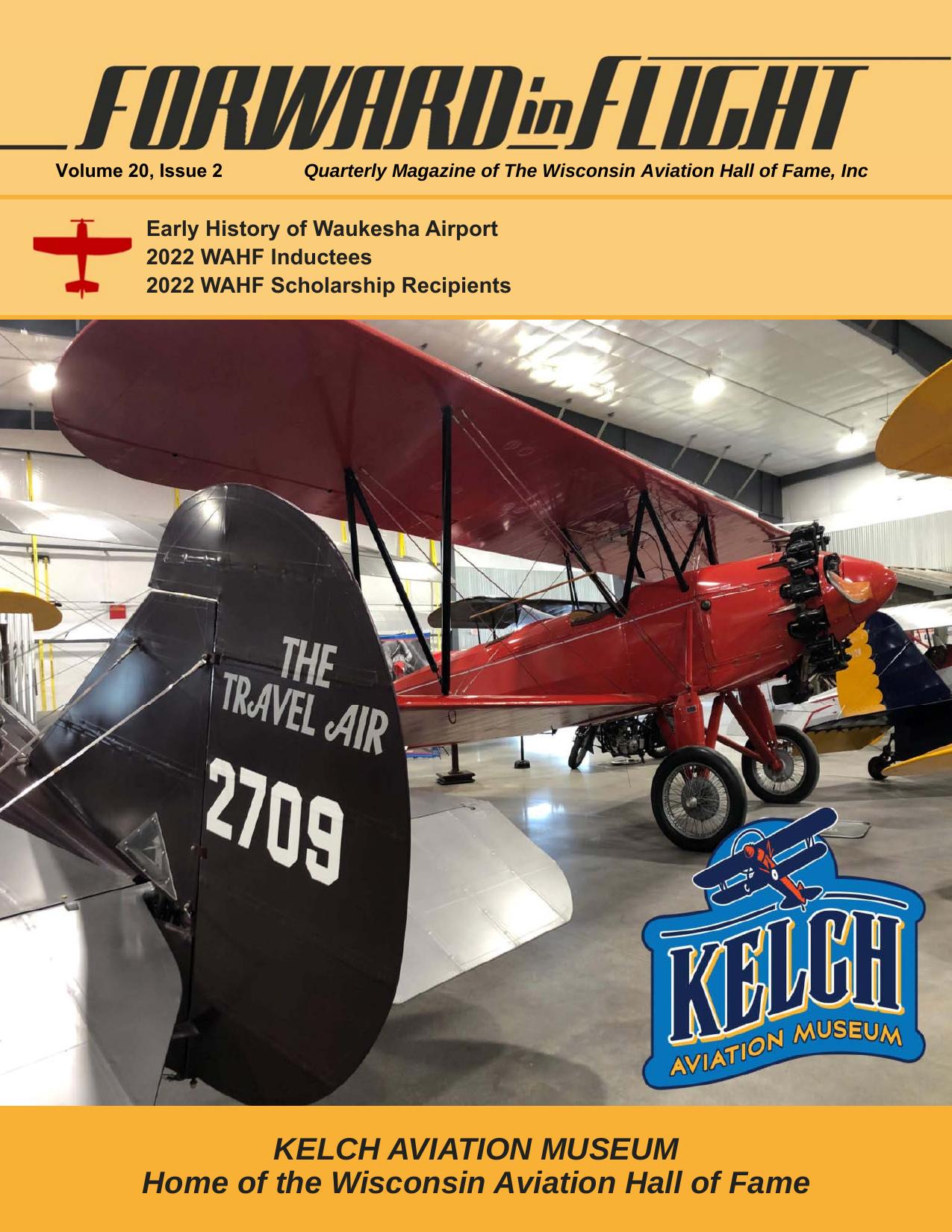
Volume 20, Issue 2 Quarterly Magazine of The Wisconsin Aviation Hall of Fame, Inc Early History of Waukesha Airport 2022 WAHF Inductees 2022 WAHF Scholarship Recipients KELCH AVIATION MUSEUM Home of the Wisconsin Aviation Hall of Fame
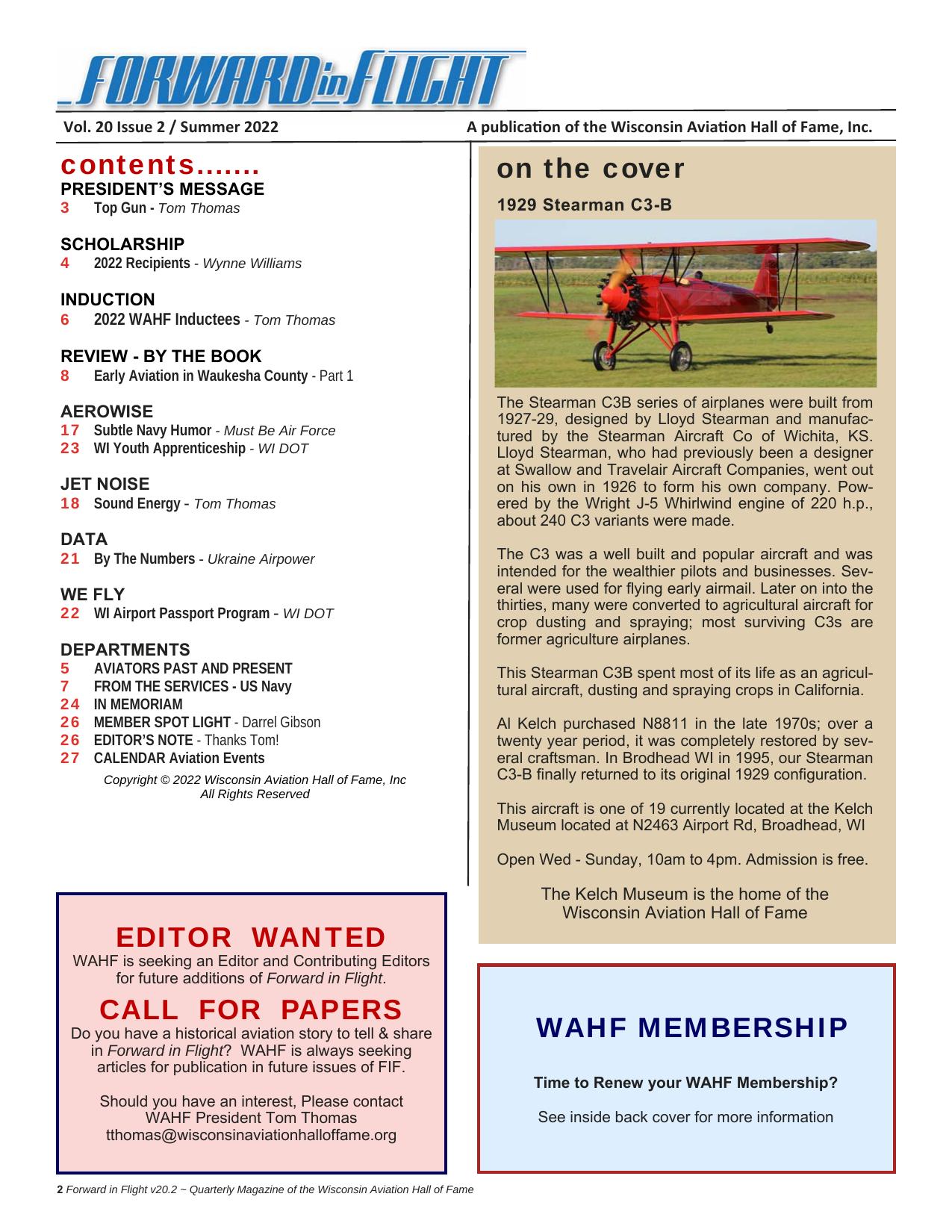
Vol. 20 Issue 2 / Summer 2022 A publica on of the Wisconsin Avia on Hall of Fame, Inc. contents……. on the cover 3 1929 Stearman C3-B PRESIDENT’S MESSAGE Top Gun - Tom Thomas SCHOLARSHIP 4 2022 Recipients - Wynne Williams INDUCTION 6 2022 WAHF Inductees - Tom Thomas REVIEW - BY THE BOOK 8 Early Aviation in Waukesha County - Part 1 AEROWISE 17 Subtle Navy Humor - Must Be Air Force 23 WI Youth Apprenticeship - WI DOT JET NOISE 18 Sound Energy - Tom Thomas DATA 21 By The Numbers - Ukraine Airpower WE FLY 22 WI Airport Passport Program - WI DOT DEPARTMENTS 5 7 24 26 26 27 AVIATORS PAST AND PRESENT FROM THE SERVICES - US Navy IN MEMORIAM MEMBER SPOT LIGHT - Darrel Gibson EDITOR’S NOTE - Thanks Tom! CALENDAR Aviation Events Copyright © 2022 Wisconsin Aviation Hall of Fame, Inc All Rights Reserved The Stearman C3B series of airplanes were built from 1927-29, designed by Lloyd Stearman and manufactured by the Stearman Aircraft Co of Wichita, KS. Lloyd Stearman, who had previously been a designer at Swallow and Travelair Aircraft Companies, went out on his own in 1926 to form his own company. Powered by the Wright J-5 Whirlwind engine of 220 h.p., about 240 C3 variants were made. The C3 was a well built and popular aircraft and was intended for the wealthier pilots and businesses. Several were used for flying early airmail. Later on into the thirties, many were converted to agricultural aircraft for crop dusting and spraying; most surviving C3s are former agriculture airplanes. This Stearman C3B spent most of its life as an agricultural aircraft, dusting and spraying crops in California. Al Kelch purchased N8811 in the late 1970s; over a twenty year period, it was completely restored by several craftsman. In Brodhead WI in 1995, our Stearman C3-B finally returned to its original 1929 configuration. This aircraft is one of 19 currently located at the Kelch Museum located at N2463 Airport Rd, Broadhead, WI Open Wed - Sunday, 10am to 4pm. Admission is free. EDITOR WANTED The Kelch Museum is the home of the Wisconsin Aviation Hall of Fame WAHF is seeking an Editor and Contributing Editors for future additions of Forward in Flight. CALL FOR PAPERS Do you have a historical aviation story to tell & share in Forward in Flight? WAHF is always seeking articles for publication in future issues of FIF. Should you have an interest, Please contact WAHF President Tom Thomas tthomas@wisconsinaviationhalloffame.org 2 Forward in Flight v20.2 ~ Quarterly Magazine of the Wisconsin Aviation Hall of Fame WAHF MEMBERSHIP Time to Renew your WAHF Membership? See inside back cover for more information
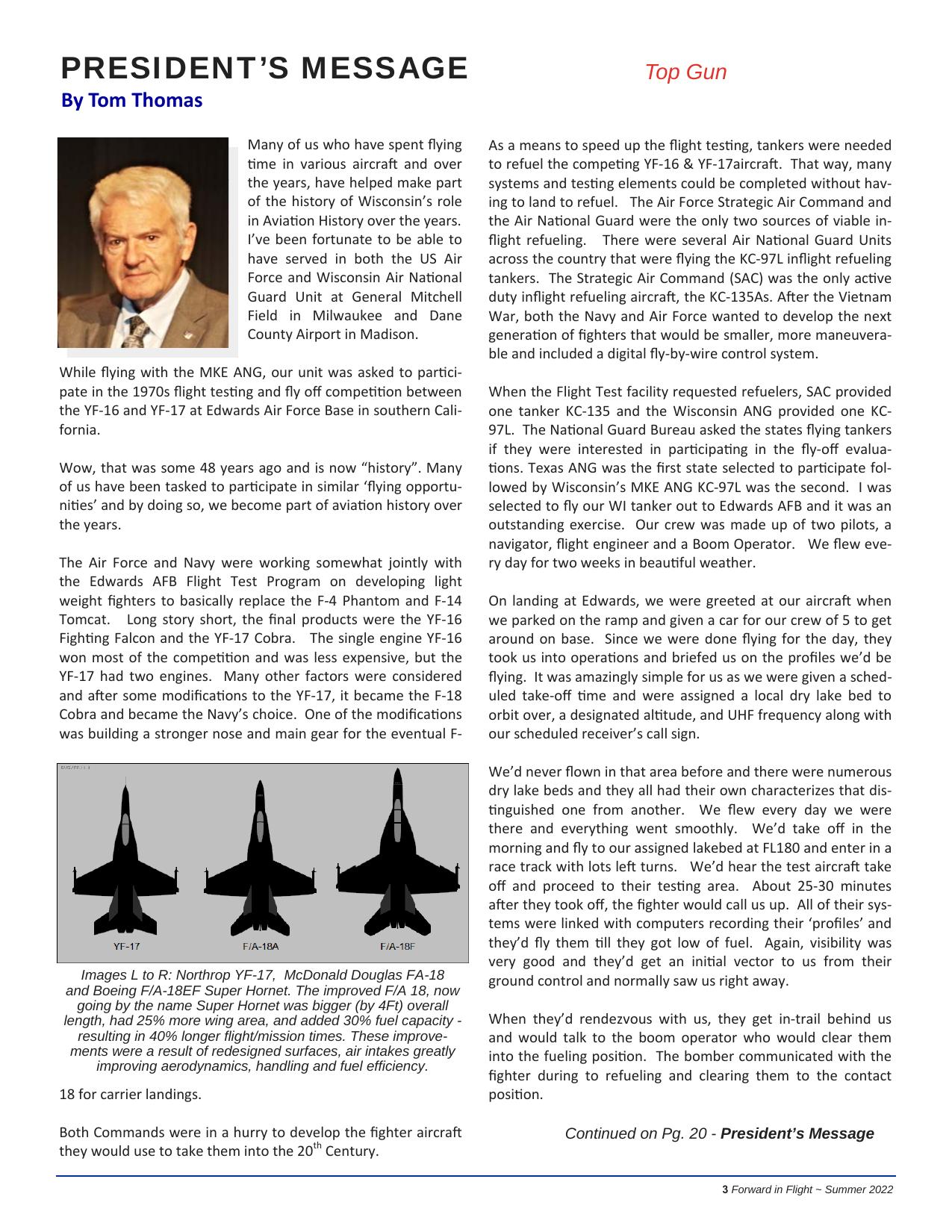
PRESIDENT’S MESSAGE Top Gun By Tom Thomas Many of us who have spent flying me in various aircra and over the years, have helped make part of the history of Wisconsin’s role in Avia on History over the years. I’ve been fortunate to be able to have served in both the US Air Force and Wisconsin Air Na onal Guard Unit at General Mitchell Field in Milwaukee and Dane County Airport in Madison. While flying with the MKE ANG, our unit was asked to par cipate in the 1970s flight tes ng and fly off compe on between the YF-16 and YF-17 at Edwards Air Force Base in southern California. Wow, that was some 48 years ago and is now “history”. Many of us have been tasked to par cipate in similar ‘flying opportuni es’ and by doing so, we become part of avia on history over the years. The Air Force and Navy were working somewhat jointly with the Edwards AFB Flight Test Program on developing light weight fighters to basically replace the F-4 Phantom and F-14 Tomcat. Long story short, the final products were the YF-16 Figh ng Falcon and the YF-17 Cobra. The single engine YF-16 won most of the compe on and was less expensive, but the YF-17 had two engines. Many other factors were considered and a er some modifica ons to the YF-17, it became the F-18 Cobra and became the Navy’s choice. One of the modifica ons was building a stronger nose and main gear for the eventual F- Images L to R: Northrop YF-17, McDonald Douglas FA-18 and Boeing F/A-18EF Super Hornet. The improved F/A 18, now going by the name Super Hornet was bigger (by 4Ft) overall length, had 25% more wing area, and added 30% fuel capacity resulting in 40% longer flight/mission times. These improvements were a result of redesigned surfaces, air intakes greatly improving aerodynamics, handling and fuel efficiency. 18 for carrier landings. Both Commands were in a hurry to develop the fighter aircra they would use to take them into the 20th Century. As a means to speed up the flight tes ng, tankers were needed to refuel the compe ng YF-16 & YF-17aircra . That way, many systems and tes ng elements could be completed without having to land to refuel. The Air Force Strategic Air Command and the Air Na onal Guard were the only two sources of viable inflight refueling. There were several Air Na onal Guard Units across the country that were flying the KC-97L inflight refueling tankers. The Strategic Air Command (SAC) was the only ac ve duty inflight refueling aircra , the KC-135As. A er the Vietnam War, both the Navy and Air Force wanted to develop the next genera on of fighters that would be smaller, more maneuverable and included a digital fly-by-wire control system. When the Flight Test facility requested refuelers, SAC provided one tanker KC-135 and the Wisconsin ANG provided one KC97L. The Na onal Guard Bureau asked the states flying tankers if they were interested in par cipa ng in the fly-off evaluaons. Texas ANG was the first state selected to par cipate followed by Wisconsin’s MKE ANG KC-97L was the second. I was selected to fly our WI tanker out to Edwards AFB and it was an outstanding exercise. Our crew was made up of two pilots, a navigator, flight engineer and a Boom Operator. We flew every day for two weeks in beau ful weather. On landing at Edwards, we were greeted at our aircra when we parked on the ramp and given a car for our crew of 5 to get around on base. Since we were done flying for the day, they took us into opera ons and briefed us on the profiles we’d be flying. It was amazingly simple for us as we were given a scheduled take-off me and were assigned a local dry lake bed to orbit over, a designated al tude, and UHF frequency along with our scheduled receiver’s call sign. We’d never flown in that area before and there were numerous dry lake beds and they all had their own characterizes that disnguished one from another. We flew every day we were there and everything went smoothly. We’d take off in the morning and fly to our assigned lakebed at FL180 and enter in a race track with lots le turns. We’d hear the test aircra take off and proceed to their tes ng area. About 25-30 minutes a er they took off, the fighter would call us up. All of their systems were linked with computers recording their ‘profiles’ and they’d fly them ll they got low of fuel. Again, visibility was very good and they’d get an ini al vector to us from their ground control and normally saw us right away. When they’d rendezvous with us, they get in-trail behind us and would talk to the boom operator who would clear them into the fueling posi on. The bomber communicated with the fighter during to refueling and clearing them to the contact posi on. Continued on Pg. 20 - President’s Message 3 Forward in Flight ~ Summer 2022
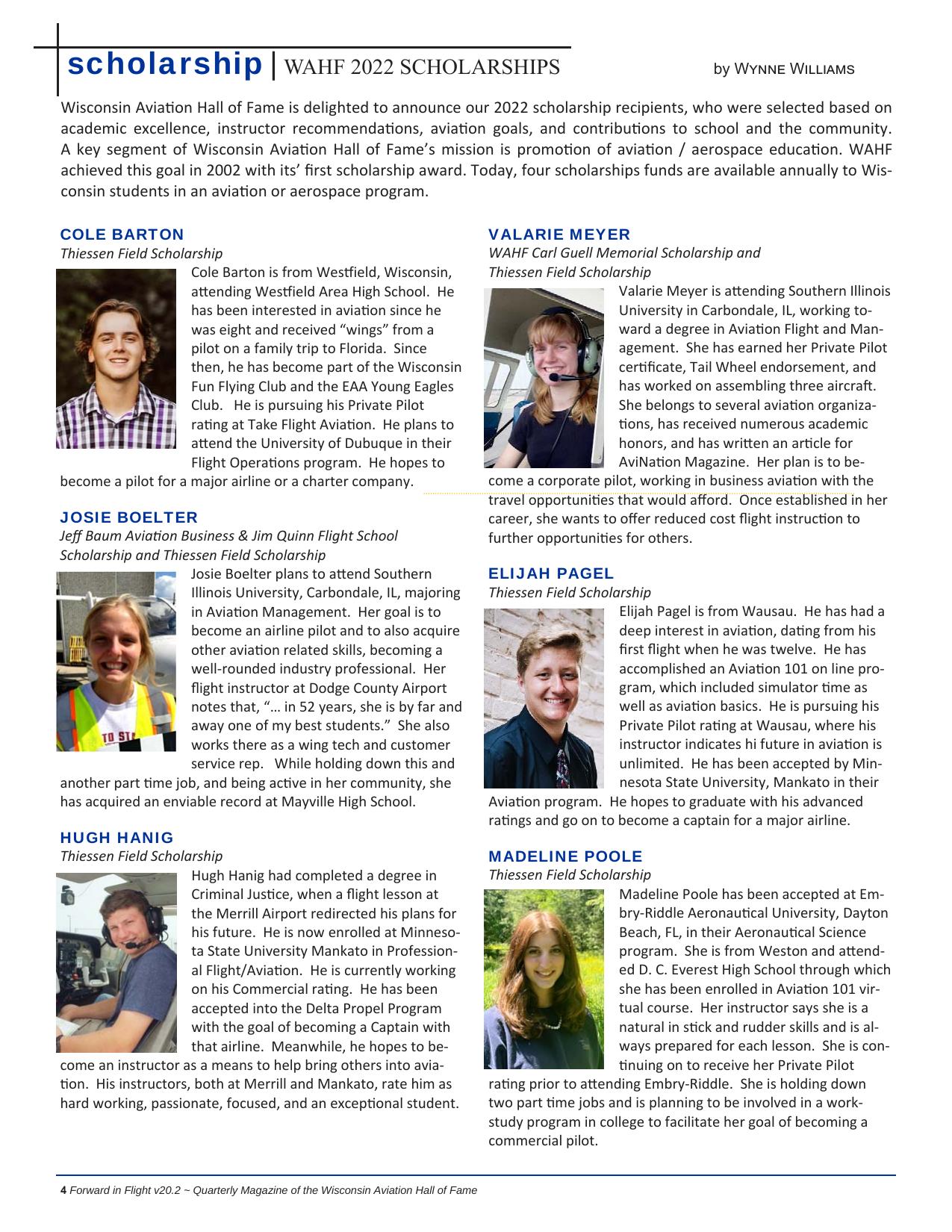
scholarship | WAHF 2022 SCHOLARSHIPS by W W Wisconsin Avia on Hall of Fame is delighted to announce our 2022 scholarship recipients, who were selected based on academic excellence, instructor recommenda ons, avia on goals, and contribu ons to school and the community. A key segment of Wisconsin Avia on Hall of Fame’s mission is promo on of avia on / aerospace educa on. WAHF achieved this goal in 2002 with its’ first scholarship award. Today, four scholarships funds are available annually to Wisconsin students in an avia on or aerospace program. COLE BARTON Thiessen Field Scholarship Cole Barton is from Wes ield, Wisconsin, a ending Wes ield Area High School. He has been interested in avia on since he was eight and received “wings” from a pilot on a family trip to Florida. Since then, he has become part of the Wisconsin Fun Flying Club and the EAA Young Eagles Club. He is pursuing his Private Pilot ra ng at Take Flight Avia on. He plans to a end the University of Dubuque in their Flight Opera ons program. He hopes to become a pilot for a major airline or a charter company. JOSIE BOELTER Jeff Baum Avia on Business & Jim Quinn Flight School Scholarship and Thiessen Field Scholarship Josie Boelter plans to a end Southern Illinois University, Carbondale, IL, majoring in Avia on Management. Her goal is to become an airline pilot and to also acquire other avia on related skills, becoming a well-rounded industry professional. Her flight instructor at Dodge County Airport notes that, “… in 52 years, she is by far and away one of my best students.” She also works there as a wing tech and customer service rep. While holding down this and another part me job, and being ac ve in her community, she has acquired an enviable record at Mayville High School. HUGH HANIG Thiessen Field Scholarship Hugh Hanig had completed a degree in Criminal Jus ce, when a flight lesson at the Merrill Airport redirected his plans for his future. He is now enrolled at Minnesota State University Mankato in Professional Flight/Avia on. He is currently working on his Commercial ra ng. He has been accepted into the Delta Propel Program with the goal of becoming a Captain with that airline. Meanwhile, he hopes to become an instructor as a means to help bring others into aviaon. His instructors, both at Merrill and Mankato, rate him as hard working, passionate, focused, and an excep onal student. 4 Forward in Flight v20.2 ~ Quarterly Magazine of the Wisconsin Aviation Hall of Fame VALARIE MEYER WAHF Carl Guell Memorial Scholarship and Thiessen Field Scholarship Valarie Meyer is a ending Southern Illinois University in Carbondale, IL, working toward a degree in Avia on Flight and Management. She has earned her Private Pilot cer ficate, Tail Wheel endorsement, and has worked on assembling three aircra . She belongs to several avia on organizaons, has received numerous academic honors, and has wri en an ar cle for AviNa on Magazine. Her plan is to become a corporate pilot, working in business avia on with the travel opportuni es that would afford. Once established in her career, she wants to offer reduced cost flight instruc on to further opportuni es for others. ELIJAH PAGEL Thiessen Field Scholarship Elijah Pagel is from Wausau. He has had a deep interest in avia on, da ng from his first flight when he was twelve. He has accomplished an Avia on 101 on line program, which included simulator me as well as avia on basics. He is pursuing his Private Pilot ra ng at Wausau, where his instructor indicates hi future in avia on is unlimited. He has been accepted by Minnesota State University, Mankato in their Avia on program. He hopes to graduate with his advanced ra ngs and go on to become a captain for a major airline. MADELINE POOLE Thiessen Field Scholarship Madeline Poole has been accepted at Embry-Riddle Aeronau cal University, Dayton Beach, FL, in their Aeronau cal Science program. She is from Weston and a ended D. C. Everest High School through which she has been enrolled in Avia on 101 virtual course. Her instructor says she is a natural in s ck and rudder skills and is always prepared for each lesson. She is connuing on to receive her Private Pilot ra ng prior to a ending Embry-Riddle. She is holding down two part me jobs and is planning to be involved in a workstudy program in college to facilitate her goal of becoming a commercial pilot.
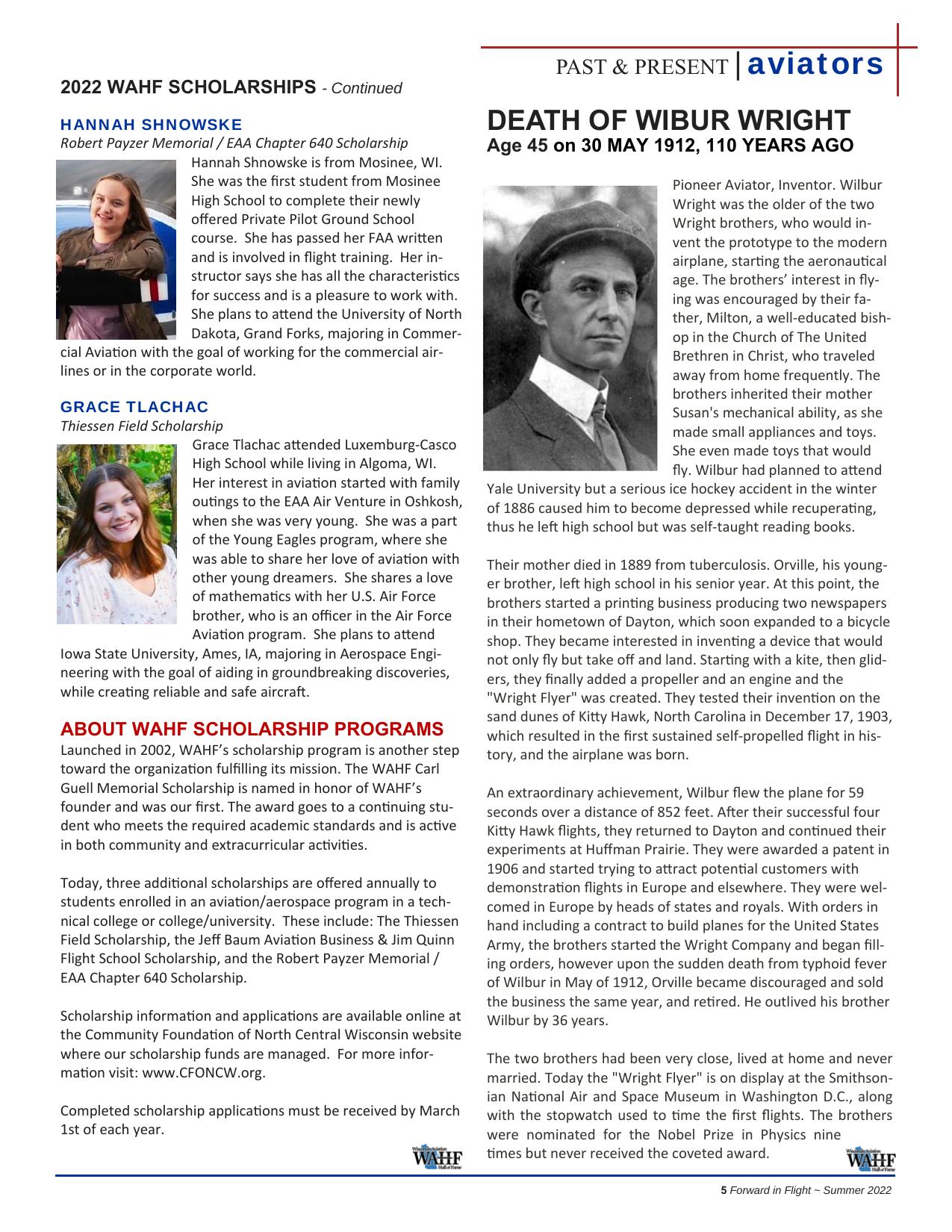
2022 WAHF SCHOLARSHIPS - Continued HANNAH SHNOWSKE Robert Payzer Memorial / EAA Chapter 640 Scholarship Hannah Shnowske is from Mosinee, WI. She was the first student from Mosinee High School to complete their newly offered Private Pilot Ground School course. She has passed her FAA wri en and is involved in flight training. Her instructor says she has all the characteris cs for success and is a pleasure to work with. She plans to a end the University of North Dakota, Grand Forks, majoring in Commercial Avia on with the goal of working for the commercial airlines or in the corporate world. GRACE TLACHAC Thiessen Field Scholarship Grace Tlachac a ended Luxemburg-Casco High School while living in Algoma, WI. Her interest in avia on started with family ou ngs to the EAA Air Venture in Oshkosh, when she was very young. She was a part of the Young Eagles program, where she was able to share her love of avia on with other young dreamers. She shares a love of mathema cs with her U.S. Air Force brother, who is an officer in the Air Force Avia on program. She plans to a end Iowa State University, Ames, IA, majoring in Aerospace Engineering with the goal of aiding in groundbreaking discoveries, while crea ng reliable and safe aircra . ABOUT WAHF SCHOLARSHIP PROGRAMS Launched in 2002, WAHF’s scholarship program is another step toward the organiza on fulfilling its mission. The WAHF Carl Guell Memorial Scholarship is named in honor of WAHF’s founder and was our first. The award goes to a con nuing student who meets the required academic standards and is ac ve in both community and extracurricular ac vi es. Today, three addi onal scholarships are offered annually to students enrolled in an avia on/aerospace program in a technical college or college/university. These include: The Thiessen Field Scholarship, the Jeff Baum Avia on Business & Jim Quinn Flight School Scholarship, and the Robert Payzer Memorial / EAA Chapter 640 Scholarship. Scholarship informa on and applica ons are available online at the Community Founda on of North Central Wisconsin website where our scholarship funds are managed. For more informa on visit: www.CFONCW.org. Completed scholarship applica ons must be received by March 1st of each year. PAST & PRESENT | aviators DEATH OF WIBUR WRIGHT Age 45 on 30 MAY 1912, 110 YEARS AGO Pioneer Aviator, Inventor. Wilbur Wright was the older of the two Wright brothers, who would invent the prototype to the modern airplane, star ng the aeronau cal age. The brothers’ interest in flying was encouraged by their father, Milton, a well-educated bishop in the Church of The United Brethren in Christ, who traveled away from home frequently. The brothers inherited their mother Susan's mechanical ability, as she made small appliances and toys. She even made toys that would fly. Wilbur had planned to a end Yale University but a serious ice hockey accident in the winter of 1886 caused him to become depressed while recupera ng, thus he le high school but was self-taught reading books. Their mother died in 1889 from tuberculosis. Orville, his younger brother, le high school in his senior year. At this point, the brothers started a prin ng business producing two newspapers in their hometown of Dayton, which soon expanded to a bicycle shop. They became interested in inven ng a device that would not only fly but take off and land. Star ng with a kite, then gliders, they finally added a propeller and an engine and the "Wright Flyer" was created. They tested their inven on on the sand dunes of Ki y Hawk, North Carolina in December 17, 1903, which resulted in the first sustained self-propelled flight in history, and the airplane was born. An extraordinary achievement, Wilbur flew the plane for 59 seconds over a distance of 852 feet. A er their successful four Ki y Hawk flights, they returned to Dayton and con nued their experiments at Huffman Prairie. They were awarded a patent in 1906 and started trying to a ract poten al customers with demonstra on flights in Europe and elsewhere. They were welcomed in Europe by heads of states and royals. With orders in hand including a contract to build planes for the United States Army, the brothers started the Wright Company and began filling orders, however upon the sudden death from typhoid fever of Wilbur in May of 1912, Orville became discouraged and sold the business the same year, and re red. He outlived his brother Wilbur by 36 years. The two brothers had been very close, lived at home and never married. Today the "Wright Flyer" is on display at the Smithsonian Na onal Air and Space Museum in Washington D.C., along with the stopwatch used to me the first flights. The brothers were nominated for the Nobel Prize in Physics nine mes but never received the coveted award. 5 Forward in Flight ~ Summer 2022
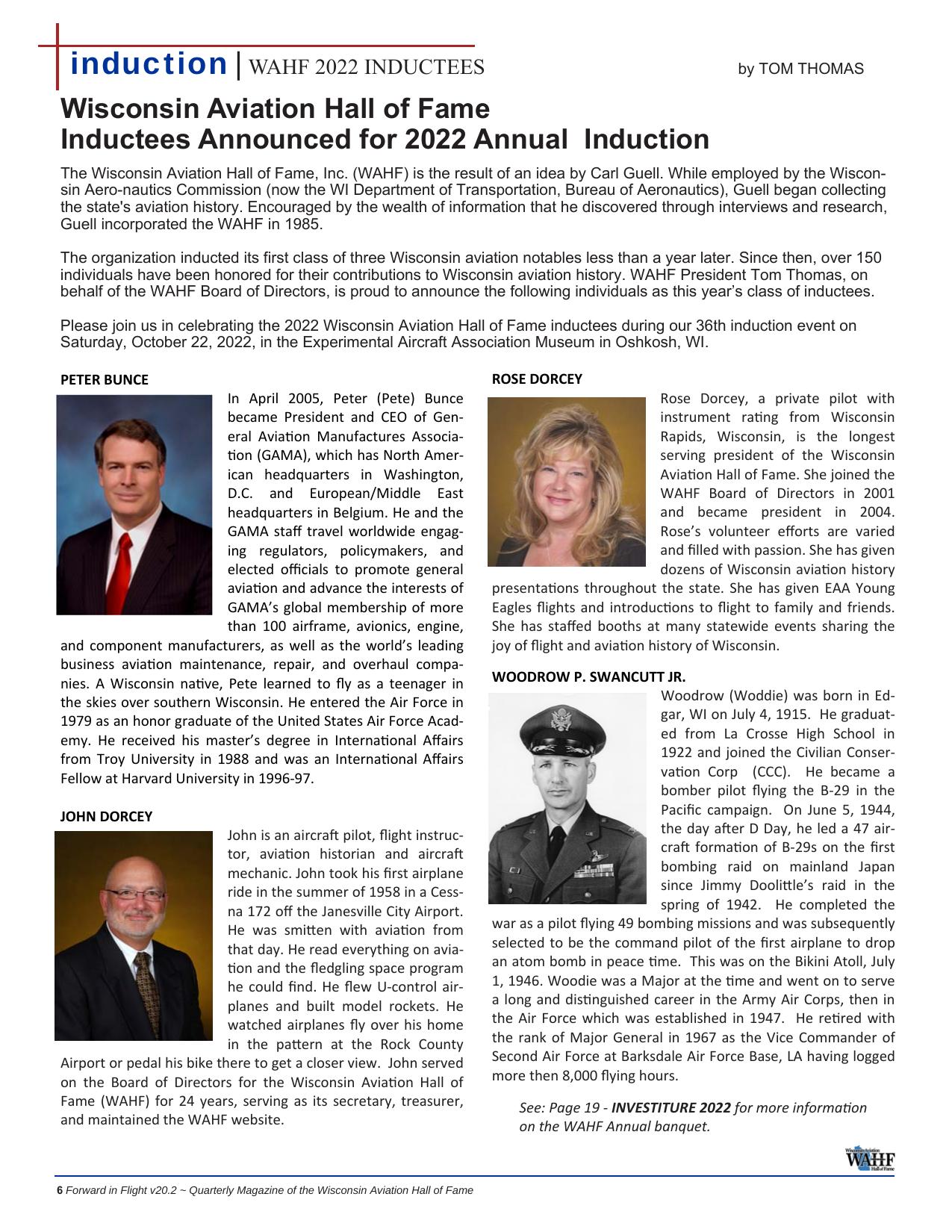
induction | WAHF 2022 INDUCTEES by TOM THOMAS Wisconsin Aviation Hall of Fame Inductees Announced for 2022 Annual Induction The Wisconsin Aviation Hall of Fame, Inc. (WAHF) is the result of an idea by Carl Guell. While employed by the Wisconsin Aero-nautics Commission (now the WI Department of Transportation, Bureau of Aeronautics), Guell began collecting the state's aviation history. Encouraged by the wealth of information that he discovered through interviews and research, Guell incorporated the WAHF in 1985. The organization inducted its first class of three Wisconsin aviation notables less than a year later. Since then, over 150 individuals have been honored for their contributions to Wisconsin aviation history. WAHF President Tom Thomas, on behalf of the WAHF Board of Directors, is proud to announce the following individuals as this year’s class of inductees. Please join us in celebrating the 2022 Wisconsin Aviation Hall of Fame inductees during our 36th induction event on Saturday, October 22, 2022, in the Experimental Aircraft Association Museum in Oshkosh, WI. PETER BUNCE ROSE DORCEY In April 2005, Peter (Pete) Bunce became President and CEO of General Avia on Manufactures Associaon (GAMA), which has North American headquarters in Washington, D.C. and European/Middle East headquarters in Belgium. He and the GAMA staff travel worldwide engaging regulators, policymakers, and elected officials to promote general avia on and advance the interests of GAMA’s global membership of more than 100 airframe, avionics, engine, and component manufacturers, as well as the world’s leading business avia on maintenance, repair, and overhaul companies. A Wisconsin na ve, Pete learned to fly as a teenager in the skies over southern Wisconsin. He entered the Air Force in 1979 as an honor graduate of the United States Air Force Academy. He received his master’s degree in Interna onal Affairs from Troy University in 1988 and was an Interna onal Affairs Fellow at Harvard University in 1996-97. Rose Dorcey, a private pilot with instrument ra ng from Wisconsin Rapids, Wisconsin, is the longest serving president of the Wisconsin Avia on Hall of Fame. She joined the WAHF Board of Directors in 2001 and became president in 2004. Rose’s volunteer efforts are varied and filled with passion. She has given dozens of Wisconsin avia on history presenta ons throughout the state. She has given EAA Young Eagles flights and introduc ons to flight to family and friends. She has staffed booths at many statewide events sharing the joy of flight and avia on history of Wisconsin. JOHN DORCEY John is an aircra pilot, flight instructor, avia on historian and aircra mechanic. John took his first airplane ride in the summer of 1958 in a Cessna 172 off the Janesville City Airport. He was smi en with avia on from that day. He read everything on aviaon and the fledgling space program he could find. He flew U-control airplanes and built model rockets. He watched airplanes fly over his home in the pa ern at the Rock County Airport or pedal his bike there to get a closer view. John served on the Board of Directors for the Wisconsin Avia on Hall of Fame (WAHF) for 24 years, serving as its secretary, treasurer, and maintained the WAHF website. 6 Forward in Flight v20.2 ~ Quarterly Magazine of the Wisconsin Aviation Hall of Fame WOODROW P. SWANCUTT JR. Woodrow (Woddie) was born in Edgar, WI on July 4, 1915. He graduated from La Crosse High School in 1922 and joined the Civilian Conserva on Corp (CCC). He became a bomber pilot flying the B-29 in the Pacific campaign. On June 5, 1944, the day a er D Day, he led a 47 aircra forma on of B-29s on the first bombing raid on mainland Japan since Jimmy Dooli le’s raid in the spring of 1942. He completed the war as a pilot flying 49 bombing missions and was subsequently selected to be the command pilot of the first airplane to drop an atom bomb in peace me. This was on the Bikini Atoll, July 1, 1946. Woodie was a Major at the me and went on to serve a long and dis nguished career in the Army Air Corps, then in the Air Force which was established in 1947. He re red with the rank of Major General in 1967 as the Vice Commander of Second Air Force at Barksdale Air Force Base, LA having logged more then 8,000 flying hours. See: Page 19 ‐ INVESTITURE 2022 for more informa on on the WAHF Annual banquet.
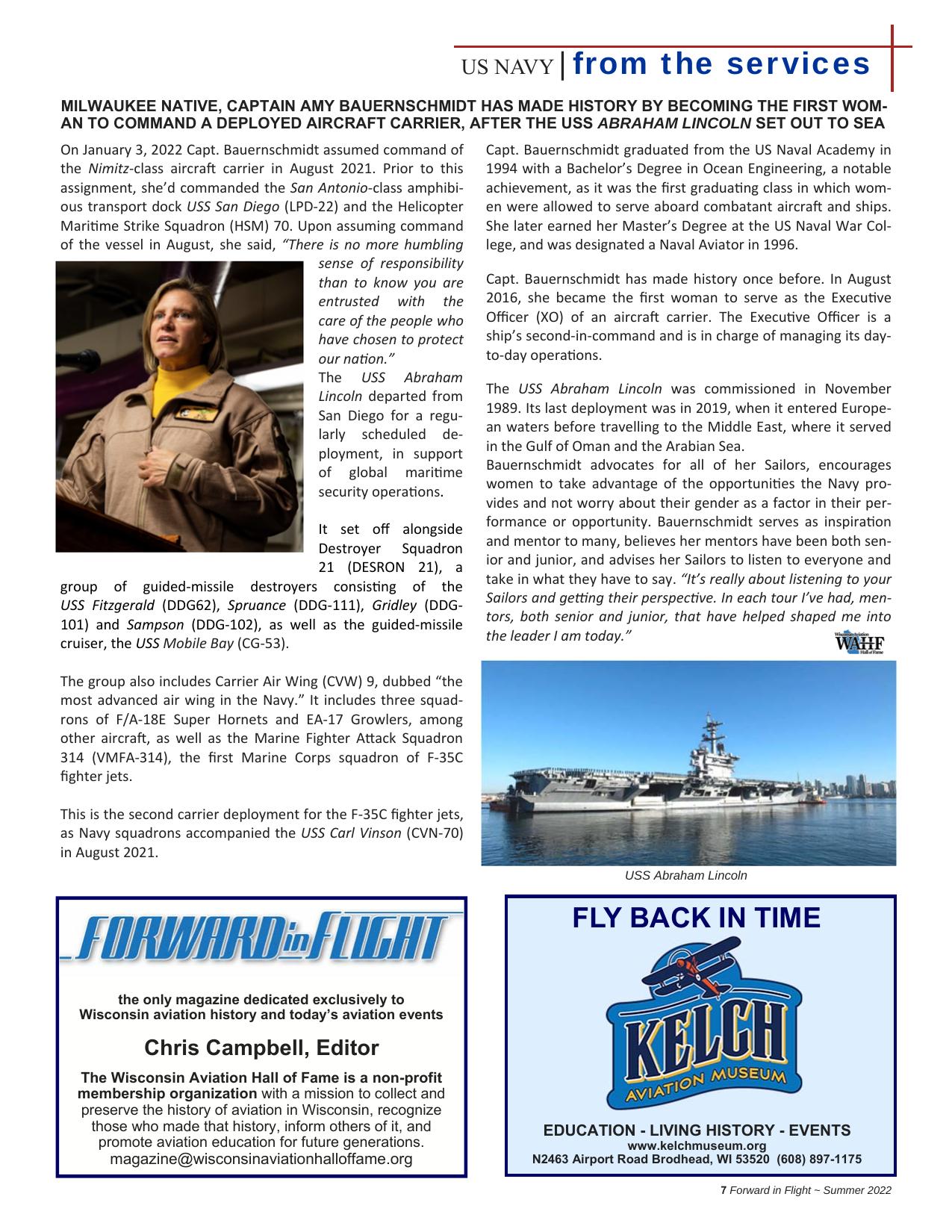
US NAVY | from the services MILWAUKEE NATIVE, CAPTAIN AMY BAUERNSCHMIDT HAS MADE HISTORY BY BECOMING THE FIRST WOMAN TO COMMAND A DEPLOYED AIRCRAFT CARRIER, AFTER THE USS ABRAHAM LINCOLN SET OUT TO SEA On January 3, 2022 Capt. Bauernschmidt assumed command of the Nimitz-class aircra carrier in August 2021. Prior to this assignment, she’d commanded the San Antonio-class amphibious transport dock USS San Diego (LPD-22) and the Helicopter Mari me Strike Squadron (HSM) 70. Upon assuming command of the vessel in August, she said, “There is no more humbling sense of responsibility than to know you are entrusted with the care of the people who have chosen to protect our na on.” The USS Abraham Lincoln departed from San Diego for a regularly scheduled deployment, in support of global mari me security opera ons. It set off alongside Destroyer Squadron 21 (DESRON 21), a group of guided-missile destroyers consis ng of the USS Fitzgerald (DDG62), Spruance (DDG-111), Gridley (DDG101) and Sampson (DDG-102), as well as the guided-missile cruiser, the USS Mobile Bay (CG-53). Capt. Bauernschmidt graduated from the US Naval Academy in 1994 with a Bachelor’s Degree in Ocean Engineering, a notable achievement, as it was the first gradua ng class in which women were allowed to serve aboard combatant aircra and ships. She later earned her Master’s Degree at the US Naval War College, and was designated a Naval Aviator in 1996. Capt. Bauernschmidt has made history once before. In August 2016, she became the first woman to serve as the Execu ve Officer (XO) of an aircra carrier. The Execu ve Officer is a ship’s second-in-command and is in charge of managing its dayto-day opera ons. The USS Abraham Lincoln was commissioned in November 1989. Its last deployment was in 2019, when it entered European waters before travelling to the Middle East, where it served in the Gulf of Oman and the Arabian Sea. Bauernschmidt advocates for all of her Sailors, encourages women to take advantage of the opportuni es the Navy provides and not worry about their gender as a factor in their performance or opportunity. Bauernschmidt serves as inspira on and mentor to many, believes her mentors have been both senior and junior, and advises her Sailors to listen to everyone and take in what they have to say. “It’s really about listening to your Sailors and ge ng their perspec ve. In each tour I’ve had, men‐ tors, both senior and junior, that have helped shaped me into the leader I am today.” The group also includes Carrier Air Wing (CVW) 9, dubbed “the most advanced air wing in the Navy.” It includes three squadrons of F/A-18E Super Hornets and EA-17 Growlers, among other aircra , as well as the Marine Fighter A ack Squadron 314 (VMFA-314), the first Marine Corps squadron of F-35C fighter jets. This is the second carrier deployment for the F-35C fighter jets, as Navy squadrons accompanied the USS Carl Vinson (CVN-70) in August 2021. USS Abraham Lincoln FLY BACK IN TIME the only magazine dedicated exclusively to Wisconsin aviation history and today’s aviation events Chris Campbell, Editor The Wisconsin Aviation Hall of Fame is a non-profit membership organization with a mission to collect and preserve the history of aviation in Wisconsin, recognize those who made that history, inform others of it, and promote aviation education for future generations. magazine@wisconsinaviationhalloffame.org EDUCATION - LIVING HISTORY - EVENTS www.kelchmuseum.org N2463 Airport Road Brodhead, WI 53520 (608) 897-1175 7 Forward in Flight ~ Summer 2022
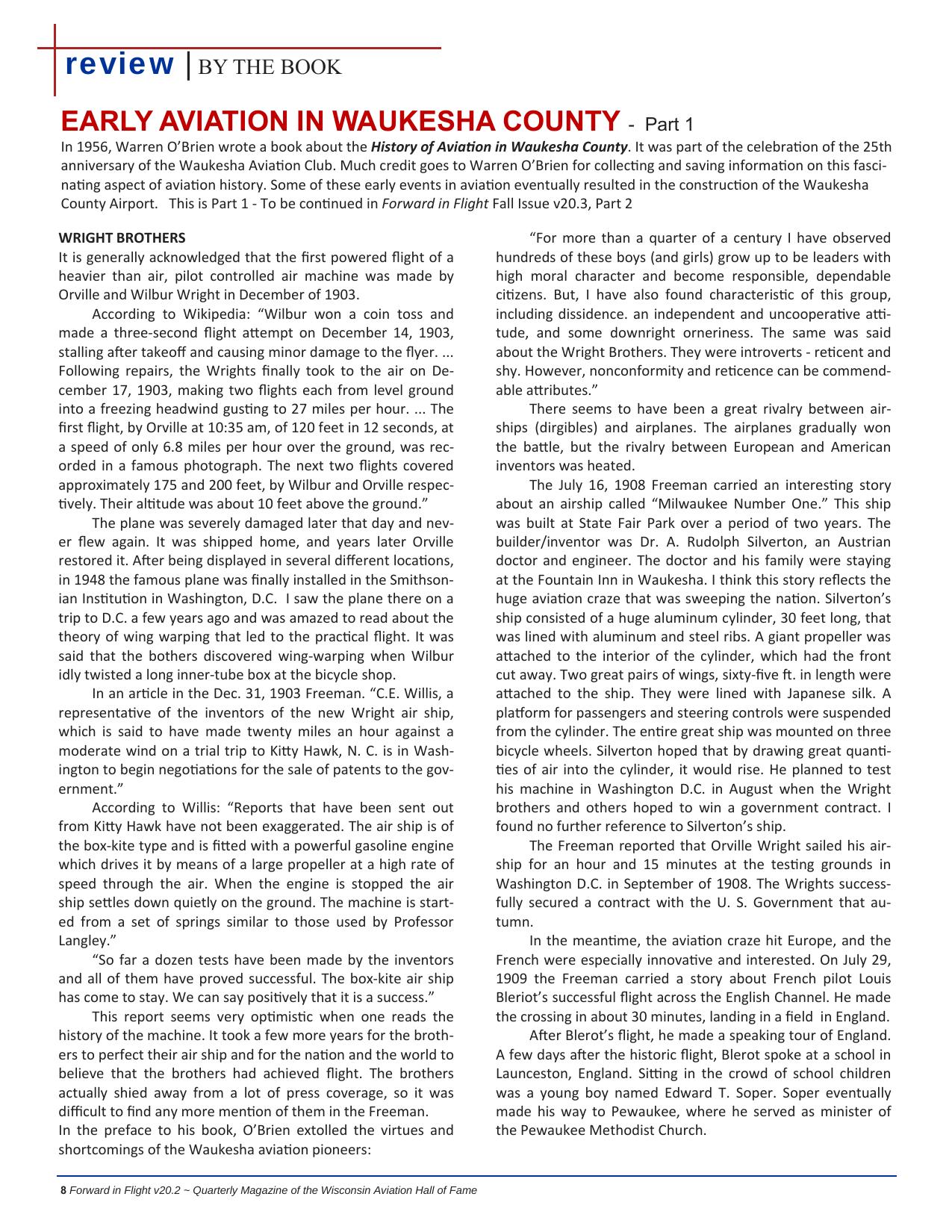
review | BY THE BOOK EARLY AVIATION IN WAUKESHA COUNTY - Part 1 In 1956, Warren O’Brien wrote a book about the History of Avia on in Waukesha County. It was part of the celebra on of the 25th anniversary of the Waukesha Avia on Club. Much credit goes to Warren O’Brien for collec ng and saving informa on on this fascina ng aspect of avia on history. Some of these early events in avia on eventually resulted in the construc on of the Waukesha County Airport. This is Part 1 - To be con nued in Forward in Flight Fall Issue v20.3, Part 2 WRIGHT BROTHERS It is generally acknowledged that the first powered flight of a heavier than air, pilot controlled air machine was made by Orville and Wilbur Wright in December of 1903. According to Wikipedia: “Wilbur won a coin toss and made a three-second flight a empt on December 14, 1903, stalling a er takeoff and causing minor damage to the flyer. ... Following repairs, the Wrights finally took to the air on December 17, 1903, making two flights each from level ground into a freezing headwind gus ng to 27 miles per hour. ... The first flight, by Orville at 10:35 am, of 120 feet in 12 seconds, at a speed of only 6.8 miles per hour over the ground, was recorded in a famous photograph. The next two flights covered approximately 175 and 200 feet, by Wilbur and Orville respecvely. Their al tude was about 10 feet above the ground.” The plane was severely damaged later that day and never flew again. It was shipped home, and years later Orville restored it. A er being displayed in several different loca ons, in 1948 the famous plane was finally installed in the Smithsonian Ins tu on in Washington, D.C. I saw the plane there on a trip to D.C. a few years ago and was amazed to read about the theory of wing warping that led to the prac cal flight. It was said that the bothers discovered wing-warping when Wilbur idly twisted a long inner-tube box at the bicycle shop. In an ar cle in the Dec. 31, 1903 Freeman. “C.E. Willis, a representa ve of the inventors of the new Wright air ship, which is said to have made twenty miles an hour against a moderate wind on a trial trip to Ki y Hawk, N. C. is in Washington to begin nego a ons for the sale of patents to the government.” According to Willis: “Reports that have been sent out from Ki y Hawk have not been exaggerated. The air ship is of the box-kite type and is fi ed with a powerful gasoline engine which drives it by means of a large propeller at a high rate of speed through the air. When the engine is stopped the air ship se les down quietly on the ground. The machine is started from a set of springs similar to those used by Professor Langley.” “So far a dozen tests have been made by the inventors and all of them have proved successful. The box-kite air ship has come to stay. We can say posi vely that it is a success.” This report seems very op mis c when one reads the history of the machine. It took a few more years for the brothers to perfect their air ship and for the na on and the world to believe that the brothers had achieved flight. The brothers actually shied away from a lot of press coverage, so it was difficult to find any more men on of them in the Freeman. In the preface to his book, O’Brien extolled the virtues and shortcomings of the Waukesha avia on pioneers: 8 Forward in Flight v20.2 ~ Quarterly Magazine of the Wisconsin Aviation Hall of Fame “For more than a quarter of a century I have observed hundreds of these boys (and girls) grow up to be leaders with high moral character and become responsible, dependable ci zens. But, I have also found characteris c of this group, including dissidence. an independent and uncoopera ve a tude, and some downright orneriness. The same was said about the Wright Brothers. They were introverts - re cent and shy. However, nonconformity and re cence can be commendable a ributes.” There seems to have been a great rivalry between airships (dirgibles) and airplanes. The airplanes gradually won the ba le, but the rivalry between European and American inventors was heated. The July 16, 1908 Freeman carried an interes ng story about an airship called “Milwaukee Number One.” This ship was built at State Fair Park over a period of two years. The builder/inventor was Dr. A. Rudolph Silverton, an Austrian doctor and engineer. The doctor and his family were staying at the Fountain Inn in Waukesha. I think this story reflects the huge avia on craze that was sweeping the na on. Silverton’s ship consisted of a huge aluminum cylinder, 30 feet long, that was lined with aluminum and steel ribs. A giant propeller was a ached to the interior of the cylinder, which had the front cut away. Two great pairs of wings, sixty-five . in length were a ached to the ship. They were lined with Japanese silk. A pla orm for passengers and steering controls were suspended from the cylinder. The en re great ship was mounted on three bicycle wheels. Silverton hoped that by drawing great quan es of air into the cylinder, it would rise. He planned to test his machine in Washington D.C. in August when the Wright brothers and others hoped to win a government contract. I found no further reference to Silverton’s ship. The Freeman reported that Orville Wright sailed his airship for an hour and 15 minutes at the tes ng grounds in Washington D.C. in September of 1908. The Wrights successfully secured a contract with the U. S. Government that autumn. In the mean me, the avia on craze hit Europe, and the French were especially innova ve and interested. On July 29, 1909 the Freeman carried a story about French pilot Louis Bleriot’s successful flight across the English Channel. He made the crossing in about 30 minutes, landing in a field in England. A er Blerot’s flight, he made a speaking tour of England. A few days a er the historic flight, Blerot spoke at a school in Launceston, England. Si ng in the crowd of school children was a young boy named Edward T. Soper. Soper eventually made his way to Pewaukee, where he served as minister of the Pewaukee Methodist Church.
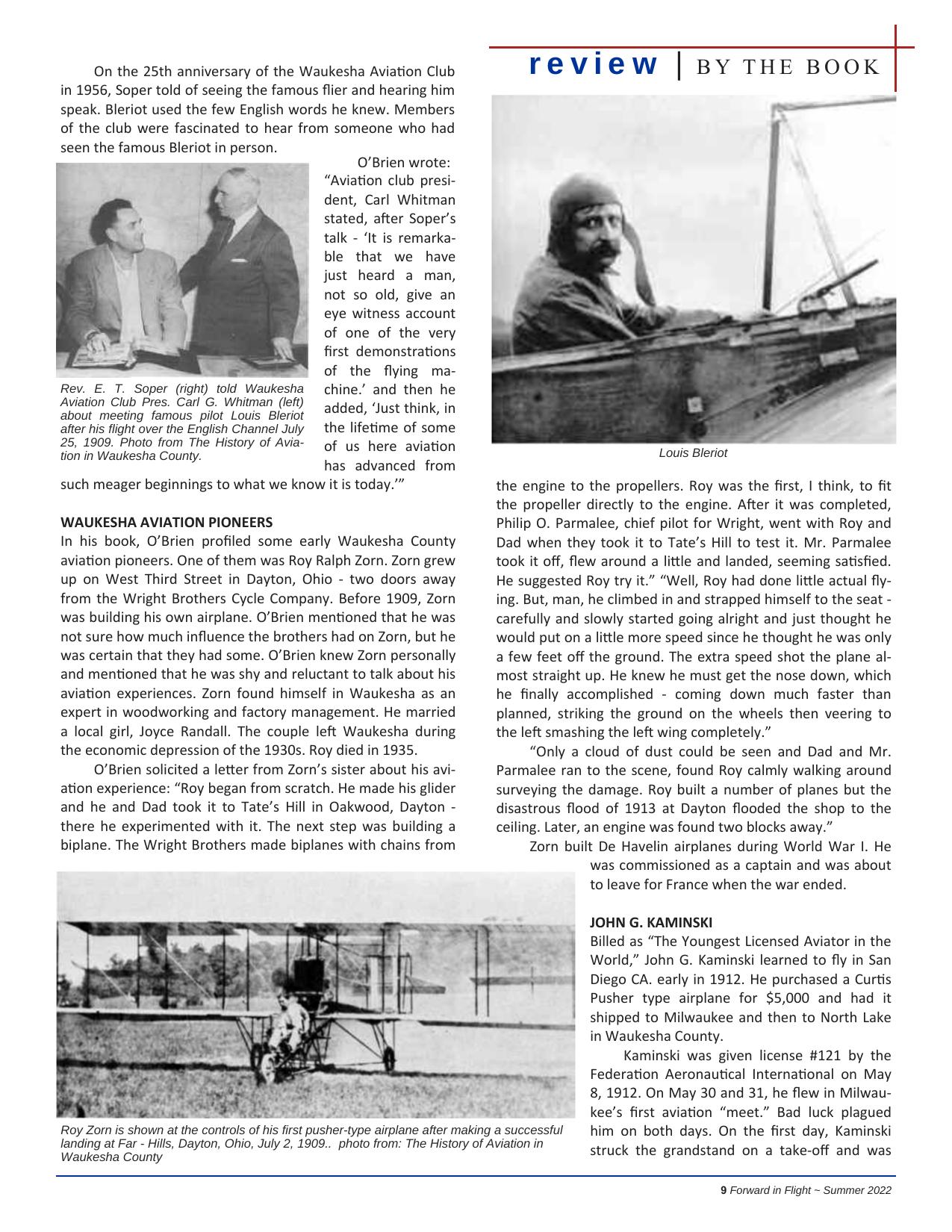
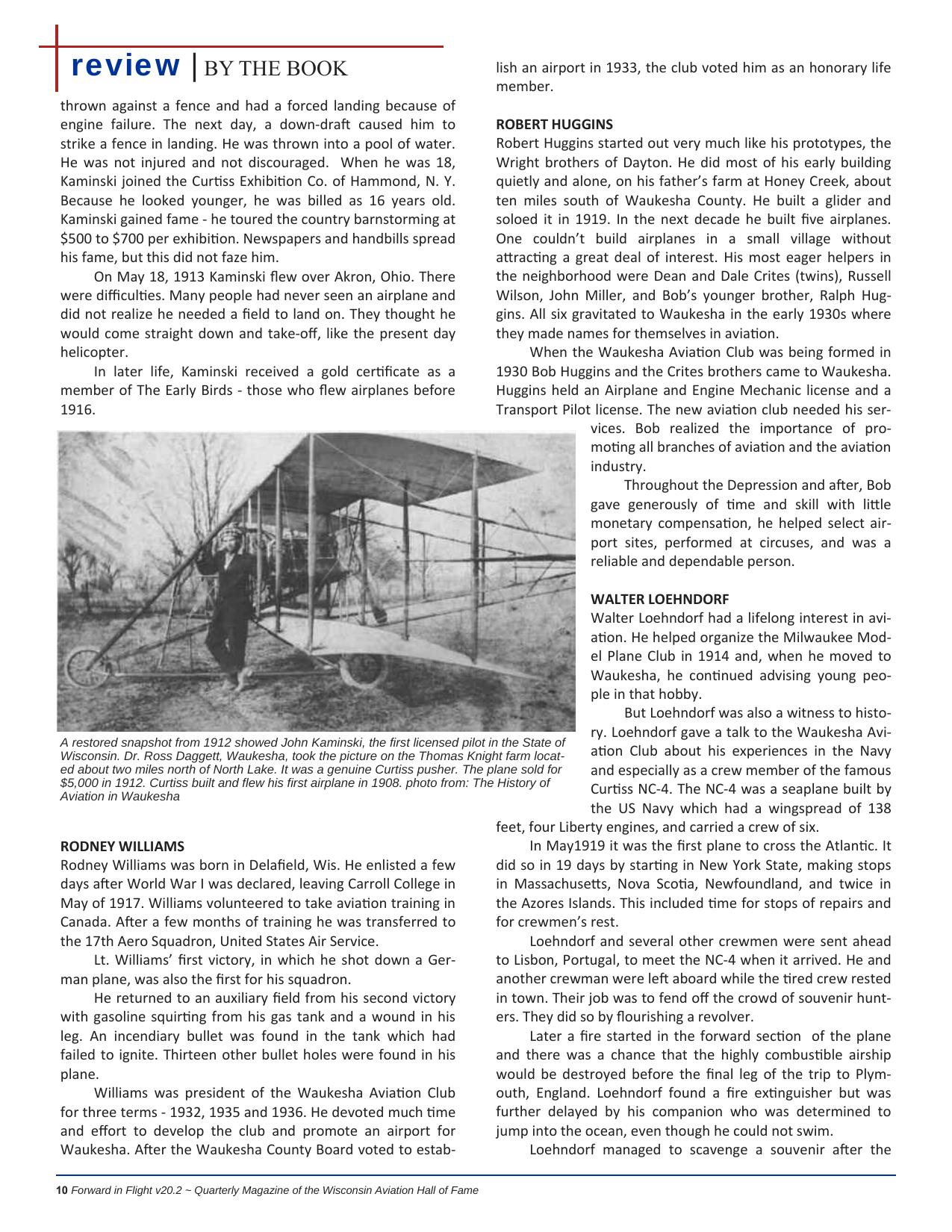
On the 25th anniversary of the Waukesha Avia on Club in 1956, Soper told of seeing the famous flier and hearing him speak. Bleriot used the few English words he knew. Members of the club were fascinated to hear from someone who had seen the famous Bleriot in person. O’Brien wrote: “Avia on club president, Carl Whitman stated, a er Soper’s talk - ‘It is remarkable that we have just heard a man, not so old, give an eye witness account of one of the very first demonstra ons of the flying maRev. E. T. Soper (right) told Waukesha chine.’ and then he Aviation Club Pres. Carl G. Whitman (left) added, ‘Just think, in about meeting famous pilot Louis Bleriot the life me of some after his flight over the English Channel July 25, 1909. Photo from The History of Aviaof us here avia on tion in Waukesha County. has advanced from such meager beginnings to what we know it is today.’” WAUKESHA AVIATION PIONEERS In his book, O’Brien profiled some early Waukesha County avia on pioneers. One of them was Roy Ralph Zorn. Zorn grew up on West Third Street in Dayton, Ohio - two doors away from the Wright Brothers Cycle Company. Before 1909, Zorn was building his own airplane. O’Brien men oned that he was not sure how much influence the brothers had on Zorn, but he was certain that they had some. O’Brien knew Zorn personally and men oned that he was shy and reluctant to talk about his avia on experiences. Zorn found himself in Waukesha as an expert in woodworking and factory management. He married a local girl, Joyce Randall. The couple le Waukesha during the economic depression of the 1930s. Roy died in 1935. O’Brien solicited a le er from Zorn’s sister about his avia on experience: “Roy began from scratch. He made his glider and he and Dad took it to Tate’s Hill in Oakwood, Dayton there he experimented with it. The next step was building a biplane. The Wright Brothers made biplanes with chains from r ev i e w | B Y T H E B O O K Louis Bleriot the engine to the propellers. Roy was the first, I think, to fit the propeller directly to the engine. A er it was completed, Philip O. Parmalee, chief pilot for Wright, went with Roy and Dad when they took it to Tate’s Hill to test it. Mr. Parmalee took it off, flew around a li le and landed, seeming sa sfied. He suggested Roy try it.” “Well, Roy had done li le actual flying. But, man, he climbed in and strapped himself to the seat carefully and slowly started going alright and just thought he would put on a li le more speed since he thought he was only a few feet off the ground. The extra speed shot the plane almost straight up. He knew he must get the nose down, which he finally accomplished - coming down much faster than planned, striking the ground on the wheels then veering to the le smashing the le wing completely.” “Only a cloud of dust could be seen and Dad and Mr. Parmalee ran to the scene, found Roy calmly walking around surveying the damage. Roy built a number of planes but the disastrous flood of 1913 at Dayton flooded the shop to the ceiling. Later, an engine was found two blocks away.” Zorn built De Havelin airplanes during World War I. He was commissioned as a captain and was about to leave for France when the war ended. Roy Zorn is shown at the controls of his first pusher-type airplane after making a successful landing at Far - Hills, Dayton, Ohio, July 2, 1909.. photo from: The History of Aviation in Waukesha County JOHN G. KAMINSKI Billed as “The Youngest Licensed Aviator in the World,” John G. Kaminski learned to fly in San Diego CA. early in 1912. He purchased a Cur s Pusher type airplane for $5,000 and had it shipped to Milwaukee and then to North Lake in Waukesha County. Kaminski was given license #121 by the Federa on Aeronau cal Interna onal on May 8, 1912. On May 30 and 31, he flew in Milwaukee’s first avia on “meet.” Bad luck plagued him on both days. On the first day, Kaminski struck the grandstand on a take-off and was 9 Forward in Flight ~ Summer 2022
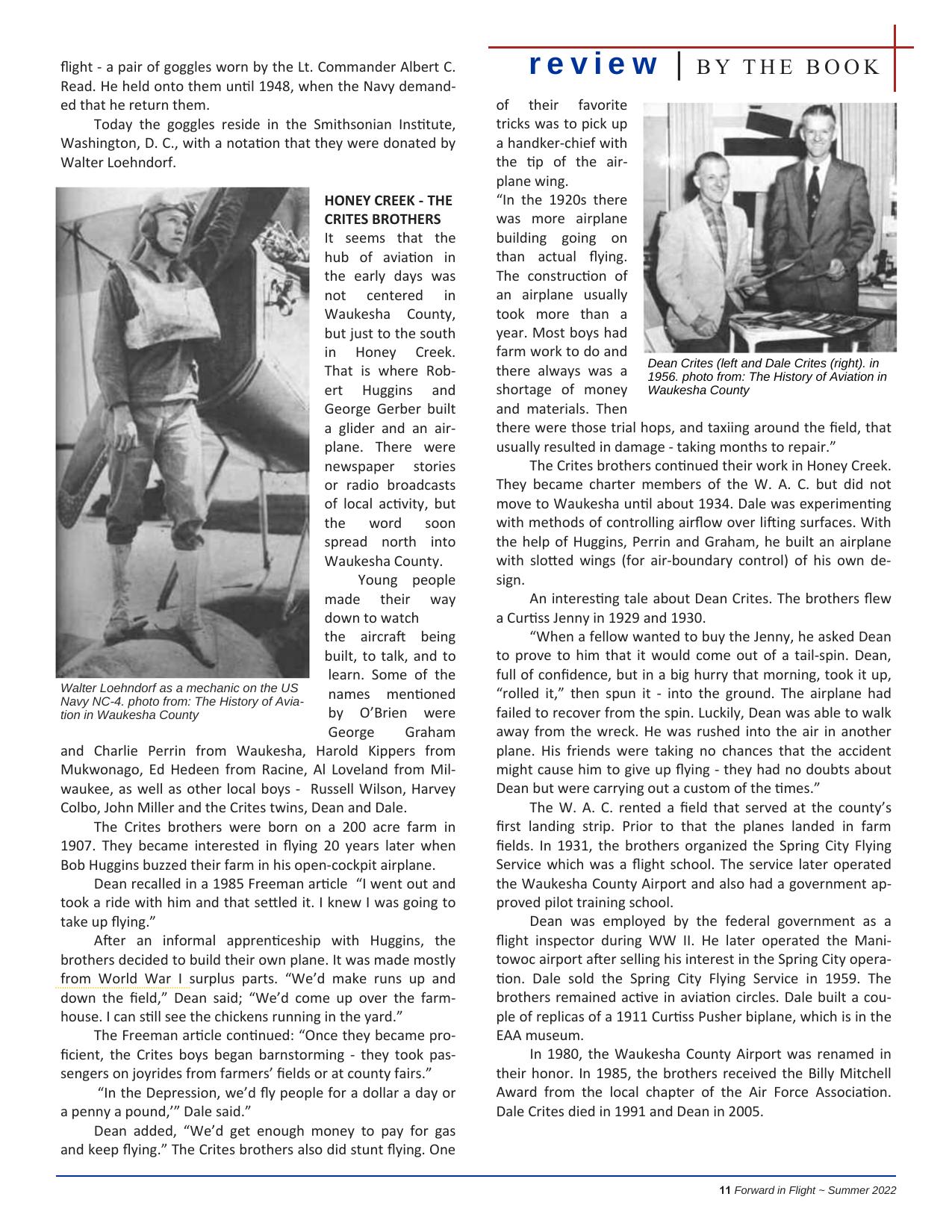
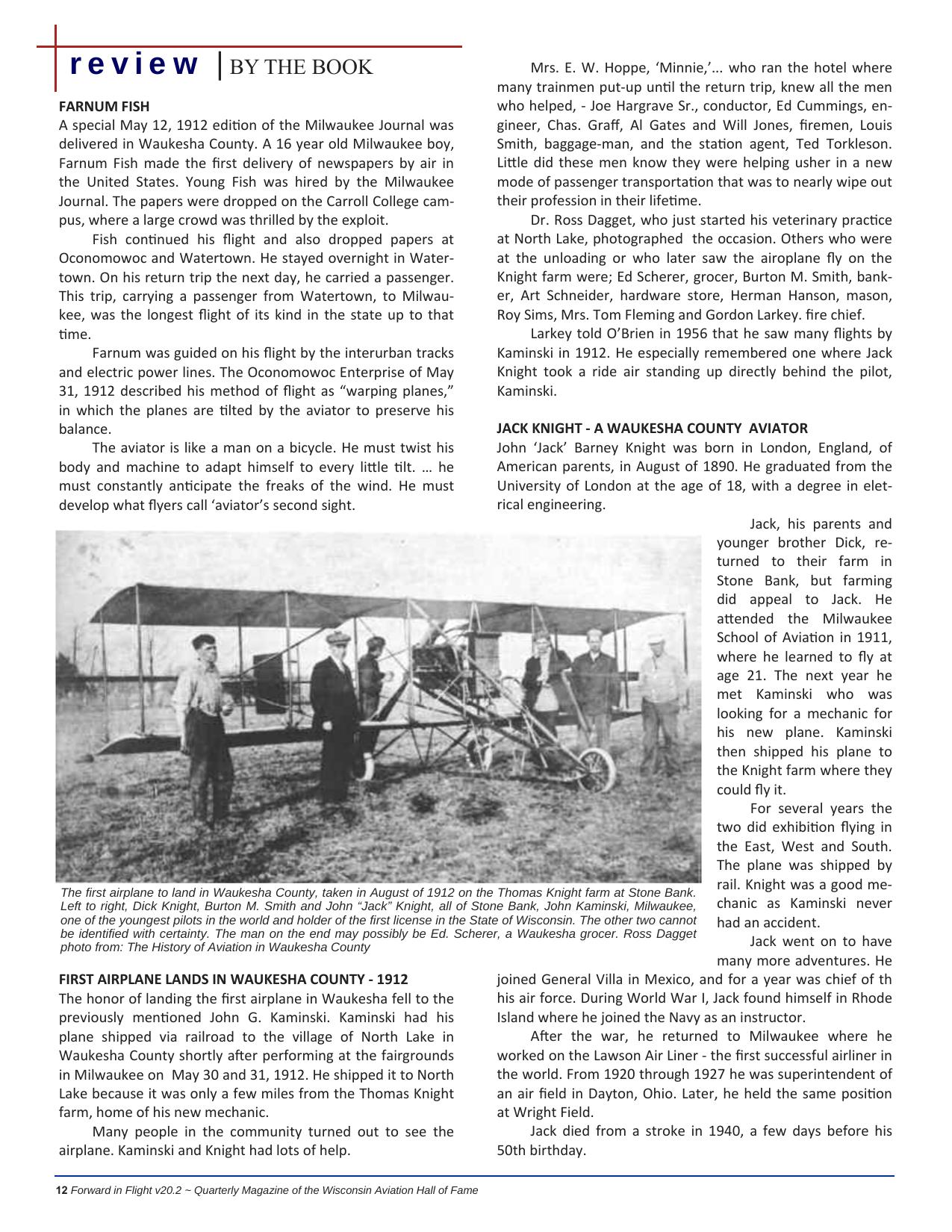
review | BY THE BOOK thrown against a fence and had a forced landing because of engine failure. The next day, a down-dra caused him to strike a fence in landing. He was thrown into a pool of water. He was not injured and not discouraged. When he was 18, Kaminski joined the Cur ss Exhibi on Co. of Hammond, N. Y. Because he looked younger, he was billed as 16 years old. Kaminski gained fame - he toured the country barnstorming at $500 to $700 per exhibi on. Newspapers and handbills spread his fame, but this did not faze him. On May 18, 1913 Kaminski flew over Akron, Ohio. There were difficul es. Many people had never seen an airplane and did not realize he needed a field to land on. They thought he would come straight down and take-off, like the present day helicopter. In later life, Kaminski received a gold cer ficate as a member of The Early Birds - those who flew airplanes before 1916. lish an airport in 1933, the club voted him as an honorary life member. ROBERT HUGGINS Robert Huggins started out very much like his prototypes, the Wright brothers of Dayton. He did most of his early building quietly and alone, on his father’s farm at Honey Creek, about ten miles south of Waukesha County. He built a glider and soloed it in 1919. In the next decade he built five airplanes. One couldn’t build airplanes in a small village without a rac ng a great deal of interest. His most eager helpers in the neighborhood were Dean and Dale Crites (twins), Russell Wilson, John Miller, and Bob’s younger brother, Ralph Huggins. All six gravitated to Waukesha in the early 1930s where they made names for themselves in avia on. When the Waukesha Avia on Club was being formed in 1930 Bob Huggins and the Crites brothers came to Waukesha. Huggins held an Airplane and Engine Mechanic license and a Transport Pilot license. The new avia on club needed his services. Bob realized the importance of promo ng all branches of avia on and the avia on industry. Throughout the Depression and a er, Bob gave generously of me and skill with li le monetary compensa on, he helped select airport sites, performed at circuses, and was a reliable and dependable person. WALTER LOEHNDORF Walter Loehndorf had a lifelong interest in avia on. He helped organize the Milwaukee Model Plane Club in 1914 and, when he moved to Waukesha, he con nued advising young people in that hobby. But Loehndorf was also a witness to history. Loehndorf gave a talk to the Waukesha AviA restored snapshot from 1912 showed John Kaminski, the first licensed pilot in the State of a on Club about his experiences in the Navy Wisconsin. Dr. Ross Daggett, Waukesha, took the picture on the Thomas Knight farm located about two miles north of North Lake. It was a genuine Curtiss pusher. The plane sold for and especially as a crew member of the famous $5,000 in 1912. Curtiss built and flew his first airplane in 1908. photo from: The History of Cur ss NC-4. The NC-4 was a seaplane built by Aviation in Waukesha the US Navy which had a wingspread of 138 feet, four Liberty engines, and carried a crew of six. In May1919 it was the first plane to cross the Atlan c. It RODNEY WILLIAMS did so in 19 days by star ng in New York State, making stops Rodney Williams was born in Delafield, Wis. He enlisted a few in Massachuse s, Nova Sco a, Newfoundland, and twice in days a er World War I was declared, leaving Carroll College in the Azores Islands. This included me for stops of repairs and May of 1917. Williams volunteered to take avia on training in for crewmen’s rest. Canada. A er a few months of training he was transferred to Loehndorf and several other crewmen were sent ahead the 17th Aero Squadron, United States Air Service. to Lisbon, Portugal, to meet the NC-4 when it arrived. He and Lt. Williams’ first victory, in which he shot down a Geranother crewman were le aboard while the red crew rested man plane, was also the first for his squadron. in town. Their job was to fend off the crowd of souvenir huntHe returned to an auxiliary field from his second victory ers. They did so by flourishing a revolver. with gasoline squir ng from his gas tank and a wound in his Later a fire started in the forward sec on of the plane leg. An incendiary bullet was found in the tank which had and there was a chance that the highly combus ble airship failed to ignite. Thirteen other bullet holes were found in his would be destroyed before the final leg of the trip to Plymplane. outh, England. Loehndorf found a fire ex nguisher but was Williams was president of the Waukesha Avia on Club further delayed by his companion who was determined to for three terms - 1932, 1935 and 1936. He devoted much me jump into the ocean, even though he could not swim. and effort to develop the club and promote an airport for Loehndorf managed to scavenge a souvenir a er the Waukesha. A er the Waukesha County Board voted to estab10 Forward in Flight v20.2 ~ Quarterly Magazine of the Wisconsin Aviation Hall of Fame
flight - a pair of goggles worn by the Lt. Commander Albert C. Read. He held onto them un l 1948, when the Navy demanded that he return them. Today the goggles reside in the Smithsonian Ins tute, Washington, D. C., with a nota on that they were donated by Walter Loehndorf. HONEY CREEK ‐ THE CRITES BROTHERS It seems that the hub of avia on in the early days was not centered in Waukesha County, but just to the south in Honey Creek. That is where Robert Huggins and George Gerber built a glider and an airplane. There were newspaper stories or radio broadcasts of local ac vity, but the word soon spread north into Waukesha County. Young people made their way down to watch the aircra being built, to talk, and to learn. Some of the Walter Loehndorf as a mechanic on the US names men oned Navy NC-4. photo from: The History of Aviaby O’Brien were tion in Waukesha County George Graham and Charlie Perrin from Waukesha, Harold Kippers from Mukwonago, Ed Hedeen from Racine, Al Loveland from Milwaukee, as well as other local boys - Russell Wilson, Harvey Colbo, John Miller and the Crites twins, Dean and Dale. The Crites brothers were born on a 200 acre farm in 1907. They became interested in flying 20 years later when Bob Huggins buzzed their farm in his open-cockpit airplane. Dean recalled in a 1985 Freeman ar cle “I went out and took a ride with him and that se led it. I knew I was going to take up flying.” A er an informal appren ceship with Huggins, the brothers decided to build their own plane. It was made mostly from World War I surplus parts. “We’d make runs up and down the field,” Dean said; “We’d come up over the farmhouse. I can s ll see the chickens running in the yard.” The Freeman ar cle con nued: “Once they became proficient, the Crites boys began barnstorming - they took passengers on joyrides from farmers’ fields or at county fairs.” “In the Depression, we’d fly people for a dollar a day or a penny a pound,’” Dale said.” Dean added, “We’d get enough money to pay for gas and keep flying.” The Crites brothers also did stunt flying. One r ev i e w | B Y T H E B O O K of their favorite tricks was to pick up a handker-chief with the p of the airplane wing. “In the 1920s there was more airplane building going on than actual flying. The construc on of an airplane usually took more than a year. Most boys had farm work to do and Dean Crites (left and Dale Crites (right). in there always was a 1956. photo from: The History of Aviation in shortage of money Waukesha County and materials. Then there were those trial hops, and taxiing around the field, that usually resulted in damage - taking months to repair.” The Crites brothers con nued their work in Honey Creek. They became charter members of the W. A. C. but did not move to Waukesha un l about 1934. Dale was experimen ng with methods of controlling airflow over li ing surfaces. With the help of Huggins, Perrin and Graham, he built an airplane with slo ed wings (for air-boundary control) of his own design. An interes ng tale about Dean Crites. The brothers flew a Cur ss Jenny in 1929 and 1930. “When a fellow wanted to buy the Jenny, he asked Dean to prove to him that it would come out of a tail-spin. Dean, full of confidence, but in a big hurry that morning, took it up, “rolled it,” then spun it - into the ground. The airplane had failed to recover from the spin. Luckily, Dean was able to walk away from the wreck. He was rushed into the air in another plane. His friends were taking no chances that the accident might cause him to give up flying - they had no doubts about Dean but were carrying out a custom of the mes.” The W. A. C. rented a field that served at the county’s first landing strip. Prior to that the planes landed in farm fields. In 1931, the brothers organized the Spring City Flying Service which was a flight school. The service later operated the Waukesha County Airport and also had a government approved pilot training school. Dean was employed by the federal government as a flight inspector during WW II. He later operated the Manitowoc airport a er selling his interest in the Spring City operaon. Dale sold the Spring City Flying Service in 1959. The brothers remained ac ve in avia on circles. Dale built a couple of replicas of a 1911 Cur ss Pusher biplane, which is in the EAA museum. In 1980, the Waukesha County Airport was renamed in their honor. In 1985, the brothers received the Billy Mitchell Award from the local chapter of the Air Force Associa on. Dale Crites died in 1991 and Dean in 2005. 11 Forward in Flight ~ Summer 2022
r ev i e w | BY THE BOOK FARNUM FISH A special May 12, 1912 edi on of the Milwaukee Journal was delivered in Waukesha County. A 16 year old Milwaukee boy, Farnum Fish made the first delivery of newspapers by air in the United States. Young Fish was hired by the Milwaukee Journal. The papers were dropped on the Carroll College campus, where a large crowd was thrilled by the exploit. Fish con nued his flight and also dropped papers at Oconomowoc and Watertown. He stayed overnight in Watertown. On his return trip the next day, he carried a passenger. This trip, carrying a passenger from Watertown, to Milwaukee, was the longest flight of its kind in the state up to that me. Farnum was guided on his flight by the interurban tracks and electric power lines. The Oconomowoc Enterprise of May 31, 1912 described his method of flight as “warping planes,” in which the planes are lted by the aviator to preserve his balance. The aviator is like a man on a bicycle. He must twist his body and machine to adapt himself to every li le lt. … he must constantly an cipate the freaks of the wind. He must develop what flyers call ‘aviator’s second sight. Mrs. E. W. Hoppe, ‘Minnie,’... who ran the hotel where many trainmen put-up un l the return trip, knew all the men who helped, - Joe Hargrave Sr., conductor, Ed Cummings, engineer, Chas. Graff, Al Gates and Will Jones, firemen, Louis Smith, baggage-man, and the sta on agent, Ted Torkleson. Li le did these men know they were helping usher in a new mode of passenger transporta on that was to nearly wipe out their profession in their life me. Dr. Ross Dagget, who just started his veterinary prac ce at North Lake, photographed the occasion. Others who were at the unloading or who later saw the airoplane fly on the Knight farm were; Ed Scherer, grocer, Burton M. Smith, banker, Art Schneider, hardware store, Herman Hanson, mason, Roy Sims, Mrs. Tom Fleming and Gordon Larkey. fire chief. Larkey told O’Brien in 1956 that he saw many flights by Kaminski in 1912. He especially remembered one where Jack Knight took a ride air standing up directly behind the pilot, Kaminski. JACK KNIGHT ‐ A WAUKESHA COUNTY AVIATOR John ‘Jack’ Barney Knight was born in London, England, of American parents, in August of 1890. He graduated from the University of London at the age of 18, with a degree in eletrical engineering. Jack, his parents and younger brother Dick, returned to their farm in Stone Bank, but farming did appeal to Jack. He a ended the Milwaukee School of Avia on in 1911, where he learned to fly at age 21. The next year he met Kaminski who was looking for a mechanic for his new plane. Kaminski then shipped his plane to the Knight farm where they could fly it. For several years the two did exhibi on flying in the East, West and South. The plane was shipped by rail. Knight was a good meThe first airplane to land in Waukesha County, taken in August of 1912 on the Thomas Knight farm at Stone Bank. chanic as Kaminski never Left to right, Dick Knight, Burton M. Smith and John “Jack” Knight, all of Stone Bank, John Kaminski, Milwaukee, one of the youngest pilots in the world and holder of the first license in the State of Wisconsin. The other two cannot had an accident. be identified with certainty. The man on the end may possibly be Ed. Scherer, a Waukesha grocer. Ross Dagget Jack went on to have photo from: The History of Aviation in Waukesha County many more adventures. He joined General Villa in Mexico, and for a year was chief of th FIRST AIRPLANE LANDS IN WAUKESHA COUNTY ‐ 1912 his air force. During World War I, Jack found himself in Rhode The honor of landing the first airplane in Waukesha fell to the Island where he joined the Navy as an instructor. previously men oned John G. Kaminski. Kaminski had his A er the war, he returned to Milwaukee where he plane shipped via railroad to the village of North Lake in worked on the Lawson Air Liner - the first successful airliner in Waukesha County shortly a er performing at the fairgrounds the world. From 1920 through 1927 he was superintendent of in Milwaukee on May 30 and 31, 1912. He shipped it to North an air field in Dayton, Ohio. Later, he held the same posi on Lake because it was only a few miles from the Thomas Knight at Wright Field. farm, home of his new mechanic. Jack died from a stroke in 1940, a few days before his Many people in the community turned out to see the 50th birthday. airplane. Kaminski and Knight had lots of help. 12 Forward in Flight v20.2 ~ Quarterly Magazine of the Wisconsin Aviation Hall of Fame
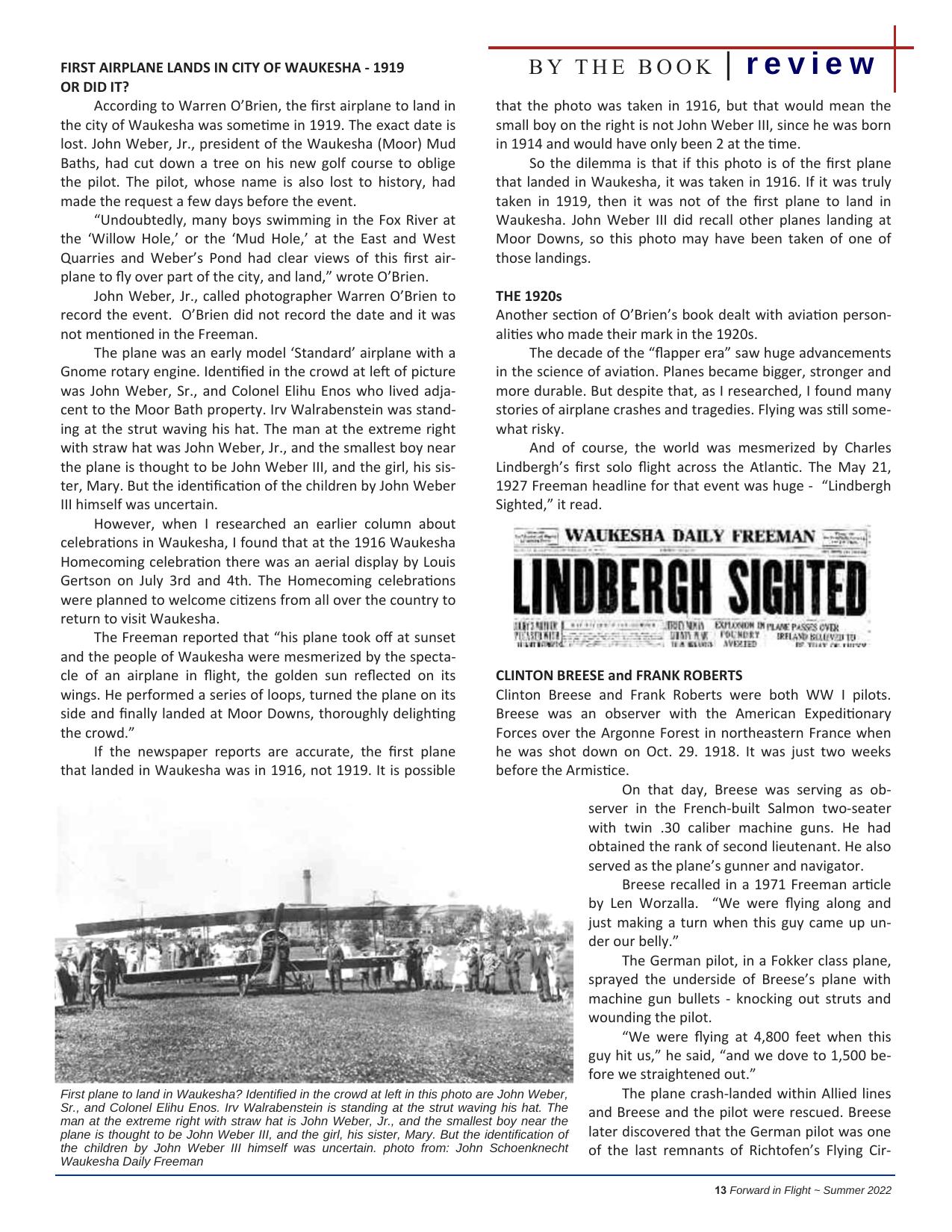
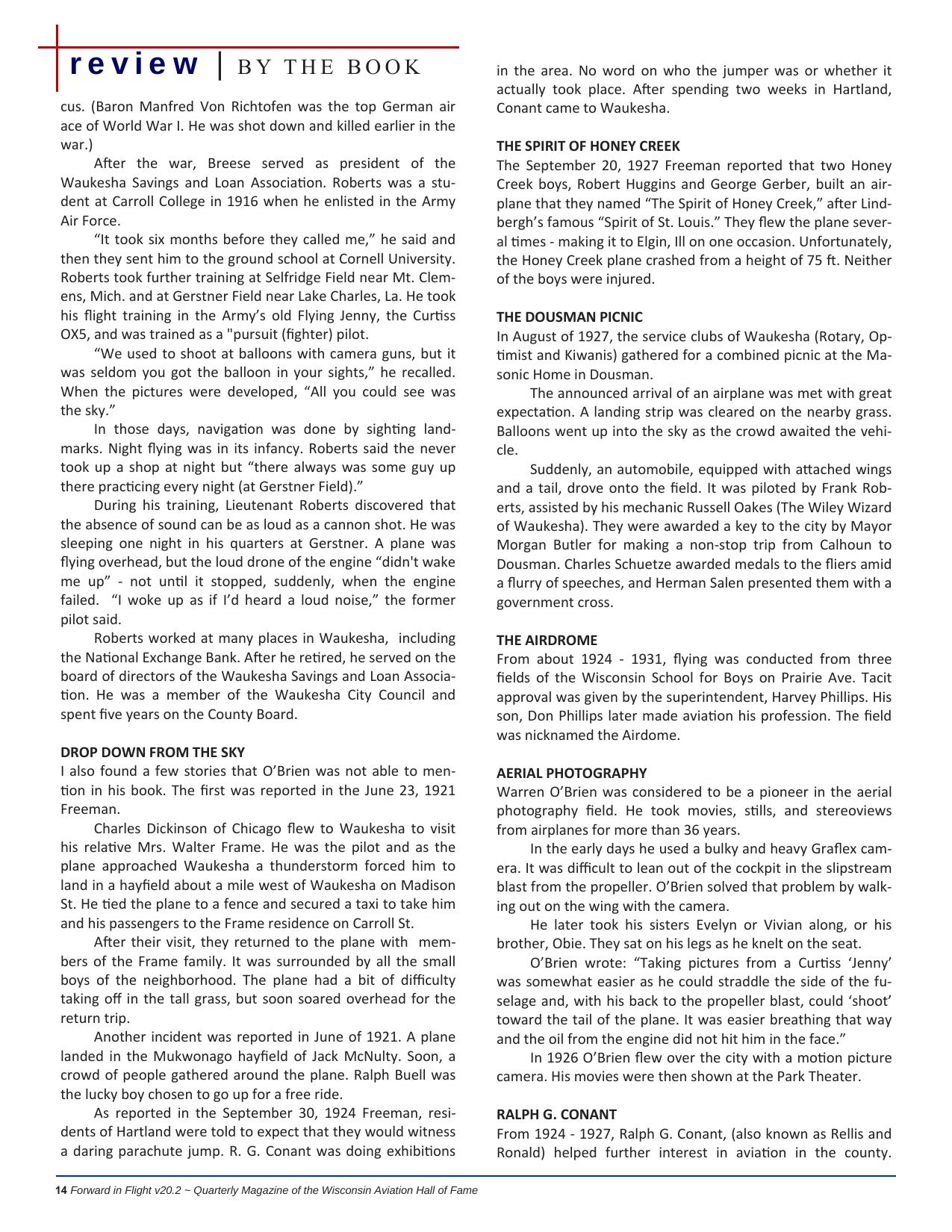
FIRST AIRPLANE LANDS IN CITY OF WAUKESHA ‐ 1919 OR DID IT? According to Warren O’Brien, the first airplane to land in the city of Waukesha was some me in 1919. The exact date is lost. John Weber, Jr., president of the Waukesha (Moor) Mud Baths, had cut down a tree on his new golf course to oblige the pilot. The pilot, whose name is also lost to history, had made the request a few days before the event. “Undoubtedly, many boys swimming in the Fox River at the ‘Willow Hole,’ or the ‘Mud Hole,’ at the East and West Quarries and Weber’s Pond had clear views of this first airplane to fly over part of the city, and land,” wrote O’Brien. John Weber, Jr., called photographer Warren O’Brien to record the event. O’Brien did not record the date and it was not men oned in the Freeman. The plane was an early model ‘Standard’ airplane with a Gnome rotary engine. Iden fied in the crowd at le of picture was John Weber, Sr., and Colonel Elihu Enos who lived adjacent to the Moor Bath property. Irv Walrabenstein was standing at the strut waving his hat. The man at the extreme right with straw hat was John Weber, Jr., and the smallest boy near the plane is thought to be John Weber III, and the girl, his sister, Mary. But the iden fica on of the children by John Weber III himself was uncertain. However, when I researched an earlier column about celebra ons in Waukesha, I found that at the 1916 Waukesha Homecoming celebra on there was an aerial display by Louis Gertson on July 3rd and 4th. The Homecoming celebra ons were planned to welcome ci zens from all over the country to return to visit Waukesha. The Freeman reported that “his plane took off at sunset and the people of Waukesha were mesmerized by the spectacle of an airplane in flight, the golden sun reflected on its wings. He performed a series of loops, turned the plane on its side and finally landed at Moor Downs, thoroughly deligh ng the crowd.” If the newspaper reports are accurate, the first plane that landed in Waukesha was in 1916, not 1919. It is possible B Y T H E B O O K | r ev i e w that the photo was taken in 1916, but that would mean the small boy on the right is not John Weber III, since he was born in 1914 and would have only been 2 at the me. So the dilemma is that if this photo is of the first plane that landed in Waukesha, it was taken in 1916. If it was truly taken in 1919, then it was not of the first plane to land in Waukesha. John Weber III did recall other planes landing at Moor Downs, so this photo may have been taken of one of those landings. THE 1920s Another sec on of O’Brien’s book dealt with avia on personali es who made their mark in the 1920s. The decade of the “flapper era” saw huge advancements in the science of avia on. Planes became bigger, stronger and more durable. But despite that, as I researched, I found many stories of airplane crashes and tragedies. Flying was s ll somewhat risky. And of course, the world was mesmerized by Charles Lindbergh’s first solo flight across the Atlan c. The May 21, 1927 Freeman headline for that event was huge - “Lindbergh Sighted,” it read. CLINTON BREESE and FRANK ROBERTS Clinton Breese and Frank Roberts were both WW I pilots. Breese was an observer with the American Expedi onary Forces over the Argonne Forest in northeastern France when he was shot down on Oct. 29. 1918. It was just two weeks before the Armis ce. On that day, Breese was serving as observer in the French-built Salmon two-seater with twin .30 caliber machine guns. He had obtained the rank of second lieutenant. He also served as the plane’s gunner and navigator. Breese recalled in a 1971 Freeman ar cle by Len Worzalla. “We were flying along and just making a turn when this guy came up under our belly.” The German pilot, in a Fokker class plane, sprayed the underside of Breese’s plane with machine gun bullets - knocking out struts and wounding the pilot. “We were flying at 4,800 feet when this guy hit us,” he said, “and we dove to 1,500 before we straightened out.” The plane crash-landed within Allied lines First plane to land in Waukesha? Identified in the crowd at left in this photo are John Weber, Sr., and Colonel Elihu Enos. Irv Walrabenstein is standing at the strut waving his hat. The and Breese and the pilot were rescued. Breese man at the extreme right with straw hat is John Weber, Jr., and the smallest boy near the later discovered that the German pilot was one plane is thought to be John Weber III, and the girl, his sister, Mary. But the identification of the children by John Weber III himself was uncertain. photo from: John Schoenknecht of the last remnants of Richtofen’s Flying CirWaukesha Daily Freeman 13 Forward in Flight ~ Summer 2022
r ev i e w | B Y T H E B O O K cus. (Baron Manfred Von Richtofen was the top German air ace of World War I. He was shot down and killed earlier in the war.) A er the war, Breese served as president of the Waukesha Savings and Loan Associa on. Roberts was a student at Carroll College in 1916 when he enlisted in the Army Air Force. “It took six months before they called me,” he said and then they sent him to the ground school at Cornell University. Roberts took further training at Selfridge Field near Mt. Clemens, Mich. and at Gerstner Field near Lake Charles, La. He took his flight training in the Army’s old Flying Jenny, the Cur ss OX5, and was trained as a "pursuit (fighter) pilot. “We used to shoot at balloons with camera guns, but it was seldom you got the balloon in your sights,” he recalled. When the pictures were developed, “All you could see was the sky.” In those days, naviga on was done by sigh ng landmarks. Night flying was in its infancy. Roberts said the never took up a shop at night but “there always was some guy up there prac cing every night (at Gerstner Field).” During his training, Lieutenant Roberts discovered that the absence of sound can be as loud as a cannon shot. He was sleeping one night in his quarters at Gerstner. A plane was flying overhead, but the loud drone of the engine “didn't wake me up” - not un l it stopped, suddenly, when the engine failed. “I woke up as if I’d heard a loud noise,” the former pilot said. Roberts worked at many places in Waukesha, including the Na onal Exchange Bank. A er he re red, he served on the board of directors of the Waukesha Savings and Loan Associaon. He was a member of the Waukesha City Council and spent five years on the County Board. DROP DOWN FROM THE SKY I also found a few stories that O’Brien was not able to menon in his book. The first was reported in the June 23, 1921 Freeman. Charles Dickinson of Chicago flew to Waukesha to visit his rela ve Mrs. Walter Frame. He was the pilot and as the plane approached Waukesha a thunderstorm forced him to land in a hayfield about a mile west of Waukesha on Madison St. He ed the plane to a fence and secured a taxi to take him and his passengers to the Frame residence on Carroll St. A er their visit, they returned to the plane with members of the Frame family. It was surrounded by all the small boys of the neighborhood. The plane had a bit of difficulty taking off in the tall grass, but soon soared overhead for the return trip. Another incident was reported in June of 1921. A plane landed in the Mukwonago hayfield of Jack McNulty. Soon, a crowd of people gathered around the plane. Ralph Buell was the lucky boy chosen to go up for a free ride. As reported in the September 30, 1924 Freeman, residents of Hartland were told to expect that they would witness a daring parachute jump. R. G. Conant was doing exhibi ons 14 Forward in Flight v20.2 ~ Quarterly Magazine of the Wisconsin Aviation Hall of Fame in the area. No word on who the jumper was or whether it actually took place. A er spending two weeks in Hartland, Conant came to Waukesha. THE SPIRIT OF HONEY CREEK The September 20, 1927 Freeman reported that two Honey Creek boys, Robert Huggins and George Gerber, built an airplane that they named “The Spirit of Honey Creek,” a er Lindbergh’s famous “Spirit of St. Louis.” They flew the plane several mes - making it to Elgin, Ill on one occasion. Unfortunately, the Honey Creek plane crashed from a height of 75 . Neither of the boys were injured. THE DOUSMAN PICNIC In August of 1927, the service clubs of Waukesha (Rotary, Opmist and Kiwanis) gathered for a combined picnic at the Masonic Home in Dousman. The announced arrival of an airplane was met with great expecta on. A landing strip was cleared on the nearby grass. Balloons went up into the sky as the crowd awaited the vehicle. Suddenly, an automobile, equipped with a ached wings and a tail, drove onto the field. It was piloted by Frank Roberts, assisted by his mechanic Russell Oakes (The Wiley Wizard of Waukesha). They were awarded a key to the city by Mayor Morgan Butler for making a non-stop trip from Calhoun to Dousman. Charles Schuetze awarded medals to the fliers amid a flurry of speeches, and Herman Salen presented them with a government cross. THE AIRDROME From about 1924 - 1931, flying was conducted from three fields of the Wisconsin School for Boys on Prairie Ave. Tacit approval was given by the superintendent, Harvey Phillips. His son, Don Phillips later made avia on his profession. The field was nicknamed the Airdome. AERIAL PHOTOGRAPHY Warren O’Brien was considered to be a pioneer in the aerial photography field. He took movies, s lls, and stereoviews from airplanes for more than 36 years. In the early days he used a bulky and heavy Graflex camera. It was difficult to lean out of the cockpit in the slipstream blast from the propeller. O’Brien solved that problem by walking out on the wing with the camera. He later took his sisters Evelyn or Vivian along, or his brother, Obie. They sat on his legs as he knelt on the seat. O’Brien wrote: “Taking pictures from a Cur ss ‘Jenny’ was somewhat easier as he could straddle the side of the fuselage and, with his back to the propeller blast, could ‘shoot’ toward the tail of the plane. It was easier breathing that way and the oil from the engine did not hit him in the face.” In 1926 O’Brien flew over the city with a mo on picture camera. His movies were then shown at the Park Theater. RALPH G. CONANT From 1924 - 1927, Ralph G. Conant, (also known as Rellis and Ronald) helped further interest in avia on in the county.
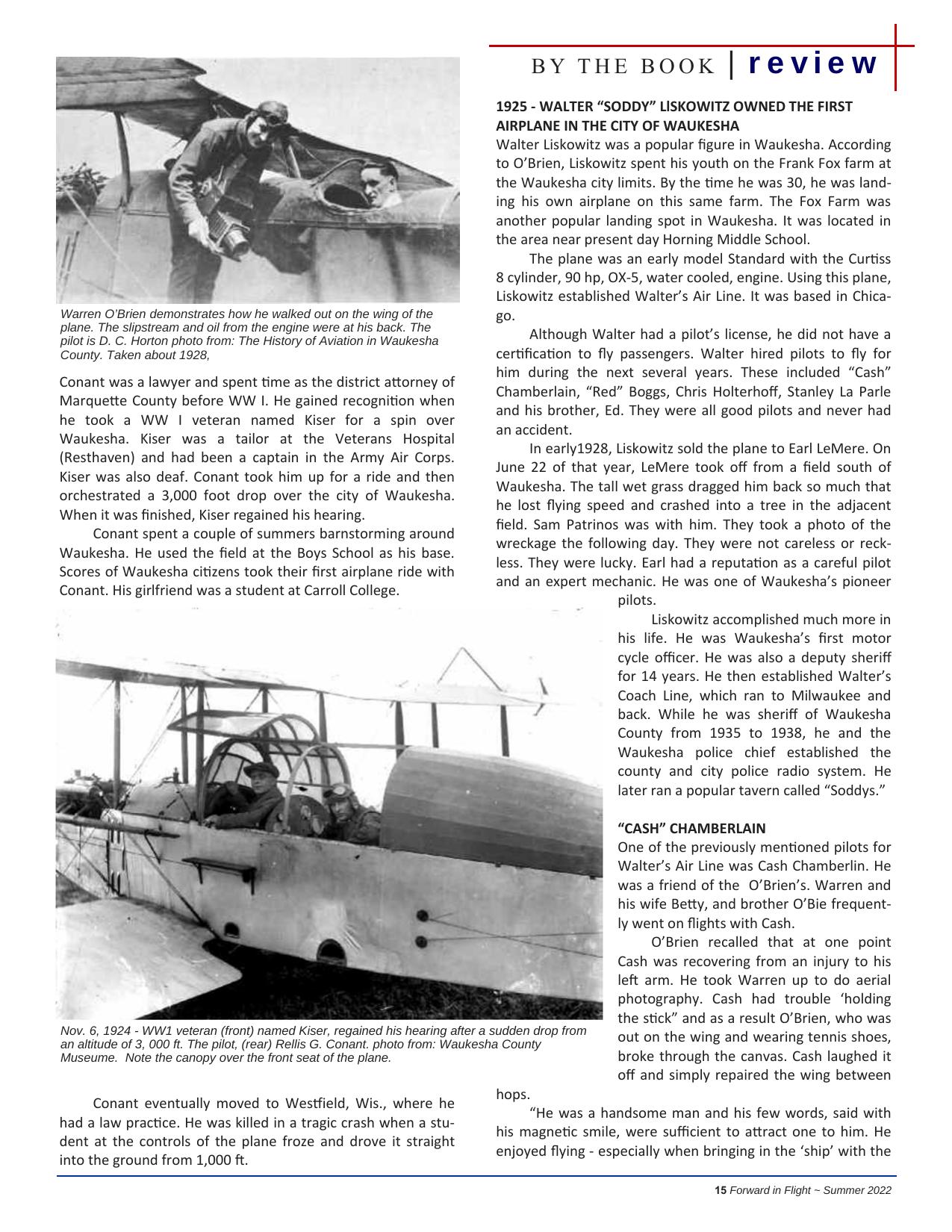
B Y T H E B O O K | r ev i e w Warren O’Brien demonstrates how he walked out on the wing of the plane. The slipstream and oil from the engine were at his back. The pilot is D. C. Horton photo from: The History of Aviation in Waukesha County. Taken about 1928, Conant was a lawyer and spent me as the district a orney of Marque e County before WW I. He gained recogni on when he took a WW I veteran named Kiser for a spin over Waukesha. Kiser was a tailor at the Veterans Hospital (Resthaven) and had been a captain in the Army Air Corps. Kiser was also deaf. Conant took him up for a ride and then orchestrated a 3,000 foot drop over the city of Waukesha. When it was finished, Kiser regained his hearing. Conant spent a couple of summers barnstorming around Waukesha. He used the field at the Boys School as his base. Scores of Waukesha ci zens took their first airplane ride with Conant. His girlfriend was a student at Carroll College. 1925 ‐ WALTER “SODDY” LlSKOWITZ OWNED THE FIRST AIRPLANE IN THE CITY OF WAUKESHA Walter Liskowitz was a popular figure in Waukesha. According to O’Brien, Liskowitz spent his youth on the Frank Fox farm at the Waukesha city limits. By the me he was 30, he was landing his own airplane on this same farm. The Fox Farm was another popular landing spot in Waukesha. It was located in the area near present day Horning Middle School. The plane was an early model Standard with the Cur ss 8 cylinder, 90 hp, OX-5, water cooled, engine. Using this plane, Liskowitz established Walter’s Air Line. It was based in Chicago. Although Walter had a pilot’s license, he did not have a cer fica on to fly passengers. Walter hired pilots to fly for him during the next several years. These included “Cash” Chamberlain, “Red” Boggs, Chris Holterhoff, Stanley La Parle and his brother, Ed. They were all good pilots and never had an accident. In early1928, Liskowitz sold the plane to Earl LeMere. On June 22 of that year, LeMere took off from a field south of Waukesha. The tall wet grass dragged him back so much that he lost flying speed and crashed into a tree in the adjacent field. Sam Patrinos was with him. They took a photo of the wreckage the following day. They were not careless or reckless. They were lucky. Earl had a reputa on as a careful pilot and an expert mechanic. He was one of Waukesha’s pioneer pilots. Liskowitz accomplished much more in his life. He was Waukesha’s first motor cycle officer. He was also a deputy sheriff for 14 years. He then established Walter’s Coach Line, which ran to Milwaukee and back. While he was sheriff of Waukesha County from 1935 to 1938, he and the Waukesha police chief established the county and city police radio system. He later ran a popular tavern called “Soddys.” Nov. 6, 1924 - WW1 veteran (front) named Kiser, regained his hearing after a sudden drop from an altitude of 3, 000 ft. The pilot, (rear) Rellis G. Conant. photo from: Waukesha County Museume. Note the canopy over the front seat of the plane. Conant eventually moved to Wes ield, Wis., where he had a law prac ce. He was killed in a tragic crash when a student at the controls of the plane froze and drove it straight into the ground from 1,000 . “CASH” CHAMBERLAIN One of the previously men oned pilots for Walter’s Air Line was Cash Chamberlin. He was a friend of the O’Brien’s. Warren and his wife Be y, and brother O’Bie frequently went on flights with Cash. O’Brien recalled that at one point Cash was recovering from an injury to his le arm. He took Warren up to do aerial photography. Cash had trouble ‘holding the s ck” and as a result O’Brien, who was out on the wing and wearing tennis shoes, broke through the canvas. Cash laughed it off and simply repaired the wing between hops. “He was a handsome man and his few words, said with his magne c smile, were sufficient to a ract one to him. He enjoyed flying - especially when bringing in the ‘ship’ with the 15 Forward in Flight ~ Summer 2022
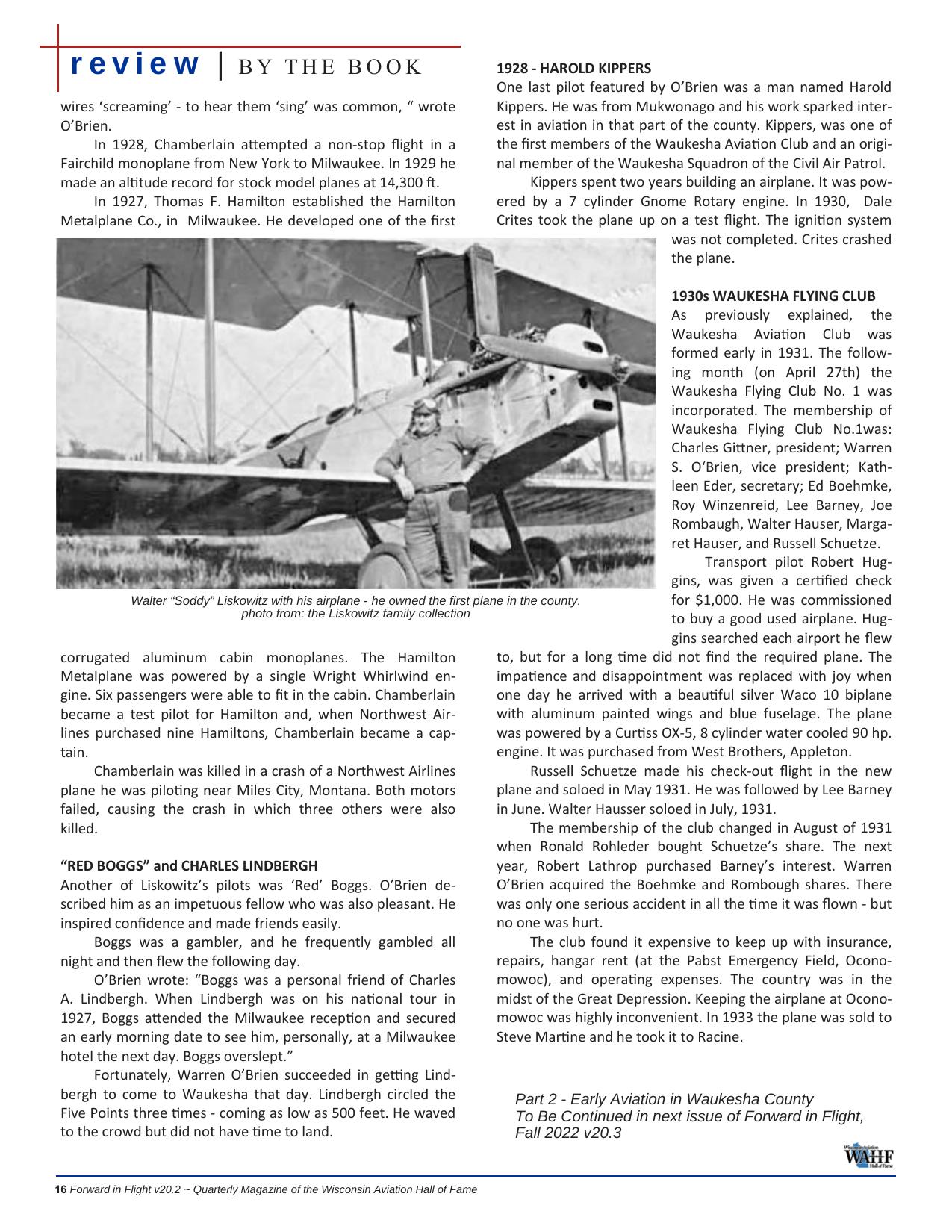
r ev i e w | B Y T H E B O O K wires ‘screaming’ - to hear them ‘sing’ was common, “ wrote O’Brien. In 1928, Chamberlain a empted a non-stop flight in a Fairchild monoplane from New York to Milwaukee. In 1929 he made an al tude record for stock model planes at 14,300 . In 1927, Thomas F. Hamilton established the Hamilton Metalplane Co., in Milwaukee. He developed one of the first 1928 ‐ HAROLD KIPPERS One last pilot featured by O’Brien was a man named Harold Kippers. He was from Mukwonago and his work sparked interest in avia on in that part of the county. Kippers, was one of the first members of the Waukesha Avia on Club and an original member of the Waukesha Squadron of the Civil Air Patrol. Kippers spent two years building an airplane. It was powered by a 7 cylinder Gnome Rotary engine. In 1930, Dale Crites took the plane up on a test flight. The igni on system was not completed. Crites crashed the plane. 1930s WAUKESHA FLYING CLUB As previously explained, the Waukesha Avia on Club was formed early in 1931. The following month (on April 27th) the Waukesha Flying Club No. 1 was incorporated. The membership of Waukesha Flying Club No.1was: Charles Gi ner, president; Warren S. O‘Brien, vice president; Kathleen Eder, secretary; Ed Boehmke, Roy Winzenreid, Lee Barney, Joe Rombaugh, Walter Hauser, Margaret Hauser, and Russell Schuetze. Transport pilot Robert Huggins, was given a cer fied check Walter “Soddy” Liskowitz with his airplane - he owned the first plane in the county. for $1,000. He was commissioned photo from: the Liskowitz family collection to buy a good used airplane. Huggins searched each airport he flew to, but for a long me did not find the required plane. The corrugated aluminum cabin monoplanes. The Hamilton impa ence and disappointment was replaced with joy when Metalplane was powered by a single Wright Whirlwind enone day he arrived with a beau ful silver Waco 10 biplane gine. Six passengers were able to fit in the cabin. Chamberlain with aluminum painted wings and blue fuselage. The plane became a test pilot for Hamilton and, when Northwest Airwas powered by a Cur ss OX-5, 8 cylinder water cooled 90 hp. lines purchased nine Hamiltons, Chamberlain became a capengine. It was purchased from West Brothers, Appleton. tain. Russell Schuetze made his check-out flight in the new Chamberlain was killed in a crash of a Northwest Airlines plane and soloed in May 1931. He was followed by Lee Barney plane he was pilo ng near Miles City, Montana. Both motors in June. Walter Hausser soloed in July, 1931. failed, causing the crash in which three others were also The membership of the club changed in August of 1931 killed. when Ronald Rohleder bought Schuetze’s share. The next year, Robert Lathrop purchased Barney’s interest. Warren “RED BOGGS” and CHARLES LINDBERGH O’Brien acquired the Boehmke and Rombough shares. There Another of Liskowitz’s pilots was ‘Red’ Boggs. O’Brien dewas only one serious accident in all the me it was flown - but scribed him as an impetuous fellow who was also pleasant. He no one was hurt. inspired confidence and made friends easily. The club found it expensive to keep up with insurance, Boggs was a gambler, and he frequently gambled all repairs, hangar rent (at the Pabst Emergency Field, Ocononight and then flew the following day. mowoc), and opera ng expenses. The country was in the O’Brien wrote: “Boggs was a personal friend of Charles midst of the Great Depression. Keeping the airplane at OconoA. Lindbergh. When Lindbergh was on his na onal tour in mowoc was highly inconvenient. In 1933 the plane was sold to 1927, Boggs a ended the Milwaukee recep on and secured Steve Mar ne and he took it to Racine. an early morning date to see him, personally, at a Milwaukee hotel the next day. Boggs overslept.” Fortunately, Warren O’Brien succeeded in ge ng Lindbergh to come to Waukesha that day. Lindbergh circled the Part 2 - Early Aviation in Waukesha County Five Points three mes - coming as low as 500 feet. He waved To Be Continued in next issue of Forward in Flight, to the crowd but did not have me to land. Fall 2022 v20.3 16 Forward in Flight v20.2 ~ Quarterly Magazine of the Wisconsin Aviation Hall of Fame
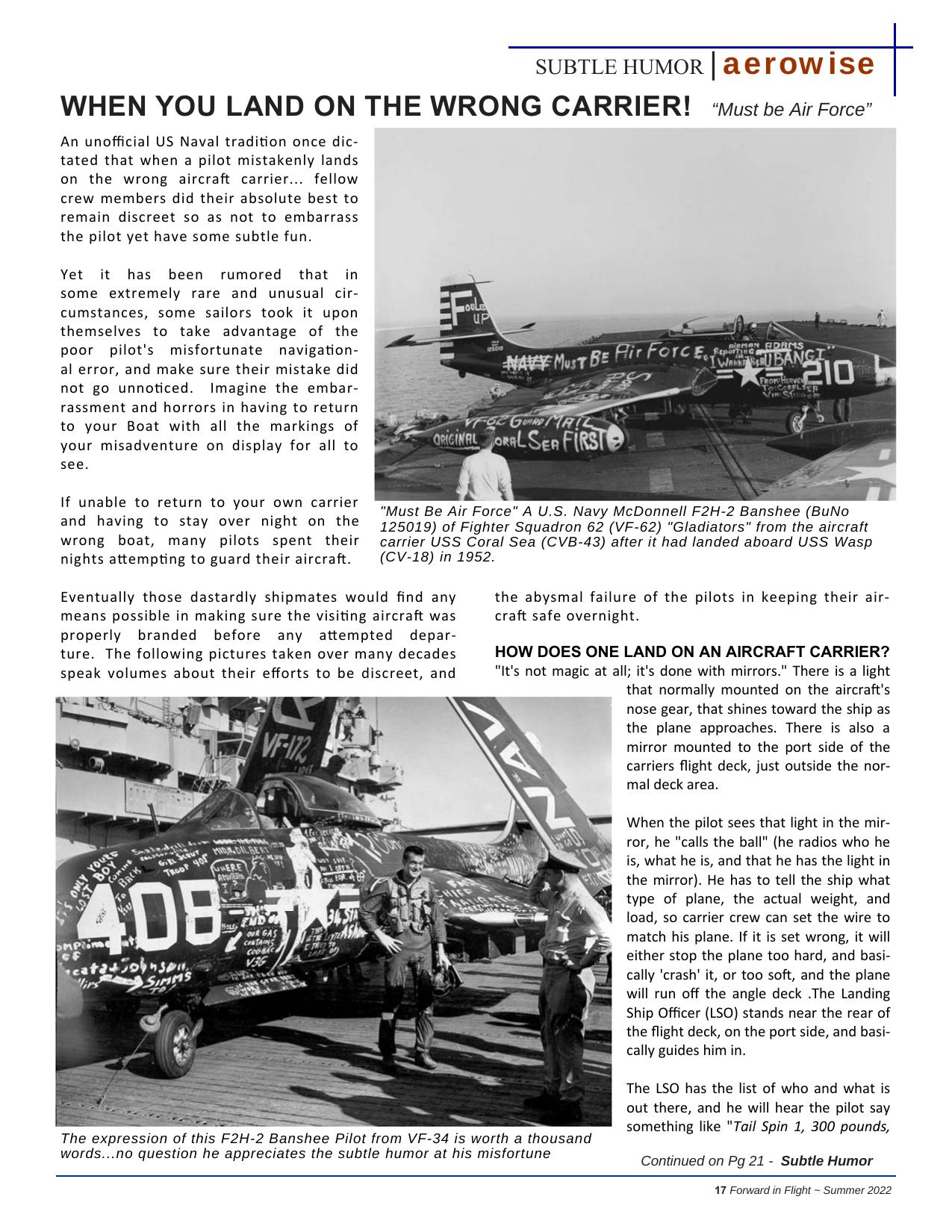
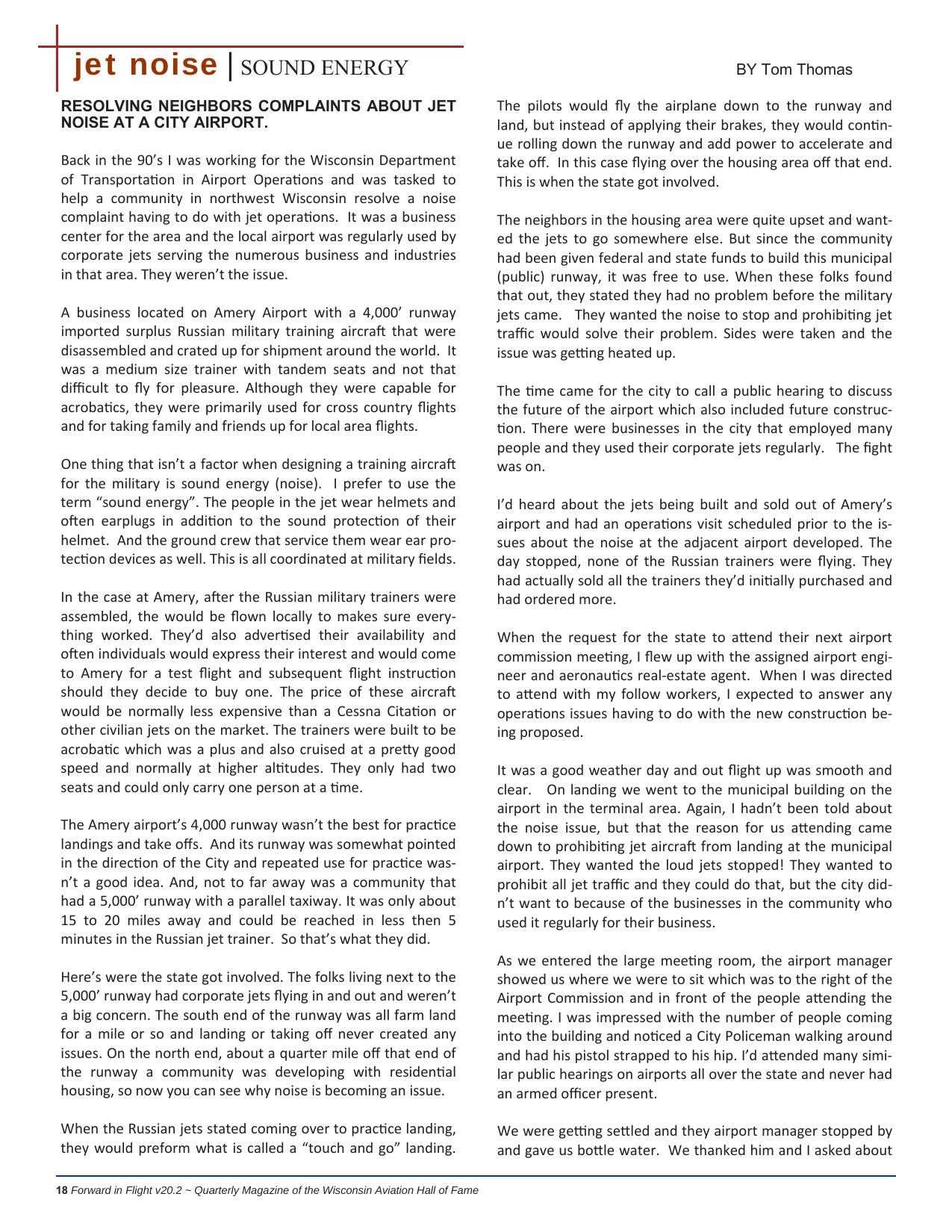
SUBTLE HUMOR | aerowise WHEN YOU LAND ON THE WRONG CARRIER! “Must be Air Force” An unofficial US Naval tradi on once dictated that when a pilot mistakenly lands on the wrong aircra carrier... fellow crew members did their absolute best to remain discreet so as not to embarrass the pilot yet have some subtle fun. Yet it has been rumored that in some extremely rare and unusual circumstances, some sailors took it upon themselves to take advantage of the poor pilot's misfortunate naviga onal error, and make sure their mistake did not go unno ced. Imagine the embarrassment and horrors in having to return to your Boat with all the markings of your misadventure on display for all to see. If unable to return to your own carrier and having to stay over night on the wrong boat, many pilots spent their nights a emp ng to guard their aircra . "Must Be Air Force" A U.S. Navy McDonnell F2H-2 Banshee (BuNo 125019) of Fighter Squadron 62 (VF-62) "Gladiators" from the aircraft carrier USS Coral Sea (CVB-43) after it had landed aboard USS Wasp (CV-18) in 1952. Eventually those dastardly shipmates would find any means possible in making sure the visi ng aircra was properly branded before any a empted departure. The following pictures taken over many decades speak volumes about their efforts to be discreet, and the abysmal failure of the pilots in keeping their aircra safe overnight. HOW DOES ONE LAND ON AN AIRCRAFT CARRIER? "It's not magic at all; it's done with mirrors." There is a light that normally mounted on the aircra 's nose gear, that shines toward the ship as the plane approaches. There is also a mirror mounted to the port side of the carriers flight deck, just outside the normal deck area. When the pilot sees that light in the mirror, he "calls the ball" (he radios who he is, what he is, and that he has the light in the mirror). He has to tell the ship what type of plane, the actual weight, and load, so carrier crew can set the wire to match his plane. If it is set wrong, it will either stop the plane too hard, and basically 'crash' it, or too so , and the plane will run off the angle deck .The Landing Ship Officer (LSO) stands near the rear of the flight deck, on the port side, and basically guides him in. The expression of this F2H-2 Banshee Pilot from VF-34 is worth a thousand words...no question he appreciates the subtle humor at his misfortune The LSO has the list of who and what is out there, and he will hear the pilot say something like "Tail Spin 1, 300 pounds, Continued on Pg 21 - Subtle Humor 17 Forward in Flight ~ Summer 2022
jet noise | SOUND ENERGY RESOLVING NEIGHBORS COMPLAINTS ABOUT JET NOISE AT A CITY AIRPORT. Back in the 90’s I was working for the Wisconsin Department of Transporta on in Airport Opera ons and was tasked to help a community in northwest Wisconsin resolve a noise complaint having to do with jet opera ons. It was a business center for the area and the local airport was regularly used by corporate jets serving the numerous business and industries in that area. They weren’t the issue. A business located on Amery Airport with a 4,000’ runway imported surplus Russian military training aircra that were disassembled and crated up for shipment around the world. It was a medium size trainer with tandem seats and not that difficult to fly for pleasure. Although they were capable for acroba cs, they were primarily used for cross country flights and for taking family and friends up for local area flights. One thing that isn’t a factor when designing a training aircra for the military is sound energy (noise). I prefer to use the term “sound energy”. The people in the jet wear helmets and o en earplugs in addi on to the sound protec on of their helmet. And the ground crew that service them wear ear protec on devices as well. This is all coordinated at military fields. In the case at Amery, a er the Russian military trainers were assembled, the would be flown locally to makes sure everything worked. They’d also adver sed their availability and o en individuals would express their interest and would come to Amery for a test flight and subsequent flight instruc on should they decide to buy one. The price of these aircra would be normally less expensive than a Cessna Cita on or other civilian jets on the market. The trainers were built to be acroba c which was a plus and also cruised at a pre y good speed and normally at higher al tudes. They only had two seats and could only carry one person at a me. The Amery airport’s 4,000 runway wasn’t the best for prac ce landings and take offs. And its runway was somewhat pointed in the direc on of the City and repeated use for prac ce wasn’t a good idea. And, not to far away was a community that had a 5,000’ runway with a parallel taxiway. It was only about 15 to 20 miles away and could be reached in less then 5 minutes in the Russian jet trainer. So that’s what they did. BY Tom Thomas The pilots would fly the airplane down to the runway and land, but instead of applying their brakes, they would con nue rolling down the runway and add power to accelerate and take off. In this case flying over the housing area off that end. This is when the state got involved. The neighbors in the housing area were quite upset and wanted the jets to go somewhere else. But since the community had been given federal and state funds to build this municipal (public) runway, it was free to use. When these folks found that out, they stated they had no problem before the military jets came. They wanted the noise to stop and prohibi ng jet traffic would solve their problem. Sides were taken and the issue was ge ng heated up. The me came for the city to call a public hearing to discuss the future of the airport which also included future construcon. There were businesses in the city that employed many people and they used their corporate jets regularly. The fight was on. I’d heard about the jets being built and sold out of Amery’s airport and had an opera ons visit scheduled prior to the issues about the noise at the adjacent airport developed. The day stopped, none of the Russian trainers were flying. They had actually sold all the trainers they’d ini ally purchased and had ordered more. When the request for the state to a end their next airport commission mee ng, I flew up with the assigned airport engineer and aeronau cs real-estate agent. When I was directed to a end with my follow workers, I expected to answer any opera ons issues having to do with the new construc on being proposed. It was a good weather day and out flight up was smooth and clear. On landing we went to the municipal building on the airport in the terminal area. Again, I hadn’t been told about the noise issue, but that the reason for us a ending came down to prohibi ng jet aircra from landing at the municipal airport. They wanted the loud jets stopped! They wanted to prohibit all jet traffic and they could do that, but the city didn’t want to because of the businesses in the community who used it regularly for their business. Here’s were the state got involved. The folks living next to the 5,000’ runway had corporate jets flying in and out and weren’t a big concern. The south end of the runway was all farm land for a mile or so and landing or taking off never created any issues. On the north end, about a quarter mile off that end of the runway a community was developing with residen al housing, so now you can see why noise is becoming an issue. As we entered the large mee ng room, the airport manager showed us where we were to sit which was to the right of the Airport Commission and in front of the people a ending the mee ng. I was impressed with the number of people coming into the building and no ced a City Policeman walking around and had his pistol strapped to his hip. I’d a ended many similar public hearings on airports all over the state and never had an armed officer present. When the Russian jets stated coming over to prac ce landing, they would preform what is called a “touch and go” landing. We were ge ng se led and they airport manager stopped by and gave us bo le water. We thanked him and I asked about 18 Forward in Flight v20.2 ~ Quarterly Magazine of the Wisconsin Aviation Hall of Fame
the need for the armed policeman. He said that at the last airport commission mee ng a man from the crowd got into an argument with one of the commission members and went up to where the board was si ng and punched him out. Wow, this was going to be an interes ng mee ng. The Commission Chairman called for the mee ng to begin at 7pm. People sat down and he introduced himself and the other Commission members. A er explaining what was to be covered, he said: “Now I’ll turn the mee ng over to Tom Thomas from the Wisconsin Bureau of Aeronau cs.” Surprise – Surprise – Surprise! I stood up and introduced myself and the other two fellow aeronau cs staff with me. I gave a brief statement of what are func ons were in the process and that we were there to answer ques ons. And with that, I asked the first individual closest to us to begin. We answered their ques ons from the first 5 or 6 individuals. The next individual stood up with one of our “Wisconsin Guide to Airport Administra on” in his hand with a good number of yellow tabs s cking out the side. He smiled and said “Well Mr. Thomas, I have some ques ons from Your Book!” The crowd was impressed and then things got real quiet. I was relaxed and smiling inside because I’d help write that book and used it as my “Airport Administrators Bible”. He took the first yellow tab and asked his ques on. People were listening and wai ng to hear the reply. It was an easy one and he was sa sfied as so were all others listening. He ended going through the en re booklet and I was able to answer all his ques ons without referring to any booklets or material we’d brought with us. The ques ons were good and they all were sa sfied with the answers they heard because they made sense. When he finally ran out of ques ons he sat down and I went to the next person. There weren’t to many more ques ons asked because everything was covered in the book. It was about the 5th individual’s turn and he stood up and said “I don’t have any ques ons because Mr. Thomas has already covered everything we need to know.” He then sat down and people chuckled. We con nued and it went smoothly with only a few more ques ons. The crowd was se led and had apparently heard they things they needed to know and it made sense. The mee ng was wrapped up and we were ge ng ready to preflight out aircra for the flight home. This is when I’d heard about the anger and frustra on with the Russian Military jets doing their touch and go landings and realizing how loud and annoying it would be. I’d thought about what was going on and the neighbors need to end it. I had served my military career as an Air Force pilot. I flew large airplane tanker and cargo aircra both in the Air Force and the Wisconsin Air Na onal Guard. My last aircra that I flew was the A-10 close air support aircra that only had one seat. From my first flight to my last, they were all solo. I’d flown the single seat fighter jet for over 12 years and never SOUND ENERGY | jet noise did a single, not one, touch and go landing. The Air Force had actually prohibited fighter aircra from sho ng touch and go landings. That meant if were going to get mul ple landings, we made a full stop and taxied back and took off for the next landing which was also a full stop. Again, primarily for safety. A er thinking about this op on, I proposed it to the airport manager that they consider imposing those criteria for jet traffic at their airport. All cooperate traffic landings were always full stop. This was no problem. And that’s what the Airport Commission did. When a jet lands and has to taxi all the way back to get ready to take off for the next landing, it burns jet fuel that they could be used for flying. Those Russian fighters were not known for their fuel efficiency, so their owners never came back to the airport to land, which they could do. They just had to taxi back to take off again. And the beat goes on. The flight home was good as we had clear skies, smooth air and a strong tailwind. Tom Thomas TRANSITION FIFO April 1993. Aircra 87-252 was the first (first in - FI) F-16 Figh ng Falcon received by the 115th Fighter Wing of Madison’s Wisconsin Air Na onal Guard when transi oning from the A-10 Thunderbolt II. Crewed by SMSgt Duane “DuDu” Peterson during it’s en re period in Madison, it is the first (first out - FO) F-16 to leave as the 115th begins its transi on to the F-35 Lightning II. INVESTITURE 2022 The 2022 Wisconsin Avia on Hall of Fame Inves ture ceremony will be held Saturday, 22 October ath the EAA AirVenture Museum in Oshkosh. Join us! As we kick off our evening with a gathering of aviaon professionals, past and new Inductees, your avia on family and friends at our no host recep on star ng at 5:00 p.m., banquet dinner at 6:00 p.m. followed by the inves ture of our 2022 inductees. Invita ons will be mailed the first week of September. Addi onal details on each of our Inductees will appear in the Winter issue of Forward In Flight. 19 Forward in Flight ~ Summer 2022
Continued from Pg. 3 - Presidents Message Maverick (Tom Cruise) and the F-18. The ads on television looked interes ng and a er talking it over within family, some of us went to the theater and we weren’t disappointed. I’d seen the original “Top Gun” movie and the new one was well done as a follow-on and had many exci ng edge of our seat flying scenes throughout the movie. A er the movie, I went on line and searched for “YF-17”. Up came a picture of the YF-17 ge ng ready to refuel with a KC-97L. In this photo, the ‘97 was assigned to the Texas ANG who also parcipated in the flight tests. With having a tanker on hand, all of the data collected on the flights were completed in record me. Flying out of Edwards was smooth and professional. Missions were thoroughly briefed and flown. Our Milwaukee ’97 flew great without any write ups! The results of those missions are now history. Seeing the Navy’s F-18 Blue Angels is always a crowd YF-17 Being Refueled by Texas ANG KC-97L The test pilots had “good hands” and were stable throughout the fuel transfers. Once full, they’d disconnect and go back to their test area and proceed with their profile for the day. We were told we couldn’t take pictures of these or other airplanes we refueled because of the security of the en re program. We could take pictures with our eyes and what a beau ful site. pleaser. The Top Gun movie showed some of the high-performance capabili es of the F-18 which was the final product of those flight tests back in 1974. We flew every day we were at Edward AFB and never had any write-ups with our aircra . It was a good aircra (all of Milwaukee’s were good), and from takeoff from Milwaukee to our return home two weeks later, we only had one write-up on our UHF radio with occasional sta c. Standing back and looking at the choices, one can see the F-18 has two engines and the F-16, one. The F-16 is a good jet and has just one engine. If I was flying off a carrier, I’d be more comfortable with two engines which would get me back to the carrier if one quit. All Navy pilots know how to swim, but if your given a Jet to go out and fly around the sky, they expected you to bring it back. Both the YF-16 and YF-17 had built-in transmi ers to relay performance data to computers on the ground for comparave analysis a er the missions. With the capability to inflight refuel and comple ng mul ple tests in one mission without having to land and refuel, greatly sped up the evalua on process. The weather each day was clear and “a hundred”. I really hadn’t thought much about that 1970s TDY (Temporary Duty) un l the new “Top Gun” movie featuring 20 Forward in Flight v20.2 ~ Quarterly Magazine of the Wisconsin Aviation Hall of Fame YF-17 Top, F-16 Bottom The F-18 flown in the movie Top Gun, was the final product of the YF-17 development program. Since the YF-17 was accepted a er those tests, the Navy has con nued improving it and today it’s now designated the F-18 Super Hornet. Your Wisconsin Air Na onal Guard played a role in history and this final product by par cipa ng in the tes ng and development of our na on’s top fighter aircra , the F-18 and the F-16!
UKRAINE AIRPOWER As the war between Russia and the Ukraine began, Russia had the airpower advantage. According to Globalfirepower.com, this is how the numbers compare to see who has an aerial advantage. RUSSIA The Russian Air Force is based in Moscow and is reported to have: 4,173 aircra & approximately 850,000 personnel. Ranging from: MiG-35, Yak and Sukhoi fighters Special purpose and pursuit aircra Ilyushin and Antonov transports Tupolev Tu 22M, Tu 95 bombers Breaking the numbers down, Russia has: 739 dedicated a ack aircra 445 transports 522 trainers 132 aircra designated as special mission 1,543 helicopters, of which 544 are designated as a ack helicopters UKRAINE AIR FORCE When the Soviet Union dissolved in 1991, it departed Ukraine’s Poltava Air Base leaving behind what became todays Ukrainian Air Force (UAF). Soviet-built fighters such as the MiG-21, 25s and 27s, Sukhoi Su-15, 17 interceptors, and Tupolev Tu160 bombers became the new UAF. The Armed Forces of the Ukraine is Headquartered in the city of Vinnytsia and its Air Force has: 318 aircra & approximately 200,000 personnel. Ranging from: Ilyushin Il-76 mul purpose four-engine aircra Several Antonov transports A small number of MiG-29s and Sukhoi fighters Mi-8 helicopters Breaking the numbers down , the UAF has: 69 fighters 29 dedicated a ack aircra 32 transports 71 trainers 5 aircra designated as special mission 112 helicopters 34 a ack helicopters Over the years, the UAF has replaced the aging Russian and currently is receiving substan al assistance from NATO coun es to sustain and bolster its current fleet of combat aircra . BY THE NUMBERS | data Continued from Pg. 17 - Subtle Humor ball" and the LSO will reply, “Roooooogerball.", le ng the pilot know we are ready for him. ---That's how long it takes to set the gear for that plane. The LSO has a whole 'dashboard' of informa on in front of him showing the arres ng gear se ngs, the wind speed, and all the rest of whatever he needs. As long as that ball from your light stays in the middle of the mirror, you are OK. There are lines on the lens that will tell you if you are too high, too low, too le , or right. Here is the real tricky part: The 'runway' that you must hit is actually only about 5 feet long, and it is moving up, down, le , right, and swaying. You are trying to land on a moving runway, and if you hit too far forward of the wire or too far a of it, you can't grab the wire. And, if you land too far a , you crash into the ship. If you are just a li le too high (just a few feet), your hook will snag the wire, and actually pull you out of the sky. That is called a "Hard Landing", and it will damage the airframe of the plane, and your landing gear. If you hit the deck in front of the wire or behind the wire, your hook will miss it. If you are too far le , you will slide le on the wire, and over the side of the ship. If you are too far right, you will slide on the wire to the right, and up towards the aircra parked there. You must grab the wire that is set for your plane, usually the #2 wire. So, once you are 'on the ball', you must control your descent by using the s ck and the thro le to keep the ball in the middle of the mirror. MORE DATA If it (data) can be recorded, it can be reported. Todays military is a cultural of training and perfec on. Scoring a landing for the purpose of con nuous improvement is, well, con nuous. Carrier pilots receive grades on their landings. If you made a mistake, it will be noted with all of the other landings for all to see. If your landing is bad, it will be scored accurately and your mistakes will be noted. A perfect landing is graded as an "OK-2" That means you did not crash and you hit the #2wire. If you’re landing is scored as a OK-2, you’re landing was perfect. ATMOSPERE OF FEAR What is really scary, is working on the flight deck while wai ng for landings on a bad night. The carrier does not use lights on the roof at night. It is dark, and as an aircra approaches the carrier on a bad night, the carrier can be rolling and tossing or bobbing under you, and from the flight deck you can see that light on the plane going up and down and all over as he closes on the ship. A pilot may even miss “catching the wire” on the first try, but the fear con nues knowing there is absolutely no other place in the vast open sea to land, unless……..there’s another carrier near by. What a mo vator….. land your plane of face subtle humor on another carrier. OH YA, THOSE AIR FORCE PILOTS As awesome as naval aviators are at their jobs, just to have the skill of hi ng the #2 wire in just a li le space they have speaks highly of their pilo ng skills. This is however a skill set, landing on an aircra carrier, that Air Force pilots don't have to train for. 21 Forward in Flight ~ Summer 2022
we fly | WHY WE TAKE FLIGHT WI AIRPORT PASSPORT PROGRAM In 2017, the Wisconsin Department of Transporta on launched a program called the Fly Wisconsin Airport Passport Program. Pilots and passengers can register for free. Each registered par cipant receives their own physical “passport” that contains a blank space for each of Wisconsin’s 125 par cipa ng airports. Each par cipa ng airport has a unique stamp, which is typically available in the FBO or at the fuel pumps. Visitors simply stamp their passports each me they visit an airport and collect stamps to earn prizes. If you collect 42 airport stamps, you get the bronze award, a Fly Wisconsin t-shirt. Making 84 stops earns the silver award, a flight bag. And anyone who visits all 125 par cipa ng airports is rewarded with the gold prize—a leather jacket or a patch and a $100 gi card. Par cipants can also earn points by visi ng eight avia on museums sca ered across the state. Prizes are funded by the Wisconsin Airport Management Associa on, an organiza on that has tasked itself with promo ng safety, economic value, and public benefit at all Wisconsin airports, large and small. In less than five years, the program has a racted roughly 1,900 registered par cipants who have earned 50 bronze, 29 silver, and 20 gold awards. LINKS AND REFERENCES WI DOT: Passport Program Rules h ps://wisconsindot.gov/Pages/travel/air/pilot-info/flywipartair.aspx NOTICE OF ANNUAL MEMBERSHIP MEETING PLEASE JOIN US AT OUR ANNUAL MEMBERSHIP MEETING Your WAHF Board of Directors will be hos ng Our Annual Membership Mee ng On Saturday, October 22nd, 2022 At 2:00 pm in the EAA Museum lower level Ba en Board Room If you have an interest in joining the WAHF Board of Directors, please contact: hpeterson@wisconsinavia onhalloffame.org PLEASE JOIN US AT OUR ANNUAL INDUCTION DINNER IN OSHKOSH ON OCTOBER 22ND! Continued from Page 27 - OXCART On 30 October 1967, pilot Dennis Sullivan detected radar tracking on his first pass over North Vietnam. Two sites prepared to launch missiles but neither did. During the second pass at least six missiles were fired at the OXCART, each confirmed by missile vapor trails on mission photography. Sullivan witnessed three missile detona ons. Post-flight inspec on of the aircra revealed that a piece of metal had penetrated the lower right wing fillet area. The fragment was not a warhead pellet but may have been a part of the debris from one of the missile detona ons Sullivan observed. Between 1 January and 31 March 1968 six missions were flown. Four of these were over North Vietnam and two over North Korea. The first mission over North Korea on 26 January occurred during a very tense period following seizure of the Pueblo on the 23rd. The aim was to discover whether the North Koreans were preparing any large scale hos le move on the heels of this incident. Chinese tracking of the flight was apparent, but no missiles were fired at the plane. 22 Forward in Flight v20.2 ~ Quarterly Magazine of the Wisconsin Aviation Hall of Fame
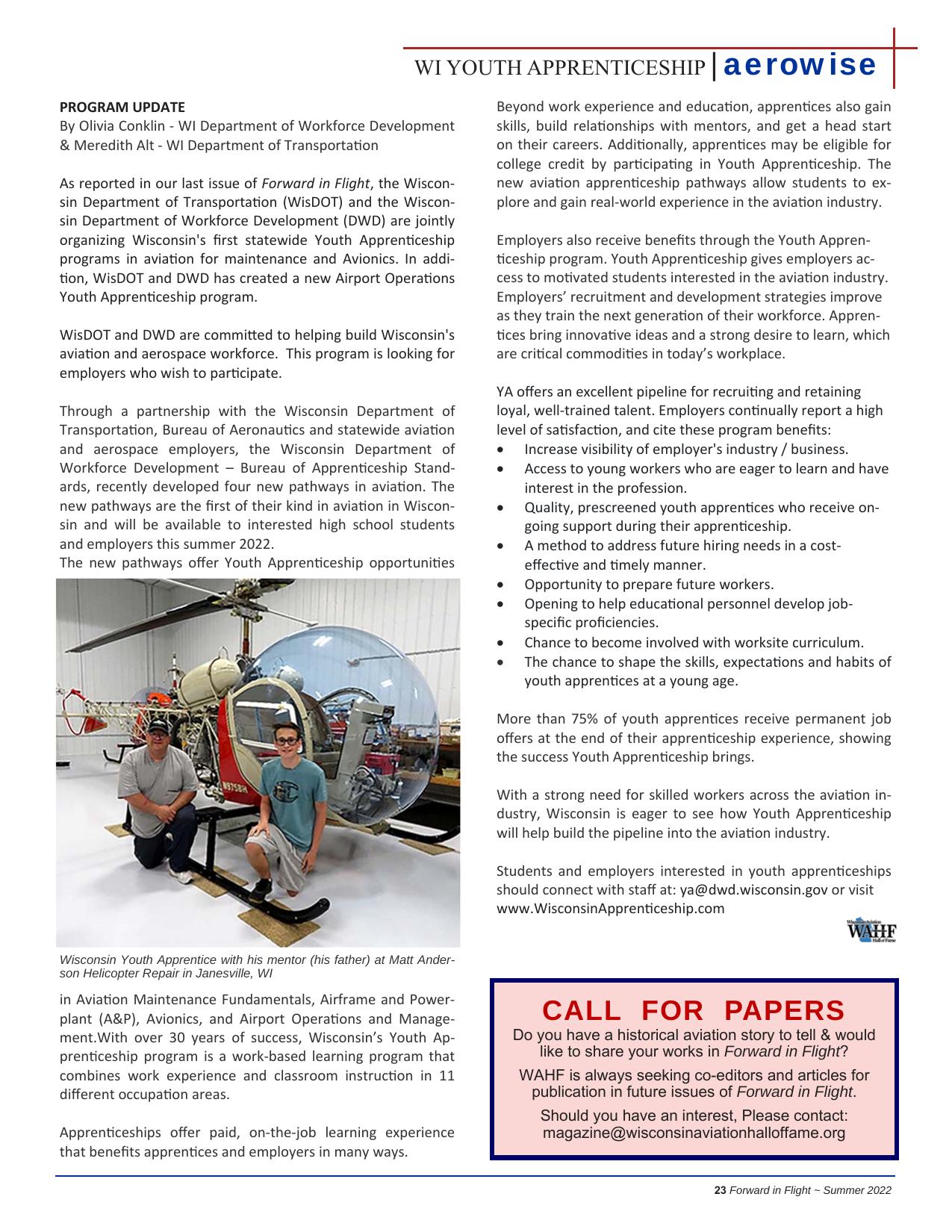
WI YOUTH APPRENTICESHIP | aerowise PROGRAM UPDATE By Olivia Conklin - WI Department of Workforce Development & Meredith Alt - WI Department of Transporta on As reported in our last issue of Forward in Flight, the Wisconsin Department of Transporta on (WisDOT) and the Wisconsin Department of Workforce Development (DWD) are jointly organizing Wisconsin's first statewide Youth Appren ceship programs in avia on for maintenance and Avionics. In addion, WisDOT and DWD has created a new Airport Opera ons Youth Appren ceship program. WisDOT and DWD are commi ed to helping build Wisconsin's avia on and aerospace workforce. This program is looking for employers who wish to par cipate. Through a partnership with the Wisconsin Department of Transporta on, Bureau of Aeronau cs and statewide avia on and aerospace employers, the Wisconsin Department of Workforce Development – Bureau of Appren ceship Standards, recently developed four new pathways in avia on. The new pathways are the first of their kind in avia on in Wisconsin and will be available to interested high school students and employers this summer 2022. The new pathways offer Youth Appren ceship opportuni es Beyond work experience and educa on, appren ces also gain skills, build rela onships with mentors, and get a head start on their careers. Addi onally, appren ces may be eligible for college credit by par cipa ng in Youth Appren ceship. The new avia on appren ceship pathways allow students to explore and gain real-world experience in the avia on industry. Employers also receive benefits through the Youth Apprenceship program. Youth Appren ceship gives employers access to mo vated students interested in the avia on industry. Employers’ recruitment and development strategies improve as they train the next genera on of their workforce. Apprences bring innova ve ideas and a strong desire to learn, which are cri cal commodi es in today’s workplace. YA offers an excellent pipeline for recrui ng and retaining loyal, well-trained talent. Employers con nually report a high level of sa sfac on, and cite these program benefits: Increase visibility of employer's industry / business. Access to young workers who are eager to learn and have interest in the profession. Quality, prescreened youth appren ces who receive ongoing support during their appren ceship. A method to address future hiring needs in a costeffec ve and mely manner. Opportunity to prepare future workers. Opening to help educa onal personnel develop jobspecific proficiencies. Chance to become involved with worksite curriculum. The chance to shape the skills, expecta ons and habits of youth appren ces at a young age. More than 75% of youth appren ces receive permanent job offers at the end of their appren ceship experience, showing the success Youth Appren ceship brings. With a strong need for skilled workers across the avia on industry, Wisconsin is eager to see how Youth Appren ceship will help build the pipeline into the avia on industry. Students and employers interested in youth appren ceships should connect with staff at: ya@dwd.wisconsin.gov or visit www.WisconsinAppren ceship.com Wisconsin Youth Apprentice with his mentor (his father) at Matt Anderson Helicopter Repair in Janesville, WI in Avia on Maintenance Fundamentals, Airframe and Powerplant (A&P), Avionics, and Airport Opera ons and Management.With over 30 years of success, Wisconsin’s Youth Appren ceship program is a work-based learning program that combines work experience and classroom instruc on in 11 different occupa on areas. Appren ceships offer paid, on-the-job learning experience that benefits appren ces and employers in many ways. CALL FOR PAPERS Do you have a historical aviation story to tell & would like to share your works in Forward in Flight? WAHF is always seeking co-editors and articles for publication in future issues of Forward in Flight. Should you have an interest, Please contact: magazine@wisconsinaviationhalloffame.org 23 Forward in Flight ~ Summer 2022
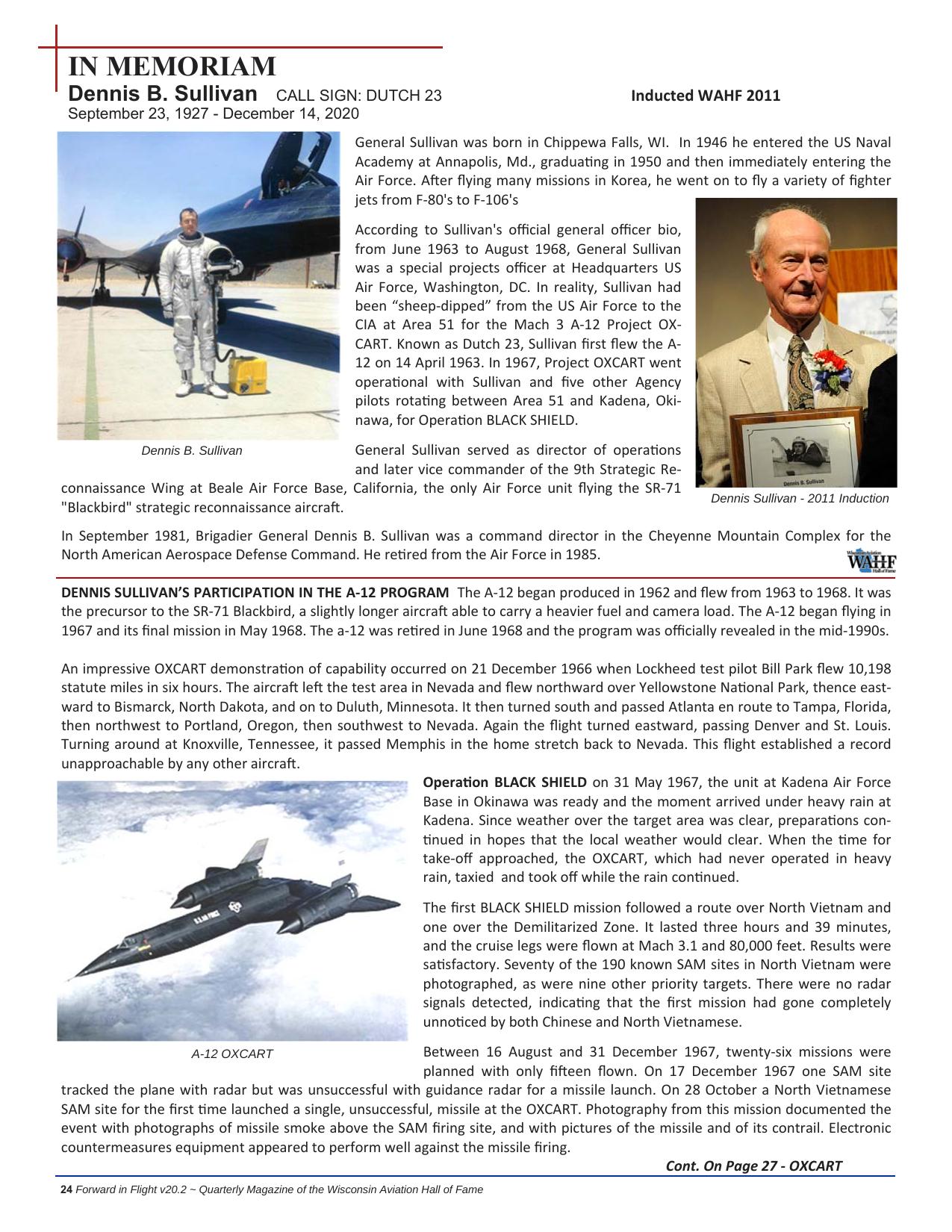
IN MEMORIAM Dennis B. Sullivan CALL SIGN: DUTCH 23 September 23, 1927 - December 14, 2020 Inducted WAHF 2011 General Sullivan was born in Chippewa Falls, WI. In 1946 he entered the US Naval Academy at Annapolis, Md., gradua ng in 1950 and then immediately entering the Air Force. A er flying many missions in Korea, he went on to fly a variety of fighter jets from F-80's to F-106's According to Sullivan's official general officer bio, from June 1963 to August 1968, General Sullivan was a special projects officer at Headquarters US Air Force, Washington, DC. In reality, Sullivan had been “sheep-dipped” from the US Air Force to the CIA at Area 51 for the Mach 3 A-12 Project OXCART. Known as Dutch 23, Sullivan first flew the A12 on 14 April 1963. In 1967, Project OXCART went opera onal with Sullivan and five other Agency pilots rota ng between Area 51 and Kadena, Okinawa, for Opera on BLACK SHIELD. General Sullivan served as director of opera ons and later vice commander of the 9th Strategic Reconnaissance Wing at Beale Air Force Base, California, the only Air Force unit flying the SR-71 "Blackbird" strategic reconnaissance aircra . Dennis B. Sullivan Dennis Sullivan - 2011 Induction In September 1981, Brigadier General Dennis B. Sullivan was a command director in the Cheyenne Mountain Complex for the North American Aerospace Defense Command. He re red from the Air Force in 1985. DENNIS SULLIVAN’S PARTICIPATION IN THE A‐12 PROGRAM The A-12 began produced in 1962 and flew from 1963 to 1968. It was the precursor to the SR-71 Blackbird, a slightly longer aircra able to carry a heavier fuel and camera load. The A-12 began flying in 1967 and its final mission in May 1968. The a-12 was re red in June 1968 and the program was officially revealed in the mid-1990s. An impressive OXCART demonstra on of capability occurred on 21 December 1966 when Lockheed test pilot Bill Park flew 10,198 statute miles in six hours. The aircra le the test area in Nevada and flew northward over Yellowstone Na onal Park, thence eastward to Bismarck, North Dakota, and on to Duluth, Minnesota. It then turned south and passed Atlanta en route to Tampa, Florida, then northwest to Portland, Oregon, then southwest to Nevada. Again the flight turned eastward, passing Denver and St. Louis. Turning around at Knoxville, Tennessee, it passed Memphis in the home stretch back to Nevada. This flight established a record unapproachable by any other aircra . Opera on BLACK SHIELD on 31 May 1967, the unit at Kadena Air Force Base in Okinawa was ready and the moment arrived under heavy rain at Kadena. Since weather over the target area was clear, prepara ons connued in hopes that the local weather would clear. When the me for take-off approached, the OXCART, which had never operated in heavy rain, taxied and took off while the rain con nued. The first BLACK SHIELD mission followed a route over North Vietnam and one over the Demilitarized Zone. It lasted three hours and 39 minutes, and the cruise legs were flown at Mach 3.1 and 80,000 feet. Results were sa sfactory. Seventy of the 190 known SAM sites in North Vietnam were photographed, as were nine other priority targets. There were no radar signals detected, indica ng that the first mission had gone completely unno ced by both Chinese and North Vietnamese. Between 16 August and 31 December 1967, twenty-six missions were planned with only fi een flown. On 17 December 1967 one SAM site tracked the plane with radar but was unsuccessful with guidance radar for a missile launch. On 28 October a North Vietnamese SAM site for the first me launched a single, unsuccessful, missile at the OXCART. Photography from this mission documented the event with photographs of missile smoke above the SAM firing site, and with pictures of the missile and of its contrail. Electronic countermeasures equipment appeared to perform well against the missile firing. Cont. On Page 27 ‐ OXCART A-12 OXCART 24 Forward in Flight v20.2 ~ Quarterly Magazine of the Wisconsin Aviation Hall of Fame
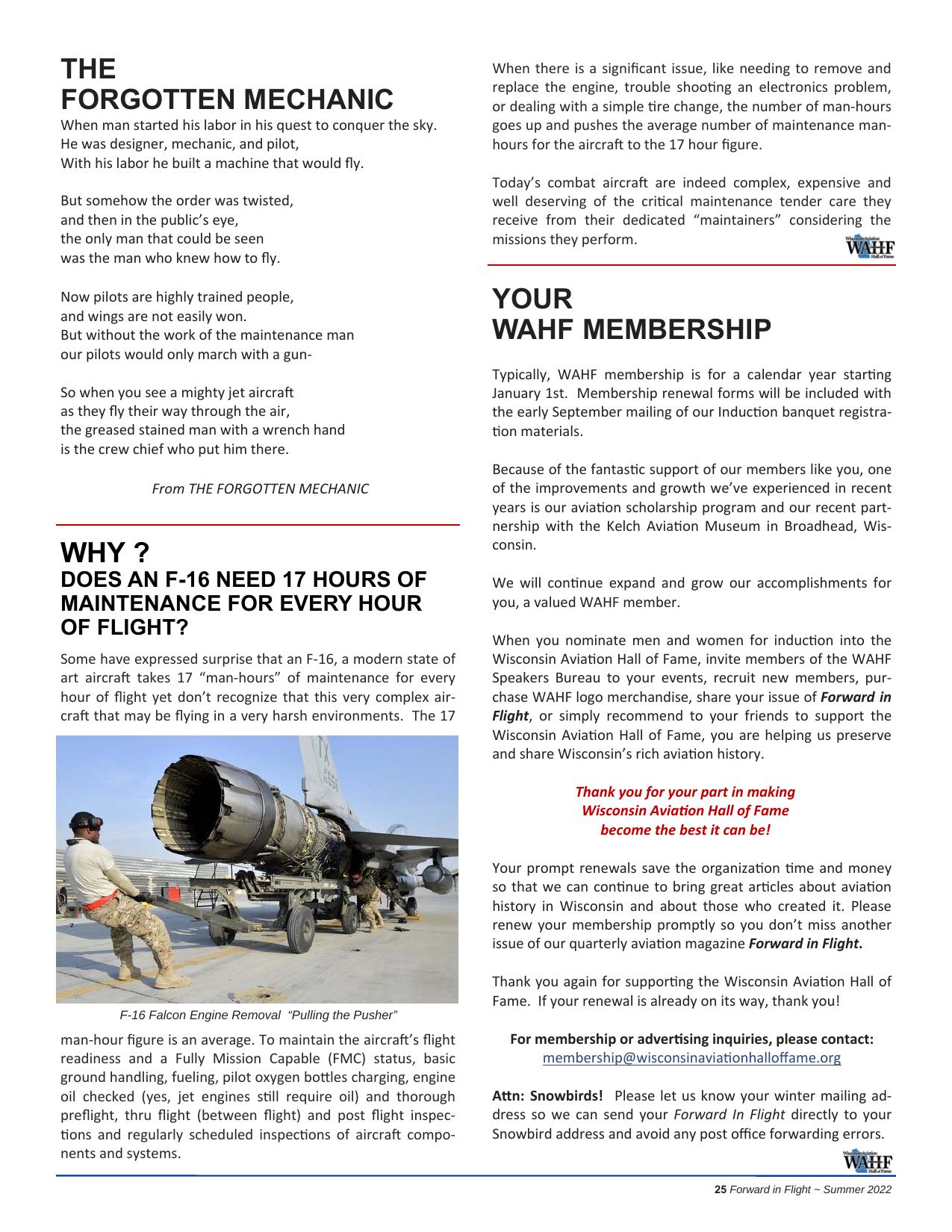
THE FORGOTTEN MECHANIC When man started his labor in his quest to conquer the sky. He was designer, mechanic, and pilot, With his labor he built a machine that would fly. But somehow the order was twisted, and then in the public’s eye, the only man that could be seen was the man who knew how to fly. Now pilots are highly trained people, and wings are not easily won. But without the work of the maintenance man our pilots would only march with a gunSo when you see a mighty jet aircra as they fly their way through the air, the greased stained man with a wrench hand is the crew chief who put him there. From THE FORGOTTEN MECHANIC WHY ? DOES AN F-16 NEED 17 HOURS OF MAINTENANCE FOR EVERY HOUR OF FLIGHT? Some have expressed surprise that an F-16, a modern state of art aircra takes 17 “man-hours” of maintenance for every hour of flight yet don’t recognize that this very complex aircra that may be flying in a very harsh environments. The 17 When there is a significant issue, like needing to remove and replace the engine, trouble shoo ng an electronics problem, or dealing with a simple re change, the number of man-hours goes up and pushes the average number of maintenance manhours for the aircra to the 17 hour figure. Today’s combat aircra are indeed complex, expensive and well deserving of the cri cal maintenance tender care they receive from their dedicated “maintainers” considering the missions they perform. YOUR WAHF MEMBERSHIP Typically, WAHF membership is for a calendar year star ng January 1st. Membership renewal forms will be included with the early September mailing of our Induc on banquet registraon materials. Because of the fantas c support of our members like you, one of the improvements and growth we’ve experienced in recent years is our avia on scholarship program and our recent partnership with the Kelch Avia on Museum in Broadhead, Wisconsin. We will con nue expand and grow our accomplishments for you, a valued WAHF member. When you nominate men and women for induc on into the Wisconsin Avia on Hall of Fame, invite members of the WAHF Speakers Bureau to your events, recruit new members, purchase WAHF logo merchandise, share your issue of Forward in Flight, or simply recommend to your friends to support the Wisconsin Avia on Hall of Fame, you are helping us preserve and share Wisconsin’s rich avia on history. Thank you for your part in making Wisconsin Avia on Hall of Fame become the best it can be! Your prompt renewals save the organiza on me and money so that we can con nue to bring great ar cles about avia on history in Wisconsin and about those who created it. Please renew your membership promptly so you don’t miss another issue of our quarterly avia on magazine Forward in Flight. Thank you again for suppor ng the Wisconsin Avia on Hall of Fame. If your renewal is already on its way, thank you! F-16 Falcon Engine Removal “Pulling the Pusher” man-hour figure is an average. To maintain the aircra ’s flight readiness and a Fully Mission Capable (FMC) status, basic ground handling, fueling, pilot oxygen bo les charging, engine oil checked (yes, jet engines s ll require oil) and thorough preflight, thru flight (between flight) and post flight inspecons and regularly scheduled inspec ons of aircra components and systems. For membership or adver sing inquiries, please contact: membership@wisconsinavia onhalloffame.org A n: Snowbirds! Please let us know your winter mailing address so we can send your Forward In Flight directly to your Snowbird address and avoid any post office forwarding errors. 25 Forward in Flight ~ Summer 2022
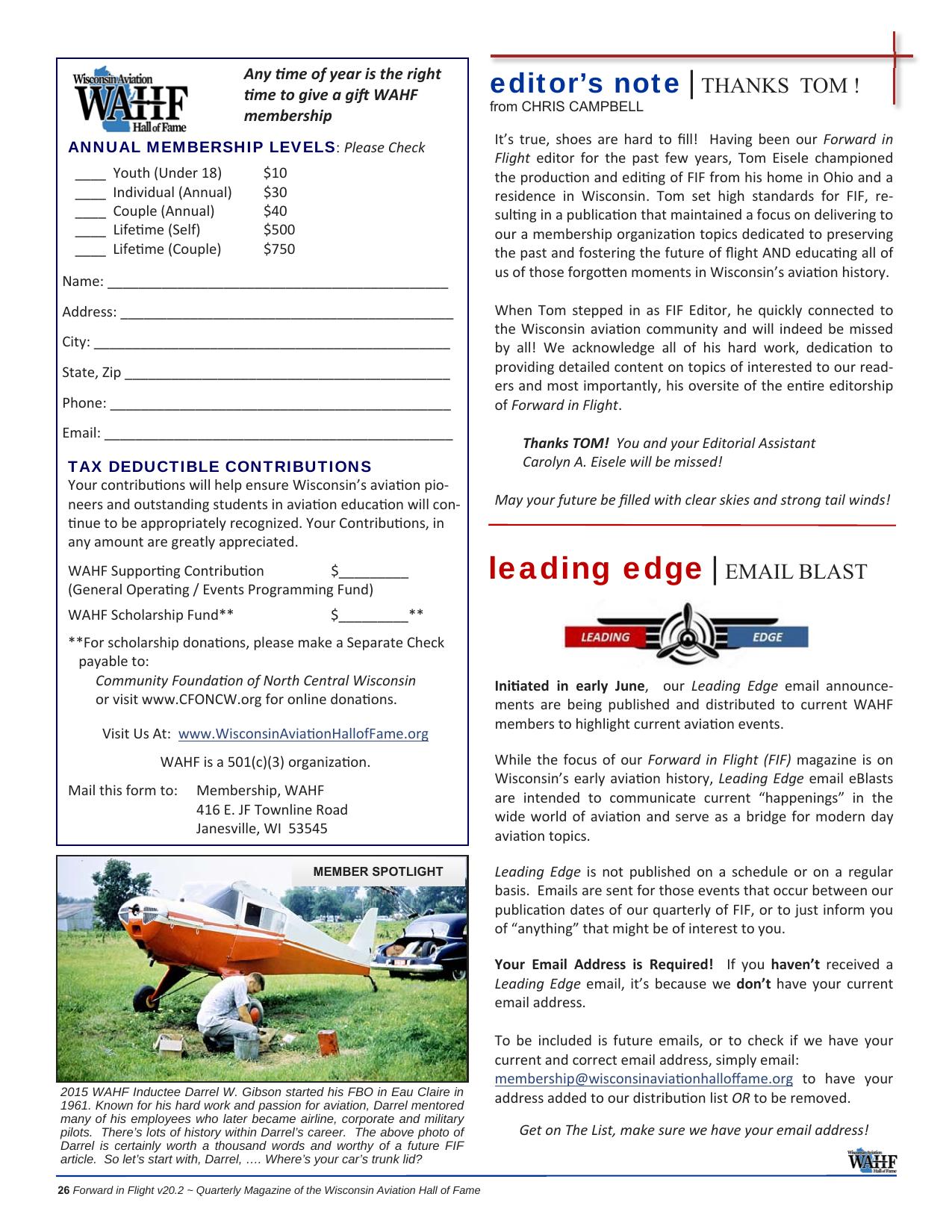
Any me of year is the right me to give a gi WAHF membership ANNUAL MEMBERSHIP LEVELS: Please Check ____ Youth (Under 18) ____ Individual (Annual) ____ Couple (Annual) ____ Life me (Self) ____ Life me (Couple) $10 $30 $40 $500 $750 Name: ____________________________________________ Address: ___________________________________________ City: ______________________________________________ State, Zip __________________________________________ Phone: ____________________________________________ Email: _____________________________________________ TAX DEDUCTIBLE CONTRIBUTIONS Your contribu ons will help ensure Wisconsin’s avia on pioneers and outstanding students in avia on educa on will connue to be appropriately recognized. Your Contribu ons, in any amount are greatly appreciated. WAHF Suppor ng Contribu on $_________ (General Opera ng / Events Programming Fund) WAHF Scholarship Fund** from CHRIS CAMPBELL It’s true, shoes are hard to fill! Having been our Forward in Flight editor for the past few years, Tom Eisele championed the produc on and edi ng of FIF from his home in Ohio and a residence in Wisconsin. Tom set high standards for FIF, resul ng in a publica on that maintained a focus on delivering to our a membership organiza on topics dedicated to preserving the past and fostering the future of flight AND educa ng all of us of those forgo en moments in Wisconsin’s avia on history. When Tom stepped in as FIF Editor, he quickly connected to the Wisconsin avia on community and will indeed be missed by all! We acknowledge all of his hard work, dedica on to providing detailed content on topics of interested to our readers and most importantly, his oversite of the en re editorship of Forward in Flight. Thanks TOM! You and your Editorial Assistant Carolyn A. Eisele will be missed! May your future be filled with clear skies and strong tail winds! leading edge | EMAIL BLAST $_________** **For scholarship dona ons, please make a Separate Check payable to: Community Founda on of North Central Wisconsin or visit www.CFONCW.org for online dona ons. Visit Us At: www.WisconsinAvia onHallofFame.org WAHF is a 501(c)(3) organiza on. Mail this form to: editor’s note | THANKS TOM ! Membership, WAHF 416 E. JF Townline Road Janesville, WI 53545 MEMBER SPOTLIGHT Ini ated in early June, our Leading Edge email announcements are being published and distributed to current WAHF members to highlight current avia on events. While the focus of our Forward in Flight (FIF) magazine is on Wisconsin’s early avia on history, Leading Edge email eBlasts are intended to communicate current “happenings” in the wide world of avia on and serve as a bridge for modern day avia on topics. Leading Edge is not published on a schedule or on a regular basis. Emails are sent for those events that occur between our publica on dates of our quarterly of FIF, or to just inform you of “anything” that might be of interest to you. Your Email Address is Required! If you haven’t received a Leading Edge email, it’s because we don’t have your current email address. 2015 WAHF Inductee Darrel W. Gibson started his FBO in Eau Claire in 1961. Known for his hard work and passion for aviation, Darrel mentored many of his employees who later became airline, corporate and military pilots. There’s lots of history within Darrel’s career. The above photo of Darrel is certainly worth a thousand words and worthy of a future FIF article. So let’s start with, Darrel, …. Where’s your car’s trunk lid? 26 Forward in Flight v20.2 ~ Quarterly Magazine of the Wisconsin Aviation Hall of Fame To be included is future emails, or to check if we have your current and correct email address, simply email: membership@wisconsinavia onhalloffame.org to have your address added to our distribu on list OR to be removed. Get on The List, make sure we have your email address!
calendar | AVIATION EVENTS WAHF EVENTS CONTACT US WAHF President Tomas Thomas homas@wisconsinaviationhalloffame.org WAHF Speaker’s Bureau Tomas Thomas homas@wisconsinaviationhalloffame.org October 22 - Wisconsin Aviation Hall of Fame Inductions EAA Museum, Oshkosh, WI | www.wisconsinaviationhalloffame.org MIDWEST AVIATION EVENTS OF INTEREST August 20 - Shawano, WI - Fly-in, Drive-in event 9am-2pm. Rain date 8/21). The event will feature An ques, Classics, Warbirds, Modern Aircra , Young Eagles Flights, Introductory Flights, Equipment Displays, and Collector Cars. Info: www.shawanoairport.com. Membership & Subscriber Service Chris Campbell cacampbell@wisconsinaviationhalloffame.org August 20‐21 - US Navy Blue Angels1 - Chicago, IL - Chicago Air & Water Show, North Ave Beach. www.chicago.gov/city/en/depts/dca/supp_info/ chicago_air_and_watershow.html WAHF Advertising / Marketing Chris Campbell cacampbell@wisconsinaviationhalloffame.org September 1 - Waseca, MN ‐ Fly-In/Drive star ng at 5:30-7:30pm rain or shine. Info: David Ziegler 507‐838‐8915 or Andrew Fisher 612‐743‐2253. WAHF Scholarships Wynne Williams wwilliams@wisconsinaviationhalloffame.org WAHF Induction Nominations Kurt Stanick kstanich@wisconsinaviationhalloffame.org Web Site Join the Conversation, Follow Us At: www.WisconsinAviationHallofFame.org September 10 - Milwaukee, WI - Spot Landing Contest 10am Lawrence J. Timmerman Airport. Details: 414-461-3222 www.Timmermanairport.com September 10 ‐ Oshkosh, WI – Whitman Airport FlyIn Breakfast & Airport Expo. Free Airplane rides for kids ages 8-17. Info: h p://youngeaglesday.org, 920-810-1046, eaa252-gmail.com September 16‐18 - Brainerd, MN - Minnesota Seaplane Pilots Associa on Safety Seminar at Madden’s on Gull Lake. www.mnseaplanes.com September 17 - Freeport, IL - Northwest Illinois Airshow. Albertus Airport www.nwilairshow.com September 17 ‐ Oconto, WI - Oconto FlyInCar Show, an que tractors, military displays. Plane & helicopter rides. Info: 920-373-6948 or Air at 920-834-7727. ocontoflyin@gmail.com. September 23‐25 - Angola, IN ‐ Indiana Seaplane Pilots Associa on Splash-In at Pokagon State Park at Lake James and Potawatomi Inn. Info: randy.strebig@strebigconstruc on.com. For accommoda ons: Potawatomi Inn 877-768-2928. September 24 - Eden Prairie, MN ‐ Girls In Avia on Day at Flying Cloud Airport. h ps://starso henorth.org/girls-in-avia on-day October 3‐5 - Eau Claire, WI - WI Annual Avia on Conference (WAC). Sponsored by WI Airport Management Associa on (WAMA) Info: h ps://wiama.org/events November 5 - Brodhead, WI - Chili Lunch Fly-In 11am-2pm. www.eaa431.org 1 No ce: Dates shown are for jet team performances only. Military jet teams may not perform on all days of mul ‐day events. Check event website for full event schedules. Having a Conferences or Exhibi on?: Submit your events to be listed in our Calendar of Events. Email: magazine@wisconsinaviationhalloffame.org 27 Forward in Flight ~ Summer 2022
PO BOX 70739 MADISON WI 53707 The Wisconsin Aviation Hall of Fame is a non-profit membership organization dedicated to preserving the past and fostering the future of flight in Wisconsin Thanks to All WAHF Members and Supporters in 2022 New Members Paul McCarthy Scott & Julie Green Officers Tom Thomas, President James Zuelsdorf, Vice-President Chris Campbell, Treasurer Henry Peterson, Secretary Corporate Members Reabe Spraying Service - Plover, WI New Life Members Lewis Jaye Supporting Contributors William & Belinda Adams Steve Krog David Cummings Kim & Dennis Klister Terry Railing Cleo Gibson Roland & Earlene Schable Becky Soderholm Kenneth Koch Jeff & Cheryl Baker Don Adriano Sune and Jean Ericson Jimmy Szajkovics Patti Bruha Dan Simpson Sandra Esse Board of Directors Edward Hall Kurt Mehre Jeff Point Gregory Cunningham Howard Rand Dale & Nancy Walker Chuck Losinski Scholarship Contributors Brad Volker Will Your Address Change / Attention Snowbirds? Please inform us of your new address. A timely reminder of your new address is very much appreciated, as it helps to save time - and expense - for our small non-profit organization. Jill Mann Kurt Stanich Jim Szajkovics Patrick Weeden Wynne Williams Wisconsin Aviation Hall of Fame c/o Tom Thomas, President PO Box 70739 Madison, WI 53707 608-332-0490 Become a member / supporter today! www.wisconsinaviationhalloffame.org