Volume 21, Issue 2
🗞️ Download Issue (PDF)
Forward in Flight - Summer 2023
Volume 21, Issue 2 Quarterly Magazine of the Wisconsin Aviation Hall of Fame Summer 2023
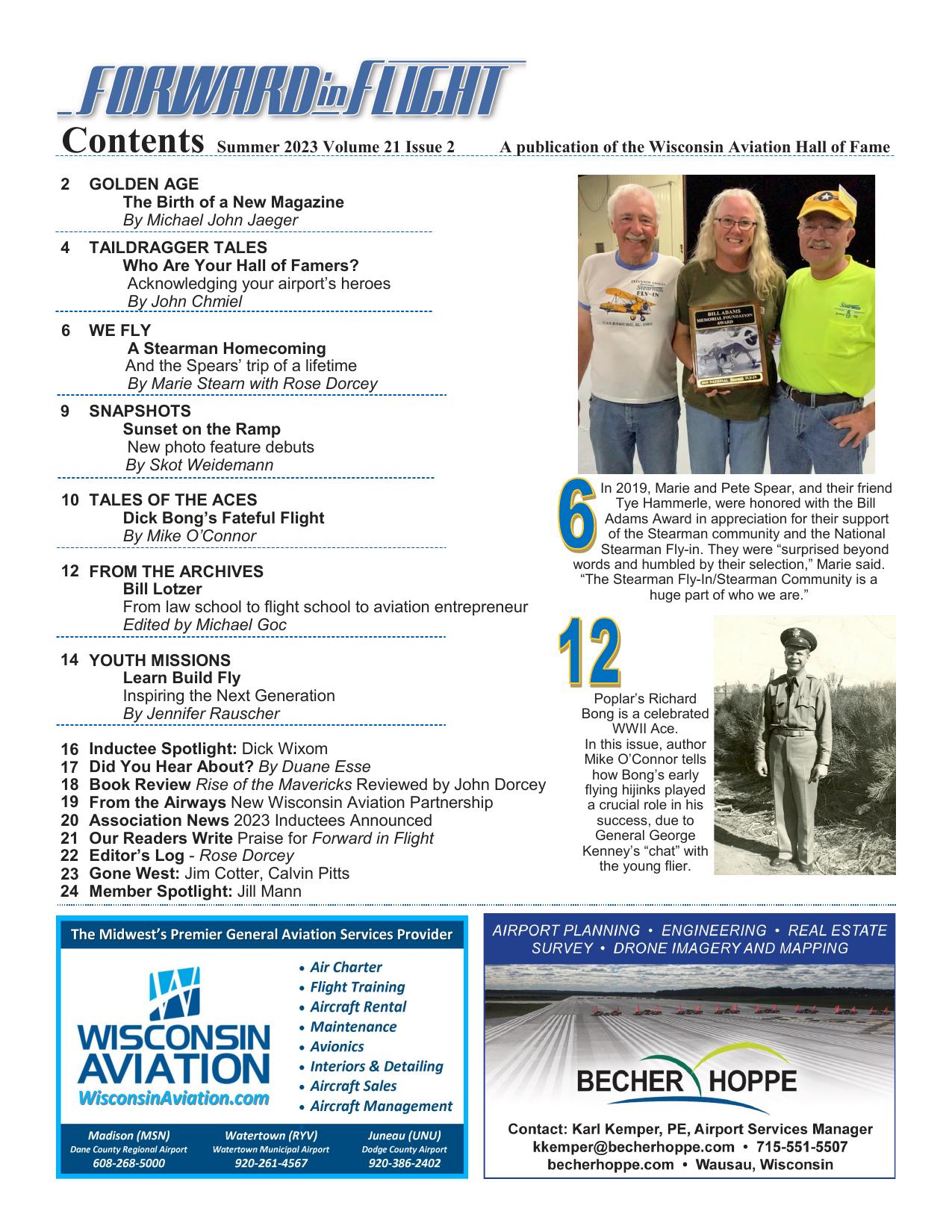
Contents Summer 2023 Volume 21 Issue 2 2 GOLDEN AGE The Birth of a New Magazine By Michael John Jaeger 4 TAILDRAGGER TALES Who Are Your Hall of Famers? Acknowledging your airport’s heroes By John Chmiel 6 WE FLY A Stearman Homecoming And the Spears’ trip of a lifetime By Marie Stearn with Rose Dorcey 9 SNAPSHOTS Sunset on the Ramp New photo feature debuts By Skot Weidemann A publication of the Wisconsin Aviation Hall of Fame 10 TALES OF THE ACES Dick Bong’s Fateful Flight By Mike O’Connor 12 FROM THE ARCHIVES Bill Lotzer From law school to flight school to aviation entrepreneur Edited by Michael Goc 14 YOUTH MISSIONS Learn Build Fly Inspiring the Next Generation By Jennifer Rauscher 16 Inductee Spotlight: Dick Wixom 17 Did You Hear About? By Duane Esse 18 Book Review Rise of the Mavericks Reviewed by John Dorcey 19 From the Airways New Wisconsin Aviation Partnership 20 Association News 2023 Inductees Announced 21 Our Readers Write Praise for Forward in Flight 22 Editor’s Log - Rose Dorcey 23 Gone West: Jim Cotter, Calvin Pitts 24 Member Spotlight: Jill Mann In 2019, Marie and Pete Spear, and their friend Tye Hammerle, were honored with the Bill Adams Award in appreciation for their support of the Stearman community and the National Stearman Fly-in. They were “surprised beyond words and humbled by their selection,” Marie said. “The Stearman Fly-In/Stearman Community is a huge part of who we are.” Poplar’s Richard Bong is a celebrated WWII Ace. In this issue, author Mike O’Connor tells how Bong’s early flying hijinks played a crucial role in his success, due to General George Kenney’s “chat” with the young flier.
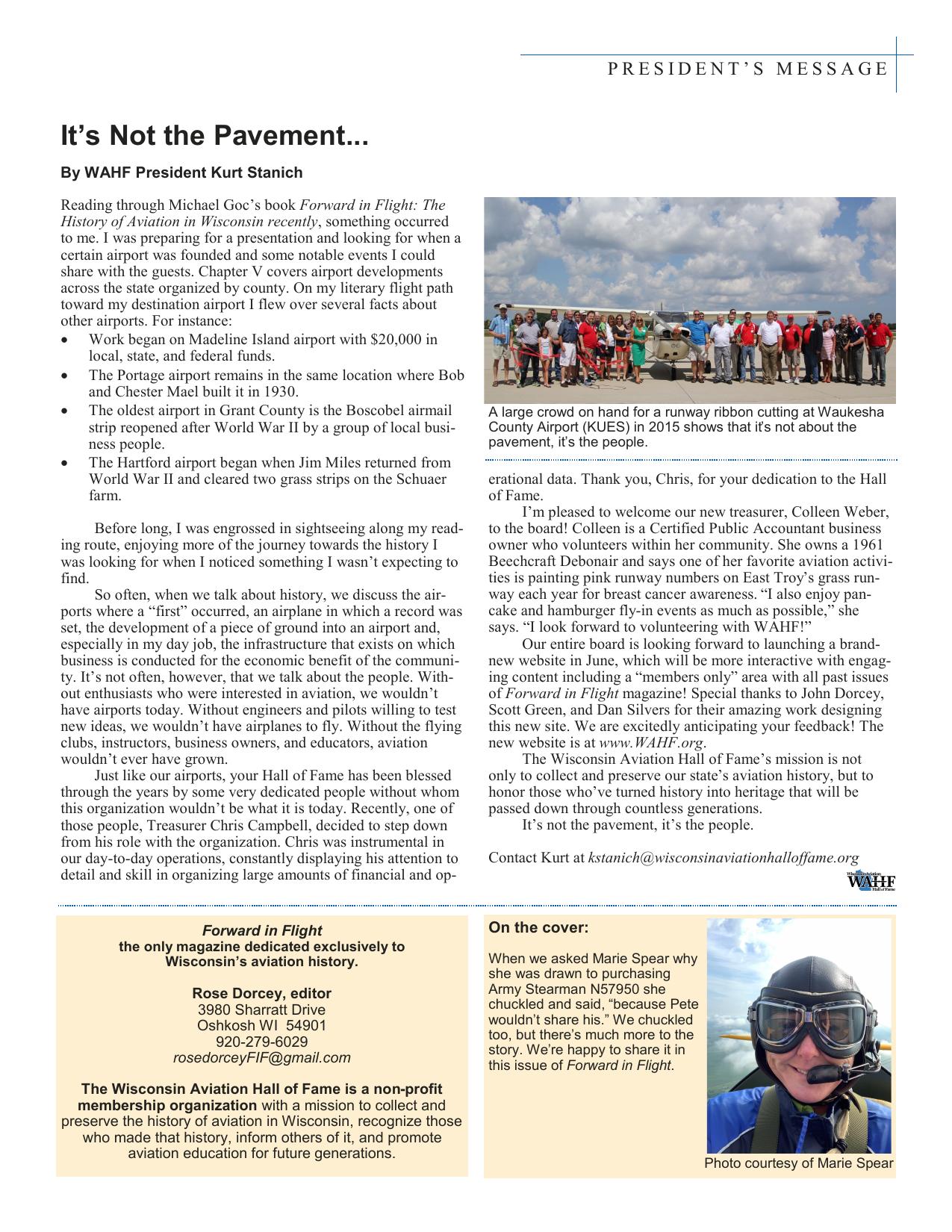
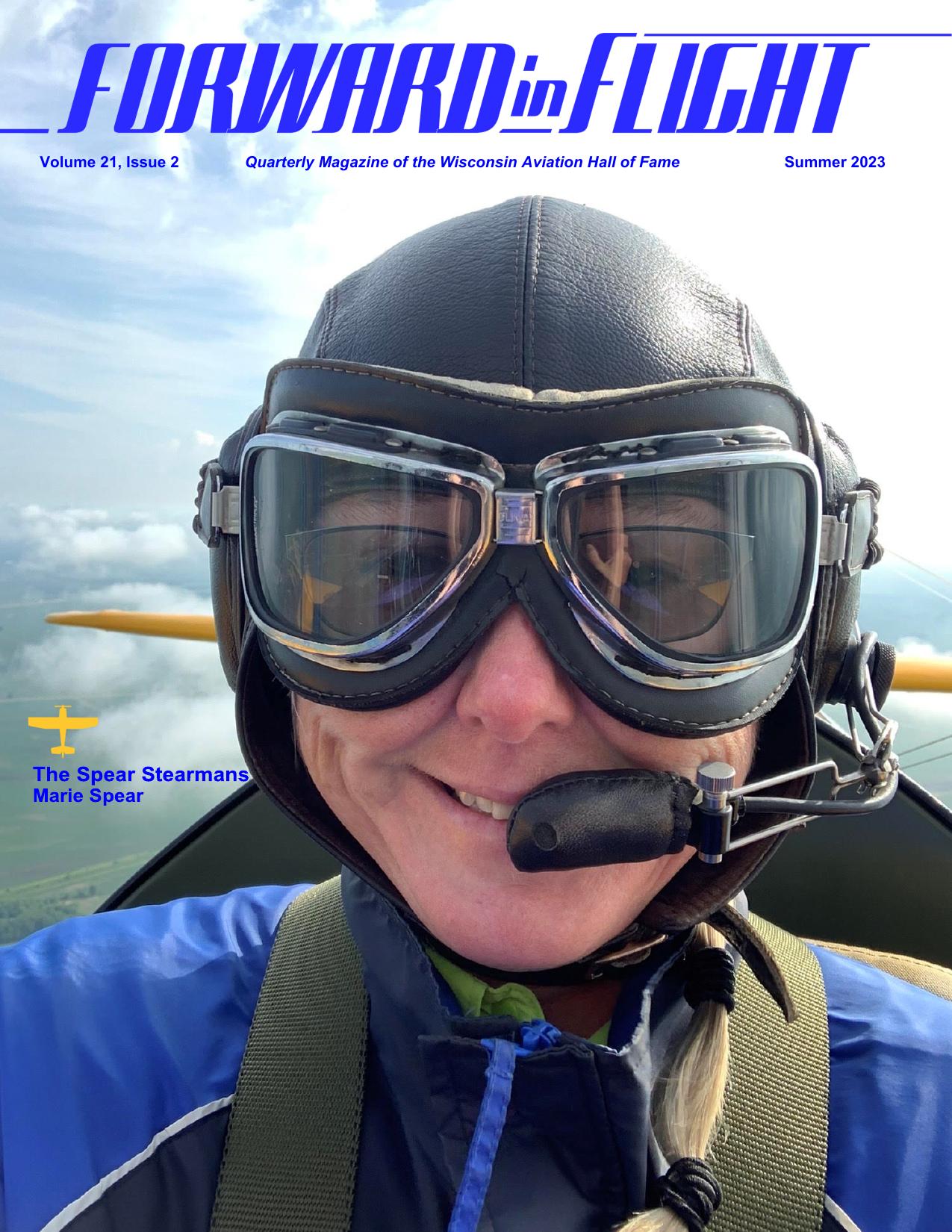
PRESIDENT’S MESSAGE It’s Not the Pavement... By WAHF President Kurt Stanich Reading through Michael Goc’s book Forward in Flight: The History of Aviation in Wisconsin recently, something occurred to me. I was preparing for a presentation and looking for when a certain airport was founded and some notable events I could share with the guests. Chapter V covers airport developments across the state organized by county. On my literary flight path toward my destination airport I flew over several facts about other airports. For instance: · Work began on Madeline Island airport with $20,000 in local, state, and federal funds. · The Portage airport remains in the same location where Bob and Chester Mael built it in 1930. · The oldest airport in Grant County is the Boscobel airmail strip reopened after World War II by a group of local business people. · The Hartford airport began when Jim Miles returned from World War II and cleared two grass strips on the Schuaer farm. Before long, I was engrossed in sightseeing along my reading route, enjoying more of the journey towards the history I was looking for when I noticed something I wasn’t expecting to find. So often, when we talk about history, we discuss the airports where a “first” occurred, an airplane in which a record was set, the development of a piece of ground into an airport and, especially in my day job, the infrastructure that exists on which business is conducted for the economic benefit of the community. It’s not often, however, that we talk about the people. Without enthusiasts who were interested in aviation, we wouldn’t have airports today. Without engineers and pilots willing to test new ideas, we wouldn’t have airplanes to fly. Without the flying clubs, instructors, business owners, and educators, aviation wouldn’t ever have grown. Just like our airports, your Hall of Fame has been blessed through the years by some very dedicated people without whom this organization wouldn’t be what it is today. Recently, one of those people, Treasurer Chris Campbell, decided to step down from his role with the organization. Chris was instrumental in our day-to-day operations, constantly displaying his attention to detail and skill in organizing large amounts of financial and op- Forward in Flight the only magazine dedicated exclusively to Wisconsin’s aviation history. Rose Dorcey, editor 3980 Sharratt Drive Oshkosh WI 54901 920-279-6029 rosedorceyFIF@gmail.com The Wisconsin Aviation Hall of Fame is a non-profit membership organization with a mission to collect and preserve the history of aviation in Wisconsin, recognize those who made that history, inform others of it, and promote aviation education for future generations. A large crowd on hand for a runway ribbon cutting at Waukesha County Airport (KUES) in 2015 shows that it’s not about the pavement, it’s the people. erational data. Thank you, Chris, for your dedication to the Hall of Fame. I’m pleased to welcome our new treasurer, Colleen Weber, to the board! Colleen is a Certified Public Accountant business owner who volunteers within her community. She owns a 1961 Beechcraft Debonair and says one of her favorite aviation activities is painting pink runway numbers on East Troy’s grass runway each year for breast cancer awareness. “I also enjoy pancake and hamburger fly-in events as much as possible,” she says. “I look forward to volunteering with WAHF!” Our entire board is looking forward to launching a brandnew website in June, which will be more interactive with engaging content including a “members only” area with all past issues of Forward in Flight magazine! Special thanks to John Dorcey, Scott Green, and Dan Silvers for their amazing work designing this new site. We are excitedly anticipating your feedback! The new website is at www.WAHF.org. The Wisconsin Aviation Hall of Fame’s mission is not only to collect and preserve our state’s aviation history, but to honor those who’ve turned history into heritage that will be passed down through countless generations. It’s not the pavement, it’s the people. Contact Kurt at kstanich@wisconsinaviationhalloffame.org On the cover: When we asked Marie Spear why she was drawn to purchasing Army Stearman N57950 she chuckled and said, “because Pete wouldn’t share his.” We chuckled too, but there’s much more to the story. We’re happy to share it in this issue of Forward in Flight. Photo courtesy of Marie Spear
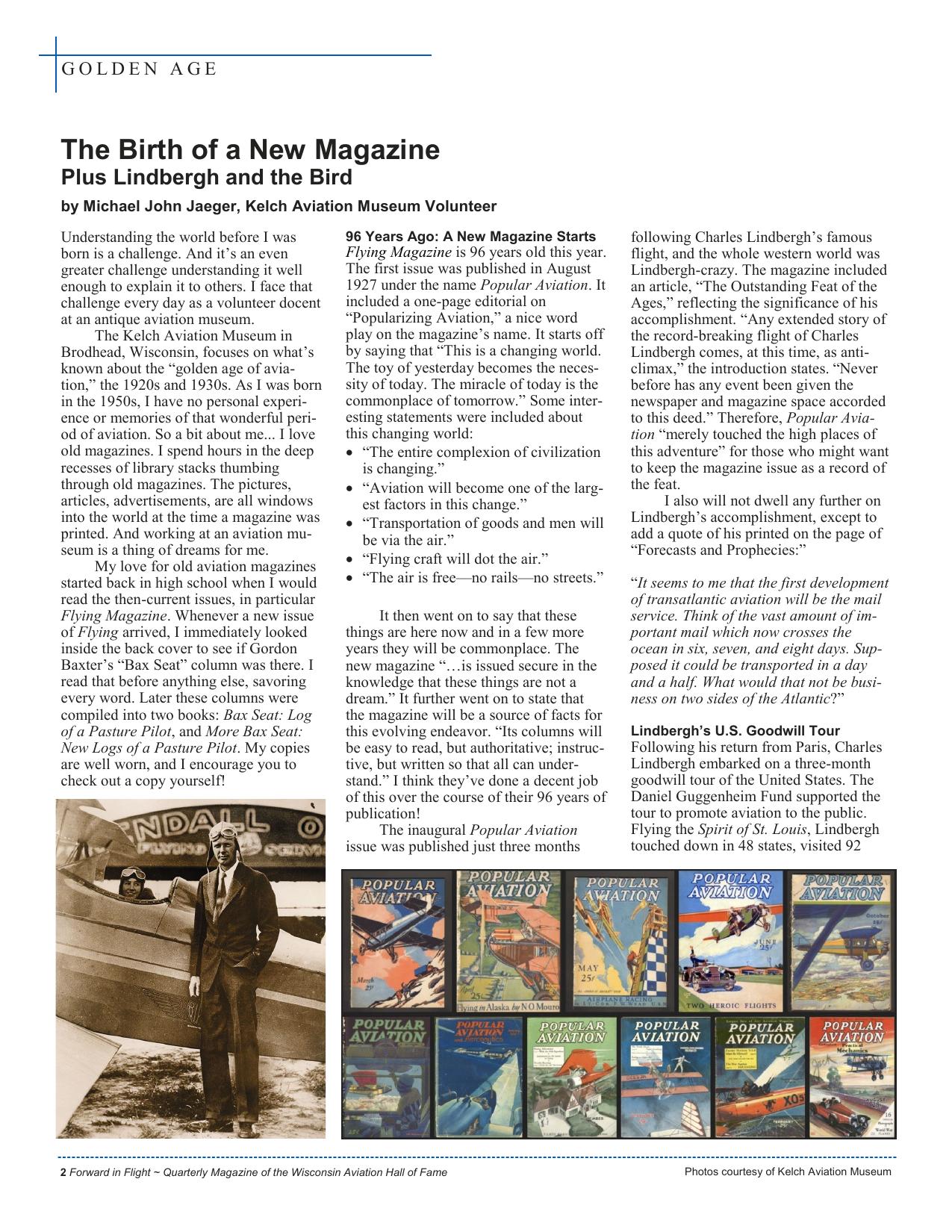
GOLDEN AGE The Birth of a New Magazine Plus Lindbergh and the Bird by Michael John Jaeger, Kelch Aviation Museum Volunteer Understanding the world before I was born is a challenge. And it’s an even greater challenge understanding it well enough to explain it to others. I face that challenge every day as a volunteer docent at an antique aviation museum. The Kelch Aviation Museum in Brodhead, Wisconsin, focuses on what’s known about the “golden age of aviation,” the 1920s and 1930s. As I was born in the 1950s, I have no personal experience or memories of that wonderful period of aviation. So a bit about me... I love old magazines. I spend hours in the deep recesses of library stacks thumbing through old magazines. The pictures, articles, advertisements, are all windows into the world at the time a magazine was printed. And working at an aviation museum is a thing of dreams for me. My love for old aviation magazines started back in high school when I would read the then-current issues, in particular Flying Magazine. Whenever a new issue of Flying arrived, I immediately looked inside the back cover to see if Gordon Baxter’s “Bax Seat” column was there. I read that before anything else, savoring every word. Later these columns were compiled into two books: Bax Seat: Log of a Pasture Pilot, and More Bax Seat: New Logs of a Pasture Pilot. My copies are well worn, and I encourage you to check out a copy yourself! 96 Years Ago: A New Magazine Starts Flying Magazine is 96 years old this year. The first issue was published in August 1927 under the name Popular Aviation. It included a one-page editorial on “Popularizing Aviation,” a nice word play on the magazine’s name. It starts off by saying that “This is a changing world. The toy of yesterday becomes the necessity of today. The miracle of today is the commonplace of tomorrow.” Some interesting statements were included about this changing world: · “The entire complexion of civilization is changing.” · “Aviation will become one of the largest factors in this change.” · “Transportation of goods and men will be via the air.” · “Flying craft will dot the air.” · “The air is free—no rails—no streets.” It then went on to say that these things are here now and in a few more years they will be commonplace. The new magazine “…is issued secure in the knowledge that these things are not a dream.” It further went on to state that the magazine will be a source of facts for this evolving endeavor. “Its columns will be easy to read, but authoritative; instructive, but written so that all can understand.” I think they’ve done a decent job of this over the course of their 96 years of publication! The inaugural Popular Aviation issue was published just three months 2 Forward in Flight ~ Quarterly Magazine of the Wisconsin Aviation Hall of Fame following Charles Lindbergh’s famous flight, and the whole western world was Lindbergh-crazy. The magazine included an article, “The Outstanding Feat of the Ages,” reflecting the significance of his accomplishment. “Any extended story of the record-breaking flight of Charles Lindbergh comes, at this time, as anticlimax,” the introduction states. “Never before has any event been given the newspaper and magazine space accorded to this deed.” Therefore, Popular Aviation “merely touched the high places of this adventure” for those who might want to keep the magazine issue as a record of the feat. I also will not dwell any further on Lindbergh’s accomplishment, except to add a quote of his printed on the page of “Forecasts and Prophecies:” “It seems to me that the first development of transatlantic aviation will be the mail service. Think of the vast amount of important mail which now crosses the ocean in six, seven, and eight days. Supposed it could be transported in a day and a half. What would that not be business on two sides of the Atlantic?” Lindbergh’s U.S. Goodwill Tour Following his return from Paris, Charles Lindbergh embarked on a three-month goodwill tour of the United States. The Daniel Guggenheim Fund supported the tour to promote aviation to the public. Flying the Spirit of St. Louis, Lindbergh touched down in 48 states, visited 92 Photos courtesy of Kelch Aviation Museum
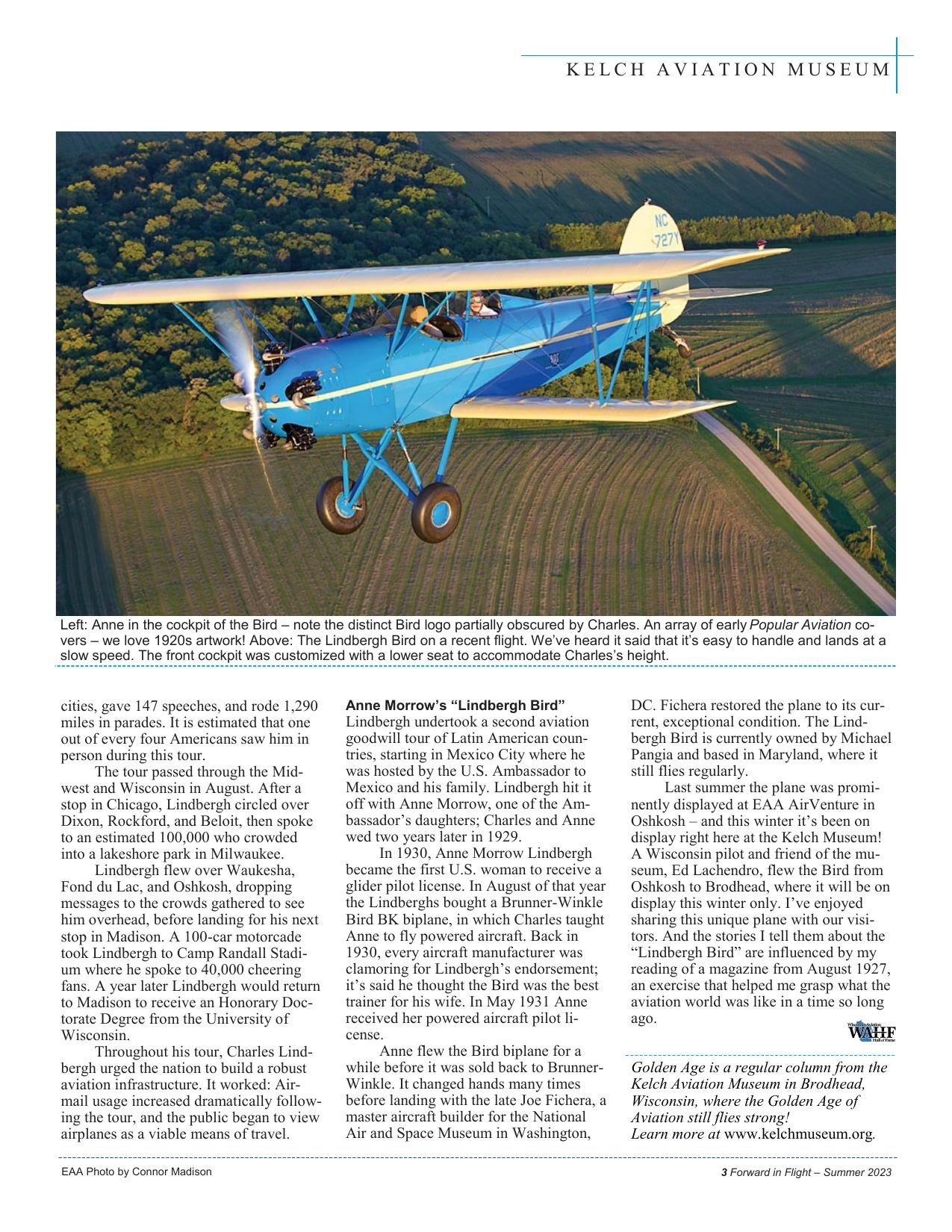
KELCH AVIATION MUSEUM Left: Anne in the cockpit of the Bird – note the distinct Bird logo partially obscured by Charles. An array of early Popular Aviation covers – we love 1920s artwork! Above: The Lindbergh Bird on a recent flight. We’ve heard it said that it’s easy to handle and lands at a slow speed. The front cockpit was customized with a lower seat to accommodate Charles’s height. cities, gave 147 speeches, and rode 1,290 miles in parades. It is estimated that one out of every four Americans saw him in person during this tour. The tour passed through the Midwest and Wisconsin in August. After a stop in Chicago, Lindbergh circled over Dixon, Rockford, and Beloit, then spoke to an estimated 100,000 who crowded into a lakeshore park in Milwaukee. Lindbergh flew over Waukesha, Fond du Lac, and Oshkosh, dropping messages to the crowds gathered to see him overhead, before landing for his next stop in Madison. A 100-car motorcade took Lindbergh to Camp Randall Stadium where he spoke to 40,000 cheering fans. A year later Lindbergh would return to Madison to receive an Honorary Doctorate Degree from the University of Wisconsin. Throughout his tour, Charles Lindbergh urged the nation to build a robust aviation infrastructure. It worked: Airmail usage increased dramatically following the tour, and the public began to view airplanes as a viable means of travel. EAA Photo by Connor Madison Anne Morrow’s “Lindbergh Bird” Lindbergh undertook a second aviation goodwill tour of Latin American countries, starting in Mexico City where he was hosted by the U.S. Ambassador to Mexico and his family. Lindbergh hit it off with Anne Morrow, one of the Ambassador’s daughters; Charles and Anne wed two years later in 1929. In 1930, Anne Morrow Lindbergh became the first U.S. woman to receive a glider pilot license. In August of that year the Lindberghs bought a Brunner-Winkle Bird BK biplane, in which Charles taught Anne to fly powered aircraft. Back in 1930, every aircraft manufacturer was clamoring for Lindbergh’s endorsement; it’s said he thought the Bird was the best trainer for his wife. In May 1931 Anne received her powered aircraft pilot license. Anne flew the Bird biplane for a while before it was sold back to BrunnerWinkle. It changed hands many times before landing with the late Joe Fichera, a master aircraft builder for the National Air and Space Museum in Washington, DC. Fichera restored the plane to its current, exceptional condition. The Lindbergh Bird is currently owned by Michael Pangia and based in Maryland, where it still flies regularly. Last summer the plane was prominently displayed at EAA AirVenture in Oshkosh – and this winter it’s been on display right here at the Kelch Museum! A Wisconsin pilot and friend of the museum, Ed Lachendro, flew the Bird from Oshkosh to Brodhead, where it will be on display this winter only. I’ve enjoyed sharing this unique plane with our visitors. And the stories I tell them about the “Lindbergh Bird” are influenced by my reading of a magazine from August 1927, an exercise that helped me grasp what the aviation world was like in a time so long ago. Golden Age is a regular column from the Kelch Aviation Museum in Brodhead, Wisconsin, where the Golden Age of Aviation still flies strong! Learn more at www.kelchmuseum.org. 3 Forward in Flight – Summer 2023
TAILDRAGGER TALES Who Are Your Hall of Famers? Acknowledging your airport’s heroes By John Chmiel Whenever I decide to fly to another airport in Wisconsin, I’ll pull out my copy of the book Forward in Flight: The History of Aviation in Wisconsin and do some research on the history of my destination aerodrome. I also refer to Badger Aces, by Mike O’Connor to see what great aviators came from these airports. Wisconsin’s aviation history runs deep, and the flavor of the trip is enhanced when I know some history regarding my destination. This exercise always reminds me how much passion and hard work it takes to preserve general aviation, flying, and airports in America’s 120th year of flight. Airports rarely exist solely due to government support, money, or even airplanes. Airports thrive because of the passion, hard work, perseverance, vision, and dedication of local individuals. Behind each flying field there are unsung heroes that you’ll probably never meet or know by name. I believe every airport should have its own Hall of Fame to honor these aviation preservationists. October 1, 1992 was Wausau Flying Service, Inc.’s first day of business. I was a cocky 27 year old who thought he knew what he needed to know about running an FBO and managing an airport. I mean I’d been interning on couches at airports since I first spoke the word airplane. I had already formulated my plan for how this was going to work. AUW (back before it was KAUW) was on life support when we arrived. The facility had been kept alive since 1976 by the Wausau Area Pilots Association through an annual airshow and other general aviation activities they sponsored, despite dwindling public and political support. By the time we opened, the airport supporters were exhausted. The annual airshow had run out of money in 1994 and now Wausau Flying Service was put fully in charge of airport promotion. The good news was the locals really wanted our FBO to succeed. Jack Sittler was one of the first people to walk through our door. The Silver Fox, as he was known at the corporation he’d retired from, was the leader in the oldest flying club at the airport. He ruled with an iron fist, and club members loved that about him. His wry sense of humor and blistering wit kept people on their toes, wondering if he meant what he was saying, with a twinkle in his eye and a simultaneous cackle that kept you thinking. Jack was the perfect devil’s advocate, meant what he said, and let the chips fall on the daily basis. Just the kind of person I like. Jackson, as I called him, had been a forward air controller flying in the AT6’s of the Mosquito Squadron during Korea. He’d been shot down on a mission and rescued before the enemy arrived. He didn’t talk about Korea until the day he gave me his squadron mug. Jack would give his un-sugar-coated opinion whether you wanted it or not, and rarely tooted his own horn. He never told me what to do, but typically left me with a question to ponder, or even better, his last word of the day would be a head shake, raised eyebrows, and an “OK?!” (as if to say “If you think that’s a good idea.”) Jackson developed a sense in me that made consistent evaluation of a plan intuitive. The private hangar development areas, corporate hangars, airport layouts, instrument approaches, etc. that you see today are the result of Jack’s guidance 25 years ago. Jack taught me that you can’t stop trying to grow and change. Bob Mohr was based at the Central Wisconsin Airport (CWA) when we arrived. He began stopping by almost daily after his day at Mohr’s Automotive. Most days he flew his red-white-and-blue Piper PA12 Super Cruiser the 11 miles from KCWA. Bob decided Wausau Downtown Airport was going to be his new home. He was one of the first four tenants to build private hangars at Wausau in 1998. He moved his two PA12s and eventually a Taylorcraft to Wausau. He later earned his A&P and eventually IA, maintaining and rebuilding those aircraft. Bob is a great right-hand man who doesn’t enjoy the spotlight. He can fix almost anything “...I have come to an important conclusion. Success is rarely the result of one person’s actions.” —John Chmiel His daily visits are the reason for Wausau Downtown Airport’s success. He taught me to think big. We discussed budgets, capital planning, airport management and the future every single day. He was a great judge of character and taught me that plans need to be fluid and dynamic living documents. His grandfatherly, stern, BS-lacking mentorship is the reason why the Wausau airport thrives today. He forced me to put into words and numbers on paper the vision I thought was our future, before he consistently questioned whether that vision was big enough for Wausau Flying Service, Wausau Downtown Airport, and the City of Wausau. 4 Forward in Flight ~ Quarterly Magazine of the Wisconsin Aviation Hall of Fame and has done just that at KAUW at one time or another. He’s volunteered for nearly every single event at the airport over the last 30 years. Fly-in’s, AirVenture Cup Races, spot landing contests, pretty much any event—he helped. The Chili-Fly-In, for 11 years, was his event. The metamorphosis of what is now known as the Wisconsin Flying Hamburger Socials are the result of long conversations between me, Bob, and others about how to get people flying just for fun. He was EAA Chapter 640’s president for many years. Bob doesn’t really volunteer. He doesn’t raise his hand and let everyone
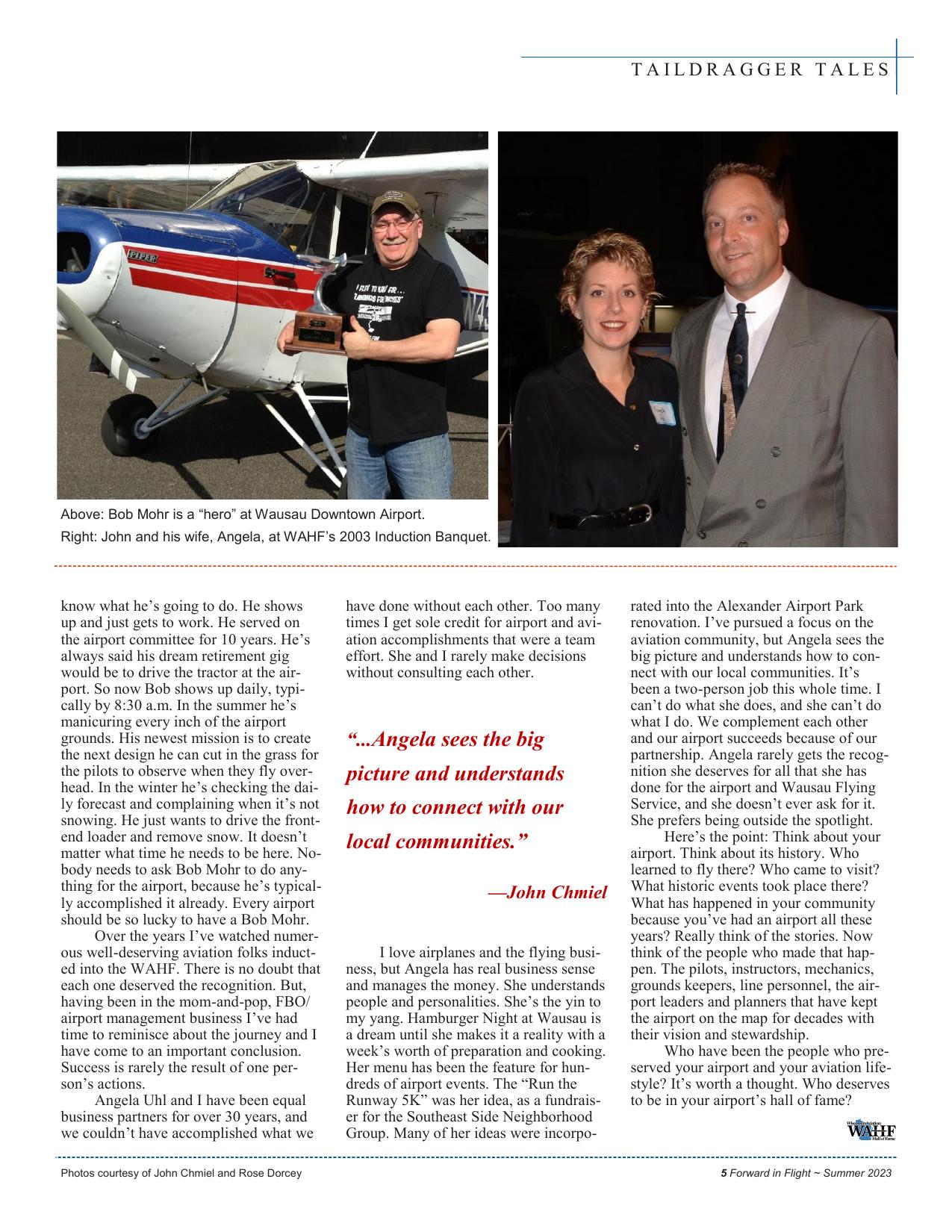
TAILDRAGGER TALES Above: Bob Mohr is a “hero” at Wausau Downtown Airport. Right: John and his wife, Angela, at WAHF’s 2003 Induction Banquet. know what he’s going to do. He shows up and just gets to work. He served on the airport committee for 10 years. He’s always said his dream retirement gig would be to drive the tractor at the airport. So now Bob shows up daily, typically by 8:30 a.m. In the summer he’s manicuring every inch of the airport grounds. His newest mission is to create the next design he can cut in the grass for the pilots to observe when they fly overhead. In the winter he’s checking the daily forecast and complaining when it’s not snowing. He just wants to drive the frontend loader and remove snow. It doesn’t matter what time he needs to be here. Nobody needs to ask Bob Mohr to do anything for the airport, because he’s typically accomplished it already. Every airport should be so lucky to have a Bob Mohr. Over the years I’ve watched numerous well-deserving aviation folks inducted into the WAHF. There is no doubt that each one deserved the recognition. But, having been in the mom-and-pop, FBO/ airport management business I’ve had time to reminisce about the journey and I have come to an important conclusion. Success is rarely the result of one person’s actions. Angela Uhl and I have been equal business partners for over 30 years, and we couldn’t have accomplished what we Photos courtesy of John Chmiel and Rose Dorcey have done without each other. Too many times I get sole credit for airport and aviation accomplishments that were a team effort. She and I rarely make decisions without consulting each other. “...Angela sees the big picture and understands how to connect with our local communities.” —John Chmiel I love airplanes and the flying business, but Angela has real business sense and manages the money. She understands people and personalities. She’s the yin to my yang. Hamburger Night at Wausau is a dream until she makes it a reality with a week’s worth of preparation and cooking. Her menu has been the feature for hundreds of airport events. The “Run the Runway 5K” was her idea, as a fundraiser for the Southeast Side Neighborhood Group. Many of her ideas were incorpo- rated into the Alexander Airport Park renovation. I’ve pursued a focus on the aviation community, but Angela sees the big picture and understands how to connect with our local communities. It’s been a two-person job this whole time. I can’t do what she does, and she can’t do what I do. We complement each other and our airport succeeds because of our partnership. Angela rarely gets the recognition she deserves for all that she has done for the airport and Wausau Flying Service, and she doesn’t ever ask for it. She prefers being outside the spotlight. Here’s the point: Think about your airport. Think about its history. Who learned to fly there? Who came to visit? What historic events took place there? What has happened in your community because you’ve had an airport all these years? Really think of the stories. Now think of the people who made that happen. The pilots, instructors, mechanics, grounds keepers, line personnel, the airport leaders and planners that have kept the airport on the map for decades with their vision and stewardship. Who have been the people who preserved your airport and your aviation lifestyle? It’s worth a thought. Who deserves to be in your airport’s hall of fame? 5 Forward in Flight ~ Summer 2023
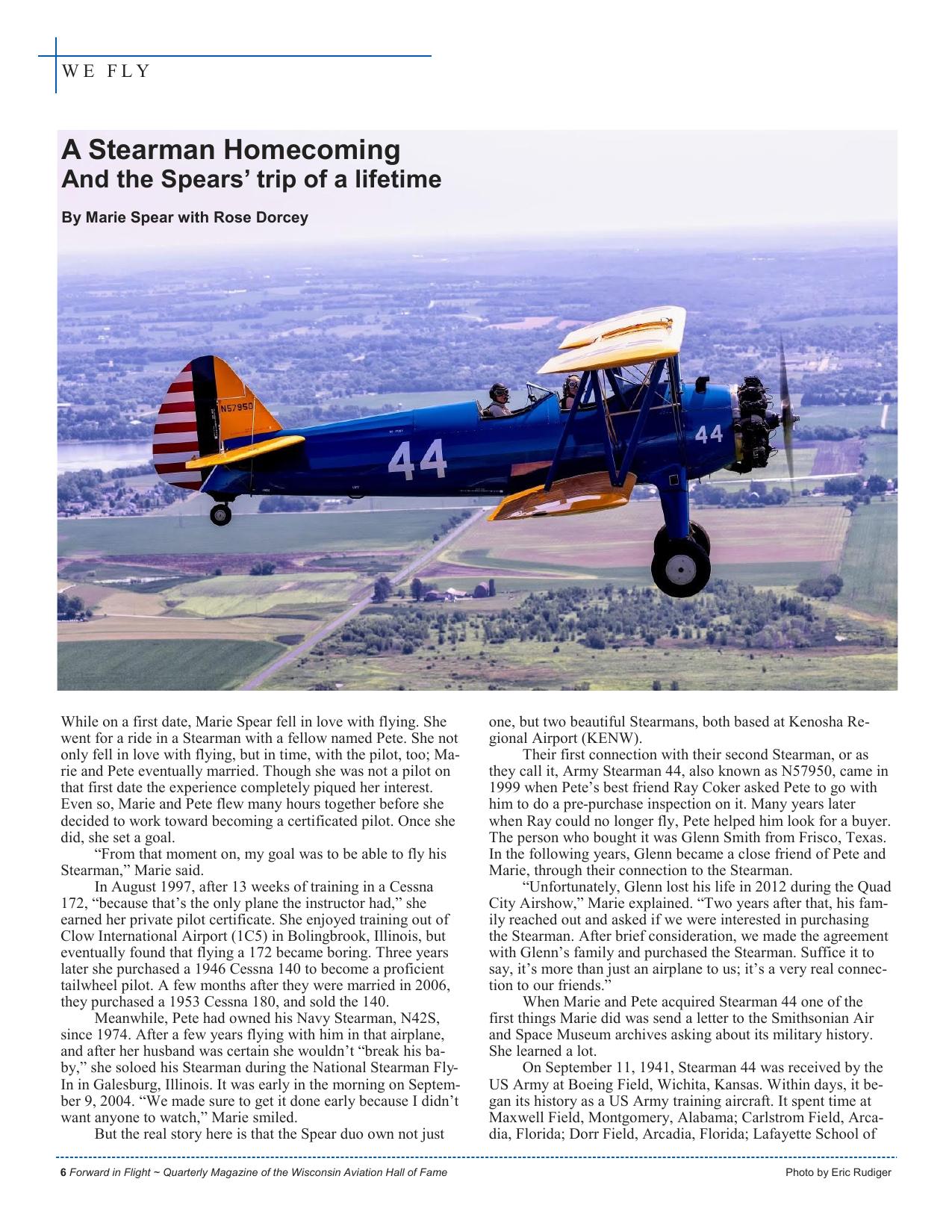
WE FLY A Stearman Homecoming And the Spears’ trip of a lifetime By Marie Spear with Rose Dorcey While on a first date, Marie Spear fell in love with flying. She went for a ride in a Stearman with a fellow named Pete. She not only fell in love with flying, but in time, with the pilot, too; Marie and Pete eventually married. Though she was not a pilot on that first date the experience completely piqued her interest. Even so, Marie and Pete flew many hours together before she decided to work toward becoming a certificated pilot. Once she did, she set a goal. “From that moment on, my goal was to be able to fly his Stearman,” Marie said. In August 1997, after 13 weeks of training in a Cessna 172, “because that’s the only plane the instructor had,” she earned her private pilot certificate. She enjoyed training out of Clow International Airport (1C5) in Bolingbrook, Illinois, but eventually found that flying a 172 became boring. Three years later she purchased a 1946 Cessna 140 to become a proficient tailwheel pilot. A few months after they were married in 2006, they purchased a 1953 Cessna 180, and sold the 140. Meanwhile, Pete had owned his Navy Stearman, N42S, since 1974. After a few years flying with him in that airplane, and after her husband was certain she wouldn’t “break his baby,” she soloed his Stearman during the National Stearman FlyIn in Galesburg, Illinois. It was early in the morning on September 9, 2004. “We made sure to get it done early because I didn’t want anyone to watch,” Marie smiled. But the real story here is that the Spear duo own not just 6 Forward in Flight ~ Quarterly Magazine of the Wisconsin Aviation Hall of Fame one, but two beautiful Stearmans, both based at Kenosha Regional Airport (KENW). Their first connection with their second Stearman, or as they call it, Army Stearman 44, also known as N57950, came in 1999 when Pete’s best friend Ray Coker asked Pete to go with him to do a pre-purchase inspection on it. Many years later when Ray could no longer fly, Pete helped him look for a buyer. The person who bought it was Glenn Smith from Frisco, Texas. In the following years, Glenn became a close friend of Pete and Marie, through their connection to the Stearman. “Unfortunately, Glenn lost his life in 2012 during the Quad City Airshow,” Marie explained. “Two years after that, his family reached out and asked if we were interested in purchasing the Stearman. After brief consideration, we made the agreement with Glenn’s family and purchased the Stearman. Suffice it to say, it’s more than just an airplane to us; it’s a very real connection to our friends.” When Marie and Pete acquired Stearman 44 one of the first things Marie did was send a letter to the Smithsonian Air and Space Museum archives asking about its military history. She learned a lot. On September 11, 1941, Stearman 44 was received by the US Army at Boeing Field, Wichita, Kansas. Within days, it began its history as a US Army training aircraft. It spent time at Maxwell Field, Montgomery, Alabama; Carlstrom Field, Arcadia, Florida; Dorr Field, Arcadia, Florida; Lafayette School of Photo by Eric Rudiger
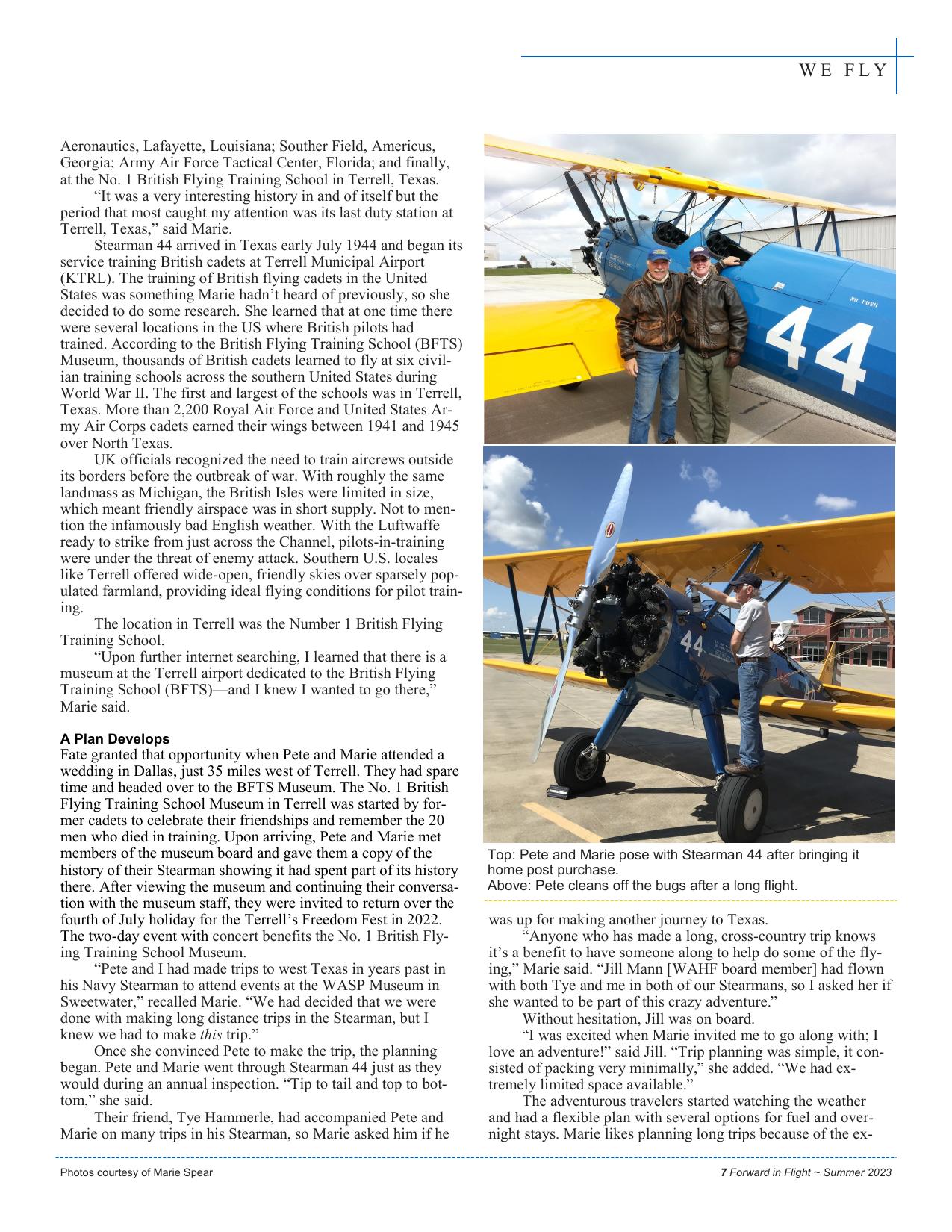
WE FLY Aeronautics, Lafayette, Louisiana; Souther Field, Americus, Georgia; Army Air Force Tactical Center, Florida; and finally, at the No. 1 British Flying Training School in Terrell, Texas. “It was a very interesting history in and of itself but the period that most caught my attention was its last duty station at Terrell, Texas,” said Marie. Stearman 44 arrived in Texas early July 1944 and began its service training British cadets at Terrell Municipal Airport (KTRL). The training of British flying cadets in the United States was something Marie hadn’t heard of previously, so she decided to do some research. She learned that at one time there were several locations in the US where British pilots had trained. According to the British Flying Training School (BFTS) Museum, thousands of British cadets learned to fly at six civilian training schools across the southern United States during World War II. The first and largest of the schools was in Terrell, Texas. More than 2,200 Royal Air Force and United States Army Air Corps cadets earned their wings between 1941 and 1945 over North Texas. UK officials recognized the need to train aircrews outside its borders before the outbreak of war. With roughly the same landmass as Michigan, the British Isles were limited in size, which meant friendly airspace was in short supply. Not to mention the infamously bad English weather. With the Luftwaffe ready to strike from just across the Channel, pilots-in-training were under the threat of enemy attack. Southern U.S. locales like Terrell offered wide-open, friendly skies over sparsely populated farmland, providing ideal flying conditions for pilot training. The location in Terrell was the Number 1 British Flying Training School. “Upon further internet searching, I learned that there is a museum at the Terrell airport dedicated to the British Flying Training School (BFTS)—and I knew I wanted to go there,” Marie said. A Plan Develops Fate granted that opportunity when Pete and Marie attended a wedding in Dallas, just 35 miles west of Terrell. They had spare time and headed over to the BFTS Museum. The No. 1 British Flying Training School Museum in Terrell was started by former cadets to celebrate their friendships and remember the 20 men who died in training. Upon arriving, Pete and Marie met members of the museum board and gave them a copy of the history of their Stearman showing it had spent part of its history there. After viewing the museum and continuing their conversation with the museum staff, they were invited to return over the fourth of July holiday for the Terrell’s Freedom Fest in 2022. The two-day event with concert benefits the No. 1 British Flying Training School Museum. “Pete and I had made trips to west Texas in years past in his Navy Stearman to attend events at the WASP Museum in Sweetwater,” recalled Marie. “We had decided that we were done with making long distance trips in the Stearman, but I knew we had to make this trip.” Once she convinced Pete to make the trip, the planning began. Pete and Marie went through Stearman 44 just as they would during an annual inspection. “Tip to tail and top to bottom,” she said. Their friend, Tye Hammerle, had accompanied Pete and Marie on many trips in his Stearman, so Marie asked him if he Photos courtesy of Marie Spear Top: Pete and Marie pose with Stearman 44 after bringing it home post purchase. Above: Pete cleans off the bugs after a long flight. was up for making another journey to Texas. “Anyone who has made a long, cross-country trip knows it’s a benefit to have someone along to help do some of the flying,” Marie said. “Jill Mann [WAHF board member] had flown with both Tye and me in both of our Stearmans, so I asked her if she wanted to be part of this crazy adventure.” Without hesitation, Jill was on board. “I was excited when Marie invited me to go along with; I love an adventure!” said Jill. “Trip planning was simple, it consisted of packing very minimally,” she added. “We had extremely limited space available.” The adventurous travelers started watching the weather and had a flexible plan with several options for fuel and overnight stays. Marie likes planning long trips because of the ex7 Forward in Flight ~ Summer 2023
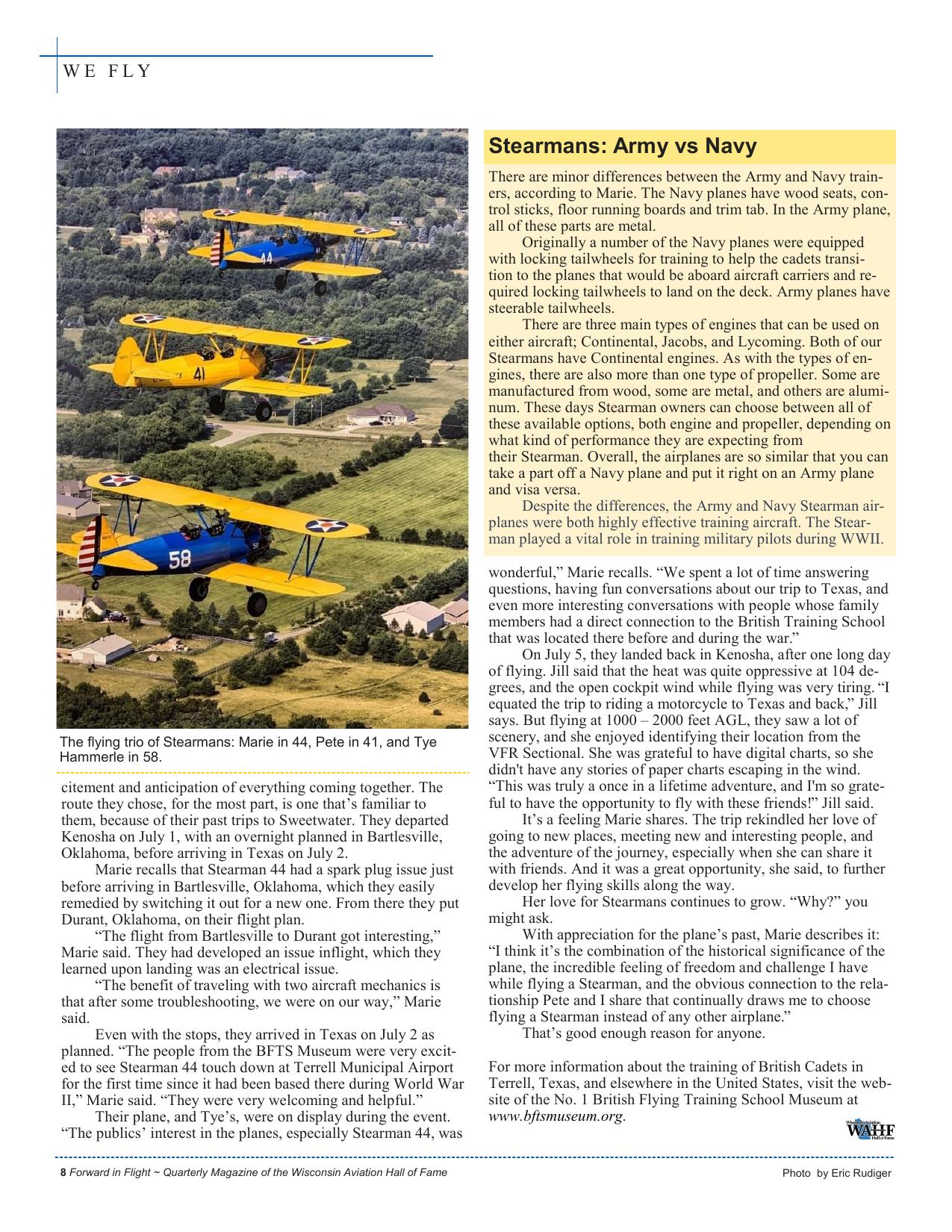
WE FLY Stearmans: Army vs Navy There are minor differences between the Army and Navy trainers, according to Marie. The Navy planes have wood seats, control sticks, floor running boards and trim tab. In the Army plane, all of these parts are metal. Originally a number of the Navy planes were equipped with locking tailwheels for training to help the cadets transition to the planes that would be aboard aircraft carriers and required locking tailwheels to land on the deck. Army planes have steerable tailwheels. There are three main types of engines that can be used on either aircraft; Continental, Jacobs, and Lycoming. Both of our Stearmans have Continental engines. As with the types of engines, there are also more than one type of propeller. Some are manufactured from wood, some are metal, and others are aluminum. These days Stearman owners can choose between all of these available options, both engine and propeller, depending on what kind of performance they are expecting from their Stearman. Overall, the airplanes are so similar that you can take a part off a Navy plane and put it right on an Army plane and visa versa. Despite the differences, the Army and Navy Stearman airplanes were both highly effective training aircraft. The Stearman played a vital role in training military pilots during WWII. The flying trio of Stearmans: Marie in 44, Pete in 41, and Tye Hammerle in 58. citement and anticipation of everything coming together. The route they chose, for the most part, is one that’s familiar to them, because of their past trips to Sweetwater. They departed Kenosha on July 1, with an overnight planned in Bartlesville, Oklahoma, before arriving in Texas on July 2. Marie recalls that Stearman 44 had a spark plug issue just before arriving in Bartlesville, Oklahoma, which they easily remedied by switching it out for a new one. From there they put Durant, Oklahoma, on their flight plan. “The flight from Bartlesville to Durant got interesting,” Marie said. They had developed an issue inflight, which they learned upon landing was an electrical issue. “The benefit of traveling with two aircraft mechanics is that after some troubleshooting, we were on our way,” Marie said. Even with the stops, they arrived in Texas on July 2 as planned. “The people from the BFTS Museum were very excited to see Stearman 44 touch down at Terrell Municipal Airport for the first time since it had been based there during World War II,” Marie said. “They were very welcoming and helpful.” Their plane, and Tye’s, were on display during the event. “The publics’ interest in the planes, especially Stearman 44, was 8 Forward in Flight ~ Quarterly Magazine of the Wisconsin Aviation Hall of Fame wonderful,” Marie recalls. “We spent a lot of time answering questions, having fun conversations about our trip to Texas, and even more interesting conversations with people whose family members had a direct connection to the British Training School that was located there before and during the war.” On July 5, they landed back in Kenosha, after one long day of flying. Jill said that the heat was quite oppressive at 104 degrees, and the open cockpit wind while flying was very tiring. “I equated the trip to riding a motorcycle to Texas and back,” Jill says. But flying at 1000 – 2000 feet AGL, they saw a lot of scenery, and she enjoyed identifying their location from the VFR Sectional. She was grateful to have digital charts, so she didn't have any stories of paper charts escaping in the wind. “This was truly a once in a lifetime adventure, and I'm so grateful to have the opportunity to fly with these friends!” Jill said. It’s a feeling Marie shares. The trip rekindled her love of going to new places, meeting new and interesting people, and the adventure of the journey, especially when she can share it with friends. And it was a great opportunity, she said, to further develop her flying skills along the way. Her love for Stearmans continues to grow. “Why?” you might ask. With appreciation for the plane’s past, Marie describes it: “I think it’s the combination of the historical significance of the plane, the incredible feeling of freedom and challenge I have while flying a Stearman, and the obvious connection to the relationship Pete and I share that continually draws me to choose flying a Stearman instead of any other airplane.” That’s good enough reason for anyone. For more information about the training of British Cadets in Terrell, Texas, and elsewhere in the United States, visit the website of the No. 1 British Flying Training School Museum at www.bftsmuseum.org. Photo by Eric Rudiger
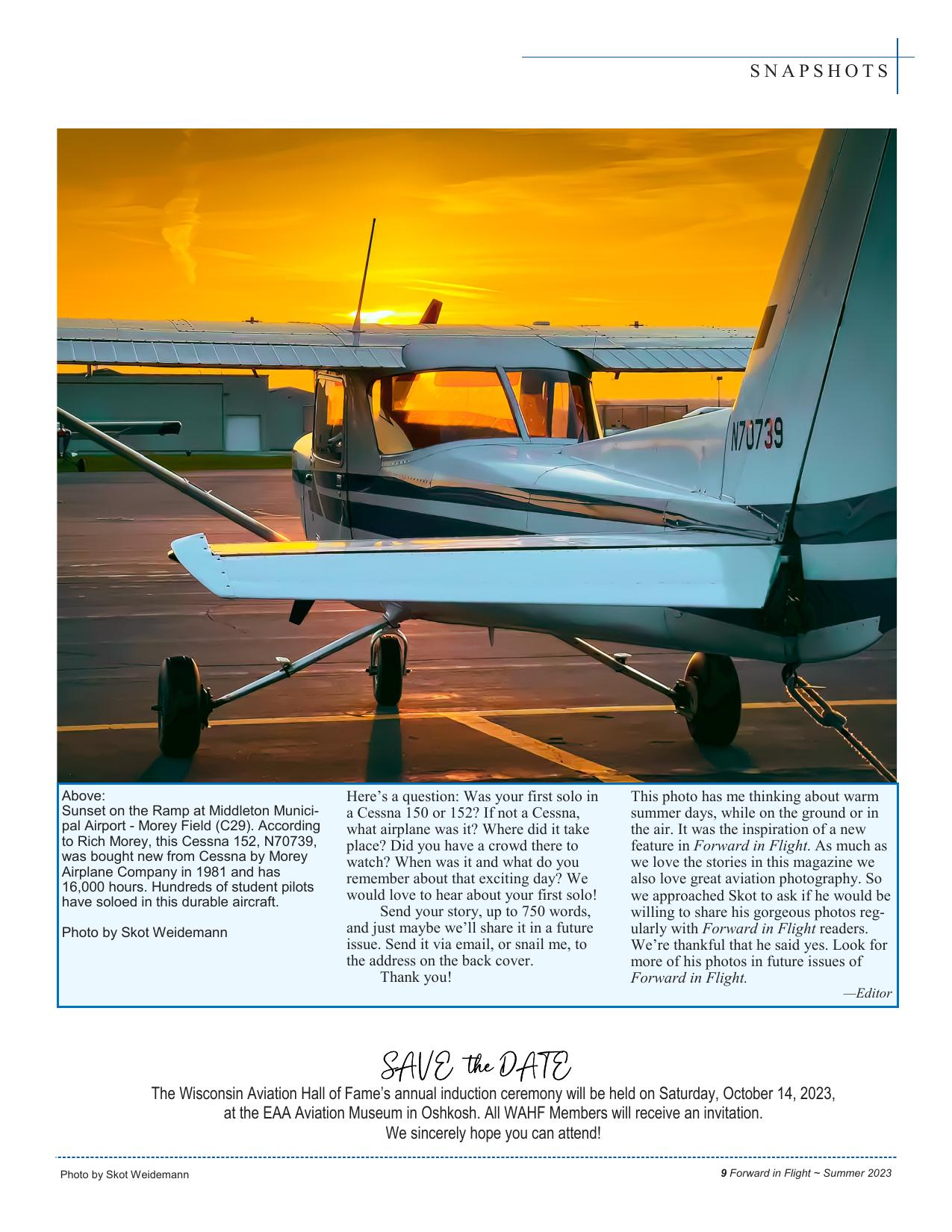
SNAPSHOTS Above: Sunset on the Ramp at Middleton Municipal Airport - Morey Field (C29). According to Rich Morey, this Cessna 152, N70739, was bought new from Cessna by Morey Airplane Company in 1981 and has 16,000 hours. Hundreds of student pilots have soloed in this durable aircraft. Photo by Skot Weidemann Here’s a question: Was your first solo in a Cessna 150 or 152? If not a Cessna, what airplane was it? Where did it take place? Did you have a crowd there to watch? When was it and what do you remember about that exciting day? We would love to hear about your first solo! Send your story, up to 750 words, and just maybe we’ll share it in a future issue. Send it via email, or snail me, to the address on the back cover. Thank you! This photo has me thinking about warm summer days, while on the ground or in the air. It was the inspiration of a new feature in Forward in Flight. As much as we love the stories in this magazine we also love great aviation photography. So we approached Skot to ask if he would be willing to share his gorgeous photos regularly with Forward in Flight readers. We’re thankful that he said yes. Look for more of his photos in future issues of Forward in Flight. —Editor SAVE the DATE The Wisconsin Aviation Hall of Fame’s annual induction ceremony will be held on Saturday, October 14, 2023, at the EAA Aviation Museum in Oshkosh. All WAHF Members will receive an invitation. We sincerely hope you can attend! Photo by Skot Weidemann 9 Forward in Flight ~ Summer 2023
TALES OF THE ACES Dick Bong’s Fateful Flight By Mike O’Connor History is replete with instances wherein seemingly innocuous actions have dramatic, sometimes life-changing, consequences. Case in point: Second Lieutenant Richard I. Bong’s training flight on June 11, 1942. In June 1942, Lieutenant Bong was a newly minted U.S. Army Air Force pilot assigned to the 49th Fighter Squadron, 14th Fighter Group based at Hamilton Field, California. Born in 1920 in the tiny Wisconsin farm town of Poplar, Bong was the eldest of nine children. As with many children of the 20s, he grew up enamored of aviation. Known as the Golden Age of Flight, the 1920s were heady times marked by futuristic aircraft designs, thrilling air races, barnstormers, wing-walkers, record-setting flights and celebrated fliers like Jimmy Doolittle, Amelia Earhart, and Charles Lindbergh. In his teen years, Dick set his sights on military aviation. He was accepted into the AAF’s flight training program in late 1941 after completing two years of college, the minimum requirement for admission. Following flight training, he was assigned to the 49th Fighter Squadron (FS) in May 1942. The 14th Fighter Group (FG) was assigned to the 4th Air Force commanded by General George Kenney. The Group was equipped with Lockheed Aircraft’s P-38 Lightning. The P-38 was America’s most advanced fighter, noted for its twin-engine design with the pilot seated in a central nacelle. The Lightning offered fast-climbing abilities, long range and heavy armament. For Dick, it was love at first sight. After his first flight in a P-38, Dick, normally a quiet, reserved individual, enthused: “Wooey. What an airplane.” In all respects, the Lightning and Dick were made for each other. Throughout his life, Dick was known for his competitive nature. He enjoyed pitting his skills against anyone wanting a game of baseball, basketball, hockey, horseshoes, card games or, once he joined the service, poker. He loved to compete; winning was secondary. Lockheed’s fighter offered him the perfect outlet to channel that competitive streak. Going aloft with his squadron mates, he could throw the rugged, maneuverable Lightning through any and all maneuvers. Yet he tempered his flying with respect for the aircraft. Even the Lightning had its limits. A number of 14th FG pilots would be killed in training accidents. The 14th FG had been flying P-38s since late 1941. Scheduled for deployment to the European Theatre of Operations, the unit was not only wringing out their new mount but also trying to develop effective combat tactics to use against their Luftwaffe opponents. Numerous flights were scheduled to bring the Group’s pilots up to speed, which brings us to June 11, 1942, a date that changed Dick Bong’s life forever. That morning, Dick led off three squadron mates on a routine hop to build up their flight time. Other P-38s lifted off as well. After about a half-hour, the telephones at the 4th Air Force Headquarters began ringing. The first caller complained that an Air Force pilot was buzzing the Golden Gate. Another caller reported that a P-38 flew over Market Street in downtown San Francisco, waving at the secretaries! More reports came in of several P-38s buzzing the Golden Gate. Another caller complained that a lone P-38 had buzzed her house in San Anselmo. The plane flew so low, the woman exclaimed, that it blew all 10 Forward in Flight ~ Quarterly Magazine of the Wisconsin Aviation Hall of Fame her wash off her clothes line with the laundry ending up in the dirt! When Dick landed after the flight, he was met by a major and a bird colonel. They told him he was grounded effective immediately and confined to quarters pending a formal investigation into his flight. Though the press would later paint Dick as a stoic Swede with ice water in his veins, the announcement of his grounding must have hit Dick in the solar plexus. Flying was his life. The squadron was set to deploy and now, his future was very much in doubt. To make matters worse, Dick’s mother Dora and one of his sisters showed up at the base the next day on a planned visit. They were informed of Dick’s status and denied entry. After pleading with the base commander, Mrs. Bong was allowed 15 minutes with her disconsolate son. What Dick did not know was that his flight’s aerial antics had been the latest in a string of low-level buzz jobs by 4th Air Force pilots. These unauthorized and often dangerous flights brought ever-growing complaints from the public and local politicians to 4th Air Force headquarters and its commander, General George Kenney. It seems that the June 11th flight was the straw that broke the camel’s back. Flash forward to July 7. Dick found himself and one of his June 11 compatriots braced at attention in General Kenney’s office. A career Air Force officer, Kenney himself had been a fighter pilot in World War I. As much as he understood the fighter pilot mindset, the incidents of flat hatting had cast his command and himself in a very negative light. Kenney was standing by his desk on which rested a lengthy report from the Inspector General on the June 11th flight. The IG report recommended harsh measures be taken. Kenney was of a mind until the two fliers had walked into his office. Kenney later recalled he was taken aback by Dick’s youthful appearance, And, in fact, Dick looked more like a teenager who should be shooting buckets back at Poplar than a firebreathing P-38 pilot. Kenney basically read the two fliers the riot act. He reprimanded them on their unprofessional behavior, the breakdown in flight discipline, the danger their antics posed to civilians and the damage that particular flight had done to the public image of the 4th Air Force. After several minutes, Kenney wrapped up his tongue-lashing and paused. Dick must have feared the worst. Kenney, however, looked at the young, fresh-faced, fearful pilot and quietly asked: ‘So, Lieutenant Bong, tell me. How does the P-38 handle at low altitude?” A moment passed as Dick tried to process what had just been said, puzzled by Kenney’s change of topic. And then the other shoe dropped. Dick realized the dressing down was over and he had been spared! His flying career was not over. As the two began discussing the Lightning’s capabilities, the tension in the room lessened. After several minutes of ‘hangar flying,’ Kenney ended the meeting, later recalling he rather dramatically tore up the report on the June 11th flight. He informed Dick he was to report back to his squadron, write a 5,000-word essay on safe flying procedures and deliver it to the unit’s pilots. And he was to report to the lady in San Anselmo whose wash he had blown off the cloth’s line, help her with the
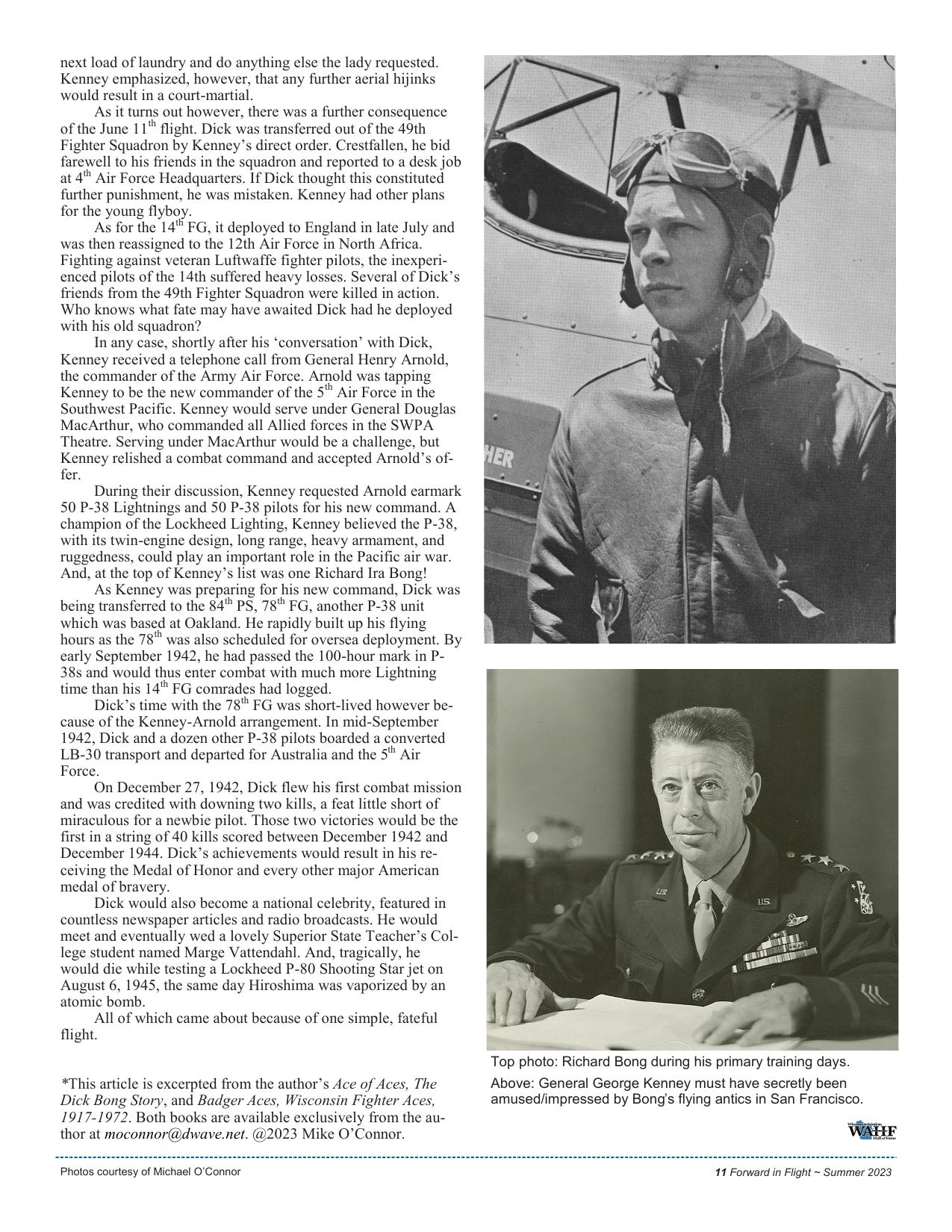
next load of laundry and do anything else the lady requested. Kenney emphasized, however, that any further aerial hijinks would result in a court-martial. As it turns out however, there was a further consequence of the June 11th flight. Dick was transferred out of the 49th Fighter Squadron by Kenney’s direct order. Crestfallen, he bid farewell to his friends in the squadron and reported to a desk job at 4th Air Force Headquarters. If Dick thought this constituted further punishment, he was mistaken. Kenney had other plans for the young flyboy. As for the 14th FG, it deployed to England in late July and was then reassigned to the 12th Air Force in North Africa. Fighting against veteran Luftwaffe fighter pilots, the inexperienced pilots of the 14th suffered heavy losses. Several of Dick’s friends from the 49th Fighter Squadron were killed in action. Who knows what fate may have awaited Dick had he deployed with his old squadron? In any case, shortly after his ‘conversation’ with Dick, Kenney received a telephone call from General Henry Arnold, the commander of the Army Air Force. Arnold was tapping Kenney to be the new commander of the 5th Air Force in the Southwest Pacific. Kenney would serve under General Douglas MacArthur, who commanded all Allied forces in the SWPA Theatre. Serving under MacArthur would be a challenge, but Kenney relished a combat command and accepted Arnold’s offer. During their discussion, Kenney requested Arnold earmark 50 P-38 Lightnings and 50 P-38 pilots for his new command. A champion of the Lockheed Lighting, Kenney believed the P-38, with its twin-engine design, long range, heavy armament, and ruggedness, could play an important role in the Pacific air war. And, at the top of Kenney’s list was one Richard Ira Bong! As Kenney was preparing for his new command, Dick was being transferred to the 84th PS, 78th FG, another P-38 unit which was based at Oakland. He rapidly built up his flying hours as the 78th was also scheduled for oversea deployment. By early September 1942, he had passed the 100-hour mark in P38s and would thus enter combat with much more Lightning time than his 14th FG comrades had logged. Dick’s time with the 78th FG was short-lived however because of the Kenney-Arnold arrangement. In mid-September 1942, Dick and a dozen other P-38 pilots boarded a converted LB-30 transport and departed for Australia and the 5th Air Force. On December 27, 1942, Dick flew his first combat mission and was credited with downing two kills, a feat little short of miraculous for a newbie pilot. Those two victories would be the first in a string of 40 kills scored between December 1942 and December 1944. Dick’s achievements would result in his receiving the Medal of Honor and every other major American medal of bravery. Dick would also become a national celebrity, featured in countless newspaper articles and radio broadcasts. He would meet and eventually wed a lovely Superior State Teacher’s College student named Marge Vattendahl. And, tragically, he would die while testing a Lockheed P-80 Shooting Star jet on August 6, 1945, the same day Hiroshima was vaporized by an atomic bomb. All of which came about because of one simple, fateful flight. Top photo: Richard Bong during his primary training days. *This article is excerpted from the author’s Ace of Aces, The Dick Bong Story, and Badger Aces, Wisconsin Fighter Aces, 1917-1972. Both books are available exclusively from the author at moconnor@dwave.net. @2023 Mike O’Connor. Photos courtesy of Michael O’Connor Above: General George Kenney must have secretly been amused/impressed by Bong’s flying antics in San Francisco. 11 Forward in Flight ~ Summer 2023
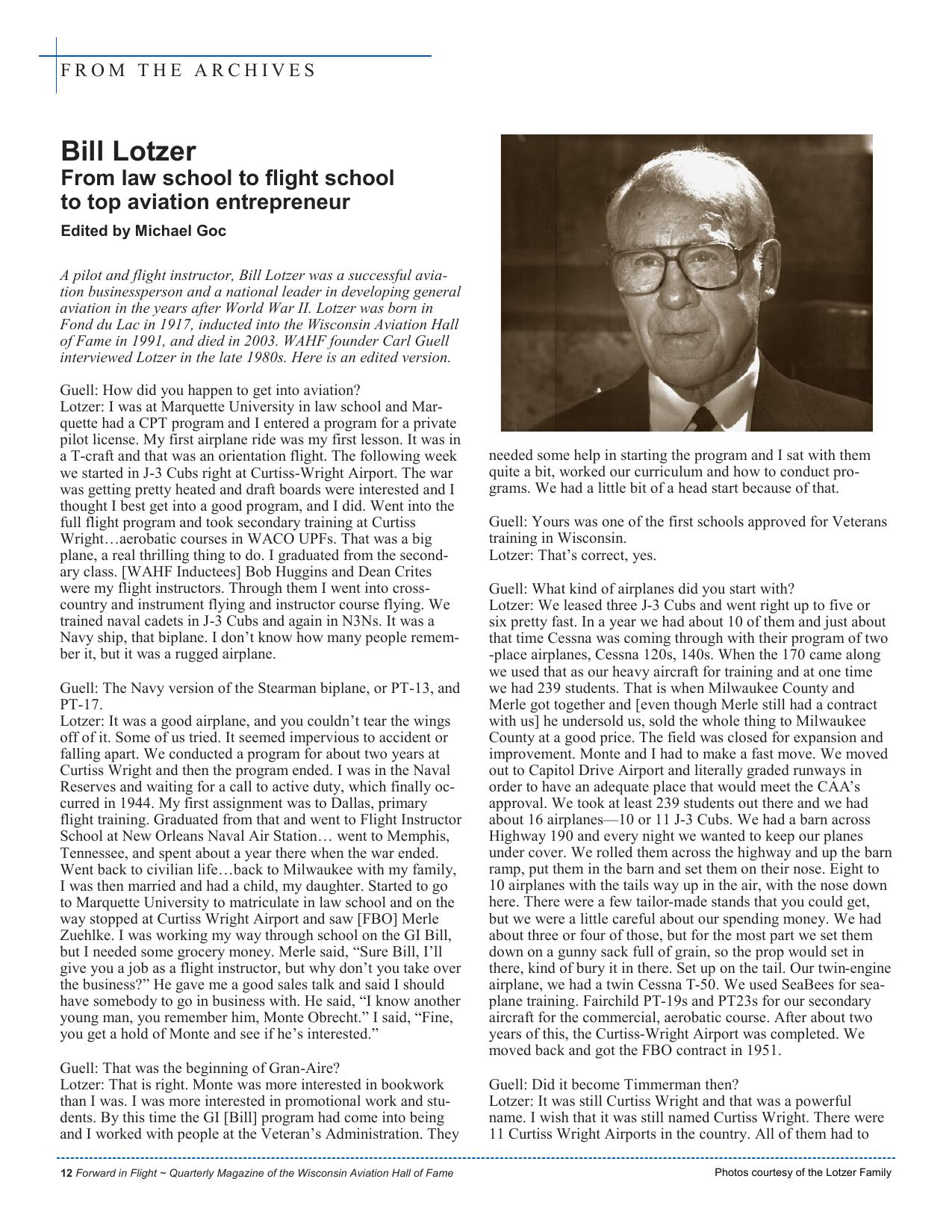
FROM THE ARCHIVES Bill Lotzer From law school to flight school to top aviation entrepreneur Edited by Michael Goc A pilot and flight instructor, Bill Lotzer was a successful aviation businessperson and a national leader in developing general aviation in the years after World War II. Lotzer was born in Fond du Lac in 1917, inducted into the Wisconsin Aviation Hall of Fame in 1991, and died in 2003. WAHF founder Carl Guell interviewed Lotzer in the late 1980s. Here is an edited version. Guell: How did you happen to get into aviation? Lotzer: I was at Marquette University in law school and Marquette had a CPT program and I entered a program for a private pilot license. My first airplane ride was my first lesson. It was in a T-craft and that was an orientation flight. The following week we started in J-3 Cubs right at Curtiss-Wright Airport. The war was getting pretty heated and draft boards were interested and I thought I best get into a good program, and I did. Went into the full flight program and took secondary training at Curtiss Wright…aerobatic courses in WACO UPFs. That was a big plane, a real thrilling thing to do. I graduated from the secondary class. [WAHF Inductees] Bob Huggins and Dean Crites were my flight instructors. Through them I went into crosscountry and instrument flying and instructor course flying. We trained naval cadets in J-3 Cubs and again in N3Ns. It was a Navy ship, that biplane. I don’t know how many people remember it, but it was a rugged airplane. Guell: The Navy version of the Stearman biplane, or PT-13, and PT-17. Lotzer: It was a good airplane, and you couldn’t tear the wings off of it. Some of us tried. It seemed impervious to accident or falling apart. We conducted a program for about two years at Curtiss Wright and then the program ended. I was in the Naval Reserves and waiting for a call to active duty, which finally occurred in 1944. My first assignment was to Dallas, primary flight training. Graduated from that and went to Flight Instructor School at New Orleans Naval Air Station… went to Memphis, Tennessee, and spent about a year there when the war ended. Went back to civilian life…back to Milwaukee with my family, I was then married and had a child, my daughter. Started to go to Marquette University to matriculate in law school and on the way stopped at Curtiss Wright Airport and saw [FBO] Merle Zuehlke. I was working my way through school on the GI Bill, but I needed some grocery money. Merle said, “Sure Bill, I’ll give you a job as a flight instructor, but why don’t you take over the business?” He gave me a good sales talk and said I should have somebody to go in business with. He said, “I know another young man, you remember him, Monte Obrecht.” I said, “Fine, you get a hold of Monte and see if he’s interested.” needed some help in starting the program and I sat with them quite a bit, worked our curriculum and how to conduct programs. We had a little bit of a head start because of that. Guell: Yours was one of the first schools approved for Veterans training in Wisconsin. Lotzer: That’s correct, yes. Guell: What kind of airplanes did you start with? Lotzer: We leased three J-3 Cubs and went right up to five or six pretty fast. In a year we had about 10 of them and just about that time Cessna was coming through with their program of two -place airplanes, Cessna 120s, 140s. When the 170 came along we used that as our heavy aircraft for training and at one time we had 239 students. That is when Milwaukee County and Merle got together and [even though Merle still had a contract with us] he undersold us, sold the whole thing to Milwaukee County at a good price. The field was closed for expansion and improvement. Monte and I had to make a fast move. We moved out to Capitol Drive Airport and literally graded runways in order to have an adequate place that would meet the CAA’s approval. We took at least 239 students out there and we had about 16 airplanes—10 or 11 J-3 Cubs. We had a barn across Highway 190 and every night we wanted to keep our planes under cover. We rolled them across the highway and up the barn ramp, put them in the barn and set them on their nose. Eight to 10 airplanes with the tails way up in the air, with the nose down here. There were a few tailor-made stands that you could get, but we were a little careful about our spending money. We had about three or four of those, but for the most part we set them down on a gunny sack full of grain, so the prop would set in there, kind of bury it in there. Set up on the tail. Our twin-engine airplane, we had a twin Cessna T-50. We used SeaBees for seaplane training. Fairchild PT-19s and PT23s for our secondary aircraft for the commercial, aerobatic course. After about two years of this, the Curtiss-Wright Airport was completed. We moved back and got the FBO contract in 1951. Guell: That was the beginning of Gran-Aire? Lotzer: That is right. Monte was more interested in bookwork than I was. I was more interested in promotional work and students. By this time the GI [Bill] program had come into being and I worked with people at the Veteran’s Administration. They Guell: Did it become Timmerman then? Lotzer: It was still Curtiss Wright and that was a powerful name. I wish that it was still named Curtiss Wright. There were 11 Curtiss Wright Airports in the country. All of them had to 12 Forward in Flight ~ Quarterly Magazine of the Wisconsin Aviation Hall of Fame Photos courtesy of the Lotzer Family
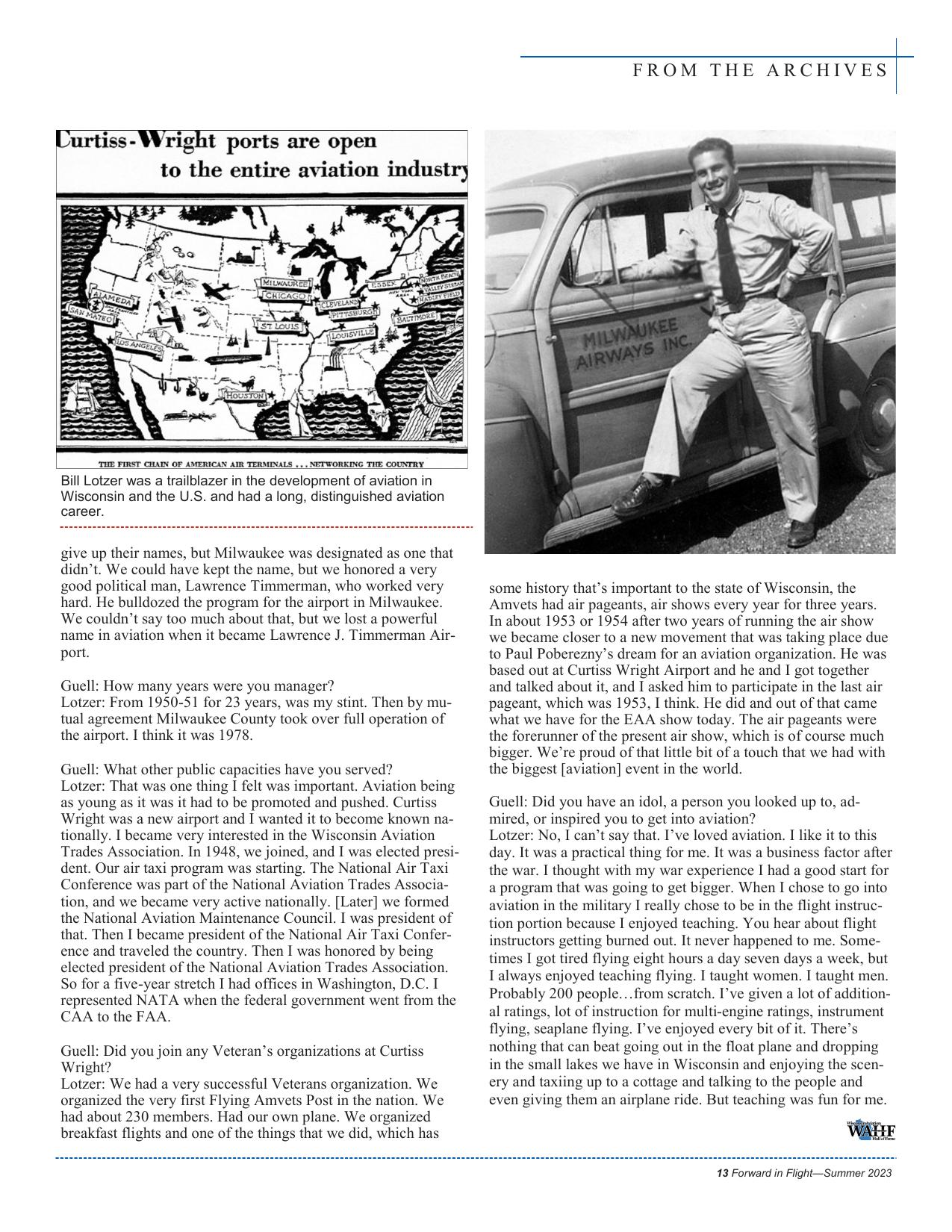
FROM THE ARCHIVES Bill Lotzer was a trailblazer in the development of aviation in Wisconsin and the U.S. and had a long, distinguished aviation career. give up their names, but Milwaukee was designated as one that didn’t. We could have kept the name, but we honored a very good political man, Lawrence Timmerman, who worked very hard. He bulldozed the program for the airport in Milwaukee. We couldn’t say too much about that, but we lost a powerful name in aviation when it became Lawrence J. Timmerman Airport. Guell: How many years were you manager? Lotzer: From 1950-51 for 23 years, was my stint. Then by mutual agreement Milwaukee County took over full operation of the airport. I think it was 1978. Guell: What other public capacities have you served? Lotzer: That was one thing I felt was important. Aviation being as young as it was it had to be promoted and pushed. Curtiss Wright was a new airport and I wanted it to become known nationally. I became very interested in the Wisconsin Aviation Trades Association. In 1948, we joined, and I was elected president. Our air taxi program was starting. The National Air Taxi Conference was part of the National Aviation Trades Association, and we became very active nationally. [Later] we formed the National Aviation Maintenance Council. I was president of that. Then I became president of the National Air Taxi Conference and traveled the country. Then I was honored by being elected president of the National Aviation Trades Association. So for a five-year stretch I had offices in Washington, D.C. I represented NATA when the federal government went from the CAA to the FAA. Guell: Did you join any Veteran’s organizations at Curtiss Wright? Lotzer: We had a very successful Veterans organization. We organized the very first Flying Amvets Post in the nation. We had about 230 members. Had our own plane. We organized breakfast flights and one of the things that we did, which has some history that’s important to the state of Wisconsin, the Amvets had air pageants, air shows every year for three years. In about 1953 or 1954 after two years of running the air show we became closer to a new movement that was taking place due to Paul Poberezny’s dream for an aviation organization. He was based out at Curtiss Wright Airport and he and I got together and talked about it, and I asked him to participate in the last air pageant, which was 1953, I think. He did and out of that came what we have for the EAA show today. The air pageants were the forerunner of the present air show, which is of course much bigger. We’re proud of that little bit of a touch that we had with the biggest [aviation] event in the world. Guell: Did you have an idol, a person you looked up to, admired, or inspired you to get into aviation? Lotzer: No, I can’t say that. I’ve loved aviation. I like it to this day. It was a practical thing for me. It was a business factor after the war. I thought with my war experience I had a good start for a program that was going to get bigger. When I chose to go into aviation in the military I really chose to be in the flight instruction portion because I enjoyed teaching. You hear about flight instructors getting burned out. It never happened to me. Sometimes I got tired flying eight hours a day seven days a week, but I always enjoyed teaching flying. I taught women. I taught men. Probably 200 people…from scratch. I’ve given a lot of additional ratings, lot of instruction for multi-engine ratings, instrument flying, seaplane flying. I’ve enjoyed every bit of it. There’s nothing that can beat going out in the float plane and dropping in the small lakes we have in Wisconsin and enjoying the scenery and taxiing up to a cottage and talking to the people and even giving them an airplane ride. But teaching was fun for me. 13 Forward in Flight—Summer 2023
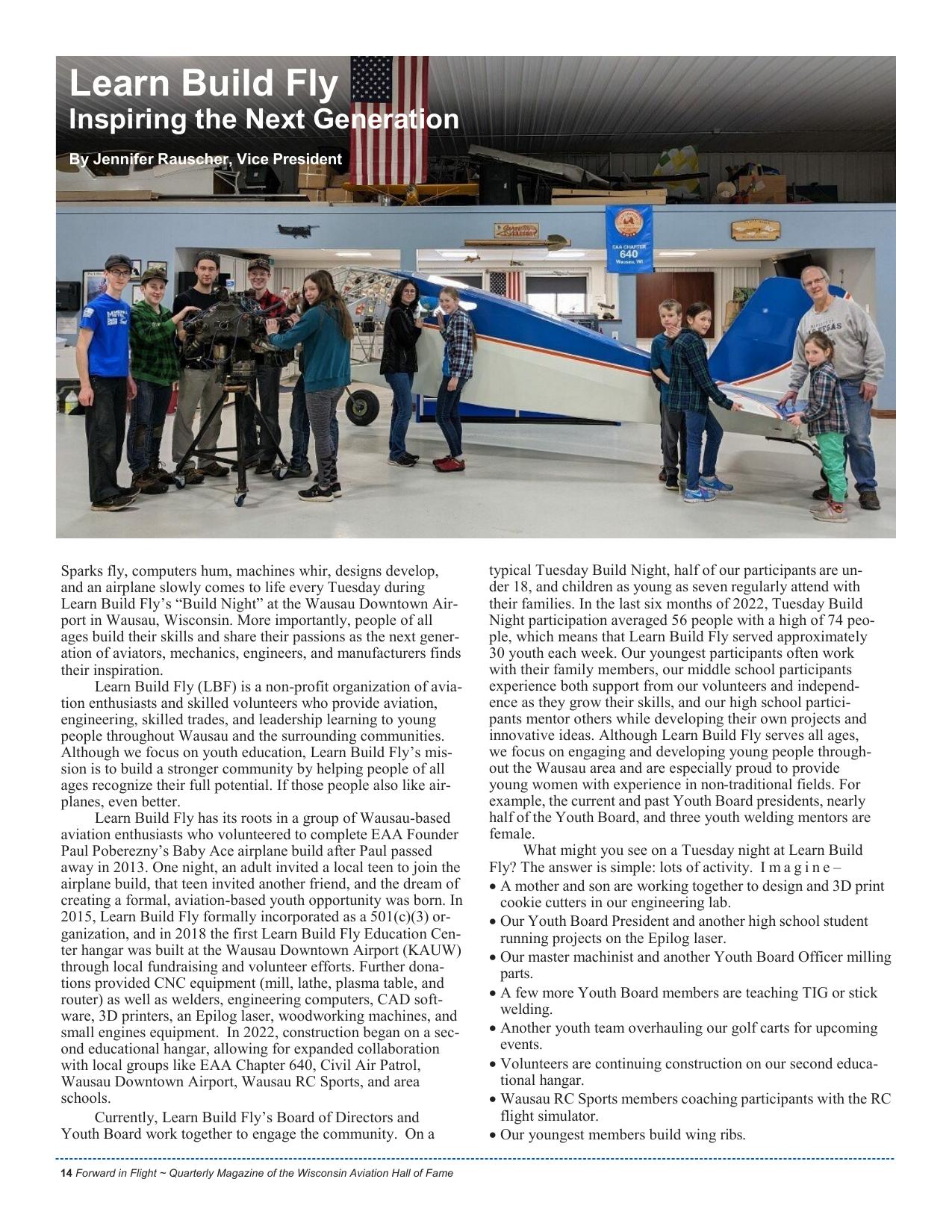
Learn Build Fly Inspiring the Next Generation By Jennifer Rauscher, Vice President Sparks fly, computers hum, machines whir, designs develop, and an airplane slowly comes to life every Tuesday during Learn Build Fly’s “Build Night” at the Wausau Downtown Airport in Wausau, Wisconsin. More importantly, people of all ages build their skills and share their passions as the next generation of aviators, mechanics, engineers, and manufacturers finds their inspiration. Learn Build Fly (LBF) is a non-profit organization of aviation enthusiasts and skilled volunteers who provide aviation, engineering, skilled trades, and leadership learning to young people throughout Wausau and the surrounding communities. Although we focus on youth education, Learn Build Fly’s mission is to build a stronger community by helping people of all ages recognize their full potential. If those people also like airplanes, even better. Learn Build Fly has its roots in a group of Wausau-based aviation enthusiasts who volunteered to complete EAA Founder Paul Poberezny’s Baby Ace airplane build after Paul passed away in 2013. One night, an adult invited a local teen to join the airplane build, that teen invited another friend, and the dream of creating a formal, aviation-based youth opportunity was born. In 2015, Learn Build Fly formally incorporated as a 501(c)(3) organization, and in 2018 the first Learn Build Fly Education Center hangar was built at the Wausau Downtown Airport (KAUW) through local fundraising and volunteer efforts. Further donations provided CNC equipment (mill, lathe, plasma table, and router) as well as welders, engineering computers, CAD software, 3D printers, an Epilog laser, woodworking machines, and small engines equipment. In 2022, construction began on a second educational hangar, allowing for expanded collaboration with local groups like EAA Chapter 640, Civil Air Patrol, Wausau Downtown Airport, Wausau RC Sports, and area schools. Currently, Learn Build Fly’s Board of Directors and Youth Board work together to engage the community. On a 14 Forward in Flight ~ Quarterly Magazine of the Wisconsin Aviation Hall of Fame typical Tuesday Build Night, half of our participants are under 18, and children as young as seven regularly attend with their families. In the last six months of 2022, Tuesday Build Night participation averaged 56 people with a high of 74 people, which means that Learn Build Fly served approximately 30 youth each week. Our youngest participants often work with their family members, our middle school participants experience both support from our volunteers and independence as they grow their skills, and our high school participants mentor others while developing their own projects and innovative ideas. Although Learn Build Fly serves all ages, we focus on engaging and developing young people throughout the Wausau area and are especially proud to provide young women with experience in non-traditional fields. For example, the current and past Youth Board presidents, nearly half of the Youth Board, and three youth welding mentors are female. What might you see on a Tuesday night at Learn Build Fly? The answer is simple: lots of activity. I m a g i n e – · A mother and son are working together to design and 3D print cookie cutters in our engineering lab. · Our Youth Board President and another high school student running projects on the Epilog laser. · Our master machinist and another Youth Board Officer milling parts. · A few more Youth Board members are teaching TIG or stick welding. · Another youth team overhauling our golf carts for upcoming events. · Volunteers are continuing construction on our second educational hangar. · Wausau RC Sports members coaching participants with the RC flight simulator. · Our youngest members build wing ribs.
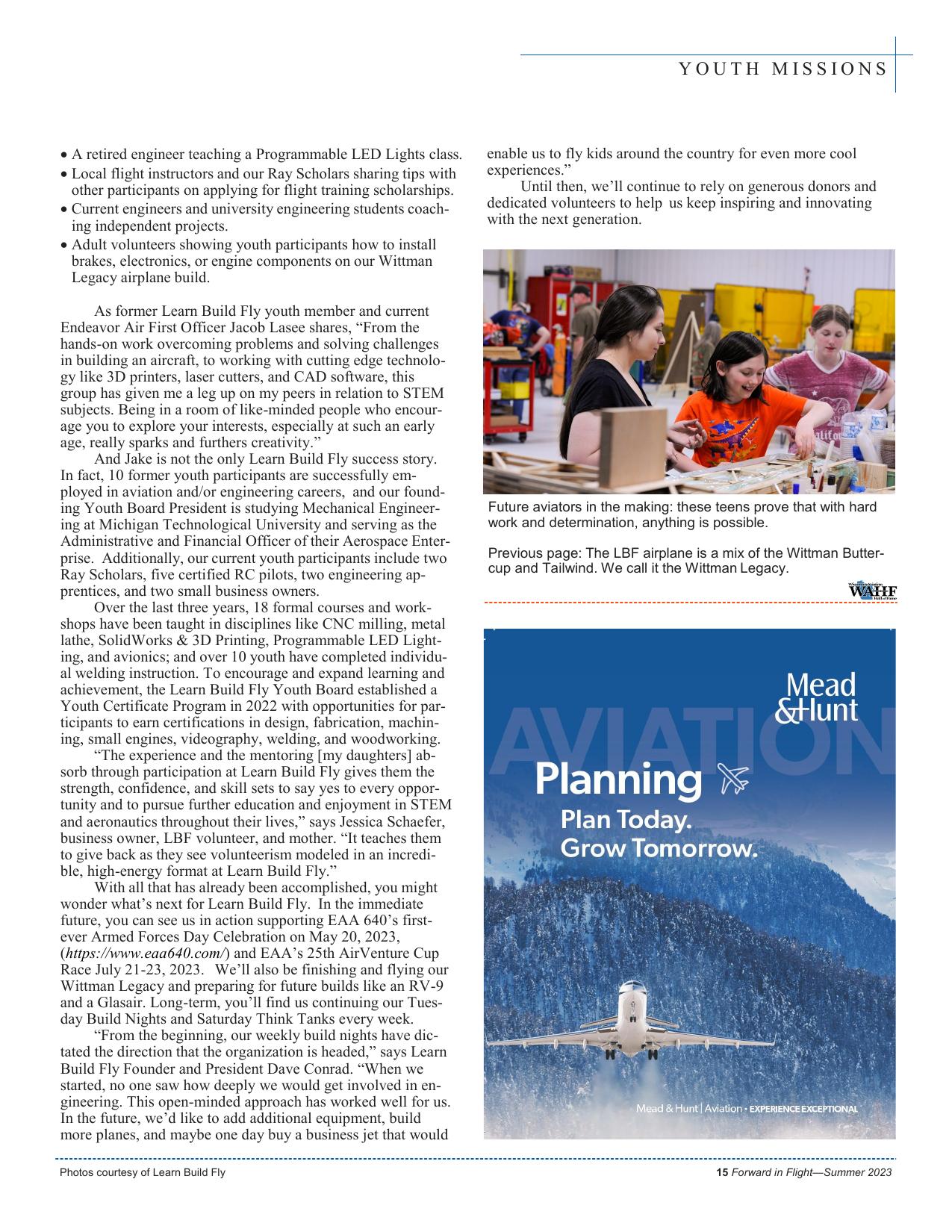
YOUTH MISSIONS · A retired engineer teaching a Programmable LED Lights class. · Local flight instructors and our Ray Scholars sharing tips with other participants on applying for flight training scholarships. · Current engineers and university engineering students coaching independent projects. · Adult volunteers showing youth participants how to install brakes, electronics, or engine components on our Wittman Legacy airplane build. As former Learn Build Fly youth member and current Endeavor Air First Officer Jacob Lasee shares, “From the hands-on work overcoming problems and solving challenges in building an aircraft, to working with cutting edge technology like 3D printers, laser cutters, and CAD software, this group has given me a leg up on my peers in relation to STEM subjects. Being in a room of like-minded people who encourage you to explore your interests, especially at such an early age, really sparks and furthers creativity.” And Jake is not the only Learn Build Fly success story. In fact, 10 former youth participants are successfully employed in aviation and/or engineering careers, and our founding Youth Board President is studying Mechanical Engineering at Michigan Technological University and serving as the Administrative and Financial Officer of their Aerospace Enterprise. Additionally, our current youth participants include two Ray Scholars, five certified RC pilots, two engineering apprentices, and two small business owners. Over the last three years, 18 formal courses and workshops have been taught in disciplines like CNC milling, metal lathe, SolidWorks & 3D Printing, Programmable LED Lighting, and avionics; and over 10 youth have completed individual welding instruction. To encourage and expand learning and achievement, the Learn Build Fly Youth Board established a Youth Certificate Program in 2022 with opportunities for participants to earn certifications in design, fabrication, machining, small engines, videography, welding, and woodworking. “The experience and the mentoring [my daughters] absorb through participation at Learn Build Fly gives them the strength, confidence, and skill sets to say yes to every opportunity and to pursue further education and enjoyment in STEM and aeronautics throughout their lives,” says Jessica Schaefer, business owner, LBF volunteer, and mother. “It teaches them to give back as they see volunteerism modeled in an incredible, high-energy format at Learn Build Fly.” With all that has already been accomplished, you might wonder what’s next for Learn Build Fly. In the immediate future, you can see us in action supporting EAA 640’s firstever Armed Forces Day Celebration on May 20, 2023, (https://www.eaa640.com/) and EAA’s 25th AirVenture Cup Race July 21-23, 2023. We’ll also be finishing and flying our Wittman Legacy and preparing for future builds like an RV-9 and a Glasair. Long-term, you’ll find us continuing our Tuesday Build Nights and Saturday Think Tanks every week. “From the beginning, our weekly build nights have dictated the direction that the organization is headed,” says Learn Build Fly Founder and President Dave Conrad. “When we started, no one saw how deeply we would get involved in engineering. This open-minded approach has worked well for us. In the future, we’d like to add additional equipment, build more planes, and maybe one day buy a business jet that would Photos courtesy of Learn Build Fly enable us to fly kids around the country for even more cool experiences.” Until then, we’ll continue to rely on generous donors and dedicated volunteers to help us keep inspiring and innovating with the next generation. Future aviators in the making: these teens prove that with hard work and determination, anything is possible. Previous page: The LBF airplane is a mix of the Wittman Buttercup and Tailwind. We call it the Wittman Legacy. 15 Forward in Flight—Summer 2023
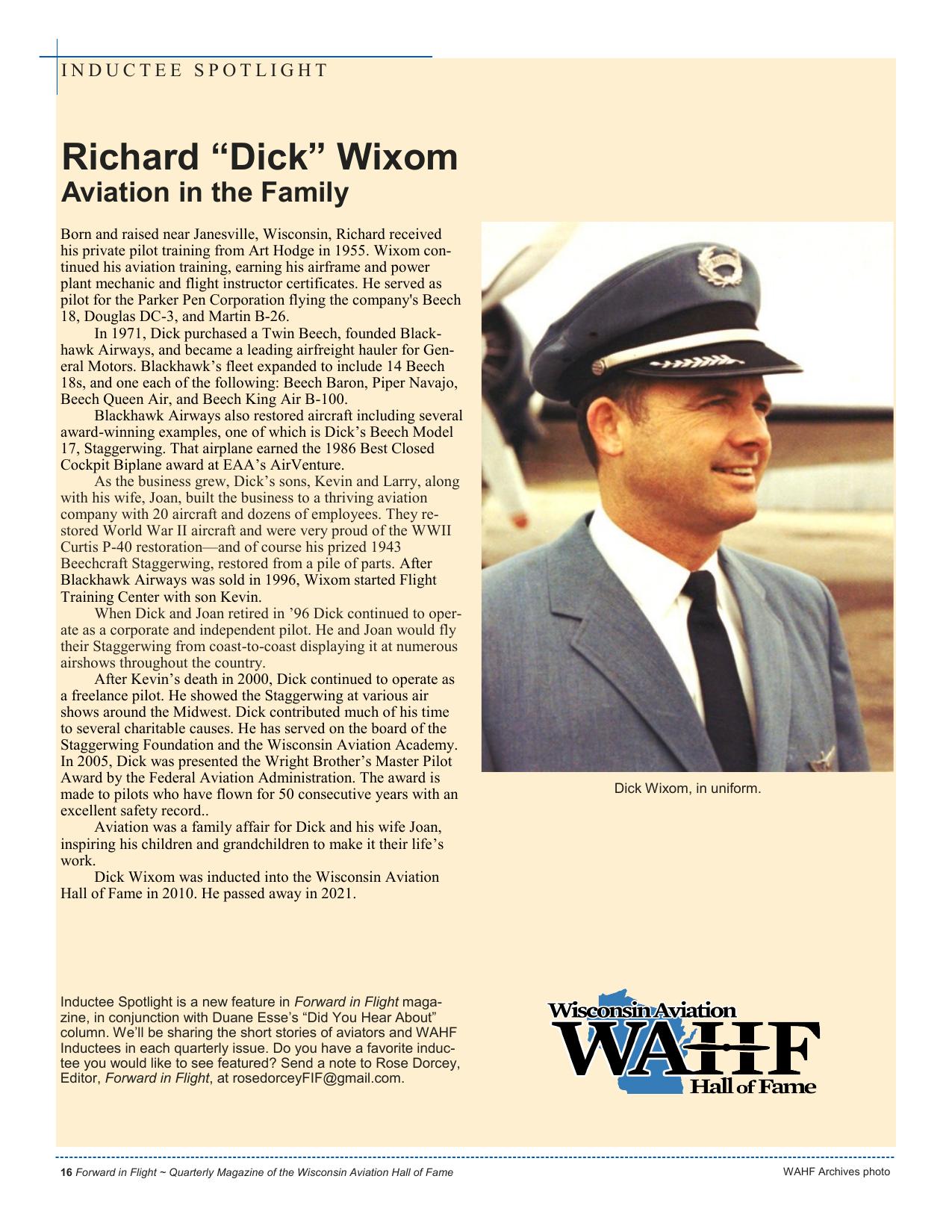
INDUCTEE SPOTLIGHT Richard “Dick” Wixom Aviation in the Family Born and raised near Janesville, Wisconsin, Richard received his private pilot training from Art Hodge in 1955. Wixom continued his aviation training, earning his airframe and power plant mechanic and flight instructor certificates. He served as pilot for the Parker Pen Corporation flying the company's Beech 18, Douglas DC-3, and Martin B-26. In 1971, Dick purchased a Twin Beech, founded Blackhawk Airways, and became a leading airfreight hauler for General Motors. Blackhawk’s fleet expanded to include 14 Beech 18s, and one each of the following: Beech Baron, Piper Navajo, Beech Queen Air, and Beech King Air B-100. Blackhawk Airways also restored aircraft including several award-winning examples, one of which is Dick’s Beech Model 17, Staggerwing. That airplane earned the 1986 Best Closed Cockpit Biplane award at EAA’s AirVenture. As the business grew, Dick’s sons, Kevin and Larry, along with his wife, Joan, built the business to a thriving aviation company with 20 aircraft and dozens of employees. They restored World War II aircraft and were very proud of the WWII Curtis P-40 restoration—and of course his prized 1943 Beechcraft Staggerwing, restored from a pile of parts. After Blackhawk Airways was sold in 1996, Wixom started Flight Training Center with son Kevin. When Dick and Joan retired in ’96 Dick continued to operate as a corporate and independent pilot. He and Joan would fly their Staggerwing from coast-to-coast displaying it at numerous airshows throughout the country. After Kevin’s death in 2000, Dick continued to operate as a freelance pilot. He showed the Staggerwing at various air shows around the Midwest. Dick contributed much of his time to several charitable causes. He has served on the board of the Staggerwing Foundation and the Wisconsin Aviation Academy. In 2005, Dick was presented the Wright Brother’s Master Pilot Award by the Federal Aviation Administration. The award is made to pilots who have flown for 50 consecutive years with an excellent safety record.. Aviation was a family affair for Dick and his wife Joan, inspiring his children and grandchildren to make it their life’s work. Dick Wixom was inducted into the Wisconsin Aviation Hall of Fame in 2010. He passed away in 2021. Dick Wixom, in uniform. Inductee Spotlight is a new feature in Forward in Flight magazine, in conjunction with Duane Esse’s “Did You Hear About” column. We’ll be sharing the short stories of aviators and WAHF Inductees in each quarterly issue. Do you have a favorite inductee you would like to see featured? Send a note to Rose Dorcey, Editor, Forward in Flight, at rosedorceyFIF@gmail.com. 16 Forward in Flight ~ Quarterly Magazine of the Wisconsin Aviation Hall of Fame WAHF Archives photo
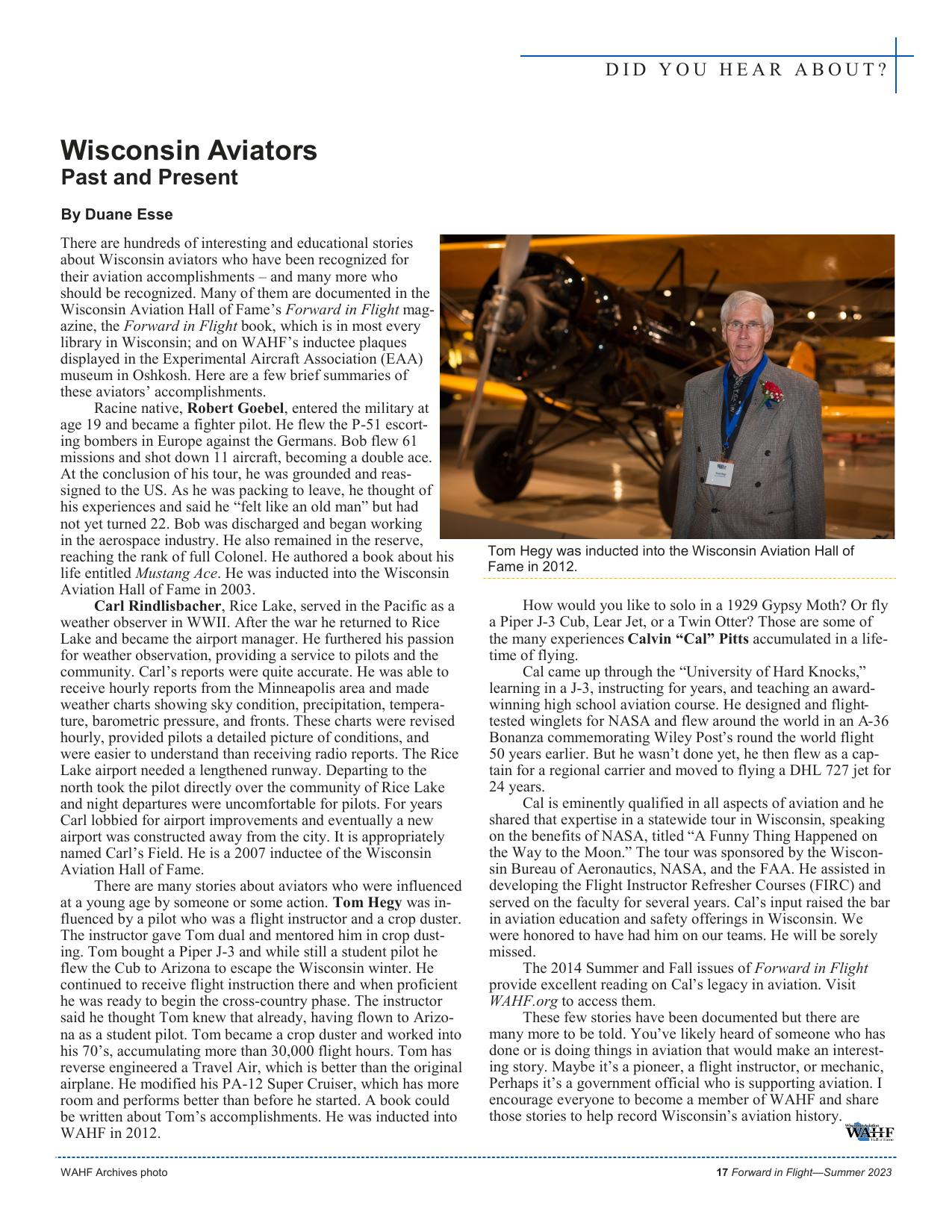
DID YOU HEAR ABOUT? Wisconsin Aviators Past and Present By Duane Esse There are hundreds of interesting and educational stories about Wisconsin aviators who have been recognized for their aviation accomplishments – and many more who should be recognized. Many of them are documented in the Wisconsin Aviation Hall of Fame’s Forward in Flight magazine, the Forward in Flight book, which is in most every library in Wisconsin; and on WAHF’s inductee plaques displayed in the Experimental Aircraft Association (EAA) museum in Oshkosh. Here are a few brief summaries of these aviators’ accomplishments. Racine native, Robert Goebel, entered the military at age 19 and became a fighter pilot. He flew the P-51 escorting bombers in Europe against the Germans. Bob flew 61 missions and shot down 11 aircraft, becoming a double ace. At the conclusion of his tour, he was grounded and reassigned to the US. As he was packing to leave, he thought of his experiences and said he “felt like an old man” but had not yet turned 22. Bob was discharged and began working in the aerospace industry. He also remained in the reserve, reaching the rank of full Colonel. He authored a book about his life entitled Mustang Ace. He was inducted into the Wisconsin Aviation Hall of Fame in 2003. Carl Rindlisbacher, Rice Lake, served in the Pacific as a weather observer in WWII. After the war he returned to Rice Lake and became the airport manager. He furthered his passion for weather observation, providing a service to pilots and the community. Carl’s reports were quite accurate. He was able to receive hourly reports from the Minneapolis area and made weather charts showing sky condition, precipitation, temperature, barometric pressure, and fronts. These charts were revised hourly, provided pilots a detailed picture of conditions, and were easier to understand than receiving radio reports. The Rice Lake airport needed a lengthened runway. Departing to the north took the pilot directly over the community of Rice Lake and night departures were uncomfortable for pilots. For years Carl lobbied for airport improvements and eventually a new airport was constructed away from the city. It is appropriately named Carl’s Field. He is a 2007 inductee of the Wisconsin Aviation Hall of Fame. There are many stories about aviators who were influenced at a young age by someone or some action. Tom Hegy was influenced by a pilot who was a flight instructor and a crop duster. The instructor gave Tom dual and mentored him in crop dusting. Tom bought a Piper J-3 and while still a student pilot he flew the Cub to Arizona to escape the Wisconsin winter. He continued to receive flight instruction there and when proficient he was ready to begin the cross-country phase. The instructor said he thought Tom knew that already, having flown to Arizona as a student pilot. Tom became a crop duster and worked into his 70’s, accumulating more than 30,000 flight hours. Tom has reverse engineered a Travel Air, which is better than the original airplane. He modified his PA-12 Super Cruiser, which has more room and performs better than before he started. A book could be written about Tom’s accomplishments. He was inducted into WAHF in 2012. WAHF Archives photo Tom Hegy was inducted into the Wisconsin Aviation Hall of Fame in 2012. How would you like to solo in a 1929 Gypsy Moth? Or fly a Piper J-3 Cub, Lear Jet, or a Twin Otter? Those are some of the many experiences Calvin “Cal” Pitts accumulated in a lifetime of flying. Cal came up through the “University of Hard Knocks,” learning in a J-3, instructing for years, and teaching an awardwinning high school aviation course. He designed and flighttested winglets for NASA and flew around the world in an A-36 Bonanza commemorating Wiley Post’s round the world flight 50 years earlier. But he wasn’t done yet, he then flew as a captain for a regional carrier and moved to flying a DHL 727 jet for 24 years. Cal is eminently qualified in all aspects of aviation and he shared that expertise in a statewide tour in Wisconsin, speaking on the benefits of NASA, titled “A Funny Thing Happened on the Way to the Moon.” The tour was sponsored by the Wisconsin Bureau of Aeronautics, NASA, and the FAA. He assisted in developing the Flight Instructor Refresher Courses (FIRC) and served on the faculty for several years. Cal’s input raised the bar in aviation education and safety offerings in Wisconsin. We were honored to have had him on our teams. He will be sorely missed. The 2014 Summer and Fall issues of Forward in Flight provide excellent reading on Cal’s legacy in aviation. Visit WAHF.org to access them. These few stories have been documented but there are many more to be told. You’ve likely heard of someone who has done or is doing things in aviation that would make an interesting story. Maybe it’s a pioneer, a flight instructor, or mechanic, Perhaps it’s a government official who is supporting aviation. I encourage everyone to become a member of WAHF and share those stories to help record Wisconsin’s aviation history. 17 Forward in Flight—Summer 2023
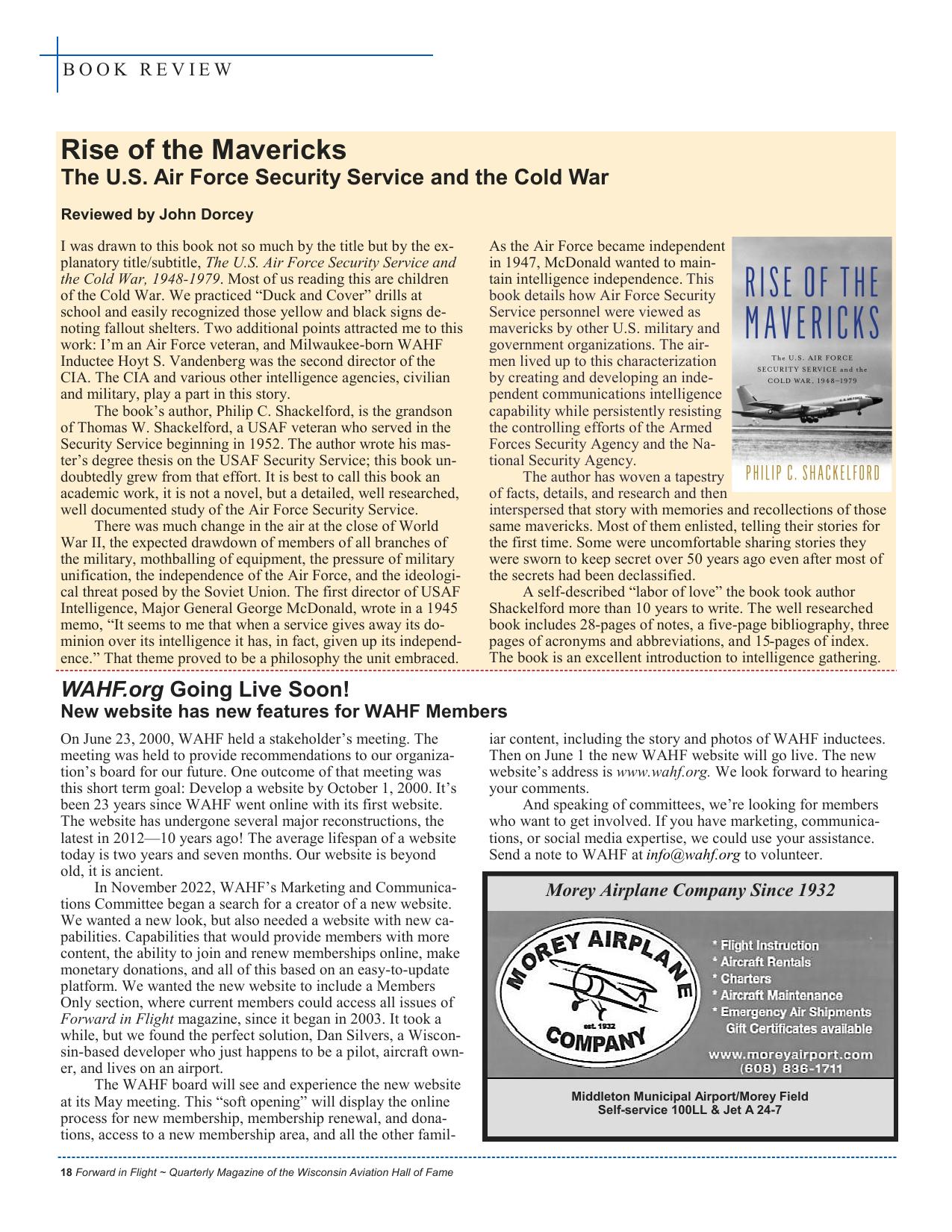
BOOK REVIEW Rise of the Mavericks The U.S. Air Force Security Service and the Cold War Reviewed by John Dorcey I was drawn to this book not so much by the title but by the explanatory title/subtitle, The U.S. Air Force Security Service and the Cold War, 1948-1979. Most of us reading this are children of the Cold War. We practiced “Duck and Cover” drills at school and easily recognized those yellow and black signs denoting fallout shelters. Two additional points attracted me to this work: I’m an Air Force veteran, and Milwaukee-born WAHF Inductee Hoyt S. Vandenberg was the second director of the CIA. The CIA and various other intelligence agencies, civilian and military, play a part in this story. The book’s author, Philip C. Shackelford, is the grandson of Thomas W. Shackelford, a USAF veteran who served in the Security Service beginning in 1952. The author wrote his master’s degree thesis on the USAF Security Service; this book undoubtedly grew from that effort. It is best to call this book an academic work, it is not a novel, but a detailed, well researched, well documented study of the Air Force Security Service. There was much change in the air at the close of World War II, the expected drawdown of members of all branches of the military, mothballing of equipment, the pressure of military unification, the independence of the Air Force, and the ideological threat posed by the Soviet Union. The first director of USAF Intelligence, Major General George McDonald, wrote in a 1945 memo, “It seems to me that when a service gives away its dominion over its intelligence it has, in fact, given up its independence.” That theme proved to be a philosophy the unit embraced. As the Air Force became independent in 1947, McDonald wanted to maintain intelligence independence. This book details how Air Force Security Service personnel were viewed as mavericks by other U.S. military and government organizations. The airmen lived up to this characterization by creating and developing an independent communications intelligence capability while persistently resisting the controlling efforts of the Armed Forces Security Agency and the National Security Agency. The author has woven a tapestry of facts, details, and research and then interspersed that story with memories and recollections of those same mavericks. Most of them enlisted, telling their stories for the first time. Some were uncomfortable sharing stories they were sworn to keep secret over 50 years ago even after most of the secrets had been declassified. A self-described “labor of love” the book took author Shackelford more than 10 years to write. The well researched book includes 28-pages of notes, a five-page bibliography, three pages of acronyms and abbreviations, and 15-pages of index. The book is an excellent introduction to intelligence gathering. WAHF.org Going Live Soon! New website has new features for WAHF Members On June 23, 2000, WAHF held a stakeholder’s meeting. The meeting was held to provide recommendations to our organization’s board for our future. One outcome of that meeting was this short term goal: Develop a website by October 1, 2000. It’s been 23 years since WAHF went online with its first website. The website has undergone several major reconstructions, the latest in 2012—10 years ago! The average lifespan of a website today is two years and seven months. Our website is beyond old, it is ancient. In November 2022, WAHF’s Marketing and Communications Committee began a search for a creator of a new website. We wanted a new look, but also needed a website with new capabilities. Capabilities that would provide members with more content, the ability to join and renew memberships online, make monetary donations, and all of this based on an easy-to-update platform. We wanted the new website to include a Members Only section, where current members could access all issues of Forward in Flight magazine, since it began in 2003. It took a while, but we found the perfect solution, Dan Silvers, a Wisconsin-based developer who just happens to be a pilot, aircraft owner, and lives on an airport. The WAHF board will see and experience the new website at its May meeting. This “soft opening” will display the online process for new membership, membership renewal, and donations, access to a new membership area, and all the other famil18 Forward in Flight ~ Quarterly Magazine of the Wisconsin Aviation Hall of Fame iar content, including the story and photos of WAHF inductees. Then on June 1 the new WAHF website will go live. The new website’s address is www.wahf.org. We look forward to hearing your comments. And speaking of committees, we’re looking for members who want to get involved. If you have marketing, communications, or social media expertise, we could use your assistance. Send a note to WAHF at info@wahf.org to volunteer. Morey Airplane Company Since 1932 Middleton Municipal Airport/Morey Field Self-service 100LL & Jet A 24-7
FROM THE AIRWAYS Madison College Partners with Wisconsin Aviation Professional aeronautics certification program to launch Madison College has partnered with Wisconsin Aviation to create a professional aeronautics certification, a program designed to give aspiring airline pilots and professional aviators a direct pathway to a flying career. The professional aeronautics certification (PAC) is a twoyear accelerated program designed for traditional college students and returning adults that includes both ground courses and flight training for private pilot certification, instrument flight rating, commercial pilot, and flight instructor certification. The program’s ground school will be held at Madison College’s Truax campus and taught by University of WisconsinMadison lecturer Dr. Hannah Silber, Ph.D. The flight school will be managed and taught by Wisconsin Aviation’s Flight School, located just north of the campus on the East Ramp at Dane County Regional Airport. Over the two-year period, enrolled students will spend approximately 20 total hours per week in the program. This will include ground school, flight training, and home study, and upon completion, students can be hired as instructor pilots. Students can expect another 18-24 months of instruction and accruing flight hours needed to work for commercial airline operations. Yellow Ribbon Honor Flight Vietnam Vets Honored One of the most emotional and poignant moments of EAA AirVenture Oshkosh each year will return in 2023 as 100 Vietnam War vets will take a Yellow Ribbon Honor Flight to Washington, D.C., on July 28 as part of AirVenture’s annual salute to veterans. The 70th annual Experimental Aircraft Association fly-in convention is July 24-30 at Wittman Regional Airport in Oshkosh. Veterans from the Vietnam War will be honored as they travel to the nation’s capital to tour war memorials at no cost to them. The veterans will return to Oshkosh at the conclusion of the Friday afternoon air show and thousands of people will welcome them back home and give them the recognition they deserve. “The Yellow Ribbon Honor Flight is traditionally one of the best events of AirVenture week and this year is fitting as part of our ‘Vietnam Remembered: 50 Years Later’ schedule of activities,” said Rick Larsen, EAA’s vice president of communities and member programming. This is the ninth year that the Yellow Ribbon Honor Flight has originated at EAA AirVenture Oshkosh under the auspices of Old Glory Honor Flight of Appleton, Wisconsin. That nonprofit organization has organized dozens of Honor Flights since 2009 with a dedicated group of volunteers. Those flights have included special flights to Pearl Harbor and to Vietnam. American Airlines is again supplying an aircraft for the flight. Old Glory Honor Flight will be inviting veterans who are currently on their waitlist. More information is available at https:// www.oldgloryhonorflight.org/. More AirVenture info is at www.EAA.org/airventure. Dr. Chris Johnson, assistant professor at Embry-Riddle Aeronautical University in Daytona Beach, Florida, is the program’s developer and will oversee its management. Johnson says demand for pilots is high and will be for the foreseeable future. The certification program will offer nighttime courses and flexible flight-training schedules, allowing students to simultaneously pursue a degree of their choice or work part-time during training. Cirrus SR20 aircraft will be utilized. Graduates will begin their professional flight career two years before graduates of four-year programs such as Embry-Riddle. For more information visit www.WisconsinAviation.com Pulling for Honor Fundraiser Event benefits local The Pulling for Honor fundraiser, benefitting Old Glory Honor Flight, is back in 2023. The Appleton Flight Center, at Appleton International Airport (ATW), welcomes you for a day of competition, family fun, and the opportunity to thank our American heroes. Do you have what it takes to pull a 200,000 pound airplane? Grab 19 of your friends and raise a minimum of $1500 to find out! The team that pulls the plane 12 feet the fastest wins. The real winners, however, are local veterans, who benefit from this fundraiser. Cheer on the pulling teams and enter for a chance to win a pair of airline tickets. Lots to do: children’s plane pull and bouncy house, Allegiant Air airfare giveaway, food trucks, and Veteran exhibits. The event takes place on September 16, 2023, gates open at 10 a.m. Competition begins at 11:00, awards ceremony at 1:30. Admission is free. For more info including sponsorships: https://atwairport.com/airport-info/events/pulling-for-honor/ Share Your News in FIF Your news releases and personal news are of interest to WAHF, and our FIF readers. Please submit your news, and related photo(s), to Rose Dorcey, editor, at rosedorceyFIF@gmail.com. 19 Forward in Flight—Summer 2023
ASSOCIATION NEWS 2023 Inductees Announced WAHF Awards Scholarships The Wisconsin Aviation Hall of Fame has announced its 2023 inductees. Steve Krog, Tom Bouchard, Lynn Erickson, and Merton Baker will be inducted at a ceremony held at the EAA Aviation Museum in Oshkosh on October 14. Steve Krog started flying in 1969, earning his commercial multi-engine, instrument and instructor ratings. He began teaching tailwheel flying in the early ’80s in Hartford, Wisconsin, flying nights and weekends for 15 years. In January 2000, Steve and his wife, Sharon, assumed management of The Cub Club and in 2004, Steve left his day job to open Cub Air Flight, LLC. He trained students exclusively in Piper J-3 Cubs. He also served as president of the Midwest Antique Airplane Club for 13 years. EAA Members can read Steve’s columns in EAA Sport Aviation magazine. Tom Bouchard, Ashland, began flying for Midstate Airlines in 1966. During his 23-year career with the airline he accumulated nearly 5,000 hours in Beech 18s. He served as their check airman and chief pilot, training many pilots in Beech 99s, Fairchild Metroliners, and Fokker 27s. In 1995 he started flying Cessna Citations for CG Bretting Manufacturing Company, eventually logging 28,000 total hours in his 38-year career. Tom was appointed to the Wisconsin Council of Aeronautics by Governor Lucey in 1976. He was awarded the FAA’s Wright Brothers Master Pilot Award in 2012. Tom continues to be active in Ashland’s aviation scene. Lynn Erickson, Waunakee, has devoted his most recent 20 years to resurrecting airports and educating students. Using his 17,000 hours of flight experience as Chief Pilot for an international flight department, worldwide demonstration pilot for Cessna Citations and Caravans, and personal love of flight in his Cessna 182 and Great Lakes biplane, Lynn has worked tirelessly in his retirement giving back to aviation. Since 2005 he has participated in the construction of two hangar complexes with 14 hangars at the Waunakee Airport (P63), and installed a selfservice fuel system at the Sauk Prairie Airport, which he owns and manages. His skill at developing and maintaining good relationships has resulted in active community involvements in events including annual picnics, airport/community breakfasts, safety programs, career days, and an outreach program touting the benefits of an airport. The NBAA has honored Lynn with its 15,000 Hour Safety Award. Born in Tomahawk in 1924, Merton Baker entered the US Army Air Corps in 1943 and received his pilot wings a year later. As a B-24 pilot in Italy, he flew 35 missions and was reassigned to Fairfield Suisun Air Base in California flying C-54s in the Pacific Theater. He separated from service and became a civilian flight instructor in North Carolina before being recalled to active service during the Korean War, flying T-33 and B-47 aircraft in Kansas. From 1957 - 1962 Merton was a B-52 acceptance pilot, and later an Air Force plan representative for Cessna. During Vietnam, he flew 150 combat missions in the EB-66, receiving the Distinguished Flying Cross. He retired as a Major General in 1981. Major General Baker logged 7,000 hours of flight time in 21 different aircraft. He passed away in 2000. WAHF Members and the inductees’ family and friends will receive an invitation to the induction ceremony this fall. The Wisconsin Aviation Hall of Fame is pleased to announce its 2023 Scholarship Recipients. Rowan Andreas attends Cedarburg High School. He will obtain his Private Pilot rating prior to attending the University of Dubuque, for a degree in Flight Operations. Once obtaining his degree and aviation certifications he has plans to fly for a major airline. Kaia Barrett, Stevens Point, is involved in Aviation 101 through Wausau Area Virtual Education and Wausau Flying Service, Inc. She finished the course and is training for her Private Pilot certificate. She plans to attend Minnesota State University, Mankato, where she has been accepted into the Aviation Learning Community. Her instructors at Stevens Point High School note that she sets challenging goals and achieves them. Her plan is to graduate with a degree in Aviation Professional Flight, work as a flight instructor, and then for the airlines. Josie Boelter, Lomira, Wisconsin, is currently attending Southern Illinois University (SIU), Carbondale, Illinois, where she is studying Aviation Management. She is a member of the SIU Competitive Flight Team, which requires up to 40 hours/ week of practice and study. Josie and the SIU team competed at the National Intercollegiate Flight Association SAFECON flight competition in Oshkosh, May 8-13, 2023. Josie is planning for an airline career. Angelo Brantner will be attending Embry Riddle Aeronautical University. He attended many STEM and Aerospace classes at Eau Claire Regis High School. He’s an active Civil Air Patrol (CAP) cadet since joining in his freshman year. He has worked at EAA and local airshows, among other events. He has goals to get a double degree in Aerospace Engineering and Math, and enter the Air Force on a career path to become an Astronaut. His instructors and employers feel his maturity and work ethic make him certain to succeed. Grace Kohon started flying lessons at 15 and obtained her license at 17. She has wanted to be an airline pilot since she was 12. To further this aim, she completed High School Aviation 101 through Wausau Area Virtual Education. She has attended EAA AirVenture, EAA Air Academy Camp, joined Women in Aviation and the Ninety-Nines, and has been invited to make a presentation at an EAA Chapter 640 meeting. She is active in social, academic, charities, work, and aviation activities. She will attend the University of Dubuque as a Flight Operations major, work as a flight instructor, move to regionals, and then move up to a major airline. Madisyn Roffers, De Pere, will attend Fox Valley Technical College in Aeronautical-Pilot Training. She will then transfer her credits to UW-Oshkosh to obtain a degree in Aviation Management. Her ultimate goal is to fly for a major airline. If something precludes her from flying, her fall back is her Aviation Management degree to stay in aviation. Her instructors cite her reliability in any project/job she undertakes. Elijah Pagel, Wausau, is currently a sophomore at Minnesota State University – Mankato, in its Aviation program. By graduation, he will have obtained his ratings and wants to start work as a flight instructor at North Star Aviation. He also wants to become involved in volunteer aviation programs. Upon building the required time, he hopes to fly for Sun Country or Delta. October 14 Induction Ceremony Set 20 Forward in Flight ~ Quarterly Magazine of the Wisconsin Aviation Hall of Fame Seven Recipients Receive Funds
OUR READERS WRITE Our Readers Write… Hi Rose! I loved your recently improved Forward in Flight magazine!! I’ve read them for years and this recent edition was just outstanding!! Please keep up the great work! Thanks, Jeff Scherer, Life Member when I was living in Racine. I know many pilots who held him in high regard. Looking forward to many more stories with Wisconsin connections. Dean Zakos ~ P.S. I’m fully retired from my medical practice but still actively flying in my 1963 Beech Bonanza that I’m keeping in Monterey, California, where my twin brother (retired C-5 Air Force pilot) lives. I go out there from my home in Delavan, Wisconsin, every other month so I still get a lot of flying in! I’m still an active CFII and do instrument instruction and IPCs! My twin is on the left (co-pilot side). His name is John... he’s three minutes older than me. We were born on Christmas Day, 1952, and both got our private pilot check rides from Harlan Sedgwick at Waukesha airport in October/November of 1970. John and I both received our Wright Brothers Master Pilot awards in 2020! ~ ~ ~ ~ ~ ~ ~ ~ ~ Hi Rose, I just received my copy of the FIF Spring 2023 issue. Welcome back and great job! I’ve already read several of the articles and skimmed the others. Your article covering the Wisconsin Historical Markers mentioned that a third Milwaukee County historical marker, “Milwaukee County’s First Airport” may have been archived. That marker still resides at the Currie Park Golf Course (originally Butler Airport) but it was relocated inside the course’s club house. Our Mitchell Gallery of Flight Flightlines newsletter (Winter 2020) included a brief story about the clubhouse interior being updated to recognize the site’s significance to local aviation. While doing that story, we found that the marker had been moved. Take care, Bill Streicher, Waukesha ~ ~ ~ ~ ~ ~ ~ ~ ~ ~ ~ ~ ~ ~ ~ ~ ~ ~ ~ ~ Rose, I can’t tell you how happy I was to see that you once again are at the helm of Forward in Flight! While I appreciate the efforts of your successors/predecessors to maintain a quality production, I can see that your talented leadership has already made a significant difference. Thanks for returning to that demanding but rewarding role. I look forward to many enjoyable hours reading about the fascinating people of Wisconsin aviation history. Hi Rose: When I took the latest issue of FIF out of the mailbox I knew it had a different feel. Now I know why. My favorite editor is back in the harness. It’s also good to have a new contributor in John Chmiel, and a former one or two. Welcome back! I’m still in my old home but gave up driving at age 99, even though I still could, legally, I knew that any fender bender, regardless of whose fault, would automatically go to me by default of age. I’m at the airport several times each week for coffee and Angela’s baking, so I’m still in touch with aviation. Fr. Bill Menzel, Wisconsin Rapids Bob Wylie, Wausau ~ ~ ~ ~ ~ ~ ~ ~ ~ ~ Rose: Good to see your name as editor once again on the masthead for Forward in Flight. Just received the Spring 2023 issue with its many interesting articles about aviation history in Wisconsin. Bob Clarke from Kenosha gave me my instrument checkride WAHF Archives and Duane Esse photos ~ ~ ~ ~ ~ ~ ~ ~ ~ ~ What a wonderful response from our WAHF Members who reached out to show their delight in the new look of Forward in Flight. Thanks so much for your notes and calls. —Editor 21 Forward in Flight—Summer 2023
EDITOR’S LOG Sharing Aviation in Nashville Cornelia Fort inspired many In April my husband, John, and I presented some aviation history and flying fundamentals to 70 seventh and eighth grade students at a private, all-girls school in Nashville. My daughter is the director of junior high at the school, hence the invite. A science teacher there is an aspiring pilot. When she invited us to share aviation with his students, we promptly said, “Yes!” My initial thought was to talk about Amelia Earhart, but I did some research and found that Cornelia Fort was an early female pilot from Nashville. She was born into Nashville Society in 1919, but was more tomboyish than debutant. At a young age, Cornelia saw an airplane fly and was immediately smitten. However, her parents weren’t accepting of Cornelia’s plans to learn to fly. It wasn’t until 1940 when she went to the local Nashville airport, Berry Field, took flight lessons, and became a certificated pilot. She was completely enthralled. Months later Cornelia became a commercial pilot, and then a flight instructor, Tennessee’s first female instructor. Soon she received an offer to teach at Andrews Flying Service in Honolulu, Hawaii. On December 7, 1941, at 6:30am, Cornelia and a student were in the pattern for the student’s pre-solo landing practice at Oahu’s John Rodgers Field. As they were turning toward the runway, she saw a fighter-type aircraft coming right at them. She grabbed the flight controls, and pulled up sharply to escape a collision. Her first thoughts were of the Army Air Corps pilots who were supposed to avoid the area around John Rodgers Airfield, but as the aircraft flashed by, she saw the 22 Forward in Flight ~ Quarterly Magazine of the Wisconsin Aviation Hall of Fame “rising sun” insignia of the Japanese Empire on the wing. As she looked toward Pearl Harbor, she saw the initial plumes of black smoke and realized that Pearl Harbor was under attack by the Japanese. She was the first United States pilot to encounter the Japanese air fleet during the attack on Pearl Harbor. Surviving the attack, she returned to the mainland and continued to fly. A year later she became the second woman to become a Women Airforce Service Pilot (WASP), working as a ferry pilot. Telling her story seemed to inspire the students we spoke with that day. They were attentive and asked thoughtful questions. We encouraged them to attend an upcoming Young Eagles rally that was happening in the area. We hope they did! This is why we love sharing aviation history and fundamentals of flight. If just one of those students explores aviation further, now or in the future, it’ll forever change their lives. At the very least, they learned of a local aviation hero. In this issue we welcome Mike O’Connor, a new regular contributor to Forward in Flight. His stories about Wisconsin Aces come from years of research as an author; we know you’ll enjoy them. We also welcome Skot Weidemann, whose beautiful photography will grace the pages of FIF. Also, I enjoyed reading “A Historical Homebuilt Icon, the Three-Act Saga of an Acro Sport II” in the May ’23 issue of EAA Sport Aviation magazine. With the plane’s roots in Wisconsin—and Paul Poberezny—it made for a great read.
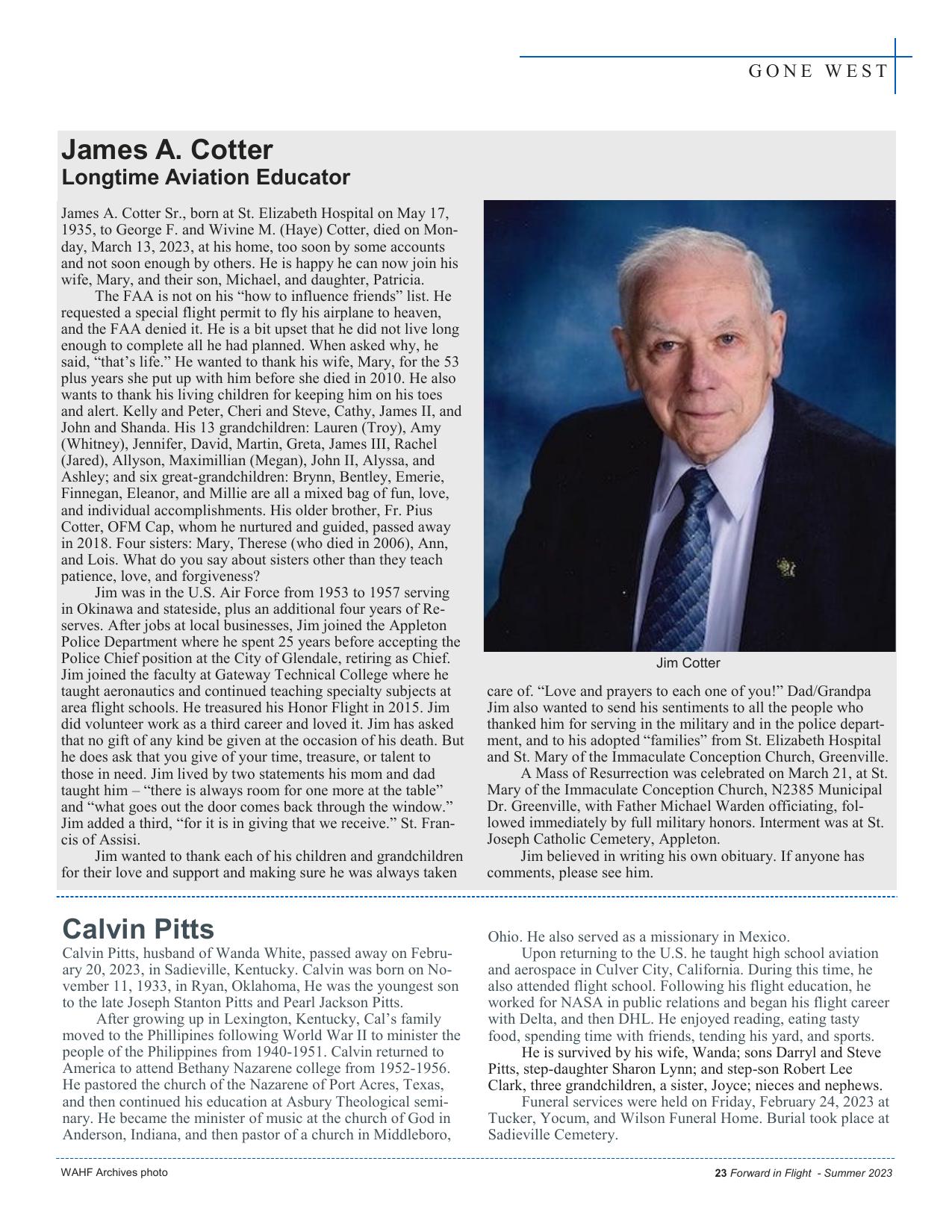
GONE WEST James A. Cotter Longtime Aviation Educator James A. Cotter Sr., born at St. Elizabeth Hospital on May 17, 1935, to George F. and Wivine M. (Haye) Cotter, died on Monday, March 13, 2023, at his home, too soon by some accounts and not soon enough by others. He is happy he can now join his wife, Mary, and their son, Michael, and daughter, Patricia. The FAA is not on his “how to influence friends” list. He requested a special flight permit to fly his airplane to heaven, and the FAA denied it. He is a bit upset that he did not live long enough to complete all he had planned. When asked why, he said, “that’s life.” He wanted to thank his wife, Mary, for the 53 plus years she put up with him before she died in 2010. He also wants to thank his living children for keeping him on his toes and alert. Kelly and Peter, Cheri and Steve, Cathy, James II, and John and Shanda. His 13 grandchildren: Lauren (Troy), Amy (Whitney), Jennifer, David, Martin, Greta, James III, Rachel (Jared), Allyson, Maximillian (Megan), John II, Alyssa, and Ashley; and six great-grandchildren: Brynn, Bentley, Emerie, Finnegan, Eleanor, and Millie are all a mixed bag of fun, love, and individual accomplishments. His older brother, Fr. Pius Cotter, OFM Cap, whom he nurtured and guided, passed away in 2018. Four sisters: Mary, Therese (who died in 2006), Ann, and Lois. What do you say about sisters other than they teach patience, love, and forgiveness? Jim was in the U.S. Air Force from 1953 to 1957 serving in Okinawa and stateside, plus an additional four years of Reserves. After jobs at local businesses, Jim joined the Appleton Police Department where he spent 25 years before accepting the Police Chief position at the City of Glendale, retiring as Chief. Jim joined the faculty at Gateway Technical College where he taught aeronautics and continued teaching specialty subjects at area flight schools. He treasured his Honor Flight in 2015. Jim did volunteer work as a third career and loved it. Jim has asked that no gift of any kind be given at the occasion of his death. But he does ask that you give of your time, treasure, or talent to those in need. Jim lived by two statements his mom and dad taught him – “there is always room for one more at the table” and “what goes out the door comes back through the window.” Jim added a third, “for it is in giving that we receive.” St. Francis of Assisi. Jim wanted to thank each of his children and grandchildren for their love and support and making sure he was always taken Calvin Pitts Calvin Pitts, husband of Wanda White, passed away on February 20, 2023, in Sadieville, Kentucky. Calvin was born on November 11, 1933, in Ryan, Oklahoma, He was the youngest son to the late Joseph Stanton Pitts and Pearl Jackson Pitts. After growing up in Lexington, Kentucky, Cal’s family moved to the Phillipines following World War II to minister the people of the Philippines from 1940-1951. Calvin returned to America to attend Bethany Nazarene college from 1952-1956. He pastored the church of the Nazarene of Port Acres, Texas, and then continued his education at Asbury Theological seminary. He became the minister of music at the church of God in Anderson, Indiana, and then pastor of a church in Middleboro, WAHF Archives photo Jim Cotter care of. “Love and prayers to each one of you!” Dad/Grandpa Jim also wanted to send his sentiments to all the people who thanked him for serving in the military and in the police department, and to his adopted “families” from St. Elizabeth Hospital and St. Mary of the Immaculate Conception Church, Greenville. A Mass of Resurrection was celebrated on March 21, at St. Mary of the Immaculate Conception Church, N2385 Municipal Dr. Greenville, with Father Michael Warden officiating, followed immediately by full military honors. Interment was at St. Joseph Catholic Cemetery, Appleton. Jim believed in writing his own obituary. If anyone has comments, please see him. Ohio. He also served as a missionary in Mexico. Upon returning to the U.S. he taught high school aviation and aerospace in Culver City, California. During this time, he also attended flight school. Following his flight education, he worked for NASA in public relations and began his flight career with Delta, and then DHL. He enjoyed reading, eating tasty food, spending time with friends, tending his yard, and sports. He is survived by his wife, Wanda; sons Darryl and Steve Pitts, step-daughter Sharon Lynn; and step-son Robert Lee Clark, three grandchildren, a sister, Joyce; nieces and nephews. Funeral services were held on Friday, February 24, 2023 at Tucker, Yocum, and Wilson Funeral Home. Burial took place at Sadieville Cemetery. 23 Forward in Flight - Summer 2023
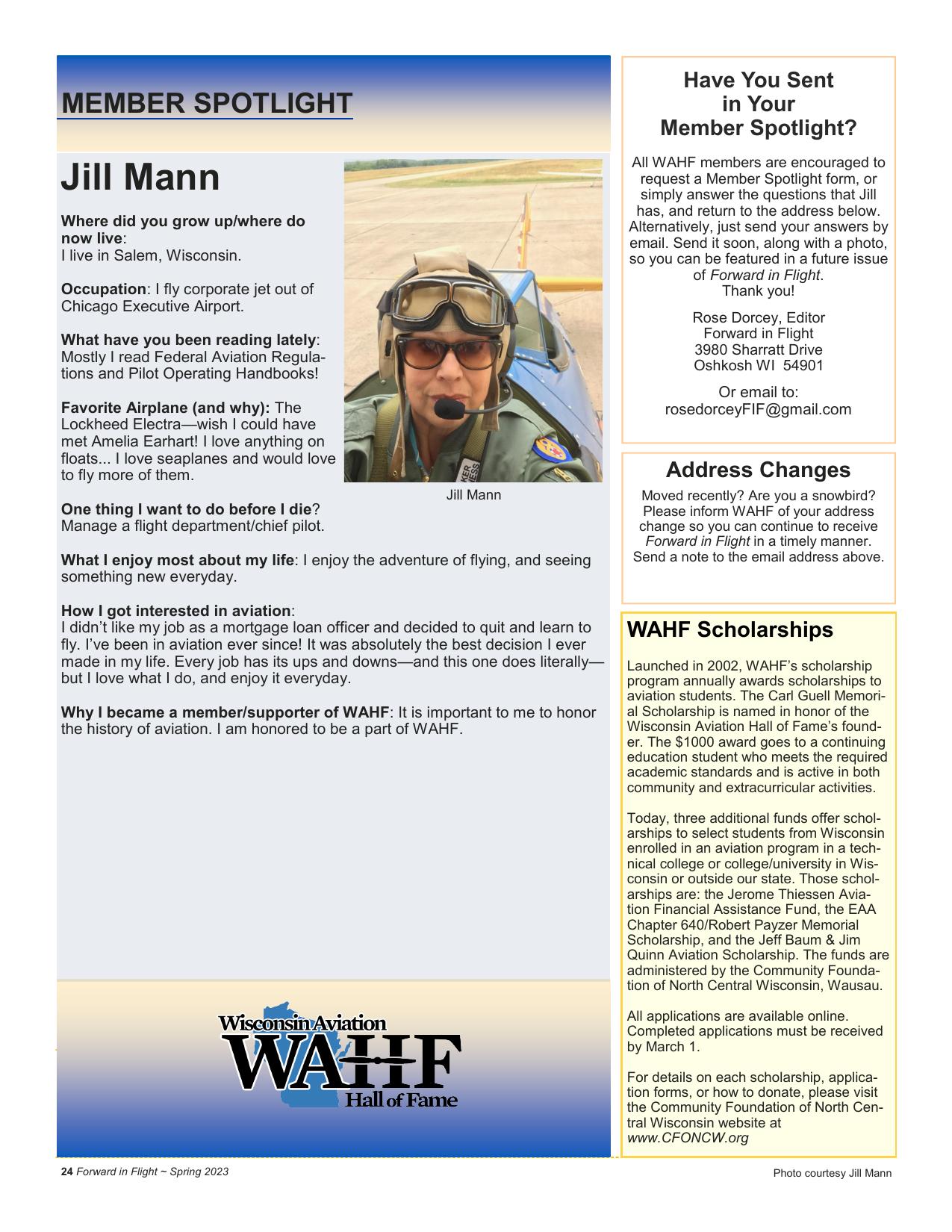
Have You Sent in Your Member Spotlight? MEMBER SPOTLIGHT All WAHF members are encouraged to request a Member Spotlight form, or simply answer the questions that Jill has, and return to the address below. Alternatively, just send your answers by email. Send it soon, along with a photo, so you can be featured in a future issue of Forward in Flight. Thank you! Jill Mann Where did you grow up/where do now live: I live in Salem, Wisconsin. Occupation: I fly corporate jet out of Chicago Executive Airport. Rose Dorcey, Editor Forward in Flight 3980 Sharratt Drive Oshkosh WI 54901 What have you been reading lately: Mostly I read Federal Aviation Regulations and Pilot Operating Handbooks! Or email to: rosedorceyFIF@gmail.com Favorite Airplane (and why): The Lockheed Electra—wish I could have met Amelia Earhart! I love anything on floats... I love seaplanes and would love to fly more of them. One thing I want to do before I die? Manage a flight department/chief pilot. Address Changes Jill Mann What I enjoy most about my life: I enjoy the adventure of flying, and seeing something new everyday. How I got interested in aviation: I didn’t like my job as a mortgage loan officer and decided to quit and learn to fly. I’ve been in aviation ever since! It was absolutely the best decision I ever made in my life. Every job has its ups and downs—and this one does literally— but I love what I do, and enjoy it everyday. Why I became a member/supporter of WAHF: It is important to me to honor the history of aviation. I am honored to be a part of WAHF. Moved recently? Are you a snowbird? Please inform WAHF of your address change so you can continue to receive Forward in Flight in a timely manner. Send a note to the email address above. WAHF Scholarships Launched in 2002, WAHF’s scholarship program annually awards scholarships to aviation students. The Carl Guell Memorial Scholarship is named in honor of the Wisconsin Aviation Hall of Fame’s founder. The $1000 award goes to a continuing education student who meets the required academic standards and is active in both community and extracurricular activities. Today, three additional funds offer scholarships to select students from Wisconsin enrolled in an aviation program in a technical college or college/university in Wisconsin or outside our state. Those scholarships are: the Jerome Thiessen Aviation Financial Assistance Fund, the EAA Chapter 640/Robert Payzer Memorial Scholarship, and the Jeff Baum & Jim Quinn Aviation Scholarship. The funds are administered by the Community Foundation of North Central Wisconsin, Wausau. All applications are available online. Completed applications must be received by March 1. For details on each scholarship, application forms, or how to donate, please visit the Community Foundation of North Central Wisconsin website at www.CFONCW.org 24 Forward in Flight ~ Spring 2023 Photo courtesy Jill Mann
The time is right to join, renew, or give a gift membership to the Wisconsin Aviation Hall of Fame! ANNUAL MEMBERSHIP LEVELS Name________________________________________ _____ Youth (Under age 18) _____ Individual (Annual) _____ Couple (Annual) _____ Lifetime (Individual) _____ Lifetime (Couple) Address______________________________________ $10 $30 $40 $500 $750 City__________________________________________ State, Zip_____________________________________ Phone_______________________________________ TAX DEDUCTIBLE CONTRIBUTIONS Your contributions help ensure Wisconsin’s aviation pioneers and outstanding students in aviation education will continue to be recognized. Your contributions, in any amount, are appreciated. WAHF Supporting Contribution $___________ (General operating/events programming fund) WAHF Scholarship Fund* $___________ *for scholarship donations please make a separate check payable to Community Foundation of North Central Wisconsin or visit www.CFONCW.org. Email________________________________________ Members receive WAHF’s quarterly magazine Forward in Flight! Join or Donate Online! www.WAHF.org Or, mail this form, along with your check payable to: Wisconsin Aviation Hall of Fame, Inc. to: Rose Dorcey/WAHF 3980 Sharratt Drive Oshkosh WI 54901 The Wisconsin Aviation Hall of Fame is a 501(c)(3) organization.
PRSRT STD US Postage Paid Wisc Rapids WI Permit 98 Forward in Flight c/o Rose Dorcey 3980 Sharratt Drive Oshkosh WI 54901-1276 The Wisconsin Aviation Hall of Fame is a non-profit membership organization dedicated to preserving the past and fostering the future of flight. New WAHF Member/Supporters Eileen Bjorkman* Michael John Jaeger Thanks for coming on board! * Upgrade to Life Membership Richard Quale Did you miss the 2022 WAHF Induction banquet? View it online! Visit air2airtv.com or type in this url: tinyurl.com/5he3zbh4 The Wisconsin Hamburger Flying Socials are underway—you’ll likely want to attend several! Each host airport provides everything needed for an informal dinner of hamburgers (or similar) along with the fixins’ - join them for fun, food, friends, and of course, flying! Donations suggested, fun required! Events run from 5 - 7pm. A sampling of events are shown below... Event Locations Dates Wausau Downtown Airport (KAUW) June 7 Prentice Airport (5N2) June 15 Cable Union Airport (3CU) June 20 Brodhead/Kelch Aviation Museum (KC37) June 28 Mauston-New Lisbon Union (82C) July 13 Clintonville Muni Airport (KCLI) July 18 Stevens Point Municipal Airport (KSTE) August 2 Eagle River Union Airport (KEGV) August 3 South Wood County/Wisconsin Rapids (KISW) August 9 King Land O’ Lakes Airport (KLNL) August 10 Price County Airport/Phillips (KPBH) August 17 For more events and information visit www.flyinghamburgersocial.com The Wisconsin Aviation Conference provides educational and networking opportunities for anyone interested in aviation. It's the only statewide conference encompassing all facets of aviation including airports, FBOs, pilots, consultants, and state and federal agencies. Sponsored by the Wisconsin Airport Management Association, the 67th annual Wisconsin Aviation Conference is scheduled for September 20-22, 2023, at Hilton Appleton Paper Valley in Appleton, Wisconsin. Visit https://wiama.org for more information. Who watches The History Guy? Lance Geiger’s “The History Guy, History that Deserves to Be Remembered,” explores topics related to aviation history, forgotten battles, historical figures, and more. We recently enjoyed his 14-minute program on The Badger Ordnance Works, located near Sauk City. It’s described this way: “Moving the US to a war footing before and during the Second World War was probably the largest industrial shift in American history. In rural Wisconsin, the largest munition factory in the world sprung up as if out of nowhere, just one of many military facilities the size of cities built to help meet the needs of a global war.” View this program and many others at www.thehistoryguy.com Wisconsin Aviation Hall of Fame Officers Kurt Stanich, President James Zuelsdorf, Vice-President Henry Peterson, Secretary Colleen Weber, Treasurer Board of Directors John Dorcey Scott Green Jill Mann Jim Szajkovics Patrick Weeden Wynne Williams Wisconsin Aviation Hall of Fame Membership Rose Dorcey 3980 Sharratt Drive Oshkosh WI 54901 920-279-6029 rose@wahf.org Become a member/supporter today! Use form on the inside back cover and mail to address above, or join securely online at www.WAHF.org Join the conversation… Like and Follow WAHF Online!