Volume 22, Issue 2
🗞️ Download Issue (PDF)
Forward in Flight - Summer 2024
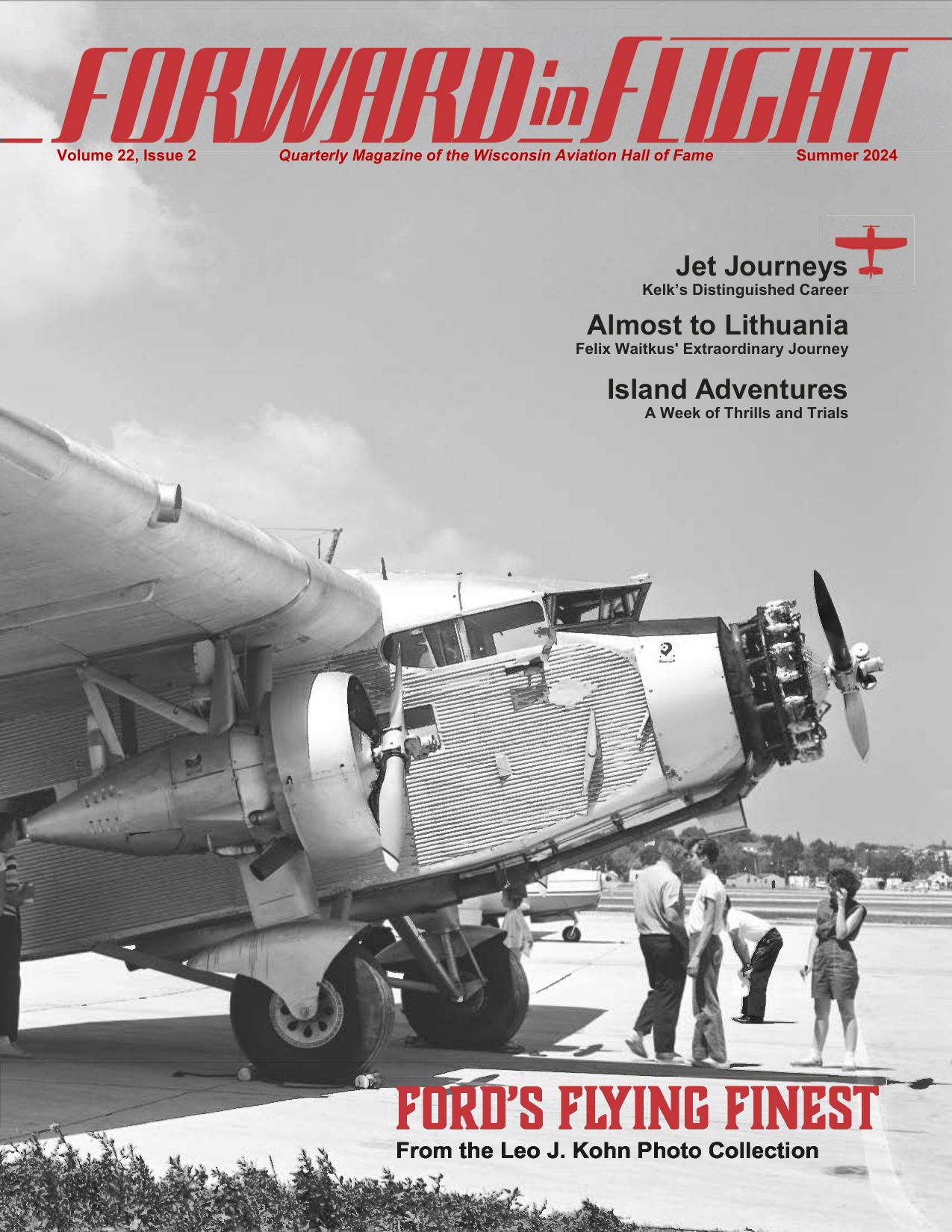
Volume 22, Issue 2 ~HT Quarterly Magazine of the Wisconsin Aviation Hall of Fame Summer 2024 Jet Journeys Kelk’s Distinguished Career Almost to Lithuania Felix Waitkus' Extraordinary Journey Island Adventures A Week of Thrills and Trials ___ S FLYING FINEST J. Kohn Photo Collection
_FORWRRDJnHl/iHT Contents Summer 2024 20 HISTORY HANGAR Wisconsin’s Lindbergh The Remarkable Journey of Felix Waitkus By Dan Miller 2 GOLDEN AGE Fifty Years of Happiness By Pat Weeden 4 TAILDRAGGER TALES Gordy Unpeeling the Onion By John Chmiel 6 VETERANS TRIBUTES From Fighter Jets to Commercial Jets • The Skyward Story of Jon “JB” Kelk• (2024 WAHF Inductee) By Mark Ehlen 10 SNAPSHOTS Pietenpol Build On the East Side of Madison By Skot Weidemann 22 WE FLY Seven Days, Seven Islands Seven Pounds of Paperwork By Rose Dorcey 26 ASSOCIATION NEWS Announcements… Upcoming Events! 27 YOUNG FLIERS’ CLUB Emma Learns About Navigation 28 Editor’s Log: Rose Dorcey 12 AERO-LENS Capturing Aviation The Legacy of Leo J. Kohn By Rose Dorcey 17 DID YOU HEAR ABOUT? Dan Simpson Aviation and Restoration at its Best By Duane Esse 18 TALES OF THE ACES Badger Aces of the Mighty 8th Part 1 By Michael O’Connor Perhaps you've seen the exciting landings at St. Barts airport in YouTube videos, but have you ever talked to someone who made it their mission to fly there? WAHF Member Phillip Kinard, alongside John Dorcey, embarked on a recent flight to the Caribbean to fulfill a bucket list item. They’re sharing their story and invaluable advice to inspire you to do the same. Photo by John Dorcey. The Midwest's Premier General Aviation Services Provider ~~, WISCONSIN AVIATION WisconsinAviation.com • Air Charter • Flight Training • Aircraft Rental • Maintenance • Avionics • Interiors & Detailing • Aircraft Sales • Aircraft Management Madison {MSN) Waterto wn {RYV) Juneau {UNU} Oor1e County Regional Airport Wa tertown Munic,pol Arrport Dodge County A,rport 608-268-5000 920-261-4567 920-386-2402 BECHiBJ HOPPE .._____ Contact: Karl Kemper, PE, Airport Services Manager kkemper@becherhoppe.com • 715-551-5507 becherhoppe.com • Wausau, Wisconsin
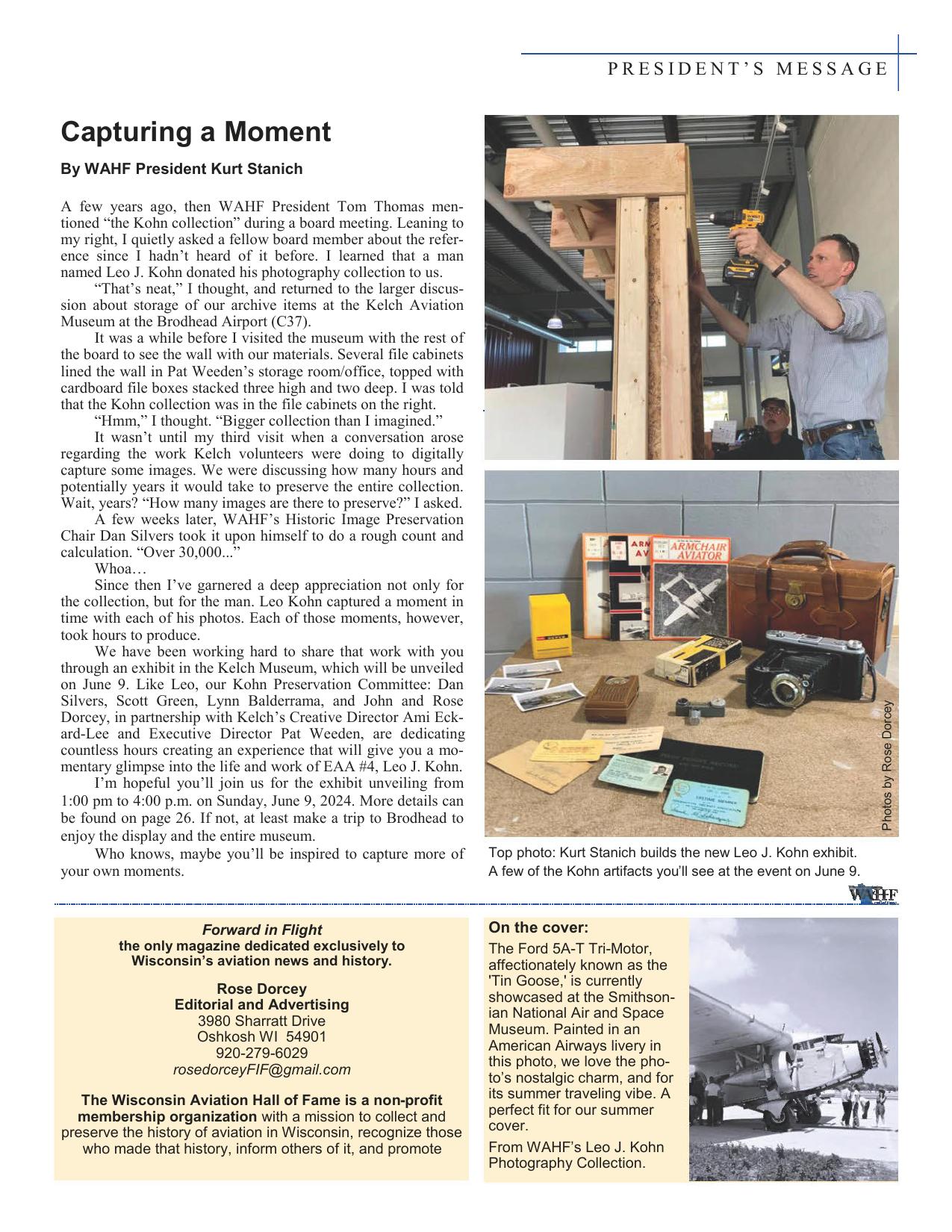
PRESIDENT’S MESSAGE Capturing a Moment A few years ago, then WAHF President Tom Thomas mentioned “the Kohn collection” during a board meeting. Leaning to my right, I quietly asked a fellow board member about the reference since I hadn’t heard of it before. I learned that a man named Leo J. Kohn donated his photography collection to us. “That’s neat,” I thought, and returned to the larger discussion about storage of our archive items at the Kelch Aviation Museum at the Brodhead Airport (C37). It was a while before I visited the museum with the rest of the board to see the wall with our materials. Several file cabinets lined the wall in Pat Weeden’s storage room/office, topped with cardboard file boxes stacked three high and two deep. I was told that the Kohn collection was in the file cabinets on the right. “Hmm,” I thought. “Bigger collection than I imagined.” It wasn’t until my third visit when a conversation arose regarding the work Kelch volunteers were doing to digitally capture some images. We were discussing how many hours and potentially years it would take to preserve the entire collection. Wait, years? “How many images are there to preserve?” I asked. A few weeks later, WAHF’s Historic Image Preservation Chair Dan Silvers took it upon himself to do a rough count and calculation. “Over 30,000...” Whoa… Since then I’ve garnered a deep appreciation not only for the collection, but for the man. Leo Kohn captured a moment in time with each of his photos. Each of those moments, however, took hours to produce. We have been working hard to share that work with you through an exhibit in the Kelch Museum, which will be unveiled on June 9. Like Leo, our Kohn Preservation Committee: Dan Silvers, Scott Green, Lynn Balderrama, and John and Rose Dorcey, in partnership with Kelch’s Creative Director Ami Eckard-Lee and Executive Director Pat Weeden, are dedicating countless hours creating an experience that will give you a momentary glimpse into the life and work of EAA #4, Leo J. Kohn. I’m hopeful you’ll join us for the exhibit unveiling from 1:00 pm to 4:00 p.m. on Sunday, June 9, 2024. More details can be found on page 26. If not, at least make a trip to Brodhead to enjoy the display and the entire museum. Who knows, maybe you’ll be inspired to capture more of your own moments. Forward in Flight the only magazine dedicated exclusively to Wisconsin’s aviation news and history. Rose Dorcey Editorial and Advertising 3980 Sharratt Drive Oshkosh WI 54901 920-279-6029 rosedorceyFIF@gmail.com The Wisconsin Aviation Hall of Fame is a non-profit membership organization with a mission to collect and preserve the history of aviation in Wisconsin, recognize those who made that history, inform others of it, and promote Photos by Rose Dorcey By WAHF President Kurt Stanich Top photo: Kurt Stanich builds the new Leo J. Kohn exhibit. A few of the Kohn artifacts you’ll see at the event on June 9. On the cover: The Ford 5A-T Tri-Motor, affectionately known as the 'Tin Goose,' is currently showcased at the Smithsonian National Air and Space Museum. Painted in an American Airways livery in this photo, we love the photo’s nostalgic charm, and for its summer traveling vibe. A perfect fit for our summer cover. From WAHF’s Leo J. Kohn Photography Collection.
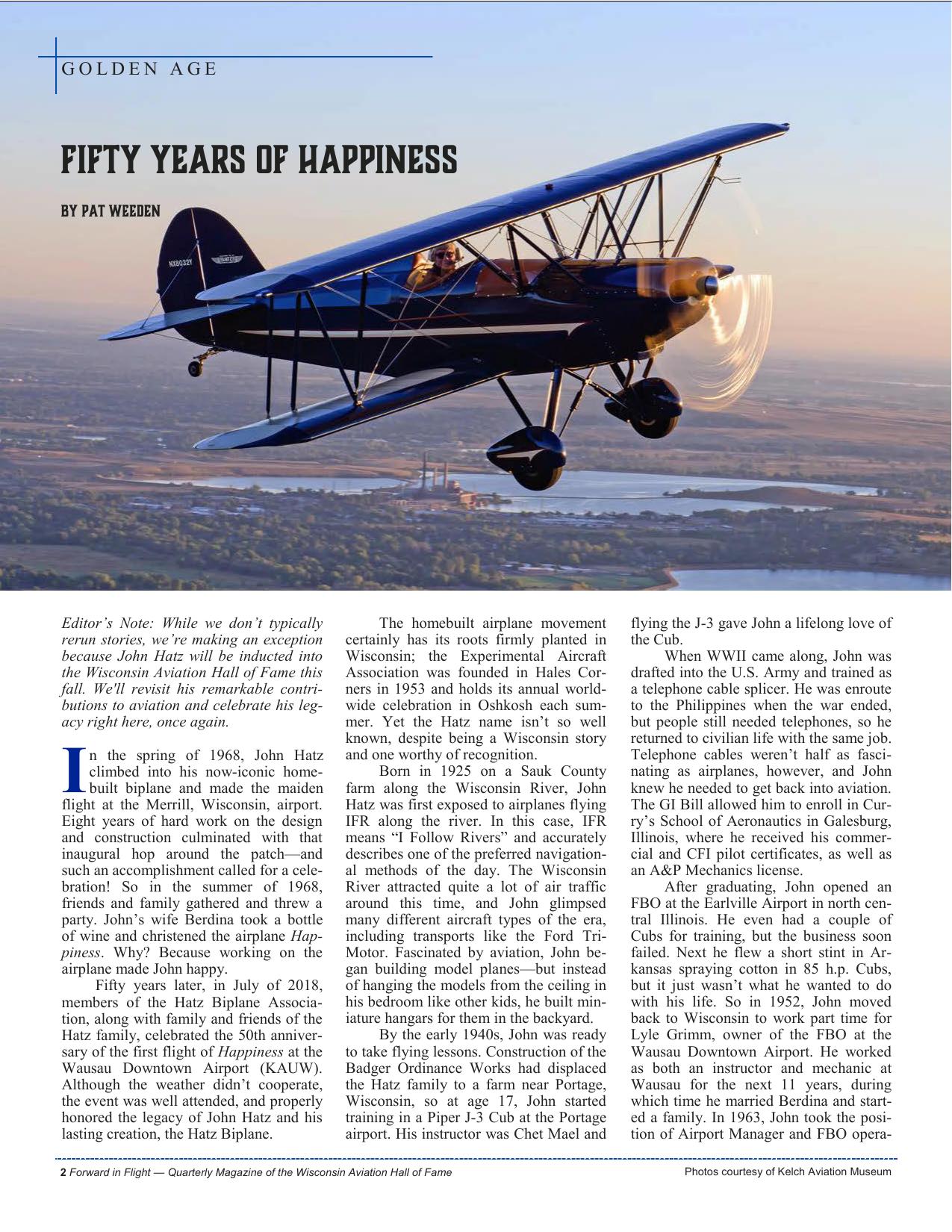
GOLDEN AGE Fifty Years of Happiness By Pat Weeden Editor’s Note: While we don’t typically rerun stories, we’re making an exception because John Hatz will be inducted into the Wisconsin Aviation Hall of Fame this fall. We'll revisit his remarkable contributions to aviation and celebrate his legacy right here, once again. I n the spring of 1968, John Hatz climbed into his now-iconic homebuilt biplane and made the maiden flight at the Merrill, Wisconsin, airport. Eight years of hard work on the design and construction culminated with that inaugural hop around the patch—and such an accomplishment called for a celebration! So in the summer of 1968, friends and family gathered and threw a party. John’s wife Berdina took a bottle of wine and christened the airplane Happiness. Why? Because working on the airplane made John happy. Fifty years later, in July of 2018, members of the Hatz Biplane Association, along with family and friends of the Hatz family, celebrated the 50th anniversary of the first flight of Happiness at the Wausau Downtown Airport (KAUW). Although the weather didn’t cooperate, the event was well attended, and properly honored the legacy of John Hatz and his lasting creation, the Hatz Biplane. The homebuilt airplane movement certainly has its roots firmly planted in Wisconsin; the Experimental Aircraft Association was founded in Hales Corners in 1953 and holds its annual worldwide celebration in Oshkosh each summer. Yet the Hatz name isn’t so well known, despite being a Wisconsin story and one worthy of recognition. Born in 1925 on a Sauk County farm along the Wisconsin River, John Hatz was first exposed to airplanes flying IFR along the river. In this case, IFR means “I Follow Rivers” and accurately describes one of the preferred navigational methods of the day. The Wisconsin River attracted quite a lot of air traffic around this time, and John glimpsed many different aircraft types of the era, including transports like the Ford TriMotor. Fascinated by aviation, John began building model planes—but instead of hanging the models from the ceiling in his bedroom like other kids, he built miniature hangars for them in the backyard. By the early 1940s, John was ready to take flying lessons. Construction of the Badger Ordinance Works had displaced the Hatz family to a farm near Portage, Wisconsin, so at age 17, John started training in a Piper J-3 Cub at the Portage airport. His instructor was Chet Mael and 2 Forward in Flight — Quarterly Magazine of the Wisconsin Aviation Hall of Fame flying the J-3 gave John a lifelong love of the Cub. When WWII came along, John was drafted into the U.S. Army and trained as a telephone cable splicer. He was enroute to the Philippines when the war ended, but people still needed telephones, so he returned to civilian life with the same job. Telephone cables weren’t half as fascinating as airplanes, however, and John knew he needed to get back into aviation. The GI Bill allowed him to enroll in Curry’s School of Aeronautics in Galesburg, Illinois, where he received his commercial and CFI pilot certificates, as well as an A&P Mechanics license. After graduating, John opened an FBO at the Earlville Airport in north central Illinois. He even had a couple of Cubs for training, but the business soon failed. Next he flew a short stint in Arkansas spraying cotton in 85 h.p. Cubs, but it just wasn’t what he wanted to do with his life. So in 1952, John moved back to Wisconsin to work part time for Lyle Grimm, owner of the FBO at the Wausau Downtown Airport. He worked as both an instructor and mechanic at Wausau for the next 11 years, during which time he married Berdina and started a family. In 1963, John took the position of Airport Manager and FBO operaPhotos courtesy of Kelch Aviation Museum
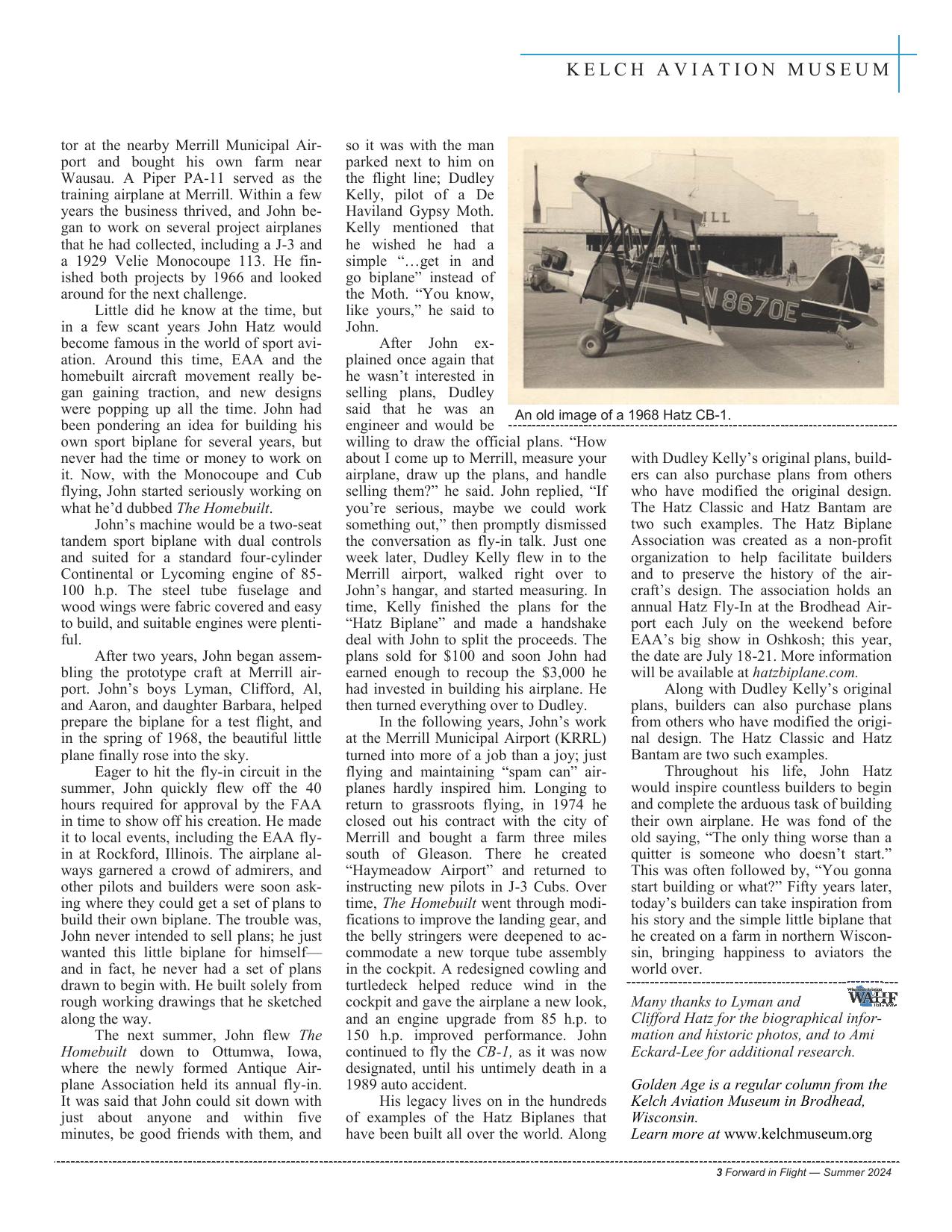
KELCH AVIATION MUSEUM tor at the nearby Merrill Municipal Airport and bought his own farm near Wausau. A Piper PA-11 served as the training airplane at Merrill. Within a few years the business thrived, and John began to work on several project airplanes that he had collected, including a J-3 and a 1929 Velie Monocoupe 113. He finished both projects by 1966 and looked around for the next challenge. Little did he know at the time, but in a few scant years John Hatz would become famous in the world of sport aviation. Around this time, EAA and the homebuilt aircraft movement really began gaining traction, and new designs were popping up all the time. John had been pondering an idea for building his own sport biplane for several years, but never had the time or money to work on it. Now, with the Monocoupe and Cub flying, John started seriously working on what he’d dubbed The Homebuilt. John’s machine would be a two-seat tandem sport biplane with dual controls and suited for a standard four-cylinder Continental or Lycoming engine of 85100 h.p. The steel tube fuselage and wood wings were fabric covered and easy to build, and suitable engines were plentiful. After two years, John began assembling the prototype craft at Merrill airport. John’s boys Lyman, Clifford, Al, and Aaron, and daughter Barbara, helped prepare the biplane for a test flight, and in the spring of 1968, the beautiful little plane finally rose into the sky. Eager to hit the fly-in circuit in the summer, John quickly flew off the 40 hours required for approval by the FAA in time to show off his creation. He made it to local events, including the EAA flyin at Rockford, Illinois. The airplane always garnered a crowd of admirers, and other pilots and builders were soon asking where they could get a set of plans to build their own biplane. The trouble was, John never intended to sell plans; he just wanted this little biplane for himself— and in fact, he never had a set of plans drawn to begin with. He built solely from rough working drawings that he sketched along the way. The next summer, John flew The Homebuilt down to Ottumwa, Iowa, where the newly formed Antique Airplane Association held its annual fly-in. It was said that John could sit down with just about anyone and within five minutes, be good friends with them, and so it was with the man 1 parked next to him on the flight line; Dudley Kelly, pilot of a De Haviland Gypsy Moth. Kelly mentioned that he wished he had a simple “…get in and go biplane” instead of the Moth. “You know, like yours,” he said to John. After John explained once again that he wasn’t interested in selling plans, Dudley said that he was an An old image of a 1968 Hatz CB-1. engineer and would be willing to draw the official plans. “How with Dudley Kelly’s original plans, buildabout I come up to Merrill, measure your ers can also purchase plans from others airplane, draw up the plans, and handle selling them?” he said. John replied, “If who have modified the original design. The Hatz Classic and Hatz Bantam are you’re serious, maybe we could work two such examples. The Hatz Biplane something out,” then promptly dismissed Association was created as a non-profit the conversation as fly-in talk. Just one week later, Dudley Kelly flew in to the organization to help facilitate builders and to preserve the history of the airMerrill airport, walked right over to craft’s design. The association holds an John’s hangar, and started measuring. In annual Hatz Fly-In at the Brodhead Airtime, Kelly finished the plans for the “Hatz Biplane” and made a handshake port each July on the weekend before EAA’s big show in Oshkosh; this year, deal with John to split the proceeds. The the date are July 18-21. More information plans sold for $100 and soon John had will be available at hatzbiplane.com. earned enough to recoup the $3,000 he had invested in building his airplane. He Along with Dudley Kelly’s original plans, builders can also purchase plans then turned everything over to Dudley. from others who have modified the origiIn the following years, John’s work nal design. The Hatz Classic and Hatz at the Merrill Municipal Airport (KRRL) Bantam are two such examples. turned into more of a job than a joy; just Throughout his life, John Hatz flying and maintaining “spam can” airwould inspire countless builders to begin planes hardly inspired him. Longing to and complete the arduous task of building return to grassroots flying, in 1974 he their own airplane. He was fond of the closed out his contract with the city of old saying, “The only thing worse than a Merrill and bought a farm three miles quitter is someone who doesn’t start.” south of Gleason. There he created “Haymeadow Airport” and returned to This was often followed by, “You gonna start building or what?” Fifty years later, instructing new pilots in J-3 Cubs. Over today’s builders can take inspiration from time, The Homebuilt went through modihis story and the simple little biplane that fications to improve the landing gear, and the belly stringers were deepened to ache created on a farm in northern Wisconsin, bringing happiness to aviators the commodate a new torque tube assembly world over. in the cockpit. A redesigned cowling and turtledeck helped reduce wind in the cockpit and gave the airplane a new look, Many thanks to Lyman and Clifford Hatz for the biographical inforand an engine upgrade from 85 h.p. to mation and historic photos, and to Ami 150 h.p. improved performance. John continued to fly the CB-1, as it was now Eckard-Lee for additional research. designated, until his untimely death in a Golden Age is a regular column from the 1989 auto accident. His legacy lives on in the hundreds Kelch Aviation Museum in Brodhead, of examples of the Hatz Biplanes that Wisconsin. Learn more at www.kelchmuseum.org have been built all over the world. Along -----------------------------------------------. ! 3 Forward in Flight — Summer 2024
TAILDRAGGER TALES Gordy Peeling Back the Onion By John Chmiel After I moved to Wausau in 1992 to start Wausau Flying Service, Harry, the Wausau Downtown Airport (KAUW) weather station manager, heard that I was a certified weather observer. There was a temporary opening at the Wausau station, so I agreed to take the part-time position. The manned station was scheduled to be closed after the automated weather station was activated. My first shift was 11:00 p.m. to 7:00 a.m. Harry and I (the new 27-yearold green airport manager with all the enthusiasm of a puppy) walked into the darkened weather observer office in the airport terminal. That’s when I met Gordy. Gordon “Horse” Scharnhorst was in his 70s by then, fit for his age, sporting a hybrid crew cut/flat top military haircut. He was hunched over the drafting table underneath the single lightbulb table lamp finishing up recording his last observation of the shift. I think he grunted upon our arrival as he put his pencil down and examined me. A cordial but minimally worded introduction accompanied the shift hand off. He seemed ornery and gruff. Not one for conversation. After a few overnight shifts at the station over the next weeks, Gordy’s demeanor didn’t change, although small talk got easier for both of us. Small talk was all we had regardless of whether it was a night or morning shift. I never took it personally, but it made it difficult to figure him out. One day Harry came in and the subject of my fellow co-worker came up. My supervisor knew well my passion for aviation and aviation history. The conversation went something like this: Harry: “You know what Gordy’s story is right?” Me: “Nope.” Harry: “He was a damn good fighter pilot in the Air Force. He was based in Germany, and Edwards AFB in California during his career and retired as a Lieutenant Colonel. When he left the military he moved to Wausau and took a job with the Wausau School District. He retired when I needed a weather observer.” Me: “That’s awesome! I can’t wait to talk to him about his aviation story.” Harry: “You can try. But he doesn’t ever talk about it with anyone.” If I wasn’t intrigued already by Harry’s enlightening revelation, I felt challenged to see if I could get Gordy to open up. What I found out is that getting to know Gordy’s story was going to be exactly like peeling an onion. Once you’re a pilot long enough, you figure out that the best aviators among us are typically the most humble and quiet. “Horse” didn’t waiver from that axiom. On my next weather station shift I immediately confronted him regarding his flying career. He quickly dismissed my question with a wave of the hand and a comment like, “that was a long time ago.” He did confirm his F-100 flying experience and that he was based in Germany. I immediately requested pictures from his past so I could learn more about his story. “I don’t even know if I’ve got any pictures,” he said, and that was the end of that shift change. I got the feeling that Harry was right, that Gordy had given me as much as he wanted to. A couple weeks later we exchanged the usual shift change talk, then just as he was leaving he matter-of-factly stated in his gravelly Missouri twang, “I found a picture for you,” as he reached into his bag and handed me a black and white photograph of a side-view of an F-100 Super Sabre in flight. It was a perfect Air Force promotional photograph. “Is that your F-100?” I asked. He quickly answered, “Nope,” as he retrieved the photo and began pointing at the rudder on the fighter jet. “That’s me right there.” Upon further inspection it became apparent that the F-100 was in the forefront of four other Super Sabres in formation. The only way you could tell there were five aircraft in the picture is by counting each sliver of rudder section from each aircraft behind the first. That’s how tight the formation was! The promotional photograph was of the Skyblazers. In 1957, while based at Bitburg AFB, Gordy flew left wing for the United States Air Forces Europe (USAFE) Aerial Demonstration Team. During his time with the Skyblazers, he flew 107 official aerial demonstrations all over Europe, North Africa, and the Middle East. The Skyblazers were the 4 Forward in Flight — Quarterly Magazine of the Wisconsin Aviation Hall of Fame international equivalent of the USAF domestic demonstration team the Thunderbirds. He quickly snatched the picture as I tried to get more info, but that was as much as he was going to give me that night. I was giddy about the story. A couple months later Harry asked if I could take some weather shifts because Gordy was taking some time off to go hunting. I gladly agreed. After he returned, I asked Gordy how it went. “About the same as it does every year. Chuck was ornery. Bob was quiet. And me and Bud had a good time.” He laid the names out like I should know who his hunting buddies were. After he left, I put some thought into our conversation while I watched the cumulous roll by, when suddenly it dawned on me. Gordy’s hunting buddies were Chuck Yeager, Bob Hoover, and Bud Anderson! Are you kidding me?! I asked Harry about Gordy’s hunting party and he nonchalantly confirmed that yes indeed, Gordy’s boys were the Aces with the right stuff just like I had figured out. They were lifelong friends and still hunted together annually. Over time it got easier for Horse to tell me his stories, but he never volunteered them. One day I was relating my experience jumping out of a perfectly good airplane. After five jumps I wasn’t enjoying it as much as I thought I should. I asked Gordy about his USAF emergency egress training. Instead he related his story while half laughing about the day he joined the Caterpillar Club on a practice flight with the Skyblazers over Germany. While flying formation and recovering from a maneuver it became apparent that something had caused his primary flight controls in the Super Sabre to lock, and he was unable to adjust pitch. After working the problem and while adjusting power to see if the airplane could be controlled safely, the decision was made to bail out of the aircraft. He landed safely and no one was hurt on the ground. The aircraft was destroyed. In 1965 my father was based at Hahn Air Force base in Germany where I was born. Gordy had been to Hahn many times and described the beauty in that area of the Fatherland. He was based in
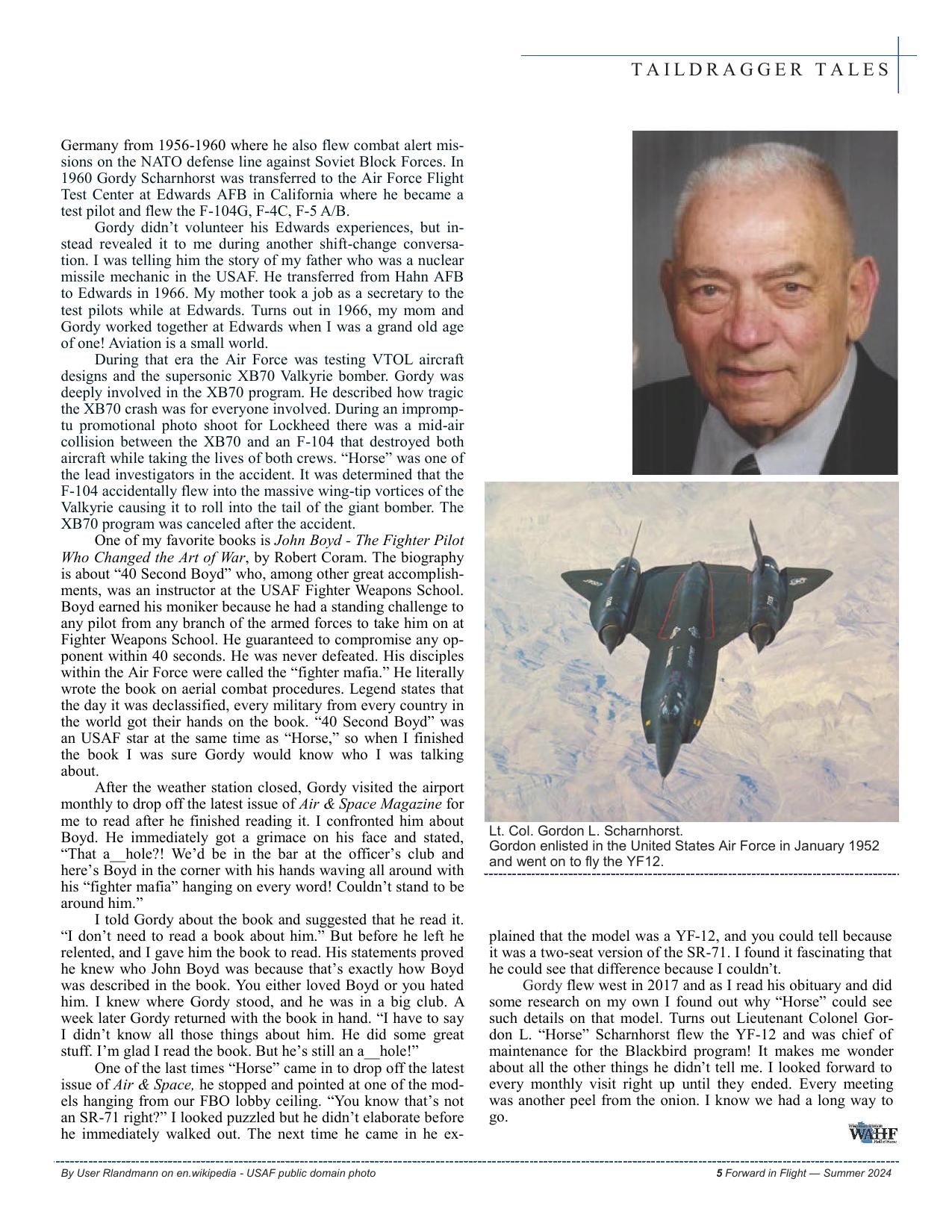
TAILDRAGGER TALES Germany from 1956-1960 where he also flew combat alert missions on the NATO defense line against Soviet Block Forces. In 1960 Gordy Scharnhorst was transferred to the Air Force Flight Test Center at Edwards AFB in California where he became a test pilot and flew the F-104G, F-4C, F-5 A/B. Gordy didn’t volunteer his Edwards experiences, but instead revealed it to me during another shift-change conversation. I was telling him the story of my father who was a nuclear missile mechanic in the USAF. He transferred from Hahn AFB to Edwards in 1966. My mother took a job as a secretary to the test pilots while at Edwards. Turns out in 1966, my mom and Gordy worked together at Edwards when I was a grand old age of one! Aviation is a small world. During that era the Air Force was testing VTOL aircraft designs and the supersonic XB70 Valkyrie bomber. Gordy was deeply involved in the XB70 program. He described how tragic the XB70 crash was for everyone involved. During an impromptu promotional photo shoot for Lockheed there was a mid-air collision between the XB70 and an F-104 that destroyed both aircraft while taking the lives of both crews. “Horse” was one of the lead investigators in the accident. It was determined that the F-104 accidentally flew into the massive wing-tip vortices of the Valkyrie causing it to roll into the tail of the giant bomber. The XB70 program was canceled after the accident. One of my favorite books is John Boyd - The Fighter Pilot Who Changed the Art of War, by Robert Coram. The biography is about “40 Second Boyd” who, among other great accomplishments, was an instructor at the USAF Fighter Weapons School. Boyd earned his moniker because he had a standing challenge to any pilot from any branch of the armed forces to take him on at Fighter Weapons School. He guaranteed to compromise any opponent within 40 seconds. He was never defeated. His disciples within the Air Force were called the “fighter mafia.” He literally wrote the book on aerial combat procedures. Legend states that the day it was declassified, every military from every country in the world got their hands on the book. “40 Second Boyd” was an USAF star at the same time as “Horse,” so when I finished the book I was sure Gordy would know who I was talking about. After the weather station closed, Gordy visited the airport monthly to drop off the latest issue of Air & Space Magazine for me to read after he finished reading it. I confronted him about Boyd. He immediately got a grimace on his face and stated, “That a__hole?! We’d be in the bar at the officer’s club and here’s Boyd in the corner with his hands waving all around with his “fighter mafia” hanging on every word! Couldn’t stand to be around him.” I told Gordy about the book and suggested that he read it. “I don’t need to read a book about him.” But before he left he relented, and I gave him the book to read. His statements proved he knew who John Boyd was because that’s exactly how Boyd was described in the book. You either loved Boyd or you hated him. I knew where Gordy stood, and he was in a big club. A week later Gordy returned with the book in hand. “I have to say I didn’t know all those things about him. He did some great stuff. I’m glad I read the book. But he’s still an a__hole!” One of the last times “Horse” came in to drop off the latest issue of Air & Space, he stopped and pointed at one of the models hanging from our FBO lobby ceiling. “You know that’s not an SR-71 right?” I looked puzzled but he didn’t elaborate before he immediately walked out. The next time he came in he exBy User Rlandmann on en.wikipedia - USAF public domain photo .. Lt. Col. Gordon L. Scharnhorst. Gordon enlisted in the United States Air Force in January 1952 and went on to fly the YF12. plained that the model was a YF-12, and you could tell because it was a two-seat version of the SR-71. I found it fascinating that he could see that difference because I couldn’t. Gordy flew west in 2017 and as I read his obituary and did some research on my own I found out why “Horse” could see such details on that model. Turns out Lieutenant Colonel Gordon L. “Horse” Scharnhorst flew the YF-12 and was chief of maintenance for the Blackbird program! It makes me wonder about all the other things he didn’t tell me. I looked forward to every monthly visit right up until they ended. Every meeting was another peel from the onion. I know we had a long way to go. 5 Forward in Flight — Summer 2024
From Fighter Jets to Commercial Jets The Skyward Story of Jon "JB" Kelk By Mark Ehlen Everyone has a calling in life. That one thing that they are most gifted to do. It may manifest in different ways throughout their life, but the core mission remains the same. Their desire guides them and keeps them focused and away from distractions. Their love for it drives them to constantly pursue excellence and higher levels of achievement and performance. It’s not work. Oh, there’s a lot of discipline, diligence and effort involved for sure but that’s just the necessary means to achieve the end goal; that is to fulfill the passion inside. Sadly, not many are able to realize this in their life. There are as many reasons as there are people but it’s proper that we celebrate those who do since they are such wonderful examples for all of us and for those who will come after. While most young boys frequently change their minds about what they want to be when they grow up, the young Jon Kelk never wavered from his first love. From the time he was a toddler, he loved airplanes and often begged his parents to take him to the Eau Claire airport to watch the “big planes” come and go. An especially vivid early memory had a huge impact on Jon’s future. Just imagine a little boy’s awe when “One afternoon, I was maybe five, a very loud roar flew over my house. It was a fighter jet, most likely an F-100/102 at a fairly low level. It was utterly thrilling…” Jon’s childhood was filled with toy and model airplanes, and he even built a few models. (He turned out to be a much 6 Forward in Flight — Quarterly Magazine of the Wisconsin Aviation Hall of Fame better pilot than a builder.) He devoured aviation books from the library and was especially fascinated with the early years and WWI and WWII aircraft. That fascination continued into his high school years when in 1975 he took a class entitled Introduction to Flight Aviation that really whet his appetite for flying and led him to start taking flight lessons. His boss at his first part time job was learning to fly, which encouraged him to save enough money to begin flight training himself. He also learned that if he worked for Gibson Aviation, he would get a significant discount on flying rates, so he applied and began working “the line” when he was 17. He received his CFI as a sophomore in college and then instructed part time for Gibson until he got his accounting/business administration degree in December of 1980. But that time at Gibson lead to some interesting high school years. Jon was not like the other kids in his school. While they were chasing around town in their cars, Jon and a friend from Junior High, John Wulff, would ride their bikes to the airport to go flying. One day, on a whim, they just decided to fly to New Orleans and check out Bourbon Street. Satisfied with that after a bit they thought, “What should we do next?” Why not go down to Galveston? And after that, Brownsville. Thoughts about crossing the border into Mexico were discouraged by the locals but that didn’t matter as Jon’s boss Darrel Gibson back in Eau Claire had a job for the boys. He needed a plane picked up in Wichita, so they flew up there (buzzing a Cowboys game on Photos courtesy of Jon Kelk
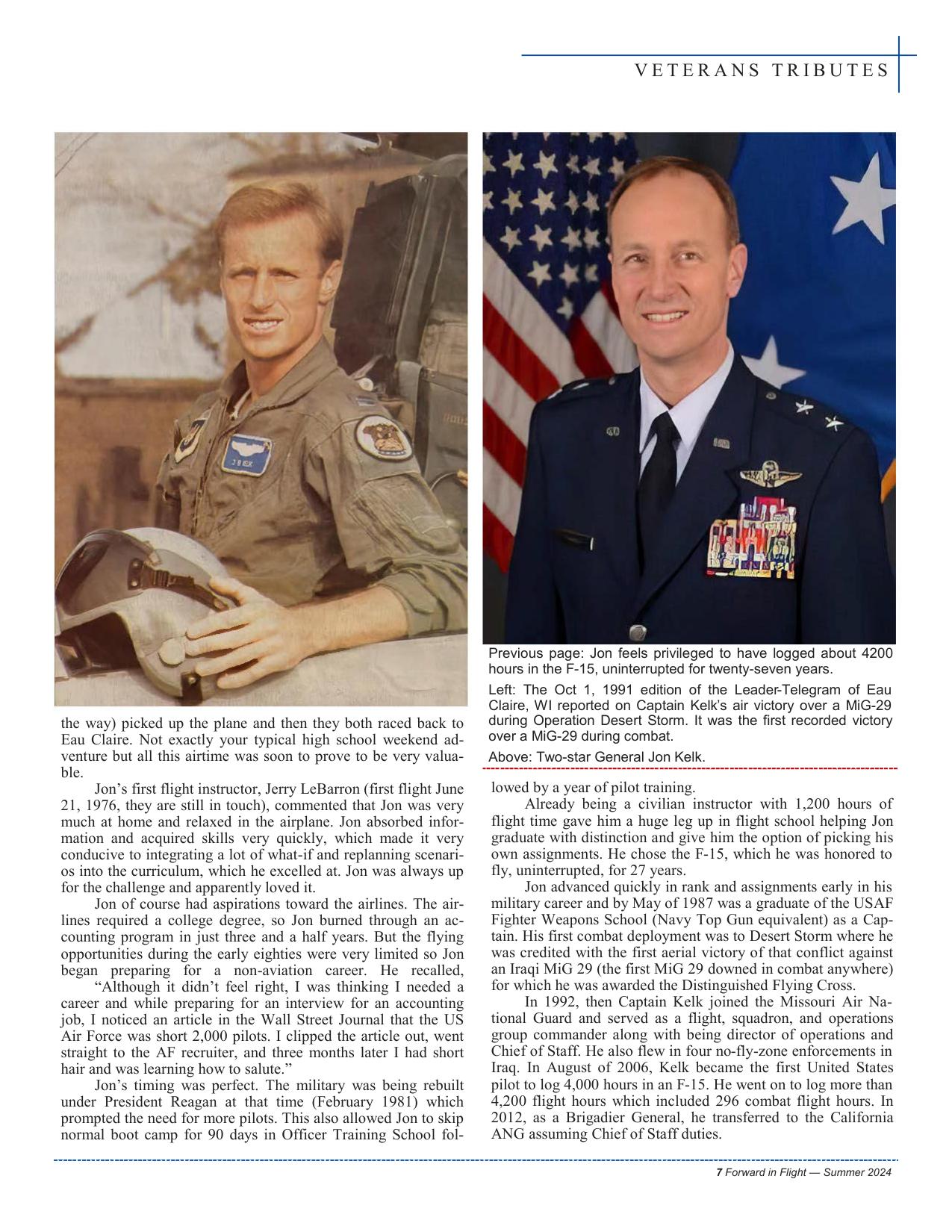
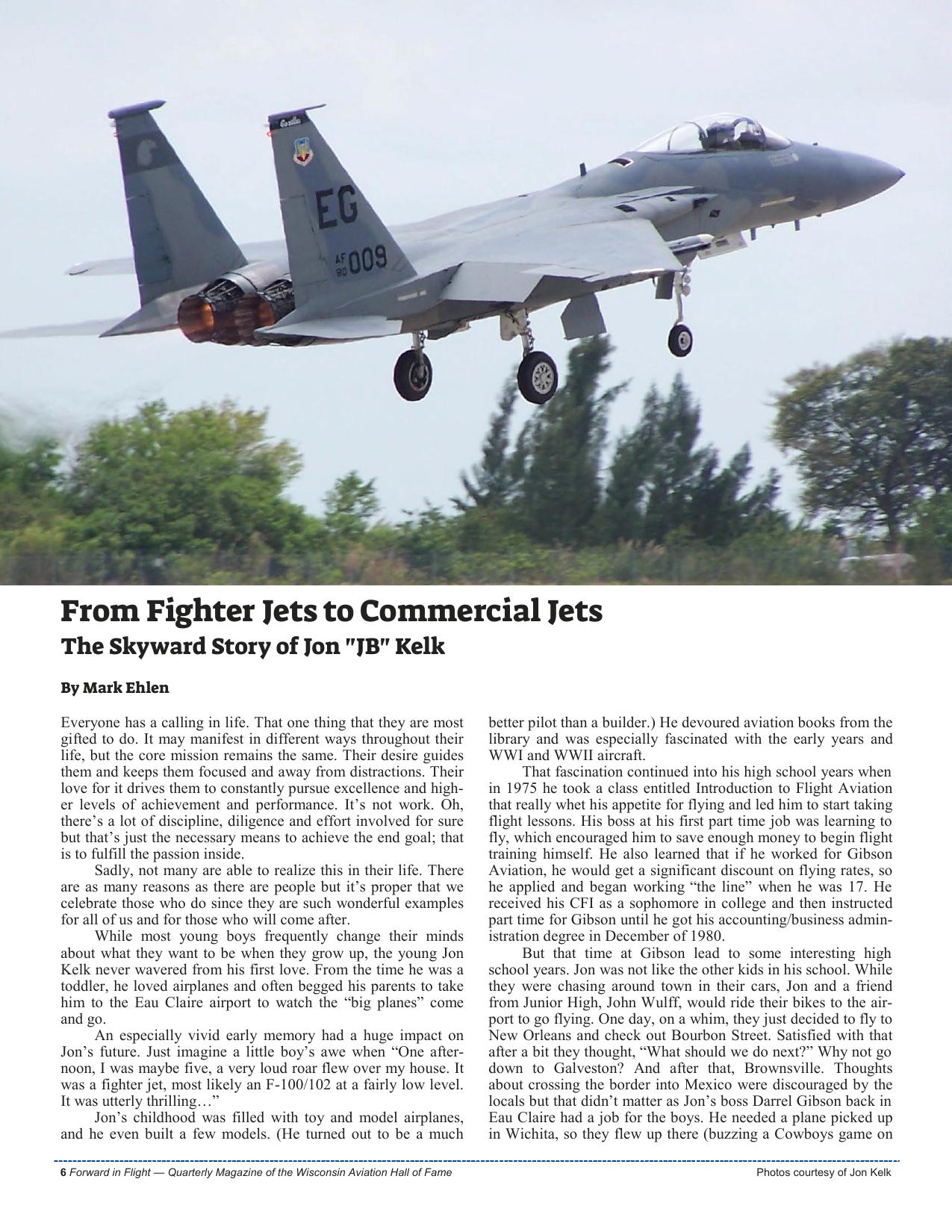
VETERANS TRIBUTES Previous page: Jon feels privileged to have logged about 4200 hours in the F-15, uninterrupted for twenty-seven years. the way) picked up the plane and then they both raced back to Eau Claire. Not exactly your typical high school weekend adventure but all this airtime was soon to prove to be very valuable. Jon’s first flight instructor, Jerry LeBarron (first flight June 21, 1976, they are still in touch), commented that Jon was very much at home and relaxed in the airplane. Jon absorbed information and acquired skills very quickly, which made it very conducive to integrating a lot of what-if and replanning scenarios into the curriculum, which he excelled at. Jon was always up for the challenge and apparently loved it. Jon of course had aspirations toward the airlines. The airlines required a college degree, so Jon burned through an accounting program in just three and a half years. But the flying opportunities during the early eighties were very limited so Jon began preparing for a non-aviation career. He recalled, “Although it didn’t feel right, I was thinking I needed a career and while preparing for an interview for an accounting job, I noticed an article in the Wall Street Journal that the US Air Force was short 2,000 pilots. I clipped the article out, went straight to the AF recruiter, and three months later I had short hair and was learning how to salute.” Jon’s timing was perfect. The military was being rebuilt under President Reagan at that time (February 1981) which prompted the need for more pilots. This also allowed Jon to skip normal boot camp for 90 days in Officer Training School fol- Left: The Oct 1, 1991 edition of the Leader-Telegram of Eau Claire, WI reported on Captain Kelk’s air victory over a MiG-29 during Operation Desert Storm. It was the first recorded victory over a MiG-29 during combat. Above: Two-star General Jon Kelk. lowed by a year of pilot training. Already being a civilian instructor with 1,200 hours of flight time gave him a huge leg up in flight school helping Jon graduate with distinction and give him the option of picking his own assignments. He chose the F-15, which he was honored to fly, uninterrupted, for 27 years. Jon advanced quickly in rank and assignments early in his military career and by May of 1987 was a graduate of the USAF Fighter Weapons School (Navy Top Gun equivalent) as a Captain. His first combat deployment was to Desert Storm where he was credited with the first aerial victory of that conflict against an Iraqi MiG 29 (the first MiG 29 downed in combat anywhere) for which he was awarded the Distinguished Flying Cross. In 1992, then Captain Kelk joined the Missouri Air National Guard and served as a flight, squadron, and operations group commander along with being director of operations and Chief of Staff. He also flew in four no-fly-zone enforcements in Iraq. In August of 2006, Kelk became the first United States pilot to log 4,000 hours in an F-15. He went on to log more than 4,200 flight hours which included 296 combat flight hours. In 2012, as a Brigadier General, he transferred to the California ANG assuming Chief of Staff duties. ------7 Forward in Flight — Summer 2024
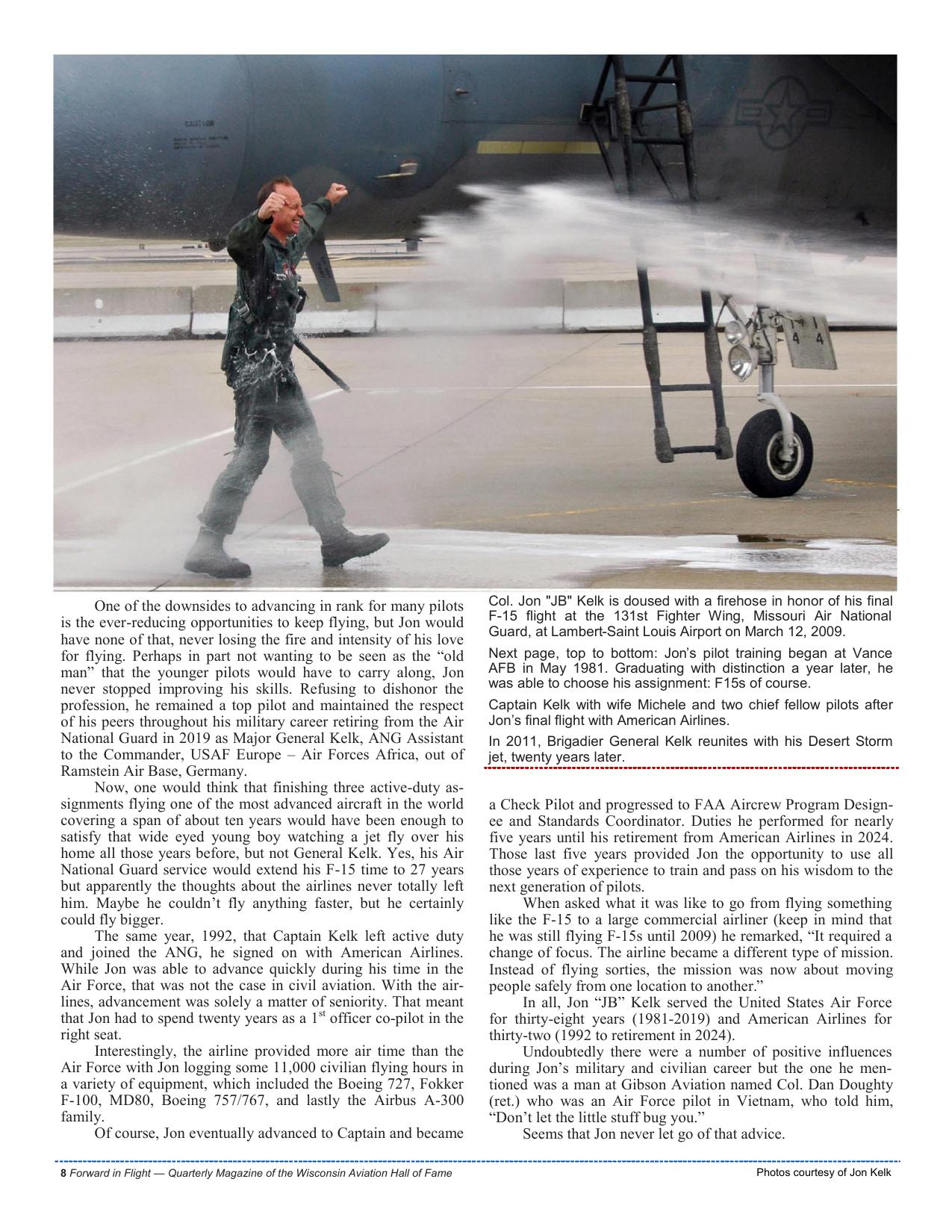
One of the downsides to advancing in rank for many pilots is the ever-reducing opportunities to keep flying, but Jon would have none of that, never losing the fire and intensity of his love for flying. Perhaps in part not wanting to be seen as the “old man” that the younger pilots would have to carry along, Jon never stopped improving his skills. Refusing to dishonor the profession, he remained a top pilot and maintained the respect of his peers throughout his military career retiring from the Air National Guard in 2019 as Major General Kelk, ANG Assistant to the Commander, USAF Europe – Air Forces Africa, out of Ramstein Air Base, Germany. Now, one would think that finishing three active-duty assignments flying one of the most advanced aircraft in the world covering a span of about ten years would have been enough to satisfy that wide eyed young boy watching a jet fly over his home all those years before, but not General Kelk. Yes, his Air National Guard service would extend his F-15 time to 27 years but apparently the thoughts about the airlines never totally left him. Maybe he couldn’t fly anything faster, but he certainly could fly bigger. The same year, 1992, that Captain Kelk left active duty and joined the ANG, he signed on with American Airlines. While Jon was able to advance quickly during his time in the Air Force, that was not the case in civil aviation. With the airlines, advancement was solely a matter of seniority. That meant that Jon had to spend twenty years as a 1st officer co-pilot in the right seat. Interestingly, the airline provided more air time than the Air Force with Jon logging some 11,000 civilian flying hours in a variety of equipment, which included the Boeing 727, Fokker F-100, MD80, Boeing 757/767, and lastly the Airbus A-300 family. Of course, Jon eventually advanced to Captain and became Col. Jon "JB" Kelk is doused with a firehose in honor of his final F-15 flight at the 131st Fighter Wing, Missouri Air National Guard, at Lambert-Saint Louis Airport on March 12, 2009. Next page, top to bottom: Jon’s pilot training began at Vance AFB in May 1981. Graduating with distinction a year later, he was able to choose his assignment: F15s of course. Captain Kelk with wife Michele and two chief fellow pilots after Jon’s final flight with American Airlines. In 2011, Brigadier General Kelk reunites with his Desert Storm jet, twenty years later. ----------------------------- a Check Pilot and progressed to FAA Aircrew Program Designee and Standards Coordinator. Duties he performed for nearly five years until his retirement from American Airlines in 2024. Those last five years provided Jon the opportunity to use all those years of experience to train and pass on his wisdom to the next generation of pilots. When asked what it was like to go from flying something like the F-15 to a large commercial airliner (keep in mind that he was still flying F-15s until 2009) he remarked, “It required a change of focus. The airline became a different type of mission. Instead of flying sorties, the mission was now about moving people safely from one location to another.” In all, Jon “JB” Kelk served the United States Air Force for thirty-eight years (1981-2019) and American Airlines for thirty-two (1992 to retirement in 2024). Undoubtedly there were a number of positive influences during Jon’s military and civilian career but the one he mentioned was a man at Gibson Aviation named Col. Dan Doughty (ret.) who was an Air Force pilot in Vietnam, who told him, “Don’t let the little stuff bug you.” Seems that Jon never let go of that advice. ---------------------------------------------------------- 8 Forward in Flight — Quarterly Magazine of the Wisconsin Aviation Hall of Fame Photos courtesy of Jon Kelk
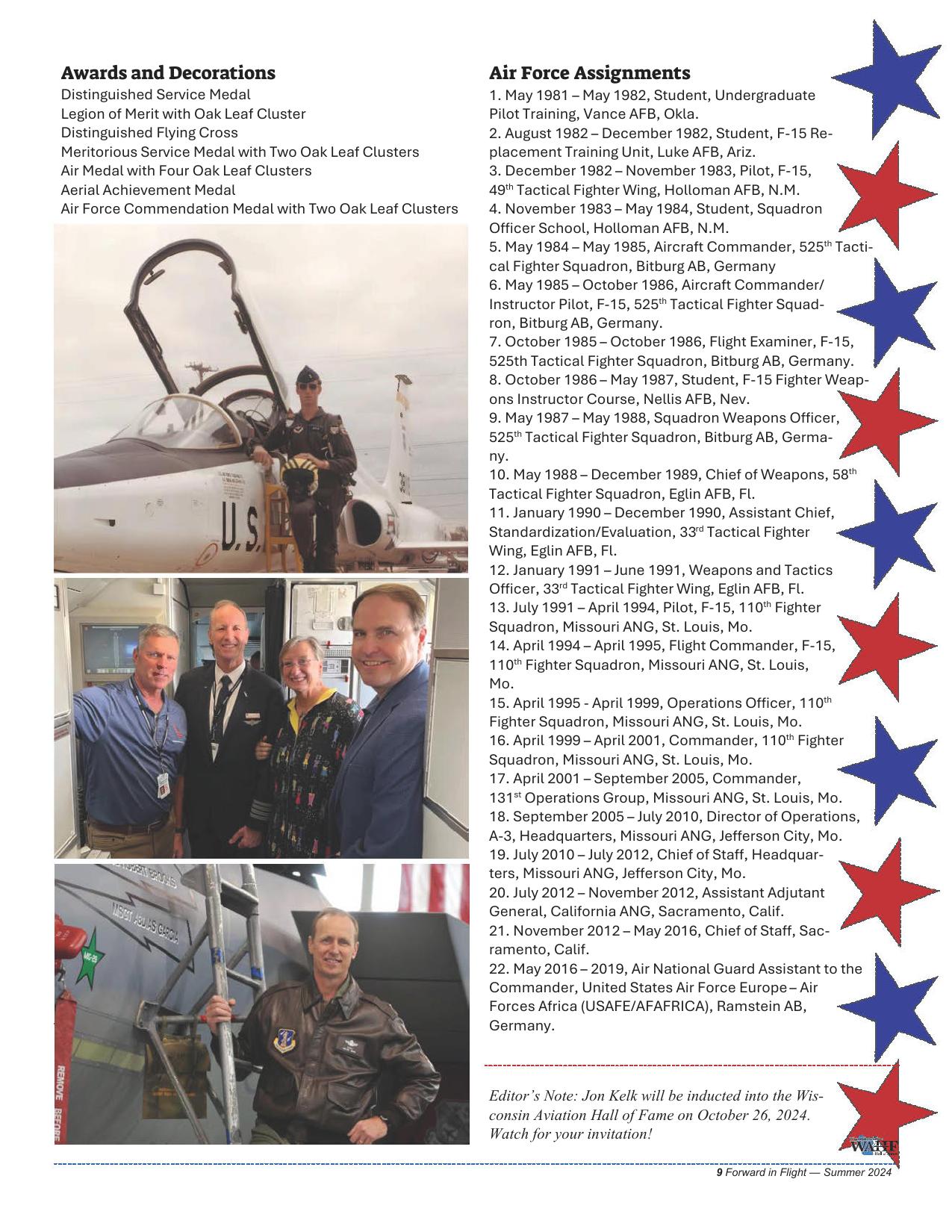
Awards and Decorations Distinguished Service Medal Legion of Merit with Oak Leaf Cluster Distinguished Flying Cross Meritorious Service Medal with Two Oak Leaf Clusters Air Medal with Four Oak Leaf Clusters Aerial Achievement Medal Air Force Commendation Medal with Two Oak Leaf Clusters Air Force Assignments 1. May 1981 – May 1982, Student, Undergraduate Pilot Training, Vance AFB, Okla. 2. August 1982 – December 1982, Student, F-15 Replacement Training Unit, Luke AFB, Ariz. 3. December 1982 – November 1983, Pilot, F-15, 49th Tactical Fighter Wing, Holloman AFB, N.M. 4. November 1983 – May 1984, Student, Squadron O icer School, Holloman AFB, N.M. 5. May 1984 – May 1985, Aircraft Commander, 525th Tactical Fighter Squadron, Bitburg AB, Germany 6. May 1985 – October 1986, Aircraft Commander/ Instructor Pilot, F-15, 525th Tactical Fighter Squadron, Bitburg AB, Germany. 7. October 1985 – October 1986, Flight Examiner, F-15, 525th Tactical Fighter Squadron, Bitburg AB, Germany. 8. October 1986 – May 1987, Student, F-15 Fighter Weapons Instructor Course, Nellis AFB, Nev. 9. May 1987 – May 1988, Squadron Weapons O icer, 525th Tactical Fighter Squadron, Bitburg AB, Germany. 10. May 1988 – December 1989, Chief of Weapons, 58th Tactical Fighter Squadron, Eglin AFB, Fl. 11. January 1990 – December 1990, Assistant Chief, Standardization/Evaluation, 33rd Tactical Fighter Wing, Eglin AFB, Fl. 12. January 1991 – June 1991, Weapons and Tactics O icer, 33rd Tactical Fighter Wing, Eglin AFB, Fl. 13. July 1991 – April 1994, Pilot, F-15, 110th Fighter Squadron, Missouri ANG, St. Louis, Mo. 14. April 1994 – April 1995, Flight Commander, F-15, 110th Fighter Squadron, Missouri ANG, St. Louis, Mo. 15. April 1995 - April 1999, Operations O icer, 110th Fighter Squadron, Missouri ANG, St. Louis, Mo. 16. April 1999 – April 2001, Commander, 110th Fighter Squadron, Missouri ANG, St. Louis, Mo. 17. April 2001 – September 2005, Commander, 131st Operations Group, Missouri ANG, St. Louis, Mo. 18. September 2005 – July 2010, Director of Operations, A-3, Headquarters, Missouri ANG, Je erson City, Mo. 19. July 2010 – July 2012, Chief of Sta , Headquarters, Missouri ANG, Je erson City, Mo. 20. July 2012 – November 2012, Assistant Adjutant General, California ANG, Sacramento, Calif. 21. November 2012 – May 2016, Chief of Sta , Sacramento, Calif. 22. May 2016 – 2019, Air National Guard Assistant to the Commander, United States Air Force Europe – Air Forces Africa (USAFE/AFAFRICA), Ramstein AB, Germany. Editor’s Note: Jon Kelk will be inducted into the Wisconsin Aviation Hall of Fame on October 26, 2024. Watch for your invitation! 9 Forward in Flight — Summer 2024
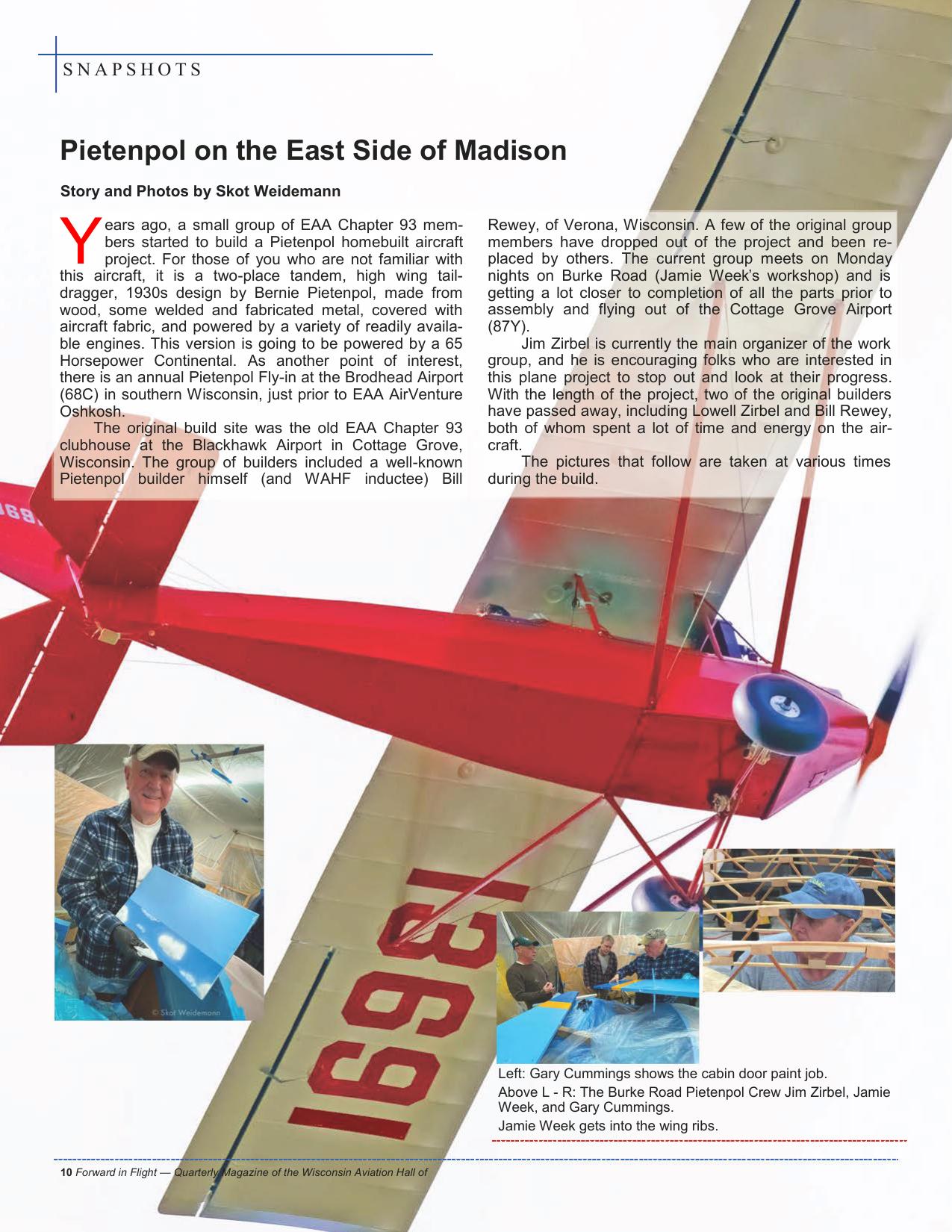
SNAPSHOTS Pietenpol on the East Side of Madison Story and Photos by Skot Weidemann Y ears ago, a small group of EAA Chapter 93 members started to build a Pietenpol homebuilt aircraft project. For those of you who are not familiar with this aircraft, it is a two-place tandem, high wing taildragger, 1930s design by Bernie Pietenpol, made from wood, some welded and fabricated metal, covered with aircraft fabric, and powered by a variety of readily available engines. This version is going to be powered by a 65 Horsepower Continental. As another point of interest, there is an annual Pietenpol Fly-in at the Brodhead Airport (68C) in southern Wisconsin, just prior to EAA AirVenture Oshkosh. The original build site was the old EAA Chapter 93 clubhouse at the Blackhawk Airport in Cottage Grove, Wisconsin. The group of builders included a well-known Pietenpol builder himself (and WAHF inductee) Bill Rewey, of Verona, Wisconsin. A few of the original group members have dropped out of the project and been replaced by others. The current group meets on Monday nights on Burke Road (Jamie Week’s workshop) and is getting a lot closer to completion of all the parts prior to assembly and flying out of the Cottage Grove Airport (87Y). Jim Zirbel is currently the main organizer of the work group, and he is encouraging folks who are interested in this plane project to stop out and look at their progress. With the length of the project, two of the original builders have passed away, including Lowell Zirbel and Bill Rewey, both of whom spent a lot of time and energy on the aircraft. The pictures that follow are taken at various times during the build. Left: Gary Cummings shows the cabin door paint job. Above L - R: The Burke Road Pietenpol Crew Jim Zirbel, Jamie Week, and Gary Cummings. Jamie Week gets into the wing ribs. -------- 10 Forward in Flight — Quarterly Magazine of the Wisconsin Aviation Hall of --------------------------------·
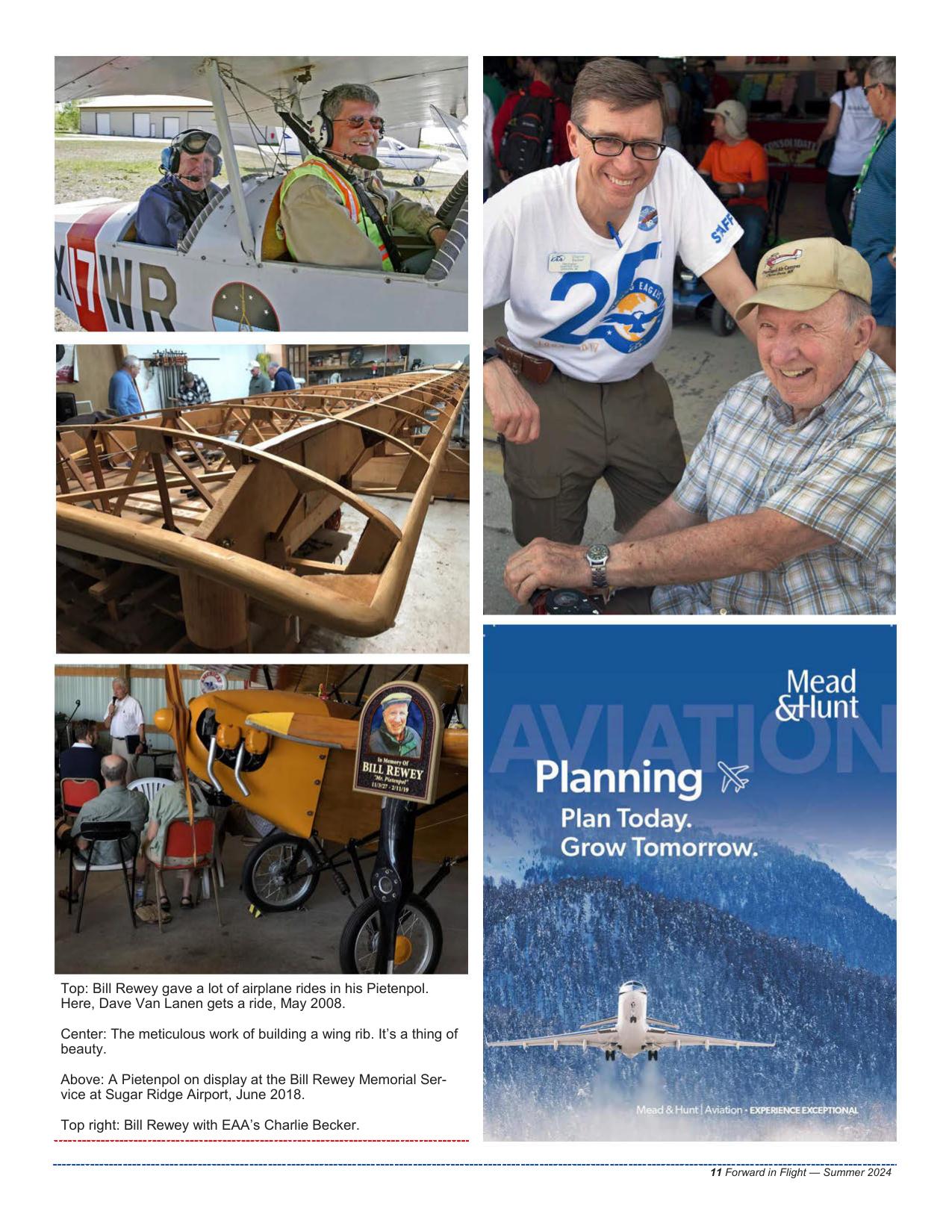
Top: Bill Rewey gave a lot of airplane rides in his Pietenpol. Here, Dave Van Lanen gets a ride, May 2008. Center: The meticulous work of building a wing rib. It’s a thing of beauty. Above: A Pietenpol on display at the Bill Rewey Memorial Service at Sugar Ridge Airport, June 2018. Top right: Bill Rewey with EAA’s Charlie Becker. ----------------------------------------------------------------------------------------------------------------------------------------- -----------------· 11 Forward in Flight — Summer 2024
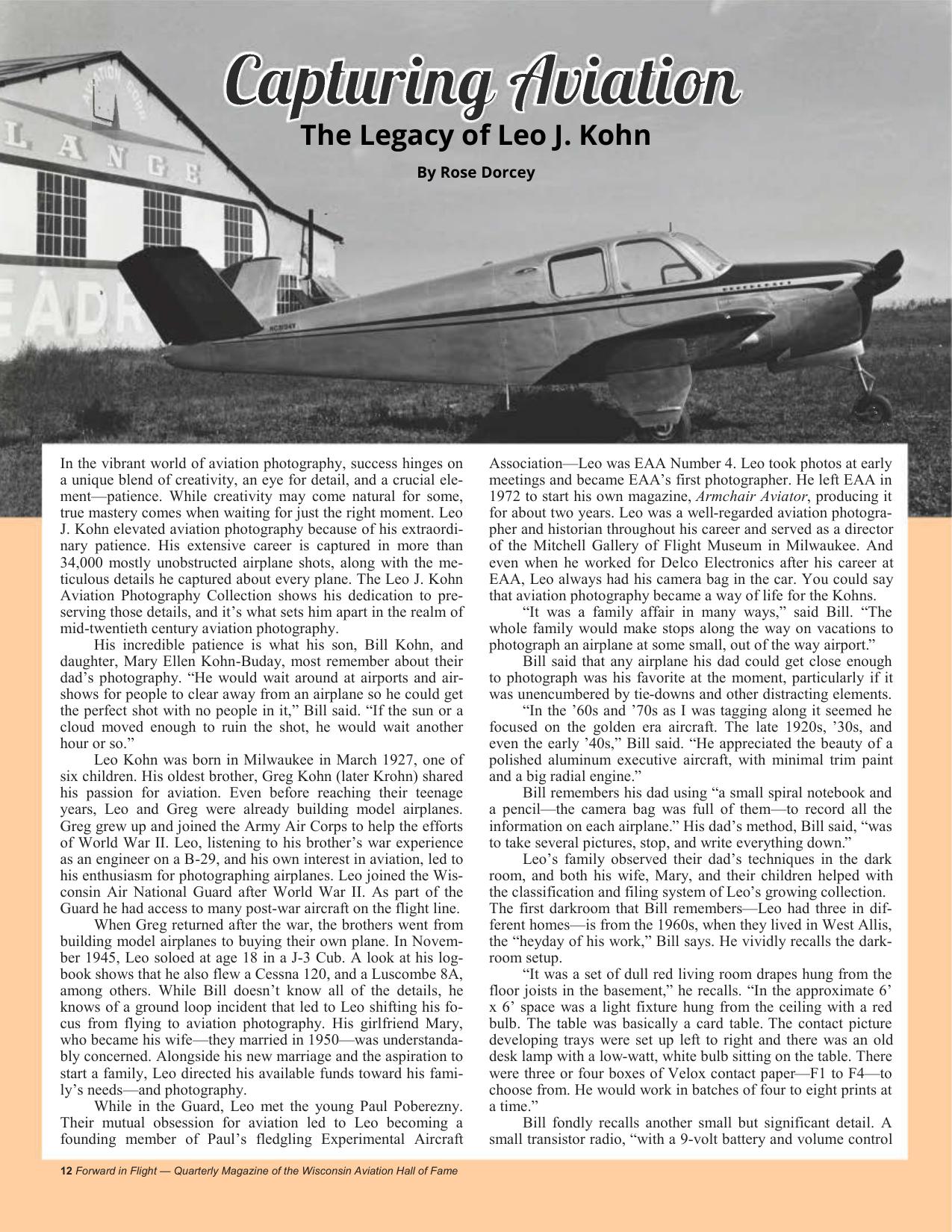
The Legacy of Leo J. Kohn By Rose Dorcey In the vibrant world of aviation photography, success hinges on a unique blend of creativity, an eye for detail, and a crucial element—patience. While creativity may come natural for some, true mastery comes when waiting for just the right moment. Leo J. Kohn elevated aviation photography because of his extraordinary patience. His extensive career is captured in more than 34,000 mostly unobstructed airplane shots, along with the meticulous details he captured about every plane. The Leo J. Kohn Aviation Photography Collection shows his dedication to preserving those details, and it’s what sets him apart in the realm of mid-twentieth century aviation photography. His incredible patience is what his son, Bill Kohn, and daughter, Mary Ellen Kohn-Buday, most remember about their dad’s photography. “He would wait around at airports and airshows for people to clear away from an airplane so he could get the perfect shot with no people in it,” Bill said. “If the sun or a cloud moved enough to ruin the shot, he would wait another hour or so.” Leo Kohn was born in Milwaukee in March 1927, one of six children. His oldest brother, Greg Kohn (later Krohn) shared his passion for aviation. Even before reaching their teenage years, Leo and Greg were already building model airplanes. Greg grew up and joined the Army Air Corps to help the efforts of World War II. Leo, listening to his brother’s war experience as an engineer on a B-29, and his own interest in aviation, led to his enthusiasm for photographing airplanes. Leo joined the Wisconsin Air National Guard after World War II. As part of the Guard he had access to many post-war aircraft on the flight line. When Greg returned after the war, the brothers went from building model airplanes to buying their own plane. In November 1945, Leo soloed at age 18 in a J-3 Cub. A look at his logbook shows that he also flew a Cessna 120, and a Luscombe 8A, among others. While Bill doesn’t know all of the details, he knows of a ground loop incident that led to Leo shifting his focus from flying to aviation photography. His girlfriend Mary, who became his wife—they married in 1950—was understandably concerned. Alongside his new marriage and the aspiration to start a family, Leo directed his available funds toward his family’s needs—and photography. While in the Guard, Leo met the young Paul Poberezny. Their mutual obsession for aviation led to Leo becoming a founding member of Paul’s fledgling Experimental Aircraft 12 Forward in Flight — Quarterly Magazine of the Wisconsin Aviation Hall of Fame Association—Leo was EAA Number 4. Leo took photos at early meetings and became EAA’s first photographer. He left EAA in 1972 to start his own magazine, Armchair Aviator, producing it for about two years. Leo was a well-regarded aviation photographer and historian throughout his career and served as a director of the Mitchell Gallery of Flight Museum in Milwaukee. And even when he worked for Delco Electronics after his career at EAA, Leo always had his camera bag in the car. You could say that aviation photography became a way of life for the Kohns. “It was a family affair in many ways,” said Bill. “The whole family would make stops along the way on vacations to photograph an airplane at some small, out of the way airport.” Bill said that any airplane his dad could get close enough to photograph was his favorite at the moment, particularly if it was unencumbered by tie-downs and other distracting elements. “In the ’60s and ’70s as I was tagging along it seemed he focused on the golden era aircraft. The late 1920s, ’30s, and even the early ’40s,” Bill said. “He appreciated the beauty of a polished aluminum executive aircraft, with minimal trim paint and a big radial engine.” Bill remembers his dad using “a small spiral notebook and a pencil—the camera bag was full of them—to record all the information on each airplane.” His dad’s method, Bill said, “was to take several pictures, stop, and write everything down.” Leo’s family observed their dad’s techniques in the dark room, and both his wife, Mary, and their children helped with the classification and filing system of Leo’s growing collection. The first darkroom that Bill remembers—Leo had three in different homes—is from the 1960s, when they lived in West Allis, the “heyday of his work,” Bill says. He vividly recalls the darkroom setup. “It was a set of dull red living room drapes hung from the floor joists in the basement,” he recalls. “In the approximate 6’ x 6’ space was a light fixture hung from the ceiling with a red bulb. The table was basically a card table. The contact picture developing trays were set up left to right and there was an old desk lamp with a low-watt, white bulb sitting on the table. There were three or four boxes of Velox contact paper—F1 to F4—to choose from. He would work in batches of four to eight prints at a time.” Bill fondly recalls another small but significant detail. A small transistor radio, “with a 9-volt battery and volume control
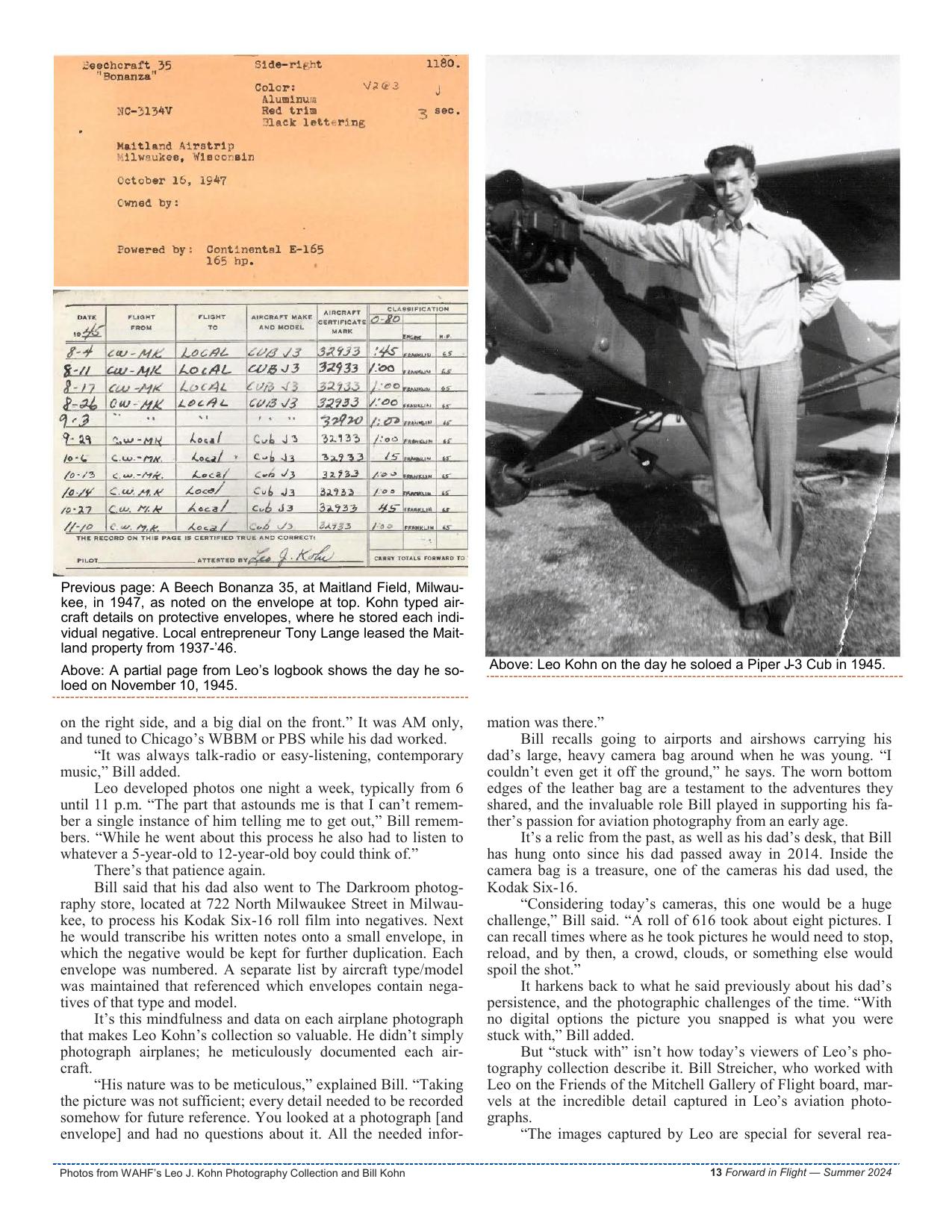
.Jeechcr aft 11 35 11 Bonanza Side- ritht 1180. Col or: \l ;i. <t;_ .\luminu Red trim , l ack lett• r i ng -., sec . Mait land Airs trip •~lwaukee , Wi s cor s1n October 16 , 1947 Cwned by : Powered by ,-t.JGMT Continental E- 165 165 hp . P'I..IQHT TO L-!>..L-l-~~:.a.tt--+ -f..~02;<s,•uf_ C."-"'--"J....,~,__+o,.,,_'---"-"---!µ..:.=_,.,...,.-"-1--"'-~ c. ~ 1, _,,___._ _µc..2__;t_.,2..11-___!_a~-"'-l-j£_~ ~~~l--"=-'--'~~-+-~~~o~'~a~_I ~~~hc...::JCL_+=,._,,_=---+'==-,,-,_4-1.L..- 4 ,<.oc~/ '-'<-'"----'--"""""'----LUL--+-----='-,,,o'-'-L, AnaaTIO .... CAHY TOTALS ,01w.uo TO ' Previous page: A Beech Bonanza 35, at Maitland Field, Milwaukee, in 1947, as noted on the envelope at top. Kohn typed aircraft details on protective envelopes, where he stored each individual negative. Local entrepreneur Tony Lange leased the Maitland property from 1937-’46. Above: A partial page from Leo’s logbook shows the day he soloed on November 10, 1945. Above: Leo Kohn on the day he soloed a Piper J-3 Cub in 1945. on the right side, and a big dial on the front.” It was AM only, and tuned to Chicago’s WBBM or PBS while his dad worked. “It was always talk-radio or easy-listening, contemporary music,” Bill added. Leo developed photos one night a week, typically from 6 until 11 p.m. “The part that astounds me is that I can’t remember a single instance of him telling me to get out,” Bill remembers. “While he went about this process he also had to listen to whatever a 5-year-old to 12-year-old boy could think of.” There’s that patience again. Bill said that his dad also went to The Darkroom photography store, located at 722 North Milwaukee Street in Milwaukee, to process his Kodak Six-16 roll film into negatives. Next he would transcribe his written notes onto a small envelope, in which the negative would be kept for further duplication. Each envelope was numbered. A separate list by aircraft type/model was maintained that referenced which envelopes contain negatives of that type and model. It’s this mindfulness and data on each airplane photograph that makes Leo Kohn’s collection so valuable. He didn’t simply photograph airplanes; he meticulously documented each aircraft. “His nature was to be meticulous,” explained Bill. “Taking the picture was not sufficient; every detail needed to be recorded somehow for future reference. You looked at a photograph [and envelope] and had no questions about it. All the needed infor- mation was there.” Bill recalls going to airports and airshows carrying his dad’s large, heavy camera bag around when he was young. “I couldn’t even get it off the ground,” he says. The worn bottom edges of the leather bag are a testament to the adventures they shared, and the invaluable role Bill played in supporting his father’s passion for aviation photography from an early age. It’s a relic from the past, as well as his dad’s desk, that Bill has hung onto since his dad passed away in 2014. Inside the camera bag is a treasure, one of the cameras his dad used, the Kodak Six-16. “Considering today’s cameras, this one would be a huge challenge,” Bill said. “A roll of 616 took about eight pictures. I can recall times where as he took pictures he would need to stop, reload, and by then, a crowd, clouds, or something else would spoil the shot.” It harkens back to what he said previously about his dad’s persistence, and the photographic challenges of the time. “With no digital options the picture you snapped is what you were stuck with,” Bill added. But “stuck with” isn’t how today’s viewers of Leo’s photography collection describe it. Bill Streicher, who worked with Leo on the Friends of the Mitchell Gallery of Flight board, marvels at the incredible detail captured in Leo’s aviation photographs. “The images captured by Leo are special for several rea- Photos from WAHF’s Leo J. Kohn Photography Collection and Bill Kohn 13 Forward in Flight — Summer 2024
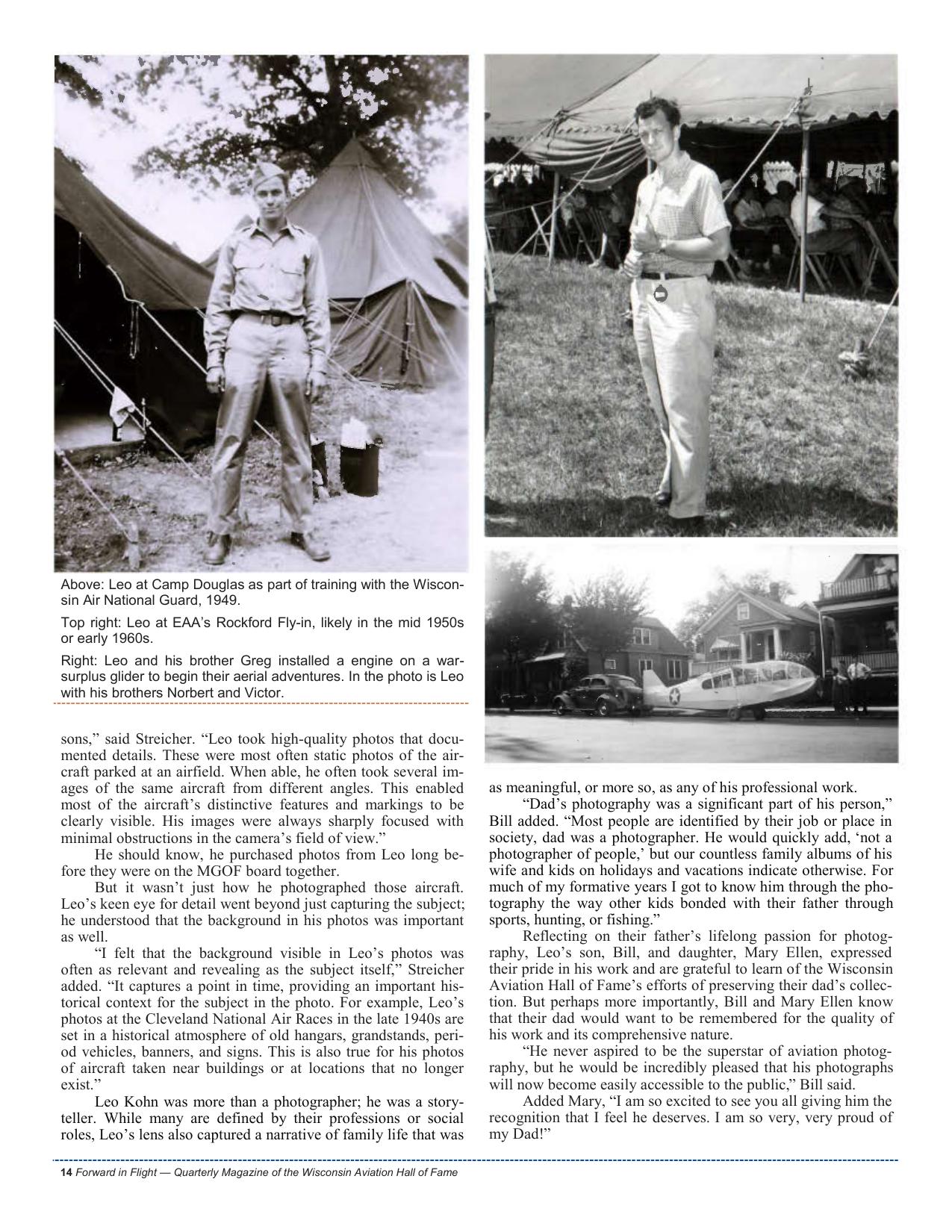
Above: Leo at Camp Douglas as part of training with the Wisconsin Air National Guard, 1949. Top right: Leo at EAA’s Rockford Fly-in, likely in the mid 1950s or early 1960s. Right: Leo and his brother Greg installed a engine on a warsurplus glider to begin their aerial adventures. In the photo is Leo with his brothers Norbert and Victor. sons,” said Streicher. “Leo took high-quality photos that documented details. These were most often static photos of the aircraft parked at an airfield. When able, he often took several images of the same aircraft from different angles. This enabled most of the aircraft’s distinctive features and markings to be clearly visible. His images were always sharply focused with minimal obstructions in the camera’s field of view.” He should know, he purchased photos from Leo long before they were on the MGOF board together. But it wasn’t just how he photographed those aircraft. Leo’s keen eye for detail went beyond just capturing the subject; he understood that the background in his photos was important as well. “I felt that the background visible in Leo’s photos was often as relevant and revealing as the subject itself,” Streicher added. “It captures a point in time, providing an important historical context for the subject in the photo. For example, Leo’s photos at the Cleveland National Air Races in the late 1940s are set in a historical atmosphere of old hangars, grandstands, period vehicles, banners, and signs. This is also true for his photos of aircraft taken near buildings or at locations that no longer exist.” Leo Kohn was more than a photographer; he was a storyteller. While many are defined by their professions or social roles, Leo’s lens also captured a narrative of family life that was 14 Forward in Flight — Quarterly Magazine of the Wisconsin Aviation Hall of Fame as meaningful, or more so, as any of his professional work. “Dad’s photography was a significant part of his person,” Bill added. “Most people are identified by their job or place in society, dad was a photographer. He would quickly add, ‘not a photographer of people,’ but our countless family albums of his wife and kids on holidays and vacations indicate otherwise. For much of my formative years I got to know him through the photography the way other kids bonded with their father through sports, hunting, or fishing.” Reflecting on their father’s lifelong passion for photography, Leo’s son, Bill, and daughter, Mary Ellen, expressed their pride in his work and are grateful to learn of the Wisconsin Aviation Hall of Fame’s efforts of preserving their dad’s collection. But perhaps more importantly, Bill and Mary Ellen know that their dad would want to be remembered for the quality of his work and its comprehensive nature. “He never aspired to be the superstar of aviation photography, but he would be incredibly pleased that his photographs will now become easily accessible to the public,” Bill said. Added Mary, “I am so excited to see you all giving him the recognition that I feel he deserves. I am so very, very proud of my Dad!”
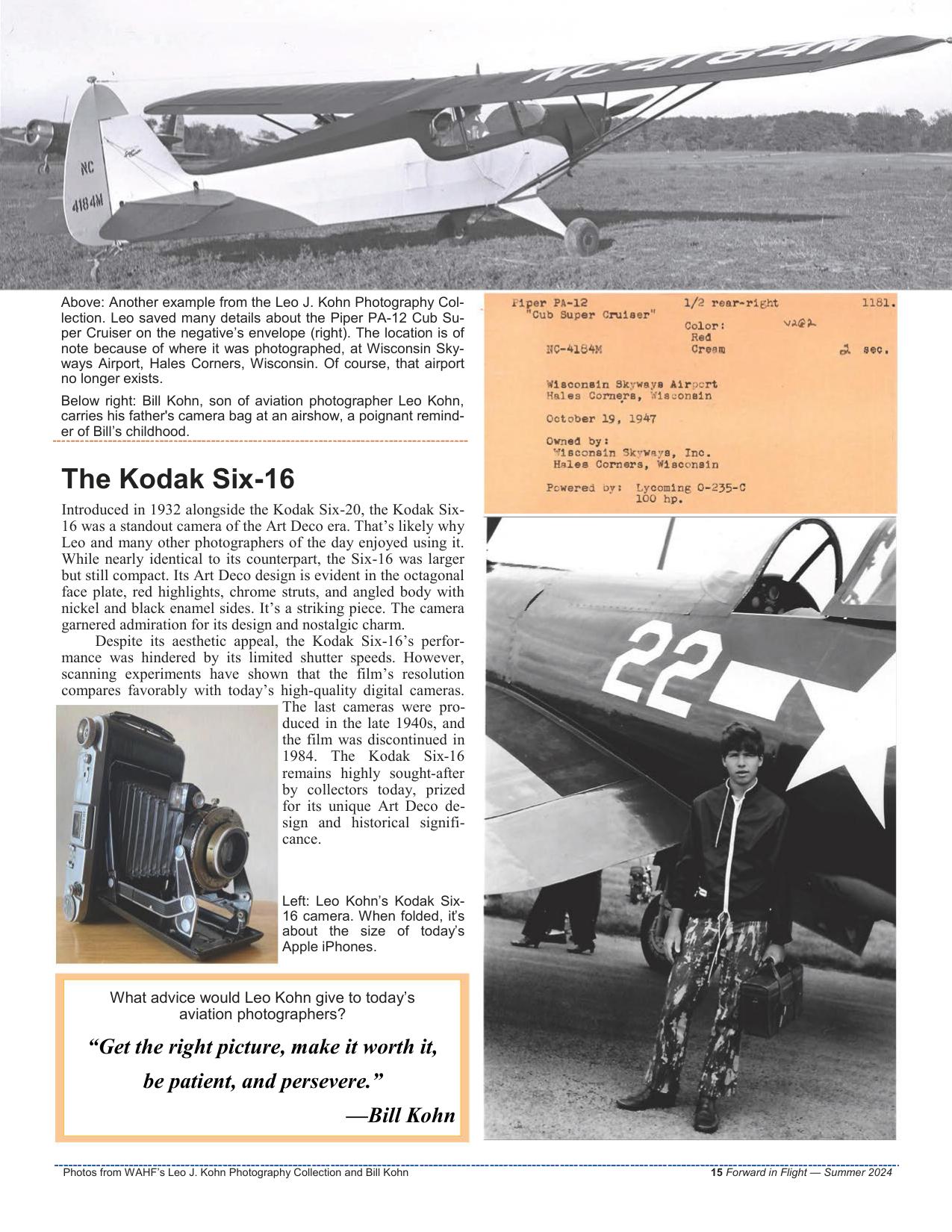
Above: Another example from the Leo J. Kohn Photography Collection. Leo saved many details about the Piper PA-12 Cub Super Cruiser on the negative’s envelope (right). The location is of note because of where it was photographed, at Wisconsin Skyways Airport, Hales Corners, Wisconsin. Of course, that airport no longer exists. f i per PA- 12 "Cub Super Cruiser" NC- 418 4M Col or : Red Crelll!l w.<; ~ Wi sconsin Sky way s A1 r pcr t Hales Cor ne.rs , ',Yisconsin Below right: Bill Kohn, son of aviation photographer Leo Kohn, carries his father's camera bag at an airshow, a poignant reminder of Bill’s childhood. Oc t ober 19 , 1947 Owned by: '·'1 s cons1n Skvways, Inc . Hales Corn er s , W1 scons1n The Kodak Six-16 Powered oy : Introduced in 1932 alongside the Kodak Six-20, the Kodak Six16 was a standout camera of the Art Deco era. That’s likely why Leo and many other photographers of the day enjoyed using it. While nearly identical to its counterpart, the Six-16 was larger but still compact. Its Art Deco design is evident in the octagonal face plate, red highlights, chrome struts, and angled body with nickel and black enamel sides. It’s a striking piece. The camera garnered admiration for its design and nostalgic charm. Despite its aesthetic appeal, the Kodak Six-16’s performance was hindered by its limited shutter speeds. However, scanning experiments have shown that the film’s resolution compares favorably with today’s high-quality digital cameras. The last cameras were produced in the late 1940s, and the film was discontinued in 1984. The Kodak Six-16 remains highly sought-after by collectors today, prized for its unique Art Deco design and historical significance. 1181. 1/2 r ear - r i g.ht r L ycomi ng 0 - 235- C 100 hp. I / Left: Leo Kohn’s Kodak Six16 camera. When folded, it’s about the size of today’s Apple iPhones. What advice would Leo Kohn give to today’s aviation photographers? “Get the right picture, make it worth it, be patient, and persevere.” —Bill Kohn Photos from WAHF’s Leo J. Kohn Photography Collection and Bill Kohn 15 Forward in Flight — Summer 2024
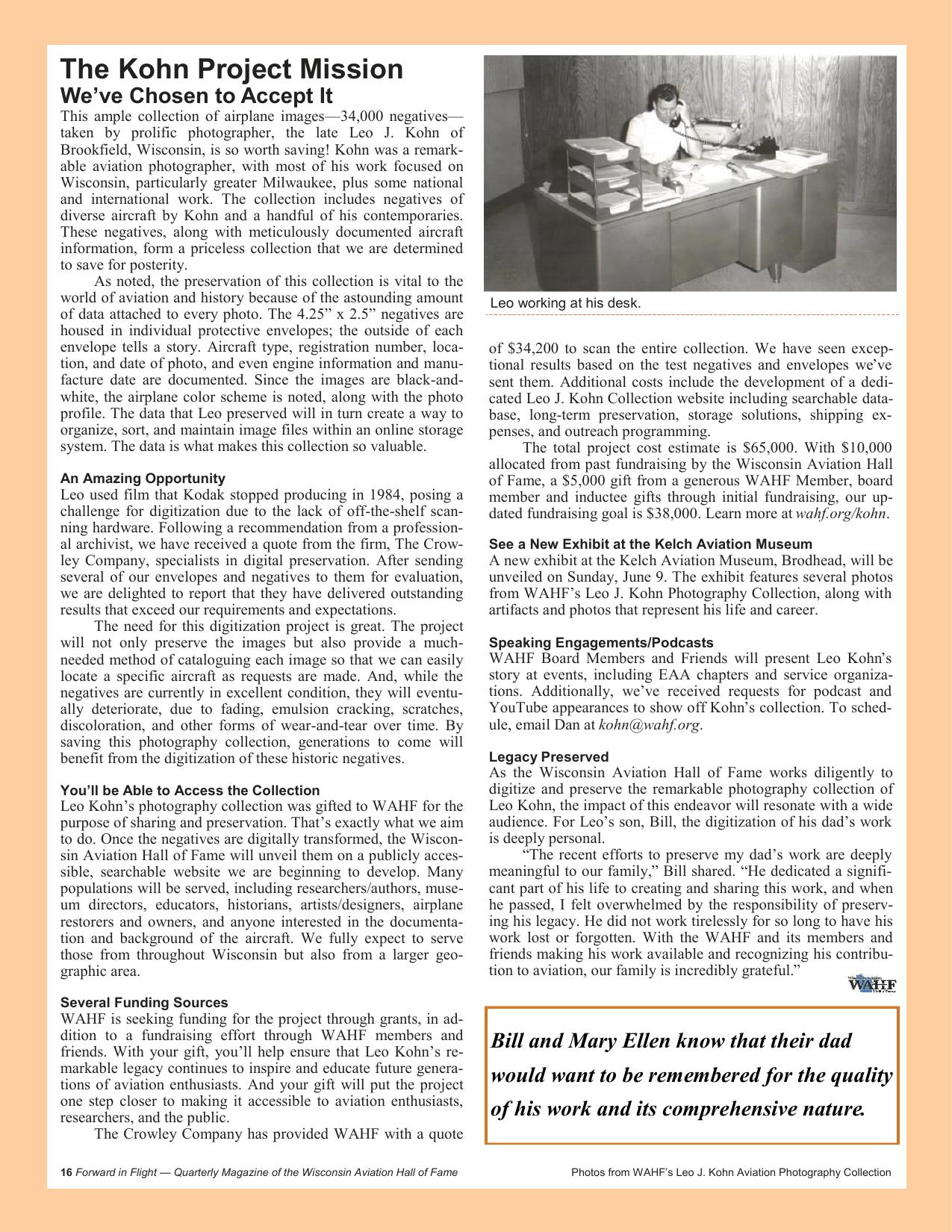
The Kohn Project Mission We’ve Chosen to Accept It This ample collection of airplane images—34,000 negatives— taken by prolific photographer, the late Leo J. Kohn of Brookfield, Wisconsin, is so worth saving! Kohn was a remarkable aviation photographer, with most of his work focused on Wisconsin, particularly greater Milwaukee, plus some national and international work. The collection includes negatives of diverse aircraft by Kohn and a handful of his contemporaries. These negatives, along with meticulously documented aircraft information, form a priceless collection that we are determined to save for posterity. As noted, the preservation of this collection is vital to the world of aviation and history because of the astounding amount of data attached to every photo. The 4.25” x 2.5” negatives are housed in individual protective envelopes; the outside of each envelope tells a story. Aircraft type, registration number, location, and date of photo, and even engine information and manufacture date are documented. Since the images are black-andwhite, the airplane color scheme is noted, along with the photo profile. The data that Leo preserved will in turn create a way to organize, sort, and maintain image files within an online storage system. The data is what makes this collection so valuable. An Amazing Opportunity Leo used film that Kodak stopped producing in 1984, posing a challenge for digitization due to the lack of off-the-shelf scanning hardware. Following a recommendation from a professional archivist, we have received a quote from the firm, The Crowley Company, specialists in digital preservation. After sending several of our envelopes and negatives to them for evaluation, we are delighted to report that they have delivered outstanding results that exceed our requirements and expectations. The need for this digitization project is great. The project will not only preserve the images but also provide a muchneeded method of cataloguing each image so that we can easily locate a specific aircraft as requests are made. And, while the negatives are currently in excellent condition, they will eventually deteriorate, due to fading, emulsion cracking, scratches, discoloration, and other forms of wear-and-tear over time. By saving this photography collection, generations to come will benefit from the digitization of these historic negatives. You’ll be Able to Access the Collection Leo Kohn’s photography collection was gifted to WAHF for the purpose of sharing and preservation. That’s exactly what we aim to do. Once the negatives are digitally transformed, the Wisconsin Aviation Hall of Fame will unveil them on a publicly accessible, searchable website we are beginning to develop. Many populations will be served, including researchers/authors, museum directors, educators, historians, artists/designers, airplane restorers and owners, and anyone interested in the documentation and background of the aircraft. We fully expect to serve those from throughout Wisconsin but also from a larger geographic area. Leo working at his desk. of $34,200 to scan the entire collection. We have seen exceptional results based on the test negatives and envelopes we’ve sent them. Additional costs include the development of a dedicated Leo J. Kohn Collection website including searchable database, long-term preservation, storage solutions, shipping expenses, and outreach programming. The total project cost estimate is $65,000. With $10,000 allocated from past fundraising by the Wisconsin Aviation Hall of Fame, a $5,000 gift from a generous WAHF Member, board member and inductee gifts through initial fundraising, our updated fundraising goal is $38,000. Learn more at wahf.org/kohn. See a New Exhibit at the Kelch Aviation Museum A new exhibit at the Kelch Aviation Museum, Brodhead, will be unveiled on Sunday, June 9. The exhibit features several photos from WAHF’s Leo J. Kohn Photography Collection, along with artifacts and photos that represent his life and career. Speaking Engagements/Podcasts WAHF Board Members and Friends will present Leo Kohn’s story at events, including EAA chapters and service organizations. Additionally, we’ve received requests for podcast and YouTube appearances to show off Kohn’s collection. To schedule, email Dan at kohn@wahf.org. Legacy Preserved As the Wisconsin Aviation Hall of Fame works diligently to digitize and preserve the remarkable photography collection of Leo Kohn, the impact of this endeavor will resonate with a wide audience. For Leo’s son, Bill, the digitization of his dad’s work is deeply personal. “The recent efforts to preserve my dad’s work are deeply meaningful to our family,” Bill shared. “He dedicated a significant part of his life to creating and sharing this work, and when he passed, I felt overwhelmed by the responsibility of preserving his legacy. He did not work tirelessly for so long to have his work lost or forgotten. With the WAHF and its members and friends making his work available and recognizing his contribution to aviation, our family is incredibly grateful.” Several Funding Sources WAHF is seeking funding for the project through grants, in addition to a fundraising effort through WAHF members and friends. With your gift, you’ll help ensure that Leo Kohn’s remarkable legacy continues to inspire and educate future generations of aviation enthusiasts. And your gift will put the project one step closer to making it accessible to aviation enthusiasts, researchers, and the public. The Crowley Company has provided WAHF with a quote 16 Forward in Flight — Quarterly Magazine of the Wisconsin Aviation Hall of Fame Bill and Mary Ellen know that their dad would want to be remembered for the quality of his work and its comprehensive nature. Photos from WAHF’s Leo J. Kohn Aviation Photography Collection
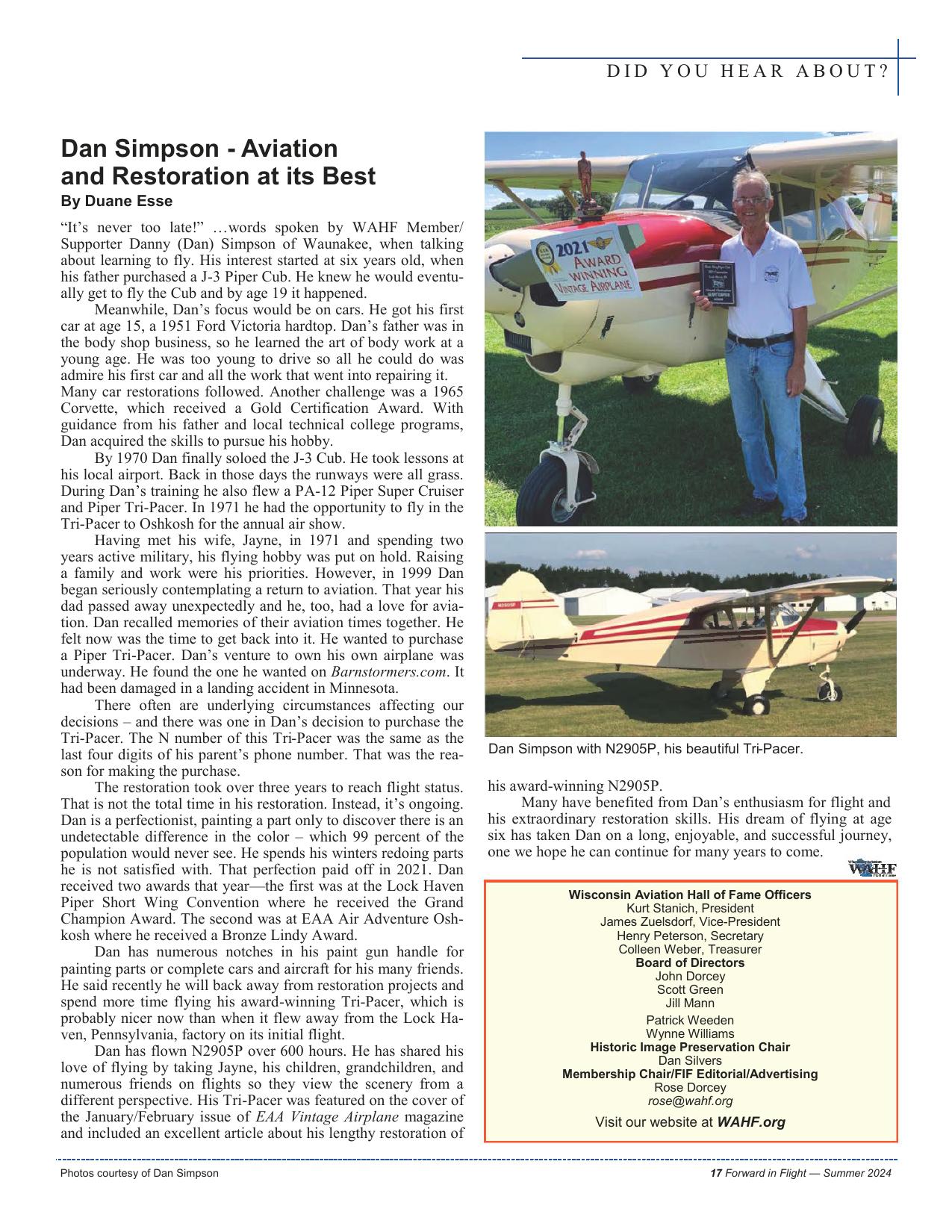
DID YOU HEAR ABOUT? Dan Simpson - Aviation and Restoration at its Best By Duane Esse “It’s never too late!” …words spoken by WAHF Member/ Supporter Danny (Dan) Simpson of Waunakee, when talking about learning to fly. His interest started at six years old, when his father purchased a J-3 Piper Cub. He knew he would eventually get to fly the Cub and by age 19 it happened. Meanwhile, Dan’s focus would be on cars. He got his first car at age 15, a 1951 Ford Victoria hardtop. Dan’s father was in the body shop business, so he learned the art of body work at a young age. He was too young to drive so all he could do was admire his first car and all the work that went into repairing it. Many car restorations followed. Another challenge was a 1965 Corvette, which received a Gold Certification Award. With guidance from his father and local technical college programs, Dan acquired the skills to pursue his hobby. By 1970 Dan finally soloed the J-3 Cub. He took lessons at his local airport. Back in those days the runways were all grass. During Dan’s training he also flew a PA-12 Piper Super Cruiser and Piper Tri-Pacer. In 1971 he had the opportunity to fly in the Tri-Pacer to Oshkosh for the annual air show. Having met his wife, Jayne, in 1971 and spending two years active military, his flying hobby was put on hold. Raising a family and work were his priorities. However, in 1999 Dan began seriously contemplating a return to aviation. That year his dad passed away unexpectedly and he, too, had a love for aviation. Dan recalled memories of their aviation times together. He felt now was the time to get back into it. He wanted to purchase a Piper Tri-Pacer. Dan’s venture to own his own airplane was underway. He found the one he wanted on Barnstormers.com. It had been damaged in a landing accident in Minnesota. There often are underlying circumstances affecting our decisions – and there was one in Dan’s decision to purchase the Tri-Pacer. The N number of this Tri-Pacer was the same as the last four digits of his parent’s phone number. That was the reason for making the purchase. The restoration took over three years to reach flight status. That is not the total time in his restoration. Instead, it’s ongoing. Dan is a perfectionist, painting a part only to discover there is an undetectable difference in the color – which 99 percent of the population would never see. He spends his winters redoing parts he is not satisfied with. That perfection paid off in 2021. Dan received two awards that year—the first was at the Lock Haven Piper Short Wing Convention where he received the Grand Champion Award. The second was at EAA Air Adventure Oshkosh where he received a Bronze Lindy Award. Dan has numerous notches in his paint gun handle for painting parts or complete cars and aircraft for his many friends. He said recently he will back away from restoration projects and spend more time flying his award-winning Tri-Pacer, which is probably nicer now than when it flew away from the Lock Haven, Pennsylvania, factory on its initial flight. Dan has flown N2905P over 600 hours. He has shared his love of flying by taking Jayne, his children, grandchildren, and numerous friends on flights so they view the scenery from a different perspective. His Tri-Pacer was featured on the cover of the January/February issue of EAA Vintage Airplane magazine and included an excellent article about his lengthy restoration of Photos courtesy of Dan Simpson Dan Simpson with N2905P, his beautiful Tri-Pacer. his award-winning N2905P. Many have benefited from Dan’s enthusiasm for flight and his extraordinary restoration skills. His dream of flying at age six has taken Dan on a long, enjoyable, and successful journey, one we hope he can continue for many years to come. Wisconsin Aviation Hall of Fame Officers Kurt Stanich, President James Zuelsdorf, Vice-President Henry Peterson, Secretary Colleen Weber, Treasurer Board of Directors John Dorcey Scott Green Jill Mann Patrick Weeden Wynne Williams Historic Image Preservation Chair Dan Silvers Membership Chair/FIF Editorial/Advertising Rose Dorcey rose@wahf.org Visit our website at WAHF.org 17 Forward in Flight — Summer 2024
TALES OF THE ACES Badger Aces of the Mighty Eighth Part I By Michael O’Connor During World War II, the Eighth Air Force carried out bombing missions over occupied Europe. Beginning in mid1943, its B-17 and B-24 bombers were escorted by P-38 Lightning, P-47 Thunderbolt and, then in 1944, P-51 Mustang fighters. Those escort fighters were crucial to the success of the Eighth Air Force’s bombing campaign. Many Eighth Air Force fighter pilots became aces, including eight from Wisconsin. Those eight aces flew various fighters. One scored all his victories while flying Thunderbolts. Three became an ace flying P-47s and then Mustangs. Four flew P-51s exclusively to reach “five down and glory.” George E. Bostwick was the only Eighth Air Force Badger ace to score all his kills while flying Thunderbolts. Born in October 1919 in Chippewa Falls, Bostwick graduated from Ripon College in June 1941 and entered Army Air Force service. In March 1944, he reported in to the 62nd Fighter Squadron, 56th Fighter Group. One of the Mighty Eighth’s topscoring fighter groups, Zemke’s Wolfpack was the only one to operate P-47s exclusively. Bostwick’s first victory came on June 7, 1944, but his stand-out performance came on Independence Day. On July 4th, Bostwick downed three Bf 109s and damaged a fourth despite flying a Thunderbolt that had been badly damaged in a botched take-off from his base. He received a richly deserved Silver Star. Two days later, July 6th, Bostwick made ace while flying his regularly assigned P47D, Ugly Duckling. Three ground kills came in September and then Bostwick went on stateside leave. By January 1945, Bostwick was back on ops and assigned as Commanding Officer of the 63rd FS. On March 25th, he downed a Messerschmitt 262 jet while piloting a P-47M. Spotting four ’262s taking off from Parchim Airfield, he dove in on one. Before he could fire, the rattled enemy pilot made a tight turn at low level. His “left wing dug into the ground,” Bostwick recalled, “and the plane cartwheeled.” On April 7th, Bostwick made his final air kills, damaging another Me-262 and downing two ’109s. His final score was eight air kills and six destroyed on the ground, netting him a Silver Star, four Distinguished Flying Crosses, and a Croix de Guerre. Bostwick served in the postwar Air Force, retiring in October 1963. George Bostwick died on February 6, 1990. Three Eighth Air Force Badger aces scored their initial kills in Thunderbolts before transitioning to Mustangs. Robert J. Booth was born in February 1924 in Genesse. He joined the Army Air Force in 1942 fresh out of Waukesha High School and received his wings in March 1943. He joined the 369th Fighter Squadron, 359th Fighter Group which arrived in England in October 1943. On January 30, 1944, Booth scored his first kill, a Messerschmitt 109 near Lingen, Germany while flying Oily Boid, his regularly assigned P-47D. Flying wing on Captain Niven Cranfill, Booth latched on to one of six Bf 109s attacking Eighth Air Force bombers. The Messerschmitt went into wild evasive maneuvers, but the two fliers kept up the pursuit. Booth finally scored with two bursts of .50 caliber. The ’109, smoking heavily, “went into a steep slow spin (and) the pilot jettisoned his canopy and bailed out.” Kill #2, a Focke Wulf 190, came on March 6th during a hard-fought strike on Berlin that saw the Eighth Air Force lose 69 bombers and 11 fighters. The ’190 pilot bailed out but his parachute canopy split apart upon opening. Booth’s final P47 kills, #3 and #4, came in late April 1944. That month, the 359th converted to P-51s, Booth then ringing up four victories in one month. Three of those kills came on May 8th, which saw Booth crowned as the first Group ace. By this time, the quiet, self-effacing Badger ace had earned a reputation as a master of deflection shooting. Booth’s eighth and final victory came on May 29th when he “plastered (a FW 190) good, getting strikes all over the fuselage and both wings.” 18 Forward in Flight — Quarterly Magazine of the Wisconsin Aviation Hall of Fame ‘Posty’ Booth’s luck ran out on June 8th when flak hit his P-51B, Booth becoming a Prisoner of War. He had earned a Silver Star and four Distinguished Flying Crosses. Booth served in the postwar Air Force, retiring in July 1967. Robert Booth died on May 24, 2009. A second P-47/P-51 Badger ace also served in the 359th but, in George A. Doersch’s case, he flew with the 370th FS. A Seymour native, born in October 1921, Doersch was attending Lawrence University when he was called up for active duty in October 1940. He received his wings in March 1943. Doersch made his first claim with the 370th on February 22, 1944, dispatching a FW 190 that was attacking Lieutenant Colonel Avelin Tacon, the 359th’s CO. Claims for a Bf 109 destroyed on April 11, and a probable Junkers 88 on April 15 followed. These were the last P47 claims Doersch made as, soon afterwards, the 359th began converting to P51B/C Mustangs. May 8 saw the Seymour native turn in a sparkling performance, scoring two kills. Near Brunswick, 70+ Luftwaffe fighters were called in and Doersch’s flight was ordered to attack a formation of 18 FW 190s. Breaking hard into the Germans, Doersch downed one fighter and damaged another. Spotting a Messerschmitt 109 below, he dove down and opened fire only to find he was out of ammunition. Fortunately, the rattled German pilot bailed out. Three days later, Doersch narrowly escaped becoming a POW. A strafing mission against a French airfield by eight 370th FS P-51s turned into a disaster. The 370th lost four P-51s and three pilots to flak. During the attack, Doersch’s Mustang took 20 mm hits. Instinctively pushing his stick forward, his propellers struck the ground. Back at the base, he found all four propeller blades bent back 12 inches! Two shared FW 190 kills came on May 29 followed by a Bf 109 on June 10. With six victories to his credit, Doersch left on a 30-day leave in early July. Now-Captain Doersch resumed his
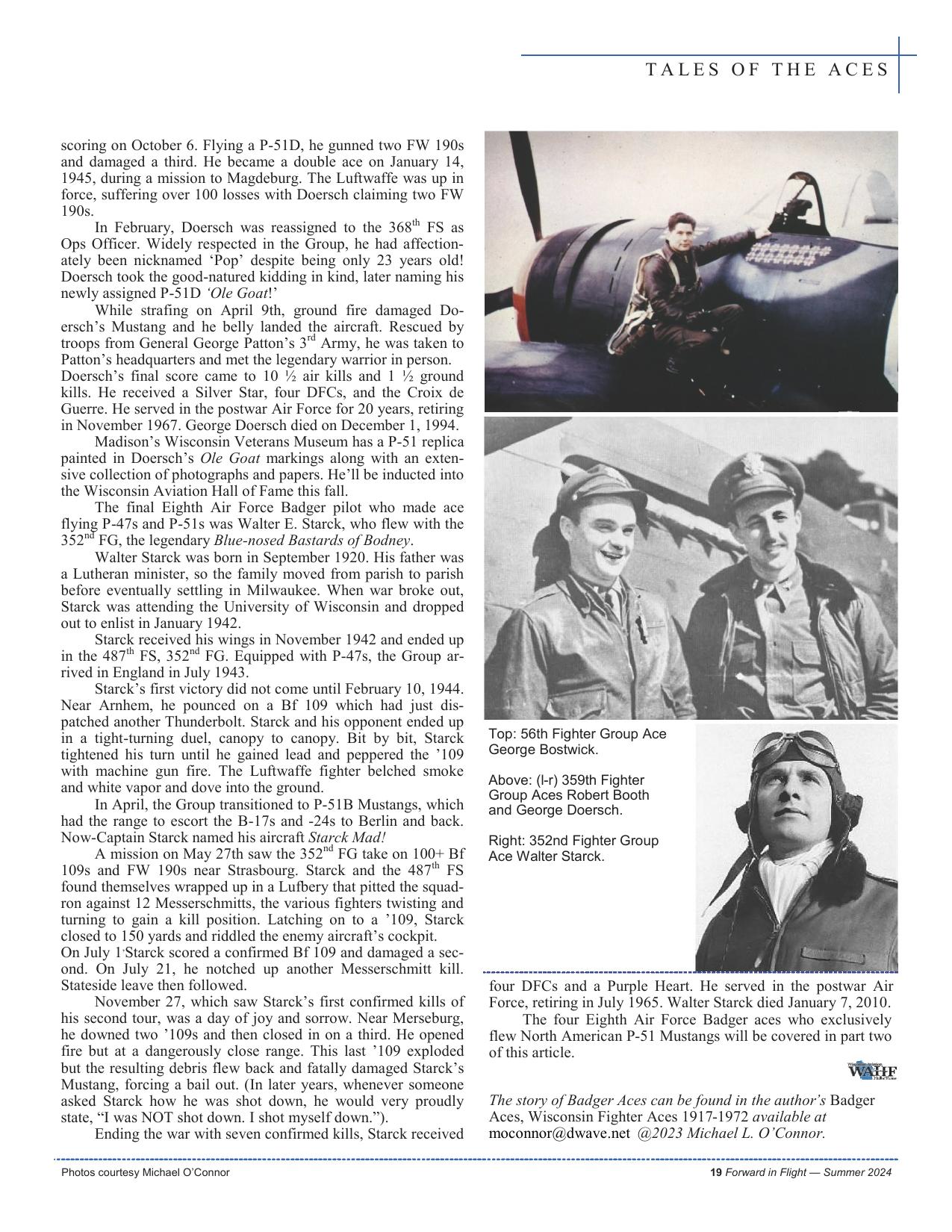
TALES OF THE ACES scoring on October 6. Flying a P-51D, he gunned two FW 190s and damaged a third. He became a double ace on January 14, 1945, during a mission to Magdeburg. The Luftwaffe was up in force, suffering over 100 losses with Doersch claiming two FW 190s. In February, Doersch was reassigned to the 368th FS as Ops Officer. Widely respected in the Group, he had affectionately been nicknamed ‘Pop’ despite being only 23 years old! Doersch took the good-natured kidding in kind, later naming his newly assigned P-51D ‘Ole Goat!’ While strafing on April 9th, ground fire damaged Doersch’s Mustang and he belly landed the aircraft. Rescued by troops from General George Patton’s 3rd Army, he was taken to Patton’s headquarters and met the legendary warrior in person. Doersch’s final score came to 10 ½ air kills and 1 ½ ground kills. He received a Silver Star, four DFCs, and the Croix de Guerre. He served in the postwar Air Force for 20 years, retiring in November 1967. George Doersch died on December 1, 1994. Madison’s Wisconsin Veterans Museum has a P-51 replica painted in Doersch’s Ole Goat markings along with an extensive collection of photographs and papers. He’ll be inducted into the Wisconsin Aviation Hall of Fame this fall. The final Eighth Air Force Badger pilot who made ace flying P-47s and P-51s was Walter E. Starck, who flew with the 352nd FG, the legendary Blue-nosed Bastards of Bodney. Walter Starck was born in September 1920. His father was a Lutheran minister, so the family moved from parish to parish before eventually settling in Milwaukee. When war broke out, Starck was attending the University of Wisconsin and dropped out to enlist in January 1942. Starck received his wings in November 1942 and ended up in the 487th FS, 352nd FG. Equipped with P-47s, the Group arrived in England in July 1943. Starck’s first victory did not come until February 10, 1944. Near Arnhem, he pounced on a Bf 109 which had just dispatched another Thunderbolt. Starck and his opponent ended up in a tight-turning duel, canopy to canopy. Bit by bit, Starck tightened his turn until he gained lead and peppered the ’109 with machine gun fire. The Luftwaffe fighter belched smoke and white vapor and dove into the ground. In April, the Group transitioned to P-51B Mustangs, which had the range to escort the B-17s and -24s to Berlin and back. Now-Captain Starck named his aircraft Starck Mad! A mission on May 27th saw the 352nd FG take on 100+ Bf 109s and FW 190s near Strasbourg. Starck and the 487th FS found themselves wrapped up in a Lufbery that pitted the squadron against 12 Messerschmitts, the various fighters twisting and turning to gain a kill position. Latching on to a ’109, Starck closed to 150 yards and riddled the enemy aircraft’s cockpit. On July 1,Starck scored a confirmed Bf 109 and damaged a second. On July 21, he notched up another Messerschmitt kill. Stateside leave then followed. November 27, which saw Starck’s first confirmed kills of his second tour, was a day of joy and sorrow. Near Merseburg, he downed two ’109s and then closed in on a third. He opened fire but at a dangerously close range. This last ’109 exploded but the resulting debris flew back and fatally damaged Starck’s Mustang, forcing a bail out. (In later years, whenever someone asked Starck how he was shot down, he would very proudly state, “I was NOT shot down. I shot myself down.”). Ending the war with seven confirmed kills, Starck received Top: 56th Fighter Group Ace George Bostwick. Above: (l-r) 359th Fighter Group Aces Robert Booth and George Doersch. Right: 352nd Fighter Group Ace Walter Starck. four DFCs and a Purple Heart. He served in the postwar Air Force, retiring in July 1965. Walter Starck died January 7, 2010. The four Eighth Air Force Badger aces who exclusively flew North American P-51 Mustangs will be covered in part two of this article. The story of Badger Aces can be found in the author’s Badger Aces, Wisconsin Fighter Aces 1917-1972 available at moconnor@dwave.net @2023 Michael L. O’Connor. ·--- Photos courtesy Michael O’Connor --------- 19 Forward in Flight — Summer 2024
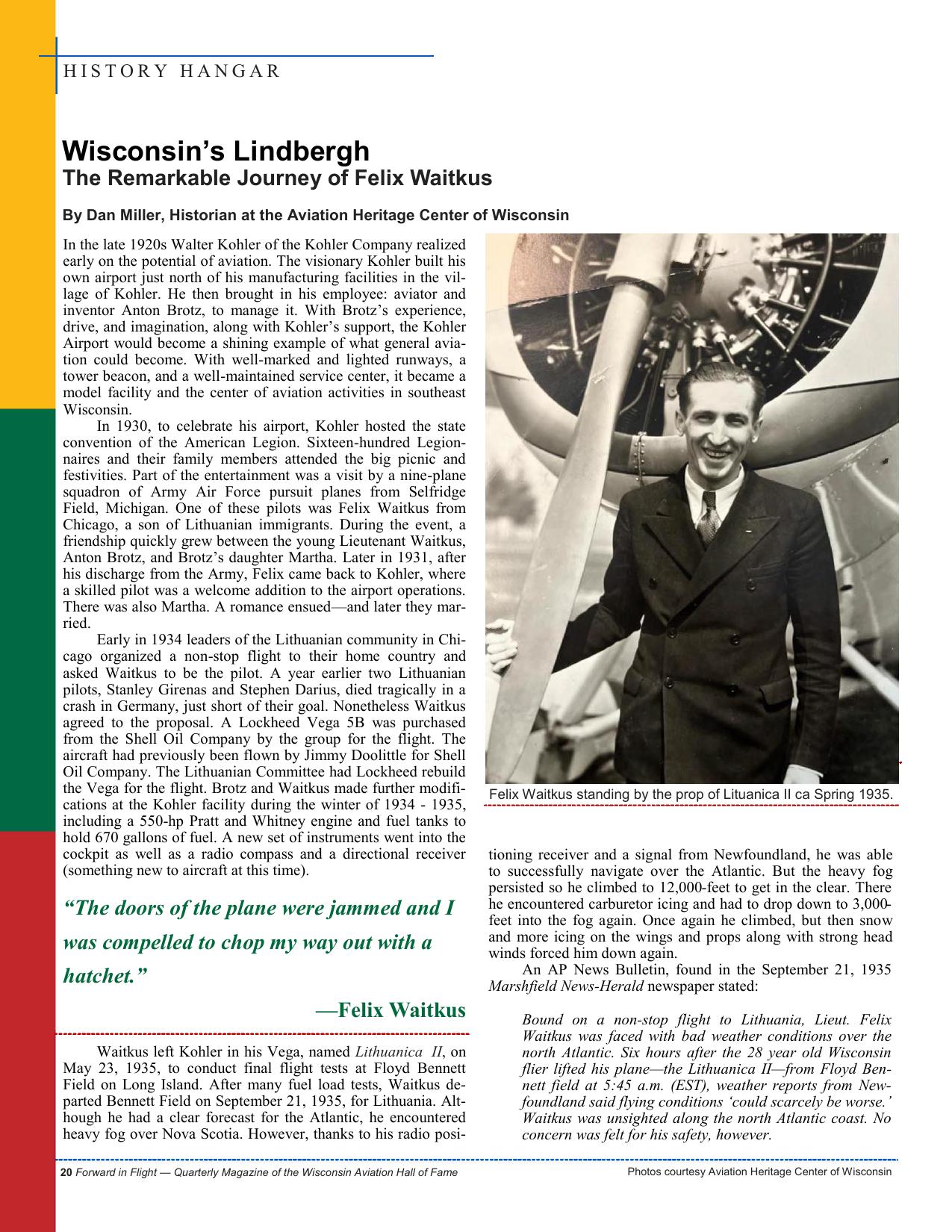
HISTORY HANGAR Wisconsin’s Lindbergh The Remarkable Journey of Felix Waitkus By Dan Miller, Historian at the Aviation Heritage Center of Wisconsin In the late 1920s Walter Kohler of the Kohler Company realized early on the potential of aviation. The visionary Kohler built his own airport just north of his manufacturing facilities in the village of Kohler. He then brought in his employee: aviator and inventor Anton Brotz, to manage it. With Brotz’s experience, drive, and imagination, along with Kohler’s support, the Kohler Airport would become a shining example of what general aviation could become. With well-marked and lighted runways, a tower beacon, and a well-maintained service center, it became a model facility and the center of aviation activities in southeast Wisconsin. In 1930, to celebrate his airport, Kohler hosted the state convention of the American Legion. Sixteen-hundred Legionnaires and their family members attended the big picnic and festivities. Part of the entertainment was a visit by a nine-plane squadron of Army Air Force pursuit planes from Selfridge Field, Michigan. One of these pilots was Felix Waitkus from Chicago, a son of Lithuanian immigrants. During the event, a friendship quickly grew between the young Lieutenant Waitkus, Anton Brotz, and Brotz’s daughter Martha. Later in 1931, after his discharge from the Army, Felix came back to Kohler, where a skilled pilot was a welcome addition to the airport operations. There was also Martha. A romance ensued—and later they married. Early in 1934 leaders of the Lithuanian community in Chicago organized a non-stop flight to their home country and asked Waitkus to be the pilot. A year earlier two Lithuanian pilots, Stanley Girenas and Stephen Darius, died tragically in a crash in Germany, just short of their goal. Nonetheless Waitkus agreed to the proposal. A Lockheed Vega 5B was purchased from the Shell Oil Company by the group for the flight. The aircraft had previously been flown by Jimmy Doolittle for Shell Oil Company. The Lithuanian Committee had Lockheed rebuild the Vega for the flight. Brotz and Waitkus made further modifications at the Kohler facility during the winter of 1934 - 1935, including a 550-hp Pratt and Whitney engine and fuel tanks to hold 670 gallons of fuel. A new set of instruments went into the cockpit as well as a radio compass and a directional receiver (something new to aircraft at this time). “The doors of the plane were jammed and I was compelled to chop my way out with a hatchet.” —Felix Waitkus Waitkus left Kohler in his Vega, named Lithuanica II, on May 23, 1935, to conduct final flight tests at Floyd Bennett Field on Long Island. After many fuel load tests, Waitkus departed Bennett Field on September 21, 1935, for Lithuania. Although he had a clear forecast for the Atlantic, he encountered heavy fog over Nova Scotia. However, thanks to his radio posi20 Forward in Flight — Quarterly Magazine of the Wisconsin Aviation Hall of Fame Felix Waitkus standing by the prop of Lituanica II ca Spring 1935. tioning receiver and a signal from Newfoundland, he was able to successfully navigate over the Atlantic. But the heavy fog persisted so he climbed to 12,000-feet to get in the clear. There he encountered carburetor icing and had to drop down to 3,000feet into the fog again. Once again he climbed, but then snow and more icing on the wings and props along with strong head winds forced him down again. An AP News Bulletin, found in the September 21, 1935 Marshfield News-Herald newspaper stated: Bound on a non-stop flight to Lithuania, Lieut. Felix Waitkus was faced with bad weather conditions over the north Atlantic. Six hours after the 28 year old Wisconsin flier lifted his plane—the Lithuanica II—from Floyd Bennett field at 5:45 a.m. (EST), weather reports from Newfoundland said flying conditions ‘could scarcely be worse.’ Waitkus was unsighted along the north Atlantic coast. No concern was felt for his safety, however. Photos courtesy Aviation Heritage Center of Wisconsin
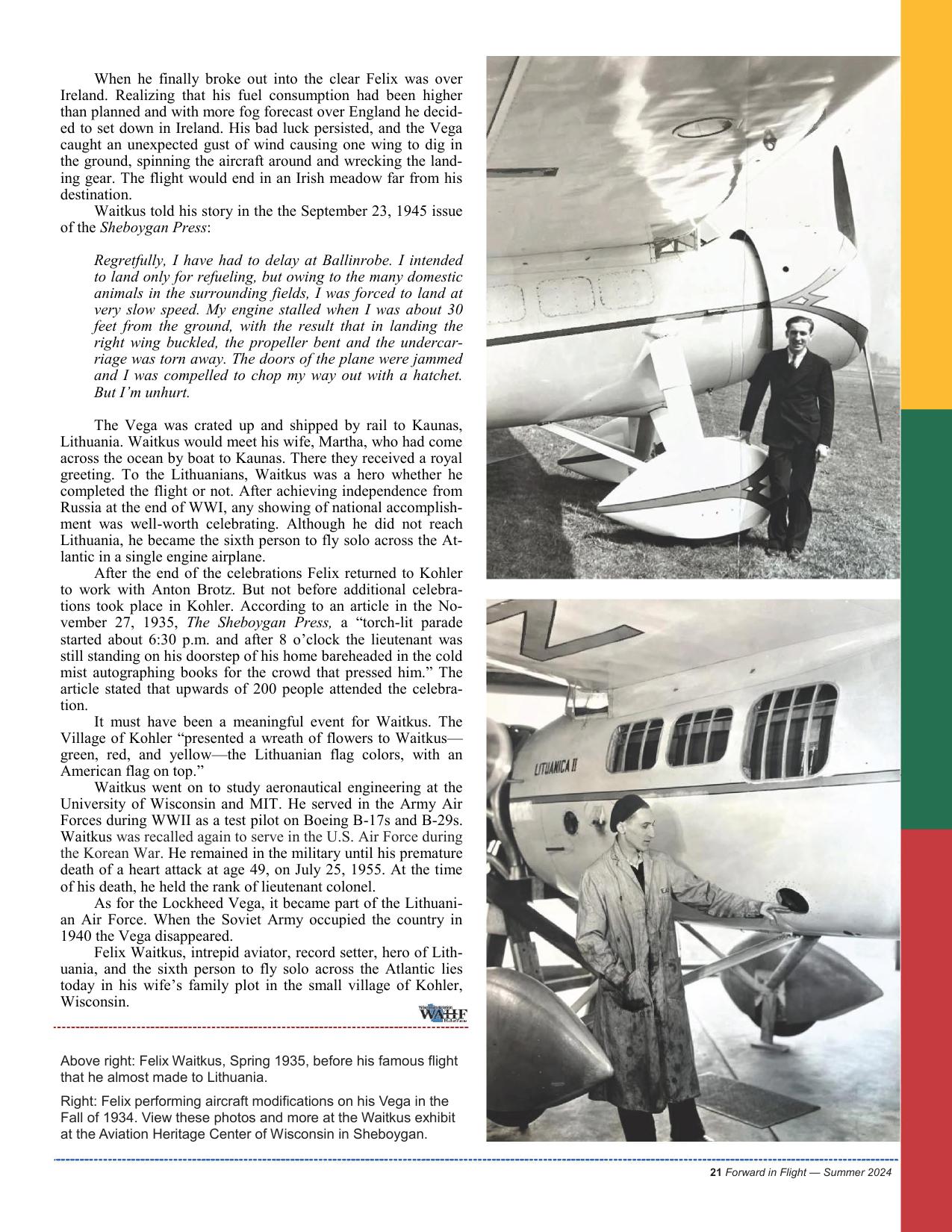
When he finally broke out into the clear Felix was over Ireland. Realizing that his fuel consumption had been higher than planned and with more fog forecast over England he decided to set down in Ireland. His bad luck persisted, and the Vega caught an unexpected gust of wind causing one wing to dig in the ground, spinning the aircraft around and wrecking the landing gear. The flight would end in an Irish meadow far from his destination. Waitkus told his story in the the September 23, 1945 issue of the Sheboygan Press: Regretfully, I have had to delay at Ballinrobe. I intended to land only for refueling, but owing to the many domestic animals in the surrounding fields, I was forced to land at very slow speed. My engine stalled when I was about 30 feet from the ground, with the result that in landing the right wing buckled, the propeller bent and the undercarriage was torn away. The doors of the plane were jammed and I was compelled to chop my way out with a hatchet. But I’m unhurt. The Vega was crated up and shipped by rail to Kaunas, Lithuania. Waitkus would meet his wife, Martha, who had come across the ocean by boat to Kaunas. There they received a royal greeting. To the Lithuanians, Waitkus was a hero whether he completed the flight or not. After achieving independence from Russia at the end of WWI, any showing of national accomplishment was well-worth celebrating. Although he did not reach Lithuania, he became the sixth person to fly solo across the Atlantic in a single engine airplane. After the end of the celebrations Felix returned to Kohler to work with Anton Brotz. But not before additional celebrations took place in Kohler. According to an article in the November 27, 1935, The Sheboygan Press, a “torch-lit parade started about 6:30 p.m. and after 8 o’clock the lieutenant was still standing on his doorstep of his home bareheaded in the cold mist autographing books for the crowd that pressed him.” The article stated that upwards of 200 people attended the celebration. It must have been a meaningful event for Waitkus. The Village of Kohler “presented a wreath of flowers to Waitkus— green, red, and yellow—the Lithuanian flag colors, with an American flag on top.” Waitkus went on to study aeronautical engineering at the University of Wisconsin and MIT. He served in the Army Air Forces during WWII as a test pilot on Boeing B-17s and B-29s. Waitkus was recalled again to serve in the U.S. Air Force during the Korean War. He remained in the military until his premature death of a heart attack at age 49, on July 25, 1955. At the time of his death, he held the rank of lieutenant colonel. As for the Lockheed Vega, it became part of the Lithuanian Air Force. When the Soviet Army occupied the country in 1940 the Vega disappeared. Felix Waitkus, intrepid aviator, record setter, hero of Lithuania, and the sixth person to fly solo across the Atlantic lies today in his wife’s family plot in the small village of Kohler, Wisconsin. ------------------~ ! Above right: Felix Waitkus, Spring 1935, before his famous flight that he almost made to Lithuania. Right: Felix performing aircraft modifications on his Vega in the Fall of 1934. View these photos and more at the Waitkus exhibit at the Aviation Heritage Center of Wisconsin in Sheboygan. 21 Forward in Flight — Summer 2024
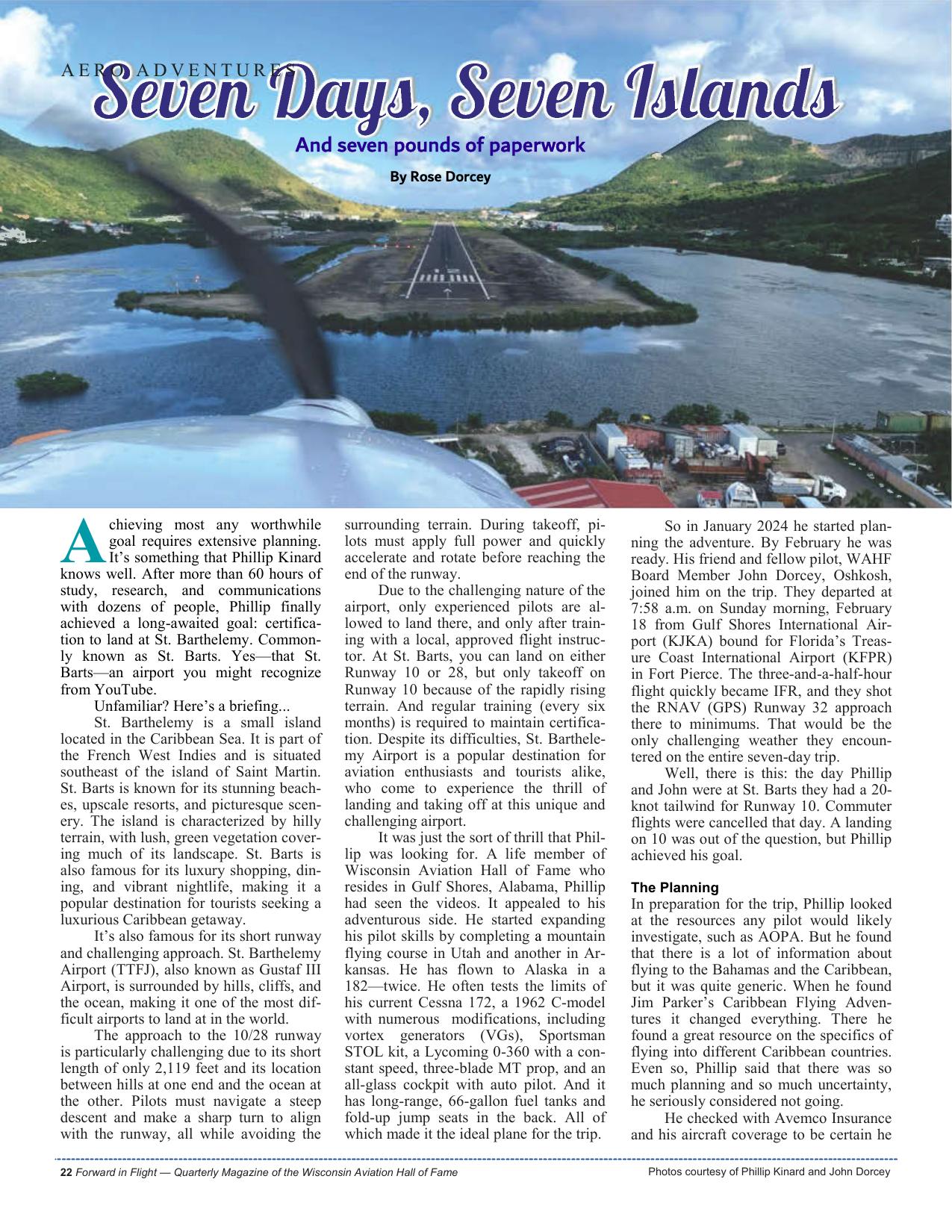
AERO ADVENTURES And seven pounds of paperwork By Rose Dorcey A chieving most any worthwhile goal requires extensive planning. It’s something that Phillip Kinard knows well. After more than 60 hours of study, research, and communications with dozens of people, Phillip finally achieved a long-awaited goal: certification to land at St. Barthelemy. Commonly known as St. Barts. Yes—that St. Barts—an airport you might recognize from YouTube. Unfamiliar? Here’s a briefing... St. Barthelemy is a small island located in the Caribbean Sea. It is part of the French West Indies and is situated southeast of the island of Saint Martin. St. Barts is known for its stunning beaches, upscale resorts, and picturesque scenery. The island is characterized by hilly terrain, with lush, green vegetation covering much of its landscape. St. Barts is also famous for its luxury shopping, dining, and vibrant nightlife, making it a popular destination for tourists seeking a luxurious Caribbean getaway. It’s also famous for its short runway and challenging approach. St. Barthelemy Airport (TTFJ), also known as Gustaf III Airport, is surrounded by hills, cliffs, and the ocean, making it one of the most difficult airports to land at in the world. The approach to the 10/28 runway is particularly challenging due to its short length of only 2,119 feet and its location between hills at one end and the ocean at the other. Pilots must navigate a steep descent and make a sharp turn to align with the runway, all while avoiding the surrounding terrain. During takeoff, pilots must apply full power and quickly accelerate and rotate before reaching the end of the runway. Due to the challenging nature of the airport, only experienced pilots are allowed to land there, and only after training with a local, approved flight instructor. At St. Barts, you can land on either Runway 10 or 28, but only takeoff on Runway 10 because of the rapidly rising terrain. And regular training (every six months) is required to maintain certification. Despite its difficulties, St. Barthelemy Airport is a popular destination for aviation enthusiasts and tourists alike, who come to experience the thrill of landing and taking off at this unique and challenging airport. It was just the sort of thrill that Phillip was looking for. A life member of Wisconsin Aviation Hall of Fame who resides in Gulf Shores, Alabama, Phillip had seen the videos. It appealed to his adventurous side. He started expanding his pilot skills by completing a mountain flying course in Utah and another in Arkansas. He has flown to Alaska in a 182—twice. He often tests the limits of his current Cessna 172, a 1962 C-model with numerous modifications, including vortex generators (VGs), Sportsman STOL kit, a Lycoming 0-360 with a constant speed, three-blade MT prop, and an all-glass cockpit with auto pilot. And it has long-range, 66-gallon fuel tanks and fold-up jump seats in the back. All of which made it the ideal plane for the trip. 22 Forward in Flight — Quarterly Magazine of the Wisconsin Aviation Hall of Fame So in January 2024 he started planning the adventure. By February he was ready. His friend and fellow pilot, WAHF Board Member John Dorcey, Oshkosh, joined him on the trip. They departed at 7:58 a.m. on Sunday morning, February 18 from Gulf Shores International Airport (KJKA) bound for Florida’s Treasure Coast International Airport (KFPR) in Fort Pierce. The three-and-a-half-hour flight quickly became IFR, and they shot the RNAV (GPS) Runway 32 approach there to minimums. That would be the only challenging weather they encountered on the entire seven-day trip. Well, there is this: the day Phillip and John were at St. Barts they had a 20knot tailwind for Runway 10. Commuter flights were cancelled that day. A landing on 10 was out of the question, but Phillip achieved his goal. The Planning In preparation for the trip, Phillip looked at the resources any pilot would likely investigate, such as AOPA. But he found that there is a lot of information about flying to the Bahamas and the Caribbean, but it was quite generic. When he found Jim Parker’s Caribbean Flying Adventures it changed everything. There he found a great resource on the specifics of flying into different Caribbean countries. Even so, Phillip said that there was so much planning and so much uncertainty, he seriously considered not going. He checked with Avemco Insurance and his aircraft coverage to be certain he Photos courtesy of Phillip Kinard and John Dorcey
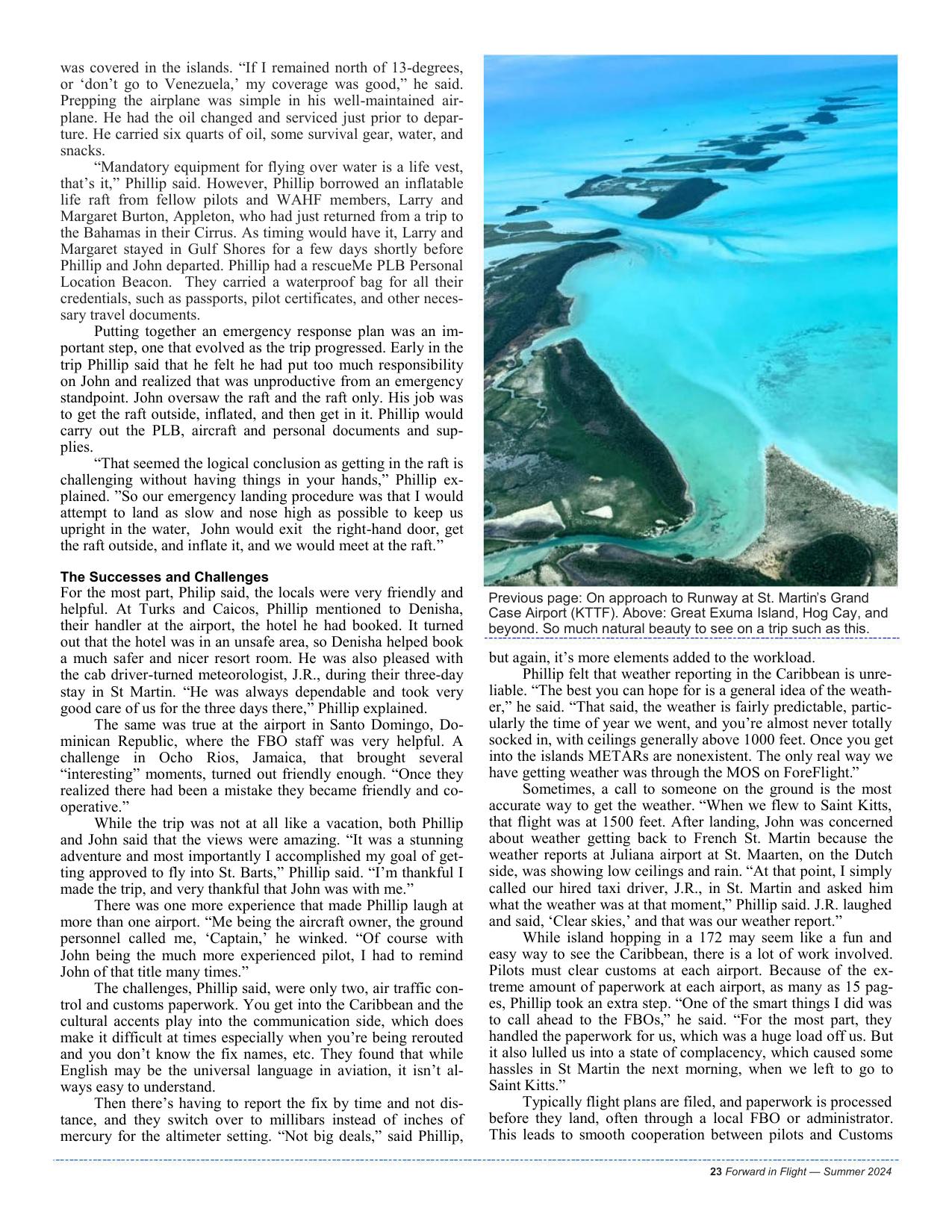
was covered in the islands. “If I remained north of 13-degrees, or ‘don’t go to Venezuela,’ my coverage was good,” he said. Prepping the airplane was simple in his well-maintained airplane. He had the oil changed and serviced just prior to departure. He carried six quarts of oil, some survival gear, water, and snacks. “Mandatory equipment for flying over water is a life vest, that’s it,” Phillip said. However, Phillip borrowed an inflatable life raft from fellow pilots and WAHF members, Larry and Margaret Burton, Appleton, who had just returned from a trip to the Bahamas in their Cirrus. As timing would have it, Larry and Margaret stayed in Gulf Shores for a few days shortly before Phillip and John departed. Phillip had a rescueMe PLB Personal Location Beacon. They carried a waterproof bag for all their credentials, such as passports, pilot certificates, and other necessary travel documents. Putting together an emergency response plan was an important step, one that evolved as the trip progressed. Early in the trip Phillip said that he felt he had put too much responsibility on John and realized that was unproductive from an emergency standpoint. John oversaw the raft and the raft only. His job was to get the raft outside, inflated, and then get in it. Phillip would carry out the PLB, aircraft and personal documents and supplies. “That seemed the logical conclusion as getting in the raft is challenging without having things in your hands,” Phillip explained. ”So our emergency landing procedure was that I would attempt to land as slow and nose high as possible to keep us upright in the water, John would exit the right-hand door, get the raft outside, and inflate it, and we would meet at the raft.” The Successes and Challenges For the most part, Philip said, the locals were very friendly and helpful. At Turks and Caicos, Phillip mentioned to Denisha, their handler at the airport, the hotel he had booked. It turned out that the hotel was in an unsafe area, so Denisha helped book a much safer and nicer resort room. He was also pleased with the cab driver-turned meteorologist, J.R., during their three-day stay in St Martin. “He was always dependable and took very good care of us for the three days there,” Phillip explained. The same was true at the airport in Santo Domingo, Dominican Republic, where the FBO staff was very helpful. A challenge in Ocho Rios, Jamaica, that brought several “interesting” moments, turned out friendly enough. “Once they realized there had been a mistake they became friendly and cooperative.” While the trip was not at all like a vacation, both Phillip and John said that the views were amazing. “It was a stunning adventure and most importantly I accomplished my goal of getting approved to fly into St. Barts,” Phillip said. “I’m thankful I made the trip, and very thankful that John was with me.” There was one more experience that made Phillip laugh at more than one airport. “Me being the aircraft owner, the ground personnel called me, ‘Captain,’ he winked. “Of course with John being the much more experienced pilot, I had to remind John of that title many times.” The challenges, Phillip said, were only two, air traffic control and customs paperwork. You get into the Caribbean and the cultural accents play into the communication side, which does make it difficult at times especially when you’re being rerouted and you don’t know the fix names, etc. They found that while English may be the universal language in aviation, it isn’t always easy to understand. Then there’s having to report the fix by time and not distance, and they switch over to millibars instead of inches of mercury for the altimeter setting. “Not big deals,” said Phillip, Previous page: On approach to Runway at St. Martin’s Grand Case Airport (KTTF). Above: Great Exuma Island, Hog Cay, and beyond. So much natural beauty to see on a trip such as this. but again, it’s more elements added to the workload. Phillip felt that weather reporting in the Caribbean is unreliable. “The best you can hope for is a general idea of the weather,” he said. “That said, the weather is fairly predictable, particularly the time of year we went, and you’re almost never totally socked in, with ceilings generally above 1000 feet. Once you get into the islands METARs are nonexistent. The only real way we have getting weather was through the MOS on ForeFlight.” Sometimes, a call to someone on the ground is the most accurate way to get the weather. “When we flew to Saint Kitts, that flight was at 1500 feet. After landing, John was concerned about weather getting back to French St. Martin because the weather reports at Juliana airport at St. Maarten, on the Dutch side, was showing low ceilings and rain. “At that point, I simply called our hired taxi driver, J.R., in St. Martin and asked him what the weather was at that moment,” Phillip said. J.R. laughed and said, ‘Clear skies,’ and that was our weather report.” While island hopping in a 172 may seem like a fun and easy way to see the Caribbean, there is a lot of work involved. Pilots must clear customs at each airport. Because of the extreme amount of paperwork at each airport, as many as 15 pages, Phillip took an extra step. “One of the smart things I did was to call ahead to the FBOs,” he said. “For the most part, they handled the paperwork for us, which was a huge load off us. But it also lulled us into a state of complacency, which caused some hassles in St Martin the next morning, when we left to go to Saint Kitts.” Typically flight plans are filed, and paperwork is processed before they land, often through a local FBO or administrator. This leads to smooth cooperation between pilots and Customs 23 Forward in Flight — Summer 2024
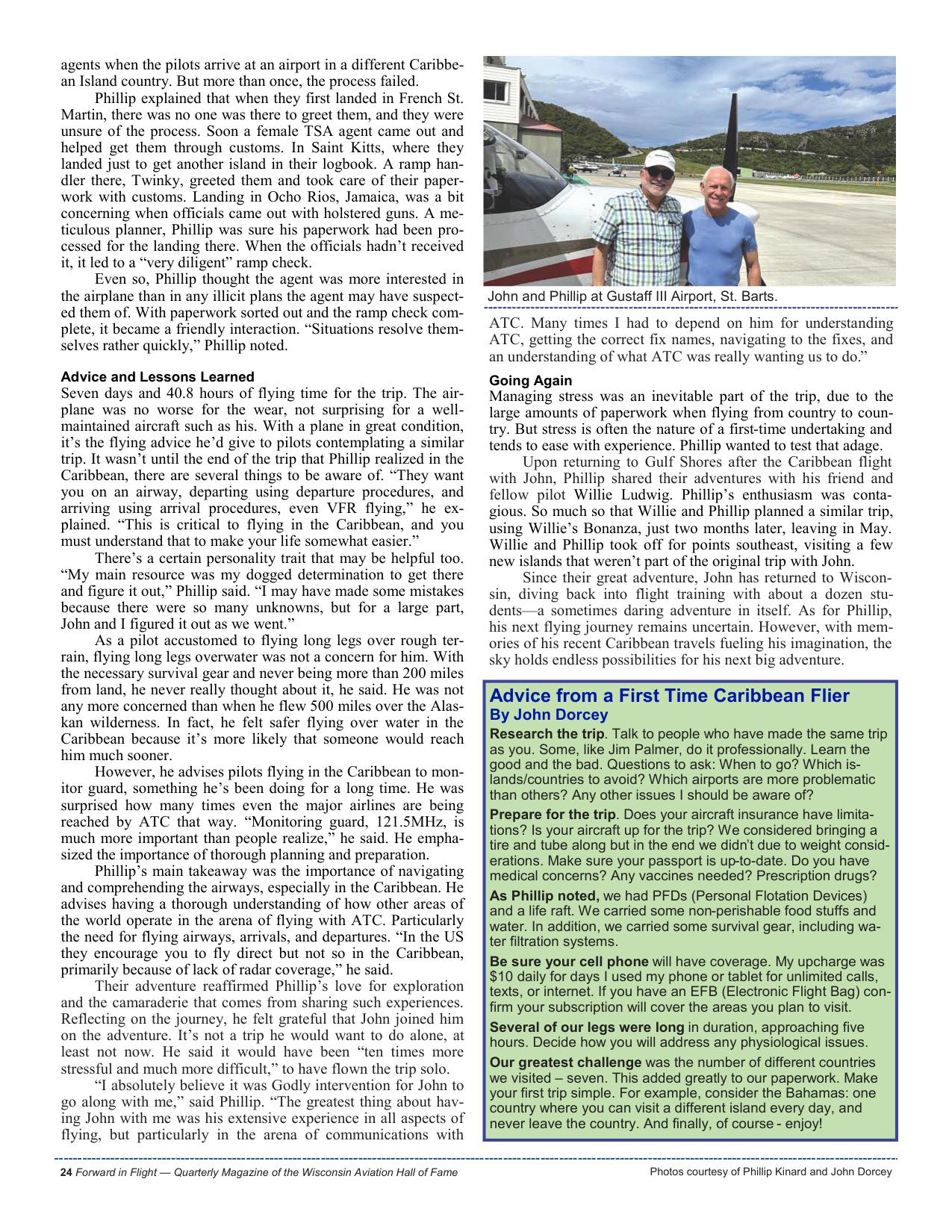
agents when the pilots arrive at an airport in a different Caribbean Island country. But more than once, the process failed. Phillip explained that when they first landed in French St. Martin, there was no one was there to greet them, and they were unsure of the process. Soon a female TSA agent came out and helped get them through customs. In Saint Kitts, where they landed just to get another island in their logbook. A ramp handler there, Twinky, greeted them and took care of their paperwork with customs. Landing in Ocho Rios, Jamaica, was a bit concerning when officials came out with holstered guns. A meticulous planner, Phillip was sure his paperwork had been processed for the landing there. When the officials hadn’t received it, it led to a “very diligent” ramp check. Even so, Phillip thought the agent was more interested in the airplane than in any illicit plans the agent may have suspected them of. With paperwork sorted out and the ramp check complete, it became a friendly interaction. “Situations resolve themselves rather quickly,” Phillip noted. Advice and Lessons Learned Seven days and 40.8 hours of flying time for the trip. The airplane was no worse for the wear, not surprising for a wellmaintained aircraft such as his. With a plane in great condition, it’s the flying advice he’d give to pilots contemplating a similar trip. It wasn’t until the end of the trip that Phillip realized in the Caribbean, there are several things to be aware of. “They want you on an airway, departing using departure procedures, and arriving using arrival procedures, even VFR flying,” he explained. “This is critical to flying in the Caribbean, and you must understand that to make your life somewhat easier.” There’s a certain personality trait that may be helpful too. “My main resource was my dogged determination to get there and figure it out,” Phillip said. “I may have made some mistakes because there were so many unknowns, but for a large part, John and I figured it out as we went.” As a pilot accustomed to flying long legs over rough terrain, flying long legs overwater was not a concern for him. With the necessary survival gear and never being more than 200 miles from land, he never really thought about it, he said. He was not any more concerned than when he flew 500 miles over the Alaskan wilderness. In fact, he felt safer flying over water in the Caribbean because it’s more likely that someone would reach him much sooner. However, he advises pilots flying in the Caribbean to monitor guard, something he’s been doing for a long time. He was surprised how many times even the major airlines are being reached by ATC that way. “Monitoring guard, 121.5MHz, is much more important than people realize,” he said. He emphasized the importance of thorough planning and preparation. Phillip’s main takeaway was the importance of navigating and comprehending the airways, especially in the Caribbean. He advises having a thorough understanding of how other areas of the world operate in the arena of flying with ATC. Particularly the need for flying airways, arrivals, and departures. “In the US they encourage you to fly direct but not so in the Caribbean, primarily because of lack of radar coverage,” he said. Their adventure reaffirmed Phillip’s love for exploration and the camaraderie that comes from sharing such experiences. Reflecting on the journey, he felt grateful that John joined him on the adventure. It’s not a trip he would want to do alone, at least not now. He said it would have been “ten times more stressful and much more difficult,” to have flown the trip solo. “I absolutely believe it was Godly intervention for John to go along with me,” said Phillip. “The greatest thing about having John with me was his extensive experience in all aspects of flying, but particularly in the arena of communications with John and Phillip at Gustaff III Airport, St. Barts. ---------------·------------------------------------------------------------------· ATC. Many times I had to depend on him for understanding ATC, getting the correct fix names, navigating to the fixes, and an understanding of what ATC was really wanting us to do.” Going Again Managing stress was an inevitable part of the trip, due to the large amounts of paperwork when flying from country to country. But stress is often the nature of a first-time undertaking and tends to ease with experience. Phillip wanted to test that adage. Upon returning to Gulf Shores after the Caribbean flight with John, Phillip shared their adventures with his friend and fellow pilot Willie Ludwig. Phillip’s enthusiasm was contagious. So much so that Willie and Phillip planned a similar trip, using Willie’s Bonanza, just two months later, leaving in May. Willie and Phillip took off for points southeast, visiting a few new islands that weren’t part of the original trip with John. Since their great adventure, John has returned to Wisconsin, diving back into flight training with about a dozen students—a sometimes daring adventure in itself. As for Phillip, his next flying journey remains uncertain. However, with memories of his recent Caribbean travels fueling his imagination, the sky holds endless possibilities for his next big adventure. Advice from a First Time Caribbean Flier By John Dorcey Research the trip. Talk to people who have made the same trip as you. Some, like Jim Palmer, do it professionally. Learn the good and the bad. Questions to ask: When to go? Which islands/countries to avoid? Which airports are more problematic than others? Any other issues I should be aware of? Prepare for the trip. Does your aircraft insurance have limitations? Is your aircraft up for the trip? We considered bringing a tire and tube along but in the end we didn’t due to weight considerations. Make sure your passport is up-to-date. Do you have medical concerns? Any vaccines needed? Prescription drugs? As Phillip noted, we had PFDs (Personal Flotation Devices) and a life raft. We carried some non-perishable food stuffs and water. In addition, we carried some survival gear, including water filtration systems. Be sure your cell phone will have coverage. My upcharge was $10 daily for days I used my phone or tablet for unlimited calls, texts, or internet. If you have an EFB (Electronic Flight Bag) confirm your subscription will cover the areas you plan to visit. Several of our legs were long in duration, approaching five hours. Decide how you will address any physiological issues. Our greatest challenge was the number of different countries we visited – seven. This added greatly to our paperwork. Make your first trip simple. For example, consider the Bahamas: one country where you can visit a different island every day, and never leave the country. And finally, of course - enjoy! ---------------------------------------------------------24 Forward in Flight — Quarterly Magazine of the Wisconsin Aviation Hall of Fame ----------------------------Photos courtesy of Phillip Kinard and John Dorcey
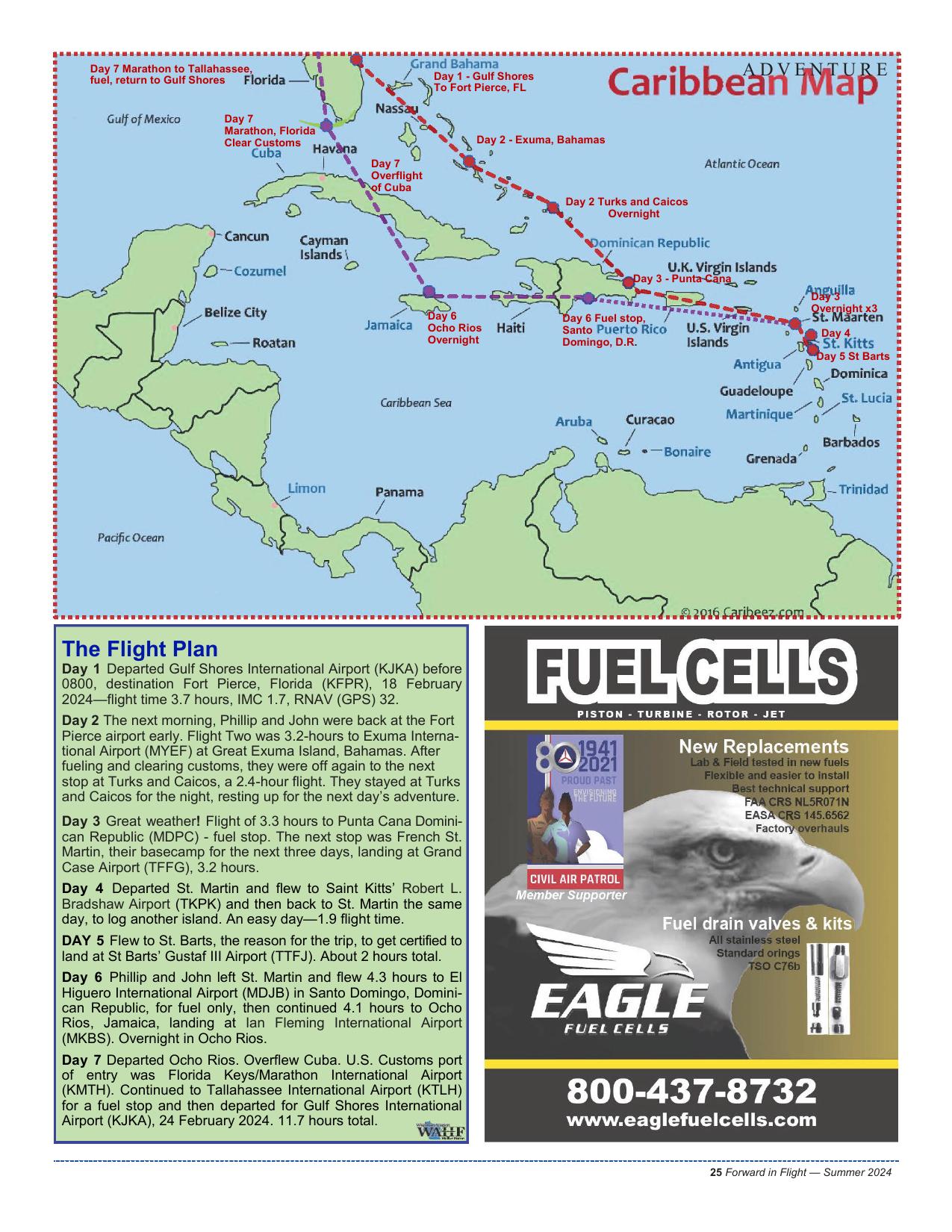
Day 7 Marathon to Tallahassee, fuel, return to Gulf Shores ADVENTURE Day 1 - Gulf Shores To Fort Pierce, FL Day 7 Marathon, Florida Clear Customs Day 2 - Exuma, Bahamas Day 7 Overflight of Cuba Atlantic Ocean Day 2 Turks and Caicos Overnight Cayman Islands \ 0 Day 3 - Punta Cana Day 6 Ocho Rios Overnight Day 3 Overnight x3 Day 6 Fuel stop, Santo Domingo, D.R. Day 4 Day 5 St Barts Caribbean Sea Curacao Aruba ' =I • - Bona,re . ~ Panama I Pacific Ocean The Flight Plan Day 1 Departed Gulf Shores International Airport (KJKA) before 0800, destination Fort Pierce, Florida (KFPR), 18 February 2024—flight time 3.7 hours, IMC 1.7, RNAV (GPS) 32. Day 2 The next morning, Phillip and John were back at the Fort Pierce airport early. Flight Two was 3.2-hours to Exuma International Airport (MYEF) at Great Exuma Island, Bahamas. After fueling and clearing customs, they were off again to the next stop at Turks and Caicos, a 2.4-hour flight. They stayed at Turks and Caicos for the night, resting up for the next day’s adventure. Day 3 Great weather! Flight of 3.3 hours to Punta Cana Dominican Republic (MDPC) - fuel stop. The next stop was French St. Martin, their basecamp for the next three days, landing at Grand Case Airport (TFFG), 3.2 hours. Day 4 Departed St. Martin and flew to Saint Kitts’ Robert L. Bradshaw Airport (TKPK) and then back to St. Martin the same day, to log another island. An easy day—1.9 flight time. DAY 5 Flew to St. Barts, the reason for the trip, to get certified to land at St Barts’ Gustaf III Airport (TTFJ). About 2 hours total. Day 6 Phillip and John left St. Martin and flew 4.3 hours to El Higuero International Airport (MDJB) in Santo Domingo, Dominican Republic, for fuel only, then continued 4.1 hours to Ocho Rios, Jamaica, landing at Ian Fleming International Airport (MKBS). Overnight in Ocho Rios. Day 7 Departed Ocho Rios. Overflew Cuba. U.S. Customs port of entry was Florida Keys/Marathon International Airport (KMTH). Continued to Tallahassee International Airport (KTLH) for a fuel stop and then departed for Gulf Shores International Airport (KJKA), 24 February 2024. 11.7 hours total. 800-437-8732 www.eaglefuelcells.com 25 Forward in Flight — Summer 2024
ASSOCIATION NEWS Kohn Exhibit Unveiling June 9 at the Kelch Aviation Museum Join us for an stimulating journey into history as we unveil our newest exhibit showcasing the incredible aviation photography of Leo J. Kohn. Immerse yourself in the world of aviation through Leo’s lens at our exhibit unveiling and fundraising event on Sunday, June 9 from 1 - 4 p.m. All WAHF members and friends of the Wisconsin Aviation Hall of Fame are invited to join us for a day dedicated to honoring Leo Kohn’s legacy and experiencing his remarkable images firsthand. The event will feature brief remarks from special guests, including Leo Kohn’s son and daughter, Bill and Mary Ellen, offering unique insights into Leo’s life and work. WAHF Board President Kurt Stanich will also share his thoughts on the significance of this exhibit. Enjoy light refreshments as you mingle with fellow aviation enthusiasts and celebrate the enduring impact of Leo J. Kohn’s photography. Please RSVP by June 2: info@wahf.org or call 920-2796029. We hope to see you there! Would You Send $50? We invite our valued members and supporters to contribute to the Leo J. Kohn Photography Digitization Fund, helping us preserve the rich legacy of Leo J. Kohn's aviation art. Your generous gift will ensure that this important collection becomes digitized and made accessible to aviation enthusiasts and historians worldwide. Together, we can celebrate and honor the remarkable contributions of Leo J. Kohn to aviation history. Donors will be acknowledged in Forward in Flight magazine. Sponsor a Stack of Negatives $3000* __________ *Receive a matted print from the Leo Kohn Collection $50___$100___$150___$250___$500___$1000___ Make check payable to the Wisconsin Aviation Hall of Fame, Inc Send to WAHF/C Weber 240 Marina Ct #10 Waterford WI 53185 (Note “Kohn Project” on your check.) Calling all AvGeeks! Photo Screening Party; You’re Invited! Join us for a unique Airplane Photo Screening Party at Starkweather Brewing Co. in Madison! ‘Props and Pints’ will showcase the impressive images from the Leo J. Kohn Aviation Photography Collection. Test your aviation knowledge with our ‘Name that Airplane’ game, and enjoy light appetizers (while they last) courtesy of WAHF. On Starkweather’s beer menu will be Leo’s Lager and specially priced $10 flights (on your own). Contribute to our donation box to support the digitization of Leo’s incredible photo collection. Door prizes, too. Cheers! Join us at Starkweather Brewing Co, Sunday, June 30, from 1 - 4 pm at 2439 Atwood Avenue, Madison. RSVPs appreciated—email info@wahf.org or call/text 920-279-6029. WAHF On the Air, and at AirVenture Tune into EAA’s Green Dot Podcast, where Dan Silvers, and John & Rose Dorcey, delve into the history of WAHF and share fascinating insights into the Leo Kohn Photography Project. FMI visit https://inspire.eaa.org/eaas-green-dot-podcast/ During EAA AirVenture Oshkosh, check the forums schedules; WAHF’s Kurt Stanich and Dan Silvers will showcase the excitement of flight through Leo Kohn’s photography. _ I_______________________________________________________________________________________ Join Usl 2024 Induction Ceremony Saturday, October 26 is going to be a great day of aviation for you and your friends. WAHF’s induction ceremony, at the EAA Aviation Museum in Oshkosh, features museum tours, a social hour, dinner, and of course: honoring our inductees! Join us as we honor Caroline “Blaze” Jensen, John Kelk, Bob Lussow, George Doersch, and John Hatz. Event details coming in the next issue of Forward in Flight, and at WAHF.org. Thank You ... ♦ To those who have generously given to the Kohn Photo Digitization Fund. We appreciate your generosity! Or visit WAHF.org/kohn to donate Name______________________________________________ Address____________________________________________ City State Zip________________________________________ ¨To those who have donated to WAHF’s new Kylie’s Cub Air Flight LLC, Kylie Murray, Steve & Sharon Krog Scholarship. We’re making progress on our goal of raising $25,000 so a scholarship can be awarded in March 2025. >>To donate, please visit wahf.org/scholarships Please stop in during regular business hours for a self-guided tour! Westwood Aaron Stewart. PE Aviation Services Manager (920) 830-61n aaron.stewartowestwoodps.com & Tuesday - Closed AHERIT~GE ~ CENTER Dtl MondayWednesday 11 – 4 Sheboygan County Memorial Airport 920.467.2043 ahcw.org Thursday 11 – 4 Friday 11 – 4 Saturday 9 – 4 Sunday 11 – 4 Exhibits feature WWII Veterans, the T-28, a North Central Airlines’ DC-3 and airline history, and more. 26 Forward in Flight — Quarterly Magazine of the Wisconsin Aviation Hall of Fame
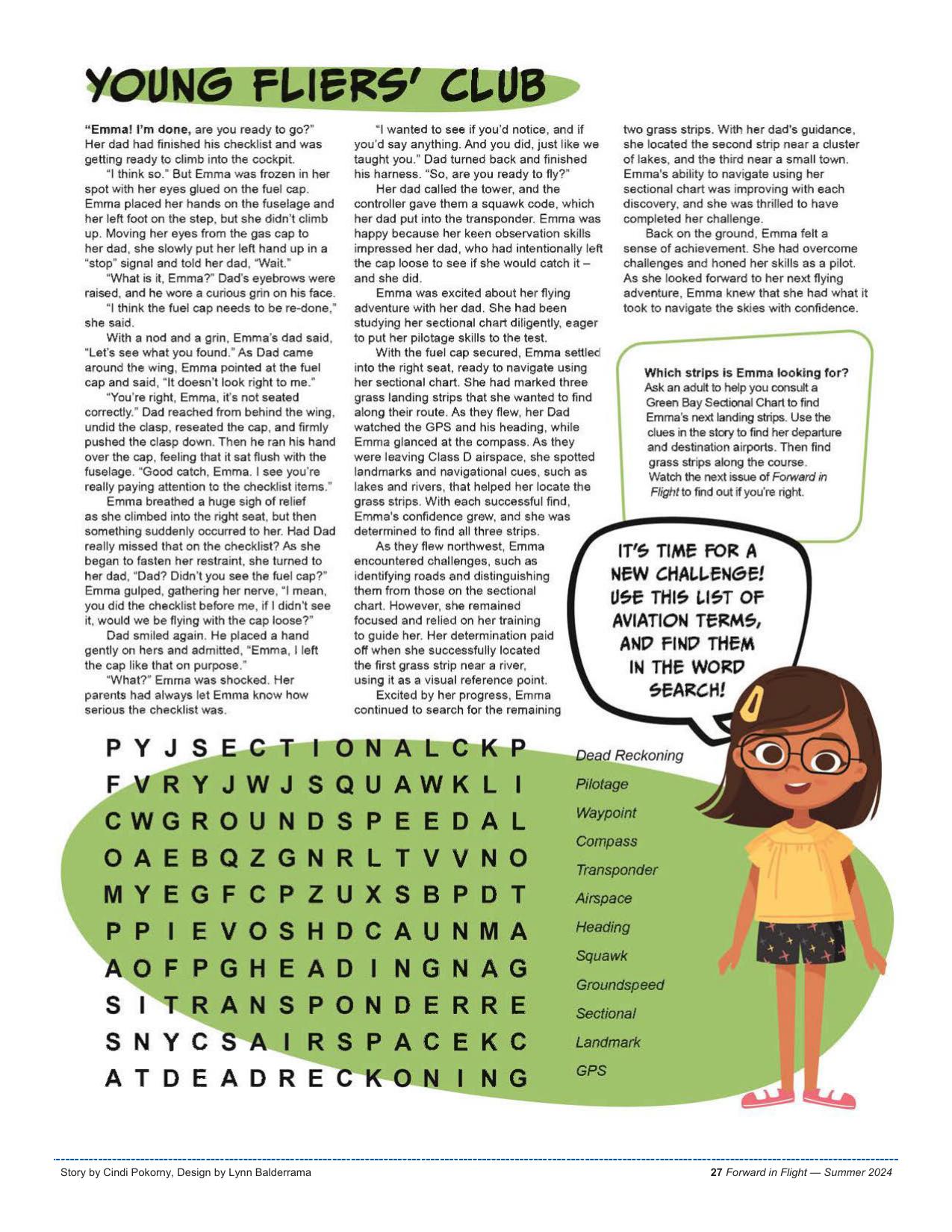
"Emma! I' m done, are you ready to go?" Her dad had finished his checklist and was getting ready to climb into the cockpit. "I think so.• But Emma was frozen in her spot with her eyes glued on the fuel cap. Emma placed her hands on the fuselage and her left foot on the step, but she didn't climb up. Moving her eyes from the gas cap to her dad, she slowly put her left hand up in a "stop" signal and told her dad, "Wait." "What is it, Emma?" Dad's eyebrows were raised, and he wore a curious grin on his face. "I think the fuel cap needs to be re-done," she said. With a nod and a grin, Emma's dad said, "Let's see what you found ." As Dad came around the wing, Emma pointed at the fuel cap and said, "It doesn't look right to me." "You're right, Emma, it's not seated correctly." Dad reached from behind the wing, undid the clasp, reseated the cap, and firmly pushed the clasp down. Then he ran his hand over the cap, feeling that it sat flush with the fuselage. "Good catch, Emma. I see you're really paying attention to the checklist items." Emma breathed a huge sigh of relief as she climbed into the right seat, but then something suddenly occurred to her. Had Dad really missed that on the checklist? As she began to fasten her restraint. she turned to her dad, "Dad? Didn't you see the fuel cap?" Emma gulped, gathering her nerve, "I mean, you did the checklist before me, if I didn't see it, would we be flying with the cap loose?" Dad smiled again. He placed a hand gently on hers and admitted, "Emma, I left the cap like that on purpose." "What?" Emma was shocked. Her parents had always let Emma know how serious the checklist was. two grass strips. With her dad's guidance, "I wanted to see if you'd notice, and if she located the second strip near a cluster you'd say anything. And you did, just like we taught you." Dad turned back and finished of lakes, and the third near a small town. his harness. ''So, are you ready to fly?" Emma's ability to navigate using her sectional chart was improving with each Her dad called the tower, and the controller gave them a squawk code, which discovery, and she was thrilled to have her dad put into the transponder. Emma was completed her challenge. happy because her keen observation skills Back on the ground, Emma felt a impressed her dad, who had intentionally left sense of achievement. She had overcome the cap loose to see if she would catch it challenges and honed her skills as a pilot. As she looked forward to her next flying and she did. adventure, Emma knew that she had what it Emma was excited about her flying took to navigate the skies with confidence. adventure with her dad. She had been studying her sectional chart diligently, eager to put her pilotage skills to the test. With the fuel cap secured, Emma settled into the right seat, ready to navigate using Which strips is Emma looking for? her sectional chart. She had marked three Ask an adult to help you consult a grass landing strips that she wanted to find Green Bay Sectional Chart to find along their route. As they flew, her Dad Emma's next landing strips. Use the watched the GPS and his heading, while clues in the story to find her departure Emma glanced at the compass. As they and destination airports. Then find were leaving Class D airspace, she spotted grass strips along the course. landmarks and navigational cues, such as Watch the next issue of Forward in lakes and rivers, that helped her locate the Flight to find out if you're right. grass strips. With each successful find, Emma's confidence grew, and she was determined to find all three strips. As they flew northwest, Emma IT'~ TIME FOR A encountered chal lenges, such as identifying roads and distinguishing NEW CHAL.L-ENeE! them from those on the sectional U~E THI~ L.l~T OF chart. However, she remained focused and relied on her training AVIATION TERM~, to guide her. Her determination paid AND FIND THEM off when she successfully located the first grass strip near a river, IN THE WORD using it as a visual reference point. ~EARCH! Excited by her progress, Emma continued to search for the remaining PYJS E-G ONA tC-KP F:VRYJWJSQUAWKLI CWGROUNDSPEEDAL OAEBQZGNRLTVVNO MYEGFCPZUXSBPDT PPIEVOSHDCAUNMA :4 0FPGHEADINGNAG s t RANSPONDERRE SNYCSAI RSPACEKC ATDEADRECKO NG ----------------------------------------------------Story by Cindi Pokorny, Design by Lynn Balderrama Pilotage Waypoint Compass Transponder Airspace Heading Squawk Groundspeed Sectional Landmark GPS -----------------------------------------------------------------------------27 Forward in Flight — Summer 2024
EDITOR’S LOG Flying High with the Leo J. Kohn Photography Project In all the years I’ve been involved with the Wisconsin Aviation Hall of Fame I’ve never been as excited as I am now. The magazine authors, the inductees, the board members, WAHF supporters and advertisers who I get to interact with make this an astoundingly enjoyable experience! And just when I thought things couldn’t get any better, the Leo J. Kohn photography project comes along. I’m a lucky girl. It’s easy to explain why I’m so delighted to be a part of a team that’s doing some amazing things in the effort to digitize 34,000 negatives. Number one is the people, of course. Leo’s son, Bill, in Arizona, and Leo’s daughter, Mary Ellen, Milwaukee, have been so very helpful and gracious in lending a hand to tell their dad’s story, and gain support for the project. And then there’s the team that is working hard on so many project details: Kurt Stanich, Dan Silvers, Scott Green, Lynn Balderrama, and of course, John. When I come away from meetings with these stellar individuals I’m inspired to continue giving 100 percent to the project, like they do. Their dedication and passion fuel my efforts, making this ongoing journey truly extraordinary. It’s rare in life, it seems, to find people who are so selfmotivated that when they see a project they find a way to make it a reality. Maybe I suggest an idea, and then a few days later I’ll get an email that says, “How about this?” And that “this” is typically pretty awesome. What a pleasure to work with people like that. (As a reminder, if you are a person like that, then we need you! Send us a note to see where you can volunteer.) And then, there are the images themselves. Shot in blackand-white, they are perfect in their simplicity. The clean lines of each aircraft—or even, the odd lines! The locations, imagining the paint scheme, the surroundings. We’ve learned the most interesting facts about Wisconsin airports and aircraft histories. We look up N-numbers to find the plane is still flying, some 60 or 70 years later, or in a museum. The “small world” stories are incredible; we’ll share some of those in future issues of Forward in Flight. Yes, we’ve learned a lot by viewing Leo’s images, and we’ve only seen a small portion thus far. Who knows what other stories they hold? Perhaps you’ll find an aircraft that means something to you, once we make them available online. There’s also, for me, a profound sense of being part of something significant. Being able to help preserve a person’s legacy. Being able to learn about Leo’s life, through his images, and through the people who knew him—that’s pretty special. As someone deeply involved in this project, I’ve found that contributing to this team effort has been incredibly rewarding. If Leo’s story and his remarkable photography resonate with you, or if you feel moved as I do by the importance of preserving his photographs, I invite you to consider giving a gift to this important cause. Your support will not only help preserve his legacy but also ensure that his work will be shared and appreciated by aviation enthusiasts for decades to come. I’ve personally contributed to the cause and hope you’ll do the same. Together, we can ensure that Leo’s incredible story and photographs are shared and preserved for generations to come. Visit wahf.org/kohn to learn more about this incredible project. —Rose Dorcey ----------------------------------------------------------------------------------------- IIAfCO.-. '2 rm llapoo, Ille. CM .....,JOU Nduceimllltlnance COltl... Ilia la good for you and your customer. With the economical Impacts that we have had on general aviation flying, and the resulting impact on maintenance facilities, everyone needs to find a way to decrease their operating costs, without sacrificing quality or safety. Rapco can help. AB Rapco parts are FAA-Approved, warranted better than the OEM, to save you and yell' customers money. C&ll now to see how we can help you• 1-800-527-2726 28 Forward in Flight — Quarterly Magazine of the Wisconsin Aviation Hall of Fame

,---------' ----------. I We invite you to fly with us—become a WAHF member and '' ' receive a subscription to Forward in Flight! ' -----------'' I I I I I I I I I ANNUAL MEMBERSHIP LEVELS Name________________________________________ _____ Youth (Under age 18) _____ Individual (Annual) _____ Couple (Annual) _____ Lifetime (Individual) _____ Lifetime (Couple) Address______________________________________ $10 $30 $40 $500 $750 City__________________________________________ State, Zip_____________________________________ Phone_______________________________________ TAX DEDUCTIBLE CONTRIBUTIONS Your contributions help ensure Wisconsin’s aviation pioneers and outstanding students in aviation education will continue to be recognized. Your contributions, in any amount, are appreciated. Email________________________________________ Members receive WAHF’s quarterly magazine Forward in Flight! Join Online! www.WAHF.org WAHF Supporting Contribution $___________ (General operating/events programming fund) Leo J. Kohn Collection Preservation Fund $___________ WAHF Scholarship Fund* $___________ *for scholarship donations please make a separate check payable to Community Foundation of North Central Wisconsin or visit www.CFONCW.org. --------------- Donate Online www.wahf.org/kohn Or, mail this form, along with your check payable to: Wisconsin Aviation Hall of Fame, Inc. to: Rose Dorcey/WAHF 3980 Sharratt Drive Oshkosh WI 54901 The Wisconsin Aviation Hall of Fame is a 501(c)(3) organization. -------------------------------------- -------------------819 W 20TH AV E OSHKOSH, WI 54902 FAA/CRS NU7R875N ~CCCPER _ . ENGINEERING Over 25 Years of High Quality Airport Planning and Design Morey Airplane Company Since 1932 A DYNON GARMIN. 141;iilllltl STR~Tp~~ ~,... ENGINEERING" Middleton Municipal Airport/Morey Field Self-service 100LL & Jet A 24-7 ■~INCORPORATED I~ !:.V.M?<" T~iG ®»lfflmff www.newv1ewtech.com 29 Forward in Flight—Summer 2024
PRSRT STD US Postage Paid Wisc Rapids WI Permit 98 Forward in Flight c/o Rose Dorcey 3980 Sharratt Drive Oshkosh WI 54901-1276 The Wisconsin Aviation Hall of Fame is a non-profit membership organization dedicated to preserving the past and fostering the future of flight. Welcome New WAHF Member/Supporters! Kate Bernard Terry Blaser Wyat Hatz* Jeff Melau Michael Melau David Milis Jim Embke Scott Oestreich Patrick Gaylord Paul & Lisa Walter Thank you for coming onboard! *New Life Member Congratulations to WAHF Inductee Jim Szajkovics on logging 10,000 hours of flight time. He reached the milestone on March 2, 2024, on a flight with Colleen Weber in her Bonanza, flying out of East Troy Municipal Airport (57C). Congratulations to Oshkosh Aviation Artist Jordyn Jacobson on winning the Congressional Art Competition, a competition for high school students across the country. There is one winner for each district and Jordan won the 6th district for Wisconsin with Representative Glenn Grothman. Her art, as shown in the Spring 2024 issue of Forward in Flight, will be in the Cannon Tunnel of the U.S. capitol for a year beginning June 27, 2024. LEO J. KOHN COLLECTION DONORS WALL OF FAME We're overwhelmed by the generosity of so many who have contributed to the Leo J. Kohn Collection Digitization Project thus far. Thank you all so very much! Your gift will play a crucial role in preserving this astounding collection of historic aviation images. Tom Bouchard Patti Bruha John Dodds Lynn Erickson Bill Green Joanne Hepp Bob Kunkel Bill Menzel Jill Mann Dan Silvers Colleen Weber Zivko Aeronatics Dan & Jane Brandenstein Terry Blaser Hal Bryan Dan Coyne John Dorcey Rose Dorcey Harold “Duffy” Gaier Deb Gangwish Scott Green Mal Gross Jon Helminiak Dixie Igou Bryan Kust Andrew Maag Rachel Mercer Joe Moreth Edward Punjak Dick Schmidt Charles Swain Doug Tomas Pat Weeden Sam Wiltzius Jim Zuelsdorf Ethan Brodsky George Cudahy Pete Drahn Alan Georgia Elena Grover Don Kiel Bob Massie Tad Oelstrom Janis Sierra Brad Volker Michelle Wrobleski Margaret & Larry Burton Andy Crowbridge Jamey Engels Darrel Gibson Dick Hanusa Samuel Knutson Keith Mathews Henry Peterson Amy Rabideau Silvers Ron Vandervort Darlene Yazbak